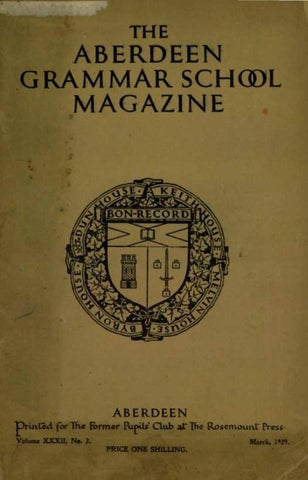
THE
ABERDEEN GRAMMAR SCHODL MAGAZINE •
ABERDEEN
pri.n.rect for The Former Pupils' Club ar The Rosemounr Press• Volume XXXII, No. 2.
March, l 429.
PRICE ONE SHILLING.
EDUCATIONAL BOOKS -
.
JAMES
G. BISSET
CONTINUES to supply all the Class Books (New or Second-hand) suited for the requirements of the Higher Educational Institutions in the City, at the Lowest Prices. N.B.—Best Value in Students' Note Books.
JAMES G. BISSET Classical, Medical, and Educational Bookseller,
85 BROAD
STREET
(Opposite Marischal College).
Telephone : Aberdeen 753.
Telegrams : " CENTRAL BAKERY."
A. B. HUTCHISON BREAD BISCUITS CAKES Best Quality.
Moderate Prices.
THE CENTRAL BAKERY ABERDEEN Shops throughout the City
•
A. C. LITTLE & SONS, LIMITED,
COSTUMIERS & FURRIERS. Always in Stock a Large Selection of 3-Piece Suits and Model 2-Piece Suits, Furs, Fur Coats, Fur-lined Coats, Wraps, Coat Frocks, Costumes, Dresses, Jumper Suits, Showerproofs, Skirts, etc. ALL AT THE VERY KEENEST PRICES.
INSPECTION IS INVITED.
EXCEPTIONAL VALUE IN MOURNINGS. The Largest Selection of Black Costumes, Coat Frocks, Dresses, Coats, Skirts, etc., in the City, at the Keenest Prices. Fit is Guaranteed within 6 hours, and no Charge is made for alteration.
"THE HOUSE FOR VALUE"
105 UNION ST., ABERDEEN. OPEN ALL DAY SATURDAYS. Telephone 523. -
THE YOUNG
MAN'S
Price -
21,-
JAMES FYFE & SON PAINTERS AND GLAZIERS. .
.
•
OFFICE AND SHOWIZOOMS:
11 DEE STREET, ABERDEEN. Telephone 304.
74.
Telegrams—" Fyfe, Painters
WILLIAM GRAY Tailor and Outfitter, HOLBURN JUNCTION, ABERDEEN. We are Outfitters to the Grammar School, and hold Stocks of everything for present and former pupils. Your patronage will be esteemed. 'PHONIC 2211.
ESTABLISHED
BOOKS - - - - BOUND Safe Bind
1
T a~
Fast
Safe Find
Bind
.~ -
Find
C'1.< ,4 ( >V Ze.--1 .
Fast
71-4
should Ilde
, d tohd Uhl. oPPOrtuait7 or shofressthe ay polio* sollsfeattom
with the exoellent oorlf you ha,e acne t.
40.
WM.. JACKSON (ABERDEEN) LTD., BOOKBINDERS,
18 BACK WYND, ABERDEEN. Telephone No. 291.
Established 1855.
TAILORING
AND
OUTFITTING
OF THE HIGHEST GRADE AT MODERATE PRICES. ALL GARMENTS AND
G.
W.
Tailor and Outfitter
GOODS GUARANTEED.
RAFFAN ::
82 UNION STREET
'Phone 462 ---
McDONALD FRUITERER
AND
FLORIST
Our Fruit is of the Finest Quality only and our Floral Work speaks for itself
21 HOLBURN STREET (HOLBURN JUNCTION)
Phone 444
The Bureau of Travel. An Up-to-date SHIPPING. PASSENGER and TOURIST OFFICE, where all travel is arranged. WINTER and SPRING on the FRENCH and ITALIAN RIVIERA. WINTER SPORTS IN SWITZERLAND. CONTINENTAL TRAVEL-CONDUCTED OR INDEPENDENT. Official Agents—IMPERIAL AIRWAYS AND AIR UNION. Railway Tickets, Sleeping Berths, Hotel Accommodation, etc., Reserved. Agents for the P.L.M. & International Sleeping Car Company. CHRISTMAS in CEYLON, SOUTH AFRICA, INDIA, EGYPT, AND THE HOLY LAND. Special Sailings and Fares. Hotel Accommodation, etc., arranged. Cruises to West Indies, South America, South Africa, Mediterranean, Canary and Madeira Islands. Special Arrangements for Round the World Tours. Inexpensive Tours Canada and U.S.A. AGENTS :—Polytechnic Touring Association, George Lunn, Sir Henry Lunn, Frame's Tours, Dean & Dawson, Free Church Touring Guild, etc. L. & N.E. Rail Tickets issued and dated in advance. Sleeping Berths, Seats, and Compartments Reserved. Pleasure Parties catered for. SHIPPING. OFFICIAL AGENTS—All Lines, AU Routes. PASSPORTS, also VISE , arranged where necessary. FOREIGN MONEY Bought, Sold, or Exchanged. Latest Information always available.
MACKAY BROTHERS & COY. (ABERDEEN) LIMITED,
35a Union Street, Aberdeen. Civility, Courtesy, and Attention. 'Phone 825 Central. leis. Worldwide, Aberdeen."
A. D. COPLAND. F.I.B.D.
W. KENNAWAY, Ltd. BAKERS and CONFECTIONERS,
5 and 7 Holburn Street. Luncheon and Tea Rooms,
173 Union Street, ABERDEEN
SPECIALTIESWEDDING CAKES.
SHORTBREAD
ROYAL DEESIDE IN TARTAN TINS, ALSO A LARGE SELECTION OF PLAIN AND FANCY ICED CAKES.
Telephone No. 1891.
ARCHIBALD McKELLAR Family Grocer and Wine Merchant,
454-456 Union Street, Aberdeen. .
4'e Specialise in
. .
Cooked Gammons, " Sinclair's" Belfast Smoked Hams, " Harris's "
Wiltshire Bacon.
Medicinal Wines— Vibrona, Hall's, Wincarnis, Glendenning's.
1884
SERVICE 1929
MOTORS!
CYCLES!
WIRELESS!
-
GEORGE BRUCE & SONS, 18 HOLBURN STREET.
Authorized Agents for Morris Cars. 'Phone 1524.
Royal (Dick) Veterinary College EDINBURGH. Principal:
O. CHARNOCK BRADLEY, M.D., D.Sc., M.R.C.V.S. After attendance on Complete Courses of Instruction in this College, Students may proceed to the Examinations for the Diploma of Membership of the Royal College of Veterinary Surgeons (M.R.C.V.S.), and for the Diploma in Veterinary State Medicine (D.V.S.M.). Students of the College may also present themselves for the Degree of Bachelor of Science (B.Sc.) in Veterinary Science conferred by the University of Edinburgh. The College being recognised as a Central Institution under the Education (Scotland) Act, 1908, Students are eligible for Bursaries granted by the Education Authorities of Scotland. A Copy of the College Calendar may be obtained on application to A. C. DOULL, Secretary and Treasurer.
FOR SATISFACTORY LAUNDRY SERVICE
WHITEHALL LAUNDRY WHITEHALL PLACE
'PHONE 1645
7
aleelled gAr g iat4
° CI/41e
BOYS' SCHOOL OUTFITS, RELIABLE WEAR. MODERATELY PRICED. Yl—Boys' Spring range of Flannel Suits, in new Brown and Fawn shades, also in Navy and Grey. Fit 5 to 13 years. Price, 17/6 to 30/- .
Y2—Boys' Grammar School Blazers, in best
quality Flannel, with Badge on pocket. Fit 5 to 15 years. Price, 19/11 to 30/6. School Shorts to match Blazer. Fit 5 to 11 years. Price, 10/11 to 13/6.
Grammar Cap with Rubber Peak. Red, White and Blue Belts.
Price, 3/11.
Price, 1/6.
School Overalls, in Fawn Casement. years. Price, 5/11 to 7/6.
Fit 5 to 8
Gordon's College Outfit, consisting of Blazer, Shorts, Cap, Belts, etc. Prices similar to those given for Grammar School.
Y3—Smart double-breasted Trench for boys, in best quality Navy and Fawn Gabardine. Fit 6 to 13 years. Price, 25/11 to 56/-
Y4—Pure Wool Pull-overs for boys, in new marl mixture colourings and fancy designs, fitting boys of 5 to 16 years. Price, 10/11 to 22/6 Extensive range of Boys' Jerseys in " Pesco " and " Sportsman " make in self and marl mixtures, also contrasting stripes on collar and cuffs. Fit 4 to 11 years. Price, 7/6 to 16/6. Shorts to match, any colour. Price, 6/6 to 8/11.
JOHN FALCONER & CO., LTD., Union St., ABERDEEN.
W. LUMSDEN & SON 58 UNION STREET, ABERDEEN.
GROCERIES, PROVISIONS, ::
WINES and SPIRITS, ALL
OF
HIGHEST
::
QUALITY.
HAVANA CIGARS in Great Variety. Telegrams: " TRAVELLED, ABERDEEN."
'PHO\E 210.
Telephone 274
Established 1770
SIMPSON & WHYTE LIMITED -
Ladies' & Gentlemen's Garments Naval, Military, and Clerical
8 ALBYN PLACE, ABERDEEN
ESTABLISHED 1843.
1
Wm. Cay & Sons
Let us print your
Funeral 111nbertafters.
Testimonials
415 UNION STREET AND
We do them neatly, promptly, inexpensively.
209 GEORGE STREET, ABERDEEN.
THE Motor for
Ilearses Distant
CENTRAL PRESS
IIIIII Cars
Funerals.
61-63 Belmont Street ABERDEEN
Telegrams—" Cay, Aberdeen." 'Phones Nos. 02 and 54.
Proprietor: joule N. MILNE, B.Com.
Tele. 809.
ESTABLISHED 1818.
By APPOINTMENT ro H.M. THE KING.
J. WILLIAMSON & SON (w.
B.
WILLIAMSON, PROPRIETOR),
Meat Purveyors and Poulterers
1, 2, & 3 MARKET BUILDINGS ('Phone 462),
ABERDEEN Branches i FOUNTAINHALL ROAD ('Phone 1724). Also
THE SQUARE, CULTS ('Phone, Cults 2).
at CHURCH SQUARE, BALLATER ('Phone 38)
I
FRED HARDIE
D. Wyllie & Son
Photographic Artist,
247 Union Street,
416 Union Street,
Aberdeen.
ABERDEEN
For every style of In- and Out-Door
Wyllies' Bookshop, Aberdeen ; Prompt service ; prices keen ; Established —One-eight-one-four ; Car service at our door.
Group, Composite
'Phone 402.
Groups & General Portraiture, Etc.
4
Commercial Photography our Speciality.
What to do,
AT POPULAR
Telegraphic Address :
"Wyllie,Book3eller,Aberdeen"
PRICES.
TELEPHONE 851.
-
-
-.- 11. _ ' I% 7
1
I 1/4•\ \
..:7- : - 7 .
_
.=-.: .7- 77.77 -'-
Steak Pies, 3d.
I
-\\., \ i\V _._._
7"-'
.T
I
I __
=::
I
I -
-
iI
-
-..147=' - •=l... 41
I
===....
--
I
/ /
-'._
:7-
Also Steak and Kidney Pies of all sizes
W. M. McPHERSON, Baker and Confectioner,
15 Fountainhall Road and 8 St. Swithin Street, ABERDEEN.
For Drawing Instruments & Materials
TYPEWRITER S NEW OR SECOND-HAND :: LARGE OR SMALL :: -
-
-
ALL MAKES FROM £4 10/PICTURE FRAMER AND ARTISTS' COLOURMAN
TAYLOR
Specially recommended THE IMPERIAL (Portable and Standard) BRITISH-MADE TYPEWRITERS!
SCHOOLHILL
ABERDEEN
C. H. WEBSTER
Telephone 2870.
ALFORD PLACE ABERDEEN
Geo.JamieSon & Son Silversmiths Watchmakers and Jewellers
Sole Representative of the World-famous firm of Silversmiths— Elkington & Co., Ltd. One of the finest selections of GEM RINGS, REAL PEARL NECKLETS, and
SCOTCH PEARLS, in Necklets and Single Pearls.
142 Union Street (Next Union Bridge)
ABERDEEN
THE PATHESCOPE The Ideal Home Cinema '1 4
:: Non-inflammable Films :: featuring Hundreds of Subjects
DRAMA - - . COMEDY- TRAVEL - - HISTORY- - SP0RT---EDUCATI0NAL NICOL SMITHICO. 37 BELMONT ST., ABERDEEN
0
Get your Phnographic Reiteirsmente at
D. S. Allan's Pharmacy 35 HOLBURN STREET (Near liulburn Junction).
Photographic Department. A Large Stook of Cameras, Plates, Films, Papers, and Accessories. Dept foe Kodaks and Kodak Supplies. Developing and Printing executed by an Expert and delivered in 24 hours.
'Phone 1624
CANTILEVERS for KIDDIES Give your Children the chance to grow up with Perfect Feet
WHEN they are young and the- bones and muscles of their feet still in the process of formation, then it is most important to see that their feet are allowed to grow naturally—free and unfettered. Ensure them foot health and foot comfort by insisting on CANTILEVER.
UNION STREET MILNE & MUNR O , 263 :-: ABERDEEN :-: Aberdeen's Leading Shoemakers (dl years ago. Make us your Scientific Shoe Fitters to-day.
Telephone 2889.
Delivered by Careful and Experience! Men.
George Bisset Complete Out fitter and Hatter, HIGH-CLASS TAILOR AND CLOTHIER,
I5 UNION STREET, ABERDEEN.
FOR
BOYS,
YOUTHS, AND GENTLEMEN. 'Phone 2680.
-7
PIANOS OF ALL GRADES FROM
CHEAPEST
TO
DEAREST
AT
PATERSON, SONS and MARR WOOD'S 183 UNION STREET LARGEST STOCK IN NORTH OF SCOTLAND CASH OR INSTALMENTS
CURR'S
LOW'S BOOKSTALLS 39-50 New Market Gallery
4C-
ABERDEEN
MAKING
Books on All Subjects and at All Prices COO 0 START Over 500,000 Volumes in FOR Stock THE DAY Educational Books in Great Variety A
. •: .
4
COFFEE ESSENCE
CATALOGUES ISSUED
'PHONE 3332
Aberdeen's Premier House of Entertainment and one of the Finest Theatres in the British Isles.
For full fiarticulors of this week's Programme see Theatre Bills to Advertisements in Daily Press or Tram Cars. Lessee— WA LTER GILB ERT.
Acting Manager—W. LOTHIAN GILB ER T.
Telephone No. 2299.
Telephone No. 2299.
The part played by Clothes in a boy's character is an important one, for there is a feeling of self-confidence imparted by the knowledge of being correctly dressed. Our All-wool Scotch Flannel School Blazer Suit gives a distinction that no mixture cloth can ever give. Wears well, and looks good from start to finish. White Flannel Shorts size 5 20/size 5 9/Blazers 8/6 White Tennis Shirts size 5 size 5 4/6 Shorts 2'6 Sliver Grey Flannel Trousers 12/6 Badges 3/6 White Pull-overs, School colours 7/6 Gaps 1/6 Athletic Vests, 1/9; Shorts, 1/11. Ties Our Stock of Boys' 3-Garment Suits are extensive and distinctive. Very Special Value in this Season's range. All Pure Cashmere Wool Suits. Sizes 2 to 6, 30/- ; 7 to 9, 32/6.
A. & J. SCOTT, Tailors, Clothiers, and Outfitters,
29 GEORGE STREET, ABERDEEN. CONTENTS. Portraits of Mr. William Murison, M.A. ; Sino—British Joint Commission ; School Rugby Football 1st XV, Season Between pg. 124 and 125 1928-29 ; and Sir Alexander Ogston
a
r .
.. .. .. • . Page 87 .. Retirement of Mr. Murison .. .. .. .. „ 93 Notes about Old Boys .. •• •• .. „ 109 .. Sir Alexander Ogston .. . .. The Persian Gulf, by Lieut.-Col. George Waters, I.M.S. (retd.) „ 115 .. .. „ 123 A Snake Experience, by Neil Whyte Mackay • •• •• •• .. " 124 •• .. .. School Notes .. .. „ 127 Random Notes. Portraits in the School Hall .. .. •• .. „ 128 .. A Moderator comes to Hall .. .. •• .. „ 129 •• •• A Night's Fishing .. .. •• .. „ 130 An Advertisement Overlooked •• .. ., 131 School Rugby Football .. .. „ 142 The Literary and Debating Society • • .. " 144 .. •• .. .. Scout Notes .. .. „ 145 .. .. •• The School Dance The Former Pupils' Club— " 146 •• The Annual Club Dinner .. .. „ 154 .. The Annual Meeting of the Club .. „ 158 .. •• •• The London Centre „ 161 .. .. .. The Rugby Football Section .. „ 162 The Hockey Section. The Tennis Section „ 163 .. •• .. List of New Members 164 .. .. .. Office-Bearers, 1929-30 ., p,
ESTABLISHED 1836
NORTHERN ASSURANCE COMPANY LIMITED -
Assets
.
£22,000,000
Life Branch. WITH PROFITS SECTION. -The Bonus to Policyholders for the 5 years ended 31st December, 1925, was at the rate of 55/- per cent. per annum on the sum assured. NON-PROFIT SECTION. --The rates of premium are very low. Such Policies secure the maximum immediate Assurance at the minimum of cost, and should appeal to those who favour a guaranteed contract. CHIEF OFFICES :
ABERDEEN LONDON
-
-
1 Union Terrace. 1 Moorgate, E.C. 2.
Aberdeen Board of Directors. A. S. R. BRUCE, Esq. The Right Hon. The EARL of
FRANCIS J. COCHRAN, ESQ. GEORGE M. COOK, ESQ.
CAITHNESS, C.B.E.
GARDEN A. DUFF, ESQ.
D. M. A. CHALMERS, ESQ.
A. MARTINEAU, ESQ.
Manager
R. MACKAY, F.F.A. •
ALL
CLASSES OF INSURANCE.
dberbeen Grammar School IlTaga3ine •
Vol. XXXII.
MARCH, 1929.
No. 2
The " Grammar School Magazine " is issued under the auspices of The Former Pupils' Club, in March, June, and November. All communications with regard to the " Magazine " should be addressed to the Editor (the Secretary and Treasurer of the Club), THEODORE WATT, M.A., The Rosemount Press, Aberdeen. • .• Members of the Club are requested to inform the Secretary of any change of address.
Retirement of Mr. Murison.
4
After a period of service in the School extending over almost 36 years, Mr. William Murison retired from the position of Head of the English Department of the School at the commencement of the last Christmas holidays. It was in January 1893 that he entered upon his duties, in succession to Mr. H. F. Campbell, M.A., and he came with a great reputation as a scholar--a reputation that has grown with the passing years. Mr. Murison was educated at Strichen Public School, the Old Aberdeen Grammar School, and Aberdeen University, where he graduated in arts in 1884, with first class honours in Classics. At the same time he was awarded the Simpson Greek Prize and the Seafield Latin Medal. Previously he had been awarded the Liddel Prize for Latin Verse (2nd), and the Jenkyns Prize for Classical Philology. In the following year he was elected to a Classical Scholarship at Gonville and Caius College, Cambridge. In 1884 he won at Aberdeen the Fullerton Scholarship in Classics, and in 1885 the Ferguson Scholarship in Classics, open to the whole of Scotland. Three years later he was awarded the Blackwell Essay Prize at Aberdeen University. On leaving Cambridge he studied for a time in Germany, at Freiburg University, and in London. He next taught privately in Edinburgh, and in 1888 was appointed Assistant Master in Spier's School, Beith, Ayrshire. There he remained till invited to come to the Grammar School.
88
Aberdeen Grammar School Magazine.
The regard in which Mr. Murison is held as a scholar is shown by his appointment in 1921 as an examiner of theses for the degree of D.Litt. of Edinburgh University, and by his appointment in the following year as an additional examiner for degrees in English there. Mr. Murison is the author of a number of books, the best known of which is " English Composition, with Chapters on Précis Writing, Prosody, and Style," a volume of 440 pages. First published in 1910, it has met with remarkable success, almost 40,000 copies having been sold. Mr. Murison was a contributor to Hastings' " Encyclopaedia of Religion and Ethics" and to the "Cambridge History of English Literature" • he has also edited various school and other books, and is the General Editor of the Cambridge County Geographies. Two tributes to Mr. Murison follow—one from a pupil of more than quarter of a century ago, and the other from a present pupil of the School. 'Tis Thirty Years Since. HAMLET. HORATIO.
The air bites shrewdly ; it is very cold. It is a nipping and an eager air. Hamlet, I, iv.
too, withdraws, and with characteristic i So Mr. Munson, quietness and unostentation. He has completed his tale of years as a schoolmaster, and nearly all of them in the School he has loved and served so well. He was the doyen of the " Grammar " staff, but what a fresh, alert doyen ! How little changed from the teacher we knew and stood in awe of thirty years ago ! What is the secret of such freshness of mind and body ? After all, to stand and hold the pass of Thermopylx these forty years against myriad young barbarians is not a light task. Perhaps it was because all the time he kept up his own private studies and researches. Certainly it is fine to see him step off, seemingly as fit and keen as ever; to " fresh woods and pastures new." Mr. Murison's teaching was of a piece with the " Grammar " tradition of thirty years ago-1 hope the tradition remains-" no cram." Examinations were necessary evils, but still only incidents. We did not bow down to them or serve them. 1he pace was leisurely, the true pace of scholarship, and the atmosphere was bracing and tonic. It is only in the perspective of years that one realizes how high was the ideal of such a teacher in his work. He went far beyond the prescribed text-book. That book was selected first with the greatest care, and we always enjoyed his balancing of the pros and cons in discussing the merits of various authors or editions. But even the text-book finally chosen in English or History was examined with minute care. Corrections were made, and always there were the banks of bigger books on his own
Aberdeen Grammar School Magazine.
89
desk, with all the carefully marked references. It gave the most thoughtless pause to see how thoroughly this teacher prepared for his ordinary daily lesson. The man was a great scholar, and he brought all his scholarship to bear on his work as a teacher. Teaching such as this went far beyond the scope of examinations. It was a priceless training in the ways of exact scholarship and inquiry, and perhaps it shone best in the history lesson. That was no longer a matter of picturesque incidents, heroes, battles, plots, and hair-breadth 'scapes. It was a careful, impartial inquiry into the happenings of bygone days, an attempt to get at the plain, unvarnished truth! We looked at those old wars and stirring deeds in the dry light of reason. Perhaps imagination suffered a little. But it is more important at that age to train the intellect, and the inquiry into the facts of history left its i sobriety of Munson's he cultivated golden moderation, Himself minds. on our mark and he insisted on it in his pupils. "Prune, prune," he said to the exuberant essayist. "Why say `winged shafts' for ' arrows ' ? " Be exact, be precise in statement, write with simplicity, use the shortest words and the simplest, if so be they be adequate, and study to be clear. It was a discipline in literary asceticism, and most salutary. In those days there were prescribed books for the Arts Bursary Competition, so the teacher had no choice in the higher classes as to scheme of study. But in the junior classes of the Upper School there was freedom for the teacher, and how eminently sound was Mr. Murison's judgment was seen in his copious use of Scott, both prose and verse, at that stage of the curriculum. The study might be philological, but the story was there for all to enjoy. I have said that his method in teaching history was conspicuously that of the historian, bent on impartial inquiry, and such a method was bound to hurt some of our prejudices. We were too discreet, however, to take up the cudgels in defence of these. Not so submissive was that lineal descendant of Alexander McRa of Inverinet, who, having had to listen to some disparaging comments of the teacher on the cattle-lifting propensity of the Highlanders, went out of his way in the ensuing essay to vindicate the character of his ancestors from these aspersions, and to quote in support the testimony of certain travellers in the Highlands, and, above all, the failure of the £30,000 Government bribe to secure the betrayal of Bonnie Prince Charlie. 1 can still see Mr. Murison's deprecatory smile as he confessed he had not dreamt that clan feeling was still so strong. But all this is about Mr. Murison, as seen in the proper perspective of the years. There is a much profaner aspect, but equally necessary, in order to complete the picture—that
90
Aberdeen Grammar School Magazine.
aspect under which all Grammarians of the last forty years, under whatever consulate they now live, see the terror of their schooldays, the redoubtable " Spicy." Even now the word evokes delicious thrills and tremors. Walter Savage Landor has somewhere remarked that nicknames and whippings, when they are once laid on, no one has discovered how to take oft. So, I fancy, it has been with Mr. Munson. For what particular display of tartness he received his agnomen from some anonymous genius of a Grammarian in days of long ago I have never been able to ascertain. It was a much debated question with us boys as to whether he knew his eke-name. The Rector we could account for. Had lie not once in his solemn way exclaimed to certain much embarrassed youngsters, Je suis longtcmps? But no one could say if Mr. Munson understood the love of certain boys for Heber's hymn about " Greenland's icy mountains" and the "spicy breezes" that " blow soft o'er Ceylon's isle." Then one day when a class was being sifted on the meaning of the word " aromatic," and was remaining guiltily dumb, a certain temerarious yoath gasped on the still air the consecrated word " spicy," and the boldest held his breath for a time. But he who seemed to be so apostrophized merely said icily, albeit a faint colour suffused his face, " Yes, but it means more than that," and then we said triumphantly to one another, and without thought of Omar Khayyam—" He knows, he knows." Every teacher has his little mannerisms of gesture or speech, and it used to delight some of us boys to argue that all " Spicy's " teaching was based on a hypothesis, and that a false one. After a due pause at the beginning of the hour he would say, " Well, Henderson, suppose we begin with yoa," with an emphasis on the supposition. Now what Henderson wished to say but never dared to say, was—" Let your supposition be granted, sir, only in reality begin with someone else." What he did do was reluctantly to part from his seat and stonily stare into space, while the Opponent began deftly to try the various chinks in his armour. Mr. Munson took only a few pupils at a time for oral examination. These few were willingly offered by the rest of the class as scapegoats. They were submitted to a polite heckling. The politeness up to a point was excesive. You might make a rash statement, but the Opponent was willing to refer to his authorities to see if it might be verified. The Socratic method has never been popular with its victims, and many would have willingly taken the coup de grdce, if so they might have resumed their seats. Deflation, as practised by " Spicy," was a fine art. If " Grammarians " to-day go about the world with modesty and diffidence, it may be set down in large measure to his pungent remarks. Bumptiousness fell away in his presence. He
6
•
•
A berdeen Grammar School Magazine.
•
91
enjoyed pricking a windbag. No rhetorical fireworks could survive the distribution of essays, with that ominous pause and then the dry comment, " In a class by himself, Thomas Brown." We were glad to feel we were not orators, as Thomas was. Of Mr. Murison, the scholar and editor, I need not say much here. We all knew he was a scholar, though not everyone knew he was the best Classic of his year at our University. It must ever remain a wonder to some of us how, with all his Sisyphean labours in the marking of essays and exercises, he managed to do so much original work as author and editor. One secret was his clockwork precision and punctuality ; but, too, he was of those who scorn delights and live laborious days. When he had winnowed the grain from the chaff of all those compositions-1 wonder in sheer avoirdupois what they might amount to in tonnage and poundage at the end of the fourth decade—there must have been scant enough leisure, and certainly a mind not so fresh to engage in the studies and researches of his own choice. But what he has accomplished in that line, or some of it—is it not written in the catalogues of the Cambridge University Press ? He affords us all a fine example of the teacher who has never ceased to be a student, and that in the true way of the student—in quietness. I like to associate him with Matthew Arnold's poem, " Quiet Work " :— " One lesson, Nature, let me learn of thee, One lesson which in every wind is blown, One lesson of two duties kept at one, Though the loud world proclaim their enmity— Of toil unsever'd from tranquillity, Of labour, that in lasting fruit outgrows Far noisier schemes, accomplish'd in repose."
J. M. R. A School Appreciation.
*
All the world knows, from the many pupils who have made themselves famous, what a splendid School our own is. This says a great deal for the excellence of the teachers, and few schools have been so fortunate in the choice of masters as ours. In the past few years some of our oldest and best have gone, giving place to others who are carrying on the fine tradition. Mr. Mackie, Dr. McLeod, and Mr. Philip have gone, and now another tried and faithful friend of the School has left us. At Christmas, after thirty-six years of useful and devoted service, Mr. Murison entered on his retirement, followed by the esteem and good wishes of every one of the many pupils who have passed through his hands. Coming to School in 1893, over the railings as he confessed
92
Aberdeen Grammar School Magazine.
afterwards, he has filled the post of Principal English Master since then with honour and distinction, and has brought credit to himself and the School by his indefatigable labours as a teacher and a writer. He has written several books on various subjects and is constantly referred to as an authority on English language and literature. For all his scholarship he was never pedantic, and a lesson with him was never dull. From his travels through many of the countries of Europe he learned, and had the power of infusing into his lessons, the spirit of romance. In discussing one of his favourite subjects, the history of the language, he would take a word of foreign origin and trace it to its source through half the world. To the most commonplace things he could attach an interest that was fascinating and instructive at the same time. He was systematic and exact in everything and full of sound common sense ; every little point, even a comma, was expounded in the most painstaking fashion, and, after all, it is the little things that count. Now and again there would come a touch of his quiet, unobtrusive humour to nib the edges off the hard facts of English grammar, some racy anecdote or genial observation that gave a fresh pleasure and zest to the lesson. Then, at other times, there would come a burst of caustic, spicy wit about the degeneracy of the times, or oftener, a tirade at some unfortunate sinner sitting before him. But no one minded it. A teacher's bark is always worse than his bite, and it was a most refreshing tonic to get one's character hurled at one's head in a cloud of pepper and shot, especially on stuffy summer afternoons. He started his classes at the very beginning of the study of the language with the use of words, leaving out the grim nightmare of all the rules of analysis and parsing, and yet instilling grammar far more fixedly and in a far more palatable way. Step by step he took us through " the Composition Book," insisting on the important facts that we " must get into our heads," until we had completely mastered the fundamental principles of English. He had many interests in School outside the class-room, and he will be remembered especially for the active part he took in the " Debater," of which he was Honorary President ; and it will always be a tie between himself and the School he served so long that he will continue to give his customary annual lecture to the Society. But his work with us is done. It was thoroughly and conscientiously done, and his leisure is well earned. We are glad to have had the opportunity of being under such a splendid teacher, and wish him a long and very happy retirement.
Aberdeen Grammar School Magazine.
93
••• It is requested that the Editor be informed of all new appointments and Interesting incidents in the careers of Former Pupils.
The dates given in parentheses after names indicate the sessions of att ndance at the School.
• e
Henry Alexander* (1881-91), M.A., formerly editor of the Aberdeen Free Press, is the author of " The Cairngorms," published last year. This forms Section A of Volume II of the Scottish Mountaineering Club Guide. It is in itself a substantial volume of more than 200 pages and is attractively written and thoroughly reliable. It contains within reasonable compass a wealth of information for hill walkers and mountaineers. An outstanding feature is the magnificent illustrations, panoramas, and charts. The book will be treasured not only by lovers of the hills who live within access of the Cairngorms, but by " exiles " in the South and abroad who are wont to spend their leisure hours in making imaginary expeditions in the Highlands and planning what they will do when they " go home." Edmund Mitchell Anderson* (1914-16) has been engineer on a tea estate in Assam since 1923, and is at present home on his first leave. He has become a Life Member of the F.P. Club. George Anderson* (1914-24)—a brother of the foregoing —is on a rubber estate at Sungei Choh, near Kuala Lumpur, F.M.S. Wilson Anderson* (1919-22) has recently resigned from the position of chief accountant to the Horace E. Dodge Boat Works Inc., Detroit, and has entered the service of Messrs. Price, Waterhouse & Co., accountants. The Attractions of Montreal. James Alexander Angus* (1894-99), who went to Canada in 1906 and in 1920 joined the staff of a firm of architects in Montreal, has recently accepted an appointment with the Canadian Pacific Railway Company as Superintendent of Construction and Maintenance, Western Hotels. His permanent place of residence is Vancouver, with summer headquarters in Banff, Alberta. He has accordingly resigned the F.P. Club Consulship for the Province of Quebec. • Indicates Member of Former Pupils' Club.
94
Aberdeen Grammar School Magazine.
In a recent letter he says : " To former pupils and others considering coming out to Canada, I would recommend that Montreal be given consideration in the formation of their plans. Montreal is the metropolitan city of Canada, the head offices of many of the largest banking, transportation, and industrial companies being located there. While it is an undoubted advantage for a person to be able to write and talk French, many young men, English, Scotch, and Irish, have done very well in Montreal without this accomplishment. With the many business opportunities afforded, with the healthy winter climate with sports such as ski-ing, skating, and tobogganing within the boundaries of the city, and the delightful summer season, with the many facilities for other sports, including yachting, rowing, and canoeing on the numerous rivers and lakes within less than an hour's travelling distance—life in Montreal can be very attractive." Although he is no longer Consul for the Province of Quebec, he says that after a residence of over 20 years in Montreal it would still be a pleasure to him to have the opportunity of advising anyone thinking of going there, and of giving such information and letters of introduction as may be within his power. James Harrison Ball* (1909-17), who was trained as an architect under Dr. William Kelly, Aberdeen, entered in 1925 the service of a firm of architects in Dublin. In June of last year he received an appointment as one of the senior assistants in the office of Messrs. Bradshaw, Goss & Hope, in Bolton, Lancs. This firm has in hand at the moment commissions for no fewer than four Town Halls—for Wimbledon, Lewisham, Leith, and Bolton. It may be recalled that the present cover of the Magazine was designed by this F.P. Claud Alexander Barron* (1880-87), C.S.I., C.I.E., C.V.U., retired in November, 1927, from the Indian Civil Service, having completed the allotted span of 35 years, and now holds the post of Revenue and Public Works Minister in the Bahawalpur State. This is the largest Native State in the Punjab, and actually covers some 15,000 square miles, but a very large proportion is irreclaimable sandy desert. The Minister's job consists of supervising the bringing under cultivation by irrigation, from what is known as the Sutlej Valley Canals Project, of about two million acres of hitherto waste land. William Beveridge (1875-80), M.A., who was for 32 years minister of the U.F. Church, New Deer, Aberdeenshire, and was in 1922 appointed senior missionary at the Budapest Jewish Mission of the U.F. Church of Scotland, is receiving the honorary degree of Doctor of Divinity from the Protestant University of Debreczen, Hungary. The degree is one of a
Aberdeen Grammar School Magazine.
95
number that the University has resolved to confer in commemoration of the quatercentenary of the Imperial Diet of Speier (Spires), at which, in 1529, the Reformers first acquired the name of Protestants. The University of Debreczen is now one of the largest in Europe, and dates from Reformation times. Henry J. C. Boulton* (1882-89), who has for many years been engaged in railway construction work in various parts of Africa, is now resident in Hamilton, Ontario. A Splendid Chance for Boy Scouts. Ian Gordon Brander* (1920-28), who left the School last year and for a few months was a farm pupil at Tarves, sailed in December for Australia. He is one of 14 " Whitehead Fellowship Scholars " recruited in Scotland by the Boy Scouts' Association. Before sailing, the contingent was entertained on 21st December to a farewell tea at the Headquarters of the Boy Scouts' Association in Buckingham Palace Road, London. Sir Robert Baden-Powell, the Chief Scout, was prevented by indisposition from attending and in a letter from his bed said: " I am desperately sorry that I cannot be there to join in wishing you God-speed on your starting on your journey to Australia. All I can say is, that I wish I were one of you going off to adventure in a new land. It is a big adventure, mind you, and it won't be ' all beer and skittles.' You are bound to meet with difficulty, hardship, and disappointment now and then, as well as success. Half or some of the adventure would be lost if you didn't. It is what happens in any line of Life, but Scouting, if you stick to it, will help you to pass through : so stick to it and keep to your motto : Once a Scout always a Scout. Remember that your object in going is not merely to make your own fortune, but also to help to make Australia a successful and prosperous country, so keep on sticking to your job, even though it looks disappointing at times. If you stick to it, work hard, and keep off drink, you are bound to succeed in the end. Remember, too, that there are Brother Scouts there ready to help you or to whom you can lend a helping hand."
It was pointed out to the boys that they were going to a land rich in promise for all who showed energy and enterprise, and that this chance in life was offered to them primarily through the generosity of Mr. T. H. Whitehead, who by a gift to the Fellowship of the British Empire Exhibition Scholarship Fund had provided means for thirty Scots boys to enjoy a sound education at an Australian Agricultural College. Further, they were specially fortunate in going out under the auspices not only of the Fellowship but of the Boy Scouts' Association, the greatest organization for the benefit of youth in the world. Brander has been sent to Wagga, Bomen, N .S.W. William Bulloch* (1877-80), M.D., LL.D., F.R.S., Professor of Bacteriology in the University of London, has contributed a large section to the huge work on bacteriology
96
Aberdeen Grammar School Magazine.
which the Royal Society of Medicine is to publish in nine or ten volumes. James Jolly Calder* (1866-69), M.A., minister of the parish of Cairney, Aberdeenshire, attained in February his ministerial jubilee. He was appointed minister of the parish of Rhynie, Aberdeenshire, in 1879, and was translated to Cairney in 1900. George Gordon Cameron,* Jun. (1915-17), M.A., is at present studying at the Union Theological Seminary, New York. Bertram Stewart Chedburn (1903-05) has been on the stage for many years, and was recently in Aberdeen playing a part in the musical comedy " My Son John," and also acting as stage director of the touring company. During the War he held a commission in the Gordon Highlanders. George Alexander Combe* (1889-95), C.M.G., M.A., after for over two years acting Consul General at Yunnanfu, China, left there for Shanghai in September last. At present he is one of two British Commissioners appointed to cooperate with two Chinese Commissioners in assessing claims presented by British subjects for injuries and losses by looting during the Nanking " Incident " of March, 1927. Readers of the Magazine will be interested in the picturesque photograph, reproduced in this issue, of the Sino-British Joint Commission. This photograph presents striking contrasts and similarities in dress, and illustrates vividly the coming-on of the new woman in China. Our Commissioner has met several of the F.P.s who are resident in Shanghai, and when writing last he hoped to be present at the Annual Dinner in March of the Shanghai Branch of the F.P. Club. Patrick Ashley Cooper* (1896-1901) has recently been appointed to the board of the Rio de Janeiro City Improvements Co., Ltd. " Among his other prominent interests," says the South American Journal, " are the South American public utility companies, the Primitiva Gas Company, and the Province of Buenos Ayres Waterworks Co. In addition to the companies named, of which he is chairman, Mr. Cooper is on the boards of other Brazilian companies, Marconi's Wireless Telegraph Co., the Beira Railway Co., Ltd., and other important companies operating at home and abroad. Both in his public utterances and in his daily activities, Mr. Cooper has shown himself a stalwart upholder of British prestige, fully alive to the danger which is threatened to British interests in South America and elsewhere by the continued acquisition of public utility companies by United States financial and industrial groups. He realizes, however, that Britain can only hope, and indeed only deserves, to maintain her position by vigorous adoption of progressive methods coupled with
Aberdeen Grammar School Magazine.
or
• 4
97
strong financial and physical control by boards of directors, and by energetic and efficient work on the part of managements and staffs of British undertakings. It is to men of Mr. Cooper's type that we must look for such an orientation of policy and method in the direction of our great public companies." John Duguid Cruickshank* (1899-1904), who entered the service of the Canadian Bank of Commerce in 1907, has been promoted to the position of Assistant Manager of this Bank at Winnipeg. Charles George Deacon (1917-28) is now serving as an apprentice in the motor vessel King John. Gordon Moncrieff Dean* (1909-18), B.A. (Cantab.), M.B., Ch.B. (Aberd.), has been awarded by the University of Aberdeen the George Thompson Fellowship in Medicine of the annual value of about £200, and tenable for two years. He was the most distinguished graduate in medicine of 1926-27. Norman Watt Duffus* (1904-05 and 1912), who joined the British Bank of South America, Ltd., in 1919, resigned his post in December, 1925, to start in commerce on his own account, and since then has been travelling extensively in South America on business. He is one of the directors of the firm of Gilvray, Duffus & Co., Ltd., 149 Fenchurch Street, London. Douglas Watt Duthie* (1915-21), M.A., B.Sc., worked in the Biochemical Department of the Rowett Research Institute for a year from November, 1927, and then received an appointment under the Chilean Iodine Committee as assistant to their Research Chemist and Technical Adviser, FRANCIS CHARLES KELLY* (1905-14), B.Sc., Ph.D. David Edwards* (1903-09), M.A., LL.B., who entered the Colonial Civil Service in 1921, has been appointed Resident Magistrate at Nakuru, Kenya. He was previously Principal Registrar of the Supreme Court of Kenya. James Rennie Forbes* (1920-21), who was in the service of the Hongkong and Shanghai Bank in Colombo, Ceylon, had to leave there owing to ill-health, and is now with the Standard Bank of South Africa in Johannesburg. Thomas Guthrie Forbes* (1898-1902), who is a farmer at Lone Rock, Saskatchewan, has sent to the Editor of the Magazine a number of interesting photographs illustrating various phases of farming in that province. Apparently even there there are moments of relaxation, for one of the photos shows a jolly picnic party, with two motor cars. We notice that the dresses of the ladies are not unlike those of Bond Street. Forbes says that he has to go 35 miles for a swim !
98
Aberdeen Grammar School Magazine.
Alexander Reid Gordon* (1884-88), M.A., D.Litt., D.D., Professor of Old Testament Literature and Exegesis in the Presbyterian College, Montreal, and Professor of Hebrew in McGill University, is to receive the honorary degree of D.D. from his Alma Mater, the University of Aberdeen. He graduated M.A. with first class honours in Classics, and first class honours in Mental Philosophy, at a time when double honours had to be sat for in a single session. John Grant* (1921-23) recently qualified as a chartered accountant and was admitted a Member of the Society of Accountants in Aberdeen. He served his apprenticeship with Messrs. Bower & Smith, C.A. Jack Austin Ha11* (1912-20) has received an appointment with the Tim bang Deli (Sumatra) Rubber Co., Ltd., and sailed in January for Medan. He was for four years a cadet on the " Ben " line of steamers, Leith, and was formerly a member of the 1st (Grammar School) Troop of Scouts. Stanley Hurry* (1916-21), B.Sc. (Eng.), has received an appointment on the Elaeis Estate, Mengkibol, Johore, Malaya. John Henry Lewis Innes* (1919-23) is in the service of Messrs. Robinson & Glyn, stockbrokers, Throgmorton Avenue, London. Norman Macdonald Johnstone*(1895-1905), who was formerly engaged in banking at Santos, Brazil, is now resident in Vancouver. Roland Frederick Gilbert Keatinge* (1925-27) is serving in the King Line, and is at present on the King Arthur. George Falconer King (1870-74) has recently retired from journalism, after being for nearly 40 years assistant editor and leader-writer of the Western Daily Press, Bristol. Robert Leslie King* (1912-24) is on the oil fields at Miri, Sarawak. He is the only F.P. in Sarawak known to the Right Rev. E. D. LoGIE DANSON* (1892-94), our Bishop of Labuan and Sarawak. Oswald Farquhar Kirby* (1882-91), M.A., B.Sc., has recently become a member of the F.P. Club. He is Principal of the Secondary School at Butterworth, Transkei, South Africa, and he says there are plenty of Aberdonians all round about him. Percival Robson Kirby (1892-1901), M.A.—a brother of the foregoing—is Professor of Music in Johannesburg University. He is one of the most important sponsors of the new South African School of Music. Professor Kirby, who is himself a prominent miter of orchestral music, has been conducting a tour of the musical centres of Europe with a party of South African university students. They have visited France, Hungary, Austria, and Germany. In
Aberdeen Grammar School Magazine.
lik
•
99
little more than a month they contrived to see twenty-five performances of grand opera in Paris. George Lawson* (1877-78), M.A., minister of the parish of Selkirk, has received the honorary degree of D.D. from the University of Aberdeen. He was appointed minister of the parish of Forglen, Banffshire, in 1888, and was translated to Selkirk in 1899. John Lendrum (1879-84), M.A., minister of the South U.F. Church, Elgin, has also received the degree of D.D. from the University of Aberdeen. He was Professor of Philosophy and of English Literature in Hislop College, Nagpore, from 1892 to 1899, and in the following year was appointed to his present charge in Elgin. He served on the Elgin School Board from 1911 to 1919, and on the Moray Education Authority from 1919 to 1928, being Chairman of the latter body for seven years. His elder brother, ROBERT ALEXANDER LENDRUM* (1873-78), M.A., who retired last year from the pastorate of St. Margaret's U.F. Church, Fairlie, Ayrshire, received the D.D. degree from Aberdeen University in 1920. William Still Littlejohn* (1872-75), M.A., Principal of the Scotch College, Melbourne, is to receive the honorary degree of LL.D. from the University of Aberdeen. He went out to New Zealand as an assistant master in Nelson College in 1882, became Principal there in 1899, and has been head of Scotch College, Melbourne, since 1904. This is the most important secondary school in Australia, and claims to be the biggest Public School in the British Empire. " He is not only a great schoolmaster, but a great teacher and maker of men. His influence is unique in the Commonwealth and a great asset to the Empire." In the June 1925 issue of the Magazine, in a note about Principal Littlejohn, we said : " We sometimes wonder why a man of Mr. Littlejohn's distinction in the educational world has not received from his Alma Mater, the University of Aberdeen, the only honour it has in its power to bestow on him." Tandem! Norman Henri Lyall* (1912-16), C.A., has been in the employment of Messrs. Forbes, Forbes, Campbell & Co., Ltd., of Calcutta, Bombay, and Karachi in their Calcutta Branch since July last. He previously held appointments in Colombo and Lisbon. Alexander Morrice Mackay* (1882-91)—the Hon. Lord Mackay—M.A., LL.B., has received the honorary degree of LL.D. from the University of Aberdeen. He was appointed a Judge of the Court of Session last year, and an account of his career appeared in the June 1928 Magazine. George Neil Whyte Mackay* (1922-25)—a nephew of Lord Mackay—is now " on the land " in Northern Transvaal. He appears to be delighted with his environment. He says
100
Aberdeen Grammar School Magazine.
that the climate is wonderful, and that the people are very generous and sociable. An account of his unexpected encounter with a snake appears on another page. Roy John Mackenzie* (1921-23) graduated in medicine at Aberdeen University last summer. His name was unfortunately omitted from the list of medical graduates in the last Magazine. He is at present assisting in a practice at Lerwick. Alexander Douglas Mackie* (1924-26) is another of the growing band of younger F.P.s who have recently gone to Australia. His address is Yinnar, Victoria. Lord Meston* (1876-80), as Chancellor of the University of Aberdeen, was recently appointed a member of the Carnegie Trust for the Universities of Scotland. Alfred Forbes Milne* (1895-1900), M.A., Mus.B. , A.R.C.M., Director of Music, Berkhamsted School, Herts, has joined the staff of the Royal Academy of Music as one of the Professors of Aural Training. He has also been placed on the panel of Inspectors and Examiners in Music in Secondary Schools for the University of London. Gordon Edward Milne* (1920-26) is at present serving an apprenticeship at sea. Leonard Shepherd Milne* (1906-20) is on the Phulbari Tea Estate, Balipara P.O., Darrang, Assam. George Angus Mitchell* (1902-13) was last year promoted to be Major in the Territorial Army, and since then has been in command of the Aberdeen Field Company of the 51st Highland Div. Royal Engineers. Lawrence Ogilvie* (1907-16), M.A., B.Sc., formerly Plant Pathologist in Bermuda, and now Lecturer in Mycology in the University of Bristol, is the author of " The Insects of Bermuda," a classified list, giving in many cases the hostplant and other data. William Balfour Smith Pigge* (1914-21) has been appointed a Town Planning Assistant in the Singapore Improvement Trust, and sails for the East at the beginning of April. He will be in Singapore in the same office as JAMES MILNER FRASER* (1918-20). Pigge has been for a number of years a member of the Executive of the F.P. Club as the representative of the Tennis Section. James Burnett Rae* (1886-97), M.B., Ch.B., is the Thomson Lecturer for this year in the U.F. Church College, Aberdeen, his subject being Psycho-Therapeutics. After graduating in medicine at Aberdeen in 1902, he engaged in medical work for two years, and then took the theological course at New College, Edinburgh. In 1909 he became assistant to " Ian Maclaren " at Sefton Park Presbyterian Church, Liverpool, but three years later took up medical practice in
Aberdeen Grammar School Magazine.
101
Yorkshire. Since 1917 he has been a consulting medical psychologist in Harley Street, London. Dr. Rae had four brothers at the School, namely, JOHN EVERARD RAE* (1885-87), advocate, Aberdeen ; ANDREW T. ELLIOT RAE (1885-91), who became a planter in India and later in East Africa ; DONALD BRUCE RAE* (1886-94), who is a bank manager in Surrey ; and DAVID ERNEST RAE (1889-1900), who graduated in medicine at Aberdeen in 1908. William Reid* (1900-07) is chief engineer to Parana Plantations, Ltd., Brazil. His work consists of land surveying and development, railway construction, and port work in the State of Parana. He has been home on leave during the past winter, and has an interesting story to tell of the rapid developments that are taking place in Brazil. David Richards (1894-99), M.A., was in December appointed head master of the Higher Grade School at Maud, Aberdeenshire. Sir Andrew Skeen* (1880- 86), K.C.B., K.C.I.E., C.M.G., Lieut.-General, A.D.S.-General to His Majesty, represented the King at the recent funeral service in London for General Sir John Maxwell. Charles Pearson Skene* (1918-25) has recently left for Hawaii to take up planting on the Onomea Sugar Estate, Papaikou, Hilo. John Manson Sleigh* (1914-16), B.Sc. (Eng.), a son of CHARLES WILLIAM SLEIGH* (1874-79), M.A., Strichen, has been appointed a Forest Engineer to the Government of Nigeria. He is at present at home undergoing a course of instruction in forestry engineering, and is going for brief periods to India and the Philippine Islands, and for a year to Oxford. After finishing his engineering course at the Royal Technical College, Glasgow, he was with Messrs. S. Pearson and Son, Ltd., on the Gezira Irrigation Scheme in the Sudan for twenty months ; and in January, 1926, he was appointed an Assistant Engineer in the Public Works Department, Nigeria. Edward David Alexander Smart* (1907-19) has been for two years stationed in Elgin as Resident Inspector for the North British and Mercantile Insurance Co., Ltd., and has now been appointed Local Secretary at the Inverness Office of this company. Alexander Douglas Smith (1907-09 and 1915-18), son of Mr. Andrew Smith, factor, Invercauld, has been for a number of,years in the London office of the Sun Life Assurance Co., Ltd.,kland left in October for the Bombay office of this Company. Ernest Robert Sorley* (1906-18), M.B., Ch.B., who is in the medical service of the Navy, has recently been stationed at the Royal Naval Hospital, Plymouth.
102
Aberdeen Grammar School Magazine.
James Runcieman Sutherland (1907-17), M.A., has edited, with introduction, bibliography, and notes, "Three Plays : Tamerlane, The Fair Penitent, Jane Shore, by Nicholas Rowe," just published by the Scholartis Press, London. He is a member of the staff of the Department of English Literature in the University of Glasgow. " Throughout his work," says The Glasgow Herald," he reveals the mind of an adroit and resourceful scholar, and the equable judgment of a critic who is capable of propounding problems fairly and solving them plausibly." James Frater Taylor* (1886-88) has had a very busy time lately in connection with the affairs of Sir W. G. Armstrong, Whitworth & Co., Ltd. He is the Vice-Chairman of the company, and has been largely responsible for the scheme of arrangement for the reconstruction and reorganization of the capital of the company which was recently approved by the shareholders. George Joseph Cathcart Thompson* (1914-24 who for the last three years has been a representative of the Dominion Tobacco Company of Great Britain, has left for New York to take up an appointment there. David Landsborough Thomson* (1911-18), M.A., B.Sc., Ph.D., is the author, under the pen-name of " J. L. Davidson," of " The Murder in the Laboratory," a detective story, just published, which was awarded the second prize of £150 in Messrs. Methuen's recent competition. The adjudicators were H. C. Bailey, Ronald Knox, and A. A. Milne. Last autumn Thomson published a volume in the Home University Library on "The Life of the Cell." Both his older brothers, ARTHUR LANDSBOROUGH THOMSON* (18991908), O.B.E., M.A., D.Sc., and IAN STEWART TnomsoN* (1903-09), M.A., M.D., are also authors of books. The former's best-known work is " The Migration of Birds," and the latter has just published a volume on " Good Health," which has an introduction by Sir Arthur Keith, who says : Dr. Ian Thomson has the gift of exposition ; he has a wide knowledge and much ' common sense.' It is just this combination of qualities that makes ' Good Health' a really good book." The three Thom sons are following in authorship, to some extent at least, in the footsteps of their distinguished father, Professor J. Arthur Thomson, of the chair of Natural History in the University of Aberdeen. James Barclay Watt* (1912-21), M.A., and Charles Whyte Williamson* (1910-17), B.A. (Cantab.), have recently qualified as chartered accountants, and been admitted to membership of the Society of Accountants in Aberdeen. They both served their apprenticeship with Messrs. Williamson and Dunn, C.A., Aberdeen.
Aberdeen Grammar School Magazine.
103
Marriages.
r
110
Cook (1911-13).—At the Parish Church, Alford, on 9th January, 1929, WILLIAM FERGUSON COOK,* younger son of Mr. and Mrs. T. N. Cook, Dorsell, Alford, to Mary Phillips, younger daughter of Mr. and Mrs. J. M. Cook, Asloun, Alford. Davidson (1916-21).—At 1760 North Fair Oaks Avenue, Pasadena, California, on 15th December, 1928, ANDREW JOHN DAVIDSON, eldest son of Mr. and Mrs. Davidson, 1 Morningside Road, Mannofield, Aberdeen, to Mary Carmichael, eldest daughter of Mr. and Mrs. Robert Burns Young, Pasadena (late of Glasgow). Fraser (1918-20).—At the Presbyterian Church, Singapore, on 31st December, 1928, JAMES MILNER FRASER,* architect, Municipality, only son of the late James Milner Fraser, and of Mrs. Milne, 73 Western Road, Woodside, to Alice, second daughter of Mr. and Mrs. William Ross, 49 Powis Place, Aberdeen. Gaiter (1909-13).—At the Church of the Ascension, London, on 6th December, 1928, JOHN ALEXANDER GAITER, M.B., Ch.B., elder son of Mr. and Mrs. Gaiter, 252 Holburn Street, Aberdeen, to Irene Nina, daughter of the late Edward C. Pepper, and Mrs. Pepper, Addison House, Balham, London. Gerrard (1905-06).—At St. Ethelreda's Church, Ely Place, London, on 17th November, 1928, Major FREDERICK WILLIAM GERRARD,* C.I.E., Indian Police, Bombay Residency, son of Mr. and Mrs. M. G. Gerrard, to Dorothea Ursula, daughter of G. H. Teague, Streatham, London. Hardie (1905-15).—At Skene Street Congregational Church-, Aberdeen, on 21st February, 1929, SIDNEY FRED HARDIE, son of the late Fred W. Hardie, and Mrs. Hardie, 15 Forest Avenue, Aberdeen, to Clara Beatrice (" Betty "), youngest daughter of Mr. and Mrs. Alex. England, Lilybank, Peterculter. Lorimer (1905-14).--At The Cathedral, Penang, on 8th March, 1929, JOHN Ginn LORIMER,* younger son of the late James Lorimer and of Mrs. Lorimer, 12 Royfold Crescent, Aberdeen, to Alice Maud Mary, daughter of Mr. and Mrs. A. H. Reid, Hillhead, Elton. McKerron (1907-13).--At Johannesburg, on 24th November, 1928, ROBERT GORDON MCKERRON, younger son of Professor R. G. McKerron, The University, Aberdeen, and Mrs. McKerron, to Nancy, only daughter of Mr. and Mrs. H. A. Green, Johannesburg. Mackintosh (1912-16).—At the West Church, Coldstream, on 9th January, 1929, JAMES GORDON MACKINTOSH,■ youngest son of Dr. and Mrs. Mackintosh, Edenholme, Stonehaven, to Kathleen Elizabeth, youngest daughter of Mr. and Mrs. Robert Carmichael, Coldstream Paul (1910-18).--At the Presbyterian Church, Fisher Street, Carlisle, on 26th February, 1929, EDWARD FYFE PAUL,* son of Mr. and Mrs. George F. Paul, 18 Bayview Road, Aberdeen, to Agnes McIntosh, youngest daughter of Mr. and Mrs. Thomas Peat, 5 Kenmount Place, Murrell Hill, Carlisle. Sutherland (1912-15).—At Ferryhill U.F. Church, Aberdeen, On 16th February, 1929, JOHN PATERSON SUTHERLAND,* elder son of Mr. and Mrs. John Sutherland, 133 Mid Stocket Road, Aberdeen, to Clementina Emslie, daughter of the late David Quin and Mrs. Quin, 43 Balmoral Place, Aberdeen. Wilkinson (1916-22).--At Causewayend U.F. Church, Aberdeen, on 12th February, 1929, JAMES DAWSON WILKINSON* (Bank of Nova Scotia), younger son of H. C. Wilkinson, 19 Albert Street, Aberdeen, and grandson of the late Rev. James Allan (184344), D.D., minister of Marnoch, to Alice Victoria, daughter of Peter Miller, 11 Ashgrove Road, Aberdeen.
104
Aberdeen Grammar School Magazine.
OBITUARY. Peter James Beveridge (1866-73), M.A. (Aber.), B.Sc. (Lond.), B.D. (Lond.), Rector of St. Philip's Episcopal Church, Catterline, and St. Droston's, Bervie, died in Aberdeen on 23rd December, aged 72 years. After graduating in arts at Aberdeen University in 1877, he entered the teaching profession, and was for a time science master in Cowley Schools, St. Helens, Lancs. In 1897 he entered the orders of the Church of England, being a curate successively at Ravenhead, Lancs ; Walton-on-the-hill, Chester; and Tranmere. Thereafter he was Rector of Lonmay, New Pitsligo, Lochlee, and from 1921 of Catterline. He was an elder brother of Dr. A. T. Gordon Beveridge, Aberdeen. George Center (1865-66), M.A., a son of the late Rev. William Center, M.A., parish schoolmaster, Longside, died in Aberdeen on 9th March, aged 78 years. He was parish schoolmaster at Bourtie, Aberdeenshire, from 1877 to 1880, and thereafter a tutor in Aberdeen. George Watson Cobban (1864-66) died in Aberdeen on 19th December, aged 78 years. He entered the service of the Great North of Scotland Railway Company on leaving the School in 1866, and became assistant inspector of agencies in 1883. He was promoted to be chief inspector of agencies in 1911, and retired in 1918. George Leslie Crombie (1884-89) died at Hounslow on 23rd December, aged 49 years. He was the third son of the late Mr. John Crombie, chartered accountant, Aberdeen, and served as an apprentice engineer with Messrs. Barry, Henry & Co., Aberdeen. He was appointed a foreman to Messrs. John 1. Thornycroft & Co., Ltd., Chiswick, and later became works manager to the Goldy Stopper Co., Southwark, London. For a number of years he was with the London General Omnibus Company at Turnham Green, and from 1917 was in the service of the Thames Steam Tug Company, overhauling and repairing water transports. Eugene de Faye (1873-76), M.A., D.D., Professor of Church History at the Sorbonne, Paris, died in Paris on 1 1 th February, aged 68 years. He was a son of the Rev. Clement de Faye, a pastor of the Swiss Church, and his mother was a daughter of Dr. Henderson of Caskieben, near Aberdeen. He graduated in arts at Aberdeen University in 1881, with first class honours in Classics, and was pastor of the Reformed Church at Roubaix, France, from 1886 to 1890, when he became Professor at the Sorbonne, Ecole des Hautes Etudes, and also at the Theological Protestant Hall, Paris. In 1898 he became a Doctor of Theology in the Protestant Faculty of the University of Paris, and in 1921 he received the honorary
Aberdeen Grammar School Magazine.
105
degree of D.D. from the University of Aberdeen. He was a leading French authority on the history of the Christian Church in the first three centuries, and among his works were several dealing with the relation of Christianity to Gnosticism and to Greek Philosophy. During the War he served as a chaplain with the 32nd French Army Corps from 1915 to 1917. He had four brothers at the Grammar School— William (1864-66), Edward (1866-72), Alexander (1876-80), and Clement (1879-82). James Sim Edwards (1880- 87) died at Cape Town on 27th November, aged 57 years. He was the second son of the late Mr. John Edwards of Messrs. Bruce, Edwards & Milne, wholesale warehousemen, Aberdeen, and on leaving the School served his apprenticeship as a civil engineer with Messrs. Jenkins & Marr, Aberdeen. He then went to India, and after being engaged in tea planting in Upper Assam for five years, was invalided home. On recovering, he went to Natal, and then for several years was engaged on the Government Railways, his headquarters being at Cape Town. Three of his brothers are F.P.S--ALFRED WILLIAM EDWARDS (1881-88), GEORGE A. EDWARDS (1881-90), and HENRY JOHN EDWARDS* (1878- 85). William Fergusson (1865-69), M.D., died at Old Castle Gate, Banff, on 20th February, in his 73rd year. He was the elder son of the Rev. William Fergusson, for many years minister of the Free Church, Ellon, and on leaving the School studied medicine at Marischal College, where he graduated with highest honours in 1877, and took the M.D. degree in 1879. In 1880 he took up partnership with Dr. Manson in Banff, and ten years later acquired the whole practice. He was Surgeon-Colonel of the 1st Banff Artillery Volunteers. James Main Grant* (1881-86), master flesher, died in Aberdeen on 17th December, aged 58 years. John Davidson Kelly (1872-77), M.A., died in Glasgow on 27th November, aged 67 years. He graduated in arts at Aberdeen University in 1881, and was appointed an assistant master in Stanley House School, Bridge of Allan, in 1887. Five years later he was appointed head master of Warriston College, Moffat, and in 1898 he returned to Stanley House as head master. He retired a few years ago. George Keith Kynoch* (1867-69) died at Worthing on 22nd December, aged 73 years. On leaving the School he entered the service of the North of Scotland Bank, Aberdeen, and from 1871 to 1895 was with the London and South-Western Bank in London. William Leslie Low (1856-58), M.A., D.D., a Canon of the Episcopal Church in Scotland, died in Edinburgh on 17th January, aged 88 years. The eldest son of Mr. William Low,
106
Aberdeen Grammar School Magazine.
farmer, Inverurie, he graduated in arts at Aberdeen University in 1862 with first class honours in Mathematics and second class honours in Classics. After being ordained in 1863, he was incumbent at Christ's Church, Kincardine O'Neil, and subsequently at St. James's, Cruden. In 1880 he was appointed rector of St. Columba's, Largs, where he remained for 41 years. He was a Canon of St. Mary's Cathedral, Glasgow, from 1908, and retired in 1921, since when he had resided in Edinburgh. He was the author of several books, the best known, perhaps, being " Vignettes from a Parson's Album." He received the honorary degree of D.D. from the University of Aberdeen in 1901. A REMARKABLE PERSONALITY.
Henry Durward McCombie (1861-66) died at Norwood, Kemnay, on 10th March, in his 80th year. A son of the late Mr. William McCombie, one of the founders and the first editor of the Aberdeen Free Press, he was born at Cairnballoch, Alford, of which his father was tenant. His mother was a sister of Mr. Joseph Robertson, the Scottish historian. He went through the full curriculum at the Grammar School, being a pupil both in the old buildings in Schoolhill and in the present buildings, and in the early 'seventies, while still a young man, succeeded his father in the tenancy of Milton of Kemnay, which he continued to hold for 50 years. He was one of the first farmers in Scotland to take up the feeding of Canadian store cattle. Mr. McCombie was very widely known by reason of his public work. He had served on almost every public board in Kemnay and district ; he was a member of the Aberdeen County Council from its inception in 1890 ; and he became Convener of the County in 1918, holding that position until within a few months of his death. He was also a keen educationist, taking a deep interest in the work of the Aberdeenshire Education Authority, and was for a long period Chairman of the Governors of the North of Scotland College of Agriculture. He was also a Governor of Robert Gordon's Colleges. From very early manhood he took a keen part in politics, being one of the staunchest Liberals in the county. He had a thorough knowledge of the problems that face farmers, and fought their battles on many an occasion. " Mr. McCombie," says the Press and Journal, " was one of the most remarkable personalities in the county. Both in body and mind he was astonishingly alert for a man of his years. Physically he seemed untiring, and was an ardent walker, going long journeys on foot even in these days of motor buses and other easy means of travel. He was one of the best public speakers in the North, and could present a case with
Aberdeen Grammar School Magazine.
107
vigour and perfect clearness. He was pre-eminently a man who had the courage of his convictions." Leslie James Milne (1875- 81), M.A., M.D., died at Mirfield, Yorks, on 2nd November, aged 63 years. He was for many years in medical practice at Mirfield. A younger brother is Dr. James Adam Milne (1876-86), M.A., M.B., who is in practice at New Sneinton, Nottingham. Henry B. Mitchell* (1881-90), formerly proprietor of Leddach, Skene, died at Mains of Monduff, Muchalls, on 10th March, aged 53 years.
*
• •
MASTER OF CLARE COLLEGE, CAMBRIDGE.
William Loudon Mollison (1864-68), M.A. (Aberd. et Cantab.), LL.D., Master of Clare College, Cambridge, died in London on 10th March, aged 77 years. He graduated in arts at Aberdeen University in 1872 with first class honours in Mathematics and Natural Philosophy, being awarded the Simpson Mathematical Prize and the Arnott Prize. In the same year he won the Ferguson Scholarship in Mathematics, open to the whole of Scotland, and became a scholar of Clare College, Cambridge, where he devoted himself to Mathematics. In the Tripos of 1876 he was Second Wrangler and a Smith's Prizeman, and he was immediately elected a fellow of his College, of which he became Junior Tutor in 1880. In 1894 he became Senior Tutor, having been a College Lecturer since 1882. From 1877 to 1882 he had been Lecturer at Jesus College. In 1913 he was appointed locum tenens for the Master of Clare, and on his death two years later, Mollison became Master, in his 64th year. " Mollison," says The Times, " was a man of remarkable mental alertness, energy, and perseverance. During his 19 years' occupation of the post of Tutor the College grew steadily in numbers and prestige. He was not only a mathematician ; he was solidly grounded in the classics, and was well acquainted with French literature, both modern and old. He was a great reader of English, especially history and biography, and all the best novels. . . . Throughout his career as Junior Tutor, Tutor, and Master he interested himself closely in all matters that concerned the College. He made himself acquainted with the character and abilities of all the young men who came up to Clare ; and his advice and sympathy were never wanting. In cases where, as happens sometimes, an undergraduate got into trouble of any kind, his help was forthcoming. At the same time he was a fine disciplinarian, he tolerated no breaches of wholesome rules, and made his authority respected." He received the honorary degree of LL.D. from Aberdeen University in 1897. James McGillivray Pegler (1878-83), tobacconist, died
108
Aberdeen Grammar School Magazine.
at Montrose on 2Oth February. He served as an apprentice with Messrs. James Allan & Co., upholsterers, Aberdeen. Norman Sutherland Rose* (1907-16), M.A., LL.B., youngest son of Dr. George Rose, Medical Officer of Health of the Aberdeen Education Authority, died in Aberdeen on 10th December, aged 29 years. He was a pupil at the School when the War broke out, and on attaining the necessary age became a gunner in the Royal Garrison Artillery. He served at home from April, 1918, to January, 1919, when he was demobilized as an Officer Cadet. He was gazetted a 2nd Lieutenant in the R.G.A. in the following month. In 1920 he completed at Aberdeen University the arts course on which he had started before entering the Anny, and graduated M.A. He then became a law apprentice with Messrs. Edmonds and Ledingham, advocates, Aberdeen, and graduated LL.B. in 1923. For over three years he was in a law office in Glasgow, and he returned to Aberdeen in August, 1927, being employed with the firm of Messrs. Morrison & Richards, advocates. He was laid aside by illness for about six months, and his death was latterly not unexpected. He was keenly interested in athletics, and was a fine hockey player. For a time he was the Secretary of the F.P. Hockey Section, and the representative of the Section on the Executive of the Club. Alexander Ross* (1863-65) died on 18th November, 1928. He succeeded his father as a farmer in Milton of Craigmyle, Torphins ; thereafter he had the farm of Nether Park for some years, and then went to the farm of Newhall, Muchalls. He retired in 1912, and resided at Arngrove, Torphins. William Sinclair Brown Shepherd (1903-05), elder son of the late Mr. Alexander Brown Shepherd (1885-87), of Longhaven, Aberdeenshire, died at Salisbury, Rhodesia, of double pneumonia, on 9th October, aged 33 years. Leslie Pittendrigh Shirres* (1871-76), B.A., died in Aberdeen on 13th December, aged 68 years. He passed into the Indian Civil Service in 1879, and graduated B.A. at Cambridge in 1882. In the same year he was appointed an Assistant Magistrate and Collector in Bengal, and six years later became Under-Secretary to the Government. In 1890 he was appointed Joint Magistrate and Deputy Collector, and in 1896, Magistrate and Collector. In 1903 he became Secretary to the Government, Financial and Municipal Departments, and three years later was appointed a Commissioner. He retired in 1910. He was the author of " An Analysis of the Ideas of Economics." John Hector Taylor (1875-80) died in Aberdeen on 13th January, aged 64 years. He served for many years with Messrs. Duncan & Morice, advocates, Aberdeen, and afterwards was a clerk in the Assessor's office, Aberdeen.
Aberdeen Grammar School Magazine.
109
Sir Alexander Ogston.
a
*
Sir Alexander Ogston* (1855-58), K.C.V.O., M.D., LL.D., Emeritus Professor of Surgery in the University of Aberdeen, died at his residence, 252 Union Street, Aberdeen, on 1st February, at the age of 84. Born on 19th April, 1844, a son of Professor Francis Ogston (1813-16), M.D., LL.D., Professor of Medical Logic and Medical Jurisprudence in Marischal College, he was educated for three years at the Grammar School and afterwards studied medicine at the University of Aberdeen, where he graduated M.S., C.M., with highest honours, in 1865, and M.D. in the following year. Subsequently he visited most of the leading medical schools of Europe, and after his return to Aberdeen he was not long in building up a large practice as a surgeon, acquiring the reputation of being one of the most skilful of operators. He was assistant to his father from 1866 to 1873, and from 1868 to 1872 he was joint Medical Officer of Health for Aberdeen. He was elected surgeon to the Aberdeen Royal Infirmary in 1874, and in 1882 was appointed Regius Professor of Surgery in the University of Aberdeen, a post he resigned in 1909. Military surgery had always a fascination for the Professor, and the Egyptian War of 1884-85 afforded him an unequalled opportunity of mastering its practical details. For his efficient services and personal bravery in Egypt he was awarded the Egyptian War Medal and the Khedive's Bronze Star. He served as a surgeon in the South African War in 1899-1900. When the Great War broke out in 1914, Sir Alexander was 70 years of age, yet he acted as operating surgeon in the Southall Auxiliary Military Hospital during the winter of 1914-15, and subsequently went to Belgrade in charge of a hospital detachment from the British Naval Force on the Danube. In 1916 he was invited to go to Italy to do duty in the First British Ambulance Unit, which was at the time unprovided with an operating surgeon, and for about fifteen months, holding the rank of Colonel in the R.A.M.C. (T.), he remained attached to that unit, which was acting with the Second Italian Army. He published in 1919 a volume of " Reminiscences of Three Campaigns." Professor Ogston was Honorary Surgeon in Scotland to Queen Victoria and King Edward VII, and Surgeon in Ordinary for Scotland to King George. He was created a Knight Commander of the Royal Victorian Order in 1912, and was made an honorary LL.D. of Glasgow and Aberdeen Universities in 1901 and 1910 respectively. As President of the British Medical Association at the Aberdeen meeting in 1914, he was in the chair when news of the declaration of war sent all foreigners hurrying home to join their respective armies and virtually put an end to the gathering.
110
Aberdeen Grammar School Magazine.
A Colleague's Appreciation. The last local link with Pre-Listerian and early Listerian surgical practice has been broken by the passing of Alexander Ogston, a great and honoured leader of the medical profession. The news of his death, as it reached his old students in all parts of the globe, must have awakened feelings of personal loss and sadness, for " A. O.," as he was affectionately called by the men of the 'eighties and 'nineties, was undoubtedly the central pillar of the Medical School, and the most revered and beloved of their teachers. From their first meeting with him, students were impressed by his handsome presence, his commanding figure, and his easy dignity in classroom, hospital ward, and admission room, and might well have said— " See what a grace was seated on this brow . . . An eye like Mars, to threaten and command . • • A combination and a form indeed, Where every god did seem to set his seal, To give the world assurance of a man."
In any company he was an outstanding figure—a great man in every sense of the word—whose work has not, I venture to think, been sufficiently recognized in some quarters. The task has been set me of writing a short appreciation of my old chief, probably as I had for a period of years been his Assistant at the University, an Assistant Surgeon in his wards in the Royal Infirmary, and had been closely connected otherwise with him as colleague and examiner. It is a privilege to attempt the task, but to do justice to such a theme on short notice is, I am afraid, beyond my powers, even after 43 years of association. Quintilian's advice also gives one pause : Modeste tamen et circumspecte judicio de tantis viris pronunciandum est, ne, quod plerisque accidit, damnent quae non intelligent. I remember consulting the Professor one morning, as he stood drawing figures on the black-board before the meeting of his class, about forwarding a paper to the medical press anent a somewhat rare case on which he had operated, and the correct notes of which had been mutilated and made ridiculous by the aged practitioner who had been in charge of the case, and who had insisted on the article being sent in in his name with his emendations ! I mentioned a few of the more objectionable features of this revised version. Ogston went on drawing, and then in his measured tones said, ft . . . let it go ; it is like a South Sea goddess . . . the rougher it is, the more likely it is to be original " I Whatever of roughness there may be in these lines will be condoned, I trust, in view of the difficulty of the task of selection and condensation. Even before Sir Alexander's too early retirement from the Royal Infirmary, " Ogstoniana " that would form an amusing
Aberdeen Grammar School Magazine.
O
• •
111
pamphlet had been in circulation orally. Some of the tales as current now are apocryphal, but most of them centre round his brilliant powers of imagery, which resulted in tropes and pithy sayings that, uttered in the characteristic and fascinating drawl which he favoured—sometimes almost with staccato effect, particularly at examination times—could bring a smile even to the face of an examinee on the rack. These Ogstonisms were not the product of the midnight oil, but seemed to bubble up spontaneously when he was in the mood. At other times, particularly in the presence of what he called " moley " men, who, to his mind, had been guilty or were capable of underhand work, this laconicism hardened into a studied reticence which chilled even the onlooker. Laconicism was one of his characteristics and met one at the very start of one's student career. He was truly Spartan in his speech and writing--short, pithy, concise, and sententious. Dresserships in his wards were always at a premium, and students made careful written application, assuring their teacher of their intense desire to serve under him and of the assiduity with which they would perform their duties if so elected. Routine correspondence of this kind was conducted by A. O. on thin post cards inscribed with the stub of a blue pencil. In due course the would-be dresser received a post-card with his name inscribed in blue pencil on the one side, and on the reverse the laconic but satisfying "Yes. A. O.", or the uncompromising " No. A. O."—only that and nothing more. During the last 150 years many medical men have added lustre to the University of Aberdeen, such as Sir James McGrigor, the great Director of the Army Medical Service under Wellington ; Sir William Fordyce, Sir Walter Farquhar, and other Medici Regii ; many prominent officers of the Medical Services of the Navy and Army, distinguished anatomists and bacteriologists, and a host of consultants who rose to positions of eminence at home and abroad. But three names stand out pre-eminently—contemporaries and fellowworkers on different lines in a time of great medical progress, who, while engaged in private practice yet devoted themselves to original research with most beneficent results to the medical profession and to humanity. These were Sir David Ferrier [A.G.S. 1854-58], Sir Patrick Manson, and Sir Alexander Ogston--protagonists in the departments of Neurology, Tropical Medicine, and Surgery. While Ferrier worked in London, and Manson in China and in this country, Ogston ploughed his lonely furrow in -Aberdeen, and despite the distraction of a large practice, made many observations of great importance with the most scanty laboratory equipment, supplied mostly at his own expense. His researches and experiences he published in a series of papers, pamphlets, and
112
Aberdeen Grammar School Magazine.
books—fifty in number—during the years 1868 to 1919. The list of them which I have before me would be a revelation to many of his old students, and is in itself an eloquent appreciation of the man, and an epitome of his genius, showing as it does his great versatility and powers of application, experimentation, and observation. The list was collated and sent to me some 18 months ago by a great admirer of his old chief, Professor William Bulloch [A.G.S. 1877-80], M.D., LL.D., F.R.S., occupant of the Chair of Bacteriology in the University of London. Of Ogston's bacteriological work in the great Listerian evolution, Bulloch—no mean authority— is most laudatory. " Ogston's bacteriological work," he wrote in forwarding the list, " is undoubtedly fine stuff, and so far as I see is the most consonant with modern teaching of anything I have come across. His practical paper, ` Report on the Micro-organisms in Surgical Diseases,' British Medical Journal, 1881, Vol. I, 369 to 374, is first class, and mostly correct to-day. But the one that impresses me as full of vision and great in its interpretation is ` Micrococcus Poisoning,' published in the Journal of Anatomy and Physiology (1882-83)." Professor Bulloch regards this as a splendid piece of original thinking, which might have been written today, and says that none of Lister's pure bacteriological work was better than this. Special reference is made to Ogston in Rosenbach's Micro-organisms in Traumatic Infective Diseases, Wiesbaden, 1884. In this classic work (page 12) Rosenbach remarks—" more important than all these researches is the model work of A. Ogston, because it is based much more on Koch's methods of examination by the best oil immersion lenses and other exact methods of research." Professor Ogston's work on Micrococci has been said to be the only really big piece of exact bacteriological work which came from an Englishman during the great epoch following Koch's pioneer work. Strange, is it not, that the name "staphylococcus" should have been invented in Aberdeen? Yet so it was, for in the Journal of Anatomy and Physiology of 1883, Vol. XVII, page 27, Ogston wrote, " The chain coccus is often called streptococcus (Billroth), and I shall call the group form " Staphylococcus," from 0-raouxh, a bunch of grapes." Assailed some years ago by bronchial catarrh, Ogston had his sputum examined, and expressed relief on finding there were present only the organisms which he had described and christened " Staphylococci." " No streptococci," he said. " That is good. I have always regarded the staphylococcus as a friendly little fellow I " His assiduity and perseverance were beyond all praise. But the results, though recognized and lauded on the Continent,
Aberdeen Grammar School Magazine.
•
,,et. •
113
did not meet in this country with the recognition they deserved. To mention his name I found was an Open Sesame to the surgical clinics of Hamburg, Leipzig, Berlin, Heidelberg, Berne, and Paris. One could not help noticing that in the recent Lister Centenary celebrations in Edinburgh and London, his name was hardly mentioned among the pioneers of the Listerian doctrines, and as a researcher and practical teacher in Listerian methods. But litera scripta manet and his papers are there to testify to the quality of his research work and the value of his share in the propagation of Lister's doctrines and methods. He was a born organizer and a master of detail, and did much good in connection with ambulance and other work in the City of Aberdeen. He founded the Aberdeen Ambulance Association, which was later merged in the St. Andrew's Association, Glasgow, and it is not too much to say that had it not been for Alexander Ogston, Aberdeen could not have taken the very honourable share that it did in the Medical Service of the Army during the Great War. When he returned from the Sudan campaign, he inaugurated a corps of students, which later became the Volunteer Medical Staff Corps (V.M.S.C. ), later to be named the Royal Army Medical Corps (R.A.M.C.). This Corps flourished till the establishment of the Territorial Army in 1908, when Sir Alfred Keogh, the Director-General of the Army Medical Service, on his visit to Aberdeen, asked me to increase its personnel so as to form two field ambulances in Aberdeen with ambulance transport and the nucleus of a general hospital, which became the 1st Scottish General Hospital. This was accomplished, the 3rd Highland Field Ambulance to be furnished by Dundee. Aberdeen then became the Medical Headquarters of the Highland Division of the Territorial Force, and six years later its units saw active service in France, Flanders, Gallipoli, and in the home hospitals, where they served with great distinction as befitted the medical personnel of the famous 51st Division. Ogston continued to manifest his interest in the Corps, and on several occasions gave camping grounds on his estate of Glendavan on Upper Deeside. Of the surgeons who flourished in Aberdeen before the Ogstonian era, the most noteworthy were probably " Baron Pirrie of acupressure fame, and William Keith, the famous lithotomist. " Vixere fortes ante Agamemnona Multi ; sed omnes illacrimabiles Urguentur ignotique longa Nocte, carent quia vate sacro."
For Keith and Pirrie had not the privilege to take part in the evolution of Listerism, and the great advance in surgery
114
.
Aberdeen Grammar School Magazine.
resulting therefrom. That became the life-work of Ogston, their young colleague on the Infirmary staff. To Ogston it fell to found a School of Surgery, and by precept and example to inspire his students with a love of the Science and Art of Surgery, and with a determination to hand on the torch of achievement and progress to future generations. Socially and professionally he was a law unto himself ; at times austere and uncompromising, if he had so decided ; at other times, among his friends, one of the most genial and kindly of men. And now he lies in the churchyard of " Fittie " (Footdee), where his forebears had sepulchre. He lived a simple life and was never fond of ostentation or display, and so, at his own request, his funeral was a private one. Among his latest thoughts was the well-being of the medical profession of the City of Aberdeen and the Aberdeen Medico-Chirurgical Society, whose prestige and influence had been greatly increased during his very active term of office as President. His presentation portrait, painted by Fiddes Watt, hangs in the Picture Gallery of Marischal College. A few weeks before his death Sir Alexander directed that the copy which had been presented to him should be taken from his house to the Medico-Chirurgical buildings, and it now hangs in the " Great Hall " of the Society among the portraits of many famous physicians and surgeons of Aberdeen and district. It occupies a position of honour, facing the portrait of another famous Grammar School boy, and dux of the School, Sir James McGrigor, Bart., who, 140 years ago, founded the Society, and by his fostering care and munificence raised it, and through it the Medical School of Aberdeen, to its present assured position. What more fitting incentive to young medical graduates than these two portraits facing them at their clinical meetings—McGrigor and Ogston—two of the greatest figures in the history of the Aberdeen Medical School, whose names are writ large in the records of military and civil surgery—Knights " sans peur et sans reproche"—inspired with one common purpose, to do their duty faithfully in the high offices to which they had been called and to promote the growth and progress and enhance the reputation of the Medical School and University of Aberdeen? JOHN
Storr RIDDELL (1876-79),
M.V.O., C.B.E., LL.D., D.L., Honorary Consulting Surgeon, A berdeen Royal Infirmary.
Aberdeen Grammar School Magazine.
115
The Persian Gulf. By Lieut.-Colonel GEORGE WATERS, I.M.S. (retired). (Continued from November 1928 " Magazine," page 53.)
• S
The Persian Gulf is, I understand, the hottest sea in the world in the months of June, July, and August, and as the weather begins to warm up in the month of May, the Arab chiefs become troublesome in the way of fixing quarrels on one another, and the Resident, escorted by one or more small ships of war, must then pay them a visit. It is then very often much too hot to be agreeable afloat. When going with the wind and at pretty much the same rate as the gentle breeze, the heat becomes stifling, and we had more than once to lay-to in mid-ocean in order to get the benefit of what gentle zephyr there might be. And in the late afternoon we used to strip and go over the side into the sea, and swim and paddle e
PERSIA
AFGHANISTAN
.6
SHIRE
44, BASS DU, 0
4
BALUCHISTAN
UNG11O7 KISHMIS.
Muharraq IS.
MEKRAN
ct,i• OF OMAN 7.
ARABIA
* •
GWADAR KARACHI
MUSCAT
ARABIAN SEA
about for coolness and enjoyment, the water being still several degrees cooler than the air. We often practised harmless horseplay, throwing one another from the quarterdeck into the sea. Once when paddling near the gunboat, one of us had an experience such as he would not wish to see repeated. The telegraph signaller on duty with the Resident was found in the scantiest bathing costume like the rest of us, and he was suddenly gripped by two others and incontinently thrown into the sea, despite his frantic protestations that he could not swim. They naturally enough thought he was making fun, he being like the rest of us almost nude. The poor fellow struck the water close to a swimmer, and this man the poor wretch caught hold of in the most frantic manner, and his fright was such that there was no sort of caution in his clutch, and had it not been for the ready assistance of the other swimmers, they would both have been drowned. With some
116
Aberdeen Grammar School Magazine.
difficulty we got him to the gangway, up which he ran like a hare panting, but not before he had received some resounding spanks from as many as could get at him, for the trouble he had given us. I am bound to add that he never again in our company disported himself in the costume of a dryad. At the time of which I speak the Gulf was perfectly calm, with an oily smoothness of surface ; but like all land-locked seas it is subject to spasms of violent commotion, taxing to the uttermost the fine physique and seamanship of the Arab and Persian boatmen. The navigation of the Gulf is full of danger, the currents being unusually strong, and the headlands, bends, and islands numerous. It was this circumstance, coupled with his unlucky experience, which imbued Sir Lewis Pelly with a dread of misadventure when on board a gunboat in these waters. He was much more at ease when a passenger on any of the B.I.S.N. Company's ships, as their commanders had navigated this great arm of the sea much more frequently than had the commanders of warships. I must, however, mention one striking exception. In Commander Guthrie of the Indian Government ship Hugh Rose Sir Lewis Pelly had implicit confidence. Captain Guthrie was a quaint little Scotchman from Aberdeen, a place, by the bye, not at all celebrated for small men. He had, however, on more than one terrible occasion given undoubted proof of courage of the highest order, and despite the oddity of his appearance and manner, he was a universal favourite with the high authorities under whose orders he served, and with his brother officers and others, like myself, with whom he came in contact. Captain Guthrie afterwards commanded the Indian Government ship May Frere, which often did duty as the yacht of H.E. the Governor of Bombay ; and on the staff of Sir Richard Temple I thus again came into contact with him on some of His Excellency's coasting tours. In order to elicit some of his quaint forms of speech I used wilfully to exaggerate and misstate things, and got properly denounced by Captain Guthrie for my exhibition of ignorance and want of modesty ! Sir Richard, like the man he was, quickly grasped the situation, and promptly took sides against me, and it was most comical to hear Captain Guthrie congratulating His Excellency on his intelligence! In Bushire Captain Guthrie had a grave misadventure. Sir Edward Ross was then living in his summer quarters at Subzabad—the green abode—some six miles inland, Lady Ross being in England at the time. I happened to be spending the night in my own quarters in the town of Bushire, and Captain Guthrie was asked to dine and sleep at Subzabad. But he, not having turned up, and Sir Edward Ross thinking something in connection with the ship had detained Guthrie, sat down to dinner by himself. After dinner, and as he still sat at table, he heard something
.4 berdeen Grammar School Magazine.
• 4.
•
117
like someone calling Corrnal, and looking towards the front pillars of the room, he saw Captain Guthrie's head and helmet only, and at once said, " Come along, Guthrie," but Captain Guthrie replied, " A word with you here first, Corrnal," and when Sir Edward went out into the verandah, he found poor Guthrie stark naked but for his helmet and undervest, barefoot even, and streaming with blood down one side. Sir Edward quickly got one of his own coats which covered poor Guthrie to the heels, he being a very tall man and Guthrie quite the opposite. It then transpired that Captain Guthrie coming along on a donkey, being no horseman, was attacked within a mile of Subzabad by Persian robbers. Being entirely unarmed, he yet fought like a demon, and thus gave the robbers so much trouble that one of them struck him with the point of a knife, which luckily hit the bone at the angle of the jaw_ Had the knife struck half an inch further backwards or downwards Guthrie could not have survived many minutes. He carried no watch, and so the robbers made off with his clothes only, save the two articles I have mentioned, and thus he had to find his way to Subzabad clothed happily with the shades of night ! A mounted messenger was at once despatched for me, and I was soon on the spot, and fortunately was able at once to reassure the patient and the Resident as to the absence of all danger, but certainly the escape poor Captain Guthrie made was miraculous. Had he been less brave or more prudent, and had not fought the robbers, he would in all probability not have sustained a scratch, far less a wound to the possible loss of his valuable life. SLAPPING A ROBBER. I may here say that it is the greatest possible mistake for a single individual to show fight against a company of robbers in Persia. If you once shed blood, then the last man in the band will stand and fight ; and against men with firearms it is hopeless and absolutely foolish for a solitary traveller to contend. It is thus that most Europeans killed by robbers in Persia have lost their lives. I myself was once interviewed by robbers on the road in Persia, and on that occasion, one of them took the liberty of taking off my helmet without saying " by your leave," and proceeded deliberately to examine it. This seemed to me an extraordinary familiarity among people famed for good manners, and I suddenly slapped his face with all my might with my open hand. The force of the slap made him wheel half round ; but so far with robbers you can wisely go. The rest of my friends laughed heartily at the discomfiture of their colleague, whilst he himself merely looked rather foolish, and we apparently parted on the best of terms. When I rode home through Persia I started with a small pistol presented to me by the very Captain Guthrie of
118
Aberdeen Grammar School Magazine.
whom I have been speaking, but on the second or third night of my journey, fairly unable longer to refrain from sleep, I dismounted for a short slumber on the roadside, and after resuming my march I found the little weapon had dropped out of my pocket, and I must add I never missed it. I merely took it to gratify my friend, whose kindly solicitude on my behalf dictated the gift. On passing northwards from the Gulf of Oman you enter the Persian Gulf, and on the right, lying against the Persian coast, you come on the, island of Kishm, at Basidu on which there was for long a hygienic establishment or playground for the benefit of the personnel of the Indian Navy. Further up on the Persian coast you come first to Bander Abbas, then to Linga. The next port of call was my destination, Bushire, the chief port on the Persian Gulf littoral. On the Arab side is situated a group of islands of which Bahrein is the chief. Here as a rule resides the First Political Assistant to the Resident in the Persian Gulf, that post being filled, in my time, by Major Grant, an officer on the cadre of one of the Bombay cavalry regiments. Here, and at Linga, Bander Abbas, and Muscat there are traces of the early occupation of these parts by the Portuguese, a nation whose maritime enterprise we frequently followed up and ousted. The fine orange and lemon trees which still flourish in Bagdad were of Portuguese introduction. Close to the island of Bahrein are the most productive pearl banks in the world. The pearl divers are mostly Arab in nationality, and have acquired by protracted endeavour from generation to generation the power of remaining quite an inordinate period under water. They place a wooden clip on their nostrils before diving in search of the pearl treasure. The pearl oyster is by no means universal on the pearl bank. Only a comparatively small percentage of these gigantic bivalves contain the coveted pearl, the very largest rarely exhibiting any, but these even are turned to profitable account, though I am afraid that but a small share of it remains with the poor Arab diver ! They are sold by the hundredweight at Muscat, whence they are re-exported to Marseilles, which may be considered the motherof-pearl depot of the world. There, deprived of the calcareous outer covering, the mother-of-pearl is to a considerable extent re-shipped to Joppa, and at Jerusalem subjected to the skilled workmanship of Jewish and Arab carvers, and thus converted into beautiful ornaments, generally representing scenes in Jerusalem and the Holy Land, and are for sale at most of the Eastern Mediterranean ports. At the same time much of the raw mother-of-pearl goes to Paris, where it is converted into beautiful objects of art. I am no expert in the estimating of the value of pearls, but I am aware that you can buy them in Bombay, Paris, and London as cheaply, as a rule,
-
•
4
a •
Aberdeen Grammar School Magazine.
# 4
119
and far more safely than at Bahrein, where they are actually taken from the sea. ENCRUSTED WITH SALT. At Bahrein there is a deep pond of transparent water, the basin of which is Shaped like an inverted cone, and at the bottom of the cup is a spring of such force and volume that in order to reach it you must sink upright with a goodlysized stone in your hands. It is thus an excellent place for learning to swim. And this, by the way, may be said of the Persian Gulf generally, but on quite different grounds. Like all land-locked seas with high atmospheric temperature, the water of the Persian Gulf is extremely salt and of high specific gravity, and is thus very buoyant to float on ; this being obviously due to the high degree of evaporation disturbing the ordinary relative proportion of salt and water in the composition of the sea. Thus it is that I could with the greatest comfort, when bathing in the Persian Gulf, lie on my back, with my hands behind my head, for as long as I cared to indulge in that enjoyment. But in the month of August the temperature of the sea in those parts is so high, and the evaporation so great, that it is far from a pleasure to get into it, the pores of the skin getting choked with salt, which induces a feeling akin to mild suffocation. Sir Lewis Pelly and I made several attempts at sea bathing under these circumstances, with the invariable result that we quickly desisted and galloped back to Subzabad— " Like the young Jewesses that danced round the prophet,
In very light clothing and very little of it "— and at once plunged into a small fresh-water tank at the
back of the house, which quickly restored us by clearing the skin of the salt with which, in a manner of speaking, we had become encrusted. Adjacent to the island of Bahrein is the small but inhabited island of Muharraq, which is absolutely destitute of fresh water. This is drawn from a spring at the bottom of the sea, at a short distance from the shore. This spring is never exposed to the air, but at low tide the depth of salt water overlying it is, of course, less than at full tide. When I was there with the Resident, I swam about among the men and women who were drawing water thence for drinking and culinary purposes. Each was furnished with a mussack or sheepskin bottle fastened with a wooden clip. In former days the Indian Navy took water from this very source, and it was thus that a metal pipe about three inches in diameter was fixed to embrace and confine the fresh water into one channel, and on this pipe the mouth of the mussack was quickly fixed, and when the skin was full, the wooden clip was adjusted, and then, with its three or four gallons of water, was raised by hand to the surface and placed in a boat
120
Aberdeen Grammar School Magazine.
for transport shorewards. The depth of sea water overlying the fresh water spring was about ten feet or so at the time of my visit, and I found considerable difficulty in reaching the bottom, though the people concerned seemed to have to put forth small effort for that purpose. The poet Moore, in " Lalla Rookh," sings of the " shady groves of el Bahrein," but then he was never within several thousand miles of the spot. Had he ever been there methinks he would have sung another song ! The illustrious author of " Paradise. Lost " sang of " the wealth of Ormuz and of Ind." In regard to that isle, not far distant from Bahrein, in Milton's description there doubtless must have been, at one time, much more validity, Ormuz having once been a great distributing centre for commerce, but at the present moment it shows scarce a vestige of vegetation, and all trace of its former commercial glory has been lost. But before leaving the question of poetry as applied to the Gulf, let me mention a very poetical theory entertained by the Arabs as to the source of the pearl. The Almighty chooses the oyster to be honoured, and accordingly the selected bivalve comes to the surface once and once only, and there he opens out and receives one drop of rain, and this in course of time becomes a pearl ! At the extreme north the Persian Gulf receives the Shattal-Arab, or river of the Arabs, containing the united waters of the Euphrates and the Tigris. On the banks, especially the right bank of the Shatt-al-Arab, most of the way from Basra to the sea we have the greatest date plantations of the world. But strange to say, the finest variety of this fruit comes from Gwadar, on the sterile Mekran coast far to the south, on the Gulf of Oman. These latter, by sedulous attention in cultivation, have the merest trace of a stone or kernel, in the same way as some fine Californian oranges have but a trace of pip. The date is the great means of sustenance among the Arab population of these parts, and its cultivation is one of the staple avocations of the people. The date tree looms large in the Arabs' economy ; its fruit sustains them, its wood forms the rafters of the houses of the well-to-do, and its leaves the roof shelter of the huts of the poor. In the Koran there is, therefore, a mandate to " honour the date tree, for she is your mother." In these parts the inhabitants suffer from a boil, which is succeeded by an open festering but comparatively painless sore, lasting some six months, and leaving a white scar on which hair seldom appears. The wrists, ankles, and face are the favourite points of attack. Here it is called the date sore or Bagdad boil ; in India, the Delhi sore ; in Syria, the Aleppo button ; and in northern Africa it is associated with Morocco. Its causation has for long been ascribed to the eating of dates. But in Delhi it can hardly be due to that
x
4
ft t
Aberdeen Grammar School Magazine.
0
• 4
121
source, as date fruit is not a common article of consumption there. Inasmuch, however, as the prevalence of this sore coincides with the slightly varying latitude of the isothermal belt of greatest heat, it may, I think, be said that its occurrence has some causative connection with high temperature. In India the date tree bears no edible fruit ; it there serves ornamental purposes to some extent, but is mainly grown for the fermenting juice which it yields, and which, when taken in quantity, is an intoxicant. In Turkish Arabia the fruit of the date alone is consumed, and the Arabs are at their plumpest and sleekest during the date harvest. The Arabs spin and weave the hair of the camel into a fine, strong fabric, of which the abba or common Arab cloak or mantle is usually formed ; occasionally they drink the milk of the camel, and camel flesh they eat ; and thus, with the horse, the camel, the goat, and the date, they lead a serene and philosophical existence, living the same sort of life and wearing the same sort of clothing, cut and worn in the same style, as did their ancestors in patriarchal times thousands of years ago ! The Shatt-al-Arab is navigable for ocean ships as far as Basra, supposed by some to be the Bozrah of Biblical times— " Who is this that cometh from Edom, with dyed garments from Bozrah ? " Basra is the greatest trade emporium of Arabia, receiving from Bagdad and other places on the Tigris, as also from the valley of the Euphrates, much goods for ultimate transport by sea to India, Europe, and America. The Karun, which falls into the Shatt-al-Arab at Muhammareh, is the only navigable river in southern Persia, and that only for small craft. BUSHIRE. Bushire, the chief seaport of southern Persia, lies in the 29th parallel of north latitude, and is situated at the extremity of a peninsula twelve miles in length by from four to five in breadth, on the north-east shore of the Persian Gulf. It is not, I should say, elevated more, on an average, than twenty feet above sea level, the centre of the town being about the lowest, and the Armenian quarter in the north corner the highest ground. The inhabitants of Bushire are of mixed Arab and Persian origin, and the customs of the people, as well as the patois used colloquially, can be explained by this circumstance. The Armenian and the Jewish inhabitants of Bushire are only a fractional element of the population, yet they enjoy a large share of the trade of the town. I had many Armenian and Jewish friends in Bushire, and cherish a lively recollection of their kindly and obliging characteristics. In commercial intelligence they far outstripped their Persian neighbours, though among these latter there were many merchants of world-wide connection. I have for long cherished an idea,
Aberdeen Grammar School Magazine.
122 •
pretty much my own, as to the source of the Armenian race. Not only in their intelligence and general aptitude for culture, but also in their features, they resemble more the Semitic than the Aryan or Turanian sections of the human family. The large, almond-shaped Armenian eye beams with intellectual alertness, and beauty is the rule rather than the exception among the Armenian women of Bushire. An Armenian friend, Mr. Malcolm, drew my attention to the fact that the French philosopher, Rousseau, was of Armenian derivation. The original name of my Armenian friend was not Malcolm but Melcoom, the former name having been adopted in admiration of the many fine qualities of that grand Scotclur an, Sir John Malcolm, who was a great favourite in Persia. Malcolm Khan, at one time Persian Minister at the Court of St. James, was a relative of my friend and, of course, an Armenian. Among my Jewish friends the chief were the sons of Murad Nassim, the Rabbi of Bushire. Nassim, his eldest son, was a universal favourite among the Europeans, and generally held the position of contractor for the naval squadron in Persian waters. His father, the Rabbi, was a man of a singularly reverend and patriarchal aspect. In his younger days the Rabbi was one of a few Jews who banded their savings together and sent young David Sassoon with a purse of forty thousand rupees to seek his fortune in Bombay ; and he, by his commercial acumen and enterprise, almost quadrupled the amount in the course of the first year of trading. And to the honour of his memory I must add that his early benefactors in Bushire and Bagdad, evil times having meanwhile overtaken them, became the stipendiaries of their protégé in their old age. It was thus that the honoured name of Sassoon laid the foundation of that fortune which has, time and again, been prolific in benefaction, not at all confined to the Jewish community. The prophet Ezra records that in the days of the captivity the Jews experienced remarkable consideration from the successive Persian monarchs—Cyrus, Darius, and Artaxerxes, and it was by the gracious generosity of these potentates that they were enabled to rebuild the Temple of David at Jerusalem ; and so it is not at all strange that a remnant of Israelitish people still subsist in Persia. The Parsees are another isolated race whose ancestors were famous in history, and of whom some twenty thousand still subsist at Yezdekhast, a town to the north of Ispahan. But not a single Parsee resided in Bushire in my time, though before my arrival, and more especially after I returned to Bombay, I had many friends among that most interesting, intellectual, charitable, and enterprising community. For Bushire I have ever cherished a most kindly recollection, but being now probably the solitary survivor of my fellows
• I
1 4
Aberdeen Grammar School Magazine.
123
there, I feel that I should not like to return to it, though were it necessary, to serve a public purpose, I should revisit Persia with pleased alacrity.
A Snake Experience.
iiNfa
I
It was 5.30 a.m. Everyone was getting ready to go to the lands and begin the day's work. One was shouting for coffee ; another for hot water, in language that one does not hear in the drawing-room. This was the usual beginning of the day's work, and all were used to it. Although it was still early, it was unusually hot, and I mentioned the fact to Williams, my room-mate. " Well," I said, in a rather tired voice, for this was Monday, " I suppose we had better get a move on," but Williams insisted upon having another cup of coffee. At last, however, we succeeded in making a start. As we walked along, we spoke of things in general. We had gone about half a mile when we stopped to light a cigarette. A mere detail you might say to yourself, just an every-day occurrence. But this mere detail probably saved the life of one of us. We were walking under some-gum-trees, and after lighting our cigs. I flicked the match into the air and tried to catch it as it fell. I did not get the match, but got the biggest shock of my life. nn one of the overhanging branches under which we were about to pass was a tremendous snake—" a Mamba " the most deadly snake in Africa. Of course we ran immediately, and were horrified to see the snake slide down the trunk of the tree and advance towards us. We had no sticks, so of course we could do nothing. It was no use running, for the simple reason that a snake can travel along the ground faster than a galloping horse. What were we to do ? We were just giving up hope when something flashed past us, and the snake and a small bundle of white hair bristling with rage were struggling on the ground. Little Sue (my own bull-terrier puppy) had come to save us. She had been as swift as lightning, but the snake had been swifter still, although she was tearing at its throat, fighting like the little demon she Vas. It lasted only two or three minutes and then all was over. There the two lay all twisted together. Sue had won, and so had the snake. Yes ; she had always been a little devil, ready to fight anything, but now she had fought her last fight, and as I stooped down to untwine the coils I felt a tear trickle down my cheek as I murmured to myself, " Only a little insignificant dog, but oh, what courage ! " NEIL WHYTE MACKAY.
124
Aberdeen, Grammar School Magazine.
•
We believe that the customary procedure in beginning the March " School Notes " is to refer to the " Leavings," and to declare that " at this time a strange and unwonted stillness descends upon the School." Having never noticed the stillness, and having no desire to dwell on this morbid subject, we wish all the candidates, brilliant or doubtful; the best of luck, and hurry on to a more pleasant subject. * * * We have the greatest pleasure in congratulating Mr. and Mrs. Paterson on their recent marriage, and in wishing them all good luck and happiness. * * * It is again our privilege to welcome two new members of the Staff-Miss Barbara Farquhar, M.A., who takes Mrs. Paterson's place in the Lower School, and Mr. Christopher Maclennan, M.A., who joins the English Department. Mr. Maclennan's all-round qualities will attract Grammarians. He not only graduated with First Class Honours at Aberdeen University, lifting all the prizes of his year, but he also played as a " Probable " in the most recent Scottish Hockey Trial. We wish them both a long stay 'and continued success at the School. * * * As the 14th of December was the last time Mr. Murison would attend morning prayers as a member of the Staff, the School took the opportunity to pay some tribute to his thirty-six years of teaching at the " Grammar." Mr. Andrew recounted some of the outstanding features of his brilliant career, and praised highly his catholic scholarship. Dr. Middleton, Mr. Munson's i oldest colleague, spoke very touchingly of the great loss the " Grammar" was suffering. School, he said, would never seem the same thing to him, but where we lost, the literature of our country would gain, by the freeing of so able a scholar from the regular hours • of school routine. Then, on behalf of the pupils, the Senior Prefect presented ten volumes of the Classics to Mr. Murison as a token of their appreciation and gratitude. Mr. Murison thanked the School in a speech full of reminiscences of thirty-six happy years of teaching, and petitioned the Rector for a half-day. After
I
Mr. WILLIAM MURISON, M.A.
• •
SING-BRITISH JOINT COMMISSION Ito assess British claims in connection with the " Nanking Incident " (1927). (Second on left—Mr. George A. Combe, C.M.G.., H.B.M. Consular Service.)
Aberdeen Grammar School Magazine.
125
having conferred the rank of Honorary Pupil on Mr. Murison, Mr. Andrew granted the holiday, and called for three hearty Grammar School cheers, which were delivered with, if possible, even more than the usual•gusto. * * * On the 8th of March a film entitled " Rugby " was shown in the School Hall, by the courtesy of Mr. R. M. Morgan, photographer, who gave the exhibition entirely free of charge. The film, demonstrating the methods of the most famous Internationals, was greatly appreciated by an audience of over three hundred, which included the Glasgow High School XV, the Gordon's College XV, and a large number of local " Rugger" enthusiasts. =As the photography was excellent, the captions cleverly written, and the slow-motion very instructive, we expect in the future to see a great improvement in the play of all . XVs. Mr. Macgregor is to be congratulated on his successful efforts to bring the film to the "Grammar," and we hope that his indefatigable labours on behalf of School Rugby will be rewarded by an even longer list of victories in the season 1929-30. * * * During his brief visit to the city Rev. Dr. Harry Miller, the Moderator, found time to visit the School and to deliver a vigorous and inspiring appeal—to play the game of life with the team spirit.. We will enter into no detail here, as an account of his visit will be found elsewhere in this issue of the Magazine. * * * The School Societies continue to prosper, and we should like to thank the Rector and the Staff for their continued support of all our social activities. * * * The Dramatic Society has had a most successful session. The two Sections, Senior and Junior, have held weekly meetings for the reading and writing of plays, and great progress has been made by the members towards a fuller appreciation of Dramatic Art. During the summer term rehearsals will be begun for the plays to be performed at the annual dramatic productions in the autumn. * * * Under the conductorship of Mr. J. Mackenzie Forbes the School Orchestra continues to improve, and has once again delighted radio listeners by a short concert from the B.B.C. studio. * * * The Literary and Debating Society has now almost completed a session which has been by far the most interesting of xecent years. An extra item was added to the syllabus, as
126
Aberdeen Grammar School Magazine.
Dr. Cormack offered to give a lantern lecture on " Brittany." This lecture proved to be the best patronized of the series, for a crowd of almost 200 listened in the Hall to a most delightful account of the School visits to Brittany, and admired to the full the numerous illustrative slides which accompanied it. An excellent innovation took place on 21st February, when the Society met in the Science Laboratory of Marischal College to enjoy a most interesting lecture, given by Professor Findlay, on the subject of "Crystals and Crystallization." * * * The Annual Serenading of the Masters was, as usual, a "huge success," despite the " railings" of disturbed and alarmed citizens. The Society wish to thank all the serenaded for their lavish hospitality. * * * On 25th January the Inter-School Debate was held in the Girls' High School. The subject under discussion was " Romance v. Realism," and the speakers were—for Romance : Miss A. Hutton, seconded by Mr. J. S. Stephen ; and for Realism, Mr. M. Cramb, seconded by Miss E. Balneaves. Miss H. Mennie was in the chair and welcomed the only guest, Miss Michie of the High School Staff. The Debate was lively and spirited, and full of humorous incident. In the end " Realism " emerged victorious by only a very small majority. * * * The School Rugby XV, carefully and painstakingly trained by Mr. Macgregor, has at the end of its season a comforting list of successes to its credit. The conditions have been rather unfortunate—several " away" matches having been scratched because of unplayable grounds, and many players having sustained minor injuries. A full criticism of the team by Mr. Macgregor will be found on another page. We have great pleasure in congratulating the following on gaining their caps :—A. A. N. Bain, H. B. Grant, G. A. Paterson, G. A. Rowton, and G. S. Sommerville. * * * As will be seen, we have been able to include in this issue of the Magazine two articles by present pupils, and we hope, with their co-operation, to start a real School Section in the near future. We appeal to the whole School—from the " Middle Ones " to the " Lordly Sixth "—to send in contributions of prose and verse. All will be gladly received, and any of true literary merit will be published in the June issue. We do not like to think that any School " Milton " should remain " mute " and " inglorious," and we, therefore, urge you all to send along your work, so that your talent and genius may find expression in our pages and receive due recognition in the proper quarters.
Aberdeen Grammar School Magazine.
127
Random Notes. In response to many repeated requests from the School Editor for a sensible series of Random Notes, reasonably funny, we very kindly offered to him the notes at the end of our bowdlerized edition of " Roderick Random." We are very sorry to relate that this offer has been rejected, we may say with scorn, and accordingly we have been compelled to cudgel, not our brains--we have none—but our little brother, in order to elicit the following. * * * of Mr. So-and-so's mathesession During an afternoon matical class his happy victims were observed in the Garden investigating the intricacies of stocks and shares in the welcome We believe this to be an exemplification spring sunshine. of the celebrated Shakespearean dictum--" It is the bright day that brings forth the adder." *
*
*
Apropos of a discussion recently opened with regard to the antiquity of Trigonometry, we should like to direct our readers to the Book of Exodus, where they will find mention made of the " Wilderness of Sinai." We believe that here occurred a blunder of the copyist, and that the original was " the bewilderment of Sine A." * * * A youth of our acquaintance, really quite a delightful fellow in his way, being asked for a French translation of " the Maid of Orleans," replied " la bonne d'Orleans." From the same or a similar source we learn that an apiary is a monkeyhouse, and a bureaucrat a man on the dole. A recent interpreter of Tibullus translated " Uror, io, remove, saeva puella, faces ! " " I burn ! Ho! take away your face, horrid hag!" A Ciceronian expert renders "Audite consulem . . . de re publica cogitantem," " Listen to the consul thinking about the State." " Petites clochettes" we find becomes very happily " little bellies," and " saxa telaque coniciebant, ' they threw salt upon his tail."
Portraits in the School Hall. The School " Portrait Gallery " has had two very welcome accessions lately. Mr. J. I. Stirling has presented a very fine portrait of his father, the late Right Honourable Sir James Stirling, P.C., M.A., LL.D., F.R.S, a Lord Justice of the Supreme Court of Judicature, who was a pupil at the School from 1846 to 1851, and died in 1916 ; and Lady Ferrier has presented an equally fine portrait of her husband, the late Sir David Ferrier, M.A., M.D., LL.D., D.Sc., F.R.C.P., F.R.S., who was a pupil at the School from 1854 to 1858, and died last year. And so the collection grows.
128
Aberdeen Grammar School Magazine.
The Moderator Comes to Hall. Great is the excitement of a community when it is learned that an eminent and well-known personality is to arrive in their city, and especially when that personage intends to deliver a series of addresses. People who have never before seen him begin to draw mental pictures of what he is like ; while others, who have already seen him, wonder if his old charm can still hold an audience spell-bound. Such, on a lesser scale, was the interest aroused in the Aberdeen Grammar School when the Rector announced that Dr. Harry Miller, the Moderator of the General Assembly of the United Free Church, was to visit the School in order to talk to the pupils. The majority of the boys appreciated the kindness of the Moderator in coming to visit them, while others looked forward to his delivering a rather long address, which would enable them to miss a considerable portion of their lessons. Indeed, every boy found his own pleasure in the coming of the Moderator, and so it may be said without doubt that the whole School was ready to welcome him. At length the day of the visitation arrived, and it was gratifying to see such a large attendance in Hall that morning. Punctually at 8.55 a.m. the Rector, accompanied by the Moderator and several friends, entered the Hall, and this was the sign for all the boys to stand, which they continued to do till all the visitors were seated. Professor Pittendrigh then read a passage of scripture, and this reading was followed by a prayer, offered by Rev. Dr. J. Esslemont Adams. Immediately after the prayer was finished, the Moderator was introduced to the pupils, who seemed rather surprised by his appearance. Instead of a man with kindly features, accompanied by a gentle smile, there appeared before us, in the personage of the,Moderator, a man with stern countenance, and a steady, penetrating voice. That he had a powerful voice was easily understood, for even the pupils at the back of the Hall heard with ease and delight every word he uttered. As regards his speech, he spoke very deliberately and in a straightforward manner, pointing out to the pupils their duty to God, to their country, and to their School. He also pointed out the great care a youth, leaving school, should take in choosing his profession or trade, and also begged the boys not to forget the ministry when their time to take part in the wider and sterner duties of life arrived. On the conclusion of the Moderator's speech, the Rector thanked him for his kindness in coming to speak to us, and the School also thanked him in their own way, namely, by giving three hearty, resounding cheers. Thus passed the Moderator's visit, which lasted only half.an-hour, much to the regret tof those who have no great love
Aberdeen Grammar School Magazine.
129.
for lessons. Short, however, though the address was, everyone present in Hall, both teachers and pupils alike, enjoyed it thoroughly, and the pupils of the Grammar School who listened to the Moderator will long remember his visit, not only because of the important position the visitor holds, but also because of the good advice he imparted to them. C. M. LIDDELL (Mod. IVA).
A Night's Fishing. I do not know anything about the finer points of fishing. I have never stood by a river side enticing the brown, handsome trout to bite the skimming fly ; but I have, however, fished, and fished in a manner that requires as much patience, if not so much skill, as trout-fishing. Our night's fishing starts at sunset. We first procure bait —mussels, some white linen, and fish-heads. Then we go down to the harbour. This harbour is not large ; it merely consists of two semi-tidal basins on the Forth estuary. Here a small boat with a petrol motor awaits us, with lines and lobster creels on board, for we are taking advantage of the low tide to lay some creels as we go out. A turn of the handle and the motor starts ; a jerk of the gear-lever and the propeller begins to thresh the water ; a short pause before the propeller attains sufficient speed, and then we glide over the smooth waters of the harbour towards the sea beyond. As we clear the end of the pier the boat starts to dip and rise, and the propeller continually changes its tune, as at one moment it is deep in the water, at another racing in the air. Over goes the rudder, and the boat swings round and speeds back towards the low-water rocks. Under the skilful hands of the old fisherman who accompanies us, the loose fish-heads have been strung in bundles and hung inside the creels ; and now, as he thinks that his position is about correct, he throws the first creel over the side. It strikes the water with a sullen splash and sinks out of sight. The others follow rapidly, and the tail is brought up by a large cork with a flag in it. The tiller goes over again and we head for the middle of the Firth, leaving the creels behind us. We run on for a few minutes, and then, taking our bearings from the old church on the hill, now black against the splendour of the setting sun, we drop anchor. The anchor is only a large stone fastened to a strong rope. We shut off the motor, haul out our lines, and prepare for the fishing proper. And what lines and bait ! No river-trout would be deceived for a minute. The lines are of thick cord, and near the end of each a steel stay, a foot long, is set at right angles to the cord. From each end of this are hung two large, strong hooks.
130
Aberdeen Grammar School Magazine.
The old fisherman takes a mussel in one hand and a large knife in the other. Scrape! Scrape! A shelled mussel, yellow and slimy, lies on the boards in front of us, and the empty shell falls in the sea with a hollow flop. We, too, begin to shell mussels, but with nothing like the rapidity of the fisherman. The mussels are now wrapped round the hooks and tied there with coarse thread, and then we drop the lines overboard and watch them sink downward into the green depths below. The lines do not sink straight down but drift away with the current and vibrate with a rhythmic throb, as though the sea were pulsating like the heart of a mighty monster. There we sit in the gathering dusk, looking into the water whiei laps the boat and rocks it to and fro. The gentle motion gives our thoughts fantastic turns, and, half asleep and half awake, we have little difficulty in believing that, after all, water-sprites may live in the depths of the Forth. We remember the sad story of Rosabelle, and would like to ask our fisherman if he has ever heard or seen a spirit of the water, when a sudden and furious tug on the line breaks our reverie. Something is lashing and struggling at the end of cur line. Swiftly we coil it in, and there is a fine young cod firmly hooked, so firmly, indeed, that we leave its unhooking to the fisherman. And so we go on, dreaming and pulling our line in, casting it out and dreaming again, long after darkness has fallen on the ceaseless motion of the untiring waves ; long after the lights of the village we left are extinguished, and nothing can be seen but the moon above, the flashing beams of the May, and the lights of passing vessels, which grow smaller and smaller as they recede into the curtain of the darkness around us. GILBERT F. HAMILTON (Mod. VA).
An Advertisement Overlooked. To the Editor, Aberdeen Grammar School Magazine. Sir,-As an old F.P., and in hopes of supporting your Magazine as much as relieving pain amongst my fellow F.P.s, I influenced an advertisement in your Magazine calling attention to that scientific remedy for Gout, Rheumatism, Sciatica, and Lumbago, viz.: Dr. Williamson's Gout Pills, to be had from Darch, 84 Praed Street, Paddington; but apparently, owing to many quack remedies being extensively advertised, F.P.s have not considered them worth a trial. This is a pity for those who suffer, as the Pills are a cure which has been tried and proved by myself and many others, a large number of whom have sent in voluntary testimonials. Yours, etc., G. W. (F.P.)
Aberdeen Grammar School Magazine.
131
School Rugby Football. The 1st XV have had rather a disappointing season. At the beginning of the session, though we had only seven members of the previous team available, our reserves appeared so strong that a School 1st XV well above average merit was extremely probable. An early and very clever win over a strong Glenalmond side further increased our hope of a really successful team, but it has to be admitted that the promise of the autumn games has not been fulfilled. In fact, one may safely say that the 1st XV was at its best during October. Normally, between September and the following March, a school side will show an improvement represented by some 20 points, and that this year's team does not appear to have made any advance is hard to explain. For one thing, since Christmas regular practice has been impossible owing to the severity of the weather, and we have had more than our share of injury and illness upsetting the team. Then again the majority of the players have been Leaving Certificate candidates, which has further restricted their opportunities for practice. Our forwards have been the stronger section of the team. They have been both speedy and weighty, and have rarely been beaten in the loose, but their work in the set and loose scrummages has not been so good. Seldom have they obtained a full share of the ball. Behind the scrum the players have never really settled down. It has been difficult to obtain satisfactory half-backs, and the three-quarters have suffered from the lack of opportunities provided first by the forwards and then by the halves. In our later games the full-back position has been the most satisfactory of the team. As a pleasing contrast to the 1st XV, the 2nd and 3rd XVs have had a most successful season. Probably our 2nd XV is the strongest that we have ever had, and it is a further misfortune of the weather that this team has been unable to fulfil so many of its Inter-school fixtures. Every section of the team has been sound, but the greatest strength has lain in the pack, which has been very well together. Trial games proved that there was no more than 10 points between the 2nd XV and the 1st XV. We have had ample playing material in the Middle and Upper Schools for eight XVs, but it has never been possible to obtain matches for more than four School XVs and a junior XV. The junior XV, next to our 2nd XV, has been the strongest section of the School Rugby, and acknowledgment should be made in this connection of the good work done by younger members of the staff. Regarding next season, there is so much uncertainty as to
132
Aberdeen Grammar School Magazine.
players returning to School that our prospects are difficult to gauge, but with at least six of the present lst XV available and a majority of the 2nd and 3rd XVs, we can safely say that the 1st XV will have distinct possibilities. The completed records of the 1st and 2nd XVs are as follows :1ST XV INTER-SCHOOL MATCHES. P. W. L. D. F. A. 9 6 3 0 106 76 1ST XV JUNIOR CLUB MATCHES. P. W. L. D. F. A. 6 4 0 2 79 20 1ST XV SENIOR CLUB MATCHES. P. W. L. D. F. A. 5 2 3 0 22 67 2ND XV INTER-SCHOOL MATCHES. P. W. L. D. F. A. 3 3 0 0 83 19 2ND XV JUNIOR CLUB MATCHES. P. W. L. D. F. A. 6 5 1 0 118 17 2ND XV SENIOR CLUB MATCHES. P. W. L. D. F. A. 4 1 3 0 20 60
Criticism of 1st XV Players. J. S. Stephen (1925-26-27-28-29).—Weight, 11 stone 6 Ib. Captain. Centre three-quarter. An experienced and clever player. Quite fast and strong. Kicks, tackles, and handles well. Very unfortunate in the matter of injuries. W. G. Sloan (1927-28-29).—Weight, 10 stone 5 lb. ViceCaptain. Stand-off half and Centre three-quarter. A very clever player. Not quite speedy enough, but is deceptive and handles skilfully. His kicking is also good, but his tackling is uncertain. A. Nicol Smith (1926-27-28-29).—Weight, 10 stone 2 lb. Leader of the forwards. Despite his lack of weight, undoubtedly our best forward. Very tough and works tremendously hard. Entirely sound in every way. A deadly tackle. A. A. N. Bain (1927-28-29).—Weight, 11 stone 10 lb. A big, strong forward. A player of moods. At his best a most effective member of the pack. Rather inclined to " run blind " when in possession of the ball. More control needed in play.
Aberdeen Grammar School Magazine.
133
W. H. Stephen (1927-28-29).—Weight, 11 stone 10 lb. A big, strong wing forward. Fast and clever in the open. Kicks, tackles, and handles very well. Must check a tendency to overdo winging and get off-side. T. D. Harrow (1927-28-29).—Weight, 10 stone 2 lb. Small and light, but a very fast and hard-working wing forward. Sound all round except for kicking, which is weak. H. B. Grant (1927-28-29).—Weight, 10 stone 4 lb. A good type of forward, though too light. Fast and clever in the open. Tackles effectively. Inclined to wing too much. G. S. Sommerville (1928-29).—Weight, 11 stone 12 lb. A strong, hard-working forward of the best type. Dribbles most successfully and kicks, handles, and tackles well. Lacks experience and is not often quite fit. G. A. Paterson (1928-29).—Weight, 9 stone 8 lb. Full back. Came into team in mid season and has improved greatly in every way. Quite fast. Fields, tackles, and kicks well, and saves fearlessly. More speed and improvement in rightfoot kicking badly needed. J. W. B. Cruickshank (1928-29).—Weight, 11 stone 4 lb. A clever and effective centre three-quarter. Handles, tackles, and kicks very well. Not quite fast enough and not too fit. G. A. Rowton (1928-29).—Weight, 12 stone 11 lb. A big, strong second-line forward who may win distinction in the future. Tackles and dribbles well, but must improve kicking and handling, and overcome tendency to " run blind." Should cultivate an effective hand-off. A. G. Duncan (1928-29).—Weight, 11 stone. Wing three-quarter. Sound rather than brilliant. No real weakness save lack of the little extra speed which is so useful. Very safe in defence. J. H. Gray (1928-29).—Weight, 9 stone 8 lb. A very fast and determined wing three-quarter. Has improved greatly. Still lacks resource, and both kicking and handling need special attention. T. F. Robson (1928-29).--Weight, 9 stone 7 lb. Scrum half. A plucky young player, requiring lots of experience. Sound in defence, but slow at times to get the ball away. A. J. Slessor (1928-29).—Weight, 10 stone 12 lb. Standoff half. A very " heady " player with a deceptive " dummy." Handles and kicks splendidly, but has an obvious lack of pace. A. J. Adams (1928-29).—Weight, 10 stone 12 lb. A very hard-working forward with lots of dash. Most effective in the tight and when dribbling. Good defence. Does not handle too well and is inclined to " run blind." D. M.
134
Aberdeen Grammar School Magazine. Recent Matches.
1st December.—School v. Dundee High School, at Rubislaw. School were again without J. S. Stephen, Cooper coming into his place at left centre. Cruickshank and Robson were also unable to play, and their places were filled by Slessor and Deacon. Right from the kick-off School set up an attack, but brilliant kicking by the Dundee team held them in check for some time. Slessor was able to cut through almost every time, but he spoiled his openings by trying to go too far. Sloan kept his " threes " lying deep, with the result that when they got going, their momentum carried them through. Cooper opened the scoring on the left wing from one of the fast runs. Two tries quickly followed, and a fourth was added just before half time. Score-16-0. The second half was more evenly contested. The School forwards worked hard and time after time came away with great rushes. Fine kicking by Dundee again relieved the situation, and although Slessor still managed to cut through, School did not improve the score. Final score—School 16 ; Dundee, 3. 8th December.—School v. Gordon's College, at Rubislaw. For this game the pitch was hard and covered with snow. The School team was a mixture of the 1st and 2nd XVs. School won the toss and elected to play with the snowdrift on their backs. The first half was fairly evenly contested since the play was mostly a fight between the rival packs. Gordons opened the scoring with a clever try, taken from a cross kick. After this School started off with a great bang, and a try was obtained from a forward rush. School again attacked, and almost scored when Cruickshank cut through, backed up by Sloan and J. S. Stephen, but he was tackled in possession. Then School were awarded a free kick near the 25 line, but far out. W. Hay Stephen in taking the kick deceived the opposition by giving a short kick to J. S. Stephen, who scored. J. MacGregor scored a third try just before half time. Score—School, 11 ; Gordon's College, 3. With the ball more easily handled in the second half things went better for the School backs. Tries by Slessor, Cruickshank, Harrow, and Sloan followed in quick succession, while a penalty try was given just on time. Final score—School, 27 ; Gordon's College, 3. 12th January.—School v. Gordonians 2nd XV, at Seafield. This game ended in a draw of 8 points each. It was uninteresting owing to the ground conditions, which did not permit any handling to speak of. School kicked off and scored almost in the first minute through Gray, who went over fairly far out, following a good passing movement. G. S. Sommerville kicked a very good goal. Five minutes later, School were awarded a penalty kick in front of the posts, and the same player added another goal. Loose rushes were now the order, and the Gordonian pack, who were somewhat heavier than School's forwards, time and again carried the play into the School 25, only to be met by a stout resistance from the School backs, Paterson clearing his lines Just before half time Gordonians obtained an unextremely well. converted try. Half time score—School, 8 points ; Gordonians 2nd XV, 3 points. The second half was extremely dull. Gordonians scored after a forward rush and converted a try. School wakened up a little after this but could not score. Full time arrived with Gordonians pressing. Final score—School, 8 points (1 goal, 1 penalty goal) ; Gordonians 2nd XV, 8 points (1 goal, 1 try). 26th January.—School v. Dunfermline High School, at Rubislaw. School deservedly defeated Dunfermline by two goals and two tries to nil. Forward, there was no great difference in the teams, but the handling of the School backs was superior to that of their opponents. This was J. S. Stephen's first game since his ankle injury, and he showed his return to form in no uncertain fashion by scoring three of School's four tries. The visiting forwards started off very strongly, and for about
Aberdeen Grammar School Magazine.
135
ten minutes a ding-dong struggle was witnessed. From a line-out, J. S. Stephen obtained the ball and literally barged over the line with several opponents hanging on to him. W. H. Stephen converted. School now began to do most of the pressing and Harrow was prominent in the loose. Following a loose scrum at the Dunfermline line, Sloan gave to J. S. Stephen, who cut in cleverly and scored near the posts. W. H. Stephen again kicked a good goal. Just before half time, J. S. Stephen again scored, but Sommerville just missed by inches from a difficult position. Half time scores—School, 13 points ; Dunfermline, nil. Injuries were frequent in the second half, Dunfermline being the more unfortunate in this respect. The pace was very hard and Dunfermline, who for a time seemed to be getting the ball better than School, lost several chances through poor handling. Mid way through the half, Slessor cut through brilliantly, after " selling the dummy." Sommerville failed with the kick. During the later stages of the game the School forwards were undeniably superior. No-side came with School pressing. Final score—School, 16 points ; Dunfermline High School, nil. Rowton, W. H. Stephen, and Harrow were the pick of the School forwards, while J. S. Stephen and Slessor shone at back. 2nd February.—School v. Gordon's College, at Seafield. Under very muddy ground conditions School defeated Gordon's College in this return game by five tries and one dropped goal to one goal. School were always on top, and were superior behind the scrum. The College forwards were very good in the loose, but the School were more successful in the tight. Right from the start the School began to press, and only over-eagerness on the part of the forwards kept them from scoring. About ten minutes from the start a good movement ended with Gray scoring near the flag. The kick failed. After this the College backs set up a strong defence, and for some time School were held, but eventually Sloan punted over the full-back's head and scored a good try, which, although in a fairly easy position, was not converted. Gordon's College started off with a great burst and scored, following a forward rush. Cruickshank kicked a good goal. Just before half time J. S. Stephen cut through cleverly to score a try, which was not improved • upon. Half time score—School, 9 points ; Gordon's College, 5 points. Play in the second half was confined to the Gordon's College half of the field, and School's persistent pressure could not be denied, Bain scoring near the corner. The kick failed. After some loose play Sloan snapped up a loose ball and dropped a goal. Full time came with School pressing strongly. Final score—School, 19 points ; Gordon's College, 5 points. Best for School were J. S. Stephen at back and M. Watt, G. S. Sommerville, and A. A. N. Bain among the forwards. 9th February.—School v. George Heriot's 1st XV, at Goldenacre, Edinburgh. School were defeated by three tries to nil, and the score gives, more or less, a fair indication of the play. Behind the scrum Heriot's were definitely superior, the School backs, with the exception of Gray and Paterson, playing distinctly below form. School forwards played well both in the tight and in the loose, their only fault being their inability to get enough of the ball at the line-outs. School won the toss and elected to play with the wind. For a short period after the commencement, Heriot's did the bulk of the pressing, and after about six minutes had gone, an Edinburgh forward went over for an unconverted try. The School, however, took the offensive from the kick-off, and a promising movement terminated with J. S. Stephen being tackled in possession. Play then centred at mid-field, and Heriot's endeavoured to gain ground by long punts up field, but Paterson, at full back, fielded and kicked with great precision. Towards the end of the first half, a Heriot three-quarter cut through and seemed
136
Aberdeen Grammar School Magazine.
almost certain to score, but Gray, running across from the wing, saved the situation by a brilliant tackle. Half time score—School, 0 points ; Heriot's, 3 points. Upon resuming the School began to get the ball back better, but owing to bad handling by the backs could make little or no headway. The forwards, however, were now playing extremely well, and Sommerville, Bain, and Stephen were prominent in the loose. School were very unlucky when Gray broke through and kicked ahead, the kick being just too hard and passing over the dead ball line. About midway through the half, a Heriot forward went over to score, following a forward rush. The kick failed. Heriots' began to do most of the pressing now, and, after some ten minutes, a very good movement by their backs ended with their scoring near the flag. Heriot's failed with the kick. Full time came with Heriot's pressing. Final score—School, 0 points ; Heriot's, 9 points. Best for School were Paterson and Gray at back, and W. H. Stephen, Sommerville, and Grant among the forwards. 23rd February.—School v. 2nd 'Varsity, at King's. School fielded a very weak team, W. G. Sloan, A. Nicol Smith, Cruickshank, Rowton, and Sommerville being unfit to play. The School forwards were weak in the tight and at touches, but were very good in the loose. The backs played well in defence, but saw little of the ball to make much impression in attack. At the outset School pressed hard, but the 'Varsity backs resisted and no score resulted. Then twice in succession the School left wing was bundled into touch while on the point of scoring. Gray, on the other wing, had hard luck when a cross kick rolled into touch just as he was about to pick it up. There was no scoring at half time. The second half was just a repetition of the first—a hard fight between the two packs, with occasional runs by the backs, none of which was successful. Final score 0 0. Although School did not play as well as usual, the tackling of the backs was better. They played a hard game and did quite well against a much heavier pack. Paterson gave a good display at full back. 9th March.—School v. Glasgow High School, at Rubislaw. School were decisively beaten by one goal, five tries, and one dropped goal to nil, but the game was not so one-sided as the score might suggest. High School owe their victory to their slight superiority in the scrum and to the penetrating prowess of their backs. The School threequarters all played extremely well in defence, and Paterson at full back was exceptionally good. School won the toss and played with the strong sun at their back. The High School started off with a great dash and seemed almost like scoring in the first minute. The School, however, set up a spirited defence, but after seven minutes' play, the visitors took the lead with a try far out, which was not converted. High School were getting the ball nearly every time in the scrum, and only keen tackling by the School backs prevented their scoring. School forwards were playing well in the loose, and Harrow was " winging " fairly effectively. Just before half time Findlay scored between the posts for High School and converted the kick himself. Half time score—School, 0 points; Glasgow High School, 8 points. The second half was extremely fast. School forwards were now playing every bit as well as their opponents, and end to end play was the order. Although the School were defending very well, they could not prevent Findlay and Irvine from each scoring twice for High School. The tries were not converted. About mid-way through the half, School seemed likely to score, but the ball did not come out cleanly from the scrum and a great chance was lost. Duncan broke away on the left, but his cross-kick was too hard and play was again transferred to the School twenty-five, where Barclay, snapping up a loose ball, dropped
Aberdeen Grammar School Magazine.
137
a brilliant goal for High School. Full time score—School, 0 points ; Glasgow High School, 24 points. Best for School were Paterson, J. S. Stephen, Gray, and Robson W. G. S. at back, and Grant, Rowton, and Liddell. 2nd XV. Since Christmas the 2nd XV have had more than their share of bad luck as far as the weather is concerned. Only two matches have been played, and six have been put off on account of the weather. The opening game of the new term resulted in School beating 2nd Engineers by 42 points to nil ; the second game, played four weeks later against 1st Gordonians, resulted in School losing by no points to twenty-one. The fixture was to have been against the Gordonians 3rd XV, but the 1st XV, finding themselves at the last minute without a game, very sportingly offered 2nd School the chance of testing their mettle against first class opposition. 2nd School v. 2nd Engineers. The ground was very wet, rendering good passing difficult, so it was expected that the big, heavy forwards of the visiting side would be a stiff proposition for School, who were playing without their captain and vice-captain. School started with a rush, and it was not long before Cooper broke through the Engineers' defence to score a try, which he himself converted. Mayor soon added another try, and immediately afterwards dropped a clever goal. Fyfe scored a third try just on the whistle. The score at half time was 15—0 in favour of School, but Engineers, who had been making several dangerous attacks, had bad luck in not crossing the School line at least once. It was a different tale in the second half ; the Engineers' full back had to go off owing to a knee injury, and the visitors seemed to lose heart. School scored when they liked, even Greig, the full back, managed to score after a run from mid-field. The final score was 42—0. The best players for School were S. Smith, the deputy-captain, who time and again started a dribbling or passing movement which ended in a score ; Keenan, and Cooper, who ran with great determination ; and Watt, whose kicking was exceedingly good, more especially as the ball was wet. The scorers were—Mavor (2), Watt (2), Cooper (1), Fyfe, B. Smith, J. M. M. Boyd, Greig, Keenan, and Deacon. 3rd XV. 17th November.—School v. 1st Central, at Rubislaw. School played with the wind in the first half, and they opened the scoring after a combined forward rush. The try was unconverted. Byars added another unconverted try. School were combining well and went further ahead through Stewart, who scored a brilliant try which was not improved on. Mayor kicked a penalty goal, and a few minutes later improved on a try scored by Byars. Half time score—School, 17 points; Central, 0 points. On resuming, Central pressed hard, but School retaliated and scored through Halliday. Mayor converted from a difficult angle. This set-back roused Central, who scored two converted tries in quick succession. Just on time Ross scored an unconverted try for School. Final score—School, 25 points ; Central, 10 points. School fully deserved their win. The forwards combined well. School were best served by Byars and Watson forward, and Halliday and Mayor back. Garvie gave a sound display at full back. 24th November.—School v. 3rd 'Varsity, at Rubislaw. School, playing with the wind in the first half, pressed strongly, but 'Varsity retaliated and play was transferred to the other end, where 'Varsity scored an unconverted try. From the kick-off, School attacked, and, selling the dummy, Mayor let Watson in for an unconverted try. After this play continued evenly. Half time score—School, 3 points; 'Varsity, 3 points. On resuming, 'Varsity confined play to the School
138
Aberdeen Grammar School Magazine.
25, but School defended well. However, 'Varsity got over for another unconverted try. Nettled by this reverse, School attacked, and two minutes from time Anderson brilliantly dropped a goal from 30 yards out. Result—School, 7 points ; 'Varsity, 6 points. Play was very close throughout. School were outweighed in all departments, but the forwards more than held their opponents. 1st December.—School v. 2nd Bankers, at St. Machar. School were without five regular players for this game. I. Smith acted as captain. Bankers could only field eight men, and in order to level up the sides School gave them three players. Play was very scrappy throughout the whole game. Following a break-away by Watson, Scrimgeour Subsequently Bankers went over scored an unconverted try for School. for two unconverted tries. Just on time Bright put School level by scoring an unconverted try. At stand-off Watson played a good game for School, but was inclined to crowd his " threes." Forward, Byars played well. 15th December.—School v. 2nd Bankers, at Rubislaw. School were strengthened by the inclusion of several 2nd XV players. Play commenced in rain. School attacked strongly, and many chances were lost through faulty handling. The ball was greasy and this made handling difficult. After good work by the backs, Stewart scored an unconverted try for School. Play in mid-field followed. Just on half time, after a good passing movement, Ross went over for another try. S. Smith converted. Half time came with School 8 points up. On resuming, Bankers quickly scored two unconverted tries. For School, Mayor narrowly missed with a dropped goal. Just on time Grieg scored an unconverted try. Fyfe and Mayor went through on their own, but were pulled up on the line by a forward pass. Final score-3rd School, 11 points ; 2nd Bankers, 6 points. The handling of the School backs was poor. S. Smith played very well. 12th January.—School v. 1st Central, at Rubislaw. School won this game by 11 points to 6. It was 3rd School's first game after the Christmas holidays, and, as a result, play was very scrappy. School attacked from the outset, but it was fifteen minutes before they scored, through Jack. Garvie converted. Central retaliated and scored an unconverted try. Half time—School, 5 points; Central, 3 points. On resuming, play improved, and in a School forward rush, McLennan scored. Following this, Central added another unconverted try. Just on time Ross ran over for a try for School. The School forwards did not combine together in this game. Crawford was the best of the backs, but hung on to the ball too long. Bad weather has upset " Rugger " this season, and many fixtures have had to be cancelled. The 3rd XV have played well on the whole, having won 5 games, lost 1, and drawn 1. Points for, 82 ; points against, 47. The backs have been good throughout the season, and the forwards, although ragged at the beginning, have improved vastly, and are now combining well. W. F. M.
The Juniors. In October, after a few preliminary " trials," a selection was made of a Junior XV, consisting of boys under 14, to represent School in matches with similar teams from Gordon's College and the Central School. On both occasions our Juniors easily asserted their superiority over Central Juniors by defeating them to the extent of 48 points to nil, and 37 points to nil; and though weather conditions permitted only one encounter with Gordon's College Juniors, the result was the very conclusive one of 46-0 in our favour. In addition to these, two matches were played with a selection from Middle III, the first being won by the Juniors by 6 points to 3, the second by Middle III by 3 points to nil. The Juniors were also defeated by a team from Central, the score being 14 points to 6.
Aberdeen Grammar School Magazine.
139
Individually, R. W. Catto, captain, was probably the only outstanding member of the team, but the play exhibited by the Juniors on all occasions was of a high standard. This was due, no doubt, to the enthusiastic team spirit with which all matches were entered into, but mainly, we think, to the regularity with which all members of the team turned out to practice. Few changes were made throughout the season, the representatives usually being :—A. Bain ; I. M. Kerr, A. Coull (or L. C. Liddell), C. W. France, R. W. Catto ; E. N. Gauld, and E. K. Cruickshank ; L. Middleton, I. C. Cowan, J. McPherson, J. R. Tocher, A. G. Scott, W. Black, J. A. Innes, and J. L. Conner. W. P. S.
Byron House. As was mentioned in the last Notes, the House was looking forward to a very successful season. This anticipation has materialized. Of the eighteen House matches played by our First, Second, and Junior XVs, only one has been lost. This is a very encouraging state of affairs, and it augurs well for the further successes of the House in future seasons. Congratulations to G. A. Paterson and G. S. Sommerville on gaining their School caps. We have now three caps, two first colours and seven second colours. At full back we have been well served, and the three-quarter line has proved itself capable of great things. The scrum half and stand-off positions have also been filled with success. Forward we have never been beaten. Weight and experience have told. Combining well in the tight, the pack has been able to heel the ball very quickly. In the loose the forwards excel, as they are very efficient with their feet in forward rushes. Our 2nd XV, although often called upon to fill vacancies in the 1st XV, has gone through the season without a defeat. In the six games played, only fourteen points have been registered against them. This says a great deal for their defence, in which Scrimgeour, their captain, has been prominent. The forwards also have combined well despite many changes. It was unfortunate that at the beginning of the season two of their tallest forwards should have received rather serious injuries, which have necessitated their retirement from the game. Our Junior XV has been our best for many seasons. They have a really clever team, as their record will show : played 6, won 6. Points for, 204 ; points against, 8. In every department they have been well served. Kerr, at " wing three," is a very promising player, and Black, their captain and stand-off half, has often been conspicuous. The 1st XV opened the League programme with a game against Melvin. The weather was wretched and the going very heavy. A close game resulted in our winning by 6 points to 3 points. Byron v. Keith.—Byron played up first half and were often on the defensive. After fifteen minutes' play the Keith " three " line had a run which resulted in a score. This was due to bad marking on the part of our backs. After they had scored again, Stephen came out of the pack to play " inside three," Byth filling the vacancy in the forwards. Half-time arrived with the score 11—0 in our opponents' favour. During the second half the state of the game took a complete change. Instead of Keith attacking, Byron accounted for the bulk of the pressure. Three tries were scored without reply from Keith, and the final whistle blew with Byron on their opponents' line, striving for the try which would have given them the lead and the match. Final score—Byron, 9 (3 tries) ; Keith, 11 (1 goal, 2 tries). Byron v. Dun.—Owing to illness, both teams had to take the field without some of their regular players. A very keen game resulted in a win for Byron.
140
Aberdeen Grammar School Magazine.
Byron v. Melvin.—For this game Crawford was given a trial in the three-quarter line, Keenan being off. At forward Strachan displaced Pratt. Play was very fast in the opening minutes, with the Byron forwards on top. Paterson was playing a good game at back, having learned to find touch always and not to be caught in possession. Ten minutes from time the score stood at three all, and it looked as if a draw would be the result, but good heeling on the part of our forwards in mid field let the " threes " away for Stephen to score far out. The try was not converted. Byron v. Dun.—Both our stand-off and scrum-halves were off, as was Kennan of the backs, and Watson of the forwards. Play was in mid field when good heeling on the part of our forwards again proved the deciding factor in the game. This enabled our back division to play their best game of the season. For Byron—Adams, Slessor, Sommerville, and Stephen were best. Final score—Dun, 0 ; Byron, 16. Byron v. Keith.—For this game Keith were in the unenviable position of having to field a very weak team. It was not the same Keith team as beat us by two points in the first match, although we were looking forward to playing them again, for we were confident we could beat them. The result was that we had very little difficulty in winning. This was the last game of the season. House Swimming has also occupied the attention of the Swimming Captain, and rapid progress is being made. Now is the time to put in the practice and the fruits are sure to come. The Cricket season is now not far off, and in order that our " Rugger" successes may be ably backed up by our performances in the Cricket field, it is up to each member to strive for this end with might and main. W. H. STEPHEN, House Captain.
Dun House. Since the last time of writing, Dun House has played five interHouse games. Of these one only has been won, one drawn, and three lost. This does not seem to be a very good record, but in one game only was the team at full strength. In the first match against Melvin, Dun House played their best game of the season, and beat their opponents soundly by 11 points to 6 points. The return match, however, was much closer, and the final result was a draw of 11 points all. The 2nd and Junior teams won all their matches very easily. The Dun House teams were beaten in all their matches against Byron. In the first match, Dun were beaten by 16 points to 6 points, and in the second were beaten by 16 points to nil. The score in both games, however, flatters the Byron team, as the games were evenly contested, the only difference between the teams being that Dun were unable to press home any advantage gained. The 2nd and Junior teams were also beaten. In the return match against Keith House, the 1st team was beaten by 13 points to nil. Again the reason of their failure was their inability to take advantage of the chances given. Although we have not been very successful in our Rugby matches, we hope to make a better show both at Cricket and Swimming. A. A. N. BAIN, House Captain.
Keith House. This season has not been a lucky one for Keith House. The 1st XV commenced the season extremely well, winning their first three matches against Dun House, Byron House, and Melvin House, by 13 points to 3 points, 16 points to 9 points, and 6 points to 3 points respectively. This was the best show Keith House had put up for several years, and we were looking forward to the second half of the programme with great eagerness, but a most unfortunate thing occurred. Nicol Smith,
Aberdeen Grammar School Magazine.
141
our Captain, was taken seriously ill, and the 1st XV had to take the field against Dun House without him, L. G. Boyd leading the forwards. Keith House won by 13 points to nil ; Fyfe, Sloan, and Cruickshank scoring. Half way through the first half Cruickshank had to be carried off with an ankle injury, and he has not since been fit to play for the House. In our next game, against Melvin, five of the 1st XV were off. and among them our only two full backs. We were decisively beaten by 22 points to 3 points, but we were by no means disgraced. In the last House game, against Byron, a greatly weakened Keith team were defeated by 51 points to 10 points. The 2nd XV have won two of their six games, and would no doubt have been more successful if the 1st XV had been always at full strength. We certainly hoped that Keith would be top House during the Rugby season, but sheer bad luck was the cause of our failure. Let us not, therefore, " cry over spilt milk," but rather let us make up our minds to achieve success on the cricket field. Keith have a good, strong side and, with any luck at all, should avenge their Rugby defeats, thus placing themselves once more in the running for the House Trophy. W. G. SLOAN, House Captain.
Melvin House. At last Melvin House has won a Rugby match this season. Keith House was our opponent. In fairness to them it must be mentioned that on this occasion they were far from full strength. It is a great pity that the House seven-a-sides cannot be played this season. Here Melvin would have shown itself still Cock House at Rugger. We can boast four out of the eight School caps and two colours. Congratulations to H. B. Grant and G. A. Rowton on gaining their caps. Melvin v. Byron.—Melvin played with the slope in the first half. The game was very evenly contested. Half time score—Byron, 3 ; Melvin, nil. The second half proved to be a thrilling encounter. Melvin had to concentrate on defence, but they soon decided that the best method of defence was attack. G. Milne scored a good though doubtful try after all the backs had handled. Final Score—Byron, 6 points ; Melvin, 3 points. Melvin v. Keith.—Melvin won the toss and played against a slight wind. They pressed from the start, and the backs were given many opportunities by a pack of hard-working forwards. Time and again good movements were stopped by W. G. Sloan. His kicking in defence was specially good. From a fine piece of work by the Melvin backs, J. S. Stephen scored a try between the posts. Keith rallied and surprised Melvin with a try obtained by McGregor. In the second half Melvin took matters into their own hands, and raised the total to 22 points. Rust, at scrum half, for Keith played a great game behind a beaten pack. Best for Melvin were Smith, Greig, and McLennan. The Rugby season is now past. It has not been a very successful one, but we must be content to take second place sometimes. The first House games have all been hard fights, and on the whole the first XV have given a good account of themselves. Melvin v. Dun.—Dun started off by pressing hard on our line, but Melvin came away with a rush, and from a cross-kick Harrow scored between the posts. Stephen sent the kick at goal past the side. A few minutes later, Melvin scored through a free kick. Play now remained at mid field for some time. Then Duncan, running hard, scored a good try for Dun. Melvin replied with a goal immediately. Dun improved greatly in the second half and added two good tries, thus leaving the game a draw. The 2nd XV have been beaten in every game. Don't be downhearted, Melvin 1 The Cricket season is coming ; keep in training for the relay races and the Trophy will be ours once more. J. S. STEPHEN,
House Captain.
142
Aberdeen Grammar School Magazine.
The Literary and Debating Society. 22nd November.—A debate on " Can Wireless be more Educative than Books ? " was held on this night between W. H. Stephen and L. Findlay, who, opening for the affirmative, painted a vivid picture of the future of wireless. W. H. Stephen replied with a good paper, quoting in it the Banffshire Education Authority. The leaders were ably seconded by Adams and Frazer, who each delivered a short but amusing paper. The after speaking was quite good, a heated argument arising about the above-mentioned Authority. M. Cramb was in the chair. 29th November.—On this date Dr. W. Douglas Simpson delivered a lantern lecture on " Kildrummy Castle." In a very enjoyable lecture, Dr. Simpson took the meeting, which was fairly large, an imaginary tour of the Castle. The lecturer's fine descriptions and the clear slides built up a very vivid picture of the Castle. Slides were then shown of two other castles with which the lecturer compared Kildrummy. Dr. Simpson received a hearty vote of thanks on the motion of R. J. Thom, who was in the chair. 6th December.—A debate was held on this evening between G. E. Swinney and D. D. Murison. The subject was " Has the World improved in the last Thirty Years ? " G. E. Swinney opened for the affirmative and delivered a good paper, occasionally flattering the Society, but forcing his points home. D. D. Murison followed with a very clever paper for the negative, in which he made some excellent hits. When the debate was thrown open the speaking was very good, Stephen, Swinney, Adams, and Frazer being prominent. The President was in the chair. 13th December.—Dr. Middleton lectured on this date on " The Aryans," and in spite of the unfamiliar subject, he attracted his usual interested audience. Dr. Middleton demonstrated in a few words the falsity of the old theory of there being an Aryan race from whom all nations who speak Aryan derive their origin. He successfully demonstrated the original Aryans to be tall, blue-eyed people, inhabiting the shores of the Baltic, who subsequently spread their speech and customs over almost the whole of Europe and a great part of Asia. In many cases their blood was restricted to an upper or military caste only, living amidst the subject peoples. Dr. Middleton described at length the physical and mental characteristics of this race, and in these tall, well-set-up warriors, very vain of their personal appearance, we recognized portraits of ourselves. Dr. Middleton received a hearty vote of thanks at the conclusion of his lecture. 10th January.—On this evening Mr. Charles Davidson gave us " A Travel Talk." First he took us to the island of Skye and gave an excellent and spirited description of its beauties. He touched on the Gaelic learning and language, which, he said, was practically unknown outside the Highlands and Islands ; and then followed the footsteps of the Young Pretender during his wanderings. The lecturer next passed on to Spain, and gave us word-pictures of that country, and told us of the treatment he had received in it. He concluded by recounting some of his experiences with people of other nationalities. 17th January.—A debate was held on the question " Do modern methods of warfare tend to prevent War ? " Thom was in the chair. Hamilton led for the affirmative, and Cramb for the negative. The meeting was poorly attended, and, though the two leaders suggested many points in their clever papers, the after speaking was poor, W.G. Sloan and G. Swinney doing practically it all. On the vote being taken Cramb won by a convincing majority. 25th January.—On this evening we were the guests of the High
Aberdeen Grammar School Magazine.
143
School at a Debate on " Romance versus Realism." Miss Mennie, who was in the chair, after a few words of welcome, called on Miss Hutton to lead for Romance. Miss Hutton delivered an excellent paper, illustrated by apt classical quotations, in which she asserted the superiority of Romance over Realism, and showed what had sprung from Romance. Miss Hutton's paper may be summed up in her own words : " Romance has a beautiful significance behind everything in this world." The style of M. Cramb, who followed with a paper for Realism, and his manner of treatment of the subject, contrasted markedly with Miss Hutton's. Cramb immediately struck a jocular note and succeeded in sustaining it. He endeavoured to show and managed to convince a large part of his audience, that all the great writers have lived on because of their realism, and that everything great in this world has had its birth in realism. As an example of what he called Romance in literature, he quoted an absurd passage from " While Rivers Run." Mr. J. S. Stephen then seconded for Romance, and managed, although in a rather jerky style, to impress his points. He included a definition of a horse which gave rise to an argument later in the evening. Miss Balneaves seconded Realism with a forceful paper, in which, although occasionally at variance with Cramb, she ably supported her side of the debate. The debate was then thrown open, and the speaking was on the whole quite good, Miss Munro, Miss Wilson, and Miss Johnstone speaking from the High School, and Thom, Hamilton, Swinney, Stephen, and Adams from the Grammar. More than once during the evening Cramb showed his skill in answering a question and yet evading the point. When a vote was taken, it was found that Realism had won by a small majority. 31st January.—On this evening the Society listened to and looked at a lantern lecture on " Brittany." The President was in the chair and introduced, in a few words, the speaker, Dr. Cormack. With the aid of two maps, Dr. Cormack gave first a short history of Brittany, and then proceeded to illustrate his remarks with lantern slides. These were in two groups—English slides taken by Dr. Cormack himself, some of which were of former pupils of the School who had accompanied Dr. Cormack, and French slides of the customs, scenery, and architecture of Brittany. Unfortunately it was impossible to show all the French slides, but Dr. Cormack's clear descriptions compensated for this. At the conclusion of his lecture Dr. Cormack received a hearty vote of thanks from the audience, which was the largest of this year. 7th February.—Provost Erskine Hill was to have lectured to-night on the subject of " Shakespeare," but as he was unfortunately prevented, a debate was arranged between W. D. Swinney and G. H. McCombie on " Should we Dance ? " At the last moment we were again disappointed by the absence of McCombie, whose paper was, however, read by R. J. Thom. The style of McCombie's paper, being occasionally reminiscent of some of the finest passages of Jeremiah, was thought by some critics to bear a close semblance to burlesque. However, as McCombie was not there himself, most had to content themselves with admiring the purity of his English. W. D. Swinney supported the affirmative with his usual eloquence, added to the sincerity of a profound conviction. The after speaking was vivacious, G. Swinney, Sloan, Cramb, and Stephen all speaking, and W. H. Stephen sometimes to the point. The debate terminated with a small majority in favour of the McCombie-Thom partnership. 14th February.—Rev. J. M. Ballard gave a very interesting lecture on " Francis Drake " to a rather small turn-out. The lecture consisted of two parts : one, Drake's circumnavigation of the world, and two, the defeat of the Armada. The lecturer gave us some very vivid pictures of Drake's adventures, reading occasionally from a book on Drake and from Noyes's poem. He described Drake's crossing of the
144
Aberdeen Grammar School Magazine.
Atlantic, his sailing up the coast of South America in his " Golden Hind," and his crossing of the Pacific Ocean. The defeat of the Invincible Armada was then described by the lecturer, and we were given a good practical reason for Drake's finishing of his game of bowls. 21st February.—On this night the Society was given a Lantern Lecture in Marischal College, by Professor Findlay, on " Crystals and Crystallization." Professor Findlay first performed some experiments with crystals, showing us that there has to be a pattern crystal present before crystallization can take place. We were then shown some very clear lantern slides, including some very beautiful ones under polarized light, and an interesting series showing how Damascus steel takes on so fine an edge. Professor Findlay interspersed the slides with practical examples, and explained everything so clearly that even those who knew nothing of science, understood everything explained, even the complicated interior structure of a crystal. 28th February.—Owing to the unfortunate absence of Mr. Falconer, who was to have given an organ recital, a Hat Night was held. The attendance was small but the speaking never slackened. Seireral interesting subjects came up, and were heatedly discussed by Sloan, Should Stephen, and others. The longest discussed subject was Men use Hair-oil ? " G. F. H.
Scout Notes. Since December the four Troops have been pursuing their winter programmes quietly in the usual way, and consequently there is little to record. At Christmas they did their usual Christmas good turn, taking Christmas dinners to poor families in the city. They did not On this omit also to hold their own annual Christmas " feeds." occasion the First Troop held a mock trial. The prisoner was accused of being drunk and disorderly under the influence of the drink provided at the " feed." He was acquitted by a sympathetic jury. The Court of Honour of the same Troop had also an eight-course dinner, cooked and eaten at their headquarters. Since School resumed in January the Troops have continued to meet on Fridays, carrying out their manifold activities and amusements, varied by lectures and excursions. The First Troop and Pack paid a most instructive visit to the Electricity Works in Millburn Street. The following Friday the Rector paid the Troop a visit and led a disWhy we are Scouts." At the close he complimented cussion on the Troop on its rhetorical talent. A former Cubmaster of the 9th, Mr. George Anderson, who has been in Malay occupied in rubber planting, being home on holiday for a few months, gave his old Troop a lecture on the production of rubber, which was much enjoyed by them all. The 17th Troop has had a series of fortnightly talks on an infinite variety of subjects. Just before Christmas the 9th Troop, being holders of the Aberdeen County Flag, awarded to the best Troop in the county, was examined by Mr. Wilson, the Gillwell Park Camp Chief, for the Benmore Shield. For this Shield all the holders of County Flags throughout Scotland compete. The 9th Troop took eighth place, with an average mark of 83 per cent. In the 1st Troop the annual Patrol Competition has been won by the Owls, and the trophy offered to the best all-round Scout in the Troop has been awarded, by the vote of the Troop, to P.L. A. Cruickshank. P.L. Harold B. Duff, of the 17th Troop, has gained the King's Scout Badge. Three of the Troops have held their Parents' Nights. The 38th's, on 17th January, took the form of a Whist Drive at Main Headquarters, with the double object of raising some money for the Troop funds and collecting the parents to hear the Scoutmaster's report and financial statement. The 9th held its Open Night on 15th February in the middle
Aberdeen Grammar School Magazine.
145
of a snowstorm. Nevertheless there was a large attendance of parents and friends, who enjoyed the display of indoor scouting work that was arranged for them. On the following Friday the 17th entertained their parents with a programme including conjuring and a one-act play. All the Troop reports read at these functions show that there is no falling off in the popularity of Scouting in the School. It had been proposed to reduce the size of the 1st Troop, but owing to the continuous stream of Cubs coming up from the 1st Pack, this was found to be impossible ; and consequently the Stag Patrol was reformed under P.L. A. Cruickshank. Scoutmaster Bowes informs us that the 38th Troop is now at full strength, and that no more boys can be admitted at present—seven new recruits have joined since September—but the 38th Pack is anxious to admit boys between the ages of nine and eleven, and any such who wish to join the Cubs should come to the School gymnasium on a Wednesday evening at seven o'clock. Scout W. F. Mayor, formerly of the 17th Troop, has been appointed A.C.M. to the 38th Pack. In the 17th Troop the following promotions have been reported : P.L. A. F. Ross to be A.S.M., P.L. H. B. Duff to be Secretary, Seconds J. Carry and A. F. McBean to be P.L.s, and Scouts J. Fox and A. Forsyth to be Seconds. In the 9th Troop, A.S.M. I. Cameron and P.L. H. Walker have gone up to the Rovers, Seconds G. Bisset and A. Grate have been promoted P.L.s, and Scouts G. T. Watt, R. A. Smart and F. Smith become Seconds. In the 1st Troop, P.L.s A. Macdonald and J. Gooch are promoted to be A.S.M.s ; P.L. A. Adams to be Instructor ; P.I,. M. Wetherley, H.Q. Quartermaster ; Seconds R. Fraser, J. Watson, and J. Smith to be P.L.s. A.S.M. Charles T. Skene of the 1st Troop left for Honolulu (as was announced in the last Notes) and was presented with a tobacco pouch by the 1st Troop Court of Honour. Just at this time of year, when Easter approaches and the snows of February give place to the first deceptive gleams of spring sunshine, Scouts begin to imagine that summer is approaching, and some of the older boys are making plans for camping in the Easter Holidays. Some of the 17th Troop are going to Braemar for Easter, to camp in the Chalet beside the curling pond, as they did last year. Ten boys of the 38th, under the leadership of P.L.s Middleton and Lindsay, are going to camp at the outpost hut, by courtesy of the 1st Troop. The 9th Troop meanwhile is very busy preparing for the Café Chantant which is to be held in the School on 20th April. There will be the usual stall and tea arrangements during the afternoon. In the evening there will be a revue, managed by the Rovers. A performance of this will also be held for schoolboys on Friday, 19th April ; and on Wednesday, the 17th, a dance is to be held in the Business Women's Club, 5 West Craibstone Street. As the 9th Troop's finances are, we believe, at present rather straitened, the Troop hopes that all its wellwishers will give another proof of their unfailing generosity.
The School Dance. The Annual School Dance was held in Kennaway's Rooms on the evening of 7th January. About fifty couples spent a most enjoyable evening, and Mr. Eddison and the Dance Committee are to be complimented upon the success which attended their efforts. Not by any means the least enjoyable feature of the Dance was the music provided by Miss Alice Stephenson and her band. The Novelty Dance, the rules of which were very clearly explained by the M.C. (Mr. Eddison), proved to be an extremely popular item. The prize-winners were J. Rust and partner. The evening was brought to a close by the vociferous rendering of " Auld Lang Syne," followed by " three Grammar School cheers " on behalf of the band.
I46
Aberdeen Grammar School Magazine.
The Former Pupils' Club. FOUNDED 1893.
iprestbent: The Right Hon. Lord MESTON, K.C.S.I., LL.D. WiceoPresibent anb Chairman of Executive: GEORGE GORDON NICOL, D.S.O., A.M.Inst.C.E. Secretary anb Creasurer: THEODORE WATT, M.A., The Rosemount Press, Aberdeen. Secretaries of Sections: London Section—Tilos. D. H. BROWN, Esboum, Lawrie Park
Cresent, Sydenham S.E. 26. [This Section comprises, without additional subscription, all Members of the Club resident in London, and within a radius of 50 miles.) Rugby Section—ARTHUR M. SCRIMGEOUR, Eastleigh, CulteI. Hockey Section—DANIEL J. WALKER, 22 Rosebery Street. Cricket Section—Mix. J. ALLAN, Lilydale, Salisbury Place. Tennis Section—ALEXANDER R. SMITH, 79 Forest Avenue. Motor Section—C. G. BROWN, Westwood, Craigton Road. Rates of Subscription for Membership : Life Membership . . . . . . £5
Ordinary Membership— For those under 21 years of age at commencement of Club year (1st January) . For those of 21 years of age and upwards .
5 0
0 2 6 0 5 0
The Annual Club Dinner. The Annual Dinner of the Club was held in the Palace Hotel, Aberdeen, on Saturday, 8th December, the Chairman being the President of the Club, the Right Hon. Robert Munro (Lord Alness), P.C., I.L.D., Lord Justice-Clerk of Scotland. There was a very good attendance of members, and the occasion was a memorable one by reason chiefly of the speech by the Chairman in replying to the toast of " The Club." At the Chairman's table were seated—Sir Thomas Jaffrey, LL.D. ; Sheriff A. J. Louttit Laing, Mr. D. M. Andrew, Rector of the School ; Mr. George Hall, President of the Robert Gordon's College Former Pupils' Association ; Mr. George Duncan, advocate, Chairman of the Aberdeen Education Authority ; Professor A. Mackenzie Stuart, K.C. ; Mr. G. G. Nicol, D.S.O., Vice-President of the Club ; and Mr. Theodore Watt, Secretary of the Club. .
Aberdeen Grammar School Magazine.
147
The following is a list of the Members of the Club who were present, arranged in order of School seniority :— R. Gordon Nicol, O.B.E., C.E. (1871-7S). George Pittendrigh, M.A., D.D. (1872-76). Charles W. Sleigh, M.A. (1874-79). John F. Christie, M.A., M.B. (1878-87). Ernest Rennet, M.A., B.L., C.A. (1879-88). Robert W. Cruickshank, M.B. (1880-84). James M. Munro (1880-84). A. G. Nicol Smith, D.S.O. (1880-88). Alexander Davidson (1881-86). Charles Davidson, M.A. (1882-86). George H. Fyfe (1882-84). Edward W. Watt, M.A. (1883-94). John J. R. Macleod, M.B., D.Sc., LL.D., F.R.S. (1884-93). Robert Munro (Lord Alness), P.C., LL.D. (1884-85). James W. Monro (1885-93). Alfred Smith (1889-96). John A. Dunn (1889-97). Theodore Watt, M.A. (1889-1901). Simpson Shepherd (1890-97). William W. Gauld, M.A. (1893-98). Charles D. Peterkin, C.B.E., M.A., LL.B. (1893-1905). Norman J. J. Walker, M.A., LL.B. (1893-1902). J. Vass Lorimer, O.B.E. (1894-1906). George G. Nicol, D.S.O. (1894-1903). John A. Nicol, M.A., B.L. (1895-99). John Bruce (1896-1903). James C. Duffus, M.A., LL.B. (1897-1904). Alexander McK. Johnston (1898-1903). James J. Williamson (1900- 02). William B. Williamson (1900- 02). A. Eric Bruce, M.A., LL.B. (1902-15). Ranald Esslemont (1903-13). Arthur R. Horne (1903-05). Alan McBain, M.A., C.A. (1903-14). John McLeod, B.Sc. (Eng.) (1903-14). Charles G. Kennaway, M.A., B.Sc., C.A. (1904-16). Ian McBain, C.A. (1904-14). George A. Williamson, B.L. (1904-12). George Esslemont (1905-15). Francis C. Kelly, Ph.D., B.Sc. (1905-14). James Leith (1905-17). Douglas P. Cochran (1906-15). Herbert J. Edwards, M.A., LL.B. (1906-17). John L. Fiddes (1906-16). J. Patrick Jeffrey (1906-18). James Patterson, M.A., LL.B. (1906-12). Loriol H. Williamson, B.Com. (1906-14). R. Bertram Williamson, M.A., LL.B. (1906-18). George N. Gordon, B.Sc. (1908-19). J. Gray Kilgour, M.A. (1909-16). Louis R. Harper (1910-17). J. Keith Sellar (1910-12). John P. Mitchell (1911-13). John H. Leith (1912-23). Eric M. Munro (1912-23). Richard Irvin (1914-18). John M. Yule (1914-24). Wilfred C. Adams (1915-18).
148
Aberdeen Grammar School Magazine. Harold Esslemont (1915-19). George Duncan, M.A., Chairman of the Aberdeen Education Authority (Honorary Member). James Dawson, D.S.O., M.A., Director of Education, Aberdeen (Honorary Member).
MEMBERS OF THE SCHOOL STAFF. David M. Andrew, M.A., Rector. James M. Eddison, M.A., House Master, Boarding House. George W. J. Farquharson, M.A., Ed.B., Head of English Department.
GUESTS OF MEMBERS. Mr. D. E. Abercromby, Dr. A. Greig Anderson, Rev. Stephen Band, Messrs. Joseph Bisset, Douglas Burgess, Professor John Cruickshank, Aberdeen University; Messrs. James Davidson, James L. Dean, A. G. Dingwall, J. McLeod Dunn, C.A. ; Alex. Forbes, Robert W. Gibbon, Peter C. Grant, George Hall, Ralph Hunter, Sir Thomas Jaffrey, LL.D. ; Mr. R. W. Johnston, Shenff A. J. Louttit Laing, Messrs. C.E. Lumsden, L. MacGregor, James A. Mackie, George MacPhee, A. T. Morrison, Norman Murray, James Scott, Professor F. S. Shears, Aberdeen University ; Mr. Fred. K. Smith, Dean of Guild Spencer, Professor A. Mackenzie Stuart, K.C., Aberdeen University; Messrs. W. F. Sutherland, E. B. Taggart, and William Tawse.
After the toast of " The King " had been given by the Chairman, and pledged with marked sincerity, the Secretary of the Club intimated several apologies. " The School." Professor J. J. R. Macleod, of the chair of Physiology in Aberdeen University, proposed " The School." It was thirtyfive years, he said, since he last crossed the threshold of the Grammar School, for which he had a great affection. He was afraid that his parents had been very doubtful as to his future, when he was at the School, until he came under the influence of two teachers. One taught him to combine study with pleasure, and the other showed him that there was some use in mathematics. From them he received an entirely new outlook on life. He realized now that the compulsory Latin, French, and English they had had to study was a very important part of their education. Had they been allowed to go their own way and take only the subjects they cared for— as was allowed in some schools to-day—it would have been a bad thing for them, and have handicapped them for what lay before them. (Applause.) Mr. D. M. Andrew, the Rector of the School, in reply, took the opportunity of welcoming a very distinguished Former Pupil, Professor Madeod, the co-discoverer of insulin. They deeply appreciated the honour and distinction he had brought upon the old School. (Applause.) Seeing in the Magazine an old photograph of a class of former pupils, Mr. Andrew went on, he had been struck by
Aberdeen Grammar School Magazine.
149
the variety of accomplishments of the members. The group included a solicitor, schoolmaster, bank agent, manufacturer, bootmaker, doctor, tea-planter, hotel-keeper, dental surgeon, Lieut.-General, engineer, member of the Indian Educational Service, miner (in South Africa), burgh engineer, commission agent, and an Indian Civil Servant. That surely said something for the education received at the Grammar School. (Applause.) Mr. Andrew also made reference to the success of the School Boarding House, which was opened in September last, and expressed appreciation of the assistance given by the Former Pupils' Club in the venture. " The Club." The toast of " The Club " was proposed by Mr. C. W. Sleigh, Chairman of the Aberdeenshire Education Authority, who spoke of the many changes—the greatest being the provision of ample recreation grounds—which had taken place at the Grammar School. Former pupils had always looked with great pride on the career of one of their number. They had watched him go through School; to the Bar, into Parliament, as Secretary for Scotland, and lastly as a great judge. Those who were concerned in the administration of education would never forget that it was a Grammar School boy, Robert Munro, Lord Alness as he was now, who was the author of the great Scottish Education Act of 1918. (Loud Applause.) Lord Alness's Speech. Lord Alness, replying to the toast of " The Club," said :— I listened to a speech the other evening by a distinguished novelist upon Robert Louis Stevenson. The speaker avowed that he was the prey of three conflicting emotions—gratitude for being asked to perform an important and honourable duty ; despondency when he reflected upon the impossibility of finding anything new to say upon the subject of his address ; and apprehension as he looked about and saw the many pundits by whom he was surrounded, and who possessed intimate and expert knowledge of the subject. The feelings which animated Mr. Ian Hay on that occasion are precisely my feelings as I stand before you to-night, and they are not in any way allayed by the speech—the delightful speech—to which we have just listened, and by the extraordinarily kind words which a co-worker with me in the cause of Education has been good enough to say about myself. My memory naturally reverts to-night to a winter day— now, I am sorry to say, forty-four years ago—when I first set foot in the Granite City, and I have endeavoured to recapture my first impression of it in order to reproduce it to you to-night. If I must tell the truth—the blunt and brutal truth—
150
Aberdeen Grammar School Magazine.
I thought the city looked uncommonly cold, and it was cold. But I had not tarried very long within its boundaries before I discovered that the hearts of the citizens were as warm as their climate was cold. I spent many a happy day in Aberdeen ; I found in it a second home. I came to it a callow and shy schoolboy, and I left it having made troops of friends, many of whom I am proud to say are my friends to this hour. (Applause.) I am here to affirm, and I am speaking from long experience when I say, that if your climate is as cold as ever, the hearts of Aberdonians are just as warm as they used to be. In those days I lived at 34 Fountainhall Road, which was then the last house on the right-hand side as you come up from Queen's Cross. Beside the house were green fields. The Stocket Road and Fountainhall Road were then undisturbed by the clangour of tramcars or motor cars. There are two personalities which stand out very clearly in my recollection as I look back upon those early days. The first, and it may be only a name to most of you, was Mrs. Salmond, a sister-in-law of Professor Salmond, of Aberdeen, with whom six Grammar School boys then resided. I should like to-night to pay a very humble and a very sincere tribute to the memory of that kindly, friendly, and gracious lady, of whom I have the most affectionate recollection. We were a great trial, I fear, to Mrs. Salmond, for the conduct of these six boys—or any rate, shall I say five of them (laughter) —was quite outrageous. The list comprises—and some of the names may be familiar to those here and some may not— Jimmy Macdonald, a sportsman of no mean prowess, who played cricket for the county ; Jim Key, son of a doctor in Montrose ; William Lackie, now one of the Electricity Commissioners ; Archibald Watson, Fraserburgh, who became a banker in Invergordon ; Alexander Brown, from Longhaven ; and George Shepherd, from Tarves. If we had different views from Mrs. Salmond on the subject of hymn-singing on Sunday evening, it was rather our fault than hers. We were, looking back upon it, a very happy party. We were looked after in the evening by Alfred Cooper, who became a minister in Inverness, and who was our tutor. The other personality of whom I speak was the Principal of the University of Aberdeen. He then wore a beard, and he was the minister of Queen's Cross Free Church. I can remember going to his church, and being very often at his hospitable house in Fountainhall Road, where I met his sister, Mrs. D. M. Ross, of Dundee. That house was a haven of rest for the turbulent residents at No. 34—(laughter and applause). I have recently had an opportunity in this city of expressing my views of the Principal, and 1 do not repeat them to-night.
Aberdeen Grammar School Magazine.
151
Of the School as it then was, needless to say, I entertain the most affectionate memories. The rector was Mr. James Moir, a man of rubicund countenance, reddish beard, and impressive demeanour. I remember even better than him, his brother, Dr. Maitland Moir, who then practised in Union Street, and who was called upon to attend me for a severe attack of measles which I contracted at a concert in the Music Hall given by that fine old Scottish singer, David Kennedy, father of the Kennedys of Hebridean Song fame. To hear David Kennedy sing " The deil's awa' wi' the Exciseman " almost compensated one for the attendant discomfort of the measles which followed—(laughter). Charles Sleigh was our mathematical master, pawky and dry in his speech, complete with snuff-box ; A. V. Lothian, who taught arithmetic, affable, efficient, and debonair ; George Harvey, the classical master, who died recently at a ripe old age in Grantown, a kindly, likeable, learned man, with the habit of blushing on occasion like a girl ; Hugh Campbell, who taught English literature to a class which, on occasion, displayed a certain liveliness, was frequently inattentive, and not infrequently riotous. I remember him very distinctly as he quoted screeds of Shakespeare—" Blow winds and crack your cheeks "—to a class which refused to be interested in these meteorological matters--(laughter). To all those teachers I owe a debt of gratitude which I can never hope to repay. Of the boys I knew in addition to those whom I have mentioned as residing at Fountainhall Road, where are they to-night ? Some of them are scattered over the habitable globe, and some of them are sleeping in quiet places. I have been told that nearly 250 boys from the Grammar School laid down their lives for their country in the Great War. What a wealth of gallantry as well as grief that simple statement comprises ! I was educated on the Cla...sical side of the Grammar School, and on occasion I have been disposed to regret it. Our insularity in the matter of languages is well known, and it is deplorable—(Mr. Charles Davidson—Hear, hear). I have at least one sympathiser in that view, and probably more. I can remember an occasion when the British Cabinet was visited by a number of French statesmen, and it was humiliating to find that only two members of that august body were able to converse freely with the French statesmen in their own tongue. One was Mr. Herbert Fisher, Minister of Education, a very learned and erudite man. The other was of a quite different type— Mr. Albert Illingworth, the Postmaster-General, who had a spinning mill in Yorkshire and a factory in Paris. How different from our visitors. I once took the chair
152
Aberdeen Grammar School Magazine.
at a Government dinner given in Lancaster House to a company of Italian professors, and the professor who sat next to me held the chair of Toxicology in the University of Turin. He asked me to begin with—" Would you like to talk to me in French, German, Italian, or English ? " I had not the least difficulty in making a choice, especially as he spoke English perfectly. He told me, and he was not a professor of languages or anything of that sort—that he had three editions of Sir Walter Scott's works—one in his University, one in his town house, and another in his country house--and that he had read every line of them. He had read everything that Robert Louis Stevenson wrote, and he told me that at the time he spoke to me he was engaged in reading Robert Burns, and he added that he found, some of the words very difficult to understand—(laughter). That I can well believe. The application of that incident is so obvious that it is unnecessary to labour it. Now let me say one or two more words about the old School days. Our amusements were very simple. Probably to-day you would describe them as crude. There was no wireless, no saxophones, no greyhounds, no dirt-track racing. But there was something much more exciting. There was bicycle racing on high-wheeled machines, which took place near the Recreation Ground, and which were very severe tests of endurance. I can still remember vividly how the leading rider capsized and became embedded in the tangled mass of machines belonging to those who were just behind him. It was amusing to mark the manner in which each man picked himself up, remounted, apparently unscathed, and resumed the race. The races sometimes lasted for days, sometimes for a week at a time. Another form of amusement was a shooting gallery of a very peculiar nature. It consisted of bottles suspended by their necks by pieces of cord on a large board. One was entitled to hire a gun—of a kind—and to have so many shots at the bottles for one penny. The household at No. 34 became so expert in the art of smashing the bottles that we nearly bankrupted the unfortunate proprietor of the contraption, who finally refused our money. Next door to us in Fountainhall Road was a ladies' boarding school, then run by Miss Warrack. Everyone has heard of notes passing between the European Powers. Well, there were certain transactions between the two establishments—but it were better, perhaps, not to enlarge upon that. As George Robey puts it, I desist. You see there were amusements in those days as well as now. Another centre of attraction was the Market, where you could purchase anything from a book to a banana.
Aberdeen Grammar School Magazine.
153
I have no time for moralizing. but I may be serious for a moment or two. These days seem far removed now. Times have completely changed. Masters and pupils alike, many of them, have passed away, and we are apt to ask the question, " Shall we ever look upon their like again ? " You say— " Laudator temporis acti. It is a cheap and easy role." Perhaps it is. And yet, which of us can look back upon our schooldays without a pang, I will not say of regret, but a pang of envy ? Then the great white road of life lay before us, glittering in the morning sunlight. Responsibility in those days was a mere name. Care and sorrow were strangers ; joy, light-hearted joy, was our daily portion. To-day many are bowed down by the responsibilities of life. The feet of many of the travellers are scarred and bleeding from the rough places on the road. Many have drunk the cup of sorrow to its dregs. For all of us the road behind us is lengthening, and the road in front of us is drawing in. Is it not well to cherish and hoard, as it were in a casket, the golden memories of our youth, to realize that all those who share them with us are the heirs of a rich inheritance, and to resolve that, come what may, by God's help, we shall never, in thought, or in word, or in deed, do anything which might bring discredit or dishonour upon the old School which is so dear to us all, and to which we owe so much? These are the aims, that is the mission, I almost said the divine mission, of the Aberdeen Grammar School Former Pupils' Club. Gentlemen, thinking these thoughts, looking back with pride upon the past of the School, well content with its present, and with a full faith in its uncharted future, I thank Mr. Sleigh for the felicitous and eloquent words with which he proposed the toast, and I thank you for the generous way in which you have endorsed what he said. The applause following the President's speech was loud and long continued. Other Toasts. Dr. J. F. Christie gave " Our Guests," and Sheriff Laing replied ; Mr. G. G. Nicol gave "The Chairman ; " and the concluding toast was " Bon-Accord," given by Lord Alness. While dinner was being served, a small orchestra discoursed music, and in the course of the evening Messrs. J. C. Duffus, F. K. Smith, and W. B. Williamson contributed songs, and Mr. J. W. Monro gave one of his ever welcome impersonations of a former master of the School.
164
Aberdeen Grammar School Magazine.
The Annual-Meeting of the C1ub. The Annual General Meeting of the Club was held in the Palace Hotel on Wednesday, 13th March, Mr. G. G. Nicol, Vice-President, being in the chair. 1 here was a fair attendance of members. After the Minute of the last Annual Meeting had been read and approved, the Report by the Executive and the Accounts and Treasurer's Report for the year ended 31st December, 1928, were submitted, as follows :-REPORT FOR THE YEAR 1928. The Executive has pleasure in submitting the Report for the Club year which ended on 31st December, 1928. At the Annual Meeting held on 14th March, 1928, the Club elected as its President for the ensuing year the Right Hon. Lord Alness, P.C., LL.D., and his presence in the chair gave distinction to the Annual Dinner, held in December. Membership and Subscriptions. The following is an analysis of the membership of the Club at 31st December last :—
Total at 31/12/28 Total at 31/12/27 Increase
ExtraHonorary. ordinary.
Life.
Ordinary.
167 76
839 (J.279) 169 (J.7)
7
49
2
—
1,062 247
105 215
221 (J.23) 196 (J.16)
5 —
—
331 411
563 543
1,425 (J.325) 1,397 (J.329)
14 13
49 49
2,051 2,002
- -
49
Aberdeenshire and Kincardineshire London Area Rest of Great Britain and Ireland Abroad
a
20
28
J.= Junior Member.
1
0
Total.
From these figures it will be seen that the total membership at the close of 1928 was 2,051, as compared with 2,002 at the close of 1927, an increase of 49 (as against an increase of 41 in the year 1927). During 1928, 24 Life Members were enrolled, as compared with 17 in each of the two previous years. The Executive notes with satisfaction that year by year the inevitable wastage in the membership is more than made up by the accession of new members, and that the total membership of the Club continues to show an increase. In the Report for 1927 an explanation was given of the method adopted to secure the enrolment as members of boys when they leave the School. Of those who ceased to be pupils either during or at the end of the session 1927-28, 64 have already enrolled. This is the highest number yet recorded, and compares with 52 for the previous session. In addition, a
Aberdeen Grammar School Magazine.
155
considerable number of boys who left the School before 1927 have now joined the Club. The number of those whose subscriptions were not paid for 1928 was 45-40 who were due 5s. and 5 who were due 2s. 6d., so that the total amount of subscriptions outstanding at 31st December last was £10. 12s. 6d. A portion, at least, of this amount will certainly be recovered. At the end of 1927 there was a total of £7. 12s. 6d. due by 34 members. Losses by Death. The number of members who died during 1928 was 22, the corresponding figure in 1927 being 28. Among those who passed away was Sir David Ferrier, M.D., LL.D., D.Sc., F.R.S., one of the Honorary Vice-Presidents of the Club. Since the close of the year under review the Club has lost another distinguished Honorary Vice-President, Sir Alexander Ogston, K.C.V.O., LL.D. The Club and the School. The Club presented to the School two Silver Medals, which were awarded at the close of the session 1927-28 as follows :— Silver Medal for English . John B. Cameron. Silver Medal for German . George H. McCombie. The All-Round Trophy was awarded to lan F. Booth. Retirement of a Master. When the School closed for the Christmas holidays it suffered a severe loss through the retirement, on reaching the age limit, of Mr. William Munson, who had been Head of the English Department of the School for the long period of 36 years. The Executive feels sure that the best wishes of all members of the Club will be with Mr. Munson in his retirement. Honours for Members. The Executive has special satisfaction in recording that during the year notable distinctions came to several members of the Club. In the spring of last year the Right Hon. Lord Meston of Agra and Dunottar was elected Chancellor of the University of Aberdeen; Mr. Alexander Morrice Mackay, K.C., I.L.B., was appointed a Senator of the College of Justice in Scotland, joining on the Scottish Bench another F.P., Lord Alness, the Lord Justice-Clerk ; and Professor J. J. R. Macleod was appointed Regius Professor of Physiology in the University of Aberdeen. Gift by a Member to the School. The Executive learned with great pleasure that in April of last year Dr. Thomas Irvine Rowell, the eldest member of the Club, had sent to the Secretary a cheque for £200 to be spent by him and the Rector of the School conjointly in whatever
ABERDEEN GRAMMAR SCHOOL Abstract of Revenue and Expenditure Account REVENUE. I. CAPITAL ACCOUNT-
Life Members' Subscriptions received during year
£125 17
0
96 17
6
II. ORDINARY SUBSCRIPTIONS PAID IN ADVANCE-
Subscriptions received during year applicable to future years III. SCHOOL BOARDING HOUSE SCHEME—
Donations received during year .. IV.
•
..
•
223 13 0
ENTERTAINMENTS ACCOUNT—
3 16 11
Credit Balances from Dinner and Ball .. V. APPLICABLE TO YEAR 1928—
Ordinary Subscriptions received prior to 1st Jan. .. 1928 (transferred from Capital Account) .. Ordinary Subscriptions received during 1928 Arrears recovered in 1928 .. •• ••
£84 18 0 211 7 0 1 10 0
••
£297 15 0 46 12 11 8 4 9
Revenue from Investments Miscellaneous..
352 12
8
£802 17
1
Balance Sheet as CAPITAL AND LIABILITIES. 1. CAPITAL— .. £1,570 11 6 Amount at credit at 31st December 1927.. Deduct Contribution to London Section Contingency Fund .. .. 14 12 11 £1,555 18 School Boarding House Scheme—Amount transferred, as per Revenue Account .. .. Life Members' Subscriptions received during 1928, as per Revenue Account .. .. Surplus for 1928, as per Revenue Account
7
223 13 0 125 17 0 6 0 11 £1,911
9 6/1
II. ENTERTAINMENTS SUSPENSE ACCOUNT—
Amount at credit as per last Balance Sheet .. Amount transferred, as per Revenue Account ..
£5 13 5 3 16 11 9 10
III. ORDINARY SUBSCRIPTIONS PAID IN ADVANCE-
Balance of Subscriptions received prior to 31st December 1927, applicable to future years .. Subscriptions received in 1928 applicable to future years, as per Revenue Account .. ..
4
-
£48 10 0 96 17 6 145
7
6
£2,066
7
4i
FORMER PUPILS' CLUB. for year ended 31st December 1928. EXPENDITURE.
I. CAPITAL ACCOUNT—
Amount transferred as per contra
••
..
£125 17 0
• .
96 17 6
..
223 13 0
Amount transferred to Entertainments Suspense Ac.:ount, as per contra .. .• — — —
3 16 11
II. ORDINARY SUBSCRIPTIONS PAID IN ADVANCE—
Amount transferred to Capital Account as per contra III. SCHOOL BOARDING HOUSE SCHEME—
Amount transferred to Capital Account as per contra .. IV.
ENTERTAINMENTS ACCOUNT-
V. APPLICABLE TO YEAR 1928-
Working Expenses .. Af agasine—Cost for year, less revenue from advertisements and sales .. London Section—Capitation Grant for 1927-28 Miscellaneous Expenses .. ..
198 7 11 28 5 0 36 3 114
Surplus for year
£346 11 84 6 0 114
..
£83 14 10
352 12 8 £802 17 1
at 31st December 1928. ASSETS. I. ADVERTISING COMMISSION PAID IN ADVANCE
..
£28 19 6
III. CASH IN HAND AND INVESTED FUNDS AT 31ST DECEMBER 1928 ..
2,030 17 104
..
..
II. BOARDING HOUSE SCHEME—
Preliminary Expenses (as per last Balance Sheet)
6 10 0
ABERDEEN, 1st March, 1929.—We have examined the foregoing Revenue and Expenditure Account for the year ended 3lst December 1928, and relative Balance Sheet as at 31st December 1928, compared the figures with the vouchers, and found the Accounts correct. We are of opinion that the above Balance Sheet correctly states the position of the Club as at 31st December 1928. We have had exhibited to us the various Securities supporting the Funds at the close of the Accounts. (Signed) BOWER & SMITH, C.A., Honorary Auditors.
£2,066 7 4 i
156
Aberdeen Grammar School Magazine.
way they might consider most beneficial and useful for the School's good. This handsome gift, it is worthy of note, was sent as a token of appreciation of the excellence of the School Magazine, and is to be used in connection with the installation of an organ in the School Hall. Boarding House for School Pupils. The outstanding Club event in the past year was undoubtedly the formation and incorporation of "Aberdeen Grammar School F.P. Club Boarding House Company Limited." This Company was formed at the instigation and under the auspices of the Executive of the Club, with a view to establishing a Boarding House in connection with the School. Sufficient capital was subscribed to enable the Directors to purchase and equip the property No. 8 Queen's Road. This house, which is admirably adapted for the purpose, was opened at the beginning of the present School session, but it does not nearly meet the demands that are being made for boarding accommodation. The Directors have the opportunity of acquiring the adjoining property, No. 8/ Queen's Road, and they would like to link up the two properties and thus make a single, well-equipped establishment, which would provide room for somewhere about 40 boarders. To do this, however, more capital is necessary, and the Executive asks for prompt and generous assistance from the members of the Club. Social Activities. The Annual Dinner was held in the Palace Hotel on Saturday, 8th December, the Chairman being the President of the Club. The Dinner was well attended, and the proceedings were thoroughly enjoyable. The Annual Ball was held in the Music Hall Buildings on Wednesday, 26th December, on exactly the same lines as in recent years. The attendance was practically the same as in 1927. It is satisfactory to record that there was a credit balance in the accounts both of the Dinner and the Ball. The Athletic and Recreative Sections. There is nothing special to report with regard to the Rugby Football Section. For the Hockey Section last season was one of the best for a number of years. The Tennis Section hatl a fairly successful season, but in spite of a slight increase in membership, the attendance at the courts was a little disappointing. The Cricket Section had a successful season, but unfortunately the membership did not come up to expectations, and consequently there was difficulty in getting a side to play in evening matches. The Motor Section was exceptionally unlucky during the last season, several events having to be abandoned owing to torrential rain. The Club Room
1
SCHOOL BLAZERS and SHORTS
12.K.SMTH
To fit ages 6 to 16 years
403 Union Street, ABERDEEN. Blazers Shorts to match - White Flannel Shirts White Cotton Shirts -
20/- to 30/10/- „ 15/7/- „ 11/6/6 „ 10/6
Grew Shirts Ties Belts Caps
-
6 6 to 10/6 16 and 26 1 6 „ 3/6 3,6
Telephone—Aberdeen 1710.
1 DESSWOOD PLACE, MATTH EW ABERDEEN. BOOTH, THE MASTRICK DAIRY. WE offer you a Choice Selection of DAIRY PRODUCE from our own Farms, and produced under the direct supervision of members of the family. Our Customers may rely upon the absolute Purity and Cleanliness of all our products. Head Dairy: 3, 5, and 7 WHITEHALL ROAD. Branches: 7 MIDSTOCKET ROAD. 33 FOUNTAINHALL ROAD. 100 ROSEMOUNT VIADUCT. 25 BEDFORD PLACE. 473 GREAT WESTERN ROAD.
"FASHIONS OF TO-DAY" At WATT & MILNE'S possess " that touch of To-morrow " which discriminating ladies of good taste so much appreciate. Always something new in Ready-to-Wear Day and Evening Gowns, Furs and Fur-Trimmed Coats, Millinery, Hosiery, moderately priced, while Individuality and Originality of Style are combined with Distinction and Reputation in our Tailoring and Dressmaking
WATT & MILNE 172 UNION
STREET, ABERDEEN
FOR RELIABLE SHELTER
Get Under a Walker's Umbrella FAMOUS FOR NEARLY A CENTURY
J. WALKER & SON 59 SCHOOLHILL Established 1830.
::
ABERDEEN
Agents for Castlebank Dyeworks, Glasgow.
Aberdeen Grammar School Magazine.
157
Section, which was started in the Autumn of 1927, held its meetings for the first season in Rubislaw Field Pavilion. It was found, however, that this meeting place was not generally convenient, and for the present season suitable accommodation has been found in Union Street. As a consequence, there has been a considerable increase in membership. The London Centre. On the suggestion of the Executive the name of the London Section has been changed to " London Centre." At the Annual Meeting held on 29th November, 1928, Dr. John Malcolm Bulloch was elected President for the ensuing two years, in succession to the Right Hon. Lord Meston, who had presided over the Section from the time it was resuscitated after the War. The Centre is growing rapidly, the membership being now 248, an increase of 23 members during the past twelve months. Arrangements were made for the usual three Informal Dinners during the winter of 1928-29, and the members are well pleased with their new quarters at the Holborn Restaurant. Finances. The Revenue and Expenditure Account for the year to 31st December, 1928, shows a credit balance of £6. Os. 11 id., as compared with £23. 3s. 11d. for 1927.. The reduction in the surplus is fully acccounted for by a temporary decrease in the revenue from investments following on the re-investment of some of the Club funds. During the year the Club received donations towards the School Boarding House Scheme amounting to £223. 13s., and this sum, together with £1,000 from Club funds, has been employed to purchase 1,223 shares in the Aberdeen Grammar School F.P. Club Boarding House Company Limited. The capital of the Club now amounts to £1,911 9s. 6fd., being £340. 18s. 0,}d. more than at the close of the previous year. The total assets of the Club at 31st December, 1928, amounted to £2,066. 7s. 44d., as compared with £1,716. 13s. at 31st December, 1927. On the motion of the Chairman, seconded by Professor George Pittendrigh, D.D., the foregoing Report and Accounts were unanimously adopted. Mr. Edward W. Watt, Chairman of the F.P. Club Boarding House Company, then explained to the meeting the present position of the Boarding House Scheme. Office-Bearers and Members of the Executive for 1929-30 were appointed in accordance with the list which appears on page 164. Messrs. Bower & Smith, C.A., were re-appointed Honorary Auditors, and were thanked for their services during the past year.
158
Aberdeen Grammar School Magazine.
The London Centre. As is generally known, the Club has in London a very flourishing Centre, which is composed of members residing in the Metropolis and within a radius of approximately 50 miles thereof. At present there are about 250 members in the Centre, the President of which is Mr. John Malcolm Bulloch, M.A., LL.D. During the winter season the Centre arranges a series of Informal Dinners, at which one of the more distinguished F.P.s delivers a paper or an address on some topic of the day or on some other subject in which he is especially interested. These Dinners are quite informal affairs, morning dress being worn. They are well attended, and afford Old Boys resident in the neighbourhood an opportunity of meeting together and renewing friendships of bygone days. The price of the Dinner (which is of excellent quality) is very moderate, and is collected during the evening. It is realised that of the large numbers of F.P.s scattered throughout the Provinces (including those in Aberdeen), there must be many whose business or other interests take them to London from time to time, and it is felt that an opportunity should be extended to them to take advantage of the meetings in London to spend an hour or two with some of their old friends. The President and Committee of the London Centre accordingly desire to extend a very hearty welcome to any Old Boy visiting town to spend an evening with them. Next Season's Informal Dinners will take place on 28th November, 1929 ; 30th January, 1930 ; and 13th March, 1930. The meetings will be held at 7.30 p.m. in the Holborn Restaurant, Kingsway. The Secretary of the Centre is Mr. Thos. D. H. Brown, Esbourn, Lawrie Park Crescent, Sydenham, S.E.26, who will be pleased to reserve a place for any provincial or other member who desires to attend one or more of these functions, on hearing from him ; or, if time does not permit an Old Boy to make arrangements beforehand, all he need do is to ask for the Secretary on his arrival at the meeting. Members of the Club taking up residence in the London Area are requested to get into communication with the Secretary of the London Centre, who will send a copy of the Rules of the Centre and a list of all London members of the Club. The Annual General Meeting. The Annual General Meeting of the members of the London Centre was held at the Holborn Restaurant on Thursday, 29th November, 1928, the Right Hon. Lord Meston, K.C.S.I., being in the chair. Between fifty and sixty members of the Centre and their guests had previously attended the Informal Dinner.
PALACE HOTEL, ABERDEEN.
GRILL ROOM. TEA ROOM. On Union Street Level.
LOUNGES.
This Hotel, maintained with every modern comfort and convenience, is the premier and best appointed Hotel in Aberdeen, and is owned and manacled by the London and North-Eastern Hallway Company.
Personally patronised by Their Majesties The King and Queen, and Royal Family. Covered way from Station Platforms to Hotel Entrance, and Passenger and Luggage Lifts. Porters in RED COATS attend all trains. Electric Light, Lifts, Central Heating, Garage, etc. Private Luncheons, Dinners, Weddings, Dances, Meetings, Celebrations, etc., specially catered for. Telegraphic Address—
Telephone No.—
" PALATIAL, ABERDEEN."
2920 Central (4 Lines).
FOR TERMS APPLY TO MANAGER.
GET YOUR MUSIC AND EVERYTHING NECESSARY FOR THE ENJOYMENT OF THE ART FROM
JAMES MACBETH 261 UNION STREET ABERDEEN
T
HE Firm was established over 80 years ago, and has been in the same family for three generations, with a PRACTICAL PIANO-MAKER as Proprietor in each generation. Telegrams : " Macbeth, Aberdeen"
Telephone No. 235
LEDINGIJAKS _'-
READ RDELN
JOHN LEDI NGHAM & SON , Ltd. 48 & 470 Union St., 60 Rosemount P1., 580 George St., and 29 Victoria Road, ABERDEEN.
Aberdeen Grammar School Magazine.
159
The President reviewed the activities of the Centre for the year ended 30th September, 1928, and in the course of his remarks commented upon the successful year which had been completed. He also informed the members of the satisfactory settlement of the Capitation Grant question, and drew attention to the Contingency Fund of £20 which had been established with the aid of a grant from Headquarters. The President next dealt with the change in title of the London Centre, as suggested by Headquarters and accepted by the Committee, and proposed that the alteration of " London Section " to " London Centre ' be approved. This proposal was duly seconded and carried unanimously. The Secretary and Treasurer presented the Accounts to 30th September, 1928, showing a balance in hand of £15. 4s. 3d., with a sum of £20 in addition standing at the credit of the Contingency Fund, and these were approved. In accordance with the resolution adopted at the Annual General Meeting held on 1st December, 1927, four members of the Committee —Messrs. A. J. Croxford, C. E. Garland, J. R. H. Jones, and F. P. Morton, —retired at this meeting, and, as they were ineligible for re-election, Messrs. G. Topham Forrest, R. R. F. MacLennan, James W. Milne, and Leonard J. Smith were elected in their stead. The retiring members were thanked for their services. Lord Meston having intimated his desire to retire from the office of President, which he had occupied continuously since 2nd December, 1920, Mr. John Malcolm Bulloch, M.A., LL.D., was unanimously elected President of the Centre, on the motion of Dr. Knight, seconded by Mr. T. J. Wilson. A proposal was adopted that in future the President of the Centre should hold office for a period of two years. Lord Meston's manifold services and kindnesses to the London Section during the past eight years were fittingly acknowledged, and on a motion by the Secretary, which was seconded by Mr. J. W. Milne and heartily endorsed by all present, he was elected an Honorary President of the London Centre. At the conclusion of the business meeting Mr. T. Hardie, M.Inst.C.E., gave an address on " A Century and a Quarter of Gas in London," tracing the history of gas manufacture back to earliest times. T. D. H. B.
Lecture on Kindrochit Castle. The second Informal Dinner of the season was held at the Holborn Restaurant on 31st January, 1929. Our new President, Dr. Malcolm Bulloch, was in the chair. He was in great form, and in a happy little speech introduced our lecturer for the evening, Dr. W. Douglas Simpson, who very kindly travelled all the way from Aberdeen to report to the exiles in the " wee village " in the south the results of his further " howks " at Kindrochit. In introducing what was one of the most interesting lectures to which the London Centre has listened, Dr. Simpson explained that in order to find the solution why Kindrochit Castle was situated where the ruins are to this day, all our modern ideas of main roads running east and west must be dispelled. The fact is that the position was the junction of two roads which ran approximately south-west to north-east and south-east to north-west. Thus Kindrochit held a key position. We may mention in passing, as Dr. Simpson pointed out, Kindrochit is the Gaelic " ceann," head, " drochaid," bridge, and therefore the Castle was at the head of the bridge. What a pity that there are no facilities for learning the beautiful and ancient language of our forefathers at the oldest school in Scotland 1 Passing on to the actual ruins which have been excavated, Dr. Simpson showed many intensely interesting plates of what the site
160
Aberdeen Grammar School Magazine.
looked like before the excavations were begun, the implements and methods employed, and, most important, the fine group of scouts, sometimes clad in shirts and shorts, but more often, when off duty, in the finest of all male attire—the kilt. It is grand to us who are exiles to see and know that even in these days of intensive anglicization the boys of the dear old " Grammar " are doing their part in preserving the distinctive national dress as well as the glorious history of days that are gone. As we watched the process of excavation being carried out, we readily realized the surprisingly large amount of hard work and the skilful and scientific direction that were necessary in the accomplishment of this great and important task. Before our eyes were laid bare the thick walls of the dungeon, the larder, and the wine cellar, which, it was deduced, formed the ground floor. It was very interesting to see the gateway leading out to the river side. From its unworn appearance this must have been an exit seldom used, but it gave us a very good contrast with the well-worn steps leading from the wine cellar to the upper hall. Finally we were all in sympathy with the lecturer when we were informed that after all the years of hard work and careful study there were comparatively few relics retrieved from the ruins which would tell us much about the manners, customs, and culture of our ancestors of that time. Nevertheless, to have unearthed the now famous Kindrochit brooch was to have recovered a relic of no small worth, which has rightly found its way to the Royal Scottish Museum, to be placed amongst immortal relics of our beloved land. We have to thank Dr. Simpson for an absorbingly interesting and educative lecture, delivered in his own accomplished style. R. R. F. MacL. ONLY A FEW COPIES REMAINING: CANNOT BE REPRINTED.
ABERDEEN GRAMMAR SCHOOL ROLL OF PUPILS 1795-1919 ANNOTATED
FROM
1863
BY
THEODORE WATT, M.A. There is still a small balance of copies in stock, and the Executive of the F.P. Club has authorized the disposal of these at the
Greatly Rediced Price of 7s. 6d. (Packing and
Inland Postage, is. additional—for abroad allow for 5 lbs.)
postage
Copies may be had on application to the Publishers— THE ROSEMOUNT PRESS, LTD., ABERDEEN.
A Book every F.P. should possess and treasure.
McMILLAN'S SPORTS DEPT. SUPPLIES
Every Requisite for Sport TENNIS -
FOOTBALL -
BADMINTON -
HOCKEY -
LA CROSSE NET BALL
CRICKET — GOLF — CROQUET, Etc.
SPECIAL TERMS TO CLUBS.
MCMILLAN LTD., Union Bridge, ABERDEEN. TELEPHONE 932.
•
•
•••••••••••••••••••••• •••••111111•Il•
• m • a • im a • • • • • a• • ••••• IN N • •
••a
U N N s e E
N I U N s
N
•
••s
■
U N s o
.B0 E ••
N N U U N N E
s
E
•. E.. EE.. •U•E •.EN .aI
•
•E
■
• •. .
SIMPSONS ' SPORTS •• ••
E E
EMPORIUM
E
. GOLF CLUB MAKERS UUN AND NN %
. s• SPORTS . Nin
•
■
a e s E
• •oE N
•
r
OUTFITTERS U. . am N E %
28 BRIDGE ST. :: ABERDEEN ::
is NE N E
'Phone
1094
.•a
•• e Us N N U • N E
.
•
•
• %
N
CLOSED
ON
WEDNESDAY
AT
% •••••IIIIIIIMM•111•••••••••••11•111••• UNINWINIMIIIIIMIll••••M•IM••••
1
P.M.
min
es
•
l
Aberdeen Grammar School Magazine.
161
The Rugby Football Section. Frost-bound and snow-covered grounds have been responsible for the scratching of many matches this season. The 1st XV are at present engaged in the North and Midlands Cup competition. In the first round the F.P.s beat Engineers and, having received a bye in the second round, will meet 'Varsity in the final of the Aberdeen section of the competition. The 2nd XV, though very keen, are still feeling the lack of sufficient playing members in the Section. It is sincerely to be hoped that next season will see a large increase in the number of members. 1st XV RESULTS. 1928. Nov. 17. Dec. 1. „ 8. „ 15. 22. 1929. Jan. 12. • 26. Feb. 9. Mar. 2. " 9.
v. Aberdeen Univ. (League), at Rubislaw v. Aberdeenshire, at Rubislaw . . v. Gordonians (League), at Rubislaw . v. Aberdeen Univ. (League), at King's v. Perthshire, at Perth . . .
• • • . .
Lost Won Won Lost Lost
0-14 25— 0 9— 0 0— 3 5-23
v. Panmure, at Rubislaw . . . v. Gordonians (League), at Seafield . v. Aberdeenshire (League), at Rubislaw v. Engineers (Cup Tie), at Rubislaw . v. Aberdeenshire, at Rubislaw . .
. . • • •
Won Lost Won Won Won
14— 8 6-14 11- 6 16— 0 29— 0
Season's Analysis. All matches League matches
Played. 15 6
Won. 8 3
Points Drawn. for. 1 189 0 60
Lost. 6 3
Points against. 114 37
2nd XV RESULTS. 1928. Nov. 17. 24. Dec. 1. 15. • 22. 1929. Feb. 2. • 9. Mar. 2. " 9.
v. School, at Rubislaw . . . v. 2nd Gordonians (League), at Seafield v. 2nd Engineers (League), at Rubislaw v. Bankers, at Rubislaw . . . v. School, at Rubislaw . . .
• . . • .
Won Lost Won Lost Lost
15- 3 0— 6 6— 0 0-13 3— 9
v. 2nd University (League), at Rubislaw v. 2nd Engineers, at Rubislaw . . v. Gordon's College (League), at Rubislaw v. 2nd Gordonians, at Seafield . .
. . . •
Won Lost Won Won
3— 0 0— 3 6— 3 10— 9
Season's Analysis. All matches League matches
Played. 13 7
Won. 6 4
Lost. 7 3
Drawn. 0 0
Points Points for. against. 52 97 21 52
1st XV MATCH TEAMS. 17th November.—v. 'Varsity—J. M. McLeod; J. Middleton, P. J. M. Walker, E. Anderson, N. Cowan ; G. W. Bowes, A. M. Scrimgeour ; N. D. Begg, R. D. Bain, I. F. Booth, J. S. Abernethy, R. A. Low, J. Morrice, F. Harper, and G. E. C. Barton. 1st December.—v. 'Shire—J. M. McLeod ; N. Cowan, H. T. N. Sands, P. J. M. Walker, E. Strachan ; G. W. Bowes, A. M. Scrimgeour ; N. D. Begg, R. D. Bain, I. F. Booth, J. S. Abernethy, R. A. Low, J. Mon-ice, F. Harper, and G. E. C. Barton.
162
Aberdeen Grammar School Magazine.
8th December.—v. Gordonians—J. M. McLeod ; P. J. M. Walker, C. A. G. Savidge, H. T. N. Sands, N. S. Cowan ; G. W. Bowes, A. M. Scrimgeour ; N. D. Begg, I. F. Booth, R. A. Low, J. A. Hay, J. Morrice, F. Harper, G. E. C. Barton, and D. S. Ross. 15th December.—v. 'Varsity—J. M. McLeod ; E. Strachan, H. T. N. Sands, C. A. G. Savidge, N. Cowan ; G. W. Bowes, A. M. Scrimgeour ; N. D. Begg, R. D. Bain, J. A. Hay, R. A. Low, J. S. Abernethy, J. Morrice, G. E. C. Barton, D. S. Ross. 22nd December.—v. Perthshire—j: M. McLeod; E. Strachan, J. A. Hay, D. Johnston, R. D. Macpherson ; G. W. Bowes, A. M. Scrirngeour ; N. D. Begg, J. S. Abernethy, D. S. Ross, G. E. C. Barton, F. Harper, J. Gill, W. Davidson, and substitute. 12th January.—v. Panmure—J. M. McLeod ; G. Anderson, H. T. N. Sands, J. Yule, N. S. Cowan ; G. W. Bowes, A. M. Scrimgeour ; N. D. Begg, R. D. Bain, J. S. Abernethy, I. F. Booth, J. A. Hay, J. Morrice, S. D. Ross, and G. E. C. Barton. 26th January.—v. Gordonians—J. M. McLeod; J. Middleton, J. S. Abernethy, H. T. N. Sands, N. Cowan ; G. W. Bowes and A. M. Scrimgeour ; N. D. Begg, R. D. Bain, I. F. Booth, J. A. Hay, R. A. Low, J. Morrice, G. E. C. Barton, and S. D. Ross. 9th February.—v. 'Shire—J. M. McLeod ; J. Middleton, J. Yule, G. Anderson, E. Strachan ; G. W. Bowes, A. M. Scrimgeour ; N. D. Begg, J. A. Hay, J. S. Abernethy, I. F. Booth, R. A. Low, J. Morrice, G. E. C. Barton, and D. P. Cochran.
The Hockey Section. Although our results have been up to the standard of former years, the season now drawing to a close has been rather disappointing, owing to the unfavourable wet weather and the consequent cancellation of many of our best fixtures. Of 11 matches played by the 1st XI to date, 6 have been won, 4 lost, and 1 drawn. The Section was represented at the first of the local Trials by J. R. Donald. Donald also played for the North in the Trial at Dundee on 24th November. The following is a list of matches and results for the season :— F.A. F.A. v. Aberdeen . . . 2-1 4-1 v. 'Varsity . . . . 0-3 — v. 'Varsity A . . . 1-1 3-1 v. U.C.D. . . . . 3-i — v. Richmond. . . 4-1 1-3 v. Gordonians . . . — 0-3 v. St. Ronald . . 0-3 v. Ruthrieston F.P.s . . 3-0 — By the death of Mr. Norman S. Rose at the end of last year we lost one of our best and most enthusiastic members. Mr. Rose was a very popular member of the Section both on and off the field, and we shall miss him greatly.
-
The Tennis Section. The Tennis season is now approaching, and all members of the Section are looking forward to an enjoyable time. It is hoped that good weather will prevail during May so as to give the season a good start. Play will probably commence in the last week of April, but anyone wishing information might communicate with the Secretary, A. R. Smith, 79 Forest Avenue.
•
't
( -\
,
'
-
> 1
f
-i rA .1%
EVERYTHING FOR
EVERY SPORT A 'I'
THE RUBBER SHOP 16-18 ST. NICHOLAS STREET
ABERDEEN (RUBBER SHOPS, LTD.)
YOUR GOLF
KIT
Have you fixed on your new Golf Suit yet ? If not, we would urge you to call on us immediately and inspect the magnificent range at your disposal. PRICES-
3+, 4+, 5+, and 7 Gns. Guaranteed Perle-t Fit.
We would especially draw your attention to the famous " Sportex " material in our Tailoring Dept. A Suit tailor-made to your order in this material. PRICE—
Gns.
NEW JUMPER SPORTS JACKETS THE IDEAL GARMENT FOR GOLF Featherweight Waterproof, Price 15/Cotton Gabardine, Price 21/- & 30/-. Lined Self Material, 37/6 Also in Suede, Price 4} Gns. WE ARE OFFICIAL OUTFITTERS FOR YOUR F.P. CLUB Wear your Club Colours on all possible occasions
ESSLEMONT & MACINTOSH, LTD. UNION STREET----
ABERDEEN
Aberdeen Grammar School Magazine.
163
List of New Members of the Club. LIFE MEMBERS. Anderson, Edmund Mitchell (1914-16), 42 Desswood Place, Aberdeen. Duncan, Harry Fraser (1911-17), Hatwara Estate, P.O. Thika, Kenya Colony, B.E.A. Murray, James Robertson (1895-1906), M.D., Osman House, Fortis Green, London, N. 2. Mursell, Donald Fraser (1921-22), c/o T. D. Findlay & Son, Ltd., Nyounglebin, Burma. Williamson, Laurence Pierre de Loriol H. (1906-14), 88 Fountainhall Road, Aberdeen. ORDINARY MEMBERS. Anderson, George Johnstone Legge, Edward (1893-99), M.A., (1921-28), 388 Great Western B.L., British Empire Club, 12 Road, Aberdeen. St. James's Square, London. Barratt, Rowland Dudding Lesh, Carl Thomson (1923-28), (1915-16 and 1917-19), c/o 68 Forest Avenue, Aberdeen. Walker, 10 Stafford Street, Levack, David Proudfoot (1906Aberdeen. 09), M.B., Ch.B., 10 Golden Cheer, Vernon (1921-28), 145 Square, Aberdeen. Crown Street, Aberdeen. Craig, William (1921-27), Hill Lyall, Eric Hardie (1921-28), 119 Whinhill Road, Aberdeen. House, Balnagask Road, AberMcHardy, John William Thomson deen. Duff (1925-28), Manse of Logie, Davidson, John George Wilson Cupar, Fife. (1922-28), cio James Milne and Co., C.A., 2 Bon-Accord Square, Mackworth, Eliot Digby (192327), The Firs, Dyce, AberdeenAberdeen. shire. Dean, Ernest Beverley (1922-26), 153 Skene Street West, Aber- Macleod, Norman Cowan (192628), Pleaknowe, Chryston, deen. Glasgow. Duffus, John Calder (1920-28), Macpherson, Robert Dow (1923216 Union Grove, Aberdeen. 28), c/o Mrs. Collett, 35 Derby Duncan, Ian Gordon (1926-28), Street, Burton-on-Trent, Staffs. 5 Carden Place, Aberdeen. Duncan, John William (1908-13), Mortimer, John (1923-27), Sheddocksley House, Aberdeen. Ravenscraig, Newtonhill. Fraser, Orville Louis Paul (1923- Raffan, John Marcus (1912-24), 37 Richmnndhill Road, Aber28), 27 Powis Terrace, Aberdeen deen. Geary, George Walker (1918-26), 20 Albert Terrace, Aberdeen. Richardson, William Brian (1919Gibson, Alexander Rough (191828), 36 Norfolk Road, Aber23), Newpark, Countesswells, deen. Aberdeen. Scott, James Ian (1913-21), 26 Gow, William George (1925Forest Road, Aberdeen. 28), 6 Netherby Road, Trinity, Scott, Reginald Mitchell (1919Edinburgh. 28), 44 Fonthill Road, AberHay, Archibald Alexander (1918deen. 24), 506 George Street, Aber- Waters, Alexander James Garland deen. (1924-28), 73 Westbum Road, Hunter, David (1919-27), RiverAberdeen. mead, Bieldside. Wilkie, Francis Fowlie Andrew Kirby, Oswald Farquhar (1882(1921-24), 4 Westburn Road, 91), M.A., B.Sc., The School Aberdeen. House, Butterworth, Transkei, Wilkinson, James Dawson (1916South Africa. 22), 19 Albert Street, Aberdeen.
164
Aberdeen Grammar School .1lagaziik .
F.P. Club Office-Bearers, 1929-30. Honorary President— DAVID MIDDLETON ANDREW, M.A. (Rector since 1924).
Honorary Vice-PresidentsSir JOHN BAKER, M.D. (1875-79). Sir GEORGE CARMICHAEL, K.C.S.I., LL.D. (1876-81). Sir Wm. WATSON CHEYNE, Bart., K.C.M.G., C.B., M.B., C.M., F.R.C.S., D.Sc., LL.D., F.R.S. (1863-68). Sir JOHN COLLIE, C.M.G., M.D., C.M. (1873-76). Professor WILLIAM LESLIE DAVIDSON, M.A., LL.D. (1859-64). Sir GEORGE STUART FORBES, K.C.S.I., M.A. (1860-64). The Hon. ALEXANDER MORRICE MACKAY (Lord MACKAY), M.A., LL.D. (1882-91). DOUGLAS GORDON MILLER, M.A. (Rector, 1921 -24). The Right Hon. ROBERT MUNRO (Lord ALNESS), P.C., M.A., LL.D., Lord Justice-Clerk of Scotland (1884-85). s. Sir FRANCIS GRANT OGILVIE, C.B., M.A., B.Sc., LL.D. (1872-74). Lieut.-Col. Sir DAVID PRAIN, C.M.G., C.I.E., M.A., M.B., LL.D., F.R.S. (1872-73). Lieut.-General Sir ANDREW SKEEN, K.C.B., K.C.I.E., C.M.G. (I88o-86). Sir GEORGE WATT, C.I.E., M.B., C.M., LL.D. (1867-69). The LORD PROVOST OF ABERDEEN. The CHAIRMAN OF ABERDEEN EDUCATION AUTHORITY. President—The Right Hon. Lord MEsToN, K.C.S.I., LLD. (1876-8o).
Vice-President—GEORGE GORDON NiooL, D.S.O., A.M.Inst.C.E. (1894-1903).
Secretary and Treasurer— THEODORE WATT, M.A. (1889-1901), The Rosemount Press, Aberdeen.
Committee— DOUGLAS P.COCHRAN WM. G. CRAIGEN, M.A., LLB. JAMES C. DUFFUS, M.A., LL.B. RANALD ESSLEMONT J. P. JEFFREY.
A. M. JOHNSTON.
JAMES LEITH, Jr. ALAN MCBAIN, M.A. JAS. PATTERSON, M.A., LL.B. J L. RIDDELL. W. DOUGLAS SIMPSON, D.Litt.
W. CLARK SOUTER, M.D. J. F. WALKER, M.A. N. J. J. WALKER, M.A., LL.B. E. W. WATT, M.A.
Hon. Auditors—Messrs. BOWER & SMITH, C.A.
.
. 1W APPOINTMENT
SHIRRAS, LAING & CO.'S HIRE
DEPARTMENT
Can cope with all demands, large or small. Our huge stock of Hire Goods is at your service. From the smallest informal function to the largest reception we can suit you.
Parties, Receptions, Whist Drives, Bazaars can be supplied with Tables (oblong or round), Table Linen, Chairs, Form Seats, Cutlery, Crockery, Table Glass Ware, Tea Urns (Nickel Silver or Copper), Card Tables, Playing Cards, ail on Hire. Indoor Fireworks and Parlour Bombs are becoming the popular feature both for Juvenile and Adult Parties, we carry a large stock; also Paper Lanterns and Decorations. Whist Drive Prizes.—We have a large stock of useful and Ornamental Goods very suitable for Whist Drive Prizes—from Novelties at ed. to Silver Plate & Jewellery. HOUSEHOLD IRONMONGERY.—We have a very comprehensive range of all Household ironmongery, including Aluminium and Enamelware Kettles, Tea Pots, Fry Pans, and all Culinary Articles; also Brushes in endless variey, Chamois, Dusters, Carpet Sweepers, Vacuum Cleaners, including the famous " Whirlwind" and " Electrolux." Heating and Cooking Stoves, Lamps. Blacksmiths, Tin and Copper Smiths, Heating Enginners, Marquee and Tent Makers and Hirers.
SHIRRAS, LAING 46-52 'Phones-1424 & 176.
&
CO.,
LTD.,
SCHOOLHILL, ABEROEEN. Wires—" Lamps, Aberdeen."
Quality is our Truest Economy
ROBERT STOTT Family Grocer Italian Warehouseman, Tea, Coffee, Wine and Spirit Merchant
53 ALBERT
STREET, ABERDEEN Telephone 1848
Telephone -No. 2300. Works : Rosebank Place.
Telegraphic Address :
" Undertake, Aberdeen."
GORDON & WATSON FUNERAL UNDERTAKERS AND MOTOR HEARSE PROPRIETORS
12 HOLBURN STREET (Holburn junction) ABERDEEN
BLUEBELL <<
Higher-Grade SWEETS.
"
They cost no more than lowergrade sweets, but notice the difference in quality ! To ensure getting "Higher-Grade " sweets, always ask for the " Bluebell " brand. An good confectioners sell them. Rainbow' Selection Jargonelle Pears Royal 'Coffee Best Bull's Eyes Fruit Delectas Honey Bon-Bons Brilliant Assortment Buttered Ginger
14d. I Qr. 6d. Qr.
6ranite pemoricas May we send you a selection of our photographs and drawings ? You will find our Memorials carefully designed, executed skilfully in the finest Granites, and reasonable in price. Memorials erected in town or country. Old Memorials cleaned and restored and additional inscriptions cut.
Manufacturers—
ALEX. DAWSON & SON
JOHN E. ESSLEMONT, LTD.
SOUTH ESPLANADE EAST TORRY,
ABERDEEN.
ABERDEEN
HUTCHISONS' SUIT CASE MAKERS and LEATHER MERCHANTS
Models Exclusive
11
All Materials stocked for
LEATHER
CRAFT
BACK WYND 94 21 PALMERSTON
KING STREET ROAD
ABERDEEN Telephone 1994 (Private Exchange)
Prices Popular
Highland Outfits for Boys and Youths THE KILT-SUIT IS ALWA1S POPULAR In no other Shop will you find the Boys' Clothing Problem so Carefully Studied.
The Undernoled Prices are for Boys of Six Years :— Green Cloth Jacket and Vest, with Button-up Collar - £.1 10 0 Tartan Kilt, Assortment of Clans 1 4 0 Tartan Trews - - 0 6 0 Clan Top Hose - - 0 3 6 Hair or Head Sporran - - 0 10 6 £3 14
0
All sizes in stock to fit Boys from 3 to 15 years. Shop by Post, me pay Carriage.
8 ST. NICHOLAS STREET ALEX. SCOTT & CO.• / ABERDEEN (Near Woolworth's) TELEPHONE 122.
The Ideal Gift for Friends Abroad. WE PACK AND POST FOR YOU.
YAL 0.„
FINGER
^terABEft
ORTISR
MITCHELL & MUIL, Ltd., Aberdeen.
AERTEX CELLULAR :: UNDERWEAR :: For Young Men, or those who feel young at forty or over UNDERVESTS TRUNK DRAWERS
5/ - each 516 per pair
W. J. MILNE, LTD., HATTERS,
249-251 UNION STREET, ABERDEEN. (Opposite Royal Northern Club), 'Phone 1293.
Eller Elithen ant) %one; Painters & 3Decorator9 335 'Onion %treet • _ — •• • • Elbert)cen.
-
MACMAHON Artistic Portraiture in all Modern Styles CHILD
STUDIES,
ETC.
502 UNION STREET ABERDEEN
'PRONE
187
Established tEigi
James Angus BOOT MANUFACTURER and REPAIRER, 2 ROSEMOUNT PLACE,
ABERDEEN. OUR SPECIALITIES: Boots of all kinds made to measure. Those having Bunions and Corns should give us a trial. Our own make of BOYS' FOOTWEAR is well known for Durability. REPAIR DEPARTMENT is complete with Modern Machinery for turning out good work. Moderate charges. WORKS
-
-
-
41-47 and 52i SKENE SQUARE
TELEPHONE No. 351
G. M. TAIT Cabinetmaker, Upholsterer, and House Furnisher 37 HUNTLY STREET ABERDEEN REPAIRS A SPECIALITY
ABERDEEN
EDUCATION
ABERDEEN Rector
AUTHORITY.
GRAMMAR
SCHOOL.
(POUNDED PREVIOUS TO 1256.) DAVID MIDDLETON ANDREW, M.A. -
HE GRAMMAR SCHOOL provides for Boys a complete course of Study, both Elementary and Secondary, Classical and Modern. The School, which is organized in three Departments—Lower, Middle, and Upper Schools—contains excellent laboratories handsomely furnished and equipped, including a Chemical Laboratory, Science Theatre with Physical Laboratory attached, Natural Science Laboratory, Art Room, Gymnasium, Workshop, Botanical Garden, Library, Reading Room, and Museum. Pupils in the Lower School are prepared for the Control Examination of the Education Authority, while the Senior Classes are examined for the Day School Certificate (Higher) and the Leaving Certificate of the Scottish Education Department, passes in the latter examination being recognised as exempting from further examination in the corresponding subjects of the Preliminary Examination for graduation in Arts, Science, Law and Medicine at the Scottish Universities. The situation of the School in the West end of the City is open and healthy. The Class-rooms are large, and the Grounds for Recreation include separate Play-grounds for Juniors and Seniors, Tennis Courts, and a field for Cricket and Football.
T
ABERDEEN Headmistrann
HIGH SCHOOL FOR GIRLS. -
(ALBYN PLACE.) Miss LUCY L. WARD, B.A. (Load.)
HE HIGH SCHOOL provides a liberal education for Girls from 5 or 6 to 18 or 19 years of age, and aims at fitting them for home life and for professions open to women. The School buildings occupy an excellent and spacious site in the West end of the City. The furnishings and equipment of the School comprise, in addition to numerous Class-rooms fitted up with many modern conveniences for teaching purposes, an Assembly Hall, Gymnasium, Art Rooms, a Lantern Room, a School Library of 2,ooo volumes, spacious Cookery and Laundry Rooms, and a suite of Laboratories of the most approved description for the teaching of Physics, Chemistry, and Biology. The School is organized in three Departments-Infants, Primary, and Secondary. The Classes in the Infants and Primary divisions are graded in accordance with the requirements of the Scottish Code. The pupils are prepared for the Control Examination of the Education Authority. Pupils in the Secondary Department are prepared for the Day School Certificate (Higher) and the Leaving Certificate of the Scottish Education Department. The subjects of study include—Scripture, English with History and Geography, Mathematics, Classics, Modern Languages, Experimental and Domestic Science, Art, Class Singing, and Physical Exercises. Pupils whose parents desire it are taught Theory and Practice of Music (Pianoforte, Violin, and Organ) in preparation for the Examinations of Trinity College of Music, London, and of the Associated Board of the Royal Academy and Royal College of Music. Advanced pupils are prepared for the Licentiate of the Royal Academy.
T
Information as to Fees, Scholarships, Courses of Study, etc., at the Grammar School and High School for Girls is given in the School Prospectus which may be had free on application to the Director of Education, Education Offices, 22 Union Terrace, or to the Rector or Headmistress respectively.
"PREFECT" SUITS THE " Prefect" School Suits are made of reliable cloths in a well-assorted range of designs and colourings. They are cut and tailored by experts. ::
TO
FIT AGES 8
TO
14
YEARS.
Usual Qualities45/- to 60/-.
55/- to 70/-.
Super Quality-65/- to 90/-.
SMTH &G).. At Your Service
FRED WATT MEN'S WEAR SPECIALIST
23 BRIDGE STREET ABERDEEN '
'PHONE 3515
THE NORTH OF SCOTLAND COLLECE OF AVICULTURE. MARISCHAL COLLEGE. ABERDEEN. WINTER SESSION SUMMER SESSION
OCTOBER TO MARCH. APRIL TO JUNE. • Courses for B.Sc. (Agr.) Ordinary and Honours Degrees ; College Diploma in Agriculture ; National Diploma in Agriculture ; Special Farmer's Course ; Planter's Certificate Course, etc. Residential Course in Rural Domestic Economy for Girls at Craibstone. Calendar giving full particulars of Courses of Instruction, Syllabus of Experimental Work, and particulars of Advisory Work undertaken by the College ; and Prospectus of Craibstone School of Rural Domestic Economy, may be had on application to
THE SECRETARY, 41i UNION STREET, ABERDEEN.
Civil Service and Business Institute Principal - J. Strath Wishart,
-
_ _
BURNETT'S CLASSES The largest and most successful Tutorial Institute in the North for
Shorthand, Typing, and all Business Subjects, General Education, University Prelims., Professional and Civil Service Exams. TYPISTS SUPPLIED CROWN
(For Testimonials, Business Circulars, MSS., etc.
TYPEWRITINGJ Gammeter Duplicating-20 to 20,000 copies—
perfect work.
OFFICE
10 NORTH SILVER STREET ABERDEEN 'PHONE 830.
ESTAB. 1885
IMPORTANT TO PARENTS Some facts' about the importance of correct scientific
Young feet need Careful Fitting.
fitting. 1
Ill-fitting Shoes do not merely bring discomfort, they actually do harm by forcing the feet out of their natural form, cramping the toes, and allowing the arches to drop (commonly known as flat-foot). In the case of children, badly-fitted shoes often cause the feet to develop wrongly—and yet nothing may be known of the fact until later in life, when the damage has already been done. Foot troubles are far easier to prevent than to cure. Prevent them to-day by paying us a visit and allowing us to fit your foot with scientific correctness.
(.1s Illustrated)
A sturdy boot that not only pleases the " Little i i Fellows" but helps to keep their feet I active, shapely, and healthy.
I
1
Prices ranging from 12/6 to 18/6 according to size
JOHN A. DUNN 46 UNION STREET AGENT FOR "START-RITE" FOOTWEAR
PRINTED AT THE ROSEMOUNT PRESS
ABRRDERN.