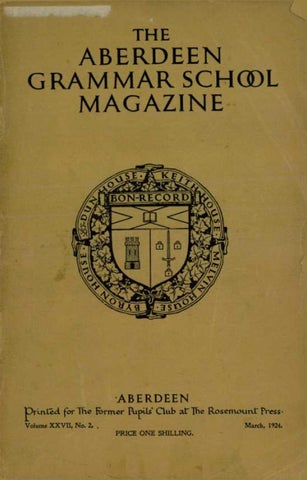
THE
ABERDEEN GRAMMAR SCHOOL MAGAZINE
-ABERDEEN fulrecl for The R'rmer Puri& Club ar The Rosen-tounr Press•
p
Volume XXVII, No. 2. ,
March, 1924. PRICE ONE SHILLING.
EDUCATIONAL BOOKS JAMES G. BISSET CONTINUES to supply all the Class Books (New or Second-hand) suited for the requirements of the Higher Educational Institutions in the City, at the Lowest Prices. N.B.—Best Value in Students' Note Books.
JAMES G. BISSET, Classical, Medical, and Educational Bookseller,
85 BROAD STREET (Opposite Mariseltal College).
THE HOME OF FASHION & NOVELTY.
The best appointed and most centrally situated Warehouse in Aberdeen.
You can begin and complete your Shopping under one roof at S. & H.'s.
Sangster & Henderson, DRAPERS, MILLINERS, AND COMPLETE HOUSE FURNISHERS.
UNION STREET, ABERDEEN. Telephone 363.
Telegrams : " Sangster Henderson, Aberdeen."
I I
I
•
PEARL NECKLACES To collect a Necklace by degrees. You can begin with r, 3, 5, 7, or more Pearls strung on a gold or platinum chain, and gradually add larger or smaller Pearls on special occasions, such as Birthdays, Christmas, etc., until a complete Necklace is secured.
Expert Stringing and Matching Large Stock of Necklaces at all prices Another interesting and inexpensive method of acquiring an important Necklace is to begin with a small one and add larger centre Pearls from time to time. We can supply Pearls of any size and in any quantity.
A. & J. SMITH s
Jewellers, Gold & Silver Smiths, Watchmakers
191 Union St., ABERDEEN ORIENTAL AND SCOTCH PEARLS
-
A. C. LITTLE, COSTUMIER & FURRIER. Always in Stock a Large Selection of
FURS, FUR COATS, Fur-lined Coats, Wraps, Coat Frocks, Costumes, Dresses, Showerproofs, Skirts, etc. ALL AT THE VERY KEENEST PRICES. INSPECTION IS INVITED.
EXCEPTIONAL VALUE IN MOURNING& The Largest Selection of Black Costumes, Coat Frocks, Dresses, Coats, Skirts, etc., in the City, at the Keenest Prices. Fit is Guaranteed within 6 hours, and no Charge is made for alteration.
THE HOUSE FOR VALUE
105 UNION ST., ABERDEEN. OPEN ALL DAY SATURDAYS. Telephone 523.
The Dexter is a guaranteed coat . . . its fabric, proofing and workmanship pledged to faithful service by written warrant of its makers. Every Dexter
Policy
carries a
satisfaction
guaranteeing
FOR MEN AN0 WOMEN.
A 10 a OJIHSAS
ALEXANDER BOOTH W.W.
Union
Sr..
a. 37
Sr.
NICHOLAS
Sr . ABERDEEN.
JAMES FYFE & SON, PAINTERS
GLAZIERS.
AND .
.
•
OFFICE AND SHOWROOMS:
11 DEE STREET, ABERDEEN. Telephone 304.
Telegrams—" Fyfe, Painters."
Bed and Table Linen. BLANKETS, DOWN QUILTS, Etc.
P.
BEVERIDGE, The Linen Specialist,
39 to 43 Established 1841.
ST. NICHOLAS STREET.
LOW'S BOOKSTALLS, 39-50 New Market Gallery, ABERDEEN. Books on All Subjects and at All Prices. 150,000 Volumes in Stock. 'Phone 3332.
Catalogues Issued.
Gramophone Record Cabinet Holds 24 Records, prevents Scratches and Breakages, 18/6, post free U.K.
Wm. Jackson (Abdn.) Ltd. 18 Back Wynd, ABERDEEN.
BOOKBINDING OF ALL DESCRIPTIONS. Established 1855.
Telephone No. 291.
WM. DUNCAN, Hosier and Glover, 8 Belmont Street,
Aberdeen.
Ladies' and Gent.'s Underwear. ELLAN -ESS, made in Hawick—a Speciality.
Botany Wool Ladies' Hose and Gent.'s Socks. .0 .0 HIGHEST QUALITY. LOWEST CASH PRICES.
M. McCORMICK, The West-End Specialist. Really Artistic Styles for those who appreciate exclusive elegance and distinction. O Dressy Costumes; Smart Tailored Suits; Coat Frocks; Coats in newest materials. O Furs and Fur Coats of every description. O
Distinctive Evening Gowns that for smartness, elegance and individuality are absolutely without equal. 0 Ladies going abroad to warm climates specially catered for. 0 Best Selection of Goods in Town at specially deflated prices. Costumiere, Gown Specialist, Furrier,
437-441 Union St. ABERDEEN. 'Phone 2499.
"Come West for Value."
GEORGE CUMMING,
AGENT FOR
A.J.S., Sunbeam, Douglas, Levis, Harley-Davidson.
Telegrams—" INLET."
Telephone 2405.
Telephone 1 22.
Teleggrame-'• II Iseult.,
Aberdeen."
PURVEYORS TO
BY
HIS MAJESTY.
APPOINTMENT.
The Unprecedented Demand for our
TUX' OAT CAKES HAS MADE AN EXTENSION OF THIS DEPARTMENT ABSOLUTELY NECESSARY. Our increased facilities will Ensure Prompt Attention to all Orders
MITCHELL & MUIL, LTD., ABERDEEN.
Telephone No. 1891.
ARCHIBALD McKELLAR, Family Grocer and Wine Merchant,
454-456 Union Street, Aberdeen. . . We Specialise in
• .
Cooked Gammons, " Sinclair's" Belfast Smoked Hams, " Harris's " Wiltshire Bacon. Medicinal Wines—Vibrona, Hall's, Wincarnis, Glendenning's.
HENDERSON BROS.
HENDERSON BROS.
For Grammar School Outfits.
For All Kinds of Outfits-Boy Scouts and Cubs, also Girl Guides.
59 St. Nicholas St.
HENDERSON BROS. For Running Pants and Vests, Football Jerseys, Hose, Caps, Belts, etc. 59 St. Nicholas St.
The new Grammar Blazer and Cap to match made of All Wool Cloth. Jacket Deep Faced, with Curtain and Sleeves lined. The Best Cloth in the Market.
Henderson Brothers, Contractors' Outfitters, 'Phone 424.
59 St. Nicholas Street.
Telephone No. 1524.
Telegrams : " Bruce, Cycles, Aberdeen."
Established 1884.
Motor dk Cycle Works SONS Dothan' GEORGE BRUCE & SONS, Holburn Street. Aberdeen. General Engineers, Motor and Cycle Agents. Agencies : Reading Standard, Quadrant, Humber, Edmund and Ivy. (Any other make supplied at liberal discounts.) We Specialise In Repair Work of all makes of Cars, Motor Cycles and Cycles.
-
CHARGES MODERATE.
THE DE LUXE IVY TWO-STROKE. Isle of Man Sporting Model,
Works, 1 Alford Lane.
Royal (Dick) Veterinary College EDINBURGH. Principal : O. CHARNOCK BRADLEY, M.D., D.Sc., M.R.C.V.S. After attendance on Complete Courses of Instruction in this College, Students may proceed to the Examinations for the Diploma of Membership of the Royal College of Veterinary Surgeons (M.R.C.V.S.). Students of the College may also present themselves for the Degree of Bachelor of Science (B.Sc.) in Veterinary Science conferred by the University of Edinburgh. The College being recognised as a Central Institution under the Education (Scotland) Act, 1908, Students are eligible for Bursaries granted by the Education Authorities of Scotland. A Copy of the College Calendar may be obtained on application to A. C. DOULL, Secretary and Treasurer. 'Phone 1624.
Get your Photographic Requirements at
D. Souter Allan's Pharmacy 35 HOLBURN STREET (Near Holburn Junction),
Photographic Department. A Large Stook of Cameras, Plates, Films, Papers, and Accessories. Dope, for Kodak: rued Kodak Supplies. Developing and Printing executed by an Expert and delivered in 54 hours.
FOR SCHOOL WEAR
4
Y2
Y
Yl. 3-Garment Suits, Sports or Rugby style, in a variety of School Tweeds. To fit Boys 8 to 16. Prices, 29/6, 35/6, 39/6 to 59/6. Y2.- Our new range of Boys' and Youths' Overcoats, as sketch, and various other shapes, in dark or light Greys, Browns, Heather, or Lovat Tweeds, also Nap and Velour Cloths. Prices, 26/6, 32/6,37/6, 45/6 to 79/6 Y3. Boys' Grammar School Blazer and Caps, made of Pure Wool Flannel, complete with badge. Blazers, 22/6 to 30/-. Caps, 3/6 each. Y4. New shape for Boys 5, 6, 7 years, in Grey or Lovat Tweeds, with selfcoloured Vest or Cream Poplin Vest. Prices, 29/6, 32/6, 35/6, 39/6.
Johnfalconere.VAL
6A+IOLIS f
A c(Hrvor
I
PU.4reR
QuAttry a
UE, )
Woyal 3freade Warehouse ABERDEEN
'PHONE 19.
The Empress Laundry SEAFORTH
ROAD,
A BERDEEN.
The Seal of
The Sign of Our )),> —> Messenger.
Satisfaction.
Stevenson Bros. (Dundee) Ltd. PROPRIETORS,
Artist Dyers and Dry Cleaners. Carpet Beating. Seaforth Road (19)
260a Union Street (898)
205 George St. (613)
237 Rosemount Place
For .
•
Choice Cut Flowers. GEORGE PEGLER &CO. LIMITED,
THE CITY FLORISTS, 167-169 Union St.
504-508 Union St.
'PHONE 1098.
'PlioNE 1591.
ABERDEEN. Phone 2899.
'Phone 2899.
9 714
CROWN DAIRIES .
SUPPLY
.
THE FINEST DAIRY PRODUCE.
GOOD MILK Is our Speciality.
7 to 13 Waverley Place.
We Specialise in
Drink
SANGS' Special Lemonade and you will admit it is the finest procurable, ALSO
Iron Brew Our Original Speciality NONE LIKE IT •
Choice Flowers AND
Artistic Floral Work Also
Bulbs of Finest Quality FOR ROOM CULTURE IN BOWLS -Keenest Prices Enquiries Esteemed ——
SANGS, LTD.
M. H. Sinclair
Seaforth Road ABERDEEN
407 Union Street
Telephone 1289.
" The Upstairs Flower Shop "
'`,Sniff it toilC1 TCotoet5
William Brown & Sons
Milne & Munro
CABINETMAKERS
263 Union Street
UPHOLSTERERS . REMOVERS . . .
242 Union Street
PRACTICAL BOOTMAKERS Agents for
"Lotus" and "K" Boots
ABERDEEN Agents for
Buoyant Settees and Chairs 'Pliortz 1204
The House which leads in Quality at Moderate Prices 'PHONE 1028
Of Guaranteed Reliability. This Watch Bracelet is a reliable timekeeper. As an adornment for a dainty wrist it needs no recommendation. The price is lowest possible commensurate with timekeeping dependability.
£5 10s. In velvet-lined presentation case. If you cannot call we shall send this Watch Bracelet on approval for seven days' trial. Money returned if not satisfied.
•
15 Jewel Lever Movement in Solid H.M. Gold Case, fitted Solid Gold dainty but strong Expanding Bracelet. Price, £5 10s.
GEO. JAMIESON & SON (W. W. CARRY),
11-altham
Watch Depot,
125 UNION STREET, ABERDEEN. ESTABLISHED 1843.
Wm. Cay & Sons ifunerat TanDertakers. 415 UNION STREET AND
209 GEORGE STREET,
PRINTING. The
.
Central Press (JOHN MI LN E),
General Printer, Lithographer, AND
ABERDEEN. Motor Hearses and Cars for Distant Funerals.
Stationer,
61 Belmont Street, ABERDEEN.
Telegrams—"Cay, Aberdeen." 'Phones Nos. 92 and 54.
Telephone No. 809.
'Phone 1750.
FINDLAY'S DAIRY, PURVEYOR OF
High-class Dairy Produce. All Milk supplies treated under modern hygienic conditions. A Guarantee of Purity. PURE DAIRY BUTTER AND FARM EGGS FRESH DAILY. SPECIALITIES: Thick Double Cream and Rich Single Cream. Head Office and Depot: 457 Union Street. Branches throughout City, Also at Cults and Stonehaven.
We invite you to visit our Tea Room at 457 Union Street. J. D. LoGIE, Proprietor. Telephone Nos. 1881. 1882.
Telegraphic Address: "Plaster, Aberdeen."
JAMES SCOTT & SON (Aberdeen), Ltd., Fire Grates:
Cooking Ranges
Antique and Modern.
Mantelpieces
Independent Water Heaters
Wood and in Marble.
Marble, Mosaic, Terrazzo and Tiles 50 5 Fire-places, Walls, and Floors.
; Inquiries
Chambers' Fireless Gas Ranges.
regarding Genuine Old Chimney Pieces and Fire Grates solicited
Address:
483-485 UNION STREET, ABERDEEN.
BOY SCOUTS.
BROWNIES.
GIRL GUIDES.
Special Display this Week of Clothing, Uniform, and Equipment Gar Scouts, Guides, and Brownies. These splendid organizations for the good of our Boys and Girls deserve every encourageto sell all their outfits on the very smallest cash basis of profit. and we have decided ment, We would respectfully ask Parents and Guardians to compare Our Prices with the exorbitant some quarters. charged in prices being FOR
BOY
SCOUTS.
Khaki Poplin Shirts, 5/- to 7/- • Khaki Serge Shirts, 6/- to 7/6 ; Navy Serge Shirts, 5/6 to 7/- ; Navy Serge Shorts '(according to size), 3/6 to 7/6; Scout Poles, 6d. each. Hats, 2/11 ; Belts, 1/6 ; Whistles, 9d. ; Lanyards, 3d. ; Shoulder Knots, 2d. ; Mufflers, 1/- and 1/6 ; Haversacks, 1/9 ; Water Bottles. 1/6 ; Billicans, 2/- ; Garters, 41d. ; Knives, 2/.. FOR GIRL GUIDES. Bust-28in. 90in. 32in. 34in. • • • • • • .. .. .. .. 6/6/6 7/7/6 Serge Tunics 9/6 9/8/8/6 .. .. .. .• .. Drill Tunics Length-23in. 25m. 27in. 5/6 6/.. 5/.. .. .. .. .. .. .. Serge Skirts Haversacks, 1/9 ; Neckties, 6d. ; Whistles, 9d. ; Knives, 1/6 ; Belts, 1/- and 1/6 ; Lanyards, 4d. ; Hats, 2/11 ; Emblems, 3d. each. FOR BROWNIES. Length-25in. 27in. 30in. 33in. 6/6/6 5/5/6 Brownie Overalls •• .. 9d. .. 8d. Belts .. Hats .. GUIDERS.
FOR
Hats, 6/6 ; Belts, 3/9 ; Ties, 1/9 ; Tunics and Skirts to Order only. FOR
SCOUTMASTERS.
.. .. 8/6 .. 7/6 Khaki Serge Shirts Hats .. .. .. .. .. 1/9 Navy Serge Shorts .. .. .. 8/6 Ties .. .. 25/16/6, 17/6, Breeches, Lacing, Khaki .. 5/Belts, with Shoulder .gtraps .. 5/6 .. Khaki Drill Shirts .. Estimates supplied for any article of Equipment.
A. & J. SCOTT 29 GEORGE STREET, /
ABERDEEN.
CONTENTS. PHOTO OF CLASS III-SENIOR (DIVISION I), INITIA.. •• TORY DEPARTMENT, 1885-86 PHOTO OF SCHOOL RUGBY FOOTBALL 1ST XV,
1923-24
..
..
••
0.
Between PP. 130 and 131
0*
RI
.. .. .. .. .. THE SCHOOL WAR MEMORIAL .. . • .• •• .. .. .. THE RECTOR • . .. .. .. THE PROPOSED SCHOOL BOARDING-HOUSE .. .. .. . • •• .. NOTES ABOUT OLD BOYS .. .. .. RETIREMENT OF MR. MAXWELL H. MACKIE •. .. .. .. .. AN OLD SCHOOL CLASS GROUP .. .. IN NORTH CHINA TRAVELS WITH A DONKEY ON THE UPPER EUPHRATES DURING THE REBELLION OF 1920 .. .. •• .. .. .. IN A CANADIAN FOREST .. .. .. TWO BOOKS OF INTEREST TO THE SCHOOL .. .. .. .. .. SCHOOL NOTES .. .. .. .. .. .. .. .. .. RANDOM NOTES .. .. .. .. .. .. .. SCHOOL FOOTBALL .. .. .. SCHOOL LITERARY AND DEBATING SOCIETY .. .. SCOUT NOTES .. .. .. .. .. .. THE FORMER PUPILS' CLUB•• .. .. THE ANNUAL MEETING .. .. .. .. .. .. FIELD .. .. .. RUBISLAW ..
CLUB CONSULS
..
..
..
..
..
THE LONDON SECTION. THE CRICKET SECTION THE RUGBY FOOTBALL SECTION 40 .. THE HOCKEY SECTION. THE TENNIS SECTION. .. . • .. MEMORIAL .. .. .. LIST OF NEW MEMBERS .. .. .. .. .. OFFICE-BEARERS, 1924 .. ..
..
..
.. ..
..
Page 95 .. ..
.. .. .. O.
.. .. .. .. .. .. .. .0
..
..
. TH.E SCHOOLWA. R .. .. .. .. ..
..
..
..
96
97 98 110 110 111
120 126 129 132 135 138 143 144 147 154 156 159 160 161 163 164
ESTABLISHED
1836
NORTHERN ASSURANCE COMPANY LIMITED Assets
£15,000,000
►r
ALL CLASSES OF INSURANCE LIFE ASSURANCE BRANCH.- -The Company's Tables of Rates for Life Assurance include every class of Policy.
Write for particulars of
CHILDREN'S EDUCATIONAL POLICIES ESTATE DUTY POLICIES PARTNERSHIP POLICIES ENDOWMENT ASSURANCE POLICIES
CHIEF OFFICES:
ABERDEEN -
-
-
1 Union Terrace.
LONDON
-
-
1 Moorgate, E.C. 2.
-
Aberdeen Hoard of Directors. SIR THOMAS BURNETT, BART.
GEORGE MILNE COOK, ESQ.
DAVID M. A. CHALMERS, ESQ.
GARDEN ALEXANDER DUFF, ESQ.
FRANCIS JAMES COCHRAN, ESQ.
ALFRED MARTINEAU, ESQ.
DAVID M. M. MILLIGAN, ESQ. Manager
-
R. MACKAY, F.F.A.
dberbeen Orammat School Maga3ine. Vol. XXVII.
MARCH, 1924.
No. 2
The " Grammar School Magazine " is issued under the auspices of The Former l'upils' Club, in March, June, and November. All communications with regard to the " Magazine " should be addressed to the Editor (the Secretary and Treasurer of the Club), THEODORE WATT, M.A., The Rosemount Press, Aberdeen. **". Members of the Club are requested to inform the Secretary of any change in their address.
The School War Memorial. A few weeks ago the Memorial Committee issued to members of the F.P. Club, to parents of present pupils, and to others interested in the School, an appeal for further subscriptions, pointing out that altogether a sum of about £900 had to be raised before the Memorial Scheme could be completed. In accepting offers from contractors for the erection and equipment of the Memorial Pavilion, the Committee, it was stated, had incurred liability for a larger sum than could be met by funds in hand, but they believed that it was the wish of the subscribers that the erection of the Pavilion should not be further postponed, and they had every confidence that the balance required would be readily forthcoming. As a result of this supplementary appeal, subscriptions have again started to flow in, and a list of these will be found on pp. 161-3 of this issue of the Magazine. There can be no doubt that all connected with the School will agree that it is very desirable the Pavilion be opened free of debt, and, therefore, will view with sympathy the fresh appeal that has been made. In the F.P. Club alone there are almost 1,800 members, and if the majority of these will give even comparatively small subscriptions, there ought to be no difficulty in wiping off the present adverse balance. So far fewer than 100 have responded to the appeal. May we suggest that every member give something, even if it be only half a crown in the case of junior members? Small subscriptions from present pupils will also be welcome. No doubt older members of the Club will gladly give larger sums, and so raise the average amount subscribed. In case any reader has inadvertently mislaid
96
Aberdeen Grammar School Magazine.
or lost the subscription form sent with the recent appeal, another form will be found enclosed in the Magazine.
The Rector. Mr. Miller recently was strongly urged to become a candidate for the headmastership of the Manchester Grammar Sshool. This, of course, is one of the premier positions in the teaching profession and it was a very h;gh compliment to our Rector that the offer—for that is practically what it amounted to —should have been made to him. The Aberdeen Grammar School, however, is also a very important educational institution with a tradition, to say the least, as great as that of any of the big schools of the country, and the Aberdeen Education Authority at once showed that they realized the importance of retaining at its head a Rector with all the experience and high qualifications which Mr. Miller possesses. Former and present pupils and all friends of the School are delighted to know that Mr. Miller is to stay in his present post, and we are sure it is their wish that he may long remain there. In the discussion at the meeting of the Education Authority, the Chairman (Mr. George Duncan) stated that the School had progressed exceedingly well in Mr. Miller's hands, and its tone and spirit were never higher than at present. When Mr. Miller was appointed to the School there were 807 pupils on the roll, and that number had now increased by 130 to 937. During the two complete years that had elapsed since his rectorship began, the fees payable had increased by £1,182 per annum, and this year the increase would be bigger than that. In Mr. Miller they had no ordinary personality, and one they ought to keep for the good of the education of the city. It was their ambition in that Authority to do their utmost to make the provision of education in Aberdeen second to none in Scotland. They had succeeded to a great extent, although they had not a little to do yet. There was one thing that was essential if they were to do it : they must be liberal with their teachers ; they must attract to the city the best teachers they could get, and having got them, they must do their best to keep them. They must remember that for all they in the Authority could do, the chief factor in education and in the success of any school was the personality of the teacher, and particularly the personality of the head master. Mr. John D. Munro, the Convener of the Finance Committee of the Authority, emphasized that the Authority alone was responsible for appealing to Mr. Miller to remain with them ; it was not a case of Mr. Miller approaching the Authority and asking that his salary be increased. From what had been mentioned in connexion with the other post in England, it was apparent that Mr. Miller would be sacrificing a considerable sum of money by remaining in Aberdeen. Mr. Munro
Aberdeen Grammar School Magazine.
97
looked at the matter largely as a business proposition, and from the point of view of what was best in the educational interests of Aberdeen. The Grammar School occupied a unique position in the city, and it was not possible to exaggerate the influence which a good head master had upon the boys, and through the boys, upon the whole community. In the last three years the fees has risen by £4,000 at the School. The maintenance of the School was costing the rates nothing, and he regarded the retention of the Rector as a really good bargain. He believed also they would have the parents of the pupils with them in retaining Mr. Miller, and they were the people who were paying his salary. He held that it would be highly injurious to the School to have another change at this particular juncture. Professor Pittendrigh said he sometimes wondered whether the Authority realized the marvellous possession they had in the Grammar School, and whether they realized the part it had played in the development of the Empire. If they did not make the salary adequate, they could not get men of the stamp and ability of Mr. Miller to come to Aberdeen and stay. They would sooner or later have to face the question, and he thought they should face it now.
The Proposed School Boarding-House. [To the Editor Aberdeen Grammar School Magazine.] Dear Sir, I am in receipt of the November issue of the School Magazine, the contents of which are always of great interest to F.P.s domiciled abroad like myself. The subject of my letter is relative to the paragraph appearing under the Rector's reply to Mr. F. C. Thomson's toast of " The School " at the last Annual Dinner, in which he suggested that the School should have a real boarding-house connected with it. Personally I consider this is a splendid idea, and I am sure it would prove a great boon to parents living abroad who are confronted with the problem as to where they are to place their boys for board and education, when the time comes that they must leave them behind. I am, therefore, perfectly sure that such an enterprise would have the whole-hearted support of every F.P. parent living abroad, and I trust that we shall see it in operation at some not very distant date. Yours faithfully, WM. C. WARRACK. SUNGKAI ESTATE, SUNGKAI, 18th January, 1924.
98
Aberdeen Grammar School Magazine.
• t• It is requested that the Editor be informed of all new appointments and interesting incidents in the careers of Former Pupils.
The dates given in parentheses after names indicate the sessions of attendance at the School. William Crombie Adams* (1915-18) was in January gazetted to the Royal Air Force as a Pilot Officer on probation (for five years on the active list). He is now training at No. 4 Flying Training School, Abu-Sueir, Egypt. James Robb Allad° (1870-71), who was for thirty-eight years minister of the parish of Stoneywood, Aberdeen, and in 1918 was appointed to Glengairn, Ballater, has recently resigned from the latter charge. Alexander Smith Anderson* (1905-09) has resigned the secretaryship in Aberdeen of the Standard Life Assurance Company on his appointment to the position of manager at Aberdeen of the Norwich Union Life Insurance Society. His predecessor in this post was ROBERT SCOTT (1884-85), who has been transferred to Preston. Allan Cunningham Anderson* (1907-12), who is in the service of the Royal Bank of Canada at Havana, Cuba, mentions in a recent letter that he believes the only other F.P. there is WALTER SMITH SEMPLE (1905- 08). We trust he will use his influence to persuade the latter to become a member of the F.P. Club. James Henry Swan Benzie* (1906-16) has recently become a Life Member of the Club. During the War he became a Lieutenant in the 19th Lancers, Indian Army, and served in France and Egypt. He was promoted Captain in 1921, and subsequently retired from the Army. He is now in the service of the Permadulla Tea and Coffee Company in Ceylon. Charles Barron Bisset* (1909-18), M.A., B.Sc., was in November last awarded at Aberdeen University a Fullerton Scholarship in Science of £100 for two years. Ernest A. Buchan* (1890-97) is at present home on holiday from Tocopilla, Chile. He is returning shortly to South America to take up the post of General Manager of the AngloChilian Nitrate and Railway Co., Ltd., whose service he entered as a clerk in 1905. * Indicates Member of Former Pupils' Club.
Aberdeen Grammar School Magazine.
99
John Malcolm Bulloch* (1877-80), M.A., LL.D., contributed in January to the Graphic, of which he is editor, " a little chat " entitled " A Playgoer's Year : Reflections by an Inveterate First-nighter." " Although I lead a very busy life," he wrote, " I found time to see eighty-six plays of more than one act during 1923. This is not all the plays which were produced last year, but as Sunday play-going is unpleasant, though not on strictly Sabbatarian grounds, and many matinees are awkward, it is all I have been able to overtake. As it is, the eighty-six are the largest number of plays I have ever seen in any one year, and they bring up my total to 2,350. Illustrated and indexed, the play-bills fill thirty-eight portly quartos. If the Trustees care to accept them, they will one day find a resting-place in the mausoleum in Bloomsbury. Their increasing number is putting my little library shelves to a great strain, though I cannot stop the temptation to go on adding to them." First-nighting, Dr. Bulloch says, is almost his only form of out-going recreation. Donald Campbell* (1908-17), M.B., Ch.B., is house surgeon at Victoria Hospital, Burnley. Jackson Stewart Chedburn* (1896-99) has been appointed minister of Union Grove Baptist Church, Aberdeen. He is a son of the late Rev. W. S. Chedburn, who was for thirty years minister of the Crown Terrace Baptist Church, Aberdeen, and for the past few years has been engaged in social work under the auspices of the Y.M.C.A. in York. Andrew Clark* (1895-1901), M.A., who is secretary and treasurer of the Cathcart School Board, Cape Province, South Africa, mentions in a recent letter that he was very interested in the photo of the present School Staff which appeared in the last issue of the Magazine. He mentions that six of them • were his teachers over twenty years ago—Dr. McLeod, Dr. Middleton, Mr. Murison, Mr. Mackie, Mr. Philip, and Mr. Edward. He goes on to say that he would like to send his two sons to be educated at the old School, but he fears it is out of the question. " In South Africa now it has become essential that all children be taught bilingually—English and Dutch—and have, when they grow up, a thorough knowledge of both languages. That, however, is not quite possible, and the result is that they know neither language perfectly." Robert Russell Clyne* (1867-73), who went to Australia many years ago and was until recently assistant manager of an insurance company in Melbourne, came home some months ago, and is now trying to make up his mind in what part of the Old Country he is going to settle. He is a brother of ARTHUR CLYNE* (1863-68), whose death is reported on another page of this issue. Thomas Collet* (1910-14), who entered H.M. Civil Service in 1914, and after serving with the Machine Gun Corps
100
Aberdeen Grammar School Magazine.
in the latter part of the War, was appointed an officer of taxes at Inverness, has recently resigned from the Inland Revenue Department to take up the administration of a series of Co-operative Land Banks at Jalna, India, on behalf of the United Free Church of Scotland Mission. Allan Patrick Cooper* (1897-1900), who from 1906 was engaged as a merchant in Insch, has recently retired from business there owing to health reasons. Alexander Cruickshank* (1911-17), M.B., Ch.B., has recently taken up an appointment at Khartoum under the Sudan Civil Medical Department. Donald Arbuthnot Davidson* (1905-15), B.L., who has started in practice as a law agent in Aberdeen, was recently admitted a member of the Society of Advocates in Aberdeen. James Bisset Davidson* (1912-18) left Aberdeen some months ago to take up an appointment on a tea estate in India. Thomas J. Davidson* (1912-16), M.B., Ch.B., has recently been commissioned as a Lieutenant in the Indian Medical Service. John Wight Duff* (1877-82), M.A., D.Litt., LL.D., Professor of Classics and Vice-Principal of Armstrong College, Newcastle-upon-Tyne, is the author of a little book entitled The Writers of Rome, recently published by the Oxford University Press. It is a popular account of Latin literature for beginners or general readers. It is not burdened with Latin, but is illustrated by the Professor's own translations. At a Convocation in Durham University on 11 th December last, Signora Montessori, the authoress of the " Montessori Method " in education, was presented for a Doctorate in Letters by Professor Wight Duff. The Signora came specially from Holland, where she was lecturing, to receive the degree. Charles Auld Duncan* (1877-85) has recently retired from the Indian Public Works Department and is settling in this country. Robert James Duthie* (1911-17), M.B., Ch.B., who was last year appointed one of the resident physicians at Brompton Chest Hospital, London, has now been appointed assistant resident medical officer in the same Hospital. William Elder (1859-60) came inadvertently into some prominence in December through failing to comply with the Aliens Order, 1920, " by neglecting to furnish particulars to the registration officer in Aberdeen that he was a subject of the United States, and had landed at Glasgow on 16th July last." It was pointed out on his behalf that the offence was more technical than otherwise, and that Mr. Elder, who was 76 years of age, was a native of Aberdeen and had been educated at the Grammar School and King's College. About forty years ago he proceeded to America, and for thirty-four
Aberdeen Grammar School Magazine.
101
years he had acted as"an accountant in a large railway office. During that time he had been in the habit of coming home every five years. He had retired recently, and some months ago he had returned to this country to take up residence with his brother. He did not understand that he required to do anything on his arrival here, and knew nothing about the Aliens Act, which had been passed since his last visit to this country. John Ferries (1883-84), who during the whole of the War served as a North Sea and Trinity House Pilot and took charge of flotillas of merchant ships whilst the submarine warfare was at its height, has recently had an exciting time in command of the cruiser " Sutlej " on its voyage from Rosyth to Belfast, where it is to be broken up. The cruiser more than once broke adrift from the tugs that were towing it, and for several days after a storm it was entirely " lost." There were thirteen men on board. Since the War, Captain Ferries has been employed in carrying out commissions for the Admiralty and for Messrs. Lawson, Vatey & Co., Ltd., in connection with the towing of obsolete battleships. John Macdonald Finlason* (1850-53) celebrated/his Diamond Wedding on 1st February. He is 84 years ofaage and his wife has just reached 80. They reside at Liscard, Cheshire. For forty-five years he was an official of the Liverpool and London and Globe Insurance Co., and he retired nearly twenty years ago. Mr. and Mrs. Finlason have had fifteen children, of whom eight are alive. Arthur Keith Forbes* (1908-12), who went to Queensland in 1920, has recently transferred himself to Natal. John Faithful Irvine-Fortescue* (1896-1900) became a minister of the Congregational Union of Scotland in 1920 and settled at Thurso in 1921. He has recently left the Congregational Church and come to Aberdeen to be assistant in the East Parish Church. Archie Reith1Fraser* (1902-07), M.D., who is on the Lecturing Staff of the University of Cape Town, was recently instrumental in resuscitating the Aberdeen University Club in Cape Province. George Knowles Fraser* (1907-08), M.A., B.Sc., lecturer in physics, chemistry, and geology in relation to soil in the North of Scotland College of Agriculture, has been awarded a Carnegie Teaching Fellowship for 1923-24 at Aberdeen University for " Investigation of the physico-chemical properties of peat soils of the West of Scotland." He has also been awarded a Carnegie Grant for " A classification of soils from the silvicultural aspect." John Forbes Fraser* (1879-83) has been acting as general manager of the Travancore Tea Estates Co., Ltd.,
102
Aberdeen Grammar School Magazine.
Vandiperiyar, South India, since the end of last April, and is coming home on furlough in the spring of this year. He hopes to return to his former billet of superintendent of Bonami Estate, Peermade, early in 1925. Alexander Murray Garden* (1896-1906) has recently become a member of the Club, thanks to the activity of the Club Consul in Toronto. He is a partner in the firm of Messrs. Aylesworth & Co., barristers, Toronto. William Garvie (1883-89), M.A., minister of Ballantrae U.F. Church, Ayrshire, since 1900, has received a unanimous call to Maryculter U.F. Church, Aberdeenshire. Robert Niven Gilchrist* (1901-05), M.A., principal and professor of political economy and political philosophy, Krishnagar College, Bengal, is the author of a small book, recently published by the University of Calcutta, entitled The Separation of Executive and Judicial Functions: a Study in the Evolution of Indian Magistracy. Alexander Reid Gordon* (1884-88), M.A., D.Litt., D.D., Professor of Hebrew in McGill University, Montreal, is cooperating in a new translation of the Old Testament which is to be issued by the University Press of Chicago. Professor Gordon is to translate the Books of Isaiah, Jeremiah, and Ezekiel. John Malcolm Gray* (1914-15) is a member of the Technical Staff, Royal Aircraft Establishment, South Farnborough. He was gazetted Second Lieutenant in the Royal Flying Corps in February, 1918. Alexander Hendry* (1883-86), M.V.O. (4th Class), M.D., was at last New Year promoted to be a Commander of the Royal Victorian Order. He is in medical practice at Ballater, and in 1910 was appointed Surgeon Apothecary to His Majesty's Household at Balmoral. He was created M.V.O. in 1911. George Howie (1906-08), F.R.C.V.S., veterinary inspector to the Corporation of Birmingham, has been appointed veterinary adviser to the counties of Northumberland, Cumberland, Westmorland, and Durham, and lecturer in veterinary hygiene at Armstrong College, Newcastle-upon-Tyne. William John Jenkyns* (1894-1903), who is chief mechanical engineer with Messrs. S. C. Hill & Co., Sao Paulo, Brazil, is at present home on furlough, and has been visiting Aberdeen after a long absence. James Johnston* (1897-99), Oxton, Birkenhead, is District Scout Commissioner there and editor of The Birkenhead Totem, a periodical that has been started with a view to letting everyone interested in the Scout movement know what is going on in the district.
Aberdeen Grammar School Magazine.
103
•
Charles Simpsson Johnstone* (1903-07), who has been in London for seventeen years, is at present with a firm of chartered accountants, and has recently passed the final examination of the Chartered Institute of Secretaries, London. Out of 633 candidates only 184 passed. Robert Sangster Kemp (1876-78), M.A., B.D., minister of the parish of Deer, Aberdeenshire, received the degree of D.D. from the University of Aberdeen at the Spring graduation this year. Charles Forrester King* (1912-23) has recently joined the staff of the National Bank of Scotland, Aberdeen. Alexander Adamson Laing* (1877-79) has been appointed general manager of the Royal Bank of Australia, with headquarters at Melbourne. He entered the service of the Union Bank of Australia, Ltd., in 1885, and in the same year went out to Australia, where he joined the Royal Bank of Australia at its inception in 1888. Latterly he has been manager of its head office in Melbourne. Robert Daniel Lawrence* (1900- 09), M.A., M.D., who was for a time in medical practice in Florence, Italy, is now settled at Highgate, London. James Pickford Lillie* (1913-18), M.B., Ch.B., is now assistant in Birmingham to ALEXANDER HENDRY MACKIE (1881-86), a brother of Mr. Maxwell H. Mackie of the School Staff. W. Arthur C. Lothian* (1892-94 and 1898-1904), M.A., B.Sc., of the Indian Civil Service, mentions in a recent letter that he is still stationed at Sialkot, in Kashmir, and enjoying the fine climate there. He hopes to get home at the close of the present year. Alan McBain* (1903-1914), M.A., recently passed the Chartered Accountants of Scotland final examination, and has been admitted a member of the Society of Accountants in Aberdeen. George Francis Alexander Macdonald (1919-20) received the degree of M.A. at Aberdeen University in November last. Ian Wyness Macgregor* (1907-18), M.B., Ch.B., is at present on the staff of Queen Mary's Hospital for the East End, Stratford, London. He has as a colleague JAMES STRACHAN WALKER* (1913-17), M.B., Ch.B. Norman Mackenzie* (1888-90), M.A., accepted in September last a call to the United Free Church, Helmsdale, Sutherland. From 1912 he was minister of St. Andrew's United Free Church, Auchterarder. William Soutar Mackie* (1895-1901), M.A., professor of the English language in the University of Cape Town, mentions
104
Aberdeen Grammar School Magazine.
in a letter written at Christmas-time that the thereometer out there was standing at 87° in the shade, " which makes plumpudding an unseasonable delicacy," and contrasts the climatic conditions of South Africa with the " Boreal snows and fogs " at home. He is a member of the resuscitated Aberdeen University Association in Cape Town, and mentions that so far they have had two most enjoyable dinners. There are five Aberdeen men on the University staff there. Norman McKinnon* (1907-16) received in November the degree of B.Sc. in Forestry at Aberdeen University. John James Rickard Macleod* (1884-93), M.B., F.R.S., Professor of Physiology in the University of Toronto, is to receive the degree of LL.D. from Aberdeen University. An account of his work on Diabetes and on Insulin was given in the last issue of the Magazine. Alexander Gunn MacNeill* (1905-09) has retired from the Egyptian Government Service. He was appointed an assistant director of works in Egypt in 1919, and was latterly engaged at the Gebel Aulia Dam, Khartoum, Sudan. James GodsmanjMearns* (1913-20), B.Sc. (Agr.), has received an appointment with Messrs. Thomson, Alston and Co., London, and has gone to Selangor, F.M S. Frederic William Morgan* (1903-09), who is in the service of the Royal Bank of Canada, has been transferred back to Toronto from Montreal. James Lawson Mowat* (1915-16), M.A., has received a Carnegie Scholarship for 1923-24. The subject he is studying specially is " The industrial revolution in Germany as reflected in German literature." Alexander Ross Murray* (1903-13) is now in the service of the Public Works Department, Singapore, Straits Settlements. William John O'Connor* (1909-17), M.B., Ch.B., is on the staff of Princess Mary's Hospital, Cliftonville, Margate. Hugh Lewis Pirie* (1899-1904), who since 1919 has been engaged as an engineer in London, has recently taken up an appointment in Nottingham. While in London he was a keen supporter of the London Section of the Club, being a member of the Committee. Richard R. M. Porter* (1895-1906), M.A., M.B., of the Indian Medical Service, has been home on furlough for about a year, and has recently been successful in passing the examinations for the Fellowship of the Royal College of Surgeons, Edinburgh. He is now continuing his studies in the Pathological Department at Aberdeen University. He entered the
Aberdeen Grammar School Magazine.
105
Indian Medical Service in 1913, and during the Great War served on the Western Front and in Persia. William George Robertson* (1884-90), M.A., B.D., principal of Gujarat College, Ahmedabad, India, is coming home in April. Last year he was admitted a minister of the Church of Scotland. James Ross* (1910-15), who is in the service of the Inland Revenue, Aberdeen, graduated Bachelor of Commerce (B.Com.) at Aberdeen University last summer. Alexander Rust (1861-66), M.A., minister of Inverbrothock U.F. Church, Arbroath, since 1876, has made application for the appointment of a colleague and successor. Robert Gray Sangster* (1914-17), after serving as an apprentice engineer with Messrs. James Abernethy & Co., Aberdeen, has received a six years' engagement as engineer's assistant with the Empire of India and Ceylon Tea Co., Ltd., and has been posted to Tasati Tea Estate, Birpara, Jalpaiguri, Bengal. Norman Anderson Scorgie* (1908-13), B.L., Joint Clerk of the Aberdeen Education Authority, was in February admitted a member of the Society of Advocates in Aberdeen. Frederick Roberts Sleigh* (1914-17), M.B., is on the staff of the Royal Hospital, Richmond. Norman Dryden Smith* (1906-11), who is in the service of the Canadian Bank of Commerce at Carmangay, Alberta, mentions in a recent letter that he met last summer JOHN C. M. LIGERTWOOD* (1903-06), the Club Consul in Calgary, and they spent a delightful week-end together in Banff, Alberta. Smith testifies that Ligertwood is an ideal Consul. Arthur Percy Spark* (1905-11), M.B., who is in medical practice at Hartshill, Stoke-on-Trent, says that he does not meet many F.P.s there, but still he meets a number of people from Aberdeen and round about who are most interested in the School Magazine. Ian Robert Spark* (1912-14), M.B. (brother of the foregoing), is in medical practice at Nottingham. James Ironside Still* (1871-72), M.A., D.D., who was ordained minister of the Free Church, Banchory-Devenick, in 1884, has applied for the appointment of a colleague. He has been preaching for 47 years and is not in good health Alastair Tait* (1907-17), M.B., has 'recently been commissioned Lieutenant in the Indian Medical Service. John Cameron Taylor* (1904-06), who was home on leave last year, reports that he has quite settled down to work again with. Messrs. Jardine, Matheson & Co., Ltd., at Hongkong, where he is Club Consul. He was hoping to arrange a
106
Aberdeen Grammar School Magazine.
dinner for the few F.P.s in Hongkong. " At last," he adds, " the Byron Statue is un fait accompli—now for the Memorial Pavilion, and then what about the Boarding House for boys from abroad ? Very interested in that ! " John Thom* (1872-75), of the London Central Markets Cold Storage Co., Ltd., has recently become a member of the Club. He served as an apprentice engineer with Messrs. Wm. McKinnon & Co., Aberdeen, and thereafter took up marine engineering. In 1899 he was placed in charge of a number of cold stores, and has latterly specialized in refrigeration. David Landsborough Thomson* (1911-18), M.A., contributed an article on the spider-crab and the sea-anemone to the last issue of the Journal of the Marine Biological Association of the United Kingdom. The article tells how the crab caters for the anemone in return for the protection the latter affords. Ian Stewart Thomson* (1903-09), M.A., M.B., has received the Diploma in Public Health from the Royal College of Surgeons of England. Angus Walker* (1908-14), who entered the service of the Empire of India and Ceylon Tea Co., Ltd., in 1921 as an engineer's assistant, is at present on the Namgaon Tea Estate, Thakurburi, Assam. Archibald Moir Williamson* (1906-16), M.A., LL.B., has been awarded the Cruickshank Law Prize at Aberdeen University. The prize is of the annual value of £100, is tenable for two years, and is awarded every second year. Each holder of the prize has to deliver to the satisfaction of the Faculty of Law two courses of three lectures on one or more of the subjects of examination for his scholarship. This is the first occasion on which the scholarship has been awarded. The examiners reported as proxime accessit NORMAN JAMES WILSON* (1905-15), M.A., LL.B. Douglas H. W. Williamson* (1894-1902), M.A., who is on the staff of the R.A.F. British Hospital, Bagdad, says in a recent letter that he cannot help writing a few remarks on the article on page 60 of the last Magazine. " It is rather a curious coincidence, but on the 8th November, 1923, the Shah again left. Bagdad (but, incidentally, he had no troops to line the route) ; so did another F.P. I did not go as escort exactly, but I went out with the armoured cars that were to give help to the escorting cars (the Shah went to Damascus). In these cars I went by road to Ramadi (the railway mentioned is now no more), via Felujah. The following day (Sunday) we went out seventy miles along ' the greatest furrow in the world,' and met the three escorting cars coming back. One of
Aberdeen Grammar School Magazine.
107
the officers in these three was the G. mentioned later in the article, and we slept in the same tent at Ramadi that night. " I have seen ARCHER IRVINE-FORTESCUE [*1892-97] several times at Bagdad, where he is now the Senior R.A.M.C. wallah. I am writing this at Mosul, where it is quite a treat to be, with the snow-capped hills in the distance." George Wilson* (1915-20), who emigrated to Australia in 1922, is now taking a B.Sc. course in Queensland University, Brisbane. Robert G. Wilson,* Jun. (1885-91), F.R.I.B.A., has been elected for a second term to the office of President of the Aberdeen Chapter of the Incorporation of Architects in Scotland.
Marriages. ueen's Gate, London, DuHoch (1877-80).--At St. Augustine's Church, on 18th December, WILLIAM BULLOCH,* M.D., F.R. ., LL.D., Goldsmiths' Company Professor of Bacteriology in the University of London, to Irene Adelaide (née Peyman), widow of Alfred Augustus Baker, formerly of the Stock Exchange, London. Collie (1877-80).-In London, on 31st January, FRANK L. COLLIE,* M.D., to Mrs. Ruth Arakie-Cohen ("Sheila Rand"), of Winnipeg. Lyon (1907-13).—At Dunfermline Abbey, on 4th March, Rev. RITCHIE DOUGHTY LYON,* M.A., B.D., minister of the North Parish, son of Mr. and Mrs. James Lyon, Aberdeen, to Margaret Rollo, daughter of James Auchterlonie, Leckerstone, Dunfermline. Morgan (1898-1900).—At Wayne, Alberta, Canada, on 24th January, GEORGE WILSON MORGAN, second son of the late Mr. G. W. Morgan, photographic artist, and Mrs. Morgan, 28 Polmuir Road, Aberdeen, to Lida Althea, only daughter of George V. Tupper, owner of Rose Deer Coal Mine, and Mrs. Tupper, Wayne, Alberta. Munro (1910-13).—At the Congregational Church, Addiscombe, Surrey, on 13th December, DAVID CHISHOLM MUNRO,* younger son of Mr. and Mrs. A. Munro, 37 Forest Avenue, Aberdeen, to Christine, elder daughter of Mr. and Mrs. H. J. Cutler, Bromley, Kent. Rae (1885-87).—At Caskieben House, Kinaldie, on 24th January, JOHN EVERARD RAE,* advocate in Aberdeen, to Helen, eldest daughter of the late David Davidson, 21 Queen's Road, Aberdeen. Simpson (1884-95).-At St. Mary's Cathedral, Huntly Street, Aberdeen, on 23rd February, JOHN TAYLOR SIMPSON,* advocate in Aberdeen, to Annie, elder daughter of Mr. and Mrs. Colin Bisset, Loretto, Aberlour. Spark (1914-17).—At Ferryton, Balblair, Invergordon, on 24th January, JOHN ARCHIBALD SPARK,* Inch, Resolis, to Jessie, daughter of Mr. and Mrs. Holm, Ferryton. Stewart (1889-92).—At the Grand Hotel, Glasgow, on the 26th December, GEORGE STEWART, M.A., B.Sc., Rector of Strathaven Academy, and son of Mr. and Mrs. Robert Stewart, 21 Chestnut Row, Aberdeen, to Agnes Inglis Murray ("Nessie"), daughter of Mr. and Mrs. R. Weir Gilmour, "Garrion," Cambuslang. Thomson (1892-96).—At Scots' Kirk, Kandy, Ceylon, on 16th January, JOHN DAVID THOMSON,* of Madulkele, Ceylon, son of the late Alexander Thomson, Aberdeen, to Lois Christian, daughter of the late James Scott, Balnakiel, Sutherland hire, and Mrs. Scott, 34 Primrose Mansions, I.ondon, S.W. Wright (1901-06).—At Lochmaben Parish Church, on 20th November, GEORGE Ton WRIGHT,* minister of Dryfesdale Parish Church, to Vera Stewart, daughter of S. T. Farish, of Todhillmuir, Dumfriesshire.
108
Aberdeen Grammar School Magazine.
OBITUARY. William Adams (1883-86), M.A., B.D., minister of the parish of New Deer, Aberdeenshire, died at the manse there on 16th February, aged 54 years. After graduating in arts at Aberdeen University, he was for a time a classical master in England. He studied divinity at Aberdeen University from 1892 to 1895, and two years later was appointed to New Deer. Andrew Aiken (1866-71), M.A., M.B., died at Fenton, Stoke-on-Trent, on 4th December, aged 72 years. After acting as a medical assistant at Stonehaven and at Strichen, he went to Hanley, Staffordshire, about 35 years ago, as assistant to a medical practitioner, and some years later he went to Fenton, where he started on his own account and built up a large practice. Stodart McLaren Chrystall* (1892-98), M.A., B.L., died at Aberdeen, after a prolonged illness, on 15th January, aged 44 years. He was the second son of the late Rev. A. J. Chrystall, Newhills United Free Church. He graduated in arts and law at Aberdeen University, receiving his legal training with Messrs. Fraser & Duguid, advocates, Aberdeen, and qualifying as a law agent in 1904. Three years later he commenced to practise his profession in Aberdeen on his own account. In 1913 he was appointed Assistant Secretary of the Grammar School F.P. Club, and was Acting Secretary and Treasurer during the greater part of the War. From 1915 to 1919 he was Secretary of the Aberdeen War Savings Committee. George Clark* (1907-12) died at Hudson's Hope, British Columbia, on 22nd October, 1923 (as reported in last Magazine). His death was due to a gun accident when he was dismounting from his horse after a shooting expedition. Arthur Clyne* (1863-68) died at Charlwood House, Charlwood, Surrey, on 6th January, aged 71 years. He was the fourth son of the late Mr. Norval Clyne, advocate, Aberdeen. He served his apprenticeship with Mr. James Matthews, architect, Aberdeen, and after being assistant to an architect in Perth, he commenced practice on his own acccount in Aberdeen about 1878. He was elected a Fellow of the Royal Institute of British Architects in 1901, and was President of the Aberdeen Society of Architects from 1900 to 1904, and from 1910 to 1913. His speciality was ecclesiastical architecture. He was a man of great culture, refinement, and charm of manner. In 1914 he succeeded to the estates of a maternal uncle, and left Aberdeen to reside in the south of England. James Cran (1876-80), of St. Aubins, Jersey, died at Aix-en-Provence on 30th November, aged 56 years. He was the eldest son of the late Mr. P. M. Cran, City Chamberlain, Aberdeen, and was trained in the office of the Northern
Aberdeen Grammar School Magazine. L it ) ) •
3 )
•
)
5
t
4
•
3
I I
109
Assurance Company, Aberdeen. He later became Resident Secretary of the Royal Insurance Company in Calcutta. Owing to ill-health he had to leave India, and on returning to this country, was appointed to the latter company's Brighton office. He resigned some years ago, and thereafter lived in retirement in Jersey. Robert Shirra Gibb (1863-64), M.B., C.M., D.P.H., diedin Edinburgh on 12th January, aged 76 years. After graduating in medicine at Aberdeen University in 1870, he studied for a time in Vienna, and was for many years Medical Officer of Health for the County of Berwick. He was a prominent agriculturist, being for fifty years tenant of the farm of Boon, Lauder. A pioneer in agricultural research, he carried out numerous important experiments at his farm. He was the proprietor of the Estate of Cults, Aberdeen, and came north annually. David Gordon (1882-87) died suddenly at Rosemarkie on 17th February, aged 47 years. He was representative in the North of Scotland for Messrs. Watson & Philip, produce merchants, Dundee. Robert Inglis* (1865-70) died at the Hotel Cecil, London, on New Year's Day, aged 70 years. He entered the service of the North of Scotland Bank, Aberdeen, in 1870, and joined the Bank of British North America, Canada, in 1877. He became manager of this Bank at Fredericton in 1885 ; at London, Ontario, in 1893 ; and at Toronto in 1901. He retired on pension in 1913, and thereafter resided principally in Toronto. He was a twin brother of Lady Lyon, wife of Sir Alexander Lyon, Aberdeen. James Leask (1864-65), M.A., D.D., died at Aberdeen on 20th December, aged 75 years. After a distinguished career at Aberdeen University, he studied theology in Edinburgh and in Leipzig. He was ordained minister of the parish of Lonmay in 1874, and four years later was translated to Rosemount Church, Aberdeen. In 1881 he succeeded the late Professor James Cooper at St. Stephen's Parish Church, Broughty Ferry, where he remained until his retirement in December 1919. He received the degree of D.D. from Aberdeen University in 1903. David Baxter Piggie (1881-82) died at Ryde, Sydney, New South Wales, on 17th December, aged 56 years. He was a son of the late Mr. David Piggie, shipmaster, Aberdeen, and himself rose to that position. He served as an apprentice in the Aberdeen Line, and became chief officer of the " Miltiades " about 1903. David Scott* (1906-10) died as the result of his War service on 21st March, 1923. He served as an apprentice engineer
110
Aberdeen Grammar School Magazine.
with Messrs. Barry, Henry & Co., Ltd., Aberdeen, and a few months after the outbreak of war in 1914, became a private in the 2/4th Battalion Gordon Highlanders. He served at home until October, 1916, when he was discharged as medically unfit. In May, 1918, he enlisted as 3rd Air Mechanic in the Royal Air Force, and served in Egypt from August of that year to January, 1920, when he was demobilized with the rank of 1st Air Mechanic. Alexander Sharp* (1889-91), advocate, died in Aberdeen on 14th December, aged 47 years. After leaving the School, he attended law classes at Aberdeen University, and entered the legal profession with the firm of Messrs. Youngson & Storie, advocates, Aberdeen, being afterwards with Messrs. Stork, Cruden & Co., latterly Storie, Cruden & Simpson. He qualified as a solicitor, and became a member of the Society of Advocates in Aberdeen. On the retirement from the firm of Colonel GEORGE CRUDEN* (1864-66), he was assumed as a partner, the senior partner then being the late Mr. A. J. W. STORIE (1865-67). After the death of Mr. Storie in January, 1923, Mr. Sharp was the sole partner of the firm. He was Honorary Secretary of the City of Aberdeen Unionist Association, and election agent for Mr. F. C. Thomson, M.P., in his three contests in South Aberdeen. For some time prior to his death he had been feeling run down, but there was no opportunity for rest, owing to the suddenness with which the last General Election came upon the country. The strain of a three weeks' arduous election campaign left Mr. Sharp with reduced vitality to resist a severe chill, which developed into pneumonia. Mr. Sharp was an enthusiastic member of the F.P. Club, and was present at the last Annual Dinner, in the School Hall, with Mr. F. C. Thomson, Solicitor-General of Scotland, as one of his guests.
Retirement of Mr. Maxwell H. Mackie. All readers of the Magazine will learn with regret that Mr. Mackie, having reached the age limit, is to retire from the service of the Aberdeen Education Authority at the close of the present School session. Mr. Mackie has been on the staff of the School for the long period of forty-three years. He came to the School as first assistant in the Preparatory Department in January 1881, and was appointed French master in 1885. He has served under five Rectors. An Old School Class Group. In this issue is reproduced the photograph of a School Class in 1885-86. Owing to the lapse of nearly forty years the Editor has been unable to ascertain the names of all who were included in the group. The identification of the unnamed may prove an interesting pastime for not a few F.P.s.
Aberdeen Grammar School Magazine.
111
Travels with a Donkey in North China. Having been granted ten days' leave, I decided to visit the Tung Ling, the Eastern Imperial Tombs of the Manchu family, lying some three days' journey by road to the east of Peking. The beginning of the journey was, for me at least, the worst —for it meant rising at 5 a.m. in the dark, in order to catch the train which takes one the first twenty miles to T'ungchow. By the time I reached T'ungchow, I had wakened up somewhat, and at seven started on my trek. This was my first trip since the year before, and as the way led over flat, rather uninteresting country which I had previously traversed, I decided to hire a donkey to help me along. Eventually, out of every three hours, I usually walked two and rode my donkey one. My " boy " and baggage had been sent on the day before to await me at the village of Tuan Chia Ling, my destination for the night. It was a scorching day, but I at last reached Tuan Chia Ling about five o'clock in the afternoon, and found everything ready for my arrival. My " boy " was very apologetic for not having secured the best inn in the place for me (it being occupied by soldiers), but I assured him that the inn he had chosen was the very one I and a friend had stopped at the year before. This being the first day, I was rather tired, in fact over-tired, as I had come the equivalent of thirty miles. I am not sure as to the actual distance, for Chinese in reckoning distance in " Li " (there are supposed to be three " Li " to a mile) always add on several " Li " for e.g. a ferry, of which we crossed three on the way to Tuan Chia Ling. These ferries are very amusing affairs. The rivers I crossed were from 300 yards to a quarter-mile broad and fairly shallow, and the colour of pea soup. There are, as a rule, two flat-bottomed boats, which are poled across. On these are packed everything that is going across—men, mules, donkeys, carts, goats, till it becomes a wonder that someone does not get pushed into the water. A copper is the regulation fare. Some of the animals show a distinct disinclination to go on board, and once, where there was only one ferry, we lost a valuable hour through the efforts of a goatherd to get his flock on board. The ferryman refused to make two journeys for nothing. It was now the beginning of the Chinese Eighth Moon, our September, and there was a never-ending stream of donkeys and carts moving along the track. No one, of course, walks, except the donkeymen themselves and a mad foreigner or two. Everyone I met or happened to travel along with for a part of the way was very affable and talkative. It always seems an everlasting surprise to a Chinaman that any foreigner has been able to master even the rudimentary elements of his abstruse language. But he appreciates it when one can talk, and is always curious and friendly. If one can speak the
112
Aberdeen Grammar School Magazine.
language, one need never be at a loss for conversation in North China. I for one was glad of an opportunity to practise my Chinese, and had to start out on my trip alone, as I could not get a companion to come with me. The second day was as hot as the first. Though still in the plain, we skirted the foot of the hills the whole way, and the thought that one was soon to enter them helped, as it were, to temper the heat, which was unusual for the season of the year. The crops—sorghum, millet, beans, rye, sweet potatoes —were all being harvested and looked grand. I asked a man in one of the villages we passed through how his crops were this year, and he replied, " a 100 per cent, crop." In parts, however, there had been a plague of locusts, which had devoured everything. The affected area had fortunately been very narrow, but sometimes we walked over crawling masses of the insects. One of the pleasures of travelling in North China at this season of the year is the exquisite and cheap fruit—mostly small apples, pears, and grapes. At one village I managed to persuade an old man to sell me about four lbs. of grapes for eight coppers (say 2id.). That takes a lot of beating in old England, doesn't it ? Grapes are first-class things to eat on a walking tour, as they are so nourishing and also easily digested. About mid-day on the second day we came to the small town of Chi Chow, where it was evidently market day. The long main street was crammed with buyers and sellers, and their wares and animals blocked the whole path, and we could hardly force our way through. As it was, we managed to break somebody's tea bowl, but also managed to appease him with a couple of coppers. He was not very pleased, however. All the shops are one storey erections, open to the street, with a row of black pillars supporting the house in front. No glass at all anywhere. All the windows are covered with paper. In the midst of this bustle, I started to bargain over some fruit, and, of course, lost my boy and belongings. After some search we found each other, and he piloted me to an inn outside the town, where we lunched on a first-rate omelette, and more grapes. At 1 p.m. we started off again to do another forty " Li " to a small hamlet called Ma Shen Ch'iao (the Horse God's Bridge). The first half of the distance we covered in no time, but after that, what with the heat and there being not a breath of wind blowing, we began to think the distance under-estimated. At any rate, after travelling three hours and not seeming to get any nearer, we all got very weary. The last five " Li " I was consumed of a most frightful thirst, and even thought of quenching it at a wayside pool. I managed to refrain, however, and we eventually reached our destination shortly before five, where I quaffed cup after cup of that most refreshing of drinks, Chinese green tea. We then installed
e
• ,
Aberdeen Grammar School Magazine.
113
ourselves in the only inn in the place. My donkeyman, it may be remarked, had been loudly proclaiming that he knew there were no inns at Ma Shen Ch'iao, and that we might have to go on to the Tung Ling that night—this, of course, just after we had been told for the umpteenth time that there were " only five Li to go." These Chinese inns generally consist of a couple of rooms near the doorway, where the innkeeper lives, a large open courtyard with stalls on two sides for animals, and the guest chamber facing the entrance. But it is quite clear that the main thing of importance is the steed, and that the human encumbrance has usually to pack himself away as best he may on the raised platform, or " kang," which occupies one end of the room. One room is, of course, cleared for the " noble " foreigner. None of these rooms can be described as palaces ; in fact they are rather grubby and the paper is generally falling off the walls, but I, at any rate, have never had my sleep disturbed by " minor inhabitants." What did interrupt my slumbers was the cocks and the donkeys. It is amazing the different notes that a donkey can produce if it tries, and their devastating effect in the night or early morning must be heard to be fully appreciated. When we started on Wednesday morning at seven, we found Ma Shen Ch'iao to be a beautifully-situated hamlet with a substantial wall, surrounded by vegetable gardens. In the outskirts, we crossed a clear stream with every now and then .the .thatched cottage of some peasant peeping out from amongst the dense foliage of the trees which hung over the winding stream. In the bright, early morning sunlight, glinting through the trees, that bit of scenery seemed like a part of Surrey transplanted to China. Up to now we had been in the plain and travelling due east, but on leaving this village, we turned up north, straight for the mountains not far away. It was still as hot as when we had started on our trip, and the two ridges we had first to surmount made us glad that we had started so early. After two hours' travelling, we entered through a gate in the wall which surrounds the area set apart for the Tombs, through which flows a crystal stream. To appreciate fully the effect this glorious park of fir trees and clearings, with its abundance of wild flowers, Michaelmas daisies, asters, and convolvulus, made on me, you must remember that I had been three years and a half in North China, where one never sees such things except round a grave or temple or village, and an expanse of anything green is something almost inconceivable. The whole scene reminded me irresistibly of Deeside, except that everything here was on a much grander scale. It took over two hours' hard walking to go from the gate we entered by to the far side, where the village was situated where we were to stay. Just after we had passed
114
Aberdeen Grammar School Magazine.
through the wooded valley which forms an approach to the amphitheatre where the various tombs lie scattered about, we came across a stream, with a most inviting pool, the lure of which for a bathe was irresistible. I undressed there and then, amid the rapt gaze of half a dozen of the local male population, who had appeared from nowhere, and sat down in the pool. After having been " grilled " for two days and a half, I can hardly describe the pure delight it was to feel the cool water creeping over me—one of the most delicious physical sensations I have ever enjoyed, and easily the finest bathe. - My boy and baggage had gone on ahead, and I rambled on slowly through the gorgeous park. I caught glimpses every now and then of golden-tiled roofs peeping over the fir trees, or a vista of one of the numerous buildings which form part of the approach to the separate tombs. I was much too happy with life then to bother about sightseeing, and simply gave myself up to the enjoyment of the cool shade of the trees, and the jagged, overhanging mountains which frame the horizon on every side. It was quite a long time before I could tear myself away and slowly climb the hill to the " Pagoda Temple," where it had been arranged, through the good offices of the Chinese Ministry of Foreign Affairs, that I should stay for the next three nights. The rest of the evening I spent sitting at the foot of the Pagoda, gazing idly at the distant hills, and the small town of Ma Lan Yu below, and the people busily getting in their crops in the fields. Nearly all the inhabitants of this region are Manchu, many of them relatives of the Imperial House, whose tombs they still look after, and to whom rations of grain are still issued as in the days when the Manchu Dynasty ruled over China. One is well looked after at " Pagoda Temple." Besides the fat Abbot, who lives in the Temple, I received a succession of callers enquiring after my welfare, from the local military commander, and from the Manchu Prince, living near the Tombs, whose representatives promised to make all arrangements to have a guide provided and the gates opened on the morrow. In the temple I was provided with a beautiful, clean room overlooking the park land to the south and the rolling country leading to the District City of Tsun Hua to the east. It was deliciously cool, after the two hot, stuffy nights I had spent en route. But when about to go to bed, I heard a scratching noise at the bottom of the window, which I at first put down to rats. But on going outside to have a look, what did I discover but an enormous scorpion, which had been trying to get in. Needless to say, he " died the death " ! On Thursday morning I had made all arrangements to sleep in, but alas, the light woke me up all too soon, and I perforce got up at seven. The guide, a jolly, fat Manchu, with huge bulging eyelids and an enormous paunch, rolled up
Aberdeen Grammar School Magazine.
115
at nine, and we set off to look at the Tombs. These are nine in all, but as they are all practically identical in design and decoration, I decided to go only to three, those of Ch'ien Lung, K'ang Hsi, and the Dowager Empress. The plan of these Tombs it may not be amiss to give here. It is somewhat as follows : In front, about a half-mile from the main building, is a shrine shaped like a marquee, which contains a huge marble tablet with an inscription extolling the late emperor, set upon the back of as large a tortoise. From here the road leads over a marble bridge, up an avenue with a pair of each of the following stone figures, one on each side—a lion, an elephant, a horse, a military official, and a civil official—passes under a Ceremonial Arch, and leads to the Gate of the Main Hall. In the Main Hall are placed several chairs where, on the four great festival days of the year, the ancestral tablets (of gold-lacquered wood) are taken out from behind the screen which conceals them on ordinary occasions, and are worshipped. Behind the Main Hall one climbs up on to another tower, and at the rear of that again, surrounded by an interior wall, is an enormous mound of lime and earth, beneath which lie buried the remains of the Emperor and his Consorts. After the magnificence of the halls in front, the actual grave is striking in its stark simplicity. The only difference that I could see between the tombs of K'ang Hsi and Ch'ien Lung was that in the main courtyard of the former there were two huge bronze incense burners, and in that of the latter five large marble sacrifical urns instead. The painting of the ceiling is done in blue and green tracery design, and looks beautiful. I was told that both had been redecorated within the last twenty years, so that one did not carry away any impression of the antique. In both tombs the pillars are lacquered red, but in that of the Dowager Empress, which is decorated in the most gorgeous style, all brown and gold, the pillars have been left in their original colour. Many have huge brass dragons entwined around. The walls are divided up into large compartments with patterns of the Chinese character for " longevity," i.e. " shou," done in brick and covered with gold leaf, I do not quite understand how. The chair which receives the Dowager Empress's tablet stands in solitary state, and surpasses all the others in magnificence. It is covered in Imperial yellow silk, with the most wonderful green and red dragon embroidery. In all the other tombs I saw, the chair for the Emperor's tablet has three similar chairs beside it for the tablets of his consorts, and in some cases, three or four more at one side, but for whom I was unable to ascertain. In front of these chairs is a long table covered in cloth of the same Imperial yellow, on which the sacrificial offerings of game, fruit, cakes, etc., are placed. The great doors of the Hall are for this purpose flung wide open, and the worshippers,
116
Aberdeen Grammar School Magazine.
after placing their offerings on the table, retire and k'ot'ou in the courtyard outside. At the Dowager Empress's tomb I was shepherded out after having seen the Main Hall only, but otherwise I was allowed to go. where I liked. After eating lunch and drinking tea with the attendants of the Tomb, I dismissed my guides and went by myself and had another most refreshing bathe in the river. The current was quite strong, but I chose a place where I could sit down with the water up to my neck, and felt most luxurious and comfortable. I again strolled back to the Temple over the same road as I had travelled the day before, sitting down often to admire the scenery, and pick out in the woods the tombs I had visited. On Friday I went over with a guide to a place some ten miles north-east of Ma Lan Yu, where there are some hot springs, a phenomenon not uncommon in North China. It was again very hot, and part of the way led across a dry and stony river-bed, which made very hard walking, so that I was glad to get to the springs about 11 a.m. Here there is a small temple with three bath chambers, rather similar to the old Roman baths in the Strand, and a big, deep pool into which the spring flows. Clouds of steam rise from off the pool, and though I do not know what the temperature of the water is, it was hot enough to make it uncomfortable to stand beside the pool for long. Each bath is a stone chamber nine feet by six, sunk into the ground to a depth of about four feet ; hot water is allowed to flow in from the one side, and cold from the other. I had a good bath, but felt rather relaxed afterwards. I learned later that the waters are supposed to have a medicinal property and to cure all sorts of skin diseases. Just after I had finished lunch, thunder began, and clouds appeared very ominously from the north. Only a few drops of rain fell, however, and despite the doleful prognostications of my guide, who said we should not be able to cross the river and get home if rain fell, I decided to finish my excursion as planned, and we then set off west along the foothills to one of the gateways in the Great Wall, the Nien Yu Kwan. I had set my heart on doing this, as the Great Wall which tourists go to visit near Peking is not the Great Wall at all, but only a spur, and from Pagoda Hill I had seen to the north the chain of the Great Wall itself, like a sinuous snake winding along the sky-line over the mountains, with a tower crowning every peak. By great good fortune the sun burst out again just as I got to the Pass, and I was able to take some photographs. Soon after, the sun again disappeared behind the thunderclouds, though the rain still held off. The Great Wall at this point is in a state of fair preservation. The towers themselves have all crumbled on one side, leaving the three rooms within exposed to the weather, staring at one like three black eyes. The wall itself is only the breadth of a cart here, and overgrown
Aberdeen Grammar School Magazine.
117
with weeds, and to walk along the top now requires considerable care, owing to the brick facing having given way in many places. The Pass itself is about 300 yards wide, with steep mountains on both sides. At the eastern side there flows a mountain torrent, and the remainder of the gap is filled by a straight piece of wall. There does not appear to have been an actual gateway, as at most of the passes in the Wall, but the stream has washed away part of the end of the wall across the Pass and the track now leads round between the wall and the stream. The country to the interior is of the wildest description, but here and there are dotted hovels with a few trees, and cultivation is carried on to an extraordinary height on some hills. Right on the horizon is a wooded mountain, the " Bright Dragon Mountain," which the Chinese are now engaged in ruthlessly denuding of its timber. It has escaped so far owing to its inaccessibility. I clambered up to the nearest tower and down again to get another picture, and we then set off home. The weather had grown threatening, and ugly black clouds blew over from the north. The sun burst forth again, we reached the Temple safely, and then the rain came down in torrents for an hour. We had indeed been lucky in the weather that day, and a rainbow which appeared after the storm gave us hope for a fine day for our start home on Saturday. That night I had a surprise visit from the Manchu official in charge of the tombs, who had heard that I could speak Chinese. We had an interesting conversation, but, sad to relate, he would every now and then stop and spit ! Our prognostications proved correct, and the day turned out to be as hot as the first two or three of the trip. After retracing our steps of two days before through the park (where I had another, bathe in the same pool), we branched off direct for Chichow, which we reached at four in the evening, having covered about 25 miles in seven hours' travelling, and passing on the way through only one village, Hao Men, where we had lunch. Chichow in the cool of the evening seemed quite a different place from the busy market town we had passed through before, and looked an ordinary " deadand-alive " village. We did a little financial calculations that night, and decided that we had enough money to make a side-trip to the wooded hill, P'an Shan, where I had been with a friend the year before, but had not been able to climb, owing to having bad feet. So, on Sunday morning at 8 a.m., we set off for P'an Shan. To my surprise, Chichow was as busy and thronged as on the first occasion. It appears that a market is held there every five days, and we had been lucky enough to strike the market day both going and coming. Striking off at a tangent to the way we had come, we followed the foothills for fifteen miles
118
Aberdeen Grammar School Magazine.
to the foot of the mountain, which we reached at half-past eleven. Here we had to leave our donkeys, and get our things carried up on the back of a peasant to the temple of T'ien Ch'eng Ssu, some five " Li " up a winding wooded and rocky glen. The temple dates from at least the time of the middle Ming Dynasty. P'an Shan is a phenomenon among hills in North China, in that it is covered with trees, mostly firs, a tree which they call " wan-tzu-shu," from the seeds of which they make the common blue dye used for the cotton clothing worn by the mass of the Chinese, and almond trees. Besides the trees, P'an Shan is studded with huge grey boulders like a plum cake, so that the whole effect is distinctly picturesque. It does not look like an ordinary mountain at all. There are, besides the temple I stayed at, mentioned above, Wan Sung Ssu (The Temple of 10,000 Firs), half-way up the mountain, and a third, Yun Chao Ssu (Cloud Capping Temple) right at the very top. The height I reckon to be about 2,500 feet above the plain. On asking the people of the district, I was told that it was 20 " Li " to the top. My first night at T'ien Ch'eng Ssu the moon appeared for the first time since we had left Peking, being now in its first quarter. On Monday morning I started off shortly after eight to climb the mountain. It did not take me long to climb to Wan Sung Ssu, for the path was composed of big flat stones laid in steps, and I stopped only to watch the men knocking the almonds off the trees. At one sunny corner, however, I nearly trod on a nasty-looking adder, the only snake, except a water-snake, I have seen around here. Being sure that there was a good track right to the top, I had not troubled to engage a guide, but on leaving Wan Sung Ssu I soon went wrong, and after following a faint track in and out of a gorge, and on to the brow of a hill, I was fairly lost. Fortunately, I had a general idea of the direction of the temple I was making for, and started scrambling round the hillside to the east. Then just when I was getting tired of this laborious progress and was in despair, I saw an inscription in huge characters carved on a rock above me, and guessed —rightly—that this lay close to the track. So it proved, but when I got up after an exhausting effort, the path was still very vague and ill-defined. It led to a hovel, the inhabitants of which set me scrambling up a barren and rocky hillside, and when I got panting to the top, behold Yun Chao Ssu in front of me, and a golden-tipped pagoda above it embosomed in fir trees, and best of all, to my drooping spirits, a respectable and easily recognizable path leading up to it. After clipping down into a little valley, a stiff climb brought me at length to the temple. I took my lunch there, the old priest making tea for me and supplying " yueh Ping," sweet cakes made of flour and filled with sugar or honey, which are eaten on the 15th of the Chinese Eighth Moon, one of their three great
Aberdeen Grammar School Magazine.
119
festivals and settling days. There is nothing-, remarkable in the temple itself, but the pagoda, which is set on the very summit of the mountain, dates from very old times (" several hundred years," the old priest said), and bears an inscription stating that it had been repaired in the time of Ch'ien Lung, who had visited P'an Shan on his way to the Eastern Tombs. The climb had taken me three hours. On the return journey I discovered where I had gone wrong on leaving Wan Sung Ssu. Certainly when I looked at the fork carefully, there could be no doubt as to which was the right path, but the hillside is covered with hundreds of tracks which begin most promisingly and then fade away. The trees on P'an Shan were beautiful in the afternoon sunlight, and I lingered at many spots on the way down, regretting that the next day would see my departure for Peking and work. To my surprise, there was nothing like a decent pool, and so I missed my' looked-for bathe. Evidently much less rain had fallen at P'an Shan than elsewhere. It was interesting at T'ien Ch'eng Ssu to watch the sunlight gradually rising from the eastern side of the glen in the evening, and in the morning to see the western slope slowly bathed in sunlight. In the middle of September it was 7 a.m. before the sunlight appeared over the edge of the glen at T'ien Ch'eng Ssu. Going back to Peking on Tuesday, we did an extra long march of 25 miles to Hsia Tien, where I had had lunch the first day. Our object was to make as much use as possible of our three donkeys, and then dismiss them, as the cash was now beginning to run ominously low. The only interesting part of the day's journey was crossing the ferry at San Ho, where the water was hardly deep enough to float our ferry. At the first inn we went to at Hsia Tien the innkeeper, evidently thinking I was a rich American, demanded $2.50 for a room for the night. We expressed our opinion of him in forcible terms, and took up our quarters in another inn opposite. About a dollar per person (foreigner) is usuallymore than ample. On Wednesday both the " boy " and I walked, and hired only one donkey for the baggage. That evening we had some difficulty in procuring one, as it rained until after eight, and most of the donkey drivers asked high prices for the favour of braving the wet and the muddy roads. A Chinaman hates the wet as much as any hen, and always stays inside when he can. As a matter of fact, the path had dried up most wonderfully, and we got to T'ung Chow with heaps of time for the train, and with just enough money in our possession to buy thirdclass tickets back to Peking. So ended a most enjoyable holiday of ten days, the only lonely parts of which were the evenings in the inn or temple after dinner, and hence this diary, which I wrote to pass away the time. A L. Scorn. 20th September, 1923.
120
Aberdeen Grammar School Magazine.
On the Upper Euphrates during the Rebellion of 1920. (Continued from last issue, page 65.) By the middle of June I was in camp at Haditha, thirty miles down-stream from Anah, and four days' march up-stream from Hit. The weather had by this time struck its best summer form—never less than 100 degrees in the shade at mid-day, but comparatively cold at night. For four days out of every seven I was on the march. One squadron of cavalry and one company of infantry did a two days' march down stream and there met the up-coming ration convoy which had been escorted from Hit by another squadron and a company of my own regiment. At the meeting place the convoy was officially handed over and both sets of troops settled down for the day. R., commanding the squadron, and I were the only two white men with our little army ; and he, being senior, commanded the whole escorting troops. While the thousand or so camels and myriad donkeys were slowly filing into camp, R. would see to the parking of them, while I, after putting my own company into their day positions, would look to the pitching of our own tent. By the time R. had seen all transport into camp and could at last tear himself away, I had got our tent up and had worried our orderlies and cook into getting our kits unpacked and breakfast ready. After a cooling wash—the heat by this time of day-12 o'clock—was terrific—we sat down to a much-needed breakfast, as we had had nothing but a cup of tea and a few biscuits since the previous night. Our breakfasts, however, were a masterpiece—porridge, half a cold chicken each, and tongue, plus as much tea as we liked. Our cook made the best chupatties (Indian scones) I have ever tasted. By 1 o'clock we were both beginning to feel comatose and retired to bed for three or four hours. At about 4 o'clock our orderlies brought tea, and after this the best part of the day began. As the sun was setting, everybody—officers and sepoys—made for the river and spent a happy hour in the cool water. By the time we got out, the sun had almost set and a cool wind from the north, the " shimal " which blows through June and July, began to make life worth living again. When we returned to our tent, the orderlies had our table and camp chairs out in the open, and cool beer, the bottles carefully kept in a canvas bucket of water all day, would put us at peace with all the world. There was something utterly restful about these evenings by the banks of the Euphrates. The low murmur that rose from the camel drivers' lines, the scent of cooking, the many fires glimmering through the twilight, the gurgle of the great river rippling past, and the
Aberdeen Grammar School Magazine.
121
moon rising over the limitless desert, all combined to make one feel the true glamour of the East. After dinner R. and I would sit for an hour talking, and after going the rounds of the piquets and sentry-groups, would get to bed. At half-past three in the morning we were wakened and we had our chota hazri (tea and biscuits), and by 4.15 the chaos of loading and marshalling the camels and donkeys would be reduced to something like order and we were off again for another day's march. This out-door life was a good one, and though the heat was very trying, there were many compensations. After six weeks of convoy work orders came from G.H.Q., Baghdad, to evacuate the whole of the Upper Euphrates line down to Hit, and the two companies of my regiment at Haditha were detailed to march to Hit and go from there to Ramadi by steamer. The insurrection which had broken out at Rumaithah, lower down the river, was now in full swing, and tribe after tribe was throwing in its lot with the rebels. The great tribes of the Dulaim and Zoba, who inhabited the country roughly between Baghdad and Anah, were still peaceably inclined and no trouble was met on our withdrawal from the up-river posts. After a peaceful two weeks at Ramadi, the other company of my regiment there received orders to march down to Felujah, along with the battery of 18-pounders, thus leaving me alone with my company. The remaining two companies from Hit were to go down by steamer to Felujah on the same day, and I was to wait for a couple of days and then escort my old friends the transport company down the line, thus concentrating the the whole of my regiment at Felujah. A battalion of Jats who had been up the line at Anah for several months were to come down by steamer from Hit and take over the garrisoning of Ramadi. The camp at Ramadi was very large and practically surrounded by thick palm-groves, and considering the unsettled state of the country and the rambling nature of the camp defences, I decided to be very much on the look-out during the two days I had to wait before the arrival of the Jats. After placing a few extra piquets, I got to bed on my first night in command feeling rather uneasy about the security of the camp. I knew only too well that in the event of an attack on the camp in force, my one company would not be sufficient to drive back the attackers. At about 12 midnight I was wakened by the two doctors from the camp. From their faces I could see that something was very far wrong, but as everything was peaceful round my camp piquets, I could not imagine what their news could be. It turned out to be the worst. "Have you heard the news ?—Leachman's been murdered ! " said one of the doctors. This was indeed a shock.
122
Aberdeen Grammar School Magazine.
Colonel Leachman, the great Political Officer, who had dined at our mess only two nights' before, was practically the uncrowned king of hundreds of miles of the Upper Euphrates. His courage and intimate personal knowledge of the Arabs, allied to the fact of his being blood-brother of the Anizah, made his word law wherever he went. The effects of his murder were bound to be serious, and might just turn the scale in favour of rebellion among the great and well-armed tribes in this part of the country. Hurriedly getting into my clothes and equipment, I ran along to the sepoy lines, having already sent word by orderly to the company to stand to arms. Just as I reached the Indian officers' tents, a fusilade of firing commenced from one of my piquets at the far end of the camp. Shock upon shock —had the fun begun already ? To my deepest relief the firing ceased almost immediately, and I had a little time to explain the situation to my Indian officers and give orders for their dispositions for the night. In a quarter of an hour my company was out in position, and the rest of the night I spent in going round my piquets seeing that everything was in order. Dawn came at last, and no one welcomed the sun more fervently than I. The next day was uneventful and was spent in improving the defences, and hoping for the arrival of the Jat battalion from Hit. They were being hurried through as fast as the paddle-steamers could go, and after a watchful day the first of the steamers, carrying two companies, swept round the bend in the river and tied up at Ramadi as the sun was setting. The following day brought the remainder of the regiment and a section of 18-pounders and two mountain guns. At 6 that evening Colonel H. of the Jats, who had, of course, taken over command of the post from me, summoned all company commanders to his tent. He had just had a report from the Political Officer, who had many and devious ways of getting news, that the camp was to be attacked that night. My company was detailed off to hold the left of the line, much to my delight, as I had an idea that any attack on the camp would be made from that direction. I think that I had second-sight that night. As darkness was coming down, I took my Indian officers and platoon havildars (sergeants) round our part of the line, and noticing a tiny footpath running through the palm groves about hall-way along my front, said " Put a Lewis Gun section pointing up this path : if they come at all to-night, they'll come here." Well, they did. At half-past eleven, having been round my dispositions and found all correct, I was just lying down, when from the Lewis Gun section covering the path there began a long burst of fire, punctuated by the dull-explosion of bombs. In half a minute the whole line was giving a regular Brock's
Aberdeen Grammar School Magazine.
123
benefit of fire, rising to a hurricane just before it died down. Twenty Lewis guns, 800 rifles and a score or so of hand grenades, all doing their dirtiest, can make quite a merry little noise. I ran across to the group from which the firing had started and found the N.C.O. very pleased with himself and swearing that he had blown a raiding party of Arabs to Paradise at ten yards range. This seemed too good to be true, and I rather expected the raiding party to have been only a stray cow, so formed a small patrol and advanced through the trees to see if any dead or wounded had been left. The Arabs take great care to remove, if at all possible, all their dead and wounded from a fight. After creeping forward about ten yards I got a distinct jar to the nerves by falling over something large and soft. It was a dead Arab, and a few yards further on I found three more, one of them not yet dead, but obviously at his last gasp. He died as I stood over him. This was too good a trophy to lose, and I ordered the patrol to drag the bodies in behind our line. Nothing further happened that night. There appear to have been two raiding parties, the one on my part of the line being the larger, and they apparently got the surprise of their young lives, expecting to find the ordinary camp protection and finding instead the groves stiff with troops. Next morning, having borrowed some stretchers from the hospital, I marched the company back to camp, carrying the bodies of the raiders past the envious eyes of the Jats, who, though probably inflicting a good few casualties on the Arabs, had not been able to get in any of the dead. THE RIVER DISASTER. Just as the troops were returning to camp, four river steamers left Ramadi for Felujah, 40 miles down stream. Three of the ships were loaded up with the kit of the battery of gunners, and other stores, including about 3C 0 rifles belonging to the gunners, and also the whole kit of my company, which was to march down to Felujah on the following day, escorting my old friends the transport column. The fourth steamer was a hospital ship, on which there were an Indian Officer and 15 men of my company suffering from fever. The escort consisted of a half-company of Sappers and Miners under Lieut. W., a young officer whom I had got to know very well. The only other officer on board any of the vessels was Captain G., M.C., of whom I have already written. He was in charge of the hospital ship and all medical personnel. No opposition was expected, as several ships had gone down safely on the previous two days. In camp the day passed quietly, and at about 3 o'clock everyone had gone to his tent to rest during the blazing heat of the August afternoon. Colonel H. of the Jats, commanding the post, was lying onhis bed sleeping when he woke to the fact that someone had entered.
124
Aberdeen Grammar School Magazine.
A blood-bespattered, half-crazed figure was standing in the middle of his room, dressed only in a pair of khaki shorts and an Arab handkerchief. Taking the man to be some Arab follower, Colonel H. cursed him roundly and told him to get out, but suddenly looking at the man's face, the truth came to him. " Good God ! W., what on earth has happened ? " It was the young officer in command of the escort to the vessels, and his story, incoherent at first, but becoming clearer after his wounds and utter mental and physical exhaustion had been attended to, was as follows :— About an hour after they left Ramadi that morning, the vessels had been fired on heavily from both banks of the river. Although warned by a friendly sheikh who ran along the bank signing to them to go back, W. decided to push on down stream. Half an hour later, and when still only about six miles from Ramadi in a straight line, they were again assailed from the banks by many hundreds of well-armed Arabs. The steersman of the hospital ship was killed, and then the man who took the wheel in his place was badly wounded. The hospital ship then ran aground. There was nothing for it but that the ship carrying W. and his escort should turn and go back to its assistance. This W. did, signalling to the other two ships to cram on all steam and run for it. They accordingly did this, but as the Arabs concentrated their fire on the bridge, their steersmen were very soon picked off and they too ran aground. W. and his sappers put up a gallant but hopeless fight for nearly two hours. The iron sides of their ship were not bulletproof, and one by one his men were killed or wounded. He himself was hit in a dozen places by splinters of iron from the ship. When their ammunition was exhausted, they were easy prey, and the Arabs swarmed over the two ships killing and looting to their heart's content. Captain G. on the hospital ship—the only armed man on board—put up a great fight, but was killed, and his body was never found. W.'s life was saved by an old Arab, who appeared to have a certain amount of influence over the rebels. Although many times bodies of marauding Arabs crowded round brandishing rifles and knives, the old man brought W. safely through almost certain death to camp. By 4 o'clock Ramadi was in a ferment, and hotheaded young officers were volunteering to go out then and there to try and save what might be left. Saner counsels prevailed, however, as it was too late for active operations, and any troops going out at 4 in the afternoon might have found it impossible to extricate themselves in the darkness. All plans were made for a big punitive expedition on the next day, and at 4 in the morning a force of cavalry, infantry, and guns left camp and spent a profitable day burning and looting the villages of the offending tribes. Our casualties were very slight—one killed and four or 'five wounded, while
Aberdeen Grammar School Magazine.
125
the Arabs lost very heavily, 18 being killed with the bayonet alone and many others killed or wounded by gun and rifle fire. Among the loot captured by us there were ten Arab horses, one or two being very fine animals. The rising of the tribes between Ramadi and Felujah cut off our communications with that place, and as Felujah was completely cut off from Baghdad by the rising of the Zoba tribe under Sheikh Dhari, the murderer of Colonel Leachman, things were not looking too well. The telegraph wires were cut in many places and could not be repaired, and to crown all, our wireless set broke down. My orders to escort the transport company through to Felujah were cancelled, and I and my company had to remain - in Ramadi. Our whole worldly goods having been looted from the ship on which they were going down to Felujah, we had nothing but what we stood up in. The Jat regiment was very good and practically re-equipped us from their own quartermaster's store. For four weeks we remained in Ramadi, getting down latterly to half-rations, until at last orders came from brigade for my company and a squadron of cavalry to break through to Felujah. This we did with slight opposition, and on the second day were received with open arms by our regiment, which had been having some quite enjoyable scraps with the Zoba tribe. We thus re-opened the Ramadi-Felujah line, but the road to Baghdad, forty miles to the east was still closed. This did not ivorry us, as we had ample supplies—a change for me after the half-rations at Ramadi. A few days after our arrival we had some trouble with a neighbouring petty sheikh, who attacked and looted an Arab convoy of grain belonging to us. A message was sent to him intimating that unless the whole of the stolen goods were returned by 6 on the morning of the following day we would arise in our wrath and smite him hip and thigh. In the meantime plans were made for a punitive expedition, and I was given what the Colonel facetiously called a naval command. My duty was to be in charge of a river steamer, carrying a platoon of my company and a section of machine gunners, and I was to steam up the river slightly in advance of the land troops in order to protect their right flank. The next morning all was ready for the start, when six forlorn donkeys laden with grain appeared from the direction of the offending villages. This, said the Arab in charge, was the stolen goods. As there had been over eighty mule loads in the looted convoy, it certainly appeared to have shrunk somewhat, and ignoring this piece of insolence, the Colonel gave the order to move. The whole affair was a joy-trip from start to finish, we having no casualties, in spite of an enthusiastic but mis-
126
Aberdeen Grammar School Magazine.
guided gunner who landed an 18-pounder shell in the river near my warship and nearly blew it and me up. Every house in all the villages had a white flag flying, but as this is only another of brother Arab's little jokes, we paid no attention. The villagers made for the far horizon and left us to work our will. By mid-day the right bank of the Euphrates for a distance of two miles was blazing. I had little to do, except to take a few pot shots at some of the fleeing Arabs, and in the intervals to imbibe cooling drinks on the bridge, along with the Inland Water Transport officer. We were back in camp by two o'clock with a miscellaneous collection of loot-40 cows, 150 hens, and a number of sheep, horses, and goats. That same night at about 11 o'clock, the offending Arabs having returned to their ruined villages, our guns wished them good-night by throwing over a couple of salvos. As they had got the range practically taped off during the morning's show, the shells landed pretty effectively. The same thing was done on the following night, and on the next morning our friend the sheikh came to heel, broken in spirit and swearing eternal friendship for the British. It was rough justice, but the only kind the Arab understands. A week later, Colonel C. of my regiment, another officer, several picked sepoys and I left Felujah in eight Ford cars, bristling with Lewis guns, rifles, revolvers, and bombs, and meeting no opposition, joined forces with the relief column which had reached half way to Felujah from Baghdad. This ended the rebellion on the Upper Euphrates, and the line was again open as far up as Hit. A week later I was in Baghdad on a week's leave, and the news arrived of the surrender of the great tribes further south and the capitulation of the holy cities of Najef and Kerbela, the core of the rebellion. By the middle of November orders came through for the return of C. and myself to our own regiment, and on the 17th of that month we sailed down the Shatt-el-Arab bound for India, and, in the near future, for leave home. J. F.
In a. Canadian Forest. During the summer of 1923, as a Forestry student of the University of Toronto, I was employed for over three months by the Dominion Forestry Branch with a party appointed to the work of mapping and " cruising " portions of Lesser Slave Forest Reserve. Slave Lake, formerly called Sawridge, the administrative headquarters of the Reserve, is situated at the outlet of the lake, about 130 miles N.N.W. of Edmonton. The area of the Reserve is approximately three and a half times that of Aberdeenshire. Our operations were confined to the region lying to the south and south-east of Lesser Slave Lake.
Aberdeen Grammar School Magazine.
127
Here the prairie roll is exaggerated into broad waves of woodland, swelling gently to long flat crests, 2,000 feet above the level of the lake, and here the first step is taken on that long processional ascent south-westerly which attains its climax upon the lofty peaks of the Great Divide. Almost unmodified, Ruskin's description of the foothills of the Alps may be applied to the topography of this region : " The farreaching ridges of sylvan mountain succeed each other, like the long and sighing swell which moves over quiet waters from some far-off stormy sea. And there is a deep tenderness pervading that vast monotony. The destructive forces and the stern expression of the central ranges are alike withdrawn." Such, broadly, was the view that would greet the eyes of our small band of nine, long pent beneath a continuous leafy canopy, when suddenly debouching upon the edge of a high river cut-bank. This was a window in the forest from whose coign of vantage we were from time to time permitted to behold the wood in spite of the trees. These vast woodland waves were broken into wavelets and variegated with the emerald of aspen, the ivy green of balm, the warm brown green of pine, the dark green of white spruce, the sombre green of black spruce, and the ghastly ashen-grey of a burn. In the morning sunlight one had an impression of an undulating infinity of forest, a lovable mystery in which to wander and lose oneself—but here rose one wave just solid and sharp and individual enough to focus the call of the landscape, a genuine hill, uttering the challenge of all hills, a perpetual dispeller of purposelessness. There were no mountains that I could see except, perhaps, Grizzly Mountain, fronting the lake with noble mien, though of inferior height ; mountains being distinguished from hills not so much by elevation as by a certain royal air which inspires in the beholder an immediate sense of that which is transcendental. The forest has its bright demeanour—its gay arches and waving flags, its chattering aspens and murmurs of the sea ; but there are occasions when it wears a more funereal aspect. As you walk through the forest—say, under the balms and spruces of the river flats—your foot every now and then goes crunch through an elongated mound overgrown with moss. If the sky happen to be overcast and your mood gloomy enough for the occasion, you will hardly escape the suggestion of the crumbling of the ribs of the dead beneath your footfall. It is an eerie moment. Another day—and you will think of nothing more funereal than a horse munching in rich pasture. Now, however, you tarn instinctively to Gray's Elegy and start apprehensively muttering the familiar lines :" Beneath that rugged balm, that spruce tree's shade, Where heaves the turf in many a mould'ring heap, Each in his narrow cell for ever laid, The rude forefathers of the forest sleep,"
128
Aberdeen Grammar School Magazine.
You start with a creepy sensation down your spine, but the poet lays his hand upon you, and you finish in a strange serenity of mind, equally beyond horror and melodrama. In this state you remember the vision of a recent evening. Vision, you call it, though the objects seen were material and familiar enough—young firs and spruces spiring closely up to the clear night sky ; for the beauty of their going up was such as you had never seen before, and the spiritual intent of their going up was such as you had never felt beforeit was aspiration. " Like withered leaves to quicken a new birth,"
the dead trees must crumble and dissolve, but out of their dissolution shall re-arise the perpetual forest, ever renewing its youth from the ashes of its age. During the first two months in the forest we were occasionally visited by thunderstorms. A thunderstorm is an epic of the weather, always in the grand style. Lightning is the flashing wit that sets the table of the gods on a roar ; thunder is an intimation of the essential hilarity of the universe. At a thunderstorm we are like children in some feudal keep upon a feast night, supposedly abed. We " snatch a fearful joy " without the hall as the jests fly fast and the table roars in august revelry. We are awedias well as cheered, harkening to the feast of the gods. Getting into my blankets about 9.30 or 10 o'clock at night, or sitting up the latest, I have now and then been touched at the sight of my fellows slumbering—so prostrate, so peaceful, so innocent they lie—Canadian, Indian, Englishman. The faces of some are covered over as if the sleep of a night sojourned in the same sacred solitudes as the last sleep of death, and through all there breathes a quiet, rhythmic motion and murmur as of " the still, sad music of humanity." Before reporting for work on the Reserve I took advantage of my free transportation so far west as Calgary, and of my prospect of three and a half months' wages, to continue the journey through the Rockies and British Columbia to the Coast, returning by the southern C.P.R. route via the Crow's Nest Pass. Victoria presented a great contrast to all the other cities I had seen in Canada. Toronto, with all his parks, is the devastator, the obvious and resented supplanter of Nature. Victoria might be a city, but you are sometimes liable to fancy yourself in an English lane, wondering where Victoria is. Victoria walks with Nature ; and is not : for Nature has taken her. GORDON C. GRANT (1904-17).
Aberdeen Grammar School Magazine.
129
Two Books of Interest to the School. 1.—Study by a Member of the Staff. POOR RELIEF IN SCOTLAND. An Outline of the Growth and Administration of the Poor Laws in Scotland, from the Middle Ages to the Present Day. By Alexander A. Cormack, M.A. Aberdeen: D. Wyllie & Sons. (5s.) Dr. Cormack has brought lustre on himself and the School by this book, and he will receive hearty congratulations on the well-deserved honour* which the University of Rennes has conferred upon him in recognition of his work. His book is a painstaking, competent, and lucid study of the growth and administration of machinery for dealing with the poor in Scotland from the earliest times to the present day. As such it will prove of high value not merely to those professionally concerned with poor relief, but also to students of social problems and to the historian generally. As typical examples of an urban and a rural parish, Dr. Cormack has selected Aberdeen and Newhills, from whose records copious extracts illumine his text. After reviewing briefly the work of the pre-Reformation Church in caring for the poor, he describes the increase in poverty wrought by the collapse of the ancient faith and the social and political changes of the 16th and 17th centuries. The first constructive legislation, embodied in the great Act of 1579, is explained, and the circumstances set forth which led to the Act becoming largely inoperative except as regards " sturdy beggars " ; while the helpless poor passed under the care of the Presbyterian Church, which shouldered the burden, as Dr. Cormack shows, with a high sense of Christian duty and with practical efficiency. The effects of the Napoleonic Wars and the Industrial Revolution are succinctly detailed, and an inspiring account is given of the devoted labours of early pioneers, such as Sheriff Watson and Dr. Chalmers, who attempted to grapple, along lines that have since obtained national sanction, with the root-problem of the vast mass of distress resultant from the economic changes of the age. Their teaching and practice led up to the Poor Law Amendment Act of 1845, of which a full account is given, followed by a résumé of subsequent legislation up to date. An interesting chapter details the various mortifications for the poor in Aberdeen since the Reformation. The volume 1 closes with a " Prospect," in which the present phenomenal prevalence of unemployment is discussed and remedies suggested. Here Dr. Cormack is wisely cautious, but makes no secret of his firm belief in education as the ultimate cure for all social evils. Dr. Cormack's book is well written, and he has made a • Docteur 8s Lettres.
130
Aberdeen Grammar Se/toot Magazine.
highly interesting study of a subject that might well be thought dry or repulsive. His work is clearly the outcome of much patient and scholarly research. A full Bibliography is given, but greater fulness and uniformity should have been achieved in the footnote references. At p. 18 the hospital at Kincardine O'Neil is said to date from 1270 ; but it is mentioned in a charter of Alan Durward, dated 1233, as having been founded by his father Thomas, who acquired the barony about 1228. In this charter the hospital is described as being in connexion with a bridge across the Dee : and in fact such establishments were hostels for the convenience of travellers rather than agencies of poor relief. The book is well printed and enriched with a number of attractive illustrations. W. DOUGLAS SIMPSON. 2.—The Absorbing Interest of Excavation. THE CASTLE OF KILDRUMMY. By W. Douglas Simpson, M.A., F.S.A.Scot., Lecturer in British History, University of Aberdeen. Aberdeen: D. Wyllie & Son. 1923. (8s. 6d.) Few can have failed to notice the attraction there is, especially for old men and boys, in the taking out of ground. " Excavation, whether it be for shores,* for treasure, or for papyri and mummies, is an absorbing and thrilling interest almost without a parallel." So said William de Morgan ; and most boys, old or young, will agree with him—certainly the ardent band of Boy Scouts who with their Leaders went to Kildrummy in 1919, to participate in the delights of a digger's life under the direction of Mr. Douglas Simpson, who had determined to become the historian of Kildrummy Castle. The good work begun at Kildrummy has been continued at Coull, and happily there is still ground to be taken out. The results of Mr. Simpson's diggings and researches, first made public through his admirable lectures, have been received with some excusable wonderment by an ever-increasing circle, whose interest will find satisfaction in his book, for Kildrummy has at length found its historian. Mr. Simpson is equipped with the necessary foundation of scholarship, broad and deep ; but his work shows also unusual capacity for painstaking, detailed and minute observation ; patience and indomitable perseverance ; and excellent judgment—qualities which will be recognized as his by heredity and training, on the part of those who were pupils and friends of Dr. Morland Simpson, to whose memory his son has dedicated this, his, first book. • Shores, in Christopher Vance's English, stands for sewers.
School Rugby Football 1st XV—Season 1923-24.
Back Raw.—G. Anderson, D. M. Wood, D. S. Cochran, Mr. D. McGregor (Games Master), W. T. Simpson, E. Cay, H. E. J. Brown.
Second Row.—J. Yule, J. Davidson, J. P. Weir (Secy.), K. R. T. Matthew (Capt.), N. D. Begg, J. C. Wishart, 3. B. Esslemont.
•
-
ask
Front Row.—R. C. Scrimgeour, C. A. G. Savidge. VMS.
Class III--Senior (Division I), Initiatory Department, 1885-86.
Back Row.—Arthur J. Milne, J. W. Monro, Louis Lee, W. R. Russell,
? , F. S. Gammack, J. F. Robson, D. R. Smith, Win. Duthie, G. W. Greig, N. Davidson. —1—, W. F. Moneur, Second Row.—C. L. Smith, J. F. Selkirk, J. C. Gill, F. M. Bulloeh, ? — ? —, J. L. McDougall. Third Row.—Albert Begg, J. J. R. Macleod, Wm. Barnett, James Duthie,. J. W. Henderson, Miss Watson, Arthur Barnett, Harry Gardiner, J. R. H. Jones, H. S. Brown, Basil McKilliam. Front Row.—T. P, Fildes, D. H. Machattie, W. A. Salmond, S. Walker, A. M. Rose, F. M. Moir, P. R. Henderson, ?--, F. P. Morton, T. P. Main, R. McNeill.
Aberdeen Grammar School Magazine.
181
The sub-title (The Castle of Kildrummy :) Its place in Scottish History and Architecture defines the scope of the work. Buildings reflect the political and social conditions of their time : they are historical documents, besides being works of art. As works of art they cannot be rightly appreciated until the reasons are understood for their having been placed just where they are, by whom, and for what purposes ; and as historical documents their full significance cannot be grasped until their artistic quality is felt, and—as far as may be— explained, by relating them to the art of the Western World of their time. In the thirteenth century, that amazing period of expansion and achievement, the north-east of Scotland possessed buildings—in ruin, still a priceless heritage—of the very highest architectural quality and importance : Elgin Cathedral, Kinloss Abbey, Pluscarden Priory, and Kildrummy Castle. Mr. Simpson explains how it was that they came to be : how the ancient Celtic system, harassed by Norse power, was superseded by Anglo-Norman polity and civilization, how the Church was Romanized, and the land feudalized. The emergence of a " Moray Question " led to strong measures being taken by Royal Authority to pacify the province North of the Mounth, full political authority having been given to Bishop Gilbert de Moravia, who in order to secure the great north road between Brechin and Elgin, built the Royal Castle of Kildrummy, and put it in the keeping of the Normanized Lord of Mar as Warden. How the great northern castle, with its southern sister, Bothwell, came to be so French in character is explained in the chapter ' Kildrummy, Coucy, and Bothwell : A Study in the " Auld Alliance." ' The unusual importance and beauty of the Chapel of Kildrummy Castle is probably rightly attributed to the personal influence of the BishopFounder. Mr. Simpson is to be congratulated on the happy recovery of the plan of the gate-house towers and forework, a recovery due entirely to the excavations carried out under his direction. In the full historical sketch, which runs to 86 pp., every happening of note at the Castle is related, from the beginning to the year 1921. The concluding chapter, dealing with the Parish Kirk of Kildrummy and the vanished ancient Burgh, raises some interesting questions, and completes the picture by furnishing a background showing life in the vicinity of the Castle. For its purpose, the book is well and sufficiently illustrated by reproductions of plans, drawings, and photographs. A useful glossary of technical terms is appended to the volume, which marks the arrival of another Scottish historiographer, one in whose career the Grammar School takes a WILLIAM KELLY. warm interest.
t32
Aberdeen Grammar School Magazine.
School Notes. " Nothing so difficult as a beginning," says Byron, and as we have already used up the conventional form, we entirely concur with him. We must, however, first of all wish you all a Happy New Year, and a successful outcome to all examinations. We cannot exactly combine with this the usual phrase of a Happy Christmas, unless you take it to look forward over the nine long months till next December, but we must certainly hope that your Easter holidays, which will be just at hand when this appears, will be entirely enjoyable, in spite of their disgusting shortness. * * * Undoubtedly the most impressive feature of the last few months has been the flourishing condition of School Rugby. Though the 1st XV has not quite kept up its enormous average of the first few weeks, it has nevertheless done extraordinarily well. This season it had fixtures with Glasgow Academy, Edinburgh Academy, and Glenalmond. The first on the list, Glasgow Academy, had to be put off on account of the awful weather down there ; the state of the pitches was fully described by Mr. MacGregor, who is to be congratulated on getting into the final trials once again. Next, it was for a long time doubtful whether the railway strike would allow the team to go down to Edinburgh. After the settlement it did go down, and beat its opponents thoroughly. Lastly, there was an outbreak of scarlet fever at Glenalmond, and it was only after consultations and telegrams that it was decided to go. Again the result was a glorious victory. Full accounts of these matches will be found on another page. The Houses, too, have had an exciting series of matches, and the standard of play is improving tremendously. It is a pity that the School 2nd XV could not have been entered in the Junior League this year. It would have stood a good chance of not being last, and would have had some good matches. As it is, it seems to be beneath the dignity of the various clubs to put out a full team against it. * * * The School Dance was held on 21st December. It was decided to confine it to present pupils of the School, and in this way it could not be held in the Hall, as that would have been too expensive. It was, therefore, held in the Gymnasium, with the buffet in the Westfield Buildings. About fifty couples were there, and they filled the place comfortably. The music was all that could be desired. So were the shady corners of Westfield, and the buffet. Dancing continued till half-past twelve, and the taxis had to plough through deep snow. Altogether it was a most successful little dance.
Aberdeen Grammar School Magazine.
133
On 11 th January Mr. Topham Forrest, chief architect to the London County Council, and a distinguished F.P., gave a lecture in the School Hall on " The Rebuilding of Ypres." The lecture had previously been given in London at a meeting of the Royal Institute of British Architects, and was illustrated by pictures, many of which had been supplied by the Belgian Government, and some of which had been • reproduced in The Times. A good audience was present in the Hall, and heard a very clear and interesting account of the efforts which the Belgian people are making to restore the ancient city. Slides were shown of the town before the War, immediately after it, and at the present day. The contrast between its state five years ago and its state now was wonderful. The School is very grateful to Mr. Forrest for the trouble he took in coming specially to Aberdeen to deliver this lecture. * * * On 4th February the School was fortunate in having a second address from Mr. Whelan on the League of Nations. He demonstrated clearly the good effect which the League is having in bringing about the stabilization of Europe, especially in the case of Austria. As Mr. Whelan was speaking to Aberdonians, he explained that Britain had already saved money through the League, by recovering what had been for long considered a bad debt. This covered all the expenses incurred by us in connection with the organization of the League. He also showed the terrible condition of Russia, the filth and poverty and disease among the people there, and the ravages of typhus brought about as the aftermath of war. It was unfortunate that Mr. Whelan thus showed up the evils of war so soon before the Inter-School Debate, but other lecturers might copy him by delivering their addresses during School hours. * * * There was an audience of three or four hundred at Mr. Henry's concert on 14th February, but all who were there will agree that it deserved far better than that. In an endeavour to interest the School in music Mr. Henry has gathered together a choir from the Lower and Middle Schools, and with the aid of one or two F.P.s, besides, of course, one most distinguished present pupil, he gave a most enjoyable concert. There was a long and varied programme, in which the choir, conducted by Mr. Henry, took the most prominent part. After such a demonstration of what can be done by a section of the School, he should find little difficulty in getting the whole School to join him, with the exception, perhaps, of the somewhat erratic voices one finds in the Fourth. -* * * The Memorial Pavilion at Rubislaw Field is nearing completion. Practically everything is done to the outside,
134
Aberdeen Grammar School Magazine.
and certainly it is a very fine building. We all hope to see it ready in time, at least, for the Sports. There is still a certain amount of money required to ensure its being free of debt when completed, and we hope that there will be a generous response to the appeal lately sent out. * * * There has been a series of very interesting lectures at the Debating Society this session. Perhaps the most successful meeting was held on 8th February, when the School was invaded by a contingent of about seventy young ladies from " a neighbouring seminary," to take part in the debate— " Which do us more good—our friends or our enemies ? " Miss Ward and Mr. Paterson were present, and took part in the debate. After the chief speakers had given their papers, the debate was opened, and the majority of those present looked on and laughed at the few noble spirits who dared to disclose their inmost thoughts on the subject of Love and Black Eyes. (N.B.—The latter term has reference to the variety that comes singly, not in attractive pairs.) The final result was a win for the friends, as the feminine side of the audience preferred love and kisses. * * * The attendance at the Debating Society's meetings is growing less and less. The only meetings which were at all adequately supported were the Inter-School Debate, and Dr. McLeod's and Mr. W. D. Simpson's lectures. It is a most distressing fact that scarcely fifteen turn up at an ordinary meeting, and one would be almost ashamed to ask anyone to lecture to such an audience. If some sort of an arrangement with the Scouts cannot be arrived at, it seems that the Society, which has lasted for so many years, must at last break up. * * * The School's latest venture is the provision of cheap dinners to those who are unable to go home at the mid-day interval. The Westfield Hall has been arranged as a dining room, with a kitchen off it. Everybody is satisfied both with the quantity and with the quality of the food set before him, and there are enough masters and prefects present to keep good order. . * * * In conclusion, we wish all those who are going in for Lowers, Highers, or the Bursary Competition the very best of luck, and offer our congratulations in the name of the School to all those who have been successful in the Prelims.
Aberdeen Grammar School Magazine.
135
Random Notes. I, During this time of tribulation and Leaving Certificate Examinations, when that annual feeling of gloomy despair pervades the School in general, and when our senior pupils slouch along the passages with drawn, ashen countenances, it has always been considered impracticable by the former Editors of Random Notes to attempt any pen-picture of the humorous side of School life. The idea of doing such a thing has so much disgusted certain of these " fellows of infinite jest," that they have never gone the length of putting pen to paper (which last expression, by the way, is certainly more acceptable than the hackneyed ' picking up their Editorial quill "), but they have always the assurance before them that the printers can be blamed for the omission. Other Editors, with a little more hardihood, have produced a page of sombre tragedy, for which a substantial share of public censure falls again on the shoulders of the printers because they did not forget to publish the Random Notes. But it is not our intention to disparage our excellent predecessors. Mr. Hudson, who does not speak without knowledge, says that " literature is a social product and inevitably reflects the life of the era out of which it springs." Consequently it is only right that we should warn our readers that if the Random Notes of March reflect the dry, intellectual spirit of Higher Exams., they must not be too ready to denounce the Editors as bores and quacks. * * * Magazine Night has passed without bloodshed or the pouring forth of the vials of wrath. It was, on the contrary, more of the nature of a social evening. No gibes or insults were hurled in the teeth of either Editor, nor were any razors brandished at their throats. A quotation from Scott was the only literary gem to which any objection was taken. " How can you wound a heart that's broken? " asked one silly youth, who had evidently no appreciation of figurative language. We are thankful that Magazine Night is not conducted by the masters, for then there might have been very lively and striking scenes, and we would assuredly have been the subject of some of the most passionate oratory ever heard. This reminds us to say that while allegories are a very high form of literary artifice, they are not altogether acceptable in the Random Notes, and to those few whom the allegory of the garden has grieved, we extend our sympathy, and these words of the Prologue in A Midsummer Night's Dream—" If we offend, it is with our goodwill. That you should think, we come not to offend, but with goodwill." * * * The serenading of the masters was attended by one notable
136
Aberdeen Grammar School Magazine.
incident at Queeles Cross. According to ancient custom, the President of th6 Debating Society mounts high upon the rostrum in the middle, and delivers to his encircling throng of admiring hearers a seasonable address on Christmas festivities. This year, however, such a seditious harangue was effectively put a stop to by that vigilant and omnipotent body of philanthropists known to law-abiding citizens as the Aberdeen Police Force, and to evil-doers under a remarkable variety of other names, of which " Bobbies " is not the most emphatic. When the annual address was about to commence these gentlemen burst through the circle like angels of vengeance and sternly commanded the President to descend from his rostrum. Perceiving their authority entirely ignored, they proceeded to more violent action, although the reading of the Riot Act and the calling out of the militia ought to have been their intermediate step. With one fell onslaught they dislodged Mr. President, to the great risk of his personal safety, and having so far gained the mastery, they would not even permit him to make harangue from the base of the rostrum. Such ardent zeal in the interests of law and order cannot be surpassed by many other police forces—certainly by none at the Christmas season, when hardened humanity is inclined to become softened and reconciled towards the minor shortcomings of its fellow-beings. * * * It is a source of, great regret in the School that since the beginning of the Session only one orator has given an address in Hall. Such a dearth is unprecedented, but it may possibly be owing to the fact that, at the present day, people are far more willing to hear than to make themselves heard, or perhaps the unpopular system which the Sixth employs of appointing a small body of delegates to represent their constituency daily at prayers, has discouraged orators from preparing a speech which only ol roXXol would have the pleasure of hearing. * * * The refreshing atmosphere of Rugby Football recently pervaded the gloomy precincts of Room I, when, during a Divinity hour, a worthy member of the 1st XV translated a passage from the original Greek of Holy Writ by these suggestive words : " And Moses, who was a goodly child, was thrown out, and Pharaoh's daughter picked him up." * * * The fact that the School Orchestra is the only subject we have as yet treated of without tearing to shreds with the keen edge of ridicule, has encouraged the conductor of that organization to ask us for another word in its favour. It would be a mean abuse of our editorial licence if we refused a demand so modest, or worse, if instead of bread we gave an
Aberdeen Grammar School Magazine.
137
indigestible brick. We, therefore, desire it to be known that barring the Literary and Debating Society (which dwells apart, like Milton's soul), the orchestra has done more to justify its existence than any other social activity in the School. It recently created a very favourable impression at a blind asylum in Huntly Street by a new selection of classical music. Some cruel misunderstandings have arisen with regard to this asylum. There are some who foolishly believe it to be an establishment for the deaf, and others who will not be persuaded that it is a different kind of place from Elmhill Mental Hospital. Very strange notions sometimes receive credibility. At another time a few general remarks may be made with regard to the School Philatelic Society. The true worth of this small but select organization has never been recognized by any people outside it except ourselves, and we propose to inspire in all a feeling of ardent enthusiasm for it. It is a great pity that such a flower should be born to blush unseen, and waste its sweetness in the .present atmosphere of dull apathy. * * * The Rev. Laurence Sterne had an admirable method of spinning out his volumes on " Tristram Shandy." In his more frivolous moods he left pages entirely blank, and filled others with dots and strokes. Writing Random Notes would be distinctly easy if we were permitted to follow his example, but unfortunately such extravagences can be indulged in only in Latin and Greek unseens. No Editors, so far, through fear of committing themselves to slander, or of having their remarks misrepresented, have utilized their space with emptiness and asterisks. They have always been obliged to express their ideas in words, and to take the consequences, good or evil. Yet, might not such a literary effusion as the following appeal as strongly as anything to the reader's sense of humour, and at the same time save the nerve-racked Editors much trouble and anxiety ?— RANDOM NOTES. *
*
*
*
*
*
*
*
*
*
*
*
*
*
*
*
? ? ? ? ? ? ? ? ? ? ? ? ? ? ? ?
t t t t tfit t t t t t t t It § § § § § § § §§§ §§§ §§§
H. J. S.
138
Aberdeen Grammar School Magazine.
School Football. The past season has been an excellent one. Not only have the 1st and 2nd School XV's been exceptionally successful but the play in Senior and Junior House matches and in interclass games has shown marked improvement. With the exception of two wing-threequarters, a full back, and a forward, practically the full 1st XV from the previous season was available. Some difficulty was experienced in filling the wing-threequarters positions, but eventually this was overcome by introducing a player from the 2nd XV and by placing one of the " insides " on the wing. Soon after the commencement of the season the XV lost the services of their stand-off half and Captain, K. R. T. Matthew, but by a rearrangement of the team and the introduction of another 2nd XV player, this misfortune was successfully overcome. It is probable, however, that in the one match of the season where the School were defeated, namely, against George Heriot's School, the presence of their Captain would have reversed the result. Forward, the team has been very strong, the pace of the entire pack being far above average, and their tackling, dribbling, and handling were almost equally notable. On most occasions it was doubtful if the shoving in the scrum and the heeling was all it ought to be. The backs were also strong, and although there was no exceptional pace, a high average of skill prevailed. To a most marked extent the team spirit prevailed, and it was really this factor which brought success. One keen regret remains—that it was not possible to meet more of the best School sides in Scotland. Criticism of 1st XV Players. K. R. T. Matthew (1920-21-22-23-24).—Captain and stand-off half. Not fast, but difficult to tackle. Handling excellent, tackling excellent, kicking good. Possesses high qualities as a Captain. J. Park Weir (1921-22-23-24).---Secretary and leader of the forwards. Not fast, but runs with determination. Handling very good, tackling excellent, kicking excellent, dribbling very good. C. A. G. Savidge (1921-22-23-24).—Formerly insidethreequarter, but latterly filled his Captain's place at stand-off half. Vastly improved. Very fast. Handling excellent, tackling very good, kicking excellent. N. D. Begg (1922-23-24).--A very good forward. Very fast and elusive. Handling very good, tackling very good, kicking very good, dribbling very good.
Aberdeen Grammar School Magazine.
139
R. C. Scrimgeour (1921-22-23-24).—A first class scrum half. Fast. Handling very good, tackling good, kicking poor. J. C. Wishart (1922-23-24).—An exceptionally fine forward who ought to have a notable football future. Very fast. Handling good, tackling excellent, kicking fair, dribbling excellent. J. B. Esslemont (1922-23-24).—Filled the vacancy at wing-threequarter with marked success, but really is an inside. Last season's promise of development into a notable player is being fulfilled. Very fast. Handling excellent, tackling • excellent, kicking good. D. S. Cochran (1922-23-24).—A very good inside-threequarter, who, as suggested last year, will probably make a great forward. Fast and determined. Handling excellent, tackling very good, kicking excellent. J. A. Davidson (1922-23-24).—A very good forward. Very fast. Handling very good, tackling excellent, dribbling very good, kicking fair. Only requires weight to become a notable forward. H. E. J. Brown (1922-23-24).—A big, strong forward. Not fast. Handling fair, tackling very good, kicking fair, dribbling good. Very useful in tight and at line-out. D. M. Wood (1922-23-24).—A good, conscientious, hardworking forward. Not fast. Handling good, tackling good, kicking fair, dribbling very good. W. T. Simpson (1922-23-24).—A big, strong, conscientious forward. Quite fast. Handling good, tackling very good, kicking fair, dribbling very good. G. Anderson (1923-24).—Wing-threequarter. Handling good, tackling poor, kicking excellent. experience, but might become a really good wing.
Fast. Lacks
E. Cay (1923-24).—A very good forward. Fast. Hand ling good, tackling very good, kicking good, dribbling ver good. A little lacking in team spirit. J. M. Yule (1923-24).—A good inside. Quite fast. Handling uncertain, kicking very good, tackling good. Improved and improving. D. Smith (1923-24).—A young but plucky full-back. Not fast, but improving in pace. Handling good, tackling good, kicking good. Faults are those of youth and inexperience.
140
Aberdeen Grammar School Magazine.
The Matches of 1923-24. Up to the time of writing we have played 16 matches, of which we have won 15 and lost one—to George Heriot's School. Our average in points per game is probably the highest in Scotland. We have scored 647 points, which gives an average of 40.4 points per game, and our opponents have scored only 46 points against us. We have been very fortunate in having the services of so many of the previous season's team, and here we would exhort all those who are contemplating leaving School this year to enrol themselves as members of the School Former Pupils' Rugby Club in the . seasons to come. House matches are practically all finished, and this year's results show a marked difference on those of last year. This year Dun House are top, with Byron House coming close behind. Everywhere in the School there has been a gratifying increase in keenness, which should bear good fruit in after years. The following is an account of the School matches :10th November, 1923.—School v. 2nd 'Varsity. From the kick-off School set a fast pace and soon had their opponents hard on the defensive. The forwards controlled the ball both in the loose and in the tight, and the heeling was good. The backs played a fast and combined game and proved too strong for the opposing defence. On one occasion Wishart got the ball, ran through the opposing forwards, swerved round the full back, and scored. This was the best try of the game. The ball repeatedly went out to the wings, but before doing so, one of the inside threes usually cut in and gave the winger a clear field. Best for School—Wishart, Weir, Cochran, Savidge. Score: School, 64 points ; 2nd 'Varsity, nil. 17th November.—School v. 2nd 'Shire (League). This game was played at St. Machar and once more School pulled off an easy victory. School played up first half against the wind and slope, and it was not long before Anderson got over for School. Weir failed with the kick. School continued to press and several tries were scored, none of them being converted. At this point Matthew had to retire owing to an injury, and was unable to resume. In the second half School had things all their own way and tries came in quick succession. The forwards played well together, but the handling of the backs could have been better. Best for School were Begg, Wishart, and Esslemont. Full time score : School, 49 points ; 2nd 'Shire, nil. 8th December.—School v. 2nd Gordonians (League). The game was played on a very heavy pitch. School played up first half and for a while were confined to their own territory. Then by a swift forward rush, in which Wood and Marr were prominent, play was transferred to the enemy's 25. Another rush followed, led by Cochran, who managed to score. School now attacked for the most part, but the heeling in the tight and in the scrums was very poor, caused partly by the slippery state of the ground and partly by the forwards being unable to pack well together. The ball went out to the backs several times, but by bad handling did not always reach the wings. On one occasion when it reached Anderson, he very smartly swerved past three of the defending side and scored a fine try. During the second half School pressed most of the time, but the heeling was still very ragged. The handling was not good and most of the School attacks seemed to end in failure, until Esslemont passed out to Savidge, who cross-kicked and a try was scored by the forwards. Best for School : Wood, Begg, Anderson. Score : School, 25 points ; 2nd Gordonians, nil. 15th December.—School v. George Heriot's School. School played up first half against a slight breeze and the sun. For the first ten minutes play was confined to midfield, then Heriot's attacked and attempted 3 drop goals. The first two were unsuccessful but the third skimmed over the bar. After the kick-off School managed to make some headway into their opponents' territory through hard forward work, but they were unable to keep their advantage
Aberdeen Grammar School Magazine.
141
owing to the fine touch kicking of the Heriot's backs, and thus were again confined to their own territory. From a loose scrum on the School 25 line, a Heriot forward broke through the School defence and scored under the posts. The try was converted. After this School again reached their opponents' ground, but the heeling was rather poor. Savidge received the ball from Scrimgeour, who had dummied past his opponent, and cut in, but his pass to Cochran was intercepted and a good touch kick took the play down to mid-field again. Heriot's again attacked, and from a scrum practically on the School line, their winger on the blind side scored. This try should have been prevented by Anderson, who was standing behind the School goal line, instead of being well up, and just on side. Heriot's again scored and this was mainly due to their good backing up and poor tackling by the School backs. Score at half time—Heriot's, 15 points ; School, nil. In the second half School showed great improvement and settled down to their game. Heriot's were confined to their own territory throughout nearly all this half, and only succeeded in reaching the School 25 twice—once, when their right winger very nearly scored, and the second time when there was a scrum in the School 25. They got the ball in this scrum, but through faulty handling by their backs, Esslemont relieved the School by a kick to touch. Now School attacked, and were distinctly unfortunate in not scoring at least twice. Wishart, Davidson, and Cay each got away with the ball on different occasions but their attempts failed because they were not backed up and were tackled in possession of the ball. The heeling improved a little, and from a scrum Scrimgeour dummied, and passed to Savidge, who sent the ball out to Esslemont on the wing. Esslemont ran strongly, handed off two opponents and fell over the line. The try was converted by Weir. Again School attacked, but the Heriot defence was sound, and many dangerous attacks by School were foiled. Some strenuous loose scrums were formed in the Heriot's 25, and in these Davidson, Weir, and Wishart put in a great dearof hard work. Davidson, in particular, though he sometimes hung round the base of the scrum, had some fine dribbles and was ably supported in the loose by Wishart and Begg. Smith at full back played a safe game and his touch kicking was sure. The best backs were Scrimgeour, Savidge, and Cochran. The first-named played a fine game and passed well to Savidge ; Cochran, however, seemed to slip three times at the critical moment, which was distinctly unfortunate, as School were attacking strongly. The best forwards for School were Weir, who played a great game in the tight, Davidson, and Wishart. Among the backs, Savidge Scrimgeour, and Esslemont. Score—School, 5 points ; George Heriot's School, 15 points. 26th January, 1924.—School v. 2nd 'Shire, at St. Machar. School played up first half and the forwards set a fast pace from the start. After a long succession of scrums the ball came out to the threes, and Essleinont scored far out. The kick failed. 2nd 'Shire retaliated and School were confined to their own " 25 " for some time. A quick forward rush, however, transferred play to our opponents' half, and soon after School scored another try. 'Shire pressed, and after a melee on the line, one of their forwards broke through and scored. The try was not converted. In the second half School, with the wind and slope in their favour, gave their opponents no chance. The passing of the backs was good and tries followed quickly. Weir and Wishart were conspicuous among the forwards, while Scrimgeour and Cochran were the best of the backs. Full tune score : School, 37 points ; 2nd 'Shire, 3 points. 2nd February.—School v. Edinburgh Academy, at Edinburgh. School played with the wind and slope first half. Shortly after the kick-off School reached the opposing " 25 " line, through good dribbling by the forwards. Wishart picked up the ball, passed to Savidge, who passed to Yule : the ball went to Savidge again, and he scored between the posts. The try was converted. Directly after the kick-off the Academy pressed and scored far out. School attacked strongly again, the ball went from Cochran to Esslemont, who gave a reverse pass to Begg and he fell over the line. School were attacking strongly and some fine forward play was seen. Wishart and Begg were always in the van and proved too quick for the opposing halves. From a scrum in front of the Academy goal Scrimgeour cut round and scored. During this half the School forwards showed great pace and combination, but it was not so with the backs, whose handling was faulty, and Scrimgeour and Savidge were not at their best. From the beginning of the second half to the end of the game School set a fast pace. A quick dribble by Cochran, whose tackling and dribbling were very sound all through the game, assisted by Davidson and Wood, brought play into the opposing territory. Play was changed to midfield again by the
142
Aberdeen Grammar School Magazine.
good touch kicking of the Academy. From a scrum in the centre Scrimgeour cut in and passed to Weir on the blind side. Weir ran hard and scored. Again School attacked, the forwards dribbling splendidly, Wood and Cay being well to the fore. During a rush Davidson picked up the ball and made a movement as if to set the " threes " going, but instead cut round the defence and scored a good try. Scrimgeour and Savidge now found their form. Savidge had some fine cuts in, and on one occasion, when running with the ball, gave a short kick over his opponent's head, caught the ball again and scored a fine try. All through the game Savidge and Scrimgeour played well on the defensive when necessary, both Scrimgeour's faculty for stopping rushes and Savidge's safe touch kicking being much in evidence. Several times the Academy confined School to their own territory through strong rushes, and on one occasion it was only a sound tackle by Smith that prevented them from scoring again. From a loose rush in midfield Anderson got possession of the ball, ran fast, evaded the full back, and scored. Towards the end of the game School were pressing and Savidge almost scored again, but slipped while swerving. Just before time he attempted a drop goal but the attempt failed. The pick of the forwards were Wishart and Begg, with Wood, Weir, Cay, and Davidson playing a fast and hard game also. The tackling of the " threes " was sound, and Cochran, Yule, and Esslemont did some fine attacking and defensive work. Smith at full back was quite safe but rather slow. Score : School, 25 points ; Edinburgh Academy, 3 points. 9th February.-2nd 'Shire v. School (League). Both the School forwards and backs were in good form. The heeling was good and passing accurate. School repeatedly crossed their opponents' line. Tries were scored by Scrimgeour, Anderson, Savidge, Begg. Score : School, 42 points ; 2nd 'Shire, nil. 16th February.—School v. 2nd 'Varsity, at King's College. During practically the whole of the game School were on the offensive. The scoring opened through the ball going out to Yule, who punted ahead. Anderson caught the ball on the rebound and scored. The handling among the backs was faulty, but though one or two opportunities were missed, the opposing line was crossed several times, and on two or three occasions, after vigorous threequarter play, good tries were obtained. In the second half School started off with a fine three " run which ended in Esslemont scoring far out. The forwards now got going, but were not playing very well together. Their rushes, however, were effective and they managed to give the backs a large share of the ball. Best for School: Brown, Wood, Scrimgeour, Esslemont. Score: School, 56 points ; 2nd 'Varsity, nil. 23rd February.—School v. Glenalmond College, at Glenalmond. School played against the wind and slope first half. From the kick-off Glenalmond started with a rush and. School had to play on the defensive. After hard forward work, play was again changed to midfield. The Glenalmond forwards, however, kept their backs well supplied with the ball, and eventually after some combined play between the forwards and backs, they succeeded in crossing the School line. School now attacked, and a try resulted through Savidge cutting through and passing to Cochran, who scored. , The try was unconverted. School again attacked, but through the indecisiveness of Scrimgeour, the opposing forwards intercepted a pass, and with a strong rush crossed the School line. Again School resumed the offensive but the " threes " never really got going owing to the quickness with which the Glenalmond forwards broke up and harassed Scrimgeour at the base of the scrum. Eventually Glenalmond again crossed the School line and the try was converted. School retaliated, and from a scrum in the opposing " 25 " Esslemont flung himself over the line. Half-time—Glenalmond, 11 points ; School, 6 points. In the second half School, with a strong wind and the slope in their favour, soon began to press vigorously. The School forwards, however, did not heel quickly and consequently Scrimgeour, who was playing a very sound game, was still finding it difficult to set the backs going. During one of the opposing attacks Cochran cleverly intercepted a pass, swerved round the full back and scored. The kick failed. A little later, after a passing movement by the forwards, the ball reached Scrimgeour, who successfully swerved round the defence and touched down. Glenalmond always set a great pace from the kick-off, but the School forwards, by means of vigorous rushes, and the backs by long touch kicks, confined them to their own territory. At one time during play in midfield, Cochran punted the ball practically out of the hands of a Glenalmond threequarter. Savidge and Esslemont raced after it and eventually Esslemont kicked it ahead over the line and scored. Towards the end of the game tries were secured by Esslemont and Scrimgeour, and both were converted, one by Begg from far out, the other by Savidge. School played a better game during the second half, and it was owing to weak tackling that Glenalmond scored.
Aberdeen Grammar School Magazine.
143
The threequarter play improved as the game progressed, but the combined play was not up to the usual standard. The forwards played well in the loose and easily held their own, but Glenalmond usually controlled the ball in the tight. The best among the backs were Esslemont, Scrimgeour, Cochran ; and among the forwards, Begg, Wishart, Davidson. Score : School, 3 goals, 5 trys-30 points ; Glenalmond College, 11 points.
School Literary and Debating Society. The Society has been very fortunate in securing a number of splendid lecturers this season. Although the programme was very attractive, the attendances at the lectures might have been larger. 26th October, 1923.—The first lecture was given by Mr. MacAndrew on "Spanish Life from the Inside." Mr. MacAndrew drew a wonderfully interesting picture of Spanish life, dealing with the mannerisms, customs of the country, etc. Spain still retains the old-world customs of its greatness. Spain is a land of dancing and music. There is compulsory military service between the ages of 18 and 21. At the close of the lecture, a debate was held on "Did the Roman Empire have a greater influence than the British Empire has ? " On a vote being taken, the British Empire won. 9th November.—On this date Mr. Murison delivered his lecture on "Robert Fergusson." Mr. Murison dealt with Fergusson's early life. It was most interestMg to hear about the old days at St. Andrews University, and the life in Edinburgh. Undoubtedly Fergusson's poetry had a great influence upon Burns. 23rd November.—The Society heard the Rector on this evening. He took as his subject "Some Chapters in Naval History." He dealt with the Navy from its creation in Alfred's reign until the time of Elizabeth, when the Navy became one of the main factors in our history. During the lecture Mr. Mackenzie Forbes sang one or two sea songs, accompanied by Mrs. Mackenzie Forbes at the piano. The Rector continued with the Navy from the French Revolution to the recent War. 14th December.—Bishop F. L. Deane gave the Society a lecture illustrated with slides entitled "Among Native Tribes in Africa." The Rector introduced the lecturer. Slides Were shown dealing with the people, the country, and the wild life of Africa. Native dancing, shown to us by slides, gave us a wonderful idea of the impression such festivities must make upon a white man. 25th January, 1924.—The Society welcomed Mr. Charles Davidson heartily on his appearance at School this evening. His lecture was on "A Holiday in Morocco." He described the bad state of the Spanish Government until the recent upheaval. He told us that Spain was losing its taste for bull-fighting and taking to Association Football, but not yet Rugby. 8th February.—On this evening the Annual Inter-School Debate was held in the Hall. The debate was on "Which do us more good—Our Friends or our Enemies." There was a large attendance from the High School, and a moderately good one from the School. For "friends" Miss Taylor, supported by Mr. Dickson, opened the debate, followed by Miss Duthie and Mr. Anderson for "enemies." After hearing the admirable papers of both sides the debate was thrown open. When the vote was taken, "friends" won by eleven votes. Miss Ward of the High School was present and Mr. Paterson of the Grammar School. 22nd February.—The Society was once again fortunate in securing Dr. McLeod for his annual lecture. The Doctor is a staunch supporter of the Society, and there was a big attendance at his lecture on the "Advance of Science during 30 years." Interesting inventions were explained by him, followed by illustrations. Among these were the Tramcar, Gyroscope, Cathode Rays, X Rays, and Liquid Air. It was a very instructive lecture, delivered in the Doctor's usual lucid style. 7th March.—Mr. W. Douglas Simpson kindly consented to give the Society his lecture on the recent excavation of Coull Castle, on Deeside. There was an excellent attendance. The excavations and the excavators, who were Grammar School Scouts, were shown by splendid slides. Mr. Simpson told us of the early connections of Coull in Scottish History, and then of the Wars of Scottish Independence, in which Coull was burned and sacked by Bruce. Slides of the castle, of pottery, and of the castle as reconstructed by Mr. Simpson ended a very interesting lecture. Mr. Hyslop was present and took the chai
•
144
Aberdeen Grammar School Magazine.
Scout Notes. Nothing could be more clearly indicative of the increasing hold that Scouting is taking in the School than the steady growth of our numerical strength. This time last year we had two Troops ; now we have a third Troop of over thirty boys, and the two senior Troops are so crowded that it is becoming a difficult problem to accommodate the recruits. It is, however, the bounden duty of the School to provide) Scouting facilities for every boy that desires them, and if present conditions continue, which is more than probable, the question of the formation of a fourth Troop is certain to arise before long. Now this state of affairs, though it is most encouraging to anyone who is interested in Scouting in the School, is not without its anxieties. The establishment of a new Troop requires certain financial resources which we do not at present possess. It will be clear, too, that the upkeep of the three existing Troops is already a fair burden on the School, to which, too, the Movement in general locally looks for special support in its larger schemes, as, for example, in the recent Jamboree. To every call upon them the parents and friends of the Troops have responded readily and enthusiastically. The boys, too, have carried out the spirit of the Movement in helping to raise funds for themselves by means of entertainments. But a central fund would enable the School to do so much more than it can at present, and to the many F.P.s at home and abroad who read the Magazine from cover to cover we would appeal to help in any way that they can. One has no hesitation in making this appeal, for Scouting has already proved itself a source of credit to the School, not only in the part played by Marr in the "Quest" expedition, but in countless other ways as well. Any field in which members of the School show efficiency and initiative is bound to bring honour to the School as a whole, and both of these qualities can be claimed by our Scouts. To very few Troops falls the good fortune of receiving a fully formed and equipped Wolf Cub Pack, but since the last issue of the Magazine the 17th Troop has had a Pack added to it. The 11th Pack, being composed almost wholly of Grammar School boys and being officered by F.P.s, desired to become attached to the Grammar School Area. The 1 1 th Troop not only offered no opposition to this step, but very generously handed over camping equipment with the Pack, which is already on excellent terms with its new Troop. Under Cubmasters Wyness and Esslemont the Pack has had a very high reputation in the city, and it should be an unusually fine asset to the Area. The main event in Scouting in Aberdeen within the last few months has been the Jamboree, the object of which was to raise funds for the local Headquarters. To the success of this undertaking the Grammar School Troops were able to contribute in several ways, perhaps the most valuable being the number of parents they supplied to assist in the Bazaar and at the lunch and tea tables. In the play, the main item in the week's programme, one of the most important• parts was taken by Mr. Grafton, the Scoutmaster of the 9th Troop, and past and present members of the School Troops formed the majority of the male cast. A large share of the entertainment on the Scout Night, which was witnessed by Lord Hampton, the Chief Scout's Commissioner, was borne by the School Scouts, the Area producing a Camp-Fire Sing-Song and the 9th Troop repeating their " Scouts' Opera," which was described in the last issue of the Magazine. It is gratifying to know that Lord Hampton expressed himself as being particularly pleased with the evening's entertainment. A few weeks later the Grammar School Area was asked to provide a CampFire Sing-Song for the Scouts' Corner at the Wireless Studio, an experience which proved very interesting, if somewhat of a nervous ordeal. It was a great contrast between the noisy insouciance of a real Camp-Fire and the cathedral-like silence of the Studio, where we had not even Mr. Norrie's realistic electric log-fire to create the necessary atmosphere. However, our voices carried further than ever before, for a few days later a very kind letter was received from a District Commissioner in North Yorkshire who had been listening-in to us. The Grammar School Magazine, too, has been making our doings known in England, for recently we received, through our Editor, a copy of The Birkenhead Totem, a Scout magazine edited by an F.P., Mr. James Johnston (1897-99), who is Commissioner for the Birkenhead Area. Of particular interest was a
Aberdeen Grammar School Magazine.
145
kindly review of the Scout Notes in this Magazine, special notice being taken of the account of Mr. Simpson's Excavation Camp at Coull Castle and the fact that the School has now three Troops, Mr. Johnston wondering if any other school can claim as many. Marr's book is also mentioned. Mr. Johnston very kindly offered to send a copy of The Birkenhead Totem every month to the School, an offer which was gladly accepted. We wish him all success in his venture, and can assure him of the interest the Scouts in the School are taking in it. At the annual meeting of the Western District Association, of which the Grammar School Area is a branch, Mr. W. R. Cramb was elected Chairman of Executive, a responsible office which carries with it a seat on the Executive of the County Scout Council. Mr. Cramb has been for long one of the most enthusiastic members of the 9th Troop Parents' Committee, and the honour that has been done to him is very gratifying to the Troop and to the School Scouts generally. At the same meeting Mr. W. Norrie resigned his Commissionership of the Western District on being appointed Assistant County Commisssioner with special duties. Fortunately this change in no way means the severance of the friendly relations between us and Mr. Norrie, who has helped us so often in the past ; in fact, it has meant rather that the School Scouts have kept an old friend and made a new one ; for Mr. Norrie's successor, Col. R. Bruce (1886-89), is an F.P. Already he has visited all three Troops, from whom he received a hearty welcome. Meanwhile the work of the Troops has been resumed after the interruption of the Jamboree. In addition to the ordinary training, the 1st Troop has been holding a special Wireless Class, under P.L. H. Milne, and the 9th Troop an Electricians' Class under A.S.M. Cameron. Now that the month of March is here. the camping season is felt to be not so far off, and the three Troops arc making arrangements for Spring Camps during the holidays in April. The situation of the Summer Camps, too, is not only being discussed in the Courts of Honour, but is being vigorously debated by the junior ranks, a sure indication of keenness. In the last issue of the Magazine it was mentioned that S.M. R. B. Williamson, of the 1st Troop, had passed all the tests for the Wood Badge, which is awarded only to those officers who have taken a special course of training and who have shown marked efficiency. Another officer of the School Troops has now gained the same distinction, A.S.M. G. G. Cameron, of the 9th Troop, who has been an invaluable addition to the Troop since his return to it last October. On Saturday, 8th March, the 9th Troop gave an entertainment to the parents and friends of the Troop as a mark of appreciation of and gratitude for the many kindnesses it has received from them. The programme consisted of a lantern lecture by A.S.M. A. G. Hutchison on "Exploration," which was illustrated by many slides of mountain scenery, and a play written, produced, and acted by members of the Troop, the actors belonging to that very enterprising body, the 9th Troop Junior Dramatic Society, which at the Troop "Feed" at Christmas-time performed very creditably a couple of scenes from John Drinkwater's "Abraham Lincoln." The Troop Headquarters Hut, needless to say, is not under ordinary circumstances well adapted for dramatic performances ; and one could not but admire the way in which technical difficulties had been surmounted. A row of footlights had been devised out of a collection of tins cut to the right shape. At the back of the part of the hut set apart for the stage hung a back-cloth, painted by one of the Assistant Scoutmasters to represent a Highland scene. These are only two out of many examples of how simple materials were most effectively used. The main idea of the play was that in the future a Scout invents a "radio-visionary" apparatus whereby the picture of any person named by those present appears forthwith on a screen. By a most ingenious arrangement of lantern and mirrors a series of caricatures of well-known people in School Scouting arrived apparently out of nowhere, to the mystification and delight of the audience. The entertainment is well worth repeating if the Troop has another Cafe Chantant. It is with great pleasure that the School Scouts have learned of the formation of an official Troop in Gordon's College, an event which marks a real advance in Scouting in the City. It is good to know, also, that it has been possible for the School to show its interest in a practical manner already in the training of the Troop. We look forward to years of friendly co-operation with our new brothers in the great game of Scouting.
146
Aberdeen Grammar School Magazine.
The Former Pupils' Club. FOUNDED 1893. •
president: .\ 1 r x \NDER THOMAS CRUICKSHANK, O.B.E., M.A.
Wice=PresiDent ant) Cbairman of Executive: JAMES CATTO DUFFUS, M.A.,, LL.B. Secretar2 ant) ereasurer : THEODORE WATT, M.A., The Rosemount Press, Aberdeen.
Secretaries of Sections: London Section—T. J. WILSON, C.A., 59/60 Old Bailey, E.C. 4. [This Section comprises, without additional subscription, all Members of the Club resident in London, and within a radius of 50 miles.]
Rugby Football Section—PETER M. DAVIDSON, Cairnlee, Bieldside, Aberdeenshire.
Hockey Section—RANALD R. MACDONALD, M.A., B.Sc., 150 Hamilton Place, Aberdeen.
Cricket Section—ALEXANDER J. ALLAN, 54 Whitehall Road, Aberdeen.
Tennis Section—W. B. S. PIGGE, 49 Gray Street, Aberdeen. Rates of Subscription for Membership: Life Membership . . . . . . £5 5 0 Ordinary Membership— For those under 21 years of age at commencement of Club year . . . . For those of 21 years of age and upwards .
0 0
2 5
6 0
Club Colours. The Club Colours are Magenta and Dark Green, which may be had in the form of ties, scarves, etc. (See advertisements.)
Visitors' Register. Members visiting Aberdeen are requested to enter their names and addresses in the Visitors' Register, which is kept at the office of the Aberdeen Press and Journal, 30 UNION STREET.
F.P. Athletic Association. The objects of the Association are to assist and co-ordinate the working of the various Athletic Sections of the Club, and to extend the athletic activities of the Club. The annual subscription is three shillings, except in the case of members of any of the affiliated Sections. For their subscription see p. 151.
Aberdeen Grammar School Magazine.
147
The Annual Meeting of the Club. The Annual General Meeting of the Club was held in the Palace Hotel on Tuesday, 11 th March, Dr. H. Edgar Smith, a former Vice-President of the Club, presiding in the unavoidable absence through indisposition of Mr. W. G. Craigen, advocate, the Vice-President. After the Minute of the last Annual Meeting had been read and approved, the Report by the Executive and the Accounts and Treasurer's Report for the period from 16th April to 31st December, 1923, were submitted as follows :— REPORT FOR PERIOD FROM 16th APRIL TO 31st DECEMBER, 1923. In accordance with the new Constitution of the Club adopted at the last Annual General Meeting, the Club's financial year now ends with the calendar year, and the Executive has pleasure in submitting this Report for the transitional period from 16th April to 31st December, 1923. Membership and Subscriptions. The following is an analysis of the membership of the Club at 31st December last :— Aberdeenshire Rest of and Gt. Britain and Kincardineshire. Ireland.
Abroad.
Total.
Life Members . . 181 Ordinary Members . 742 Honorary Members 6 Extraordinary Members . 39
154 329 5 —
146 140 — —
481 1,211 11 39
968
488
286
1,742
In addition to the total of 1,742 members as given above, a considerable number of the boys who left the School during or at the end of the Session 1922-23 joined the Club towards the close of last year, but their subscriptions were credited to 1924. In all there are 44 such members, so that the actual total membership at the end of last year was 1,786, as against 1,745 at 15th April, 1923, an increase of 41. The number of subscriptions unpaid at 31st December, 1923, was 109, compared with 102 at 15th April, 1923. Of the 109, 73 were due for one year, 19 for two years, and 17 for three years. The total value of the subscriptions outstanding was £34. 12s. 6d. Acting under the powers conferred on it by the Constitution, the Executive its dealing with members whose subscriptions are in arrears.
148
Aberdeen Grammar School Magazine.
Losses by Death. The number of members who died during the period under review is 16. Among those who passed away were Sir James Reid, Bart., and Sir W. Robertson Nicoll, C.H., both being Honorary Vice-Presidents of the Club; two octogenarians—Mr. Andrew Anderson of Strichen, and Dr. David Duncan, late Director of Public Instruction, Madras ; and Mr. Charles G. Cook, the Club's Consul in Mexico. The Magazine. In view of the fact that there were only two issues of the Magazine during the period covered by the last annual subscriptions, the numbers of pages and plates in each were increased considerably beyond the normal. In the June issue special attention was devoted to the unveiling of the War Memorial in the School Hall, and in the November issue to the unveiling of the Byron Statue in front of the School. The November issue was the largest that has yet been published, consisting of 128 pages and 7 plates. The Club and the School. The Club presented to the School two silver medals, which were awarded at the close of the Session 1922-23 as follows :— Silver Medal for English . . William W. Georgeson. Silver Medal for Mathematics . Douglas A. Robb. The All-round Trophy was awarded to Cecil A. G Savidge, the Trophy Medal being presented to him by the President of the Club at the Annual Distribution of Prizes. Social Activities. On the occasion of the visit to Aberdeen on 8th May, 1923, of the Right Hon. Lord Alness, the Lord Justice-Clerk of Scotland, for the purpose of unveiling the War Memorial in the School Hall, his Lordship was entertained at luncheon by members of the Club. A feature of the luncheon was the very representative character of the company. There were present several of the older members who are not often seen at Club functions. The Annual Dinner was held on Friday, 19th October, and was commemorative of the Sixtieth Anniversary of the opening of the present School buildings. It was held in the School Hall, and was attended by a record number Of members and guests. Accompanying the Chairman at the principal table were eight members of the Club who had been pupils of the School at its transference to the present buildings on 23rd October, 1863. The gathering was in various ways a notable one. The Annual Ball was held in the Music Hall Buildings on Wednesday, 26th December, and once more the attendance
Aberdeen Grammar School Magazine.
149
was a record one, the number present being 280, as compared with 250 in 1922, and 200 in 1921. The Executive is glad that these entertainments justified themselves, and would mention that the social activities in Aberdeen caused no expensd to the Club. The Informal Club Luncheons, which were instituted in the Autumn of 1921 and were discontinued during the summer months of last year, were not restarted, as the Executive had evidence that there was no widespread demand for them. The Athletic Sections. All the Athletic Sections of the Club are in a flourishing condition. The Tennis and Cricket Sections are looking forward with confidence to the coming season. The Hockey and Rugby Sections are now nearing the end of a successful season. The Rugby Section, in particular, has distinguished itself, showing up very well against several prominent Edinburgh and Glasgow clubs. A satisfactory feature of both Sections has been the increased number of members. The London Section. The membership of this Section continues to be satisfactory. An outstanding event was the Byron Banquet held in the Hotel Cecil on Wednesday, 25th April, 1923, to celebrate the then approaching unveiling of the Statue of Lord Byron in the grounds of the School. For the winter of 1923-24 four informal dinners have been arranged, and in connection with each a lecture by a prominent member of the Section. Club Consuls. During the period, the scheme for the appointment in various places abroad of representatives of the Club has been still further developed, several additional Consuls having been appointed. The Executive has received gratifying testimony that the scheme is fulfilling a useful purpose, and would urge members of the Club to take full advantage of it. The Roll of Pupils. The Aberdeen Grammar School Roll of Pupils 1795-1919 was published in October, and on behalf of the members of the Club the Executive has put on record its heartiest thanks to Mr. Theodore Watt, the Secretary of the Club, for his continuous and unremitting enthusiasm in carrying out the arduous work involved in the compilation of the Roll, and its congratulations to him on the eminently satisfactory result of his labour. There are still a number of copies of the Roll available for purchase, and the Executive would suggest early application for these by any members of the Club who have not yet secured a copy.
150
Aberdeen Grammar School Magazine.
Byron Statue. The bronze statue of Lord Byron designed by Mr. James Pittendrigh Macgillivray, LL.D., R.S.A., the King's Sculptor for Scotland, was erected last summer in front of the school buildings and was unveiled on Friday, 14th September, 1923. The Statue has been greatly admired, and the Executive feels that the Club is to be congratulated on the completion of a movement in which its members have for many years been deeply interested. The School War Memorial. Although the scheme for the erection of a Pavilion in Rubislaw Field as a part of the School War Memorial is not directly under the control of the Club, the Executive took the leading part in the initiation of the scheme. It is accordingly glad to be able to report that the plans for the Pavilion were finally approved in June of last year, and that the work of erection was commenced in August and has been going on steadily since. It is anticipated that the Pavilion will be completed and opened in the early summer of this year. Before the Memorial scheme can be completed a sum of about £900 has to be raised, and the Executive warmly supports the appeal that has been issued for further subscriptions from F.P.s and others interested in the School. It is obviously very desirable that the Pavilion should be opened free of debt and the Memorial scheme brought without further delay to a satisfactory conclusion. New Rubislaw Field Agreement. At the request of the School War Memorial Committee, the Executive, on behalf of the Club, entered into a new Agreement with the Aberdeen Education Authority, in which are embodied provisions whereby the Rubislaw Field Committee (consisting of three members elected by the Authority, three members elected by the Club, and two members of the School staff) shall have the management of the Memorial Pavilion, shall allocate the dressing-rooms and lockers, and shall appoint a groundsman or groundsmen, subject to the approval of the Authority. It is also provided that the Pavilion shall be maintained by the Authority in all time coming, and no alteration derogatory to its memorial character shall be made. Revision of Rules of Sections. The Executive has had under consideration the rules of the various Sections of the Club, and the recommendations made by a Sub-Committee have been approved both by the Executive and by the various Sections. The Athletic Association. By a recent alteration in the Constitution of the Athletic
Aberdeen Grammar School Magazine.
151
Association the annual subscription of 3/- for members of the Club who are not members of an affiliated Section now covers the period from 1st January to 31st December, and in the case of members of an affiliated Section, a seasonal subscription of 1/- for the period of such Section's annual playing season. A member of any affiliated Section having a summer or a winter season is liable to pay only the seasonal subscription of 1/- due in respect of such membership, provided that when a member of the Club is a member of two or more affiliated Sections having summer and winter seasons, he is not liable to pay more than 21- in any one year. The Club's Finances. The Revenue and Expenditure account for the period of 8 months from 16th April to 31st December shows a surplus of £16. 12s. 6d., as against a surplus of £35. 2s. 6d. for the year 1922-23. The comparatively small amount of the surplus for the period is due to an alteration in the method of crediting the revenue from advertising in the Magazine. For the period ended 31st December last only one-third of the advertising revenue for the School Session 1923-24 has been taken as an asset. The capital of the Club now amounts to £1,229. 14s. 2d., having increased during the period by £62. 16s. 6d. This sum includes £25. 4s. received from eight members who paid the difference of £3. 3s. between the old rate and the new rate of subscription for Life Membership. The Executive trusts that other members will see their way to increase their original subscription of either £1. is. or £2. 2s. to the present rate of £5. 5s. The total funds of the Club at 31st December, 1923, amounted to £1,511. 1s. 3d., compared with £1,686. 14s. 4d. at 15th April, 1923. The decrease is due to the handing over to the Treasurer of the Byron Statue Fund of the subscriptions for the Statue that had been collected by the Club. [An abstract of the Income and Expenditure Account and the Balance Sheet as at 31st December, 1923, are printed on the two following pages.] On the motion of the Chairman the Report and Accounts were unanimously adopted. Office-Bearers and Members of the Executive for 1924 were appointed in accordance with the list which appears on page 164. Messrs. Bower & Smith, C.A., were re-appointed Honorary Auditors and were thanked for their services during the past year. A special vote of thanks was accorded to Mr. W. G. Craigen on his retiring from the post of Vice-President of the Club.
ABERDEEN GRAMMAR SCI-1Oi Abstract of Revenue and Expenditure Account REVENUE. I. CAPITAL ACCOUNT-
Life Members' Subscriptions received during period
..
£46
•
4
II. ORDINARY SUBSCRIPTIONS PAID IN ADVANCE-
47 10
Subscriptions received during period applicable to future years III. BYRON STATUE FUND—
Amount received during period Amount received for interest
.. ..
£326 13 0 0 9 0
Amount transferred from Capital Account IV.
• •
£327 2 0 232 3 8
559 5
RECREATION GROUND FUND-
Interest on sum on Deposit Receipt
..
••
2 5
••
V. APPLICABLE TO PERIOD 16TH APRIL TO 31ST DECEMBER 1923—
Ordinary Subscriptions received prior to 16th April .. 1923 (transferred from Capital Account) Ordinary Subscriptions received during period .. .. .. Arrears recovered ..
£51 18 9 194 2 6 17 2 6
0 •
• •
• •
.. ..
£263 3 9 45 4 8 23 10 9
Profit on Sale of Investments
• .
• •
..
£331 19 2 42 8 7
Revenue from Investments Miscellaneous ..
..
374
7
£1,029 12
Balance Sheet CAPITAL AND LIABILITIES. I. CAPITAL—
.. £1,166 17 8 Amount at credit as at 15th April 1923 .. Add—Life Members' Subscriptions received 16th April to 31st December 1923, as per Revenue .. 46 4 0 .. .. .. Account .. „ Surplus for period ended 31st December 1923, .. 16 12 6 .. ,as per Revenue Account ..
£1,229 14
II. BYRON STATUE FUND—
Amount at credit as per last Account Less—Transferred to Revenue Account
.. ..
£232 3 8 232 3 8
..
£172 14 7 1 15 0
III. RECREATION GROUND FUND—
.. Amount at credit as per last Account Add—Transferred from Revenue Account IV.
174
9
LONDON SECTION-
Amount transferred from Revenue Account
22 17
••
V. ORDINARY SUBSCRIPTIONS PAID IN ADVANCE-
Balance of Subscriptions received prior to 16th .. April 1923, applicable to future years Subscriptions received during period applicable to future years, as per Revenue Account
£36 10 0 47 10 0
84 0 £1,511
s-
1
ORMER
PUPILS'
CLUB.
'eriod from loth April to 31st December 1923. EXPENDITURE. I. CAPITAL ACCOUNT—
Amount transferred as per contra II.
••
• •
..
• •
£46
4
0
47 10
0
559
5
8
2
5
0
374
ORDINARY SUBSCRIPTIONS PAID IN ADVANCE—
Amount transferred to Capital Account as per contra HI. BYRON STATUE FUND—
Amount expended during year .. Amount handed over to Treasurer of Statue Fund IV.
£12 10 546 15
6 2
£0 10 1 15
0 0
RECREATION GROUND FUND—
Amount expended during period .. Amount transferred to Capital Account ..
APPLICABLE TO PERIOD 16TH APRIL TO 31ST DECEMBER 1923-
V.
Byron Statue Fund—Interest Working Expenses .. Magazine—Cost for period, less revenue from advertisements and sales .. London Section—Capitation Grant for year £22 17 6 (transferred to Capital Account) 10 0 0 Special Grant for Byron Banquet..
£0 98
9 0 5 9
205
0
Miscellaneous Expenses
..
32 17 6 21 3 0
Surplus for period ..
• •
31st
•• • •
0
£357 15 3 16 12 6
• •
7
9
£1,029 12
5
£54 14
6
December 1923. ASSETS.
I. SUMS DUE FOR ADVERTISING IN NOVEMBER ISSUE OF Magazine .. II.
ADVERTISING COMMISSION PAID IN ADVANCE
III.
CASH IN HAND AND INVESTED FUNDS AT 31ST DECEMBER 1923 ..
..
12
..
8 8
1,443 18
1
£1,511
3
ABERDEEN, 251h February, 1924.—We have examined the fore;oing Revenue and Expenditure Account for the period from 16th kpril to 31st December 1923, and relative Balance Sheet as at the atter date, compared the figures with the vouchers, and found the kccounts correct. We are of opinion that the above Balance Sheet ;orrectly states the position of the Club as at 31st December 1923. Are have had exhibited to us the various Securities supporting the Funds at the close of the Account. • (Signed) BOWER & SMITH, C.A., Honorary Auditors.
1
154
Aberdeen Grammar School Magazine.
Rubislaw Field. The following is the text of the new agreement between the F.P. Club and the Aberdeen Education Authority referred to in the Annual Report of the Club (p. 150) :— MINUTE of AGREEMENT between THE ABERDEEN GRAMMAR SCHOOL FORMER PUPILS' CLUB of the first part (hereinafter called " the Former Pupils' Club ") and THE EDUCATION AUTHORITY of the BURGH OF ABERDEEN of the second part (hereinafter referred to as " the Education Authority "). CONSIDERING that in terms of a Blench Charter dated the seventh and recorded in the Division of the General Register of Sasines applicable to the County of Aberdeen, the eleventh both days of December Nineteen hundred and fourteen, granted by the City of Aberdeen Land Association Ltd. in favour of the School Board of the Burgh of Aberdeen, the said School Board acquired at the cost of £4,500 the ground now known as the Rubislaw Field, Aberdeen, for use as a playfield for the pupils and former pupils of the Aberdeen Grammar School in all time coming : FURTHER CONSIDERING that contributions amounting in toto to over £1,000 Sterling were made by the Former Pupils' Club towards the said purchase price of the said Playfield, in return for which certain rights and interests in the said Field were conferred upon the Former Pupils' Club conform to Minute of Agreement hereinafter referred to : FURTHER CONSIDERING that by Minute of Agreement dated the Twenty-third day of November and Fourth day of December, both in the year Nineteen hundred and Fourteen, entered into between the said Former Pupils' Club and the said School Board, it was agreed between the Former Pupils' Club and the said School Board that the said Playfield should be under the management of a Grounds Committee whose constitution was therein set forth, and that the Former Pupils' Club should have certain rights and interests in the said Playfield: FURTHER CONSIDERING that it has been found desirable to alter the said Constitution of the said Grounds COMMittee: FURTHER CONSIDERING that the Former Pupils' Club have raised a fund for a Memorial to the Former Pupils of the Grammar School who were killed in the Great War and that it has been decided that the Memorial should include a Pavilion to be erected in the Rubislaw Field at a cost of £5,000 or thereby and that the said Pavilion has been offered through the said Grounds Committee of the Rubislaw Field to the Education Authority on certain terms and conditions and that the Education Authority have accepted said Pavilion on said terms and conditions : FURTHER CONSIDERING that it has been deemed expedient by the parties to the said Minute of Agreement of Twenty-third day of November and Fourth day of December Nineteen hundred
Aberdeen Grammar School Magazine.
155
and Fourteen to enter into a new Agreement : THEREFORE the parties hereto are agreed and do hereby agree as follows, namely :— FIRST.—The said Minute of Agreement dated Twentythird day of November and Fourth day of December Nineteen hundred and Fourteen is hereby cancelled. SECOND.—The Grounds and the Pavilion shall be under the management of a Grounds Committee, to be known as the Rubislaw Field Committee, which shall consist of three members to be elected by the Education Authority (one of whom shall be the Convener for the time being of the Secondary Schools Management Committee of the Education Authority, or any Committee substituted therefor and having the management, under the Authority, of the Grammar School), for the period of office of each Authority, of three members to be elected by the Former Pupils' Club, and of two members of the staff of the Grammar School, one of whom shall be the Rector of the School for the time being, and the other shall be elected annually by the members of the School Staff. The Convener for the time being of the Secondary Schools Management Committee of the Education Authority or other substituted Committee as aforesaid shall be the Chairman of the said Rubislaw Field Committee. THIRD.-In consideration of the contributions made by the Former Pupils' Club towards the purchase price of the said Playfield, the members of the Former Pupils' Club shall have the exclusive use of one football pitch and one hockey pitch on Saturdays during the season, and facilities for cricket and tennis during the summer, with such additional facilities as the Rubislaw Field Committee may from time to time determine, and also in consideration of the contribution made by said Club of the Pavilion, such use of the said Pavilion, the dressing rooms thereof and the lockers therein as shall from time to time be laid down by the said Rubislaw Field Committee. FOURTH.—The appointment of a groundsman or groundsmen shall in all time coming be in the hands of the Rubislaw Field Committee, provided always that any such appointment made by that Committee shall be subject to the approval of the Education Authority. FIFTH.—The Rubislaw Field shall be employed for use as a playfield for the pupils and former pupils of the Aberdeen Grammar School in all time coming. The Pavilion to be erected as aforesaid shall be maintained by the Education Authority in all time coming and no alterations, structural or otherwise, shall be made on the building derogatory to its memorial character. And the parties hereto consent to registration hereof for preservation, IN WITNESS WHEREOF these presents are subscribed in duplicate by the parties
156
Aberdeen Grammar Schaal Magazine.
as follows :-f or and on behalf of the Education Authority by George Duncan, Advocate in Aberdeen, Chairman of said Authority; by John Donald Munro, Advocate in Aberdeen, a member thereof; and by James Dawson, Director of Education (specially authorised by Minute of Meeting of the Education Authority, dated the twentythird day of November nineteen hundred and twenty three to sign these presents) and are sealed with the common seal of the Education Authority all at Aberdeen on the fourteenth day of December nineteen hundred and twenty three before these witnesses, William McKenzie, Treasurer, and Norman Anderson Scorgie, Joint Clerk, both of the Education Authority ; and for and on behalf of the Former Pupils' Club by William Gordon Craigen, Advocate in Aberdeen, Vice-President, by James Catto Duffus, also Advocate in Aberdeen, a member, and by Theodore Watt, Honorary Secretary, all of said Club (being the members thereof specially authorised by Minute of Meeting of the Executive of the Former Pupils' Club dated the thirteenth day of November nineteen hundred and twenty three to execute this Agreement) all at Aberdeen on the seventeenth day of December nineteen hundred and twenty three, before these witnesses, James Allardyce and Alexander Jack, both Clerks to Messieurs John & W. G. Craigen, Advocates in Aberdeen. (Signed) WILL. MCKENZIE, GEORGE DUNCAN Witness JOHN D. MUNRO N. A. SCORGIE, JAMES DAWSON, Witness Director of Education JAMES:ALLARDYCE,
Witness ALEXANDER JACK,
W. G. CRAIGEN JAMES C. DUFFUS THEODORE WATT
Witness
Club Consuls. Ontario. ROBERT FLEMING (1891-98), the Club Consul for Ontario,
mentions in a recent letter that a good start has been made in Toronto with a Scottish Collegemen's Club. The title, he says, is misleading, and is likely to be changed. " I have now joined, and if any Grammarians come out, they can immediately have the use of the Club—lounge, lunch-room, piano, billiard table, etc., and informal social evening every Thursday, when there is a ' talk ' from someone, and then music and coffee. The chief value to a newcomer is in meeting the hundred or so Scotties of different businesses and professions who have been over the bumps here, and could tell a new chum what's what. Please put a note in the Magazine saying that such a Club
Plan showing the F.P. Club Secretary's Office The Rosemount Press, Farmers' HalliLane.
C E
P \-
▪
TT\
▪
0
• M•OSU
% RE
r
M
Z
Z
.-,4
o
43
o
',Fto
ifi
J 0 H NI
40'
51-
r‘
-t
0
,S, <"
',' TREET
S t. T ANDREW'S in-"
0
IN
< c
11.1
--1 co
'VOA /
6
-i
0€ O
0 -4
'''-1 r... PRESSA
FC
0♦
't )•••
m
c_,rD1-1 r„
cIn
r .b. ri ft, r-
Il
(,)
M M
'I M
M
/
••I
,
-A
le i 4 .
STREET
$ KENE
4 c O 5,4
rC,- ''''''
..,
...tr
--1‘,
1 C)
Y
C..
0
<'',
1.
A
O "il
u, —I - 0
-1--N
4 IDUCT CI 7zi _, 0. -z.
—N 0 m
rnI
A, Ai
).% MI
s. t """ - "• - S"F t.. Ft — E i•-)
tr7
z 0
-i A
o
u, i.-7
-.E -r1"- --- A
co z
i
0
rn tn -i
GUILD
STREET
Tramways ---_
Tram Stations
•
ESTABLISHED 18,8.
4
J. Williamson & Son Iv. (
II. N,H,LIANIsON, PROBED HAIL
MEAT PURVEYORS and POULTERERS, BY APPOINTMEN I
TO H.M. THE Ell,.
1, 2, and 3 MARKET BUILDINGS ABERDEEN. Branches:
('Phone 452),
35 FOUNTAINHALL ROAD ('Phone 1724). OSCAR ROAD, BALNAGASK ('Phone 874). THE SQUARE, CULTS ('Phone, Cults 2).
COMPLETE KILT OUTFITS.
SAITH &G.. 403 Union Street. ABERDEEN.
Price List on application.
Jackets and Vests of Homespun and Cheviot Tweeds, or of Black Cloth or Green Superfine. Kilts of Medium weight Tartan Kilting. Animal and Hair Sporrans and other accessories.
Aberdeen Grammar School Magazine.
157
exists in Toronto for the welcome of Scots schoolboys who come out here and will be glad of companionship and help." Sudan. JAMES LORIMER SOUPER (1898-1909), the Club Consul for Sudan, writes that he has left Khartoum, his address now being Public Works Department, Wad Medani (Sudan). " It would really be better ,to have a Consul stationed in Khartoum, but if there is no one else to do the job, I am perfectly willing to continue, though it would be almost certainly impossible for me to meet a new man coming to the country ; unless he were destined for Blue Nile Province. Wad Medani is the second town of the country, and will grow rapidly bigger when the Irrigation Scheme is completed. The Makwar Dam—at present being built by Messrs. Pearson—is the biggest engineering job going on in the world at the moment." California. ANDREW JOHN DAVIDSON (1916-21), whose address 1S 801 Francisco Street, Los Angeles, in a recent letter says that he would be glad to hear of any boy leaving School and coming out to Los Angeles, or of any other F.P., and that he would be pleased to give them advice in any way or assist in securing a situation. Full List of Consuls already appointed. Canada. ALBERTA :-JOHN CHARLES MURRAY LIGERTWOOD (1903-06), Ai C.A., c/o Messrs. Marwick, Mitchell & Co., 27 Canada Life Building, 1 Calgary. NEW BRUNSWICK :-WILLIAM MENZIES KESSON (1893-98), North Devon. NOVA SCOTIA :-GEORGE MACKENZIE WOOD (1880-82), coo Messrs. Joseph Wood & Co., Central Wharf, Halifax. ONTARIO :—ROBERT FLEMING (1891-98), C.E., dio Messrs. Wood, Fleming & Co., Royal Bank Buildings, Toronto.
Federated Malay States. NEGRI SEMBILAN :-DONALD TRENCH SKEEN (1895-99), M.B.,
Seremban. SELANGOR :—DAVID GRAEME ROBERTSON (1900-09), 1 Robertson Road, Kuala Lumpur.
India.
ASSAM :-WILLIAM H. G. HALLY (1889-96), Singlo Tea Co., Ltd., Jaboka Division, Sonari P.O. BENGAL :-G. F. ROSE (1881-92), c/o Messrs. Andrew Yule & Co., Ltd., 8 Clive Row, Calcutta. BOMBAY :-ROBERT ROBERTSON HYND (1879-84), Hongkong and Shanghai Banking Corporation, Bombay. MADRAS :—Rev. Professor WILLIAM MESTON (1881-86), M.A., B.D., Madras Christian College. PUNJAB :-WILLIAM NORMAN LESLIE (1892-95), Southern Punjab Railway Co., Ltd., Ferozepore. TRAVANCOIRE :—JOHN FORBES FRASER (1879-83), Travancore Tea Estates Co., Ltd., Bonami, Peermade P.O. UNITED PROVINCES :-ALEXANDER MACGREGOR WILLIAMSON (1908-11), go The Cawnpore Woollen Mills Co., Ltd., Cawnpore.
158
Aberdeen Grammar School Magazine. South Africa.
CAPE PROVINCE :-Dr. ALEXANDER MARR GEDDES (1897-1903), Grove Avenue, Claremont, Cape Town. NATAL :—DAVID ROBERT SMITH (1875-77), 120 Victoria Road, Maritzburg. ORANGE FREE STATE :—DOUGLAS GORDON BISSET (1890-1900), Castor Siding, Private Bag, Bloemfontein. TRANSVAAL :—JAMES MOIR (1881-93), M.A., D.Sc., Government Laboratory, Box 1080, Johannesburg.
United States. CHICAGO :-THOMAS B. G. HENDERSON (1894-1900), Ill West Monroe Street, Chicago. NEW YORK :—WILLIAM MACKINTOSH (1893-96), Royal Insurance Co., Ltd., 84 William Street, New York. ISLAND OF HAWAII :-LOUIS WILSON (1872-75), Hilo, Hawaii.
West Indies. TOBAGO :—KENNETH REID (1901-04), King's Bay. TRINIDAD :-ARCHIBALD YOUNG (1889-94), c/o Messrs. Alston & Co., Ltd., Port of Spain. AUSTRALIA (Victoria) :—THOMAS G. WATSON (1896-99), Box 26. Stock Exchange, Melbourne. BRAZIL :-A. BAIN MACKIE (1896-1904), Royal Bank of Canada, Caixa do Correio No. 100, Rio de Janeiro. BORNEO :—Rt. Rev. E. D. LOGIE DANSON (1892-94), D.D., Bishop of Labuan and Sarawak, Bishop's House, Kucking, Sarawak, via Singapore. CENTRAL AMERICA (Guatemala) :—CHARLES H. MOIR (1873-76), 6a Avenida Norte Prolongacion No. 1, Guatemala, via New Orleans and • Puerto Barrios. CEYLON :—DAVID SCOTT (1886-94), c/o Messrs. Lewis Brown & Co., Colombo. CHILE :—ERNEST A. BUCHAN (1890-97), Anglo-Chilian Nitrate and Railway Co., Ltd., Tocopilla. CHINA (Shanghai) :—GEORGE ALSTON BUYERS (1906-08), C.A., go Messrs. G. H. & N. Thomson, 2 Canton Road, Shanghai. t FIJI :-KENNETH JAMES ALLARDYCE (1894-95), Nabavatu. GOLD COAST COLONY :—WILLIAM MILLER (1894—?), Assistant Colonial Secretary for Harbours and Railways, The Secretariat, Accra. HONGKONG :—JOHN CAMERON TAYLOR (1904-06), go Messrs. Jardine, Matheson & Co., Ltd., Hongkong. JAPAN :—WILLIAM NICOLL BUYERS (1906-10), go The Zangtsze Insurance Association, Ltd., 750 Main Street, Yokohama. NEW ZEALAND :—Dr. THEODORE GRANT GRAY (1895-1901), Mental Hospital, Nelson. NIGERIA (Southern Provinces) :—Dr. WILLIAM EDWARD GLOVER (1896-98), c/o The Principal Medical Officer, Lagos. RHODESIA (Southern) :—ALEXANDER MURRAY BISSET (18861895), M'Gutu, Private Bag, Salisbury. STRAITS SETTLEMENTS (Penang) :—JOHN RHYS DANSON (18971903), Municipal Office, Penang. SUDAN :—JAMES LORIMER SOUPER (1898-1909), P. W. D., Wad Medan►. SUMATRA :—EDWARD PERCY BARNETT (1895-1903), The Bandar Sumatra Rubber Co., Ltd., Bandar Pinang, P.O. Galang, E.C. Sumatra.
Any member of the F.P. Club who is going out for the first time to a town or district abroad where there is a Club Consul can appeal with confidence to him for advice and assistance. Club Consuls will gladly answer inquiries about their particular areas.
Plus Four Suits This style of Suit is the newest thing for young men. The materials used are made by the Best Scotch Manufacturers. We stock these Suits to fit from 10 to 18 years.
Price from 3 Gns.
Grammar Blazers " All Wool," with Badge and Lined Sleeves. Prices (to fit 6 years and upwards) from 14/6. Rise 1/- per size.
ESSLEMONT AND MACINTOSH LTD., Union Street and Broad Street, ABERDEEN.
Travelling Trunks and Suit Cases. TRUNKS, SUIT AND BLOUSE CASES, LADIES' AND GENT.'S HAT BOXES. EMIGRANTS TO ALL PARTS in need of Saratoga, Overland, Wardrobe, or Cabin Trunks, Suit Cases, Kit or Gladstone Bags, Try
ALEXR. CRAIG, TRUNK AND BAG WAREHOUSE,
53 SCHOOLHILL, ABERDEEN. - Thermos and Vacuum Flasks.
Refills to suit any make.
REPAIRS EXECUTED ON SHORTEST NOTICE.
WILBURN LTD., The Largest Private Firm of Retail Grocers and Provision Merchants in the City. . .
High-class Groceries, Provisions, Fruit and Confectionery at Reasonable Prices. 209 UNION STREET and BRANCHES. FOR OUTSTANDING VALUE IN GLASS, EARTHENWARE
AND CHINA,
Visit our New China Saloon—
CORNER HOUSE, King St. & Castle St.
W. KENNAWAY, Ltd., BAKERS and CONFECTIONERS,
5 and 7 Holburn Street. Luncheon and Tea Rooms,
173 Union Street, ABERDEEN. SPECIALTIESWEDDING CAKES. SHORTBREADROYAL DEESIDE IN TARTAN TINS, ALSO A LARGE SELECTION OF PLAIN AND FANCY ICED CAKES.
Aberdeen Grammar School Magazine.
159
The London Section. A meeting of the Section was held in the Dickens Room at Carr's Restaurant, 264 The Strand, on Tuesday, 22nd January. Owing to the railway strike many who had intended to come cried off at the last moment, and consequently only 23 in all turned up. Nevertheless, the meeting was a great success. In the absence of Lord Meston, Mr. Topham Forrest presided. After the usual informal dinner, Professor J. C. Philip, O.B.E., D.Sc., F.R.S., read a paper entitled "Odds and Ends from a Chemist's Notebook." Dr. Philip described, and in many instances illustrated by experiment, the great advance made in chemical science in recent years, and the extraordinarily important help given by chemists generally, and by those of the Imperial College of Science in particular, to the Allied cause during the War. He indicated and illustrated the lines on which chemical research is carried out, and dwelt on its great importance to the industry of the country, at the same time warning his audience that the full benefit to industry of chemical discoveries must of necessity come slowly. Mr. Cruickshank Smith, in thanking the lecturer, urged the advisability of industry subsidizing chemical research, and cited the fact that in Germany many of the largest industrial factories are content to pay good salaries to a chemical research staff and perhaps not reap any benefit until after ten years or so. Mr. John Thom, a new member of the Section, expressed his interest in the lecture, particularly as referring to his own branch of industry, namely cold storage. Mr. Alexander Reid and the Chairman also spoke in commendation of the lecture. On Thursday, 6th March, the third informal meeting for the season was held at Carr's Restaurant, when between 25 and 30 members were present. The guest of the evening was Mr. A. T. Cruickshank, advocate, the President of the Club, and Mr. Theodore Watt, the Secretary of the Club, was also present. In the unavoidable absence of Lord Meston, the chair was taken by BrigadierGeneral Magnus Mowat. After dinner the Chairman proposed the health of the guest, and Mr. Cruickshank, in replying, told the London Members about the present very satisfactory position of the School under Mr. Miller, referring to its prowess in football, and to the possibility of there being before very long a boarding-house in connexion with the School. Mr. Watt also briefly spoke. Thereafter Dr. James Burnett Rae read an exceptionally interesting paper on " Psychology and Health." Dr. Rae is a Harley Street specialist in psychoanalysis and psycho-therapy. Being a pioneer in this recent development of medical work, he had much of interest to relate from his own personal experience, and gave numerous striking instances of the power of suggestion when patients are in a hypnotic state. He pointed out that the problem now being tackled is that stated in "Macbeth," and that Shakespeare was apparently aware of the beneficial effect of auto-suggestion :— Macbeth" Canst thou not minister to a mind diseas'd, Pluck from the memory a rooted sorrow, Raze out the written troubles of the brain, And with some sweet oblivious antidote Cleanse the stuff'd bosom of that perilous stuff Which weighs upon the heart ? " "Therein the patient Doctor— Must minister to himself." The interest with which the lecture had been followed was testified to by the number of members who took part in the subsequent discussion. Those included the Chairman, Mr. A. T. Cruickshank, Mr. John Thom, Dr. Robert W. A. Salmond, Dr. A. J. Shinnie, and Mr. T. J. Wilson, the Secretary of the Section. The final informal meeting of the Section for the season is to take place on Wednesday, 9th April, when Dr. John Malcolm Bulloch will be the speaker, and will doubtless attract an unusually large gathering. His subject will be, " The School, the Scot, and the World."
The Cricket Section. The Cricket Section is rapidly drawing near to another season, and trying to convince itself that there is some prospect of real summer weather. An attractive fixture list is being drawn up, and, given adequate support, the Section should have a very successful season under the captaincy of J. T. Sorley. Any F.P. desiring to join the Section should get into touch with the Secretary, A. J. Allan, 54 Whitehall Road.
160
Aberdeen Grammar School Magazine.
The Rugby Football Section. This winter Rugby in Aberdeen has suffered considerably owing to the severe weather, and F.P.s were particularly unfortunate in having to cancel their home match with 2nd Glasgow Academicals on account of the storm at Christmas time. Of the games played since last report in the Magazine, the F.P.'s only defeat was at the hands of the 2nd Glasgow Accies in the second fixture arranged, which was played in Glasgow on the morning of 19th January (Score : 3-12). In the afternoon of that day the team had the privilege of watching the Final Trial, Scotland v. Rest, in which one of their number, D. Macgregor, was playing. The only other fixture of importance with a south team was that played in Edinburgh against Daniel Stewart's College F.P.s, when our F.P.s won by 11 to nil. In this game neither of the two teams were up to full strength. The Glasgow Herald Rugby Review of Monday, 3rd December, said : "Even more interesting was the tussle at Inverleith between Stewart's College F.P.s and Aberdeen Grammar School F.P.s, the latter of whom have been carrying everything before them in their own district. The College were severely handicapped by the absence of C. V. Hendry, their clever stand-off half-back, and J. C. R. Buchanan and J. W. Scott, their two strongest forwards ; but the Grammarians acquitted themselves so creditably that it is questionable if the College would have escaped defeat even had they been at full strength. Much was expected from D. Macgregor, the School's flying wing three-quarter, but the trend of play was towards the other wing, for which the losers should be thankful. Only in the tight scrimmages did the College hold their own, the visitors being their masters at every other point. J. McLeod led their forwards in the loose rather in a fashion which would brook no obstacle, and it is a pity, from a representative point of view, that he is not of greater weight. The combination of their outsides was also considerably in advance of that shown by the College backs, of whom W. K. R. White (half-back) and L. S. Kinnear (wing three-quarter) alone did anything worthy of note." Stewart's were unfortunate in losing one of their half-backs through injury in the first half. G. N. Gordon scored the first try for School and C. E. Saunders converted. R. G. Dingwall, at full back, played a very fine game, his tackling being excellent. Macgregor and E. R. Sorley scored the other two tries. A.G.S. F.P.'s team : R. G. Dingwall ; P. M. Walker, G. N. Gordon, J. F. Mackintosh, D. Macgregor ; C. E. Saunders and J. R. L. Cruickshank ; J. McLeod, P. M. Davidson, E. R. G. Bruce, E. R. Sorley, J. W. L. Bain, V. Dean, A. J. Margach, S. Humphrey. In the northern games F.P.s have again so far been undefeated. The two league games against 'Varsity were won by 48 to 5 and 41 to nil, and that against Aberdeenshire by 13 to nil. Other matches—'Varsity (friendly), 25 to 3. 8th December—Inverness, 27 to 5. 23rd February—Edinburgh Wanderers A, in Edinburgh-23 to 6. In the first round of the North of Scotland Cup on 8th March F.P.s beat Aberdeenshire at Rubislaw by 59 to nil (7 goals 8 tries). In this game, within ten minutes the F.P.s were eight points ahead, Bain scoring the first try, which Saunders converted, and Cruickshank scoring the second. The F.P. backs were playing excellently, and Saunders scored a very fine try, and Macgregor and Walker also scored before half-time, when the score was 19 to nil. In the second half Macgregor scored four times, Cruickshank twice, Saunders twice, Dean and McLeod once ; of these Saunders converted three, Gordon and Bain two. Reports submitted at the Annual Meeting of the Section, held in the School on 18th March, showed that a successful season had been experienced. J. T. Sorley, retiring captain, presided over a good attendance of members. Submitting his annual report, D. S. Stewart, secretary and treasurer, said he had once more a very satisfactory report to offer. Although not so successful as last year, having twice suffered defeat in the south, the Club had been undefeated in the north during the past season. He voiced the Club's congratulations to the players who had been honoured by being selected to play in Scottish trial matches, and, in particular, to D. Macgregor, who had figured in the final trial in Glasgow on 19th January. The names of Messrs. W. G. Falconer and A. T. Cruickshank were added to the list of hon. vice-presidents. J. R. L. Cruickshank was appointed captain of the 1st XV ; C. E. Saunders, vice-captain ; and P. M. Davidson, secretary and treasurer. Other office-bearers were elected as follows :— Management Committee—Messrs. D. G. Miller, the rector ; W. M. Henry, R. Esslemont, and G. N. Gordon, representing the 1st XV, and the captain, vice-captain, and secretary.
Belli
M•MIIMI•Oll•M••••••••••••111• IIIIMIIMIN••••••••••IIMII•MIIMIBIl
O m U m U m U m U m U m • EN • U m
• E• % % •: % .0 • i• %• N
m
M E Il . % M E •• U m Om • Ill m 0• •
\ ._ '
..,
'11'3: ''
.0 .N . i
FOR SPORTS GOODS .N
•N • UNm %
.i SIMPSON'S •0 . . i .• SPORTS •. •.• • • EMPORIUM .•a %• ■N
N
i• .. 28 BRIDGE STREET U
el m • i
U
N
w it
% •
s
N
'Phone
1094 •
Closed on Wednesdays at 1 p.m.
i ••••••••11•211••••••••IIMINII•II• IWIIIMI•••••••111•••••••MMIS•ll
. N■•o .0 N NU
N
•
i
i.
N
(Next Palace Theatre)
,
U
E s • w o U
•
N
k EVERYTHING FOR EVERY SPORT Popular Prices FOOTBALL HOCKEY BADMINTON LA CROSSE
BOXING RUNNING NET BALL GOLF
THE RUBBER SHOP 1 6-1 8 St. Nicholas Street ABERDEEN (RUBBER SHOPS LTD.)
Aberdeen Grammar School Magazine.
161
Selection Committee—Messrs. D. G. Miller, R. Esslemont, and H. Paterson. Mr. P. M. Davidson was appointed the Section's representative on the Executive of the Club.
The Hockey Section. The hockey season is now practically over, except for a few matches in the junior division, which may or may not be played. Our 1st XI have not been so successful this year as last, when they were runners-up to 'Varsity for the top position. This year we are exactly half-way up, having had very varied fortune throughout the season. We have suffered a great deal from changes both at the beginning and later on, several of our best players being off from time to time. Shortly after Christmas we lost J. N. Milne, who had up till then been the backbone of the team, covering up with his fine play the mistakes of the other defenders. Even when we had no change in the team, however, the standard of play seemed to vary a great deal, as may be seen from the fact that we have beaten every team except 1st 'Varsity, and been beaten by every team except R.F.A. Even in our friendly matches we maintained this consistent inconsistency, winning and losing alternately when playing against the same team. The 2nd XI have suffered from having their best players taken to fill vacancies in the 1st XI, but, notwithstanding this, they have acquitted themselves with credit in the junior division ; in fact, if they had not been deprived of their energetic goalkeeper, F. R. Aitken, for several weeks, they would probably have been very near the. top. They have struck a good combination for their forward line, and latterly have been winning their matches with ease. In fact some of the more sanguine of them are of the opinion that with a little luck they could give the 1st XI a very stiff game. There is every prospect of both the 1st and 2nd XI's being at full strength next year, and although we cannot hope to have a more enjoyable season than the one just past, we may reasonably expect a somewhat more successful one. The following awards have been made by the 1st XI Cap Committee for the season 1923-24 :— Caps—B. Nicholls, R. R. Macdonald. Dates—J. Fiddes, J. N. Milne, N. S. Rose, W. N. Stewart, A. G. Walker.
The Tennis Section. Members of the above Section are looking forward to a very bright season, as the Courts will have been relaid. The Annual General Meeting will be over before the Magazine is published, but all intending players should communicate with W. B. Pigge, 49 Gray Street. Play will probably commence in the middle of April.
The School War Memorial. Subscriptions received from 12th November, 1923, to 19th March, 1924. Lord Alness, Glengyle Lodge, Edinburgh .. .. .. .. Anderson, John C., 53 Murray Terrace, Aberdeen .. .. .. "Anonymous" .. .. .. .. •• •• •• •• Allardyce, G. L., W.S., 25 Rutland Street, Edinburgh .. .. Allan, J. A. O., F.R.I.B.A., 25 Union Terrace, Aberdeen .. .. Brebner, John, c/o Messrs. J. & J. Cunningham, Ltd., 45 Salamander Street, Leith .. .. •• .. •• • • Bulloch, J. M. LL.D., 37 Bedford Square, London •• .. Benzie, A. Emslie, i Morkeu, Cults .. .. .. .. •• Baker, Sir John, M.D., The Homestead, Park Road, Camberley .. Brown, Charles, Clinterty, Kinellar .. .. .. .. .. Birkett, F. A., 33 Charlotte Square, Edinburgh .. .. .. Bodie, Wm. G. Rowntree, 30 Clifton Road, Aberdeen .. .. Cochran, D. P., Royal Exchange Assurance, 150 Union Street, Aberdeen .. .. .. Croll, Dr. W. F., 33 Albyn Place, Aberdeen.. • • .. Currie, Dr. G. Burnett, Brooklands Hotel, Sale, Cheshire • • Christie, Dr. J. F., M.A., 1 Albyn Terrace, Aberdeen • • ••
£1 1 O 10 O 10 2 2 5 5
0 0 6 0 0
2 2 O 10 5 5 3 3 1 1 O 1 O 10
0 0 0 0 0 6 0
O 1 2 2
0 0 0 0
5 1 2 2
162
Aberdeen Grammar School Magazine.
1.-... •• •• .. Catto, A. S., 143 Mid Stocket Road, Aberdeen Clark, William Robertson, A.M.Inst.C.E. (Railways, Gold Coast), .. .• .. .. 42 Salisbury Terrace, Aberdeen .. .. Carry, W. W., 314 Great Western Road, Aberdeen .. .. .. Cran, William, Lacklan Cottage, Banchory .. .. •• .. Couli, F. E., 79 Braemar Place, Aberdeen .. .. .. .. .. Cook, James, Enfield, Cults, Aberdeen .. Gardens, Aberdeen Queen's Duffus, Alexander, Advocate, 11 .. •• •• Dickie, J. O., 141 Blenheim Place, Aberdeen Davidson, Ian T., 1 Morningside Road, Mannofield, Aberdeen .. .. .. Davidson, C. J., Advocate, 15 Dee Street, Aberdeen .. .. Davidson, Miss Elisabeth, Grammar School, Aberdeen .. .. .. Esslemont, Ranald, 16 King's Gate, Aberdeen •• .. Elliot, Rev. Nenion, 6 Gladstone Place, Aberdeen .. •• .. Emslie, Dr. John G., 69 Fountainhall Road, Aberdeen •• Aberdeen .. • . 17 King's Gate, Esslemont, Norman, •• .. Edwards, George A., 53 St. Swithin Street, Aberdeen .. Edwards, George A., Jun., 53 St. Swithin Street, Aberdeen .. Fyfe, Dr. Thomas Henderson, 113 Crown Street, Aberdeen Fiddes, Edward, Senior Pro-Vice-Chancellor, Manchester Univer.. sity, 173 Wilmslow Road, Withington, Manchester.. .. .. Graham, Walter, Jun., 35 Belvidere Street, Aberdeen .. Gilchrist, Dr. N. S., 166 Coldharbour Lane, London, S.E.5 .. .. .. Place, Aberdeen Georgeson, James, 61 Carlton .. .. Gillies, T. R., Advocate, 14 Golden Square, Aberdeen .. .. .. Gracie, Miss K., 6 Leslie Road, Aberdeen .. .. .. .. Hendry, Dr. Alex., C.V.O., Inchgeal, Ballater .. .. Aberdeen Broomhill Road, William, 126 Henderson, Hepburn, William, F.R.C.V.S., 382 Great Western Road, Aberdeen .. Ingram, Dr. P. R., 35 Muswell Hill Road, London, N.10 .. .. •• .. Johnstone, A. McK., Homewood, Aberdeen.. .. •• .. .. Jameson, E. D., LL.B., Solicitor, Elgin .. 99 .. Jameson, W. G., Darroch Learg, Ballater .. •• •• Kemp, Alex. S. B., 164 Bon-Accord Street, Aberdeen •• Lawrence, H. J., Hoolungooree, Moriani, Assam, India • • •• .• Lendrum, Rev. Robert A., D.D., Fairlie, Ayrshire .. .. .. .. Legge, Mrs., 1 Braemar Place, Aberdeen .. .. •• .. McConnachie, Dr. J. S., Fraserburgh •• •• McBain, George, C.A., 88 Queen's Road, Aberdeen McBain, Mr. and Mrs. John, 12 Rubislaw Den North, Aberdeen.. .. .. McRae, John C., 211 Great Western Road, Aberdeen Martin, Flight Officer R. S. R.A.F. Depot, Uxbridge, Middlesex • .. .. Middleton, Dr. George S., fi Woodside Place, Glasgow .• Melvin, Alfred, 56 Whitehall Road, Aberdeen .. .. .. •• Malcolm, Robert, Jun., 67 Sunnyside Road, Aberdeen .. Mackenzie, Dr. John C., County Mental Hospital, Lichfield .. .. .. The Munro Boys, 3 Bayview Road, Aberdeen MacDiarmid, J. Duncan, Advocate, 173a Union Street, Aberdeen Ogilvie, Very Rev. J. N., D.D., 18 Craigmillar Park, Edinburgh Pittendrigh, Professor George, D.D. 29 King's Gate, Aberdeen .. Philp, R. C. P., Eshatt, Eastbury Avenue, Northwood, Middlesex Rowell, Dr. T. Irvine, C.M.G., Lyndale, Charlton Kings, Cheltenham .. .. .. .. .. Ross, Alex., Arngrove, Torphins .. Robertson, Thomas, 404 Great Western Road, Aberdeen .. .. .. .. .. Rust, John, 70 Queen's Road, Aberdeen •• •• Strachan, Robert D., 8 Argyll Crescent, Aberdeen Strachan, James, H.M. Inspector of Schools, 20 Woodside Terrace, .. •. •• •• .. Darlington .. .. .. .. .. Shepherd, William, 52 King Street, Aberdeen ... .. Slessor, Dr. Thomas S., 78 Hamilton Place, Aberdeen Simpson, Mr. and Mrs. J., North of Scotland Bank, Ltd., Portree, .. .• •• •• .. .. .. Skye .. Scott, Dr. George Brebner, 11 Streatham High Road, London, .. .. •• •• •• •• .. S.W.16 .. •• •• Scorgie, James T., 20 Duthie Terrace, Aberdeen .. .. •. Taylor, John H., 264 Broomhill Road, Aberdeen • • Place, Aberdeen • . •• Twort, Dr. R. F., 1 Albyn Thomson, A. Landsborough, D.Sc., 9 Addison Gardens, Kensington, .. .. .. .. .. .. London, W.14 .. Tomory, Capt. K. A. M., R.A.M.C., go D.D.M.S., British Army of .. .. .. .. .. .. the Rhine, Cologne
£1
1
0
5 0 1 1 0 10 0 2 2 2 10 0 2 0 0 7 50 0 1 0 2 2 0 7 1 0 0 5 1 0 0 10 1 1
0 0 0 6 0 0 0 6 0 0 0 6 0 0 0 0 0
2 2 0 10 0 6 1 0 15 0 1 1 2 2 0 10 0 10 1 1 5 5 1 1 0 2 1 5 0 10 0 10 1 8 5 0 15 " 0 0 10 0 10 2 2 2 2 1 0 1 1 2 0 1 1 1 1 2 2 5 0 .D 10 1 0 1 0 2 2 0 10
0 0 6 0 0 0 0 6 0 0 0 0 0 6 6 0 0 0 0 0 0 0 0 0 0 0 0 0 0 0 0 6 0 0 0 0
1 5 2
1 0 0
0 0 0
1
1
1
1
0
10 0 5 1 1 1 1
6 0 0 0
1
1
0
1
0
0
0
McM1LLAN'S . . SPORTS SECTION Represents Best Makers' Goods at Keenest Competitive Prices.
Our Special " Mac" Racket, 40/-, other Prices, from 10/6. McMillan's Special Cricket Bat, 15/-, other Prices from 18/6. Boys' from 1/-. 2,000 Racket Presses, 1/- each. 1,000 Racket Covers, fully Waterproof, 10id. each. SPECIAL TERMS TO CLUBS.
McM I LLAN
LTD.,
UNION BRIDGE, ABERDEEN.
SIGHT-TESTING OPTICIANS. HIGHEST QUALIFICATIONS (BY EXAM.)
Jenson & Ledingham, (.4.G S.F.P. 1902-04), F.B.O.A. (Honours), F.I.O. (Lond.),
258 UNION STREET (Near Summer Street). lIonas: 10-8. WEDNESDAY, 1 o'clock. Thoroughly reliable work at Cheapest Prices. Recommended by Oculists accuracy in Fitting and Dispensing Prescriptions. REPAIRS. POCKET MAGNIFIERS. MICROSCOPES.
Also at West Kensington, LONDON.
ROBES et MODES.
WATT & MILNE, 172 Union St., ABERDEEN.
FOURRURES et MANTE AUX
Aberdeen Grammar School Magazine.
163
Walker, George W. S., Advocate, 2 Union Terrace, Aberdeen .. Willox, Wm., M.A., Lonmay, Shire Lane, Chorley Wood, Herts .• Whyte, G. G., C.A., 4 Carden Terrace, Aberdeen .. Williamson, W. A., Westminster Bank, Ltd., 217 Strand, London, •• • • • • • • • • W.C. Wilson, George, Stockbroker, 56 Moorgate, London, E.C. S. A., 24 Desswood Place, Aberdeen Wood, , .. Wood, Percy R., 24 Desswood Place, Aberdeen Weir, J. Park, 47 Beaconsfield Place, Aberdeen .. Wishart, Rev. Walter T., U.F. Church, Echt Walker, James S. Deputy Borough Engineer, Town Hall, Wallasey Watt, Theodore, 10 Moray Place, Aberdeen Yeoman, A. R., M.A., 5 Craighall Gardens, Trinity, Edinburgh .. Amount of Silver Collection taken at Mr. Topham Forrest's Lecture .. on 11th January, 1924,' less cost of advertising Proceeds of Fifth Modern (1923) Magazine, per C. G. Brown and .. Editors W. W. Porter, Joint • •
• •
• •
• •
• •
• •
£2 2 1
0
0 0
2
2
0.
6 1 0 0 1 1 0 1 1 0 O 10 6 O 5 0 O 10 0 5 5 0 1 0 0 O 10
1 10 0 0
2
6
List of New Members of the Club. LIFE MEMBERS.
Benzie, Captain James H. Swan (1906-16), Rilhena, Permadulla Tea & Coffee Coy., Permadulla, Ceylon. Leith, Richard Lewis (1915-19), 112 Hamilton Place, Aberdeen. Rae, Dr. Harry James (1898-1904), 14 Queen's Road, Aberdeen. Robertson, Thomas (1913-19), 404 Great Western Road, Aberdeen. Thom, John (1872-75), The London Cold Storage Co., Ltd., 51 Charterhouse Street, London, E.C.1. Additional Subscriptions from Lite Members.
The following who became Life Members of the Club when the subscription was £2 2s., have remitted the additional sum of £3 3s. in order to bring their subscriptions up to the new rate of £5 5s. Brebner, John, Messrs. J. & J. Cunningham, Ltd., Leith. Jenkyns, William John, Messrs. S. C. Hill & Co., Sao Paulo, Brazil. ORDINARY
Chope, John Gordon (1915-22), NorthEastern County School, Barnard Castle, Co. Durham. Chope, William Pearse (1917-23), North-Eastern County School, Barnard Castle, Co. Durham. Clyne, Robert Russell (1867-73), c/o J. Graham, 19 Rubislaw Terrace, Aberdeen. Cruden, Major James W. Fraser (1891-1900), late The Black Watch, 7 Hyde Park, London. Duguid, Robert Hutton (1918-23), 163 Hardgate, Aberdeen. Garden, A. Murray (1896-1906), c/o Messrs. Aylesworth & Co., Bank of Hamilton Building, Toronto. Georgeson, William W. (1911-23), 61 Carlton Place, Aberdeen. Greig, Hamish A. (1918-23), 85 Forest Avenue, Aberdeen. Hay, John R. (1910-13), 7 Albyn Terrace, Aberdeen. Humphrey, Reginald A. M. (1912-17), Craigton House, Cults. King, Charles F. (1912-23), 46 St. Swithin Street, Aberdeen. King, Robert Leslie (1912-23), 46 St. Swithin Street, Aberdeen. Lyon, Frank T. (1915-18), 9 West End Terrace, Yarn Road, Stockton-on-Tees.
MEMBERS.
Marshall, Leslie Stuart (1899-1901), 211 Dorcas Street, Melbourne, Australia. Middleton, John (1919-23), 43 Devonshire Road, Aberdeen. MacRae, Rev. John E., (1883-87), M.A., Representative Church Council, 13 Drumsheugh Gardens, Edinburgh. McCombie, John (1916-23), go Mr. Hay, Mains of Laithers, Turriff. Nicholls, Burwood (1903-14), 64 St. Swithin Street, Aberdeen. Robb, Douglas Alexander (1913-23), 10 Carden Place, Aberdeen. Robb, Duncan Campbell (1918-23), 81 Irvine Place, Aberdeen. Sellar, Norman B. (1912-21), Bucksburn House, Bucksburn,Newhills. Stanion, Vernon W. L. (1921-23), 2 Queen's Gate, Aberdeen. Stewart, William Murray, Carradale, Craigton Road, Aberdeen. Tait, Lieut. Alastair, M.B., I.M.S. (1907-17), c/o Messrs. Glyn, Mills, Currie, Holt & Co., 3 Whitehall Place, London, S.W.1. Wilkins, Arthur J. W. (1910-11), The Union, Marischal College, Aberdeen. Wright, Ninian B. (1910-23), 123 Hamilton Place, Aberdeen. Yule, Edward Lawrence (1910-21), 61 Queen's Road, Aberdeen.
164
Aberdeen Grammar School Magazine.
F.P. Club Office-Bearers, 1 924. Honorary President— DOUGLAS GORDON MILLER, M.A.
Honorary Vice-Presidents— Sir JOHN BAKER, M.D. (1875-79). Sir GEORGE CARMICHAEL, K.C.S.I., LL.D. (1876-81). Sir WM. WATSON CHEYNE, Bart., K.C.M.G., C.B., M.B., C.M., F.R.C.S., D.Sc., LL.D., F.R.S. (1863-68). Sir JOHN COLLIE, C.M.G., M.D., C.M. (1873-76). Professor WILLIAM LESLIE DAVIDSON, M.A., LL.D. (18 59-64). ALEXANDER DUFFUS, Advocate (1871-76). Sir DAVID FERRIER, M.A., M.D., LLD., D.Sc., F.R.S. (1854-58). Sir GEORGE STUART FORBES, K.C.S.I., M.A. (1860-64). Sir GEORGE STEGMANN GIBB, LL.B. (1860-65). Major-General Sir JAMES R. L. MACDONALD, K.C.I.E., C.B., LL.D. (1873-76). The Right Hon. Lord MESTON, K.C.S.I., LL.D. (1876-80). The Right Hon. Lord ALNESS, P.C., M.A., LL.D., Lord Justice-Clerk of Scotland (1884-85). Sir FRANCIS GRANT OGILVIE, C.B., M.A., B.Sc., LLD. (1872-74). Sir ALEXANDER OGST0N, K.C.V.O., M.D., C.M., LL.D. (i855-58). Lieut.-CoL Sir DAVID PRAIN, C.M.G., C.I.E., M.A., M.B., LL.D., F.R.S. (1872-73). Major-General Sir ANDREW SKEEN, K.C.I.E., C.B., C.M.G. (1881-86). Sir GEORGE WATT, C.I.E., M.B., C.M., LL.D. (1867-69). The LORD PROVOST OF ABERDEEN. The CHAIRMAN OF ABERDEEN EDUCATION AUTHORITY. President-ALEXANDER THOMAS CRUICKSHANK, O.B.E., M.A. (1882-87). Vice-President—JAMES CATTO DUFFUS, M.A., LL.B. (►897-1904) Secretary and Treasurer— THEODORE WATT, M.A. (1889-1901), The Rosemount Press, Aberdeen. Committee— DOUGLAS P. COCHRAN ALAN MCBAIN, M.A. WM. G. CRAIGEN, R. R. MACDONALD,
M.A., LLB.
CHAS. J. DAVIDSON,
M.A., B.Sc. GEORGE G. NICOL.
JOHN T. SORLEY,
Jun., M.A. W. CLARK SOUTER, M.D. D. S. WALKER, M.A. E. W. WATT, M.A.
DOUGLAS SANGSTER. M.A., B.L. A. F. HYSLOP, M.A. H. EDGAR SMITH, M.A., M.B. A. M. JOHNSTON. CHARLES WATT. Hon. Auditors—Messrs. BOWER & SMITH, C.A.
PALACE HOTEL, ABERDEEN. . I -r.0
GRILL ROOM. TEA ROOM. On Union Street Level.
LOUNGES.
This Hotel, maintained with every modern comfort and convenience, is the premier and best appointed Hotel in Aberdeen, and is owned and managed by the London and North Eastern Railway Company.
Personally patronised by Their Majesties The King and Queen, and Royal Family. Covered way from Station Platforms to Hotel Entrance, and Passenger and Luggage Lifts. Porters in RED COATS attend all trains. Electric Light, Lifts, Central Heating, Garage, etc. Meetings, Celebrations, etc., specially catered for. Telegraphic Address—
Telephone No.—
" PALATIAL., ABERDEEN."
2920 Central (4 Lines).
R. J. MACKENZIE, LTD. Artistic and Effective Furniture. Jt OUR Stocks will be found to be the Largest in the Northern District and our Prices are moderate. . •
DEPARTMENTS: Antique and Modern Furniture.
Cabinetmakers. — — Upholsterers. -:— Carpet and Linoleum Factors.
Second-hand Furniture of good quality. Fine Art Dealers visit our Art Saloon.
Auctioneers and Valuators.
NOTE.-Our Carpet Stock is extensive and well worth a visit. Only best quality stocked. ..ts WAREHOUSES-
419 UNION STREET, ABERDEEN. Goods Entrance-6 Justice Mill Lane. Wires—" Assets, Aberdeen." 'Phones 1168—Private Branch Exchange. Hours-9 to 6; Sat., 9 to 1.
W. LUMSDEN & SON 58 UNION STREET, ABERDEEN.
GROCERIES, PROVISIONS, ::
WINES and SPIRITS, ALL
OF
HIGHEST
::
QUALITY.
HAVANA CIGARS in Great Variety. TRAVELLED, ABERDEEN."
Telegrams:
'PHONE 260.
BY APPOINTMENT.
Dine at
.
.
The Royal Athenaeum Restaurant and Grill Room (Opposite
Town House).
THE PREMIER DINING HALL IN THE CITY.
Patronised by the elite of the Town and County. Choice Selection of OLD VINTAGE CHAMPAGNES WINES.
AND
OTHER
TABLE D'HOTE DINNER FROM 6 P.M. AT 5s. 6d. Tel. No. 2273. Telegrams: Athenaeum.
John Mitchell, Proprietor.
TAYLOR
T l I I,:
CORONA PORTABLE 17,OLDiNG
For Drawing Instruments & Materials
TYPEWRITER. This wonderful Typewriter has every modern improvement, Standard Keyboard of 84 keys, Back Spacer, Two-Colour Ribbon, etc., and at the same time weighs only 9 lbs. in its case, and can be carried about anywhere. Above all it is reliable. Thousands went through the \Aar, often in front line trenches.
PICTURE FRAMER AND ARTISTS' COLOURMAN.
SCHOOLHILL,
Price only 13 Guineas.
ABERDEEN
Sole Agent for North of Scotland—
CHAS. H. WEBSTER Telephone 2870.
3a Alford Place, Aberdeen
High-class Tailoring in Ladies' and Gent's Garments. Riding Habits a Speciality.
A. M. DUNCAN, TAILOR AND OUTFITTER,
29 UNION
TERRACE,
ABERDEEN. Fit and Style Guaranteed.
A Trial Kindly Solicited.
We Stock the Grammar F.P. Ties, Price
*;
Also the F.P. Silk Squares, Price I Guinea.
W. J. MILNE, LTD., :: HATTERS, :: 249 and 251 UNION STREET, ABERDEEN (Opposite Royal Northern Club),
illeicr• Elithen ant) ions 'painters & Decorators 335 'Union Ztreet •• •• •• • ilberOeen.
FOR
GRAMMAR SCHOOL BLAZERS, CAPS, BADGES, AND TIES TRY
PATRICK McGEE, Ladies' and Gentlemen's Outfitter,
27-33 BRIDGE STREET. The Colour is the most reliable that can be procured and the Cloth is sound and hard wearing.
M. GERARD, WATCHMAKER, JEWELLER, & SILVERSMITH,
411 UNION STREET (WEST). Telephone - 447
ENGAGEMENT AND WEDDING RINGS, DIAMOND AND
PEARL
JEWELLERY,
BROOCHES, PENDANTS, ETC., ALSO WATCHES,
CLOCKS,
TOISESHELL, AND GOODS, IN
SILVER,
TOR-
ELECTRO-PLATED
NEWEST DESIGNS, AND LARGE
SELECTION TO CHOOSE FROM.
ELLIS & M`HARDY
9
18 REGENT QUAY378E 1301UNION STREET.
-
Importers of Household and Steam Coals. Delivered by Careful and Experienced Drivers. Telephone 2889.
-
George Bisset, Complete Outfitter and Hatter,— -5 6' I5 UNION ST., ABERDEEN.
Highland Outfits a Speciality FOR BOYS, YOUTHS, AND GENTLEMEN.
SCIENTIFIC APPARATUS Microscopes and Microscopical Apparatus. Students' Requisites Micro. and Dissecting. Slide Rules. Mathematical Instruments. PHOTOGRAPHIC MATERIALS Chemical, Physical, Bacteriological Glassware. Thermometers, Hydrometers, etc., etc. Acids. Filter and Test Papers.
NICOL SMITH CO.,
FRED HARDIE, Photographic Artist, 416 Union Street, ABERDEEN •
For every style of In- and Out-Door Group, Composite Groups & General Portraiture, Etc., AT POPULAR PRICES.
St. Nicholas St., ABERDEEN. Telephone 1315.
TELEPHONE 851.
D. Wyllie & Son
THE ABERDEEN
247 Union Street, Aberdeen. a
SCHOOL OF SHORTHAND, TYPEWRITING AND BUSINESS
Agents for Ordnance Survey Maps Booksellers, Army and Navy Stationers. Circulating Library in connection with Mudie's, of London. Engraving, Bookbinding, and Printing of every description. Fountain Pen Emporium. Premier House in the North of Scotland for the sale of Scottish Publications. Publishers and Proprietors of " The Aberdeen Book-Lover."
:: TRAINING :: AND COPYING OFFICE • PROPRIETOR:
JAS. R. MORRISON, A. F.T . Corn.,
Telephone 402. Established 1814. TelegraphicAddress : "Wyllie, Booksellers, Aberdeen."
19 Crown Street Established 1884.
'Phone 875.
WILLIAM GRAY, Tailor and Outfitter, HOLBURN JUNCTION, ABERDEEN.
We are Official Outfitters to the Grammar School, and hold Stocks of everything for present and former pupils in the official colours. Your patronage will be esteemed. 'PHONE 2211.
ESTABLISHED 1886.
Garden and Farm Seeds and Plants. Forest and Ornamental Trees and Shrubs. Fruit Trees and Bushes. Bedding and Border Plants and Bulbs. Herbaceous and Rock Plants. Stove and Greenhouse Plants, etc., etc.
Catalogues, descriptive of all the newest and best varieties, post free on application.
W. SMITH & SON, Ltd., Exchange Seed Warehouses, ABERDEEN.
DECORATOR 9 goon -)O149re, O&M/evil'
ABERDEEN
ABERDEEN Rector
-
EDUCATION
AUTHORITY.
GRAMMAR
SCHOOL.
(FOUNDED PREVIOUS TO 1256.) DOUGLAS GORDON MILLER, M.A. (Hone.) (Oxon.)
HE GRAMMAR SCHOOL provides for Boys a complete course of Study, both Elementary and Secondary, Classical and Modern. The School, which is organized in three Departments—Lower, Intermediate, and Upper Schools—contains excellent laboratories handsomely furnished and equipped, including a Chemical Laboratory, Science Theatre with Physical Laboratory attached, Natural Science Laboratory, Art Room, Gymnasium, Workshop, Botanical Garden, Library, Reading Room, and Museum. Pupils in the Lower School are prepared for the Qualifying Examination, while the Senior Classes are examined for the Intermediate and Leaving Certificates of the Scottish Education Department, passes in the latter examination being recognised as exempting from further examination in the corresponding subjects of the Preliminary Examination for graduation in Arts, Science, Law and Medicine at the Scottish Universities. The situation of the School in the West end of the City is open and healthy. The Class-rooms are large, and the Grounds for Recreation include separate Play-grounds for Juniors and Seniors, Tennis Courts, and a field for Cricket and Football.
T
ABERDEEN HIGH SCHOOL FOR GIRLS. Headmistress
-
(ALBYN PLACE.) Miss LUCY L. WARD, B.A. (Load.)
T
HE HIGH SCHOOL provides a liberal education for Girls from 5 or 6 to x8 or 19 years of age, and aims at fitting them for home life and for professions open to women. The School is organized in three Departments—Junior, Intermediate, and Secondary. The curriculum in the Junior and Intermediate Departments embraces the ordinary branches of an English Education, and in the Secondary or Higher Department, pupils receive advanced instruction in English Literature, Latin, Mathematics, French, German, Natural Science, Drawing and Painting, Artistic Needlework, Domestic Economy, Cookery, etc. The course in the Secondary Department also includes preparation for the Leaving Certificate of the Scottish Education Department and for the Entrance Examinations to the Universities Pupils whose parents desire it are taught Theory and Practice of Music (Pianoforte, Violin, and Organ) in preparation for the Examinations of Trinity College of Music, London, and of the Associated Board of the Royal Academy and Royal College of Music. Advanced pupils are prepared for the Licentiate of the Royal Academy. The School buildings occupy an excellent and spacious site in the West end of the City. The furnishing and equipment of the School comprise, in addition to numerous Class-rooms fitted up with many modern conveniences for teaching purposes, an Assembly Hall, Art Rooms, a Lantern Room, a School Library of 2,ooo volumes, spacious Cookery and Laundry Rooms, and a suite of Laboratories of the most approved description for the teaching of Physics, Chemistry, and Biology.
Information as to Fees, Scholarships, Courses of Study, etc., at the Grammar School and High School for Girls is given in the School Prospectus which may be had free on application to the Director of Education, Education Offices, 22 Union Terrace, or to the Rector or Headmistress respectively.
ehocolates! If it's sweets you want the Best is none too good. The Centres are delightfully flavoured •-*
and the Chocolate is Dark and Crisp.
e
,
Prices from
to 9d,
i
per Qr.
•
k
We mean t
V4V.
to please you.
KNIGHT, Manufacturing Confectioner, 1 30 Union St. and 56-58 Rosemount Viaduct, 14 Upperkirkgate. Works—Crimon Place.
School Outfits that are right is a characteristic that shows itself in a RIGHTNESS number of ways. There is rightness of style and fit, which means good appearance ; there is rightness of quality, which ensures durability under the exacting conditions of School wear ; and there is rightness of price, without which no keen buyer can be satisfied. We have a full range of Ready-for-Service Suits, Overcoats and all the etceteras of young Boys' and Youths' Apparel for which we claim the rightness to which we have referred. Prove to your own satisfaction the justice of our claim by visiting our Boys' Departments. Our service is a guaranteed one.
CHAPMANS 107-119 UNION STREET
ABERDEEN
THE QUALITY OF DUNN'S FOOTWEAR IS UNEQUALLED and is the fruits of long experience. Every pair put into stock in the shops of John A. Dunn, 26 and 175 Union Street, is either made on the premises or by the leading Boot and Shoe Manufacturers of Great Britain. EVERY PAIR GUARANTEED SOLID LEATHER
Boots and Shoes made to measure. Repairs done with either Leather, Rubber or Gutta-percha. Mechanical appliances fitted for the relief of foot trouble. Graduate Practipedist in attendance—all advice on minor foot ailments free of charge.
.
Agents for DELTA Footwear.
JOHN A. DUNN, ABERDEEN. YRINTRD AT THE. ROSEMOUNT PRELSC, ABBRDERN•