PUBLISHED QUARTERLY.
'Pew %cries, Vol. III., 'no. 2.
Marcb, 1809.
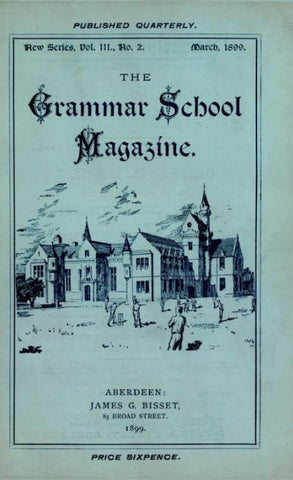
THE
rammar
cboot
aga3ine. -
._ .
. -----
-
_
-
-
- —
-gra- i
/~
•"44
,
--. I
••_
• '• ' 6µf.• e
••
ABERDEEN: JAMES G. BISSET, 85 BROAD STREET.
1899. PRICE SIXPENCE.
.
-
,I
Educational Books. JAMES G. BISSET
C
ONTINUES to supply all the Class Books (New or Second-hand) suited for the Requirements of the Higher Educational Institutions in the City, at the Lowest Prices.
N. B.-BEST VALUE IN STUDENTS' NOTE BOOKS.
JAMES G. BISSET, Classical, illSe0tcal, ant) Educational Bookseller,
85 BROAD STREET (Opposite Marischal College).
pianofortes, harmoniums, -F-~~ and Organs, ~---
James Macbeth, Has always on hand a Magnificent Assortment of
GRAND PIANOS, COTTAGE PIANOS, FRENCH and GERMAN HARMONIUMS, For Sale or Hire on the Three Years' System.
SECOND-HAND PIANOS, ORGANS, & HARMONIUMS ALWAYS IN STOCK, VERY CHEAP.
anspection requesteb of nip Stock before settling elsewbere,
181
Pianoforte and Musical SaloonUNION STREET, ABERDEEN.
CONTENTS. BON-RECORD
•
SCHOOL NOTES -
-
-
-
- 33 - 35
NOTES ABOUT OLD BOYS -
-
- 37
OUR SCHOOL IN THE DAYS OF GEORGE IV. THE GRAMMAR SCHOOL OF 1870.
By SEN EX - 39
By A. ME. -
-
AN INTERVIEW WITH M. LOUIS DE ROUGEMONT.
- 42
By X. - 45
LIFE AT A CATHOLIC COLLEGE. By A. G. JOHNSTONE (F. P.) 47 THE ROYAL REVIEW OF THE PUBLIC SCHOOL VOLUNTEERS. - 52 By J. GRAY (F.P.) DEBATING - 54
EXTRACTS FROM THE MINUTE-BOOK OF THE SOCIETY. By the SECRETARY -
-
-
-
- 58
FOOTBALL NOTES
..
-
-
-
60
OUR PRIZE COMPETITION ••
-
-
-
-
- 61
CRICKET NOTES
-
-
POETS' CORNER, including "MY TROMBONE," by "GOOD - 62 OLD JEFF " ANAGRAM COINCIDENCES -
-
..
-
-
i -
-
- 63
-
-
- 64
ClifIRK & JOSS, 6ent.'s k Watches,
1Xlatcbmalters Rwellers,
From 6/6,
AND
Guaranteed. ql
Opticians,
Unequalled Selection of
57 Rosemount •
Viaduct,
Cups, Medals, Electro-Plated Goods, &c., &c., Suitable for
Sports' Prizes and Presentations.
ABERDEEN.
jrn-nada Bever Watch,, Guaranteed Non-Magnetic,
Best and Cheapest Produced, 15s. 6d.
BEAUTY and FIDELITY go together in our stock of Watches and Jewellery. A reliable Timekeeper is a necessity; beautiful ornaments are a luxury, but one that we all like. Pay a visit to Clark & Josses, and you will enjoy a rare treat in inspecting the stock. All the latest novelties are well represented, and the prices are quite up to date.
Special Terms to Presentation and Sports' Committees.
CLARK & JOSS, 67
ROSEMOUNT VIADUCT, ABERDEEN.
THE
Grammar Sci?oot triaga3inc. New Series, Vol. III.
MARCH, 1899.
No. 2.
•
BON-RECORD: A SONG OF THE GRAMMAR SCHOOL. COME fill a bumper, " Grammar boys," and drain the toast I give— Success unto our ancient school! Long may " the Grammar" live, And year by year fresh honour win, and ever dearer be Our Silver City of the North and School 'twixt Don and Dee! Chorus— For search broad Scotland far and wide, in Highland, isle, and plain, No spot can show a sturdier race to strive with might and main. 'Tis not alone in scholar's lore our hardy sons excel ; Wherever solid work is done, their triumphs you may tell ; In Church and Senate, War and Trade, Law-Courts, and Fever Ward, We count among the men of mark true sons of " BonRecord." What tho' our past be dim and lost in centuries of night, Be sure true Grammar boys have fought for Country, God, and Right; They "bled wi' Wallace," won with Bruce, and on the Harlaw red, Shoulder to shoulder, face 'to foe, with DAVIDSON fell dead. 2
34
The Grammar School Magazine.
Uganda's martyr saint, MACKAY, was reared within our School, And gallant LEITH who fell in France, and JENKYNS at Cabul ; Here young MACDONALD learned to die for country far away, And statesmen high were trained to rule by learning to obey. But time would fail the long array of heroes to rehearse, The victors of immortal art, in colour, stone, and verse ; Here BEATTIE strung his minstrel harp, blithe " TULLOCHGORUM " strove, And BYRON heard of Greece and Rome, swam, fought, and dreamed of love. As on our walls we love to trace the lengthening roll of fame, Our hearts grow big with high resolve ourselves to do the same ; For who would care in sluggard ease to rot thro' life's dull length, And leave no cause that's worth a fight the stronger by our strength ? Tho' far abroad in many lands our comrades wander forth, They carry with them hearts steel-true as needle to the North, And when a "Grammar Boy" wins fame, we, too, recall with pride, How on the old school bench we sat, and struggled at his side. And when old age comes creeping on, and strength begins to wane, When youth is fled, and lost or won the goal we strove to gain, Once more amid those cherished haunts we feel our hearts grow full, And keep a niche in mem'ry for our dear old Grammar School. Chorus— For search broad Scotland, high and low, from John o' Groats to Tweed, No truer race of men is bred than the loyal Grammar breed. H. F. 3L S.
SCHOOL NOTES. WE have to thank very heartily one of our oldest F.P.'s, Admiral Sir Arthur Farquhar, K.C.B., for his annual subscription of £1 to our Magazine. We also give our cordial thanks to Mr. I., who has sent us £1 as the nucleus of a Prize Fund for our Magazine competitions. Let 'em all come ! The School is in luck ! for here ,is another medal—the Ramsay Gold Medal for Latin. The sum of £100 was left by Mr. John Ramsay, of the Aberdeen Journal, in 1869, and has been accumulating ever since. We are sorry to see the gradual rise of the walls of Westfield. Even now the noises from Skene Street, Esslemont Avenue, and Leadside Road are distracting enough ; for, when our windows are open for ventilation, in floats some piano-organ melody, or the raucous yell of the haddock-seller and his spouse. And so farewell to work for the time being. Who can resist "Chon-Kina" or the " Cock o' the North " ? If such be the case at present, what will it be when herds of shrill-voiced bratlings, whose school hours do not coincide with ours, come bounding out of school ? We can only say Kismet, Mektub (" It is written "). One remedy remains. Let us migrate in a body to the Oldmill Reformatory, where all is peace. We have only just room to mention that a most enjoyable Assault-at-Arms was given in the Hall by Mr. Munro's classes on the 22nd of January. In the spring-board competition, which aroused great excitement, Giles and T. B. Robertson were winners. If we might venture on a few remarks suggested by the performance, we think that it would be well for all competitors to sport the School colours in future. We saw with our own eyes one competitor wearing the colours of Edinburgh Academy! Please don't let us imitate certain of the University Professors, who, although graduates of Aberdeen, appear at public functions in their own University with hoods from the " arenas of the south." What would happen if one of our fellows were to continue to wear the Gordon's badge because he
36
The Grammar School Magazine.
had come from the Schoolhill institution! He would be treated as the peacocks treated the jackdaw, and rightly too. Another point. Why should not all competitors wear flannels of the same colour? It looks very bad form to appear in all sorts of dissimilar " toggery." We were glad to see that the general behaviour of the School was so much better than it was at the Debating Finale, for instance. Still, H M and C— might remember that visitors did not come to applaud their boorish antics. At the close of the performance we saw a mere child in the Middle School, S— by name, calmly lighting up a cigarette. We hope his elder brother gave him his deserts afterwards. While our vials of indignation are still open, let us say that we are sorry to see that the disgusting habit of expectorating is all too prevalent in the School. In Aberdeen generally a stranger stands aghast at seeing well-dressed people in tramway cars, railway carriages, public streets— faugh ! Aberdeen brains may be good, but Aberdeen manners are somewhat—uncouth, shall we say ? The Cinematograph Exhibition was a great success, and the performances of the Gramophone, which was lent free of charge by Mr. J. Macbeth, were highly amusing. But surely it is high time to send round the hat for a new piano to our Hall. The present jingling thing is a trial to the nerves of all who hear it. Why not take out half a dozen tickets for the three-hundred guinea Blitthner at the Philharmonic Bazaar? We are sorry that the Library loses the services of Munro, the Assistant Librarian. If his successor shows the same energy and enthusiasm, we shall indeed be well served. The membership has almost doubled itself since November. Several minor contributions have been received. We hope to see added to our shelves a volume from the pen of Mr. J. G. Reid (F.P.)—" At the Sign of the Brush and Pen." Although it may be beyond the mental capacity of some of our members, yet, as the work of a rising F.P., it ought to be placed in our catalogue. The spirit of militarism is in the air at present, as the circular issued by General Chapman to all the Scottish schools would show. Many of the elementary schools are
Notes about Former Pupils.
37
to be instructed in military drill, and what about the Grammar School? We suppose the formation of a Cadet Corps would be impossible. What is the general feeling in the School about this? We should be delighted to have the opinion of, say, Mr. G. Cruden, or anyone else qualified to speak. What do you think? Correspondence invited. The Debating Society Finale will take the form of a Concert and Dramatic Sketch. The ever-young and fair " Area Belle " will disport herself on our stage. The cast is a strong one. We advise the School to patronise the Lecture on Tibet, which is to be given by Mr. Savage Landor in the Albert Hall on 7th March. His accounts of The Forbidden Land are said to be thrilling. Several interesting contributions are unavoidably held over—" the Ballad of Thrym," " Sandhurst Notes," " The Fatal Quarrel," etc. We suppose it is the common experience of editors to be promised articles by a certain time, so we, like Sister Anne, look from our " hie, he tower" in vain. They all with one accord begin to make excuse. Our " Britannia " correspondent has the measles, our Cambridge one has the mumps, and so on.
NOTES ABOUT FORMER PUPILS. LIEUTENANT DOUGLAS MACKENZIE, of the Gordon Highlanders, has received the Distinguished Service Order. Professor Masson, Historiographer-Royal for Scotland, has resigned his office as Editor of the Registers of the Privy Council of Scotland. We are anxiously looking forward to the long-promised " Reminiscences of My Life," in which the Grammar School has an important part. Mr. John MacBain, 2nd Bursar in 1897, has obtained a Scholarship of £90 at Pembroke College, Oxford. Mr. William Duncan, lately assistant editor of the
38
The Grammar School Magazine.
Newcastle Daily Chronicle, has been appointed President of the Northern Phonographic Association. He is official reporter for the Corporation of Newcastle-on-Tyne. The Rev. W. G. Robertson has received an important educational appointment in the Wilson College, Bombay. He might forward us a short article soon. Mr. J. Hall Barron, B.A., has taken the degree of B.C.L. at Oxford with highest honours. He has since been " called " to the Middle Temple. We wish him all success at the Bar. Sir William MacGregor, K.C.M.G., M.D., D.Sc., LL.D., L.R.C.P., late Lieutenant-Governor of New Guinea, has been appointed Governor and Commander-in-Chief of Lagos. A full account of his life is given in our 1895. Volume. Sir James Reid, K.C.B., Physician-in-Ordinary to Her Majesty the Queen, has been appointed, in succession to the late Sir William Jenner, as Physician-in-Ordinary to the Prince of Wales. •
Staff-Surgeon J. L. Smith, of H.M.S. " Rodney," has received at the hands of the Queen the Cross of the Royal Victorian Order, " as a mark of her appreciation of the valuable services rendered by him on board. H.M.S. ' Blonde' to the Queen's dear son-in-law, the late Prince Henry." The Rev. W. A. Stark has been appointed minister of the Peterhead Congregational Church, and the Rev. A. Matheson has been appointed to the Belgrave Church, London. Brigadier-General Reid, C.B., has been appointed in command of the movable column at Chakdara on the NorthWestern frontier in India. He has been often mentioned in despatches. Mr. David West, the talented young artist, lately returned from Klondyke, not with a pile of dollars, but with a pile of the finest photographs of the district we have seen. Ile intends to mount them as lantern slides, we believe. Here's a chance for the Debating Society, and his experiences are worth relating. We know of other three Grammarians who started for Dawson City, but two of them
39
Our School in the " Thirties." were wrecked on the way. third fare better.
So they came back.
May the
Mr. C. B. Cruickshank, M.A., has been appointed first electrician in the service of the East India Panama Cable Company. We have to announce the death of Mr. John Crombie, junior, of Danestone, a Deputy-Lieutenant of the County ; of Mr. Robert Sim, who conducted the Union Row Academy ; of the Rev. Andrew Donald, M.A., Blackford. Major Macdonald, of Uganda fame, is still wandering somewhere in the heart of unexplored Central Africa. He was last heard of in June. Mr. Erskine Burnett, now a student of the Ontario Agricultural College, Canada, has sent us his College Magazine —the " O.A.C. Review." He expresses his best wishes for the success of our Magazine, and for the welfare of the School. We heartily reciprocate his sentiments. Professor Ogston, M.D., has received a Distinguished Order from H.I.M. The Tsar of Russia. Mr. P. Frost has received an appointment in the Imperial Ottoman Bank, Constantinople. His father, General Frost Pasha, has had conferred on him the Gold Medal of the Imtiaz by His Imperial Majesty the Sultan.
OUR SCHOOL IN THE " THIRTIES." I HAVE been asked, as a former pupil of the Grammar School, to give a few recollections of the olden time. The task is in some respects a pleasant one, for old men are wont to live more in the past than in the present ; it is even said that they generally become garrulous when they get into the retrospective vein. In my case, however, it is difficult to know where to begin, as well as when to stop. My recollection of the School covers a period of upwards of fiveand sixty years. When I first entered it, there was a very different state of matters from that which now prevails. The school buildings, the text-books used, and the masters that taught, are all changed, not only in their personality, but in their character. It is more than thirty years since
40
The Grammar School Magazine.
the old School in Schoolhill was left for the present very handsome and commodious building. What a contrast between the two! Our quarters in Schoolhill were of the most limited dimensions. We had four classrooms and a public school, with furniture of the barest, not to say hardest, kind. No playground existed worthy of the name, so that for any sports that required a little space, we had either to crowd out into the street, or go down to the Denburn. In those days the police were not so exacting as they are now. That Denburn valley, through which the railway runs, was the scene of many a stone fight between the Grammar boys and the boys of the town. From time to time, one would be carried off unconscious from the battlefield. Thanks to the introduction of cricket, football, and other less harmful games, these rough contests are things of the past; while the pupils have ample room in the spacious grounds that surround the more modern building. Then as to the text-books in use. In the days of the early "thirties" of the century no English, no Grammar, no History, no Geography were taught at all. For French or German, even for writing and arithmetic, we had to go outside the SchOol, to other teachers as well as other classrooms. It is true that for some time after entering the first, or lowest, class a chapter of the Bible was read every morning ; but that was all the instruction in English that the institution afforded to boys of nine or ten years old. Latin was the only medium through which all mental furniture and training were conveyed. Ruddiman's Rudiments, Melvin's Grammar, Corderius' Colloquies, Cornelius' Nepos, and so-called Grammatical Exercises, ending with Caesar and Ovid, were the text-books for the first three years. But, after all, it is the Master that makes the school. Buildings and books and apparatus may be inferior or superior ; the main results will ever depend on the teacher. And looking back to the distant past, I am constrained to say that, as regards the teachers, there is the greatest change for the better. During the first three years of my tuition, I was in the hands of such a teacher as could not now be paralleled throughout broad Scotland. I am glad to say that the species is utterly extinct. He was an old man of quite threescore and ten when I entered his class, and, of course, the process of ageing continued with him, until it came to an end at the close of my third year. The fact of his extreme age will account to a great extent for some of his characteristics, although there was always an individuality about him that must be reckoned with in judging of his .capacity for the post of teacher. It may seem strange
•
Our School in the " Thirties."
41
that anyone of such advanced years should have been allowed to retain his situation so long. In. point of fact, among the three teachers who were in a sense under the Rector, although virtually independent of him, there was another in my day who was also incapacitated for work on account of advanced years. Only one of the three was in the prime of life and really efficient. But at that time there was no superannuation salary, nothing for an old man to retire and live upon ; so that he had to cling to his post, unless he was possessed of private means of subsistence. I could fill pages with a narrative of the personal peculiarities of my old pedagogue, and of the tricks which the boys played upon him. Let me just give a sample. Those were the days when a good many whaling vessels, owned by different shareholders, used to sail from Aberdeen. My teacher had an interest in a vessel called " The Dee " ; and as the season came round for the return of the ships from Greenland, some boy, who had got early news of the arrival, would announce that " The Dee" was in the bay. This was glad tidings to the Master, and was always followed by the dispersion of the school for the rest of the day. But woe to the luckless youth next morning if, as sometimes happened, the news did not turn out to be true' In the afternoons of the winter months we had, of course, to get artificial light. It need not be said that electricity was unknown in that application of it, but even gas had not yet been introduced into the School. There were big chandeliers, each containing about a dozen candles, that dimly lighted up the surrounding benches. It was great fun to keep these candles going by trimming or, as it was called, " snuffing" the wicks. In the conduct of that operation the boys more frequently snuffed them out than trimmed them—a source of considerable distraction from the lessons that were going on. It must be confessed that playing truant was not unknown in our class, although the Master used to send someone near the top of the class to inquire after the absent one. It was a fruitless inquiry. The boy sent out to see what was the cause of absence met the truant near the School, and, after playing with him for some time, brought back an answer that had been concocted for the occasion, and was accepted as sufficient and true without farther investigation. One thing that used to strike the new scholar very forcibly was the frequent use by the Master of the exclamation " Bon Dieu "—only it was always given in plain, strong Saxon. Another peculiarity of the old gentleman was that he was constantly chewing tobacco, in the shape of a fine twist
42
The Grammar School Magazine.
that was sold by a brother of his in Queen Street. We were sometimes sent to the Queen Street shop for a fresh supply when the tobacco failed. But what puzzled us most was the fact that chewed-out " quids" were always deposited in the waistcoat pocket. What their future destiny was we could never discover. It goes without saying that, under such a teacher, the School discipline was in a very chaotic state. There was certainly no stinted use of the " tawse" in the shape of " pandies," and sometimes that instrument of torture was applied to what has been called " the most muscular part of the person "—a form of punishment on which decency forbids us to enlarge. At the end of my three years the old dominie was obliged to retire because of sheer physical incapacity. His pupils were duly drafted to the Fourth Class, taught by Dr. Melvin. The transition was like the introduction to another world. A mental stimulus was now given to the boys, such as they had never experienced before. And, although nothing could fully compensate for the three years of stagnation which had passed away, it was marvellous to see the change that was wrought by two years of the new regime under Dr. Melvin. Only his old pupils can appreciate the thoroughness, the accuracy, the hightoned character of the teaching imparted by that prince of modern Latinists. May the young gentlemen who attend the Grammar School of the present day be proud of their distinguished seminary ; and, as they read these hurried reminiscences, may they be thankful for the opportunities which they enjoy in one of Scotland's best secondary schools. SENEX. THE GRAMMAR SCHOOL OF 1870. A RETROSPECT. " Ah ! happy years ! once more, who would not be a boy ?" —BYRON.
WHILE other voices, strange to us, resound About thy doors, thy face of granite grey, Thy rising towers remain the same as when, That crisp October morn, we entered first Thy echoing corridors, and joined our names To those of centuries past, and scanned with awe The volume of alumni, flowing through The years from darker times to brighter, like A stream that glides for ever to its home—
The Grammar School of 1870.
43
The seething, fathomless, insatiate sea. Our first friend was the kindly, genial Legge, With thin, cold face, and slow, deliberate ways, The type of nature's truest gentleman, Whose mild, paternal glance lives with us still. Led by his hand, we groped our faltering way Through Livy's childish myths of Romulus And Remus, and the she-wolf's wondrous care ; Or struggled hard to find fit words and terse To construe Tully's brilliant thoughts on Friends ; Thermopylae and Salamis, besides Famed Marathon filled us with glowing fire ; Through Virgil's polished page in lEneid Sixth Down to Avernus grim, descent we made, Shuddering at Cerberus' bark and Charon's boat. Alas ! blind Atropos, before his time, Cut short his thread of life, and left us poor. Next Martin, more severe, stricter in rule, But sympathetic too, revered by all— A devotee to powdered nicotine And handkerchiefs of colour bright—explored The depths—or what seemed depths—of Greek ; With interest clothing grammar, syntax dry, And weary Xenophon's dull parasangs ; Anacreon's odes of love we read, too young To feel the flame, but felt the music sweet. Then Morison—who, from erect, stiff back, Had been re-christened by another name ; Our English master he ; now versed in Law, Professor, author, critic, editor ; Aspiring, too, towards Parliament, and once With the Rectorial scarlet all but decked. O'er niceties grammatical of Bain He sharpened keen our wits, and introduced Us to " Sir Roger "—quaint and humorous knight— The friend of Addison's " Spectator" bland. The hard-grained Mathematics were the care Of one M'Arthur, blind, unfit to rule, Whose class became a bye-word and disgrace; Red herrings, mice alive, and eggs not fresh, And other missiles drove him from his post : Albeit he was a man of parts, and skilled In various learning, proved in wider fields. To him succeeded Sleigh, with gruffer voice, And better knowledge how to quell misrule. Good work he did, until he crossed the bourne. Forget not also Beverley, called " Dick."
44
The Grammar School Magazine. In truth, kind Providence had not been kind To him ; for lame he was, and somewhat cross In temper ; so 'twas said, but we who saw . Him only at examination times Could not presume to judge; his versions well We conned, and varying profit thence derived. Attainments scientific he could boast, For which he earned a Doctorate of Laws. And one, thou halt him yet, the final link That thirty years have left unsnapped and sound, Old Pope; like soldier still, with hearty ways And gen'rous sympathy for youthful pranks. A manly soul ; long may he live to write That fair, clear hand, the marvel of his time ! Our forty classmates also ! Where are they ? The gods loved some, who died, alas ! too young ; And others, grown to manhood, left their dust On alien shores, in lands that love the sun, Or in that Greater Britain o'er the seas. The rest are scattered wide, and hard to trace ; Some few are rooted in their native soil ; Their sons now ranging round thy grassy lawns, And treading paths their fathers trod before. But thine amenities, kind Nurse, have changed ! Thy terraced " slopes " are levelled to a plain, Flat and insipid, fitter, true, for game Of bat and ball, though wanting in romance And picturesque suggestion ; while the burn That wimpled in our sight—a crystal thread In summer, and a tawny, tearing flood When dark November's rains had filled its banks— Is now, like Arethuse, a hidden stream. Thy wide demesne, once fringed by gardens fair, Is now engulphed by rows of sombre streets— Dull mass of populous tenements, though one Is styled an avenue, a Provost's scheme That keeps his name in mem'ry for all time. Thy dwindling acres would have dwindled more, But that strong hands have stayed an impious Board From planting on thy ground another school, Of kind called primary, not wanted there. Thy little commonwealth is quite transformed ; We had but classes five—a simple scheme, Without thy complex Lower, Middle, Higher. No infantile department in our time, Nor teachers fair of other sex than ours. Changed, too, the guiding hands that rule thy flock.
Monsieur Louis de Rougeinont Interviewed.
45
•
•
the arenas of the south thy Rector formed, And made him stately, firm ; the foe of sneaks And all unmanly deeds ; but votary, too, Of outdoor sports and corporal sanity ; A worshipper of Byron's fame, who will not rest Till justice crown that bard's achievements high, And signalise thy greatest son's career With sculpture due, after a hundred years. Nor pass we by his colleague, worthy Moir, A loyal adjutant, whose claims unique In modern letters and in classic lore Our Alma Mater twice has recognised ; A man of warm heart, beloved and straight, Though not without a dash of Celtic fire. And many more there are, did time permit : M'Leod and Murison, and Mackie, Ward And Brownie, Philip, Davidsons a pair, Each toiling hard to keep thy fame secure Against thy wealthy rival of Schoolhill, Which pious Gordon never meant to drain Thy strength, as nurse of academic youth. Farewell ! when three more decades pass, may he Who then attempts thy praise, have theme as high As his who feebly now recalls thy past. A. ME.
MONSIEUR LOUIS DE ROUGEMONT INTERVIEWED ! " Louis DE ROUGEMONT?" asked the waiter, as I reached the entrance hall of the Grand Hotel, one fine, sunny morning the other week. "Yes, please," I answered. I was conducted to the writing room, there to wait my victim. Oh ! the suspense, even when I think of it now! But I had not to wait long. The celebrity entered, looking as bright as the morning. " Ah ! good morning," he said ; " I had your note ; come with me." I followed him to the lift. A minute later we were flying upwards to his private room. We soon reached terra firma again, and he led the way to his sanctum. " Now," he said, when I was seated, " we will be all alone." Just fancy yourself sitting all alone with a celebrity! But I had not time to think of such
46
The Grammar School Magazine.
things just then. I had to make a beginning somehow ; so I said ' You must think me very cheeky to bother you in this way." "My dear sir," he replied, with the sweetest voice imaginable, his French accent being just evident, " I am fond of boys ; I like boys very much ; so that no apology is necessary." Then he started off into a discourse on his adventures, his writings, and his intentions for the future. Monsieur de Rougemont certainly knows how to be interviewed. He does not need to have questions put by the interviewer; he speaks of those things which are of interest to the public in general. " I always try in my lectures," he said, " and in my writings also, to kindle in the hearts of boys a desire to travel, and to see for themseWes the things that await them in these far countries of which I have given some account. "I came to the Grammar School, as you know, to lecture to the boys. But, had I known it was the Grammar School, I would not have come, for I only go to those schools where the pupils cannot afford to pay to hear my lecture." I complimented him upon the brilliant style in which he had told his story in the Wide World Magazine. " I attribute my literary success," he replied, " to relating my adventures exactly as they happened to myself, and without embellishing them with sentiment or packing of any sort. ,' There is a thing that I should like to explain to you. You have heard of my turtle-riding? " " Yes." " Well, the secret of the whole business lies in the fact that I kept my turtle in shallow water. If you were to try it, you would find it the easiest thing in the world. But do not let your turtle into deep water, or it will dive, and then . I did not explain this in my story. The result was that the critics challenged the possibility of my action, the public read my book, and I was a made man. " This is not the only instance. You have read in my story that wombats fly? Well, I laugh now to think of it. A wombat flying ! Ha! ha! ha !" and he lay back in his chair and laughed outright. "This is the explanation," he continued. " It was a practical joke on the part of the printer. I dictated the story, and the editor of the Magazine revised my notes. In my manuscript the word is ' bats.' Now, there is nothing wonderful in a bat flying. In these latitudes flocks of them settle upon a forest, and devour the bark of the trees, so that the trees die. But to think of a wombat flying ! The idea tickled me so much
Life at a Catholic College.
47
that I allowed the mistake to pass. It was highly amusing." " That mistake has paid you," I suggested. " I should think it has," he answered. While he talked I had abundant opportunity of observing his figure, face, manners, and voice. Particularly I noticed his eyes. He looks at one unflinchingly. His hair is slightly grey, and his face is somewhat wrinkled. But this is probably due more to his life of hardships than to age. He is of middle height, of a sinewy build, and is very active. He is one of the finest talkers I have ever met ; not at any time does he allow the conversation to become uninteresting. Near the end of our interview he said, " Tell the boys that I hope to see them all again." As I rose to go the waiter announced that a reporter from the Free Press wished to see Monsieur de Rougemont. So I had forestalled the press. Monsieur de Rougemont promised to give some contribution to the School Magazine, and he said he would be • glad to have a copy with his interview in it. Then he came with me to the door. " I am much indebted to you," I said. " Not at all," he replied ; " it has been a great pleasure." He shook my hand heartily, and we said good-bye. X. LIFE AT A CATHOLIC COLLEGE. BY A FORMER PUPIL. I KNOW that round a Catholic College there hangs a kind of
mist, if one might say so, which seems either to hide it altogether, or to cause those who do not happen to be Catholics to catch but an. obscure glimpse of it. I hope, however, that the few items which I will attempt to give about ITshaw and life there will help in some measure to dispel this mist. Everyone knows with what reluctance and drooping spirits the schoolboy, who has just passed seven weeks of pleasure and enjoyments of every description in holidaymaking, tears himself from the bosom of his family and leaves the parental roof to return to the embrace of his Alma Mater. To this rule the Ushaw student is no exception. He tries, however, to forget his sorrow at leaving home when he has joined some of his old companions—who are trying
48
The Grammar School Magazine.
to look as if they were quite indifferent whether they are at home or at school—and begins to look forward with joy to the prospect before him. On arriving at the Cathedral City of Durham, he finds the station full of returning Ushavians, who are all bustling about, some shaking hands and trying to talk to everybody at once, while some are plaguing the much-enduring porters about their luggage. At last they begin to think of starting for the College; brakes are taken and immediately filled, and the four-mile drive from the station to the College is begun. When they come to within a mile from their destination, on turning a bend in the road, a fine view of their home for the next tenmonths is presented to their eyes. It stands upon the summit of a small hill, and commands a full view of its surroundings. The scenery, once beautiful, is somewhat spoiled by the many coal-pits and pit-villages which are situated in the valleys on either side. But Ushaw stands far above these, encompassed by trees. An avenue of oaks and beeches leads up from the Durham road to the front of the building. The middle portion of it is the oldest, having been erected in the year 1809. On the right of this is the Library—a long room, which contains about 20,000 volumes, and is perhaps the finest private one in the North of England ; underneath it is the study-place, which resounds through the day with the scratching of pens. On the left of the main building is the Church—a large and beautiful edifice, comparatively new. Directly in front of the College there is a broad terrace, and a few steps lead down to shrubberies and gardens, in the midst of which is the large pond, of such great use in skating season. I shall go back, however, to our returning students. The first two or three days of home-sickness, or " rustiness " —to use our own expression—having passed, they settle down to the usual routine. Every morning the humming of a huge gong re-echoes through the long dormitories and awakens the sleepers at six o'clock. Every morning there is Mass and morning prayers, followed by breakfast ; and then at eight the work of the day begins—Sundays, of course, excepted. On Tuesdays and Thursdays there is a half-holiday ; on the other days of the week eight hours are devoted to study. On certain days in the year, such as the feast of St. Cuthbert, patron of the College, or the anni- • versary of any great event, we get a whole holiday, on the morning of which at eight o'clock there takes place the " ringing out." This is a curious custom, and one almost peculiar to Ushaw. When on an ordinary day the study bell would ring, the Philosophers—these, I suppose, are
Life at a Catholic College.
I
i
49
equivalent to the monitors or prefects of public schools— come rushing from their playroom to the belfry, and their Captain, who is called the Censor, gives the bell-rope a few violent tugs, and then a loud cheer bursts from his brotherPhilosophers, who immediately hoist him on their shoulders, while from the other playrooms rush headlong the various classes, or schools as they are called, to the scene of action. Thereupon all engage in prolonged and vigorous hurrahs, after which the Censor announces in a loud voice the reason of the playday, and bids his joyous audience give nine times nine, which they do with a zest much greater than that with which they descend the steps to study-place on a whole study day. Ushaw, like all schools, is enthusiastic over games. Each part of the year has its own game. After the vacation football is begun, and continues till March, although it is happily interrupted by skating whenever the pond will bear. From March to the end of May a game is played called " Cat," which somewhat resembles baseball, and is played at Ushaw alone. After May cricket is the ruling game until the end of July arrives, and with it the longwished-for summer vacation of seven weeks. Besides these three, the other games played are tennis, hand-ball, and The gymnasium, too, affords great interest and fives. amusement to some of the students, while the large swimming bath is patronised by all. With the end of first quarter comes the Christmas vacation. There is then a fortnight's holiday, and sometimes a day or two more. Very few go home for it, and so it is perhaps the most enjoyable part of the year at Ushaw. If there happens to be sufficient frost for skating, then indeed the enjoyment is especially great. It is absolutely impossible to describe with what ardour and joy everyone, old and young, takes down his skates from the hook, where they have hung and rusted for a whole year, and, sliding and staggering over the slippery ground, makes his way to the glassy surface of the pond. Skating is of such short duration—and some years indeed quite a minus quantity—that it practically becomes a novelty, and as long as the ice lasts, it is never left during the day, except at meal times. From early morning till evening the ice rings with the shouts and laughter of the merry skaters. Some of the schools practise glees or partsongs, which they sing on the ice, and which add to the physical enjoyment an aesthetic one. The presence of a refreshment stall, too, is by no means ignored, particularly by the younger ones. In the evenings entertainments of various sorts are given in the Hall. Sometimes it is a
50
The Grammar School Magazine.
play, sometimes an opera; on one night the audience is thrilled by the strains of sweet melody in a well-arranged concert, on another the jokes and songs of " minstrels " call forth laughter and applause. The Hall itself is a large, high-roofed room, provided with a stage, scenery, and other necessaries for the drama. The seats gradually rise as they recede from the stage, so that everyone may have a full view of what is going on there. The roof is beautifully ornamented, and in itself a work of art. As well as for these entertainments the Hall is also used for elocution lessons and public recitals and for " readings up." This last is the reading of the results of the examinations every quarter, and takes place on three occasions at twelve o'clock—on Christmas Day, Easter Sunday, and the Sunday immediately preceding the summer vacation. The reader mounts the stage, and in the deepest tones he can command announces the order of merit in each school, all the names being read up in Latin, which adds greatly to the dignity and importance of the occasion. Christmas Eve itself is always a memorable and enjoyable night. After supper at 7.30, the different schools, who have each a piano in their playroom, have a private concert, and the whole College resounds with lustily-sung choruses and other indications of the general merriment. At halfpast nine, the Office of the Church is solemnly sung. The Church itself is beautifully decorated and hung with evergreens, and filled with a blaze of light ; and then at midnight Pontifical High Mass is celebrated. The peals of the organ echo through the Church, while outside the stars are shining brightly through the frosty midnight air. After the Christmas vacation the next break in the scholastic year is Easter. With it; second quarter comes to an end, the quarterly examinations take place, and studies are suspended for about a week, while the game of " Cat" is in full swing. After Easter third quarter extends, with a break of two or three play days at Whitsuntide, up to the summer vacation. To turn, however, to our social life. The classes or schools at L-shaw are like a number of various families, each member being enthusiastic for the honour of his own school. This is clearly manifested during a match between any two of the schools by the energy and perseverance of those engaged in the game and the vociferous cheering of the spectators. The Philosophers, who have been already mentioned, are a mysterious, dignified body in the eyes of the lower schools, over whom they exert an unpopular authority. They are supposed to stop all unseemly romping, violence, and other breaking of
t
$
•
t )
Life at a Catholic College.
t o
I
51
rules, and they can "limit" those over whom their authority extends to the house for a period not exceeding three days. From their ranks the " Censor" is elected whose office lasts for three months. He it is who looks after the games, arranges the school matches, and last, but by no means least, represents the House in applying to the President for a playday. After the Philosophers, the next school—or rather two schools joined into one body—is Big Lads, between whom and the higher school there is deadly hostility. Then come Syntax, Grammar and High Figures, who together constitute the " Lower Bounds" of the College. Besides all these, there are other four classes in the Junior College. This is a much smaller building adjoining the large one. They have nothing whatever to do with each other, except that both attend meals together in the College refectory--a long room, with a marble floor, and an enormous fireplace at one end, the walls of which are hung with large paintings. Each school has a playroom of its own, in which they spend the parts of the day not devoted to study or games, and which in the cases of the higher schools are furnished with a billiard table and a small library. Towards the close of the College year certain schools are particularly busy preparing for the Oxford and Cambridge Local Examinations, and every year the College gains glory by the numbers of successful candidates. The examination itself usually takes place a week before the midsummer vacation, so that once it is over the students begin to look forward to the happy home-going and seven weeks' rest. The last week of the session is called Grand Week, and would be a very enjoyable time if everyone did not know that there was something better to follow. It begins on the Sunday before the vacation, when the results of the quarterly examinations are again read up in the Hall. Next day the visitors arrive. These are former students, who are very glad to see their Alma Mater once again. A cricket match is played, Past v. Present, which is continued during the next day, and affords great amusement both to the players and the spectators. In the evening there is an entertainment given by the students in the Hall, followed by another the night after. On the Tuesday, too, there is an exhibition of gymnastic exercises. On the Wednesday the distribution of prizes takes place, the students pack their boxes once again, and prepare for the journey homewards. The next morning the gong sounds at five o'clock, and the alacrity with which everyone leaps out of bed forms a strange contrast to the reluctance with which they
52
The Grammar School Magazine.
usually greet the beginning of the day. By seven o'clock the brakes, with their load of shouting, cap-waving youths, have departed, and left the old building for the space of seven weeks to loneliness and peace. A. G. JOHNSTONE.
THE ROYAL REVIEW OF THE PUBLIC SCHOOL VOLUNTEERS.
I t
MERCHISTON CASTLE, EDINBURGH.
DEAR MR. EDITOR, As a member of the 1st XV., I have been having a grand time at " footer." We have played Fettes, Loretto, Blairlodge, etc. As your own sporting notes are rather full, I shall not trouble you with any account of our matches (for which see The Field) but shall try to tell you about our review before the Queen at Windsor last year. We have a "ripping" Cadet Corps (kilted) and a capital band, and I can tell you we made the Eton and Harrow fellows, to say nothing of the smaller fry, sit up, and then slink off to a back seat. You should have seen what the Cockney papers said about us. Besides ourselves, the only other Scottish school represented was Blairlodge, and, in our opinion at anyrate, we completely eclipsed them. We started from Edinburgh about 10 a.m., togged out, not in our uniforms, but in flannels and school blazers, and, slowly stewing in our own juice all the way down, we arrived at Windsor about 10 p.m. Forming up in the station, we marched to the camp on Romney Island, where we found everything put right for us by the Grenadier Guards. Quum ad castra perventum esset (what do you think of that, Mr. Caesar ?), we, after a long hunt for our impedimenta and for the res frumentarias, retired, four each, to our tents, to sleep, perchance to dream. Ay, there was the rub, for the Eton clock would keep chiming all the half-hours. It was not quite so bad as your St. Nicholas bells, however. At last, on reveille sounding at 6 a.m., we turned out unslept and raw, and the roll was called. This over, we dashed down for a morning dip in the river, and this we thoroughly enjoyed. There were some that ran and some that leapt like troutlets in the pool. Hungry as hawks, we consumed a record breakfast in our dining car. Then came drill, followed by an interval till dinner time. After dinner we formed up, and marched off to Windsor
I
The Royal Review of the Public School Volunteers. 53
V
q
Park, where, after a lot of fiddling and fooling and shifting and re-shifting, we, along with about 4,000 other fellows from the chief English schools, marched to the Great Park, where we formed up into a line a quarter of a mile in length. Oh, the heat, the dust, the crowd ! All the fellows' sisters and cousins seemed to have turned out, and, oh ! the cheering and waving of handkerchiefs. Suddenly down dashed a throng of glittering aides-de-camp, scattering people right and left. And there was hurrying to and fro, and rapid clearing of a wide, open path, and down the centre, heading right for us, were seen the scarlet-coated postilions. It was the Queen. By Jove, we did feel loyal then and no mistake. She drove slowly all along the line, and when opposite us she asked of what school we were, and pronounced us very smart. The Royal carriage, with the stalwart Highlander on the box, then drew up at the saluting point, with the Royal Standard behind, and we marched past. We were just on the head of the Dargai boom, and I can tell you we were cheered to the very echo. The English fellows didn't seem to like it quite. After going past at the double—and it was hot work and no mistake— the whole 4,000 of us wheeled round, and, looking towards the Queen, gave three tremendous cheers. We saw some ladies wiping their eyes—I suppose it must have been the dust—and Her Majesty nodded to us ever so nicely, and then " God Save the Queen" ! After these three hours' hard work we re-formed, and marched back through the crowded Windsor streets, and you never saw anything so rude as some of these English people, for they stopped their carriages, and the ladies put up those stalk eyeglass things, and just glared at us all up and down. It was a jolly good thing we were so hungry, or we might have revenge. As soon as we reached our camp we rushed (concursum est, eh ?) for drink, and I can tell you a good quantity of lemonade was consumed. Then followed tea and a stroll. Some of us went to Eton College (a queer old place), others went to town, others went on the river. We all turned in at eleven o'clock that night, and were up at 3 a.m. to pack up. By 8 o'clock we were en route for Auld Reekie, which we reached about 10. And certainly " gentle sleep our urchin eyelids kissed" (what rot these poets write !). The poor Blairlodge fellows had hard lines, for they had to sleep in their uniforms all the time in their stuffy carriages, and the temperature somewhere about 86°. " Sic itur ad (c)astra." J. GRAY.
EXTRACTS FROM THE MINUTE-BOOK OF THE DEBATING SOCIETY. 1898
Sept. 7.—On this date the usual meeting for the election of office-bearers was held in Classroom I., the Honorary President, Mr. Murison, occupying the chair. Those appointed were J. Shirran; Vice-Presidents, D. Richards; Stephen, and G. Russell ; Secretary and Treasurer, J. C. Lyon; Committee —G. Craig, J. Kyd, T. Robertson, J. Strachan, and V. Stephenson. The Chairman stated that the Patrons, etc., were usually re-elected, and this motion was carried. Sept. 9, 16, 23, and 30.—These dates were taken up with impromptu debates, far too many to enumerate. The questions longest debated on were—" Should Bicycles be Taxed? " Very few members were silent on this point. " Should Schoolmasters receive a Retiring Allowance? " A tendency on the part of the members to bring the Grammar Masters on to this question was at once supressed by the Chairman. "Smoking v. NonSmoking." The non-smokers were greatly in the minority, alas! "Should Members of the Society be allowed Free into the Library ? " This debate roused the members to an extraordinary pitch of excitement. The Secretary was asked where last year's funds were, as if he knew anything about them. " What was done with the Society surplus?" "Oh, it was given to the Library." Unfortunately, the Librarians were there, and immediately they were set upon. " What kind of Librarians were they? Why! the dictionaries, scientific treatises, etc., etc., which made up their collection were enough to frighten any ordinary mortal from coming near the place." The members then proceeded to set forth how they would manage the business were it put into their hands. Ridiculous suggestions were made for the investment of the surplus—in pictures, ornaments, etc. After nearly an hour of this sort of thing the questions began to run done, though the questioners were far from satisfied. It was decided that members should not be allowed to use the Library free of charge by a majority of 9. There was a big attendance at all these meetings, the numbers running from 25 to 30. The behaviour was, for the most part, passable. Oct. 14 was a " hat night." Every member wrote a debate on a slip of paper, which he folded up and deposited in a " hat." The contents of the hat were then mixed, and on its being handed round again everyone received a paper, on which he had to " hold forth." Some unfortunate members found themselves face to face with such questions as " Is marriage a failure? " " Is shaving really advantageous to a budding moustache? " " Which is more odious—a womanly man or a mannish woman?" Now, how
Extracts from, the Minute-Book of the Debating Society. 55 could a poor fellow of 15 know anything about such things? However, they did their best, with more or less success. A faltering member, making his first speech, tremblingly announces —" Gentlemen, the subject I have before me is—' Are trousers singular or plural?' " A howl of laughter greets this statement, and the abashed speaker hastily resumes his seat, feeling sure that his bad speaking has caused the merriment. Some simply say that they know nothing about the subject in hand and sit down again, amidst cries of " Put him out," " Clever man," " He must be a Modern ! " These debates going done rather too soon, the debate was proposed—" Should the Modern as well as the Classical Dux get his name in the School Hall? " If ever a debate nearly ended in a free fight it was this one. " Ach! the Classical is the most important side of the school." " The Grammar is essentially a ' classical' school." " The Bursary Competition is tried chiefly by Classicals." " Oh, yes ; but the Modern School has doubled itself these last few years." " If Moderns tried the Bursary Competition they would make a better job of it "—(cries of " Old Gorden's cub," "Middle School pup "). The Science and Art Department are now holding written examinations in which the mathematics, at anyrate, are of a higher standard than in the Bursary Competition." These points, and innumerable others, were brought up in the midst of the speeches, and the debaters, hardly waiting to catch the " Chairman's eye," held forth two or three at a time. Personal remarks flew thickly around, until the place became a perfect pandemonium. On the noise falling a little, the votes were taken, but the Moderns were greatly in the minority : —Affirmative, 8 ; Negative, 27. G. Russell, J. Scott, mid J. Lyon were almost alone in supporting the Modern.. A host stood up for the Classical, among which the chief speakers were T. Robertson, Shepherd, J. Strachan, Stephenson, and C. Minto. • • Oct•. 28.—The Society met in Classroom I.—Mr. James Davidson in the chair. The Chairman, in a few well-chosen words, introduced the lecturer for the evening—Mr. Alfred Macleod, a former Master—although, as he remarked, this was hardly necessary. The paper, entitled " The Educative Power of Literature," was a very fine one. It was divided into the different departments of literature. And we were reminded that everyone had a talent for at least one of the branches—some poetical, some historical, some dramatical, etc., etc. The lecture was listened to with great attention, and the vote of thanks well responded to. A vote of thanks to the Chairman closed the meeting. Nov. 4.—The Society met in Classroom I.—Vice-President D. Richards in the chair. The minutes of last meeting having been read and approved of, the affirmative of the debate—" Was Brutus justified in killing Caesar? " was taken by W. Milne, in place of W. Stephen. The negative was taken by J. Shirran,
56
The Grammar School Magazine.
our President. Both papers showed careful study of the subject. W. Milne has a rather heavy style of delivery ; J. Shirran's paper was more argumentative. On the subject being thrown open for general debate, the question was well discussed, but it might have been better, considering " Julius Caesar " is in. everyone's hands just now. The votes were : —Affirmative, 7; Negative, 21. The unusual spectacle of a large number of VIIth. Classical members and non-members was seen at this meeting. They were evidently allured by the prospect of edification from the debate. We hardly ever see those prodigies nowadays, though once almost the whole VIIth. attended our meetings. When asked why they do not come, " Oh, can't spare the time," they say. This plainly means " grinding" As if two hours on Friday evening would make much difference to their studies! Hear, O VIIth., and give ear, O ye that " swot " yourselves to death ! Have consideration for the well-being of your venerable School, and all connected with it, as well as for your own private selves. Nov. 11.—On this date, as well as at the end of last meeting, the time. was mostly taken up with impromptu debates and petty squabbles about the order of speaking and sundry other matte:.-s, uninteresting to any but ourselves.
/ 4' t '•
Nov. 18.—The Society met in Classroom. I.—Vice-President D. Richards in the chair. The minutes of last meeting having been read and approved of, the affirmative of the debate—" Was the character of Napoleon worthy of admiration?" was taken by G. Russell. J. C. Lyon had the negative. Both papers were long; the last tortured the members for half an hour. The former was more comprehensive and minute; the latter inclined to be poetical. The subject was then thrown open for general debate, and was warmly discussed; but, on the whole, the members were in favour of the affirmative, which was finally proved by the votes by a majority of 3. Nov. 25.—The Society met in Classroom I. at 7 p.m.— Honorary President, Mr. W. Munson, i in the chair. The Chairman had the nominal task of introducing the lecturer, Mr. H. F. Morland Simpson, the Rector. The subject was " Byron." We were given a short account of the life of the illustrious poet, when he was a " bare-fitted ladclie" living in Broad Street, beside the doomed Greyfriars Kirk, and attending the Grammar School, then in the Schoolhill. This was especially interesting to us. We were shown the old, musty register, with the names beautifully written in and quite legible, amongst which was Dominus De Byron. It is a good thing to be shown those venerable marks of our school's greatness in former times, and to realise that we are members of the same institution as Byron was a hundred years ago. Of such as he Shakespeare has truly said— " The evil that men do lives after them, The good is oft interred with their bones." The vote of thanks was very heartily responded to, and, after a similar vote to the Chairman, the meeting broke up.
a
•
Extracts from the Minute-Boole of the Debating Society. 57
4
Dec. 2.—The Society met in Classroom I.—Vice-President G. Russell in the chair. The minutes of the last meeting having been read and approved of, a few impromptus were debated on., Then a criticism of the Magazine was begun. The President, J. Shirran, gave a long treatise, taking in every article. The worst criticism was passed on an article entitled " An Interview with the German Emperor." It was signed " X.," but some of the members got an inkling of who the author was. The unfortunate writer, happening to be a member of the Society, and being present that evening, was unmercifully treated, and called all sorts of names under his nom de plume " X.," which he could not, of course, resent as personal. J. Scott said if he could not write better than that he would not write at all. W. Stephen laid bare some mistakes in grammar. J. Shepherd replied, and defended the much-miscalled article. " X." indeed got more than he deserved for his very laudable attempt. T. Robertson corrected a misprint; H. Butchart complained of the want of Rugby football notes; but, on the whole, the Magazine was thought very passable, though rather on the small side. Dec. 9.—The Society met in Room I. at 7 p.m.—the President in the chair. The minutes of the last meeting having been read and approved of, the debate—" Were the Americans justified in assisting Cuba? " was called up by the Chairman. It should have taken place last meeting, but one of the speakers was unprepared. D. Anderson gave a carefully-prepared speech for the affirmative. J. Shepherd, in place of J. Strachan, gave a good paper also for the negative. The former was historical; the latter was political. When thrown open, the question was only fairly discussed. The members knew something about the war, but not much about the origin of it. During the debate W. Stephen and G. Russell changed sides, and supported the negative. Out of this large meeting (the number was about 40) only half a dozen spoke to any extent—the rest, finding the subject did not interest them, gave themselves up to disturbing those who did try to carry on the debate, and several had to be reproved by the Chairman. The votes were—Affirmative, 21; Negative, 18.
I
Dec. 16.—The Society met in Room I. at 7 p.m. The occupant of the chair was changed once or twice during the evening. The debate was on " Scott's Heroines," of whioh five were to be contrasted. Only three members, however, gave their papers. These were : —Amy Robsart—by J. Strachan ; Jeannie Deans— by J. Shirran ; Berengaria—by G. Craig. They got but a poor hearing for their pains. All three were good papers, and the speakers deserved more attention than they received. The papers were not voted upon, and impromptus occupied the rest of the evening. Dec. 23.—A meeting of the Society was held in Room I., in compliance with the desire of several members. Vice-President
58
The Grammar School Magazine.
D. Richards occupied the chair, but his call for impromptus was unavailing. So, the minutes of the last meeting having been read and approved of, the meeting was turned into a concert. After much coaxing, J. Robertson gave "Clementine," which was chorused heartily. An unfortunate member happened to have his violin with him, and he had to give a solo. His attempt at "The Cock o' the North" was so well received that he had to play again. This time he tortured the members with Strathspeys and reels, played out of tune, but they seemed to enjoy it well enough. J. Scott, after repeated and prolonged requests, gave a song, " My bonnie is over the ocean." J. Scott had a fine voice, but his method of singing was peculiar. He stopped short all at once, and remarked that some member was interrupting him; then he vowed he would not sing again till that member was " ejected from the room," or promised to interrupt no more. The necessary promise having been given, the singer finished his song, which indeed was the best of the evening, and the chorus was sung in a really tuneful and orderly way, not often seen or heard in the Society. The unfortunate member with the violin was then dragged into the adjoining room, where he had to give music to the dancing-mad members. The dancing! Oh, my! Those who saw it will never forget it. The polka was not so bad, but the waltz! One fat member, evidently an enthusiast, was seen dragging round another rather thinner than himself. He was perspiring freely, but seemed to enjoy it. All at once, with a loud crash, both fell to the ground. The fat member lay on his back screaming with laughter in a particularly melodious voice, while his legs waggled to and fro. A little further along his partner sat [Enough, Mr. Printer. Let us charitably draw the curtain over these orgies.—ED.] J. C. L. To be Continued. •
CRICKET SEASON 1898. Continued from last number. TIIE School has now got a fine, heavy roller, and a new practice-net; all that is now required is a good pitch. The practices were, on the whole, well attended. The following is a list of the matches, with results and scores :— DATE.
April 30, May 7, „ 14,
CLUB.
• . •
Aberdeenshire, . . Thistle (Stonehaven), . Fountainhall, . .
RESULT.
SCORES.
Match off owing to rain. Win, 77-35. Win, 168.29.
59
Cricket Season.
v
RESULT.
CLUB.
DATE.
May 21, . 24, i . " 25, • ft 28 1 June 2, 1' 1 . „ 4, .
. Asylum, . . . Gilcomston, . University Wanderers, . II. St. Ronald, . . Turriff, . .
„ 11, ,, 18, ,, 25, Sept. 3, „ 10,
. . . .
. Balgownie, . Monaltrie (Ballater), . . . Asylum, . . Fountainhall, . Aberdeenshire, .
„
.
II. Braemar,
17,
.
.
SCORES.
16-50. 82-9. 156-45. 151-54. 122 (7 wkts.)-39 (8 wkts.). Win, 123 (4 wkts.)-26. Win, 91-64. Loss, 58-76. Win, 52-27. Draw, 85 (3 wkts.)-106 (9 wkts.). Win, 58-24.
Loss, Win, Win, Win, Draw,
From the above table it will be seen that the Grammar scored five times over the century ; that the School's highest score was 168, and its lowest 16 ('); that its opponents' highest was 106, and their lowest 9. Grammar scored 1239 runs for 114 wickets ; average per wicket, 10.86. Opponents scored 584 runs for 127 wickets ; average per wicket, 4.59. The following are the batting averages of the team : — Total Runs.
No. of Innings.
Times Not Out.
Highest Innings.
Average.
. . . . .
182 152 46 98 82 112 35 54 33 34
. D. Reid, Esq., . W. H. K. Ward, Esq., .
215 84
11 11
0
1
67 21
21.5 7.7
J. Hunter, Capt., J. Robertson, . C. M. Kerr, . R. Sharp, . W. Stephen, . J. Brebner, . . N. Munro, . S. Hunter, T. B. Robertson, W. Clark, .
.. . . . . . . .
.
. . .
12 12 6 9 10 12 6 11 7 8
2 1 2 0 2 0 1 1 1 1
64* 36 15 26 40 35 23 18 17 9
18.2 13.8 11.2 10.8 10.2 9.4 7.0 5.4 5.3 4.6
*Signifies not out.
s
This will show that Mr. Reid has the highest average and the largest number of runs for the season, and is the only one who scores over 200. He has also the highest individual score 67), but he is closely followed by J. Hunter (64 not out). Three of the team scored over 100 J. Hunter, J. Robertson, and J. Brebner. J. Robertson is at the head of the bowling averages with 4.7 ; Clark follows with 5. SECOND ELEVEN MATCHES.
The Second Eleven played only three matches, but had the good fortune to win them all. These matches were
60
The Grammar School Magazine.
against Mackie Academy, Stonehaven (twice), and St. Andrew's, Aberdeen. It is remarkable that on both occasions when the Grammar played Stonehaven the scores were the same : —Grammar, 66 (nine wickets) ; Mackie Academy, 23. The scores in the St. Andrew's match were : —Grammar, 104 (N. Munro, 33) ; St. Andrew's, 28. D. R. RUGBY FOOTBALL CLUB. RESULTS OF MATCHES PLAYED BY 1ST XV. OWING to the fact that no one kept account of the matches played
before Christmas, reports of them cannot be given. 1898. Oct. 8.—GRAMMAR V. 2ND XV. F.P.'s.—The F.P.'s forwards practically won this match. They were much heavier than the Grammar's. Score—F.P.'s, 11 points; School, 0. Oct. 15.—CLASSICAL v. MODERN.—This fixture was not played because of the state of the ground. Oct. 22.—CLASSICAL V. MODERN.—The Classical did not make such a strong stand as might have been expected. Lyon, who was a pupil in the VI. Class, Classical, played for the Modern. Result--Classical, 12 points ; Modern, 11. Oct. 29.—GRAMMAR V. 2ND XV. 'SIRE.—This match looked at the start as if the 'Shire were to have it all their own way, but play afterwards showed that it was not to be so. Result— Grammar, 15 points ; 2nd 'Shire, 3 points. Nov. 5.—Practice with University Wanderers. Result-14 points to 3. Nov. 12.—GRAMMAR V. 2ND F.P.'S.—GraMIllar again lost. Nov. 19.—No match. Nov. 26.—GRAMMAR V. 2ND F.P.'s.—Proved once more a loss for the Grammar. Dec. 17.—CLASSICAL V. MODERN.-In this match great enthusiasm was shown by the spectators. It reached such a pitch that sometimes the referee's whistle could not be heard for shouts of " Classical " and " Modern." The Classical had the best of the game throughout, and if they had not had Fraser the game would have gone hard with them. Twice Fraser got clear off by .running round the maul and sprinting up the touch line. His first effort, however, did not succeed, for he was overtaken by Tom Robertson at about the 25 flag. Fraser's second effort was more successful. He got away in the same fashion as before, and was again overtaken by Robertson, but, instead of running on, Fraser gave a small kick past Robertson, and got round him in that way. On
Prize Competition.
61
the goal line, however, Giles caught Fraser by the arm, and both rolled on the ground. The referee gave a try to the Moderns, but he might as well have given " held," as he could not have seen very well from his position at the centre of the field. Lyon again played for the Modern. Result—Modern, 3; Classical, 0. 1899.
Jan. 14.—SCHOOL v. 2ND F.P.'s.—Played at Grammar. Fraser lost the toss, and his side had to start with the sun shining in their eyes. The F.P.'s forwards were much stronger and heavier than those of the School, yet the School managed to maul them sometimes. Behind the maul there was a scarcity of passing on the School side, while the passing of the F.P.'s was very good. The play would be altogether better if the School quarters would pass more. The F.P.'s scored three times the first half. The Grammar changed the full-back in the second half. This proved a better arrangement, but the F.P.'s nevertheless scored twice. Johnstone played splendidly forward, and Butchart kept well on the ball at quarter. The F.P.'s failed to convert any of their tries. Score—F.P.'s, 5 tries (15 points) ; School, 0. Jan. 21.—ScHooL v. 2ND 'SHIRE.—This seemed to be the only Rugby match in town—the others had been put off—and in consequence there was an exceedingly large number of spectators. In fact, such a large crowd has seldom been seen witnessing a Rugby match. In. the crowd were seen several ladies. The Grammar lost the toss, as they did on the 14th, and played the first half with the sun in their eyes. The Grammar team did not all turn up, so the School had to go on the field with thirteen men, while the 'Shire had on an extra strong full team. In no match have the Grammar forwards formed up so well or so quickly. Still, of course, there is room for improvement. There was also more passing among the backs. Fraser was easily best on the Grammar side. He saved repeatedly by running round his own side, and intercepting the man with the ball, before that man could get behind. The game was very fast throughout, and each of the players had plenty to do. Arthur Barnet at half played best for the 'Shire. MThail also played well. Robertson scored• in the second half, but did not convert. Then the Grammar had a penalty and a mark—both of which Fraser kicked successfully. Lyon played well at goal. All the forwards played well. Result-9 points (2 goals, 1 try) to 'Shire's 0. Jan. 28.-GRAMMAR V. PETERHEAD ACADEMY F.P.'s.—The Academy wrote postponing the match.
PRIZE COMPETITION. Form the best sentence from the word Birmingham. "ODD Boy," who is debarred from the competition, says:— " Byron is reviled mostly in newspapers, garrulous (horribly) about morality."
The Grammar School Magazine.
62
We award the First Prize to " A. L. G." :—" Byron is remaining much in need; give him a memorial." says : —" Byron is raising much inganity ; nevertheless Greyfriars bag Aberdeen mad."
" METAMORPHOSIS "
OUR POETS' CORNER. A COUNTING RHYME. it
I lisp'd in numbers, for the numbers came."
1 gives an " At Home " 2 welcome her 3 Old friends who come 4 5 o'clock tea At 6 'es and 7 's You disput 8 At 9 you go S. At 10 uate. THE SCOTTISH PEOPLE. " Inde genus durum, experiensque laborum, Et documenta damus qua sitis origine nati." —OVID.
M.I.
A hardy lot, my blither Scot, And swack for ilka toil ; We've proved our blood where'er we stood, At hame or on fore,gn soil. J. M. D.
4 MY TROMBONE. COME, list to de sweet trombone, A-playing all alone ; No oder sound can now be found To beat de sweet trombone. I play de whole night long A psalm tune, hymn, or song, And through de day I play away, If nothing has gone wrong.
•
My Trombone.
63
My trombone is to me— As to all it ought to be— An ample oblation and great consolation Whenever my wits are at sea. De darkies all do play Wid ease and harmony, From comic song to psalm tune long,And ballad grave or gay. 'Way down de ribber I go, And my trombone I do blow ; Then many a sound, far, far around, I spread to friend and foe. De strains are heard far off, And many dey do scoff ; But all de time I still do chime, And think myself a toff. But de trombone's days are done, Its playing hours have run ; Der's a crack in de middle, so hi-diddle-diddle, Der cannot be no more un. GOOD OLD JEFF.
ANAGRAM. R ECORDENT E NTVR HIC PRIORES C OLANT PUR OS PVERI MO R ES ET NOVOS AD D ANT HONORES. S.
COINCIDENCES. IT was a noteworthy coincidence that the lesson of II. B, dealing with the death of Charles I., should have fallen on 30th January ; and not less remarkable that Middle I. B should have had the Execution of Queen Mary on 8th February, both days the anniversaries of the events described.
I
,)
LOOK OUT FOR OUR NEXT NUMBER Which will be specially interesting.
It will appear in May.
I
JOHN C. M`LEOD, HATTER, 48 UNION
STREET,
OULD respectfully intimate to pupils of Grammar School a
W Large Stock of Cap and Glengarry Badges, as authorised; also, Football Jerseys, Belts, Bathing Pants, and Costumes. Great Variety of Football, Cricket, Tennis, and Boating Jerseys, Sweaters, Knickers, Trousers, Shirts, Jackets, Belts, Canis, Caps, and Hats. TROPHY
AND
CLUB
CAPS
MADE
TO
ORDER.
For Summer—Straw Hats, with Club & other Fancy Bands, Guards, Puggarees, &c. NEW STYLES FELT HATS, TWEED CAPS, tOc. Ties, Scarfs, Collars, Braces, and Umbrellas. 1,cf0.
EDUCATIONAL BOOKS ARE SUPPLIED BY
Walker 4 Company', 19 BRIDGE
STREET,
At the Lowest Possible Rate. It is considered that they carry the Largest Educational Stock.
School Ztationco for the various Standards supplied at Cut Prices.
WALKER & COMPANY, fiOncational& General nooltscllers (THE HOME OF THE CINEMATOGRAPH).
19 BRIDGE
STREET,
ABERDEEN.
, >.•••• •„.: "4 ,
THE
Rosemount Press, FARMER'S HALL LANE, (Telephone 1035)
GENERAL
Printers and lithographers. OYYice Stationery, Catalogues, Circulars, Pan/Oh/els. TEACHERS' TESTIMONIALS A SPECIALITY. ESTIMATES ON APPLICATION.
Orders also received at the "Free Press" Office.