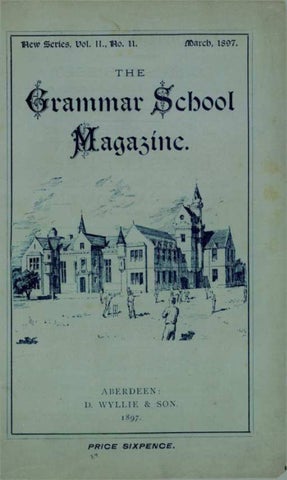
Marc!), 1597.
'Flew %cries, Vol. II., 14o. 11.
trammat
cboot
-,
-
-
ABERDEEN : D. WYLLIE & -SON. 1897.
PRICE SIXPENCE.
EDUCATIONAL BOOKS. JAMES G. BISSET Continues to supply all the CL.1SS BOOKS (new or second-hand) suited for the Requirements of the higher Educational Institutions in the City, at the Lowest Prices
N.B.-Best value in STUDENTS' NOTE BOOKS.
JAMES G. HISSET, Classical, /natal', and Ebucational 76ool~sel[er,
85 BROAD STREET, Opposite Marischal College.
PIANOFORTES, HARMONIUMS, AND ORGANS. •
Sames
acBctli.
ILAS ALWAYS ON IL/CND A MAGNIFICENT A,SoRTMENT OF
qIWID PtI010P, corrAqc- ptApp, AND (IERIAAN 11ARXersilUtAg, For Sale or Hire on the Three Years System.
SECOND-HAND PIANOS, ORGANS, & HARMONIUMS ALWAYS IN STOCK, VERY CHEAP.
:Inspection requested of nip Stock before settling elsewhere.
Pianoforte and Music Saloon181 UNION STREET, ABERDEEN.
CONTENTS.
-
EDITORIAL NOTES THE F.P.'s DANCE -
89
-
-
-
NOTES ABOUT OLD BOYS THE WESTFIELD SCHOOL 'TIS A CENTURY AGO
-
91
-
94 96
-
100
AN INCIDENT OF THE FRANCO-GERMAN WAR THE HOPE OF THE JESUITS
90
-
-
THE MIDNIGHT WATCH -
-
-
-
VIVE L'AmouR
-
-
103
-
109
-
126
LITERARY CLUB AND DEBATING SOCIETY NOTES -
-
129
-
-
132
-
-
134
FOOTBALL NOTES IN MEMORIAM
-
-
-
-
THE
Ckaminar Scf?oot tilaga3ine. New Series, Vol. II.
MARCH, 1897.
No. 11.
EDITORIAL NOTES. OWING to the Bursary Competition, the Magazine has been issued sooner than it would have been. It is to be hoped that the number of contributions, from both present and former pupils, will increase so as to make the Magazine more interesting. A proposal by the Rector that members of the highest classes should be allowed to attend a voluntary class in Gymnastics at the Physical Training College has been sanctioned by the School Board. The class will be held at 10 A.M. on Saturdays. It is open to members of the Classical and Modern VII., VI., and V. An Assault-at-Arms and display of Musical Drill was held in the Trades Hall, as a benefit to Mr. Alexander Munro, our Gymnastic Instructor. Teams from the Aberdeen Gymnastic and Rowing Club, and Grammar, Ferryhill, and Ashley Schools, took part in the entertainment. The programme consisted of performances on the vaulting horse, parallel bar, horizontal bar, and table horse. We beg to acknowledge receipt of the following :— The Fettesian, the Dundee High School, and the Wallace Hall Academy Magazines. This number of the Wallace Hall Academy is the first we have received. The Rector begs to acknowledge with thanks the contribution of £1 for the Library from Mr Lyall Grant ; also " Rait's History of the University of Aberdeen," presented by the author, of New College, Oxford. 7
THE F.P.'s DANCE. There was an unwonted sound of revelry on the night of the 22nd of January, in the usually severe and learned Halls of the Town and County Buildings, for on that date we, the Members of the Former Pupils' Clubs of the School, held our annual Reunion. This, the third of such Reunions, was declared by all of us who were present to be the most successful of them all. Probably the place of meeting had something to do with such a sentiment, for in former years the Club was content with the School Hall or Palace Hotel, but this year, thanks to the efforts of our Committee, and especially our hard-working secretary, Mr. Alfred W. Edwards, it soared higher, and the result was just as one member expressed it—" Simply ripping." Pardon the vulgarity, kind reader! About 170 guests were present, and the only thing we regretted was that not more of the Masters were present. The whole buildings were beautifully decorated for the occasion by Messrs. Allan & Son. From the entrance hall, through the spacious vestibule, up the grand staircase to the Town and County Hall, which was used as the ball-room, were laid crimson carpets, flanked by dark•green pines, with here and there, in shady nooks, an arbour veiled discreetly from the vulgar eye. Mr. Thomas's band, embowered in graceful palms and treeferns, discoursed sweet music all the evening. All sorts of refreshments were to be had at an open buffet in the County Hall, and for the weaker members there were provided cigarettes, &c., down, down a winding stair, in an ideal "den," fitted up with comfortable saddle-bag chairs. Here old chums met again to recall the glorious What days when there were giants in the land. gory combats behind the venerable Domus Rotunda—our very Capitol, whose hoary tower, sky-pointing, profane hands would level with the ground ! (Absit omen). Where is now the gallant "snipe," who held the front gate with a few allies against the whole school during the violent snowstorm of 18— ? Where the doughty Reid (major), whose
The F.P.'s Dance.
91
gentle wit was ever wont to exasperate the lady of the acid temper (ever winged words of dire import did she utter!) when a football carefully aimed landed in her favourite bed of spring onions ? Has she joined the immortals ? Where the erst-while idol of the School, the dashing " Barrett" Harvey, he of the Grammar v. Gymnasium matches ? And what of dear old " Doddie "—" I beg your pardon ! Sets forming for the next Lancers!" Sed revocare gradum? And thus the merry hours sped on till nearly midnight, when supper was served in the stately Town-Hall, where many an F.P. beamed down on us from his place on the wall. Although no toasts were formally announced, yet several were pledged, and " all went merry as a marriage bell." The dance was then resumed for a couple of hours, till the cry of " Who goes home"? was heard, and then " alarums " and excursions and shouts for cabs. And so to bed. The Rector has much pleasure in acknowledging the gift of a portrait of John Ramsay, M.A. (F.P., 1807-1813), formerly Editor of Aberdeen Journal, a first proof copy of the engraving by Sir George Reid, P.R.S.A., presented by Alex. Walker, Esq., L.L.D. (F.P.), and also a bird's-eye view of Aberdeen in 1889, presented by Wm. Watt, Esq. (F.P.)
NOTES ABOUT OLD BOYS. THE Jenkyns Prize in Classical Philology at the University has been won by George F. Milne, who was Dux in 1894. The Dux of 1886, Anthony Mitchell, gained the prize in 1889. We regret to announce the death of Louis Lee, which took place on the homeward voyage, on board the vessel " Queen Elizabeth." He was of a very bright and intelligent disposition, and one who made many friends while at school. He attended the Grammar School from May, 1884, to September, 1892.
92
The Gran-two. School Magazine
Of Former Pupils recently deceased, one of the most prominent is Dr. Alexander Profeit, for twenty years the Queen's Commissioner on the Balmoral Estates, who died at Craig-Gowan, Balmoral, on January 27. The death has also been announced of Rev. Alexander Ferrier, another F.P., and brother of Professor Ferrier, of London. Mr. R. A. Profeit, who has been for the past two years Vice-Consul at Tunis, has been promoted to the ViceConsulate of the important Danubian port of Sulina. Mr. W. A. Hunter, LL.D., late M.P. for North Aberdeen, and one of the most distinguished Old Boys, has had a Civil List Pension of £200 a year conferred upon him by Mr. A. J. Balfour, First Lord of the Treasury. The breakdown of Dr. Hunter's health is widely regretted, and this recognition of his work in legislation and in legal education and the literature of law is universally appreciated as a graceful tribute from a political opponent. Father William Humphrey, S.J., from whose interesting autobiographical work the account of the ancient custom of " portering " (now more honoured in the breech than the observance), was reproduced in a former number of the Magazine, has added to his published works within the last few days an able treatise in Roman Catholic theology. We imagine there are but few of our Old Boys—mighty ones though they be—who are in the habit of hob-nobbing with royalty. Such, however, is the lot that has befallen one of ours, Mr. Cuthbert Williamson, to wit, who set out two years ago to seek his fortune in the land of Oom Paul. If you disembark at the wretched Portuguese town of Lourenco Marques, on the south-east coast of Africa, and transport yourself thence due west by bullock-waggon for a fortnight, you will, if you survive, arrive in the dominions of his dusky Majesty of Swaziland. His Majesty is a
Notes about Old Boys.
93
sturdy youth of but seventeen years, and maintains his dignity right well, with a knob-kerry for sceptre, a string of beads for the collar of the Garter, and a what-do-youcall-it l a frill, let us say, for royal robes. Well, on Christmas day, Mr. Williamson was dining with his friends at a place called Ezulweui, and according to his letter :— " The King, who had been out hunting, came in just as we had sat down, and nothing would please him but to sit and watch us. He had a bottle and a half of champagne all to his own cheek, and he was so pleased with it that now he is always asking for it. The thing, however, that surprised him most was the pudding which was brought in with burning brandy. He could not make that out at all. After dinner he departed, and we finished the evening with songs and music. On the next day we went back to Bremersdorp, and played a cricket match, the B'dorp team opposing the Country Cousins. I am sorry to say the Country Cousins lost, but not by much. In the evening there was a concert, and a miserable fiasco it was. It was finished by a single-act comedy—" Ici on parle Francais "— but the only one who could act at all was the British Commissioner. The following day we all came home again, and for a time our horses went capitally, till when we were about half-way home we got caught in a thunderstorm— miles from any shelter. It wasn't particularly lively riding along on a slippery road expecting a spill every minute. I got home wet through and plastered with " dubs " from head to foot. . . . We had a curious case the other day of pride going before a fall. One of the chiefs was in our place one day, and was making himself very objectionable. He took good care to tell us that he was one of the principal men in the country, and had a lot of influence with the King, and so we must keep very chummy with him. Only three days after we heard that he had been " smelt out " by the witch-doctors, and that he had to fly over the border to save his skin All his cattle have been taken from him." . . . . We hope we shall hear from Mr. Williamson again, and when he gets this Magazine we shall expect him to deliver our compliments to His Majesty in
94
The Grammar School Magazine.
the hope of getting some contributions for our Museum. We might even make him a Vice-President of the F.P. Club. Another interesting item we have just had from Dr. Cruickshank of Buenos Ayres. He informs us that he spent his Christmas Day with four old Grammar fellows out there, and a grand time of it they seem to have had. Lieutenant J. H. M. Davie of the Royal Scots, who left the School in '85, has been engaged in making valuable surveys in the Chitral district, and had the honour of being specially mentioned in the Despatches. Mr. Irvine K. Reid of the Government Medical Service of British Guiana, had the honour of being presented to the Prince of Wales by the Earl of Selborne, at the Levee held at St. James' Palace on February 26. We regret to have to record the death of Mr. Donald Macdonald, Newtonmore, Inverness-shire, a pupil of the School during sessions 1889-91. He was president of the Debating Society during session 1890-91. Leaving the School with the highest reputation, particularly in classical studies, he proceeded to Edinburgh University, where his friends confidently predicted for him a brilliant academic career. His health, however, gave way, and he was compelled to resign his studies and return home. Latterly, inflammation of the lungs set in, and he passed away on the 23rd ult., to the deep regret of all who knew him. Mr. Alexander Anderson, of the Indian Civil Service, who left the School for the University in 1866, was made C.I.E. on 1st January.
THE WESTFIELD SCHOOL. our chronicle (vide No. 9, May, 1896), of the discussion which has raged on this question :— CONTINUING
The Westfield School.
95
In April, the Deputation appointed as a Committee by the Rosemount meeting, petitioned the Department against the proposal of the School Board majority. The Board appointed a Committee to draw up a reply. In June, a motion brought forward by Mr. Keir, President of the Trades Union Council, to abolish fees in Rosemount School was lost by the Chairman's casting vote. The Board's reply to the Department was dated July 10. The minority of the Board sent in a counter-statement, to which the Department in September requested an answer from the majority. In November, the Board resolved to proceed with the proposed school. In December, the Buildings Committee accepted contracts, and without waiting for the final approval of the Board, proceedings were commenced (in early January) by boarding-off the " debateable land," and beginning to excavate foundations. The opposition Committee thereupon petitioned the Town Council, as the patrons of the School and original holders of the property, to intervene. Their memorial was remitted " with powers " to the Bills and Law Committee, which, with only one dissentient, resolved to request the Board to cease operations ; otherwise an action for interdict would be commenced in the Court of Session. As the Board's reply claimed lawful powers, the Bills and Law Committee intimated that they had lodged the action, the text of which was published on February 1. A motion in the Town Council (by Mr. James Gray, cabman) to withdraw from the proceedings was lost by 26 to 3 votes. Under these circumstances, the Board's plans, lodged with the Town Council for approval, were not considered within the statutory one month, and the Board claimed, in consequence, a right to proceed as though the plans had been approved. The Board resolved to defend the action. Their reply is due on March 26. Meantime, operations have been delayed until the opinion of Counsel has been obtained as to whether the Board may proceed with the building without prejudice to the case in the Court of Session. It seems likely that before the action has run its course,
96
The Grammar School Magazine.
the elections, to be held on April 15, will have given the Town a new Board. But whatever may be the result of the elections, in which this question is likely to take a prominent place, it is desirable that the law should take its course, and pronounce authoritatively on the right of a School Board to alienate property from a secondary school in order to save the rates the cost of a site for an elementary school. Such side-issues as the need for a school in this or that locality, and the questionable advantages to be conferred on the Grammar School by the new building, will not affect the merits of the case in point of law. These are local questions of expediency for the ratepayers themselves to settle.
'TIS A CENTURY AGO. BEFORE me lies, emitting the odour of years, the second volume of The Aberdeen Magazine, or Universal Repository — the volume for 1797. Each monthly number of this periodical, which issued from the Netherkirkgate, is from fifty to sixty pages. The contents are varied. Taking the March number, we find the following :—" Life of John Elwes" ; " Tom Thumb's Epistle "; " Anecdotes of French Revolutionaries "; " Lapland and Laplanders" ; " How to bring Waste Land into Cultivation " ; " Derwent Priory, a novel in a series of letters" ; " On Silent Sorrow" ; " Albert, or the Village Curate " ; Review of a Book ; Poetry ; Mathematical Department; General News of the Month; Domestic Occurrences, i.e., Local News. Truly a motley collection ! It cannot be said that to us much of the matter is of more than antiquarian interest. Even the poetry is dull —whether pastoral, or patriotic, or reflective. In the January number we have the New Year's Ode, by H. J. Pye, Poet Laureate. Poor Pye ! "good at everything but poetry," he is forgotten (like his predecessor of 1697), even by some compilers of books of poetical extracts. What of
'Tie a Century Ago. his successor of 1897 ? are—
97
Pye's concluding lines in this ode
" Britons, strike home, revenge your country's wrongs, Fight, and record yourselves in Druids' songs."
In sentiment at least, this is superior to " Jameson's Ride" (or is it Raid ?) Far more interesting in the Aberdeen Magazine are the items of news, general and local. Events which we now read of as history, unfold themselves as they happened from month to month. The French attempt to land in Ireland—Jervis and Nelson win the great fight off Cape St. Vincent—Men are enrolling in town and country, under magistrates and landlords, to repel invaders—Coasters are captured or chased by French privateers—Sometimes privateers are taken—The seamen of the Navy are in mutiny—Admiral Duncan defeats the Dutch—and so on. Take an extract or two :— " We are happy to hear that the quota of men for the city of Aberdeen and parish of Old Machar is fully completed. They are fine spirited young fellows, many of them actual sailors, and all of them made choice of the Navy service." " Upwards of 800 of the Duke of Gordon's tenants and inhabitants of Huntly, have enrolled to serve as Volunteers, under His Grace the Marquis of Huntly." " ' The Bon-Accord,' Durham master, was captured by the ` Vengeur ' privateer, and sent for Dunkirk. Mr. Durham was six days on board the privateer." " On Wednesday evening a large brig went ashore on the bar. She proves to be the `Jenny' of North Shields, loaded with coals, which was taken off Flamborough Head by the ` Voltigeur,' privateer, of Calais. A prize-master and four men were put on board, but the vessel proving leaky, and a strong south-east gale, they made the first land they could, and ran her ashore here. On Thursday arrived the sloop ` Thorn' of Hull, which was also taken by the ‘ Voltigeur.' A prize-master and three men were put on board, but the vessel being leaky, they made for land, and got into Aberdeen. The nine Frenchmen, after being
98
The Grammar School Magazine.
examined before the Magistrates [Parlez-vous francais, Baillies ?], were put into confinement." These captures happened on the 1st and 3rd of April, and it is consoling to learn that on the 8th " the ' Voltigeur ' was taken four leagues off Flan►borough Head, by the ' Vestal ' frigate, and carried into Hull." As ever, truth is stranger than fiction. An extract from a letter by the mate of the merchant ship, " General Wolfe," informs us that the ship was taken by the " Gironde," French privateer. " All the crew," says the mate, " except myself, Sam Hassey, and a boy, were sent on board the privateer, and twelve Frenchmen sent to our ship. I have the pleasure to inform you that I re-captured her, not a man killed or wounded. I made the Frenchmen work the ship as before. The French captain I kept close confined, and on the 14th made the land. On the 18th, I sent the prisoners to Kinsale prison. I have the ship moored in safety at White Point, and am, Your humble servant, WILLIAM WELLSTOOD." One of the problems of the time was how most expeditiously to transport troops to any spot, if invaders landed. The farmers of Midlothian led the way in arranging a plan by which the farmers in every district agreed to convey troops in their carts. They were to manage to do from 40 to 80 miles a day. Nor do these martial items alone form a contrast to our quiet times. Murders and other acts of violence were quite common ; so, too, burglaries in Aberdeen, while highwaymen infested the outskirts of London. Lord Strathmore shot one of them on Finchley Common, " disguised in a Welsh wig, and having on a blue apron, resembling a butcher." The killing of the ruffian is called an " accident," and the verdict of the Coroner's Inquest was "Justifiable Homicide." Another highwayman is the highwayman of Romance. " A very gallant highway robbery was lately committed on Wimbledon Common, on a young married lady. After
(t (le Wary Ago. '
99
receiving her purse, the robber politely demanded an elegant ring. She said she would sooner part with her life. The hero of the turf rejoined, " Then, madam, allow me the honour to salute the fair hand, and I shall deem it a full equivalent." The kiss compensatory being received, the highwayman immediately thanked her, and galloped off, perfectly satisfied with the felicitous commutation." Hand-in-hand with murder and robbery goes duelling. We hear of a duel at Salisbury between Mr. Sawyer and Mr. Sutton. They disagreed as to whether Jacobinism and Republicanism were synonymous, and "agreed to decide the matter--not by common sense—but by broad swords. . . . Sutton received the first blow, but the os frontis being remarkably thick, it penetrated no farther than through the cutica. A dexterous stroke cut off the tip of Sawyer's ear. The blood now began to flow, at the sight of which both grew most desperate. Sawyer made a lunge at Sutton's heart, which he most dexterously avoided, by a sudden wheel to the right-about, so that he received in his back the thrust meant for his heart—but recovering his former position, he struck with such amazing force at his antagonist's sword, as to cut the guard and disarm him. He then desired the fallen hero to beg his life, which the other refusing, the conqueror said, `The life that's not worth asking is not worth taking,' and then, with an Achilles-like stride, marched off in triumph. Thus ended the bloody affair." From the so-called " Domestic Occurrences" we learn that the King's birthday and the Queen's were times of great rejoicing—volleys from the volunteers in Castle Street, Royal Salute from the Barracks, procession of the Incorporated Trades, Town Council Cake and Wine Banquet, general rejoicing. Postage to Banff, Peterhead, &c., was 4d. ; to Edinburgh, 6d. Frequently the death of some old lady of 102 or 109 is recorded. Of University news, besides the list of graduates, we may note the following items :— " Died on Saturday, at King's College, Professor Thomas Gordon, in the 83rd year of his age, who, for a period of 60
100
The Grammar School 31«g«zive.
years, had creditably discharged the duties of his office." (He was appointed Humanist in 1739.) " Last Monday was held in the Marischal College the annual competition in the Greek Class for the Silver Pen, given by the Right Hon. Earl of Buchan. The exercise prescribed was a version from the Greek into Latin and English, which several performed very much to the satisfaction of the Professors, who adjudged the prize to John Cumming." " The Trustees have adjudged the Blackwell Premium for the best discourse on The inseparable convection between Religion, Morality, and Learning, to Mr. William Duncan, one of the masters of the Grammar School." (Was this the dux of 1789 ?) To conclude, take this from the November number. " Married at Torry, on Tuesday, James Shepherd, Barber and Field Preacher, aged 20, to Miss Nelly Auld of Nigg, aged 77, three feet high, and deformed to the last degree of contortion. Tho' the day was very stormy and rough, so great was the public curiosity that not only the ferry-boats, but the whale boats were employed great part of the day, conveying people across the river, to witness so very extraordinary nuptials." STRATHUGAN.
THE MIDNIGHT WATCH. PRIVATE JAMES MACDONALD, of the 2nd Battalion Gordon Highlanders, was no tyro in the perils of war. He had served under the burning skies of India, and he had plodded for many a weary mile over the snowy hills of Afghanistan. With dogged resolution he and his comrades had driven their treacherous foes from pillar to post. At the present moment they were hungry and weary and shoeless. Private MacDonald had his full share of the miseries of the time. His face was no longer fair and comely, it was scarred, war-worn, and stern. The roguish twinkle seldom
The Midnight Watch.
101
filled his eye ; it was eagle now and steady, although in these hard days it was often musive as he dreamt of his dear ones beyond the sea. He had long shaken hands with fear, this gaunt and sinewy soldier, yet to-night he felt uneasy, somehow. The storm raged round about him, the fierce wind howled, and the snow fell pitiless as death, while he kept watch upon the bleak hillside. That had often been so before, he knew it must often be so again, and why was his mind so ill at ease ? He could not tell ; but he was nervous—say, rather, tremulous. He fancied often he caught the tramp of hostile feet. His heart beat fast ; with straining ears he brought his rifle to the ready. He remembered that the Afghans had been seen on all the neighbouring hills that day. But the wind shrieked high, and the wind wailed low, and nothing disturbed the wary sentinel. Perhaps the sough of the elemental war broke a chord in the heart of the exiled Scot. He had often heard it so in the glens of his native land. Perhaps it recalled dear scenes there for his mental vision roved over its hills, and by its streams, and threaded its wild woods. He was again in far-off Scotland. Hark ! What was that ? Scotland, like a lovely dream, faded away. A stealthy, muffled sound ! He gripped his gun ! He bent forward to catch the faintest sound. Again ! nearer, quicker than before. Wild beasts were approaching —yes, Afghan men ! He sprang erect with his rifle at the shoulder. His finger sought the trigger, and three shaggy figures bounded from the gloom. He saw the gleam of the terrible Afghan knife. He was alone with his deadly peril. For a second his eye glanced along the cold steel barrel. A spiteful blaze leapt into the night; a determined crash echoed above the hills, and one fierce heart was still for ever. There was no reloading. Like hounds the others dashed upon him. The odds were terrible. Was he afraid ? —Not he. A hot surge of fury swept over him. He would resist to the death. With a swift lunge he sprang at the second. A ghastly scream—a wild cry of mortal agony rose above the wind, as the British bayonet tore through his heart. It was a thrust no human hand could parry,
102
The GPI In Iwo. School Magaziwe.
but it, too, was successful. Such was its resistless impetuosity that the wretch's body was hurled forward ten feet, still transfixed by the bayonet. The third dashed at him. With a vicious wrench and a kick at the dead man, he recovered his weapon—too late. The heavy knife flashed, and with a horrid thud it came down upon the hand he raised instinctively above his head. His life was saved, but his right hand was almost severed in two. His extremity was desperate, and he was exhausted, faint, and dizzy. With a terrible effort he crushed back the mists that gathered before his eyes, and presented front to his enemy. His right hand was useless. He slipped the butt of his rifle under his arm, and pressed it fast. He knew the struggle would be short, he felt it. His ears sang, and he trembled lest he should succumb at any moment. He thrust at his nimble antagonist. He missed, and for the first time a pang of despair smote his heart. He tried again—worse than vainly ; for ere he could recover, he felt a stinging sensation on his head, and instantly a warm stream trickled down his face. He reeled and swayed, and felt that his hour was come. His foe smiled in triumph, showing his cruel teeth, and his wicked eyes gleamed. But that smile cost him his life. Even as he paused the desperate Highlander saw his last hope. Clenching his teeth, with a supreme bid for dear life, he rallied his ebbing strength, and dashed at his unwary foe. A gurgling sob and a heavy fall told that his steel had sped. At the same moment the senses of the soldier reeled, swayed, and plunged into oblivion, and he sank upon the body of the dead as his comrades came panting to his aid. Tenderly they bore him to the camp, and generous was the tribute paid to his valour by his beloved commander, brave General Roberts. J. C. M.
AN INCIDENT OF THE FRANCO-GERMAN WAR. (FROM THE FRENCH OF G. DE MAUPASSANT.) •
I. I HAD not revisited Virelogne for fifteen years. My friend Serval had a shooting-box in the neighbourhood, which had been destroyed by the Prussians during the war, but which had now been rebuilt. With the beginning of the shooting season came a hearty invitation from him to shoot over his preserves, which I as promptly and as heartily accepted. On the morning after my arrival, I was striding along on the look-out for anything that might be put up by the two dogs in front of me, while Serval, about 100 yards to my right, was working through a field of clover. Suddenly on rounding the corner of a wood, I saw before me a cottage in ruins. Was this the pretty little house I remembered seeing last in 1869, vine-clad, with fowls before the door. I remembered, also, how a kind soul inside that cottage had given me a bowl of milk one terribly hot day, and that Serval had afterwards told me the story of its inmates. The father, an old poacher, had been shot down by the rangers. The son, whom I had seen once, was a tall, lanky fellow, credited also with being extremely fond of game. They were called the Savages. Whether that was their name or their nick-name I do not know. At the sight of the ruined house, I called to Serval, who came up with his long heather step. I asked him what had become of the people, and he told me this story. II. When the war was declared, young Savage, at that time 38 years of age, enlisted, leaving his mother alone at home. The old woman did not need any pity, they said, for everybody knew that she had money. She stayed then all alone in this house on the edge of 8
104
The Grammar School Magazine.
the wood, and a considerable distance from the village. However, she was not afraid, being made of the same stuff as her husband and her son, a hardy old woman, tall and thin, not often laughing, and certainly not a person to be laughed at. As a matter of fact, the women of the labouring class rarely laugh. That is a pleasure confined to the men. The women are sad and worn, with little in their lives to encourage them to brightness or hope or laughter. The man may learn some noisy mirth in the public-house, but his companion remains serious, with features stern and unsmiling. The muscles of her face have not learnt how to laugh. Mother Savage passed her life as usual in her hut, which was soon covered by the snow. She went to the village once a week for bread and a little meat. For fear of the wolves, which were said to be out, she carried the gun on her back, her son's rusty gun, with its stock polished and worn by the hand; and she was a curious sight, Mother Savage, stooping a little as she strode slowly over the snow, with the barrel of the gun showing above the black hood that confined her grey hair. One day the Prussians arrived. They were distributed among the inhabitants according to their resources. The old woman, who was known to be rich, got four of them as her share. They were four big fellows, with fair beards and blue eyes, and had not lost flesh in spite of the hardships they had already gone through. To their credit they behaved themselves though in a conquered country. Alone with this old woman, they showed her every attention, relieving her as far as they could from work and expense. All the four were seen every morning washing themselves at the pump beside the house, while Mother Savage went backwards and forwards getting ready the breakfast. Then one might have seen them sweeping the kitchen, cutting wood, shelling peas, washing linen, doing everything about the house like four good boys around their mother. But the old woman thought always of her own boy, her big boy with the hook nose, the brown eyes, and the big
An Incident of the Franco-German War.
105
moustache. She asked every day each of the soldiers who had planted themselves at her fireside: " Do you know where the French Twenty-third has gone to? My boy is in it." They replied that they (lid not know, and realizing doubtless her pain and anxiety, those who had mothers far away did her many a kind turn. She was fond of them, too, her four enemies ; for the peasants have little notion of national hate; they leave that to their betters. Poor folks, who pay most just because they are poor, who are killed in masses, and make the real cannon's meat because they are most numerous—in a word, those who suffer most cruelly from the frightful miseries of war, because they are feeblest, and offer least resistance—what do they know about warlike ardour, point of honour, and political combinations, which exhaust in six months two nation -, the victorious as well as the vanquished ? They said in the country-side, when speaking of Mother Savage's Germans : these four anyhow have fallen on their feet. Now, one morning, when she was alone in the house, she saw the postman approaching. He handed her a folded paper, and with the aid of the glasses she used for sewing, she read— DEAR MADAM, I send you sad news. Your son Victor was killed yesterday by a cannon ball, which cut him in two. I was quite near as we marched side by side in the same company, and he had often asked me to send you word in case of any harm befalling him. I took his watch from his pocket, and I shall bring it to you when the war is finished. Accept my sincere regrets, and believe me, Yours faithfully, CESAIRE DIVOT (Soldat de 2e classe au 23° de marche.)
The letter was dated three weeks back. She did not weep. She remained motionless, so overcome and stupefied that she scarcely suffered as yet. She thought: "There's Victor gone now." Then gradually
106
The Grammar School Magazine.
tears filled her eyes and grief her heart. Terrible, torturing ideas came into her mind one by one. She would never kiss him again, her child: her big boy I The rangers had killed the father, the Prussians had killed the son. He had been cut in two by a cannon ball. And she seemed to see the whole horror of the thing : the head falling forward, the eyes staring, while he gnawed the end of his big moustache, as he used to do when he was angry. What had they done afterwards with his body ? If only they had given her back her boy, as they had given her back her husband with the bullet mark in the centre of his forehead. But she heard a sound of voices. It was the Prussians returning from the village. She hid the letter hastily in her pocket, and welcomed them calmly, with her usual expression. She had had time to dry her eyes. All four were laughing with delight at having brought with them a fine rabbit, and they indicated by signs to the old woman that they were going to have something nice to eat. She at once set about preparing breakfast ; but when it came to killing the rabbit, her heart failed her. It was not the first by any means. One of the soldiers struck it behind the ear with his fist and killed it. When the creature was once dead, she soon skinned it; but the sight of the blood which covered her hands, the warm blood which she felt growing cold and coagulating, made her shake from head to foot : and again she saw her big boy cut in two. She sat down at table with the Prussians, but she could not eat, not even a mouthful, and they devoured the rabbit without paying any attention to her. Mother Savage watched them out of the corner of her eye, saying nothing, but maturing an idea, and with a face so wanting in expression, that they suspected nothing. All at once she said, "I don't even know your names, and we have been together more than a month." They gathered what she meant with some difficulty, and told her their names. That was not enough : she made them write
An Incident of the Franco-German War.
107
their names for her on a bit of paper, and placing her spectacles on her big nose, she examined the strange writing, then she folded the paper and put it in her pocket, above the letter which told her of the death of her son. When the meal was finished, she said to the men, " I am going to do something for you," and, to their amazement, she proceeded to carry bundles of hay into the barn where they slept. They could not understand what she meant till she explained that they would not feel the cold so much, and then they gave her a hand. They piled wisp upon wisp up to the thatched roof, and in that way formed for themselves a large bedroom with four walls of warm and sweetsmelling hay, where they would sleep like tops. At dinner, one of the soldiers anxiously asked why Mother Savage ate nothing, and she re-assured him by saying that she was a little out of sorts. Then she lighted a good fire to warm herself, and the four Germans climbed up to the hay loft by means of the ladder that they used for the purpose. The moment the trap-door was closed, the old woman took away the ladder, then opened noiselessly the outside door, and brought in armful after armful of straw, with which she covered her kitchen. She went barefooted in the snow, and so quietly, that no one heard the slightest sound. Now and then she stood still, listening to the heavy breathing of the four sleeping soldiers. When she considered her preparations sufficient, she threw some straw into the fire, and when it took fire she scattered it over the rest, and then went out and watched. The sudden blaze illuminated in an instant the whole interior of the house, then it became a frightful flaring furnace, of which the flashes spurted through the narrow window, and cast a bright ray over the snow. From the roof of the house there came a loud cry of astonishment, then shrieks of pain, anguished and terrorstricken appeals for help. Then the trap-door, communicating with the kitchen, having given way, a gust of flame and smoke filled the loft, pierced the thatched roof, mounted
108
The Grammar School Magazine.
into the sky like a torch, and in a moment the whole house was in a blaze. Nothing was heard but the crackling of the tire, the rending of the walls and the falling of beams. The roof suddenly sank down, and from the fiery ruin there spread into the air myriads of sparks. The white country side, lighted up by the fire, shone like a white sheet tinged with red. A bell in the distance began to ring. The old woman still stood before her ruined house, armed with her gun, her son's gun, lest one of the men should escape. When she saw that all was over, she threw her gun into the furnace. On reaching the scene, some peasants and Prussians found the woman seated on the trunk of a tree quiet and . satisfied. A German officer, who spoke French like a native, asked her where her soldiers were, and, stretching Out her lean arm towards the smouldering ruin, she cried, "Inside there." A crowd had formed by this time round her, and to the Prussian's next question, " How did the fire begin ? " she answered, so that all might hear, " It was I that did it!" At first no one believed her, for they thought that the suddenness of the disaster had turned her brain. Then, while every one crowded round and listened, she told the whole thing from beginning to end, from the arrival of the letter to the last cry of the men burning with her house. She did not omit a single detail of what she had experienced, or of what she had done. When she had ended, she took from her pocket two papers, and in order to distinguish them from one another, she put on her spectacles, and, reading by the last gleams of the fire, she said, "This one here is Victor's death." Showing the other, she added, indicating the ruins by a nod, " This here is their names, so that you may write home about them." Quietly holding out the paper to the officer, she resumed, " You will write how it happened, and you will tell their parents that it was I that did it ! Don't forget."
An Incident of the Franco-German War.
109
The officer gave an order in German. She was seized and flung against the still hot walls of her house. Then twelve men placed themselves in line at a distance of 20 yards. She did not move. She had understood. She waited. An order rang out, followed by a volley. One shot after the other showed that some one had been unprepared for the hurried order. The old woman did not fall forward. She sank down, as if her legs had been cut from below her. The Prussian officer approached. She was almost cut in two, and in her clenched hand she held her letter bathed in blood. I thought of the mothers of the four kind-hearted fellows burned theme, and of the ghastly heroism of that other mother, shot in front of that wall. And I picked up a small stone, still blackened by the fire. . . .
THE HOPE OF THE JESUITS. AUTUMN was now fast coming to a close, and the road to Paris was covered with leaves. On either side waved the trees, whose dark shadows, lengthened by the position of the moon, made the place look more dangerous. The sky was covered with a scaly kind of clouds, and oftentimes the moon was hid from view. This road lay over the Hill of Metz, and from the top one could see that fair city built on both sides of the river Mosel, and further on to the east was the plain on which Louis XV.'s mighty army lay encamped. There was one solitary traveller on the road. His garb betokened the occupation of a labourer, but his walk seemed too measured and stately. On he went, staff in hand, never looking back. When just about to turn a corner, near the bridge which spans the little stream of S3ille, he met with a fellow-traveller. The newcomer was
110
The Grammar School Magazine.
in -.a more destitute condition, and seemed to totter along
rather than walk. Now and then he stopped and commenced a series of racking coughs, which showed that the road to Metz was no fit place for him at such an hour. His personal appearance was not remarkable, save for shaggy eyebrows and a black bushy beard that stretched well down his chest. His eyes had a strange glitter, but that might be caused by the moon, which shone into his face. The two travellers would have passed each other without a word, had not the elder man bound for Metz seized a branch of a mulberry tree that drooped over the side path. He shook it vigorously. The younger and first of our acquaintance walked to the other, wbo slowly, as if unconsciously, turned round a ring on his finger, and let the light flash on the emerald. " Father? General ? " said the young man, sinking on one knee, and making a low obeisance. " Hush, my child I have you not learned -prudence yet ? The very trees in this accursed place have ears," said the general of the Jesuits, looking attentively at the trees on both sides. " I did forget, but, believe me, my want of prudence was caused more through surprise than through negligence. But what has brought you here, when I thought you to be laid up in Paris ? " " So I was, my child, but the work handed down to me by the Blessed Ignatius, father of our order, brooked no delay through personal convenience. Remember, my child, that in all occasions, at all times, you keep before you the blessed motto of our order, ' Ad majorem Dei gloriam.' " The younger man bent his head, and seemed to be pondering on these words, for he kept silence. The two proceeded back to Metz. "My son, where is that inn you mentioned in your despatches ? " said Father Ricci, the General. " We shall soon be at it, Father, and I have much to tell you " I trust you have been diligent and wary." " I have tried to follow out your commands to the best
The Hope of the Jemits.
111
of --my ability, and, as far as I can see, there is no suspicion of my presence in the King's camp." The two at last arrived at the inn, and contrary to what one might expect, they were at once admitted. The keeper of the inn had not been forewarned in vain of the probable arrival of a high Jesuit functionary from Paris. The young Jesuit priest, by name Father De Bernis, led the way to an apartment at the top of the building. The General followed, but notwithstanding his years, his step was even lighter than his companion's. Having entered the room, Father Ricci motioned to the landlord to depart, with a warning to keep all things secret. The gleam of his eyes as he said so was quite sufficient to ensure compliance to his order. Father De Bernis sank on his knees and requested a blessing. Father Ricci bent over him with outstretched hands. The gentle look of his eyes was a striking contrast to their former appearance. " My son, work for God always, looking not backward, but pressing towards the mark of the prize of the high calling in Jesus Christ." These solemn words produced a marvellous effect, and it would have been hard to believe that these mild-looking Jesuits were the two arch-plotters of the century. Father De Bernis rose and took a seat assigned him by the General. " Commence." Father De Bernis began—" You knew that for some time past Louis XV. has been very ill." The General signified assent. " Three days ago he had a bad turn, and was like unto .death." The General started violently, but immediately recovered himself. " Proceed." " Last night he called to the Bishop of Soissons, his confessor, and asked him to give absolution, as he thought his end was near. ' My Lord,' said the Bishop, in his
112
The Grammar School Magazine.
gravest tones, `thou canst never enter heaven without putting away on earth thy mistress, the Duchess De Chatareaux, and devoting thyself for the brief space of life left thee to the Queen.' At this the King was very much terrified, knowing full well the terrible sins of his youth and early manhood. He implored. He wept. The Bishop was obdurate. The King gave the orders to have her expelled from his person, and the Bishop ordered her out of the camp." " Ha ! what sayest thou ? " " It is true, Father." The General remained for a time wrapt in deep thought ; then he got up and paced the narrow room. His breathing was short and quick. Sometimes he coughed. " Hast thou anything more to tell ? " " Plenty, Father, but everything seems to go against us." "Not so, for if Heaven be for us who can stand against ? " • Father De Bernis began again. " The Bishop of Soissons, with the Queen's assent, gave secret orders that the Duchess was to be conveyed to the Bastille." Oh God !" said the General, and his low plaintive cry came from a heart torn by conflicting emotions. " Where is she at present ? " inquired the General in eager tones. " The Duke De Richelieu holds her. The Queen, in the King's name, has assigned him the unpleasant duty of conveying the Duchess to the prison." Father Ricci commenced to think again, bending down and resting his elbows upon his knees, his head between his hands. He stretched himself up, and with quivering forefinger drove each sentence home. " The Duke De Richelieu is a Jesuit of the Short Robe, We command him for he knows our power. Richelieu commands the Duchess De Chatareaux. The Duchess commands the King. Whatever happens, we must keep hold of the King's confidence, for if we lose it for long then ." Here he broke off and relapsed into at last we shall silence. A few minutes passed.
The Hope of the Jesuits.
111
of my ability, and, as far as I can see, there is no suspicion of my presence in the King's camp." The two at last arrived at the inn, and contrary to what one might expect, they were at once admitted. The keeper of the inn had not been forewarned in vain of the probable arrival of a high Jesuit functionary from Paris. The young Jesuit priest, by name Father De Bernie, led the way to an apartment at the top of the building. The General followed, but notwithstanding his years, his step was even lighter than his companion's. Having entered the room, Father Ricci motioned to the landlord to depart, with a warning to keep all things secret. The gleam of his eyes as he said so was quite sufficient to ensure compliance to his order. Father De Bernis sank on his knees and requested a blessing. Father Ricci bent over him with outstretched hands. The gentle look of his eyes was a striking contrast to their former appearance. " My son, work for God always, looking not backward, but pressing towards the mark of the prize of the high calling in Jesus Christ." These solemn words produced a marvellous effect, and it would have been hard to believe that these mild-looking Jesuits were the two arch-plotters of the century. Father De Bernis rose and took a seat assigned him by the General. " Commence." Father De Bernis began—" You knew that for some time past Louis XV. has been very ill." The General signified assent. " Three days ago he had a bad turn, and was like unto death." The General started violently, but immediately recovered himself. " Proceed." " Last night he called to the Bishop of Soissons, his confessor, and asked him to give absolution, as he thought his end was near. ' My Lord,' said the Bishop, in his
112
The Grammar School Magazine.
gravest tones, 'thou canst never enter heaven without putting away on earth thy mistress, the Duchess De Chatareaux, and devoting thyself for the brief space of life left thee to the Queen.' At this the King was very much terrified, knowing full well the terrible sins of his youth and early manhood. He implored. He wept. The Bishop was obdurate. The King gave the orders to have her expelled from his person, and the Bishop ordered her out of the camp." " Ha ! what sayest thou ? " " It is true, Father." The General remained for a time wrapt in deep thought; then he got up and paced the narrow room. His breathing was short and quick. Sometimes he coughed. " Hast thou anything more to tell ? " " Plenty, Father, but everything seems to go against us." "Not so, for if Heaven be for us who can stand against ? " • Father De Bernis began again. " The Bishop of Soissons, with the Queen's assent, gave secret orders that the Duchess was to be conveyed to the Bastille." " Oh God ! " said the General, and his low plaintive cry came from a heart torn by conflicting emotions. " Where is she at present ? " inquired the General in eager tones. " The Duke De Richelieu holds her. The Queen, in the King's name, has assigned him the unpleasant duty of conveying the Duchess to the prison." Father Ricci commenced to think again, bending down and resting his elbows upon his knees, his head between his hands. He stretched himself up, and with quivering forefinger drove each sentence home. " The Duke De Richelieu is a Jesuit of the Short Robe. We command him for he knows our power. Richelieu commands the Duchess De Chatareaux. The Duchess commands the King. Whatever happens, we must keep hold of the King's confidence, for if we lose it for long then ." Here he broke off and relapsed into at last we shall silence. A few minutes passed.
The Hope of the Jesuits.
113
The General rose quivering with excitement, and shot a keen glance at his companion opposite. " My son," he said, " we are in perilous times. We are distrusted on every side, and if we lose the King's favour France is lost us." Now the General became calmer, but his eyes flashed with their old light. " De Bernis I thwart the Bishop's plans by every power thou canst find. The Duchess must never see the inside of the Bastille. Go to the King's stables. I will send you a message what to do. Farewell, my son, and God be with you." The General crossed himself. He rose and walked to the door. His old gait was assumed, and his racking cough sounded in the still air of the morning as he set out on the road to Metz. CHAPTER II.
"A messenger to see you from the King, my Lord Duke." " Bring him here," said the Duke De Richelieu going on with his writing at the table. The messenger entered. He was of medium size, and wore the uniform of the King's Guards. The scratch of the Duke's pen kept sounding monotonously. The messenger was getting impatient. Then he advanced stealthily to the Duke's side. He touched the Duke on the arm, and swiftly made the sign of the cross on his arm. " Forgive me, Father," his whole manner changed. " Hush! keep quiet! call me Lieutenant. You are going to start at midnight for Paris. You are taking the Duchess De Chatareaux to the Bastille." The Duke started back, struck speechless with amazement. He drew a deep breath and stammered, " How—how— knowest thou that ? The Bishop of Soissons told me that between himself, the Queen and myself, no one knew of our intended departure, not to mention our destination. The King hardly knows what is wrong." The Jesuit Father looked up with a smile expressing self-satisfaction as well as confidence in his powers. " Ah,
114
The Grammar School Magazine.
Duke," he said, softly, tapping the heel of his boot with his sword, " you have a lot to learn." " I forgot," the Duke passed his hand wearily over his forehead and muttered, " there is no place on earth our order does not penetrate, no secret worth knowing but it knows." " Yes," replied the Jesuit, who had heard, " but no secret can be in better hands." The Duke nodded, and was about to reply, when the Jesuit motioned him to remain silent, and continued, " You ride with the Duchess in the coach. Two soldiers ride on either side ; the King's own coachman drives the coach." The Duke nodded, but evidently extremely anxious to know what was to follow. The Jesuit continued : " The two soldiers on either side are in our pay." The Duke looked up, but his look implied that nothing the Jesuit might say would surprise him now. He was prepared for everything. " But the King's coachman is not a Jesuit," said the Jesuit, in low measured tones. And then, " But the King's coachman shall drive no more." " Now, your orders, Duke. The General has not forgotten that you are a Jesuit." "I am proud to belong to such an order," replied the Duke. The Jesuit seemed pleased, and answered— " It is needless for me to tell you that the General's orders must be obeyed. You shall never drive the Duchess De Chatareaux to the Bastille. When you come to Paris " —the Jesuit stopped as if debating something in his mind —" drive—drive to the Paris Seminary of the Jesuits, and there the Duchess will remain for the present out of danger; and you, my lord Duke, will await there further orders from the General." "Stay, Lieutenant, can you tell me if the General is near at hand ? " At that question the Lieutenant or Jesuit looked from under his eyebrows, and suddenly slipped his ring round. The emerald flashed ; down on his knees sank the Duke De Richelieu before Father Ricci, General of the Jesuits.
The Hope 4 the jesifTh.
115
" Bless thy child, Father," murmured the Duke, without lifting his bent head. But the General was gone. CHAPTER III. The Duke De Richelieu was pacing up and down before his tent. Sometimes his broad shoulders heaved, and he seemed to drink in the cool and refreshing air. He peered into the darkness, looking for the approach of the coach to convey him to Paris. Dissatisfied with his ohaervations,.he turned his head, listening sideways, hoping to hear the rumbling of the coach. He continued his solitary pacing, and appeared to be brooding over his past. With a shrug of his shoulders he muttered : " Let what come, come. I have passed through many dangers, and shall not be beaten by this one. Besides the General has-----. Curse my orders, curse my ever having been in the Jesuit Seminary as a novice. What good is it my standing here thinking over that. I am a Jesuit whether I like it or not," and with that he turned on his heel and entered the tent. A figure, wrapped round in shawls, came silently to his side The face, though red with weeping, and the features pallid with suspense, still betokened that beauty for which the Duchess De Chatareaux was renowned. " Kinsman," she said, in her low sweet voice, like the warbling of a bird, " when comes the coach ? " " It ought not to be long, Cousin," answered the Duke, the fond expression of his eyes showing that he was still aware of her charms But, as he said so, his voice dropped, and was lost in a husky whisper. He felt that he was taking a poor unprotected woman into unknown dangers. He felt that the Duchess would now be held firmly in the clutches of the Jesuits, and, Jesuit though he was, he pitied her. At that moment the distant rumbling of the coach penetrated the tent. The Duchess burst into weeping, evidently thinking of her triumphal entry with the King
The Grammar School Magazine.
116
into Metz ; but now how different ! " Do not weep, lady," whispered the Duke, his heart touched by the melancholy sight. To his ears his words seemed to be false. " Tears do not become thy pretty eyes, my Cousin. We go to Paris. I will protect thee." The Duchess began to thank him in broken syllables, but the coach dashed up and drowned her voice. The Duke pressed her hand to his lips, buckled on his sword, and left the tent with the Duchess. The coach dashed forward. The Duchess was on the way to Paris. •
•
•
The Duchess sighs. tent.
•
•
The coach is passing the Royal
CHAPTER IV. Louis XV. was sauntering over the grass lawns of the Royal Gardens. The sun glared brilliantly, and the trees swayed to and fro in the breeze. The Bishop of Soissons accompanied him, and his ruffled countenance stood out in contrast to the smiling and almost boyish face of Louis. The King pushed his delicate white fingers through the curls that waved over his forehead, and laughed loud and long. " Your Majesty evidently thinks it a laughing matter," said the Bishop, looking with displeasure at the King's mirth. " You Churchmen really go too far. What was that nonsense about the Jesuits ? I suppose you will be asking me to give all my money to the church. Where will you stop, Father ? " " Your duty in the matter ought to be quite clear. You have one day to give an account of yourself and your acts at the throne of the Most High." " True, Father, true 1 But this is absurd. It takes my breath away." "Seeing your Majesty forgets to treat his spiritual adviser and zealous minister with respect — " " Stick to the spirits. Father, dost thou see that tree
The Hope of the Jesuits.
117
yonder ? It seems pretty, doesn't it ? Young, did you say? Oh ! humbug. But don't go away, Father," said the King, taking malicious pleasure in the discomfiture of the Bishop. " I need you to whisper into my ear words of guidance." The Bishop seemed mollified with this compliment, and commenced : " It is not much for you to do, your Majesty, and it will always count to your benefit in the hereafter." " You will do more masses for my soul if I oblige you in this," said the King, trying hard to stop his mirth. " Thou halt been too long over thy cups," said the Bishop, eyeing the King narrowly. " Ha ! who rides over there ? The Duke De Richelieu, is it ? Your eyes are better than mine." " It is, your Majesty," said the Bishop, fearful of an order to bring the Duke here. The Duke De Richelieu had kept away from the Court ever since the banishment of the Duchess De Chatareaux, and the Bishop of Soissons did not wish the King brought under the Duke's influence again. " Go to him, Bishop," said the King, anticipating the Bishop's thoughts. " But, your Majesty, we were discussing important business material to the welfare of the State." " Father, you have my orders, go. I am still King of France, and by our Blessed Patron Saint, you will lose your place in our councils if you do not at once obey our orders," said the King, with a slight suspicion of mock sternness in his voice, and secretly overjoyed at getting rid of the Bishop of Soissons so easily. The Bishop went off to do his master's bidding, and soon returned with the Duke De Richelieu. " You can go, Bishop. I think I hear the bells sounding. Is it not time you consulted your Breviary ? I think you are a little musty over your Latin," and the merry monarch laughed as the Bishop moved sulkily off. " Duke, you have kept away from our Court for long." " Your Majesty, that was not my fault," said the Duke, giving evidence of his proud individuality by the tone of his voice.
118
The Grammar School Magazive.
"Duke, come nearer. What did you do with the Duchess De Chatareaux ? " The King's voice broke with a tremor as he mentioned his late favourite's name. Evidently memories of the happy past still preyed upon him. "Your Majesty, I have erred but am prepared to answer for my disobedience. I could not believe you could treat the Duchess so. She still lives," said the Duke, in a quavering voice, expecting the King to fly into a fury, as was his wont when confronted by a disobedient servant. The King's manner changed. He seemed to brood over the wrong he had done her. Visions of her fair form came up before him, while hot tears dimmed his eyes. " Duke, you have done well. Tell me, did she think wrong of me over that ?" "No, your Majesty, she has always considered it to be the Bishop of Soissons' fault." " True, true, I would not have done it, had it not been —. Duke," he said, laying his hand affectionately on the Duke's shoulder, " Is it possible for me to see her to tell her I- I—meant no harm ?" "Yes, your Majesty, and you will be undoing a great wrong to me at the same time. I fell with her," answered the Duke, eagerly, delighted at the turn affairs had. taken. " Duke, you will arrange about the meeting, and afterwards we will make short work of the Bishop of Soissons. Now, go, tell no one of our meeting. Do all secretly, and rest assured Louis of France knows how to reward your services. The Duke bowed and left the King. The King moved slowly to his palace, but was met by the Bishop. " No, no, Bishop, I can't see about that matter now, I have my duty to my Heavenly Master. We will see about it again." The Bishop was baffled. CHAPTER V.
The Duchess De Chatareaux's house was at the outskirts of Paris. The foot of the gardens reached to the River
The Hope of the Jesuits.
119
Seine. The house was of ancient build, and its whole aspect proved that the occupant led a secluded life. The Master of her Household stood at the foot of the gardens, waiting for a boat that was being rowed towards him, and at which he kept waving his hands impatiently. Soon the boat came alongside, and the Master of the Household addressed the other. " You are rather late, Father. You will have to be quick. The message arrived last night." "Be more guarded, my son, in your language, and remember I am no longer a Jesuit, but your new assistant." " I will remember, but this matter is not trifling, and I fear discovery." "Never fear; there is someone who can protect you in your good work." " You said a message has come." "Yes, from the Duke De Richelieu. As far as I can learn; the Duke writes that Louis will probably arrive in the course of two days." " Good ; now we will go in together. Remember, I am your new assistant." " Yes." The two walked slowly from the river's bank, and crossed the lawn at the back of the house. When they entered, the Master of the Household motioned to a servant. " Henri, show him to his room," pointing to the Jesuit. He followed Henri to the top of the building. The Jesuit entered and closed the door behind him, telling Henri that he was going to set his clothes right and put his trunk in order. The Jesuit then felt in his breast and produced a small paper, which he laid before him. On it were written these words— A.M.D.G. To Father De Bernis, Son,—Introduce yourself into the Duchess De Chatareaux's household. You will be taken in as assistant to the Master of the Household who is in our pay. Note 9
120
The Grammar School Magazine.
everything that is going on, and be ready to report to me at one o'clock each night. You will find me with a boat on Ricci. the Seine. Farewell. "That is plain enough," muttered the Jesuit, reading the paper over again, then burning it slowly at the fire, which roared in one corner of the room. "I'll better be seeing about myself at once," he continued, then, treading stealthily to the door, he softly closed it, and stepped into the passage. He glided down the stairs, now stopping to listen, then proceeding. He passed through several rooms in this way, and was walking along, when the Master of the Hon ehold rushed up. He nodded to him and pointed to a missive he held in his hand, gesticulating wildly to the Jesuit to follow. The Jesuit followed. His companion proceeded to the Duchess De Chatareaux's special chamber, and entered, leaving the Jesuit outside. After a few minutes, he came out again, saying in a whisper, " That is the final message. Louis comes to-morrow. Step in here and listen, I am going to fetch Father Borgia, her confessor." He touched a button on the wall, and a panel flew open. The Jesuit entered the secret chamber, and the door closed over him. He began to feel about. He found that he was in an apartment without any window, and no outlet save the ventilator. The walls were of iron, and on the side nearest the Duchess's room, the wall was perforated. The outside of it was woodwork. The room was thus well adapted to hearing anything said in the Duchess's apartment. Soon he heard a slow, methodical step come along. It was the confessor. He knocked at the Duchess's door. The Jesuit in the secret chamber listened with his ear to the partition which separated them. "Come in, Father," said a sweet voice, but with just a slight ring of sadness about it. " God bless you, my daughter. You have received a message from His Majesty, Louis ?" " Yes, Father, here it is." After some time, during which, doubtless, her confessor read the message, he replied :
The Hope of the Jesuits.
121
" Daughter, you have every chance to do good work for our Holy Church." The Jesuit in the secret apartment started. " Listen, daughter, you have expressed contrition for your past faults. After you had done penance for some time, I gave you absolution. Now, you can show your true love for the Church, and our blessed Father, the Pope." " How can I, Father ? Tell me, and I will do it," said the Duchess, in impulsive tones. " With the help of God, you mean, daughter," said Father Borgia, reprovingly, but continued, " you have been up to the present time the tool of the Jesuits." The Duchess murmured sadly, " True." " But now, my daughter, the Pope orders you to use your influence with the King against them. The King will grant you anything you care to ask." " Are you sure of that, Father ? " " Certain, my child, now hear this. Our blessed Father, the Pope, has for long been trying to counteract the influence of Jesuitism in France. He has been perfectly aware that the Jesuits breed dissension, and sow the seeds of heresy. They are a corrupt set of men who have lost sight of the blessed command of Christ given to St. Peter. They long for money and political position, and no longer do they acknowledge the Pope to be their true head and father of the Holy Roman Church. My daughter, you must tell the King to banish them from France. His Majesty has been entertaining such thoughts. You must tell him how they have wronged you." " But they have not, Father," remonstrated the Duchess. " Yes, my child, they have. They have led one of God's children astray. They have been the cause of all your misfortunes. I trust, my daughter, you will not let slip this golden opportunity. Once the Jesuits are out of France, the Church will prosper more abundantly." " I will do as you tell me, Father. I owe all my present happiness to you. I will tell the King to banish them. I will ask him for my sake to return to his wife, the Queen, whom I have cruelly wronged. I will tell him to look for
122
The Grammar School Magazine.
guidance in the future to God and the right ; to beware of the Jesuits. God knows what I have suffered through them. I had forgotten, Father, for in my present happiness I would fain forget the past." " You have resolved nobly, my child. But, hark ! what is that rumbling behind the wall ?" " All are true to me in this household." " No one has heard us, daughter ? " " None." " Farewell, my child." "Father, remember me in thy prayers at Mass to night." " I will, my child." The Jesuit in the secret chamber heard the confessor depart. Then he turned his thoughts to getting out. He pressed all round the walls. There was no secret spring to make the partition fly back as before. With trembling hands the Jesuit felt each part. He began to think—Could the Master of the Household have trapped him ? Had it been a plot to get him out of the road ? Was he to starve in a hole while the future of the Jesuits was imperilled ? If Madame De Chatareaux carried out her promise to her confessor, the King would grant her anything. Was he to be held all night, and released after the order for the expulsion of the Jesuits from France had been signed ? He could not burst through iron walls. The ventilator was too small. He thought of all his past labours ; the meeting at Metz with the General ; the drive from Metz to Paris, conveying the Duchess out of danger; the plotting with the Duke De Richelieu. To what end ? That the Jesuits might regain their position in the King's favour through the Duchess, but now, through their negligence, her confessor had used his influence against them. The Duchess had become a true Catholic, and was about to defeat the object of the whole plotting. He thought of Father Ricci. Might he die in this hole sooner than meet him ! He thought of the General's awful tones, saying " I trusted you. Why did you allow yourself to be trapped in that hole ? Speak !" Here he was, shut off from help, while his beloved order
122
The Grammar School Magazille.
guidance in the future to God and the right ; to beware of the Jesuits. God knows what I have suffered through them. I had forgotten, Father, for in my present happiness I would fain forget the past." " You have resolved nobly, my child. But, hark ! what is that rumbling behind the wall ?" " All are true to me in this household." " No one has heard us, daughter ? " " None." " Farewell, my child." "Father, remember me in thy prayers at Mass to night." " I will, my child." The Jesuit in the secret chamber heard the confessor depart. Then he turned his thoughts to getting out. He pressed all round the walls. There was no secret spring to make the partition fly back as before. With trembling hands the Jesuit felt each part. He began to think—Could the Master of the Household have trapped him ? Had it been a plot to get him out of the road ? Was he to starve in a hole while the future of the Jesuits was imperilled ? If Madame De Chatareaux carried out her promise to her confessor, the King would grant her anything. Was he to be held all night, and released after the order for the expulsion of the Jesuits from France had been signed ? He could not burst through iron walls. The ventilator was too small. He thought of all his past labours ; the meeting at Metz with the General ; the drive from Metz to Paris, conveying the Duchess out of danger; the plotting with the Duke De Richelieu. To what end ? That the Jesuits might regain their position in the King's favour through the Duchess, but now, through their negligence, her confessor had used his influence against them. The Duchess had become a true Catholic, and was about to defeat the object of the whole plotting. He thought of Father Ricci. Might he die in this hole sooner than meet him ! He thought of the General's awful tones, saying "I trusted you. Why did you allow yourself to be trapped in that hole ? Speak !" Here he was, shut off from help, while his beloved order
The Hope of the Jesuits.
123
lay on the verge of ruin. Imagine his agony, his passion when he saw the whole trick, scene after scene, pass exposed before him. In agony of mind, the Jesuit lay many hours shut up in the secret chamber. At last he got down on his knees and prayed God that somehow he might be released by Divine providence. The Jesuit was seeking Divine aid. Torn asunder by conflicting thoughts, he was about to find rest in sleep, when the partition flew open and the Jesuit stumbled out. " Forgive me, Father. I could not release you sooner." " What time is it, my son ?" . " Midnight, Father. Hush, speak lower." " You have done well, my son," muttered the Jesuit, as he followed softly after the Master of the Household. The Jesuit order in France might still be saved. CHAPTER VI. Father De Bernis followed the Master of the Household with mixed feelings. His whole system had received a shock through his late confinement, but, true to the instincts of his training, he regained composure and began to address himself to the momentous question before him. Soon he arrived at the lawn, and, as he crossed the green stretch, he meditated on all that had passed. Even at different times before the present, he had experienced repugnant feelings at some kind of work assigned him, and he began to question in his own mind whether he was really acting for the furtherance of the Roniish Church. Again his early training gained the mastery, and, as he sat down on the river bank with the silvery water of the Seine lapping at his feet, he muttered, " The General knows best. It is not for me to question his orders." The time soon passed, and the Jesuit had been keeping watch. The Seine took a sharp bend to the North, and Father De Bernis was unable to see far in that direction. Suddenly he heard a sound of gentle oaring. He looked. There was a boat coining slowly along, hugging the bank. When not far distant, the rower caught sight of him and
124
The Grammar School Magazine.
hailed. Father De Bernis at once recognised the voice, and softly muttered, " Come quickly, Father." " I am earlier by half-an-hour, my son. I did not think my arms could bend the oar so well," whispered back Father Ricci, mooring his boat alongside. "The Jesuit cause in France is threatened with total destruction." " How, my son ? " asked the General. " I thought all was well. Are not Louis and the Duchess De Chatareaux to meet to-morrow, and then our cause will be finally . established ? " "Come into the shadow of this tree, Father," said Father De Bernis, glancing at the moon, which shed its light over the Seine. The General complied. " Father," whispered the other slowly but distinctly, " I heard to-day with my own ears the Duchess promise her confessor to accede to the Pope's request, and use her influence with the King to expel us from France." "Oh, my God! what sayest thou, son?" said the General, his words coming forth in such agonising tones that the other inquired— " Are you well, Father ? " " Yes, my son, but my heart aches. Are you sure of what you say ? " " Yes, General, from what I could gather, the Duchess is a changed woman. The Master of the Household says she has turned very devout." The General laughed bitterly and inquired— " My son, how can we avert the danger ? " The other looked at him in silence, watching his features change from pallid surprise to fierce animation. The General began to breathe hard. Now and then he muttered to himself—" It must be done. I cannot help what the Duke will say. It must be done." Father De Bernis gazed abstractedly into the dark heavens, lit only in the part round the moon, when suddenly a shriek broke the death-like silence. Then cries for help were heard proceeding from the Duchess's
The Hope of the Jesuits.
125
house ; then running to and fro. Father De Bernis looked to the General for an explanation. The General drew him further into the shade, and remained still as death gazing at the house behind. A dark form comes across the lawn. It is the Master of the Household. He shows signs of great excitement. " Father l" he cries, coming to the bank, " Father I " " Here, my son," whispers Father De Bernis. " Oh, my God," he cries, " my mistress is dead." The General heaved a sigh of relief. The wind blew softly across the river. The lap of the waves sounded more distinctly; a lull in the storm, broken only by the hard voice of the General. " My child," he said, going to the Master of the Household's side, "go back to the house. Remain silent about our visit. Remember--," but the man was gone, and his broken sobs were heard as he recrossed the lawn to the desolate house of mourning. Father De Bernis seemed to be in a dream. " My son." said the General in his ear, " we will go to Paris. God has provided for us. The Jesuits are saved by His divine hand. Step in—" leading Father De Bernis to the boat. Father De Bernis stepped in, but when doing so he felt a hot scalding tear fall on the hand that grasped the side of the boat. He turned. The General was at his side. Unconsciously, Father De Bernis muttered to himself, ' The General has still a heart " " True, my son," answered back the General, in tones of deepest sorrow, " I have still a heart." The boat glided from the side. The moon sank behind a dense mass of cloud. The wind increased, and torrents of rain commenced to fall, when from a, convent near by the hour of one pealed out. The General stopped rowing, crossed himself devoutly, and prayed ; then he whispered in his companion's ear : " Come, my child, we have work before us yet. She was the hope of I he Jesuits," waving his hand mournfully in the direction of the Duchess's house. The boat glided forward. The rain fell. S. U. S.
VIVE L'AMOUR l A TALE OF REEF AND PALM. WE were a joyful company that met one winter's eve in the cosy diggings of Frank Ross. Mellish, Burnes, and Howlett were promising members of the rising generation of medical men, a profession to which Frank Ross himself also belonged. Crowde and myself were, however, law students, who had entered the above coterie through an acquaintance commenced at the Forensic class. For the last hour or so we had smoked and sung, each in his turn contributing to the general amusement, with the exception of Howlett, who pleaded inability, likening his voice to the rasping of a saw, the braying of an ass, and other equally melodious sounds. This excuse, indeed, served for a time, but as the evening wore on, and the wine and cigars circulated faster and faster, it became laughed at, and at last rejected with scorn. " Well," said Mellish, "if you won't sing, give us a recitation, something of the ' John Gilpin' or ' Six Hundred' style." " Or," chimed in Frank, " if you won't recite, tell us a tale." Howlett pondered a moment or two, and then said : " So be it, I'll relate to you an experience of mine own, and as a tale is always better told if it has a title, I will call it after the tune which Burnes is so assiduously and persistently humming." Burnes, blushing and laughing, exclaimed, " Silence, for Mr. Howlett's true tale, ' Vive L'Amour.' " " You are," commenced Howlett, " perhaps not aware that my early life was spent in one of those fairy isles, which, covered with groves of palms, breadfruits, and bananas, dot the blue, calm, serene waters of the fair and glistening Pacific. Our home stood in an open glade, through which ran a dancing, rippling brook, which, after
Vive L'Amour I
127
tumbling over a miniature cascade, rushed tumultuously into the sea. The building in itself was of no great pretensions to beauty or size, being only a long, low, rambling, wooden erection, one storey high. A large garden, in which grew flowers of all shapes, hues, and sizes, surrounded my home. Tall palms, whose large shady leaves cast — but I wander from my tale, therefore, let my reminiscences cease. One cool, summer's evening, having lit a cigarette, I was strolling slowly along the white and glistening beach. In the distance the seas were breaking in clouds of spray over the bright red rocks of the coral reef, fair indeed to behold, but like many another beauty, only concealing the fiend within. For had not, some weeks previously, a fine, wellbuilt French corvette, named 'La Mae,' struck and foundered on the reef which makes our fair isle of Kanai cursed and shunned by mariners. Of all the crew, but one was saved, the ship's lieutenant, Camille Auvale. Darkskinned, regular featured, tall and broad, the survivor soon became the favourite of the all too fickle maids of the southern seas. " Before continuing, I must confess that, though avowedly going out to enjoy the cool night air, after the overbearing heat of the sun, my real object was to catch a glimpse of Lilu Bruchel, who, though a daughter of the Pacific, was fairer than many an English rose or Scottish daisy. My all too susceptible heart had succumbed to her charms, and I supposed then that there could exist no woman whom I could ever like better, but now I see my fallacy. (` Bet you do,' interrupted Burnes). Suddenly my footsteps were arrested by the sound of voices which seemed to proceed from a small grove a few yards from me. Approaching quickly but quietly, I found, to my surprise and chagrin, Lilu in the arms of the Frenchman. " I was about to turn away, greatly mortified, when the mention of my own name by Lilu caused me to stop. "'Bali!' exclaimed Auvale, ' he is only a boy—petit garcon.' This was too much for me, but bursting through the thicket, I bowed to the Frenchman, and said, ' Monsieur, I thank you for your compliments, permit me to offer you
128
The Grammar School Magazine.
one in return,' so saying, I struck him across the face with my malacca rod. Lilu screamed, and, as many of her more civilized sisters would have done in like circumstances, followed the conventional path and fainted. Auvale turned on me in fury, but kept silence, though I could see him biting his lips till the blood came. This I then took for cowardice, but now I see was to prevent himself from saying anything unworthy of a gentleman. At length he spoke, ' Monsieur, I will repay that blow. For the present, au revoir.' With that he tenderly lifted up the unconscious Lilu as though she were a feather, and marched off. Sending a few insulting words after him, I went home, feeling, I assure you, more angry with myself than with him. " For a week or two, I saw nothing of the lieutenant, to my great joy, I confess, as I was then by no means proficient either with rapier or pistol, and, moreover, what business was it of mine whether Lilu liked him or not. " One morning soon afterwards I had gone to bathe. Long residence in these latitudes had made me an adept in swimming, in fact none in the island could vie with me. The natives had even christened me `Le palmepede ' (webfooted). Confident, therefore, in my power, 1 was disporting myself about a mile from shore, and revelling in the delicious sensation only felt by a strong and confident swimmer. " Suddenly, from a small boat near, in which Lilu and Auvale were enjoying themselves, came the cry, ' Garde le requin ! Le requin I' Hastily glancing over my shoulder, I saw the dark fin of a shark cleaving the water, and making direct for me. Immediately I struck out for shore, and was almost abreast of the little boat when cramp a'tacked me, a thing which never before had happened or has happened since. On came the shark, already I could see his greedy, wicked eye, and long rows of sharp, cruel teeth, when I was startled by a splash from the neighbouring boat. Then I remembered nothing more till I found myself in bed at home. It seemed that seeing my imminent peril, Auvale had leaped overboard, and
Vive L'Amour !
129
armed only with his lieutenant's dague or dirk, had boldly attacked the shark. As I rose for the third and last time, he had caught and borne me to shore, thus saving me from a cruel death. " As soon as I had sufficiently recovered from the shock to go out of doors, I sought out the lieutenant. I thanked him for his noble rescue of me, apologized for my insulting and unwarranted conduct, and asked why he had saved me. The answer was characteristic of the man, ' Monsieur, I said I would repay your blow. I have repaid it. Besides, Lilu besought me to save you if I had any love for her." This was Howlett's story, and, breaking the silence which ensued, Frank stood up and said, " Gentlemen, let us drink the health of Lieutenant Auvale and fair Lilu." " And" added Burnes, who had recommenced humming, " Vive L'Amour."
LITERARY CLUB AND DEBATING SOCIETY NOTES. ON Friday, 4th December, a magic lantern exhibition was given,
under the auspices of the Society, by Mr. James Moir, son of Dr. Moir. Mr. Macleod, who presided, introduced Mr. Moir, who then gave a very interesting and enjoyable exhibition. Slides of various places of interest in London, in Aberdeen and the neighbouring district, in Auchinblae, in Cullen, and in the Orkney and Shetland Islands, were shown. Mr. Moir also threw upon the screen several scientific slides, which included a fly's foot and a feather from a moth's wing, both magnified a thousand times, the moon, etc. The slides, which were produced from negatives taken by Mr. Moir himself, were very artistic. At the close, Mr. Macleod proposed a vote of thanks to the lecturer; and Mr. Mackie proposed a vote of thanks to the chairman. Both were heartily accorded.
130
The Grammar School Magazine.
A meeting of the Society was held in the Art Room, on Friday, 11th December. The item for the evening was a lecture on Norway, by the Rector, which was illustrated by lime-light views. Mr. Murison presided, and introduced the lecturer, a task which, as he said, was only formal. The lecture was decidedly interesting, and showed that Mr. Simpson was very well acquainted with the country. The slides were excellent. The lantern, which was the property of the School, was a very wellfinished one. At the close, Mr. Murison proposed a vote of thanks to the lecturer, which was heartily accorded. Mr. Mackie moved a vote of thanks to Mr. Murison for presiding. Mr. Macleod proposed a vote of thanks to the operator, who had done so well considering this was his first attempt. Mr. C. Davidson said that he thought it would not do for the meeting to disperse without according a hearty vote of thanks to the Society for providing a lecture so highly interesting. The attendance of Debating Society members was nothing short of disgraceful. A meeting of the Society was held in Room I., on Friday, 8th December. In the absence of the President, Mr. Watt took the chair. The minutes of the meetings held on the 27th November, 4th December, and 11th December were read and approved of. The business was a series of Impromptu Debates, which had been arranged by the Committee. The approaching holidays made the meeting a very short one. A meeting of the Society was held in Room I., on Friday, 18th January. In the absence of the President, Mr. Mackenzie took the chair. The business for the evening was a series of Impromptu Debates, which bad been arranged by the Committee. The first, " Should cycles be taxed?" was decided in the negative by a majority of three votes. In the second, " Should Rational Dress be allowed," Mr. Tarras gained his point by a majority of one vote. The third and fourth, " Should the Mormons be supported ? " and " Are Keys allowable for school use 7" were both decided in the negative, after a vigorous discussion. In the fifth debate, percentages were found to he preferable to the present system of marking, by a majority of one vote. A meeting of the Society was held in Class-room I, on Friday, 15th January, Mr ,Fortescue in the chair. The business was a Humorous Reading by Mr. Mackie, who was introduced by the President. Mr. Mackie's selections were Scotch, English, Irish, French, and American. The following are a few
Literary Club and Debati?lg Society Notes.
131
" Pathetic Ballad," by Hood ; " Never go to France " ; " In the Middle of the Night" ; " The Bishop and the Caterpillar"; "Extracts from the Adventures of Jimmy Brown" ; "Mr. Martin's Scalp " ; " Mr. Martin's Eye " ; " Our Ice Cream " ; " Hunting the Rhinoceros "; and " Scraps " ; also a Ballad entitled " Gulliperki." Mr. Mackie also read selections from Thackeray. The reading was very interesting, and excited much laughter. Mr. Fortescue proposed a vote of thanks to Mr. Mackie, which was heartily accorded. A meeting of the Society was held in Class-room No. I., on Friday, 22nd January—Mr. Michie in the chair. The minutes of the last two meetings were read and approved of. The business for the evening was a debate, "Was the Spartan form of Government preferable to the Athenian I" The chairman then called upon Mr. Fortescue to deliver his paper in support of the affirmative. Mr. MacRobbie then read a paper in favour of the negative. Mr. Fortescue's paper was an excellent piece of composition, while Mr. MacRobbie's gave an exhaustive sketch of the histories of Sparta and Athens. Messrs. Macqueen, Butchart, and Kerr supported the affirmative ; Messrs. Tarras, Mackenzie, Rae, and W. Minto the negative. A meting of the Society took place in Class-room No I., on Friday, 5th February— Mr. Fortescue in the chair. The business for the evening was a debate, " Is England or Germany going to be foremost in manufacture." Mr. Galloway supported the former, Mr. Robb the latter. Out of courtesy to a foreign nation, the president called upon Mr. Robb to begin the debate. Both papers were excellent, and showed that no trouble had been spared on the part of the speakers to secure all the facts of the case. Messrs. Shirran, Tarras, Thompson, and Lyon spoke in favour of the latter, and Messrs. Watt and W. Minto supported the former. The debate was carried on vigorously, although When the opening much was spoken apart from the point speakers had summed up, the vote was taken. The voting was equal. in which case the President had a casting vote, which he gave for England. The meeting then terminated. Mr. Charles Macleod delivered a lecture in Room V, on Friday, 12th February, under the auspices of the Society. The subject was "Elementary Light," illustrated by several experiments. Mr. Macleod showed that light travelled in straight lines ; how candle power is tested ; how light is reflected from
132
The Grammar School Magazine.
mirrors ; how a ray of light shines through water, 8tc., (Stc. Mr. Macleod also showed his assistant's pulse beating, in a ray of light thrown on the ceiling. The janitor assisted with the lantern. At the close of the lecture, Mr. Fortescue proposed a vote of thanks to Mr. Macleod and his assistant, which was heartily accorded. W. MINTO, Secretary.
FOOTBALL NOTES. Th3 Rugby Committee met, and drew up the criticisms on the members of the team for this year, as follows :-MARCUS THOMSON dribbles well ; does good work in the maul, but might turn up better to matches. T. DAVIDSON is a hard-working forward ; he mauls well, but is rather slow ; he might improve in tackling. JOHN SMITH is a strong forward ; he dribbles well, but is inclined to kick too hard ; be is a good place kick. F. BEGG is a plucky forward, and uses his weight to advantage; • he might follow up better ; he is weak at taking and giving passes. E. BURNETT is a heavy forward, but does not use his weight as much as he might ; his height enables him to take the ball well at touch. JOHN WATSON plays a hard game, though light for a forward. CHARLES WATT is a useful forward ; he knows how to tackle, but inclined to shirk ; talks too much. SHAW plays a hard game, but is too light. He kicks well at full hack, but not tackling well, owing to his weight. J. RAE plays a very good game at quarter ; his taking and giving passes wonderful ; he might tackle better; he ought to practise punting. C. KERR picks up the ball well at quarter, but inclined to keep it too long, and so losing many fine chances ; he is a good kick, and saves well. J. F. ANDERSON has not been always available ; he plays well at wing half, takes passes, and tackles well; he has good speed, but rather inclined to go into the thick of his opponents, instead of keeping to the open.
Football Notes.
133
THE CAPTAIN'S VERDICT ON THE SEASON'S RESULTS. The past season, considering the difficulties that have had to be encountered through the distracting influence of the Bursary Competition, has been a successful one. Many of our fixtures have had to be scratched. owing to the inclemency of the weather. KENNETH W. MACKENZIE.
Some time back, we played Gordon's College. During the first half, the Grammar scored a penalty goal, kicked by J. Smith. The second half was productive of more scoring. The forwards carried the ball over the goal line twice. The Italia were useless, owing to the wet, greasy state of the ball. School team :—Full back, Mackay ; Halfs, Tarras. M'Queen, Mackenzie, Anderson ; Quarters, J Robertson and C. Kerr ; Forwards, A. B Butchart, T. Davidson, Thomson, Smith, Begg, Watt, Burnett, Watson. Scores—Grammar School, 9 points; Gordon's College, nil. We played Gordon's College again a week or two ago. Our team was much the same as the one above, save that Tarras and Mackay did not play, but their places were taken by H. E. Smith and James Lyon. We piled on the score during the first twenty minutes, scoring 14 points against 0. Kerr was the first to get over. Butchart followed ; then Anderson took a difficult pass from M'Queen, and got over the line. In the second half, Gordon's College scored a try against a goal scored by M. Thomson. Thomson followed up hard, dribbled down the field, and deposited the ball safely behind the goal line, leaving it an easy kick to convert it into a goal. Anderson played a cood game. Mackenzie fed the wing halves well. Butehart was a success at half-back. The quarters played very hard. The forwards heeled out, dribbled, and followed up splendidly. Scores—Grammar School, 19 points; Gordon's College, 3 points. I give this advice to the Gordon's College team. They have good material to work upon. Their enthusiasm seems at a high pitch. All they require is a better knowledge of the science of the game. They ought not to pass the ball unless they are absolutely sure that in so doing they are gaining an advantage. Gordon's College ought to persevere. I know well that the future of the Grammar School Rugby football depends greatly, though perhaps indirectly, on the football of Gordon's College. JAMES M`QUEEN.
an Memoriam MARY M. YOUNG, died 13th March, 1897.
IN the death of Miss Young, the Grammar School has to deplore the loss of a teacher who had not only endeared herself to ber pupils in a remarkable degree, but deserved and gained the fullest confidence and esteem of their parents and friends. With the highest professional qualifications, she united unfailing tact and patience, and a shrewd but always kindly appreciation of character. Of few teachers could it be said with so much truth, that she led by persuasion and love. Miss Young received her special training at the Free Church Normal, where she had an unbroken record of 1st class. After two years of preliminary experience, she received an appointment in the Harris Academy, Dundee, which she held for three years. In August, 1893, she returned to Aberdeen to take charge of our Preparatory School. Her success did not belie her excellent recommendations. From 26 boys, her class rapidly increased to 57 ; and at each inspection Dr. Stewart bore emphatic testimony to her skill and success in her " excellent and wholly admirable work." Few, if any, of our entertainments were more popular than the annual exhibition of work, drill, singing, &c., given under her directions by the little boys of the Preparatory. In November last, Miss Young was stricken with a severe attack of influenza. Though she was much enfeebled by frequent relapses, almost to the last her friends were able to entertain good hopes of her recovery. But on Friday night she sank rapidly, and about six o'clock on Saturday morning she passed away, quietly, as in a sleep On the lives of her pupils she has written a record better than monuments.
JOHN C. M'LEOD, HATTER, STREET, 48 UNION 'WOULD respectfully intimate to pupils of Grammar School a TT Large Stock of Cap and elengarrp Zabges, as authorised; also, football 3ersers, Vats, Ii3atbtito ISants, and COStUMCS. Great variety of Football, Cricket, Tennis, and Boating jerseys, Sweaters, Knickers, Trousers, Shirts, yackets, Belts, Cowls, Caps, and Hats. TROPHY AND CLUB CAPS MADE TO ORDER.
ffor gutrirrter--5traW {'fats, With Club and other }an( gands, Guards, iDuarees, NEW STYLES PELT HATS, TWEED CAPS, &e. Ties, Scarfs, Collars, Braces, and Umbrellas.
1897.
7cot&all. Cric Rot. -
•
Indian Clubs, Dumb Bells, FENCING FOILS. &c.,. &c., All of the Best Quality and at Moderate Prices, at
BROWNS', 64
GEORGE ABERDEEN.
STREET,
E. A. McMILLAN, LIMITED,
zoie
e'" 4v2'. .`.. -.I)
f 0 R
....1/4-'
4-
K.F.'
e,
4e. e ,erP .4''' ...s> .,,,e,,) 4"4''K.V
TELEPHONE
932.
e''' \
...zi). e, 3 4e. e 4'
m g/O
,
too
4'o
-0 c*,s, , ,s
Telegrams
MoMILLAN'S \,k.;
,f' "ree) .1)14) 'cc? e& l Ile) 1:i,a eio4. Ito .?' Te0 lto41 ' 0.,0 'e'
Te. ii0 .
Tr &tit)it 'II&.O '(' alto 1ea o eli @11 I;0 lto... ,,e)
1:,', alto
/
0
-re0,, °et&..,,, ''',D.e.)s'e) it, t, 11,, .O --.e.
'Z''''
" Fancies, Aberdeen."
ztr ,‘.. \-13- ''•st. \.\
•0;\•t; 'DI'. -`'.. ii'' 41,4 ,
e ,..,
e". .z\'b ^s-z° ti, 4\ 41,,,:ty .,,,,P N
tr
..4...
za•s.
4?,\ 'I. <'. N 4Nt- 521' ,e
The Great City Emporium.
raN ,.24 ,
$.,a° ,cco
2", ,,,,,,,t, ..e.
CiN 42,41r .5.0
4,, ,,,,t, 4,
151 UNION STREET 151 ABERDEEN. Over 11,000 Square Feet of Showrooms. PRESENTATION COMMITTEES and those desiring to.
Purchase Marriage Presents should call and inspect the Immense Stock of Silver Plate, Clocks, Dressing Cases, Fitted or Unfitted Travelling Bags, &c., &c., &c. (which is one of the most Extensive Displays in Scotland), on View at 0
McMILLAN'S, 151 Union Street, Aberdeen.