A
. AARALA1Atn. a WALIKAAA16
41
$
i .i
_
.
-
,
,
V
.
. -
h
Etberbeen I •
N. • ';ke): •
NRAMMAR : CHOOL
s: s
•
:
fi/FIGHTAIlle..
:••••• • • , •
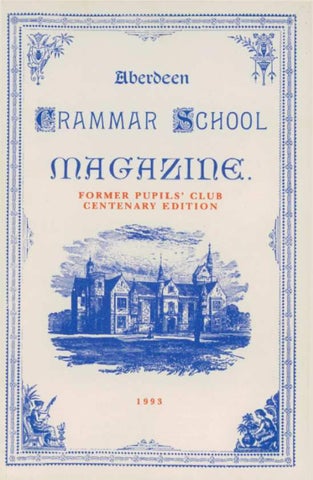
FORMER PUPILS' CLUB CENTENARY EDITION
-
:
, •
:
r
l:
1. . •: :. ..
••-•.1.•
' 24•••• —
'.• :
; •
r
f yam.
-— —-v
. -
-
-•
l!: .1): ,: .: '••.:
1:
. :
?;'S
-:,.. :
, .. ..'".'), . o ;, N
:
19 9 3
• •
—•.•••• —
',.-r•
Is •
••
,,
— ., —
*
,ii -=';,-'7,';•it '72) .=, '''%' -' 1 -'-=-4C'''=' -
-',C----"-%;7:,'7-.. ..4;:itr
,,va -
C
• • • • •
,-,'
,;,:;,,,==•,•.=- -;'4 tf,7_.,•, ..Pr''-•. -;•."4..(e ...,,‘„,-,...-., .......„, ......„..-.,..-Irrinow•v•Pww•••••vv••••••••••••••••••••••• ••••••••••••••••••
The Marclifre at Pitfodels
The Marcliffe at Pitfodels opened in 1993 after meticulous planning to recreate the luxurious atmosphere of the original mansion. Though fully designed to create the perfect balance between business and pleasure, the Marcliffe offers a range of facilities and services that represent the very best in Scottish hospitality. The Marcliffe banqueting facilities arc among the most elegant in Aberdeen. The frilly air conditioned reception rooms may be used independently or in a variety of combinations. The Marcliffe can thus host every occasion imaginative from a cocktail party to dinner for 400 in the grand ballroom. Located close to the the thriving commerce and industry of oil capital Aberdeen, yet designed to feel a million miles from work, this magnificent hotel makes business a real pleasure. The 45 bedrooms offer 4 star luxury with a 5 star sense of hospitality. In keeping with our philosophy that little things matter, in each of the stylishly decorated rooms, a welcoming decanter of sherry awaits your arrival. As you would expect, there are also Sateite TV, radio, mini bar, tea and coffee making facilities, hairdryer, trouser press and stationery. And because we don't like anything to get in the way of your enjoyment, most of them are tucked away unobtrusively. You will find the same refreshing attention to detail in our Conservatory Restaurant too. No effort is spared by our chef and his team to provide the highest standards of presentation and service. The restaurant offers an excellent and varied range of menus designed to cater for all tastes, with outdoor dining on the patio a special feature at Pitfodels. Complementing the restaurant is the library cocktail lounge which serves an appetising range of sandwiches and canapes—the ideal venue for pre dinner drinks or simply an informal get together. From the beautiful landscaped grounds to the airy interiors with their generous windows, everything in this beautifully designed hotel evokes a feeling of relaxation. Designed to give some indication of how the rooms might be used, this guide also provides essential technical information. No brochure can however, illustrate the lengths to which the staff at the Marcliffe will go to accommodate your wishes. For Reservations and All Enquiries until 31st October 1993 please call: 0224 321371 or Fax 0224 311162 After 1st Nolvtuber 1993 please call:
0224 861000 or Fax 0224 868860 The Country Hotel in the City Owners: Stewart and Sheila Spence and Family.
Atholl Hotel 54 King's Gate • Aberdeen AB9 2YN Tel: 0224 323505 • Fax: 0224 321555 rir HE Atholl Hotel situated in Aberdeen's 1 residential West End has retained with its loyal clientele a relaxed and friendly atmosphere. Each of the 35 recently refurbished bedrooms has its own private bathroom, colour television, radio, direct dial telephone, hair dryer, trouser press and tea making facilities, and there is an ample private car park. The Hotel has a reputation for fine cuisine and excellent friendly service, and the personal ownership with an eye for detail and high standards, ensures your stay is one to remember. Scottish Tourist Board 4 Crown Commended Award
ComputerLand We certainly have not been around for 100 years, but the partners do have a total of over 60 years experience in the computer business!
MAKE COMPUTERLAND YOUR FIRST CHOICE FOR BUSINESS COMPUTERS FOR YOUR BUSINESS OR PROFESSION: ' PROFESSIONAL ADVICE ' A RANGE OF LEADING PRODUCTS eg. IBM HEWLETT PACKARD * EXCELLENT TRAINING * WIDE SELECTION OF SOFTWARE * COMPREHENSIVE SUPPORT * FULL MAINTENANCE
If you are thinking about buying a business computer or just need some friendly, professional advice, then give me a call. MARTIN JEFFREY Tel: 0224-593322
HOLBURN HOUSE 475 UNION STREET ABERDEEN
ortiputerLand® The key to successfid computing ABERDEEN 0224-593322
EDINBURGH 031-225-3693
GLASGOW 041 332 5525
IF THIS HAPPENS TO YOU "We offer a 24 hour service for the trades of heating, plumbing and electrical. All operatives are mobile and can be on the scene in a matter of minutes for that "emergency" situation. In addition we would be pleased to advise on any alterations to any of your existing services, utilising our years of experience in these fields to your advantage. Don't throw this advertisement away, it costs you nothing to pin it to the wall - it can save you money. For complete satisfaction — Combined Services."
HEATING, ELECTRICAL, PLUMBING rty /RICHARD IRVIN'
R.I. COMBINED PARKINSON SERVICES LTD
Albert Quay Aberdeen AB9 2ES Tel: (0274) 576280 Telex 73307
THE PRINCE
REGENT HOTEL
Privately owned city centre hotel with large car park. Byrons Restaurant Bar serving meals and snacks throughout the day including breakfasts, morning coffees, lunches, afternoon teas, bar suppers and A la carte dinners. Sunday lunches. Children welcome. Evening meals begin at 5.00 p.m. (Sundays 6.30 p.m.) Regent Room caters for seminars and small functions up to 30 covers. Weekend breaks - Room rates substantially discounted on Friday, Saturday and Sunday nights. A warm welcome awaits you. 20/22 Waverley Place, (Off Albyn Place) Aberdeen AB1 1XP Tel. (0224) 645071 Fax (0224) 648157.
SETTING THE DATE
Jameson CCarry Jewellers in Aberdeen since 1733 142 Union Street Aberdeen AB91GF Telephone 0224 641219
G 1
Bowring
0
c a 1
0
b a 1 R e s 0
r C
e s
L
Bowring Marsh & McLennan Ltd is a local company. We share and understand the problems of this area. Indeed, minimising those problems is our business. Our local expertise is backed by the national and international resources of the bowring group and of Marsh & McLennan Companies Inc.. the world's largest insurance broker. Whether your insurance requirements are corporate, professional or personal; of a local or international nature, or whether your needs arc Risk Management in-depth consultancy or practical Insurance Broking advice, we have the knowledge and the resources CO provide the solution. Contact : Colin Taylor
Bowring Marsh & McLennan Ltd. 13 13u, Accord Square, Aix:ram-1, AB12D) Tekphone 0224 574338 Fax 0224 583064
E x p e r t i
s e
Hawk come first toMitchelIs inAberdeen MITCHELLS SELF DRIVE _ AFF.--vms _ -,
111L
ra .-mors, Iowa: _ j 1 - I g AI 1 f , -
ad IMM
2MINNIM10011
where people come first
35 Chapel Street, Aberdeen Tel. 642642 •
Make an asset of our legal expertise If you have a problem, whether personal or professional. we can help you resolve it in a friendly manner with the benefit of our legal expertise and experience.
kEBURN CHkSTIE AND
COMPANY
16 Albyn Place. Aberdeen Tel (0224) 640101 also at Banchory, Elton and Stonehaven.
e
% ALWAYS ASK FOR
LEMONADE
—
(tidi) it vi4)s . Imo....
The North-East's favourite for 142 years
WM HAY .6 SONS (Aberdeen' LTD Soft drink manufacturers. Beer Et cider bottlers. ABERDEEN • INVERURIE • ELGIN
FOR PERSONAL FRIENDLY SERVICE
"WITH EASTONS EVERY COMPANY IS A VIP" • FOR PRIVATE 8 CONTRACT HIRE • RELIABLE, CLEAN COACHES • LOCAL-NATIONAL • DISTANCE NO OBJECT COMPETITIVE RATES ESTABLISHED OVER 30 YEARS ALL SIZES OF COACH AVAILABLE INCLUDING EXECUTIVE WITH VIDEO AND TOILET
WARDES ROAD, INVERURIE
INVERURIE (0467) 21474
THE ADVERTIS,
GE
•• -
,,,,,,,,, ,,,,,,,,,,
•,
N • ••
,
,,,,,,
, v if.A 0
the
'.7:7--"'""—*---"::::=7,.."::.7.'.f..7.2:=,,,,,,,,,,,,,,,,,,,,,,,,,,,, •• MV.Wa.M.v.,.................... ....TI . . 1893. ,., .,"* SF:In:. 1.2. -7,—..env...v.,-..••••••••••We*"..........0 1.,.,:.=ABEItlAY.4".1.TLIESDAY, ..,...,, ,`...••• , P,,, `:,,,, , ,,,,, . A k‘vjy.• iS..k''' ,,,...... ' , ........... velsix.v ' f':', . ',. iv .9.,.' y: ;',.: W.', ....s: '716,1%0,0 .
'
••• •••),..
'•
.!:1"..i.': 1•:;•ie,";;7f 1 .. • .. . . '',..7' ., • • • , -''''.1.!: .AMS:'.."..i•ei":1, . ,1!7:":1 • . -..1. ?••••, ADVERTISI NG
'• • ' 6-' ''' .,,,..,.•,. .,.....:::.,, 0'1'
,!.. .!„,t,
k,.: ,-r'-
'''l
:An
.•• .•_ ,
AGENCY : . ..: ,-:. .....•.•.
•. .-....... •
_ -, ..,
& all other EiTi.
au PAVE .DVEILTISEMENTS are received et the DAILY 4-3,. IAA'YIONEI °illicit roc lniertion in
' ' 3 'ILPAS :'..II: , LONDON,
\
• EDINBURGH, GLASGOW, AND
ALL
NEWSPAPERS. Insertion In the • PROVINCIAL also received for LEGAI, NOTICita 12011 (IAZ ETT li ED11411U 41:4 1)
\
LONDON 0 A ZOTTit Aberdeen. --""~'~ very large *moot.. —A. School took Patangrx onsuie.e. . the Greanteor of forroing a club of gathering of Old )(r purpose for the Sir M.orland place lam; night with the School. intimated , in conneetion rector. presided. and briefly. rm annannourly PA It W 1, h club. of the y all the interests work, the t e objecita the olub of distinctions solved that underthe officeThe following of the schoolfellows Moriend social intercourse. ,.—President--ISIr gam,. and secreelected 6oott Riddell; bearers were. vioe-president—De : -from iTniversity Simpson; ; Gauld 1 committee . Findlay . and G. tary, Dr W. E. Rae; J. Christie, Anthony 0Mitchell, . --Meesrs-J. nonoiversity—Dr Kelly, RevSleigh; from senior jj Iiikrry W. J. Bain, and Rdinbrirgh ; and• Me ; A. Walker, boys—Messrs Captain H. Sleigh class officiate — Gadd 0. footbsli• G. treaemer, Shirrse ; G. GilJ. nnet; Christie, ecetary, A. Be Liebbnaidtt, J. ,,eornauttee--1 Thomson. IL and c tandem THE
)
S1NG AGENCY 9
MEARNS EG1LL Advertising • Design • Corporate Communications 7 CARDEN PLACE, ABERDEEN AB9 1PP TELEPHONE: (0224) 646311 FAX: (0224) 631882
C77717,7
MTM CONSTRUCTION LTD. Blackburn Industrial Estate Blackburn, Aberdeen AB2 ORX Telephone: (0224) 790888 Fax: (0224) 790922
% BUILDING 'INDUSTRIAL AND COMMERCIAL BUILDERS 'DESIGN AND BUILD TURNKEY PACKAGES *FREEHOLD INDUSTRIAL SITES AVAILABLE 'PROPERTY DEVELOPMENT
CIVIL ENGINEERING 'ROADWORKS AND CAR PARK CONSTRUCTION 'REINFORCED CONCRETE STRUCTURES 'SITE SERVICING, DRAINAGE AND PUBLIC UTILITY INSTALLATION 'SURFACING IN ASPHALT CONCRETE AND BLOCK PAVING 'SPORTSFIELD CONSTRUCTION
FOR QUALITY. RELIABILITY AND WORKMANSHIP OF A HIGH STANDARD LOOK NO FURTHER =
, Serviced Industrial Land immediately available tor sale within Blackburn Industrial Estate. Sites from 1 to 4 Acres. Good Access to City Centre. minutes from Aberdeen Airoor:. Enquiries to the above address
TEL: (0224) 790888
II)! ail I
r
4 4 '
4.1
CalamiTy
There's no substitute for experience. Commercial, Industrial, Retail and Residential Property Consultants. a Capital and Rental Valuations • Commercial Estate Agency • Investment and Development Appraisals • Property Management • Rating Valuation Appeals • Building Surveying
• Structural Surveys and Dilapidations • Rent Reviews • Fire Insurance Assessments • Building Society and Bank Valuations • Compulsory Purchase and Compensation
:racy/Burnett
EG.Burnett F.G.Burnett
CHARTERED SURVEYORS VALUERS AND ESTATE AGENTS
33 ALBYN PLACE, ABERDEEN. TEL (0224) 572661 iFealr07232748)7593496
a/ie
/a,
e
- '1-•
St John Hospital Located in the West-End of Aberdeen, St John Hospital offers superb facilities for surgical and medical care.
Fixed price surgery is available for those without medical insurance cover under our Comprehensive Cost Surgery scheme.
Participating insurance companies include BUPA, PPP, Health Care Management and many more ....
For further information please contact Claire Ellis on (0224) 595993 or in writing to the address below.
St John Hospital
21-24 Alhvn Plate
Aberdeen A89 lIT1
Telephone (0224) 595993 Fax 10224) 584797
Michael C. Hastie CHARTERED QUANTITY SURVEYORS. CONSTRUCTION COST CONSULTANTS
567A GT. WESTERN ROAD ABERDEEN AB1 7PA TELEPHONE: 0224 325000 FAX. 0224 312596 [
CAMPBELL CONNON Solicitors and Estate Agents 36 ALBYN PLACE, ABERDEEN AB9 IYU Telephone 0224-585585 Fax 0224-580766 We are an efficient go-ahead, modern firm of experienced solicitors who believe in putting our clients' interests first always and who will happily deal with Estate Agency, Conveyancing, Trusts and Executives, Civil and Criminal Court Work, Company, Commercial and Licensing Law, Debt Collection, Estate and Property Factoring and Wills. If you require any of these services (or other legal assistance), please contact any of John Hendry, David Morrison (Partners), Hamish Mitchell, Alan Smith (Associates), Frank Connon, Rae Barton and Margaret Ross (Consultants) who will be happy to assist you.
CAMPBELL CONNON Also at THE HALL, CHARLESTON ROAD, ABOYNE, ABERDEENSHIRE, AB34 5EJ Telephone 03398-86732 Fax 03398-87303
tbe frigate far 57 NETHERKIRKGATE ABERDEEN / TEL: 640505
AN OASIS IN THE CITY CENTRE. WE ARE JUST OFF ST. NICHOLAS STREET BESIDE MARKS AND SPENCERS. OPEN ALL DAY FOR A GREAT PINT
SANGS (BANFF) LTD. CAN OFFER A FULL RANGE OF BEERS, LAGERS AND CIDERS AT COMPETITIVE PRICES IN ADDITION TO SUPPLIES OF QUALITY SOFT DRINKS DELIVERIES THROUGHOUT THE NORTH EAST. IF REQUIRED - SAME DAY DELIVERY IN ABERDEEN AREA KEY 1TO YOUR SUCCESS LET OUR SERVICE BE THE 1 FOR FURTHER DETAILS PHONE US NOW AT ONE OF THE FOLLOWING 22 ST MACHAR ROAD. ABERDEEN. TEL: (0224) 276699 FAX (0224) 276100
OLD GAMRIE ROAD. MACDUFF TEL: (0261) 32911 FAX: (0261) 33637
JUST LOOK NEW CAR SALES AT WHAT WE HAVE :USED CAR SALES, TO OFFER!
.4.% Mitsubishi main dealers you can
test drive theyfull range of vehicles from
the versatile SHOGUN to the all neti 4 ho t drive' 4 “ , terr Galant
.4 (
, .
-
, . , fain of top
(IMMIX tun are oh,(ip mytilahle and
because all al-our cars are the very hew. the choice is changing constant/v.
SERVICE*PARTSDEPIV At tillage Garage we have the very latest in technically advanced equipment. to maintain your car to optimum performance levels. Contact our service manager hell hook you in and if you need a loan car. he will help there too.
Garage Ltd. 352 North Dees-de Road. Cults. Tel. Aberdeen (0224) 869944. A MEMBER OF THE JOHN CLARK GROUP OF WAGES
— —
BIIBA
IM1310 EkI
rkidER
COLLINS HALDEN & BURNETT LIMITED Aberdeen's longest established locally owned broking house We transact all classes of insurance business including commercial and personal lines Our Associate Company
McHARDY & BURNETT (Financial Services) LIMITED is registered as an independent financial adviser and can attend to all your Life Assurance, Pension or Investment requirements
Life and Pension Consultant G. Fraser Webster only at 6/7 BON ACCORD CRESCENT, ABERDEEN AB1 2DN Tel: (0224) 595014 Fax: (0224) 573583 Directors: A. Roy Burnett, ABIBB; J. R. McHardy, ACH, FBIIBA; Associate Director: A. A. McVey i
TOP MARKS AGAIN! As Scotland's leading independent builders' merchant and electrical distributor, we can look back on the last term with a great deal of satisfaction. •
£200,000 extension at our Altens base
•
an extra £250,000 of stock at Altens
•
a new bathroom display centre
•
a second Aberdeen branch opened (Electrical division only, at Miller Street)
Having done all our homework. we're sure our customers will agree that we're now in a class of our own!
lXv
William Wilson and Company (Aberdeen) Ltd. Builders' Merchants and Electrical Distributors Hareness Road. Altens Industrial Estate. Aberdeen AB9 2QA. Tel: (0224) 877522 Unit 4. Miller Street. Aberdeen AB2 lAN. 5 7 1 6 6 6 ( 0 2 2 4 ) Tel:
ANOTHER SLEEPLESS NIGHT? WAKE UP AND BUY BEDS DIRECT AND BUY BETTER
Northsleep Limited, Cotha/ Mills. 19-21 St Clair Street. Aberdeen AB9 2TA Tel: (0224) 632334 (3 lines)
Aberdeen Grammar School Magazine 10.91kyear No. 231 (New Series 981h. year No. 222)
j une 1993
Vol 96
The Magazine is published under the auspices of The Former Pupils' Club in June each year General Editor
Derek A. Harley, M.A., Dip i•.d., 86 Queen's Road, Aberdeen AB1 6YQ
Editor of Notes, Obituaries and Marriages
Kenneth A. McR. Nisbet, 86 Queen's Road, Aberdeen AB1 6YQ
Secretary of the FP Club
John F. Hendry, LLB. 36 Albyn Place, Aberdeen AB9 1111J
Treasurer of the FP Club
John D. Murray, LL.B.. C.A., 78 Forbesfield Road, Aberdeen AB1 6PA
The General Editor and Notes Editor are happy to receive contributions for the next issue of the Magazine at any time before mid-May 1994 In order to assist the distribution of the Magazine, members of the Former Pupils' Club are requested to advise the Secretary promptly of any change of address.
Printed for The Former Pupils' Club at BPCC-AUP Aberdeen Ltd
Centenary Magazine Committee Eric Craig (1934-46), Convener
Derek A. Harley (1974—80)
Alan G. Campbell (1959-65)
John F. Hendry (1951-65)
Richard H. Cradock (1940-41 and 1945-51)
Kenneth A. McR. Nisbet (1972-78)
Brian K. Crookshanks (1934-46)
John B. Rennie (1947-53)
Russell Gray (1951-65)
Future editions of the Magazine will be issued in September with Reports, Marriages, Notes, Obituaries, etc. to 31 May of that year. Important: Articles for inclusion in the Magazine should be submitted by mid-May and preferably typed.
CONTENTS Financing the Magazine Centenary Commemorative Cover Rector's Report School Section Prefects' Notes Extra-Curricular Activities School Board Report School Prizes 1992-93 Centenary of the F.P. Club School Boarding House "Whither British Industry?" Looking Back Beinn Bhreac—May 1993 A Question of Class Reunion—Classes 1932/33 to 1944/45 Rugby Ramblings of a Has-Been ! Jockey Section A History Random Recollections in Retirement Former Pupils' Club Office Bearers Annual General Meeting President's Report Our President Annual Dinner Club Apparel Centre Reports: Club Centre Edinburgh Glasgow, London Yorkshire, Canada Consul Reports Section Reports: Cricket Curling, Football Golf, Rugby Swimming, Women's Hockey Hockey Petanque, Colts Rugby Notes about Former Pupils Marriages Obituaries Former Pupils' Club Accounts Illustrations School Prefects 1992-93 Head Boy and Head Girl 1992-93 Combined Hockey 1st XI and Football 1st XI Shooting at RAF Machrihanish, Easter 1992 RAF Section Cadet at 663 Gliding School Rock climbing at Pass of Ballater Lt.-General Sir Peter Graham inspecting the CCF Senior Dramatic Society at rehearsal Lucas Industries Award Winner 1992-93 Presentation by Miss Jenny Archibald to Mr Johnston Boarding House 1946 and 1948 Centenary Year Lunch Party Flanding over the Badge of Office The President Cricket Section Under-18 Team
page 4 5 6 8 9 16 34 37 41 61 63 65 68 69 72 78 80 85 87 90 91 94 96 97 97 98 99 100 101 107 111 112 113 114 115 117 122 123 129 7 9 18 25 26 26 27 28 32 36 62 74 92 94 108
Financing the Magazine and Beyond 500 The 1992 edition of the Magaine was financed as follows:— Advertising revenue Donations Beyond 500 (1/11/91 to 31/10/92)
L
2,940 25 1,877 4,842
Printing and postage Surplus
4,219 623
For the second year running, the income generated from the magazine, directly and indirectly, exceeded the cost of producing it, although this was more to do with a reduction in the cost rather than an increase in the income. In fact, the income actually decreased from last year by over £100 and we must ensure that this trend does not continue. An appeal is therefore made, yet again, to those members who are not participating in Beyond 500. Of a total membership of approximately 2,000 less than 200 participated during the year to 31st October 1992. Surely we can do better than that! The next draw will run from 1st November 1993 to 31st October 1994 and details are given on the application form in the centre of this Magazine. Members not wishing to participate may wish alternatively to give a donation. The opportunity is taken to thank those members who are already participating in the draw. Your support, and the interest it shows in the Magazine and indeed in the Club itself, is very much appreciated. A special thanks is due to Eric Craig for his continued effort in co-ordinating the "advertising campaign" and, indeed, to the many advertisers themselves who continue to support the MagaTine.
Centenary Draw I am delighted to report that to date the response to my letter of 29th March 1993, has been very good, and I take this opportunity to thank all those members who have returned their counterfoils and especially those who have also included a donation along with their cheque. On the draw ticket counterfoil it was stated "return by 15th October 1993". However, to assist with the administration it would be much appreciated if members could return their counterfoils as soon as possible. There are still a considerable number of tickets available and if any member requires a further supply please contact me at the Secretary's address. You will note from the magazine that the Dinner arrangements are well advanced. The Hotel limit is in the region of 300 persons so please advise the Entertainments convener as soon as possible. Guests are to be allowed but again this may have to be limited. 1 look forward to meeting many of you on the 29th October or over the weekend festivities. Dick Cradock Chairman Executive & Convener Centenary Committee
4
Centenary Commemorative Cover When I was a small boy, and some people still think of me as that, because of my philatelic interest, I started to collect stamps. Why I did this has gone from my memory like many other things I was taught. Then 1 was a collector of any kind of stamp, British or Foreign; Mint or Used and it was for my birthday in 1951 that I was given my first Hard Backed album purchased from A. G. Bowie, 2/3 New Market Buildings, Aberdeen. Several enthusiasts of my generation will remember pondering over the vast quantity of stamps in this gold mine at the top of the Market Street Stairs on the South Balcony. I had actually started my collection before going to the Grammar but I still have my first "swop" with a fellow devotee—a first-day cover commemorating the Universal Postal Union in Northern Rhodesia addressed to H. E. Roberts, GPO, Livingstone and dated 10 X 49. Again I have forgotten whether or not this transaction was conducted at the School philatelic club run for many years by Mr. Stephen. From then on I drifted towards First Day and Commemorative Covers though I have never lost my first interest of trying to build complete sets of used stamps, buying as few as possible from the multitudinous vendors who cater for our addiction. Let me briefly explain the difference between first-day and Commemorative Covers. First-day covers arc issued by Postal Authorities throughout the world and by some commercial producers but they arc all to commemorate the issue of a new stamp or set of stamps. A commemorative cover is issued, as the name implies, to commemorate something special on the date of the postmark, usually a special hand-franked mark on the envelope and the postage stamp is just a necessary prerequisite to have the cover go through the postal system. Since the Former Pupils' Club will be 100 years old on 11 September 1993 1 volunteered to investigate the possibility of having a commemorative cover issued on that date as a tangible constant reminder to philatelist and noncollector. At this point in time everything is coming into place with the cover already designed and the insert for the envelope, giving some details of the Club's history over the past 100 years, just about ready for going to print. Now the catch—this is a revenue raising undertaking with the excess being put into the Centenary Fund for distribution by that committee. It is proposed that the basic cover will sell for £2.00 and it is hoped that about five current and past presidents will autograph a limited edition of covers for an additional L1.00 per cover. The whole issue is a one day only limited edition which means that it will be on a first come first served basis. Application forms are in the Magazine or can be had at the School or F.P. Club Centre or by contacting me through the Secretary's Office. Hugh Pirie (1949-55)
5
RECTOR'S REPORT In this significant centenary year for the F.P. Club, I am glad to report that education in Aberdeen Grammar School continues to be effective and successful. The pupil roll is stabilising at approximately 1000, as envisaged at the design stage of rebuild following the fire. A comprehensive range of Standard Grade courses is now well established in S3 and S4, with a rich variety of curricular opportunity beyond and before this stage. Participation and success in extracurricular activities both continue at an impressive level, as I am sure will be confirmed by other articles in the magazine. We continue to be fortunate in the commitment of staff, the co-operation of pupils, and the support of parents with the School Board and P.T.A. both very active. The physical framework for all of this has been created by the rebuild and refurbishment programme, providing modern facilities and equipment within such a magnificent building. I might add that some of the money contributed for Library restoration has gone towards the provision of pictures in the Library, several by former pupils, to try to restore something of the special atmosphere tangible there in the past. Last year's report concluded with a comment about values becoming increasingly important in a changing world. It is therefore encouraging to report that despite the number and complexity of current developments, our recently compiled Statement of Values has a comforting level of constancy. Among other touchstones, we continue to value : the promotion of learning opportunities for all : high personal standards of honesty and integrity : self-respect and the dignity of the individual in balance with concern for the rights of others : commitment to high standards of behaviour and to social conventions of the school community : respect for the environment, both local and on a wider scale : appreciation of both modern facilities and a rich historical setting. There is no conflict between these basic principles and planned developments built on this foundation, however modem they seem. Our Development Plan for session 1993-94 includes : policies for the legalities of Equal Opportunity, Multicultural and Anti Racist Education. : strategies for Flexible Learning and Information Technology : whole-school approaches to the growth of European Awareness and Education/Industry Liaison : Accountability, Evaluation and Performance Indicators. The immediate future also brings the prospect of major initiatives on Staff Appraisal and Devolved School Management. Clearly, schools are changing and adapting, but educational values remain surprisingly familiar.
6
II
f
III
0 we'
4.t
11
4
dftio.
l £6- 2661 sPo o4d
;
flt
I If!li
11
PREFECTS 1992-1993 Back Row: Andrew H. Fowlic, Matthew J. Jeffers, Neil G. Thornton, Barry J. Shepherd, Nicholas R. Hall, Liam S. Woods, Cohn G. BalLantyne, Fergus C. Small, Carey J. Veitch. Fourth Row: Zena T. Melki, Denise Niddrie, Scott R. Smith, Matthew J. Collinson, Rebecca C. G. Leslie, Magnus J. Inglis, Victoria M. Bowling, Linsey A. Maycock, Fiona M. Bennett, A. Ross Mcthven. Third Row: Christine N. Fraser, Alison M. Hall, Alistair J. Fowlic, Arlene Kennedy, Ian J. Campbell, Agnus J. P. Duguid, W. Stuart Chesney, Daniel J. Dukes, Lianne Fyfe, Aileen B. Gordon. Second Row: Finns Liansden, Caroline Hume, Susan Watson, Nicola M. Fox, Matthew D. Dyer, Peter G. Shand, Tommy D. Kirkpatrick, Catherine R. Clarke, Emma J. Eddie, Susan J. Barclay. From' Row: Rosemary A. Coutts, Gillian A. Nisbet, Emma Lane, Gayle E. Mackie (Depute Head Girl), Neil E. Paterson (Head Boy), Carol-Ann Craig. Mr. W. J. Johnston (Rector), Anne-Marie C. Davies ( Head Girl), Famish Briones (Depute Head Boy), Susan L Webster, Morag Wisely,
ti
School Section School Office-Bearers PREFECTS—SESSION 1992-93 HEAD BOY Neil Paterson DEPUTE HEAD BOY Hamish Briones S6 PREFECTS W. Stuart Chesney Matthew Collinson Angus Duguid Daniel Dukes Matthew Dycr Andrew Fowlie Nicholas Hall Magnus Inglis Thomas Kirkpatrick Paul Murray S5 PREFECTS Colin Ballantyne lan Campbell Alistair Fowlie Matthew Jeffers Ross Methven Barry Shepherd Fergus Small
HEAD GIRL Anne-Marie Davies DEPUTE HEAD GIRL Gayle Mackie Peter Shand Carey Vcitch Liam Woods Fiona Bennett Victoria Bowling Catherine Clark Carol-Ann Craig Emma Eddie Lianne Fyfe Caroline Hume
Arlene Kennedy Emma Lane Rebecca Leslie Lynsey Maycock Zena Mclki Denise Niddrie Sandra Ogg Susan Watson
Scott Smith Neil Thornton Susan Barclay Rosemary Coutts Nicola Fox Christine Fraser Aileen Gordon
Larissa Gordon Alison Hall Fiona Lumsden Gillian Nisbet Susan Webster Morag Wisely
Colours Awards Hockey
Full colour: Half colour:
Football
Cap award: Full colour: Half colour:
ANNE-MARIE DAVIES KIM STUART NICOLA REID MATTHEW COI.LINSON MATTHEW DYER BARRY SHEPHERD ROBIN CUTHBERT DAVID HARRIS KEITH COWIE FINDLAY BAIN
DANIEL DUKES MORAG WISLEY ANGUS DUGUID
STEVEN MAIR SCOTT CHRISTIE GREIG TAGGART
Swimming Half colour: Rugby: Awarded in conjunction with AGSFP Rugby Section. KEITH SIM Full colour: BARRY SHEPHERD KEITH WILDRIDGE Half colour: FERGUS SMALL Ross METHVEN COI.IN BALLANTYNE
8
GRANT HAMILTON
9
School Office-Bearers
Junior Colours Rugby Hockey
Football Badminton Swimming
ANDREW FROST CHRISTOPHER DARGIE LEANNE ADAM ANNA ROACH ANGELA MATTHEW'S NIALL PIRIF. RUSSELL CADGER JENNY MCFADYEN ANDREW HAW KEVIN McPHERSON DYLAN MI \R()
THOMAS YOUNG SARI JOHNSON JENNY MCFADYEN PETER WILLIAMS SEAN RIORDAN SARI JOHNSON JOHN MITCHELL SCOTT NEYEDLI
Head Boy and Head Girl 1992-93
Head Girl Anne-Marie Davies and Head Boy Neil Paterson
Prefects' Notes Anne-Marie Davies Our buoyant Head Girl is a hard act to sum up in a short space. Miss Davies, as she likes to be known (or preferably Mazza), is a headstrong character who likes people to believe what she says and does not care if they don't, but in general she has done a commendable job. Just remember "Mazza" the only things you get in Oxford are Inspector Morse and warm beer! "Heel Neil." Neil Paterson Our estimable Head Boy is reknowned for his largesse, know all attitude and laissez-faire approach to life. Fond of his chemical experiments and poor taste in music, he fell prey to the advances of a certain young lady, or was it the other way round? Neil hopes to become a doctor although nobody is quite sure why? "It's not an affro—it's a perm."
10
Aberdeen Grammar School Magazine
Gayle Mackie The Howff's own "Raquel of the Rover's Return" Gayle prefers pulling the males rather than pulling the pints! As Deputy Head Girl she has had an easy year showing maximum commitment to schoolwork and less to P.R. Nevertheless the highlight for her will be "a year out" in the U.S.A. as a "cheerleading senior" in High School. Best of luck to her (and to the Americans!). "I'll see you at the next Parents' Evening." Hamish Briones The right hand man to Neil and Anne-Marie is one of the more artistic members of the Howff Society. Deputy Head Boy Hamish's cheeky cartoons and even more cheeky one liners never seem to anger anyone, such is his likeable attitude. He is also in possession of one of the most sharp silver tongues in history, and could charm the socks off even the most hard hearted of females! "Jolly Rodger." W. Stuart Chesney A shy boy who has no sense of control over his life or his hair! Rarely found in the Howff or Registration, he has been rumoured to have a crush on a fellow geographer. For the future of Scottish rugby Stuart can be found playing around with a rugby ball, when not doing the same with Rita. "I am not Andrew Moore." Matthew Collinson This lad is a whizzkid with figures—and he enjoys Maths too. We are reliably informed he's a bit of a "greaser" with his hair, but other than that he is a normal hardworking prefect—if there is such a thing! "Let's get physical." Angus Duguid A true sporting legend, Angus (Gus), also known as "the cat" is a lover of money, designer labels and getting het up. He likes to have a finger in every pie and is a member of the Sixth Year Council, School Board and projects the image in the Film Society. Everybody is really very fond of him, especially little kids and the feeling's mutual. "Watch ma leg." Daniel Dukes "Danzell" will be best remembered for his parties and his reputation for breaking young girls' hearts. He has come a long way from his earlier membership of a rather notorious clique to the dizzy heights of prefecture and respectability, and playing a leading role in the successful First eleven hockey team. Next year he is off to extend his charm in Edinburgh. "Something's better than nothing." Matthew Dyer The Howff's answer to Justin Fashanu, or is it Smith? His hobbies include football and caring for his Alabama Blacksnake but let himself fall victim to the oh so subtle approach of a Sixth Year Jezabelle. Being a bit of a "Flash Harry" he likes his three piece suite in leather! This year he has decided to go away and try his luck with the "Sheilas". "Where's my snake?" Andrew Fowlie Left a bit lonely after the departure of last year's prefects, Fowlie has followed their lead by "befriending" one of the younger new members of the Howff— not, that is, A. Fowlie mark two. "What's that cow doing in the pond?"
Prefects' Notes
11
Nicholas Hall This musical "all round" entrepreneur can normally be seen in the company of his partner in crime. They are rumoured to be off south next year— together--they even managed to share in winning trophies this year. "It's in the bag, boys!" Magnus Inglis Magnus is the strong silent type who only opens his mouth to make sarcastic comments. Perhaps he feels inferior because of his haircut which he now covers with a helmet when cycling (see 1992 magazine). "I'm Magnus, pleased to meet you." Thomas Kirkpatrick Tommy is a "legend" in the Howff for his discretion and absence (not normal prefect traits) and has been rumoured to have been heard speaking once—or was it twice? Mind you considering the other inmates who can blame him? His skills in Maths seem to overshadow those in conversation—hence respect is due. "Anyone for a game of 101?" Paul Murray Our horn playing maestro is however not reknowned for blowing his own trumpet. Winner of the Young Scientist's award and possessor of a formidable set of exam results his pet name "Swot" seems quite appropriate. There is speculation of a romatic entanglement with another medic—to be. Nevertheless, a quiet and likeable bloke. "I don't even like Edinburgh anyway." Peter Shand Peter is a great lover of rabbits and fond of giving girls private tuition! Apart from these strange tendancies Pete is a nice chap. "Il adore" a particular "prof de francaise" and has also been described as a "sensitive boy". "Ma belle Fi!" Carey Veitch Many prefects do their duties, but what about Carey? Known to his peers as the "Rave Generator", but judging by his duty attendance he should be called the "Laze Dominator". Although one of the more quite prefects, beyond the school grounds he has been rumoured to be a wild child. "I was there!?" Liam Woods Our football team captain, Liam is a bit of a poser on and off the pitch. Although he is usually in the company of his girlfriend, he appreciates adulation from any girl of any age! "I love to be loved." Fiona Bennett A real ladies' man's lady, Fiona is known for her gentle touch, especially with men. A devoted Second eleven hockey captain she will be remembered for inspiring her team and filling them with confidence. She's fond of small children, especially Fifth Year boys, and hopes to make use of her experience next year. "We know we are going to lose anyway!" Victoria Bowling Known to have a secret wild social life, this girl is a "studante espanole muy bien!" She finds things groovy, chronic, mega and spoony (her words), and can't wait to join the thousands of languid students in Edinburgh. "I'm really off the planet today, man!"
12
. 1berder /7 Grammar School Magazine
Catherine Clark Katie is a quiet conscientious girl who acquired a "modest" set of exam results-- AAA AA Amen! Her fairytale romance is still as sweet as ever despite a short lived fling with a "notorious head banger" (remember Sid?). "Half a glass of ginger wine, please." Carol-Ann Craig Our pint sized canoeist has never been known to tarnish per pristine character until now. Recently however she has metamorphosed into a head banging man trapping "grunge babe". She is a practical lass who seems to enjoy cleaning the Howff which typifies the gullability of her naive way of thinking. "Excuse me, where does Darren live?" Emma Eddie Hyper active, hyper sensitive, hyper enthusiastic, hyper healthy. All these words sum up the Howff's very own "all round" supergirl. You name it, she does it. "There's a duck in my pond." Lianne Fyfe A whiter than white prefect, this Scorpio has a real sting in her tail. Known for her swift personality changes, she is a real party animal. However, her alter ego is a genuinely nice girl as her mystery man would probably maintain. Shc is fond of foreign intrigue and is off to Germany to explore the possibilities. Viel Gliick. "Is he really that small?" Caroline Hume Early in the year Caroline gained attention in the local press by declaring her outrage when an ancient tree was chopped down. More recently she gained attention at the Leavers' Ball by screaming in pain when she was brought down. "Aaaaaah!!!" Arlene Kennedy A sporty type of person who quite recently has turned into a myth. We are led to believe she does her duties well, but no one quite knows. A quiet girl who has the sense to keep herself to herself. "Accounting is a fascinating subject." Emma Lane This trekkie wants to be a journalist. Recently rugby tackled to the ground, she constantly complains about being "pale". A bit of a "bonne baguette" (thanks to her Dad) she had a loving affair with the "Culter Cassanova". "Mings like a fish on a stick." Rebecca Leslie Rebecca is most noted for her height and is probably larger than Michael Jordan. Perhaps the low ceiling is why she only dares to enter the Howff twice a year. We hope she has a good time in France next year. "I'm not that tall!" Lynscy Maycock .1 diehard leftie who ammased six "A's" but still remains unintelligable. Wants to go into medicine and practices by playing Florence Nightingale. A supposed "quiet one" but romantic links old and new may indicate otherwise. "Why am I speaking so fast?" Zena Melki Zena "Mansell" Melki is notorious for her driving skills and her affection for younger prefects. Her catchphrase "Booh that . . ." drives terror into the hearts of many, including half the prefecture. Fond of money, but will have to use some to buy herself some tact! "Of course 1 can drive . . . can't I??"
Prefects' Notes
13
Denise Niddrie A full time resident of the Howff, Denise can always be relied on to make a drama out of a crisis. Does a lot of work for charity, but doesn't like to speak about it. "I'm not married." Sandra Ogg Only enters the Howff when a meeting is called and even then it's a push. She much prefers the quality space of the Social Area. A friendly lass who has high aspirations of becoming a lawyer and unlike many her "naughty Nova" is still in one piece! "I've got a headache." Susan Watson Susan is a very likeable young lass and a very friendly, popular member of the prefecture. However she is notorious for her behaviour after the sun goes down and her vices include lashings of garlic, men with big ears and don't forget the Mini Metro. "Peggy Sue" seems to enjoy a rather full and active social life with the A.A. and she can drive! "I've never seen down there before." Colin Ballantyne The Howff's very• own Cassanova is very good at his two times table. Plays rugby—well nobody can stop him trying! He intends to follow in his "father's footsteps" (beat that), but will have to stop lurking in dark alleys. "I'm just holding it for a friend." Ian Campbell This speedy young prefect is the owner of a pair of sideboards that Hilda Ogden would be proud of. Perhaps he concocted his own mixture in the Chemistry Lab to stimulate their growth. "Rave on!" Alistair Fowlie Ali likes to "get connected" on the dance floor with a vivacious red head and enjoys his magic MO-ments. He is well handicapped with his clubs and is reknowned for his pugilistic scraps with his best mate—Wise up! "1 don't know why he's so upset." Matthew Jeffers A regular in the Howff, this blonde gigolo reckons he's a ladies' man. Fie is constantly enlightening us with his innuendos and is obviously a danger to women and to himself and deserves to be locked up. "Give her a couple of months and she'll be worshipping me." Ross Methven The Howff's very own Oliver Tobias, Ross too thinks that he's a bit of a ladies' man. As a rugby player he is one of the few who rarely gets dirty—for fear of spoiling his looks, although nobody is quite sure why? His favourite song is "Toyboy" by Sinitta. "It's not much, but I call it home." Barry Shepherd Big nosed Barry is a permanent resident of the Howff. He is starting his own collection of colour awards. He sees himself as a bit of a toyboy. He has a terrible taste in music and surprise, surprise we think he's Portugal's answer to Cilia Black. "What's your name, and where do you come from?" Fergus Smail Fergus is thought of as a ginger version of Patrick Swayze on account of his dirty dancing! He is also well known for his abilities in acting, rugby and for buying the most tasteless trenchcoats. "Come down to Yorkshire and I'll give you the rest."
14
Aberdeen Grammar School Magazine
Scott Smith Although one of the Fifth Year brigade of prefects Scott has already gained a reputation for style, largely due to an enviable haircut. He is a respected hockey player, following a superb goal—against his own team! "It was just an unlucky deflection!!" Neil Thornton Another hockey playing Fifth Year who has gained the people's respect and his colours. Seems to be a quiet lad, however a shroud of mystery overshadows his alleged link with a fellow hockey player. "Yes Anne-Marie." Susan Barclay Due to her rare appearances in the Howff it is difficult to say too much about this Fifth Year member. She manages to resist the temptation of spending time in such sullubrious surroundings! She does however carry out her duties-without prompting. "Hooray!" (A-MD/NP) Rosemary Coutts Rosemary is another prefect who rarely seems to be in the Howff---or perhaps when she's there she's too small to be seen, but is seen around a lot with A.H. (as opposed to A.D., A.F. 2 , A.G., A.K.). "Are you, like . . . sober?" Nicola Fox Foxy is a rather vivacious and vociferous member of the tribe and has been known to speak on one or two occasions! A hockey starlet she has a pile of caps almost as tall as some of her more believable tales. A lover of men and music with questionable taste in both, she is a great source of amusement. "No I don't have a big mouth." Christine Fraser Another hockey lass who is a smiley sort of person. She hates being separated or being quizzed about her relationship with boys half her size. Don't worry, Chris, we love you really! "I'm not feeling it yet." Aileen Gordon The "Delia Smith" of the Howff, Aileen is another Fifth Year who cannot be faulted. We don't see too much of her but perhaps the switch from glasses to contact lenses will help her find the Howff. "Do you want one of my pies?" Larissa Gordon The Howff's very own glamour girl, Larissa looks as though butter wouldn't melt in her mouth, but we know better. Spends time with her good friend Henry, but not in the Howff (we don't think). "Excuse me which door is the Howff's?" Alison Hall In her spare time this conscientious prefect happily embarrasses herself by jumping on trampolines. She is already a Scottish Champ at it and if she keeps this up she will reach new heights in the future! "No, I don't look like Nicholas." Fiona Lumsden Although Fiona can be seen making flying visits to the Howff, she is more likely to be seen flying down the track for Scotland. We have observed that around school Fowlie (the fingers variety) fairly slows her down. "You're just so immature."
Prefects' Notes
15
Gillian Nisbet "Niblets" as she is more affectionately known is notorious for her go and get it approach to life. She is a bit of a dramatic sort of person who has the potential to follow in the footsteps of her mentor and is bound to succeed in any field of work she enters. "My back is killing me." Susan Webster Another absentee from daily Howff life, mainly because of her passionate perambulations. She does her duties well but remains a mythtery to many fellow prefects. Her motto might be—Hardly seen, hardly heard. "Hooray, again." (A-M.D./N.P.) Morag Wisely A fiery character with matching hair and temperament. She has been known to react when the conversation touches a nerve—hair, height or other half! Dyna-Mo is famed for her skills as a hockey winger and is well liked despite the fact that her not so dulcit tones will be long remembered in the Howff. "I'm feeling a little perturbed."
Extra-Curricular Activities Girls' Hockey Report Session 1992-93 Every Saturday, six teams pulled on the red gear and fought out some memorable hockey matches. The first and second years have shown steady improvement, and performed well in their respective year group tournaments. Following guide lines from the national body, the 1st years played mainly 8 versus 8 matches which enabled the girls to be constantly involved in the game. By 3rd year Grammar girls have usually caught up with the schools which start hockey in Primary 6 and 7. This 3rd year had a successful season, undefeated in most of their Saturday programme, and winning the Junior Knockout Shield. Personal skill, game awareness and team ambition developed as the season wore on. In January, a win over the favourites Cults Academy was a crucial victory in the Knockout campaign. The midfield of Angela Matthews, Sari Johnson and Emma Kidd blunted the threat of a strong Cults midfield whilst Leanne Adams in goal and Anna Roach as sweeper, helped the defence to hold out. Late in the game Katie Wraight rifled home a goal bursting shot from an Emily Fitzgerald cross, giving Grammar a vital win. A semi-final victory against Gordon's 2nd year on the plastic pitch took Grammar to the final against Gordon's 3rd year. Given that Gordon's practice all year round on the fast artificial surface, we expected a tough game. Grammar, however, got an early captain's goal from Angela Matthews, and despite weathering a few stormy moments in defence, Grammar won the shield. Although coach Welsh had been very cautious about even contemplating victory, Mr. and Mrs. Wraight proved to have faith in the troops. On the final whistle they produced a cake enscripted "congratulations", and some champagne style juice to celebrate the moment. The seventeen girls who took part in this competition will never forget the tensions, hard work and delights experienced in this Knockout Shield campaign. In season 1992-93 Leanne Adams, Sari Johnson and Anna Roach were selected to play for North under 16 squad. These three, plus Emma Kidd, Angela Matthews, Jenny McFadyen, Lucy Parslow, Emily Fitzgerald from 3rd year, and Pamela McKay from 2nd year, have been selected after trials to attend coaching for North under 16 squad 1993-94, prior to the final selection. The junior school finished the hockey season with 21 girls attending a hockey camp during the Easter break. Hockey at the upper end of the school was equally exciting. The 2nd eleven operated with a squad of sixteen players, and played some good matches. It is important that everyone should play, however the constant subbing does not permit consistent team patterns to emerge. For the first time ever, the Grammar 2nd eleven got through to the quarter-final stages of the Knockout Cup, by convincingly beating Cults 1st eleven. Fiona Bennett, captain of the seconds for two seasons, has done much to instill a sense of pride and duty into the second team, ably assisted this year by Lisa Thomson. The 1st eleven had a very successful season, only losing 1—0 in a trial game against Glasgow High in the early experimental stages of the season. This generosity was not repeated once the final eleven settled together, and Grammar enjoyed a hard season without losing any games. The midfield of Emma Kidd, Susan Watson, Anne-Marie Davies plus striker Nicola Fox, produced some well worked goals over the season. Grammar won the Senior Tournament, with Julie Ewen making vital penalty saves, but were runners up in the Indoor Cup, despite constantly pressing the opposition goal. In the Knockout Cup 16
Extra-Crrricvlar Activities
17
Grammar had a commanding win over Albyn 4-1 in the semi-final, and routed Mintlaw 6—0 in the final with many of the spectators raving obout the Grammar girls' play. Goal scorers were Susan Watson 2, Anne-Marie Davies 2, Morag Wisely 1, Emma Eddie 1. Winning the district Knockout Cup gave Grammar entry to the Scottish Schoolgirls' Outdoor Championships. Grammar have represented North district in this tournament six times out of the last seven seasons. This year the tournament was played in Aberdeen at Countesswell pitches, and family and friends turned out to support. The day proved to be sickeningly disappointing for us all. If poor play leads to bad results, then one can accept defeat, but in their three games, the Grammar girls dominated possession, played good attacking hockey, and did everything but score. Contrary to the run of play against Elgin Academy, Elgin's one break was rewarded with a soft penalty which they scored. Draws against Glasgow High and Galashiels Academy halted our progress to the semi-finals. The opposition coaches all said it was crazy that we had not reached the finals, as we were playing so well, however we have to be able to score goals when it counts. In this tournament Morag Wisely and Jennifer Rodger reached new heights, playing with a new found strength which produced confident and creative play. The team bounced back to finish off the season with wins against Gordon's, St. Margaret's and St. George's from Edinburgh, completing a successful programme. Emma Eddie captained the teams with great determination and purpose, setting the example with one hundred per cent effort, on the field and off. The following girls were selected to play for North district under 18 select, and played a vital part in North's successful tournament campaign when we won the Inter District Cup. Emma Eddie (vice-captain), Christine Fraser, Kim Stuart, Julie Ewen, Nicola Fox and Anne-Marie Davies. Emma Eddie, Nicola Fox and Julie Ewen were invited to attend Scottish under 18 trials, with Julie Ewen being picked to represent Scotland for the third year running. Ruth Dukes was selected to play for the North under 16 squad. Emma Eddie and Christine Fraser were selected to play for the North indoor squad. Emma Eddie captained the squad. A final thanks must go to Emma Hendry, Theresa Paterson, Fiona Jeffers and Wendy Watson from F.P.s who help with first and second years and to Dot who helps umpire. Boys' Hockey First XI The season started with what could be best described as a "provisional" team lining up for the first game. Despite being a 0- 0 draw it was obvious that some reconstruction would be necessary. This was done and the team played very well, but were narrowly defeated 1-0, in their next game. Like so many of the matches to follow Grammar exerted a lot of pressure and put a great deal of effort into their play but were beaten by lapses in concentration and allowing the opposite to exploit positional weaknesses which could have been avoided. The various encounters during the season brought a set of results reflecting fluctuating fortunes—you win some, you lose some! There were good performances in all departments at different stages and some younger pupils began to stake their claims for positions. Despite some inconsistency the general standard of play was good. It was really the failure to convert chances which was the most disappointing aspect. The senior players played some excellent hockey and the younger ones fitted in well around them.
au! uqujv l oovy dvutsuvd.9 u
Combined Hockey 1st XI and Football 1st XI
Extra-Curricular Activities
19
Graeme Milne, Ian Arthurs and Neil Thornton all made District level. Graeme Milne was the top scorer and will surely be missed next season. Ian Arthurs played consistently well as did Danny Dukes and David Patullo. Matthew Collinson was a workhorse in midfield. Angus Duguid played in a number of positions before becoming the goal keeping wizard. Both he and his stories will be missed as they helped to keep us going in the bus on away games. Next season should hopefully be a successful one with Neil Thornton and Alistair Fowlie providing the driving force, backed up by the present Fourth Year pupilds gaining in experience and confidence. Thanks go to Mr. Swanson for all his support and advice throughout the season. Second XI This season's league campaign was rather disappointing as the team showed such promise in all their matches but in the end they came away with very little to show for their efforts. A draw with R.G.C. B was the only point collected, with defeats against R.G.C. A, A.G.S. 1st XI and M.B.C. In all the league games the team must be congratulated on their performance as they gave their all and were unlucky not to be rewarded. As the season progressed we grew together as a team and the results improved. A convincing victory over Abbey and a fine display against Gordonstoun, where we drew, were pleasing. Stephen Parry, Stuart Duthie, Martin and David Guyan played well throughout the season after making the step up from the Colts. Graeme Stewart for the second consecutive season finished top scorer after scoring a number of important goals. So, overall the 2nd XI's hockey season has been a successful one. Team. squad: S. Fogiel, A. Duguid, M. Ewan, P. Davidson, S. Duthie, E. Pirie, P. Hendry, S. Parry, J. Campbell, J. Hall, S. Earl, S. Smith, C. Veitch (Capt.), C. Milne, G. Stewart, M. Guyan, D. Guyan, D. Scott. Colts XI Since this was our first season together as a team we did not expect great things although we were quietly confident. After two wins and one defeat the team began to settle down and following another two wins the morale was high. Then the match we had all been waiting for came next. On a bitterly cold night we lined up against Gordon's College and despite hefty pressure from them in the second half we won 1-0. This gave everyone a great lift and filled with grit and determination we went on to turn a previous 6-0 thrashing by M.B.C. into a 0-0 scoreline in our next game against them. Then followed a series of hard fought matches against oppositions who were mostly defeated by strong team and great individual performances. The season finished as it had begun with a win over Westhill. Team: Sean Riordan, Paul Craig, Andrew Terry, Michael Neil, Peter Williams (Capt.), Alan Thornton, Darren Rose, Rupert Daly, Christopher Barclay, Douglas Carnegie, Niall Pine, Innes Cameron, Jonathan Hume. Junior Rugby XV The juniors had a fairly successful year in 1st year rugby and were hoping to build on this as they continued into their second term together as a team. Having got off to a poor start after a defeat at the hands of Gordon's "B", the team pulled their socks up and went on to have several good wins against first-class opposition. Unfortunately, due to bad weather several games and training sessions were called off. This in turn upset the team and they slumped to a poor defeat from Nairn Academy, a team they had previously beaten this season. However this did not discourage the team. They showed a lot of
20
Aberdeen Grammar School Maga#ne
character, team spirit and aggression and through their own hard work managed to overcome Gordon's "B" with an outstanding performance. This proved to Gordon's that this team were no slouches and deserved a shot at the highly rspected Gordon's "A". The team trained hard for this game with members of staff Mr. Adey and Mr. Burns, who helped the forwards develop a higher standard of rucking, mauling, handling and support play. The backs, however, concentrated mainly on a zone defence in an attempt to stop the stylish Gordon's back-play. All this hard work resulted in a very close match with the Gordon's just nicking it by one try. This was still a very good performance which the team was proud of. The team consisted of Steven Murphy, Adam MacQueen, James Gilchrist, Stuart Galloway, Paul Jones, Craig Goldie, Ryan Cumming, Yu Chun Chen, Dominic Milne, Patrick O'Driscoll, Andrew Torrance, Andrew Clouston, Kenneth McColl, Gary Porter, Keith Reid, Chris Duncan, Graeme Burr, Paul Wilson and Scott Mooney. Minors Rugby XV The season offered to most of the minors their first taste of competitive rugby. An enthusiastic squad of over thirty boys ensured keen competition for places and the opportunity on several occasions to field a second team. Following defeat at the hands of Robert Gordon's College in the opening game of the season, the team's performance improved with every game. Regular training sessions throughout the winter months added to the players' knowledge of the game and helped maintain a high level of fitness. Undaunted by long journeys and early departures, the squad travelled happily to away games in search of regular competition. Overall the team enjoyed a successful season, with victories marginally outnumbering defeats. A special vote of thanks must go to Mr. Adey of the P.E. department for his encouragement and support, and to Stefan Coiling (S3) for his help at the coaching sessions held after school. We look forward to next season with enthusiasm and the prospect of even more victories against our traditional opponents. Team members were: Jonathan Watt, Adam Howard, Chris Brown, James Thomson, Martin Skelly, Michael Rennie (Vice-captain), Martin Gislay, Gary Sutherland, Geoffrey Morrison, Sean Goldie, Cormac Booth, David Mitchell (Captain), Keith Crombie, Marcus Rossiter, Neil McLauchlan, Ross Mackay, Scott Adalsteinsson, James Daniel, Matthew Park.
Senior Football Team The expectations of the team's performance prior to the beginning of the season were moderate as a relatively young and inexperienced side had yet to show their capabilities and early results in the league confirmed this. However, with the return of Captain Liam Woods from injury and the inclusion of 4th year pupils Andrew Milne, Malcolm McKimmie and Gavin Hendry the squad gradually asserted themselve over local opposition. Progress in the Scottish Cup was more spectacular with a brilliant 8-4 victory over Alva Academy in the fourth round following a 2-2 draw in Alva. In the latter end of the season, the Grammar met Hazlehead in what was to be a league decider, with goals provided by Simon McKimmie and Barry Shepherd clinching a 6-4 victory and the league title.
Extra-Currindar Activities
21
In the final of the President's Cup, AGS met St. Machar Academy on a gale swept pitch at Northfield. The wind completely ruined the game as a spectacle but a second half Barry Shepherd goal brought the second trophy of the year to the school. Following the Faster break, Northfield was again the venue for the final of the J. M. Low Trophy where a Liam Woods goal in extra time overcame Cults Academy by 3-2, giving the Grammar their third trophy of the season. In the semi-final of the Scottish Cup AGS gave a great account of themselves before going down 1-0 to Brannock High School after extra time. Mathew Dyer, Liam Woods and Simon McKimmie were selected to represent Aberdeen Schoolboys and the squad went on to lift the Scottish Schools' Trophy. Mathew brought further distinction to the school following his inclusion in the Scottish Schoolboys Select where he played with great success. Squad members were: Kenneth McLaughlin, Gavin Hendry, Robin Cuthbert, Mathew Dyer (Vice-captain), Stephen Mair, Simon McKimmie, Malcolm McKimmie, Liam Woods (Captain), Andrew Milne, David Harris, Barry Shepherd, Scott Christie, Greg Taggart, Keith Cowie, Cameron Butler, David Sheehan, Martin Lyden. FOfitnate:
The following entry appeared in the School's Daily Newssheet the day after the Scottish Cup Semi-Final and merits reprinting in this magazine. NOTICE TO STAFF AND PUPILS—FOOTBALL-SCOTTISH CUP SEMI-FINAL SCORE-AGS 0 BRANNOCK HS 1 (AFTER EXTRA TIME) I would like to congratulate the 1st X1 on their performance on Wednesday evening and despite losing the game the team showed great commitment and all players gave 100%. The school was represented by players who were a credit to AGS—both on and off the pitch—a fact which was commented upon by the SSFA officials. 1 would also like to thank the members of staff and parents who supported the team and also to the pupils and former pupils who were there to cheer them on. They created a tremendous atmosphere which I am sure the players appreciated. Sgd. D. Swanson.
Under-15 Football The Under-15 Football team produced some outstanding performance during the season without getting the luck or fortune needed to win honours. Our season revolved around three memorable encounters with ()ldmachar Academy. The first game was at Aulton where we began the season with a highly creditable draw in typically hurricane conditions down at the Links. The second fixture was a Scottish Cup-tie, also away, after a quick dash from frostbound Rubislaw where the tie was due to be played. We attacked most of the game and did everything except score the net-full of goals our approach work deserved. We finally went down 2-1 to two breakaway goals by our opponents. The third match was a Regional Cup fixture after an enforced winter shutdown. The team were rusty, pitch a quagmire and the boys did not adjust to the conditions as well as their midfield did and we were well beaten 4-1. The season did have its highlights. We played breathtakingly well on occasions such as the home victory against Mackie in the first round of "The Scottish". Callum Fraser, who shouldered our goalscoring burden, often alone, for the season, will remember the excellent victory against the American School at Balgownie--he scored all four goals in our 4—0 win. On that day the whole team played well. If we had managed that level of skill and consistency over
22
Aberdeen Grammar School Magaine
the entire season we would have been strong contenders for titles and trophies. As it was, our season fell rather flat after a home drubbing by Northfield at dreich, dank and dark Rubislaw. Injuries and suspensions cost the team dearly with key players being unavailable for crucial matches. We were indebted to Andrew Wilson, our custodian, throughout the season for keeping us in games when we were struggling. Russell Cadger was a tireless dynamo and dedicated midfield motor for the team. However nobody could match the consistently excellent performances of Jerry O'Driscoll both in defence and when he was powering forward. On match days, Jerry was immense in everything he did. Other players also did well, but less frequently, notably Greig Horne, Steven Gilfeather, Ben Gracie and the aforementioned Callum Fraser. We were well served by our youngsters at full back, Stewart Fowlie and Ian Hodgins, carefully nurtured by sweeper Cohn Barry. The squad were enthusiastic attenders at training sessions and were well led by skipper Ross Mackie. However, in the end we were just not good enough and we all must share responsibility for that.
Cricket During the months of May and June, 1992; the three School Cricket teams played around five games each. Not many Secondary Schools play cricket nowadays so return matches are usually played with the few schools available. In a typical season, each school team will play Robert Gordon's College and Huntly CC twice, the Colts XI will play Gordonstoun XI once and all three teams will play Dundee High School once. Unfortunately, the pupils entering the school in first year have little or no experience of cricket. The feeder Primary Schools seem to have stopped playing the game. The Minors XI lost all three games that they played in the 1992 season and these results can be partly attributed to the lack of experience of the team players. The Juniors XI played four games winning two. The Colts XI were a particularly strong team winning five our of the six games that the played. (Team list: M. Armstrong (Capt.), D. Brown, S. Parry, N. Fair, A. Wilson, C. Barry, J. Rowson, D. Pinto, C. Telfer, R. Hares, L. Russell, S. Petrie, T. Trayhurn, C. Fraser, R. Mackie, C. Howie.) The winning scores are recorded below: Huntly CC XI 49 for 7 Huntly CC XI 61 for 7 RGC XI 60 for 3 RGC Xl 59 for 8 Dundee HS X146 all out
AGS Colts Xl 50 for 6 AGS Colts XI 65 for 2 AGS Colts XI 97 for 7 AGS Colts XI 60 for 4 AGS Colts XI 50 for 3
Nicholas Fair and Andrew Wilson were awarded Junior Colours for Cricket at the end of the 1992 Season. Nicholas Fair now plays for Aberdeenshire and Andrew Wilson plays for the FP Club. It is of interest to note that N. Fair was selected for the under-18 Scottish Cricket Squad in the 1993 Season. The 1993 Season got off to a good start for the new Colts Xl. The team beat Gordonstoun XI and Huntly CC XI in the two matches played so far. (Team list: P. Williams (Capt.), A. McLauchlan, W. Smith, J. Mitchell, A. Haw, M. Booth, J. O'Driscoll, S Coiling, T. Young, S. Fowlie, R. Cadger, L. Forsyth, A. Frost (scorer).)
Extra.Curriadar Activities
23
Badminton This season nine pupils from AGS were selected by the arca to compete in the Scottish Schools' Championships in Edinburgh. This was the largest representative group for many years. Marie Rourke was once again selected to play for Scottish Schools, firstly against English Counties in January and in May in an International against other European countries and Japan. Congratulations to Marie.
CHARITIES GROUP This is the time of the year when we all sit down for a breather and think "What a relief that it is all over". However, human suffering and need never take a holiday. Between the writing and reading of this article who knows what state the world will he in? Where else will poverty and tragedy rear its ugly head again to cause devastation and destruction? Will it be Bosnia or Bucksburn; Sudan or Seaton? One thing is certain. By the time this is in your hands the newly elected School Charities Group will be doing their best to respond to some of the many appeals we receive, The Charities Group itself is only a catalyst. We could not attempt to do what we exist for without the support of everyone in the School community. From the Janitors to the Board of studies; Technicians, Cleaners, Office and Teaching Staff—not forgetting the most important group, the pupils, everyone plays their part. Everybody has been very helpful and supportive and we could not manage without knowing that assistance is always freely given when it is needed. Thanks. After the 'big move' meetings are now held, weekly as usual, in RE 1. The Tuck Shop also operates daily at the far end of the east wing, deep in RE territory! Profits raised by the Tuck Shop have been a valuable source of income for us, which soon becomes 'outgo', to coin a phrase. This year the group has also prospered by a high level of interest from Junior pupils, too numerous to mention by name, who have been regular and enthusiastic attenders at meetings. Not only that, they have also come up with many superb ideas which we have tried to implement as far as possible. One of these ideas sees us launching a scheme to sponsor children in the Third World, on a school wide basis, (The Languages staff have been sponsoring a child for a number of years). A report of the progress of our sponsored children will appear next year. If any readers are interested and would like to know more, they can contact the school for more details. Suffice it to say, we expect to give Action Aid considerable sums of money to use to support, on our behalf, young people in southern continents. The policy of the group is to try and achieve a balance between local, national and international charities as recipients of our donations. The appended list from the last financial year reflects this thinking. Donations are decided democratically by the Group. We have had, occasionally, speakers from an appealing cause to talk to us about their work and needs. Another time, a representative from one organisation we had given money to, just dropped in to say "Thank You" and this was appreciated by those present. In trying to say 'Well Done' there is the risk that we offend someone worthy by omitting them. If so we apologise in advance. Boldly, we cannot let this year pass by without saying particular thanks to Denise Niddrie, 6/I, our Chairman and Gillian Nesbit 5/4, Vice-Chairman, who have both done excellent work in many different spheres of our activity. Ann Stott 5/4, for her constant Tuck Shop duty, also deserves a mention, as does Gareth Klose 2/6 for his
24
Aberdeen Grammar School Martine
computer wizardry for our cause and general support for everything we do. Mrs Arthur, of the Geography department has been an inspiration to us with her ideas and practical abilities. They have all done a fine job for us! So it's on to next year. On Thursday 22 April the AGM elected the following Office-bearers: Gillian Nesbit Chairman Ruth Dukes Vice-Chairman Secretary Nicola Reid Aileen Gordon Treasurer Congratulations on your appointments. You are going to be busy! Donations made April 1992 to March 1993 (plus name of event from which money was raised). Arthritis and Rheumatism Research Council (Sponsored Knit) £129.50 Chest Heart and Stroke Association (Tuck Shop Apr-July '92) £150.00 Aberdeen Association for Prevention of Cruelty to Animals £150.00 Paul O'Gorman Fund for Children with Leukaemia (Shorts and Shades Disco) £150.00 Age Concern Scotland (Freshers Disco) £125.00 Rudolf Steiner Camphill School, Aberdeen (Freshers Disco) £125.00 Aberdeen and North East Fund for Blind (Xmas products/booklet) £100.00 Press and Journal Somalia Appeal (Junior Christmas Disco) £250.00 Tartan Army Romanian Orphanage Appeal (Valentines Booklet) £125.82 Press and Journal Somalia Appeal (Mr. May/Ch Group Sen Val Dance) £200.00 CLAN—Grampian Cancer Support (Tuck Shop profits Jan-Mar '93) £200.00 COMBINED CADET FORCE Throughout the past Session, cadet strength has remained quite constant at 20 cadets in the Army Section and 25 cadets in the RAF Section. Both Sections are operating efficiently and there has been ample provision of effective military training throughout the year. The recent welcome increase in supernumerary officer strength within the RAF Section has released Flying Officer Harvey Pole from RAF duties to help with the running of the Army Section. With the exception of the Contingent Commander, Squadron Leader R. J. Nugent, our Unit is being run by officers who are not members of the School teaching staff. This situation is not particularly satisfactory as it leaves the Contingent in a precarious position. Furthermore, the lack of a lady officer and a SSI has a limiting effect on what the Contingent can achieve. Our CCF Unit has continued to obtain help from the personnel of 22 CTT based at Gordon Barracks, Bridge of Don, the Administrative Assistant at 51 Highland Brigade, Perth and the RAF Liaison Staff at RAF Tumhouse, Edinburgh. The Army Section were sorry to say farewell to Sergeant Mark Rennie of 22 CCT in March 1993. The Biennial Review of the Contingent took place in June, 1992. The Reviewing officer was the General Officer Commanding the Army in Scotland, Lieutenant General Sir Peter Graham, CBE, KCB. The Contingent received a very creditable Inspection Report and the General was pleased to recommend continued MoD support. The RAF Section has had mixed fortunes on the air experience flying front this year. Over the period November 1992 to February 1993, all our scheduled flying slots were cancelled due to bad weather. However, all the Scottish CCF
Extra-Curricular Activities
25
Schools with RAF Sections are very well served at 12 AEF, RAF Turnhouse and it is not uncommon to find that our eligible cadets can clock up at least 3 hours flying each year. We are pleased to report that 7 cadets completed an Initial Gliding Training Course in July, 1992 at 663 Gliding School, RAF Kinloss. However, the normal Air Experience Gliding programme has been dogged by bad weather and not nearly enough cadets obtain this type of flying. The teaching of the CCF/RAF Section syllabus has continued throughout the year. In December 1992, ten cadets passed Part 1 of the Proficiency Syllabus and six cadets passed Part 2. A further three cadets were awarded a pass at the Advanced Level. The Rector inspected the Contingent and presented Certificates to cadets in the Army and RAF Sections during a special Parade. The Army Section training programme over the past session has provided cadets with a good grounding of Basic Proficiency subjects such as map reading, first aid, dress/discipline and arms training. The training has been supplemented by full bore and .22 shooting throughout the year. Army cadets have been active in fieldcraft and fitness training. Cadet Corporal Jim Wilde successfully completed a 4-Star Cadre Course at Gordon Barracks in February, 1993. A party of 20 cadets attended adventurous training at Rothiemurchus in June, 1992 and this expedition proved to be even more successful than the previous one in 1991. The party were involved in mountain biking, orienteering, rock climbing and canoeing. Full bore shooting and various Army exercises were undertaken at Blackdog Ranges. We intend to repeat the programme this year during the School's Activities Week. With the restoration of the library to its former place, the School War Memorial can once again be correctly viewed. In November 1992, the CCF Contingent mounted a Remembrance Parade in the School Hall. During the ceremony, the Contingent Commander laid a wreath in front of the War Memorial. On the same day, a second wreath was laid in the hall of the Sports Pavilion, Rubislaw. The camps at Easter and summer 1992 were as follows: Six cadets, two underofficers and two officers attended an Easter Camp at RAF Machrihanish; nine cadets, two underofficers and three officers attended the Summer Camp at
Full-bore range shooting at RAF Machrihanish—Easter, 1992
26
Aberdeen Grammar School Magazine
RAF Odiham. Ten Army Section cadets and one officer were most fortunate to visit the Gordon Highlanders in Berlin. At Easter 1993, five cadets and two officers attended the Easter Camp at RAF Cosford, Wolverhampton. In Summer 1993, we hope to send twelve RAF Section cadets to RAF Finningley, Doncaster. In April 1992, it was with regret that our Contingent learned of the tragic and sudden death of a former cadet, Kenneth Ramsay, in a flying accident. Kenneth, who attained the rank of Sergeant, was a cadet in the RAF Section for five years. He was a popular and much respected cadet with a keen interest in aviation.
mommaniosommas AIR
CADETS
Cadet Joanne Leonard (RAF Section) strapping-in on a Vigilant T.I. for air experience gliding at 663 Gliding School---July, 1992
Rock climbing at Pass of Ballatcr
2'
Extra-Cirriroilar Activities
Lt.-General Sir Peter Graham inspecting the CCF contingent
une, 1992
SENIOR DRAMATIC SOCIETY This year's senior Dramsoc production was somewhat more ambitious and intense than those of previous years. From September until March both staff and pupils worked hard towards achieving a sophisticated portrayal of Lorca's most renowned play, "Blood Wedding". Although it seemed a daunting prospect in September, a combination of hard work, determination and talent culminated in three performances staged on the 17th, 18th, and 19th March. This Spanish tragedy is full of imagery, nuance and innuendo which director Pat Wood conveyed to the audience through the use of scenery, props, special effects, music and movement. One particularly effective use of these techniques was seen during the fight between the Bridegroom (played by Simon Fogiel) and Leonardo (played by Peter Still). Atmosphere was vital to the success of the production and authentic Spanish costume----enhanced by intricately detailed props and expertly constructed scenery- evoked a 1930's Spanish feel. The overall effect could not have been achieved without the ambience provided by heady music and the subtle tones of lighting. This was all thanks to the members of staff involved, including Mrs Nicholson, Mrs Cromar and Mr Bruce, all organised by the slick stage management of Mr Brian Gordon. A moving performance by the cast, combined with an enthusiastic and dedicated crew--aided by helpful and committed members of staff-- ensured that senior Dramsoc's 1993 production was a success.
28
Aberdeen Grammar School Magazine
DRAMATIC SOCIETY MUSICAL PRODUCTION Following on from the enthusiastic American-gangster style of `Bugsy Malone', it was decided to present the contrasting musical `Smike' by Roger Holman and Simon May, based on Charles Dickens' Nicholas Nickleby'. This provided around sixty pupils of all age ranges from SI-6 a huge opportunity to take part in the creation of a musical that has at its very core the history and experiences of pupils in the Victorian days. There was a large amount of chorus work within the show, which gave many pupils the opportunity to sing, dance and act their way through one of the classics. At its helm was the forward-thinking new teacher, Nicholas Nickleby, ably played by Gavin Dunbar, a sixth year pupil, whose character contrasted well with Mr and Mrs Squeers, whose evil characters were effectively portrayed by Fergus Smail, S5, and Ruth Dukes, S4. Their two children, Fanny and Wack ford, were played with nasty realism by Gillian Nisbet, S5, and Kevin Crombie, S3. Michael McCafferty, S2, as the orphan `Smike', conveyed the terror and loneliness of a Victorian school with sensitivity. This was particularly apparent in his haunting rendition of "Better off the way 1 am". It was not only on stage that pupils were involved. A large contingent of pupils of all ages, including several ex-pupils, ably backed up Mr Brian Gordon and Mr Les Hutton with all backstage tasks, Miss Fran Tomlinson and Mrs Shelagh Belford with wardrobe, Mrs Moya Cromar with props and Ms Mary Allard with business management. Mr Brian Anderson as the society's treasurer, was, as usual, totally invaluable. The band under the enthusiastic direction of Miss Julia Fowlie, put in many hours of rehearsal and created moods ranging from heart-rending to lively rock n' roll with equal effectiveness. Special thanks are due to Alistair Pugh, who kindly returned as an ex-pupil to play drums for yet another year. Once again the success of the partnership of Miss Janet Adams as director and Miss Julia Fowlie as musical director has enabled many pupils to experience the camaraderie and emotivity which is all part of being involved in "the school show".
Senior Dramatic Society pictured at rehearsal for Lorca's "Blood Wedding"
Extra•Cxrricular Activities
29
FILM SOCIETY The Film Society enjoyed it's thirty-ninth season this year with the usual mix of six films of different kinds, with the occasional cartoon included. There is obviously great competition from home videos these days, but the lure of a night in front of the big screen in the company of your friends still seems to have some attraction. Although the overall membership of the Society has declined slightly in the last couple of years those pupils from Grammar and the Total School who came along seemed to enjoy the nights' entertainment of films which were selected by a small committee of year representatives. Thanks go to the projectionists Hamish Briones, Angus Louden, Gillian Nisbet and Morag Wisely, to Mr A Smith and his tuck shop staff and to our own man with the torch Mr R Foulger. Shortly we will be getting ready to arrange the programme for next session.
GOLF Session 91-92 finished with Gordon Inkson as scratch champion and the handicap competition, despite several extensions, not completed. Activities Week in June 1992 saw a party of 22 golfing un Spey-side, based in Cromdale. Superb days of golf were enjoyed at several beautiful courses— Grantown, Boat of Garten, Kingussie and Newtonmore. A nostalgic visit was paid to Strathlene on our way home where, again, fine weather enhanced the finale of an interesting and educational week. '92-93' started with our team making little impression on Cruden Bay in the Golf Foundation Schools Championship. We look forward, however, to our Activities Week trip, revisiting Cullen but playing a largely revised selection of courses. There is also the prospect of some coaching being arranged at 'the Links' during summer term. The knockout competitions have a tighter, more rigorously policed, schedule this session in the hopes of reaching an earlier conclusion.
LITERARY AND DEBATING SOCIETY. Throughout this year the Literary and Debating Society has maintained a high level of debating. The topics of debate were as usual diverse and ranged from the serious to the humorous (or flippant as some of our more excitable members shouted from the front stalls). These include such wide ranging motions as "This House Believes that sport should be a voluntary school activity" and"This House Believes that Father Christmas does not exist". It was even possible to arrange a Staff versus Students debate with the motion "This House believes that school days are the best days of your life". The staff team of Mr Cranna and Mrs Walker spoke with both skill and flair against overwhelming odds and were sadly defeated. I would like to thank them for their time. It was gratifying to see the interest shown in the Society by the Junior members of the school. A large number of highly talented juniors spoke during the year easily holding their own against the older more experienced members of the Society. Particular mention must be made of Kevin Crombie who won the Inaugural Junior Bishop Speaking Prize. I believe that the interest that the younger members of the Society have shown augurs well for the long-term future of the Society.
30
Aberdeen Grammar School Magatine
The Senior Bishop Speaking Prize was won by Dan Sutton (S6) with Joanne Cade (S5) as runnerup. This year has been an important one for the Lit. and Deb. Society. During the year we instigated a number of new ideas. Chief amongst these were the initiation of the Junior Bishop Speaking Prize and the "Topical Debate", a debate on a front page issue of the day. With a strong up and coming young membership and new and exciting developments like the Topical Debates I believe that the Literary• and Debating Society will go from strength to strength in the next few years. I would like to take this opportunity to thank the Rector Mr Johnston for his support throughout the year. I would also like to thank the other members of the Committee Nicholas Hall, Elizabeth Annand, Suzi Inkson, Joanne Cade, Kevin Crombie, Stephan Coiling and Gareth Klose for a most enjoyable year as Chairman. Of course a special thank you goes to our Honorary President, Miss Janet Adams, without whose tireless efforts the Lit and Deb would long since have faltered and Miss MacPherson who takes over from her in the new season. CHESS CLUB This session has again seen enthusiastic attendances at the club, with several young newcomers joining our ranks (and files!). Locally and nationally our school teams continue to do well. In 1992 the season ended with victory in the Grampian schools league, victory in The Scotsman Scottish Schools' Team Championship and defeat in the quarter-finals of The Times British Schools' Championship. In that event we were eliminated by old adversaries Royal Grammar School, Newcastle, in a close, exciting match that finished at 3 1/2-2 1/2. This season our team lost 3-3 (on board count) to Stewart's/Melville Colleges in the Scottish Zone semi-final of The Timex— a result rendered more bearable in that it may mean we finish the season financially solvent! Generous support from the Amenities and School Travel Funds continues to allow us to travel with minimal financial demands on pupils. Happily our team triumphed in their defence of The Scotsman trophy, defeating James Gillespie's High School again in the final in Edinburgh. The winning margin, 3 1/2-1/2, gives little indication of the closeness of the match, two of the games ending in frenetic time trouble! En route to the final teams from Arbroath, Wick, Dundee (High School), Perth (High School) and Kirkcaldy (Balweavie High) were defeated. As we go to press the school is well placed to retain the Grampian Schools team title. On an individual basis it is worthy of mention that Jonathan Rowson of S4 is making a name on the national and international scene both at junior and senior levels. Perhaps the highlight of his chess career so far was his victory, publicised in the press, over a Russian grandmaster in a recent international tournament in France. We wish him every success in the future!
Extra-Curriadar Activities
31
AMOCO EDUCATIONAL AWARD SCHEME, 1992 and CREST AWARDS In the Amoco Educational Award Scheme the CSYS Chemistry Project carried out by Christine Caldwell gained third place, winning £250 for school funds. Christine was presented with a camera. The department continues to present pupils for gold CREST Awards and has been very successful, The CREST (Creativity in Science and Technology) Award Scheme is jointly supported by the British Association for the Advancement of Science (BA) and The Standing Conference on Schools Science and Technology (SCSST). It is co-ordinated at a local level through Science and Technology Regional Organisations (SATRO's). CREST Awards promote scientific and technological problem-solving project work. The Award Scheme is designed to enhance young people's understanding of science, engineering, industry and technology through a closer working relationship between schools and the outside world.
British Association Youth Section (Science Club) 1992/93 has been a busy and exciting session for the Science Club. In September, the British Association for the Advancement of Science selected, at the London Finals, the Chemistry Project carried out by Christine Caldwell, S6 (1991/92) to represent the UK at an International Science Fair in Essen, Germany. The judging panel made up of industrialists, engineers, scientists and teachers were very impressed by her research work. Christine's project involved a study of the urease activity of grass silage press juice and the effect of urea hydrolysis on pH and buffer capacity. In March, Paul Murray, SG, kept up the good work by competing with his Chemistry project and also won a trip to Germany after coming top in this year's contest. He, like Christine, gained the Lucas Industries Award. Paul devised a system to tell the difference between cotton, polyester and other fabrics—without having to cut the material. His project, which involved nearinfra-red spectroscopy, beat hundreds of entries in the science finals in the UK, also winning a trip to Germany in September, to show off the system. The Science Masterminds team, Nicholas Hall, Fergus Smail and David Mogendorff were narrowly beaten in the Scottish final in Edinburgh, by Perth Academy. In the Royal Society of Chemistry, "Top of the Bench Competition", Scott Smith, Nicholas Smith, Neil Watts and Gareth Kiose faced strong competition at Aberdeen University and narrowly failed to win their heat. In October the Club members had a rare treat in the form of a visit to Northern College for a talk given by Helen Sharman, Britain's first astronaut. The visit was arranged by British Industry in Space Year 92. Throughout the session, thirty Club members have attended the Grampian Schools Scientific Society meetings covering a wide range of interesting topics including Bats, Astronomy, Forensic Science, Animal Smells, The Green Machine and Flashes and Bangs. Club organiser, Mr \X/ May, is very pleased with the interest shown by all members and the recent successes in all competitions.
Aberdeen Grammar School Alagatine
'.nil Murray, S6, 1992 -93
Lucus Industries Award winner
NORTHSOUND- HYDRO-ELECTRIC SCHOOLS' QUIZ APRIL 1993 At the time of writing, the School is being represented in the Hydro-Electric Schools' Quiz by four pupils: Neil Paterson and Anne-Marie Davies, S6, Ruth Dukes, S4 and Steven Paterson, S2, and have reached the semi-final. The actual quiz involves team rounds and individual rounds. The questions are made up of general knowledge, sport, geogriphy and current events around the world, music, film and television. Substantial cash prizes will be received by the winners. If successful, the team will donate the prize to a local charity. The team thanks Mr May for attending to arrangements and hosting the event on two occasions at the school hall.
Extra-Cowrie:dew Activities
33
ENVIRONMENTAL SOCIETY The Environmental Society was founded in June 1992. The response was to begin with slow but we now have around 25 members, the majority of whom are from first year. We decided early on to keep most of our projects within the school area. We run a relatively successful can-recycling scheme every day in the school. We have also cleared up the school pond, planted flowers and added tadpoles to try to encourage wildlife in the pond. A Cherry tree has been planted near the pond and we were all pleased to see it budding. Further afield we have adopted a baby orphan elephant in Kenya. Most of the money for these projects was raised by cake and candy stalls in the school.
PARENT—TEACHER ASSOCIATION The Grammar School Parent Teacher Association has enjoyed another active and varied year having taken part in many of the events held at and on behalf of the School. November last year saw the organization of a highly successful evenings entertainment in the School hall with "Granny Smith" providing an excellent cabaret. A first class attendance ensured a lively and convivial evening with a bar and raffle all of which combined to provide a welcome addition to the P.T.A. funds. It is hoped that a similar event can be organized this year and the association will attempt to arrange an equally enjoyable entertainer. Suggestions are, of course, always welcome. The second careers guidance evening was held in February of this year to which approximately 50 companies and institutions sent representatives. The evening was very successful with a large number of parents and pupils attending to seek advice from the various consultants on careers and further education. A third careers evening will be organized on the present bi-annual basis in February 1995. The P.T.A. are now members of the Scottish Parent Teacher Council and have nominated a representative to the Executive which it is hoped will be a route to get our views aired on educational matters that may effect the school. Membership also provides insurance cover for any mishaps that may occur at P.T.A. arranged events. Members, assisted by a number of school pupils, have kept many throats lubricated through the year by providing tea and coffee at most evening functions including the various parents evenings, careers evening, school plays and concerts. Our thanks to those who have regularly given up their time to provide this service. The 200 Club has continued throughout the year with many members receiving cash prizes for their annual investment of £10.00. Draws are held monthly with larger additional prizes at regular intervals through the year. This Club has been a regular source of income for the P.T.A. funds and it is hoped that existing members will renew their subscription for the coming year and, where possible, encourage others to join up. The P.T.A. thank all those parents, teachers and pupils who have assisted or provided support during the past year and hope that it will continue and swell during the coming period.
34
Aberdeen Grammar .School Magazine
Aberdeen Grammar School Board Report For readers unfamiliar with School Boards, these were set up in 1989 under legislation requiring education authorities to organise elections and make funds available. While not all schools were successful in setting up school boards, Aberdeen Grammar School has its full complement of six elected parent members, three co-opted members, and two teacher members. The Board has chosen to select its three co-opted members from the non teaching staff of the school, Ron Foulger, from amongst the sixth year pupils, Angus Duguid, and from the Former Pupils Club, Jim Lyon. The Rector is ex-officio adviser to the Board, and our regional councillor, Jack Dempsey, attends when he can, and makes a particular contribution to the work of the board. Apart from what is now becoming our annual routine of receiving financial reports from the Region, and an annual report from the Rector, making our own annual report to parents, approving the Rector's plans for spending the per capita allowance, and approving plans for school lets, the past year has involved the School Board in a wide range of matters. The Government has continued to keep us busy with its plans for changes to the education system. Our views have been sought on three stages of the developing plans for devolved school management which will see wide ranging powers, including significant budgetary powers, devolved to the Rector. The plans for better information for parents, also called "league tables", are another area where the Government has sought and been given our views. In addition the Scottish Office has set out its views on the achievement or otherwise of School Boards in its study paper on "Making School Boards Work". Those of us who are not educationalists have had our eyes opened to the rapidly changing curricular requirements imposed under a variety of initiatives. We have considered the 5 to 14 initiative which will bridge the gulf between primary• and secondary school but will bring particular problems in matching the five Primary curriculum areas of English Language, Mathematics, Environmental Studies, the Expressive Arts, and Religious and Moral Education to the subject based teaching in SI and S2. At fifth and sixth year level the Howie Report with its proposals for a Scottish Baccalaureate and its non academic counterpart the Scottish Certificate raises major questions including its relationship to the only recently established Standard Grades. With all this change to cope with it was a relief to learn in the HMI Report on Standards & Quality in Scottish Schools 1991/92 that both teacher and pupil performance is good in the majority of Scottish schools. Despite all this consultation on major issues it is, perhaps, in our involvement in specific school developments that the Board makes its most valuable contribution. Issues this year have included the potential impact of HIV and AIDS on school life, a discussion of the incidence of bullying and measures that can be adopted to mitigate its effect, and the Rector's initiative to discourage smoking by pupils. One particular area that has impressed me and in which we have been pleased to offer our views and encouragement is the attention paid to the development of the school ethos. While the preparation of a formal Values Statement started at the regional level, and was adopted and extended by the Education Authority, the school has developed its own Values Statement to which pupils and teachers subscribe. This is not just an empty formula expressing an ideal, but links in to the formal development plan for the school, and to a new disciplinary procedure currently being piloted after consultations with the staff, the board, and pupils. In taking the school forward through these changes and in building a sense of community in the school, it is vital that parents continue to play an active part both generally, through the PTA, and also more formally through the
Extra-Curricular Activities
35
Board. The new session beginning in 1993 will see elections to the Board to fill the vacancies caused by the retirement of the original four year members. 1 would encourage any parents interested in the life of the school to put their names forward. The Board is also seeking a Clerk, a post which carries a modest honorarium of £500 per annum, offering a chance for active and beneficial involvement to anyone interested, a former pupil perhaps. Members of the Board can be contacted through the school office, and School Board meetings are generally open to the public. Do come along and support us. Gavin McEwen Convener May 1993
SCHOOL SOCIAL FUNCTIONS 1992/93 Three social dances have been held this session. The School waved goodbye to its leavers with a spectacular ball in the School hall. The Rector, Mr Johnston, welcomed the large company at the dinner. The event for 150 fifth- and sixth-year pupils and staff was outstandingly successful. Pupils, for a few weeks before the grand affair, practised traditional Scottish and modern dancing in the gymnasium during lunch hours. Instruction was given by Physical Education staff, Mrs Moncur, Miss Midgeley and Mr Adey. The October mid-term dance for fourth, fifth and sixth year pupils and staff was also a "tremendous success", as was the St Valentine's dance which raised £200 for the Press and Journal Somalia Appeal. Organisers, Mr W May and a committee of S5 and SG pupils, appreciate the support of the Charities Committee, Mrs Thorpe (decorations and flowers), Mr Nugent (accounts), Mr Foulger, the Dining Hall staff and the above mentioned Physical Education staff. Throughout the evening at the Leaver's Ball individual and group photographs were taken by Mr Mike McLeod, Physical Education Department and Messrs Joe and John McLean. All photographs were displayed and were available to all who attended. By popular demand, for the annual events, the bands, full-time professionals Manson Grant and The Dynamos who belong to Wick, and the North-East band, The Redcoats, delighted the dancers with a wide range of music to suit everyone. They are always very impressed with the well-attended events— and, are already booked for next year! Presentation to the School from Miss Jenny Archibald. Since retiring from the School as Senior Administrative Assistant Jenny Archibald devoted much of her time to completing a magnificent tapestry of the school crest. She had it specially framed and presented it to Mr Johnston, who received it on behalf of the school, at an informal ceremony during a staff meeting at the end of last term. It truly is a work of art which demonstrates not only Jenny's meticulous nature and skill, but which represents a most thoughtful and kind gesture on her behalf. It has been placed in the sanctum in the Library Resource Centre and will certainly be a most treasured possession of the school. It has already been much admired and will be so in future years. Thank you Jenny. This gift is much appreciated by all pupils, staff, parents and Former Pupils.
k
cr.
it"; 4 4
c`.?,
ll
Misc. Jenny Archibald presents the tapestry to Mr Johnston
School Prizes 1992-1993
37
School Prizes 1992-93 The Former Pupils' Club Prize—Biology The Former Pupils' Club Prize—Chemistry The Former Pupils' Club Prize—Computer Studies The Former Pupils' Club Prize—Geography The Former Pupils' Club Prize—Geology The Former Pupils' Club Prize—German The Former Pupils' Club Prize—Home Economics The Former Pupils' Club Prize—Modern Studies The Former Pupils' Club Prize—Physics The Former Pupils' Club Prize—Religious Studies The Former Pupils' Club Prize—Spanish The Samuel Pope Prize in Art The Arthur L. McCombie Prize in Art History The John Muir Robertson Memorial Prize in Business Studies The Gordon McMinn Prize in Computer Studies The Masson Bain Prize in English The Brebner Award in French—Equal
Thomas D. Kirkpatrick Thomas D. Kirkpatrick Richard C. Morrell Scott R. Smith Rita Greiss Catherine R. Clarke Kelly D. Philip Sandra M. Ogg Ian J. Campbell Souhir Jameleddine Katherine M. Bell Gavin J. Dunbar Susan T. Grant Arlene J. Kennedy Richard C. Morrell Fergus C. Smail atherine R. Clarke Peter Shand aniel J. Dukes
t
The Charles Alexander Walker Prize in History The Jenny C. Archibald Prize in Home Economics Rowan Risby in S4 The Campbell Connon Price for Local Studies—Equal Niel G. McEwen Graeme J. Milne Christine A. Fraser The Derek Stewart Memorial Prize in Mathematics in S2 Jake M. Duthie The Alexander Thomson Prize in Mathematics in S3—Equal fStefan J. Coiling iKevin F. Crombie The Hamish Adams Greig Prize in Mathematics and Science in S5 Fergus C. Smail The J. Mortimer McBain Prize to the best Mathematical Scholar in S5 or S6 Fergus C. Smail The George G. Whyte Prize in Mathematics in S6 Thomas D. Kirkpatrick The Gavin Falconer Memorial and Former Pupils' Club Prize in Music Naomi T. Smith The Dr. J. Minto Robertson Prize in Shakespearean Studies Katherine M. Bell The Alastair G. Simon Memorial Prize in Spanish in S3 Catherine L. Coutts The May Thomson Scottish Poetry Prize First Andrew Allan Second Gillian R. Matheson The Patrick W. Scott Shield for best recruit in the Combined Cadet Force Fiona E. Cameron The Aberdeen Grammar School Dramatic Society Award for outstanding contribution to Drama Peter Still
{
38
Aberdeen Grammar Sebool Magazine
The Rector's Shield for outstanding contribution to the running of the Literary and Debating Society The Edith and David Ritchie Bishop Prizes for Public Speaking Junior Senior—First Senior—Second The Dr. A. A. Cormack Prize The Philip Love Trophy—Equal
Daniel W. Sutton Kevin F. Crombie Daniel W. Sutton Joanne L. Carle Ruth E. Dukes Jason D. Barnett Julie Ewen { Justin M. Smith
The English Speaking Board Examinations Senior Grade 1 John S. C. Murray Credit Diane M. Smith Credit Senior Grade 2 Joanne E. Carey Credit Alan M. Martin Credit Claire E. Sutherland Credit Susan E. Thomson Credit Sarah R. Blwyddin Distinction Drama Shields Playmaking—Senior I Krystal L. Chetty —Senior 11 Richard T. E. Gilmour Sports Awards Badminton Junior Champion David M. Mitchell Girls' Champion Marie A. Rourke Senior Championship Andrew H. Fowlie The Neil Meldrum Inter-house Rugby Trophy-S1 -Byron Jonathan W. Watt The Former Pupils' Inter-house Rugby Cup —Byron Barry J. Shepherd The Former Pupils' Junior Rugby Cup —Byron Steven A. Murphy The Former Pupils' House Hockey Cup —Byron Neil G. Thornton The Junior Hockey Cup for Girls —Keith Lyndsay Duguid The Isobel 0. Anderson Medley R. Findlay Bain The Girls' Cup for Swimming Morag Wisely The Dr. Morland Simpson Cup for Swimming Anne-Marie Davies The Rectors' Medal for Swimming R. Findlay Bain The Aberdeen Grammar School Former Pupils' Club Rugby Football Section Trophy Stefan J. Coiling Golf Aberdeen Grammar School Golf—Handicap Champion Andrew H. Fowlie Scratch Champion and Winner of the McComhie Trophy Steven J. Buchan The David Alexander Irvine-Fortescue All Round Prize in S2 Sophie L. Hobden The Norman Mackie Memorial Prize in S3- Equal 1-Stewart H. Fowlie -Kevin F. Crombie The Former Pupils' All Round Award in S3 Angela Matthew
School Prites 1992-1993 The Aberdeen Grammar School Former Pupils' Certificate of Merit—Awarded to: The Former Pupils' Club "1965" Prize for the greatest contribution to the life of the School—Equal The Runner-up to The Former Pupils' All Round Trophy for Girls The Runner-up to The Former Pupils' All Round Trophy and The Agnes Durward McDonald Prize The Former Pupils' All Round Trophy for Girls The Former Pupils' All Round Trophy and John Ivo Dawson Prize
39
Gayle E. Mackie Angus J. P. Duguid Neil E. Paterson nuna J. Eddie Angus J. P. Duguid _Katherine R. Clarke Anne-Marie Davies Hamish Briones Emma J. Eddie Nicholas R. Hall
The Royal National Mod, Oban 1992 It was Aberdeen Grammar School's first venture into Gaeldom—a small choir of fifteen singers met on Mondays at lunchtime in Mrs Brown's music room and wrestled with the intricacies of the Gaelic language, but we had expert help from Mrs Ann Draper a former Mod Gold Medallist. She corrected our thin Ts and listened to our vowel sounds. We set off for Oban on Sunday 11th October and next day made our first live broadcast being interviewed by Radio Highland and had our photographs taken, then on to the competitions. The first competition was for 2 part singing and to our delight we were placed second with very high praise for our music and in the mouth music competition we were placed third. We were delighted to have done so well against choirs of twice our size and from more Gaelic speaking areas. So here we arc again hard at work, still wrestling with pronunciations but looking forward to competing in Airdrie in 1993.
THE PHIL LOVE TROPHY Every year performances by youngsters in the school in all fields are the source of a sense of much personal achievement for the individual and much pride for those associated in any way with them. The Phil Love Trophy is a tangible way of recognising such success in activities which may not always attract material recognition in the form of school colours, prizes or the like. This year three young people from Sixth Year are to share the award. Each has shown a balance of personal and natural skill in their respective sport, allied to a dedication and determination, which has taken them to the top level of national recognition and honours. The following brief notes do not do justice to the long hours of training and effort which they have put in, but merely tries to record some of their more notable achievements.
ao
Aberdeen Grammar SehoolAfagaine
JASON BARNETT Jason's sport is tennis. He is ranked number one singles player in Scotland in the under 18 and under 21 age groups, number one in the under 18 doubles and is one of the top ten under 18 singles players in Britain. With many tournament wins to his credit he was the Scottish Junior player of the year in 1992 and in the same year was the youngest ever player to play for Scotland. Prior to that he was capped ten times for the Scotland junior team. He has also represented the school in inter-school matches. On the local scene he completed a unique double by being selected as the Aberdeen Sports Council Junior Personality of the Year 1992 and in 1993 was the unanimous choice as winner of the Chris Anderson Memorial Medal, the prestigious award presented for outstanding sporting achievements. Jason's immediate plans are to play tournaments in Belgium, Holland and France in an attempt to collect sufficient points in order to allow him to achieve his main objective which is to play at Wimbledon.
JULIE EWEN Hockey is where Julie has gained recognition. For the last two years she has played in the District under 16 and under 18 sides, both outdoor and indoor. Nationally she has represented Scotland at under 16 and under 18 over the last
JUSTIN SMITH As loose head prop Justin has gained his honours on the rugby pitch. He has played at under 18 level for the Scotland Youth Team, North-Midlands, and North of Scotland schoolboys, a team he also played for at under 16 and under 15 level. He has also captured the A.G.S.F.P. under 18 rugby side. In 1991 he had a trial for the Scotland Schools side, but the tournament he was to play in was called off. This season he has fulfilled the role of pack leader for the North of Scotland schoolboys side. Justin too has been involved in travelling around and recently competed in an international match against Spain in Madrid.
We congratulate these three young people on their achievements and wish them continued success and enjoyment in their chosen sports. Well done.
Centenary of the F.P. Club
41
Centenary of the F.P. Club A Survey of One Hundred Years The Magazine has over the years faithfully recorded the major chapters in the life of the Former Pupils' Club, and the successes and the setbacks of its various Sections. It has also kept members informed about much of interest in the careers of many of their former school-fellows. Twice before, on the occasion of the Jubilee in 1943, and to mark the Diamond Jubilee in 1953, a history of the club has appeared in the Magazine. The first of these was by THEODORE WATT (1889-1901), who was then Editor, of whom more is said later, and the second, which was in the nature of an up-date, was by his son ALAN CROMBIE ROBERTSON WATT (1925-37), who had succeeded his late father as Editor. When this Centenary issue was being planned, it seemed appropriate that a fresh history be presented for those many F.P.s who have become members of the Club in the forty years since the last of these publications. In approaching this task, the writer makes no apology for following the pattern set fifty years ago. THE FORMATION OF THE CLUB In June 1893 Mr. Henry Fife Morland Simpson was appointed Rector of the Aberdeen Grammar School, and he took up his duties on 14th August. The date is significant when it is realised that in less than a month after his arrival in the School he had arranged the formation of the Former Pupils' Club. The Club was undoubtedly the brain-child of the new Rector, and the speed with which something which we today take for granted was brought into being tells us much about the dynamic personality of the man who was to be Rector of the School for more than a quarter of a century until 1920. The reasoning behind the formation of the Club is best explained by quoting the report of a speech which the new Rector made at a concert held around that time in connection with the new Club: "All the great schools of England, he said, had their Clubs of 'Old Boys'. Few, if any, of these schools had a record so ancient as the Grammar School of Aberdeen. None of them came within a century of being of equal age—Eton, Harrow, and even Winchester being, in comparison, schools of yesterday. It was a matter of regret that the School which was so much the pride of their City should have been so long without a Club such as that which had now been started to draw the members together from time to time for social purposes and for the pleasure of meeting old schoolfellows again. Many of the pupils who had gone forth into the world and distinguished themselves were proud to call themselves 'Old Boys' of the Aberdeen Grammar School. It seemed desirable that the opportunity should be seized and a Club formed, not merely for athletic purposes, but in order to combine all interests—social, athletic, and the like, and so tend to bind together the past and present pupils of the School." The Club was therefore founded at a meeting held at the School on 11th September 1893, and it is interesting to read the minute of that first meeting: "In the senior classroom of the Grammar School, Aberdeen, a conference of Old Boys with Mr. Morland Simpson, Rector of the School, was held on the evening of Monday, 11th September 1893. Mr. Simpson took the chair at 8 p.m., and in a very interesting, suggestive, and rousing address pointed out the advantages which might be gained from an Old Boys' Club. A motion for the formation of an Old Boys' Club was then proposed and seconded and unanimously carried. It was thereafter unanimously resolved that arrangements should be at once
42
Aberdeen Grammar School' Magazine
made for organising an Old Boys' Football Club. With a view to the carrying out of these motions it was agreed that an Executive be appointed to arrange the general business of the Club—this body to consist of a President, a Vice-President, a Secretary, three members now attending the University, three members not at the University, and three senior present boys—and that a Committee be appointed to control the affairs of the Football Club. It was decided that the question of the appointment of Honorary• Office-bearers should be left in the hands of the Executive. [There then follows a list of the first Office-bearers and Committee; Mr. Morland Simpson was elected as the first President.] On the motion of Mr. Morland Simpson the names and addresses of those present at the meeting were noted, in order that a record of them might be kept The meeting was then declared at an end." No time was lost in following up what had been started at that meeting, and on 18th October 1893 a General Meeting was held at which the name "Aberdeen Grammar School F.P. Club" was adopted and the first Rules and Constitution were approved. The list of "past pupils" present at the actual formation of the Club contained 62 names, but by the end of 1893 there were 145 members, the full list being published in the Magatine of January 1894. The Honorary Officebearers were a body of very distinguished gentlemen. The first Honorary President was Principal Sir William D. Geddes of Aberdeen University, who had been Rector of the School in succession to Dr. James Melvin forty years previously. Of the ten Honorary Vice-Presidents, five were professors, six were Doctors of Law, two were Doctors of Divinity, and one was a Doctor of Medicine. By the time of the Diamond Jubilee celebrations in 1953 three of the original sixty-two members were still members of the Club and a further ten who were among the 145 members at the end of 1893 were still members, three of them having been Presidents of the Club. Alas, the inevitable march of time means that no such interesting statistics can be given now! MEMBERSHIP AND SUBSCRIPTIONS Membership of the Club grew steadily, and by 1910-11 had reached 1,000. It passed the 2,000 mark in 1927-28. Between then and the end of World War Two membership was around 2,150 but then increased. The 1949 figure of 2,309 was the high point, and in the years since then it has fluctuated around the 2,000 level. The original subscription was Is. and this was raised successively to 2s.6d. in 1907 (the large increase being explained by the fact that the Club assumed responsibility for the Magatine from the School in that year), and to 5s. in 1919 after which it was held until 1947 when it became 7s.6d. In 1950 the 10s. threshold was reached, but the next increase to 15s. was not until 1963. The £1 barrier was broken in 1969, and the subscription doubled in 1976 to £2 and again in 1979 to £4. The last increase to £6 was in 1982. Life Membership began in 1895 at £1.1s.; it was doubled in 1907 and went up to £5.5s. in 1919. In 1939 it was actually reduced by 5s., but in 1947 it was increased to £7.7s. and again in 1950 to £8.8s. In the light of deficits in the Club's accounts in each of the post-war years, it was decided in 1952 to make Life Membership £15, and to appeal to existing Life Members for donations to the Life Member Capital Fund of the difference between what they had originally paid and the sum of £10. The object was to derive the benefit of annual interest on the Fund and the advantage of capital redemption. The appeal was very successful, raising upwards of £2,000. The Life subscription was held at £15 for the next thirteen years, rising to £25 in 1976, £50 in 1979, and to its present
Centenary of the F.P. aub
43
level of L75 in 1982. The 1976 increase was accompanied by a strong appeal to Ordinary members to change from paying annually and this resulted in a large "conversion" to Life Membership. CLUB SECTIONS The phrase "Grammar F.P.s" conjures up in most minds one or other of the three best known Sports Sections of the F.P. Club. Reference in the minute of the first meeting to a "Football Club" was, of course, a reference to the formation of the Rugby Section, which has been in continuous existence ever since and which celebrates its own Centenary during the 1993-94 season. A history of the Section is to be prepared to mark the occasion, and need not be rehearsed here. Suffice it to say here that the F.P. Rugby Section is, and always has been, closely woven into the fabric of the parent F.P. Club. The season 1947-48 remains the highwater mark of F.P. Rugby, for not only did the 1st XV have a particularly successful record in a fixture list including matches against many of Scotland's leading teams, but its captain, JOHN ROSS STEPHEN ("DONNY") INNES (1923-35) also captained Scotland in each of that season's international matches. While it was resolved in the first year of the Club to form a Cricket Section, it was not until 1917 that organised F.P. cricket began. Since 1947 the Section has been a member of the Strathmore Union, and F.P.s won the Championship in 1948, in 1982 and again in 1990. The Section has also competed regularly for the Three Counties Cup since the inception of the Competition in 1931. After years of disappointment they won the Cup in both 1958 and 1959, and then achieved double success by winning it again in 1990, the year of their third Union win. The Hockey Section was formed in 1911 and, while always enjoying support, really came into its own after 1945. During the Second World War years hockey had been introduced at the School as a recognised games activity. In the years since then the Section has had a number of notable successes, and several of its members have achieved distinction and recognition, both nationally and internationally. The Women's Hockey Section was formed in 1986, and already has an assured place in the hockey world as well as in the F.P. Club. With the introduction of soccer as a recognised School sport from 3rd Year it had to l— only a matter of time until there was an F.P. Football Section. The Section was established in 1988, and if not so far winning any titles, its members were able to record in 1991 that they had, for the third year in succession, been awarded the Fair Play Cup in their division, this trophy being awarded to the team with the best disciplinary record over the season. The Golf Section was formed in 1947 and its monthly outings over the summer months were well supported. Members also compete regularly in the Queen Elizabeth Coronation Schools' Tournament, although it has to be said that success has consistently eluded them. More successful have been the annual competitions with Gordonians for the HAR Trophy, which does change hands from time to time. The other Sports Sections currently active are Swimming, Curling and Petanque, the latter operating on a piste at the Club Centre. Tennis has enjoyed popularity from time to time; there was an active Section between 1920 and 1938, and it was revived in 1953 for a few years. Some interest was once more shown a year ago but as yet nothing positive has resulted. After 1919, when Rubislaw Field came into full working order, the various Athletic Sections became affiliated to the Athletic Association, which was formed in 1921 with the object of assisting and co-ordinating the working of the various Sections and of extending the athletic activities of the Club.
44
Aberdeen Grammar Sebool Magazine
Proposals were made in the first year of the Club's existence for the formation of a Tennis Club, a Gymnastic Club, a Cycling Club, a Photographic Club and a Dramatic Club. The following year, at the first Annual Meeting, it was reported that only the Football, Gymnastic and Dramatic Clubs had "already proved that they have in them the elements of success". Whatever happened to photography then, there was for a short time in the seventies a Photographic Section with its own darkroom at the Club Centre. An attempt to revive interest in a Dramatic Section in the early sixties came to naught. Between the two World Wars there was a flourishing Motor Section. SOCIAL FUNCTIONS The "F.P. Dinner" and the "F.P.Ball" have for well over fifty years been known as two of the prime social functions in Aberdeen. On 4th May 1894 the first Club Dinner (although called a "Supper") took place in the Bon-Accord Hotel "when there was a large attendance of members". It made a loss of 15s.6d. There were other Dinners over the next dozen years, but since 1907 an Annual Dinner has been held regularly in Aberdeen except in time of war. The President has almost always been Chairman of the occasion, it being regarded as his main official appearance during his year of office. The Dinner has usually been held in a hotel, but there have been rare exceptions. On 23rd October 1923 the Dinner was held in the School Hall to celebrate the Sixtieth Anniversary of the opening of the School buildings on the Skate Street site. The occasion also marked the publication of the "Roll of Pupils, 1795-1919". A remarkable feature of that evening was the calling of the roll of "old boys" by the Rector Mr. DOUGLAS G. MILLER. The old boys in question were seventeen of the pre-1863 pupils who had been invited as guests. As his name was called, each of them rose and answered "Admen" amid applause from the assembled company. Another special occasion was the Jubilee Dinner, necessarily held more than three years late on account of World War Two. The principal speaker was ERIC LINKLATER (1913-16). The Diamond Jubilee Dinner was held on 23rd October 1953, and in the Chair was the thirty-fifth President of the Club, Dr. W. DOUGLAS SIMPSON (1901-13), the son of the founder and first President, Mr. Morland Simpson. The Toast to "The School and the Club" was proposed by Lord Provost John Graham. Ten years later, the Dinner was again held in the School Hall, this time to mark the Centenary of the opening of the School buildings and also to take the last opportunity to hold such a function there, as the Hall was about to be converted into a Library and projection rooms as part of the extensions to the School complex then nearing completion. In view of the significance of the occasion, the Club had again elected Dr. W. DOUGLAS SIMPSON as President for 1963-64, ten years after his first term of office, and the only occasion when a former President has been invited to serve another term. Dr. Simpson occupied the Chair. For the first time in the history of the Dinner, there were no private guests, such was the demand from members for places on this occasion. The principal Toast, to "The School and the Club", was proposed by former Rector SIR JAMES J. ROBERTSON, and such was the tenor of it that the Executive resolved that it should be published in full in the Magazine of December 1963. Ten of the eleven surviving past Presidents were present, and in addition to Sir James, another former Rector, SIR JOHN MACKAY THOMSON, who briefly followed Morland Simpson from 1920 to 1921, was in the company. As the Magazine report described the event, "It was indeed a 'gran' nicht', an unforgettable occasion, with a representative company covering the years of entry to School from 1889 to 1961. Great pleasure was had by
Centenary of the F.P. Cloth
45
many in seeing School friends whom they hadn't seen for twenty or thirty years and a benignity, contentment and good humour presided over the whole evening in a manner seldom before seen at an F.P. Dinner." The Dinners in 1965-67 were held in the "new" School Hall, and that of 1971 was held in the Beach Ballroom, but on all other occasions the venue has been an Aberdeen hotel. The first Club Dance was held in the School Hall in 1895, the second in the following year in the Palace Hotel, and the third (which surely must have set the pattern for the Balls of future years) was in the grand setting of the "Halls of the Town and County Buildings" in January 1897. Again, reference to the Magatine tells us that the Halls were resplendent with "crimson carpets, darkgreen pines, shady nooks, 'an arbour, veiled discreetly from the vulgar eye', and with the band embowered in graceful palms and tree-ferns". The venue from then on was the Music Hall; prior to 1914 the Ballroom and adjoining rooms were used, with numbers necessarily restricted, but from 1923 the whole Buildings were hired and the Main Hall was adapted for dancing. Traditionally held at the end of December, it was that grand setting which established the "F.P. Ball" as the leading social event of the Aberdeen Christmas season. Following 1945 the venue changed once or twice, but for forty years now the Beach Ballroom has been the scene of what is still a thoroughly enjoyable occasion. F.P. CENTRES AT HOME AND ABROAD Membership of the various Sections of the Club is, of necessity, confined to members living in and around Aberdeen. F.P.s living elsewhere have combined in various areas to form Centres, and the Club Constitution makes specific provision for this. At the present time there are four Centres in the U.K. The oldest of these is the London Centre, formed in 1908 by T. J. WILSON C.A., revived by him in 1918, and which has flourished ever since. An interesting history of the Centre appeared in the 1984 Magatine on the occasion of the Centre's 75th Anniversary. A Centre was founded at Glasgow in 1930, catering for members there and in the West of Scotland. The Centre was in abeyance for several years in the sixties and seventies but thanks to the zeal and determination of BASIL D. D. EMSLIE (1929-35) and ANDREW M. McLAREN (1926-39) it was re-formed in 1983 and is once more in a healthy state. The Edinburgh Centre was formed in 1932 and has had a continuous and largely successful existence over the sixty years since. One of the founding members, and first President of the Centre, was LORD ALNESS (1884-85) in 1932 and 1933. He was followed by another member of the Bench, LORD MACKAY (1882-91), (one of the 145 original members of the Club) who occupied the Chair of the Centre until 1947. With masterly timing the Annual Dinner of the Centre is on the evening before one of the home Internationals at Murrayfield, and a large contingent of F.P.s from Aberdeen can usually be found in attendance. In 1947 the fourth U.K. Centre was formed, in Yorkshire, the driving force behind this being T. C. YOUNG C.A., of Leeds. This has always been the smallest of the Centres, but its members ar no less enthusiastic for that. Their annual Dinners are renowned for their informal atmosphere and for the traditional "Birse tea" which is dispensed at the close of the evening, sending members away with a warm glow! The continued existence of all these Centres is due in large measure to the dedication and diligence of their Secretaries, and while it is beyond the scope of this history even to attempt to list individuals, names like ALLAN CAMERON FRAZER (1925-30), secretary at Edinburgh for thirty years, A. H. K. (HARRY) SLATER (1923-35), who, as its secretary, was active in the re-start of the London Centre post-war, and ROBERT A. E. MENNIE (1924-
46
Aberdeen Grammar School Magazine
36), secretary at London for nineteen of the last thirty years, all seem worthy of mention. This is in no way to diminish the valuable work done by others in these and other Centres. Overseas, F.P.s are to be found in most parts of the world, although for several years now there have been no Centres abroad. Pre-1939 there were large numbers of F.P.s in the Far East, and in Shanghai there was a gathering on a regular basis of up to twenty for an Annual Dinner. From one of these Dinners came the proposal which resulted in the presentation of the Shanghai Clock to the School in 1928. In 1937 there were plans for a China Centre which were approved in the following year, but the disturbed state of that country prevented the Centre from ever coming into being. In Singapore, similar meetings of F.P.s in 1938 and 1939 led to the presentation to the School of the Malaya Clock which adorned first the Hall and latterly the Library of the School, but which, sadly, was one of the treasures lost in the fire of 1986. In the post-1945 years the Malayan Centre continued to flourish, with regular Dinners in either Singapore or Kuala Lumpur, until reduced numbers brough about the demise of the Centre. The Bengal Centre (later to become the Bengal & Assam Centre) was established in 1939, and continued in existence for several years, until there, too, a lack of members in the area led to its closure. From F.P.s in that Centre there came the Bengal Lectern, presented to the School in 1946. A proposal to set up a Centre in Salisbury in the mid-fifties was approved by the Club Executive but, this time as a result of the disturbed state of affairs in the former Rhodesia, the plans came to nothing. In this Centenary year, however, there is word of new developments across the Atlantic which might lead to the formation of a Canadian Centre. THE CLUB CONSULAR SYSTEM The establishment of this system was a "first" for the F.P. Club when it was introduced in 1921 and, its success having been demonstrated, the scheme was copied later by the Clubs of other schools. The system was developed on the suggestion of DAVID SCOTT, then in Colombo, who conceived the idea that it would be of help to F.P.s taking up posts abroad if they could be provided with a point of contact in countries where they otherwise had no connections. The scheme was warmly welcomed and supported by members overseas, and in a very short space of time there was published in the Magazine a list of more than 50 Consular appointments. A responsible member of the Club could be found in most parts of the world to which F.P.s were likely to go. The object was to have an F.P. available to advise and assist with local knowledge and contacts, and many tributes have been paid to the valuable service given by Consuls. The late Theodore Watt had regular correspondence with many of the Consuls in his day, and news of those F.P.s whom they had met through their consular work frequently found its way into the "Notes about Old Boys" which he compiled for the Magazine. The only complaint ever heard is from Consuls themselves, that they have too few opportunities to carry out their functions. At the present time the list of Consuls has shrunk considerably, and the Secretary would be glad to hear from any F.P. abroad that he or she is willing to be added to the list. THE BYRON STATUE Reference has already been made to the dynamic personality of Morland Simpson. It seems that there was no limit to the range of the ideas which he put forward, and which invariably appear to have been met with much acclaim. One such idea was first mentioned by him in public on Prize Day, 1898, and it soon led to a movement to provide a statue of the poet LORD BYRON in Aberdeen. The movement proper was launched at a public meeting in the
CeNtenag of the F.P. Chib
47
School Hall on 15th October that year. The Club Executive gave warm support to the idea and nominated five of its members to serve on the public committee charged with carrying through the project. At the next Annual Meeting of the Club, members authorised the Executive to subscribe to the Statue Fund once the intentions of the Statue Committee became known. In the following year a subscription of ten guineas from the Club was intimated conditionally. From is inception in 1898, with what appears to have been enthusiasm, the tale of the project is a long and complex one. The minutes and reports of the committee are preserved in Aberdeen Public Library. In 1908, ten years after the scheme was mooted, the Club Executive appointed a Sub-Committee "to consider what steps, if any, should be taken regarding the carrying out of the Byron Statue Scheme". The Club thereafter opened a fund "in order to assist the Byron Statue Committee to complete the movement at an early date". In 1911, it was reported that the Club subscriptions amounted to over £107, and that a sculptor had been commissioned to execute the Statue, which was optimistically expected to be completed by the summer of 1913. In the following year, it was reported to the Annual Meeting of the Club that the Statue had reached its final stage. Those few who had seen the model opined that the Statue "will be an ornament not only to the School but also to the City". In this they were, of course, absolutely right, but yet another eight years were to pass before the scheme was at last completed. In May 1922 it was reported that "the Executive has learned with satisfaction that a determined effort is now being made to complete the movement for the erection of a Statue of Lord Byron". The Club Secretary, Theodore Watt, had been appointed Joint Secretary of the Statue Committee, which put the Club in closer touch with what was happening, and in a position to exert more influence. A year later the Statue had actually been delivered in Aberdeen, and the Education Authority had agreed to make available a site in front of the School and to prepare that site for the reception of the Statue. On 14th September 1923 the Statue was at last unveiled by the Marchioness of Huntly in the presence of a large gathering. The date was just a few months short of the centenary of the poet's death, and it was more than a quarter of a century since the scheme was first proposed by Morland Simpson, who himself had died in 1920 without seeing the fulfilment of his dream. What must be recognised with pride and satisfaction is that the impetus which finally brought this worthy scheme to fruition came from the F.P. Club. That the Statue now in place is a truly magnificent work is beyond doubt. RUBISLAW FIELD A quite different time scale applied when the provision of a new Recreational Ground for the School and the F.P. Club was under way. This great scheme was first foreshadowed by Morland Simpson (who else?) in 1909, and was launched in the spring of 1914. The School Board of the local authority was persuaded to purchase twelve acres of ground on the East side of Anderson Drive between Cromwell Road and Harlaw Road, and it was then agreed that in exchange for certain rights with regard to the use of the Field by its Athletic Sections, and representation on the Field Committee, the F.P. Club would contribute £1,000 towards the cost of the purchase. Despite the outbreak of war in August of that year, and the disappearance of large numbers of F.P.s on war service, the money was raised and handed over to the Board before the end of the year. Again despite the War, the levelling, laying out and preparation of the ground went ahead apace, and on 16th September 1916 Rubislaw Field was officially opened. Additional ground to the West of Bayview Road South, and lying between the original Field and Queen's Road, came into use soon after the last War and provided much-needed extra playing pitches.
48
Aberdeen Grammar School Magazine
When the Field was first opened, the need for Pavilion accommodation was quickly recognised, and the Executive adopted a proposal made around the time of the opening that a Pavilion should be erected as an appropriate memorial to those of the School who had fallen in the War, and "as a constant reminder to the scholars that a genuine all-round education requires them to fit themselves in body, no less than in mind, for the battle of life, in peace as well as in war". This proposal received an immediate favourable repsonse, and while the scheme was not advanced while the War continued, it was formally launched at a public meeting in the School Hall on 26th December 1918. The principal speaker at that meeting was the Secretary for Scotland, the Right Hon. ROBERT MUNRO (1884-85) (who later became Lord Alness), and the first resolution adopted was "To erect at the School Recreation Ground a Pavilion containing adequate dressing-room and other accommodation to complete the equipment of the ground for the conduct and practice of games and athletic sports". Plans for the Pavilion were finally approved in 1923 and the building was completed in time for an informal opening ceremony at the School Sports on 21st June 1924. The cost of the Pavilion was £4,595 which was entirely met out of subscription. That the creators of the memorial Pavilion could not have foreseen the expansion in numbers and in sports activities which would take place, making the dressing-room accommodation woefully inadequate for present day usage is, of course, understandable, and must not be allowed to detract from the excellence of the very• handsome building or its memorial purpose.
MEMORIAL SCHEMES The Memorial Pavilion at Rubislaw Field was only part of the F.P. Club's tribute to those of its members who fell in the 1914-18 War. The magnificent War Memorial which adorned the north wall of the old School Hall was provided by the Aberdeen Education Authority with a contribution towards the cost from the F.P. Club. In association with these Memorials, the Club published a Roll of Pupils incorporating the years 1795 to 1919. This was originally another idea conceived by Morland Simpson in 1898, on which some preliminary work was done over the next ten years. In 1908 THF,ODORE WATT, later to become Secretary of the Club, began to card-index all the Admission Registers of the School from 1863. This was a huge task, but by 1913 it was sufficiently advanced for the Executive to authorise it to be put in type for publication. By August 1914 this was well advanced, but the outbreak of War meant postponement. As time went by, it became clear that the Roll would also have to be a Roll of War Service, so it was resolved that the publication of the Roll, with the addition of individual war records and its extension to the date of the Declaration of Peace, would form part of the School War Memorial Scheme. The Roll was published in October 1923, coinciding, as already recorded above, with the great Dinner of that year. The War memorial in the Hall, comprising nine panels bearing the names of F.P.s who had died in the Great War, was unveiled by LORD ALNESS on 8th May 1923, and twenty-seven years later he returned to unveil six additional panels bearing the names of those F.P.s who lost their lives in the 1939-45 War. The Club also published, in conjunction with the extension of the Memorial, a handsomely bound Roll of Honour containing a photograph and biographical note about each of the 194 F.P.s lost in that War. Copies were presented to the next-of-kin, and a specially-bound copy was presented to the School. The Memorial was moved when the Hall was converted in 1964, and now occupies a similar position on the south wall of the new Hall.
Centenary of the F.P. Club
49
GRAMMAR SCHOOL HOUSE Mr. DOUGLAS G. MILLER, replying as Rector to the Toast to the School at the 1923 Dinner, to which reference has already been made, was the first to suggest the concept of a Boarding House. He and the then President of the Club, ALEXANDER T. CRUICKSHANK (1882-87), met with the Executive and explained a scheme which had been discussed by a few F.P.s who were interested in a Boarding House project. The Executive agreed that the establishment by the Club of Boarding House in connection with the School was highly desirable, and that the scheme explained to them appeared to be feasible, and a Committee was appointed to investigate the whole matter. In February 1928 that Committee reported that two adjoining houses in Queen's Road, which would provide the desired accommodation, were obtainable, and recommended that their purchase and adaptation for the special purpose in view should be financed by the formation of a limited liability company, in which the Club would invest £1,000 of its funds. The report was adopted and the company was formed. No. 8 Queen's Road was at once purchased, and "Grammar School House" (to give it its official title) was opened for business at the start of the School session in September 1928. The story of how the whole of the capital was raised and of how the scheme developed far beyond the anticipations of its promotors has been told in the Magatine on a previous occasion, and is really beyond the scope of this history. No. 8-1 Queen's Road was bought in 1929, the two houses were united in 1930, and in 1934 an extra wing was opened. Finally, in 1937, No. 6 was acquired as a Junior House. The F.P. Club held almost a third of the shares in the Boarding House Company and appointed three of the seven directors; the Rector was a director ex officio, and the other three directors were all F.P.s. Pre-1939 there were on average sixty boys in residence each year, but post-war the numbers dropped, largely because of uncertainty as to what policy was eventually to be adopted by the Town Council about the future of the School, and in particular, with the abolition of fees, what the Council's attitude would be to the admission of boys whose homes were not in the City. In 1954 numbers had fallen to fifty, and at the start of the session 1955-56 they had dropped further to thirty-seven. Against this background the directors had closed the Junior House in 1954, but by the autumn of 1955 it was clear that the Company could not expect to continue to trade at a profit. Any increase in fees would have had to be so large as to be self-defeating, and the directors took the decision to close. A Special Meeting of the Company held on 28th October 1955 resolved to close the Boarding House at the end of the School session on 30th June 1956, and thereafter to sell the property and other assets of the Company. From a financial point of view, the F.P. Club shareholding was realised at a figure not very different from its balance sheet valuation. A special chapter in the history of the School and the Club was thus closed. There was for a number of years a Boarding House Section of the Club comprising former Boarders, but this sadly fell gradually by the wayside and was wound up some years ago. Any account of the history of Grammar School House would be incomplete without mention of two names which are for ever part of- that history—Mr. JAMES S. M. EDDISON, Housemaster in charge from the House's inception until he left the School on promotion, and Mr. WILLIAM P. STEWART who was, for many years until his untimely death in 1947, the assistant Housemaster. This is said without any disrespect to those who followed them and who gave similar dedicated service.
50
Aberdeen Grammar School Magatine
13th JUBILEE AND SEPT-CENTENARY It has always been claimed that the School was founded at the latest by 1256, this being the date of its earliest mention in history. Thus 1906 saw the 650th Anniversary• of that founding, which by happy chance co-incided with the Quater-centenary of the University. Both celebrations were on a grand scale, and a great many were attracted to the City for the occasion who had made their way through the School and on to the University. Whereas the University had arranged a week of events to mark the occasion, the Club held what is still the largest social gathering in its history at the School on Tuesday, 25th September 1906. To give some idea of the scale of the function it should be noted that the School received a whole week's holiday so that the organising Committee and large number of workmen could have full and unhindered control of the buildings. North of the East wing there was a tent-covered dance floor. The Gymnasium (then in the Westfield building) was adapted as a concert hall; in the old Library and in the adjacent Museum corridor there were refreshment rooms and buffet; while the Hall was furnished with comfortable seats, palms were scattered here and there, and the platform was occupied by an orchestra which contributed music during the Reception and at intervals throughout the evening. The Reception was due to start at 9 p.m., but there was so large a crowd long before then that the time was advanced by half an hour. In the end nearly two thousand people attended. The proceedings included a series of short speeches by distinguished guests who included Lord Strathcona, Chancellor of the University, and Dr. Randall Davidson, the Archbishop of Canterbury. Not surprisingly, in 1951 the Executive addressed the question of how best School and Club might mark the Sept-centenary of the School in 1956. By early 1952 the Sub-Committee charged with preliminary discussions reported that the Town Council had agreed to the formation of a Joint Committee of Councillors, School Staff and F.P.s to discuss appropriate celebrations. It was also reported that Dr. W. Douglas Simpson had agreed to write a history of the School in time for publication in 1956. A first meeting of the Joint Committee revealed that the Town Council, and especially the Lord Provost, were sympathetic to the general idea of large-scale celebrations. By early 1953 there was talk of an approach to the Scottish Education Department to mark the occasion by providing a Swimming Pool. The Executive favoured this, because it was already long-term Education Department policy to provide pools for secondary schools, and the Town Council was already obliged to provide a second Gymnasium at the School, to which a Swimming Pool was an acceptable alternative. Then out of the blue, in the middle of 1954, the first doubts were raised (by an F.P. historian as it happens) on the basis that the excerpt from the Statutes of the Cathedral Church of Aberdeen dated 1256, which had always been cited as proof of the existence of the Grammar School of Aberdeen at that date, were not in fact evidence of the School's existence in that year. The Joint Committee immediately sought the opinion of Professor G. O. Sayles of the Chair of History at Aberdeen University. He gave it as his opinion that there was no positive proof that the School was founded in 1256, and in the light of this the Joint Committee recommended that 1956 could not be regarded specifically as a firm date for the Sept-centenary. At a meeting of the Executive on 26th October 1954 it was resolved "that in the absence of positive proof at the present time of the founding of the Aberdeen Grammar School in 1256 the Executive of the Aberdeen Grammar School Former Pupils' Club is of the opinion that it would be inadvisable to celebrate the year 1956 as the Sept-centenary of the founding of the School, but, in view
Centenary of the F.P. CIRB
51
of the equal lack of positive evidence to the contrary and pending further investigation, will continue to use the phrase `founded prior to 1256' ". There, to this day, the matter rests. THE GRAMMARIAN FAIR & THE AMENITIES FUND Less than a year after the disappointment over the Sept-centenary plans, a fresh matter engaged the attention of the Executive which was to prove of great benefit to the School. Dr. GILBERT FREWIN HAMILTON (1921-30) put forward a suggestion to the Executive on 22nd June 1955 that the Club might do more to assist the School, and he proposed the establishment of a School Purposes Account. It was known that changes were about to be made in the framework of the Aberdeen Endowments Trust, and the Rector confirmed that the School would lose a sum of £150 each year being money which could be spent at the Rector's discretion. There was evident agreement among members of the Executive that something of the kind suggested by Dr. Hamilton should be considered. With hindsight it is interesting to note from the Minutes of that meeting that the view was expressed that it would not be difficult to raise a Capital Fund of at least £1,000. The meeting unanimously adopted a motion that they "approve in general principle the establishment of a Special School Purposes Account, and that steps be taken to raise the necessary funds". The Chairman's Committee was instructed to explore the idea and report back with recommendations to a meeting at the end of August. Not only did that Committee have a detailed report, with proposals for a Fair to be held in the Music Hall organised jointly by the Club and the School—they had a provisional booking of the Music Hall for Saturday 23rd June 1956. It was agreed that funds be raised by such a Fair, including a large-scale Raffle, and also by letter Appeal to all members of the Club. Mrs. A. H. GRAY, wife of the recently retired Head of the Mathematics Department, was appointed Fair Convener, with Miss BEATRICE BROWN of the School Staff and JOSEPH ROBERT CARRY (1918-30), Chairman of the Executive, as Vice-Conveners, DOUGLAS GEORGE PATTERSON (1929-36) as Secretary and JAMES SCOTT GRAY MUNRO (1922-28) as Treasurer. An energetic group of parents, staff, members of the F.P. Sections and individual F.P.s engaged in much pre-Fair fund-raising as well as in preparation for the Fair itself. The day of the Fair was one of tremendous activity and infectious enthusiasm. The result, far surpassing the cautious view referred to earlier, was £5,366.11s.5d. after all expenses were paid, which formed a very substantial capital sum for the new Fund, which it was decided would be known as the School Amenities Fund. Terms for the operation of the Fund were speedily agreed. The Deed of Trust was drawn with great care to ensure that the Fund remains for all time independent of the Education Authority, and it is vested in the Club's three principal officials. The Fund is administered by a Committee comprising four F.P.s, two Staff members (one being the Rector and the other elected by the Staff), and one Parent elected at a meeting of parents and who must not be a Former Pupil or married to one. The Fund has investments now of a little over £8,000 and the income on these is augmented each year by donations from various sources, including the Club Centre. In 1991 Grants to the School amounted to nearly £1,600. THE CLUB CENTRE The establishment of the Club Centre at 86 Queen's Road in 1969 came about after a number of other possible schemes to provide club-rooms had been considered. Probably the most keenly interested in such a venture were the members of the Rugby Section who had, over a period of years, explored several solutions to what they perceived as a real need. In the mid-60s
52
Aberdeen Grammar School Magazine
consideration had been given to a scheme which would have provided clubrooms within the Rubislaw Field site, but the idea was beset with difficulties. The then Chairman of the Executive, GORDON HARVEY HENDERSON (1921-34) had given much thought to the possibilities of a permanent home for the Club and its Sections and, having heard in detail about the Heriot Club facilities at Goldenacre, he brought a proposal before the Executive in June 1968 that the F.P. Club should try to achieve something on similar lines, preferably within easy reach of Rubislaw. The minute of that meeting records: "It was clear that the meeting wholeheartedly supported the proposal, and it was agreed to remit the matter in the first instance to the Finance Committee for general consideration. It was suggested that the matter should thereafter be referred to a special Sub-Committee which would go into the details of putting such a scheme into operation and that the various Sports Sections would require to be represented on that Sub-Committee." As had happened thirteen years before over the proposed Amenities Fund, these Committees did not waste any time. By the time the Executive met again in September not only had a property in the desired area been identified as suitable and available, but loans had been examined and running costs were being assessed. The Chairman and Secretary were authorised to enter into discussions with the owner. By December, deliberations were far enough advanced for the Executive to decide to call a Special General Meeting of the Club to consider two resolutions, (1) that a Club Centre be formed in Aberdeen and (2) that consideration be given to the purchase of the particular premises which the Executive had in contemplation. On 29th January 1969 the Special Meeting was held, attended by 150 members. The minute of the meeting records: "The Chairman outlined the background to the proposal to establish a Club Centre in Aberdeen, stressing the advantages which, in the view of the Executive, such a Centre would give to the Club. It was believed that such a Centre could immensely strengthen the Club in general, providing a rallying point for members in the area and a point of contact for members from outside visiting Aberdeen." The Chairman having formally moved that a Club Centre be established in Aberdeen, the motion was carried unanimously. The property in question was then identified as 86 Queen's Road, then owned by a Former Pupil WILLIAM REID WISELY (1918-25), details of the premises were reported, projections were given on working costs and income, and the meeting went on to agree in principle, by a substantial majority (twelve members being against and three abstaining) that the premises should be acquired. The matter was then adjourned to be finally decided at the Annual General Meeting when necessary amendments to the Club Constitution could be made. That meeting took place on 10th March 1969 and was attended by 93 members. After agreeing constitutional changes, the meeting went on to discuss a motion by the Executive "that the Executive be authorised and empowered to negotiate for the purchase of the subjects 86 Queen's Road, Aberdeen, and to proceed thereafter with the establishment of a Club Centre there". Eightytwo members voted in favour, six against, and four declared themselves as abstaining. The motion was thus declared to have been approved. The rest is history, and was the subject of an article in the 1985 100th Anniversary issue of the Magatine. "The Club's Club" was a project far greater than anything which the Club had previously attempted. Let us remind ourselves of the closing paragraph of the 1969 Appeal Brochure: "The F.P. Club is strong in heart and numbers and the Executive considers that great benefit from the new venture can be derived for the Club's members individually and for the Club as a whole. The premises, as envisaged, will provide a long-needed permanent social base for the Club and a focal point for its members. From
Centersaty of the F.A. Che
53
this, much that is good can follow—let it never be said that the F.P. Club is just a magazine-producing body, but rather that it is an active, fore-gathering, go-ahead concern." THE CLUB AND THE SCHOOL One of the objects of the Club, as set out in its Constitution, is "to assist the School in whatever way may be deemed advisable". Over the years, the Club has always been ready to help in whatever way seemed best in the School's interests at any particular time, and that help has taken various forms. Several examples have already been mentioned. The purchase of Rubislaw Field and the provision of its fine Memorial Pavilion, the former being in part financed from Club funds and the latter paid for by subscription raised by the Club, are early instances. Even earlier than that the Club came to the aid of the School in opposing plans to build an elementary school partly on the site of the present Westfield School, and partly in the grounds of the School. The struggle was in part successful, and the new school was built on a much reduced size, and included in its ground floor there were a Gymnasium and a "Manual" Room solely for the use of Grammar School pupils. Twenty-five years later the number of pupils in the Grammar School was so much increased that the School took over the whole of the adjacent building and were thus in the end very grateful for it. It has already been noted that a Swimming Pool was considered as a possible means of marking the Sept-centenary before that project was abandoned. This was not the first attempt to obtain such provision. In June 1937 the Chairman of the Executive voiced concern that there had been suggestions from time to time about the provision of a pool for the use of present and former pupils of the School, and a Sub-Committee was formed to consider the matter afresh and report. In February of the following year the Sub-Committee reported on costings and other relevant information, and after extensive enquiry, and some lobbying of Councillors, it was decided in November 1938 to urge the Education Committee to provide such facilities in connection with alterations and extensions to the School which were then planned. The Executive then learned with satisfaction in February 1939 that the Education Committee had agreed in principle to include a Swimming Pool (quaintly referred to in all these deliberations as a "Pond") in the currently proposed extensions. It is a matter of history that Hitler intervened a few months later, and it was to be nearly another quarter of a century before the Swimming Pool was a reality. In 1941 the Education Committee for the first time turned its attention to a proposal to abolish fees at the Grammar and Girls' High Schools, and the Executive, in consultation with the Rector, arranged to keep a watchful eye on the situation, on the view that such a development might adversely affect the future of the School. Such were the other ramifications of the plan that the issue was dropped, only to re-surface after the War. The question arose again in 1948 and dragged on over a few years, the problem being the admission of pupils from outwith Aberdeen on payment of fees, although fees were in general now abolished under the new Education Act. In the end, of course, as is well known, a new zoning system was introduced. The next issue to engage attention in this context was the proposal to abolish the Primary Departments in the same two schools, and the Executive was heavily involved in the discussions about this and in organising opposition to the plan. Such opposition was not just from the School community and the Club, but also from a wide range of academic opinion in University and other higher education circles. Acting with the full authority of the Club, the Executive was engaged, as were individual F.P.s, in the preparation and submission of memoranda and petitions, the arrangement of public meetings,
54
Aberdeen Grammar School Metgatine
and the obtaining of Counsel's Opinion on the proposals, all of this, however, without entering the political arena. Dr. GILBERT F. HAMILTON, who has already been mentioned in connection with the Grammarian Fair, was one of the leaders of the "Save the Primaries Campaign". This fight, too, was lost. With the advent of comprehensive education still more changes were to come, which vitally affected not just the School but could also have had serious implications for the F.P. Club. In 1970 the unthinkable happened, and the School's time-honoured name was changed to "Rubislaw Academy". The Executive wisely decided to bide its time and not to react too soon to what was, of course, nothing other than a piece of political vindictiveness. In 1973 the first intake of girls entered the School. The Club's attitude to these developments was nothing if not pragmatic. Two changes were made to its Constitution. The first, in 1972, enabled all male former pupils of Rubislaw Academy to be admitted to membership, and the second, a mere two years later, deleted the word "male" which then opened the way for girls to join on leaving School. Then in 1976, fired by the enthusiasm of the Chairman NEIL IAN WILSON MELDRUM (1925-37), the Executive took the first steps to secure the return of the School name. With support from School staff, pupils and parents a submission to the Regional Council was successful, and the Chairman, as he demitted office on 28th March 1977, was able to tell the Annual Meeting that the change was due to be confirmed by the Council on the 31st. A glance at the School Prize List, printed elsewhere in this Magazine, will show that a large number of these prizes are funded by the F.P. Club, including the All-Round Trophies for both boys and girls. The Prize List is kept under regular review so as to keep up with changing academic emphasis and the changing extracurricular pattern. The most outstanding help given to the School must surely be the establishment of the Amenities Fund, which has already been referred to in detail. More recently, however, the Club was quick and effective in its offers of help to the School in 1986 when fire struck so disastrously. F.P.s worldwide had only one reaction when they learned the news—"What can I do to help?" The Club Secretary received numerous offers of donations in cash and in kind— books, works of art and objects of interest to replace, as best might be, some of the treasures lost in the blaze. The Club was able then to hand over a useful sum of money to the Rector to assist with the many "extras" so necessary to the refurbishment of the School. PERSONALITIES Over the past one hundred years many members of the Club have given loyal and devoted service to the Club in all its many spheres of activity. Whether on the Executive, in Centres or Sections, in the Club Centre, or in the publication of the Magazine, the Club is greatly indebted to them. Outstanding among these is one to whom reference has already been made—and how could it have been avoided?—one who for years personified the Former Pupils' Club, THEODORE WATT (1889-1901). During his last two years at School he was a School editor of the Magazine. In 1907 he joined the Rosemount Press in Aberdeen, and in the same year he became Editor of the Magazine (which had been taken over by the F.P. Club in that year). He remained Editor until his death thirty-nine years later. He was not just Editor—he personally researched and wrote all the Obituary Notes, and prepared the Notes about Old Boys, Marriages and regular University Graduation and Prize Lists, much of the information gleaned from a daily scrutiny of the principal national newspapers as well as the local press. This, linked with the extensive card index system which he had introduced to follow on from the Roll of Pupils to 1919, made for comprehensive and informative notes. The same card index, up-dated from
Centenary of the F.P. Clmb
55
the School Registers, is still in use, and is an essential aid to present-day Notes Editors. This has all to be seen against the background of three issues of the Magazine each year (only cut back to two because of war-time restrictions, and then to one in the early seventies). In addition to all this, Dr. Watt became Secretary and Treasurer of the Club in 1919, and stepped down only in 1946. His several successors in 1993 (for at least four people now do what he did alone) cannot begin to understand how, with what had by now become the Aberdeen University Press Ltd. to run, and other commitments arising from that, Theodore Watt found the time to do all this and do it in such an accomplished manner. Elected President of the Club in June 1946 on his retiral as Secretary, he handed over the F.P. Club's All-Round Trophy at the School Prize-giving on 28th June and died on 5th July. As a mark of respect to this remarkable man, once described by a President of the Club as "the most enthusiastic of all our Grammarians", no successor was appointed, and the Presidential Chair remained vacant until the Annual Meeting the following year. One of Dr. Watt's sons ALAN CROMBIE ROBERTSON WATT (192537) succeeded him as Editor and continued in the same tradition until 1955, when the post was split, with a separate Notes Editor. Alan went on later to be Chairman of the Executive and in due course President of the Club. His son, NIGEL GEORGE MORLEY WATT (1963-69) keeps up the family tradition as Secretary of the Edinburgh Centre, of which he is also a Past President. The Club is fortunate, in respect that over a period of nearly seventy-five years it has had only four Secretaries, three of whom also acted as Treasurers. JOHN SCOTT MacLACHLAN (1922-32) held office from 1946 to 1965, followed by the writer from 1965 to 1976. The post was then split; JOHN FRASER HENDRY (1951-65) has been Secretary since then, while COLIN CAMERON ALLAN (1936-45) was Treasurer until his untimely death in 1990, since when JOHN D. MURRAY (1961-74) has held office. It is interesting to note that, every now and again, one School year turns out a greater than average number of enthusiasts for the Club and School. The year 1934-46, for example, has so far given the Club five Presidents, and the writer, who was one of these, has to admit to serving the Club in a number of different capacities over the last thirty-five years. The year 1951-65, famous for its record of re-unions, can boast that four of its number have been heavily involved in the administration of both the Club and the Club Centre and with the production of the Magazine for over twenty years. That such loyalty and dedication exist surely bodes well for the future. THE FUTURE As the F.P. Club enters on the second century it does so in the confidence of an established organisation which has developed and prospered over the years and is now a flourishing, world-wide association of men and women whose common bond is the School which gave them their education and set them on the road to what each has become. Morland Simpson could not have dreamed that the Club which he founded and which owes so much to his inspiration would develop as it has—or might not his proven farsightedness have led him to realise that this Club of his had the potential for greatness? The Club is still, in a very real sense, what Theodore Watt described fifty years ago as the "officially recognised custodian of the interests of the School". Through the Club Centre it provides a focal point for F.P.s everywhere, and through the Magazine it fulfills its other aim of keeping its members in touch with the School and with one another.
56
Aberdeen Grammar School Afogatine
As we look forward to the future let us ponder again what that great Rector SIR JAMES J. ROBERTSON said about the Club in his Toast to the School and the Club at the celebrated 1963 Dinner: "The Club? In my term as Examiner, your marks were consistently high! You never fell into that excess of zeal and intervention which some heads of schools have found a bit oppressive in their Old Boys' Club. In the days of threat, you showed much restraint and sound sense! You abounded in good works; your support was unfailing. And later when certain shabby folk sought, unbeknownst to us, to filch our little bit of free endowment, did we not plunge together into that jolly and successful venture, Grammarian Fair? Advice to you? Just what your founder gave the Club when it was young— Exist primarily for the School. Fellowship is precious and nostalgia well enough, but sentiment keeps better when it is rooted in the continuing life of the School. Remember too that when in a changing world you give your heart to a School, it must be for better, for worse, and the rougher the weather, the more it needs you. And this to end with: it is still meaningful to speak of your school. For it's theirs only by statute, whereas yours is that better title which derives from loyalty and love." BRIAN K. CROOKSHANKS (1934-46)
Centenary of the F.P. Club
The Office-bearers of the F.P. Club, 1893-1993 The Presidents
1893 1902 H. F. MOR LAND SIMPSON, M.A.(Larusb.), Reek, 1902-08 JOHN SCOTT RIDDELL, M.V.O., M.A., M.B., C.M. 1908-10 Professor WILLIAM 1.. DAVIDSON, M.A., LL.D. 1910 11 ALEXANDER DUFFCS 1911-12 ALEXANDER SPENCE MACDONALD 1912-13 ROBERT GORDON NICOL, M.lntt.C.E. 1913-14 J AMES ESSLF.MONT 1919-20 JAMES COPLAND GLEGG 1920-21 Colonel THOMAS OGILVIE, C.B., C.M.G. 1921-22 Rev. Professor GEORGE PITTENDREIGFI, M.A., U.D. 1922-23 JOHN FARQUHAR CHRISTIE, M.A., M.R., C.M. 1923-25 ALEXANDER THOMAS CRUICKSHANK, O.B.E., M.A. 1925-26 JOHN MALCOLM FYFE 1926-27 Lieut.-Colonel ALEXANDER G. NICOL SMITH. D.S.O 1927-28 JOHN MALCOLM BULLOCH, M.A., LL.D. 1928-29 The Right Hon. LORD ALNESS, P.C., M.A., LL.D. 1929-30 The Right Finn. LORD MESTON, K.C.S.I., LL.D. 1930-31 Professor JOHN J. R. MACLEOD, M.B., Ch.B., D.Sr., LL.D., F.R.S. 1931-32 The Right lion. LORD MACKAY, M.A., LL.D. 1932-33 The Right Rev. Bishop DANSON, M.A., D.D. 1933-34 Lord Provost HENRY ALEXANDER, M.A. 1934-35 lihOliieh WATSON 1935-36 Colonel HARRY JACKSON KINGHORN, C.B. 1936-37 Lord Provost EDWARD WILLIAM WATT, M.A. 1937-38 PATRICK ASHLEY COOPER, B.A., LL.B. 1938-39 Professor JAMES CHARLES PHILIP. O.B.E., D.Sc., LL.D.. F.R.S. 1939-46 Colonel ARCHER IRVINE-FORTESCUE, D.S.O., M.A., M.B., O1.B. THEODORE WATT, M.A., LLD. 1946 1947-48 CHARLES DAVIDSON, M.A. 1948-49 Sin ARTHUR LOTHIAN, K.C.I.E., C.S.I. 1949-50 WILLIAM CLARK SOUTER, M.D., D.O. 1950 51 JAMES GRAY KYD, C.B.E., F.P.A., F.R.S.E. 1951-52 JAMES cArro DIFFUS, O.8.E.. M.C., M.A., I.I..B. 1952-53 JOHN ADAM LILLIE, Q.C., M.A., LL.B. 1953-54 WILLIAM DOUGLAS SIMPSON, M.A., Dims., F.S.A.(Scoe.), F.S.A. 1954-55 Su LANDSBOROUGH THOMSON, C.B., O.B.E., D.Sc. 1955-56 Lieut.-Colonel HENRY JACKSON BUTCHART, 13.5.O., O.B.E., T.D., B.L., LLD. 1956-57 ERIC ROBERT RUSSELL LINKLATER, C.B.L-., T.D., M.A., LL.D. 1957-58 DOUGLAS PATERSON COCHRAN, E.Inst.I.B., A.A.I.B. 1958-59 JOHN LENNOX RIDDELL 1959 60 Sir JOHN WILLIAM TAYLOR, K.B.E..CM.G., M.A. 1960-61 ROBERT BERTRAM WILLIAMSON, D.S.O., M.A., I.L.B. 1961-62 The Hon. LORD JOHNSTON 1962-63 ALEXANDER GRAY, M.A., LL.B. 1963-64 WILLIAM DOUGLAS SIMPSON. O.B.E., M.A., I.L.D., D.Litt., F.S.A.(Scor.). 1964-65 CECIL ARTHUR GRANT SAVIDG M.B.E., M.A. 1965-66 IAN GOWANIAX:K McPHERSON 1966-67 Professor EDWARD JAMES WOOD, M.A. 1967-68 JOSEPH ROBERT CARRY, MILE., T.D. 1968-69 ERIC ROS BIRKEXT, CA. 1969-70 GEORGE EDMOND CROMB1E., C.M.G., M.A. 1970-71 ALLAN CAMERON FRAZER, M.A., LL.B., W.S. 1971-72 J AMES SCOTT GRAY MUNRO, B.L. 1972-73 Air Marshs11 Su LESLIE DEANE MAYOR, K.C.R.. A.F.C., D.L., F.R.AE.S. 1973-74 GEORGE EDWARD COLLE:DGE: BARTON, M.A. 1974-75 Rev. JAMES FRASER NIcLUSKEY, M.C, D.D. 1975-76 ALLAN CROMBIE ROBERTSON WATT, M.A., I.L.B. 1976-77 ROBERT ALEXANDER ESSLE.MONT MENNIE, M.A., F.R.N.S., 1977-78 JOHN WHITBY CRADOCK, C.A. 1978-79 ARTHUR JAMES ADAMS, B.Sc.(Vet.), M.R.C.V.S. 1979-80 WILLIAM LEWIS CONNON, B.L. 1980-81 THOMAS GORDON COUTTS, Q.C., M.A., LLB. 1981-82 NEIL IAN WILSON MELDRUM, M.A.. LLB. 1982-83 JAMES A. N. WATT. CA. 1983 84 BRIAN KERRINGTON CROOKSHANKS, T.D., M.A., LLB. 1984 85 ERIC DOUGLAS WATT. KEA. 1985-86 DOUGLAS NORRIE GEORGESON 1986 87 ANDREW STEPHEN NOBLE, M.A., F.C.M.A., F.I.M.A. 1987 88 Professor PHILIP NOEL LOVE, C.B.E., M.A., I.L.B. 1988-89 WILLIAM MORRISON BROWN 1989 90 ERIC CRAIG C.Chem., F.R.S.C. 1990-91 THOMAS IAN MORRISON, T.U., B.Sc., 1991 92 JOHN ROBERT STEPHEN INNES, M.B., Ch.B. 1992. 93 A. KEITH CAMPBELL. TA-Ing.(C. F..1.). M.Inst.A.E.A.
57
58
Aberdeen Grammar School Map.zine
The Vice-Presidents 1893.94 JOHN SCOTT RIDDELL, M.A., M.B., C..M. 1894-97 ALEXANDER DUFFUS 1897-1900 GEORGE BIRNIE ESSLEMONT 1906-01 LOUIS WILSON 1902.07 JOHN FARQUHAR CHRISTIE, M.A., M.B., C.M. 1907 08 CHARLES DAVIDSON, M.A. 1908-10 ALEXANDER 0. NICOL SMITH 1910-12 EDWARD WATT, M.A. 1912-14 CHARLES JAMES DAVIDSON, M.A., B.L. 1914-20 CHARLES WATT 1920-22 HAROLD EDGAR SMITH, M.A., M.B., Ch.B. 1922 24 WILLIAM GORDON CRAIGEN, M.A., LL.B. 1924 26 JAMES CATTO DUFFUS, M.C., M.A., LLB. 1926-28 ALEXANDER McKENZIE JOHNSTON 1928- 30 GEORGE GORDON NICOL, D.S.O., A.M.Inst.C.E. 1930-32 ALAN McBAIN, M.A., C.A. 1932-34 DOUGLAS PATERSON COCHRAN 1934-36 WILLIAM DOUGLAS SIMPSON, M.A., D.Litt. 1936-39 JAMES PATRICK JEFFREY. B.Sc., C.A. 1939 47 JOHN LENNOX RIDDELL 1947-49 ROBERT BERTRAM WILLIAMSON, D.S.O., T.D., M.A., I.L.B. 1949-51 ALEXANDER GRAY, M.A., LL.B. 1951 53 IAN GOWANLOCK McPHERSON 1953-55 MAURICE CRAMB, M.A., LLB. 1955-57 JOSEPH ROBERT CARRY, M.B.E., T.D. 1957 59 JAMES SCOTT GRAY MUNRO, B.L. 1959-61 GEORGE EDWARD COLLEDGE BARTON, M.A. 1961-63 ALAN J. PETERS, C.A. 1963-65 ALAN CROMBIE ROBERTSON WATT, M.A., LLB. 1969-67 WILLIAM I.EWIS CONNON, B.L. 1967 69 GORDON HARVEY HENDERSON, M.A., LL.B. 1969-71 JOHN MAXWELL MILNE, M.A. 1971-73 IAN LEWIS SMITH 1973-75 JOHN WHITBY CRADOCK. C.A. 1975-77 NEIL IAN WILSON MELDRUM, M.A., LL.B. 1977-79. DOUGLAS NORRIE GEORGESON 1979-82 BRIAN KERRINGTON CROOKSHANKS, T.D., M.A., LL.B. 1982-84 Professor PHILIP NOEL LOVE, M.A., LLB. 1984-86 ERIC CRAIG 1986 88 A. KEITH CAMPBELL. T.Eng.(C.E.I.), 1988 90 MELVILLE FORSYTH WATSON, M.A., I.L.B. 1990-92 JAMES C. LYON, A.R.I.S.A., F.R.I.A.S. 1992 RICHARD H. CRAIXX:K
1893 95 1895-97 1976-
Secretaries WILLIAM FINDLAY. M.A., M.B., CM. GEORGE WALKER SMITH WALKER JOHN FRASER HENDRY, LL.B.
1893-97 1976-90 1990
ALEXANDER W. CHRISTIE COLIN CAMERON ALLAN, C.A. JOHN D. MURRAY, LLB., C.A.
Treasure.
1897 1906 1906 19 1919-46 1946-65 1965 76
Secretaries and Treasurers ALFRED W. EDWARDS JAMES W MILNE, C A. THEODORE WATT, M.A., LLD. LLB. JOHN SCOTT MacLACHLAN, BRIAN KERRINGTON CROOKSHANKS, T.D., LI,.B.
1913 19 1925-28
Assistant Secretaries STODART M. CHRYSTAL1., M.A., LL.B. DONALD ARBUTHNOTT DAVIDSON. B.I..
1907-46 1946 55 1955-63 1964-67 1968-74 1975-88 1989-
Editor, of Magazine THEODORE WATT, M.A., LLD. ALAN CROMBIE ROBERTSON WATT. M.A., LLB. CAMPBELL CONNON, M.A., LL.B. RAE COLLEDGE BARTON, M.A., I.L.B. ALISTAIR GEORGE GRACIE DAVID KENNETH YULE, M.A. DEREK A. HARLEY, M.A., Dip.Ed.
1902-
BOWER & SMITH, C.A.
Honorary Auditors
Centenary of the 12.P. Club
59
1893
"A new Rector, a new Club and a "new" School." One hundred years ago Aberdeen Grammar School took a positive step towards the 20th century with the appointment of a new Rector, Henry Fife Morland Simpson. The decision to replace his predecessor, James Moir, had caused considerable controversy in the town and in an effort to restore harmony the School Board of Aberdeen reluctantly agreed to allow Moir to remain as Senior Classics Master and Co-Rector of the School. In fact, it was made clear that. all effective authority was to be transferred to the new Rector and the unhappy Moir spent his last few years in a kind of limbo, excluded from the Rector's room, but too proud to accept the role of an ordinary, though promoted member of staff. Morland Simpson very quickly made clear that big changes were in the offing and it is fair to say that he was responsible for laying the foundations of the modern school which we recognise today. His early teaching career had taken him for ten years to Fettes College in Edinburgh though he himself was from the North of England. He was appointed Rector in June 1893 at the age of 33 and remained in office until his death in 1920, the same length of term in office as his most famous predecessor Dr James Melvin in the earlier part of the 19th century. Morland Simpson plunged into the life of the school and one of his earliest moves was to try to strengthen the bonds between the school and its former pupils by suggesting that a club should be set up for this purpose. Now in the F.P. Clubs centenary year one can look back and applaud the creation of an association which has been one of the main sources of support for the school in many situations over the years of its existence. The inspiration for this idea came from similar organisations which had been established, he pointed out, in the great English schools and these, he remarked were not nearly as old as Aberdeen Grammar School. The establishment of the club was formally completed at a meeting on 11th September 1893. The aims, purposes and hopes for the Club were stated at some length in the magazine of April 1894, though the main objectives were to encourage social and sporting activities among former pupils and to work in every way for the good of the school. Since then the club has gone from strength to strength, widening its activities to the extent of setting up a consular system and even operating as an employment agency for its members. The creation of the Club Centre in Queens Road was one of its most ambitious and successful schemes. It was said that Morland Simpson had several over-riding ambitions for the school; to acquire a proper sports ground for the use of present and former pupils; to acquire a swimming pool and to erect a statue of Byron. The first of these was accomplished by the opening of Rubislaw Field in 1916, the second was almost accomplished when Aberdeen School Board built the present Language Block (the former Lower School) which was originally shared between Westfield School and the Grammar. Unfortunately the swimming pool part of the project was abandoned and instead the original gymnasium and Technical Department shared most of the ground floor of the building. Byron's statue was eventually erected in 1923 but there was no swimming pool until 1964. Soon after 1893, the old Main Hall was drastically altered with class rooms being created in the top area and the rest converted from a quasi-gym into an assembly Hall which Morland Simpson made into a show piece, with portraits and lists of distinguished former pupils displayed to remind the present forcibly of the great traditions and achievements of the past. In 1913-14 the façade of the old building was completed by the addition of two wings.
60
Aberdeen Grammar Srbool Magazine
At a time when the ordinary pupils' knowledge of the outside world was very limited, the creation of a school Museum was begun. Every issue of the magazine for many years listed the wide and wonderful range of objects which were gathered together from Former Pupils and well-wishers from all over the world. The last visual remains of the museum were the collections of stuffed birds, birds eggs, and Chinese curios which were destroyed in the fire of 1986. (However, only recently, when alterations were being made in the Geography Department, the opening of a long-locked cupboard in Mr Gillys' famous store revealed an unsuspected cache of museum relics). Another activity close to the Rectors heart was the School magazine. It was boosted into a periodical which appeared 3 times per session for many years. One gets the impression that no one was exempt from a request to contribute material, particularly those whose careers had taken them to the more exotic parts of the world. This too helped to widen the horizons of pupils and maintain interest in the F.P. club. The F.P. club took over the main financial responsibility for the production of the magazine in 1907. While these interests were being developed, the school's academic curriculum was widened with both Science and Modern Languages being encouraged as well as Technical Education. But another change of great significance was the move to encourage and develop more interest in organised games like rugby, hockey and cricket. Gymnastics had been helped by the new Gym and Athletics was well established with the annual sports days, but another drive was towards having a proper Games Master and after the end of the war in 1918, Mr Duncan McGregor was appointed. However, as far as altering the nature of the school, probably the biggest contribution was made by abandoning the use of the results in the University Bursary competition as almost the sole standard for "evaluating" the school's success. The recognition of the wide range of individual talent and achievement was emphasised by the great extension of the annual prize list which rewarded success in many fields and at many levels. Prizes were donated by the F.P. club and individuals but it is safe to say that the introduction of the F.P. All-Round Trophy Prize in 1913 for pre-eminence in academic, athletic and social activities indicated most clearly the ideal for which Morland Simpson encouraged all his pupils to strive. It has become a source of wonder to the present writer that no one has ever taken up as a research project the analysing of the career, ideas and achievements of Morland Simpson. In some ways his failures were as interesting as his successes in confirming his progressive views. Among the many eulogies offered after his death, one contributor recorded his failure to encourage the use of the kilt in school, his failure to establish the provision of a mid-day meal for the pupils who did not go home at lunch time and his failure to establish an evening preparatory class for boys who could have benefited from such facilities. Morland Simpson also wrote, at one point, of the desirability of a more thorough system of pastoral care (or "Guidance"?) for the pupils. A Founders' Day never materialised but Empire Day filled that gap. What marks Morland Simpson out as a leader in Education was his recognition that the way ahead in 1893 lay with a Rector who was an administrator, organiser and visionary more than a teacher (though he did his share of that as well). Although a rather stem and aloof sort of character (as his portrait in the library used to suggest), who did not make much effort to court public acclaim, he was quite prepared publicly to further and defend the interests of the school whenever he thought they were thwarted or threatened and was quite prepared to incur the wrath of his employers the Aberdeen School Board for doing so.
School Boarding Home
61
As a final tribute to a great Rector and his innovations, and as a reminder that the problems of today are not unique, it is worth quoting the verdict of one who was a prolific contributor to the school magazine, William Keith Leask, "So he (Morland Simpson) kept resolutely clear of the wandering class of Educational Lecturers, Experts, Failures and Cranks, persuaded that Education had not been invented last week with a copious jargon of Psychology, Departmental verbiage and conceit, but that for long ages the City and the School had been able to provide their own traditions, methods and men". (F.P. Magazine June 1920). "Plus ca change, plus c'est la meme chose. Arthur L. McCombie SCHOOL BOARDING HOUSE It was with great pleasure and interest that 1 read the articles on the above in the 1991 Magazine by Norman W Jones (1928-40) and last year by Ian Taylor (1933-39), neither of whom I have had the pleasure of meeting as I was a boarder some considerable time after, in fact it was 1945-49. During my time at "The Bug House" we had No. 6 and No. 8 Queens Road: No. 6 was for the Juniors up to about 11 years and No. 8 for the Seniors. I have many fond memories. Jimmy Eddison was the Head and ruled with an iron glove for most of the time I was a boarder. Bill Stewart, referred to by Ian Taylor was a most popular Assistant and in fact did a tremendous amount for Rugby at the school during and after the war. It is alleged that he used to invite some of the senior boys up to his room for a chat but also provided them with alcoholic refreshment. 1 well remember the day he was taken into hospital for a minor operation, following which we were all summonsed together outside the dining room on the Sunday morning whereupon Jimmy Eddison announced that Bill had passed away. It was a very sad day for Staff and Boarders. We had as Prefects, who had their own room Foy Sellar who I think was senior boy, Beefy Bell of Bells Antiques, Bob Watson, John Cradock, Ian Rogers, Graham Bell, Bill Isles and others. They could, on occasions dish out some heavy punishment on Juniors who had, what they considered, misbehaved. The order of the day was a slippering of the buttocks, it was surprising how useful blotting paper inside one's trousers became! We were very fortunate during my time in that we had an excellent cook, the mother of one of the boarders, a Mrs McPhillips. Even though we were suffering from rationing she served up excellent wholesome food. I consider her speciality to be Sunday breakfast—runny scrambled eggs made from powdered egg, and crispy bacon. Needless to say, every Sunday we had to attend Church and then Sunday School for which we received two old pennies for the collections. I'm certain the minister, during the service used to count the boys attending and then count the pennies after the service to establish how much had been "retained". The afternoon was a penny tram ride from Bridge of Dee to Bridge of Don and then a walk round Persley. When we were a little older we were allowed to join the Penguin Club which was a Sunday afternoon swimming club at the Uptown Baths. We had an extensive playing area across the lane at the back of the Boarding House: 3 excellent blaze tennis courts and also a large area where other ball games took place, some of them pretty rough. A highlight of the tennis season were the matches against Miss O's, St Margaret's and the High School after
62
Aberdeen Grammar School Magaine
Boarding House-1946
Boarding House-1948
"Whither British Industry?"
63
which we would entertain them to tea and "fancies" in the main study. There were some talented ladies at these schools. I would not wish to name any as they will now, more than likely, be grandparents. Once you were of a certain age you were allowed to attend the Dancing Classes on a Saturday night. In my time it was Madam Murray's at the Cowdray Hall, prior to that it was Miss BARRIE JOHNSTON's Dancing School in Queens Road. Once we had been taught the basic steps we were then invited to practice them on the fairer sex, many a romance blossomed from these classes. We kept ourselves fit in those days as we walked the mile from No. 8 to and from the school four times a day. The winter time with snow on the ground provided us with considerable entertainment walking down Carden Place as we used to attack the opposition—Gordon's College boys from Sillerton House— with snowballs. Needless to say they retaliated, woe betide the softie. I would like to think that I have, amongst many former boarders, stirred up memories of their years at the "Bug House" and it has been on my mind for a number of years that we should have a reunion in Aberdeen. I would ask all who may be interested to please contact me, at 33 Anderson Drive, Aberdeen, AB1 GST. stating dates as a boarder, If sufficient interest is forthcoming I would suggest a dinner be held, possibly Autumn 1994. I will enlist the assistance of some of those who are resident in Aberdeen. I would also ask you to contact anyone you know who was at the Boarding House, as it is possible that they may not be members of the Club. Finally, how many can you name in the photographs? R H Cradock (1940-41 and 1945-51)
"WHITHER BRITISH INDUSTRY?" On 30 March this year, I was installed as Chancellor of the University of Bath at a splendid ceremony in the City's impressive Assembly Rooms. Inevitably, on an occasion like that, you ask yourself why you have been chosen for that particular honour. Was it because of the education I had received, initially at Aberdeen Grammar School and then later at the University which celebrates its quincentenial anniversary in 1995? Was it something to do with my own character, recognising that it is always difficult to define the amalgam of heredity and environment? The truth, however, is that my appointment as Chancellor was almost entirely due to my career in industry where for the last six years I have been Chairman of ICI, with the relatively high public profile that that entails. So I start from the position that British industry is seen to be important to the well-being of this country and as far as my own career in it is concerned, well, in the local Aberdeen vernacular—"I canna complain!". From a five year old who began his educational process in Miss Tough's class at the Grammar in 1937 to University Chancellor in 1993 is a very long step, both in time and status. But with experienced and respected teachers who believed in discipline, like Freddie Edwards, "Happy Harry" Milne and Archie Baxter to help me on my way, I clearly received a sound scholastic grounding, to which was added five years at King's College which were also invaluable. However, I suspect that extra-mural activity was every bit as important in my character building as was the pursuit of academic excellence!
64
Aberdeen Grammar School Magazine
None of that prepared me in any way for a life-time in the chemical industry, nor was my early profession of Scottish solicitor an obvious starting point from which to establish an industrial career which has taken me to most parts of the world. That career has also given me unrivalled opportunities to meet many distinguished international business personalities, Presidents and Prime Ministers in my extensive travels, an experience I have enjoyed most of the time. All of this was totally unpredictable, because in 1955 when I left University (which did not then provide career counselling), industry was not considered a particularly attractive opening for graduates. Top priority was given to the Civil Service, the Professions and Academia—something which is still true today, although the BBC, media relations and "working in the City" have been added to the list. It was therefore largely by accident that I embarked on a career with ICI, which 35 years on, I consider to have been personally satisfying and intellectually challenging, while also providing the opportunity to make things happen in a working environment which encourages team play. If we cannot persuade the very best young people of the excitement and rewards of working in the manufacturing sector, then the prospects for this country as we move towards the 21st Century will not be as bright as they should be. A successful financial services sector is also extremely important to the economic well-being of the UK, but it cannot alone bridge the yawning trade deficit which must be bridged if we are to afford the improvement in living standards, in the broadest sense, to which everyone understandably aspires. The next decade will undoubtedly be an era of increasingly fierce, international competition as industry everywhere battles for a share of lower economic growth than we enjoyed in the 'Ws in Western markets. And if the GATT trade round is not completed by the end of this year at the latest, the battle could intensify as protectionism by the major trading blocs will surely follow. A fair part of the competition will undoubtedly come from the Asia Pacific countries, and although their increasing industrialisation poses a considerable threat to our export markets, the rapidly growing consumer demand in this vast, burgeoning region also represents a huge opportunity for those with the flexibility and determination to satisfy customer needs with what they actually want, as opposed to what we think they should have. If the Eastern European countries can ever get their act together and achieve political stability, then they too will offer the same opportunities/threat ratio to those with the tenacity to "hang in there" until they are part of a wider Europe. Against that background, adaptability, technological leadership in high added value goods, innovation, cost control, quality and price must increasingly be the name of the UK's game in the '90s— success in which is possible if we continue also to improve our productivity which has been so painfully sharpened during the savage recession of the last three years. Has Government any role to play in helping British industry to compete successfully in this rapidly changing, extremely demanding business environment? In my view it certainly does. But not by providing subsidies nor by imposing unreasonable cost burdens which we cannot afford and which other countries with whom we compete do not have to shoulder. Nationalisation, denationalisation and renationalisation were a prodigious waste of scarce national resources which we simply must not repeat in any shape or form in the future. Ideology, whether of the left or the right, must give way to a pragmatic approach which strives for international competitiveness as a permanent national benchmark. That approach would undoubtedly be hugely helped if there could be an all-party consensus to encourage industry consistently, and to stop treating education as a perennial political football. However, that
Looking Back
65
at best seems unlikely in the essentially confrontational approach which appears to be standard practice in our democratic system. At the very least, industry and government need to find a better way of working together to understand each other's point of view and to ensure that no action is taken without thought being given as to how industry might be affected. Of course, governments have different priorities to those of us in industry, but we do need to confirm as quickly as possible the importance of the vast Single European Market as our home territory. We must also establish beyond doubt our credentials to take a leading role in the Councils of Europe. That most certainly does not mean that we need to lose our national identity. After all, since the Act of Union in 1707, England and Scotland have been politically united but I see no sign of the Scottish independence of character being eroded while we enjoy the benefits of the larger UK market. And incidentally, the current Parliamentary manoeuvring over Maastricht simply causes great confusion to the electorate, our important customers and the other members of the European Community who increasingly question our good faith as committed Europeans. More specifically, we need competitive credit arrangements for our exports, and a domestic infrastructure of rail, road, sea and air services which will get our goods efficiently to our customers in Europe and elsewhere. It is surely an extraordinary example of bad national forward planning to introduce a high speed link to Europe some seven years after the Channel Tunnel will have been completed! It would also help if there could be significant tax incentives for investment in R&D in this country where our track record of inventiveness has been good. These kind of practical measures are essential, as is a consistent determination to persevere with them for the long haul. We must foster a different, more cooperative approach between government and industry to that which has clearly not worked during our long industrial decline over the past 100 years or so, while remaining firmly committed to the free enterprise system. Surely the key for future national industrial success must be to focus selectively on those activities where our ingenuity and character position us realistically to satisfy customers who will increasingly shop in global markets for their local needs. To do that effectively, we must stop dwelling on our Imperial past and face up to the challenges of the new•, competitive world in which we have to earn our living. Sir Denys Henderson (1938 50)
"LOOKING BACK" It has been said that advancing years encourage us to look back on the past with a mixture of pride, regret, amusement, satisfaction and of course a constant awareness when confronting the present that "it was never like that in my time". And that of course is an attitude of mind which encourages some of us on the slightest provocation to reminisce about our working lives. Most of my life has been spent in Aberdeen as a G.P. including six months before the arrival of the National Health Service. I got the job in 1947 after finishing a resident appointment in the Aberdeen Royal Infirmary—an institution which at that time seemed to me to be run very efficiently by Colonel J. Knox the medical superintendent ably assisted by Miss Bella Thain as the clerical officer. There were no prolonged committee meetings and no lengthy disputes: decisions were instantaneous, and if found to be wrong, were just as speedily corrected. I suspect that not less than a couple of dozen assorted medical and administrative personnel arc now exercising the same functions.
66
Aberdeen Grammar School Magazine
My entry into family practice was essentially to gain wider experience before doing National Service. It was also a significant financial milestone- hospital pay as a resident was £5: monthly, plus board and lodging. Now I was to be paid a guinea a day and provided with a car. This turned out to be a Flying Standard 12 h.p. coupe and any delusions of grandeur were quickly dispelled on the day that I parked it whilst visiting a patient in Holburn Street and the entire handbrake assembly came out in my hand. The medical work encompassed all ailments from the trivial to the serious, for many of which there was no specific curative treatment. A great deal of reliance was placed on the individual's own built in resistance to infection and powers of recovery. Penicillin and the Sulpha drugs were just beginning to make an impact on a range of infections, and in the next thirty years, pharmaceutical research developed an array of antibiotics to treat the majority of bacterial infections. The work was not unduly arduous, most patients were pleasant to deal with, and a weekly halfday and occasional weekend off allowed time for leisure pursuits. I left the City for National Service in the Royal Navy in the summer of 1947 and returned in late 1949, just in time to get a six month appointment in the Casualty Department at Woolmanhill. When I left that I was offered a two week locum in a city practice—at that time based in Torry with a substantial proportion of the patients employed in trawl fishing, fish processing and the shipyards, and there 1 remained for the next thirty five years. Despite the gross underfunding of the service, the most dramatic advances in prevention and treatment were taking place. Diphtheria, rheumatic fever, tuberculosis and poliomyelitis which had long been responsible for many deaths or serious chronic ill-health were within a few years to be regarded as historical medical events. General practice continued into the early 1960's more or less in the same fashion as in the early years of this century with little change in practice organisation or routine. Each day 1 met at the surgery with my seniors about 9.15 a.m. to look at the mail, hospital letters and laboratory reports, and discuss problems from the previous day. Home visits were allocated, and one set off on a tour of Torry and other areas in the hope that they would be completed by lunchtime. Afternoon surgery was from 2-3 p.m. and evening surgery from 6-7 p.m. Neither of these was ever completed by the official closing time—and a soul destroying experience it was to leave the surgery late in the afternoon and discover a queue already forming for the evening session. Patients expected to be seen on the day whether the problem was of recent onset or long-standing and anyone who required referral for consultant opinion was despatched to Woolmanhill with a note from the G.P. to the appropriate clinic: and although some might wait several hours in the large bench-seated hall in the out-patient department, everyone was seen on the day of referral and always within a week of visiting their own G.P. Apart from an official half-day as a junior one was always on call except for an annual three weeks holiday, for which no locum was engaged to deputise for the absent doctor. Every year this meant an unpleasant spell of three weeks running the practice single-handed day and night. There was an excellent district nursing and midwifery service operating and of great value in patient care, but it was to be many years before nurses were attached to individual practices, and actually met daily with the doctors to discuss patients and their treatment. Although the introduction of the N.H.S. in 1948 had forever removed the patient's fear of the cost of medical treatment, successive Governments had significantly failed to provide adequate finance to move general practice from its cottage industry state—but in the 1960's there was a radical change in the structure of practice, an input of much more money to encourage the
Looking Back
67
organisation of a better method of providing general medical care. Nationwide there was a sustained effort towards improvement—modernisation of premises, introduction of appointment systems, employment of trained secretarial staff, a requirement for G.P's to attend postgraduate refresher courses, and a financial inducement to form larger medical groups and partnerships. Like all change, much of this was resisted by both patients and G.P's, but eventually I think most of us accepted that many of the advantages of the reorganisation were to everyone's benefit. Throughout the 1970's and 80's whilst there was steady advance in medical technology, the whole structure of the practice I had known in the 1950's had changed completely. In what in retrospect seems a few short years I had seen trawl fishing as an occupation almost disappear; shipwrights platers and riveters became an endangered species; the compact supportive communities which had existed particularly in parts of Torry, old and new, were now dispersed city wide in some of the more depressing housing estates, and most of the youngsters leaving school not intent on further education had little prospect of worthwhile employment. In my last few years in general practice I cannot remember one school leaver obtaining an apprenticeship—no wonder stress related disorders became a persistently increasing problem. The formation of larger medical groups and partnerships made it possible to organise one's working day to the best advantage of both patient and doctor. Many of the older patients were unhappy about appointment systems and emergency rotas and expected always to be seen by their regular longtime family G.P. but eventually accepted that it was neither sensible nor efficient to have several doctors from the same practice visiting in the same street and often in the same block of flats. For myself, the organisation of an on-call rota for night work was the most worthwhile and welcome change in the old routine. There is no doubt that the second half of the 20th century has been an exciting, stimulating period for any medical worker—transplant surgery, joint replacements, non-invasive diagnostic techniques, anti-biotics, chemotherapy and a wide range of effective drugs for specific disorders not previously treatable or curable. Within the last few years the computer has arrived in many of the larger general practice groups and is slowly finding its place—processing repeat prescriptions, listing at risk groups, accurately determining screening and immunisation programmes and storing relevant important medical information for each patient. One would hope that the current enthusiasm for increasingly sophisticated medical records and storing of information will not lose sight of two major medical problems—malignant disease and care of the aged. Being involved with the sick was often a harrowing and stressful experience particularly when looking after those who were terminally ill. Despite this, it always seemed to me essential to keep a sense of perspective about events, and always to be able to appreciate the humorous aspects whenever possible. I certainly had my share of amusing incidents and conversations to look back on. In my early years in practice, Torry was essentially the home ground and certain parts of the City were definitely to be regarded as "bandit country"— but the practice had patients there. On one visit to a family in unfriendly territory, I knocked on the door, opened it, and met an airborne Alsatian dog which fixed its jaws on my left upper arm, doing no particular personal injury, but not improving the drape of my overcoat. My feelings were not greatly soothed by the owner's coded apology—"I canna understand it—he's nivver done it afore—he jist plays wi' the bairns".
68
Aberdeen Grammar Mao! Magatine
It was the custom if in doubt about a housebound patient's medical problem to request a domiciliary visit by the appropriate consultant. Many years ago I was looking after a mentally disturbed gentleman who was becoming even more aggressive and abusive than usual and I asked a psychiatrist to visit. His advice to me in a letter the following day began with the unforgettable words "as an initial step in this patient's management, I strongly suggest you arrange for the removal of the double-barrelled shotgun currently standing behind the front door". For quite a number of years I held an appointment as a police surgeon and was involved with one of my colleagues in the Garvie murder case. It was widely reported during the trial that the prosecuting advocate had produced the deceased's skull in a cardboard box for the benefit of the jury to examine the entry point of the bullet. A few days later I was closely examining the injured ankle of an elderly man singularly quiet and uncomplaining whose main concern as I started to tell him what I was going to do was "are you ain o' the loons that took that mannie's heid aff'? In any consultation it is highly desirable that both patient and doctor are on or near the same wave length—ideally the patient should be able to explain what the problem is—the G.P. should be able to understand what the patient means, and the advice to the patient should be straightforward and easily understood. I found out quite late in my career that this mutually satisfactory state is not always achievable. A lady came to see me and rambled on for some time with a multiplicity of unrelated symptoms and domestic problems to such an extent that I was forced to ask "what exactly would you like me to do"? Back came the splendid response "ye'r askin' me fit I want you to dee; it's your job ti tell me fit ti dee". Increasing frustrations in my last few years in practice mainly attributable to ever increasing waiting lists for both out-patient clinics and in-patient treatment certainly made me focus my attention on the prospect of retiring, at least from general practice, on reaching my G0th birthday. Inevitably the word spread via the grapevine that 1 was going to retire in 1985. An old lady whom I had looked after for many years came to see me about her chronic arthritis one afternoon. At the end of the consultation she said "I hear yer leavin'—fit aboot aul fowk like me?—we need an aul doctor like you". 1 now knew definitely it was time to go. J.S.F. (1934-41)
Beinn Bhreac—May 1993 On Midsummer's Day last year, at 12.30 p.m., we reached the summit of Beinn Bhreac, it was a glorious day; in fact the weather had been good all week. The previous night we had rendezvoused in the Fife Arms Hotel; it was a family affair, my two brothers, a nephew and my son. We had travelled north that day, and reached Braemar in the late afternoon. After finding Bed and Breakfast accommodation we met in the lounge bar and spent a few hours refreshing "the parts other beers cannot reach", and making arrangements for the walk the next day. We were off sharp at 9.30 a.m. the next morning and within half an hour reached the Linn of Dee. Instead of the few cars there used to be parked at the roadside there is now a landscaped car park hidden amongst the fir trees. It was a surprise to find so many cars there and we wondered if all those people were wandering the Cairngorms!
A Question of Class
69
We followed the path out of the car park which joins the private road to Derry Lodge, and within an hour we had reached the Lodge. In the distance, over to our left, we could see Bob Scott's bothy, now all boarded up. We, however, turned to the right and proceeded up Glen Derry. Usually we would walk to the top of the glen and climb Coire Etchachan and Coire Spectan Dearg to reach the great dome of Ben Macdui. Today we walked up the East side of Glen Derry• for only a mile, before striking uphill North East towards Beinn Bhreac. The going was fairly easy over heather slopes, and far ahead we could see a large herd of deer. They always stayed well in front of us, the stag keeping a watchful eye on our progress. After a steep climb onto a broad ridge we reached the summit of Beinn Bhreac about 12.30 p.m., by which time parties of climbers should have climbed to the summit of every Munro in Scotland. This mass ascent was organised by "Boats Across Scotland" a trust fund set up to provide support for Hillwalkers and Climbers. After lunch we made a leisurely descent to the Derry Burn and found a suitable pool large enough for a swim. After we had refreshed ourselves, we returned to the car park, and finally to Braemar. An enjoyable Father's Day was had by all, even though we spent it on top of a mountain! The following day on the way south, still blessed with glorious sunshine, we decided to visit Scone Palace; a beautiful house and gardens and the crowning place of Scottish kings on the Stone of Destiny. GORDON McDOUGALL
A QUESTION OF CLASS I came to Aberdeen from Edinburgh in the 1920's. Edinburgh was (still is) a snobbish city and my school—English style—likewise bore this detestable taint. Not that my parents were upper-class or rich. They sent me there at some sacrifice—because we hadn't a decent garden. I was delicate, the playing fields were nearby, and they thought that fresh air and games would be good for my health. And the school itself though a mere hundred years old had a notable reputation and standing. I liked it. In 1924, my father, who was a minister in comfortable suburbia felt the call to take on a slum church which was threatened with closure somewhere in the wilds between George Street and Mounthooly. And so, perforce, we moved north. Aberdeen took me by surprise—its granite streets a shining contrast to the smoke-blackened houses of Auld Reekie— its robust and aggressive Doric a shock to ears accustomed to the anglicised accents of the Capital where Scots was considered to be the language of those now tactfully described as the underprivileged. Anyone who didn't go to a fee-paying school was automatically relegated to that category. My first day at the Grammar was in January 1925, and my initial objection was to the hours—quarter-to nine until ten-to-four instead of five-to-nine until three. Ten minutes less in bed at eight in the morning is a heck of a long time; fifty minutes extra in class in the afternoon an imposition encroaching on eternity. I was put in class 2A. I had, the previous year in the south, been placed 6th in class 2B and felt this a humiliation. But it was in the middle of the school year and it wouldn't do me any harm to go over the same ground again. Or so they said. So into Doddy Hay's class I went - for three days. Despite all Doddy's tolerance it was at once apparent that I was out of my depth; that Grammar School standards were more exacting, Grammar boys more acute
70
Aberdeen Grammar School Magazine
and my pretensions even to equality less than convincing. I was having my first taste of the intellectual rigours of the North-east matched by its perishing climate and arctic winds beside which Edinburgh's educational achievements were inadequate and its climate positively tropical. I was speedily consigned to class 1A—the domain of Mackenzie Forbes a sinister little man who spoke with slow deliberation, exacted awesome discipline and was known as Tiny, a name suggesting affection but in fact strictly related to his minimal dimensions. Of course he could teach. We (1 most of all) were too scared to do anything other than learn. Then there was the Bell. At my old school this was solemnly tolled between classes by a uniformed sacristan in a top-hat. Here instead, there was an insistence of sharp-fanged electric alarms making hideous class-rooms and corridors alike—except in so far as they signalled release for a while from the terrors of Tiny. The boys, too, were not at once congenial to my corrupted tastes. They seemed to come from miscellaneous and (to me) not wholly acceptable sources— some indeed suggesting the recognisable stigmata of keelies—a word common in the south but significantly absent from the Aberdeen vocabulary. And yet, a remarkable mix. The Provost's son sat next to the plumber's, the physician's progeny cultivated the engine-driver's, the Solicitor's issue solicited the scavenger's. All were clearly on the most intimate equality and friendly terms. This was beyond my comprehension, from which it will be seen what a poisonous little horror I was--the victim of distorted ideas of class distinction— at that time widespread among the middle classes. But not so much in Aberdeen. Certainly not in the Grammar School. A few parents with an outlook begotten by money out of false gentility, sent their sons to English Schools instead of the Grammar or Gordons. But most Aberdonians knew a good thing when they saw it, cherished their independence, sent their boys to the Grammar and paid the modest £12 per year fees if they could afford them. If not, there were more free places at the school than were ever taken up. 1 cannot be too grateful to the Grammar for inexorably knocking snobbery out of me, giving me some humility, and a sound if tentative grasp of human values. The only common defects shared by my two schools seemed to be the lavatories! Both were out of doors. In Edinburgh, to answer the calls of nature involved a declivity of a hundred and fifty yards rain or shine. Consequently the decencies were strictly observed by the formula "Please, Sir, may I go down the hill?" In Aberdeen the matter was made explicit by a blunt request to leave the room, which ostensibly could mean only one thing.. But not always. I should explain that I had now attained again to Doddy Hay's class and for Jimmy Hay (no relation) it meant not only an escape from the class-room but a speedy excursion through the northeast door to a cavernous underground chamber with a leaking roof of opaque glass and sundry private compartments safe from prying eyes where a quick drag relieved the intellectual pressure to which his occasional attention to Doddy had given rise. He brought back with him a powerful aura of Woodbine which wafted over the neighbourhood of his colleagues and more dangerously even in the direction of Duddy himself. But Jimmy was an old hand at the game. He well knew that Doddy's addiction to the weed was even greater than his own, and his sense of smell anaesthetised by his not infrequent retirement to the Master's Room, having set us a precautionary exercise so that we should be suitably occupied in the event of an unforeseen visit from the Rector. From these expeditions Doddy always returned actively munching a bar of Cadbury's chocolate. Thank
A Question of Class
71
God for being now delivered after years of struggle from the damnable and debilitating slavery of tobacco. If you have any sense, never, never start. In school, at that time, practically no boys smoked. To do so required a blend of courage and cunning as well as depravity! For discovery meant a scudding—a word now long erased from the Grammar School dictionary. A scudder, tawse, belt, strap or Lochgelly was a leather apparatus perhaps three feet long and divided in two for about one half of its length. Lochgelly had a monopoly in its manufacture and its abolition must have caused as much distress in that burgh as its application to the extended palms of erring schoolboys by the arm of a skilled practitioner. It is said to be a vicious, sadistic and violent mode of enforcing discipline and its use usually described as flogging by its vociferous opponents. But it was incomparably less painful than the barbaric and biting English cane. Most of us suffered it at one time or another but after the initial shock—and, lets face it, it was meant to hurt and did—the pain ebbed away leaving behind the very clear recollection of a formidable deterrent. Nonetheless I never met anyone who bore resentment for this form of punishment which was quickly over and done with— but not forgotten. When schoolmasters concurred in its abolition, I thought they were crazy. Still do. As, I fancy, did most schoolboys if offered the alternative of writing out hundreds of useless lines. Likewise, being old-fashioned, I deplore the substitution of the word Teacher for Master. If a man is not Master in his own class, the boys will be—to the loss and misery of all concerned. Nothing is more boring than a recital of the names of long-forgotten Schoolmasters. But I cannot conclude without mentioning one or two of the outstanding personalities of my time. Doddy Hay, I have already mentioned. In worldly terms he was not a successful man in as much he never achieved a headmastership or even rose far in the hierarchy at school. His parish never extended beyond boys of fifteen years and under. Yet he had been an outstanding student, had a deep love of literature, a perceptive insight into poetry and the gift of penetrating the thick crust of insensitivity which closed the minds of the Philistines before him. Nothing gave him greater joy than to strike the least spark of response to a subtle line of verse. To put it another way he cultivated and cherished the buds in his garden, but alas never had the chance of seeing the flowers. Those of us who were in his class and whose minds, partly through his influence, ultimately turned towards his view of life, owe him an eternal debt and our affection must be his living epitaph. Then there was Jock Robertson, afterwards and deservedly a Headmaster (not Head Teacher!). Mathematics was his subject and he presided ominously over a sombre class-room, his sallow, dome-like head silhouetted against the dark blackboard. His hands, poor fellow, had been distorted from birth and seemed to be composed entirely of knuckles. This did not, however, prevent a firm grasp of the chalk and its forceful and accurate application to the blackboard in figure, word and diagram. He was a ruthless teacher-- stupidity being to him a crime. I was hopeless at Maths and seemed for that reason to attract his unwelcome attentions which reduced me to even greater ineptitude. To minimise this I used to get help from my elder brother with my home-work, the quality of which was accordingly in striking contrast to my productions in class. This of course did not escape Jock's penetrating attention. "Did you get any help with it?" he would ask, as I anxiously proferred my home-exercise. This, of course I was far too scared to do other than admit. "Do-you-think-Em-here-to-teach-half-the-population-of-Aberdeen-mathe matics?" was his swift and stinging combination of a biting rebuke and a threat
72
Aberdeen Grammar School Magazine
hanging over my next offering. Jock never used the scudder. Never needed to. He ruled imperiously by fear and we responded by trembling. And last, there was Andrew Milne; Happy Harry by name and by nature. He was a brilliant classicist and an outstanding teacher, demanding and being accorded the accuracy which was part of his make up and towards which he led our limited wits with graceful and irresistible lucidity. For some reason which I need not elaborate, I dropped French in the fourth year and as it happened had the first two periods on Monday mornings free. They were supposed to be dedicated to further study in Latin and Greek. But Happy had other views on education. He would bring with him Sunday's copy of The Observer expounding J. L. Garvin's rousing Editorials and drawing me gently into the Art and Science of Politics. At weekends he would lead devotees in his class on cycling expeditions up Deeside, conquering Mount Battock, Clochnaben and other hills whose images even now linger in the imaginations of those who accompanied him and became his admirers and friends. That was the Grammar School as I knew it nearly seventy years ago—a place which shaped me when I was young and remains an imperishable and priceless treasure-house in my memory now that I am old. ACF (1925-1930)
REUNION CLASSES1932/33to1944/45 SEPTEMBER 1992 Friday 4 September 1992 7.30 p.m. to 10.00 p.m Get-together for F.P's. Royal Northern & University Club Finger-buffet and bar. Saturday 5 September 1992 11.00 a.m. Tour of the school 3.00 p.m. Bus tour of the town, leaving from the School. 7.00 for 7.30 p.m. Dinner in the Royal Northern & University Club Dress informal After a great deal of effort by Frank Connon, Bill Ewen and Ronnie MacKinnon, those of us fortunate enough to attend the get together winding us back to those happy days of yester-year, can only count ourselves fortunate to have survived and to be able to see each other again in such pleasant surroundings and to be able to relate to one another so easily. Perhaps we should not be surprised that given the advantage of spending so many years attending a school like the Grammar, it was relatively easy to join together and rejoice in one anothers company, but from the initial "boys" evening on Friday until the dinner with our ladies on Saturday, it all went so well. We are indebted to Mr. Johnston, the Rector, for the opportunity to tour the interior of the school following the disasterous fire and came away vastly impressed by the imaginative changes effected since we last were there as pupils. Would not Mr. Hemmingway have been overjoyed at the new Art Department. Perhaps the advent of a Home Economics Department took us a little by surprise as did the technological advances by way of a Computer Department. We did however shed an inward tear at not being able to see the school Hall as
73
Gams 1932/33 to 1944/45
it was and the main passage with the school teams and photographs but rejoiced at the retention of the school's exterior. Obviously the traditional pride in our history still prevails. On the afternoon of Saturday we had a very interesting bus tour of the city and we must compliment Grampian Transport on devising a route through the City old and new and even those of us who have never left the town were surprised to find just how many things there are of interest and even the changes effected over the years were impressive. The dinner on Saturday evening was a resounding success and we were all impressed by our youthful Rector who gave us a light hearted resume of the school of today and Peter Millar responded impressively. It would be invidious to single out individuals and you will see from the list of those present just how much interest the event engendered and to say I have never attended a Reunion so endowed with laughter and good humour would be only too true, Perhaps it is easy to wind oneself back to happy school days. Unfortunately, quite a number of those who could have attended the event were unable to do so for one reason or another but I have no doubt that word has spread and, if we get an opportunity to do something similar in the future, the response will be overwhelming.
R.L,M.
25-YEAR REUNION Ye bonny lads o' forty-lower We ken ye need nae lesson In pittin' maet an' guid drink ower Bit please accept the blessin' 0' lads fa are to you as mice To lions in age's glory Bit yet upon occasions thrice Held sic a "Do" afore ye Reunion nicht! We are the lads o' sixty-five. Just bairns compared wi' you eens We fain wid see reunions thrive An' welcome a' the new eeens In 'seventy-five we held the first That FPs ever heard o' The Amatola slaked oor thirst The din wis heard at Murdosl 0' cleck that nicht. We've one chiel wi' the OBE Bit neen can tell fit wye Anither een's his Excellency Oor man in Uruguay There's Jock, the Former Pupils Sec. He steers the FP tiller An Grampian Cooncil's Chief Exec. Forger aboot his siller On sic a nicht
74
Aberdeen Grammar School Magazine
There's mony mony mair o' us That want tae wish ye weel Sae list forget your frets and fears Bit min' the guid aul' Skweel Wi' fellowship the meenit's cram Ye're a spared, thank the Lord The gither tae tak aff your dram The toast is "Bon Record" This joyfu' nicht.
The Lunch Party held in Trinity Hall, hosted by the retiring President, Keith Campbell, for the in-coming President, Mr. Ian Duguid along with the Rector and Guests at the start of the Centenary year.
Classes 1932/33 to 1944/45
75
Robert J. Aitken Studied architecture at Gray's School of Art. After a short spell with the National Coal Board in Edinburgh joined Aberdeen County Council Architect's department in 1954 retiring in 1988 as Principal Architect, Grampian Region. Quintin A. Aitken After service with the Royal Corps of Signals, owned and operated Aitken's Garage, Peterculter, now Culter Filling Station. Spence Alsop Has spent forty-five years in the meat industry in Aberdeen. Nelson C. Bowman Qualified as Civil Engineer in 1952 and has worked in Local Government in Aberdeen, Chichester, Gateshead, Harlow and Livingston New Town retiring from there in 1988 as Chief Engineer. Lives in Edinburgh. Alexander F. C. Calder Student at Aberdeen College of Agriculture and on staff of Rowett Research Institute then Technical Adviser Eastern Counties Farmers Ltd. University of Leeds from 1962/83, first retirement, but became administrative supervisor Farnell Electronics Ltd until final retirement in 1990. Robert F. Carswell Graduated B.Sc. (Eng) Aberdeen and joined English Electric Co. (now General Electric Co.) becoming District Engineer for London and S.E. England until retirement to Grantown-on-Spey in 1989. Henry G. Christie Electrical engineer in Aberdeen until 1986. Frank C. Connon Graduate of Aberdeen in Arts and Law and has been in practice in Aberdeen. For the past thirty years he has been senior partner of Messrs. Campbell Connon and is to resign as such at the end of September. Ian M. Davidson Graduated B.Sc Aberdeen and taught in various schools in Grampian until taking early retirement in 1984. Has specialised in Photography and is a Licentiate of British Institute of Professional Photography. Scott M. Davidson Spent 13 years in Malaysia as a rubber planter and 23 years in Turriff as a filling station owner. Retired in 1987. Ian M. Duguid Graduate in medicine of Aberdeen and after lecturing in anatomy also at Aberdeen for two years studied eye disorders in Paris. Returning to London Ian was appointed to the Institute of Ophthalmology and Moorfields Eye Hospital where he has worked ever since and is senior surgeon as well as being in practice at Harley Street.
76
Aberdeen Grammar School Magazine
G. Birnie Esslemont Apart from a short spell in the Royal Corps of Signals, has been in the drapery business since leaving school and is Chairman of directors of Esslemont & Mackintosh Ltd. William M. Ewen Graduated B.Com Edinburgh University in 1947 and spent three years in London with a firm of Public Wharfingers. Returning to Aberdeen Bill was with Williamson & Dunn, Chartered Accountants, until 1975 then with Whinney Murray & Co (later Ernst & Whinney) until retirement in 1989. Fred M. Gardiner Qualified as a Chartered Accountant in 1951 and worked in industry since 1955 first with Scotts' Shipbuilding & Engineering Co. Ltd, Greenock, then with companies in the John Thompson group becoming Group Financial Controller, Northern Engineering Industries plc, Gosforth, in 1977 until retirement in 1990. John W. R. Gray After graduating, spent eight years as Resident Magistrate in Uganda and from 1964 until early retirement in 1984 lectured in law at Dundee University. Malcolm T. Hamilton Joined merchant navy on leaving school, returning to Aberdeen University, graduating M.A. (Geog) in 1952. Principal Geography teacher and assistant Rector Blairgowrie High School until retirement in 1988. Group scoutmaster 57th Perthshire Group. David J. G. Heggie Aberdeen graduate B.Sc Agri. Economist North of Scotland College of Agriculture until 1953. Dairy farmer from 1953 until retirement in 1980. Hamish Henderson AGS, Fettes and Pembroke College, Cambridge. Trainee with J & P Coats returning to Aberdeen to study law. From 1958 to 1990 lecturer in Law at Edinburgh University and remains editor of legal Encyclopaedias. Leslie G. Johnston After service in the Royal Navy and college in London, joined the overseas staff of Cable & Wireless serving in Gibraltar and Brazil. Returned to head office in London in 1966, retiring to Edinburgh in 1981. W. A. Johnston Joined Aberdeen City Police in 1948 and in 1967 became Road Safety Officer for Lanarkshire then Strathclyde. Moved to a similar post with West Yorkshire County in 1979 and since 1987 has been a partner with Johnstone-Fleming Public Relations Consultants, Harrogate. James A. McGregor Graduated Medicine Aberdeen in 1949. After R.A.M.C. service in Egypt returned to general practice in Culter, Lerwick, Auchenblae and Edinburgh, retiring in 1987.
Claws 1932/33 to 1944/45
77
A Wilson McIntosh After graduating M.B. Ch.B at Aberdeen in 1950 and R.A.M.C. service, was in general practice in Aberdeen and the north of England before entering the Public Health field at first with the City of Aberdeen and then with Yorkshire County Council, most recently being District Medical Officer to the York Health Authority, retiring from full-time work in 1988. Ronald L. Mackinnon Graduated Aberdeen in 1951 and has been in practice since that date. Partner in Milne and Mackinnon and subsequent firms following amalgamations and now a part-time consultant with Peterkins since 1989. Peter C. Millar Graduated M.A. St Andrews in 1947 and LL.B Edinburgh 1952 and has recently retired as senior partner Aitken Nairn WS, Edinburgh. Charles A. Morrison Graduate of Aberdeen University and Christ Church, Oxford and a barrister of Inner Temple, London, becoming Dean of Faculty, Inns of Court, School of Law and Queen's Counsel. From 1984 to 1990 was Director, post-graduate Professional Legal Education, Singapore and retired in 1991. Mark Nicol Studied at School of Architecture, Aberdeen. From 1954 to 1967 was architect Hertfordshire County Council (Schools) and from 1967 to 1987 architect, Queens University, Belfast. Ellis M. Philip Was engaged in the service industry from 1948 to 1965 and in teacher training and teaching until 1988, when he returned to the service industry. William Pratt Trained at the Dick Vet. college in F.dinburgh and spent some years in Kenya. Returned to work with the Ministry of Agriculture in Norfolk and Suffolk (with a spell in Uganda) until 1986 and then in Botswana. Now semi-retired. Peter Rennie Graduated at Aberdeen in 1951 after service in the Royal Navy. Schoolteacher in London until 1961 when he joined the Diplomatic Service, retiring in 1984. Now part-time teaching English to foreign students. Donald H. Ross Studied architecture at Gray's School of Art with a break for service in Royal Navy. Architect with City of Aberdeen, Glenrothes Development Corporation, Wilson & Wilson (Falkirk) and from 1964 to 1987, George Wimpey. Now part-time consultant to joinery manufacturers J.T.C. of Dundee. Ian K. Shaw Graduated from Aberdeen with M.A. Economic Science and spent thirteen years in Caithness with Shell-BP and twenty-four years with the Royal Institute of British Architects. John C. Smollett Spent some years as a planter in South America returning home to take up farming in Banffshire. Now retired.
78
Aberdeen Grammar School Magazine
Ian W. Strachan Graduated in medicine at Aberdeen and has recently retired from general practice. A. Stuart Graduated B.Sc at Aberdeen and has been teaching in Aberdeen, Singapore and Germany. Latterly at Buckie High School and now semi-retired. Ian A. Watt Studied at Aberdeen University and Merton College, Oxford. In 1954 became Sub-Dean of Academic Studies at the Police Staff College, Bramshill, Hampshire and Dean from 1974 until retirement in 1986.
Rugby Ramblings of a Has-Been A recent visit to Murrayfield, the long established Headquarters of Rugby in Scotland, has crystallized in my mind the enormous change that has taken place since World War II both in regard to the huge amount of administration now in place to advise and supervise all the Clubs in membership of the SRU, and also in relation to the tactical, and harshly physical way in which teams now compete. The arena at Murrayfield is in process of being transformed into an all seated stadium, removing alas, once and for all the consuming noise of encouragement, or displeasure, generated by the boisterous enthusiasm of the Connoisseurs on the terracing. Regrettably this vociferous, partisan, animated element of the crowd must vanish, to be replaced by a relatively polite and restrained response from seated spectators who tend to express their emotion in a more dignified fashion. Unfortunately the Booing which accompanies any attempt by the opposition to convert tries or penalties will continue unabated, for this very undesirable reaction would appear to be the norm for spectators today. Murrayfield will nevertheless bear comparison with any Stadium in the United Kingdom, as a stunningly attractive arena equipped to provide more comfort for the ordinary "punter", and will acknowledge the demand for expensive Hospitality units for the favoured few, whilst fulfilling also all the new legal requirements for Sports grounds. Office accommodation will be provided for the ever increasing numbers of permanent staff and officials required to direct and monitor the progress of Rugby in Scotland. This reconstruction and refurbishment will be completed by 1994, and will have required the expenditure of a huge amount of money. This is a situation far removed from the tranquil and uncomplicated scene of the pre 1939 era when Mr H. M. Simson was the only paid official, apart from the groundsman, and with a Committee of approximately ten or twelve including the representatives from the Districts—Edinburgh(2) Glasgow(2) the Borders(2), and one representing North/Midlands elected on an alternating annual basis conducting the affairs of the Scottish Rugby Union from a room in the old N.B. hotel now known as "The Balmoral". Mr Simson had his office in a small room in Coates Crescent in Edinburgh, and an odd form of genius enabled him to fulfill his duties to an acceptable standard despite the apparent awesome confusion and disarray created by the heaps of books and papers strewn all over the room. Harry Simson is unique in the annals of the SRU— but would not have survived today.
Rigby Ramblings
79
In the days and years before the Second World War only a small number of trial games and representative matches preceded the International programme which involved only the four Home Unions— Scotland, England, Ireland and Wales. A touring side might appear every four or five years, and as a young boy I recall seeing the Warataks from New South Wales play a combined North-Midland side in 1927 at the sloping ground on St Machar Drive which was tenanted by the Aberdeenshire RF Club and could boast a stand to hold about one hundred people. It was a glorious sunny day— a Thursday, and I was allowed off school to attend. In 1932 the Springboks arrived from South Africa to play at Pittodrie Football Ground, and so did the New Zealand All Blacks some four years later. Nowadays we are subjected to almost annual invasion by teams from the Southern Hemisphere, and whilst there is much to be admired in their style of play, they are guilty of having introduced into our game features which I personally dislike, such as the rolling maul and trampling. Gone from the game is the art of playing the ball with the foot—dribbling for which the Scottish forwards were renowned. These and other skills have largely been replaced by huge physique and immense strength, often employed recklessly to overwhelm the opposition. We in Scotland possess few such giants. In those far off days prior to 1939, players were notified of selection for the International Side on a prescribed postcard detailing the meeting point for the team on the Friday before the match, when a gentle warm up session was arranged so that problems relating to the line out and scrummaging could be discussed. And there was a footnote on the cards going to those who had previously played for Scotland, to remind them that they were required to bring with them their International Jersey—even if it had been gained the previous season. How very different from the volume and variety of equipment now bestowed so lavishly on International Squads. Rugby football is a truly great game—it provides the opportunity, more I believe, than in other sports, to realise and appreciate the importance of maintaining a standard of fitness, the benefits of team work and the head to be able to accept reverses philosophically—all essential elements in a young pupil's grooming for the buffeting he will experience on his journey through life. It is for me therefore, a great disappointment and sadness, that the game is no longer coached in the upper School as an ongoing element of the curriculum. Finally I would wish to make amends for a serious omission in my lifetime by recording now my inestimable indebtedness to a master who made possible my entry into the higher echelons of Rugby Football. I refer of course, to Mr Duncan G. McGregor games master at the School in the period between the two World Wars. He introduced the game to every boy instructing him soundly in the basic skills, and inspiring the commitment to play for each other as a team. He enacted School XVs year after year, often with meagre material, but all playing to their full potential, and though many times unsuccessful particularly in their journeying to cities in the South, they upheld the honour of AGS and were a credit to the School. Several of his pupils achieved distinction in the national teams of Rugby, Hockey and Cricket, and he was also mentor of a few most successful athletes. I am sure he enjoyed basking in their reflected glory—which he so richly deserved to do.
80
Aberdeen Grammar School Magazine
Hockey Section— A History The Hockey section was formed in 1911 and held its first match against Gordon's College F.P.'s on the 11th November 1911 at the Duthie Park winning 4-1. In looking back 82 years ago to the beginnings of FP hockey we were reminded by Mr. C. B. Bisset, who proposed the toast to "The Club" at the 50th Jubilee Dinner in 1961, that things were vastly different then. "On that day in November 1911, King George V and Queen Mary left for their tour of India, Scott & Amundsen were racing each other to the South Pole, whilst in Aberdeen our early players were journeying to the match on open-deck trams (fare +d) horse drawn carts or push bikes. They had no ground, little money and no nursery of schoolboys. The Section was instigated by that much loved and respected F.P. and sportsman Freddie Edwards and if one read the adverts in the local papers of the time one could purchase a gents coat for 7s.6d. (37.5p), a pair of boots were 3s.2+d (16p) and shirts ls.114:1 (10p). Games against Fraserburgh, Bon Accord, Aberdeen and University completed their first season and the 2nd XI managed 9 games in 1912. The first AGM held on 26th April 1912 showed that the section was in the red to the tune of 15f- (75p). Because of the absence of hockey at school, there was no nursery to provide recruits for the club. With a handful of experienced players the rest were beginners who filled positions as required. Many hockey playing FP's were involved with other clubs but were not prepared to break their ties to help FP's. The games were played on local authority grounds like the Duthie and Walker Parks. The choice of colours for the new section caused a problem. In order not to clash with other teams they first tried harlequin navy blue and white shirts with a large school badge, navy shorts and scarlet socks. Due to the difficulties in obtaining a shirt with "fast" colours these were changed to navy blue with white collar, school badge, white shorts and scarlet socks. In the first season `caps' were awarded to those who had a regular place in the team. The cap was navy blue velvet with a silver tassel with "AGS" monogram, and dates. It differed from the rugby section cap by having scarlet instead of silver braid. At the AGM at the end of the first season it was decided that caps should only be awarded for excellent play. The outbreak of World War I caused a complete cessation of hockey in Aberdeen as players departed on more serious business elsewhere. Some teams who went into abeyance never revived—among them Western, North Western & Banchory in the North District. Clubs took a long time to restart—Aberdeen University and Gordons College FP's 1919, Aberdeen was resuscitated in 1926, Ruthrieston FP's were formed in 1923 and hockey was revived at Gordons College. Richmond (a breakaway from Gordonians) was formed in 1926. During the war a piece of ground referred to as the "Recreation Ground" was formed and paid for by FP donations and in 1914-15 the formation of what became Rubislaw playing field was completed. A comment by Jimmy Sutherland in an article written in 1962 about North Hockey from 1914-30 stated "Grammar FP's team was composed of refugees from rugby. They were a pleasant team to play against though not the force they are now". The twenties were dominated by University who were undefeated until 1930 and they had the benefit of playing on what was regarded as one of the best pitches in Scotland (Old Kings). Allegiance to FP organisations was not strong
Hockej Sectioss—A History
81
and only one FP, R. Forgan was chosen to play for Scotland against Ireland in 1921. Such was the dominance of University at this time that their goal keeper Charlie Bisset complained bitterly that he touched the ball less than once a game and threatened to join Gordonians— he was politely told that University were considering playing without a goal keeper. Hockey in the twenties was very much a minority sport, grounds were scarce and apart from Kings of poor quality. During this decade Aberdeen hosted several internationals Scotland V England (1-9 at Pittodrie) in 1923, Scotland V Wales (1-0 at Kings) in 1925, Scotland V England (4-3 at Kings) in 1927 and Scotland V Ireland (1-2 at Mannofield) in 1930. FP's shirts were changed to magenta and green in 1923 the same year that Byron's statue was erected in front of the school. The thirties saw the demise of many country clubs like Mackie Academy FP's, Stonehaven and St. Ronald and most North teams functioned solely as one team units. Few international players were produced in the North in this period but in 1934 Scotland played Ireland at Mannofield (1-2) when Harry Strachan of Galashiels kept goal for Scotland. He had played previously for FP's and University and became the second Grammar FP to play for his country. Hockey was strictly non-competitive between the wars and a merit table was published strictly in alphabetic order. A seven-a-side tournament was first held in 1935 but no trophy was presented. FP D. J. Walker was North District President in this decade. The outbreak of the Second World War saw the collapse of organised hockey in Aberdeen with only very occasional games being played. It was during the war (1942) that Ian Park and others started hockey at Aberdeen Grammar School and this gave FP's its nursery and guaranteed its continuation as a club. By the end of the forties the sport had fully recovered from the disruption of the war and its aftermath. In season 1948-49 Dr. A. H. Innes captained FP's and this era saw the beginning of a rise in FP hockey fortunes which was to reach its Zenith in the 60's and 70's. The following year E. D. Watt gained his first Scottish Cap whilst still at School. In 1950-51 Dr. A. H. Innes captained Scottish Universities and T. 1. Morrison captained FP's. These 3 figures have dominated FP, North and Scottish Hockey over the years and their contribution to the game can be judged by looking at their records. Dr. A. H. Innes-2 Scottish Caps, Scottish Selector, Great Britain Selector, President S.H.A. E. D. Watt-52 Scottish Caps in a distinguished career spanning 16 years (1950-66) 2 Great Britain Caps—Captain of Scottish Universities (1953-54), Captain of FP's 1958-59 and 1965-66, captain of Scotland 1959, Usher Vaux Trophy for Scots Sports Personality of the year 1963 (an honour he shared with George Black of Stepps H. C.) President of AGSFP Club-1984-85. T. 1. Morrison—Apart from captaining FPs' Hockey Section, he also captained FPs' Cricket Section, was President of S.H.A. 1974-76 and 1982-84 Chairman of G.B. men's Hockey 1985, President AGSFP Club 1990-91. Whilst these 3 FP's were hitting the headlines other FP's were contributing to the success and well being of the Hockey Section both on and off the field. R. P. Wishart was President of North District (1952-54), whilst Sandy Cromar
82
Aberdeen Grammar School Magazine
and identical twin Bob were captaining FP's in 1952-53 and 1953-54. Sandy went on to Captain FP's on 4 occasions and also was North District Secretary 1958-62. lan A. Middleton captained FP's in 1959-60 and 62-63 and in later years reached fame as an international umpire at the highest level. In the 50's Aberdeen played host to Scotland V. Wales (4-2) at Rubislaw in 1952, Scotland V Holland (0-4) at Kings in 1955, Scotland V. Ireland (1-3) at Kings in 1959. FP's had excellent captains in Tom Craig, Walter Dick, Stuart Banks and A. J. Petcrs, who was prominent in the FP Section from the 40's and was President of North District 1956-58. Towards the end of the decade tours became popular with a very successful trip to Dublin in Easter '58. Club officials of the calibre of Bill Gatt and Keith Campbell ensured that the club was efficiently run and social events became highlights of the season. Our Jubilee in 1961 was a major success with an Easter Tournament including our Irish friends Avoca from Dublin, a Scottish XI, Gordonians, a North Select, Grammar School and Ruthricston. It was perhaps appropriate that J. R. Wight celebrated the Jubilee by winning his 1st and only Scottish cap. Under the guidance of Bob McNay the production line of talent kept arriving at Rubislaw from Aberdeen Grammar School. The "all stars", as they modestly called themselves, of 1958 included Dennis Hay, Ian Buxton (both of whom went on to win International honours with Inverleath) and John Drummond; the following year Joe Leiper, Alex Hampton, Jim Lyon and Stanley Leslie joined FP's and with the influx of such talent the section had strength in depth and dominated North District at all levels for a decade. In 1963 in order to control the growing section a management committee was formed, and Alistair Philip was reserve for Scotland. On a sadder note our young and exciting 2nd XI right winger David Wood was tragically killed in a car accident. It was during the subsequent season that FP's hit the forefront in Scottish Hockey. Under the captaincy of Dr. C. L. Forbes we won the Scottish Daily Mail Cup beating Whitecraigs 1-0 in an exciting final in 1964. It was appropriate timing because FP's success coincided with Christopher MacLennan, who was a master at the Grammar School and played for FP's from 1929, being elected President of the SHA in 1963-64. Another successful tour to Ireland as guests of our old friends 'Avoca' and invitations to Ayr and Girvan Hockey Festivals established FP's as one of Scotlands' top teams. In season 1964-65 with A. Philip as captain FP's again reached the final of the Scottish Daily Mail Cup going down 1-2 to Clydesdale in a nail biting match, but under Eric Watt's leadership the following season we thrashed the international star studded Inverleith 3-1 in 1966. The success of the 1st XI and the very high standard of our 2nd XI was causing great problems as youngsters were finding it impossible to break through to the higher XI's. The more senior members of the Club, with great foresight, decided to form a Social Xl, Grammarians, for older players and this relieved the blockage at 2nd XI level and opened the way for continuity of talent through the section. In 1966-67 Eric Watt retired from the most successful international record breaking career but his place in the Scottish team was taken by yet another of Bob McNays 'stars' Fred Lawson. The Sixties continued to be successful and with Alex Hampton, John Drummond, Keith Campbell and Joe Leiper as captains from 1966-69, trips to Girvan and Ayr and another Tour to Dublin, the section went from strength
Hockey Section—A History
83
to strength—FP's formed the back bone of the North District sides with often as many as 10 FP's on the field. However our success at local level was not reflected in International honours with only Fred Lawson being selected. The reasons for this arc historical, geographical and central belt bias. It has also been suggested that North District selectors Jimmy Sutherland (1950-56) and Dr. A. H. Innes (1966-68) did not do justice to local talent. How Keith Campbell, John Drummond and Alex Hampton were never even invited to a final trial is incomprehensible and how final trialists W. Dick, A. Cromar, C. L. Forbes, A. Philip, J. Leiper & J. Lyon were not chosen for the national team following very successful trials will never be fully understood. In spite of this setback, or perhaps because of it, FP's continued to achieve success at National level. A narrow 1-2 defeat, after extra time, to Stepps in the 1969 Scottish Cup final under the captaincy of J. Leiper was followed by winning the 1st Scottish Champions Cup (The Isabella Dix Perkins Trophy) by beating Stepps at Meadowbank in 1970 and retaining this trophy the following year under the captaincy of Fred Lawson. John Drummond captained the section for 2 consecutive seasons from 1971-73, during which FP's were losing semi finalists in the Isabella Dix Perkins Trophy and beaten 1971 finalists in the Scottish Cup V Harris FP's (0-1). 1974-76 saw the introduction of the Hockey Section Club Captain and Dr. C. L. Forbes held this post with distinction. Fred Lawson retired from the International scene in 1975 and the following year the National Leagues were formed. This marked the demise of FP's as a major force in Scottish Hockey with Civil Service from Edinburgh sweeping all before them for the next 15 years. Our past record ensured nomination to National League Division 1 in 1976 and we maintained this position until 1978 when we were demoted to Division 1976-78 saw the Club Captain's position being filled with one of the "quiet" men of the Club A. Keith Campbell. A most efficient administrator, excellent leader on the field and rock solid defender, Keith went on to be President of the AGSFP club in 1992-93 following many years on the FP executive. John Drummond followed in the footsteps of other famous FP's when he was appointed President of North District from 1978-79 and continued by umpiring to the highest levels. Our indoor section was formed in 1976 but we have suffered from the lack of the proper facilities locally and commitment from players. Presentations to T. I. Morrison in honour of his SHA presidency and long association with the section in 1977 and to Bill Gatt, who for years was the administrative supremo of the section in 1980, recognised the contribution played by those club members who bear the brunt of the work of all successful sections. Club Captain for 1978-80 was Jim Lyon and a successful tour to Cork brought to a close an era of success. The names and personalities, who were spawned by Bob McNay at school through to the magic 60's & 70's brought success to F.P.s hockey section which may never be seen again. Hockey is more professional nowadays with all-weather pitches the order of the day. FP's are now struggling in the National league in that they do not have their own all weather pitch. At local level Gordonians are setting the pace due to their first class facilities, new teams like Ellon are making great strides helped by their new sports complex. FP's will continue to decline without their own all-weather pitch, an efficient nursery of talented school boys and girls and dedication by members.
84
Aberdeen Grammar School Magatine
The eighties saw Club Captains Mike Murray (80-82), Vic Crockford (8283), John Drummond (83-85), Dennis Yule (85-87), Peter Donald (87-89) and Fred Lawson (89-90) lead the club through a fairly unsuccessful decade, with highlights few and far between. Sponsorship from house builders L & C Estates from 1981-88 helped keep the costs down, another successful tour to Cork in 1981, and some excellent results in the District Cup by the 2nd XI (beaten semi finalists in 1982 and 1984 was followed by victory in 1985. Following this success they came close again being beaten semi-finalists in '87, '89 and '91. The 3rd XI have also done well in the Reserve Cup being beaten semi finalists in '82 and '88 and losing finalist in 1992. Grammarians also have done creditably by reaching the semi-final of the Reserve Cup in '89 and the quarter final in '92. The first XI were promoted to division 1 following their success in season 1983-84 but were demoted to Division II in 1987. 1986 saw the formation of the AGSFP Women's Hockey Section and this augurs well for the future well-being of the section. Our 75th Anniversary was celebrated in style in 1987 with an excellent Dinner and a hockey festival. Stuart Forbes, for long our hard working secretary and treasurer, was appointed North District President in 1987 88 an honour well deserved and in 1988 a Colts XI was formed to help the schoolboy members under the watchful eye of "uncle" Fred Lawson. Bi-annual Easter Tournaments have been run with great success and in 1989 guests included K. Bhaura and V. Pappin (members of the Seoul Olympic Gold winning G. B. team). 1989-90 saw promotion to Division I but this standard was difficult to maintain and demotion to Division II followed in 1990-91. Barry Scott became Club Captain for 1990-92 and in 1991 the Easter Tournament was attended by lain Taylor and Norman Hughes (Olympic G.B. players) who gave coaching sessions for the benefit of North players. In 1992 under the able Club Captaincy of Brian Cockburn and his youthful committee another sponsorship deal has been struck with solicitors Stronachs and incentives are there for team and individual performances. The recent Easter Tournament held with 7 men's and 5 women's teams, in the most inclement weather, was a success and we were graced by the presence of Freddie H. Scott (former Scottish and G.B. player) and his wife at a very well attended dinner/disco held in the Douglas Hotel. Whilst the intention was to write a history of the section, it has been possible to mention only some of the characters who have played their part through the years. There arc many, many more to whom the section has owed much for its success, members who contributed so much to the organisation and management of our famous club. All have made the club what it is. Our excellent team spirit and sportsmanship are admired in and furth of the city. To return to Charlie Bisset's remarks at the Jubilee Dinner— "The real test of sportsmanship is how they comport themselves in defeat". He was referring to a quotation from "The Review" (a local sports paper in distant years) which read "FP's B accepted their unexpectedly heavy defeat in their customary dignified manner". That, Charlie considered to be far more important than all the honours and records which have been attained. I am sure that if those pioneers of 1911 were here now they would echo that sentiment. J. C. Lyon. The writer wishes to thank Keith Campbell for his help in researching the events, to Jock Hendry for access to back numbers of the FP Magazines and to the "old boys" whose memories of the events were painfully tapped over a jar or two.
Random RfrolItytions
85
RANDOM RECOLLECTIONS IN RETIREMENT (THE THREE "R"s OF OLD AGE) My first visit to the Grammar School was for an interview with that charming lady Winifred Robertson. I liked her at once and set off for my first day at school expecting to be taught by Winifred, but to my consternation was allocated instead to Ella Robertson. Now later I liked Ella too, but that first day I felt cheated and decided on a policy of non-co-operation. I hid behind a book-case and refused to come out. After many vain attempts had been made to persuade me to leave my refuge, I obtained my (unspoken) wish transfer to Winifred's class, no doubt as a "problem" pupil. In K.2. I was taught by Miss Smith. She was very strict; she examined our finger-nails periodically to see if they were clean. We were instructed always to offer a lady a seat on the bus and if we met one in the street, we were always to salute her. When Miss Smith left to get married, I felt sorry for her husband having to show his finger-nails to her every day. After two years it was time to move to the Lower School and a new building. I did not want to go and hoped they would forget to move us. I needn't have worried. The head of the Lower School was that delightful man Freddie Edwards. In L.4. we had Miss Duff. We all loved Agnes Duff and gave her a pair of small elephants to decorate her mantlepiece. She asked us to visit her when we were in Upper School and we promised. She then said sadly that every class had promised but none had kcpr the promise. I expect we would have been the same, but by a lucky chance in Middle 1. one afternoon ended for us with an arithmetic lesson from Mr. McAra whose room was next to Miss Duff's. One day her door was open and the room empty. We went in and were looking at the new class' drawings on the wall when Miss Duff came in. She was delighted to see us and we did not say that PERHAPS we hadn't INTENDED to visit her. During my first year in the Middle School the Rector David Andrew retired. One day he stood at a door in the hall and shook the hand of every boy as he left. 1 was most impressed. Those were the days of lady teachers filling in for men on National Service. Some had a rough time with the boys. Perhaps that was why "Dynamite" Holm was rather hard on us in first year. Later we liked her a great deal. One day in first year however one boy, sensing the imminent onset of a gargantuan sneeze, snatched a handkerchief from his pocket dropping two coins on the floor. He was out, belted and back in his seat before he could blink. We didn't know what to make of Charlie Forbes when he arrived. He was a heavily-built man and on the first day as he walked up and down the passages between the desks he swayed and lurched so that we were convinced he was drunk. He soon became one of our most popular teachers however. We all respected Dr. Miller whose tragic death was so sad. He would start with ten minutes of jokes and then do more work in thirty minutes than most teachers did in forty. We were almost all called by our surnames but those like me called James, he insisted on calling Jammy. Doddie Hay had been all his teaching days at the Grammar and tended to get classes which were not well motivated So when he was given a Greek class of five, he called us his "Oasis". In double periods he would teach us for one and leaving us work to do go off to the staffroom (no doubt for a smoke as he always smelt strongly of tobacco). Some days he would stay in the room, his eyes would close and his chair would tilt slowly backwards. As he reached the
point of no return, we would stop work and watch developments Some inner sense of survival however meant he always woke with a start just before disaster
86
Aberdeen Grammar School Alagaim
struck. He would have a fleeting glimpse of five pairs of disappointed eyes staring at him before we quickly resumed work. Scott Couper however did once pass the point of no return and sank slowly till he was flat on his back on the floor, overcome with laughter, while the front row of pupils rose to their feet astonished and stared down at him. Scott I add had been swinging to and fro in his seat. No question of a nap for him! Such are some of my school memories. I wonder if during my own career as a school teacher I made such an impression on my pupils. James Milne (1935-47)
Former Pupils' Club Club Founded 11 September 1893 Club Office-Bearers, 1993-94 Honorary President: WILLIAM J. JOHNSTON, B.SC., DIP.ED.
(Rector) Honorary Vice-Presidents: IAN G. MC:PHERSON (1910-17) (President, 1965-66) EDWARD J. WOOD (1908-21), M.A. (President, 1966-67) JOSEPH R. CARRY (1918-30), M.B.E., T.D., D.L., F.B.C.O. (President, 1967-68) ERIC Ros BIRKErr (1920-22), C.A. (President, 1968-69) ALLAN C. FRAZER (1925-30), M.A., LL.B., W.S. (President, 1970-71) JOHN V. SKINNER, M.A., M.LITT., DIP.ED., J.P. (Rector, 1959-72) GEORGE E. C. BARTON (1923-26), M.A. (President, 1973-74) THE VERY REVD. J. FRASER MCLUSKEY (1920-31), M.C., D.D. (President, 1974-
75)
ROBERT A. E. MENNIE (1924-36), M.A., F.R.N.S., F.INST.PET. (President, 1976-
77)
JOHN W. CRADOCK (1941-46), C.A. (President, 1977-78)
WILLIAM L. CONNON (1930-40), B.I.. (President, 1979—80) T. GoRi3oN Courrs (1938-49, 1950-51), Q.C., M.A., LL.B. (President, 1980-81) JAMES A. N. WATT (1927-39), C.A. (President, 1982-83) BRIAN K. CROOKSHANKS (1934-46), T.D., M.A., LL.B. (President, 1983-84) ERIC D. WATT (1937-50), WED. (President, 1984-85) MAURICE CRAMB (1916-29), M.A., LL.B., LL.D. ALAN J. PETERS (1920-30), C.A. IAN LEWIS SMITH (1918-30), B.Sc., A.M.I.C.E., M.Inst.R. DOUGLAS N. GEORGESON (1929-40) (President, 1985-86) ROBERT D. GH.I., M.A., F.C.P. (Rector, 1972-86) ANDREW S. NOBLE. (1939-52), M.A.. F.C.M.A., F.I.M.A. (President, 1986-87) PROF.. PHILIP N. LovE (1952-58), C.B.E., M.A., LLB. (President, 1987-88) W. MORRISON BROWN (1933-46) (President, 1988-89) ERIC. CRAIG (1934-46) (President, 1989-90) THOMAS I. MORRISON (1934-47), T.D., B.Sc.(Aber.), M.Sc.(Glas.), C.Chem., F.R.S.C. (President, 1990-91) ARTHUR L. MCCOMBIE, M.A., F.S.A.(Scot.) (Deputy Rector, 1973-90) DR. J. R. S. INNES (1923-35), M.B., CH.B. (President, 1991-92) A. KEITH CAMPBELL, (1944-53), T.ENG.(C.E.I.), M.INST.A.E.A. (President, 199293) President: IAN M. DUGUID (1938-43), O. du M.. M.D., Ph.D., F.R.C.S., F.C.Ophth., D.O..
Vice-President of Club and Chairman of Executive: RICHARD H. CRADOCK (1940-41 and 1945-51) Secretary: JoHN F. HENDRY (1951-65), LL.B. Treasurer: JOHN D. MURRAY (1961-74), LL.B., C.A. General Editor of Magazine: DEREK A. HARLEY (1974-80), M.A., Dip. Ed. 87
88
Aberdeen Grammar School Magazine
Secretaries of Centres Club Centre—PETER M. ROBERTSON (1967-73), LL.B., 86 Queen's Road, Aberdeen AB1 6YQ. Edinburgh—NIGEL G.M. WATT (1963-69), W.S., 21 Stafford Street, Edinburgh EH3 7BJ. Tel. 031 225 8884. Glasgow—J. PETER CAIRNS (1945-57), Dellglenan, 3 John Street Lane, Helensburgh G84 9NA. London—ROBERT A. E. MENNIE (1924-36), 9 Butler Close, Victoria Avenue, Saffron Walden, Essex CB11 3DB. Yorkshire—W. SCOTT GILCHRIST (1929-36), B.L., 18 Clifford Moor Road, Boston Spa, Wethcrby, West Yorkshire LS23 6PG. Secretaries of Sections Cricket—RICHARD S. T. FERRO, 12 Kirkbrae Avenue, Cults, Aberdeen AB1 9RF. Curling—BRUCE S. ALLAN (1953-58), A.R.I.A.S. , 55 Carden Place, Aberdeen AB1 1UN. Football—MICHAEL H. CHEYNE (1976-81)Z, 72 Irvine Place, Aberdeen AB1 6HB. Golf—PETER M. ROBERTSON (1967-73), LL.B., 33 Northburn Avenue, Aberdeen AB2 6AH. Hockey --RONALD A. FRASER, 33 Albert Terrace, Aberdeen AB1 1XY. Petanque—RICHARD H. CRADOCK (1940-41) and 1945-51), 33 Anderson Drive, Aberdeen AB1 6ST. Rugby—CALLuM A. McDoNALD (1963-76), 22 Harcourt Road, Aberdeen AB2 4NZ. Swimming—PETER MULVEY (1952-62), 26 Mile-End Avenue, Aberdeen AB2 4I.R. Women's Hockey—KAREN A. PATERSON (1979-85), 63 Beechgrove Terrace, Aberdeen AB2 4DS. Executive Committee The Vice-President of the Club, Chairman DR. DOUGLAS G. FOWLIE (1950-64), M.B., CH.B., F.R.C.Psych., Vice-Chairman The Secretary, the Treasurer and the General Editor of the Magazine, ex officiis The Rector of the School, ex officio HUGH S. PIRIE (1948-54) BRUCE S. ALLAN (1953-58) JOHN B. RENNIE (1947-53) ALAN G. CAMPBELL (1959-65) TIMOTHY J. ROLFE (1980-86) JOHN H. DUGUID (1962-67) JOHN A. SMITH (1966-72) NEIL K. G. FALCONER (1973-79) HELEN C. WALLIS (1981-87) DOUGLAS MCALLISTER (1961-74) DOUGLAS M. WATsoN (1980-85) YVONNE MCALLISTER (1984-90) WENDY WATSON (1984-90) HARVEY E. MORRISON (1951-65) Section Representatives Club Centre—BRIAN K. CROOKSHANKS (1934 16) Cricket JOHN G. N. FRASER (1942-55) Curling—BRUCE S. ALLAN (1953-58) Football- -NEIL K. G. FALCONER (1973-79) Golf—DALLAS G. Mont (1969-75) Hockey—BRIAN COC:KBURN (1965-71) Petanque—RONALD R. COMBER (1947-52) Rugby- JOHN D. MURRAY (1961-74) Staff—RUSSELL GRAY (1951-65) Swimming—PETER M. ROBERTSON (1967-73) Women's Hockey—RHONA M. MACLENNAN (1981-87)
Former Pupils' Club
89
Auditors Messrs. BOWER & Storm, C.A.
Club Centre Committee Brian K. Crookshanks— Chairman Peter M. Robertson—Secretary Harvey E. Morrison--Treasurer Bruce S. Allan—House Convener R. R. Comber, I. Davidson, N. Falconer, D. G. Fowlie, D. N. Georgeson, H. A. S. Hamilton, E. Hendry, J. F. Hendry, Y. McAllister, C. A. McDonald, J. D. Moir, J. D. Murray, T. Philpot, H. S. Pirie, D. Simpson. Club Consuls Australia—JAMES W. How ISON (1937-50), 100 Curtin Avenue, Wahroonga, New South Wales 2076, Australia. Tel. 024873164. Australia—DR. FORBES SMITH (1945-57), 8 Narrung Road, Mount Eliza 3930, Victoria, Australia. Canada—G. DOUGLAS MENZIES (1934-44), 15414 74th Avenue, Edmonton, Alberta, Canada T5R 2Y4. Tel. 403-487-2566 Canada—GORDON B. SINGER (1949-50), 103 Lake Mead Drive, Calgary, Canada T2P 3Z7 Tel. 403-278-6716 Canada—IAN McG, MARK (1954-58), 4 Milne Crescent, Kanata, Ontario, Canada K2K 1H6. Tel. 613-592-2730 Canada SANDY WATT (1937-50), 1733 Coleman Street, North Vancouver, British Columbia V7K 2V7. Tel. 604987 6209. Canada- J. PETER JEFFREY, (1944-59), 20163 Lakeshore, Baie d'Urfe, Quebec H9X 1P8. Tel. (514) 457-6252. Ireland—ANDREW M. M. STEVEN (1936-50), M.A., LLB. DIP.ED., 5 Beech Hill Avenue, Saintfield Road, Belfast BT8 4NS. New Zealand—MICHAEL B. TDDmsoN (1938-51), 39 Jubilee Road, Khandallab, Wellington 4, New Zealand. South Africa—JOSEPH FARQUHARSON (1929-43), Business Mount Nelson Hotel, P.O. Box 2608, Cape Town 8000. Tel. 23-1000 Ext. 153; Home 402 Clarepark, Brook Street, Claremont 7700, Cape Town. Tel. 611436. Thailand—PROF. ALASTAIR NORTH (1937-41 and 1942-50), Asian Institute of Technology, GPO Box 2754, Bangkok 10501, Thailand. Tel. Business 5162117; Home 373-2818. U.S.A.—MIchIAEt G. KING (1951-60), 4720 Fortuna Way, Salt Lake City, Utah 84124, U.S.A.
90
Aberdeen Grammar .Vebool Magazine
Annual General Meeting The ninety-first Annual General Meeting of the Club was held at the Club Centre, 86 Queen's Road, Aberdeen on Monday, 29 March, 1993. The Chairman commenced proceedings by welcoming on behalf of the Club Mr. A. K. Campbell, at the end of his presidential year, and Mr. W. J. Johnston, the Rector. Membership The Chairman reported that membership was at about the same level as the previous year. He urged the members present to encourage their contemporaries to join the Club. Social The 1992 Dinner and Ball had been great successes. Douglas McAllister, the Entertainments Convener, was thanked for his efforts. Club Centre dinners had been held in London, Yorkshire, Edinburgh and Glasgow and had all been successful. Magazine The production of the 1992 Magazine had been severely delayed as a result of problems at the printers. With a view to reducing the substantial workload undertaken by the General Editor in producing the Magazine, a committee had been formed to produce the Centenary Issue. Centenary The Centenary Committee continued to meet under the chairmanship of Richard Cradock. A circular had been sent to members detailing Centenary celebrations. Club Centre The Club Centre continued to thrive under the able chairmanship of Mr. Brian Crookshanks. School The Chairman thanked the Rector for helping to maintain the close links between the School and the Club. The Amenities Fund had disbursed £1,600 in the School. Two senior pupils had been guests of the London Centre for a week and, during 1993, the Head Boy and Head Girl were due to spend two to three days in London followed by a visit to Canada where they would be hosted by F.P.s there for about two weeks. General Business Reports on the year's activities were submitted by the representatives of the Club's Sections. Similar reports appear later in this Magazine. The Club's accounts for the year were submitted and approved. An abstract of the accounts is printed at the end of this Magazine, and the full Statement of Accounts may be obtained on request from the Secretary. In presenting the accounts the Treasurer, Mr. J. D. Murray, reported that although there was a disappointing deficit for the year, there was a reasonably healthy balance sheet Office-bearers for the year 1993-94 were elected in accordance with the lists contained earlier in this Magazine. FP Club Annual General Meeting 1994 The 1994 A.G.M. will be held on Monday 28 March at 7.30 p.m. at 86 Queen's Road, Aberdeen. Please make an appropriate note for your next year's diary.
PRESIDENT'S REPORT My immediate predecessor as President of the Club, Donny Innes, happened to remark this time last year that he had noted his year had passed so quickly. This is most certainly the case and I have hardly had time to take in all that has occured in the past year, a year which has combined challenge, anticipation, travel, hospitality and friendship. Within a matter of weeks I had attended the Golf, the Curling and the Rugby section dinners. More recently I enjoyed an evening with the Petanque section. Although my affinity in this Club is with the Hockey section, the Rugby influence has played an important part in my year and gave me the opportunity of meeting some of the characters in Rugby. Rather ironically on every occasion during the past year where the Hockey section have held a function I have been unable to attend. Next in the calandar was the visit to the School to give the talk to the school leavers followed a few months later by the prizegiving. I think I may have created something of a record in my various visits to the school having talked to the school leavers on three separate occasions and attended two prizegiving ceremonies to give the address and to hand over the Former Pupils' Club "AllRound Trophy". The F P Club is indeed grateful to the Rector and the Staff for the continuing interest they take in the Club and I am sure it is regarded very much as a two way process. This was further enhanced by the invitation extended to myself along with the Executive to attend a meeting in the school after which we had the opportunity of touring the newly refurbished area of the School—an occasion which was appreciated by all and which gave us an insight into the vast changes in the learning process especially in the field of Information Technology. There is little doubt that the excellent facilities which now exist at the Aberdeen Grammar School will enable both Staff and Pupils to look forward well into the next century. After the summer break the social scene gathered pace starting with the Yorkshire Centre Dinner. As many of you are aware each of the Dinners has its own particualar highlight and I have always admired the small band of F P enthusiasts who gather at Knaresborough to hold their intimate and friendly Dinner under the Chairmanship of John Alexander with Bill Gilchrist in the organising seat. As usual Doug McAllister excels in his fine organisation of the F P Dinner and the F P Ball. At the Dinner we had the pleasure of hearing Jack Webster proposing the toast to the School and the Club which he did in his couthy northeast manner. His speech was well received by the larger than usual turnout. I appreciated the great support from men's and women's Hockey section. On to London where that Rugby stalwart Dr D W C Smith was in the Chair. On this occasion the toast was proposed by Professor Neil Buxton giving me the opportunity of renewing a Hockey connection of many years. Once again the F P Ball was a great success due to the organisation and capability of Doug McAllister and again numbers increased from last year. An invitation to the School Carol Concert for my wife and myself was much appreciated. The setting of St Machar's Cathedral lends itself to the very competent and dedicated performance by the Staff and Pupils. Continuing on the theme of the Centre Dinners I found myself in the middle of a very Rugby orientated scene at Edinburgh prior to the Scotland/Wales Game which I am pleased to say Scotland won in their quest for The Triple Crown. This was contrasted with the Glasgow Centre Dinner where, much to my surprise, one of my Hockey Mentors, Bob McNay was present along with his son. This to me, encapsulates the connection between the School and the Club when Bob made the long journey to attend the Dinner. More than 50% 91
92
Aberdeen Grammar .School Magazine
Past President A. Keith Campbell hands over to President Ian M. Duguid
of the company were hockey players at one time or another. I am pleased tosay that each of the Centres appears to be healthy and their enthusiasm for the F P Club has not diminished. It was a great pleasure for me to welcome the Head Girl— Anne Marie Davies and the Head Boy— Neil Paterson to the parent Club Dinner. The Club have always maintained a reciprocal arrangements with other F P Associations and branches. I had the pleasure of attending the Watsonian & Daniel Stewarts—Melville Dinners on your behalf, with Dick Cradock standing in for me at the Heriots and Doug Fowlie at the Gordonian Dinners while I attended to other F P business. These visits confirmed, in my opinion, the high esteem in which the Grammar F P Club is held. Unfortunately this year the sections have not had much success in the sporting field, excepting of course, the Junior Cricket Section who won the Bank of Scotland Trophy in September last year. While on the subject of Cricket my wife and I enjoyed a very happy Cheese & Wine Lunch with this section.
Former Pupils' Club
93
One highlight however, off the park, is the fact that the Rugby section, in the approach to their Centenary have been working hard to achieve the replacement of the Stand which existed at Rubislaw and I am pleased to say that due to their efforts, and indeed your support, this is now to be proceeded with. As you are aware, we are about to enter our Centenary Year and on my part I have tried to give as much advance notice to the various Centres and Members I have met during the year of the significance we attach to this occasion. The Magazine, which will incorporate notice of many of the arrangements for the Centenary Year, will hopefully be produced on time. Its role in the forthcoming year is tremendously important and I know the the Executive have taken steps to make this a bumper issue in celebration of the event. At this point may I say how much I have personally appreciated the support and assistance of Dick Cradock, who as Vice President and Chairman of the Executive, is also Convener of the Centenary Committee and who has undertaken this formidable task of setting the scene for the year to come. As usual Jock Hendry is there "come hell or high water". I would like to record my sincere appreciation for his guidance and encouragement over the years and more especially this past year. There is one particular highlight of the year which I have so far not mentioned and that relates to the invitation I received to attend the 60th Reunion Dinner of those who started School in 1932. The photograph which appeared in the Press astounded many since they thought that I was in that category but 1 can assure you that I was only representing the Club on that special occasion. The atmosphere created on that evening typifies the enthusiasm that F P's have for their School and the Club. I know that the Rector along with our wives thoroughly enjoyed the occasion—so much so that it has inspired me to contemplate holding a 50th Reunion of those who started School in 1944. More about that will appear in the next issue of the Magazine. On the occasion of this Annual General Meeting we will have elected our Centenary President and our Committee. I know that Mr Ian Duguid is looking forward to his year in office and I am sure that I speak for all when 1 say that you can count on the support of every F P and Official during a year which promises to be very special in the history of this Club and all that it stands for. Ladies and Gentlemen during the year 1 have used the theme in nearly all my speeches to the Centres—"Think not what the Club can do for you but what you can do for your Club". It has been a tremendous privilege and honour to have been President of the Club during the past year and I wish the Club and its Members every success in the future. A. Keith Campbell (1944-53)
Our President
IAN M. DUGUID (1938-43), O. du M., M.D., Ph.D., F.R.C.S., F.C. Ophth., D.O. When the F.P. Club appoints its President, he is expected to be someone who has given exceptional service to the Club, and if this person has been successful in his career, this obviously reflects favourably on our Club. In appointing Ian Duguid as President for our Centenary year, we have been most fortunate in finding someone who certainly fulfils all the necessary criteria. After leaving School, Ian went to Aberdeen University to read medicine, graduating in 1948. At this stage, he decided to specialise in Ophthalmology, and was appointed to Aberdeen Royal Infirmary as House Surgeon, following which he served in the Royal Air Force for 2 years of National Service, which was completed at R.A.F. Hospital Ely, Cambridgeshire. He returned to Aberdeen, where he continued his medical training at Woodend Hospital, which was succeeded by an appointment as an Assistant in the Anatomy Department of Aberdeen University. It was here that he gained a Medical Research Council scholarship to the Centre National de la Recherche Scientifique 94
Former Pupils' Club
95
in Paris for 1 year at the Foundation Ophtalmolagiquc, in Paris where he used to lunch with Baron Edmund Rothschild and met the celebrated actress Brigette Bardot. Since that meeting, he has recommended and practised visual activity, as a means of improving one's eyesight. On completion of his Scholarship he returned to Britain where he joined the Institute of Ophtalmology, and Moorfields Eye Hospital, London—probably the most prestigious eye hospital in the world. Here he enjoyed a complete training in the treatment of eye disorders, beside carrying out important eye research. While here, he obtained his M.D. degrees at Aberdeen, and was awarded the F.R.C.S. by the College of Surgeons of London. His research at the Institute of Ophthalmology gained him the Ph.D. at London University. He was appointed Consultant ophthalmic surgeon at Moorfields Eye Hospital and Westminster Hospital, London, where he rose to the position of Senior Surgeon, in addition to being a Consultant in Harley Street, London, where he has had as his clients Arab Sheiks, Royalty, Actors and Actresses, Tim Smith and other famous personalities. At the College of Surgeons of London he became the senior examiner in ophthalmology. He was nominated the British representative to the French Ophthalmic Society which hold its internationally attended meetings annually and where he frequently occupies the Presidential position for sessions, when he takes advantage of the French he learned at the Grammar School and from Brigitte Bardot. In 1985 he was awarded the prestigious Ordre du Merit Officia by the French Government. He is a Freeman of the City of London and a Fellow of the College of Ophthalmologists and of the Royal Society of Medicine in London. He has lectured and given demonstrations of eye surgery in many countries. Some of his invitations abroad have included visits to royal palaces; indeed his career and achievements have been quite remarkable. (For the 3rd year he is President of the Aberdeen University Club London) During his adult life he has been an ardent follower of the E.P. Club. On leaving.school he started playing rugby for F.P.s and was a member of Donny Innes's 1947-48 side playing as a wing forward. His interest in F.P. rugby continues to this day and he appears to know results at Rubislaw before the people who are in attendance. Before leaving Aberdeen he was a member of the Club Executive. Since he moved to London, Ian has been an active member of the London Centre, he has served on its committee for many years and was their President many times. Numerous F.P's have benefited from his hospitality on their visits to London for Dinners etc. He has regularily helped with the visits to London of Grammar School pupils. In spite of his very busy working life Ian has always kept in touch with all Club and School activities, his interest has never waned. I believe Ian will be an outstanding President for our Centenary year, he will carry out his duties with enthusiasm and efficiency, and above all he will be a tremendous ambassador for our Club. I wish him an enjoyable and rewarding term of office. D.N.G. (1929-40)
96
Aberdeen Grammar School Magaine
Annual Dinner The 1992 Annual Dinner was held in the New Marcliffe Hotel on Friday 30th October under the chairmanship of Keith Campbell, president of the club. An increased attendance over recent years of 133, enjoyed entertaining speeches and an excellent meal. The principal speaker was Jack Webster, an eminent journalist and Gordonian, who proposed the toast of the School and the Club. In his relaxed and flowing narrative style, Jack recounted many tales of his early encounters with the school and its pupils, and other amusing stories of local events and characters, which were thoroughly enjoyed by all present. The reply on behalf of the School was made by the Rector, Mr. William Johnston with a mixture of news on the academic, the sporting and other aspects of the school's year. The President's reply on behalf of the Club demonstrated the thoroughness and attention to detail which has become synonymous with Keith's approach to the job. Dennis Yule then proposed the toast to the guests with many witty historical references, the reply to which was made by Alex Sibbald, Headmaster of Hazlehead Academy, observing that it was inevitable that he would be eventually be called upon to `sing for his supper'. Finally, Dick Cradock, the Vice-President of the Club, proposed a vote of thanks to Keith Campbell, reflecting both on his excellent Chairmanship of the Dinner and his contribution to the well-being of the Club over many years. The following FPs were present at the 1992 Annual Dinner: B.S. Allan (1953-58), S.J. Allan (1983-89), M. Batchelor (1959-65), N.M. Borthwick (1952-65), W.B. Brown (1943-57), A.G. Campbell (1959-65), A.K. Campbell (1944-53)—President AGSFP Club, J. Campbell (1980-86), J.M. Clark (1947-59), C. Cormack (1977-83), J.W. Cradock (1940-46), R.H. Cradock (1940-41 and 1945-51), E. Craig (1933-46), B.K. Crookshanks (1934-46), G.K. Crookshanks (1979-85) R.L.C. Dargie (1964-73), J. Drummond (1947-58), I. Duguid (1938-43), J.E. Fraser—President Edinburgh Centre (1936-49), D.G. Fowlie (1950-64), J. Gauld (1956-62), R. Gray (1951-65), A. Hamilton (194556),D. Harley (1974-80), K. Hay (1984-90), E. Hendry (1985-91), J.F. Hendry (1951-65), A. Howie (1977-83), G.M. Inkson (1986-92), J.R.S. Innes (192335), F. Jeffers (1984-90), K.G. Jones (1957-66), J. Knaggs (1979—85), J.C. Lyon (1953-59), D. McAllister (1961-74), Y. McAllister (1984-90), D. McDonald (1961-67), M. MacDonald (1980—86), B. McGlashan (1986-92), A.W. McIntosh—Yorkshire Centre (1932-45), S. McLellan (1984-90), I.H. McLeod (1951-55), J. Mack (1967-73), G.G. Milne (1950-61), D.G. Moir (1970-75), J.D. Moir (1970-75), H.E. Morrison (1951-65), J.D. Murray (1961-74), R.J. Nugent (1968-70), I.M.S. Park (1943-55), R. Pennie (1986-92), H. Pine (194854), P. Robertson (1967-73), 1.P. Souter (1947-61), H. Wallis (1981-87), D. Watson (1979—85), M.F. Watson (1943-56), W. Watson (1984-90), E.D. Watt (1937-50), S. Wildi (1980-86), J. Williams (1986-92), M. Williamson (194955),D.K. Yule (1951-65), D.N. Yule (1960-66). Staff: W.J. Johnston, R. McLeod, R. Gill, A.L. McCombie, I. Stephen, J. Dow Also present: A.M. Davies- -Head Girl N. Paterson—Head Boy G. McKenzie—Club Centre Steward
Centre Reports
97
Club Apparel Members particularly members forth of Aberdeen—may care to know that the Club currently has a new stock of ties in club colours (magenta and green stripes on black background or magenta stripe on green background). Also available are sweaters and body-warmers, each in the approved Club grey and with the Club badge embroidered. Ties are priced at £8, sweaters at £24 and body-warmers at £7.50. Also available, in small sizes only, are a limited number of sweaters at a special "sale price" of £7.50. Apply to the Secretary, John F. Hendry, 36 Alhyn Place, Aberdeen.
FP Club Membership Subscription Rates £75 Life Membership £6 Ordinary Annual Membership £4 Junior Annual Membership (under 22 years of age on 1 January) £4 School Leaver's Membership (The subscription covers the balance of the year the member leaves school and the two succeeding years) Subscriptions are payable to the Treasurer, John D. Murray, 78 Forbesfield Road, Aberdeen AB1 6PA.
Centre Reports Club Centre The year 1992 was in many respects an average year, in the sense that no major developments took place, no great schemes were undertaken, and we just got quietly on with things. Financially, it is pleasing to record that the year ended with a surplus of £7800, with Bar Sales at an all time high of over £120,000. Membership of the Centre at the end of the year was 694, a slight increase on the previous year, and this is gratifying. What still remains an unsolved mystery is why so few join the Centre from the large pool of prospective members leaving the School each year. Mention was made in last year's Report of ongoing consideration of this problem, for problem it is, and it is hoped that during 1993, some solutions will have been found. On membership there has been one very significant improvement. The Door Entry system, installed in the early summer of last year, has proved itself as a means of deterring the non-member and the casual stray, but more than that, it has led to a welcome speed-up in subscription renewals. The realisation that on the cut-off date Entry Cards would simply cease to be of any effect has had a quite dramatic impact. At the beginning of March there were 100 more paidup members than at the same time last year. Neil Falconer is to be congratulated on the tremendous amount of work which he put into getting the new system up and running, with the membership records and the related card and keycard details all on computer. Building maintenance during 1992 was confined to the type of routine work one would expect in a building like the Centre. Wear and tear is a constant problem, and the Committee is conscious of the need to keep the premises in a good state of repair and cleanliness. The renewal, in whole or part, of the
98
Aberdeen Grammar School Magatim
Lounge Bar carpet is under active consideration, and the Committee, determined to get value for money, is investigating the best type of carpet for the purpose. Last year saw the first Club Centre Fun Day on 8th August, a most successful venture which it is hoped to repeat. A similar event is planned for this year by the Centenary Committee. Anything which can bring the separate Sections together, with families, in a joint effort for what is everyone's Club can only be to our advantage. The enthusiasm with which families join in the Firework Night shows just what can be done—and no doubt many reading this did not realise there was such an event. We look forward to seeing you at 6p.m. on the Sunday evening before Guy Fawkes Night. Lunches are available on Fridays and Saturdays, and whereas the use made of this facility fluctuates, it is nonetheless a welcome part of the Club scene. Edinburgh The Centre held its Annual Dinner on Friday, 19th February, 1993 in the Carlton Highland Hotel, Edinburgh. President Eddie Fraser welcomed the company of eighty-one members and guests who included, Keith Campbell, President of the Parent Club, Bill Johnston, Rector, Ian Rennie representing Edinburgh Gordonians, Ian Duguid, Wilson McIntosh and Ian Ferguson, Presidents respectively of the London, Yorkshire and Glasgow Centres, the Head Girl, Anne-Marie Davies and the Head Boy, Neil Paterson. The principal guest was W. D. "Buff" Hardie of Scotland The What fame. He proposed a toast to "The School and the Club" and it was generally agreed to be the best speech ever given at an Edinburgh Centre Dinner—it was quite outstanding. Replies were made by the Rector and the Parent Club President. A most enjoyable evening was greatly helped by the superb chairmanship of President Eddie Fraser. For the third year in a row the Centre had invited both the Head Boy and the Head Girl to be guests at the top table—both Anne-Marie and Neil enjoyed the occasion very much and they were entertained in the home of the Secretary. At the end of the evening Jimmy McGregor thanked Eddie Fraser for his year as President and for chairing the proceedings. During the course of the Dinner, the Centre as usual held its Annual General Meeting. Dr Jimmy McGregor and Dr. Alastair Philip were elected as the new President and Vice President respectively, Nigel Watt was re-elected as Hon Secretary and Treasurer and the new committee members are W Morrison (Mor) Brown and Peter Millar. As an experiment, the Annual Golf Match with the Glasgow Centre was played within the Centres' annual outing at Bruntsfield in August—Glasgow have had difficulty in raising a side in recent years. The match was won as usual by the Edinburgh Centre despite the best efforts of the Glasgow Centre Captain/Secretary to do everything he could to ensure a Glasgow victory. However the overall outing was won by a member of the Glasgow team namely John Hannah with an excellent Stableford score of 39 points. He thus won the Mor Brown Trophy for the first time. Ex-Centre Presidents Ronnie Smith and David Cowie were in second and third places respectively with scores of 37 and 35 points. Twelve FPs enjoyed excellent fellowship and a good high tea was partaken in the Club House afterwards. The Centre President, Eddie Frazer, presented the prizes in a most humorous manner. This years' outing will be held at Bruntsfield on Wednesday, 25th August, 1993 and again will incorporate the match with the Glasgow Centre. Next year's Dinner will be held in the Carlton Highland Hotel on Friday, 18th March, 1994—the eve of the Scotland France Rugby International at
Centre Reports
99
Murrayfield. Any reader who has recently come to the Edinburgh area and who has not received any communication from the Centre is invited to contact Nigel Watt at his business address of 21 Stafford Street, Edinburgh—telephone 031 225 8884. The following FPs attended the Dinner:A. M. M. Beattie (1944-57), D. A. Brittain (1943-49), W. M. Brown (193346), A. H. Cairns (1943-56), A. K. Campbell (1944-53), D. Chapman, T. G. Courts (1938-51), D. L. Cowie (1942-44), M. Q. Cramb (1944-58), J. F. C. Davidson (Staff 1963), I. M. Duguid (1938-48), B. D. D. Emslie (1929-35), I. S. Fergusson (1960-64), Dr. D. J. Fettes (1953-59), N. A. Fiddes (1965-71), J. S. Fowlie (1935-42), J. E. Fraser (1936-49), D. R. Harper (1944—58), J. L. Harper (1940-54), G. F. Hendry (1928-39), J. F. Hendry (1951-65), Dr. J. M. Hunter (1936-46), W. J. Johnston (Rector)), Rev. Dr. J. F. Kirk (1937-47), Prof. P. N. Love (1952-58), Dr. A. R. Lyall (1933-46), J. C. Lyon (1953-59), D. McAllister (1961-74), J. F. McClellan, Dr. J. A. McGregor (1935-44), Dr. A. W. McIntosh (1932-45), D. I. K. MaLeod (1952-54), K. 1. Masson (195972), P. C. Millar (1933-44), A. J. K. Monro (1933-46), W. A. Morrison-Gill (1923-26), J. D. Murray (1961-74), W. M. Murray (1945-54), Dr. A. E. Philip (1943-56), R. S. Rilley (1947-55), S. A. C. Robertson (1931-51), D. P. Smith (1945--47), R. G. C. Smith (1926-37), W. A. Steele (1945-51), I. T. Stephen (Staff 1948-85), Dr. J. H. Warrack (1937-42), M. F. Watson (1943-46), E. D. Watt (1937-50), N. G. M. Watt (1963-69), R. A. Williamson (1928-36). Glasgow As is usual the Glasgow Centre had a poor year at Golf. We played the Edinburgh Centre but lost to those who seem to be able to spend more time playing than we do. The Annual Dinner was held in the Glasgow University Staff Club on the 5th of March which proved to be a very convivial evening. The list of FPs present is listed below. Next year's dinner has been pencilled in for the 4th March. List of those attending:Malcolm W. W. Gauld, W. G. Gow, Arthur W. Main, Dr. Robert Lynch, Douglas B. Campbell, John G. Hannah, Arthur Grant, Andrew McLaren, David F. McNay (joined by his father, Bob McNay), Basil Emslie, Peter Cairns, Dick Cradock. President—lain Fergusson. London The London Centre held its Annual Dinner on Friday 6th November 1992 at the Caledonian Club, Halkin Street London. Prof Neil Buxton, (1948-58) Principal and Vice-Chancellor of the University of Hertfordshire was the guestspeaker who proposed the toast of the School and the Club. The Rector, Mr. W. J. Johnston and the Parent Club President, Mr. A. K. Campbell responded. Dr. Doug. Smith presided in his customary breezy and informal manner. 47 members and their guests attended. The following FPs attended, listed in chronological order according to the year they entered the School:- WJCmdr D. Bruce (1913-22), Dr. W. J. G. Meldrum (1924-35), R. A. E. Mennie (192436), H. M. R. Watt (1926-38), J. A. N. Watt (1927-39), E. Sangster (1927-39), Dr. D. W. C. Smith (1929-41) G. Williams (1933-46) M. Lyall (1935-48) J. E. Fraser (1936-49) Dr. D. Robbie (1936-48) D. Fiddes (1936-43) Dr. J. G. W. Jones (1937-47) Ian Duguid (1938-43) A. S. Noble (1939-52) R. H. Cradock (1945 51) R. Falconer (1944-58) Prof N. Buxton (1944-58) Prof. W. Yule (1945-58) A. K. Campbell (1944-53) I. Glendinning (1948-62) lain Reid (195162) J. D. Reid (1954-65) H. Norbrook (1959-65) R. Anderson (1959-65) I. M. Carry (1960-73) R. Mann—A. Nicol (1962-71) J. MacDonald (1978-84).
100
Aberdeen Grammar School Magazine
At the Annual General Meeting held on 27th May 1993, R. Anderson & R. A. E. Mennie were re-elected Treasurer & Secretary respectively. Doug. Smith serves a further year as President. The Centenary of the Parent Club will be celebrated in London at the Annual Dinner to be held in the Peers' Dining Room, House of Lords on the•19th November 1993. Lord Aldington will be the guest speaker. The London Centre must wait until 2008 to celebrate their centenary. The Centre was host to the Deputy Head Girl & Boy—Jennifer Barron and Barry McGlashan—who came on a sponsored visit to London from the 14th20 June Various FPs arranged for them to visit Sainsbury's HQ, Bentalls in Kingston-on Thames, Canary Wharf, Barclays, Kleinwort Benson, the House of Commons and ITN. Their cultural education was nurtured by visits to the Barbican to hear the L.S.O., the Summer Exhibition at the Royal Academy and by a half day trip to the Groves of Academe in Cambridge. Yorkshire A splendid response to this year's circular resulted in seventeen members and guests being in attendance at this year's Annual Dinner, held as ever at The Dower House, Knaresborough. In attendance were Keith Campbell, the Rector, lain Ferguson (Glasgow President), J. E. Fraser (Edinburgh President) Sandy Nicol (London Representative), Dick Cradock, Hugh Pirie and James Lyon. The strong Aberdeen representation was most welcome, and needless to say kept members fully in touch with the activities of School and Club. After his usual cogent comments, Yorkshire President John Alexander stated he had "done his duty" in office for ten years, and felt it was time to stand down. He therefore was happy to propose Dr. A. Wilson McIntosh as his successor in office, a proposal which was warmly endorsed by members. Keith's update on the F.P. Club and its multifarious activities was greatly appreciated, as was the Rector's address on the completion of the reconstruction of the fire-damaged part of the School. Non-architectural eyes were most interested in the plans displayed by the Rector, and it is hoped that some members will be able to inspect the new construction during the coming years. No doubt any older member taking up the invitation will be surprised to note that the "sloping floor" classroom is no longer extant. The writer speaks pre-1936 of course! A splendid evening was rounded off with the traditional Birse Tea. All Yorkshire (and bordering counties) exiles welcome! Contact W. Scott Gilchrist, Secretary/Treasurer (address etc., elsewhere in Magazine). Other' in attendani-r—Roy Abel (?), Stan Duthie (1959-64), Ian Fraser (195964), 1. N. Reid (1954-63 and 1965-67), David Smith (1945-47) and D. Skene (1959-64). Canada A Canadian Centre has been founded by the Canadian Club Consuls, with the inauguration dinner to be held in Edmonton, Alberta, in September 1993 to coincide with the Centenary Celebrations of the FP Club. Although Canada is well represented by no less than five Club Consuls, there is little opportunity to bring everyone together, especially when you consider that with the demise of the USSR, Canada is now the largest country in the world. The aim of the Canadian Centre is to hold an annual dinner/weekend activities which would rotate each year under the auspices of the various Club Consuls. This would overcome the obvious geographical problems of the current member distribution and also give the opportunity to any FPs in transit or within reasonable distance to attend.
Cooled Reports
101
G. Douglas Menzies (1934-1944), as the current longest serving Canadian Club Consul, has accepted the position of founding Centre President and will be hosting the inaugural dinner, which will be held in Fort Edmonton Park, Edmonton, Alberta on Saturday 18 September 1993. All FPs and their spouses, whether resident in Canada or in transit, are cordially invited to attend, and should get in touch with Peter Jeffrey (Secretary of the Canadian Centre) or any of the Canadian Club Consuls. Consuls From Alastair M. North, Thailand On the occasion of the Club Centenary, it does seem appropriate to pen a brief comment from my lofty status as Consul in Thailand. In fact over the short period I have enjoyed this responsibility, I have had very little chance to be of assistance. Only a handful of F.P.s have entered the realm, and all have been well organized and in full control of their destiny. The diplomatic consulates here seem to spend all their time either giving visas to visit their country or consoling nationals in jail on drug charges. Grammar F.P.s need neither service, although it may be reassuring to know that my Institute has a Government Relations Office which can help with Thai visa difficulties, should any arise. On the social front, the occasional emigre F.P. resident in Australia calls in to break the long journey home, an event usually associated with the consumption of food and drink, and perhaps a visit to some interesting features of Bangkok life. Despite all the unfavourable publicity, Thailand is still a good place for a holiday, offering attractions to both families and singles. For the traditional beer-drinking community I should add that Thai beer is stronger than Scottish ale, and can be consumed in all sorts of establishments at all times of day and night. Avid readers of the magazine may recall that not long ago I contributed a short article on life in Thailand. It is certainly an exciting and rewarding place in which to live and work. Both the meteorological and the economic climates are as different from the UK as it is possible to be. The cold season, November to February, requires one to put a shirt on when sitting out in the garden for an evening beer, while the hot season demands cold showers every hour on the hour. The world recession, added to a few recent political events, has knocked Thailand's growth rate down from double figures to a miserable 7— 8% per annum! But the traffic! Life in Bangkok is dominated by it. My own normal working day (morning and afternoon in the Institute and evening function in town) requires about 5 1/2 hours in the car. A bad day with several meetings in town and in AIT may consume 7 1/2 hours driving. Of course, for this purpose, I have a driver, mobile phone, dictaphone, books, papers, etc. for my `mobile office'. What I need most, and don't have, is an in-car toilet. Can any F.P. invent one? Anybody planning a stay in Bangkok should choose their hotel not for comfort (all are good) but for location! The editor has asked me to close with some reminiscences. Oddly enough I got the same request from the teacher of my grandson, who was organising a class project on "school in grandad's day". I was able to recall the sunny class room of kindergarten 2A (Miss Davidson in charge, 1938) and the feeling of success when I could join David Craig and Alan Hall (now deceased and before the polio which crippled his leg) in the back row. I recall, too, the embarrassment of a classmate who, forbidden repetitive exits to the toilet, failed to wait until the class end. Miss Davidson initiated, and Miss Tough (lower 1B) continued a method of teaching multiplication which has stood me in good stead ever since—rote learning by sing-song recitation of tables! Any two numbers from
102
Aberdeen Grammar School Magazine
the tables could be multiplied as an instantaneous conditioned reflex. I can still hear Miss Tough banging her pointer on the desk to keep time with the "music". Decried by modern educationalists, this method did more for me than all the more sophisticated pedagogics did for my children. But copy book! I never could, and still cannot, produce 'copper plate' handwriting. The marks I lost for this deficiency were a constant black spot on my report card. Thank goodness it is not a requirement for University Presidents. It was while I was in lower 2B (Miss Stewart) that the school premises were shared with Central School as part of the war effort. Great fun, it was, because school was reduced to either mornings or afternoons only, and the rest of the day could be spent sailing toy boats on Walker's dam. 13 years in School have left far more memories than there is space for here— mostly good, very few unhappy, and some where I now regret stupid childish behaviour. For some reason I cannot fathom, I sorely tried at least one of the best and most popular masters in the School, and he only lost his temper and kicked me out of class once! At that time I could not take seriously the subjects which were not of all-consuming interest to me, a common adolescent weakness I am told. However, the School and Scottish system did not let me ignore any respect of my education, from which I have greatly benefitted and for which I shall be eternally grateful. Here in Bangkok, I meet people from all kinds of British schools, but I have yet to meet one who has received a better education than we enjoyed at "The Grammar".
From Mike Thomson, New Zealand Consular duties are certainly not onerous. Since arriving in New Zealand 10 years ago I have had two delightful letters from F.P.s resident in the country. The first from Evan Watson in Christchurch and the other from Dr. Jim Gordon who had just retired from General Practice in Timaru. 1 was pleased to meet up again with Nigel Watt who was following rugby and playing golf a year or two ago. Ruaraidh McIntyre, an old school friend living in Canada, spent a few days in Wellington whilst the second Rugby World Cup was taking place. I like to think he appreciated being wakened at 3 A.M. to watch the games live from U.K. As I write, the team for the Lions' Tour of New Zealand has just been announced with Gavin Hastings as Captain. The tour will cause no real personal strains, as with dual nationality, I support the All Blacks and the Scottish players. The end of 1992 heralded a new phase of life in retirement after 40 years with Norwich Life. No more Board Meetings, I. T. Strategies, Corporate Plans etc. Exchanged an air conditioned office for the fresh air of Wellington Golf Club, Heretaunga, with three off the handicap to date. New Zealand has much to offer the visitor. With minor variations (a flex is a cord and a plot of land a section) English is spoken. More pipe bands than in Scotland and over 350 Golf courses plus a pleasant climate and magnificent scenery. 13 years at school and despite the passage of 42 years since, there are still a host of memories. Part time schooling during part of the war when we shared the school buildings with the then Central School. Trooping to the underground shelters when the siren sounded. Mr. Andrews farewell as Rector when he bade farewell and shook the hand of every pupil following the assembly to mark his retirement. A lasting impression of a dedicated teaching staff who really cared and who were institutions in their own right spending most of their working life at Grammar—Messrs Gray, Bruce, Patterson, Park, Lynch and Walker
Comm! Reports
103
spring to mind with gratitude—and I am pretty sure they all belted me at some time! Rugby, albeit at 3rd XV level was great fun with people such as Steve Robertson, Bill Rennie, Sandy Mcllwain and Bill Jack. Cricket I avoided like the plague—perhaps a sign of immaturity. My sole disappointment with my Consulor role is my inability to persuade the New Zealand government to accord full diplomatic status including the customary perks! Finally congratulations to the Club on the first 100 years and best wishes for the next 100 coupled with the sincere hope that the magazine will continue to be published thereby providing a link with school and contemporaries both in Aberdeen and elsewhere. From Douglas Menzies, Edmonton Activities as a Club Consul—Practically nil up until the time I retired. In earlier years, a total of four FPs arriving in this country and coming west visited me, two of whom, Peter Jeffrey, now Club Consul in Quebec, and Halsey Bradford subsequently kept in touch, having settled in "central Canada". The "locals" are Mac MacPherson, Garry Jenkins, Bertie Richards and Tom Paton. Bertie and Tom have just recently been recruited to the FP Club, but I've been unsuccessful with several others. Sandy Watt, now Consul in B.C. was also a resident here for a number of years. Ian Marr, Consul in Ontario, has been an occasional and welcome visitor when duty has brought him out this way, as was Fraser Gauld from Vancouver, a former classmate. Since my retirement (see Magazine of June 1987, Page 72), the list of members of the Club resident in Canada has been brought up-to-date with input from Jock Hendry and distributed to the other Consuls. I've also had some rewarding correspondence with other Club members notably with Ian McDougall and George Warrack in B.C., Alex Home and Roy Brown in Ontario and with Michael King, Consul in Utah, plus the "odd phone call" with Gordon Singer, Consul in Calgary. My current interests—collecting "classic" cameras on a modest scale and photography in general, trout fishing and fly tying, gardening (when I have to) and trying to stay out of trouble—anything for a quiet life! School reminiscences—where does one begin? Let's try some of the pleasanter memories... . Miss Tough pounding on a front desk with a broken-off pointer to the rhythm of the "Times Tables"—Infants in 1934. The kind and gentle tuition from Misses Duff, Stewart, Gracie, Raffan and Ogilvie and the overall benign guidance of Freddie Edwards in Lower School, also his encouragement in the swimming pool and on the rugby field. Mitchell Shute teaching me to swim at the old Beach Baths on "School Days" (with Andy Robb always in the background). The fine in-loco-parentis style of Elsie (Grassy) Hay, Jimmy Eddison and Bill Stewart at the Boarding House—also, who else remembers the filling of the sandbags for the lower floor windows at 8 Queen's Road in September, 1939 when Charlie Hall, Ian Taylor, Jimmy Garden, brother Tom and others were the stalwarts? Sweaty but fun! "Shop" with Bob Strachan and learning that the ONLY way to sharpen a pencil was with a chisel. I never got to make anything—I think that was reserved for the boys in the "Modern Stream"—but it started an appreciation
104
Aberdeen Grammar School Magazine
for drawing which was fostered later by Charles Hemingway and Pimple Gray in geometry class. Of the multitude who received Pimple's fine instruction, who will ever forget "Parallelo.... gram", the last syllable in full class chorus? He loved it! The great Army Cadet Trek of '42 under the command of Bill StewartAboyne to Tarfside, Mount Keen and back—we cleaned out the Aboyne bakery of rowies on the Monday morning, then had to go straight to classes on return to Aberdeen. The rest of the school held their noses—justifiably! Gymnastics (of the Danish variety I seem to recall) under Bunty Lawrie, the occasional respites from which were "Pirates" and skittle-ball. I never could climb the ropes, however! Field trips with Pa Henry—the usual destinations were Brimmond Hill or the back field to practice with compasses—and geography in his manner were especially rewarding-1 still have my Robinson's "World Geography" text book with all the tracing paper overlays. The benevolence of Pa Walker as Pack Leader of 38th Cubs and, later, his love of literature which I'm sure he had a pretty frustrating time trying to convey to a lot of us. Not-so-pleasant memories—not very many thankfully, but a double period of Greek under "Knobby" Knox on a hot Saturday in June when we were on afternoon shift while sharing the School with Central seems to stand out.
From Andrew Steven, Belfast I think I am the only Club member left in these parts. There used to be more when we started up the Ireland Centre in 1964, but death, and departure back to Great Britain, depleted our numbers. There are very few other FPs in Ulster, but they prefer not to be members of the FP Club. Many years ago, I asked to be told of any new arrivals, but no names ever reached me. Understandably, it was felt by the Club that "The Centre" should go, and, instead, I appeared in the Magazine as a Club Consul, presumably so that I could be of assistance, if required, to any FPs who might wish to pass through this troubled land. I am now retired, having spent virtually all my working career in further and higher education—lecturing and administration. My spare time interests include community work in inner-city Belfast, and, in more recent years, in old games and pastimes of Ireland and Great Britain (through which I became involved in a Council of Europe-initiated project, "Traditional Games in Europe"). I have written, and am writing, fairly extensively in this topic area. I might, some time, pen something on the great FP rugby team of 1947-8, but it would need some research in Aberdeen to supplement the notes in the scrapbook I kept at the time. I was a "cub" reporter in wartime, and immediate post-war years, helping Freddie Edwards in covering rugby and cricket for a variety of newspapers. In my early reporting years, teams were often surprised at being confronted by a scribe in short trousers!
From Jim Howison, Wahroonga There is not really much to report in acting as Club Consul—maybe more FPs go to Melbourne. I came out here in 1968, and have been associated with the paper and water industries as an industrial chemist and Sales Manager. However, retrenchment is rife in Australia, and 1 am now with a small family firm in the graphic art field.
Cons#/ Reports
105
Golf, skiing and tennis are my main sporting activities, as well as ferrying the family to sports on a Saturday. I thoroughly enjoyed the notes on "older" teachers such as Pimple Gray, and brought many memories. If any FPs arrive in the Sydney area, I would be pleased to show them this beautiful city of Sydney.
From Sandy Watt, North Vancouver My memories of the Aberdeen Grammar School revolve around the Boarding School (Bug House) at 8 Queen's Road, which I attended from 1941 to 1950. The Cradock brothers, the Jack brothers, Tony Milligan, Jimmy Cook, and lan L. F. Smith were among my closest friends. Also Jeremy Neil Kernsley (and his mother Maisie) was a close friend although he was a day student. Others from the Bug House include Meelie Payton, Kenneth Coates, the Chalmer twins, and so many more. I cannot forget Jimmy Eddison (the House Master) who was one of the finest men I have ever met. He was totally fair to every boy at the house, and I admired him greatly. I remember that even when my school report was bad, he always gave me a good boarding house report to soften the blow! Two of my favorite memories of the school involve Mr. R. McLeod (or "The Creeper" as we called him.) The first memory was of a tie contest. Mr. McLeod bet that he had more ties than I, and that different ties would be worn each day until we had run out. As I had the whole boarding school to draw from, I felt this was a sure thing! Unfortunately, I ran out of ties before he did. I thought I could switch an old tie, but he spotted it and I lost the bet. The second memory was of my first school dance with Mr. McLeod as the M.C. My date for the evening was with Muriel "Lips" Dyack who I was trying hard to impress. Mr. McLeod decided to have an inter-house contest. He chose me as the "Byron" representative. The last portion of the contest was drinking out of a baby bottle. No matter how hard I sucked nothing came out! There was no hole in my bottle and "Byron" ended up last. I really enjoyed Mr. McLeod and years later when we met again, he remembered me, but not as one of his better students in Latin. I emigrated to Canada in 1954, and was employed by a department store chain. Many years were spent traveling in the Far East and Europe as the Divisional Merchandise Manager of Housewares and Chinaware. Taking early retirement in 1986, golf has now become my main hobby. I have played at the Royal Aberdeen Golf Club several times during visits back to Scotland. During a visit by Eric Craig in 1989 to Vancouver, I was asked to be Club Consul in British Columbia. I was delighted to oblige and have corresponded with other Club Consuls across Canada. My favorite childhood memories are always connected to the school and I wish the Former Pupils' Club well during its Centenary year.
From Ian Marr, Kanata, Ottawa a)—Contacted all known members in Ontario —arranged a dinner that was reported in magazine —attempted to arrange a schedule of meetings but a very hectic and erratic travel schedule made it impossible —requested that an advertisement be placed in Aberdeen papers to obtain
106
Aberdeen Grammar School Magatine
addresses of more Ontario F.P.s —working with other consuls towards a Canada wide club b) On leaving school I spent 11 years with the Clan and Union Castle Lines of the Merchant Service. Emigrated to Canada in 1968, worked for Proctor & Gamble to gain business experience and then joined the Canadian Coast Guard in 1975. For the past 8 years as Manager Arctic Navigation Systems I have been the senior officer involved in expanding Coast Guard programmes (lcebreaking, pollution response, community resupply, aides to navigation, ports, search & rescue and communications) in the Canadian arctic. These duties and the negotiation of various aboriginal/inuit (eskimo) Land Claims led to extensive travel in the arctic and contact with the different cultures. It also meant learning an awful lot of new things very quickly in a very unstructured way. It also resulted in me being sent to Denmark and U.S.S.R. to negotiate various international agreements for Canada. The variety and extent of my work does not leave much time for other interests but I am the President of the Ottawa-Hull Division of the Company of Master Mariners of Canada, have two daughters in University and my wife and I are renovating our house in Kanata. c)—Other than some of the dances at the Beach Ballroom which 1 remember most fondly, being at sea did not allow for much contact with the Club. Reminiscences about School centre mainly on the rugby field and the subsequent visits to Woolmanhill Emergency. The quality of the teaching and teachers, too many to name and most have been covered in the magazine, have constantly stood me in good stead as I found myself in one strange situation after the other as my career changed. It was a splendid foundation on which to grow. As Kanata is not known by many to be a suburb of Ottawa and Ottawa is a more likely destination for visiting F.P.s if you could indicate this in my address I may then be able to do more for our people if they visit the area.
From Michael G. King, Salt Lake City Here are some of my memories about my days at school and with the Club I represent. 1959—the look on Sir James Robertson's face when he made a visit to the Howff one afternoon and looked up to see Seaton MacKenzie, an experienced rock climber, perched some fifteen feet up in the air after he had chimneyed up the narrow part of the room by the window. 1959--being thrown out of Upper V Latin by 'Bobo' Wilson with the comment "Get out, Kingl You're not the worst, but you're one of them." Considering the subsequent academic success of my classmates I take this to mean that Mr. Wilson liked to keep young Grammarians suitably humble. 1966—the only time I have suffered from hypothermia was not on one of my many hikes with the C.C.F. at Cultybraggan, but was at Rubislaw one March evening playing rugby for F.P.s against Aberdeen University in driving sleet. Midway through the second half the entire threequarter line had turned a uniform shade of blue and this was the only game I ever played in where the pack never generated an ounce of steam whenever a set scrum was formed. Mercifully the game was abandoned at this point. 1960—I had the good fortune to play on a pretty good First XV which, with a little better goal kicking by people like myself, would have won all it's games bar one. Our captain was Hector Aird and he truly was an inspirational leader. That year we took a trip to the Borders to play an extra five games. Sadly, we were physically outmanned in most of our games against junior club
Section Reports
107
competition and managed only one win. For Hector it was a very disheartening experience. In 1963 there was a complete turnaround. Hector organised an F.P. under 21 tour of the Borders, in which a motley crew of young F.P.'s played with such spirit against much stronger opposition including several first team players for Border clubs. We won all our games except one which was a draw. At the end of the week as we celebrated in our Kelso hotel by singing, perhaps we were paid the ultimate compliment by the hotel manager—certainly in this day of the lager lout. The manager asked us to stop singing because he had a complaint. With some trepeditation we awaited his admonition only to be told that his complaint was that we were not singing loud enough! As a final word on these rugby tours it is always with with great sadness that I remember Hector Aird who died so prematurely in 1975. He was indeed our leader and was the link to the Club for many of us who became exiles. My consular activities are essentially limited to my contacts with other consuls—Douglas Menzies in Edmonton and Forbes Smith, an old school friend, in Melbourne. I do hope that I was able to advertise the wonderful recreational facilities that we have in Utah, both summer and winter, in my letter to Kenneth Nisbet so perhaps I can attract some F.P's with the desire to see one of the most beautiful parts of America. And at 5000 ft altitude anyone can drive a golf ball 300 yards! As a former editor of the school section of the magazine 1 trust that my fellow consuls will come through with their material on time and let you go to press on schedule. Please pass on my best wishes to Jock Hendry, a bastion of Keith house athletics if ever there was one, and tell him if he had arranged the Centenary Dinner a week earlier I would have been able to work it into my European schedule this autumn. But those are the breaks. Let me end by wishing you the very best in your endeavours for the Club centenary. I am fortunate in that I have strong family and university ties to Aberdeen but I still also truly appreciate the wonderful education I received at the Grammar School and l am very grateful for all the news I get from the Club and, particularly, from the Magazine.
Section Reports Cricket let XI The 1st XI had one of their more forgettable seasons in 1992. Certainly on paper we would have been expected to do much better than finish fifth in the Strathmore Union and fail to win either a Scottish Cup or a friendly match. The bowling relied too heavily on Jeremy Moir (the only bowler to exceed 20 wickets), but even he lacked his usual prolific strike rate of former seasons. Newcomer Tariq Nazir promised much with his flat off-breaks, but was perhaps insufficiently tempting to capture a major haul of wickets. Given the rare appearances of Dallas Moir and Pete Mears, the rest of the bowling lacked variety, with a plethora of similar and uniformly unsuccessful medium pacers. The batting cup was also won by Jeremy Moir, but even his close relatives would acknowledge that this was more by default (and a few "not outs"!) than on the basis of particular merit. No-one else averaged over 20, and while some might attribute the decline in batting technique to the erosive effects of the continuing poor condition of the Rubislaw square, there were several players
ru
_ 'CAM t ..71rICTM'
t'OM TT"
—7crraT771"""*""1 71"! -
—
6-
i $ a
i a
A.G.S.F.P. CRICKET SECTION UNDER-18 TEAM, WINNERS OF THE SCOTTISH CUP, 1992 Back Raw. J. M. Eagles (Club Captain), M. S. R. Tench, G. C. Gordon, A. D. T. Wilson, M. Bell, B. J. Shepherd, S. R. Fraser, J. G. N. Fraser (Team Coach/Manager). Frotu Raw: G. M. Inkson, B. Middleton, R. Bowman (Captain), E. O. Church, J. P. Williams.
Salim: Reports
109
who lacked the necessary application and determination. The batting highlight of the season was undoubtedly the innings of Alan Redhead against Dundee High School F.P. at Dalnacraig. Coming in at 35 for 8, he demoralised the home attack, including their professional, with a dazzling array of innovative shots, ending up with the season's highest score of 73. Mention should be made of Eddie Church, who showed that he may be about to realise some of his considerable promise and whose technique and application sometimes put his elders to shame. While it is difficult to find complimentary adjectives to describe the batting and bowling, it would be impossible to do so for the fielding! On one memorable night at least six catches were dropped, none of them difficult, in losing a Three Counties Cup-tie to the eventual winners (Grade Select), when the match would have otherwise been somewhat of a formality. The wicket-keeping of Peter Redhead was one of the few bright spots in a team performance which demonstrated eloquently that dropped catches lose matches. Only four of the 1st XI practised as often as they played and perhaps herein lies part of the reason underlying the team's declining performance. In addition, the side is in what a football manager might describe as a "rebuilding phase" with few players between the ages of 20 and 35. The current batch of very promising youngsters bodes well for the future, however, and the return of David Leiper is eagerly anticipated in 1993.
2nd XI Promoted from Grade Il after the 1991 season, the 2nd XI struggled in the early part of the 1992 Grade I season. However, a stronger late-season team performance resulted in a creditable seventh place. The side was severely handicapped by the long absence of skipper Mike Hart through an injury sustained while playing veterans' rugby in April (he should know better!) and by the departure for London of vice-captain Sandy Keilloh, a pillar of strength in recent years. Simon Tomkins stepped into the breach as acting captain and set a good personal example by winning the batting and bowling aggregate cups with something to spare, not to mention the Club fielding cup for the highest number of catches (the number of dropped or missed catches being irrelevant!). Slow wickets demanded patience from the Grammar batsmen, who responded well to the challenge. Six batsmen achieved half-centuries (Eddie Church, Rob Fryer, Sandy Keilloh, Mike Hart, Mark Rayfield and Simon Tomkins (2)), with useful contributions from Gavin Milne, Ian Sourer, Ian Davidson, Niall MacDonald, Neil Innes-Smith and the Tench brothers Andy and Mark. The innings of the season came from Niall MacDonald, with several huge sixes in the exciting tied match with Westburn at Stewart Park. On the same slow tracks, wickets proved elusive, as did catches. Simon Tomkins proved the mainstay with 21 wickets, followed by Mark Tench (12), Richard Bowman (10) and Niall MacDonald (10). Further progress in 1993 will be dependent upon a greater strike-rate, supported by a little luck with more early-innings catches. Wicket-keeping was shared between Mark Lawrence and an improving Scott Munro, and promises to remain an area of keen competition next season.
110
Aberdeen Grammar School Magecine
3rd XI The 3rd. XI enjoyed a successful season, finishing 3rd. in Grade 5 and reaching the Final of the Johnston Cup. Unfortunately the latter match was played in early August when many of the heroes of the previous rounds (against Dunecht and Banchory) were on holiday, and the team lost by 34 runs against Mansfield despite a defiant knock by Gordon Inkson. The league record was Played 12, Won 5, Drawn 4, Lost 3, with the three defeats being suffered in consecutive games in late May and early June. The outstanding individual performance of the season was a typically aggressive knock of 119 not out (including eleven sixes) by lain Hopkin against Kinture at Rubislaw, his first century for the Section in a distinguished career. John Fraser, who won the Grade 5 Batting Cup, and Dick Wallis were the other main run-scorers, while Barry Shepherd (who took 6 for 12 against Newtonhill), Gordon Inkson and newcomer Andy Cripps were the major performers in an attack which occasionally lacked penetration. The fielding was erratic, although some excellent catches were held.
Under-18 XI 1992 was the Under-18 XI's alms mirabilis. After two promising seasons, essentially the same side reached the highest possible point with victory in the Bank of Scotland Cup final against Ayr in September, having qualified for the final stages of the competition with a one hundred per cent record in the local league (including a thrilling last-ball win over 1991 Cup winners Mannufield) and then close victories over Heriot's F.P. and Perthshire. The quarter final win against Heriot's owed much to a last-wicket undefeated partnership of 21 between Brian Middleton and James Williams after poor batting had thrown away the advantage achieved by the excellent bowling of Mark Tench, Richard Bowman, Graeme Gordon and Eddie Church, supported by first-class fielding. Victory in the semi-final over Perthshire was primarily due to a remarkable analysis of 6 wickets for 6 runs in 5 overs by skipper Richard Bowman. Man of the match in the Final was undoubtedly Eddie Church, who scored a fine half-century, but Mike Bell and Gordon Inkson added some valuable late runs, while Gordon also took 3 wickets as Ayr slumped to 93 for 8 in reply to F.P.s 114 for 5. One minor disappointment in the season was elimination from the local Laing Cup competition where the team finished first equal in their section, losing one match at Banchory when greatly under-strength, and was adjudged to have an inferior average. Great credit for the Scottish Cup triumph is due to captain Richard Bowman, who led by example, and to the groundwork of Graeme Gordon as captain in 1990 and 1991. The coming season will be a big challenge, with no fewer than seven of the Cup-winning side being over age, but Barry Shepherd and Andrew Wilson have showed sufficient promise to give hope of maintaining recent standards.
Office-Bearers: The following officials were elected at the Section's A.G.M. in January 1993: President: I. P. Souter; 1st XI Captain: Richard Ferro; Vice-Captain: Neil InnesSmith; 2nd. XI Captain: Mike Hart; Vice-Captain: Simon Tomkins; 3rd. XI Captain: Dick Wallis; Vice-Captain: Colin Gordon; Under-18 Captain: Barry
Section Reports
111
Shepherd; Vice-Captain: Andrew Wilson; Secretary: Neil Innes-Smith; Team Secretary: Sam Rennie; Treasurer: Gavin Milne; Coaching Convener: John Eagles; Youth Organiser: Richard Bowman.
Curling The season started with the Fourteenth Annual Dinner which was held in the Club Centre and was a most enjoyable occasion. The dinner was graced by the presence of the Parent Club President, Keith Campbell who delighted us all with his oft repeated rendition of the `Frog Song' in which he was ably assisted by John Drummond. On now to the curling. Our Autumn league was won by Jim Andrew's rink in fine style. This was followed in the early part of the year by the Pairs League for only the second year. This type of game means a totally different approach to the question of weight and sweeping and, for the most part, was received as a pleasant variation in mid-season. The Pairs league was won by Doug Mitchell's rink. The Spring league which finishes in late April was peeled between Geddie Hay and Roy Nudd and finishes the Club Leagues in a rather indecisive way. Our annual game against Gordonians was, unfortunately, not to go in our favour this year and the `much remarked' trophy went once again to the Seafield Club where we enjoyed excellent hospitality. In competitions the F.P.'s have not generally had a very good year however Doug Mitchell with his Stalwart team came out tops in the Province League D to redeem the situation. The Club, as always, plays for enjoyment rather than to make a silver collection and we would recommend to anyone wishing to join us, the conviviality of the section. Please contact the Secretary, Bruce Allan, or ask any of the members.
Football We started this current season with high hopes, having finished last season strongly and also picking up some new players during the summer. However, this season has seem us struggle to pick up league points and with only a handful of games remaining relegation, from division 5 of the Aberdeen Amateur Leagues, is a distinct possibility. In a lot of ways it has been a frustrating season with many games, in which we feel we dominated, being lost by the odd goal. Nevertheless these are defeats and secure us no points. From a personnal view, I consider that the current team is as good as any previous Grammar F.P. side. However, the standard of opposition seems to be increasing each year. In order to keep up with this trend it is essential that we continue to recruit more players. On a brighter note, we have reached the semi-final of our own cup. In the last round the team played it's best football of the year beating MS United 5—0. Luthermuir provide the opposition in the semi-final and this will certainly be a very tough match. However, we can beat them if we play at our potential and this would certainly add spark to our season. Once again there continues to be very good team spirit amongst the players with high turnouts at training and fierce competition for places in the team. As always we are grateful for the excellent facilities provided for playing at Rubislaw and at the Club Centre for the social side. Special mention should be made to Ian Corsie who manages, coaches and trains the team, and also to Mike Cheyne who undertakes all the clubs administrative tasks. The efforts of these two should not be underestimated.
112
Aberdeen Grammar School Magazine
We would also like to take this opportunity to express our thanks to Pannell Kerr Forster for their continued support and sponsorship. Finally, as mentioned, we are always keen for any new players. Anyone interested can leave a note behind the Club Centre bar for either of the persons mentioned above.
Golf 1992 was a year of change for the Golf Section. Firstly we sacked our financial advisors, The Royal Bank of Scotland plc because of their excessive Bank charges. The Section has also decided to stop having Outings to poor value second rate courses. The intention will be to have two or three Outings to the ever popular venues of Ballater and Braemar together with a Weekend Outing in the Summer which this year is to Taymouth Castle in August. The Outing was quickly over-subscribed and there is a lengthy waiting list which includes two members from the Gordonian Golf Section (who, of course, are completely unacceptable). We were well beaten by Gordonians in the HAR Trophy and Challenge Cup Matches, nor did we win the Queen Elizabeth Coronation School's Trophy at Barnton. Peter Robertson won the Russell Henderson Trophy for the three best scratch scores, Gordon Milne won the Walker Cup for the three best handicap scores and Alan Wilson won the Craig Spoon for having the three worst scores. Membership is up slightly from last year and Outings continue to be well attended. The first Outing is at Braemar on 9th May.
Rugby The past season has been one of the Rugby Sections more successful in recent years, the 1st XV in particular displaying a high level of commitment and a high standard of often exciting play. Despite that, we were denied promotion from Division IV of the National Leagues, due mainly to a couple of narrow defeats at the beginning of the season when the team was under strength. The team peaked in October and November when a number of free scoring performances delighted the Rubislaw supporters not used to such entertaining fare! However our promotion hopes took a further knock at the end of November, when we were defeated on a cold and miserable afternoon at East Kilbride, and were finally dashed at the end of January when we were defeated at Rubislaw by Stewartry by 10 points to 8. Stewartry, otherwise undefeated in the leagues, had been December's "Team of the Month" in Scotland and considered that F.P.'s were the best side they had encountered during the season. Although promotion was our main aim, the first team's playing performance this year has sparked a new interest in Grammar F.P. Rugby and, with the majority of the team being available again next season, it is hoped that we will build on what has been achieved and find success next year, it is also the Rugby Section's Centenary Year. The 2nd and 3rd XV's also performed well copying the exciting style of play developed by the 1st XV under Head Coach Alan Meikle. We were able to run a 4th XV on a regular basis this season, the first time for many years, and, again, the number of players regularly contributing to the Club bodes well for future success.
Section Reports
113
We have also been delighted by the continuing success of the Youth Sections of the Club. We now have teams at all levels from 8 to 18 years old, with the Mini and Midi sections in particular continuing to expand and performing well at both local and national level. The Under 16 team finished second in their league, and while the Under 18 team did not proceed to the final stages of the Scottish Championships for the first time, they provided an unprecedented three players—Justin Smith, Karl Roemele and Cohn Wilson—for the Scottish Under 18 Squad. At the time of writing, it was believed that all three had a good chance of appearing in the National Team. Off the field, the challenge for the management committee this season has been to build a new stand at Rubislaw. This project, talked about for many years, has now crystallised and construction on the stand begins in April with completion in good time for the start of the Centenary Season. The stand has been substantially funded by donations from players and ex-players, for which the present Management Committee must express its grateful thanks. It is hoped that the completion of the stand will mark not only 100 years of mostly successful F.P. rugby, but also the beginning of a new era when we can reestablish ourselves as one of the more dominant clubs in the Scottish game. 1st XV results for the season were: A F L W P 627 350 9 15 24
Swimming The Swimming Section is non-competitive and meets during Term time on Tuesday Evenings There are 3 sessions:(a) Family usage from 6.30-7.30 p.m. Children are encouraged not to urinate in the pool. (b) Serious swimming from 7.30-8.30 p.m. (c) Free time from 8.30-9.15 p.m. New members arc welcome, particularly those with impressive hour-glass figures.
Women's Hockey The women's hockey section rounded off a successful 1991-92 season with a tour to Groningen, Holland in June '92. We went with a team from the men's hockey section. The woman's squad was fifteen strong and finished third overall. The standard of hockey was very high and also enjoyable. In true Grammar tradition having "played hard" we "partied hard" and thoroughly enjoyed the whole trip. Thanks go to all those involved in the organisation. This season began on a high note for our first eleven as they topped North District Division One—unbeaten for five games and progressed to the quarter finals of the National Confined Cup. This was a great achievement for their first year in this competition. The second XI meanwhile were experiencing some very mixed results. This could be attributed to a series of illnesses, injuries and work commitments. The indoor season was a disappointment. We did not play to our potential. We feel this was due to our promising outdoor campaign which over-shadowed our indoor effort. All players who took part did benefit from the experience. So much so that four of our team represented North District Under-21's at the Inter District Tournament.
114
Aberdeen Grammar School Magatine
Now we are at the end of the season, we are happy to report our second XI have finished mid-table in District Division 2. Our first XI are delighted with their fourth place in Division 1. The first team's final results were 10 wins, 3 draws and 5 losses which was excellent as this was only our second season in Division 1. Again Grammar were well represented at District level with 2 Under-21 players and 3 Under-18's. Special mention should go to Julie Ewen who was selected for Scotland at Under-18 level. To round off this season we are, once again, hosting a National Invitation Tournament at Easter. We would like to take this opportunity to thank the following people; the groundsman; our umpires; the staff at the Club Centre; our Management Committee and our players for a hard seasons work. Finally thanks to Stronachs for sponsoring us this season.
Hockey The men's Hockey Section during season 92-93 have had mixed fortunes. The 1st XI who compete in National League Division 2 started the season well, recording several wins. This early success must have impressed the local partnership of solicitors and estate agents Stronachs who promptly offered a three year sponsorship agreement which was gratefully accepted. Approval from the Parent Club was granted and the section now functions as Stronachs AGSFPs. The match results which followed the signing of the sponsorship agreement were anything but encouraging, a single draw being the best result before the winter close. The indoor National League proved to be more promising. A youthful squad worked hard and gained promotion to Division 2 and a successful cup run saw them contest a close final only to finish runners up when energy levels were depleted near the end of the match. The fitter team had just enough in reserve to fire in the winning goal. When the outdoor season resumed in February the commitment and enthusiasm shown indoors vanished and injuries to key players compounded the onfield problems. At the time of writing this report the first XI have two matches remaining and although relegation is still possible the final match against the bottom team in the league should result in a convincing win thus ensuring Division Two hockey next season. A point worth noting, is that since The National Leagues were formed eighteen years ago FPs have been no lower than Division Two and are frequent visitors to Division One. The 2nd XI who compete in Division One of the Local Leagues started the season very well and reached the winter close at the top of the division. When the season resumed a run of poor results lost them any hope of the District Title and an early exit from the cup competition completed an unrewarding year. On the plus side there are many young players in this team who will continue to develop and hone their skills and in one or two seasons must certainly be rewarded with a league winners trophy. The 3rd XI with its Senior Midfield four with a combined age of 164 have successfully avoided relegation to Division Two. The mix of Senior and Junior Club Members has yet to be refined into a cohesive unit capable of giving other Clubs 2nd XI's stiffer competition, a task next seasons Captain must be looking forward to. The 4th XI managed to avoid relegation from Division Two with a late run of surprise results, no doubt swopping from Astroturf to grass on alternate weeks affected the results over the season.
Section Reports
115
Grammarians under the Captaincy of the rapidly greying John Drummond, who having to assemble his team from the remaining FP "bodies" and when available, the many school players, usually by numerous phone calls late on Friday evenings, endevoured to remain in Division Two. Although unsuccessful this year, a season in Division 3 will allow the younger school players to perfect their skills and learn their trade, so to speak, in order to compete in senior hockey. The season concludes with the sections contribution to the Parent Clubs Centenary Festivities with an Easter Tournament. It takes the form of a mixed event with six ladies teams and seven mens teams competing. The section wishes to acknowledge the continued support of: The Rector of Aberdeen Grammar School David Swanson and the Ground Staff at Rubislaw The Bar and Catering Staff at the AGSFP Club Centre—Queen's Road. Petanque With a membership of 28 and a healthy bank balance, the Section is in good heart. Two successful Bar-B-Qs were well attended and once again the quality and quantity of the food was, as Big Al would say, "superb". The Annual Dinner held in the Athol] Hotel was, as usual, excellent fare and washed down with the normal convivial drink or two. Keith Campbell, the FP Club President toasted the Section's continuing success. The Club competitions trophy winners were: Summer Solstice Singles Ron Comber Runner-up Lorna Mitchell Clmb Open Championships Singles—(not completed) Doubles—John May & Neil Robertson (AGAIN) Triples—Dick Cradock/John Parslow/Doug Mitchell/Ron Comber (Irish Triples?) It is with regret we announce that Dick Cradock will be giving up the position of Treasurer & Secretary at the A.G.M. On the Section's behalf I would like to thank Dick for the astute way he handled the logistics of the Bar-B-Qs, the Annual Dinner and the numerous other items of administration that sometimes seemed to elude yours truly—A big thanks Dick. Finally— The piste has been regraded (made more difficult) and the boundary boards repainted so let's get cracking with more games and hopefully more members. Ron Comber (1947-52) A.G.S. Colts Rugby The season started well for the Colts with a good win over R.G.C. "B". Although the first game went well the turnouts for the training did not, with a disappointing turnout of eight or nine players each week. Our next game against Nairn was hard. We started slowly and conceded three early trics. Nearing the end of the game the team pulled together to make a marvelous try. The ball was won cleanly, down the backs quickly and swiftly when it finally came to Matthew Moore who broke several tackles to score in the corner. The next game against Mintlaw saw a fresh new member to the team. A. Frost scored three tries in his first game. It was obvious that he would be a main character in the team. Once again, however, the team started slowly and a bad kicking mistake in the backs proved costly as Mintlaw piled on the
116
Aberdeen Granerrear School Magatine
pressure. Colts came through, however, with a seven point win. The team were disappointed and expected Mintlaw to be an easier game, which they had been in the past. We then travelled south to Dundee. The team was Dundee High School "B". We went down expecting a hard game and we got it. Playing with one winger missing was hard and their backs broke the defence several times. We should have won the game but lost by three points by not taking our chances against a weak Dundee midfield which had lead to two of our early tries. Our under 15 game against Charleston was a hard game on a cold day. Having the help of four dominating 4th years was a great asset. They lead us to a five point victory. This game was the first one in which we scored a penalty kick. It was a refreshing change. Just before the Christmas break we played a hard, large Perth team. Once again we started slowly with one player short. In the second half a memorable moment came, A run deep into their half resulted with two brilliant nicks with all the forwards getting to them quickly and then a break off by J. Royall who dived over the line for a well deserved try. A series of postponments meant we had not played a game for over two months when we met Buckie at Buckie. Although they had not played many games Buckie were hard competitors. The score was even at half time 12 each. In the early part of the second half we conceded three tries one after another from each kick off. With 20 minutes to go we were trailing heavily. Sudden bursts broke through their defences and we scored two good tries. Needing one converted try with 5 minutes to go we ran everything with some of the best rucking all season. We were held on the line several times and when the final whistle blew were very upset at not winning. We lost our next game 3810 to Harris Academy at home. We travelled south to Dundee again to face Dundee High School "A" team. We expected a hard game but got more than we gambled for. We faced an experienced, fluent back division. Their forwards were to every ruck quickly and were not satisfied with a 30-0 victory but wanted it to be more. They made full use of the gaps in our defence and their district winger. After our game against R.G.C. "A" was postponed due to snow we had a welcome victory. We had already played Perth at Perth so they came to us. With the encouragement of a video camera we pulled together one of our finest wins of the season. We outplayed another large team to win 4012. In that game came the longest try of the season. Under pressure on our own line we won a scrum against the head. A call to give it to the backs was cancelled and C. Dargie picked up off the back of the scrum to score a full length of the pitch try. To round it all off A. Haw put over five out of six of the conversions (one from the touch line). A week later we travelled to Nairn with confidence. We were expecting to meet a third year team but came up against what seemed like fourth years. An early penalty miss by us gave Nairn an opening. Once again missing a player our backs were muddled around. We were beaten by 43 points. We came to our last match of the season against Mintlaw. The best performance of the whole year resulted in a 20 point win with tries for six different players including S. Coiling who had been out for the season. This showed that if we put a good performance together we really could play well. For the very last game we played a mix from our own school and beat them 22-5. Over the whole season the team grew as a unit and improved as every week went by producing fine results against older and bigger players than ourselves. The team members over the whole season were: A. Haw, M. Moore, M. Booth, C. Dargie, A. McLaughlan, J. Mitchell, A. Frost, J. Royall, A. Paterson, N. Watts, M. Murphy, T. Young (Capt.), A. Gordon, R. Duncan, G. Clifford, S. Coiling, K. Crombie, K. McAuley, P. Wilson, S. Neyedli, R. Matthews, N. Masson.
REUNION: 50 YEARS ON A steering committee under the convenership of 1992-3 F.P. club president Keith Campbell has been formed to arrange a reunion in mid-September 1994 of former pupils who entered the lower school in 1944 (some of whom attended kindergarten between 1942 & 1944) and those who started in the middle school in 1949 up to departure from the upper school not later than 1955, including pupils who joined this group at any stage. It is proposed than an informal gathering should be held in the F.P. Club centre on the Friday evening 16th September 1994. The Rector has kindly agreed to conduct a tour of the school premises—slightly more salubrious than in the 40s & 50s!—on the Saturday morning, and a more formal dinner is planned for the Saturday evening, 17th September 1994. The majority of those former pupils in the above category have been traced, but there are still a number whose addresses are not known. If you belong to this group of approximately 100 strong and have not yet received a circular advising you of the projected reunion, please contact one of your contemporaries on the steering committee, which comprises:— A Keith Campbell, 16 Wellbrae Terrace, Aberdeen, AB1 7XY (Tel: 319580) Ronald Scott Brown, 54 Rubislaw Den North, Aberdeen, AB2 4AN (Tel: 317181) John G N Fraser, 27 Abbotshall Crescent, Cults, AB1 9JQ (Tel: 868303) Norman G Marr, 63 Devonshire Road, Aberdeen, AB1 6XP (Tel: 322937) Hugh G Pirie, 66 Stanley Street, Aberdeen, AB1 6UQ (Tel: 574307) Gordon H M Walker (Secretary), 24 Edgehill Road, Aberdeen, AB2 4JEI (Tel: 315335) W Stewart Wilson, Ibiscus, Rosehill Crescent, Banchory, AB31 3SQ (Tel: 03302-3194)
NOTES ABOUT FORMER PUPILS John Barber (1947-57) has been promoted to Depute Director (Architecture) of Grampian Regional Council property department. On leaving school he gained his diploma in architecture in 1962 after studying at the Scott Sutherland School of Architecture. He worked for 3 years in the public sector before joining the council in 1965. A. M. Beattie (1944-1957) SDA, SDD. After leaving Aberdeen in 1961, went to Kenya working for the Ministry of Overseas Development mainly in agricultural extension work. On his return to the UK in 1971 he was employed by Scottish Agricultural Industries (part of ICI) and worked in various parts of Scotland over a 20 year period. On the closure of SAI he was Seed manager based in Leith, fie is now employed with Plant Breeding International Cambridge Ltd (part of Unilever) as Scottish Manager. 117
118
Aberdeen Grammar School Magatine
Malcolm Coupar (1972-78) Is Commercial Director of Euro Express, an expanding short haul/airline whose base is at Gatwick. After leaving school Malcolm worked for Dan Air at Aberdeen Airport, he also worked in the Commercial department of Business Air Aberdeen before moving south to work for one of Air Europe's subsiduaries. On the collapse of Air Europe he was on the directorship which succeeded in keeping the subsidiary going and later to operate under its own name. James Craig (1922-32) O.B.E., MA., LLB., W.S.N.P. is retired and living in Edinburgh. A graduate of Aberdeen University he served his apprenticeship with Huter & Gordon, Advocates in Aberdeen. After qualifying in 1938 he was an assistant with James & George Collie in Aberdeen. During the war he served with the Royal Navy and Fleet Air Arm reaching the rank of Lieutenant Commander. In 1952 he became a partner with R. Addison Smith & Co. W.S. in Edinburgh a position he held until 1982. He is a former Assistant Registrar of Friendly Societies for Scotland, former Assistant Certification Officer for Trade Unions and Employers Associations for Scotland; former treasurer HM Commissioners Trusts Funds for Queen Victoria School Dunblane and past Hon Secretary of the Edinburgh Branch of the Aberdeen University Graduate Association. Dr. Leslie D. Cruickshnk (1937-39 & 45-49) M.B., Ch.B. is currently in general practice in Forfar where he started in General practice in 1960 after graduation from Aberdeen University. Douglas J. Davidson (1969-75) has been appointed Sales Manager at the Glasgow Branch of the North of England Building Society. He joined the firm in May of last year having worked for building societies since leaving school. Kenneth Stroud Duncan (1948-54) LLB., F.C.C.A., FITT is currently Director of Taxation for Duracell Europe based at Crawley, West Sussex. On the 6th May this year he is to be appointed President of the Chartered Association of Certified Accountants, 29 Lincolns Inn Fields, London. The Association has 40,000 members worldwide and 90,000 students located in over 100 Countries. The honorary appointment is for one year, during which, he will as chairman govern the governing council of the association and visit a number of its member branches overseas in Malaysia, Canada, and elsewhere. After experience with the U.K. Inland Revenue as an Inspector of Taxes, Kenneth (who is also a Barrister of Law) obtained international tax experience with TEXACO and ESSO before joining Duracell in 1987. A keen golfer and member of Walton Heath Golf Club, he lives with his family at Walton on the Hill Surrey. Dr. Alan Fletcher (1949-55) B.sc., Ph.D., A graduate in forestry from Aberdeen University, he has become only the 30th scientist to receive the Distinguished Award from the International Union of Forestry Research Organisations, since the inception of the award in 1981. Donald A. Fowlie (1944-57) M.R., PHARM., S has returned to Aberdeen after 20 years partnership in a Forres pharmacy business. He is now doing locum work in Aberdeen and the surrounding area. His daughter Julia is currently a Music teacher at the Grammar School and two of its feeder primary schools. Alan B. Gair (1925-37) Worked in the Architects Department of Aberdeen Town Council and is currently retired, living in Forfar. During the war he served with the Royal Artillery in North Africa and in Italy. Charles Grant (1930-39) MBChB Is living in the East Neuk of Fife having retired from 33 years of Medical Practice in that area. He fondly remembers his days at the school, with Miss Stewart and Miss Davidson in the Lower school, and Messrs Farquharson, Hay, Henry, and Lynch in the Middle school.
Notes About Former pupils
119
Whilst at the school he was a member of the 1st Cub Pack, and then the Troop and remembers the sing songs that were regularly held. ) has retired from the position of Senior Careers David Haggart ( Advisory Officer at Aberdeen University. A graduate of the University with a degree in Psychology, he taught for a short time in schools in, and around, Perth. He then served as an Assistant Youth Employment Officer in Aberdeen. He joined the University Careers Service in September 1963 where he has been working since and has seen it grow to its current importance in todays world where finding employment can be difficult. J. (Hamish) Hamill (1951-61) Was promoted to Deputy Secretary and subsequently to Head of the Scottish Office Home and Health Department, in Edinburgh, in March 1992. Dennis Hay (1952-59) has retired from the position of Coach of Great Britains Womans Hockey Team after guiding the team to two successive Olympic Finals and at Barcelona had the satisfaction of winning a Bronze medal. He has previously been Coach to the Scottish Schoolboys, the Scottish Men's Indoor team and the Scottish Women's team leading the latter through two World Cup campaigns. He has been in charge of the British Squad for 7 years. In 1992 he was named Scotlands Male Coach for team performance by the British Institute of Sports Coaches. It may surprise some to know that this position was not a full time profession. He is normally a teacher of Physical Education at Balerno High School and his successor is to be a professional, reflecting the commitment he has shown to the sport. Sir Denys Henderson (1938-50) Who has been chairman of ICI since 1987 and was Knighted in 1989 has been appointed as the third Chancellor of the University of Bath. After graduating from the University of Aberdeen, he started his career as a Solicitor, joining ICI as a lawyer in the Secretarys department, London in 1957. He served in a number of divisions and became a Main Board Director of ICI in 1980. He currently holds Non Executive Directorships in Barclays Bank and the RTZ Corporation. Harry J. C. Hill (1948-59) M.A. is a graduate in English and Modern languages from Aberdeen University, now living and working in Montreal Canada. He now teaches at Concoria University. He is perhaps better known to the Canadian public for his many appearances on the stage, on radio plays, on the television acting both in English, French, and German. On a recent visit he took a fellow F.P., N. K. Campbell (1944-53), on a visit to see the production of the sound track for a film in which he plays a fur trader, the film being produced by Donald Sutherland. He has taken part in over 30 productions from Shakespeare to Television Commercials. Diane Jeffrey (1978—84), B.Ed., graduated from the Northern College of Education in Aberdeen in 1988. After teaching in Aberdeen for 3 years she took up her current position working for Shell in a multinational school in the sultanate of Oman in the Middle East. Her sister Karen Jeffrey (1975—80), B.Sc., graduated from Robert Gordons Insitute of Technology in 1983 with a B.Sc in Home Economics. After marrying Francois Rouliere in April 1992, she is currently working in hotel management in Cannes, France. William D. (Garry) Jenkins (1939-44) has retired this year after a career of business administration in Canada and is currently living in Edmonton, Alberta. Michael G. King (1951-1960), B.Sc Ph.D., is the Club Consul in the U.S.A. A graduate of Aberdeen University with honours in Chemistry he moved to the U.S.A. in 1973 and in 1974 joined ASARCO which is one of the world's largest non-ferrous metal producers (principally copper and silver). He currently holds the position of research manager which has given him an opportunity to travel to various parts of the world. He still maintains a keen interest in the
120
Aberdeen Grammar School Magatine
results of Aberdeen Football Club and the F.P. rugby club and is regularly sent Monday's Press and Journal by fellow F.P. Michael Plowman (1946-60). As club consul he wishes any F.P. resident in the U.S.A. to get in touch with him, or any F.P. on visiting the U.S.A. in particular Salt Lake where he resides. James Leask (1960-66) has been appointed managing director of Hall and Tawse (Scotland) Ltd., the well known building and civil engineering contractors after being financial director of the company for the past five years. Previously he had worked for the Aberdeen Construction Group, joining them in 1971. Michael Lynch (1959-72) M.A., Ph.D., has been appointed Professor of Scottish History at Edinburgh University, A graduate with 1st Class Honours in English and History at Aberdeen University he was awarded his doctorate by the University of London. He has been a lecturer at Edinburgh University since 1979 and is currently head of the department of Scottish History. His latest book, the first history of Scotland to be written in 20 years, won a Scottish Arts Council award and was short-listed for the Saltire Society Scottish Book of the Year in 1991. Neil McDowall (1972-78), LL.B., has been appointed Director of Legal Services for Grampian Regional Council, the youngest person to hold such a post. Prior to this position he was Secretary of the Northern College of Education. Peter G. M. Macphee (1929-41) has retired to Ballater after working in the South of England. Another of the budding F.P. authors he has recently completed a history of the Ballater Golf Club from 1892-1992. David A. McWilliam (1966-72)., recently returned to Edinburgh to open an office of Rabobank Nederland as General Manager, having spent 10 years in London as European Head Commodities for the First National Bank of Chicago and latterly as a Director of International Commodities Clearing House. Colin R. Munro (1954-67) B.A. LLB., has been appointed Dean of the Faculty of Law at Edinburgh University. After graduating with 1st class honours in Law at Aberdeen University he later gained a degree in social sciences. After holding appointments at Birmingham, Durham, and Essex Universities, he held the position of Professor of Law at Manchester University from 1985 to 1990. In 1990 he was appointed Professor of Constitutional Law at Edinburgh University. Peter A. Murphy (1945-51) M.A., is to retire from the teaching profession at the end of September 1993. He taught at Torry Secondary School from 1956-1959, at the Grammar School from 1959 to 1966 and from 1966 to 1971 at Summerhill Academy. In 1971 he was appointed headteacher of Logic Secondary School in Dundee. On the opening of Whitfield High School in Dundee, in 1976, he was appointed Rector. Kenneth A. M. Nisbet (1972-78) Currently Notes Editor of the Magatine has returned to Scotland as an Air Fares Consultant for Wagons Lits Travel after having been made redundant on the takeover of Dan Air by British Airways. He now lives and works in Edinburgh, and his office being a slight walk from the Scottish Record Office he can now undertake his interest in family history much more easily. His uncle Dr. Alistair Macgregor Nisbet ( ) M.B. Ch.B., who was for many years in practice in Bridlington has latterly retired as Medical Officer for the district of North Humberside. Donald D. Pennie (1928-37) M.B., Ch.B., who graduated from Aberdeen University in 1942, and served with the R.A.M.C. from 1943-47, entered general practice in Forfar in 1948 and retired in 1982. He is a past president of the Dundee Branch of the B.M.A. Both of his brothers are also former pupils. Canon Gibb N. Pennie (1923-36) M.A, B.D., was a minister of the Scottish Episcopal Church in Edinburgh, Dalbeattie, Hamilton and Greenock and retiring in 1979 lives in Glasgow.
Note.' About Formes pupils
121
Ian Durance Pennie (1926-33) M.B., Ch.B., M.Sc., graduated from Aberdeen University in 1939 and served with the R.A.M.C. from 1942 to 1946 gaining the rank of Major. He retired from general practice in 1980 after working in Tongue, Golspie and Scourie. A keen omitholigist he has conducted inquiries into the status of the Capercaillie in Scotland and has appeared several times on television. Tracy J. H. Robb (1981-87) LL.B., has graduated with 1st Class Honours in Law from Aberdeen University. A regular member of Scotland's ladies' hockey ream, she was part of the Great Britain Squad at the world student games at Sheffield. In 1991 she was named as Aberdeen's Amateur Sportswoman of the year. Ian Fraser Roberts (1925-37) C.A., has retired to Aberdeen after 40 years' practice in Peterhead as a chartered accountant. He was senior partner of the firm Ian F. Roberts & Bain. Robert D. Shearer (1955-67) lives in Oakham in Leicestershire and recently became Fund Holding Manager for one of the largest doctors' practices in the UK. His brother John M. Shearer (1955-68) has been employed by Norwich Union since leaving school and has worked in both Scotland and England, returning to Scotland in June 1992 as Customer Support Manager. Sydney Robertson Smith (1924-30) B.Sc., is living in retirement in Forfar. After graduating from Aberdeen University he was employed by the Roads Department of Aberdeen County Council and thereafter was senior engineering assistant to the Burgh of Motherwell and Wishaw. During the war he was a civil engineer with the Air Ministry Works Directorate. In 1948 he was appointed county engineer for Angus, a post he held until his retirement. A keen rugby player he played both for the 1st XV at school and for the Former Pupils' rugby club. Ronald W. Strachan (1957-60) F.R.I.C.S., a chartered quantity surveyor has returned to Aberdeen after twenty years overseas. His work from 1972 to 1976 was undertaken in Bahrain, Doha, Indonesia, Libya and Oman before returning to Indonesia in 1977 to become resident partner with the London firm of Widnell and Trollope until 1987. He spent the next four years as consultant to a Japanese engineering and architectural company, Pacific Consultants International based in Indonesia. For the past ten years he held the honorary position of Corresponding Secretary of the Royal Institution of Chartered Surveyors in Indonesia. Andrew E. Stuart (1973-79) is now involved in famine relief flights to Somalia and Northern Kenya. On leaving school he joined Dan Air of Aberdeen Airport before moving south to Gatwick where he was a Customer Services Officer for the company until being made redundant on the takeover by British Airways. A keen aviation enthusiast he is involved in gaining his private pilot's licence and hopes eventually to gain his commercial licence. Ian Tawse ( -65) has been promoted from assistant manager to manager of the Royal Bank of Scotland's Inverurie branch having joined the bank on leaving school. Michael Boyd Thomson (1938-51) A.C.I.T., A.P.M., retired in December 1992, as the General Manager for New Zealand of the Norwich Union Life Insurance Society and as a Director of several subsidiary companies. In a career spanking 39 years he has served in Aberdeen, Nairobi, Dares Salaam, Karachi and for the last 10 years in Wellington, New Zealand, where he continues to live. He is the Club Consul for New Zealand. Colin J. Youngson (1960-66) M.A., former School Mile champion is still very much involved in running, although he now takes part in "Veteran" athletics. He recently won the over-45 category in the British championships
122
Aberdeen Grammar School Magatine
(10 kilometres cross-country, 10K Road Race), and in the Scottish Veterans' cross country. A holder of double blues in athletics and cross country from Aberdeen University, he has been Scottish marathon champion three times. Surprisingly he has found the time to write a book "Running Shorts," ten fictional stories based on his experiences. It is available at a cost of £3.50 direct from Colin (28 Eigie Avenue, Balmedie, Aberdeen AB23 8WG) or from the Central and all branch libraries in Aberdeen. When not running he occupies his time as head of the English department at lnverurie Academy. Marriages Benzie (1980-85)—At Craigiebuck ler Church on 10 October 1992 Graham Ellis, 16 Fairview Wynd, Danestone, Aberdeen to Karen Benzie, 40 Claremont Grove, Aberdeen. Bradford (1960-66)—At Maryculter House Hotel on 9 May 1992, Nicholas Bradford, Cults Gardens, Aberdeen to Lynsey Wood, West Cults Road, Cults, Aberdeen. Douglas (1977-78)—At King's College Chapel, Aberdeen on 20 November 1992, Craig Douglas, 9, The Grange, Beach Road, Balmedie, Aberdeen to Fiona Weir, Binghill Crescent, Milltimber, Aberdeen. Ewen (1977-83)—At Craigsbank Parish Church, Edinburgh on 19 September 1992, David Wilkie, son of Mt & Mrs R. G. B. Wilkie, 10 Craigmount Hill, Edinburgh to Kathleen Ewen, only daughter of Mr H. Ewen and the late Mrs Ewen, Union Grove, Aberdeen. Forbes ( )—At Dunbar Parish Church on 27 June 1992, Alan Robert Forbes, elder son of Mr & Mrs A. G. Forbes, 32 Braeside Place, Aberdeen to Morag Liddle, only daughter of Mr and Mrs M. Armet, 'Ashley', 8 New House Terrace, Dunbar. Gauld (1961-74).—At Sandals Royal Caribbean, Montego Bay, Jamaica on 5 January 1993. Ranald S. R. Gauld, Cross House, Linlithgow, youngest son of Dr & Mrs W. R. Gauld, Aberdeen to Kay F. Chalmers, Main Street, Aberchirder. Gill ( ).—At Pfaffikon, Switzerland on 26 September 1992 James Alexander Gill, son of Mrs M. Gill and the late Mr J. B. Gill, 16 Springfield Place, Aberdeen to Erika Hegner, daughter of Mr & Mrs W Hegner, Galgenen, Switzerland. Hutchison (1973-79).—At St Mary's Church, Ealing on 13 June 1992, Ben Bradshaw, Birmingham to Ruth Hutchison, elder daughter of the Rev. A. Scott Hutchison, Ashfield, Drumoak, and of the late Mrs. Hutchison. Mcintosh (1974-80).—At Queen's Cross Church, Aberdeen on 3 October 1992. David Andrew Anderson, son of Mr & Mrs A Anderson, "Shiloh", Riverside Drive, Janetstown, Wick to Fiona Jane Mcintosh, daughter of Mr and Mrs J. S. Mcintosh, 29 Albert Terrace, Aberdeen. Macpherson ( ).—At Hillside Hotel, Portlethen on 17 October 1992, Graham Gordon, 37 Summerhill Place, Aberdeen to Fiona Macpherson, 81 Cromwell Road, Aberdeen. Paterson ( ) and Vicca ( ).—At St. Mary's Cathedral, Aberdeen on 25 April 1992, Kevin Paterson, Clashrodney Walk, Cove to Carole Vicca, daughter of Mario L. Vicca (1952-56) and Mrs. Vicca, 122 Hamilton Place, Aberdeen. Sharpe ( ) At Belhelvie Parish Church, on 26 September 1992, Douglas Sharpe, younger son of Mr & Mrs G. Sharpe, 43 Westholme Avenue, Aberdeen to Kirstein Moir, younger daughter of Mr and Mrs A. Moir, The Rocks, Balmedie.
Obituaries
123
).—At St Ninian's Church, Aberdeen on 26 September 1992, Stewart ( David Clark Sweeney, son of Mr & Mrs G. Sweeney, Bollington, Cheshire to Gillian Margaret Stewart, younger daughter of Mr & Mrs James Stewart, Pinewood Avenue, Aberdeen. Vicca ( ) At St Andrew's Cathedral, Inverness on 17 October 1992, Martin Vicca, son of Mario L. Vicca (1952-56) and Mrs. Vicca, 122 Hamilton Place, Aberdeen to Susan Ward, Clonburn, Reasurie, Inverness.
Obituaries James Alexander (1919-28), B.Sc., A.M.I.C.E., died at Aberdeen on 7 September 1992 aged 83. After graduating from Aberdeen University he held posts with the City Engineer's Department, with the Ministry of Transport, and with Aberdeen County Council. He enlisted in 1939 and served with the Royal Engineers, mostly in India and the Middle East. Following a short spell in Trinidad he was for eighteen years with the Public Works Department in Hong Kong, where he was Assistant Director of Public Works between 1961-64 and Government Civil Engineer from 1964 until his retiral in 1968. He returned to this country and made his home in Cults, enjoying golf at Kemnay and at Deeside, and meeting with friends from the 9th Scout Troop. He is survived by his wife and two children. The Reverend Professor David Cairns (1912-16), B.A., D.D., died, aged 88, in hospital in Aberdeen on 17 October 1992. After leaving School in 1916 he went on to complete his schooling at Merchiston Castle School, Edinburgh. He entered Aberdeen University in 1922, but two years later was awarded an English Exhibition at Baliol College, Oxford where he was advised to turn his attention from English to classical studies. He graduated B.A. in 1928 with a First in Greats. After completing his Divinity course at Aberdeen he continued his studies at Zurich, Montpelier and Tubingen. After a short period in Canada, he spent a year with Dr. George MacLeod in Govan Parish before being called to Trinity Parish Church, Bridge of Allan. Soon after the outbreak of the Second World War, Prof. Cairns resigned that charge and sought active service as a Chaplain to the Forces. After service first with the Training Battalion of the Scots Guards, he was posted to the 15th Division with whom he served on the Continent until the end of the War. His services as an interpreter were much in demand on account of his linguistic ability, and when the fighting was over he was one of the first to seek contact with the leaders of the German Churches. In 1946 he returned to Oxford as Secretary of the Student Christian Movement, before his appointment in 1948 as Professor of Practical Theology in Christ's College, Aberdeen. He occupied that Chair with great distinction until his retiral in 1972. Prof. Cairns was the author of a number of books and made numerous contributions to theological journals. His distinction as a theologian was recognised by the award of a Doctorate in Divinity by Edinburgh University in 1953. He was a keen climber, relishing the challenge of the peaks, and climbed not only in Scotland but also in the Alps. He was a gifted artist and his many paintings in watercolours gave him fulfilment as well as giving great pleasure to others. Prof. Cairns is survived by his wife Rosemary and two children. James Robert Leslie Cruickshank (1915-21), M.A., LL.B., W.S., died in Edinburgh on 26 May 1992, aged 89. One of three brothers who attended the School, he was the son of the late George Leslie Cruickshank (1886-88), estate factor at Fyvie. At School he excelled both in the classroom and on the sportsfield, winning the prized "Elephant Foot" Trophy two years in succession.
124
Aberdeen Grammar Sebool Magatine
Dr. Alfred William Raffan (1919-31) remembers him as a champion polevaulter "in the days of a real wooden pole, not the elasticated contraption of today. He had made his leap, and was about to cross the bar, which was as high as the Shanghai Clock, when there was a loud crack; the pole had broken under the strain. His fall to earth was accompanied by a deathly silence in the crowd, followed by relieved applause as he picked himself up and calmly walked away." At University he continued his athletic prowess, gaining a double Blue in rugby and cricket. He also represented the North in District Rugby championships. After graduating in Law with distinction he began his legal career with Messrs. C. & P.H Chalmers in Aberdeen, before moving to Edinburgh to join Messrs. Tods, Murray & Jamieson, W.S., and later Davidson & Syme, C.S., before becoming a partner in Menzies & Whyte, W.S. In 1970 they amalgamated to form Menzies Dougal & Milligan, W.S., now Menzies Dougal W.S., of which firm he was senior partner until he became a consultant in 1978. He was admitted to the Society of Writers to the Signet in 1937. He was secretary to the Scottish Agricultural Machinery Trade Association for thirtyone years and was still secretary to the Scottish Seed & Nursery Trade Association at the time of his death. A keen golfer, he played frequently at Bruntsfield and Muirfield. He was predeceased by his wife. His brothers were the late George Leslie Cruickshank (1918-23) and Charles Greig Cruickshank (1925-32), M.A., D. Phil. (Oxon). Harold Esslemont (1915-18), M.B.E., died at Rowan Court Nursing Home, Cults, on 23 September 1992 aged 91. A former director of Esslemont & Macintosh Ltd. he had spent his entire working life with the firm which his grandfather had founded. He joined the firm as an apprentice immediately after leaving School in 1918. In the last two years of the Second World War he was Air Crew Personnel Officer on the headquarters staff of No. 100 Special Duty Group of R.A.F. Bomber Command. He was mentioned in despatches in 1944, and was gazetted M.B.E. in 1946. After demobilisation he returned to Aberdeen and resumed his interrupted career. He rose to be managing director and then chairman of the company. He stepped down as chairman in 1982 but remained on the Board of the company until 1990. An elder of Queen's Cross Church, Aberdeen, for many years, and its Session Clerk for eighteen years, he was also for a time a member of the Aberdeen Art Gallery Committee. Outside business his greatest interest was gardening and he was a permanent exhibitor with the Scottish Rock Garden Club and a member of the committee of the Royal Horticultural Society. He is survived by his wife, a daughter and two sons, one of whom, Norman Esslemont (1948-52) is also a director of the family company. Gilbert Brown Hamilton (19—), B.Sc., died suddenly at his home in Saratoga, California, on 1 March 1993 aged 46. A graduate in Engineering of Aberdeen University, he worked originally as an engineer with the B.B.C. in London, before moving in 1974 to the United States. His late father Dr. Gilbert Frewin Hamilton (1921-30), B.Sc., M.B., Ch.B., was a member of the F.P. Club Executive in the 50s and was the member who originally put forward the proposal which led to the 1956 Fair and the School Amenities Fund. Gilbert is survived by his mother in Aberdeen and by his brother Richard who also lives in America, in Westport, Connecticut. Andrew Bertram Hay (1921-31), M.B., Ch.B., F.R.C.O.G., died suddenly at home in Inverness on 2 November 1992 aged 79. Born in Medicine Hat, Alberta, he was brought up at Muchalls, graduating from Aberdeen University in 1936. After a spell in general practice at Alford he took up a post at Glasgow
Obi!writs
125
University, specialising in obstetrics and gynaecology. After war service with the R.A.M.C., he moved to Inverness in 1946, where he became a consultant obstetrician and gynaecologist. He was appointed a Fellow of the Royal College of Obstetricians & Gynaecologists in 1961, and retired in 1978. He was predeceased by his wife and survived by his son. Thomas Kyd Macdonald (1910-19), B.L.. died at his home near Peterculter, aged 88, on 1 August 1992. He enjoyed the unusual, and perhaps unique, distinction among lawyers of being also the holder of a Master Mariner's Certificate. "T.K." as he was affectionately known by all his friends, had originally intended to follow a seafaring career. He served his marine apprenticeship on H.M.S. Conway and sailed for several years as a Deck Officer with a New Zealand shipping line before coming ashore and returning to Aberdeen to study law. He graduated B.L. from Aberdeen University in 1937 and was admitted as a solicitor in the same year. In 1938 he joined the Society of Advocates in Aberdeen, and at the time of his death he was the oldest member of the Society. In 1940 he went into partnership with the late George Smith Esson (—) under the firm name of Esson & Macdonald, but then saw war service with the Royal Navy, attaining the rank of Lieutenant Commander R.N.R. He returned to Aberdeen in 1946, and in 1949, following the death of his partner, he amalgamated his firm with Messrs. J.D. Mackie & Dewar of which he was a partner and latterly a consultant until his retiral in 1983. T.K. was a keen amateur painter in watercolours, and enjoyed painting landscapes. He also played the 'cello which he only took up when in his fifties. He was an avid reader with a great interest in Samuel Pepys. He was a member of the exclusive Pepys Club, and it was a source of pride that he had once been able to handle one of the original Diaries. He is survived by his wife, and a son and daughter. Charles McLeod (1929-40), M.B.,Ch.B., died on 5th October 1992 aged 68. After graduating from Aberdeen University he spent two spells of service in the Royal Navy. Interspersed among these were a number of short appointments, including two years in Lerwick. His naval service took him to various parts of the world and he was stationed for lengthy periods in Malta and Ceylon. In the late 1950s he became a partner in a practice in Ripley, Derbyshire, where he stayed until 1968. He then joined a practice in Elgin and later a group practice there from which he retired as senior partner in 1989. A keen cricketer and a golfer at both Elgin and Lossiemouth, he and his brother Eric McLeod (1936-49), C.A., played cricket for F.P.s in the 1950s. His greatest interest was fishing, and he regularly took a catch of salmon from the River Findhorn. John Angus Colin Mart (1936-43) died in hospital at Guildford, Surrey, on 11 April 1992. The younger son of Edward George Mart (1899-1902), he was born in Santiago, Chile, where his father was an official of the Bank Of London & South America. He was a pupil at the Prince of Wales College (The British School) in Montevideo, Uruguay, before moving to the Grammar School and its Boarding House in 1936. At School he was a keen rugby player and was awarded 1st XV Colours. On leaving School he proceeded to Oxford University on the Naval Short Course scheme and in October 1943 he joined the destroyer Grenville, a unit of the British Pacific Fleet, whose task was to escort aircraft carriers in their attacks on Sumatra and other areas of the Pacific. After the War he was appointed an Overseer on a sugar estate in British Guiana owned by Brooker Brothers, and remained there for ten years before returning to Britain where he joined the staff of Lloyds Register of Shipping in London. He retired in 1987. He is survived by his wife, two sons and a daughter. His elder brother Dennis Trevor Llewellyn Marr (1929, 1936-42), O.B.E., is now retired and living in Raglan, Gwent.
126
Aberdeen Grammar School Magatine
F.R.C.S., F.R.C.S.(E.), F.R.C.S.(Glas.), died Thomas Menzies (1931-40), M.B., suddenly at his home in Glasgow on 19 August 1992, aged 69. Elder son of the late Major-General Thomas Menzies (1905-10), C.B., O.B.E., R.A.M.C., and brother of Gilbert Douglas Menzies (1934-44), the Club Consul in Edmonton, Alberta, he was a boarder in the School Boarding House until 1934 when he became a day boy on his family's return to Aberdeen. In Primary IV he was awarded the Irvine Fortescue Prize. He graduated in Medicine from Aberdeen University in 1945, winning the Keith Gold Medal in Surgery. After service in the R.A.M.C. from 1946 to 1948 he returned to Aberdeen to take up duties as a house surgeon at the Royal Infirmary. This was followed by a period as Casualty Officer and Surgical Registrar at Woolmanhill Hospital until 1956, when he was appointed senior surgical registrar and tutor in postgraduate studies at Hammersmith Hospital and the Royal Postgraduate Medical School, London. In 1966 he became a consultant in general surgery at Glasgow Royal Infirmary where he remained until retiring in 1987. Outwith medicine he had many interests, enjoying rugby (which he played for F.P.s in his student days), fishing, hill-walking and gardening. He is survived by his wife, two daughters and a son. Ian McRae Mitchell (1942-45), M.A., LL.B., died in hospital at Paisley on 21 July 1992, aged 65. After working with legal firms in Aberdeen, Peterhead and Fraserburgh he was appointed to the staff of Aberdeen Town Council in 1969. There he served for several years as Clerk to the former Burgh Court, and after its formation was Clerk to the Aberdeen District Court. Latterly he was an Assessor with the Glasgow District Court. He is survived by his wife and four children. William Alistair Stewart (1939-47), M.B., Ch.B., M.R.C.Psych., D.P.M., died in hospital in Aberdeen on 16 January 1993 after a long illness culminating in a kidney transplant in October 1992. He was aged 63. He graduated in Medicine at Aberdeen University in 1954 and after National Service in the R.A.M.C. he returned to Aberdeen intending to specialise in surgery, but a challenge put to him then changed his professional direction towards psychiatry, and it was to that speciality that he devoted the rest of his career, until ill health forced his early retirement in 1991. He is survived by his wife, two daughters and a son. J.B. ("Sam") Rennie (1947-53) writes:— Alistair was a professional of the highest calibre, but his chief qualities were his approachability and his ordinary, common-sense, down-to-earth style, which opened the door for people of all types to relate to him, to trust him, and to be helped by him. Alistair was particularly well-known in cricketing circles, being a past president, captain and long-serving member of the Cricket Section of which he was a great stalwart as player and member. He was a notable all-round cricketer, achieving his greatest success with the ball, including five hat-tricks in Strathmore Union games and many other meritorious bowling performances. He was a dour opening batsman, who carried his bat through the innings on more than one occasion, and seldom gave his wicket away cheaply. He was never one of the world's greatest fielders but managed to persuade himself— and many others—that unless the ball lodged safely in his hands, the ball that had just whizzed by him had not been a chance—and who would dare argue on such a fine point with a psychiatrist! I had the pleasure of his companionship on the field for around thirty years, and in all that time I never saw him ruffled—even when profligate F.P. fielders dropped catches off his bowling—perhaps this was his concession to his own occasional frailty in the slips. No down-cast potential catcher was ever chided by him, but merely encouraged to catch the next one and enjoy the game.
Obieraries
127
This was a game he enjoyed to the full, and following his retirement from active cricket he became President of the Strathmore Union, having previously served on its organising committee for several years. Having won the F.P. Bowling Cup for several consecutive years, Alistair on retirement presented two perpetual cups for presentation each year for individual efforts of merit in the Section. Throughout the Strathmore Union "Doc Ally", as he was frequently called, was admired as a fine competitor and a worthy sportsman. Alistair was seldom, if ever, critical of others, and his sporting attitude made him instantly known and welcome to the grounds of the opposition. He will be sadly missed by those who were associated with him in the Cricket Section, and indeed his last active gesture for the game he loved was to provide sponsorship for the game against Gordonians which will take place some months after his death. It is intended that his memory will be commemorated by a one minute's silence prior to the commencement of the game. He leaves many happy cricketing hours behind, and will long be remembered by those who knew him and were better for that privilege. Alistair also had a great love of music, was happy in his garden, and was a keen fisherman. When fishing he retired happily and gracefully from the river bank whether he had caught nothing or plenty—just like cricket; for him participating was the real pleasure. Above all, Alistair was a great family man, and he leaves behind his wife, Joyce, with whom he shared thirty-eight years of happy married life, and their children Alison, David and Patricia, and his grandchildren. At the heart of all he did and was, they were the people who meant most to him. In his latter days, being a medical man, Alistair knew the score, and there was no bitterness or complaint, but only courage and acceptance and an irrepressible attitude of hope. His was a great innings, and we will all miss a tried and trusted friend and companion." Alistair William Logie Torvaney (1938-40), M.A., died in Aberdeen on 25 August 1992 aged 69. A former Dux of the School, he saw service in World War Two latterly as a Sergeant in the Intelligence Corps in France, Belgium, Holland and Germany. After returning to Aberdeen he studied at the University and graduated in 1948 with an Honours degree in French and German. He then worked as a representative for various companies in the clothing industry. He was a gifted musician, and was a former member of the Carousel Trio. He played the organ and was also a regular jazz musician at numerous venues in Aberdeen. He is survived by his wife and three daughters. Alan George Westland (1933-45), M.B.E., died at Spynie Hospital, Elgin, on 12 February 1993. After leaving School he joined his father in the wellknown book-seller's business of Wyllie's in Aberdeen's Union Street. When the shop was taken over by House of Fraser as part of the Watt & Grant store, he stayed on at the request of Lord Fraser to manage that part of the store. In 1983 he left to run the new book department of the Bruce Miller store where he remained until retiral in 1991, when he moved to Duffus, near Elgin. Alan was an accomplished after-dinner speaker and was a former member of Aberdeen Junior Chamber of Commerce. In 1970 he was made an M.B.E. in recognition of twenty-five years' service as Inspector of Warnings for Scotland with the U.K. Warning and Monitoring Organisation. He was a former treasurer of the Scottish branch of the Booksellers' Association of Great Britain & Ireland, and was a member of its London Council. He is survived by his wife and a daughter.
128
Aberdeen Grammar School Magazine
Former Owner of the Club Centre William Reid Wisely (1918-25), died on 1 November 1992 aged 82. A former member of the 4th (Territorial) Battalion, The Gordon Highlanders (1928-45), with whom he served during the Second World War, he became chairman of Messrs. William Wisely & Sons, haulage contractors in Aberdeen, in 1947. He succeeded his brother Norman Forsyth Wisely (1920-32). He was later involved with Sutherland's of Peterhead and with Brands Road Services. From 1959 to 1961 he was chairman of the Transport Association. Later he took over Glithno Farm and Ury Home Farm near Stonehaven, and was a director of Ury Estate. He is survived by his wife and a son and daughter. In 1968, when the Club Executive was contemplating the acquisition of premises for use as a Club Centre, it became known that Mr. & Mrs. Wisely were considering a move from 86 Queen's Road to Ury, now that their family had grown up. The Club was able to negotiate terms with them and so the Club Centre came into being. Thomas Craig Young (1910-17), C.A., died on 21st November 1991 at the age of 80. After qualifying as a chartered accountant he practised for many years in England. In the immediate post-war years he was one of a group of enthusiasts who worked together to establish the Yorkshire Centre of the Club, which was founded in 1948. He was the first secretary of the Centre. William Coutts Youngson (1920-31), A.R.I.B.A., died suddenly at Tullich on 21 August 1992 aged 78. After leaving School he qualified in architecture before joining a practice in Liverpool. He returned to Aberdeen in 1946 to join the staff of the School of Architecture, where he was a lecturer for over thirty years, instilling in his students the concepts of good design, sympathetic use of colour, and the comparability of traditional and modern mediums. In private practice he designed Aberdeen's Summerhill Church, embodying new concepts of natural light and design. As an architectural adviser to the Church of Scotland Home Board he had a long association with church building and design. A keen amateur painter in watercolours, painting landscapes throughout the North-east and the Highlands and Islands, he exhibited many of his paintings in and around Aberdeen. He is survived by his wife and a son and daughter.
ABERDEEN GRAMMAR SCHOOL FORMER PUPILS' CLUB Income and Expenditure Account Year ended 31st December, 1992 1991
1992
L: Income Ordinary subscriptions Transfer from life members' account Donations Dividends Bank interest Magazine Entertainments Miscellaneous
£
£
1,336 810 3,693 1,470
Expenditure Printing, stationery and postage Honoraria Travel and accomodation Grants Presentations School Audit fee Corporation tax Miscellaneous
4,873 3,600 1,50 950 359 1,301 464 367 588
4,842 1,122 146
1,458 740 3,826 1,470 104 4,986 622 202
13,419
13,408
13,552 (133)
Surplus/(deficit) for year
129
£
5,160 3,750 664 600 15 1,231 449 393 90
12,353 1,056
130
Aberdeen Grammar ,Vehool Magavne
ABERDEEN GRAMMAR SCHOOL FORMER PUPILS' CLUB Balance Sheet At 31st December, 1992 1992 Heritable propterty Investments Current assets Stock Sundry debtors Building Society deposit Bank accounts Cash
Current liabilities Club Centre loan Subscriptions in advance Sundry creditors
1991
L 107,906 18,239 949 10,308 4,625 81
1,024 12,034 1,755 8,704 —
15,963
23,517
87,475 288 10,422
90,974 314 11,812
98,185 Net current liabilities
Represented by:Capital accounts Life members Robert G. Wilson bequest Miss Isabella Grant bequest Revenue accounts Robert G. Wilson bequest Miss Isabella Grant bequest School restoration Beyond 500 Centenary General
£
15,425 1,733 1,000
103,100 (82222)
(79583)
43,923
45,396
18,158
14,060 1,733 1,000
16,793
25,765
478 395 1,755 4,137 100 21,738
28,603
541 486 2,725 408 21,605
£ 107,906 17,073
43,923
45,396
131
F.P. Club Accounts ABERDEEN GRAMMAR SCHOOL FORMER PUPILS' CLUB CENTRE Income and Expenditure Account Year ended 31st December, 1992 1991
1992 L
£
L Income Bar Subscriptions Gaming machine Snooker and pool tables Miscellaneous
£ 47,532 9,976 27,999
51,051 11,401 27,109 (227) 3,283
182 2,541 88,230
92,617 Expenditure Wages Rates and insurance Heat and light Telephone Repairs and maintenance Donations Bank interest Administration expenses Steward's pension scheme Cleaning Honoraria Miscellaneous Depreciation
28,921 13,172 13,727 445 5,161 4,130 4 1,855 1,040 5,251 4,000 6,098 1,008
84,812
27,108 16,462 9,357 358 5,256 4,130 900 1,728 936 5,433 4,000 4,568 1,026
6,968
7,805
Surplus for year
1991
1992 Fixed assets Current assets Loan Stock Sundry debtors Bank Cash
£
81,262
5,705
£
87,475 5,109 6,195 5,957 250
90,974 5,349 2,016
104,986
100,397
2,058
£ 5,800
132
Aberdeen Grammar School AIngatine
Current liabilities Sundry creditors Subscriptions in advance Bank overdraft 36,952
Loans Represented by:Capital account Surpluses
29,106 7,846 -
28,860 6,560 6,481
-
41,901 68,034
58,496
73,939 7,800
64,296 8,800
65,939
55,496
13,195 52,744
10,557 44,939
65,939
55,496
133
F.P. Club Accounts ABERDEEN GRAMMAR SCHOOL AMENITIES FUND Income and Expenditure Account Year ended 31st December, 1992 1992 L: Income Dividends 757 Bank interest Donations
1991 L 757 47 784
34 682
1,588
1,473
Expenditure Grants
1,617
1,580
Deficit for year
(29)
(109)
ABERDEEN GRAMMAR SCHOOL AMENITIES FUND Balance Sheet At 31st December, 1992 1992
£
1991
L
Investments Debtors Bank
7,109 359 2,177
8,021 — 36
9,645 1,617
8,057
Creditors
8,028
8,057
8,021 7
8,021 36
8,028
8,057
Represented by:— Capital account Revenue account
I
-
t
OPHTHALMIC OPTICIANS
„Eddie & 7 41IW Drummond OPtOMETRISTS
LOOKING AFTER YOUR EYES ... •
•
experienced independent family practice • latest technology incl. glaucoma screening extensive selection of frames, lenses and contact lenses • industrial and sports glasses
AND PROVIDING A HIGH STANDARD OF SERVICE
. • •
•
open until 7 p.m. Thurs and Sat. a.m • home visits available • bus routes to the door
185 George Street, Aberdeen A811HX Tel. 0224 585774
IF YOU HAVE A BUILDING PROJECT IN MIND WHY NOT CONSULT US.
Lyon
Icipher6on
Architects &. Design Consultants 2A Cranford Terrace
Aberdeen AB17NQ
TeI.0224-313080
Fax.0224-312022
r
DOUGLAS CAMPBELL CONSULTING MOTOR ENGINEERS MOTOR CAR LOSS AND ACCIDENT CLAIMS ASSESSORS PRE-PURCHASE INSPECTIONS AND VALUATIONS CARRIED OUT
136 Hutcheon Street
Tel
(0224) 634123
Aberdeen AB9 2AL
Fax
(0224) 639738 di
(-Johnstone I . Whyte (Abdn) Ltd
D
INDEPENDENT FINANCIAL ADVISERS
• • •
INVESTMENT BONDS PEPS PENSIONS
• • • •
SHOPS, OFFICES & INDUSTRIAL UNITS, ETC LIABILITIES ON SHORE & OFF-SHORE CAR • HOUSE • TRAVEL PERSONAL ACCIDENT INSURANCE
• • •
UNIT TRUSTS LIFE ASSURANCE PERSONAL & CORPORATE FINANCE
ALL COMMERCIAL AND INDUSTRIAL INSURANCES
Contact: Bob Johnstone or Alan Mackay 109 Holburn Street. Aberdeen AB1 6BQ Tel: 0224 592421 Fax: 0224 574519 Member of THE BRITISH
INSURANCE BROKERS' ASSOCIATION
William L. Gorrod (Aberdeen) Ltd. PLUMBING & ELECTRICAL CONTRACTORS
34 Duthie Terrace, Aberdeen Tel 31 3076
PLUMBING WORK From a washer to a new bathroom suite
ELECTRICAL WORK From a fuse to a complete rewire
4".•••••
Members of
+
CAMS 611.00V.
.00 11•••••••••as•Were..• ••••••••.•••••••••••
Adam Cochran Advocates SOLICITORS ESTATE AGENTS NOTARIES PUBLIC 6 Bon Accord Square, Aberdeen AB9 1 XU Scotland Fax: 0224 581149 Tel: 0224 588913 Property Shop 37 Langstane Place, Aberdeen Tel: 588913 Branch Office Thainstone Agricultural Centre, Inverurie Tel: 0467 23761 Partners Hugh D. Cochran Peter W. Rockwell
N
F. Gordon Cochran Peter M. Robertson
THE CULTS HOTEL Proprietor Alastair Hutcheson
The Hotel has been completely refurbished, including full en suite facilities. Buffets, Suppers & Dinner Dances Celebrate your Anniversary at The Cults Hotel. For bookings call The Cults Hotel 0224 867632 } •
• • • •
• • • • • • •
• • • • • • • • • • • • • • • • • • • • • • •
• • :• G MACHINES ••
• • • • • • • • • • • • • • • • • • • • • • • • • • • ••••••• • • • • • • • • • . . • . .. * * • • 116 Cornhill Road • • . • • • . AB2 5DH Aberdeen * * • • • • • • . . Tel: 483331 • • . • * * • • . • • • . • . • Suppliers . • * * . • . • of • . . • . . . . * * all . . • . . . • types • . . * * • . . •0 of . . . * . . . * * Gaming . •• • . • • . Machines O• • • * * . • • • • • • • • • • • • • • • • • • • • • • • • • • • • • OOOOOO • • •
(
JAMES MILNE & CO
CHARTERED ACCOUNTANTS FOR A PERSONAL AND COMPREHENSIVE SERVICE * ACCOUNTANCY AND AUDIT
*
BUSINESS AND PERSONAL TAXATION
* CASH FLOW FORECASTS
*
FINANCIAL PLANNING
* BUSINESS PLANS
*
COMPUTERISED SERVICES
5 BON-ACCORD SQUARE ABERDEEN 91 /
TELEPHONE 584458 94.
AB9 1XR
S ,o
•
FAX 583998
Baas
Bruce Miller's for T.V.,Video, Hi-Fl, Musical Instruments, Pianos, Keyboards, Sheet Music, Accessories, C.D.s, Cassettes, Video Tapes and Books.
BRUCE MILLER'S For people with more sense than money 363 Union Street, Aberdeen. "Iel: 0224 592211
.01
,
( - 1cc-)? C>A7
?c (ch A rii ^ i
e!_,)
(1-3
(
Bringing people and property together DUTY SOLICITOR systimble—FREE first Interview
-
BUYING WM cam 20 ee.ara foci:prance me Aberdeen So rotors Property Carve has by for the *Pest selection of pneenies to moose from in the Norm East
INP/::1(
r
Whether )00ir banking of tam Or NAN Property then meow of the Renew Solertors Properly Centre OW
SELLING cner 50X beanie AM the
tont:,
Centre each ...eel Our Popery Rebore, rs the rnnct rnmci.re gu ID property n me Ma
OTHER SERVICES
)
II:Tiablncre•
A3PC
ele.perY
I R Lar!SIVA
,
ATE&
-,
-
•
New Ouken every Thursday
•
Duly Sobvice Saws aradatia—tor tree ileeleme
•
NI 4. AMOK artnece—rta'ter swan" soars
•
Free Booldes co al aspects or own; SW sang property
•
Comfortable wawa:Irv—eft erne 10 000 around
PROPERTY REGISTER NEW EDITION EACH WEEK
OPENING MOORS: MON.. TUES. & WED. 9 a m:5 am. gab p.m.4 pm. MAURY 9 a m 4 pm. FRIDAY 9 am -5 arn • 620 pm.. FL SerrURLIAY 9 am:421NR.
( (
'( .q \—:?( r
' ! (—it)
4 A
li
-
ASPC ,
ABERDEEN SOLICITORS' PROPERTY CENTRE #e.
-
(c
n
40 CHAPEL STREET, ABERDEEN AB1 1SP. TEL. (0224) 632949
/
i
CHARTERHOUSE TIINEY HOW ARE YOU BEING KEPT ITTO•DATE? We offer well-researched investment advice, professional management and a personal service. Specialising in: • Discretionary or Advisory Investment Management • Pension Fund Management • Personal Equity Plans
• Investment Trust Management Service • Company & Industry Analysis • Overseas Investment
0224 - 624066 To arrange a meeting with one of our advisers, please contact Barry Scott or Meera Dennis, 7 Rubislaw Terrace, Aberdeen AB1 1XE. Also at Birmingham, Edinburgh, Glasgow, Liverpool, London, Manchester, Peterborough, and Shrewsbury.
cHARTERHOUSE, Charterhouse Taney is a Member of The Securities and Futures Authority and the London Stock Exchange. A Royal Bank of Scotland Company
,
The Dutch Mill
,
7 Queen's Road, Aberdeen Tel. 322555
Aberdeen's favourite meeting place and only a drive and a seven iron from the FP Club
COVELL MATTHEWS
•
♦
A Quality Professional Service
Architects Space Planners Interior Designers 9 Albyn Terrace, Aberdeen, ABI IYP, Tel: 634040 Fax: 631649 Also in Edinburgh & Glasgow
I
Aberdeen Civic Society Award 199
1
Park & MacRae Solicitors C.onve►•ancing (Commercial and Residential) Estate Agency. Corporate work, Tax Planning, Wills, Trusts and Executorics. Factoring and Leases, Civil and Criminal Court Work, ,Matrimonial, Legal Aid.
26 Carden Place, Aberdeen AB I I UQ Telephone: 0224 639037 Document Exchange No. AB39 (Aberdeen)
Partner: John Alexander MacRae, LL.B., N.P.
Legal and Public Capacities: Advocates, Solicitors, Notaries Public and Estate Agents
FAX 10224 , 5.8076'i
TF I 1 PHCINF t0224I S.90327
BRAND
ANCHOR
ABERDEEN
ANDREW CHRISTIE JUNR. LTD. WHOLESALE FISH MERCHANT & CURERS PEclAuswcs IN i ISH CURING
NORTH ESPLANADE WEST
ABERDEEN AB1 2RJ
EXPORTERS QUICK FREEZER., SALMON AGFNT'•
ANY ENQUIRIES CONTACT BILL OR DAVID L EIPER
f'
and ASSOCIATES
//
Assowns
ARCHITECTS
ARCHFTECTS
INTERIOR DESIGNERS
&REMO DESIGNERS
N‘I'l2 72 Carden Place Aberdeen AB I IUL
ti
7-4. , evio.
Ad-41
( •
72 Carden Place Aberdeen All 1 IUL
Tel: (0224) 633375 Fu. (0224) 638520
Tel: (0224) 633375 Fax (0224) 638520
Rabert Frtagerad RNA ARIAS nfichae S B•nby
Drnrra-s Rabe. FrtaleraW RNA ARVS Matael S 666,
ideal PUBLICITY (INCORPORATING MOUNTAIN ASH)
Contact us during 1993 to see our comprehensive range of
CALENDARS, DIARIES AND ADVERTISING GIFTS (order early to avoid disappointment)
7 CLAREMONT STREET, ABERDEEN AB1 6QP TELEPHONE: (0224) 213703 FAX: (0224) 212443
r
OF SPECIAL INTEREST TO ALL EAST AFRICAN FPs
McKINNON'S MANUFACTURERS OF PLANTATION MACHINERY FOR COFFEE, COCOA, RICE AND SUGAR
"Coffee Frae a Cherry!—Go On" No. 5 PITTODRIE STREET, ABERDEEN \..
.)
MERSON & GERRY LTD OLD FORD ROAD, ABERDEEN FISHMERCHANTS & CURERS SUPPLIERS OF THE FINEST FRESH & SMOKED FISH, TO THE DOLPHIN, ROSEMILL AND BYRON FISH BARS.
The Royal Bank of Scotland High Interest Savings Accounts
IL. Om
All our savings accounts are designed by our customers. Of course, we do pay them rather well for it.
•
In order to be able to offer a range of savings accounts perfectly suited to customers' needs, we ask our customers what t hey want. They want high interest and high security. They want instant access and flexibility. They want tax
efficiency. We then design savings accounts to suit all these needs. If you are looking for a home for your savings please talk to us. When you call our Savings Helpline on 0800 121 121 you'll find that we can deal with all the details
0800 121 121 Mon-Fri 8am -8pm.Sat 9am - 5pni. Sun 10am - 4 prn
over the phone. Once you've decided which account is best for you, we'll send you the application form for signing and your
account is open. If you'd like to know more, call into any Royal Bank of Scotland branch or call our Savings Helpline free.
logg 7sK The Royal Bank of Scotland Where people matter
The Royal Bank of Scotland pic Registered Office: 36 St. Andrew Square. Edinburgh Et-I2 2`1(3 Registered in Scotland No. 90312.
O
Consult us for advice on .. . plans for house purchase — family protection — unit linked investment — inheritance tax — retirement income — business assurance — unit trusts regular savings plans — annuities — SunLife employee benefit schemes . . . and of Canada many other life assurance needs
British Headquarters Office:
-
Basing View, Basingstoke, Hampshire ,R621 2DZ. Tel (0256) 841414 Company Representative: Dallas Moir: 3 Queens Terrace, Aberdeen, AB1 1XL Tel (0224) 644385 Fax (0224) 645848 Sun We Assurarce Company of Canada incomataind n C anada In 1865 er • fronted Company A Mutual Company once 1962 A I TWIlbef 0/ me Assorraton of Bntesh Insurers A member of lAUTRO
Investment Management Services for
Private Individuals Pension Funds Charities and Trusts
A
ABTRUST FUND MANAGERS LIMITED 10 Queen's Terrace, Aberdeen AB9 1QJ • Tel. (0224) 631999 A Member of the Aberdeen In
Group of Companies • A Malabar of IMRO
c
Kynoch&Robertson Proprietors: J.A. & E. Rasmussen
" (5 '
PAINTERS & DECORATORS SUPPLIERS OF WALLPAPERS AND PAINTS
°eco-P 7
-4
o
40 E R
%(),t\
276 280 282 ROSEMOUNT PLACE, ABERDEEN AB2 4YA TELEPHONE 633022 & 630696 \ ....
Being entrusted with the decoration of the Club, wish them continuing success in this their centenary year}
r THOMSON CRAIG & DONALD ARCHITECTS and PLANNING CONSULTANTS DOMESTIC, COMMERCIAL, INDUSTRIAL & SCIENTIFIC
e,‘
ss,\. g
4 CARDEN TERRACE
clide, '9,
,,:'
ABERDEEN AB1 1US TEL: 0224 644461 FAX: 0224 646435
NEW BUILD, ALTERATIONS 8c EXTENSIONS, BUDGET COSTING & PROJECT MANAGEMENT.
Leadershipwhere thought and action meet. fees, are There are a number of ways of becoming an Army Officer. At 16 you could compete for an Army Scholarship, which is tenable whilst you study for A' levels (or equivalent). You could enter Sandhurst at 18 - or University on an Undergraduate Cadetship
where you, and your paid by the Army. Or as a Bursar and receive €1,200 a year while you study! To find out more about these and other ways of becoming an Army Officer, see your Army Schools Liaison Officer.
440' AnnY
Officer
IFS IWt IP
ith-
Hall & Tawse Scotland Limited
Would like to congratulate the Grammar F.P. Club on reaching its Centenary Year Hall & Tawse Scotland Ltd, Regional Office, Granitehill Road, Northfield, Aberdeen. AB9 2AW Telephone: (0224) 693155 Fax: (0224) 698262 A subsiduary of RAINE plc.
Where we make furniture to a Quality not a price.
BLINDCRAFT ABERDEEN The Royal Aberdeen Workshops for the Blind & Disabled 132 Wellington Rd. Aberdeen AB9 1LQ Tel: 0224 873366 Fax: 0224 894659
„. FR
C4-4 2 n
rn
F
BPCC-AUP ABERDEEN LTD Quality printers in the city for 150 years Now relocated in modem premises at Aliens, SPCC-AUP will continue to specialise m the production of high quality journals, books, directories and general commercial print on their five Al and two A3 litho presses. From manuscript, disc . camera ready copy through to finished print, mono or full colour, no job is too big. ( hie first class local service has in-depth support from over 40 highly diversified print companies within the BPCC Group whose services include web offset, rotary letterpress and high quality colour print.
BPCC-AUP Aberdeen Ltd HARENESS ROAD, ALIENS INDUSTRIAL ESTATE, ABERDEEN AB1 4LE TELEPHONE: (0224) 249639 FAX: (0224) 249699
YOUR FIRST CALL FOR THAT MAJOR PRINT JOB A member of the Journals and Refenmer Elooks Division of BINA' Ltd with divisional companies in Aberdeen, Blackpool, Dunstable. Exeter, Glasgow and Tunbridge Wells
?al
Barbour
T r.est British clothing for the worst British weather
Barbour COUNTRY CLOTHING available from:
N64," 115 Holburn Street, Aberdeen Tel: (0224) 585150 Fax: (0224) 574264
=
PROUD TO SERVE THE COMMUNITY
391 UNION STREET ABERDEEN
STONEHAVEN
ABERDEEN
J
I
LAURENCEKIRK
Printed by BPCC-AUP Aberdeen Ltd.