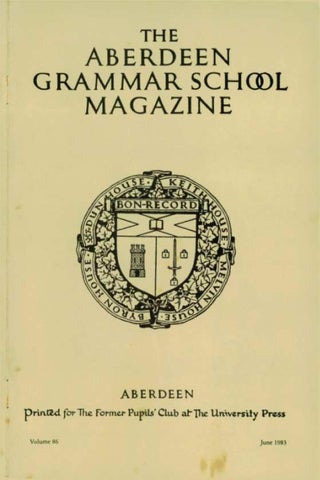
THE
ABERDEEN GRAMMAR SCHML MAGAZINE
ABERDEEN
print2c1 for -The Former Pupils' Club al-The University Press Volumc 86
June. 1983
-
ME NSTYLE HAIRDRESSING FOR MEN
Specialists in Cutting & Styling Appointment Service or ',Wilk in 27 ALBYN PLACE ABERDEEN 28114
Proprietor: Bill Mutch k
MIE\ f
for menswear
A mansion house in the West-end of Aberdeen selling the best of clothes for men, and the original F.P. tie. c
-
27 Albyn Place, Aberdeen ESTABLISHED 1904 Tel. 23950 CAR PARK
GIVE YOUR MONEY THE FREEDOM OF \ THE ristol&West
DUIEIRDOK@ @O@DETFT
ABERDEEN 8 Golden Square, AB9 1JD. Tel: 645086. Area Manager: J. B. Rennie. INVERURIE 2 High Street, AB5 9XQ. Tel: 20308. Manager: J. B. Rennie
lixoplecome first toMiddleIlsinAberdeen MITCHELLS SELF DRIVE
where people come first
35chapelStreet AberdeenTe1.50305
The Aberdeen Glass & China Co. Ltd. For DINING ROOM COCKTAIL BAR and KITCHEN EQUIPMENT 14-16 RENNIE'S WYND, ABERDEEN TELEPHONE 52478 9
mut: : •• li NU-STYLE PRODUCTS (Aberdeen) LTD. h:ii BUILDERS' MERCHANTS Stockists of
ii ii ii ii
ii
ASBESTOS CEMENT SHEETS GRANGES ESSEM ALUMINIUM SHEETS FORMICA DECAMEL •• LACONITE, ETC.
i••I REGENT WALK (at 558 King Street), IIii .-
ABERDEEN, AB2 1SR Telephone 491133/4
: THE CRESCENT HOTEL FULLY LICENSED
17 BON-ACCORD CRESCENT ABERDEEN AB1 2DE 24 BEDROOMED HOTEL CENTRALLY LOCATED ON AN ELEGANT VICTORIAN CRESCENT Tel. Aberdeen 23642
Personally supervised by the Proprietor Et his wife
Telephone: 630738
\AIL/ --
tialt
*
Telephone. 630738
CAREFREE CLEANING LTD 2 Midstocket Road, Aberdeen THE SERVICE: A high cleaning standard for Shops—Offices—Flats—Banks Warehouses—Houses THE COMPANY: Professionally managed by owner/directors. Selected and well presented staff. Competitive prices. Regular supervision of all contracts. THE PEOPLE: Ray Brown Director Alan H. Merrilees Director Call us NOW for a free quotation.
MOTOR BODY, PANEL & WING REPAIRERS, CAR UPHOLSTERY, ACETYLENE WELDING, CELLULOSE SPRAYING & UNDERSEALING
J. & W. GEORGESON LTD. Balmoral Motor Body Works.
Est. 1896
80 BROOMHILL ROAD, ABERDEEN Telephone 29241
11111111, II
FRED LAWSON SPORTS
FOR ALL YOUR SPORTS EQUIPMENT & CLOTHING
7 Mid Stocket Road Aberdeen AB24JL Telephone 0224636082
c,t t
A /
'THE THREE MUMS 45 JOHN STREET Functions and Bar Snacks
634676
DIAMONDS WATCHES-GOLD
Janfieson t Carry -We care that you make the right choke" That is why we have such a large :Too, of jewellery. watches. diamonds and gifts. Carefully selected for quality, design and once That is why our extensrve showrooms are a plotter(' to relax in AP' conditioning, bark ground music. leering, proper lighting. We care that you are in th• proper surroundings to make the right choice.
Jamison ts Carry Jewellers since1733 142 Union Street ABERDEEN AB9 1GF Telephone 0224 641219 POSTAL 8401INES DEALT MATH EFRCIENV
,„7
The Orange Grove (Proprietorr—J & H Barnett)
Offer a Choice Selection of Fresh Fruit, Vegetables. Flowers and Confectionery
Trays of Fruit a Speciality Orders Delivered 218/220 Rosemount Place
Tel: 637761
Aberdeen Grammar School Magazine 99th year No. 221 (New Series 88th year No. 212)
Vol. 86
JUNE 1983
The Magazine is published under the auspices of The Former Pupils' Club in June each year General Editor
David K. Yule, M.A.. 11 Kinkel! Road, Aberdeen AB1 8HQ
Editor of the School Section
Dip.Ed.. Ronald W. Caie, 21 Duthie Terrace, Aberdeen AB1 6LP
Editor of Notes, Obituaries and Marriages
Alan G. Campbell, 11..B • 22 Rosebery Street, Aberdeen AB2 4LL
Secretary of the F.P. Club
John F. Hendry, LL.B., 36 Albyn Place, Aberdeen AB9 1YU
The General Editor and Notes Editor are happy to receive contributions for the next issue of the Magazine at any time before mid-April 1984.
Printed for The Former Pupils' Club at The University Press Aberdeen
CONTENTS General Section— . . . . Rector's Message . • • • • • President's Report . Moderator of the General Assembly of the Church of Scotland . . . . . Sea Kings in the Falklands . . F.P. Cricket Section 1947-82 . . . . . Rugby Football Sixty Years Ago . . Notes on F.P. Rugby Section Personnel 1922-23. . . . D.M. (F.P.D.J.): Radio NorthSound . . The Singular Legacy of a Curious F.P. . . . . Young F.P.s Overseas . . . Tarzan and Company
. .
. . . . . .
page .. ,, .. .. .. . ,• ,, ,. ..
3 3 4 6 10 17 17 21 23 26 31
., .. ,. .. ,. „. .. .. .. .. „
34 34 39 39 40 40 41 46 56 61 61
,. „ ,. ,, , .. . .. .
63 65 66 68 71 78 89 90 96
. ., ,. ,, .. .,
8 18 35 35 44 67
School Section— School Office-Bearers . . Prefects' Notes . . . . Staff Changes. . . . . Mrs Enid Blaikie The Parent -Teacher Association . . . Music Notes . . . Combined Cadet Force . . . School Sporting Activities . . . Clubs and Societies The Royal Bank Capitaliser Competition . . Total Award: Paris 1982 .
.
.
.
. . . . .
. . . . . .
. .
. . . . . . . . . . .
. . . . . . .
. . . . . . .
.
. .
.
. .
Former Pupils' Section— . Club Office Bearers . . . Annual General Meeting . . Our President . . . Centre Reports . . . . Section Reports . . . Notes about Former Pupils . . . . . . Marriages . . . . . . . Obituaries . Abstracts of Accounts for year ending 31st December 1982
. .
. .
.
Illustrations— . . . . . . Lt. Cdr. Hugh Sinclair Clark . Aberdeen Grammar School Former Pupils' Rugby Club, 1922-23 . . . . Head Boy and Head Girl 1982-83 . . First A.G.S. International Netball Cap . Combined Cadet Force (R. A.F. Section) . . . . Club President 1983-84 .
The Rector's Message On 15 February 1982, the so called Parents' Charter came into effect, giving parents the right, amon other things, to send their children to the school of g interest to you, I am sure, to learn that as a result, their choice. It will be of Aberdeen Grammar School has admitted since that date some 260 pupils who would otherwise not have been eligible to attend the school. The fact that so many parents are seeking to have their children educated in our school is gratifying to my colleagues and myself and indicates strong support for a school policy which encourages maximum effort from all pupils and the observance of a reasonable standard of discipline. This large influx of pupils brings problems, however. The present First Year is very large, having 367 pupils and there is every indication that next year's First Year will be at least as large. Such numbers will inevitably increase the strain on our resources, but I am confident that with the good will and professional dedication of my colleagues, the school will maintain its standards m the years ahead. As a result of the Parents' Charter, all schools must now produce a Prospectus giving specific information. For many years Aberdeen Grammar School has had a Prospectus, but this year saw the publication of a much revised and more comprehensive one, which has met with general approval. The Prospectus is available to anyone on request. Very largely as a result of the Munn and Dunning Reports, radical changes in the curriculum for S.III and S.IV and in assessment structures are to be phased in over the next three years in all Scottish secondary schools. The fact that not all changes are to be effected at once and that not all subjects are to be treated alike as far as Credit, General and Foundation awards are concerned, will cause considerable problems for staff and pupils alike. The situation will be further complicated by the introduction of module-based courses and the Government's plan for greater flexibility and liaison between schools and Further Education colleges. Earlier in the session a Parent-Teachers Association was established. Such an Association can be of considerable assistance to the school and through it the school can disseminate much information of value to the parents. If the Association is to prosper, it needs the active support of all parents. I take this opportunity of wishing it all success in the years ahead. As always, on this occasion, I take the opportunity of thanking the Former Pupils' Club and individual Former Pupils for their continuing interest in the School. The financial help so generously given to the many Clubs and Societies in the School is also very much appreciated.
President's Report It is a privilege to have been picked out and put on display for a year as the F.P. President. It has been a pleasant and interesting experience; particularly so, because I come from the ranks of the ordinary majority of F.P.s, and the honour springs from that fact rather than from any public distinction or achievement. Throughout the year I found ample evidence that both the School and the Club are very much alive, and continue through all the changes of recent years to give each other the moral and practical support that is necessary to adapt to these changes successfully. That both School and Club are held in high esteem was very evident at the dinner I attended of the F.P. associations of other schools, including that of the "other place".
4
Aberdeen Grammar School Magazine
It is in the outlying Centres (if a centre can be so described) that the Club is best seen in action, and each of those in turn held its annual reunion, in its own distinctive manner and style. The informality of the Yorkshire Centre, and the grandeur of the London Centre provide a pleasing contrast. The wit of Edinburgh competes with the humour and dignity of the principal dinner in Aberdeen. Efforts are being made to revive the Glasgow Centre, and I hope these will be successful. The one most important element in keeping the Club and School together in good heart is the Magazine, and if there has been any discernible presidential message this year it has been to call for continued support for it. Give the Editors the material and they will continue to produce what so many F.Ps rely on to keep them in touch with events and people. It has not been easy to follow a president of Neil Meldrum's stature, but I did have the stalwart support of the officers of the Club (no President should be without them!) and have survived. I would like to wish my successor a happy year in office and hope that he also will find the experience a satisfying one. JAMES A. N. WAIT (1927-39)
Moderator of the General Assembly of the Church of Scotland It is a matter of great pleasure to all who have the goodfortune to know him, and a matter ofgreat pride to the School and to the lub that Dr. J. Fraser McLuskey (1920-31), an Honorary Vice-President of the Club, has been appointed Moderator of the General Assembly of the Church of Scotland in 1983. As far as may be determined, Dr. McLuskey is the first F.P. ever to be honoured by appointment to this singularly distinguished office of the Church, and doubly deserves our congratulations on that account. The Editor is grateful to two of Dr. McLuskey's colleagues at St. Columba's Church, Pont Street, for the following tribute to his career. When Dr. Fraser McLuskey was inducted as Minister of St. Columba's Church of Scotland, Pont Street, London, in 1960 it seemed that all his previous experience had been preparing him to take on this demanding and challenging Charge where he was to minister for the next twenty-two years and more. As a boy, Dr. McLuskey attended Aberdeen Grammar School from 1920-31. From 1931-37 he studied at Edinburgh University graduating as M.A. and, subsequently as B.D. He played rugby as a forward for the University and was awarded a green for this sport. On leaving University he was appointed Warden of New College Settlement, working among the deprived people of the inner city of Edinburgh, thus widening his experience of life. In 1938 Dr. McLuskey greatly enjoyed a travel scholarship in Germany. On his return he became Scottish Secretary of the Student Christian Movement, in which position he sought to communicate the Christian Faith to the students of his generation in the Scottish Universities. In 1939 he was appointed Chaplain to Glasgow University, at an earlier age than usual; again he was concerned with the needs of young men and women in the formative years at University. Now, in the early years of the Second World War, his career took a decisive turn. Feeling the need to identify himself more closely with his contemporaries on Active Service and to share in the defence of all he held dear, he volunteered as an Army Chaplain. After secret training in 1943 he was appointed Chaplain to the 1st Regiment of the Special Air Service, a parachute Regiment, in which he served in many very dangerous situations in occupied
Moderator of the General Assembly
5
France and always with characteristic courage. His example of bravery, fortitude and self- forgetfulness during those times of great peril behind enemy lines forged an enduring link of close friendship between him and the officers and men of the 1st S.A.S. Regimental Reunions in London are never complete without him. He was awarded the Military Cross for his War Service. Later he wrote a book 'Parachute Padre' about his wartime experiences. At the end of hostilities in 1946 the Army invited him to become Director of Studies at the Royal Army Chaplains Depot at Bagshot Park, Surrey, where he planned the training of future Chaplains. In 1950 Dr. McLuskey was called back into the regular ministry of the Church as Min'ster of Broughty Ferry East. He very quickly made his mark in the Church of Scotland and in 1955 he was translated to the large and influential Charge of New Kilpatrick, Bearsden. In 1960 he was called to the famous Scots Kirk in London, St. Columba's, Pont Street, where he has continued his ministry. In 1962 his Alma Mater honoured him with the Doctorate of Divinity. In London St. Columba's has been a gathering point for many young Scots people who have been sent to the capital to further their careers in the Civil Service or in banking or other spheres of business. Services on Sunday are attended by Scots from homes scattered throughout the London area and the home counties and they are joined by visitors from all parts of the world. Dr. McLuskey has a deep sense of the relevance of worship to this modern age and his very remarkable ministry has touched and held a wide spectrum of men and women. He is art arresting and powerful preacher with a fine command of language, a penetrating mind and considerable intellectual ability. He is very specially gifted as a Pastor and he has built up throughout his years at St. Columba's a continuing and ever-deepening relationship of love and trust which has nourished the faith, not only of those within the closer bonds of the congregation, but also within the wider outreach which is a significant part of the London ministry. Countless individuals and homes have been blessed by his counsel and care. Dr. McLuskey's warmth of personality, his remarkable gift for friendship and his infectious sense of humour and of good fun are qualities which have drawn around him a host of friends of all ages during the course of his career. Music holds a special interest for him and in gatherings with friends, whether in the family circle at home or the larger family in church, the time of fellowship is often enriched by his presence at the piano. Both he and Mrs. McLuskey share in the gift of lifting the heart in joyfulness when in their company. Dr. McLuskey's ministry has been one of singleminded and joyful devotion to our Lord and His Church and it is certain that his Moderatorial year will be marked by the deep quality of a ministry of reconciliation which is the flower from the root and inspiration of all his work.
Sea Kings in the Falklands Lt. Cdr. Hugh S. Clark (1951-65), D.S.C.. R.N.. has served in the Royal Navy since leaving School. Ha exceptional courage during the Falklands campaign attracted national attention. In the following article, which he has contributed at the invitation (and, no doubt, harassment) of the Notes Editor, he affords readers a privileged appreciation of the (fortunately) rare experience of a helicopter commander during active service in modern warfare. Imagine if you can, a chap who has just finished a year of school (formal staff training with the Royal Air Force) settling down to his new job as the Commanding Officer of the R.N. Sea King training squadron. The Argentinians invaded, the Task Force was hastily formed and sailed. Together with a large proportion of the Fleet Air Arm I was left at home as the ships set off to we knew not what. By the end of April, it became evident to the planners that an invasion would have to go ahead. It was also evident that in the inhospitable Falkland Island terrain, similar to the worst Scottish mountain glen and coast, helicopters would be at a premium. On 1 May I was quietly spending the weekend digging my garden when the telephone rang. "Form a new utility helicopter Squadron! it said. "By the way, you sail within a week." Mission impossible? Not quite. We took about half the Sea King training squadron consisting of ten aircraft culled from all over the U.K., thirty aircrew, one hundred maintainers and started to put the whole thing together on Monday 3 May. Our task was to be prepared to operate ashore with the Royal Marines and Army as heavy lift and, troop transport. The difference in philosophy was difficult to grasp. From a team of blue-suited sailors trained and accustomed to living in ships, we had to become camouflaged 'soldiers' prepared to live, eat, sleep, operate and even fight in trenches and tents. The supply organisation was fantastic. Within a very few days we had everything that we needed. Clothing, weapons and equipment. We didn't understand most of it, but we had it! We commissioned 825 Squadron at Culdrose on 7 May 1982 the motto—"Nihil obstat"—Latin was not my best point at school—"I see no snags" is how we translated it. After a couple of days frenetic activity our travel arrangements became clear. The first wave of thirty maintainers would sail on 8 May in RFA Engadine. The Squadron command team with two aircraft would sail on 10 May with 5 Infantry Brigade in RMS Queen Elizabeth 2. The remainder of aircrew, groundcrew and eight aircraft would sail on 14 May on SS Atlantic Causeway, sister ship to the ill-fated Atlantic Conveyor. On 8 May I said au revoir to the first of my lads. My wife and I were privileged to dance the ancient Furry Dance that day through the centre of Helston. On Monday I embarked with my team in QE 2 in Southampton Water. The journey south would fill a book in its own right. Suffice it to say that from sailing to final landing at San Carlos there was virtually non-stop military and physical training for the whole of the embarked force. There is a tremendous motivation to do this training when you know that someone is shortly going to be shooting at you or bombing you. The three elements of my squadron went south separately. Atlantic Causeway went straight to the Falklands carrying out the fastest passage of any ship in the Task Force. My aircraft were disembarking to San Carlos fourteen days after leaving the United Kingdom. QE2 went via the desolate and barren South Georgia. There, in an amazing logistic exercise using trawlers and our two Sea Kings, the whole of 5 Brigade was transferred from QE2 to Canberra and the ferry Norland. Both of these ships were by this time veterans of 'Bomb Alley'. The journey from South Georgia to San Carlos was the most unsettling time for me. I was not in charge of my own fate. We were merely passengers going 6
Sea Kings in the Falklands
7
in to the invasion beach. It was a great relief when thirty-six hours after we had left South Georgia we could finally start up the aircraft and fly ashore. , After the initial confusion of getting the Squadron reassembled, we established our operating base in a wet and windy field at San Carlos Settlement next to Blue Beach, the prime invasion site. Accommodation was rudimentary with everyone in tents. Slit trenches provided cover from the frequent air raids and a roaring petrol burner provided hot drink and food—all from tins. There is no getting away from it, life was bloody at first. What did we do? The answer is—everything. Flying for my squadron was from dawn to dusk. We did not have any of the night viewing aids fitted to some aircraft and 'daylight only' was a conscious decision to ensure aircrew rest, In the Falklands, at latitude 51 ° South, the same latitude as Birmingham is North, we could use about ten hours of daylight at that time of the year, just entering the Antarctic winter. Our day began when the alarm clock went off about two hours before dawn. Out of bed, tooth wash, clear up bedding, square away the tents, and pack your sleeping bag. Check your rifle and pistol, and load up your webbing. (We carried all the kit and bedding with us in the aircraft in case of a crash landing in unfriendly territory and finding ourselves as survivors.) The next event was breakfast. 'Compo', tinned sausages, beans, baconburgers and the like kept us going for almost the whole six weeks we lived at San Carlos. After breakfast, while the groundcrew were preparing the aircraft in the dark and with no torches, the aircrew would collect rations for the day and attend briefing. Rations were normally packets of biscuits, boiled sweets, margarine and perhaps jam with water to drink. Chocolate if you were lucky and towards the end of the campaign, the odd apple appeared from the stores ships. Briefings were delightfully vague. In our command tent (my bedroom) we had an HF radio link to the command ship HMS Fearless. We would be instructed to send, for example, four Sea Kings to Goose Green to support 5 Brigade; three Sea Kings to Estancia House to support 3 Commando Brigade; one Sea King to move Rapier units at Teal Inlet and one Sea King as the San Carlos Anchorage ferry. When tasked we would allocate crews to aircraft, hump our packs on to our backs and set off to the sullies, up to a mile away from camp, where the aircraft were dispersed against air attack. Amazingly we never had an aircraft fail to start even after being ignored all night. Good old Westlands and Rolls Royce! When we were away on tasking, all our flying was conducted at very low level. In the trade this is known as 'nap of the earth' flying. It means about 15-50 feet above the ground at maximum speed and following the natural contours. There are no national grid power lines to worry about in the islands and this form of flying offers protection both from fighter attack and ground fire. It can be very exhilarating too! Most of the work was good solid lorrying of stores, ammunition, guns, vehicles and people forward to the front line. Almost every shell used in the bombardments was carried by helicopter and every gun was put in position by a Sea King. We carried Paras, Royal Marines, Chaplains, Doctors, Islanders, Prisoners of War and even rice for the Gurkhas. After leaving the camp in the morning the crew would normally stay with the aircraft all day, sometimes logging over ten hours flying in a day. It was only necessary to fill up with fuel at the various fuel dumps and ships. We normally did not shut the aircraft down and the pilots would take turns to stretch their legs at the landing sites. Snacks were eaten on the move. If we were lucky, while landing on ships for fuel or stores, we would get a hot drink, normally passed to us by the deck crew. From time to time we had more exciting events and did come under enemy fire while moving troops forward or re-supplying the
8
Aberdeen Grammar School Magazine Award of D.S.C.
Lt. Cdr. Hugh Sinclair Clark (1951-65), D.S.C., R.N., Commanding 706 Squadron R.N.A.S. guns, but escaped with only a few bullet holes in the aircraft! The squadron even managed to capture some Argentinians. I am not sure who was more surprised. The incident that sticks in my mind, and which has caught the public imagination, was the bombing of RFA Sir Galahad and Sir Tristram. It was a clear, bright sunny day. There was a fresh breeze and visibility was exceptional. My task for the afternoon was to take a survey party to assess thr ground at Fitzroy settlement for the installation of a Harrier operating site. We shut the aircraft down in the settlement on the village green overlooking Pleasant Harbour. The two ships were at anchor about five hundred yards apart. Tristram appeared to be unloaded and there was activity round Sir Galahad. All appeared normal and I told the other two members of my crew that we
Sea Kings in the Falklands
9
would be there for about an hour, and that they should try to find a cup of tea. It was just after lunch. I had made my way to the 5 Brigade headquarters, situated in a barn overlooking, the harbour, to get a briefing on the tactical position and search for a cup of tea. All was quiet, and I was sitting on a crate chatting when suddenly we heard the whistle of jets—very close! After an awful second there was the trump of bombs and everyone dived to the ground. After the initial surprise, which was complete, I ran for cover away from the barn and my aircraft which I thought were possible targets for the air raid. I hid under a bulldozer while a second attack went through! After a moment we all emerged from cover cautiously looking around. The Skyhawks were disappearing low level to the South and smoke was pouring from Sir Galahad. Tristram appeared undamaged at this time. I could see a couple of helicopters approaching fast from the East. The next job was to get my crew together, start the aircraft and begin a rescue. It took us just under five minutes to get on the scene by which time three other Sea Kings and a Wessex were starting work. As I arrived, it was evident that the ship was badly hit. The majority of survivors were assembling on the forecastle or abandoning ship by boat and liferaft. At the forward end they were clear of the smoke and exploding ammunition. Down aft there were numbers of men prevented from moving forward by the intense heat. Some of them found liferafts and managed to clear the ship in that way, but some had no alternative but to jump overboard. Few of these had time to find lifejackets or survival suits, and thus were in a bad way through burn shock followed by the hypothermia caused by cold water. Some were staying afloat by hanging on to empty gallon plastic bottles. It was obvious that there were enough helicopters moving survivors from the foredeck which was restricted in size. I decided to concentrate on the small numbers of people down aft and in the water astern of the ship. I don't remember how many we actually picked up but we did make sure that the area was clear. The actual flying was not too difficult. It looked spectacular on film, but even when close to the ship I could see the waterline and the ship's name to use as a hover reference. It was a bit smoky in the cockpit, but we were more worried about the danger of exploding ammunition and indeed, of the whole ship blowing up. For that reason we also decided that it would take too long to clear survivors out of all the life rafts. The quickest way to make sure that they were far away from further danger was to use the rotor downwash to blow the rafts clear towards the shore. We winched out any burned or injured men from the rafts but then left the remainder to fend for themselves. They were all eventually towed ashore by boat. Once the ship was clear, the rest of the day was spent moving the injured from the first aid post at Fitzroy back to the field hospital at Ajax Bay. This took about thirty minutes flying time and was a terrible journey for the injured. There is little you can do to ease suffering in the back of a helicopter. That was not a typical day, but, as usual, as the sun set, we arrived back at our base. After landing in the field we would take the aircraft away to the dispersed sites and shut them down for the night. The groundcrews would work on them and the aircrew walk the mile or so back to the camp through the cordon of sentries and password traps. Supper—the second hot meal of the day followed. It was more tinned 'compo with an occasional fresh vegetable. As we came to know the manager of the local settlement we even managed the odd bullock, sheep or goose. Butchery was simple but effective. Settle down in the tent for the night with perhaps a small glass (plastic cup) of medicinal whisky or can of beer. Amazingly, drink supplies never dried up. Then sleep—for about half an hour if you were lucky—then—whistles blowing and
10
Aberdeen Grammar School Magazine
shouts of "Mr raid warning Red". Out of bed, grab your weapon and into the trench for an hour or so before "Air raid warning Yellow". Back to bed—and so on. About the time of the Sir Galahad affair, all the troops had moved forward and we were able to take over the barns and more permanent buildings in our settlement. At last we had a roof over our heads. The aircrew were fortunate to be the guests of the settlement manager and his family. Pat and Isobel Short and their children were what it was all about. Any doubts I may have had about the whole affair were dispelled when I saw what liberation from invasion meant to these people and their children. After the cease fire we remained at San Carlos. We became the Islands' taxi service, as before, moving everything, only in a more ordered fashion. We were able to take some time off and have showers in the ships at anchor. West Falkland was now included on the bus route and we continued to serve in this role until mid July when we were told to come home. By this time the snow was thick on the ground and we were ready and willing to leave. The aircraft (plus a captured Argentine squadron runabout helicopter) were loaded with the maintainers on to Atlantic Causeway and set off north. The aircrew went to Port Stanley, and after a couple of days were moved north to Ascension Island by RAF Hercules. VC 10 onward to RAF Brize Norton and an amazing welcome from the completely unexpected crowd. Then home to Cornwall. The whole of 825 Naval Air Squadron arrived back in the UK before the first of August. We took leave, cleaned up the aircraft and I disbanded the squadron on 17 September 1982, just a few short months after the commissioning ceremony. Job done, no losses, no casualties. I was privileged to lead a fine team of men. When I had the honour to go to Buckingham Palace earlier this year with my family, it was as a representative of this team. My only regret is that they could not all be there to share it. Now—imagine if you can a chap who has just finished a somewhat different year, and is settling down to his new job as the Commanding Officer of the RN Sea King training squadron. The telephone rang. "It's the Notes Editor of the School magazine— '. HUGH S. CLARK (1951-65)
F.P. Cricket Section 1947-82 There was no organised F.P. cricket prior to 1917 when Lennox Riddell, a sound and reliable batsman, and Alan McBain, a fine player and captain, founded the Section and inaugurated the new field at Rubislaw with a successful challenge match against a strong Aberdeenshire Xl. However, although F.P.s at various times defeated all the Scottish Counties and won the Aberdeenshire Cup, the Section had difficulty in fielding a regular side due to calls from the county XI, which on occasion included up to eight Grammarians, and to the emigration of key players. The Section was re-formed on a sounder basis in 1932 and was admitted to Grade I of the Aberdeenshire Association, winning the league title in 1939. After the Second World War, F.P.s played for one more season in Grade I, finishing third, and then decided to apply for admission to the Strathmore Union, the objects being (i) to improve the Club's own standard of play by participating in a better class of cricket, (ii) to improve the standard of cricket in Aberdeen by having three clubs instead of two (Gordonians and Mannofield XI) in the Union, and (iii) to encourage players to join the Section. So in 1947 the Club finished a respectable fifth in the Strathmore Union table, the title going, as it has done no fewer than nineteen times since the War, to Strathmore. Jim limes topped the 1st XI batting averages with 47.8,
F. P. Cricket Section 1947-82
11
followed by the hard-hitting Neil Macdonald with 32, while groundsmancoach Eric Tyson captured 40 wickets at 12.1 each and Donny Marr 42 at 12.3 apiece. At this time Yorkshireman Tyson was already 54 years old, and his wonderful skill as a left-arm slow bowler was to provide a tremendous boost to the F.P. bowling attack over the next eight years, with Rubislaw, thanks to his untiring devotion, becoming universally recognised as one of the best cricketing wickets in the Union if not in Scotland. In 1948, the year of Don Bradman's last first-class appearance in the Australian tourists' visit to Mannofield, F.P.s won the Strathmore Union title with a record of Won 14, Drawn 3, Lost 2. Curiously enough this was the identical record to that of the 1982 championship-winning side, and further coincidences are that in both seasons one of the defeats was at the hands of Arbroath and one was by a single-wicket margin. Obviously the luck of the toss was also a factor in both successes; while the 1982 side generally batted second and achieved some stirring victories by overhauling large totals, the 1948 side batted second on all but three occasions and never had to chase more than 128 to win. The batting in 1948 was not very sound. .yet someone always came to the rescue. Harry Cardno, with 487 runs (including 102' at Forthill) at 34.8, was the main stalwart, but the great strength of the side, led ably by wicket-keeper Tim Allan, was in its bowling, supported by excellent fielding. Three F.P.s finished in the first five in the Strathmore Union averages, with Eric Tyson topping the list (46 wickets at 4.8 each); Tom McCrea took 54 wickets at 5.5 apiece and Ally Edmond 30 at 7.7 each. Outstanding individual performances were recorded by Tom McCrea, who took all ten wickets for a mere 18 runs against Forthill XI, and by Eric Tyson, with five wickets for 3 runs against Brechin and six wickets for 8 runs against Meigle. However, to quote the Magazine of December 1949, "such a galaxy can be expected to appear, like Halley's Comet, only once in a lifetime", and the following season saw a distinct fall from grace, down to eighth place in the Strathmore Union table. Indeed, in the next quarter of a century, only twice did F.P.s feature in the first five places, in amazing contrast to the period since 1974 when F.P.s have never dropped out of the top five. The Section had lost the services of Doug Smith and Tom McCrea, Eric Tyson and "Dally" Allardice made few appearances, Neil Macdonald suffered from prolonged unfitness and Harry Cardno completely lost form with the bat. The writer whom I quoted in the preceding paragraph was obviously in a gloomy frame of mind in describing the 1st XI's performance as "redisclosing the traditional (and largely psychological) weakness of F.P. cricket. Only a new tradition of batsmanship will again bring the Union championship to Rubislaw". And yet there were encouraging signs; the 2nd XI, which had been relegated from Grade I in 1947 and had just avoided further relegation in the following season, enjoyed a revival of fortunes in 1949 and won the Grade II title and with it promotion. A slight improvement occurred in 1950, but Eric Cruickshank's success with the bat brought him selection for the county side and runs were hard to come by. The Grade XI finished third equal in Grade I and then, in what appears in retrospect to have been an astonishingly short-sighted decision, opted to withdraw from the Grade Association, preferring to arrange friendly fixtures. After two seasons this decision was reversed, but F.P.s were then obliged to start again at the bottom, i.e. Grade 111. The main feature of 1951 was Sandy Davidson's rise to prominence as a fast bowler; while league form was moderate, F.P.s reached the Final of the Three Counties Cup only to lose in the last over. In an early round of this competition Sandy Davidson recorded the astonishing analysis of 8 wickets for 18 in a victory over the Grade Select.
12
Aberdeen Grammar School Magazine
There was a distinct improvement in the following season, when Eric Tyson again won the Strathmore Union bowling cup with a return of 43 wickets at 8.1 each; although he occasionally stood down "to give promising younger players a chance' , figures such as 6 wickets for 7 runs against Dundee High School F.P. showed that his fifty-nine years were no barrier to success. He was well supported by Sandy Davidson, while Jack Manley, Ken Peters and David Mitchell all exceeded 300 runs for the season. For the second year running F.P.s were defeated in the Final of the Three Counties Cup, but one league record was established which has stood the test of time: a total of 262 for 4 wickets at the expense of Brechin. 1953 saw the emergence of George Murray as an outstanding all-rounder for F.P.s following an exceptional season with the undefeated School XI of that year, which included J. B. "Sam" Rennie, but it was still the veteran Eric Tyson who hit the headlines with figures such as 7 for 14 v. Forthill XI, including four wickets in four balls; with 57 wickets at 6.75 each, he was runner-up in the Union bowling averages. Around this time George Murray joined Sandy Davidson and Eric Cruickshank as a regular member of the county side, and a near-contemporary, Neil Kemsley, who played his postschool cricket in the south of Scotland. gained the rare distinction of scoring a century at Lord's on his first appearance at the home of cricket for Scotland against the M.C.C. For the next three years Eric Cruickshank, equally distinguished as a rugby player for F.P.s and later for London Scottish, dominated F.P. cricket, finishing top of the 1st X1 batting averages in 1954, 1955 and 1956, in the latter season winning the Strathmore Union batting cup with an aggregate of 601 runs at an average of 66.77. well ahead of such noted professionals as Nigel "Chopper" Hazel and Doug Greasley. Yet it was two other batsmen, Donald Stephen (126') and Jack Manley (61'), who established a record undefeated partnership of 200 against Meigle for the second wicket in 1954 on one of Eric Tyson's "'Perfect wickets on that ever-increasing middle". In 1956 F.P.s achieved their highest placing since 1948 by finishing fifth, but the departure of Eric Cruickshank to London left a gap which was not adequately filled for several years. About the same time Eric Tyson retired from active duty with the Strathmore XI, and his subsequent retirement from the post of groundsman was marked by the unprecedented tribute of a testimonial match, graced among others by Rohan Kanhai (then professional with Aberdeenshire), played at Rubislaw on Sunday. 24 August. 1958. As A. J. M. "Freddie" Edwards wrote at that time, "the present state of the ground and especially the splendid cricket square prove just how wonderfully well this tremendous enthusiast for sport has done his job. He never measured his work in terms of hours. He had wonderful skill as a cricketer; it is sufficient to mention that, when long past his prime, he still gave many sparkling bowling displays for F.P.s". Several seasons of mediocre league results followed, with F.P.s relying heavily on the stylish batsmanship of Robin Bain and on the bowling duo of Sandy Davidson and Alistair Stewart. There were, however, some triumphs to gladden the hearts of F.P. cricket followers, notably the consecutive victories in the 1958 and 1959 Finals of the Three Counties Cup. in which Sandy Davidson and George Murray were particularly prominent. The Grade XI, in the meantime, nad achieved promotion to Grade II with a hundred per cent record in 1954 and further promotion to Grade I in 1957. Some improvement in league form was noticeable in the early 1960s, with a meritorious performance of fourth in 1963, when John Milne and Sandy Davidson were respectively the first winners of the 1st XI batting and bowling trophies presented by Ken Peters. The Section, however, was suffering from a
F.P. Cricket Section 1947-82
13
shortage of players, and the Grade XI sank from Grades Ito III between 1960 and 1964 and then, as a result of league re-organisation. to Grade IV in 1967. In the late 1960s some young players such as Olly Will, Sandy Simpson, Fraser Webster and Harvey Morrison began to make their mark, but the 1st XI still tended to rely on too few individuals, notably Sam Rennie and Alistair Stewart. Sam had an outstanding season in 1968, including a memorable innings of 119 at Rubislaw against Meigle, and in the same season Alistair Stewart performed the hat-trick at Forthill; after a disastrous start, only two matches were lost after 8 June, but a shortage of support for Alistair's accurate bowling prevented more than three victories. A welcome increase in recruitment from the school led to the formation of a 3rd XI in 1969, in which season the Grade XI gained promotion; unfortunately the departure from the school staff of Alec Tough, the driving force behind the 3rd XI, led to its premature demise within a couple of years. 1970 is described in the relevant issue of the Magazine as "not a season to write home about", and the 1st XI continued to depend on a few batsmen and one bowler. In 1971 Sam Rennie once more exceeded an aggregate of 500 runs, including 109* off the Perthshire Xl attack. Lowly placings of 11th, 12th and 11th (out of 13 clubs) in seasons 1971, 1972 and 1973 gave little sign of the revival which was imminent, but the seeds of future success had been sown with the decision of the parent F.P. Club to allow 'open' members to play for the Sports Sections. The first outstanding cricketer to join the Section from outwith the school was Richard Ferro, who topped the 1st XI batting averages in 1973. 1975 and 1978 and whose air of quick authority as captain from 1980 to 1982 (not to mention his incredible luck with the coin!) contributed so much to the eventual triumph last August. A string of excellent players have subsequently been attracted to the Section, notably Duncan Thomas, John Pickard, David Leiper (whose apearances have been restricted by his international hockey commitments),John Hutton, Gavin Wood, Dave Thornton, Mike Hart and Nick Johnson. Other fine 'open' players have contributed to the recent success of the Grade Xl, none more so than Brian Proctor, whose left-arm Chinamen and googlies would have delighted Eric Tyson. Yet perhaps the most prominent cricketers produced by the Section in the past eight years have been 'home-grown', in the substantial forms of twin giants Dallas and Jeremy Moir. After serving their apprenticeship in the Grade XI, the Moirs made their debuts in the Strathmore Union in 1974, and for the next three years Dallas headed the 1st Xl bowling averages, winning the Union bowling cup in 1976 and moving on to fame—and hopefully- fortune with Aberdeenshire, Scotland and Derbyshire, where his slow left-arm bowling and slip fielding have brought him to the notice of the English selectors. After Dallas' departure, the bowling was dominated by the opening (and sometimes closing) attack of fast bowlers John Pickard and Jeremy Moir, the former winning the Strathmore Union bowling cu in 1977 and the latter doing likewise in 1981 and 1982; for good measure Jeremy topped the 1st XI batting averages in 1979 and 1982, winning the Union batting cup in 1982, only the second occasion (the first being Mike Walton of Meigle in 1979) that the 'double' has ever been achieved. Thus, following the Tyson era from 1947 to 1955 and the Davidson-Stewart era from 1956 to 1973, we enter upon the Moir-Pickard era from 1974 onwards. In 1974 the 1st XI dramatically leapt from 11th to 5th position in the Strathmore Union table, with Sam Rennie enjoying a vintage season, scoring over 550 runs, and now being well supported by others such as Richard Ferro and Neil Armour. The Grade XI, under the captaincy of David Robertson, gained promotion to Grade II, though unfortunately there was still insufficient strength in depth in the Section to enable them to maintain their position for more than one season.
14
Aberdeen Grammar School Magazine
1975 turned out to be the most successful year for the 1st Xl since 1948, Richard Ferro and Harvey Morrison excelling with the bat, and John Hutton and the Moir twins with the ball; only three defeats were sustained, two of which were by narrow margins in the July holiday period. Third place was again achieved in 1976, but this was a season of slightly more mixed fortunes; the batting was potentially strong yet frequently disappointed, and the main strength lay in the bowling, where John Pickard burst on to the scene in dramatic fashion. There was also a regression in the fortunes of the Grade XI, due to lack of recruitment and to organisational problems, and it was clear that a more determined effort was needed if the Section was to sustain a high standard. Fortunately, 1977 provided evidence that the ingredients for success were there. Under Ian Souter's enthusiastic leadership, the 1st XI finished runnersup in the Strathmore Union table with but a single defeat, and that was sustained off the last ball of the match against champions Brechin as the result of a questionable decision. The one major disappointment of the season was defeat at the hands of Dundee High School F.P. in the Final of the Three Counties Cup, one trophy which had eluded the Section since 1959. Harvey Morrison averaged 40 with the bat, and John Pickard's 61 wickets at 8.95, including such sterling performances as 8 for 24 against Blairgowrie and 6 for 12 against Forthill XI, earned him the Strathmore Union bowling cup. In the meantime the Grade Xl showed signs of improvement, with fourteen-year old David Leiper (a Kincorth Academy pupil) winning the under-18 batting cup in the Aberdeenshire Grades, and in 1978 this progress was maintained by the XI winning the Grade III championship, David Robertson heading the Grade III batting averages with 403 runs at the remarkable average of 100.75; other notable performances were a century in 52 minutes by David Leiper at the expense of St. Ronald and John Hobbs' 6 wickets for 6 runs in 17 overs at Banchory. The season of 1978 had started on a sad note with the untimely death of that great club servant and fine fast bowler Sandy Davidson; in his memory his widow donated a handsome silver trophy to be awarded each season to the person who had made the greatest contribution to the Section. The first popular and well-deserved recipient of the Sandy Davidson Trophy was Sam Rennie. Subsequent winners have been the author of this article. Ian Sourer, lain Hopkin and Jeremy Moir, and all can testify that the possession of this particular trophy has given them greater satisfaction than any other award. Despite the damp, soft, wickets of 1978 and much unpleasant weather, Richard Ferro contrived to knock up some high scores, notably 96' and 88, the latter an innings of outstanding quality at Rubislaw in an exciting victory over joint champions Arbroath, whose attack included the redoubtable left-arm Bermudan fast bowler Clarence Parfitt (116 wickets in the season). One disappointment was the Club's early elimination from the national Shish Mahal Cup, for which it had qualified by its 1977 success; a narrow defeat was sustained at the hands of Huntly. In 1979 the 1st XI again finished fifth in the Strathmore Union table, but with a distinctly improved record in comparison with the previous season. 73 per cent as opposed to 55 per cent. Jeremy Moir scored over 300 runs at an average of 45.29 and John Pickard claimed 73 victims at 8.08 apiece, each finishing third in the Union batting and bowling averages respectively. Harvey Morrison scored a century against Perthsire XI at the North Inch only to have his feat nullified by the subsequent abandonment of the game due to a downpour, and Gavin Wood showed his class on several occasions, notably with an innings of 92 against Gordonians. The Grade XI also enjoyed a fine season, continuing its upward progress by finishing second in Grade II and thereby gaining promotion to Grade 1; a feature of its season was the haul of
F.P. Cricket Section 7947-82
15
over 50 wickets by newcomer Brian Proctor, while David Leiper (now sixteen) again won the under-18 batting cup for all Grades. 1980 was a year of further expansion for the Section, with the successful revival of a 3rd (Reserve Grade) XI under the able and enthusiastic leadership of Derek Harley; mainly composed of schoolboys, this XI has enjoyed considerable success on the field as well as serving the important function of a nursery for future talent. The 3rd XI finished third in the Reserve Grade in 1980 and 1981, winning the Johnston Cup in the latter season, with Graham Davie and Kenneth Stephen winning the under-18 and Reserve Grade batting cups in 1980. Robert Lawrie's 8 wickets for 2 runs in a league match against Anchorians Reserves in 1981 is probably unique in the Section's history. The Reserve Grade XI's performances in 1982 are chronicled elsewhere in this issue of the Magazine, but mention must be made of the outstanding contribution of Martin Webster, whose mature experience is matched only by his youthful enthusiasm. The Strathmore XI finished third in the table in 1980, Sam Rennie enjoying what might be termed an Indian summer by scoring 352 runs at an average of 35.2, thereby ending up as second amateur in the Union batting averages; as always, he set a fine example of consistency and watchfulness. Jeremy Moir and John Pickard continued to hunt in pairs, although off-spinner Mike Hart crept up on them to win the club bowling trophy. Jeremy performed some outstanding all-round feats, none better than his 98*, followed by 6 for 28, at Dalnacraig against Dundee High School F.P. Twin Dallas also made his mark in his rare appearances, scoring 99' in a Three Counties Cup-tie against the Grade Select at Rubislaw with a fearsome display of hitting after a quiet start. Unfortunately the Grade XI found life in Grade I rather too difficult and, despite remaining undefeated at Rubislaw, were relegated by a narrow margin; the bowling lacked- penetration and the batting was rarely strong enough to do other than hold out for draws. A feature of the 1981 season was the excellent batsmanship of Duncan Thomas, whose aggregate of 660 runs is the highest ever recorded by an F.P. in a Strathmore Union season and whose innings of 166' at Forthill is likewise the highest individual score made for F.P.s in the Union. Duncan won the Union batting trophy with an average of 50.77 and, not unnaturally, graduated to the County side, which limited his appearances in the title-winning side of 1982. With the virtual retirement (prematurely) of John Pickard, Jeremy Moir came into his own and won the Strathmore Union bowling cup with 56 wickets at 8.55 apiece, a feat which he repeated in 1982 when he netted 77 wickets, the third highest aggregate ever recorded, at the slightly more expensive rate of 10.75 each. Jeremy's best individual return in 1981 was 8 for 29 on a hard, fast wicket at Blairgowrie towards the end of August, when the author. fielding at second slip, spent much of his time praying (successfully) that the batsman would not snick the speeding ball in his direction. 1981 marked the formal retirement from Strathmore Union cricket of Harvey Morrison and Sam Rennie, although occasional subsequent appearances by a slightly rounded B. A. West have led some to believe that Sam is still willing to help out when required. The Grade XI bounced back to Grade I in 1981 by once more finishing runners-up in Grade II under the idiosyncratic and extrovert leadership of the hirsute lain Hopkin; their subsequent record in 1982 proves that they enjoy meeting new friends each year! While the great achievement of the 1982 1st XI in winning the Strathmore Union title is fully documented elsewhere in this issue, with Jeremy Moir's outstanding contribution proving him to be the finest all-round cricketer ever produced by the School (pace Dallas Moir!), it is worthy of note that three other batsmen exceeded 300 runs, so that the team was by no means a oneman band. For the author, the greatest satisfaction was the performance of the
Aberdeen Grammar School Magazine
16
'double' over Strathmore, which must have given immense pleasure to the participants in those two exciting clashes. And so the flag of the Grasshopper Strathmore Union champions will fly at Rubislaw in 1983, and we all hope that it will not take another thirty-four years for F.P.s to win the title again! JOHN G. N. FRASER (1942-55)
I am indebted to Gavin McKiddie of Strathmore Cricket Club for his assistance in cornpilation of the undernoted statistics: Statistical Supplement Sraion
Played
Wool
Draw.
Los,
Position Leading barman
Leading bowler
1947 1948 1949 1950 1951 1952 1953 1954 1955 1956 1957 1958 1959 1960 1961 1962 1963 1964 1965 1966 1967 1968 1969 1970 1971 1972 1973 1974 1975 1976 1977 1978 1979 1980 1981 1982
17 19 18 16 19 20 19 19 19 16 17 15 18 18 18 17 20 18 17 17 22 18 16 16 20 23 22 20 18 16 17 18 20 19 18 19
7 14 4 5 6 7 7 3 5 6 5 4 1 4 6 5 8 5 3 6 5 3 4 5 5 3 5 6 10 9 10 8 11 12 10 14
4 3 7 3 3 6 3 6 8 5 3 4 5 5 4 3 6 8 5 5 5 8 6 3 3 6 7 8 5 2 6 4 5 5 3 i
6 2 7 8 10 7 9 10 6 5 9 7 12 9 8 9 6 5 9 6 12 7 6 8 12 14 10 6 3 5 1 6 4 2 5 2
5th J. A. Innes 1st H. S. Cardno 8th N. Macdonald 8th E. H. Cruickshank 9th K. J. Peters 7th J. S. Manley 6th G. Murray 9th E. H. Cruickshank 8th E. H. Cruickshank 5th E. H. Cruickshank + 9th D.J. Stephen 8th M. Carson 11th R. Bain 9th W. A Stewart 7th R. Bain 8th R. Bain 4th J. M. Milne 7th R. Bain 10th H. 0. Will 6th H. 0. Will 11th J. G. N. Fraser 11th J. B. Rennie 10th J. B. Rennie 8th H. E. Morrison 11th J. B. Rcnnic 12th A. J. Simpson I Ith R. S. T. Ferro 5th J. B. Rennie 3rd R. S. T. Ferro 3rd J. B. Rennie 2nd H. E. Morrison 5•h R. S. T. Ferro 5th J. D. Moir 3rd J. B. Rennie 4th K. G. D. Thomas t 1st J. D. Moir t
L. E. Tyson L. E. Tyson IL. E. Tyson L. E. Tyson A. M. Davidson L. E. Tyson t L. E. Tyson L. E. Tyson L. E. Tyson J. R. Y. Mutch D.J. Stephen A. M. Davidson W. A. Stewart A. M. Davidson A. M. Davidson A. M. Davidson A. M. Davidson A. M. Davidson A. M. Davidson A M. Davidson W. A. Stewart W. A. Stewart I. M. Richardson W. A. Stewart W. A. Stewart W. A. Stewart W. A. Stewart D. G. Moir D. G. Moir D. G. Moir t J. Pickard -IJ. Pickard J. Pickard P. M. I. Hart J. D. Moirt J. D. Moir t
Total:
659
231
175
253
- -
t Winner of individual Union trophy.
-
Rugby Football Sixty Years Ago The success of this season's fine F.P. rugby side under the enthusiastic captaincy of Ian Gilbert in winning the championship of Division Three of the Scottish Rugby Union's Schweppes competition must surely be rated as the finest achievement by Section representatives since the triumph of Dr. J. R. S. (Donnie) Innes's great team of 1947-48 who were rightly regarded as unofficial Scottish Champions. But there had undoubtedly been other very strong F.P. squads long before the late 'forties and one such, almost certainly the best during the period between the two World Wars, was that of Season 1922-23 whose photograph is reproduced with this article. It will be seen that, captained by Charles Saunders, with John Sorley as his right hand man, F.P.s won both the Northern Counties League and the North of Scotland Cup exploits of which they had every reason to be proud. At that time fixtures with the big clubs of the Cities and the Borders could be only contemplated, not obtained, but there were occasional contacts with some second fifteens and it is known that the first teams of Edinburgh Institution F.P.s and Kelvinside Academicals were encountered and defeated. The Magazine tells us that 'considerable difficulty was experienced in getting teams to travel to Aberdeen' but adversaries from the Midlands were met frequently and included Panmure and Rosyth. Wholehearted team work it was which produced the good results of the early 'twenties and space does not permit justice to be done to all who contributed to success. There were, however, as ever, several stalwarts of outstanding ability, and, by the time this vintage season started, Saunders. John Sorley, Robert Spark, Jack McLeod and George Gordon had all represented North Midlands against the South. J. R. L. ('Bertie') Cruickshank later joined this quartet of District 'caps'. He was a versatile player who could do equally well at scrum half or outside half. But it was gamesmaster Duncan Macgregor, who had come into prominence as a prolific try scorer as a right wing threequarter, who later went furthest in national trials. He played in a Scotland v The Rest Match in which he did not quite do himself justice, but there were many who thought that but for the brilliance of Eric Liddell he might well have been 'capped' for Scotland. Curiously enough it was from a soccer not rugger background that Macgregor came to Aberdeen in 1919, but within three years he had acquired remarkable proficiency as a wing man.
Notes on F.P. Rugby Section Personnel 1922-23 Dr. Donald S. Stewart (Hon. Secretary & Treasurer). In Season 1922-23 the Rugby Section were fortunate in having a most capable honorary secretary in Donald Stewart, just as they are now in benefiting from the enthusiasm and conscientiousness of Michael Gibb. After graduating in medicine with honours in 1925 Dr. Stewart was for many years in general practice at Cricklewood. He was also for a time House Surgeon to St. Mary's Hospital, Stratford, and more recently medical officer to Smith & Sons (England) Limited. He is now living in retirement at Abingdon Common near Dorking, Surrey. Peter Davidson Graduated at Aberdeen, B.Sc., in 1924. Latterly a scientist with Pilkington Brothers, retiring in 1967 to reside at Eccleston, St. Helens, Lancs.
Aberdeen Grammar School Former Pupils Rugby Club, Champions of the Northern Counties' Rugby League 1922-23, Winners of the North of Scotland Cup 1922-23
D. S. Stewart (Secy. & Treas.). P. M. Davidson, E. R. Sorley, V. N. Dean, P. ). M. Walker, L. L. Huss, H A. Eccles, J. T. Sorley (Vice-Captain), C. E. Saunders (Captain), G. N. Gordon, J. McLeod, J. W. L. Bain, J. R. L. Cruickshank, (Insets) G. E. Bruce, R. A. Spark, K. Thomson, D. Macgregor. E. R. Watt.
Notes on F.P. Rugby Section Personnel 1922-23
19
Surgeon Commander Ernest IL Sorley, R.N. Younger brother of John T. Sorley, was presumed killed by enemy action at sea when H.M.S. Barham was lost on 25 November 1941. He was principal medical officer on H.M.S. Barham at the Battle of Cape Matapan. His career in the Royal Navy ever since joining it in 1925 had been a most distinguished one. Vaughan N. Dean, C.A. Was latterly associated with the film industry being employed, it is believed, at Elstree. Patrick). M. Walker, C.A. One of four brothers, all of whom played rugby for F.P.s. Most of his professional career was spent in Mexico and he died there at Mexico City on 6 July 1981. Pat had for many years acted as Club Consul. Leslie Lawrence Huss, C.E. Served his apprenticeship with the Harbour Engineer, afterwards entering the services of Sudan Plantations Syndicate Limited, Barakat, Egyptian Sudan. On retirement he returned to Scotland to live in the Midlands area. Dr. Herbert Eccles served with the 1st Highland Field Ambulance at home in 1914 and in France until March 1919. He graduated M.B., Ch.B. in 1923 and later was a general practitioner in Edinburgh. In 1925 he played for Durham County. while he was based in Sunderland. His son, Sandy Eccles, played rugby for Edinburgh University and Edinburgh Wanderers. Dr. John T. Sorley. (Vice-captain) After graduating M.B., Ch.B. in 1925 John Sorley spent much of his life in medical service abroad. He was for long at Sokoto, Nigeria as a medical specialist in the West African Medical Service, from which he retired in 1949. Thereafter he became Principal Lecturer in hygiene and M.O. to both the Aberdeen College of Education and to Dunfermline College of Physical Education. He had served in the Royal Flying Corps as a Pilot Officer in World War I. At the time of his death, on I April 1979, he had been living in Stonehaven. Dr. Charles E. Saunders. (Captain) Member of a medical family, Charlie Saunders in 1914 was a private in the school company of the 4th Gordon Highlanders (T.F.), with which he was mobilised on the outbreak of World War I. After a period of service in France he was commissioned and having reached the rank of major was transferred to the Royal Flying Corps, serving as a pilot from March 1917 to February, 1918. On demobilisation he returned to Aberdeen to study medicine. He went into general practice at Atherton in 1929, where he gained a lasting knowledge and understanding of the mining community. By 1939 he had become medical officer to the Manchester collieries and on nationalisation was appointed an area medical officer, later becoming divisional medical officer, a post which he held until his death on 20 January 1959 at the age of 62. George N. Gordon. Happily still alive, and one of the keenest supporters of the F.P. Club Centre and the Club's Rugby Section, has made a good recovery from two major leg operations and is able to attend home Counties Championship matches of Aberdeenshire, for whose county eleven he played in the period between the two World Wars. John McLeod, C.E. Will be remembered by older F.P.s as the oldest son of Mr. Charles McLeod, who was the very popular Deputy Rector to the great H. F.
20
Aberdeen Grammar School Magazine
Morland Simpson. Rector of the School from 1893 until 1920. 'Jack' McLeod served with the 6th Battalion of the Gordon Highlanders during the First World War until April, 1918 when he was taken prisoner. On demobilisation he became a student of engineering at the Royal Technical College, Glasgow and thereafter most of his professional career was with the firm of William Tawse Limited in Aberdeen where he still resides. Dr. John W. L. Bain. Was the oldest of four rugby playing brothers, of whom Dr. Logie Bain. now retired, is the sole survivor. John had a distinguished career as an anaesthetist at Aberdeen Royal Infirmary until five years prior to his death on 24 October 1978, having served mostly abroad with the R.A.M.C. as specialist anaesthetist from 1940 to 1945, and being twice mentioned in dispatches. J. R. L. Cruickshank, W. S. (`Bettie') Cruickshank. now resident in Edinburgh where he has spent almost his entire professional career. After a spell in Aberdeen with C. & P. Chalmers he became a legal assistant in the capital and, in due course. a partner in the firm of Menzies and Whyte later Menzies, Dougall and Milligan, now serving them as Consultant and keeping up his golf with two of the city's major clubs. An all rounder, he, George Gordon and John all played in Scottish county cricket for Aberdeenshire. Eric R. G. Bruce. In 1925 received an appointment with the Chartered Bank of India, Australia and China in Calcutta. He was for a short time in the London office of the Bank. By 1960 he had given up banking for rubber planting in Malaya from which he retired in 1965. Robert A. Spark. One of the younger members of the well known family the Sparks of Durris' whose eldest brother, an Olympic Games heavy events athlete, became Mayor of Stoke. He was a fine runner, and in 1919 with a time of 5 minutes 14 seconds broke the then School record for the mile race. It is as an exceptionally good rugby forward who went far in national trials that he is best remembered. He also played for Panmure but little is known of his subsequent career. Keith Thomson. A powerfully built, penetrative centre threequarter who, it is believed, emigrated in the early 'twenties to Canada. Duncan Macgregor, M.B.E. As school gamesmaster for twenty years the late 'Duncan Mac.' was known to generations of boys and is doubtless remembered by them more for his consistent ability to produce fine school teams than for becoming a Scottish Final Trialist. In World War I he saw much service with the glorious 51st Division. He was sports officer for his battalion, the 8th Argylls, in 1919 and at the outbreak of World War II in 1939 he relinquished his School post wishing to rejoin the Army, and suggesting to the Rector that the writer of these notes should become Interim Gamesmaster. Eric R. Watt. One of the family of well known outfitters, Watt & Grant. entered the Northern College of Agriculture and thereafter as a B.Sc. Agriculture student at University played with distinction as a forward for both the University and F.P. first fifteens. He was latterly factor at Crathes Castle. A. J. M. EDWARDS (1908 21)
D.M. (F.P. D.J.): Radio NorthSound It is somewhat appropriate that I should be invited to write this article about some of the 'behind-the-scenes-goings-on' at NorthSound, North East Scotland's Independent Local Radio Station, because it was within the confines of the School that the seeds of ambition to become a broadcaster were sown; I can recall two specific connections. When I was in my third year, a recent recruit to the teaching profession joined the Chemistry Department and was assigned 1115. What had he done to deserve us? Try as we might, his spirit wasn't broken; he fought back with an acerbic wit and a bold green marking pen which lasted twice as long because it was seldom required to record double figures! The teacher's name was Jeff Jones and he operated a disco—at that time a comparatively new and rare phenomenon. From time to time conversation would stray towards music, discos and the Radio. From the summer of 1968 I was beginning to develop an interest in Pop Radio (then still relatively new) and I found myself fascinated by the fact that here was a mere mortal who moved, as it seemed to my bright-eyed innocence, in the higher echelons of Society, and yet one who would condescend to talk (occasionally) to me. Tales of his appearance on the Radio One Club (the predecessor to the Radio One Roadshow) and introducing Fleetwood Mac (the 'old' one) on stage in Aberdeen, kindled within me a desire that I, too would like to do just that. . . . But it wasn't 'respectable' to say, 'I want to be a D.J. when I grow up!' Amongst the talk, the question of the possibility of a local radio station for Aberdeen was discussed. It seemed that within a couple of years Aberdeen would have a radio station and; of course, it was logical to assume Jeff Jones would be one of the D.J.s. We anticipated the arrival of local radio in the North East in two to three years. . . . That was in 1969! The second connection came about in my fifth year. It had become something of a tradition that senior pupils he allowed to forgo the obvious pleasures of last-day-of-term Tiddly-winks and Ludo to broadcast via the School's closed circuit intercom system, using some very basic equipment set up in one of the Physics 'prep' labs. 1 had cultivated since my musical awakening in 1969, a very strong interest in contemporary musk, and so, naturally, the young (and hirsute) McLeod wanted to become involved. I smugly hovered in the background while those who thought themselves to be more expert, trampled each other underfoot to ensure seconds of fame broadcasting to such far flung extremities as the furthest technical lab and Mr. McCombie's old room at the end of the main corridor! I thought I could do better and was eventually invited to 'spin a couple of discs' (dee-jaying jargon meaning to play one or two records). This I did, starting by playing Brown Sugar' by The Rolling Stones and introducing it by making some reference to the fact that it was now morning interval and those lucky enough could ensure the sophistication of . . . wait for it . . . 'Brown Sugar' with their coffee! (As those of you who have chanced upon any of my shows will know, I still, on occasion, plumb the depths of such humour). So it was that during my days at the School the ambition was nurtured. Through my early days at College I still felt that eventually I would like to become 'involved' in Music in some way. I met Jeff Jones again in 1974—he'd only lasted a year at the Grammar, moving via Paisley to Buckie High School where he had achieved the exalted position of Head of the Chemistry Department. He regularly appeared with his disco in the Students' Union and on one occasion he was inviting members of the audience who felt so inclined to play D.J. for a few records. Having
22
Aberdeen Grammar School Magazine
partaken of the odd drop of Dutch courage I accepted the invitation, played three records, and was then told, 'There's a job if you want one'. From there I eventually invested in my own disco, moved on to residency work and from there progressed to NorthSound. Hence the obvious Grammar School connections, but what of NorthSound itself. NorthSound is the trade name under which North of Scotland Radio Ltd operates. It is a private company which has won the contract to provide a broadcasting service to the people of North East Scotland, under licence to the Independent Broadcasting Authority (IBA). Many people are unaware of the fact that, in effect, NorthSound is a private company whose directors have invested their money in the hope that, in time, the company will make a profit and thus recoup their initial investment and more. When people complain about the interruption of the adverts they do not appreciate that those are the life blood of the station; without them there would be no money generated to pay the costs intrinsic in such a venture. Obvious costs like wages, telephone charges, rates, and so on, people easily understand, but there are also the fees to be paid to British Telecom for connecting us in King's Gate in Aberdeen to the IBA transmitters (the Company must also pay for the use of the transmitter), and fees have to be paid to Independent Radio News (IRN) in London for the collation and dissemination of national and international news throughout the network of local stations. There are fees to be paid to professional bodies who look after the interests of their members, for example, musicians, record companies and publishers. (Those of you who think we sit back and enjoy the music we play should be aware that we must note the title, artiste, writer, publishers, catalogue number, record label and duration of every record played). There is a multitude of rules and regulations to which we must adhere: maximum nine minutes advertising per hour; maximum nine hours music per day! The list is seeemingly endless but the job carries such a responsibility to the public that it is not surprising that such a wealth of restrictions does exist. As well as the people whose names you'll recognise 'on air', there are other departments, as in any organisation, whose value is an integral part of the organisation: Commercial Production; Sales; Finance; Engineering; North Action and News. What of the job itself?—My typical day starts at about 8.00 a.m. For the hour before the programme I spend the time glancing through various newspapers and generally adding final touches to the programme which has been prepared on the day (or days) before. Before I go into the studio at nine for transmission at five past, there is one very important last thing I must do . . . and that's to make myself a cup of decent coffee! At 9.05 the news is finished and I'm in control (or not—which is more likely) and responsible for the continuity of the following three hours programming: answering phone-calls; introducing guests; playing records, commercials, and programme trailers, and about 101 'etceteras'. Those three hours require one hundred per cent concentration—no time for daydreaming. At twelve noon, the 'on air' time completed, preparation for the next show (or shows) starts: reading various books/articles for possible inclusion in the programme so that I need never be stuck for something interesting to say (?); record selection and the preparation of interviews are also an important part of programme preparation. Preparation is very time consuming particularly if there is a 'comic insert' I'd like to include. For example, a telephone spoof which caricatured some of the phone-calls we get, took ten hours to produce, and that for only about six
The Singular Legacy of a Curious F.P.
23
minutes broadcast time! But, having said that, the production of such an item from the 'ideas stage' through to the mechanics of arriving at the completed item, provides great satisfaction, though, without the luxury of a massive back-up team it has proved impossible to maintain. My typical day lasts around eight hours but can often be more. Multiply that by 6 days a week and you'll see that in a small station like NorthSound there is little glamour and a great deal of hard work, if the job is to be done properly. The job does have its disadvantages. I can't hide for an hour or so if I'm feeling the effects of `the night before'; if I feel down then I can't afford to let it show; I'm not as private as I would like to be sometimes; what do people expect of me? The list is endless, but even at your lowest something, or more likely someone, will perk you up: like the efforts of a youngster to secure a dedication for mum or dad, elderly people with their effervescent personalities and fascinating tales of the North East of years ago, or the `loonies' who write or phone-in to follow up a joke or feature, or who, perhaps, feel that a particular item will appeal to my ridiculous sense of humour. The prime examples of the last-mentioned have been our April Fool spoofs, when people who have 'clicked' as to exactly what we're doing, phone in to confirm the existence of red and white daffodils, or to state the case for the poachers on the Dee whose livelihood would be jeopardised when the course of the Dee was to he diverted and merged with the Don! The satisfaction of the job? Quite simply it's people. The thought that you can't 'please all the people all the time' should always be uppermost but even so you must always be aware that outwith programmes you are aiming to please the majority. Their response is usually one of friendship and familiarity and that is the highest compliment I could be paid, because it means that I've communicated with them as individuals, which is the essence of good broadcasting. And what of new found fame and fortune for this F.P.? Let me put it into perspective. At a recent prestigious ` gig', as we D.J.s call a professional engagement, I arrived well before the doors were opened to the public. My diminutive frame was well laden with the various bits-and-pieces required to ensure a lively evening, and as I entered the grand building I found myself staring eye to buckle with one of the custodians of order ('bouncer' to you) who addressed me as follows: 'Heman far d'ye think yer gan?' I indignantly replied, 'My name is Damien McLeod and I'm working here tonight. Goliath grunted: `Fit?' I more sheepishly stuttered, 'M . . . M . . .McLeod and I . . He interrupted to consult his superior—I guessed it was his superior because he seemed even bigger and twice as ugly: 'Ere's a boy here ca'd McLeod needin' in.' After a brief consultation they reluctantly agreed to allow me access. If ever the prospect of working in the media causes me to become arrogant or complacent, then the memory of that incident will more than adequately restore my feet to the ground and reinforce the fact that I'm lucky to be doing this particular job. DAMIEN McLEOD (1969-73)
The Singular Legacy of a Curious F.P. If you were to ask half-a-dozen citizens chosen at random in, say, Union Street Aberdeen Can you tell me anything about Alexander Cruden?' You would receive a variety of almost predictable answers:
24
Aberdeen Grammar School Magazine
'Do you mean Cruden the Builder?' or 'Is that the man Cruden Bay is called after?' or 'Sorry I'm a stranger to the district' or 'No'. Yet, in fact, Cruden has almost certainly exercised more influence, directly or indirectly on more people than any other Former Pupil of the Grammar School—not excluding Lord Byron. His origins were more than merely respectable. He was the eldest son of William Cruden, a merchant of some substance, a Baillie in Aberdeen and a strict Presbyterian. Alexander was born in 1699. He was admitted to the School when he was eight years old by which time he could read, write and spell and had grasped the elements of arithmetic. His literary qualifications, no doubt, he derived at least in part from family worship conducted daily by his father. And although a good deal of what he heard when he was very young must have passed over his head, nevertheless much of it, as he grew older, stuck in his mind. When he grew up, he became more and more devoted to his Bible which he carried in his pocket and resorted to whenever opportunity offered. As he grew older his thought, speech and style became increasingly shaped and moulded by its spiritual content and by the matchless prose of the Authorised Version of the Scriptures. I shall not dwell on his proficiency at arithmetic, since like most Aberdonians he had a built-in understanding of how many beans make five—a faculty nourished no doubt by a vigorous indoctrination in the mysteries of the multiplication tables. Sufficient to say that by the age of eight he was able to meet the exacting standards laid down for admission to the Grammar School. Any intending pupil unable to meet these requirements was obliged before admission to undergo private tuition to fit him for entrance—a humiliation and—worse still—an expense to his unfortunate parents. This insistence on excellence in literacy and (to use the abominable current jargon) numeracy .prevailed throughout the School over which the Town Council presided with almost malignant ferocity. It was the Council which prescribed the curriculum and which monitored the progress of the pupils with a monthly inspection by two of their members: while every quarter the Council itself carried out a searching examination into the academic prowess of the pupils. The overwhelming emphasis was on the study of Latin, and nothing less than a growing knowledge of Virgil, Cicero, Caesar, Ovid and others such was acceptable, though it is fair to say that the ability to compose elegant Latin verse by way of light relief was looked upon without disfavour. On entering the School each pupil was put under the supervision of a prefect whose duty it was to ensure that the boys (six in number) committed to his care were clean and tidy in their dress and habits: that each boy daily read aloud a chapter from the Bible and recited therefrom by heart a suitable portion to the satisfaction of his youthful quasi-pedagogue: and that conversation between pupils was conducted entirely in Latin. Sunday brought little relief either to prefects or pupils, the former being obliged to ensure that their wards comported themselves with decorum and attention, while the latter were obliged to devote part of the afternoon to the preparation of a written summary of the morning's sermon. As for holidays, 25 December was merely a date on the Calendar, while to celebrate Yule was regarded by the more serious-minded as giving countenance if not indeed approval to a worldly and pagan festival dangerous alike to health and holiness. Three days quarterly was the ration of holidays. Although at first sight narrow and forbidding, the curriculum in fact
The Singular Legacy of a Curious F. P.
25
provided a solid grounding on which knowledge and scholarship could be founded. At the tender age of thirteen, the Grammar delivered Alexander suitably prepared for the University, from which he emerged in due course a Master of Arts. And then what bid fair to be the most exquisite of delights turned into a disaster. For the first time in his life Alexander fell in love with all the gentle chivalry and ardent affection which accompanies that blessed state. But just as Walter Scott almost a hundred years later was to form a devoted but hopeless attachment to his Greenmantle, Alexander's yearning enchantment awakened no response. The more he pressed his suit—and persistence was at once his greatest quality and defect—the more he was repulsed and this refusal to respond to his devotion wounded him deeply. Then circumstances emerged about the lady's behaviour which resulted in her banishment from Aberdeen and made any possibility of a union with Alexander impossible. His whole being was thrown into anguished turmoil—so much so that he was for his own safety placed under restraint. Slowly the loving affection of his parents restored health and stability. The wound was healed but the scar remained, and as the circumstances of his unhappy love affair became common knowledge in the city, Aberdeen became abhorrent to him and like many other Aberdonians before and since he set off for London to begin a new life. Nor did he return until he was an old man of seventy. Of his many adventures and misadventures in London the full story can be found in Edith Olivier's 'Eccentric Life of Alexander Cruden' (Faber and Faber 1934)—now, alas, out of print, in the Prefaces to the three editions of his Concordance published during his life time, and in the Dictionary of National Biography, to all of which I record my indebtedness. Meantime let me turn a few pages back to discover his early years in London. Alexander started work as a proof corrector—an occupation for which his meticulous perfectionism particularly qualified him. More ambitiously he opened a book shop, which became the resort of many scholars and men of letters. It served as a sort of club at which they would meet and exchange opinions. The business grew, and among his growing list of patrons were men of affairs with influence at Court. With their support nurtured by Alexander's persistence he was appointed by Royal Warrant to be the Queen's Bookseller —an office which not only attracted new business but fostered the child-like vanity which lay not very deeply concealed beneath the surface of his retiring nature. It was in 1735 that he embarked upon what was to be his greatest achievement, to which reference has already briefly been made—a Complete Concordance of the Old and New Testaments, a task for which his upbringing, his powers of concentration, his meticulous attention to detail uniquely fitted him. Alexander himself considered the task to be a vocation, and in this spirit undertook his work with an almost incandescent dedication, which, so far as his own nature was concerned, engendered a kind of rapture. He knew that such works had been attempted before, and acknowledges this in his Preface. But there was none in the English language so ambitious and so complete. The work involved tracing and collating every word in the Bible. As a devout Christian Alexander believed that the Scriptures were truly the Word of God. so that tl e understanding could be enriched by comparing the usage in one context with that in another, and that the Truth would shine forth with greater luminosity when the lights from one passage were brought to bear upon another. His interest in the bookshop diminished and so did his income, and he was
26
Aberdeen Grammar School Magazine
now dependent on the meagre emoluments derived from his proof correcting. Every free moment was devoted to the preparation of his Concordance, and this stupendous task was completed in little more than a year. He dedicated the work to Queen Caroline and presented her in person with a volume which was so massive that a Courtier undertook immediately to hold it on her behalf. It is probably true to say that almost every clergyman, every missionary past and present, as well as unnumbered students of the Bible, have gleaned wealth from the pages of Cruden's work. Countless sermons, homilies, discourses and books without number owe a debt greater or less—often unacknowledged—to his devoted and consecrated labours. It is true that a querulous Aberdonian many years later complained that Huz the brother of Fuz had been omitted, but this is an omission which can be sustained with fortitude. Perhaps we cannot do better than leave the last word with Cruden himself, 'I conclude this Preface with praying that God who bath graciously enabled me to bring this large work to a conclusion . . . grant that the sacred writings . . . may meet with all that affection and regard which they deserve . . . and may its readers, by the Holy Spirit, be made wise to salvation through faith which is in Christ Jesus.' Rarely has reverence been so perfectly matched with humility. ALLAN FRAZER (1925-30)
Young F.P.s Overseas It was reportedin last year's Magazine that the F. P. Club hadbeen able to awarda grant to Sheena Naughton to assist her in undertaking teaching dutr.s.r in Kenya for a year under the auspices ofProject Trust. The Club has now also awardeda grant to Margaret Macrae-Gibson, who left School in 1981. to help her with a similar task in Egypt. One very gratibing• product of these awards has been the opportunity to revive the practice ofpublirhing in the Magazine the kindofletters from overseas which used to be commonplace in earlier issues, but which recently have almost disappeared. The following material (one letter from Sheena Naughton. and the greater proportion of three letters from Margaret Macrae-Gibson. all to the Club's Secretary) willbe ofinterest to readers as an insight into the daily lives ofalien peoples. as a record of the develop• ment ofyoung people in the course of working abroad, and as a matter ofpride in the participation of the School and Club in service overseas.
Makivenzi Girls Secondary School. P.O Box 64, Matuu, Machakos, Kenya. June 1982 Dear Mr. Hendry, We had a really good holiday at Easter and now we're back at school. Teaching continues much the same as last term but there have been a number of changes within the school since the beginning of term, and no doubt there are more to come! Probably the most noticeable difference when we came back was the complete transformation of the land, from browns and yellows, to greens. It had obviously rained a lot while we were away with the result that the grass covering virtually the whole school compound
Young F.P.1 Overseas
27
was about 2 feet high! Any punishments given at the beginning of term concerned cutting grass or clearing paths! All the teachers were back on normal timetables by the second day of term despite somewhat empty classrooms. By the end of the week most of those who came back for the second term, had returned. Some of the Form Is have not come back but no explanations arc given. One teacher did not come to school at all for the first week, and when he did turn up he disappeared two days later! An emergency staff meeting was called and we were told that he had been dismissed "because of immoral conduct with six of the students" at the end of last term. He had apparently "induced six girls to go to a party in Matuu and they didn't return until 10.00 p.m.—drunk"! The girls were suspended for two weeks, and are now back in class. Apparently that sort of thing is quite common in Kenya though I never expected it to happen here. The meeting ended with a warning from the Headmaster to the other male members of staff—all devout Christians—that he hoped similar incidents would not occur. The teacher was replaced the following day by another man who, we heard, had started this term at the other secondary school in Matuu, but left presumably because he didn't like the salary. There is also a new Matron here at Makivenzi who seems a lot more efficient than the previous one, who was rather unpopular with the girls and some members of staff. The present matron has had a few years experience and seems to be much more in control of the situation. She also plays volleyball! The classroom which we were promised right at the beginning of last term, to split the Form Is, is now almost complete but it is no longer going to be used as a classroom. The school has accumulated a number of books from various sources—some bought, some from a collection of discards from British libraries. My partner, Clare, is also having some sent from her school. They arc all going to be organised, shelves are going to be built and the new classroom will become a library, we hope, in the not too distant future. The classrooms have all been white-washed inside and out, a new kitchen is being built, the Board of Governors is still struggling CO have piped water installed and electricity will be connected to the school as soon as Matuu is joined to the National Grid. Although the crops for the Young Farmers Club were planted and were growing well, the head-master decided at the beginning of this term to make me games mistress and put another teacher in charge of the Young Farmers Club. I guess that, when he first asked me to do it. he did not realise how little I knew about cultivating. Now one of the Africans, who know what they are doing, from years of experience at their homes, is to look after the school crop. So now I am games mistress and take the girls for an hour of netball, three times a week, after lessons finish. The girls are very fast and skilful at times, but tend to ignore a lot of the rules. The game is extremely rough and once I have had to unscramble a pile of girls to find one desperately clasping the ball at the bottom! Fortunately that doesn't happen too often. Probably the hardest job is determining "off-side" and "out" as there are no lines on the pitch and nothing to show what position each girl is playing. But despite these minor problems, I am enjoying umpiring the games. Some time later this term I will have to select a team to play friendly matches against the other secondary in Matuu, Matuu High School. Out of school we arc spending quite a lot of time going for walks and looking around various places near Matuu, sometimes a little further afield. We have realised that time is fast catching up on us and we only have a couple of months or so to see and do everything we want to in Kenya. It'll be quite a squash to fit everything in! Even if we don't manage, however, I've certainly had a wonderful time here with many good memories for future years. With many thanks once again for your support. Yours sincerely, Sheena Naughton
28
Aberdeen Grammar School Magazine tcole des Soeurs Fransiscan, Midan. Dourur, Rue des Ecoles. Dunyit, Egypt. October 1982
Dear Mr. Hendry. As the Former Pupils Club were so generous in their support for my year overseas. I am sure they would be interested to hear something of my early experiences here—and it does give me a chance to express my appreciation. We are living in Dunyit, a very Egyptian town in the delta quite near to Port Said. The bulk of the people here are Moslems, and so the five times daily call to Prayer has become an accustomed sound. It is a very poor area with many of the houses looking unlikely to last the winter and many people living in areas that, at home, would have been demolished long since. Donkeys are a common form of transport both for individuals and for business: and the horse is a common sight in the agricultural land around Dunyit. The people themselves are very cheerful—poverty does not depress them. but instead is accepted in a fatalistic manner. They are very hospitable. which is a pleasant surprise to Westerners used to a slightly more reserved attitude. In general, however, it is difficult for a Westerner, and a Western woman in particular, to adjust to the culture here. Women's lib is unheard of. and women here accept their place as being inferior to men, No women sit at the many cafes in the street: there were no women at a wedding except the bride—they watched from the balconies. Women hold few positions of responsibility, and this is the most liberal of all Arab countries. Both Judith, my partner here in Egypt, and I arc suffering from the culture shock. though it is a fascinating experience. Not only are we learning a great deal about a totally different way of life, we are also discovering the opinions that others hold of the West. All Westerners are expected to have vast amounts of money and are charged the earth for any service. Westerners are not expected to he able to communicate in any language other than their own. A few phrases of Arabic win you many friends here. A further point is that all Western women are expected to behave in the same way as those in 'X' movies that are shown regularly in the cinemas here. It is taking us some time to adapt to these different attitudes. The school we are teaching in is run by a Catholic order of nuns, though the vast bulk of the pupils are Moslems. It is held to be one of the better schools in the area and we are told that a great many bribes are passed so that certain children can enter the schools; corruption is quite an accepted part of life here. Despite the school's reputation, the classes are enormous (about 60-70), and few of the teachers are of high quality. Part of the problem stems from the very low wages paid—about f35 a month is usual. which is far less than can be earned in other occupations, or in other countries—most notably Saudi Arabia. Many of the teachers are young men, who, by teaching, can avoid military service. In our school the English teachers have little more than a few words of English, and teach simply by reading from textbooks with broad Egyptian pronunciation. This is a great pity. for man• of the children we teach are very intelligent and could learn a great deal. I am teaching a total of six classes with an age range of 4-6. The youngest ones are very responsive, hut to keep their attention for the full 45 minute period is next to impossible. A second problem is that they are used to learning simply by repetition and though they will repeat quite happily for hours, they understand little of it, and with such large classes it is difficult to make sure all my pupils understand the lesson. This problem is compounded by the language problems. I know a little Arabic and am learning more but I cannot communicate freely with the children. Further. none of the
29
Young F.P.s Overseas
nuns speak English, and so I have to communicate in what I remember of my French, which isn't easy. We have managed to see something of Egypt. Cairo. which is a wonderful city, teeming with life. is a contrast of Western and Arabic ideas with the Arabic definitely gaining the upper hand. This shows in dress with shirt and trousers alongside flowing robes, in shops where toothpaste sits next door to mangos, and in transport where donkeys walk calmly beside gleaming B.M.W.s. We also took in a visit to Port Said, a dirty free port which has wonderful narrow shopping streets and where drivers observe the rules of the road. This is most unusual here, as the normal system at crossroads is to blow one's horn loudly and just try to reach the other side first. This coupled with the fact that main roads bear more relation to British B class roads, makes driving a hazardous experience. Still, it's all part of the Egyptian experience! January 1983 We are amazingly busy here in Egypt. Teaching, extra lessons, social work all take up a good deal of our time. When I first came here I was simply busy with my basic teaching curriculum but now my partner and I do a great deal of work outside school hours. One of the most enjoyable things we do is working two or three afternoons per week at the local deaf home. The children there have absolutely nothing: no books, not even sheets to sleep between at night. This all tics in with this society's general attitude to those physically or mentally handicapped in any way: they hide them from view; they forget about them and leave them living in conditions that are, to say the least, poor. Even finding such places is difficult. Many Egyptians we know pretend the home does not exist—we discovered it through a Dutch friend who has done a great deal for Dunyit. When we visited them first the children did not really know how to play—but now! The excitement that can be caused by such simple things as a skipping rope or a football—for to the children they are novelties—really makes me feel that I am doing something worthwhile, helping those who really need my help. At the moment we are trying to organise a trip for the children to the local "sea-side resort" of Ras-at-Bear. Another out of school activity is taking a small group of the older children from our school for conversational English two afternoons a week. The main problem with English teaching is that it concentrates entirely on reading and writing—speaking and even understanding are pushed to one side. As far as spoken English goes we have had to start from the very basics. "My name is", "I am fine, thank you," etc., which is not a very good advert for five years' English teaching. I find I really enjoy these classes, as I can teach English as I believe it should be taught. The group is small enough for acting. music and songs. and the whole atmosphere is very friendly. It is all very different from the regimentation of the school day itself—trying to instruct sixty-seven little four-year-olds in the art of English! We also help some of the local high school children with their work, for in the high school the problem of a lack of understanding is the same. They come to us armed with large text books filled with complicated stories, but when asked to translate the first sentence they are totally at a loss. The teaching of English here certainly keeps us busy. Apart from our work, I am now finding that I understand the community much better. We have a lot of friends here—from all walks of life, and so I have had an opportunity to learn a great deal. One of the most interesting things to me is the differences between the followers of the two principal religions, the Moslems and the Christians. Islam is obviously the predominant religion. But few though the Christians are, they are a well-off and powerful minority. In general they have little respect for the Moslem religion, seeming to adopt the attitude that, if you arc not a Christian, there is little hope for you. The
30
Aberdeen Grammar School Magazine
Moslems, on the other hand, ate well informed and very respectful of the Christian religion. Many Christians that we know are surprised that there is bad feeling between the two groups. but it does not seem to occur to them that they do much to foster it. Another interesting thing about the Dunyat community that I only began to appreciate after several months here is how well off many of the people are, despite the outward impression of poverty. You can walk along muddy streets filled with rotting rubbish and enter flats crammed with expensive furniture, a fridge and a colour television. And, of course, after this time, I can appreciate more feelingly the Egyptians' tremendous hospitality and friendliness as well as their total disregard for the passing of the time, which makes the whole atmosphere so relaxed. Both of these qualities contribute to making Dunyat—and Egypt—a delightful place to spend time in. We have also managed to see something of other areas of Egypt. At the end of November we visited the Egyptian museum in Cairo. which can best be described as flabbergasting. It is difficult to imagine how such things arc made; it is even more difficult to believe that they are all really so old, such is their perfection. But our biggest adventure so far has been a visit to St. Catherine's monastery in the Sinai. Beautiful is not an adequate description of this area, where rocky mountains tower above the flat desert floor, reminding me powerfully of the Cullins of Skye. An area where oases appear out of the blue—little gardens of green in a bleak world. Words arc not a sufficient description—I just hope my pictures will more aptly convey the scene. The highlight of this visit was climbing Mt. Sinai leaving at 2.a.m. (!) in order to watch the sun rise. The climb by a bright starlit sky was superb; the sunrise was definitely worth the climb and the view over the mountains across the Gulf of Suez was outstanding. All in all a wonderful trip. March 1983 Our school term here finishes at the end of March giving the children an incredible six month summer holiday, and so there will be a distinct shortage of work here in Dun*. For that reason we are going to Kenya where we will teach in a Haranbee Secondary School much as Sheena Naughton did when she was abroad. Where exactly we will be is still unknown, despite the fact that we have an address. Unfortunately neither the school's name "Nyangweta" nor the state name "Etago" appear on our map of Kenya, and so it will have to remain a mystery. Although it is a very exciting prospect, the trip to Kenya is also a very sad one as we will have to leave behind a place that has most definitely become home. Finishing teaching will also be sad as it is only now that I really feel fully confident. My Arabic has improved a great deal in the last months, so that I can communicate much better with the children, and, most importantly, I no longer wonder why I'm doing this—it is just a part of my life. My teaching at the moment is centred round rehearsals for the school kte as all the children have to learn English songs. The problem comes in selecting songs impressive enough for the Headmistress yet simple enough for my children to cope with. We are working hard on such things as "Polly put the kettle on" and "Twinkle. Twinkle little star". The children love it, which is great to see, as they get so little enjoyment out of school lives that arc so intensely academic. Outside school, life continues to be amazingly busy. We have become involved with an English Church near Port Said, and travel there quite regularly on Fridays to help with the service. The help on my side usually involves giving illustrated talks on the Bible to assist the Egyptians in understanding the various stories and lessons. My partner Judith now conducts affairs from the piano stool. This is one place it is a pity to be leaving as there is a tremendous lot to be done, but we hope that next year's volunteers in Port Said itself will be able to carry it on. In Dunyat we continue to be busy with the local deaf children. We bought a number
"Taman" and Company
31
of posters for their bedroom and their squeaks of delight were an ample reward. They are so amazingly appreciative, and should be an example to some of their better off counterparts. Our only worry is that the posters will disappear as soon as our backs are turned, as we are not convinced we can trust the teachers at the school. But the best we can hope is that the mammoth nails we put in will do the trick. So we are entering the last phase of our time in Dunyit—an incredible thought but I can't help feeling tremendously excited about the prospect of Kenya and could easily admit that, despite the sadness at leaving Dunyit, I am looking forward to it enormously. Best Wishes, Margaret Macrae•Gibson
"Tarzan" and Company Ronald McLeod has retired. Edwin Hunter and Robert Wilson have died. These facts leapt off the page at me when I read the last Magazine. All three tried to teach me at the Grammar, and it was no fault of theirs that they failed: it was just that I had scant aptitude, or no aptitude at all, for their subjects. Mr. McLeod—in my mind, a generation later, I still call my teachers Mr.—failed to make a mathematician of me. Lancelot Hogben would have failed, too. More than once in "Tarzan's" class I achieved nought out of 50 in examinations. On my brighter days I rose to 10 or 15. We held "Tarzan" in some awe then. The war was not long over. He had flown in bombers as a navigator; been shot at; was lucky perhaps to be standing in front of the blackboard at all. Occasionally he would hint at his experiences. Once, a boy called, I think, Gerald Robins was having difficulty answering a question. Mr McLeod coaxed him and part of the answer emerged, but Robins continued to struggle. At length Mr. McLeod said with a grim smile: "It's all right, Robins, I'll get you back to base." If Mr. McLeod had little chance of drumming mathematics into my head, Mr. Wilson had even less with Latin. Languages, let alone a dead one, were not my strong point. But I do not remember Mr. Wilson's class for its Latin. He would be a poor teacher you remembered only for his subject. I remember him for his nickname, "Bobo"; for his baldness, which seemed excessive to me; for his unerring aim with the chalk he threw at any boy not paying attention; and for his ritual and method with the belt. His classroom had a mantelpiece above an old fireplace, and it was his habit to lean back against this while he prepared to use the belt. If the guilty boy was inclined to argue his case Mr. Wilson might lean there long enough, with the rest of the class hanging on every word, like the public during a tense crossexamination in court. The mantelpiece also served as a sort of launching-pad for "Bobo" when the time came to administer justice. On the one occasion he administered it to me there was neither leaning nor launching. Eschewing bravado, I got the ordeal past as quickly as possible. Dr. Macandrew was the other man to try to teach me a foreign language. I do not know why I chose Spanish—unless in my ignorance I thought it might be easier than French or German, or because Spanish was spoken in the Wild West books and films that engrossed me in those days—but choose it I did, and for two years I had the privilege and pleasure of Dr. Macandrew's instruction, vain though it turned out to be in my case. He was one of the best teachers I ever had: proof that the best are not necessarily those who prod you
32
Aberdeen Grammar School Magazine
through examinations. I never learned Spanish, but "Doc's" encouraging style made me want to try, which is the next best thing. About once a week a certain Senor Gilabert would rake charge of our Spanish class, as if to give us a glimpse of the real Spain. Whether he made us see orange groves and bull fights amid the chipped desks and the chalk, I doubt. His English being fractured and his patience limited, he communicated none too well. For him, as for Mr. McLeod, we felt awe. He had lost an arm in the Spanish Civil War. A grenade was rumoured to have been the cause. Edwin Hunter, like his brother James, convinced me I was no gymnast. My drawback was timidity. Called on to clear the wooden horse, I sprawled across its back or stopped short like a show jumper refusing an obstacle. When the climbing ropes were lowered I quaked. I could not walk along the beams without support. The parallel bars made me miserable: why did we have to dangle from them for so long, sometimes with our legs at right angles? Writing about it makes me feel again the relief when we were told we could return to earth. "Daily" Allardice was every boy's favourite in the gym. Partly awe again, of course. He served in the Commandos in the war and later played at scrum-half for Scotland. He was not a disciplinarian, like Edwin Hunter, although he once threatened to throw us bodily out of the gym one by one for misbehaviour—and because he had been a Commando we believed him. Like Dr. Macandrew, "Daily" was a great encourager. He encouraged me in the implausible belief that I had some ability at rugby. Wednesday afternoons at Rubislaw in winter were twice as enjoyable when "Daily" was your referee. Then there was Mr. Hemingway. How could any of his pupils forget "Bush"—or the contrast between the volcanic menace of his room and the peace of Mr. Atkinson's next door? "Bush" threw me out of his class three times, which may have been a record. As "Bush" gave me my marching orders he would pick up the board to which was pinned the offending work of art and fling it across the floor; and as I closed the door behind me I might hear the board crash into it, a kind of audible exclamation mark to the tirade just ended. Still, what matter such things now? I left the Grammar with two Leaving Certificates. One was for art, and without Mr. Hemingway's help, during—yes, during—the examination as well as before it, I doubt whether I would have passed. My other Certificate was in English, and I flatter myself I would have passed in it whoever taught me. But Mr. Eddison ("Jimmy Ed") and Mr. Russell ("Sandy") were no less stimulating than Dr. Macandrew. Mr. Eddison encouraged me to think I possessed some talent; and, by the way, persuaded me to revise my early impression of him as aloof, even conceited, man. Mr. Russell, his method as unemphatic as Mr. Eddison's was extrovert, used to read my better essays aloud in class, which was useful to the ego. He also helped me obtain my first job. There was an unusual range to his teaching. One day we would be reading Shakespeare, the next discussing newspapers. I never became a Bardolater but I did go straight from school into journalism. The music periods at the Grammar, like those devoted to religious instruction, were seen by most of the boys as opportunities for horseplay. Life was hard for Mr. Falconer and Mr. Wilkins. If they put on records of Dvorak and Tchaikovsky, the class were bored or derisive. If they tried to get the boys to sing in unison, the result was excruciating. The rest of my memories are a mixter-maxter. Mr. Edwards ("Freddie") taking one of our periods in the Lower School when the regular teacher was ill, and passing the time by talking about the Jameson Raid instead of some
"Tarzan" and Company
33
tedious subject like geography. Mr. Baxter ("Archie") referring to all subjects other than mathematics as "inferior". Mr. Bruce ("Bouncer"), portly and forbidding striding on iron heels along the stone corridor towards the science room: you could never mistake his approach. Mr. Park, Mr. Lynch, Mr. McNay, Mr. Weir, Miss Gracie, Miss Matheson, Miss Davidson, Miss Fairweather, Miss Duff—yet more names to remind me of my age. And, of course, the Rector himself, J. J. (later Sir James) Robertson, who once gave me the belt. Being chastised by so eminent a man gained me a certain kudos. I had been late for school and missed assembly. No doubt I was caught by the prefects in one of those elaborate games of hide-and-seek that went on round the school railings while the morning hymn resounded. The Rector came for me just after the morning break. With that tableau let me end, facing the Rector, and wincing. GORDON ALLAN (1939-51)
School Office-Bearers Prefects Head Boy: M. STUART WATSON Head Girl: KATHLEEN M. EWEN Deputy Head Boy: DAVID S. HUTCHISON Deputy Head Girl: MARGARET A. SUTHERLAND SUI-YEN W. AH-SEE ADRIAN P. ALLAN KENNETH U. ALLSOP
ALEXANDER). INNES COLIN G. MCLEAN HILARY F. MACDONALD
PETER G. ARMSTRONG JAMES F. BLACKLAWS STEPHANIE H. BOWLING JUDITH A. CALDER CAROL A. CORMACK
_InsiFs T. MACDONALD WENDY J. MILNE GILLIAN D. MULCH STUART A. NICOLL SUSAN J. OLIPHANT
DIANNE S. CORMACK ANDREW A. COUPER WILIJAM A. J. DASER ELAINE M. DAVIDSON PAUL A. DAVIDSON KAETRIN B. Foam FIONA M. FORREST WOLFGANG G. V. GORNER ANGUS A. HOGG JENNIFER A. INGRAM
FIONA A. PONT STEPHANIE M. RICHARDSON FIONA J. SARGENT CHARLES C. SMITH RONALD I. SMITH NIALL A. STEELE NICOLA . ). STEPHENSON GRAHAM C. THOMSON LAIN WALLACE DONALD). WETHERICK
Sports Captains Hockey (gin's,): DIANNE S. CORMACK Rugby: ADRIAN P. ALLAN Hockey (boys): DAVID S. HUTCHISON Netball• SUSAN). OUPHANT Soccer: BARRY). IRVINE
Literary and Debating Society President: M. STUART WATSON Vice-President: JILL HuratisoN Secretary: ALASTAIR G. M. HOWIE Treasurer.• Stn-YEN W. AH-SEE
Dramatic Society President: Ross D PARSONS
Combined Cadet Force Senior Cadet: Ht. Sgt. A. COUPER
Prefects' Notes M. Stuart Watson (Head Boy). Joint President of the Lit. and Deb. and the Tufty Club, Stuart has a list for every occasion. The next five years will be spent working for a joint Honours in medicine and tea serving (Well practised!). "I'm not a blue tit: I'm a nightingale!!"—S.W. 34
Head Boy and Head Girl 1982-83
M. Stuart Watson and Kathleen M. Ewen.
(Photograph by Jonathan Brown S. V/)
First A.G.S. International Netball Cap
Anne Watt (S.V), who played for the Scottish Schoolgirls U-18 Netball Team against Wales and England in an International Tournament in Bath on 26 February 1983
36
Aberdeen Grammar School Magazine
Kathleen M. Ewen (Head Girl). This year's Head Girl intends studying physiotherapy and we have been told that she has already been practising her techniques on a certain 1st XI footballer. Look out Edinburgh!! Margaret A. Sutherland (Deputy Head Girl). Very active in hockey, dancing and smoking patrols. Margaret is a keen mathematician who has an Art of "looking" busy. Small, but manages to keep her head above water. David S. Hutchison (Deputy Head Boy). SYS Geography must help him to find his way around the Hockey pitch playing for school and country. He holds the key to the Tuck Shop's success and the first year girl's hearts (but they're not the only ones). Sui-Yen W. Ah-See. An aspiring Medic and star of the Debater. Sui-Yen actually enjoys a certain modern language and lives for Friday and double French. Adrian P. Allan. Throws himself about the field for the 1st XV and does the same in the Howff, impersonating a snowstorm. Speaks German with Grace—but don't tell everyone "Wham, Barn, Thank You Ma'am"—A.A. Kenneth U. Allsop. "The Howff Clown" and one with a Tuck Shop key. Kenny aspires to Porsche ownership and professes to follow a football "team'. —Rangers!! Peter G. Armstrong. "Mintal Peter" puffs for the 1st XV and the Debating Society. He flipped completely one afternoon in the Physics lab., but still manages to combine his interest in judo and Susan. "I'm a Tomato Plant"—P. A. James F. Blacklaws. An excitable chap. His Russian is improving, especially rushing about the Howff. Has been known to have can-can dancers in his garden—but Fiona and Stuart don't look all that French to us! Stephanie H. Bowling. Lives for Geography, Spanish and William (but not necessarily in that order). Can be seen gracing the Toy Department of a famous chain store every week-end. Judith A. Calder. Hockey has laid claim to Judy's ankle so she has been out of action for part of this season. Recovering now, and tackling everything. Carol A. Cormack. A photon of energy. she drums about especially on people's kneecap's—that's as far as she can reach. Responsible for most of the Tuck Shop's profits. Dianne S. Cormack. No relation to Carol, Dianne is captain of the Hockey 1st XI and manages to keep her nose out in front, whether it be on the pitch or in the Howff. Small, but dynamic with it. Andrew A. Couper. Personification of cadet efficiency—or so he likes to tell us. Andrew keeps his head on Smoking Patrols and is always first to pass the Hat round.
Prefect Notes
37
William A. ). Daser. His interests include skiing, swimming, sailing, squashing and Stephanie. Brings the Howff to life every morning with milk for the coffee.
Elaine M. Davidson. Another hockey addict who is the cause of things being discovered in a Howff cupboard around Christmas. Admiration is known to come from the Sixth Year Common Room. Paul A. Davidson. A footballer who hasn't scored for 2 years, Paul hopes for a hat-trick on Saturday—if Friday night goes well. An avid "P&J" reader, who
gets round to the front page by lunchtime, once the important bits have been read.
Kaetrin B. Foote. Not every snowman does Bun Queue duty, unless Kaetrin is there to help. Stage Manager of the Dramatic Society who must not be taken for "Granted". Fiona M. Forrest. Enjoys Art (but the art of what?). It's a rare day when Fiona
beats the second bell, but there have been one or two this year. Hates references to trees, bushes and geographical deforestation. Wolfgang G. V. Gorner. A cadet, Wolfy is not nearly as quiet as he sometimes appears. In debating circles his bark is known to be far worse than his bite!
Angus A. Hogg. Angus goes to the vet every Wednesday, but they keep sending him back. Angus gets up early to be in first thing—in the afternoon. Adds weight to the prefect cause.
Jennifer A. Ingram. Jenny dances at least twice a week and we've witnessed
several impromptu rehearsals in the Howff. Is often seen in the Geography Department either discussing her project or Rangers (but not Kenny's type!). Alexander J. Inns. Alex is quite quiet when in the Howff (one of the few).
Another who spends much time in the Geography Department, but will he finish his project in time? Colin G. McLean. Our resident greyhound, "Foosty" comes away from the
park panting each night after training. Has been known to "fudge" about in Geography.
Howff. making Enjoys success. with ball—often hockey hit the to Hilary tries hard coffee and other liquid refreshments. Hilary F. Macdonald. 50% of the Macdonald presence within the
makes lasses the impresses he seat, back a take to one Never arrives. he when up for it as much as the Scottish selectors.
James T. Macdonald. Late in the Howff, late for social occasions, James
Wendy J. Milne. Everybody's friend—Wendy holds a Tuck Shop key. A keen dancer and, with Kathleen, hopes to have a date with the Duke of Edinburgh in the near future.
38
Aberdeen Grammar School Magazine
Gillian D. Mutch. A good sport in more ways than one! Makes very good coffee—but never drinks it or washes her mug. Her Biology project made a big splash on us! "When you are cornered by Gillian. with fire in her eyes, you just . . . submit"—I.W. Stuart A. Nicoll. "Fat Bob" fairly enjoys parties—or so he's told. Hurt his knee playing hockey so he has taken to umpiring matches. Susan J. Oliphant. A sporting lass, hockey and netball being two of her specialities. Plays with soft toys in Union Street and at Parents' Evenings. She'll grow up some day!! Fiona A. Pont. Lives to watch rugby players whether on the field or off it. A merry soul who enjoys her drink, coffee included. Rosy cheeks with boots to match. Stephanie M. Richardson. A rare visitor to the Howff, Stephanie was one of the late additions to our happy band. We hear she works hard behind the scenes of the Dramatic Society. Fiona J. Sargent. One of the "gang of four" latecomers. Fiona discharges her duties with expertise—has her elder sister been tutoring her? A redhead, but no sign of temper . . . yet. Charles C. Smith. Half of the Smith pair. Charles is another hockey and computer addict who is one of these who seems to spend his time doing nothing but Maths. How does he survive?! Ronald I. Smith. Another hockey player who often converts his goals— literally. Shows a preference for computerised polo mints and how he often needs them at the week-end. Niall A. Steele. A keen rugby player, his right arm is a frequent visitor to the Howff. but the rest of him isn't. He will have to steel himself to go all the way next year! Nicola J. Stephenson. Nicola takes to the slopes every weekend and tries hard to stay upright. As a hockey goalkeeper takes much stick and flies high in the Dramatic Society. Graham C. Thomson. As a late arrival on the prefecture we haven't really seen much of him. Scrum-half for the 1st XV, "Grippy" has even been known to sleep through a "Thin Lizzy" concert. lain Wallace. After passing his driving test lain fairly "beetles" around these days. Plays hockey where he has been known to let his stick wander from the ball! Donald J. Wetherick. Quiet in the Howff, loud in the music room and even louder at parties! Donald is on a different intellectual level from the rest of us—but don't worry he's catching up.
Staff Changes With the growing complexity of modern education in recent years we have come to expect frequent staff changes as the norm. This session has been no exception though with the increase in roll there have been rather more arrivals than departures. Arrivals of another kind have featured as one of the contributing factors to staff changes. From the Modern Languages Department Mrs Gisela Cumming left on maternity leave. She was replaced on a temporary basis by Mrs Davis. Several other members of staff had successful ventures into motherhood. Mrs Linda Barclay of Home Economics and Mrs Ruth Howard of English have now returned to us after maternity leave. Mrs Liz Neish of English has recently departed on a similar mission ("Great Expectations". favourite reading for Highers this year?). Other departures of a similar kind included Mrs Kathleen Sutherland of the Mathematics Department, Mrs Linda Price of Biology and Mrs Enid Blaikie, Principal Teacher of Guidance who taught in the Home Economics Department. She is replaced in her Guidance role by Miss Mitchell from Hilton Academy who will be joining the English Department. To all we offer our congratulations and best wishes. Teachers come and teachers go and some few come back again. This session saw the appointment of two former colleagues to promoted posts in the school. Mr Ronald Caie from Northfield Academy replaced Mr Hall as Principal Teacher of English at the beginning of the session. He formerly taught as an assistant in the school in the sixties. At the beginning of the third term Mr Graeme Traill arrived from Bankhead Academy to take up appointment as Assistant Rector (Curriculum and Assessment). Mr Trail taught in the Geography Department of the Grammar in the late seventies. To both we extend a welcome. We also welcome a number of newcomers to the school. Mrs Mary Gray from Summerhill Academy joined the English staff as a Principal Teacher of Guidance. Miss Isobel Sharkey was appointed to the English and Geography Departments and Mrs Sheila Tough to Geography. Dr. William Selway from Mackie Academy. Miss Susan Nugent and Mr Robert Peaker. both from Dyce Academy, were appointed to Chemistry. In the Physical Education Department Mrs Carolyn Armstrong took up an appointment as part-time teacher. Miss Rhiannon Cusick from Aboyne has joined the Modern studies, Economics and History Departments. No school now could operate properly without the valuable assistance of the many temporary and part-time teachers who help out at awkward times of staff transition and absence. Their help is much appreciated. We thank Mrs Anne Brown and Mrs Frances Davies for their work in the Mathematics Department, Mrs Wigglesworth in Biology. Mrs Hutcheon and Mrs Earp in Home Economics and Mrs Marshall and Mrs Davis in Modern Languages. Most recently we welcome Miss Margaret Toher to the English Department. From the ancillary staff Mr Thomas Malcolm left for an appointment with S.A.I. He is replaced by Mrs Jackie Somers as Senior Science Technician. Throughout the session several members of staff have held acting appointments. Mr Stephen Parry. A.P.T. Mathematics, has again been acting Principal Teacher of Guidance and Mr Trevor Jones, of the Biology Department is now acting Principal Teacher. Mr Robert Duncan has again been acting A.P.T. Maths. The Principal Teacher of Biology, Mr Bill Williams, has been acting Principal Rector since the beginning of the year during the absence of Mr Stanley Allan who took ill just before Christmas. Mrs Ross has replaced Mr Allan in the P.E. Department. We wish Mr Allan a good recovery and look forward to his return to school.
Mrs Enid Blaikie Mrs Blaikie was a Principal Teacher of Guidance and an Assistant in the Home Economics Department for five years. As well as fulfilling her teaching duties Mrs Blaikie also participated in extra-curricular activities. She played a major part in the
40
Aberdeen Grammar School Magazine
Duke of Edinburgh Award Scheme for girls and for a time organised the Award at Bronze level. She travelled with the Hill Walking Club and was responsible. along with a male colleague, for the Senior Hill Walk Outing on more than one occasion. Mrs Blaikie's enthusiasm for active pursuits coupled with her artistic talents were channelled into the School Staff Pantomime in which she played her pan on stage as well as in the wings. She was wardrobe mistress for the Byron Players. We miss this cheerful, lively and energetic member of staff.
The Parent-Teacher Association As parental choice brings the Grammar School to a new stage of its development, the setting up of a PTA comes as a happy coincidence. We have a constitution, a committee (equal numbers of parents and teachers) and some money. Fund-raising is not, however, a priority. The school is well equipped and the F.P. Club has always been generous. PTAs are about education, communication and co-operation, and the committee is looking to increase the number of areas in which parents can help teachers, so as to enhance the quality of education received. After only months in existence two newsletters have gone home, coffee has appeared to slake dry throats on Parents' Nights, and the first AGM (election of committee members/Any Questions? /cheese and wine) was held on llth April.
Music Notes At the end of June 1982 thirty members of choir and orchestra flew to Munich and then travelled on by bus to Regensburg to meet our many friends at the Werner-von-Siemens Gymnasium. We spent a very happy ten days on excursions including a visit to a gold mine. This ended wth a hilarious downhill sledge ride. To shouts of "Encore" we repeated the experience again and again. At a Gymnast Test we demonstrated the intricacies of the Eightsome Reel and the Weaving Kilt and joined our friends in music making at a concert, playing with the German orchestra and singing Alpine Yodelling songs. Our own musical contributions were much appreciated by the Germans. On return to School after the Summer holidays we prepared for a lunchtime recital in the Cowdray hall. This was extremely well attended and music was presented by a string group and wind ensemble. Excellent solo items by Emma Thwaites (trombone), Catherine Blasdale (oboe) and Donald Wetherick (recorder) were well received. St. Machar's Cathedral was once again the setting for our Christmas music with a service of Nine Lessons and Carols. A capacity audience joined with the choirs to make the walls resound to carols old, and new. One outstanding item was the singing of Gillian Taylor, a former pupil, who, supported by the choir, thrilled the listeners with "0 Holy Night" by Adams. After Christmas we started work on the music for the Annual Concert in the Music Hall on March 17th. The opening by the orchestra, "Dances from Terpsichore" by Praetorius, set the fine standard of the music making and "Schwanda the Bagpiper" proved popular. A Shanty Sequence and Negro Spirituals were sung with great verve by the Senior Choir and the Primary
Combined Cadet Force
41
Choirs responded in fine style to their conductor Laura Ross. The Madrigal Choir was also in good voice with music by Morley, Ford and Farnaby. Mention must be made of the Toy Symphony by Horovitz. This brought to the platform an orchestra made up of staff, former staff, parents and former pupils and they demonstrated with great enthusiasim their prowess on such instruments as Nightingales, Chime Bars, and Cuckoos, with frequent interruptions from train whistles and Ducks to the amusement and delight of all. Original music by our wind instructor Norman Mav, "The Wind in the Willows", proved a very attractive work and provided a show case for our leading wind players. To bring the concert to a close the massed choirs and orchestra combined in fine style with a selection from the "Sound of Music" and in this happy mood the audience went home humming the popular tunes. Coming full circle, we now await the arrival of our friends from the Wernervon-Siemens Gymnasium, Regensberg and to further music making with them when they visit us in June.
Combined Cadet Force Last year's Magazine reported that we had applied for an increase to the establishment figure for the contingent. It is pleasing to report that the increase has both been granted and fully justified by very good recruitment this year. Both sections had many pupils wishing to join, including, interestingly enough, some from years S.Ill upwards—SI! being the traditional point of pupil enrolment. At the start of the session it was impossible to take all the potential recruits, because the numbers exceeded even the increased establishment. Among those who had to be disappointed several girls appeared for the second time. The very high rate of applications from girls simply confirmed (if confirmation is necessary) that enrolling girls had been a sensible step. To the original intake of girls (most of whom are still with us) fifteen enthusiastic females have been added. The 'experiment' has worked, the girls arc now totally involved in all types of training, and are keeping pace with the boys, even to the extent that the award for the best cadet for Annual Camp (Army Section) 1982 was a joint award shared by Cadet Susan Wilson and Cadet Alan Fergusson. We were gratified by another pleasing report for the Annual Inspection in June 1982. The Inspection included a cross section of the varied activities of the Sections. It is sometimes difficult to get away from the ties of the training syllabus, but it is encouraging to see new ideas or methods or activities being tried. Some of the best ideas for training came from the cadets themselves, which is very encouraging, because it shows their understanding of what they are doing and their readiness to assume the responsibility for instruction and planning of some of the schemes or lessons. We are still served by the same band of ever willing Section Officers, without whom the School could not have a Cadet Force. Second Lieutenant Lilian Paterson continues to look after the girls. After a course at the Cadet Training Centre early in 1983 and the experience gained over the months, including her first Annual Camp in June of last year, she is now much more at home in what for her was a relatively new venture. Graham Morrison, who was previously an RAF cadet, has shown a constant interest in the work of the Cadets since he left school and previous reports have acknowledged the great assistance he has given us over the last few years. This
42
Aberdeen Grammar School Magazine
long apprenticeship has been very deservedly recognised by his being commissioned into our RAF section as a Pilot Officer, probably the first non schoolteaching officer to be in our contingent. We welcome him now officially and are sure from the enthusiasm he shows in his cadet work that he enjoys every minute of it. Though a lot of interest and attention has been attracted by the Forces within the last twelve months I think this is unlikely to be the real reason for the present success of our unit. It must be remembered that we are not a recruiting organisation, and never have been. What the CCF can offer is an amalgamation of many different clubs providing the pupils with the three functions of involvement, responsibility and enjoyment. It is on this amalgamation that our popularity rests and on which we depend for another successful session in the long and proud history of the Aberdeen Grammar CCF. Army Section While we have not lost sight of the basic syllabus, variety has been the keynote of the year so far. The Army cadets have done everything from survival to skiing. fieldcraft ro football, walking to watermanship and marching to map reading. After the first mixed and very successful Annual Camp at Cultybraggan in June 1982. during which all the cadets became thoroughly involved in many new activities like abseiling and watermanship. we started this term with abundant enthusiasm and a host of recruits. These recruits have proved to be a great group. They have attended regularly and progress with them has been good. In the early first term members of the 22 Cadet Training Team took a group of the senior cadets away for a survival type of weekend at Glendye. during which they lived in the field for a couple of nights and were introduced to do it yourself 'cordon bleu' cookery in the form of the preparation and cooking of rabbits. Other weekends have been spent at Blackdog Ranges and Scotstown Moor participating in fieldcraft exercises during which the weather was unfortunately not always too kind to us! Along with some cadets from the RAF Section a party of boys and girls spent a week at Easter skiing at Aviemore. They stayed at the Grampian Region outdoor centre at Cromdale, and, despite the mixed range of ability at the beginning of the week, by the end of the stay all proved competent to find their way down the slopes with relative ease. Unfortunately two hours before getting on the bus to come home one of the girl cadets had a very 'simple' fall. Three broken ribs, some bruising and a few days in hospital later, she got back to Aberdeen. but still managed to see the funny side of it. Accidents like this do happen. no matter how careful one is, though it is a relief to report that they are rare, and that, in this case, the cadet is well and truly on the mend. Second Lieutenant Paterson and her girls certainly take the rough with the smooth, and it is impressive to observe how well integrated the boys and girls have become in our unit. The high point of this session has got to be our Summer Camp. This year we have been invited to attend camp with BAOR in Germany. Numbers are limited and despite the days of equality girls are not allowed. A second camp for them has been organised later. We were last in Germany in 1976 and, in addition to a superb programme which was laid on for us, our lasting memory of that camp was the weather. We hope. therefore, that 1983 will emulate the summer of 1976—ir was glorious. We are very fortunate in being able to rely heavily on members of the Regular Army. the locally-based 22 Cadet Training Team, to assist us. Their professional expertise combined with the great rapport they achieve with cadets have paid dividends. Both the military and the adventure skills which they teach to the cadets have been handled most competently and it is only fitting that our considerable gratitude to the team should be recorded here. This year the contingent does not have an Inspection, so that the summer term will be
Combined Cadet Force
43
spent consolidating the training for the year without interruption. We look forward to seeing many of our cadets continuing in the Section next year and, of course, we hope to accommodate as many newcomers as our establishment will permit. RAF Section The Royal Air Force Section roll was around sixty cadets throughout the year. About twenty-five recruits were enrolled from the Second Year at the start of the session and there was a fair number of additional entries from Third Year. In December, a number of cadets were promoted in rank. These include Sergeant Andrew Couper promoted to Flight Sergeant and Corporal Derek Ritchie promoted to the rank of Sergeant. Junior Corporals Crookshanks, Ochia, Pithie, Roberts, Watt and Wiggins were all promoted to the rank of full Corporal. Cadets Clark, G. Couper, McPhillips, Matheson, Montgomery, Weightman, Ramsay, C. Ritchie, H. Roberts and Spence all became Junior Corporals. In addition, two staff cadets were appointed: Corporal Brian Parkinson and Corporal David Wallis. The recruits to the Section are currently working towards a Proficiency I pass in the General Service Training Programme and it is hoped that they will all meet the required standard by December of this year. In December, 1982, fifteen cadets were awarded a Proficiency I Certificate, ten cadets were awarded a Proficiency II Certificate and four cadets were awarded a Proficiency Ill certificate. All these certificates were presented by the Rector of the School at a special inspection and presentation parade held on 16 December at Rosemount Hall. Rank Insignia and Proficiency badges were also presented at this parade. Cadets Gordon Couper. Findlay Spence, Brian Parkinson and Alastair Ewen were each presented with a Certificate of Perfect Attendance. Over the session, groups of cadets attended Air Experience Flying at RAF Turnhouse, Edinburgh. Our AEF programme has been hampered by weather conditions at the dates arranged for flying and by February of this year only eighteen cadets had been flown in Chipmunks. Arrangements were made for small groups of cadets to attend AEF at RAF Kinloss and RAF Lossiemouth, where they were flown in Nimrods and Shackletons. Also, cadets have visited the installations at RAF Buchan. The Annual Summer Camp was at RAF Abingdon, Oxfordshire. The cadets travelled to and from Summer Camp by hired coach because of a rail strike. Fortunately the weather was favourable for most of the week, as the cadets were accommodated in tents without ground sheets. Although there were no flying RAF Squadrons at RAF Abingdon. the cadets were kept fully occupied throughout the week. They visited the various installations around the Station; they were each given about half an hour flying in Chipmunk aircraft and they all had an opportunity to visit the range for .303 rifle shooting. Many of our cadets also lost a considerable amount of hair at the Station barber! A number of outdoor exercises were organised for the year. These included a night exercise at the Blackdog Range, an orienteering-type exercise at Kirkhill Forest and a map reading exercise near Collieston. To supplement our programme of Proficiency Lectures we invited a number of guest speakers to the school to talk to the cadets. In December, Mr Ayres and Mr Anderson from the Royal Air Forces Association came to the school to thank the cadets for their splendid efforts in collecting a total of six hundred and ninety-eight pounds during their Wings Appeal Week. In January, Dr Andrew Nisbet, a former pupil of the school and a member of a recent Scottish Himalayan Expedition, gave a very interesting lecture on rock climbing. Ile illustrated his lecture with many colour transparency slides and he also brought along the various pieces of vital equipment required for rock climbing in all sorts of conditions. In February, Squadron Leader R. Robertson, a former Headmaster of Hazlehead Primary School and OC of an Aberdeen ATC Squadron, gave a talk on his experiences in active service during the Second World War. During the Spring Term the Section visited the:Offshore Survival Unit at RGIT where
Combined Cadet Force (R.A.F. Section)
.„. . Annual Summer Camp at R.A.F. Abingdon, Oxfordshire, July 1982 Back Row If. to r): Ronald Montgomery. Gordon C:nokshanks. Alistair Clark, Findlay Spence. Gordon Couper, Craig Ritchie. David Macdonald, David Alexander. Martin Lodge, Ian Pithie, lain Smith. John Mutch, Roderick Smith, Andrew Ramsay. Jonathan Wood. Malcolm Rice. Michael McPhillips. Paul Clark. Howard Roberts. Front Row (1. ti r.): Nikola: Ochia, Craig Wiggins. Grant Caley. Valgard Roberts, Derek Ritchie. David Wallis, Andrew Couper. Air Cadet Liaison Officer—Flight Lieutenant Constant-Taylor. Wing Commander—Admin. Wing. Mayor Russell Gray. Flying Officer Raymond J. Nugent. Acting Pilot Officer Graemc Morrison. Alistair Ewen. Brian Parkinson, Steven Jack. Toby Sutherland. Ian Glennie.
A.G.S. Markdorf Exchange
45
they were shown the necessary safety and survival equipment currently stored on Helicopters and offshore Oil Installations. A few cadets arc continuing their piping tuition. They are given instruction every Friday morning in the school. We hope to start tuition in the drums shortly and then we will be in a position to consider the formation of a Pipes and Drums Section. During the Easter Holidays, twenty cadets and two Officers visited St. Goarshausen in Germany for a week. In addition to visiting places of historical and local interest, the cadets also visited various military museums and battlefields of the Second World War. Though the CCF is not intended to be a recruiting agent for the armed services, a number of our cadets are thinking about a possible career in the RAF. In this context, it is pleasing to report that a former cadet. John Meston, has been awarded his navigator's badge by the RAF after an intensive fourteen month training schedule involving over 100 hours of flying. He is now stationed at RAF Kinloss where he will undergo training in anti-submarine and maritime warfare.
A.G.S. Markdorf Exchange Last June a group of twenty pupils, accompanied by Mrs Thomaneck of the German Department and Mr. Cruickshank, Modern Studies, visited the town of Markdorf on Lake Constance. This was the second time our pupils had participated in an exchange with the "Bildungszentrum", an ultra-modern three-tier comprehensive school. As well as attending classes our pupils had a packed programme, visiting the Rhine Falls at Schaffhausen in Switzerland, hiking round a hydroelectric dam in Austria, and visiting Prince Philip's old school, Salem, on which Gordonstoun's "outward bound" style of education is modelled. In May of this year the Germans will be paying a return visit to the School and visits are planned to Dunnottar Castle. Glenfiddich Distillery and Loch Ness.
School Sporting Activities Girls Athletics The athletics meets this season were unusually hard upon the heels of each other: the week 14 -19 June being particularly busy with two invitation relays—Albyn and St. Margaret's on the Tuesday and Wednesday respectively, the South Grampian Region Sports on the Thursday and a team of athletes, captained by Anne Watt, travelling to Glasgow on the Friday to participate in the Scottish Schoolgirls on the Saturday. At the South Grampian Sports the weather stayed fine, if windy. There were a few outstanding performances but none better than that by Annc Watt—coming first in the senior long jump. high jump and hurdles—not to mention being a member of the winning senior relay team. Anne this year received well deserved full colours for her efforts. Three track records were also broken by Grammar girls on the day: Kim Smith set a record for the 5.111 girls 100 m with a time of 12.7 seconds and the S.I and S.II1 relay teams broke existing records with times of 55.1 and 53.12 seconds. The trip to the Scottish Schoolgirls events in Glasgow resulted in a very good bronze medal placing for the group (S.I and S.II) relay team and sixth place in the final for the group B team (Sill and S.IV). Both Nora Garvie and Kim Smith gave creditable performances in reaching the semi-finals of the 100 metres and proved their inseparability by both gaining their half colours. The School Sports took place the following Wednesday and the year medals went to Rhona MacLennan in S.I, Vivienne Higham in S.II and Kim Smith (closely pushed as usual by Nora Garvic) in S.III. Newly introduced this year was an athletics match for S.1—S.III between Grammar, St. Margaret's and Hazlehead Academy. Its success encourages us to hope that it will be carried on next year. Also newly introduced was the idea of senior girl athletes supervising the Athletics Club, attended mainly by first and second years; on Monday and Tuesday evenings. This club—as opposed to the school athletics team meetings—was for anyone of any standard wishing to participate in some form of athletics. It appeared to be enjoyed by all who attended, and it is again hoped that this may be carried on into 1983. Everybody who took part in any form of athletics would wish to join in thanking the P.E. staff and, in particular, Mrs Miller for their time and coaching which made this season an enjoyable and profitable one. Boys' Athletics 1982-83 The main athletic meetings for boys, all took place in the week 14-19 June. On the Thursday the South Grampian Schools championships were held at Harlaw playing fields. Colin McLean broke the South Grampian 1500 m record by six seconds in winning that event, while Kenneth Allsop was beaten into second place in the 100 m in an exciting dip-finish by a Scottish sprint champion. Unlike the girls, the boys failed to dominate the sprint relays with only the S_IIl team producing a winning performance. On the Saturday the Scottish Schools championships were held at Pitreavie. Our only competitor was Colin McLean in the 1500 m. Unfortunately Colin failed to reproduce his Thursday form and finished a disappointing sixth.
Cross-Country The Scottish Schools Cross-Country Championships were held at the Magnum Sports Centre in Irvine. For the first time a large Grammar contingent attended. The
School Sporting Activities
47
outstanding performance of the day came from Carolyn Sheehan who was second in the Under- 13 girls' race. The girls' S. IV year ream were awarded tenth place. All the boys who attended ran in the over-17 race and best finisher was Colin McLean who was 24th. Andrew Cowie and Stephen Forbes both ran well to gain very respectable placings. Boys' Hockey 1st XI With only 3 of last year's regular 1st XI players leaving, Grammar must have had, on paper, one of its strongest sides for many years. This meant the lineup at the start of the season was: David Hutchison (Captain), Stuart Nicoll (Vice-Captain), Andrew Fowlie, Andrew Hutchison, James Macdonald, lain Wallace, Alexander lnnes, Brian Allan, Charles Smith, Alan Brown and Ronald Smith. But before these eleven players ever set foot on the pitch, 6 of them, David Hutchison, Stuart Nicoll, Brian Allan, Charles Smith, Alexander Inns and Ronald Smith played in, and won, the Kincorth 6-a-side competition which was an excellent foundation for a good season's hockey. The side, playing a 3-4-3 formation, only lasted until October 2 when during the second match versus Robert Gordons 'B' at Seafield, Stuart Nicoll injured his knee and was put out for an indefinite period and has since helped out umpiring where possible. This meant the inclusion of William Daser at left wing changing the formation to 4-3-3. After a mediocre start, losing 2 out of the first 5 matches, one to Kincorth in the Don Harris Cup (4- 3), and one to Robert Gordons 'A' in the league (4-2), the team picked up and played with great spirit losing only one match at Gordonstoun in a run of 16 wins, and that despite the loss of our vice-captain. Notable matches must include our Scottish Cup qualifier against Kincorth, which we won 5-3 after extra time and our 3-1 win at Fort Augustus against Abbey. We were the first team to beat Abbey School on their home ground for twelve years (coincidentally the last team to do so was Grammar School). Our 10-0 win over Inverurie clinching the District league title was also memorable, and our last match of the season, the Scottish Schools Cup Final, in which we beat Whitfield High 2-1 was truly a day to remember for spectators and team alike, when despite appalling weather conditions we became one of Scotland's leading school hockey teams. Eight of the original 1st XI were chosen to represent the North District. At U-16 were: James Macdonald and Andrew Hutchison and at U-19 were: David Hutchison, Stuart Nicoll, Charles and Ronald Smith, lain Wallace and Brian Allan. From these selections James and Andrew were picked to play for the Scottish U-16 team and David for the Scottish U-19 team. These younger internationalists secure a strong side for Grammar in the next couple of years. Thanks must go to Mr Swanson for his relentless encouragement and invaluable coaching, Mr Allan for keeping the pitches in an immaculate condition and to Bill Cran for umpiring a number of our matches. Finally our thanks to Mr Parry, who has umpired many school games over the years and who regrettably decided to retire this season. The hockey players are indebted to Mr Parry for his invaluable help. 2nd XI This year's 2nd XI also enjoyed a reasonable degree of success, having their most successful season both in and our of the league. In the league, a win against Inverurie, a
48
Aberdeen Grammar School Magazine
draw with Gordon's College, and high-scoring victories against Northfield and Hilton helped secure not only the team's highest points tally, but a high goal difference. Stranger to say. one of the best team performances was in a 4-1 defeat at the hands of Kincorth, and the team's attacking style of play is illustrated by the fact that in fourteen games during the season, we only failed to score twice. The team was also highly successful in friendly matches completing the season unbeaten in these contests. All of them were close-fought, with never more than a single goal margin. but we scored victories over Perth Academy. Gordon's B. and Strathallan, whilst twice drawing 1-1 with Abbey School. Possibly the most deserved of these victories was that against Strathallan, where the team came back from a goal down to win 2-1. The team consisted of players from the three senior years. From the sixth year, John Deighan. the reluctant Irishman. received the long hoped-for accolade of the red socks, but returned to the seconds, David Campbell recovered horn a serious toe injury to play as goalkeeper once more, but played outfield against Abbey. scoring a "blinder" of a penalty, and William Daser scored twice in two games before rising to the dizzy heights of the 1st XI. In S.V James Blacklaws played as hard as ever, and his tireless efforts in midfield and attack were a major part of the team's success, while Findlay Ross, in the thankless role of left wing, was one of the team's unsung heroes with three goals. From the S.IV first XI "super-sub" Alan Drummond fitted in enough second XI games to tie with Lawrence Anderson as the team's highest scorer, both players scoring eight goals, and Craig McKay, Christopher Howie, Scott Sinclair, Murray Laing and Innes Walker all played a valuable part in the team's success. Players: L. Anderson, J. Blacklaws (vice-capt) D. Campbell, W. Daser, J. Deighan, A. Drummond, A. Howie, (rapt), C. Howie, A. Hutcheon, M. Laing, C. McKay, R. Montgomery. F. Ross, R. Seam, S. Sinclair. I. Walker, D. Walks.
3rd XI The boys selected for the 3rd XI showed the customary willingness and enthusiasm at the start of the season, but, because most of the boys had not played hockey before, their early results were in keeping with their inexperience. However the boys improved throughout the year and the team showed good skills and team play. The highlight of the year was perhaps the double game against R.G.C. at Rubislaw when the "2nd XI" won 3-I, a remarkable achievement considering none of the boys had played in a team before but only at practice on games afternoons. The first team pool for the year was: A. Johnstone, H. Bruce, R. Bain, N. Stewart, (capt.), P. Flemming, M. Dohan, D. Blacklaws, J. Wigglesworth, S. Stendrick, D. Morton. A. Kinnaird, R. Gallacher, C. Hunt. D. Donnoghue.
Girls' Hockey This season the School had four senior teams playing regularly with some excellent fixtures. The 1st XI began the season well with a 1-0 win over Cults Academy. Unfortunately this good start was not continued when we lost 1-0 in a great match with George Watson's College and 2-0 to Dundee H.S. In the latter match seven first team players were missing as they were playing for North District. They were Dianne Cormack, Elaine Davidson, Margaret Sutherland, and Susan Swinton (VI) and Judith Calder, Susan Oliphant and Fiona Pont (V). These losses were followed by defeats by St. Margaret's (1-0) and Morrison's Academy (2-0). After these disappointing results the team began to play better and regain confidence with a 0-0 draw and a 6-2 win over St. Margaret's and good 1-1 draws with
School Sporting Activities
49
Dundee H.S. and Dunfermline H.S. Our worst result was a 4.1 defeat by Dollar Academy. For the second year in succession we won the North District Schools Tournament. beating Albyn in the final on penalty strokes. This meant that Grammar could again compete in the Scottish Cup at Forfar. A 1-0 win over George Watson's and 0-0 draws with Harris Academy and Wellington School got us into the semi-finals where we beat Berwick H.S. on penalties after drawing 0-0. In the final we played well but lost 1.0 to Hutcheson's Grammar School when they scored with less than two minutes to go. The 2nd XI had a good season winning most of their matches and having some good results against 1st Xl teams, while the 3rd Xl played in the senior league, consisting mainly of 1st XI teams, and finished halfway up the league. The Sill A team had a successful season. winning their tournament. The S.II team also had a good season and played with great enthusiasm, while the S.I A team did well to share the trophy for the first year tournament with St. Margaret's.
Girls' Indoor Hockey Twelve girls from both S.V and S.VI participated in indoor hockey training sessions under the watchful eve of Mr. Swanson in preparation for the North Schools Indoor Tournament held in January. A tough match against a senior Bon Accord team prepared them for the tournament at Linksfield Academy. The tournament proved to be very exciting, and although low scoring, was enjoyable. The indoor team had a very impressive final game against the eventual winners. Peterhead, and held them to a nonscoring draw making Grammar third in the tournament. Margaret Sutherland and Susan Swinton. both from S.VI. were chosen for the North District Squad and played in the Scottish Schoolgirls Indoor Tournament held in Perth. Immediately after the North Schools Tournament a coaching session was underway for a squad of promising fourth year girls in preparation for next year. All pupils involved would like to thank Mr. Swanson for his help. encouragement and perseverance throughout the season.
Rugby In the season 1982-83 the School was able to field eleven rugby teams, a feat that was attributable in large measure to the staff and parents who were willing to give up their free time to coach, referee and travel with teams. In this regard mention must be made of Mr Welsh for his efforts with the 1st XV and Mr Adey for his coaching work in general but also for his work for the Colts XV; to Mr Jones in what proved sometimes to be a difficult job organising the 2nd XV; to Mr Anderson for his work organising the Colts XV; to Mr McCombie for the Juniors XV and to Mr Allan for the Minors XV. In addition thanks are due to Mr Steele, Mr Ralph and Mr Allan, three parents who could be relied on almost every week to referee matches but also to coach the boys in a sympathetic and understanding manner. Many teachers also helped considerably by travelling with teams to away games and they included Mr Will, Mr Diack, Mr Garrow and Mr Morris. Without their help some games would not have been possible. 1st XV It is the easiest thing in the world for a sports captain to look back on a season and say that his side's merit lay in its performances rather than its results. But this year's rugby season cannot be expressed any other way. The 1st XV played consistently well hut saw little reward for its endeavours.
50
Aberdeen Grammar School Magazine
The overwhelming factor behind many of the team's defeats lay in the youth of the players involved. Immaturity in the back-row and the threequarters was perhaps the biggest problem, with only four from S.VI playing regularly in the senior squad. Another major factor was the number of matches (at least six), in which only fourteen Grammar players finished, due to injury! However, enough of the weaknesses. The team's undoubted strength lay in the lightweight pack, whose technique and mobility often overcame heavier opponents. The emphasis in training was on set-scrummaging and rucking and this reaped its reward on the field. The backs took time to settle but showed their paces with much-improved handling after Christmas. So, to the season itself. It started promisingly with convincing wins over Mackie Academy and Banff Colts. There followed three close defeats against Heriot's, Dundee High, and Glasgow Academy, each of which was marred by mid-match injury. The loss of experienced flanker, Mark Dillon, contributed to a dismal October and November in which the best teams faced were Dollar Academy and George Watson's. The exception was the first meeting with Robert Gordon's College at Rubislaw. The awful weather suited the Grammar style of play and Gordon's were relieved to escape from Rubislaw through a couple of penalty goals, the score ending 10 4. Our backs struck form in the New Year at the expense of Mackie, Banff and the Scottish Infantry Depot, so that the loss of the fixtures against Inverness Royal Academy and the return with Dundee were sorely felt. However, it did allow us to brush up our American football! Against Glasgow High, we faced the best pack of all our opponents, but performed with credit, going down by 18-3. This was followed by an exciting 24-16 win against Elgin Academy. Again a mid-match injury distorted a fine performance at Seafield against RGC and the 31-9 score did not do justice to the efforts of the fourteen players. Defeats at the hands of Morrison's and Hutcheson's were all the more disappointing because they were due to Grammar mistakes, rather than the ability of the opposition. In the final match of the season, an understrength Grammar side were edged out 0-14 to Jordanhill College School. Throughout the season, there has been a strong sense of team spirit, both in victory and defeat, and consequently, the team's good humour, always vital as far as rugby is concerned, was maintained. All in all, it was a most enjoyable season and augurs well for the future. The usual thanks go to the ground staff at Rubislaw, the P.E. staff for their coaching and encouragement, other members of staff who gave up their time to accompany the teams and all those who have supported the team throughout the season. The First XV was usually made up of the following players: Adrian Allan (capt.), Peter Armstrong (vice-capt.), John Barclay, Alex Herrera, Michael Smith, Kenneth Allsop, Alan Wilson, Neil Thompson, Graham Thomson, Harry Reid, Douglas Watson, Thierry Azalbert, Andrew Bustin, Alastair Moir and Neil Alexander. Mark Dillon, Martin Tytler, Richard Haywood, Niall Steele and Cohn McLean were also regular members of the team. Neil Thompson, Kenneth Allsop, Alex Herrera, Niall Steele, Douglas Watson and Alastair Moir were members of the 11-16 South Grampian Select. 2nd XV This year the 2nd XV was drawn mainly from the ranks of years IV and V with special guest appearances from anyone in year VI who wished to play. One sixth year girl even offered to play, but did not wish to go into the scrum. The team's results this year
School Sporting Activities
51
reflected their strict adherence to the amateur ethic. We reached our first high point after the Christmas lay-off in beating Harlaw Academy following such warm-ups as a 57-0 defeat by Dollar Academy. The second and final high of the season came in defeating Cults 1st XV after two previous 'dry runs'. The 2nd XV's lack of sporting success, was doubtless contributed to by the 1st XV's subtle pilfering of some of our best players (once even one minute before the kick-off), namely D. King. Icaptainl, N. Steele, M. Tytler, 1'. Azalbcrt and R. Haywood. Other regular players were: K. Kay, D. Thomson, C. Mitchell, I. Bingham, P. Davies, D. Ritchie, A. Couper, C. F. McLean. G. White, T. Ross, Wiggins, Neil and D. Wallace. Colts This year the Colts had a fair season with good victories over Gordonstoun, Cults. Mackie and Mearns; but we were defeated by good teams from Glasgow. A lot of commitment was shown by many players, turning up three times a week to practice and play. The forwards started the season as the major try scorers, notably Murray Grant, Kylie Michie. Kevin Leigh (Forward Leader) and Steven McGillivray. Towards the end of the season the backs were figuring mote prominently on the team scoreline with Jonathan Wood crossing the line most frequently, and Craig Ritchie (Captain) not far behind. Conversions were taken by Timothy Rolfe and Craig Ritchie. The team were also proud to have six representatives in District Trials: Roddy Smith, Ian Littlewood, Kevin Leigh, Steven McGillivray, Jonathan Wood and Gordon Couper. Others who played during the season included: Shaun Broussard. Philipe Bodain, Martin Lodge, Scott Munro. Richard Adams, Andrew Ramsay, Howard Roberts and lain Davidson. All things considered the team had an enjoyable season. Thanks go to the staff, especially Mr Adey and Mr Anderson. not forgetting the groundsman. for making this enjoyment possible. Juniors The Juniors ended the season with the very commendable record of P. 13, W. 10, L. 3.
The season started in some gloom as several members of last year's team declared themselves unavailable leaving several gaps to he filled. In fact this proved much easier than anticipated and throughout the season competition for places in both teams was very keen. It is interesting to note that the three defeats were all suffered away from home and the moral was obvious; if one travels with a side weakened by withdrawals against opposition of the calibre of Glasgow Academy, Dundee High School and Morrison's Academy the prospects of success are very limited. to The playing highlight of the season was remaining the only Grammar rugby team defeat their Gordon's counterparts in two very closely contested matches 18-14 and 8-4. The social highlight was the trip to Glasgow where the boys enjoyed the generous overnight hospitality of the Glasgow Academy team. Nearer home, the team had comfortable wins over Dyc:e, Ellen, Aboync (twice), Blairmore, Cults, Elgin and Mackie Academy with the best team performance being probably against Mackie. Still handicapped by having a split games day, the team had to depend on team spirit and individual performances rather than combination, because the only times they played together were in competition matches. The team and forwards were given a very good lead by the constructive and aggressive play of Michael Bisset and he was ably supported by Greg Herrera, Alan Stevenson, Michael Watt, David lmlach, Mark Anderson, Nicky Begg and Chris Kerr. Among the backs the strong and straight
52
Aberdeen Grammar School Magazine
running of Tim Hatt brought many fine tries, but the strong defence of Ewan Geddes and Calum Smith, the elusiveness of Duncan Fleming and the effective combining of the halves, Simon Rolfe and lain McCombie all played their part . Others who made up the squad were Michael Robertson, David Simpson, Graham Blunt. Geoff Megginson. Ian Booth and Richard Wilson Throughout the season one of the most heartening aspects was the willingness and enthusiasm with which the second team players turned up for practices and matches and the prospects for next year are promising. In the district under-14 trials at the end of the season. Geddes. McCombie, lmlach, Bisset and Herrera were all selected. Minors The most significant factor of the season 1982-83 was the fact that Mr S. G. Allan became ill just before Christmas and was unable to coach the boys for the whole of the second term. However, the boys responded well to the extra responsibility placed upon them and the school was still able to produce at least four teams when required. The boys who played in the first squad started the season with some mixed performances, but it was obvious at an early stage that their basic skills were good and that they were prepared to listen and learn from each game. By the end of the season they were producing some very good rugby indeed. The strengths of the team lay in their ability to tackle well—sometimes against much larger opposition—and to run hard and straight. Some of the best performances came from the pack where Ian Smith and Andrew Watt proved to be two very solid props, with Scott McLellan, the hooker, finishing his season on a very high note indeed. Richard Munro and Colin Calder in the second row proved to be very resourceful players both in the loose and in set situation. with the two wing forwards of Richard Grams and Martin Reynolds reminding most scrum halves and stand-offs that life could be very difficult on occasions. Karl Schmitz played No. 8 with great vigour and accumulated one or two tries by the end of the season. The backs were fairly light and small by comparison, but made up for it by their enthusiasm. In Andrew l.insell we have an ever improving scrum-half. His previous experience of playing rugby proved very useful especially at the beginning of the season. Euan Dutch. the stand-off, captained the side very well throughout the season and was ably backed up by John Wilson playing at centre. John also proved to be one of the better kickers in the side with some very good conversions and penalties to his credit. Garth Edward was perhaps the quickest of the backs and found his way to the opposition line on many occasions; his tackling also was a permantru example to his team mates of how it should be done. Mark Allen and Andrew Ferrley played on the wings—Andrew eventually finding himself there after playing most of the season at wing forward. Both players proved to be elusive runners and sound tacklers. Last and by no means least, Stephen Matthews, who played full back, and who improved with almost every game. showing good positional sense, was another of the strong tacklers of the side. In addition to these named players mention should be made of all the boys who turned up on Saturday to play for the School, and who did so with great enthusiasm giving the teaching staff and parents who helped many moments to savour throughout the year.
Soccer 1st Xl The league season began well for the 1st XI with a 6-1 defeat of the 1982 league champions, Cults, followed by a 5 4 extra time victory against Hazlehead in the first round of the Grampian Region Cup. The next two
School Sporting Activities
53
league games were against our two main rivals for the league, Banchory and Bridge of Don. A 1-1 draw against Banchory at Rubislaw and a 3-0 defeat at Bridge of Don did nothing for our championship chances, but two fine home wins against Dyce and Kincorth raised our morale before our Scottish Cup first round tie at Inverness. Unfortunately hopes of a Scottish Cup run were dashed when we lost 4-2 to a very strong Inverness High School side. October and November were not good months for the side, as two narrow league defeats at Bankhead and Mackie saw our chances of the league disappear; but the team's cup- fighting abilities were again proved to be superb with another 5-4 extra time Regional Cup victory, this time against Harlaw. After Christmas two league wins, 6-3 at Linksfield and a 3-0 home victory against Hazlehead were good preparation for our Regional Cup quarter-final at Fraserburgh. Despite a second half Brennan penalty and a tremendous fight back it was no disgrace to lose 3-1 to the eventual winners of the trophy. This left only the President's Trophy and again further extra time games. The first resulted in a 4 -2 victory for Grammar and in the second Hazlehead reversed an earlier cup defeat, by beating us 5-4 after extra time. Two players, Irvine and Nicholson. represented the School at district level, and these two, along with Brennan, Davidson and Whyte received School colours. Good service was also given by the midfield players Wilson and Flett. Among the younger players Mackie, Ogg, Wood, Clark and Masson will be very important in next year's 1st XI, as will the two fourth year pupils, centrehalf Wight and goalkeeper Borthwick. To be fair, this year's pool was not as strong as last year's squad, and it is a great credit to their fighting qualities to have again finished third in the league and also have performed so well in the cup competitions. Thanks once more to Mr Allan and Mr Miller for the excellent pitch at Rubislaw, and for their help and cooperation. Pool: B. Irvine (capt.), K. Whyte (v.capt.) R. Borthwick , M. Brennan, P. Davidson, A. Wight, R. Ogg, T. Wood, D. Wilson, P. Masson, M. Beattie, B. Flett, K. Mackie, S. Nicholson, C. Clark. 2nd XI School policy on soccer for the past two years has been to concentrate the best players in the aptly termed 1st Xl. As a result the 2nd XI were always likely to be sacrificial lambs on the way to possible slaughter. So it proved to be this season. The team itself played really badly on only one occasion in the game versus Cults, which resulted in our heaviest defeat. In the remaining matches, although we played well for long periods during the games unfortunately we only got enjoyment as our reward. What are the hopeful signs from the season? We discovered a number of very useful players, Rupert Seager among them, who will continue to serve the school well for a year or two yet. Alan Wight did so well that he won early promotion to the 1st XI. Others have gained valuable experience of playing against quality players older than themselves. The season was characterised by strange paradoxes that make football the great game it is. Two examples can illustrate. One of our most consistent performers was Tom Smith, our goal-keeper. whose continual journeys to the back of the net to retrieve the ball resulted in backache and an inability to regain an upright position. A few more inches on his height would have reduced our goals against totals considerably. Secondly. in the match against the 1st XI we produced one of our best performances. We held our own for 35 minutes and missed the best couple of chances of the half. However, as we often did, we caved in during the second half, and gave away our usual quota of bad goals.
54
Aberdeen Grammar School Magazine
At no stage, though. did the lads give up. and a lot of bad luck in both penalty areas counted against us. With good fortune plus the determination to show that we have learned from this year's mistakes, we look forward to going the only way we can go next season. Pool: I. Smith. A. Milne, A. Clark. G. Donald. P. Cowie, R. Parsons, B. Flett, C. Allan, S. Walker. S. Ritchie, A. Watt. R. Stager. S. Cruickshank, J. Deighan.
Netball This year, the Netball Club enjoyed their most successful season ever. The Junior team, captained by Pauline Reid, recaptured their local league without the loss of a game. The Senior team lost their four year unbeaten record in the league to Northfield but this gave rise to an exciting play-off with our own team winning by 17 goals to 6 to retain the league title. Not to be outdone, the SI and SII pupils also performed well. A second year team won their local tournament and a first year team played very well but were unfortunately beaten in the final of their tournament. In November, the Senior team travelled to Dunfermline for a Scottish Cup tie against Dunfermline High School. A close, hard fought match saw Dunfermline the winners by 19 goals to 17 on this occasion. This season our players figured prominently in representative teams. Our Senior team, representing Aberdeen, beat several district teams in a minitournament in October. We were well represented in Aberdeen teams by Anne Watt (V), Marie Milne (V), Ann Middleton (III). Sarah Booth (II), Liesl Gauld (II), Bridie McGlashan (II), Claire Richardson (II), Sharon Benzic (I) and Lesley Hutcheon (I). Anne Watt, Marie Milne and Liesl Gauld also played for East of Scotland teams. Our major success was achieved by Anne Watt, who fought her way through a series of tough trials to be included in a squad of ten to represent Scottish Schools. Anne, our first internationalist, excelled herself in both the international matches against England and Wales, bringing much credit to herself, her school and her country. In conclusion all players thank Mrs Montgomery and Miss Dunbar for their help with the first year girls, and especially Miss Ramsay for her continual help and encouragement throughout the season. Senior Team Pool: Susan Oliphant (capt.), Judith Calder (v. capt.), Nora Garvie, Debbie McIntosh, Ann Middleton, Marie Milne, Lorna Murray, Lesley Nicoll, Kirsten Pont, Annc Watt.
Badminton A successful season was enjoyed by the Badminton Club. The)unior team, in only their second season in the league, finished a very creditable second behind Hazlehead. The Senior team completed their third season in Division I with only two defeats and were unlucky to be beaten by Hazlehead in the final of the local quaich. We showed up well in the South Grampian Schools Tournament, played at Christmas, with Fiona Pont and Susan Oliphant runners up in the 1J-16 doubles. Rhona MacLennon and Pamela Robertson runners up in the U-14 doubles, and Jeremy Seager beaten finalist in the U-14 singles. Success has come outwith the North-East this season. Rhona MacLennon was the beaten finalist in an U-13 singles tournament in Glasgow after beating
School Sporting Activities
55
Pamela Robertson in the previous round. Jeremy Seager and Pamela Robertson also reached their respective doubles finals in Inverness. We were well represented in area reams for inter-area competitions by Fiona Pont (V), Susan Oliphant (V), Kirsten Pont (III), Pauline Reid (III), Jeremy Seager (II), Rhona MacLennon (II) and Pamela Robertson (II). Fiona, Susan, Jeremy, Rhona and Pamela were also chosen to represent South Grampian in the National Championships. All players would like to thank Mrs Shand and Mr. Duncan for their help and encouragement throughout the year. We look forward, with anticipation, to next season but how can we ever hope to beat Hazlehead if we do not get a Games Hall?
Swimming After both the junior and senior relay teams participated in the Albyn and St. Margaret's galas, our individual swimmers went on to swim very successfully in the South Grampian Schools Finals, gaining six first, six second and two third places. Three of our swimmers, Graham Blunt (II), Ian Cameron and Zandra McRobb (IV) were fortunate enough to go forward to the Scottish Schools Finals—Zandra being reserve in the 100 m Freestyle, Graham managing fourth place in the 100 m Backstroke and Ian taking the title, in the S.IV boys' 100 m Breaststroke. In the school competitions, the individual medals were won by Justine Hatt and Ian Smith (I); Sally Drummond and Graham Blunt (II); Joyce Murray and Gordon Couper (III); and perhaps inevitably Zandra McRobb and Ian Cameron (S.IV). Gillian Mutch and Dana Gingras shared the S.V and S.V1 girls' title, while William Daser took the boys' medal. The Individual Medley Awards went to Dana Gingras and William Daser. In all our swimmers have had a very good season and as ever thanks must go to Mr Swanson and Mrs Webster for their support and encouragement.
Girls' Tennis The School tennis season of 1982 was a most enjoyable and active one. The 1st VI were chosen from Wendy Nicoll (rapt.), Natalie Knaggs, Marie Milne, Fiona Pont, Jane Fraser, Carol Sargent, Ailsa Webster and Angela Reid. The Grammar School achieved success in the North-East of Scotland section of the Scottish Cup, but further progress was prevented by a lack of efficient organisation outwith our control. The annual School Tournament took place in June when the fine weather ensured enthusiasm on the part of the competitors. The final results were: Sen. Girls Singles—Angela Reid, Jun. Girls Singles—Kirsten Pont, Sen. Girls Doubles—Angela Reid and Gillian Mutch, Jun. Girls Doubles—Kirsten Pont and Pauline Reid, Mixed Doubles—Diane Jeffrey and James MacDonald. Dun House won the House Tennis Trophy. The Club Ladder results were: Gillian McPherson and Claire Richardson (S.I), Diane Mair (S.II), Gillian Wilson (S.III). In the North-East Schools' Tournament success was achieved by Marie Milne who was beaten finalist in the under-sixteen Girls Singles final but combined well with her opponent to win the under-sixteen Girls Doubles Trophy. The Grammar School was well represented in the Aberdeen Schools Championships. Junior singles champion was Marie Milne. In the under-
56
Aberdeen Grammar School Magazine
nineteen Girls Doubles Kirsten Pont and Pauline Reid played skilfully to reach the final in which they were defeated by Marie Milne and her partner. Our gratitude is due to Mrs Whyte who coaches and regularly supports us at matches.
Clubs and Societies Chess Club Once again we have had a fairly successful season in the School Chess Club with a healthy membership especially in S.I. Our Senior 'A' team proved less strong than in past years having lost three members from last year's sixth form. Although mainly a young team with one fifth year member. Paul Cortic, two from Sill. Sally Hutchison and Alastair Beveridge. and one from S.II. Christopher Wilson. they performed quite creditably to finish fourth in competition behind some very strong teams in Robert Gordon's. Kincorth and Cults Academy. In doing so. they won twice. lost twice and drew once. Our S.II team were second in their section behind Robert Gordon's. The team was composed of Christopher Wilson. Malcolm Rochford. Nicholas Edwards and Keren Beveridge. Congratulations are due to our 1st Year Team of Karl Schmitz. Philip Jong, Neil Simpson and Fraser Lovie with reserve Billy Mann. who completed a very successful season, winning their section 17-3 without losing a match and defeating Northfield A 3' —'/z in the Sectional play-off to win the Aberdeen Schools First Year Shield, a trophy we last held four years ago. Thanks again arc due to Mr Galloway for running the club and Mrs Paterson who drove the minibus for some of our away matches.
Computing Club The School now has six micro-computers available for use by pupils: four "ZX81s" belonging to the Maths Dept.. an "Apple" and a Commodore "Pet". To accommodate all this equipment, Grampian Region converted a little used cloakroom into a computer room, for which we are very grateful. Thus the formation of a club became a viable proposition and it now meets three nights per week under the guidance of Mr Anderson and Mr. Nugent of the Physics department and Mr. Guthrie of the Maths department. As expected. the Club has proved to be quite popular. and unfortunately membership has had to be restricted to S.IV, S.V and S.VI because of our relatively limited resources. The Club is grateful to Mr. Nugent for occasionally bringing along his own "Spectrum". On the teaching side, progress has been hampered by the fact that the "Apple" has been more or less exclusively used by the SYS Maths pupils. It is hoped that this situation can be alleviated to some extent next session by the acquisition of another "Apple".
Dance Club This was probably our busiest year ever. For the first time we had to audition our first and second year applicants because of the high demand to join. Also, after calling ourselves the "Aberdeen Grammar School Dance Club" for six years. we have changed our name to "ZigZags" thus incorporating the school's initials in the last syllable.
Clubs and Societies
57
With music specially composed by Ron Forbes and performed by the Grampian Percussion Ensemble our performance of the "Insect Suite" was greatly appreciated. We performed these dances at the Edinburgh Festival Fringe and the Aberdeen International Youth Festival. This was our first time in the A.I.Y.F. and it was an interesting experience mixing with dancers of all cultures. Since then we have enjoyed two workshops with Hameart Scottish Mime Theatre and Peg Dance. February was a busy time with a performance at the Music Hall and the Day of Dance at the College of Education. Last year the House Trophy was won by Dun and this year the House Captains expect another close competition. This year we have to say "Goodbye" to our founder members in the sixth year, who leave us with the intention of forming an F.P. Dance Club. We would like to thank them for their help in making the club what it is today. Also we must thank everyone involved with our most successful show "An Evening of Modern Dance" that was held in March. A special thanks to the Drama Group for lighting and to Mrs Whyte without whom the show could not go on.
ZigZags "An Evening of Modern Dance" Aberdeen Grammar School's Dance Club have become ZigZags and the new name is appropriate nor only for the feature of initials but also as recognition of the group's highly professional degree of competence. What is remarkable is not only the quality of the dancing but also the inventiveness and style of the choreography. The large audiences at the group's shows at the School on 22 and 23 March certainly were treated to performances that would not have disgraced the grandeur of H.M. Theatre. Part One of the programme was devoted to "Schoolastics" and at once impressed not only with the dramatic impact of each of the pieces but also with their variety and balance: moving from the power of Jenny Ingram's "Volcanic Eruption" to the wit of Ellie Whyte's "Sportscene", to the sophistication of Laura Knagg's "Dramatic Interlude" and to Margaret Sutherland's inventive use of numbers and symbols in "Summing Up". "French Facade", choreographed by Laura Knaggs, was particularly compelling for its sultry atmosphere and the slinky glamour of the senior girls Then came the House Dances. For Byron, Donna Main's "Trumpet Call" heavily evoked the character of each musical instrument and was a superb example of dance complementing musk. Jill Hutchison's "Lady Choice" for Dun, with clever costuming created personalities to remember. And Keith and Melvin maintained this high standard. Indeed the choreography of the House Dances was remarkable for its concise depiction of character and its depth of significance. Parr Three consisted of six pieces Ellie Whyte had choreographed to Ron Forbes' Percussion Ensemble music. To have had music specially composed for them underlines the high regard in which this dance group are held. And once more not only does each individual piece delight but so does the programme's overall composition. The funny, clever, "Shuggly Duck" performed by the Juniors is preceded by the sophisticated "Circles" and is in its turn followed by the dramatic "Spider and the Fly". The climax of this section and of the show is "The Insect Suite" which was part of the group's highly acclaimed 1982 Edinburgh Fringe Production. The dance group members range from first to sixth years and at each level show a high standard of performance and, what makes their shows especially enjoyable, a tremendous joy in performance. The dancers become the characters or emotions they portray through dance, costume and expression. Certainly "An Evening of Modern Dance" was an evening to savour and to remember. We can only hope we will not have to wait too long before ZigZags' next production. M.S.
58
Aberdeen Grammar School Magazine Dramatic Society
The Dramatic Society's year began with the annual pilgrimage to the Pitlochry Festival Theatre. The two restoration comedies that were performed gave the members a foretaste of what was to be expected of them in "The Beaux' Stratagem'', this year's major production. In the event, the hard work of Mrs Wood and her cast received the reward of a very favourable review in the "Press and Journal". Between these two successes there was a trip to see Shaw's "Major Barbara" performed badly by the National Theatre. and once again the school was represented at the National Youth Theatre of Great Britain in London this time by Donna Cranston, Ross Parsons and Kaerrin Foote. All in all it was another very successful year for the society.
"The Beaux' Stratagem" A diminutive figure. bewigged, elaborately garbed, fluttering a lace handkerchief appears on stage and the atmosphere is set for "The Beaux' Stratagem". A coach and horses can be heard and then, dramatically lit, Boniface's inn completes the transportation of the audience back to the days of the Restoration. The set is splendid and for this Wendy Grainger deserves great credit (as does her mentor Norman Constable). The white balustrade denotes equally effectively the inn with its upper storey, the gallery and the various rooms of Lady Bountiful's house. The neutrality of colour makes for flexibility. Servants need only come on stage and hang up a few evocative pictures; a painted bed, backcloths depicting shelves with provisions or Gothic windows need only to be dropped for the transformation to be accomplished. And even the mechanics of scene changing are made part of the dramatic effect by the ingenious device of projecting black musical notes onto the set and having a harpsicord accompaniment courtesy of the talented Barry Scorgie. The costumes too are effective. From rich red velvet. to pretty plush pink and highwayman's black, their richness does much to make the production stem a sumptuous one. And all the cast wear wigs. Only four wigs were on loan to the production: the others were made by the hard working performers themselves. Alistair Friend is particularly to be complimented on his cotton wool creation that at once suggests the foppery of Count Bellair. Roderick Turner (Aimwell) and Ross Parsons (Archer) make dashing beaux with Ross being particularly authoritative at ad libbing and when attempting to carry off a protesting Mrs Sullen. Jill Hutchison, her honour at stake in this scene, screams and carries off her asides well. Donna Cranston. as Dorinda, makes a beguiling heroine, needing to have her stays undone so overcome is she at the thought of Aimwell's attractions and Sian Fiddimaine (Lady Bountiful) must be forgiven for doting on Sullen (Stephen Watt) who reels and lurches especially well in silk dressing gown and drunken nightcap. United with such a husband, Jill's hysteria is understandable. But Freeman comes to her rescue. And in this role Adam Moy makes up in acting stature and eloquence for what he lacks in inches. The Prologue informed us that the play would show us folly and there is none so great as Archer's rejection of Cherry and her offer of £2,000. Sharon Montgomery as the landlord's saucy daughter is stunning in a flounce pink and white off the shoulder costume. The scenes between her and Ross are particularly memorable. Gibbet, played by Luke Jeffers. Boniface "as the saying is" played by Christopher Macrae, Scrib. played by Graham Everett—the problem is not who deserves a mention but who can in justice be omitted. This is a difficult play and the cast all rise to meet the demand of their roles. The set, as mentioned earlier, is outstanding especially considering that Wendy Grainger is a newcomer to stage design and indeed much of the credit for the success of
Clubs and Societies
59
the production must go to the stage crew under the unflappable Kaetrin Foote. Backstage they may be but their efficiency is dearly in evidence up front. Mention must also be made of the programme—with its stylish Beau Brummel lips, dandy—designed by Ailsa McWilliam. The make-up—stark white with ruby arched black eyebrows and black beauty spots—was also very effective. This is very much a pupil production but, of course, the Dramatic Society could not have successfully staged such a demanding play without the skilful and imaginative direction of our Drama teacher Pat Wood and without the help of many members of staff. To name them all is impossible. to name a few is ridiculous but Ben McCoig's posters certainly helped to attract the very good audiences the play got and Ellie Whyte's talents were very much in evidence in the stately dance that formed the play's climax. The Dramatic Society's productions are always ambitious—a survey of recent productions reveals an impressive range in terms of era, genre and style—George Farquhar's Restoration comedy is one of the most successful. Well done all. M. S.
Film Society The Society has had a very successful year with elected representatives agreeing on the following list of films which were shown throughout the year: "Earthquake", "Raise the Titanic", "Airplane", "Escape to Victory". Gregory's Girl" and "Goodbye Pork Pie". The projectionists were also asked to assist with the showing of various films, including such subjects as Safety in the Home and Modern Languages. This session's committee, as elected by the members was John Barclay (VI); David Hutchison (VI); Andrew Huthison (IV); Kenneth McBrearty (II) and Craig Stuart (III). Projectionists for the year were Stuart Watson and Peter Armstrong. As in the past years, the Society is very grateful to the staff for their help, especially to Mr Garrow and Mr Will for their advice and support. and to the janitorial staff for their co-operation. This year's large membership was very encouraging and we are sure that the Society will continue to flourish.
Literary and Debating Society For this, its centenary year, the Society was fortunate to have as President Stuart Watson, the School's Head Boy. We were proud to record a larger membership than previously and Stuan's pleasant and informal manner attracted members from throughout the school. This year we had a large pool of keen speakers. Pupils came forward to speak who had previously been hiding their talents too modestly. Hopefully, they enjoyed the cut and thrust of debate as much as we enjoyed listening to them—whether their arguments swayed us or not! Thanks to the many enthusiastic and willing speakers, we were able to enter a number of competitions. Although we didn't win, our speakers all worked hard and did well. Venues were throughout Scotland and in our travels we met members of many other schools. This has all been good experience: in the art of public speaking we have observed some of the best and we have also made many new friends. Old friends are important too, and we held our customary Inter-School Debates. One such event at Albyn saw the double act of Peter Armstrong and James McDonald almost bring the house down (in the best of taste!). We can look back on a prosperous and enjoyable year in the literary and Debating Society and look forward with confidence to, at least, another hundred years.
60
Aberdeen Grammar School Magazine One 0' Clock Club
The One O' Clock Club has now been in existence for more than a year and during that time has offered lunchtime activities to an increasing number of first and second year pupils. The club is designed to cater for pupils in S.I and S.ll who find themselves at a loose end during the lunch break. Thanks to the generosity of School Chaplain, the Rev. Ronald Montgomery, and the Kirk Session of Melville-Carden Place Church members are allowed to use the church hall on Albert Street as their club premises. A substantial amount of equipment has been acquired and the club now boasts three table tennis tables and four snooker tables. In addition, club members are encouraged to bring table games with them, while others prefer to catch up on homework. have a quiet chat or listen to music. Many bring packed lunches. which they can supplement with soft drinks and crisps on sale on the premises. The club meets twice weekly on Wednesdays and Thursdays and the average attendance is now well over thirty. Staff members, prefects and other senior pupils have rallied round to ensure that facilities are ready for use at 12.55 and that the club is adequately supervised. The club organisers would, once again, like to thank Mr. Montgomery and his congregation for the use of their hall and look forward to another successful session in 1983/84.
Photography Club The Photography Club this year has a roll of fifteen members ranging from S.I to S.V1. Due to the nature of working in a darkroom, there is a rota system enabling three or four pupils to meet each week. Full use is made of the darkroom's facilities for processing films and printing photographs. There is also a large library of photography books and magazines which are available to members for reference and borrowing.
Spectrum This is now the established name for the A.G.S. Scripture Union Group which has enjoyed another encouraging year with numbers averaging about thirty. People from all years are welcome, and, of the regulars, the seven S.I girls almost balance the S.VI complement, though we have to record that for the first time in ten years, the girls are outnumbering the boys. We are grateful to the various speakers and discussion leaders who have so willingly given up lunch hours (and preparation time) CO be with us. They have included two ministers, staff of the Y.M .C.A. and other Christian organisations, students, a lawyer, a teacher, an engineer, an accountant, and a vet. Their subjects and methods of presentation have been varied, but all with a practical application to life in the 1980s—smoking, drinking, bereavement; the relation of the Christian to the State, life in Poland; the wearing of "masks" in life and the work of the Holy Spirit; the message of Jonah presented with the aid of a guitar. and of Daniel with the aid of a fi lmstrip. Latterly, we have been thinking about some of the parables of Jesus. Extra memorable events were the barbecue at Balmedie, a visit by some to "Superstar", and the New Year Party at Rubislaw Church Centre. The annual "weekend" was in February when twenty of us, plus leaders, had an enjoyable time in the Cullen Community Centre with Ken Martin of Edinburgh as our "padre". The indoor sports facilities there are good, and a space invaders machine took care of our pocket money. Awards were given for the outstanding contributions of the personalities
Clubs and Societies
61
compiling a present, and those with artistic and photographic talents amongst us arc souvenir of the weekend's "happenings", hilarious and otherwise! group's This past year will also be remembered. sadly, for the termination of our he no sponsorship of Carlos in the Dominican Republic. As he has now left school looking us leaves This sponsorship. for Fund TEAR by set requirements longer meets the for another spiritually profitable way of using our money. friendFinally, the group could not have enjoyed these activities and other times of ship and fellowship without the help and supervision of Mrs. Watt and Miss MacKenzie. to whom we offer our sincere thanks.
Ski Club occasions. The Club has had a very active season with excursions on seventeen November and Although conditions have not always been ideal, skiing commenced in thirty senior has continued, with a short break in March, through to April. In January, hostel in pupils plus staff enjoyed a weekend skiing at Cairngorm, staying at the youth Aviemore. the majority With regard to equipment the Club now owns thirty pairs of skis with having the latest step-in bindings. to St. Once again the Club organised an Easter excursion to the Continent, this time which was Oswald in Austria. This proved to be a successful and enjoyable trip, attended by forty-seven pupils and five staff. allow the Thanks are due to the members of staff who gave freely of their time to above activities to take place.
Table Tennis Club The Table Tennis Club meets in Rosemount gym on Thursdays at lunchtime and after school. This year two teams represented the School in the Aberdeen Schools Table Tennis Leagues. The Senior team, consisting mostly of "old faithfuls", finished respectably placed in their league, behind, almost inevitably Linksfield Academy and Powis Academy. An enthusiastic S.l team finished in the middle of their league.
Schools' Scientific Society At the beginning of the session it was decided to increase the membership fee from 10p to 25p. This is still good value as each member may attend up to six lectures scheduled for the session. The membership from Aberdeen Grammar School remains quite small and it would appear that the only lecture which seems to attract a very large audience is the Christmas Lecture held in the Chemistry Department of Aberdeen University. The programme of lectures for the past session covered a wide range of scientific topics. These lectures and the speakers were as follows: "Mountain Rescue Science" (Mr. M. Duckworth); "Computers, Where from and where to?" (Mr. F. McIntosh); "Flashes and Bangs" (Dr. Musgrave); "Electronics under Water" (Dr. B. Ray); "Fish for Chips" (Mr. J. Adams); "Fire Prevention in the Home" (Fire Service). Details about the Scientific Society may be obtained from the School's Representative. Mr. R. J. Nugent (Physics Department, Laboratory 2). Notices about forthcoming lectures are posted on the Science Notice Board outside Laboratory I.
62
Aberdeen Grammar School Magazine The Royal Bank Capitaliser Competition
The Grammar School again entered a team this session in the Capitaliser Competition, the school's investment game organised and sponsored by the Royal Bank. The pupils who took part were Grant Baley, Paul Masson, Andrew Watt, and Grant Simpson. Syndicate Correspondent was Mr May of the Chemistry Department. During the period of the game, which started in October. each of the 337 syndicates representing 161 schools invested a notional £20,000 on the Stock Market. In November and January our team led the field but finished in fourth place in March. when the game ended, with a portfolio valued at £58.842. The winners, for the second consecutive year. were Hawick High School with Clydebank High School gaining second and third places.
Total Award: Paris 1982 Thursday. 3 June—the beginning of an unforgettable holiday. Mr Milne of the French Department, Andrew McIntosh and I. were on the flight—destination Paris. In the week to follow we were to experience the enchantment of a unique throbbing metropolis. Our Hotel. "Hotel Fremiet", bordered the Seine, and we enjoyed many a sunny walk along the banks to the Eiffel Tower. In those seven days. we saw so many of the sights that the richness of the memories would seem to belong to an entire summer. My memories are of sun, exhilaration and relaxation, of delicious French cuisine, of a metro resounding to the beat and strum of the travelling musicians, of fountains of delicately-worked masonry and awesome architecture, and of people, all kinds of people, and of the warm feeling of walking barefoot up the Champs-Elysees. We were welcomed very warmly by Mme. Loizeau of the Total company, and throughout the stay, the contacts which we had through Total made us feel quite at home and helped us to become integrated into the Parisian way of life. We spent marvellous days and evenings exploring the Latin Quarter and St. Germain, having a relaxed time at the famous Dcux Magots café. We meandered through the narrow streets of Montmartre. past the street artists of the Place du Tertre. the cabarets, the Moulin Rouge, up to the Sacre Coeur, like a splendid white god watching over the heart of Paris. Of course we visited the Marais quarter and the !le de la Cite with its breath-taking cathedral—Notre Dame. A good few hours were spent enjoying the sun and the view at the top of the Eiffel Tower. We spent a morning at the Louvre. fascinated by paintings hanging in interminable galleries. I spent a very profitable afternoon in the museum of Impressionist paintings, the Jeu de Paume, and in the extensive anthropological museum in the Palais du Trocadero. In short we got to know the Ville de Paris, quite intimately. Andrew and I went on an excursion to Fontainebleau which, as well as being aesthetically pleasing, was of course very interesting historically. We saw a little of the Normandy countryside and coast when Total arranged for us to visit their refinery at Antifer, near Le Havre. I think, however, that the highlight of the trip was the magnificent, dream-like evening on the Seine, when we dined like kings on the Bateau Mouchc. To the amusement of my companions, I unwittingly chose frogs legs for the hors d'oeuvres, only discovering the nature of the dish when I'd finished. Finally, I would like to thank the members of the Total company in Paris, especially Mme. Loizeau, for making our stay so enjoyable, and the Total Company for sponsoring the trip. YASMIN THOMANECK
Former Pupils' Club Section (Club Founded 11 September 1893)
Club Off ce-Bearers, 1983-84 Honorary President: ROBERT DOUGLAS GILL, M.A.
(Rector) Honorary Vice-Presidents: THE RT. HON. LORD MESTON (1901-02) DOUGLAS P. COCHRAN (1906-15), F.A.I.B. (President, 1957-58) THE HON. LORD JOHNSTON (1913.26). (President 1961-62) IAN G. MCPHERSON (1910-17). (President, 1965-66) EDWARD J. WOOD (1908-21), M.A. (President, 1966-67) JOSEPH R. CARRY (1918- 30), M.B.E., T.D.. D.L.. F.B.C.O. (President, 1967-68) ERIC Ros BIRKErr (1920-22), C.A. (President, 1968-69) ALLAN C. FRAZER (1925-30), M.A., LL.B.. W.S. (President, 1970-71) D.L.. B L (President, 1971-72) JAMES S. G. MUNRO (1922-28), M.B.E., JOHN V. SKINNER, M.A , M.Urr., Dip.ED., J.P. (Rector, 1959- 72) AIR MARSHAL SIR LESLIE MAYOR (1923- 33), K.C.B., A.F.C., D.L.. F.R.AE.S.. R.A.F.
(President 1972-73) GEORGE E. C. BARTON (1923-26), M.A. (President, 1973-74) J. FRASER MCLuSKEY (1920-31), M.C.. D.D. (President, 1974-75) ALAN C. R. WATT (1925-37), M.A., LL.B. (President, 1975-76) ROBERT A. E. MENNIE (1924-36), M.A., F. INST. PET. (President, 1976-77) JOHN W. CRADOCK (1941-46), C.A. (President 1977-78) ALFRED). M. EDwARDS (1908-21), M.A.. B. Com. WILLIAM L. CONNON (1930-40), B.L. (President, 1979-80) T. GORDON Cams (1938-49, 1950.51), Q.C., M.A.. LL.B. (President, 1980-81) NEIL 1. W. MELDRUM (1925 - 37), M.A.. LL.B. (President, 1981-82) JAMES A. N. WATT (1927-39.), C.A. (President, 1982-83) President: BRIAN K. CROOKSHANKS (1934-46), T.D., M.A.. LL.B. Vice-President of Club and Chairman of Executive: PROF. PHILIP N. LOVE (1952-58), C.B.E.. M.A., LL.B. Secretary: JOHN F. HENDRY (1951-65), LL.B.
36 Albyn Place. Aberdeen AB9 1YU
Treasurer: COLIN C. ALLAN (1936-45), C.A.
63 Gray Street. Aberdeen AB1 6JD General Editor of Magazine: DAVID K, YULE (1951.65), M.A. 11 Kinkel' Road, Aberdeen AB1 8HQ 63
64
Aberdeen Grammar School Magazine Secretaries of Centres
Edinburgh—NiGEL G. M. WATT (1963-69). W.S., 10 Atholl Crescent, Edinburgh EH3 8HE. London—ROBERT A. E. MENNIE (1924-36), M.A.. F. INST. PET.. 9 Butler Close. Saffron Walden. Essex CBII 3DB. Yorkshire—A. J. M. MILLER (1942-55), M.A.. C.A.. 13 Wenlock Drive, Escrick, York. Ireland—ANDREW M. M. STEVEN (1936-50), M.A., LL.B.. DIP.ED.. 5 Beechill Avenue, Saintfield Road, Belfast BT8 4NS. Secretaries of Sections Cricket—DR. W. ALISTAIR STEWART (1939-47), 56 Forbesfield Road. Aberdeen ABI 6PA. Curling—ALASTAIR C. MAITLAND (1943-52), I Harlaw Terrace, Aberdeen ABI 6YU. Golf-PETER M. ROBERTSON (1967-73), LL.B., 102 Stanley Street, Aberdeen ABI 6UQ. Hockey—DENis N. YULE (1960-66), LL.B.. 14 Lochside Road, Bridge of Don, Aberdeen AB2 SAE. Photographic—PAULINE ESSON (1975-80), 206 Great Western Road, Aberdeen AB1 6PD Rugby—MICHAEL G. H. GIBB (1942.46), 25 Viewfleld Road, Aberdeen ABI 7XL. Swimming—ROGER D. HOUGHTON (1959-63), LL.B., 26 Bethany Gardens, Aberdeen. Executive Committee The Vice-President of the Club. Chairman ERIC. CRAIG (1934-46), Vice-Chairman The Secretary, the Treasurer and the General Editor of the Magazine. ex officiis The Rector of the School, ex officio ALAN G. CAMPBELL (1959-65) RONALD R. COMBER (1947-53) JOHN GARVIE (1976-81) PETER GRIEVE (1974-80) H. ALAN S. HAMILTON (1943-56) DEREK A. HARLEY (1974-80) LAIN S. HOPKIN (1962-68)
JAMES C. LYON (1953.59) ROBERT MACKIE (1970) W. DOUGLAS MITCHELL (1946-61) FIONA M. A. McComBiE (1975-81) JEREMY D. MOIR (1969.75) MARIE J. MOSER (1976-80) DENIS N. YULE (1960-66)
Section Representatives Club Centre—RICHARD H. W. CRADOCK (1940-41, 44-51) Cricket—IAN P. SouTER (1947-61) Curling—ALASTAIR C. MAITLAND (1943-52) Golf—PETER M. ROBERTSON (1967-73) Hockey JOHN A. SMITH (1966-72) Rugby—IAN M. GILBERT (1969.72) Staff—IAN T. STEPHEN Swimming—H. A. BARRIE HARPER (1950-57) Auditors Messrs. BOWER & SMITH, (. A Club Consuls Australia—JAMES GREIG (1937.42), 24 Chicquita Avenue, Seaford. Victoria 3198, Australia. Canada—G. DOUGLAS MENZIES (1934-44), 15414 74th Avenue, Edmonton, Alberta, Canada T5R 2Y4. Canada—GoRDoN B. SINGER (1949.50). 103 Lake Mcad Drive, Calgary, Canada 72P 327. Malawi—ALAsciAiR H. MCLEOD (1947.61). P.O. Box 30045. Lilongwe 3. Republic of Malawi, Central Africa. New Zealand—MICHAEL B. THomsoN (1938-51), 39 Jubilee Road, Khandullah, Wellington 4. New Zealand. United States—BRIAN S. GRAY (1943.49), Apartment 1404, 4615 North Park Avenue. Chevy Chase, Maryland 20085. United States—MICHAEL G. KING (1951-60). 42 Richard Road, Edison. New Jersey 08817.
Annual General Meeting The Eighty-first Annual General Meeting of the Club was held in the Club Centre, 86 Queen's Road, Aberdeen on Monday, 28 March, 1983.
Executive Report The following are extracts from the Executive Report submitted to the meeting by the Chairman.
Death of Mr J. Lennox Riddell The Executive had marked with sorrow the death of Mr J. Lennox Riddell, a former President of the Club, and an indefatigable Chairman of Executive to whom much of the Club's success in the past and in the present could be attributed.
Membership Membership had again dropped slightly (about 2 per cent) to 2034 with a disappointingly high number of existing members failing to renew their subscriptions.
School Links with the School were being maintained in the usual way, and, in addition, the Executive were examining means of attracting greater numbers of school-leaven to join the Club, and, as a first step, a disco (in addition to the traditional open night) for school-leavers would shortly be held in the Club Centre.
Social Both the Annual Dinner and the Annual Ball had enjoyed their customary success, for which the Club continued to be grateful for Alan Hamilton's service as Entertainments Secretary, and for Jeremy Moir's contribution to the financial success of the functions by his virtually single-handed organisation of the raffle at the Ball.
Sports The Club's Sports Sections had recorded some very fine results in the course of the year, the greatest achievement being that of the Cricket Section which had won the Strathmore Union, but the success of the Rugby Section in capturing the championship of Division 3 of the National Leagues, was also worthy of hearty congratulation.
Personalia A number of F.P.s had been accorded recognition of distinguished service to their country or to their profession. In particular, the Club could take pride in the appointment of Dr. J. Fraser McLuskey as Moderator of the General Assembly of the Church of Scotland, and in the award of the D.S.C. to Lt. Cdr. Hugh S. Clark. (A number of other meritorious achievements were mentioned in the report and from the floor, the latter including the award to the Chairman of the C.B.E., and information on these may be read in the Notes Section of this Magazine.)
Centres The Club's Centres in Edinburgh, London and Yorkshire continued to prosper, and there was now a real prospect of the reconstitution of the Glasgow Centre in 1983. During 1983 the London Centre would celebrate its seventy-fifth anniversary, which would be marked in particular at the Centre's Dinner in London on 11 November 1983.
General Business Reports on the year's activities were submitted by representatives of the Club's Sections and the Club Centre. Similar reports appear later in this Magazine. The Club's accounts for the year were submitted and approved. An abstract of the accounts is printed at the end of this Magazine. and the full statement of accounts may be obtained on request to the Secretary. Office-bearers for the year 1983-84 were elected in accordance with the notifications elsewhere in this Magazine. 65
Our President Brian K. Crookshanks (1934-46), T.D., M.A., LL.B. The Grammar F.P. Club has throughout its history been very lucky in being able to rely on men who have been willing to give long and diversified service, but our President this year, Brian Crookshanks has given service which has probably been beaten in length but certainly not in the variety or intensity of the service he has given. Brian left school in 1946. He has told me that there was nothing very outstanding about his school career apart from the fact that as leading man in the Dramatic Society play he sustained a fractured jaw just before the show and that, as a result, it had to be cancelled. On leaving school he took his M.A., LL.B. degrees at Aberdeen University, (how unusual to have a lawyer as president!!) and thereafter served in the Royal Corps of Signals when he was commissioned. On finishing National Service he worked in private practice in Aberdeen, until in 1975, realising that it was time more criminals were convicted he joined the Fiscal Service and has worked in Aberdeen as a depute Procurator Fiscal until now. In this capacity Brian has not only earned the respect of his professional colleagues by his forensic ability, but also their gratitude for his willingness to discuss cases and smooth over unnecessary difficulties which may arise. On returning to Aberdeen in 1955, Brian was soon elected to the Club Executive and since then has been bound in a chain gang of service, the recounting of which leaves no need for praise. Very shortly after joining the Executive, Brian became Entertainments Secretary, normally a sufficient duty for a committee member, but, not content with this, he also carried out the more arduous task of Notes Editor for the Magazine. In 1965 when that great Secretary and Treasurer, the late ). Scott McLachlan, retired because of ill health, Brian took over the duties of Club Secretary and Treasurer. In 1969, when the Club Centre opened, he was elected to carry out the additional duties of Secretary and Treasurer of the Centre. After six years in this quadruple capacity even such a glutton for punishment realised that this task was more than he could cope with and he started to demit office from his multifarious tasks eventually resigning as club secretary in 1976. In clarification of the work involved one must say that these positions now require four separate people to fulfil them. Finish of service perhaps?—but no. On resigning as Secretary, Brian was immediately elected Vice-chairman of the Executive and subsequently Chairman of the Executive. This latter appointment is normally held for only two years, but here again `Sod's law' obtained. Professor Love, his Vice-chairman, being President of the Law Society at the time he should have taken over, Brian had to do a third year as chairman. During all these traumatic years for the School Brian has taken a notable part in the discussions—I need say no more. Facts speak louder than words. One would normally think at this stage such an encomium should end, but despite his loyalty to and activity in the Club, Brian has somehow—his wife may be able to tell us—taken an active part in the world at large. After National Service he continued in the T.A. eventually retiring as a Major with the Territorial Decoration. He has served and still serves as an elder and also Sunday School Superintendent firstly at Trinity Church and now at Beechgrove Church. he also fills in from time to time as organist when required. Lastly, as Brian's family attended the School, when the School Councils were set up in the middle 1970s, Brian was elected to the Grammar School Council, as a parents' representative, and appointed chairman, a 66
Club President 1983-84
Brian K. Crookshanks (1934-46). T.D.. M.A.. LL.B.
68
Aberdeen Grammar School Magazine
position which he still holds. No one knows how much the School and Club must owe to his diligence and common sense in that position. All Club members will want to wish Brian the happiest of years as President, happiness which he richly deserves. To paraphrase an observation by the Duke of -Wellington about his own career, Brian might well say 'I conceive it to be my duty to serve with unhesitating zeal and cheerfulness when and wherever the Grammar F.P. Club may think proper to employ me.' N. I. W. M. (1925-37)
Centre Reports Club Centre The Club Centre at 86 Queen's Road continues as a popular rendezvous for Former Pupils. Continuing under the Chairmanship of Dick Cradock, the Management Committee of the Centre is especially keen to recruit leavers from school. Harvey Morrison relinquished the Treasurership this year after eight years' sterling efforts for which thanks and praise are due. Jeremy Moir has taken over as Treasurer, while John Paterson continues as Secretary. The Steward, Bill Mackie, and his assistant, Graeme Flett, always congenially welcome the members to the Club Centre and thanks are due to them and the other staff members for the success of the Centre. This year Mrs Mackie has found it necessary, on health grounds, to relinquish her position as Caterer to the Club Centre. Mrs Mackie's pleasant demeanour in this capacity will be missed and all best wishes for an improvement in her health go to her. Catering has been taken over by Bridget Phimister, and, as well as catering for Sports Sections, Bridget is serving meals and sandwiches at various times; details of these facilities are to be found on the notice board and other catering arrangements such as public functions can be made by contacting Bridget at the Club Centre. A membership application form is enclosed with this Magazine, and it is hoped that all F.P.s, who are not members of the Centre. will avail themselves of the opportunity to apply. Enquiries concerning the Club Centre should be directed to the Secretary or the Steward at 86 Queen's Road, Aberdeen.
London The Annual General Meeting and the Annual Dinner constituted the main activities of the London Centre during the last twelve months. At the A.G.M. I. Reid, M. Lyall and D. Galloway were elected to serve on the Committee for three years replacing R. S. Anderson, J. B. Davidson who retired by rotation, and an existing vacancy. D. S. Robbie and R. Mennie were re-elected as Treasurer and Secretary respectively. The Annual Dinner was held in the Caledonian Club on Friday, 12 November, and was attended by 65 members and guests. The London Centre President, Andrew Noble, guided proceedings in his characteristically felicitous manner. The Toast of 'the School and the Club' was proposed by Lord John-Mackie of Nazeing (1924-26) who recalled some of the humorous incidents during his many years in public life. He has now joined his younger brother George (1934-36) who as the Liberal Lord Mackie of Benshie sits somewhat removed from him in the House of Lords. The Rector responded on behalf of the School and )im Watt, the Parent Club President, on behalf of the Club. Jim's younger brother Ian (1931-43) was present to give family support and we hope that we have won him as a regular member of the London Centre.
Centre Reports
69
The evening was enlivened by a sparkling and witty speech from Ronnie McLeod who looked back in reminiscent mood on his 36 ycars in the Classics Department of the School. Ronnie has that wonderful gift of timing which is so well exemplified in 'Scotland the What'. We were delighted to welcome several 'paying' guests from Aberdeen and Alan Burke and his wife from Ivybridge in Dorset. May I emphasise how glad we are to welcome to our functions F.P.s who live a long distance from London but who may find themselves in our vicinity on the appointed date. The Scottish Schools in London continue to organise a summer Golf Outing. This year the Centre participated and it would seem that we have sufficient enthusiasts to field a team of three or four for future years. The 1983 Dinner will take place on Friday, 11 November, at the Caledonian Club, 9 Halkin Street, London W.1. Note the date in your diary now. The London Centre congratulates Fraser McLuskey most warmly on his appointment as Moderator of the General Assembly of the Church of Scotland for the year 1983-84. We wonder if his busy programme will permit him to appear in Moderatorial garb at our 75th Anniversary Dinner on November 11! F.P.s attending this year's dinner were: W. W. Georgeson (1911-23), A. Walker (1923- 25), Lord John-Mackie (1924-26), Rev. Dr. J. F. McLuskey (1920-31), R. A. E. Mennie (1924 -36). E. G. Sangster (1927 - 39), J. A. N. Watt (1931-39), lan Watt (1927-39), J. G. C. Brown (1930-42), I. M. Duguid (1933-43), D. R. Fiddcs (1936 -43). P. G. Innes (1935-48), Malcolm Lyall (1935 -48), Dr. D. Robbie (1936-48), J. G. W. Jones (1937-47), D. H. Henderson (1937- 50), A. S. Noble (1939-52), K. Coutts (1944-50), R. A. Craddock (1940-51), R. Falconer (1944 -58), Dr. N. Yule (1945-58), H. W. M. Reid, K. Gorrod (1947-61), J. G. Davidson (1947-60), E. Cohen (1949-62), I. A. Reid (1951-63), A. Hardie (1954 -63), J. F. Hendry (1951-65), A. Burke (1955-60), M. J. Adam (1959-64), R. S. Anderson (1959-65), I. M. Carry (1960-73), A. Nicol (1962 -71).
Edinburgh The Centre held its Annual Dinner on Friday, 18 February 1983 in the Carlton Hotel, Edinburgh, when our President W. Morrison Brown, welcomed the company of forty members and guests who included James A. N. Watt, President of the Parent Club; Robert D. Gill, the Rector; Philip N. Love, Chairman of the Club Executive; and Grant Gordon representing Edinburgh Gordonians. As usual, the Annual General Meeting of the Centre was held during the Dinner. Our President was re-elected for a fourth year in office and David L. Cowie and Nigel G. M. Watt were re-elected to the offices of VicePresident and Secretary respectively. Andrew S. Noble, the President of the London Centre, proposed the principal toast of "The School and The Club" excellently, and suitable replies were made by the Rector and Club President. The toast of "The Guests" was proposed by the Secretary of the Club, John F. Hendry, and replied to by Grant Gordon. The Annual Golf Outing was held at Bruntsfield in August and the trophy was won by the ever young Frank Black who returned an obscene Stableford score of 41 points. The attendance was better than the previous year and it is hoped that this trend will continue. This year's Outing will again be held at Bruntsfield on Wednesday, 17 August 1983. The usual Cheese and Wine Party was held in the Caledonian Club in December with twenty-four F.P.s, wives and guests attending. Though the numbers were a little disappointing, a good time was had by all. Any reader who has recently come to the Edinburgh area and has not
70
Aberdeen Grammar School Magazine
received any communication from the Secretary is invited to contact him at 10 Athol! Crescent, Edinburgh (031-229 8851). The following F.P.s attended the Annual Dinner: E. R. Birkett (1920-22), F. C. B. Black, (1914-17), Dr. N. M. Borthwick (1952.65), W. M. Brown (1933.46), N. K. Buxton (1948-58), N. Cameron, T. G. Coutts (1938.51). D. L. Cowie (1942.44), B. K. Crookshanks (1934-46). B. D. D. Emslie (1929-35), J. E. Fraser (1936-49), M. G. H. Gibb (1942-46), J. Gray (1926-35), H. A. S. Hamilton (1943-56). J. F. Hendry (1951-65), J. F. Kirk (1937.47). P. N. Love (1952-58), D. McAllister (1961-74), D. I. K. MacLeod (1952-54), J. D. Moir (1969-75), H. E. Morrison (1951.65), A. S. Noble (1939-52), Dr. A. E. Philip (1944-56). S. A. C. Robertson (1939-51), J. N. F. Smith (1963-69), R. G. C. Smith (1926.37). D. J. Steven (1946-52), A. C. R. Watt (1925-37). J. A. N. Watt (1927-39), N. G. M. Watt (1963-69), R. A. Williamson (1928-36).
Yorkshire The annual dinner of the Yorkshire Centre was held on 1 October 1982 at the Dower House Hotel, Knaresborough. We were delighted to have with us "one of our own" as President of the Parent Club, Mr. Jim Watt; as the former Secretary of the Yorkshire Centre and one of its long time supporters it was with particular pleasure that he was welcomed to the Dinner by the Centre President, John Alexander. We were very fortunate to have as our guests the Rector, Mr. Robert Gill, the President of the London Centre, Mr. Andrew Noble, and the Secretary of the Parent Club, Mr. John Hendry; that they should all take the time and trouble to attend the annual gathering of the Centre is greatly appreciated by the members who look forward to getting the latest news of Club and School and of hearing of staff and fellow F.P.s. The 1983 Dinner will again be held at the Dower House Hotel, Knaresborough, on Friday, 30 September, and all Members of the Club who are within reach of Knaresborough that day will be most welcome and should contact the Secretary of the Centre, Alistair J. M. Miller, 13 Wenlock Drive, Escrick, York, Telephone 0904-87 480. Those present at the 1982 Dinner were: James A. N. Watt (1927-39). President of the Club, John F. Hendry (1951-65) Secretary of the Club, Robert D. Gill. Rector, Andrew S. Noble (1939-52), President, London Centre. W. Johnstone Alexander (1931-43). Robert W. Glashan (1938-51), R. Malcolm Grant (1940-42). A. Wilson McIntosh (1932.45), John M. Meston (1975.80), Alistair J. M. Miller (1942.55). I. Nicol Reid (1954-63/1965-67). Leslie Johnstone.
Proposed Glasgow Centre It is a matter of considerable gratification to the Executive Committee that, after more years than can be explained by the substantial F.P. population in the area, there arc now firm proposals to revive the Glasgow Centre. Andrew M. McLaren has initiated arrangements for the Centre's rebirth..and has informed the Secretary that he has already contacted a substantial number of F.P.s in the area, from whom a good response has been received. It is proposed to hold a dinner and to appoint office-bearers for the Centre in the R.A.C. Club, Blythswood Square, Glasgow (where accommodation can also be reserved for those travelling from a distance) on 4 November 1983. Any F.P. in the Glasgow area, who has not been contacted, is encouraged to get in touch with Mr McLaren at Clyde Fasteners Ltd., Hawkbank Road, College Milton, East Kilbride G74 SET.
Section Reports Cricket Strathmore Union XI 1982 was definitely an annus mirabdis. a year of wonders! The 1st XI won the Strathmore Union championship convincingly from Dundee High School F.P. and Strathmore, winning 14 matches, drawing 3 and losing 2. This was only the second time the F.P.s have won the title, the first time being 1948. The 'wonders' were performed mainly by Jeremy Moir. As a bowler he took 77 wickets at an average of 10.75 runs each—only 2 short of the aggregate of wickets record held by Gavin McKiddie of Strathmore. Jeremy won the Union bowling cup and bowling aggregate cup. He took 5 wickets or more in a match on no less than ten occasions, including the match against Meigle at home, which had to be abandoned. If his figures against Meigle had counted, he would have taken the record. The discounting of the Meigle game, then, was unfortunate for him but lucky for another F.P. bowler who had been struck for a 4 and four sixes in consecutive balls by Mike Walton! Happy to relate Mikc was bowled off the last ball of the same over! To return to the miraculous Moir, his batting average was 55.7 which quite easily took the Strathmore Union batting cup. Only one other player has taken both Strathmore Union cups in the same season—the same Mike Walton of Meigle. Jeremy's batting strategy is identical for every match. He will occupy the crease, taking no chances and maybe scoring very few, until about the fortieth of the allotted forty-eight overs, when he will suddenly unleash a series of shots of awesome power and equally awesome technique, which invariably produce the required runs and totally demoralise the opposition. Jeremy also created a record in the club which will probably never be emulated—he won or was awarded all the six Club Cups for which he was eligible, including the Fielding Cup. However incredible these feats were, it is fair to say that the Championship was won by an extremely fine team effort. David Leiper produced some exciting innings in compiling an average of over 41 for the season. Ian Sourer and Nick Johnson also gave some authoritative performances at the wicket. The first ball that Nick received for F.P.s was despatched a considerable distance over long leg's head for 6. A good start! Peter Redhead, Gordon Fraser, Peter Marshall and indeed most of the other batsmen made useful contributions. They all no doubt would prefer to have the opportunity more often! In the bowling department Don Hitchen took 23 wickets—his economy deriving from the batsmen's justified concern that the next ball might be right between their eyes. Ian Souter and Peter Marshall provided excellent support, but the spinners were again rarely in evidence, Mike Hart being injured for half the season. With such strong batting. F.P.s should be able to benefit by giving the spinners longer spells of bowling. The team contribution has perhaps been most noticeable in the fielding. We won a good many matches simply by holding on to important and sometimes spectacular catches. On the other hand it must be said that the poor results were due to dropped catches. On balance we have certainly caught far more than we have dropped—even in the slips! The highlights of the season were a memorable last over victory by 2 wickets over Meigle when set 216 to win and our two comprehensive victories over Strathmore. The Section held a celebration dinner in October which was most enjoyable, if not as well attended as it might have been. Our thanks to the organisers, Messrs. Rennie and Hopkin. We have also held various social and 71
72
Aberdeen Grammar School Magazine
fund raising functions very successfully during the year for which we must thank lain Hopkin and helpers for their great efforts. Many thanks are due to all who have helped F.P.s to this memorable achievement; tea ladies, fund raisers, groundsmen, umpires, car drivers, kit organisers, scorers, all the Section officials, sponsors, supporters, and the Club Centre—all are due a generous vote of thanks. In 1983 we qualify for the new Scottish Cup in its inaugural year, and we look forward to this challenge with substantially the same team as in 1982. Grade XI The Grade Xl did not experience the best of luck in Grade 1 in 1982. Our claim to fame was the fact that we ended up the second strongest team in the league and unfortunately were relegated to Grade II. During the past season we did, however, manage to achieve honourable draws against Dyce and Cults, who finished 1st and 2nd respectively in Grade I. Against Cults Jeremy Moir scored 83 not out, including five sixes, which were despatched ourwith the Allan Park; indeed three of these hits were off successive balls and only one ball was found and returned to the playing area by the opposition. In the match against Dyce. Dave Robertson was the mainstay of the side with 71 to his name. This was a most disciplined innings, during which Dave showed great character in outwitting the bowling and gamesmanship displayed by Dyce. Neil McLean and Alan Hunter also made some useful contributions. The league results were: Played 18, Won 4, Drawn 2, Lost 12, and individual awards were presented as follows: All Round Trophy C. B. Proctor. Hopkin Bowling Cup C. B. Proctor, Proctor Batting Cup D. J. F. Robertson. At the Annual General Meeting. Brian Proctor, whose skilful bowling (44 wickets at 13.77 each) was a major feature of the 1982 season, was elected captain of the Grade XI. with lain Hopkin as his vice-captain. The Grade Xl were rather more successful in seven-a-side competitions, winning one of the Fochabers sevens tournaments and being beaten finalists for the second year running in the other. Reserve Grade XI The Reserve Grade XI had a satisfactory season in 1982, finishing in sixth place in the League and reaching the final of the Johnston Cup for the second year running. Of ten league matches played, the team won 6, drew I and lost 3. There were several notable victories in League matches: F.P.s beat St. Ronald by 130 runs, Callum Macdonald scoring 77 and Ron Pestell 74 not out; eventual winners Inverurie suffered their only defeat of the season at Rubislaw in an exciting game with a close finish; in a controversial match, Grammar bowled out a seven-man Westburn side for 26; and in the last game of the season the team defeated last year's League champions Stoneywood by 120 runs, F.P.s' first-ever victory against that side. Martin Webster was our most accurate bowler. collecting 34 wickets (including two hat-tricks) at an average of 5.18. Martin's best performances were against Mannofield (8 for 9) and against Westburn (4 for 3) and he was rewarded for his consistency by winning the Reserve Grade Bowling Cup. Schoolboys Lawrence Anderson and Steven Forbes deserve credit for the bowling potential they showed during the season, with the ability to contain opposing batsmen when the pressure is on. Derek Harley finished the season as top run-scorer, but Martin Webster had the best average (21.00), closely followed by Alan Michie (20.25). The lower-order batting proved to be rather brittle on a number of occasions, underlining the importance of regular net practice. The main problem facing the Reserve Grade side was the inevitable drain on player resources to make up the higher teams within the section, resulting in an unsettled side for most of the season. Although the team had a small core of regular players, no fewer than thirty-one Club members made appearances for the Reserve Grade XI in the ten League matches.
Section Reports
73
Johnston Cup The team were well aware of the stiff opposition they would face in the them to reach the as holders, but the experience gained from last year's success helped rounds of the final once again. Comfortable victories were recorded in the opening the semicompetition against Si. Ronald and Banchory (the latter by 10 wickets), and in team then The spare. to wickets with 9 90 of total Anchorians' passed final Grammar were put in to bat met Lads' Club in a repeat of last year's final at Duthie Park. F.P.s Cup seemed to and made 139 for 8 in their 40 overt. Any hope of retaining the not until late disappear when Lads' Club replied with an opening stand of 85. and it was Anderson took 5 Lawrence when breakthrough, made a Grammar that game the in with two wickets at low cost. Lads' Club held out well, however, and passed our total which, sadly, wickets remaining. Our opponents showed all-round strength in depth F.P.s lacked on the day. gained The team looks forward to season 1983 with the hope that the experience to the bring success and ability playing overall their improve will year past during the Section.
Curling curling, The Curling Section report this year has very little to do with actual the start of the because the Ice Rink in Spring Garden eventually 'died' before be observed 1982/83 season. From the report in last year's Magazine it may 1981/82. that it was already very sick long before the end of the season nearest Due to the lack of facilities in Aberdeen. and to the fact that the the alternative rink was in Dundee, the members decided not to curl until rink with promised new rink was established. It is pleasing to report that a new in the old improved facilities is being built for Aberdeen Curling Rink Ltd. opened for Wiggins Teape (Stationery) factory at Dyce and, is expected to be curling in September this year. pleased to The Annual Dinner was held in the Crescent Hotel and we were evening. welcome some of our new and untried members to a most enjoyable
Golf a most The members and guests of the Section have once again had played enjoyable season. There were seven outings of the Section last year—we Huntly. and Turriff to twice went and Brechin and Braemar, Ellon the Subscriptions were paid by 39 members and 3 associate members, and numbers averaged 30, which is about the same as last year. Challenge For the first time in some years there was a competition for the a victory Gordonians allowed F.P.s by performance disappointing A Trophy. of C. C. by 5 1/2 to 2 1/2 . Revenge was gained two weeks later when our team Trophy, Allan, W. D. Mitchell and P. M. Robertson retained the H.A.R. beating Gordonians by 11 shots. but The Section again entered the Queen Elizabeth Trophy at Barnton, by owing to a rather poor performance the team was beaten in the first round the Old Oundelians. F.P.s lost 2-1 with W. D. Mitchell and G. F. Webster victorious couple. great The Section continues to thrive socially. A barbecue in August was a was Section of the Dinner Annual The year. this repeated being success and is enjoyed an held at the Crescent Hotel in November and the 40 or so present Society excellent meal. The main speaker was James A. Smith, a local Building by the Manager who proposed the toast to the Section and the reply was given Drummond Captain, J. C. Lyon. The toast to the guests was proposed by J. P. and the reply by Douglas Davidson.
74
Aberdeen Grammar School Magazine
The trophy winners for 1981/82 were: Russell Henderson Cup—R. H. Cradock Allan Trophy—P. M. Robertson Walker Cup—J. F. Hendry Jeffrey Mug—B. Brown Gibb Thow Trophy—D. McAllister
Allison Fowlie Trophy—J. F. Hendry Carry Cup—P. M. Robertson Maitland Rosebowl—C. C. Allan Craig Spoon—G. B. Masson
Hockey Over the past season, the Hockey Section can report a reasonably successful record both on and off the field. The most gratifying aspect of our season has been the performance of the many schoolboys in our ranks, pleasingly recognised by the selection for the various national squads of the following players: David Hutchison, Andrew Hutchison, James MacDonald, Alan Campbell and Alan Drummond. This must augur well for the future. The 1st XI began the season well with a successful trip to the Ayr festival, reaching the final only to lose a closely contested match. By Christmas we were in contention for promotion, but, because of one or two poor results, we finished in the middle of Division 2 of the National League. Our 2nd XI and 3rd XI both competed in District League Division 1, the 2nd XI narrowly missing the league title, but with youth on their side the future looks rosy. The 3rd XI, with a combination of youth and experience finished the season in sixth place, a commendable performance against reputedly superior opposition. The 4th 3a competed in Division 2 of the District League, and with a very youthful squad, bolstered occasionally by older heads, held a mid-table position. Grammarians, making their league hockey debut, swept all before them, winning District League Division 3, and, with their rejuvenated squad, will be trying to repeat their performance in Division 2 next season. We have been very fortunate to have the continuing generous sponsorship from London and Clydeside Estates Ltd., who have helped to defray the ever increasing costs. During the Easter weekend, we promoted an invitation tournament attracting eight teams who competed through rain, snow and sunshine over two days for the A.G.S.F.P. Club, Hockey Section, Easter Tournament Salver, which, along with many other fine prizes, was donated by London and Clydeside Estates Ltd. I am pleased to report that our 1st XI defeated Stepps H.C. 1-0 in the final to become the first winners. Despite the weather conditions, both playing and social sides of the weekend were outstanding. Our thanks go to everyone connected with the Club. the Centre, and the Ground Staff at Rubislaw, all of whom have contributed to the successful year. At the Section A.G.M. the following Office Bearers were elected for the coming season: J. P. Drummond (Club Captain), M. Bisset (1st XI Captain), M. Aitken (1st XI Vice-Captain), D. Leighton (3rd XI Captain), A. Thompson (Grammarian Captain). The Graeme Fraser Trophy was awarded to Michael Aitken. Photography The Photographic Section has had a quiet year, but members continue to utilise the well equipped darkroom. At our A.G.M. on 1st November 1982 the following office bearers were elected: Chairman Neil Lawrie, Treasurer Nicolas Robinson, Secretary Pauline Esson, Darkroom Manager Mike Copeland.
Section Reports
75
At the same meeting it was decided that later in the year we would hold a series of lectures, details of which are being advertised in the Club Centre. This is to include a practical visit to a professional darkroom and an illustrated talk from a local press photographer. With this venture we hope to inspire enthusiasm for the section, and attract new members who would perhaps only require a little tuition in order to enjoy a lifetime of film processing. The course will be open to all Club Centre members and guests. Richard McKenzie continues to win all competitions, but we invite any challengers. With membership at a record high of 18(!), new members are always very welcome.
Rugby This has been a most successful season for the Rugby Section in every way, culminating in the magnificent feat of the 1st XV in becoming champions of Division 3. The Section's success, however, does not belong only to a few, but is the product of that enthusiasm which engenders success manifested throughout the whole Section this season. To appreciate fully the achievement of the 1st XV one must realise how the whole face of Scottish rugby has changed over the last fifteen years or so. The number of clubs has almost doubled—there are now nearly 300 and the championship has given 'unknown' clubs an opportunity to fight their way up by merit and not by reputation or tradition. A typical example of this is Portobello F.P.s, who go into Division 2 along with F.P.s next season, and who have climbed from the Edinburgh and District League and from Division 7 to Division 2 in eight years. Competition then, is very much harder than it used to be. The 1st XV after an indifferent start, suddenly found their form when the championship started in October, and from then on, apart from one disaster at Hughenden, that burial ground of F.P. hopes, went from strength to strength. In fact, they won every match at Rubislaw after losing there on the first Saturday of the season. As a result of the totally changed circumstances it is pointless attempting any comparison with outstanding sides of the past, but it is fair to say that even when playing badly they were, as the Borderers say, 'Ill to bate'. The success was very much a team effort and must have stemmed to some extent from the spirit and friendliness engendered during the very successful tour of Texas in April 1982: but it also owed a lot to the inspiring leadership given by the captain Ian Gilbert and the sound guidance of the Section's new coach Brian Clark. The side was probably stronger forward than behind. The outstanding feature was the scrummaging, where every other side were comprehensively shoved, and several push-over tries were obtained—one from 20 yards out. The backs defended magnificently and on occasion produced some fine tries. The greatest weakness was a deplorable tendency to give away unnecessary penalties in kickable positions. Next season the top echelon of Scottish rugby will bring its problems, but, if the same spirit and enthusiasm prevails, one can be hopeful—but realistic. The 2nd XV who play in the first division of the Midlands 2nd XV league, had a satisfactory season, not only finishing well up in the league, but also (in friendly games) defeating the first XVs of Aberdeenshire and Aberdeen Wanderers/ Accies. Raymond Clark led this team well, and they had some fine victories, but did not quite show the consistency of the first team. The 3rd XV in the Aberdeenshire league did well, and up to Christmas were
76
Aberdeen Grammar School Magazine
in contention for the championship. Thereafter, things did not go quite so well, but they finished in a high position, which gives them great credit. This team included some very promising young players from school, who (especially the forwards) stood up well to the pressure put on them by the mature players from the country clubs. It was also encouraging to have players such as Jim Andrews and Ian Gray, now in the twilight of their careers, setting an example on the field. The 4th XV under the inspiring, astute and dedicated captaincy of the F.P. Club Secretary, Jock Hendry, enjoyed their games and although success only came rarely, showed the true spirit of rugby. The 1982-83 team records were as follows:
1st XV 2nd XV 3rd XV 4th XV
P
W
L
D
24
16
6
2
19 19
11
7 9
10
3
8
1
2 0
The Georgeson Trophy for the Clubman of the year was won by Brian Clark, the Section's coach, and Kevin Wyness won the award for the young player of the year. Following the Section's highly successful Texas tour (reported in last year's Magazine), the visit was returned by Houston H.A.R.T.S., who played an F.P. side as part of their 1982 U.K. tour. This was an immensely enjoyable social interlude for F.P.s and it was gratifying to learn afterwards that the Houston party regarded their reception in Aberdeen as a highlight of their tour. It would be wrong if in conclusion mention was not made of the service given by the Section this season by Mike Gibb. Not only has he continued to act as Secretary, but he also took on the position of Team Secretary. Such masochism must be unprecedented in the Club's history. Lastly, readers may like to be reminded, that, if suitable terms can be arranged with British Rail, 'Kyle in Style' will run again on Saturday 20 August. We must fill the train—we need the money!
Annual Dinner The Annual Dinner was held in the Royal Darroch Hotel on 29 October 1982, and was attended by 112 members and guests. Though that size of company made for a thoroughly enjoyable evening, it is disappointing that the numbers were not larger— disappointing not only that the unstinting efforts of Alan Hamilton as Entertainments Secretary are not better rewarded by a larger attendance, but also that almost each year fewer F.P.s take this excellent opportunity to renew friendships and to enjoy themselves. There is little doubt that it is the younger F.P. that the Dinner is failing to attract; since the writer left School in 1965 there has scarcely ever been a table composed of F.P.s later than his own vintage, with the distinctive and very welcome exception of the 'ladies' table'. Though it is clear to all who attend the Dinner that it is as full of life as ever, its ultimate mortality is equally certain if we are unable to persuade any younger members to attend. This year the toast to the School and the Club was proposed by David Williamson. C.B.E.. B.L.. formerly Keeper of the Registers of Scotland. who charmed the company with his engaging modesty and quiet humour. In reply, Mr Gill, the Rector, gave his customary satisfactory report on the state of the School. and the President, James Watt, spoke of the intangible force that bound together Club members of all ages in a bond of friendship. and of the important contribution that the Magazine made to fostering this bond.
Annual Dinner
77
Alastair Maitland proposed the toast to the guests most acceptably, recounting a number of amusing anecdotes, and the reply of Alf Hyland was especially well received, its North-East humour being in a tradition which seems to have been established among our guest speakers in recent years. Throughout the evening, the President handled proceedings unobtrusively but effectively, and his virtues as chairman and as President were amply, but no more than justly, lauded by Phil Love in his vote of thanks.
W. Johnstone Alexander (1931-43) B.Sc. (Eng.), MSc Grad.Cert.Ed., who is the current President of the Yorkshire Centre of the F.P. Club is Senior Lecturer in Engineering at Bradford College; he lives at Baildon, West Yorkshire. Brian J. Bain (1972-78), Michael D. Grieve (1972-78) and Rade Gvozdanovic (1975-78) graduated in July 1982 with Honours Degrees in Engineering at Aberdeen University. J. Ross Baird (1952-64) was recently appointed Operations Director of Richard Irvin (Supplies) in Aberdeen. He joined that company in 1980. Professor Neil Keith Buxton (1948-58), M A , Ph.D., was appointed Depute Director of the Glasgow College of Technology in April, 1983. He was, from November 1979, Professor in the Economics Department of Heriot-Watt University, Edinburgh. He graduated with Honours in Economic Science at Aberdeen University in 1962 and taught in the University's Political Economy Department for two years thereafter. He spent five years at Hull University before moving to Heriot-Watt in 1969. As visiting senior lecturer he had two spells at Sydney University. Australia and has been Course Director of Heriot-Watt's degree course in Government and Modern History since its introduction in 1977. In 1979 he was awarded a doctorate for his research into the economic history of the British coal industry. He is Secretary of the Scottish Economic Society. Professor Buxton is a Scottish hockey internationalist, an international umpire and manager of the Scottish men's hockey team. Alfred Gordon Cameron (1923-34) retired in June 1982 from the central and northern area office of Scottish Gas in Dundee after 18 years' service, firstly as sales representative and latterly as assistant commercial manager. He is planning to remain resident in Monifieth to devote more time to the duties of community councillor and the hobby of sea angling. His son. Ranald Scott Cameron (1964-70), whose marriage is reported in this Magazine, is now working as a payroll analyst in the fleet department of Mobil Shipping Company in Victoria, London. Ian Fyfe Chalmers (1942-49), N.D.A., C D.A . has been since April 1981, District Commissioner for Holtemprice District Scouts (with a total membership of 1194); he is Lay Chairman of the Howden Deanery Synod for a third term and a member of the York Diocesan Synod, also for the third time. He lives at Little Weighton, Near Hull. David R. Clark (1947-61), B.Sc.. M.Sc., F.S.A (scot.) ran in the 1983 London Marathon and recorded a time of 2 hours 16 mins. 11 secs. This is outstandingly fast for one approaching 40 years of age and augurs well for his continuing success in veteran competitions. Lt. Cdr. Hugh S. Clark (1951-65), D.S.C.. R.N.. has been awarded the Distinguished Service Cross in recognition of gallant and distinguished service during operations in the South Atlantic as Commanding Officer of 825 Naval Air Squadron. He has also received the Prince Philip Helicopter Rescue Award for the rescue of servicemen and civilians trapped aboard the Sir Galahad at Bluff Cove during the Falklands Campaign. Hugh Clark attended school from Kindergarten to Sixth Year and while at 78
Notes About Former Pupils
79
School was particularly involved with the Air Cadets and ski-ing. (The Notes Editor remembers him as extremely well-versed in the cross-sectional drawings of ships, tanks and aircraft which then adorned the centre pages of the Eagle). On leaving School he gained a scholarship to Britannia Royal Naval College, Dartmouth and his career in the Royal Navy included a year at sea as a midshipman in the Far East Fleet, in Singapore and Hong Kong. He became interested in aviation and volunteered for pilot training and qualified as a Sea King pilot joining his first front line squadron embarked in H.M.S. Ark Royal in 1972. He trained as a flying instructor and served in several training and operational jobs, teaching pilots from Britain, Pakistan, Egypt and many other countries. He spent two years in command of H.M.S. Wilton, the world's first fibre glass mine countermeasures vessel and visited Aberdeen with her. Lt. Cdr. Clark currently commands 706 Naval Air Squadron at the main naval helicopter base at Culdrose, Cornwall, and lives nearby in Helston with his wife and two sons. He has modestly described his role in the South Atlantic Campaign in an article which appears in this Magazine. The citation to his D.S.C. reads as follows: 'Lieutenant Commander Clark commanded 825 Naval Air Squadron during the assault on Port Stanley. His Unit had been hastily formed from an antisubmarine training squadron and arrived in the Falkland Islands with no military operational experience and little training in the support helicopter role. Short of equipment and expertise they landed and set to work to form an effective and efficient organisation. This Squadron was immediately used to support ground forces in the front-line and, by wise direction, Lieutenant Commander Clark ensured that they rapidly learned the necessary skills to produce creditable results. His exemplary leadership in the air in the face of ground and air attack by the enemy was reflected in the performance of his crews. Lieutenant Commander Clark showed total disregard for his own safety in rescuing survivors from the blazing wreck of R.F.A. Sir Galahad, hovering in dense smoke amongst exploding ammunition. Responding to such example, his Unit made a major contribution to the support of the troops engaged in the presence of the enemy which was in the highest traditions of the Service.' The Citation to the Prince Philip Helicopter Rescue Award reads: 'To Lt. Cdt. Hugh Clark, D.S.C., Royal Navy, for the rescue of servicemen and civilians trapped aboard the Sir Galahad at Bluff Cove, while Commanding Officer of 825 Squadron, Royal Naval Air Service. Lt. Cdr. Clark showed total disregard for his own safety in rescuing survivors from the blazing wreck, hovering in dense smoke among exploding ammunition. Responding to such an example, his Unit made a major contribution which was in the highest tradition of the service.' There will be few who did not sec television film of the conflagration which engulfed the Sir Galahad in Bluff Cove. The attack on the anchored troopcarrying vessel, the resultant loss of life and the terrible burn injuries inflicted, marked the bleakest point during the Falklands operation. There will be few who will forget the scenes of selfless effort by the helicopter crews risking their lives in winching men from the stricken vessel and life rafts. In particular there remains a lasting image of helicopters hovering low over the water using the downdraught of their rotors to push survivors' boats from the blazing ship towards the shore. Lt. Cdr. Clark returned to. the U.K. at the end of the campaign with 825 Naval Air Squadron; no casualties or loss of aircraft were sustained by his Squadron during the action.
80
Aberdeen Grammar School Magazine
David C. Cooper (1969-75), B.S. c.. graduated with Honours in Biochemistry at the University of Aberdeen in 1979, and has been employed since then as a wireline operator with Schlumberger on offshore installations in the North Sea. Notification of his marriage appears elsewhere in this Magazine. David R. Cormack (1963-67), B.&., F.c.i.l., successfully completed examinations in 1982 and became a Fellow of the Chartered Insurance Institute; he is on the staff of the Royal Insurance Company and based in Kingston-uponHull. Margery G. Courts (1975-81), a student at Dunfermline College and the first Aberdeen Grammar schoolgirl to captain the Scottish Schoolgirls XI, was elected captain of Scotland's women's hockey squad at the home countries annual under-23 championship in Dublin in September, 1982. John Whitby Cradock (1941-46), C.A., President of the Club in 1977.78, is the new Chairman of Aberdeen Savings Bank and will become regional Chairman when the four Scottish Trustee Savings Banks amalgamate in May, 1983. He will also have a seat on the board of TSB Scotland. In 1962 he became an honorary manager of the Bank and in 1968 was appointed a trustee and member of the board of management. He is Chairman and Managing Director of Richard Irvin and Sons Ltd., a member of Aberdeen Harbour Board and a former President of the Scottish Trawlers Federation and past Chairman of the Aberdeen Vessel Owners' Association and of the Aberdeen Fish Producers' Association. Eric Craig (1934-46) was vice-captain of the Scottish Curling Team, which beat the German Curling Association by 19 games to 18 and 248 shots to 245 during a 14 day tour of West Germany in November 1982. He is currently Vice-Chairman of the Club's Executive Committee. Eric Hugh Cruickshank (1940-49) B.Sc., Ph.D.. was elected President of the London Scottish Football Club at their Annual General Meeting in 1979. A brief note appeared in the Magazine at the time but the following interesting information has been received. 'Eric is the first Aberdonian to be elected President of this famous Club and only the ninth President the club has had in its 104 years of existence. The 1949 School All-Round Trophy winner, Eric was vice-captain of F.P.s in season 1953/54 and succeeded Doug Georgeson (1929-39) as captain in season 1954 / 55 and again captained the side in 1955/56. He played for Scotland in the final trial in 1953 but the Rest won by 9 points to 5 and Eric was denied his chance of a cap. Coming to London in 1956 he joined the London Scottish and made such an impression that he was elected captain for season 1957/58. When his 1st XV days were over he took on the captaincy of the Extra 1st XV for several years and the success of the 1st XV during this time was largely due to his schooling and coaching of the young players whom he brought up to first team standard. His work in this direction did not go unnoticed and the great Barbarian Club capped him in 1966 in recognition, not only of his ability as a player, but for what he had done for the game. Never has there been such an F.P. influence in the Scottish as at the present time for as well as the President there are two Vice Presidents of the Club who are F.P.s, D. W. C. Smith (1930-41), the former Scotland and British Lions player, who managed the Lions in their most successful tour ever of New Zealand, and a former Club captain, and Tommy Robertson (1913-1919) now returned to Aberdeenshire and the Club's North of Scotland representative who for ten years was the Club Press Officer. Also holding the onerous office of Distributor of International Tickets is R. A. G. (Bobbie) Morgan (1921-30) former captain of Aberdeen Wanderers.' Brian A. Dickson (1959-64) has been promoted to the rank of Inspector in B
Notes About Former Pupils
81
Division of Grampian Police. He joined Aberdeen City Police in 1967 and has served in the divisions, traffic department and C.I.D. He was promoted to sergeant in 1977. Meldrum B. Edwards (1947-60) B.Sc.. a principal roads engineer within Grampian Regional Council, is a very active member of the flourishing Aberdeen Amateur Athletic Club and has been Race Director of the Aberdeen Milk Marathon for the past four years. He has undertaken again to organise this year's event which is to take place on Sunday 18 September. Alexander Forsyth (1923-30) B.A.. B Sc . formerly Managing Director of a pharmaceutical group in Edinburgh, and later a full-time member of the Highlands and Islands Development Board, has now moved south from Fortrose to West Sussex. He hopes to continue his contacts with former pupils including contemporaries also located in the south. His new address is South View, Eastfield Lane, East Harting, near Petersfield. Having recently completed a B.A. at the Open University he hopes to find new interests in the local history field and would welcome contact with F.P.s in the area with similar interests. Graham Good (1962-68), C.A., was apprenticed to chartered accountants Williamson & Dunn before working for a short spell with a Montrose firm of grain merchants. He joined Grampian Television as an accountant in 1975 and is now financial controller with the company, company secretary of Blenheim Travel, a subsidiary of Grampian Television and a director of another of their subsidiaries. Glenburnie Properties. Rev. Stephen Goodbrand (1927-40), M.A.. retired, due to ill health, from Hobkirk Parish Church, near Hawick, where he had been minister since 1954. He was ordained in September 1952 and was locum tenens of St. Andrew's Scots Kirk, Colombo, Ceylon for six months in 1953. He is a former Moderator of the Presbytery of Hawick and the first Moderator of the reconstituted Presbytery of)edburgh. Arthur Grant (1947.51) has been administration officer of 15 (Scottish) Volunteer Battalion, a parachute regiment, since early 1980. He is based in Glasgow. Dennis Hay (1952-59) accepted an invitation from the Scottish Women's Hockey Association to coach their national outdoor squad in season 1982/83 culminating in the world championship tournament in Kuala Lumpur, Malaysia. Now resident in Edinburgh he had an illustrious playing career during which he gained 63 Scottish caps and 17 British caps from 1964 to 1974. He was the women's first national indoor coach. His brother, Kenneth A. Hay (1960-66), is a chartered accountant in Luxembourg. Gordon Frederick Hendry (1928.39) M.A . retired in summer 1982 from the post of Assistant Secretary in the Scottish Office in Edinburgh Graham Stewart Hendry (1961-74). M.A.. C.A.. left Scotland in October 1980 to join Moore, Stephen, Butterfield & Co. in Bermuda. He is working as a chartered accountant in Hamilton, the Burmudan capital. Henry C. Hopkins (1963-65), who is an Anglican missionary with the Seamen's Mission in Mombassa, East Africa recently spent a leave in Aberdeen, where his father is head janitor at the School. Gp. Capt. Alexander F. C. Hunter (1943-57), O.B.E.. A.F.C., M.A.. LLB was awarded the C.B.E. in the Falklands Campaign Honours List published in autumn 1982. He was responsible for R.A.F. support Helicopter Forces during the South Atlantic Campaign. A graduate of Aberdeen University, he was a member of the Air Squadron and is based at R.A.F. Odiham with his home in Northumberland. Douglas George Joss (1947-54), a regular supporter of the Yorkshire Centre, has been 'lost' to that centre on being transferred within the Chloride Group;
82
Aberdeen Grammar School Magazine
he is now with Chloride Motive Power based at Bolton and lives at Hale in Cheshire. Lt. Col. David Kinnear (1949-56) has served with the Royal Corps of Transport since leaving the School. During the Falklands conflict he supervised the loading of ships leaving Southampton for the South Atlantic. He was awarded the O.B.E. in the Falklands Honours in the autumn of 1982. Donald Alexander Lamont (1951.65), M.A.. who joined Her Majesty's Diplomatic Service in 1974 following a spell in industry has been appointed to the Falkland Islands Department of the Foreign and Commonwealth Office. His .post is First Secretary. Argentina/Falklands Policy, where his responsibilities include constitutional arrangements. Since the invasion of the Falklands in 1982, the Foreign and Commonwealth Office have now established a free-standing Falklands Islands Department, which according to The Times is 'filled with the brightest the Foreign Office can provide'. F.I.D., as it is known, brings together in one mini-bureaucracy the skills in which the British excelled in Colonial days. The Supervising Under Secretary states that he was allowed by his superiors 'to lay my hands on very good people; all of them have very good reputations for being able to cut through red tape'. Professor Philip N. Love (1952-58), C.B.E.. M.A., u..B., lately President of the Law Society of Scotland, was made a C.B.E. in the 1983 New Year's Honours List. He has held the chair of Conveyancing and Professional Practice at Aberdeen University since 1974 and has played a prominent role in the development of legal education in Scotland. Douglas McAllister (1961-74), B Sc (ling.), a former Head Boy, was awarded a Ph.D. at Aberdeen University in 1982 with a thesis entitled 'Analysis of Electrostatic Hazards during Transport and Storage of Low-Conductivity Materials'. David Lorne McDougall (1922-28), C A.. retired in 1981 as SecretaryTreasurer of AEI Telecommunications (Canada) Ltd. in Winnipeg after twenty-five years with the company. Previously he was in the Civil Service of Manitoba when appointed in 1934 to the staff of former pupil John Clives Murray Ligertwood (1903-06) then Comptroller-General of Manitoba. He is a cousin of D. Herdman McDougall (1921-33), whom he has visited in Aberdeen on three occasions since emigrating in 1928; also a cousin of Ian Anderson McDougall (1915-26) of Victoria, B.C.; and of the late James Lyle McDougall ( 1915-23). Teachers he recalls include Duncan McGregor (Games Master), Mr Summers (Gymnastics), Miss Watson and Mrs Sutherland of Primary School and Miss Fairweather (later Mrs Watt) and Mrs Reid in Lower School. Classmates recalled include the Club President of 1972/73, Air Marshall Sir Leslie Mayor (1923-33)—'whose skill at drawing detailed profiles of The Royal Scot was amazing. and James Gordon Dawson (1921.34) usually top of his class.' John Kinnear Mackay (1919.33), M.C , M.B., Ch.B., has been 'extremely and enjoyably busy' as the 1982 President of the Yorkshire Union of Golf Clubs. He lives at Redcar. Sir Maitland Mackie (1926-28). B.Sc.. F.EIS.CBE..U.D. was at Buckingham Palace in November, 1982 to receive the knighthood announced in the Queen's Birthday Honours List earlier that year. He was knighted 'for public services in Scotland' and was made a C.B.E. in 1965 for his services to public life in Aberdeenshire. His invaluable contribution to the local political scene, education in particular, and also industrial development (he was the first Chairman of the North East of Scotland Development Authority) has been matched by his outstanding innovations in agriculture.
Notes About Former Pupils
83
A graduate in agriculture of Aberdeen University, he was made a Fellow of the Royal Agricultural Societies in 1974 and received the honorary degree of Doctor of Laws from his alma mater in 1977. His links with Aberdeen and District Milk Marketing Board of which he has been chairman for more than 20 years and the North of Scotland College of Agriculture have been long and strong. In the business world his connections are numerous and involve a wide range of responsibility. He was chairman of Aberdeen County Council Education Committee for 15 years and went on to become County Convener. He has served on a number of national committees including the Clayson Committee on Licensing Laws in Scotland. He is currently chairman of the Hanover Sheltered Housing Association and vicechairman of Highland Hydrocarbons. the petro-chemical plant on Cromarty Firth. Robert Gordon Mackinnon (1972-78) recently graduated B.A. in Public Administration at Robert Gordon's Institute of Technology, Aberdeen and is employed by Grampian Health Board while studying for a post-graduate qualification in accountancy. A keen student of German from his last year at school through regular visits to a family in Munster, Robert is the son of Neil Bruce Mackinnon (1930-40), an honours graduate of Aberdeen University in Celtic Studies. Neil is currently engaged in writing a book about the Gaelic of Mull and lona. A. Wilson McIntosh (1932-45), M.D., F F.C.M., D.P.H.. has been District Medical Officer to the York Health Authority since April, 1982; he was previously District Community Physician to the former North Yorkshire Area Health Authority. He lives at Sutton-on-Forest, North York. Ian Hastings McLuen (1913 and 1920-33), F.R.I.B.A., A.R.I.A.S., who was in practice in London at Wimbledon as an architect and surveyor, has written a very entertaining letter to the Notes Editor enclosing a photograph of his class, in the garden of the School, 'during an eclipse of the sun, probably in 1916'. Unfortunately he cannot name any of the boys in the photograph but the master may be a Mr Alexander. He says of his classmates at School that 'only two now remain alive to my certain knowledge—they are Wing Commander Robert Douglas Bruce (1913-22), M.B.. Ch.B.. whom I have not seen for years and )adc Benzie (1912-19), who is still in a house I had something to do with (des►gn-wise). My only real purpose is to find out if anyone now living still remembers me. I hated sports but loved the School. I was a scout in the 9th Troop. It was a major part of my life. I not only ran troops in Wimbledon but I also became a District Commissioner for five most enjoyable years until they got rid of me at the age of 65 . . 'Leslie Miller, Arts Master, I remember well as I do Mr Hendry (Geography) and, of course, Archie HisPap who came to our Scout camps at Haddo House, and who, I believe, wrote the wonderful songs and patter for Harry Gordon of Beach Pavilion fame. I particularly enjoyed the lectures by chemistry and physics Master, Towdy McLeod'. If any reader feels they may be able to assist in identifying the personnel in the 1915 eclipse photograph the Notes Editor will be happy to make it available. Rev. Dr. James Fraser McLuskey (1920-31), M.C.. D.D.. minister of St. Columba's Church, Pont Street, London has been appointed Moderator of the General Assembly of the Church of Scotland. A tribute appears elsewhere in this Magazine. He was President of the Club in 1974 / 75. John Richard Mason (1937-43), F.R.G.S.. O.B.E . who graduated with First Class Honours in Geography at Aberdeen University in 1951, was awarded the O.B.E. in 1970 while serving as Secretary for Finance in Swaziland. In 1979 he was returned as Member of Parliament and appointed
84
Aberdeen Grammar School Magazine
Deputy Minister for Finance. He was elected a fellow of the Royal Geographical Society in 1981. Rev. Charles Wallace Matheson (1925-34) retired from the ministry in August. 1982 and is now living in Birkenhead. His last charge was as minister of Upton United Reform Church in Wirral, Merseyside. On leaving school he became a junior bank clerk until 1936 whereupon he served as an apprentice structural engineer in Aberdeen and from 1939.44 as a structural draughtsman with Redpath. Brown & Co. in Glasgow. He continued to work as a draughtsman until 1954 when he embarked upon a Divinity Course at Westminster College, Cambridge. He was ordained and inducted by the Presbytery of Birmingham to the Presbyterian Church of England at Wolverhampton in July, 1957 and was, from 1963 to 1969 minister of Scunthorpe Presbyterian Church. In 1972 he was called to Upton. In a letter to the Editor he advises he would be delighted to form some kind of association of former pupils in Wirral or even Chester and Merseyside and he invites former pupils to contact him at his new address of 13 St. Vincent Road. Claughton, Birkenhead L43 1UW. Neil I. W. Meldrum (1925-37), M. A.. LL.B.. Club President 1981/82, has recently retired after 25 years of running his own legal practice in Aberdeen. He took his M.A. at Aberdeen University in 1940 and served in the Gordon Highlanders but was invalided out in 1944 following injuries sustained in the Battle of Alamein. He graduated in Law at Aberdeen University in 1947 and after working for a number of years—eight of those years as a Partner in the legal firm of Morice & Wilson—he set up on his own in 1958. His practice was taken over earlier in the year by Campbell Connon & Co.—a law firm in which a number of F.P.s feature—Royston J. Milne (1918-30) M.A., LL.B.. Frank C. Connon (1932.44) M.A.. LL.B.. Professor Philip N. Love (1952-58) C.B.E.. M.A.. LL.B., John F. Hendry (1951.65) LL. B., Ian F. McLennan (1961-74) LL.B.. and Alan). Michie (1972.78) LL.B.. D.L.P.
)ohn M. Meston (1975-80), a Pilot Officer in the R.A.F., has been posted from R.A.F. Finningley, South Yorkshire and will continue with his training at R.A.F. Kinloss. Robert Middleton (1944-48) has been selected as the Labour Party's candidate for the South Aberdeen parliamentary constituency. He has recently published, under the title 'North Sea Brose', a collection of poems which includes one recalling teachers at the School. Peter Carmichael Millar (1933-44), M. A , LL.B . W S , son of the late Rev. Dr. P. C. Millar sometime of West Sc. Nicholas Church. Aberdeen has been appointed Deputy Keeper of the Signet as from April 1983 and is entitled to indicate his professional qualification by describing himself as D. K. S. As such he is the head of the Society of Writers to Her Majesty's Signet. The following note has been received: 'As the office of W.S. is probably as obscure in the North East as is the description "Advocate in Aberdeen" is in Edinburgh a brief word of explanation may be useful. The Signet was the Seal by which all important documents issued by the King were authenticated and was in the possession of the King's Secretary or Keeper of the Signet. In due time some of the duties of the office were deputed to a Deputy Keeper who exercised his administrative responsibilities through his Senior Clerk. The Writers to the Signet were the lesser Clerks in the King's Office. The Society of Writers to the Signet has existed as an entity for more than 500 years and is the oldest legal corporation in Scotland. While their legal duties may now in general be carried out by all Solicitors, all Summonses to
Notes About Former Pupils
85
the Supreme Court (i.e. the Court of Session in Edinburgh) still proceed in the King or Queen's name: and to be valid must first be signeted or authenticated by the Clerk to the Signet. Peter Millar was appointed Clerk to the Signet in 1964 and his career has been crowned by his new appointment. It is a highly coveted honour which so far as can be discovered has never fallen to an F.P.—indeed it is probably unique for any one other than those born and bred into the Edinburgh Establishment to attain it. This is not the occasion for detailing Peter's distinguished career in the Law. All that need be said is that he has obtained the honour through dedication not only to the legal profession but in his personal contribution to the Church, the Cockburn Society and numerous other lesser bodies. He is as formidable on the golf-course as in his profession. Most attractive of all he has retained his sense of humour and is totally devoid of any kind of pomposity or side. In 1979 he was awarded the O.B.E. for his work in connection with the organisation of the Commonwealth Law Conference in Edinburgh as well as for other public services. His many friends rejoice in this splendid honour which he has won for himself—and the Grammar School.' A.C.F. Charles Nicholson Minto (1929-39), M.B.. Ch.B., retired in June, 1982 after more than 29 years as Medical Officer of Health in Caithness. A graduate of Aberdeen University in 1944 he joined the Royal Army Medical Corps and spent some time in India before returning to Woodend Hospital, Aberdeen. He spent a year at Culduthel Hospital, Inverness, and took up a post in Newfoundland in 1952. He was appointed Medical Officer of Health for Caithness in 1953 and held that post until 1974 when he became Medical Officer of Health for Caithness and Sutherland. Forbes M. Mitchell (1961-74) has been appointed Head Teacher at Kyleakin Primary School, Isle of Skye. He started his teaching career in 1977 at Inverurie and then moved to Aberdeen where he taught at Hazlehead Primary School. Dallas G. Moir (1968-75) topped the bowling averages for Derbyshire in 1982 in only his second season with the English county cricket team. A left-arm spinner he bowled 789.5 overs with 223 maidens for 1990 runs. The 75 wickets he took cost 26.53 each. (England Test off-spinner Geoff Miller finished third in the Derbyshire list with an average of 28.68 taking 29 wickets.) In spite of his considerable success he did propose to turn his back on professional cricket but much to the relief of followers of the game, has now decided to return to Derbyshire to take up a two-year contract. Informed commentators suggest that he has the potential to achieve international recognition. Ian Alexander Moir (1924-31), M A , B.D.. Ph.D.(Cantab ). retired in September, 1981 as Senior Lecturer in the New Testament Department at Edinburgh University where he has been on the staff for 20 years. He continues his lifelong interest in ancient manuscripts to which he was introduced by Alexander Souter in Aberdeen University in 1932. More recently he has been conducting research into various manuscript problems with the help of the computer and this he continues in retirement. He also continues a long interest in model railways and has devised a line which runs from south-east Germany to Scotland via a bridge and station with the name of Chunnel and recalls that this modern scale (2 mm = 1 foot) was already being utilised by 'Bajan' Bryant in the early thirties. In a note to the Editor he enquires of R. W. G. Bryant (1930-32) who, at
86
Aberdeen Grammar School Magazine
one time, worked with the former Great Western Railway and more recently in the City Architect's Department, Coventry. .B L.. a partner in the James S. G. Munro (1922-28), M.B.E.. T.D.. J.P . Aberdeen law firm of Stephen & Smith, has been appointed President of the Society of Advocates in Aberdeen for the ensuing two years. He is a past President of the Club. Andrew Stephen Noble (1939-52), mA. Fcmn. F.I.M.A., has been appointed a Council member of the Social Science Research Council until August, 1986. The Council promote and assist research and postgraduate training in the Social Sciences throughout the United Kingdom. He is Managing Director, Stores Operations and Services, of Debenhams PLC and Chairman of the Association of Retail Distributors. He is also the current President of the London Centre of the F.P. Club. G. Douglas Porteous (1960-63), a teacher at Kincorth Academy, achieved his fourteenth hole-in-one while playing at Braemar Golf Course in September 1982. He earned a place in the 'Guinness Book of Records' when he achieved seven 'aces' in the space of eight months between September, 1974 and May, 1975. Ian Nicol Reid (1953-63, 1965-67), M.B.. Ch.B.. M R.C.Path.. is a Pathologist in York and Northallertonl he lives at Knaresborough. Brian Alexander Robertson (1968-74), C.A.. has been appointed Director of two companies in the Aberdeen-based Tyseal Group, Tyseal Office Equipment and Lothian Office Equipment. He is a chartered accountant and qualified with Arthur Young, McClelland Moores and Co. in Aberdeen. Peter Manson Robertson (1967-73), LL.B.. was assumed a partner in the Aberdeen law firm of Adam, Cochran & Co. in September, 1982. Notification of his marriage appears in this Magazine. Professor James K. Russell (1932-37), m O . F ICC O G.. retired in October, 1982 and was granted the title of Emeritus Professor by the University of Newcastle upon Tyne. He studied Medicine at Aberdeen University and graduated M.B., Ch.B. in 1942, obtaining his M.D. in 1954. He served as a Medical Officer in the Royal Air Force from 1942 to 1946 in the U.K. and in Western Europe, and, on returning from the War, trained with Sir Dugald Baird in Aberdeen from 1946 to 1950. He then became First Assistant to Professor Farquhar Murray in Newcastle and was subsequently appointed Senior Lecturer in Obstetrics and Gynaecology in 1956. Professor Russell was appointed to the Chair of Obstetrics and Gynaecology in Newcastle upon Tyne in 1958 and became a Member of the Royal College of Obstetricians and Gynaecologists in 1949 and was elected Fellow in 1958. Professor Russell served as Consultant in Human Reproduction to the World Health Organisation for some years and has also been an examiner in Obstetrics and Gynaecology for several universities. He has been a visiting Professor in South Africa and in various American universities. His research interests have been concerned mainly with the sociological aspects of human reproduction, especially the social, medical, legal and educational aspects of pregnancy in young schoolgirls, and over the past twenty-five years he has written many unsigned editorials for the Lancet and
the British MedicalJournal. Richard Lyall Sharp (1920-27), KC.V.O.. M.A.. was made a Knight Commander of the Royal Victorian Order in the Queen's Birthday Honours List in 1982. He has just retired from a distinguished career in Whitehall, much of it in the Treasury where he commenced in 1946. He was Private Secretary to both Sir Stafford Cripps when Chancellor of the Exchequer and to Mr Hugh Gaitskell when Minister of State for Economic Affairs. From 1977 until his retirement he held office as the Ceremonial Officer, Civil Service
Notes About Former Pupils
87
Department. In that post he was Secretary of the Honours Scrutiny Committee which makes recommendations on honours to the Prime Minister. He completed his schooling at Fettes College but returned to Aberdeen University where he graduated with first class honours in Classics in 1937 and in 1939 was placed in Class 1 of the Classical Tripos at Cambridge. During the War he served with the Royal Northumbrian Fusiliers and was a prisoner of the Japanese in Singapore from 1942 to 1945. He has retired to Norfolk where his recreations include gardening and playing the viola. His brother, His Honour Judge Alastair George Sharp (1918-24), M.B.E.. Q.C.. DI.. who also completed his schooling at Fettes College, is a Circuit Judge for County Durham. He was called to the Bar in 1935, served for six years in the Gordon Highlanders during the War and took silk at the English Bar in 1961. E. Alistair Smith (1943-57), M.A.. Ph.D.. was awarded the C.B.E. in the queen's Birthday Honours List published in June, 1982. He was honoured for his political services in Scotland; he is deputy chairman of the Scottish Conservative Party and a former President of the party. He was a Lecturer in Geography at Aberdeen University and in 1982 was appointed by that University to establish and direct a Development Trust Fund. Leonard F. Smith (1961-74), who graduated at Gray's School of Art completed, in 1982, a Master of Arts degree in Jewellery at Royal College of Art in London. He is currently working as a free-lance jewellery designer and teaching at Leicester Polytechnic Jewellery Department. Michael Forbes Smith (1960-66), B.Sc., has been appointed Deputy Civil Commissioner under Sir Rex Hunt in the Falklands Islands. He was previously First Secretary at the British Embassy in Addis Ababa, Ethiopa. He graduated B.Sc. at Southampton University and then enlisted with the Gordon Highlanders, serving as a captain for eight years including two tours of duty in Northern Ireland. He joined the Foreign Office in 1978 and, after spending a year in London, was posted to Ethiopia. Ian A. Sourer (1952-65) who is an engineer with British Rail, is the joint author of a volume entitled 'Aberdeen District Tramways', a history of the company who provided the first frequent service of horse-drawn transport on the main routes in the city. This company operated from the 1870s until 1898 when they were taken over by Aberdeen Corporation. He has already written and published 'Aberdeen Suburban Tramways' and is particularly interested in researching the early history of local transport. Ian Robert Swan (1973-79) has been a constable in Grampian Police for three years. Notice of his marriage to his school contemporary, Shonagh Murray (1973-79), appears elsewhere in the Magazine. Charles Bell Swan (1971-76), brother of I. R. Swan (above), has commenced in business in Aberdeen as a builder. Alan David Thomson (1951-64), M.B.. Ch.B.. has written to the Notes Editor from Halifax, Nova Scotia where he is with the Department of Health— mainly engaged in hospital duties with occasional work and lectures for the University. He was in Malaysia for a month last year on consulting work and found his first experience of the Far East most interesting. He is eager to purchase a copy of 'Bon Record—a history of Aberdeen Grammar School' and if any reader can assist in this request. the Notes Editor would be happy to act as an intermediary. He reports that he recently met R. Halsey G. Bradford (1951-65), systems expert in insurance, en route to his customary summer retreat in Cape Breton Island. He is also in occasional. contact with Ian G. Cotching (1954-65) teaching in New Zealand. Michael Boyd Thomson (1938-51) was appointed deputy general manager
88
Aberdeen Grammar School Magazine
for New Zealand of the Norwich Union Life Insurance Society a the beginning of 1983 and with effect from July will become General Manager for New Zealand where he will be located in Wellington. Alexander Cuthbert Turnbull (1939-42), M.B., Ch.B.. M.D.. was recently appointed a Commander of the Order of the British Empire. He is Nuffield Professor of Obstetrics and Gynaecology at the University of Oxford and formerly senior lecturer at Aberdeen University. W. Graham U'ren (1958-64) has been appointed Director of Planning by Clydesdale District Council in Lanarkshire. A graduate of Aberdeen University he was with the planning departments of Clackmannanshire and Lanarkshire before joining Clydesdale District as principal planning officer. He is vicechairman of the Scottish Society of Directors of Planning, and secretary of Uddingston Rugby Football Club. John Watt (1958-71), till. a graduate of Aberdeen University is now a Procurator Fiscal Depute in Aberdeen. He previously served in Glasgow and in Jedburgh for the three years prior to taking up office in Aberdeen in April, 1983. Sandra Webster (1973-79) completed the teaching diploma course at Aberdeen College of Education in July 1982, and has now been appointed to a school in Fraserburgh. Stephen Malcolm Wood (1974-79) is the first winner of an award by the Institute of British Telecommunication Engineers for the best apprentice engineer with British Telecom. A third year apprentice with British Telecom, he qualified for the competition by gaining a Scottish regional award and then proceeded to the national final in London where he was placed first. Professor Alexander John Young (1923-36), M.A., O.1m.. has been appointed Chairman of the Royal Fine Art Commission for Scotland. In 1962 he was appointed to the George Watson's and Daniel Stewart's Chair of Economic Science at Edinburgh University and he is the author of many books on economics and architectural history. The Royal Fine Art Commission, established in 1927, gives advice to the Scottish Secretary, local authorities and other bodies on questions of amenity and examine, in the main, major projects such as power stations, roads and bridges, office blocks and town-centre commercial developments. Colin). Youngson (1960-66), M.A., finished fourth in the City of Aberdeen Milk Marathon in September, 1982 in the time of 2 hours 21 minutes and 3 seconds. The following former pupils also finished the gruelling course: Andrew D. Nisbet (1958-71), 2:55:47, James L. Addison (1959-65), 3:01:09, Peter G. Henderson (1951-61), 3:03:56, Ashleyiermieson (1963-67), 3:42:50, Norman G. Man (1949-55), 3:53:01. Congratulations also go to any others not herein recorded.
Musical Notes (Over the Score) The School has a well-deserved reputation for the encouragement and indeed inspiration of those pupils who have come under the influence of its dedicated music staff and gifted instructors. The notes on former pupils have often borne testimony to individual achievements in careers in music. On this occasion thanks arc due to Mr Peddie Willox, much respected stringinstrument instructor, for compiling the following list which demonstrates a remarkable array of musical talent.
Marriages
89
Martin Gatt (1962-75) Leading Bassoon, London Symphony Orchestra. Patrick Milne (1944-59) Leading Bassoon, Bournemouth Sinfonietta. Ian Wright (1956-62) Leading Percussion, Liverpool Symphony Orchestra. Bryan Dargie (1953.59) Played violin in London Orchestras, now violin teacher in Aberdeen. Nigel Murray (1953-62) Played violin in Menuhin Orchestra, now Head of String Department St. Mary's School of Music, Edinburgh. Martin Dalby (1946-60) Head of Music B.B.C. Scotland. Alan Geddes (1976-79) Bassoon, Scottish National -Orchestra. Christopher Brown (1962-67) Cello, Scottish National Orchestra. Ian Milne (1957.63) Lecturer in Music, Aberdeen College of Education. James Lobban (1954-60) Principal Teacher of Music, Hazlehead Academy. William Stevenson (1948-59) Principal Teacher of Music, Morgan Academy, Dundee. Alex. Leiper (1950-63) Aberdeen Music Shop. Alex. Wilson (1959-65) Violinist, Lecturer and member of Bergen Symphony Orchestra. Killed in climbing accident. Tom Wilson (1964-66) Piano Teacher, Hazlehead Academy. Neil McKinnon (1958.64) Flute, Opera singer. John Bell (1950-64) Violin and piano, Professional Orchestrator, London. Neil Mackie (1963-66) Solo singer, London and abroad. Alistair Macdonald (1950.64) Principal Teacher of Music, Peterhead Academy. Ian Anderson (1961-70) Double Bass, Covent Garden. Leroy Cowie (1952-58) Double Bass. Stephen Tees (1964-69) Violin, Amphion String Quartet, London. Lennox Mackenzie (1965.71) Violin, Deputy Leader, London Symphony Orchestra. Marshall Willox (1958-71) Violin, Netherlands Ballet Orchestra and Amsterdam Nonet. Gordon Buchan (1959-72) Violin, Locrian String Quartet, London. Andrew Laing (1968-74) Violin, B.B.C. Orchestra, London. Garth Knox (1961-74) Viola, freelance soloist, London. Graham Dickie (1964.76) Piano, violin, professional singer, London. Graham Robb (1962-68) Double Bass. Hugh McLeod (1959-68) Singer, Welsh National Opera. John McLeod (1946-50) Composer, Edinburgh. James Nicolson (1958-64) Music Teacher. Edinburgh. Michael Thomson (1958-67) Music Librarian, Organist, Aberdeen. Bruce Coull (1960-73) Clarinet, Scots Guard Band. The following F.P.s also engage in musical activities on a less than full-time basis: Alisdair McKenzie (1952-65), Lachlan MacKenzie (1962-68), Peter Tees (1967.73), Alastair Duthie (1958-71), Ian McLennan (1961-74). Graham Ritchie (1962-75), Peter Elliot (1962.75), Gordon Ledingham (1962-75), Cohn Hunter (1972-78), Malcolm MacLean (1975.81), Scott Stephenson (1961-67), Richard Shirreffs (1951.65), Peter Sharp (1964-77), Francesca Naughton (1975-81).
Marriages Anderson (1970-76).—At Beechgrove Church, Aberdeen on 7 August 1982, Gary Jason Anderson, elder son of Mr and Mrs J. C. Anderson, 21 Westburn Drive, Aberdeen ro Linda, daughter of Mrs A. Cooper and the late Mr G. Cooper, 129 King's Gate, Aberdeen. Cameron (1964-70).—At Trinity Church, Upminster, Essex, on 17 April 1982. Ranald Scott Cameron, youngest son of Mr and Mrs A. G. Cameron, Monifieth, Dundee to Larraine Margaret. younger daughter of the late Mr Raymond Rees, and Mrs S. Rees. Campbell (1952-58).—At St. Machar's Cathedral, Old Aberdeen on 14 October 1982, Norman Kenneth Campbell, elder son of Mrs D. M. Robertson and the late Mr A. C. Campbell to Valerie Isobel, only daughter of Mrs Agnes and the late Mr Albert Ramshaw.
90
Aberdeen Grammar School Magazine
Cooper (1969.75) and Pawn (1980-82).—At Beechgrove Church. Aberdeen on 12 June 1982. David Craig Cooper, eldest son of Mrs A. Cooper and the late Mr G. Cooper to Valerie Paton, only daughter of Mr and Mrs J. Paton, 2 Hazlehead Place. Aberdeen. Campsic (1977-80).—At St. Machar's Cathedral, Old Aberdeen on 9 April 1983, David Smith, only son of Mr and Mrs J. Smith. 18 Anderson Avenue. Aberdeen to Judith Dorothy Campsie, eldest daughter of Mr and Mrs D. M. Campsie, 43 Westdyke Drive, Elrick, Skene. Duthie (1958-71).—At St. Devenick's Church, Bieldside, Aberdeen on 4 September 1982, Alastair William Duthie, second son of Mr and Mrs G. S. Duthie, 37 Sanday Road, Aberdeen to Lindsay Katherine Fiona, elder daughter of Mr and Mrs T. Hamilton, 281 North Deeside Road, Cults. Leighton (1959.62).—At Causewayend Church, Aberdeen on 16 October 1982, David Stewart Leighton, only son of Mr and Mrs D. S. Leighton, 6 Braeside Avenue, Aberdeen to Jacqueline Alice, only daughter of Mr and Mrs F. R. Russell, 28 Tollohill Crescent, Aberdeen. McWilliam (1971-72).—At Beechgrove Church. Aberdeen on 30 October 1982. Martin Neil McWilliam, only son of Mr and Mrs A. McWilliam, 52 Hamilton Place, Aberdeen to Carolyn, elder daughter of Mr and Mrs J. Middleton, Davidston Farm, Cromarty. Pine (1972-77).—At King's College Chapel, Old Aberdeen on 16 October 1982. Steven Pirie, son of Mr and Mrs C. M. Pirie, 26 Beechgrove Place. Aberdeen to Katharine. only daughter of Mr and Mrs J. M. Robertson, Kilmany, 18 North Deeside Road, Bieldside, Aberdeen. Robertson (1967-73).—At Craigiebuckler Parish Church, Aberdeen on 6 October 1982, Peter Manson Robertson, elder son of Mr and Mrs A. Robertson, 201 Queen's Road, Aberdeen, to Susan Margaret, only daughter of Mr and Mrs J. B. Donald, 23 Kildrummy Road, Aberdeen. Shirreffs (1952-64).-At Skean Dhu. Dyce on 17 March 1983, George David Garden Shirreffs, only son of Mr and Mrs George Shirreffs, 71 Leggart Avenue, Aberdeen to Shirley, daughter of Mr and Mrs G. Couttie, 74 Grampian Place, Torry, Aberdeen. Swan (1973-79) and Murray (1973-79).—At Beechgrove Church, Aberdeen on 30 November 1982, lan Robert Swan, third son of Mr and Mrs Ronald Swan, 1 Westfield Terrace, Aberdeen to Shonagh Murray, only daughter of Mr and Mrs Stewart Murray, 104 Cornhill Road, Aberdeen.
Obituaries Ian Alfred Anderson (1912-24), M.B.E., M.D., B.&., M.B . Ch. B.. died at Aberdeen Royal Infirmary on 27 December 1982 at the age of 76. He was the most distinguished graduate in medicine at Aberdeen in 1933 and after a year as a resident medical officer at Aberdeen Royal Infirmary he was elected to a Rockefeller fellowship. The subject of his research was 'Iron Analysis of Diets of Women of the Poorer Classes in Aberdeen and Studies on the Treatment of Anaemia.' He was joint author of A Textbook of Dietetics published in 1940 and in 1947 he was awarded the order of St. John for his services to wounded British prisoners-of-war in Germany during the war. A major in the R.A.M.C., he was with the Army Medical Directorate at the War Office and did valuable work with the St. John Association and the British Red Cross and was unofficial adviser in nutrition to the P.O.W. department. After the war he was a lecturer in Clinical Chemistry at Aberdeen University until 1948, when he was appointed consultant bio-chemist until 1948, where he remained until his retirement in 1968.
Obituaries
91
He was an enthusiastic fisherman in his earlier years. Later he developed an interest in Greek and Middle Eastern architecture, which he pursued in his retirement. In the early 1960s, he was President of the Glasgow Centre of the Club. Murray Ross Anderson (1914.17) died in hospital in Aberdeen on 13 November 1982. He was 83 years of age. He took a degree in Botany at Aberdeen University and during the First World War he served in the Royal Flying Corps. He joined the former Colonial Service in 1921 and worked in the botanical gardens in Malaya, Penang and South Africa as well as Singapore. He was for several years Director of the Botanic Gardens in Singapore. After his work in the Far East he returned to Singapore during World War II where he was involved in anti Japanese propaganda. He had a close escape from Singapore shortly before the Japanese invasion. He was recalled to Singapore in 1947 to take over the running of the Botanical Gardens. He remained until his retirement in 1954 and later published books on Malayan wild flowers. He was elected as a Fellow of the Linnacan Society—a great honour for a botanist. John Gordon Michie Birss (1926-38), M.C.. M.A., I.M.C.A., for many years secretary of the Glasgow Centre of the Club, died in hospital in Glasgow on 21 February 1983. He was 62. An Arts graduate of Aberdeen University, he joined the Gordon Highlanders as an officer cadet, later serving in the Middle East with the 8th Army. He was awarded the Military Cross in France in 1945 and was wounded twice during the war in Sicily and France. He became chief instructor at a battle school in Sussex and later in Wales, holding the rank of major. After the war he became an accountant and up to the time of his death was company secretary with an American firm, H. K. Porter Great Britain at Stirling and Newcastle. William Thomson Black (1926-28), M.B., Ch.B.. died in Orkney on 28 May, 1982. He was 70 years of age. His formative years were spent in Fraserburgh and he completed his secondary education at the School before going on to Edinburgh University where he graduated in Medicine in 1933. His wife was established in the nursing profession in Orkney and in 1939 he was selected to fill the vacancy at Dounby the largest country practice in Orkney. In 1940 he joined the R.A.M.C. and from 1942 he was attached to the King's African Rifles and saw service in Kenya, Madagascar, Ceylon and India. In 1945 he returned to Dounby where his career continued uninterrupted until he retired in September, 1976. In a tribute in the Orcadian to 'their well-loved, highly respected doctor' the writer recalled that 'in the early years conditions were a far cry from those experienced by a G.P. these days. Twenty-four hours a day, seven days a week on duty and a Sunday morning surgery.' 'He was very happy in his work and devoted to his career—a devotion underlined by the manner in which he upheld the finest traditions of the family doctor. No call went unheeded, whatever the hour as the many interrupted meals and lost hours of sleep bore witness. His presence alone in the sick room and his sympathetic and reassuring manner brought comfort to the patient. He will be fondly remembered by those to whom for so long, he was simply, The Doctor'. William George Rowntree Bodie ( 1913-22), A.R.I,B.A., A.R.I.A.S., A.M.T.R.I.. E.S.A . died suddenly in September 1981 while on holidy at Drum. He was 76. Until the outbreak of the Second World War he was in private practice as an architect in Edinburgh. At the end of the war he returned to Aberdeen where he was Senior Town Planning Assistant with the City Engineer. He was
92
Aberdeen Grammar School Magazine
seconded to the staff of Messrs. W. Dobson Chapman & Partners, Planning Consultants to the Corporation of Aberdeen who were engaged in making a survey of the city and preparing plans for its future development. This survey is still regarded as an impressive document even with the passing of the years. In 1949 he was appointed to the planning staff of Glenrothes Development Corporation from which, as Principal Architect (Planning), he retired in 1969. He lived in Edinburgh. Robert M. Bonner (1922-28) died on 5 January 1983 at the age of 72. He had been in poor health for some time. He was Chief Accountant to Messrs. Macneil & Barry Ltd. in Calcutta from 1949 to 1959. Thereafter he worked for ten years with Gerard Van de Linde & Co., London. After retirement to Somerset he worked part-time for two years for a firm of solicitors in Burnham-on-Sea. Robert Henderson Calder (1921-24) died in Western Australia on 21 October 1982 at the age of 72. The Magazine of 1927 records that he 'has just left Aberdeen to take up an appointment with the Australian Tessalated Tile Co. Ltd. at Mitcham, Melbourne.' He was then aged 18 and his mother's birthplace was Victoria. During his early days in Australia he played a prominent role as a member of the Victorian State soccer team. He later joined an importing and agency company and was transferred to Sydney and, while there, he married a third-generation Australian. He enlisted in A.I.F. during the Second World War and served in New Guinea with the tank force of the Australian Armoured Corps. After the war he moved to Western Australia and held the post of State Manager of British Tube Mills Ltd. from 1947 until his retirement in 1969. His recreations included 'iceberg' (5 a.m.) swimming at Cottesloe Beach, bowling and following cricket. His widow writes from his home in Cottesloe, Western Australia 'after all his years in this country my late husband had a strong nostalgic attachment to his schooldays at Aberdeen Grammar.' Five years ago he wrote a most interesting letter to the Notes Editor, full of reminiscences, recalling times at the School, the teaching staff including—Rector, Mr Miller (Scottish rugby internationalist), who once drop kicked a goal against England from the touchline, A. Cormack and Duncan McGregor. He concluded his letter by stating that he had retained all copies of the Magazine since going to Australia in 1927. James George Campbell (1943-54) died in Germany in September, 1982 at the age of 44. On leaving School he spent a short time in the insurance business but during his National Service in 1956 he was posted to West Germany. He fell in love with the country, settling in the German town of Herford and never returned to Scotland. He was a kitchen designer. Armand Bruce Christen (1898-1903), B St.(Eng ). died on 12 October 1981 at the age of 92. He went to the U.S.A. in 1912 and became Senior Vice-President and Director of General Drafting Co., mapmakers of Convent Station, New Jersey. He joined this firm in 1931 as a cartographer and editor of one of their publications and travelled extensively on their behalf throughout America and Europe. His duties included the overseeing of the annual sales of 28 million maps to his firm's customers. He retired in 1957 and, although his eyesight failed in the last two years of his life, he was in good spirits and alert until his death. Gordon Alexander Duff (1967-73) died at Aberdeen Royal Infirmary on 13 September 1982 at the age of 26. He had been suffering from cancer.
Obituaries
93
officer On leaving School he went into banking and then became a technical Accord Golf Bon of member a and golfer keen a was He Telecom. with British Club. in hospital in Herbert John Edwards (1906-17), B.L. . M . A . . LLB. died Aberdeen on 3 October 1982. He was 82 years of age. degrees and He graduated from Aberdeen University where he gained three firm of James & after qualifying as a solicitor in 1922, joined the Aberdeen of Advocates in George Collie in 1925. He was admitted to the Society Cumine two years Aberdeen in 1926. and acquired the business of Watt & Society of later. In 1965 he was elected to the Presidency of the Aberdeen on the served also he and Treasurer, as body that served Advocates, having also Aberdeen Scottish Committee of the British Sailors' Society and the for his Committee of the Sea Cadets. In 1966 he was awarded the M.B.E. as Secretary of the services to the Aberdeen Sailors' Home. In 1970 he retired same year retired Sailors' Home. a post he had held since 1928, and in the from business. A.. is reported by R. W. I. William A. B. Hamilton (1921-27), C.M.G., M of the Magazine at the age of issue last the before died have to (1924-36), Band 72. extraordinary He was the Classical Dux of the School, and gained the quite Competition distinction of coming first in Aberdeen University's Arts Bursary graduating by promise academic this fulfilled and 1927. in both 1926 and 1931. from the University with first class honours in Classics in to the Civil He maintained the same degree of excellence on his entry before his Service, coming first in the Civil Service open entrance competition, within the promotion After 1931. in Education of Board to the appointment of the Athlone same area of responsibility, he served as Joint Secretary the war he Committee on Nursing Services from 1937 to 1939, and during the war he worked in the Ministry of Food, latterly as Assistant Secretary. After of EstablishDirector became he where Education, of Ministry to the returned Director of ments and Under Secretary in 1946. In 1949 he was appointed Commonwealth Establishments and Assistant Under-Secretary of State at the his experience Relations Office (being awarded the C.M.G. in 1950), and Under-Secretary there fitted him for appointment as Director of Personnel and 1962. He then reGeneral at the United Nations in New York from 1959 until at the F.C.O. until State of Under-Secretary Assistant be turned to this country to Tunbridge Wells. his retirement, towards the end of which he was resident at He was the brother of Gilbert F. Hamilton (1921-30), who died in 1974. David Hanna (1916-22) died at his home in Cults, Aberdeen on 11 July 1982. He was 79. On leaving School he took up a career in Insurance and was for many years with the Royal Insurance Company in Aberdeen. During the war he served in the R.A.F. as an aircraftsman. After his retirement from the Royal Insurance Group he entered local politics and represented Cults on Aberdeen County Council for fifteen years. During his time on the Council he served on the landward services, roads and planning committees. He was a long serving member of West Aberdeenshire Conservative and Unionist Association of which he was an honorary president. He was also a leading freemason, holding the post of Depute Grand Superintendent of Aberdeenshire. Leslie Ambrose Lawrence (1938-40, 1941-47) died in hospital in Eire in November 1982 at the age of 49. He lived in Alford in his youth, and, when he was fifteen, he went to the Training School for Merchant Navy Cadets at Conway, North Wales.
94
Aberdeen Grammar School Magazine
He later studied at the Navigational School at Robert Gordon's Technical College in Aberdeen getting his Master's ticket in the mid 1950s. He sailed world-wide on a variety of ships with many different lines. He lived near Waterford. John Edward McFarlane (1949.64) died at his home in Westhill, near Aberdeen on 25 November 1982 at the age of 37. He was a surveyor with Alexander Hall and Sons (Builders) before moving three years ago to join James Scott and Son in Aberdeen. In the year before his death he had undergone surgery in Glasgow involving heart valve replacement and had been convalescing at home when he died. He was a keen golfer and a member of Deeside Golf Club. Derek Allardyce Milne (1923-35), M B . Ch H . died in a London Hospital in February 1983 after a short illness. He was 65 years of age. He was a back-row forward in the outstanding School rugby XV of 1935 captained by J. R. S. Innes, which was widely regarded as the best School side during the inter-war years. He graduated in medicine from Aberdeen University in 1941 and served in the R.A.M.C., based in Malta, where he was latterly senior administrative medical officer with the rank of major. He went into general practice after the war and had been in practice at Woking, Surrey. Cecil Sleigh Philip (1918-21), m , Ch.B . died on 21 April 1983 at the age of 80. He had been in poor health for some years. A graduate of Aberdeen University he was in general practice in Blackpool for thirty-six years. He retired to Elgin some sixteen years ago. In his younger day he was a keen golfer. James Ogilvie Rae (1912-21) died at Dumfries and Galloway Royal Infirmary on 20 November 1982 after a lengthy illness. He was 76. After leaving School he was employed by the North British & Mercantile Insurance Co. and worked with them for twenty-seven years in London, Shanghai, Singapore, Bombay and Calcutta. In 1940 he joined the Royal Indian Army Service Corps, ending his Army career as a Lieutenant Colonel in Paiforce, Iraq. He rejoined the Calcutta office of the North British late in 1945 with two spells away—one in Shanghai and the other again in Singapore. In 1949 he resigned for health reasons and went to live in New Zealand as a poultryfarmer. He and his wife left New Zealand in 1956, working their way across Canada and finally settling in Galloway in January 1958. His widow lives in Moniaive, Dumfriesshire and notification of his death was also received from John Hay (1913-19) who wrote to the Notes Editor from Ibipora, Brazil, where he has been for many years. Marcus Raffan (1912-24) died on 1 September 1982 at the age of 75. Leaving school he went into the shoe business of his father trading as John Raffan & Son with two shops in Aberdeen, one in Market Street and one in Union Street. Mac, as he was known, was in business in Aberdeen for forty years until 1964, when he moved to Edinburgh and opened a shoe shop in Blackhall. In 1976 he and his wife retired to Martham, near Great Yarmouth in Norfolk to be near their family. J. Lennox Riddell (1907-16) died at his home in Bieldside, Aberdeen on 18 December 1982 at the age of 83. A gentleman, wholehearted in whatever he tackled, an enthusiast for the School and tireless servant of the Club, he was President in 1958-59. He spent the last two years of the First World War with the Seaforth Highlanders, and after a brief spell at University studying medicine, he joined the family business of oil and lubricant manufacturers, John C. Riddell & Son.
Obituaries
95
He remained with them until his retirement in 1965. His interest as a former pupil was firstly within sport and he founded the Cricket Section in 1917 and was its first Secretary; in the early 1920s he played for and was Secretary of the 2nd F.P.s Rugby XV and when his playing days were over, he served on the Rugby Section Management Committee. He continued as an interested and knowledgeable spectator at Rubislaw. First elected to the Club Executive in 1925, he served until 1947. During the war years he was Vice-President and Chairman of the Executive and indeed, together with the late Dr. Theodore Watt, he held the Club together. A complimentary dinner in his honour was given in 1947 and after further service on the Executive he was appointed as President of the Club in 1958/59. At the time he became President it was written—'his fair mindedness, his respect for the views of others and his readiness to accept them in the light of argument, his uprightness and utter abhorrence of anything shady—all are evident and inestimable qualities, but they pale into insignificance beside his unbounded enthusiasm for the School and Club and everything promoting their welfare: indeed, it is not improper to suggest that Lennox Riddell loves his School and his Club.' A member of Deeside Golf Club since 1911, he was a founder member and first captain of the F.P. Golf Section in 1947. He served in the Deeside Golf Club as player and official with an enthusiasm equalled only by his service to the F.P. Club. By coincidence, he was President of Deeside Golf Club from 1958 to 1960. He continued to enjoy a round of golf until the year before his death and there are many who miss his ever interesting company. In particular, his knowledge of ornithology was a source of great interest to his partners. He attended F.P. dinners until recent years and continued to assist the Club by advising the Notes Editor of the passing of his School contemporaries. A remarkable link with the early years of this century has been lost: we salute a most distinguished servant. John Douglas Robson (1931-43), M.B.. Ch.B.. died suddenly at his home in Potton, Bedfordshire on 4 April, 1981 at the age of 54. He graduated at Aberdeen University in 1953 and had been in General Practice in Potton from 1954 until his death. He was a son of the late Thomas Ogilvie Robson (1902-11), M.B.. Ch.B.. who died in 1954. David Scott (1932-44), B.&.. died in hospital in Manchester on 8 March, 1983. He was 56. A graduate of Aberdeen University, he taught at Old Aberdeen School until 1954. He left the school to teach general science at the then Aberdeen Trades College. In 1960 he took up a post as a lecturer in the Science Department of Didsbury College of Education, Manchester. Latterly he became a principal lecturer at Manchester Polytechnic School of Education. George Joseph Cathcart Thompson (1914-22) died on 28 November 1982 at the age of 75. He joined the Dominion Tobacco Co. in Aberdeen and was later the company's chief representative in Scotland until 1928. In 1930 he became Home Trade representative for Carreras Ltd., and after the war began the development of that company's ship stores section. In 1961 he was appointed Ship Stores Manager of Philip Morris & Co. Ltd., Tobacco Manufacturers and retired eleven years ago. During the war he served in the Royal Artillery. He lived in retirement in Worplesdon, Surrey and was interested in carpentry and music.
Aberdeen Grammar School Magazine
96
Alan Farquharson, M.B.. Ch.B.. a popular and prominent non-F.P. member of the Rugby Section, died in a North Sea helicopter accident in September, 1982. He was 28 years of age. An Aberdeen University graduate, he had worked in the accident and emergency unit at Aberdeen Royal Infirmary, Foresterhill before joining a medical support service for the oil rigs in 1981. During his enthusiastic rugby career he played for Inverness Royal Academy, Aberdeen University, Scottish Universities and F.P.s. 'P. & J.' rugby correspondent, Peter Mitchell writes: 'I saw Dr Alan Farquharson play his last game of rugby on a steaming hot night in Houston, Texas in April and it was a night that saw him injured doing what he did so well on a rugby field—tackle. Alan was at full-back for Aberdeen Grammar School F.P.s playing against Houston Old Boys under lights at Bayland Park. The pitch was bone hard but that did not stop Alan put in a crunching tackle on an opponent—and come off worst. He lay motionless on the pitch and we all feared he had broken his neck. An ambulance was summoned and Alan was taken to the Memorial Hospital in company with club secretary, Mike Gibb. Later, we went to fetch him to discover the neck injury was not as serious as first feared. He was able to rejoin the tour party and travelled on to San Antonio and Austin before flying home. But on his return home it was discovered he had broken a bone in his neck and on medical advice he retired from the game he first played at Inverness Royal Academy and later with distinction for Aberdeen University and Scottish Universities'. He is sadly missed in the camaraderie of the Rugby Club. The Rugby Section also mourned the death of another non-F.P. member, Rod Jamieson, who was killed in a road accident at the end of 1982.
Abstracts of Accounts for year ended 31st December 1982 Amenities Fund INCOME AND EXPENDITURE ACCOUNT 1981 £251 368 150 108 1877 £809 25 £834 £/43;
Interest from Investments (Net) Interest from Investments (Gross) Donation Income Tax Recovered
'4150 —
£89Grants made Honorarium to Treasurer
1850 25
8-s Surplus earned to Balance Sheer
122
BALANCE SHEET £6.609 INVESTMENTS—At cost 71 CASH AT BANK £6.680
/6.609 93 £6.702
Represented by:
£6.609 CAPITAL ACCOUNT 46 REVENUE ACCOUNT 25 SUNDRY CREDITORS £6,680
£6,609 68 25 £6.702
97
Abstracts of Accounts
F.P. Club INCOME AND EXPENDITURE ACCOUNT
1981 (1,893 1.180 782 640 4,400 460 4
£2.471 1.439 761 1.030 4.213 709 52
Subscriptions Revenue from Investments (Gross) Transfer from Life Member Capital Fund at 5% Magazine Sales and Advertising Revenue Donation from Club Centre Entertainments Account Surplus Miscellaneous Income
(10.675
.f9,359 Working Expenses, including Honoraria Loan Interest School and Trophy Medals Capitation Grants Expenses of Visits to Other Centres 2,663 Magazine—Cost of Printing and Postage!,
f2,934 2,400 164 315 450
£2.846 2.213 175 325 617 3.771 9,887 f 788
48.926 f433
SURPLUS FOR YEAR TRANS. TO CAPITAL ACCOUNT BALANCE SHEET
£4,853 HERITABLE PROPERTY—At Lost less loans 12.073
4'3.316 12.073 1,626 1.518 10,037 6,020 2.941 (37.531
INVESTMENTS—At cost
1.638 ROBERT G. WILSON BEQUEST 1.380 MRS. ISABELLA GRANT BEQUEST 9.350 LIFE ASSURANCE POLICY—Premiums paid 6,098 SUNDRY DEBTORS 1,436 CASH AT BANK AND IN HAND
436,828 Leir:
£3,448 SUNDRY CREDITORS 1,472 ORDINARY SUBSCRIPTIONS PAID IN ADVANCE (4.920 £31,908 NET ASSETS £14,848 13,842 1,638 1,380 200 £31.908
Reprefersted by: LIFE MEMBER CAPITAL FUND CAPITAL ACCOUNT ROBERT O. WILSON BEQUEST FUND MRS. ISABELLA GRANT BEQUEST FUND OTHER FUNDS
£3,122 1,473 4.595 (32,936 £14,462 14,630 1,626 1,518 700 (32.936
Aberdeen Grammar School Magazine
98
Club Centre INCOME AND EXPENDITURE ACCOUNT 1981 £29.933 6.557 21,303 1.445
Gross Profit on Bar (Saks f87.785 (1981-181.403) Annual Subscriptions Gaming Machine Revenue (Net) Other Income
£59,238 118.225 8.562 6.5/1 389 6.544 4,400 2,265 1.188 1.196 2.500 5.590 823
Wages and National Insurance Rates, Insurance and Feuduty Heating and Lighting Telephone Repairs and Maintenance Donation to F.P. Club Other Donations and Interest Administration Expenses Stewards Pension Scheme Honoraria Miscellaneous Expenses. Cleaning. etc. Depreciation
£58.193 11,045
SURPLUS FOR YEAR
£33.990 8,490 18.076 1 431 /61,987 f19,862 10,033 6,823 481 5.548 4,213 2.112 1,209 1.196 2.800 6.733 695 61.705 £282
BALANCE SHEET FIXED ASSETS 14.650 Furniture. Fittings and Equipment—At cost less depreciation
f85.678 6,932 3,090 759
CURRENT ASSETS Loan Account—A.G.S.F.P. Club Sux k in Hand Sundry Debtors Cash in Hand
£96,459 CURRENT LIABILITIES 120.830 Sundry Creditors 4.655 Subscriptions in Advance 15,239 Bank Overdraft 140.724 155,735 £60.385 7,400 Len. LONG TERM LOANS 152,985
NET ASSETS
13.955
f87.215 5,851 3,757 250 ;O7,073
123.378 5.010 12,723 141.111 55,962 £59,917 6,200 £53.717
Reprelexted by: 18.947 CAPITAL ACCOUNT—Appeal Fund and Other Donations 44,038 SURPLUSES
£9,397 44,320
152.985
£53,717
IF THIS HAPPENS TO YOU "We offer a 24 hour service for the trades of heating, plumbing and electrical. All operatives are mobile and can be on the scene in a matter of minutes for that "emergency" situation. In addition we would be pleased to advise on any alterations to any of your existing services, utilising our years of experience in these fields to your advantage. Don't throw this advertisement away, it costs you nothing to pin it to the wall - it can save you money. For complete satisfaction — Combined Services. "
HEATING, ELECTRICAL, PLUMBING COMBINED SERVICES Albert Quay, ABERDEEN. Tel: (0224) 52651 /RICHARD IRVIN' Telex:73307