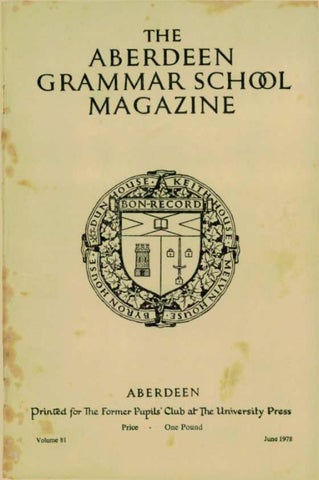
THE
ABERDEEN GRAMMAR SCHML MAGAZINE
ABERDEEN
p rinad fcr le Former Pupils' Club al- The University Press Price Volume 81
-
One Pound June 1978
Aberdeen Grammar School Former Pupils' Club Centre •
MODERN LOUNGE BAR
•
SPORTS BAR (currently
being enlarged
for
IMPROVED FUNCTION FACILITIES) •
BILLIARDS, SNOOKER AND POOL
•
TABLE TENNIS
•
BAR SNACKS (lunches on certain days)
•
ROOMS FOR MEETINGS AND PRIVATE PARTIES
•
1000 MEMBERS
JOIN NOW! (Entry Form Overleaf)
ABERDEEN GRAMMAR SCHOOL FORMER PUPILS' CLUB CENTRE Membership Application Form Date Name (in full) (BLOCK LETTERS PLEASE)
Address
Category of Membership (please indicate with X ) ❑
F.P.
Junior F.P. (under 25) fill
Family (wives of members)O Country (resident over 50 miles from Club Centre) (77 Occupation
years at school (F.P.'s only) 19... to 19.
ua
cc
Date of birth (junior applicants only) Proposer
Seconder
Name Membership No. Signature Note 1. The proposer and seconder must both be former pupils of the school and members of the Club Centre. 2. Applicants who are former pupils of the school must be members of the former pupils' club. If you are not, please tick here ❑ and an application form will be sent to you. 3. When completed this form should be sent to: The Secretary, A.G.S.F.P. Club (Telephone 29151) Centre, 10 Queen's Terrace, Aberdeen AB9 1QJ.
SPECIALISTS IN
REFRIGERATION SINCE 1947 ♦
Blast Freezers : Plate Freezers Continuous Freezers Cold Storage Ice Making Machines ♦ COMMERCIAL Supermarket and Self Service Display Cases: Storage Cabinets Coldrooms, etc : Milk Coolers Bulk Milk Tanks : Farm Freezers Ice Machines and Storage Deep Freezers Refrigerators : Deep Freezers ♦ DOMESTIC Packaged or Central ♦ AIR CONDITIONING Systems INDUSTRIAL
• NORTH-EAST DISTRIBUTORS OF `PRESTCOLD' • Agents for APV CLARKE-BUILT PLATE FREEZERS • Agents for MICRO-WAVE OVENS • Agents for CHRYSLER, PRESTAIR, POTTERTON and WHITE AIR CONDITIONING
SPARKS OF ABERDEEN LTD. BROADFOLD ROAD, BRIDGE OF DON ABERDEEN: Tel. 704448 Also at Tyock Industrial Estate, Elgin Tel. 7840 In association with ORKNEY REFRIGERATION LTD, KIRKWALL Tel. 3085
EX&OMEGA WATCH SPECIAL
(it? ...FOR GIFTS c.k4 A ring or pendant for a birthday. Art iNel Pi) A crystal goblet or decanter for a wedding. 101, A silver modern beaker for a PO christening. et 4 -_N A clock for an anniversary. Co ii C,,,.1. 2 N0-N i A reliable Swiss watch for , ,. .1 T. t.it1 41;10 3 .., long service. ti- Vs te , /rriN We are sure we can tittl) 4k , till(' --05. _0.51b,` _ .1"...11 help you... ,% (°fra,\
• `‘,
f P
til
..C.
\‘: -\
t
.
0"
.
itt ,‘
"
voks,,,
'
-,...,(4 .., , .INAVIIP ' -4 vc,,,, ,,..,•,
1,6
i
l
e
a ,
1 l'' ,,.. ''
JAMIE:011i CAM JEWELLERS & WATCHMAKERS
UNION BRIDGE ABERDEEN TELEPHONE 21219 ESTABLISHED 1733
N
k<• \ \ Ns;,
•'
• \\
••,` •
\
•
\ Ns\<,
\
• ,•
,
0 0 .k4
WHOLESALERS FOR THE NORTH-EAST OF SCOTLAND
A. R. GRAY LIMITED BRIDGE OF DON
ABERDEEN, SCOTLAND Telephone: BALGOWNIE 703111
Telegrams: "GRAY", ABERDEEN
>•
1,Portland Street,Aberdeen,AB1 2L111. Telephone 52050
V
. °PO
it; ete 336 Gt Wasuen Roast Aneidown Tat 322220
%If
the International ked and Wine shop Bacchus —a lulls licensed West End delicatessen specialisang in a line selection of quality malt whiskies. slognacs, liquers and a •asi range of inespensa.e top quality wines, including the complete Andre Simon range. Easy parking nearby
.(4 4
0%
Rosemount Puce a:ie.:wen lel 573221
a unique Delicatessen bringing exotic foods from the fite continents Manufacturers of Pima, Pate and continental salads. Specialists in high quality continental meats. cheeses and French Butter We have the finest selection of coffee in town. and for the adventurous cook ifs well worth a visit to see our range of herbs and spices.
Striziksb HAMBURGER
HOUSE •
18. HOLBURN STREET•ABERDEEN LIVE ENTERTAINMENT & MOVIES Parkfoods Delicatessen Co Ltd 9 . 11 Portland Street. Aberdeen
i
The Insurance Market is our business. We are brokers for all the leading companies and are also represented at Lloyd's of London. We can offer Personal attention covering almost any risk. aaffoyoma»»»»Awm Life
Insurance
has many
today
attention for all your
Capital
aspects.
Transfer
We
Tax,
offer personal
House Purchase,
Life or Pension Problems. 1,91.1)1.0 AROMY(11(0110.111
We offer Competitive Motor Rates for all classes of vehicles. Sport's Cars, GT's, Commercial Lorries, Vans, etc., Family Cars, in fact almost anything on wheels.
Breathylised or convicted
drivers are no problem to us and we offer the best rates to cover almost any car.
J. R. RATTRAY Et CO. LTD INSURANCE BROKERS AND ESTATE AGENTS
167 UNION GROVE ABERDEEN Telephone 26473
BRISTOUWEST Building Society 8 GOLDEN SQUARE ABERDEEN Telephone 54086 Area Manager: J B RENNIE
SHARE ACCOUNT = 5 50% Equivalent to a gross 8.33% if you pay basic rate tax
SAVINGS SHARES = 6.75% Equivalent to 10.23% if you pay basic rate tax
Assets in excess of £550,000,000 Investments in the society are suitable for trustee funds
•
a
ABERDEEN MOTORS
FOR AUSTIN
Austin Morris
ABERDEEN MOTORS 19 JUSTICE MILL LANE, ABERDEEN Tel. 56151
The Aberdeen Glass & China Co. Ltd. For DINING ROOM COCKTAIL BAR and KITCHEN EQUIPMENT 14-16 RENNIE'S WYND, ABERDEEN TELEPHONE 52478/9
Aberdeen Grammar School Magazine 94th year No. 216 (New Series 83rd year No. 207)
-
- Vol. 81
JUNE 1978
The Magazine is published under the auspices of The Former Pupils' Club in June each year General Editor
David K. Yule, M.A., 11 Kinkell Road, Aberdeen AB1 8HQ
Editor of the School Section
William D. Hall. M.A., 45 Hamilton Place, Aberdeen AB2 4AX
Editor of Notes, Obituaries and Marriages
Alan G. Campbell, LL.B.. 22 Rosebery Street, Aberdeen AB2 4LL
Secretary of the F.P. Club
John F. Hendry, LL.B., 36 Albyn Place, Aberdeen AB9 1YU
The General Editor and Notes Editor are happy to receive contributions for the next issue of the Magazine at any time before mid•April 1979.
Printed for The Former Pupils' Club at The University Press Aberdeen
CONTENTS General Section— • • Rector's Message . . . . . • • President's Report . . • Who Shall Tell the Story? . . . • • E.N.G. U.S.A.. . The James Walker Collection . . • • . The School At Large. . . . . In-School Publications Schoolgirl International Hockey . BP Schools Essay Competition 1977-78 • BP Prize-Winning Essay • • • • 9th Aberdeen (Grammar School) Scout Group
• . • • . • . . . . •
• • • . • . • • .
• • . • • . . . •
. . • . •
• .
.page . . . . . .
„ „ „ „ „ „
:•
..
3 4 5 8 11 11 13 14
. .,
165 20
School Section— School Office Bearers . Random Notes . Meet the Prefects . Staff Changes . . S. Douglas H. McClean Mrs. Christina Clark . Mrs. Catherine Grant. . . Roy Prentice School Sporting Activities . . Music Notes Combined Cadet Force . Clubs and Societies . . . . Social Events Young Scientists of the Year
.
. •
•
.
•
•
•
•
.
. .
.
.
. . .
.
• •
. . .
•
.
. . •
•
•
•
•
•
.
.
-
•
.• . . . . . . . .
.
.
.
.
.
.
. . . .
. . . .
. . . .
•,
21 22 23 27 29 30 31 31 32 42
45
-
46 51 52
.•
53 55 56 59
Former Pupils' Club Section Club Office-Bearers 1978-79 Annual General Meeting . . . Our President . Centre Reports . . Section Reports . . . . Club Consuls . . . . For All Their Hard Work . Annual Dinner . Notes About Old Boys Marriages . . . . Obituaries Abstracts of Accounts.
• •
. . . .
•
•
•
. .
•
. . .
. . . .
•
•
•
•
.
.
.
.
. . .
. . . . . .
• •
.
•
•.
. . . . . .
-
63 68 68 69 72 82 83 91
Illustrations School Prefects 1977-78 . . Schoolgirl Hockey Internationalists . School Table Tennis Team . John Whitby Cradock . . Arthur James Adams . . . Bill Mackie . . . . . School Burns Supper .
•
•
•
•
•
• -
•
•
•
•
•
•
•
• •
• •
•
• •
•
,•
• • 1' . " • 1, . "
25 38 38 57 57 62 62
Rector's Message On behalf of the School I presented the Executive Committee of the Former Pupils' Club at its meeting on 26 April with a Prefects' photograph which will be kept alongside other items of historical interest in the Club Centre. It has long been the custom to have a photograph of the School Prefects taken each session, but this one has particular significance in that it records two events which will be of interest to Former Pupils of the future who may seek to read the history of their School. The photograph is the first to bear the restored name Aberdeen Grammar School and it also records that for the first time in its history, Aberdeen Grammar School has a Head Girl as well as a Head Boy Prefect. The genuine interest and pleasure shown by the Executive Committee in receiving the photograph was indicative of the strong links between the School and the Club. In my reply to the toast of the School at the Annual Former Pupils' dinner in November, I made reference to the importance I place on encouraging the competitive spirit among our pupils and on the desirability of acknowledging outstanding achievements, whether academic or in sport. The generous contributions made by individual Former Pupils and by the Former Pupils' Club through the Executive Committee, in the form of prizes and financial help for our clubs and societies enable the School to make appropriate recognition of such performances and I would take this opportunity of thanking the Club yet again for its continuing support. Inevitably there are many staff changes in the course of a session and these are noted elsewhere in the Magazine. Mrs. Grant, Mrs. Clark, Mr. McClean and Mr. Prentice arc retiring at the end of the session, and although an appreciation of their work is included in the pages of the Magazine I should like to express here my personal appreciation of their loyalty to the School and their genuine concern for the wellbeing of all the pupils taught by them. The School roll reached 1450 at the start of Session 1977/78. It is unlikely that this figure will be reached again or surpassed in the foreseeable future. In order that the last month of the Summer Term may be more profitably used, classes for Session 1978/79 will begin on 5 June instead of on 22 August, the day on which the pupils return after the summer holidays. This will allow pupils an earlier start on subjects which they have chosen for next session. Finally, I should like once again to extend a cordial invitation to all Former Pupils to visit the School from time to time.
3
4
Aberdeen Grammar School Magazine
The President's Report It hardly seems a year has gone by since I became your President. It has been a year of great enjoyment for me and not in the least onerous. I was pleased to be able to attend all four centre dinners and generally was able to combine business with pleasure by adjusting my work schedule to tie in with the various dinner dates. It was a great pleasure to meet fellow F.P.s in Yorkshire, London and Edinburgh. many of them for the first time but quite a number of my school contemporaries and friends, and to share with them their obvious pride and attachment to the old School and the Club. The return of the School to its familiar and historic name has obviously been the cause for much rejoicing and must among other things be for the good and continued interest in the School and Club. I was especially delighted that the President of both the Edinburgh and London centres—David Cay and John Jones were both classmates of mine at school. This must be a unique occurrence. The enthusiasm of the various centres must be a great encouragement to the Club and is in no small way the result of the especial endeavours of their local Presidents and Secretaries and I am delighted that the long serving Secretary and now President of the Yorkshire centre, Arthur Adams, has been elected the Club's new President. I am sure he will feel it not only an honour to himself but also to the few but loyal members in that area. The only disappointments of my year have been the relegation of the Rugby and Hockey Clubs. It is sad that these Clubs who have in past years been held in such high esteem throughout Scotland in their various sports should have fallen on bad times and it can only be hoped that they will soon regain their old prominence. In contrast I must congratulate the Cricket Section for a most successful season and who knows but that a rink from cur newly formed Curling Club may yet obtain a place in the World Championships. I am pleased to report that the Parent Club goes from strength to strength and this must in particular be reflected by the success of the Club Centre in Queen's Road. I am sure that F.P.s for many generations to come will be grateful that this property was bought and developed so successfully for the benefit of all. In conclusion I should like to thank Doug Georgeson and his Executive Committee for all their hard work for the Club, and to wish them every success in their attempts to open or revive centres of F.P. activity not only in this country but also in more distant parts of the world. My special gratitude is due to Jock Hendry, our enthusiastic and industrious Secretary, and to Jim Lyon, the Entertainments Secretary for the invaluable help which they gave me in my year as President. Finally, I must thank Bert Gill, the Rector of the School, who accompanied me to all the official Club dinners, for his cooperation in helping to maintain the close liaison between the School and the Club. JOHN W. CRADOCK (1941-46)
Who Shall Tell the Story? The following article is contributed by Mr Arthur L. McCombie, the School's Depute Rector and former Principal Teacher of History, and is an extract from a most interesting and entertaining lecture entitled "The School the Town loved to Hate", which he delivered recently as part of a series of lectures on Aberdeen in the nineteenth century arranged by the University's Centre for Scottish Studies. The answer to the author's question (at least for the purposes of the Magazine) may well be the author himself, and it is to be hope that Mr. McCombie will contribute further details of his researches to future issues of the Magazine. In the introduction to Bon Record which was issued in 1906 and which is often described as a history of the school, Morland Simpson made it quite clear that this compilation of records and reminiscences was not a history of the Grammar School of Aberdeen. He wrote then "It is remarkable that a school so old and famous as the Grammar School of Aberdeen has never found a historian among its thousands of sons, many of them eminent in literature and history." More than seventy years later the situation remains the same. Even more names could now be added to those that Morland Simpson had in mind as people qualified by interest, connections or talents to have undertaken this seemingly long overdue task. The two names which come most readily to mind are those of the late Dr. Douglas Simpson, the famous historian son of Morland Simpson and the late James Walker whose connection with the School as pupil and teacher spanned a period of more than half a century. Unfortunately, although suggestions were made in the 1930s that the writing of the School's history should be undertaken, no one has ventured on this project as yet. The reason for this state of affairs is hard to find. It would be easy to recognise reluctance to embark upon a very long, dreary and uneventful study of an obscure and isolated institution, but, while it is true that a study of the complete story would certainly be long, it would certainly not be dull, especially when one comes to the last century of the School's existence. In that time it becomes very clearly an institution in which the whole community was interested, and in whose location, leadership and performance the community showed an active and, at times, very critical and even hostile concern. It is hard to believe that at any time anyone sympathetic to the School could have described it thus "1. A depleted and thoroughly discredited school, only 241 boys in it then, as re-opened: in all 268 of former boys eventually returned. 2. A staff all at loggerheads, several of them influenced by mutual recriminations and scarcely on speaking terms. It included two men who had both (I say not for what causes) been failures as Headmasters, one of them my predecessor, deposed under circumstances which greatly embittered him and are not likely to render him a favourable critic and an amenable colleague to his successor. 3. A school notoriously rank with truancy and unfair methods of work and a by-word in the city for ill-conduct and 5
6
Aberdeen Grammar School Magazine
rowdyism; in many essential details without organisation; each man on the staff more or less working for his own hand: the boys hiving off in swarms to Gordon's College". This seemingly harsh and certainly unexpected description is not that of a bitter opponent of the School but the words again of Morland Simpson describing the state of the School in 1893 when he became Rector. His own period of office as Rector was to be long and just as turbulent as those of his predecessors, because one of the most surprising features of the whole story in the second half of the nineteenth century is how not one Rector really reigned for long in peace and harmony with his masters (first the Town Council and later the Aberdeen School Board). Of the five men who held the office, two were dismissed, one was reduced in status to co-Rector, one left under pressure to take charge of what was contemptuously referred to by a contemporary newspaper as "a rural seminary" (Dollar Academy) and Morland Simpson himself, despite all that he did to create the modern Grammar School, was frequently under attack from within and without the School with moves to add him to the list of deposed rectors. In old copies of the Grammar School Magazine there are many contributions from distinguished Former Pupils describing their own school days, recalling their joys and pains, their companions and their work, but when reading these over one is made deeply aware of how little any pupil really knows about what goes on in school outwith his own very limited orbit. While controversies raged over many issues, even about whether the old building in Schoolhill should be replaced and if so where and with what, the reminiscences of former pupils make little or no mention of them. There is surprisingly little material within the school itself about its progress during the nineteenth century but elsewhere there is a mass of information from many different kinds of sources. For example, one may take the career of the ill-fated Thomas Waller Eyre Evans, the Rector from 1855- 59, an Irishman, over whom most friends of the School discreetly pass as the man on whom many of the later disasters of the School were blamed (though with little justification in fact). His appointment had been by way of an experiment. He was an outsider with no previous connection with the School but who beat every other acceptable candidate in the written examinations by which the Rector was then selected, and was to lead the School into a new age if not a new building after Melvin had died suddenly and Geddes had almost equally suddenly departed to a Professorship in King's College. To the horror of the Town Council this man, so new and so different in his approach to teaching from Melvin (who had probably taught most of the Council), presided over a school whose top class dwindled from about one hundred pupils in Melvin's time to about five. The only solution appeared to be to dismiss Evans, but not before a full-scale public enquiry was made. This gives considerable insight into how the School operated at the time. The outcome of the enquiry was, incidentally, that there were insufficient grounds to dismiss Evans legally so he was bought off with
Who Shall Tell the Story?
7
a lump sum of 5 years salary, a large amount justified, it was felt, by the act of getting rid of him. His successor, William Barrack, whose initials, W. B., are carved on the front of the School, was brought over from the Grammar School of Old Aberdeen (along with his numerous pupils) to save the reputation and restore the viability of that of New Aberdeen. It turned out to be a stormy tenure of office. First it was the question of where the new Grammar School should be built. This controversy lasted for nearly ten years. The first idea had been to place a new building on the banks of the Denburn Valley at Belmont Street, but, fortunately in the light of the later railway development, this scheme proved abortive. While Evans still reigned it had been thought that an empty site in Union Street, where Gilcomston South Church now stands on the corner of Summer Street, would be suitable. A competition for an architectural plan for the projected new school was held and the plans were considered and a decision was made in favour of a building of Roman Doric design by an Edinburgh architect, George Smith (rather like the old Royal High School building soon to become the new centre of Scottish political life). This plan was also abandoned in 1857. The controversy raged on and in 1861 ten sites were considered for the new Grammar School which, it had been finally agreed was necessary to replace the old cramped unsuitable building in Schoolhill in order to have a good modern school. I Schoolhill—to redevelop the old site. 2 Belmont Street again! 3 Crown Terrace. 4 Skene Terrace. 5 Ferryhill. 6 Justice Mill Lane. 7 Rubislaw—Albert Street/Albert Place area. 8 Westfield House—north of Whitehall Place. 9 Gilcomston—the top of Skene Square—a good site but expensive to buy out existing properties, and also involving "moral danger" to the boys because of the nearness to Broadford Mills and its girls. 10 Westfield Model Garden—the site eventually chosen. James Matthews, the runner-up in the previous competition now built the new school and it was opened in 1863. Barrack's problems were not at an end because now the demand for a school which was aware of the needs of a modern community was made loudly and it is obvious that the Rector had little sympathy for or success in developing what was called a "modern side". What makes the whole story of the failure obvious is that there appeared in Aberdeen, a man, D. R. Fearon, who had been sent to Scotland to investigate the working of the most famous Scottish Schools on behalf of the Taunton Commission, who were at that time revealing to the people of England the many amazing scandals of English endowed schools. His findings in Scotland were published in 1866 and there one finds a very detailed account of how the Grammar School
8
Aberdeen Grammar School Magazine
of operated at that time. While Fearon pointed out the high quality startmany the out pointed clearly equally he the best classical work, at all ling examples of poor quality work in English and Mathematics "the on section a with report his concluded He stages in the School. indiscipline tone and discipline of the School". In it he pointed to the in class, the rowdiness out of class of the pupils and "the want of a responsible governing head or else an efficient janitor". He comsenior plimented "the able and judicious rector" on his work with the the efficlass but he had done enough to cast considerable doubt on ciency of the School and its Rector. another To add to Barrack's embarrassment, two years later yet and education Scottish on time this launched, major enquiry was School again an invaluable historical account of Aberdeen Grammar highly was drawn up. The findings of the Argyll Commission were point, flattering to the New Aberdeen Grammar School, up to a gave which Scotland in schools six only of one because it was named as levelled at genuine secondary education, but enough criticism was to raise various aspects of the school's methods and performance To the doubts about the future prospects of the School under Barrack. "rural his to withdrew he concerned and relief of all interested seminary" and later to Kelvinside Academy. Almost every prominent Aberdonian who wrote his memoirs in the mid-nineteenth century was a former pupil and so much material published by exists there, the most useful and fascinating being that Recollections Professor Murison "strictly for private circulation". His pupil and a as a days his of account fascinating of 88 Years gives a Commissions teacher in the School, confirming privately what the revealed publicly in their evidence. for All the time, the several rival newspapers watched carefully and School the of state the on comment and opportunities to criticise School they add to the wealth of material available for a study of "the a Town loved to hate". ARTHUR L. McComm. E.N.G. U.S.A. 1968 Alistair Gracie, who was General Editor of the Magazine from journalism of style technological more rather to 1974, here reports on a with which he has had the opportunity to observe (through his lob States. United the Grampian T. V.) in Television in this country has undergone a major revolution in news ago gathering techniques over the past twenty years. Not very long of nightly news casts consisted of black and white pictures—many quality poor the Often announcer. faceless them stills—voiced over by a film which did appear was many days out of date. conSince those not so distant days, television news has become chair siderably more sophisticated. The viewer can sit back in his arm happenings each night and watch sharp, colour film of the day's gathering news advanced have satellites fact, In world. the around
E.N.G. U.S.A.
9
techniques so much that it is generally easier and less time-consuming to transmit pictures from the Middle East than it is to transport film from Inverness to processing centres such as Aberdeen. There can be little doubt that television has helped shrink the globe and like so many other industries is continually looking at ways of improving and speeding-up the operation. The next stage in this development—according to our colleagues across the Atlantic—is the arrival of E.N.G. These letters—standing for Electronic News Gathering—are viewed with suspicion by many people in television in this country but regarded as an inevitable development by many others. ENG has been operating since the early nineteen seventies in America and the immediacy of the operation has found a ready outlet in that news orientated country. Basically, ENG replaces film cameras, film processing, viewing and editing equipment with electronic counterparts. The news gathering technique doesn't alter, but is enhanced by its ability to be fed back live into a news bulletin from the camera in the field. The sophistication to which we have become accustomed on our television palls slightly when the film used in this country is compared with the ENG operation of our American counterparts. Take a typical situation that happens daily in television news rooms: a report comes in of a fire in a town centre. With traditional film methods, a three man unit would be dispatched, fight its way through the traffic, collect its shots and battle its way back to base. There would then be a delay of roughly thirty minutes while the film is processed and a further twenty minutes while it is viewed and edited. With an ENG operation, a two man unit would travel to the locus and would have the immediate capability of pumping material straight back to base to be fed live to the programme if required. Alternatively, the story—contained on a cassette measuring approximately eight inches by four—could be transported back to base for a more sophisticated edit. Immediately, the benefits of ENG can be appreciated. The speed of the operation offers news rooms the opportunity to cover stories happening close to and during transmission time, replacing the agony of hearing that a good story is breaking just before the news goes on air and knowing that filming deadlines make any sort of coverage for that evening impossible. I had first hand experience of ENG operating in three centres in America: New York, Washington and St. Louis. In both New York and Washington we were assigned to ABC, one of the three American networks. In New York we were given the facility to use the equipment ourselves on Broadway and conducted a series of interviews with the locals about the poor state of the Manhattan roads following the bad winter which had hit the east coast. We were able to take the tape out of the sound machine, walk the two minutes back to the ABC offices and immediately replay our 'scoop' on a video cassette machine. The magic of this new-style television. . . There were our frozen New Yorkers, in glorious technicolour, ready for transmission if
10
Aberdeen Grammar SchoolMagazine
required literally two minutes after talking to the camera. Even with the fastest imaginable processing suite, film just doesn't allow that kind of speed. In Washington, the speed off the mark permitted by ENG was illustrated again. As the ABC network news was being transmitted, a message was passed to the programme editor saying that President Carter was expected to make a statement on the long-running miners' strike in the White House briefing room within fifteen minutes. An ENG Unit was already set up on Capitol Hill; within minutes it was derigged and moved to the White House and, true to form, the ENG unit was set up and sending pictures back to the studio as the President walked in to make his speech only minutes later. His speech was then beamed live coast to coast. That's what I would call immediate television! But, despite the excitement of the major centres of New York and Washington, my time in St. Louis was the most interesting and informative. Station KMOX, a subsidiary of the CBS network, was the front runner for ENG. Back in September 1974, the station made a clean break from film and became a total ENG operation. Film equipment was locked away and the rest of American television watched with interest to see how this brave new experiment would progress. But KMOX had been well prepared; news staff had been retrained to take advantage of the new electronic tools. The entire news room was redesigned with the new technical facilities installed in the room itself to provide a self contained and wholly integrated news operation. In those early days the majority of news items were pumped live into the nightly news bulletins but now there is a happy mix of live injects sent back via microwave relay, and some recorded on tape and either sent back from a location providing a better transmission path or transported back to the studio for editing. We saw at first hand an illustration of the system's flexibility. A party of pot holers were missing in appalling weather while we were at the KMOX studio. An ENG unit was dispatched to the area—some ten miles away—to look at the rescue operation and talk to the searchers. This they did but when they came to transmit their material back, the severe weather conditions made their picture quality untransmittable. With the deadline rapidly approaching, the unit was directed to a fresh area to microwave their pictures back. Again, the signal wasn't getting through. Finally, it was a case of third time lucky and the rescue story was transmitted live into the late night news bulletin from a fresh transmission path. At KMOX, the sophistication of ENG is now regarded as the norm and the news staff and technicians have all become adept in its use. The immediacy of their operation fits well into a slick and very informal news operation which transmits one and a half hours of news every day. Reporters introduce their individual stories sitting at their desks with the normal bustle of a busy news room in the background. Rehearsals—something almost mandatory in British television—are unheard of. I asked one programme editor why no one was sitting in
The James Walker Collection
11
the news gallery two minutes before transmission. His reply was: "They're too busy doing other things". But the broadcast itself went well with a relaxed air of informality and an informative and immensely entertaining content. I had made the trip prepared to be patronising about American television, but came away with the utmost respect for their news operations. In other fields, American television is perhaps not all that it might be but in news coverage and news expertise the Americans have become as sophisticated as their ENG equipment. ALISTAIR G. GRACIE (1953-66)
The James Walker Collection Early this year, Miss Walker, the sister of the late James Walker, made it known to the Rector that it had been her brother's wish that his library should be made available for the use of the School. 'Phis extremely generous gesture by Miss Walker and her brothers was warmly welcomed by the Rector, and arrangements were made to transfer into the library all the books which the School wished to select. These have now been classified and catalogued—a massive undertaking carried out with great speed and efficiency by Miss Pat Beverly from the Job Creation Scheme. The aim and intention of the School is to place the thousand books and pamphlets on history, biography and literature in a special area of the East Gallery of the Library, where it will be established and retained as a separate collection. There is, as one might expect, a wide variety of books, which reflects the catholic tastes which Mr. Walker had in history and literature. Perhaps the most interesting part of the collection is the large number of books, maps, prints and pamphlets of local interest which will now be available for the first time for pupils and staff of the School. It is hoped that when arrangements for the housing of the collection have been completed, a fuller report will be made in the Magazine. In the meantime, the Rector would wish to express his thanks on behalf of the School to Miss Walker and her brothers for their generous gift to the school, and to express the hope that a fitting memorial will be created to this great friend and servant of Aberdeen Grammar School over so many years.
The School At Large The number of tours abroad undertaken by pupils from School seems to increase by the year. This autumn will see a new venture, trip to Philadelphia under the auspices of the Music Department the (cf. Music Notes), which must stand as the most ambitious outing to date. The itinerary is not yet complete, but it is hoped to proceed to Washington and possibly Baltimore, with a look at New York en route. Scottish Concerts will be offered at each centre.
12
Aberdeen Grammar School Magazine
In addition School pupils take part in School cruises on the P. & O. Line vessel, the Uganda. This summer our Rector, Mr. Gill, is to be commandant of the Grampian Region schools party, some 530 strong, on a cruise that will take in all three of the Scandinavian capitals. Mrs. Jamieson will escort the Grammar contingent. Over the past year three groups from the School have also gone to Continental countries: to Regensburg last summer and to Switzerland reading, and Italy this Easter. Pupils' reports make interesting made impacts the and writers the of viewpoints underlining both the by the new and unfamiliar. A varied day in Bavaria is recorded by DAVID HALL. II: "Firstly we visited an open-cast mine at Wackersdorf, where we were given a guided tour by one of the managing directors. The scale of some of the machinery and of the place is quite tremendous. There is a conveyor belt five miles long, and the wheel on one of the dredgers is eight metres in diameter, i.e. greater than the length of a football goal! After visiting a baroque church, we went to Amberg, where we had lunch at a small pub: "wiener schnitzel", chips and salad, and two glasses of coke. After a guided tour of Amberg, a very historical town, we returned to Regensburg via the Vils and Naab valleys." SUSAN LEITH. also II, went to Lugano at Easter and understandably ended up reluctant to return to "the old humdrum life" of school. A Swissair DC-9 from Manchester to Zurich, a train to Lugano, and "We stayed at the Hotel, or if you prefer it in Italian, Albergo Cavioca . . . I when enjoyed the packed lunches. In themselves they were plain, but eaten in ancient castles in Milan or on the island of Isola Bella, they did have a certain appeal!" Aberdonians, however, are not the folk to be swept away by Romance, and the inbred hardheadedness shows through: "The main shop was the Innovazione. Apart from its lovely name, the shop, which is rather like our Norco House, sold absolutely everything". Moreover , "at the Cuckoo Clock Shop, the Grammar party got discount, so we didn't do too badly"! SALLY JANE MUTCH. IV, went with a Grammar group as part of a large Aberdeen Schools party to Folgaria, Italy for a week's ski-ing holiday. At least a few of the party were old and slightly weary hands at the travel game: "We eventually took off from Dyce Airport and had a fabulous flight over to Venice. For some this was a new experience, but pleasures met for others it was "just another flight'". Sometimes the with are unlikely and matters of chance: "Our instructor, Luigi, spoke very little English, with the exception of 'More bend!' and Not fast—hospital, no good!'" But more often the pleasures are predictable and public: "We set off on the homeward journey, leaving behind the wonderful slopes, discos, pizzas, and capuccinos, but taking with us the memories of a marvellous, unforgettable holiday." It is this kind of bitter-sweet memory that makes travel for many the very spice of life. May our pupils continue to experience it and savour it! W.D.H.
In-School Publications For a variety of reasons, pupil writing of the creative kind has not figured much in this magazine of late. This does not indicate inaction on the pupils' part. Alastair Houlding, now II, last year won a schools literary competition organised by the Aberdeen Association for the Prevention of Cruelty to Animals with an outstanding extended poem, "Safari", a vivid account of an imagined journey in East Africa, revealing a feeling for words and a feeling for animals in about equal measure. Collectively, it is refreshing to note the appearance of three magazines this session in school, of different types and from different stables. "X5WD" continued the recent tradition of obscurely titled Sixth Year magazines seeking to give the vox populi free expression. This year's publication was most impressive, perhaps, in the professionalism of its production team, who handled advertising and presentation with assurance: Gordon Walters marshalled his men like a true supremo. The quality of the contents was uneven. Ronald Cowie's graphics were amusing and slick in the best way, humorous contributions were welcome, but in short supply, serious contributions on Devolution and on Individual Freedom by Robert Howic and Neil McDowall respectively seemed unrooted in a context. For all its merits (not the least its appearance on schedule!) "X5WD" lacked a unifying identity in its final published form. "Revelations" is a much less ambitious venture; edited, and on this occasion largely written, by IIIE, for a putative readership in the first three years of school, it was produced on the School's own Rank Xerox machine. Again the articles and features ranged widely: from the likes and dislikes of "The Professionals" of Pittodrie (e.g. Joe Harper is a Prawn Cocktail and Scampi Mornay man, did you know?) to a Survival Kit for First Years; from a "Rainbow" Concert at the Capitol to a Skateboard Questionnaire, a Crossword, and an introduction to Orienteering. Other occasional "Revelations" are intended from a Third Year base, and the haste with which young patrons bought up the first issue in March shows a demand for this kind of mouthpiece. A S.II English section was chosen in Spring as test-material for a crash course in Creative Writing given by Mr. W. McCorkindale, a lecturer at the College of Education. In the event only fifteen meetings could be held, but an intrigued class produced over two hundred completed pieces, from which was compiled an anthology, "45 from 24 of II6," "published", or at least duplicated, in a limited edition for class members and other interested parties. All members of the class were represented at least once in the final collection, which contained some very impressive writing, both prose and poetry. Again Pittodrie stirred the Muse ("Never ref . . . !" and "Beachenders Beware') but so did Abroad ("Tehran" and "2 a.m. Kuala Lumpur") and Nature in its various manifestations ("Dawn", "Seascape", and "The River"). Death was seldom far off-stage, but the young scribes seemed also to see Life as worthy of their notice, a 13
14
Aberdeen Grammar School Magazine
welcome response! Maybe Emma Rochford's little poems best captured the S.II World View: individual, fresh, quietly establishing an identity.
My House My house caught fire yesterday. It is all burned up: I don't have a house now. Yesterday it was all burned up. My Daddy said that it was my tortoise. He said that my tortie had been smoking again. But I know it wasn't. I know that it was my sister's hamster!
Stairs In my house there is a flight of 23 stairs. Every day I walk up and down them— it is very exciting, you know. The carpet on the stairs is old and worn. I counted the stairs and there are 23 of them. Golly! Excitement!
Me I am silly all the time. I haven't had a serious conversation for ages. People tell me I'm mad, but I know I'm lovely. I like being silly. It would be rather horrible if I didn't. I am very modest, cough! I am very beautiful, cough! I have a bad cough, cough!
Schoolgirl International Hockey The School gained international honours in a fresh field this year. Two Fifth Year pupils, Ruth Hutchison, the Head Girl, and Claire Fitzpatrick, made Scottish schoolgirl hockey squads, with Ruth becoming our first pupil to win a schoolgirl "cap". Ruth Hutchison writes. Aberdeen was the venue for this year's European International Hockey Tournament for Schoolgirls, held over the Easter weekend. Taking part were England, Holland, Scotland, Scotland Reserves and West Germany. Claire Fitzpatrick and I were fortunate enough to be selected—Claire as substitute for Scotland Reserves, and I as substitute for Scotland.
The BP Schools Essay Competition 1977-78
15
All five teams were accommodated in University Halls of Residence, which meant that the competing teams could meet at leisure as well as in the tension of each match. After the opening ceremony when Miss Ramsay, as President of the Scottish Schoolgirls Hockey Association, welcomed all the teams, Scotland took the field against last year's winners, Holland. In an exciting, evenly-balanced match neither team found the net. The next morning's game was psychologically difficult: against our own Reserves, playing with nothing to lose, as underdogs, while we were to win. I played in half this game, which ended in an inglorious 1 1 draw. Later that day we played West Germany. For me this was the most exciting match. Never having sampled Continental play before, I was quite apprehensive at first. They seemed to ignore the "sticks" rule and their play closely resembled men's hockey. They won 2-0, but it was a great match; Claire also was to experience Continental play when she played against Holland. Easter Day brought about "the" match: Scotland v. the Old Enemy. Throughout the tournament England had shown their skills and needed to beat us by three goals to take the title and a new award, the MacRobert Thistle trophy, to the winner of this particular match. In a tense atmosphere both teams settled down to play of a high standard, with England having the edge. They won 2-0 to finish a close second to the overall winners, Holland; we finished fourth, ahead of our Reserve side. For me, however, these placings were immaterial. The playing experience gained by the players was immense, all the matches were played in the best spirit, and friends were made who will always be remembered. G. Rum HUTCHISON. "
supposed
"
The BP Schools Essay Competition 1977-78 The BP Schools Lecture is an annual event sponsored by the British Petroleum Company Ltd. and organised by Robert Gordon's Institute of Technology. This year's lecture was given by Colin Maclean, formerly of the Times Educational Supplement. Associated with the Lecture there is a competition for an essay on a related subject. Entry is restricted to pupils aged 15 or under in schools in the North of Scotland and this year the title chosen was "The most lasting effect of the discovery of North Sea Oil". The competition has been in existence for three years and for the third time a Grammar School pupil has won first prize. This year's winner of f50 was Fourth Year pupil Barbara Moore, and Fiona McCombie, of the Third Year, won a f5 Consolation prize. The competition was particularly keen this year and so the results represent quite a triumph for Grammar—and for "Women's Lib".
16
Aberdeen Grammar School Magazine
BP Prize-Winning Essay Barbara Moore is an American girl currently in the Fourth Year at School. Her background gives her winning essay in this year's BP Schools Essay Competition a particular flavour; but in its own right it is an interesting assessment of an issue of considerable local importance. The Most Lasting Effect of the Discovery of Oil in the North Sea (A response to a lecture given by Mr. Colin Maclean on "The Art of Seeing round Corners", thoughts on the prediction of social developments, with special reference to North Sea Oil.) The attitudes toward oil, as Mr. Maclean affirmed in his lecture, "The Art of Seeing round Corners", are numerous: oil gives heat, oil gives light; it causes pollution; it calms troubled waters. Perhaps as a result of the discovery of oil in the North Sea, these attitudes will change and people will come to regard oil in a different way. Mr. Maclean also spoke of lexicology in relation to the oil industry: words will change. Some examples he cited were "spring", "well" and "hole", three common words which have found new and different meanings in the oil industry. I do not believe that this different usage of words will be a lasting effect. Language is continually in a state of change, especially in the areas of science and technology. When the oil industry dies out, so will its vocabulary. Mr. Maclean centred his talk on careers. As he said, there arc many different careers connected with the oil business. He mentioned such fields as construction, steel, world finance and meteorology. These various job opportunities lower unemployment, which is especially good in Scotland's case, with a "history of high unemployment, low wages and a rising rate of emigration". The type of )'ob is different in each stage of the development in the oil industry, from the geophysical and oceanographic exploration to the extraction of the oil. There are also jobs which provide services onshore. These include providing hotels, restaurants, car hire and taxi services, travel agencies, banking and insurance, secretarial services, property agencies (lawyers and estate agents) and employment agencies. Building and construction trades are particularly heavily employed, with labour shortages quickly developing. Often a community is unprepared for such a sudden inrush of oil workers, and there are not adequate services available. This leads to a rise in prices for what services there are. Moreover, employers for the oil companies generally pay higher wages than the local rates. Workers tend to move toward the oil industry, especially when unskilled or semi-skilled workers are required. This results in a loss of traditional industries such as fisheries, textiles and knitwear. Thus one effect of North Sea oil is the diminishing of three local traditional industries. Northwest Europe will profit economically from the oil: unemployment will be lowered; money will be gained through taxes and trade; dependence on Arab countries for oil will be lessened.
BP Prize-Winning Essay
17
According to Adam Fergusson, "The oil years, possibly no more than a decade or so, could sweep across the Scottish scene, momentarily stimulating Scotland's economy to a high fever of activity, but finally leaving the country disorientated, disorganized, wrung out, her traditional industries atrophied and the newer oil-generated industries with nowhere else to go." When exactly will the "oil years" end? Professor Peter R. Odell writes of the North Sea resources. "The North Sea province seems likely to be able to meet . . . Europe's requirements from 1982 to the end of the century". As for the future of the world oil supply, J. Jennings writes, "The pessimistic view sees the world resources of oil virtually extinguished by the year 2010 .. . A slightly less pessimistic view is . . . (one) in which a production peak is reached in the 1990s and the present level of production is reached again in about 2010. The most optimistic view . . . postpones the need to replace oil as a major fuel until the second quarter of the 21st century, and oil remains significant in the world economy until about 2050". It can be seen that oil will last for a relatively short time. A new fuel must be found to replace it. The oil does provide time for the development of other power sources. Mr. John Davies said that "North Sea oil was 'merely a drop in the bucket' of world energy needs, and would at best stave off the day when this country would have to turn to alternative sources". What are these "alternative sources"? "These sources would mainly have to centre on nuclear technology since wind, wave and solar-power could not possibly fill the predicted 'energy gap'." This reprieve", as it were, will be one of the more important effects of North Sea oil, if the time is used to develop other power sources. Mr. Maclean mentioned the fact that there are many oil products. These do not consist solely of fuels; waxes, candles, road and runway surfaces, polishes, lubricators are oil products too. Moreover, there are many chemicals made with oil. Many modern goods and materials—polythene, nylon, synthetic rubber, washing-up liquids, selective weedkillers—are made from organic chemicals, and their manufacture on a large scale requires abundant supplies of an organic starting material, coal or petroleum, of which petroleum, being liquid, is easier to handle. An immediate effect of the discovery of North Sea oil will be the availability of such items. When the oil is gone, supplies of these oil products will decrease drastically and serious situations (for example scarcity and high prices) could develop unless precautions are taken to provide substitutes. As Mr. Maclean suggested, during exploration for oil, a new find might be made, something unconnected with oil. He stated that Aberdeen was capable of tremendous geological advances, and gave as an example the granite quarries around Aberdeen. If a new resource were found, it would have a lasting effect on the economy.
18
Aberdeen Grammar School Magazine
In the same way something new of scientific significance might be found in the exploration of the North Sea—fossils on the sea-bed; o. previously undiscovered species of underwater sea creature; a new aspect of the psychology of the human brain when confronted with the living conditions particular to an oil rig, and so on. The problem of extracting the oil from the North Sea is more difficult than in most of the other maritime oil fields such as the Persian Gulf, the Mexican Gulf, and the Mediterrean; "the distances and depths are greater, the sea fiercer, the weather immeasurably less predictable and more difficult, the operating times shorter and more critical". These new difficulties give rise to new technology which might be useful elsewhere, either in other oil extraction or in another field altogether. It is said that construction of the huge production yards onshore tends to spoil the scenery, reminding one of the great scars left in the earth by coal strip-mining. On the other hand, Fergusson claims that "One has to stand very close to any of these sites in order to discover any serious spoilation of the countryside . . . From the strictly scenic point of view, the damage appears, to me at least, to be more in the mind than in the eye". Another environmental problem connected with oil is beach conservation. The sudden great boom in construction (for the oil platforms, production yards, for accommodation of services and new labourers) requires building materials. These include sand and rock, which are often obtained from the beaches, ruining them. Perhaps the most obvious effect of oil on the environment is oil pollution. Here are two main types: low-level oil pollution, often caused by a leak in a pipeline or even by natural seepage from underground reserves, and oil slicks, caused by spills. We have now no methods of effectively cleaning the oil from the seas so the effect of an oil spill would be long-lasting as the oil couldn't be removed from the water. The Scottish National Party has made the most of North Sea oil, claiming that, with its supporting Scottish economy, a policy of independence or devolution for Scotland may be adopted. This would have long-lasting effects if it came about. In his lecture, Mr. Maclean quoted, "oil is likely to bring Europe to the end of a post-war era". While dealing with the problem of energy sources and cooperating on operations in the North Sea, the various European countries may find themselves brought together in agreement and in the realisation that they must work together to avoid future energy crises. On the other hand, oil might serve to cause friction between the countries of Europe. "Britain has acquired a vested interest in keeping the world oil price as high as possible. That is something which our Common Market patrons, less well-endowed with natural fuels than we are, have just been discovering". Having considered these several possibilities, I found it difficult to decide which would be the most lasting. In order to facilitate my deci-
BP Prize-Winning Ersay
19
sion I decided to compare the discovery of oil in the North Sea with a similar incident in history, and see what its most lasting effects were. I chose the discovery of gold in California, in America. in 1849. Upon inspection many similarities can be found between the Gold Rush and the "Oil Rush". In both cases there was a sudden flow of incomers seeking valuable materials from the earth. This sudden immigration resulted in shortages of accommodation, food, services, etc. which in turn caused high prices. Traditional industries, e.g. sheep, died out. Gold and oil both are natural resources of which supplies are limited. Eventually the gold ran out, as will the oil. "As the gold . . . played out or fell into the hands of eastern corporations and the mining fever abated, the settlers (who had been drawn by the lure of the precious metal) would perceive the farming and stock-raising possibilities around them". This discovery of other natural resources, being one of the most important and most lasting effects of the discovery of gold in California, might be just what could happen in the North Sea. The gold and oil both have "opened up new and varied economic activities", such as industry supplying the needs of the immigrants. California grew so quickly as a result of the gold rush, both economically and population-wise, that it was made a state in 1850. There is a possibility that Scotland too will achieve a new political status as a result of the oil. What was the most lasting effect of the discovery of gold in California? It no longer affects present-day economy, politics or world trade. On the other hand, the discovery of California's farming potential certainly had long-term results. It is my opinion that gold's most lasting effect was on the temperament of the people. Californians are quick to catch on to any new fad, as their ancestors were quick to hasten to the gold fields. The politicians of California range from very liberal. e.g. Earl Warren, to very conservative, e.g. Richard Nixon, both of whom come from the same environment. From a psychological point of view, the liberality might be associated with the "get rich quick" dream of California, and the conservative point of view arises from the fragility of that dream: a need arises to budget and be cautious to prevent its shattering. Perhaps the countries around the North Sea will incorporate some of the ways of the oil people into their identities. In California there was a change from the "sleepy romantic community of Spanish American ranchers into a hustling and populous commonwealth of AngloSaxons". Such a change, not exactly the same one necessarily, is very likely to take place as a result of North Sea oil. Maybe, on the other hand, it will be the incomers who are changed: I may return to America half Scottish. BARBARA MOORE (IV)
20
Aberdeen Grammar School Magazine
9th Aberdeen (Grammar School) Scout Group In 1908, when there appear to have been only two other Troops in the Aberdeen area, the 9th Group was formed. Accordingly, this is our seventieth birthday, and it seems fitting that the occasion should be marked. Eight years ago the Group held a reunion dinner to celebrate our sixtieth birthday (albeit two years late—but that is Scouting) and at that dinner it was determined to hold another reunion dinner for our seventieth anniversary. This time we intend to get the year right! Arrangements have been made to hold a reunion dinner in the Treetops Hotel, Aberdeen on Saturday 30 September at 7.15 p.m. for 7.45 p.m. and a warm welcome is extended to all former members of the Pack, Troop and Crew and to present Scouters. Informal dress will be worn. In 1970 the dinner cost the staggering sum of 30s. and it is a measure of inflation that this year's ticket will cost £6. However, to encourage the younger members and former members those under 21 (and over 18) will be able to purchase a ticket at f4.50. To enable final arrangements to be made please complete and return the pro forma accompanying this magazine along with your remittance, or contact me at 132 South Anderson Drive, Aberdeen ABI 6LU not later than 31 August 1978. I should also be grateful to receive the addresses of any former members who may not have been notified through the Magazine so that I may notify them individually. In 1970 very nearly sixty people attended the dinner from all parts of Britain and one person even came from Canada to join us. I hope that with the help of everyone we can exceed this total-1 have indicated around 100 to the hotel. After the last reunion dinner it was proposed to start a 9th Group Supporters' Association, open to any past or present members of the Group, to help the Group both physically and financially, but unfortunately this venture never got off the ground. The time commitment would be as much or as little as is wished and distance is no object. I would be pleased to receive the names of any who would be willing to support this Association (whether they are attending the dinner or not) so that I might forward to them more information about the Association. On the Saturday afternoon before the dinner it is intended to hold an Open Day from 2 p.m. to 4 p.m. in the Group H.Q. in Granville Lane (arrowed from the South Anderson Drive, Great Western Road junction) and I will be delighted to welcome anyone interested in attending. Please support all these ventures and make this seventieth anniversary a successful year. Hunter Will, Group Scout Leader.
School Office Bearers Prefects
Head Boy Prefect: Head Girl Prefect: Deputy Head Boy Prefect Deputy Head Girl Prefect:
NEIL W. McDOWAU. Rum HUTCHISON BRIAN J. BAIN LORNA SIMPSON
BRIAN A. ANDERSON STUART C. MACDONALD JEFFREY K. BREMNER DAVID W. J. McLENNAN JENNIFER L. CAWDRON DAVID A. MCLEOD LORNA H. DUNBAR STUART R. PATTERSON CLAIRE R. FITZPATRICK MARY J. SHARP ROBERT W. GORDON AMY J. SHEARER ANDREW R. GRANT CAMERON C. STEELE MOIRA F. JESSIMAN ERIC STODDART JUDITH LOGAN KENNETH A. WARD STEPHEN J. LYNCH SUSAN M. WATT CALUM J. MCDONALD SANDRA M. WEBSTER WIWAM B. WHITEFORD Sports Captains
Rugby KENNETH A. WARD Soccer STUART R. PATTERSON Hockey (Boys) ALAN J. MICHIE Swimming BRIAN). BAIN Hockey (Girls) Rum HUTCHISON Netball LORNA SIMPSON •
Literary and Debating Society
President ANDREW R. GRANT Vice President RUTH HUTCHISON Secretary ROBERT B. M. HOWIE Treasurer NEIL W. McDOWALL Dramatic Society
President GORDON M. L. WALTERS Cadet Force
Colour Sergeant MURRAY CRIGHTON Editor of School Section NEIL W. McDowALL
21
Random Notes It is wholly untrue that the massive upsurge in popularity of the G.P.O. Bedtime Stories service has anything to do with the expansion of the staff telephone network throughout the school. •
•
•
It is quite uncertain whether the new paint scheme in the Sixth Year toilets is intended to combat vandalism or constipation. •
•
•
Although inclined modestly to decline to demonstrate for his pupils, Mr. Adcy seldoms fails to lift great weights at high speeds when a certain track-suited blonde happens to be passing. . . . •
•
•
The Film Society has entered a draconian phase, with stern new rules to counter every known form of activity and, indeed, of enjoyment. True, the collective conduct of members has improved lately, hut that may he because of well-chosen films. Pleasure soothes and refines, it seems. •
•
•
The Staff Common Room has been given a needed facelift and uplift. The new deal is fresh and colourful, and the old clock looks splendid. though disapproving still of the change perhaps. During the reclamation, the Staff improvised coffee areas. Some stalwart males found the most appropriate watering-place, in the Gents' Toilet, at the informal end of that spacious hall. . • • Seriotitly (were we ever funny?), when are the school holidays to be regularised? Christmas and Easter this year were almost omitted, so brief were the attendant hots. and this Region was not the worst. It seems obvious that a redistribution of vacation time must occur, even alas! at the cost of shortening the Summer break. •
•
•
The School's striking facade is clearly not lost on the moguls of Grampian TV. During the oil-drivers' strike. when schools closed across the North-East, the A.G.S. frontage filled the screen as a visual aid whether or not this establishment was involved! A new use for the old slogan. "Please sir! I saw it on the telly,''' quickly taken over as a get-off. •
•
•
School Detention is "in", in various senses, at present: books, games, quizzes, and similar distractions are pulling in the customers. Penal reform can go too far! •
.
•
Whatever happened to: school cricket? drainpipe trousers? long hair? Latin and Greek? the Bursary Comp? Chaucer? geometry propositions? the summer term? •
•
•
It's been observed that the P.E. personnel are showing signs of stress (and age?): so many recent walking-sticks arc a warning about the risks of strenuous exercise. Easy, men, easy! •
•
•
Heardaround: "Don't give up because you're uncomfortable. give up because you're unconscious'. (Gym)—"Black doesn't come out on the Xerox machine, it appears as this whitish colour" (R. 8)—"There is a basic difference between continental and marine environments" (R. 9)—"I still have a few tickets left for the Social Dance" (Anon.). 22
Meet the Prefects As withJericho, so the citadels of the Grammar School come down with a crash before the onset of the female invaders, surging up through school along the corridors of power, and into the Howff itself. Traditionalists may lament, but they seem to have had an improving effect there: the place is cleaner, the life-style more decorous, things are "nicer". As the following notes may show . . . Neil W. McDowall. Neil is this year's Head Boy, or so he tells us. His main problem has been to curb that riotous nature and settle down to become a more responsible citizen. When not writing about himself on the Howff furniture, the "Big G" plays rugby for the School and has had no little success as an athlete. In his position of responsibility Neil has won the hearts of the entire prefecture (rumours of early morning loveins are unfounded). "Uncle Arthur wants to see you, lad!"—N.W.McD. "How old are you anyway. Grant ?"—N.W.McD. "I don't know, but I've been told, Big-legged woman ain't got no soul!"—Led Zeppelin. G. Ruth Hutchison. Ruff is beautiful, has lovely legs and is very modest. The School's first head girl, she has proved quite ruthless in dealing with anyone who threatens to ruffle the calm of the Howff. In her spare time she collects O-grades, Highers and international hockey caps. "This coke tastes funny."—G.R.H. Brian J. Bain. Brian does have a school badge on his blazer pocket, but it's hard to find. When not rowing or swimming for Scotland, he works hard to improve his table football. He holds the record for late invitations to the School dance, having grovelled a partner on the day for the last two years. This year's deputy head boy, his added zest for duties tends to divide the Howff and ends up in having a negative effect on morale. "Meet Brian, he looks like a fish."—(adapted). Lorna A. Simpson. The first ever Deputy Head Girl, Lorna has been quite overwhelmed by the responsibilities of her high office. Her closest friends are her dog and Sandra in that order. Another distinction for Lorna was being critically injured in the prefects' hockey match. "Anybody want anything from the shop?"—L.A.S. Brian A. Anderson. Bri is one of the most popular features of the Howff. It must be a basic diligence that apparently leaves him with a phenomenal amount of free time when lesser mortals have to go at least to the occasional class. Bri's hobbies include rugby, table tennis and pinning little Sixth Years to walls and growling at them. "Idleness is an appendix to nobility."—R. Burton. J. K. Bremner. Jeff fulfilled his greatest ambition this year in becoming heavier than Dave. When not crashing his mother's car or running out of petrol in dark lanes, he is to be found trying to persuade the tuckshop door to open. The crocodile's many and varied costumes this year were mainly Jeffs responsibility, and all of us, particularly Jenny, would like to thank him for this amusement. "God's rarest blessing is, after all, a good woman."—George Meredith. "Twinx Bugs."—Ancient Woodcarving. "But it's different for a bloke."—J.K.B. 23
24
Aberdeen Grammar School Magazine
Jennifer L. Cawdron. Jenny is one of the quieter people around the place. Many of the beskirted more old-fashioned chauvinists in the Howff were hoping that all of the newcomers would be as quiet. Vain hopes, indeed! Jenny had one weakness, but we shan't talk about him. "Sorry, I'm a lady."—Baccara. was Lorna H. Dunbar. Possibly the first prefect ever to hail from a convent, "Pidds" thought to be one of the quieter girls until we found out why the 1st XV's full-back's tackling was improving so quickly. "Come, pensive nun, devout and pure, Sober, steadfast and demure."—J. Milton. •
Claire R. Fitzpatrick. One of the Howfis many international sportswomen, Claire's many charm and diplomacy have made her many friends. It is rumoured that she spends compact hours in the tuckshop with Dave, but she professes a preference for a more milkmodel. Among her hobbies are dressing up, studying water-pipes and collecting bottles. "You can't write that."—C.R.F. "I am not mutilated."—C.R.F. Robert W. Gordon. The typical Sixth Year gentleman of leisure, Rob seemed quite content captaining the vice in the Rugby team and quelling riots in the dinner queue. Around Christmas, however. Rob and a certain young lady mysteriously disappeared and a from the school. Rumour has it that they left to become a draughtsman telephonist respectively, but we know the truth about Gretna Green. "What's wrong with Claire?"—R.W.G. "Come back, Rob, all is forgiven!"—Howff. Andrew R. Grant. On rare occasions during the year (hut never on Thursday afteris noons) a hirsute blond figure would strut dramatically into the Howff. Since his blazer for accordingly adorned, we assume "Stomper" is a prefect, but he is better known acting under the auspices of the both the Longacre Players and the 1st XV. "You imitate the best and the rest you memorise."—Joni Mitchell. "Girls, I appeal to you."—A.R.G. Moira F. Jessiman. Following allegations that the lack of coffee in the Howff had something to do with Andrew's frequent expensive haircuts. we decided that our funds should be entrusted to a "higher" authority! If she were a little taller, Moira might be able to fulfil her ambition and join the police. "A policeman's lot is not a happy one."—W. S. Gilbert. Judith Logan. A good friend of Amy's, but otherwise she's really a nice lass. The last of the flower people. Judith regularly brings blooms from somebody's garden to enliven the scene. And this has not always been a feature of the decor in the den. "Anybody want a jelly baby?"—J.L. Stephen). Lynch. Stephen is a lively sort. A centre of attention, he has won all our respect by his athletic prowess behind a double bass. A cat with rhythm in his soul. Stevie Baby hopes to go on to bigger and better things. either Judith or a treble bass. A man, though, of few words . . . "—S j .L.
School Prefects 1977-78
Back Row (left to right): Stuart R. Patterson, Robert W. Gordon, Brian A. Anderson, Andrew R. Grant, William B. Whiteford, David W. J. McLennan. Cameron C. Steele, Calum J. MacDonald, David A. McLeod. Middle Row (left to right): Jeffrey K. Bremner, Lorna H. Dunbar, Claire R. Fitzpatrick, Mary J. Sharp, Judt:h Logan, Moira F. Jessiman. Amy J. Shearer. Sandra M. Webster, Stephen J. Lynch. Front Row (left to right): Kenneth A. Ward. Susan M. Wart, Brian .). Bain (Deputy Head Boy). G. Ruth Hutchison (Head Girl) Mr. Robert D. Gill (Rector), Neil W. McDowall (Head Boy) Lorna A. Simpson (Deputy Head Girl). Eric Stoddart. Jennifer L. Cawdron.
Aberdeen Grammar School Magazine
26
Calum J. MacDonald. Calum sings, dances and does 'N.M.E.' crosswords, but apart from this he seems to live a blissfully directionless life. He is locked in intense rivalry with Mary to become the Howff's Number One drivel spouter, and shapes to win! "Rhubarb, Rhubarb, Rhubarb."—C.J.M'D. Stuart C. MacDonald. A late-starter in the Hoy/if, Starky soon made up on lost time. This trend-settin', smooth-talkin' young man seemed to appeal to a prefect colleague and. yes. romance bloomed. A winger (where else?) in the First XV. he's alleged to play in that position solely to be first back in the dressing-room after the fray. But that's completely unfounded. He says! "You're just ignorant!" —Clan slogan. David W. J. McLennan. "BluE6" had only two things on his mind this year. The second one was to make the tuckshop profitable. Unfortunately the profits were mysteriously eaten away. Rare for a "prop", Dave plays for the School chess team. When he grows up. he wants to be a driver and to "L" with it! "I have transcended reality."—D.W.J.M'L. David A. MacLeod. Despite living under the weight of a certain young lady's digit, "Bimbo" does his best to appear an independent sort. To this end he regularly perms his hair and wears strange clothes. He had intended leaving, but the attraction of another year's rugby training has proved too strong. "Is that Mary Sharp?"—Mrs. Downie. "Do you think this jacket makes me look like a rock star?"—D.WL. Stuart R. Patterson. A proclaimed chauvinist. "Stoos" rates "woomin baiting" as only his second-favourite sport: regularly he leads the School's soccer team to defeat after glorious defeat. Much given to nocturnal adventures—and to lengthy analyses the day after. A gourmet, roo. "Y'openin' the tuckshop, Dave?"—S.R.P. Mary). Sharp. Since a recent defection to Edinburgh, "Buggy" has been going around in a more obvious daze than before. Mary's hair has given rise to speculation about a fetish for Van de Graaff generators. but she claims she just goes to the same hairdresser as Susan. "It's not a glass eye!"—M.J.S. Amy). Shearer. Frequent complaints about the noise level in the Howff invariably refer to this raucously exuberant prefect. A recent restyling of her hair is reputedly an attempt to emulate the elegant coiffure of her hero, Starky. "Where there's music, there can't be mischief."—Cervantes. Cameron C. Steele. After his memorable night at the School dance, Cameron has been quite ruthless in his pursuit of the fair sex. On his only appearance for the 1st XV, Cameron scored two tries which resulted in his being immediately dropped: that sort of thing is just not done in our 1st XV. Cameron's only weakness is a devotion to a certain second-rate football club. "But ye're forgettin' Lisbon."—C.C.S. "When you go to dance, take heed whom you take by hand." John Clarke.
Staff Changes
27
Eric Stoddart. Drummer for a nameless progressive rock band and for the School orchestra, Eric has the best collection of water pistols, elastic bands and hat pins in the Howff. His debut as organist at Assembly went well until someone sabotaged his Amen. The devil! "You make as good music as a wheelbarrow." Thomas Fuller. Kenneth A. Ward. As captain of the 1st XV Kenny set a fine example with his frequent try scoring, and led his team to occasional brilliance and regular mediocrity. Since a purge on stripeless inhabitants of the Howif, Kenny has taken up residence on the radiator outside the door to assure his entourage of his stimulating and profound conversation. His only regret about his Sixth Year is that he wasn't asked to speak in the Rugby Debate. "Urn-er-er-er, how's my credit, Dave?"—K.A.W. "We're playing a lot of . . . ! . ?, lads!"—K.A.W. Susan M. Watt. Between her hair, boots, and appetite, Bunty certainly provides much fuel for Howff gossip. A shy lass at heart, she gives clarinet recitals with her back to her audience. Her normal veneer of calm sophistication is frequently penetrated by Bill, whose delicate way with words brings out the best in Susan. "Of all noises I think music the least disagreeable."—Samuel Johnson. Sandra Webster. Sandra made just one New Year's resolution this year; unfortunately it vanished into the blue (!) as soon as she re-entered our midst. She claims that Jeffs bad influence is the only reason she's not a perfect lady. Rummy's the game of the year, and Sandra's all-action style makes it a spectator sport.
"! . ! . !"— S.W. "I've only got a small back."—S.W. William B. Whiteford. A Glaswegian of immense stature and capacity, "Bumble" wants desperately to be a hippy, but his hair refuses to grow and his mother keeps washing his clothes. The proud owner of a motorised bicycle, he splutters into the playground with style; but there is usually an assembly going on beside his chosen parking place. "I have never skived Geology."—W.B.W. "Southern man, you'd better keep your head." —Neil Young.
Staff Changes There have been many changes in the composition of the Staff during session 1977 78. While particular tributes are here paid to four of our colleagues who are retiring after long and valued careers in teaching, we also wish to record our warmest wishes to those others who have moved on elsewhere, and to thank them for their companionship and good service during their stay at Grammar School.
28
Aberdeen Grammar School Magazine
Mrs. J. A. Black, Principal Teacher Guidance, Home Economics Department, promoted to Assistant Rector, Dingwall Academy, November 1977. Mrs. E. Blaikie succeeded Mrs. Black as Principal Teacher Guidance, Home Economics Department, in January 1978. Mr. R. I. Mcintyre promoted to Principal Teacher of English, Alford Academy, April 1978. Mrs. M. M. Smith appointed Assistant Principal Teacher of English in May 1978 to succeed Mr. Mcintyre. Mrs. C. M. Wilson of the English Department left December 1977 for family reasons. Mr. M. W. Kincaid promoted to Principal Teacher of Religious Education, Linksfield Academy, April 1978. Mr. K. Macleod of the Mathematics Department left October 1977 to return to Skye. Mrs. E. Harrison succeeded Mr. Macleod, Mathematics Department, October 1977. Mrs. D. Shand joined the Mathematics/Science Department, September 1977. Mrs. A. C. Stone left the Chemistry Department in June 1977. Mrs. J. Galloway succeeded Mrs. Stone, Chemistry Department, in August 1977. Mrs. A. Hendry of the Art Department left in July 1977. Mr. A. Hall, Principal Teacher of Business Studies left April 1978 to be Assistant Headteacher in Westerhailes, Edinburgh. Mr. R. Greig who is meantime Principal Teacher of Business Studies in Hilton Academy succeeds Mr. A. Hall. Mr. J. Duncan of the Business Studies Department left July 1977 to take up an appointment in Robert Gordons Institute of Technology. Mr. E. G. McRuary of the Business Studies Department left February 1978 to become Principal Teacher of Business Studies in Bridge of Don Academy. Miss H. Watt joined the Business Studies Department August 1977. Mrs. H. Booth joined the Business Studies Department April 1978. Mrs. K. A. Watson, Home Economics Department, left November 1977 for family reasons. Miss L. Allan from Summerhill Academy is succeeding Mrs. Watson, Home Economics Department. Miss J. Ritchie, Business Studies Department, left September 1977. Miss E. Shepherd joined the Physical Education Department, August 1977. Mr. K. Maciver, Technical Department, promoted to Assistant Principal Teacher, Bridge of Don Academy, June 1977. Mr. C. Johnston, History Department, transferred to Bridge of Don Academy, June 1977. Mr. J. Mitchell, English Department, transferred to Bridge of Don Academy, June 1977.
S. Douglas H. McClean Mr. Douglas McClean sadly has now left us, hanging up his shield somewhat earlier than we might have hoped. He came to the school as Principal Teacher of Spanish at Easter 1956, more than twenty-two years ago, succeeding that doyen of Hispanic studies, the late Dr. Ronald MacAndrew, the Spanish Department's first incumbent and a pioneer in the field of Spanish teaching. It was obvious to his colleagues from the outset that Douglas was highly qualified both academically and from the point of view of the experience he had already gained. He was educated at the Methodist College, Belfast and from there went to Queen's University where he graduated with Honours in French and Spanish. Like so many of his contemporaries, he soon found himself caught up in the war and served from 1940 to 1946 in the army with the Royal Artillery (Heavy Ack-Ack), reaching the rank of captain. Most of that time he spent in the south of England, but for the final year of his service he was stationed in Germany with a difficult role to play in a shattered land. When he eventually returned to his native Hibernia, aware of the years that the locusts had eaten, he was keen to spread his pedagogic wings. During his wanderings he had heard tell of a wondrous city, set in the misty fastnesses of north-east Caledonia, an ancient bastion of enlightenment and culture, "a land in which it seemed always afternoon". Determined to "breathe its sweet serene", he landed in the Granite City in August 1946 and spent the next three years on the staff of Robert Gordon's College. Let me hasten to add that Douglas was later to atone for this seemingly uncharacteristic lapse of judgment. He then moved to George Watson's and, having savoured the ambrosial gentility of Edinburgh for almost six years, he retraced his steps northwards again, this time making what was for us a most happy choice, with the snap of finality. When we look back over the arches that span the years, he has taken many fledgling Spanish teachers under his wing, Stanley Hunter, George McGee, Fred Macklin, Harry Neilan and Sandy Gauld, all of whom have the highest regard for their erstwhile mentor. Douglas has made an inestimable contribution to the life and work of the school during his time here. Like most of his contemporaries he has seen the old order change, yielding place to the new, not always perhaps without having reservations; but at all times, he has maintained impeccable standards of thoroughness, painstaking scholarship and meticulous attention with ample encouragement for the promising and a generous measure of sympathetic understanding for the less gifted. At all times he has been a loyal colleague whose quiet and earnest disposition has endeared him to all. We regret his passing from our midst, but wish him all happiness in his retirement: 29
30
Aberdeen Grammar School Magazine
"but something ere the end, some work of noble note, may yet be done, not unbecoming men who strove with gods." As a last word, may we say of Douglas, in his less familiar tongue, that he should now feel "heureux qui, comme Ulysse, a fait un beau voyage." R. McL.
Mrs. Christina Clark It will be with much regret, coupled with a genuine understanding, that members of staff and pupils, past and present, learn that Mrs. Clark, Principal Teacher of Home Economics, has decided to retire early. She will be handing over the reins to her successor at the end of this session. It has been Mrs. Clark's destiny, it would seem, to be a pioneer of her subject. As a brand-new teacher, an Orcadian, she arrived in Fraserburgh on the day World War II broke out, to find herself faced with conditions for starting her teaching career, which would have daunted many of lesser spirit. From what seemed an impossible situation, she began and was eventually responsible for the establishment and the consolidation of Home Economics in the North-East, as a viable and valuable curricular subject. Her next twenty years she devoted, however, to the more important task of looking after her husband and family. In 1961, after much pressure, she was eventually persuaded to set up the Home Economics Department in the newly-built Summerhill Academy, which she did with her usual expertise. During her 12 years there, many of them traumatic, she succeeded in setting standards, and laying down patterns of organisation which became recognised as models for Home Economics Departments throughout the city. The Scottish Education Department recognised the situation when they appointed Mrs. Clark an S.C.E. Examiner. When she arrived at this school in 1973, it was once again to create a department where none had existed before. Hundreds of pupils, and all her colleagues can testify to the professional and successful results of this, her latest and final charge. That she has done all of this, and yet has also found the time and energy to organise and advise upon the catering arrangements for many school social functions, is a measure of the quality and the dynamism of Mrs. Clark. We wish her a long and happy retirement, much of which she will no doubt spend with her family and grand-son. We ask her to accept our gratitude and our best wishes for the future. S.G.A.
Retirements
31
Mrs. Catherine Grant In August 1967, Mrs. Grant was asked to come to the Grammar School French Department to help out for a few weeks. Now, after a temporary stay of some eleven years, she will retire at the end of the Summer term. Over the years she has proved herself to be a "rare bird" in every meaning of the phrase. As a teacher, Mrs. Grant enjoyed not only the respect but also the affection of her many pupils, to whom she was utterly dedicated; as a colleague, she was admired for her thorough professionalism. In the staff room her never-failing good humour and boundless energy will be sadly missed. Alas, no more, the graphic descriptions of how to teach the Past Historic, even to the humblest intelligence! We, her friends and colleagues wish her well, and say a heartfelt "Hist ye back." "C'etait une femme exceptionelle—elle etait intelligence et bien aim& de taus—et elle ne le savait pas."
Roy Prentice Until the Comprehensive change-over, Roy Prentice was for many years Head of the Art Department at Rosemount Secondary School. He adapted quickly to his new situation as assistant in the Art Department at the Grammar, and has given loyal and valued service. His colleagues soon came to recognise his outstanding ability as an artist and craftsman, and his patience and sympathy as a teacher. We could not but admire Roy's enthusiasm and his quiet but infectious sense of humour. During his teaching career he had travelled abroad widely on school trips, and has assisted in the coaching of many varied sports. He has also a deep love of music. We wish him well in his forthcoming retirement.
School Sporting Activities Rugby This year's 1st XV was composed of the majority of last season's unsuccessful team, with twelve returning and the remaining three places being won by 5th Year boys. Our pack began virtually unchanged from last year and commanded sufficient height and weight to match most teams in set line-out or scrum positions, and, with a back division that possessed skill and had also experience in playing together as a unit, we began the season set to make amends for a disappointing series of results last year. The traditional opening fixture against a young F.P. XV gave us an excellent opportunity to put the new side to the test in a match situation before our first school game the following week, and although the F.P.s' significant height and weight advantages proved enough to record a somewhat predictable victory, we managed to hold them to a respectable 0-16 scoreline. Our opening school game took us to Mayfield where we faced Dundee High School in what proved to be a dour tussle with both sides failing to open out the game or find any pattern to their play so early in the season. Our early pressure produced a fine try in the opening minutes and a further second-half touchdown clinched a deserved if unspectacular victory. With a victory behind us and with the knowledge that we could improve our play greatly, we awaited our next fixture with confidence. Unfortunately, we were unable to continue our winning way and lost to Glasgow Academy and again to Gordonstoun, the scores being 10 22 and 9 12 respectively. Both of these games, especially against Gordonstoun, were thrown away in their early stages before we had managed to settle down, and although we came back strongly our early slackness put paid to any chance of victory. After the October break we returned to tackle Dollar Academy and Stewart's/Melville College in successive matches, two sides which we knew would be very hard to beat. However, we rose to the challenge and in two fine matches were unlucky to go down 6 20 and 6-21 respectively to sides which later proved to be among the best in the country this year. In two fast, open contests we matched their superior technique with our own determination and aggressiveness, and although defeats, the games can be said to be among our better performances this season. This brought us to Seafield and the first of our two encounters with the "auld enemy", Robert Gordon's College, and in a close-fought derby game we saw victory snatched from us with a couple of tragically unlucky bounces. This was a match in which we felt we had done more than enough to win, and the side, justifiably, felt bitterly disappointed in going down 7-12. In our next fixture, with the memory of that defeat at Seafield still fresh in our minds, we 32
School Sporting Activities
33
took it out on a visibly inexperienced Abbey School side, capitalising on the never-ending stream of ball from the pack, which enabled our outside backs to cross the line several times each in an emphatic 49-8 victory. This was followed by a creditable 19 -18 midweek victory over the Wednesday Club and a dreary 0 0 draw with Perth Academy at rain-drenched Viewlands, a game which would have most certainly been ours if not for a couple of rash tap penalties in positions where relatively straightforward kicks at goal would have produced a result. In our next fixture we produced probably our finest performance of the season to beat George Watson's College 9-0 at Rubislaw. With a magnificent display of harrassment and covering, we were able to overcome the Edinburgh jinx and record our first victory over Watson's, or for that matter any Edinburgh side, in many years. Following an uninspiring 11 -6 win over St. Aloyius and a postponed match against Morgan Academy we concluded our pre-Christmas programme with a very poor 6-32 defeat by a well-drilled Royal High side at Jock's Lodge, which saw the home side knock up almost all their points within the opening half-hour. The speed and commitment with which they began the game, helped by particularly poor tackling and covering on our part, resulted in our heaviest defeat to date. After the holiday we resumed training and were confident we could retain the sort of form that defeated Watson's and steamrollered Abbey, but severe winter weather, which surprisingly did not greatly affect the pre-Christmas period, totally destroyed the latter half of our fixture list. In fact we had to wait almost three months before we could take the field again, and during the long lay-off we missed out on some attractive fixtures including the Wednesday Club again, Mackie Academy, the return Dundee High match, George Heriot's, Inverness Royal Academy, and Paisley Grammar School. This string of cancelled games was doubly unfortunate in that we would probably have won almost all of them. During this interim period in our season we suffered a blow with the departure of wing forward and vice-captain Robert Gordon, but found an able deputy in his fellow wing forward Andrew Grant, while a fifth year pupil took over Rob's place at the back of the scrum. Just when most of us thought we had played our last game of the season against Royal High back in December, the weather suddenly relented, leaving us four remaining games at the tail end of the fixture card. In our first we disposed of Elgin Academy 38-0, a result which set us up for the return Gordon's match at Rubislaw the following Wednesday. In going down 3 14 to an understrength Gordon's side we could not, as in the previous match at Seafield, blame the break of the ball for our defeat or claim we did enough to win, because we most certainly did not. In fact we ambled through most of the match, losing the considerable first-half wind advantage and, sad to relate, only in the last quarter did we produce anything like maximum effort and commitment. This was by far the
Aberdeen Grammar School Magazine 34 most disappointing result of the season, in that if we had played with anything like the determination and will to win which defeated Watson's and almost surprised Stewart's Melville, we would have thrashed our mediocre opponents. In our next match the following Saturday against Morrison's we greatly improved on our midweek form, but nevertheless went down 3-16. For our concluding school game we travelled down to Glasgow and met Hutcheson's Grammar School on a pitch which bore a striking resemblance to the Somme battlefield. The half-time scoreline read 4-3 in favour of our opponents, who were obviously more accustomed to such treacherous underfoot conditions, and in the second half we were completely overwhelmed, losing 3-50 to finish the season on a disappointing note. In summing up, it cannot be said that this season's 1st XV was a particularly outstanding side; but the disappointing and indeed frustrating thing is that we possessed the potential to have been one and let ourselves down with an inconsistent degree of effort and commitment and a lack of self-confidence. In conclusion the team's gratitude should be recorded to Mr Falconer for his untiring endeavour, enthusiasm and encouragement throughout the season, and also to Mr. Allen and his assistants, who braved the snow and rain to keep the K.A.W Rubislaw turf in its usual excellent condition. Like all other teams, in all games the 2nd XV suffered from the weather. In the games that they did play, what was a fairly young side achieved some good results by playing a good type of football. Forwards and backs played for each other and, for the most part, weaknesses were covered. Since it is likely that a good number of players from the 2nd XV will be in the 1st XV next season, it is unfortunate that valuable match experience was lost. Hard work and character, however could go a long way to putting that right. The Colts had the potential to do very well, particularly forward, but lack of experience and maturity sometimes let them down. With regular matches this would no doubt have sorted itself out. Again, there is a strong possibility of members of this team playing for the 1st XV next season if they arc prepared to work to build on what they have already got. The Juniors were a useful all-round team and their natural skills were helped this season by the rare fact that they were a lot bigger than our usual Second Year Midgets! Again a lot of the work put into the basic skills and practices seemed to be for nothing, as match after match fell to the weather. But their work and enterprise will not be wasted if they take off where they finished, next season. Once again the Minors produced not only enthusiasm and skill, but a large number of boys from whom it was difficult to choose a best XV. This, is a problem that we don't mind having! It is a pity that a lot of boys who could have had a chance to play were denied it by the weather. And some boys could have established themselves as regulars. Still there's always next season.
Hockey 1st XI Any observations on this year's first eleven must to some degree be rendered artificial by virtue of the fact that they must be made on the basis of a relatively small number of matches, as a considerable number of fixtures were cancelled on account of inclement weather. One point of obvious importance is that the first eleven was a very young one, there being an unusually high proportion of Fourth Year players in the team. Though this undoubtedly caused problems with regard to lack of experience and the concession of speed and weight, it augurs well for the future of the first eleven: these players will provide a cadre of veterans around which teams can be built for the next couple of years. The preponderance of Fourth Year players prevented the team from getting together on Wednesday afternoons which made it impossible to develop team set-pieces and that "sixth sense" built up among players of their various reactions to a given situation, which is so much a part of good team hockey. The result was that the team played on Saturdays in an ad hoc style. Inevitably this caused problems, particularly when playing against older and faster teams which were able to raise the pace of the game to exploit this particular weakness. Another problem which faced the team, and which it frequently failed to surmount, was its penchant for giving away goals early on in matches. The most extreme example of this unfortunate phenomenon was the second match against Robert Gordon's College, in which no fewer than five goals were conceded in the first twenty-five minutes, after which School's defence remained intact for the rest of the match! A catalogue of unremitting criticism, however, would not present an accurate picture of this year's first eleven—everything was not doom, gloom and destruction. There seemed to be more enthusiasm for the game than in past years, as witnessed by the inception of an indoor hockey league which was well supported, particularly by the younger players. Moreover, the team's morale and spirit were generally adjudged to have been rather better than those of recent first elevens, and this spirit was reflected in the team's hockey: again and again the team fought its way back into matches apparently lost through having conceded early goals. An example of this was afforded by the match against Abbey School, in which, despite the loss of three goals in the first half, the team came back into the match and almost succeeded in snatching victory from an apparently hopeless position. The first match of the season was a game against Kincorth, which was narrowly lost 2-1, Here, the team was somewhat inconvenienced by having to play on an unfamiliar playing surface, and it was while trying to adjust to it that the two goals which lost us the match were scored. The next match was the Robert Gordon's College match at Seafield. The special aura of a "Gordon's Match" helped the team to raise its game sufficiently to hold Gordon's College to a 1-1 draw. This was followed by an outing to Mayfield to play Dundee High School. This match, played in conditions reminiscent of the battlefield of Passchendaele, was lost by a goal scored a minute or two before the 35
Aberdeen Grammar School Magazine
36
end of the game. From this point on, the weather became a controlling factor, and only three more games were played before Christmas: against Bankhead, Northfield and Peterhead. School managed to win all these matches. School began well after the Christmas holidays with a blitzkrieg-like victory over Inverurie. However, any advantage which might have accrued from this victory was lost through the intervention of the weather—from the first week of January no matches were played until the first week of March, when a match was arranged against a Grammarians' team. It was a somewhat understrength team which went to Edinburgh to play against Stewart's/Melville and Fettes College. Despite being a little depleted, the team was able to give a good account of itself, and although beaten 6-1 by Fettes College, School registered a 4 2 victory over Stewart's/Melville. The first eleven returned from Edinburgh feeling far from disgraced, for a victory had been gained and our defeat at the hands of Fettes College had been much less resounding than the score-line might suggest. Our last two matches, those against Abbey School and Robert Gordon's College, have already been mentioned. In the match against Abbey School, School was eventually beaten 6-4 despite a spirited second half fight-back. Our second match against Robert Gordon's College had best be allowed to slip quietly into a position in which it will be less embarrassing to School: total obscurity! Several of the team's players have distinguished themselves: D. Shand, A Michie, L. Kessack and M. Bisset attended trials for the North District team, and P. Gogolinski was selected for trials for the Scotland team. Awards
Full Colours—P. Gogolinski, A. Michie. Half Colours—D. Shand, M. Bisset, A. Lynch, L. Kessack. Results
Played
Won
Drawn
Lost
For
Against
11
5
1
5
33
27
Players Alan S. Duthie, Paul R. Gogolinski, Derek A. Harley, Robert B. M. Howie, Lindsay G. Kessack, Alan J. Kinghorn, Andrew J. Lynch, William McLennan, Alan J. Michie, Graeme I. Murray, Barry Scott, David M. Shand, Kenneth A. Stephen till Christmas, Murray Bisset. 2nd X1 As has been the case for a few years now, this year's second eleven was something of a scraped together side composed of elements of the Fourth and Sixth Years. Despite all the disadvantages attendant upon such a state of affairs, the second eleven has had a more successful
School Sporting Activities
37
season than in recent years, managing to win almost half of its matches. In truth, however, this does not tell the whole story, for, like the first eleven, several of the second eleven fixtures fell victim to inclement weather; but this probably helped the second eleven to produce more respectable figures than it would otherwise have produced! The team's results this season were as follows: For Against Lost Drawn 4 20 28 1 Girls' Hockey Girls' hockey has proved a tremendous success this year. The 1st XI, consisting of Fifth, Fourth and Third Year girls, improved greatly as the season developed. New formations were introduced, bringing greater enthusiasm and interest to the players. This progress may be illustrated by comparing the results of matches played against Dunfermline High School. Last year, the 1st XI lost by four goals to nil, having never played against a team of such high standard before. This year, we narrowed the defeat to one goal to nil, in a fast, exciting and enjoyable match. Unfavourable weather conditions have had a strong influence throughout the season. A considerable number of important matches were cancelled, causing the three senior teams to miss many opportunities of gaining more experience out on the field. The following results are of the few games played this season. For Against Lost Played Won Drawn 14 23 4 2 6 12 1st XI 4 5 1 9 1 2nd XI 6 3rd XI 5 2 19 2 1 (League) 5 Played 8
Won 3
A further increase in the standard of girls' senior hockey is expected next year when there will be six full years of girls attending the school. Only then shall we have a similar pool of players to the schools we are competing against. The school was strongly represented when four girls—Ruth Hutchison (Captain), Claire Fitzpatrick, Victoria Irvine and Susan Smith were selected to play for North Schoolgirls XI at the start of the season. The reserve team chosen included a further four 1st XI players—Anne Sim, Amanda Taylor, Margery Coutts and Fiona McCombie. This achievement was further enhanced when two Fifth year girls, Ruth Hutchison and Claire Fitzpatrick, were selected to participate in the International Tournament held in Aberdeen over Easter Weekend. Ruth was substitute for the Scottish Schoolgirl XI and was subsequently awarded a cap, the first in Grammar girls' hockey. Claire was substitute for the Scottish Schoolgirl Reserve Xl. We are extremely proud, and congratulate them both on their success. The Third Year teams have set a high standard of play throughout the season, despite losing several of their leading players to the 1st XI.
School Table Tennis Team
Hockey Internationalists
Back Row: Charles Andrew, David Galloway, Kenneth Stephen, Mr. N. Montgomery. Front Row: Gordon Angus, Ronald Cowie (capt. ), Gordon Fraser.
Ruth Hutchison and Claire Fitzpatrick photographed at the European International Hockey Tournament for Schoolgirls.
School Sporting Activities
39 They proceeded to win the Third Year tournament for the school, for the second year running. The tour to Dunfermline was most encouraging, the players gaining more experience before enteri ng the senior hockey pool. Second Year hockey has been extremely successful this year, the A team having lost only one match, to Cults Academy, Like the Third Year team, they nobly went on to win their tournament and bring further credit to the school. In First Year, we have many keen and promising players. Four strong teams attended regular practices with great enthusiasm. Unfortunately, the weather broke before they had played any matches and their tournament was regretfully cancelled. We hope this disappointing close to the season will not discourage them from returning next year and ensuring that Grammar becomes a leading "Girls' Hockey School". Soccer 1st XI Yet again, the past season was seriously affected by atrocious weather, causing the cancellation of many fixtures. The Senior League consisted of nine schools, with the American School entering a team for the first year. Unfortunately, owing to the weather, the league fixtures were not completed and so our position of fifth in the league was not a true reflection of our play. In the Regional Cup we were narrowly beaten in the early stages by Mackie Academy, whom we subsequently defeated in the league. Throughout the year the team played with great enthusiasm and during the season there developed an encouraging spirit and understanding. In conclusion, I would like to take this opportunity, on behalf of the team, to thank Mr. Falconer for arranging our fixtures, and especially to thank Mr. Trail for both his enthusiasm and his guidance. Also, of course, we must thank Mr. Allan and his staff for their excellent work at Rubislaw Field.
Full Colours: S. R. Paterson and A. Milne. Half Colours: C. Gellatly. Table Tennis The Table Tennis Club completed another very successful season with all three teams winning their respective leagues. The "A" team kept up their 100 per cent record, as they have won the senior league each time they have competed in it. It must be said, though, that the standard in the "A" League was very disappointing, with only Grammar and Linksfield Academy being able to maintain a decent standard. By winning their league the "A" team won the "Bert Forsyth Memorial Trophy", a cup presented by Linksfield Academy pupils in memory of a popular member of staff. The "B" team, despite losing two matches, won the reserve league for the first time with Brian Anderson, a Fifth Year prefect and a newcomer to the table tennis club, being one of the key players.
40
Aberdeen Grammar School Magazine
The new "C" League, which is only open to First and Second Year players, was also won by the School. This league looks like giving young players valuable experience. The Aberdeen Schools' individual championships also brought success to the School. Gordon Fraser and Gordon Angus won the junior boys' doubles, and Michael Aitken and Ronald Cowie were runnersup in the senior doubles. The final of the girls' doubles was an allGrammar affair with Denise Torrance and Janice McPherson beating Carole Fiddes and Gillian McCready. Eunice Alexander won the junior girls' title in a tense three set final and looks a great prospect for the future. Ernest Andrew, Peter Smith and Gordon Fraser, one of the "A" team stalwarts, all finished as runners-up in the First, Second and Third Years boys' singles events. In early April Mr. Montgomery took eleven boys down to Perth for a top Scottish tournament in the Bell's Sports Centre. This was followed the next day with a coaching session under Richard Yule and Eric Sutherland, Scotland's top coaches. This proved to be a fitting finale to a great year's "ping pong". "A" Team: Ronald Cowie, Andrew Milne, Charles Andrew, Gordon Angus, Gordon Fraser and Kenneth Stephen. "B" Team: Brian Anderson, Peter Smith, David Galloway, Alasdair Bryce, Richard Smith and John Stevenson. "C" Team pool: Peter Smith, David Galloway, Richard Smith, Ernest Andrew, Colin Stephen, Mark Barnett, Andrew Watt, Anne Fiddes and Eunice Alexander. Netball One of the main aims of the club this year was to achieve success in the Aberdeen Schools Netball League, but unfortunately we had to be content with being runners-up in our Section. We lost only one match and this was against the eventual winners, Kincorth. Despite our disappointment in the league, however, we were fortunate to be given the opportunity to play in the Scottish Cup. We were drawn against Perth Academy, but unfortunately we lost by one goal, despite our determined effort to the very end. It was a good match with both teams showing great potential, but our one goal defeat denied us a place in the semi-final of the Scottish Cup. Individual success this year goes to Margery Coutts and Vivienne Sharp, who did very well to be chosen for the East of Scotland team. Our First and Second Year teams have played various matches and we hope that this experience will enable those girls to challenge for places in the senior team next year. In conclusion, I would like to take this opportunity to thank Miss Ramsay and Mrs. Webster for their encouragement and enthusiasm throughout the year. Awards: Full Colours: Lorna Simpson and Ruth Hutchison. Half Colours: Moira Jessiman.
Rowing Club The 1977 racing season proved similar to previous years apart from one outstanding exception, the eight. In fours, the previous year's Fourth Year crew with two changes in personnel continued its winning ways, recording wins in Junior 16 fours at the Edinburgh, Aberdeen, Strathclyde Park and Scottish Championships regattas. At Aberdeen Regatta the eight was beaten by three feet in the final of Senior 'B' eights, but this was sufficient to enable the club to share victory in the Championship of the Dee, a trophy for the most successful club at the regatta. The performance of the eight pointed the way ahead, and at Clydesdale Regatta, with an understrength crew, we again finished second, but this time in the Junior Eights event against crews from the rest of Scotland and the North of England. The Scottish Championships held two weeks later were also the selection events for the international team and so a good performance was essential. As a warm-up on the Saturday, the eight now at full strength, entered the adult Senior 'C' eights event and won the six boat final with ease. On the Sunday, only three crews contested the Junior Eights Championship: Aberdeen, Holyrood School, and a composite crew from the best juniors in the Midlands of Scotland. Off the start, the Holyrood crew were dropped very quickly and at 500 m the composite crew had a six feet advantage over Aberdeen. By 1000 m the Aberdeen crew had pulled back the leeway and established a half length lead. Despite desperate attempts by the composite to draw level at this point, the Aberdeen crew held off the challenge and romped ahead up the last 250 m to win by a comfortable two and a half length margin. For the second time in three years an Aberdeen eight were Scottish Junior Eights Champions and their selection to row for Scotland in the international regatta in London was automatic. The International Regatta was held in conjunction with the Silver Jubilee Regatta on the Serpentine in the middle of Hyde Park. This stretch of water is only 800 m long but is four lanes wide and ideal for spectators, who were there in their thousands. In the Junior Eights event, the Aberdeen crew jumped into an immediate lead, but were quickly stopped in their tracks on being rammed by the English eight, who claimed rudder failure. Sincc equipment is the crew's responsibility, this would have normally led to a disqualification, but being the favourites for the event at their own regatta, the crew were given a second chance. In the re-row, Aberdeen maintained a narrow lead to half-way but could not hold on, and were second at the finish one length behind England. This was a very creditable performance in view of the fact that the English eight were the silver medal winners in the British Championships the week before. Since the summer, the club has competed locally at the Interclub Regatta and in the Head of the River Race. At the Inter-Club Regatta in November, our 1st crew finished second, three feet behind the 41
42
Aberdeen Grammar School Magazine
University 1st crew in an exciting three-boat final, thereby relinquishing a trophy which we had retained over the previous three years. At the Head of the River Race in February, schools crews won three of the four events, including the Restricted Division Pennant and the Novice Division Pennant, and the Grammar School Fifth Year crew won the Eliot Trophy for the best school Fifth Year crew in Aberdeen. On the equipment side, the Region has replaced one of our restricted fours, now 12 years old, with a new, very light carbon-fibre four. Six months earlier, after many fund-raising ventures, we managed to buy a set of four carbon-fibre reinforced oars, and so in the coming racing season only the performance of the club members will determine the level of our success. 1977 Scottish VIII: Robert Bramley, Brian Bain, Duncan Wood, Andrew Peterson, David McClean, Ian Thomson, Neil Kelly—all full colours. Junior 16 IV: Andrew Peterson, Duncan Wood, Robert Bramley, Brian Bain, Neil Kelly. 1978 Head of the River Winners. Restricted Division: Andrew Peterson, Brian Bain, Robert Bramley, Martin Cormack. Novice Division: Jan Van Baaren, Peter Clark. Eliot Trophy: Douglas Maitland, Neil Kelly, Gordon Bass, Derek Allsop, Michael Nicholson.
Music Notes The Annual School Concert was held in the Music Hall on 9 June 1977, when a varied programme of music was presented by the Orchestra, Choir, Brass Ensemble and Madrigal Choir. The concert ended with a tribute to Jubilee Year: a performance of Rule Britannia, led by the fine singing of Isabel Gill as soloist and with the audience joining in. Two weeks later a party of seventy pupils accompanied by staff departed from Aberdeen in two chartered buses on the long drive to Regensburg in Germany, there to renew friendships with the Wernervon-Siemens Gymnasium. The party was warmly welcomed in the German homes, and many sightseeing visits were enjoyed, including a stay in Cologne. A concert of Scots music was presented in the Hall of our host school, and the performance was subsequently highly praised by the local Press. It was with mixed feelings that the group left their new-found friends in Regensburg and we look forward to welcoming the German pupils when they visit Aberdeen in 1979. St Machar's Cathedral was again the setting for the Christmas Carol Service. This was once more well attended, and parents and friends joined in the festive singing of familiar carols. In April, Mr. Tulloch arranged a programme of music in St Andrew's Cathedral in which the Madrigal Choir and Brass Ensemble featured. There were also items by a recorder consort and a chamber music group.
Music Notes
43
The Music Department is now working towards the School Concert in June. Moreover, a small group of musicians will be breaking new ground by visiting the United States in October, linking with the Germantown Friends School in Philadelphia. American Visit The choir from Germantown Friends School, Philadelphia visited Aberdeen in March and were given hospitality by Grammar School choir members. It was the first step on their European tour, which included recitals in St Andrews, Edinburgh, York, Gloucester, Bristol, London and Paris. When they arrived at School on a (sunny!) Sunday afternoon, all, thirty-three pupils and four chaperones, were exhausted after their trans-Atlantic flight from New York to Prestwick. Next day they gave a memorable recital in the Rosemount Hall; a lunchtime concert at the College of Education was followed by an afternoon of shopping and sightseeing. The evening was spent with their hosts and members of the Music Centre Choir at the Music Centre. In a relaxed party atmosphere, they sang for us and were entertained by some Scottish songs, piping and dancing. Their too short stay terminated on the Tuesday morning when they left for Edinburgh. As a result of this successful visit, a group of musicians from the School have been invited to Philadelphia as guests of the staff and pupils at Germantown, and it is proposed that this visit take place this October. Lunchtime Recitals 1978 Because of circumstances beyond our control, this year's season has been shorter than usual, but the standard has been just as high as in previous years. The season began on a high note with Miss Elizabeth Irwin, a visiting piano instructress, playing Chopin's Ballade No. 4; Miss Irwin played Chopin's Ballade No. 1 last season. This was a highly emotive performance particularly in the heartbroken, mournful cries of the Polish exile in the slow section and in the violent forte passages. One could not have asked for a better opening to a season. The other part of Miss Irwin's recital consisted of Debussy's "Reflets dans l'eau", in which we were given a dazzling display of technique coupled with a freshness of approach, forming a very pleasing work. The next recital was one of three given by senior pupils this year. This recital featured woodwind music by Carl Maria von Weber. Robert Stephen performed the first movement of the Bassoon Concerto in a sympathetic way, portraying all the subtle tone colours available on the bassoon in a very enjoyable performance, devoid of clichés. Colin Hunter completed the recital by playing the second and third movements of Weber's Clarinet Concerto. He brought out all possible feeling from the wonderful melodies of the composer,
44
Aberdeen Grammar School Magazine
especially in the slow movement. The final movement had an appropriately light-hearted air, which was not carried to excess. Our second recital was a display of high technical standard and musicianship. After a few weeks' break, Marc Ellington gave our third recital. This was a complete change from previous weeks. The music was entirely "folk-song", and the various items linked in a light-hearted and cheery fashion in Marc Ellington's inimitable style. He even had the audience joining in some songs with him. This was an exceedingly enjoyable and interesting half-hour spent in the presence of a truly professional entertainer and we look forward to his return visit. Our next recital was given by three of our senior girls. Amy Shearer began with the slow movement of Mozart's B flat Piano Sonata. She had a very musical approach to the work, and executed all the facets of Mozart's mood changes extremely well. Agi Pusztai followed with a particularly fine performance of the Fourth Movement of Dvorak's Sonatine for Violin. Having roots in Dvorak's homeland of Hungary, Agi was able to excel in the folk song passages, with a spirited interpretation of the work as a whole. Jill Meldrum closed the recital with a highly proficient rendering of Chopin's Prelude in D flat — "The Raindrop". She handled the difficulties of Chopin's technique and interpretation very well, and caught the varying moods exactly. The last recital was again given by music pupils. It was opened by Frances Laidlaw, who played Kenneth Leighton's Lament and Final Fanfare with a great deal of emotion and feeling for the music. Colin Hunter then performed the Slow Movement of Mozart's Clarinet Concerto. This beautifully melodic work was played excellently and the audience were able to appreciate the ever-changing colours of the music. He then gave a spirited performance of Malcolm Arnold's Sonatine, showing considerable dexterity. Kevin Doverty closed the season with a haunting performance of a short Katchaturian work—"The Little Horse" on the piano. He played with considerable firmness, accentuating the rhythmic quality of the work. Although short, this season has given our music pupils a good opportunity to play before an audience of their contemporaries and to display their considerable musical talents. On behalf of the audiences who attended the recitals, I would like to thank them for their hard work, and give a special word of thanks to our visiting performers, Miss Elizabeth Irwin and Marc Ellington, who gave up their time to entertain us so well. In conclusion I wish to express a word of thanks on behalf of the soloists to their piano accompanist, Mr. Drew Tulloch, who supported them so ably and added that extra dimension to a highly enjoyable series of lunchtime recitals. E. S.
Combined Cadet Force Yet another successful and busy year is drawing to a close. Since last September a lot of hard work has been put in by all concerned, especially by our own N.C.O.s. We were without our regular Army assistance for a couple of months because of the firemen's strike, and during that period our senior cadets played a valuable role as instructors. It was also rewarding to see a high number of new recruits at the beginning of the year, which puts our actual figures just above those of our establishment. Both sections have been busy on their own training syllabus, and every attempt has been made to make these full and varied, as can be seen from the section reports which follows. On the staff side Pilot Officer P. Scott has now become well established as officer in charge of the R.A.F. Section. Largely through his own efforts he has built up a solid and enthusiastic section. We are in the process of obtaining the assistance of another member of staff to help with the R.A.F. Section. We are also greatly indebted to Lieutenant G. Lawrence, who travels north from Stonehaven every Thursday to attend our training periods, and also for the efficiency with which he runs the Army Section. This year we said farewell to three of our regular forces personnel, who have all assisted us greatly over the last few years. They were Flight Sergeant P. Gibson from H.Q. Air Cadets, Turnhouse, and R.S.M. R. Price and Sergeant J. Milton of the 22 Cadet Training Team. May we congratulate R.S.M. R. Price on his subsequent commission—he is now a captain based with 3/51 Highland Volunteers. With effect from 1 April 1978 the Army Youth Teams throughout the country were disbanded, with the result that a heavier training burden has been placed on the Cadet Training Teams. We are very fortunate in having a very enthusiastic and skilled set of people, both in the 22 Cadet Training Team and the H.Q. Turnhouse Liaison Staff, who spend a lot of time and energy on our contingent. At the end of this session, we may expect to lose many of our senior cadets. They will leave an obvious gap, but we will be looking for present younger cadets to fill their roles, while hoping also for another good intake of new cadets to maintain our members on the roll. Army Section At the beginning of this session twenty-two new recruits joined the Section, Along with the existing members they have been training, as usual, at the various levels for their Army Proficiency Certificate. The juniors have passed their Recruits Test and are now working on their Shooting and Safety, Map-reading and Battlecraft. The seniors this year have used training for the Highland Cadet Tactical Team Competition as the basis for their programme. The culmination of their efforts comes at the end of May, when we hope to win the trophy in the competition, which this year is being held in the Blair Athol! area. As well as these normal training periods, we have also had a lecture on the Army in Northern Ireland, a visit from the Golden Lions—the 45
46
Aberdeen Grammar School Magazine
Army Freefall Parachuting Team, and outside training including canoeing. This year we had our Easter Adventure Training Camp at the two centres of Coull and Monymusk, incorporating in the scheme preparation for the Highland T.A.C. Competition. Our summer camp will be held at Jurby in the Isle of Man from 7-15 July. During the Summer Term we are also entering teams for the InterCadet Wapinschaw, where we hope to repeat our success of last year, when we lifted two major trophies and several medals. Along with cadets from the R.A.F. Section we will also be assisting at the Aberdeen Adult Wapinschaw in May, and also helping man the radios for the communications at the Aberdeen Regatta on the River Dee. There have been several promotions this year, but what we are anxious to achieve is the promotion of some of the recruits. They are reminded that promotion can be attained only if they turn up regularly for continuity in their training. R.A.F. Section During the session the nominal roll has increased and now stands at 33. During the Autumn a practical map-reading exercise was held near Collieston. Visits were made to the Heliport at Dyce and also to the reconstructed Aberdeen Airport. Full use is being made of the survival dinghy, and exercises have been held regularly in the school swimming pool. On 8 December four cadets visited R.A.F. Lossiemouth and flew in Shackletons. Seven cadets visited R.A.F. Kinloss, where they had the exhilarating experience of flying in Nimrod aircraft. On 1 March, thirteen cadets visited R.A.F. Turnhouse for Air Experience Flying in Chipmunks. We were fortunate that the weather was reasonably good and that three aircraft were available. Each cadet had the opportunity of flying twice. On 1 June, we expect to make a further visit to Turnhouse. The Proficiency Examinations were held in March, and eight cadets passed the Proficiency II Examination. Cadet Kenneth Laing passed with distinction. On three occasions we have visited the Army's rifle range at the Hardgate for much needed shooting practice. During the Summer holidays we will visit R.A.F. Coltishall, Norfolk for our annual camp.
Clubs and Societies Art Club The Art Club has met regularly on Mondays (holidays permitting!) over the past rwo terms, and interested pupils have been carrying out art and craft work of various kinds: graphic design, oil-painting, scraper-board and clay•work, to mention a few examples. The kiln was out of commission for several weeks, but some clay-work has been fired and a range of more or less aesthetic works prepared for waiting mantelpieces. Pottery is
Clubs and Societies
47
regularly attempted on the wheels, but we miss the advice of such an expert potter as Mrs. Smith: frustrated groans often fill the air of Art Room 3. Meetings are informal and choice of activity is free, but it is proposed to inaugurate some talk-and-demonstration sessions to complement the individual advice regularly given by the members of staff involved.
Chess Club It has been another successful year for the Chess Club. Our first team reached the semi-final of the Grampian Schools League for the second year in succession, losing 5-1 to the eventual winners, Elgin Academy. The first year team also did well, coming second to Gordon's College in the new first year league. Next year the senior league will be reorganised so that each team will consist of four players instead of the present six. Schools will, however, be allowed to field an "A" and a "B" team, and we intend to do so. We also hope to field a first year team and a second year team. This year's first team pool was M. Harley, D. McLennan, D. Midgley, D. McLean, M. Pittock, D. Harley and D. Galloway. Although three of the team members are leaving school, we hope the Club will continue to enjoy success next season. New members are always welcome, whatever their standard of play. Finally a word of thanks to Mr. Galloway, for running the club, and to Mr. Hall and Mr. Montgomery for driving us to away matches.
Dance Club An overwhelming response to an "ad" in the daily news-sheet has led to the formation of the Dance Club. The response was so good (membership stands about 50) that the club has had to be divided into three sections: two junior and one senior. "Dance" covers a wide field. The field within the group tries to work is somewhere between modern ballet and pop dancing. It is an attempt to interpret music by movement. From any member it requires a certain degree of fitness, co-ordination of mind and body as well as the ability to work as part of a team. The highspot of this year was the "Day of Dance" at Aberdeen College of Education. After several months of hard work, and fun, the club put forward three dances, one by each section. A mixed First and Second Year group executed with precision-timing a dance called "Welcome In". The music for this was a synthesised version of the "Golliwog Cake Walk". "Coup Des Grande", a happy and lively dance, was performed by a second year team to the "William Tell Overture". The senior dance was entitled "Resolution" to the music "Albedo 0.39" by Vangelan. This dance, as with the others, stressed the importance of team work to members of the club. Finally, on behalf of everyone in the Dance Club, I should like to thank Miss Shepherd, our choreographer, teacher and taskmaster, who has made so many lunchtimes and after school sessions so much fun for so many people.
Electronics Club The Club have had another quietly successful year. Numbers attending have increased to fifteen, and the projects carried out have been both interesting and varied. The projects built included radios, a radio transmitter, an electronic metronome, an intercom, and lie detector. It is hoped next year to make use of some of the talented fathers who have expressed an interest in helping the Club.
48
Aberdeen Grammar School Magazine Film Society
This year's membership was in excess of 300, and this reflects how popular this particular society has become. Unfortunately, this year's society has had to overcome more than its fair share of problems. Behaviour, among a small section of the audience, has, on occasions, not been acceptable However, the general behaviour had improved by the end of the season. Problems have been evident in the sound reproduction of several films; these were unavoidable at the time. but should be sorted out before the start of the 1978-79 season. Perhaps the biggest disappointment of the season was the cancellation of The Towering Inferno on 10 February, through circumstances beyond the control of the School. Several good films have been shown this year, not least Where Eagles Dare and Caravan to Vaccares based on the novels by Alastair MacLean. Another highlight was The Odessa File. The Sting, scheduled for the end of the summer term, could be another. Owing to the increasing cost of film hire, membership subscriptions had to be increased to 75p this year. It is hoped that it will not be necessary for these to be increased next session.
The Literary and Debating Society The fortunes of the Literary and Debating Society have fluctuated quite considerably this year. There were several very successful debates, notably the Staff Debate and the debate on Punk Rock. but also some occasions upon which, for various reasons, it proved impossible to stage debates. It says a lot for the staying power of the Society that it managed to survive a series of misfortunes in the second half of the year, when everything, including the weather, seemed to be conspiring against the society. This year saw one or two innovations in the society syllabus, and these proved to be among the better meetings. In an effort to justify the inclusion of the word "literary" in the society's title, a Critical Evening was held in which the editors of X5WD (this year's unofficial magazine) were subjected to a series of questions on. and criticisms of, their publication by society members. Another innovation, or more accurately revival of an old tradition, was the "One Minute Please!" held as a Christmas event. A team made up of members of staff defeated a team of prefects in a competition loosely based upon the well-known wireless programme. The topic upon which the entrants for the Bishop Greig Prize for Public Speaking were required to speak was "Heroes and Hero-Worship". The judges awarded the first prize to Robert Howie, and a joint second prize to Neil McDowall and Douglas Allsop. The society again distinguished itself in competitions ourwith the School. A team from the School reached the third round of the E.S.U. debating competition, and another, made up of Andrew Grant and Eric Stoddart, reached the final of the debating competition run by The Press andJournal in conjunction with the Aberdeen University Debater. Finally, an important change in the society hierarchy should be noted. Mr. Robert Mackintyre, who gave the society several years good service as Honorary President, has now left the School, and his place as Honorary President has been filled by Mr. William Hall.
Photographic Records Club This is the latest dub to be formed in School. Its aim is to record photographically events and special occasions during the school session. New equipment has been purchased, including a camera and an enlarger for the physics darkroom. Currently four
Clubs and Societies
49
pupils are involved in this valuable activity. Anyone interested in joining this club, preferably with a knowledge of photography or wishing to develop an interest, should contact Mr. Lowe, physics.
Scientific Society This has been another successful year for the Aberdeen Schools' Scientific Society with a total of 335 members throughout all the secondary schools in the Grampian Region. Membership of Aberdeen Grammar School pupils was lower than last year with around twenty pupils. All the meetings and lectures which were scheduled for this session attracted large audiences and in two cases the number of members attending exceeded the total capacity of the lecture theatre booked with the result that extra seats had to be brought in. The programme of lectures covered a wide range of scientific subjects. In October, Mr. W. G. Edwards of Robert Gordon's Institute of Technology gave an interesting lecture entitled "Energy for the World of Tomorrow" illustrating his lecture well with imaginative overhead projector drawings in addition to providing his audience with an informative talk on the serious subject of our energy supplies and demands in future years. In November, members of the society visited the Zoology Department of Aberdeen University to attend Professor F. G. T. Holliday's excellent lecture on trout behaviour. He left everyone convinced that there was more to a trout than meets the eye or the hook of a fishing line. In December, the society combined jointly with the Aberdeen University Chemical Society for an amazing display of Mr. W. Moser's "bucket chemistry" which dealt with the colourful chemistry of the element Iodine. Many experiments and demonstrations were conducted by Mr. Moser such as a solution which changed colour from clear to black in an instant at the "command" of a flick of a finger and a solid iodide which exploded at a touch. The first lecture of 1978 was presented by Mr. F. G. McIntosh and Dr. T. E. Price at the School of Electrical and Electronic Engineering, R.G.I.T. and was entitled "The Shrinking Computer". Aided by a battery of complex electronic equipment, their talk covered the complete history of computer design from the abacus to the most sophisticated miniaturised microprocessors of today. At the end of the lecture members were given the opportunity to operate computers. In February, the society visited the Geography Department of Aberdeen University for a well presented and illustrated talk on the subject of Volcanoes given by Dr. C. M. Clapperton. The programme of lectures ended in March with a talk entitled "Applications of Physics to Medicine" given by Mr. J. G. Mitchell of the Department of Medical Physics, Foresterhill, Aberdeen. In December 1977, Mr. Allan Dalziel gave his farewell address to the society as its president due to his imminent retiral as science adviser for Grampian Regional Council. Mr. Dalziel had been the president of the Aberdeen Schools' Scientific Society for a number of years and had always given the society a great deal of support mainly by his regular attendance at meetings and lectures. His continuous support of the scientific society reflected his desire to promote and extend the study of science by young people and the growing membership numbers over the years gives an indication of this. Both members and school representatives are greatly indebted to him for his service to the society.
Scripture Union 1977-78 has been very lively and S.U. Membership has increased steadily to the extent that we have been forced to split the group into junior and senior sections. We arc fortunate in having the use of room 14 in the Rosemount Annex every Tuesday lunch-time, and the enthusiastic support of Mrs. Watt, Miss Irwin and Mr. Tulloch.
50
Aberdeen Grammar School Magazine
The group has been particularly active this year, the programme including films, tapes, speakers, Bible studies and music. The Christmas party was a great success and two joint meetings were held with Harlaw. The programme came to a climax just before Easter with the weekend holiday at Kilravock Castle. This was particularly beneficial in that it helped develop the bonds between members upon which true ChriStian brotherhood depends. All who went have shown interest in the possibility of a similar weekend next year. Among the events, planned for the next few months is our Annual S.U. outing. We are deeply indebted to Cohn Allen. Jim Dick, Emile Duncan, Rev. Alisdair Gordon, Rev. Eric Gosden, Bruce Grigsby and wife, Ian Leitch, Alan Mortice. Bob Nielson. Robert Riddell and Elizabeth Robertson, all of whom have led meetings at various times this session. Thanks, too, to Mr. Will for the preparation of the advertising posters which arc beginning to appear around the school. As a result of efforts to involve the younger members, S.U. has become less and less a "spectator sport", and more and more one of participation. We feel that all those (Christians and non-Christians), who have come along to S.U. have derived considerable enjoyment and benefit from it. We hope that many more may attend our lunchtime meetings in the months to come. Anyone interested should bring a packed lunch to Room 14, Rosemount any Tuesday lunchtime. Christians or not, you will be made welcome.
Ski Club Despite a slow start due to bad weather and blocked roads, the Club had a successful season with regular trips to Glenshce and a visit to the new Centre at the Lecht. At present the school does not have a racing team, but with the current high standard of junior competition a successful team could be built up only over several seasons, starting with members of the fast or second year. The future of the Club is assured, with four members of staff involved and a good number of new members from the second year in particular.
Dramatic Society: "The Insect Play" The Dramatic Society's 1978 production was perhaps the most ambitious and complex attempted by this particular ensemble for many years. The sophistication of the piece, coupled with a huge cast of young actors, created a most testing task for the producer , Mrs. Pat Wood. The enjoyable and intriguing performances which marked the four nights of the play's run were ample testimony to her success. "The Insect Play" was written in 1922 by Josef and Karel Capek, Czech brothers, the latter of whom died in Belsen in 1945. In view of this fact, the play, with all its cynicism and satire, is an astonishingly and movingly prophetic work. The fact that the play bears more resemblance to a revue, with three discrete themes, than to a conventional three-act play should, perhaps, have been made clear in the programme, since the younger members of the audience (and not only they) tended to lose track of the play at the beginning of Acts Two and Three. An appropriate programme note would have shed useful light. The First Act is a satirical look at the transience and superficiality of "love". The butterflies used to exemplify this theme did so amusingly
Social Events
51
and wryly. Particular mention here was earned by Sarah Stankler, who, as the butterfly Iris, gave a performance of rare sophistication. She was well supported. The Second Act is a damning satire on the ethic of materialism, and in particular on the insularity and acquisitiveness of the family unit, seen through the social life of beetles! Fine interpretation by Fiona Brooker and Andrew Lamb made the most of the cutting lines in this Act. The Third Act, commenting on the futility and inhumanity of War, gave outlet to a numerous cast of ants. Here the sound organisation of the production was most evident, whether the ants were busy in attack, retreat or the business of dying. The playwrights' intention was well realised. Continuity is given to the play by the central figure of a Tramp, whose dreams constitute the three movements of the work. In this crucial role David MacLeod created a notable rapport with his audience on each night: his substantial presence (almost literally) fills the stage, and his sense of timing and well modulated stage voice caught the attention every time he spoke. Colourful and ingenious sets and complicated lighting have been features of recent School productions, and this show made full use of experience gained, the butterflies of the Epilogue being reminiscent of the memorable Act Three of "Our Town". All in all, sets, lighting and costumes combined to create a strikingly visual impression. It would be impractical here to congratulate all the individual pupils and staff who contributed to the success of this year's production, so many were involved. Let it suffice to say that although this critic was initially somewhat puzzled by "The Insect Play", it gave him considerable and accumulating pleasure as he watched it—three nights running! N.W.McD.
Social Events Two new functions figured in the School scene during the Easter term. The School Dance at Christmas remains for most senior pupils the chief event of the social calendar, but it's no secret that there are those in the school community who feel that modern social trends curtail the intermingling and enlivening chat appropriate to such occasions. As a result, a Staff and Senior Pupils' "Social Dance", complete with two-course meal and five-piece band, was held in March. Pupil response was somewhat suspicious, and on the night, the event was slow to take-off; but take off it did (from "Blueberry Hill"?) and a most enjoyable time was had by all. Similar evenings must be held again. Earlier, on 25 January, the School had held an excellent Burns Supper. The traditional fare was much approved of by the company of over 160, while the programme of recitation, music and oratory was of a pleasing standard. "The Immortal Memory" was proposed with
52
Aberdeen Grammar School Magazine
ease and polish by Mr. John Irvine of the College of Education; Neil McDowall wittingly toasted the Ladies, and Ruth Hutchison pawkily made reply; Bill Whiteford eulogised the Haggis; and Andrew Grant gave a splendid "Tam 0' Shanter" of total commitment. There followed musical items suited to the night: Florence Simpson piped, Gillian Taylor sang, the Strathspey Group reeled, and a Staff Male Voice Quartet (featuring a Caruso-like Mr. I. Galloway and a Chaliapinesque Mr. J. Will with Messrs. Hall and McLeod blending acceptably) ravished, or ravaged, the ears of their audience. Mrs. Brown and Mr. Tulloch contributed much to the night's success, as did the decor and lighting of the Hall, and the mood of the (appropriately garbed) company.
Young Scientists of the Year "Water and Health" Project Results used by Loughborough University of Technology The 1975 Young Scientists team's experimental results on "Water and Health" are being used in a new book published by the Centre for Advancement of Mathematical Education and Technology at Loughborough University. The lecturers concerned have used the team's statistical data and methods in applied problems for undergraduates. Hydropower 77 In September, 1976 the school received an invitation from the North of Scotland Hydro-Electric Board to participate in the Hydropower 77 project concerned with the choice, siting and costing of a hydroelectric pumped storage scheme in a hypothetical region, for which all relevant data was given in the form of maps and other documents. A team of Physics and Geography students, consisting of Andrew Martin, Gordon Lamont, Brian Bain, Graeme Murray and Neil Murray, was set up to tackle the project. The team submitted an excellent report and visual material, including a model to emphasise the choice of the site they selected. They took part in the final, which consisted of a question and answer session, along with the teams from Hazlehead Academy and Lawside Academy. The Grammar School team were runners-up to the winning Hazlehead team. The team did extremely well and they will no doubt have gained in experience and stature by having competed. Their reward was £5 each, with the school gaining a prize of £100, which was used to purchase an excellent projector for the school.
Former Pupils' Club Section (Club Founded 11 September 1893)
Club Office-Bearers, 1978- 79 Honorary President: ROBERT DOUGLAS GILL, M.A (Rector)
Honorary Vice-presidents: GEORGE E. C. BARTON (1923-26) M.A ERIC RosBnucErr (1920-22). c.A. JOSEPH ROBERT CARRY (1918-30), M B E . T.D. DOUGLAS PATERSON COCHRAN (1906-15), F.INST.I.B.. A.A.I.B JOHN WHITBY CRADOCK (1941-46), C A ALLAN CAMERON FRASER (1925-30), M.A.. LL.B.. W.S. ALEXANDER GRAY (1910-22), M.A.. U. B THE HON. LORD JOHNSTON (1913-26). JOHN ADAM LIWE (1893-1903). LL.D.. M.A.. LL.B.. Q.C. JAMES FRASER MCLUSKEY (1920-31) M C.. D.D. IAN GOWANLOCK MCPHERSON (1910-17). SIR LESLIE DEANE MAYOR (1923-33), K C.B.. A.F.C . R.A.F. ROBERT A. E. MENNIE (1924-36), M.A. THE RIGHT HON LORD MESTON (1901-02). JAMES SCOTT GRAY MUNRO (1922-28). M B.E T.D.. B.L. JOHN LENNOX RIDDELL (1907-16). P (Rector, 1959-72) JOHN VASS SKINNER. M.A.. MUTT. DIVED ALAN CROMBIE ROBERTSON WATT (1925-37), M.A.. LL.B. EDWARD JAMES WOOD (1908-21), M.A.
President: ARTHUR JAMES ADAMS (1919-30), B.SC (VET ). M.R C V S
Vice-President of Club and Chairman of Executive: DOUGLAS N. GEORGESON (1929-40)
Secretary: JOHN F. HENDRY (1951-65), LLB. 36 Albyn Place, Aberdeen AB9 IYU
Treasurer: COUN C. ALLAN (1936-45), c A 63 Gray Street, Aberdeen AB1 6JD
General Editor of Magazine: DAVID K. YuLE (1951-65), m A 11 Kinkel' Road, Aberdeen, AB1 SHQ. 53
54
Aberdeen Grammar School Magazine Secretaries of Centres:
Edinburgh—Niou G. WATT (1963-69). W s . 10 Atholl Crescent, Edinburgh EH3 8HE Glasgow—DR AUSTEN J. S. GARDINER (1939-51), Farringford, St. Margaret's Drive, Dunblane, Perthshire. London—ANDREW S. NOBLE (1939- 52), M.A . F.C.M.A.. 62 Woodside, Wimbledon, London SW 19. Yorkshire—J. A. N. WATT (1927-39), 50 Southella Way, Kirkella, Hull HUI° 7LS Ireland—ANDREW M.M. STEVEN (1936-50), M A.. LL.B.. DIP ED 5 Beechill Avenue. Saintfield Road, Belfast BT8 4NS. Secretaries of Sections Cricket—DR. W. AUSTAIR STEWART (1939-47), 56 Forbesfield Road, Aberdeen Curling—ALASTAIR C. MAITLAND (1943-52), Linden Lea, Pitfodels, Cults. Golf—COON C. ALLAN ( 1936-45), c A.. 63 Gray Street, Aberdeen ABI 6JD Hockey—DENis N. YULE (1960-66), LL.B.. 7 Denmore Park Estate. Bridge of Don, Aberdeen Photographic—Hunras WILL (1948- 62), 132 S. Anderson Drive, Aberdeen AB1 6LU Rugby JAMES A. LEASK (1960-66), 6B Queens Road, Aberdeen ABI 6YE Swimming—MELviLLE F. WATSON (1942-56). B L . 2 Bon-Accord Crescent, Aberdeen ABI 2DH
Executive Committee The Vice-President of the Club, Chairman Vice-Chairman—BRIAN K. CROOKSHANKS (1934-46) The Secretary, the Treasurer and the General Editor of the Magazine, ex officii.c The Rector of the School, ex officio ALLAN A. Boom (1970-76) ALAN G. CAMPBELL (1959-65) JOHN P. DRUMMOND (1947-58) A. J. M EDWARDS (1908-21) HARRY A. FORBES (1943-56) PROF PHILIP N. LovE (1952-58) JAMES C. LYON (1953-59)
DOUGLAS McAwsTER (1961-74) KENNETH G. MACKIE (1950-64) DALLAS G. MOIR (1969-75) HARVEY E. MORRISON (1951-65) CHARLES RITCHIE (1945-51) GEORGE A. ROBB (1946-60) DR W. A. STEwART (1939-47)
G. FRASER WEBSTER (1949-62) Section Representatives Club Centre—ERIC CRAIG (1934-46) Cricket—IAN P. SOUTER (1947-61) Golf-RICHARD H. W. CRADOCK (1940-41. 44-51) Hockey—DENis N. YULE (1960-66) Rugby JAMES A. LEASK (1960-66) Staff—Roy S. FALCONER Swimming—H. A. BARRIE HARPER (1950- 57) Auditors Messrs. BOWER & SMITH. C A .
Annual General Meeting The Seventy-sixth Annual General Meeting of the Club was held in the Club Centre, 86 Queen's Road, Aberdeen on Monday, 27th March 1978. Executive Report
The following are extracts from the Executive Report submitted to the meeting by the Chairman. Costs
The year had been a quiet one for the Club, the chief item of the Executive's concern having been the problem of rising costs. It was anticipated that £300 to .O00 could be saved by an alternative method of printing the Magazine, without changing its general format, and to that end the Executive had recommended the acceptance of a favourable estimate from AUP. In addition the Executive had considered raising further funds by three methods—an increase in subscriptions, a repeat of the highly successful raffle at the Annual Ball, and another drive to secure more life-memberships which would not only increase funds, but would also reduce administration. School The Club had continued to work in close harmony with the School,
for which the Rector's cooperation and assistance was gratefully acknowledged. The Amenities Fund had provided grants totalling about £600 for nineteen different school activities and it was hoped that a similar sum would be available for that purpose in future years. Legacy The Executive had accepted with gratitude a legacy of £1000 from the late Mrs. Isabella Grant in memory of her sons John (1921 33) and
William Mitchell (1923 34) who were killed in action during the Second World War. The legacy was intended for the furtherance of the Club's sporting and social activities and the Executive would distribute the investments from the legacy in future years. Social The Club's gratitude was due to Mr. James Lyon, Entertainments Secretary, who had organised two excellent functions in the Annual Dinner and Ball. It was the Executive's intention to revive the Consul system which
formerly operated within the Club, and, as a first step, a notice to that effect would be published in the 1978 Magazine. General Business Reports on the year's activities were submitted by representatives of
the Sections and of the Club Centre. Full reports may be read elsewhere in this Magazine. 55
56
Aberdeen Grammar School Magazine
The accounts for the year, duly audited and certified were submitted and approved. A summary of the accounts is published at the end of this Magazine, and the full statement of accounts is available from the Secretary. Office bearers for the year 1978-79 were elected in accordance with the list recorded immediately before this report. A particular welcome was extended to Mr. Bill Mackie, Club Centre Steward who was attending an A.G.M. for the first time, having been elected to honorary membership of the Club by the Executive in March 1978. The meeting closed with a vote of thanks to the Chairman, who had previously expressed his gratitude for the support which he had been given during his first year of office by the members of the Executive.
Our President ArthurJames Adams (1919-30), B.Sc. (Vet. ), M. R. C. V . S. President of F.P. Club 1978-79 At this year's Annual General Meeting the Chairman of Executive moved and the retiring President seconded the motion that the Presi• dent of the Club for 1978--79 be Arthur James Adams. The obvious enthusiasm and confidence with which both of those trusted officials spoke of Mr. Adams as a man most thoroughly deserving of the highest honour which the Club can bestow, persuaded the meeting to approve his election with unanimity and a total lack of hesitation. Mr. Adams is a retired Yorkshire vet, but F.P.s furth of Aberdeen should hasten to be assured that Aberdonians have not been entirely carried away by the current national craze for the author James Herriot (although one looks forward to one or two amusing rural anecdotes at the Club functions which Mr. Adams has already agreed to attend), but had an altogether more sound and compelling reason to applaud his nomination as Club President. The fact about Arthur Adams which obscures all others in measuring his undoubted worthiness of the office of President is his outstanding record of service to the F.P. Club which is well known and highly valued among F.P.s and particularly among those who have been concerned with the direction of the Club's affairs. Arthur Adams has been involved with the Yorkshire Centre of the Club since its inception and has been instrumental in maintaining its continued existence since that time. The difficulties inherent in such an achievement and the ultimate success of it are possibly not readily appreciated by those who have not been involved in the administration of a Centre whose disparate membership is scattered over such a wide geographical area, or who have not been fortunate enough to attend a Yorkshire Centre Dinner rated by some Club officials as one of the very best of the year's diary of functions.
John Whitby Cradock, c.A . President of F.P. Club 1977-78.
Arthur James Adams. B.Sc. (Vet.), M.R.C.V S.. President of F.P. Club 1978-79.
58
Aberdeen Grammar SchoolMagazine
The following tribute to Arthur Adams was received from Jim Watt, the current Secretary of the Yorkshire Centre, who, in a letter to the Editor says how delighted he is at the Club's choice of President: Arthur Adams was present at the birth of the Yorkshire Centre, was responsible for reviving it at a time when it was in danger of fading away, was Secretary for some fourteen years, and is the current Centre President. It is clear to all who know him, that this friendly, modest and humorous Scottish export, who has adopted Yorkshire for over forty years (to the undoubted advantage of that county and its livestock) maintains a stronghold somewhere in the inner man where there is kept alight a flame of affection for and loyalty to the School which nutured him in his formative years. As a Secretary of the Yorkshire Centre. Arthur presented a business-like appearance, neat briefcase never far from his hand. It was his self-appointed duty to ensure that each year the essential part of the annual meeting did not remain bottled up. but emerged from the briefcase and circulated in the Birse tea! Arthur is a secret man, but who can doubt that behind that ready smile and those twinkling eyes there must be happy secrets. It gives F.P.s in Yorkshire the greatest pleasure to have Arthur as President of the parent club and we wish him a happy and successful year in office.
Arthur Adams attended the School from 1919 to 1930, playing for the 1st XV for the last two of these years, and holding the office of vice-captain of Swimming in his final year. His father, who was also an F.P., had a drapery business in Aberdeen, and his grandfather had operated a well-known tea merchant's business in the Green. On leaving School Mr. Adams commenced study at the Royal (Dick) Veterinary College, from where he qualified M.R.C.V.S. in 1934. He graduated B.Sc.(Vet.) from the University of Edinburgh in 1935 and in September of the same year he was appointed Assistant Veterinary Inspector with the Ministry of Agriculture in the West Riding of Yorkshire. After nine years of service with the Ministry of Agriculture, he resigned his appointment as Veterinary Inspector (though continuing as the Ministry's Local Veterinary Inspector) to join a private veterinary practice in Bradford, in order to diversify in a wider field of practice. His hopes of greater satisfaction through diversification seem to have been fulfilled, as he continued in private practice in Yorkshire until his recent retirement. Those who have had the good fortune of being acquainted with Arthur Adams, possibly through the functions of the Yorkshire Centre, speak of an unassuming man with a quiet sense of humour who may be expected to delight the company at the Club Annual Dinner. What is certain is that, at any time, but more particularly at a time when the Aberdeen base of the Club, strengthened itself by the development of the Club Centre, is seeking to strengthen and expand its links throughout the world, Arthur Adams through his inestimable contribution to the life of the Club's system of Centres deserves the warmest welcome as our President, when he attends the Dinner and affords us the privilege of becoming better acquainted.
Centre Reports Edinburgh For the first time in many years the Centre had a Golf Outing at Bruntsfield Golf Course on a glorious summer's afternoon in the middle of June—numbers were disappointing but the participants thoroughly enjoyed themselves. The Winner was James Craig and it is to be hoped that he will be able to defend his title at a similar outing to be held at Barnton, on Monday, 12 June 1978. The second informal "Cheese and Wine" Party was held in the Caledonian Club, Abercromby Place, last December and thirty-three F.P.s and guests attended including representatives from the Edinburgh Centre of the Aberdeen High School Former Pupils' Club. This function has proved to be very popular and it has been decided to hold it on a regular monthly basis. The Annual Dinner was held at the beginning of February in the Caledonian Club with a capacity attendance of forty F.P.s and guests. Our principal guest for the evening, the Right Honourable Lord Wylie, V.R.D. Senator of the College of Justice, proposed the toast of "The School and the Club" and suitable replies were made by the Rector and the Parent Club President John W. Cradock. D. R. Bellamy Cay, the Centre's President, ensured a successful evening with his expert chairmanship and an enjoyable time was had by all. During the course of the evening the Annual General Meeting was held with the Rev. John F. Kirk and George A. Macnab being elected as President and Vice President respectively for 1978. Next year's Dinner will be held at a new venue, the Carlton Hotel, on Friday 18 January—the eve of the Scotland v. Wales International at Murrayfield—under the chairmanship of our new President, John F. Kirk. It is to be hoped that attendance will continue to increase and if any members of the Parent Club find themselves in the Edinburgh area at that time they will be made most welcome and should contact the Secretary, Nigel G. M. Watt at his address which is given elsewhere in this Magazine. The following F.P.s attended the 1978 Dinner: Robert D. Gill (Rector). Colin C. Allan (1936-45), David A. Brittain (1943-49), William M. Brown (1932-46), David R. B. Cay (1935 -46), T. Gordon Courts (1938-49. 1950 51), John W. Cradock (1941 46). James Craig (1924-29). Dr. James Dow (1919-28), Allan C. Frazer (1925-30). John F. Hendry (1951 65), Dr. James W. Howison (1937-50), John F. Kirk (1937-47), John A. Lillie (1893-1903), George A. Macnab (1936-44), Robert A. E. Mcnnie (1924 -36). Peter C. Millar (1933 44). Harvey E. Morrison (1951- 65). Alistair W. Noble (1959-72). John B. Rennie (1946- 53), Robin S. Rilley (1947-55). George B. C. Sangster (1928-37). Leonard D. Scorgic (1946-59), William D. D. Wallace (1939-51). Alan C. R. Watt (1925 -37), Nigel G. M. Watt (1963-69). R. A. Williamson (1928-36).
Glasgow A joint function with the Glasgow Branch of the Aberdeen High School F.P.s and the West of Scotland Gordonian Club was held in 59
60
Aberdeen Grammar School Magazine
the Glasgow University Staff Club on Tuesday, 22 November 1977. Fifty-two F.P.s and their wives attended. Members present were Gordon Birse, Cameron Pennie, Sandy McIlwain, Austen Gardiner, John Harper, Douglas Harper and Sandy Brown. It is hoped that a meeting will be held shortly to elect a committee and the Secretary would be pleased to hear from any F.P.s living in the West of Scotland who are willing to join the Centre. London In last year's report it was hoped that the Centre could re-introduce some social activities in addition to the traditional two evenings at the Caledonian Club. Unfortunately, this has not yet proved possible mainly because attempts to find a social secretary have failed. If there is a member of the Centre interested in organising one or two functions, the Secretary, Andrew Noble, would like to hear from him. Nevertheless, the Spring Supper and the Annual Dinner continue in vigorous health. Particularly encouraging was the appearance of some new members who had not previously attended a function of the London Centre. The Spring Supper followed by the AGM took place at the Caledonian Club on Friday, 20 May 1977. Nineteen members were present and all enjoyed this informal occasion. Dr. S. J. Mitchell, Mr. H. W. M. Reid and Mr. R. C. Steven were elected to the Committee. Dr. J. G. W. Jones was elected President of the London Centre in succession to Mr. R. A. E. Mennie and was invested with the new badge of office, a gift from the Executive Committee of the Club. Everyone missed Bob Mennie who was prevented by business from coming down from Edinburgh. Twenty-nine members and fifteen guests attended the Annual Dinner, again in the Caledonian Club, on Friday, 2 December 1977. It was especially pleasing to welcome such a strong contingent from AberdeenJohn Cradock as Club President, Doug Georgeson as Chairman of the Executive and Mr. Gill restored to his rightful title of Rector. This is not to forget but rather to single out the guest of honour, Mr. Maitland Mackie, Lord Lieutenant of Aberdeenshire, who proposed the toast of the School and the Club. The entire audience greatly appreciated the droll humour of the Aberdeenshire farmer combined with the wisdom of such a widely experienced man of affairs. The Centre has been much encouraged by the strong support given to it by the Parent Club. It will do everything possible to ensure that this support bears fruit. However, it will do so only if new young members come forward to carry on the efforts of people like Jack Benzie and Bob Mennie to name only two of the stalwarts of the Centre over many years. Now is the time for all good men and true! The following members of the Centre attended the Annual Dinner: A. Y. Stirrat (1911-20), W. W. Georgeson (1911 23), J. W. Benzie (1912-19), T. Robertson (1913-19). R. D. Bruce (1913-22). A. Walker (1923-25), P. G. M. MacPhee (1930 41): H. G. Alexander (1932 36, 1938-40), L. G. Johnston (1932-45). G. S.
Centre Reports
61
Williams (1933-46), M. Lyall (1935-48), J. W. Baird (1936-46). J. G. W. Jones (1937-47). I. M. Duguid (1938-43), A. S. Noble (1939-52), E. H. Cruickshank (1940-49), K. Count (1944-50), R. Falconer (1944-58), J. B. Davidson (1947-60). K. M. Gorrod (1947-61), S.J. Mitchell (1948-61), J. W. Clark (1949-51), W. Kemp (1953-59).J. D. Reid (1954 -65), J. A. Reid (1963-65). R. S. Cameron (1964-70), D. Galloway (1944-58). H. W. M. Reid (1929-41): A. P. Howitt (1948 -52).
Yorkshire The annual reunion dinner was held on 7 October 1977, in the traditional informal style. We were especially pleased to have the support of the parent Club President, Mr. John W. Cradock, the Secretary, Mr. John F. Hendry and of course Mr. R. D. Gill, now properly restored to the honourable and ancient title of Rector of the Aberdeen Grammar School. Members of the Centre present were: L. G. Boyd (1918-29), A. J. Adams (1920-30). President of the Centre, I. D. Innes (1933-38). J. A. N. Watt (1927-39), W. J. Alexander (1931-43), A. J. Miller (1942-55), C. Flynn (1953-59). M. A. Batchelor (1959-65).
We are planning to hold this year's reunion in Knaresborough on Friday, 29 September 1978, and any members of the parent club who are within reach of Knaresborough that day would be very welcome to attend and should contact the Secretary of the Centre, J. A. N. Watt, telephone 0482-650144 whose address is given earlier in this section of the Magazine.
Club Centre Report The Club Centre completed 1977 with a total membership of 1077, as compared with 1,025 at the end of 1976, and present indications are that this level will be maintained during the current year. There is in addition a growing waiting list of those who wish to join as Associate members, but, due to the requirement that a ratio of one Associate to four F.P.s must be maintained, the waiting period between application and admission of Associates is unfortunately well over a year. The facilities available at 86 Queen's Road are more than adequate to cater for the existing membership even at the most popular times, so that the Management Committee is particularly keen to attract applications from members of the Former Pupils' Club. To this end an application form is provided at the foot of the Magazine. If you are not already a Member, join now—you will not regret it, and of course your wife can also become a Member. Financially 1977 was a most successful year, ending with a surplus of £7,717. This was particularly satisfying in view of the heavy expenditure which had been incurred in 1975/76 through the lounge bar development and the next major project of development, just commenced, the improvement of the Sports Bar in the basement. When completed the Sports Bar will be significantly enlarged with a view to providing improved facilities for after-match entertainment and the various functions which take place in the Club Centre. Complete
Bill Mackie, the Club Centre Steward, who was recently elected to honorary membership of the Club and the Club Centre, photographed at work by a member of the new Photographic Section.
School Burns Supper Night
Left to right: William Whiteford. Andrew Grant, Ruth Hutchison, Mr. R. D. Gill. Mr. W. D. Hall, Mr. John Irvine, Ncil McDowall.
Section Reports
63
refurbishment of the Committee Room is also under way, and when completed the Committee Room will be greatly enhanced as a venue for the numerous meetings of F.P. committees. A feature of the property which should not be overlooked is the Steward's House at 1 Bayview Road, which has recently been provided with central heating and is a very important, and valuable, asset to the premises. The greatest asset to the Club Centre, however, must be its staff. Bill and Mrs. Mackie and their staff perform their duties in the most enthusiastic and interested manner, and it gave great pleasure to all F.P.s when Bill was recently made an honorary member of both the Club and the Club Centre.
Section Reports Cricket Although the 1977 season was the most successful since 1948, no major trophy travelled north to Aberdeen. However, we were runners up in the Strathmore Union and beaten finalists in the Three Counties Cup. We were disappointed not to achieve success in the final of the Three Counties Cup, losing to Dundee High School F.P.s in a low scoring match. Perhaps we were still suffering from our one run victory in the semi-final against Arbroath. To achieve a top position in the Strathmore Union implies consistency throughout the season in all aspects of cricket. Curiously, however, our performance in the field was much superior to that with the bat and this is reflected in individual performances. John Pickard bowled 213 overs, 65 of them maidens and took 61 wickets for 546 runs, an average of 8.95. In so doing he won the Strathmore Union bowling cup. Jeremy Moir, our other opening bowler, bowled 217 overs, 62 of them maidens, and took 48 wickets for 513 runs for an average of 10.69, finishing third amateur in the Union averages. On the batting side, only Harvey Morrison appears in the Union Averages, fourth amateur, scoring 280 runs for an average of 40. Best batting performances of the season included 59 by Richard Ferro against Blairgowrie, 55 not out, by Gavin Wood against Brechin and 53 by Harvey Morrison against Dundee High School F.P.s. Best bowling performances were John Pickard's 8 for 24 against Blairgowrie and 6 for 12 against Forthill and Jeremy Moir's 7 for 30 at Meigle. The summary of the season's results shows that we played 17 matches, won 10, drew 6 and lost 1 (off the last ball). The Grade XI had a mixed season and remain in Grade 3, David Leiper won the Grade cup for the most promising youngster and we look forward to David's continued development in the years ahead. The following officials have been appointed for 1978: A. M. Davidson (President), W. A. Stewart (Secretary), ). B. Rennie (Match Secretary), H. E. Morrison (Treasurer), I. P. Sourer (Captain, Strathmore Union XI), R. S. T. Ferro (Vice-Captain), J. G. N. Fraser (Captain, Grade XI).
64
Aberdeen Grammar SchoolMagazine
Curling At an informal meeting in the Club Centre on 27 May 1977, it was decided that a Curling Section should be formed. Eric Craig informed those present that affiliation to the Royal Caledonian Curling Club was a prerequisite to the allocation of "Ice" at Donald's Ice Rink. Twenty names were to be registered with The R.C.C.C. along with those of the Section Officials (Mostly elected in absentia!) and we were admitted to the R.C.C.C. at their A.G.M. on 29 June 1977. The Section took its first tentative steps on to the "Ice" in October 1977 and since then the twenty members have curled, slipped and sipped quite regularly. We have become accustomed to phrases (usually bellowed) like "SWEEP", "Yes, Yes, Yes," "No, No, No", "Get it over the Hog", "A wee bit on", "Wick in", used by the team "Skips" not as lascivious suggestions, but to encourage their team mates to greater endeavours. We were very fortunate that at the beginning of the season we had three experienced curlers who were nominated as Skips to lead the rest of us and show us how the game should be played. It was therefore a very great blow to the Section when we heard of the death of Bill McKay. He enjoyed his curling and was always ready to give advice and help to the less experienced members. Our competitive curling has not yet risen to any great standard, having played nine games, losing eight and drawing one. But those who have played in these marches all agree that there is greater enjoyment in serious competition. Golf After a six months' close season the members are busy trying to remember their golf swing and grip in preparation for the first outing of 1978 to be held at Turriff in May. The usual six Outings were held in 1977 at Huntly, Ballater, Braemar and Turriff. Attendance was slightly less than in previous years, but averaged around thirty-six. The Section once again retained the Challenge Cup against a very fancied Gordonian Team by six matches to two, but lost the H.A.R. Trophy by two shots due to poor team selection and the reluctance of certain members to play. For the second year running in the Queen Elizabeth Tournament at Barnton, after our opponents had scraped a half in three at the eighteenth to square the match, F.P.s lost at the nineteenth hole to Merchistonians after nearly producing a shock result in the second round. To mark the Silver Jubilee of the Tournament a Stableford Foursomes Tournament was held on the Friday afternoon. F.P.s who were represented by G. F. Webster and C. C. Allan finished a very creditable fourth equal in a star studded field. This whole Tournament was followed by a Jubilee Dinner which the Team managed to
Section Reports
65
attend. The Dinner was presided over by the Club's Honorary VicePresident, the Honourable Lord Johnston (1913 26), Captain of The Royal Burgess Golfing Society of Edinburgh. The Tournament and Dinner were rated a great success by the Team even though a certain member suffered from amnesia the following morning as to the whereabouts of his luggage. R. H. Cradock was elected Captain for Season 1977/78 with G. F. Webster as his Deputy. At the 1977 Dinner and Presentation Prizes, the toast of the Section was proposed by A. Melvin to which the Captain replied. The toast of "Our Guests" was proposed, between visitations to the adjoining ballroom, by W. D. Mackie to which D. J. S. Spink responded. Trophy winners for 1976/77 were: Russell Henderson Cup Walker Cup Jeffrey Mug Gibb Thow Trophy
W. D. Mitchell G. F. Webster A. J. Simpson Dr. G. G. Milne
Allison Fowlie Trophy Carry Cup Maitland Bowl Craig Spoon
A. G. Scott R. L. Mackinnon D. G. Dempster R. Burrows
Hockey This season has proved to be a sad one for the F.P. Hockey Section, in that our 1st XI has been demoted from Division I of the Scottish National League. The efforts of those players who formed the 1st XI pool have not been rewarded and it was inevitable that the loss of five of our regular 1st XI players from last season would contribute to this unhappy result. The problems of the 1st XI were reflected throughout the Club, as we were unable to replace the lost players in the 1st XI from the personnel in the Club. We were fortunate in obtaining the services of a number of young players, who it is hoped will be able to form the backbone of the Section in the years to come, but their task will be made all the more difficult by the fierce competition in the Second Division of the National League. The relative inexperience of our younger players leaves them a little lacking in confidence in their capacity to win games, but this should improve as they gain experience. The 2nd XI were struggling for a while, and were unfortunate to lose games by the odd goal, but they have maintained their District League I status. The 3rd XI has been the most successful team this season, although they did not win their league. Grammarians continued to play an enjoyable brand of hockey, although greater integration with the other teams would be to the Section's general benefit. Socially the Club held a Dinner Dance for the first in a number of years as well as a Disco. Both events were highly successful. The only individual to achieve any award this season was Murray Carnie who was capped for Scottish Schoolboys, and also won the Graham Fraser Award for the most improved player of the year. John Drummond, however, was honoured in his appointment as President of the Scottish Hockey Association North District, and also
66
Aberdeen Grammar School Magazine
completed his first season as an umpire in National League matchcs. Ian Middleton continues to umpire at the same level. The officials elected for season 1978/79 are J. C. Lyon (Club captain), F. K. S. Lawson (1st XI captain), A. Prosser (Vice-captain), V. Crockford (2nd XI captain), T. Fraser (3rd XI captain), G. Rae (Grammarians captain), A. H. Innes (Coach). Rugby Prior to the start of the playing season, Ian Gray was appointed captain and Graham Carson vice-captain. This change was due to Graham Reid moving away from Aberdeen and we wish him well in his business and rugby careers. On the field season 1977-78 started well and finished well, but the middle part of the season saw us lose vital league games and thus the 1st XV will be playing its rugby in Division Four of the National Leagues next season. Relegation is a bitter pill which is harder to swallow due to injuries in October and the bad weather in January and February. October was such a bad month for on the field injuries that we felt we should start picking only fourteen players as we were constantly being reduced to that figure. The bad weather ensured that we had no game for five weeks prior to our league encounter with Hillhead in Glasgow and we lost the game to a goal scored in the fortysecond minute of a forty-five minute second half. This result sent us, rather than Hillhead, down to the fourth division. The season ended, however, with our beating Harris and Trinity and with thoughts of what might have been. There was more determination and urgency about our attitude in these last two games and both determination and dedication will be needed next season in order to win our league games. The attitude throughout the club, however, does give genuine hope for a speedy return to division three. The 2nd XV had their first season in the Midlands District League and of the seven games played won three and lost four. This league is to be extended next season to twelve clubs, and is heartily welcomed by the players. The 3rd XV will also have their own league next season as an Aberdeen District League has been formed. There will be fourteen teams competing and we feel that this can do nothing but good for the game and the players. This league reflects the growing number of clubs in the area over the past two years. The playing record of the section was: Points Played Won Lost Drawn For Against 1st XV 23 13 10 0 369 289 2nd XV 24 18 6 0 414 208 3rd XV 16 9 6 1 198 166 No full colours were awarded for this season but half colours were awarded to Ian Gray, Jim Andrews, Graham Carson and George Bowie. Graham Carson, George Bowie, John Murray, Alan Booth, Chris
Section Reports
67
Gallon and Rab Buglass are all contending for places in the district teams and Rab played for the North and Midland under 23 team in two of their fixtures. John Murray played for the senior side against Edinburgh and we hear that he is quite a fan of John Shedden. The officials elected for season 1978/79 are Dick Cradock (President), Bill Davidson (Captain), Graham Carson (Vice-Captain), J►m Leask (Secretary), Mike Gibb (Fixtures Secretary), Geddie Hay (Treasurer) and Alan Nicolson (Team Secretary). The trophy for the "Young Player of the Year" has been awarded to Graham Carson. Previous winners of this award were John Murray in 1975 and 1976 and Norman Stronach in 1977. The Georgeson Trophy for the individual who contributed most to the section in the year was awarded to Mike Gibb whose efforts continue to be greatly appreciated. Previous winners of the award were Robin Craig in 1976 and Graham Reid in 1977. The section is extremely appreciative of the efforts of all who are involved in its coaching, fund raising and management. and a special thank you goes to the ladies' committee. Photographic Section This is a new section which we are in the process of starting at the time of writing this report, and we have every hope that by the time you read this article we will have happened! Some time ago a small body of enthusiasts made representation to the Club Centre to be given the facilities of a dark room at the Centre. The Management Committee cooperated fully and installed a sink in one room for us. Working surfaces have been constructed and a screen has been erected in front of the window. Most of this work was carried out by Doug McAllister and has resulted in a very serviceable dark room. Equipment has been loaned to the Section by Neil McLeod including a good quality enlarger, for which we are most grateful. The Club has given us an interest-free loan, which has enabled us to order all the remaining equipment necessary for us to "open shop". An inaugural General Meeting was held in the Club Centre on the 28 March at which some fifteen people were present. This meeting elected Neil Lawrie as Chairman and Acting Treasurer, Hunter Will as Secretary and Neil McLeod as Dark Room Manager. Subscriptions for the first year were set at £2 enrolment plus f3 renewable for next year. An opening date for the dark room of April or early May was given. Everyone present at the meeting intended to join the section, and the names of others who were interested were also put forward. Nevertheless, the Section can offer facilities for even more members, and anyone who is interested in photography and a member of the Club Centre will be very welcome to come along and inspect our facilities. It is hoped to run a course for beginners in late summer to encourage those interested in starting to come along. Information about this course and any other items will be displayed on the Club Centre noticeboard.
68
Aberdeen Grammar SchoolMagazine
Anyone wishing to join should contact either of the following at the Club Centre or at their addresses: Neil Lawrie (Chairman), 40 Mortimer Drive, Aberdeen (Tel. 30082), Hunter Will (Secretary), 132 South Anderson Drive, Aberdeen AB1 6LU (Tel. 35088). Swimming The Section continues to thrive and to operate on the long established basis which has been enjoyed by members in the past. The School pool is made available to members of the Section regularly on Tuesday evenings during term. F.P.s with their families are welcome to attend in the earlier part of the evening, while after 8 p.m. the pool is allocated to senior swimmers. The current rates of annual subscriptions are £3.50 for F.P.s and associate members and £2 for student members. Those who are interested in becoming new members are invited to contact the Secretary of the Section. Club Consuls The present Executive Committee have had it in mind to revive the Consul System which operated within the Club for a number of years. It is hoped that any F.P.s living outwith the U.K. might contact the Secretary indicating a willingness to act as Consul or even as "Contact-man" in their pan of the world. The Secretary already has had indications from various F.P.s that they would be willing to act in this capacity and would be glad to hear from any others. It is envisaged that the function of a Consul would be only as onerous as the individual Consul wished to make it. and the system, if revived. would provide at least initial contact for F.P.s visiting or even settling in parts of the world with which they were unfamiliar. The names and addresses of the two Consuls already approved by the Executive are as follows:
Malawi United States
—Alasdair H. McLeod (1947-61). P.O. Box 30045, Lilongwe 3, Republic of Malawi, Central Africa. —Brian S. Gray (1943--49), 8113 Fenway Road, Bethesda, Maryland 20034.
. . . For All Their Hard Work Over the years readers of the Magazine cannot fail to have been impressed by the expedition and efficiency with which the affairs of the Club and the Club Centre have been handled by their respective committees and officials. It will come as no surprise, then, to learn that, in their deliberations. the Executive Committee and the Club Centre Management Committee have been guided by an established code of principles, which, though one may seek for it in vain in the official records of the Club, regulates the conduct of committee members with the same authority as. in their schooldays, the Shanghai Clock regulated their movements. Permission has at last been granted for the publication of the following extracts from the code, in order that all members of the Club may have a closer insight into the Club's management system. Allan's Law If anything can go wrong, it will. Morrison's Addendum Allan was an optimist.
Annual Dinner
69
Allan's Second Law
If there is a possibility of several things going wrong, the one that will cause the most damage will be the one to go wrong. Meldrum's Commentary
The man who can smile when things go wrong has thought of someone he can blame it on. The Vice-Chairman's Truism The trouble with most jobs is the resemblance to being in a sled dog team. No one . gets a change of scenery except the lead dog. Hendry's law
The anatomy of any Club Committee includes four kinds of bones: 1. wish-bones—go along with any idea but want others to do the work; 2. jaw-bones—talk a lot but do nothing; 3. knuckle-bones—knock everything everyone else does: 4. back-bones—who do all the work. Chairman's Rules for Decision Avoidance 1. When it is not necessary to make a decision, it is necessary not to make a decision. 2. If you can avoid a decision, do so without delay. 3. If you can get someone else to avoid a decision, don't avoid it yourself. 4. If you can't get one person to avoid the decision, appoint a committee. Definition of a Club Committee A collection of the unfit chosen from the unwilling by the incompetent to do the unnecessary. Chairman's Committee Rules for Club Officials (and Editors) t. Hide. 2. If they find you, lie. Needless to say, your elected representatives and officials are unable to claim full responsibility for the fundofwisdom at which the above extracts hint, but have adapted their code from a paper entitled "Some Axioms for Administrators—or Beyond Parkin• son's Law and Peter's Principle" presented at a staff course at the University of New England.
Annual Dinner The Annual Dinner of the Club was held in the Royal Darroch Hotel, Cults, on 28 October 1977 and was attended by 125 members and guests. The commendably high attendance was a credit not only to the interest and loyalty of F.P.s, but also individually to Jim Lyon, the Entertainments Secretary, who was obliged to cope with the difficulties arising from the somewhat short notice to members of the date of the Dinner due to the late publication of the Magazine. It is regretable only that the Dinner is supported less by recent school-leavers than by F.P.s of rather longer standing, many of whom, of course, have been attending the Dinner regularly since they first attained F.P. status. The presence of younger F.P.s in only limited numbers is a little puzzling particularly in view of the keen interest in the Club evidenced by the recent record numbers of new school-leaver members. Certainly all who were fortunate to be present at the 1977 Dinner, which was rated by many as the best for several years, would commend attendance at the Dinner to all F.P.s regardless of age.
70
Aberdeen Grammar School Magazine
The company was addressed by Norman Levy, R.D.. B.& .. Ph.D.. C. Eng., M.I.E.E.. who proposed the toast of "the School and the Club",
the Rector and John W. Cradock (1941-46), C.A., the President of the Club, who each replied to the toast and by Gordon G. Milne (1950-61), M.B.. Ch.B.. D.A. and Peter Mitchell, M.A.. the Press and Journal rugby correspondent, who respectively proposed and replied to the toast to the guests. Like their predecessors at past Dinners Gordon Milne and Peter Mitchell had prepared very witty and somewhat pawky speeches, but the reception of their irreverent humour was probably even more en• thusiastic than is customary. That the company was able to be so thoroughly entertained by Dr. Milne and Mr. Mitchell was probably due not only to their excellent delivery, but also to the high quality of the performances of those speakers who had preceded them. John Cradock's speech and his conduct of the proceedings both displayed the almost paradoxical informal dignity which we have come to expect of him throughout his year of office. But, while all the speeches were hugely enjoyed by those present, the two which may best benefit from reproduction in print were those of Dr. Levy and Mr. Gill. the Rector. The following are extracts from Dr. Levy's toast to the School and Club and from Mr. Gill's reply on behalf of the School: Dr. levy In recent weeks I have been making an attempt to study the history of the Grammar School In partKular. I have been reading copies of the Magozore for the first decade of this century kindly lent to me by Mr Freddie Edwards and Boo Record—the remotoreorres of Aberderrt GrOMPIRJ? School. by Morland Simpson. a former rector The latter is a fascinating account of life in the small Schoolhill building—the rooms illuminated by candlelight. the curriculum confined to the study of Latin and Greek. Discipline was hard but many youthful escapades are described including stone fights in the Denbum with the brass-buttoned boys of Gordon's Hospital A graphic picture is painted of the annual examination or "visitation" conducted by the Rector and masters on behalf of the Town magistrates. The ranted pupils pour out afterwards into Schoolhill to await their recall At 10 pm that same night they hear the results and receive the treasured book prizes from the Lord Provost himself Boa Byrom' is an account of a school with a fine tradition extending over 700 yeah Former pupils hare distinguished themselves in many fields—in academic life. the services, law. medicine. science. business and administration Famous sons include Professor Gregory. the noted astronomer. )ames Gibb. the architect of St. Martin's in the Fields. Sir James McGregor and many others. In the early copies of the Magosore there is also a fascinating insight into the life of the school seventy years ago and also. through reminiscences of former pupils of the time. some descriptions of-school in the mid-nineteenth century I particularly Irked the Random Note describing an incident in the classroom where the teacher referring to a remote French town. likened it to finch in its relation to Aberdeen An enraged pupil from Insch exclaimed angrily "Whit aboot Drurnoalt.Throughout my reading of these old school histories and magazines I have constantly been impressed by the high literary standard. All the contributions are well written and a delight to the reader. I am glad to say the same is true of the present-day magazine. I hope you will find a way to continue its production. despite all the difficulties It should be remembered that not only is it an account of school-life for the benefit of present pupils and a link with the Club for former pupils. most important of all, it represents a history of the school and its activities written as they «cur Viewed in this way. it is a priceless record which should certainly be maintained for its historical value alone—and the benefit of future speakers at your F.P. Dthnen. The emphasis in these early days was on the studs of Latin and Greek. Even 130 years ago pupils wishing to study French or Arithmetic had to receive this instruction elsewhere In spite of this narrow curriculum the Grammar School product appears to have been proficient in English writing, articulate. studious and extremely successful in many walks of life. It makes one wonder whether all the present-day emphasis on "relevant'' and specialised subteen is really so important. This is especially so when one considers in later life what is left of one's school education—apart from the specialised subjects tontinued into one's own career In my own case. a miscellany of historical facts. some of them useful foe "Mastermind — . a hotch-porch of French vocabulary. most of it useless in the Place de la Concorde and a smattering of Latin which may or may not help with the Sri:aiming crossword' I am not saying that a grounding in the basics of English, mathematics, science and modem languages should not be included in a modem school curriculum. Rather. I am suggesting that the final and lasting benefit of a school education may be something more subs* than the accumulation of farts, or passes at "o" and "H" level Rather it is the discipline of study. the example given by masters in their attitude towards learning and the sense of identity with a community to which each member must show loyalty and whose standards must be upheld
r---
.
4-
12
g ,.
11
' -31 §
; 1
..;
1 -5 ,x
.—E'.; .... O.
C. At r . - ..,
'
0
.' . .Y. `..-C..c 2 -52 - 1-E.r.
gg .,f.tE
§1.27-
t.8 . 5 -6 4.-,
EZ2 2..E;5 - .E ,2 .6.6- -.58. ;•;i- 5-- 2 .7- a-
L.,7-" =-' It's ,
5 ''-'1llE..
5" ,...IIS El. 5 °AE•= P: 12,
Annual D inner
r -ti 6 l E .-c
II 2 -5 8'1 El ;;.' 2 E: ^.('' ''' 2 -2-o 1111 '.." --_. .,.. .
t'Liz
-E3 g
i
El; —
-B. ,...i
..,' 2 21 90 ;T:
2
.s
.T., i 1 i r. -. ...-, t = E - CH
T!'‘-'5M libl:6Wi c,:"..-Z-o , c c".. -ICE _ 2 : .Z.g ,s;k..1,—zr.2..., , -3 _, E— .. -t- : vs •gi LA
. F. ;;A::° -.6;-! ..
tT.-1! " -2-. .c i ,... -;1.'F, 7 .. ..„, , es, a 4,2 ali
2I-1. ‘4 .'s
gE'E.' 9 51
z c: .:', 5 - ;t:E..!..! T.: .r: -. .-- i t.s....62-c LI -6.0y-2«x--4 7. . O.-. ;"""1 , 9
"'TA t =EEIE L'Il. O1-1, i. c N......,-1 . E,,;.g
=
.C..-t.,
E k ,... g. ,,, F.L .7 .-...E 0...ziE--2.-_.r .,tE-6c!-,IL°§g. li t , • 61.. 1 .1 h. na• , ... 1 t 4 t;I:1'
t2
a t
Ect . E"E -
iti ....
; ......_
▪ `-
s in
t
: 4 .
s ' T • ;" 2° ' 1 = -6. =- - .x A SS E.::f2E,qt- ‘,gr,-Eg rtc Et?. t; E
E.Eg
.
°
C
t
•
M L
6
C
OC S
✓,
'
r
.E1 .
y
a > ` ~ .o ~~ 1
c L
i a
E4 ,14
0C
^ E^
E
gA ? t 5 "1S . 2 • L 1S O -g;g1 2 al l° 1
Elli
.1E.3"11°4z 13;,1•:-: ,̀17.
.
a
"4-0
rgi A - ,-
-; .6E-1 5 - Est
Z -8gl„ 4 :1• 3- ::;!
--.:17 ggO
,x-gw2iet e Ls -°7-= ep
lilli
:iil
i 6": 2 t2t.' 1 2 111."g 1
"' E i :Z : Lcf, . -•
...Ilzsill ; -':..opi t - Set
iCi E ..eisAlt61-5.. ' 1 :''...` 1 mC -71 -53-...ti60li
.0121
q cr PL 2ir.E n2 ~."sg
07Zi0.1„g.E
!IQ ; 42o.i,
;Ili§
;0 .-4 E04151§'-x , 2 , g - ‘,...g..= E l".-c! '; I. I/CI 4 E' 514-.
.1 i 16 1--T a c : Ec ; .! e•-gLE=E,9..i.tg 15.L" g
-Eu g •
as--E
g .
.
Sr.
-I.
- ax
E
20,0=,.-..CXEItT,
tge:
. .0%1,1 -g5t l8tg-WL5s1g 6.-'1' 1 Lam - `: ..-.' r t .5 5. 1-0-, -6.i _El=4 .. - c -;- - 1:2c ._ r• ,_ elli17471" 1 1-1 :5 RJ.1,i F I --0-4' L) ;-..:t..; . ..„ Nt.k ,;-_.:3-.. -
gtet E.i 51 c
c E
z.2`;` • sg,7,1-.2rA-a• 1 S ir A eng 1 4 2
4 411
.' -v s Cp "5- :.
,. i c E L '~'c.~ ^
W' .ct -E•:., J !,T4
~ i ~ n -r v v ccw ..ec~= c C E- .. o ~ _`o w V
tpaj
y
-0 -3 E 7.1'.S"
'
c„. Art i -2 5'eat
41. 1 1
t
; A
E
G
E
a
p
g
.
C
'A Ca
;I,i21c2 d
C
_
O
9j
~2 E > `o s ~ V w ~ ~ c w ^ ▪ = X2
▪
0_ 2 6
-
asAfst7s ^ s~o'~$Ec-` c~c~~oe~v~' ~ = c C "c a - ° ;
gx6=0,
a
.•
•
a
14.2;:i:th
4JMELE.I.
s
1.t.32V'z'g t" -7. c "All -,:,“%i=t-7.
.
1 1 C1 , 2
54 t2-1..
{.
C
r
-
>
E
g
tti5
1O
-
871
- z
—'~a[ELcSi.`o~~~ -- • a -.~-~~a ~ c —., - _ Oaw ~~ ¢c ~
t
p ec
n
cc.c~ C5=$~ =_c — ^ E ~ c
•7 c'• g
w 1-7 g's iOR. 2 5-ett E° 2,g13-V“ ItiZiZt EIt. i 4. O.-5 ii
t
£°'
0
- c 82 ,14 .4.g EA <,.= •r..S f. f0!-i 4'
-
k-,15"3 11
.: ..2 §- i
cci r—o i, g. t7f. .r.
:2.g.t.:,..-.,L.k,,--g. r e z ,..f,-5. ....s.,2,...<,.-z,,, .prgi.g.2,1 2-0 ET -- M : E t. -" &I 2.= E. ...4 . c,.. 7.
2
.,,.5-67'. L ' s• ~
e ..E?ml-
it= ttgc2,
~.' 2 i a ~ r ~ ~ ~ ~ _ c I-EcgCgL
tz45-52„;—,s.E.6'
w L .~ .' c ,r E c t i i v Es 2 2;5774.2E-tt.J5gT2i!,ct;'3cE"1 • "-E '- = ~ L ~ ~ ~, ~ ~ o c ocF s y ~ " ~ ^ ~` ~ ≥ c E 7
-sEt8.t
(Q
c
c
ec
The Notes Editor will be pleased to receive information for this section for the next issue of the Magazine. Former Pupils are invited to overcome their natural reticence in order to make this section as comprehensive and interesting as possible. A pink slip is enclosed for the convenience of correspondents. W. H. Kerr Anderson (1955-68), who graduated B.Sc. (in biochemistry) and subsequently Ph.D. at Aberdeen University has, since November 1976, been undertaking research in immunology in the Department of Microbiology at the University of Alabama in Birmingham, Alabama. In the autumn of this year he is to be transferring to the Cancer Center at the same University for a further two years of research. Keith M. Anderson (1959-72), B.A.. who was from March 1976 a member of Grampian Regional Council's Public Relations Department in Aberdeen, is now a Reporter with the Perth Times. Neil S. Batchelor (1964-70) graduated with joint honours in Philosophy and English at Dundee University in July 1970 and took a post graduate course in Library studies. Since October 1977 he has been Librarian at Falkirk High School. E. Ros Birkett (1920-22) is a consistent and valued contributor to the Notes Section. This year, in addition to providing information which forms the basis of one or two notes in the Section, he wrote to the Editor about his tour of Australia and New Zealand over last Christmas and New Year. His account of his enjoyable trip is too wideranging and possibly too personal to present in the Magazine. but it is interesting to note from his diary that the antipodean predilection for paronomasia rivals even the efforts of successive years of contributors to the School and Random Notes. He tells us that in Christchurch public toilets are called Summer Houses, because some are for men and some are for women, that, in the hills near Homer Tunnel, Cyanide Point is so named because "one drop and you're dead", that at a New Zealand village called Bulls, a dairy advertisement proclaims, "THIS IS THE ONLY PLACE IN THE WORLD WHERE YOU GET MILK FROM BULLS", that near Lake Tampo a radio mast has shallots and onions planted rounds its base reputedly to go with the tripe it broadcasts, and that the head office of the Sydney Maritime Services Board is known as "the Pill", because it regulates all the berths in Sydney Harbour. Ian F. Booth (1915- 28), M.A., retired in 1974 and is living in Dum72
Notes About Old Boys
73
fries. The winner of the All-Round Trophy in 1928 he graduated at Aberdeen University with honours in English in 1932 and was in business for four years. After a Teacher Training Course at Aberdeen he entered the English Department of Dumfries High School in 1937 and served during the War with the Seaforth Highlanders. Appointed Headmaster of a Dumfries Junior Secondary School in 1956 he became Rector of Maxwell Town High School, Dumfries in 1970. Robert Henderson Calder (1921-24) has written to the Notes Editor from his home in Cottesloe, Western Australia. He has been in Australia since 1927 having been employed in the steel industry in which he held the post of State Manager of British Tube Mills Ltd. from 1947 until his retirement in 1969. During the war he served in New Guinea from 1941 until 1945. In an interesting letter, full of reminiscences, he recalls "the teaching staff in my time—Rector, Mr. Miller (Scottish Rugby Internationalist who once drop kicked a goal against England from the touch line); Archibald Forbes Hislop, English Master; Alexander Allan Cormack, Dr. of French from Rennes; Leslie Miller, Arts; Mr. Davidson, Maths; Mr. Hendry, Geography; Duncan McGregor, Sports; P T ;—Cadbury's chocolate 2d per bar!" He concludes Sgt. his letter by extending his "appreciation of the sterling work achieved by the Club and all its members" and reveals that since leaving Aberdeen in 1927 to return to his mother's home state of Victoria he had retained all copies of the Magazine and now possesses a suitcase full! David R. Clark (1947-61), B.sc., M.Sc., F.S.A. (Scot.) is a Principal at the U.K. Atomic Energy Authority's Headquarters in London. After graduating from Aberdeen University in 1965 he spent a year in Ghana with Voluntary Service Overseas teaching mathematics at the University of Science and Technology, Kumasi. In 1967 he completed a Master's degree at Sussex University in mathematical logic and the philosophy of mathematics and thereafter joined the U.K.A.E.A. in 1968 working initially at Harwell, Oxfordshire and moving to London in 1973. Contemporaries will recall his athletic prowess while at school and he is still very active in this field having represented Great Britain in an international fifteen mile road race in France in May 1977. He won the Rugby marathon in September 1977 and the Milford 21 mile race in March this year. Informed sources advise that his marathon running is such that he is a strong candidate for a place in the Commonwealth Games team to be selected later this year. Hugh S. Clark (1952 65) passed out from Royal Naval College, Dartmouth in 1968 and graduated from the Central Flying School in 1974. He has recently served at the Royal Naval College Greenwich and on HMS Blake until July 1977 taking part in the fly past at the Jubilee Review of the Fleet at Spithead. While there he was the Training Officer of 820 Naval Air Squadron. Since August 1977 he has been in command of HMS Wilton, a coastal minehunter of some 450 tons and the world's first major vessel to be made from glass reinforced plastic. The vessel, with Lieutenant Clark in command, made a courtesy visit to Aberdeen in early 1978.
74
Aberdeen Grammar School Magazine
Charles M. G. Cormack (1957-63) has won the Sims Award for 1977. This award is for the umpire who produces the best world wide oral and written exam results in the opinion of the Association of Cricket Umpires. He is the first Scot to win the award which was presented at Lords. He is a member of the Aberdeenshire Association of Cricket Umpires. William Alexander Craig (1942-48) is now working as a Training Adviser with the Paper and Paper Products Industry Training Board based in St. Albans, Hertfordshire. Ian William Craik (1959-65) is Senior Team Leader in Aberdeen with Grampian Regional Council's Community Education Service and was nominated by the Scottish Education Department as one of two British delegates to the first Commonwealth meeting of Youth Leaders. The meeting, held in Jamaica was arranged by the Commonwealth Youth Programme which was established following a recommendation from the Heads of Government Conference in August 1973. Andrew Cruickshank (1919-25), M B.E., received an honorary Doctor of Letters degree at St. Andrews University in July 1977. He has also published Andrew Cruickshank's Scottish Bedside Book which includes Byron's letter on the first swimming of the Hellespont. John W. Curran (1963-69), u.B. has been assumed a partner in the firm of Messrs. Edmonds & Ledingham, Advocates in Aberdeen. John Martin Dalby (1946-60), B.Mus., graduated from the Royal College of Music in London and won a Caird Travelling Scholarship which enabled him to spend two years in Rome. On his return he took up an appointment as a music producer with the BBC in London and after five years became a Cramb Research Fellow in Composition at Glasgow University. He returned to the BBC as Head of Music, Scotland and in that capacity he brought the BBC Scottish Symphony Orchestra to the Music Hall, Aberdeen for a special Silver Jubilee Concert in 1977. At the age of 35 he is a talented musician and renowned composer. Jonathan Mahram Daube (1951 - 53), M.A., Ed.D. (Harvard), has been appointed President of Berkshire Community College, Pittsfield, Massachusetts. Since 1975 he has been Director of Graduate Programmes in Education at the Union Graduate School, Yellow Springs, Ohio; before that he was Superintendent of Schools (Chief Education Officer) in Martha's Vineyard, Massachusetts. Dr. Daube taught at Watford and Manchester Grammar Schools before leaving for the United States in 1963. Alan Ewen Donald (1942-44), M.A. was appointed, at the end of 1977, to the post of British Ambassador in Zaire. At 46 years of age Mr. Donald will be the youngest Ambassador to occupy the Kinshasa residence. He has spent most of his diplomatic career in the far east and his main interest has been Chinese affairs. He sees his main priority as building up trade by the establishment of a stable political climate. Gordon J. Dorward (1949-63), B.Sc.. M.B.A.. A .C.M . A . , Ph.D..
Notes About Old Boys
75
graduated at Aberdeen University in 1967 with First Class Honours in Chemistry and then went on a one year exchange scholarship to the University of Kansas where he studied photography and business management in addition to his own subject. On his return to Aberdeen he obtained a Carnegie Scholarship to study for a Ph.D degree and on the completion of these post graduate studies he joined Unilever as a Trainee Accountant and took an accounting qualification. He went to the U.S.A. in 1974 and was employed by Lipton & Co. in New Jersey and while with this company gained a qualification in business administration. At the beginning of this year he joined the Carnation Company in Los Angeles as Director of Planning (Overseas Division) which entails visiting company plants throughout the world. He has already been to Britain, Germany, Denmark, France and Holland. His home is near Los Angeles. While in this country in the spring of this year he took the opportunity of completing his Ph.D. by taking his oral examination at Reading University. His greatest interest since he was at school, as a member of the Air Cadets, has been flying and aircraft. He was a founder member of the Aberdeen University Gliding Club and has continued this interest both in this country and in the U.S.A. He has a large collection of slides and photographs of all types of Military Aircraft which is the greater part of a photographic hobby. He is the holder of a Solo Flying Certificate in addition to Glider Certificates. Gordon Downs (1950-63) has been Manager of Bristol and West Building Society, Birmingham since November 1975. ohn P. Drummond (1947 58), M.A., F.B.O.A., F. S.A.O., is a partner he Aberdeen firm of Messrs. Eddie & Drummond with his brother Bruce M. Drummond (1959 -65), M.A., B.Sc. John is Chairman of the Scottish Committee of Ophthalmic Opticians and a Scottish Grade A Hockey Umpire having taken up umpiring at the end of a long (1958 until the end of the 1977 season) and distinguished playing career with the F.P. 1st Xl. David Inglis Duff (1915-16), who is now in his eightieth year, has written to the Notes Editor from his home in St. Andrews. He refers to the death of William George MacMillan (1912-22) recorded in the last issue of the Magazine and explains that he was a close friend of his in Calcutta where Inglis Duff lived for 30 years from 1920. We had a • very active F.P. Club there, but these were days of long ago and I question whether there is an F.P. left in all India!". His sister Miss A. H. Duff, who was a teacher in the lower school,died recently and a note appears at the end of this section. George McNaughton Rae Duffus (1920-25), M.B.E., M.B., Ch.B. has now retired after 42 years in General Practice. He commenced in practice in 1937 but when the War broke out joined the Royal Army Medical Corps and was captured at St. Valery where, along with another Doctor, he was put in charge of the hospital in a prison camp at Marienburg, East Prussia. For his activities in organising hospitals
in,
76
Aberdeen Grammar School Magazine
behind the Russian lines for released prisoners he was awarded the M.B.E. Alistair W. Duthie (1958- 71), who graduated LLB. at Aberdeen University in 1974 is now a partner in Messrs. Cooper & Hay, Advocates, Aberdeen. His brother George M. Duthie graduated M.B., Ch.B. at Aberdeen University in 1977. Meldrum B. Edwards (1946-60), B.Sc., competed in August 1977 in the biggest and most gruelling mountain race in the world—the 16 mile Sierre to Zinal race in Switzerland. There were no fewer than 950 runners and he finished ninety-ninth. Alexander Gordon Esslemont (1908-20) who was associated with the H. J. Heinz Company for over 40 years, having been the Secretary of the Company and a member of the Board of Directors, is now living in retirement in Harrow, Middlesex. In the autumn of last year he was involved in a serious road accident but he has made a fairly good recovery. George Michael Groat (1927-40) has now returned to Aberdeen where he is a member of Grampian Regional Council's Purchasing Department having for the past 28 years been in a similar post in Salisbury, Rhodesia. During the early fifties he arranged annual dinners for F.P.s and Gordonians which were enjoyed "in no small measure". While in Rhodesia he was friendly with T. Marshall Knox (1932- 35) C.A. who returned to Aberdeen in 1964 where he is in business. John Bametson Gunn (1953-66), LL.B. has been assumed a parmer in Messrs. Arthur & Carmichael, Solicitors, Dornoch. James Hamill (1951-61), M.A. has been appointed Head of the Urban Renewal Unit in the Scottish Development Department where he works with a fellow F.P., Bryce Anderson (1951-56), M.A., B.D., who, prior to taking up his civil service post, had been engaged in community work in England and America. Thomas Gardner Hamill (1956-61), B.&., c.Eng. M.I.E.R.E.. who completed his schooling at Sutton Grammar School graduated with a First Class Honours Degree in Electronic Engineering at London University. He is now employed at Marconi Avionics in Gillingham, Kent and works in their design laboratory as a project leader. The holder of a pilot's licence he is also a most competent electronic organist. Douglas Ross Harper (1944-58), M.B., Ch.B.. has been appointed Consultant Surgeon to the Forth Valley Health Board with duties at Falkirk Royal Infirmary. After graduation in 1967 his early surgical training was at Foresterhill, Aberdeen latterly as Vascular Fellow with the late George E. Mayor (1928-36). A period at the Royal Infirmary of Edinburgh followed, including a brief secondment to the Vascular Unit at St. Bartholomew's Hospital, London. On the staff at Falkirk he was pleased to meet two other former pupils Alexander Logan Spiers (1926-38), M.B..Ch.B.. M.R.C.P., D.C.H. and William Murray Ritchie (1922- 32), M.B.. Ch.B.. D.L.O. Andrew Douglas Laing (1968-74) is studying violin at the Royal Academy of Music in London. He hopes to concentrate on chamber
Notes About Old Boys
77
music and in April this year gave his recital debut at the Cowdray Hall, Aberdeen accompanied by three others including Gordon Henry Buchan (1969-72), M.A., who graduated in 1976 with an honours degree in Music at Aberdeen University, and who is now studying at the Royal Academy of Music in London. It is hoped that later this year the Locrian Quartet, of which Andrew Laing and Gordon Buchan are both members, will visit Yugoslavia to take part in competitions there. Ernest Hutcheon Lyon (1902- 7) who was gold medallist on leaving school at the age of 16 is now living in retirement at Nethybridge, Inverness-shire. He was recruited to the Civil Service in 1911 and after a short time on the Board of Education and the office of the Secretary, G.P.O., Edinburgh, transferred to the then Board of Agriculture for Scotland. He spent the rest of his service with this Department and retired in March, 1953 having attained the rank of Assistant Secretary. In a note to the Editor he refers, "apart from sight and hearing, to keeping very fit." James Lewis McAllan (1931-34), M.A.. U.B., who retired in 1976 from the post of Director of Law and Administration with Grampian Regional Council has acted as Honorary Secretary to H.M. the Queen's Silver Jubilee Fund for the Gordon District. As a fund raising effort he successfully completed during four weeks in the summer of 1977 a sponsored ascent of each of the highest peaks in the twelve Regions in Scotland. He has also travelled extensively in South Africa and the United States in the past year. John Forrest McLellan (1944-50) has been appointed Assistant Under Secretary of State in the Scottish Office, Whitehall. Alan William McLeod (1956-69) has now been appointed Manager of the Bristol and West Building Society Office in Elgin. He was previously Assistant Branch Manager at the Aberdeen Office which is managed by J. B. (Sam) Rennie (1946 53), prominent F.P. cricketer and past member of the 1st XV. John McLeod (1946-50) is Director of Music at Merchiston Castle School, Edinburgh. His large scale orchestral work "the Shostakovich Connection" has been performed nine times by four different orchestras and five different conductors and at the moment he is working on a song cycle for voice and orchestra commissioned by the Midlothian Region to be performed at the Usher Hall, Edinburgh. In a recent interview when talking of composing he said "I think the future of composing definitely lies in sponsorship—it is the only way to be sure that your work will ever be performed. If your work has not been sponsored you have to send the manuscript plus tapes to a conductor and hope that he likes it. But even if he does, orchestras have their programmes planned so far in advance that it might be two or three years before it is played". Alasdair MacRae (1964-65). B.Sc., who has worked on civil engineering projects in Nigeria and Bahrain and who recently was engaged in works at the new gas plant at St. Fergus, Aberdeenshire has now taken up a similar appointment in Rotterdam.
78
Aberdeen Grammar School Magazine
Robert Middleton (1944-48) is spokesman of the North Sea Oil Action Group and a Labour member of Grampian Regional Council representing the Cairncry division. During the recent controversy when that Council restored the ancient name of the school he was consistently and publicly opposed to the idea. Miodrag Milivojevic (1917-19) has, after many years service as a local employee of the British Embassy at Belgrade, retired to a village neat Kragujevac in South Serbia. He was one of the children who came as refugees to Scotland during the First World War from Serbia through the agency of the Scottish Women's Field Hospital and were educated at Scottish Schools. He recalls with pleasure the period when he was at A.G.S. and living in the household of Professor Soper in Old Aberdeen. After the war he studied engineering in Vienna and, in the thirties, worked with the British owned Trepca Mining Company in Yugoslavia. lain J. M. Sutherland (1933-41) British Ambassador to Greece met him when he served with the British Embassy at Belgrade in the late fifties and saw him again just before he retired. An effort is being made to ascertain the whereabouts of any of the other Serbian refugees who attended the school during the First World War and the Notes Editor would be pleased to hear from anyone having information. In a letter to the Notes Editor about Miodrag Milivojevic, lain J. M. Sutherland recalls meeting Professor Dragoslav Miletic (1916-18) some years ago who was then in the medical faculty of the University of Skopje in Macedonia. It is not known whether he is still alive. Alastair J. M. Miller (1942-55), M.A., C A . is Secretary of PeglarHattersley Limited, Doncaster, the largest manufacturer of industrial valves in the United Kingdom and a leading producer of plumbing and heating fittings. David Gordon Mitchell (1963- 76) who is now studying medicine at Aberdeen University was placed second equal in a national essay contest organised by the Society for Analytical Chemistry. The topic he chose, the analysis of blood serum proteins, was based on a project he carried out while in sixth year at School. In 1975 Ian Charles Hunter (1969-75) who is also a medical student at Aberdeen University was placed first in this contest. Dallas G. Moir (1969-75) played during the 1977 Season for the Scottish Under 21 Cricket Team. He plays regularly for Aberdeenshire and in the opening match of the 1978 season he took seven wickets for two runs when playing against the Western Union team, Poloc. John A. (Sandy) D. Needham (1949-51) is currently Financial Director of Johnson & Johnson, Hellas, Greece and was until early 1977 working in New Jersey, U.S.A. He is to move this year to Tehran to take up the Financial Directorship of Johnson & Johnson, Iran. In a footnote to the Editor he remarked that he has found Byron much better known in Greece than in Aberdeen! Alexander Nicol (1962-71), B Sr. . has been appointed Car Sales Co-ordinator for Rolls Royce Motors Mulliner Park Ward Division in London. He was previously with that company's Car Division in Crewe where he served a graduate apprenticeship.
Notes About Old Boys
79
David Norbrook (1959 - 68), M.A., has been made a fellow of Magdalen College, Oxford. His elder brother Hamish T. E. Norbrook (1959-65), M.A. who is a producer with the BBC's English Radio and TV Department in London is now engaged in an Anglo-German project involving the production of sixty English teaching programmes for German television. Stephen A. Pacitti (1947 -56) is engaged in full time study of Chinese at the Taipei Language Institute preparing for work with the Presbyterian Church in Taiwan. In a recent note he explains that he would be glad to hear from other F.P.s in the area. His address is 4th Fl. No. 15, Lane 11 Chung 17 Road, Tienmou, Shihlin III, Taipei, Taiwan. Gibb Niven Pennie (1923 26), B.D.. retired at the end of April 1977 after 41 years in the Ministry of the Scottish Episcopal Church. After graduating M.A. in 1930 at Aberdeen University and after a short time in the teaching profession he entered the Scottish Episcopal Theological College in 1934 and was ordained in 1936. In 1942 he was appointed Chaplain and Lecturer in New Testament Studies at the Scottish Episcopal Theological Church and graduated B.D. at Aberdeen University in 1944. He returned to the parish ministry in 1945 and was until 1951 at Dalbeattie, Kirkcudbrightshire; in Hamilton from 1951 to 1957 and Greenock from 1957 to 1977. During the period 1961 until 1977 he was also Canon of St. Mary's Cathedral,' Glasgow and preached the sermon on the occasion of the 250th Anniversary of the Birth of Rev. John Skinner ("Tullochgorum") at Longside in October 1971. He has always been active in endeavouring to promote better relations between the Churches. He now lives in Glasgow in retirement. His three brothers attended the school—William Alexander Durance Pennie (1924-29) died in 1931 as the result of an accident. Ian Durance Pennie (1926-33) was in medical practice in Sutherland, first at Golspie and latterly at Scourie where he now lives in retirement. He is a keen ornithologist and gardener. The third brother Donald Durance Pennie (1931-37) has been in medical practice in Forfar for the last thirty years. Iain Andrew Reid (1951-63) qualified as a Chartered Surveyor in Aberdeen and, after almost four years in Edinburgh, moved to London at the end of 1972. He is now a Portfolio Manager and Property Investment Surveyor with the firm of Richard Ellis in the City of London. Ronald Lewis Smith (1946-60) B.Sc., Ph.D. has been awarded the British Polar Medal (as recorded in the 1976 Magazine) and this was presented to him at Buckingham Palace in October 1977 for his services to research. Dr. Smith is Head of the Botany Section of the British Antarctic Survey team which he joined in 1964. The team studies plant communities and production in the Antarctic. John Low Stephen (1921-28), M.A., M.B., Ch.B., Ch.M., F.R.C.S., F R.C.S.E. has just retired from the post of Senior Surgeon to the St. Mary's Hospital Group (Teaching), London after nearly thirty years service. He has moved from London to East Sussex for his retirement where his address is "Luibeg", Groombridge.
80
Aberdeen Grammar School Magazine
W. Alastair Stewart (1940-47), M.B. Ch.B., a former Captain and President of the F.P. Cricket Section, is currently President of the Strathmore Union. Ian Stewart (1954-59) who is employed with the Australian Department of Transport has been appointed to the position of Senior Air Traffic Controller at Mount Isa A►rport, Queensland, Australia. In a letter to the Notes Editor he states that he would like to hear from any former pupils who may be resident in Australia, or who may intend visiting the country. In particular he would like to contact the following former pupils—Douglas Fettes, Gordon Massie, George Graham, Duncan MacFarlane, Brian Finnie and George Lawrence. Ian Stewart's address is 12 Madang Street, Soldiers Hill, Mount Isa, Queensland, Australia. Roy G. L. Stirrat (1959-64), B.A., M.R.T.P.I., is now a planning consultant at the Aberdeen Office of the firm of Messrs. Baxter, Clark & Paul, Architects and Planning Consultants. He was previously in the planning departments of Hampshire County Council, Aberdeen County Council and Gordon District Council. lain Johnstone Macbeath Sutherland (1933-41), C.m .G., M.A., has been appointed Ambassador to Greece. He joined the Foreign Service in 1949 after degrees at Aberdeen University and Oxford and a spell in the Army and became a Third Secretary in Moscow in 1951. He returned to the Foreign Office in London in 1953 as a Second Secretary. Three years in Belgrade followed before he went to Havana in 1959 as a First Secretary and to Washington where he held a similar post from 1962 until 1965. He was to return to London for a time before going to Indonesia in 1967 and following that he spent a year as Head of the South Asia section of the Foreign office in London in 1969 and had a Sabbatical in 1973 at Harvard as a British Fellow at the Centre for International Affairs. In 1974 he went to the Moscow Embassy and in 1976 he returned to the Foreign Office in London as an Assistant Under Secretary of State responsible for European matters. In a letter to the Editor about the Serbian F.P. Miodrag Milivojevic (1917 19) (see above) he refers to accompanying Dr. Owen, Secretary of State, to Madrid in September 1977—the first visit by a British Foreign Secretary since before the Civil War. David A. C. Walker (1950-55), B.A . B.Phil., has been appointed Education Officer of the National Gallery of Rhodesia. He writes to the Editor that, while the Gallery already boasts a very fine collection of Western Art including representative items from the Northern Renaissance to the present day, he understands that it is the intention to "Africanise the Gallery in such a way that it can foster to the full indigenous art, drama and music of all the contributing peoples of the country, and act as an international multi-racial art and conference centre". He feels that the National Gallery can reflect a sense of national rather than tribal identity which may bring together the peoples of Rhodesia in a shared enjoyment of the creative arts. He has also had published for private circulation a pamphlet entitled
Notes About Old Boys
81
"Impressions of Southern Africa Today", in which he comments on universities, politics and the role of the Church in Southern Africa. Donald Elmslie Robertson Watt (1931-43), M.A., D.Phil., was, in November 1977, appointed to a personal Chair in Scottish Church History in the Department of Mediaeval History at the University of St. Andrews. He has been a lecturer in Mediaeval History at St. Andrews from 1953 and during 1966/67 was visiting Professor of Mediaeval History at the University of Columbia, New York City. He is Chairman of Dundee and Eastern Leadership Training Association and a Governor of Morrison's Academy, Crieff. James Fergus Watt (1921-25), B.L., has retired from the post of Town Clerk and Chief Executive of the City of Aberdeen District Council. He spent all his professional life in the service of Aberdeen Corporation and prior to local government reorganisation was Town Clerk of the Corporation from 1972. Since his retirement he has been appointed a member of the Valuation Panel for the Grampian Region and takes a keen interest in hill walking and sailing. W. Stewart Wilson (1942-55), B.Sc., was appointed Rector of Banchory Academy in February 1978. He was previously Principal Teacher of Maths at that school from 1966 and was appointed Deputy Rector in 1972. Before going to Banchory Academy he taught at the School. A prominent Scout leader he is Scottish Headquarters Convener for Adult Leader Training. W. W. Wolkoff (1941-1953), Left school to join the Bristol Aircraft Co. (now British Aircraft Corporation) where he completed an apprenticeship as an airframe fitter. After National Service in the Royal Marines he went over to the design side of aircraft engineering. The decline of aircraft engineering in U.K. brought a shift to U.S.A. where he worked with Boeing and McDonald Douglas before joining a large appliance manufacturing company where he is now a Project Engineer at Columbia, Missouri, U.S.A. His brother, I. Wolkoff (1942-1955), left school to join the Post Office as an Engineering Apprentice. Promotion in 1971 meant a move to Bletchley Park in Buckinghamshire as a lecturer at the Post Office Engineering Training Centre. This work included two years on loan to the Telecommunication Headquarters Submarine Cable Jointing Group in London from where he went on one project to Papua New Guinea for nine weeks. In 1978 he returned to Aberdeen as Adult Training Officer still with the Post Office Engineering Department. Colin J. Youngson (1960-66) now runs for Edinburgh Southern Harriers. In April 1978 he broke the Scottish 20 kilometres record at Coatbridge in a time of 1 hour 2 minutes and 14 seconds. The previous record of 1 hour 3 minutes and 24 seconds was set up in 1970. In 1976 he was Scottish Marathon Champion. The Aberdeen University Medical Class of 1967 had a 10 year reunion in July 1977 and amongst those attending were several F.P.s. Local G.P.s there were Ronald W. Grant (1948 61), David G. Millar
82
Aberdeen Grammar School Magazine
(1948-61), Michael A. Pratt (1948-61), Ivan C. F. Wisely (1948-61), and I. Stewart D. Begg (1951-61), although the last has since emigrated to Australia. Charles G. Duncan (1953-61) is a G.P. in Canada and Ernest C. Jamieson (1955-61) in Lincolnshire. Douglas R. Harper (1944-58) is in surgery in Falkirk and Andrew D. H. Wyllie (1947-60) in Edinburgh is a pathologist. Anaesthetics is the field of Donald G. Ross (Aberdeen) (1957-60), Peter B. Taylor (Lincolnshire) (1958-61) and Ian C. Keith (Leeds) (1951-61). Colin T. Preshaw (1948-60) is a consu ltant psychiatrist in Dunfermline and Frank D. Johnstone (1950-61) is in obstetrics and gynaecology in Aberdeen. Marriages Alsop (1959- 70).—At Craigiebuckler Parish Church, Aberdeen on 3 September 1977, Spence Alsop only son of Mr. and Mrs. Spence Alsop, 101 Fountainhall Road, Aberdeen to Linda, eldest daughter of Mr. and Mrs. Archie Glen, 9 Craigiebuckler Terrace, Aberdeen. Bissett (1959- 65).--At Trinity and Alvah Church, Banff on 23 March 1978, Richard Alexander Bissett eldest son of Mr. and Mrs. Thomas Bissett, 13 Hollybank Place, Aberdeen to Joyce, eldest daughter of Mr. and Mrs. William Weir, 2 Battery Green, Banff. Farquharson (1954-66).—At the Langstane Kirk, Aberdeen on 16 July 1977, Derek Bruce Farquharson only son of Mr. and Mrs. Henry W. Farquharson, 17 Crathie Terrace, Aberdeen to Nancy Ellen elder daughter of Mr. and Mrs. James A. Pope, 158 King's Gate, Aberdeen. Fraser (1962-68).—At St. Mary's Cathedral, Huntly Street, Aberdeen on 10 September 1977, Ian Alexander Fraser only son of Mr. and Mrs. A. Fraser, 2 Ramsay Place, Aberdeen to Maureen only daughter of Mr. and Mrs. M. Boyle, 50 Gladstone Place, Queen's Cross, Aberdeen. Gray (1959-61).—At Fetteresso Parish Church, Stonehaven on 22 April 1978, Alan Alexander Gray, only son of Mr. Alfred B. W. Gray, 23e Nellfield Place, Aberdeen and of the late Mrs. Gray to Evelyn Elizabeth, younger daughter of Mr. and Mrs. G. W. Gove, 53 King's Road, Stonehaven. Johnston (1961 -74).—At St. Ninian's Church, Inverness on 23 July 1977 Malcolm Walker Johnston, son of Dr. and Mrs. G. W. Johnston, 93 Western Road, Aberdeen to Sheilis, younger daughter of Mr. and Mrs. I. R. Mackay, "Netherwood", Drummond Crescent, Inverness. Main (1961-66).—At St. Machar's Cathedral, Aberdeen on 27 August 1977james Alfred Main only son of Mr. and Mrs. James Main, 21 Kincorth Place, Aberdeen to Brenda May, elder daughter of Mr. and Mrs. Alfred Smith, 16 Bellfield Road, Mastrick, Aberdeen. Nicolson (1966-72).—At Holburn West Church, Aberdeen on 28 September 1977 Alan Nicolson son of Mr. and Mrs. A. T. C. Nicolson, 33 Deevale Gardens to Carolyn younger daughter of Mr. and Mrs. E. A. Ward, 159 Gray Street.
Obituaries John Abel (Ian) Aitken (1918-22) died in the Western General Hospital, Edinburgh on 4 December 1977 at the age of 71. He was Tootal's first sales representative in the North of Scotland and before the war joined the Edinburgh Branch of the H. J. Heinz Company to which he returned when hostilities ceased: He retired in 1966. During the war he attained the rank of Captain in the Army and sailed for the Far East in 1941. He was captured by the Japanese at the fall of Singapore and spent three and a half years as a prisoner of war in Thailand working on the Burma railway. As a result of his experiences in Thailand he never again enjoyed good health. The Magazine of July 1946 records that in one of the P.O.W. camps, Kanbori Camp, he and 15 other F.P.s got together fortnightly to yarn about bygone days which helped them to stand up to their more trying experiences." He is survived by three brothers all of whom are F.P.s, ANDREW AITKEN (1915- 18), WILLIAM NOEL AITKEN (1924 - 29) and ALASTAIR AITKEN (1927- 31). C.Eng.. M.I.C.E. died in George Joseph Allan (1897 1902), Aberdeen Royal Infirmary on 16 February 1978 after a short illness. He was 88 years of age. He served his apprenticeship as a civil engineer in the Harbour Office, Aberdeen and worked in Leeds, Rosyth, Cromarty and Southend before joining the London Scottish as a Private at the outset of the First World War. He transferred to the Royal Engineers in 1915 and rose to the rank of Captain. In 1917 he was awarded the Military Cross, and in 1918 during the last big German offensive he was wounded. On his return to civilian life he helped to establish the firm of Tawse and Allan, Civil Engineers and Architects, Aberdeen from which he retired in 1942. (His father, too, had been a founder member of an Aberdeen firm, Allan & Hay, Fishmerchants.) During the Second World War he was in charge of the Aberdeen Rescue Service. He was, for fourteen years, Secretary of the Aberdeen Association of Civil Engineers. His son, GORDON ALLAN (1939-51) is also a former pupil. John Kinniburgh Blair (1927- 37) died suddenly in hospital in Aerdeen on 19 November 1976 at the age of 54. He lived in Aberdeen and was a grocer by occupation. Scouting was his main interest and the following tribute has been received. John K. Blair was a Scout in the 38th and held his first warrant as a Scouter in that Troop. In 1940 he became Scoutmaster of the 1st Troop but was soon to leave for war service. On his return he carried on as leader until 1952. After a short break he became Scoutmaster of the 17th Troop which at the time was desperately needing a leader. In 1957 he helped in the formation of a Pack for handicapped boys at Beechwood School and for nine years did an excellent job every Wednesday afternoon to bring Scouting to these boys. He was awarded a Medal of Merit in 1959 and a bar to the Medal in 1966. 83
84
Aberdeen Grammar School Magazine
Charles Cumming Calder (1921- 33) M.A. LL.B. J.P. died on 6 December 1977 at the age of 63. He had been ill for some time. He graduated in Arts and Law at Aberdeen University and after war service in the Royal Navy took up an appointment with Messrs. W. J. Reed & Sons, Solicitors, Laurencekirk. From 1975 until his death he was the sole partner in that firm. He was Burgh Prosecutor in the Police Court at Laurencekirk, Registrar of Births, Deaths and Marriages, Depute Town Clerk and the Actuary of Laurencekirk Savings Bank. He was a prominent Freemason and an enthusiastic golfer. Alan Slater Cheetham (1961-73), M.A. died on 11 July 1977 as the result of a road accident. He was 20 years old. He was one of Aberdeen University's youngest graduates when he graduated in Arts in July 1976. He married later that year and was an apprentice chartered accountant with Meston & Co. James Cooper (1908- 14), M.B., Ch.B., died in June 1977 in Worcestershire at the age of 80. He served in France with the Gordon Highlanders during the First World War and returned to Aberdeen .University where he took a medical degree. He was in general practice in Birmingham until he retired in 1966. Thomas Collet (1910 -14) died in a London Nursing Home on 14 April 1978. He was 80 years of age. He entered the Civil Service on leaving school and was in 1920 appointed to the Inspecting grade of the Inland Revenue. In 1923 he resigned from the Civil Service having served in London, Elgin, Aberdeen, Dundee and Inverness. During the First World War he served as a Private in the Machine Gun Corps and with the 51st Division in France and Germany. In 1923 he took up an appointment with the Foreign Mission Committee of the United Free Church and at a later date and for six years he directed the affairs of the Jalna Co-operative Bank Ltd. Hyderabad, India. Later he became Organising Secretary of the Forward Movement of the Church of Scotland and was then appointed Secretary, Treasurer and Organiser of the Greenock Royal Infirmary and Secretary of the Royal Scottish Corporation, London. Alexander Munro Davidson (1935-45), B.L The untimely death of Sandy Davidson on 23 April after a short illness, was a tragic loss to the F.P. Club in general and the Cricket Section in particular. A law graduate of 1949, he joined the firm of Messrs. C. and P. H. Chalmers, becoming a partner in the firm in 1952. A first-class cricketer, he represented F.P.s, Aberdeenshire and reached Scottish District Trial status. With the integrity which was the hallmark of his work, he believed in putting back into the game the benefit he had derived during his playing career. For twenty-seven years he fulfilled the Secretaryship of the Cricket Section, and for a good part of that time also carried the dual office of Treasurer. At the most recent A.G.M. of the Section in February he was elected President in recognition of his immense and varied services to the Section. These officials who were privileged to serve with him, know well his
Obituaries
85
efficiency, hard work, and quiet generosity. This quiet generosity was a real reflection of his personality in that the many magnanimous gestures which he made to the Section were done in the most selfeffacing manner. In the past few years he found time to develop his golfing expertise, and on his day was a considerably better player than his handicap of nine. Sandy is survived by his wife Anne, son Alan, and daughter Jane. With his passing the Club has lost one of its greatest servants. Harold Bissett Duff (1923- 29), B.Sc.(Eng.), A.Mlnst.C.E., died at Streatham on 19 November 1977 at the age of 66. He had been ill for some years. After graduating B.Sc. in civil engineering at Aberdeen University he completed his civil engineering training with the Aberdeen Harbour Commissioners and passed the final examination for associate membership of the Institution of Civil Engineers. He then received appointments to the staff of the Harbour Engineer at Greenock and then became an Assistant Engineer to the Romney and Deng Drainage Boards in Kent. Later he was on the staff of the Ford Motor Company at Dagenham as Civil Engineer in charge of maintenance and new construction and thereafter and for many years with Sir Robert MacAlpine and Partners, Civil Engineers until ill health overtook him. His home was in Upminster, Essex but he had been in hospital for over three years prior to his death. Ian Dunbar Innes (1933- 38) M.B.. Ch .B.. died on 14 February 1978 at the age of 56. He was a former President and active participant in the Yorkshire Centre and "a stalwart supporter of all things Grammarian and Aberdonian". Dr. Frank N. Forster (1921- 25) writes: "I did not know Ian Innes during his schooling, but I'm sure that if administrative and organising ability was required, he would be there to do it—and do it well. Of his undergraduate days I have some knowledge. He soon became very active in many aspects of University life, especially Charities Week. His keenness to share in student activities led, inevitably to the S.R.C. of which he became President in 1942. Nor were his interests all serious or academic. He loved convivial company and in a sing-song showed equal pleasure with the vociferous and bawdy student version of 'The Ball of Kirriemuir' as with his commendable harmonising in 'Gaudeamus'. In 1943 to Graduation and the R.N.V.R., the latter fulfilling a latent love of the sea. This love continued after the Second World War in the R.N.V.R. and the R.N.R. until 1964. In 1959 he was awarded the Volunteer Reserve Decoration and eventually retired with rank of Surgeon Lt. Commander. From 1948 he was in General Practice with his Father, in Hull and soon, as was to be expected, was involved in B.M.A. and other Committee work. He became a Fellow of the Royal College of General Practitioners in 1970.
86
Aberdeen Grammar School Magazine
To his contemporaries in the Medical Class of 1938 -43 he will always be remembered for his efficient organising of our quinquennial Re-unions. It is doubtful if any other University Year has maintained such well organised and well attended Re-unions. In this connection mention must be made of the very able help given to Ian by Dr. Douglas E. Walker. The Class will be glad to remember that at the 1973 Re-union the opportunity was taken to make tangible recognition of their work. Ian had strong associations with the North-East and Strathdon knew him well. The Lonach Gathering was sure of his attendance, and he was a Vice-President of that esteemed organisation. He filled his life with great mental and physical activity, much, if not all of it concerned with the well-bei ng of others, and we will all miss the five-yearly pleasure of being in his company. Perhaps it will be of some slight consolation to his wife, Mary, and their family that his was a most worthwhile life, with no enemies, but friends wherever he went." John Cumming Lightbody (1925-37), M.B., Ch.B.. died on 25 June 1977, aged 57. On leaving school he graduated M.B.. Ch.B. at Aberdeen University and played scrum-half for the F.P 1st XV. He went into general practice in England firstly at Epsom in Surrey and then at Upwell, near Wisbech, where he was to remain until his death. He had a severe illness in 1973 which left him with a physical disability such that he was not fit to practise again. Robert Alexander Lillie (1896- 1905), O.8.E.. M.A., Ph.D.. Dr.h.c. died on 28 June 1977, in Edinburgh at the age of 87. All his school life was spent at the Grammar School, where he was a contempory of the late Dr. Robert Forgan and the late Sir A. Landsborough Thomson, with both of whom he was on intimate terms to the end of their respective lives. Bertie Lillie had a genius for personal friendships and this was reflected in the very large attendance at his memorial service in St. George's West Church, Edinburgh, following his death. Among his most intimate friends were Professor Kemp Smith, his teacher of philosophy, Sir Herbert Grierson, his teacher in English, Sir W. G. Gillies, R S.A.. and Sir Alexander Gibson, leader of the Scottish National Orchestra, reflecting his intellectual interests. Owing to a serious and crippling illness just after he left School he never had an occupation to provide him with a means of livelihood. But his inner resources of character and intelligence enabled him nevertheless to live a very full and indeed distinguished life, expressed in his contribution to music, philosophy and pictorial art. These are reflected in his degrees of M.A. and Ph.D.. of Edinburgh University, an O.B.E.. and a posthumous award of Doctor honoris causa of that University. His distinction in these fields is well summed up in the Laureation Address which would have been delivered at the Graduation ceremony at which the award was announced, had he survived to receive his doctorate in person. In music he was profoundly knowledgeable. He was an accomplished
Obituaries
87
pianist and organist. He was recognised as an authority on Bach on the organ and gave his services gratuitously in many churches as a stop-gap organist, mostly in Edinburgh. When Sir Donald Tovey, Professor of Music at Edinburgh, a musical genius, died it was Robert Lillie who was called on to write his obituary tribute in the Scotsman newspaper. His contribution to philosophy consisted mainly of obituary assessments of leading philosophers in the Scotsman, which he made over a period of more than twenty years, from A. J. Balfour to Albert Schweitzer, as well as reviews of philosophical publications. His services to pictorial art as a connoiseur and collector—he made his pictures widely available to others and to institutions—especially of the work of the late Sir W. G. Gillies, R.S A . were publicly recognised by the award of O.B.E. in 1965 and later, inter alia, in the Honorary Doctorate already referred to. He bequeathed his pictures to the Scottish National Gallery, now thereby enriched by numerous works of Sir W. G. Gillies and other Scottish artists such as Anne Redpath. R. A. Lillie is a younger brother of a former President of the F.P. Club, JOHN ADAM LILLIE, (1893 1903), Q.C.. LL. D.. still with us. William J. McKay (1943-51) died while on business in London in December 1977 at the age of 43. With his brother, RONALD (1943-51 and 53), he was a director of W. McKay & Son, Granite Merchants, the management of which he took over at a very early age following the untimely death of his father. The successful direction of the firm during a period of radical change in the granite trade absorbed a great deal of his time and energies, but he maintained a number of active outside interests. In particular, he was an interested (and indeed a founder) member of the Aberdeen Indoor Bowling Club and more recently he was one of the band of F.P.s who formed the new Curling Section, in which his experience and helpful advice will be greatly missed. At the time of his death he was due to go to India to conduct a survey of the granite trade there on behalf of the British government. John Fenton Milne (1914-20), M.P.S , died in Barnet General Hospital on 7 May 1976 after a short illness. He studied Pharmacy at Aberdeen University and qualified in Edinburgh in 1925 as a member of the Pharmaceutical Society of Great Britain. He then moved to London where he acquired an oldestablished business of Harcombe Cuff, Pharmacists of Friern Barnet Road, New Barnet. In a newspaper tribute it is recorded that he was "highly regarded as a friend and adviser by hundreds of families with whom he came into contact". In addition to his pharmacy work he was a qualified optician and a member of the Worshipful Company of Spectacle Makers. He took an active role in local social affairs, was a prominent Freemason of the City of London and a member of the North Middlesex Golf Club. His son ALASTAIR F. D. MILNE (1942-45) is a former pupil. George James Minty (1910-14) died on 24 December 1977 in Warren, Michigan at the age of 79. On leaving school he completed an engineering apprenticeship with
88
Aberdeen Grammar School Magazine
Messrs. Allan Brothers, Aberdeen and served in the Gordon Highlanders in France and Germany at the end of the First World War. On returning to this country he encountered great difficulty in finding employment and accordingly took the decision to go to the United States of America. There he found work as a mechanical engineer with the Chrysler Motor Company in Detroit with whom he remained for the duration of his working life. His hobbies included wood carving and colour photography for which he had a flair and feeling. Hamish Andrew Munro (1908-21) died at his home in Berne, Switzerland on 27 March 1978 at the age of 74. He had been in poor health for many years. After leaving School he spent two years as an engineer in Glasgow, then moved to India as a tea planter with the Dufflaghur Tea Company Limited in Assam. During the Second World War he carried out refugee and intelligence work in Burma and served with the Assam Valley Light Horse Regiment. In the late 1940s he moved to Switzerland where he became involved in various businesses. Two brothers who attended the School IAN BARCLAY MUNRO (1911-22) and ERIC MACDONALD MUNRO (1912-23) live in Glasgow and Aberdeen respectively. John McPherson Mutch (1932-45), c.ST J.. C.A., died suddenly in August 1977. A Commander of the Order of St. John and a Chartered Accountant he ran his own accountancy business in Aberdeen for many years before retiring to take over Moorfield House Hotel, Braemar. He was a former Treasurer, Secretary and Elder of' Rubislaw Church, Aberdeen; former Secretary of the Navy League in Aberdeen and former Secretary of the Royal Northern Show. For several years he was an enthusiastic member of the F.P. Club Executive. William John O'Connor (1909-17), M.B.. Ch B.. died on 8 February 1976 at the age of 76. He graduated at Aberdeen University in 1922. John Wilson Pope (1910-24) died on 5 July 1977. The following tribute has been received: "He was a grandson of Sam Pope, Art Master at the School, in whose memory the Pope Medal for Art was founded, and the only son of Sam Pope junior, an Aberdeen solicitor and well-known amateur artist who served for many years as Secretary of the F.P. Rugby Football Club, and was later Secretary of the Northern Arts Club. John passed right up through the School from the Infant Department to the Upper School, and then, after a short time at the University entered the City Engineer's Department to train as a civil engineer. He held posts in Sutherland, at Paisley and in Bute, and in 1939 returned to the Aberdeen City Engineer's Department where he worked until 1970, when he retired and went to live at Methlick. There he was active in the eldership of the parish Church, and in various local societies, in the Scottish Ornithological Club and in the Northern Naturalists Club, of which he was Treasurer and an
Obituaries
89
Honorary President. He is survived by his widow Marjorie, a daughter of the late William Black, Headmaster of Halkirk School, Caithness, and two sons, both of whom are F.P.s: GAVIN (1948 -61), a Senior Scientific Officer with the Centre for Overseas Pest Research, and SAMUEL WILLIAM (1949-63), Claims Manager for the Economic Mutual Insurance Company in Toronto." George Ferguson Ritchie (1917-24) died at Cringleford, Norfolk on 26 June 1976 at the age of 66. He had been ill for some time. For a period of 30 years he was with the Lago Oil and Transport Company Limited (later part of Esso), Aruba, Dutch West Indies. He also served as F.P. Consul in the Dutch West Indies during part of that time. He retired to Cringleford near Norwich in 1965. Archibald Douglas Spark (1905 10), M.C., died at his home in Edinburgh in September 1977. He was 84 years of age. Born in Durris, where his father was Minister, he was one of four brothers who attended the School. He joined the Gordon Highlanders at the beginning of the First World War and served in France and Belguim with the 51st Division as Battalion Machine Gun Officer. Later he commanded a machine gun company and was wounded in July 1917. He was awarded the Military Cross. He continued in the Army after the First World War and as a Major during World War II was in charge of air raid precautions in Singapore and later served in Malta. He retired from the Army in 1948 and became a partner in the Edinburgh Estate Agents, Bernard Thorpe & Partners. During his years with the Army he was a member of the Army rugby team. Douglas Roy Spence (1939 46), B.Sc., M.Sc., Mech.E , died in a Birmingham Hospital on 8 July 1977 at the age of 48. He had been ill since the beginning of the year. After graduating B.Sc.(Eng.) at Aberdeen University in 1949 he was until 1951 a post graduate apprentice with A.E.C. Limited, Southall. For two years from 1952 he was a radar artificer with the Royal Electrical and Mechanical Engineers and then went on to become a Development Engineer with Lucas Ltd., Birmingham before joining Girling, a Lucas subsidiary. In 1957 he was awarded an M.Sc. in thermodynamics by the University of Birmingham. He was also an enthusiastic model engineer interested particularly in railway modelling and building boats. His work is to be on display at a railway exhibition at Birmingham where he lived. George Alexander Craig Walker (1917-23) died on 9 September 1977 in hospital in Aberdeen after a long illness. He was 70 years of age. . He was one of the first officers to be appointed in Scotland on the inception of the White Fish Authority and as North-East Area Officer he was also responsible for the ports of Fraserburgh and Peterhead. He retired in 1972 after more than 20 years service. A keen golfer all his life and a member of Deeside and Aboyne Golf
90
Aberdeen Grammar School Magazine
Clubs he was one of the founder members of the F.P. Golf Section and served as Honorary Secretary between 1947 and 1967. He was also Captain in 1951. His brother LT. COL. WILLIAM HENRY TIBEL WALKER (1926-39) died in Rhodesia on the same day. William Henry Tibel Walker (1926-29), F.F.C.S.. F.A.C.S.. M.I.P.M. (S.A.). M.1.R M., A.I.C.M. died suddenly on 9 September 1977 in Bulawayo, Rhodesia at the age of 56. Before the war he joined the Scottish Horse and during the war served with the Royal Artillery in Africa, India and Burma where he took part in an expedition with General Wingate. After the war he obtained a regular commission in the Army and rose to the rank of Lieutenant Colonel serving in Karachi and in Malaya. He later joined the Police Force in Malaya and then went to Rhodesia where he was Manager of the Rhodesia Century Building Society in Queque and then Manager of the Founders Building Society in Bulawayo. Like his brother George he was an enthusiastic golfer and member of the F.P. Golf Section and donated to the Section the "Walker Cup" (awarded annually to the member who returns the lowest score over three rounds). William Dixon Swinney (1918 31), M.B., Ch.B., D.P.H.. died on 11 March 1977 at the age of 64. He graduated in medicine in 1941 at Aberdeen University and went to serve as a captain in the R.A.M.C. He was the Medical Officer of the Derbyshire Yeomanry who were the first troops to enter Tunis during the North African Campaign of the Second World War. After the war he returned to Aberdeen and took a Diploma in Public Health at Aberdeen University in 1947. A career in Public Health followed and he was for a time Medical Officer of Health for the City of Peterborough and later Divisional Medical Officer of Surrey County Council. Roderick John Thomson (1954- 60) died on 24 March 1978 as a result of a motor accident in Bangladesh. He was 29 years old. He left Aberdeen in 1960 to go to Glasgow with his family and shortly afterwards they moved to Geneva where his father is Refugee Director of the World Alliance of the Y.M.C.A. Roderick Thomson had been working for the Y.M.C.A. with refugee children in Thailand for 15 months before the accident and was asked to go to Bangladesh to set up literacy classes in some of the more inaccessible parts of the country. He had only been in Bangladesh for some four weeks when he was seriously injured in a road accident and contracted a bacterial infection which resulted in his death some three months later. For the first three days after the accident he lay in a small hospital in the town of Bogra but after the intervention of the President of Bangladesh, who heard of his plight, a helicopter was sent to air lift him the 80 miles to the Holy Family Hospital in Dacca where the nuns were able to care for him properly and major surgery could be carried out. A Swiss surgeon operated and decided that he should be flown to a European hospital and a special flight was arranged to take him to Geneva with the minimum of delay. He arrived in Geneva at the
Abstracts ofAccounts
91
beginning of January but after several operations died on Good Friday. William Renton Topping (1914 20), M.D., died on 30 December 1977 at Birmingham two days after his 75th birthday. A graduate of Aberdeen University he went to Birmingham in 1928 and was in private practice in Aston and in Erdington (apart from service in the R.A.M.C. 1939 45) until 1962 when he retired early owing to failing eyesight. In spite of increasing disability he was able to continue until 1969 with work at Highcroft Hospital, an establishment in which he had for many years taken a most active interest. He was one of the original members of its Executive Council (NHS). The youngest of four brothers who lived in Beaconsfield Place, "Tony" Topping in his student days was Captain of Aberdeen University Swimming Club in 1921 22. He took his M.D. degree at Aberdeen University in 1941. Former Member of Staff: Miss Agnes H. Duff, M.A. Miss Duff died in March in Edinburgh where she had spent an active and happy retirement. She was within a few days of her 92nd birthday when she quietly passed away. The following tribute has been received: "She will be remembered with affection and gratitude by several generations of former pupils who were taught by her during the period between 1917 when she joined the lower school staff and her retiral when the Department began to be phased out. One of the few Aberdeen graduates on the lower school staff she was a most conscientous teacher, devoted to giving a good grounding to all who passed through 4A. No one could have been more proud of the school and its great traditions." Abstracts of Accounts for year ended 31 December 1977 Amenities Fund INCOME AND EXPENDITURE ACCOUNT 1976 f424 229
Interest from Investments (net) Income Tax Recoverable
£426 227
L633 1622 28
£653 Grants made Honorarium and Administration Expenses
1630 £3
£596 24 620
Surplus carried to Balance Sheet
£33
BALANCE SHEET £5.627 306 201
INVESTMENTS—At cost SUNDRY DEBTORS CASH AT BANK
£5.627 175 112
16.334
£1.914
Represettred by. £5.997 CAPITAL ACCOUNT (141) REVENUE ACCOUNT 478 SUNDRY CREDITORS
£5.997 (108) 25
16.334
£5.914
Aberdeen Grammar School Magazine
92
F.P. Club INCOME AND EXPENDITURE ACCOUNT 1976 1614 393 659 307 3.950 48
Subscriptions Revenue from Investments (Gross) Transfer from Life Member Capital Fund at 5% Magazine Sales and Advertising Revenue Donation from Club Centre Miscellaneous Income Entertainments Account Income
1702 582 665 28 3,875 17 296
16.173 11.649 2.400 103 130 437 1.830
£6,165 Working Expenses, including Honoraria Loan Interest School and Trophy Medals Capitation Grants Expenses of Visits to Other Centres Magazine Cost of Printing and Postages
(I.912 1.763 114 265 247 1.919
16. 389
6.220
-
f(4/6) 1.071
DEFICIT FOR YEAR Income Tax rerovered for prior nears
O55)
1653
BALANCE TRANSFERRED TO CAPITAL ACCOUNT
1155)
BALANCE SHEET 17.121 1.142 1.154 5.654 4.860 3.936
HERITABLE PROPERTY—At cost less loans INVESTMENTS—At cost ROBERT G WILSON BEQUEST INVESTMENTS LIFE ASSURANCE POLICY—Premiums paid SUNDRY DEBTORS CASH AT BANK AND IN HAND
f8.390 5.142 1.155 6.462 4.617 2.587
127.869
12.157 433
£28.353 Leis SUNDRY CREDITORS ORDINARY SUBSCRIPTIONS PAID IN ADVANCE
f2.665 423
12.392
3.088
12.3277
f25.265
112.324 11.303 1.250 200 125.177
Represewed 1,7 LIFE MEMBER CAPITAL FUND CAPITAL ACCOUNT ROBERT G WILSON BEQUEST FUND OTHER FUNDS
f12.624 11.251 1.190 200 £25.265
Abstracts of Accounts
93
Club Centre INCOME AND EXPENDITURE ACCOUNT 1976
120.469 5.431 6.818 976
Gross Profit on Bar (Sales O2.396 (1976-O2.5711) Annual Subscriptions
£20,249 5.818
Gaming Machine Revenue (net) Other Income
10.059 1.313
137.439
133.694 111.046 2.548 3.082 376 1.993
3.930 1,460
£ I A29
Wages and National Insurance Rates. Insurance and Feuduts
2.913 3.172
Heating and Lighting Telephone
309 2.118
Repairs and Maintenance Donation to F P Club
1.875
Other Donations and Interest
1.133 648 500
613
Administration Expenses
522 1.700 1.426 972
Stewards Pension Sc heme Honoraria
1.200
Miscellaneous Expenses. Cleaning. etc.
1.399 1126
Depreciation
29.722
129.710 (3.984
17.717
SURPLUS FOR YEAR
BALANCE SHEET FIXED ASSETS
15.506
Furniture. Fittings and Equipment.- At cost less depreciation
151.840 4.152 1.708
Loan Account—A GSFP Stock in Hand
£4.680
CURRENT ASSETS
490
£53.371
Club
. 7 33.548 1.9, , 315
Sundry Debtors Cash in Hand
O9.191
115,910
CURRENT LIABILITIES Sundry Creditors
3.333
Subscriptions in Advance
3.293
8.311
Bank Overdraft
5.160
E14.429
127,574
£20,882
30.716
38.309
136.222 8.975
142.989
Len LONG TERM LOANS
7.525
127.247
O5.464 Represented by.
16.822 20,425 127.247
CAPITAL ACCOUNT—Appeal Fund and Other Donations SURPLUSES
•
/7.322 28.142 O5.464
Richard Irvin & Sons Ltd. Richard Irvin & Sons Ltd., together with its subsidiary and associated companies provide a full range of specialist services to the fishing, offshore and onshore industries.
Richard Irvin & Sons Ltd.
Aberdeen Tel: (0224) 52651 North Shields Tel: (08945) 70225 Fraserburgh Tel: (03462) 3102 Peterhead Tel: (0779) 2044 Mallaig Tel: (0687) 2043 Buckle Tel: (0542) 31286 Fishing vessel owners and managers: fish salesmen, ship chandlers, marine oil distributors, riggers and sail makers, carpenters. blacksmiths and sheet metal workers. Boat builders and repairers at Peterhead.
Alert Seafoods (Aberdeen) Ltd. Aberdeen Tel: (0224) 875831 Fish processors
Kismet Fisheries (Cornwall) Ltd. Telex: 45436 Penzance Tel: (0736) 5656/5085 Fish marketing and processing. Freezing and Ice manufacturing. Cold Storage.
Richard Irvin Offshore Ltd. Telex: 73712 Peterhead Tel: (0779) 5375/6 Ship chandlers. Industrial and offshore supplies and services .
(Aberdeen) Ltd. Anderco Aberdeen Tel: (0224) 55353 Ltd. Anderco Telex: 4975 Cork Tel: 55200 Suppliers of oilfield consumables, hardware and services for North Sea and Celtic Sea operations and to onshore industry. Mechanical splicing and testing facilities .
& Rosie Ltd. Farquhar Aberdeen Tel: (0224) 526 1 Irvin & Clarke Ltd. North Shields Tel: (08945) 74794 5
Marine and diesel engine servicing and sales.
Richard Irvin & Sons Ltd. ALBERT QUAY, ABERDEEN, AB9 2ES TEL: (0224) 52651 TELEX: IRVINTRAWL 73307
MOTOR BODY, PANEL & WING REPAIRERS, CAR UPHOLSTERY, ACETYLENE WELDING, CELLULOSE SPRAYING & UNDERSEALING
J. & W. GEORGESON LTD. Balmoral Motor Body Works.
Est. 1896
80 BROOMHILL ROAD, ABERDEEN Telephone 29241
SAVINGS ACCOUNTS
CHEQUE ACCOUNTS
PERSONAL LOANS
TRAVELLERS CHEQUES INVESTMENT TSB SAVINGS STAMPS ACCOUNTS FOREIGN CURRENCY 10p& 50p
TSB "It's the bank for me"
ABERDEEN swims BARN
HEAD OFFICE 119 UNION TERRACE ABERDEEN AB9 1HH 61 Offices throughout North East Scotland, Caithness.
Orkney. Shetland, Lewis. Inverness and Ross and Cromarty
• •
II IIII• •
MIN E•
MEM
• SI • • Ill II BM III IN IIII
Il• III II M ■
Hire your car fromMITCHEUS .•a • it's so easy. • •
• Biggest fleet in town-by far a •• Extremely competitive rates •Wide choice of cars • Also self drive vans • No mileage charge on cars : • • •
..
"• ••• • •
MITL'HELLS
_ —
i -
.
,
SelfDrive al•ilip , aiiPtt.‘A-a,. L.T.>m I--' aIvi•a .7 oil "--—
35 CHAPEL STREET TEL. ABERDEEN 50305
ROBERT MILNE AND
SON
Fellow Institute British Decorators
Decorator
263 HOLBURN
STREET
ABERDEEN Telephone No. 24556 ESTIMATES FREE
•• •••
W.J.MILNE 101 menswear
Tweed Caps We have the largest selection of caps in Scotland, including the above style in various quality tweeds such as checks, herringbones & plain colours. Sizes 6V8 to 7 1/2 Price £5.00 (Packing and post 30p extra) 27 Albyn Place, Aberdeen ESTABLISHED 1904 Tel. 2395O CAR PARK
BISSETS BOOKSELLERS to the Grampian Region Bissets stock the textbooks for all the University Faculties and in addition have a large selection of general books for your leisure reading. We are also privileged to supply the needs of many Public and Institutional Libraries. Pay a visit to our ANTIQUARIAN DEPARTMENT at Upperkirkgate.
James G. Bisset Ltd. 12-14 UPPERKIRKGATE, ABERDEEN
:
Tel. 53528
99 HIGH STREET, OLD ABERDEEN
:
Tel. 46102
COLLEGE OF EDUCATION, HILTON, ABERDEEN :
Tel. 42341 Ext. 240
For Electrical Contracting —wiring, servicing, repairs— small jobs and large fobs alike,
contact
ABERDEEN ELECTRICAL ENGINEERING CO. LTD. 17 BELMONT STREET ABERDEEN TELEPHONE 22375