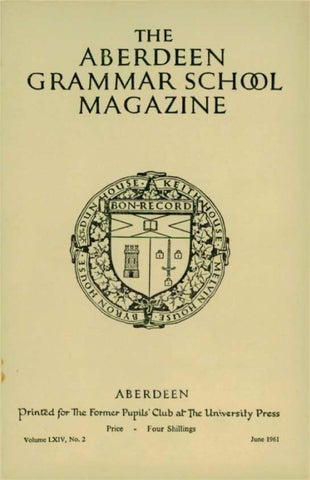
THE
ABERDEEN GRAMMAR SCHML MAGAZINE
ABERDEEN
prin.a.d. for The Former Pupils' Club at itte University Press Price Volume LX1V, No. 2
-
Four Shillings June 1961
BON-ACCORD CRESCENT is the Aberdeen address of
THE LONDON ASSURANCE Vil-r7 ogrtrwtioe 4— dide-st.e The Resident Secretary, Ma. J. F. JOHNSTON, will be glad to see you and to talk over any kind of insurance you may need.
Scottish Offices also at
DUNDEE, EDINBURGH & GLASGOW INCOUVILATED A.D. 1720
In cellar cool Wines there are for all palates and purposes and so discriminating are we in stocking our cellars that, whatever the occasion, you can choose here from a selection which for variety and quality is unsurpassed in Scotland. By Appointment To Her Majesty The Queen Grocers
By Appointment To Her Majesty Queen Elizabeth The Queen Mother Grocers
adAgto Gat:6411e FAMILY GROCERS & WINE MERCHANTS
269-271 UNION STREET, ABERDEEN Telephone 27244 BRANCHES: CULTS i
•
BALLATER
AT OUR MAN'S SHOP you will always find a good selection of Shirts by Van Heusen, Vantella, Viyella, Clydellon, Double Two and Chard of London. Prices are from 27 '6
ESSLEMONT & MACINTOSH LTD.
(RETAILERS) TAILORS AND OUTFITTERS
ABERDEEN
UNION STREET
ii
DIAMONDS, SAPPHIRES, RUBIES, EMERALDS, ZIRCONS, OPALS
We have been in business for almost a century and our unchangeable policy has been to offer fine quality jewellery at competitive prices. The engagement ring is of supreme importance and when the occasion arises we invite you to examine our stock which we are sure you will find interesting and reasonably priced.
. c9a I
(JEWELLERS)
.
191 UNION STREET ABERDEEN ESTABLISHED 1863
iii
See yourself as an officer —flying in the R.A.F. Your passport to a full and adventurous life—a flying commission in the Royal Air Force. It's a well paid career that will take you all over the world with the companionship that only Service life can give. You'll spend your early years as an officer on operational flying. Later, as your career develops you may do tours of duty in command of operational training units, as a staff officer in R.A.F. and N.A.T.O. headquarters, in military and civil research and development establishments, and possibly as an Air Attache to a British Embassy abroad. Life today in the R.A.F. offers you security, excellent pay, and a progressive career leading to high rewards. Here are some of the ways of beginning your flying career with the R.A.F.
for a Direct Entry commission. This gives you a pensionable career to 38 (or 16 years if this is longer), with good prospects of serving to the age of 55. If you retire at the end of 16 years, you will receive a pension of £455 a year and a tax-free gratuity of £1365. If you prefer to serve for a shorter period, you may leave after 5, 8, or 12 years. All periods of service carry a tax-free gratuity of anything from £775 10 £4000. If you are 16-17 you are not yet old enough to apply for a commission but you can rake a pre-assessment test and spend two days as the R.A.F.'s guest at the aircrew selection centre near London. This test will show whether you have an aptitude for flying and whether you are likely to qualify as an officer when you are old enough. Pay is excellent At 21, as a Flying Officer you will earn £950 a year; at 25, as a Flight Lieutenant on full allowances, you could earn over £7750 a year.
Through Cranwell If you are 17i-191 and hold or expect to
gain S.L.C. in English, mathematics, science or a language and two other subjects (Higher Grade in English and two other subjects) you can apply for a cadetship at the R.A.F. College, Cranwell, where you will be trained on University lines for a permanent conunission, which guarantees you a full career to the age of at least 55. If you are over 15 years 8 months you can apply for an R.A.F. scholarship, and if you are successful, a place will be reserved for you at Cranwell. This scholarship can be worth up to £230 a year, tax-free, to your parents and enables you to stay at school to take the necessary S.L.C. subjects at Higher grade. Through a Direct Entry Commission If you are 17.26 and hold S.L.C. in
English (Higher), mathematics and three other acceptable subjects, you can apply
Find out more about flying in the R.A.F.—as a pilot, navigator, or air electronics officer— by writing, giving your date of birth and educational qualifications, to the address below. You will be sent, without obligation, full details together with an illustrated booklet. Group Captain J. A. Crockett. R.A.F., Air Ministry (XAA159). Adastral House. London. W.C.1 THE
FUTURE
IS
WITH
iv
THE
R.A.F.
ROBERT MILNE AND SON Fellow Institute British Decorators
Decorator
263 HOLBURN STREET ABERDEEN Telephone No. 24556 ESTIMATES FREE
Ask the man who knows about
STRACHAN
FISHING TACKLE
Commercial and
Ask the veteran angler, the man who almost lives on the river, and he will unhesitatingly tell you that the 'Scottie' Trademark stands for the highest quality in fishing tackle.
Portraiture Photography
MARK
TRADE
130i UNION STREET
'SCOTTIE'
ABERDEEN
J. S. SHARPE
Telephone 20851
(FISHING TACKLE) LTD
35 BELMONT STREET ABERDEEN iiiIIIMNINNIIII•INII v
177,11111§e‘ -
•
6k, Q
.
,
---
0
.
.
MORE 0004 FOR YOUR MONEY!
. ....
O•
LAMB
xopy
More style, more luxury features, more power; whichever model you choose, Ford give you MORE—more of the things that matter to motorists. We'll be delighted to demonstrate any model in the Ford range. Drop in and see us—if you prefer, dial 25357 and we will come to see you and discuss your motoring problems. Terms and exchanges can he arranged on the spot. For your new car, come ft, 7, ,and see us first. Our ex- , perience as Ford Main Dealers for half a century is at your service.
Hi
.1 01.1.1
the 0000 people
arpers since1911
HOLBURN JUNCTION ABERDEEN • Tel. 25357 vi
•-
r
,
4±,
REPAIRS
SERVICING
GARAGING
.
AUTODIESEL
PETROL .
OILS
. AUSTIN • GUARANTEED . MORRIS • USED CARS •
M.G.
SELF-DRIVE CARS
•
GEORGE CHEYNE (MOTORS) LTD. WESTERN
GARAGE
60 GREAT WESTERN ROAD
your
At
Est. 1911
•
Tel. 25264
service for
quality
FISH • GAME BUTCHER MEAT Whether you shop in person or by telephone your requirements in either or both of our Departments will be looked after with care. Our delivery system too exists for your convenience.
A. & W. ALEXANDER Butchers
•
Fishmongers
492 UNION
STREET
.
Game Dealers
ABERDEEN
Telephone Aberdeen 25236
THE
AUSTIN A 55
With
the ASS Cambridge, AUSTIN breaks new ground in family Here are a few of its attractive features.
car design.
designed by Pinin Farina. five,
adults.
colours.
Giant
boot.
New sleek line
Luxurious seating for four, or on occasions Wide
range
of exterior and
All-round unrestricted view for the driver.
permitting high ratio third gear for safe overtaking. gear
change
(or
alternative
4-cylinder engine. Hydraulic brakes.
steering
interior
4-speed gearbox Central floor
column
change).
litre
Top speed over 75 m.p.h.
Up to
34 m.p.g.
Prices (ex works): Standard Model, £801 10s. 10d. De Luxe, £829 I7s. 6d. (inc. P.T.)
THE AUSTIN DISTRIBUTORS
21=31.8021'n YNC)102g, LIMITED
UNION ROW, ABERDEEN. Tel 29155 (5 lines)
\III
J. GEDDES IRVINE EDUCATIONAL CONSULTANTS AND TUTORS Individual and Private Tuition in all subjects for all School, University, Professional and Civil Service Examinations
1 CARDEN PLACE : ABERDEEN Telephone No. Aberdeen 29863
1
-
r t i rt'''' i...., ---7-" ,:tr ii7"13 A j h ,i5T pp f p irMii,4114 mmi--.,,,,,,-,-,,,,%;,,i,. 4,fit I ,hll iHtil ••. ),MC.:*" - •.- ... laLiLILII, ,.„_._ drilli iliai: ..„_. , , tgilit ::". .1"'L - - -It.L•:--,....-1 ' ,_,,..--4 .., ----I_ ' ' 1, , „,,,,,tI '''' ' Itt 'H'I:1( 14454.'fi* • ,,ti •••• ,(4, , 1...!L '. f. - %. ,_ ' --7:•., •= _ 'tl'tel5O.7 ,2 -
-
- -
-
for . . . Rainwear Umbrellas Travelware Rubberware Games and Toys
'Phone
Sports Equipment
27305 (2 lines)
Leather and Fancy Goods
THE RUBBER SHOP 16 GEORGE STREET
ABERDEEN ix
BUSY MEN ARE ALWAYS WELCOME
lei4
MORNING COFFEE LUNCHEON
AFTERNOON TEA HIGH TEA
Restaurant and Snack Bar: 468 UNION STREET Tea Room: 48 UNION STREET
TELEPHONE
ABERDEEN 23950
• TELEGRAMS
'GALLOWSES' ABERDEEN
Men's Outfitters
I
Established 1904
W. J. MILNE, LTD ABERDEEN
I
x
* -
r
N ir \ GRAMMAR\ SCHOOL OUTFITS , / )
-
,
-
r r0
•
• •1
--mer
from 75/6 BLAZERS (All Wool) 34/6 PULLOVERS (School Colours) )) 13/11 MUFFLERS Senior, 5/6 TIES—Junior, 4/11 ; from 8/6 STOCKINGS „ 69/YOUTHS' TROUSERS (Terylenef Worsted)
SPORTS JACKETS
from £5 : 2: 0
ESSLEMONT & MACINTOSH LTD.
(RETAILERS) TAILORS AND OUTFITTERS
ABERDEEN
UNION STREET xi
The Four House-eponyms " Sync we maun part, their sail be none remeid— Unless my country is my pride, indeed, Or I can make my town that homely fame That Byron has, from boys in Carden Place, For whom he is, like Dun ui Keith, a name : A tall, proud statute at the Grammar School."
So says our distinguished Former Pupil, George Fraser, in his " Home Town Elegy "—or words to that effect : I quote from memory perhaps inaccurately. Mr. Fraser had evidently been struck by the fact (he is not the only one) that, of the four men after whom the School Houses are named, Byron is the only one whose name conveys any meaning to any considerable number of Grammar School boys, many of whom, and even a few Former Pupils of particularly retentive memory, are aware that Byron was a poet, author inter alia of " The Assyrian came down like a wolf on the fold ". But who was Dun? Who was Keith? Who was Melvin? It is in the hope that he may dispel this ignorance that the present writer now takes up his pen. Dun Chronologically Dun comes first. Patrick Dun was the son of Andrew Dun, burgess in Aberdeen. Nothing is known of his early years ; even the date of his birth is unknown, but it must have been about 157o. Presumably he was educated at the Grammar School and Marischal College. The earliest certain facts known about him are that he graduated Doctor of Medicine at Basle and became a Professor, or " Regent " as it was then called, in Marischal College in, or shortly before, 161o. He became its Principal in a 621. In those days there was none of the bewildering variety of courses now open to the student ; all went through the same course, the " Trivium " and the " Quadrivium ". The three Regents taught all the seven subjects of the curriculum, each carrying his class through the first three years (bajan, semi and tertian), while the Principal himself taught the final (magistrand) year. For this he received a salary of 30o merks Scots, i.e. £16 13s. 4d. Sterling, but Dr. Dun was allowed to carry on private practice as a physician and even to make journeys into the country to attend noblemen when they were unwell, though he had to pay a substitute to teach his class for him when he was absent. His renown as a doctor as well as a scholar was great, and more than merely local. Probably it was due to his gains from his medical practice rather than to his savings out of his Principal's salary that he became wealthy enough to acquire the landed estate of Ferryhill, which by his will he " mortified to the Provest, Baillies, Councell, and Communitie of this Burgh [Aberdeen], perpetuallie, in all time coming, for maintenance of four Maisteris within their Grammer School'". Minute instructions are laid down in the will that the first and principal Master (i.e. the Rector) was to have a yearly stipend of Goo merks (twice what the good Doctor himself received as 63
Aberdeen Grammar School Magaine 64 Principal of the University), and each of the other three Masters to have zoo merks, and that hey were not to receive any more than i 3s. 4d. Scots a quarter as fee from any scholar " unless he be the sone of a Marquis, Earle, Viscount, Lord, or Barron, from whom the Maisters shall have libertie, to tak such stipend for instructions of ther bairns, as the Noblemen or Barrones shall be pleased to bestow upon them". Moreover, the sons of poor men, "all those that are of the surname of Dune ", and " the whole tennents sones of the said lands of Ferriehill " were to " be teached gratis perpetuallie, in all tyme comeing ". Furthermore, conditions are laid down concerning the appointment of Rector and Masters, which was to be by competitive examination, except that anyone who bore the surname of Dun or was the son of a tenant of Ferryhill, if properly qualified, was to have preference, " without any contestatione ". The will is a lengthy document of enormous verbosity and remorseless repetitiveness (given in tato in that quarry of Grammar School history, Dr. H. F. Morland Simpson's " Bon-record "), but its purport is perfectly dear. Alas! the Provost, Baillies and Council were flagrantly untrue to their trust, and the estate of Ferryhill was first grossly mismanaged, and in the end simply appropriated and added to the lands of the burgh. What this estate brings in annually to the Common Good of the burgh of Aberdeen I cannot say, but, now that Ferryhill is all built over, the feu duties amount to enough to have made its rightful owner one of the best endowed schools in the country. The only part of the will which was observed with some conscientiousness by the Town Council was the last mentioned, and most questionable of its clauses ; this explains why there are two Duns in the list of Rectors and six in that of Masters. Dr. Patrick Dun's portrait by Jameson (dated 163 t) hangs in the School Hall and is the School's most valuable possession. His coat of arms— gules, three padlocks argent with a sword in pale of the second—forms the sinister half of the badge which every boy wears on the sinister breast of his azure blazer. Melvin The other academical House-eponym, James Melvin, was also an Aberdonian, being born of poor parents in the Gallowgate in 1795. He entered the Grammar School a few years after Byron left it, gained the first bursary to Marischal College, and graduated M.A. in 1816. After teaching at Udny and in the Old Aberdeen Grammar School, he returned as Master to his old school in t8zz, being promoted Rector by competitive examination four years later. So he remained till he died in 1853. During much of his time as Rector he also lectured on Latin at Marischal College, which had no Professor of Latin at that time. When the College decided to institute a chair of " Humanity " Melvin's unquestionable claim was disregarded. Marischal College did, however, make some amends by conferring on him the degree of I.L.D. in 1834. Dr. Melvin was a bachelor ; he lived all his time as Rector in Belmont Street, handy for the old School in Schoolhill. This antiquated one-storey, H-shaped building, erected in 17S7, had
7o
Aberdeen Grammar School Magazine An' he can diagnose disease, Frac measles tae the mumps. An' tell wee Johnny's prospects Jist by feeling at his lumps. He's a parson and a doctor, A lawyer and his clerk, An' he kens main breeds o' insects Than ever saw the Ark. An' Leezie it is no sae easy, For him to make ends meet, For he's no toff, he'd be better off, As a polis on the beat. The Dominie's hair is wearin' grey, For aye he's keepit thrang, Wi' organising this and that Tho' a' the schule gaes wrang. The bairns may neither read nor write, Their sums be always scrappy, As long's he fills his schedules up An' keeps the office happy. Oh Leezie, Leezie, noo' it's easy, The Dominie's saxty-five, Wi' time tae garden, read and bool— The happiest man alive. Aye Leezie—but it's no that easy, Wi' a' yon nervous tension, He'll end up in a nursing home— An' never draw his pension.
James F. Walker Mr. Walker retires at the end of this summer.
His record will afford Former Pupils and Colleagues past and present a grand chance to play that much-loved game "Do you Remember . . . ? " wherever two or three Grammarians are gathered together in Bothy, Howff, Field, Board Room, Club, Shop, Bungalow, Mansion scattered everywhere. Do you remember the slim boy in dark belted jacket, black boots, stiff Eton collar gazing in wide, blue-eyed wonder at the live turtles in the vestibule of the Grand Hotel, now the Caledonian, a few days before the turtles became soup for the magnificent dinner Lord Strathcona provided for all undergraduates when King Edward VII and Queen Alexandra opened the extension to Marischal College celebrating the 4ooth anniversary of the University of Aberdeen in 1906 and when Aberdeen went to town as never before or since? Jim Walker attended school from 19oz-14. Do you remember him at Territorial camp in the summer of 1914 waiting for the results of School leaving passes ? He had joined the Territorials by giving his age a year older than it was.
MR. JAMES F. WALKER
C
I U (TI
•
a u x, r';•/ i , -)
j
v y
-
./ f
"
/,
/
•J
L
r
)
,
'
I
1)...t;)
i 6r
As a fitting accompaniment to the article on " Trends in Science Teaching " we concern, at Leverkusen, this a composition of various alchemistic symbols inreproduce here a photograph of an interesting wall plaque in the entrance hall of the new Central Scientific Laboratory of Messrs. Bayer, the German Chemical eluding a section of the table of affinities of chemical substances and traditional chemistry apparatus. \X c are obliged to Messrs. Bayer for permission to reproduce this photograph. A detailed explanation is available for anyone interested in having it.—Ed. (See pps• 72-74.l
James Frederick Walker 71 And do you remember him a little later in khaki in the First World War when he joined the 4th battalion of the Gordons ? He saw action in three different battles and came back wounded each time, the last seriously at what was almost the final engagement of the war. Do you remember, then, Lieutenant Jim Walker in hospital in Aberdeen and Edinburgh, his broken leg gradually mending, but not even now completely whole ? Do you remember him at Aberdeen University—Hons. English, subsidiary Latin 4nd History : at Training Centre in 1923 : at Fraserburgh Academy : back very soon at the Grammar in 1924 where he has remained? Do you remember him as " Pa Walker ", District Scoutmaster at many a school summer camp ? Or as " Pasie ", the producer of lively one act plays for the School Dramatic Society, among them two rattling good versions of Robin Hood, marked by high spirits and clear speech—enjoyable motley romps in Lincoln Green. Then his appointment as History Master in 1946 : his continued interest in School activities in Music, Dramatics, Film Society, Debating Society. Do you remember his masterly performances at the Debater or his scholarly discourses at visits to local places of historical interest? Over the years, however, James's interests have concentrated on History, widely at that. Each year, since his appointment as History Master, he has attended Summer courses in Advanced or Specialized History in all parts of the country. He is almost as well known in Orkney as Aberdeen, Hereford, Durham, London. Son of the Manse, Superintendent of Sunday School, Elder, Kirk Session Clerk. His good services outside School are legion. His active interests in adult Local Historical Associations and Teachers Societies are well known. In School, generations of boys have respected his dedicated scholarship, his utterly honest and conscientious attitude to his work. A temper he has, but rarely loses, forthright in criticism, a store-house full of memories of the old School. He has known five Rectors—Morland Simpson, Miller, D. M. Andrew, " J. J. R." and Mr. Skinner. In all, he has been associated, boy and man, pupil and master, with the School for forty-nine years. That alone must stand as a record of note; but, at the end of this half century to retain vigour and enthusiasm is quite astonishing. He can look back on many changes in the School—then a small, selective group when to be a master at the Grammar School was a gentlemanly occupation and one to stay at, now a School bursting at the seams, expanding always to meet a larger number of boys. Changes in Staffroom, too. Not always did the Young Men rule the roost and commandeer the fireplace or dare smoke until asked to, when the elders were respected and lent some kind of distinction and dignity to the place. Was it, however, James or another member of staff who introduced the pungent aromatic reek of cheroots to enrich the evil smoke of " elevenses " cigarettes ? Do you remember the fizzling out of the septcentenary celebrations and the Pontifical Pronouncements thereon?
72
Aberdeen Grammar School Magazine
Do you remember James at the very tail-end of staff dinners or staff golf outings, an expert mime, on top of his form, crackling with his own impish brand of driest humour? Do you remember his speech of the evening at Sir James's farewell dinner? Do you remember the Happy Episode of the Holy Water from Jordan? Do you remember him, at last, still a slim, slight, even dapper, grey figure walking briskly with long strides down the drive away from Byron ? Do you remember the final, long-drawn, " W-e-l-l " ? Mr. Walker will want to leave the School quietly with little fuss. All of us left here in School, boys and colleagues and friends will wish him many years happy retirement in the company of his books, in his garden, with his camera and slides, surrounded by his unique collection of pictures of historical Aberdeen. Perhaps, now that he will have leisure to spare, he will be asked to write that " History of Aberdeen for Schools " which has been waiting to be done for so long. There have been Great Rectors at the School. But even Great Rectors need some Teachers of Quality. We all know that Mr. Walker will be remembered as a Great Teacher and Gentleman. If a lifetime of generous public service well done and quietly ever won accolades there would be still another Sir James. At the end, Sir, you will be remembered often by all of us with a deep and lasting affection. Written March 1961 ANON. [Surely reference to one characteristic of Mr. Walker's is omitted in the foregoing—his distinctive use of " the royal ' we ' "!—Ed.]
Trends in Science Teaching Twenty-five years ago there were ioo boys taking science in Forms IV, V, and VI of the Grammar School; today there are 25o. Although this increase owes much to the organisation and encouragement of Mr. Lynch it is perhaps more a reflection of the time in which we live. The demand for engineers and scientists continues unabated, as witness the pages devoted to their enticement in the so-called quality Sunday newspapers. Not that the teaching of science should be looked upon as something solely necessary to meet this demand. Scientific discoveries and principles so impinge on human life and thought that those who have no understanding of them, or of the particular science which produces them, are but part-educated and far from truly cultured. They are shut off from major activities of the life around them. Science should therefore be presented in schools certainly to lay a foundation for those who will pursue its study, but also to bring an awareness and an understanding to all of its method and its modern development. A belief in such a presentation prompted the Science Masters' Association to publish earlier this year a policy statement on Science and Education in which there appears the bold pronouncement, "We maintain that science should be a `core' subject in grammar schools in the same way as, for example, English and Mathematics are at present and as classics used to be."
Trends in Science Teaching 73 should This statement may cheer some and startle others but it surprise no one who has been attending to present trends in education. However, if we insist that science has to be taught to have relevance to today's demands and tomorrow's possibilities much revision will be required in the content and method of science teaching. In a world spangled with sputniks on the edge of an age of thermonuclear power, what must a boy make of spending dreary hours weighing a glass stopper in water and in alcohol to no more purpose than to provide him with unrealistic problems of considerable difficulty? It is significant that a move has been started by science masters themselves for a re-appraisal of the content of science teaching. The demand for change is more evident in chemistry than in physics or biology, and a new approach has already been applied in this subject in the work of the VI Form. The change owes much to the pressure of University teaching and teachers who have not hesitated to criticise the work carried out in schools. This University teaching has in turn been strongly influenced by the example set by those progressive American colleges in which a modern approach to chemistry has been developed. The most pressing need is the devising of a suitable method to present a new view of atomic theory and a fuller understanding of the electronic structure of the atom. And it is not enough that this should be taught as a " topic " to be exhausted in a fortnight. It must be so presented as to permeate the entire teaching of chemistry. It has to be admitted, however, that little change is in prospect below VI Form level at the moment, and for the reason we need look no farther than the L.C. examination. It is a pity that public examinations, which are devised to raise the standard of what is taught, tend over the years to exaggerate the importance of those parts of knowledge which can be examined, and thus to stabilize that very knowledge. The content of the chemistry course leading to Higher standard is nineteenth century, even early nineteenth century. It is true that of late some " modern theory " has been introduced but it has been tagged on to the existing syllabus, and has much the same relevance to the rest of the course as a fitted radio has to the performance of a vintage car. Even in the syllabus suggested for 1963, when Chemistry (Higher) will be a separate subject of two papers, there is no mention of the Periodic Table, and this may be interpreted that there is no call to teach it. Facts are piled up, examined, and left. And this at a time when an American professor can say: " The teaching of chemistry is now a walk across the Periodic Table. One stops here to admire a view down a valley, and there to study a range of mountains, and again to spot in the distance an archipelago of islands, strange and enticing." I suspect that if it were not for the .Mond Nickel Company and the excellent wall chart they have issued to schools many pupils in science classes would never have heard of the Periodic Table, far less be aware of its importance in relation to modern theory. Although a general change will come about sooner or later it is a good thing that not a few science teachers are already modernising their courses if only to
Aberdeen Grammar School Magatine 74 satisfy themselves, and to avoid the depressing thought that, if they do not do so, their more knowing pupils later will come to despise the science taught at school. One further aspect of science for all is that pupils who do not pursue a science subject in the upper forms should be given some insight into modern views on cosmology, evolution, matter and energy, cells and molecular structure, and perhaps even the philosophy and history of science. This may be done by some form of lecture and discussion in groups. I imagine this possibility has been ignored in the past by the constant insistence that science is a practical subject. An experiment must be done for experiment's sake. We bury under fact and description and technique the essential nature of science as method and theory. The paradox that some of the more successful scientific theories were at first flights of fancy is glossed over. Of course the danger is that lecturing too easily becomes oracular utterance, but young minds have a remarkable resistance to dogma. Discuss, say, matter and energy and there are a hundred questions, each leading to another. It is exhilarating to be aware of the excitement of a class which realises it is being given up-to-date views; it is humbling and instructive to be conscious of how few of their questions one can answer clearly. It is perhaps not easy to jettison time-honoured methods and topics from science teaching but the effort must be made if the subject is to be brought more in line with modern concepts and principles. The present is waiting for our pupils; we should fit them for it. P. C.
[The foregoing article is published in accordance with our policy of reviewing from time to time different aspects of School lifc and teaching. It was especially written for us by Mr. Peter Cook who, although he left the School teaching staff last year was nevertheless good enough to do this article in implement of an undertaking given prior to his getting his new appointment.—Ed.]
*
*
*
Could I have saved Pearl Harbour? When I was appointed Food Controller for North Borneo in August 1941, it seemed only a matter of months until Japan would enter the war on the side of the Axis. In that event we, in North Borneo, fully expected to be more or less cut off from the rest of the world. The country did not possess one landing ground for aircraft, and as no roads or railways connected the State with neighbouring Brunei or Dutch Borneo, all imports and visitors had to come by sea, and Britain just did not have the ships necessary to keep the sea route open to an unimportant Protectorate like North Borneo. Although never for a moment did we think that within two months after the commencement of hostilities the whole of the territory would be occupied by Nipponese forces, we did fear Japanese air and sea raids. Now, although the indigenous peoples of the State grew enough food to support themselves, they did not grow sufficient to feed the urban population, mainly Chinese, whose staple diet was imported rice. Thus it came about that the Government allocated me a substantial sum of money to import large quantities of rice and foods not produced locally, such as flour and sugar, so that the country could face months of isolation without fear of famine. In order to store these foodstuffs, it was necessary, not only to requisition all suitable buildings, but also to have godowns specially built. Towards the end of November 1941, I took possession of a newlycompleted godown at Sandakan, then the capital town, for the storage of the last shipment of imported foods which was due to arrive at the beginning of December. The same day, I instructed my chief clerk to make it known in the town that, when the shipment had been transferred from the wharf to the godown, a night watchman would be needed to guard it. On the last day of November, a Sikh was shown into my office. Speaking in Malay, he said that he wanted to apply for the job of night watchman at the godown. In the same language, I enquired his name and his present occupation. He told me his name was Kartar Singh and that he was employed as night watchman at the Japanese Consulate. " Why are you leaving there? " I asked. " Because the Consul says he will not require a night watchman after the 7th of December, Tuan." " Did he say why? " " No, Tuan." " That's phoney," I muttered to myself in English, and then reverting to Malay, " All right," I said, " Come back tomorrow, and I shall let you know if you are engaged." When my caller had gone, I sat and thought for a few minutes, and the more I thought, the more peculiar it seemed to me that the Consul should be dispensing with the services of his watchman on the 7th. Labour contracts in North Borneo were almost invariably for periods of one calendar month, and an employee could not be dismissed without one calendar month's notice or a month's wages in lieu of notice. 75
76
Aberdeen Grammar School Magazine
But something over and above this was worrying me. Some sixth sense told me there was much more in the Consul's action than a mere divergence from, or breach of, the labour laws and customs. I decided to telephone the Consul, rang the Consulate and asked if I could speak to the Consul personally. I knew him quite well although he was not so pro-British as most of the Japanese in the State. When I had been put through to him, I enquired if a certain Kartar Singh was employed by him as a night watchman. ' Yes, yes," he replied. " Well, he has just applied to me for a job." " So! " He paused, then added, " If you want him you can have him after one week." " Can you recommend him? Is he honest and trustworthy? " " I think so. He has been a good watchman here." I rang off, and called in my chief clerk. " Ah Boon," I said, " do you know why Kartar Singh is leaving the Consulate on the 7th? " " No, Sir." " I don't suppose you know when he was given his notice? " " No, Sir." " All right. Thank you, Ah Boon. " Common sense told me to forget the matter and question the Sikh when he came back the next day, but I felt uneasy. Why, if he was a good watchman, was he being dismissed? I decided to refer the incident to Geoffrey Gray, the Government Secretary, and rang the Secretariat. When I had recounted the facts to Geoffrey, he agreed that it did seem peculiar, and advised me to contact the Security Officer. But the Security Officer was not available when I telephoned his office, so I went home for lunch. Over the dining table I told my wife what had happened, and that I had a disturbing feeling that something important lay behind it. " Why not go over and tell Commander Murphy ? " she suggested. Commander Murphy, the United States Naval Intelligence Officer and his secretary, Leslie Rodgers, lived next door, and we often visited each other through the gaps in the boundary hedge. " No ", I answered, " not just now. I don't want the Commander to think I've got a bee in my bonnet. I'll ring R.T. (the Security Officer) this afternoon, and if he thinks it is important, no doubt he will tell Murphy." However, when I did speak to the Security Officer on the telephone after lunch, he attached no importance to the matter at all. He said the Sikh was being dismissed because he had been rude to one of the Consul's guests when that gentleman was leaving the Consulate showing signs of having wined and dined rather too well. " Then why was he not dismissed on the spot or given a month's notice? " I asked. " Oh, the Consul is probably making some other arrangements for protecting his property from the end of next week." Still I was not satisfied. I decided that the first time I happened to see Commander Murphy I would unburden myself to him. Unfortunately I did not meet him that evening, and before I had breakfasted
Could I have saved Pearl Harbour? 77 visit other next morning, he and his secretary had left Sandakan to east coast ports. Pressure of work prevented me from worrying about the incident until a week later. Then, when the news of the bombing of Pearl Harbour and Singapore came through, I knew why the Consul had decided that he would not require the services of Kartar Singh after 7 December. By that evening, he and all the other Japanese in Sandakan were under arrest and on their way to internment. When Commander Murphy returned to Sandakan a few days later, I told him the whole story. " Why in the name of Heaven did you not tell me at once?" he demanded. " Well," I stammered, " I would have told you if you had not suddenly gone off to Tawau. In any case, it was only a very small straw in the wind." " Maybe it was a small straw," he retorted, " but it was a straw that might have saved my old ship from being bombed to hell at Omahu." A day or two later, the Commander and his secretary slipped out of Sandakan in a native boat under cover of darkness. I was, in due course, captured by the Japanese and interned. When I returned to North Borneo in 1946, I heard that Commander Murphy and Leslie Rodgers had managed to evade the Japanese warships attacking Tarakan and reached Java whence they had returned to the United States by way of Australia. There, Commander Murphy rejoined the combatant division of the U.S. Navy, and like so many other gallant gentlemen, was killed in action. What happened to Leslie Rodgers I never found out, but I hope he eventually found his way back to peace and happiness in his native Greenwood, Mississippi. Did I fail to disclose in time, information that might have prevented the Pearl Harbour disaster? Would it have shortened the war and saved thousands of lives, if I had taken my wife's suggestion and walked the thirty odd paces across to my neighbours' house? From all I have learned since the end of the war, I think not—but for the rest of my life I shall occasionally be troubled by lingering doubts J. S. ABERNETHY* (1925-20 *
*
*
Scowlers " One of the axiomatic truths of the age in which we live is that a man sitting at the wheel of a motor car is inherently more important than a man walking on his two feet. Democracy ends with the automobile. Even the gentlest and most courteous man can undergo a transformation of character when driving a car." The Scotsman
(Late Item.)
Mr. James F. Walker's Retiral Mr. Walker was the guest of honour at a Complimentary Dinner held in the Caledonian Hotel on 13 June, organized by the F.P. Executive. Mr. Alan Peters presided over a company of about thirty and a most friendly and diverting evening was enjoyed. Mr. Peters outlined Mr. Walker's " unique connection " with the School extending as pupil and master over about sixty years from the time he went to School in 19oz to date, and covering his every mood from carefree participation in School activities to that of him " stalking down the corridor with door key at the horizontal "—a sure sign that no facetiousness would be tolerated that day! Replying to Mr. Peters's " obituary notice " Mr. Walker took us down the arches of the years from the time when there were only 450 pupils at School (when he joined) to its now having three times that number. En route he gave us entertaining thumbnail sketches of the characters of yesteryear—so beloved and respected, in retrospect— lapsing, now and again, into a duologue with Dr. Douglas Simpson (" Isn't that so, Douglas ?") as he surveyed them—" Picker ", " Pat ", Janny Kennedy, " Johnny Summers " (ready to take up the handstand position on the slightest opportunity), " Pym ", " C. D."; Dr. Morland Simpson and " the other 4 great ' Ms '— McLeod, Munson, i ' Caesar' Middleton, and Max Mackie." (At this point your editorial scribe was espied surreptitiously scribbling behind his Menu Card, and was instantly rebuked with a sharp—" Now, now, Campbell . . . none of that!" but the company protested that this was for Posterity, and the recollections continued, although hereafter one or two interesting avenues of speculation and comment were opened up, but the door thereto quickly closed with a " . . . ah yes, but we won't go into that!") Indeed a right enjoyable evening of recollection with the " spartanlike curriculum " of yesterday extolled as being " not like the great clutter-up of frills like today "! Surely Alan Peters was right when he remarked that it's a pity that a post at School is no longer an end in itself, for School loses much by continued staff changes which deny us " the giants to grow larger with the years ". [The School Staff are also giving a Complimentary Dinner for Mr. Walker just before the end of term]
78
School Section School Office Bearers, 196o-61 School Prefects GARTII W. GLENTWORTH (Senior Prefect) KENNETH M. GORROD (Deputy Senior Prefect) DOUGLAS W. T. PAUL GORDON C. PETERSON GEOFFREY D. REID MICHAEL SMITH IAN P. SOUTER ANDREW T. TAYLOR RODERICK B. WATSON IVAN C. F. WISELY IAN R. WRIGIIT
JOHN I. JOHNSTON ANDREW J. LEACH FRANCIS N. MCKENZIE IAN MACKLAND ALEX. W. MATHIESON GORDON G. MILNE STUART J. MITCHELL TERENCE MORRISON NIGEL MURRAY
HECTOR M. AIRD JAMES K. ARCHIBALD DAVID R. AULD DAVID R. CLARK WILLIAM S. R. CLARK FINDLAY M. COUTTS GRAEME W. FRASER RONALD W. GRANT JAMES HAMILL
Byron
House Captains Dun
Keith
GARTH W. GLENTWORTH
TERENCE MORRISON
DOUGLAS W. T. PAUL
Melvin GORDON G. MILNE
Captain
GORDON G. MILNE
Captain
IAN MACKLAND
Rugby Vice-Captain
GARTH W. GLENTWORTH
Hockey
Vice-Captain
MARISCHAL SINCLAIR
Swimming Captain
GEOFFREY D.
REID
Badminton Captain IAN C. KEITH Literary and Debating Society Vice-President DAVID A. PLOWMAN Treasurer DAVID R. CLARK
President Secretary
RONALD W. GRANT FINDLAY M. COUTTS
President
Secretary
WILLIAM S. R. CLARK ALASDAIR H. MACLEOD
President
STUART J. MITCHELL
Dramatic Society Vice-President ANDREW T. TAYLOR Treasurer CHARLES DUNCAN Film Society Secretary
IVAN C. F. WISELY
FINDLAY M. COUrrS
Treasurer
Cadet Force W.O.
JOHN I. JOHNSTON
Scripture Union JOHN G. C. WEIR
Secretary
Editors of School Section RONALD W. GRANT GARTH W. GLENTWORTH
DAVID R. CLARK GORDON G. MILNE
79
So
Aberdeen Grammar School Magazine
School and Random Notes Are you sitting comfortably? Then we'll begin. When the music stops the Editors will be here to give you your summer Random Notes. . . . Since the last issue of the Magazine was so warmly received by our immediate relatives, we have once again trimmed our quills, diluted our ink and set to work. We hope you will bear with us and the babblings of our advancing senility. * * * We really had to sympathise with the masters in their demands for higher pay. Things must have been really tough for them financially. Why, one day we counted not more than a couple of dozen cars in front of the School and then what with only eleven weeks paid holiday. . . . * * * The decreasing age-gap between VI year pupils and members of Staff is becoming an increasing embarrassment. It would appear one can't even go to a dance-ball these days without meeting at least one of them. We don't in the least mind listening to any of the staff playing in the band, but when it comes to colliding with them in the middle of a dreamy slow foxtrot, we draw the line. * * * Extract from the Report on Operations: " On 21 April, 1961, the School was the scene of a series of daring raids and attacks. These were the result of outrages on our privacy committed by a busload of whooping savage students, claiming to be collecting for charity! In protest, a handful of daring, courageous, resourceful prefects (including the editors, of course) and sixth-year boys, commenced guerrilla action against them. Using the Prefects' Room as a H.Q., patrols were sent out, who made captures—within thirty minutes, our noble guerrillas had sealed themselves off in H.Q. with fourteen young female hostages. All troops behaved honourably towards them, except for one prefect who acted like a cad and not as befits an officer and gentleman. He awaits court-martial. " Having successfully delayed the enemy bus, and enraged the male students, we celebrated our victory by releasing our charming P.O.Ws." * * * As a follow-up to the introduction of such gentlemanly pursuits as tennis and golf for the VI Year, there is a scheme afoot to introduce polo in the Upper School. Although players may use their own, the games staff have arranged for the Co-op Milk to supply horses on a Wednesday. They are also trying to hire an expert for tuition, but we don't know if the Queen will allow this. * * * Has anyone else noticed the resemblance between the small, red-faced janitor and Brendan Behan? The similarity is not only physical, but in their liking for raucous humour. We're sure he performs his duties conscientiously, but every time we see him he's either patting his vintage car or laughing to his friend with the bonnet and dungarees. While we're on the subject, who exactly IS the one with the bonnet? *
*
*
One morning after assembly, a snap check was held on twenty-five members of Staff, to see if they had hymn books. The search revealed two hynularies (confiscated from the ist year), nineteen diaries, two wallets, and a condensed version of Room at the Top. One master claimed he knew the words without a book, Shame on you, sirs!
81
School Section
Congratulations to the talented znd Year boy who appeared on T.V. playing the bagpipes. Our last glimpse of him was when he marched off stage followed by two dozen young ladies (admirers, perhaps l) We personally think he is much better than anything on White Heather Club, including Andy Stewart. *
*
*
The final step in the rehabilitation of our glorious C.C.F., was taken when their new store was built. Employing the sound old military tactic of keeping one's back to the wall, the H.Q. was built at a heavily fortified corner of the School wall. It says much for the unselfish nature of the cadets that they sacrificed their indoor range, N.C.Os. rest room, and toilet facilities so that they might get their long-awaited store right away. It is a pleasant, L-shaped building, combining the best features of the Greek, Mid-West, and Bus-shelter styles. Prospective paying guests should either apply to the War Office or see Lieutenant Galloway. * * * On behalf of the boys, we would like to welcome Dr. Milligan, as head of the Physics Department. Also Messrs. Wilson and Wilson to the Mathematics and Science Departments, respectively, and Mr. Cullen to the Music Department. Good luck to them I * * * It is not for us to pay formal tribute to Mr. Walker, for only a handful would know to whom we were referring. However, the mere mention of the affectionately named " Pasie " immediately puts everyone in the picture. Unfortunately, this is his last year at School, for Mr. Walker is soon to retire. This year, we will lose not only a wealth of historical fact, anecdotes, and teaching experience, but a true individualist and " character ". No more will 1st year boys be introduced to the peppermints, the bristling moustache, and the pens worn like so many medal ribbons. However, after such a long association with the Grammar, it is inconceivable that Mr. Walker should break with us completely, and he will always be welcome in School circles. * * * To end in a more serious vein, the Editors have observed a noticeable lack of participation in voluntary School activities by pupils and would like to comment on a change in the atmosphere of the Grammar School. Through the centuries many changes have taken place but at the same time a tradition has been established. It is a tradition of common courtesy and pride in the School. Sad to relate, we feel that too many boys are forgetting this. We hope this is not the pattern for the future.
*
*
*
The Sir James Robertson Prizes Contributions of a literary or creative sort have been few this year. Quite a number of articles, obviously written to order, and dealing mainly with Spring, the weather, the hard lot of the schoolboy and the fortunes of the Aberdeen football team, have come to hand; but compared with what was received last session the response was disappointing. It is hoped that in the future we will have more to show. The prizes this year have gone to Philip Evans, IIIA, and Roderick Watson, Lower VI and to them we offer our warm congratulations.
82
Aberdeen Grammar School Magazine Dramatic Society
The presentation of Twelfth Night took place in the School Hall on Friday 24 Saturday 25 and Monday z7 March this year and was much enjoyed by all concerned. Audiences this year were slightly smaller because of the unusual dates which were necessary in order to avoid clashing with the Italian tour. Many F.P.s with Dramatic Society connections expressed their hearty appreciation of the performance and it is especially encouraging to note that a large number of these F.P.s are playing leading parts in university dramatic activities. Their interest in acting does not end when they leave School. This year owing to changes in examination dates we are faced with a Christmas production. This means that instead of his customary Summer Term rest, Mr. King must search around for a suitable play and commence casting. We have no doubt that he will bring it off successfully once more. W. S. R. CLARK
Literary and Debating Society Much anxiety has arisen from the poor attendances at the meetings of the Society, this term. In the past, it has often been found difficult to attract VIth year boys, who perhaps considered the Society's work below their dignity, but this year, although we have a large, interested group from the Vlth year, members who attend the Society regularly are few and far between, this scarcity being particularly marked amongst the present Vth year. There must be a few intelligent people within this group but it seems very difficult to find them. It is only to be hoped that next year, this apathy will be put aside and meetings will have their due attendances. Apart from this, we have had a successful session. What was said by the smaller group was always of high quality both in the matter of the speeches and in the way in which they were delivered. Though the inter-school debates with Albyn and High Schools had their usual large attendance, the Gordon's debate was attended by a total of only thirty boys. I wonder why this happens? As always the principal speeches at these debates were of a high standard while the open debates were notable only for their lack of sensible discussion. The Middle School debate, " That Prefects be allowed to use brute force ", was extremely interesting, especially since, at the end of the debate, an attempt was made by fifty Middle School boys to lynch the eight prefects, present. In the annual " One-Minute Please," the prefects, with their usual eloquence and wit defeated the rest of the School by the wide margin of 24 points to 9. A StaffDebate was held on the subject of the Pupil-Teacher relationship. Messrs. Scott, Robertson, Duncan and Munro gave their views on this subject so close to their hearts. Talks were given by two university professors: One by Professor Allen on " American Education ", the other by Doctor Synge, a Nobel Prize winner, on " The Scientific and Ethical Aspects of Radio-active Carbon ". We were represented at the Six Schools Debate by President Grant, who as principal speaker for the affirmative, won the debate. The highlight of the term's meetings, it was universally agreed, was the talk on " Bomber Command in World War II," by Mr. McLeod. Both amusing and moving, this talk, delivered in the inimitable McLeod manner, showed us what a debt we owe to the men who fought in World War II. Messrs. Grant, Clark and myself have derived great pleasure from conducting the society's affairs this session. Throughout the year we have been guided in all our actions by Mr. Tait who, as always, has devoted much of his time to keeping the Society functioning smoothly. Thanks must also go to Ivan Wisely, VI, for his posters and to Miss Boyd for her continued support. FINDLAY COLITIS Secretary
School Section
83
Aberdeen Schools Scientific Society This year the Scientific Society has had one of the most successful sessions in its history. There have been lectures by two local speakers, Dr. Synge, on protein and Dr. Gimmingham, on botany. We have also had two most entertaining lectures given by speakers from the British Association for the Advancement of Science, namely, Mr. Arthur Garratt and Sir Lawrence Bragg. Mr. Arthur Garratt's lecture, on a variety of subjects from mathematics to psychology, had everyone amused and interested. His final demonstration, when he poured boiling lead over his hand, created quite a sensation. Sir Lawrence Bragg, on the other hand, spoke on one subject only," Magnetism ". In his lecture he carried out many demonstrations giving an explanatory commentary on the results. This excellent type of lecture appealed to the audience and we hope to have more of them in the near future. We are indebted to Mr. Bruce and would like to thank him for helping both senior and junior branches of the Scientific Society. Ian Wright, our fifth-year representative, also deserves our thanks. GORDON PETERSON
Arts Club A little persuasion has effected a considerable increase in the Club's membership and enthusiasm seems particularly high. In the craftroom, a number of boys tackle a variety of ploys under M r. Atkinson's supervision, while Mr. Hemingway keeps an eye on the painting and drawing sect ion. Over the past year the Club has been visited by various former members and only recently we had a visit from Mr. Brown, the Art Inspector for Schools, who showed much interest. Our thanks again to the Art Staff whose encouragement makes Friday evenings both pleasant and profitable. IvAN C. F. WISELY, Secretary
House Notes Byron At the beginning of the summer term the following Cricket and Athletics officials were elected at a House meeting: Cricket Captain, David R. Auld; ViceCaptain, F. Neil McKenzie; Athletics Captain, David R. Auld; Vice-Captain, James R. Allan. In the winter activities rugby, hockey, and swimming, the performance of the House teams has been very mixed. A strong rugby team including seven members of the 1st XV could finish only runners-up in the House rugby championship, going down to Dun the eventual winners. In swimming and hockey, however, we finished last, efforts due in the former to lack of practice by two older swimmers and in the latter—as our hockey captain put it—to lack of players! Our hopes now lie in Cricket and Athletics. In House Cricket we should retain the trophy as we can field virtually the same team as last year. In Athletics, the potential is certainly there and with hard training we should put up a strong challenge for the championship. In conclusion I should like to thank Mr. Baxter and his assistants on the Staff, for once again ensuring the smooth running of House affairs. GARTH GLENTWORTH, Howe Captain
84
Aberdeen Grammar School Magazine
Dun Officials elected this term were: Athletics Captain, Malcolm Gauld; ViceCaptain, Peter Mulvey; Cricket Captain, Terence Morrison; Vice-Captain, Findlay Coutts. Once again, the House retained the Rugby Cup by defeating Byron, Melvin and Keith without loss of a point. This fine achievement was due to a strong team effort. In the hockey House matches, Dun put up quite a good show, but like the other Houses could not match the standard set by a good Melvin House team. The annual swimming gala turned out to be very exciting, the House being separated from the winner by only six points. Enthusiasm more than skill, perhaps, set us in this challenging position. The summer term promises much in cricket and athletics. This year we do not intend to be playing the supporting role in either of the championships. We in the House are deeply indebted to Mr. McLeod and his staff assistants for their administration of House activities, and would like to express our sincere thanks. TERENCE MORRISON, House Captain Keith The following appointments were made at a meeting held early in the term : Cricket Captain, Douglas Paul ; Vice-Captain, David Runcie ; Athletics Captain, Andrew Leach ; Vice-Captain, Kenneth Edward. The winter terms were filled with surprise and disappointment as regards sporting achievements. The success of the House teams in swimming and hockey exceeded all expectations, and both teams finished in second place in their respective championships. The rugby team, on the other hand, only managed to finish third in a very keen contest for the Rugby Cup. Once again it was the younger boys who won our only trophy, the Junior Rugby Cup. However, with a good selection of athletes throughout the School we hope to finish well up in the Sports as in previous years. Our cricket team appears to be of much the same standard as usual, but nevertheless we hope, . . . DOUGLAS PAUL, HOUR Captain
Melvin The following officials were elected for the summer term : Cricket Captain, Gordon Milne ; Cricket Vice-Captain, Fraser Webster ; Athletics Captain, Geoffrey Reid ; Athletics Vice-Captain, David Millar. To date, the house has had a very successful session, winning both the Hockey Cup and the Swimming Gala. Congratulations are due to Neil Fraser who shares the Rector's Swimming Cup with Andrew Leach, and to Fred Lawson who gained a Schoolboy Hockey International Cap. In the Rugby Cup we were less fortunate, losing all games played. With the prospect of a highly successful summer term ahead, it is hoped that the athletes and cricketers will give a good account of themselves. GORDON G. MILNE, House Captain
Staff Changes Departures .. .
Overshadowing all other staff changes is the retiral of Mr. James Walker. At the end of this summer term he leaves the School which gave him his early education and to which he, in turn, gave a portion of dedicated years that can have few parallels in the School's history. Many a story will be told of Mr. Walker; the aura of legend is already his. He also will have many talcs to tell, and perhaps, in the
School Section
85
leisured hours that he can now look forward to, he will write them down. Elsewhere in this Magazine will be found an appreciation of his works and days, but we of the Staff would take the opportunity of this page to wish him health and long years in his retirement; we hope that his interest in the Grammar School's past history and present welfare will find occasion and opportunity for further exercise. Mr. Jack Lawson left the School in June 196o to go to Aberdeen Academy there to take over a much larger Commercial Department than exists here. Economics, which in a number of its infinite ramifications was the matter of his teaching has been classically damned as the " dismal science ", but a less dismal man than Mr. Lawson one would go far to seek. Open and friendly, generous in his estimate of man and boy, and kindly in all his relationships, he is missed in the Staff room. It comes as no surprise to learn that he is happy in his new post, for he has the faculty of spreading his own atmosphere. We wish him continuing success, and arc glad to see him return occasionally to the Grammar School. We have to congratulate Mr. J. Locke Nicholson on his promotion to the post of Principal Music Master in Northfield Secondary School. We would fain have kept him, for in the short time that he spent as a master in the School he became popular in the very best sense. But as he is not leaving Aberdeen we take comfort in the belief that his presence and his voice will not be lost entirely to us. Miss Alison H. Kitchen, Mr. William Addison and Mr. David W. Stewart all served on the Staff in a temporary capacity this last session, the first two in the Science Department, the latter as acting head of the Commercial Department The School is grateful to them for the help they gave and wishes them well in the work they arc now engaged in. . . . . and Arrivals The School welcomes a number of new recruits to the Staff. Mr. W. Stewart Wilson, M.A., returned to his old School in April to take up duty as an Assistant in the Mathematics Department. A pupil from 1942 to t955, he studied at Aberdeen University to graduate with honours in Mathematics in 1959, and completed his Teacher Training Course at Aberdeen College of Education. Mr. Wilson was Scoutmaster of the ist Aberdeen (Grammar School) Troop for four years, and is now Assistant District Commissioner for Western District. With this background of knowledge and of interests he will fund much to do within and without the School, which is glad to welcome him back. Mr. James M. Wilson, 8.sc. (the Wilsons would seem to be a numerous clan, much addicted to Education), joined the Science Department also in April this year. Born and brought up in the little fishing village of Sandend in Banffshire, he went from the local school to Fordyce Academy and then to Aberdeen University where he graduated with honours in Physics in 1960. Qualifying as a teacher at Aberdeen College of Education he comes to the School as his first testing ground. He is interested in a number of sporting activities, badminton, tennis and ski-ing. A.R.C.O., who takes Mr. Mr. John G. Cullen, B.A.(Cantab.), Nicholson's place in the Music Department comes back to Aberdeen after a period of training and of varied experience in England which speaks of high promise. Schooled from 1948 to 1954 at Robert Gordon's College, he went from there to London to spend a year at the Royal College of Music, and then did two years National Service in the Royal Signals Band as Chief Instructor of Junior Bandsmen. In 1957 he won an Open Organ Scholarship to Christ's College, Cambridge and graduated with honours in 1960; and while at Cambridge he was responsible for directing the music of the College Chapel and was Conductor of the Musical Society for three years. Returning to Scotland for his Teacher Training Course he comes to the School from Moray House, Edinburgh. He will find many people here, both masters and boys, who share his interest in hillwalking and photography; and the School generally and the Music Department in particular welcome him for his musical talents and for himself.
86
Aberdeen Grammar School Magazine School Orchestra
At Christmas the School gave a performance of Handel's Messiah in Rubislaw Church. Despite the extremely cramped conditions and difficulties of rehearsal, the high standard of orchestral playing was shown from the very beginning of the Overture, both in the profound gravity of the Adagio and in the precision and attack of the fugal Allegro. In the big choruses such as " For Unto Us a Child is Born " and " Glory to God ", the whole orchestra combined splendidly to bring out the magnificence of Handel's harmony, and, in the difficult recitatives and arias, responded with great care and accuracy. The orchestra was supplemented by two girls from the High School, one of the highlights of the evening being Morag McLeod's brilliant rendering of the difficult, high-pitched trumpet part in " The Trumpet Shall Sound ". Also taking part in the performance was the principal bassoonist in the London Philharmonic Orchestra, Martin Gatt, a former pupil of the School. The programme came to a tremendous conclusion with the " Hallelujah Chorus " which was the real climax of the evening. The concert in June will include a performance by the woodwind septet which played in the Music Festival this year. Orchestral playing will include two overtures by Mozart and the accompaniment of the choir in a combined effort. Once again we are indebted to Mr. Wilson for his services as conducter. JAMES A. DARGIE, Upper VI
Music Festival — i96r Once again there was a very good representation of competitors from the School in a wide variety of vocal as well as instrumental classes. All who took part are to be congratulated on reaching Festival standard whether they were " placed " in their classes or not. Outstanding amongst successes were the following: Neil McKinnon (IVth year) who gained list's in every class he entered—three different classes of solo singing of Scots songs all with large entries, gaining 91 marks in each class. In the Open Woodwind he was awarded 9o marks and won the under eighteen, Flute Class, with Etz marks. Alex. Wilson (IIA) violin, gave two very fine performances to gain a 1st in the Violin Solo Open and ist in the Violin Duet Class. Both McKinnon and Wilson played in the concert performance on Saturday evening. Alistair McKenzie (HA) came 1st in the under eighteen Clarinet Class in which Tony Burns (II1C) came znd. Alan Geddes. (Vth year) was ist in the Bassoon Class and with Ian Milne (IVth year) 1st in Piano Duet Class. James Nicolson, Graeme Lobban, Alexander Leiper and A. McKenzie each played two different instruments to gain successes in their various classes, and performances by Ian Hepburn, Murdoch Shirreffs (Trumpets), James Reid (French Horn and Piano), Ian Stronach (Violin), Ian Grant (Trumpet), William Riddell (Trombone), David Taylor (French Horn), James Dargie and Nigel Murray (Violins) and Kenneth Thomson (Violin) all won places in their different classes. A hastily rehearsed Brass Quintet came first in the Brass Ensemble Class and a Wood-wind Ensemble came second in its class. The Junior Orchestra retained the Shield it won last year in the Orchestra (Open) Class, the bassoon-playing of James Nicolson calling forth special congratulations from the Adjudicator. A pleasing feature of the whole festival was the neatness of dress of all Grammar School Competitors.
J. W.
School Section
87
Easter Trip to Northern Italy On Tearday, 28 March, a party consisting of thirty boys and five masters from the Art and rtfresic Departments of the School left Aberdeen for Northern Italy. More than a fortnight later, on Thursday, 13 April, the party arrived safely again in Aberdeen. In the interval they bad covered 3,foo miles in space, gone back in time to Renaissance and preRenaissance, seen something the developments in a revived modern Italy, and caught more than a glimpse of the great cultural heritage of painting, sculpture, architecture and landscaping to which we owe JO much. Even a bare account of the route traversed will give an idea of the scope and quality of the experience. From Calais to Milan by train, thence to Pavia and Genoa, and by Lavagna to La Spezia and Pisa. Staying at Montecatini, they saw Florence and its environs for two days, and visited also Siena, and so went on to Ravenna. Thereafter through Padua to Venice for a stay offour days, and so back to Milan by Padua, Verona and Lake Garda. Impressions of this memorable trip are given in the article below.
e
Passport to Italy After a long, though comfortable journey through France and Switzerland, we arrived in Milan. The vast Milan station, like a cathedral in structure; a glimpse of the unique Pirelli skyscraper; a hurried journey past wide boulevards, fountains, outside—cafés, skyscrapers and large shops to the hotel; the surprise at the volume and speed of the traffic—these were my first impressions of Italy. In Milan we saw both old and new, the magnificence of the old Cathedral and the modem Pirelli skyscraper, the former, a colossal marble structure, intricately adorned, on whose roof shops are set up in summer. We saw round the most famous opera house in the world—" La Scala " and the adjoining museum ; and again in contrast, we visited the church " Santa Maria delle Grazie ", containing Leonardo da Vinci's " Last Supper ". From this industrial city we were quickly taken through the Giovi Pass to the Levant coast and the gaiety of the Riviera, and on to Florence, the centre of art in North Italy. Florence, so full of treasures was impossible to see in one day, yet our tour was so well planned that we had a glimpse of everything—the Pitti and Uffizi Palaces, the Ponte Vecchio, Michelangelo's famous statue of David, the Cathedral, and that wonderful panorama from the Piazza Michelangelo of the whole of Florence—what an unforgettable day that was! Venice we approached with wonder. I think we were all overwhelmed by our long, twilight trip from one end of the Grand Canal to the other. We stayed on the modern, lively Lido Island, a fashionable holiday resort, and travelled daily to the actual city of Venice. St. Mark's Square held most of the sights of Venice— the Cathedral of St. Mark, with its elaborate, gold mosaic works, the Campanile, the famous Clock-tower and the large piazza. We visited the magnificent Doge's palace, with its regal courtyard, private and state apartments, and finally we visited the notorious dungeons and the Bridge of Sighs. We saw the Academia, Colleoni's equestrian statue and spent a delightful afternoon visiting the islands of Murano, famous for its glass factory, Torcello with its cathedral and Burano, an enchanting place, whose inhabitants seem to live in a different world. One feature which struck me, whether in poor village or wealthy city, was the splendour and magnificence of the cathedrals. Some boasted a wealth of art in paintings—Milan Cathedral, Certosa Monastery, and the Arena Chapel in Padua; some in mosaics as Santa Cippolinare Nuovo, Pisa Cathedral and St. Mark's in Venice. We arc fortunate to visit many of these at Easter weekend, when they were even more beautiful than they normally are. It was an experience I shall not forget, a trip crammed full of so many treasures, with so many contrasting elements—the old and the new, the seaside and art galleries, the days of long travelling and those of leisure. It has surpassed my wildest dreams, and how can I begin to thank those who made it possible? GRAHAM D. CA's, Upper IV
Presenting the Prefects Garth W. Glentworth. Garth, a tall, well-built, quiet chap, was an excellent choice for Head Prefect this year. His roll of prefects' duties is organisation taken to perfection. The only people who object to it are Rory, who gets too much work to do, and Kenneth, who never gets anything to do. He sports a brave, battered bonnet which has survived many a violent ordeal in the Howff. Garth is the only prefect who doesn't get check from the whole School—only from the prefects. Neverthelesss, we arc rather attached to old Garth, and we trust him considerably farther than we could throw him. " He was a gentleman on whom I built absolute trust." Shakespeare. Kenneth M. Gorrod. As Deputy Head Prefect, Ken has made a fine job of assisting Garth. His main loves are the " Dons ", the Boy Scout Organisation and the Youth Fellowship. This year, Kenneth had a bad attack of pernicious advanced maths., but he later recovered in time to devote his attention to another big project—the Gang Show. In this, his efforts as an elegantly clad " hoofer " and female impersonator would have brought tears of joy to the eyes of Fred Astaire and Vesta Tilley. Following close on the census, Kenneth would like to make a statistical survey of the Upper School. Best of luck to him! " And made almost a sin of abstinence." Dryden. Hector M. Aird. Because of his age and amiable nature, we look on Hector as the Grand Old Man of the Howff. He is one of the best sportsmen attached to the School at present, having been awarded both rugby and cricket caps and even managing to get on well with the Games Staff. Hector can afford to regard the rest of the Howff with a genuinely superior air, for he never indulges in fights, nor even in our farcical arguments. His one lapse is a fascination for mimicry, in which he indulges to such an extent that we sometimes wonder whether we are talking to Mr. Aird or Mr. Flett. " Integer vitae scelerusque purus." Horace. James K. Archibald. A quiet boy who makes little use of Howff facilities except to air his views on Maths. in the " voice " of our revered Maths. Master. His principal claim to fame is that he appears first in the fifth year Clacs Register. He does, however, profess an interest in Scouting and Debating and can frequently be seen being hounded round the hockey field at the Links, by Dr. Inns. " Much study has made him very lean and pale and leaden eyed." Hood. David R. Auld. With the build and looks of an American college football hero, Dave's talents seem to be directed towards sport, affectionate crooning in a gentle tenor voice, and mimicking American film epics. Displaying admirable devotion, David still dings (metaphorically of course) to his Muriel. So often has he been awarded colours, etc. throughout School that he has been compelled to have a king-sized pocket fitted to his blazer to cope with them. " I may not understand, but I am willing to admire." Anthony Hope. David R. Clark. Anyone interested in the stresses of modem life should contact David. He drives himself at fever pitch, mainly at advanced mathematics and hopelessly neglects his private life. However, there is a certain Young lady with whom he even jives. Sad to say, he takes his jiving as seriously as everything else, including those infernal lists he is always making. Those who saw him in the Gang Show will realise that he has his lighter side, however. " Analysis kills love as well as many other things." Brown. William S R Clark. Despite his standing in the Dramatic Society, Wull claims to be not an actor, but merely an exhibitionist. However, he takes a great pleasure in stalking about Aberdeen's night-spots with his band of merry, eccentric friends at his heels. He spends most of the day crouched on the tables in the Howff (except for occasional sorties to R. 3 to oppose Mr. Tait's efforts to instill 88
School Section
89
culture into the VIth Year), crooning out-of-date " pop " hsongs. Since it's Willie, nobody objects, but those with an ear for music try to drown him out with more melodious versions. " On the stage he was natural, simple, affecting; 'twas only that when he was off, he was acting." Goldsmith. Findlay M. Courts. My goodness, a perfect marriage of old and new. A classical background, announces an ardent Jazz fan and a " socialite " first-class. Findlay was one of the two classicists who started Russian this year, and who used to soak us all till they mastered its intricacies. Although only scorer for the 1st XI, Findlay is surprisingly adept at bowling a maiden overt Despite the fact that he has been collecting records over the years, he has so far overlooked buying a record player. " Love in extremes can never long endure." Herrick. Graeme W. Fraser. With his physique, Graeme could make his fortune in films as a lean gunslinger. His conversation is completely in character, for it is often confined to low chuckles and short murmurs. However, he does burst forth sometimes with a request for cream doughnuts Despite (or partly because of) his quiet nature, we find him a likeable chap who never takes unfair advantage of his height and strength off the rugby'field, a charming virtue rarely found amongst the 1st XV. " The shortest ladies love the longest men." Messinger. Ronald W. Grant. This, our debonair president of the Literary and Debating Society is reputed to be a quiet boy at heart. This trait he effectively disguises by keeping up a continuous flow of jokes and witticisms. Ronald's three main loves are the Debating Society, one other, and the Air Cadets. In his last capacity he has for some time been threatening to take off to Gibraltar. On the whole, we try to discourage him, as the Howff would lose one of its saner influences. " True wit is nature to advantage dressed, What oft was thought, but ne'er so well expressed." Pope. James Hamill. " To open Hamish would be to find the words ' Glasgow ' and ' Boys Brigade ' written on his heart." Our Hamish is a staunch supporter of both, and only just tolerates anything not akin to either. In addition to his talent for Classics and most other academic pursuits, Hamish possesses a fascinating collection of doo-landers [a Glaswegian bonnet, to you l] and a medal presented by Mr. MacLeod for general excellence in driving. When he goes to Glasgow University later this year, not only will Aberdeen lose a diligent scholar, but a certain Heather will lose a boy-friend of two years standing. " Cynicism is intellectual dandyism." George Meredith. John L Johnston. As Big Blue Chief of the R.A.F. section, our Ian is aptly named, for he stands at 6 ft. 4 in. in his socks. He has recently ceased to cross swords with the staff in general and now only tangles with French teachers. In all weather conditions, Ian is subject to an unusual phenomenon in that his shadow takes the form of a short, stout fellow whom he calls " Stonie ". John I. Johnston has clearly defined likes and dislikes, which he doesn't hesitate to express, using a range of facial expressions as wide as his collection of anecdotes. " Don't do as I do, Do as I say." Anon. Andrew J. Leach. Andrew is firmly installed as " Wonder Boy " of School Athletics. Into the bargain, he is a live wire [joke] in the Radio Club, and has transformed [joke] it into a flourishing institution, although we are not too sure of his precise capacity [joke]. He represents the School in the ist XV, his antics on the field being matched only by his insolent contortions on the dance-floor. Occasionally comes to cadets. " Zeal without knowledge is a runaway horse." Proverbs.
90
Aberdeen Grammar School Magazine
Ian Mackland. Ian is one of the small, dark and handsome type and doesn't walk round School but bounces. As Captain of School Hockey, he is the mainstay of the ist XI and spends hours and hours training. For some reason, he gave up a promising career in the C.C.F. last year, and now spends all his spare time refurbishing Mr. McNay's old hockey balls. Also helps to maintain friendly relations with Dunfermline School of Physical Education. " A sound mind in a sound body is a thing to pray for." Juvenal. Alexander W. Mathieson. Socially, we know little of Sandy, and academically we know even less. We are positive he comes from Torry, almost certain he delivers Sunday papers there, and suspect he goes to Madame's [note sophisticated use of inverted climax—Ed.], but beyond that, there is a blank in the Mathieson file. We were, however, pleased to note that he takes an interest in both Debating and Film Societies. He has an interest in applied mathematics, especially when applied to William Hill's Fixed Odds Coupon. We attribute his face-splitting beam to sheer inner contentment. " Send me hence ten thousand miles From a face that always smiles." Swift. F. Neil McKenzie. One of the more outstanding Vth year boys and also one of the most popular. He occasionally drops his face-splitting grin and takes part in the deep philosophical arguments with which we bore each other. A sportsman to his finger-tips, Neil indulges occasionally in a visit to the Mitchell. We suspect that big brother is leading him astray. " But I can tell you anyhow, I'll kill you if you quote it I" Burgess. Gordon G. Milne. Gordon is unique amongst the Prefecture in that he never worries about anything. Whether this is due to stupidity or inner serenity we are not quite sure. In consequence he is probably the least neurotic of his contemporaries, carrying his duties as ist XV captain lightly and managing to express his opinions freely at all times, asked or unasked. The only cloud on his horizon seems to be Mr. Flett's reluctance to let him off classes every day. Many wagers have been made amongst the Vlth year as to his chances of survival if he continues to drive his car with such reckless authority. " Life is too short for mean anxieties." Charles Kingsley. Stuart J. Mitchell. First of all, let us put it on record that Stuart is not the chap he was last year. Still president and representative of many societies he is definitely quieter, having narrowed his chief activities down to scoring phenomenal marks in Science exams and recording " elegant preambles " for the Film Appreciation Group. Stuart is really a bit of an all-rounder, entering the sports and climbing hills (at about the same speed), and holding the Howffie record for constancy and fidelity. " He wore upon his forehead clear, The freedom of a mountaineer." Wordsworth. Terence Morrison. Our Terry alternates between fits of irrepressible gaiety and sombre seriousness. He drives competently, dresses elegantly and dances superbly, but spoils it by making the most obscure jokes imaginable. Terry is a ladies' man [by unanimous decision of the gentlemen] and spends most of his spare time furthering his reputation. He is well above average at games, and has thus earned himself a sheaf of sporting offices in School. Being a man of many talents, Terry is musically inclined and constantly delights us with his rendition of " Trudy " —constantly. " An inability to stay quiet is one of the greatest failings of mankind." Nigel Murray. Nigel is a rare bird of the species " praefectus quietus ". We believe him to be no mean virtuoso on the violin, but since no rational being would
School Section
91
risk his Stradivarius in the Howff, we haven't had an opportunity to check. We presume he uses the Prefects' Room but we're not too sure, since he never makes his presence objectionable, and sometimes doesn't even make it felt. Has a brilliant aptitude for inane jokes. " Non sine dis animosus infans." Horace. Douglas W. T. Paul. Despite his broad, 6 ft. frame, Douglas just failed to win the Howthe Popularity Award for 196o-61. However, he did achieve the distinction of becoming a House-Captain in this, his fifth year. Following the trend observed in his contemporaries of the Vth year, Douglas takes quite an interest in sport, and cuts a fine figure as chief factotum of the pipe band. " The hand of Douglas is his own." Scott. Gordon C. Peterson. Since he entered the VIth year, Gordon has shot up in our estimation. He now even laughs at the Film Society and hoots during Mr. Tait's poetry readings. Why, we even remember him playing cards, once. He claims to be the hereditary Shah of Shetland, a title to which he is extremely welcome. Gordon sports an elegant black blazer, but is underprivileged in that he doesn't possess a pair of suedes. Alarms us all by his Saturday-night gyrations in the LatinAmerican mood. " Of science and logic he chatters, As fine and as fast as he can ; Though I am no judge of such matters, I'm sure he's a talented man." Praed. What the " Blonde Bombshell " lacks in height he makes D. Reid. Geoffrey up for in sincerity and chest measurement. As Big Cheese of the Army Section, he has a fervent devotion to duty and spends many pleasant hours shaming cinema patrons, etc., by standing bolt upright during the National Anthem. It is unfortunate that his return from Paris at Easter coincided with the Algerian revolt. We're sure he didn't mean to cause trouble. Holds the Howffie record for clinging to the ceiling by his teeth and spent three months jumping from the window-sill into the wash hand basin in training from the gala. " I think there's never a man in Christendom can lesser hide hate or love than be." Shakespeare. Mediterranean about Mike, faintly something There is Smith. Michael perhaps due to his high-buttoning suits, his continental-type features, and his Mark Antony haircut. Nevertheless, there is something distinctly un-Italian about his speech, for he shows great unwillingness to speak at length, and on occasions, great unwillingness even to speak. When he does, however, he displays a weakness for puns which are, in their turn, pretty weak. For a Vth year prefect, he takes a surprising interest in School activities, but no doubt someone will soon point out the folly of his ways. However, we must confess we rather like his cheerful disposition. " It is a general error to suppose the loudest complainers for the public to be the most anxious for its welfare." Burke. Ian P. Souter. For some obscure reason, Ian is generally hailed as " Soapy ". His particular talents are mainly directed towards sport, but he is the unchallenged Howffie Patience champion into the bargain. Included among his other assets are a transistor radio set, with which he brightens up our free periods, and a nice blonde girl whom he only brings forth at School dances. Maintains his strength by indulging at Interval in the thickest jam sandwiches imaginable. Plays golf with some measure of skill and doubtless practises all week-end for he seldom, if ever, appears in our egocentric social circles. . . . And laugh like parrots at a bagpiper." Shakespeare.
92
Aberdeen Grammar School Magazine
Andrew T. Taylor. Andrew is liable to do anything, say anything, or be anywhere risky or unexpected at any time. Fortunately his fiery crew-cut is a perpetual warning beacon to the quieter sections of the community. He somehow manages to fit a little school-work into his crowded timetable of charities' campaigns and amateur theatricals, but we'll never know how. Revels in his title of vicepresident of the Dramatic Society. Is meantime engaged in establishing the first radio link between the School and the playing field. " There is a pleasure in being mad which none but madmen know." Dryden. Rory B. Watson. Our self-styled intellectual, who, in all fairness excels at English [see prize list]. Rory looks the type who earns his living advertising Saville-Row suits and Old-Spice after-shave lotion. He also has a talent for spinning out a story to twice its desirable length, and for painting the most peculiar beatniks and weirdies imaginable. Leads a well organised life and plans his budget down to the last groat. " Yes, I'm in love, I feel it now And Celia has undone me." Whitehead. Ivan C. F. Wisely. Tall, dark, and handsome, Ivan is a prominent " arty " type, caring nothing about what others think of him. He is a very important person in that he drives a smooth Automatic Rover and has a comely sister. Some of his free evenings are spent in art galleries or going the rounds of the " intellectual and artistically attractive " X films, from which he emerges no more corrupt than he was before. Rarely criticises, argues or disagrees, consequently, we doubt if he has an enemy in the world. " To be able to live peaceably with hard and perverse persons is a great grace." Thomas a Kempis. Ian R. Wright. Not one of the most level-headed Vth year prefects. His interests vary from hill-walking to " AfacRob " and hockey to xylophones and drums, the last having earned him places in most of the Youth Orchestras we know. Has been allocated half a doorless locker in the bottom row, but is of a cheerful disposition none the less. A 1st XI Hockey player but cheats at Chinese Patience. " Play-up I Play-up1 and play the game!" Newbolt. * * * " Twelfth Night " One comes to a performance of " Twelfth Night " in the expectation of happiness. It is of all Shakespeare's plays the one which has been most unreservedly praised by both literary and stage critics; and those who come to the theatre qualified under neither of these categories but with a memory of a reading of the play, bring with them recollections of delight. They bring also a hope that the image of perfection they carry in their minds will take upon itself a flesh and blood reality not too different in quality from this vision. It is perhaps a vain hope, perhaps none of us may be privileged to see this particular salvation; and certainly a schoolboy performance cannot be expected to be mature in understanding or technically immaculate. But where there is intelligence, sensibility and co-operation the illusion is produced; and it was so when the School Dramatic Society presented the play in the School Hall, on Friday, Saturday and Monday 24, 25 and 27 March. The audiences came away refreshed, with a memory of passages courageously and at times beautifully spoken, of some incidents got over with a happy, ingenious robustness, and of a sense of co-operation among the players. It started hesitantly. Orsino's melancholy seemed not a wayward perverseness of mood, but rather that depressed condition of the mind that results from mere lack of vitality; most melancholy, but not most musical. Viola, in her first appearance, gave the impression that she was more stricken by stage nervousness than by the wonder of survival in Illyria, so near adjoining to Elysium. Even
School Section
93 Sir Toby Beech in his first impact lacked explosiveness; his gusto had a reserve which may have meant to suggest aristocratic background and philosophical overtones, but in fact sounded merely over-reticent. But from that point the production went on to discover an adequate balance as between the scenes of frolic and those of romantic complication. A number of the scenes were finely imagined by the producer and well-interpreted by the players. Outstanding was the scene in the garden when Malvolio, finding the letter, in sublime unawareness of the three spies behind the box-tree, displays all the qualities that have made him so loathed. This was really excellently done. Malvolio is required to dominate the stage, and this William Clark did with magisterial power. Strong but controlled both in voice and feature he showed us a Malvolio whose self-love is free from all self-questioning, and this interpretation in this scene made a broad, bold impact. The apoplectic passion of Sir Toby, echoed or quietened by his companions was got over by superb timing of word and action and by the variety and expressiveness of the three different voices. The stylised simplicity of the stage pattern did what was required—it allowed us to feel that the three were quite distant from the self-involved Malvolio and yet were so near to the audience that all their reactions were plain to be seen. Later in the play the staging of the scene where Malvolio in his cell is baited by Feste was again marked by this same ingenious simplicity—Malvolio separate in his world of darkness, the clown partly illuminated as he intoned in his role of Sir Topas. And at the end Feste singing out of the gathering darkness the song that is plangent with sorrow and the wisdom of accepted experience brought the play to a fine conclusion. Of the players there is room to mention only a few. William Clark's interpretation of Malvolio was a character of monolithic arrogance, a conception which gave full scope to his powerful voice and stage presence, but which was perhaps too much a study in one tone. In the cell when one looked for something of the anguish that must come to a man when in darkness and isolation he begins to know that his knowledge is irrelevant and his certainties count for nothing to those outside him—one found too much of an undisceming hardness. This apart, he made an impressive appearance in one of the most difficult and most vexed of all Shakespearean parts. Charles Duncan as his opponent and opposite had all the physical attributes for a good Sir Toby Belch, and a fair portion of the others. There was a kind of fruitiness in his voice, a deliberate self-approving roundness of delivery, which gave to his Sir Toby a dignity well suited to one who though without aristocratic leanings has a claim on aristocratic lineage; and he could display an elephantine agility suggestive of one who might indeed have been a redoubtable swordsman in his time. Alasdair MacLeod, on the contrary, made no pretensions to birth or breeding—except in words—for his Sir Andrew Aguecheek. This was indeed an undeserving entity, a gull—and even more obviously a scarecrow, in a costume and make-up which suggested that in body as well as in mind he was far advanced in mortal decay. He registered nullity very well, but at the expense of the pathos which we may legitimately look for in this character. One would have said off-hand that Nigel Matthews was too massive in build for the part of Feste, but only at times was this felt in the performance. His interpretation was intelligent and consistent. The repartee between Viola and the clown came alive; it sounded spontaneous, not the fabricated patter of jokes long grown pointless which too often passes in Shakespeare playing. And in his singing —the fool hath indeed a sweet breath—he communicated much of the tenderness and wit which is the play's essence, and brought it to a fittingly modulated close. Anthony Kent in the part of Olivia spoke clearly. At times he moved and spoke with dignity, and in the closing scene with a real authority; at others, in contrast with Viola he seemed heavy-footed and phlegmatic. But this is not a strongly adverse reflection—for to Graham Caie who played Viola the very highest praise is due. He did what is too rarely done—he subdued
94
Aberdeen Grammar School Magazine
himself to the words he was called on to speak. After an initial nervousness he spoke in such a way that his words, as he uttered them, seemed to be for himself the realisation of the thoughts and feelings that were gathering and fusing in his mind. This submission of self to the meaning and modulation of the verse allowed the words to make their proper impact. At times he didn't, as the technicians say, " know what to do with his hands". It is a minor point. It was a great pleasure to see a boy prove once again that, given intelligence and sensibility, the verse of Shakespeare without gimmicks or posturing, can move an audience deeply and justly. Altogether this was a satisfying performance of which the producer Mr. Norman King with his assistants Mr. J. Ivor McGee and Mr. Peter Murphy can well be proud. A. T.
Film Society The Society, following the pattern set in previous years has had three meetings since December. The first meeting was held at the beginning of January and Luis Bunuel's outstanding version of " The Adventures of Robinson Crusoe " was shown. The discussion group (which has been particularly successful) rightly voted this the best film shown during the session. Two other films on this programme were " Aberdeen 1906 " and " Silver City ", the latter being made for the Corporation to publicise Aberdeen as a holiday centre. On this point, the Society would like to thank Mr. Harry Webber, head of Aberdeen's Publicity Department, who kindly introduced the two films at that meeting. The Hollywood musical " Seven Brides for Seven Brothers " was shown at the February meetimg; the colour, vitality and screen-filling movement made altogether brilliant and exciting entertainment. On the same programme we had " Pacific 231 ", a short but interesting film, based on a piece of music by Arthur Honneger and designed to convey the power and sheer physical energy of an express engine as it roars through the countryside. Undoubtedly the most successful meeting, as far as numbers go, was in March when " Davy Crockett, King of the Wild Frontier " was shown to a packed Hall. " Davy Crockett " was coupled with Charlie Chaplin's " The Rink ", a Film Society perennial, providing an enjoyable evening's entertainment. Our thanks to Mr. Hemingway, Mr. Baxter and members of staff whose interest and support is invaluable to the success of the Society. IVAN C. F. WISELY, Secretary Film Study Group The Film Study Group resumed its meetings during the summer term, the planned programme fulfilling its aim of showing accepted classics ofthe cinema. The first meeting on 21 April dealt wholly with that brilliant Russian director Eisenstein, the main film being " Ivan the Terrible ", a real epic of the screen. In succeeding weeks, films shown were " Kiss Me Kate", " Paths of Glory " and " Richard III ", the latter being shown jointly with the Dramatic Society. On 26 May, " The Cabinet of Dr. Caligari " will be shown along with " Chien Andalou " which is a short but rather nightmarish film made by Luis Bunuel and Salvador Dali in the famous " avant-garde " movement of the twenties. The final programme is comprised of four films on varied subjects: the Dutch " Rembrandt, Painter of Man ", French " Guemica ", the British " We are the Lambeth Boys " and " Vision of William Blake". Again, we are indebted to Mr. Hemingway, Mr. Baxter, and members of staff for their support. IVAN C. F. WISELY, Secretary
School Section
95
Scout Notes World Heritage of Scouting " When Robert Baden-Powell first published ScoutingforBoys in fourpenny instalments in 1908, nobody could have foreseen that it would lead to the growth of a world-wide movement with nearly 9 million members, including more than 1,800,000 in the Commonwealth of Nations. " The Scout movement, in fact is one of the most wonderful successes of human organisation ever known, and Scotland can take a legitimate pride in the thought that of the four Chief Scouts who have been the leaders of all the Commonwealth Scouts, she has provided two—Lord Rowallan, and the present Chief Scout, Sir Charles Maclean of Duart." The Scotsman, 24 April '61 z st Group 1st Pack The Pack continue to provide fun and training for the youngest boys of the Group. The numbers stand, at present, at thirty-eight, and of these no fewer than eleven boys have now reached second star standard in Cub work. A gratifying number of badges were gained during the winter months. Two visits have been paid to our premises at Clinterty, so far, this year, and a week-end camp for the oldest members of the pack is to be held there in May. This, and those activities organised on a County or District basis, in which the pack takes part, such as the Football Competition and the Templars Park "At Home" Demonstration, mean a busy and enjoyable time for the Pack this summer. I must thank my three assistants, Miss Eva Slessor, Messrs. William Yule and Peter Jeffrey, for the admirable way they help to smooth out the difficulties in the running of the pack, and for their continued help with the background organisation. The whole Pack will also want to express their appreciation of P/L's Alastair Lawrance, Rick Rennie and Geoff Wood from the Troop, who have been Cub Instructors during the winter. ROBERT FALCONER, Cubmaster 1st Troop S.M. A. Hunter Cairns; A.S.M. Robert Falconer (also C.M.); A.S.M. Michael L. Berrow; A.S.M. Ronald Smith; A.S.M. Nicholas Ducat. We are very pleased to announce that the money raising effort for 196o gathered over £7;O and we would like to take this further opportunity of thanking all the parents and friends who worked so hard to raise this excellent sum. A considerable amount of it is to be spent in the modernising and improving of the Group Headquarters in Forest Avenue Lane, and work is already in progress. During the term January to Easter, the Troop has been very busy with the winter training programme. In February a most successful parents evening was held, and D.C. I. G. S. MacGregor presented the Queen's Scout badge to George Nicol, the Troop Leader, and to David Black and Garth Glentworth, who have since become invested Rover Scouts. Also during that evening, Mr. Heath the chairman of the Parent's Executive Committee, presented thanks badges to Mrs. Park, and Mrs. Wilson as a small token from the Group, in appreciation of the work they have done in the past.
96
Aberdeen Grammar School Magazine
Early in March Alistair Blair the Group Scoutmaster tendered his resignation. Alistair has carried on this task for many years now, and in recent months he has been under heavy pressure of work, nevertheless it was with great regret that his resignation was accepted. The G.S.M.'s task is about the most difficult one in any Scout Group, since it is mostly paper work and not so much " Scouting ". However, it is a very important job, and we should very much like to bear from anybody who is willing to give us a hand in this way. The Easter Camp at Clinterty was the biggest and most successful yet, there being nearly forty there in all, and much useful experience was gained. Summer Camp is to be held at Tromie Bridge, Kingussie, an excellent site which the Troop visited 4 years ago, and we arc all looking forward to further two weeks there. A. HUNTER CAIRNS, S.M. tat Rover Crew Notes
There are now twelve members in the Crew, all of whom are invested Rovers. During the past few months, the Crew has visited a number of places of interest, including an evening meeting of the Saltire Society, and has itself had many visitors, among them Major A. Erskine-Murray, Assistant Commissioner for Scotland (Rovers). In December, a very successful, fund-raising " Beatnik Ball" was held, and over the New Year some members went climbing in Perthshire. In April, a crew team won the rst North of Scotland Rover Challenge Hike. During the summer term, members of the Crew are to attend the North of Scotland Moot, the Scottish Moot, and the Scottish Challenge Hike, as well as help to staff both District and County badge Courses at Templars' Park. Two members of the Crew, and the R.S.L., are to join a group of Rovers on a visit to Denmark and Holland in July. Finally, we would like to congratulate Ronald Smith and Colin Sutherland on gaining their "Baden-Powell Award ", the first members of the Crew to do so. Information Wanted. Members of the Rover Crew are at the moment engaged in writing a history of the Group, and would appreciate information regarding this from any " old boys ", with photographs, etc., where possible. Information should be sent to: P. Jeffrey, 177 Forest Avenue, Aberdeen. I. G. S. MACGREGOR, R.S.L.
gth Group This being the year in which it is the 9th's turn to earn money, there have been several fund-raising functions since Christmas, the most notable of these being a Jumble Sale in March which raised something in the region of X70, and at the beginning of June a Car Treasure Hunt, which provided an enjoyable evening out as well as helping our funds. The Parents' Committee are to be congratulated on their organisation of these events and they are now preparing the way for the culmination of these efforts, a Fair in the Music Hall at the end of October. The Troop itself has continued to make progress in badge work and in numbers. In April two of our Queen's Scouts, P.Ls. Ian Glendinning and Peter McHattie attended the St. George's Day Parade at Windsor. In April, also, seven members of the troop took part in " Gang Show, x961 " in the Tivoli Theatre. Looking ahead, the troop will be represented at Templars' Park Silver Jubilee " At Home ", and Summer Camp has been fixed for 1-x5 July at Felagie on the Invercauld Estate near Braemar. Within the last term there have been several staff changes. A.S.M. Ian Stephen left us to take up a banking appointment in London and A.S.M. Alan Wilson has, been transferred to the 35th Troop at Mastrick. The Cub pack, too, continues to prosper, bur staffing difficulties here have necessitated keeping the numbers down. KENNEDY THOMSON, S.M.
School Section
I
to;
School looked a big side the opposition almost always looked bigger ! With more maturity and experience some very good players will come from this group. Juniors maintained the high standard they set themselves last year and they played an open, attractive game. There is a considerable wealth of talent in this side, yet one feels a little uneasy about the defence. Of the 15 points conceded in the season, tz went to Strathallan in one game I Playing the same number of games as last year, the " points for " total went up from 269 to 33o. Minors followed in the footsteps of their predecessors and played some attractive Rugby. Their one defeat in the season was at the hands of a skilful and delightful Drumtochty side. With more experience they should do well. With two good years coming up together, prospects should be bright for season 1965-66! Our thanks goes to all Masters who refereed or travelled with teams. This assistance is much appreciated for without it, it would be impossible to maintain the large games, programme which has been built up in the Grammar School. Results
tst XV znd XV 3rd XV 4th XV Colts and t 5 i Colts A Juniors Juniors A Minors Minors A
Played 16 12 11 7 16 8 11 4 To 3
Won 9 8
7 4 6 3 to 4 8 3
Lost 4 4 3 z
Drawn 3 0 1 I
For 16z 144 92 44
Against 70 6/ 72 44
8
2
126
109
3 1
z 0 0 1 0
37 330 44 209 39
86 15 25 26 15
0
1 0
Outstanding Matches 16 November. :P. Robert Gordon's College. The postponed fixture with R.G.C. was played on a Wednesday and therefore lacked much of the usual atmosphere. The sides were evenly matched, and after much end-to-end play, in which the forwards showed themselves to be rather sluggish, Gordon's opened the scoring with a penalty following an offside infringement. Watson, however, was hooking well and the backs were receiving a good share of the ball. Almost immediately after the resumption of play, defensive blunders allowed the Auld Enemy to score an unconverted try in the corner. Undismayed the School forwards fought back and were rewarded soon afterwards by a pushover try converted by Morrison. Gordon's slight lead was later increased by a penalty converted by Rutherford. The Grammar pack were still, however, in command, but a lack of penetration caused by half-paced running in the backs and poor backing up by the forwards led to our downfall. Result: School 5, Gordon's College 9. 3 December. v. Strathallan. Under perfect conditions kicked off against a strong Strathallan team. The forwards were pushed over the ball in the tight throughout the game but managed to gain the advantage in the loose. With both sides stronger in defence than attack, there were few enterprising movements and throughout the game only two scoring chances for each team occurred. Strathallan were twice awarded penalties almost under the Grammar posts, but failed to convert both of them. School were awarded a long range penalty which was narrowly missed and Paul just failed to cross following a line-out. All in all a close struggle with a fair result. Result: School o, Strathallan o.
104
Aberdeen Grammar School Magazine
28 January. v. Trinity College, Glenalmond. School made an impressive start to this game and soon had the Glenalmond boys back in their own " twenty-five ". An offside trap in front of thcir posts was successful and Morrison had no difficulty in converting. Shortly afterwards School elected to take a scrum following a penalty award far out on the Glcnalmond line. A well taken scrum try resulted. A period of more even play followed. Glenalmond failed with their first penalty attempt but made no mistake the second time. In the second half School continued to impress particularly at forward. There was no further scoring but Glenalmond were confined to their own half for long periods. Towards the end it could be seen that School were losing their grip. Nevertheless on full-time Glenalmond were again pinned into their own half. Result: School 6, Trinity Coll., Glenalmond 3. 15 February. v. Robert Gordon's College. School started strongly and soon scored through a very well judged penalty by Morrison. After quarter of an hour Allan crossed following a pass from the set scrum. Throughout the first half School were definitely on top as was shown by the half-time score of 6-o. In the second half, however, lack of fitness among certain members of the team began to tell. Gordons fought back and were for a time in the lead. Rutherford landed two penalties and prop Anderson scored a try to give them a 3 point lead. As on many other occasions Morrison saved the day with yet another long-range penalty to draw the game. A fair result to a game in which each side had almost complete domination for half the game. Result: Gordon's College 9, School 9. 25 and z8 March. v. Aberdeen Academy. Two games were played, one on the Saturday at Rubislaw and the other on the following Tuesday at Chanonry. These were the first fixtures between the 1st XVs of the schools and in both games School won easily playing attractive open rugby. In particular in the second game, when playing against a strong wind, the handling and backing up was superb and was probably the team's most attractive performance. Results of Matches v. Dundee High School v. Glasgow Academy v. Gordonstoun v. Dollar Academy v. Abbey School v. Gordon's College v. Perth Academy v. Watson's College v. Stratballan v. Morgan Academy
(Home) 9-31 W (Away) 12-o W (Home) 35-o W (Away) 5-3 ), W Away) 2x-6 W Home) 5-9 L Home) 19-8 %V Away) o-6 L (Home) o-o 13 cancelled
v. Royal High School v. Hutcheson's G. S. v. Glenalmond v. Dundee High School v. Heriot's v. Gordon's v. Paisley G. S. v. Glasgow High School v. Aberdeen Academy v. Aberdeen Academy
cancelled cancelled (Home) 6-3 cancelled (Away) o-o (Away) 9-9 (Away) 5-o (Home) 5-6 (Home) to-3 (Away) 16-3
_ W D D L L W W
Who's Who in the ist XV G. G. Milne. 13 st. 2 lb. ; 5 ft. 1if in. Wing-forward. Led the side with gusto, and played some very good games, setting a fine example of determination to his side. In his eagerness to get across in defence, he tended to leave the scrum too early, thus reducing its power. Was a strong runner when he had the ball. Reawarded full colours. G. W. Glentworth. 14 st. 6 lb. 6 ft. Second-Row. The heaviest member of the team and the most hard-working forward. Though not particularly fast, he was a difficult man to stop and was an inspiration to his team-mates. He jumped well in the line-outs and as vice-captain, gave invaluable support to his captain. Re-awarded full colours.
I
i
School Section
I05
W. D. Mitchell. so st. 5 ft. 74 in. Full back. Playing in his third season of tat XV rugby he was one of the mainstays of this year's team. His fielding and kicking were, as ever, faultless and his knack of linking up with his tho..quarters was on several occasions very successful. Re-awarded full colours. A. J. Leach. II st. 7 lb. 5ft. 94 in. Wing threequarter. Has not quite fultilled the promise he showed in the fourth year. Given room in which to move he was always dangerous in attack but in defence was very unreliable. If he can improve his handling and tackling he could be an asset to next year's XV. Awarded half colours. R. A. Craig. Ix st. 5 ft. so} in. Centre threequarter. Came into the side just before Christmas and has since proved himself to be the most penetrating of our threequarters. His defence is sound and with a strong kick he is a good all-round player. With more experience he should be outstanding in next year's side. Awarded half colours. G. F. Webster. so st. 94 lb. 5 ft. s xi in. Centre threequarter. Suffered from inconsistent form throughout the season but at his best was a strong elusive runner and a sound tackler. Seemed to lose confidence towards Easter but regained his place at wing threequarter. Awarded half colours. J. M. Allan. it St. 5 ft. 94 in. Wing threequarter. Did not play interschool rugby last year and did well to gain his place by the middle of the season. A powerful runner, it was, however, his fearless tackling by which he proved his worth to the team. Awarded half colours. F. N. McKenzie. lost. t i lb. 5 ft. 94 in. Fly-half or centre. Although perhaps the threequarter with the greatest potential ability for rugby, he was handicapped by injury. Played best at fly-half where his elusive running and accurate passing paid dividends. Awarded full colours. H. M. Aird. so st. 13 lb. 5 ft. 94 in. Fly-half. Throughout the season, exerted a steadying influence on his less experienced teammates by his imperturbable calm in times of stress. Did not, however, display the same form as last year. His cover defence was his strongest feature. Re-awarded full colours. T. Morrison. to st. to lb. 5 ft. 84 in. Scrum half. A clever player who, given a quick heel, could break or pass equally successfully. Scored many points through long and accurate place-kicking and was equally adept at relieving pressure by touch kicking. Could do very well in senior rugby. Re-awarded full colours. C. F. C. Riach. i x st. 5i lb. 5 ft. 7i in. Prop forward. A strong player who possessed a reasonable turn of speed and was on hand on many occasions to link up with the threequarters or follow up cross-kicks. Was on several occasions outstanding in the loose. If he trains more conscientiously next season, he should do well. Awarded half colours. R. B. Watson. to st. al lb. 5 ft. so. Hooker. Coming to prominence in last year's Border tour, he held his place throughout the season but was unlucky to lose it through illness for the last three games. He was a specialist hooker, but trained assiduously so that he could always be relied upon to give of his best in the loose. Awarded half colours. R. Wallace. is st. 8f lb. 5 ft. 7f in. Prop. In all departments of forward play he was efficient and combined well with Watson in the tight to win many scrums against the loose head. His tackling was often devastating although with more training he could have improved his game considerably. Awarded half colours. G. W. Fraser. la st. 9 lb. 6 ft. a in. Second Row. As expected, he showed considerable improvement on last year's play. Jumped well in the line-out and with more weight he was prominent in the loose. Often caught the eye with clever dribbling. Awarded full colours.
Simpsons' FOR ALL YOUR SPORTS EQUIPMENT Whether for Summer or Winter, our Large and Comprehensive Range is available for your inspection Your Hockey or Rugby Outfit can always be Renewed from Stock
TENNIS, BADMINTON
Restringing—A Speciality also
Expert Golf and Cricket Repairs
SPORTS EMPORIUM ABERDEEN `we
28 BRIDGE STREET (Palace Ballroom Corner) OPEN ON SATURDAYS UNTIL 6.30 P.M. 'Phone 21094 to6
School Section
107
D. R. Auld. 12 st. 41b. 5 ft. 1 ti in. Wing forward. A fast and skilful player who was at his best as an attacker rather than a defender. His defence was, however, reliable, and he often relieved a dangerous situation by good kicking. Though a trifle inexperienced in the position, he was always ready to learn. Awarded half colours. 1). W. T. Paul. sz st. xs lb. 6 ft. oi in. I.ock. A bit of a rover who often concentrated too much on breaking from the tight when a solid push was required. Very mobile and an excellent cover defender, he scored many tries by backing up the threcquarters and by intelligent line-out work. Re-awarded full colours.
Hockey set XI. The team has had a very good season and returned some outstanding results. At times the forwards, as a line, were technically brilliant, especially the inside trio of Macrae, Lawson and Mackland. The latter proved to be an enthusiastic and splendid captain and led his team with tact and firmness. The defence of Christie, Grant and Sinclair was as good as any that has graced the School colours but the half backs were not quite as good as the giants of the past. Their weakness was a failure to link up with the forwards and a failure to exploit the crossficld pass. The highlights of the season were the victories over Abbey School at Rubislaw and Gordonstoun at Mannofield, although the best performance of the season was the drawn game with Academy F.Ps. 1st Xl in an end of the season evening match at Rubislaw. We had to give best in Section " B " of the league to our friends and rivals F.Ps. " A ", but we couldn't grudge them their success in this their Jubilee Year. Again, the matches with our own F.P. club at all levels, were among the most enjoyable of the season. We congratulate them on reaching their Jubilee Year and celebrating it so successfully. The School were honoured to participate in the festivities. We are proud to record that Mackland, Lawson, Sinclair and McAra reached the final Scottish Schoolboys trial in Edinburgh and that Fred Lawson was capped for Scotland against England at Leamington Spa. Results Played 7
Won 5
Lost I
Against Schools 12 II 25 All fixtures Leading goalscorcrs: Lawson 25, Mackland 8.
Goals Against
Drawn 1
For 22
10
2
52
51
Colour Awards. Cap, Mackland. Full Colours, Christie, Davidson, Grant, Lawson, McAra and Sinclair. Half Colours, Stewart, Lamb, Macrae. Regular Team. Christie, Grant, Sinclair, McAra, Stewart, Lamb, Wright, Macrae, Lawson, Mackland, Davidson and Gauld. Second XL This team has had an up and down season and, although well led by Stuart Wood, it failed miserably in some of the important league matches. Probably the most striking victories were over Harris Academy ist XI, Aberdeen Academy 1st XI and H.M.S. Fulmar " A ". The Team was rather weak defensively but the forward line at times proved to be free scoring and attractive to watch. Promising among the younger players were Birss, Dower and Bhatti, while McKenzie played splendidly all season as his z8 goals testify.
1 o8
Aberdeen Grammar School Magei%ine
Results
Against Played Won Lost Drawn For 6 0 25 Against Schools 33 9 3 6z 1 61 18 10 All fixtures 7 Regular XL Birss, Ritchie, Dower, Phillips, Wood, M. Gauld, Dicr, Bhatti, McKenzie, Milne. 3rd XI. This XI was a very young Team this year and although their results were not very good they showed great enthusiasm for the game and many of the players should be heard of in the coming years. They should have learned the etiquette of the game by now and that punctuality and regard for your team fellows is a most important aspect of Grammar School hockey. The most promising players are Forrest, Fyall, Cohen, Young, Clague, Lorimer and Sommerville. Drawn For Against Played Won Lost Results ;6 2 14 5 7 33 Regular Team. Mackie, Forrest, Fyall, Cohen, Young, Phillips, Clague, Lorimer, Gallacher, Conroy, McDougall and Sorrunerville. Colts. This Team has had an outstanding season and under the captaincy of A. Cowie and with the help of Mr. Mortimer it has improved tremendously in technique. Certain individuals, however, must learn that in hockey, as in most games, the only voice that should be heard on the field is that of the captain and that all decisions given by the umpire must be accepted immediately and with good grace. Keeping in mind the last sentence, the following players should have a fine future in Grammar School hockey and are promising players—Lamb, Campbell, Cobb, A. Cowie and Hughes in defence and Duncan and Abel as forwards. All players at all stages must practice as much as they can the basic skills of stopping, hitting and reverse stick work if they hope to succeed. Played Won Lost Drawn For Against Results 22 I2 10 2 0 49 Regular XL Hay, Inglis, Lamb, Campbell, A. Cowie, Hughes, W. Cowie, Duncan, McLaughlan, Abel and Main. House Hockey. Melvin House were clear winners of the Hockey Cup in a rather one aided competition but the surprise packet was Keith House who, with very few 1st XI players, showed tremendous team spirit to overcome their technical deficiencies and finish second in the competition. Their captain Andrew Milne displayed form that he never reached in a School XI and led his team splendidly. We could not allow this year's note to pass without expressing our great pride in the achievements of Eric Watt (3z caps and an all time record) and James Wight (whose 1st cap got us a half holiday). We congratulate them on their success and hope that it is the prelude to even more honours. Again our thanks are due to all the masters who, by their interest, make it possible to play competitive hockey at all levels of the School. Particularly would we like to thank F.Ps. Dr. Sandy Innes and Alastair Soppitt of Ruthrieston Hockey Club for continuing to serve the hockey section in a coaching and umpiring capacity. ist XI Matches. Donald Ross's XI University 1st XI Grammar School F.Ps. ' A' Ruthrieston Ramblers
Result 3-2 1-5 1-3 o—I
Goalscorers Lawson, Mackland, Macrae. Mackland Macrae
School Section Gordonians ' A' H.M.S. Fulmar H.M.S. Defender Perth Academy Grove Academy Ruthrieston Ramblers Gordon's College Ruthriestoa Academy F.Ps. ' A ' Grammar School F.Ps. ' A ' H.M.S. Fulmar Gordonians ' A' Grammar School F.Ps. Ruthrieston Ramblers Gordonstoun Aberdeen Strathallan Fettes Abbey School Academy F.Ps.
Result 1—o 5-2 5-0 4-2 3- ° 3-2 4-2 0-3 0-4 o-I 5-4 3—o o-3 1-3 6-i 2-1 2-2 1-2
z-x 3- 3
I09
Goalscorcrs Gauld Lawson 4, Macrae. Lawson 2, Gauld a, Macrae. Lawson a, Davidson, Gauld. Lawson 3. Lawson z, Mackland. Lawson z, Mackland, Wright.
Wright Lawson, Mackland, Davidson. Wright. Lawson 4, Mackland, Gauld. Wright, Lawson. Lawson, Mackland. Davidson Davidson, Lamb. Lawson, Mackland, Davidson.
v. Gordonians " A ". Score: 3-o. School shocked the senior side with an outstanding forward display in the first half. Lawson, Macrae and Mackland were in devastating form and School deservedly took the lead when Mackland opened the scoring from a perfect Macrae pass. Soon after Davidson scored from an excellent solo run and Lawson added a beautifully taken third. This was a " facer " for an experienced Gordonian side and veteran Maclver =organised his defences. This had the effect of causing play to become negative and the sparkle went out of the game. In the second half Gordonians attack came more into the game and they had School defence floundering on several occasions, However, Gordonians were unable to score and the game ended in rather scrappy fashion. Despite this there is no doubt that, in the first twenty minutes of this match, I saw the best forward display given by any School forward line in the last ten years. v. Gordonstoun. Score: 6-1. This was a splendid display by the whole team and the best all-round display of the season against a School side. A very determined School team did not stand on ceremony and from the start tackled hard and chased everything. Gauld opened the scoring with rather a lucky goal and this unsettled the Gordonstoun defence. Lawson was at his best and consistently harried the hesitant Gordonstoun defence. At half-time there was only one goal in it but in the second half Lawson ran riot and scored four goals, with Mackland completing the tally. A consolation goal was gifted to Gordonstoun by Christie and Grant. In this game Stewart proved that he was School's best centre half and for once the wing half backs co-operated completely with their forwards. v. Fettes College. Score: s-z. A sad defeat for a School team that fell far below form. It is three years since the School side were beaten by another school and it was disappointing that a Fettes side, which was much below the standard of previous teams, should administer it. In fact, School played extremely badly and were deservedly beaten by a Fettes side that went for the ball and played with far greater determination than School. School started well and Davidson opened the scoring early on. Shortly afterwards
I lo
Aberdeen Grammar School Magazine
Fettes equalised and School defence became increasingly hesitant as time went on. Ritchie, who was replacing Grant for the day, was out of his depth but could not be blamed for the hesitancy in defence. McAra and Lamb were having a bad day and even Christie could do little that was right. The forwards failed completely to link up as a cohesive force and individual forays were easily held by the Fettes defence. Lawson hung on to the ball far too long and spoiled many openings. It was therefore no surprise when Fettes took the lead and School seldom looked like saving the game. Fettes won this game on the wings while School persisted in trying to go through the centre. v. Abbey School. Score: z—t. We have waited for a long time to record a win against Abbey and I don't suppose they will begrudge School their belated victory. It was, however, a hard rather than good game and much of the play was very scrappy. A very fast first half saw first-time tackling knocking the forwards of both sides off their usual game. Abbey took an early lead from their right winger and, despite School efforts, they failed to equalise before half time. In the second half McAra and Lamb linked better with their forwards and put in a tremendous amount of work. It was no surprise when Davidson equalised after a good run. Near the end, with the Abbey defence "all at sea", a McAra free hit found Lamb in an attacking position and his well taken goal gave School a victory that they just deserved. In defence Sinclair and Christie were prominent while in the second half McAra and Lamb brought about the victory urge. Mackland was oustanding in a forward line that has played better. This was a most enjoyable week-end and it was a pleasure to be able to entertain two XI's from our close friends at Abbey School. The game was perhaps a little below expectations but socially the week-end was a great success and the School's thanks are due to the generosity of the parents whose hospitality made it all possible. V. Masters. Score: 3-4. This game was a very pleasant ending to the season. The result was made possible by (1) the Masters having rz players, (z) the co-operation of umpires C. B. Bisset (Ruthrieston) and Sandy Cromar (F.Ps.), (3) a certain brand new stick that by its own volition scored the winning goal in the last minute. The owner hopes that it will prove as good a friend to him for many years to come. This game typified the good spirit that prevailed in the hockey section this season. R. McNAY
Results set XI
2nd XI
12 Nov. v. 19 Nov. v. Highland 1- 4 26 „ v. St. Andrew's University 2-I 3 Dec. v. Aberdeen Academy F.Ps. 4-0 17 ,, v. Ruthrieston *o-o 24 „ v. F.Ps. " A " 5-0 31 v. University *2-z x961 7Jan. v. Ruthrieston 5- 2 14 „ v. Aberdeen Academy F.Ps. *5-z 2r „ v. Morgan Academy F.Ps. 1-I 28 „ v. Ruthrieston •5-o 4 Feb. v. Aberdeen *o-o ii „ v. School 3- 0 18 „ v. H.M.S. Fulmar 3-0 25 „ v. Aberdeen Academy F.Ps. *2—I 4 Mar. v. Gordonians 45_, xz „ v. Ruthrieston 2-2 18 „ v. Grove Academy F.Ps. 7-o 75 „ v. Highland r-z
“
e-.r
12 Nov. v. Ruthrieston 19 „ *2-1 v. Gordon's College 4-ll 26 „ v. F.Ps. " B " 5-1 3 Dec. v. Aberdeen Academy 2-0 to „ v. Gordonians " A " •2-0 24 „ v. F.Ps. 0-5 31 „ v. Ruthrieston Ramblers 2-3 • 7_, 7 Jan. v. Gordon's College W v. School 14 ,, •z-o W 21 „ v. Morgan Academy F.Ps. L " A" 4- 0 W W 28 „ v. Aberdeen Academy F.Ps. D " A" 05-1 W W ir Feb. v. Aberdeen 1-i D W 18 W 25 „ v. Ruthrieston Ramblers *2- 1 W W 4 Nov. v. Nairn r-r D D II , v. University " A " 5-z W 18 „ v. Grove Academy F.Ps."A" 6-2 W D 25 „ v. Dundee Wanderers 0-2 L • League Fixtures. L W W D W W
clur
1960
-
CADET
t
Hui
7771/ /3
{
///~
/
TECHNICAL SUBJECTS
SWIMMING
/ //////
/
'
BATHS /,/ /
/// i ' ' /
I PLATFORM ASI.ENBLX NALL
[
7
//
.
KITCHEN /
/
//
E
PLAC
LL
A
WHITEH
DINING HALL
I
L Adr.,Z A
o
0 c
/ ,1 >O4
MI
r -A
/
/
/K/
,
„ „ .
LABORATORY II CLASSROOM 8 O
/
/
I V
. O BYRON STATUE
A bird's eye view of the School extensions which have now been commenced.
I
EXISTING EXTENSIONS
Hockey
•
4
The Prefects 196o-6x
I
Bark Rom— \l r. R. McKay, G. D. Grant, J. H. Gauld, R. G. McA ra, M. E. Christie, R. E. Lamb, J. P. Stuart, M. Sinclair. Prom' Row-- I. R. Wright, J. A. C. MacRae, I. Nlackland, F. K. S. Lawson, A. /Davidson.
Rugby
i. R. \\ right, N. Murray, J. K. Archibald, D. W. T. Paul, G. W. Fraser, A. W. Mathieson, A. J. Leach, F. N. McKenzie, M. Smith. Middle Rinr—G. D. Reid, D. R. Clark, G. G. Milne, R. B. Watson, D. R. Auld, J. I. Johnston, I. P. Souter, I. C. F. Wisely, R. W. Grant, T. Morrison, I. Mackland. Front ROW-J. Hamill, F. M. Coutts, S. J. Mitchell, G. W. Glentworth [Head Prefect], Mr. J. V. Skinner (Rector), K. M. Gorrod [Deputy Head Prefect], G. C. Peterson, W. S. R. Clark, H. M. Aird. Inset —A. T. 'Taylor. dith-
I 4 Back Row \Ir. A. L. Stevenson, J. M. Allan, R. A. Craig, G. F. Webster, G. W. Fraser, D. . T. Paul, D. R. Auld, R. B. Watson, Mr. F. R. Paterson. Front ROM -- A. J. Leach, W. D. Mitchell, G. W. Glentworth (I Ire-Capt.), G. G. Milne (Capt.), H. M. Aird, T. Morrison, F. N. _McKenzie. Sitting--R. Wallace, C. T. C. Riach.
Hockey
•
4
The Prefects 196o-6x
I
Bark Rom— \l r. R. McKay, G. D. Grant, J. H. Gauld, R. G. McA ra, M. E. Christie, R. E. Lamb, J. P. Stuart, M. Sinclair. Prom' Row-- I. R. Wright, J. A. C. MacRae, I. Nlackland, F. K. S. Lawson, A. /Davidson.
Rugby
i. R. \\ right, N. Murray, J. K. Archibald, D. W. T. Paul, G. W. Fraser, A. W. Mathieson, A. J. Leach, F. N. McKenzie, M. Smith. Middle Rinr—G. D. Reid, D. R. Clark, G. G. Milne, R. B. Watson, D. R. Auld, J. I. Johnston, I. P. Souter, I. C. F. Wisely, R. W. Grant, T. Morrison, I. Mackland. Front ROW-J. Hamill, F. M. Coutts, S. J. Mitchell, G. W. Glentworth [Head Prefect], Mr. J. V. Skinner (Rector), K. M. Gorrod [Deputy Head Prefect], G. C. Peterson, W. S. R. Clark, H. M. Aird. Inset —A. T. 'Taylor. dith-
I 4 Back Row \Ir. A. L. Stevenson, J. M. Allan, R. A. Craig, G. F. Webster, G. W. Fraser, D. . T. Paul, D. R. Auld, R. B. Watson, Mr. F. R. Paterson. Front ROM -- A. J. Leach, W. D. Mitchell, G. W. Glentworth (I Ire-Capt.), G. G. Milne (Capt.), H. M. Aird, T. Morrison, F. N. _McKenzie. Sitting--R. Wallace, C. T. C. Riach.
School Section
III
r
*r,v eJ
t-r.
3rd XI 19 Nov. v. Gordon's College " A " *2-1 26 v. F. Ps " A " r-5 3 Dec. v. University 2-6 to .. v. School " B " 4-0 45_0 17 „ v. Aberdeen Academy 31 „ v. Aberdeen .. .. Academy F.PS. 1-2 7 Jan. v. School " A " 9-0 14 „ v. School " B" 3- 3 21 :, v. Gordonians " B " *2-2 28 v. Gordon's College " A " *6-1 4 Feb. v. College of Education •3-1 47_0 1 x „ v. School " A " 18 „ v. University " B " •x-o 25 .. v. College Education •*3-x 4 Mar. v. Gordonians " A " 1-6 I x „ v. School B 4-I 45_,/ 18 „ v. Gordonians " B " 25 „ v. Aberdeen Academy F.Ps. " A" 2-8 * League Fixtures.
L
Cricket 22 April 1961. v. A. J. M. Edwards XI. Despite inclement weather and an unsympathetic wicket, the School openers scored runs steadily but cautiously. However a third wicket stand between Auld and Craig resulted in a free-scoring partnership of 5o runs and School declared at 94 for 4 leaving the opposition 8o minutes to attain victory. After a bright opening stand, they failed to take the initiative and the match ended in a rather dull draw. School, 94 for 4 (Aird zr; Auld 34; Craig z7). A.J.M. Edwards' XI 62 for 4 (Hadden 3 for z1; Morrison z for zo). 29 April 1961. v. Dundee High School ist XL • Again poor weather produced another lifeless wicket. However, Dundee, who opened the batting, never mastered our bowlers. Accurate bowling resulted in the dismissal of the opposition for 52. Had the fielding been better this score would have been reduced. Having been left sufficient time to win, School, after some unnecessary loss of wickets passed their score quite easily. D.H.S. 1st XI 52 all out (Morrison 3 for as; Hadden 3 for 53; Auld 4 for so). School S3 for 5 (Aird s5; Auld zo). 3 May 5961. v. Aberdeen University. Winning the toss, School decided to field on a lively wicket. The University at no time got the upper hand due to accurate fielding and attacking bowling which resulted in their being dismissed for 95. Left with ample time, School opened their batting strongly, but a short spell of rain meant they had to quicken their pace. However, despite a good knock by R. Craig of 31 n.o. our batsmen were not able to score the necessary runs and the match ended in an exciting draw. University, 98 all out (Auld 6 for 33). School, 75 for 7 (R. Craig 31 n.o.). 6 May 5961. v. Gordonstoun. This match was primarily spoiled by the late arrival of the opposition. School's batting from the beginning was not at all up to standard and although they tried to go for the runs quickly, wickets fell rapidly. Gordonstoun, however, with the easy total of 55 to pass in 8o minutes, soon found themselves in dire straits when they had lost 6 wickets for 26, due to the fast attacking bowling of Souter and Paul. After this, School fought hard but just failed to play out time and force a draw. School, 55 all out (Auld 22). Gordonstoun, 56 for 8 (Paul 3 for 9; Souter 3 for to).
I 12
Aberdeen Grammar School .Mascqine
Swimming This year's gala was won by Melvin though not without a hard struggle against Keith, who were second. Dun was third and Byron last. The Rector's Cup was won by Neil Fraser and Andrew Leach, the Middle School and Lower School Swimming Medals by P. Collier and Y. Abrioux respectively. Since the last Afagazins, much progress has been made in swimming examinations. Forty-seven boys gained their so yards Elementary Swimming Certificate (a very good result indeed), thirty-six boys gained their School Junior Swimming Awards, fourteen the Intermediate Award, but only one the Advanced Award. Life-Saving has also given very satisfying results, two boys passing the Instructor's Certificate exam. and one the School Instructor's Certificate exam. Five boys gained the Award of Merit, two the Bronze Cross, ten the Bronze Medallion and thirteen the Intermediate Life-Saving Certificate. Finally, thanks are due to all concerned in the Gala and to the gym staff for their help to the Club. GEOFFREY D. REID, Swimming Captain
Badminton Since the last issue of the Mapzine, the Badminton Club has held several matches including one challenge match with an Aberdeen University team which we lost 9 games to 6. This match, a new feature, was enjoyed by all the boys who took part and it is hoped to continue this fixture in future years. Another innovation this year was the introduction of younger boys to the club to form a nucleus of experienced players for the coming seasons, for although the standard of play in years V and VI is very high, there is a noticeable dearth of talent in the IV year. IAN C. KEITH
[Late-placed item.] Senior Choir The School's production of the " Christmas Music " from Handel's " Messiah " was a great success, helped greatly by the fine solo singing of Miss McMahon of the High School, Mr. Wilson and Mr. Nicholson of the Staff, and I. McNay, a tenor in the School Choir. Another School soloist, N. McKinnon, put up a fine performance in the N.E. Festival, attaining 91 marks—one of the highest in the Festival-when winning the " Hebridean Song " class. At the summer concert, to be held on the I9-10 June this year, we intend to perform two short works by Schubert, to be sung in German, and three Hungarian Folk Songs by Mattyas Seiber. Mr. John Cullen, a graduate of Cambridge University, will be in charge of the choir now that Mr. Nicholson has left us. His departure is a great loss not only to the choir but to the whole School. Once again, we thank the music staff, and especially Mr. Nicholson, for their interest and encouragement, and we extend a warm welcome to Mr. Cullen. T. MORRISON, Upper VI
School Section
i 13
The'Annual Sports The Sports meetings held at Rubislaw on Friday and Saturday 9 and to June were run with the quiet efficiency which we have come to take for granted. Cloud hung about on both days, in picturesque blue-grey masses on the Friday, on the Saturday a dull dingy grey, and it was cold and sometimes blustery. Occasionally the sun came through, but it was plain that the spectators and officiating masters were happy at times to find shelter and tea in the pavilion. However, the rain held off, and everything ran to time. Byron House broke the rather lengthy run of Keith successes in the House Championship. Always in the lead it ran out an easy winner 5o points ahead of the runner-up ; and with a number of promising young athletes on its roll, it may with some confidence look to a period of sports superiority. Andrew Leach fairly smashed the open hurdles record with a time of 14.9 sec., and in Group 3 Brian Carrie, running the zoo yards in z z.6 sec. also set up a School Record. The results were as follows : House Championship. 1st Byron and Keith 3rd Dun 4th Melvin
1704 points Izo points 934 points 85 points
Individual Championships Lower School 1. Michael G. Shand (Byron) (Fowlie Trophy) 2. Jonathan A. Anstock (Melvin) 1. Dennis W. Inkson (Byron) Group 4 2. John H. Elrick (Byron) t. Brian J. Carrie (Dun) Group 3 2. Gordon A. Riddell (Keith) r. Robin A. Craig (Byron) Group z 2. eq. Gordon P. Mackintosh (Byron) P. Murray McIver (Keith) Open Group I. Andrew J. Leach (Keith) z. David R. Auld (Byron) New Records Open Group Hurdles—Andrew J. Leach, 14.9 sec. (previously 15.4 sec.). Too yd.—Brian Carrie, 11.6 sec. (previously 11.7 sec.). Group 3 Broad Jump—Peter Fraser, Tyft. 54 in. (previously 15 ft. 44 in.) Group 4 Relay—Byron, 54.8 sec. (previously 56.z sec.). Group 4 too yd.—John Elrick, 11.7 sec. (previously 12.2 sec.). Group 4 7o yd.—Sandy Wyllie, 9.z sec. (previously 9.4 sec.). Group 6 Group 8 6o yd.—James Singer equalled the record 8.6 sec. House Cricket Championship Patrick Ashley Cricket Cup won by Melvin Middle School Cricket Cup Byron
114
Aberdeen Grammar School Magazine
Literary Section With Apologies to Young Lochinvar Oh young Joey Slasher's come out of the bar, Of all the delinquents he's the roughest by far. Apart from his cosh, his razor and gun, His chain and his dagger he weapons had none. So " hep " in the rocking, so fast on his bike, The judge is quite fed up with him and his type. He stopped not for people, be stopped not for cop, He was doing the " ton " though the lights were at stop. But ere he had reached his baby's abode, His love had eloped ; she'd taken the road. For a coward in fights, by the name of Fred Masher, Had escaped to the " Green ", with the doll of Joe Slasher. So boldly up on to the anvil he leapt, I-Iis hand on the place where his firearms were kept. Then up spoke our gallant, his gun in his hand, " Will you come home with me, or join this rogue's band? " The bride she consented, Fred Masher was shot, They went off together--and that is the lot! ALAN THOMSON, IIA The Castle The Castle stands upon the hill, In turrets towering high, Grey and lonely, silent, still. Outlined against the sky. Roofs and chimneys has it none, Only dank, grey walls. Never once has the cheerful sun, Shone through the desolate halls. For the castle is deserted, Lonely for countless years, No more do footsteps echo, Up and down the stairs.... Only the ghosts remain. —Lower School—(no name submitted.) Idle Thoughts Oh dear! we're in a sorry plight. With rebels rising overnight. The T.V. broke down twice last night. And Mother crashed the Rolls. These little things depress one so, All the bustling to and fro, [Gilt-edged shares are sinking low] And Dons lost by three goals.
School Section
II5
But never mind! Come rain or shine, we're British and we're free, boys. Who cares if Russia drops the Bomb. We've still the A.R.P. boys. And then again, the chaps were furious. They looked upon that fellow Yuri, as A spaceman more than somewhat spurious. What a pity he's a Commie. And then that business in our house. [Granny thinks she saw a mouse]. But Mr. Kennedy, who can't say Laos. Advocates bonhomie: But never dread! Don't lose your head! We're British and we're free, boys. Our Long tradition's here to stay, of muffins, tea and Sepoys. Oh, its' nice to be in the old U.K., No cries of " Algerie Francais! ", Two thousand miles from Mr. K. We're snug. Starvation? Privation? Infiltration? What is this overpopulation? No such problems in our nation. Snug as a bug in a rug. Yes, it's nice to stay in the old U.K. Smug as a bug in a rug. R. W. GRANT, Upper VI
" The Marchers " " Ban the Bomb!" the cry goes up, The marchers march again, " Universal Security " the placards shout and the thin line of determined men trudges surrounded and alone, Down the busy street. The rolling crowd surges by With only a curious stare And an antagonistic mind. Crying— " Cranks, cowards, Reds, and all that kind," But mainly,— Just cranks. Irritated by the thought that others can be different The mid-day shoppers hustle on, Impatiently muttering among themselves, " The sooner they're gone, The better— They're blocking The traffic."
x i6
Aberdeen Grammar School Magazine The marchers stop at a corner, The leader addresses the crowd, Curious, people stop, but soon stroll on, Vaguely troubled, and a little cowed, By the speakers vehemence. "We have conscience!" he crys "You have nerve!" they reply. And it starts to rain. The spinning droplets drift wetly down, And the people, washed into shop doorways, Smile quietly, as the whole town, Watches the marchers, Running for shelter, Hiding, underneath their dripping placards. The marchers have left when the sun reappears, And the crowd is once more, quite happy. " These people and all their queer ideas, It's really just as well, Good riddance, that's what I say," —And then the bomb fell. RODERICK WATSON, L VI The Rabbits at the Bottom of our Garden There are rabbits at the bottom of our garden Soft and brown and furry In the early morning dew and in the evening dusk About our lawns they scurry. Carnations and polyanthes a tasty meal Spring cabbage and tender lettuce a prize Not for them the common dandelion Or the yellow centred daisy bright. Stealthily I approach with breath held tight But too late—up go the tails in a flash of white A signal of danger, perhaps surprise. The rabbits for us are much to wise. Hot on the trail my little dog goes Hoping for a meal as tender as theirs, The bunnies are clever and she gets nothing but a bit of fluff on her nose. And we don't want guns and we don't want snares Still the playful little bunny from our garden must go. But how? does anyone know? PETER R. ROBINSON, Primary VIB
School Section
I17
Gliding 1961 A mixture of Royal Navy and Royal Air Force discipline was presented to a party of cadets, of which I was a member, when we visited R.N.A.S. Arbroath for a C.C.F. gliding course. We slept in cabins and lived " on board " but spent all day flying R.A.F. gliders under R.A.F. instructors. After the first day's flying, which consisted of two flights in a Sedburgh, I was convinced that I would never make a glider pilot. The launch made me feel sick. On banked turns, I felt as if I was going to fall out. Landing on my second flight, I hoped the thing would overturn and injure me—not seriously, only enough to secure my release from activity on the course, and end my being scarcd out of my - wits on successive flights. The second day brought relief however. After a further ten or twelve launches, I began to lose my fears, and confidently undertook steep turns, stall recovery, and even plucked up enough courage to spin the thing. My confidence was put to test next day when my instructor came up to me and said. " Do you think you could go solo today ? " Filled with a mixture of surprise and delight, I told the lie of my life. " Yes ", I replied more confidently than I felt. Twenty launches later I was deemed ready for solo. Back at the launch point, I gave the orders to the launching crew. " Cable on." " Take up slack." " All out." The glider moved forward with ever-increasing speed. I pulled the stick back very slightly, and slowly the altimeter wound up. I was airborne. Right wing dropping, stick over to the left just a little. One hundred feet, stick right back into my stomach, and up I go into a really steep climb. As I sped up into the sky, I looked over the side at the upturned faces, to see my instructor standing gazing after me. In my excitement at being thus airborne, I over-ran the winch point, and the cable automatically released itself. Jerked back to reality, my glance alighted on the air-speed indicator. Thirty-two knots. I was only a few knots from stalling speed. I pushed the stick forward perhaps a little savagely, and went into a steep dive. Recovering, I continued, and carried out an otherwise perfect circuit. As I headed for the landing area, I saw the upturned faces again. They were critically following my approach to the most difficult part of the circuit, the touch down. My landing was rather unorthodox, as I passed over the landing area at fifty feet, to touch down about half a mile beyond. My instructor took this slight setback rather well, commenting, " Any landing is a good landing if you can walk away from it." Two more solo circuits followed under rather better control, and I had achieved my aim, to pass out as a qualified glider pilot. PETER A. BIRNIE, L VI The Mystery " Says he, ' The mystery I've found. I'll turn me round '." Not so very long ago I lived in Oldham, which in case you arc unaware of its existence, is a large, sooty, cheerfully damp industrial cotton town in Lancashire. We had an annual rainfall of some forty inches. This you may say, is no great figure, but Oldham's rain has a reputation throughout the north as being a particularly dismal, clinging, saturating sort of rain and here it is the reason for our mystery.
Aberdeen Grammar School Magazine
i i8
In a certain house in Oldham there was a damp patch on one wall in an upstairs bedroom. Oh well, it had been raining solidly for the past week or so, so there was nothing unnatural in its presence. It would soon dry out. But the weeks rolled by as did the clouds and the patch not only remained—it spread! Something must obviously be done soon. The owner of this offending area arranged for a firm of builders to come and " mastic " point the outside wall. This was duly accomplished and the affected wall seemed to dry out. Phase One of the battle was over. However, shortly after this happy occurrence the " monsoon " season struck our Pennine hamlet. " Mastic " pointing proved useless against the cunning of the mysterious water supply. The wall broke out into a wet rash once more as the rains this season proved to be more than usually severe. St. Swithin's Day being now safely past, the builder was once more summoned and instructed to repair and renew the guttering. This he did, and his bill brought down one more curse on that curious phenomenon in the upstairs bedroom. The patch did not quail beneath this attack but standing firm it advanced steadily on all fronts. So ended Phase Two. The irate householder, now summoning up all his reserves, proposed an all out offensive against an idle chimney which stood above the affected wall. The builder with his eyes on the afore-mentioned reserves agreed to direct operations and so a week later the chimney was carried so successfully that the assault forces had not a single casualty. But still the patch held out, resisting stubbornly. Other methods would have to be tried. Siege would be useless for the rains were too heavy and too frequent to be excluded effectively from the wall, so our householder seeking a loophole, suggested that the builder had left one or two odds, ends and bricks lying about the roof after the capture of the chimney. Seeking to clear himself of the charge, our mercenary builder commissioned at his own expense, or so he claimed, a man to examine the scene of the late " heroic action ". The subsequent report quashed the charge and unaccountably added to the bill. Our ratepayer, quite distraught, surrendered his beloved pipe to meet this pressing payment and sought other ways and means. Picture him thus, seated on the edge of an orange box sucking his empty pipe, staring morosely at that damp plaster that had reduced him to his present state of poverty. Soon, however, his tuppenny line brought in dividends, and being restored to his former opulence he resolved to forget that upstairs bedroom and use it as a junk room for assorted photographs of mothers-in-law and holiday souvenirs of Blackpool. And to this very day, if you were to visit a certain upstairs bedroom, in a certain house in a certain Lancashire town, you would see a large and everspreading patch of dampness on one or maybe two of its walls. " He turned him round, but still it hung behind him." N. F. MATrHE'WS, Upper VI
*
*
*
School Holiday Arrangements, 1961-62 Session Commences Autumn Holiday Mid-Term Holiday Christmas and New Year Vacation Easter Vacation
Session Ends
Wednesday, 23 August, 1961 Monday, 25 September, 1961 Friday and Monday, 27 and 3o October, 1961 Friday, 22 December, 1961 to Wednesday, 3, January, 1962 (both dates inclusive) Monday, 9 April 1962 to Monday, 23 April, 1962 (both dates inclusive). (This period includes Good Friday and the Spring Holiday, zo and 23 April respectively.) Friday, 29 June, 1962
Former Pupils' Club Section (Club Founded II September 1893)
Club Office-Bearers, 1960-61 Honorary President : JOHN VASS SKINNER, M.A., B.LITT., DIP. ED.
(Rector since 1959) Honorary Vice-Presidents : HENRY JACKSON BUTCHART (1890-99), D.S.D., O.B.E., T.D., B.L., LL.D., D.L. DOUGLAS PATERSON COCHRAN (1906-15). JAMES CATIO DUFFUS (1897-1904), O.B.E., M.C., M.A., LL.B. Sir WILSON JAMESON (1892-1902), G.H.E., K.C.B., M.D., LL.D., SC.D., JAMES GRAY KYD (1891-98), C.B.E., P.F.A., F.R.S.E. JOHN ADAM LILLIE (1893-1903), M.A., LL.B., Q.C. Epic LINKLATER (1913-16), C.B.E., M.A., LL.D., T.D. Sir ARTHUR LOTHIAN (1892-94 and 1898-1904), K.C.I.E., C.S.t., LL.D. The Right Hon. Lord MESTON (1901-02). GEORGE GORDON NICOL (1894-1903), D.S.O., M.1.C.E., M.CONS.E.
Sir WILLIAM PETERS (1900-06), C.M.G., M.A. JOHN LENNOX R/DDELL, (1907-16). Sir JAMES JACKSON ROBERTSON, C.H.E., M.A., H.D., F.R.S.E., F.E.I.S. (Rector 1942-59). WILLIAM DOUGLAS SIMPSON (1901-13), O.B.E., M.A., LL.D., D.LITT., F.S.A.(SCOT.), F.S.A.
Sir JOHN WILLIAM TAYLOR (1906-I1), K.B.E., C.Y.G. Sir WILLIAM ROBERT TENNANT (1904-10), C.I.E., M.A., LL.D. Six JOHN MACKAY THOMSON, C.H., M.A., F.R.S.E. (Rector, 1920-21). Sir LAFDSBOROUGH THOMSON (1899-1908), C.B., O.B.E., M.A., D.SC., F.R.S.E., LL.D. ROBERT BERTRAM WILLIAMSON (1906-18), D.S.O., M.A., LLB. President : The HON. LORD JOHNSTON (1913-26) Vice-President of Club and Chairman of Executive : ALAN J. PETERS (1920-30), C.A. Secretary and Treasurer : JOHN SCOTT MACLACIILAN (1922-32), M.A., 220 Union Street, Aberdeen. General Editor of Magazine : CAMPBELL CONNON (1926-38), M.A., LL.B.,
58 Dee Street, Aberdeen. 119
Aberdeen Grammar School Magrzine
120
Secretaries of Centres : Bengal and Assam—DR. WILLIAM GEORGE MACMILLAN (1916-2z), cio Indian Jute Mills Research Institute, 3 Taratala Road, Calcutta, 27. Central Africa—GEORGE MITCHELL GROAT (1927-40), P.O. Box 394, Salisbury. Edinburgh—ALLAN CAMERON FRAZER (I925-30), M.A., w.s., 10 Atholl Crescent, Edinburgh ;. Glasgow—Jomm GORDON MICHIE BIRSS (1926-38), M.C., M.A., A.C.W.A., 99 Essex Drive, Scotstoun, Glasgow, W.4. London—NINIAN MACKIE (1927-37), M.A., 9 Old Burlington Street, London, W.t. Malaya—BRIAN Scorr GRAY (1 943-49) B-sc., P.O. Box 207, Banting, Selangor, Malaya. Yorkshire—ARTHUR JAMES ADAMS (1919-30), 485 Bradford Road, Thornbury, Bradford. Secretaries of Sections : Cricket—ALEXANDER MUNRO DAVIDSON (1937-45), B.L., 18 Golden Square, Aberdeen. Golf-GEORGE ALEXANDER CRAIG WALKER (1917-23), 164 Market Street, Aberdeen. Hockey—WILLIAM Gyrr (1945-48), 8 Camperdown Road, Aberdeen. Rugby—GEORGE M. M. SLATER (1935-47) 164 Craigton Road, Aberdeen. Executive Committee : The Vice-President of the Club, Chairman. Ar.AN CROMBIE ROBERTSON WATT (1925-37), M.A., LL.B., Vice-Chairman.
The Secretary and Treasurer, and General Editor of Magazine, ex OffeliJ. The Rector of the School, ex officio. WILLIAM LEWIS CONNON ( 1J30-40), H .L. ALEXANDER CROMAR (1944-50), M.A. BRIAN KERRINGTON CROOKSHANKS (1934-46), M.A., LL.B. DOUGLAS GEORGE DEMPSTER (1924-
JOHN MAXWELL MILNE (1934-46),
M.A. JOHN McP. Murcm (1932-45) C A.
KENNETH JAMIESON PETERS (1929-41), M.A. WILLIAM WALLACE PORTER (1915-2 3)
JAMES REm (1924-34).
33), R.sc. WILLIAM GATT (1945-48). GORDON HARVEY HENDERSON (192I34), M.A., LL.B.
IAN LEWIS SMITH (1918-30). DONALD JOHNSTON STEPHEN (1946-52). ERIC DOUGLAS WATT (1937-50.
Section Representatives Cricket—WILLIAM EWEN (1 932 -44).
GO/f—GEORGE ALEXANDER CRAIG WALKER (1917-23). Hock.ey—ROBERT LEYS CROMAR (1944-49).
Rugby—GEORGE M. M. SLATER (1 935-47). Staff—ALEXANDER BRUCE, T.D., M.A., B.SC. Hon. Auditors : Messrs. BOWER and SMITH, C.A.
Former Pupils' Club
121
The Hon. Lord Johnston (Douglas Harold Johnston) President of the F.P. Club (1961-62) At the Annual General Meeting of the Club held in March last, the Hon. Lord Johnston, Senator of the College of Justice, was appointed President of the Club for the ensuing year. The new F.P. Club President has seemed to the knowledgeable for some time past a prospect for this enviable distinction. His arrival follows hard on the heels of his appointment to the Bench of the Supreme Court of Scotland—an altogether happy conjunction of summitries. As he looks backward down the vista of years—as every new President must—he may well trace the end in the beginning and give thanks to the Loves and Penates of his years of nurture. An Aberdonian born, and a Grammarian all his school days, and bred in the climate of the Law, he has retained, if not wholly in speech, the stamp of his origins, evincing a cool appraisal of every situation which has served to carry him through with unspectacular but notable success amid the varied complexities of war, intellectual turmoil, political strife and the demanding stresses of the pursuit of Justice. A campaigner in many fields in the Second World War, as his multiplicity of medals shows, a convert to the intellectual Socialism of Oxford of the inter-war period and the admiration of the mill-girls of Paisley as their Labour member of Parliament for a dozen years, Douglas Johnston has yet seemed to the writer most distinctively the disciplined and enlightened servant of the Law of Scotland. Lord Johnston has throughout served the F.P. Club with great assiduity. He was President of the Edinburgh Centre in the years 1951-53. He should be a notable President and in the true succession to his judicial predecessors, Lord Alness and Lord Mackay. On his way to his high judicial office Lord Johnston in 1931 qualified as a member of the English Bar; in 1932 he was admitted a member of the Faculty of Advocates of Scotland; he took silk in 1947 ; he was a Crown Counsel as Advocate Depute from 1945 to 1947 and Solicitor-General from 1947 to 1951. His extra-legal activities include membership of the Committee on Administrative Tribunals and Enquiries (the Franks Commission). He is married to a sister of Sheriff Miss Margaret Kidd and has two sons and two daughters. He is an angler and an enthusiastic and not unaccomplished golfer, and will no doubt frequently accompany the other judges who weekly refresh their minds and bodies at Muirfield I His choice as President of the F.P. Club must command general approval and he has earned the warmest of welcomes as a very loyal Grammarian and upholder of the Club. J. A. L. (1893-1903).
I22
Aberdeen Grammar School Magazine
Centres London A cocktail party was held at the English Speaking Union, Charles St. Berkeley Square W.I. on Friday, 28 April, in conjunction with the London Gordonians, the Aberdeen Girls High School F.P. Club, London Branch, and the St. Margaret's School Aberdeen F.P. Club London Branch. Over roc persons were present, a record attendance which testifies to the growing popularity of this event. The Annual Dinner will be held at the Connaught Rooms. The Rev. Fraser McLuskey of St. Columba's Pont Street, has kindly consented to be the Hon. Chaplain of the Centre, a functionary we have not had before but are very proud to have now especially in the distinguished person of Mr. McLuskey.
Yorkshire The Rector, Mr. J. V. Skinner, joined thirteen members of the Yorkshire Centre at their Annual Dinner on is May, in the Senior Common Room, The University, Leeds. Dr. O. G. Prosser, President of the Centre, in reminiscent mood, proposed the toast of the School, which he coupled with the name of the Rector. He stated that all present appreciated the fact that Mr. Skinner had travelled all the way from Aberdeen just to attend their informal gathering. His presence was a great factor in the general enjoyment of the evening. Mr. Skinner, in replying, stated that Yorkshirc was the last of the outposts of the F.P. Club which he had to visit and he was very pleased to be there. He went on to tell of the latest changes in the school, in pupils, staff and buildings. Plans of the proposed new building were on view. Professor W. P. Milne was presented with a fountain pen to mark the event of his eightieth birthday, and in making the presentation Dr. Ian Innes stated that this was an opportunity for the Centre to show their regard for N.Vullie Milne. He was a founder member of the Centre and was held in great esteem by them all. Professor Milne, in his usual inimitable style thanked all present for the gift, and Dr. Innes in particular for the kind things he had said about him. Then followed the Annual General Meeting when the following officials were re-elected. President, Dr. O. G. Prosser. Secretory, A. J. Adams. Committee, Drs. W. J. Finnie and L. G. Boyd, and Messrs. J. E. Anderson and J. C. Spark. The usual " Birse Cup ", was a fitting close to a most enjoyable reunion. The following is a list of those present: Prof. W. P. Milne, (1897-99). Dr. Ian G. Inns (19o3-8). Dr. O. G. Prosser (1907-18). Prof. E. G. Wood (1908-20). J. C. Spark (1919-21). A. J. Adams (1920-30). Dr. W. J. Finnie (1928-31). Dr. Ian D. Lutes (1933-38). Dr. J. B. Bittaier (1929-38). J. A. N. Watt (1927-39). R. M. Grant (1940-42). Dr. W. D. Sinclair (1934-38). L. D. Hay (193o-33).
Former Pupils' Club
113
Annual General Meeting, 1961 The Fifty-ninth Annual General Meeting of the Club was held in the Caledonian Hotel on Tuesday, 28 March 1961, with Mr. George E. C. Barton as Chairman. Executive's Report for 1960 The Secretary read the Report from which the following information is taken : Membership and Subscriptions The following is an analysis of the membership of the Club as at 28 February 1961 with comparable figures at 28 February 1960.
28/2/6o 28/ 2/6 t
Life Membership Partially Fully Ordinary Honorary Paid Paid 1,170 15 1,113 II 8 1,160 1,181 1t -10
-7
+
68
—
Staff 28 31
Total 2,337 2,391
+3
+54
Losses by Death During the year the deaths of thirty-four Former Pupils, of whom twenty were Members of the Club, have been recorded in the Magazine. These included two original members of the Club, William Dilling (1882-89) and Charles Williamson (1883-85). (Since the end of the Club year a former President, Sir Patrick Ashley Cooper, has also died.) Social The Annual Dinner of the Club was held in the Caledonian Hotel on 28 October i 96o when twenty Junior Members and Guests and 158 Senior Members and Guests were present. For the first time, the I-Ieadmaster of Aberdeen Academy (Mr. A. Goldie) and the President of the Academy's Former Pupils Club (Mr. A. Dale) were present. The Annual Ball was held in the Beach Ballroom on 21 December 196o and attended by sixty-six Junior Members and Guests and 301 Senior Members and Guests. Swimming Pool The provision of a Swimming Pool for the School is now an accomplished fact and the preliminary excavations have commenced. Major alterations and additions to the fabric of the School building have also been approved by the Education Committee and the Scottish Education Department. Work on this development will be commenced very shortly. Alteration to Constitution re Staff Members Para. 3 of the Club Constitution was formally amended to permit of all present or former male members of the Teaching Staff of the School being eligible for admission to the Club as staff members (and not only those male members who are actually on the Teaching Staff).
ABERDEEN GRAMMAR SCHOOL FORMER PUPILS' CLUB Abstract RECEIPTS Ordinary Subscriptions received prior to January . . . . . . . 1960. . . Ordinary Subscriptions received in 196o . . . . Arrears recovered in 196o .
1 959 £z6y 5 164 zo 49 10
o
£38 3 5 366 5 222 Z7 0 0 62 0 9 5
0 z I o 3 8
0
0
0
9
9 4 2 5
£1053
o o
6 o 0 0 5 0
£156 x66 44
Revenue from Investments (Gross) . . . . . . . Interest at 3 per cent, on Life Member Capital Fund . . of Roll of Honour . . . . Sale and Roll of Pupils . Surplus of Receipts over Payments on Entertainments Account . . . . . . . Income Tax Refund . . Sale of Fraction of Ordinary Stock Unit Aberdeen and Canadian Investment Trust Limited . . . . . • . . . . . . Deficit for Year. . .
£366 ri
o
39x
8 0 6
I
219 12
3 5 23 2 7 7 17 10 0 15 to 0 0 0 £1012 6 5
Magazine Revenue and Expenditure Account £zra 335 575
9 7 8
8
£1031
5
9
REVENUE . . . . . . . . . Sales . . . Advertisements . . . . Transferred to General Receipts and Payments Account
6
7
•
•
£133 13
9
•
.
305 11 I I
•
•
474 18
9
4
5
£914
Balance Sheet as CAPITAL AND
LIABILITIES
I. LIFE MEMBER CAPITAL FUND— Amount at credit at 31 December x959 . £7205 12 Life Members' Subscriptions received in 1960 . 114 8 and Life Member Special Appeal . £7320 Less—Transferred to Receipts and Payments . . . . . . Account 7205 12
0
9
219 12
0 7100
9
II. ORDINARY SUBSCRIPTIONS PAID IN ADVANCE— Balance of Subscriptions received prior to 3x December 1959 applicable to future years . Subscriptions received in 296o applicable to future years . . . . . . 246 11
0
8 10
o
£7460 13
9 o
III. SWIMMING POOL FUND
9
.
•
•
•
135 •
5
0
5
0 •
8
9
22; 10
0
8 to
0
£7334 8
9
of General Receipts and Payments 2 939 £r8o r6 4 3 2 0
136
1
9
233 r5 10 573 8 8 23 3 20 O 0 o
£1053
2
Account for year ending 35 December 1960
PAYMENTS • . • • . Working Expenses . . . Income Tax, Schedule D, year 1960-61 Investment from deduction Income Tax paid by . . . . . . . Income
.
5
9
9
138
8
5
Miscellaneous Expenses—Medals, Capitation Grants, Club De. . • • . • . . velopment, etc.. . . • . . Transferred from Magazine Account . . Depreciation on Addressograph Machine and cost of Plates . . . . . . . . . . Surplus for year
5
for year ending 31 December 196o EXPENDITURE • • . . . . £797 29 2 Cost of Printing . 35 z6 zi Stock of Envelopes as at 31 December 5959 Working Expenses including Envelopes and Honoraria to Editorial Committee • 2 97 9 8 Less—Stock of Envelopes as at 35 December 196o O 0 o
£1031
.
. £3
£e -0 239 10 38 14
£7227 3 zzi
6
9
141 r8
2
87 7 474 18 16 17
6 9
117 18
2• I
£1012
6
5
£713
8
3
200 16
2
7 5
9
at 31 December 1960
£ 5 73
£914
4 5
£7080
2
71
195 II
8.1
38 14
5
20
0
0
£7334
8
9
ASSETS
I. CASH IN HAND AND IN INVESTED FUNDS
.
.
.
•
Market Value of Invested Funds as at 31 Dec. . • . £10,131 ember 1960 •
I
6
II. CAPITAL ACCOUNT—
Amount at debit at 31 December 5959 £313 9 91 • Less Surplus in Receipts and Payments Account 117 x8 I for Year ending 31 December xg6o .
32.3
9
9i III. MAGAZINE-
Stock of Envelopes in hand Cash in Hands of Editor . O
0
IV.
Purchase Price 0
•
•
•
•
•
£38 14 0
0
5 0
ADDRESSOGRAPH MACHINE—
.
Less—Depreciation to date 30
•
0
.
•
•
•
•
• .
£73 1'0 53 I0
8
8
0 ABERDEEN, 17 February 1961.—We have examined the foregoing Accounts for the year ending 31 December 196o and relative Balance Sheet as at 3r December 1960, compared the figures with the vouchers, and found the Accounts correct. We are of the opinion that the Balance Sheet correctly states the position of the Club as at 3x December 5960. We have had exhibited to us the various Securities supporting the Funds at the close of the Accounts.
BOWER & SMITH, C.A.,
Honorary Auditors.
245 UNION STREET, ABERDEEN.
£7460 23 9
Notes about F.P.s New Year Honours Officer of the Order of the British Empire (O.B.E.) Professor Eric Kennedy Cruickshank* (19 zo-32), m. D., M. R. C.P., Professor of Medicine in the University of the West Indies at Kingston, Jamaica, was awarded the o.B.E. in the 1961 New Year Honours List. He is the first Professor of Medicine at this new university, having held the Chair since 195o. Prior to this appointment he was a Lecturer in Medicine at Aberdeen University. During the war he was for three and a half years a prisoner of the Japanese, and was twice mentioned in despatches for his work with Malayan Field Ambulance and his medical work as a prisoner in Changi. Member of the Order of the British Empire (M.B.E.) (Military) Roderick Semple* (1927-38), m.c., who is serving as a Major (Brevet-Lieut. Col.) with the Royal Engineers was awarded the M.B.E. (Military) in the 1961 New Year Honours List. James Douglas Aberdein (194 5 : 1949-5 5), B.SC., has been commissioned as a Flying Officer in the R.A.F. after training at R.A.F. Oakington. James Smart Abernethy* (1925-26), M.A., LL.B., w.s., who was formerly a resident magistrate and puisne judge in Tanganyika, has more recently been in Australia. He has now returned to Tanganyika as Town Clerk of Tanga. Andrew Aitken* (1915-18) was appointed Engineer to the Aberdeen Harbour Board at the beginning of last year and recently was made a Member of the Institution of Civil Engineers. George Anderson* (1914-24), who has been engaged in rubber planting since 1926 has now retired from Malaya and is resident at Egham, Surrey. Rae Colledge Barton* (1942-53), M.A., LL.B. who is at present completing his legal training with J. D. Mackie & Dewar, Advocates, Aberdeen, has been awarded a Ford Foundation Fellowship. This will enable him to carry out post-graduate legal study at Tulane University, New Orleans, U.S.A., leading to the degree of M.C.L. He leaves for Tulane in September. John Birkbeck* (1949-58), who is a student at the North of Scotland College of Agriculture has been elected vice-chairman of the Aberdeen Young Farmers' Club. He is at present in Ontario, Canada, on a four-month visit under an exchange scheme sponsored by the Scottish Association of Young Farmers' Clubs. 126
127 Notes about F.P.s James Gordon Birss* (1951-S7) is about to take up a teaching appointment in England. He hopes eventually to go out to Northern Rhodesia as a missionary. Frank Charles Briscoe Black* (1914-17) has retired from the Hong Kong and Shanghai Bank, with which he served latterly in Hong Kong, and is living in Edinburgh.
Young Ministers Licensed Graeme MacLean Bruce* (1947-54), M.A., who has been this year's President of Aberdeen University Students' Representative Council was recently licensed to preach. In September he leaves to study at the Theological Seminary, New York. Also licensed by Aberdeen Presbytery at the same service was Stephen Palit (1946-51). After studying medicine for a time Palit served with the R.A.M.C. on National Service. He is now an assistant minister at the North and East Church of St. Nicholas, Aberdeen. Douglas Paterson Cochran* (1906-15) has now retired as manager of the Dundee Branch of the Royal Exchange Assurance, a post which he had held for fourteen years. At the time of his retiral he had completed forty years with the company. He was honoured by his fellow Insurance managers in Dundee, the presentation being made by another F.P. John Middleton* (1919-23), Dundee manager of the Royal Insurance Company. Mr. Cochran is now managing director of Messrs. Stiven, McPherson and Thomson, Jute and Flax Merchants, Manufacturers and Spinners in Dundee. He also intends to practice as an Insurance consultant. William Lewis Connon* (1930-40) has been appointed secretary of the North District Rugby Union. He is, of course, a former F.P. wing forward. James Stanley Rowland Cruickshank* (1914-21), senior partner of Brander and Cruickshank, Advocates, Aberdeen has been appointed a director of the Clydesdale and North of Scotland Bank Ltd. A specialist in investment trust affairs, he is already a director of a number of Investment Trust Companies. lain Cuthbertson (1946-48) is playing the male lead in this year's annual Pitlochry Festival and will be appearing in four of the six plays which are being presented. David Mitchell Cooke Donald* (1926-32) is now resident at Plumpton, Sussex, and has recently become managing director of Robert Fleming and Co., Ltd., Merchant Bankers, London. Henry James Fraser* (1918-22) has been promoted London Area Director of Boots Pure Drug Company. He is a former manager of branches at Inverness and Aberdeen, and immediately prior to his new appointment was the Company's Scottish Area Director. James Martin Gatt* (1948-54) is now first bassoonist with the London Philharmonic Orchestra. He played with the School Symphony Orchestra last Christmas in connection with the performance of the Christmas music from Handel's " Messiah ".
i z8
Aberdeen Grammar School Magazine
F.P. Film Director Douglas Gray (1928-41) recently made the film " Then came John Knox " for the Church of Scotland in connection with the quatercentenary of the Reformation. Mr. Gray is associated with Park Film Studios, Aberdeen, a recently-formed company making industrial and educational films. Ronald Thomas Hamilton* (1936-50), B.SC., A.M.I.C.E., after working for a time in Ethiopia and thereafter in Derby, is now with the Mitchell Construction Co. Ltd. in Strathfarrar as sub-agent on a large hydro electric project. Aberdeen Justices of the Peace Among new Justices of the Peace for the City of Aberdeen recently appointed were Gordon Harvey Henderson * (1921-34), James Ritchie Leith * (1917-24), Kenneth Jamieson Peters * (1929-4I), Ronald Fraser Skene * (1918-26) and James Campbell Williamson * (1924-34). Alexander Freeland Cairns Hunter (1943-57), M.A., was the best aero-pilot and best all-round student of the Aberdeen University Air Squadron in 1960. James Olav Jeffery * (1923-29) has been for fourteen years a civil engineer with the Roads Department of the Tanganyikan Government. He retired in April 1961 and is now resident in Aberdeeen. Emmanuel Buckland Kelbie * (1945-5 B.Sc., (Eng.), after serving as assistant engineer with Cumberland County Council Highways and Bridges Department, went out to Nigeria in 1958 as an executive engineer with the Federal Ministry of Works and Surveys. He was resident engineer at Lagos engaged on the reconstruction of Ikeja Airport, and was thereafter resident engineer at Kano on the reconstruction of its airport. He was recently in this country on leave, returning to Nigeria last January. Lindsay Kilgour* (1940: 1943-5 2) is now working in Glasgow with British Oil and Cake Mills Ltd. His brother David Gray Kilgour * (1938-40: I945-5o) is in Assam with the James Warren Group of tea companies. John Adam Lillie * (1893-1903), a former president of the F.P. Club was leader of a delegation from the Commissioners of Northern Lighthouses to the Fifth International Conference (Technical) on Lighthouses and Aids to Navigation in New York and Washington last autumn. This distinguished F.P. has now completed twenty years as Sheriff of Fife and Kinross, and is interim Convener of the Sheriffs. Duncan Morison MacLellan (1937-45), M.B., cx.s., has been appointed assistant senior medical officer at Raigmore Hospital, Inverness. He will be concerned particularly with the medical aspect of the planning of the new Central Hospital to be built at Raigmore to replace the present Raigmore Hospital and Royal Northern Infirmary. Roderick Ross Forrest MacLennan * (I9o9-18) is now Northern Ireland Area manager for Imperial Chemical Industries Ltd. He has
129 Notes about F.P.: also been appointed a director of Richardsons (Ulster) Ltd., Belfast, and is resident at Cultra, Co. Down. John McLeod (1946-5o) is a clarinet student at the Royal Academy of Music, London. Ian Andrew Moir * (1940-53), M.A., B.D., is about to become a Church of Scotland Missionary at a Schoolboys' Hostel in Natal, South Africa. He is at present sub-warden of St. Ninian's Lay Training Centre at Crieff. Alexander John Kirby Monro * (I93 3-37 : 1940-46) has been appointed assistant teacher of Physical Education at Robert Gordon's Technical College. James Lawson Mowat * (1915-16), after holding various appointments in the International Labour Office in Geneva is now Chief of the Administrative and General Service Division there. At a recent meeting in Geneva he met William Aitken Brown Hamilton (1921-27) who is seconded from the United Kingdom Civil Service to the United Nations, New York, where for the last two years he has been Director of Personnel. In his letter to the Notes Editor, Mr. Mowat points out that the staff questions of the United Nations and the Administrative affairs of the I.L.O. are in safe Grammarian hands. Peter Alexander Murphy * (1945-5I), M.A., ED.B., who taught at Torry Secondary School, Aberdeen from 1956-59 has now returned to the Grammar as an Assistant Teacher of English. Harold Patrick Adair Nelson (1919-3z) has been appointed engineer and manager to the recently formed Cotswold Water Board, serving a large area of Gloucestershire. Ian Farquhar Ogilvie * (1935-45), A.M.1.C.E. took up an appointment as assistant chief engineer with the Western Nigeria Development Corporation in December 1959. On completion of an eighteenmonths' tour in June he will be returning to Aberdeen on three months leave. William Ogilvy Pattullo * (1939-41), M.A., LL.B., Senior Lecturer in Law at Aberdeen University since 1959, has been appointed Professor of Commercial Law at the University of Khartoum. After graduating at Aberdeen in 1948 he practised as a solicitor in Aberdeen until being called to the Bar in 1951. Kenneth Jamieson Peters * (1929-41), M.A., has been appointed to the Board of Aberdeen Journals Ltd. and is now director and general manager of the company. Lessel Rennie * (3946-53) is on National Service in the Royal Army Veterinary Corps with the rank of Captain. lie has been serving in Hong Kong with the only Mule Company in the British Army. On demobilisation later this year he hopes to resume veterinary practice in Cumberland. Peter Rennie * (1938-43) has forsaken the teaching profession and is working in the Research Department of the Foreign Office. George Barclay Rickart * (1923-30) is now joint manager in Vancouver, B.C., of H.A. Roberts Ltd., a firm of Insurance Agents. In a letter to the Club Secretary he commends British Columbia to any
130
Aberdeen Grammar School Magazine
F.P. contemplating a career abroad as being a country with many openings for people with university or good technical qualifications. Alastair George Sharp* (1918-24), M.B.E., M.A., LL.B., a barrister of the Middle Temple has been appointed to the rank of Queen's Counsel. Denis Michael Alistair Shewan (1935 -43), A. R.I.B.A., M. R. A. I.C., who was winner of the Corporation Silver Medal for Architecture in 1954, is now a partner in the Aberdeen firm of T. Scott Sutherland and Partners. Rowand Gordon Chalmers Skinner * (5935-39), D.F.C., B.SC. (Eng.), A.M. I.E.E. who has spent nine years in East Africa as technical representative of the English Electric Co. Ltd. has now been appointed the company's senior technical representative in the Sudan. Frederick Roberts Sleigh * (1914-17), M.B., c H. B., has retired from medical practice at Biggar and is resident at Newburgh. Robert Arthur Smart * (1919-31), c.B.E. is now deputy chief of the Medical Section at Supreme Headquarters Allied Powers Europe with the rank of Colonel. Alastair James Campbell Smith* (1953-59) is now a trainee journalist in Newcastle-upon-Tyne. Ferguson George Donaldson Smith (1922-33), D.F.C., a chief inspector at Scotland Yard was second-in-command of the recent intensive investigations into Admiralty secrets " leaks ". He was instrumental in apprehending the accused, who subsequently received lengthy sentences for espionage. George Bodie Thomson Smith * (1943-45) has been appointed Senior Depute Burgh Surveyor at Perth. He is an Associate Member of the Institution of Civil Engineers and of the Institution of Municipal Engineers. He previously held posts at Aberdeen and Perth, and has recently been senior assistant engineer at Surbiton, Surrey. Stanley David Benson Smith* (1953-6o) has recently joined the London Metropolitan Police. Alexander Logan Speirs * (1926-38), M. B., CH.B., M.R.C.P., D.C.H., is now consultant pediatrician for Stirlingshire and is resident at Bridge of Allan. Robert Alexander Stephen (1919-25), C.B.E., M.D., CH.M., who is at present director of surgery at the War Office and consultant surgeon to the Army, has been granted the temporary rank of Majorgeneral. Eric Henderson Manthei Stott * (1921-24) retired recently for health reasons from the firm of Galloway and Sykes, House Furnishers, Aberdeen, with whom he had been associated for thirty-six years. He is now resident near Nairn. Andrew Frost Taylor* (1929-i5) who has been until recently Branch manager of the Motor Union Insurance Co. Ltd., has now been appointed area branch manager of both the Motor Union and the Car and General Insurance Co. in Aberdeen. Alexander Sutherland Thomson (1936-38) after being a fighter pilot with the R.A.F. from 1941-46 took up airline flying, mostly in the Middle East. He was for a time chief pilot with the Jordan
131 Notes about F.P.s National Airline. After serving with Arab Airways he worked in this country with independent companies. He recently formed Charterspace as a limited company of Air Chartering Agents, their main function being to lay on Charter Aircraft for ready-made parties. He has also formed Grand Prix Box Office, the first International Booking Office in this country catering for motor-racing spectators. In his spare time he also serves on the London Committee of the Ecurie Ecosse Association. James Booth Thomson (1918-31) is now Youth Adviser for Carlisle and represents the Association of Country Clubs on the Council of the National Association of Mixed Clubs and Girls' Clubs. Michael Boyd Thomson * (1938-51) has been appointed assistant manager for Pakistan of the Norwich Union Life Insurance Society. He has for the last three years served with the same Company in Nairobi and Dar-es-Salaam. His brother Kenneth Alexander Thomson * (1944-51: 1952-57) has taken up an appointment as a tea plantation assistant with messrs. Horace Hickling and Co., Ltd., in Cholo, near Blantyre, Nyasaland. Arthur Farquharson Tough * (1946-49), M.A., LL.B., who was formerly law assistant with Messrs. G. H. Bower and Gibb, Advocates, is now on the Staff of the University College of North Staffordshire. There are two other former pupils on the Staff of the College, Alan Stirling Hall * (1 937-40: 1943-5o), M.A., who has been promoted a Lecturer with effect from October of this year and Michael Sutherland Jamieson (1936-40: 1942-49), M.A., who is an Assistant Lecturer. cH.B., who has Alexander Cuthbert Turnbull (1939-42) been on the staff of the Department of Obstetrics and Gynaecology at St. Andrews University since 1957, has been appointed senior lecturer in Midwifery and Gynaecology at Aberdeen University. Allan David Walker (x951-56), whose marriage is reported elsewhere in this issue, is at present serving with the Royal Air Force as a Pilot Officer in the Air Movements Section of the Equipment Branch. He is stationed at El Adem, Libya. William Henry Pibel Walker * (1926-39) is now manager of the Rhodesia Century Building Society at Queque, Southern Rhodesia. James Reid Wight * (1949-55), M.A., was capped for Scotland in the Hockey International against Ireland at Glasgow in March. Norman Richard Wylie * (1927-3o), who has been resident magistrate at Kampala, Uganda since 1955, was home on leave recently. In January he went to Hong Kong to take up an appointment as magistrate there. His marriage is recorded elsewhere in this issue. His elder brother Charles Featherstonehaugh Wylie* (1915-18; 191920) is now manager of the Goodwill Hotel, Amanzintoti, Natal, South Africa. His younger brother, Alastair Albert Wylie (i927-3x) is proprietor of Lochardil Hotel, Inverness and his other brother Ian Hamilton Wylie (1915-18; 1919-2o) is with British Railways in Aberdeen. Alexander Yule* (1952-58), M.S.R.R., has been awarded the Diploma for Medical Radiography. He is working at the Royal Infirmary, Foresterhill, Aberdeen.
132
Aberdeen Grammar School Magazine
The Hockey Section's Jubilee Year On 1 x November 1911 the F.P. Hockey Section played the first gaine of the first season of its existence. At Easter 1961 it celebrated its Golden Jubilee with a week-end of sporting and social activities. These began on Friday, 31 March at Rubislaw Field with three games. Ist XI and znd XI played against their Gordonian counterparts whilst 3rd XI entertained Ruthrieston Ramblers. The results were, 4-5, 5-o, and t-1 respectively, a very auspicious start to our week-end. The First XI score was historically appropriate since the first game which the Section played in 1911 was against Gordon's College F.P.s and the result then was also 4-1. When the games were over our teams and their guests adjourned to the Pavilion at Rubislaw to enjoy a very happy and a very informal " smoker ". There we were also met by Avoca Hockey Club—our guests from Dublin—who joined in the revelry in their usual uninhibited way and one felt that the week-end had certainly got off to a flying start. Saturday was undoubtedly the most important day of the week-end in both the sporting and social spheres. During the afternoon our 1st XI had a match with a Scottish Hockey Association XI and in the evening we held a Dinner in the Royal Athenaeum. Everyone in the Club had been looking forward with relish to nes game with the S.H.A. XI which contained four full International players. The hundred-or-so spectators who turned up were given plenty to shout about during a very exciting game in which, after making a nervous start, F.P.s fought back magnificently from being o-a down to win by 3-2. It was a fast, keen game and one which will be remembered for many years by those who saw it, if only for the tenseness of the second half. It is very interesting to speculate whether the result would have been the same without the tremendous vocal encouragement given F.P.s by the spectators! It would certainly be wonderful to have such a crowd watching every game. The Dinner in the evening was attended by ninety-one members and guests and the company included the Rector, Representatives from the S.H.A., the Parent Club, all senior Clubs in Aberdeen and North District Of and Umpires. Indeed, every post-war North District President was at the Dinner. The company was welcomed by Mr. R. L. Cromar and the toast " The Club " was proposed in a most interesting and amusing way by Mr. C. B. Bisset. It would be expecting too much of the Editor to print this speech in full but some extracts might help to give the tenor of the toast. " . . . Let us then in imagination look back nearly fifty years to Saturday, r t November 1911, then a date without the sobering significance which it now has. On that very day, when the King and Queen left for India and Scott and Amundsen were racing one another to the South Pole, some Grammar F.P.s journeyed to the Duthie Park carrying what to us would seem weird-looking hockey sticks, known then as the Club or Implement. Some perhaps went by open-deck tram, fare id. from Union Street; a few by horse-drawn cab and some, like a well-known Geography master of to-clay, had " peched " up Ferryhill Brae on a push-bike. Well may we ponder what inspired those pioneers. They had no ground, hockey was not played at School and they had little money. Perhaps they had read the original Hockey Manual, a copy of which was discovered in London by that Corinthian of Grammar Sport, Freddie Edwards, and, foreseeing the possibility of a worthwhile pursuit, formed the Club at a time when hearts were light and sport was played only for enjoyment." Amongst the extracts quoted from this Manual one particularly remembers— "' One gets some nasty knocks, but in the excitement of clearing no pain is felt! ' .
Former Pupil? Club
1 33
On training and diet—` Two or three glasses of light wine may be taken with the evening meal. Half a pint of beer may be substituted.' By that standard many players to day are grossly over-trainedl On dress—' Shorts are generally too short. There is absolutely no advantage to be gained by exposing the knee.' I am rather surprised that Sir John Wolfenden, who played sixteen times in goal for England, did not include that note in one of his Reports." To a generation who have " never had it so good " it was interesting to hear from Mr. Bisset just how " bad " it was in those days. In that leisurely age Aberdonians strolled the length of Union Street to " the Castlegate where there was a raucous open-air market lit by naphtha Hares and where much could be bought for very little. Around 9 o'clock an edition of a local paper giving sports results was on sale, price id., and like us they had gone through its pages and found no report on the Hockey, but unlike us they found that the Dons had won 5-z away from home.... The advertisement column showed that a gent's coat cost 7s. 6d., boots were 3s. zid.—including laces—and shirts is. t I id. We see from another report that the Rector of the Aberdeen Grammar School made another plea, to the then School Board, for additonal Science rooms.... A speaker at a Band of Hope meeting said that the sale of alcohol was so much on the decrease that he confidently expected that the consumption of liquor would soon be abandoned altogether! " So from this start developed the Hockey Section, whose Jubilee is being celebrated. Progress was difficult and continuity was often in jeopardy, largely because hockey was not played at School for nearly thirty years. Its future was assured when, at the instigation of two masters, Charles Forbes and the late Ian Park, hockey was offered as an alternative winter sport during season 1941-43Since then the annual batch of well-trained and disciplined recruits ensures the continuation of a record of success which is the pride of the Club and the envy of all." Mr. Bisset then mentioned many of the people to whom the Section has owed so much of its success during the past fifty years including, of course, the late Ian Park and Bob McNay. He also paid a very warm and well-earned tribute to Bill Gatt and concluded his speech—" All mentioned and many more have helped to make this Club what it is. Their excellent team spirit and sportsmanship are admired in and furth of the City. The real test of sportsmen is how they comport themsevles in defeat. F.P.s do not get a great deal of practice in this, but when the occasion does arise they know what is expected of them and I do not think that I can do better than quote from the Review, which many authorities consider to be the most reliable source of hockey information published in Aberdeen—East of King Street! The quotation is—' F.P.s " B " accepted their unexpectedly heavy defeat in their customary dignified manner'. That I consider to be more important than all the honours and records which have been attained. . . . I am sure that if those pioneers of 1911 were here now they would join with us, your friends and rivals, in offering our thanks, congratulations and in wishing you well." The formal part of the Dinner was wound up when Mr. A. Cromar replied to the toast in an amusingly irrelevant manner; the informal part of the evening was carried on in a most friendly and convivial way in the Athenaeum until we had to leave, and thereafter in several havens of hospitality until sheer exhaustion brought that also to an end. The lasting impression which one has of the Dinner is of the warm spirit of friendliness which prevailed, and of the very high regard in which the Club is held by North District players and officials alike. Sunday was the day set aside for entertaining Avoca Hockey Club who had come from Dublin to join us in our celebrations. ist XI played them at Rubislaw that afternoon and in a fast exciting game with lots of good hockey a z-z draw was a
Aberdeen Grammar School Magazine I 34 very fair result. Tea in the Pavilion was followed by a bus tour of Deeside terminating with high tea at the Burnett Arms Hotel, Banchory. After an exchange of shields between Captains we settled down to an evening of relaxed enjoyment and, shame on us, to an evening of wonderful entertainment from our guests whose repertoire of song and story we could not begin to match. Perhaps Irish Hockey and Irish licensing laws arc more conducive to this sort of evening; perhaps, as I suggested before, Irish people are less inhibited than we are; whatever the reason maybe we have a great deal to learn from them in this sphere. Monday lunch-time saw our Avoca friends depart from Aberdeen on their long journey home and Monday evening saw the last of the week-end's hockey. A moribund-looking 1st XI lost o-z to a North Select XI which they should have beaten. znd XI were beaten o-x by a strong running, well disciplined School team. 3rd XI upheld our sagging prestige by beating a Junior Secondary Schools Select in a very good game by 2-1. In some ways this may have been the most important game of the whole week-end. Hockey is only now being played in some of the secondary schools and this was only the second time that a Select XI had emerged from them. It would be a happy state indeed for hockey if, at our both Anniversary celebrations, we could look forward to entertaining a team from every secondary school in the city. Our grateful thanks for the success of the week-end are due to Bill Gatt, who instigated the whole affair and organised it to the nth degree, to the Rector and the Rubislaw Field Committee who allowed us such unrestricted use of the field and its facilities, and to Mr. Matthew, the groundsman, who did more work than most of us and provided three excellent pitches. ROBERT R. CROMAR Chairman, Jubilee Committee. Hockey Section In this, our Jubilee year, the Hockey Section has enjoyed another very successful season. While the xst XI has perhaps been not quite on par with last season, they still managed to win the " A " section of the local league and remained unbeaten by Aberdeen club sides. Only Highland H. C. and Morgan Academy F.P.s got the better of us. Outside the section, it is probably true to say that the playing strength and ability is based on results of the ist XI while results of the znd and 3rd XI's are less noticed. This does not apply however, to those within the section and it is with genuine pleasure that I can congratulate those sides who have also won their respective league sections. Although both teams got off to a slow start, they finished strongly to get last-game decisions over Ruthrieston Ramblers and Gordonians " B ". It is a great achievement to have won all three sections and it is a feat which will be very difficult to equal. Once again, F.P.s were well represented in North District sides. The following were in the team which unsuccessfully defended the cup for the Scottish Interdistrict championships which they won last season: W. Dick, E. D. Watt, A. Philip, J. Wright and I. Middleton. We can now boast of two Internationalists in the section—Eric D. Watt and J. R. Wight. It has given us great satisfaction that Jimmy was chosen while be was still a playing member as he has since left the district to take up an appointment in Perth. Eric has now played for Scotland on more than thirty occasions and holds more " Caps " than any other Scottish player. Congratulations to both. We are very grateful for the excellent playing surface which Mr. Matthews has consistently prepared throughout the season. Even although the weather has been surprisingly kind, the pitch has been the best seen at Rubislaw for some time.
THE i ION. LORD JOIIN..,TON
President of the F.P. Club (1961-6z).
Former Pupils' Club
.1 35
Recruits Wanted Lastly, as the section is comprised entirely of Former Pupils of the School, it is essential in order to maintain the playing strength and standard that we recruit as many boys about to leave School as possible. They will be made very welcome if they care to get in touch with any of our members--especially as they have been under the care and guidance of Mr. R. McNay. The F.P. section owes him a great deal of respect and admiration for the high standard of play of the youngsters. WALTER DICK, Captain Colours Award for Season 196o-61: sat XI: A. E. Philip.
Rugby Section The xst XV finished the season well with two good wins at home against south sides but this season has been a poor one, taken over the whole, with only seven wins out of twenty-five games. Much of the trouble is as usual that full strength sides are not able to be fielded when the team has to travel to Edinburgh or Glasgow although on one occasion a much changed XV held a very fine Jordanhill T.C. team to a draw in Glasgow. Locally, for the second year in succession, both games were lost to Gordonians and Aberdeen Academicals also won the only game played. All other games against Aberdeen teams were won. The and XV were unfortunate with weather conditions both at home and away as one-third of their games were cancelled. This may in part account for the fact that they have not had their usual good season as less than half the games played were won. The team, however, did suffer from the fact that calls from the 1st XV were both heavy and frequent but it may well be that the experience gained by playing against first class opposition will pay dividends in the future. The 3rd XV also had a good many of their games cancelled but they turned out to be the most successful of all the XVs, winning nine of their fifteen fixtures played. This year a new fixture was made with Dundee H.S.F.P. 3rd XV and it is hoped to keep on extending the fixture list. Playing records: Points Played Won Lost Drawn For Against 1st XV 2S 16 z 7 5 57 342 and XV
18
7
9
a
181
215
3rd XV 15 6 — los 113 9 This season the following were chosen in representative games: South v. North & Midlands, M. G. Gibb. Edinburgh v. North & Midlands M. G. Gibb. North v. South Africa, M. G. Gibb and I. R. Macdonald. North & Midlands v. Glasgow, M. G. Gibb and I. R. Macdonald. Colours awards for season 196o-61:
Full—M. G. Gibb, I. R. Macdonald. Half-A. B. Wright, M. Walker, P. N. Love, R. R. Comber, C. Ritchie. An excellent start was made to the " sevens " by an F.P. seven winning the Aberdeen Competition. In Elgin the team was put out in the second round by the eventual winner, but in Inverness the Seven went as far as the semi-final before being defeated by Edinburgh Wanderers. Finally I would like to say to all F.P.s who come up to support that they will be very welcome at Rubislaw, not only on the field but in the Pavilion afterwards. G. M. M. SLATER, Hon. Seg.
Marriages Boyle (1932-38).—At Queen's Cross Church, Aberdeen, on 8 November 1960, Scorr WALKER BOYLE, son of the late Dr. John S. W. Boyle and of Mrs. Boyle, rz Crarae Avenue, Edinburgh 4, to Jean McConnell, daughter of Mr. and Mrs. R. D. Young, Ballastreen, Glen Tanar, Aboyne. Bradford (1947-56).—At Mannofield Church, Aberdeen, on 29 December 1960, CYRIL NORMAN BRADFORD,* only son of Mr. and MTS. E. S. Bradford, 18 Hayfield Place, Aberdeen, to Christine Jane, daughter of Mr. and Mrs. Frank Blair, 1 it 2 Ivanhoe Road, Aberdeen. Brebner (1943-52).—At Mannofield Church, Aberdeen, on 25 March 1961, CLINE BREBNER, son of Mr. William Brebner and the late Mrs. Brebner, rot North Deeside Road, Bieldside, to Shirley C., daughter of Mr. and Mrs. Harvey, India. Bremner (1950-54).—At King's College Chapel, Aberdeen, on 16 January 1961, cx.a., elder son of Mr. and Mrs. D. R. Bremner, S3 Braemar ALAN BREMNER, Place, Aberdeen, to Shirley, only daughter of Mr. and Mrs. J. H. Jones, 36 Fields Road, Tredegar, Mon. Center (1945-55).—At Sheffield on zz December 1960, ALEXANDER Ross Ck-Nrma, M.A., son of the late Alexander Center and of Mrs. Center, 33 Forest Avenue, Aberdeen, to Helen M. Sherwood of 18 Clevendon Road, Fulwood, Sheffield. Cheyne (1938-40, 1943-52).—At Queen's Cross Church, Aberdeen, on 3 December 1960, JAMES MILNE THOMSON CHEYNE,* younger son of Mr. George Cheyne, lnchgreen, New Deer and of Mrs. M. Cheyne, Aberdeen, to Louie Stratton, twin daughter of Mr. and Mrs. George S. Murdoch, 72 Momingfield Road, Aberdeen. Deans (1949-52).—At Hilton High Church, Aberdeen, on 8 February 1961, WALTER DEANS, only son of Mr. and Mrs. Frederick Deans, 7 Corthan Crescent, Aberdeen, to Patricia, elder daughter of Mr. and Mrs. William Diack, 6 Hayfield Place, Aberdeen. Donald (,94,-5z).-At South Church, Aberdeen, on 7 November 1960, MICHAEL KILGOUR DONALD, son of the late Alexander Donald and of Mrs. Donald, 71 Hammersmith Road, Aberdeen, to Margaret, daughter of Mr. and Mrs. Robert Young, 32 Long Walk Road, Aberdeen. Grant (1940-52).—At the East Church, Millport, on 17 December 1960, LAIN Scorr Git.tr.rr,* only son of Mr. and Mrs. John S. Grant, Glenside, Dullatur, Dunbartonshire, to Myrtle, youngest daughter of the late Mr. Albert E. Murray and of Mrs. Murray, 41 Glasgow Street, Millport, Isle of Cumbrae. Grassie ( r 940-53).—At St. Botol ph's Church, Cambridge, on z5 March 1961, ALEXANDER DONALD CAMPBELL GRASSIE,* M.A., only son of Dr. and Mrs. J. C. Grassie, 4 Harlaw Terrace, Aberdeen, to Patricia, only daughter of Mr. and Mrs. H. T. Franklin of Stovnnarket, Suffolk. Hall (1929-4o).—At St. Devenick's Church, Bieldside, on 29 April 1961, CHARLES MORTIMER HALL,* SO/I of Mr. and Mrs. C. J. Hall, Stokes Hall, Ham Common, Richmond, Surrey, to Sheena, daughter of Mr. and Mrs. Douglas Milne, Rynie, Bieldside. 156
Marriage'
157
Home (1950-56).—At King's College Chapel, Aberdeen, on 6 December 196o, NORMAN JOHN HORNE, M.A., only son of Mrs. J. Home, 166 Crown Street, Aberdeen, to Ann, daughter of Mr. and Mrs. Robert Gavin, 14A Aboyne Road, Aberdeen. Hunter (1945-54).—At King's College Chapel, Aberdeen, on 9 December 1960,
ARCHIBALD STEWART HUNTER,* M.B., CH.B., only son of the Rev. Professor A. M. Hunter arid Mrs. I hinter, I 2. Westfield Terrace, Aberdeen, to Valerie Margaret,
elder daughter of Mr. and Mrs. Andrew M. Ewing, 5o Wel!brae Terrace, Aberdeen. Junor (1944-5 r).—At All Saints, Langton Green, Kent, on r April 1961,
THOMAS MUIR JuNok, son of Dr. T. D. Junor, Leddach House, Skene, to Gillian
Ann, daughter of Mr. and Mrs. A. J. Boggiss, Langton Green.
Lawrence (r44o-46).—At Rubislaw Church, Aberdeen, on z March 1961,
ALBERT ALEXANDER LAWRENCE,* M.B., CH.B., son of the Rev. P. D. Lawrence and of the late Mrs. Lawrence, 45 Rubislaw Den South, Aberdeen and of Hcathcote,
Buckle, to Edith May, daughter of Mr. and Mrs. H. Duncan Adam, Uryside, Inverurie.
McPherson (1946-59).—At St. Andrew's Church, Turriff, on 16 March 1961, Stafford Street, Aberdeen, to Jessie A., daughter of Mr. and Mrs. R. Gauld, Towle Cottage, Turriff.
IAN THOMAS DAVIDSON MCPHERSON, only son of Mr. T. McPherson, r
Marr (1919-32).—At Battersea Registry Office, London, on 18 February 1961,
DOUGLAS STEWART SANDEMAN MARK,* son of the late Mr. and Mrs. John G. Marr,
to Anne Kent, London. Marshall (r946-51).—At the Hebron Hall, Carlisle, on 25 March 1961, IAN HOWARD MARSHALL, M.A., B.A.(Cantab.), B.D., son of Mr. and Mrs. E. E. Marshall, S7 Abergeldie Road, Aberdeen, to Joyce Elizabeth, elder daughter of Mr. and Mrs.
F. J. Proudfoot, Beth Eden, Houghton Road, Carlisle.
Miller (194x-54).—At St. George's Parish Church, Edinburgh, on 31 March 1961, ROBERT MILLER,* son of Mr. and Mrs. W. Miller, M.B., CH.B., 137 Hamilton Place, Aberdeen, to May, daughter of Mr. and Mrs. J. Cowie, Kirkinner, Wigtownshire. Park (I944-54).—At Beechgrove Church, Aberdeen, on 4 March 1961, JOHN RAE PARK,* son of Mr. and Mrs. John Park, 2o6 Great Western Road, Aberdeen, to Hazel, daughter of Mr. and Mrs. Alexander Brown, 47 Caimfield Place, Aberdeen.
Reid (1946-52).—At St. Mary's Episcopal Church, Aberdeen, on 14 December 196o, GRAHAM FORREST Rein,* son of Major and Mrs. Ian A. M. Reid, The Shoehorn, Huddersfield, to Joyce, daughter of Mrs. K. Scott Parkinson, 13 Queen's Road, Aberdeen. Robertson (r9511 5).—At West Church of St. Andrew, Aberdeen, on 22 April 1967, RONALD MACDONALD ROBERTSON,* youngest son of the late Mr. John Robertson, and of Mrs. Robertson, 7o Westray Road, Aberdeen, to Caroline, daughter of Mr. and Mrs. Allan Thomson, 140 Cummings Park Circle, Aberdeen. Walker (195 r-56).—At Garthdee Church, Aberdeen, on z6 August t96o, ALLAN DAVID WALKER, only son of Mr. and Mrs. William Walker, Caol-Ila, Muchalls, to
Nancy, elder daughter of Mr. and Mrs. Peter Murphy, 92 Gaitside Drive, Aberdeen.
138
Aberdeen Grammar School Magazine
Wolkoff (1942-55).—At Bristol, on 25 February 1961, WILLIAM WOLKOFF,* son of Mrs. Wolkoff, 37 Leggart Terrace, Aberdeen, to Susan, daughter of Mr. and Mrs. Marlow, 25 Acacia Road, Staple Hill, Bristol. Wylie (1927-3o).—At King's College Chapel, Aberdeen, on z4 January 1961, NORMAN RICHARD WYLIE,* third son of the late Mr. and Mrs. John H. Wylie, Royal Hotel, Aberdeen, to Isabel Rattray, second daughter of the late Mr. William Donaldson and of Mrs. Donaldson, Innerleith Farm, Ladybank, Fife. Younie (1936-38).--At the Kirk of Greyfriars, Edinburgh, on 3 March 1961, PETER GEORGE HUGH YOUNIE, B.L., son of the late Mr. John Younie, Lc.s., and of Mrs. D. Younie, ; Carden Place, Aberdeen, to Morag Alison, daughter of Mr. J. Leonard Tod and of Mrs. D. Tod, 37 Lauder Road, Edinburgh.
Obituary Basil Sydney Allan* (1897-1902) died at Aberdeen on 12 January 1961, aged seventy-three. After serving his apprenticeship with James Abernethy and Co., Engineers, Aberdeen, he spent a year at Messrs. John Brown's yard on Clydeside, before emigrating to Vancouver, B.C. During the 1914-18 war he returned to this country and served with the London Scottish, later being commissioned with the Royal Engineers. During the last war he was a Captain in the Gordon Highlanders. He was associated with the firm of Allan and Dey Ltd., Wholesale Fish Merchants, Aberdeen. Alexander Youngson Blair (1921-24) died at Cults on 19 February, /96/, aged fifty-one. After leaving School he joined his father in the family business of James Blair (Printers) Ltd., Aberdeen, and took over the business himself on his father's death. During the 1939- 45 war he was with the R.A.S.C. in the 18th Division, serving in the Far East. He was captured at the fall of Singapore and was a prisoner of the Japs in Thailand and Japan. After his release he returned again to his business in Aberdeen. His son is also an F.P., David James Blair (1944-58). Harry Ernest Johnstone Brown* (192o-24) died at Mombasa on 29 October 196o. After leaving School he joined the George Street, Aberdeen Branch of the North of Scotland Bank, moving to London in 1927 to join the National Bank of India Ltd. In 1930 he went out to the Calcutta office, later being transferred to Kenya and Uganda where he spent the rest of his career, latterly stationed at Mombasa. He retired in the Spring of 196o, and after spending leave in this country he returned to Mombasa with the intention of settling there. He died very suddenly following a fall in his home. He is survived by his wife and daughter, and by his widowed mother who is still in Aberdeen. Alexander Stewart Catto* (19oo-3) died at Aberdeen on 9 February 1961, aged seventy-three. After leaving School he joined the Staff of Aberdeen Savings Bank until 1912, when he took up Tea and Rubber Planting in Java. For a short time he was Club Consul in Java. He returned to this country in 1924 when he joined the firm of Brander and Cruickshank, Advocates, Aberdeen as an accountant. He retired only a few years ago. He was associated with Aberdeenshire Cricket Club all his life, having joined the Club in 191 I. He was appointed treasurer of the Club in 1933 and Captain in 1941. He was again Captain in 1946 when the Club won the Scottish Counties Cricket Championship. He played cricket until 1948, and indeed in one of his last games, when aged sixty, scored a century ' not out ' in a match against Gordonians.
Obituary
'39
ALFRED JOHN MELDRUM EDWARDS* (1908-21) in a Press tribute wrote: " Mr. Catto was a great-hearted cricketer, and he never spared himself in any of his efforts for the Club. A hard worker, he devoted much of his leisure time to the affairs of the Club." His son ALEXANDER DE BOY CArro (1934- 3 8) is also a member of Aberdeenshire Cricket Club Committee. Death of a Past President Sir Patrick Ashley Cooper* (1896-1901), B.A., LL.B., died suddenly at sea on 1961, aged seventy-three. He was a son of Patrick Cooper, Advocate March 22 in Aberdeen, and after studying for his B.A. at Trinity Hall, Cambridge, he returned to Aberdeen to study law. He was apprenticed to Messrs. Paull and Williamsons and graduated LL.B. in 1912. After service with the Royal Field Artillery in the early months of the 1914-18 war (and being twice mentioned in Dispatches) he was successively Assistant Deputy Director-General of the Trench Warfare Department, and Assistant Controller of the Gun Ammunition Department of the Ministry of Munitions. After the war he engaged in financial and industrial reorganisation, rescuing the affairs of several near-bankrupt concerns and putting them on a proper financial basis again. He was a staunch exponent of the view " no dividend—no directors' fees ". By 193o he was associated with over thirty companies, of most of which he was Chairman or Vice-Chairman. In 1931 Sir Patrick was appointed Governor of the Hudson's Bay Company, which was then trading at a considerable loss. This was at once a challenge to his financial and organising ability, and a chance to satisfy his love of adventure. He toured the trading outposts and stations all over Canada and deep into the Arctic region, obtaining first-hand information on the affairs of the Company. He empanelled a new board of directors and established a team of first-class executives. of In the course of a few years he turned heavy losses into profits, paid off arrears Preference dividends and restored the Company to a sound financial footing. His until association with the Hudson's Bay Company extended over twenty-one years his retire! in 1952. of On the outbreak of war in 1939 Sir Patrick was appointed Director-General his Finance and Contracts at the Ministry of Supply. His colleagues found that than wide industrial and financial experience enabled him to take bold rather with, cautious decisions, and under him machinery was developed to keep pace expenditure on and at the same time keep a check on, the steady expansion of countless supplies for the forces. The strain of continual travelling and visiting were services his but 1942, in appointment this relinquish to firms compelled him recognised in 1944 when he was knighted. 1957. Sir Patrick was twice High Sheriff for the County of London, in 1944 and been a In 1946 he was appointed to the Court of the Bank of England, having Freedom Director since 1932. In 1947 he had the signal distinction of receiving the exceptional of the City of London, an honour reserved for those who have given service to their country and the Empire. honour that Sir Patrick was President of the F.P. Club in 1937-38, the greatest distinguished most her of to one do could School old the Former Pupils of his speeches sons. He took a keen interest in the affairs of the Club, and his after-dinner was were much appreciated on numerous Club occasions. In 1954, indeed, he with " Club the and School The " of toast the proposing Centre London with the part of as much vigour and delightful humour as he had responded to the latter the same toast seventeen years before as President. L.D.S. Hugh Mackenzie Crombie (1911-so), M.B., After (Eng.), died suddenly in Aberdeen on 23 April 1961, aged fifty-seven. resigraduating in medicine at Aberdeen in 1925 he took up an appointment as a his succeeded he 1932 In Infirmary. Royal dent Medical Officcr at Abettleet1
140
Aberdeen Grammar School Magazine
father (the late James Melville Paterson Crombie (1884-89), c.st., L.D.S., who died in June 1932) as Medical Officer in charge of the Dental Department at Aberdeen Royal Infirmary. He was appointed in 1947 to the National Health Service Executive Council for Aberdeen, and was the first Chairman of the local Dentists' Committee under the National Health Act. In x95o he became one of the first recipients of an Honorary Fellowship in Dental Surgery of the Royal College of Surgeons of Edinburgh. Dr. Crombie was a keen and accomplished oarsman and tennis player, but for many years his main sporting interest was badminton. He first represented Scotland in a Badminton International against England in 1928. He was for many years North-Eastern Group Convener and was President of the Scottish Badminton Union from 1950-52. He retired from active play in 1959. John Evelyn Petrie Dunn (1894-98) died at West Wickham, Kent on zz February 1961, aged seventy-nine. After leaving School he entered the granite trade and was at one time Joint Managing Director of Messrs. Alexander Macdonald and Co., Aberdeen Granite Works. He had been resident at West Wickham for many years. George Alexander Edwards* (191 z -22) died suddenly at Aberdeen on 3 March 1961. Since leaving School he had been an Electrical Engineer with Claud Hamilton (Aberdeen) Ltd., and at the time of his death had been with this firm for almost thirty-nine years. He is survived by a widow and two children, one of whom is a pupil at School. James Gray Fraser (1887-88) died suddenly at Aberdeen on 5 December 1960, aged eighty-one. After leaving School he joined the literary Staff of Aberdeen Frcc Press. In 1905 he became a Member of the Parliamentary Staff of the Press Association in London, and for the next thirty-nine years until his retiral in 1944 he was associated with Parliamentary Press reporting. He joined the Glasgow Herald in 1907 and held successively the posts of Parliamentary Reporter, Parliamentary Sketch Writer, London Editor and Political Correspondent. On the occasion of his retiral he was entertained to lunch by Scots representing English Constituencies, and to dinner by the Scottish Unionist M.Ps. He returned to Aberdeen on his retiral, and celebrated his golden wedding in 1952. His wife predeceased him. John Ewan Henderson (1884-87) died in Johannesburg in March 1958, aged eighty-three. After leaving School he was in business with his father, who was the founder of the Aberdeen photographic business of James E. Henderson, Ltd., and ultimately he succeeded his father as proprietor of the business. He went out to Johannesburg shortly after the end of the 2914-18 war, remaining there until 1922. After little more than a year in Aberdeen, he sold his Aberdeen interests and went out to South Africa, where he settled in Johannesburg. He was for several years F.P. Club Consul there, and took a keen interest in gold mining and in the Johannesburg Stock Exchange. William Allan Laing (1904-14) died at Aberdeen on 8 November 1960. After serving his apprenticeship as an engineer with the old Great North of Scotland Railway Co. he was for a time an assistant engineer at thcir Head Office. He engaged in civil engineering in Ceylon for a few years in the early 19202. He returned to Aberdeen in 1927, and was associated thereafter with the granite trade in Aberdeen until his retiral a few years ago. Hubert jack Lillie* (1924- 33), ILB., CH.B., died suddenly at Bewdley, Worcestershire, on z6 September 1960. He graduated in medicine at Aberdeen in 1938 and after a short spell as a House Surgeon at Birmingham General Hospital he joined the R.A.F. Medical Branch, being eventually promoted Squadron Leader. He had been in general practice at Bewdley for some years.
Obitmary
141
Alexander James Maodiannid (1889- 94), M.B., cH.B., died in Aberdeen on 17 November 1960, aged eighty-two. He graduated in medicine at Aberdeen in 1902, becoming a surgeon in the Royal Navy in 1904. He served with the Grand Fleet at sea for most of the 1914-18 war. He retired from the Navy in the 192os and took up general practice in England. For the last ten years he had been resident at Hove, Sussex, but frequently visited Aberdeen. Roger John Manson (1938-50), m.B., cri.e., died very suddenly at Coventry on 2 March 1961. Ile graduated in medicine at Aberdeen in 1956 and after spending a year as a House Doctor in Aberdeen joined the R.A.F. as a Medical Officer. Dr. Manson left Aberdeen in the autumn of 196o with two other Scots doctors to set up in partnership in Coventry. After arriving there it was decided to move to Stoke-on-Trent, and at the time of his sudden death all arrangements for the move had been made. Dr. Manson is survived by his wife and a two-year-old daughter. Ills two brothers arc also F.Ps—Charles Stewart Manson* (1933-44), B.Sc. and Peter Cameron Manson (1934-45). Douglas Stewart Sandeman Man* (1919-32), M.A., LL.B. whose marriage is reported elsewhere in this issue, died after a brief illness at Middlesex Hospital, London on 28 March 1961. He had been married for only five weeks. At School he was Captain of the Boarding House, and was Classical Dux in 1932. He studied at Aberdeen University and after graduating LL.B. in 5938 took up an appointment as a solicitor with a legal firm in Glasgow. On the outbreak of war he joined the Highland Light Infantry with whom he was commissioned. While serving in North-West Europe in April 1545 he was wounded near Celle, as a result of which he lost his right eye. After his demobilisation he became Secretary of the British Metal Window Manufacturers' Association in London. I-Ie served for many years on the London Centre Committee of the F.Y. Club. Ile is survived by his widow and by five F.P. brothers and a sister. His eldest brother John Alexander Marr (1913-18) died in 196o. The surviving brothers arc James William Slessor Marr* (1913-19), M.A. cti.s., Thomas Ogston Marr* (1917B.sc., Neil George Marc* (19'5-21), zo), William Alastair Lovic Marr* (1919-23) and Donald Middleton Marr* (1919-26). NINIAN MACKIE* (1927-37), Secretary of the London Centre writes: " Courage in adversity, humour in all circumstances, and a gift for easy friendship were some of the many qualities of Douglas Marr which his friends will remember with gratitude and pleasure. His sudden death at the early age of 47 is a grievous loss, and follows tragically upon the announcement of his marriage only a few weeks before. Douglas, in his years at the School and at Aberdeen University was one of the most popular and kenspeckle figures of his time. He will perhaps be most widely remembered, and with affectionate laughter, for the parts he played in many student concert parties and shows, and particularly his partnership for several successive years with Dorothy Kidd as the " Doric " lead in the Gala week shows. As a result of war injuries, he suffered in later years from increasingly defective vision in his remaining eye, and underwent a number of serious operations, involving serious risk of total blindness. All this he endured with gaiety and fortitude. He was a keen supporter of the London Centre of the F.P. Club, whose Committee used to meet regularly in his office, and by whom he will be sadly missed." Colin Hay Miller* (1900-4 died at Laleha.m, Middlesex on 3 January 1961. After serving his apprenticeship as an engineer he went to Malaya as a rubber planter in 1911. Ile was for a time F.P. Club Consul for Selangor. After the fall of Singapore he was a prisoner of war in Japanese hands at the notorious Changi Jail. After his rctiral from the East he became Chairman of the Lenggeng Rubber Estates, the Company with which he had been associated during most of his life. His son is Ian Edward Miller (1927-28).
1
42
Aberdeen Grammar School Magazine
William Ironside Milne* (1882-87) died at Aberdeen on zo November 1960, aged eighty-four. After serving his apprenticeship as an engineer with William McKinnon and Co., Aberdeen, he went out as a planter to the Dooars Tea Estates in North Bengal in 1899. He became manager of the Nagrakata Tea Estate in 1906, and in 1918 became Superintendent of the Dooars Tea Co. Ltd. He was later for many years a director of the company, prior to his retiral about ten years ago. Thomas Gordon Milner* (1915-37), s.sc., died at Aberdeen on 3t January 1961, aged forty-two. An engineering student at the outbreak of war in 1939, he was called up and commissioned with the Royal Engineers. In 1940 he served with the Madras Sappcrs and Miners in Malaya, and was taken prisoner by the Japanese at the fall of Singapore. From 1942-45 he was a Jap prisoner at Formosa. After his release he completed his s.sc. Course and in 1947 was appointed to the Colonial Engineering Service, with whom he was employed as an engineer with the Public Works Department in Nyasaland. He is survived by his wife and two children. Gordon Ogilvie* (1904-14) died at Aberdeen on 27 February• 1961, aged sixtythree. He enlisted immediately on the outbreak of war in 1914 in the R.A.M.C. and served with the ist Scottish General Hospital. He was later on the hospital ship Dtawegan Castle, and after service in Egypt in early t 916 went to Mesopotamia. After demobilisation he started a commercial course at Aberdeen University, but owing to ill health was unable to complete his studies. He entered the family business of Messrs. J. and A. Ogilvie, House Furnishers, Aberdeen, with which firm he was associated until a few years ago. Douglas Robertson (1921-28) died at Glasgow on 5 February 1961. On leaving School he joined the British India Steam Navigation Co. as a Cadet, later serving with various vessels as 3rd and and Officer. In 1937 he obtained his Master Mariner's Certificate and joined the Union Castle Line. He was at sea during the whole of the 1939-45 war, and then returned to the Union Castle Line as a Chief Officer. Later he was a stevedore superintendent at London Docks, and from 1954 was a senior superintendent with Messrs. Spencer at Glasgow. John Barrow Ronald* (1884-89) died in Surrey on zo February 1961, aged eighty-seven. After studying at Aberdeen University he went south in 1892 to join the firm of Samuel Barrow and Co., Ltd., Tanners and Leather Factors, London. He was a director of this firm until his retiral in 1959 after sixty-seven years' service with the Company. His mother was the eldest of the family of the late John A. Dunn founder of the well-known Aberdeen boot and shoe business. Wallace Browning Tavener (t9ii-f4) died suddenly at Aberdeen on 7 December 1960, aged sixty-three. His father was Unitarian minister at Aberdeen from 1911-17 and Wallace Tavener followed him as a minister of that faith. After a year in Manchester he went to St. Marks, Edinburgh, where he was minister for thirty-one years. He was inducted to the Unitarian Church, Aberdeen, in May 1958, forty-one years after his father had left the same Charge. While in Edinburgh he was Extramural Lecturer in Comparative Religion. He was the author of several books on the Unitarian faith. John Walker (1889-90) died at Aberdeen on 12 April 1961, aged eighty-seven. Born at Westside of Brux, Kildrummy, he took over the management of that farm immediately on leaving School, after the death of his father. By the time he retired in 1952 he had taken over four other farms on the same estate. He founded both the Strathdon and Cabrach Marts and was a well-known auctioneer and valuer in the north-east. He was an expert shot and fisherman.
New Members of the Club (15 November 196o—I5 May 1961) LIFE MEMBERS Mari, Ian McGowan )1954$8), 60 Tay Road, Nlastrick, Aberdeen.
ORDINARY MEMBERS Hews, Alistair William McDonald (1955-59), 62 Skene Street, Aberdeen. Bruce, Alastair Cameron Mitchell (1943-54), 129 Blenheim Place, Aberdeen. Craig, Alan (1948-60), r Battock Place, Aberdeen. Craig, George (1925.30), 68 Louisville Avenue, Aberdeen. Craig, Thomas (1945-50), 14 Fonthill Terrace, Aberdeen. Ducat, Christopher John Humphray (1949-60). G1 Beaconsfield Place, Aberdeen. Ewen, Kenneth McCallum (1945-59), 94 Cornhill Road, Aberdeen. Finnie, Brian William (1948-59), 26 Station Road, Esholt, Shipley, Yorkshire. Foote, James Forbes (1948-57), 14 Don Terrace, Woodside, Aberdeen. Foote, Robert Lewis (1949.58), 14 Don Terrace, Woodside, Aberdeen. Gatt, James Martin (1948-54), 24 Randolph Crescent, Maida Vale, London W.9. Graham, Gordon Alexander (1943-57), 109 Desswood Place, Aberdeen. Grieve, Rev. George McKenzie Denny (rg36-37), 4 Bute Gardens, Glasgow W.2. Henderson, Ian Low (1953.57), 38 Holburn Road, Aberdeen. Hoinfield, John Craib (1949-60), 35 Norfolk Road, Aberdeen. Kelman, Gordon G. (1948-59), 135 Rosemount Place, Aberdeen. Levack, David W. (1944-57), 37 Forest Road, Aberdeen. Montgomery, George A. (1943-47), 9a Millburn Street, Aberdeen. McPherson, Dr. Harry (1947-53), 6 Sunnyside Terrace, Aberdeen. Philip, William (1919.21), Elmfield Guest House, 36 Elmfield Avenue, Aberdeen. Reid, Robert Thomas Fraser (1948.51), 8 Springbank Terrace, Aberdeen. Slater, Edward J. (1948.59), 23 Balmoral Road, Aberdeen. Smith, Stanley David Benson (1953-60), 27 Long Walk Road, Aberdeen. Stewart, James C. (1942-51), 22 Holburn Road, Aberdeen. Walker, David Alan Cruden (1950-55), Merchiston Castle School, Edinburgh. Walker, Ralph Charles Sutherland (194g-55), 3582 University Street, Montreal, Quebec, Canada. Whyte, Dr. John Cowie (1931-41), 69 King Edward Street, Fraserburgh.
STAFF MEMBERS Hawksworth, Donald, 7.R.C.O., A.R.C.M., 20 Burns Road, Aberdeen. Milligan, James C., M.A., B.SC., PH.D., 25 Hilton Street, Aberdeen. Tait, Alexander, M.A., 51 Whitehall Road, Aberdeen. Waters, John T., T.D., B.COM., 53 Hazledene Road, Aberdeen.
Advertisements Without the support of Advertisers it would be a financial impossibility to produce the Magazine. May we suggest that in return you patronize them.
Enquiries regarding advertising in the Magazine should be addressed to : FRANK C. CONNON, ADVERTISEMENT MANAGER, 12 GOLDEN SQUARE, ABERDEEN
xi ii
COMPLETE POSTER SERVICES IN NORTH-EAST SCOTLAND
The
AND GENERAL POSTER PUBLICITY Company Limited
60 UNION ROW
ABERDEEN
•
and at CHURCH STREET 3 INVERNESS
TELEPHONE
2 8 194
FOR FRESH IDEAS-IT'S
-- 7:--++-, _ ..---,- :: ..:
I
,,
__
•
PRESTCOLD
-„,4,4„,.. .
--,t
Perishable foods need safe storage and PRESTCOLD provide it, with handsome service cabinets. Well-known for their reliability they are extremely economical. saving on space. saving on running costs.
1
The SC. 141 Service Cabinet (see illustration) Capacity 14.02 cu. ft. gross—takes less than I sq. yard of floor space. The frozen food locker holds 35 lb. of packaged food and makes 9 lb. of ice In one day. The door shelves can hold 20 milk bottles. The sealed refrigerating system is guaranteed for five years, the whole SC. 141 for one year.
The SC. 141 Service Cabinet
Full details from:
OF 8A E N T LTD. 1 6- 1 ROSE s RE E T ABERDEEN Tel. 27366
S PARK'S XIV
THE
NORTHERN ASSURANCE COMPANY LIMITED
'Northern' by name and 'Northern' in origin, the Northern Assurance Company Limited was established in Aberdeen in 1836 and takes lasting pride in its Scottish ancestry
For all classes of Insurance ACCIDENT • HOUSEHOLD MARINE •
ENGINEERING • FIRE • LIFE • LIVESTOCK MOTOR • PENSIONS
You will be on good terms with the ' Northern' Head Offices 1 UNION TERRACE, ABERDEEN 1 MOORGATE, LONDON, E.C.2 Group Assets exceed E104,000,000
xv
A
GOOD RADIOGRAM
IS
AN INVESTMENT It yields rich dividends in the way of entertainment, year In, year out. A good radiogram Is a superb instrument, giving a fidelity In tone-rendering undreamed of a few years back. Come in and look around our spacious Radiogram Showroom and see the newest models for yourself
C. BRUCE MILLER !
.
.
,dAr.91/.4.4.
51-53
GEORGE
STREET, ABERDEEN
Phone 20278
xvi
-
Shoes correctly fitted by X-RAY pedoscope
JOHN A. DUNN LTD. FAMILY BOOT AND SHOE MAKERS
46 UNION STREET, ABERDEEN also at PETERHEAD, ELGIN, FORFAR, TURRIFF
Phone 20158
DAIRY: ABERDEEN
FARM: CULTER
Tel. 20373
Tel. 3506
For . . QUALITY and SERVICE
JOHN REITH (Kennerty Farm Dairies) LIMITED
46-48
ROSE
STREET, xvii
ABERDEEN
ZECbe
hopper /kettle modern COCKTAIL
THE EXILES LEAVE BOOKS
lounge
Consult these books in the Kopper Kettle and in the Buffet Lounge. They record the names of exiles home on leave.
. . . there's nothing quite like it in the North. It's an established Aberdeen custom—cocktails in the Kopper Kettle.
„ e onion Li 1 UNION TERRACE
•
ABERDEEN
Resident Manager : R. C. TUCKER. F.H.C.I.
FOR BUSINESS PRINTING
The Greyfriars Press 6 Upper Kirkgate, Aberdeen Telephone 29124
xviii
A. & R. Milne AT YOUR SERVICE with all
Stationery Requirements FOR SCHOOL OR AT HOME
* * The Premier Bookshop for NOVELS, BIOGRAPHIES, POETRY, GARDENING, SPORTS AND TRAVEL BOOKS
EXCHANGE YOUR BOOK TOKENS HERE where the Best Sellers are always obtainable
There is a wonderful selection of all the famous makes in Fountain Pens and Ball-point Pens. Look in any time and see them at the Pen Counter —A Pen is a gift anyone would appreciate.
229 UNION STREET xix
::
ABERDEEN
1818
ESTABLISHED
• For QUALITY
DRY CLEANING
APPOINTED MEAT
TO
FU R•
HER
MAJESTY
VETOES AND
THE QUEEN
POULTERERS
•
Claremont The Cleaners 471 UNION STREET 27 ROSEMOUNT VIA.
J. WILLIAMSON & SON Meat Purveyors, Poult-
erers and Game Dealers I, 2, & 3 MARKET BUILDINGS
• And 2 New Branches: ST. NICHOLAS STREET
ABERDEEN Phone 28470
and
THE SQUARE, CULTS Head Office and Works: 40 CLAREMONT STREET Telephone
52255
BRANCHES 35 FOUNTAINHALL ROAD
THE SQUARE, CULTS
PHONE 21724
PHONE 47822
ALSO AT
CHURCH SQUARE, BALLATER PHONE
William Scorgie 13 & 17 Rose Street Aberdeen Tel. 23731 Grain and Potato Merchant
VISIT OUR PET SHOP
38
JAMES BLAKE LTD. — Joiners and — Building Contractors
30-32 Gt. Western Road Enquiries courteously solicited
ALL CLASSES OF BUILDING WORK
Telephone 24382 Telegrams " Blake Builders "
For variety and value in Furniture Fabrics and Carpets
COMPLETE HOUSE FURNISHERS
J. & A. MASSIE LTD. 61- 73 BROAD STREET ABERDEEN
-
. . . and always of course for stylish Business and Sports wear . . .
G. W. RAFFAN & SON, LIMITED
131 HOLBURN STREET ABERDEEN
Tel. 20462
Agents for H.M. Stationery Office
Agents for Ordnance Survey Maps
WYLLIES (BOOKSELLERS LTD.)
247 UNION STREET, ABERDEEN Telephone 25534
Established 1814
ESTABLISH THE HABIT OF READING GOOD BOOKS
xxi
"FAMOUS FOR QUALITY AND VALUE FOR OVER 170 YEARS"
Falconers •
The name that means a good deal
*
LARGEST DEPARTMENTAL STORE IN THE NORTH WITH OVER 70 DEPTS. " BOYS' SCHOOL WEAR SPECIALISTS"
BOYS' GRAMMAR SCHOOL BLAZERS ALL WOOL & WOOL NYLON 59/6 LINED AND UNLINED
Sizes Os to 15'
Prices from
SELF-SUPPORTING SHORTS TO MATCH Sizes W to 8'
Prices from
30/.
Also CAPS, TIES, BELTS, SCARVES, HOSE, Etc.
STOCKISTS OF THE FAMOUS
"HIRST" SCHOOL RAINWEAR 29/6 Sizes 24" to 48" •
Prices from U
N‘E CORDIALLY INVITE YOU TO VISIT OUR MODERNISED BOYS' DEPARTMENT on the Ground Floor. Direct Entrance from Adelphi
I FALCONERS, UNION ST., ABERDEEN • Phone 52341 I
"The Complete House Furnishers"
J. & A. OGILVIE UNION
STREET
ABERDEEN We can offer you extensive service in the following spheres : •
FURNISHING FOR THE HOME, HOTELS AND INSTITUTIONS.
•
DECORATING AND APPOINTING SCHOOLS, SHIPS AND RESTAURANTS.
•
FURNISHING AND RESTORING CHURCHES AND CHAPELS.
•
•
CABINETMAKING AND UPHOLSTERY REPAIRS. REMOVING, STORING, SHIPPING HOUSEHOLD EFFECTS.
•
PROVIDING COMPLETE UNDERTAKING SERVICE.
JOHN MENZIES & CO. LTD. BOOK SHOP always welcomes a visit from the pupils, past and present, also the staff of Aberdeen Grammar School. Why not stroll around and see what a really good Bookshop can supply?
• Quick service Newspaper and Magazine Counter • All the latest Books-Fiction, Travel, Biography etc. • An excellent selection of School and Personal S. ationery • Fountain Pens to suit every pocket copies of our illustrated Monthly Book List are available, gratis, on request
JOHN MENZIES & CO. LTD. BOOKSHOP
408-412 UNION STREET
.
ABERDEEN
ABERDEEN'S FOREMOST FASHION SHOP
Have Morning Coffee, Lunch or Afternoon Tea in—
THE RESTAURANT Good service is one of the salient features of our Restaurant on the Third Floor. We use our best endeavours to treat you with courtesy, to serve you with deftness, while the daintiness of the appointments appeals to men as much as to women—and, above all, it is noted for its good food personally supervised by our Chef de Cuisine THIRD FLOOR (Elevator Direct)
WHERE QUALITY COUNTS
221 UNION STREET
\Vb..
ABERDEEN
The crew of a Sea Vixen prepare for take-off as a BilfCalietr passes overhead.
Fly as an officer in the ROYAL NAVY Today the most advanced jet aircraft are in squadron service in the Fleet Air Arm. If you have a zest for flying and are attracted by the Naval way of life, you will find that the task of the Naval Officer in the Fleet Air Arm is exciting, exacting, and singularly rewarding. Your training includes a six months course at the Britannia Royal Naval College, Dartmouth. The age limits for the Fleet Air Arm are 17-25. You must have a G.C.E. or equivalent with passes at the Ordinary level in English language, Mathematics, and three other approved subjects. The Admiralty will however be prepared to consider boys with four Ordinary Levels only, if they are otherwise exceptionally suitable candidates. When qualified, pay at age 20 is £949 a year : a married officer of 25 can receive up to £1,760 a year. After 12 years' service there is a tax-free gratuity of £4,000. Special S-year commissions for Helicopter Pilots only
You join between ages 17-26 on a 5-year commission and receive £775 tax-free gratuity on termination.
Send for the new illustrated booklet which will give you full details, The Admiralty, D.N.R. (Officers), Dept. FSM/ 13, Queen Anne's Mansions, London, S.W.I.
e'iyitt(lewd aefrte Witkitko
Ow e) d owi A.a Xer4d Office
unkiinte
Chen
FRANC
LOOK FOR THI CREST IN ANY OF OUR FIFTY- TWO BRANCHES
THE SIGH OF SERVICE ~IN(,ti 83a~ ' g. . ,•
AND SECURITY
ABERDEEN SAVINGS BANK Exquisite Eng t-1agement Rings • • •
SOLITAIRE DiAmoND RING:
£15, £20, £25, £32, £40 upwards.
Illustrated here are two styles of Engavment Ring chosen from our wide range, designe,1 to suit all tastes. Each ring Is covered by a free " All Risks" Insurance. DIAMOND CLUSTER :
ILLUSTRATED CATALOGUES SENT FREE ON REQUEST
£18, £25, £34, £40 upwards.
JAMIESON & CARRY FOR RINGS. WA ICHES AND GIFTS
/
UNION BRIDGE
•
ABERDEEN -
I