'9.C-s
Cr0Ohl5t_ct
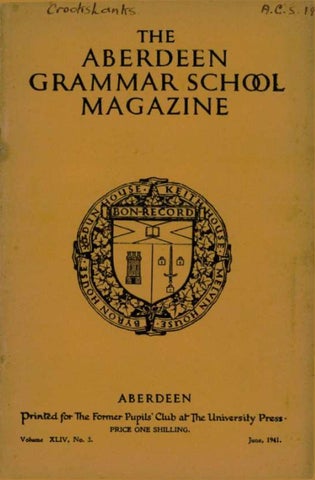
THE
ABERDEEN GRAMMAR SCHGDL MAGAZINE
ABERDEEN
priritZ4 for The Former Pupils' Club at- The University Press • PRICE ONE SHILLING.
Volume
XLIV, No.
3.
June, 1941.
EDUCATIONAL BOOKS JAMES G. BISSET CONTINUES to supply all the Class Books (New or Second-hand) suited for the requirements of the Higher Educational Institutions in the City, at the Lowest Prices.
-
N.B.—Best Value in Students' Note Books.
JAMES G. BISSET Classical, Medical, and Educational Bookseller,
85 BROAD STREET (Opposite Marischal College). •
PHONE 753 •
GOOD HEALTH demands GOOD BREAD
_- -• _
For the children especially is it necessary to ensure their stamina and energy with good, wholesome, nourishing bread. In Hutchison's bread you'll find all these requirements are fully met. Phone or give instructions to have it supplied daily. --
-
BRANCHES THROUGHOUT THE CITY
WATCHES FOR
ACTIVE SERVICE
STAINLESS STEEL CASES specially constructed for SEVERE
CONDITIONS a rid
Mechanism of exceptional accuracy
We
have a
and
very
durability
large Stock, and
each Watch has been carefully tested
A. & J. SMITH 191 UNION STREET
ABERDEEN
tittles Have just what you are looking for. Something to wear that is well cut, smart, and practical and not too expensive. •
7friz 4' • 1v
SUITS
M f:r
ir,
TRAVEL COATS
,
MODEL COATS
//A ///
/AAR,
,
.
FROCKS
1..„1/41 lir///
P
DRESSES
4 iVAII
GOWNS FUR COATS
Sizes to fit all figures from 36" hip to 56" hip.
A. C. LITTLE & SONS, LTD. 105 UNION STREET
•
ABERDEEN
TENNIS and GOLF GOODS STOCKS STILL AVAILABLE -AT
PRE-TAX
PRICE-
Campbell's Rubber Co., Ltd. 18 BRIDGE STREET
'Phone 157
le••TAG_2!
c•
•
/7-s[.•)i
r ,
r-COPLAND DECORATOR
jcletoionft.tiffice,e9feenclee/ir
XIM- SPECIALIST
--eiro
STAINED GLASS & MURAL DECO
ir •
.
czfrafrw,on,
A. D. COPLAND. Phone 896.
For Better Footwear
JAMES LORIMER & SON (BOOTMAKERS), LTD.
CIVIL and MILITARY BOOTMAKERS
8 CHAPEL ST.
ABERDEEN
(Late of 162 Union Street)
Estd. A.D. 1844.
'Phone 724.
!.4
Go to . • .
KENNAWAY'S of course
RESTAURANT
I73 UNION STREET
Here you get the finest of food, daintily served, and at a reasonable price. The Restaurant is comfortable and commodious, and is just the place to entertain your friends. Our rooms are available for all types of functions. 'Phone 2371, and ask the Manageress for quotations
WM. 1.‹.ENNAWAY LTD. Quality Bakers, Confectioners and Caterers, Aberdeen
Telephone No. 1891.
ARCHIBALD McKELLAR Family Grocer and Wine Merchant,
454-456 Union Street, Aberdeen. .
Cooked
.
We Specialise in
.
.
Gammons, Finest Belfast Smoked Hams, Wiltshire Bacon.
Medicinal Wines—Vibrona, Hall's, Wincarnis, Phosferine.
THE VALUE OF RECOMMENDATION " We have been recommended to you by Every day that phrase is being used by Customers on their first visit to our showrooms.
THE
REASON-
OUR STOCK is of good quality and our prices are reasonable. OUR SERVICE is of a personal nature and we study the requirements of every Customer.
SATISFACTION IS OUR AIM
ROBERTS (Abdn.) LTD. THE FURNISHING HOUSE OF ENTERPRISE
CABINETMAKERS AND UPHOLSTERERS
419 UNION STREET, ABERDEEN Established 1873
Telephone 2695
JAMES FYFE & SON PAINTERS AND GLAZIERS. .
.
•
OFFICE AND SHOWROOMS :-
11 DEE STREET, ABERDEEN. Telephone 304.
Telegrams—" Fyfe, Painters."
• It's an economy and a convenience to register with ALEXANDER . . . for your Butcher Meat, Bacon and Cooking Fats. You can then be certain of supplies of FISH and POULTRY—and you can place your order for all these food stuffs either in person or at the cost of only one 'phone call. The 'phone No. is 5172
A. & W. AILIEXANIDEU FISH, GAME AND MEAT MERCHANTS
492 UNION STREET
+
ABERDEEN
• DAIRY: ABERDEEN Tel. x2'5, 7013, 7014
FARM: CUTTER Tel.(
KENNERTY DAIRY
FARM •
WILLIAM REITH Sole Proprietor : JOHN REITH •
46 -48
ROSE STREET, ABERDEEN
CONTENTS ILLUSTRATIONS. Surgeon-Lieut. G. T. R. Watt ; Flying Officer..C. C. MacC. . . Facing page 19o . . . . . . Watt . 191 „ Leading Aircraftsman L. J. Blackball ; Lieut. R. P. Munro „ . . . . . 4 School Prefects—June 1941 . . . . . 5 School Cricket 1st XI—Season 1941 P*
PP
21
PI
SP
21
. . Page 173 . . . . A Message to Former Pupils . . . . . ,, 175 Byron and Greece. St. Clement Danes . . „ 176 . . . . . . Notes About Old Boys . „ 182 . . . . . • . . . Marriages . . . „ IN. . . . • . . . Obituary . 186 . . . . . . . . Pro Patria Mortui . . „ 191 . Roll of F.P. War Service—Fourth Instalment . „ 193 . A Discontented Prize-Winner. The Centenary Number . On India's Northernmost Point. By Captain R. D. MacRae, I.M.S. ,, 194 . 197 Trinidad—Miami. By A. G. Hutchison, B.Sc., Ph.D. . Reminiscences of 1887-189o. By Wm. G. Robertson, M.A., D.D. :: 204 . „ 209 The Folk of the Tibet-Assam Frontier. By A. W. Duncan SP
School Section— . . . School and Random Notes . . . . . Jungle (verse). By I. M. Twentieth Century Plato. By J. G. C. Brown . • • • • • Noon (verse). By J. B. Tait "Concrete" Facts: A Holiday Experience. By Peter • • • • . . . Harvey. . MacPhail Ian By (verse). Conquest " Next " My School Sport during the Summer Term. Cricket Results . . . . . . . . House Notes . . . . . . . . Scout Notes . The Dramatic Society. The Rambling and Mountaineering • . • . . . . . Club . . . . . Office-Bearers for Session 1940-1941 •
•
PS
•
•
PP
•
•
SP 1)
22I 222 223
•
•
•
The Former Pupils' Club— The F.P. Club Boarding House—List of Boarders • . . . . Cricket Section . . Rugby Section. List of New Members .
• • •
. . .
212 218 219 220
11
225 227
„
229
,s
2 30
„
232
r; ,,
234
2 33
WINDSOR WOOLIES for Kiddies
6 4
.4
c t>
Illustrated are two suits from a large range of styles
)
/
(; ,
ff. /
I
"FREDDIE" BUSTER SUIT Detachable Knickers to button on. Collar stitched flat, Zip fastener. Novel arrangement of stripes. Sizes 16, 18, 20. 22 in, length. Short or Long Sleeves, from 19 6
" BRIAN " BUSTER SUIT Detachable Knickers. A serviceable suit in fine Merino yarn, Stitched collar. Zip fastener. Sizes 16 to 22 in, length, Long or Short Sleeves, from - -
22 6
In our Boys' section you can always be sure of finding a good selection of woollens—
BRAEMAR JERSEYS from II 6
ESSLEMONT & MACINTOSH LIMITED UNION
STREET
ABERDEEN
INSIDE INFORMATION • A WAR CABINET IN EVERY AIR-RAID SHELTER
• A tin of our Ginger Snaps will make an excellent Prime Minister of biscuits. They will help you snap your fingers at the " Blitz."
.
•
•
W. M. MePHERSON BAKER and CONFECTIONER
15 FOUNTAINHALL ROAD ABERDEEN
Established 1843
STRACHAN
WM. CAY & SONS
COMMERCIAL
(FUNERAL DIRECTORS) LIMITED
&
415 UNION STREET and
PORTRAITURE
209 GEORGE STREET,
PHOTOGRAPHY
ABERDEEN
• Telephone 851
AU Funeral Requisites Supplied
•
Cremations Arranged
416 UNION STREET Telegrams— " Cay, Aberdeen." Telephone Nos. 92 and 54.
ABERDEEN
Telephone: 8811-2
Telegrams : 'Blake Builders'
JP AMt IES IU ILA IF IE IL1f ID,. Joiner* nisi 'Wilding Contractor*
23, 25, 29 SUMMER STREET, ABERDEEN All classes of Building Joinery Enquiries courteously solicited EST••LtERED
1 818 HIS MAJESTY THE KING. DATED 1ST JULY 1 94o
APPOINTED MEAT PURVEYORS AND POULTERERS TO
J. WILLIAMSON & SON (W. B. Wammtora. PROPRIETOR)
Meat Purveyors and Poulterers 1, 2, & 3 MARKET BUILDINGS, ABERDEEN 'PHONE 452 BRANCHES,
3S FOLINTAINHALL ROAD 'PHONE 1724
ALSO AT
CHURCH SQUARE. BALLATER.
THE SQUARE. CULTS 'PHONE. CULTS 2 'PHONE 38
YES, I STILL HAVE THEM
DRAWING
-~~--
INSTRUMENTS
Typewriters, large and small. Desks. Chairs, and other items of Office Furniture. It's not so easy to give bargains nowadays, but whiles it's wonderful what one can do.
PAPER COLOURS
Even with Purchase Tax added, the famous Imperial Portable Typewriter only costs £14 Its. 0d.
&
52'- of that is a Hit at Hitler. One gets a little bit of a kick out of that.
BRUSHES
You can get literary, scientific, medical, mathematical, or Continental keyboards.
at --door
Octylots
EASY DEFERRED PAYMENTS ON ANYTHING
9
'Phone 505 or come along and see me:
C. H. WEBSTER
49-51 Saw()that
489 Union Street, Aberdeen
'Phone 2870
Engagement Rings ENGAGEMENT RINGS are our speciality.
Our large selection
will make your choice an easy one
Prices to suit all
£5 to
£150 Telephone :
1219
Modern atchmakers,
14 2
Jeweller,
UNION
and
Silversmiths
STREET
- Next Union Bride •
Designs
Perseverance PERSEVERANCE is the determination to carry on in the face of difficulties and discouragements and to overcome them in the end. At the present time we are faced with great difficulties and many discouragements, but we are determined to carry on and give our customers—as far as in us lies—the same service which has been a feature of our business for nearly a hundred years.
J. & A. OGILVIE 369 UNION STREET ABERDEEN Telegrams : " Interiors "
Telephone No. 433
Your Happiest Hours are spent at your own fireside, and the choice of your Fireplace deserves the utmost consideration. From the range of Modern and Period Fireplace Arrangements we are showing, you will find it easy to to select exactly the style you desire.
James Scott & Son (Aberdeen) Ltd. 483-485 UNION STREET ABERDEEN Phone 1881-2
`BUSINESS IS SERVICE" That's the guiding principle of Collie's of Aberdeen. To bring together the finest possible selection of quality goods, display them conveniently, and offer them at reasonable prices, combined with unobtrusively courteous service—these are the things that make shopping at Collie's of Aberdeen so pleasant and satisfactory. In peace or war, this famous shopping centre will hold fast to the sentimental maxim that "Business is Service."
Geea, 4,6ce FAMILY GROCERS AND WINE MERCHANTS
269-271 UNION
STREET
+
ABERDEEN
Telephones: CENTRAL 4800 (4 lines) Branch Shops at CULTS, BALLATER, and BRAEMAR Telephones : Cults 28; Ballater 14; Braemar 212
•
Established 1836
Assets £26,895,400
Northern Assurance Company Limited •
•
FOR ALL CLASSES OF INSURANCE •
•
LIFE ASSURANCE BRANCH The Company's tables of rates for Life Assurance include every class of Policy •
SPECIAL LEAFLETS ON-
The " Optional" Policy The Educational Endowment Policy Child's Deferred Assurance Policy Death Duties Policy Life Annuities
CHIEF OFFICES:
ABERDEEN . LONDON .
•
1 UNION TERRACE i MOORGATE, E.C. 2
Branches and Agencies throughout the World
Aberdeen Grammar School Magazine 57th year: No. 148
Vol. XLIV
-
(New Series, 48th year, No. '39) JUNE 1941
No. 3
The " Grammar School Magazine" is issued under the auspices of The Former Pupils' Club, in March, June, and November. All communications with regard to the " Magazine" should be addressed to the Editor (the Secretary and Treasurer of the Club), THEODORE WATT, M.A., LL.D., The University Press, 6 Upper Kirkgate, Aberdeen.
A Message to Former Pupils. The second year of war finds the Grammar School still standing but by no means standing still. This is said in no spirit of complacency. Our turn may come. If it does, it will not find us unprepared nor lacking the resources which an emergency demands. What is surprising about the session which has now only a few weeks to run is the extent to which life has continued on almost normal lines. The variations from the normal are what one would expect. There were days when the " banshee " kept us in the trenches —less waterproof during the winter than they are now— for quite considerable spells. Then there was the problem— now solved—whether School should meet at the usual hour after the sounding of an alert during the preceding night. Calls for assistance in a variety of war activities seemed to multiply with each succeeding week. Fire-watching, food-growing, war savings, canteen work, ambulance-training and, by way of holiday respite, farming and forestry do not leave either teachers or taught much time to call their own. For those members of the Staff who hold responsible posts in A.R.P. and who are liable for service in Rest Centres, the strain has been considerable and is likely to continue for the greater part of the Summer vacation. The response made by the senior boys to the call for fire-watchers was excellent. I sincerely trust •that their quality as bomb-extinguishers will never be put to the test. The School garden has become almost wholly a vegetable plot. Here Mr. Collie is in charge of a workmanlike set of younger boys, whose efforts should meet with ample reward in the Autumn.
1 74
Aberdeen Grammar School Magazine
The School's contribution to Aberdeen's War Weapons Week was L681. The "sister school" challenged us to a contest but, as the result was not officially divulged, it can only be stated that it was a very near thing either way. Perhaps the most interesting event of the term was the formation of a Grammar School Squadron of the A.T.C. Training commenced some weeks ago and the Cadets are shaping well. Mr. Lynch, Head of the Science Department, is in command, and is assisted by Mr. Christie as Adjutant and by Messrs. P. Murray Stewart and J. D. Stewart as Junior Officers. Prior to the formation of the Squadron, we had interesting and helpful addresses from Wing Commanders Spence and Fletcher. The latter—specially detailed for this duty by the Air Ministry —gave, in addition to his talk, a series of individual interviews to the older boys and recorded his own impressions of their suitability for commissioned rank. Games have continued within the limitations set by the war. In cricket as in rugby, the ban on travelling has confined us almost entirely to local fixtures. Moreover, Rubislaw Field with its network of trenches is more reminiscent of a wellguarded golf green than a cricket ground. Lastly, it would be a poor compliment to the eight Masters who are presently in the Services to suggest that we do not miss their help. The boys have accepted the situation in the right spirit and have stood loyally by Mr. Edwards, who has taken Mr. Macgregor's place. It was decided in the interests of safety to spread the Annual Sports over three days. The whole of the drawings, less expenses, will be handed over to the Red Cross. I write in advance of the Sports, so that I cannot give details. One fact I record with satisfaction : the absence of prizes has not affected the entries for the various events. F.P.s will note with regret the retirement under the age limit of Frank Findlay, who has been Groundsman at Rubislaw Field for many years. Retirement in his case means simply a transfer of his activities to a similar post elsewhere. The Library grows apace. Substantial additions have been made to it during the past six months, notably in the departments of Mathematics and Science, in both of which we are now handsomely equipped. Miss Neil, sister of the late Dr. R. A. Neil, a distinguished Classical scholar, has presented a selection of her brother's books. We have also to thank the trustees of the late Dr. Cromar Watt for some valuable art objects, which will find a place in the School Museum. I conclude this necessarily brief outline of our doings with an assurance of our deep interest in your welfare, whatever the part you may be playing in the national effort.
Aberdeen Grammar School Magazine
175
To the parents and relatives of those who have fallen in action we offer our respectful sympathy. Yet pride is the dominant feeling rather than grief. Youth, promise, high. endeavour in a worthy cause—are there any lovelier things round which memory could be entwined ? D. M. A. 9th June 1941.
Byron and Greece. On 14th April The Times correspondent at Athens reported that a requiem was held at Missolonghi the previous day for the fallen in the historic sortie of the Greeks against the Turks during the War of Independence of 1821-29, and wreaths were placed on the monuments in Heroon. A requiem was also held at the house in which Byron died at Missolonghi, on the occasion of the 117th anniversary of his death. About the same time Dr. Shane Leslie, the well-known author and journalist, wrote to The Times—" May I suggest that we honour the Prime Minister's appeal to Byron's memory by placing his long-excluded memorial in Westminster Abbey and the editor added the note—" The ' long-excluded memorial ' is apparently Thorwaldsen's statue of Byron in the Library of Trinity College, Cambridge, which was originally intended for Westminster Abbey but was twice refused by the Abbey authorities." •
St. Clement Danes. The recent destruction by enemy action of St. Clement Danes Church in the Strand, London, recalls the fact that it was an F.P., James Gibbs, the famous architect, who built its steeple. The present church was completed in 1684 from designs by Wren, the tower of the old church being re-cased and altered by him. Evidence of the old work is seen in the Gothic treatment of the windows. Wren left the tower at about the level of the clock ; from this point Gibbs heightened the tower and added the steeple in 1721-24. The church is now merely a battered shell of walls, but its spire still rises to the sky above the Strand. The famous old bells that figure in the nursery rhyme—" Oranges and lemons, say the bells of St. Clement's "—were housed in the tower, but were badly damaged and taken down early this year. James Gibbs was the architect of the other island church close to St. Clement Danes—St. Mary-le-Strand. The foundation stone of this was laid in 1714 and the building consecrated in 1723. The tower has a very imposing appearance when viewed either from the west or from the east.
176
Aberdeen Grammar School Magazine
** • The Editor is glad at all times to receive from any quarter items of information for this section of the " Magazine."
The dates given in parentheses after names indicate the sessions of attendance at the School.
Honours and Awards. This year's King's Birthday Honours List added two more names to the already lengthy roll of F.P.s whose distinguished service to the Indian Empire has been officially recognized and rewarded. Sir Andrew Gourlay Clow (1896-98), C.S.I., C.I.E., M.A. (Cantab.), has been created a Knight Commander of the Order of the Star of India (K.C.S.I.). He was a Wrangler in Part II of the Mathematical Tripos at Cambridge in 1912, and passed into the Indian Civil Service in the following year. In 1920 he became Controller of the Indian Government-Labour Bureau at Delhi, and later was appointed Joint Secretary in the Department of Industries and Labour (now Commerce and Labour). In 1936 he was promoted to be Secretary to the Government of India, and two years later was made a member of the GovernorGeneral's Executive Council. He was created C.I.E. in 1928, C.S.I. in 1935, and a Knight Bachelor in 1939. Arthur Cunningham Lothian* . (1892-94 and St g-1904), C.S.I., C.I.E., M.A., B.Sc., has been created a Knight Commander of the Order of the Indian Empire (K.C.I.E.). He entered the Indian Civil Service in 1910, and after serving as an Assistant Magistrate in Bengal, was transferred to the Political Department of the Government of India in 1911. Thereafter he served in Central India, Kashmir, Hyderabad, Mysore, Orissa and Central Provinces States, Baroda, Rajputana, and in the Secretariat of the Government of India. He was Additional Secretary (Federation) in 1935-37, and Special Representative of the Viceroy in federal discussions with the Indian States. He is now Resident for Rajputana and Chief Commissioner, Ajmer-Merwara. He was made C.I.E. in 19;4 and C.S.I. in 1 937. * Member of the Former Pupils' Club.
Aberdeen Grammar Scbool Magazine
177
James Melvin * (1904-1o), M.C., M.B., Ch.B., Lieut.Colonel, R.A.M.C., was made an Officer of the Order of the British Empire (Military Division) in the list of awards for operations in the Middle East, issued about the end of March. He was for a time in medical practice in Rochdale and thereafter in Streatham, London. He was a Captain in the R.A.M.C. in the last war, serving in India and Mesopotamia, and being awarded the Military Cross in 1917. Cecil Arthur Grant Savidge* (1913-24), M.A., Indian Political Service, Assistant Political Agent and Assistant Commissioner in Quetta Pishin, and lately Under-Secretary to the Government of India in the External Affairs Department, was made a Member of the Order of the British Empire (Civil Division) in the list of honours conferred by the King at the New Year. He entered the Indian Civil Service in 1928, and joined the Foreign and Political Department of the Government of India in 1933. F.P. NAVAL SURGEONS AT CAPE MATAPAN. At least four F.P.s in the Medical Service of the Navy were serving in the Battle Squadron which routed the Italians in the Battle of Cape Matapan. They are : Clarence Edward Greeson (1902-05), M.D., SurgeonCaptain, R.N., Fleet Medical Officer, H.M.S. Warspite. He was formerly Principal Medical Officer at H.M. Naval Base, Singapore. Ernest Robert Sorley* (5906-18), M.D., Surgeon-Commander, R.N., Squadron Medical Officer, First Battle Squadron, H.M.S. Barham. He succeeded Surgeon-Captain Greeson as Principal Medical Officer at Singapore. Ronald Grant Dingwall* (1912-21), M.B., Surgeon-Lieutenant-Commander, R.N., Principal Medical Officer, H.M.S. Gloucester, which has since been lost in the operations off Crete. Leslie George Boyd* (5958-29), M.B., Surgeon-Lieutenant, R.N.V.R., H.M.S. Valiant. Andrew Aitken* (1915-18), A .M.Inst.C.E., Major, Royal Engineers, is at present serving on specialized work as Deputy Commander, Royal Engineers, in charge of the construction and maintenance of the anti-aircraft defences of the SouthEastern Area of Scotland. He served his apprenticeship as a civil engineer in the Harbour Office, Aberdeen, and was for a period resident engineer at the Harbour Improvement Works, Peterhead. James Robb Allan* (187o-71), who was for many years minister of Stoneywood, Aberdeen, and latterly of Glengairn,
178
Aberdeen Grammar School Magazine
Ballater, retired some time ago and is now living at Kemnay. He is in his 88th year, and is one of the oldest members of the F.P. Club. The Right Hon. Lord Alness* (1884-85), P.C., LL.D., was acting as Lord-in-Waiting to the King at Buckingham Palace during the month of May. He has since resumed his work as Chairman of the Scottish Savings Committee. James Harrison Ball* (1909-17) has been for some years Senior Architectural Assistant to the County of Essex, at Chelmsford. He is in the Army Officers Emergency Reserve for the Royal Engineers. It may be recalled that the present cover of the Magazine was designed by him. Percy R. J. M. Callan* (1915-x5) was in April licensed by the Aberdeen Presbytery as a minister of the Church of Scotland. Ian Harvey Cassie* (1925-35) in March gained the degree of L.D.S., R.C.S. (Edin.). He is now attached to the R.A.F. Alexander Stewart Catto* (19oo-o3) and Alfred J. M. Edwards* (1908-2O, M.A., B.Com., were in April appointed Captain and Vice-Captain respectively of the Aberdeenshire Cricket Club. Bramwell W. H. Cook* (1936-39), who is in the service of the Petroleum Board, was in June of last year transferred from Aberdeen to London, where he was appointed Customs representative on behalf of the Board at Fulham. He is also at present organist and choirmaster of St. Anne's Parish Church, Brondes bury, N.W. James S. Rowland Cruickshank* (i 914-2 t), B.A., LL.B., W.S., advocate in Aberdeen, who early in the war was appointed an Assistant Administrative Officer in the Chemical Inspection Department of the Ministry of Supply, has recently been promoted to be Administrative Officer in Charge in the same Department. Charles James Davidson (1886-91), M.A., B.L., advocate in Aberdeen, whose death on 7th February 1941 was recorded in the last issue of the Magazine, left net heritable and moveable estate amounting to k31,6oo. By his will he bequeathed the residue of his estate to the University Court of the University of Aberdeen " for such purposes in relation to the University as the Court may in its unchallengeable discretion think to be in the best interest of the University at the time," and stated that it would be consonant with his desire that the sum should be applied in some way towards the furtherance of the branches of study " in which I have myself been specially interested, Latin and Greek Language and Literature, Law, and Medicine." His sisters have gifted to the University about 65o of his books. Vaughan Nicol Dean* (1913-zo), C.A., is now Film Production Specialist in the Ministry of Information, supervising
' Aberdeen Grammar School Magazine
1 79
the production of propaganda films. He has been associated with the film industry for over a dozen years. Eric Henry Randal Dickson* (1936-39) has been a radio officer in the Merchant Service since May 1940, and recently has been promoted to be znd Radio Officer. He had his first " baptism of fire." early in February of this year, when his ship was machine-gunned, bombed, and sunk by two German bombers z50 miles out from Cape St. Vincent. The survivors were picked up and reached home after some little hardship due to shortage. of food and water on the rescue ship. In March he was posted to a motor vessel which was attacked off Northern Ireland but, in spite of being machine-gunned and bombed, was able fortunately to stagger to port with only one casualty. Frank Northman Forster* (1921-z 1), who was for a considerable time in the service of the Sun Life Assurance Society, is now studying medicine at Aberdeen University and was recently elected President of the Students' Union for 1941-42. He succeeded in this post another F.P., Alexander Fraser Ross* (1913-27), B.Sc.(For.), who is also studying medicine, after having been for a time in the Colonial Forest Service. Archer Irvine-Fortescue* (1892-97), D.S.O., M.B., Ch.B., Colonel, R.A.M.C.—the President of the F.P. Club—was in April awarded a Polish military distinction symbolized by the illuminated diploma and cross of the Odznaka Sluzby Zdrovia —"the Badge of the Medical Service." The award is in recognition of his valuable service in helping to organize the Polish Medical Service in this country. The Polish DirectorGeneral; when making the presentation at a dinner in Colonel Irvine-Fortescue's honour, assured him of the high esteem in which he was held by the whole Polish Medical Service in Britain. " If our service is the first to be almost completely organized and equipped, it is due to him," he said. " After having landed last July in this foreign and unknown, yet so hospitable country, at the moment when every one of us felt deeply in his heart our national and military tragedy, we were lucky in that the British authorities assigned Colonel IrvineFortescue to help us. In him we have found a real friend. To-day I am conferring on him this honourable symbolic sign of our Medical Service as a proof of our gratitude, and in token of friendship that unites us for one aim—victory." who is (1904-10), McKerron* Patrick Alexander Bruce in the Malayan Civil Service, is at present Chief Censor, Malaya, and is a Sergeant in the Local Defence Corps. In the last war he was a Captain, 4th Gordon Highlanders, in France, and from 1917 served in India as Captain, zoth Punjabis, Indian Army. He passed into the Colonial Civil Service in December 1919.
18o
Aberdeen Grammar School Magazine
Charles Stewart McLeod* (1908-20), M.A. (Aberd.), B.A. (Cantab.)—son of Dr. CHARLES MCLEOD,* formerly of the School staff—has been appointed Assistant Goods Manager (Scotland Area), London and North-Eastern Railway Company. He entered the service of the L.N.E.R. in 1927 as a traffic apprentice, later being attached to the staff of the Chief General Manager at King's Cross. In 1935 he was appointed chief assistant to the District Goods and Passenger Manager, Dundee, and was transferred to Glasgow in 1938. William George MacMillan* (1916-az), B.Sc., Ph.D., chief chemist to the Indian Jute Mills Association, Calcutta, reports that the F.P.s in Bengal " have- got together really splendidly, and are a cheery crowd." Most, if not all of them, are in some war unit or another. In view of the enforced reductions in European staffs, due to the calls made for service commissions, those remaining have in most cases to do the work of two or more. This, coupled with parades and training, which take place in the early mornings, evenings, and at week-ends, makes a very long and full day. Compared with the folk at home, they consider that they are indeed fortunate, but often wish they were back, taking a more active part in what is going on. Johnstone Murray* (1879-85), Rector of Tacolncston, Norwich, was specially interested in the Centenary Number of the Magazine and in Mr. Howard A. Gray's reference to him. The two of them were responsible for the first printed number of the Magazine, away back in 1884-85, and in the course of a hunt for a copy of it through the masses of paper in his study, he came across the programme of a Musical Evening, under the auspices of the School Literary Club and Debating Society, on Friday, 24th April 1885, " open to all pupils of the School, but only pupils." The programme (which he has forwarded) makes most interesting reading. It opened with a piano solo, " Le Tourbillon," by William Rose Black, and the other pianists were James Barron (" Phospho "), George A. F. Knight (" March" in "Fidelio "), and James M. Tomory (" The Opera Box "), while Black and Murray played as a duet Mendelssohn's "Wedding March." The vocalists were Roderick M. Maclennan (" Cabar Feidh "), James Barron (" Sentry's Song " from " Iolanthe "), and Barnett Harvey (" The Warrior Bold "). A " Scotch Reading" was given by Alexander M. Younie, whose death, as well as that of Roderick M. Maclennan, is recorded in this issue. Two members of the staff, Mr. Maxwell H. Mackie and Herr Gustav Hein, also gave readings, while another master, Mr. A. V. Lothian, sang " The Romany Lass." The programme ended with the chorus " Gaudeamus," sung by " The Company."• Altogether, a memorable evening! Thomas James Trail Nicol* (1930-35), M.A., was in April
Aberdeen Grammar School Magatine
182
licensed by the Aberdeen Presbytery as a minister of the Church of Scotland. He has been serving as a Private in The Black Watch. Donald Ellson Philip* (2924-32) is at present employed as an armament fitter at Rugby. John R. K. Pirie* (1915-26), B.Sc., B.L., solicitor, Aberdeen, is now Assistant Divisional Food Officer attached to the Aberdeen office, but covering territory from Dundee to Shetland in the organizing of Food Education for the Ministry of Food. David J. G. Shennan* (1922-26), B.Sc.(Eng.), has been for the past five years in the service of Messrs. E. Nuttall Sons and Co. (London), Ltd. For eighteen months he was in Trinidad constructing a pipe-line viaduct for Trinidad Leaseholds Ltd., and returned to this country shortly after the outbreak of war. He has since been engaged on various engineering works connected with war preparations and defence, and is at present chief engineer on the construction of an ordnance factory. William Douglas Simpson* (1901-13), M.A., D.Litt., Librarian, Aberdeen University, this year holds the Rhind Lectureship in Archaeology, under the auspices of the Society of Antiquaries of Scotland, and in April he delivered in Edinburgh, to crowded audiences, a course of six lectures, his subject being " The Province of Mar." Many are looking forward eagerly to the publication of the lectures. James Buchan Fraser Smith* (1928-37), who is a Midshipman in the Royal Naval Reserve, was recently mentioned in dispatches. Sydney Robertson Smith* (2924-30), B.Sc., A.M.Inst.C.E., is at present Assistant Civil Engineer at a Fighter Command, under the Air Ministry. When the war broke out he was Senior Engineering Assistant to the Burgh of Motherwell and Wishaw. James Souter Stephen* (1919-29), M.A., Ph.D., was in April licensed by the Aberdeen Presbytery as a minister of the Church of Scotland. James Stewart Tawse* (2913-26), C.A., in August 2940 resigned an appointment in the War Office to become Chief Accountant to Messrs. D. Napier & Son, Ltd., at Liverpool. Edward William Watt* (1883-94), M.A., LL.D., ex-Lord Provost of Aberdeen, was in April appointed unpaid Commissioner to the General Board of Control for Scotland. This is under the administration of the Department of Health for Scotland, and has general supervision over mental homes and institutions in Scotland. In April Dr. Watt concluded his year as President of the Congregational Union of Scotland, delivering an address at the Annual Assembly in Glasgow.
182
Aberdeen Grammar School Magazine
William Donald Wilson* (1914-25), M.B., Ch.B., D.P.H., who was Senior Resident Medical Officer at Woodend and Oldmill Hospitals, Aberdeen, has recently been appointed Assistant Medical Officer of Health for the County of Inverness. James Fenton Wyness (1915-20), A .R.I.B. A ., contributed to the April issue of the Friends' ,Quarterly Examiner an article entitled " A Scottish Quaker of the Seventeenth Century." In this he sketched the career of Alexander Jaffray, third of Kingswells, who was born in 1614, attended the Aberdeen Grammar School and University, was twice Provost of Aberdeen, was also a member of the Scottish Parliament, and was one of the Commissioners sent to The Hague to treat with King Charles II. He died on 7th July 1673 and was buried in the Quakers' graveyard at Kingswells. AN F.P. "CENTRE" IN ENGLAND.
At an anti-aircraft O.C.T.U. in England there were fortuitously brought together at the beginning of May no fewer than seven F.P.s—sufficient, it was suggested, to start a Club Centre. Captain WILLIAM DALTON IRONSIDE* (1914-24), R.A., was an Officer Instructor, and six cadets at different stages of training were ALEXANDER CAMPBELL BRANDS* (1925-27), M.A.,
LL.B. ; DAVID M. C. DONALD* (1926-32), B.L. ; WILLIAM GEORGE FRASER* (1927-33); WILLIAM J. ADAIR NELSON* (19 5 42 4), C. A. ; A. HARRY K. SLATER* (1922-35), M.A.; and FRANK SALMOND TAYLOR* (1923-28). Brands, Fraser, and Taylor
actually occupied the same barrack-room.
ABERDEEN UNIVERSITY DEGREES.
At the Spring Graduation Ceremony at Aberdeen University on 3rd April 5945 degrees were conferred on the following :— Master of Arts (M.A.) :— Charles Alexander Clark* (1932-37)—with Second Class Honours in Economic Science. Bachelor of Law (B.L.) :— Leslie Thompson Carnegie* (592 5-38).
Marriages. Dawson (192I-34).—At Derby, on z4th April, 5945, JAMES GORDON DAWSON,* B.Sc.(Eng.), elder son of Colonel James Dawson* and Mrs. Dawson, 5o Forest Road, Aberdeen, to Doris Irene Rowe, younger daughter of Mr. and Mrs. C. W. Rowe, 52 Melbourne Street, Derby. Dunningham (1912-23).—At the Mitchell Chapel, St. Machar's Cathedral, Aberdeen, on 8th April, 5945, Lieut. DOUGLAS DUNNINGHAM, R.N.R., younger son of the late Mr. Douglas Alex. Dunningham (1886-9o) and Mrs. Dunningham, 43 Albury Place, Aberdeen, to Gladys Kemp, only daughter of Mr. and Mrs. George Forbes, 488 Great Northern Road, Aberdeen.
Aberdeen Grammar School Magazine
183
Duthie (1923-35).—At the Presbyterian Church of England, Gosforth, on 5th June, 1941, ROBERT PATRICK DUTHIE,* only son of Mr. and Mrs. Robert Duthie, to Belgrave Terrace, Aberdeen, to Joan, younger daughter of Mr. and Mrs. William Ebdon, 34 Clayworth Road, Brunton Park, Gosforth, Newcastle-on-Tyne. Hunter (1919-27).—At St. Augustine's Church, Dumbarton, on 5th April, 1941, DAVID HUNTER, youngest son of Mr. and Mrs. Robert Hunter, Rivermead, Bieldside, to Joan Doreen, daughter of Mr. and Mrs. R. Eastes, Dumbarton. Leys (1915-25).—At the Cowan Chapel, West Church of St. Nicholas, Aberdeen, on x zth April, 1941, CHARLES A. LETS, son of the late Mr. C. Leys and Mrs. Lcys, 29 Harcourt Road, Aberdeen, to Jessie (Dolly) Robertson, youngest daughter of Mr. and Mrs. John Robertson, 18 Whitehall Place, Aberdeen. Lillie (r924-33).—At St. Peter's Church, Little Aston, near Birmingham, on 1st May, 1941, HUBERT J. LILLIE, M.B., Ch.B., R.A.F.V.R., younger son of Mrs. and the late Mr. James Lillie, of Aberdeen, to Ruth, younger daughter of Mr. and Mrs. L. A. Catlin, of Little Aston Park, Streetly. MacLachlan (i922-32).—At King's College Chapel, Aberdeen, on 7th June, 1941, JOHN SCOTT MACLACHLAN,* M.A., LL.B., Lieut., R.E., son of Mr. and Mrs. John MacLachlan, 15 Rubislaw Park Crescent, Aberdeen, to Ena, daughter of George Duguid, Procurator Fiscal, and Mrs. Duguid, 7 Ardross Terrace, Inverness. Manley (1926-31).—At King's College Chapel, Aberdeen, on 12th April, 1941, 2nd Lieut. JOHN SIMPSON MANLEY,* R.A., son of Mr. and Mrs. William Manley, 38 Harlaw Road, Aberdeen, to Isabella Lamont Anderson, M.A., daughter of Mr. and Mrs. Thomas Anderson, West Schoolhouse, Maryculter. Meff(192 4-33).—At The Manse, 406 Great Western Road, Aberdeen, on 3rd June, 1941, ROBERT HENDERSON MEET,* elder son of the late Mr. and Mrs Meff, it Forest Avenue, to Isabel, younger daughter of the late Mr. George Amott, Huntly, and of Mrs. Arnott, 3S4 Great Western Road, Aberdeen. Milne (192o-29).—At 30 Brisbane Street, Greenock, on and April, 1941, JAMES STRACHAN MII.NE, eldest son of Mr. George Milne, Manila, and Mrs. Milne, Aberdeen, to Jessie, eldest daughter of Mr. and Mrs. George Hastie, 3o Brisbane Street, Greenock. Reid (1925-31).—At St. John's Church, Montrose, on 12th April, 1941, WILLIAM FERRIS REID,* B.Sc.(Agr.), son of William J. Reid, Fordhouse of Dun, Montrose, to Eleanor Amy, second daughter of Mr. and Mrs. D. M. Macintyrc, S4 Bridge Street, Montrose. Rogerson (r917-20.—At Lahorc Cathedral, Lahore, India, on 15th April, 1941, GEORGE ALEXANDER ROGERSON, Lieutenant, R.A., eldest son of Mr. and Mrs. George Rogerson, " Ormiston," St. Machar Place, Aberdeen, to Elizabeth, elder daughter of Mr. and the late Mrs. Rodwell, Tring, Herts. Russell (19z3-35).—At Gilcomston South Church, Aberdeen, on 3rd June, 1941, Flight-Lieut. RAMSAY ROGER RUSSELL,* R.A.F., fourth son of Mr. and Mrs. S. B. Russell, West Park, Cults, to Kathleen Mary, only daughter of Mr. and Mrs. James Peters, 132 King's Gate, Aberdeen. Sherman (1922-26).—On 3rd May, 1941, DAVID JOHN GEORGE SHENNAN,* B.Sc.(Eng.), to Jean Mackillie, 121 Pepys Road, Wimbledon, London, S.W.
184
Aberdeen Grammar School Magazine
OBITUARY. Robert Bruce (1881-8z), son of the late Mr. George Bruce, Heatherwick, Keith-Hall, died at Inverurie on 27th April 1941, aged 74 years. He was the last of four generations of his family who had farmed Heatherwick for over 140 years. He owned one of the oldest Shorthorn herds in Scotland, and had a lifelong record of public service in Aberdeenshire. He retired three years ago. Edward Gordon (1907-08), M.C., M.A., M.B., Ch.B., son of the late Mr. Edward Gordon, fishcurer, Fraserburgh, died at Kempston, near Bedford, on ;rd February 1941, aged 5o years. He graduated in Arts at Aberdeen University in 1911 and in Medicine in 1914. During the last war he held a commission in the R.A.M.C., and was awarded the M.C. in 19'7. After the war Dr. Gordon served under the L.C.C., and was on the medical staff of the North-Eastern Hospital, South Tottenham. A few years ago he took over a practice at Kempston. John Hadden (1874-77), eldest son of the late Mr. James Hadden, master baker, Aberdeen, died in a hospital at Merest, Natal, on 11th January 1941, aged 78 years. After leaving the School he was a clerk for a few years in the Inland Revenue, but on account of ill-health went to South Africa and became tutor to a Boer farmer in the Orange Free State. When the South African War broke out in 1899, he enlisted and joined Kitchener's Fighting Scouts. Later he became a cashier in Durban. James Thom Jeffrey* (1868-73), advocate, died in Aberdeen on 3rd April 1941, in his 84th year. A son of the late Mr. William Jeffrey, baker, he passed from the School, where he was a classfellow and intimate friend of the late Mr. William Keith Leask, to the University. There he spent four years but did not graduate. He was apprenticed to Mr. David Stewart, advocate, and served with Messrs. Stewart and Murray from 1879 to 1886, when he started in business on his own account as a law agent in Aberdeen ; eleven years later he became a member of the Society of Advocates in Aberdeen. He carried on business to within a few weeks of his death, in spite of the fact that he suffered from impaired eyesight all his life, and some time ago became blind. Robert Whyte Mackay* (1882-90), O.B.E., died in Aberdeen on amid May 1941, aged 67. He had been a semiinvalid for many years, never having fully recovered from a wound received in the last war. He was the eldest son of the late ROBERT WHYTE MACKAY (1857-58), and passed from the Grammar School to Blair Lodge School, Polmont, where he played in the cricket and rugby teams. Thereafter he took a
Aberdeen Grammar School Magazine
185
technical course in the I-Ieriot-Watt College, Edinburgh, and gained some experience in the woollen industry by serving in a large warehouse in Glasgow. He next acquired practical knowledge of cloth-making by working in woollen mills in Hawick. While in Glasgow he played rugby with the Clydesdale Club and in Hawick with the local team. Returning to Aberdeen, he joined his father's firm of Messrs. Anderson and Thomson, wholesale cloth merchants, and later became a partner. Although over age when the Great War broke out, he rejoined the Territorial Force as a and Lieutenant in the 7th Battalion Gordon Highlanders, and served in France with the 5 list Division from April 1915 to April 1918, when he was wounded. Later he was Commandant of various camps until he was demobilized in February 1919. He was promoted to be Captain in June 1916, was mentioned in Field-Marshal Sir Douglas Haig's dispatch of April 1919, and appointed O.B.E. (Military). Three of Mr. Mackay's four sons received part of their education at the Grammar School—ROBERT DOUGLAS WHYTE MACKAY (1913-14) was formerly an officer in the P. & 0. Company and is now in the R.A.F. Coastal Command ; BRIAN WALTER WHYTE MAC KAY* (1913-14 and 1922-2 3} and GEORGE NEIL WHYTE MACKAY* (1922-25) went to South Africa and after some years' experience of a fruit farm not very far from the town of Aberdeen in Cape Province, removed to Port Elizabeth. The elder entered a commercial business and is now in the South African Air Force ; the younger went to Cape Town, and is also on active service. Roderick Murdoch Maclennan (1883-85), M.A., M.B., C.M., died recently at Johannesburg, South Africa, aged 73 years. After graduating at Aberdeen University in Arts in 1888 and in Medicine in 1891, he practised his profession for many years in Scotland, mainly in Glasgow, and went to South Africa after the last war. William Andrew McQueen (1897-1900), B.Sc., died at Cochabamba, Bolivia, in January 1941, after a short illness, aged 56 years. The youngest son of the late Rev. Andrew McQueen, Aberdeen, he served as an apprentice engineer with Messrs. Clyne, Mitchell, and then studied at Birmingham University, where he took the degree of B.Sc. in mining in 1908. Thereafter he was for two years in Rhodesia, and then entered the service of the Arizona Copper Company. In 1917 he joined the United States Army as a Private in the 27th Engineers, and while serving in France, rose to the rank of Sergeant, 1st Class. He was demobilized in New York in 1919, and then engaged in engineering in Mexico and Chile. About seven years ago he went to Bolivia, where at the time of his death he was Mine Superintendent at the Patino Tin Mines, Llallagua.
186
Aberdeen Grammar School Mage#ne
James Westland Rose (1881-86), who was minister of the Presbyterian Church at St. Peter's Port, Guernsey, is reported to have died there in September 1940. He was a son of the late Mr. James Rose, of the firm of Messrs. Donaldson Rose and Co., shipowners, Aberdeen, and after studying in Arts at King's College, Old Aberdeen, for two years, and being in Australia for a year, was in his father's firm from 1889 to 1897. He then entered the ministry and was ordained in the Presbyterian Church of England in 1904. He held a number of pastor.. ates in England and in Scotland, and had been in Guernsey for about eight years. Francis John Ross (1882-88), second son of the late Mr. James Ross, of Messrs. Ross and Ledingham, drapers, Aberdeen, died at Calcutta on 3oth April 1941, aged 65 years. He was trained as an engineer and went out to a tea estate in Ceylon about forty years ago. For the past thirty-five years he had been resident in Calcutta. Alexander McDonald Younie (188 x -86), M.A., died at Longside, Aberdeenshire, on 19th April 1941, aged 74 years. After graduating in Arts at Aberdeen University in 1890, he became an assistant master in Nicolson Institute, Stornoway, in 1891. Five years later he was appointed Head Master of Kinmundy Public School, Longside, and in 1907, Head Master of Longside Public School, from which he retired in 1928. He was for long an officer in the Volunteers, and throughout the last war served with the 5th Battalion Gordon Highlanders, rising from and Lieutenant to Captain.
Pro Patria Mortui. "I have only done my duty as a man is bound to do."
James Shearer Wood Ballantyne* (1927-38), Aircraftsman (2nd Class), R.A.F., was killed by enemy action in Hull on 8th May 1941, aged 19 years. He was a son of Mr. John Ballantyne, 67 Stanley Street, Aberdeen, and on leaving the School, after gaining the Leaving Certificate, became an apprentice with the Caledonian Insurance Co. In March of this year he joined the R.A.F. as an Aircraftsman, and was being trained as a radio wireless operator. At the School he was a member of the 1st Troop of Boy Scouts and rose to be Assistant Scoutmaster. Leonard John Blackhall* (1929-39), Leading Aircraftsman, R.A.F., was recently reported as missing on patrol and later as killed. Born in Malaya in 1921, the son of Mr. L. A. Blackhall, Hendra Estate, Sungkai, Perak, F.M.S., and formerly of Fraserburgh, he went through the School from Lower I to Modern V, entering the Boarding House in 1933. In 1936 he was the Junior
Aberdeen Grammar School Magazine
187
Athletic Champion, and shared with another the Norman Mackie Memorial Prize. He played for the ist XV for one season, and in his last year at School was a Prefect, and Captain of the Boarding House. On leaving the School in June 1939 he went out to his father's estate in Perak for a two months' holiday, intending to commence his course in Forestry at Aberdeen University in the autumn, but owing to the outbreak of the war, he was unable to return to this country. He decided to enter the R.A.F., and was in the first zo out of about 400 applicants selected last year for training in Malaya as a Pilot. His training was continued in Iraq, and it was while engaged in operational flying there that he was killed. Stephen George Esson* (1929-34), Pilot Officer, R.A.F., who was previously reported to be a prisoner of war, is now reported to have been killed in action in June 1940, aged 2. i years. He was the eldest son of GEORGE FORBES ESSON (1894.1903), at present a Lieutenant-Commander in the Royal Naval Reserve and in the last war a Lieutenant in the R.N.R. On leaving the School he joined H.M.S. Conway (cadet ship), where he took the aviation course and became Cadet Captain. He obtained his " A " flying licence when he was 18 years of age, and in February 1938 was granted a regular commission as Pilot Officer in the R.A.F. He was lightweight boxing champion of the R.A.F., and runner-up in the inter-Services boxing championship in 1939. His brother, ALAN FLOCKHART Essox* (1929-34) is a Sub-Lieutenant in the Royal Naval Reserve and was recently mentioned in dispatches. John Woffenden McKenzie* (1927-37), Pilot Officer, R.A.F., who was previously reported missing, is now officially presumed to have lost his life on 11th August 1940. He passed into the R.A.F. College, Cranwell, in November 1937, being 1 i th out of a large number of candidates competing for 22 vacancies. He entered on his two-year course as a Cadet in January 1938, and was gazetted Pilot Officer in October 1939. He was on patrol duty in various areas in this country until April 1940, when his squadron was sent to Norway. He took part with the Gladiator Squadron in the well-known action in which it operated from a frozen lake, and returned in May after many adventures and with great difficulty. From then onwards he was with a Hurricane Squadron in offensive and defensive patrols over occupied France and the English Channel. On i ith August 1940 his Squadron was engaged off the Kentish coast in one of the first great combats of the Battle of Britain, and he was reported missing. He was in his zest year. Robert Philp Munro* (1929-36), Lieutenant, Royal Corps of Signals, who was previously reported missing, has now been officially reported killed in action in France in June 1940, aged 2 1 years. He was the only son of Mr. Thomas L. Munro,
188
Aberdeen Grammar School Magazine
who is in India, and a grandson of the late Mr. F. J. Jolly, 49 Gladstone Place, Aberdeen. On leaving the School he entered the Royal Exchange Assurance office in Aberdeen, and before the outbreak of war received a commission in the Royal Corps of Signals. He was mobilized with his unit and went with it to France in January 1940, being promoted Lieutenant shortly afterwards. He was killed near Ficamp by an enemy tank, while going in search for two of his men. He was a keen rugby player and a member of the F.P. Rugby Section. Charles Chamberlin MacCulloch Watt* (1922-27), Flying Officer, Auxiliary Air Force, was killed in action in April 1941, aged 24 years. He was a son of the late CHARLFS Weir (1894-98), of Messrs. Watt and Milne, drapers, Aberdeen, and a grandson of Sir George Chamberlin, who was nine times Lord Mayor of Norwich. On leaving the Grammar School he went to Dalhousie Castle Preparatory School and then to Glenalmond. Thereafter he spent a short time at the Grandholm Works of Messrs. J. and J. Crombie, Ltd., and next gained experience in various businesses in London, including Messrs. Marshall and Snelgrove and Messrs. D. H. Evans. At the time of the Munich crisis he returned to Aberdeen and joined the Auxiliary Air Force. In the following July he went back to London to continue his business training and was called up for active service on the outbreak of war. and Lieutenant Kenneth Hare-Scott, founder of the Public Schools Business Society, wrote :— " The death of Charles Watt is an irreparable loss to his many friends, particularly to members of the Public Schools Business Society. He was a true example of the young public school man who adapts himself, fends for himself, and, above all, gives to the greater community in which he finds citizenship that love and service which he learned to understand at school. He went to London from Aberdeen to gain experience in any large Oxford Street store that would have him in order to equip himself the more for the responsibility of managing his own business—Watt and Milne—in his native town. He came to us as a refreshing breeze from the North. His laughter and great joy of living were infectious, and caused merriment wherever he went." George Theodore Robertson Watt* (1918-31), M.B., Ch.B., Surgeon-Lieutenant, R.N.V.R., was reported at the beginning of May to have been lost when the destroyer H.M.S. Wryneck was bombed and sunk on 27th April 1941, during the evacuation of the Imperial Forces from Greece. The destroyers Diamond and Wryneck, which had picked up survivors in the Gulf of Nauplia after a merchantman carrying troops had been bombed and set on fire, were hurrying away when they reported that they were themselves being attacked by enemy aircraft.
Aberdeen Grammar School Magazine
189
Survivors relate that six Junkers 88 came down and divided, three going for each destroyer with low-level bombing attacks. Despite the speed with which the destroyers sank, several hundreds of survivors managed to get on to Carley floats, but were ruthlessly machine-gunned either on them or in the water. Surgeon-Lieutenant Watt was the eldest son of THEODORE WArr* (1889-1901), M.A., LL.D., and passed right through the School, being a Prefect in his final year. In 1931, when in Classical VI, he was one of a School party of three—his cousin EDWARD W. MURRAY WAIT* (1918-31) was another—which spent Easter in Rome, under the charge of Mr. W. M. Dewar, of the Classics Department of the School, and he contributed an account of the trip to the Magazine, including a description of an audience with the Pope, which was arranged by Mgr. W. R. CLAPPERTOx,* then Rector of the Scots College in Rome. While at the School, Watt was a member of the 9th Troop of Boy Scouts, in which he became a Patrol Leader, and later was Assistant Cubmaster of the 9th and then a District Cubmaster. While studying medicine at Aberdeen University he spent a summer vacation in Poland in the home of a young Polish count, who was desirous of improving his English and wanted someone from this country as his guest. This visit was arranged through the F.P. Club Consul then in Warsaw, JAMES BRYCE CLARKE,* and was described in the Magazine in an article entitled " Some Impressions of Poland." Having graduated in medicine in 1936, Dr. Watt immediately became assistant to Dr. George Mitchell, Insch, Aberdeenshire, In August 1937 he was appointed one of the Resident Medical Officers, for a year, at Aberdeen Royal Infirmary, and subsequently he was Resident Surgeon at Mount Vernon Hospital, Northwood, Middlesex, at the Aberdeen Maternity Hospital, and at Jessop Hospital, Sheffield. In June of last year Dr. Watt was commissioned as a Surgeon-Lieutenant in the R.N.V.R., and shortly afterwards was posted to H.M.S. Wryneck, in the Eastern Mediterranean. A Schoolfellow's Tribute. " The Spartan, borne upon his shield, Was not more free."
So wrote George Gordon, Lord Byron, at Missolonghi, shortly before he died there in the cause of Greek independence. Twenty years ago there stood on the outskirts of Aberdeen the ruins of a cottage where Byron lived in his early youth, and in the fields around this cottage a small boy played. Now this boy—Surgeon-Lieutenant George T. R. Watt—has also given his life in a struggle for the freedom of Greece. George loved freedom, and for him to tramp the heather was the greatest freedom. Some of my happiest memories
190
Aberdeen Grammar School Magazine
are of holidays spent with him among the hills. Only a few days before the outbreak of war we were lying on the braes above Loch Ewe. The sun was shining, and nothing was there to disturb our peace but the lazy drone of insects, the occasional scream of a gull fishing in the loch, or the steady lap of waters on the shore. But although our bodies were at rest that August afternoon, our minds were rarely more active. We knew that Britain was on the brink of war, and it was impossible for us not to wonder what was going to happen next. " What is the first thing you will do when the war is over ? " I asked in a cheerful attempt to bridge an awkward gap. " Meet you here, if you like ? " was the swift response. I nodded my head in complete agreement, and the tryst was . made. Many interests we shared, in addition to our love of the hills, but perhaps our closest companionship was achieved in moments of joint meditation, at once wholly delightful, humorous, and satisfying. People interested us most of all, and we found it good to contemplate the rest of the world from afar, with a kind of detached impartiality, such as might be expected to come from standing in high places. Books we discussed and music. George preferred the more intimate world of biography to that of fiction. His most treasured volume was " The Letters of T. E. Lawrence." Similarly, the romantic and highly imaginative music of Chopin or Liszt had less appeal for him than that of Bach or Handel. He liked Bach's music for its "vigorous continuity," but the sounding of a pibroch over the moors would probably have pleased him most. And so another stone has been added to the Cairn of Remembrance. A truer, kinder, and more congenial friend no man ever had. J. HECTOR GRAY. As this issue of the Magazine goes to press, information has been received that Robert Coulson Meikle* (1931-33), znd Lieutenant, Durham Light Infantry, has been killed in action; and that Arthur Meldrum Murray* (1935-37), Naval Airman, Fleet Air Arm, has been drowned. Notes about them will appear in the next issue. Intimation has also been received that John Cunningham Meikle* (1931-33), and Lieutenant, Durham Light Infantry— twin brother of ROBERT C. MEIRLE—is missing, believed killed ; and that Ernest Rex Chuter (1930-31), Sergeant, R.A.F., is missing. ,** The Editor regrets chat it has not been possible to procure and to reproduce photographs of all the members of the F.P. Club who arc reported above to have died on active service.
1W GEORGE THEODORE ROBERTSON WATT
Ch.B., Surgeon-Lieutenant, R.N.V.R.
CHARLES CHAMBERLIN MACCULLOCH WATT
Flying Officer, A.A.F.
LEONARD JOHN BLACKHALL
ROBERT PHILP MUNRO
Leading Aircraftsrnan, R.A.F.
Lieutenant, Royal Corps of Signals.
Aberdeen Grammar School Magazine
191
Roll of F.P. War Service. Fourth Instalment. It should be noted that the Roll contains the names only of Former Pupils who are members of the F.P. Club. Brief particulars of service in the last war have been added within square brackets. The Editor will always welcome additional names for the Roll and particulars of commissions, promotions, decorations, " mentions," etc., etc.
The Navy, The Army, and The Air Force. ABERCROMBY, Edward George (1913-25), B.Sc.(Eng.), civil engineer, Aberdeen. Pilot Officer (May 1940), Flying Officer (May 1941), R.A.F.V.R., Headquarters, Coastal Command. BIRSS, John Gordon Michie 926-38), Arts student, Aberdeen. and Lieut., Gordon Highlanders. CAMERON, Alfred Gordon (1923-34), Telepara Tea Estate, Dooars, India. Sergeant (Feb. 1941), R.A.F., India: undergoing training for Pilot. CHEER, Leonard Massie (1921-3o). Flying Officer, R.A.F. CLARK, Charles Alexander (1932-37), 52 Salisbury Terrace, Aberdeen. R.A.F.V.R. CORMACK, Ian Maxwell (1936-39), Station Hotel, Mintlaw. Sergeant-Pilot, R.A.F. CRAMB, Maurice (1916-29), M.A., LL.B., solicitor, Aberdeen. and Lieut. in Anti-Aircraft Regiment, R.A. DOBSON, James Samuel (1925-39), 155 Hutcheon Street West, Aberdeen. Bombardier, R.A. DONALD, David Mitchell Cook (1926-3z), B.L., Aberdeen. and Licut. in Anti-Aircraft Regiment, R.A. DUFFUS, Neil Collie (1916-27), t3 Argyll Place, Aberdeen. Supply Assistant, R.N. FRANCE, Ronald Spalding (1926-38), Arts student, Aberdeen University. and Lieut., Hertfordshire Regiment, T.A. GIBB, Robert Crombie (1926-37), contractor, Aberdeen. Aircraftsman (Sept. 1940), R.A.F. V.R. GRASSICK, Douglas Williamson (1931-34), automobile engineer, Blairgowrie. and Lieut., R.A. GREIG, Ronald Forbes (192i-3o), L.D.S., i6 Harlaw Road, Aberdeen. Lieut., Army Dental Corps. HENDERSON, Gordon Nicol (1926-37), Sirhowy, Cults, Aberdeen. and Lieut. (Dec. 1940), R.E. KILGOUR, Gordon (1919-23), C.A., 417 Great Western Road, Aberdeen. Acting Pilot Officer (Accounts Section), R.A.F. LOBBAN, Alfred William Clark (1925-35), M.B., Ch.B. Lieut. (April 1941), R.A.M.C.
192
Aberdeen Grammar School Magazine
MACDONALD, Alistair Philip (1913-24), M.B., Ch.B., Newark, Notts. Flying Officer, R.A.F. MACKIE, Edward Christie (1926-32), audit assistant, Aberdeen. Private (" G " Clerk), R.A.S.C. MACKINTOSH, John Falconer (1902-I z), M.C., planter, Sidapur, Coorg, India. Private, Coorg and Mysore Coy., A.F.I. [Gordon Highlanders, 1914-I9—Captain, 1917.] McLUCKIE, Andrew James (193 i -36), marine engineer, Glasgow. Staff Sergeant, I.A.O.C. MACMILLAN, William George (1916-2z), B.Sc., Ph.D., chief chemist, Indian Jute Mills Association, Calcutta. Private, Calcutta Scottish. MAITLAND, Douglas William (1918-23), solicitor, Edinburgh. znd Lieut., The Monmouthshire Regiment, T.A. MILLAR, David W. (1927-37), apprentice architect, Aberdeen. Private, Gordon Highlanders. NELSON, William James Adair (1914-24), C.A., 149 Forest Avenue, Aberdeen. znd Lieut. in Anti-Aircraft Regiment, R.A. PETRIE, Kenneth Dunbar (1925-37), 86 Cornhill Road, Aberdeen. Ordinary Seaman, A.S.D.I.C., R.N. RAFFAN, John Marcus (1912-24), 91 Desswood Place, Aberdeen. Training for radio telephony, R.A.F.V.R. SCOTT, Wynne Jarvie (1924-36). znd Lieut., Border Regiment. SCRIMGEOUR, Ronald Charles (1921-24), 416 Ferry Road, Edinburgh. Lieut., R.A.S.C. SHINNIE, Ian Gray (1918-28), 13 Rubislaw Park Crescent, Aberdeen. znd Lieut., R.A.O.C. SMITH, Archibald Harald (1929-38), 86 Hamilton Place, . Aberdeen. Cadet, R.N. SMITH, Malcolm Kerr (1921-30), tea planter, Assam. znd Lieut., Punjabi Regiment, India. SMITH, Ronald Gordon Christie (1927-37), 1 Queen's Cross, Aberdeen. 2nd Lieut. in Anti-Aircraft Regiment, R.A. STEWART, James Harvey (1926-31), M.B., Ch.B. Captain, R. A. M .C. TAYLOR, Frank Salmond (1923-28), banker, Edinburgh. Officer Cadet, R.A. . WILLOX, Norman (1933-38), 8 Esslemont Avenue, Aberdeen. Royal Corps of Signals. WYNESS, James ( i 933-39), law apprentice, Aberdeen. znd Lieut., R.A.
Mercantile Marine. HAY, George (1925-3 5), 79 Fonthill Road, Aberdeen. 3rd Officer, Anglo-Iranian Oil Co., Ltd.
Aberdeen Grammar School Magazine
193
Home Guard. ANDERSON, Alexander Smith (1905-09), M.B.E., insurance manager, Aberdeen. Lieut.-Colonel and Battalion Commander.
Prisoners of War. The following names fall to be added to the lists which have appeared in previous issues of the Magazine :— James Harvey Fowler* (1915-37), Signalman (Dispatch Rider). Robert Arthur Milne* (1907-15), Major, Royal Engineers. Captured at St. Valerie on i zth June 1940.
A Discontented Prize-Winner. In an eighteenth-century book called "A General Description of the East Coast of Scotland from Edinburgh to Cullen," published in 1781, there is some information about the Grammar School as it was at that time. The author, by name Francis Douglas, by no means restricts himself to " general description." He deals also with particulars, as in his account of a School prize-giving in the eighteenth century. He says :— " The magistrates [of Aberdeen] visit all the public schools in town once a year, when the scholars give specimens of their proficiency ; on which occasion it is usual to make little presents to the most deserving. In the Grammar School it was the custom to give a few books to the best scholars, but in this there was great partiality, which had a very bad effect. Upon an occasion of this kind, one of the best scholars in the school, after the highest commendations of his ingenuity, was presented with a book, value about eighteenpence ; and the next moment, he saw put into the hands of another boy, more connected with the visitors, one worth five shillings. Knowing how much the favourite was inferior to himself in point of genius, he first took out his penknife, cut his book in two, and threw it at the gentleman from whose hand he had received it. This was much talked of in the town, and I believe was one reason why the custom was given up."
The Centenary Number. The Editor has received a large number of letters of congratulation on having produced one hundred numbers of the Magazine and on the Centenary Number itself. He wishes to express his sincere gratitude for these.
194
Aberdeen Grammar School Magazine
On India's Northernmost Point. It is strange that, while Europe is gripped by the tragedy of war, I sit here in the midst of the Himalayas, writing of mountains and rivers, glaciers and eternal snows, yaks, ibex and markhor, floods and winds and earthquakes that gibe at the struggle of man, and tall pines that stand in primeval woods, high on unscalable mountain slopes, lilies decorating the forest glades, and lilacs and orchids enchanting them with their fragrance. The quotation which I learned at the " Grammar" twenty years ago, from our friend " Doddie " Hay, is fitting now— " They also serve who only stand and wait."
A strange destiny it is that has posted me here, where life is arcadian and severe ; and, in 1916, sacrificed my two brothers, in the war to end war! I want to tell of a journey we made, my stalwart comrades and I, from Gilgit to the frontier of Chinese Turkistan. On these expeditions the mountain pony and the yak constitute the transport, and a tour of zoo miles in a week or two is quite usual—these wonderful ponies covering 3o miles daily without turning a hair—if you can imagine a horse doing such a thing. We all arrange our programmes. That means that each officer announces his itinerary in stages, giving the dates of each, and stating his requirements, approximately, in the way of grain, grass, chickens, milk, eggs, and anything else he wants for his own or his horses' refreshment. These programmes are sent to all the local chiefs through whose domains one passes in the pilgrimage. In this way we have our chickens, eggs, and milk " on tap." I took a tin box of oatcakes too. I set out on a bright May morning on my white horse Nigel, with my man of all work, Alif Khan, on his pony "Dost Mohamet." Following came a sweeper, Rakha, on my spare pony, and lastly my surgical assistant, Salamat Ali, on a small hired horse. Four mules had been sent ahead, each with about i 50 lb. of luggage, consisting of bedding, medicines and instruments, clothing, and all the toilet requisites that horses have. A sweeper, as in India, will do all kinds of " unclean" work, and any other odd job you ask of him, whereas a groom will do groom's work only, and neither threats nor a princely salary, nor the persuasive tongue of a Scot can make him pollute his hands by touching those unmentionable articles of bathroom furniture without which one's habits would indeed be a return to the primeval way of mankind. Some of my readers will know the Larig Ghruamach, and some will know Camasunary, in Skye, and the Bad Step—you will, therefore, be able to imagine what we call a " road " in Gilgit. Well, we passed North that day over precipitous
Aberdeen Grammar School Magazine
195
paths, into the State of Hunza, and camped for the night, in perfect weather, near the most lovely of mountains in this part of the world—Rakaposhi, which rears its 25,000 feet of snowy summit into the sky. This is an all-pervading presence: the vale of Hunza is full of it, and one feels happy, as one regards, fascinated, its unattainable sanctuary. Through long fields of lucerne, wheat, and barley the road winds through Aliabad and Baltit, where the ruling Mir of Hunza resides in a castle, wellnigh a thousand years old, on a high crag. All is green and pleasant, and apricots, mulberries, and cherries weigh down the nearby boughs. Water runs in little babbling brooks everywhere, to irrigate the terraced cultivation ; and below, in the gorge, with a faraway sound, flows the Hunza River. Sometimes it seemed that the days passed in endless journeys, which were puny and insignificant in the great emptinesses of these valleys. Sometimes, again, we were surprised at the progress we made, as from the Kailash to the Hindu Kush ranges, and reflected, as we paused to lunch and smoke by a stream, that all seemed unreal, and the world itself, with its tumult and its shouting, something in a former life. And, were there really fairies amongst these unknown precipices, or were we, perhaps, being transported with elfin speed through their sacred hills ? What was that voice that called for a moment upon the black scree ? Let us on and clap foot into stirrup, or we shall be bemused by the evening shadows! One of my companions was dismounting and could not quickly free his foot from the stirrup, and the horse trod on his other foot and crushed his toe badly. This is a danger in wearing the native shoe, or " chapli," with the broad sole and the toes exposed in front. My horse began to do battle with another, on a narrow mountain scree track, and in a moment I was awakened from one of my daylight reveries by a hard kick on my thigh. I had to fall out of the cavalcade and lay on a rock, and for some moments the whole of the Himalayas surrounded me, rushing over each other to crush me, and thus they made one vast turn-table, of which I was the centre, and the whole revolved with a singing and a sighing, like the swept strings of a harp. But in a few moments I was aware again, especially as I sensed whisky, somewhere pleasantly near my face, and awoke to find a friend bending over me, and perceived again the acceptable realities of life. In time we reached 14,000 feet and it grew cold at night. The screes and slopes opened out into glacial valleys, and glaciers were on all sides. We crossed these on yaks, lent by the local rulers, and wonderfully efficient steeds they make. As my friend said, they are very well sprung, and seem to keep ever on an even keel. They are thickly clad in a dense shaggy
196
Aberdeen Grammar School Magazine
pelt, so that the poor things pant and blow and groan as they toil along. Sometimes they run away and disappear into the high valleys, and I do not blame them! At this height my Highland heart was thrilled by the lovely thickets of mountain birch which flanked the road and dipped their catkins to the rushing streams ; and their twigs seemed to say, " Come back to Applecross and Attadale, where the red deer graze in the heather! " Sights and memories grave and gay are ever mingled in the varied experiences of life. Here and there by this mountain way lay the bleached skeletons of horses, which, having served unmurmuringly their human masters to the end of their strength, had lain down at last, sick and weary and ready to die, when they could no more carry their burdens. And looking up at the crags we saw vultures, with fringed wings, gliding on and round about in the upper air. One could write for ever of these solitudes and their invisible things, and still fail to describe them. " The best, in this kind, are but shadows," and one must be content with the few shadows cast on the mirror of memory. Only I was determined to tell the editor of that journal which is dearest to me about my feelings in being the first F.P. to stand on the northernmost point of the Indian Empire and look into Chinese Turkistan. It was a privilege, just as it is to be an F.P. of that School which none of us forget. The sun was hot and the snow soft as we reached the summit of the Mintaka Pass, and we found it hard work, sinking at times up to the waist. I began to talk of the abominable Snow Man of the Mintaka, and my friend retorted that I was the Abominable Aberdonian, and photographed me there and then, as I sank, powerless, into a drift, helpless with laughter, and waiting like a child to be picked out. But we could not stay to be gay there, for camp was far down, in the valley of Murkushi, and the chilly night approached and the cold of the glacier seemed to breathe upon us that it was time to go, and, as the light faded, the mist gathered in the sky, like a final curtain. I looked along the black rocky screes and the cindery moraines ; and " calling shapes, and beck'ning shadows dire, And airy tongues that syllable men's names On sands and shores and desert wildernesses "
spoke to me that I had looked long enough, and that I should be content to return to my life of the valleys, and that the rest, having not seen, I should believe. RONALD D. MACRAE (1 916—z 3 ), M.B., F.R.C.S.E., Captain, I.M.S.
Aberdeen Grammar School Magazine
197
Trinidad—Miami. " Let me see," said the flapper at the cocktail party to the celebrity confronting her. " Let me see ; didn't you fly round look the world or something ? " " It was the world," and his of prophetic encounter An was boring rather than crushing. things to come. The world is grown almost too small : another century may see us round the " something." A flight by stratoclipper from Trinidad in the British West Indies to Miami, Florida, in the U.S.A., can already give one a feeling of being off this earth and of travelling in another world. in I made the flight one day in November last year, and now, blizzards in see-sawing Atlantic, open the for heading convoy of snow, I have leisure between one watch and another to recall those other realms of space where at this moment the weird, everchanging bands of the Aurora make bows across the zenith. I had known Trinidad from the air on several occasions, once in an exploration flight by and wide, and going and coming from Venezuela and Barbados ; but to leave it by stratoclipper was like taking off with Jules Verne for the moon, so remote and small did it suddenly become and so merged in the Spanish Main and the world at large. A pity, however, to forget in that moment such a curious island corner of the globe, and I passed some moments of recollection as my senses adjusted themselves to high altitudes, my ear drums throbbing and feet chilling. The coastal range of Venezuela curved over from the western horizon and continued in steep-cliffed islands across the Bocas into the Northern Range of Trinidad. An occasional road and numerous paths zig-zagged through old cocoa plantations, Cadbury's amongst them, from the Caroni plain on the south up and over into the blue-water hays of the north coast. Kingsley knew these north slopes with their rich vegetation. Settlers had found their way into them largely around the eastern end of the range, where it dropped in low hills to the Atlantic. Creole fishers could take one in a boat there from the little church at Matelot to the coves of Blanchisseuse, dancing along with one sail up before squall after squall. Tobago was visible on a clear day, and I for one could never entertain the thought that that was not, after • all, Robinson Crusoe's Isle. Those tree-blanketed summits of the Northern Range are no more populated now than when Robinson Crusoe might have pointed them out to his man Friday. In their limestone caverns the oily Guacharo bird lived and rested, and in their forests rang startlingly the note of the Anvil bird. El Tucuche, only a little lower than Aripo, the highest peak of the range, could tempt one to its three-thousand-foot peak for a view of the dawn over Trinidad and give, more often than not, a night in its tumbledown summit cabin sleepless from cold and sandflies.
198
Aberdeen Grammar School Magazine
Once up there I had sung between dark and midnight every song I knew, slung in an insecure hammock, my two Spanish-Creole guides on the floor below me applauding every favourite with " That's a happy song! " Port of Spain, the island capital, lay on the south foot of the range, where the west coast turned south into the Carom plain. At that early hour the roar of our stratoclipper no doubt stirred to a new day, amongst others, Archie Young, our F.P. Club Consul somewhere around the town's spacious savannah; and the midtown market, stalls heaped with native and foreign fruits and vegetables, was certainly buzzing with talk and chaff and laughter. There were negroes ane East Indians and " colour" in all its blends, and Creole vi ..ites and Europeans and Americans up and early about their marketing. Far to the south across the Caroni swamp and plains of sugar-cane lay San Fernando, marked by its mushroom-shaped hill gashed by quarries, and there, too, an early morning market hummed into busyness. Still farther south innumerable other markets, collections of roadside stalls, grew loud with chatter and traded relatively poorer fare at relatively higher prices in every oilfield from Barrackpore through Fyzabad into Point Fortin. Everywhere the roadside and the covered markets were thronging, along the foothills of the Northern Range from Port of Spain eastwards through Arima to Sangre Grande, and over the Caroni plain, here and there in the Central Range that runs into the Gulf of Paria at San Fernando and into the Atlantic at Manzanilla, and south again over the sugar country by Usine Ste. Madeleine and on through the water-melon and tomato markets of Debe and Penal and down to the south coast by Moruga and other oilfields at Palo Seco. How much for eye and ear and good nourishment a man missed by not rising early! There were, of course, the shops with their ample refrigerators for the late-abed and the fastidious. San Fernando and Port of Spain provided one with strawberries and raspberries in chilled packs carried by air from the States : but who would complain of an exile's lot sustained by Julie and Peter mangoes, Avocado pears, papaws, King and Navel oranges, Brighton grapefruit and Gros Michelle and other varieties of bananas! And now the Yanks were coming with their naval base, the market of Port of Spain would no doubt swell of a morning into louder hubbub and there would be even less to spare of the good earth's produce for the oilfields in the south. A lay brother of the Monastery of Mount St. Benedict in the Northern Range once plucked my sleeve as I stood admiring the dynamo which drove his lathes and things and said, " Tell me, is there oil under here ? " I was sorry to tell him that a well drilled in his monastery, amongst his bee-hives or his mango orchards or anywhere at all in the monastery, would definitely never get oil even if taken to the heart of the earth.
Aberdeen Grammar School Magazine
199
There are some places the oil geologist can stick out his chest over and condemn outright, and this was one of them: but once off the Northern Range a pluck at the geological sleeve could elicit no more than a " Maybe," or " Perhaps," or " Who knows?" The south, for all its wealth of oilwells, was a graveyard of geologists' reputations and high hopes; deep graves too, some of them, even to nine and ten thousand feet! A Trinidad lawyer once declared that geologists must be the happiest of men—because they had such lovely dreams! A two hours' car run from Port of Spain and one could be in the oilfields and the Pitchlake, that surface manifestation, dark and sinister, of the oil-stores underground. Derricks one hundred feet high and more supplanted the high trees and undergrowth cleared for the drilling. Sometimes mingled with the derricks—and then alas for hopes of sleep if a boilerstation were nearby with its furnace roaring day and night, or if a well were drilling with clatter and vibration on the doorstep !—but generally apart from the field of drilling, stood the houses of the staff and workers. It is curious, in the bygoing, to observe that the native labourer goes by the name of worker and not the native or European staff, although the members of the two latter in general put in more hours and put out more sweat per day than the former. Workers' houses were fast becoming human habitations ; the strike of 1937 had achieved for the " workers " of the oilfields and sugar estates something more than higher wages. Leave all the oilfields untended, however, for a month or two and an airman would take them for patches of secondary bush : even the derricks would be curtained in creepers, and perhaps the only trace of oil production would be the pleasant aromatic smell of crude oil leaking from abandoned, overgrown well-heads. In the late summer a wandering airman was entertained to expanses of colour invading the predominant green of bush and sugar-cane when the tall mora forests reddened in leaf. Occasionally he was lucky to see a dancing flame over the mangrove swamps where a flight of Scarlet Ibis was settling. In winter and early spring colour came to the shade trees of the cocoa, the immortelles ; but to enjoy the massed coral reds of their blossoms one had to come to earth and see them against the blue of West Indian skies. I lamented that this wonder of the world should be dwindling with a dying cocoa industry. Not all the winter flowering of the cane into silvery, wind-swept, arrow-headed plumes could compensate for the immortelle blossoms. Anywhere over the island an airman, unless he first knew Trinidad from the ground, would have been puzzled to see the earth scored more or less profusely according to his situation above town, hamlet, or estate. The Queen's Park Savannah in Port of Spain exhibited dozens of these short stroke-like
zoo
Aberdeen Grammar ,Vebool Magazine
marks. They were cricket pitches ; just twenty-two yards of baked clay, but how typical of the country. Wherever a few youths could scrape together a bat and a ball in went some sort of stumps and down went a pitch, even if it were on the brink of cliffs running down to the sea or on the edge of bush dense enough to swallow a balloon, let alone a cricket ball. Two things above all others go with a blue West Indies sky—a game of cricket and the blossoms of the immortelle. There were places where, from the air, one realized the havoc wrought on the island's coconut groves by the unexpected hurricane of 1933 : belt after belt of coconut trunks fallen in parallel curves over the Cedros peninsula south of the oilfields. Elsewhere, as on the east coast around Mayaro, coconut trees, tall and thin in their hundred years, fringed the beaches. Such beaches for surf-bathing! One could experience all the boyhood thrill of a King's Gate sledge-run coming in upon those Atlantic combers flat out on a thin, narrow, pine board, capturing a first-class sensation of speed with water bow-breaking past one's head. Gone all that and gone the sweats in summer heats and chills in cold rains which were the life of a bush geologist in the hills and forests inland. Our Pan-American stratoclipper throbbed up and out over the Caribbean, and land and sea were giving place to cloudland. We slip over the edge of an Antarctic waste of cloud and are now so high up that the blue sea below looks like the heavens of a moonlight night studded with stars. White horses make the stars. Ahead lies another landfall of glistening cloud peaks, and beyond them the faint line where the deep blue of sea merges with the Alpine luminosity of sky ; and beyond that again lie other realms of snowy cloud peaks. The edge of the cloudland we have just left is runnelled and gullied like a sea cliff. Shadows impose a fringing zone of deeper blue, for all the world like the shallow-water belt of a real coast before it breaks off into the deep. My fellow aeroners, after running around like guests on holiday of an early morning at a hotel, preparing for the day's golf or fishing or walking, have now mostly dozed off to sleep : after all, this is the fifth day of this fabulous world for those of them who have come up from Buenos Aires in Argentine. I sit back and recapture the rapture of a January morning in Braemar amongst the snows. We enter the Woollies, a regular archipelago of cloud-islands. Occasionally they drag a scrap of rainbow like a tail. My legs are pleasantly cool ; my ears dirl just the littlest bit. Supercharging gives us the temperature and pressure of 8,ooo feet, although we may be around 13,ooo feet. The window is freezing cold to my brow touching it ; but when I leave my seat for a moment I find that the sun shining through the glass has warmed the leather cushion appreciably. How nice it will be
..lberelven Graniniar School Magazine
20 t
one day to be helicoptered to these ultra-violet pastures and sun-bathe spread-eagled on the surface of an aerofoil! We are coming down over Puerto Rico, and we bump uncomfortably after the even tenor of our way up in the blue. We make a perfect landing on the airfield of San Juan and there is a moment of absolute silence as we draw to a standstill. Outside the wind is blowing steadily. Two slips of girls walk across the aerodrome to a flaming red two-seater monoplane, a tiny creature alongside our silver giant, " The Flying Cloud," and take off for goodness knows where. We watch the wheels of their gleaming cockleshell retract like a pair of claws and forget them as we all enter a room of the airport office. A chap with protuberant eyes appears with a dish of thermometers, pops one in each passenger's mouth, and leaves the little glass sticks protruding from pursed lips just long enough for the absurdity of our situation to soak in and a giggle to start, then goes around the circle once more and takes them out for inspection one by one before we contrive to bite them. 1 wonder if latent malaria will have presented itself to his inspection of the mercury, and if so, what Puerto Rican quarantine is like and how long : but nothing is said and all of us pass like sheep into an outside enclosure and watch our big bird taking nourishment. Our little, keen-faced pilot stands by chewing gum incessantly and teasing a strong-jawed little woman with wind-tossed bobbed hair who must, one imagines, he one of those daring flying souls who have flung bridges, as Exupery would say, across the Andes. We are off again, 631 of our i,8oo miles behind us. The book of words on my lap says that bumps are due to variations in the temperature levels. Once free of the land we again attain to the smooth lanes of air travel ; and with height again visibility multiplies ; at to,ooo feet one complete turn of the head surveys i,ooo square miles : but out of my square of window I have only a limited arc of vision and the sun is dazzling in its reflection over that part of it into which juts the wing. Lunch is served, a four-courser, including a broiled lamb chop. Across the table I fancy sit Fifth Columnists out of South America, but no doubt my fellow diners have similar qualms about me. We are back in the Woollies, skirting ephemeral coasts of deep coombs. The interior of this fantastic continent is Himalayan, range on range of alluring white peaks. But the real world is directly below us : real islands rise from water clear enough to show the tufts of coral brown in its depths. The sea surface assumes a rayon texture in the lowering sun ; mudbanks and coral reefs abound; we are entering the Bahama Banks, a two-hundred-mile underwater coral shelf, with keys or cays (from the Spanish word cayos meaning "little islands ") which arc the Bahamas " sponge ' farms. We keep an eye open for giant sea-turtle, wild-duck, flamingo, and pelican.
lot
Aberdeen Grammar School Magazine
The cays stand out black in their emerald setting of shore water and mount of coral sand. An inland scrub can be detected. Water gleams in pools there. Out on the underwater reefs and between breaks in the chains of cays wind limpid-clear channels. We pass Long Island, studded with lochans, their water a muddy brown in contrast to the true blue of its bays and lagoons. Curious hook-like reefs stand offshore. They say you can see the sharks on the hunt down there on very clear days. What comical, bubbly-jock-like excrescences mark the eastern-bound headlands! The beaches on this east and windward side are obviously noisy with a great surf ; a calm lee shore lies on the west ; but there is plenty of wind everywhere down there just now by the look of agitation on the face of the lochans. We, too, must be getting it in our unearthly heights, but so exclusive is our little world of " The Flying Cloud " that none of us realizes we are meeting the vanguard of a storm playing havoc at this moment with America's mid-continental affairs. The island soon peters out in underwater reefs traversed by channels which broaden and combine, surprisingly, like rivers of the land in one direction. The colour fantasy below passes on the western hand imperceptibly into that of our own levels. The browns of the cays with their sandy yellow and delicate green fringes merge into the ethereal blue of the sea, broken by fluffy white drifts of clouds, and before we know, the eye is far away on the peaks of cloudland, the Fujiyamas and the Mountains of the Moon. Up still roves the eye into the deepening blue of the zenith. Time passes, and clouds and curiosities of the earth are left behind and we are in a world of pure blue ; but the glare off the tip of the wing compels me to take cover. When I look again I see sky and sea of almost a like blue and meeting in the remote rim of cloud mountains. The sky just fails to equal in intensity the blue of sea. The solid planet begins to obtrude itself again. A coral reef always gets round my heart, and here they come again, brown circular spots, hundreds of them, with blue-green haloes in a sea of brown ; and other spots, like spreads of crude oil on water, set wholly in blue. There intrude little wisps of buffcoloured sand, looking utterly forlorn. Could these be the lands where the Jumblies live ? " And above the rail of the Chimp and Snipe You may hear the squeak of his plaintive pipe."
How terrible to be shipwrecked on such a rib of earth : so insubstantial, no more material-like than the herring-bone pattern of the sea surface itself. An island lies yonder where the emerald green of the shallows meets the purple blue of comparative depths. Over the island hang cloud islands and the cloud Himalayaland, and over all is the azure blue of a
Aberdeen Grammar School Magazine
i
I
I
203
crystalline sky. A barrier of cays presents itself under a cloud layer dazzling in the afternoon sun. We gradually drop over lands black and flat and shining everywhere in patches of quicksilver as the lowering sun catches watery places. There is now a mystery land of grey water channels and pools darkened by cloud drifts ; and these, from our plane's level, can be seen to hold more and more shadow as the sun levels. The clouds mass and become solid except where here and there they open in great canyons. The world below is either Nassau or Andros Island. We are across the Tropic of Cancer, out of the Tropics, and into the North Temperate Zone. A level, billowy cloudland envelops us and stretches as far as eye can see. We run out into clear air, and the ocean, to which we are gradually falling, looks itself again and not a waste of peat hags soaked with rain. There are two odd green bows in it for some reason : must be banks of mud or sand. The wingtip is in shadow now and I can bear to look at it. The old plane is shaking herself and vibrating ; for the first time we feel something of the storm of the world outside. A wisp of land lines the sea's face, then another and another, with shallows increasing and sands stirring under water. Cat Key appears as a swirl of sand. Minutes go and grey cloud speeds past. We are over the Gulf Stream. Please God, as they say in Trinidad, but I'll be in Scotland a-fore ye! I suppose that its colour nine days out of ten is deep purple, but to-day it is grey, becoming bottle-green as one or other of the Florida Keys and a big ship and a lighthouse come into view. Now the sea is sulphur-yellow around islands with trees. Little ships become common and navigation buoys. A plane is in the sky with us to the west. And here is Florida ; America at last, the tail-end of the vast continent! Away and away stretches the land. Right below—and how close to earth we have come —are houses laid out in squares, the asterisk-like runways of an aerodrome, canals with willows on their banks, hothouses, firs, and flat fields and cows. Could it he Holland gone dykeless, I wonder ? More and more houses sweep by, and other planes in the sky are now higher than " The Flying Cloud." Cows look up at us. We touch earth and taxi to a standstill. Silence. This moment of silence when a plane comes to rest is perfect. Miami airport officials can be seen waiting in rain before their office just out of the plane. The time is 3.3o p.m.: eight and a half hours since we left Port of Spain, Trinidad. The steward offers me an umbrella as I step out. What could more completely bring a mortal who has lived an hour or two in the clouds back to his senses than the offer of an umbrella ? ARTHUR G. I-IUTCHISON 0909-21), THE ATLANTIC, January 1941.
B.Sc., Ph.D.
204
_Aberdeen Grammar Sumo/ Magazine •
Reminiscences of 1887-1890. [For explanation of some of the nicknames, see issue of Pate 1940, pp. 227-231.1
By the time we entered the First Classical in 1886-87, we began to take life more seriously : study, and not games, became our chief interest. No longer was our literary taste the sport of Henty and " Ballantyne the Brave." Coral Islands and Red Indians attracted us less. The little books, hand-printed and illustrated in colours, which I used to compose and issue to my bosom friends for their very private perusal, were no longer "published"; for South Sea savages and North American Apaches had dropped out of our regard. Besides, " Nosie " had displayed a curious interest in my " novels," and had " persuaded" me to " present" them to him. Then I was reminded by " Corvus " not long ago of a weekly broadsheet I used to edit, entitled " The Warwhoop " (on the model of " The Warcry "), of which publication, too, the last number had been confiscated by " Nosie," who laughed loud and long over his prize. But, though the Silver Canyon ceased to absorb our attention, and we turned by preference to such novels as Called Back, it was not till we reached the Second Classical that we began to be interested in literature proper, in Scott and Stevenson, in Shakespeare and Milton, and, later on, in Kipling and Barrie. We realized in a dim way the " beauties " of the Vicar of Wakefield, to which poor " Nosie " had so vainly directed our attention. We learned also to envy the wide reading of a senior boy, who submitted a remarkable paper to the Literary Society on " The Novelists of the Eighteenth Century." This " senior " was the late John Hay Lobban, who never got what he merited—a chair of English Literature in a Scottish University. Then we found a wonderful teacher of that very subject for all in the class who were willing to be taught. But of him later. It is enough to say for the present that we were changing with the subtle movements of adolescence. We were growing into young men, and so we put away boyish things. Among the changes that occurred in the personnel of the Class were included the departure of some boys and the arrival of new ones. Among the former were " Smeesh," George Foggo, and my very dear friend, the late Harry Kellas, a good all-rounder at study and sport, modest, plucky, and the cleanest of the clean in his thoughts and speech and actions. Among the newcomers were three I must mention, nay, four : the largehearted "Bottomless," James Charles Philip in his smallcheck shepherd-tartan suit (a trifle tight) and impeccable behaviour, "Dromedary" with his huge head, spiky, rebellious hair, and stockings, transversely ribbed, of all the colours of the rainbow; and to these I must add Arthur Llewellyn
Aberdeen Grammar Sebool Magazine
2O$
Danson, small-featured and sharp as a needle, and aloof in manner, whose abilities had led to his being promoted to our class of much older boys. Campbell and Danson did not stay with us very long. The one went to Fettes, and then to Cambridge ; the other to Rugby, Oxford, and the Indian Civil Service. Both were gifted classics ; but, alas, only Campbell survives. Entrance into the First Classical introduced us to an entirely new set of masters, excepting, I think, the late Mr. Maxwell Mackie. When Mr. Brebner,* with his fleece of patriarchal white hair, left the School in 1885, or thereabouts, the French classes came under the charge of Mr. Mackie, who was a competent teacher, and very just and firm with his boys. If his predecessor had taught Modern Languages for the love of the work, Mr. Mackie was no less enthusiastic. But, though the French maintain that their language is spelt phonetically, I must confess that I have never found it so ; and to this difficulty principally do I attribute the fact that I made no progress worth speaking of in that tongue. After the First Classical we stopped French, and all our energies were absorbed by intensive work in Latin and Greek, in preparation for the Bursary Competition. You see, that, and only that, paid in those days 1 Out of a grand total of t,ooo marks in that famous tournament, 400 went to the Latin version, 175 to a paper on Latin Grammar, and 175 to a corresponding one in Greek. To English were assigned too marks, and to Geometry, Algebra, and Arithmetic 5o each. Yes, Classics paid so well that, if one were not a classic, he was often regarded as being very little short of a fool I However, thanks to Professor Bain, a concession had been made in favour of Mathematics, so that papers in that subject carrying 400 marks could be taken as an alternative to the Latin version. Mr. H. F. Campbell, our English master, had been First Bursar with Mathematics in his day. Nevertheless, I agree with those who hold that if education be the drawing out and training of the faculties of the mind, the study of the Classics best answers that object ; and, for my part, I should like to see a return in considerable measure to the ideals of the past. But, be this as it may, excepting Mr. Mackie, we came under the rule of a new set of teachers in 1886-87. Of these the Rev. James Wilson Legge was our Classical Master, Mr. Charles Sleigh instructed us in Geometry and Algebra, and Mr. Campbell in English Literature and Grammar. Mr. Legge was sharply distinguished from all his colleagues in two respects—his fanatical love of fresh air, and his refusal to maintain discipline with the aid of corporal punishment. At all seasons of the year, and very noticeably so on bitterly cold * Founder of the Brebncr French Prize. His daughter, Miss Janc Brebncr, died in Aberdeen on z3rd September 1940, in her 84th year. v A.G.S. Mas.
zo6
Aberdeen Grammar School Magazine
winter days, the windows of his classroom were drawn half down. To counteract any possible evil effects of this practice, he permitted himself and the boys to wear coats, mufflers, gloves, and caps during the lesson I Similarly clad, with his silk " topper" on, Mr. Legge sat in his corner on his high platform and presided over our labours. These consisted principally of writing out Greek and Latin verbs in full (voice, mood, and tense) ; and, in the case of nouns, their declensions in association with some adjective. These are the main points that I happen to recall about his method of instruction, though he also gave us versions and taught us Greek and Roman History and Geography. The writing out to which I have referred was an admirable way of impressing things upon our minds ; and, as we were allowed to keep open before us the paradigms of the verbs and nouns, we generally wrote out the tenses and declensions quite correctly. The process was costly in time, no doubt, but it was excellent in results. Discussing Mr. Legge's methods with me, the late Sir George Carmichael, of the Indian Civil Service, spoke highly of the benefit he had derived from them. Incidentally, because we were busy with our pencils (to which our master playfully referred as our " guns "), stillness prevailed in the classroom; and, in the event of any talking, a stern rebuke restored quiet. If an offence merited severe retribution, the unhappy youth was given " lines," usually five pages of Smith's " Roman History," to copy out. This grave preceptor of our youth was universally respected and liked. Over the gulf of years I recall his dark, lean, seamed face with no little veneration. He followed up his boys' careers in the great world, and never failed to take a deep interest in their welfare. Every one who had any dealings with gruff Charles Sleigh will recall the bald, bearded man, as he walked along the corridor to his classroom, with its doorkey dangling from his forefinger; or, seated at his desk, with his snuffbox in one hand and his red bandana handkerchief in the other. It is not too much to say that in the First Classical we boys positively dreaded entering his room and detested the subjects that Mr. Sleigh taught. Failure to observe the algebraic rule that " when you change sides, you change signs " was impressed upon our minds by the repetition of the rule, accompanied by a cuff, first on one side of the head and then on the other. To me he was never unkind : he sensed, I think, that Mathematics made no appeal to me. Nor can I say that he used the tawse very often. But, when he did resort to the leather, he did so with a vengeance and went to reprehensible lengths. Who can ever forget the scene when Arthur Robb failed at the blackboard and got ten cuts, and his brother Alec, " A. K." as we called him, followed him to the floor, with resolution on his brow. He went wrong deliberately, and then
Aberdeen Grammar School Magazine
2.cr7
ensued a battle-royal between him and Sleigh. " A. K." took ten cuts on one hand, and then ten on the other I He never quailed, though he must been suffering agonies. Ten, again, on one hand, and ten, on the other 1 So it went on-a battle of endurance. The master's arm wearied, but " A. K." held out I At length, Sleigh, utterly tired, flung down the strap : he was beaten 1 The excited boys burst into cheering : they were in a very dangerous mood. From that moment " A. K." was the hero of the class. Gallant soul, he entered the Army, and, as a Major in the Durham Light Infantry, died gloriously on the field of battle, in the opening weeks of the Great War. As to Mr. Sleigh, we must remember that he was a disciplinarian of the old school, and acted according to his lights. Of all our teachers the only one remaining at the moment of writing is Mr. H. F. Campbell. We all respected him highly, for was he not a First Bursar and the holder of many University honours ? That he was deeply versed in the subject he taught was obvious to every one who was not a fool. I cannot speak too highly of his great services to myself. He took a particular interest in me, and taught me to appreciate the glories of our island literature. Rightly he placed a high value on the admirable qualities of Lord Macaulay's style, such as the building up of his paragraphs, the uses to which he put periodic and balanced sentences, and his preference for synecdoche and metonomy over simile and metaphor. To this day I remember that " perfect paragraph" in Macaulay's Clive which begins with the period: " The man who first saw that it was possible to found an European empire on the ruins of the Mogul monarchy was Dupleix." Enthusiastic himself, and thorough and painstaking in his elucidation of any poetic passage, say, in Shakespeare's Macbeth, Mr. Campbell imparted his zeal to many of us and taught us what is implied by English scholarship. But, I think that he hated the drudgery of correcting examination papers I Who doesn't ? He once gave me 109 marks by total out of —too I On my pointing out this impossibility to him, he solemnly reassessed my answers, and, without a quiver of a smile, awarded me 99 per cent I A great service which he rendered to many of his " boys " was the voluntary class in Logic that he conducted in the lunch period. Many of us who were afterwards prizemen in the University lists had reason to thank Mr. Campbell for the thorough training he gave us in the syllogism. In his old age he retains the respect and warm regard of his former pupils, who remember him as a fine teacher and a very likeable man. I have deliberately postponed referring to Mr. A. V. Lothian, for the reason that he entered but little into our lives as regards the classroom. I think that we had him only in the Third Middle for Arithmetic and Physiology, for he was really the Science Master of the School, and a pioneer at that. Like Mr. Campbell,
zo8
Aberdeen Grammar School Magazine
he disliked correcting papers ; and, partly for this reason no doubt, and also to justify the great truth that " correctness has no degrees," he would assign zo marks to each of five questions, so that one could obtain only i oo, 8o, 6o, 4o, zo or o per cent I But, though we had little to do with Mr. Lothian inside the School, he took a lively interest in our games, as was worthy of one of the founders of the Aberdeen Football Club. A good disciplinarian and a clear teacher, he was a general favourite. When we reached the Second Classical and long trousers (1887-88) we were introduced to Mr. George Harvey—"Doddy," as he was nicknamed. An excellent teacher, he was much liked by the class for the short time we had him. Fortune, however, having beamed upon him, he was enabled to retire, and was succeeded by the late Dr. John Clarke. At the time Dr. Clarke joined the Grammar School he took charge of the Latin and Greek of the Second Classical, the Rector taking the Third Classical in these languages. Well, than John Clarke I never had a more helpful friend, and that, I feel sure, was the experience of many. I see him yet as he looked on that October day in 1888 when he was introduced to his class. He wore a morning coat, a buff waistcoat, and striped grey trousers, a turned down pointed collar, such as he always favoured, and a scarlet tie. As I often visited him in his old age and had long talks with him about vanished times, I reminded him of his sartorial dress on his joining the Grammar School, and, on my detailing his appearance, he said, " Quite correct! " He was something more than a much-needed model to us of tasteful dress. He was a genuine Christian gentleman, deeply interested in the moral welfare of his boys. Every morning he read a few verses from the New Testament to us, and we repeated the Lord's Prayer. In extreme old age I found him much interested in theology, made more tolerant by the lapse of years of the religious views of others, and the same warmhearted appreciative friend he had been to me in the days of my youth. In the Third Classical we came under the genial tuition of Dr. James Moir, the Rector, florid of face, and careless of dress, sometimes forgetful of his buttons. Being very kindly, he was a universal favourite among the boys. He suddenly plunged a stunned class into four versions a week, two for home work, and two in school, and assigned us five pages of Thucydides for preparation overnight! He had a wonderful gift of pumping Greek verbs into us in the last five minutes of a period. In fact, he was an excellent Classical coach. Of his kindly nature I shall give a personal instance. When in the Third Middle I was caught by Sergeant Duncan in delicto flagrante, snowballing near the great east door. I was carried off to the Rector. He, poor man, was plainly in a dilemma. He had to support authority, but his hums and his haws showed that he desired
Aberdeen Grammar School Magazine
209
to let me off with an admonition. But the Sergeant was illdisposed to clemency. So I was dismissed and told to return at the lunch hour. I spent a miserable hour of anticipation in Mr. Lothian's class. I have long believed that Dr. Moir intended to forget my misdemeanour, and that be hoped I would not reappear! However, I. did, and got six cuts, so mildly laid on that the strap might have been made of paper ! It has been a great pleasure to me to record some of the memories of my experiences in our famous School. May its boys not fail their forefathers in pluck, resolution, and character as one generation follows another I WM. G. ROBERTSON (1884-90)2 M.A., D.D.
The Folk of the Tibet-Assam Frontier. The rain, which had been coming down cats and dogs during our eight hours' crossing of the Lohit, let up as we reached Sadiya on that July afternoon, but the whole country, mighty rivers and mightier hills, was blotted out in raw, clammy mist. One felt oneself to be the centre of a circle a few hundred yards in diameter whose circumference was a wall of cloud reaching from earth to heaven. And it remained like that for the next two months or more. I knew that there was a great big world outside somewhere, although I couldn't see it ; knew, too, that there were several outposts to be visited, with the prospect of some of the finest shooting and fishing in the world during and between those visits. And my first glimpse of that outside world took away my breath. It was getting on towards the end of September and the end of the rains : the clammy mugginess of the air gradually gave way to a pleasant, crispish dryness and, on looking up through the first rift in the cotton-woolly mass of clouds, I saw a glittering vision of ice and snow—the top of Daphabum, over 15 ,ooo feet high and a hundred miles away. Amazingly grand, but still bigger and grander hills were to loom up through the clouds further north. The outposts had, of course, been completely cut off from the rest of the world for four months, and now it was a question of getting reliefs and rations out to them without delay. We used elephants for rationing purposes until the P.W.D. had had time to rebuild their roads, which had simply disappeared off the map during the rainy season, often leaving their lovely bridges in the air, so to speak ; for the rivers that they once so nobly spanned had left their beds and gone off elsewhere, sometimes several miles away. I should think that "public working " in those parts must be a rotten job. Our first attempt that year at rationing a particularly isolated
210
Aberdeen Grammar School Magazine
outpost was disastrous, for a nice cow elephant got washed away and drowned in a raging torrent. It would never have happened to her had she not had her youngish calf in tow, for it was her frantic efforts to save the youngster that led to her own death, poor beast. When sending me off with the first relief party, my Commandant frankly owned that he couldn't face the country and, long before I got half-way to the first outpost, I had grave doubts about my own ability to face it—but orders are orders! The ground was truly appalling, and half the time we were either crawling up on hands and knees or slithering down on our hunkers ; and, at the very numerous streams, we had to cut rattan creepers and rope ourselves together for the crossing, wading up to our chests in swift and icy water. Then, here and there in the hills, we had to spread-eagle some huge boulder, tummies pressed hard against it and an atm round each side, with nothing under our feet but a raging torrent a thousand feet below. And, even more unpleasant, we occasionally had to race over the face of a scree- and shale-covered mountain by a serow track, with ten thousand feet of mountain above and heaven only knows what below, because the bottom was quite invisible. And as each man raced across, he started off a young avalanche. Luckily I had the right sort of lads for the job—Gurkhas and Mishmi or Abor porters. The Abor, although he must be nearly related to the Mishmi, is quite a different animal, inclined to be vain and stuck-up, with a great idea of his own importance ; and, with such qualities, needless to add, he lacks a sense of humour. The Mishmi is ugly, cheery, and full of fun, which we sometimes had to curb ; as, for example, when they fired playful showers of poisoned arrows at or near to the civil authorities' Bengali surveyors and clerks, whose " fearfulness " was a source of great joy to the wild Mishmi. To add to the horrors of our patrolling there were frequent land slides and rock avalanches, and to see several acres of mountain with trees all standing sliding down the khud with ever-increasing momentum until the whole topples over to crash into a stream thousands of feet below is a sight and sound to be remembered : the sound especially, for the tearing and rending as the huge trees crack and break like so many rotten carrots is terrific. The Mishmis and the Abors probably get their charming ideas on strategy (and tactics) from these land and rock slides, for they make quite good imitations of the phenomena when they go to war. Visiting the Abor outposts meant a long trip by boat or canoe up the Dihang (Brahmaputra) to just below where the mighty river bursts out of Tibet into Assam, and a most exciting trip it can be when the river is in flood. How deep it is I don't know, although the P.W.L -ngineer did tell me once how
Aberdeen Grammar School Magazine
211
many millions of cubic yards of water passed a given spot every minute ; but I have often heard the huge rocks grinding along the bottom and imagined that I could feel the concussion through the bottom of the canoe. Mishmis and Abors are not much use on the water, and nearly all boat work is done by the Miris (sort of hangers-on to the Abors), who are real watermen, almost as good as Malays. A friend on the frontier assured me that after he attached a Miri to himself as ghillie he had never lost a spoon or minnow when mahseer fishing, for even in the deepest, swiftest and iciest water, the Miri would dive in and release the hung-up flight of hooks! The walking powers of the Mishmis is almost incredible, especially when the nature of their country is taken into consideration. Coming down the gorge of the Dihang into Nizam Ghat (Needham's Ghat), I have been overtaken by heavily laden Mishmis who had already covered thirty or forty miles and were cheerily going on another eighty odd miles into Sadiya to sell their musk, roots, and takin skins or heads. The late Mr. W. C. M. Dundas, C.I.E., told me that when he was Political Officer on the frontier he had sometimes sent a Mishmi messenger to Chinese or Tibetan officials forty miles away across the border and had got an answer within twenty-four hours. I believe the best authorities on the subject agree that at some more or less remote period there was a great migration of peoples from the Upper Chindwin region to Malaya in general and to Borneo in particular. Well, I lived for several years in Borneo before going to the N.E. frontier and am quite sure those authorities are right. The strong resemblance between Karen and Kayan, Naga and Dyak, Mishmi and Murut, their dress, weapons, baskets, cane-work, beads, long-houses, etc., etc., is too striking to be mere coincidence. Their methods of snaring and trapping animals, birds, and fish are identical, and so is their wasteful method of farming, which consists of felling and roughly burning off large tracts of virgin forest where they plant their maize and hill rice, moving off to repeat the process when the ground is played out. And the very word for this operation —" Joom " on the frontier and " Hooma " in Malaya—surely these are the same Sanskrit word. Yes, the resemblance is so strong that the great migration might easily have taken place yesterday. A charming and interesting folk whose countries I was very sorry to leave and would love to revisit! A. W. DUNCAN (1892—93), Late Asst. Commandant, znd (Lakhimpur) Battn. Assam Rifles.
2 I2
Aberdeen Grammar School Magazine
SCHOOL SECTION. School and Random Notes. " They are the abstract and brief chronicles of our times."
—Hamlet.
No happier quotation has ever headed these School Notes, for not only have a number of important summer events failed to take place on account of the war, but also it will take no close perusal of these pages to discover the ease with which the editorial staff have wasted rationed paper delightfully to discuss that nothing in particular which interests every one. We have no lively account to render of a School's expedition to Paris, nights spent at the Folic Bergere or the Moulin Rouge, days in giving exhibitions of football on the heavily guarded lawns of the Louvre ; nor of proposed visits to Canada or the Baltic countries ; nor of days of rain and mist happily spent in the Cairngorms. All that reservoir of material has dried up, and so, studiously avoiding such old chestnuts as the composition of school ink, which is rather overdone and only appeals to scientists, or schoolboy howlers which nobody understands, having either forgotten or never learnt Latin and French, in order to fill up space we thought of resorting to printing the titles of the new additions to the Library. But when the Librarian produced a list of some hundreds of books, we decided to abandon that project. We then turned to the question of School colours, but there quickly came to the same decision when we learned that in high influential circles there was some thought of giving colours to the caddies in the Masters v. Boys golf match. Having thus lost two valuable sources of padding we were forced to rely on our own efforts and initiative. * * * The serenity of the greensward of Bieldside was noisily disturbed one June afternoon by a flock of golfers from the School, who rushed round the course losing balls, tempers, and fat, only to prove that the Boys could play a better game than the Masters, by winning five games to three. Nevertheless everyone enjoyed the tea, the Masters' table being graced by a jar of what, we are told, is called Jam. Owing to the curtailment of the Masters' holidays this summer to a mere fortnight because of Rest Centre, Fire-watching, and other A.R.P. duties, it has been found impossible to organize a School forestry camp. This will be a great disappointment, but many individual members of the School will be doing work of national importance in forestry, farming, navvying, etc.
Aberdeen Grammar School Magazine
z13
A party of energetic spirits decided to climb Kerloch and escape from the horrors of war and rest their war-strained nerves in the peace and quiet of the hills. It was rather unfortunate that the military chose the same place and time to carry out manoeuvres, but an enjoyable day was spent amid the brown heaths, mortar fire, and unexploded bombs. * * * School. Juniors wander reached has vocabulary new A through the corridors learnedly discussing anhedrals, dihedrals, monocoque and geodetic construction, stalling speeds, ceiling, aspect ratio, and a thousand other things the editors never knew existed. Seniors carry massive volumes on aircraft identification and wireless, and talk glibly about them with the Juniors. Yes, the A.T.C. has come to School. The first few drills were perhaps not a brilliant success, but they are rapidly improving, and many people are becoming more acutely aware of the fact that there is great distinction between left and right. By means of the work put in by boys and officers we hope to have the smartest squadron in town. Therefore, the editors add their official blessing, for what it is worth, to that of the Air Ministry, and wish them every success. * * * A most amusing story has come to hand, concerning a Master who had recently acquired a bicycle. It seems that this unfortunate gentleman had a most amusing accident. However, the only witness to it was a boy who attended the aforementioned gentleman's Mathematics class. By means of granting numerous free periods he has bought the youth's silence and so the story is doomed never to be related to mortal ears. * * * During May Aberdeen was fortunate in receiving a visit from the London Symphony Orchestra, conducted by Frederick Austin, with Miss Myra Hess at the piano. A large party was formed at School to take advantage of this opportunity. The works played were all well known. Nicolai's Overture to " The Merry Wives of Windsor " was followed by Beethoven's Fourth Piano Concerto in G. Then after the interval came Cesar Franck's Variations for Piano and Orchestra. The last and chief work on the programme was Dvorak's Symphony No. 5 in E (The New World). The concert was greatly enjoyed by all who were present, and we are grateful to Mr. Falconer for his enterprise in forming the School party. * * * In spite of the efforts of the Milk Marketing Board the Janny and his acolytes are still able to dispense milk from their emporium. Although the ravages of war have sadly reduced his stock of chocolate, this steady supply of lacteal
214
Aberdeen Grammar School Magazine
fluid ministers to the needs of all and sundry, Juniors and Prefects alike, for it is a beverage which both fills and satisfies the inner man without heating the blood or arousing the baser instincts. But one cannot consume several bottles of milk without feeling a natural need for something more solid, and this, we believe, has led to the purchasing of pies, doughnuts, and other such needs from some extraneous source. No longer is there a fiery Irish temper to put the fear of death into the law-breakers, and so we regret to say the trickle of audacious doughnut-buyers has now swollen to a flood of mere gourmands. * * * For those of us with retentive memories the antics of our former Gym. Master perched on the roof of the cycle shed will always be associated with the massed echelon of Grammar boys who twisted and writhed to delight the Coronation crowd at Pittodrie Park. These were the days of the renowned whistle and intricate commands of " Left in, right in, stride, together, back, stride, together, stride, together, left in." But these have all vanished, for his successor is a modernist who gives what the Americans call " a slick performance," with the minimum of commands. His vocabulary extends to " change " and once the team has distended that muscle, there comes another welcome " change." Such was the display that the School A.T.C. gave at the A.T.C. Rally. The School is much indebted to Mr. Stewart for the time and energy he expended in putting on such a remarkably fine show and proving that the School gymnasts have lost none of their old vim and fire. * * * Up to the time of going to press the Masters v. Boys cricket match has not been played, although it is taking place at some time in the near future. This is rather unfortunate, because we were looking forward to giving a witty commentary upon it, safe in the knowledge that we should be leaving School on the day when the Magazine was issued. * * * Some people seem to labour under the delusion that the pupils of this School are exceedingly lazy and that their scholastic attainments are not very high, but this is quickly disproved by the following words addressed to the senior History class :— " Now, since we have finished the history of the world, what shall we do next ? " * * * 'Tis an ill wind that blows nobody good. Among the shortages caused by the war is one that is greatly appreciated, a shortage of examinations. This is due to the lack of paper. Some sanguine juveniles are even suggesting that they will be liberated next session from the November Terror, the Hall examinations, and it has been hinted by very irresponsible
School Prefects—June 1941.
Bath Ron A. M. Durward, IL A. R. Black, C. S. Forbes, G. Stephen, W. 0. Pattullo, I. J. M. Sutherland. Front Row—J. S. Duguid, R. C. Steven, R. K. Booker (Senior Prefect), D. W. C. Smith, J. R. S. Bell, R. D. W. Jamieson.
-
School Cricket 1st XI- Season 1941.
Bath Ron—A. J. M. Edwards (Deputy Games Master), W. C. M. Lawrence, C. S. Forbes, G. Stephen, C. L. C. Soutar, W. 0. Pattullo, J. T. Scorgie, A. D. R. Fiddes. Front Row—P. D. G. Lawrence, R. D. W. Jamieson, G. M. G. Robbie (Captain), K. J. Peters, D. W. C. Smith.
Aberdeen Grammar School Magazine authorities that even the Leaving Certificate will eventually be done away with. But the cunning ingenuity and artful wiles of examiners, so obvious to everybody who has had dealings with them, would find some means or other of inflicting their vile torture. We should not be greatly surprised if, in the near future, convoys of ten-ton trucks drew up at the Hall door and gangs of navvies loaded them with the School's L.C. efforts laboriously scratched on slates. * * * We heard quite a funny one the other day. A Modern Languages Master, exasperated by the chuckles emanating from the vicinity of young R-- of Classical IV, demanded that he should share the amusement with the rest of the class. "Can't, Sir," was the reply. " Why not?" " You're too young, Sir." * * * The appeal for volunteers to protect the School buildings from incendiary bombs met with a good response from the boys. The Masters, too, already overburdened by A.R.P. duties, stiffened each nightly " party." No bombs, fortunately, have had to be dealt with. The standard of table tennis in the School is now improving immensely. * * • * This year no tokens are to be given as prizes in the sports but, instead, the tape-breakers will be rewarded with ribbons. A notable Nazi will look severely plain after D. S-- has run.
*
*
*
Those who are fortunate enough to attend the classes near the School Hall cannot have failed to enjoy the " music while you work " programmes supplied by G on the organ. But you can have too much of a good thing, as the following story will show. The School's flowering organist, a hard-working chap, was practising the "Dead March." This had been repeated for almost two periods when there was a knock on the Hall door. A little boy entered and said, " Please, Sir, Mr. H—y would like you to play something more cheerful." * * * At the ambulance class begun this term there was such a large turn-out (at the first meetings) that the Prefect in charge had great difficulty in keeping the register. A series of ten lectures was given by Doctor Macdonald on the structure and treatment of the Corpus of Homo Sapiens. Each lecture was followed by a practical class in bandaging disabilities (as all wounds are now called, for some inane reason) in the A.R.P. method. The Red Cross, apparently, has been left behind in the blitzes. We hope that the large attendance, or rather list of names, will produce a corresponding number of certificates.
216
Aberdeen Grammar School Magazine
The mysterious disappearance of the opium from the School Museum has given rise to numerous speculations. It is held in some quarters that a "mouse" was the culprit, but no " Confessions of An Opium Stealer" have thrown any light on the matter. This dangerous drug is not the only article missing or borrowed from the Museum. The School Home Guardsmen, we believe, are responsible for the loss of the following : two German Dum-Dum bullets, one Zulu assegai, and one notorious pistol with which a pupil shot himself through the hand. What surprises us, however, is that no young mathematician has borrowed the Chinese calculating machine. * * * While reading through several magazines of other schools (in a vain search for inspiration), we were astounded by the quantity of poetry filling page after page. Indeed some issues were almost wholly written in verse ; their editors and contributors must have been truly eloquent bards. Our own School has never reached a high ceiling in the art; perhaps a lurking fear of having a statue like Byron's to be snowballed damps the noble fire. * * * That a trench has been dug across the field, to prevent " any little Messerschmitt" landing there, can now be safely announced, because it is due to be filled in shortly since it prevents the centre pitch being used. At first a few pioneers started to fill it in, but they decided they were not suited to such menial tasks and abandoned it. Next came a squad of some fifty boys, conscripted from the School, who made little progress in the initial stages of the work. We are inclined to think that the fact that there were six foremen and one workman in each squad was not conducive to the speedy filling in of the trench. On the announcement that lemonade would be supplied to the squad which did the most work, everyone started in earnest, even the School officials who had been supervising the foremen. This burst of enthusiasm seems to have damped the ardour for further navvying, for the trench still stands with two-thirds to be filled in. * * * In our first issue of the Magazine we described the various members of the Staff who had left and those who had taken their places. Unfortunately this state of flux has reached such a pitch that the Editors, in their efforts to keep abreast of the comings and goings, have been quite baffled. This little scene in the School office may help to conjure up a picture of the state of affairs. Little boy enters office and politely asks : " Please, where is Mr. Stewart's room ?" " That used to be Mr. Shiach's."
Aberdeen Grammar School Magazine
117
" Oh! Where is that ? " " That used to be Mr. Macpherson's." " Oh I Where is that ? " Enough! We are busy men and have not days to spend in listening to idle chatter, and so the conclusion was never heard. We strongly suspect the little boy had to be taken there in the end. * * * Now we can cast aside our editorial sackcloth and ashes, and leap in the air with joy, for at last we have beaten G—rd—ns in some field of sport. A sound victory was won over them in the last cricket match, due mainly to a long first-wicket stand made by K. Peters and L. Soutar. For further information concerning our recent defeats the sports section can be consulted, for we do not intend discussing such trivial matters. However, as there are still some further encounters in athletics and cricket, we have not condemned our funereal weeds to the incinerator. * * * In former Sports Days, the announcement of the Open Mile was the signal for a general withdrawal to tea while the runners doddled round the track. When the crowd once more returned to the ringside, the field was strewn with exhausted runners, while the remainder staggered over the finishing line, there to collapse. These days are ended, for a more virile race inhabits these ancient walls. They are even breeding a race of juvenile Samsons. One, a mere sixteen-year-old, throws the cricket ball r r5 yds., and performs other such minor feats of strength. Thus the Sports on Wednesday, 11th June, and Saturday, 14th June, promised to provide excellent fare for those interested in Athletics. * * * It is with great regret that everyone learns that " Frank," the groundsman at Rubislaw, is leaving us. He will be remembered by many, as he supplied hot water and oranges to dozens of rugby teams at once, or careered over the field in motor-mower, or painstakingly laid out a rugby or cricket pitch: he was always ready to turn aside from his work for a moment to attend to one's needs. While mentioning him, let us not forget his wife, who attended to the catering for many hungry teams in the Pavilion, before the days of Lord Woolton. However, this is an anticipation of next term's issue, for although his days with us are numbered, he is still in our midst, but we thought we should break the news gently before a more adequate and fitting tribute is written next term. * * * be, we must come to there if such reader, dear now, And the end of these diffused jottings. When in early youth we
218
Aberdeen Grammar School Magazine
first took up our pen, with No. 447 nib, and painstakingly copied the Roman letters, little did we dream of the fate that was awaiting us ten years thereafter, when, everyone having developed a style and bought a pen of his own, we should be called upon to gather together these Random Notes. To judge by the writing on some of the fragments of paper upon which contributors have composed their literary efforts, some people seem to have been making an intensive study of Arabic. Yet we have persevered, and with the aid of several members of Classical VI, to whom we are deeply indebted, have compiled these Notes each term. The Premier's words, " Never have so many owed so much to so few," in our humble opinion are truly fitting in this case. We hand on the torch, if not the pen and paper, to our successors, for our term of office has expired and we withdraw. " The rest is silence."
Jungle. I remember a house, white-walled, verandahed, Set on a forest-fringe and solitary ; A river rambled sinuously by ; And, all around, the vast impinging Jungle reared itself. It lives in memory alone, that house, For now the Jungle meets above the place it stood, And elephants have run a track across Its too pedantic garden-lines. Here holds the Jungle Law, Law of the Wild Untrammelled. If the Law of the Wild is cruel, Then crueller far Is the Law of the Civilized. I think of this and wish That man had never quit his Jungle-life to find This poor unhappy thing which he has called Civilization. The Jungle man was free, Untainted by the vague and perilous realms Of sociological strife. He was a clearer image of Perfection. Better far that never had he quit this precious Jungle-life than come to this, Or that the vast impinging Jungle Would meet above the world's topmost roof, As once it did above the roof of that lone house, White-walled, verandahed. I. M. (Cl. VI).
Aberdeen Grammar School Magazine
219
Twentieth Century Plato. Professor C. E. M. Joad, a member of that extraordinary team of brainy broadcasters, the Brains Trust, said over the air one Sunday afternoon that in his opinion the finest book he had ever read was, in fact, the " Republic " of Plato. Now this was not the first occasion on which I had heard this ancient work made the subject of praise, and I thereupon decided that by not reading it I was missing something of real value. And so I borrowed and read the famous Jowett translation. Perhaps it would be an exaggeration to say that from that moment I stepped forth with a new purpose in life, but, to say the least of it, the words of Plato made a very deep impression upon me. I was amazed to discover that many of the so-called new-fangled ideas of to-day were in reality conceived well over 2000 years ago. The extreme communism of the book, as outlined by Socrates, was particularly fascinating, and, amongst other things, it clarified my view that communism, so far from being a nasty state of affairs in Russia, is instead a high social ideal, advocated generally by great idealists as the panacea for all men's ills. Plato's conception of the balanced education certainly enlightened me about the real, or the ideal, purpose of education. And as I tentatively wandered into the vast Platonic realms of philosophy, ethics, and abstract values, I realized that here at last I had discovered a strong mind behind a great work, even if the tremendous significance of the latter had in part failed to penetrate. But though we may rightly wonder at the immortal thoughts of ancient thinkers, we must not be bemused by them, and assume quite wrongly that modern science and thought are as a consequence merely degenerate recapitulations of their lofty and inaccessible wisdom. This mistaken view is, I fear, held by quite a number of classicists. We should all oppose this view, and try to regard the past in its proper perspective and in true relation to the present and future. However brilliant some of its periods may have been, the past is gone and done with, and must for ever remain so : this inexorable fact should always he borne in mind when one reads, for example, the " Republic." The true present-day value of this work lies in the possible application of some of its precepts to the moulding of a better future world. To-day it is its content that matters, not its form. I am not interested in Plato's syntax nor even in his splendid style ; I am interested only in what he thought. Accordingly, I believe that many of those who profess to he students of Plato in reality know little about him: admittedly they have a profound knowledge of the structure of his magnificent periods, of the irregularities in his syntax, and so on, but apparently they attach only secondary importance to his meaning, in spite of the fact that Plato has
220
Aberdeen Grammar School Magazine
been and always will be remembered by men not because he conceived language puzzles, but because he conceived an immortal philosophy. It will be recalled that in his long search after justice Plato continually stumbled across seemingly insurmountable obstacles, but that he persevered, and eventually reached his goal. Cannot we see some similarity between his long quest and ours ? His, of course, took place during a peaceful discussion amongst friends, laughter being the sole penalty for failure ; our quest for justice, the quest of all free nations for universal justice, social, political and economic, is incredibly greater and more serious, the penalty for failure this time being nothing less than our total extinction. And so, even to-day, we would do well to heed the words of Plato. J. G. C. BROWN (CL V).
Noon. (From French of Leconte de Lisle.) Noon, the king of summers is spread along the plain, Falling in folds of silver from the summit of the sky. Breathlessly, the air flames and burns, again • The earth is overwhelmed, unresistingly. 'Midst the solemn silence, the panorama vast Stretching out, shows multitudes of trees which have no shade. The little spring is dry, where flocks drank in the past. The dark and distant forest sleeps yonder, heavy-laid. Alone, the great, ripe cornfields, like a sea of gold Wakefully unfold themselves as far as eye can see ; Children of the holy earth, peacefully they hold And drain the cup of sunshine, fearless, utterly. From the heart of weighty ears, sometimes, like a sigh Rising from their burning souls, a mighty undulation Slow, majestic, stirs itself, and flickers off to die, Fading in the distance with a dusty incantation. Not far off, a band of bulls, white amongst the grass Slowly on their heavy dewlaps dribble, meditating, Follow with their pining eyes the thought that does not pass, The thought that never ends, with endless ruminating. Man, if with your heart filled with bitterness or joy, You should make your way, towards noon, through the radiant fields, Flee! nature is empty and the sun shall but destroy : Nothing here is living, emotion nothing yields.
Aberdeen Grammar School Magazine
221
But if, liberated from laughter and from tears, Thirsting for forgetfulness of this so troubled world, You wish, beset no longer by worldly doubts or fears, The final, dismal pleasure for you to be unfurled— Come! the sun addresses you with accents sublime. Wander slowly homewards. These flames ease your distressSteep yourself unceasingly until the end of time. Dip your heart repeatedly in sacred nothingness. J. B. TAIT V).
" Concrete" Facts :
A Holiday Experience.
I had made up my mind at the end of last session to spend the first half of the vacation purely from the holiday point of view, as a rest and mental recuperation. I had planned to go to the beach almost every day to sun-bathe and occasionally, if I could pluck up enough courage to take the plunge, to swim in the sea. The " weather-clerk," however, put a stop to this idea by sending what is generally termed typical Scottish weather." You know the type, one fine day, then a fortnight of dull weather. I need hardly add that I had to make myself useful about the house during most of July. Later, when I was due to start work, " navvying" to be perfectly frank, the weather changed and became hot and rather uncomfortable. However, I, like many of my chums, had decided to do some kind of work to help the Government, so I just carried on as I had arranged. Believe it or not, I got up at 6.3o a.m. and cycled to the Concrete Works, somewhere in Aberdeen, to arrive at 7.3o a.m. and collect my disc. These discs were issued on arriving at work and collected when any workman left, and the time which any workman worked was recorded from the number of hours the disc was absent from the office. Looking back I can hardly comprehend how I wheeled the top-heavy barrow, filled with sloppy concrete, along narrow passages between the coffin-like moulds which I had first to half-fill before inserting two steel rods as reinforcement, and finally fill up and smooth over with a metal " float." These moulds produced the lintels of air-raid shelters, but because few were needed in comparison with the number of concrete blocks, I soon got an Irishman's rise" and was detailed for duty on " the bogie," our ramshackle, miniature lorry—the remains of a car stripped to the chassis and fitted with a rough kind of platform. This bogie was used to transport the " green " or semi-dry concrete to the main stack from the drying ground, which had to be kept clear for the new blocks which were being made.
222
Aberdeen Grammar School Magazine
When lorries and waggons " rolled up " for a load, we " bogie-men" had to fill them. On an average we loaded between two and three thousand concrete blocks each day. For this job we had to wear rubber protectors on our hands, and, if we happened to be stripped to the waist in an effort to sun-bathe and, at the same time, look industrious, we required some kind of protection for our abdominals, which would otherwise have been lacerated by the rough edges and sides of the blocks. Very soon I took a change for the worse—that doesn't sound half so bad as I felt! My partner and I worked at two machines, each of us lifting down one concrete block, weighing about eighty pounds, and setting it on the " bier " which we shared. Then we carried our inanimate burden to rest in the drying ground. " Many a time and oft " one of these blocks, in its frail state, collapsed, and was surreptitiously put away. At 5 .3o p.m. I became free until the following morning, but I was unable to recuperate fully, being so stiff and sore. When School recommenced in September I thrust the image of that " bier " from my memory, but by a strange coincidence I have been picked as a stretcher-bearer. I shall not mind this, so long as the " load " is not inanimate like a concrete block! PETER HARVEY
(Mod. VI).
" My Next Conquest." (With apologies to Robert Browning.) HITLER :
That's my next conquest outlined on the wall, Planned with the very greatest skill ; I call That plan a wonder now. Herr Gocring's hands Worked busily a day and there it stands. Will't please you, study it ? I like whate'er I look on, and my look goes everywhere. It is all one, whether it be East or West, Poland and France and Norway and the rest. I offered them my gift of freedom and They ranked it low, at which I made command. Now all are free together, all but that, Which I'll invade, mein Freund, or eat my hat. But, Himmel! there's the wailing note. We'll meet The company below then. Leave your seat— Down to my air-raid shelter down below. Nay, nay, Benito! You must let me go The earlier down, sir, for I think I hear These barb'rous British Blenheims somewhere near. IAN MACPHAIL
(Cl. VI).
Aberdeen Grammar School Magazine
223
School Sport during the Summer Term. The summer term in retrospect has been on the whole a pleasant one, in which School teams have met with mixed fortunes but have generally given a good account of themselves. In major engagements the 1st XI have done well. Their opening match with Gordon's College at Scafield was lost by a big margin, but they have since made amends by registering a win by tie runs to 52 over the old enemy at Rubislaw, and indeed have won each of their last seven games, beating, in addition to Gordon's College, znd University, two R.A.F. XIs, Strathallan 1st XI, Central School, and a Royal Navy XI. Perhaps their best performance was that of 31st May at Forgandenny, where they dismissed Strathallan for 44 runs and passed that total for the loss of only two wickets, finally making 107 runs. It was Strathallan's first reverse of the season. G. M. G. Robbie has proved an exceptionally able Captain, and has had excellent support from a most enthusiastic side. Robbie himself, K. J. Peters, D. W. C. Smith, G. Stephen, C. L. C. Soutar, J. T. Scorgic, and A. D. R. Fiddes have all played some fine innings. The brunt of the bowling has been borne by P. D. G. Lawrence and by the Captain. W. C. M. Lawrence, younger brother of the bowler, has kept wicket well. The znd XI has been less successful than the 1st, having the misfortune to lose through promotion both their Captain and Vice-Captain. Their best performances were their recent wins over Strathallan znd XI and Mackie Academy at Rubislaw. 3rd, 4th, Colts, and Juniors have had fewer fixtures than usual, but Minors and sub-Minors have engaged in many keen tussles with Gordon's College, Central School, and Junior Secondary Schools sides, in which they have usually come out on top. In Athletics there have to date been few fixtures, and A.T.C. drills and other engagements have restricted the time available for training. The contest with Gordon's College at Seafield was decisively lost, but our athletes hope to redeem themselves in the return meeting at Rubislaw. Our relay team, depleted owing to cricket calls, lost the " Evening Express " Trophy to Gordon's College at the University Sports. At Tennis a School team overcame Gordon's College by 5 games to 4.
Cricket Results. xst XI Matches. 1 941. April 26.—v. A.G.S.F.P.s, at Rubislaw. School, 86 (K. J. Peters 41) ; A.G.S.F.P.s, 81 (P. D. G. Lawrence 5 for 32). May 3.—v. Aberdeenshire, at Rubislaw. School, 72 (K. J. Peters 28) ; Aberdeenshire, 88 (G. M. G. Robbie 5 for 22). May 7.—v. A.G.S.F.P.s, at Rubislaw. School, 94 (J. T. Scorgie 27) ; A.G.S.F.P.s, 110 (G. M. G. Robbie 4 for 36).
224
Aberdeen Grammar School Magazine
May 14.—v. Gordon's College, at Seafield. School, 86 (G. Stephen t6, K. J. Peters, 16, G. M. G. Robbie 15) ; Gordon's College, 202 for 8 (dccl.) (A. D. R. Fiddes 3 for ). May t7.—v. R.A. Cadets, at Rubislaw. School, 125 (D. W. C. Smith 32); R.A. Cadets, 40 (G. M. G. Robbie 7 for 24). May 20.—v. R.A.P., at Rubislaw. School, 99 for 7 (K. J. Peters 38) ; R.A.F., 47 for 5 (G. M. G. Robbie 3 for zz). May 21.-v. R.A. Cadets, at Rubislaw. School, 130 (D. W. C. Smith 40, A. D. R. Fiddes 22) ; R.A. Cadets, 51 (P. D. G. Lawrence 7 for 25). May 24.—P. R.A.F., at Rubislaw. School, 146 for 7 (D. W. C. Smith 5o, J. T. Scorgie 24) ; R.A.F., 30 (G. M. G. Robbie 3 for 6). May 28.—v. Gordon's College, at Rubislaw. School, Ito (K. J. Peters 48, C. L. C. Soutar ;2, G. M. G. Robbie 17) ; Gordon's College, 52 (G. M. G. Robbie 9 for 19). May 31.—v. Strathallan, at Forgandenny. School, 107 (A. D. R. Fiddes 42,* G. M. G. Robbie 31, J. T. Scorgie 31) ; Strathallan, 44 (P. D. G. Lawrence 5 for 21). June 4.—f'. Central School, at Rubislaw. School, 96 for 6 (G. M. G. Robbie 33) ; Central, 69 (P. D. G. Lawrence 4 for 19). June 7.—v. Royal Navy, at Rubislaw. School, 162 for 9 (K. J. Peters 37, C. L. C. Soutar 32, W. 0. Pattullo 16) ; Royal Navy, 105 (C. S. Forbes 3 for to).
rst XI Averages.
. K. J. Peters A. D. R. Fiddcs . D. W. C. Smith . G. M. G. Robbie C. L. C. Soutar . . G. Stephen . . J. 'I'. Scorgie P. D. G. Lawrence W. 0. Pattullo . W. C. M. Lawrence R. D. W. Jamieson
G. M. G. Robbie P. D. G. Lawrence
. • . . . . . . . . .
• •
Batting. No of Times Total Innings. not out. Runs. 0 . 13 277 • 12 148 4 210 1 . 13 208 0 . 13 . 13 143 3 125 2 . 12 0 . 13 1 37 66 t . 9 26 2 . 7 2 I; 6 . 27 0 • to
Highest Score. Average. 21.3 48 18.5 42* 17.5 54* 16 48 14.3 32 18
12.5
31
10.7
22
8.2
16* 5 9
5.2 3.2 2.7
Bowling. Overs. Maidens. Runs. Wickets. Average. 7.ot . It 2 24 372 53 7.69 36 2 77 95.4 21 . * Signifies not out.
znd XI Matches. School, 63 ; Gordon's, 64 for 7. School, 7o for 7 ; Boarding House, 48 for 8. School, 83 ; Mackie Academy, 33. School, S9 ; Central School, 6z. School, 75 for 4 ; Central School, 9o for 8. School, 31 ; Gordon's College, 3z for 6. School, tit for 5* ; Strathallan, 35. School, 54 ; Westgrovc, 69.
Aberdeen Grammar School Magazine
225
House Notes. Byron House. Before mentioning this season's activities I take this opportunity of congratulating R. J. Bain on receiving his rugby cap at the end of last term. At the start of the season the following appointments were made: Cricket Captain, G. M. Robbie ; Cricket Vice-Captain, D. W. C. Smith ; Athletic Captain, J. D. Garden ; Athletic Vice-Captain, D. W. C. Smith. In cricket this term Byron has been ahead of expectations. We arc second in the House League and only two points down. In the ist XI we have only two players, namely, G. M. Robbie and D. W. C. Smith, who are outstanding in both bowling and batting. House averages are as follows :— Bowling— Overs. Maidens. Runs. Wickets. Average. D. Smith . . 12 g6 • • 42 4.17 23 G. M. Robbie . . 11 155 13 51.9 • 47 •
Batting— G. M. Robbie D. Smith .
. .
. .
Highest Innings. Not out. Score. 1 52* • 5 1 • 5 53*
Runs. Average. ;o8
27
84
21
Once again in Athletics Byron has provided many very useful athletes. Credit may be given to us for the fact that the School team which met Gordon's College at Seafield consisted of six Byron men, namely, J. D. Garden, D. Smith, J. A. S. Grant, Ian W. Sinclair, W. Davidson and J. S. Duguid. I may mention that at this meeting D. Smith putted a shot 44 ft. 7i ins., and it is known that, in training one night at the Field, he achieved 46f ft. We therefore hope that he can do likewise at the Annual Sports. After the inter-School sports with Gordon's College J. A. S. Grant and J. S. Duguid received athletic Colours and W. Davidson gained his Half-Colours. Throughout the year Byron has been very prominent in sport, having provided the following: Captain and Vice-Captain of School Rugby, Captain and Vice-Captain of Athletics, Captain of Cricket and Captain and Vice-Captain of Tennis. The House was also well represented in the Masters r. Boys Golf Match. We hope that Byron proves as successful in its academic activities. 1 wish Byron House and office-bearers every success in the coming year, and trust that the Juniors who are coming up will help to keep high the name of Byron in every School activity. J. S. DUGUID, House Captain.
Dun House. At a meeting held at the beginning of the term, K. J. Peters was elected Captain of Cricket, and J. T. Scorgie Vice-Captain ; Captain of Athletics, A. M. Durward. Before reviewing the cricket activities, we must take this opportunity to offer our hearty congratulations to K. J. Peters and J. T. Scorgie on gaining their 1st XI Colours, to G. Stephen and A. D. R. Fiddes on gaining their ist XI Half-Colours, and to D. F. Farquharson and D. Stuart on gaining their 2nd XI Colours. In the first House match of the season Dun easily defeated Byron by a margin of 61 runs. In the next match Melvin was just as easily defeated, the score being Dun 56, Melvin 28. Unfortunately in the third House game, against Keith, Dun was beaten by one run. However, this defeat was easily wiped out by our again defeating Byron, this time by 71 runs. Our return match with Melvin provided yet another victory, the score being Dun 98, Melvin 41. Dun. has not had so many victories to its credit for many years and is now top of the House Championship in Cricket. By winning its remaining game with Keith it will win the Championship.
zz6
Aberdeen Grammar School Magazine
Our Junior team has met with the same success, having lost only one match. It, too, stands at the top of the Cricket Championship. Here arc the Batting and Bowling averages of the Senior Cricket team :— Highest Batting— Innings. Not out. Runs. Score. Average. 21.2 106 o . . 5 . K. J. Peters 45 7o 1 . . 5 G. Stephen . 33 • 57.50 29 22 9.66 o . . J. 'I'. Scorgie . 3 22 9.80 0 W. 0. Pattullo • . 49 . 5 16 9.5o I 38 . . D. Stuart . . 5 °vers. Maidens. Runs. Wickets. Average. Bowling— 29 2.07 2 . . . 13 D. Stuart . 14 15 3.00 . 0 . . J. T. Scorgie 5 3.5 10 8.3 83 . . . 31 K. J. Peters 5 8.75 . 12 . A. D. R. Fiddcs . 4 4 35 can and Dun of writing, from the time The Athletic Sports are a week enter into them in an optimistic frame of mind, as the general standard is very good. With regard to Athletics we must not forget to congratulate K. W. Hunter on gaining his full Athletic Colours and J. R. S, Bell on gaining his Half-Colours. All that remains now is, on behalf of those who are leaving and who have maintained Dun's prestige, to wish the best of luck to those who will be striving next year to do the same. A. M. DIJRWARD, House Captain.
Keith House. The following office-bearers were elected for the term: Captain of Cricket, P. G. D. Lawrence ; Vice-Captain of Cricket, C. L. C. Soutar ; Captain of Athletics, H. K. Ross. H. K. Ross is now training as a Pilot, and I am sure the House wishes him the best of luck. Lip to the time of writing his successor has not been chosen. The Cricket season, so far, has been for us as bright a one as I predicted. We have played Dun and Byron once and Melvin twice, winning against Dun and both times against Melvin, but losing to Byron. Out first game was against Melvin, which we won by five wickets. The Byron game we lost by seven wickets, as the Byron attack was too good for us. Against Dun we won one of the most exciting House matches seen at Rubislaw for some time. Batting on a sticky wicket we mustered 65, to which Dun replied with 64. In the return game with Melvin, the batting proved disappointing, as neither side reached 3o runs. The following are the batting averages for Keith : R. F. F. Steven, 13 ; W. C. M. Lawrence, 11.3; R. K. Booker, 9 ; C. L. C. Soutar, 6. We must congratulate C. L. C. Soutar on gaining his 1st X I Full Colours; W. C. M. Lawrence on gaining his 1st XI Half Colours ; and R. C. and R. F. F. Steven their znd XI Colours ; and also R. G. G. Allan and R. D. W. Jamieson on being awarded their Athletic Colours. The Athletic Sports come off in the near future and Keith ought to attain a high place in the Championship. Our material is good this year, although we have lost the services of Ross and Macpherson. However, our Juniors last year helped the House considerably to attain second place, and with their help again we should be able at least to hold it. Those of us who are leaving this term wish the House every success in the future, and I call upon every member to rally round his House Captain next season and do his bit. In conclusion, I think Mr. Gray, our House Master, and other Masters should be warmly thanked for the way in which they have encouraged and supported Keith I louse during the past few years. R. D. W. JAMIESON, House Captain.
Aberdeen Grammar School F.P. Club Boarding House Co. Ltd. GRAMMAR SCHOOL HOUSE: JUNIOR HOUSE, 6 QUEEN'S ROAD,
SENIOR HOUSE, 8 QUEEN'S ROAD,
ABERDEEN. The Houses are conveniently situated in the west end of the town, and are equidistant from the School and the Playing Fields. The Senior House, which can accommodate 45 Boarders, is specially designed and fitted for the purpose, having large Common Rooms, modern Dormitories, Bathrooms, Changing Rooms, etc. The Junior House, which has accommodation for about 15 Boarders, is available for boys up to 9 years of age. The Company have their own Hard Tennis Courts (3) and large Playground adjacent to both Houses. The Junior House is closed at present but there are vacancies in the Senior House for both Seniors and juniors. Juniors (boys up to 9 years of age) have their separate dormitories and as much separate Common Room accommodation as possible. A.R.P. shelter accommodation has been provided in the Senior House basement in accordance with M.H.S. standards. Fees, £99 per annum exclusive of School Fees. House Master -
-
Miss ELSIE B. HAY.
-
Mr. J. S. M. EDDISON, M.A.
Matrons : Miss C. M. R. MAVOR.
For Application Forms and further particulars apply to the Secretary of the Company, Mr. JAMES C. DUFFUS, Advocate, 7 Golden Square, Aberdeen
St. Margaret's School for Oirts (Incorporated)
ALBYN PLACE, ABERDEEN. Head Afi.aress: Miss M. E. HOLLAND, M.A.C-antab. (Classical Tripos). Chairman of the School Com-a: Dr. E. W. WATT, Ex-Lord Provost of Aberdeen.
T. MARGARET'S SCHOOL FOR GIRLS is an IncorS porated School, registered according to the Companies (Consolidation) Act, 1908. It
is administered under the management of an eleEtive Council of prominent citizens, on lines similar to those of well-known Girls' Schools in other parts of Scotland. The School Stands in its own grounds in the best part of the City of Aberdeen, and in all respeas is well equipped to secure the comfort of pupils and the efficiency of the education imparted. The aim of the School is to provide a first-class education on modern lines, to care specially for the development of charaaer in the pupils, to prepare them for the interests and responsibilities of social life, and to enable those who desire it to proceed to the higher education of the Universities or to train for a career. SCHOOL BOARDING HOUSES. As a special war-time arrangement, a country branch of the School has been established at Blackhall Castle, Banchory. This is organized as a Boarding School, with all the advantages of residence. In this healthy atmosphere, in conditions of complete tranquillity, girls are able to follow the normal School routine and at the same time enjoy the pleasures of an unrestricted country life. Full responsibility is taken by the School if the parents wish, and holidays are arranged for. Information as to Fees, Entrance Scholarships, Courses of Study, etc., is given in the Prospe&us, which may be had on application to the, HEAD MISTRESS, 7 QUEEN'S GARDENS, ABERDEEN.
Aberdeen Grammar School Magazine
227
Melvin House. At the beginning of the term the following officials were elected : Cricket Captain, C. S. Forbes ; Cricket Vice-Captain, A. C. Turnbull ; Athletics Captain, G. Gibb ; Athletics Vice-Captain, I. Phillips. No cricket Colours have been awarded as yet to any Melvin boys, but it is expected that there will be at least two awards of second Colours. The term that is coming to an end has been an unlucky one for Melvin. Melvin has not won any of the games, yet it has been soundly beaten only once. All the other games were lost by the matter of a few runs. This was due to the good bowling and batting of A. C. Turnbull, C. McLeod and C. S. Forbes. In the coming Athletic Sports I am afraid there is very little hope for the House, owing to the scarcity of senior boys. In this respect Melvin has been remarkably unfortunate, and it will be a year or two before there is the usual number of senior boys. However, black as things look, Melvin will do its best to give the other Houses a run. In the next few years Melvin will depend on the youngsters just leaving the Lower School to bring the House back to its old standing. C. S. FORBES, House Captain.
Scout Notes. During the winter all Troops and Packs recorded increased attendances. In the 9th and 17th Troops patrols of Air Scouts were formed, and these boys have held special weekly meetings for instruction. For this they have been indebted to Warrant-Officer M. Tawse and Corporal A. Tawsc, A.T.C., and to both of these acknowledgment of their services and thanks for their time and work are due. Throughout the session the various forms of assistance in National Service—Home Guard, A.R.P. messengers, Navy office orderlies, Canteen helpers, etc.—have been maintained as before. With increased numbers came increased keenness, and work and games went with more than their usual swing last winter. Whist drives, an Open Night, collecting of waste paper, the issue of appeals, have all caused expenditure of work and time—but produced a welcome addition to funds. With the arrival of longer light, if not warmer evenings, open-air meetings have been held and " camp " is the main topic of interest. In all three Troops arrangements for camp are well on the way, but sites have not definitely been chosen. Despite rationing, the S.M.s feel sure of being able to fill the aching voids and silence the clamouring mouths quite adequately. The 1st Troop is in excellent condition: since September fourteen new members have joined it. The vigour of the winter's work is reflected not only in the badges gained and standards reached, but also in the improved appearance of the Hut. For ten days of the Easter holidays a camp was held at Clinterty with fifteen boys ; at the May week-end holiday some boys again spent a few days at Clinterty. Both these " camps " were highly successful, and great credit must be given to the Troop Leader for this achievement. During this term some patrol outings have been held at week-ends ; and one Friday a joint meeting was held with the 17th Troop. Reports of Homeric contests continue to come in, but their epic has yet to be written. In July " camp " will be held at Clinterty again, under the charge of S.M. Blair. The Troop plot, or part of it, is under cultivation, and if the potatoes grow the right way, may prove profitable. The sale of waste paper has also aided Troop funds. Most of all, however, the Troop is indebted for the response to their appeal, the sum of L11 1 5s. being given by generous parents and friends. To them all we offer our best thanks. Promotions—Troop Leader J. W. Davidson to A.S.M. ; P.L. W. Davidson to Troop Leader ; Seconds A. Calder and H. Fraser to P.L. ; Scouts A. Clark, L. Johnston and J. Young to Seconds.
z z8
Aberdeen Grammar School Magazine
The Cubs of ist and 17th Packs continue to hold joint meetings in the ist Troop Hut. They now total 42. This in itself is proof of the keen interest and enthusiasm of the Cubmaster and his Assistants. Eleven badges have been gained, and five First Stars and one Second Star, to D. Edge, have been awarded. This year there will be no summer camp for Cubs. One openair meeting was held at Hazlehead and others are in view. In the 9th Troop a similar increase in numbers and vigour is to be seen. A former member of the Troop, M. Tawse, who is keenly interested in the Air Scouts, has come back—for a time at least—as A.S.M., and the Troop is glad of his assistance. In response to an appeal for money, parents and friends of the Troop contributed the splendid sum of close on £6o, thereby paying the expense of improvements to the Lane. The sale of waste paper and the proceeds of the Open Night formed other welcome additions to the Troop funds. The winter's work resulted in the usual crop of badges being gained. George Anderson has completed his tests as a King's Scout. The 9th, by the way, is the only Troop with three branches active—Land, Sea, and Air Scouts. So far only one full meeting has been held outside. It was in the " backwoods " of Culler, where a number of scouting games and exercises were enjoyed in excellent terrain and weather. Camp arrangements arc well forward ; A.S.M. D. Mathicson is to take charge this summer. Promotions—W. Ross and G. Anderson to be acting A.S.NLs ; Scout I. M. Watt to be Second in Plover Patrol. In the 9th Pack the attendance of Cubs during the winter was not too good, but has greatly improved of late. The " crowning glory" of the year has been the winning of the Totem Pole Competition. This term many of the meetings have been held out of doors, and tracking and similar games have been enjoyed. A cricket match with the 17th Pack is in the offing. Altogether, seventeen badges and several First Stars have been gained by Cubs of the 9th. New members will be welcomed next session. The 17th Troop also has increased its membership, and the spirit of the boys is very keen. Steady progress was made in all branches of Scout work during the winter, which has been reflected in the award of Proficiency badges and the gaining of znd and sat Class by some of the boys. Owing to the very heavy demands of National Service on the time of the senior P.L.s during the winter, younger boys frequently deputized for them. Now, with the withdrawal from the Troop of two A.S.M.s, these senior P.L.s have been promoted A.S.M.s and their deputies to permanent positions as P.L.s. A whist drive, held in the Hut, cleared about f4, a welcome addition to funds. The Troop take this belated opportunity of thanking all who helped. The collection of waste paper and other services have also brought in a little money. No Easter Camp was held, but several outings were enjoyed, especially the climbing of Clochnaben. Several excursions were also made for the purpose of holding tests out-of-doors. Recently' the 17th and 1st Troops held a joint outing to Hazlehead, where deeds of outstanding valour, we are told, were performed on both sides. The next encounter is to be an inter-Troop cricket match. Camp arrangements are not yet far advanced, but " there is to be a camp " : any doubts upon the matter are dispelled with a snort of contempt for the sceptic. Promotions—P.L.s E. Sangster and A. McLean to A.S.M.s ; Seconds Mathieson, Stuart, and Carswell to P.L.s. Already the war has taken toll of two boys—for they were young at heart and not old in years—who were of our number recently. James Ballantyne, until some months ago A.S.M. of the 1st Troop, lost his life in this country by enemy action. He had left home only a few weeks
THERE'S SAFETY FOR YOUR SAVINGS IN THE
ABERDEEN SAVINGS BANK -
QUALITY BAKERY PRODUCTS in an unequalled selection arc still obtainable at . . .
LEDINGHAM'S -=.-_-_- 470 UNION ST. 58o GEORGE ST.
: :
48 UNION ST. (Tea Room) == 6o ROSEMOUNT PLACE
ABERDEEN
• IIIIIIII•MMINOWIWIll•••NOMINEN•••• II • • • • • • • woo a • • • • • • I le • • • • • • • • • • o
• s.•. N.
..• s
N
s • m e
. • •N• •
SIMPSONS'
• in w
.• i
FOR SPORTS!
ma
sm sm
mil
.•• % •
Specialists in Golf, Tennis and Cricket.
i
an i
•
n
o
EXPERT REPAIR WORK.
•
no
. i. % • E. i.
• •.
•.. • N• i•e s • s
sm
SIMPSONS' SPORTS .• EMPORIUM i • i
Ell i
a m
N
•
• N•
m
Sports Outfitters and Golf Club Makers,
%
28 BRIDGE STREET,
i
(next Palace Cinema)
ABERDEEN.
•
N s
i
•es • sil 0
.
N E i
i: :
e
.o
i
Business Hours :
8.30 a.m. to 8 p.m. ; Wed. I p.m. ; • e s 'Phone 1094. % % •••••••••••••••••••••• • IIIIWOMINNI•SIIM••1111•••• II U•SM
Sat. 9 p.m.
WI i
•
% w ••••••
sli
Aberdeen Grammar School Magazine
229
before and so the shock to his parents and friends was the keener. James was a modest, cheerful, and willing worker for his Troop. He grudged no time or pains to make his help efficient, and his quiet example was a stimulus not only to those in his charge but also to his immediate associates and even his seniors. We all regret his loss deeply, and offer to his father and mother our sincere sympathy. Leonard Blackball, formerly A.S.M. of the 17th, was first reported missing, then killed, in Iraq. With the Troop he was a popular leader, and carried with him a cheerful and attractive, yet forceful, personality which made him a first-rate leader. To one whose privilege it was to work with him or to see him at his post, Blackball was a constant delight. It is thus we would remember him. To his father, mother, and family we offer our sincere sympathy.
The Dramatic Society. The culminating point of this season's work was the presentation of our three plays on the afternoons of Monday and Tuesday, 3ist March and 1st April, in the School Hall. On account of A.R.P. difficulties this year's performances were given only to the School: the Lower School on the Monday and the Middle and Upper Schools on the Tuesday. Nevertheless, this was no excuse for any slackening of production, and the plays were all well applauded. Although this was the first time many of the players had acted in public, and they had to face a highly critical schoolboy audience, undiluted by parents, they acquitted themselves splendidly. Special praise should be given to those who filled in vacancies in the cast which occurred within the last few weeks. Thus the Dramatic Society has proved that its new lease of life, after a year's lapse, is fully justified, for not only has it given its members useful training and the School an afternoon's entertainment, but also it was able to hand over almost L6 to the Aberdeen W.V.S. from the collections taken. As a Society we must thank warmly those both within and without the School who freely gave their services to the Society : in particular, Mr. Hemingway for admirable stage-settings, Mr. Christie, Mr. Eddison, and Mr. Forbes, who produced the plays. At the General Meeting of the Society held on 24th April, the Honorary President announced that the Society stood on an excellent financial footing, even after paying all expenses incurred by the recent production. For the session 1941-42 the following officials were elected: President, George Stephen '• Vice-President, Dennis Marr ; Secretary and Treasurer, Peter Grant. The Society will now be able to function normally, and our only regret is that we, who are leaving this year, will be unable to take part in next year's production. R. K. B.
The Rambling and Mountaineering Club. In order to try to arouse interest in the Club, which had fallen into abeyance, an expedition to Kerloch was organized and a small party set off on Saturday, 7th June, by cycle and bus. The climb started from Blackness Farm, up the face to the summit, and then we made a detour down the western shoulder to reach the road and our bicycles once more. Although mist marred our view of the more distant peaks, we were able to see Mount Keen and Bennachie. The mist closed in rapidly after we left, and when we were leaving Blackness Farm the peak was completely covered. This trip, the first since the camp held at Struy Bridge, was quite successful, and we hope it will be only the forerunner of many other short trips, rather than an isolated incident. Boys should keep in mind that there is adequate equipment to cover all their needs for camping stored in the Club's locker, and that Mr. Park is ready to give it to any members of the Club who intend camping during the holidays. R. K. B.
Aberdeen Grammar School .11aga.7ine
2 3o
School Office-Bearers for Session 1940-1941. Prefects. R. K. BOOKER (Senior Prefect). R. C. STEVEN. J. L. KILGOUR. •
D. W. C. SMITH. R. D. W. JAMIESON. I. J. M. SUTHERLAND. W. O. PATTULLO.
J. S. DUGUID. R. A. R. BLACK. A. M. DURWARD.
C. S. FORBES. G. STEPHEN. J. R. S. BELL.
House Captains. Dun. Keith. R. D. W. JAmiEsom. A. M. DURWARD.
Byron. J. S. Decuto.
Melvin. C. S. FORBES.
Games Committee.
_ President Hon. Secretary and Treasurer -
-
TlIE RECTOR. THE GAMES MASTER.
A. M. DURWARD. G. L. GIBE. J. R. S. BELL. J. A. S. GRANT.
G. STEPHEN.
H. Ross. D. W. C. SNIITH. K. J. PETERS. G. M. G. ROBBIE.
J. S. DUGUID. J. D. GARDEN. W. C. M. LAWRENCE. D. STUART.
I. W. SINCLAIR. J. T. SCORGIE. C. L. C. SOUTAR.
R. J. BAIN. A. C. MurcH. R. A. MACKENZIE. W. DAVIDSON. K. W. HUNTER. P. D. G. LAWRENCE.
Captain
-
Rugby Football. D. W. C. SMITH. I Vice-Captain -
Captain
-
Cricket. G. M. G. ROBBIE. I Vice-Captain - R. D. W. JAMIESON.
Captain
-
J. D. GARDEN. I Vice-Captain • Secretary - A. M. DURWARD.
Captain
-
J. D. GARDEN.
- J. S. DUGUID.
Athletics. D. W. C. SMITH.
Tennis. I
Secretary
-
- J. C. WttrrE.
Literary and Debating Society. - K. K. BOOKER. - R. C. STEVEN. - K. J. PETERS.
President Vice-President Secretary and Treasurer President Vice-President Secretary Treasurer Hon. Conductor
-
-
Dramatic Society. - R. C. STEVEN. - G. STEPHEN. - D. MARK. - R. K. BOOKER.
Orchestral Society. - MR. G. E. FALCONER, A.R.C.M.
" Magazine" Committee—School Representatives. I Sports Editors { K. J. PETERS. H. C. ANTON. D. W. C. SMITH.
School Editors I R. K. BOOKER.
f)igbtanb
ear
has always been a special feature: of the Boys' Department at
Prior to rationing, this has always been considered a very economic outfit. Now that coupons have to be rendered for Kilts, etc., you will find that your quota of coupons will go much further if you invest in a Kilt Outfit for your Boy.
Tgop'5 tartan Ritt
6 coupons igop'5 6bort5 require 3 coupons represents
The question now arises, how many pairs of Shorts will a lively boy wear through in comparison with one Kilt ? THERE ARE LARGE STOCKS OF ALL ACCESSORIES FOR KILT WEAR AT
JOHN FALCONER & CO., Ltd. UNION STREET
ABERDEEN
Famed for Quality and Service
Uniforms on Leave!
No garments, not even Service Uniforms, can stand up to constant wear look smart. and still your Uniform Having freshened up from time to time will keep you well groomed. Remember that the Gordon Cleaning Co.
Cleaners
&
clean and dress Uniforms to perfection. The charge is small, the results excellent, so pack them off without delay. You will have them returned in a very short time. Repairs and alterations will be successfully carried out to your instructions.
Dyers,
HUNTLY
Aberdeen Branches : 434 Union Street—'Phone 3971.
-.•
505 George St —'Phone 6385.
A herdeen Grammar School Afaga'ine
23I
The Former Pupils' Club. Founded 1893.
President : Colonel ARCHER IRVINE-FORTESCUE, D.S.O., M.B., Ch.B. Vice-President and Chairman of Executive : JOHN LENNOX RIDDELL.
•
Secretary and Treasurer : . THEODORE WArr, M.A., LL.D., The University Press, Aberdeen. Secretaries of Centres (in abeyance meantime) : London Centre—D. P. COCHRAN, Royal Exchange Assurance, 4 Mitcham Lane, Streatham, London, S.W. 16. Glasgow Centre—H. G. EDWARDS, 43 Marlborough Ave., W.I. Edinburgh Centre.—ALLAN C. FRAZER, LL.B., 68 Great King Street, Edinburgh, 3. Bengal Centre—HERBERT B. SCOTT, Royal Insurance Co., Ltd., z6 Dalhousie Square, Calcutta. Secretaries of Sections : H. WEBSTER, 88 Fountainhall Road. Section—C. Cricket Rugby Section—ALFRED J. M. EDWARDS, 25 Westburn Drive.
Rates of Subscription for Membership : . . LIFE MEMBERSHIP • £s Or Five Consecutive Annual Payments of £i is. each. •
•
ORDINARY MEMBERSHIPFor those of al years of age and upwards at commencement of Club year (1st January) those under 21 years of age at the comFor mencement of Club year (1st January) but a single payment of £1 is. will secure membership for SEVEN YEARS. •
O 0
0
5
0
o
2
6
Change in Secretary's Address.
Members of the Club, and particularly those who are visiting Aberdeen and wish to call on the Secretary, arc requested to note that his office is no longer at The Rosemount Press, Farmer's Hall Lane, but at The Aberdeen University Press, 6 Upper Kirkgate. The Secretary is always delighted to be brought into personal touch with F.P.s,
Aberdeen Grammar School Magazine
232
The F.P. Club Boarding House. List of Boarders. As usual in the June issue of the Magazine a complete list is given below of the boys (37) who have been resident in the Boarding House during the session. By reason of the war the number is much below the normal. ENTERED IN SESSION 1932-33. Denys James Witts, s. of Leslie J. Witts, Eastern Telegraph Co., Sliema, Malta.
ENTERED IN SESSION 1933-34. Gordon Sinclair Elmslie, s. of Walter A. Elmslie (1904-1o), 4 Oldfield Road, Bath.
ENTERED IN SESSION 1935-36. John Peter Grant, s. of George Grant, Glenfarclas, Blacksboat, Grantownon-Spey.
James Andrew Sandilands Grant, s. of the late Dr. James A. S. Grant (1889-91) and of Mrs. G. B. Grant, Ythan Villa, Montrose. David James Garden, s. of David S. Garden, M.B., Ch.B., D.P.H., 19 Planefield Road, Inverness.
John Anderson McNicol, s. of R. C. A. McNicol, Knock, by Hundy. Thomas Hill Buchan, s. of Captain J. I. Buchan, Governor's House, H.M. Prison, Peterhead.
ENTERED IN SESSION 1936-37. Alistair D. Fiddes, s. of Dr. John Douglas Fiddcs (1896-1902), M.A., B.Sc. " Rubislaw," Hutton, Brentwood, Essex.
Patrick Gordon, s. of Sidney Gordon, cjo Bank of London and South America, 7 Tokenhouse Yard, London, E.C. a.
John Tower Sorley, s. of Dr. John T. Sorley (1904-17), M.A., c/o A.D.M.S., Lagos, Nigeria.
George S. Stephen, s. of James H. Stephen, East Mathers, St. Cyrus. Clyne R. B. Stewart, s. of C. G. Stewart, O.B.E., M.A., Deputy Inspector General of Police, Rangoon, Burma.
ENTERED IN SESSION 1937-38. Douglas W. M. Grant, s. of Norman M. Grant, c/o National Bank of India Ltd., 26 Bishopsgate, London, E.C. 2.
ENTERED IN SESSION 1938-39. Ronald A. Kirton, S. of Dr. John Kirton, " Oakbank," Fort Augustus. Ian W. Sinclair, s. of James Sinclair, Royal Bank House, Montrose. Ian A. Smith, s. of David Smith, Superintendent, Post and Telegraph Department, Johore, Malay States.
Peter M. Gordon, s. of Dr. D. G. Gordon, " Rcvoan," Ellon. ENTERED IN SESSION 1939-40. Michael L. Breeze, s. of C. A. Breeze, Stains Garden, Cruden Bay. George F. Durno and James D. Durno, ss. of George F. Dumo (r909-I I), Jackston, Rothicnorman.
Robert W. Gregor, s. of Robert Gregor, Opata, Kabawatte, Ceylon. John A. Home, s. of Dr. Elsie Home, North Street, Elgin. Ronald D. W. Jamieson, s. of Mrs. B. L. Jamieson, Northmuir, Kirriemuir. Michael P. Littlejohn, s. of Lieut.-Colonel William Milne Littlejohn (1901-02), Berryhill, Peterhead.
Despite the handicaps of the present day—
THE ABERDEEN STEAM LAUNDRY
remains, as before, at your service
ABERDEEN 1531
BALLATER 30
WARM OVERCOATS 5-1 to 81- Guineas THE MAN'S SHOP
ESSLEMONT & MACINTOSH LIMITED UNION STREET
ABERDEEN
Aberdeen Grammar School Magazine
33
2
Frederick C. Sleigh, s. of Dr. Frederick R. Sleigh (1914-17), 36 Park Road, Hampton Hill, Middlesex. John C. K. Steele, s. of Charles S. Steele, 8z Bedford Court Mansions, London, W.C. r. Alan Taylor and Robin D. Taylor, ss. of John C. Taylor (1904-06), 192 rhe Peak, Hong-kong. Norman Taylor, s. of James D. Taylor, Caimfechel, Udny. James L. Watt, s. of William L. Watt, P.O. Box 29, Nyeri, Kenya Colony. ENTERED IN SESSION 1940-41. John Russell S. Bell, s. of W. S. Bell, 56 Bridge Street, Aberdeen. James W. Rogers and Eric Rogers, ss. of Eric W. Rogers, Grinen Estates Ltd., May Pen, Jamaica. Bruce E. Thomson, s. of G. B. Thomson, Dhullie, Mijikajan P.O., Assam. C. Alan W. Ramsay, s. of Hugh G. Ramsay, " Broom Close," Cornsland, Brentwood, Essex. John W. Cradock, s. of Mrs. E. M. Cradock, Grantham Hotel, Newquay, Cornwall. Alan Robson, s. of Lance-Corporal Robson, c/o 78 Salisbury Place, Aberdeen.
F.P. Cricket Section. Nine of the victorious F.P. Cricket XI who won the championship of the Aberdeenshire League in 1939 arc serving with the Colours, in company with a few of the young School players who took their places in the side in 1940. In spite of these losses, F.P. cricket can still hold up its head, and, up to the time of writing, 1941 has been an interesting season. Including evening matches, F.P.s have gained nine thumping victories, engaged in one drawn game, and lost twice. H. S. Cardno, a popular Captain, has led the way in some heavy scoring, and has been ably assisted by Neil Macdonald, whose hard hitting has been most successful, D. A. W. Innes, E. Buthlay, and Lieut. O. H. R. Still. G. P. Marr and D. A. W. Innes have been highly successful bowlers, while Cardno and 1. S. Watt as " changes " have done well. Before these notes appear, the second round of the Aberdeenshire Cup competition will have taken place, and F.P.s are presently looking forward to a tough struggle with Stoneywood at Duthie Park. H. S. Cardno will be absent owing to an important examination, while D. A. W. Innes will be playing for the F.P.s for the last time before departing to the Air Force.
Results. April 28.—School, 94 ; F.P.s (for 8 wickets), 89—Drawn. May 3.—Balmoral (League), 58 ; F.P.s, 15 (including 8 " ducks ")—Lost. May 10.—Westbum (League), 44 ; F.P.s, 57 for no wickets—Won. May 14.—Gordon's College, 85 ; F.P.s, too for 4 wickets—Won. May O.—Grammar School, 90; F.P.s, Ito for 8 wickets—Won. May 17.—Balnagask (League), 117 ; F.P.s, 76—Lost. May 20.—University, 117 ; F.P.s, 1[18 for no wickets—Won. May 22.—Crescent, 75 ; F.P.s, i12. for 7 wickets—Won. May 24.—Cults (Cup Tie), 65 ; F.P.s, 102 for 3 wickets—Won. May 31.—Anchorians (League), 32 ; F.P.s, 83 for 3 wickets—Won. June 3.—R.A.F., Montrose, 87 ; F.P.s, 108 for r wicket—Won. June 7.—F.P.s (for 7 wickets, innings declared), 205 ; West St. Clement's (League), 93—Won. F.P.s in Aberdeen on leave are invited to get in touch with the undersigned either at 489 Union Street (Telephone 505) or 88 Fountainhall Road (Telephone 2330). Come along and have a gamel C. H. WEBSTER, Hon. Secretary.
2 34
Aberdeen Grammar School Magazine
F.P. Rugby Section. It is hoped that the Rugby Section will be able to field at least one side next season, despite the impending departure of several of last season's leading players. The Annual General Meeting of the Section will take place at Rubislaw Pavilion on Tuesday, and September, at 7.30 p.m., when it is hoped all interested in the Section's welfare will attend. In the last issue of the Magazine the name of J. C. Lightbody was inadvertently omitted from the F.P. team which succeeded in winning the Seven-a-side Tournament held at Rubislaw towards the end of the season. The successful seven were : Dr. J. R. S. Innes (Captain), H. S. Cardno, J. C. Lightbody, F. R. Paterson, J. Dumo, D. G. Dempster, and I. W. Kirton.
List of New Members of the Club. LIFE MEMBERS. Bruce, William Gillespie Gilbert (1929-34), 3t Balgownie Crescent, Bridge of Don, Aberdeen. Ledingham, Robert Gibb (1912 and 1917-19), Bellenden House, Milltimber. Macmillan, William George (1916-2z), B.Sc., Ph.D., cio Indian Jute Mills Association, Research Department Laboratories, 16 Old Court House Street, Calcutta, India. Mollison, Hugh Reid (1898-1901), 16 Union Terrace, Aberdeen. Paterson, Henry Knox (1920-33), M.B., Ch.B., 5 Northumberland Place, North Shields. Reid, James (1 924-34), 94 Leslie Terrace, Aberdeen. Reid, Walter Alexander, Jun. (1897-1909), West Kintrockat, Brcchin. Sinclair, David (1912-21), Loirston, Nigg, by Aberdeen. Spcirs, Alexander Logan (1926-38), 34 Hamilton Place, Aberdeen. Sykes, Verden Henderson (1923-28), 3o Desswood Place, Aberdeen. Williamson, James Campbell (1 924-34), az Bayview Road, Aberdeen. ORDINARY MEMBERS. Armstrong, Robert James (1934-41), McNicol, John Anderson (1 935-41), 44 Gray Street, Aberdeen. Knock, by Huntly. Milne, Robert William (1937-39), 15 Barrett, Alfred (1936-41), 6 Tullos Salisbury Terrace, Aberdeen. Circle, Aberdeen. Moir, John Manwaring Stewart Craig, Eric John Dickson (1 937-40), (1937-40), The Rectory, Auchtcr69 Anderson Drive, Aberdeen. arder, Perthshire. Fraser, Alexander T. Robertson Phimister, George Eustacc (1931-40), (1934-40), Glenavon, 49 Rubislaw z5 Northbum Avenue, Aberdeen. Den South, Aberdeen. Robertson, Kenneth Hood (1935-41), Gibb, Alan George (1926-36), 294 The Sheiling, Cults. Great Western Road, Aberdeen. Scroggic, George (192 5- 38), 43 Grant, Douglas Wyndham MalingWallfield Crescent, Aberdeen. (1937-41), Deeford, Riverside Semple, Roderick Ferguson (1927Drive, Aberdeen. 38), 7 Alford Place, Aberdeen. Hogg, Kenneth John (1929-41), 5 Sim, William John (x933-37), GreenHilton Circle, Aberdeen. braes, Balnagask Road, Aberdeen. Hutchison, John (1926-39), 4o Ann- Smith, Roy Stuart (19 3 1-4o), 58 field Terrace, Aberdeen. Hammertield Avenue, Aberdeen. Jack, Ernest Munro (1930-38), z8 Stewart, Donald Rae (1928-4o), 5z Carlton Place, Aberdeen. Cromwell Road, Aberdeen. Jones, Norman Williams (1928-4o), Wilson, William McIntosh 0934-3 0, 33 Claremont Place, Aberdeen. tz Forbesfield Road, Aberdeen.
Vhe Best Place to Lunch in gberdeen—
Watt & Grant's Restaurant
Vna
A
BLE D'HÔTE LUNCHEON AT
2/3
Including SOUP, FISH or ENTREE or JOINT, SWEET or CHEESE, and COFFEE.
Guests should inform the
Waitress of their wish to take the Table d'Hiite when ordering the first course.
Grape Fruit Cocktail. Cream of Lentil.
Tomato Pearl Cocktail. SOUP. Scotch Broth.
FISH. Fried Fillet of Sole and Anchovy Sauce.
Mixed Hors d'CEuvre.
Cream of "Tomato. Fish Soufflf.
ENTREES, Etc. Steak and Kidney Pudding. Grilled Lamb Cutlets and Peas. Sausage, Liver and Bacon Pie. Casserole of Ox Tongue. JOINTS. Roast Beef and Yorkshire Pudding. Boiled Shoulder of Mutton and Caper Sauce. VEGETARIAN DISHES. Pineapple and Cheese Salad. Cauliflower au Gratin. Omelettes (Various). Grilled Tomato on Welsh Rarebit. VEGETABLES AND SALADS. Brussels Sprouts. Potatoes : Mashed Turnips. Boiled Cabbage. Creamed Carrots and Cream Sauce. Baked Beetroot and Cream Sauce. Chip Orange and Cheese Salad. Potato and Beetroot Salad. SWEETS. Gooseberry Tart. Apricot and Banana Tart. Steamed Fig Pudding. Apple Dumpling. Pineapple Fritters. Pear Flan. Sliced Peaches and Custard. Orange Creams. Loganberries and Custard. Banana Split. Pear or Peach Melba.
WATT & GRANT Ltd., UNION ST., ABERDEEN
IRONMONGERY A LARGE AND VARIED STOCK ALWAYS ON HAND SHEETMETAL
WORK
A
SPECIALITY
H. LEITH & SON 26 and 28 NETHERKIRKGATE Phone 259
ABERDEEN
ELLON STALL NEW MARKET, ABERDEEN Famed for Aberdeenshire
Butter, Eggs, Cheese, Poultry. Honey—Clover and Heather
EGG GRADING MACHINE WORKING DAILY
(In combs or extracted)
Also Jams, Jellies, and Marmalade
J. B. MILNE, Propr. Tel. 746
(ALL OUR OWN MAKE)
There is none better than the " BEST" but Davidson's Coals are better than the "REST"
J. &
A. DAVIDSON, LTD. 2 BLAIKIE'S QUAY, ABERDEEN
Branch Office:—MAJESTIC BUILDINGS, 238 Telegrams—" Davidson "
UNION STREET
Phone 2873
Various kinds of ENGLISH, SCOTCH HOUSE, STEAM COAL, ANTHRACITE, and "Ideal" Triplex Fuel at keenest prices WE SOLICIT A TRIAL
ORDER
Agents for Ordnance Survey Maps
Wyllies Circulating Library
WYLLIES Booksellers, Stationers
247 UNION Established 1814 Books for Young Men Books for Boys
STREET, ABERDEEN Telephone 402 Books for Lower School age Books for the Young
17rIE
A?fILY COFFEE Curt's Coffee is the favourite drink with everyIt is most one. delicious. especially Your in cold weather. grocer can supply you.
CURR'S COF Co, Thomas Curr 45 ABERDEEN.
/1
Anderson t
Spence
DISPENSING CHEMISTS PHOTOGRAPHIC DEALERS
31 FOUNTAINHALL ROAD, ABERDEEN Telephone No. 1711
18 Back Wynd Aberdeen ESTABLISHED 1855
BOOKBINDING OF EVERY DESCRIPTION
BIND FIND FAST FAST
7
Leather Goods Lettered with Initials or Inscription Maps or Plans Mounted Loose Leaf Specialists
STAY
AT THE
Caledon ian Hotel ABERDEEN A.A.**** Telephone 2.91E (3 lines)
R.S A.C.
Telegrams " Repose, Aberdeen"
Overlooking Union Terrace Gardens. Three minutes from Station. Quiet.
80 Bedrooms, all with H. and C. Running Water. PRIVATE SUITES.
ELECTRIC LIGHT.
CENTRAL HEATING. LIFT.
LOUNGES.
WRITING ROOM. GARAGE
AMERICAN BAR. 40
CARS.
Dining Room and Restaurant la carte. Grill Room open until 11.45 p.m. 411
En Pension Weekly from Five Guineas. e Manager, G. S. AMNER.
R.A.C.
ABERDEEN
TOWN COUNCIL -
ABERDEEN
EDUCATION COMMITTEE.
GRAMMAR
SCHOOL
(FOUNDED PREVIOUS TO 1256.) Rector
-
DAVID MIDDLETON ANDREW, M.A.
GRAMMAR SCHOOL provides for Boys a complete course of THE Study, both Elementary and Secondary, Classical and Modern. The School, which is organized in three Departments—Lower, Middle, and Upper Schools—contains, in addition to the usual classrooms, a Chemical Laboratory, Science Theatre with Physical Laboratory attached, Natural Science Laboratory, Art Room, Gymnasium, Workshop, Botanical Garden, Library, Reading Room, and Museum. Pupils in the Middle School are prepared for the Leaving Certificate of the Scottish Education Department, passes in the latter examination being recognized as exempting from further examination in the corresponding subjects of the Preliminary Examination for graduation in Arts, Science, Law, and Medicine at the Scottish Universities. The situation of the School in the West end of the City is open and healthy. The Class-rooms are large, and the Grounds for Recreation include separate Playgrounds for Juniors and Seniors, Tennis Courts, and a field for Cricket and Football. There is also a Boarding House run in conjunction with the School.
ABERDEEN Head Mistress
HIGH SCHOOL
FOR GIRLS.
(ALBYN PLACE.) - Miss BEATRICE M. ROSE, M.A. (Aberd., Oxon.)
THE HIGH SCHOOL provides a liberal education for Girls from 5 to 18 years of age, and aims at fitting them for home life and for professions open to women. The School buildings occupy an excellent and spacious site in the West end of the City. A Playing Field of ix acres, situated at Hazlehead and provided with a suitable pavilion, is used for organized games. The School is organized in three Departments—Infants, Primary, and Secondary. The Classes in the Infants and Primary divisions are graded in accordance with the requirements of the Scottish Code. Pupils in the Secondary Department are prepared for the Leaving Certificate of the Scottish Education Department. Pupils whose parents desire it arc taught Theory and Practice of Music (Pianoforte, Violin, and Organ) in preparation for the Examinations of the Associated Board of the Royal Academy and Royal College of Music. Advanced pupils arc prepared for the Licentiate of the Royal Academy.
Information as to Fees, Scholarships, Courses of Study, etc., at the Grammar School and High School for Girls is given in the School Prospectus, which may be had free on application to the Director of Education, Education Offices, or to the Rector or Head Mistress respectively.
WE
SPECIALISE
IN
cdlicwes W. J. MILNE, LTD. Hatters
ABERDEEN SHOE FITTING BY X-RAY
-
-
-
-
JOHN A. DUNN Family Boot and Shoe Maker
46 UNION STREET ABERDEEN Phone (58
Repairs Executed '
-
•
SPECIALISTS IN YOUNG-PEOPLES FOOTWEAR PRINTED
AT
THE ABERDEEN UNIVERSITY RRR1 R.