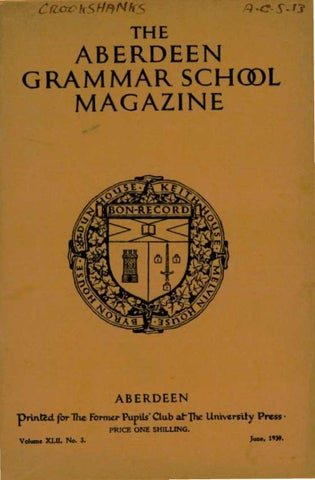
_ 20c ft-COI:ONf'cc
q
THE
ABERDEEN GRAMMAR SCHML MAGAZINE
ABERDEEN Pupils' Club at-The University Press • prin.t7.d for lite Former PRICE ONE SHILLING. Volume XLEL No. 3.
June, 1939.
ta
EDUCATIONAL BOOKS JAMES
G. BISSET
to supply all the Class Books (New or CONTINUES Second-hand) suited for the requirements of the Higher Educational Institutions in the City, at the Lowest Prices. N.B.—Best Value in Students' Note Books.
JAMES G. BISSET, Classical, Medical, and
Educational
85 BROAD
Bookseller,
STREET
(opposit. Marischal College). •
PHONE 753 •
GOOD HEALTH -
demands
GOOD BREAD For the children especially is it necessary to ensure their stamina and energy with good, wholesome, nourishing bread. In Hutchison's bread you'll find all these requirements are fully met. Phone or give instructions to have it supplied daily.
A.B.HUTCHISON BRANCHES THROUGHOUT THE CITY
_
ACVATIC STAINLESS STEEL
UNBREAKABLE GLASS
Standard Size, Centre Seconds Plain „ „ Centre „ Junior „ Plain „
£6 Its. 6d. £6 Os. Cd. £7 2s. 6d. I5s. Od.
In 1863 We sold watches. To-day many of these are still in daily use. What better testimonial could you have ? The watches of to-day are superior and very much less costly, sufficiently sturdy to withstand the vigour of present life, yet not ponderous as the watches of our grandfathers' time.
A. & J. SMITH JEWELLERS
191 UNION STREET
ABERDEEN
Littles Have just what you are looking for. Something to wear that is well cut, smart, and practical and not too expensive.
SUITS TRAVEL COATS MODEL COATS FROCKS DRESSES GOWNS FUR COATS
Sizes to fit all figures from 36 hip to 56' hip.
A. C. LITTLE & SONS, LTD. 105
UNION STREET
•
ABERDEEN
III
GALLOWAY & SYKES LTD FURNITURE EQUAL TO ANY TEST Time has tested and firmly established our reputation for Fine Furnishings. Every suite, carpet or curtain is quite beyond reproach. The materials used are selected for fine quality, and the workmanship employed secures a perfect. production.
MAKE AN EXAMINATION of our stocks, you will find a high standard of comfort and beauty is now at your command for every room in the home, with expert advice to solve your furnishing problems.
I ri . '.5.''-:::,:iit„„.
-. -4'7,'
361-363
UNION STREET, ABERDEEN
r laiIll
JAMES FYFE & SON PAINTERS AND GLAZIERS. •
•
•
OFFICE AND SHOWROOMS:-
11 DEE STREET, ABERDEEN. Te egrarns -" Fyfe, Painters."
Telephone 304.
Hairdressing for . . . LADIES, GENTLEMEN & CHILDREN
0••••0'
Maison Beattie HAIR STYLISTS
1o Albyn Place, Aberdeen 'Phone 4104
A
eur.eive wave
i e. 2 4
4
z
1
THE
AMILY COFFEE
,
Curs s Coffee is the favourite drink with every It IS most delicious. esoeciallY Your in cold weather grocer can supply you.
CURR'S COF Thomas Con 6 Co. ABERDEEN.
Anderson & Spence DISPENSING
CHEMISTS
PHOTOGRAPHIC
DEALERS
31 FOUNTAINHALL ROAD, ABERDEEN Telephone No. 1711
Jackson's
Bindery 18 Back Wynd Aberdeen
TEL EPHONENo. 291
•
ESTABLISHED 1855
BOOKBINDING OF EVERY DESCRIPTION Leather Goods Lettered with Initials or Inscription Maps or Plans Mounted
•
TRADE MARK
Loose Leaf Specialists
TELEGRAMS. " HUB, ABERDEEN."
TELEPHONE I NO. 1719.
CAMPBELL & SELLAR, LTD Engineers, Hirers and Garage Proprietors
QUEEN'S CROSS GARAGE to Fountainhall Road ABERDEEN ANY MAKE OF CAR SUPPLIED
OPEN DAY AND NIGHT
A. D. COPLAND. Phone 896.
For Better Footwear
JAMES LORIMER & SON (BOOTMAKERS), LTD.
CIVIL and MILITARY BOOTMAKERS
8 CHAPEL ST.
ABERDEEN
(Late of 162 Union Street)
Estd. A.D. 1844.
'Phone 724.
Go to . • •
KEN AWAY'S of course RESTAURANT
173
UNION STREET
Here you get the finest of food, daintily served, and at a reasonable price. The Restaurant is comfortable and commodious, and is just the place to entertain your friends.
Our rooms
are available for all types of functions. 'Phone 2371, and ask the Manageress for quotations
WM. KENNAWAY LTD. Quality
Bakers, Confectioners and
Caterers, Aberdeen
Telephone No. 1891.
ARCHIBALD McKELLAR Family Grocer and Wine Merchant,
454-456 Union Street, Aberdeen. . . We Specialise in . . Cooked
Gammons, Finest Belfast Smoked Hams, " Harris's "
Wiltshire Bacon.
Medicinal Wines—Vibrona, Hall's, Wincarnis, Glendenning's.
Did Shakespeare eat Bacon? We cannot tell, but we do — know there will be no " Bacon" controversy
if you
shop
at the
Rubislaw Supply Stores 34 Queen's Road : Phone 2054 All our Bacon is cut to individual requirements, under personal supervision—hence our reputation
Uurberry Overcoats From 3i Guineas * * * *
W. J. MILNE, LTD. Hatters &
Outfitters
251 Union Street, Aberdeen (Opposite Royal Northern Club) Telephone 1293
Telegrams: "Gallowses, Aberdeen"
On your MENUS . include fresh fish prime butcher meat, poultry and game from A. & W. Alexander. You can be confident of complete satisfaction Telephone 5172 for courteous and personal attention Our delivery service is dependable
A. & W.
ALEXANDER FISH, GAME AND BUTCHER MEAT
492 UNION STREET
ABERDEEN
Telephone—Aberdeen 1710.
The Mastrick Dairies Ltd. 1 DESSWOOD PLACE, ABERDEEN WE offer you a Choice Selection of DAIRY PRODUCE from our own Farms, and produced under the direct supervisor of members of the family. Our Customers may rely upon the absolute Purity and Cleanliness of all our products. Distributors of
CAIRNBROGIE CERTIFIED MILK. Head Dairy: 3, 5, and 7 WHITEHALL ROAD. Branches: 33 FOUNTAINHALL ROAD. 25 BEDFORD PLACE. 473 GREAT WESTERN ROAD.
CONTENTS ILLUSTRATIONS. The Class of 1876-81 in 1879 . . Lower School Class III in 1912-13 . School Prefects—June 1939 . . School Cricket 1st XI-Season 1939
•
•
•
•
•
•
•
•
•
•
•
•
Facing page 214 ,, 215 •
f2
„
230
,,
"
231
A Message to Former Pupils . . . . . . . Page 185 Our Oldest " Boys " . . . • . . . . ,. 187 Notes About Old Boys . . . . . . . „ 188 Obituary . . . . . . . . . . „ zoo . . . . . . . . . Marriages . ,,, 2:2 Unique Presentation by F.P. to the King . . . . , 2 4 Getting by in Vancouver Island. By G. C. Grant . . . „ 2o7 . . . . . A Legacy to the F.P. Club . „ 211 " Concentrating " in Tanganyika. By C. M. H. Sutherland • „ ziz . . . . . . Old School Class Groups . „ 215 Some Impressions of South America. By Dr. James L. Mowat „ 216 . „ 222 The Deplorable Art of Hitch-Hiking . . . . Inside Rhodesia. By A. A. F. „ 225 . . . . . • . Chicago Rugby Club . . . . „ 227 . . . . A Bequest to the School . . „ 229 . . . . . School Section— 230 School and Random Notes . • • 236 Jazz. By Gigster . . . • • The Woods (Verse). By J. Arnaud . 2 37 238 The Thinker. By Cassandra . • . To a Beef-Steak Pie (Verse). By Charlemagne • 2 39 The Man. By P. S. Boyd • • 2 40 B. C. 1939. By The Sixth • 241 • • School Games and Athletics . . . 2 42 The Rambling and Mountaineering Club 2 43 School ist XI Matches . • • . 2 44 House Notes . • • • . 247 250 Scout Notes . 4 . . . . 252 School Office-Bearers for Session 1938-39 The Former Pupils' Club— New Club Consuls . . . . 2 54 List of Consuls . . . . . 2 55 258 The Club Boarding House—List of Boarders • 260 Rugby Section . . . . . 261 Cricket Section . . . . . z6z . . . New Centre for Bengal . z6z The London Centre . . . . z6z . . . List of New Members . •
•
•
•
•
•
•
•
•
•
•
•
•
•
•
•
•
•
•
•
•
•
•
•
•
•
•
•
•
•
•
•
•
•
•
•
•
•
•
•
•
•
•
•
•
•
•
•
•
•
•
•
•
•
•
•
•
•
•
.
•
.
Highland Dress for Girls & Boys E. & M. place at your disposal a service in Highland Outfitting backed by many years of experience. If you are unable to call let us post to you our Illustrated Catalogue and Price List.
FOR BOYS TWEED JACKET and VEST - 35/- and 49/6 TARTAN KILTS - 34/6 and 45/Do. Ancient Colours 49/6 BALMORAL BONNETS 6/6 TARTAN TOP HOSE 6/6 TARTAN TIES I/I I and 2/II
FOR GIRLS TARTAN KILTED SKIRTS - 16/II to 30/TAILORED KILTS - 35/- to 77/6 JERSEYS to suit Kilts 10/11 to 18/6 KILT JACKETS - 34/ to 55/-
ESSLEMONT & MACINTOSH LIMITED UNION
STREET
ABERDEEN
Silver Medal Bread Think of it ! A different Loaf for every day of the month 9 VARIETIES OF BROWN BREAD 21 VARIETIES
OF WHITE BREAD
Try them all 1105,505
W. M. McPHERSON Baker and Confectioner 15 FOUNTAINHALL ROAD AND
8 ST. SWITHIN STREET
ABERDEEN Telephone 1515
ESTABLISHED 1843.
Wm. Cay & Sons funcral Tantlertailerii.
STRACHAN
415 UNION STREET
COMMERCIAL
AND
&
209 GEORGE STREET,
PORTRAITURE
ABERDEEN.
PHOTOGRAPHY Motor Hearses and Cars for
Telephone 851
Town and Country Funerals.
416 UNION STREET Telegrams—"Cay, Aberdeen." 'Phones Nos. 92 and 54.
ABERDEEN
Telephone : 1156
Telegrams : 'Blake Builders '
"Service and 4iiiiilit, -
JAMIES IF3 ILAIFIE ILTID.. j418111`1'.. 311114i
n11111'811= COntraetill'S
23, 25, 29 SUMMER STREET, ABERDEEN All classes of Building Joinery Enquiries courteously solicited EST ASLISHED
181 9
H. L STE MA2lyr r THE KING.
BY APPOINT M a HT TO
J. WILLIAMSON & SON (W.
B. WILLIAMSON, PROPRIETOR)
Meat Purveyors and Poulterers 1, 2, & 3 MARKET BUILDINGS, ABERDEEN 'PHONE 452 BRANCHES i
35 FOUNTAINHALL ROAD 'PHONE 1724
ALSO AT
CHURCH SQUARE. BALLATER.
THE SQUARE. CULTS 'PHoNE. CtnTs 2 'PHONE 39
QUALITY CAKES for The Seven Ages of Man CHRISTENING BIRTHDAY MAJORITY WEDDING ANNIVERSARY SILVER
WEDDING
GOLDEN
WEDDING
CAKES
Mitchell &
Muil
Ltd•
THE FIRM WITH A REPUTATION
SEAMLESS FITTED CARPETS Every good housewife welcomes She the wall-to-wall carpet. appreciates the beauty and comfort it brings to her home, and the drudgery it saves in keeping polished floors spic and span.
We have arranged with one of the largest carpet manufacturing firms to manufacture a heavy pile carpet exclusively for ourselves, and we have named it " THE BALMORAL." It is woven in one piece, any width, any length, and the price is remarkably low. Obtainable in 6 different colours. 15/— per square yard.
ROBERTS (Abdn.) LTD. Tel. 2695
Carpet Specialists and House Furnishers
Est. I ti7.i
419 UNION STREET, ABERDEEN
60 7Art Stunts -
DON'T WRITE IT—TYPE IT !
<i> 4 -3> We carry a fine range of reproductions of the Old, Modern, and Impressionist School from P.C. size up—and frames to suit all subjects.
You can get literary, scientific, medical, or Continental keyboards. ::
All the latest HANDICRAFTS
-.1ftme
Oa logs 49-51 ScI)oolbill
Little Portable Typewriters nowadays are very cheap, and enormous value for money—three British Portables : the Barlock Portable, the Baby Empire, and, the best of all, the Imperial Portable, the famous " Good Companion.Also all the foreign Portables.::
EASY DEFERRED PAYMENTS ON ANYTHING 9
Come along and see me :
C. H. WEBSTER 489 Union Street, Aberdeen 'Phone 505
'Phone 2870
ROLEX OYSTER 27 WORLD RECORDS
WATERTIGHT
AND DUSTPROOF
ANTI - MAGNETIC — UNBREAKABLE
GLASS
Stainless Steel - 8 gns. Centre Seconds - 9 gns. Extra Precision - 10 gns. 9 ct. Gold - 13 gns. Other models from 5 gns.
We stock the complete range of Rolex Oyster and Rolex Prince Watches.
IIFSC
Ac CAMP
'
Established in the Year 1733
WATCH AND GEM RING SPECIALISTS
142 UNION STREET (next Union Bridge), ABERDEEN
ELLIS & McHARDY LTD. (ESTABLISHED
I 8
REGENT
1880)
QUAY
AND
25O
UNION (AMICABLE
STREET
HOUSE)
ABERDEEN Telegrams " COAL, ABERDEEN"
Telephone 2889
- --
the modern note is cleverly expressed in the new Fireplace
Arrangements.
Why not inspect them in our showrooms and see at first hand how greatly one would add to and comfort
the appearance
of your room?
James Scott & Son (Aberdeen) Ltd. 483-485 UNION STREET ABERDEEN Phone 1881-2
Co-operation T
HE enthusiastic co-operation of many minds and hands make possible the fine productions of the
HOUSE OF OGILVIE. For over three-quarters of a century our constant endeavour has been to give the best possible service to our Customers. We base our claim to your patronage on our ability to please you.
J. & A. OGILVIE 369
UNION
STREET,
ABERDEEN. Telephone : No. 433.
Telegrams : " Interiors."
There is none better than the "BEST" but Davidsons' Coals are better than the " REST "
J. & A. DAVIDSON LTD.
2 BLAIKIE'S QUAY ABERDEEN Telegrams—" Davidson "
Phone 2873
Branch Office :— MAJESTIC BUILDINGS, 238 UNION STREET
Showyard Erector to the Highland and Agricultural Society of Scotland, and Contractor to the Royal Northern Agricultural Society.
JOHN REID & CO. HOUSE CARPENTERS AND JOINERS
55 Blenheim Place and 14 Fountainhall Road ABERDEEN arga,4
Various kinds of ENGLISH, SCOTCH HOUSE, STEAM COAL, ANTHRACITE. and "Ideal " Triplex Fuel at keenest prices WE SOLICIT A TRIAL ORDER
Carpentry and Joinery Work of every description done ESTIMATES ON APPLICATION Telephone No. 1997
We are equipped with the latest and most up-to-date appliances for the lubrication of your car. No longer need you struggle with grease guns and oil cans or crawl to reach inaccessible points. All this work can now be done for you cleanly, efficiently and effectively and without the slightest trouble to yourself. Call in sometime and let us demonstrate this Service.
We are an Official-
Ca da
LUBREQUIPMENT SERVICE STATION
Akl[31EIRIDIEIE
MOTOIRS
LIMITED THE
u
AUSTIN
ION IRIOW :
Telegrams—" CARS "
DEALERS
IF?IDIEUIS Telephone-4580
Established
Assets
1836
£25,400,000
NORTHERN ASSURANCE COMPANY LIMITED •
•
FOR ALL CLASSES •
LIFE
OF INSURANCE •
ASSURANCE BRANCH
The Company's tables of rates for Life Assurance include every class of Policy Special Leaflets on—
The Family Protection Policy The " Optional "
Policy
The House Purchase Policy The Educational Endowment Policy Child's Deferred Assurance Policy CHIEF OFFICES : ABERDEEN
•
•
I UNION TERRACE
LONDON .
•
•
I MOORGATE, E.C. 2
Branches and Agencies throughout the World
Aberdeen Grammar School Magazine 54th year: No. x42
Vol. XLII
(New Series, 45th year, No. 133) JUNE 1939
No. 3
The " Grammar School Magazine " is issued under the auspices of The Former Pupils' Club, in March, June, and November. All communications with regard to the " Magazine " should be addressed to the Editor (the Secretary and Treasurer of the Club), THEODORE WATT, M.A., LL.D., The University Press, Aberdeen.
A Message to Former Pupils. It is likely that this Summer Term will be recalled with more pleasure than almost any Term of recent years. Aberdeen in late May and early June is hardly the place which most people in search of warmth would make their first choice, but, for once, we were in the news for sunshine records, and for three continuous weeks conditions would have been ideal if a thoughtful architect had provided class-rooms with sliding roofs and walls. But reprisals had to come, and hail—no less—and biting winds brought down the average to normal. Cricket has had a better chance this year, and the standard of play has improved in consequence. Our School XI has done extremely well so far. Even the 'Shire had to fight hard last week for a win by the narrowest of margins. Our achievements in rugby are ancient history. There was one unimportant lapse which the team would willingly forget. Apart from that, the sequence of wins or draws was unbroken. Prospects for next season are regarded as not unfavourable, but forecasts are unreliable till we know more definitely what talent is available. The recurring events of the School year call for little comment. The Easter trip to Paris followed the customary lines and, in spite of the unsettled conditions on the Continent, attracted larger numbers than before. Three of our boys will spend their summer vacation abroad with Travel Scholarships. The cruise to the Northern Capitals was abandoned by the
186
Aberdeen Grammar School Magazine
Secondary Schools Travel Trust. The Neuralia is a troopship, and could not, in present circumstances, be released for other purposes. The speaker on Empire Day was Mr. Rex Knight, Lecturer in Psychology at Aberdeen University. He devoted the greater part of an extremely interesting address to a description of Australia, where he was born and, for the most part, educated, but he had other things to say which it was well that the boys should hear. In the cricket match which followed in the afternoon the Masters were ignominiously beaten. We hope to regain a little of our lost prestige at the Golf Match next week. The Annual Swimming Gala provided excellent sport, and, for the Championship events, a keener and closer struggle than usual. It is a comfort to feel that, in all probability, the next Gala will be held in the new Corporation Baths and—dare one so prophesy ?—the one after that in the Grammar School's own pond. Your Executive have this matter in hand, and have succeeded in getting the Education Committee to approve the proposal " in principle." Let us hope that the gap between principle and achievement will be bridged without unnecessary delay. It is pleasant to record another benefaction to the School. The late Miss Annabella Walker has, by her will, bequeathed the sum of Lac* in memory of her brother, Charles Alexander Walker, a pupil of the School from 1864 to z866. It has still to be determined how the money is to be applied. I throw out the suggestion to others who may feel prompted to do something for the School that a set of chimes for the Shanghai Clock would not come amiss. It is interesting to find how the memory of Lord Byron is still cherished by the Greek nation. Last week two wreaths inscribed " In Glorious Memory " were sent to the School by the Captain and Chief Engineer of the Greek ship Mount Lycabettus, then lying in Aberdeen harbour. It is the first occasion, so far as I know, on which a tribute of this kind has been paid since the statue was unveiled. By a curious coincidence, a traveller from John Murray, the poet's publisher, was in School when the wreaths arrived. He felt certain that his firm would be interested. The end of the session, as often as not, brings changes in the teaching staff. We have lost Mr. Maclennan, who has gone to the High School of Edinburgh as Head of the English Department, and Mr. MacIver, of the Mathematical Department, who has been appointed Head Master of one of the Primary Schools in Aberdeen. Both have deserved well of the School, and their promotion has given general satisfaction. Lastly, a word or two on the Sports. Weather forecasts were not encouraging, but the rain which led to the stoppage of
Aberdeen Grammar School Magazine
187
English cricket had not reached Aberdeen. Friday afternoon was delightful. Saturday was, if anything, better, and the programme—a lengthy one—was carried out in unclouded sunshine. The high lights of this year's meeting were C. Hall's astonishing javelin throw and the equally remarkable efforts of D. Smith in throwing the cricket ball and putting the shot. One does not associate records in the last-mentioned events with age 14. The attendance was larger than usual, and there should be no need to worry about finance. Incidentally, we are grateful to the Club for its customary donation of Lb o. if any of you are home on leave in the coming Autumn, a visit to the School will be appreciated. D. M. A. 17th June, 1939.
Our Oldest " Boys." On 23rd October, 1938, occurred the 75th anniversary of the transference of the Grammar School from its immemorial site in the Schoolhill to the present buildings in Skene Street. On the corresponding date in 1923 the Annual Dinner of the F.P. Club was held in the School Hall to commemorate the 6oth anniversary. At the head table there were seated some ten F.P.s who had been pupils at the School either before or at the time of the transference. Of these only one, WILLIAM A. SMITH (1861-65), wholesale watch and clock maker, Aberdeen, now survives ; but there are at least two other members of the Club who were pupils at the School on that historic day in 1863. These are Sir GEORGE STUART FORBES (1 860-64), K.C.S.I., M.A., who is one of the Honorary Vice-Presidents of the Club, and PATRICK REID (1861-65), retired commercial traveller, Aberdeen. The senior member of the Club, however, is Mr. WILLIAM SHEPHERD (18 59-62), whose days at the School were over before the " new " buildings were opened. He was head of the firm of Messrs. Simpson Shepherd & Sons, Ltd., wine and spirit merchants, Aberdeen, until 1936 when the company was voluntarily wound up. Mr. Shepherd is still resident in Aberdeen: he is its oldest burgess, having been admitted in 1875. Possibly there arc one or two F.P.s, not members of the Club, whose connection with the School goes further back than does that of Mr. Shepherd. It would be interesting to discover whether there is now any surviving F.P. who was a pupil at the School when it was under its famous Rector, Dr. James Melvin. It is quite possible. He died in 1853—only 86 years ago!
188
Aberdeen Grammar School Magazine
** * It is requested that the Editor be informed of all new appointments and interesting incidents in the careers of Former Pupils.
The dates given in parentheses after names indicate the sessions of attendance at the School.
King's Birthday Honours. In the list of Birthday Honours conferred in June by the King the names of four F.P.s appeared :— Andrew Gourlay Clow (1896-98), C. S. ,C.I.E., M.A. (Cantab.), of the Indian Civil Service, received a Knighthood. He is the elder son of the late Rev. Principal Clow, D.D., Glasgow, formerly minister of the South U.F. Church, Aberdeen, and was a Wrangler in Part II of the Mathematical Tripos at Cambridge in 191 z. He passed into the Indian Civil Service in 1913, and in 1920 became Controller of the Indian Government Labour Bureau at Delhi. Later he became Joint Secretary in the Department of Industries and Labour (now Commerce and Labour), and he is regarded as one of the most widely informed members of the I.C.S. on industrial problems. In 5936 he was appointed Secretary to the Government of India, and in the last issue of the MageRine it was recorded that he had been made a Member of the Governor-General's Executive Council. He was created a C.I.E. (Companion of the Order of the Indian Empire) in 1918, and a C.S.I. (Companion of the Order of the Star of India) in 1935. Herbert Tower Sorley* (1899-1909), M.A., is another of our F.P.s in the Indian Civil Service to receive a Royal Honour, having been made a Companion of the Order of the Indian Empire (C.I.E.). He entered the Service in 1914 and is now Collector of Bombay. While Collector of Salt Revenue for Bombay he carried on inquiries which resulted in his writing a treatise entitled "The Marine Fisheries of the Bombay Presidency." It will be seen from another page of this issue of the Magaine that in March he received the degree of D.Litt. from the University of Aberdeen for a study of literary, social, and economic conditions in eighteenth-century Sind. He is the * Member of Former Pupils' Club.
Aberdeen Grammar School MagaTine
189
eldest son of the late Mr. JOHN TOWER SORLEY (1871-74), City Chamberlain of Aberdeen. Alexander Wishart Christie* (1878-87) has been made a Commander of the Order of the British Empire (C.B.E.). He was for fifteen years Provost of the Burgh of Huntly, where he is the proprietor of the well-known Gordon Cleaning Company, and was the donor of the Christie Park to Huntly. He has been an outstanding figure in the public life of Huntly and of Aberdeenshire, and is an Honorary Sheriff-Substitute of the County. Charles William Sleigh* (1874-79), M.A., LL.D., has also been made a C.B.E. He recently completed forty years of service in public life. He became Chairman of the Aberdeenshire Education Authority at its inception in 1919, and has been at the head of County Education ever since. For sixteen years he has been Chairman of the Aberdeen Provincial Committee for the Training of Teachers, and for more than ten years he has been Vice-Convener of the Aberdeen County Council. The honorary degree of LL.D. was conferred on him in 1931 by the University of Aberdeen. Frederick Robert Aitken* (1918-21), on the staff of Messrs. W. H. Dorman & Co., Ltd., has recently been transferred from Stafford to Wolverhampton. The Right Hon. Lord Alness* (1884-85), P.C., LL.D., was Chairman of the Select Committee of the House of Lords on the Prevention of Road Accidents, whose report was issued at the end of March. It includes nearly zoo recommendations, affecting all sections of the public, for making Britain's roads safe. It is the most comprehensive document on the subject ever published, and the Committee express the hope that their report will not share the fate of the reports of several Departmental Committees, of which they heard in evidence, and merely find a resting place in the pigeon holes of Whitehall. James Barron (1884-85), M.Inst.C.E., who was Engineer and General Superintendent of the Ribble Navigation from 1901 to 5933, is the author of " A History of the Ribble Navigation from Preston to the Sea," which was published last year. This is a very handsome quarto volumeof some Soo pages, with charts and plans, and beautifully illustrated. The volume gives a lucid account of how the Corporation of Preston overcame both the physical and political difficulties encountered in rendering the Ribble navigable for ships from the sea to Preston, and how eventually they attained a good and practicable waterway to the town. The book is a painstaking piece of work, of which the author may well be proud.
190
Aberdeen Grammar School Magazine
Harold Anderson Blackhall* (1922-29) has recently been admitted to membership of the Institute of Accountants and Actuaries in Glasgow, and is at present with Messrs. Thomson McLintock & Co., chartered accountants, London. Ian Gordon Brander* (192o-28), who went out to Australia in 1928 as a Whitehead Fellowship Scholar and was specially trained in Australian agriculture, is now engaged in farming near Sutherland, New South Wales. 0_ Alexander Middleton Brown* (1894-1904), M.A., M.D., D.P.H., Medical Officer of Health of the city of Hereford since 1921, was in December last elected a Fellow of the Royal Sanitary Institute. John Malcolm Bulloch (1877-80), M.A., LL.D., who died in March 1938, is now commemorated by a tablet in the Aberdeen University Library, King's College. This is of carved oak with the following wording in gilt lettering : " John Malcolm Bulloch, M.A., LL.D., Journalist and Critic, Historian of the Gordons, a Mindful Son of King's College, 1867-1938." The memorial was designed by Dr. William Kelly. William Nicoll Buyers* (1906-10), who was formerly engaged in insurance in the Far East, and was latterly living in Victoria, British Columbia, is now resident at Rickmansworth, Herts. Alfred Gordon Cameron* (1923-34) has now been for more than a year assistant manager on the Bundapani Tea Estate, Dooars, Northern Bengal, and finds the life there a grand one. He enlisted as a Cavalry Trooper in the Northern Bengal Mounted Rifles, and had a glorious week at the annual camp in Jalpaiguri in February. He is playing outside-right for the Central Dooars European Club Football Team, which meets other European and Indian Clubs on Sunday evenings during the monsoon season. He says there is a strong movement afoot to get rugby started, but the climate is rather against it I Douglas Knox Cameron* (1932-35), who was a School Prefect and Senior Prefect in the Boarding House during his last year at the School, is now studying at the Edinburgh Dental Hospital. Norman Stuart Clark* (1919-29), B.Sc., M.B., Ch.B., has obtained the Diploma of Child Health of the Royal Colleges of Physicians and Surgeons of England. He is at present an Assistant Medical Officer at the Redhill County Hospital, Edgware, Middlesex, and previously was a House Surgeon and House Physician at the Children's Hospital, Great Ormond Street, London. Patrick Ashley Cooper* (1896-1901), B.A., LL.B., was a member of the Rhodesia-Nyasaland Royal Commission appointed
Aberdeen Grammar School Magazine
191
to inquire whether any and, if so, what form of closer co-operation or association between Southern Rhodesia, Northern Rhodesia, and Nyasaland was desirable and feasible. Its report was issued in March in a Blue Book. The Commission spent some six weeks in Southern Rhodesia, three weeks in Nyasaland, and five weeks in Northern Rhodesia. They heard evidence from both Europeans and natives, representing many different shades of opinion, and from representatives of the Indian and coloured communities. The Commission's investigation led them to the view that closer co-operation between the three territories is eminently desirable, and, indeed, that there is no field of public endeavour in which it would not lead to valuable results. Owing to pressure put upon him from influential quarters to undertake work of national importance, Mr. Cooper felt compelled in January last to resign the chairmanship of both the Primitiva Gas Company of Buenos Aires, Ltd., and the Primitiva Holdings, Ltd. At a recent meeting it was stated that when Mr. Cooper became chairman in 1925 the Primitiva Gas Co. was practically derelict, full of troubles, almost bankrupt and served only 36,500 consumers. The period since then had been one of progressive improvement. Mr. Cooper had removed the fear of bankruptcy, had built up the resources of the company, and had created an organization which had been successful in raising the number of consumers to 115,5oo. Albert Coull* (192o-32), M.B., Ch.B., is a SurgeonLieutenant in the Royal Navy, and is at present Medical Officer to H.M.S. Sharpshooter at Portland. William Mackay Davidson* (1914-28), M.B., Ch.B., was in April appointed Honorary Senior Assistant Pathologist at Aberdeen Royal Infirmary. Sidney Wardlaw Duguid* (1922-27) is at present engaged in the Civil Engineer-in-Chief's Department, H.M. Dockyard, Rosyth. He was previously at the Royal Naval Yard, Trincomali, Ceylon. Douglas Watt Duthie* (1915-21), M.A., B.Sc., Ph.D., Agricultural Chemist to the British Guiana Government, who, as recorded in the last Magazine, has been attached to the Commission of five Americans and two Britons which was set up to examine the possibilities of settling Jewish-German refugees in the hinterland of British Guiana, is one of the contributors to a Blue-book published at the beginning of June. In this arc discussed the possibilities and the difficulties of settling refugees in the Colony. As so little is known about the forestry and agricultural possibilities of the suggested area caution is advised, since mass immigration is obviously impracticable at this stage, seeing that communications are at present practically non-existent. The climate is not unhealthy, but it is nevertheless tropical, and actual trial alone will determine whether
192
Aberdeen Grammar School MageRine
settlers of middle European origin will be able to stand the strain of continuous agricultural labour in these latitudes permanently. John Murray Easton* (1895- i 9o5), F.R.I.B.A., who was architect of the British Pavilions at the World's Fair in New York and at the last Paris Exhibition, has been elected President of the Architectural Association, London. As a partner in the firm of Stanley Hall, Easton and Robertson, London, he has gained a wide reputation for the modern style of his designs. Arthur Raymond Gordon Emslie* (1919-2z), D.Sc., continues in the Division of Chemistry at the Central Experimental Farm, Ottawa, Canada. William Ingram Emslie* (1924-3o), M.B., Ch.B., has recently bought the medical practice at Kirkwall, Orkney, of the late Dr. FRANK G. T. PETEax_uv (1897-98). He was for a time assisting in a medical practice at Balham, London. Denys William England* (1927-35) graduated B.Sc. at Glasgow University in April, with First Class Honours in Civil Engineering. He is now working with the Admiralty at Blairadam, Fife. Alexander Findlay* (1882-91), M.A., D.Sc., Ph.D., F.I.C., is to retire from the Chair of Chemistry at Aberdeen University on 3oth September, 1940. His resignation has been intimated thus early so that his successor may have an opportunity of expressing his views on the new Department of Chemistry which is shortly to be built. Before his appointment to the Aberdeen Chair in 1919, Professor Findlay held the corresponding Chair in the University College of Wales, Aberystwyth, from 1911, and he was Lecturer in Chemistry and Special Lecturer in Physical Chemistry in the University of Birmingham, 1902-I1. Alexander John Findlay* (1898-1904), C.M.G., M.A., B.Sc.(Agr.), went in April to New York to take charge as Enquiry Officer of the Colonial Hall of the British Pavilion at the World's Fair, and will be absent from this country until about the middle of November. He filled a similar post at the Empire Exhibition at Glasgow last year. Robert David Spinal Fleming* (1925-37), who went from the " Grammar" to St. Paul's School, London, entered University College, University of London, last October, and is now reading law there. He is a member of the University of London Air Squadron and flies regularly from Northolt Aerodrome. At University College he has met three other F.P.s, namely, Alastair Campbell (1918-37), who is studying science ; Henry Duncan Crow (1929-31), who is studying arts ; and Wynne Jarvie Scott* (1924-36), who is studying art. Colonel Archer Irvine-Fortescue* (1892-97), D.S.O.,
Aberdeen Grammar School Magazine
193
M.B., Ch.B., B.Com.—the President of the F.P. Club—was in April appointed Public Relations Officer for Territorial Army recruiting in the North-East Area, embracing Aberdeen (Town and County), Kincardineshire, Banffshire, and Morayshire. He also holds the post of Deputy Director of A.R.P. for Kincardineshire. Arthur Alexander Fox* (1923-29) is in the service of Barclay's Bank at Fort Victoria, Southern Rhodesia. A contribution from him appears in this issue of the Magazine. John Angus Fox* (1923-29), A.M.Inst.C.E., is engaged in road-making under the County Engineer, Ross-shire. HONORARY SURGEON TO THE KING. Major-General Alexander Donald Fraser (1898-1900), D.S.O., M.C., M.B., Ch.B., late Royal Army Medical Corps, was in April appointed Honorary Surgeon to the King. James Milner Fraser* (1918-20), of the Singapore Improvement Trust, has been President of the Singapore Battalion of the Boys' Brigade since its formation in 1936. He started the first Singapore company in 1930. Alexander Rennie Giles* (i920-2i and 1927-29) is in the service of the Budla Beta Tea Company, and is at present on the Pengaree Tea Estate, Digboi P.O., Assam. Douglas Ross Harper* (1917-26) was selected by the Malayan Rugby Union to captain a side representing the whole of Malaya which toured to Hongkong in February this year. Harper, who went out to Malaya nine years ago and is at presen; stationed in Kuala Lumpur, previously held the unique record of having captained the Singapore, Penang, and Selangor State XVs, as well as both the North and the South of Malaya. John Geddes Hay (1908-12), who on leaving the School entered the service of the North of Scotland Bank and has latterly been accountant at the St. Nicholas Branch, Aberdeen, has recently been appointed agent at the Woodside Branch. Gordon Harvey Henderson* (1921-34) is serving as an apprentice civil engineer with Mr. Archibald Henderson, M.Inst.C.E., consulting engineer, Aberdeen. James Alexander Innes* (1921-32) is in the service of the Bank of Scotland and is at present stationed at Kingussie, Inverness-shire. Sir William Wilson Jameson* (1892-1902), M.A., M.D., F.R.C.P., Dean of the London School of Hygiene and Tropical Medicine, has been appointed Chairman of a Committee of medical men set up by the Medical Research Council to assist and advise them in promoting investigations into problems of preventive medicine.
194
Aberdeen Grammar School Magazine
James Patrick Jeffrey* (1906-18), B.Sc., C.A., has been appointed President of the Aberdeen Rotary Club. William Cruickshank Kemp* (1924-26) formerly on a rubber estate in Perak, is now on the Bukit Paloh Estate, Johore. James Ledingham* (1885-88), who recently retired from the Glasgow managership of the North of Scotland Bank Ltd., has joined the boards of the Scottish International Trust Ltd. and the Southern United Investment Co. Ltd. George Seton Simpson Leith* (1903-11), who joined the firm of Landale & Clark, Ltd., jute merchants, Calcutta, in 1915, has recently retired from India, and is now resident at Linstead, Hants. Eric R. R. Linldater* (1913-16), M.A., is the author of " Judas," recently published by Jonathan Cape. This is a study in imaginative biography which confines itself mainly to Judas himself. Reviewers say that it is one of the best stories Mr. Linklater has ever written. Exuberance has hitherto been one of his chief virtues, but here he writes with a dignity which is impressive and often moving. He makes a shrewd and fully persuasive study of Judas's state of mind during the week before the betrayal. Andrew William Logan* (1931-32) has recently returned to this country from Paris, after spending six months in the Reception Office of the Hotel Prince de Galles there. It is one of the leading and most modern hotels, and has guests of many nationalities. He previously had a six months' course in hotel office work in the Hotel des Bergues, Geneva. Alexander Low* (1883-86), M.A., M.D., who retired from the Chair of Anatomy in Aberdeen University last year, was recently presented by former students and colleagues with his portrait and a wallet of notes. Norman Crichton Maclver (1928-34) has been elected to an Arthur Higgs Scholarship at Balliol College, Oxford. He has been awarded First Class Honours in Economics at Aberdeen University, and will continue his studies at Balliol. He is the son of COLIN JOHN MACIVER* (1902-03), M.A., of the School staff, who has just been promoted to the grade of Head Master under the Aberdeen Education Committee. Roland Ferguson Mackay (1926-33) was in April licensed as a probationer by the Aberdeen Presbytery of the Church of Scotland. William Mackay (1900-01), M.A. (Glasg.), was last year appointed Rector of Dornoch Academy in succession to the late ALEXANDER ANDREW Mont (1894-190o), M.A. He has been on the staff of the Academy since 1921.
Aberdeen Grammar School Magazine
195
Archibald McKenzie* (1922-31) has since October last been on the Jiti Tea Estate, Nagrakata P.O., Japaiguri, Dooars, India. John Woffenden McKenzie* (1927-37) is a Flight Cadet at the Royal Air Force College, Cranwell, Lincs. Kenneth William Mackenzie* (1893-97), D.S.O., M.C., M.B., Ch.B., late head of the Scottish Episcopal Mission at Chanda, India, is the new Rector of St. John's Episcopal Church, Pittenweem. For the months of June and July he has been appointed by the Bishop of Aberdeen and Orkney as Chaplain at St. Margaret's, Braemar. He has now finally retired from missionary work in India. Patrick Alexander Bruce McKerron* (1904-1o), who is in the Malayan Civil Service, has been in charge of the enrolling of British men and women at Singapore for emergency duties. So satisfactory has been the response to his appeal for voluntary enrolment that practically all the known emergency requirements of the civil administration and of the Services have been filled. 1-Ie was Secretary of the F.M.S. Retrenchment Committee in 1932, and was later Superintendent of the Convict Establishment, Taiping, before going to Kedah as Assistant Adviser in 1 934Harvey Goodwin Mackintosh* (I 912- i 5), L.D.S., H.D,D., has been appointed by the Cadet Council to command No. 107 (Aberdeen) Squadron, Air Cadet Defence Corps. While in his 17th year, he entered the Royal Flying Corps as a cadet, and was gazetted a and Lieutenant in July 1917. He was trained at Oxford and Montrose, and took his wings at Turnhouse, Edinburgh. A bad crash delayed his transfer overseas. He was flying at a height of about 3,000 feet when the Sopwith Camel he was piloting went into a spin and came whirling to earth. He marvellously escaped death, although his skull was fractured, and he spent several months in hospital before he went to France. Early in 1918 he joined No. 3 Fighter Squadron in France, and in fights over the lines he brought down a number of German aeroplanes. For a time he was in command of an American Squadron, taking fresh American pilots with no previous experience into aerial contests with the Germans. Altogether he flew for 500 hours in France, and was demobilized with the rank of Flight-Lieutenant. He is a partner in the firm of Messrs. J. G. and H. G. Mackintosh, dental surgeons, Aberdeen, and has risen to International rank in both tennis and badminton. He has five tennis and three badminton " caps," and is also a first-class golfer. Ronald Duncan Macrae* (1916-23), M.B., Ch.B., Captain, Indian Medical Service, has qualified for the F.R.C.S. of Edinburgh. He has returned to India as Agency Surgeon at Gilgit.
196
Aberdeen Grammar School Magazine
Leslie Deane Mayor* (1923-33) was in February promoted from the rank of Pilot Officer to Flying Officer in the R.A.F. He is at present stationed at Lahore, India, and in April completed a survey flight from Lahore to Alexandria and back. Benjamin Disraeli Milne* (1893-97) has succeeded to the managing directorship of Messrs. Spencer & Co., Ltd., engineers, Melksham, Wilts. He served his apprenticeship as an engineer with Messrs. Barry, Henry & Co., Ltd., Aberdeen, and has been in the service of Messrs. Spencer for many years. He succeeds Mr. W. Littlejohn Philip, a brother of the late Mr. John Bentley Philip, for many years a Master in the Grammar School, and of Professor JAMES C. PH/LIP* (1886-89), last year's President of the F.P. Club. Gordon Edward Milne* (1920-26) is at present and Officer of the King Egbert in the King Line. William Milne* (1905-13) is in the service of the Budge Budge Jute Co., Ltd., near Calcutta. He served his apprenticeship as an engineer with Messrs. Wm. McKinnon & Co., Ltd., Aberdeen. Ian Alexander Moir* (5924-32), M.A., was in April licensed as a probationer by the Aberdeen Presbytery of the Church of Scotland. Alan Douglas Morgan (1919-28), M.A., M.B., Ch.B., was in April appointed Honorary Junior Assistant Pathologist at Aberdeen Royal Infirmary. James Maconachie Morrison* (1928-33) is in the service of Messrs. Gillanders, Arbuthnot & Co., Ltd., East India merchants, Calcutta. James Lawson Mowat* (1915-16), M.A., Ph.D., the recently-appointed Club Consul for Switzerland at Geneva, reports that he has had his first F.P. visitor. This was Professor WILLIAM P. MILNE* (1897-99), D.Sc., of the University of Leeds. He has been visiting Geneva with his wife, who is a daughter of the late ROBERT C. Bum= (5864-67), M.A., for many years schoolmaster at Echt, Aberdeenshire. Donald Hunter Munro* (i 9 r 6-17), Television Productions Manager at Alexandra Palace, London, was recently released temporarily to the Columbia Broadcasting System of America for work in connection with the opening of the C.B.S. television service. He sailed for the United States at the beginning of May, and his visit was expected to last for at least six weeks. He joined the B.B.C. in 1926 as an announcer at the Aberdeen Station, went to London in 1929 as productions assistant at Savoy Hill, and was intimately concerned with developments in multi-studio presentation. Since the start of television service in 1936 he has been responsible for studio organization
Aberdeen Grammar School Magatine
197
and general routine, and has produced well over a hundred television programmes. Thomas Patrick Edward Murray* (1907-18), Major and Brevet Lieut.-Colonel, was in April promoted to be Lieut.Colonel and appointed to the command of the 51st (Highland) Divisional Signals, vice Lieut.-Colonel and Brevet Colonel EDWARD BIRNIE REID* (1902-13). Colonel Murray has risen from the ranks, for he joined the Territorial Army as a private in the Aberdeen Grammar School Company of the 4th Gordon Highlanders in 1920. A year later he transferred to the Signals as a despatch rider. In the same year he was given his commission as a and Lieutenant. He is M.A., LL.B. of Aberdeen University, and a partner with his father, JOHN MURRAY* (1868-75), M.A., in the firm of Messrs. Stewart and Murray, advocates, Aberdeen. Thomas James Trail Nicol* (1930-3S), M.A., became in May the first elected President of the new Aberdeen University Students' Union. He was formerly Vice-President of the Men's Union, and then Secretary of the interim management committee of the new Union. He is a first-year student in Divinity, and a prominent University athlete. James Charles Philip* (1886-89), O.B.E., D.Sc., F.R.S., who retired last year from the Chair of Physical Chemistry at the Imperial College of the University of London, is returning for a period to act as Deputy Rector of the College. Edward Birnie Reid* (1902-13), O.B.E., who as Lieut.Colonel and Brevet Colonel, relinquished in April the command of the 5tst Divisional Signals, after holding it for five years, has been appointed Deputy Chief Signals Officer, Scottish Command. This has placed him in the senior appointment for a Territorial Army Officer of the Signals in Scotland. James Barclay Rennett* (1878-83), M.A., C.A., has been appointed Treasurer of the new Aberdeen University Students' Union. He was Treasurer of the former Men's Union from its inception in 1895. James Hunter Ritchie* (1921-27) is now on the Kukicherra Tea Estate, Kukichara, Cachar, Assam. Alexander Matheson Robertson* (1926-30) is employed as a temporary Assistant Civil Engineer with the Admiralty at H.M. Dockyard, Rosyth. Charles Macdonald Ross* (1917-25), M.B., Ch.B., is Deputy Superintendent of the Royal Edinburgh Hospital for Mental Disorders. William Philip Selbie* (1901-06), M.B.E., M.C., M.A. (Aberd. et Oxon.), has been promoted to the rank of Major in the Army Educational Corps. He is at present stationed at Peshawar, N.W.F.P., India.
198
Aberdeen Grammar School Magazine
George Mackie Stephen (1920-26), M.A., M.B., Ch.B., was in April appointed Honorary Junior Assistant Bacteriologist at the Aberdeen Royal Infirmary. David Alan John Stevens (1927-32), M.A., was in June ordained to the charge of Holy Trinity Church, Meir, Stoke-onTrent. He graduated at Aberdeen in 1936, with Second Class Honours in History. Charles Ian Graham Stobie* (1924-27) is now in his third year in Arts at St. Andrews University. He is organist and choirmaster of Bonnygate Church, Cupar. Ernest Strachan* (I923-24 and 1929-36) has finished his training as a wireless operator in the R.A.F., and is at present stationed at Kinloss, Forres. John Sutherland* (1899-1904), M.A., Head Master of Causewayend Primary School, Aberdeen, has recently been transferred to Sunnybank School.
F.P.s IN TIENTSIN. John Cameron Taylor* (1904-06), who has been for many
years in the service of Messrs. Jardine, Matheson & Co., Ltd., in China, is at present home on leave. Since 1928 he has been in charge of the Company's office in Tientsin, where he has also been the F.P. Club Consul. He is going back early in 1940 to the head office at Hongkong. In Tientsin he has latterly had the pleasure of the company from time to time of three other F.P.s : —WILLIAM ROBERTSON MYERS* (1895-99), of the Chinese Maritime Customs; JOHN MOIR MCKENZIE* (1905-08), O.B.E., Major, R.A.M.C. ; and VICTOR R. W. ENGSTR(5111 (1923-27), formerly of Stockholm. Kenneth A. M. Tomory* (1899-1908), M.B., Ch.B., Major, R.A.M.C., is stationed at the Royal Victoria Hospital, Netley, Southampton. Alfred McLaren Tosh* (1929-3z) is in the service of Socfin Co., Ltd., Kuala Lumpur, F.M.S., and has recently become a Life Member of the F.P. Club. Wallace Troup* (1907-i2), M.D., who is Commissioner of the Ottawa District of the Boy Scouts' Association, was good enough to send to the Editor of the Magazine, on the eve of the arrival at Ottawa of the King and. Queen, a letter of greeting bearing specimens of the new special issue of the King's Visit stamps, cancelled " Train Royal, Canada, Bureau de Poste 22, 13 Mai 39." Four thousand Scouts and Cubs were on duty during the period of Their Majesties' visit and were assigned important and responsible duties at practically every function. Edward William Watt* (1883-94), M.A., LL.D., was in May unanimously appointed President-Elect of the Congrega-
Aberdeen Grammar School Magazine
199
tional Union of Scotland, and will, in the normal course, occupy the Presidential Chair in 194o-41. It is only occasionally that a layman is elected to the Presidency. At the Spring Graduation at Aberdeen University the Honorary Degree of LL.D. was conferred on Ex-Lord Provost Watt. In presenting him for laureation Professor T. M. Taylor, Dean of the Faculty of Law, said : " Mr. Watt is a graduate in Arts of this University. As Lord Provost of Aberdeen he, refusing no claims upon his time and energy, was indefatigable in his labour for all that concerned the interests of the citizens, and with the assistance of the Lady Provost, equally tireless in generous and friendly hospitality. " Of all the tasks which Mr. Watt successfully undertook during his term of office, perhaps the most arduous was that of completing the collection of funds for the Royal Infirmary at Foresterhill. By unflagging endeavour and by visiting in person the towns and villages in a wide area round Aberdeen, Mr. Watt before leaving office had the satisfaction of obtaining the large sum still needed for the new building. " To-day we honour him as an alumnus of our own, who in many fields has given abundant proof of his energy, public spirit, and devotion to duty."
George T. Robertson Watt* (1918-31), M.B., Ch.B., has been appointed Resident I-iouse Surgeon at the Aberdeen Maternity Hospital for six months from ist May. He was previously on the staff of the Mount Vernon Hospital, Northwood, Middlesex. Shao-Ying Yeh* (1913-14), who is in practice as a lawyer in Shanghai, has recently become a member of the F.P. Club. He graduated M.A. at Aberdeen in 1918 and LL.B. in i919. ABERDEEN UNIVERSITY DEGREES.
At the Spring Graduation at Aberdeen University degrees were conferred on the following F.P.s :— Doctor of Letters (D.Litt.) :— Herbert Tower Sorley* (19o4-17), M.A., India. Thesis : " Shah Latif of Bhit ; His Poetry, Life, and Times : A Study of Literary, Social, and Economic Conditions in Eighteenth Century Sind." (In absentia.) Bachelor of Science in Agriculture (B.Sc. Agr.) :— William Lewis Henderson* (19 r 9-3 i). Bachelor of Science in Forestry (B.Sc. For.) :— Ian Thurburn Wilson (1925-26). Bachelor of Divinity (B.D.) :Ian Alexander Moir* (1924-32), M.A. Bachelor of Laws (LL.B.) :— James White Dalgleish* (1928-34), M.A. Gordon Harvey Henderson* (1921-34), M.A. James Lewis McAllan* (1931-34), M.A. William Sutherland* (1928-34), M.A.
too
Aberdeen Grammar School Magazine
OBITUARY. William James Brown (1878-8o), of the firm of James Brown, game dealer, Aberdeen (latterly James Brown (Aberdeen) Ltd.), died at Aberdeen on ist May, 1939. On leaving the School he became associated with the business founded by his father, first in Hadden Street and later also in Union Street. He retired in 1914. Sidney Morris Cannon (1899-1901), C.A., died at Aberdeen on z6th March, 1939, aged 52 years. He served his apprenticeship as a chartered accountant with Messrs. Whyte & Williamson, C.A., Aberdeen, and qualified in 191o. After he started in business on his own account in Aberdeen in I9, I, his interests turned to the fish trade, first as an accountant and later as a trawlowner and fish salesman. In 1924 he joined the firm of Messrs. Cannon (Aberdeen) Ltd., fishmongers, and was connected with that business until a year ago. He was very keenly interested in cricket, and for a term was President of the Aberdeenshire Cricket Association, and was also a member of the committee of the Aberdeenshire Cricket Club. The Cannon Cup, one of the trophies competed for in Aberdeen grade cricket, was presented by him. James Younger Collie* (1869-72 and 1873-75), advocate, died at his residence, 18 Queen's Road, Aberdeen, on 9th May, 1939, aged 79 years. The third son of the late JAMES COLLIE (1827-32), he served his legal apprenticeship with the firm of James and George Collie, advocates, Aberdeen, which his father had founded, and became a partner in 1885. As a young man much of his time was occupied with court work, and he became recognized as a strong and able pleader. In later years he confined himself mainly to chamber practice. He retired from active business about twelve years ago, but remained a partner in the firm. His only son, JAMES STUART GORHAM COLLIE* (1905-1o), M.A., B.L., is engaged in farming in the Cape Province, South Africa. His elder daughter, who died some time ago, was the wife of Dr. JAMES A. DAVIDSON* (1893-19oz), Ealing, London; his younger daughter married Dr. ALAN A. DUFFUS (1900-I 1), Watford, Herts. Mr. Collie was predeceased by his brother Sift JOHN COLLIE (1873-76), and is survived by his elder brother, GEORGE DUNCAN COLLIE* (1869-72 and 1873-75), senior partner of the firm of James and George Collie, and by his younger brother, Dr. FRANK L. CoLuz* (1877-80), who is now living in retirement at Bournemouth. William Ferries (1883-84), second son of the late William Ferries, The Hotel, Cults, died at Foresterhill, Aberdeen, on 4th May, 1939. Charles Evans Macguire (1881-89), M.D., of Auckland,
Aberdeen Grammar School Magazine
lox
New Zealand, died in London. on 13th June, 1939, aged 67 years. After qualifying as a doctor at Aberdeen in 1893 he entered the Colonial Medical Service, being successively stationed in Lagos, Southern Nigeria, and Fiji. The greater part of his professional life was spent as Medical Superintendent of the Auckland Hospital, a post from which he retired last year. Alexander Ogilvie (1878-79 and 188o-81), O.B.E., T.D., B.Sc., son of the late Rev. Alexander Ogilvie, LL.D., Gotdon's College, Aberdeen, died suddenly at his residence in Edinburgh on z8th May, 1939, aged 68 years. He graduated in engineering at Edinburgh University in 1891, and entered the service of Messrs. King, Brown & Co., electrical engineers, Edinburgh. In 1894 he was assumed as a partner in the reconstituted firm of King & Co., which removed to the Leith Electric Works. He held a record of many years' continuous service in the Edinburgh Royal Engineers (Volunteers and Territorials). He joined the Forth Division, Royal Engineers (Volunteers) Submarine Miners in the early days of its formation in 1888, under his brother, the late Sir FRANCIS GRANT OGILVIE (187z-74), C.B., LL.D. ; and on the formation of the Territorial Force in 1908 he continued to serve in the reconstituted unit—known as the City of Edinburgh (Fortress) Royal Engineers. His appointment to the command of that unit in 1912 included the whole of the period of the War, when the strength of the unit was increased to 6o Officers and over 1,zoo men. During the War Colonel Ogilvie was retained as O.C. Royal Engineers on the Forth Defences, when he was responsible under the C.R.E., Forth, for all the engineering constructional and maintenance services on the greatly enlarged defences on the Forth, including the Coast Defence and the Anti-Aircraft Searchlights. He was twice mentioned for valuable services during the War, promoted Brevet Lieut.-Colonel, and appointed an Officer of the British Empire. James Smith Shewan (1875-77), M.A., advocate, died at a nursing home in Aberdeen on z3rd April, 1939, aged 77 years. A native of Keithhall, Aberdeenshire, he graduaded M.A. at Aberdeen in 188z, and was then for a time on the teaching staff of the Grammar School. He next turned to law, and after serving his apprenticeship with the late Mr. A. J. Brander, advocate, set up in practice as a solicitor on his own account in Aberdeen. Latterly he assumed one of his sons as a partner, and he retired about three years ago. He took a keen interest in agriculture, farming at Peathill, Keithhall. His knowledge of agricultural affairs was of great assistance to him in his legal work. Alexander Slater (1914-17) died at Aberdeen on z5th April, 1939, aged 39 years. A son of Mr. George Slater, zz Louisville Avenue, Aberdeen, he left the School in 1917, and after entering
zoa
Aberdeen Grammar School Magazine
the University, endeavoured to join the Army. When he was rejected on account of his health, his determination to play his part did not fail, and joining a company of Britishers in the French Army, he carried out ambulance work at the front. After the War he entered the firm of Messrs. William Slater and Sons, herring curers and exporters, Aberdeen, and at the time of his death was senior partner. While he was at Lerwick in July 19zo he saved a schoolboy from drowning, and was presented with a gold watch from the Carnegie Hero Fund Trust, and a bronze medal and parchment from the Royal Humane Society. James Dunbar Walker, younger son of the late DAVID MoRICE WALKER (1874-75), who was at the School for a short time in 191o, died at Rosemount, Hillside, Montrose, on 13th May, 1939, aged 42 years. Alexander McQueen Wisely (1876- 77) died in York on 1st April, 1939, aged 74 years. He was the general manager of the Yorkshire Herald Newspaper Co., Ltd., for forty years. On leaving the School he entered the office of the Aberdeen Journal, and later was appointed cashier of the Oldham Dag.), Standard. His abilities were quickly recognized there, and at the age of 21 he was appointed general manager. After fourteen years he went to York and took over the managership of the Yorkshire Herald Newspaper Co. Even then he was still in his early thirties. The devotion to duty which he showed in those days continued throughout his life in all spheres.
MARRIAGES. Archibald (1919-z3).---At the Douglas Hotel, Aberdeen, on 18th March, 1939, ALEXANDER Nicnoi, ARCHIBALD (Chandpore Tea Estate, Assam), younger son of A. N. Archibald, 47 Holbum Street, to Alice, younger daughter of Mr. and Mrs. Hugh Grant, 39 Caledonian Place. Beattie (u at-z!).—At St. Paul's Church, Weston-super-Mare, on 8th April, 1939, ERIC WILLIAM I3EATTIE,* C.A., London, eldest son of the late William Beattie, builder and contractor, Aberdeen, and of Mrs. Beanie, Sr!mg, Cults, to Doris, elder daughter of Mr. and Mrs. Weaver, Newton Road, Weston-super-Mare, Somerset. Bonner (192z-z8).—At London, on 8th April, 1939, ROBERT MITCHELL BONNER,* C.A., son of the late R. Bonner, and of Mrs. Morgan, Tarland, to Elizabeth (Betty), only daughter of W. Gould, 36 Duke's Avenue, Muswell Hill, London, N. Cochran (19t4.-z4).—At St. Mary's Church, Quetta, Baluchistan, India, on z3th March, 1939, Capt. DUNCAN SCOTT COCHRAN,* R.A.M.C., youngest son of Mr. and Mrs. F. T. Cochran, of Aberdeen, to Monica Evelyn, daughter of the late Mr. W. J. Hilditch, and Mrs. Hilditch, of Salisbury, Wiltshire. Coutts (19z7-3o).—At the George Hotel, Aberdeen, on ,5th April, 1939, WILLIAM ERNEST CouTrs, I%f.A., M.B., Ch.B., Kenmay, second son of the late Captain W. E. Coutts, Black Watch, and of Mrs. Coutts, Inverurie, to Nora Margaret Jane, only daughter of Mr. and Mrs. William Grassick, Harestone, Insch.
_Aberdeen Grammar School Magaine
103
Duguid (1919-26).—At West Street Methodist Church, Durham, Natal, on 6th May, 1939, FRANK BRUCE FARQUHARSON DUGUID,* son of the late Mr. W. A. Duguid, and Mrs. Duguid, of Bevia, Portuguese East Africa, and grandson of the late Provost Duguid, Ballater, Aberdeenshire, to Margaret Nancy, daughter of Mr. and Mrs. Howard Opley Tunmer, of Oxley, Durham, Natal. Emslie (1924-3o).—At King's College Chapel, Aberdeen, on 6th June, 1939, WILLIAM INGRAM EMSLIE,* M.B., Ch.B., son of Mr. and Mrs. James R. Emslie, 279 Clifton Road, Aberdeen, to Grace, elder daughter of Mr. and Mrs. William Law, 82 Anderson Avenue, Aberdeen. Garvie (1919-29).—At the Lutheran Church, Blankanese, Hamburg, on 18th May, 1939, DENIS SCOTT GARVIE, second son of Mr. and Mrs. J. T. Garvie, 13 Gladstone Place, Aberdeen, to Imgard Helga, second daughter of Dr. and Frau Andree, Blankanese, Hamburg. Gordon (19i4-2t).--At the West Church of St. Nicholas, Aberdeen, on and June, 1939, JAMES FOOTE IRVINE GORDON,* son of James F. Gordon, and the late Mrs. Gordon, 133 Desswood Place, to Margaret Brownlie, daughter of Mr. and Mrs. James Knox Russell, 6 Bright Street, Aberdeen. Mayor (1923-30).—At King's College Chapel, Aberdeen, on 3rd June, 1939, WILLIAM FERRIER MAYOR,* eldest SO11 Of Mr. and Mrs. W. D. Mayor, Viewmount, Craigton Road, Aberdeen, to Sheena, only daughter of Mr. and Mrs. Nat. Barclay, Springfield, Peterhead. Riddel (t926-34).—At Skene Street Congregational Church, Aberdeen, on I ith April, 1939, ALEXANDER ARBUTHNOT RODGER RIDDEL,* only son of Captain Riddel, R.D., R.N.R., and Mrs. Riddel, 24 Anderson Drive, Aberdeen, to Florence Helen, only daughter of the late Mr. William Bain, and of Mrs. Bain, S7 Forest Avenue, Aberdeen. Robb (1892-97).—At the West Church of St. Nicholas, Aberdeen, GEORGE ROBB,* solicitor, to Phyllis Mary, elder daughter of the late William A. G. Allan, physical training instructor, and of the late Mrs. Allan, Aberdeen. Robertson (1919-31).—At Edinburgh, ALEXANDER FINDI.AY ROBERTSON,* M.A., Pinner, Middlesex, only son of the late Alexander Findlay Robertson, and Mrs. Andrew Govenlock, Aberdeen, to Patricia Esther (Pat) Irvin, younger daughter of Mr. and Mrs. T. T. Irvin, Cranford, Aberdeen. Robson (19o2-o6).—At 121 Desswood Place, Aberdeen, on 16th June, 1939, ROBERT M`KIMMIE ROBSON,* son of the late Mr. and Mrs. Alexander Robson, to Dorothy Marie Smith or Robson, daughter of the late Mr. and Mrs. John Smith, Glasgow. Stott (i9x8-30).—At St. Mary's Episcopal Church, Aberdeen, on the 26th May, 193% FRANCIS FLOYD SCOTT,* SOD of Mr. and Mrs. Joseph Stott, 273 Great Western Road, Aberdeen, to Beatrice Marjorie, daughter of Mr. and Mrs. John Henderson, 90 Osborne Place, Aberdeen. Walker (19o6-2o).—At Alexandria, Egypt, on 12th April, 1939, ALEXANDER GEORGE WALKER,* younger son of the late G. W. S. Walker (1876-82), advocate, Aberdeen, and of Mrs. Walker, 127 Hamilton Place, to Dorothy Margaret, eldest daughter of the late R. S. Marshall, and of Mrs. Marshall, a Blackness Crescent, Dundee.
204
Aberdeen Grammar School Magazine
Unique Presentation by F.P. to the King. Patrick Ashley Cooper* (1896-1901), B.A., LL.B.—a past President of the F.P. Club—Governor of the Hudson's Bay Company, took part in a picturesque and unique ceremony at Winnipeg during the King and Queen's recent visit there. The ceremony was performed at the old Fort Garry Gateway, Winnipeg, on Empire Day, z4th May, 1939, when the Governor of the Company presented to His Majesty King George VI the tribute of two elk heads and two black beaver skins. This tribute was laid down by the Charter of the znd May, 1670, granted by King Charles II to the Governor and Company of Adventurers of England trading into Hudson's Bay in the following terms :— " . . . YEILDING AND PAYING yearely to us our heires and Successors for the same two Elks and two Black beavers whensoever and as often as Wee our heires and successors shall happen to enter into the said Countryes Territoryes and Regions hereby granted. . . ." The elk heads, magnificent specimens, were the two finest procurable, one being iz-pointed with a S4i-inch spread, and the other 16-pointed with a 47-inch spread. The Governor of the - Company, accompanied by Mrs. Ashley Cooper and their two daughters, Miss Cynthia Ashley Cooper and Miss Patricia Ashley Cooper, left London for Canada on loth May in order to attend the ceremony. The Fort Garry Gateway, all that remains of the old H.B.C. Fort at Winnipeg, stands in a small park across the road from Hudson's Bay House, Winnipeg, and seats had been erected to accommodate upwards of 3,000 of the Company's employees. Pouring rain had greeted Their Majesties on arrival at Winnipeg in the morning, but this did not deter vast crowds, augmented by thousands from the United States over the border, from gathering as early as 5 a.m. to take up places of advantage along the routes to be traversed by the Royal Party in their drive through Winnipeg. The Queen, ever considerate for the people, refused to have the car closed, and Their Majesties drove through the crowded streets in the pouring rain, the Queen holding an umbrella over her head. This decision to ignore the rain greatly pleased the crowd. Fortunately, the weather cleared up in the afternoon and was fine for the Company's ceremony, timed for 6.zo p.m. Mr. and Mrs. Ashley Cooper awaited the Royal Party at the entrance to the Fort Garry Park and on its arrival, to the strains of the National Anthem, escorted the King and Queen to the platform. Two black beaver skins were draped on a
Aberdeen Grammar School Magazine
205
table, the two elk heads being displayed on panels on either side of the platform. On the table also was a beautiful blue casket containing the loyal and dutiful address of the Governor and Company of Adventurers to H.M. The King. The appearance of Their Majesties was heralded by a fanfare of trumpets and they were greeted with enthusiastic cheering. When the Royal Party had taken up their positions on the platform, the High Steward called— " Patrick Ashley Cooper." The High Bailiff then called— " Patrick Ashley Cooper." Mr. Ashley Cooper then came forward and read the Address, on the conclusion of which he handed it to His Majesty. The High Steward then proclaimed— " Are you ready and willing to render your Suit and Service as in duty bound ? " Mr. Ashley Cooper then answered— " Ready indeed, and we hereby tender to His Most Gracious Majesty two Elk Heads and two Black Beaver Skins with the humble expression of our loyalty, love and affection, now and so long as we shall live." Mr. Ashley Cooper, kneeling on one knee, then presented the Elk Heads and the Beaver Skins, which His Majesty was pleased to accept. The High Bailiff then proclaimed— " Let every man depart and keep his day upon a new warning and so God Save the King." The High Steward then proclaimed— " God Save King George the Sixth," following which the trumpeters sounded a fanfare, which terminated the proceedings. The whole gathering then joined in the National Anthem, followed by further demonstrations of loyalty and cheering as the King and Queen, accompanied by the Governor and Mrs. Ashley Cooper, walked slowly back to the entrance where, after pausing in conversation for a few minutes, Their Majesties re-entered their car and departed with their escort. From an Aberdonian in Winnipeg. " Ay, sir, to be honest, as this world goes, is to be one man picked out of ten thousand." Shakespeare.
" Patrick Ashley Cooper": a summons in the delightful Scottish accent of the Hudson's Bay Company's High Steward was the prelude to an interesting ceremony I attended on z4th
zo6
Aberdeen Grammar School Magazine
May, the day of the Royal Visit to Winnipeg ; for on this day, and according to the charter of 167o, the Hudson's Bay Company paid to His Majesty the rent due to any reigning monarch visiting the Company's territory of Rupertsland. This rent comprises two elk heads and two black beaver skins, symbolic of the fur trade for which the Company was founded. Never before had this rent been paid, for never in its history has a Sovereign visited this domain ; small wonder, then, that thousands flocked to the Fort Garry Gate enclosure to witness the paying of the rent 169 years overdue! An interesting and colourful affair it was, too. A fanfare of trumpets from the roof of the old fort gate heralded the arrival of Their Majesties, who, passing through a guard of honour of scarlet-tunicked Royal Canadian Mounted Policemen, made their way to the platform. Here it was that Patrick Ashley Cooper, Governor of the Hudson's Bay Company, read the address of loyalty on behalf of the Company, as a token of historic tribute, reminding His Majesty that the Company had not betrayed the trust reposed in it by their Royal Founder, Charles II, but that it had now explored territories as far as the Pacific Ocean, and for two centuries had maintained law and order amongst the races committed to its charge. To many this gathering was the high light of the King's visit to Winnipeg, but to me, a humble spectator, there was an emotional as well as an historical significance, and I found myself carried away more with pride in the achievements of a fellow-Aberdonian than in the pageantry that such a ceremony presented. Memories crowded out the scene before me of the sunny park, the interested Canadians and bronze-faced Indians ; nor was I four thousand miles from the Granite City but back in the old home at one of the many gay children's parties, gayer because of the lively presence of one of the guests, Patrick Ashley Cooper ; and as he turned to follow his King, I, like the true Scot, bottled up my emotions and sadly turned to pressing duties of this new country, where there is little time for memories. Fresh as the first beam glittering on a sail That brings our friends up from the underworld, Sad as the last, which reddens over one That sinks with all we love below the verge ; So sad, so fresh, the days that are no more. EVA MOYSEY DUNHAM (MACKIE).
Aberdeen Grammar School Magazine
207
Getting by in Vancouver Island. E Canada sempor aliquid novi.
Laughter had been long asleep in the fire-fighters' camp, when a man was roused from his bed at the door of an outlying tent and called out softly by the chief. The wind has veered and sparks from the back-fire are streaming overhead. A tiny ember lights upon the hill. The canvas might catch. The tent must be struck without delay. Another man is summoned. Together they release the ropes, pull out the ridge-pole, drag the tent gingerly over the sleeping figures and fold it up. While the two return to their blankets, the other steals quietly away with their precarious roof. One watches for a while the red sparks drifting over in the smoke—drifting and vanishing beneath the stars. "Bright Star . . ."—Keats's haunting invocation comes—and Mallory, saluting his lonely peak. By reveille the blankets are flecked with snowy flakes of ash. The humorist, surprised for once into complete naiveté, seems to wonder for a moment which world he has wakened on : " Say! didn't I go to sleep last night with a tent over my head ? " This is how a night went by last August on a big Vancouver Island forest fire. It was the third fire I had worked on since mid-July—the latest of many shifts to which the lean years and perhaps something in myself had driven me. When grain prices slumped in '3o far below production costs, I thought it best to lease my farm in Central Alberta and cast about for remunerative employment. That summer I had worked as instrument-man on sewer construction in the little mountain town of Jasper. Now in this same region of the Rockies two seasons of instrument work on road-making were to follow. One road was being built to the Miette Hot Springs —we used to bathe there in comfort in zero weather. The other was the Jasper—Banff highway, not yet quite completed, a remarkable route in many respects and certain to be renowned for the grandeur of its scenery. One of the construction camps was set beside the Falls of the Athabaska. Here I spent a ticklish afternoon with a level, collecting data for the building of a bridge across the canyon. In '33 I went further west, mostly by bicycle, to the Bulkley Valley of Central Interior B.C. Here I ploughed, pitched hay, prospected, and played the tutor. Next summer I cycled back to Prince George, through the Cariboo to Ashcroft and down the canyons of the Thompson and the Fraser to the lower valley of the Fraser and the sea. I worked from farm to farm in the valley, tested timber in the Forest Products Laboratory at Vancouver, and helped on a doggery near New Westminster. The dogs were terriers of various breeds. One day, cleaning
2o8
Aberdeen Grammar School Magazine
out their kennels, I recited, for our mutual edification, one or two dancing sentences—as this from A.E. : " I will believe no prophet of the Lord whose words do not, even in anger, break in a foam of beauty on the ear." When I came to the climax, they would perk up their ears in a most gratifying way. From my next role of handyman on an idyllic summer resort on Galiano Island out in the Gulf, I returned to hurl in wood for Vancouver householders and dig potatoes without an implement in the fertile loam of one of the islands of the delta. This was in the fall of '36. Reports of a revival of logging activity soon took me across the Gulf of Georgia to Nanaimo and thence, by bicycle, over the backbone of Vancouver Island to the head of the long western fjord called Alberni Canal. Here I found work with a lumber company—various little surveying jobs in the woods. In December of '37, laid off for the season, I went to winter in Victoria, interviewed heads of departments and trained as a first-aid attendant. Now to Victoria came in the sweet o' the year. The broom was blooming in Beacon Hill Park and flotillas of ducklings appeared on the ponds. Industrial plants in the vicinity had duly recorded my name and address. Two visits to Vancouver had given me glimpses of the largest suspension bridge in the Empire under construction, but had brought no prospect of work. About once a fortnight the Employment Bureau had patiently stamped my card. The Forest Service in the Parliament Buildings said it was still too soon to tell whether they could take me on. Business was reported in the press to be suffering a " regression." It looked like a return of " the big bad wolf " to me. At any rate, it called for depression tactics on my part. One fine morning I put on my toughest clothes and my seven-league boots and walked out of Victoria. I hadn't gone very far before I met a grim-looking farmer with a herd of cows. Milking may not be my forte, still, when I come to think of it—on the prairies, in the mountains, among the islands of the sea—I must have milked a lot of cows in my time. I hailed the farmer : " Would you like any help with your spring work? " " Not just now," replied the farmer ; " perhaps later." So I went on. Very soon I came to a biggish garden with a pleasant-looking woman by the house. One is apt to be on uncertain ground offering help, or even advice, on a garden ; but the lady's face was reassuring, so I went in and asked her if she would like any help with her garden. " I'm sorry," she said, " my husband looks after the garden—but there's a Mrs. X near Gordon Head School, where my son worked for a while—perhaps she would be glad of your help." She called her son out and he told me the way. " Business can't be so bad," I thought, as I proceeded gratefully in the direction of Gordon Head. Towards noon I was passing a flower nursery. " Are you
Aberdeen Grammar School Magatine
209
the boss ? " I asked a cheerful young fellow at the door of a building—it's sometimes hard to tell. " Yes," said he, not discouragingly. " Do you want any help ? " I asked. " Perhaps I could do with a little." " Well," said I, " I'm a prairie farmer and used to keep a garden. What do you pay ? " " How much do you want? ' " I think I should be worth at least ' two bits ' an hour to you—probably more." " Well, if you can do the work, I'll give you twenty-five cents an hour." So it was done. I worked a fortnight in the nursery with the boss, a boy, and a Chinaman. There was weeding to be done, barrowfuls of soil to be wheeled and dumped, a cement sump hole to be made, and boxes to be loaded on to cars. A skylark used to sing overhead. I had to make neat paths of cinders with a jaunty top-dressing of broken sea-shells--as much as to say: " Ladies alighting from elegant models, shudder no more for fear of your shoes! " One afternoon the boss took me to a garden in a fine residential district. As we filled up a large circular bed with geraniums and smaller flowers, I marvelled at the speed with which he set out the plants—as fast, indeed, as I could place them. It was like washing up for a lightning dryer. When the nursery job came to an end, I wondered how Mrs. X would be getting along without my help. So the next morning I took the first bus out to Gordon Head and found the entrance to her policies. While waiting till she would likely have finished her breakfast, I talked over a hedge with a gardener on a neighbouring estate and learned that he hailed from Stranraer. Presently his head gardener came along in a car. " Do you want any help ? " " Well," said he, " I've just been out looking for a man. How much would you want ? " " I think ' two bits ' an hour or thereabouts would be a fair wage." " Very well, the boss is at breakfast. I'll go and see him—and you can be walking in the garden." They took me on and I was soon trundling geraniums for " Stranraer" to plant. Tulips and daffodils were over and midsummer varieties should be in. It was a pleasant place to work in all the early days of June, this landscape garden with its spacious lawns, dotted or fringed with trees (a whole-time job with a power mower), its rose garden imaged in a spherical mirror, its rockery of petrified wood around a tiny pond, its swimming-pool down by the sea, and its panoramic view across the Gulf. We used to shoot the rubbish over a steep-cut bank that dropped nearly two hundred feet to the beach. One day I threw over fork and all and had to descend a roundabout way to the beach and climb high up before I could retrieve it. This job also lasted a fortnight. Strawberry-picking was now in full swing and, after searching for most of a day, I found a patch where another hand was needed. Then word came from the Forest Service—no job this year. My ambitious
zio
Aberdeen Grammar School Magazine
schemes had " gone agley" once more and might have to be postponed for another season. Meanwhile strawberry-picking wouldn't take me very far, however deftly I might learn to pick. Surely up Island there were now afoot enterprises of much pith and moment where willing help, offered on the spot, would be welcomed ? That blaze at Bowser—if the drought held—or something still to do back in Alberni timberlands. I took the stage to Port Alberni and worked on a logging railway crew—ballasting and ditching the new railroad I had helped to survey the previous year. It looked as if a survey job might open up for me as the summer advanced, but at the end of three weeks I was laid off the ballasting crew and no other job was to be had. At that time work of any kind seemed hard to come by in this industrial centre, and I decided to try further afield. One of the logging companies to which I had written had just started operations in the Salmon River valley, well up the Island on the east side, accessible only by sea. Perhaps just then the chances of employment would be better in a more remote district, where large-scale logging had only begun. I took the bus back to the east coast and then north-east along the coast to Courtenay, where the steel ends, and beyond to Campbell River, which is almost the end of the highway. Here I boarded a north-bound steamer, calling at Sayward at the mouth of the Salmon River. From Campbell River to Sayward is only a few hours' sail, but my voyage lasted from 5 a.m. till i i p.m. We had many calls to make—mostly at small logging settlements—on Vancouver Island itself, up the fjords of the mainland and in the maze of islands that lies between them. On such a trip there are no end of surprises. " Looks as if we're going to run out of water," was the dry comment of a little multiple drug-store proprietor from across the line, hugely enjoying his holiday. On that occasion I think his surmise proved correct, and it really turned out to be the last reach of an inlet up which we were heading. At other times, with dramatic suddenness, a channel would open up on one side or the other. Approaching the head of a fjord, we passed a great hump of a mountain, over a mile high. The next time I looked up it was to see the rounded summit cut away in a sheer thousandfoot drop on the landward side. Night fell at last and up came the moon to play hide-and-seek with us in a labyrinth of dark shapes and silvered waters. After a doze below I came out on deck to find the ship up against a rough log float. A girl was exchanging farewell remarks with one or two passengers who had just come on board. When we moved off she got into a boat with two young fellows to row ashore. They had put their light in her keeping in the middle of the boat and, as we sailed away, this " lanthorn of the north " and its gentle guardian dwindled from a shining tableau almost to a point of light.
Aberdeen Grammar School Magazine Then we were round a headland and the world, bereft of " that little candle," seemed very dark for a time. There was nothing wrong with my arrival at Sayward. Jupiter looked down between the crowning horns of an imposing mountain, and a jazz band (of strolling players) greeted me with gusto on the wharf. Next morning I saw the manager of the logging company, but he could not sec his way to let me help him in any capacity. This wasn't so " hot," as I was down to a cent and a few stamps and would have to work somewhere for my next meal. First I got a half promise of a day's haying two days ahead. Then I went far up the valley and called on an old couple whom I had been asked to visit by friends in Alberni, if ever I should sojourn in their vicinity. Four days I spent with them—till the boat for Campbell River was due. I helped them a bit with their garden, which really wanted weeding, and they helped me richly in various ways. Beyond the low watershed dividing the valley from the Campbell River basin we watched an ominous drift of smoke developing. I said to my host, " I think I see where my next job lies." " Oh, well," rejoined this philosopher, who had twice lost his home through forest fires in his declining years, " that will be interesting too." G. C. GRANT (1904-17), B. Sc. (For.)
A Legacy to the F.P. Club. In the autumn of 1934 the Secretary of the F.P. Club received intimation that Miss Alice Lamb, 23 Holburn Road, Aberdeen, who died there on 15th August, 1934, by her last will and testament had bequeathed the sum of Lioo to the Club, to be paid free of legacy duty after the death of her mother, who had a liferent of the estate. There were no conditions attached to the bequest. As Mrs. Lamb died in December last, the legacy has now been paid to the Club, and the Executive is considering how best it may be employed. Miss Lamb always took a great interest in the Grammar School and the F.P. Club through her brother, ALEXANDER LAMB, who was at the School from 1897 to 1900. He served his apprenticeship as an engineer with Messrs. Barry, Henry and Co., Ltd., Aberdeen, and subsequently became an engineer officer in the service of the Union Castle Line, sailing between Southampton and Cape Town. When the Great War broke out, he became 6th engineer on the troopship Dunvegan Castle, and a year later 5th engineer on the troopship Saxon. In August, 1916, he was appointed 4th engineer on the hospital ship Gloucester Castle, and died on duty in the engine-room of this ship when it was torpedoed in the English Channel on 3oth March, 1917. Miss Lamb presumably intended the legacy to be a memorial of her brother.
212
Aberdeen Grammar School Magazine
" Concentrating" in Tanganyika. I am at present in charge of a number of Sleeping Sickness Concentrations which run from Nyarubele, on the Mwanza Gulf of Lake Victoria, to the Bwina Peninsula on the Emin Pasha Gulf. These Concentrations are areas into which the scattered native population have been collected with a view to giving them some protection from the Tsetse, which are extremely numerous and tend to be infected with the trypanasome carrying Sleeping Sickness. The fly (Glossina Morsitans) has a penchant for a type of bush known locally as " Miombo " (i.e. Brachystegia-Iso-Berlinia Woodland), of a medium density. Here it will breed and thrive tremendously. If, however, you remove the bush, you find the fly will not remain. It is this fact that we utilize by concentrating the native. He clears an area for his crop, and gradually we get the whole area allocated free of bush and also free of fly. The native can now live with a greater or lesser degree of immunity from this pest. Having got the area cleared, it is not, I am afraid, a matter of sitting down and smugly saying, " What a good boy am I." The fun has only started. You are dealing with people who have in the past lived isolated lives in their huts, scattered throughout a huge area of bush, by no means neighbourly, and having no communal spirit ; full of tabus and primitive superstitions ; fond of their liquor, and a handful when they've had it ; seeping in witchcraft and not averse to using primitive instruments to settle a quarrel. Certain members are adepts at brewing potions which waft the quaffer into realms as yet unknown to us, where one understands beer, women, and food are plentiful and the bogey of Work is unknown. These gentlemen or gentlewomen, as the case may be, do not appear to be starving. They are as astute as monkeys and as slippery as eels. The trade, however, like all others, is suffering from a depression, which one hopes will be permanent. One tries to get at the methods they employ, the plants, etc., which they use, but it is extremely difficult. They are adepts at misleading one and as close as clams on subjects such as these. You spend weeks, even months, on collecting information, only to find that you've been entirely led astray. It has been remarked by some Europeans that they know all about witchcraft. One always queries such a statement. By becoming a blood brother you may penetrate slightly further than the ordinary man, but it will always be found that a point is ultimately reached beyond which you cannot penetrate. It is a pity, because your " bona fide " practitioner has a knowledge which we have not, and also, one suspects, faculties which, if we haven't lost, have at least become vestigial and are atrophying through disuse.
Aberdeen Grammar School Magaine
213
Well, we seem to have wandered a bit from the story—hadn't we better get back again ? Having now get the native into the area chosen, we have to nurse him along and make him a useful component of the community. This has to be extremely carefully done. If he gets the slightest bit peeved, he packs up and is off into the blue again. That means a great deal of work for you, and if a crowd take it into their heads to push off, then the fat's in the fire, the area gets a bad name, and you may have the whole job to do again. You may have such a movement elsewhere that the Concentration becomes ineffective. You may have a certain amount of mud slung at you, and rriud sticks here. You may even lose your grip on them. If that happens, then it's time to pack up. Normally, however, you don't have this trouble and you start nursing them along the path you want them to follow. You have, amongst other things, to introduce better methods of cultivation, teach them how to space their crops to get the best yield, how to select their seed, and how to store their crop. Having done all this, you have to see that they don't put stones, etc., into their loads when marketing their produce or otherwise adulterate it, and try to fix the best price you can for their produce ; also arrange your markets. You have to instil into them the necessity of maintaining the fertility of their soil and take steps to prevent the spread of erosion. Having got along with all this, you are cheered up one fine morning with the news that locusts have laid their eggs some miles away, near another Concentration. You have to pack up and toddle along there to see whether the rumour is true, and if so, supervise the hoeing up of the egg masses and destruction of any hoppers emerging. Having done all this, and the weather being cold and raw, your thoughts naturally turn towards home and more comfortable surroundings. In a country such as this, thought and action are practically synonymous, so you pack up and beetle off home, at, by the way, a pace which would have amazed yourself on the outward journey. At last you see the smoke from the camp, the boys have had the news, and the scene is one of hurry and scurry. The house is being cleaned for your benefit, water is boiling for a bath, and the smell of a meal comes from the kitchen. Little jobs which should have been done during your absence are being taken in hand with great industry. The weather, you hear, has been exceedingly bad during your absence; sickness has been rife ; jackal, hyena, and leopard have been visiting the henhouse, and altogether the ones at home have been having a most troublesome time. It is amazing, but it would appear that your belongings seem to have suffered most heavily. Well, well, that's a matter which is as old as the hills and can easily be settled; but hark! tomtoms1 What can it be ? A funeral, a marriage, or a beer drink ? The noise draws
214
Aberdeen Grammar School Magazine
nearer and round the corner appears a band of the belles of the village and their accompanying swains—led by a figure who seems somewhat familiar. The hat you know—it once resided in a Union Street shop. The coat, somewhat tattered, reminds one of an incident one Gala Week, when one was young and skittish ; and the shoes were surely thrown out only last week. The end of the capering draws nigh and the face below the hat becomes visible. I thought so I It is friend Hamisi, his eyes open like saucers and the fumes clear. I am favoured with a salute (a sure indication that all is not well in my friend's mind) —not like the Guards', but something very coylike, where fat fingers are spread in front of the face and eyes keek at one through the spaces. Well, the balloon's burst—the fairies, band and chorus, vanish and friend Hamisi is left standing in the wide open spaces, doubtless wishing he was at the bottom of the deep blue sea. He goggles. With dignity and a cold aloofness (very much forced) the Master says—" I shall see you this evening." Again I am treated to this coy manifestation of the respect due to the Race, an about-turn is done raggedly by numbers, and the culprit sags into the background. Poor Hamisi, who is a great believer in doing a thing well, had left the home paddock very early in the morning and had missed the news of my arrival. As he said later, for him it was just too bad! By the way, we now have a good idea of the source of the bad weather, sickness, etc. I am afraid those who were left at home are in for troublesome times in the near future. By sundown peace and quietness have been restored. There is an anxiety to please suffusing the air, which one knows is but the cool wind after a storm. I put my feet up on a stool and lean back in my chair preparatory to having an hour's reading before dinner ; but " the best laid schemes o' mice and men gang aft agley." There are noises off stage and scuffling round the corner of the house. (They've been to the kitchen to find out what kind of a mood I am in.) Comes a gathering of old men and headmen. The salaaming being done, they get permission to squat round the throne (my deck chair) and conversation proceeds as follows :-" It's a fine day," says I. " Aye," say the old ones. Gradually this spirited effort on my part dies away into " Aye—Umph—Aye—Urrumph," until one aged philosopher says, " The rats are to be bad this year." I cock my ears. I have a new line in rat-traps, made from local material such as tins, earthen pots, bits of string, and pieces of wood, which I want to try out. Also some anti-rat gadgets for the supports of the local grain bins, so I am dying to get my oar in. There is no hurry, and I bide my time. At last the chance comes. I bring out my bits and pieces, eventually constructing objects which would appear to come from the imagination of Heath Robinson after a particularly lively Hogmanay. The matter is-
The Class of 1876-1881 in 1879.
Back Row—James L. Webs:er, William W. Craig, George M. Reid, Edward Fiddes, Arthur E. Patterson, Alfred Greig, Thomas Milne, . , William S. B. Petrie, William G. Tulluch, Second Row—Robert L. Jaffrey, Alexander A. Laing, Alex. Err lie Smith, henry W. Brazier, John I. N. Catto. Third Row—Robert It Nicolson, Alex. Milne, , Alex. NI. Anderson, W. R. Reith (?), John A. Cumming, William S. Gill, Geo. I luichesi in, lames Cook. Arthur E. Murray, William S. Park. Front Roa—John T. Path, James Neil, James G. Watt,
Lower School Class III in 1912-1913.
Bark Rom --R. Williams, E. L. Yule, E. J. Wood, J. B. Watt, Alex. Wood, A. M. Henderson, N. J. Whitehead, E. L. Paul, G. T. Simpson, Jas. Stirrat, H. A. Munro, R. R. F. MacLennan, Miss E. W. Davidson. Second Row—M. Galloway, S. Fraser, J. Henderson, J. I. C. Crombie, Wm. Holmes, S. F. W. Humphrey, P. Jamieson, A. Leslie, A. MacKay, E. Galloway, H. Smith. Front Row—A. Allan, G. Anderson, H. D. Christie, R. Courage, H. M. Crombie, Jas. Cran, T. T. Curr, J. Grant, L. R. Harper, A. Robertson, A. G. Hutchison, J. Stuart, E. Smart. ON Ground— S. Duffus, S. Wood, D. E. Wilson, A. J. M. Edwards.
Aberdeen Grammar School Magazine
113
discussed with the greatest solemnity, the discussion waxes fierce, my scheme is pulled to bits. I have to explain it all again—this goes on for an hour. The inner man starts to howl for food, but I can't drop the matter now. At last a couple of faithful souls—I haven't the impertinence to say they are impressed with my logic : the mechanics of these fearsome objects plus the child in them intrigue them—say they'll try it! My fate now hangs in the balance. If it's a failure my name is mud. If not ? Well, I'll get me a new hat! Conversation flags, for they've had enough to employ their minds for the ensuing week. We'll leave it at that. If you fill a bladder too full, it bursts : fill the primitive mind too full and it becomes chaos and confusion—it's better to leave well alone. A gentle snore from my right gives me the cue, and the meeting breaks up. A small seed has been sown—will it bear fruit, or will it die in the stony soil ? The boy shouts " Food's ready." I obey the call. Later, just as I dose off to sleep I wonder if Kanyerere (one of those who were impressed by the traps) is to be one of the Wise Old Men or just another Foolish Virgin ? I didn't realize I'd written so much as all this. I hope it won't bore you. I trust the young lads at the School won't be called upon to do what we had to do in '14. If they have to, I expect the old spirit's there as of yore. C. M. H. SUTHERLAND (1908-14
B.Sc., B.Sc. (Agr.)
Old School Class Groups. From time to time old photographs of School classes are reproduced in the Magazine, and these always arouse interest. In this issue two such groups appear. The first is of a class (1876-81) of sixty years ago, and is from a photograph sent in a wonderful state of preservation to the Editor by one of its members, Mr. A. A. Laing, who was for many years General Manager of the Royal Bank of Australia, Ltd., at its Head Office in Melbourne. Practically all the individuals in the group have been identified, thanks to two other members, who are resident in Aberdeen—Dr. Alexander Milne and Mr. W. G. Tulloch. The second group is that of a Lower School class in 191z-13. Naturally, as the photograph was taken not much more than a quarter of a century ago, there has been no difficulty in identifying all the members of the class, which, incidentally, out in the world has given a good account of itself. The reproduction has been made from a photograph supplied by Mr. James B. Watt, C.A., Aberdeen.
216
Aberdeen Grammar School Magazine
Some Impressions of South America. I From the Thames to Santos. I've never seen a Jaguar Nor yet an Armadill— O dilloing in his armour, And I s'pose I never will, Unless I go to Rio . . • .
I am uncertain whether it was the swing of Kipling's verse or C. D.'s Spanish lessons which first filled me with a desire to visit South America, but for years I had known that, if I were ever given the choice of visiting any continent other than Europe, I would select South America. And now—in November T935 —I was actually on my way there, or, more accurately, I was on a boat alleged to be bound for that destination but at present anchored in midstream off Gravesend in a dense fog. The wet cold of the atmosphere penetrated right through the Highland Monarch, in which the heating had not yet succeeded in driving out the chill that had gathered during its few days in port. The same chill marked the demeanour of many of the passengers, who sized each other up with a critical eye. There was, however, one group of eight or ten people who were evidently already acquainted, and they were joined by about a dozen others at Boulogne the following day. They were members of the International Labour Office staff, who were being sent to Santiago, Chile, to organize the first Labour Conference of American States which are Members of the International Labour Organization. It was as one of this group that I was travelling, having luckily learned enough Spanish and Portuguese to be of use as interpreter at a conference at which those were the two languages most widely used. A reasonably calm passage through the Bay of Biscay gave us time to find our sea legs. We touched at Vigo and at Lisbon, which is picturesque from the estuary but on closer acquaintance has an appearance of shabbiness and neglect which suggests that the municipal authorities have very limited financial resources. I imagine there is considerable poverty and a low standard of living, but the ragged urchins who dodged out of the way of our taxi as it careered through the narrow, twisting streets that climb the hills of Lisbon seemed healthy and happy enough. As the city was described in a recent number of the Magazine I need not dwell on what we saw on our brief visit. Our next port of call was Las Palmas. As we got near it, we enjoyed what I think was one of the most extraordinary sights of the trip—the snow-capped Peak of Teneriffe rising
Aberdeen Grammar School Magazine
217
apparently sheer out of the blue sea to a height of i a,ooo feet into the bright sunlight. Las Palmas, the port of Grand Canary, did not seem a particularly attractive spot to me, but I'm told the climate is delightful, and anyone who wants a round of bathing, tennis, and bridge all through the year would probably find it ideal. Many oil-driven vessels, such as ours was, get their entire supplies by calling at Las Palmas on their outward and return journeys. It is a free port, no duty being charged, and the oil is thus considerably cheaper than elsewhere. For the same reason, boys from the island are able to sell silk goods (mostly Japanese, I understand) at very low prices. Their boats lie round the ships during the whole of their stay and a certain number of salesmen are allowed on board. The experienced traveller, we found, waits until the vessel is weighing anchor and then obtains for i 5 s. a richly embroidered silk dressing gown for which £3 or more was asked at first. The traditional diving for coins also goes on during the ship's stay. Four of us went ashore together and were immediately involved in an argument with a group of taxi-drivers as to the cost of a trip into the hills behind the port. When we had accepted the lowest offer, the rejected drivers sought a policeman, to whom they reported our driver for undercutting the agreed tariff, but by that time we had driven off. The interior of the island is very barren, with a dusty soil of dried lava ; we saw little vegetation save cacti, except in the cultivated patches, where large quantities of bananas and tomatoes grow. The island is full of the craters of extinct volcanoes, and within the rim of one we were taken to see a group of cave-dwellers ; the children, being used to the visits of tourists, had learned one word of English—" penny," which followed us like a chorus. , It was just a week after leaving Las Palmas that we again touched land, at Pernambuco. For the first six days of the week we saw no land, and our time was devoted to various deck games, bathing in an improvised swimming pool on deck, and dancing and bridge in the evening. I began an exchange of Spanish and English conversation with one of my colleagues, but I must confess that after the second day we dropped it. The weather became too hot for us to feel energetic, at least so far as work was concerned, and we found we were constantly fetched away by our next opponents in the deck tennis or shuffleboard tournaments. The day after crossing the Equator—with the usual visit from Father Neptune and initiation ceremony for novices— we passed near the desolate, rocky island of Fernando Noronha, a Brazilian penal settlement, where I am told there are large numbers of political exiles. It must be a most unpleasant spot ; as far as we could see, there was no natural shade from the fierce sun, and little or no vegetation. The island is now a station
218
Aberdeen Grammar School Magaine
for the Air France—South Atlantic Service, and we could see the aeroplane-carrier anchored in the harbour. The following morning we reached Pernambuco early. It was our first experience of tropical heat without the tempering breeze created by the movement of the vessel. The land round Pernambuco appeared to be flat and marshy, and the town itself is cut by numerous canals—the sole justification, as far as I could see, for the title " The Venice of South America," which I believe it claims. Shortly before our arrival there had been labour troubles in Brazil, and in Pernambuco military measures had to be taken. As we drove round, our taxi-driver several times pointed out the marks of rifle or machine-gun bullets on buildings. Otherwise the sights we were shown were mostly churches in the Spanish colonial style, which can often be very attractive, as in the case of the one at Olinda, just outside Pernambuco. There are said to be 6o churches in Pernambuco and 365 in Bahia ; I suppose there is a certain satisfaction in feeling able to go to a different church every day of the year! It is not until one sails down the coast of Brazil that one realizes the vastness of that country, which has an area larger than that of the United States of North America and over fourteen times that of France. From Pernambuco to the southernmost point of Brazil took us about five days of actual steaming ; the distance must be about the same as (in a straight line) from Iceland to Gibraltar. And from Pernambuco westward the country stretches to almost the same distance. We were not near enough to the coast to see more than what appeared to be an unbroken line of wooded hills, with very occasional signs of towns or villages—white houses in the sun, or twinkling lights at night. Early on the morning of 13rd December we reached Rio de Janeiro. We had all heard so much of the beauty of Rio Bay that we were up at 5.3o in order to miss nothing. We were very lucky, for we saw Rio in three different lights. On this first approach the mountains were shrouded in mist ; when we left it was already dark, and the successive bays were marked out by moving lines of light ; on our return journey we saw the bay in the brilliant morning sunlight. So often one is disappointed in a place (or a play or film) which one has heard extolled, but Rio proved an exception. It came thoroughly up to expectations in its breath-taking beauty. The shape of the Sugar-Loaf Mountain, which dominates the entrance to Rio Bay, is well known. As we approached the coast we found that there were innumerable other peaks of the same shape. The panorama they made as they escaped now and then from the encircling mist was entirely fantastic; I think it was Philip Guedalla (in " Argentine Tango ") who described it as having the unreal appearance of a piece of theatrical scenery painted by some eccentric designer. Outside
Aberdeen Grammar School Magazine
219
and inside the entrance to the Bay are successive curved stretches of sandy beach. As the ship passes the Sugar Loaf, the city of Rio begins to appear—a belt of white between the blue waters of the Bay and the green trees on the hills that rise immediately behind. It is a handsome city of wide avenues, shaded with palms or other trees. The architecture shows strong North American influence, and I had the same feeling in all South American cities as I had in Washington—that it was unfinished. Our European cities, although they may pull down old buildings or erect new blocks of flats, nevertheless seem to have a certain completeness : they are old and have settled down. Those of the New World are still young and growing adventurously. You may find a skyscraper between a couple of two-storey buildings that have survived from an earlier period. As soon as we tied up at the wharf our boat was boarded by taxi-drivers seeking our custom. We eventually selected a young German with whom we could converse, as none of our party was at all fluent in Portuguese. He recommended himself as being honest, and we certainly found his charge low compared with what others of our party had to pay, so perhaps his reflections on the honesty of the Brazilians may have had some justification. Or perhaps he was merely an exception among taxi-drivers, without reference to nationality. One of the things that struck me in particular in Rio and also in Pernambuco was the number of negroes. I had never realized what a large proportion of the population of Brazil they constitute. Perhaps that accounts in part for the fact that I found Brazil the most attractive country we visited during our trip, for both there and in the United States I found the negroes extremely sympathiques; they seem so jolly and easygoing—poor, perhaps, but able to enjoy life without much money and without worrying about the lack of it. And the children, with their round faces, big dark eyes and curly black heads, are a joy to watch. I don't wish to suggest that I did not like the Portuguese element in Brazil. At first a reserved Scot is inclined to deplore or despise or at least laugh at the excessively demonstrative manners of the Brazilians. Looking down from our ship to the quay, we could see men embracing—first the right arm over the friend's left shoulder and the left arm round his waist—then break away and repeat the movement with the left arm over the shoulder. But the few Brazilians I have had an opportunity of meeting at various Conferences have been very pleasant and helpful, and I have come to the conclusion that their politeness is not merely a matter of surface polish. Our driver took us up, the hill behind Rio—Corcovado, on top of which stands the 9o-foot-high statue of Christ with outstretched arms, which can be seen as a cross from long distances all around, and which is floodlit every night. We
2 20
Aberdeen Grammar School Magazine
had the impression that the city ceased suddenly and that we were at once driving through virgin forest—huge trees, very few of which we could name, many with gay flowers, others with twining lianas. After viewing the city from above, we drove down to the coast a little south of the bay and had a delightful lunch at an isolated restaurant on the rocky promontory of Joa, from which we could look along the coast to the Sugar Loaf. In the afternoon we strolled through the streets, which were thronged with last-minute Christmas shoppers. The heat was intense, but there was a freshness in the air, and we found the heat much less trying than later in Buenos Aires, which is much further south and well outside the tropics. On our return journey we spent most of our time in Rio searching for souvenirs of our visit—aquamarines and other stones, small lamps of polished Brazilian wood, etc. It was with great reluctance on both journeys that we rejoined our boat and sailed away from this fairyland, and we stood on deck until the last lights had faded in the distance. Next morning I woke to find the vessel sailing up the narrow channel that leads between swamps to the harbour of Santos, which used to be dreaded by seamen because of the risk o yellow fever, malaria, and other diseases. The authorities have now successfully destroyed the mosquitoes which were the germcarriers, and although I felt that Santos would still be much too stuffy for my taste, it is at least not the unhealthy spot it used to be. Behind the flat strip of land on which Santos stands, the hills rise steeply, covered with dense forest, through which a single rack-and-pinion railway and a single road lead to the interior, whence comes the immense natural wealth of Brazil to be exported to other countries. On our outward voyage we were just able to reach Sao Paulo, although only two of the twenty taxis that left the dock at Santos succeeded in doing so. In consequence of the labour troubles I mentioned, a stricter check on persons entering Brazil had been instituted that day in Santos. We all had to visit the police station, where a single official, who was constantly being called away to the telephone, laboriously noted down various items of information from our passports, all of which we were made to repeat aloud to him. The ladies were particularly annoyed at having to confess their ages publicly, but there was no alternative. The drive inland was hot and dusty. After climbing up through the forest, we passed through what seemed arid country with few signs of habitation, save for a settlement of Japanese immigrants. I hope it is true that the Japanese can maintain life on a meagre allowance of rice, for I should think they would have difficulty in growing much in that barren area of scrub. Farther on, the country became friendlier and we passed through
Aberdeen Grammar School Magazine
2.21
some straggling villages, in which a few inhabitants drowsed or chatted in the shade. No one appeared to be working, but possibly it was the hour of the siesta. I imagine we had driven about 4o miles when we reached the edge of the fertile area and suddenly found ourselves entering Sao Paulo. It seems somehow incongruous, after traversing that stretch of almost deserted country, to find oneself suddenly in a huge manufacturing and commercial city with skyscrapers, handsome public buildings, public parks and gardens, and a pulsing, hustling life that distinguishes it from the aristocratic, easy-going calm of Rio. The State of Sio Paulo produces most of Brazil's tremendous output of coffee, as well as rice, sugar, and a wide range of other crops and fruit of various kinds ; large areas are also devoted to cattle-raising. And practically all this produce is exported through Santos, which it reaches by the rack-and-pinion railway, a triumph of engineering which, I believe, was British built and is British owned. On our return trip we spent part of our time in Santos, visiting the Botanical Gardens, which contain samples of all the trees, shrubs, and crops grown in Brazil and (if my memory is correct) a thousand varieties of orchids. We also made a trip to Guaruja, a tiny spot on the coast a few miles north of Santos. It is now one of my ambitions to spend a week or two idling there at some time. Guaruji consists of a wide sandy bay, on which stand a single large hotel (where, incidentally, we had an excellent lunch) and a number of villas belonging to wealthy business men of Santos or Sic, Paulo. The few streets are lined with palms and shady trees ; a few hundred yards inland the dense forest begins and climbs the steep slopes of the hills that shut in the bay. It's the nearest to my idea of a South Sea island that I've ever seen. The fine, white sand almost burned my feet as I ran down to bathe. At midday the water was almost too warm to be refreshing, but it was great fun trying to stand up to the powerful Atlantic rollers, while a gigantic negro rescue man strolled up and down and kept an eye on us. JAMES L. MowAT (i9'5-r6), M.A., Ph.D. (To be continued.)
222
Aberdeen Grammar School Magazine
The Deplorable Art of Hitch-Hiking. " Deplorable I " said my aunt. " Preposterous I " said my uncle, " I don't know what young people are coming to. In my young days . . ." " What an extraordinary proposal," said my great-aunt, with the same puzzled astonishment which meets a suggestion from the maid that her wages might be increased. And so, in varying degrees of scorn and pity, my relations reacted to the idea of hitch-hiking, innocently mentioned at afternoon tea. And, actually, I was rather inclined to agree with them. And if I hadn't been in " digs " with Arthur, I suppose I should have believed all they said and never become a hitchhiker at all. Frankly, I didn't much like the idea myself. It seemed mean to cadge lifts : rather humiliating ; and, in fact, not done. Besides, what if one hitched a friend of the family, or the Rector, or the local M.P. ? How could one explain the metamorphosis from the dark-hatted, umbrella-carrying, respectable citizen to a curiously trampish-looking person making odd masonic signs by the roadside ? No. I didn't like it much. But Arthur prevailed. For with the light of the evangelist in his eye, he proclaimed that travel can be made a joy instead of a burden, and challenged me to test his thesis. I did. And he's perfectly right. There's a great deal of nonsense talked about hitch-hiking. People speak about " stopping cars " and " holding up motorists " as if the hitch-hiker were a kind of highwayman. The true hitch-hiker does nothing of the kind. His is an honourable profession with a severe and binding etiquette. He must have ingenuity, good manners, an ability to talk on any subject under the sun—and above all, a sense of humour. Otherwise, he won't get half the fun out of it—and he'll give his hosts even less. And, by the way, the giving is more important than the getting : but more of that later. If I were asked to define hitch-hiking, I should say it is " a friendly co-operation with other users of the road, in particular with faster moving traffic, with a view to the mutual satisfaction of all parties and the promotion of a general spirit of good will." Nothing less than that. And now to justify my definition. Suppose you have decided to go from Edinburgh to the Borders for a week-end. You are, of course, penurious, and a long bus-run is out of the question, even if it were desirable. First of all a twopenny ride in the tram to get out of town and a walk of a few miles into the country. Then to business. You walk on the right-hand side of the road. Obviously the driver will see you better. A discreet glance over your shoulder indicates that a car is in sight two or three hundred yards behind. A four-seater. So far so good. You pay no further attention until it has come up on
Aberdeen Grammar Scbool Magazine
223
you—say thirty-five yards behind. (Timing is very important, because if you're going to hitch successfully, you must give the driver time to look at you and decide whether he'll risk it.) Another look round. Only two passengers. Excellent. But it is a young man and a young woman. Probably a lover and his lass. Obviously this is no case for intrusion. The hitch-hiker is nothing if not chivalrous. Let that one pass. The next is a sports car. No use. Next, another fourseater, but it is full. And you must never hitch a full car unless you want to look (and feel) a complete idiot. And its most important not to destroy your moral by humiliating failures. But here comes the thing—a Hillman 4/5 seater, not too new, not too old. Man and his wife in the front. All this you have noted in your two backward glances. And, the second time, you smile in a friendly manner, wave the left hand with a vaguely forward motion to indicate that you are going, generally, in the same direction. . . . The brake light gleams, and the car has drawn up. You approach. " Could you possibly be so kind ? " " Certainly, where arc you making for ? " And so we hop in. But make no mistake ; that is merely the beginning. We have got a lift. We are under an obligation. And now it is our job to repay the kindness of our hosts in the only way we can—by entertaining them. It is essential that the hitch-hiker and his colleague know each other well. They must know what fields of conversation each is best acquainted with. Arthur, for example, knows the Highlands and the Black Forest and he has an abundance of small talk. I can manage the Lakes, fishing, and a smattering of politics. He can cope with prose and I have a dash of poetry. One of us throws a conversational fly, as it were, and if there is a rise to politics, I take over for the first spell. Then possibly one finds one's hosts tiring of this gambit. " When one is in the country, one feels all this international tension unreal—particularly in beautiful country like this." " I don't know this part so well," says the driver, " I know it rather better further north." " Ah," breaks in Arthur, " you know the Highlands ? . . ." And so on 1 It's fascinating watching conversations grow, tossing the ball backwards and forwards and getting (and, we hope, giving) the maximum enjoyment. It makes your mind flexible, widens your interests and increases your zest for living. You get to know what the other man thinks and feels. And when he drops you, you have learned a great deal more about the world than you would have if you had sat at home bemoaning the fact that you couldn't afford to go away. I remember going north from Perth to Inverness and meeting successively a seed-traveller, a banker, a boot and shoe salesman,
224
Aberdeen Grammar School Magaine
a" huntin', shootin' and fishin' " gentleman going to Grantownon-Spey for a month's salmon fishing, and finally an Inspector of Schools—a great favourite, by the way, in the Grammar School and as congenial a companion as one could wish to meet. If he is reading this, will he accept my sincere thanks for a most delightful hour! I don't think there is any way in which one could have met such a diverse body of people in an afternoon, and I don't believe one could have spent the time in a more interesting way. I heard all kinds of views in all kinds of accents. I learnt a great deal, and I thoroughly enjoyed myself. Incidentally I got to Inverness, which is where I wanted to go. It can be most amusing, too. I remember one week-end Arthur and I had been down in the Borders doing some fairly strenuous walking and I developed rather bad blisters. For comfort, I took off my shoes and put on carpet slippers. Arthur (much to my astonishment, for carpet slippers on a public road give one a fearful inferiority complex!) hitched a lordly Daimler. The driver, who was alone, was rather of the older MajorGeneral type, whose interests were few but quite definite. A most kindly old fellow. He insisted on going out of his way to show us some particularly interesting country, pointing out curious features like Italian remains, and as he knew his local history and legend, it was a most instructive afternoon. Ultimately he dropped us at the door of the North British Hotel in Edinburgh, where he was staying. The look on the face of the footman, who came forward to open the door of the car, when my carpet slippers appeared had to be seen to be believed. I've travelled with lorry-drivers, farmers, clerks, and all sorts. And it's great fun. That is, if you go the right way about it—and in the right spirit. You mustn't presume on motorists. You must choose your car. If a car is in a hurry, it's obviously not playing the game to try to hitch it. And finally a few practical tips. Dress so that drivers may believe that you have another suit. Don't dress like a tramp or people will naturally take fright. Grey flannels and a reasonable sports jacket—and, of course, your rucksack. For, normally, you'll be " hostelling " or camping. " I thought you didn't look like murderers," said one dear old lady to us when she stopped to give us a lift. And, actually, we felt rather flattered! Look cheerful. Don't try to get lifts because people pity you. You want them to lift you because you look agreeable, pleasant people whom they'd rather like to meet. Remember they're probably just as curious about you as you are about them. Don't be easily downhearted if you don't succeed right away. A car always comes along ultimately. And one thing more which Arthur and I constantly preach to each other. When we have cars, we won't forget that once we were just—hitch-hikers.
Aberdeen Grammar School Magaine
225
Inside Rhodesia. The day had been long, hot and tiring—at least for me, but now at last we were at our rendezvous. Cutting a few thorn branches and putting up the barrage took another hurried half hour, and then, firmly ensconced in the hide, we settled down with our backs comfortably against an old ant-heap. Eighty yards away in an open line was the kill of the previous night : a massive bloated donkey already half-eaten. Opinions differed as to the identity of the killer. My companion, the " Intrepid Hunter of Big Game," after minutely examining the carcase, stated that it was undoubtedly an old leopard. The ancient backveldter to whom the deceased belonged swore it was the work of a roving lion—had he not lost a dozen head during the last fortnight, all in the same fashion ? Personally, I refused to believe that any self-respecting beast would return for a second meal of maggotty donkey when there were so many fine calves and goats around. What remained seemed to me an extreme case for the sanitary inspector. As we had approached in the heat of the afternoon, skilfully keeping to windward, the buzzing of a myriad bluebottles had drawn us to the exact spot. A dozen or more vultures were scavenging. Great, loathsome, brown and bald creatures with vicious beaks, they flopped about, loth to move off. Some, completely satiated, made several false starts before rising into the air with a great beating of wings, to lodge in the branches of a near-by inpani tree. However, our appointment was for 8 o'clock or so. So we would see before long. From my own outlook, facing west, there was a perfect vista of open sky and veldt just preparing for the coming of another Rhodesian night. It would need a true poet to do justice to these rundowns. Until long after the sun had gone we sat entranced, and once more amazed that Africa in actuality could come up to the highly vivid imaginings of one's early school-days. Silhouettes of the kopjes in deepest purple were set against an orange after-glow. The noises of a million chirruping night insects ; the continuous honking note of the bull frogs in a near-by stream, and a cooling evening breeze that rippled along the tops of the tall grasses. And, as if all were under the direction of a Hollywood big-picture efficiency which leaves nothing out, the stirring beat of native drums came from some kraal appropriately in the distance. Sights and sound O.K. It seemed we only needed to wait for the word " shoot." Everything perfectly in situ, now under a canopy of pale stars and a rising moon. A hoarse whisper in my ear disturbed my reverie—" Wake up and keep your eyes skinned ; any minute now." But nothing happened, and presently I lay back feeling far too comfortable
z z6
Aberdeen Grammar School Magazine
for action and watched the half-moon apparently sailing across the heavens. It seemed to me a callous, cold-blooded murder for us to slaughter the King of Beasts thus. This sort of thing was becoming far too one-sided nowadays. Then suddenly, without a warning, came the snap of twigs from behind, and a snort. The " I.H." was up in a flash and two guns and two torches pointed at our victim. There it was, not ten yards away. A large limpid eye turned towards us and we beheld the outline of an Afrikander—the old brown cow herself, hanging her head apologetically in the lights! " I.H." gnashed his teeth and chivvied her off and crept back to the hide, cursing the herd boys. Again I lay back in placid contemplation of the surroundings and all the strange night sounds. The veldt was bathed in brilliant moonlight. Closer round was the perfect filigree work of the pointed thorn leaves, delicately patterned and pencilled black against a silver sky. So far, it had been altogether a very pleasant evening. Nine o'clock came, but no lion. The mosquitoes, however, had discovered us, and their high-pitched whine and an occasional pin-prick through stockings and on wrists became an unpleasant distraction. For a long time nothing happened, until the " I.H." got cramp. To cure his " pins and needles " he started to kick the ground and it was then that the awful horror started. The odour of a single Matabele stink ant is enough for any man, but the combined exudations of a horde of these disturbed and angry creatures has to be experienced to be believed. Manfully we stuck to our guns, hoping against hope for the wind to get up and wondering what the A.R.P. experts would do in such an emergency. The strange thing was that the wind did get up. It did more than that and changed direction, putting our position directly down-wind from the corpse and giving us a full broadside of very dead donkey. I have smelt a good assortment of smells in my life, but the combined result of these stands alone in its vileness. A battalion of ripe gorgonzolas would be as a garden of roses in comparison. I remember at School during a sulphuretted-hydrogen experiment once getting my head inside the gas chamber—that seems a good joke after this. The " I.H." must have had no olfactory sense, as he wasn't visibly affected. He whispered across that we would give it another hour ; he felt certain that the beast would come. But I was completely demoralised and sat wondering how long I could manage to linger on, and thought of that well-known advertisement line about " Nature in the Raw," etc. Recollections of what followed then are somewhat hazy. We remember gazing abstractedly along our strip of veldt and
Aberdeen Grammar School Magazine
227
suddenly becoming aware of a dark lithe shape, the length of a cricket pitch away, its head to the ground and tail in a curve, moving at a fast but absolutely silent lop across the open. 'For perhaps a second or two I lay with my nose still buried in a handkerchief, vaguely interested and becoming fascinated. And then, coming like the proverbial ton of bricks, its true significance dawned. The real thing at last! As I turned and touched my partner's sleeve, my knees, for some reason, felt very odd, and as we slowly stood up, my inside became as " a cave of the wind and waters." I remember thinking that it must be the effect of the stench and no dinner. We flashed a light—nothing there. We shone methodically all round but still no sign or sound. Then with wild abandon I followed the leader out into the open, and with the Bala lamps on our heads and rifles ready we followed the animal's line into some scrub. Expecting the yellow eyes any second, we walked for some time. We walked until I was convinced the thing had vanished as silently as it had appeared, and the " I.H." was convinced that I was suffering from hallucinations. When we arrived back at the kill he was frankly sceptical and said something about wrong temperaments. It couldn't possibly have been a lion, as he always " sensed " these things. Anyhow my knees had certainly sensed it. After a rather warm discussion on the subject, we decided that our chances now were practically nil, and as it was long past midnight too, we had better cry off. Back in camp it was a grand relief in more ways than one to breathe safe air again. But for a long time afterwards lingering smells remained in my clothes and doubts in my mind. " But it's an ill wind," etc. A first close-up of lion (real or imaginery) has brought a greatly increased respect, and where he and I are concerned in future-" 'tis distance lends enchantment to the view." A. A. Fox (1923-29).
Chicago Rugby Club. The supposition that only Britishers can excel at the genteel art of rugby has received a rude awakening in this part of the world, especially in the case of some of the crack Canadian XVs, who have been travelling merrily on their way these past years. In two seasons the Chicago Rugby Club defeated three of the Dominion's strongest teams, although two of the games were played on Canadian soil. It is scarcely three years ago since a small group of ex-college and university men who had played football and some rugby at their Alma Maters banded together with a few young men of British extraction for week-ends of exercise, using rugby as
z 28
Aberdeen Grammar School Magazine
the medium. These work-outs took place at some of the play fields along Chicago's socially prominent North Shore. Interest grew apace as time went on, with the result that the group was getting larger every week. It attracted many of the college football stars, and with slight coaching they developed quickly. Then came the organization of the Chicago Rugby Club and the scheduling of games with the few teams in this section of the country. All the teams were easily defeated, including a crack outfit from St. Louis, after which the Club decided that in order to gain sufficient calibre competition for the Club, games with Canadian teams would be arranged. By this time the team and Club as a whole were functioning in fine style, entering into various social events as well as the game itself. At this point it might be well to list some of the members of the team and their former schools. The distinction of being President of this remarkable Club belongs to giant Peter Fortune, who played both football and rugby at Princeton, while the post of Secretary belongs to Alec Crawford, a former Scot and Allan Glen player. Others are :—Leslie Mather, of London University ; John Irving, of Glasgow ; Noel McGrath, Irish International hooker ; Jimmy Smith, Aberdeen Grammar ; Bernard Davidson, London ; Robert Childs and Walter Kimball, Yale; Victor Harding (captain), Harvard and Cambridge; Ted Wilder, Lawrence University; Hamilton Reidy, Lehigh University; Henry Gardner, Arthur and Clinton Frank, Robert Fabiona, Neil Watson, Yale ; David Howe, Nathaniel Blatchford, Harvard ; Fredrick Lind, North-Western University ; Emmet Tabat, University of Wisconsin ; Henry Bouscaren and Bill Randalls, Yale. In 1937 two games were played with Canadian teams, the the first game at Toronto, in which the Chicago team defeated the University of Toronto a o-o. The result was a squad of all-star Canadians to Chicago. This aggregation, called the Maple Lead Champions, was comprised of the best players from McGill and Toronto Universities. The game turned out to be a nip and tuck battle, played on a frozen field in three inches of snow. Neither team was able to cross the other's goal, but Chicago were able to preserve its unbeaten record by a score of 6-3. All the points were the result of penalty kicks. The third and final game with Canada came in the spring of last year, when the Chicago XV travelled to Winnipeg and defeated the Manitoba All Stars, 16-3. They also had enjoyed three years of unbeaten competition until this game. A brief quotation from the Winnipeg Press will illustrate the enthusiasm and spirit of the game :— In scoring their triumph the Chicagoans maintained the remarkable
record of never having met defeat since the Club was formed. A passing attack and broken field running left the fans amazed and aroused the admiration of the Dyed-in-the-wool American and Canadian football addicts.
Aberdeen Grammar School Magaine
229
Composed of wealthy young men who won varying stages of fame on such American grid teams as Harvard, Yale, and Princeton, the Chicago squad's play proved an emphatic denial to talk that rugby is a dull game. In Childs the visitors have a broken field runner who takes front rank with any in Canadian rugby, while Captain Vic Harding, formerly of Cambridge (England) and Harvard, exhibited the skill which won for him a place on the All-American Grid Team.
The Chicago Club is strictly amateur, with highest-type individuals as members. It is partially our belief that in the minds of many Englishmen Chicago is a gangster-infested city of the lowest type, overrun with hoodlums. We feel that through our efforts we can do a great deal towards erasing this impression and aiding materially in cementing more firmly the friendship of the two great English-speaking nations.
A Bequest to the School. • Miss Annabella Walker, 18 Desswood Place, Aberdeen, who died on 8th May, 1939, aged 87 years, bequeathed " to the Rector of the Aberdeen Grammar School in memory of my brother, Charles Alexander Walker (a Grammar School boy), the sum of £zoo to be applied by him for the benefit of the pupils as he in his sole discretion may think best." The legacy is payable free of legacy duty. The deceased also instructed her trustees to deliver, free of Government duty, to the Aberdeen Grammar School a painting of George Williamson, tea planter, Assam, " who was a donor to said School." CHARLES ALEXANDER WALKER (1864-66) was one of several brothers who attended the School. He engaged in farming at Tillyfour, Aberdeenshire, for some years, and then was in the office of Messrs. Walker & Beattie, surveyors, Aberdeen. Emigrating to the United States of America, he started ranching on his own account at Kalispell, Montana, where he also became proprietor of the National Hotel. He died there on 18th April, 1913. George Williamson, a fine portrait of whom has been left to the School, was not himself a former pupil, but in 1866 he founded two bursaries of £io each, tenable at the School. The benefaction is recorded on the wall of the School Hall, but the name " Williamson Bursaries " was dropped when the endowment was merged with others under the management of the Aberdeen Town Council.
2 3o
Aberdeen Grammar School MagaVne
SCHOOL SECTION. School and Random Notes. " It is merry when gossips meet."—Old English Proverb.
Believing, as we do, that there is nothing better than a good quotation with which to start these Notes, we have cudgelled our brains (who said "The Oxford Dictionary of English Proverbs " ?) and have selected a very fitting saw, which heads Opus No. III (" In the Library "). * * * It was with great regret that we bade good-bye to Mr. Maclennan, who had been on the Staff of the English Department here for ten years. Though Mr. Maclennan's main interest in the field of sport lay in hockey, he was also a keen mountaineer and golfer, and we have memories of far-distant days of our youth when he used to " ref." our Thursdayafternoon rugby. When he was presented with a fountain-pen and a book-token before he left to take up his new post as Principal English Master at the Royal High School, Edinburgh, he commented succinctly on the fact that here in the summer there are only ten weeks of pandemonium, while in Edinburgh there are twelve. We were further informed that this was not the first presentation made to him that week! We wish him every success in his new post. * * * Mr. McCrea has come to us to fill Mr. Maclennan's place. Educated at Greenock Academy, he later gained First Class Honours in English at Glasgow University and proceeded to Queen's College, Oxford, where he took History Honours. He received his training as a teacher at Jordanhill Training Centre, Glasgow. Besides this academic prowess he is also a keen cricketer and rugby enthusiast, playing for his college at both games. We hope his stay in the School will be a long and happy one. * * * Shortly after we returned to the School at Easter the gasmasks, for which we had been provisionally measured last September, were fitted, and each boy's respirator, in a box with his name on it, is now stored in School till required. In the words of one of our masters, " the apparatus of Government has now been distributed." * * * The Annual Swimming Gala was held in the Corporation Pond on Wednesday, 3 ist May. Once again we are indebted to an Aberdeen swimming club, the Dee and Humane Society
School Prefects—June 1939.
Back Row—L. D. Davidson, J. G. tones, C. W. Gordon, I. C. B. Black. Front Row—L. J. Blackball, W. D. Allardice, R. A. D. Lindsay (Senior Prefect), H. S. Cardno, J. Wyness. Intel—C. R. C ruIckshank.
School Cricket 1st XI- Season 1939
Rack Roa—Mr. D. Nlacgreetir (Games Master), G. P. Mollison, G. M. G. Robbie, J. G. Innes, J. F. Urquhart, P. S. Boyd. Front Rou•—C. W. Gordon, 1). A. W . Innes, H. S. Cardno, H. C. NlacHardy, E. A. Gauld.
tikei—W. D. Allardice (Captain).
Aberdeen Grammar School Magazine
231
Club, for giving up its weekly night at the baths. Byron ran out, or should we say swam out, winners with a lead of three points over Melvin, who scored a fine victory in the Senior Relay. The Rector's Medal for the best individual performance was won by W. D. Allardice, of Melvin, though S. M. Shutte, of Keith, was actually first, for the fourth successive year. Dun showed remarkable consistency by scoring one point, as last year. Was this a consolation prize ? * * * We are sorry to learn that another member of the staff is to leave us shortly. Mr. Maclver, who has been an assistant teacher of Mathematics in the School for twelve years, has been appointed to a Primary School headship. It is very infrequently that an assistant master is appointed to a headship, so Mr. Maclver's promotion is all the more noteworthy. Our best wishes go with him in his new sphere. * * * Empire Day was observed by the usual ceremony in Hall, at which Mr. Rex Knight, Lecturer in Psychology at Aberdeen University, delivered an exceptionally interesting address on Australia. In the annual Masters v. Boys cricket match, which was held in the afternoon, the Boys won by a substantial margin. The spectators were at one time rather in doubt as to whether one member of the staff shouldn't have been playing with a tennis racquet. * * * As part of the School's contribution to the students' Charities' Campaign, a party of six boys took part in an " Intelligence Bee" with representatives of the Girls' High School, the Central School, and Robert Gordon's College, in the new Students' Union. School and Gordon's competed against the High and the Central, and were ultimately beaten by about two points. The questions varied from Brandenburg Concertos to " Bristol Milk," and then on to net-ball posts, and proved very testing. One of the co-editors, it may be said, dropped out when we learned that it was an " Intelligence Bee," not a " Spelling Bee." * * * On the day of the Swimming Sports one or two members of the august Sixth were pressed into service to help with the arrangements. One of these boys came to the Happy One to ask to be excused the Latin period. The dominie consented to his request with the words : " Oh, I suppose so. Needs must when the devil drives." A burst of hilarious laughter broke from the class, who had apparently seen some ulterior meaning. But the Classicist explained, in feigned astonishment, that he was merely quoting an old proverb.
232
Aberdeen Grammar School Magazine
Another anecdote about the Swimming Sports was told by Mr. Macgregor at a Hygiene Lecture this Term. He related how, after he had explained to one class that they must wear a House ribbon sewn horizontally round their costumes at chest height, one boy said to him : " Please, sir, I'm a competitor in the Swimming Sports, but I haven't got a costume. What do I do ? " To which the astonished lecturer replied : " Oh! then we shall enter you as Mr. Adam." * * * All the events of the School year are now over. The Highers, written and oral, are but memories—for some not very pleasant ones—though at the time of writing the candidates are still awaiting the results. As usual, a large number of boys from School competed in the University Bursary Competition. It was remarkable that somebody always managed to finish the paper in half the time that the others took. Medal examinations, too, belong to the limbo of the past. * * * As we write these notes in the Library, our eye is caught by one of the marble-topped tables—those which are used by the more conscientious students, since they are then away from the temptations of the Sphere and the Strand Magazine. This particular table is noticeable, primarily, for the large crack or fissure in its surface; it attracts attention, too, because it has been inscribed with the first twenty-five lines of Milton's " Paradise Lost," Book I. Whether this was done in a moment of mental aberration, or whether the miscreant was merely seeking to save paper, we know not. * * * The excellent practice of announcing the results of sporting events in Hall has now been extended to cricket. The School XI has had, up to the time of writing at least, a very successful season. Out of the four School games played, three have been won (against Dundee High School, Strathallan, and Morgan Academy), and one—against Gordon's College—drawn. We do not think that a draw is any true indication of the Herculean efforts of Messrs. Cardno and Allardice, who took the score from II for 3 to i 5 z for 3. How unsatisfactory a time game is when School is winning! * * * Our congratulations are due to the following boys who have gained cricket awards. In the 1st XI H. C. McHardy has been awarded his Cap, and E. A. Gauld and J. G. Innes have been given Colours. Six members of the znd XI have gained znd XI Colours—J. W. Davidson, R. A. D. Lindsay, D. Smith, D. L. Paul, I. S. Watt, D. Webster. * * * The Rambling and Mountaineering Club are going once
Aberdeen Grammar School Magazine
233
again to scale the lofty peaks of the Cairngorms from Friday, 2.3rd June, to the evening of Sunday, z5th June. They will be in camp at the Robbers' Copse, where they will be within easy reach—easy reach for such hardy mountaineers as the R. A.M.C. I —of the main summits of the Cairngorms. If they are blessed with better weather than last year, we are sure they will have an exceptionally enjoyable week-end. * * * On the Tuesday of Bursary Comp. Week the faces of all boys in School were irrevocably committed to paper—the School photographs were taken] Urged by exhortations to " smile, please " and " watch the birdie "—in this case a very strange " birdie," perched on the inside of the Staffroom window —the immaculate schoolboys contorted their newly-washed faces into all manner of hideous grins. Now that we have seen the proofs, we have come to the conclusion that we are not such " a sickly-looking lot of chumps " after all. * * * The Masters v. Boys Golf Match will be held this year on z6th June—too late, unfortunately, for us to be able to give you a graphic account of this, the annual Grave-Diggers' Jamboree. We are informed (a) by Mr. Falconer, and (b) by the Captain of the School Golf Team, that the issue is in no doubt. We can give you no further information, except that those who wish to be present at this tussle of " blood and iron " should go to Bieldside Golf Course. Incidentally, we learn that, in spite of the rise in the price of sugar, the cost of tea to the players will be no more than 9d. * * * As we informed you in the last issue, Mr. Gonnella took a party of Grammar School boys to see the sights of Paris. From their headquarters the boys, seventeen in number, made excursions to places of interest, such as Versailles, Pantheon, Notre Dame, the Louvre, and the pictures. Once, escaping the eagle eye of Mr. Gonnella, they had the temerity to play football on the rolling lawns of the Luxembourg Gardens. Attracted by the kilts and gusto of the footballers, a very large and very French crowd collected, among them a representative of the police, who soon put a stop to their childish pastime. School is again grateful to Mr. Gonnella, who so willingly gave up his Easter holiday to take a bunch of " ragamuffins " abroad. * * * To-day we sit shivering in our editorial attic, as outside a chill, biting wind whines round the bleak, rain-swept walls of our ancient seminary. In case you should imagine that, seized by a fit of industrious zeal, we wrote these notes for the June issue in January, we hasten to add that it is June as we write,
234
Aberdeen Grammar School Magazine
and that but a week ago we were basking in sunshine. It has just dawned on us that the change in the weather may have been occasioned by the fact that during the heat-wave we sang in Hall, very opportunely, as we thought, but prematurely, as events have shown, Hymn 613—look it up for yourself, you heathen! * * * into the School Garden. flew canary a time, a upon Once Alec was in the garden too, and Alec chased the canary over to Esslemont Avenue. Some boys who were standing outside School chased Alec, who chased the canary. The canary flew back towards the Garden, and now a crowd of onlookers watched the boys who chased Alec as he stalked the canary on his hands and knees. An enthusiastic roar rose from the throng as Alec, with a masterly sweep, grabbed the fluttering bird. Alec put his catch in a gas-mask box, gave it to the Jannie, who gave it to the police, who gave it to the new gardener, who gave it the name of " Byron " (hal fooled you that time!). * * * During the May-June heat-wave the attire of some of the senior pupils was notable for its extreme paucity. So much was this the case that the Chief Classicist was prompted to remark, in true Dickensian fashion, on the tasteful exhibition of " gentlemen's smalls." • * * * Our old friend Byron has been receiving his periodical wash and brush up. As far as we can see, the statue-cleaners have a method of working which is all their own. One of them directs a stream of water from a hose roughly in the direction of the statue, while the other stations himself at the tap to all intents and purposes to make sure that the Corporation doesn't turn the water off. It is interesting, too, to relate that in June two wreaths arrived from the captain and chief engineer of the Mount Lycabettus, a Greek ship which was then lying in Aberdeen Harbour, to be placed on the Byron statue. One of your co-eds., on the trail of what then seemed hot news, boarded the steamer and interviewed the captain. Though he was regaled with sweetmeats, he was unable to unearth any hidden story. * * * The Annual Athletic Sports were held on Friday and Saturday, 16th and 17th June, too late for us to report. But we can mention that more importance was attached to the March Past than in previous years. This year a new system was put into operation whereby points were awarded to the different Houses for their marching, deportment, and smart turn-out, five points being given for each item.
Aberdeen Grammar School Magazine
2 35
Many of our senior pupils were surprised to receive an invitation to trip a light measure in, of all places, the High School. Needless to say, the invitation was accepted with alacrity and in our mind's eye we see a score or so of sedate and blushing Grammar School boys advancing shyly towards the " Housebreaker's Paradise." * * * Once again the Aberdeen Endowments Trust has awarded Travel Scholarships to three of our Modern Languages students. Two of these fortunate fellows are going to France, and the other is going to Germany. Bon Voyage and auf Wiedersehen. Vive la France : Hoch, hoch. * * * We wish to extend our congratulations to two former pupils who have attained academic distinction. Norman C. Maclver has been awarded an Arthur Higgs Scholarship, to the value of £too, to enable him to pursue studies in the Modern Greats course at Balliol College, Oxford. This College has a distinctly Scottish connection, and one former pupil, Arthur H. Kellas, is now completing his studies there. The other F.P. is Denys W. England, who has been studying at Glasgow University and has gained the B.Sc. in Civil Engineering with ist Class Honours, and has also won the George Harvey Prize in Applied Mechanics. * * * consisted mainly of Library the This term's additions to French books, but among the English books added two should be of special interest—" India of the Princes," by Rosita Forbes, and "Parliamentary Government in England," by Harold Laski. Borrowing, though at first well up to standard, fell off badly during the heat-wave. * * * of expressing our opportunity this We should like to take gratitude to the members of the Staff who have co-operated with us in our writing of these notes by allowing us to use their periods during the rush of going to press. * * * labours, we have been our for paid not Although we are very pleased to perform the task set us by those in authority, who have assured us that our light-hearted babblings will not die, but will be preserved for eternity among the many other notable " works" in the British Museum. There they will rest, as Galsworthy says, preserved in their own juice. So we bid a dutiful farewell to you, dear reader, and our noble School. " Finis coronat opus."
z36
Aberdeen Grammar School Magazine
Jazz. One thing about Jazz which has suffered no change during the last ten years is the bitter, perhaps jealous, criticism to which it is, by its very nature, subject. To-day, however, it is offered much more precisely, more constructively, less condescendingly. Ten years ago, Jazz was more or less the same as it is to-day. No one had yet thought of Swing, but that made no difference to how they played it. Several famous bands of that time are now heard no more. For instance, Fred Elizalde, that romantic predecessor of all modern British Swingsters, who played piano with his back to the audience, was performing at the Savoy, Phil Cardew, of " Band Waggon" fame, being his arranger. That genial Gargantuan, Teddy Brown, was at Ciro's ; Jean Lensen, long since disappeared, was at the Ritz. Jack Hylton, however, whose " skating" rhythm, as one hysterical critic called it, was as popular then as now, had just returned from one of his multifarious Continental tours. Jack Payne, of course, was with the B.B.C. ; Ambrose was swinging at the May Fair; Jay Wilbur was recording. Carrol Gibbons was also doing record sessions, while the everlasting Billy Cotton was at the Astoria dance-hall. Maurice Winnick, Billy Merrin, Bert Firman, Sid Roy—Harry on clarinet—all well-known names to-day, were beginning to make their mark. Unfortunately, nobody foresaw the depression which was to strike the dance-band business within a few months. Jazz, as I have said, was much the same ; that terrible " wa-wa " trumpet mute had not yet been introduced by Benny Goodman—I think—and no cinema organs had yet started to slow up the rhythm. The " star-drummer" craze had not reached the height it has now, to produce heart-throbs like Gene Krupa ; soon—we hope—it will pass and leave us to enjoy the pianist. After all, he does his best. I need not say much about present-day Jazz. We hear it thirteen hours a week on the air ; we hear it in the streets, in cafes, in music-halls, even—don't faint—in concert halls. We live, whether we want to or not, to the rhythm of Jazz. But I cannot but deplore the present habit of " swinging "—so they tell me—folk songs like "Annie Laurie" and, worse still, nursery rhymes. The tunes are good, I admit, but surely Jazz can find as good elsewhere ? What the Jazz of the future will be like is more difficult to say with any certainty. It is, however, safe to state that to-day's Swing is to-morrow's Jazz. Mind you, if the maudlin species of anodyne drawingroom ballad we are served with to-day was the " last word " in 1929, I find it hard to believe that anyone called it Swing. But if the red-hot Jazz of Duke Ellington and the polished virtuosity
Aberdeen Grammar School Magazine
237
of Armstrong become commonplace ten years hence, may I live to hear it 1 When one reviews the enormous steps made in the last score or so years, the change from clap-trap ragtime to the polished combination of skilful arranging and extemporized " jamming," which is the swing of Goodman, Basil, and many others, one realizes how impossible it is to conjecture what the next ten years will bring. But I am convinced that one of the greatest dangers to the future of Jazz lies in the concert hall. Admirable as is the work of Paul Whiteman, Gershwin, and Ferde Grofe, this is not Jazz. " Rhapsody in Blue" and " American in Paris " may be masterpieces, but they are not in the true spirit of Jazz. As for Stravinsky's " Ragtime "—well, as one famous personage said, " The guy don't know nuthin' about it." To quote a contemporary: "The over-sophistication of this fundamentally intimate music (jazz) will never be successfully welded with the classical idiom. The truth is that Jazz is more likely to be accepted for the fascinating little gamin it can be than as a priggish adolescent in party clothes." I would express my gratitude to Mr. Leonard G. Feather, but for whose timely assistance this article would never have been written. GIGSTER.
The Woods. I left the dusty way, Strolled through the peaceful autumn woods. Dusk dropped so lightly in the autumn woods, And the trees glowed. The golden groves were hushed, Save for the trees' low restless rustling. The brittle leaves made a restless rustling, And the wind sighed. The sky grew dark at last, Robbing the leaves of their golden lustre, Rubbing away their sun-begotten lustre, Leaving black shadows. I felt depressed and cold, Shunned the empty, lifeless shadows ; Fearing what might lurk in shadows : Homewards I hurried Back to the world of lamps, Back to the world of light and laughter. Friends and warmth I love, and light and laughter, And pleasing memories. J. ARNAUD.
(Classical IV.)
238
Aberdeen Grammar School MageRine
The Thinker. The human race, to which so many of my readers belong, has one universal language, namely, that of thought. All humans, more or less, think in their own language. For instance, you are probably thinking just now, " This is a very stupid piece of work," and you are hearing those exact words in your head. If we could obviate this necessity for expressing thought in terms of speech, we could certainly become much more intelligent than we are. A common example of this is the reading of a book. If we try to read without actually hearing the words we have to read much more quickly and we do not understand what we read. This is a bad thing, and perhaps some day someone will stop it. —Perhaps. To return to our subject, thought is obviously the only sensible means of communication. But just as obviously we in our present form cannot communicate by it. An artificial means of thought—communication between persons—is obviously necessary. It is not generally known that such an apparatus has been invented. A very great friend of mine, endowed with genius rather more than the rest of us, made it his aim to perfect this appliance—and succeeded. Owing to his stubborn and most unreasonable refusal to explain this invention to his less intelligent friend, I regret to inform you that I am quite unable to give particulars of the invention. And unfortunately my friend is dead. Conversing with my clever friend one sunny day last July, I was fortunate enough to be given a glimpse of the Utopia which the perfected invention would create on earth. Said my friend to me : " Thought, dear sir, is the supreme gift of nature to mankind. Imagine—if you can with your feebler intelligence—what life would be without Thought. No Art, no Philosophy, no Science; no Love, no Hatred—nothing. Nothing perhaps but War, senseless, thoughtless War. War is the only part of life as we know it to-day which could then exist. War is the physical exercise in which one need not think. War is the supreme, the glorious physical exercise. But I don't like physical exercise. " With Thought there should be no such thing as War known ; indeed, to any thinking person War is unthinkable. Thus, you see, dear stupid friend, you, and all other normally stupid people like you, must be taught to think. My invention, my marvellous invention, is going to teach you. " You could, of course, teach yourselves a little, but I do not think that that little would be enough. After all, the human race has stopped thinking for such a long time now that it may
Aberdeen Grammar School Ma,gaine
2 39
find the wheels a little rusty. The engine may even refuse to work. Imagine the consequences if it did! A human race, perhaps the human race, doomed to an eternity of unthinking life, a living mockery of life, a lunatic without an asylum. Ah, it is indeed pitiful. But my marvellous invention. . . . " And when you begin to think! What joy, what life— giving convalescence, what ever-widening vista of Thought! It will be Utopia, such a Utopia as is beyond your feeble understanding, poor, dear friend. You can but guess at the transports of ecstasy which lie behind the door of Thought, the closed door at which you feebly paw, like a puppy shut out in the rain. I will open that door. I, with my marvellous invention! " Here he ceased and, falling into a profound reverie, walked on beside me in silence. Fearing lest he might again begin to rave, I led him gradually home and finally took my leave of him, congratulating myself on a very tactful handling of the situation. One is never really safe when out walking with Genius, don't you think ? But my friend is dead and has not left his peer behind him. Nothing but a few scribbled manuscripts could I find among his belongings ; he carried his secret in his head, that secret which would have saved mankind. So mankind is doomed. There is but one hope left to us, one feeble ray of sunlight before the storm. We must think for ourselves. A very straw to grasp, I admit. But it is our only hope. I myself cannot think, but you—you must. Think, can't you ; think, you fools] There, you've made me lose my temper. CASSANDRA.
To a Beef- Steak Pie. (With apologies to Wordsworth.) My heart leaps up when I behold A tasty beef-steak pie. So was it when I was a boy, And still it is my greatest joy; So be it when I shall grow old, Or I shall cry. May age this pleasure not destroy ; For I could wish my days to be Linked each to each with beef-stake piety. CHARLEMAGNE.
240
Aberdeen Grammar School Magazine
The Man. A Short, Short Story. He swore under his breath. There was his mother knocking on her bedroom floor for him to turn off the radio and come to bed. He got to his feet and, striding to the machine, savagely snapped it off. He swore again—this time audibly. He was seventeen to-day. To-day he was a man. To-day a strange new world of oaths and cigarettes and other things he considered the essence of " grown-upness " was conjured up before him. To-morrow he would stride manfully up to his father and demand a latch-key. Now he could have dates and take girls to dances like the other fellows. But here was his mother telling him to put off the radio and come to bed. Come to bed ?—huh! He was seventeen and wasn't going to bed at any half-past ten. Why do mothers never understand us men ? He lay on his back on the couch and put his feet up. Dashed decent of his father to give him a razor for his birthday—he knew that when a fellow is seventeen he simply has to shave. As he said this, he tentatively fingered the down on his chin. Yes, there was definitely a suspicion of a stubble. Well, he would soon shave it off' in the morning. Men can't go around unshaven. What would his mother say when she saw him shaving ? " Why, dear, you're not shaving, are you ? " " No, no, I'm not shaving. Whatever gave you that idea? I just lathered up my face because I like the taste of soap. The razor ? Oh, that—I'm going to chop some wood with that." That would soon quieten her anyway. He looked at the pattern on the carpet—funny pattern. Chinese mandarins and ogres and dragons. H'mm—jolly funny pattern. Maybe-- He awoke from his reverie with a jerk. Patterns, indeed! Mandarins and ogres indeed! Only kids speculated about such stuff. He was seventeen. He picked up a file and began to file his nails. He had nice nails. The file slipped and cut his finger. He slowly raised it and began to suck it reflectively. The drops of blood tasted warm in his mouth and he sucked harder. The curtain shook slightly. The whole house was still. The clock ticked away on the mantelpiece. By Jove! That curtain had shaken again! Surely „ . . ? But no, that was ridiculous. Men don't believe in ghosts. Still. . . . The house was very quiet. Something creaked in the next room. He forced a laugh, then wished he hadn't. It sounded queer—as if the laugh itself was scared. But he wasn't scared. No, sir! He lay back and analysed his thoughts for a while. His thoughts turned to religion. Now he was a man he must form some definite ideas. He realized with a start that he was an atheist—or a corn-
Aberdeen Grammar Schaal Magazine
241
munist. The thought of a bloody revolution stirred him. He imagined himself " comrading " everyone he met, saluting them with the upraised fist. Still something creaked and moved in the next room. The curtain shivered again. This silence was getting on his nerves. He would go to bed. Good heavens] The clock was watching him, he was sure. He crept up the stairs, shrinking from the shadows. He undressed hurriedly and switched off the light. The thing from the next room had followed him upstairs and now stood outside his bedroom door listening to the young communist, atheist, and above all—man, saying in a rather strained and trembling voice : " Our Father, which art in Heaven . . ." P. S. BOYD. (Mod. Vs.)
B. C. 1939• With wistful memories of last year's more light-hearted efforts, we threaded our way through the cars of Marischal College quadrangle on the first day of the Bursary Comp. For the second time we entered the lofty Mitchell Hall, with its picture-studded walls and its pussy-footed attendants—" muffled and dumb like barefoot dervishes." Our hopes and fears were immediately put into their correct proportion when we glanced over the forbidding paper before us. Gradually the faces of the competitors assumed diverse expressions—of relief, of despair, of concentration, of indifference. And after that successful beginning, the " Bursary Comp." continued automatically on its course, irrespective of our presence, as a play does when its first night is over. It is a well-known fact that certain participants (whose number shall be unspecified) were as much attracted by the chance of absenting themselves from School as by any real hope of success. Ere each exam. was half over we, conscientious as ever, writhed at not infrequent footsteps of carefree youths and maidens leaving us for the light and the pleasures of the outer world. For such people the " Bursary Comp.", their first experience of University life, is a very agreeable change from the rigours of the Leaving Certificate. During one exam. our concentration was occasionally disturbed by the activities of the individual opposite. As he wrote, his hand moved with the manner and rapidity of the piston of a railway engine ; the vibrations set up in this way were only broken by a more violent tremor as he scored out a few lines to the accompaniment of a muttered curse. Intervals of reflection in the rather easy paper on which we were engaged were filled very pleasantly by contemplation of his methods.
242
Aberdeen Grammar School Magazine
With the completion of the Higher paper our ordeal came to an end. " Swotting " is over for many months to come, and as we shall probably never hear of our papers again, there can be nothing resembling a " post-mortem " to shatter illusions and lengthen our faces. Three months of holidays lie in front of some of us, two months in front of the masses. Another generation of students have gone through the " Bursary Comp." THE SIXTH.
School Games and Athletics. The summer term has been pleasant and successful for both games and athletics. With seven of last season's ist XI players, including the captain and vice-captain, again available, there was little doubt that the side would prove to be above average strength. We have not been disappointed. After an opening which suggested an unbeaten record for the season, the side lost unexpectedly to Aboyne, at Aboyne, but otherwise has either won or drawn all its games. A glance at the details of scores given on another page will indicate that some of the drawn games were " moral wins." For those who are interested in records, the School's score against Gordon's College in the first encounter at Rubislaw was a record for three wickets for the School, and they had their " easiest ever " win over Strathallan at Forgandenny. All the way down the School, cricket is in a flourishing condition, and we can look forward hopefully to the future. We have been exceedingly fortunate in enlisting the help of C. H. Webster as a cricket coach. An F.P. and a noted county player, C. H. Webster has given two nights a week to the boys, and his work has been excellent. It would not be easy to find a professional coach so combining efficiency with tact and enthusiasm as does C. H. W. Another addition to our cricket staff is Mr. T. H. McCrea, who has come to fill the vacancy caused by the departure of Mr. Maclennan. Mr. McCrea has already begun to help, and it is evident that his reputation as a cricketer is well deserved. In athletics we anticipated a lean year, but so well did the boys come on that by the end of term we had quite a formidable team. Mr. W. P. Stewart, Mr. W. Christie, and our old friend Dr. Watson have given valuable assistance in coaching. The visit of Alf. Lummerod, the famous Norwegian coach, did a great amount of good, both to the boys and their coaches. New records of a notable kind established at the sports can be traced in their origin to Lummerod's teaching. The future of some of our younger athletes should be interesting. But the best feature of two days of successful sports was
Aberdeen Grammar School Magazine
243
that we had a record number of entrants. There were actually over Soo boys in the March Past of the Houses, and every one was a competitor. If anyone has a doubt regarding the quality of our average type, let him scan the photographs taken of these Soo boys. For the first time the March Past of Houses was put on a competitive basis, and the result of this innovation was increased efficiency and keenness in the Houses. Colonel Dawson and Captain Brocks, the examining officers, were favourably impressed by the parade. Only by listening to and considering suggestions and complaints can we steadily improve the Sports. The writer will be glad to receive any complaints, and will do his best to mend matters—but the factors of expense and time must be kept in view. As for Byron House and its repeated successes, all that can be said is that the Houses have almost exactly the same number of boys, and that their division into Houses takes place in Lower I, when their games and athletic ability is unknown. In the Lower and Middle Schools, Byron has not had any more than its share of success. D. McG.
The Rambling and Mountaineering Club. The Club has had two joint meetings this session with the Literary and Debating Society. The first meeting was a lecture given by Mr. Andrew Milne on a cycling tour through the West Highlands. Mr. Milne had done this trip with Mr. Christie and a few boys of the School, so that he was able to give us an interesting and amusing account of the tour. The second meeting was a display of coloured films given by Mr. J. B. MacDonald of Fraserburgh, who kindly travelled to Aberdeen specially for our benefit. These films showed us the magnificent grandeur of the Cairngorms in summer and winter colourings. Many spots well known to the Club were seen, bringing back old memories. Unfortunately, this year the May holiday excursion to Lochnagar had to be put off, as the weather was unsuitable for such a trip. The annual Cairngorm Excursion, to be held on the last week-end of the term, will be to Braeriach and the neighbouring hills, as last year. It is hoped that the weather will treat us kindlier this year, however. The camping-site will be again at the Robbers' Copse. At a meeting of the committee it was proposed to hold a fortnight's camp for the Club somewhere in the Highlands. R. A. D. L.
1 44
Aberdeen Grammar School Magazine
School ist XI Matches. sith May—v. 'Varsity, at King's.
13th May—v. Aboyne, at Aboyne.
SCHOOL. H. S. Cardno not out E. A. Gauld b Wood C. W. Gordon not out
SCHOOL. H. S. Cardno b. Argo . . 29 E. A. Gauld c Amat b Argo . ia C. W. Gordon c Argo b Littlejohn . . . . . 5 H. C. McHardy lbw Littlejohn . zo D. A.W. Inns lbw Nicol . I R. M. Eddie c Littlejohn b Nicol o W. D. Allardice c Dishington b Middleton . . • . 13 J. G. Innes b Littlejohn . . i C. R. Cruickshank b Littlejohn . o P. S. Boyd b Middleton . . 2 G. P. Mollison not out . . o Extras . . . 6 — Total . . . 89
Extras .
. . .
. i6 . 17 • 4
•
•
Total (for 1 wkt.)
S 42
'Varsity-35, all out.
Aboyne-94, all out.
For School, D. A. W. Innes had 6 for 12 ; and C. W. Gordon, 2 for S.
For School, D. A. W. Innes had 6 for 31 ; and C. W. Gordon, 4 for 25.
18th May—v. Gordonians, at Rubislaw. SCHOOL. H. S. Cardno c & b Murray • 4, E. A. Gauld c & b Murray • o C. W. Gordon b Christie . . 6 H. C. McHardy c & b Ogg • IS P. S. Boyd b Christie • 0 W. D. Allardice lbw Christie • 42 C. R. Cruickshank b Christie • o R. M. Eddie b Christie . • 9 J. G. Innes b Christie . . o G. Robbie not out . • 5 G. P. Mollison not out • 3 Extras . • 13 .
zoth May—Kingseat, at Kingseat. SCHOOL. H. S. Cardno c Lovie b B. White o E. A. Gauld c Salter b Catto . 3 G. Robbie b Catto . . . o H. C. McHardy c Barclay b Catto x z W. D. Allardice b Raebum . C. W. Gordon lbw Raebum . 7 R. M. Eddie c White b Raebum i P. S. Boyd c White b Catto . zz J. G. limes lbw Raebum . . 3 G. P. Mollison not out . 2 I. Watt b Catto . . . 8 Extras . . . 2 -
Total (for 9 wkts.) . 89
Total
.
•
• 71
Gordonians—Io9, for 7 wkts.
Kingseat-54, all out.
For School, H. S. Cardno had 4 for 31 ; and J. G. Innes, 3 for 18.
For School, C. W. Gordon had 4 for 14 ; H. S. Cardno, 4 for 19 ; and J. G. Inns, 1 for 16.
Aberdeen Grammar School _Magazine
2 45
14th May—v. School Staff, at Rubislaw. SCHOOL. . 4 H. S. Cardno st. Webster . E. A. Gauld c Eddison b Webster 7 . 6 C. W. Gordon b Edwards . 28 H. McHardy b Webster . • 2I D. A. W. Innes not out . . 1I W. D. Allardice not out .
SCHOOL STAFF. A. J. M. Edwards c Innes b Cardno . • • . 4 A. G. Baxter c Urquhart b Trines 4 . 1 Dr. McAndrew b Cardno . . o C. H. Webster run out . W. P. Stewart c Urquhart b . I . . . Cardno A. Milne c Innes b Cardno . 7 . x J. M. Eddison b Cardno I. M. Park c Urquhart b Cardno o . 2 D. Macgregor b Cardno . . 15 . P. M. Stewart run out . 2 E. A. Smith not out Extras . • 3 — Total . • 40 •
Extras .
.
.
8
Total (for 4 wkts.) . 85
•
•
For School, H. S. Cardno had 8 for x5 ; and D. A. W. lnnes, 2 for zz.
For School Staff, C. H. Webster had 3 for 3z ; and A. J. M. Edwards, I for 31.
27th May—v. Dundee High School, at Rubislaw. SCHOOL. E. A. Gauld lbw Main • . 14 H. McHardy lbw Main . . 14 . 4 . Kinnaird Robbie lbw G. 1 Main on, b played Innes W. D. A. W. D. Allardice c McQueen b . o • . . Main . J. F. Urquhart c Peacock b . 12 • . Kinnaird . C. W. Gordon c Frain-Bell b . . I • . Main. P. S. Boyd b Kinnaird • 3 J. W. Davidson c Main b . 6 . Kinnaird . . 15 . J. G. Ines not out . 14 G. P. Mollison not out Extras . • 5
3oth May—v. Balmoral, at Rubislaw.
•
Total
.
.
. 89
SCHOOL. H. S. Cardno b Mcams • . E. A. Gauld b Taylor H. McHardy c & b Taylor J. F. Urquhart b Meatus . . P. S. Boyd b Taylor D. A. W. limes c & b Mcams W. D. Allardice b Jaffray . . J. G. James b Low . G. P. Mollison b Jaffray . . W. Davidson b Low
Extras .
• Total (9 wkts.)
• 4 • 18 4 • 11 •
1
• 3 • 4 • 28 • 5 . 6 . o
. 13 to6
Dundee High School-37, all out.
Balmoral-93 for 8 wkts.
For School, D. A. W. Innes had 7 for 20; J. G. Innes, x for 7; and C. W. Gordon, 1 for 9.
For School, D. A. W. Innes had 3 for 34 ; H. S. Cardno, 2 for 25 ; H. McHardy, 1 for a 1 ; and J. G. Innes, 1 for 16.
2 46
Aberdeen Grammar School Magazine 3 ist May—v. Gordon's College, at Rubislaw.
SCHOOL. . . 85 H. S. Cardno not out E. A. Gauld c Crow b Burnett . 0 H. C. McHardy st Park b Burnett 2 D. A. W. Innes c Bruce b Burnett 0 W. D. Allardice not out . . 59
GORDON'S COLLEGE. H. M. Bitciner b limes . . z6 J. C. Johnston b D. Innes. . 2 H. J. Crow b Cardno . . 39 J. A. Forbes c D. Innes b Cardno 8 W. Raebum c McHardy b Gordon . . 14 R. C. Christie not out 5 J. V. Pork b Gordon . o R. S. Crow not out . o Extras . • 3
• •
• •
•
•
.
Extras .
. 6
-
.152 Total (3 wkts.) For School, C. W. Gordon had a for 19 ; H. S. Cardno, 2 for 32 ; J. G. Innes, t for 19 ; and D. A. W. Innes, i for 24.
Total (for 6 wkts.) . 97 For Gordon's College, G. M. Burnett had 3 for 62.
3rd June—v. Strathallan, at Forgandenny. SCHOOL. H. C. McHardy not out . . 33 E. A. Gauld c Jack b Scroggie . i W. D. Allardice lbw Scroggie . o H. S. Cardno not out . . 38
6th June—v. 'Varsity, at Rubislaw.
. 4
SCHOOL. H. S. Cardno c More b Raffan . 3 E. A. Gauld b Edmond . . 6 H. C. McHardy c Burnett b Raffan . . . 8 D. A. W. limes c Eddie b.Raffan 14 G. Robbie not out . . . 40 W. D. Allardice c Edmond b Russel . • 14 J. G. Innes run out . . o G. P. Mollison not out • 7 . II Extras .
Total (for 2 wkts.) . 76
Total (for 6 wkts.) . io3
• •
Extras .
•
•
Strathallan-73, all out
'Varsity-98, all out.
ioth June—v. Morgan Academy, at Dundee . . SCHOOL. F. Urquhart c Aitken b Michie 4 P. S. Boyd b Walker . . 4 G. P. Mollison b Walker . . z7 . o J. G. Innes Ibw Walker . C. W. Gordon c & b Walker . 3 G. Robbie c Govan b Walker . to D. A. W. Innes b Walker . 2 E. A. Gauld not out . • 4
13th June — v. Aberdeenshire, at Mannofield. Hunt, the Aberdeenshire professional, played for School. SCHOOL. Hunt b Forbes . • . 17 H. S. Cardno b Forbes . . 13 H. C. McHardy st Hay b Mellis . o . 13 D. A. W. lanes b Findlay . . 0 E. A. Gauld b Forbes W. D. Allardice c Hay b Symon 4 . 4 . G. Mollison b Findlay . 0 . J. G. Innes b Tyson G. Robbie c Dixon b Robertson. 5 . 15 C. W. Gordon b Findlay . . F. Urquhart not out . 5 P. S. Boyd st Hay b Findlay . o Extras . . . 6 — Total . . . 82
Extras .
•
•
.
. i
-
Total (for 7 wkts.) . 55 Morgan Academy-5o, all out.
Aberdeenshire-82 for 9 wkts.
Aberdeen Grammar School Magazine
247
1st XI Batting Averages.
H. S. Cardno . W. D. Allardice . G. P. Mollison . H. C. McHardy . . G. Robbie
. . . . .
No. of Times Total Innings. not out. Runs. . so 196 3 . IO 2 182 8 . 63 5 . ICJ 1 146 . 2 6 64 * Signifies not out.
Highest Score. Average. 85* 28 S9* 22.75 27 21 33* 16.2 16 40*
zet XI Bowling Averages. D. A. W. Inncs H. S. Cardno . J. G. Inns . C. W. Gordon .
. . . .
Overs. Maidens. • 119.4 36 . 85 z7 •40 9 . z3 68
Runs. Wickets. Average. 2.62 6.7 39 205 3o 6.8 17 133 7.8 113 14 8
House Notes. Byron House. At the usual April meeting C. W. Gordon was elected Captain of Cricket ; L. J. Blackhall, Vice-Captain of Cricket and Captain of Athletics ; C. W. Hall, Vice-Captain of Athletics. The rugby programme was not completed owing to weather conditions, but Byron had won the Cup even without the last game. I could not pass over the rugby season without mentioning the sterling play and enthusiasm of C. Gordon and D. L. Paul. The Swimming Gala is over, and great credit is due to the House for winning the Championship in the face of strong competition from Melvin and Keith. Again I must mention an outstanding performance, this time that of the three brothers Taylor. We congratulate the Captain of Melvin on winning the Rector's Cup. The cricket season has been outstandingly successful, the House having wins over strong Melvin and Dun teams, the latter by one run from the last ball of the match. The second and third have won throughout, and the championship depends on our match with Keith, who have also won both their matches. The Athletic Sports are a week from the time of writing, and Byron can enter into them in an optimistic frame of mind, as the general standard is high. C. Hall and D. Smith have been beating existing School records in training, and we wish them continuation of form for the actual sports. All that remains now is to wish the best of luck, on behalf of those of us who are leaving, to those of Byron who will be striving next year to uphold the record of the House. L. J. BLACKBALL, House Cajal:Zig. Dun House. First of all we must state that Dun House has been very unfortunate in losing its very efficient House Captain, C. R. Cruickshank, who for many years has served both School and House faithfully and well. He has now left School, and all of us wish him every success in his new venture. The following officials were elected to act during the Summer Term. Captain of Cricket, H. S. Cardno ; Vice-Captain of Cricket, P. S. Boyd ; Captain of Athletics, I. C. B. Black ; and Captain of Swimming, W. M. Wilson. So far this term only two House matches have been played—against Keith and Byron. Against Keith, Dun did well to dismiss the powerful Keith eleven for 6a runs, but the batting of the House collapsed, and we
Aberdeen Grammar School F.P. Club Boarding House Co. Ltd. SCHOOL
GRAMMAR SENIOR HOUSE, 8 QUEEN'S ROAD,
HOUSE : JUNIOR HOUSE,
6 QUEEN'S ROAD,
ABERDEEN.
The Houses are conveniently situated in the west end of the town, and are equidistant from the School and the Playing Fields. The Senior House, which can accommodate 45 Boarders, is specially designed and fitted for the purpose, having large common rooms, modern dormitories, bathrooms, changing rooms, etc. The Junior House, which has accommodation for about 15 Boarders, is available for boys up to 9 years of age. The Company have their own Hard Tennis Courts (3) and large Playground adjacent to both Houses. Owing to the increased accommodation available, through the recent opening of the Junior House, there are at present a few vacancies in both Houses. Fees, £90 per annum exclusive of School Fees. House Master • Under House Master
-
Miss ELSIE B. HAY.
Mr. J. S. M. EDDISON, M.A. Mr. WILLIAM P. STEWART, M.A. Matrons : Miss C. M. R. MAYOR.
For Application Forms and further particulars apply to the Secretary of the Company, Mr. JAMES C. DUFFUS, Advocate, 7 Golden Square, Aberdeen
Aberdeen Grammar School Magaine
2 49
were all out for a mere 38 runs. In our game against Byron we batted first and procured the satisfying total of i 20 runs for the loss of only four wickets. However, the Byron eleven managed to scrape home by one run, after losing nine of their wickets. Our young and inexperienced znd eleven has also been unfortunate in losing both its games, but our Juniors contain some very promising cricketers. Once more the Swimming Sports are over, and again it has proved that the members of Dun House are not such good " fishes " as those in other Houses. However, we heartily congratulate Byron House on being victorious and W. D. Allardice on winning the Rector's medal for swimming. So far, our tale has been one of woe, but in one sphere Dun House has far surpassed all the other Houses. The scholastic brilliance of Dun this year has been overwhelming, as at least eight medals have been won by members of the House. We most heartily congratulate R. S. Couper, W. C. Bain, J. A. N. Watt and P. S. Boyd on their efforts. The Athletic Sports will soon be upon us, and doubtless the House will gain more points than it did in the Swimming Sports. Whether we are first or last in the Athletic Sports is of no consequence, so long as every boy in Dun gives of his best. No-one can do more. H. S. CARDNO, Acting House Captain. Keith House. Keith has already shown its expected supremacy in cricket this term. The 1st XI, fortunate enough to include two members with School " Caps " and one with his " Colours," has already beaten Dun and Melvin in decisive manner. The success of the team is due chiefly to the all-round excellence of H. C. M'Hardy, the " suicide " fielder ; D. A. W. Innes, the " demon " bowler ; and E. A. Gauld, the jovial and sagacious Captain. I am sure the House congratulates E. A. Gauld on being awarded his 1st XI " Colours," and H. C. M'Hardy on gaining his 1st XI " Cap." Imes was " capped " last year. The remaining Keith cricket teams have also won all their matches. The days of Keith's swimming supremacy arc practically over. Although the Senior events were " cornered " by L. M. Shutte, N. S. Vilishart, and the writer, the House, owing to a scarcity of point-winning swimmers in the Middle and Lower Schools, finished only third in pointage. L. M. Shutte, however, gained most points in the individual championship for the fourth year in succession. We congratulate Gordon F. Hendry on winning the F.P. Club Medal for English and the 3rd (equal) Noble Prize for Scots. After last year's revival, Keith should have the confidence to do well again in athletics. There are many fine young athletes in Keith who, with persistent training, will do well in the Sports. JAMES WYNESS, House Captain. Melvin House. Before reviewing this Term's activities I heartily congratulate J. J. Innes on gaining his xst XI " Colours." In cricket this term we have been defeated by Byron and Keith. In both games our bowling and fielding were of a high standard, but our batting did not attain the standard necessary for victory. During the Term, however, the younger boys have shown great enthusiasm, which augurs well for the years to come. In the Swimming Gala this year there was an excellent contest, and we just lost the House Championship narrowly to Byron. In the relay, however, we made full amends, and after a thrilling race we ran out victors. At the time of writing the Athletic Sports have yet to come. Let us hope that fresh glories await Melvin.
z5o
Aberdeen Grammar School Magazine
I take this opportunity of thanking one and all for the excellent support given to me during my term of office. It has been a great honour for me to carry out the duties as Captain during the past two years, and I shall take away with me many happy memories which 1 shall treasure in the years to come. In conclusion, I ask you to accord to my successor in office the wholehearted support you have given me, and I am confident that Melvin House will yet come to the forefront. W. D. ALLARDICE, House Captain.
Scout Notes. The County Flag Competition was the culmination of the year's work, and the 9th Troop is to be congratulated on its patrol's coming within a very few marks of the winners. The five-a-side football competitions were keenly contested and greatly enjoyed by a large number of the boys. At the Scout Sports in the School Field, although the date coincided with another Sports Day which robbed the Scouts of one or two competitors, the School Troops carried off their full share of the honours. The call of summer and the open-air must not make us quite forget other matters of importance. This is the year of the 9th's café. The conveners of the various stalls have been appointed ; numerous orders for basket-work stools, etc., have been received, and a brisk sale of toffee is steadily proceeding. The novel enterprise of a Treasure Hunt by motor car is now past, but other competitions arc in progress, Arrangements for the actual café are well in hand, and the " big push " will be concentrated on after the holidays. The 9th's Easter Camp at Dunecht was held in unusually good weather : there was no snow for the first time in several years. The boiler-house claimed its devotees as usual and proved the usual welcome retreat. Campers will long remember the football match with the gardeners of Dunecht estate. Four of the Scouts decided to hive off on their own for a few days at Clintcrtv Hut. For their excellent performance in the County Flag Competition, hearty congratulations are offered to P.L. Tawse and his boys. During the term ordinary meetings at the Hut have been supplemented by outings to Kincorth and Hazlehead woods. For camp this year a site has been procured on Dunphail Home Farm, near Forres, and it is hoped that as many boys as possible will attend. The 9th Cub Pack has increased to twenty-seven, and good attendances have been maintained. The Pack was well represented at the Scout Sports and performed creditably. As the Pack consisted entirely of new Cubs they did not enter for the Totem Pole competition. During this month full advantage has been taken of the fine weather to spend many of the evenings outside. In the ist Troop the most important item of news is the arrival of a new S.M. in the person of Mr. J. B. Wilson. He has had considerable experience in charge of Scouts and Cubs in Edinburgh. His knowledge and enthusiasm are assured of a keen and loyal response from the Troop ; and he has the best wishes of everyone for a happy and successful career in his new town and his new undertaking. Some twenty boys of the ist Troop spent a week at Clintcrty Hut during the Easter holidays. The weather was a bit mixed, but there was enough of it good to make the various games and scouting activities enjoyable. Five of the older boys again enjoyed a course of forestry ; they acknowledge with gratitude their indebtedness to the Commissioners and the Forester who instructed them. During the week pioneering was carried out in the building of a trestle bridge ; and two of the boys completed a twenty-four hours' hike round the Loch of Skene. During this term most of the meetings have been held outside. Enjoyable evenings have been spent at Cults, Murcar, and Hazlehead, where
The
Aberdeen Steam Navigation Company, Limited The finely-equipped passenger-carrying vessels of this Company, " LOCHNAGAR " and " ABERDONIAN," give a service of two sailings each week (from Aberdeen and London every Wednesday and Saturday), June to September inclusive, affording the cheapest, healthiest, and most enjoyable means of travel. The accommodation for both First and Second Cabin Passengers is very superior. The ordinary passage lasts about 36 hours. Passengers who wish to do so may sleep on board in London at the following extra cost—Bed and Breakfast, 1st Cabin, 7/6 ; 2nd Cabin, 5/-. In addition to the usual accommodation, a limited number of Cabins-de-Luxe on the " LOCHNAGAR " can be booked at slightly increased Fares. There are Dining Saloons for Second Cabin Passengers on each vessel, and a Stewardess is carried in both First and Second Cabins. The Company's Tender " ICH DIEN" carries passengers free of charge between Westminster Pier and the Company's Wharf at Limehouse—a most instructive and enjoyable run. Meals are of excellent quality, and every passenger may rely on receiving perfect attention and courtesy. Full particulars of Sailings with Lists of Fares will be furnished and passages booked on application to EDWARD J. SAVAGE, Manager, 87 Waterloo Quay, Aberdeen. Telephone No. 7.
St. Margaret's ,School for Otrls (fru-orporated) ALBYN PLACE, ABERDEEN. Head Miarev: Miss M. E. HOLLAND, M.A.Cantab. (Classical Tripos). Chairman of the School Council: Dr. E. W. WArr, Ex-Lord Provost of Aberdeen.
T. MARGARET'S SCHOOL FOR GIRLS is an Incorporated School, registered according to the Companies (Consolidation) Act, 1908. It is administered under the management of an ele&ive Council of prominent citizens, on lines similar to those of well-known Girls' Schools in other parts of Scotland. The School stands in its own grounds in the bat part of the City of Aberdeen, and in all respe&s is well equipped to secure the comfort of pupils and the efficiency of the education imparted. The aim of the School is to provide a first-class education on modern lines, to care specially for the development of charaCter in the pupils, to prepare them for the interests and responsibilities of social life, and to enable those who desire it to proceed to the higher education of the Universities or to train for a career.
S
SCHOOL BOARDING HOUSES. The School has two Boarding Houses, Nos. 6 and 7 Queen's Gardens (close to the Grammar School Boarding Houses in Queen's Road) for Senior Girls, and special accommodation for Junior Boarders is provided at Canmore House, Albyn Place. These are very commodious, well-appointed Modern Houses, in which Boarders are provided with the comforts of home, and given ample opportunity both for quiet study and for the social side of life. Complete charge taken during holidays if desired. The Head Mistress is in residence at the Senior House. SPECIAL NOTICE.—The School has now taken over IS Albyn Place, which is occupied by the Preparatory Department. This includes a Nursery Class for children under five, under the charge of a fullytrained Nursery School Mistress. Information as to Fees, Entrance Scholarships, Courses of Study, etc., is given in the Prospeaus, which may be had on application to the HEAD MISTRESS, 17 ALBYN PLACE, ABERDEEN.
Aberdeen Grammar School Magazine
25i
Scouting games combined fun and instruction. Work has not been neglected either, and Proficiency Badges have been won by J. Bowman, A. McGregor, and R. C. Steven. The tests for the and Class Badge were completed by Roy Brown. To all these, hearty congratulations. Promotions : Acting P.L.s Wm. Davidson and A. M. McGregor to be P.L.s ; Scouts Dean Makkawi, Ranald Steven, E. Craig and Robert Steven to be Seconds. The 1st Cub Pack has been flourishing, with greatly increased numbers. Most of the boys intend to go in for the Collector's Badge. In the Pack there are now six First Star Cubs and two Second Star Cubs. Others expect very soon to be ready for these tests. During the summer holidays the Cubs hope to spend a fortnight at Clinterty Hut. Congratulations to the boys, and to their C.M. warmest thanks for all he has done for them. In the 17th Troop a change of S.M. falls to be recorded. Owing to Territorial duties and other calls upon his time Leslie Richards was obliged to resign. This was a matter for real regret, as he had definitely secured his position with the Troop as an able and keen S.M. Among the scouts he commanded a striking degree of respect and enthusiastic response ; while it was remarkable how he seemed to draw the best out of the P.L.s and older boys. The Troop is deeply indebted to him for the time, thought, and energy he devoted to their service. They wish to express their sincere thanks to him, and their best wishes for good luck and success in his future career. While bidding one S.M. farewell, the 17th arc fortunate to welcome Mr. Alexander Evans to the vacant position. Mr. Evans has come to the Troop with excellent knowledge and experience of handling boys. Added to this, his infectious cheerfulness and keenness call forth a ready response from the Troop. Already he has won their esteem and affection. All would extend to Mr. Evans a cordial welcome and best wishes for happiness and every success in his new sphere. Unfortunately, Mr. Evans was already " booked up " for the time of the Scout Camp—he is to be on educational work this summer—but Mr. A. Lightbody has undertaken the charge of the camp. This is a piece of extraordinary good fortune for the x7th. They look forward with keenest pleasure to renewing acquaintance with their former A.S.M. Their camp is to be at Castle Forbes. Like the other Troops, the i7th also have been seizing the opportunities of the fine weather to hold outings to such places as Hazlehead and Cults, in addition to their ordinary meetings at the Hut. In the five-a-side football competitions the 17th Troop team were runners-up. At the Sports they earned the position of joint-holders of the Athletic Shield. The i7th is to be congratualted on a most successful season. Promotions : P.L.s P. Boyd and F. Paterson to be A.S.M. •' P.L. Bishop to be T.L. • ands Greig, McLean, Taylor and Sangster to be P.L. ; Scouts Garden, Hall and Johnston to be Seconds. The Cubs and Officers of the 17th Pack are already beginning to hear the crackle of the camp fire and scent the air of the hills. Arrangements are being made to go back to the School House at Dinnet. The Pack have had to give up the School gym. as a meeting place, to make room for the Territorials on Fridays, but they have managed to carry on. In the Totem Pole Competition they won second place—a fine achievement in view of their handicap, and one on which we offer heartiest congratulations. The C.M. deserves their and our best thanks for all his work, and along with him we would also thank those who so willingly assist him. The 38th Cub Pack has had a successful season. To its credit it has gained ix Collector Badges, 7 House Orderly Badges, 8 Swimmer Badges, besides First-aider and Athlete's Badges. Of the present fifteen Cubs in the Pack, fourteen have attained or have almost attained Scout age and will, within the next few months, pass up into the Scouts. For all their devoted time and work given to the service of the Pack the boys offer Mr. Walker and his assistants their warmest thanks.
.25z
Aberdeen Grammar School Magizine
School Office-Bearers for Session 1938-x939. Prefects. R. A. D. LINDSAY (Senior Prefect). W. D. ALLARDICE. L. D. DnvmsoN. C. R. CRUICKSHANK. C. R. GORDON. J. G. LNNES. I. C. B. BLACK. L. J. BLACKHALL. J. WrmEss. H. S. CARDNO. House Captains. Byron. Dun. Keith. C. R. CRUICKSHANK. L. J. BLACKHALL. J. WYNESS. Melvin. W. D. ALLARDICE. Games Committee. President - - - - - THE RECTOR. - THE GAMES MASTER. Hon. Secretary and Treasurer W. D. ALLARDICE. D. L. PAUL. A. D. CALDER. D. A. W. INNES. F. R. PATERSON. H. S. CARDNO. J. G. INNES. I. M. CORMACK. C. R. CRUICKSHANK. C. W. Goiwoo. I. W. KIRTON. J. WYNESS. I. C. B. BLACK. H. C. MACHARDY. E. A. GAULD. R. A. D. LINDSAY. J. S. CALDER, Rugby Football. I Captain - W. D. ALLARDICE. Vice-Captain C. R. CRUICKSHANK. Cricket. Captain - W. D. ALLARDICE. I Vice-Captain - H. S. CARDNO. Swimming. Captain - J. WYNESS. Athletics. Captain J. WYNESS. I Via-Captain - I. C. B. BLACK. Tennis. Captain R. S. COUPER. I Secretary - - L. J. BLACKHALL. Literary and Debating Society. President - - J. WYNESS. Vice-Presidents - J. C. S. ARNAUD, P. S. BOYD. Secretary and Treasurer - S. W. R. HuTroN. Dramatic Society. President - - - N. T. Nicol.. Vice-President - - - J. B. GADSBY. Secretary - - G. P. HENDRY. Rambling and Mountaineering Club. President—C. R. CRUICKSHANK. Vice-President—D. L. PAUL. Secretary and Treasurer—R. A. D. LINDSAY. Arts Club. President—Mr. C. W. HEMINGWAY. Vice-President—D. R. STEWART. Secretary—I. S. MACPHAIL. Treasurer—W. C. TAYLOR. Orchestral Society. Hon. Conductor - - - - MR. G. E. FALCONER, A.R.C.M. " Magazine" Committee—School Representatives. _ f G. F. HENDRY. School Editors - - t R. S. COUPER. I R. A. D. LINDSAY. _ _ Sports Editors - • I J. WYNFSS.
ROBERTSON
FRUIT PRODUCTS LTD.
37;43 CLARENCE STREET
::
ABERDEEN
LET'S HAVE
A
!
PARTY
You Make It Up— We'll Make It Go
BRING YOUR PARTY TO
T HE PALAIS-DE-DANSE Aberdeen's Leading Ballroom Special Terms and Facilities (with or without Catering) for Birthday — Wedding — Staff — Club — Office Re-union and other Parties 'Phone 4005 and ask for the Manager !PALAIS PARTIES ARE POPULAR PARTIES!
DROP. IN TO THE
NEWS CINEMA'
Always most Entertaining and Interesting. 70 to 80 minutes' Programme of Double-Length Newsreel, Short Pictures and Cartoon • DAILY
.
.
.
.
.
1.30 to II
LUXURY SEATS, 6d.
ABERDEEN'S MINIATURE LUXURY THEATRE
LEDINGHAM 'S
Scotch Shortbread and Oatcakes
JOHN
LEDINGHAM
470 UNION STREET 580 GEORGE ST. Tel. (2
2544
&
SON, LTD.
60 ROSEMOUNT PLACE 48 UNION ST. (Tea Room)
ABERDEEN
Aberdeen Grammar School Magazine
25 3
The Former Pupils' Club. Founded 1893.
•
President : Colonel ARCHER IRVINE-FORTESCUE, D.S.O., M.B., Ch.B. Vice-President and Chairman of Executive : JOHN LENNOX RIDDELL. Secretary and Treasurer : THEODORE WATT, M.A., LL.D., The University Press, Aberdeen.
Secretaries of Centres : London Centre—D. P. COCHRAN, Royal Exchange Assurance, 4 Mitcham Lane, Streatham, London, S.W. 16. Glasgow Centre—H. G. EDWARDS, 43 Marlborough Ave., W. i. Edinburgh Centre. —ALLAN C. FRAZER, LL.B., 68 Great King Street, Edinburgh, 3. Secretaries of Sections : Cricket Section—D. F. N. CRAWFORD, 7 Richmondhill Road. Hockey Section—G. B. RICKART, Heugh-Heid, Newtonhill, by Aberdeen. Rugby Section—J. SCOTT MACLACHLAN, 15 Rubislaw Park Crescent. Rates of Subscription for Membership : . MEMBERSHIP LIFE • £5 Annual Payments of Consecutive Five Or x is. each. ORDINARY MEMBERSHIP— For those of zr years of age and upwards at 0 commencement of Club year (1st January) For those under a: years of age at commence0 . ment of Club year (1st January) . but a single payment of £r is. will secure membership for SEVEN YEARS. •
•
0 0
5
0
2
6
F.P.s from a Distance. The Secretary of the F.P. Club will be pleased if members from a distance visiting Aberdeen will, in addition to signing the Visitors' Register at the School, pay him a call at The University Press. He is always delighted to be brought into personal touch with F.P.s.
2
54
Aberdeen Grammar School Magazine
New Club Consuls. As stated in the last issue of the Magazine, the Executive of the Club have decided to make a considerable number of new Consular appointments, and the following have to be added to those already " gazetted." AUSTRALIA (Western Australia). Ian Thom (1912-25) is one of the few members of the Club resident in Western Australia. Although his " station" is 36o miles from Perth, the capital, he has undertaken the duties of Consul, or rather Official Correspondent, and will do his utmost for F.P.s passing through to the Eastern States or intending to settle in the West. Although Western Australia has been experiencing a long spell of severe drought, he says there are great possibilities for the young man with grit and determination. FRENCH CAMEROONS. William Greig Hutcheon (1914-23), who is in the service of The Niger Company, is now Consul for this part of Africa. His only fear is that he will never have the opportunity of doing anything to justify the appointment, as he has yet to meet an F.P. in his area. There is always the chance, however, that he may, as the road across the Sahara to East and South Africa is becoming more popular each year, and should an F.P. use it, our Consul would be able to be of some use to him as he passes on his way. INDIA (Bengal). Herbert Brebner Scott (1905-08), of The Royal Insurance Co., Ltd., has taken over the Consulship of this important Province from DAVID INGLIS DUFF (1915-16), who has been greatly handicapped in representing the Club by living a considerable distance out of Calcutta. As will be seen from another page, the new Consul has already " got a move on." A meeting of F.P.s resident in or near Calcutta has been held, and it has been decided to form a properly constituted Centre of the Club for Bengal. INDIA (N.W.F.P.). William Philip Selbie (1901 -06), M.B.E., M.C., M.A., Major, Army Educational Corps, who is at Headquarters, Peshawar, is to represent the Club in the NorthWest Frontier Province. Any F.P.s that he is likely to come across will almost certainly be in the Army, the Air Force, or the Civil Service, and he hopes it may be possible to arrange a meeting in Peshawar some day. JAVA. Douglas Scott Cruickshank (1918- z 3), B.Com., C.A., who has been for a number of years with Messrs. Francis Peek & Co., Ltd., at Batavia, does not expect that his Consular duties in Java will be very arduous. He has to go round Java and the South of Sumatra twice every year, and he thinks he can claim to have a very good knowledge of the country, the means of travel, places of interest, etc. During the last eight years he has met only two F.P.s in Java—F. C. B. BLACK (1914-I7),
PALACE HOTEL ABERDEEN The Premier Hotel in Aberdeen
The Palace Hotel is the recognised rendezvous in the City for Private Luncheons, Dinners, Weddings, Dances, etc., to which special attention is given.
WELL-APPOINTED RESTAURANT LOUNGES AND GRILL ROOM (with popular Orchestra)
OPEN TO NON-RESIDENTS
PALATIAL, ABERDEEN."
FOR TERMS APPL Y TO MANAGER
Quality Cleaning for your Sportswear Send your Sportswear to us now and have everything immaculate for play. Our Laundry and Dry Cleaning Services provide facilities to assure your complete satisfaction. 'Phone now or send a postcard, it will receive immediate attention Flannel Trousers - - 1/6 Jerseys & Sweaters from 9d. Tennis Frocks - from 1/6 Suits sponged and pressed 2/-
Aberdeen Steam Laundry ABERDEEN 1531
BALLATER 30
Aberdeen Grammar School Magazine
2 55
of the Hongkong & Shanghai Banking Corporation, who was stationed in Batavia and was recently transferred to Shanghai ; and JAMES TRAIL (1919-28), who is at Sourabaya, and has promised to help the new Consul in whatever duties may arise as far as East Java (Sourabaya) is concerned. MALAYA (Negri Sembilan). Graham Henderson (1906-12), who was recommended by the F.P.s in Malaya as the Consul for Negri Sembilan, has accepted office. His " base " is Port Dickson. MALAYA (Perak). Alexander Ross Murray (1903 -13), who was likewise recommended as the Consul for Perak, is to undertake the duties, although he is afraid he may be moving before very long. He is in the Drainage and Irrigation Department of the F.M.S., and although he belongs to " that itinerant band of Government servants who are frequently on the move " he has been in his present area for about eleven years. NIGERIA (Southern Provinces). Dr. WILLIAM EDWARD GLOVER (1896-98) has resigned his Consulship, as he has now retired from the Medical Service on pension and is settled at Winkleigh, Devon. A new Consul will, therefore, have to be found for Southern Nigeria, but until one is appointed, Dr. Glover will be delighted to give any help he can in the way of friendly advice to F.P.s who go, or propose to go, to West Africa. SOUTH AFRICA (Cape Province). Professor William Soutar Mackie (1895-1901), M.A., of the University of Cape Town, is to look after the Club Consulate there and will be delighted to see any F.P.s who may happen to be in the neighbourhood, or who may be passing through. SOUTH AMERICA (Uruguay). Edward George Marr (1899-1901) has accepted office as Consul at Montevideo. F.P.s in Uruguay are almost non-existent, he says. They are more likely to be found in the Argentine Republic, where at Buenos Aires, only some ion miles distant up the River Plate, there is another Club Consul.
List of Consuls. AUSTRALIA (Western Australia) :—IAN THOM (1912-25), Wydgee Station, Mount Magnet, Perth. BORNEO :-JAMES SMART ABERNETHY (1925-26), LL.B., W.S., The Mount, Jesselton, North Borneo. CANADA (Alberta) :—DOUGLAS HARPER (1888-98), M.A., B.L., 609 Tegler Building, Edmonton. CANADA (British Columbia) :—WILLIAM ERNEST MILNE (1881-90), 547 Water Street, Vancouver. CANADA (Manitoba) :—JOHN DUGUID CRUICKSHANK (18991904), Personal Loan Department, The Canadian Bank of Commerce, \Winnipeg.
256
Aberdeen Grammar School Magazine
CANADA (Nova Scotia) :—GEORGE MACKENZIE WOOD (188ox882), c/o Messrs. Joseph Wood & Co., Central Wharf, Halifax. CANADA (Ontario) :—ROBERT FLEMING (1895-98), C.E., qo Messrs. Wood, Fleming & Co., 700 Royal Bank Buildings, Toronto, 2. CEYLON :—DOUGLAS J. DAVIDSON (1895-5902), Rosehaugh (Ceylon) Rubber Co., Ltd., Culloden Estate, Neboda. CHINA (Shanghai) :—CHARLES FORRESTER KING (1912-23), The Chartered Bank of India, Australia and China, Ltd., Shanghai. EGYPT (Alexandria) :—ALEXANDER GEORGE WALKER (5906-2o), The Northern Assurance Co., Ltd., St. Mark's Buildings, P.O. Box 1693, Alexandria. FRENCH CAMEROONS : WILLIAM GREIG HUTCHEON (1914-23), c/o The Niger Co., Garua. GERMANY :—JAMES GORDON DANIELSON (1896-1901), Hongkong and Shanghai Banking Corporation, Monckeberg Strasse 27, Hamburg, 1. GOLD COAST COLONY :—[WILLIAM ROBERTSON CLARK (i9o7ii), A.M.Inst.C.E., 42 Salisbury Terrace, Aberdeen.] HONG KONG :—ANDREW NICOL (1903-13), Port Works Office, Public Works Department, Hong Kong. INDIA (Assam) :—HARCOURT JUST LAWRENCE (19or-o4), Hoolungooree Tea Co., Ltd., Hoolungooree Division, Mariani P.O. INDIA (Bengal) :—HERBERT BREBNER SCOTT (1903-08), The Royal Insurance Co., Ltd., z6 Dalhousie Square, Calcutta. INDIA (Bihar) :—ALEXANDER WHINCUP CARLE (1954-2o), B.Sc., Loco, Superintendent's Office, B. & N. W. Railway, Gorakhpur. INDIA (Bombay) :—JOHN HALL RITCHIE (1903-09), M.A., B.Sc., c/o Yacht Club, Bombay. INDIA (Madras) :—IAN CUMMING (2907-24), c/o Messrs. Vernon and Co., 36 Second Line Beach, Post Box 79, Madras. INDIA (N.W.F.P.):-WILLIAM PHILIP SELBIE (i9or-o6), M.B.E., M.C., M.A., Major, Headquarters Peshawar District, Peshawar. INDIA (Rajputana) :—GEORGE TAYLOR SIMPSON (1950-so), Jodhpur State Railway, Jodhpur. INDIA (United Provinces) :—WILLIAM MAURICE GRANT DAWSON (1903-07), go Secretariat, Irrigation Branch, P.W.D., Lucknow. ITALY (Rome) :—Monsignor WILLIAM ROBERT CLAPPERTON (5899-1901), M.A., Ph.D., D.D., Collegio Scozzese, Rome. JAVA :—DOUGLAS SCOTT CRUICKSHANK (5918-23), B.Com., C.A., c/o Messrs. Francis Peek & Co., Ltd., Batavia. KENYA :—GRAEME GEORGE SUTHERLAND (29o3-o9), Municipal Offices, P.O. Box 524, Nakuru. MALAYA (Kedah) :—WILLIAM CLARK WARRACK (5898-5909), Victoria Estate, Padang Cerai, Kedah. MALAYA (Negri Sembilan) :—GRAHAM HENDERSON (1906-12). Sua Betong Estate, Port Dickson. MALAYA (Penang) :—JOHN RHYS DANSON (5897-5903), Municipal Office, Penang.
THE
Caledonian Hotel UNION TERRACE, ABERDEEN Telephone Nos.: 2916 (3 lines).
80 Bedrooms.
Telegrams : "Repose, Aberdeen."
•
15 Bathrooms.
WHY VISITORS STAY AT THE CALEDONIAN HOTEL BECAUSE It is a Comfortable, Modern Hotel, with Good Cooking and Reasonable Terms. Electric Fires. Hot and Cold Running Water in all Bedrooms. Central Heating. Lift to all Floors. Private Suites of Rooms with Bathrooms. Private Suites of Rooms for Weddings, Dinners, etc. Restaurant. Grill Room. Lounges. American Bar. UNDER ENTIRELY NEW PROPRIETORSHIP AND MANAGEMENT.
K. G. AMNER, Manager.
Safe-Guard Health with " Rubber Shop " Rainwear ! NAVY GABERDINE SCHOOL COATS I I
I
Cosy, comfy, cold and shower-resisting Navy School Coats in super quality Gaberdine, containing 80"„ wool, and guaranteed fast colour. Shoulders interlined batiste rubber. Fully lined
check throughout in double— breasted shape with belt. Nice full cut.
26 in.
LENGTH
GREAT
24"
VALUE!
28 in.
30 in.
Other sizes:32 in. 34 in. 36 in.
38 in.
40 in. 42 in.
18/- 20/- 22/- 24/- 25/- 27/- 29/- 31/- 32/-
u88& SH° 16 18 S'' NICHOLAS STREET-ABERDEEN
Aberdeen Grammar School Magaine
25 7
MALAYA (Perak) :—ALEXANDER ROSS MURRAY (5903-13), c/o
Drainage and Irrigation Department, Kuala Lumpur.
MALAYA (Selangor) :—COLIN HAY MILLER (1900-04), Lenggeng
Estate, Semenyih P.O.
MALAYA (Singapore) :—RAYMOND GRAHAM WILSON (1906-12
and 1915-17), c/o United Engineers Limited, Singapore.
NIGERIA (Northern Provinces) :—Captain CAMPBELL GRANT
McKENZIE (1910-12), c/o The Secretary, N.P., Kaduna. (Southern Provinces) :—[DR. WILLIAM EDWARD GLOVER (1896-98), Ingleigh Green, Winkleigh, North Devon.] NORWAY :—L. GEORGE STEPHEN SIMONSEN (19/0-14), Morgenstund, Sandefjord.
NIGERIA
PORTUGUESE EAST AFRICA :-FRANK BRUCE F. DUGUID (1919-26), c/o Messrs. Allen, Wack and Shepherd, Ltd., Beira. RHODESIA (Southern) :—JAMES WYNESS MACGREGOR (1910-23),
Municipality of Umtali, P.O. Box 95, Umtali.
AFRICA (Cape Province) :—PROFESSOR WILLIAM SOUTAR MACKIE (1895-1900, M.A., Drumoak, Greenfield Road, Kenilworth, Cape Town. SOUTH AFRICA (Natal) :—DAVID STRACHAN (1893-1902), 78/82 Salisbury House, Smith Street, Durban. SOUTH
SOUTH AFRICA (Transvaal) :—JOHN EWAN HENDERSON (1884-87), P.O. Box 4466, Johannesburg. SOUTH AMERICA (The Argentine) :—REGINALD J. G. WILSON (1905-I I), Anglo-South American Bank, 78 Reconquista, Buenos Aires, SOUTH AMERICA (Brazil) :—WILLIAM J. JENKYNS (1894-1903), c/o Brazilian Portland Cement Co., Caixa Postal 2947, no Paulo. SOUTH AMERICA (Peru) :—JAMES FRANCIS FORBES (1921-27),
C.A., c/o Messrs. Milne & Co., S.A., Lima, Peru.
AMERICA (Uruguay) :—EDWARD GEORGE MARR (1899-1901), Bank of London and South America Limited, P.O. Box 204, Montevideo. SUDAN :-JAMES LORIMER SOUPER (1898-1909), The Gordon Memorial College, P.O. Box z86, Khartoum. SUMATRA :-EDWARD PERCY BARNETT (1895-1903), Boekit Maradja Estate, Pemtang Siantar, E.C. Sumatra. SWITZERLAND :-JAMES LAWSON MOWAT (1915-16), M.A., Ph.D., International Labour Office, Geneva. UNITED STATES (California) :—EDWIN MORGAN (1906-12), The Canadian Bank of Commerce, 649 South Spring Street, Los Angeles, California. UNITED STATES (Chicago) :—JAMES BRUCE SMITH (1918-25), c/o The W. W. Rice Company, 135 South La Salle Street, Chicago, Ill. UNITED STATES (New York) :—THOMAS B. G. HENDERSON (1894-1900), Messrs. Lybrand, Ross Bros. and Montgomery, 9o Broad Street, New York. WEST INDIES (Tobago) :—KENNETH REID (190/-04), King's Bay. WEST INDIES (Trinidad) :—ARCHIBALD YOUNG (1885-93), c/o Messrs. Alston & Co., Ltd., Port of Spain. SOUTH
25 8
Aberdeen Grammar .S'ebool Magazine
The F.P. Club Boarding House. List of Boarders. As usual in the June issue of the Magazine a complete list is given below of the boys (S7) who have been resident in the Boarding House during the session. It will be noted that more than a quarter of the boarders are sons of F.P.s. ENTERED IN SESSION 1929-3o. Charles Hall, s. of Charles J. Hall, c/o Messrs. Harrisons & Crosfield, Quilon, Travancore. ENTERED IN SESSION 1931-32. Eric Reid Mair Melvin, s. of William Melvin, Station Hotel, Ellon. ENTERED IN SESSION 1932-33. Alexander C. Paul, s. of John W. Paul (1901-03), Bank, Market Street, Ellon. Denys James Witts, s. of Leslie J. Witts, Eastern Telegraph Co., Sliema, Malta. ENTERED IN SESSION 1933-34. Douglas Lamont Paul, s. of John W. Paul (1901-03), Bank, Market Street, Ellon. Gordon Sinclair Elinslie, s. of Walter A. Elrnslie (1904-to), to Shirley Road, Wallington, Surrey. Leonard J. Blackball, s. of L. A. Blackball, Hendra Estate, Songkai, Perak, F.M.S. ENTERED IN SESSION r934-35. Ian Wilkison Kirton, s. of Dr. John Kirton, Oakbank, Fort Augustus. John Simmers Duguid, s. of Mrs. M. Duguid, Marchbank, Hatton. Ian Mackintosh Brooker, s. of James G. Brooker, Chota Koti, Cossipore, Calcutta. Gordon Murray Paterson, s. of Andrew Paterson, Iraq State Railways, Baghdad. Malcolm Paterson, s. of Andrew Paterson, Iraq State Railways, Baghdad. Henry Patrick Riches, s. of Henry Riches, 35 Albyn Place, Aberdeen. George Scott Grant, s. of George Grant, Glenfarclas, Blacksboat, Grantownon-Spey. ENTERED IN SESSION 1935-36. John Peter Grant, s. of George Grant, Glenfarclas, Blacksboat, Grantownon-Spey. James Andrew Sandilands Grant, s. of the late Dr. James A. S. Grant (1889-91) and of Mrs. G. B. Grant, Ythan Villa, Montrose. Angus Vickers Petrie, s. of George A. McA. Petrie, Alleppey, Travancore, S. India. Donald M'Combie Grassick, s. of Alfred D. Grassick, Rosemount, Blairgowrie. D.P.H., 19 David James Garden, s. of David S. Garden, M.B., Planefield Road, Inverness. John Anderson McNicol, s. of R. C. A. McNicol, Knock, by Huntly. Rowand Gordon Chalmers Skinner, s. of Thomas C. Skinner, " Emsallah," Peterhead. Thomas Hill Buchan, s. of Captain J. I. Buchan, Governor's House, I-I.M. Prison, Peterhead. Robert Moir Eddie, s. of Dr. Robert William Eddie (1902-04), Monecht House, Echt.
Specia I Offer from
"SHOP FOR MEN" \ •
PURE WOOL UNDERWEAR Finest Value!
To-day's
"Out of sight, out of mind " is not a maxim to be applied to Underwear. We specialise in the finest, most comfortable Underwear of every type. (No ! One range in only the best types.) " Smedley's " Pure Wool, specially made for Falconers, we are offering at a really substantial saving. Stocked in sizes 36 in. to 44 in. in :— VESTS
with
short
or
long
sleeves. PANTS with long legs. TRUNKS with button front.
91I
PER GARMENT.
Price per Suit, 19/-. Each Garment is guaranteed for its wearing and washing capabilities, and
represents
that
keen
every
buyer
value will
appreciate.
JOHN FALCONER & CO., LTD., Union St., Aberdeen
*40
)O13-NG appearance a 9p0d to success helps you IT is not always an easy matter for a
young man working his way up in the
world to be always immaculate — suits begin to lose their freshness, trousers get crumpled and coats become shabby. LET
THE
GORDON
CLEANING
COMPANY help you — send us your clothes and we will Clean, Dye and Dress them to your own satisfaction at a very moderate cost — you will be amazed at the difference.
Cleaners & Dyers, HUNTL Y ABERDEEN DEPOTS
434 Union Street—Telephone : 3971 505 George Street—Telephone : 6385
Aberdeen Grammar School Magazine
259
ENTERED IN SESSION 1936-37. Alistair D. Fiddes, s. of Dr. John Douglas Fiddes (1896-1901), M.A., B.Sc., " Rubislaw," Hutton, Brentwood, Essex. Patrick Gordon, s. of Sidney Gordon, c/o Bank of London and S. America, 7 Tokenhouse Yard, London, E.C. 2. Dennis T. L. Mart, s. of Edward G. Marr (1899-1901), c/o Bank of London and South America, 7 Tokenhouse Yard, London, E.C. a. John C. Mart, s. of Edward G. Marr (1899-1901), c/o Bank of London and South America, 7 Tokenhouse Yard, London, E.C. a. Ian H. L. Murray, a. of Alexander Ross Murray (1903-13), c/o Drainage and Irrigation Department, Ipoh, F.M.S. John Tower Sorley, s. of Dr. John T. Sorley (1904-17), M.A., c/o A.D.M.S., Lagos, Nigeria. George S. Stephen, s. of James H. Stephen, East Mathers, St. Cyrus. Clyne R. B. Stewart, s. of C. G. Stewart, O.B.E., M.A., Deputy Inspector General of Police, Rangoon, Burma. Roy Stephen, s. of Wm. D. C. Stephen, Box 1086, Salisbury, S. Rhodesia. Douglas A. Gordon Gray, s. of Douglas G. Gordon Gray, Dolok Estate, Lima Poeloeh, Sumatra, Dutch East Indies. Ronald G. Ross, s. of James G. Ross, Queen Hotel, Chester. ENTERED IN SESSION 1937-38. John A. T. Allan, s. of William Allan (1899-19ot), Ury Group, Badulla, Ceylon. Ian D. Booth, a. of Douglas D. Booth, Kuita Kellas Rubber Estate, Perak. Gordon A: Giles, s. of A. G. Giles, c/o Irrigation Secretariat, Lahore. Keith C. Wishart, s. of Thomas K. Wishart, Dolaguri T.E., Letukujan P.O., Assam. Joseph C. Cunningham, s. of Joseph S. Cunningham, P.O. Box, 320, Salisbury, Rhodesia. Graeme A. L. Craig, s. of John A. Craig, Unugalla Group, Hall Ela, Ceylon. Douglas W. M. Grant, s. of Norman M. Grant, cfo National Bank of India Ltd., 26 Bishopsg,ate, London, E.C. 2. Herbert J. Richards, s. of H. J. Richards, 119 Eastern Avenue, Ilford. ENTERED IN SESSION 5938-39. Robert Aitken and William Aitken, s. of John C. H. Aitken, Bukit Karangan Estate, Padang Serai, S. Kedah, Malaya. Bruce M. Barron, s. of Arthur Morrison Barron (1910-13), M.D., 8 Longfleet Road, Poole, Dorset. Alexander I. Cheyne and James M. T. Cheyne, s. of George Collie Cheyne (t9oo-04), M.A., B.Sc.(Agr.), Public Works Department, c/o Messrs. Thos. Cook & Sons, Rangoon. James A. Hendrick, s. of Major Charles Albert Hendrick (1906-13), The Dogra Regiment, I.A., c/o Messrs. Grindlay & Co., Bombay. Ronald A. Kirton, s. of Dr. John Kirton, " Oakbank," Fort Augustus. Leslie A. Lawrence, s. of Harcourt Just Lawrence (1901-04), Hoolungooree, T.E., Mariani P.O., Assam. Thomas Menzies and Douglas Menzies, s. of Major Thomas Menzies (1905-1o), M.B., Ch.B., R.A.M.C., 44a Millbank, London, S.W. 1. Hugh H. Neville, s. of G. M. Neville, 29 Courtway, Twickenham. Ian W. Sinclair, s. of James Sinclair, Royal Bank House, Montrose. Ian A. Smith, s. of David Smith, Superintendent, Post and Telegraph Department, Johore, Malay States. William R. F. Thomson, s. of Major W. G. Ferguson Thomson, P.O. Box 714, Bapco, Bahrein, Persian Gulf. Alastair W. L. Torvaney, s. of Rev. W. R. Torvaney, The Rectory, Montrose.
26o
Aberdeen Grammar School Magazine
F.P. Rugby Section. This Section has not been inactive during the summer term and two of its activities fall to be recorded—a challenge hockey match and the annual golf outing. A Certain Girls' School In The City having witnessed the teams playing rugby decided to challenge us at hockey, and the contest took place at Harlaw Field on the evening of izth April. Under the loquacious captaincy of Mr. J. S. G. Munro the Rugby Section, Hockey sub-Section, took the field as follows : N. I. W. Meldrum ; G. A. Rowton and J. S. MacLachlan ; J. R. Lawrence, J. S. G. Munro, and J. C. Lightbody ; L. D. Dumo, R. F. Buthlay, J. Dumo, E. H. Still, and H. O. C. Cruickshank. The game proved beyond doubt the mastery of brawn over brain, J. Durno scoring three goals and N. I. W. Meldrum one. Meldrum, it must be noted, played a strong defensive game, conceding no goals and scoring one. Dumo, in an interview with the Press after the game, was modest about his hattrick, giving all the credit to milk and an open-air life on his farm. Further challenges are eagerly awaited. Officials for next season have been appointed as follows : Captain, G. A. Rowton; Vice-Captain, E. H. Still; Hon. Sec. and Treasurer, J. S. MacLachlan, 8o Guild Street ; Hon. Teams' Secretary, E. H. Still. Any person contemplating joining the Section might please communicate with the Secretary or Team's Secretary. The complete 1st XV fixtures for 1939-4o are :— Rubislaw . . 16. Harris Academy F.P. Sept. • • Rubislaw . . . Mon. 18. Co-optimists . • • Inverness . . . . 23. Highland . Dingwall . . . . . Mon. 25. Ross-Sutherland Hazlehead . . . . . . 30. Wanderers . Rubislaw . . . 7. R.A.F., Montrose . Oct. Rubislaw . . . 14. St. Andrews University . Glasgow . . . 21. Hutcheson' Gr. Sc. F.P. . Seafleld . . . . . 18. Gordonians . . . . . Nov. 4. North v. Midlands . St. Machar . . . . . i i. Aberdeenshire Dundee . . . 18. Dundee High School F.P. Rubislaw . . . . 25. Aberdeen University Rubislaw . . . . . 2. Watsonians . Dec. Rubislaw . . . . . 9. Montrose Dundee . . . . 16. Harris Academy F.P. Rubislaw . . . . . 23. Moray . . Rubislaw . . . . . 30. Panmure • Perth . . . . Jan. (Mon.) i. Perth Academicals . Montrose . . . . 6. R.A.F., Montrose . Rubislaw . . . . . 13. Aberdeenshire Montrose . . . . . . 20. Montrose Rubislaw . . . . . . 27. Wanderers . Forthill . . . . . Feb. 3. Panmure Rubislaw to. Dundee High School F.P. . . . King's . . . . 17. Aberdeen University Elgin • . . • . . 24. Moray . Rubislaw . . . . . . 2. Highland March Glasgow . . . 9. Allan Glen's School F.P.. Rubislaw , . . . 16. Cambridge Vandals Rubislaw 23. Gordonians . . . . . . The znd XV have home and away games with Pat-mute and Dundee High School F.P., and other fixtures with clubs outwith Aberdeen are still being negotiated. It will be noted that the list includes three new fixtures—Co-optimists,
• Nessimii•aa•••aaa•massaa•a• N Nero • •••••••• • NE slaw • ammo wiii•• o • w
e
•
Ma
a
•%a
SIMPSONS' FOR SPORTS!
a m • Ea
% %
a
\ - i1 t
\
1.
• %
7; - -1-.# —0
% •%
% w
IN i x e i i N N
.. %• • .. si N i
EU
For a really good selection of SPORTS GOODS shop at
SIMPSONS'
UU.:N • .N SPORTS N. N. EMPORIUM . . N
N
Sports Outfitters and Golf Club Makers,
s
x i • % • o N n a i e w i •
U
an •
a
%•
•
a m a m % 2 am a e • a s a m • o s ea o n • m a w ma
i
a m
•
UN
•
% %
% a s m a % m a % % •
a
al
28 BRIDGE STREET,
ABERDEEN.
(next Palace Cinema)
Wed. I p.m. ;
'Phone 1094.
N E •
Ea • N. n o in o w
Business Hours : 8.30 a.m. to 8 p.m. ;
n U a
Sat. 9 p.m.
% a am
s u s s s
• • • • • • • ••• 0•• • II • II • MI • • el• • IllO • • MI• • IN IN M il M • MI • • • • IN le II MEM a •• • • • •a IN IIIlll• •
toe- ,4
EXCLUSIVE
4
t..... ,
fif,.. ,::,' if s„ ,
DRESSING GOWN
\ i ‘ $ '( )
I
i ,
AT THE MAN'S SHOP 0 This gown will appeal to the man who likes a wool gown that is both light in weight and that packs in small bulk. It can be had in self colours with a contrasting tape and piped edging in the following colour combinations :—
.47)
II i 1/1/
I Green with Maroon with Blue Green, and Biscuit with and White, Brown Brown White, and Navy with Royal Royal and White, with Beige and Rust, Maroon with Navy and PRICE White.
37/6
THE MAN'S SHOP
ESSLEMONT & MACINTOSH LIMITED UNION
STREET
ABERDEEN
Aberdeen Grammar School Magazine
261
Hutchesons' Grammar School F.P., and Ross-Sutherland. The Secretary of the first-named club has promised to bring a strong side to Aberdeen, which will include several internationalists and trialists. Arrangements have also been made to include new fixtures in the 194o-41 season with South clubs. To retain such fixtures necessitates having a strong side and all School players now leaving are encouraged to join the Section. J. S. MACLACHLAN, Hon. Sec.
F.P. Cricket Section. The Section has had a most encouraging start to its season. After a shortage of members last year there are now sufficient to run two good teams, despite the now frequent calls to military duties. The 1st XI has played three league games, against North Church, Crescent, and Inverurie, winning all three. Against Inverurie, F.P.s declared (the first declaration for many moons) at 200 for six wickets, dismissing a barn-door opposition for 64 runs, with only five minutes to spare. There is one lapse to record, however, and that, unfortunately, in the first round of the Cup, when Kemnay won at Rubislaw by two wickets, after losing their first four wickets for eight runs. The znd XI have played but two games, beating both znd Crescent and znd Inverurie. Against the latter they almost put the ist XI in the shade by declaring at 202 for six wickets and then dismissing their opponents for 4z. Here are some figures for the few matches that have been played :— xst XI Batting.
V. W. Jaffray J. S. Manley . J. A. Brockic A. B. Mortimer R. P. Munro .
. . . . .
No. of Innings. . 3 . 3 . 3 . 3 . 3
. . . .
Overs. z . . 28 . 28 . 34
Runs. 83 87 79 63 55
Not Out. 2 O O O O
Average. 83 29 26.3 21 18.3
Bowling. A. B. Mortimer V. W. Jaffray . H. J. Davidson G. P. Marr .
Maidens. 1 II
9
10
Runs. Wickets. Average. 1 1 1 13 54 4.1 5 8 43 5.37 8 9.62 77
and have only required two games to record one or two good individual scores :—P. B. Gray with 5x ; J. S. McLachlan with 46 not out ; K. Mackintosh with 45 ; J. Russell with 38 ; and J. A. Dey with 37. There is some stiff opposition awaiting us among the dozen games still to be played, and, with holidays drawing near, we look to those leaving School to re-inforce our ranks. This year, of course, with " Terrier' camps, etc., the teams will be more depleted than usual, and those coming from School will be doubly welcome. As a part of the season is already past, those intending joining at the close of this term will no doubt be very pleased to hear that a reduced subscription will be available for them. We have slipped in the Cup Tie, but are undefeated in the League, so roll up and help us to carry off the League championship. D. F. N. CRAWFORD, Hon. Jeiretary.
z6 z
Aberdeen Grammar School Magazine
New Centre for Bengal. As a result of a meeting of F.P.s in Calcutta, called by the new Club Consul there, Mr. H. B. Scott, it has been decided to form a Bengal Centre, and the necessary formalities of recognition by the Executive of the Club will be put through as early as possible. ' At present there are some seventeen or eighteen members of the Club resident in Bengal, and the following have been elected office-bearers for the current year :— . GEORGE CLARK WHYTE (1908-14) . . President Vice-President and Hon. . . HERBERT BREBNER SCOTT (1905-08) Secretary . . . ALAN REID (1912-14) . Treasurer It was agreed that there should be an Annual Dinner in the cold weather, and in addition a " tiffin " at periodical intervals. The " tiffms " will not be organized functions, but members will receive notice that a few F.P.s are meeting in a local restaurant and that all who can turn up should do so. Members of the Centre resident outside Calcutta are to be asked to advise the Secretary if they are intending to visit the town, in order that a " tiffin " may be arranged when they arc there.
The London Centre. At a recent meeting of the Committee of the London Centre it was decided that an informal Supper should take place in a central restaurant at the beginning of November, and that the Annual Dinner be held at the beginning of March, 1940, on the same general lines as the very successful function in March of this year. Members of the Club who are taking up residence in the London area or who are changing their address in it are specially requested to notify either the Secretary of the Club or the Secretary of the Centre (see p. 253).
List of New Members of the Club. LIFE MEMBERS. Adams, Arthur James (1919-30), B.Sc.(Vet.), M.R.C.V.S., Ministry of Agriculture and Fisheries, 7 Whitehall Place, London, S.W. I. Clyne, Douglas George Wilson (1919-20), M.B., Ch.B., The Hermitage, 290 Fulham Palace Road, London, S.W. 6. Cruickshank, Alexander Thomas (11382-87), O.B.E., M.A., Drum-alas, Cults, Aberdeenshire. Hay, Arthur Desmond Fraser (1923-31), 37 Gladstone Place, Aberdeen. Meldrum, Neil Ian Wilson (1925-37), 26 Carden Place, Aberdeen. Tosh, Alfred McLaren (1929-3r), c/o Messrs. Socfm Co., Ltd., Kuala Lumpur, F.M.S. Young, Archibald Graham Brown (1924-26), M.B., Ch.B., 7 Murray Terrace, Aberdeen. ORDINARY MEMBERS. Cameron, Douglas Knox (1932-35), Monro, James, Jun. (1928-39), 73 Bums Road, Aberdeen. c/o Murdoch, 6 Montpelier Ter., Patterson, Harold Stephen Caithness Edinburgh, to. Belgrave Terrace, (1927-39), Cruickshank, Charles Robertson Aberdeen. (1925-39), i8 Belmont Gardens, Yeh, Shao-Ying (1913-14), M.A., Glasgow, W. 2. LLB., 4o Ningpo Road, Shanghai, Frost, John Davidson (1927-39), China. 316 Broomhill Road, Aberdeen. Milne, William (1905-13), Budge Budge Jute Co., Ltd., Budge Budge, near Calcutta, India. •
Vhe Best Place to Lunch in gberdeen—
VVatt & Grant's Restaurant
A
BLE D'HOTE LUNCHEON AT 2/3 Including SOUP, FISH or ENTREE or JOINT, SWEET Guests should inform the
or CHEESE, and COFFEE.
Waitress of their wish to take the Table d'Hae when ordering the first course.
Tomato Pearl Cocktail.
Grape Fruit. SOUP
Thick Hough
Cream of Artichoke.
Fried Lemon Sole.
FISH. Steamed Halibut, Tartare Sauce.
Chicken Clementine. Sweetbreads Supreme.
ENTREES. Dressed Cutlet and Tomatoes. Grilled Liver and Bacon. JOINTS.
Roa..t. Duckling, Orange Salad.
Roast Beef, Yorkshire Pudding.
COLD BUFFET. Roast Sirloin, Horseradish Sauce. Ham and Tongue. Silverside and Beetroot.
Chicken and Salad. Veal and Ham Pie.
VEGETARIAN DISHES. Grilled Mushrooms and Toast. Chestnut Croquettes and Peas. Welsh Rarebit. Pineapple and Cream Cheese Salad. VEGETABLES. Potatoes : Boiled, Baked, Creamed end Chipped Potatoes. Peas. Cauliflower and Cream Sauce. Brussels Sprouts. Cabbage. Creamed Turnips. French Beans. Carrots and Cream Sauce. SWEETS. Orange Meringue. Apple Tart. Banana Fritters. Ground Rice Soufflé. Wine Trifle. Prune Souffle. Steamed Lemon Pudding. Apricot Cream. Orange Whip. Pink Parasol. Banana Split. Peach or Pear Melba. Vanilla Cream Ice. Crushed Pineapple and Ice Cream. Chocolait Parfait.
WATT & GRANT Ltd. UNION ST., ABERDEEN
IRONMONGERY A LARGE AND VARIED STOCK ALWAYS ON HAND SHEETMETAL WORK A
SPECIALITY
H. LEITH & SON 26 and 28 NETHERKIRKGATE ABERDEEN
Phone 259
ELLON STALL
NEW MARKET, ABERDEEN
Famed for Aberdeenshire Butter, Eggs, Cheese, Poultry. Honey—Clover and Heather (In comb■ or extracted)
EGG GRADING MACHINE WORKING DAILY
Also J. B. MILNE, Propr. Tel. 746
Jams, Jellies, and Marmalade (ALL OUR OWN MAKE)
SPARK'S ELECTRICAL ENGINEERING ENGINEERS ELECTRICAL - WORKS LIGHTING
•
nEvri
•
I'11)11%. I.: IC
EXIDE AND DRYDEX BATTERY SERVICE STATION
ABERDEEN
283-287 KING STREET Telephone 1085
AGENTS
FOR ORDNANCE SURVEY
MAPS
WEST-END CIRCULATING LIBRARY
D. WYLLIE Booksellers
Publishers
& SON Stationers
247 UNION STREET, ABERDEEN Established 1814
Telephone 402
IN -.7\ .11 1
33 3
1
1
I 113
,
. ,
•
•
ANPRFWCOluE.ca -.._
..
i 3 f i-„.1-1'
--a•• 1
13
"
THE MECCA OF DISCRIMINATING SHOPPERS COLLIE'S of Aberdeen, one of the finest shops of its kind in the country, has gained its pre-eminence through a conscientious endeavour to offer goods, service and value that will please the most fastidious. Wines and Spirits Ready-to-Serve Foods Fresh Fruits Provisions Bakery
Groceries Confectionery Vegetables, etc.
Branch Shops at
CULTS,
BALLATER,
and
BRAEMAR
Telephones: Cults 28; Ballater 14; Braemar 212
awe,. Gee& ,e,„,zez FAMILY GROCERS AND WINE MERCHANTS
269-271 UNION STREET, ABERDEEN Telephones: CENTRAL 4800 (3 lines)
ABERDEEN
TOWN COUNCIL -
ABERDEEN
EDUCATION
GRAMMAR
COMMITTEE.
SCHOOL
(FOUNDED PREVIOUS TO 1256.)
Rector
-
DAVID MIDDLETON ANDREW. M.A.
HE GRAMMAR SCHOOL provides for Boys a complete course of T Study, both Elementary and Secondary, Classical and Modem. three Departments—Lower, Middle,
The School, which is organized in and Upper Schools--contains, in addition to the usual classrooms, a Chemical Laboratory, Science Theatre with Physical Laboratory attached, Natural Science Laboratory, Art Room, Gymnasium, Workshop, Botanical Garden, Library, Reading Room, and Museum. Pupils in the Middle School are prepared for the Leaving Certificate of being the Scottish Education Department, passes in the latter examination recognized as exempting from further examination in the corresponding subjects of the Preliminary Examination for graduation in Arts, Science, Law, and Medicine at the Scottish Universities. The situation of the School in the West end of the City is open and healthy. The Class-rooms are large, and the Grounds for Recreation include separate Playgrounds for Juniors and Seniors, Tennis Courts, and a field for Cricket and Football. There is also a Boarding House run in conjunction with the School.
ABERDEEN Bead Mistress
-
HIGH
SCHOOL FOR GIRLS.
(ALWYN PLACE.) Miss BEATRICE M. ROSE, M.A. (Aberd., Oxon.)
HIGH SCHOOL provides a liberal education for Girls from THE 5 to 18 years of age, and aims at fitting them for home life and for women.
professions open to The School buildings occupy an excellent and spacious site in the West end of the City. A Playing Field of is acres, situated at Hazlehead and provided with a suitable pavilion, is used for organized games. The School is organized in three Departments—Infants, Primary, and Secondary. The Classes in the Infants and Primary divisions arc graded Pupils in the in accordance with the requirements of the Scottish Code. Secondary Department are prepared for the Leaving Certificate of the Scottish Education Department. Pupils whose parents desire it are taught Theory and Practice of Music (Pianoforte, Violin, and Organ) in preparation for the Examinations of of Music. the Associated Board of the Royal Academy and Royal College Advanced pupils are prepared for the Licentiate of the Royal Academy.
Information as to Fees, Scholarships, Courses of Study, etc., at the ProGrammar School and High School for Girls is given in the School spectus, which may be had free on application to the Director of Education, Education Offices. or to the Rector or Head Mistress respectively.
Royal (Dick) Veterinary College EDINBURGH. (Affiliated to the University of Edinburgh.) Principal -
Colonel Sir A. OLVER, C.A., C.M.G., F.R.C.V.S. - -
•
After attendance on Complete Courses of Instruction in this College, Students may proceed to the Examinations for the Diploma of Membership of the Royal College of Veterinary Surgeons (M.R.C.V.S.) : for the Diploma in Veterinary State Medicine (D.V.S.M.): and for the Diploma in Tropical Veterinary Medicine (D.T.V.M.), granted by the University of Edinburgh. Students of the College may also present themselves for the Degree of Bachelor of Science (B.Sc.) in Veterinary Science, conferred by the University of Edinburgh. The College being recognized as a Central Institution under the Education (Scotland) Act, 1908, Students are eligible for Bursaries granted by the Education Committees in Scotland. A Copy of the College Calendar, containing particulars of Scholarships, Fellowships, etc., may be obtained on application to A. C. DOULL, C.A., Secretary and Treasurer.
CAMP OUTFITS LIGHT-WEIGHT TENTS, SLEEPING BAGS MATTRESSES, BEDS, COOKING UTENSILS RUCKSACKS, AND ALL ACCESSORIES
Campbell's Rubber Co., Ltd. 18 BRIDGE STREET
'Phone 157
THE NORTH OF SCOTLAND COLLECE OF ACRICULTURE WINTER SESSION SUMMER SESSION
-
-
OCTOBER TO MARCH. APRIL TO JUNE.
If you are considering Agriculture as a Career, why not come to the College of Agriculture, where you can correlate farming theory with practice and equip yourself either for practical farming or for securing one of the teaching or administrative posts now available to qualified students) College Classes are open to young women as well as men in almost all branches of Agricultural Science, and Calendars and full particulars of the various Courses
may he obtained free from the undersigned. R. M. LEMMON, Secretary, 414 UNION STREET, ABERDEEN.
So* lakerisks ,--s-,-.7.,'... Wthyournuyiey ••,/ ft c
1) 1
I'LA ki
/ .
-
- ---t -
' k\tt
t
I I '
-
fat if inyour &hoot YennyVanh
A Savings Bank pass-book with a good balance is a most important part of your equipment when you start to earn your own living. • ABERDEEN SAVINGS BANK
HEAD OFFICE:-
19 UNION TERRACE. ABERDEEN
Established IBIS
SEEING THE FIT THROUGH XRAY EYES
(l st Try the Comfort DUNN'S SHOES Afford
Preserve the symmetry of your feet COMFORT. SHAPE AND WEAR ENSURED EY PEDOSCOPE kRAY FITTING
JOHN A. DUNN, 46 Union St. PAIN I'F.D AT TICE ADERDIMIN UNIVRIU, JTY PRESN.