tr‹ff-09-ifvfoi-5 _
~-~- S- 6
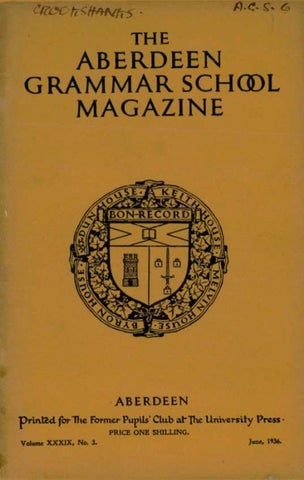
THE
ABERDEEN GRAMMAR SCHODL MAGAZINE
•
ABERDEEN Pupils' Club atlhe University Press • print24 for The Former PRICE ONE SHILLING. Volume XXXIX, No. 3.
t
June, 1936.
EDUCATIONAL BOOKS JAMES
G. BISSET
CONTINUES to supply all the Class Books (New or Second-hand) suited for the requirements of the Higher Educational Institutions in the City, at the Lowest Prices. N.B.—Best Value in Students' Note Books.
JAMES G. BISSET, Classical, Medical, and Educational Bookseller, 85 BROAD
STREET
(Opposito Marischal College).
Children need
ENERGY .I r#, kr)
O.)
0 0 =
0.4
TO tide them over the trying hours at school, children need energy! They'll get it from Hutchison's Bread. Assure their health by buying NOW!
•
M.M.P.
13 BRANCHES throughout the CITY
Culture Pearls of . . . Great Beauty
NECKLACES RINGS
BROOCHES EAR-RINGS
A. & J. SMITH .27JEWELLERS SILVERSMITHS
o
WATCHMAI{ERS OPTICIANS
191 UNION STREET, ABERDEEN -
-
--.• _
-
LITTLE'S FOR FASHIONS Value
Quality
Fit
Selection
Wear
Outsie A
Speciality
A. C. LITTLE & SONS, LTD. 105 UNION STREET
•
ABERDEEN
THAT
FAILS
NEVER
TO
IAT 1 I IF
.
To all who find pleasure in things of homely interest, Galloway & Sykes' stock is sure to appeal. You will find all the furnishings you desire at prices far lower than you anticipated. WE CORDIALLY INVITE YOU to walk around our COMPLETELY FURNISHED MODEL ROOMS at your leisure without any obligation to purchase.
INSPECT OUR MANY NEW DEPARTMENTS SOFT FURNISHINGS CARPETS BEDDING You will find man) things of absorbing interest and beauty.
GALLOWAY & SYKES LIMITED
361-363
Union St., Aberdeen
JAMES FYFE & SON PAINTERS
GLAZIERS.
AND .
.
•
OFFICE AND SHOWROOMS:-
11 DEE STREET, ABERDEEN. Telephone 304.
Telegrams--" Fyfe, Painters."
TELEPHONE . NO. 1719.
TELEGRAMS . "HUB, ABERDEEN."
CAMPBELL & SELLAR, LTD. Engineers, Hirers and Garage Proprietors
QUEEN'S CROSS GARAGE to Fountainhall Road ABERDEEN OPEN DAY AND NIGHT
ANY MAKE OF CAR SUPPLIED
py/ '/
/i.
/,"
\
;;4
THE
-FAMILY COFFEE Curls
$-
Coffee
is the favourite / drink with every.
It is most one. especially de icious. Your in sold weather grocer can supply you.
CUPP'S COf ABERDEEN.
Quality is our Truest Economy
ROBERT STOTT Family Grocer Italian Warehouseman, Tea, Coffee, Wine and Spirit Merchant
53
ALBERT STREET, ABERDEEN Telephone 1848
Oe
z a
-.............„,„ r BOOKS BOUND 0
0 7
z
M
co Z
Wt.'.
JAC-KSON ( ABERDEEN )L?o 18 BACK WYND
O o
CO ALL
J/
0 —
Z # 0
SORTS AND SIZES
Telephone No. 291
Established 1855
Tailoring of Distinctive Character modelled on ULTRA-MODERN lines. FRED WATT'S Suitsto-Order
bear
the
Hall Mark
of
Good
Taste
80/- 95/- to 126/-
PRICES:
FRED WATT
23 BRIDGE STREET, ABERDEEN 'Phone 3515
r-
COPLAND DECORATOR jelletoerm,Onacsk9reetcleeir e.-- SPECIALIST CV-
• tiikr •
-.VIP
STAINED GLASS & ob MURAL DECO adearky.enA
. A. D. COPLAND.
Phone 896.
Telegraphic Address: " Undertake, Aberdeen."
Telephone No. 2300. Works: Rosebank Place.
GORDON & WATSON FUNERAL UNDERTAK AND
MOTOR
HIRERS
12 HOLBURN ST. & 40 VICTORIA RD. ABERDEEN
W. KENNAWAY, Ltd. BAKERS and CONFECTIONERS, 5 and 7 Holburn Street. Luncheon, Tea, and Reception Rooms, 1 73 Union Street and 8 Bridge Street, ABERDEEN
SPECIALITIESSHORTBREADWEDDING CAKES. ROYAL DEESIDE IN TARTAN TINS, ALSO A LARGE SELECTION OF PLAIN AND FANCY ICED CAKES.
Telephone No. 1891.
ARCHIBALD McKELLAR Family Grocer and Wine Merchant, 454-456
Union Street, Aberdeen. . .
Cooked
IVe Specialise in . .
Gammons, Finest Belfast Smoked Hams, " Harris's "
Wiltshire Bacon.
Medicinal Wines—Vibrona, Hall's, Wincarnis, Glendenning's.
Wedding
Wedding
Cakes
Catering
ALSO
Christening, Birthday, Anniversary Cakes of Finest Quality
MITCHELL & MUIL LTD. Always insist on
FLOCKHARTS' AERATED WATERS Address—Craibstone Lane, Aberdeen. Telephone 873.
ESTABLISHED
1897.
A. &W. ALEXANDER Fishmongers Butchers Game and Poultry Salesmen PURVEYORS
492
OF THE
FINEST
QUALITY.
UNION STREET ABERDEEN Telegrams—
Telephones-5172 (3 Lines).
"Alexanders, Fishmongers, Aberdeen."
Telephone -Aberdeen 1710.
The Mastrick Dairies Ltd. 1 DESSWOOD PLACE, ABERDEEN
WE offer you a Choice Selection of DAIRY PRODUCE from our own Farms, and produced under the direct supervison of members of the family. Our Customers may rely upon the absolute Purity and Cleanliness of all our products. Distributors of Lord CarnegIe's and Cairnbrogie Certified Milk.
Head Dairy:
3, 5, and 7 WHITEHALL ROAD. Branches : 33 FOUNTAINHALL ROAD. 7 MID STOCKET ROAD. 25 BEDFORD PLACE. 473 GREAT WESTERN ROAD.
CONTENTS ILLUSTRATIONS. . . . . James Davidson, M.A. . • • . . William Kennedy . . The School 1st XI-Season 1936 . . • The School Prefects—June 1935-36
_-
.-
Facing page 192 ,, ,, 193 „ ., 224
. • . -
>3
225
.,
. . Page 169 . . . . A Message to Former Pupils 171 . . . . . . . 2928 of Souvenir" War " A 172 . . . . . . . Notes About Old Boys . . „ 287 . . . . . . . . Marriages . . ,, 288 . . . • . • . . . Obituary 191 . . . . . . Death of Mr. James Davidson. . •• 193 . . . Death of William Kennedy—The " Janny " . - 193 . . . • • • . . The Lorelei . • • • ., 194 The School Three-quarters of a Century Ago . In the Western Desert. By Captain Duncan S. Cochran, R.A.M.C. „ 203 James Cromar, Rector 2803-2825, and the Teaching of Latin. By . ,, 207 . . . . . . Dr. A. A. Cormack "
"
"
School Section— . • . School and Random Notes • • • • . . Sports. The Athletic Reminiscences of Paris, April 1936. By A. C. R. Watt • . • . When we are Gone (Sonnet) . • • . . Education. By T. M. Allan . . . • Arnaud C. By F. Films. Documentary Bird Life on the Isle of May. By D. R. Macgregor . • • Summer-Term Games and Athletics . . . . • . . . 1st Xl Matches . . . . . Tennis Club . • . . . . . House Notes • • • . . • . Scout Notes . . . School Office-Bearers for Session 2935-1936 The Former Pupils' Club— . . The Club Boarding House Members of the Club Resident Abroad Rugby Section Cricket Section Tennis Section . Badminton Section . • • List of New Members . Appointments in the East •
•
•
•
•
•
•
•
•
•
•
•
•
•
Retirement of Mr. Peter Edward
.
•
• . . •
• . . • • • • • •
2)
212
"
215
„ 226 218 228 P, "
., ,,
221 222 223 224 226
,, 216 zz 8 z3o
•
•
•
•
233
•
•
•
•
2 35
•
•
•
• •
•
•
•
•
•
•
250
•
250
•
250
•
250
•
•
•
•
•
•
12
2 48 248 2 49
•
RODEX COATS have a world-wide reputation. Ask to see them in all kinds of coating fabrics. The smart checked coat illustrated above is made from Orkney Tweed and is priced at
5 GUINEAS The Man's Shop —
UNION
STREET
ABERDEEN
Pleasant ! Uniform ! Reliable ! Entrancin
•
(Lap`
That is what they all say about our Brown Bread NINE different VARIETIES
W. M. McPHERSON Baker and Confectioner, •
is FOUNTAINHALL ROAD -
-AND
8 ST. SWITHIN STREET
ABERDEEN
ESTABLISHED
1843.
LOW'S BOOKSTALLS
Wm. Cay & Sons
39-50 New Market Gallery ABERDEEN
ifuncral thavrtakerf3,
BOOKS on All Subjects and at
415 UNION STREET
All Prices Over 500,000 Volumes in Stock Educational Books in Great Variety
AND
209 GEORGE STREET, ABERDEEN. Motor Hearses and Cars for Town and Country Funerals.
CATALOGUES ISSUED Telegrams—"Cay, Aberdeen." 'Phones Nos. 92 and 54.
• PHONE 3332
ESTABLISHED
By
APPOINTMENT
IRIO
To H.M. THE
KING
J. WILLIAMSON & SON (W. B. WILLIAMSON. PROPRIETOR)
Meat Purveyors and Poulterers 1, 2, & 3 MARKET BUILDINGS, ABERDEEN 'PHONE BRANCHES 3
4S2
3S FOUNTAINHALL ROAD 'PHONE 1724 ALSO AT
THE SQUARE, CULTS 'PHONE. CULTS 2
CHURCH SQUARE. BALLATER 'PHONE 38
"RECOLLECTIONS OF AN OLD LAWYER" by
LACHLAN MACKINNON Advocate in Aberdeen With 11 Full-Plate Illustrations.
5/-; Postage 6d. extra.
D. WYLLIE & SON 247
Booksellers
Publishers
UNION
STREET,
Stationers
ABERDEEN
Established 1814
Telephone 402
COUNTRY HIRES AT CHEAP RATES CARS
GARAGED
COLIN S. CLARK DAIMLER TAXI HIRER DAY AND NIGHT SERVICE
PHONE 4422
46 HARDGATE, ABERDEEN
ROBERTS (ABDN.) LTD. Cabinetmakers, Upholsterers, Carpet Warehousemen RECOGNISED AS EASILY FIRST IN
FURNITURE VALUE Our enormously increasing business testifies to the popularity of our good class and dependable productions. We employ a large staff of highly-skilled craftsmen, and their number is being steadily augmented. You will find our prices surprisingly low. AS AN INVITATION, PLEASE ACCEPT THIS ANNOUNCEMENT TO INSPECT OUR LARGE STOCK OF FURNITIRE AND FURNISIIINGS.
NOTE A DDRESS :
419 Union Street, ABERDEEN
BUY BRITISH
Handicrafts
BUY BEST
THE IMPERIAL TYPEWRITER Raffia and Cane Seagrass and Stool Frames
too% British, is the belt and lowest-priced Standard Typewriter. No increase.
THE IMPERIAL PORTABLE The Belt Portable, ioo% British.
DRAWING MATERIALS of every description
Second-Hand Bargains of all Makes of Typewriters.
Taylors' Art Saloon
EASY
Picture Framers and Artist Colourmen SCHOOLHILL
49-51
DEFERRED
PAYMENTS
(Hire PnrChaSel ON ANYTHING.
C. H. WEBSTER 4 Rose Street, Aberdeen
ABERDEEN
'Phone 505
BUY BEST
Telephone 2870.
BUY BRITISH
Why Wait for Watch Repairs? Buy a CRUSADER Watch and never be bothered with repairs. Instead of repair, a new movement is fitted while-you-wait by any CRUSADER Agent throughout the world. 5 years' guarantee. Call for Demonstration or write for Free Catalogue. Prices from
3
Cru5aber
Gas
EXACT TIME — NO REPAIRS
Chromium, £4
0 0
Stainless Steel, £6
JAM II IEVID N ENGAGEMENT
142
RING
0
0
Over 100 Models for Ladies and Gentlemen.
Gold, £8 15
IC/A.1U SPECIALISTS
UNION STREET (next Union Bridge), ABERDEEN
COAL ELLIS & McHARDY LTD. (ESTABLISHED 1880)
QUAY
REGENT
18
AND
I3Oi
UNION STREET
ABERDEEN Telephone 2889
Telegrams " COAL, ABERDEEN "
GEORGE BISSET'S Clan Tartan Warehouse
15 UNION STREET ABERDEEN
' -
04.
di
-
CLOTHIER TO THE
ADMIRALTY, R.N.R., and R.N.V.R.
HIGHLAND OUTFITS : a Speciality for Boys, Youths, and Gentlemen, also for Maids' and Ladles' Wear; and will gladly supply patterns of Ladies' favourite Tartans for Kilts. Telephone 2680.
;,•
•
Co-operation HE enthusiastic co-operation of many minds and
rT hands make possible the fine productions of the HOUSE OF OGILVIE. For over three-quarters of a century our constant endeavour has been to give the best possible service to our Customers. We base our claim to your patronage on our ability to please you.
J. & A. OGILVIE 369
UNION
STREET,
ABERDEEN. Telephone : No. 433.
STRACHAN COMMERCIAL &
PORTRAITURE PHOTOGRAPHY Telephone 851
Telegrams : " Interiors."
Showyard Erector to the Highland and Agricultural Society of Scotland, and Contractor to the Royal Northern Agricultural Society.
JOHN REID & CO. HOUSE CARPENTERS AND JOINERS
55 Blenheim Place and 14 Fountainhall Road ABERDEEN Carpentry and Joinery NVork of
416 UNION STREET
every description done
ABERDEEN
i STIMATES ON APPLICATION -Telephone No. 1997
SALES AND SERVICE in the North Consult—
UNION ROW ABERDEEN Works
-
49 Huntly Street
NORTHERN ASSURANCE COMPANY LIMITED. Established 1836.
Assets £23,000,000.
ALL CLASSES OF INSURANCE, INCLUDING:—
FIRE ACCIDENT
LIFE MOTOR CAR
Life Assurance Branch. The Company's Tables of rates for Life Assurance include every class of Policy. Write for Particulars of:— Whole Life Policies Family Income Policies Endowment Assurance Policies Educational Endowment Policies House Purchase with Life Assurance Children's Deferred Assurance Policies
ABERDEEN LONDON
CHIEF OFFICES: 1 Union Terrace. - 1 Moorgate, E.C.2.
-
Aberdeen Board of Directors. A. S. R. BRUCE, ESQ. I The Right Hon. The Loki) The Right Hon. The EARL or FORBES. CAITHNESS. A. MARTINEAU, ESQ. FRANCIS J. COCHRAN, ESQ. R. W. WALKER, ESQ. WILLIAM L. COOK, ESQ.
Manager Secretary
R. MACKAY. J. L. WILLIAMS.
Aberdeen Grammar School Magazine 5ist year : No. r33 VOL XXXIX
e
(New Series, 42nd year, No. 124) juNE 1936
No. 3
The "Grammar School Magazine" is issued under the auspices of The Former Pupils' Club, in March, June, and November. All communications with regard to the " Magazine " should be addressed to the Editor (the Secretary and Treasurer of the Club), THEODORE WATT, M.A., The Rosemount Press, Aberdeen.
A Message to Former Pupils.
*
There have been many stirring events at home and abroad during the six months which have elapsed since I wrote my last message, but the School chronicler is not concerned with them. It is true that some of the major events came home more vividly to School than others. The death of King George and the Proclamation of King Edward were cases in point, but it would not be wide of the mark to say that a half-holiday is infinitely more important to the youthful mind than the flouting of a Treaty, and the winning of a School match than the malpractices of highly-placed politicians. One's chief recollection of the latter half of the winter and of most of the spring is of a sequence of dreary weeks of rain and chilly winds, during which the majority of games were cancelled. The Cricket Season has not been too bad by comparison with previous years, and the two days devoted to the Annual Sports could not have been bettered. As evidence of our luck, it may be mentioned that on both of these days there was practically no cricket in England on account of rain. If the Sports this year lacked the record-breaking thrills of 1935, I think it would be true to say that the general level of achievement was creditably high. It seemed to me that the march past of the Houses was more effective as a spectacle than ever before. The extension to the Pavilion has been completed apart from a finishing coat of paint, and the long-standing grievance about inadequate facilities for dressing and bathing has now been removed. We have been fortunate in securing Rugby fixtures with George Watson's and Daniel Stewart's, one game per annum with each school to avoid unnecessary expense. There is no incongruity when speaking of games in referring to the sudden and lamented death of a former Master,
17o
Aberdeen Grammar School Magazine
Mr. James Davidson, who, in earlier years, gave ungrudgingly of his time and business capacity to School athletics, particularly to Cricket. He had only the briefest enjoyment of his well-earned leisure, and his long and devoted service to the School is recalled with gratitude. F.P.s will regret to hear that Mr. Peter Edward, our Science Master, has undergone an operation from which, happily, he is making an excellent recovery. He has decided, however, to anticipate by a year or so his normal date of retirement, so that we lose yet another of the " old familiar faces." No Master has earned the esteem and affection of his pupils to a greater degree than Mr. Edward. Modest, sincere, hard-working and eminently capable, he will be greatly missed. Educational tours abroad have now a recognised place in the curriculum of Secondary Schools. Reference was made in the Easter issue of the Magazine to the trip to Paris. In July a party of twenty-one boys from the Grammar School will join a cruise under the auspices of the Secondary Schools' Travel Trust, visiting Dunkirk, Cadiz, Gibraltar and Lisbon. The party will be under the capable leadership of Dr. R. M. Macandrew, and an enjoyable and profitable holiday is assured. The Boarding House continues to prosper. The only problem—and it is becoming a serious one—is to find room for all the applicants for admission. Further enrolments for September 1936 are out of the question, and so far as the Directors can foresee, the position is not going to be materially eased one year hence. The only method of making reasonably sure of entry is to book well in advance, as some shrewd people are already doing. One recent acceptance is presently zi years of age. Lastly, a word on after-school employment. The situation at the moment is somewhat puzzling. For about four years the trouble was to find jobs for boys. To-day the difficulty, in my experience, is the other way about. Boys seem to be more discriminating in their choice, and I can best illustrate my point by stating that for six vacancies offering at present—C.A., Banking, Insurance, Chemists, Wholesale Provision Merchant, Men's Outfitters—only three applications in all have been received. Apparently no one wants to be a C.A.—a very marked change of front so far as this School is concerned. Is it a case of boys fighting shy of an overstocked profession, or is the training too long and too exacting ? To judge by the appeals I get from cities other than Aberdeen, the difficulty is not merely a local one. The Distribution of Prizes will be held on ;oth June, and you will be fitly represented at the ceremony by your President, our Lord Provost. D. M. A. 16th June, 1936.
Aberdeen Grammar School Magazine
27t
A War " Souvenir" of 1918. In June of last year Mr. James W. Milne, C.A., London, the former Secretary of the F.P. Club, received a very unexpected post card from a correspondent in Germany, and in view of its interesting character, he sent it to the present Secretary. The post card was from Herr Richard Staude, Auerbach i. Vogtland, Sachsen, and a translation of it reads as follows :— " Your esteemed address I hold in consequence of a strange occurrence. As front line combatant in March 1918 I found in an ' Underground' in the vicinity of Hermis in France an illustrated hook containing your address. " This I appropriated and to-day, after 17 years, it happens to be again in my hands. " It would interest me, unknown as I am to you, to receive from you a brief communication. " With German Greetings."
As it seemed likely that the " illustrated book " containing Mr. Milne's address was a copy of the Grammar School Magazine, the present Secretary of the Club wrote to Herr Staude asking whether this was the case, and another post card, in reply, was received by return of post. The following is a translation of it :— Auerbach i. Vogtland. 6-7-35. My very dear Sir, I thank you for your esteemed letter of the znd instant. I understand from it that, as I translated, Mr. Milne has not taken part in the war but that in 1918 he was your predecessor of the " Aberdeen Grammar School Magazine." In this publication were also to be read letters from Scottish soldiers. As I have already told you, I found in 1918 (it was between zest and 25th March) the envelope with a handkerchief left behind by a Scotsman in a broken-down " dug-out." It lay as I remember with other publications to which I paid no attention. If perhaps you think that the little episode which by your wish I have willingly contributed, relating to life in war-time, for insertion in your publication of war tales can be of interest, I might not be opposed to the proposal. Please accept from me with the hope that 1 may hear from you again, my best Greetings and be good enough to convey the same to Mr. Milne. Yours respectfully, RICHARD STAUDT%
Me
It would be interesting to know to what member of the F.P. Club this Magazine had been sent. It is doubtless a copy of the issue of February 1918, which was full of war news, and contained letters from an F.P. serving in East Africa and an account by another F.P. of the torpedoing and sinking of the transport Aragon in the Eastern Mediterranean on 3oth September 1917. The fact that a copy of the Magazine fell into the hands of one who was then an enemy shows how wise were the very strict regulations then in force as to what war news might and might not be printed. It is intended some day to print in the Magazine one or two articles which during the War were suppressed by the Censor.
172
Aberdeen Gran/mar School Magazine
* It is requested that the Editor be informed of all new appointments and interesting incidents in the careers of Former Pupils.
The dates given in parentheses after names indicate the sessions of attendance at the School. William McCombie Alexander* (1887-96), M.A., B.L., is one of three Aberdeen members of the party of scientists, headed by Professor Carroll of Aberdeen University, who travelled specially to Omsk in Siberia to observe the eclipse of the sun on 19th June. The Aberdeen contingent left about the middle of April, and on 8th May reached Omsk, which has a population of about 240,0O0. It is on the east bank of the Irtysh, a large river with steamers upon it. The instruments which the party took with them weighed three tons, and cost about £2,OOO to make. The expenses of the expedition will amount to about another £I,ooo, towards which generous local support has been received. Mr. Alexander was in Russia in 1930, and gave some impressions of his visit in the Magazine of November of that year. George Anderson* (1914-24), who has been engaged in rubber planting in F.M.S. for a number of years, is acting manager at Huntly Estate, Lumut, The Dindings. Robert John Anderson* (1895-99), of Messrs. Reith and Anderson, Ltd., auctioneers, Aberdeen, was in March elected President of the Institute of Auctioneers and Appraisers in Scotland. Eric William Beattie* (1 9 2 1-28), C.A., has recently left Aberdeen to take up an appointment with Messrs. Jackson, Taylor, Abernethy & Co., chartered accountants, London. He served his apprenticeship with Messrs. Flockhart & Grant, C.A., Aberdeen. Ronald James Beanie* (1927-36), who left the School at Easter, has obtained a post in the Aberdeen branch of the Liverpool and London and Globe Insurance Co., Ltd. William Stephen Benton* (1904-71), who has been for many years in the service of the Indian State Railways, is at present home in Aberdeen on furlough. * Member of Former Pupils' Club.
Aberdeen Grammar School Magatine
0
•
a
•
173
Walter George Swan Benzie* (191-7-19), B.Sc., is in the Royal Tank Corps, and is at present stationed at Bovington Camp, Wool, Dorset. Edmund Blaikie Boyd* (I 900-t 2)' C.M.G., M.A., principal private secretary to the Secretary of State for the Colonies, was a witness before the Tribunal appointed to investigate the allegations of an unauthorized disclosure of Budget secrets, and gave evidence of the regulations governing visits to the Colonial Office. . Eric William Harcourt Brander* (1894-1901), M.A., LL.B., recently resigned from the Herring Industry Board, on the ground of dissatisfaction with the work of the Board. G. Stephenson Brown* (I 9t o- r3), A.M.Inst.C.E., is on the permanent engineering staff of the London and Nofth-Eastern Railway, and resides at East Boldon, Co. Durham. James Cheyne* (19a-1i), about whose address an inquiry appeared in the last Magazine, is now with Mr. George H. Gordon, insurance broker, 172 Market Street, Aberdeen. William Pearse Chope (1917-23) was last year appointed to the staff of Waverley Secondary School, Birmingham. Stewart Buyers Chrystall* (1921-31) points out, with reference to the article on " The Second and Third Generations " in the last issue of the Magazine, that he represents the fourth generation of his family's connection with the School. One of his great-grandfathers was (I) DAVID MITCHELL, advocate in Aberdeen, who was at the School in 1827-28, and died in 1897, aged 83 years. His daughter, Joannah Isabella Mitchell, married (2) Rev. ANDREW JAFFRAY CHRYSTALL (18S9-6o), for many years minister of Newhills U.F. Church, Bucksburn, who died in 19zo. Their son, (3) DAVID MITCHELL CHRYSTALL (1888-90), was for over thirty years agent at the Quayside Branch, Aberdeen, of the North of Scotland Bank, and died on 1 1 th April, 1935. He was the father of (4) STEWART BUYERS CHRYSTALL, who, on his mother's side, had no fewer than seven uncles at the School. Andrew Clark* (1 89 5 -1 901), M.A., Secretary and Treasurer of the School Board, Queenstown, Cape Province, is coming home on a holiday trip this summer. He has not been in this country since he went out to South Africa in 1908. James Cobban* (1925-32) is at present engaged on a year's apprenticeship with the English Electric Co., Ltd., at Stafford, in connection with his course at Faraday House, London. This is his final vear. Duncan Scott Cochran* (1914-24), M.B., Ch.B., who received a commission in the Royal Army Medical Corps last year, was gazetted Captain on 1st May, 1936. He is at present
1 74
Aberdeen Grammar Sebool Magazine
stationed in Egypt, and a very welcome contribution from him appears elsewhere in this issue of the Magazine. Frank Lang Collie* (1877-80), M.D., who retired from medical practice some years ago, is now resident in Bournemouth. His journalist wife, widely known as " Wilhelmina Stitch," died a short time ago. Patrick Ashley Cooper* (1896-1901), B.A., LL.B., is a member of the Advisory Council appointed to assist the Air Ministry in controlling prices in connection with the Air Force expansion programme. As Governor he presided at the Annual General Court of " The Governor and Company of Adventurers of England trading into Hudson's Bay " at the end of May, when he was able to report that the outstanding feature of the meeting was the largely increased profit and the resumption of the payment of a dividend. In the course of his speech he said :— Now that we have at last been able to give the shareholders some reward for their patience, I think it is a suitable occasion to review quite briefly the Company's progress since 1931, for, as you know, it was in that year that the present Board was elected. Since then there has been a general depression in Canada. We have faced droughts, and wheat has touched the lowest figure in history. This lack of prosperity among the farmers has a paralysing effect on the operations of our stores and land department. When you add to this the difficult business conditions all over the world and the consequent sharp decline in the selling prices of furs, you have the background against which we have been working. You will remember that the accounts for 1930, which I presented to you soon after taking office, showed large losses on both revenue and capital account, and that further heavy losses had to be provided for in 1931 and 1932. Since then we have been able to show profits in 1933 of £28,000, in 1934 of £41,000, and in 1935 of ;f 145,000. These figures show a steady recovery, but you must not expect progress to continue at the same rate. . . . It is evident that we are round the corner, though I will not go so far as to say that we are free of our troubles. For conditions in Canada, improved as they arc, still give cause for anxiety, while in other parts of the world they remain seriously unsettled.
Arthur James Croxford* (1882-83) retired on 31st March from the service of the Paddington Borough Council, London, with whom he has been for fifty-two years. Alexander Bothwell Donald* (1922-28), M.B., Ch.B., is at present on the staff of the North-Western Hospital, Hampstead, London. He graduated in medicine in 1933. John Wight Duff* (1877-82), D.Litt. LL.D., F.B.A., formerly Professor of Classics and Ancient History, Armstrong College, Newcastle-upon-Tyne, has been acting since January as Sather Professor of Classical Literature in the University of California, Berkeley, U.S.A., and in that capacity has delivered a course of public lectures on " Roman Satire—Its Outlook on Social Life." In May he lectured by invitation in the University of Stanford, his subject being " Roman Society in the Early Empire." Ile is to represent the University of Durham at the Tercentenary celebrations in September of the University of Harvard, Cambridge, Massachusetts.
Aberdeen Grammar School Magazine
•
♦ •
1 75
Robert Hutton Duguid* (1918-23), B.Com., C. A., continues in the service of Messrs. Duncan Brothers & Co., Ltd., Calcutta. David Edwards* (1903-09), M.A., LL.B., who some time ago was appointed Relieving President, District Court, Palestine, has recently been gazetted President of the District Court, at Jaffa. He entered the Colonial Legal Service in 1921. Francis Millar Esson* (1918-25) haseresigned for health reasons from the Royal Merchant Navy, and is now junior manager with Messrs. F. W. Woolworth & Co., Ltd., ,in the Royal Tunbridge Wells branch. He served as an apprentice cadet with the British India Steam Navigation Co., Ltd. Alexander Fiddes* (1870-75), M.A., D.D., who was minister of St. Bernard's, Edinburgh, until his retiral in 1925, celebrated in March his ministerial jubilee and his golden wedding. He was ordained to the parish of Cairney, Aberdeenshire, in 1886, and was translated to Edinburgh in 1900. Since his retirement he has rendered great service as chairman of the Church of Scotland Ministers' and Scottish University Professors' Widows' Fund, and as vice-chairman of the Deaconess Hospital Board. His wife is a daughter of the late Colonel JAMES ALLARDYCE (1842-44), LL.D., of Colquoich, Aberdeenshire, who died in March 1910. Twn of her brothers are members of the F.P. Club—KENNETH JAMES ALLARDYCE* (1894-95), Fiji, and GAVIN LEITH ALLARDYCE* (1894-1900), M.A., W.S., Edinburgh. Dr. Fiddes's father, EDWARD FIDDES (1830-;4), was for many years manager of the North of Scotland Bank, Aberdeen, and a brother is EDWARD FIDDES* (1876-81), M.A., LL.D., formerly Ward Professor of History in the Victoria University of Manchester. A brother-in-law is Mr. Hugh Fraser Campbell, M.A., B.L., advocate in Aberdeen, formerly English Master in the Grammar School. James Francis Forbes* (1921-27) continues in the service of Messrs. Milne & Co. (S.A.), Lima, Peru. William Forsyth (1883-84), M.A., whose death at Grantownon-Spey on 9th December, 1935, was recorded in the last issue of the Magazine, left net personalty amounting to k5 1,536. James Chalmers Gall* (1926-27) is at present Third Officer on the motor ship King Malcolm. William Edward Glover* (1896-98), M.B., Ch.B., who joined the West African Medical Staff, Nigeria, in 1913, and became Senior Medical Officer in 1928, was in April gazetted Deputy Director of Medical Services, Nigeria. He is the F.P. Club Consul for Southern Nigeria. George Byron Gordon (1795-98)—Lord Byron—continues, after more than one hundred years, to be " in the news." A Reuter telegram from Athens on 5th April announced that an imposing ceremony, in which the King and Crown Prince took
176
Aberdeen Grammar School Magazine
part, was held that day at the little town of Missolonghi, where Lord Byron died while helping the Greeks in their struggle for independence against the Turks. The celebration commemorated the heroic sortie of the besieged population in 1826. A religious service was held at the house where Lord Byron died, and a beautiful wreath was placed there by the King in memory of the " English " poet. It was also announced that in future Missolonghi would be proclaimed a sacred town. Again, Byron is the subject of a recently published three-act play, entitled " Falling Angel," by Gerald Gould and Barbara Burnham. The authors take the years 1812-1816 as their period —that is the period between the dazzling success upon which Byron woke to find himself famous, and the date when loathed, shunned, and derided, he shook the dust of England from his shoes. In a review of the play in The Observer we read : " There are very few figures in history whose affairs concern us as vividly as those of our contemporaries. Byron is one. In his life not only England, but all Europe followed his doings with a dazzled interest, which only Napoleon himself could share. Since his death he alone of his age in England has remained a living, brilliant, and scandalous visitor in the drawing room and the study of our minds. Byron is not a historical personage to be assessed, attacked, and re-established. He is as lively a diurnal incident as the latest murder trial or the caprices of a film star. Another cried proudly, ' non omnis moriar ' ; Byron could with equal truth have said, ' There is nothing of me that dies or fades.' " Sir Robert William Lyall Grant* (1884-91), M.A., LL.B., has recently retired from the position of Chief Justice of Jamaica, to which he was appointed in 1932. He was previously Puisne Justice, Ceylon, and was created a Knight Bachelor in 1934. Douglas Williamson Grassick* (1931-34) has for over eighteen months been working as a pupil in the Humber Works, Coventry. John Alexander Gray* (1926-3o and 1932-3 5 ) —son of Professor Alexander Gray, Edinburgh—is at present studying at the Royal Academy of Dramatic Art, London, with a view to film work in the future. John Greenlaw* (1884-93), minister of the North Church, Buckie, was at a meeting of the Provincial Grand Lodge of Banffshire in May installed as Right Worshipful Provincial Grand Master. The impressive ceremony was performed by Sir lain Colquhoun of Luss, Most Worshipful Grand Master Mason of Scotland. John Hartley Henderson* (1913-21), who was engaged in tea planting in Ceylon for ten years, came home in 1934, and almost immediately afterwards was appointed representative in
Aberdeen Grammar School Magazine
177
Scotland of Messrs. T. Bass & Sons, wholesale tea merchants, 9 Colonial Avenue, London, E.C.3. l le is resident in Aberdeen. Edward Alexander Hunter* (1917-26), who is in the Palestine Police, was recently promoted to be Corporal and in charge at Tel-Aviv. No doubt he has been having a lively time there recently. William Greig Hutcheon* (1914-z3), who has been for a number of years with the United Africa Co., Ltd., in Nigeria, is now with the Niger Company at Maroua, French Cameroons. He was recently home on holiday, and became a life member of the F.P. Club. Arthur Gilbertson Hutchison* (1909-21), B.Sc.(Aberd.), Ph.D.(Cantab.), who has specialized as an oil exploration geologist, is at present in Trinidad, British West Indies. He was previously in Sarawak, Borneo. James Inkster* (1881-88), who was for many years a Captain in the Blue Funnel Line, after retiring from the sea at the end of 1931, was appointed to and still holds the post of Board of Trade Examiner of Fishermen in Aberdeen. In January 1935 the Secretary of State for Home Affairs was pleased to appoint him an Assessor under the Marine Shipping Act of 1894. Ian George Innes* (1905-08), M.A., B.Sc., M.B., Ch.B., points out that his son, IAN DUNBAR INNES, who is at present in Classical IV of the School, represents the third generation of the family that has attended the School, and that this fact should have been recorded in the list that appeared in the last issue of the Magazine. The succession is (t) JOHN BREMNER INNES (1862-64), M.A., formerly parish schoolmaster at Strathdon, Aberdeenshire, who died in December 1919 ; (z) Dr. IAN GEORGE INNES (1905-08), who has been in medical practice at Hull since 1921 ; and (3) IAN DUNBAR INNES, who entered the School in 1933, and since then has been living in the Boarding House. Alexander Murdoch Irvine* (1924-27), A.R.I.B.A.—son . of Rev. JOHN IRVINE* (1886-88), M.A., Rector of the Episcopal Church, Insch—is at present working with a firm of architects in Birmingham. Douglas J. T. Jamieson* (1893-98), who has been in the service of the Bombay, Baroda and Central India Railway for the last thirty-one years, is at present home on extended leave. Ile hopes to retire before long. Alexander Smith A. Leith (1922-27) is in the service of the Burmah Oil Co., Ltd., at Khodaung, Upper Burma. He served his apprenticeship as an engineer with Messrs. A. Hall and Co., Ltd., shipbuilders, Aberdeen. Andrew William Logan* (1931-32) is at present in Manchester learning hotel-keeping at the Queen's Hotel, which,
178
Aberdeen Grammar School Magazine
he says, is recognised as being the best hotel in Manchester. He had a three months' course in the kitchen, and he is now learning the buying side of the business. He finds the purchasing of foodstuffs, etc., to be interesting, and likes the work very much. Norman Harley Savory Macbeth* (1919-24) received a commission in December last as and Lieutenant in the 4/5th Battalion The Seaforth Highlanders (T.A.). He is manager of Messrs. Duncan, Macbeth & Co., Ltd., The Bonded Warehouses, Invergordon. William McCormick (1881-89), who has retired after being for forty-four years in the Post Office, mainly in the Engineering Department, recently contributed his reminiscences to the People's Journal. In the course of these he wrote :— I must hasten to tell of the moment when as a small boy attending the Aberdeen Grammar School 1 determined upon a strange adventure. The temptation is strong upon me to write of my school, but let it suffice for the moment to say that one day the classes were visited by that great rector of my time, James Moir, M.A., who in cap and gown announced that the summer vacation was due to commence on such and such a date, and expressed the hope that the weeks of " leisure " would be well spent. How we cheered I My school-fellows were off to the hills and the sea, and don't blame me too much if I envied them a little, for I had something quite diffierent to do. Circumstances and the loss of my father made it necessary for me to earn some money, and there was not any to spare for a repetition of the glorious holidays of earlier years. A chance was given me to accept temporary employment as a telegraph messenger in the Aberdeen Post Office, where my late father had been chief of the telegraph department. Incidentally, he was the first .telegraph superintendent in Aberdeen on the acquisition of the old telegraph companies by the State. The transition from Grammar School manners and customs to the environment of the telegraph messengers' room was violent enough, and I venture to say much more of a shock to me than any experienced by the more sophisticated youth of to-day. But for real manliness and kindness of heart I hold a brief for the rough diamonds who delivered the buff envelopes containing tidings of joy and sorrow, profit and loss, news and portents, to the inhabitants of the Granite City in the '80's.
Murdoch McIntosh* (1928-33) is now in the Town Clerk's Department, Town House, Aberdeen. William Maclver* (1923-26) has received an appointment with Messrs. Siemens Bros. & Co., Ltd., Woolwich, London, in their Marine Wireless Section. He was previously a wireless operator of the Union-Castle Line. Ewen MacLean* (1902-03), M.A., is Assistant ChaplainGeneral, Scottish Command, Edinburgh, and is resident at I1 Learmouth Gardens, Edinburgh. Alastair McLennan (1923-29), M.B., Ch.B., twin son of Colonel FARQUHAR MCLENNAN* (1888-90), D.S.O., R.A.M.C., has received a permanent commission in the R.A.M.C., and has been posted to Malta. John MacLennan* (1888-9o), M.B., C.M., who has been in
Aberdeen Grammar School Magazine
0
179
medical practice at Thurso for many years, has recently retired, and is now resident at Reay, Caithness. Roderick Ross Forrest MacLennan* (1909-18) has for several years been with Imperial Chemical Industries, Ltd., in Belfast. His permanent home address is now An Cluaran, Croy, Inverness-shire. His brother, Hamish Frederick Forrest MacLennan* (1908-15), is at present i❑ Aberdeen with the Mutual Life and Citizens Assurance Co., Ltd. Edwin Salisbury Macleod* (1881-89), Commander, R.N.R., Principal Officer, Board of Trade, London, is a member both of the Management and Governing Committees of the Gravesend Sea School. He has recently been elected to the Committee of the Royal Alfred Institution, which provides a home for aged seamen in beautiful surroundings at Belvedere, Kent. James William MacLeod* (1920-31) has since October last been on the staff of Messrs. Blyth & Blyth, M.Inst.C.E., Edinburgh. James William Slesser Marr* (1913-19), M.A., B.Sc., who is in the Royal Research Ship Discovery II on her fourth commission in the Antarctic, had an unexpected experience when the ship was directed to go to the rescue of the American airmen, Ellsworth and Kenyon, who had been helpless in the Antarctic wastes for several months. Though the rescue of the airmen was one of the greatest sensations in flying history, Marr in writing home explained that once the fliers had been located, the actual rescue involved little difficulty. The adventure appealed to him particularly because it took him ro a new line of country, and added variety to his scientific work. Land was visited that they would not otherwise have gone near. We are privileged to reproduce the following extracts from three of Marr's letters to his home at Coynachie, Gartly :— Cape Town, 8th November, 1935. " We are off South to-morrow and I am frightfully busy. AU on board are well. All the way from Las Palmas the S.F. Trades were abnormally strong, and we had head winds reaching to half a gale most of the way to the Cape. We have done a lot of work, however, and got all prepared for our work in the South. The Admiral commanding the South African station came on board to-day and made a thorough examination of the ship, which was made spic-and-span to receive him."
•
Melbourne, z7th February, 1936. ports we called at. We had a marvellous in all the very busy I have been " time in the Ross Sea, and all on board appreciate highly the value of the splendid opportunity which, by sheer chance, came our way—because, besides picking up Ellsworth and Kenyon, we were able to do quite a lot of useful scientific work in an area which hitherto had been largely unexplored. We had a tremendous reception on our arrival in Melbourne, thousands of people having collected on the jetty. Sir Douglas Mawson, Sir James Elder, and Sir David Orme Masson lunched with us. Our ship is gradually being restored to her non-nal appearance and in a week or so we shall be
18o
Aberdeen Grammar School Magazine
ready to put to sea again. We are going South towards Adelie Sound, and then up to Fremantle. From there along Lat. 320 S. to South Africa." Cape Town, 14th May, 1936. " We have had an interesting voyage from Fremantle. We were working an experimental series of very deep and very large tow nets, fishing as far down as 12,OOO feet. We leave Cape Town about 18th May, returning about zoth June. It is going to be very dark and cold in that month."
Francis Joseph Scott Marshall* (19 i 4-/ 5) is in the Engineering Department of the Post Office Telephone Service, and for the past year has been stationed at Peterhead as maintenance lineman. Charles Matheson (1892-94), M.A., minister of Kinellar, Aberdeenshire, has just been elected to the congregatian of Dunvegan, Isle of Skye. His previous charges were the U.F. Church, Killearnan, Ross-shire; the South U.F. Church, Buckie; the U.F. Church, Alness, Ross-shire; and King Street Church, Aberdeen. . James Mearns* (1890-93), who is a specialist in diving, had recently a narrow escape from death during diving operations near Fort William. At the time of his mishap he was at work at Inverlochy, when he suddenly found himself face to face with death, 170 feet below the water surface, in a surge chamber in the 15-mile tunnel which brings power to the hydro-electric plant. He explained later that he went down to examine some concrete. He had been down some time when his suit caught some iron railings, which tore it just above the left wrist. Water began to enter the suit, and he felt terribly cold. He came up about 6o or 7o feet to relieve the pressure, and then went down again to complete the job. He reached the loch bed and saw that the tear was gradually opening. The water was now filling the suit, and he was getting less and less air. He at once signalled to the surface, and came up the ladder as fast as he could, while the men above were hauling on the line to help him. Coming up so quickly was the cause of the trouble. He temporarily lost the use of his legs, and suffered from the effect of air in his blood-stream. When he was brought to the surface he appeared to have recovered, but after half an hour be became ill again. He was accordingly lowered into the chamber and brought up by easy stages in an effort to remove the air bubbles from his blood. Everything possible was done on the spot, but by the time he was taken to Inverlochy he was black and blue. His blood-stream was impregnated with nitrogen, and it was decided to rush him to London for treatment. He was first taken to University College Hospital, where further treatment was given to relieve his suffering. He was later taken to the offices of the Submarine Engineers in Westminster Bridge Road. There he was wheeled into the decompression chamber and the doors were sealed. The compression was then gradually raised to the strength of the pressure he was under when in the tunnel.
Aberdeen Grammar School Magazine
x81
Doctors watched him through a window, and eventually he was released from the chamber and taken back to University College Hospital, where he quickly recovered. " Bends" or diver's paralysis, from which Mearns suffered, is caused by clotting of nitrogen bubbles in the blood-stream when a diver rises to the surface too quickly. Robert Charles Cruickshank Miles* (1923-3o) has been for the last two years a clerk with the Aberdeen and District Milk Marketing Board. Herbert John Mansfield Milne* (1900-05), M.A., of the Manuscript Department of the British Museum, is one of two scholars working on the famous Codex Sinaiticus. They are " combing out " every word in the Codex. Alexander Lessel Stephen Mitchell* (1911-19), B.L., has received an administrative post with Welwyn Studios, Ltd.— a subsidiary of British International Pictures, Ltd. He starts at the beginning of July, and is to go through every phase of filming. John Hendry Morgan* (1924-25), who is with Tanganyika Central Gold Mines, Ltd., at Sekenke, Tanganyika Territory, has been promoted to be Mine Secretary there. He has an assistant from Aberdeen, but he is not an F.P. Another F.P. at the mine is Arthur L. Ross Bisset, who was at the School in 1924-25. He had recently a truly miraculous escape from death. He was working underground on the 4th level and received a severe electric shock, which threw him down the shaft. He fell a distance of 58 feet, and by great good fortune landed on a native working at the bottom. Neither Bisset nor the native was seriously hurt, and Morgan says it is most difficult to understand why they were not both killed. He concludes a recent letter by saying that they are a very happy family on the mine, which is the deepest and most developed in Tanganyika Territory. James Cumming Niven* (19zo-26), M.B., Ch.B., who is on the staff of the Institute for Medical Research, Ipoh, F.M.S., is the joint author of a paper in the April number of the Transactions of the Royal Society of Tropical Medicine and Hygiene on " A Clinical Comparison of Atebrin Musonate and Quinine Bihydrochloride." William Balfour Smith Pigge * (1914-21), town-planning assistant to the Woking Urban Council, was recently transferred from associate membership to full membership of the Town Planning Institute. Edward Sutherland Pryor Rebecca* (1923-35) has entered the service of the Royal Insurance Co., Ltd., Aberdeen, and has passed the first section of the examinations of the Chartered Insurance Institute. William George Robertson* (1884 90), M.A., D.D., has
182
Aberdeen Grammar School Magazine
intimated his resignation, on the grounds of ill-health, from the ministry of the Old Church, Cullen. James Rust* (1876-85), M.A., M.D., retired owing to illhealth about eighteen months ago from medical practice in Birmingham. He has now recovered wonderfully, he writes, and intends to pay a visit to Aberdeen this summer. John Chesser Salmond* (1889-96) continues as manager of Lloyds Bank, Ltd., at Chelmsford, Essex. Herbert Brebner Scott* (1905-08), of the Royal Insurance Co., Ltd., Shanghai, is at present home on leave. During his absence his place as Club Consul in Shanghai is being taken by CHARLES F. KING* (1912-23), of the Chartered Bank of India, Australia and China. William Russell Scott* (1915-26), M.B., Ch.B., is now in general practice at Weymouth, Dorset. Harold Frederick Scrimgeour* (192 i -29), who was for a number of years with Messrs. Walker & Duncan, civil engineers and architects, Aberdeen, is now employed with the Commissioner for Special Areas in Scotland, and is resident in Edinburgh. William Philip Selbie* (1901-06), M.A., who is Commandant of the King George's Royal Indian Military School at Sarai Alamgir, Punjab, says in a recent letter that he is daily reminded of the Grammar School by the portrait of the late Sir ANDREW SKEEN (1880-86), who gave his name to one of the houses at the Military School. The school has its own pipers, and on such occasions as the passing of Sir Andrew they play " The Flowers o' the Forest." Alexander James Sheret* (189o-96), who went to the United States of America in 1911, and for the last eighteen years has been with the Theo. Presser Company, music publishers and dealers, Philadelphia, Pa., has now returned to this country and taken up permanent residence at his old home, 32 Bon-Accord Terrace, Aberdeen. John Alexander Trager Simpson* (1919-28) has been for about five years in the service of the Lake Shore Mines, Ltd., Kirkland Lake, Ontario. He lives at The Log Cabin, Swastika, Ont. William Evan Fraser Simpson* (1916-26), B.Sc. (Eng.), after nine years' residence in Glasgow, is now in the service of Durex Abrasives, Ltd., Adderley Park, Birmingham, as assistant maintenance engineer, and has become a Life Member of the F.P. Club. For about four months he has been in Dusseldorf, superintending the erection of a new plant for an associated German company. Frederick Alastair Smith* (1922-28 and 1930-33) is now with the Gordon Cleaning Company, at the dry cleaning and
Aberdeen Grammar School Magazine
183
dye works in Huntly belonging to his uncle, ALEXANDER W. CHR1StIE* (1878 - 87), who was for a long period Provost of the burgh. Malcolm Kerr Smith* (1921-30), along with a companion, essayed in the beginning of May to make the journey from Ballater to Aberdeen by canoe down the River Dee, a distance of about 5o miles. They launched their canoe just above the bridge at Ballater at 2.30 on the afternoon of Saturday, and May, watched by a large crowd who had come to cheer them on their way. Weather conditions were excellent, the sun shining brilliantly, and there was practically no wind. Between Ballater and Dinnet the canoeists had to negotiate several comparatively shallow stretches of the river, and after covering about 8 miles they came to the rapids near Dinnet House, where the river tumbles over numerous boulders. The small craft was difficult to handle in these conditions, and it overturned. Both the canoeists, however, succeeded in scrambling ashore with their canoe, and were taken into Dinnet House. On the Sunday they sct out again, but 2 miles below Dinnet House their craft again became unmanageable, and they received another ducking. On the Monday they once more set out for Aberdeen, and despite the many difficulties, the canoe was paddled at a good speed. A large crowd had assembled at the Bridge of Potarch and on the adjacent river banks to watch the canoe shoot the famous rapids at Young's Leap. Owing, however, to the dangerous condition of the river at this point, they received a police warning not to attempt the rapids, and they accordingly executed a short portage, entering the river again just below the narrows. Invercannie was reached about 6 rm., and there they decided to postpone attempting the remainder of the journey. On the following Saturday, however, the journey was resumed. On account of numerous difficult stretches that had to be negotiated, progress from Invercannie to Banchory was slow, but thereafter the passage was comparatively easy. The two young men camped over the Saturday night at Crathes, and completed their trip in leisurely stages. They arrived at the Bridge of Dee, Aberdeen, at 4.30 on Sunday afternoon, and ten minutes later came ashore at a jetty just below the Ferryhill railway bridge. So ended what they described as "a perfect holiday." Altogether the trip occupied i6i hours of travelling time. Sydney Robertson Smith* (1924-30), B.Sc.(Eng.), who has been in the service of the Aberdeen Harbour Commissioners, recently left to take up an appointment as assistant engineer in the Bridge Department of the Gloucestershire County Council. Herbert Lindsay Snowie* (1899-1901), who has been since 1912 in the service of Harrisons & Crosfield, Ltd., in the F.M.S., has now retired from the East and will probably reside in Aberdeen.
184
Aberdeen Grammar School Magazine
George Smith Sommerville* (1923-29), M.A., was in April licensed to preach by the Presbytery of Aberdeen. Archibald Douglas Spark* (19o5-lo), Captain, and Battalion The Gordon Highlanders, was recently stationed at Gibraltar, but is now in Egypt. George Mackie Stephen* (1920-26), M.A., M.B., Ch.B., was in May awarded at Aberdeen University the George Thompson Fellowship for 1936-38. Douglas Gordon Stewart* (1924-33) is at present serving as an apprentice with Messrs. Bower & Smith, chartered accountants, Aberdeen. James Laing Spalding Thomson* (1920-27), M.B., Ch.B. —son of Rev. JAMES LAING TI-IOMSON* (1894-96), M.A., B.D., Peterculter—is in medical practice at Bowes Park, London, N. Charles Rawson Trenerry* (1923-32) is in the service of Lloyds Bank, Ltd., and since February has been working at the Eastleigh branch, Hants. He expects to be there for the next four years. Edward William Watt* (1883-94), Lord Provost of Aberdeen and President of the F.P. Club, along with Principal Hamilton Fyfe of Aberdeen University, and a few others, took part on 3rd June in the inaugural flight of Highland Airways, Ltd., between Aberdeen and Shetland. The journey from Kintore Airport to Sumburgh, Shetland, took one hundred „minutes of flying time. Although the daily 'plane calls at Wick, the flight on this occasion was made direct to Kirkwall, a journey which occupied a little over an hour for the 126 miles. The conditions, it was reported, could not have been more delightful, the calm Moray Firth being of a Mediterranean blue under a blazing sun. From Kirkwall the 'plane passed over the Fair Isle, and after a "hop" of forty minutes, a perfect landing was made at Sumburgh, where the flying party were entertained at Sumburgh House Private Hotel. The return flight was accomplished in a little over ninety minutes of flying time. Theodore Watt* (1889-1901), M.A., was in May elected Vice-President of the British Federation of Master Printers at their annual meeting at Cliftonville, Margate. In the normal course he will, after a year, be elected to the Presidency of the Federation. He is Joint Managing Director of The Aberdeen University Press, Ltd. John Park Weir* (2928-24), M.B., Ch.B., Captain, R.A.M.C., is at present serving with the British Forces in the Western Desert of Egypt. George Alexander Wilson, Jun.* (2920-23), M.B., Ch.B., who is in the East African Medical Service, is at present stationed at Tabora, Tanganyika, and expects to be home on leave in September.
Aberdeen Grammar School Magazine
185
Alexander Lawson Wood* (1922-28), M.A., spent Easter in Denmark at an Oxford Group house party and National Demonstration at Ollerup, the place that is well known as the home of Niels Bukh, the physical culture pioneer of Denmark. The place was found to be ideal with its great indoor and outdoor stadiums for the thousands who flocked in from all over Denmark. They came by special trains and special ships : one from Holland with 300 on board, and one from Jutland with zoo Danes. Hundreds cycled the 140 kilometres from Copenhagen. The speakers were business men and their employees, count and farmer, student and housewife, in the great Easter meeting that was led by the Dean of the Cathedral in Copenhagen. Douglas Mitchell Wood* (1918-29), who served as an apprentice with the North of Scotland Bank, Ltd., Aberdeen, and for the last year has been with Barclays Bank (Overseas), London, left in May to take up an appointment with Barclays Bank (D.C. and O.) at Accra, Gold Coast, West Africa. He expects to be out for a first spell of eighteen months, and then home on four months' leave. "OUT FOR THE COUNT."
Once again the School was prominently represented in the annual " show " presented in April by the Aberdeen University Students' Representative Council in aid of the Aberdeen hospitals. In the cast of the "All Varsity Original Musical Comedy," Out for the Count, three of the leading parts were taken by James Finlayson Mackay* (1919-32) ; Douglas Stuart Sandeman Marr* (19 t 9-32), and Alexander Ross Hewet* (1926-32), M.A. The " book," music and lyrics were the work of Allan Cameron Frazer (192 5 -30), M.A., and Royston John Milne* (1918-30), M.A., who are now both law students. The performance was a delight from start to finish, and reflected the utmost credit on all concerned. •
ABERDEEN UNIVERSITY DEGREES AND PRIZES.
At the Spring Graduation at Aberdeen University degrees were conferred on the following F.P.s :— Doctor of Science (D.Sc.)— Edward Wyllie Fenton* (1895-1908), M.A., B.Sc., Edinburgh. ' Thesis—" Grassland Studies." Master of Arts (M.A.)— Arthur Roy Handasyde Kellas* (1926-32), with First Class Honours in Classics. Alexander George Dawson (1921-z 5), with First Class Honours in Mathematics and Natural Philosophy.
i 86
Aberdeen Grammar School Magazine
William Eddie Spalding Thomson* (192.o-3z), with First Class Honours in Mathematics and Natural Philosophy. George Ewen Swinney (1918-31), with Second Class Honours in Classics. Alexander Ross Hewet* (1926-32), with Second Class Honours in Mathematics and Natural Philosophy. Colin Crichton Maclver (1927-32), with Second Class Honours in Mathematics and Natural Philosophy. Ian Francis George Baxter* (1921-33). Ian Alexander Bruce Johnstone (1923-27). Bachelor of Science in Engineering (B.Sc.Eng.)— Charles George Sang (I9I9-3z)—in Civil Engineering. Diploma in Agriculture— Alexander Robertson Duncan* (1912-19). Bachelor of Laws (LL.B.)— . George Henry McCombie* (1916-29), M.A. Bachelor of Law (B.L.)— Robert Forbes Combe* (1923-30), with Distinction. John Riddell Knight Pirie* (1915-26), B.Sc. Bachelor of Medicine and Bachelor of Surgery (M.B., Ch.B.)— Alexander Adam Ness Bain* (1916-29). Leslie George Boyd* (1918-z9). John Gordon Byth (I919-3o). Louis Findlay* (1924-30). In the Faculty of Arts eight out of the ten chief prize awards went to F.P.s. Arthur Roy Handasyde Kellas* (1926-32) was awarded the Dr. Black Prize in Latin and the Seafield Gold Medal in Latin; Colin Crichton Maclver (1927-3 2) was awarded the Boxhill Prize in Mathematics; A. Henry K. Slater* (1924-35) was awarded the De Gurbs Prize in Greek; Alexander G. Dawson (1921-25) was awarded the Greig Prize in Natural Philosophy; Richard L. Sharp (1920-27) was awarded the Jenkyns Prize in Classical Philology ; and William Eddie Spalding Thomson* (1920-32) was awarded the Neil Arnott Prize in Experimental Physics and the Simpson Prize in Mathematics. In the Faculty of Medicine Reginald Joseph Twort* (1916-25), B.A.(Cantab), shared with another the Dr. James Anderson Gold .Medal and Prize in Clinical Medicine ; and Eric K. Cruickshank* (1920-32) was awarded the Alexander Ogston Prize in Surgery.
Aberdeen Granmar School .1Iagav'ne
187
MARRIAGES. Abernethy (1924-26). —At St. Giles' Cathedral, Edinburgh, on 29th April, 1936, JAMES SMART ABERNETHY,* LL.B., W.S., elder son of Mr. and Mrs.
J. J. Abernethy, Balmain, Fettercairn, to Winifred Margaret Jane, only daughter of Mr. and Mrs. G. G. Marr, Edinburgh (late 9b Queen's Road, Aberdeen). Anderson (1914-24).—At Penang, On 29th April, 1936, GEORGE ANDERSON,* younger son of Mr. and Mrs. E. M. Anderson, 42 Dessworxi Place, Aberdeen, to Margaret Agnes, daughter of Mr. and Mrs. William Kilgour, 417 Great Western Road, Aberdeen. Duffus (1912-24).—At the Parish Church of St. Luke, Grayshott, Surrey, on 12th May, 1936, GEORGE GIBE DIFFUS,* son of Mr. and Mrs. William Duffus, 13 Argyll Place, Aberdeen, to Margaret Millicent Elizabeth, only daughter of Mr. and Mrs. R. M. Dahill, 65 Claverton Street, London, S.W. Emslie (19t9-22).—At King's College Chapel, Aberdeen, on 27th March, 1936, WILLIAM HAROLD LEES Erasure, M.B., Ch.B., son of the late Rev. William Emslic, missionary, C.I.M., arid of Mrs. Emile, 3 Regent Terrace, Edinburgh, to Elizabeth Grace, daughter of Dr. John A. and the late Mrs. Anderson, 3z Morningside Gardens, Aberdeen. Johnston (r913-26).—At the Parish Church of St. Michael, Linlithgow, on 4th April, 1936, DOUGLAS HAROLD JOHNSTON,* advocate, Edinburgh, only son of Joseph Johnston, advocate, and Mrs. Johnston, 395 Great Western Road, Aberdeen, to Doris Isabel, daughter othe late James Kidd (sometime Member of Parliament for West Lothian) and the late Mrs. Kidd, Muiredge, Carriden, West Lothian. M'Farlane (1921-25).--At the North British Hotel, Edinburgh, on z5rh Kingsburgh, Prestonkirk, April, 1936, ROBERT FORBES MPARLANE, only son of Mr. and Mrs. John MTarlane, Forest Road, Aberdeen, to Frances Margaret, elder daughter of the late Daniel Forbes, I.S.O., and of Mrs. Forbes, S4 Craiglea Drive, Edinburgh. Maitland (1912-18).—At St. John's Church, Abbcydale, Dore, Sheffield, on 8th April, 1936, ROBERT JAMES MAITLAND,* son of the late Lord Provost Adam Maitland and of Mrs. Maitland, 2 Queen's Cross, Aberdeen, to Joyce Mary, only daughter of Mr. and Mrs. Joseph Cooper, 8 Dore Road, Dore, Sheffield. Middleton (1921-27).—At King's College Chapel, Aberdeen, on ist June, 1936, DAVID MIDDLETON, M.B., Ch.B., youngest son of the late William Middleton and of Mrs. Middleton, 627 King Street, Aberdeen, to Meredith Gordon Souter, M.A., only daughter of J. Gordon Sourer, M.A., and of Mrs. Souter, The Schoolhouse, Newmachar. Morgan (1914-2o).—At Grosvenor Hotel, Glasgow, on 6th June, 1936, HUGH MACKINTOSH MORGAN,* youngest son of the late Mr. George Morgan, builder, and Mrs. Morgan, Aberdeen, to Evelyn Finlay, youngest daughter of Mr. and Mrs. Finlay Jackson, late of Newlands, Glasgow. Reid (i895-19o6).—At St. Alban's Church, Golder's Green, London, on 28th March, 1936, CHARLES REID,* D.S.O., M.A., C.A., son of Dr. and Mrs. Walter A. Reid, Woodbank, Cults, to Dorothy Grace, eldest daughter of the late James Doyle, R.G.A., and Mrs. Lunnis. Robb (19t3-22).—At St. Andrew's Church, Drumsheugh, Edinburgh, on itth April, 1936, NORMAN GEORGE Roils,* younger son of Mr. and Mrs. Alexander Robb, The Garrol, 94 Corstorphinc Road, Edinburgh, to Ella, only daughter of Mr. and Mrs. Alexander Young, 319 Kingsway, Dundee. Scott (1913-20.—At the West Church of Saint Andrew, Aberdeen, on 19th June, 1936, JAMES JAN Sc:orr,* elder son of Mr. and Mrs. James Scott, Inchgarth, Pitfodels, to Elizabeth Marion, only daughter of Mr. and Mrs. H. S. Tawsc, 74 Beaconsfield Place, Aberdeen. Sleigh (1913-t6).—At Saphock, on 31st March, 1936, JOHN LEE SLEIGH, Tolgulion, Tarves, to Helen Margaret, youngest daughter of Mr. and Mrs. William Anderson, Saphock, Oldmeldruni.
188
Aberdeen Grammar School Magazine
Wisely (I9i8-25).—At Carden Place Church, Aberdeen, on 22nd April, 1936, WILLIAM REID WISELY,* elder son of the late W. G. Wisely and Mrs. Wisely, 219 Great Western Road, to Christina Gifford, daughter of Mr. and Mrs. W. L. Dunn, 131 Mid Stocket Road, Aberdeen. Wood (1918-21).—At Rosemount Church, Aberdeen, on znd April, 1936, GEORGE TYRELL NICOL WOOD,* second son of the late Alexander W. Wood and of Mrs. Wood, 47 Argyll Place, Aberdeen, to Dorothy Margaret, younger daughter of the late Mr. and Mrs. John B. Simpson, ;6 Mount Street, Aberdeen. OBITUARY. Peter Beveridge (1865-70) died at his residence, 19 Polmuir Road, Aberdeen, on 5th May, 1936, aged 8z. In 1871 he entered his father's business of linen merchant in Aberdeen, and continued in it for about fifty years. He was a very keen member of the Aberdeen Incorporated Trades, and for 24 years was factor of the Widows' Fund. His three daughters married F.P.s, viz. ALEXANDER MACKAY WATT* (1895-1903), managing director of Messrs. Watt & Grant, Ltd., Aberdeen ; STEPHEN JAMES HUNTER* (1889-99), A.M.lnst.C.E., of Messrs. Walker and Duncan, chartered architects, civil engineers, and land surveyors, Aberdeen ; and ROBERT JAMES ARMSTRONG DUNN (1891-1900), who in the Great War became an Acting Captain in the 4th Battalion Gordon Highlanders, and was killed in action in France on z3rd April, 1917. Edwin Innes Bothwell (1908-09) died at Aberdeen on 26th April, 1936, aged 45 years. Prior to the Great War he was in the F.M.S. as assistant manager on a rubber estate in Perak, and in the War he served as a trooper for about three years in King Edward's Horse. Colin Chalmers (1917-24 and 1926-29), youngest son of the late JAMES LEGGE CHALMERS (1867-69), of the Chinese Customs Service, died in Aberdeen on 23rd April, 1936, aged 15, after an illness which extended over twelve years. He was, for a time, a very keen Scout in the 9th Troop. John Chalmers (1895-99), son of the late Mr. John Chalmers, music seller, Aberdeen, died suddenly at Johannesburg, South Africa, on 3oth April, 1936, aged 48 years. He served as an apprentice engineer in Aberdeen from 1905 to 1911, and since then had been in Johannesburg. William Hay Courage (1907-15) died at Aberdeen on and May, 1936, aged 37 years. He was a son of the late Mr. David Courage, 6o Carden Place, Aberdeen, and carried on a confectionery business in the city. He was one of the most successful breeders of budgerigars in the North of Scotland. Two of his brothers, ARTHUR COURAGE* (1905-I2) and ROBERT GORDON COURAGE* (1908-19) are members of the F.P. Club. A third brother, DAVID COURAGE (1903-11) died at Blackmore, Essex, in April 1933.
Aberdeen Grammar School Magaine
189
Lindsay Douglas Horne* (1885-87), son of the late ROBERT B. HORNE (1843-48), stockbroker, Aberdeen, died at Alderney, Channel Islands, on 2Oth March, 1936, aged 64 years. On leaving the School he served as an apprentice engineer with Messrs. Blaikie Brothers, Aberdeen, and in 1892 was appointed Assistant Superintendent in the Locomotive Department of the Assam-Bengal Railway. Later he became Locomotive Superintendent of this railway, and after his retiral he had a citrus estate at Plaston, Eastern Transvaal. William Jamieson (1894-98) died at Gluchen, Alberta, on 31st March, 1936. Ile was the third son of the late Mr. Peter Jamieson, Willowbank, Aberdeen, and was one of four brothers who attended the Grammar School, all now deceased. The others .were—CHARLES JAMES JAMIESON (1 894-97), who was a chartered accountant and died at Calcutta in 1921 ; HERBERT MATHER JAMIESON (1894-98), who was a surgeon in the mercantile marine, and in the Great War died of fever off Malta in September 1915 ; and DOUGLAS JAMIESON (1895-1903), who practised as an architect in Vancouver, B.C., and was killed in action at Ypres in July 1917, while serving as a Lieutenant in the Highland Divisional Engineers (T.F.). William Jamieson served his apprenticeship as an engineer in Aberdeen and Glasgow, and then engaged in tea planting in South Sylhet, India. Thereafter he was a rancher in Alberta. During the War he served as a non-commissioned officer in the Canadian Expeditionary Force. Alexander Gordon Johnstone (1888-95) died in London on 28th March, 1936, aged 55 years. He was the eldest son of the late Mr. Alexander G. Johnstone, wholesale merchant, who used to live at Forest Bank, Forest Road, Aberdeen. From the School he proceeded to Ushaw College, Durham. As an officer of Customs and Excise he served in the northern counties of Scotland, and subsequently in Yorkshire and Lancashire. He resigned from the Civil Service in 1919 and became a shoe manufacturers' agent in London. Three of his brothers were also educated at the Grammar School. Alexander McBain (formerly Bain) (1900-03), M.A., rector of Christ Church, Mile End, Glasgow, died there on 3rd May, 1936, aged 5o years. He was a son of Mr. John Bain, a boot and shoe maker at Memsie, near Fraserburgh, and changed his name to McBain, which he regarded as the original family surname. After graduating in Arts at Aberdeen in 1908, he taught for a time in St. John's, Newfoundland. In 1911 he entered the Theological College in Edinburgh of the Scottish Episcopal Church, and became curate of Christ Church, Mile End, Glasgow, in 1913. Ile succeeded his elder brother—Rev. Canon John McBain—as rector of this church in December 1434. Both he and his brother did a great deal of work among the boys in the poorer districts of Glasgow, and for a number of
19o
Aberdeen Grammar School Magazine
years they were prominent in the formation of lads' clubs. Gradually their activities spread, and they did much to foster musical and cultural activities in the cast end of the town. Both brothers were Socialist members of the Glasgow Town Council, the younger one having been elected a magistrate in November of last year. Joseph Robert Maclagan Wedderburn (1862-66), M.A., W.S., died in Edinburgh on i7th May, 1936, aged 85 years. While a pupil at the School his surname was McLagan, his father being Rev. James McLagan, D.D. He was admitted as a Writer to the Signet in Edinburgh in 1876. William Mearns Massie (1879-8o) died in April at Dulwich Hill, Sydney, Australia, aged 7o years. He left Aberdeen at an early age, and after receiving theological training in California, U.S.A., was ordained to his first charge in 1895. Later he became minister of the Foreign Church, Waimea, Hawaiian Islands, and subsequently held charges in Launceston, Tasmania; Ballarat, Victoria; Pietermaritzburg, Natal; and Sydney, Australia. Alfred Alexander Prosser (1877-86) died at his home, 103 Hamilton Place, Aberdeen, on zoth May, 1936. He was a son of the late Mr. Oswald Prosser, who was one of the leading lawyers in Aberdeen. He himself served as an apprentice with Messrs. Davidson & Garden, advocates, Aberdeen, and became one of their principal qualified assistants. After gaining further legal experience in Edinburgh, he engaged in practice on his own account as a solicitor in Aberdeen. As Lieutenant and Quartermaster of the ist Highland Field Ambulance, R.A.M.C. (T.F.), he was mobilized on the outbreak of the Great War, and served at home and in France until September 1917, and thereafter at home. He was promoted to be Captain in July 1917, and was demobilized in July 19zo. In 1921 he was appointed Secretary and Treasurer of the North of Scotland College of Agriculture, Aberdeen, and continued in this capacity until his death, being closely associated with the great expansion that has taken place in the activities of the College. For a number of years he was a member of the Aberdeen City Parish Council, and was its chairman for three years. His son, OSWALD GEORGE PROSSER* (1907-18), M.B., Ch.B., is in medical practice in Hull. Alexander Ross* (1871-75), M.A., B.D., minister of Pulteneytown St. Andrew's Church, Wick, died there suddenly on 5th May, 1936, in his 79th year. A son of the late Mr. David Ross, Cairnie, he graduated M.A. at Aberdeen University in 1879, and B.D. in 188z In the same year he was licensed to preach by the Presbytery of Strathbogie, and held assistantships in Huntly, in Kirkcudbrightshire, and St. George's-in-the-West, Aberdeen, from 188z to 1894. In the latter year he was ordained minister of Pulteneytown, Wick, where he continued until his
Aberdeen Grammar School Magaine
191
death. He devoted all his time to his pastoral duties, and had a large and faithful congregation. David Carnegie Simpson (1864-66), M.Inst.C.E., died at Sydney, New South \Vales, on znd April, 1936, aged 85 years. He was the eighth son of the late Rev. Robert Simpson, D.D., Free Church Minister at Kintore, Aberdeenshire. He was trained as a civil engineer in Aberdeen, and in 1875 received an appointment for special railway work from the New Zealand Government. After six years of exploration, survey, and construction work there, his services were secured by the New South Wales Government, and from 189o he was engineer-incharge of the Metropolitan Division of the N.S.W. Railways. He retired in 1921.
Death of Mr. James Davidson. F.P.s in all parts of the world will deeply regret the death of Mr. James Davidson, M.A., F.E.I.S., formerly a mathematical master in the Grammar School, who died suddenly at his home, 6 Beaconsfield Place, Aberdeen, on 25th May, 1936, aged 68 years. Mr. Davidson was born in the parish of Auchterless in 1868. He graduated at Aberdeen University in 1892, and was then appointed a class master in the Lower School of the Aberdeen Grammar School, in succession to the late Mr. William Rough, and subsequently he became a member of the mathematical staff, continuing in this capacity until his retiral in 1932, after 4o years' service. Mr. Davidson's only son, Dr. WILLIAM MACKAY DAVIDSON* (1914-28), graduated in medicine at Aberdeen in 1934, and was recently appointed lecturer in Pathology in the University. His only daughter—Helena Margaret Davidson, M.A., M.B., Ch.B., D.P.H.—married in January 1926 JOHN MANSON SLEIGH* (1914-16), B.Sc.(Eng.), who is a forest engineer in Nigeria. A Former Colleague's Tribute.
Mr. James Davidson has passed to his rest after a short retirement from active service of forty years as a teacher in the Grammar School. He served his time as a pupil teacher in a country school, before entering Aberdeen University. Shortly after graduating M.A. he joined the staff of the Grammar School, and was given charge of the highest class in the Lower School. Ultimately he had control of the Mathematical Classes of the Modern Side of the School, and pupils who sat under him, and who are now in near and far distant parts, must be touched by news of his death. He continued to give them an able, thorough, and efficient grounding from the elements up to the standard of the Higher Leaving Certificate. Not a few got settled in careers at home and abroad through his influence.
19Z
Aberdeen Grammar School Magazine
His energy was not confined to work inside School, but if occasion arose when the interests of the pupils outside School were concerned, he was ever ready to stand in and do service. The grounds round the Grammar School cannot have the same appeal to present pupils, as a field for sport and tussles at cricket and football, as they had to pupils of former days before Rubislaw Field was opened. Time came when it was dangerous to pass across the grounds, from a side gate, when cricket was being played and balls flying. It will be remembered that for several years Mr. Davidson took special interest in the games of the pupils, and with his aptitude for organisation, stepped in and arranged the Annual Sports in the grounds, which were a great success. Mr. Davidson was also interested in educational questions. He was for years Secretary to the Aberdeen Branch of the Secondary Teachers' Association, and arranged for meetings touching the educational problems of the day. I-le was also a zealous member of the Educational Institute, and will be remembered throughout the country by teachers who have met him in conference and listened to his views, which he never failed to express with clarity and force. Round my mind will ever twine the memory of the many happy Saturdays he and I spent at golf at Bieldside, Cruden Bay, and Stonehaven, and his ever loyal friendship since our becoming about the same time colleagues in the School we both loved. The sympathy of the School will go out to his widow and C. M. family. A School Tribute. The passing of Mr. James Davidson on the z 5 th of May will be felt as a sad loss, not only by his friends, but also by many Grammar School boys to whom he was known as both master and friend. Mr. Davidson was a master who took a very great interest in his pupils. His whole career was marked by hard work for the boys of the Grammar School and for the School itself. He was always ready to help those in difficulty, and his sound advice was sought by many who were in doubt. All esteemed him who were privileged to sit in his classroom, both because he had a wide understanding of his pupils, and because his behaviour towards them was never marred by unfairness. Although Mr. Davidson had always an earnest zeal for work, he was by no means severe. His frank and pleasing manner appealed to the common sense of his pupils ; and that was where his success in handling boys lay. He was, too, a real sportsman, hating the baseness of foolish frivolity and pride, but esteeming the glory of honour and fairness. He was, indeed, a true gentleman—a gentleman whose character seemed to exclaim, " Play the game 1 "
•
•
•
JAMES DAVIDSON,
M.A.
WILLIAM
KENNEDY.
Aberdeen Grammar School Magazine
1 93
Death of William Kennedy—The "Janny."
I
It is with deep regret that we record the death in Aberdeen on 3 ist March, 1936, of William Kennedy, formerly janitor of the School. He collapsed while walking along Bon-Accord Terrace, and died soon afterwards. He was 72 years of age. Kennedy came to the School in 1901 and served in it till his retiral at the close of the session 1929-30. A movement was immediately initiated to mark the very high regard in which he was held by Former Pupils, and contributions to the Testimonial Fund poured in from all quarters of the globe, the result being that in November 1930 a cheque for a very substantial amount was sent to him and was very graciously and gratefully acknowledged. All who knew him will treasure the kindliest recollections of him as long as they live. On behalf of the members of the F.P. Club, the Executive sent a message of very sincere sympathy to his wife and son and daughter.
The Lorelei. I cannot tell what it presages, That I am so sadly inclined ; A tale of the bygone ages, That will not come out of my mind. The air is cool and it glimmers, And softly flows the Rhine ; The peak of the mountain shimmers In the sun of evening-shine. The most beautiful maiden reclineth, Up yonder so wonderfully fair, Her golden jewelry shineth, She combs her golden hair. With a golden comb she is combing And sings a song thereby, That has a wondrously charming And magical melody.
•
The sailor within his small vessel It seizes with reckless despair ; He sees not where mountain reefs nestle, He gazes aloft in the air. I think the waters devouring Cover sailor and vessel for aye ; And that she has done with her singing The song of the Lorelei. J.A. M. M.
194
Aberdeen Grammar School Magazine
The School Three-quarters of a Century Ago. [The following article was written by a Former Pupil over thirty years ago. It came into the Editor's hands long after the writer's death, and there are now very few who can speak with such intimate knowledge of the School as i i was during its last days on the Schoolhill of Aberdeen.]
The Aberdeen Grammar School was on one occasion referred to by Principal Sir William D. Geddes as one of the noblest institutions in the Granite city. Such is no doubt the case educationally, but in the dying years of the School in Schoolhill, its accommodation cannot be described as otherwise than mean and shabby. The exterior of the structure was weather-beaten and the interior decrepit. In plan the buildings took the shape of a capital H, and in altitude they did not soar above the dignity of a one-storey erection. In the cross arm of the H was the " Public School" (used for high ceremonies), the right lower leg represents the First Class room, the left lower leg the Second Class meeting-place, the left upper leg stands for where the Third Class gathered, and the other limb for the joint room wherein the Fourth and Fifth Classes assembled. The teaching staff numbered four in all—a Rector (under whose sole charge invariably were the two senior—or Fourth and Fifth —Classes for the time being), and three teachers presiding over the First, Second, and Third Classes respectively. After a year's study the First Class (on undergoing an entrance examination) became the Second Class, and the teacher and those pupils who had passed migrated to the Second Class room ; and a corresponding change from Second to Third took place at the end of the second year, the scholars being passed on to the Rector at the end of the third year, when the teacher who had led the ingenuous youth for a triennium went back to a new First Class to drill fresh recruits. The teachers when I entered the School were—Mr. Evans, an Irishman, who was Rector ; Rev. Dr. (then Mr.) Alexander Beverly, Mr. John Brebner, and Mr. James W. Legge, who was the youngest of the quartette. Parents used to watch the rotation of the junior teachers, and though personally I was not under Mr. Legge's care, I know that he was very popular with guardians and well liked by his pupils. He thus usually had a larger class than the others. One of the masters having had the misfortune to be permanently lamed while a child, the boys at the School, with characteristic juvenile want of sympathy with physical deformities or defects, nicknamed him " Pistol-fit " or " Dick " ; and the Rector, being from the Emerald Isle, was always spoken of—behind his back—as " Paddy" or " Paddy Evans." Mr. Legge was superior to Shakespeare's scholar (in Henry VW) in respect that he was " fair spoken" and
Aberdeen Grammar School Magazine
•
195
" sweet as summer " to all. According to an idea of Tennyson's, the stone-cut epitaph remains after the vanished voice and speaks to men. In the inscription on the cippus tombstone placed by the friends and former pupils of Mr. Legge at his grave in Allenvale Cemetery he is justly described as " Nathanael alter, doli nescius "—a second Nathanael, devoid of guile. His affability or suavity was the feature of his character seized on by the composer of a doggerel stanza current among the schoolboys, viz. :—
I
I
Brebner is a just man, Leggie, he is ceevil, Pistol-fit we canna trust, An' Paddy is the deevil.
The only playground was the small, roughly-paved courtyard in front of the School. The " well " at the rear was an inaccessible wilderness, on the mouldy soil of which giant " dockens " and nettles flourished. Over the pediment above the entrance * to the Public School was a small belfry containing a bell,f about which School tradition related wonderful stories, the vagueness and inconsistencies of which reflected grave doubts on their historical accuracy. The bell, having no tongue, was silent, save when some lad with a sure aim shied a stone at it. Then the resulting faint clang produced a slight sensation, the chances of striking the bell undiscovered being comparatively rare. The " Kits," or latrines, would have disgraced the precincts of the residence of an unspeakable Turk. The Public School, if I remember aright, was washed but once a year, in the spring or summer. The consequence was that on the occasion of the Annual Visitation of the School in October by the Town Council (the body then entrusted with the management), when all the boys were mustered in the Public School, the perfervid " ruffing " which greeted the entrance of the worthy Provost, Baillies, Councillors, City Clergymen, and members of the general public who attended, raised blinding and suffocating clouds of dust from the worm-eaten and half-rotten floor. The scour was renewed once more when the Rector delivered his resonant Latin oration, and again and again as the prizes were presented. The municipal corporation, in addition to giving the prize-books, on such anniversaries " stood " all the pupils " sweeties "—but whether one, two, or three boxes apiece I do not remember definitely. The distribution of the sweets was attended to by the red-coated Town Sergeants, and seemed to afford as much genuine pleasure to these officials as to the recipients. The senior pupils used in many instances to declare beforehand that they would not accept these bon-bons, but when the day came, they always walked off with their allotments, for personal * Now preserved as the doorway of the School cycle store, with explanatory inscription. t Now preserved in the Rector's Room at the School.
196
Aberdeen Grammar School Magazine
consumption or as gifts to the smaller fry or young ladies at home. " The Visitation " has been graphically described * by the deceased John Ramsay, M.A., editor of the Aberdeen Journal. In my day, when the Rector commenced his Latin oration, in which such sesquipedalian phrases as conciliarii honorandi; viri reverendi, gravissimi ; college mei, spectatissimi, doctissimi, and the like rolled mellifluously from his Ciceronian tongue, the eyes of the boys turned curiously to the drapers, grocers, bakers, shoemakers, et hoc genus omne composing the honourable patrons, the Town Council. The universal belief among the pupils was that not one of these civic dignitaries understood a syllable of Latin, except that great man the Provost—the title " Lord Provost " was not then in vogue—who happened to be a lawyer, and whose professional training implied some knowledge of the classics. All these luminaries, nevertheless, knew how to assume a virtue if they had it not, and looked wondrous-wise, their owlish appearance being emphasized by the gold-rimmed eye-glasses or spectacles which they sported. There was a fine eight-day clock against the north wall in the Public School, and how the Provost managed to squeeze his portly person into the central seat assigned by immemorial custom to him in the narrow pew or " faction " in front of the ancient horologe is a mystery. As John Ramsay has it, the successful pupils or rogues as they bustled to the front received their prize-books from the chief citizen with a " rax," there being other two factions between the Provost's seat and the central passage. Pupils entered the School at an early age, though some of the " Extraneans " f in the Fifth Class were bearded like the pard. The instruction given in the junior classes was thorough, so far as it went, but was confined to English, Geography, History (ancient and modern), Latin, and Greek, the greatest stress being placed on Latin. There was an arrangement with an extramural teacher, Herr Muller, as to French and German, and those who wanted to take up Mathematics, Drawing, Writing, etc., attended also at the Town's Schools, Little Belmont Street, or elsewhere. A noted outside teacher of Gymnastics likewise had a good many patrons from the School. The Rector, Mr. Evans, was, I understand, a very fine classical scholar, but he lacked the power of maintaining discipline, and was a failure as a teacher under the Scotch system. When I was a junior pupil, the attendance in the Fourth and Fifth Classes combined had fallen off to nine or eleven, or thereabouts. These young men did pretty much as they liked. The forenoon interval ought to have lasted a few minutes. They thought nothing of making it half-an-hour, especially if * In an article reprinted in " Bon Record " (1906), p. 197. t Pupils who attended for less than the regular four quarters of the year, coming usually from the country for a final polish in version-writing.
Aberdeen Grammar School Magazine
1 97
skating could be had on the street adjoining, or if they were in the humour for a smoke ; and the poor mild Rector, despite all the panoply of mortarboard and flowing toga, would perforce have to come to the front door and peer hopelessly through his concave gig-lamps for the lost sheep. At last the Town Council grasped the situation, and made some arrangement with the Rector for his retirement. Mr. James McLachlan, M.A., parochial schoolmaster, Insch, was appointed interim Rector. He had been first bursar at King's College, and there distinguished himself all round. He began at Martinmas and continued till ist July following, when the summer vacation commenced. Under him the attendance in the two upper classes mounted rapidly ; and in the last quarter of the School year—by which time a permanent Rector had been appointed— the joint roll of the two classes had grown to about zoo, a good many of them being Extraneans grinding for the Bursary Competition. An unexpected series of incidents put Mr. McLachlan's regime to a crucial test. From what causes the trouble arose I am unable to say, but as a matter of fact a spirit of insubordination showed itself in the two senior classes, vague tidings as to which oozed out and got bruited among us juniors (I was then a third-year pupil). Ultimately the dangerous and unsettling tendency developed into action. The revolutionary big chaps resorted to a vigorous coup. The interim Rector was barred out from his own peculiar province, and pandemonium on a small scale reigned in the advanced chamber. Those juniors who were addicted to the perusal of blood-curdling narratives detailing the adventures of brigands and buccaneers imagined all sorts of dark deeds being committed behind that door so formidably locked, bolted, and barred. A blacksmith and a sledge-hammer furnished the open sesame, and it transpired that the only noticeable delinquencies were the wrecking of a few seats, the filling up of the keyhole of the Rector's desk with ashes, and the playing havoc with some of the volumes in his library, as a little den or closet off the classroom was named, The various dominies were determined to meet this crisis and triumph over the anarchists without appealing for aid to the Town Council. The whole thing, in short, was kept as " dark " as possible. The upshot of the masters' plan of campaign was that all the boys were one day mustered in the Public School to witness the trial of the offenders before a tribunal of the four teachers. The urchins were sternly warned that any marks of approbation or disapprobation would not be allowed, and a pang of terror shot through the bosoms of the wee chaps as the record of the recent events was presented from the bench's point of view, and dire penalties were threatened for transgression of rules to be then and there enacted for the control of the whole School.
198
..'llierdeen Grammar School illagazine
The interim Rector went solemnly over the indictment against the mutineers—seven in number—and named the culprits individually. He paused rhetorically at the penultimate name in the roll of insurgents, adding—more in sorrow than in anger—" And—who would have thought it l—X.Y.Z.", indicating one of the best scholars, and the son of a prominent citizen. " What have you got to say for yourself, Carole? " quoth the Rector. " I am very sorry, sir," commenced the repentant Charles. " That will do," rejoined the President of the Court. " Et tu, Gulielme ? " queried the Judge. William also was penitent, and, like Charles and some others, escaped with a severe admonition. A sadder and a wiser man each of the twain specially alluded to rose the morrow morn, and from that date began to climb up the ladder of success in life. One of the ringleaders in the revolt was expelled altogether from the School. His after career was on the down grade and his end a tragic one, over which a veil must be drawn. Apropos of the rules referred to, these were framed by Mr. Beverly, as being the senior teacher in point of age and experience and the one best acquainted with the archives of the School since the days of Dr. Dun. The first rule was in the following terms :—" Running or leaping over the factions is strictly prohibited." This was striking a blow at a favourite amusement of our class, or at least of a certain section, whose feats in vaulting and jumping, considering the size bf the performers, showed exceptional agility. In the play interval on the very next day following the trial, one of our top boys, in entire forgetfulness of the new rules, was in the act of exhibiting a difficult spring when the door of our classroom opening on to the Public School was suddenly thrown back, and our teacher, Dr. Beverly, appeared on the scene! We were puzzled at first to observe that he took no notice of the incident, but we soon found that his wrath was concentrated on something else, and that he was bent on the discovery of the authors of a piece of malicious mischief inside his own classroom. Here on one of the desks had been written, in bold letters, the following insulting doggerel :— Was that the deevil that I saw Blow his nose and try to craw ? Ah, no 1 'Twas Dick, so like the deevil, Always doing something evil.
Another—and not materially different—version of this elegant stanza had been cut with a clasp-knife in the wood of another desk. Such open insults could not be overlooked. Guilt was brought home to two members of the class, and condign punishment followed, including the substitution of new desks. The poet who had confined himself to writing his effusion in pencil was, however, wily enough to get off by
Aberdern Grammar School Alagazine
1 99
employing a carpenter to plane the top of his faction, thus making the old bench look " amaist as weel's the new." Not long after this the late Rev. (afterwards Dr.) William Barrack, M.A., of Old Aberdeen, assumed office as Rector, and I attended the Fourth and Fifth Classes under him. He was the prince of teachers, and immensely popular with the pupils, with whom he mixed more familiarly than was our former experience. He had a magnetic power over the young fellows, and the discipline was of the best. Mr. Barrack was gifted with a fine voice, and, while teaching, was in the way of walking from end to end of the room. This peripatetic style perhaps aided in the maintenance of order. He had a happy knack of giving short mnemonics for the better understanding of the sequence of tenses and other niceties of Latin idiom. Under his care the pupils made great progress both in Latin and in Greek. He also sometimes set us to writing original essays in English as a home exercise, and not a few wonderfully good compositions were the result. During these two years likewise the practice of allowing us to bring dictionaries to help in versionwriting was discontinued. Mr. Barrack, who wore spectacles, possessed a bright complexion, and was of a very cheery disposition. As hinted above, he had a natural talent for awakening attention and maintaining discipline—he hardly ever required to have recourse to the tawse. It has also to be recorded that he encouraged those who chose to translate Anacreon into English verse, and the results were praiseworthy. With regard to successes at the University Arts Bursary Competition, the scholars had little fear of any other institution except the " Gym " or Gymnasium, then a seminary in Chanonry, Old Aberdeen, and, to a less extent, the " Barn," the Grammar School of Old Aberdeen ; and though it might happen that some Aberdeen Grammar School pupils took a lower place in the Bursary list than was expected, they generally took a high position in the class prize-lists and honours at the University. Among the junior masters, Mr. Brebner was considered as, on the whole, the best for thoroughly training the boys. I myself was under the late Dr. Beverly, who was a very good teacher of English and of elementary Latin and Greek. He was also extremely exacting as to history and geography, but, generally speaking, he erred in expecting the boys to find out too much for themselves. One fad of his was to get old, black, and almost illegible and undecipherable school maps, which put the pupils to an enormous amount of useless trouble in making a minute search for different places. In regard to home lessons he, like the rest of the teachers, was inconsiderately severe, when our other studies are remembered. In the Third Class all along the versions he set were more suited for those leaving college than for third-year's pupils at a grammar school. He was, if not crusty, at least somewhat distrustful and ungenial
200
. 1berdeen Grammar .School Magazine
towards the class, which, however, presented him with a gold albert. We had no ambitious orators, and a humorous discussion took place among the subscribers as to what the presentation speech ought to be. The old anecdote of " There's the jug! " —" Oh, that's the jug, is it ? " was trotted out, and improved on by the suggestion that our representative should whip the chain out of his pocket and say merely, " Hae! " Mr. Beverly's hobbies were chess and the microscope, in both of which fields he was an adept. He also shone in botany. He was an inveterate snuffer, and had the reputation of being a rather dry preacher. He afterwards published a book of " Versions," or passages of English to be turned into Latin. He used to punish some of the lazy fellows and dunces most unmercifully by giving them altogether unreasonable tasks to copy at home, and in the class succeeding ours he showed a distinct mania for using the tawse, until he was remonstrated with by the Rector. During my curriculum the system of a half-day attendance (from 9 to tz) on Wednesday and another (also from 9 to t2) on Saturday was, to the great joy of the boys, altered to a full school day on Wednesday and a complete holiday on Saturday. The School hours on the four other days of the week were from 9 to i i a.m., and from 3 to 5 p.m. We also started a debating society. It was not very brilliant in debate, but it had a manuscript magazine, in which some very fair humorous and other original articles appeared. The society gave a soirée, said to be the first in the history of the School, which was a decided hit. Cricket clubs were also revived. The Aulton Links were our practice and match grounds. In times of snow tricky fellows, entrenched behind the dwarf wall and iron railing along Schoolhill, proved a great annoyance to the female passers-by, whom they ungallantly bombarded with snowballs. The inferior gas fittings of the School sometimes ensured for us an abnormal half-holiday on a winter afternoon, misdirected ingenuity having discovered that a kick on a pipe outside the Second Class room extinguished, for a time, the gas inside. It was also occasionally possible to " douse the glim " by extracting a burner in the Public School and blowing into the gas pipe. Most of the Schoolhill Grammarians looked down on the Gordon's Hospital boys, their uniform of ordinary trousers, brass-buttoned serge vest and jacket, and Glengarry bonnet to match, being regarded as the livery of a charity school. Besides, the Hospital lads were known all over the city by a vulgar epithet, which is explained by a well-known local antiquary as due to the kail-yard food of the inmates being insufficiently boiled in the kail-pot. Juvenal of old was, if less literally truthful, more refined than modern Aberdonians. He simply said, " cabbage twice over," and stopped there. Caste feeling, however, did not prevent Grammarians from sometimes joining
Aberdeen Grammar School Magazine
rot
in a public game at marbles on the open space then found on the banks of the Denburn near the Corby Well, and extending in front of the now evanished Denburn Terrace. It may be added that the whole School used to take a summer excursion —to Drumtochty, Aboyne, Tap o' Noth, and so on, and these outings were very enjoyable indeed. In entering the School in the morning all the pupils had to pass through the Public School, opposite the door of which stood the four teachers in a group, having a brief " confab." Our only janitor was a little, old man, John Gray, who was also, I think, a beadle in the West Parish Church and likewise attended funerals. We had it on John's authority that the " faction " on which Lord Byron had cut his name when a pupil had, by some mistake, been burned, although it had been intended to preserve the relic. Tradition, however, pointed to the place in the Public School where it had been, and a " spurious imitation " of the poet's engraving figured on the modern desk. The fees charged at the School were not large—ios. 6d. a quarter. The miserable nature of the accommodation at Schoolhill stirred up Sir Alexander Anderson and other publicspirited citizens to subscribe Li o,ooo, or £i 5,ooo ; and to the liberality and enterprise of the contributors and of the Town Council, Aberdeen owes its present Grammar School and the " lung " formed by the surrounding grounds. When the new Grammar School was opened, Aberdonians were very proud of it. The building was considered as then the finest in the city. After the Latin Quarter of Aberdeen was thus removed westwards, the old academic halls in Schoolhill were devoted temporarily to less dignified uses. Bumble found an official abode for a season, and a sugar store followed. The space is now more appropriately covered by the Art Gallery and Gray's School of Art. The laudator temporir acti is not in it in this case. The new Grammar School has immeasurably greater advantages than the old. While an undergraduate, I attended the new institution for a few months, as a pupil in mathematics, it being then vacation time at the University arts classes. Mr. Robert A. Gray, M.A., was the head teacher in that branch. He was a martyr to sciatica, and his humour was caustic. Laughable dialogues now and then occurred between certain cheeky pupils and himself while he taught at the Town's Schools, Little Belmont Street. He would, for instance, address one lad thus :— " Well, Ross, what are you working in?" Ross (loq.)— " Dismal fractions." Mr. Gray—" You're a fraction of another kind—a vulgar fraction." Another dialogue, in reference to an overcrowded seat, was as follows :—Mr. Gray—" Bruce, can't you sit without Smith? " Bruce—" No, mini He's a chum o' mine." One day Mr. Gray, having placed a bathbun on the top of the stove to warm, went outside for a minute. A wag took advantage of his absence to eat half of the " piece,"
202
Aberdeen Grammar School Magazine
and " Bob " on his return ejaculated, " Hoot, lads! I thocht I left the hale o't." Perhaps I should have remarked that, despite the hard routine, there was always a considerable amount of horseplay and fun among the boys in the classrooms and playground before the class work commenced, and legitimate amusement at rare intervals varied the humdrum of lessons. Some of the manoeuvres of the boys did not meet with the approval they expected. On one occasion, just before the declaration of the summer vacation, permission being refused for decorating the School with evergreens in honour of the event, an impromptu and grotesquely effective embellishment of one of the classrooms with a plentiful supply of " dockens," dandelions, and other wild plants, instead of drawing from the dominie praise for its novelty, as was fondly hoped, extracted only a grunting observation as to an " abominable smell of decayed vegetable matter." Favourite summer pastimes were boating on the Dee and bathing in the sea. These had their perils. On one memorable day two University students were drowned in the sea, and about seven Grammar School pupils were rescued by the lifeboat at the beach. Just one more anecdote before I conclude these discursive notes. A boy who was foolish enough to keep a private daily register unfortunately lost the precious volume one day. It was found by some curious classfellows, who read on a certain opening in this good boy's diary :—" Sat. 14, 2 p.m. Ate a partin ; 4 p.m. Said my prayers." He was a muscular and eupeptic Christian, too, who cut a respectable figure as a skater and as a footballer. Although an eminent former pupil (Byron) says :— Oh, talk not to me of a name great in story, The days of our youth are the days of our glory,
the author of " Childe Harold " was no doubt disingenuous in the first line, and it is thought that it would be a good feature in the Grammar School Magazine to print by instalments an annotated roll of those alumni of Aberdeen Grammar School who have distinguished themselves in any sphere in after life. A school whose annals extend over six centuries and a half should afford ample material for an interesting record.
Aberdeen Grammar School Magazine
203
In the Western Desert. By DUNCAN SCOTT COCHRAN (1 914-24), M.B., Ch.B., Captain, R. A.M.C., Egypt. Mersa Matruh (pronounced Mer-za Ma-tr6o). What a beautiful name. How lovingly the tongue caresses it, soft as velvet, lush and cool as a stream gurgling gently through a shady glade. Truly a name fit for a Garden of Eden. Transported from Alexandria zoo miles west along the North African coast in a small boat of 1,900 tons, normally used for carrying animals of various breeds (and still fit only for that), we enter the Mersa, or lagoon, at the edge of which Matruh nestles, and forget (albeit momentarily) the horrors of our voyage by night. The sun has been up a bare fifteen minutes, it is broad daylight, and from the rolling Mediterranean we have slipped through a small gap in the reef into a beautiful lagoon, a lagoon of our dreaming, blue as only the Mediterranean can be blue, and calm as a mill-pond. The lagoon is completely surrounded, except where the reef shuts it off from the open sea, by a stretch of golden sand. Some little way in from the edge is the village of Matruh, the white stuccoed walls of the houses shining brightly in the sun, and about it all is an air of peace and quiet in keeping with the lilt of its name. Slowly and gingerly our evil-smelling transport edges closer and closer to our landing, a port of the lagoon, shelving steeply at the water's edge, until finally we cast anchor, the anchorage being completed by two rope hawsers, one from the bow and the other from the stern of the boat, attached to two stakes driven into the sand of the beach. Peace and quiet? Yes, except for the beach, which is crowded with some z,ooo chattering Bedouins who have been enlisted to help unload the ship's cargo, and who, incidentally, are only too glad to earn their tenpence a day, and so keep themselves from the starvation which, until we arrived, was literally staring them in the face. We disembark, having undergone the formalities which that action entails, and set foot for the first time in Matruh. How beautiful it looks ; certainly a lack of green, but how beautiful and serene in this clear early morning light. I am one of the lucky ones : transport, in the shape of an Austin Seven, has been sent for me, and I am driven to my camp. We go very slowly (we have to), but even so, the atrocious bumps and holes in the road cause my internal organs to do battle with each other, so much so that I breathe a silent, heartfelt prayer when I reach the end of my one-mile journey. (My driver assures me it is only one mile. I swear it is nearer ten.) However, I thought in such a place as this one could put up with such an unpleasantness as bad roads. On meeting my unit I noticed everybody wearing goggles above the peak of his cap, ready
204
Aberdeen Grammar School MagRine
to place over his eyes. I thought that, being the desert, some sand would blow about occasionally, but I was rather sceptical of the necessity for wearing goggles continuously. I hadn't brought goggles with me, but I had no doubt that I wouldn't need them. I required a wash and asked my servant to bring me water. I was a bit annoyed when he produced little more than a mugful. On my remonstrating with him, he explained that water was scarce and we were rationed to three gallons a day for all purposes. Oh well, I could also bear that discomfort, as he assured me that I could have a bath almost every night. (That night I had my first bath in the Western Desert, about one inch of sandy water in my canvas bath. Needless to say, the water didn't cover much of me, and as for getting clean, that was out of the question.) That first day was perfectly lovely. There have been other equally lovely days in my several months' experience of Mersa Matruh, and such a day here is indeed a delight. I felt so elated that I sat down that first night and wrote home describing, as well as my poor pen could, the beauties of this place and how lucky I was to have been sent here. Next morning I rose with alacrity to find another perfect morning. I filled my lungs with the invigorating desert air, thought how good it was to be alive, and began my morning's work whistling a blythe tune (now long since forgotten). About the middle of that forenoon a fairly stiff breeze sprang up, and the tent in which I was working began to flap loudly. Next I noticed a peculiar, dry, musty tang in the air, and the visibility inside the tent was considerably lessened. I could see a little dust being blown about inside the tent, and moreover, orderlies coming and going were now wearing goggles. I guessed that a sand-storm was in progress. Curious, I went outside the tent to see it, and it was indeed unpleasant. Visibility was not more than thirty yards or so, every breath one took was loaded with sand, my eyes were clogged up, I felt a constriction of my chest, and every respiration wheezed. I retreated hurriedly into my hospital marquee, where conditions were slightly better, and tried to get on with my work. In a short time everything was covered with a thin film of sand, every time I moved I started a cloud of dust, sand gritted between my teeth, my pen point scraped across sand-covered paper, and frequently had to be freed of the coarser particles, and to add to my discomfort, the tent ventilators had perforce to be closed, and I was plunged in a Stygian gloom, which was later relieved by the faint glow of a hurricane lamp. The essential work of the day was got through somehow. In the afternoon I retired to my tent and lashed my door up as far as possible, but I might as well have left it wide open for all the difference it made. Sand poured in through every chink and positively showered in through the ventilators. Defeated, I lay down on my camp bed and tried
Aberdeen Grammar School Magazine
205
to think of other things than my present discomfort, but my mind refused to take me away from my immediate plight, and if it was unpleasant for me, how much more unpleasant was it for the patients in hospital, who were living under exactly the same conditions ? Then at sunset (about 5.3o p.m.) the wind dropped and with it the sand, the moon came up, and once more the air was fresh and clear. I was, indeed, thankful of my inch of water that night, and more thankful still that that day had passed. Early next morning the weather was again tine, though a little cold. It remained so until about i o a.m. when, quite suddenly, the tent in which I was working shuddered and flapped, a swirl of ground dust got up, and in a few minutes we were again in the midst of a howling sand-storm. This continued all day and dropped at sunset, as before, and once more everything inside my tent was covered in a layer of sand, and not only that, but there was sand inside all my suitcases and boxes —nothing could keep it out. And so it continued for the next day, and the one after that. At first one felt angry, but as day succeeded day a feeling of depression invaded us, and in the course of time we became more or less resigned to it. We used to dread wind from a certain quarter, because a sand-storm was sure to arise, but we discovered that, at times, the wind would blow strongly from the same quarter and no dust would get up. And so we learned to distrust the wind entirely. Several times I have seen the wind in the course of one day blow from the North, East, South, and West in succession. Meals were awful. The very minimum of cooking could be done, all the food was permeated with sand, all plates and utensils had to be blown out or wiped on one's elbow (or other prominent part) before use, and the lifting of a fork or knife exposed the only visible parts of the tablecloth. Four days the storm had gone on, and we now lived for the sunset, which had never failed to bring a cessation to this living death. On the fifth day, sure enough, the wind and sand dropped at 5.3o p.m., and we once more spent the evening in comparative comfort. At about midnight, however, my tent began its infernal flapping again, and it blew strongly all night. I slept spasmodically, the dreadful flapping waking me several times. Somehow that awful night passed, and when I opened my eyes in the morning, they were quite filled with dust falling off my eyelids. I was covered in sand, everything in my tent was a uniform brown colour. I removed most of the sand from my eyes, arose, and did my best to shave with the muddy water my servant brought me. I covered my face with soap and sand, and succeeded in scraping most of the sand off my face, and a little hair. I brushed my teeth with sand, but a hair-comb was out of the question. The wind had. now
zo6
Aberdeen Grammar School Magaine
dropped, and it was truly amazing how quickly one forgot (almost !) the utter discomfort of the previous days in the joy of beholding a really perfect day again. We bathed in the sea, most of the sand was removed from our tents, and once again we approached something like cleanliness. Thus we lived until the next sandstorm blew up in two days, and thus we continued to live throughout the winter. Our only hope was the word of certain knowledgeable people who assured us that the winds invariably dropped by March. However, March came and passed and still we continued to live in an atmosphere of sand-dust. In April we entered the season of the khamsin, which is a fiery, southerly, sand-raising wind. It came on us suddenly one day, blowing a gale from the south-east. The atmospheric content of sand was greater than it had ever been, tents rocked, several were blown down, the rest were merely ripped to ribbons, and their flappings were like thunder. The force of the wind was such that, from being just uncomfortable, the sand became quite painful, and the wind was like the breath of a furnace. This day several episodes occurred, episodes which, in the light of recollection, distinctly had their amusing side. All work, except that of an absolutely essential nature, was out of the question. We did our best to keep away from the sand (which was an impossibility), time meant nothing (anyway, all our watches were clogged up with sand and had long since ceased to function), meals were of the sandwich variety, and life was absolute hell. In the middle of this storm a sentry was guarding a certain dump. Once, during the course of his pacings up and down, he took one step too far and lost his dump. When his period of duty had finished, he failed to report and another man went out to look for him. Neither returned. Some four hours later, when the worst of the khamsin had abated, they were both found sitting in the desert not half a mile from the dump. About the same time a driver and his lorry left one of the camps here to go to another camp one mile away. Shortly after leaving he realized he was off the road, so he got off his lorry and crawled about on his hands and knees looking for it. He found it all right, but then, unfortunately, he couldn't find his lorry. Three hours later he was lucky enough to eventually stagger into camp and report that he had lost his vehicle. After the storm his lorry was found less than a hundred yards outside the camp. Fortunately these khamsins come only about once in ten days, but, of course, in between the wind blows from some other quarter and we get the usual sand-storm. And so our life is lived in the Western Desert of Egypt. Mersa Matruh, that lovely Arabic delusion of a name, and what does it mean ?—abandoned lagoon. Abandoned indeed !
Aberdeen Grammar School Magazine
207
James Cromar, Rector 1803-1825, and the Teaching of Latin.
1
page In the Magazine issue of March 1930 there appeared on who, Melvin, James of tombstone on the 83 the inscription years, Rector of Aberdeen Grammar School for twenty-seven Churchyard, Nicholas St. in buried was died in 1853, and Aberdeen. The other day, in my search for the gravestone of John died Cormack, Master of the English School in Aberdeen, who John in 1671 [lair D. 66, St. Nicholas—" Here rests in the Lord Cormack, Mr of the English Schooll of ABD, who departed of the this life the 17 of Novr 1672 "], I came upon the graveSchool, Grammar the in Melvin James immediate predecessor of Schoolhill, namely James Cromar. His memorial is a large table stone [lair F. 31r], raised two feet from the ground, overwelllooking Correction Wynd and St. Nicholas Lane, in dating old, years eleven and hundred preserved sandstone, one an from a time, 1825, when the dressing of granite was not yet of is 1853, stone, Melvin The art. easy matter nor a fine polished. and granite James Cromar, son of Robert Cromar, Lumphanan, born in 1765, graduated M.A. in 1788, and he seems to have joined in the Grammar School staff as a temporary assistant in 1793, whose of state the son, Rector's the Dun, the place of Mr. John mind " disqualifies him from teaching." During his first three no years he was paid only the " Emoluments of the Class, but Part of the Salary," namely, Lz5 the first year, Lzz the second Cromar year, and Lzo the third year. At this time another James but this Dun, James Dr. with Joint-Rector as acting been had an when 1795, December in absconded James Cromar, Senior, inquiry was held by the Town Council into the state of the School ; part of the finding was " they have every reason to be satisfied with the Diligence Attention and Abilities of Mr. Cromar Younger in teaching of Mr. John Dun's Class—on which account they recommend him to the Notice of the Council." On 3oth January, 1796, James Cromar, Junior, was appointed to be one of the " established Ushers," and on 1st March, 1803, he was made Rector in place of Andrew Dun, deceased. See Bon Record, page 175 et seq. Now, Grammarians, old and young, translate the following Latin inscription. Let me help you with the contractions: M.S.—Memoria Sacrum—" Sacred to the memory of " ; and at the end of the Latin, H.M.P.—Hoc monumentum posuerunt— " erected this tombstone."
zo8
Aberdeen Grammar School Magazine
M. S. JACOBI CROMAR, GRAMMATICAE HUJUS URBIS SCHOLAE, PER XXII ANNOS RECTORIS ;
QUI DOCTRINA, MODESTIA, PROBITATE, PIETATE HAUD MEDIOCRI, IN JUVENTUTEM ERUDIENDO, EA INDUSTRIA,
Eo ERGA DISCIPULOS AMORE, EA IN ANIMOS COLENDO SOLICITUDINE, UTI NEmO UNQUANI SUPRA NEC NON PERITUS, CLARUS, FELIX, DISCIPULIS SUIS ET CIVIBUS CARISSIMUS, NATUS
XXVI Nov. ANN() MDCCLXV MULTUM DEFLETUS OBIIT, X Nov. MDCCCXXV. GRATA MEMORIA PERMOTI, PRAEFECTUS ET MAGISTRATE'S ABREDONENSES, EI, FUNEBRI POMPA PARENTARUNT VIDUA ET LIBERI MOERENTES
H. M. P.
HERE ALSO ARE INTERRED THE REMAINS OF ISABELLA MONRO, SPOUSE OF THE ABOVE-NAMED JAMES CROMAR, WHO DIED 13TH AUGUST 1849, AGED 76 YEARS. AND OF MARY ANNE, THEIR YOUNGEST DAUGHTER, WHO DIED 17TH JULY 1852, AGED 34 YEARS. ALSO ISABELLA, THIRD DAUGHTER, WHO DIED 8TH FEBRUARY 1878, AGED 66.
ALSO OF JANE CROMAR, SECOND DAUGHTER OF JAMES CROMAR, WHO DIED AT PORTOBELLO 22ND JANY., 1884, AGED 75.
What were the outstanding personal qualities of this beloved Rector ? Doctrina—ability to teach ; possessing this ability in a marked degree.
Aberdeen Grammar School Magazine
209
Modestia—unassuming correctness of conduct, a living example to his boys. Probitas—inherent worth and integrity. Pietas—conscientiousness in his daily duties in school, "itr loco parentis" to the boys. What were the characteristics of his teaching ? Industria—his diligence, his application, with heart and soul in his work. Amor erga discipulos—he loved his boys ; he could make that happy contact with his pupils which is the first essential of successful teaching. Solicitudo in animas colendo—he strove above all to train his boys in clear thinking. According to this inscription, never before had the Grammar School had a more skilful, more illustrious, or more successful Rector, nor one more beloved alike of pupils and citizens. His death in 1825 was greatly lamented, and out of respect for their School Rector, the Provost and Magistrates, as such, marched behind his coffin in procession to St. Nicholas Churchyard (funebri pompa—Modern French, pompes funibres). The Latin inscription takes us back to the time, about a century ago, when Latin was the principal subject taught in the five years' curriculum of the School. We must remember that all title deeds of property in Scotland were written in Latin up till about 175e. How many advocates in Aberdeen to-day could interpret accurately a title in Latin ? With regard to the present curriculum the question at once arises—Are we teaching too many subjects in school to-day ? Did the one-subject curriculum, Latin, produce clearer thinking than the present jumbled curriculum? The curriculum pendulum is certainly swinging back to a smaller number of subjects for Leaving Certificate and Bursary Competition. We cannot, of course, go back to a single-subject curriculum ; nevertheless, in order to teach the exact meaning and the correct use of words, and to train students in accurate reasoning, there is a great deal to be said for a sustained study of Latin, or of that modern development of Latin, namely French—cela va sans dire! It is certain that two of Cromar's pupils, products of this intensive study of Latin, John Hill Burton, whose bust adorns the School hall, and Joseph Robertson, were peerless in the meticulous accuracy of their historical researches, and many of their school mates could write with precision. After teaching for a quarter of a century approximately, I feel very strongly that in the present rapidly-changing and highly-distracting age, we are not getting the same sustained effort from pupils, particularly in large towns. The late
2 10
Aberdeen Grammar School Magazine
Professor James M. Moore, chief examiner in French for Leaving Certificates, used to say that the best work was done in the smaller secondary schools in rural parts, and we know that pupils from these same schools do uncommonly well in the Bursary Competition. It seems, then, that as we cannot alter the general conditions of city life, the via media lies in more intensive work in a limited number of school subjects, and that the qualities of James Cromar are as desirable as ever in the teachers of to-day. Let us forget a reported defect in the qualities of James Cromar, namely, that his discipline was unduly stern. ALEXANDER A. CORMAC K.
In view of the foregoing contribution from Dr. Cormack (a former member of the School staff), it seems appropriate to reproduce the following. What do pupils of the School to-day, " under the age of fourteen," think of it ?—Ed. A.G.S. Mag. From an issue of the " Aberdeen Journal" in November 18z5. [The youth of the Writer, and the feeling of affection towards his Master displayed in the following lines, will be allowed to form an apology for their publication.) ON THE DEATH OF THE LAMENTED
MR. JAMES CROMAR, LATE RECTOR OF THE GRAMMAR SCHOOL, ABERDEEN.
By one of his Pupils, under the age of fourteen. Come, my dear school-mates, (ye at least who feel), And help me to deplore death's sudden blow ; But stand afar, whose hearts are made of steel, And give us leave awhile to vent our woe. Alas ! dear master, ne'er didst thou impose So hard a task as we this day must learn ; Thus to behold the grave upon thee close, And pour our unfeign'd sorrows o'er thy urn. Rever'd, respected, and most honor'd friend ! Paternal love, and anxious care for all, Did ever with thy strictest disc'pline blend ; And quite impartial did thy censures fall. Incessant were thy labours to convey The best instruction, and the best advice, And all thy arduous work, from day to day, 0 ! who shall count its value and its price ?
211
Aberdeen Grammar School Magazine atommt ! thy worth we never can express, Nor pay the debt we to thy mem'ry owe ; How visibly thy worn-out pow'r confess Th' unwearied perseverance thou didst shew. But ah ! my school-mates, let us not forget, Nor cease to mourn the guilty part we play'd, Too little value on his love we set, And needless cause for pain we often made. But thou art gone, like a sweet morning dream, Swift as the single year I've pass'd with thee : Ah I when on me shall such another beam, And who shall till the dismal blank I sec ? But how can I his excellencies tell ? Ye who have prov'd them many a happy year, On you I call, for ye can sing them well : With gratitude arise,—your tribute rear. But let not airy sounds your love express, Nor monumental marble speak your praise : Assist the widow and the fatherless, There to the dead a sweet memorial raise. If ever man did serve his country well, And merit from the public richest meed : Say, was it not CROMAR ? His virtues tell, And may they thus be recompens'd indeed.
TYRO.
Aberdeen, Nor. 16, 1825.
Sonnet. Alas ! what boots it with incessant care, With toil, and sweat, and with loud groans complaining, To labour, and produce these verses fair ? At such a cost are laurel wreaths worth gaining ? And oh I to think I should be still remaining An obscure writer of ungracious prose, Had be * not said, " You know, verse is a training To which each of our greatest writers owes His subtlest skill. So just you write," he said, " Some elegy or ballad, ode or song." He said, " ' Scorn not the sonnet,' tis not dead— Not yet ; and fourteen lines are not so long That you may not achieve them in due course." And so I sadly went—from prose to worse. Y. * Prominent member of the English staff.
212
Aberdeen Grammar School Magaf,-ine
SCHOOL SECTION. School and Random Notes. Once more we have returned from the Mitchell Hall to resume our strangle-hold en learning. Some parents seem to be under the impression that the summer term is a waste of time ; but they can take it from us that between orals for the Highers, that celebrated brain-tourney—the Bursary Comp.— the Magazine and the Sports, all are kept fairly busy. * * * The outlook with regard to the Highers and the Comp. is rather depressing. School did so very well in both last year that it is hard to see how the standard can be maintained. We cannot always be gaining a record number of Leaving Certificates; and to win the Comp. two years in succession would be to reach heights not attained by School for some years. * * * M. Aurousseau has departed. He left for France on z9th May after having been in Aberdeen for eight months. All who knew him will never forget his unfailing good humour and friendliness, and those who had the pleasure of playing him at table-tennis will probably travel far before finding a more agile and skilful player. Like his predecessors, he will be much missed, and School life will seem dull without him. His willingness to discuss French ways and French character was only equalled by his unwillingness to discuss French politics. He is now back in Avignon, and we can do no less than wish him success and good fortune in the years to come. * * * Yet another of the old school of masters has taken leave of us, Mr. Peter Edward. Early in the summer term he was very ill with synovitis, and he has now decided to tender his resignation. " Pat " was always one of ourselves. He was interesting in himself, and possessed a wonderful power of stimulating interest in his subject. No mere words can adequately describe the affection in which he was held, and the regret which the whole School feels at his departure. It is with the greatest pleasure that we learn that he will assuredly make a fine recovery, and will yet be able to enjoy a leisure so well merited. His position has been temporarily filled by a very popular ex-member of the staff, Mr. Speirs. * * * It was with profound regret that School learned of the death of Mr. James Davidson. Mr. Davidson was one of the most kindly and best-liked masters in School, and, though there are now few pupils left in School who were taught by him, his
Aberdeen Grammar School Magazine
213
passing is sincerely felt. An appreciation of Mr. Davidson by one of ourselves will be found on another page. * * The French visit at Easter was an immense success, as readers will gather from the article which appears in this issue. Mr. Mackenzie proved himself a worthy successor to those masters who led such trips in the past, and School is much indebted to him for the hard work which he must have put in to make the trip go as smoothly as it did. * * * In a few weeks the boys going on the " Dilwara" cruise will be leaving. We can only wish them good weather, hope that as few will be sick as possible, and leave our successors to try and wring out of the survivors some sort of account of the voyage for inclusion in a future issue of the Mag. *
*
*
On 27th April Dr. Cossar came to School to speak on the subject of temperance. It has now been arranged that a temperance lecture is to be given in School once a year. Dr. Cossar's lecture was the second in this yearly series, Dr. Weekes having spoken on the subject last year. The impression we received was that Dr. Cossar was working from Dr. Weekes's notes : this may have been erroneous, but if all future lectures are to be as similar as the last two have been, School will soon know all the points by heart. But it must be a thankless job trying to vary the subject matter. * * * The School has to thank two of its members for contributions to the Library. E. Strachan and P. Gray have introduced an innovation by giving books to the Junior Section, and we take this opportunity of expressing our appreciation of their generosity. We hope that so good an example will be noted by the rest of the School. * * * Drama day has been temporarily suspended. A serious interest in the drama was the very air which it breathed, and latterly it had begun to get a little too asthmatic in the atmosphere of the Hall. Farce was the only dramatic fare appreciated by the mob ; and though the mob has banished Shakespeare, it has not killed him: his shade can easily turn, and, misquoting one of our poets, reply : " If these delight thee not, 'tis thou art dead." * * * At a meeting of the Games Committee, held at the beginning of the term, it was decided that Games Awards are henceforth to be announced in Hall. We congratulate T. M. Allan on receiving his ist XI Cap, and on being the first to receive an award in this way. Others to be congratulated are J. W. Mackenzie and V. Jaifray—ist XI Colours ; and H. Haldane
214
Aberdeen Grammar School Magazine
Thomson, J. Guy, E. Strachan, and A. M. Cockie-2nd XI Colours. * * * For the second year in succession the boys have failed to beat the Masters at cricket. This is indeed lamentable, but the presence of a 'Shire player and of several cross-bat experts proved rather upsetting. Mr. Milne, who used to keep wicket for School, indulged in some glorious off-drives, and Mr. Eddison stole singles with quite maddening persistency. A draw was simply not good enough, and the boys must win the golf and tennis matches. * * * All who have ever had the misfortune to sit on the Hall benches for any length of time will be very glad to hear that it has just been decided to buy folding seats and tables. We have not had the opportunity of trying these seats, but we understand that, though our dream of arm-chair seating is as far off as ever, this new seating system is vastly more comfortable than the old. * * * At this year's School Sports the weather was as good as were the performances. We have to congratulate R. A. S. Watt on his three-point victory over J.R. W. Catto in the senior championship, and L. Blackhall on his narrow half-point victory over R. Buthlay in the junior: both championships were keenly contested, and the losers, like the winners, deserve our praise. Incidentally, isn't it time that the authorities did something about this six-year-old Byron supremacy ? Judging by results in the lower classes, it seems likely to continue for the next six years as well. It is rapidly killing all interest in inter-House competition. * * * At the time of going to press, the Swimming Sports have yet to be held. They will no doubt be excellent, but for how long is swimming to be handicapped by lack of proper facilities ? A certain school is at present building its own baths : preparations for the building of ours are conspicuous by their absence. School cannot thus afford to neglect an important, if not an essential, part of modern physical training. * * * The eighth annual excursion to the Cairngorms will be held during the last week-end of this term. The party, which numbers about fifty, including several members of the staff, will be under the supervision of Mr. MacLennan. There is again to be a fixed camp on Friday and Saturday at Bynack Lodge, three miles past White Bridge. Saturday will be spent in going through Glen Tilt and in climbing Ben-y-Gloe. Excellent facilities for bathing and swimming will be available for those who choose to remain in camp. We wish the expedition the best of weather and good hunting, and take this opportunity
Aberdeen Grammar School .11a,gazine
21 5
of showing our appreciation of the energy and enthusiasm of the organizers. * * * Regular readers of these notes (we like to think that there are some regular readers) will not, we hope, criticize us too severely because the notes become fewer and fewer every term. The truth is that these notes are concerned with facts, not fancies, and if there are fewer facts to write about, then this column diminishes in proportion. Of brain decay, acquit us. * * * And so we lay down the editorial pen. Others will use it better, perhaps, than we have done: our successors are in School, and in them there is hope. We have done our best, and we can only trust that it has been good enough. And as we came reluctantly, so we go ; and therefore, " My honourable lords, we will most humbly take our leave of you."
The Athletic Sports. Favoured by dry weather, the Athletic Sports of 1936 were as successful as those of previous years. In all the classes of competitors, the events were keenly contested and the standard of sportsmanship and athletics reached a very high level. Outstanding among the achievements of the sports was the very successful display given by a promising young athlete, Lawson Davidson. He broke no fewer than four records in his own class—the Too yards, zzo yards, the quarter-mile, and the broad jump. The last record he gained by jumping the amazing distance of 16 ft. i i in., truly a remarkable feat for a boy of his age. The Open and Class II events also afforded a keen struggle for the championship in these classes. The Open championship was won by R. A. S. Watt, who held a three-points lead over J. R. W. Catto, and the Junior championship was won by L. Blackhall, who just gained it by the narrow margin of half a point over R. Buthlay. A welcome feature of this year's sports was the introduction of F.P. events. These included a ioo yards, half-mile, a broad jump, and a relay race. They, too, proved most successful, and some results of a very high standard were recorded. Another experiment this year was the introduction of a Class VI, which was composed of boys aged seven in the Lower School. After an initial nervousness the competitors settled down and revealed a most promising form. The March Past of all competitors took place as usual on the Saturday, and we had the honour of having the Lord Provost present to take the salute. The unflagging energy of the Games Master and the wholehearted support and co-operation of the staff contributed to R. A. E. M. making the sports a complete success.
216
Aberdeen Grammar School Magazine
Reminiscences of Paris, April 1936. This is not a catalogue of incidents, nor is it chiefly a description of what I saw. It is the impression I gained, and some of the memories I carried away from the School trip to Paris during the Easter holidays. A reading of any of the accounts of former School trips will suffice for any who wish to know what we saw. It is remarkable, however, that in these former accounts there is little mention of the sea-crossing. Whether this is because the Channel has always been calm, or because any sordid descriptions are unfit for our School Magazine, I do not know ; but as the Channel crossing will always be readily remembered by all of this year's party, it is but fitting that some account should be given. We had been assured at Newhaven that the crossing would be " moderate," but after we had left the calm waters, sheltered by Beachy Head, the ship began to roll in no uncertain fashion— this, however, was not surprising, since there was blowing a fifty-five-miles-an-hour gale. In short, the majority of the party of thirteen were sick. One member thought he was entitled to be sick wherever he wished, but one of the French crew soon disillusioned him by rattling out, " Avancez, Monsieur," and by pushing him to the side of the boat, so as to leave no possible doubt as to his meaning. After three long hours we sighted the French coast, and the Dieppe church high up on the overlooking hill. In France I had somehow expected that the people would be entirely different, but in this I was disappointed. As in Britain, they stood and waved while the boats sailed into and out of the harbour, and while the trains rushed by. The ticket-collector on the "Rapide" train shouted the French equivalent (I suppose) of " All tickets, please," and the Paris newsboys yelled " ParisSoir" in the same manner as do those at home "Express, Final." The scenery, however, differed greatly from that to which I had been accustomed in Scotland. The picturesque white houses, some of a peculiar shape, were strange to one familiar with our Scottish country dwellings, and the slow rivers, with their clearcut banks, were in contrast to the faster-flowing streams of our country. Far as we were from home, we were soon reminded of Aberdeen and its alleged meanness. On the lakes of the Bois de Boulogne rowing-boats were for hire for a moderate sum, but a deposit of fifty francs (about twelve shillings) had to be paid beforehand. If the slightest damage were done to the boat or oars, or if even your ticket were lost, the deposit was forfeited. Aberdonians, we did not hire a boat I If, however, the Aberdeen authorities would follow the Parisian example, the disorderly barge for the Hilton 'buses at Market Street during the dinnerhour would be avoided. There are, at every 'bus-stop, machines
Aberdeen Grammar School Magazine
217
with numbered tickets, and nobody is allowed to board a vehicle unless he hears a ticket which is consecutively numbered. Aberdonians, we did not travel by 'bus! We travelled chiefly by " Metro. " : " It's quicker by rail," was our slogan. Its trains certainly travel fast, but they are very poor in comparison with those of the London " Underground." Each carriage has thirty seats and standing room for eighty. In these conditions, and as the trains were invariably well filled, three times only did I obtain a seat during our numerous journeys. Another great disadvantage of the " Metro." is the stifling heat. As several days during our stay were as hot as the average July day in Aberdeen, the heat was often almost unbearable. In school parties little knowledge of French is usually required, but the boy who three times drank from the " Chaud " tap has now a different opinion. Another of the party went one day to buy some article in a shop. After uttering a few very anglified French words and gesticulating wildly, he was overwhelmed when the shopkeeper said, " is this what you want ? " At our hotel, and in other places as well, we frequently met French-Canadians. These people were accustomed to speak French, but, unfortunately for us, they also understood English. Thus we were often caught unawares, when, with a false feeling of security, we were freely criticizing. For me one of the best times during the week was when we sat on the chairs on the pavements of the Champs Elysees, watching the traffic and admiring the beauty of this magnificent street. The roadway is about twice as wide as that of our streets, and the pavements are divided into two large divisions by lines of beautiful green trees. The traffic was racing along the street, often in five or six lines, and crowds of people were walking along the shady pavements. The sun was streaming down and the sight was unforgettable. After seeing the large shops, huge outdoor cafés, and the aristocratic picture-theatres, we walked slowly to the Place de la Concorde. Here again was beauty. The sun was shining brilliantly on the numerous fine fountains, which were merrily playing. " I gazed—and gazed—but little thought What wealth the show to me had brought." A. C. R. WArr. (Cl. V.)
218
.•lberdern Grammar School .1Iager.zine
When We Are Gone. When we are gone the School will still remain, And corridors that echoed to our feet Will soon be filled with other boys who meet, Make friends, and part to meet no more again. When we are weary of the fret and strain Of life, we will look back to years complete And hours long dead, and try in vain to fleet Away to that dim time, and so regain The land of lost content. And when we are No more than dust a-blowing down the winds Of night, this thought in yet unsentient minds Will still continue, and will stretch forth far Into the years to come, a slender thread Continuing when we ourselves are fled. Y.
Education. Mr. A. S. Neill recently published a book entitled, " Is Scotland Educated? " I have not read the hook, but, being on the point of leaving school, I can say, " No," with impunity. The faults of modern Scottish education are as numerous and serious as its virtues. The three most important of these faults arc, that, even if a boy is naturally averse to study, and is aching to be doing something with his hands, he may be compelled to submit to teaching which is completely foreign to his nature ; that the rulers of education arc either in profound ignorance of, or choose to ignore, the work which psychology could do in perfecting education ; and that, in the good old-fashioned way, physical education is still unduly subordinated to the education of the mind. As the decades pass, and the standard of living of the labouring class gradually approaches that of the middle class, children from working-class homes will be as fit to receive secondary education as the children of business or professional men. Secondary education will then discover the latent brilliance that has lived and died unheeded in the ranks of our uneducated masses ; it will find many a rough diamond suitable for polishing, and it will discover that " Full many a Hower is born to blush unseen,
And waste its sweetness on the desert air."
When it is possible, then, for everyone to receive, and benefit from, education up to the age of eighteen, there will have to be established two distinct types of schools. One will he for all the boys and girls who, during their elementary education, have shown that they are of a studious nature. They
Aberdeen Grammar School Magazine
ai9
will be taught the subjects which all secondary pupils learn to-day. The second type will be for boys who are clearly destined to live by the use of their hands, and for girls who have shown that they are specially suited for domestic work. In addition to learning the work they are to do in after life, these boys and girls will be taught English, Mathematics, and Science, the first, because everyone should he able to write good and fluent English, and the last two, because they will be of practical value. There should be co-education at both these types of school, for co-education gives the sexes a truer idea of each other's value ; and, where there is not co-education, there is a tendency for boys to think all girls are angels, and girls to think all boys are heroes. By this method, then, of giving everyone secondary education, and that of a kind which will let each individual's ability for brain-work or manual-work develop naturally, the brainworkers and manual-workers will be correctly separated ; and since, in a few decades, there will be no need for unskilled labour, education for all will, just as surely as women have gained social and moral equality with men, bring about social equality as between brain-worker and manual-worker. This is not Communist propaganda. It is a reasonable conclusion ; for, if one man is born with ability to use his brains, and another is born with clever hands, it is most illogical, not to say unfair, that the one should be considered and treated as inferior to the other; and the refinement lacking in the manual-worker of to-day, which causes the apparent inferiority, can be given to him by education. This education of the future will be completed by a course of philosophy, such as is studied in the lycees of France. At present, secondary education does not succeed in making us think ; that is, it does not send us into the world having the power of deep thought, and the quality of considering a question from all angles before expressing an opinion. I say with all honesty that the reading of Wells's " Short History of the World," " In Memoriam," " Bishop Blougram's Apology," and the Apologia of Socrates is the only reading that has made me really think since I came to School. Since the turmoil in the world to-day is caused by the fact that our knowledge is out of all proportion to our wisdom, could not education, by making us thinking citizens, do much towards achieving the peace of the world ? In the second place, education could be made much more successful than it is at present if teachers were psychologists as well as mind-trainers. There are a great many boys at school with no intention of working. Now, teachers try to change their ways by strapping them, but psychologists know that, as an unpleasant memory is repressed as quickly as possible, its value is negative. If a teacher, instead of whipping a pupil to
zzo
Aberdeen Grammar School Magazine
try to make him obey, had a friendly, heart-to-heart talk with him, showing him the ultimate result of his laziness, and convincing him, that, if he is to play his part in the world, he must work while he is at school, it is certain that the boy, because an appeal was made to his better feelings, would reform his ways. To many that will seem sentimental, but, by appealing to the worst in a boy, his better feelings can never be won, and a teacher will not make a boy work enthusiastically for him because he has made the boy hate him. The mind which holds the belief that that is possible is the mind which believes that boys are innately bad. Yet psychologists, chief among them Jesus Christ, know that they are innately good. The British Medical Association lately published its report on the physical state of the nation. It shows how pitifully inadequate are our present attempts to teach in our schools the rudiments of physical education. Our schools are providing ample games facilities, but games alone will not make us a fitter people ; for those who most need better bodies are those who are not fit to play games. When every person at school has a period of gymnastics once every day, then, and only then, will everyone gain a correct posture and a body of well-developed muscles—the two possessions which are of much greater importance for the preservation of the race than brilliance at games. For that is the privilege of the few ; but all should have a sound body in which to keep a healthy mind. It is not too much to hope that, in the not-too-distant future, perhaps in the lifetime of those who are at school to-day, education will not be the incomplete, though wonderfully successful process it is at present, but a system which is as perfect as man can make it. With the help of social progress, the increase of belief in the discoveries of psychology, and a quickened interest in physical education, schools will produce a race of men and women with first-class minds and characters secure upon a foundation of perfect physique. T. M. ALLAN. (Cl. VI.)
The roses are dead And swallows are flying ; White, yellow, and red, The roses are dead. Oh ! tenderly tread Where their petals are lying. The roses are dead And swallows are flying. J. A. D. (Cl. IV.)
Aberdeen Grammar School Magazine
22I
Documentary Films. Of recent years the diversions which have lightened our lives in School hours have been singularly few and far between. For some time they have been confined to the doubtful pleasures of listening to temperance lectures (in person) and to Royal Proclamations (via the curiously ineffective radiogramophone). It was, then, a pleasant surprise for us when the G.P.O. film unit honoured us by a visit. One morning, last autumn, most of the School trooped down, in fairly orderly procession, to the hall of the Central School. This we found to have been temporarily converted into a picture theatre, for brown paper had been pasted over the windows, a portable screen and twin loud-speakers erected on the stage, and a sound-film projector installed at the back. The programme, which lasted two hours, consisted entirely of short films, the majority produced by the G.P.O. film unit, with several by Gaumont-British. The projection was uniformly good, and the sound, considering it was reproduced from the film-tracks, was excellent. The creative motives of the films, which dealt with subjects as diverse as salmon-fishing and the air-mail, were obviously education and propaganda. The two blended well, for there could be few better methods of making us telephone and air-mail conscious than the inside information on G.P.O. activities which these films gave. As for the Gaumont-British shorts, which dealt with salmon-fishing and lumbering, their purpose in life could have been no clearer had they been labelled, " Boost for the British Empire." Between the two sets of films there was a subtle difference. Those of the G.P.O. were remarkably well directed, in most cases by Mr. John Grierson. They had a depth of knowledge of the subject in hand that is so essential to this type of film, but, against this, the camera was apt to wander at times from the main theme, to underline too heavily the method and importance of sealing mail bags with leaden seals. This fault was entirely absent from the two G.-B. shorts. Both were directed by Mr. Andrew Buchanan, who gives us those excellent G.-B. Magazines. In common with these, his films on salmon-fishing and lumbering showed a fine directness and sureness of continuity and tempo. As film after film drew to a close, it was greeted by an enthusiastic ovation, each greater than its predecessor, until that which accompanied the final film (on lumbering) for its last few feet seemed unsurpassable I But it was surpassed, and grandly, too, for when Mr. Farquharson asked for a vote of thanks, he was answered by a thunderous roar of extraordinary tonal quality. F. C. ARNAUD. (Mod. V.'.)
222
Aberdeen Grammar School Magazine
Bird Life on the Isle of May. All birds, and sea-birds in particular, have two main objects in view when nesting—first, to procure a suitable nesting site, that is, one which is inaccessible to both human beings and the sea ; second, to find a place which is fairly remote from human dwellings. In both these ways the Isle of May excels, for the rugged cliffs are lofty as well as inaccessible, and the only human dwellings are the lighthouse and two humble cottages. To the majority of bird-lovers the Isle of May is a comparatively unknown haunt, but this does not in any way detract from the interest which is to be found in the vast colony of sea-birds on the island. I call it a vast colony because there is no other suitable adjective to be found. This statement may be proved by the firing of a gun, or by the making of some similar sound, for the air then becomes so filled with hurtling bodies and whirring wings that the cliffs themselves become darkened, if the day is a sunny one. The variety of birds on the island is also very noticeable, as unwieldy-looking herring-gulls, slender-necked cormorants, noisy guillemots and razor-bills, and dapper little puffins are all very much in evidence. A number of gannets can also be seen on the cliffs, but strangely enough these majestic birds nest, not on the Isle of May, but on the Bass Rock, which is only a few miles distant. All the birds possess their own habits and peculiarities, but the most interesting to watch is the gannet when it is fishing. Having espied a shoal of fish, it picks out a victim, steadies itself, dives seaward with wings outstretched, and finally, with wings folded, it enters the water like a bullet, to spear its victim —not while going down, but while returning to the surface I The flight of the guillemot, the razor-bill, and the puffin is absolutely marvellous, and one can lie on the cliffs and witness a display of acrobatics which puts that of the finest airman in the shade. Crashes do occur sometimes, but the feathered actors never seem to be any the worse of them. The birds, though different in some ways, have at least one feature in common. The noise they make is absolutely deafening, and cannot be compared with anything else. Nor is it only the guillemots or the razor-bills that are noisy ; it is the whole colony without exception, from the youngest fledgling to the oldest parent. Thus do I see the birds on the Isle of May—one vast family, in some ways absolutely alike and in others completely apart : sometimes quarrelsome, but mainly friendly : above all, however, contented, because in their rocky fastness they are secure from the enemy of many wild creatures—man. D. R. MACGREGOR. (Mod. VA.)
Aberdeen Grammar School Magazine
22.3
Summer-Term Games and Athletics. The summer term this session has been packed with games and athletics activities. In the past the months of April, May, and June have always been busy, but this year has broken all records in this respect. Never has so much cricket been played; never has there been so much athletic training. In addition to the House cricket teams, of which there have been 16 on Wednesdays and 8 on Tuesdays, we have had three School XIs, Junior and Minor XIs, and Lower School XIs— all playing inter-School matches. Further and most welcome developments have been Middle School class competitions arranged and supervised by Masters, and also Lower School class matches on Saturday mornings. Every evening of the week except Sunday, Rubislaw has been a hive of games activity. The 1st XI has been a good team, better in fact than its record would indicate. There has been a lack of variety in the bowling, and the batting was of no more than average ability, but the fielding has been splendid. H. 0. C. Cruickshank, the captain, has been in a class by himself in most of the games played, and the future of this fine all-round player will be watched with interest. The other outstanding individual was 'I'. M. Allan, who was the best wicket-keeper we have had since the War, and also an effective opening batsman. Year by year pure athletics advance in popularity. This summer for the first time we have had a system of inter-class and inter-year athletics matches. These have been a pronounced success, and much thanks is due to those Masters who have ungrudgingly given splendid assistance. The standard of athletic achievement in the Middle School is remarkable. Mr. W. Christie, Mr. J. 1. W. Milne, and Mr. I. M. Park, three of the younger members of the teaching staff, have " fathered " the Middle School. Mr. Christie, for instance, can claim Lawson Davidson, our second year prodigy, as one of " his boys." The School views with lively satisfaction the formation of an F.P. Athletics Section. Already the School has had a most enjoyable match with the new Section. Though the Annual Athletic Sports were not notable for the breaking of records, they were rewarded with a record attendance, and general opinion seems to regard the 1936 Sports as second to none in providing enjoyment. Year by year the atmosphere of reunion grows, and all F.P.s are asked to note the date of next year's Sports, 18th and 19th June, so that 1937 may see the greatest reunion of past and present pupils in the history of the Sports. D. MAcG.
Aberdeen Grammar School Magazine
22 4
School 1st znd May—v. Aboyne, at Aboyne.
XI Matches.
SCHOOL. . 54 T. NI. Allan b Middleton . A. C. Mackenzie c Coutts, b Do. 16 H. O. C. Cruickshank c Watson . . 70 . . b Coutts W. S. Gibb lbw Middleton . 7 R. P. Munro b Gordon . . 1 J. Paul b Patterson . . . 2$ V. Jaffray lbw Patterson . . z D. R. MacGregor b Coutts . 2 J. W. MacKenzie b Do. • • 4 . z D. Allardice b Do. . J. R. W. Catto not out • • 4 Extras . • 5
9th May—v. Dundee High School, at Dundee. SCHOOL. T. M. Allan c Baxter b Gray . 9 A. C. Mackenzie b. Elder . . 8 H. O. C. Cruickshank c Philip b Bruce . . . . to W. S. Gibb c & b Bruce . . 4 J. Paul st Baxter b Bruce . . 6 R. P. Munro c & b Bruce . 13 J. W. Mackenzie b Bruce . . 7 D. R. Macgregor b. Patterson . 6 H. Thomson c Hope b Bruce . o D. Allardice not out. . . 1 J. R. W. Catto b Patterson . O . . Extras . 7
Aboyne-6z.
Dundee High School, 109.
192
i4th May—v. Aberdeen University znd XI, at Rubislaw. SCHOOL. T. M. Allan c Menzies b Liddel . z6 . 13 A. C. Mackenzie b Laing H. O. C. Cruickshank h Liddel . 41 W. S. Gibb lbw Liddel . . 5 . 3 D. R. Macgregor not out . . . 3 R. P. Munro not out J. W. Paul, J. W. Mackenzie, A. Cockie, D. Allardice, H. Thomson did not bat. Extras
•
•
For 4 wkts. 'Varsity-72 for 8 wickets.
.
5 98
23rd May—v. Strathallan, at Rubislaw. SCHOOL. T. M. Allan c Murray b Forrest . 6 A. C. Mackenzie c Taylor b Lebum . . . . 2 H. O. C. Cruickshank c Johnston b. Taylor . . . • 8 W. S. Gibb lbw Forrest . . 4 V. Jaffray c Murray b Do. . 5 H. S. Cardno b Taylor . O . R. P. Munro b Forrest . . 2 J. W. Paul b Taylor . O . J. W. McKenzie not out . . o D. R. Macgregor c Harrington b Taylor . . . . O D. Allardice b Forrest . . i Extras . . . 3 Strathallan-14o fur 4 wkts.
31
73
16th May—v. Royal Mental Hospital, at Royal Mental Grounds. SCHOOL. T. M. Allan c Reid b °try . . A. C. Mackenzie lbw Baird . 8 H. O. C. Cruickshank b DodsBrown . . . . 26 W. S. Gibb run out . 14 • D. R. MacGregor b Wright . 4 R. P. Munro lbw Spence . . I V. Jaffray c Slorach b Otty . to J. W. Paul c Raitt b Dods-Brown 13 A. Cockle c Slorach b Otty . I J. W. Mackenzie not out . . zo D. Allardice not out. . . o Extras . • . 4 For 9 wkts. R.M.H.—I22 for 9.
114
26th May—v. Aberdeen University, at Rubislaw. SCHOOL. T. M. Allan b Dods-Brown . I W. S. Gibb b Peat . . . zz H. O. C. Cruickshank c Taylor b Laing . . . . 35 A. C. Mackenzie c Menzies b Peat 8 J. W. McKenzie c Taylor b Laing o . 28 D. R. Macgregor not out . A. Cockle b Laing . . . o R. P. Munro not out . . 9
Extras
.
For 6 wkts. 'Varsity-107 for 6.
.
. to 113
School Cricket 1st XI- Season 1936.
Bark Row—J. W. McKenzie, D. R. Macgregor, W. S. Gibb, J. W. Paul, Mr. D. Macgregor. Middle Row—A. C. Mackenzie, R. P. Munro, H. 0. C. Cruickshank (Captain), T. M. Allan, V. W. Jaffray. Front Row— H. S. Canino, W. D. Allardice.
School Prefects—June 1936.
Bark Row—J. W. Paul, T. M. Allan, A. M. Scott, W. S. Gibb, E. Strachan. Front Row—H. 0. C. Cruickshank, J. R. W. Catto (Senior Prefect), V. W. Jaffray.
Aberdeen Grammar School Magazine 27th May—v. Gordon's College, at Scafield. SCHOOL. T. M. Allan c Gall b Scott . 17 W. S. Gihh c Findlay b Anderson o H. O. C. Cruickshank h Findlay . 19 A. C. Mackenzie c Fox b Anderson . . . . . t6 J. W. McKenzie b Findlay. . 19 D. IL Macgregor c Edmund b Findlay . • • • 14 R. P. Munro b Youngson . . 18 V. Jaffray c Youngson b Findlay o J. W. Paul not out . . . 8 Extras . . . For 8 wkts.
225
3oth May—v. Dundee High School, at Rubislaw. SCHOOL. T. M. Allan lbw b Gray . . 5 A. C. Mackenzie b Elder . . 4 II. O. C. Cruickshank c Lawson b Gray . . . . 13 J. W. McKenzie h Gray . . 7 D. R. Macgregor run out . . 15 W. S. Gibb lbw b Bruce . . 8 IL P. Munro b Bruce . . o J. W. Paul b Gray . . . 4 V. Jaffray c & b Bruce . . 3 D. Allardice c Gray b Bruce . 16 I L S. Cardno not out . . 1 Extras . . . 17
128 93
Gordon's College-119.
Dundee High School-29 all out.
6th June—v. Morgan Academy, at Rubislaw. SCHOOL. H. S. Cardno c Dott b Beanie . 5 A. C. Mackenzie Ibw b Dott . 26 H. O. C. Cruickshank c Beanie b Sime . . . . 65 J. W. McKenzie not out . . 28 D. R. Macgregor c Beanie h Simc J. W. Paul c Beattie h Sime . o V. Jaffray not out . . . zo
9th June—v. Gordonians, at Rubislaw. SCHOOL. T. M. Allan c Findlay b Prosser 17 A. C. Mackenzie run out . . 29 H. O. C. Cruickshank lbw b Mathieson . . . . 8 D. R. Macgregor lbw h Findlay 3 J. W. Mackenzie b Mathicson . 23 V. JafFray not out . . . to W. S. Gihh not out . . . 5
Extras
▪
.
For 5 wkts. dec.
. 16
Extras
171
For 5 wkts. Gordonians-9a for 6.
Morgan Academy— 87.
.
.
.
4 99
29th May—v. Masters, at Rubislaw. SCHOOL. MASTERS. T. M. Allan b Mr. Dickie . . 15 A. J. M. Edwards c & b Munro 36 W. S. Gibb b Mr. Edwards . o I. M. Park run out . • 4 H. O. C. Cruickshank c Mr. W. W. Dickie b Jaffray . . 0 Edwards b Mr. Dickie . . 46 D. Macgregor b Cruickshank . 0 D. R. Macgregor c Mr. Lawrie J. M. Eddison c & b Do. . 14 b Mr. Dickie . . . 12 A. J. Baxter b Jaffray . . 0 D. Allardice b Do. . . . 7 A. Milne c Allan h. Cruickshank it J. W. Paul b Do. . . . 12 W. P. Stewart not out • . 6 H. Cardno b Mr. Park . . o J. I. Milne not out . 0 W. McKenzie c Mr. Lawrie b Mr. Park . • . • 1 R. P. Munro not out • 4 A. C. Mackenzie not out 9 Extras • • 33 . 8 Extras . • 8
•
J.
For 8 wkts. 135 For School, Cruickshank had 3 for 28 ; Jaffray, z for 3 5 ; and Munro, 1 for 8.
For 7 wkts. 79 For the Staff, Mr. Dickie had 5 for 40 ; Mr. Edwards, I for 26 ; and Mr. Park, 2 for 26.
226
Aberdeen Grammar School Magazine
H. O. C. Cruickshank T. M. Allan. . V. Jaffray . . J. W. McKenzie . A. C. Mackenzie . D. R. Macgregor .
J. W. McKenzie . H. O. C. Cruickshank R. P. Munro . V. Jaffray . .
. . . . . .
. . . .
Batting Averages. No. of Total Highest Times Innings. Runs. Score. not out. Average. . 13 70 o z7 35 2 . 12 223 0 18.5 54 62 zo* 2 12.4 • 7 • 12 III 28* 12.3 3 . 12 144 29 1 12 . 12 105 28* 2 10.5 * Signifies not out. Bowling Averages. Overs. Maidens. Runs. . z8 123 3 . 16o 388 53 . 87 t8 271 • 88 19 265
Wickets. Average. 1; 9.5 10.2 38 11.3 24 21
12.9
School Tennis Club. Up to the time of writing we have played only one match, and that was against the School Boarding House. The School team on this occasion was, E. Strachan and R. P. Munro ; H. O. C. Cruickshank and P. Minto ; A. J. Brown and J. A. Harrow. School won by 5 matches to 4. A return match has been arranged for 19th June. This year there has been a very good entry for both the Singles and Doubles Tournaments. As yet, these have only reached the semi-final stages ; it would, therefore, be a little premature to offer our congratulations to the winners. We hope before the end of the term to play both a masters' team and a Former Pupils' team. E. STRACH AN, Captain.
House Notes. Byron House. At a meeting held at the beginning of the term, J. W. Paul and D. R. Macgregor were elected Captain and Vice-Captain of Cricket respectively. D. R. Macgregor was also elected Captain of Athletics and Swimming. Two House Games have been played so far, against Melvin and Keith; the third, against Dun, was postponed owing to the Bursary Comp. We were defeated by Melvin, who scored 108 for 4 wickets to our 75. Against Keith we batted first and scored 97, to which Keith replied with 76 for 6 wickets. The znd XI were successful against Keith, but were defeated by Melvin. Byron has done well this year in the Athletic Sports, which were won by the House by a margin of about 5o points. Byron House competitors distinguished themselves in all classes, and we congratulate L. J. Blackball, who was Junior Champion, and L. Davidson, who broke four records in Class III. J. W. PAUL, Howe Captain.
Dun House. At the meeting held in March, A. C. Mackenzie was elected Captain of Cricket, and J. R. Guy Vice-Captain ; H. H. Thomson was elected Captain
Aberdeen Grammar School Magazine
227
of Swimming, and J. R. W. Catto Captain of Athletics. Before reviewing the summer activities, I take this opportunity of congratulating J. W. McKenzie on being awarded his tst XI Colours, and H. H. Thomson and J. R. Guy on being awarded their 2nd XI Colours. In the first match of the season Dun were beaten by Keith, but only by a margin of to runs. In this match the howling was particularly good, but the batting left much to be desired. Against Melvin we registered a good win, scoring 119 runs to Melvin's total of 103 runs. In both the above games J. R. Guy, H. S. Cardno, J. W. McKenzie, and H. H. Thomson arc deserving of special mention for their performances. Our and XI have so far been successful. They narrowly beat Keith and had a large win over Melvin. The Athletic Sports are over. First of all we must congratulate R. A. S. Watt, a member of Dun House, on becoming School Athletic Champion, and Leonard Blackhall of Byron House, the Junior Champion. Our congratulations are also due to Byron House for winning the House Championship. Dun were second, and, if we disregard for the moment the yearly supremacy of Byron House, our performance can be considered as satisfactory. For the second year in succession Dun won the senior relay, and as this is regarded as the main event of the day, we have some reason to be pleased with ourselves. Although it is not probable that success will come our way in the Swimming Gala, the !louse's performance during the session has on the whole been more satisfactory than usual. J. R. W. CArro, House Captain.
Keith House. At a meeting held at the beginning of term, the following officials were elected—H. 0. C. Cruickshank, Cricket Captain ; R. P. Munro, Vice-Captain of Cricket ; E. Strachan, Captain of Athletics ; and J. Wyness, Swimming Captain. Before reviewing the term's activities we must take this opportunity of congratulating E. Strachan and A. Cockle on receiving their 2nd XI Cricket Colours. So far this season only two House matches have been played : against Dun and Byron. The match with Dun resulted in a win for Keith by 57 runs to 46, but the 2nd XI were well beaten. Against Byron an unexpected defeat was suffered. 'The Keith bowlers did well to dismiss the opposition for 97 in under an hour and a quarter, but when Keith went in to hat the early batsmen went cheaply, and in the cod we could reply with only 76 for 6 wickets when time was up. The and XI were also defeated by Byron's second string. At the Athletic Sports, amidst keen competition, Keith gained third place in the House Championship, R. P. Munro and A. H. Bruce In the relay doing most to ensure this position for the House. races Keith occupied and and ;rd place in the Senior and Junior races respectively. Taken all over, the performance of all Keith members was very commendable. In reviewing the past season Keith have done moderately well in Rugby, Cricket, and at the Athletic Sports, though at both Rugby and Cricket defeats were suffered when least expected, which have seriously affected our championship prospects. But, for a House with such a youthful membership, Keith has exceeded all expectations and has been throughout the year a serious contender for House honours. In ensuing years I hope to see Keith overcoming its rivals, especially the very strong Byron House, which never fails to produce something above the average in scholars and athletes. I wonder why? H. O. C. CRUICKSHANK, Horns Captain.
228
Aberdeen Grammar School Magazine
Melvin House. At a meeting at the beginning of the term the following officials were elected :—Cricket Captain, W. S. Gibb: Cricket Vice-Captain, T. M. Allan ; Athletic Captain, W. S. Gibb. We take great pleasure in congratulating T. M. Allan on being awarded his ist XI Cap, and V. Jaffray on being awarded his 1st XI Colours. Since the start of the term cricket activities have been rather limited, Only two House matches having been played. Against Byron the 1st XI won well, scoring 108 for 4 wickets. Byron scored 75 in return. The znd and 3rd Xls both gained satisfactory victories. Dun unexpectedly defeated us. After scoring 103 for the loss of 5 wickets we felt with some reason that victory would he ours, but our opponents, scoring quickly, reached 1 tg for 6 wickets. The znd and 3rd XIs both lost. It can be seen from these results that we have a good batting side as far as House cricket goes. Unfortunately our bowling strength is singularly limited. Outstanding in the team have been T. M. Allan and V. Jaffray. The House did not shine in the Athletic Sports as far as the scoring of points was concerned. Nevertheless I take pride in saying that ours was a truly meritorious performance in view of the fact that there is an extraordinary dearth of running ability. This dearth of ability—prominent not only in athletics—has been in evidence now for several years, and it would seem that it will remain for several more. I can but hope for the sake of House competitive spirit that it does not. Already a tendency to adopt a " What's-the-use?" attitude is noticeable, and it has been increasingly difficult of late to get boys to take more interest in competitions, the results of which seemed to them a foregone conclusion. I fervently pray this tendency does not grow, and that by some means House competition will return to normal. The Swimming Sports yet remain to be decided. We look forward to these more optimistically than we did to the Athletic Sports. The very fact that we have a chance should rouse enthusiasm in Melvin swimmers and make them give of their best. If we should do well, the result will be very valuable to the House, not only in the present but in the future. No other summer activities remain to be discussed. There is nothing more to do except to take farewell of the House, and this I do in the same spirit as that in which I accepted office. I feel joy and pride at having had the honour to be the Captain of Melvin, and as I leave I wish the House every possible success in future years. Wm. S. GIRD, I Inure Captain.
Scout Notes. This third and last term of the School year is the Scouts' busy season. It begins and ends with camping. In the Easter holidays all four of the School Troops held camps. The ist Troop camped in their hut at Clinterty for the first week of the fortnight, and the 38th followed them, occupying the hut for the second week. The weather was cold but invigorating, and, though Clinterty is only six miles out of Aberdeen, there was more sunshine there during the fortnight than in town, with less rain and no fog, but a little early morning snow. The gth Troop was the only one under canvas : they returned to Dunccht, where they have camped every Easter, except that of last year, for the last ten years. Though the camp was a small one this year, everything went off successfully, except the A.S.M.s' attempt to lay a trail. The camp was fortunate in having the services of David Wilson, a former Patrol Leader, as Quartermaster. The 17th Troop, after a lapse of two years, revived its old custom of spending Easter in the Cairngorms. By the kind permission x.1 the Braemar Curling Club they spent the week in the club-house, and, though they were sorry to leave the old chalet, they found the clubhouse infinitely more convenient. The first morning they climbed Morrone, returning by the
Aberdeen Grammar School Magatine
229
Cairnwell. Next day they set out to climb Lochnagar. They cycled to Loch Callater, where the prospect looked bright for a good climbing day, but, shortly after they reached the snow-line, a gale arose, and with snow blowing hard, it was reluctantly decided to yield to common sense and abandon the climb, though the top was not far off, invisible in the drifting snow. Next day they cycled to the White Bridge, from which half the party went to Bynack Lodge and the rest climbed limn Bhrotain. Again conditions on the upper reaches were Arctic, and it was necessary to go by compass, but lower down, when the snow cleared, the views northwards across to the Devil's Point and eastwards towards Luibeg were magnificent. Next day a football match was played with the lads of the village of Braemar, and the Scouts carried the day. The last day was best of all : they walked up the Lairig Ghru by Luibeg to Courrour. Some of the party continued right up the Lairig to the Pools of Dec and climbed Braeriach. The sunset in the Lairig and the view of the Devil's Point from Courrour at dusk will never be forgotten. Three camps were held at the May holiday week-end. The 9th Troop camped at Maryculter, and so did also some of the 17th Troop, under the Scouters, while another party of the Troop camped at Black Top under P.L.s Cruickshank and Lightbody. Though cold, as usual this spring, the weather was dry and sunny, good bracing outdoor weather. In other ways also this term has been an active one. When possible, the Troop meetings have been held out of doors. The senior patrol of the 1st Troop, whose formation was announced in last Scout Notes, has been meeting at Clintcrty these last Friday evenings. Several members of the 17th Troop have gone their first-class hikes during week-ends. Week-end camps have been held by some of the Troops. Many badges have been entered for and won. The Cubs also have been holding meetings out of doors and sometimes on Saturday afternoons. A combined picnic-meeting of the tat, 17th, and 38th Packs was held on Saturday, 6th June, at Black 'fop, presided over by A.C.M. Ian Johnstone of the 38th Pack. The 17th Troop arc indebted to Mr. i lugh D. Welsh for kindly coming to lecture to them about the Cairngorms—a subject with which few are as intimately acquainted as he. This was just before their adventures at Easter. Mr. Welsh gave a mass of information and advice that proved valuable, and illustrated his lecture with photographs of the mountains taken by himself. During this term the County Flag Competition was held on loth May at Maryculter. The 9th Troop won the Flag once again. The winning patrol was led by Alan C. R. Watt, seconded by J. G. Birss. The 17th, who won the Flag last year, were third, their patrol being lt..4.1 by Ninian Mackie. At the Swimming Sports the gth Troop were second, and at the Athletic Sports fourth. (On this occasion one or two of their best men were away playing cricket for the School at Elgin.) All this makes a fine record for the 9th Troop's year. The 17th Troop also put up a good show at both the Athletic and the Swimming Sports ; and the 17th Pack carried off the Cubs' Athletic Shield for the fourth year in succession, besides winning the Cubs' five-a-side Football Cup. Both these successes were due largely to Second Douglas Smith, a notable runner and captain of the 17th Pack football team. Since these various annual events the main focus of interest has been the preparation for the Summer Holiday camps. Much scouring of the countryside has been done to secure sites. The 1st Troop intends to camp at Loch Kinord ; the 9th is going to a new site, Bogside, three and a half miles from Elgin ; the 17th is also going far afield, but in the opposite direction, to the Burn, &lull ; and the 38th is returning to Inver, above Ballater. The 1st and 17th Packs are going back to the 17th Pack's old haunt on Dinnet Moor, the 9th Pack to a new site, Linnmoor, above Culter, and the 38th to Blackness, by the Feugh. May good fortune attend them all, and Jupiter arrange an anticyclone for the first fortnight of July I The following promotion has been announced : Scout J. W. Davidson (1st Troop) to be Second.
2 30
Aberdeen Grammar Schoo1 Magazine
School Office-Bearers for Session 1935-1936. Prefects. J. R. W. CArrO. (Senior Prefect). H. O. C. CRUICKSHANK. E. STRACHAN. W. S. GIBE.
J. W. PAUL. T. M. ALLAN. A. M. Scow. V. W. JAFFRAY.
House Captains. Byron. Dun. Keith. Melvin. J. W. PAUL. I J. R. W. CATTY). I H. O. C. CRUICKSHANK. I W. S. Gum. Games Committee. - THE RECTOR. - THE GAMES MASTER. H. O. C. CRUICKSHANK. W. S. GIBB. N. I. W. MEI.DRUM. J. R. Guy. R. P. MUNRO. J. R. W. CArro. E. STRACHAN. J. A. HARROW. A. M. SCOTT. T. M. ALLAN. D. R. MACGREGOR. A. H. BRUCE. R. A. S. WArr. A. C. MACKENZIE. D. G. M. COVEY. V. W. JAFFRAY.
President Han. Secretary and Treasurer -
Rugby Football.
Captain
- H. O. C. CRUICKSHANK. I Hon. Secretary -
Vice-Captain
J. R. W. CArro. THE GAMES MASTER.
Cricket. H. O. C. CRUICKSHANK. I
Vin-captain -
Captain Captain
Swimming. - D. R. MACGREGOR. I Vice-Captain -
Captain
-
Athletics. J. R. W. CArro. I Vice-Captain
Captain
-
Tennis. 1 Secretary -
E. STRACHAN.
R. P. MUNRO.
-
J. WYNESS.
D. R. MACGREGOR. -
- J. W. PAUL.
Literary and Debating Society.
President - N. I. W. MELDRUM. Vice-Presidents - G. I. GRIFFITHS, A. C. R. WA-rr. Secretary and Tleasurer - I. S. FLErr. Committee :— H. B. PEARSON,
C. G. M. ANGUS,
R. G. C. SMITH,
R. S. FRANCE.
Dramatic Society.
President Vice-President Secretary Hon. Conductor -
-
-
-
-
-
- H. H. THOMSON. - G. I. GRIFFITHS. P. B. GRAY.
Orchestral Society. - MR. G. E. FALCONER, A.R.C.M.
" Magazine " Committee—School Representatives. - V. W. JA EFR.AY. - A. J. BROWN. - II. 0. C. CRUICKSHANK.
School Editor Literary Editor Sports Editor
St. Marpret's School for Otrts (Incorporated)
ALBYN PLACE, ABERDEEN. Head Mi"terse: Miss M. E. HOLLAND, M.A.Cantab. (Classical Tripos).
S
T. MARGARET'S SCHOOL FOR GIRLS is an Incorporated School, registered according to the Companies (Consolidation) Act, 1908. It is administered under the management of an elcEtive Council of prominent citizens, on lines similar to those of well-known Girls' Schools in other parts of Scotland. The School stands in its own grounds in the hest part of the City of Aberdeen, and in all respeas is well equipped to secure the comfort of pupils and the efficiency of the education imparted. The aim of the School is to provide a first-class education on modern lines, to care specially for the development of charaEIer in the pupils, to prepare them for the interests and responsibilities of social life, and to enable those who desire it to proceed to the higher education of the Universities. SCHOOL BOARDING HOUSES. The School has two Boarding Houses, Nos. 6 and 7 Queen's Gardens (close to the Grammar School Boarding House in Queen's Road). These are very commodious, well-appointed Modern Houses, in which Boarders are provided with the comforts of home, and given ample opportunity both for quiet study and for the social side of life. Special accommodation is provided for Junior Boarders. Complete charge taken during holidays if desired. The Head Mistress is in residence. Information as to Fees, Entrance Scholarships, Courses of Study, etc., is given in the Prospeaus, which may be had on application to the HEAD MISTRESS, 17 ALBYN PLACE, ABERDEEN. The Head Mistress may be consulted at the School on THURSDAYS between 11.3o and 12.3o, and between 2.30 and 4 o'clock, and at any other time by appointment.
232
Aberdeen Grammar School Magazine
The Former Pupils' Club. Founded 1893.
President : Lord Provost EDWARD W. WATT, M.A., T.D. Vice-President and Chairman of Executive : J. PATRICK JEFFREY, B.SC., C.A. Secretary and Treasurer : THEODORE WArr, M.A., The Rosemount Press, Aberdeen. Secretaries of Centres : London Centre—W. ALLAN LAING, 78 Corringway, Ealing, W.5 [The Centre comprises, without additional subscription, all Members of the Club resident in London, and within a radius of 5o miles.]
Glasgow Centre—H. G. EnwAltros, 43 Marlborough Ave., W. I. [The Centre comprises, without additional subscription, all Members of the Club resident in the South-Western Counties of Scotland—west of a line drawn from Stirling to Carlisle.]
Edinburgh Centre.—J. L. DUNCAN, LL.B., Ph.D., 47 Great King Street, Edinburgh, 3. [The Centre comprises, without additional subscription, all Members of the Club resident in Scotland south of the Tay and east of a line drawn from Perth to Stirling, and from Stirling to Carlisle.]
Secretaries of Sections : Cricket Section—J. S. MACLACHLAN, 39 Belgrave Terrace. Hockey Section—J. S. C. MoNRo, io Gladstone Place. Rugby Section—D. P. COCHRAN, 15o Union Street. Tennis and Badminton Sections—IAN C. MARSHALL, 65 Beaconsfield Place. Rates of Subscription for Membership : Life Membership . . . . . • 5 Ordinary Membership— For those under 21 years of age at commencement of Club year (1st January) . . o For those of z1 years of age and upwards . o
5
o
2 6 5 o
Visitors' Register. For a number of years a Visitors' Register has been kept at the School, under the charge of the Rector's secretary. The idea is that Former Pupils, and particularly members of the F.P. Club, who arc paying a visit to Aberdeen and renewing their acquaintance with the School, should sign the Register. The Secretary of the F.P. Club will be pleased if members from a distance visiting Aberdeen will, in addition to signing the Register at the School, pay him a call at The Rosemount Press. He is always delighted to be brought into personal touch with F.P.s.
Aberdeen Grammar School Magazine
2 33
The F.P. Club Boarding House. Once more the time has come round for giving in the June issue of the Magazine a complete list of the boys who have been resident in the Boarding House during the session. It will be seen that they number 43, of whom four have been in the House for seven sessions. The extent in which the accommodation has been taken up is satisfactory, but it is still more satisfactory that the House will be absolutely full in the coming session. Should this condition of matters continue, the Directors will be justified in considering seriously the provision of yet another addition to the accommodation. For the second time the David Alexander Irvine-Fortescue Memorial Prize has been awarded to a boarder. This year the recipient is Robert John Aitken. The previous one was Thomas Menzies. Another boarder, Leonard J. Blackhall, this year shares the Norman Mackie Memorial Prize.
List of Boarders. ENTERED IN SESSION 1929-30. Charles Hall, s. of Charles J. Hall, c/o Messrs. Harrisons & Crosfield, Quilon, Travancore. Neil Mercer, s. of J. S. Mercer, Arcullipole T.E., Silchar P.O., Cochar, India. John Paul, s. of John Wm. Paul (1901-03), Bank, Market Street, Ellon. Stanley Currie, s. of Dugald Currie, tz Salisbury Place, South Shields. ENTERED IN SESSION 193o-31. James Mortimer Durward, s. of James Durward, Meteorological Office, R.A.F., Heliopolis, Cairo, Egypt. Alexander Miller Durward, s. of James Durward, Meteorological Office, R.A.F., Heliopolis, Cairo, Egypt. ENTERED IN SESSION 1931-32. Leslie Duncan Durno, s. of James Dumo (1900-02), Crichie, Invcrurie. Eric Reid Mair Melvin, s. of William Melvin, Station Hotel, Ellon. James Steel Young, s. of James S. Young, c/o Messrs. John King & Co., Ltd., Howrah, Bengal, India. ENTERED IN SESSION 1932-33. Alexander C. Paul, s. of John W. Paul (1901-03), Bank, Market Street, Ellon. Denys James Witts, s. of Leslie J. Witts, Eastern Telegraph Co., Zanzibar. ENTERED IN SESSION T933-34. Ian Dunbar Innes, s. of Ian G. Innes (1905-08), M.D., 396 Anlahy Road, Hull. Douglas Lamont Paul, s. of John W. Paul (1901-03), Bank, Market Street, Ellon,
2 34
Aberdeen Grammar School Magazine
Ian Bryson Taylor, s. of John C. Taylor (1904-06), c/o Messrs. Jardine, Matheson & Co., Ltd., Tientsin, N. China. Gordon Sinclair Elmslie, s. of Walter A. Elmslie (1904-so), H.M. Naval Base, Singapore. Leonard J. Blackhall, s. of L. A. Blackhall, Hendra Estate, Songkai, Perak, F.M.S.
•
ENTERED IN SESSION 1934-35• William Dawson Sinclair, s. of the late Dr. William Sinclair (1883-85), Torlundie, Ellon. Ian Wilkison Kirton, s. of Dr. John Kirton, Oakbank, Fort Augustus. Robert John Aitken, s. of John C. Aitken, Bukit Karagan Estate, Padang Scrai, S. Kedah, Malaya. John Simmers Duguid, s. of Mrs. M. Duguid, Marchbank, Hatton. William Dallas Allardice, s. of Frederick D. Allardice, 2 Gordon Street, Huntly. Ian Mackintosh Brooker, s. of James G. Brooker, Chota Koti, Cossiporc, Calcutta. Donald King Fiddes, s. of William O. Fiddes (19°4-15), Nawng Pct Tin Ltd., Beach St., Penang, Straits Settlements. Gordon Murray Paterson, s. of Andrew Paterson, Iraq State Railways, Baghdad. Malcolm Paterson, s. of Andrew Paterson, Iraq State Railways, Baghdad. Henry Patrick Riches, s. of Henry Riches, 35 Albyn Place, Aberdeen. George Scott Grant, s. of George Grant, Glenfarclas, Blacksboat, Grantownon-Spey. ENTERED IN SESSION R935-36. Grant, s. of George Grant, Glenfarclas, Blacksboat, GrantownJohn Peter on-Spey. James Andrew Sandilands Grant, s. of the late Dr. James A. S. Grant 0889-91) and of Mrs. G. B. Grant, Ythan Villa, Montrose. James Henderson Deas Black, s. of John Black, Auchmuty House, Mark inch. Arthur Meldrum Murray, s. of Arthur J. Murray, 56 High Street, Montrose. Rognvald Garden Ritchie, s. of A. J. Ritchie, Bank House, New Pitsligo. Angus Vickers Petrie, s. of George A. McA. Petrie, Alleppey, Travancore, S. India. Donald M'Combie Grassick, s. of Alfred D. Grassick, Rosemount, Blairgowrie. David James Garden, s. of David S. Garden, M.B., Ch.B., D.P.H., 19 Planefield Road, Inverness. Lewis James Harper, s. of Lewis Harper, " Fembank," Insch. John Anderson McNicol, s. of R. C. A. McNicol, Knock, by Huntly. Ian Farquhar Ogilvie, s. of Ian E. Ogilvie, Meru, Ipoh, Pcrak, F.M.S. Rowand Gordon Chalmers Skinner, s. of Thomas C. Skinner, " Emsallah," Peterhead. Thomas Hill Buchan, s. of Captain J. I. Buchan, Governor's House, H.M. Prison, Peterhead. Robert Moir Eddie, s. of Dr. Robert William Eddie (1902-04), Monecht House, Fcht. John Peter Grant, s. of E. Grant, 71 Peel Street, Hull. Gordon Innes Graham, s. of Charles Gordon Graham (1951-18), Potterton House, Balmedie.
Aberdeen Grammar School Magazine
23 5
Members of the F.P. Club Resident Abroad. The Secretary of the F.P. Club frequently receives requests for the names and addresses of Former Pupils resident abroad, and the following list has been compiled with a view to meeting such requests. No effort has been spared to make it as full and accurate as possible, but it should be borne in mind that members of the Club, though resident abroad, frequently give the Secretary only their home addresses, and consequently there are probably some omissions from the list, of which the Secretary will be glad to be informed, as also of any errors. It should be noted that the names and addresses of Officers serving abroad in the Navy, Army, and Air Force have not been included, as in most cases the Secretary has only the addresses of their hankers. F.P.s in the mercantile marine have also been omitted. Club Consuls arc indicated by a dagger (-1-).
EUROPE. AUSTRIA. j-TAYLOR, John William (1906-11), M.B.E., M.A., British Consulate, Vienna. FRANCE. RUTHERFORD, Hamish (1910-23), M.A., Facult6 des Lettres, ClermontFerrand. TAWSE, James Stewart (1913-26), C.A., c 'o Messrs. Price, Waterhouse and Co., 47 Avenue de l'Opera, Paris (zE). GERMANY. *DANIELSON, James Gordon (1896-1901), Hongkong and Shanghai Banking Corporation, Monekeberg Strasse 27, Hamburg 1. ITALY. CLAPPERTON, Monsignor William R. (1899-1901), M.A., Ph.D., D.D., Rector, Scots College, Rome. LATVIA. SPEIRS, John Hastie (1911-24), M.A., The University, Riga. NORWAY. (1910-14), " Morgenstiind," Sanderiord. George Stephen L. SIMONSEN, POLAND. -I-CLARKE, James Bryce (1896-99), The Anglo-Polish Bank, Warsaw. PORTUGAL. SMART, James Dow (1 874-77), 22 Rua do Monte, Foz do Douro, Oporto.
236
Aberdeen Grammar School Magazme
SPAIN. SMITH, James Cruickshank (1882-83), B.Sc., F.I.C., Villa Escocia, Torres de Can Oriol, Rubi, Barcelona (Prov.). SWITZERLAND. MOWAT, James Lawson (1915-16), M.A., Ph.D., International Labour Office, Geneva.
AFRICA. ANGLO-EGYPTIAN SUDAN. CRUICKSHANK, Alexander (1911-17), M.D., c/o Postmaster, Khartoum. tSOUPER, James Lorimer (1898-1909), The Gordon Memorial College, P.O. Box 286, Khartoum. BELGIAN CONGO. ALLAN, George James (1907-20), M.B., Ch.B., Mission Wcstcott, Inkongo, Lusambo. EGYPT. tWALKER, Alexander George (1906-2o), c,io Northern Assurance Co., Ltd., St. Mark's Building, P.O. Box 1695, Alexandria. FRENCH CAMEROONS. HUTCHEON, William Greig (1914-23), Niger Co., Maroua. GOLD COAST COLONY. CLARK, William Robertson (1907-11), District Engineer's Office, Gold Coast Railway, Tarkwa. HARPER, Francis Gordon (1925-28), B.Sc.(For.), Forestry Department, Oda, Central Province. WOOD, Douglas Mitchell (1918-29), c/o Barclays Bank (D.C. & O.), Accra. KENYA. BROWN, Harry Ernest Johnstone (192o-24), National Bank of India, Ltd., Nairobi. SIMPSON, Alexander Lancelot (1916-25), National Bank of India, Ltd., Nakuru. SUTHERLAND, Graeme George (1903-09), P.O. Box 34, Nakuru. WALKER, Alexander Moir (1913-18), Brux Estate, Post Office, Nigiri. NIGERIA.
Northern Provinces. BROWN, James Donald (1916-2o), B.Sc.(Agr.), Department of Agriculture, Shika, Zaria. fMcKENZIE, Campbell Grant (1910-1 2), CIO The Secretary, N.P., Kaduna. MICHIE, Charles Watt (1923-25), M.A., Administrative Service, Gusau, • Sokoto. ROSS, Simon Douglas (1914-19), B.Sc. (Agr.), c/o Department of Agriculture, Samaru, Zaria.
Aberdeen Grammar School Alasazine
2
37
Southern Provinces. BOWMAN, Charles Ogilvie Will (1910-15), The Qua Ebue Rubber Plantations, c:o The United Africa Co., Ltd., Eket, via Port Harcourt. tGLOVER, William Edward (1896-98), M.B., Ch.B., D.D.M.S., Lagos. GRANT, William, Jun. (1923-25), c/o Director of Public Works, Lagos. ROSS, Alexander Fraser (1923-27), B.Sc.(For.), cfo Forestry Department, Ibadan. SLEIGH, John Manson (1914-16), B.Sc.(Eng.), cio Director of Public Works, Lagos. PORTUGUESE EAST AFRICA. tDUGUID, Frank Bruce Farquharson (1919-26), c,'o Messrs. Allen, Wack & Shepherd, Ltd., Beira. DUGUID, Marshall Keith (1919-29), P.O. Box 15, Caia. SOUTHERN RHODESIA. ANDERSON, Andrew Duncan (1916-27), Y.O. Box 1124, Salisbury. COBBAN, James William Spence (192o-21), Gatooma Central Section, Rhodesian Plantations, Ltd., Gatooma. FERGUSON, Arthur H. Peter (1905-14), Macumbiri, Msonneddi. MacGREGOR, James Wyness (1910-23), P.O. Box 191, Umtali. STEPHEN, Alexander Thomas (1906-15), Post Box 604, Bulawayo. TANGANYIKA TERRITORY. MORGAN, John Hendry (1924-25), Tanganyika Central Gold Mines, Ltd., Sekenke, ria Kinyangiri. SUTHERLAND, Charles McHardy Hunter (1908-14), B.Sc., cfo Medical Department, Singida. THOMSON, Andrew Pearson (1894-98), Kentan Gold Areas Ltd., P.O. Box z, Mwanza. WILSON, Douglas Edward (19o8-15), M.B., Ch.B., East African Medical Service, Medical Laboratory, Dar-es-Salaam. WOOD, Alexander Charles (1910-19), c,o Barclays Bank (D. C. & O.), Mwanza. UGANDA. BISSET, Charles Barron (1909-18), M.A., B.Sc., Geological Survey, Entebbe. SANGSTER, Robert Gray (1919-30), B.Sc.(For.), c,/o The Forest Department, Entebbe. UNION OF SOUTH AFRICA.
Cape Province. CHEYNE, Alfred William Harper (1905-09), M.B., Ch.B., Mental Hospital, Queenstown. CLARK, Alexander (1885-89), M.A., 29 St. James Road, East London. CLARK, Andrew (1895-1901), M.A., P.U. Box 141, Queenstown. COLLIE, James Stuart G. (1905-10), , B.L., \'redenhof, Firgrovc. DUTHIE, Alexander William (1911), B.A., cio Administrator's Office, Wale Street, Cape Town. KIRBY, Oswald Farquhar (1882-90, MLA., B.Sc., 'I'he School House, Butterworth, Transkei. MACFARLANE, Donald (1909-14), B. P. Police, Imperial Reserve, Mafelting. MACKAY, Brian Walter Whyte (1913-14 and 1922-23), 17 Ileugh Road, Walrner, Port Elizabeth. MACKAY, George Neil Whyte (1922-25), 17 Hcugh Road, Walmer, Port Elizabeth.
23 8
Aberdeen Grammar School Mageqine
MACKIE, Professor William Soutar (1895-t9ot), M.A., Drumoak, Greenfield Road, Kenilworth, Cape Town. MILNE, Arnold Statham (1883-90), " Natte Vlei," Klapmuts.
Natal. CLARK, William (1893-99), c;o Durban Navigation Collieries, Ltd., Dannhauser. COOK, Harry Winfield (1895-1904), 99 Davenport Road, Durban. GEDDES, Alexander Marr (1897-190;), M.D., 89 Beaconsfield Street, Dundee. SHEPHERD, Ian James (r921-32), 15 Tunner Road, Congella, Durban. tSTRACHAN, David (1893-1902), 78/82 Salisbury House, Smith Street, Durban.
Transvaal.
BRUCE, John Grant (1882-85), P.O. Box 5485, Johannesburg. BRUCE, Thomas Cruickshank (1889-92), M.A., 4 Lystanwold Road, Saxonwold, Johannesburg. CAMPBELL, Andrew (1902-04), M.B., F.R.C.S.E., Harley Chambers, Kruis Street, Von Brandis Square, Johannesburg. COX, Lindsay Douglas (1898-290O, P.O. Box 3026, Johannesburg. GILL, John (1879-80), P.O. Box 1276, Pretoria. HARPER, Gerald (1891-1902), P.O. Plaston. tHENDERSON, John Ewan (1884-87), 14 Elm Street, Houghton, Johannesburg. , B.L., C.A., HUMPHREY, Stanley Frank Walker (1912-22), c/o Goldby, Panchard & Webber, Johannesburg. LINDSAY, Charles (1905-14), P.O. Box 99, Cleveland. MILNE, Arthur John (1884-96), M.B., Ch.B., Medical Officer of Health, Box 1049, Johannesburg. RENNIE, James Cooper (1913-18), 13 Cradock Avenue, Rosebank, Johannesburg. ZANZIBAR. FINDLAY, Alexander John (1898-19O4), M.A., B.Sc. (Agr.), Director of Agriculture, Zanzibar.
ASIA. BORNEO. ABERNETHY, James Smart (1925-26), LL.B., W.S., Jesselton, British North Borneo. KING, Robert Leslie (1912-24), c/o Sarawak Oilfields, Ltd., Miri, Sarawak. CEYLON. ALLAN, William (1899-1901), Ury Group, Badulla. COPLAND, Robert (1902-07), Mayfield, Hatton. DAVIDSON, Douglas J. (1891-1902), Rosehaugh (Ceylon) Rubber Co., Ltd., Culloden Estate, Neboda. GRAY, Patrick Moir (1903-11), Lonach Estate, Watawala. GREIG, John (1878-79), Watapuluwa, Katugastota. MACKIE, James Craib (1924-27), c/o Messrs. C. W. Mackie & Co., Ltd., G.P.O. Box No. 89, 13 Prince Street, Colombo. MACKINTOSH, Alan Cardno (1914-18), Wanarajah, Dickoya. MARR, Ernest Adiel (1899-190;), Igalkande, Elpitiya Estate. MUNRO, Gordon Crumble (1925-26), Eastern Produce and Estates Co., Ltd., P.O. Box 52, Colombo. STRACHAN, Charles James (1917-21), Lellopitiya Estate, Ratnapura. WILKIE, Francis Fowlie Andrew (1921-24), c;cr Messrs. Brown & Co., Ltd., Colombo. WILKINS, Charles William Wallace (2926-28), Kurugama Estate, Pe raden iya.
Aberdeen Grammar School MagaVne
2
39
CHINA.
Hankow. GO Khek Ghee (1904-08), Pacific Trading Company, Engineering Department, Whitaway Laidlaw Buildings, Russian Concession. MYERS, William Robertson (1895-99), Custom House.
Hongkong. BEGG, Stewart Duncan (1909-10), c/o Messrs. John I. Thomycroft & Co., Ltd. BLACK, Francis Charles B. (1914-17), c/o The Hongkong and Shanghai Banking Corporation. BUYERS, William Nicoll (1906-to), cio Union of Canton Insurance Society. DUNNETT, John Stewart (1922-28), c/o The Hongkong and Shanghai Banking Corporation. KING, Francis Henry (1916-26), c/o The Hongkong and Shanghai Banking Corporation. NICOL, Andrew (1903-15), Port Development Office, Public Works Department. WALKER, George Findlay (1907-zo), C.A., c/o Percy Smith, Seth and Fleming, 6 Des Voeux Road.
Shanghai. ADAM, Eric Patrick (1915-so), c/o Chartered Bank of India, Australia and China. BUYERS, George Alston (1906-08), C.A., 2 Canton Road. CHALMERS, Alan (t915-t9), c/o The Hongkong and Shanghai Banking Corporation. GERRARD, Frederick Wemham (1905-06), C.I.I., Superintendent of Police. HALLEY, Alexander Munro (1904-12), c/u Messrs. Theodor & Rawlins, P.O. Box 908. KING, Charles Forrester (19x2-23), The Chartered Bank of India, Australia and China, Ltd. MAIN, Thomas Pemberton (1883-87), Shanghai Gas Co., Ltd. RAE, James Ogilvy (1912-21), North British and Mercantile Insurance Col, Ltd., Shanghai Agency. RAEBURN, Peter L. D. (1876-78), c/o G. A. Buyers, C.A., 2 Canton Road. tSCOTT, Herbert Brebner (1905-08), Royal Insurance Co., Ltd., 21 Jinkce Road. SCRIMGEOUR, Arthur Martin (1921-27), M.A., c/o Imperial Chemical Industries (China), Ltd. SMITH, William Elder (1904-09), c/o Messrs. Jardine, Matheson & Co., Ltd. TAIT, Edwin Garland (1892-94), 16 Central Road. THOMSON, George Grant (1910-12), cjo The Hongkong and Shanghai Banking Corporation.
Tientsin. ENGSTROM, Victor Ralph W. (1923-27), 24 Linivitch Road. t TAYLOR, John Cameron (5904-06), c/o Messrs. Jardine, Matheson and Co., Ltd.
2 40
Aberdeen Grammar School Magaine INDIA. Assam.
ALLAN, David Sinclair (1906-07), Budla Beta Tea Co., Ltd., Kanjikoah Division, Panitola P.O. ARCHIBALD, Alexander Nicol (1919-23), Chandpore Tea Estate, Chandpur Bagan P.O., via Shaistaganj. tFRASER, Douglas Christian (1907-17), Lukwah T.E., Lukwah P.O. FRASER, Stanley Mayer (1908-19), Kurmah Tea Estate, Adampur P.O., South Sylhet. GILES, Alexander Rennie (1920-21 and 1927-29), Budla Beta Tea Estate, Doom Dooma P.O. JAFFRAY, Lawrence (1909-14), Itakhooli Tea Estate, Tinsukia P.O. LAWRENCE, Harcourt Just (1901-04), Hoolungooree Tea Estate, Moriani P.O. MUNRO, Hamish Andrew (1908-21), The Duffiaghur Tea Estate, Halem P.O. STUART, Ian George (1908-19), Majuli Tea Estate, Hatigarh P.O., Darrang. WILLIAMSON, Alexander George Gunn (1914-26), Borborooah T.E., Barbaruah P.O. WILLIAMSON, Norman Stuart (1915-19), Scottish Assam Tea Co., Ltd., Kharikatia P.O. Bengal. BARCLAY, Ian Campbell (1921-23), c/o Messrs. Macneill & Co., 2 Fairlie Place, Calcutta. COUTTS, Harry George (1908-13), Kenti Tea Estate, Nagrakata P.O. and Railway Station, Dooars. CRICHTON, Francis Fairhead (1916-19), cjo Messrs. Andrew Yule and Co., Ltd., 8 Clive Row, Calcutta. DIACK, Patrick John (1911-23), lndong T.E., Matelli P.O., Jalpaiguri, Dooars. tDUFF, David Inglis (1915-16), c/o Messrs. Barry & Co., 2 Fairlie Place, Calcutta. DUGUID, Robert Hutton (1918-23), cio Messrs. Duncan Brothers & Co., Ltd., 101 Clive Street, Calcutta. GAULD, John French (1919-29), Chulsa Tea Estate, Matelli P.O., Jalpaiguri, Dooars. GILCHRIST, Robert Niven (i901-05), C.I.E., M.A., The United Service Club, Chowringhee, Calcutta. GRANT, John George Crichton (1908-15), Bhogotporc T.E., Nagrakata P.O., Dooars. GRANT, John (1921-23), C.A., c/o Messrs. Spicer, Pegler & Co., C.A., 5 Fairlie Place, Calcutta. GREIG, Hamish Adams (1918-23), B.Com., C.A., cio Standard Literature Company, 13-i Old Court House Street, Calcutta. LEITH, George Seton Simpson (1903-11), c/u Messrs. Landale & Clark, Ltd., Jute Merchants, Calcutta. McKENZIE, Archibald, Jun. (1922-31), Jiti Tea Estate, Nagrakata P.O., Dooars. MILLER, John Irvine (1918-25), Sam Sing Tea Estate, Matelli P.O., Dooars. MILLER, Keith Birnie (1898-1902), 4 Mangoe Lane, Calcutta. SHEPHERD, George Thomas Garland (1925-28), Dating Kote Tea Estate, Mal P.O., Dooars. THOMSON, Charles Ferguson (1912-14), Post Box No. 2232, 1 Commercial Buildings, Clive Street, Calcutta. WHYTE, George Clark (1908-14), cjo Williamson Magor & Co., 4 Mangoe Lane, Calcutta.
A
ROYAL
il ,
17.'11
EXCHANGE
ASSURANCE ALL
CLASSES
BUSINESS
OF
INSURANCE
TRANSACTED
Special Features FIRE.-HOUSEHOLDERS'
COMPREHENSIVE
POLICIES.
CONSEQUENTIAL Loss. LIFE.-LIBERAL TERMS FOR LIVES RESIDENT ABROAD. REBATES OF EXTRA PREMIUMS DURING PERIODS AT HOME. ACCIDENT.-ATTRACTIVE PERSONAL ACCIDENT AND SICKNESS POLICIES. For Full Particulars Apply to
ABERDEEN OFFICE 150 UNION STREET Local Manager: Douglas P. Cochran
TOTAL FUNDS EXCEED
-
- £19,847,000
TOTAL CLAIMS PAID EXCEED - £89,410,000
The
Aberdeen Steam Navigation Company, Limited The finely-equipped passenger-carrying vessels of this Company, " LOCHNAGAR " and " ABERDONIAN," give a service of two sailings each week (from Aberdeen and London every Wednesday and Saturday), June to September inclusive, affording the cheapest, healthiest, and most enjoyable means of travel. The accommodation for both First and Second Cabin Passengers is very superior. The ordinary passage lasts about 36 hours. Passengers who wish to do so may sleep on board in London at the following extra cost—Bed and Breakfast, 1st Cabin, 7/6; 2nd Cabin, 5/-. In addition to the usual accommodation, a limited number of Cabins-de-Luxe on the " LOCHNAGAR " can be booked at slightly increased Fares. There are Dining Saloons for Second Cabin Passengers on each vessel, and a Stewardess is carried in both First and Second Cabins. The Company's Tender "ICH DIEN" carries passengers free of charge between Westminster Pier and the Company's Wharf at Limehouse—a most instructive and enjoyable run. Meals are of excellent quality, and every passenger may rely on receiving perfect attention and courtesy. Full particulars of Sailings with Lists of Fares will be furnished and passages booked on application to EDWARD J. SAVAGE, Manager, 87 Waterloo Quay, Aberdeen. Telephone No. 7.
Aberdeen Grammar School Magazine
241
Bihar. CARLE, Alexander Whincup (1914-20), B.Sc., Bengal and N.W. Railway Co., Ltd., Lamastipur.
Bombay. JAMIESON, Douglas J. T. (1893-98), c/o B. B. & C. I. Railway Co., Bombay.
MACINTOSH, Thomas Duncan (1904-11), c/o B. B. & C. I. Railway Co., Bombay.
MILLAR, Robert Taylor Stewart (1925-26), M.A., Wilson College, Bombay, 7.
tRITCHIE, John Hall (1903-09), M.A., B.Sc.(Agr.), c/o Yacht Club, Bombay.
SORLEY, Herbert Tower (1899-1909), M.A., I.C.S., Bodyguard Bungalow, 4 Ridge Road, Bombay.
Burma.
BURNS, Gordon (1926-33), Messrs. Steel Bros. & Co., Ltd., Post Box No. 132, Rangoon.
FRASER, James Hood (1892-1900), Dunneedaw, Rangoon. MARSHALL, Ralph (1915-25), c/o Messrs. Thos. Cook & Son (Bankers), Ltd., Post Box 78, Rangoon.
ROSE, Mister (1900-13), cio T. I). Findlay & Son, Ltd., Moulmein. SMITH, John Morrison (1924-32), c/o Messrs. Steel Bros. & Co., Ltd., Box 132, Rangoon.
Central Provinces. MACKENZIE, Rev. Kenneth William (1893-97), D.S.O., M.B., Ch.B., C.M.S. Hospital, Chanda.
Coorg. MURSELL, Donald Fraser (1921-2z), Oaklands, Sidapur.
Delhi. 1-BARR, Bertram J. A. G. (1909-s3), Mercantile Bank of India, Ltd., Delhi. TENNANT, William Robert (1904-to), M.A., I.C.S., Deputy Secretary, Finance Department, Imperial Secretariat.
THOMSON, George Alexander (1903-06), Chartered Bank of India, Australia and China, Ltd.
Madras. ANGUS, Arthur Robert Hall (1913-16), Kardoora Estate, Meppadi P.O., Wynaad, Malabar.
CUMMING, Ian (1907-14), c/o Messrs. Best & Company, Madras. FLORENCE, James (1872-78), Kievcote, Coonoor. GEORGESON, William Wares (1911-23), M.A., I.C.S., Chingleput. GRANT, Hamish Brown (1918-30), M.A., LL.B., c/o Messrs. Peirce, Leslie & Co., Ltd., Calicut, Malabar.
MARR, William Alistair L. (1919-23), Wentworth Estate, Nilgiris.
North-West Frontier Province. fSAVIDGE, Cecil Arthur Grant (1913-24), M.A., 1.C.S., Deputy Commissioner, Bannu.
Punjab. LOTHIAN, Arthur Cunningham (1892-94 and 1898-1904), C.I.E., M.A., B.Sc., Cecil Hotel, Simla.
SELBIE, William Philip (1901-06), M.A., K.G.R.I.M.School, Sarai Alamgir.
242
Aberdeen Grammar School Magazine Rajputana.
CARROLL, George Adrian (1905-12), Khetri. RITCHIE, Adam Alexander (1903-08), M.A., B.Sc., Mayo College, Ajmer. t SIMPSON, George Taylor (1910-20), Jodhpur State Railways, Jodhpur.
Sind. BARRON, Wilfrid P. Shepherd (1896-1903), Chairman, Karachi Port Trust, Karachi. tREID, Alan (1911-14), Chartered Bank of India, Australia and China, Karachi.
Travancore.
ANGUS, Alexander Allan (1914-19), Cheruvelly Estate, Kanjiripally P.O. HALL, John Levack (1903-07), Cheruvelly Estate, Kanjiripally P.O. MARR, Donald Middleton (1919-26), Cheruvelly Estate, Kanjiripally P.O.
United Provinces. DAWSON, William Maurice Grant (1905-07), P.W.D., Eastern Jumna Canal Division, Muzaffarnagar. JAVA. CRUICKSHANK, Douglas Scott (1918-23), B.Com., C.A., c/o Messrs. Francis Peek & Co., Ltd., Batavia. TRAIL, James (1919-28), efo Messrs. Ross, Taylor & Co., Ltd., Sourabaya. MALAY STATES.
Kedah. McKERRON, Patrick Alexander Bruce (1904-to), Alor Star, Kcdah. WRIGHT, Daniel Overbeck (1915-16), Sungci Patani Estate, Sungci Patani.
Negri Sembilan. BURNS, George Rettie (1925-3O, Bradwall Estate, Siliau. COOK, Robert Rannie (1899-1908), Sua Betong Estate, Port Dickson. HENDERSON, Graham (1906-12), Seng Kang Estate, Port Dickson. LORIMER, John Gibb (1905-14), Sangkang Estate, Port Dickson. McCRAE, William Moir (1899-1910), cio Public Works Department, Kuala Pelah. MEARNS, William John (1916-20), New Seremban Estate, Sungei Gadut.
Pahang. DONALD, John Ross (1913-24), Manager, Jcransong Rubber Estate, Jcransong.
Perak. ALLAN, Robert (1919-23), cio Southern Malayan Tin Dredging, Ltd., Haw Gajah. KEMP, William Cruickshank (1924-26), Gedong Rubber Estate, Ragan, Serai. PATERSON, William (1900-03), Teja Estate, Batu Gajah. tWARRACK, William Clark 0898-19°0, Bikam Estate, Sungkai.
Selangor. HARPER, Douglas Ross (1917-26), cjo Harrison, Barker & Co., Ltd., Kuala Lumpur. LOKE Ah Lan (1907-15), 21 and 23 Old Market Square, Kuala Lumpur.
PALACE HOTEL ABERDEEN The Premier Hotel in Aberdeen
I
The Palace Hotel is the recognised rendezvous in the City fur Private Luncheons, Dinners, Weddings, Dances, etc., to which special attention is given.
WELL-APPOINTED RESTAURANT LOUNGES AND GRILL ROOM (with popular Orchestra)
OPEN TO NON-RESIDENTS TELEGRAMS:
TELEPHONE,
- PALATIAL. ABERDEEN.-
2920.
FOR TFRAIS APPLY .TO ilIANAGLR
How to keep your Boys Smart with little expense You find, like so many other mothers, that it is difficult enough to make the clothes allowance cover the things your Boys must have now-a-days, without anything to spare ? Then it is to you . . . and thousands like you . . . that the Gordon Cleaning Company's Service can make all the difference. Their Suits or Coats, which should be good for many months of wear . . . perhaps, have faded or soiled. At Huntly they can be made like new . .. at minimum cost and in minimum time. Similarly, every other article of Clothing that has become a little faded or soiled, or definitely " the worse of wear," can be revived and restored. Send for a complete price list, and see what you will save if you " send them to Huntly."
Cleaners and Dyers, HUNTLY 434 Union Street PHONE: 3971
Closes early on Saturday
Aberdeen Grammar School Magazine
2
43
LOKE Yaik Chee (1907-14), 96 Ampang Road, Kuala Lumpur. LOKE Yaik Foo (1905-14), Desswood, Kuala Lumpur. LOO Yew Hoi (x907-14), c/o The Kwong Yik Bank, a Cross Street, Kuala Lumpur.
MAVOR, William Ferrier (1923-30), M.A., Customs and Excise, Kuala Lumpur.
MEARNS, James Godsman (1913-20), B.Sc.(Agr.), Sungei Choh Estate, Sungei Choh.
tMILLER, Colin Hay (1900-04), Lenggeng Estate, Scmenyih P.O. MURRAY, Alexander Ross (1903-13), c/o Drainage and Irrigation Department, Kuala Lumpur.
NIVEN, James Cumming (1920-26), M.B., Ch.B., Institute for Medical Research, Kuala Lumpur.
ROBERTSON, Alan Graeme (1907-18), c/o Neill & Bell, C.A., Kuala Lumpur.
ROBERTSON, Douglas Graeme (1904-15), Permatang Estate, Banting. WILLIAMSON, Stanley George (1922-25), c/o The Chartered Bank of India, Australia and China, Kuala Lumpur.
PALESTINE. EDWARDS, David (19o3-q9), LL.B., District Court, Jaffa. HUNTER, Edward Alexander (1917-26), Central Police Station, TdAviv.
STRAITS SETTLEMENTS.
Malacca. JOHNSTON, John James (1905-06), 'l'ebolang Estate, Tebong. ROBERTSON, Ernest Graeme (1910-19), Diamond Jubilee Estate, Jasin.
Penang. MANSON, John Rhys (1897-1903), The Municipal Office. FIDDES, William Ogilvie (1904-15), Nawng Pet Tin Ltd., Beach Street,
Singapore. BAND, Robert William Ingram (1924-26), M.A., cfo Chinese Protectorate. jDAWSON, John No (1900-04), c/o Messrs. Guthrie & Co., Ltd. DUGUID, Sidney Wardlaw (1922-27), Superintending Civil Engineers' Department, H.M. Naval Base. ELMSLIE, Walter Angus (1904-1o), H.M. Naval Base. FRASER, James Milner (1918-20), c/o Singapore Improvement Trust, Municipal Offices.
SIMPSON, Alexander Bruce (1889-94), M.B., Ch.B. WILSON, Raymond Graham (1906-12 and 1915-17), c/o United Engineers, Ltd.
The Dindings. ANDERSON, George (1914-24), Huntly Estate, Lumut. SUMATRA. f BARNETT, Edward Percy (1895-1903), Boekit Maradja Estate, Pematang Siantar, E.C.
CANTLAY, Alexander Vernon W. (1905-10), Boekit Maradja Estate Pematang Siantar, E.C.
244
Aberdeen Grammar School Magazine NORTH
AMERICA.
CANADA.
Alberta. HARPER, Douglas (1888-98), M.A., B.L., Fort Saskatchewan. POPE, David A. (188t-88), R.R. No. x, Hayter. ,_ High Prairie. WALKER, Charles A. P. (1894-1902),
British Columbia. ANGUS, James Alexander (1894-99), 3440 21st Avenue West, Vancouver. BUTCHART, William Robert (1889-94), 2900 St. Kilda Avenue, North Vancouver. GRANT, Gordon Cooper (1904-17), B.Sc.(For.), qo Mrs. Gordon, 4443 W. 1 3th Avenue, Vancouver. KEENAN, Thomas Austin (1927-30), c/o W. T. Cameron, P.O Box 57, Vernon. 347 Water 1 c/o i manWadi & fMILNE, William Ernest i 88 Street, Vancouver. PETRIE, Sydney Sinclair (1904-10), Canadian Bank of Commerce, Vancouver. ROY, Thomas (1879-84), O.B.E., M.Inst.C.E., Anderson Lake Lodge, D'Arcy.
Manitoba. CRUICKSHANK, John Duguid (1899-1904), The Canadian Bank of Commerce, Main and Alexander Branch, Winnipeg. DUCAT, Ernest Seyton (1898-1906), Box 93, Alexander. tLIGERTWOOD, John Charles Murray (1903-06), 232 Portage Avenue, Winnipeg. McDOUGALL, Ian Anderson (1915-26), S41 Y.M.C.A., Winnipeg.
North-West Territory. LIVINGSTONE, John (1906-08), Coppcrmine.
Nova Scotia. GRANT, James Hewet (1914-16), cfo O. T. C. O. Stillman, Halifax. SIM, James Harold (twl-06), c o The Canadian Bank of Commerce, Yarmouth. tWOOD, George Mackenzie (1880-82), c o Messrs. Joseph Wood & Co., Halifax.
Ontario.
ABBEY, Robert (1903-08), Royal Bank of Canada, St. Clair and Crang, Toronto. ANGUS, Albert John (1919-20), Bank of Montreal, Simcoe. BELL, Robert (1916-19), C.A., Apartment 16, 812 Broadview Avenue, Toronto, 6. BROWN, James (1876-79), Box 302, Waterford. BUTCHART, A. Bruce (1889-97), 1174 King Street East, Hamilton. FINLAYSON, Finlay William Nugent (1902-09), 48 Junkie Street, St. Catharines. tFLEMING, Robert (1891-98), Messrs. Wood, Fleming & Co., 700 Royal Bank Buildings, Toronto. McDOUGALL, James Lyle, Jun. (1915-22), Apts. z, 284 Queen's Avenue, London. MICHIE, Colonel John Forbes (1881-82), 7 King Street West, Toronto. MORGAN, Frederic William (1903-09), Royal Bank of Canada, Toronto, 2.
THE
Caledonian Hotel UNION TERRACE, ABERDEEN Telegrams : "Repose, Aberdeen."
Telephone Nos.: 2916 (3 lines).
80 Bedrooms.
•
15 Bathrooms.
WHY VISITORS STAY AT THE CALEDONIAN HOTEL BECAUSE It is a Comfortable, Modern Hotel, with Good Cooking and Reasonable Terms. Electric Fires. Hot and Cold Running Water in all Bedrooms. Central Heating. Lift to all Floors. Private Suites of Rooms with Bathrooms. Private Suites of Rooms for Weddings, Dinners, etc. Restaurant. Grill Room. Lounges. American Bar. UNDER
ENTIRELY
NEW
PROPRIETORSHIP AND MANAGEMENT.
C. W. GILL, Manager.
CUAILITY SEUVICIF
ILAUSHIDEUEUS DUY CI EA%1IFIPS
Aberdeen Steam Laundry ABERDEEN
1531
BALLATER
30
Aberdeen Grammar School Magazine
245
MURDOCH, George Fyfe (1911-16), Canadian Bank of Commerce, Ottawa. RUSSELL, Rev. George Stanley (1894-1901), M.A., D.D., 99 Wells Hill Avenue, Toronto. SIMPSON, John Alexander Trager (1919-28), "The Log Cabin," Swastika. TROUP, Wallace (1907-12), M.D., C.M., 18o Wellington Street, Ottawa.
Quebec. THOMSON, Professor David Landsborough (1911-18), M.A., Ph.D.,
3521 University Street, Montreal.
WATSON, George (1904-09), c/o Hudson's Bay Company, too McGill
Street, Montreal.
Saskatchewan.
NICHOLSON, James Alastair (1927-34), c/o Mr. MacGregor, Saltcoats. UNITED STATES.
California. EDWARD, Alexander Wishart
1-17), 15ox South Chapel Street,
Alhambra.
tMORGAN, Edwin (1906-12), The Canadian Bank of Commerce, Los
Angeles.
WESTLAND, George (1864-66), 3025 Hillegass Avenue, Berkeley.
Connecticut. SHARP, William Mitchell (1925-3o), 99o Howard Avenue, Bridgeport.
Georgia. GILCHRIST, Robert John (1897-1900), M.A., B.Sc., P.O. Box 428,
Savannah. PETERKIN, Daniel
Illinois. (I88o-86), c/o Morton Salt Co., 717 Railway
Exchange, Chicago.
tSMITH, James Bruce (1918-25), W. A. Alexander & Co., 135 South La
Salle Street, Chicago.
Michigan. ANDERSON, Wilson (1919-22), c/o Universal Credit Corpn., Penobscot
Building, Detroit.
THOMSON, Keith (1913-19), 435 W. Lewiston, Ferndale.
Minnesota. GIBSON, Thomas (1874-75), Board of Trade, Duluth. MORTON, Robert Buchanan (1881- ? ), 1907 Goodrich Avenue, St. Paul.
New York. CHRISTEN, Armand B. (1898-5903), South Mountain Road, Pomona. CUSHNIE, Peter (1911-14), 19 East 213th Street. tHENDERSON, Thomas Best Gibson (1894-1900), Messrs. Lybrand,
Ross Bros. & Montgomery, 9o Broad Street.
MACKENZIE, James Fordyce (1881-83), 3525 78th Street, Jackson
Heights.
OGG, John Simpson (1904-07), C.A., The Lamson Company, Syracuse. YOUNG, John (1889-94), American Water Works and Electric Co., 5o Broad Street.
2 46
Aberdeen Grammar School Magazine
Ohio. OGG, William Alexander (1897-1900), C.A., 2900 Linwood Avenue, Cincinnati. WEST INDIA ISLANDS.
Jamaica. FRASER, Hugh Campbell (1934-35), c/o Draxo Hall, St. Ann's Bay.
Tobago. tREID, Kenneth (1901-04), King's Bay.
Trinidad. DUCAT, John Ledingharn (1916-27), q. Messrs. Caroni Sugar Estates, Ltd., 8 St. Vincent Street, Port of Spain. DUTHIE, Douglas Watt (1915-21), M.A., B.Sc., Ph.D., Imperial College of Tropical Agriculture. GORDON, Alexander P. (1899-190o), c/o Messrs. G. R. Alston & Co., Ltd. (Shipping Department), Port of Spain. HUTCHISON, Arthur Gilbertson (1909-21), B.Sc., Ph.D., c/o U.B.O.I., 15 Abercromby Street, Port of Spain. t YOUNG, Archibald (1885-93), c/o Messrs. G. R. Alston & Co., Ltd., Port of Spain. MEXICO. WALKER, Patrick John Milroy (194-10), c/o Confederation Insurance Co., Apartado 12 Bis, Mexico City. YOUNG, Alexander, Jun. (1914-21), Apartado 485, Mexico City.
SOUTH AMERICA. ARGENTINE REPUBLIC. COLLIE, James Michael Vernon (1918-29), Estancia "El Lucceo," Huangueros, Prov. Santa Fe. WILSON, John Stevenson (1919-23), c/o Price, Waterhouse, Fallor & Co., Edificio Tornquist, Bartolome Mitre 559, Buenos Aires. tWILSON, Reginald John George (T905-1O, c/o Anglo-South American Bank, 78 Reconquista, Buenos Aires. BRAZIL. HAY, John M. (1913-19), S.A. Frigorifico Anglo, Barretos, C.P., Estado de Sio Paulo. tJENKYNS, William John (1894-1903), c/o Caixa Postal (P.O. Box) 2 947, Silo Paulo. LYON, John Blake (1900-04), c/o The San Paulo Gas Co., Ltd., Caixa S., Silo Paulo. MELVILLE, James Irvine (1917-21), The Royal Bank of Canada, Sio Paulo. COLOMBIA. GAITER, Stanley Fowler (1915-16), c/o Cia dc Luz iy Fuerza Electrica, Apartado 341, Cali. RAFFAN, Eric McLeod (1913-24), Royal Bank of Canada, Medellin. PERU. FORBES, James Francis (1921-27), c/o Milne & Co. (S.A.), Lima. URUGUAY. MARR, Edward George (1899-1901), Bank of London and South America, Ltd., Montevideo.
NEW OFFICIAL COLOURS FOR THE
GRAMMAR
OPEN-END TIES All Silk
BLAZERS First Size 18/6 e SHORTS (to match) From 8/3 l 1st Quality STOCKFrom INGS STOCK2nd Quality From INGS BADGE PULLOVERS From
3/6 2/3
1st Quality JERSEYS Ties 1/6
2/6 2/1/6 1/6
BELTS Badge Buckle
3/-
BRACES
For all ages 1/6
SCARVES
Small Size 2/11
4/6
SCARVES
Large Size 4/11
10/6
SWIM SUITS
2nd Quality JERSEYS 6/11 Ties 1/6
J
BIAS OXFORD TIES All Silk ANKLE SOCKS From BELTS Snake Fastener 1/- -
9/6
GREY SLIP-ONS From 5/11 WHITE SLIP-ONS From
SCHOOL
From
5/6
CAPS With Rubber Peak
2/9
1.
ohn, Falconer 0 CO. t11UnioniStreet, Aberdeen. PLEASE RETAIN THIS LIST FOR FUTURE REFERENCE
Trriql77977/ , „,/ k :-\‘\\
,
\
Ificlidavs Ahead Some play Golf —some play Tennis — some play Cricket — some play Bowls — ALL can play for safety by choosing their Sporting Requisites at THE RUBBER SHOP. Every Sportsman and Sportswoman should see our new season's selection of Sporting Goods of every description. Great value for the great outdoors !
THE
RUBBER TELEPHONE 2363
Aberdeen Grammar School Magazine
147
OCEANIA. AUSTRALIA.
New South Wales. BODIE, Charles W. J. (1914-58), C.M.E. Drawing Office, Wilson Street, Redfern. CUMMINGS, Frederick George (1918-24), " Faraday," Grenfcll Road, Cow ra. IIEPBURN, William R. (1913-25), " St. Albans," Bent Street, Paddington, Sydney.
Queensland. CRAIG, William James (1909-14), C.A., c/o Burns Philp & Co., Ltd., Townsville. MOIR, Alexander Forbes (1925-28), c/o Mr. R. M. Burnett, Curramore, Maleny.
Victoria. LAING, Alexander Adamson (1877-79), Manager, Royal Bank of Australia, Ltd., Head Office, Melbourne.
Western Australia. BISSET, Douglas Maitland (1901-08), c/o Messrs. Joseph Muir & Williams, Solicitors, St. George's Terrace, Perth. BRANDER, Ian Gordon (1920-28), c/o Stafford, 56 Lindsay Street, Perth. THOM, Ian (1912-25), Wydgee, Mount Magnet, Perth. NEW ZEALAND. GAULD, George Bettie (1878-82), The Colonial Mutual Life Assurance Society, Ltd., 117 Customhouse Quay, Wellington. tGRAY, Theodore Grant (1895-1901), M.B., Ch.B., Government Buildings, Wellington. HASSELL, Gray (1873-76), M.D., 27 Salamanca Road, Wellington. MILNE, David C. (1911-15), B.Sc., Harbour Board, Grcymouth. TASMANIA. McPHERSON, John (1900-03), M.D., New Norfolk. FIJI. tALLARDYCE, Kenneth James (1894-95), Nahavatu. NEW GUINEA. (1913-15), s.s. Maiwara, c/o Messrs. Burns Ferguson James THOMSON, Philp & Co., Ltd., Rabane. NEW HEBRIDES. BARCLAY, Da% id R. (1883-88), " Sassuli " Plantation, Malo Island.
248
_Aberdeen Grammar School Magaine
F.P. Rugby Section. On 4th April, 1936, F.P.s entertained a team from the recently-formed R.A.F. Depot at Montrose. The game was evenly contested ; F.P.s' secondhalf rally giving them victory by so points to 3. This was the last game of the season. The Annual General Meeting took place at Rubislaw Field Pavilion on ant April, at 7.3o p.m., when, amongst others, the following office-bearers were elected :—Hon. President, Lord Provost E. W. Watt ; Captain, E. K. Cruickshank ; Vice-Captain, L. Middleton ; Hon. Secretary and Treasurer, D. P. Cochran, t 5o Union Street, Aberdeen ; Team Secretary, Derek A. Milne, 3 Devanha Gardens, Aberdeen. It is hoped that those who are leaving School at this time and who intend playing " rugger" will come forward and augment the ranks of F.P.s. Several attractive fixtures have again been secured, and it is only with the whole-hearted support of all concerned and especially by the influx of new blood that these games will be retained. The following are a few of the fixtures referred to :—Hutchisons' Grammar School F.P.s, St Andrews University, Watsonians, Hillhead H.S.F.P.s, Allan Glen's School F.P.s, and Cambridge Vandals. The subscription, including that of the Athletic Association, is ios. The Section has a non-playing membership, whose inclusive subscription is 7s. 6d., one of the advantages being free admission to Rubislaw Field on practically all occasions. All who wish to avail themselves of this advantage should communicate with the Honorary Secretary. D. P. C. xst XV MATCH. 4th April, 1936.—v. R.A.F., at Rubislaw. F.P.s :—J. A. Innes ; J. B. Thomson, E. K. Cruickshank, J. L. Conner, I. L. Smith ; C. W. France and D. A. G. Brander ; D. I. Campbell, J. S. Chalmers, D. G. Dempster. G. A. Rowton, F. D. Lindsay, D. A. Milne, J. R. Lawrence, L. Middleton, F.P.s were set to face the wind and sun. The R.A.F. forwards went down field with a strong dribbling movement, but a penalty kick to F.P.s regained the lost ground. Cruickshank broke through and passed to Middleton, who nearly scored. A glorious run by the visitors' stand-off gave them a footing in the F.P. half and, shortly afterwards, R.A.F. pressure was rewarded by an unconverted try. Half-time :—F.P.s, nil ; R.A.F. (1 try), 3 points. Good work by the F.P. pack enabled the side to set up a strong attack, but the backs were lying too shallow, and the R.A.F. defence held out. From a scrum on the Air Force line Rowton scored for Innes to convert. The visitors replied vigorously and Smith ran cleverly to score beneath the posts. Innes converted. Result :—F.P.s (z goals), so points ; R.A.F., Montrose (I try), 3 points. •
F.P. Cricket Section. The Cricket Section is experiencing one of its most successful seasons in recent years, as neither the first or second eleven has yet been beaten in local games. The first eleven has reached the semi-final of the Aberdeenshire Cup Competition and includes among its victims in the Grade last year's champions—Woodside. The second eleven is also unbeaten in Grade and has reached the third round of the Reid Cup. It is to be hoped tles this successful run can be continued throughout the season. During the months of July and August there will be the usual difficulty of fielding two representative elevens, and members of the School elevens who would like to play during their holidays arc asked to give their names to the
ftri
•
* DARK BLUE Worsted flannels linens - tweeds
-
I
E9
- -- - -- •-
Now you can have Daka, the famous comfort-In-action trousers, in dark blues as well as greys and whites, and many other colours. Dark blue was introduced by smart men on the Riviera last year and at once became the thins to wear. They're grand. Come and see them.
ALL DAKS 30/. A PAIR
ESSLEMONT & MACINTOSH UNION STREET,
ABERDEEN
•
LIMITED
--
••••••••••••••••••••••••••••• ■ •••••• ••••••••• m u u m m u u m • : I. • • m u mii
%.• • •• •
■ •••••••••••%
Simpsons' -.__
( --1 Spor
ts
u
% Emporium U
_.....
..s N
• .••
a m m u m a m u
GOLF
% ma
CLUB
MAKERS
28 BRIDGE STREET ABERDEEN E1
'Phone 1094
E
Wednesday, 1 p.m.
m u • ••••••••••••••••••••••••••ww •••••••••••••••••••••••••••••
u
m
a m u m m u • min
me u ••m • m
mu u m u m m a m a m a • m
Closed at 8 p.m. •
.Nis se
U.• ▪m u
..• . U•
SPORTS OUTFITTERS AND
S
u m um a mu •• um •• a m I w I. • a m
Ua..m •s
w
a a m m u • m u • m il • a m •• m • m u • m• a m m m
• u m a m ma ms i • m • • u m
Saturday, 9 p.m .
Umam Us m il
• mu u m .
Aberdeen Grammar School Magazine
2 49
Secretary before the end of June. In addition to the Saturday fixtures, evening games are played, and there will be a welcome for any who care to join. The successful results obtained are due largely to the fact that both the elevens are playing with a fine spirit ; but credit is also due to J. L. Conner and D. T. H. Russell for their enthusiastic captaincies. Early in the season games were played with Strathmore and Brechin XL Both games were lost by F.P.s by a very narrow margin ; but there is no doubt that these games helped considerably in getting the players fighting tit for the Grade and Cup games that followed. 'The following arc the batting averages and bowling analysis to date :—
. J. A. Innes Cr. I'. Marr 1. L. Conner . J. A. Donald A. R. Taylor O. H. R. Still A. B. Mortimer R. E. Wethcrly . J. S. Manley
. . . . . . . . .
J. A. Jones I. A. Donald G. P. Mart
• . .
• . .
Times Most in Innings. Not out. Innings. Total. 61* 1 • 4 98 2 • 5 39' 75 2 122 Si . 7 1 19' . 3 44 $6' . 8 1 151 O 86 • 4 54 o 122 . 7 54 22 . 5 O 57 O 20 . 5 41 * Signifies nut out. Overt. . 52 • 8o . 52
Average. 32.6 2$ 2 4.4 22 2.57 21.5
17.4 11 .4 8.2
Maidens. Runs. Wickets. Analysis. t8 11$ 2 t5.4 6 24 162 27 10 162 15 10.2
Among the best individual performances were :—J. A. Innes, 65 not out against Crescent ; A. R. Taylor, 56 not out against Frascrburgh ; O. H. R. Still, S4 against Strathmore ; A. B. Mortimer, 54 against North Church ; J. L. Conner, 52 against Brechin XI. In the howling:—J. A. Donald, 7 for z6 against Fraserburgh ; J. A. Inns, 6 for 16 against Balmoral ; G. P. larr, 6 for 29 against Kemnay ; J. A. Donald, 6 for 32 against Woodside ; J. A. Innes, 6 fur 43 against Crescent. J. S. M.
F.P. Tennis Section. At the Annual General Meeting, the following office-bearers were appointed :—Captain, A. J. Cooper ; Vice-Captain, Gordon Gray ; Secretary, Ian C. Marshall ; Committee, G. S. McLaren (Assistant Secretary), J. E. A. Bartlet, Jas. Gauld, and II. E. R. Shand. Up to the time of writing the Section have played four matches, against Ncwhills, Cults, Grandholm, and Cutter, and were rather unfortunate to be beaten in all four, although by no means disgraced. The members who have taken part in these matches are as follows :—A. J. Cooper, Gordon Gray, H. E. R. Shand, F.. S. P. Rebecca, R. Duthie, J. E. A. Bartlet, Jas. Gauld, I. C. Marshall and G. L. Moir. Other matches have still to be played, however, and when the Section can get its full team together, which has not been managed so far this season, prospects should improve. I should like to mention here that the Section is gradually dying out for want of support, and another season will just about see its end unless there is a definite improvement in the membership, which this season is only eighteen. New members will be very welcome, and plenty of good tennis can be obtained for an exceptionally small subscription. I. C. MARSHALL, Hon. See,
z5o
Aberdeen Grammar School Magazine
F.P. Badminton Section. The formation of this Section has now been authorized by the Executive of the Club. If all members who may be interested will communicate with Mr. Ian C. Marshall, 65 Beaconsfield Place, Aberdeen, a preliminary meeting will be held some time in August to make arrangements for the first season.
List of New Members of the Club. LIFE MEMBERS. Hutcheon, William Greig (1914-23), Niger Co., Maroua, French Cameroons, West Africa. Forbes, Frederick Alastair (1921-34), Inchgrove, 42 Belgrave Terrace, Aberdeen. Prosser, Oswald George (1907-18), M.B., Ch.B., 441 Hessle Road, Hull. Simpson, William Evan Fraser (1916-26), B.Sc., cio Durex Abrasives, Ltd., Arden Road, Adderley Park, Birmingham, 8. Stott, William Bethune (19o3-14), 4 Ilamilton Place, Aberdeen. Wood, Douglas Mitchell (1918-29), cfo Barclays Bank (D. C. & 0.), Accra, Gold Coast, West Africa. ORDINARY MEMBERS. Beattie, Ronald Lames (1927-36), Mackintosh, Kenneth (1923-35), 34 Selma, Cults, A rdeenshire. Belvidere Crescent, Aberdeen. I)oig, John Andrew Melvin (193°36), i6 Grampian Circle, Aber- Thomson, Rev. George Eddie (189499), M.A., B.D., The Manse, deen. Monquhitter, Aberdeenshire. Forbes, Ronald James (1931-33), 14 Church Terrace, Peterculter. Thomson, Rev. James Laing (1894Jones, Anthony Wallis Aubrey96), M.A., B.D., St. Peter's Manse, (1925-26 and 1932-36), S4 Brook Peterculter. Green, London, W. 6. Mackinnon, Douglas Nelson (1921- Watt, John Petrie (1925-36), 63 Morningfield Road, Aberdeen. 34), 89 Bonnymuir Place, Aberdeen.
Appointments in the East. A member of the F.P. Club who is in a responsible position in Malaya informs us that his firm are in search of young men of good education and pleasant bearing, with general training and experience in mechanical and constructional engineering, for posts on rubber estates, as assistants primarily. Any F.P. who is interested should communicate in the first instance with the Secretary of the F.P. Club.
Retirement of Mr. Peter Edward. It is with deep regret that we learn, as the Magazine goes to press, that Mr. Peter Edward has tendered his resignation from the post of Principal Teacher of Science in the Grammar School, to which he was appointed in 1925, on the retirement of Dr. Charles McLeod. He joined the staff in 1896, and so has completed 4o years' service in the School. Further reference to Mr. Edward's retirement will be made in the next issue of the Magazine.
"Vhe House where Quality counts"
`be Best Place to Lunch in Aberdeen—
Watt & Grant's Restaurant SPECIMEN MENU. Iced Grape Fruit. Iced Tomato Pearl Cocktail. Potato Puree.
Cream of Tomato.
Fried Fillet of Sole and Lemon. Haddock d'Horley. Dressed Cutlets and Tomato. Casserole of Rabbit. Fried Liver and Braised Onions. Boiled Silverside, Vegetables and Dumplings. Roast Beef and Yorkshire Pudding. Roast Mutton and Beetroot. Roast Pork and Beetroot, Chicken and Salad. Pressed Beef and Beetroot. Ham and Tongue, Silverside and Beetroot. Roast Beef and Horseradish Sauce.
Mushrooms in Cream Sauce. Welsh Rarebit. Cauliflower au Gratin. Omelettes. Baked Beans on Toast. Potatoes, Creamed, Baked or Boiled. Chips. Orange or Grape Fruit and Lettuce Salad. Vegetable Salad Potato Salad. Green Peas. Butter Beans and Parsley Sauce. Mashed Turnip. Beetroot. Tomato Chutney. Brussels Sprouts. Carrots in Cream Sauce. Chutney. Pickles. Pickled Walnuts. Cabbage. Apple Tart. Steamed Syrup Pudding. Plums and Custard. Baked Apples and Cream. Tapioca Cream. Coffee Cream. Wine Trifle. Meringue Glace. Vanilla Cream Ice. Chocolate Parfait. Pink Parasols. Banana Split. Pear or Peche Melba. Crushed Pineapple and Cream Ice.
SPECIAL TABLE D'HOTE LUNCHEON AT Including Soup, Fish or Entree or Joint, Sweet or Cheese and Coffee.- 2 ,/ -
Watt & Grant Ltd., Union St., Aberdeen
- ^
LEDINGHAM 'S
Scotch Shortbread and Oatcakes
JOHN
LEDINGHAM & SON, LTD.
470 UNION STREET 580 GEORGE ST.
60 ROSEMOUNT PLACE 48 UNION ST. (Tea Room)
ABERDEEN
Tel. No. 2544 (2 Lines)
APPOINTED OFFICIAL OUTFITTER TO THE F. P. CLUB, LONDON CENTRE ,e
Cam`
b
All kinds of Garments for MORNING and EVENING WEAR, LIVERIES, UNIFORMS, Etc., at :: REASONABLE PRICES
HENRY J. HARDY Tailor 18 CONDUIT STREET REGENT STREET
LONDON, W.1 Tel.—Mayfair 1509
The House of Collie
FOR
Wines and Spirits Ready-to-Serve Foods Fresh Fruits
Provisions Groceries Confectionery Bakery Vegetables, Etc.
Branch Shops at
CULTS, BALLATER, and BRAEMAR Telephones: Cults 28 ; Ballater 14 ; Braemar 12
Andrew Collie & Co. FAMILY GROCERS AND WINE MERCHANTS
269-271 UNION ST., ABERDEEN Telephones: CENTRAL 4800 (3 Lines)
W. LUMSDEN & SON 58 UNION STREET, ABERDEEN.
GROCERIES, PROVISIONS, :: WINES and SPIRITS, :: ALL
OF
HIGHEST
QUALITY.
HAVANA CIGARS in Great Variety. Telegrams: "TRAVELLED, ABERDEEN."
TIR , NE 260.
W. J. Milne, Ltd. Men's Outfitters
ALEIELIDEEN (OPPOSITE ROYAL NORTHERN CLUB)
Telephone 1293
BURBERRY
AGENTS
IRONMONGERY A LARGE AND VARIED STOCK ALWAYS ON HAND SHEETMETAL WORK A SPECIALITY
H. LEITH & SON 26 and 28 NETHERKIRKGATE Phone 259
ABERDEEN
ELLON STALL NEW MARKET, ABERDEEN Famed for Aberdeenshire
Butter, Eggs, Cheese, Poultry. Honey—Clover and Heather (in combs or extracted)
EGG GRADING MACHINE WORKING DAILY
Also Jams, Jellies, and Marmalade
J. B. MILNE, Propr. Tel. 746
(ALL OUR OWN MAKE)
SCHOOL OUTFITS
ESTABLISHED 1844
BROGUES, HOUSE SHOES, GYM. SHOES FOOTBALL
BOOTS,
CRICKET
SHOES
JAMES LORIMER & SON BOOTMAKERS
162 UNION STREET Telephone No. 724
ABERDEEN TOWN COUNCIL - EDUCATION COMMITTEE.
ABERDEEN
GRAMMAR
SCHOOL
(FOUNDED PlUVIOUS TO I256.) Rector
-
DAVID MIDDLETON ANDREW, M.A.
-
HE GRAMMAR SCHOOL provides for Boys a complete course of Study, both Elementary and Secondary, Classical and Modern. The School, which is organized in three Departments—Lower, Middle, and Upper Schools—contains excellent laboratories handsomely furnished and equipped, including a Chemical Laboratory, Science Theatre with Physical Laboratory attached, Natural Science Laboratory, Art Room, Gymnasium, Workshop, Botanical Garden, I.ibrary, Reading Room, and Museum. Pupils in the Lower School are prepared for thc Control Examination of the Education Committee, while the Senior Classes arc examined for the Day School Certificate (Higher) and the Leaving Certificate of the Scottish Education Department, passes in thc latter examination being recognized as exempting from further examination in the corresponding subjects of the Preliminary Examination for graduation in Arts, Science, Law, and Medicine at the Scottish Universities. The situation of the School in the West end of the City is open and healthy. The Class-rooms arc large, and the Grounds for Recreation include separate Playgrounds for Juniors and Seniors, Tennis Courts, and a field for Cricket and Football. There is also a Boarding House run in conjunction with the School.
T
ABERDEEN
HIGH
SCHOOL
FOR GIRLS.
(ALBYN PLACE.) Head Mistress - Miss BEATRICE M. ROSE, M.A. (Anent., Oxon.)
THE HIGH SCHOOL provides a liberal education for Girls from 1 5 to 18 years of age, and aims at fitting them for home life and for professions open to women. The School buildings occupy an excellent and spacious site in the West end of the City. A Playing Field at Hazlehead, extending to to acres and provided with a suitable pavilion, is used for organised games. The School is organized in three Departments—Infants, Primary, and Secondary. The Classes in the Infants and Primary divisions are graded in accordance with the requirements of the Scottish Code. The pupils are prepared for the Control Examination of the Education Committee. Pupils in the Secondary Department arc prepared for the Day School Certificate (Higher) and the Leaving Certificate of the Scottish Education Department. The subjects of study include—Scripture, English with History and Geography, Mathematics, Classics, Modern Languages, Experimental and Domestic Science, Art, Class Singing, and Physical Exercises. Pupils whose parents desire it are taught Theory and Practice of Music (Pianoforte, Violin, and Organ) in preparation for the Examinations of Trinity College of Music, London, and of the Associated Board of the Royal Academy and Royal College of Music. Advanced pupils are prepared for the Licentiate of the Royal Academy. Information as to Fees, Scholarships, Courses of Study, etc., at the Grammar School and High School for Girls is given in the School Prospectus, which may be had free on application to the Director of Education, Education Offices, zz Union Terrace, or to the Rector or Head Mistress respectively.
1
1 Royal (Dick) Veterinary College EDINBURGH. (Affiliated to the University of Edinburgh.) Principal:
0. CHARNOCK BRADLEY, M.D., D.Sc., F.R.C.V.S.
-
3 -31C-
After attendance on Complete Courses of Instruction in this College, Students may proceed to the Examinations for the Diploma of Membership of the Royal College of Veterinary Surgeons (M.R.C.V.S.) : for the Diploma in Veterinary State Medicine (D.V.S.M.): and for the Diploma in Tropical Veterinary Medicine (D.T.V.Isl.), granted by the University of Edinburgh. Students of the College may also present themselves for the Degree of Bachelor of Science (B.Sc.) in Veterinary Science, conferred by the University of Edinburgh. The College being recognized as a Central Institution under the Education (Scotland) Act, 5908, Students are eligible for Bursaries granted by the Education Committees in Scotland. A Copy of the College Calendar, containing particulars of Scholarships, Fellowships, etc., may be obtained on application to A. C. DOULL, C.A., Secretary and Treasurer.
Cricket - Golf - Tennis SWIM WEAR
CAMP GOODS
All Accessories for Sport at Moderate Prices
CAMPBELL'S RUBBER CO. LTD. 'Phone 157
18 BRIDGE STREET
'Grams "Rubber."
THE NORTH OF SCOTLAND COLLEGE OF AGRICULTURE ABERDEEN. WINTER SESSION SUMMER SESSION
-
-
-
OCTOBER TO MARCH. APRIL TO JUNE.
Courses for B.Sc. (Age.) Ordinary and Honours Degrees ; College Diploma la Agriculture; National Diploma in Agriculture; Special Farmer's Course; Diplomas in Dairying and Poultry-keeping; Planter's Certificate Course; Certificate Course to Horticulture, etc. Residential Court,* la Rural Domestic Economy tar Girls at C.edberoe• Calendar giving full particulars of Courses of instruction, Syllabus of Experimental Work, and particulars of advisory Work undertaken by the College; and Prospectus of Craibstone School of Rural Domestic Economy, may be had on application to
THE SECRETARY, 4l UNION STREET, ABERDEEN.
Aim-de iteca efiata4e /i/tquA4.3 contr./m(444r -4, aleth. &wort %.Ofre tfiuurdi tex.vt aundcatt "Mak .,1,44.ixiceuza,tecteuty, aind ottanitia cow/A*4. a ABERDEEN SAVINGS BANK HEAD OFFICE'-
19 UNION TERRACE, ABERDEEN,
ESTABLISHED
IBIS
"Let the Boy's feet grow as they should." SAVE THOSE LITTLE FEET • SsYou don't want your child to grow up with Flat ugly, fiat feet. feet are a handicap all through life, and they can he prevented. Come and see ou stock of Boys' Shoes.
GET THE BOY FITTED at JOHN A. DUNN'S where we have the X - RAY shoe-fitting machine, and see for yourselves
the
Free fitting
JOHN A. DUNN 46 Union Street Home of the X-RA Y
how
bov's feet rest inside the shoe.
Demonstrations.
Shoe-fining Machine
PRINTED AT THE ABERDEEN UNIVIIRSITY PRESS.