11--C-s-- 2
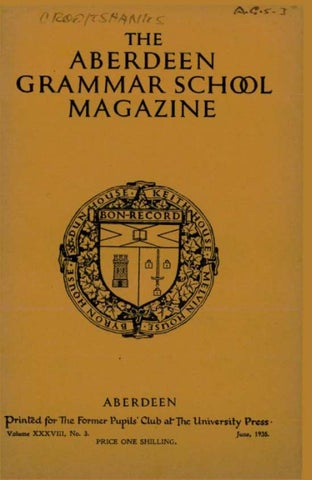
THE
ABERDEEN GRAMMAR SCHML MAGAZINE
•
ABERDEEN
print 1 for-Tlie Fortner Pupils' Club at-The University Press Volume XXXVIII, No. 3.
June, 1935.
PRICE ONE SHILLING.
-
- ~
_J_ -
•-___
EDUCATIONAL BOOKS 6-€X)<..9-*
JAMES G. BISSET CONTINUES to supply all the Class Books (New or Second-hand) suited for the requirements of the Higher Educational Institutions in the City, at the Lowest Prices. -
N.B.—Best Value in Students' Note Books.
JAMES G. BISSET, Classical, Medical, and Educational Bookseller,
85 BROAD STREET (Opposite Marischal College).
Healthy children need NOURISHMENT and nourishment means Hutchison's Bread. It is made with only the finest of Empire flour, and growing children are sure to thrive on it.
,A.B.HUTCHISON' Phone 753
13 BRANCHES THROUGHOUT THE CITY
ENGAGEMENT RINGS - -_
mr
. - -
,-
** •
'70
A. & J. SMITH Jewellers, Watchmakers Gold and Silversmiths Opticians
191 UNION STREET ABERDEEN
A. C. LITTLE sc SONS LTD. Costumiers, Furriers Gown Specialists UP-TO-THE-MINUTE
FASHION WEAR FUR TIES COATS GOWNS SUITS FUR COATS FROCKS SKIRTS You'll find the selection we have to offer unique in point of Value, Quality, and Variety.
ALL ALTERATIONS AT TIME OF PURCHASE FREE OF CHARGE
WELL-TAILORED GARMENTS FOR THE FULL FIGURE
MOURNINGS. Black Garments to fit all figures and in a huge range of prices. FIT IS GUARANTEED WITHIN 6 HOURS.
105 UNION ST., ABERDEEN
AN
UNRIVALLED
FURNISHING SERVICE EVERYTHING FOR THE MODERN HOME
can furnish your home throughout from Bedroom WE Suite to Kitchen Chairs. Such a comprehensive service secures a certain harmony in the finished result, which is the hall-mark of a perfectly furnished home. It is our pleasure to place this service at your disposal, assisting your choice with a range of furnishings, carpets, and fabrics, quite equal to any exclusive personal desires.
COMPLETE FURNISHING - SCHEMES IIPyi
gladly submitted on request
MI n. Ar..•
ETA 7 rri rit_ Pr n9 1
BUY
YOUR FURNITURE FROM THE ACTUAL MANUFACTURERS
- GALLOWAY &
SYKES LTD. 361 - 363
UNION
ST., ABERDEEN
JAMES FYFE & SON PAINTERS AND GLAZIERS. S
•
•
OFFICE AND SHOWROOMS :-
11 DEE STREET, ABERDEEN. Telephone 304.
Telegrams--"
TELEPHONE: NO. 1719.
Fyfe, Painters. —
TELEGRAMS: "HUB, ABERDEEN."
CAMPBELL & SELLAR, LTD. Engineers, Hirers and Garage Proprietors
QUEEN'S CROSS GARAGE zo Fountainhall Road ABERDEEN OPEN DAY AND NIGHT
AGENTS FOR SINGER CARS
A-
1. , I
THE •
f
-FAMILY COFFEE
e Curea Coffee is the fnvourite drink with every. one. It is most de icious, especially Your in cold weather grocer can supply you.
I 1
S. 411 Ph '
i
i
-
CURR'S COf Thoma3Curr & Co.. ABERDEEN.
Quality is our Truest Economy
ROBERT STOTT Family Grocer Italian Warehouseman, Tea, Coffee, Wine and Spirit Merchant
53
ALBERT
STREET, ABERDEEN Telephone 1848
BOOKS BOUND
ALL
SORTS AND SIZES
Telephone
No. 291
Established
1855
Tailoring of Distinctive Character modelled on ULTRA-MODERN lines. FRED WATT'S Suits to-Order bear the Hall Mark of Good Taste
80/- 95/- to 126/-
PRICES:
FRED WATT 23 BRIDGE STREET, ABERDEEN `Phone 3515
SPECIALIST -.4,71, Ce- STAINED GLASS M MURAL DECO ad..6349 7w..m.
A. D. COPLAND.
Telephone No. 2300. Work: : Rosebank Place.
Telegraphic. Address :
" Undertake. Aberdeen.
GORDON & WATSON FUNERAL UNDERTAKERS AND MOTOR HEARSE PROPRIETORS 12 HOLBURN ST. & 40 VICTORIA RD. ABERDEEN
W. KENNAWAY, Ltd. BAKERS and CONFECTIONERS, 5 and 7 Holburn Street. Luncheon, Tea, and Reception Rooms, 1 73 Union Street and 8 Bridge Street, ABERDEEN
SPECIALITIESSHORTBREAD WEDDING CAKES. ROYAL DEESIDE IN TARTAN TINS, ALSO A LARGE SELECTION OF PLAIN AND FANCY ICED CAKES.
Telephone No. 1891.
ARCHIBALD IVILKELLAR Family Grocer and Wine Merchant, 454-456
Union Street, Aberdeen. . . We Specialise in . .
Cooked
Gammons, "Sinclair's" Belfast Smoked Hams, " Harris's "
Wiltshire Bacon.
Medicinal Wines -Vibrona, Hall's, Wincarnis, Glendenning's.
Ask for
HAY'S
Gold Medal Aerated
Waters
X.L.
Still Raspberry
X.X.X.
Kola
No. 1
Soda
Lemino
Dazzle
Lemonade
Ginger Ale
Lime Juice & Soda
Ice Cream Soda
Iron Brew Ginger Beer
Stillemon
Cream Strawberry Still Grape Fruit Still Pineapple
Stillime Stilorange
CAKES AND SHORTBREAD of Finest Quality FOR THE FESTIVE BOARD AND FOR FRIENDS AT HOME AND ABROAD
MITCHELL & MUIL LTD.
ESTABLISHED 1897.
A. &W. ALEXANDER -
-
: Butchers and Fishmongers : Game and Poultry Salesmen PURVEYORS OF THE
FINEST QUALITY.
492 UNION STREET
ABERDEEN
--
Telegrams— Telephones-3172 (3 Lines).
Alexanders, Fishmongers, Aberdeen.''
Telephone
Aberdeen 171.0.
The Mastrick Dairies Ltd. 1 DESSWOOD PLACE, ABERDEEN WE offer you a Choice Selection of DAIRY PRODUCE from our own Farms, and produced under the direct supervison of members of the family. Our Customers may rely upon the absolute Purity and Cleanliness of all our products. Distributors of
Lord Carnegie's and Cairnbrogie Certified Milk.
Head Dairy : 3, 5, and 7 WHITEHALL ROAD. Branches: 7 MID STOCKET ROAD. 33 FOUNTAINHALL ROAD. 473 GREAT WESTERN ROAD. 25 BEDFORD PLACE.
Sir John Collie, C.M.G., M.D. . The Staff of the School—June 1935 School Cricket 1st XI—Season 1935 School Prefects—June 1935
.
• Facing page 196 Between pages zzo and 221 . . Facing page 2 44 . . Before „ 245
• • •
•
•
A Message to Former Pupils . Notes About Old Boys • • • Marriages . . . • . . . • Obituary . . • . . . . . F.P.s in Shanghai • San Francisco's Bridges. By G. Westland . . . . Passing By in Southern Rhodesia. From the Diary of " Hindustani " . , . . . . . The Log of a Voyage from Liverpool to The Straits. By George R. Bums . . . • . • • . The Outer Isles in Winter. By E. R. B. . . . . The Taj Mahal and the Moon. By Captain R. D. MacRae, I.M.S. •
•
•
•
•
•
•
•
•
•
•
•
•
•
•
•
School Section— Cricket and Athletics . • • The Sports : A School View . • A Schoolboy's Reverie (Verse) Poetry and Modem Life • A Glimpse of Skye . • The Romance of Pottery • • The Colossi of Memnon The Thirteenth Century Church of Arbuthnott The Decaying Art of Conversation • School and Random Notes . House Notes . . School 1st XI Matches . Scout Notes . . . School Office-Bearers for Session 1934-35 • •
•
•
•
„
2I2
„
219
„
227
PS
•
PP PI
•
•
•
•
201
•
•
•
PS
•
•
•
200
•
•
•
If
•
•
•
P3
SS
•
•
•
Page 181 183 194 195 199
•
•
•
•
SP
•
•
SS
•
•
•
•
•
•
•
•
•
SS
230
231 232 2 33 2 34 236 237 240 241 244
•
•
•
St
246
•
•
•
IS
248
•
•
•
If
250
•
•
252
F.P. KIT BLAZER (ready-to-wear), 52 6 (Tailored to order), 63 WRAPS, 5/11, 8,11 & 126 TIES, 3 6 & 5 6 SLIPONS, in both White and Grey, 10. 6 to 16:6 SWEATERS, 15 '6 SLEEVE LINKS, 4/6 & 10/6 Any of these articles will be gladly sent on approval to any F.P. whose name is on the Club Roll.
Esslemont & Macintosh Ltd.
" I shot an arrow into the air, It fell to earth I know not where." So run the words of the song, but it will be no blind shot if you take home one of McPherson's "Walnut loaves."
W. M. McPHERSON Baker and Confectioner, 15 FOUNTAINHALL ROAD AND
8 ST. SWITHIN
STREET
ABERDEEN
ESTABLISHED 1843.
LOW'S Wm. Cay & Sons BOOKSTALLS 39-50 New Market Gallery ABERDEEN
jfulieral tiOcrtakerg.
Subjects and at All Prices Over 500,000 Volumes in Stock Educational Books in Great Variety
BOOKS on All
415 UNION STREET. A\
209 GEORGE STREET, ABERDEEN. Motor Hearses and Cars for Town and Country Funerals.
CATA1.06L:ES
Telegrams—"Cay, Aberdeen...
'PHONE 3332
'Phones Nos. 92 and 54.
Esr•surnao IBIS
BY APPC,,,,,, 10
H.M. THE KIN,
J. WILLIAMSON & SON (w. B. WILLIAMSON, PPOPM11O0
Meat Purveyors and Poulterers 1, 2, & 3 MARKET BUILDINGS, ABERDEEN 'PHONE 452 BRANCHES e 3S FOUNTAINHALL ROAD 'Nom 1724
THE SQUARE, CULTS 'PHONE. CULTS 2
-ALSO AT CHURCH SQUARE. BALLATER 'PHONE 38
D. Wyllie & Son 247 Union Street, Aberdeen.
The SWEETS That always please
4 Latest in Literature and First Editions of Modern Writers
Agents for Ordnance Survey Maps
RADIO GUMS RADIO CARAMELS SUPERFINE CUT ROCK Above three in Assorted Flavours ROYAL TOFFEE —made made with Creamery Butter GINGER CREAM LUMPS ASSORTED CREAM LUMPS
All 4d. Qr. BLUEBELL " QUEEN MARY " (Cunarder) SELECTION A choice selection of various sweets. including Crystallized Ginger and Radio Gums
1/- & 2/- per Box Established 1814
'Phone Ato2
John E. Esslemont Ltd. ABERDEEN
We Specialise in—
GALLOWSES AND SOCK SUSPENDERS
we J. MILNE, LTD. MEN'S OUTFITTERS
ABERDEEN (OPPOSITE ROYAL NORTHERN CLUB)
Telephone 1293
Handicrafts
BUY BEST
BUY BRITISH
THE IMPERIAL TYPEWRITER Raffia and Cane Seagrass and Stool Frames
ioo% British, is the best and lowest-priced Standard Typewriter. No increase.
THE IMPERIAL PORTABLE The Best Portable, i oo% British.
DRAWING MATERIALS of every description
Taylors' Art Saloon Picture Framers and Artist Colourmen 49-51
SCHOOLHILL
ABERDEEN
Second-Hand Bargains of all Makes of Typewriters. EASY
DEFERRED
C. H. WEBSTER 4 Rose Street, Aberdeen BUY
Telephone 2870.
PAYMENTS
(Hire Purchase) ON ANYTHING
• l'hune 505
BEST
BUY BRITISH
Why Wait for Watch Repairs? repairs. Buy a CRUSADER Watch and never be bothered with by Instead of repair, a new movement is fitted while-you-wait any CRUSADER Agent throughout the world. Call for Demonstration or write for Free Catalogue. Prices from
3
Cru5aber
Gns.
EXACT TIME- - NO REPAIRS
Chromium, £4 10 0
Stainless Steel, £6 0
JAMIESON
0
Over 100 Models for Ladies and Gentlemen.
Gold, £8 15 0
& CARRY
Watchmakers, Jewellers, and Opticians 142 UNION STREET (next Union Bridge)
-
COAL ELLIS & McHARDY LTD. (ESTABLISHED 1880)
18
REGENT
QUAY
AND
I 30 I
UNION STREET
ABERDEEN Telephone 2889
GEORGE BISSET'S Clan Tartan Warehouse
15 UNION STREET ABERDEEN CLOTHIER TO THE
ADMIRALTY, R.N.R., and R.N.V.R.
HIGHLAND OUTFITS for Boys, Youths, and Gentlemen, also for Maids' and Ladies' Wear; and will gladly supply patterns of Ladies' favourite Tartans for Kilts. Telephone 2680.
Telegrams " COAL, ABERDEEN "
Co-operation HE enthusiastic co-operation of many minds and hands make possible the fine productions of the HOUSE OF OGILVIE. For over three-quarters of a century our constant endeavour has been to give the best possible service to our Customers. We base our claim to your patronage on our ability to please you.
T
J. & A. OGILVIE 369
UNION
STREET,
ABERDEEN. l'elephone : No. 433.
For
RANGES STOVES COOKERS and Fireplace arrangements in Marble and Tiles We cordially invite you to visit our Showrooms and inspect the many Designs displayed
Telegrams : " Interiors."
COUNTRY HIRES AT CHEAP RATES
COLIN S. CLARK DAIMLER TAXI HIRER Day & Night Service
James Scott & Son (Aberdeen) Ltd.,
PHONE 4422
483-485 UNION STREET, ABERDEEN.
46 Hardgate, Aberdeen.
Telephones--Aberdeen 1881-2.
•
FO11
SALES AND SERVICE in the North Consult—
Aberdeen Motors Ltd. UNION ROW ABERDEEN Works
-
Telephone 4580 (3 lines)
49 Huntly Street. Telegrams "Cars "
NORTHERN ASSURANCE COMPANY LIMITED. Established 1836.
Assets
23,ooo,ooo.
ALL CLASSES OF INSURANCE, INCLUDING:
LIFE MOTOR CAR
FIRE ACCIDENT
Life Assurance Branch. The Company's Tables of rates for Life Assurance include every class of Policy. Write for Particulars of Life Policies Endowment Assurance Policies Educational Endowment Policies Children's Deferred Assurance Policies House Purchase with Life Assurance Life Bonus Year 1935. Participating Policies effected before 31st December, 1935, will rank for Bonus at the Valuation to be made as at that date. CHIEF OFFICES :
ABERDEEN LONDON
-
-
-
1 Union Terrace. 1 Moorgate, E.C.2.
Aberdeen Hoard of Directors. The Right Hon. The LORD A. S. R. BRUCE. ESQ The Right Hon. The EARL. OF FORBES. CMTHNESS. A. MARTINEAU, ESQ. FRANCIS J. COCHRAN. ESQ. R. W. WALKER, E812 WILLIAM L. COOK, ESQ. Manager Secretary
R. MACKAY. J. I., WILLIAMS.
Aberdeen Grammar School Magazine gotta year: No. 130
Vol. XXXVIII
(New Series, 41st ycar, No. 121) JUNE 1935
No. 3
The "Grammar School Magazine" is issued under the auspices of The Former Pupils' Club, in March, June, and November. All communications with regard to the " Magazine " should be addressed to the Editor (the Secretary and Treasurer of the Club), THEODORE WATT, M.A., The Rosemount Press, Aberdeen.
A Message to Former Pupils. Twice in the year, and twice only, I harbour a grievance against the Editor of the Mag. As I slip into my second decade of service in the Grammar School, I feel that my case for exemption from further " Messages " is substantially stronger than it was. It would seem, however, that the Editor works on the principle that anything about the School, no matter how trivial and repetitive, will interest lonely F.P.s in tropical swamps or Arctic outposts, and, if it is put in this way, his request for further copy is difficult to refuse. There is nothing for it, then, but to jog my memory and continue the story. A shadow was cast over the Easter Term by the unexpected death of Miss Edith Davidson, the Head of the Infants Department. Adequate tribute has already been paid to the value of Miss Davidson's services to the School. She was more than an efficient teacher and organiser. She had the rare gift of personality, and her generous impulses and social qualities won for her a secure place in the esteem of her colleagues and other friends. Her successor, Miss Winifred Robertson, comes to us with strong credentials and enters on her responsible duties with the best wishes of the School. At long last the Pavilion extension scheme has been approved and building operations should commence during the vacation. As it happens, we have no reason to regret the delay, as it has enabled some useful suggestions to be incorporated in the scheme. Incidentally, we congratulate the High School on its spacious new Playfield and commodious Pavilion. I wish that swimming facilities for the Secondary Schools were on a par with those which they enjoy for out-door games. Admittedly a pioneer in most things, Aberdeen has, in this respect, lagged in the wake of modern requirements, and the claims of the
182
Aberdeen Grammar School Magazine
Schools are most inadequately met. Is it surprising, in the circumstances, to find symptoms of a waning of interest in a form of sport which shouldappeal strongly to every healthy youngster ? Now for something new. If Shanghai wants to know whether its clock is still going, would it please note that we are on the telephone—Aberdeen, 554o ? This is an historic achievement for an ancient foundation like our own, and makes one wonder what is coming next—perhaps a message broadcast to F.P.s on Prize Day, or the running commentary of an eyewitness from the Annual Sports. For you it should simplify and expedite the reservation of places for your sons in the Boarding House, which, you will he glad to know, has enjoyed another successful year. The most recent School news 1 can give you relates to the Sports. We had good cause to view the weather prospects with misgiving, but our luck held. The Friday afternoon was sunny and cool, and the programme was carried through under perfect conditions. On the second day rain fell heavily till noon and there seemed to be more than an even chance that the meeting would have to be postponed ; but, once again, we were fortunate, and an hour's drizzle was succeeded by sunshine which continued to the end. Records were anticipated in spite of the difficult going and our expectations were not belied. The front page of the programme which details School records will have to be rewritten next year in respect of four of them—the zoo yards, the zzo yards, the quarter mile, the hurdles—while the record for the broad jump, which has stood since 1913, was equalled. The achievements of the present Athletic Champion, W. J. G. Meldrum, should stand secure for some years to come. The return of F.P.s to active participation in the Sports was particularly welcome. Our athletic prestige has been considerably enhanced in recent years, and the skill and enthusiasm shown by the Games Master and those who assist him have borne abundant fruit. Lest it be thought that the training of Grammar School boys is concentrated on their legs to the detriment of their heads, it is worthy of mention that School has gained a larger number of Leaving Certificates this year than in any previous year. One of the most striking instances of the harmonious and concurrent development of leg and head is afforded by the " speeler " of the Mitchell Tower, who, at the last Summer Graduation, was awarded the Murray Gold Medal and Scholarship as the most distinguished graduate in Medicine of his year. School closes on the 28th of this month, and holiday anticipations are chastened by our regret at losing as fine a set of senior boys as we could wish to have. Still, our loss is your gain, and the Club will be strengthened by their accession to your ranks. D. M. A. 15th June, 1935.
Aberdeen Grammar School Magazine
183
** *It is requested that the Editor be informed of all new appointments and interesting incidents in the careers of Former Pupils.
The dates given in parentheses after names indicate the sessions of attendance at the School. KING'S BIRTHDAY HONOURS. In the official list of Honours conferred by the King " on the occasion of His Majesty's Birthday, and in commemoration of the completion of the twenty-fifth year of His Majesty's reign," the names of three F.P.s appeared :— Andrew Gourlay Clow (1896-98), C.I.E., M.A. (Cantab.), was created a Companion of the Order of the Star of India (C.S.I.) in the India Office List. He is the elder son of the late Rev. Principal Clow, D.D., Glasgow, formerly minister of the South U.F. Church, Aberdeen, and was a wrangler in Part II of the Mathematical Tripos at Cambridge in 1912. He passed into the Indian Civil Service in 1913, and in 192o became Organizing Secretary of the Indian Government Labour Department at Delhi. In 1928 he was made a C.I.E. (Companion of the Indian Empire), being then Officiating Secretary to the Government of India in the Department of Industries and Labour. He is now Joint Secretary of this Department. He is regarded as one of the most widely informed members of the I.C.S. on industrial problems, and wrote a valuable survey of Indian industrial policy for the Simon Commission. He was a member of the Royal Commission on Indian Labour, whose report was published in 1931 and made far-reaching recommendations. Edmund Blaikie Boyd* (i9oo-t2), M.A., was created a Companion of the Order of St. Michael and St. George (C.M.G.) in the Colonial Office List. He was Dux of the School in 1912, graduated M.A. at Aberdeen in 1916, with First Class Honours in Classics, and after serving as a Gunner and as a Lieutenant in the Royal Garrison Artillery in the latter half of the Great War, was appointed to Class I, Home Civil Service, and assigned to the Colonial Office. In 192i he became Private Secretary to the Permanent Under-Secretary of State for the Colonies, and since 1930 he has been Principal Private Secretary to the Secretary of State. * Member of Former Pupils' Club.
184
Aberdeen Grammar School Magazine
Lionel Edward Dacre Moodie-Heddle (1887-?) was created an Officer of the Order of the British Empire (O.B.E.), Civil Division, for services in connection with the Mercantile Marine in the Commonwealth of Australia. He went to sea about 1895 and became a master mariner in the service of Messrs. Mcllwraith, McEachearn & Co., shipowners, Melbourne. Some years ago he was in command of the finest Australian coaster, Katoomba (9,000 tons). SECRETARY OF THE JUBILEE TRUST.
Commander Jameson Boyd Adams (1893-94), C.B.E., D.S.O., was announced in March as having been appointed Secretary of King George's Jubilee Trust, with offices at St. James's Palace, London. For a considerable period he has been Controller of the North-Eastern Division of the Ministry of Labour, and has been released temporarily from his duties to take over the secretaryship of the Fund. On leaving the School he entered the Mercantile Marine, and served in the Royal Navy as an R.N.R. Lieutenant. He took part in various Polar explorations, and was second in command of the Shackleton Antarctic Expedition of 1907-09, getting to within 97 miles of the South Pole. On returning home, he entered the Civil Service, and in 5950 became Superintendent of Labour Exchanges in the Northern District of England. On the outbreak of the Great War he was appointed Flag Lieutenant to Admiral Hood, and served through operations on the Belgian Coast, 1914-15, being mentioned in dispatches. He was subsequently transferred to the Royal Naval Siege Guns at Nieuport, and was severely wounded in 1917. In the same year he received the Croix de Guerre, and in 1918 was awarded the D.S.O. and promoted to the rank of Commander. " An unconventional but most efficient Government official," said The Times," he has devoted all his spare time in recent years to the development of boys' clubs in Yorkshire and the encouragement of emigration. His wonderful work in these directions long since attracted the attention of the Prince of Wales, and it is known that he was of great assistance to Captain Euan Wallace in his preparation of what was admittedly the most far-reaching of the Commissions' reports on the Distressed Areas." He was created a C.B.E. in 1928. William Ernest Adam (1902-o9), son of the late Mr. W. D. Adam, banker, Aberdeen, who served throughout the Great War as an officer from 5954 to 5920, mainly with the R.F.A., and subsequently entered Holy Orders, has been Rector of St. Magnus Episcopal Church, Lerwick, since 1930, and in May of this year was appointed Rector of All Saints' Church, Buckie. He will take up duty there in September.
Aberdeen Grammar School MagaVne
185
James Alexander* (1919-28), B.Sc.(Eng.), has recently become a full Associate Member of the Institution of Civil Engineers. Wilfrid Philip Shepherd Barron* (1896-1903), M.Inst.C.E., is now Chairman of the Karachi Port Trust, India. He was appointed Chief Engineer of the Trust in December, 1926, and was previously Chief Engineer to the Port Commissioners of Chittagong, Bengal. William Thomson Black* (1926-28), who graduated M.B., Ch.B., at Edinburgh in 1933, is at present on the staff of the Royal Infirmary, Sunderland. George Gordon Cameron* (1 915-17), M.A., B.D., who was ordained a minister of the Church of Scotland in 1931, is minister of the united Kent Road-St. Vincent Church, Glasgow. He has been invited as Summer Preacher for July and August of this year to the First Presbyterian Church of New York, where he was in 1929 and 1930. John Brunton Cameron (1923-28), M.A., B.D. (a brother of the foregoing), was ordained by the Presbytery of Aberdeen in June of this year. Shortly before, he was appointed by the Foreign Mission Committee of the Church of Scotland to the Calabar Mission, Nigeria. Both the Rev. G. G. Cameron and the Rev. J. B. Cameron are sons of the Rev. GEORGE GORDON CAMERON (1889-91), B.D., of Rutherford Church, Aberdeen. Alexander Whincup Carle* (1914-20), B.Sc.(Eng.), who entered the service of the Bengal and North-West Railway Co. Ltd., India, in 1928, is now officiating District Locomotive Superintendent at Lamastipur, Behar, and reports that he is enjoying the work very much. Duncan Scott Cochran* (1914-24), M.B., Ch.B., has received a Commission in the Royal Army Medical Corps as from 1st May, 1935. Colin Douglas Leslie Cromar* (1 922-26), M.B., Ch.B., son of JOHN CROMAR* (x876-83), L.D.S., Aberdeen, is at present on the staff of the Metropolitan Hospital, London, E. 8. William Sharp Davidson* (1921-26), who was formerly a Surgeon-Lieutenant in the Royal Navy, has been appointed Resident Medical Officer at Aberdeen Royal Infirmary, attached to the Ear, Nose and Throat Department. Robert Hutton Duguid* (1918-23), B.Com., C.A., has been since 193z in the service of Messrs. Duncan Brothers & Co., Ltd., Calcutta. James Lindsay Duncan* (1911-24), LL.B.(Aberd.), Ph.D. (Edin.), has been appointed external examiner at Glasgow University in Scots Law and Mercantile Law for the LL.B. and B.L. degrees. He has also been appointed external examiner in several Law subjects at Aberdeen University.
186
Aberdeen Grammar School Magazine
Robert James Duthie* (1911-17), M.B., Ch.B., was in April appointed an assistant physician at Aberdeen Royal Infirmary. David Edwards* (1903-09), M.A., LL.B., who has been for the past fourteen years in the Colonial Legal Service, being latterly Resident Magistrate at Nairobi, Kenya Colony, was in April appointed Relieving President, District Court, Palestine. Arthur Raymond Gordon Emslie* (1919-22), M.Sc.(Agr.) (Toronto), D.Sc.(Aberd.), is at present employed in the Division of Chemistry, Central Experimental Farm, Ottawa, Ontario. Henry Alexander Shaw Fraser* (1918-27) is at present being trained in an export business in Jamaica. Patrick Lindsay Gordon (1878-80), M.A., B.D., has intimated his impending retirement from the pastorate of Glenbervie, Kincardineshire, which he has held since 1894. James Harvey* (1870-75), M.A., D.D., senior minister of Lady Glenorchy's North Church, Edinburgh, and Joint Senior Clerk of the General Assembly of the Church of Scotland, celebrated his ministerial jubilee in April. He was inducted to Lady Glenorchy's Free Church (as it was then called) forty-five years ago, and for five years before that he was minister of Duntocher Free Church, Dumbartonshire, where he was ordained on 9th April, i88 5. At the jubilee celebration one of the speakers was Rev. JAMES GORDON SUTHERLAND* (1872-75), M.A., D.D., who recalled that it was a good deal more than sixty years since he and Dr. Harvey first sat together on the benches of the Grammar School at Aberdeen. Speaking of Dr. Harvey as a man, he said they all knew what an attractive personality he had. If one sought to find a single word which summed up his character as a man, it would just be the word " friendliness." Dr. Harvey had proved himself a real and genuine friend to everyone with whom he came in contact. Referring to Dr. Harvey as a minister, Dr. Sutherland said that the word which truly expressed his long ministry was " faithfulness." He had not known a minister who was more faithful to his duties as pastor and preacher. Speaking of Dr. Harvey as a Churchman, Dr. Sutherland said they had been associated together first in the Free Church of Scotland, then in the United Free Church of Scotland, and now happily in the Church of Scotland, united and free. In all these Churches Dr. Harvey had taken an active and foremost part. The fact that by the unanimous voice of his brethren he was called in 1925 to the Moderatorial Chair of the General Assembly of the United Free Church showed how much his work as a Churchman was appreciated. The one word that summed up his life as a Churchman was " loyalty." John Rae Hay (1910-13), who was formerly on a rubber estate in Malacca, is now in the service of the Scottish Milk Marketing Board in Glasgow.
Aberdeen Grammar School Alagaine
187
Harry Alexander Holmes (1881-85), who died at Aberdeen on 8th February last, left net estate valued at L77,451. Douglas Harold Johnston* (1913-26), who graduated B.A., with honours, at Oxford in 1929, and then studied law at Edinburgh University, was called to the English Bar by the Honourable Society of the Inner Temple in 1931, and called to the Scottish Bar in 1932, since whcn he has been practising as a Scottish barrister. In March of this year he was appointed external examiner in English Law at Edinburgh University. John Mitchell Kellas* (1881-88)—the last survivor of four brothers who attended the Grammar School—retired in April from the position of principal agent of the British Linen Bank in Dundee. He entered the service of that Bank at the West End office in Aberdeen in 1888, and became agent in the same office in 1904. Five years later he was appointed agent of the Bank in Kilmarnock, and subsequently was promoted to Dundee. I-Ie has now gone to reside in Chelsea, London. Gordon Kilgour* (1919-23), C.A., has been appointed chief accountant of the Waverley Book Co., Ltd., London. Arthur Edward Law* (1898-?), principal teacher of Art in Mackie Academy, Stonehaven, was in May appointed to the corresponding post in Harris Academy, Dundee. David Proudfoot Levack* (1906-09), M.B., Ch.B., has been appointed honorary radiologist at Aberdeen Royal Infirmary. Eric Linklater* (1913-16), M.A., in March added to his growing list of published novels another, entitled " Ripeness is All." This was extensively reviewed in the newspapers immediately on publication. The Scotsman said : " The humour of few writers deserves to be called rich, but Mr. Linklatcr is among the few. He is not funny merely because he devises laughable situations and comments neatly upon them. He has, one might almost say, a humorous imagination, and the result is that when his imagination is functioning as it functions in " Ripeness is All," the whole structure and texture of the story is entertaining. It is difficult to think of anybody else who can produce work of this rich quality. . . . After Mr. Linklater's last book, one had doubts about his next, but " Ripeness is All " removes all doubt. What ripeness is here of craftsmanship, invention, wit, and imagination ! " William Garth Logan* (1922-29) is now on the staff of the Chartered Bank of India in London. Alexander Lightbody * (1922-33) has been awarded a Jackson Scholarship in Engineering at Robert Gordon's Technical College, Aberdeen. James Lyle McDougall* (1915-22) has rejoined the staff of Price Brothers & Co., Ltd., at Kenogami Paper Mills, Quebec Province, whose service he first entered in 1929. Thereafter
188
Aberdeen Grammar School Akgafzine
he was with the Sherbrooke Machineries Ltd. at Sherbrooke, Quebec, and then with the Improved Paper Machinery Corporation at Nashua, N.H., U.S.A. In a recent letter he says that in Canada the paper industry, and in particular the newsprint mills, arc now paying dearly for a policy of uncontrolled expansion between 1925 and 1931, during which time the output of newsprint was more than doubled. The result is that to-day there is an excess of x ,zoo,ooo tons over demand, and more than fifty per cent. of the whole industry is in the hands of receivers. Government control of prices, however, is likely in the near future to stabilize one of Canada's major industries. John Clark McGregor (1926-29), who graduated M.B., Ch.B. at Aberdeen last year, is at present on the staff of Woodcnd Hospital, Aberdeen. " RECOLLECTIONS OF AN OLD LAWYER." Lachlan Mackinnon (1865-7o), M.A., who recently retired from legal practice in Aberdeen, is the author of an entertaining and enlightening volume, " Recollections of an Old Lawyer," published in May. As one reviewer has said.—" Here you have a book that must be read by everyone who has the slightest interest in Aberdeen and its people. . . . Nothing finer in the way of ' potted history ' has appeared these many years past. It is a model of lucid and easy writing, spiced with wit and illuminated with a broad and generous humour well known to all who know the man himself." Like his father, LACHLAN MACKINNON (1828-33), and his uncle, DAVID REID MACKINNON (1831-36), the author of the " Recollections " was educated at the Grammar School, though, of course, the father and the uncle were pupils at the old building in Schoolhill. Mr. Mackinnon entered the present School in 1865, two years after it was opened, and joined a class of about seventy boys, under the late Rev. James Wilson Legge. Among his classfellows were the late ALEXANDER LEDINGHAM, solicitor; the late GEORGE M. COOK, shipowner ; the late WILLIAM DYACK, burgh surveyor; and PETER BEVERIDGE,* linen draper (fortunately still surviving). Mr. Mackinnon has kindly recollections of his teacher, but is critical of the narrow curriculum of those days. " Mr. Legge was a gentleman, and his avowed aim was to make his pupils gentlemen first and scholars afterwards. There was something in him innate and unvoiced which compelled respect —hence he kept perfect discipline without using tawse or cane. . . . As regards Mr. Legge's powers of teaching I am impelled to say that a boy of moderate ability could have learned with case in two years all that Mr. Legge taught in four. . . . Much was omitted from my general education, consequent on this appalling waste of time." In a chapter devoted to his days at the School, Mr. Mackinnon tells several amusing stories of scrapes he got into, and gives a vivid picture of the School as he knew it. His
Aberdeen Grammar School Magaine
189
education at the School ended in 1870, when he was awarded the Gold Medal. That was sixty-five years ago, and Mr. Mackinnon, who reached his eightieth birthday in May, can look back on a career of which both he and his School have reason to be proud. Ernest Main (1903-08), M.A., is the author of " Iraq from Mandate to Independence," published in May by Allen & Unwin. He recently spent some years in Mesopotamia as editor of The Times of Mesopotamia, and managing director of The Baghdad Times. He is now in this country, on The Dorchester County Chronicle. His book is regarded as an important one, and deserving close study, being the only one of its kind. It is partly a narrative of the history of Iraq since the liberation of the country from the Turks, and partly a very critical and well-informed account of the internal conditions of that kingdom and of its relations with its neighbours and with the British. William Ferrier Mayor* (s 913-3o), M.A., is now in the Customs and Excise at Kuala Lumpur, F.M.S. In a recent letter he says that he is enjoying life out there immensely. It is a marvellous country, and existence can be most varied and interesting. As a preventive officer he has authority within the whole state, and has a staff of a dozen native officers. The raiding of liquor dens and the suppressing of illicit liquor distilling he finds the most exciting part of his work. At Aberdeen University Mayor was an outstanding golfer. There is a championship golf course at Kuala Lumpur, but he finds the game much harder out there than at home, because of the difficulty of concentrating individually on every shot. lie has not yet got acclimatized to the new ground and the light conditions, and finds the heat very trying. He plays second top in the State team, and has equalled the course record-69—in a competition. The Rugger season begins at the end of September, when he hopes " to strike some decent form" and win his place in the State team. There are lots of Aberdeen folk about in Malaya. In Kuala Lumpur Mayor has met STANLEY G. WILLIAMSON * (1922-25), who has recently gone out to the Chartered Bank, and ROBERT W. I. BAND * (1924-26), who has lately been appointed to be Assistant Protector of Chinese in Kuala Lumpur; and Loo YEW Hot * (1907-14), who is engaged in banking. Lord Meston* (1876-80), K.C.S.I., LL.D., has recently been presiding over the eighth International Studies Conference on " Collective Security," which has been meeting in London at the headquarters of the Royal Institute of International Affairs. The Conference was convened by the International Institute of Intellectual Co-operation of the League of Nations, and was attended by representatives from more than twenty countries of university endowments and institutes for the scientific study of international relations.
19o
Aberdeen Graf/senor School 1 fagazine
Robert Taylor Stewart Millar* (1921-26), M.A., B.D., was in April appointed by the Foreign Mission Committee of the Church of Scotland to the Department of English in the Wilson College of Bombay. In May he was ordained by the Presbytery of Alford in Kildrummy (his father's) Church. He graduated M.A., with First Class Honours in English, at Aberdeen University in 1930, and B.D., with distinction in Systematic Theology, in 1933. Since then he has been Inter-Collegiate Secretary of the Student Christian Movement, Glasgow. THREE DECADES AT THE ZOO.
Sir Peter Chalmers Mitchell* (1879-8o), C.B.E., D.Sc., LL.D., F.R.S., retired on 29th April from his post as Secretary
of the Zoological Society of London, after holding that office for thirty-two years. At the Society's Annual Meeting on that date warm tributes were paid to the services which Sir Peter has rendered to the Society, to Zoology, and to countless visitors to the Zoo in Regent's Park and its Whipsnade branch. As a memorial of these services a portrait of the retiring Secretary was presented to the Society as a joint gift from more than 1,z5o members. In the background of the painting is a map of the Whipsnade estate. In a leading article on the same day The Times said :— To-day Sir Peter Chalmers Mitchell retires from his post as Secretary of the Zoological Society of London, and that society loses the ablest and most accomplished of all those who have been the chief architects of its destiny. In his thirty-two years of service at the Zoo he introduced an order of excellence and efficiency to be found nowhere else in this or any other country. He transformed what had become little more than an "old menagerie "—and not a very prosperous one—into a place of really enthralling experience. He made himself, if anonymously, the friend of every child, and at the Zoo youth and age could meet and, hand in hand, enjoy themselves. Almost single-handed he fought the battle for light and air and freedom for the animals entrusted to his care. The Mappin Terraces, Monkey Hill, the Reptile House, the Aquarium, and Whipsnade are the spoils of his victory. Behind them all is the impulse of a mind schooled in exact knowledge, of an imagination capable of applying knowledge, and of the courage which alone can achieve when prejudice and inertia oppose. l le brought science to the Zoo. But he did a greater thing than that. Ile brought the Zoo to science. By means of the finest and most humane of all animal experiments Sir Peter Chalmers Mitchell showed that health and vigour could be increased if science's new gifts—" artificial sunlight," the oxidation of water, the control of ventilation, and conditioned air—were made available. Thus he helped forward, immeasurably, not only the cause of the well-being of animals but also that of human well-being. He recognized, too, how important so great a collection of living creatures could become as a means of studying comparative pathology. His resources were placed at the disposal of workers in this field, and indeed in all other allied fields of research, so that he gathered round him a company of workers which included the most eminent among biologists, bio-chemists, dicteticians, and students of physiotherapy and tropical medicine. The studies at the Zoo have helped to save great numbers of lives—the lives of men and the lives of animals— in every part of the world. To have put happiness in the hearts of children and wisdom in the minds of men is indeed to have achieved grandly.
Aberdeen Grammar School Magaine
191
Sir Peter is one of the Honorary Vice-Presidents of the F.P. Club. William Black Jenkinson Moncur* (1918-28), who has been for the past six years in the service of the Edinburgh Branch of the Norwich Union Fire Insurance Society, Ltd., is again resident in Aberdeen, having recently been transferred to the Aberdeen Branch of that Society. Last vear he was admitted as an Associate of the Chartered Insurance Institute. Gordon Crombie Munro* (1923-26), who served for nearly five years with the National Bank of India, Ltd., in London, has recently received an appointment as an assistant in the Colombo office of Eastern Produce and Estates Co., Ltd. James Cumming Niven* (1920-26), M.B., Ch.B., sailed in April to take up a post as Malaria Research Officer in the Malayan Medical Service at the Institute for Medical Research, Kuala Lumpur. Alexander Reid* (1882-85), M.Inst.C.E., formerly Mayor of Richmond, who has practised as a civil engineer in many parts of the world, is Vice-Chairman of an association that has recently been formed, under the title of the Thames Barrage Association, with the object of arousing general interest in the proposal recently put forward to dam the River Thames by a barrage at Woolwich, and to urge a public inquiry into the scheme. The Chairman of the Association is Sir Louis Dane, under whom, as Governor of Punjab, a number of important river dams were conceived and successfully carried out. Neil Carter Sharp (1923-30) has been awarded the first prize in Britain (ten guineas) for the best essay submitted to the British Empire League, entitled " The Influence of Sea Power upon the Development of the Empire." He is at Fettes College, Edinburgh. Ian James Shepherd* (1921-32) is at present serving a five years' apprenticeship as a golf-club maker at Congella, Durban. He is serving with Herby Taylor, the well-known South African cricketer. William Shepherd* (1894-1903), Campfield House, Glassel, and his son had the amazing experience of ski-ing in Scotland in mid-May. Shortly after the gorgeous Jubilee week they enjoyed a run down the slopes of the Hill of Fare. George Taylor Simpson* (1910-20) has been appointed Chief Traffic Manager of the Jodhpur State Railways, Rajputana, India. After three years' training as a traffic pupil with the Great North of Scotland Railway, Aberdeen, he went to India in 1923 to be Assistant Traffic Superintendent with the Bombay, Baroda and Central India Railway. He underwent a traffic officer's course at the Railway Staff College, Chandausi, and passed out first in the combined list of all railways. In 1926 he received
192
Aberdeen Grammar School Magazine
an appointment with the Jodhpur State Railway, and in the following year was promoted to be Deputy Traffic Manager. The Jodhpur State Railway is the second largest of the Native State systems in India. It provides the main link between the Bombay Presidency and Sind. Hugh Ross Souper* (1894-1905), M.A., M.D., has recently been appointed Surgeon to the Department for the Treatment of Diseases of the Ear, Nose and Throat at Aberdeen Royal Infirmary. He has also been appointed a part-time lecturer in the University. Robert Alexander Stephen (1919-25), M.D., has qualified as a Fellow of the Royal College of Surgeons of England. Robert Petrie Stott (1912-18), who was formerly a planter in Travancore and later on a rubber estate in Malacca, is now on the staff of the Scottish Milk Marketing Board in Glasgow. Charles Strachan* (1919-25), M.A., who is a Carnegie Teaching Fellow in Natural Philosophy at Aberdeen University, recently received the degree of Ph.D. from Cambridge University. He is a Fellow of Corpus Christi College, Cambridge. Henry James Strachan* (1917-24), M.A., Principal Teacher of Classics at Galashiels Academy, was recommended by the Board of Examiners of the Educational Institute of Scotland to receive at the Annual General Meeting on 8th June the degree of Fellow of the Institute. The title of his thesis was " A Statistical Report of the Classics for Session 1934-35 in the Secondary and Higher Grade Schools of Scotland." Charles McHardy Hunter Sutherland* (1908-14), B.Sc., B.Sc.(Agr.), who is in the Colonial Service, has been appointed an Agricultural Surveyor in Tanganyika. He was previously a District Agricultural Officer. Robert Jamieson Thom* (1923-z9) M.A., recently entered the service of the Aberdeen Education Committee through the Preferred List. He is on the staff of Sunnybank Intermediate School. Kenneth A. M. Tomory* (1899-1908), M.B., Ch.B., Major, R.A.M.C., has been posted to India for the next four years. Thomas Meikle Watt (1 8 89-94), M.A., D.D., has accepted a unanimous call to a short-term ministry in the North Church, Ballater. For the past nine years he has been minister in charge of the Scots Church at Geneva, a position he relinquished in May. Stanley George Williamson* (1922-25), who served for six years in London with the Chartered Bank of India, Australia and China, has recently been transferred to the Kuala Lumpur office of the Bank. George Alexander Wilson* (1920-23), M.B., Ch.B., son of GEORGE ALEXANDER WILSON* (1882-83)3 is now in the East African Medical Service in Tanganyika Territory.
Aberdeen Grammar School Magazine
1 93
Herbert H. E. Wiseman* (1896-1903), M.A., Director of Music to the Education Committee of Edinburgh, has been elected a Fellow of the Educational Institute of Scotland. Stanley Whyte Wood* (1918-30), who graduated B.Sc. in civil engineering at Aberdeen University in 1933 and was thereafter for two years in the office of the City Engineer, has been appointed junior engineering assistant, Highways and Bridges Department, Surrey County Council. The following F.P.s. have been appointed resident medical officers in the Aberdeen Royal Infirmary for the period from 15th April to 3oth September, 1935 : John Duncan MacLennan (1923-29), Charles Ludwig (1917-26), Alexander Macpherson Keith (1922-23), William Robertson Gauld* (1923-30), and John Stephen Johnstone (1920-z 4). ABERDEEN UNIVERSITY DEGREES AND PRIZES.
At the Spring Graduation at Aberdeen University degrees were conferred on the following F.P.s :— Master of Arts (NI.A.)— John Scott MacLachlan* (19zz-3z). Alexander Rollo Robertson* (1924-3z). Bachelor of Science in Engineering (B.Sc.Eng.)— Patrick Dickie Burr* (1915-28) Bachelor of Divinity (B.D.)— John Brunton Cameron (1923-28), M.A., with Distinction in Systematic Theology. Horace Walker* (1922-28), M.A. Bachelor of Laws (LL.B.)— Hamish Brown Grant* (1918-3o), M.A. Bachelor of Medicine (M.B.) and Bachelor of Surgery (Ch.B.)— George Mackie Stephen* (192o-26), M.A., with First Class Honours. Walter Grieve Mackinnon (1905-08), B.Sc., with Second Class Honours. Robert Fraser* (1922-30). William Robertson Gauld* (1923-3o). John Paterson Beveridge Gill* (192o-26), M.A. Randolph Wilbur Blair Greig (1922-27). John Stephen Johnstone (1920-24). Alexander Macpherson Keith (i9zz-z3), M.A. John Sandison Simmers* (1927-30). Robert Stewart Slessor* (1927-29). In the Faculty of Arts Arthur Roy Handasyde Kellas* (1926-32) was awarded the Jenkyns Prize in Classical Philology. In the Faculty of Science John Grant Roger* (1920-26) was awarded the Dickie Prize in Botany.
1 94
Aberdeen Grammar School Abigazine
In the Faculty of Medicine Alan Douglas Morgan (1919-28), M.A., was proxime accessit for the Dr. James Anderson Gold Medal and Prize in Clinical Medicine ; George Mackie Stephen* (1920-26), M.A., was awarded the Keith Gold Medal for Systematic and Clinical Surgery; Alexander Johnston Slessor* (191830) was proxime accessit for the Keith Gold Medal,and was awarded the Shepherd Memorial Gold Medal for " The Principles and Practice of Surgery " ; Reginald Joseph Twort* (I916-z5), B.A., was awarded the Matthews Duncan Gold Medal in Obstetrics ; and Walter Grieve Mackinnon (1905-08), B.Sc., was proxime accessit for the Shepherd Memorial Gold Medal.
MARRIAGES. Crombie (1911-20).—At King's College Chapel, Aberdeen, on 18th May, 1935, Hucti MAcKENziF, CROMBIE,* M.B., Ch.B., L.D.S., eldest son of the late Dr. James Crombie (1884-89) and of Mrs. Crombie, 6 Queen's Terrace, Aberdeen, to Margaret Evelyn, elder daughter of the late Mr. Lewis Smith (1894-95), 53 Queen's Road, Aberdeen. Dingwall (1912.-n).—At St. Nicholas Church, Cranleigh, on 8th June, 1935, Surgeon-Lieutenant RONALD GRANT DINGWALL,* R.N., son of the late W. Grant Dingwall, Dooars, Bengal, India, and of Mrs. W. Grant Dingwall, 7o Dcsswood Place, Aberdeen, to Elizabeth Woodham, daughter of the late Captain Charles Burnett Woodham, D.S.O., Duke of Cornwall's Light Infantry, and of Mrs. Woodham, Cranleigh, Surrey. Grafton (t 912-22).—In London, on tst June, 1935, ALFRED WILLIAM GRAFTON,* second son of Mr. and Mrs. E. G rafton, of 4 Forest Road, Aberdeen, to Noelie Campbell Buller, daughter of the late Captain Charles Francis Buller and Mrs. Charles Campbell-Buller, of London. Murray (1921-25).--At Mannofield Church, Aberdeen, on 1 zth June, 1935, DAVID ALEXANDER MURRAY,* elder son of Mr. and Mrs. D. Murray, 27 Argyle Place, to Margaret, daughter of the late George Innes and of Mrs. Innes, 15 Howbum Place, Aberdeen. Prosser (1907- I 8).—At St. Charles's Church, Hull, on 3oth April, 1935, OSWALD GEORGE PROSSER,* M.B., Ch.B., son of Mr. Alfred A. Prosser (1877-86) of Aberdeen, to Juliana, younger daughter of the late Dr. D. R. Moir and of Mrs. Moir, of Thomcliffe House, Hessle, E. Yorks. Rennet (1914-26).---At Fetteresso Parish Church, Stonehaven, on tzth June, 1935, DAVID LINDSAY RENNET,* only son of Mr. Ernest Rennet • (1879-88), Newton of Pitfodels, Cults, Aberdeenshire, to Dorothy Margaret, only daughter of the late Douglas A. Dunningham (1886-90), Aberdeen, and Mrs. Dunningharn, Berry•hill House, Ncwtonhill, Kincardineshire. Sharp (1922-24).—At Marylebone Presbyterian Church, London, on 1st June, 1935, GEORGE ALEXANDER SHARP,* M.B., Ch.B., Ordeans, Bishop's Stortforcl, Herts, elder son of the late George Gardiner Sharp and of Mrs. Sharp, Ordeans, Banchory, to Kathleen Louise, younger daughter of Mr. and Mrs. Kelly, Penkhull, Stoke-on-Trent. Walker (1914-22).—At St. Peter's Church, Bayswater, London, on 8th June, 1935, CYRIL GEORGE WALKER,* M.D., youngest son of Mr. and Mrs. Walker, Ihincaim, Aberdeen, to Thea, daughter of the late Mr. R. Cassie, Ceylon, and of Mrs. Cassie, Stanley Gardens, London, \V. it. Walker (1918-zz).—At St. Mary's Chapel, Aberdeen, on 15th June, 1935, DANIEL JACKSON WALKER,* second son of Mr. and Mrs. William Teller Walker, 22 Rosebery Street, Aberdeen, to Marion McLeod White, daughter of the late John Simpson and of Mrs. Simpson, 3z Loanhead Terrace, Aberdeen.
Aberdeen Grammar Sebool Magazine
195
OBITUARY. An Expert on Malingering. (1873-76), C.M.G., M.D., died at 4 2 W. 2, on 4th April, 1935, aged 74 London, Terrace, Porchcster years. Robert John Collie was the sixth son of the late JAMES four COLLIE (1827-32), advocate in Aberdeen, and was one of brothers who attended the Grammar School in the 'seventies of last century. The two elder, GEORGE DUNCAN COLLIE* and JAMES YOUNGER COLLIE,* became partners in the firm of James and George Collie, advocates, Aberdeen ; and the two younger, the deceased and FRANK LANG COLLIE,* became doctors. John graduated M.B., C.M., at Aberdeen in 1882, and M.D. in 1885. On qualifying, he spent some time in resident appointments at Edinburgh and Sunderland, staying on for six years in private practice in the latter town. Thereafter he practised at Catford, London, for seven years, and then in the \Vest-end of London for eighteen years. Latterly he specialized in medicolegal work. In 19oz Dr. Collie was made Medical Examiner to the London County Council, and in 1904 Chief Medical Officer to the Metropolitan Water Board, appointments which he held for thirty years or more—the latter until the time of his death. He came prominently into public notice through his work in these posts. This was owing to the publicity which attached to his success in detecting and exposing cases of malingering and attempts to defraud these and other large corporations which administer ample funds. He devoted himself to the perfecting of methods designed to circumvent the schemes of workers who, by simulating illness, or pretending that their injuries had not healed, endeavoured to have their payments continued. A little over a year ago, discussing the medical aspect of workmen's compensation in a communication to the Medico-Legal Society, very he disclosed that a small battery with a faradaic current wascomfor claims examining when fraud unmasking useful for pensation. Describing his test, Sir John said that two electrodes other were required, the first of the ordinary shape and size ; the could which key make-and-break having in the handle a small thumb be controlled by the examiner's thumb, so that when the battery the although current, was depressed the key cut off the off was left in noisy action. " The current being thus cut exhe happened," has what without the examinee knowing noisily plained, " he naturally assumes that, as the coil is still of (though, skin his reaching buzzing, the electricity must be electric the that made be may complaint and not), is course, it It is surcurrent greatly increases the amount of tenderness. that assume action, noisy the hearing men, many how prising they Indeed, bodies. their to the current must still be flowing Sir John Collie*
196
Aberdeen Grammar Jibed Magazine
sometimes described the supposed electric current as producing ' agony ' or ' the stab of a knife.' I have on several occasions produced yells and howls in these circumstances," declared Sir John. In 1913 Sir John (he was knighted in 1912) published a book on " Malingering and Feigned Sickness," which is recognized as the standard work on the subject. In the same year he published another hook, " The Psychology of the Fraudulent Mind," a further valuable contribution to the work of detecting unlawful claims. Other works were " Fraud in Medico-Legal Practice " (1932), and " Workmen's Compensation : Its Medical Aspect " (1933). He was the editor of " Recent Progress in Medicine and Surgery, 1919-33," published two years ago. Sir John rendered valuable services during the War, in which he served as an Honorary and Temporary Major, R.A.M.C., and later as an Honorary and Temporary Colonel, A.M.S. He was a member of the Travelling Medical Board, London Command, August 1915 to June 1916 ; founder of the first home of recovery for discharged soldiers suffering from neurasthenia ; Director of Neurasthenic Institutes, June 1917 to January 1918 ; Director of Medical Services to the Ministry of Pensions, January 191 8 to January 1919 ; and founder of the Psychotherapeutic Clinic at Lancaster Gate, London. For his services he was made a C.M.G. in January 1918, and was " mentioned " in the following month. He retired with the rank of Lieut.Colonel. . After the War Sir John turned to the political sphere, and as a Liberal was elected Member of Parliament for the Patrick Division of Glasgow in 1922, but did not seek re-election at the General Election in the following year. Sir John always took a very keen interest in the F.P. Club and particularly in the London Centre. He presided at the Dinner of that Centre in November 1933, making a noteworthy speech, in the course of which he recalled that he had presided at the first Dinner of the London Section of the Club, held on 16th January 1909. The following tribute to Sir John appeared in The Times of 9th April last :— With the death of Sir John Collie the public have lost a determined enemy to all slackness and dishonesty in the administration of public affairs. He regarded the pockets of the public as being as sacred as those of his friends. It was this which was at the root of his chief life work—the detection of the workman who, either deliberately or more frequently from faint-heartedness, unnecessarily prolonged the disability arising from sickness or accident. He had a genius fur exposing such cases : lying was no good, for he had an uncanny power of thought-reading and rarely made a mistake. In the service of the London County Council and the Metropolitan Water Board hc was a terror to evildoers in this respect, and had a reputation for being severe and hardhearted. In reality hc was exactly the opposite. No trouble was too great for him to take to help genuine cases. He would go right outside his actual duties to do so, and spend time and money freely on their behalf.
Sir JOHN COLLIE, C.M.G., M.D.
Aberdeen Grammar School Magazine
197
He was full of vitality and had a capacity for cheering and putting fresh energy into all with whom he came in contact. A determined enemy, but a still more staunch and loyal friend, he will be greatly missed. His was a great personality. •
Charles Alexander Butchart (1876-79), M.B., C.M., died at Murtlc, Aberdeenshire, on 29th March, 1935, aged 71 years. After graduating in medicine at Aberdeen in 1885, he was for a few years assistant to a doctor in Leith, and thereafter continued in practice in Leith on his own account for a long period. He retired some years ago and resided at Murtle. David Mitchell Chrystall (1888-90), son of the late Rev. A. J. Chrystall, Free Church Manse, Bucksburn, died in a nursing home at Aberdeen on 1 i th April, 1935, aged 61 years. On leaving the School, he entered the service of the Town and County Bank, Northern Branch, Aberdeen, and was transferred in the following year to the Harbour Branch. In 1897 he was promoted to the Branch Inspection Department, and six years later was appointed agent at the Quayside Branch of the North of Scotland and Town and County Bank. This post he held for over thirty years, until his death. His only son, STEWART BUYERS CHRYSTALL,* was a pupil at the School 1921-31. George Mellis Duncan* (1890-91), M.B., C.M., died at his residence, 72 Rubislaw Den North, Aberdeen, on 25th April, 1935, aged 61 years. A native of Huntly, he was the elder son of the late Mr. James Duncan of the Home Office, London. He graduated in medicine at Aberdeen in 1896, and two years later was appointed assistant in pathology to the late Professor Hamilton at Aberdeen University, and continued in this post under Professor Dean and Professor Shennan. For upwards of 37 years he was a member of the honorary medical staff of the Aberdeen Royal Infirmary, having been appointed honorary assistant pathologist in December 1897. In 1921 he was appointed, in addition, clinical pathologist and bacteriologist. As a lecturer he was lucid and attractive, and was very popular both with students and colleagues. At the outbreak of the Great War he held the rank of Captain in the R.A.M.C. (T.F.) and served in the ist Scottish General Hospital from October 1914 until March 1919. Dr. Duncan had a great gift for friendship and was welcome wherever he went. Peter Harper* (1878-86), M.A., M.D., died at his residence, 147 Ferme Park Road, Hornsey, London, on 18th May, 1935, aged 64 years. He was a son of the late Mr. Hugh Harper, wire merchant, Aberdeen, who resided at Thorn Villa, Seafield. He graduated at Aberdeen in arts in 1890, and in medicine in 1895, receiving the degree of M.D. in 1904. He was in medical practice at Crouch End, London, for many years. David Smith Henderson (1868-72) died at Auchinclech •
198
Aberdeen Grammar School Magazine
House, Skene, Aberdeenshire, on i 8th April, 1935, in his eightieth year. He retired many years ago and resided in Ballater and in Rome. William Lobban (1876-83), M.A., died at Giffnock, Glasgow, on 5th May, 1935, aged 69 years. After graduating in arts at Aberdeen University in 1887, he was for three years a private tutor in Edinburgh. In 1891 he was appointed classical master of the Girls' High School, Glasgow, and in 1907 he was appointed classical master of the Glasgow High School. He retired from this post in 1929, and thereafter resided at Giffnock. Donald Munro Maclver* (i891-93), M.D., died at Kimberley, South Africa, on z3rd August, 1934. After graduating M.B., Ch.B. at Aberdeen in 1898, he went to South Africa for health reasons, and settled in Petrusville, Cape Colony, in general practice, where, with the exception of two years in Somerset East, he spent his whole professional life of 31 years. A friend writes : " He was a man in the real sense of the word. Proud of his profession, he was always very keen to relate to his younger colleagues the high standard of professional ethics in former years." Another writes : " I think I can safely say that in honour and principle he stood alone, and in the practice of his profession he maintained strict professional etiquette, often at pecuniary loss to himself. That brilliant little man had the brain of a genius and could assert himself in any walk of life. He had his convictions, but the element of reason was always predominant. A pleasing feature is that he was honoured and respected by all, rich or poor, who came in contact with him." Thomas Day McNeill (1889-94), youngest son of the late Mr. T. D. McNeill, who used to live at 21 Osborne Place, Aberdeen, died at Edinburgh on 13th May, 1935, aged 5i years. He served as an apprentice to the woollen trade in Edinburgh, and was for two years in Glasgow and for three years in Canada. Thereafter he was engaged with his father in the business of Messrs. Keates (Edinburgh) Ltd., clothiers, Edinburgh. During the Great War he served mainly with the R.A.M.C., being at Salonika from March 1918, and later at the Dardanelles and at Constantinople. James Robertson Reid* (1873-76), M.D., T.D., died at Newby, Scarborough, at the end of March 1935, aged 75 years. He graduated in medicine at Aberdeen in 1883, and five years later became a medical practitioner at Helmsley, Yorks. In 1897 he moved to Birkdale, Southport, where he continued in practice for z5 years. When the Great War broke out he held the rank of Major in the R.A.M.C. (T.F.), and served with the ist and and Line, West Lancashire Division, Transport and Supply Column, in Lancashire, from August 1914, to September 1915, when he was posted to the T.F. Reserve. He was the author of a " History of the Clan Robertson," recently published, and
Aberdeen Grammar School Magazine
199
at the time of his death was engaged on an enlarged edition of this work. Bernard Eddie Smyth (1899-19oz), son of the late Mr. John F. Smyth, 32 Osborne Place, Aberdeen, died at Calgary, Canada, on znd April, 1935, aged 49 years. After leaving the School, he was engaged in advertising work in London until 1909, when he went to Canada and took up farming near Walsh, Alberta. He later became assistant postmaster and municipal secretary and treasurer of that town. In the latter part of the Great War he was employed in the Canadian Army Pay Corps at Calgary. Frederick Sutcliffe Symmers (189o-9z) was found on 15th May, 1935, to have died some weeks earlier, under pathetic circumstances, at to King Street, Aberdeen. After leaving the School at the age of 16, he became an apprentice in a law office in Aberdeen. He never qualified as a law agent, however, and was an invalid for the greater part of his life. James Troup* (1 88 3-84), M.B., C. M., died at Southport on 14th April, 1935, aged 68 years. lie graduated in medicine at Aberdeen in 1889, and was in medical practice at Whitefield, Lancs, from 1894. Latterly he resided at Southport. In 1924 he presented to the School Library a substantial gift of some 3 5o books, mainly fiction, from the estate of his brother, the late Mr. Alexander Troup, wholesale stationer, Aberdeen. Many F.P.s will learn with regret of the death of Miss Blanche E. M. Sutherland, which took place in Aberdeen on 12th June, 1935. She came to the Grammar School as a teacher in the Preparatory Department in September 1910, and continued there till November 1931, when she retired owing to ill-health. She was a daughter of the late Dr. Arthur S. Sutherland, Invergordon, and a sister of the late Allan N. Sutherland (1896-1902), the well-known artist, who fell in France in March 1918.
F.P.s in Shanghai. Aberdeen Grammar School F.P.s in Shanghai held their Eleventh Re-union Dinner in the Shanghai Club on zznd March, 193 5. Those present were : G. A. Buyers (1906-08), F. K. Chen (1912-14), F. W. Gerrard (1905-06), T. P. Main (1883-87), J. O. Rae (1912-21), P. L. D. Raeburn (1876-78), H. B. Scott (1905-08), A. M. Scrimgeour (1911-27), Y. Wong (1905-06), S. Y. Yeh (191 2-13). The proceedings were of an informal character, the only toasts being " The King " and " The Old School." A warm welcome was given to A. M. Scrimgeour, who has recently taken up residence in Shanghai, but is at present home on leave, as also is Major F. W. Gerrard, C.I.E.
zoo
Aberdeen Grammar School Magazine
San Francisco's Bridges. [The following unsolicited contribution from one of the oldest members of the F.P. Club is most welcome.—Editor, A.G.S. Mag.]
Probably most people know that San Francisco is three parts surrounded by water. On the west we have the Pacific Ocean ; on the north the entrance to San Francisco Bay (the Golden Gate), and on the east, San Francisco Bay. With a steady increase in transbay traffic, it has been felt that the present ferry system, excellent though it is, is somewhat of a drawback for the accommodation of the multitudes (estimated at about 5o million a year) who daily cross the Bay to and from San Francisco. The vast majority of these commutors make their homes " across the bay " from San Francisco. The inconvenience consists in having to disembark from the train at Oakland and having to wait for the ferry boat to take one over. In order to remedy this, a gigantic undertaking is now under way to construct two bridges to connect San Francisco with the mainland on the north and east. There is to be a wonderful suspension bridge across the Golden Gate, with a span of more than 4,000 feet, the largest in the world, to furnish direct communication with the northland. Then an amazing bridge, some five miles in length, across the Bay will connect San Francisco with the populous east-bay mainland. The mighty foundations for the Golden Gate Bridge, built on bedrock some hundred feet under water, have already been laid successfully, and support the great 746-foot towers now in place. These towers are the highest structures in the west. The foundations for the San Francisco-Oakland Bridge have also been put in place. There are about fifty of them, some over zoo feet under water. These piers are designed to support the towers, which now rise Soo feet above the water. The Golden Gate Bridge will have a ship clearance of zio feet, and the Bay Bridge about zoo feet. The total cost will be about $tz5,ooo,ooo. The project is financed by a government loan, bonds, and money from the State Gas Tax Fund. The loans and bonds will be paid off by a toll on the bridge. The Bay Bridge will practically take passengers from the centre of Oakland and neighbouring towns directly to the centre of San Francisco, and will cut down materially the time now consumed on the journey. Apparently it has not yet been decided what mode of conveyance will be adopted to run on the bridge across the bay. Besides the six automobile and three truck lanes, there will probably be two tracks for fast electric trains. G. WESTLAND. 3025 Hillegass Avenue,
Berkeley, California.
(1864-66.)
Aberdeen Grammar School Magazine
201
Passing By in Southern Rhodesia. From the Diary of " HINDUSTANI." (Continuedfrom March "Magazine," p. 147.) THE MATOPPOS AND RHODES'S GRAVE.
The favourite trip from Bulawayo is to the Matoppo Hills and the Pomongwe Cave. The former are about twenty-five miles and the latter about thirty miles distant from Bulawayo. Though one can go by train, it is much more convenient to go by car, which I had already arranged to do, at a cost of three pounds. As it so happened, I met at the hotel in Bulawayo a retired naval captain and a man from Ceylon who wanted to see Rhodes's grave, and I took them along with me in the car and was delighted to have their company. The naval captain turned out to have a brother farming in South Africa and was full of information about all kinds of things I wanted to know, while the Ceylon man was in business there in cocoanuts, and was " doing " South Africa as far as possible by motor car casually, and without any kind of set programme. The chauffeur, who wished to have the monopoly of pumping information into me, seemed to resent somewhat the conversation of the retired naval captain and the cocoanut-oil man, especially as it was all about how farmers lived in the Cape Province, and the sights to be seen in June in the Kruger National Park, where wild beasts are preserved in their natural habitat. The road to the Matoppos is good and runs over a stony, undulating plateau with withering grass on both sides of it and a full prospect of the wide open spaces beloved of the wandering Mashonas. The first few miles are tar-macadamized and like a racing track. Thereafter the tar-macadam gives place to two tarred strips, sufficient for motor traffic, laid over the red gravel soil, the work partly of the Bulawayo municipality and partly of the Southern Rhodesia Government as a relief work for the white unemployed, who even here are numerous. There was a discussion going on in the Bulawayo Chronicle on this very matter. The unemployed said that the rates offered by the Government were too low to live on, something like five shillings a week for a single man, and seven shillings a week for a married man, and they were demanding higher rates and work in Bulawayo itself (of which work there is none), while the Government were retorting in effect that beggars cannot be choosers. I found that the motor man was on the side of the unemployed. He averred that the men couldn't possibly live on the rates offered, and that married men could not be expected to take their families out with them to live in tents while they themselves worked on the roads far from the town. Thus the gaunt spectre of unemployment is
202
Aberdeen Grammar School Magazine
not absent from this bright new land, in other ways so sure of itself. For fifteen miles the road runs over downs, a reddish strip through the grassland, till it passes the dam conceived by Rhodes as an irrigation scheme but now used as a Yachting Club by Bulawayo society. It had very little water in it when I saw it, and the few little boats on it at one corner looked rather forlorn. It seems that there is not enough rain to make any big irrigation scheme a success, and this year the rains have been more than usually scanty. Owing to the small rainfall and the restricted catchment area the dam cannot irrigate more than 700 acres. Hence the Bulawayo Yachting Club. At the Dam Hotel near by one can get roadside drinks, and on Saturdays and Sundays there must be some business. To-day the place looked only half alive. After the hotel is passed the scenery becomes more interesting. The country is more rugged and rocks variegate the evenness of the horizon. Many of these rocks, on account of weathering, have the most curious shapes, with irregular boulders perched precariously on their heads. The grass gets longer and trees begin to clothe the hilly ridges. But there is no distant prospect of the Matoppos, in fact no prospect of them at all. You simply reach them and find the same kind of scenery, only it is a little more rugged, and the hill-sides are a little more luxuriantly covered with trees, mostly of the shinyleaved variety, which is usually eloquent of sparsely-watered country. There is a National Park before Rhodes's grave is reached, and this in places is really fine. The car stops under some biggish trees inside the Park, which extends to many square miles, and it is a fifteen minutes' clamber up to Rhodes's grave. At first the path ascends over gravel and scrub, and later it climbs over the bare rock, a granite, rounded and pounded and weathered with, on the very top of it, an odd collection of huge boulders like giants' playballs. In the very midst of these is the bronze slab flat on the rock with the simple words : " HERE LIE THE REMAINS OF CECIL JOHN RHODES."
The setting is magnificent, impressive, and unique, a fit restingplace for the tempestuous genius whose spirit hovers still anxiously over these thousands of square miles of rock and bush, grassland, prairie, and open space. But the " World's View " of which Rhodes himself thought so much is disappointing. It is a mere muddle of broken hillsides without much character. There is nothing precipitous about it, there is no wealth of forest, and no grandeur except of immensity. As one looks at it one can think of no reason why it should not go on for ever. The Matoppos themselves are just a series of rounded granite hills which have weathered in places into the most fantastic shapes : one of them, called " Rhodes in his chair," is exactly like a sawdust doll stuck ungracefully on a dumpy wooden seat.
Aberdeen Grammar School Magcqine
203
The summit of the rock where Rhodes himself rests was set aside by him as the burial ground of those " who deserve well of their country." So far the only persons thought fit to rest in this Valhalla are Rhodes himself, Sir Leander Starr Jameson (" Dr. Jim " of the " Raid "), died 19zo, and Sir James Coghlan, died 193o, the first Prime Minister of Southern Rhodesia; and the men who fell at the Shangani River in 1893. These last have been re-interred here under a huge square monument with bronze plaques on it showing the men individually in action, Major Alan Wilson and the rest of his party, wearing the bandoliers and whiskers of their day. The monument itself is fine, of white granite, but its plain, straight lines, so obviously the work of human hands, are quite out of keeping with the character of the surrounding scenery, where there is not a single straight line but only nature's wild, unimproved handiwork, all rolling, irregular, capricious curves in stone and hillside and struggling tree. When the four of us, ex-naval captain, cocoanut-oil man, chauffeur, and myself reached the top, we found we were not alone. About twenty persons were walking round the tomb or over it, including a South African engine-driver and his bride from Capetown, he wearing, as was inevitable, his school blazer. But such scenes do not compare with what happens on Sundays, when large parties of young people come to picnic there, putting thermos flasks on the bronze slab, strumming banjos, or playing gramophones all round it. Perhaps they even try to jazz on the rock, which in places is nearly smooth enough. There is a native guard to see that Americans and others do not chip off pieces of the rock as mementoes, but his authority seems to stop short of jazz music and banjos. Rhodes was a tolerant man, but I doubt if he would have suffered gladly the thought of this misuse of his grave. THE POMONGWE CAVE. The Pomongwe Cave, the relic of an older Africa than the brand new country of Rhodes, lies about four miles further off, through much wilder scenery, amidst high grass, grotesque rocky shapes, and fine trees that throw shade round the foot of the twisted hill-sides. The cave itself is shaped rather like the Burn of the Vat, near Dinnet, except that it has an entrance from the front alone. It is about thirty or forty feet high and is almost completely circular. It is famous for its bushman paintings on the rock walls. These are all round the sides and are about ten feet high from the ground. Some of them are very clear and show great skill, mostly in the portrayal of animals like bison and deer. As is often the case in similar relics of the stone-age culture of man, the human figures are not drawn in any detail but are considerably conventionalized. They display, however, a vivid sense of action and movement. Most of the drawings appear to be in red colour, but only a few of them are clearly
204
Aberdeen Grammar School Magazine
visible, where the authorities have spread oil on the rock, either to preserve the colour in the painting or show the colour off to greater advantage. Fortunately there is no vandalism here of the kind that used to shock the sympathetic visitor to the Burn of the Vat. The cave is, perhaps, too far away for " hoi polloi " to invade with the usual evidences of plebeian occasional occupation. BACK TO BULAWAYO.
A pleasant run of thirty miles takes one back to Bulawayo in an hour and a half. The only game I saw in all that distance was an antelope of small size bounding through the long grass. An adjournment to the bar of the hotel was frustrated for the most unusual of reasons—the hotel was in the hands of the auditor, who was working in the bar, the auditor being, on his great day, apparently more important than potential consumers of Lion beer. At lunch a perky little man told me that it was not worth while going to Fort Victoria just to see the Zimbabwe ruins (round which Rider Haggard wrote " King Solomon's Mines "), and that they were believed to be the temples of the chief priests of a race that had been wiped out a hundred years or two ago, and that similar relics were found in several other parts of Africa. After lunch I hastened to negotiate about my laundry, which was in the hands of the Matabele Steam Laundry Company. Could anything be more eloquent of the change that this part of Africa has seen in the last forty years ? 1 wonder what old Lobengula would have thought of the association of Matabeles with the power-washing of shirts ? Bulawayo Station, where one boards the train for the Victoria Falls, about 28o miles away, is a business-like building of pleasant appearance. It has a beautifully enamelled earthenware plaque on its walls. This plaque sums up in a few words the history of the town. It names the chief facts of " The Place of Killing " (gebulawayo), from which the town takes its modern anglicized form of the name, of Lobengula's rule, of the pressure of the Matabeles on the Mashonas, of the 1896 rebellion, which bulks so much in the memories of the old settlers, and of Rhodes's permanent peace, which has made Southern Rhodesia the latest Dominion. It is striking to see a railway station thus lending its aid to the creation of a national tradition. But this is quite in keeping with what happens everywhere. Wherever one goes, one finds the same intense interest in letting the world know that this is a fine new country fit to hold its head up with any. Perhaps in furtherance of the same ideal the chauffeur had informed me that the length of covered platform was the longest in the world. It may be. Anyway it was quite long enough, as I learned when I started walking along it. At the bookstall I found a little girl craning her neck up to gaze on a comic paper called Crackers. When she saw me watching her, she turned and
_Aberdeen Grammar School Magazine
205
said, " I like looking at comics." The train is bound for Sukania on the borders of the Belgian Congo, 8oo miles away, and on its journey it passes Lusaka, the new capital of Northern Rhodesia, Broken Hill in the mining area, and Ndola, where the estimable Binks [introduced in the previous instalment] is going to do chartered accounting amongst the copper mines. •
THE VICTORIA FALLS. The train reaches the Victoria Falls station at the ungodly hour of 6.4 a.m., before the sky is properly alight. Outside the carriages on the train there is a small platform with a folding seat. From this small platform I had at 5.3o a.m. my first glimpse of the falls, the mist from which can be seen by day ten miles away. All that I could see, however, was, with the approach of sunrise, a whity-blue mist appearing to grow in brightness and proceed right out of the ground, for there was no sign of the river. When the train stops at the station it is only a twenty yards' walk to the main entrance of the palatial hotel run by the Rhodesian Railways, which is first class in every respect. A fine cement approach, flanked by ornamental electriclamp standards, leads straight to the main door, past a courtyard with fountains, right through the hotel building. There is, in this way, a clear vista through the hotel to the Zambesi gorge, spanned by the white railway and road bridge that carries communication across the river on to Livingstone, the now discarded capital of Northern Rhodesia, seven miles north of the Zambesi River. The scene is certainly impressive and gains in grandeur from the semi-dark of one's arrival, the yellow glow of the electric lights, the dim, misty conspectus beyond, and the dull roar of the waters that one cannot see. At this distance the roar is like a continuous lullaby, insistent but pleasant. By now the morning sun was just beginning to colour to a light pink the highest of the columns of spray that rose far above the height of the bridge into the cool, brisk air. Misty spray was blowing over the bridge itself, just as Rhodes wanted it to do. None of the falls can be seen from the hotel itself, though their nearness is sensed from the roar of the water and the deep canyon that turns in front of the building and the turbid, turgid current pent within the gorge till it has the appearance of rapids. The water itself in the gorge is brownish, flecked with white foam, and this year more water is said to be going over the falls than has ever been known. The whole vista on arrival is quite unspoilt. In the hotel, with its beautiful public rooms, not for one moment is the visitor allowed to forget that this is indeed Rhodesia. In the drawing-room is a bust of Rhodes, and in the lounge there hang photogravures of both Rhodes and Beit. For my first exploration of the falls 1 took a mackintosh in case
zo6
Aberdeen Grammar School Magazine
of need. The distance from the hotel to the railway bridge over the Zambesi gorge is a little over a mile, downhill all the way, over country that is dry and has red soil covered with grass and glossy-leaved trees. According to the geologists this red soil is Kalahari sand accumulated during part of the Tertiary Period, when the district was a desert. The gorge itself is of basalt, which was erupted to the surface at the end of the Karoo Period (Upper Triassic) in five successive floors of lava, which can be traced along the face of the precipitous sides of the rocks. It is over this black basalt that the Zambesi tumbles in the Victoria Falls, to follow thereafter for forty-five rocky miles a winding, tortuous course. The river falls right over the precipice into a gorge exactly below and parallel with the bank which constitutes the view place of the falls. This gorge is pierced at only one point between the Eastern Cataract and the Rainbow Falls, to form the only exit for the angry waters that surge through the Boiling Pot and thence to a succession of narrow S-shaped gorges, the top of the first S-shaped bend being exactly opposite the hotel and the top of the lower bend being the Silent Pool. This extraordinary configuration of the falls allows the onlooker the best possible view of a really aweinspiring work of nature. The spectator can walk along the face of the falls for almost five-sixths of their length, which is nearly a mile, from the Devil's Cataract (near which has just been erected the memorial statue of Livingstone) to the Danger Point, and again on the northern bank from the Eastern Cataract to the Knife Edge. Sightseeing this morning was, however, interfered with by the immense volume of water falling four hundred feet into the abyss, rendering any comprehensive view of the Main Falls and the Rainbow Falls quite impossible. Wild storms of spray were surging up from the chasm, in some places the spray rising to a height of Soo feet from the foot of the gorge. 1 crossed the railway bridge that spans the gorge just below the Boiling Pot and noticed some baboons playing on the pathway. The bridge was wet with spray. The falls themselves were invisible. There was nothing but a wall of mist which came in sudden showers and soaked my mackintosh. THE ZAMBESI BRIDGE.
The bridge, which carries railway and road across to Livingstone in Northern Rhodesia and thence further north to the copper mines and the Belgian Congo, is 355 feet above highwater level and over 400 feet above low-water level. To one standing on the bridge the height above the water seems nothing like this. But a vulgar and plebeian expectoration (such is prohibited on the Rhodesian railways) will convince any sceptic that the height is really what it is said to be. The bridge is a
Aberdeen Grammar School Magazine
207
wonderful feat of engineering and is a pretty thing in itself. But it seems to me out of keeping with its surroundings and introduces an inconsistent human note into the grand natural harmony. Without it, however, one could not cross the river and see the Eastern Cataract in all its majesty and glory. It is quite impossible to describe the falls themselves in any adequate language. As one gazes at the roaring waters and listens to the tornado of sound, a whole gamut of emotions surges through one. In this complex impressions of grandeur, power, majesty, and beauty, a sense of restlessness, of relentlessness and inevitability, of the futility of human achievement mingle together and leave on the mind a mixture of wonder and helplessness. The din of the falls differs from place to place, but it is mostly a complicated kind of roar, rumble, crash, swish, and thud, and running through this concerto is a deep note like the spinning whirl of some huge dynamo. The height of the falls is about 420 feet and the gorge into which the water is dashed seems in parts to be little more than a hundred yards across, though it may be more, as distances in such circumstances can be very deceptive. The discharge of the falls when I saw them was calculated at a million gallons of water per minute, but that conveys meaning only to hydraulic engineers. Crossing the railway bridge into Northern Rhodesia I passed some natives selling carved work on the grass and being patronized by some of the American residents from the hotel. One of the ladies had white stockings rolled up over her knees very untidily, so that she looked like the dowdy Middle Westerners one sees in a comic film. The carved work consisted mostly of deer, giraffe, and other wild animals of the country, executed rather impressionistically but with considerable effect. Proceeding to the ridge that leads to the Knife Edge, I gave my first gasp of wonder to sec the edge of the Eastern Cataract foaming out of the mist and spray well above my head, the sun illuminating the rim of falling water as it plunged to the depths below. The sensation, is not unlike that of a first glimpse of Mont Blanc's rosy crest at sunset climbing out of the clouds at Chamonix. The Knife Edge is very nearly a knife edge in reality, for it narrows to a few feet of broken boulder slimy and wet and swept by gales of furious spray. I got soaked to the skin coming out on to the edge, where the path drops into a dizzy narrowness. I doubt if anyone can cross it at this time of the year except at the gravest risk of life. There is an ugly ascent of twenty precipitous feet on the other side of the gap, where grass and trees are able to find some kind of foothold overlooking the fury of the waters at the bottom of the chasm where the Eastern Cataract and the northern end of the Rainbow Falls mingle their floods together. On the one side is this hideous maelstrom and on the other is a cliff-like drop to the Palm Grove that faces the Boiling Pot above the railway bridge.
208
Aberdeen Grammar School Magazine THE EASTERN CATARACT.
I then retraced my steps and went to the edge of the Eastern Cataract, from every view-point magnificent and awe-inspiring. There were many beautiful rainbows in the spray, and once I I saw a double rainbow, one inside the other, in the gorge below. Every now and then the spray would clear for a few seconds and I could catch a glimpse of Livingstone Island balanced on the edge and beyond the Rainbow Falls, so that it looked as if it floated in a sea of mist, which thickened and thinned capriciously, and had no solid anchorings to keep it from plunging downwards with the water that surrounded it. The falls have no boards or railings to keep incautious sightseers from instant destruction, and the natural beauty of the water's edge is thus not diminished. In places the approaches are gravelly and slippery ; in places they are muddy and slimy, and a single wrong footstep would hurl the careless one to death in the babel of noise. Sitting on the edge of the Eastern Cataract I ate an orange and tossed the disjecta membra into the rapids, gaining a stupid satisfaction from seeing the yellow peel disappearing over the pointed rocks. Near the Eastern Cataract is the Northern Rhodesian War Memorial in yellow sandstone on a grass plot, where a sprinkler hose was doing its best with very little pressure to revivify the withering grass. The contrast between the powerlessness of the sprinkler and the might of the falls made one want to smile. It seemed so absurd that the grass should be dying for water when a million gallons of it were roaring past every minute within a few yards. From here the descent to the Palm Grove is easy. It is a scramble downhill for about seven hundred yards, and the scenery is very like that seen in the rainy parts of the Western Ghats in India. Only the Indian scene is more luxuriant and the Indian palms are bigger and better. At the edge of the Palm Grove is the Boiling Pot, where the water from the falls is stirred in a giant's cauldron and looks as if it were actually boiling. One sits on the edge of the big stones, keeping an eye open for crocodiles, and watches ;with strange fascination the water surge round and round. It is possible to detect three main streams of forward and backward surging in the pool, and the whole thing looks like some monstrous Hell-brew. The river here is not very noisy, and the line of rock formed by the Knife Edge and the Palm Grove itself cut off most of the din of the falls. By the time I had clambered out of the Palm Grove my tongue was hanging out of my mouth, for the heat down below was damp and clammy. By the kindness of the Falls Conservation Board I was able to slake my thirst in a small kraal summerhouse from a jar of filtered water drunk out of a paper cup thoughtfully provided. The Conservation Board looks after the falls and their surroundings, and sees that you do not cut
Aberdeen Grammar School Magazine
209
your name on the tree-trunks, or shoot birds, or pluck up plants by the roots, as is the pleasant habit of undisciplined tourists, even in bright new Rhodesia. The Victoria Falls consist of four main parts, the Devil's Cataract, the Main Falls, the Rainbow Falls, and the Eastern Cataract. The Main Falls are much the most extensive and are seen best from the Rain Forest. The Devil's Cataract and the Rain Forest are on the Southern Rhodesia side and within ten minutes' walk of the hotel. The Devil's Cataract is a thing of awe. The waters are dashed over a very rocky lip on to a number of hidden rocks that jut out from the face of the cliff near its top. The force with which the water hits these rocks is terrific. The result is a series of rocket cascades, now a hundred feet high, now twice or thrice as high, quite capriciously, on the very edge of the chasm. The whole effect is immensely impressive, nearly terrifying. There is a little path which one can descend by hanging on to a chain till one is well below the jutting-out rocks that cause the rocket cascades, and the view from here is such that it is quite unforgettable. The noise is so great that it is impossible to hear anything shouted even in one's ear. At the Devil's Cataract the gorge looks to be narrow enough to drive a golf ball over, and if one comes out on to the grass beyond the line of trees, one is soaked to the skin in thirty seconds. THE RAIN FOREST.
But for all the wonders of the Eastern Cataract and the Devil's Cataract, the walk through the Rain Forest is easily the most inspiring spectacle of the falls. For it is from the Rain Forest that the spectator sees the power of the Main Falls and the beauty of the Rainbow Falls. The Rain Forest runs for the better part of a mile along the face of these falls and is well named. In the Forest there are samples of every kind of rain, from a fairy drizzle to a hurricane. From here are visible Livingstone Island, perched above the Devil's Cataract and the sheets of water in the Main Falls. No words can describe the sensations obtained from a walk through the Rain Forest. To stand at the water's edge is to be in a howling rainstorm, now hot, now cold, and to be in a veritable hell of noise. Bluepurple land-crabs crawl over the slithery rocks and the sun is now hidden, now uncovered, by the cascades of flying spray. Danger Point, at the angle of the gorge whence the Zambesi emerges and directly opposite the junction of the Rainbow Falls and the Eastern Cataract, is the most bewildering place of all. As you stand on its pointed boulders, you find roaring water on three sides of you, a noise of thunder all around, a gale of rain on your face, and a wind that threatens to blow you away, and underfoot slippery rock, lit every now and again with the sun that breaks through the flying clouds of spray. Yet if you go
210
Aberdeen Grammar School Magazine
thirty yards on, you are out of the hubbub and back once more under the genial summer sun of Rhodesia, and within a few yards of the trolley junction where sedate American old maids are waiting to be trundled back to the hotel by curly-headed sons of Africa, with teeth filed to sharp points. It is truly an amazing change of scene. When I went through the Rain Forest I got into a swimming costume and took a waterproof and a soft hat. The trees are dripping wet and a steady rain is always falling on them. Heavy gales are continually blowing across from the falls and the spray is sometimes unpleasantly cold. I went to the edge in half a dozen places and more than glutted myself with views of the falls and the islands that break the line of them here and there, sending up the five clouds of spray that can be seen from so far away. Of the five clouds, two of them seem to come from the Devil's Cataract and its immediate turmoil near Cataract Island, one from the Main Falls (this the biggest of all), one from the Rainbow Falls, where Livingstone Island acts as a block, and one from the Eastern Cataract. In the afternoons the spray from the Rainbow Falls is lit up with prismatic colours as far as the thin vapour extends. But of all the thrills that are provided by a view of this gigantic phenomenon of nature, the greatest and best is the soaking, the roaring, the blowing at Danger Point, an experience incredible, exhilarating and unique. At Danger Point a small notice directs the attention to " Eve's Footprint," which is very like the footprint of a woman on the basalt at the very edge of the inferno, the Mosi-oa-Tunya, or " The Smoke that Thunders," fear of which kept, till British days, the natives of the country from living within fifty miles of the falls. Cold with the buffeting I had had on Danger Point, I went back to be warmed in the kindly Rhodesian sun, removing my dripping swimming costume and getting into khaki shirt and shorts in the long grass before my return to the hotel. It was quite warm toiling back to it up the hill over the red gravel soil, and with a gasp of pleasure I plunged into the swimming bath, which was being well patronized by a fresh batch of visitors, bobbing in the water, one of whom exclaimed, " Why bother about looking at the falls when we can have this ? " One can be unreasonable enough to entertain such feelings after a hot tramp in the sun has made one weary and footsore, and for the moment I was ready to reply : " Why, indeed ? " A trip up the Zambesi on a launch one afternoon provided nothing as thrilling as the falls, and offered the sight of only one small crocodile, a few egrets, laughing birds, spoonbills, and wrynecks, some islands with thick palms and dense undergrowth, and provided an alfresco tea on an islet, where a monkey with a very green posterior came to steal as many biscuits as he dared. The travellers on the launch were mostly South Africans drawn
Aberdeen Grammar School Magazine
211
from all parts of the Union, from Durban to Cape Town, and there was the usual number of newly-weds on honeymoon. The chief amusement of all of us on the Zambesi island, while tea was being prepared for us, was knocking from the palms nuts containing the white palm " ivory," out of which rather useless curios of various kinds are fashioned. The journey back was fairly chummy, thanks to the camaraderie achieved by community throwing of sticks at the nuts and of pieces of biscuits to the monkey with the green posterior. RHODESIA TO-DAY.
No one enters present-day Rhodesia without being fully conscious of seeing the beginnings of a great new British country, well aware of its possibilities and its potential wealth. Everything in Rhodesia is concentrated on a great self-consciousness. The Bulawayo Chronicle asks for contributions for its Annual to " make it worthy of the country." Almost everything of importance and many things of no importance happening in Southern Rhodesia are duly recorded in the press, which even prints regularly the names of persons who come and go at Bulawayo. My own name I have noticed in print as a " visitor " to the falls. The newspaper tells of rugger and soccer matches played in all the centres of European population, of tennis tournaments and golf competitions—all just as they would be in suburban England. From this point of view even the blazers and the school ties have their importance. They are all part of the immense propaganda that Southern Rhodesia is a new English country rapidly building a tradition and history for itself. It has its own Governor, Prime Minister, and Cabinet, and the papers describe the doings of the Legislature much as the Daily Telegraph records the doings of Parliament at Westminster. There is an immigration officer watching people entering the country, and even Northern Rhodesia, under the Colonial Office, is from this point of view a foreign country. The chief concerns of the moment, to judge from the daily press, appear to be the action of the South African Government in placing under quarantine, for a fortnight before entry into the Union, Southern Rhodesian cattle exported to the Union (a regulation which Southern Rhodesia considers unjustified and unreasonable), the battles against locusts and drought, with a little attention to the European out-of-work, and the education of the native in such manner as will elevate him but still not let him challenge English prestige and authority. It is all fascinating.
212
Aberdeen Grammar School Magazine
The Log of a Voyage from Liverpool to The Straits. LIVERPOOL, 3oth November, 1934 (Friday).—On board about 9 p.m. Had a stroll about decks, which were covered with coal dust, broken cases, packing—every conceivable kind of litter. Left dock about z a.m., but were held up by a boat coming in and did not get out into the open till 5.3o a.m. ist December (Saturday).—Quite calm for a start, and enjoyed a good breakfast, which was the last meal I had for three and a half days I Started to get rough, very rough in fact—no passengers at lunch to-day. There are five passengers altogether. First, a lace manufacturer going to Port Said. Man of about 5 5, who confesses that he has not much in common with the rest of us. Quite pleasant for all that. On business to Alexandria, Damascus, Baghdad, and elsewhere. Then there is A (about 35). Don't know much about him, except that he is going out to visit a brother in Singapore. The other two passengers are a married couple. The husband is going out as general manager of some rubber estates in Johore. The estates are privately owned by relations of his, and eventually they become his own. He has had a very interesting life, according to the little I've gathered in conversation. He was in the last two years of the War, joining up at the age of x 9. At the end of the War he was sent out to one of the estates. I don't know what the chronological order of the rest is, but they include—gold and diamond mining, timber in West Africa, and all sorts of planting, e.g. rubber, tea, coffee, cocoanuts, tapioca. For the last five or six years he has been an inspector of weights and measures at home. At present he is teaching his wife and me how to speak Malay and Tamil ; he also passes on valuable tips to me about rubber planting. His wife is young (making her first trip), and extremely good company. In fact, one would have difficulty in spotting who the husband was! There is one other passenger I've forgotten to mention—their dog, an Irish setter, which roams around the ship quite at home. The pilot went off at Holyhead in a sea that almost swamped the little boat—one of those almost unsinkable boats—that came out to meet him. About 1o p.m. we passed Bishop's Head Lighthouse (Swansea), the last that I'll see of England, for four years. znd December (Sunday).—Ran into fog before entering Bay of Biscay. Syren going for about an hour. Very rough—not actually ill, but can't eat. No sign of land, and didn't get out of Bay till 1 a.m. 3rd December (Monday).—Somewhere off the Spanish coast —about fifty miles out. As rough as ever. Not taking much interest in life at present.
Aberdeen Grammar School Magrqine
213
4th December (Tuesday).—Went down to my first meal (since breakfast on Saturday morning) at 4 o'clock tea. Feeling all right again. 5th December (Wednesday).—Sighting the Spanish coast again, got a good view of Cape St. Vincent. Round the corner now, and getting much better weather. 6th December (Thursday).—Saw the lights of Gibraltar at 5 o'clock this morning. Really into the Mediterranean now, steaming along at i 2-13 knots in a sea that hasn't a ripple on it. Have started " castin' clouts" 1 Sailing within sight of Spanish coast, and got magnificent view of Sierra Nevada, over 9,000 ft., with snow on the peaks and a curious mist hanging in a thick band near the foot. What a life! Ship gliding along, sun shining, dolphins and porpoises jumping over the ripples left by the ship's wake, excellent meals, double gins at 7d. each. If this could only go on for ever! To crown all, there was the most glorious sunset I've ever seen in my life. It even struck some of the crew, so you needn't expect me to describe it. Passed Cape Gata in afternoon—the last we'll see of land again till near Port Said—about six days. Eight bells—midnight—turning in. 7th December (Friday).—Deck games started. Deck golf, tentuquoit, and deck quoits. No sign of swimming bath yet. Unexpectedly sighted mountains in Algeria. 8th December (Saturday).—Stronger breeze blowing to-day, but still pleasantly warm. Caught glimpses of islands off the African coast, and passed Cape Bon about 5 p.m. Had fire and lifeboat drill in afternoon. Deck simply swarming with Chinese firemen, stokers, and stewards. Cards in the evening with the couple and the ship's doctor. The latter is an Irishman, recently qualified, and is also making his first trip. The Sassenachs are greatly amused at our respective accents, but we get more fun when they try out Scotch or Irish. 9th December (Sunday).—Truly a day of rest. Sighted Sicily in the distance, but no sign of Stromboli or Mount Etna. The Blue Funnel Line seems to pursue a safety-first policy by keeping miles out to sea. We have not even passed a decentsized ship yet. Another fine sunset. loth December (Monday).—Strong headwind blowing—not nearly so warm. Was down in engine room in afternoon. There are four engineers on board, three of whom stand watches. The rest of the staff are Chinese, with a Chinese foreman over them, called No. i Chinaman. At present the ship is burning 5o tons of coal in twelve hours, but this is at a reduced speed, in order to save coal ; ordinarily she burns about 6o tons. Passed the island of Crete about 9 p.m. Too far out even to see lights. lith December (Tuesday).—Strong wind still blowing. Only things seen to-day were—one ship, one aeroplane, one small bird! Otherwise we were alone, alone on a deep blue sea.
21 4
Aberdeen Grammar School Magazine
The aeroplane was just a few feet above our masthead, and continued flying very low till lost from sight over the horizon. The second visitor landed just after the plane had gone over, rested awhile, and dashed off after it. Looking forward to getting my feet on land again to-morrow, at Port Said. 1 zth December (Wednesday).—Sighted Port Said about 9.3o a.m. First came a lighthouse, and then some low-lying land, with a fleet of Arab fishing dhows lying off. Picking up the pilot, we slowly approached past the breakwater and the huge statue of Lesseps. We moored opposite a big P. & 0. liner which was coaling. She was surrounded by grimy lighters, and from these streams of black, half-naked coolies swarmed like ants, each carrying a basket of coal, singing and chanting the whole time. The doctor came alongside in a very smart steam launch to get our bill of health. Immediately afterwards, dozens of little boats made for us, and up the gangway swarmed a regiment of the oiliest-looking rogues you ever set eyes on. They wanted to sell me post cards, Turkish delight, Maltese lace (made in Nottingham), cigarettes. They wanted to cut my hair, mend my boots, row me ashore, do any mortal thing. The funny thing about it was that they all had Scotch names—MacPherson, Mackenzie, MacTavish, etc. The rogue that took us ashore called himself Jock Ferguson, talked with a broad Scotch accent, and said he came from Aberdeen. And he was as black as coal! We were very glad to get ashore to stretch our legs all the same. The town itself swarms with more of the same kidney, although they are quite picturesque with their red fezes, turbans, and tarbushes. We were greatly amused at one little fellow doing conjuring tricks, producing live chickens from every part of his audience's anatomy, myself included! Everything is very expensive here. For a very bad lunch and a bottle of lager we were charged about los. each. The shops all looked like pawnbrokers' places except one, Simon Artz, which is like Selfridges' in a very minor way. It was the only shop where they didn't pester you to buy something. Night in the Canal is a great sensation. The ship crawls along with hardly a ripple, following the line of buoys, lit up by the brilliant beam of the searchlight which is carried in the bow. There is hardly a sound except a snatch of talk from some Arab fishermen camped on the bank. It's like being in a dream. We got up " full steam ahead " in the Bitter Lakes, and passed a huge Dutch liner, all lit up like a floating hotel. Into the Canal again and down to seven knots (regulation speed). We have been very lucky so far, and have got right through without tying up to let other ships pass. Consequently the Arab boatmen whose job it is to row ashore and make us fast have had nothing to do. They have slept all day on the fo'castle hatch. In the evening we watched them turn towards Mecca to say their prayers, bowing down and getting up again about fifty times, like
Aberdeen Grammar School Magazine
215
all good Mohammedans. After they had eaten, they sprawled out where they were, and the smell of their acrid cigarette-smoke curled up to us. The warm, still evening and the gentle motion of the ship seemed to fill one with an infinite content, and make one understand the fatalistic outlook of the East. 13th December (Thursday).—Got into Suez about z a.m. Took on five pilgrims returning from Mecca to Penang. They pay so much, and work the rest out as cooks and at odd jobs. Next morning we were steaming along between the peninsula and the Egyptian coast. The land on both sides is barren wilderness, rugged and mountainous. All the places here teem with Biblical names. We could just make out the top of Mount Sinai through a heat haze, where the Ten Commandments were made, and nowadays where they are supposed to stop! It is difficult to believe that this is the middle of December—it is hotter than any midsummer at home, and this is winter in the Red Sea. In the evening sat out on the deck underneath the newly-put-up awnings, played cards, listened to a gramophone, or just sat. Our next port of call is Colombo—twelve days on sea. x 4th December (Friday).—First really hot day so far. Over 8o° F. in the shade. All the officers changed into whites. Passed a big Dutch liner quite close : people playing tennis on top deck on a full-sized, wired-in court. They also had a roof garden. She must have been doing about zo knots, as compared with our 1 z to 13. Glimpses of occasional rocky islands on the horizon. t5th December (Saturday).—Was wakened about 5 a.m. by a heavy rainstorm. Very unusual in the Red Sea, where it occurs only once in four or five years. 85° F. in the shade to-day. It will be all right if the temperature doesn't rise further. In the summer a temperature of anything from 1 zo° F. to 130° F. is quite usual. Am getting quite an expert at Pidgin English. There are no " r's " in it, so that when the table boy says " curry and rice " it comes out " cullie an' lice." In the evening watched the phosphorescence running from stem to stern like stars. Mohammedans believe that it is the souls of those who have died at sea on their way to the grave of the Prophet, and always pray for their repose. 16th December (Sunday).—Very strong head wind blowing, with choppy sea: more like the Atlantic than the Red Sea. s.s. Hector, which was moored at Port Said when we got there, passed us about lunch time. See her again at Penang. Sighted groups of bare volcanic islands on port side. Most of them had small lighthouses on them, but no sign of man, beast, or vegetation. Will pass Perim about a a.m. 17th December (Monday).—Fresh wind blowing, making it pleasant to sit on the deck. Temperature about 83° F. Sighted the hills of Aden about lunch time. Heading now for Cape
zi6
Aberdeen Grammar School Magazine
Guardafui, on the Somaliland coast. Passed quite close to a P. & O. liner and another Blue Funnel ship homeward bound. No sign of the Southern Cross yet. ath December (Tuesday).—Sailing down the Gulf of Aden, quite close to the low-lying hills of Somaliland. Passed Cape Guardafui about 7 p.m., which means that we're in the Indian Ocean now. Passed to the south of the island of Socotra, visible in the moonlight as a great lump of land, mountainous in the east, gradually tapering down into the sea. 19th December (Wednesday).—This is really N.E. Monsoon weather, so still have head wind. Apparently this is the coolest run that the ship has experienced for a long time. Saw quite a lot of flying fish, which, disturbed by the ship, shoot out and skim over the waves until they are dry, and then flop in again. Some go over 200 yards. As yet none have succeeded in coming aboard—very wise on their part, because the Chinese consider them a great delicacy. zoth December (Thursday).—The monotony of the sea ha's fallen on us. Not that I find it in any way distasteful, but the days are ordered—bath, 7 a.m. ; exercise till 8.30, breakfast ; games till lunch, I 2.30 ; sleep till tea time, 3.30 ; read or more games till dinner, 6 p.m. ; cards in evening ; bed about 11.3o p.m.—ideal rest-cure. list December (Friday).—Warm, sticky day, with rain hanging about. Passed two Blue Funnel ships homeward bound. When two ships of the same line pass, they each fly flags which, to the initiated, spell the name of the ship. They also dip the flag flown from the poop, give a rattle on the wireless, and are soon lost to each other over the horizon. Heavy showers of rain about to p.m.: did not last long, but the sky is black and .overcast, with the promise of more before morning. zznd December (Saturday).—Very fine day. Slight breeze, calm sea, temperature 83° F. in the shade. Passed a Henderson boat bound for Rangoon and Calcutta. Full moon in evening, large and yellow. The flying fish are a great sight at night. You can see them alongside like phosphorescent arrows, and when they rise, they are like shimmering lights gliding over the waves. The Chinese have started sleeping out on deck on camp beds. I only wish I could do the same, because the cabins get very hot, even with the door and ports open and fan going. 23 rd December (Sunday).—Weather a repetition of yesterday except that at night a strong wind rose, which, combined with a heavy sea, reminded me once more of the Atlantic, but with no ill-effects this time. One thing I have not got accustomed to yet is the rapidity with which day merges into night. At 6 p.m., when we are usually standing about waiting for the gong to go for dinner, the sun is just sinking into the sea on the horizon. Twenty minutes later it is pitch dark, with all the stars out. The moon does not rise till about half-past seven, when all is
Aberdeen Grammar School Magaine
217
almost as clear as day again. Got " Sparks " and the Chief Steward on to yarning about storms, smuggling, stowaways and a few experiences in foreign ports. Did not get to bed till 12.3o a.m. Hope to make Colombo to-morrow afternoon, nearly a day ahead of our scheduled time. 24th December (Monday).—Sighted the mountains of Ceylon about 3 o'clock, and got in to Colombo about 4 o'clock. Colombo is a lovely place, and 1 wished the shore leave was longer to explore the place. The harbour, one of the best in the world, was packed with ships of all different nationalities. The British Navy was well represented by a cruiser and six destroyers. There were also American, Japanese, Dutch, Italian, and many different lines of British ships. We went ashore in the agent's launch, and the first thing that struck me was the quietness of the place. There are single-deck street cars in some parts, buses of a sort, a few motor cars, but they are all remarkably quiet. What a difference from Port Said! You can wander in and out of shops, go anywhere without being pestered to buy. Another form of transport, besides the rickshaw, is a cart something like a covered wagon, pulled by a queer little animal, no bigger than a young calf, with a hump on its back. After a short walk round we had to get back to the ship, because she was only taking on is tons of cargo and sailing at 7 o'clock. The greenfringed shore that is Colombo during the day had now turned to a long row of lights, with a big yellow moon hanging over them. We went back in a little launch, steering between huge liners ablaze with lights, back to the Mentor, which was lying well out, preparatory to sailing. The harbour light, three long flashes, followed us far out to sea. 2 s th December (Tuesday).—Christmas Day at sea, and everybody filled with the festive spirit. I woke up in the morning to find a huge stocking suspended in front of me. It was filled with the unholiest collection of junk you ever set eyes on. About 5.3o p.m. the Chief Steward approached—" The Captain's compliments, and will you step up to his cabin ? " There we all had a few drinks before dinner, in company with the Chief Officer or Mate and the Chief Engineer. The Christmas dinner itself I won't attempt to describe. You could order any kind of drink you fancied. The fun was kept going until the early hours ; some of the officers didn't get to bed at all. 26th December (Wednesday).—General feeling of the morning after pervades the ship. But at sea the ill effects soon wear off, and games, etc., were carried on much the same as usual. Quite an appreciable swell on to-day, catching the ship sideways and making her take long rolls. 27th December (Thursday).—Saw the Southern Cross to-night. As a constellation it is rather a disappointment. 28th December (Friday).—Passed very close to the north coast of Sumatra this morning. In fact, we actually passed
21 8
Aberdeen Grammar School Magazine
between two outlying islands of Rondo and Pulo Wayo. On the latter was the lone bungalow of some solitary Dutch planter breaking the dense woodland. Away in the background stretched the mountainous district of Achin. This is about the warmest day that we've had at sea-9o° F. in the shade, and about 117° F. out of it. The slight breeze fell towards night, and left a very sticky, thundery atmosphere, every move being an exertion, bringing out beads of sweat. Expect to get into Penang about noon to-morrow. z9th December (Saturday).—Sighted the blue hills of Malaya about 8 o'clock this morning. Picked up the pilot about 9.3o, and glided into Penang harbour, dodging little fishing boats by feet. One in particular, a small canoe about three feet long, cut across our bows and then was sent rocking perilously by our wake. The sole occupant grinned unperturbedly up at us. The ship lay off till i o'clock, when she secured a berth at the quayside. Coming in, the sea was clear, and full of jelly fish, some as big as a small umbrella, and quite like one too. It was here we saw that queer creature of the South Seas—the flying eel. I don't know how it manages it, because it does not appear to have " wings " like a flying fish, and yet it shoots out of the water, and with a wiggling motion covers anything from too to zoo yards. Another ludicrous sight was a huge fish jumping. It was rather like an overgrown skate! Went ashore about 3 o'clock. It was in Penang that I got my first view of Tamil labour, and I don't think much of it. A dirty, lazy lot! What one British workman will do needs two Chinese and half-a-dozen Tamils. We left Penang on Tuesday, 1st January, at 3 o'clock in the morning, and got into Port Swettenham the following afternoon about 4.3o p.m. The harbour is about a mile up a very narrow creek, with mangrove swamps on both banks. Navigating a ship of any size up this creek is pretty tricky work, going dead slow all.the time. Well, after that it was good-bye all round, and I and my " barang " (luggage) went ashore in the agent's launch. I was lucky enough to get my luggage through the Customs without anything being opened. I went and had a cup of tea with the agent in his bungalow, and learned that a car was waiting to take me on the rest of the journey. So here ends the log of the voyage of the s.s. Mentor, and if it hasn't risen to any great heights of descriptive power, it has at least fulfilled a promise. GEORGE R. Buis.
(1925-3I)
Aberdeen Grammar School Magazine
219
The Outer Isles in Winter. (Continuedfrom March "Magazine," P. 137.) Next day I felt, not unnaturally, rather stiff, and, what was much more annoying, foot-sore ; but no good worrying about that : Rodel, 24 miles, was my destination, and get there I must, feet or no feet. But the devil is good to his own, and five miles south of Tarbert a car stopped beside me. It proved to contain Dr. Wood, assistant to Dr. Ross, the M.O.H. for Harris, who had been in the hotel party the previous evening. Normally I decline any offer of a lift, but on this occasion I was glad to accept Wood's invitation to accompany him to the south of Harris. My blazer led to his remarking that, though not a Grammar F.P., he was an Aberdonian from Torry, and we had an interesting conversation on the contrast between life in the Silver City and in the Golden West, though " Golden " seems rather a misnomer at this time of year. The wind was blowing with much force from the south, and it would have been dark long before I reached the end of my day's journey on foot, so that this lift enabled me to enjoy to the full the grand coast scenery on the Atlantic shore of Harris. Passing through the rugged Luscantire hills, the road winds round high above the sea and provides splendid views of the rolling waves breaking on the sands and rocks about Borve. Far in the distance mist hovers over Clisham and the other tops in North Harris. At Northton, where Wood has a call to make, we sweep right round the bay, and come to a halt in the exposed cart-track which serves as village street. I stroll about for a few minutes, and realize the difference between the beautiful mildness of June and the grim severity of winter out here. Nevertheless the Outer Isles have a charm in both seasons for the man whose soul aspires to something higher than Bridgeton Cross on Saturday night. Wood returns and remarks, apropos of a recent experience, that the Harris man is quite the laziest he has yet come across. Hardly have we re-started when the car overtakes a middle-aged couple, the woman carrying a heavy creel on her back, and the man slouching along beside her with hands in pockets and smoking a clay pipe! Here we leave the western shore and turn towards Obbe, now known to His Majesty's Postmaster-General as Leverburgh. Obbe means " bay " (hence Oban, " little bay ") ; the new name reminds us of the recent efforts of a Lancashire soap-maker to industralize Harris. These efforts were well intended, and to that extent merited a better fate ; but the late Lord Leverhulme, with all his business sagacity, failed to understand the mentality of the Islesman, and the village bearing his name is now simply a set of memorial stones to his ill-started schemes. Wood has several calls to make here ere returning to. Tarbert by the
220
Aberdeen Grammar School Magazine
eastern road, so I continue on foot up the long gently-sloping road towards Rodel. From the top one gets a fine last view of the Atlantic and of some of the innumerable islets in the Sound of Harris. Descending and rounding a bend, I am rewarded by two sights, both welcome, which could hardly be in greater contrast. The first, a shilling at the roadside ; the second, the spire of St. Clement's Church in the distance. This prominent landmark by land and sea remains in an excellent state of preservation despite its thousand years' exposure to the elements, and its continued stability is assured, since it has been taken over by the Ancient Monuments Commission. Known as The Cathedral of Clan MacLeod, the church is the last resting-place of many distinguished members of that illustrious clan. Pre-eminent among his fellows, however, must be, surely without fear of deposition, Donald MacLeod of Berneray, who flourished in the eighteenth century. From his tombstone we learn that " In the 73rd year of his life he married his third wife, by whom he had nine children" before he died at the age of 9o! I strolled round the church and along the rugged shore, which has given its name to a well-known bagpipe tune—" The Rocks of Rodel," but while admiring the crashing waves and the whistling wind, I was apprehensive lest the steamer would not call to-morrow. There being no pier here, the steamer comes to rest in the almost land-locked bay, and a boat rows out to it ; but in very stormy weather it is not safe for the steamer to manoeuvre in and out through the submerged rocks, and she runs direct from Tarbert to Lochmaddy, omitting Stockinish and Rodel. The Post Office at Leverburgh decides the matter on the morning in question, and if the steamer's call is cancelled, the mails are conveyed by motor to Tarbert. Actually this was what happened, and after a solitary night at Rodel, I got the mail bus at 9.30 on Wednesday. This runs by the east coast road—definitely the " trickiest " I have seen. Not too bad as to surface, it is very narrow, and twists and rises and falls to an astonishing extent round the frequent bays and over the ridges, past Manish and Finsbay and Stockinish and Geocrab and Grosebay, ere landing about ten of us, thoroughly shaken by the rickety, draughty bus, in Tarbert again at 10.30. Small wonder that most traffic goes by the Borve road, six miles longer ; but the Finsbay road would be excellent for walking. Indeed, all Harris is magnificent walking country—a tramper's paradise, I should say ; and I hope to return ere long and walk from Rodel to Loch Roag in Lewis and back. The steamer is not due out of Tarbert till 12.30, so I look up a friend, son of the proprietor of Harris Tweed Mills, who was in Stornoway when I called the previous morning. We visit the mill, where he shows me round the various departments, and I get an idea of the method by which wool is transformed
Aberdeen Grammar School Magazine
211
into a suit. About 12.15 we motor down to the pier and find the Lochmor about to sail. The wind has been south-easterly, and she has come along in fine style on her run from Kyle at 6 a.m., but now her course is due south, and she is likely to have a strenuous passage in the teeth of the gale. Here 1 make a very bad mistake, resolving to take no lunch (except a glass of cider!) in the belief that if you have nothing in your stomach you cannot be sick. How soon that delusion was to be shown up! Down the sheltered waters of Loch Tarbert we made good progress, and I remained on deck admiring the foaming waves beating against the rugged shore and dashing over rocky islets in a burst of spray. It is really a most impressive sight, but as we round the point and enter the Minch, rain comes on heavily and obscures the view. Now, indeed, the ship begins to heave, and my cider begins to --well! After an hour, I completely dispose of it overboard and feel momentarily relieved, but soon afterwards, to my shame, I am compelled to descend to the lounge and lie down. The next three hours were spent trying to emit the food that was not there, and there can be few more wretched experiences. Not for me to enjoy the rolling and tossing of the steamer down the grand Harris coast, now in the trough, now on the crest of the great waves lashed by the wind into a fury and hurling themselves relentlessly on to the wild, rocky shore. Past Stockinish, past Rodel, both doubtless half-hidden by mist and rain, we enter the stiffest part of the trip—across the east end of the Sound of Harris, where three different currents meet. My thoughts are fixed on a packet of digestive biscuits in my pack, which is lying in the saloon, but although eating one or two of them would ease things, I am too completely miserable to go for them. A copy of Tuesday's Bulletin is lying on the seat and I glance at the football results to see if Aberdeen have beaten Dundee in the New Year's Day match, but another bout comes on and the paper is dropped with a groan. Never was I so extremely sorry for myself! About 4.3o 1 began to feel rather better and able to go up on deck again for some fresh air. Now we enter Loch Maddy in North Uist, and soon come to a standstill, as the pier is a most fragile structure of wood, and in the present gale we might smash it to matchwood through a heavy impact. While we remain in the outer loch, I feel that a piece of boiled fish would be an excellent thing to settle my tummy, but the steward has none. He offers me, of all things, a kipper! Revolting though this seems, I must have something to eat, so tackle it with misgivings. To my astonishment it tastes most palatable, and I make a hearty meal, thereafter feeling perhaps not " full of beans," but quite able to go on deck again, where, despite the howling wind, several of the passengers as well as the crew stand watching the lights of Lochmaddy in
222
Aberdeen Grammar School Magazine
the distant darkness and wondering when Captain Robertson will think it safe to draw in to the pier. North Uist is so flat that, although we are far up the loch from the open sea, there is no shelter from the gale, and Lochmor is still tossing on the boisterous waves. About 6.3o, however, the elements ease their fury somewhat, and we move in carefully ; even so, there is a sharp bump as the steamer meets the pier, and the frail woodwork of the latter is put to considerable strain to resist the impact. Now all is bustle, as we are over two hours late, with every likelihood of losing more time on the run to Loch Boisdale, and delaying the connecting steamer for Barra and Oban. Noisily the ship's donkey engine works at fever heat, as mailbags, bread baskets, crates, and various other large items of freight are dropped on the pier, and outgoing goods lifted into the hold. There is time for a short stroll ere we leave again at 7 o'clock, and after we pass between the Maddies—two big rocks at the entrance to the loch—I feel it wiser to remain in the lounge reading a newspaper. Two bottles of soda-water and a packet of water-biscuits help to preserve my inward calm, and our route in the lee of Benbecula and South Uist enables us to make a comfortable sail along the east coast of these islands, to arrive without further loss of time in Loch Boisdale at 10.3o. M.V. Loch Earn from Oban and Barra had forestalled us, and as it was still too wild a night for us to adopt the usual practice of lying alongside each other at the pier, thus greatly facilitating interchange of goods and passengers, we had to lie in the outer loch until she had, so far as possible, completed her business. Then Loch Earn came down the loch, and Lochmor sailed up to the pier about midnight. Owing to the interchange of traffic between the Harris and the Barra steamers, there is always much more work on Loch Boisdale pier than at Lochmaddy, and it is well after i o'clock before Lochmor moves away to let her sister in to the pier again for the purpose of taking in goods and passengers dropped by the former. Meantime, having located my suit-case, despatched at Kyle on Saturday, among a pile of articles lying in the pier-shed, I had taken a short walk to the top of a slight rise in the road, from which could be heard the angry surge of the Atlantic breakers hurling themselves on Askernish beach, three miles westwards. The miles of sands and machars at Askernish form a glorious beach, which, were it nearer the populous centres, would prove an irresistible attraction to thousands of holidaymakers, old and young alike. Returning to the ship, I go aboard in good time, but we are unable, owing to the increasing force of the gale from the southwest, to proceed beyond the exit of Loch Boisdale. Punctually ar 3 o'clock, however, Lochmor is able to start her sail across the South Minch to the Small Isles, and, with the breeze mainly
Aberdeen Grammar School Magazine
223
following, she will doubtless reach Mallaig well up to time. For an hour or two sleep comes to me ; on awaking, wondering if we have moved, I go on deck and discover that we are still in Loch Boisdale, but that the gale seems to have abated sufficiently to warrant our probable departure without much delay. In due course the anchor is hauled in, and shortly before 7 o'clock we are off, to the finest of the Outer Isles—ethereal Barra— having so far taken 18i hours instead of the nine scheduled from Tarbert! After another hour's sleep I am still a bit groggy, and feel that a good breakfast would have a settling effect. MacBraynes' catering has always been a strong feature of their services, and the steaming plateful of porridge that the steward sets before me soon disappears. It is immediately followed by bacon and egg, toast, and a large cup of tea, all of which produce a welcome feeling of joie de vivre, and I step on deck again with eager eye admiring the grey outlines of Barra and its satellites, as the steamer describes a graceful curve to enter Castle Bay. Blasé indeed must be the traveller whose blood declines to tingle at sight of historic old Kishmul Castle on an island in the bay. This ancient stronghold of the MacNeills and St. Clement's Church at Rodel share the honour of being the oldest buildings in the Immortal Isles, and many a tale is told of the valiant lords of Barra and their daring deeds throughout the centuries. As the present head of the clan is the 43th holder of that office, and most of the other clans have not yet had thirty chiefs, it would seem that few MacNeills died of old age! Yet their history goes back a long time, if legend is true, for an ancient thane of wild Barra, as Sir Walter Scott phrased it in " The Lord of the Isles," is reported to have declined Noah's invitation to shelter in the Ark, indignantly pointing out that " MacNeill has a boat of his own." A later chief made his butler go on to the Castle ramparts each evening and shout across the water : " Princes and peoples of the world, take note! MacNeill is about to dine." An hour later the butler would return and call out, " MacNeill has dined ; princes and peoples of the world may now dine." We draw up at Castlebay pier at 9.3o a.m., nine and a half hours late, and having previously booked a room, I immediately make for the hotel to leave my suit-case, etc. Then I set off to walk round the island—fourteen miles or so. The morning is cold and damp, but the sky is fairly clear, and there is every prospect of a fine tramp. My route is out by the east coast, back by the west. In the centre of the village, the Cathedral, Reul na Mara (" Star of the Sea "), stands on a steep slope, a sentinel over the numerous fishing boats that make the sheltered waters of Castle Bay their headquarters during the season. Barra, like South Uist, is almost entirely Catholic, whereas North Uist, Harris, and Lewis are completely Protestant. Readers of Neil Munro's fine book, " Children of Tempest,"
u4
Aberdeen Grammar School Magazine
will find that he has largely combined Barra and South Uist for his setting ; and while Seton Gordon's " The Immortal Isles " deals almost exclusively with the Uists, he has one paragraph which can be applied most appropriately of all to Barra : Whence comes the indefinable charm that pervades the Outer Isles ? They are lonely, these islands, without shelter, treeless, the home of frequent storms and of mist-laden winds that sweep across shores salt from the spray of the vast Atlantic. And yet to those who understand the Isles how irresistibly do they call, so that one who has sensed their serene, benign atmosphere is drawn to them again and again, to gaze upon the glorious sunsets, to watch the moonbeams dance upon the great waves of the sea and upon the lesser waves of the lochs, to hear the musical clamour of the wild geese and the mournful baying of the grey seals.
My more prosaic story tells of a brisk walk over the hill to Breivig, where a sharp fall of rain augurs badly for the rest of the day, but it is of short duration, and by Ersary it is dry again, though the air is now less clear. Beyond Skallary I indulge in a few minutes' rest and some biscuits beside a small loch. The road at this point bends sharply, to rise between two steep rocky braes, and the silence is suddenly broken by some halfdozen fisher girls, who round the corner chatting gaily nineteen to the dozen as they tramp briskly on to Castlebay. They vanish round another bend, and again I am left to enjoy the calm serenity of this January morning. Over the next rise one gets a faint view of the hills of South Uist and the islands in Barra Sound ; then the road bends westwards at the township of Northbay. Here lives Cody Macpherson. Who is Cody? you may ask. Well, mere words cannot explain ; you must go and find out for yoUrself what Cody is to Barra. A shopkeeper (and we know what a general merchant's shop is like in a country district), he is also postmaster, runs a boarding-house, arranges boat and motor hires, and has a complete knowledge of the entire history, factual and legendary, of his native island. To-day I manage to get away in quite a short time, and start the return journey to Castlebay, energy not feeling equal to the task of visiting the famous cockle bed at Traigh Mhor nor the fine sands of Eoligarry, the demesne of William L. Macgillivray, the uncrowned king of Barra. Ascending through a short, dark glen, the road bends southwards at Greian, and one gets a fine prospect of the beautiful sands of Borve, extending out to the point where the ruins of St. Brendan's Chapel are exposed to the full force of the Atlantic gales. The wind is blowing strongly from the south and progress is stiff. Head down, I battle on past Loch St. Clair, with its ruined keep, and finally reach Castlebay again about z o'clock. After lunch, the afternoon is spent in dozing by the fire. I expect to have company this evening, as four youths arrived from Glasgow last night, but it turns out that they are ardent Scottish Nationalists who have come to see Compton Mackenzie, and they are out at his residence this afternoon. Thereafter
Aberdeen Grammar Scbool Magatine
z2.5
they are to go to a dance at Breivig, returning in the wee sma' 'oors, but as I am feeling tired, I retire to bed about so. Next day is my last, meantime, in the Isles, and it breaks bright and mild, giving promise of a couple of attractive, if short, outings before and after lunch. The Nationalists do not appear at breakfast : doubtless they are recuperating from last night's Terpsichorean frivolities. About so I set off along the Kentangaval road, and as the sun brightens, I strike off and commence a leisurely amble up the gentle slopes of Beinn Tangaval, reaching the top about s s a.m. One is continually going from warm patches to cold, as the sun breaks through for a moment and then strikes one of the heavy clouds driving across the sky. The frequent changes of light and shadow form a fine picture on the several bays and islands at my feet. Some distance out to sea, the western sky is very dark, and angry waves come surging in to break with a roar on the rocks at Greian Head or the sandy beach at Borve. My camera takes quite a good photograph of the wild scene, and then turns in the other direction, where the Southern Isles stand out in black against the bright sea glistening in King Sol's rays. Descending th... western slope of the hill to Goirtean Bay, I feel the fine mild air very tempting for a bathe. To find a corner among the rocks and slip off my clothes is the work of a moment, and then a dash into the briny produces an exhilarating thrill and a feeling of great virtue. For a moment or two I swim vigorously towards Canada, then, leaving the water, I race up and down the beach in nature's garb, in full view of an admiring cow. A brisk rub (I had brought a towel in hopes of having this bathe) completes a beautiful glow. Dressing again rapidly, I continue my walk along the Sound of Vatersay in the increasing warmth of the noon-day sun, and after a quick walk round Kentangaval Bay, I reach the hotel with a hearty appetite, and do full justice to an excellent meal. The other four have spent the morning inspecting the electric-light plant which Mr. Maclean, the proprietor, installed in summer and now delights in showing off to visitors. I persuade two of them to accompany me up Eaval (s,z6o feet) in the afternoon ; the others are frankly lazy, and intend to lounge at the fire until tea-time. We leave about z.;o, and about an hour later reach the highest point in the island, from which magnificent views are obtainable. Seton Gordon tells us that on very clear days in summer the north of Ireland is visible. This has never been my fortune, but I have enjoyed some glorious sunsets, the Atlantic glistening almost at one's feet, while the fantastically-shaped isles and rocky islets to north and south of Barra make a wonderful picture on a June evening. The beauty of Castle Bay is appreciated to perfection from the top to Eaval—its dark waters contrasting with the white sands of Vatersay and Sandray to the south, while Reul
226
Aberdeen Grammar School Magazine
na Mara Cathedral and Kishmul Castle, guardian angels on land and sea respectively, stand in solemn dignity in the foreground. Far to the south an intermittent flash shows the position of Barra Head Lighthouse, on the top of a cliff 6oo feet sheer above the sea. We stand for a few minutes admiring the scene, and one of the Glasgow lads takes an exposure photograph; then, surrendering to the bitter wind, we rush helter-skelter downhill. Completing our small amount of packing, we enter the dining-room in good fettle. This time I am wise enough to lay in a good stock of food in preparation for the sail across the South Minch. There is to be no repetition of Wednesday's performance! Consequently boiled egg, cold ham and tongue, beetroot, toast, scones, oatcakes, bread, jam, and tea all find their welcome way into my capacious maw, and I feel fit to face the Prince of Evil himself when I crown the lot with a glass of whisky. Regretfully, we bid farewell to the Macleans and Morag, the waitress, and stroll down to the steamer. Aided by a strong southerly wind, she has arrived punctually from Oban at 5.3o p.m., but a gale warning having been received by radio, it has been decided to omit the midnight call at Canna and the early morning calls at Tiree, Coll, and Kilhoan. Consequently at 7 we cast off on the direct run to Tobermory, in Mull, and for ten or fifteen minutes steam steadily past the Castle and through the sheltered bay. Then saying " au revoir " to Barra, we leave Maoldomhnaich to starboard, and are out in the open sea, exposed to the full force of the gale as it hurtles in from the Atlantic. Pitch, toss, roll, heave—Loch Earn indulges in them all, and on the upper deck I enjoy it thoroughly. No suggestion is there of that sinking feeling in the pit of the tummy ; everything feels as right as ninepence as the ship churns her way through the tumultuous waves. Far to the north Hysker Lightship gleams for a moment, then we are down in the trough of the waves and see nothing but the ugly black wall of water. Two of the Nationalists have by now given way to sea-sickness, and my deep sympathy goes out to them. Shortly after 10, feeling sleepy, I retire to my cabin and turn in for a few hours. What a difference there is between these new ships and the old Cygnet and Plover! These had no steerage berths and thirdclass passengers had a terrible time on a bad night. Nowadays the only criticism I have against the sleeping quarters is that the small strawberry-baskets beside each bunk are, by suggestion, an inducement to sea-sickness. However, I sleep in perfect comfort till Tobermory is reached at x.15 a.m., and we draw to a standstill in the bay. For a while I walk about on deck, wondering if the skipper will try to turn back and make the calls at Tiree and Coll after all. But the storm continues with unabated fury in the open sea west of Mull, and we remain at anchor till 9.3o a.m. Now Captain MacDonald decides on
Aberdeen Grammar School Magazine
227
the short sail across to Kilhoan in Ardnamorchuan, which gives him a chance to make another inspection of the Passage of Coll. A small boat comes out from Kilhoan, rowed by four lusty youths, and after much tossing on the wild sea, it ties up alongside Lochearn for interchange of passengers and goods. To the west the sky is dark and lowering, visibility poor, waves raging, wind howling, and we are forced to leave Coll and Tiree stranded for the week-end. Accordingly, we again proceed to Tobermory, and leave there punctually at 11.15 for a calm sail up the Sound of Mull. All the way we are followed by the Northern Lighthouse ship Hesperus, returning from her seventh unsuccessful attempt to relieve the keepers on Dubh Heartach, south-west of Iona. Eventually Oban is reached at 5.40 p.m.—twenty minutes early!—and we step on to the mainland again after a grand week in the Isles. I visit a friend's house and drink a New Year Health to his wife and himself, then leave for the south at 4.5 5. The regular movement of the train and the warmth of the carriage induce a feeling of somnolence ; and very soon this enjoyable jaunt to the Western wilds ends in peaceful slumber. E. R. B. (1920-22.)
The Taj Mahal and the Moon. I stood looking at the Taj Mahal. " O, yes! It is of the earth," I thought to myself—I had to remind myself. " But it seems to float," one visitor said. " And it's so shadowy— divine, isn't it?" said another. " What a creation—what an idea! " I listened, straining my ears ; gazed, so that my eyes were glassy. I expected to hear or see something, and I knew not what. You listen all the time, and cannot feel alone ; you listen, but are not dismayed at the silence. You stand on the black and white, below the cypresses that wave not in the night air. You have become quite tranquil ; you are accepted as part of the tribute to the memory of her who lies behind these trellises —the wife of the Emperor Shah Jehan. The cold smoothness of the flags is like a frozen sea, like the surface of a world. The grass seems always to be green ; in the darkest night the starlight turns it a dim, impenetrable green. People pass you on the terrace. They repass, talking ; the night wears on, and the moonbeams slope, whitening the walls that tower up to the gleaming dome, picking out the windows, the filigrees, the niches that were black, and making them white. The Taj Mahal and the moon—who can separate them, in memory ? What is it that beckons to all those who come ? Is it the
118
Aberdeen Grammar School Magazine
beauty of the stone ? Is it the pride of having seen what many never see? The joy of being aware of a loveliness that is a response to something great in your own heart? Is it the fascination of dark funereal places for the unhappy? Is it piety? Love for those we deem to have lived beautifully ? Perhaps there is someone there who calls us, but with whom we never converse ; who does not want us to speak, but only to know that beauty was hers, and that beauty followed her—was given to her in death, as in life. So, perhaps, she beckons, and smiles at us children as we come, in wonder, in adoration, or in prayer. The trees are taller near the tomb. On either hand there are trees, gloomy places, but not dismal, with many, many splashes and shafts of brightness piercing through the leaves and dropping on the grass-like islands. When the leaves rustle, the yellow and white patches swim about, and blend, and separate again, and chase each other. All is quiet now ; the people have gone. No timidity, no hesitation now, no fear. In the later night, in the immense quietness, the loveliness seems more uncovered, completely and expectantly exposed, conscious almost of the worship in the eyes that adore it with whispered charms. The great greyness of the four walls and the domes melts into the light of the moon, and ceases to present geometric form ; it lives ; all is unity, completion, triumph of love ; a crown, indeed, for the soul in which that idea was born. Palm tops are silhouetted, trembling in the night air. There is silence, but no stillness in this mood ; the very air moves, alive with the beauty of the night, and flows like an ocean of silver, bearing the faery building floating from afar, and floating far away beyond us all, into some monumental sea. The light is pale, sparkling, most vividly colourless. The magnificent neutrality ! The finish of these designs and spacings l The endless convergences, the parallel things that run and run and appear again round the corner and meet the eye above, as below! You take your black hat off, and the oval shadow slips to the smooth floor, beside the angular shadows—it is like them, only oval. The unity of everything there, in that garden by the river! Peace and silence and death have reigned there, and whispers come from those bosky places, and voices murmur of far-off happinesses. These cypresses are stately and serene, as symbols of a grief that is exquisite and unforgotten. Who could weep here? For what? Listen! There are mellifluous Persian voices lisping under the shadow of that river wall. Then the river brings a gurgling eddy with it that breaks up against a beachy place, and the voices are lost. There is a murmur as of a mother talking to a little son—playful, happy talk, easy remonstrances, little rising phrases of question, cadences, monosyllables of replies, faint and crooning lovers' voices, distant notes of laughter.
Aberdeen Grammar Scbool Magazine
229
The distant bank of the river is pale, like bleached straw in the sun ; now it is lit by the moonlight so that you can see the pebbles glinting. Little stars are strewn in that reflected immensity to sparkle brightly up out of the dark river, and then to vanish in the dawn. The dome grows dark at one side, the shadows on that side are becoming longer, more pointed ; the gleam has gone off the river and falls on the upright white walls. The convexities of the domes decrease. The beautiful Indian night I Let us look long at the paths, from the minaret's top. They are empty, and so straight. They go very straight from one place to another. Could you have a curving path there, among the dark cypresses ? Could you have any curving paths near the Taj ? Seats, placid slabs of marble, are posed by the edge of the pond ; straight lines and right angles are kept up in perfect harmony of angle and slab and face—only at the corners of the pond are there curving pediments. Ah! the line is broken for a moment. The interruption is charming and coquets with the eye. You forget details and sweep your gaze from tip to tip and from surface to surface. You cannot think of pitiable things, because your heart is filled with a sadness so sweet that you do not know it for sadness, with its Thoughts that do often lie too deep for tears.
It is an anthem of love, built by men's hands in memory of love. There is no futility in it, for it detaches your thoughts from the world, from yourself, Who guided the labouring masons on these corners and roofs and arches ? Whose hands were there to help with the keystones ? Who saw the whole before the first stones were laid? Whose vision? Whose creation ? A tomb, yes, a grave, All but an empty vault, A thing wherein we feel there is some hidden want,
yet down there is the pond, bounded by the cold marble, on that surface so still in the white beams that it is like liquid stone, lilies are blooming ; there they live, always floating, and lifting up their faces to the moon. R. D. MACRAE. (1916-23.) AGRA, 1934.
230
.•lbertleen Grammar School Magazine
SCHOOL SECTION. Cricket and Athletics. A very short " summer " term, rendered even shorter by a week of snow, a week of rain, and many wet days, has made the cricket season decidedly disappointing. Matches have been abandoned again and again, and the number of really good days for cricket has not exceeded the fingers of one hand. With only four of last year's successful 1st XI again available and very few of the znd XI, a spell of good weather was essential if a sound team was to be built up. The weather has been bad: a sound team has not materialized. We have a splendid supply of talented young players, but they have been denied the regular practice essential for their development into players of recognized 1st XI level. The znd XI has been a good side, one of the best that we have ever had. As a large proportion of this year's 1st XI and most of the and XI will be returning to School next session, we can look to the future with confidence. Athletics have reached a peak almost undreamed of. Fortunately, athletic training is not dependent upon weather conditions. Not only in the open class (boys of 16 years and over), but in classes II (14 and 15) and III (iz and 13) we have many boys of outstanding ability. Each succeeding year sees athletics more intensively developed. This season, thanks to the willingness for evening work of Mr. W. P. Stewart and Mr. W. Christie, the boys of athletic classes II and III have for the first time been coached twice a week in the same way as are the senior athletes. For the first time, too, some coaching and training was done during the winter months, and it is hoped that this may be further developed. The Athletic Sports were an unqualified success. Despite doubtful weather conditions, the attendance of spectators on Friday and Saturday approximated to last year's record, and the results far surpassed all previous levels of attainment. Special mention is compelled in the case of W. J. G. Meldrum, the School Champion. Three records established and one equalled argues some quite exceptional quality, and such is certainly the case. In running ' kit" Meldrum stands 6 ft. 1 i in. and weighs 13 st., and as he is now only eighteen years of age, should mature into an athlete of international quality. I am frequently asked what I regard as Meldrum's best distance. He will, I am sure, become a great quarter-miler, but I believe zoo metres will prove to be his ideal distance. D. MacG.
Aberdeen Grammar School Magqine
231
The Sports: A School View. The Athletic Sports of 1935 must be recorded as very successful. Indeed, the battery of adjectives used by American film producers might be employed to give an impression of them. In the first place the weather, though somewhat unkind during part of Saturday's programme, was, on the whole, good. This fact led to a very large number being present. Fathers, mothers, sisters, former-pupil brothers, cousins, aunts, and friends all helped to lend lustre to the proceedings. These spectators quickly assumed their sons' Houses as their own, and cheered and clapped loudly whenever some member of that House enhanced its prestige by winning an event. In short, they entered wholeheartedly into the spirit of the Sports. From an athletic point of view the results were equally pleasing. Four records were broken, and one which has held good since 1913 was equalled. W. J. G. Meldrum, who won the individual championship for the second year in succession, was responsible for the breaking of three of these records—the 100, 220, and 44o yards races—a very outstanding performance. Amongst the younger boys it fell to a Class Ill athlete, L. J. Blackhall, to achieve great distinction by winning all the pure athletic events of his class save the too yards, in which he was second. This achievement augurs well for the future. But it is not on individual record-breaking performances, however outstanding, that the success of the Sports rests. Every competitor strove his utmost for his House, and partisanship and foul practices were entirely absent. The events were carried through in an atmosphere of perfect good sportsmanship. There were two new features in the Sports which quite definitely increased their appeal. The first was the installation of a loudspeaker, which made Mr. MacGregor's task of announcing considerably easier. By this device, too, the Rector was enabled to convey the School's thanks to all who had shown their interest in the School by attending. The second feature was an invitation too yards handicap race and an invitation sack race. The latter proved that some of our masters, even though encumbered by white flannels and blazers, were very lithe and agile. This event was very amusing and should certainly be persevered with. In conclusion, thanks are due to all who laboured hard so that the Sports of 1935 should not be a failure : first and foremost to Mr. MacGregor ; then to the Staff for their services, and to the lady teachers who forwent the pleasure of watching the Sports so that the lovers of tea should have their thirst quenched ; and finally, to the nameless host of minions who performed sundry duties which go unsung, but without whom the Sports could not go on. A. H. K. S.
232
Aberdeen Grammar School Magazine
A Schoolboy's Reverie. •
(For A. S.) Beside the blazing fire I sit and think Of deeds to do, and happy days gone by, Of sorrows past, and those upon the brink Of which I stand, to suffer presently. To-morrow's work lies idly at my feet. My thoughts to finished holidays revert ; To days spent rambling in the heather deep, Or damming mountain burns with stones and sand, Or passed in cycling, through the drenching rain, Or wandering through the busy city streets, Or down a hawthorn-scented country lane. Those pleasant days are now but memories And future days fast draw my thoughts ahead. What shall I be ? What shall I say or do To better this sad world before I'm dead ? What shall I be ? The world is there to pick And choose. What shall I say ? Too much is said : Too little done! Then I must do. Do what ? Add but a little beauty to this world, Make bright a sordid life ? Let the bright sun Rather light a search for joy, than one for wealth ? Write music soft and plaintive, till the soul, Inwardly weeping at the harmony, Can hold no longer back the tears that fall So quietly at the beauty of the chords ? Not that! I know not howl What shall I do ? Depict a scene with colours so divine, However often seen, it feels as new, A glory fresh for each time it's perceived ? For me the artist's gift was never meant! Then try to write with simple English words A carefree gentle tale, by Heaven sent, Perchance, to charm and comfort those who read ? This I may try, for English I love well. To these high realms my thoughts had heedless flown : Now brought to earth, I passed beyond their spell. * * * It's half-past-ten and Physics still to do. JOHN GRAY. (Cl. Vii.)
Aberdeen Grammar School Magazine
2 33
Poetry and Modern Life. Poetry is all too often regarded as the product of a diseased or disordered imagination ; as a mere cult of abnormal or intellectual persons ; as an unnecessary affliction in an unnecessarily afflicted world. Poetry is none the less natural to man. Every child is a poet from the age at which he learns to beat a spoon rhythmically on the table. He likes to make not only a noise, but a noise with something of the regularity of an echo. We see the beginnings of an interest in poetry, however, not only in the child's love of repetition and rhythms, but also in the every-day uses to which verse is put by school-boys and by grown men. The man who first said, " Birds of a feather flock together," was probably a teacher anxious to leave a lesson that would repeat itself in the mind ; but he also seems to have been a little excited in his wisdom, and so he gave us not only a pattern, hut an image. Poetry, then, is natural to man. But it is also necessary to man. Men and women to-day live lives for which Nature did not intend them. They live under artificial conditions. They do not know Nature as their ancestors knew it. They only know a man-made civilization—a system of towns and of factories, of politics and of finance—a civilization which may perish as other civilizations have perished ; a civilization which, like all other civilizations, is not reality. Poetry is in consequence more necessary and more natural to us to-day than ever before, for the more civilization progresses, the more unreal life becomes, and the more need there is to escape from this world into the world of poetry. Poetry enables us to escape out of the make-believe existence of everyday life and to see in truer proportions love and beauty, life and death—which are always with us, though civilizations rock and empires totter. There are critics who hold that it is enough to say that poetry offers us an escape from life. Poetry, however, offers us not only an escape from life, but an escape into life, and the first escape is only of importance if it leads to the second. If the poets offered us nothing more than another make-believe world, they would be sellers of drugs, or, at best, of sweetmeats. The wares of poetry, however, are not the wares of make-believe, but the wares of reality—the reality of nature and the reality of truth. This being so, it seems unlikely that poetry will ever cease to be read ; and it is indeed astonishing that it is so little read to-day, when there is most need of it. This is so, however, only because people are so easily tempted to follow mirages—wealth and a luxurious table, the vain show of power and the still vainer show of security—and to become intensely interested in what is fleeting rather than in what is permanent. No sooner, however,
2 34
Aberdeen Grammar School Magazine
do mortals settle down in their well-appointed sties than a longing—a discontent, a questioning, a protest—begins to trouble them. They may not know what causes it, but, as it grows in strength, it demands utterance, and poetry is its supreme utterance. That is why poetry is so vital to the modern world. Men to-day live artificial lives, and their love of what is natural and permanent, of what " . . . will go onward the same Though Dynasties pass,"
is best expressed in poetry—in poetry which reminds us that we live in a world, not merely of twenty-four-hour days, but of great occasions. A. J. B. (CI. V.)
A Glimpse of Skye. Stepping from the boat on to the quayside at Kyleakin, I was filled with the longing to explore the wonders which the interior of the " Misty Isle " must contain, with the distant hills, black and gaunt, silhouetted against the sunset sky of evening. We spent the night at Kyleakin, and on the following morning set out amid radiant sunshine to explore the island. The motor run to Portree was full of beauty and interest, the road passing over moors dotted here and there with picturesque thatched cottages, while alongside the winding road wandered shaggy Highland cattle. At intervals the road skirted the coast, and glimpses over stretches of inland lochs to the misty mountains of the interior were obtained. We spent the night at Portree, the attractive capital of Skye, built like an amphitheatre facing the blue arena of the sea, which was dotted over with a variety of craft, including luxurious yachts brightly painted and decked with flags. On the following day the annual Highland Games took place in the park situated on the flat top of a hill, a short distance from the town. In the enclosure of the sheltered park was a huge gathering of spectators, many seated on the natural grandstand of shelving rock which faces the ring in the form of a crescent : the bright kilts of the Highlanders lent a variety of colour to the scene. The games took place for the greater part of the afternoon, and items of particular interest were the traditional weightthrowing and " tossing the caber" contests, which tested the strength of those mighty Highlanders. Other items on the programme consisted of piping and an exhibition of Highland dancing. At length the day drew to a close, and the sun dipped behind the distant Cuillins, carrying with it those mystic rays which throw up the beauty of the countryside, but leaving behind happy memories of varied sights in the minds of those who had spent their first day in the land of the MacLeods.
Aberdeen Grammar School Magazine
235
After the games, a ball was held in the best hotel in Portree. The gathering was representative of all the clans, and many clansmen had come from far and near to attend this great social event. The " Invitation to the Waltz " was portrayed by a picture only to be seen in the Highlands, with the gentlemen attired in their traditional garb, their kilts swinging to the rhythm of the music. The other, the more plebeian pleasures of Skye, however, were clearly shown at the dance held the same evening in the Drill Hall, whose sombre and smoky precincts I invaded, to join in the hilarious fun provided by the villagers. A large crowd was present, dancing wildly to the broken strains of an amateur band, while the hall resounded with their Gaelic songs and cries. During our short stay in the " Misty Isle," we made a tour round the whole island. The extreme north of Skye is interesting, for there habitation in its most backward state is the feature which this part of the island hides from modern civilization. The rude thatched cottages of the old-fashioned inhabitants contain but one room, with a fire burning in the centre, while the smoke is allowed to make an exit through the crude chimney in the middle of the roof. At Kilmuir is the grave of Flora Macdonald, within the little churchyard on the slope of a low hill overlooking the sea. The tombstone, a tall and imposing lona cross, bears the inscription, which is Dr. Johnson's tribute : " Her Name will be mentioned in History, and, if Courage and Fidelity are Virtues, mentioned with Honour." Along the West Coast is to be found the wildest scenery : houses are few, and the tracts of moor stretch from the sea to the hills of the interior in a wide, brown sweep, while the stillness of solitude is broken only by the cry of a sea-bird or a wild duck rising from an inland bog. The little village of Uig is a small settlement built on a curve overlooking a small bay, where a few old-world ships lie and provide the means of livelihood by the little fishing that the villagers carry on. Returning to Portree, we spent a last night in the happy isle, and on the following morning we were standing on the quayside at Kyleakin awaiting the arrival of the ferry-boat to take us back to the troubled world which lay beyond the waters. Skye—the very word brings to mind a host of enchantments —its beautiful landscapes; its majestic, mist-capped hills; its mountain corries, margined with reeds and lilies ; its cliff scenery rising sheer above the steel-blue sea ;' its historic old castles which wear the glamour of bygone centuries ; its smiling people and their strange homes ; and lastly, the glorious sunsets which flush the western sky with hues like tinted mother-of-pearl—all these make the western isle a land of everlasting beauty, song, and romance. R. BRUCE KILLOH. (MOd.,Va.)
236
Aberdeen Grammar School Magazine
The Romance of Pottery. Pottery has been made since prehistoric times, and from actual remains the Egyptians are known to have attained a high level in the art of pottery-making. In the Middle Ages the Germans, Flemings, and Dutch were the chief pottery-makers, and at that time enamel and glazes were introduced. In 1769 the potteries of Staffordshire became known for high-class china, and the beautiful and artistic Wedgwood ware became famous. Very few there are who do not recognize this make of china, with the delicately wrought figures on it. One would scarcely credit that these beautiful articles begin as mere clay. The clay is dug from pits—known in Staffordshire as " marl-holes "—and is thence conveyed to the factories. There it is washed and all foreign substances removed until only a white, soft substance remains. This is kaolin, or china-clay. The day is taken to a moulding-room, where it is moulded on a " potter's-wheel." The clay is first placed on a steel centre piece of the shape of the article, and then worked to a semblance— and a very good one—of the desired shape by hand. Experienced workers do this as well as any machine could do it. The shaped china-ware must then be made almost dry, and for this it is placed in a crude porcelain receptacle and covered with saggar, a crystalline substance, to prevent direct heat bearing on the ware. These receptacles are put in kilns and baked for two days in a temperature about 3,000° C. A kiln is a brick room about to feet high, and round it and below it fires are built. After they have hardened, the articles are taken to the polishing-room. Here they are polished and smoothed into a flawless shape, and any which do not come up to standard are rejected. In the polishing-room the handles of cups and jugs are also attached by skilled workers. This is a very delicate operation, for any error of even one-fiftieth of an inch would spoil an otherwise flawless article. As the majority of cups are not left plain, they are next sent to the " patterning-room." This resembles both an architect's and an artist's room. There are architect's instruments there, for new designs are always being thought out, and these must be carefully drawn and transferred on to tracing paper. This is then cut so as to fit the article, and the design is then traced through on to the article, and painted in the colour of the " set " to which the article will belong. But it is not yet ready for the user. It is next taken to the glazing-room, and there the glaze is put on—that is, the glossy coating is applied to finish the article. Then, after being heated again in the kiln to dry the glaze, the article is ready for the user. Mention has been made of Wedgwood china, the most famous of the North Staffordshire china-ware, but there are
Aberdeen Grammar School Magatine
2 37
numerous other well-known makes, such as " Phoenix," " Bell," " Collingwood," " Crown Derby," and it might prove interesting to discover how many of these come to Aberdeen from the potteries of Staffordshire. R. ARTHUR SPARK.
(Cl. V.)
The Colossi of Memnon. The sun was setting in a blaze of glory over the ancient town of Thebes. The last rays flashed on golden pylons and massive pillars, and glinted on the precious jewels which adorned the windows of the palace of King Amenophis III. Through the gateway of the town there came a cavalcade of richly attired horsemen, galloping at a fair speed. In their midst, on a snowwhite Arab steed, whose bridle and trappings were studded with diamonds, and wearing garments of regal purple with a turban of cloth of gold, in the front of which a sapphire caught the last rays of the sun and flashed with unsurpassed brilliance, was a young man of princely bearing, who looked haughtily on all as he passed. It was the son of the King of Assyria, who had come from far across the desert to offer his father's condolences to King Amenophis. The cavalcade halted before the heavilybarred palace gate and awaited its opening. Slowly the massive gates swung back on oiled and soundless hinges. For a short space of time the crowd in the street caught a glimpse of a beautiful courtyard, and then the cavalcade swept forward and the gates swung back and were bolted. The palace into which this cavalcade had passed was the most famous and most beautiful in the ancient world. Huge pillars of snow-white marble supported massive pediments, and friezes representing Egyptian gods and heroes performing mighty tasks. Beautifully carved doors swung back to reveal exquisite halls and rooms filled with gorgeous thrones and divans. The young prince's horse was taken from him by Nubian mutes, who walked as silently as spectres. He himself was led by four of these across a marbled courtyard, through a door studded with precious jewels and metals, up a beautifully carved and decorated stairway, and into a room whose walls and floors were adorned with figures of gods and kings inlaid with gold, marble and diamonds. But even as he walked through the hall and up the stairway, he felt in his own heart that something was wrong. He could not say exactly what it was ; but as he entered the room and heard a slave gently playing on a dulcimer, it came to him in a flash. There was a silence—the silence of death. Fourteen days before, the king's eldest son had died of
238
Aberdeen Grammar School Mageqine
plague : his death was followed almost immediately by that of the king's favourite wife. The gods were displeased. * * * The door turned on silent hinges, and the young prince was greeted by the king's chief minister. Clad in mourning robes, this mighty man dwarfed the Nubian slaves who were attending on him. His face showed an immobile expression, gained from his constant arguments and quarrels with the king in the council-chamber. His hands, one of which grasped the hilt of a chased sabre which hung from his belt, showed the hands of a strong, resolute man, a man who feared nothing and nobody. Bowing low before the young prince, the minister informed him that the king desired his presence in the temple, where forgiveness was to be asked of the god for the sin the king had committed. The youth agreed, and leaving the cushions on which he was reclining, followed the minister along beautiful corridors, the floors of which were covered with mosaics of wonderful design, in blue, black, red, and white. They halted before a door, at the sides of which stood two silent sentries. As the two men approached, the soldiers crossed their spears in front of the door, but as the minister murmured a word, they stood again at attention. The prince and his companion advanced straight towards the door, and by a marvellous device it opened before them and closed again as soon as they passed through it. They entered the Temple of Ra. In front of them stood the huge statue of the god, at whose feet were the altars where sacrifices of all kinds were performed. The hideous deity towered over all the temple. Its head was covered with gold and jewels, and its eyes were two huge rubies. Its body, a shapeless, bloated mass of marble, was decorated with precious metals of all kinds, and its arms were crossed over its breast, the hands grasping a whip and the key of the Nile. At its feet, which were covered with richly-coloured draperies, priests and priestesses were performing various rites and evolutions, turning and twisting in a strange, eerie dance, and all the time chanting a few words with monotonous regularity. They were robed in a splendour the like of which the young prince had never seen in all his life. Jewels and gold and silver flashed in the myriads of lights which gleamed all over the temple. But lying on his face in front of the god, clad in filthy rags, with dirt and ashes on his head and body, was King Amenophis. * * * For hours the prince had watched dances and sacrifices, and had joined in prayers and incantations. For hours he had gazed at the robes of the people round him and at the priests before the altars. For hours he had gazed in wonder at the god and at the prone figure lying in dirt before the image. He had made up
Aberdeen Grammar School Magazine
239
his mind to leave the temple and take some rest, when suddenly a miracle happened. There came an awful crash of thunder. Silence fell, and in the silence there came words from the lips of the statue—the words of Ra. All fell on their faces and heard the god telling the king to build two statues ; and that he would speak from those statues at dawn. There was another crash of thunder and another silence. All, including the king, arose, and with a mighty shout gave thanks to their god. * * * Three months had passed, and now the last rays of the moon cast on the desert the long shadows of the Colossi of Memnon, and gleamed on snow-white marble. It had taken many slaves three long, weary months to build these mighty statues, but at last they were completed, and king and populace alike waited to hear the voice of the god. The king and his court, clad in regal pomp, stood in silence before the statues, which gazed into the east. The king had obeyed the god and would now receive his reward. The populace stood in silent ranks, waiting with wonder written on their faces. In the desert, a hyena howled mournfully. Suddenly in the east, rosy-fingered dawn drew aside the curtain of night, and the sun rushed up the sky in full glory. For a few minutes there was complete silence, and then there came the voice of the god. Three times the statues spoke, and then there was another silence. The populace had heard only the twanging of a harp-string, but the king heard the voice of Ra. The wondering people saw him fall forward on his face and lie motionless. Some tried to raise him, but found he was dead. The king had had his reward, and the god was satisfied. Above his lifeless corpse the statues gazed into the east with expressionless faces. * * * The sun was setting in a blaze of glory over the ruins of ancient Thebes. A caravan of travellers were hurrying across the desert, trying to reach a khan before nightfall. They passed close to two huge masses of weathered stone which sat side by side, as they have sat for many centuries. Instinctively the travellers raised their eyes to the statues and uttered a short prayer to Allah, gazing on the statues with awe and wonder. Several thought of the mystery of time and life, and whispered to one another. Gone is the Egyptian Empire, and gone the pomp and splendour of the court of Thebes : gone are the dynasties of kings and queens, and gone the nobles and ministers of their court. Their bodies are become the sands of the desert, and many of them are no more known upon this earth. But there sit the everlasting monuments to a faith that is dead, gazing across the deserts into eternity. A. G. MILNE. (Cl. VI.)
240
Aberdeen Grammar School Magazine
The Thirteenth Century Church of Arbuthnott. The lone traveller wandering up the valley of the Bervie, if he follows the course of the twisting river for a distance of four miles, will find at the end of his journey the ancient church of Arbuthnott, nestling at the foot of a hill and partly hidden from view by tall and spreading ash trees. The church in its earliest form was a rude structure of wattles and reeds, and was founded by a disciple of Saint Ninian ; it has thereby a direct association with Candida Casa in Wigtownshire. It was rebuilt on the same site later, in the year 1242, the date being clearly visible, carved on a large stone above the entrance to the oldest part of the church. The interior is full of beauty and interest. Fifty years ago a Gothic arch was revealed, between the chancel and the private chapel of the Arbuthnotts, by a lire which demolished the wall which had hidden the arch for long. At right angles to the arch, set in the wall of the chapel, is an arch built in Norman style, circular in design and providing a contrast to the pointed arch of the Gothic style. Stone flags have been laid in place of the original earthen floor. Above the private chapel of the Arbuthnotts is a small chamber, admittance to which is gained by means of a short spiral stairway leading from the chapel below. In this chamber a monk spent his life writing a famous missal, which is now in the safe keeping of the British Museum. The roof of this part of the church is of interest, as the slates are held together by a peculiar wedge, the method used in the slatework of these early times. The narrow windows are fretted with iron bars, interlaced through each other, a marvel of the past, reflecting the skill of the early metal welder. The graveyard extends round the church, and a pall of gloom and melancholy hangs over the crumbling stones, the inscriptions on many of which have long been obliterated by moss and lichens. They reveal no visit from " Old Mortality." The grass is rank and overgrown, spreading over the forgotten tombstones in the older part of the graveyard, while the scene is completed by the trees, green and distorted with age, bending their branches over the fallen stones as if in profound respect. Among the stones are to be found the old flat type, bearing long inscriptions, with a skull and cross-bones in the centre, and a date pertaining to the sixteenth century carved below. One upright tombstone has been beautified with the exquisite carving of an old sailing ship in all its splendour of full sail. The greatest detail has been reproduced on the stone, and the effect is certain to fill any visitor with wonder and admiration. On Sunday, to the melancholy clang of the bell, which betokens that the service is about to commence, the small congregation can be seen making their way slowly along the road which bends past the church. All is hushed inside, but
Aberdeen Grammar School Magazine
241
the little door remains open to all who wish to join this small but sincere gathering of worshippers. The strains of the organ are borne softly through the tranquil air, and the service proceeds, as it did in the years gone by, and as it will continue to do as long as the moss-covered walls and ancient carved pillars stand to form the holy edifice of a country church. R. BRUCE KILLOH. (Mod. Va.)
The Decaying Art of Conversation. To any one whose knowledge of literature embraces that of the eighteenth century, it is perfectly obvious that the art of conversation has decayed to a very great extent. Standards of values have changed considerably, and very seldom now is any one welcomed into some company because of the " excellence of his discourse." Some may be welcomed because they are " good mixers " and " help to keep the ball rolling " in society, but this quality is not essentially the same as the art of real conversation. Indeed, this form of wit and readiness with the tongue is born more of buffoonery and a desire " to show off." In the eighteenth century, on the other hand, good conversationalists were never amateur clowns, squeezing out forced, conceited wit in order that they might appear to be " smart fellows." Their aim was to give proof of real intellect, to benefit their companions with this intellect, and to find genuine pleasure in so doing. The medium through which they did this was that of good conversation, in which were displayed their scholarship, their views, and their counsels. Judging by the excellent, written reports of their conversation which have been handed down to us by their contemporaries, the educated men of this time spoke always in excellent, and often in polished English. Width of learning and brilliance of wit were expressed in language which did justice to both. At that time " conversation clubs" were as common as " bridge clubs " are to-day, but, like the bridge clubs, were most frequently cultivated by the " intelligentsia " of the time, while the common herd frequented the coffee-house and drawingroom. In these places quite ordinary people indulged in conversation which was far above the level of the usual twaddle of the present day—yes, above the level even of those people who set themselves up as being " a cut above " their fellows! Our literary men (and women) do not now meet to exchange views and ideas, to vie with each other in the unostentatious display of learning, to utter apophthegms, and to have their sayings reported in the easy, conversational style of an Addison or a Boswell. The language of most of them is plentifully bespattered with crude Americanisms set in the terse idiom of the
242
Aberdeen Grammar School Magatige
twentieth century. No longer do we glory in fine, flowing periods, and though we are tempted to believe that the conversation of Johnson's time was often cumbrous and bombastic, we have abundant proof culled from many other sources to show that even the " Great Cham" himself was quite capable of speaking normal, inornate sentences. When people of that age met, their conversation was a beautiful thing—they uttered no trite phrases mechanically mouthed in the interests of politeness, and they were not embarrassed by awkward gaps of silence. No! men and women talked eagerly and intelligently on subjects of common interest, and where one had a greater knowledge of a particular subject than his neighbour, he enlightened the latter in lucid phraseology which lost none of its charm by being generously punctuated with intelligent questions and original remarks. All this is no more. We have no equivalent of the coffeehouse to-day, and the drawing-room has degenerated from the position which it once held as the meeting-place of the muses. Conversation is no longer regarded as a pleasant means of passing the time—wireless, gramophones, and cards all provide easy mechanical entertainment for the mentally lazy or the mentally unfurnished—one is as bad as the other. If tongues are used at all, it is in order to indulge in some foolish gossip, to discuss the latest newspaper scandal, or to make some feeble remarks about dogs, horses, football, or body-line bowling. In homes all over the country conversation in company is almost exactly identical, and is everywhere equally uninspired. The silence which ensues when strangers meet, too, would cause a Johnson or a Steele to shed genuine tears of mortification at the glorious opportunities for conversation which are heedlessly cast away. The taciturnity of the average Scot or Englishman in a railway carriage has become a standing joke with our Continental neighbours. Fellow-travellers will sit beside each other for miles in tongue-tied silence, which is broken only by grunts of enforced politeness or by well-worn platitudes. I have distinct recollections of a journey I once made from London to Aberdeen, when there were five people in our compartment who travelled the whole distance together. All were strangers, and the most appalling silence reigned the whole way, until the train was just on the point of entering Aberdeen. Thereupon one of the travellers tugged a box from his case, and asked if anyone would care to have some biscuits and cheese! He was an Englishman, and so supported his nation's claim to be more loquacious than the Scotch! Why, in a twelve-hours' journey the men of the eighteenth century, travelling by stage-coach, would get to know their companions as well as men of the twentieth would in twelve weeks! Our weather certainly occasions much blaspheming, but what a blessing in disguise it is that it is so changeable! For to
Aberdeen Grammar School Magazine
243
what dullness would our already dull conversation not descend if the vagaries of the weather clerk did not infuse some variety into it! The number of times a day that the rain, the wind, the heat, or the cold is made the subject of polite conversation is beyond all calculation, and we shudder to think of the lame, trite phrases on this head which are uttered every day. We are so harassed by weather platitudes that I have every sympathy for the gentleman who, infuriated at being told a hundred times a day what he knew already, retaliated by telling someone who had remarked to him that it was " a fine day " that it had been so until he had appeared! Such treatment is the meed of all the perpetrators of such clichés. We continually say things to each other, not with the object of conveying information, but in order to eke out our feeble conversational powers. And what is the reason for this decline ? Perhaps it is due to the fact that our existences have become very much more hurried and standardized. We bustle through our day with every minute occupied by work, sport, or inactive recreation, having no time to spare for quiet, leisured conversation. When we do speak, it is in clipped, standardized, un-English phrases, as we hurry along to some new activity, or else we chatter in blatant journalese about the latest sensation which has been splashed in great gouts of printer's ink over the pages of the evening paper. Newspapers have so clogged our minds with the sensational, the loathsome, and the pathetic that we can no longer think about more refined topics. Then we have the onslaught on the English language made by Hollywood, through the medium of her films. The young people of the nation are growing up with their minds and mouths full of blatant newspaper vulgarisms. The tiniest tots adjure their acquaintances, on parting, to " c'm up an' see muh s'metime " ; children say to their friends, " Ah'll b' seem' yuh! " ; youths copy the illiteracy of the Bowery in their " Olive oil! " ; and even venerable greybeards, who ought to know better, indulge in undignified language culled from the celluloid. The legitimate drama, with its fine examples of stylish, easy conversation, is falling before the onslaught of the musical comedy and the revue. No longer does our nation, like the Elizabethans, take pride in its language and glory in its use ; no longer will the nation sit for hours in uncomfortable play-houses in order to enjoy the sonorous beauties of the English language. We are wrapped up in materialism. Thought yields pride of place to action, science has conquered literature, and—conversation has become a decaying art. A. W. C. LOBBAN. (Mod. VI.)
2 44
Aberdeen Grammar School Magazine
School and Random Notes. The summer term, with its varied joys and pleasures, is here at last. Cricket, tennis, and athletics are now nightly engaging their devotees at Rubislaw ; and those whose delight it is to seek solitude in mountain glens, those " lovers of cold air and hard beds," are indulging their whim to the full. The consideration shown by His Majesty's Inspectors in concluding the oral examinations by the first week in May has been applauded on all sides : on an otherwise serene horizon the Bursary Competition has been the only cloud. * * * The School's Jubilee celebrations were essentially of a simple nature. Instead of the usual morning hymn, we sang the Hymn of Empire, better known as " Land of Hope and Glory." The lesson followed, and then the prayer composed by the Poet Laureate was read. After this, the Rector read an address from the Lord Provost, who had hoped to be present in person, but was unfortunately unable to come. Finally, the Rector presented to the Senior Prefect, as representative of the boys, the Jubilee Medal given by the Town Council to mark the occasion. The proceedings were brought to a close by the singing of the National Anthem. * * * The School photograph was taken this year on Wednesday, =and May. On this occasion the Rector asked the School to vote whether they would have the photograph taken panoramically, as in former years, or in class groups. It is hardly necessary to say that class groups carried the day over the unwieldy mobmethod of the panorama. * * * Our Empire Day speaker this year was Treasurer E. W. Watt, who, as the Rector remarked, comes of a family whose connection with the School has been of long duration, and which takes a very practical interest in its welfare. Treasurer Watt referred to the growth of our Empire and its independence, with special reference to Canada. He then told us how great a part our Former Pupils had played in the building up of the Empire, and concluded with an exhortation that we should strive to emulate them when our time came. * * * In the afternoon there took place at Rubislaw that great event in our calendar, the Masters v. Boys cricket match. This match, we are inclined to think, has lost some of its attraction for the onlookers. For it has become much more a cricket match proper and much less a pleasant afternoon's amusement, where we were rewarded for our patronage by a spectacular run by Mr. Hastae, or a stout innings, consisting for the most part of sneaked runs, by Mr. Parvulus. But these games have become
School Cricket 1st XI- Season 1935.
Back Row—Mr. D. Macgregor, A. J. Kemp, J. J. G. Smith. K. Mackintosh, W. J. G. Meldrum, R. A. Spark, T. M. Allan. Front Row—J. Durno, J. R. S. Inns, H. O. C. Cruickshank (Captain), J. V. Hay, J. S. Wishart.
School Pr efects—June 1935.
Bath Row—A. W. C. Lobban, J. R. W. Catto, A. H. K. Slater, D. A. Milne, D. K. Cameron. Front Row—W. J. G. Melds-um, T. J. T. Nicol (Senior Prey'ett), J. R. S. Innes.
Aberdeen Grammar School F.P. Club Boarding House Co., Ltd. •
GRAMMAR
SCHOOL
HOUSE,
8 QUEEN'S ROAD, ABERDEEN The Directors announce that considerable improvements and extensions made to the House during the past year are now in full use. The House is fitted with the most modern appliances, and the new accommodation includes large common room, light and airy dormitories, and ample lavatories and bathrooms. The Company have their own Hard Tennis Courts (3) and a large Playground adjacent to the House. The House can now accommodate from 45 to 50 Boarders and there are still some vacancies Fees, £90 per annum exclusive of School Fees. House Master— Mr. J. S. M. EDDISON, M.A.
Matron— Miss C. M. R. MAYOR.
Assistant House Master— Mr. WILLIAM P. STEWART, M.A. For Application Forms and further particulars apply to the Secretary, Mr. JAMES C. DUFFUS, Advocate, 7 Golden Square, Aberdeen
St. Margaret's $cbool for Girls (Incorporated)
ALBYN PLACE, ABERDEEN. Head Mistress: Miss M. E. HOLLAND, M.A.Cantab. (Classical Tripos).
QT. MARGARET'S SCHOOL FOR GIRLS is an IncorL / porated School, registered according to the Companies (Consolidation) Act, 1908. It is administered under the management of an eleEtive Council of prominent citizens, on lines similar to those of well-known Girls' Schools in other parts of Scotland. The School stands in its own grounds in the best part of the City of Aberdeen, and in all respeas is well equipped to secure the comfort of pupils and the efficiency of the education imparted. The aim of the School is to provide a first-class education on modern lines, to care specially for the development of charafter in the pupils, to prepare them for the interests and responsibilities of social lite, and to enable those who desire it to proceed to the higher education of the Universities. SCHOOL BOARDING HOUSES. The School has two Boarding Houses, Nos. 6 and 7 Queen's Gardens (close to the Grammar School Boarding House in Queen's Road). These are very commodious, well-appointed Modern Houses, in which Boarders are provided with the comforts of home, and given ample opportunity both for quiet study and for the social side of life. Special accommodation Complete charge taken is provided for Junior Boarders. during holidays if desired. The Head Mistress is in residence. Information as to Fccs, Scholarships, Courses of Study, etc., is given in the School Prospea-us, which may be had on application to the HEAD MISTRESS, 17 ALBYN PLACE, ABERDEEN. The Head Mistress may be consulted at the School on THURSDAYS between 11.3o and 12.30, and between 2.“, and 4 o'clock, and at any other time by appointment.
Aberdeen Grammar School A Ingatzine
145
things of the past, and fit to be ranked with the dodo and other creatures of its kind. Nowadays the masters have among their number a County player, and others whose prowess with bat and ball is very considerable. Incidentally, they proved their superiority by beating School for the second time within recent memory. * * * It is now the custom for every member of the staff to officiate at Morning Assembly during the session. It is pleasing to contrast styles : the rolling "1"s of Mr. Cunningham and the vigorous reading of Mr. Maclennan with the softer tones of Mr. Collie and Mr. Eddison's " broadcast English." With such as these, no one can complain that Morning Assembly is either drab or dull. * * * On School's behalf we extend a very cordial welcome to the new Head Mistress of the Preparatory Department, Miss Winifred Robertson. We hope that Miss Robertson's tenure of that office will he a pleasant one for her, and that for many years to come she will fulfil that very important duty—the training of the " Infants." * * * We have at this juncture to bid goodbye to M. Reynaud, our popular French student teacher. M. Reynaud has evinced great interest in our School activities, and has been very ready to talk to us in class on a variety of subjects. We wish him every success in his forthcoming examinations. * * * In the School's name we offer very hearty congratulations on their forthcoming marriages to three of the younger members of the staff, namely Mr. Dickie, Mr. Maclennan, and Mr. J. I. W. Milne ; and to a member who has very recently left us, Mr. Milton, who is also going to be married this summer. * * * After the Sports, a fine gesture was made by an F.P., Dr. Joss, who, on hearing of this year's individual champion's record-breaking successes, sent him a congratulatory telegram. Dr. Joss, it will be remembered, set up in 1913 the broad jump record which was equalled this year by W. J. G. Meldrum, and also the 100 yards record which Meldrum broke. * * * Drama Day was held in Hall on the morning of Thursday, zoth June. Scenes from Shakespeare, Sheridan, and Goldsmith were presented by various classes. There were, in addition, two very• acceptable Latin plays, a short French sketch, a German play, and a Spanish play adapted by Dr. Macandrew. * * * The Swimming Sports were held on the evening of Thursday, zoth June. This year it was decided to award the Rector's
2 46
Aberdeen Grammar School Magazine
Cup to the boy who amassed most points in the following events —two lengths scratch, one length scratch, neat dive, two lengths (breast and back stroke) ; and not to the winner of a four lengths' race, as formerly. The Cup was awarded to T. J. T. Nicol, the runner-up being D. W. England. * * * The Annual Cairngorm Expedition, to give it its grandiose title, took place during the week-end zist-z3rd June. As usual, a large number of boys and a good company of masters broke the silence of the mountain fastnesses. * * * As this issue of the Magazine is going to press we learn that a member of the F.P. club—Mr. Jack Fiddes—is to present annually two " All-Round " prizes to the Boarding House—one to the best senior boy (over 14) and the other to the best junior boy. Mr. Fiddes's generosity will be highly appreciated by all associated with Grammar School House. * * * And now, gentle readers, we relinquish the pen we have wielded for the brief space of a year. On leaving the scene of our labours for the past twelve years, we cannot but feel regret. School has been a fine place and now, about to leave it, we shed a silent tear. " My friends, no one not in our situation can appreciate our feelings of sadness at this parting. We bid you an affectionate farewell."
House Notes. Byron House. At the commencement of this term a House meeting was held in order to appoint Captains of Cricket and Athletics. J. V. Hay was elected to the former office, and W. J. G. Meldrum to the latter. Owing to the recent wet weather only one Inter-House cricket match has been played. In this match we were opposed by Melvin. Byron batted first, and made a total of 87, to which Melvin replied with 8z for eight. Byron thus won, as House Games are played on a time basis. Meldrum was top scorer with 12 runs, and Hay's bowling was very effective, taking 6 wickets. We wish to congratulate heartily R. A. Spark, D. R. MacGregor, and J. Kemp on gaining their znd Xl colours. The House has done remarkably well in this year's Athletic Sports, which were won by us by a majority of over 7o points. Byron athletes in all classes gave of their best, and it is with great pride that we congratulate Meldrum and Blackball on breaking so many records. Meldrum had once more the highest aggregate in the Open Class, but as he was School Champion last year, he was unfortunately ineligible for that honour. It now remains to thank all those who have laboured throughout this session to bring Byron once more into the position of honour in the InterHouse Competition. May their efforts be rewarded I D. A. Miu.w, House Captain.
Dun House. The Rugby season was an unsuccessful one for Dun, and, with only one member of the School ist XI in the House team, the prospect of Dun's doing well in cricket has been none too bright.
The
Aberdeen Steam Navigation Company, Limited The finely-equipped passenger-carrying vessels of this Company, " LOCHNAGAR " and " ABERDONIAN," give a service of two sailings each week (from Aberdeen and London every Wednesday and Saturday), June to September inclusive, affording the cheapest, healthiest, and most enjoyable means of travel. The accommodation for both First and Second Cabin Passengers is very superior. The ordinary passage lasts about 36 hours. Passengers who wish to do so may sleep on board in London at the following extra cost—Bed and Breakfast, 1st Cabin, 7/6; 2nd Cabin, 5/-. In addition to the usual accommodation, a limited number of Cabins-de-Luxe on the " LOCHNAGAR " can be booked at slightly increased Fares. There are Dining Saloons for Second Cabin Passengers on each vessel, and a Stewardess is carried in both First and Second Cabins. The Company's Tender "ICH DIEN" carries passengers free of charge between Westminster Pier and the Company's Wharf at Limehouse—a most instructive and enjoyable run. Meals are of excellent quality, and every passenger may rely on receiving perfect attention and courtesy. Full particulars of Sailings with Lists of Fares will be furnished and passages booked on application to EDWARD J. SAVAGE, Manager, 87 Waterloo Quay, Aberdeen.
Telephone No. 7.
LED INGHAM 'S
Scotch Shortbread and Oatcakes
JOHN LEDINGIIAM & SON, LTD. 470 UNION STREET 580 GEORGE ST. Tet No. 2511 (2 .
60 ROSEMOUNT PLACE 48 UNION ST. (Tea Room)
ABERDEEN APPOINTED OFFICIAL OUTFITTER TO THE F. P. CLUB, LONDON CENTRE O
:0517t.47.
10
v..
All kinds of Garments for MORNING and EVENING WEAR. LIVERIES, UNIFORMS, Etc., at :: REASONABLE PRICES
HENRY J. HARDY Tailor 18 CONDUIT STREET REGENT STREET
LONDON, W.1 Tel.—Mayfair 1509
Aberdeen Grammar School Magazine
247
At the beginning of the season J. S. Wishart was appointed Captain of Cricket and I. R. N.V. Catty, Vice-Captain of Cricket and Captain of Athletics. In place of H. Shand, who was appointed Swimming Captain in September and who has since left School, W. Wallace was appointed Captain. In the only House game played, that against Keith, the 1st XI were well beaten, while the and XI were decidedly unfortunate to lose by a narrow margin. The Juniors, however, have played and won all their matches. In the Athletic Sports Dun, although only third in the House Championship, gained much glory for themselves by winning easily the chief event of the Sports, namely, the Senior Inter-House Relay Race, for the first time for many years. Dun also gained second place in the Junior Inter-House Relay. Before finishing I should like to congratulate 1. Black of Dun House upon beating his own record for the too yards, Class III ; and J. S. Wishart upon gaining his ist XI colours. • J. R. W. Cerro, Houle Captain.
Keith House. At the customary House meeting held at the beginning of the summer term, H. O. C. Cruickshank was elected cricket Captain, and J. R. S. Innes Vice-Captain for the 1935 season. R. R. Russell was unanimously appointed swimming Captain. Before reviewing the House activities during the Summer term, we take this opportunity of congratulating W. M. Menzies on winning his and XI colours. Owing to the prevalence of inclement weather on Wednesday afternoons, only one Inter-House cricket match has been played, namely that with Dun, whom we defeated by a large margin. While not so successful in the Athletic Sports as we may have hoped to be, younger members of the House, such as S. Alsop in Class V, showed us that talent is not awanting. A notable performance among the older boys was given by R. P. Munro in Class II. But all rallied round as usual, and did their best to uphold the reputation of the House. 'I'he prestige and glory that was once Keith's can be restored only by a concerted effort by every member of the House. And so I urge every boy to do his hit to bring back the crown of all effort—the House Trophy. JOHN R. S. INNES, House Captain.
Melvin House. Owing to the unusually bad weather only one Inter-House cricket match has been played so far this term : in it Melvin were beaten by Byron by the narrow margin of eight runs. Byron owe their success to their ability to score quickly. It was a very keen game, however, and Melvin had a very useful side, equally strong in bowlers and batsmen. We did not do at all well in the Athletic Sports, finishing up last in the House Championship. In the Junior Relay race, the Melvin team was forced to scratch, owing to the fact that one of the team, not realizing that the race was about to be run, failed to turn up. Our Senior team, though it did its best, was not able to gain a place. Nevertheless we had the satisfaction of defeating Dun in the Tug-of-war, after a very hard pull, and we qualified to meet Byron in the final, which has not yet been decided. Melvin has not had a successful year, but we are not discouraged by the fact that other !louses always win the House Trophy, for we know that when our luck changes, we shall be able to win it in our turn. So far this session we have been bottom in the Rugby Championship and the Athletic Championship, but we hope to do better in the Cricket and Swimming Championships, which have still to be decided. T. J. T. NICOT., Home Captain.
Aberdeen Grammar School Magazine
2 48
School 1st XI Matches. z9th
F.P.s, at Rubislaw. SCHOOL. IL O. C. Cruickshank c Conner 14 W. S. Gibb b Marr . . . 1 J. S. Wishart b Marr . • . 6 R. P. Munro c Manley • . o J. Durno b Donald . • . 4 J. R. W. Catto c Marr b Wethcrley o A. S. Rattray b Donald . . o R. A. Spark b Innes • • 7 J. R. S. Inns b Donald . . o H. A. Willox not out . . 3 J. V. Hay c Grant b Innes . o
Total
.
•
• 35
znd May—v. 'Varsity, at Rubislaw. SCHOOL. W. J. G. Meldrum hit wicket . 1 . . 2 T. M. Allan b Laing H. O. C. Cruickshank C Taylor . 23 . . 9 J. S. Wishart b Begg . o W. S. Gibb b Begg . . J. Dumo b Laing . . . o . . 0 W. Wallace run out . . . I H. A. Willox b Laing . . o J. V. Hay b Laing . K. Mackintosh c Ewan b Begg . o • . 5 J. R. S. Innes not out . 15 Extras . . — . Total . • 54
F.P.s— Ito fdr 4 wickets.
'Varsity-67 for 6 wickets.
4th May—v. Aboyne, at Aboyne. SCHOOL. . a W. J. G. Meldrum b Philip H. O. C. Cruickshank b Middleton 19 J. S. Wishart c Coutts . . 2, W. S. Gibb b Coutts • • 5 R. A. Spark run out • 0 J. Durno run out . . . o . o A. S. Rattray b Coutts . R. P. Munro b Middleton . o J. V. Hay b Middleton . • 1 K. Mackintosh b Coutts . . o J. R. S. Innes not out . • 0 . Extras . • 3
7th May—v. Y.M.C.A., at Rubislaw. SCHOOL. • 19 W. J. G. Meldrum run out H. O. C. Cruickshank h Ross • 14 . 0 J. S. Wishart b McKinnie . 2 W. S. Gibb b McKinnie . . o R. A. Spark b McKinnie . J. Durno c McKinnie b Campbell 31 . 7 R. P. Munro lbw b Hay . A. S. Rattray not out • . 4 . 1 . J. V. Hay run out .
-
Total
-
.
.
• 55
Extras
.
.
. 6
Total (for 8 wkts.) . 84
Aboyne-64, all out.
Y.M.C.A.-81, all out.
irth May—v. Morgan Academy, at Dundee. SCHOOL. W. J. G. Meldrum b Beanie . 2 H. O. C. Cruickshank c Geekie . 5 . 8 J. S. Wishart b Beattie . . 3 T. M. Allan c McLachen . . 3 J. Durno c Petrie h Beattie . i H. A. Willox c Beanie . W. S. Gibb c Bisset b Beattie . i . . 2 A. J. Kemp c Beanie J. V. Hay c Cruickshank b Beanie I8 . 6 J. R. S. Innes b McLachen . 15 K. Mackintosh not out . . . 16 Extras . — . 8o Total .
zznd May—v.Gordonians,atSeafield. SCHOOL. 6 W. J. G. Meldrum c Milne . H. O. C. Cruickshank c Milne . 7 . . a J. S. Wishart b Collett W. S. Gibb c Gamblin b Emslie s 15 T. M. Allan lbw b Emslie 12 J. Durno c Tull b Emslie • 0 H. A. Willox b Emslic . • W. Wallace b Low . 3 0 J. R. S. Innes b Low • 0 J. V. Hay not out . • K. Mackintosh b Low • 7 Extras . — • 34 Total •
Morgan Academy-76, all out.
Gordonians-57, for 9 wickets.
• •
•
•
•
A.D
ROYAL
1724,
EXCHANGE
ASSURANCE ALL
CLASSES
BUSINESS
OF
INSURANCE
TRANSACTED
Special Features FIRE.-HOUSEHOLDERS'
COMPREHENSIVE
POLICIES.
CONSEQUENTIAL LOSS. LIFE.-LIBERAL TERMS FOR LIVES RESIDENT ABROAD. REBATES OF EXTRA PREMIUMS DURING PERIODS AT HOME. ACCIDENT.-ATTRACTIVE PERSONAL ACCIDENT AND SICKNESS POLICIES.
For Full Particulars Apply to
ABERDEEN OFFICE 150 UNION STREET Local Manager: Douglas P. Cochran TOTAL FUNDS EXCEED
-
- £18,000,000
TOTAL CLAIMS PAID EXCEED - £89,000,000
-
Ladies and Gentlemen—
Here is a SERVICE that is well worth a TRIAL Whenever your clothes become faded or soiled to the least degree, send them to the finest dyeing and cleaning service in the North. They will be treated by the best and most up-todate processes, assuring you of excellent results. The charges are really moderate, especially in view of the care taken to keep your clothes in shape and the treatment they go through to make them like new again. If you have not already made use of this fine service, there is a surprise in store for you when you do. Ask for a price list, and send anything you have for dyeing and cleaning to Huntly, NOW—and always.
ABERDEEN BRANCH
434. UNION STREET CLOSES EARLY ON
HUNTLY
.ATIJRDAY
Aberdeen Grammar School Magazine
2 49
24th May—v. Masters, at Rubislaw. MASTERS. SCHOOL. . o . . 1 A. G. Baxter b Hay . W. J. G. Meldrum run out H. O. C. Cruickshank b Edwards 17 J. I. W. Milne c Munro b . o . . Cruickshank J. S. Wishart c MacGregor b . II C. Maclennan b Cruickshank . o . . Edwards . . o . T. M. Allan c Eddison b Dickic 6 W. Lawrie b Hay . . V. Jaffrey b Edwards . 3 W. P. Stewart c Munro b . i . . . Cruickshank . o J. Durno b Edwards . J. Smith b Edwards . 4 J. M. Eddison b Cruickshank . 3 . a A. J. M. Edwards c Allan b R. P. Munro lbw b Dickie . . . . 23 Jaffrey J. V. Hay c Park b Edwards . o . o . . o I. M. Park b Cruickshank J. R. S. Innes not out . . 5 W. W. Dickic not out K. Mackintosh b Dickie . . 3 . 15 D. MacGregor not out • . — A. Milne absent injured . . II . Extras . Extras . . 7 •
-
Total
.
• 54
•
Total (for 8 wkts.) . 56
29th May—v. Robert Gordon's College, at Rubislaw. GORDON'S COLLEGE. SCHOOL. . z . 1 H. Tennant c Dumo b Hay W. J. G. Meldrum c Dickic II. O. C. Cruickshank c Fraser . 12 F. Findlay c Innes b Cruickshank 4 . 14 J. S. Wishart c Prosser b Fraser 28 T. Findlay c Smith b Hay . . 1 T. M. Allan c Sadler b Fraser . 5 J. Edmund lbw b Hay . . it . A. J. Kemp c Fraser b Dickie . 9 C. D. Baird b Smith . 12 A. Fraser c Spark b Cruickshank 12 J. Dumo c Prosscr b Fraser . i I. Prosser not out . . • . 24 V. Jaffray b Dickic . . 5 W. Johnston run out . . . 4 J. Smith b Dickie . . . 9 . 6 D. A. Sadler b Hay . R. A. Spark c and b Fraser . . 20 D. H. Dickie b Cruickshank . 4 . J. R. S. Innes not out . I . . o J. Strachan not out . . J. V. Hay b Fraser . . 19 . Extras . Extras . . 4 • — Total (for 9 wkts.) 104 103 Total . . 1st June—v. Strathallan, at Forgandenny. SCHOOL. H.O. C. Cruickshank st Johnston x5 . so J. S. Wishart c Johnston . . o T. M. Allan lbw b Hood . A. J. Kemp c Irons b Forrest . I1 . . II J Durno b Forrest . . 8 J. R. S. Innes lbw b Irons . R. A. Spark hit wicket b Irons . 10 I. R. MacGregor c Johnston b . 21 . . . Hood . . . 12 R. P. Munro not out . . 1 J. Smith b Hood . . o J. V. Hay c Smith b Hood Extras . . . 3 Total
.
•
Ica
Strathallan—x i5, for two wickets.
8th June—v. Kingscat M. Hospital, at Kingseat. SCHOOL. H. O. C. Cruickshank c and b . 16 . . Anderson . . o T. M. Allan b Anderson . . 2 . A. J. Kemp b Raeburn . 5 J. Durno c Catto b Raeburn . t J. R. S. Innes b Anderson . 1 R. A. Spark b Raebum . J. Smith c Anderson b Racburn 4 . . 3 J. Paul h Anderson . . o W. Wallace b Raebum . J. V. I lay c Salter b Raeburn . 2 . o K. Mackintosh not out . . • 1 Extras . — Total . • 35 •
Kingseat Hospital-45, all out.
250
Aberdeen Grammar School .114garzine 1st XI Batting Averages.
Times not Total Innings. out. Runs. Name. H. O. C. Cruickshank . Ii — 142 I00 J. S. Wishart . . 10 J. Durno . . II 1 88 . J. R. S. Inns . 19 . 4 35 — W. J. G. Meldnim . 8 41 8 — T. M. Allan . . 32 * Signifies not out.
Most in Innings. Average. z3 12.9 .28
I0
31 zo* 19
8.8 7.6 5.1 4
15
1st XI Bowling Averages. Overs. Maidens. Name. H. O. C. Cruickshank . loo.2 29 K. Mackintosh . 12 • 45 J. V. Hay . . . 3o 87.1
Runs. 187 108
208
Wickets. Average. 29 6.4 11 9.6 21 9.9
Scout Notes. This spring term has been an active and an exceptionally successful one for the School Troops and Packs. Amongst them the School Scouts have carried off the County Flag and the Athletic Shield, and taken second and third places in the Swimming Gala, while the Cubs have won the Cubs' Athletic Shield also. The season of outdoor activity began with the Easter Holidays as usual. Three of the four Troops went into camp, though none of them this year were in tents, which was just as well, as it turned out, for the weather in April was wholly unsuitable for tent-dwelling. The 1st Troop's newly enlarged hut at Clinterty was in use both weeks of the Easter Holidays, the first week occupied by the ist Troop and the second by the 38th. The 1st Troop's camp was the largest they have had for many years : they tilled the enlarged hut as full as it would go. There was a great improvement in cooking and in general comfort, owing to the new kitchen. For these improvements the Troop is largely indebted to Mr. J. R. Melville, who planned and superintended the construction of the new additions to the hut. To show their gratitude, the Troop has made a presentation to Mr. Melville. The 38th Troop took over the hut for the second week of the holidays, with A.S.M. Douglas Dempster in charge. Both these camps contained a large number of young scouts, and some who were having their first taste of camping, and both camps were thoroughly enjoyed. The 9th Troop held their camp at Maryculter Camping-ground----a break in an old tradition of theirs, for it is many years since they held an l aster camp anywhere but at Dunecht. During their week at Maryculter, they combined business with pleasure by doing some of the work necessary to prepare the ground for the official opening of the camping season in May, their principal job being to wash with creosote the duckboards for the swimming pool. Creosote, some of them discovered, when applied to human skin, produces unpleasant results. They also played games, chiefly Touch-rugger and Soccer, but sadly missed their old enemies, the Dunecht gardeners. The 17th Troop had no Easter camp this year, but they held a day's cycling and tramping expedition to the Hill of Fare under command of A.S.M. Alfred Lobhan. Here various second-class tests were tried, and the points of historical interest, in which the Hill of Fare is rich, were discussed. The outing was favoured with fine weather, and was so completely successful that they intend to repeat it during the summer. The King's Semi-Jubilee, which was also the May Holiday, was celebrated by the Aberdeen Scouts with a great week-end camp at Maryculter, at which
PALACE HOTEL ABERDEEN The Premier Hotel in Aberdeen
The Palace Hotel is the recognised rendezvous in the City for Private Luncheons, Dinners, Weddings, Dances, etc., to which special attention is given.
WELL APPOINTED RESTAURANT LOUNGES AND GRILL ROOM (with popular Orchestra) OPEN
TO NON-RESIDENTS
TELEGRAMS :
TILIPHON1 :
" PALATIAL. ABERDEEN."
292O.
1OR TERMS APPL Y TO MANAGER
Always insist on—
FLOCKHARTS' AERATED WATERS Address—Craibstone Lane, Aberdeen. Telephone 873.
A
BERDEEN'S leading Firm for every description of High-Class Stationery EXTENSIVE STOCKS KEPT OF ALL RECOGNISED STANDARD MAKES OF FOUNTAIN PENS, INCLUDING PRESENTATION SETS
Unequalled
Value and
Service
in all Departments STATIONERY,
BOOKS,
PERIODICALS
A. & R. MILNE 229
UNION STREET, ABERDEEN
Aberdeen Grammar School Magazine
251
nearly two hundred scouts were present. Two of the School Troops took part in this camp, the 9th and the 17th. This week-end was memorable for many reasons : the camp lasted from Friday afternoon till Tuesday afternoon, a day longer than usual ; there was the Jubilee bonfire on Monday night ; the weather was the best ever known on an Aberdeen May Holiday week-end, and the general enjoyment was in accordance. The ist Troop held their Jubilee week-end camp separately at their own hut, where they constructed their own bonfire with timber, old tyres and paraffin, and set it alight to the admiration of the neighbourhood. During May they have had two other week-end camps at this useful hut. Both of these were patrol camps, under their own patrol-leaders. The 17th also held another week-end camp at Maryculter ; but never since has there been a week-end with royal weather. The County Flag Competition on 2nd June was not a week-cnd camp this year, as has been usual of late years, but a one-day camp. The 17th Troop won the Flag (Patrol-leader Ernest Strachan and Second Ninian Mackie), and the 1st were third (Patrol-leader Basil Brocks and Second John Watt). No Wolfeubs' Totem Pole Competition has been held this year as yet. At the other spring fixtures, the 9th Troop won the Scouts' Athletic Shield and the 17th Pack again won the Wolf Cubs' Athletic Cup, the 58th Pack being second. In the Swimming Gala the 9th Troop were second and the 1st were third, while the 17th also did well, having two members out of four in the relay team selected to swim against the Boys' Brigade and Gordon's College teams. Old members of the t7th Troop will be interested and, perhaps, sorry to learn that, by the time these notes appear in print, the Troop will have held their last meeting in the old headquarters off Anderson Drive. This old army hut, which has housed the Troop since its foundation, was never much to look at, and often neither wind nor water-tight, but it had—till recently— an admirable situation at the extreme edge of the town, with its green field separating it from the road. During the last two years, however, rapid changes have taken place, completely transforming the locality. First a road was run through the field, and then a line of bungalows sprang up, pressing upon and crowding out the old hut so that the Troop has been obliged to seek quarters elsewhere. To find a site was not easy ; but a suitable piece of waste ground has now been purchased at the back of Salisbury Terrace. The plans for the new hut have been drawn up, and as soon as they arc approved building will commence. It is expected that, when the Troop reunites in September, their first meeting will be in the new hut. And now, as June rolls away, plans arc being made for the summer camps. The 1st are going far afield to Strathconon in Ross-shire, not far from Loch Ness. The 9th are returning to their last year's site at Loch Davan, and the 17th to theirs at Castle Forbes. The 38th arc going to Inver, between Ballater and Braemar. For the first time in history all the four Packs are to hold camps as well, the 1st at Clinterty, the 9th at Deecastle, the 17th at Dinnet Moor, and the 38th at Haddo. The following promotions arc reported : 1st Troop—Seconds J. P. Watt, G. E. Hay, P. B. Gray, and R. R. Melville to be Patrol-leaders ; Seconds D. Allardyce, R. M. Semple, F. Aggctt and J. F. Bowman to be Seconds. 9th Troop—Second A. C. R. Watt to be Patrol-leader ; Scout J. G. Irvine to be Second. Do you love Dogs ?—If so, you can help by buying packets of foreign and colonial stamps-5o for 3d., zoo for 6d., zoo for is., and larger packets —from the Secretary, National Canine Defence League, Victoria Station I louse, London, S.W. 1. A member of the F.P. Club commends the work of the League, and devotes much of his leisure time to preparing packets of stamps for sale on its behalf.
Aberdeen Grammar School Magazine
25 2
School Office-Bearers for Session 1934-1935. Prefects. T. J. T. Nicol.. (Senior Prefect). W. J. G. MELDRUM. A. H. K. SLATER. J. R. S. INNtEs. Byron. D. A. MILNE.
I). A. MILNE. A. W. C. LOBBAN. I. R. W. CArro. D. K. CAMERON.
House Captains. Keith. Dun. I J. R. W. CATTo. I J. R. S. INNES.
Melvin. I T. J. T. NICOL.
Games Committee. - THE RECTOR. President - THE GAMES MASTER. Hon. Secretary and Treasurer I R. A. SPARK. D. A. MILNE. J. R. S. INNES. J. DURNO. T. O. F. KELLY. W. J. G. MELDRUM. I. S. WISHART. H. O. C. CRUICKSHANK. 1. V. HAY. E. STRACHAN. R. A. S. WArr. T. J. T. Niccm... T. M. ALLAN. W. M. WALLACE. J. R. W. CArro. Rugby Football. Vire-Captain W. J. G. MELDRUM. J. R. S. INNES. I Captain THE GAMES MASTER. lion. Secretary Cricket. Vice-Captain - J. R. S. INNES. Captain - 11.0. C. CRUICKSIIANK. I Swimming. Vice-Captain - W. M. WALLACE. - T. J. T. Man. I Captain Athletics. J. R. S. INNES. Vice-Captain W. J. G. MELDRUM. I Captain Tennis. D. A. MILNE. Secretary . I W. M. WALLACE. Captain Literary and Debating Society. - W. I. G. MELDRUM. President - J. G. GRAY, H. W. RANKINE. Vice-Presidents - J. R. S. INNES. Secretary and Treasterrr Committee :— A. H. K. SLATER, A. W. C. LOBBAN, R. A. SPARK, A. C. R. WATT. Dramatic Society. - I. C. CRAIGEN. - R. A. SPARK. - D. A. H. McNAUGHT. Committee :— G. HAY, M. JACK, P. B. GRAY.
President Vice-President Secretary -
Orchestral Society. - MR. G. E. FALCONER, A.R.C.M. Representatives. Committee—School " Magazine" ,School Editor ) - A. II. K. SLATER. Literary Editor f - J. R. S. INNES. Sports Editor
Hon. Conductor -
-
THE
Caledonian Hotel UNION TERRACE, ABERDEEN Telegrams "Repose, Aberdeen."
Telephone Nos.: 2916.2917.
80 Bedrooms.
15 Bathrooms.
WHY DO VISITORS STAY AT THE CALEDONIAN HOTEL? BECAUSE It is a Comfortable, Modern Hotel, with Good Cooking and Reasonable Terms. Electric Fires. Hot and Cold Running Water in all Bedrooms. Central Heating. Lift to all Floors. Private Suites of Rooms with Bathrooms. Private Suites of Rooms for Weddings, Dinners, etc. Restaurant. Grill Room. Lounges. American Bar.
UNDER
ENTIRELY
NEW
PROPRIETORSHIP AND MANAGEMENT.
G. W. GIBSON, Manage).
ABERDEEN „0/".4%,,
DRY CLEANERS
STEAM LAUNDRY
INVISIBLE MENDERS
All Work done on the Premises
Fully finished.
Not Patching. RE-WEAVING.
--o--
You have here right in the heart of Aberdeen a Cleaning Service which is CHEAPER and BETTER than any out-of-town cleaners.
This is our Service-De-Luxe.
—P— Every thread matched to the original.
" SERVU" the Half-Price Laundry Service. This is Real Value for Money.
-‹*
No need to throw out that garment Torn or Burnt. Have
it
sent
to
us.
— — Look at the Service COLLECTED TO-DAY— DELIVERED TO-MORROW.
—o—
BAGWASH— Washed and sent home to you damp, ready to iron.
YES : The repair will be INVISIBLE.
IF IT WILL CLEANWE CAN CLEAN IT
Aberdeen Steam Laundry Telephones — ABERDEEN 1531 — BALLATER 30
Aberdeen Grammar School Magazine
25 i
The Former Pupils' Club. Founded *1893. President : Colonel H. J. KINGHORN, C.B. Vice-President and Chairman of Executive : WILLIAM DOUGLAS SIMPSON, M.A., D.Litt. Secretary and Treasurer : THEODORE WArr, M.A., The Rosemount Press, Aberdeen. Secretaries of Centres : London Centre—W. ALLAN LAING, 78 Corringway, Ealing, W.5 (Interim Secretary). [The Centre comprises, without additional subscription, all Members of the Club resident in London, and within a radius of 5o miles.] Glasgow Centre—H. G. EDWARDS, 43 Marlborough Ave., W. i. [The Centre comprises, without additional subscription, all Members of the Club resident in the South-Western Counties of Scotland—west of a line drawn from Stirling to Carlisle.]
Edinburgh Centre.—J. L. DUNCAN, LL.B., Ph.D., 31 Dundas Street, Edinburgh. [The Centre comprises, without additional subscription, all Members of the Club resident in Scotland south of the Tay and east of a line drawn from Perth to Stirling, and from Stirling to Carlisle.]
Secretaries of Sections : Section—J. S. MACLACHLAN, 39 Belgrave Terrace. Cricket Hockey Section—A. J. PETERS, 63 Forest Avenue. Rugby Section—D. P. COCHRAN, 150 Union Street. Tennis Section—IAN C. MARSHALL, 65 Beaconsfield Place. Rates of Subscription for Membership: . . . . . Life Membership • £5 Ordinary Membership— For those under at years of age at commence. o ment of Club year (1st January) . o For those of 21 years of age and upwards .
5
o
2 5
6 o
Visitors' Register. For a number of years a Visitors' Register has been kept at the School, under the charge of the Rector's secretary. The idea is that Former Pupils, and particularly members of the F.P. Club, who are paying a visit to Aberdeen and renewing their acquaintance with the School, should sign the Register. The Secretary of the F.P. Club will be pleased if members from a distance visiting Aberdeen will, in addition to signing the Register at the School, pay him a call at The Rosemount Press. He is always delighted to be brought into personal touch with F.P.s.
Aberdeen Grammar School Magazine
254
The F.P. Club Boarding House. As in previous June issues of the Magazine, a list is given below of the boys who have been resident in the Boarding House for the whole or for a portion of the School session 1934-35. The names are arranged in the order of enrolment as boarders, and it will be seen that of the original boarders who entered in the session 1928-29, two have continued to live in the House and are now completing their seventh year in it.
List of Boarders. ENTERED IN SESSION 5928-29. Robert Arthur Spark, s. of Arthur Percy Spark (1905-t1), M.B., Ch.B.,
Braemar House, Hartshill, Stoke-on-Trent.
Arthur William Walker, s. of the late George Walker, Tillygreig, Udny
Station.
ENTERED IN SESSION 1929-3o. James Durno, s. of James Dumo (1900-1902), Crichie, Inverurie. Charles Hall, s. of Charles J. Hall, c/o Messrs. Harrisons & Crosfield,
QuiIon, Travancore.
John Kemp, s. of G. W. T. Kemp, Namgaon T.E., Thakurbari P.O., Assam. Neil Mercer, s. of J. S. Mercer, Arcullipole T.E., Silchar P.O., Cochar,
India.
John Paul, s. of John Wm. Paul (1901-03), Bank, Market Street, Ellon. Stanley Currie, s. of Dugald Currie, 12 Salisbury Place, South Shields. ENTERED IN SESSION 193o-31. James Mortimer Durward, s. of James Durward, Meteorological Office,
R.A.F., Heliopolis, Cairo, Egypt.
Alexander Miller Durward, s. of James Durward, Meteorological Office,
R.A.F., Heliopolis, Cairo, Egypt.
ENTERED IN SESSION 5932-32. Leslie Duncan Durno, s. of James Durno (1900-02), Crichie, Inverurie. Eric Reid Mair Melvin, s. of William Melvin, Harcroft Rubber Estates,
Ltd., Ayer Tawer, via Ipoh, Perak, F.M.S.
James Steel Young, s. of James S. Young, c/o Messrs. John King & Co.,
Ltd., Howrah, Bengal, India.
ENTERED IN SESSION 2932-33. Alexander C. Paul, s. of John W. Paul (19o1-o3), Bank, Market Street, Ellon. Douglas Knox Cameron, s. of G. K. Cameron, Apartado, 429, Habana,
Cuba.
William Norman Wallace, s. of Alex. C. Wallace, L.D.S., 2 York Street,
Peterhead.
Denys James Wilts, s. of Leslie J. Wins, Eastern Telegraph Co., Zanzibar. Ian Stuart Watt, s. of Wm. Watt, Strathisla Estate, Ipoh, Perak, F.M.S.
Weatherproof IN
OTHER
WORDS, THE
UTILITY COAT These " Arcade " Weatherproof Coats are of vital interest to men. No Gent.'s Wardrobe is complete without one. Made of close-weave material makes it wind-resisting and suitable for all-year-round wear. Gent.'s Weatherproof Coat, with Storm Collar, Raglan-style sleeve and shoulder, slipon style, roomy skirt, self-lined sleeves, through pockets, and lined Cotton check ; Fawn and Grey shades ; all fittings. Special Value
21L
Gent.'s Weatherproof Coat with all-round Belt, Storm Collar, and same details as one above ; Fawn and Dark Grey shades ; fittings from 32 to 42 ins. chest.
These Coats are made exclusively for, and can be had only in the Xorth of Scotland from, the Men's Department at ItS. FALCONE
Special: Value
2I4
Length . . • 44, 44, 45, 46, 47, 47, 48 in. Chest (over vest) 32, 34, 36, 38, 40, 42, 44 in.
Direct entrance to Men's Department through Arcade, or <> <> from Adelphi Court
additional entrance PHONE 3412
John, Falconer £3 Co. PI JUnionIStreet, Aberdeen--
• ••••••••••••••••••••••••••••-• a u•aus•••••••••• masum•••• 2 i . in s •U o iMpSOnS' • % \L • onw 4ofi , oo '.. s Sports N•o _ • e oaw -
.S
.
• Emporium
i m
a
i
a
m m a
U N
SPORTS OUTFITTERS AND
s•o U %N o ss w UN . •a •• • m•a ow • Us•
28 BRIDGE STREET
% •n
'Phone 1094
i
GOLF
CLUB
--
—
ABERDEEN El
o il m •
MAKERS
•. N eaa Ea e ea se r s w o a ea a ••s UN a UNs■ am . 4. a • m• s•ra as
e
asm s UNo a EN • i maw o
ENa U ma i
•
UN mUN • am
•
• mma a Closed at 8 p.m. • a• D sa Saturday, 9 p.m. as• i a Wednesday, 1 p.m. le s as N ii•• • ■ ••••N •• o•• ••• •••• •• o•si••• •• m m e• •• ••••••••••rn o w •
as • • o s
0
Aberdeen Grammar School Magazine
2 55
ENTERED IN SESSION 5 933-34. Ian Dunbar Innes, s. of Ian G. Innes (1905-08), M.D., 396 Anlaby Road,
Hull.
Robert Harrington Meston, s. of Alexander Meston, c!o The Ceylon
Wharfage Co., Ltd., Colombo, Ceylon.
Ian Harrington Meston, s. of Alexander Meston, c/o The Ceylon Wharfage Co., Ltd., Colombo, Ceylon. Douglas Lamont Paul, s. of John W. Paul (1901-03), Bank, Market Street,
Ellon.
Ian Bryson Taylor, s. of John C. Taylor (1904-06), c/o Messrs. Jardine,
Matheson & Co., Ltd., Hongkong.
Gordon Sinclair Elmslie, s. of Walter A. Elmslic (19o4-to), H.M. Naval
Base, Singapore.
Kenneth Gavin Martin, s. of Gavin L. Martin, Calicut, Malabar Coast,
South India.
Leonard J. Blackhall, s. of L. A. Blackball, Hendra Estate, Songkaj,
Perak, F.M.S.
ENTERED IN SESSION 1934-35. Sinclair, s. of Dr. William Sinclair (1883-85), Torlundie, Dawson William
Ellon.
Ian Wilkison Kirton, s. of Dr. John Kirton, Oakbank, Fort Augustus. Robert John Aitken, s. of John C. Aitken, Bukit Karagan Estate, Padang
Scrai, S. Kedah, Malaya.
Robert Knowles Simmers, s. of Mrs. McHardy, 418 Great
Western Road,
Aberdeen.
Hatton. John Simmers Duguid, s. of Mrs. M. Duguid, Marchbank, William Dallas Allardice, s. of Frederick D. Allardice, z Gordon Street, bluntly.
Ian Mackintosh Brooker, s. of James G. Brooker, Chota Koti,
Calcutta.
Cossipore, Tin
Donald King Fiddes, s. of William O. Fiddes (19o4-15), Nawng Pet Ltd., Beach St., l'enang, Straits Settlements. Gordon Murray Paterson, s. of Andrew Paterson, Iraq State Railways,
Baghdad.
Malcolm Paterson, s. of Andrew Paterson, Iraq State Railways, Baghdad. Henry Patrick Riches, s. of Henry Riches, 35 Albert Street, Aberdeen. George Scott Grant, s. of George Grant, Glenfarclas, Blacksboat, Grantown-
on-Spey.
The Edinburgh Centre. Centre was
A well-attended and enjoyable Luncheon Meeting ofofthe such meetings held on Monday, z7th May. It is hoped to have more this later. next winter. Members of the Centre will be advised as to Edinburgh, even if Any member of the F.P. Club coming to reside inwith the Secretary of only for a short period, is requested to communicateEdinburgh. the Centre, Mr. James L. Duncan, 31 Dundas Street,
The Glasgow Centre. 43 MarlThe Honorary Secretary of the Centre, Mr. H. G. Edwards, any F.P. who borough Avenue, Glasgow, W. 1., will be glad to hear from district, and who has recently come to stay in Glasgow, or the surrounding so far has not been brought into touch with the Centre.
Aberdeen Grammar School Magazine
z5 6
F.P. Cricket Section. Prospects at the beginning of this season were not too bright for the Cricket Section. James Trail, last year's Captain, left for an appointment in Sourabaya and several othcr members left town for new appointments. But new members were forthcoming, and youthful enthusiasm and keenness for practice have helped considerably in the teams' successes. The 1st XI, captained by J. A. Innes, started the season promisingly with fine wins over Gordonians and Balmoral. Woodside, however, gave the F.P. team quite a sound beating. Then came victories over Carlton (in the Cup competition) and Kintyre. Up to this date the batting of the side had been much more consistent than it was last season. But against Crescent, in the second round of the Cup, the side failed completely and was skittled out in rapid time. Meeting Crescent the next week in a Grade game F.P.s were expected to get their revenge, but their batting ability was even less than that of the week before and the whole side was skittled out again for 44 runs. The old failure of F.P. batting—inability to recover from a bad start— seems to have returned. The team has plenty time yet to settle to a more solid game and finish high up the Grade table, if only the batsmen in the middle of the team arc more consistent. All the members of the team have shown that they are capable of making runs, but only A. R. Taylor, of last year's School team, has shown anything like consistency in scoring. Innes, Donald, Marr and 1.Vetherly have borne the brunt of the bowling and have all taken their share of wickets. The znd XI, captained by A. S. Deacon, suffered in its early games from uncertainty of members, but since a representative side has been got together, the team has not been defeated. By its narrow victory over Ellon F.P.s, the team is now in the semi-final of the Cup competition. Unlike the ist XI, the second is strong in batting but weak in bowling. J. S. M.
F.P. Tennis Section. Office-Bearers for 1935 :—Captain, J. Allan Laing ; Vice-Captain, Geo. S. McLaren ; Secretary and Treasurer, I. C. Marshall, 65 Beaconsfield Place ; Committee—Captain, Vice-Captain, Secretary, A. J. Cooper, J. B. Thomson, G. H. Henderson. There is a small but keen membership in this Section this season, and although the weather up till now has not been suitable for much play, members have been turning out well and a very successful season is anticipated. Only one match has yet been played this season, against Newhills T.C., at Bankhead, and playing in rain F.P.s were rather unlucky to be beaten by 7 games. Matches have now been arranged against Culler, Cults, Gt. Western, Grandholm, Four Courts and G.H.S.F.P.s, so that there is plenty scope for keen players to get match play. For the benefit of any prospective members it may be mentioned that the Court arrangements are as follows :— Monday . Tuesday . Wednesday Thursday . Friday Saturday
. .
{3 Court from 6 p.m. 3 Courts from 8 p.m. 11 Guest Night. . Match Practice, 8 p.m. . As above . 3 Courts at 6.5o p.m. . Ladies' Night. As Monday and Tuesday z Courts at 8 p.m. for Singles and Tournament play. . . Guest Night. As above . z Courts from z p.m. . Club Day.
Any further information may be got from the Secretary.
BUY YOUR RAINCOAT AT "THE MAN'S SHOP" More and more men are appreciating the very large selection of Raincoats which they can see at THE MAN'S SHOP. In addition to a full range of normal sizes there is a special scale of fittings designed for small and very tall figures.
The Esslemac We can thoroughly recommend this garment to the man who requires a sound reliable raincoat at a moderate price.
X32 6
The Rodex A raincoat tailored with ample fullness and made from fine Egyptian cotton, the yarn of which is dyed separately instead of in the piece.
42/1
The Rodex A better quality made from finest the Egyptian cotton. Lined throughout check.
63 -
The Burberry Arylight, air-free and weather-resisting. Burberry Weatherproofs are worn by well-dressed men the world over.
84 -
(Other qualities at 5 and 6 Guineas.)
" Th e
, s Shop
Esslemont & Macintosh Ltd.
-
--
,
SPORTS 1 GOODS FOR
EVERY SPORT
The Dubber Shop Sports Department
1C-1S St. Nicholas St. Aberdeen
‘11
Aberdeen Grammar School Magazine
2 57
List of F.P. Club Consuls. AUSTRIA :—Captain JOHN WILLIAM TAYLOR (1906-11), M.B.E., M.A., His Britannic Majesty's Consul, Vienna. CANADA (British Columbia) :—WILLIAM ERNEST MILNE (1881-9o), 347 Water Street, Vancouver. CANADA (Manitoba) :—JOHN CHARLES MURRAY LIGERTWOOD (1905-06), C.A., Comptroller-General, Legislative Buildings, Winnipeg. CANADA (Nova Scotia) :—GEORGE MACKENZIE WOOD (188o1882), c/o Messrs. Joseph Wood & Co., Central Wharf, Halifax. CANADA (Ontario) :—ROBERT FLEMING (1891-98), C.E., c/o Messrs. Wood, Fleming & Co., Royal Bank Buildings, Toronto. CEYLON :—DAVID SCOTT (1886-94). At present resident at ;6 Rubislaw Den South, Aberdeen, CHINA (Hongkong) :—JOHN CAMERON TAYLOR (1904-06), c/o Messrs. Jardine, Matheson & Co., Ltd., Hongkong. CHINA (Shanghai) .—HERBERT BREBNER SCOTT (1905-08), P.O. Box 758, 81 Jinkec Road, Shanghai. EGYPT (Alexandria) :—ALEXANDER GEORGE WALKER (1906-20), The Northern Assurance Co., Ltd., St. Mark's Buildings, Alexandria. F.M.S. (Negri Sembilan) :—DONALD TRENCH SKEEN (18951899), M.B., Scremban. F.M.S. (Perak) :—WILLIAM CLARK WARRACK (1898-1909), Bikam Estate, Sungkai, Perak. F.M.S. (Selangor) :—COLIN HAY MILLER (1900-04), Lenggeng Estate, Semenyih P.O. FIJI :—KENNETH JAMES ALLARDYCE (1894-93), Nabavatu. GERMANY :—JAMES GORDON DANIELSON (1896-1901), Hongkong and Shanghai Banking Corporation, Monckeberg Strasse 27, Hamburg, 1. INDIA (Assam) :—DOUGLAS CHRISTIAN FRASER (1907-57), Lukwah 'cca Estate, Lukwah P.O., Upper Assam. INDIA (Bengal) :—DAVID INGLIS DUFF (1915-16), c/o Messrs. Barry & Co., 2 Fairlie Place, Calcutta. INDIA (Bombay) :—JOHN HALL RITCHIE (1903-09), M.A., B.Sc., c/u Yacht Club, Bombay. INDIA (North-West Province) :—CECIL ARTHUR GRANT SAVIDGE (1913-24), cfo Secretariat, N.W. Frontier Province Government, India. INDIA (Delhi) :—BERTRAM JOHN A. G. BARR (19o9-13), Mercantile Bank of India, Delhi. INDIA (Rajputana) :—GEORGE TAYLOR SIMPSON (1910-20), Jodhpur State Railway, Jodhpur. INDIA (Sind) :--ALAN REID (1911-14), Chartered Bank of India, Australia and China, Karachi. MEXICO :—ALEXANDER and ROBERT YOUNG (1954-21), c/o William Young & Co., S.A., za San Jeronimo, 31, Mexico, D.E., Mexico NIGERIA (Northern Provinces) :—CAMPBELL GRANT NIcKliNZIE (1910-12), clo The Secretary, N.P., Kaduna. NIGERIA (Southern Provinces) :—Dr. WILLIAM EDWARD GLOVER (1896-98), c/o The Principal Medical Officer, Lagos. POLAND :—JAMES BRYCE CLARKE (1896-99), Anglo-Polish Bank, Warsaw.
258
Aberdeen Grammar School Magazine
PORTUGUESE EAST AFRICA :-FRANK BRUCE F. DUGUID. (1919-26), c/o Messrs, Allen, Wack and Shepherd, Ltd., Beira. SOUTH AFRICA (Natal) :—DAVID STRACHAN (1893-1902), 19 Hulston's Buildings, Durban. SOUTH AFRICA (Transvaal) :—JOHN EWAN HENDERSON (5884-87), 24 Saxonwold Drive, Saxonwold, Johannesburg (P.O. Box 4466 ; Telephone —Rosebank 93 i ). SOUTH AMERICA (The Argentine) :—REGINALD J. G. WILSON (1903-I s), Anglo-South American Bank, Buenos Aires. SOUTH AMERICA (Brazil) :—A. BAIN MACKIE (1896-1904), Royal Bank of Canada, Caixa 2N, 51o Paulo. STRAITS SETTLEMENTS (Penang) :—JOHN RHYS DANSON (1897-1903), Municipal Office, Penang. STRAITS SETTLEMENTS (Singapore) :—JOHN IVO DAWSON (1900-04), c/o Messrs. Guthrie & Co., Singapore. SUDAN :—JAMES LORIMER SOUPER (1898-1909), The Gordon Memorial College, P.O. Box 286, Khartoum. SUMATRA :-EDWARD PERCY BARNETT (5895-1903), Boekit Maradja Estate, Pemtang Siantat, E.C. Sumatra. UGANDA :—GRAEME GEORGE SUTHERLAND (1903-09), Mengo Planters' Ltd., P.O. Box 19, Kampala. UNITED STATES (California) :—EDWIN MORGAN (1906-52), The Canadian Bank of Commerce, Los Angeles, California. J A M ES BRUCE SMITH (t 9 t 8-23). UNITED STATES (Chicago) Co / W. Alexander & Co., 134 South La Salle Street, Chicago, Ill Telephone—Franklin 7 5 oo. UNITED STATES (New York) :—THOMAS B. G. HENDERSON (5894-1900), Messrs. Lybrand, Ross Bros. and Montgomery, 90 Broad Street, New York. WEST INDIES (Tobago) :—KENNETH REID (1901-04), King's Bay. WEST INDIES (Trinidad) :—ARCHIBALD YOUNG (1883-93), clo Messrs. Alston & Co., Ltd., Port of Spain.
List of New Members of the Club. LIFE MEMBERS. Cochran, Duncan Scott (1914-24), M.B., Ch.B., 438 Great Western Road, Aberdeen. Crarnb, Maurice (1916-29), M.A., LL.B., 28 Louisville Avenue, Aberdeen. Esslemont, Harold (1913-19), 24 Rubislaw Den North, Aberdeen. Gill, John Paterson Beveridge (5920-26), M.A., M.B., Ch.B., 43 Beaconsfield Place, Aberdeen. Scott, James Ian (1913-21), Inchgarth, Pitfodels, Aberdeenshire. ORDINARY MEMBERS. Riddcl, Alexander Rodger (1926Anderson, Douglas John Shaw 34), College House, Prince's (1 92 3-34), 113 Bun-Accord Street, Road, London, S.W. 19. Aberdeen. Bartlet, James Eric Alexander (1922Still, Douglas (1932-34), Coleford, 34), 31 Gladstone Place, Aberdeen. Peterculter. Fraser, William George (1 927-33), 48 Forest Avenue, Aberdeen. Taylor, John Cuthill (193o-34), Gauld, James (1923-34), 29 Beech3 Belvidere Crescent, Aberdeen. grove Terrace, Aberdeen.
"`the House where Quality counts"
-
!sib # , 1fI/ I~j~
mit
Iii I
4"-Ald , <t
r-
m
.didd m .m . , -
11
,
.
,
`'he Best Place to Lunch in Aberdeen—
Watt & Grant's Restaurant SPECIMEN MENU. Iced Pineapple. Iced Grape Fruit. Iced Tomato Juice. Thick Ox Tail.
Cream of Chicken.
Cheese and Celery Savoury. Asparagus au Gratin. Nut Roast. Egg Cutlets.
Halibut and Banana Purée. Fried Lemon Sole. Haddock a la Ducbesse.
Fresh Salad. Potato Salad. Orange or Grape Fruit and Lettuce Salad. Celery and Apple Salad.
Dressed Cutlet and Peas. Beef Olives. Saute of Kidney and Mushrooms. Hot Pot. Liver and Braised Onions. Lancashire
Braised Celery. Carrots and Cream Sauce. Mashed Turnips. Cabbage. Brussels Sprouts. Cauliflower and Cream Sauce.
Roast Stuffed Chicken. Roast Sirloin and Yorkshire Pudding. Roast Veal and Forcemeat Garnish. Cold Sirloin and Horseradish Sauce. Pressed Beef and Beetroot. Galantine of Chicken. Silverside and Chutney. Ham and Tongue.
Steam Ginger Pudding. Cranberry and Apple Tart. Raked Rice and Raisin Pudding. Farola Soufflé. Wine Trifle. Banana Split. Pink Parasole. Chocolate Parfait. Crushed Pineapple and Cream Ice. Niche Melba. Pear Melba. Vaoila Cream Ice.
SPECIAL. TABLE D'HOTE LUNCHEON AT Including Soup, Fish or Entree or Joint, Sweet or Cheese and Coffee. 2/
Watt & Grant Ltd., Union St., Aberdeen
Miniature Painting and
Enlargements in Oil or Water Colour
Showyard Erector to the Highland and Agricultural Society of Scotland, and Contractor to the Royal Northern Agricultural Society.
*9O
JOHN REID & CO.
Skilfully reproduced from any photograph
HOUSE CARPENTERS AND JOINERS
55 Blenheim Place and 14 Fountainhall Road J.
J ames
ABERDEEN
Farquhar
04-1tt
Photographer 416 UNION STREET ABERDEEN Successor to FRED. IIARDIE
Carpentry and .Joinery Work of every description done -ESTIMATES ON APPLICATION -
'Phone 851
Telephone No. 1997
John Hutchison SUIT-CASE MAKER and LEATHER MERCHANT Invites you to call and inspect his extensive selection of
Hand-Sewn Suit and Attach4 Cases Fancy Leather Goods QUALITY " There is hardly anything in the world that some man cannot make a little worse and sell a little cheaper, and the people who consider price ONLY are this man's lawful prey." JOHN RUSKIN Repairs and Special Orders receive prompt attention at—
THE LEATHER SHOP 11 BACK WYND,
,
TELEPHONE 1994
ABERDEEN
The House of Collie
FOR
Wines and Spirits Ready-to-Serve Foods Fresh Fruits
Provisions Groceries Confectionery Bakery Vegetables, Etc.
Branch Shops at CULTS, BALLATER, and BRAEMAR Telephones : Cults 28 ; Ballater 14 ; Braemar 12
Andrew Collie & Co. FAMILY GROCERS AND WINE MERCHANTS
269-271 UNION ST., ABERDEEN Telephones: CENTRAL 4800 (3 Lines)
W. LUMSDEN & SON 58 UNION STREET, ABERDEEN.
GROCERIES, PROVISIONS, ::
::
WINES and SPIRITS, ALL
OF
HIGHEST
QUALITY.
HAVANA CIGARS in Great Variety. Telegrams: "TRAVELLED, ABERDEEN."
'PHONE 260.
ROBERTS (ABDN.) LTD. Cabinetmakers, Upholsterers, Carpet Warehousemen RECOGNISED AS EASILY FIRST IN
FURNITURE VALUE Our enormously increasing business testifies to the popularity of our good class and dependable productions. We employ a large staff of highly-skilled craftsmen, and their number is being steadily augmented. You will find our prices surprisingly low. AS AN INVITATION, PLEASE ACCEPT THIS ANNOUNCEMENT TO INSPECT OUR LARGE STOCK OF FURNITURE AND FURNISHINGS.
NOT/ i A DDRES.Sil:
419 Union Street, ABERDEEN
IRONMONGERY A LARGE AND VARIED STOCK ALWAYS ON HAND SHEETMETAL WORK A SPECIALITY
H. LEITH & SON 26 and 28 NETHERKIRKGATE Phone 259
ABERDEEN
ELLON STALL NEW MARKET, ABERDEEN Famed for Aberdeenshire
Butter, Eggs, Cheese, Poultry. Honey—Clover and Heather (In combs or extracted)
EGG GRADING MACHINE WORKING DAILY
Also Jams, Jellies, and Marmalade
J. B. MILNE, Propr. Tel. 746
(ALI. OUR OWN MAKE)
SCHOOL OUTFITS
ESTABLISHED 1844
BROGUES, HOUSE SHOES, GYM. SHOES FOOTBALL
BOOTS,
CRICKET
SHOES
JAMES LORIMER & SON BOOTMAKERS
162 UNION STREET Telephone No. 724
ABERDEEN TOWN COUNCIL - EDUCATION COMMITTEE.
ABERDEEN
SCHOOL
GRAMMAR
(FOUNDED PREVIOUS TO 1256.)
Rector
-
DAVID MIDDLETON ANDREW, M.A.
rHE GRAMMAR SCHOOL provides for Boys a complete course of -1/- Study, both Elementary and Secondary, Classical and Modern. The School, which is organized in three Departments—Lower, Middle, and Upper Schools—contains excellent laboratories handsomely furnished and equipped, including a Chemical Laboratory, Science Theatre with Physical Laboratory attached, Natural Science Laboratory, Art Room, Gymnasium, Workshop, Botanical Garden, Library, Reading Room, and Museum. Pupils in the Lower School are prepared for the Control Examination of the Education Committee, while the Senior Classes are examined for the Day School Certificate (Higher) and the Leaving Certificate of the Scottish Education Department, passes in the latter examination being recognized as exempting from further examination in the corresponding subjects of the Preliminary Examination for graduation in Arts, Science, Law, and Medicine at the Scottish Universities. The situation of the School in the West end of the City is open and healthy. The Class-rooms are large, and the Grounds for Recreation include separate Playgrounds for Juniors and Seniors, Tennis Courts, and a field for Cricket and Football. There is also a Boarding House run in conjunction with the School. ABERDEEN
HIGH
SCHOOL
FOR
GIRLS.
(ALBYN PLACE.) Heed Mistress - Miss BEATRICE M. ROSE, M.A. (Aberd., Oxon.)
liberal education for Girls from
HIGH SCHOOL provides a THE 3 to IS years of age, and aims at fitting them for home life and for
professions open to women. The School buildings occupy an excellent and spacious site in the West end of the City. The furnishings and equipment of the School comprise, in addition to numerous Class-rooms fitted up with many modern conveniences for teaching purposes, an Assembly Hall, Gymnasium, Art Rooms, a Lantern Room, a School Library of 2„ooo volumes, spacious Cookery and Laundry Rooms, and a suite of Laboratories of the most approved description for the teaching of Physics, Chemistry, and Biology. The School is organized in three Departments—Infants, Primary, and Secondary. The Classes in the Infants and Primary divisions are graded in accordance with the requirements of the Scottish Code. The pupils are prepared for the Control Examination of the Education Committee. Pupils in the Secondary Department arc prepared for the Day School Certificate (Higher) and the Leaving Certificate of the Scottish Education Department. The subiects of study include—Scripture, English with History and Geography, Mathematics, Classics, Modern Languages, Experimental and Domestic Science, Art, Class Singing, and Physical Exercises. Pupils whose parents desire it are taught Theory and Practice of Music (Pianoforte, Violin, and Organ) in preparation for the Examinations of Trinity College of Music, London, and of the Associated Board of the Royal Academy and Royal College of Music. Advanced pupils are prepared for the Licentiate of the Royal Academy. -Information as to Fees, Scholarships, Courses of Study, etc., at the Grammar School and High School for Girls is given in the School Prospectus, which may be had free on application to the Director of Education, Education Offices, 22 Union Terrace, or to the Rector or Head Mistress respectively.
Royal (Dick) Veterinary College EDINBURGH.
(Affiliated to ti University of Edinburgh.) -
. • -
-
-
Principal:
0. CHARNOCK BRADLEY, M.D., D.Sc., M.R.C.V.S.
-
- -, . ,
After attendance on Complete Courses of Instruction in this College, Students may proceed to the Examinations for the Diploma of Membership of the Royal College of Veterinary Surgeons (M.R.C.V.S.) : for the Diploma in Veterinary State Medicine (D.V.S.M.): and for the Diploma in Tropical Veterinary Medicine (D.T.V.M.), granted by the University of Edinburgh. Students of the College may also present themselves for the Degree of Bachelor of Science (B.Sc.) in Veterinary Science, conferred by the University of Edinburgh. The College being recognized as a Central Institution under the Education (Scotland) Act, 1908, Students are eligible for Bursaries granted by the Education Committees in Scotland. A Copy of the College Calendar, containing particulars of Scholarships, Fellowships, etc., may be obtained on application to A. C. DOULL, C.A., A.S.A.A., Secretary and Tre I ,:t
Tennis
Golf
Cricket
Large Selection of " CANNON" and " DON BRADMAN "
CRICKET BATS REGULATION
SCHOOL SWIMMING COSTUMES
CAMPBELL'S RUBBER CO. LTD. 'Phone 157
18 BRIDGE STREET
'Grams "Rubber."
THE NORTH OF SCOTLAND COLLECE OF ACRICULTURE ABERDEEN. WINTER SESSION - OCTOBER TO MARCH. SUMMER SESSION - APRIL TO JUNE. Courses for B.Sc. (Agr.) Ordinary and Honours Degrees; College Diploma In Agriculture; National Diploma In Agriculture; Special Farmer's Course; Diplomas In Dairying and Poultry-keeping; Planter's Certificate Course; Certificate Course In Horticulture, etc. Residential Course in Rural Domestic Economy for Girls at Crelbstone. Calendar giving full particulars of Courses of Instruction, Syllabus of Experimental Work, and particulars of advisory Work undertaken by the College; and l'rospectus of Craibstone School of Rural Domestic Economy, may be had on application to
[ft SECRETARY, 4Ii UNION STREET, ABERDEEN.
ABERDEEN BANK (Certified under Act of Parliament.)
ESTABLISHED 1813
FUNDS EXCEED-£10,500,000. Number of Open Accounts 105,500 Amount Due Depositors - £10,030,000 Number of New Accounts Opened Last Year 10,000
-
THIRTY-TWO BRANCHES and THREE HUNDRED PENNY BANKS and THRIFT AGENCIES HEAD OFFICE: 19 UNION TERRACE, ABERDEEN.
JAMES R. FIDDES, A Ci UV ry .
As Illustrated
A Boy's Shoe of
GREAT COMFORT, SERVICE and WORTH The peculiar merits of this particular shoe are—a roomy toe, a broad tread, with a snug waist and narrow heel-seat that steady the ankle and fit close about and under the arch. Made in Black Box-calf and Brown Willow-calf. Prices according to size, from 9,!- to 14 6.
JOHN
A. DUNN
46 UNION STREET
•
ABERDEEN
PRINT'1:1) Al THY. AUERDELN IJNI% ERSI1 V PRESS.