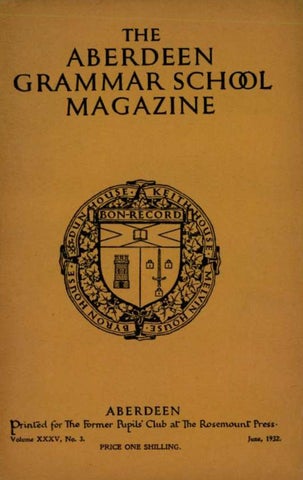
THE
ABERDEEN GRAMMAR SCHML MAGAZINE
ABERDEEN
Fr int7ut for The Former Pupil Club at- The Rosemount PressVolume XXXV, No. 3.
June, 1931.
PRICE ONE SHILLING.
EDUCATIONAL BOOKS JAMES G. BISSET the Class Books (New or
to supply all CONTINUES Second-hand) suited for the requirements of the Higher Educational Institutions in the City, at the Lowest Prices. N.B.—Best Value in Students' Note Books.
JAMES G. BISSET • Classical, Medical, and Educational Bookseller,
85 BROAD
STREET
(Opposite Marischal College).
GOOD BREAD builds brain and brawn .1 Good Bread is full of nourishment: it builds brain and brawn. Active brains and sturdy frames thrive on good Bread, such as Hutchison's, made from THE
FINEST
EMPIRE
FLOUR.
r3 BRANCHES THROUGHOUT THE CITY. 'Phone 753.
Aberdeen Grammar School Magazine Vol. XXXV.
JUNE, 193 2.
No. 3
The " Grammar School Magazine" is issued under the auspices of The Former Pupils' Club, in March, June, and November. All communications with regard to the " Magazine " should be addressed to the Editor (the Secretary and Treasurer of the Club), THEODORE WATT, M.A., The Rosemount Press, Aberdeen. ** * Members of the Club are requested to inform the Secretary of any change of address.
A Message to Former Pupils. The record of two terms should afford no lack of copy, but there is little that stands out in the retrospect, and one can only hope that F.P.s find some pleasure in the reiteration of the familiar. The one surprise was an abnormally open winter and a Rugby fixture list which never defaulted. If May was dismal, June has made amends, and Rubislaw Field has been busy long after the official hours for play. An Easter Vacation without a School trip to Brittany would be like " Hamlet " without the ghost. Dr. Cormack struck new ground this year in making Angers instead of Rennes his headquarters, and the cost of the trip, thanks to skilful budgeting, was kept almost at the old level. The members of the party had a happy and profitable time. The School Concert was, by general consent, the most successful of a long series. The Cowdray Hall was completely filled, and a high standard of attainment was achieved in both the vocal and the instrumental items. The orchestra has improved out of all knowledge. F.P.s have given it their enthusiastic support, and the admixture of more experienced players . has helped the junior members. School is definitely more musical than it was, and it is all to the good that it should be so. The Dramatic Society submitted an ambitious programme at its annual public performance and fully satisfied the critics. We have had, in addition, for some years now an unofficial Drama Day, when boys present scenes from the plays which they have read in School. This Term the repertoire will include scenes from French, German, Spanish, Latin, and Greek dramas, all in the original tongues. The Cricket XI have won practically
162
Aberdeen Grammar School Magazine.
all their matches but, somewhat unexpectedly, succumbed to the Masters. The deadly bowling of a certain Master has undoubtedly enhanced his prestige. I write these notes just after the School Sports. We were favoured with a lovely summer afternoon for the first half of the programme and we have been no less lucky to-day. Every event was keenly contested, and the spirit of good sportsmanship was as much in evidence as ever. A greater interest in pure athletics has been noticeable this summer. Boys have been keener on training, and I hope the interest will continue when they enter the University. A gift in money or in kind to the Sports Prize Fund is always welcome. The present arrangement is that prizes are provided mainly out of the entry money of the competitors, but we are aiming at a system of free entry for events with prizes provided from other sources. Most schools of similar standing to our own have no difficulty in getting what they want. The Boarding House continues to be the happy, wellordered community which it has been since it opened. The House is naturally proud of the fact that one of its members, Douglas Marr, is the winner this year of the Dux Gold Medal on the Classical side. The problem of the after-school careers of our boys becomes more acute every day. The absorptive powers of Commerce and of most of the professions have shrunk alarmingly, and school-leavers have to face a world which has little to offer them. There is a significant drift towards Medicine, which, rightly or wrongly, is regarded as one of the safe careers, and an equally significant hesitation to enter the Faculty of Arts, where prospects are more obscure. When School re-assembles in September, we shall miss one familiar figure from the staff. Mf. James Davidson has completed forty years of continuous service in the Grammar School, and he has decided to anticipate the statutory age for retirement. I have no doubt reference is made elsewhere in the Magazine to the value of Mr. Davidson's services to the School. Officially he has taught Mathematics, and no sounder teacher of that sometimes distasteful subject could be found anywhere, but the influence of his fine, unobtrusive character has had a much wider range. He did yeoman service as Secretary and Treasurer of the Games Committee in the days before the present system was in force, and he helped materially in the negotiations which led to the acquisition of Rubislaw Field. The Grammar School never had a more loyal servant nor the boys a truer friend. Our greetings to all F.P.s, at home or abroad! D. M. A. ath June, 1932.
Aberdeen Grammar School Magazine.
163
An Old Time Dominie. " Mathematics : Charles Sleigh, M.A.," was how he was described in the School Prospectus, but we all knew him as " Charlie." Long before we reached the length of his class we had heard tales of his stern ways of dealing with the rising generation, so that we entered his classroom for the first time with fear and trembling. Charlie had an appearance that filled us all with respect for him. He was a tall, broad-shouldered man, who looked as if he came from a Buchan country ancestry, and as long as we knew him, he loved to use his Doric mode of speech. He had a stentorian voice that could be heard from end to end of his long schoolroom, and his keen eye quickly detected misdemeanours. Some one would start whispering to his neighbour, and Charlie would wheel round from attending to the calculations of a dull pupil, and his voice would utter the command, " Stop the talking," and there was instant silence all over the room. If this did not have the desired effect, the culprit was bidden speak to Charlie at the end of the hour. When he went in trepidation to the master's desk he got a lecture as to his behaviour and was told, " Tak' ten for the mornin' and shut the door ahin ye." This meant ten extra home sums for next day. One day a luckless youth dared to argue the point with Charlie as to his behaviour. The master heard what he had to say, and remarked, " Weel, weel, just tak' twenty and shut the door ahin ye," and that ended that. Gross misbehaviour in class or impertinence to himself roused Charlie's ire in proper style. I can still see him giving one of my classmates a good stinging dozen with his tawse for what he had done, and that youth gave no more trouble in class. This kind of thing happened very seldom, for despite his outward grimness, Charlie had a kindly heart that loved to poke fun at us when opportunity offered. He would stand and watch some one doing a proposition from Euclid on the blackboard, and in his nervousness putting down queer-looking letters. Then a voice would say, " Ye're nae very guid at making Bs," and the youth would blush and his classmates would snigger. Although in our schooldays we lived rather in dread of old Charlie, he always gave us a very warm welcome when we went back to see him in later days. One of my classfellows did this, who in his time rose to high dignity in his Church. Charlie was delighted to see his old loon who had done so well, and after having conversed with him, he remarked, " I am awfu' gled to see ye, Anthony, but ye were an awfu' nickum fan I had ye." Thereupon the future Bishop and his old master had a good laugh together over this saying. It was this kind of thing that made his old boys glad to go back and see their dominie. DECANUS.
164
Aberdeen Grammar School Magazine.
** * It is requested that the Editor be informed of all new appointments and interesting incidents in the careers of Former Pupils.
The dates given in parentheses after names indicate the sessions of attendance at the School. A DIRECTOR OF THE BANK OF ENGLAND.
Patrick Ashley Cooper* (1896-1901), B.A., LL.B., was in April elected a Director of the Bank of England. He has a special talent for company administration and is a director of more than thirty companies, with interests in many parts of the world, being either chairman or vice-chairman of most of these concerns. He has been notably successful in restoring businesses which have fallen into decline. In June of last year he was appointed by the board of the Hudson's Bay Company, after consultation with the Bank of England, to be Governor of the Company. At the annual general meeting of the Company in April he made a speech that was of unusual interest, in the course of which he gave an account of an extensive tour of Canada which he made last year in the interests of the Company. He first visited the Eastern cities of Montreal, Ottawa, and Toronto, and then went straight to Winnipeg, which is the headquarters of the Company in Canada. He then went further West to Calgary, Edmonton, Kamloops, Vancouver, and Victoria. " I made a point," he said, " of getting into personal touch with the members of our organization, although, of course, that was not possible in the case of the men in the far-off fur posts. But I was able to broadcast an address to them explaining the position, and telling them what was expected of them. In order that you may understand the enormous advantage that one has by using the radio, I would like to tell you that I was able to communicate a personal message to our men at the various posts right across, through the Arctic, through Baffin Land, and right down to the Labrador Coast, a circle the radius of which is approximately 1,5 oo miles. I know that I am the first Governor of the Hudson's Bay Company who has ever been able to speak to them, and I would like you to appreciate that we are using every possible modern means— wireless, aeroplanes, and every other method we can—to improve * Member of Former Pupils' Club.
Aberdeen Grammar School Magazine.
165
and facilitate and speed up our business." Humour is not often an accompaniment of company meetings, but the Governor's speech was enlivened with the following :— " You will not require me to tell you that sales of land are few and far
between, and the collections of instalments in many districts very hard to make. I have here a letter which I should like to read to you. While it is not without humour, it sums up tersely and tragically the position of many a farmer to-day. This is written to the Land Department in reply to a letter urging him to pay his instalments :— " ' Dear Sir,-I got your letter about what I owe you. Now be pachent, I aint forgot you. Please wait, when I have the money I pay you. If this was Judgment Day, and you was no more prepared to meet your Maker than I am to meet your account, you sure would have to go to hell. (Laughter.) > Trusting you will do this—(loud laughter)—I am, Yours truly,
Robert Denham Alexander* (1917-2o) is now accountant in the Newington Branch of the Union Bank of Scotland, Ltd., Edinburgh. He was previously accountant at Kirriemuir. George Allan* (1923-28) is at present serving as a cadet on the T.S.S. Herefordshire. Charles Leith Barron* (1907-19), M.B., Ch.B., who was for a time House Surgeon at the Royal Northern Infirmary, Inverness, and then assistant at Blackpool in a medical partnership which includes Dr. SINCLAIR COUPER* (1876-78 and 188285), is now in practice on his own account at Armadale, West Lothian. John Hall Barron* (1884-88), M.A., B.C.L., barrister, London, has recently been appointed to the Experts Committee of the Royal Philatelic Society. He has been a philatelist for a great many years, having a magnificent collection, and is regarded as one of the authorities on certain ranges of British stamps. Robert Bruce* (1886-89), D.S.O., M.A., M.D., Brevet Colonel, was recently gazetted as Honorary Colonel of the 5/7th Battalion of the Gordon Highlanders, in succession to Colonel the Lord Sempill. He was in command of the 7th Gordons in France, with the rank of Lieut.-Colonel, in it 916-17, before being transferred with the same rank to the R.A.M.C. After the War he returned to the command of the 7th Gordons, retiring in June, 1924. He is Vice-Chairman of the County of Aberdeen Territorial Army Association. Thomas Cruickshank Bruce* (1889-92), M.A., was in the employment of the Johannesburg Consolidated Investment Co., Ltd., Johannesburg, from 1904 to 1928, and was for twenty years manager of various gold mines of that group on the Rand, including the largest one in the world. Since 1928 he has been managing a small gold mine of his own, but is soon to retire to his farm in Sundays River Valley, Cape Colony, which he has carried on for the last eleven years. Robert Henderson Calder* (1921-24) is in the service of the Australian Tesselated Tile Co., Ltd., at Mitcham, Melbourne. He left for Australia in 1927.
i 66
Aberdeen Grammar School Magaine.
George Gordon Cameron* (1915-17), M.A., B.D., was last year ordained minister of the Church of Scotland, Kent Road, Glasgow. Arnold Blatchford David Cassie* (1919-20), M.A., B.Sc., received the Ph.D. degree of London University in July, 1931. He is continuing in research at the Ramsay Memorial Laboratories of Physical and Inorganic Chemistry with a Senior Award of the Department of Scientific and Industrial Research. Douglas Paterson Cochran* (1906-15), the Vice-President of the F.P. Club, has been appointed local manager at Aberdeen of the Royal Exchange Assurance. He started with the Northern Assurance Co., Ltd., Aberdeen, in 1915, and joined the Royal Exchange Assurance in 1921. For the last few years he has been inspector attached to the Aberdeen office. James Michael Vernon Collie* (1918-29) left in March to take up ranching in the Argentine. Sir John Collie* (1873-76), C.M.G., M.D., Medical Examiner to the London County Council, and Consulting Medical Officer to the Ministry of Pensions, is the author of a recently-published volume on " Fraud in Medico-Legal Practice." According to one review, " he writes with the authority of an unequalled experience in medico-legal matters of this variety, and his book is liberally besprinkled with accounts of many cases. These anecdotes and case histories, besides being very instructive, are often vastly entertaining, and it is largely due to the skilful way in which they are interwoven in the text that the book is never dull for a single moment." Sinclair Couper (1868-71), M.I.Mech.E., and Sinclair Couper (1876-78 and 1882-85), M.B., C.M., are both members of the F.P. Club. They are cousins, called after their grandfather. The former, who was for many years engaged in engineering in Glasgow, recently visited the latter at Blackpool, where he has been in medical practice since 1894. William John Cramb* (1915-25) has started in business on his own account in Montrose as a watchmaker, jeweller, and optician. He hopes that F.P.s when they are passing through Montrose will look in and see him at 9 Bridge Street. James Ian Cormack Crombie* (1908-21), M.A., was in March appointed private secretary to Major Walter Elliot, Financial Secretary to the Treasury. He passed into the Home Civil Service in 1926. Douglas Scott Cruickshank* (1918-23) is chief accountant with Messrs. Francis Peek & Co., Ltd., Batavia. Since his arrival in Java in February, 1931, he has travelled twice round the island, and also in South Sumatra, but, strange to relate, has not yet met an F.P. out there.
Aberdeen Grammar School Magazine.
167
Peter Diack* (5904-09), M.A., is now settled as minister of King Street Church, Kilmarnock. John Ross Donald* (1953-24) is at present on the Pertang Rubber Estate, Bahau, Negri Sembilan, F.M.S. James Logie Lyall Duffus (1911-14) has gone to Southern Rhodesia as manager of an estate at Collaton, Figtree. He was formerly a commissioned officer in the Royal Air Force. John Stewart Dunnett* (t912-18), who is in the service of the Hongkong and Shanghai Banking Corporation, went from the London office to the New York office in March, and is to be in the latter for a year. Victor Ralph Witcomb Engstrom* (1923-29), Stockholm, expects to be in China about the end of this year, as he is joining a business firm in Tientsin, after he completes his period of conscription in Sweden. He will find a Club Consul in Tientsin. Frank Northman Forster* (I921-25), who has been for seven years in the Aberdeen office of the Sun Life Assurance Society, has recently been transferred to the head office in London. Rex Fowell* (591z-z3), who was engineer on a road reconstruction scheme for the Arbroath district of the Angus County Council, has recently secured an appointment as engineer and manager With Messrs. Charles Dick & Son, public works contractors, Monifieth, and is to be in charge of the building of the new road bridge at Inverbervie. This bridge is to be a reinforced concrete structure of seven spans, and is to be 8o feet above water level. Frederick Henry Fraser* (5888-99) has now retired from Ceylon and is settled at Sherrington Manor, Selmeston, Sussex. He went out to Ceylon in 19oz to take up tea and rubber planting under his father, the late Mr. Joseph Fraser, and has been manager of the Pitakande Group, Matale, since 1907. James Milner Fraser* (1918-10) recently returned to Singapore after eight months' leave, during which he made a trip round the world, via Hongkong, Manila, Shanghai, Japan, Honolulu, Vancouver, New York, Great Britain, Genoa, Suez, Colombo, Sumatra, and Singapore. He is now acting manager of the Singapore Improvement Trust while the manager is on leave. He attended the Annual Dinner on znd April of the informal branch of the F.P. Club at Singapore, particulars of which have not, so far, come to hand. James Georgeson* (1883-86), M.A., who has been Classical Master at the Girls' High School, Aberdeen, since 1898, is retiring at the end of the present session. Richard Ogilvie Girdwood* (1907-I5), M.B., Ch.B., is now Assistant City Pathologist and Bacteriologist at Bradford.
168
Aberdeen Grammar School Magazine. •
He was previously Senior Assistant Pathologist to the Stephen Ralli Memorial Laboratory, The Royal Sussex County Hospital, Brighton. William Grant* (1923-25) has completed his first spell in the Public Works Department in Ibadan, Nigeria. William Harkins* (1916-22), M.A., M.B., Ch.B., now on the staff of the Storthehall Mental Hospital, Kirkhorton, Huddersfield, has the distinction of being the only winner in Scotland of the British Medical Association's Prize of £25 for an essay on " How is the condition of the teeth of patients of special importance in the work of medical practitioners ? " The competition was open to fourth and subsequent year medical students and medical practitioners of not more than one year's standing. Dr. Harkins graduated in medicine at Aberdeen in July, 1931, and took his M.A., with first-class honours in Classics, in 1926. Alfred Alexander Harper* (1918-25), M.B., Ch.B., who graduated in medicine at Aberdeen in April, has received a temporary appointment at the Aberdeen Royal Infirmary. George Pittendrigh Hector* (1889-97), M.A., D.Sc., who joined the Indian Agricultural Service in 1908, is now Director of Agriculture, Government of Bengal. He was previously Economic Botanist, and retires next year. William Litster Hector* (1913-17), M.B., ,Ch.B., who is in medical practice at Letchworth, was in April returned at the head of the poll for councilors for the Urban District of Letchworth. Sir Alexander Hendry* (1883-86), K.C.V.O., M.D., was in May presented with gifts to mark his retirement from medical practice at Ballater. The gifts included a cheque for £75, which Sir Alexander handed over to endow the dux medal for Ballater School and dux prizes for Birkhall, Crathie, Girnock, Glengairn, and Kinord Schools. The presentation was made by Colonel Farquharson of Invercauld, who said that Sir Alexander, during the long time he had been in practice in Ballater, had devoted himself to doing good work as a doctor, and at the same time he also occupied many local government offices, taking a special interest in education. Replying, Sir Alexander said that he had stayed forty years in Ballater, and he trusted that he might remain there for the remainder of his time. " I wonder," he went on, " how many remember my first turn-out, which I took over from Dr. Cran. It was a high gig with a yellowishcoloured oak-grain body, high red wheels, red shafts, and a white horse. I remember many journeys I made on it, through wind, rain, and snowdrifts, when, to get breath, I had often to turn my head and look backwards." He recalled the changing fashions in modes of travel during his time at Ballater, and remarked that at one time he had used a motor cycle. " Of all the means of transport I ever had, I think I enjoyed it most."
Aberdeen Grammar School Magazine.
•
169
Frank Evans Hoggarth* (1921-25), M.A., has qualified as a chartered accountant, and been admitted a member of the Aberdeen Chartered Accountants' Society. Henry Humble (1913-16), M.A., B.Sc., principal science and mathematical master at Elgin Academy, has just been appointed head master of Rothes Higher Grade School, Moray. Edward Alexander Hunter* (1917-26) in October of last year received an appointment in the Colonial Police, and is at present stationed at Jerusalem. An interesting and amusing account of the policeman's lot in Palestine appeared in The Times of 28th May, in the course of which it was stated :— " In Palestine the activities of the ' enterprising burglar' and the ' cutthroat occupied in crime ' are not by any means the main concern of the police ; they rank a long way after the task of keeping the peace between Jew, Arab, and Christian, and this task is rendered more arduous because Palestine is the focus of an enormous amount of religious zeal and fanaticism on the part of the different faiths, which look upon it as a Holy Land. The great religious festivals absorb the attention of the police force, and give it as much, if not more, to do than a big race meeting or prize-fight does in Great Britain. It follows that the policeman, if he is to be worthy of his cloth and his truncheon, and able to spot trouble before it happens, must be a walking encyclopedia of comparative religious practice, and have at his finger-tips the calendars of half-a-dozen creeds. . . The Palestine policeman's vade mecum is ' The Palestine Police Calendar of Events,' which is compiled annually for the use of the ' Force' by learned officials, who know the exact difference between a Maronite and a Melkite, and other mysteries. With this in his pocket he can tell you what the faithful of any given religion should be doing in Palestine at any given time during the year. In looking through its pages one is forcibly reminded of the complexity of the problems of this distressful country and led to the conclusion that here, without any possible doubt, ' the policeman's lot is not a happy one.' "
Arthur Gilbertson Hutchison* (1909-21), B.Sc., Ph.D., has been appointed Cambridge University Demonstrator in Mineralogy and Petrology for three years from 1st October next. He is meantime an exploration geologist with Sarawak Oilfields, Ltd., Borneo. Charles Innes* (1883-84) retired at the end of March from the headmastership of Stonehaven Public School, after 46 years' teaching. Trained as a teacher in Aberdeen, he was appointed assistant at Tobermory in 189z, and two years later was appointed second master at Cullen. In 1895 he went to Dunnottar, and in 1897 to Fetteresso. He was appointed head master of Cookney Public School, Muchalls, in 1899, and came back to Stonehaven as head master in 1919. On his retirement he received a presentation from the staff and pupils of his school. When returning thanks for the gift, Mr. Innes remarked that in his first 35 years he had been absent only half a day, and since then he had been absent on only three occasions. William Dalton Ironside* (1914-24), A.R.I.B.A., has recently spent some months in Sweden in furtherance of his architectural studies. In a letter written in March he wrote ;
170
Aberdeen Grammar School Magaine.
" I have been living in this house for a month, in a room of my own, and have occasionally met, en passant, a young man who appeared to have a room in the same flat. Last Sunday, after I had been using the telephone in the hall just outside this young man's door, he suddenly emerged from the room, shook me warmly by the hand, and apologized for not having introduced himself to me before. He had heard there was an ' Englishman' living in the same house. His speech was so devoid of foreign accent that I was prompted to remark, ' Then you are English, too.' No,' he replied, ' I am Swedish, my name is Engstrom, but I have been in Scotland for five years as a pupil of the Aberdeen Grammar School! ' " The mutual discovery gave rise to much astonishment, hand-grasping, showing of photographs, and praise of the old School. Our periods of scholastic endeavour overlapped by one year (1923-24), but we had never met before." Ironside has now returned to Aberdeen, and Engstrom, as will be seen from a preceding note, is shortly going to China. Percival Robson Kirby (1892-1901), M.A., Professor of Music in the University of Witwatersrand, Johannesburg, recently received the degree of Doctor of Literature of that University. His thesis for the doctorate was entitled " Literary contributions relating to various branches of musical study." Prior to going to Johannesburg he was for a number of years Director of Music for the Education Department of Natal, where he began his study of native music. He has written numerous articles on musical subjects, and his recent work on " The Kettledrums," suggested by and dedicated to the late Sir Charles Stanford, is now the standard work on the subject. His most important literary work is a series of papers upon various aspects of the music of the native peoples of South Africa. One of these, entitled " Some problems of primitive harmony and polyphony, with special reference to Bantu practice," is quoted in the new volume of the Oxford History of Music. The whole series, which covers the work of a number of years, forms a sequence which Professor Kirby is continuing with the help of the Research Grant Board of the Union of South Africa and the Carnegie Corporation of America. He has also in preparation a book on the subject of the musical instruments of the native peoples of Southern Africa, which will treat of the subject from an entirely new point of view. Talking about kettledrums, one is reminded of the enthusiastic yet discreet way in which he used to wield the drum-sticks at choral and orchestral concerts in Aberdeen some twenty years ago. Cecil John Lamb* (1915-22), who is in the Locomotive Department of the London and North-Eastern Railway at Ferryhill, Aberdeen, has been promoted to Hawick and St. Boswells,
Aberdeen Grammar School Magazine.
171
John Henry Leith* (1912-23) has recently been taken into partnership with his father in the business of H. Leith & Son, ironmongers, Aberdeen. He has been associated with this , business since leaving the School. George Francis Alexander MacDonald (1919-zo), M.A., LL.B., was in March admitted by the Bishop of Aberdeen to the diaconate of the Episcopal Church in Scotland, and was licensed as curate at St. Margaret's Church, Aberdeen. James Lyle McDougall* (1915-22), after completing a five years' apprenticeship in mechanical engineering, was in 1929 elected a graduate of the Institution of Mechanical Engineers, and in the following year was elected to the Engineering Institute of Canada. From 1929 till recently he was with Price Brothers and Co., Ltd., at their pulp and paper mill at Kenogami, Quebec, but he is now in the service of the Plessisbille Foundry, Quebec. He has become a Life Member of the F.P. Club. Donald .Hugh James Mackay* (1912- I 8), who graduated B.L. at Edinburgh University in 1925, and was admitted a member of the Society of Writers to H.M. Signet in December, 1930, was in July of last year appointed Procurator Fiscal Depute, County Buildings, Glasgow. John James Rickard MacLeod* (1884-93), D.Sc., LL.D., F.R.S., Regius Professor of Physiology in the University of Aberdeen, delivered in May the Linacre Lecture at Cambridge. He has been granted leave of absence from the beginning of December, 1932, to the end of January, 1933, to enable him to accept the post of Visiting Professor of Physiology at Johns Hopkins University, Baltimore, U.S.A. John Eric MacRae* (1883-87), M.A., rector of the Episcopal Church, Invergowrie, Dundee, was last year appointed Canon of St. Paul's Cathedral, Dundee. Since 193o he has been editor of the Scottish Guardian, the journal of the Episcopal Church in Scotland. Thomas Pemberton Main* (1883-87), who is in the service of the Shanghai Gas Co., Ltd., is at present home on furlough, and has become a Life Member of the F.P. Club. He served his apprenticeship as an engineer with Messrs. Barry, Henry and Co., Aberdeen; went to sea, gaining the Chief Engineer's certificate; and in 1907 went to Shanghai, where he has been ever since. Keith Robert Thomson Matthew* (1912-24), M.B., Ch.B., is now in partnership in a general practice in North Kelvinside, Glasgow. David Middleton (1921-27), M.B., Ch.B., and James Cumming Niven* 92o-26), M.B., Ch.B., are at present House Surgeons in the Royal Infirmary, Sunderland.
172
Aberdeen Grammar School Magazine.
Charles B. Milne* (1893-96), M.A., LL.B., advocate, Edinburgh, was at the last General Election elected M.P. for West Fife, in room of the Right Hon. William Adamson, P.C. He is an advocate in Edinburgh, and was lecturer in the department of Scots Law in Edinburgh University. He was recently made a K.C. Harold Samuel Milne* (1913-26) is at present resident engineer on a contract for a reconstruction which his firm, The Woodall-Duckham Co., Ltd., is carrying out on the carbonising plant at the Gas Works at Odense, Denmark. John Minto* (1878-80), M.A., Librarian to the Society of Writers to H.M. Signet, Edinburgh, has in the press, to be published in June, " A History of the Public Library Movement." Alexander Wyness Mortimer* (1924-27) is in the Aberdeen office of Messrs. J. & N. Philips & Co., Ltd., of Manchester. John Mortimer* (1923-27) is Agency Inspector with the Scottish Insurance Corporation Ltd., Aberdeen. Thomas Henderson Murdoch* (1921-27), M.A., who was for a time in the service of Messrs. Lidgerwood, Ltd., export merchants and engineers, London, is now the representative in the North of England for the Hudson's Bay Company and for George Tabor, Ltd., fish merchants, London. John Alexander Nicol* (1895-99), M.A., B.L., sole partner of the firm of Blacklaw & Nicol, advocates, Aberdeen, has been the cause of great anxiety to his relatives and friends by reason of his disappearance since 17th May. He left his home in Aberdeen on that day with the intention of going to the country on business. He had lunch at Banchory in the early afternoon, and had a meal at Lumphanan about 9 p.m. He was last seen at Sundayswells, about a mile east of Lumphanan, at to p.m. He did not return to his office or home that night, and when there was no sign of him the following day, inquiries were made, with the result that his movements to the places mentioned were ascertained, and after that all trace of him was lost until on the afternoon of zznd May there was discovered, on the north bank of the River Dee near Potarch, a coat and a cap which were definitely identified as those which were worn by him when he left his home. So far there is no solution to the mystery of his disappearance. James Henderson Peters* (1904-17), M.B., Ch.B., after being for six years in medical practice at Darlington, is now in partnership with another Aberdeen graduate (Dr. A. G. B. Duncan) at Stoke-on-Trent. David Herbert Bennett* (1910-21), architect, at present engaged on private work in London, has been re-elected by the Council for a further period of two years' study at the Royal Academy (School of Architecture).
Aberdeen Grammar School Magazine.
173
Alexander Fraser Ross* (1923-27) is in the Forestry Department, Ibadan, Nigeria. He has just become a Life Member of the F.P. Club. John Chesser Salmond* (1889-96), who has been in the service of Lloyds Bank, Ltd., for a long time, being latterly manager at Fakenham, Norfolk, has been promoted to be manager at Chelmsford, Essex. Arthur Martin Scrimgeour* (1921-27) is in the service of Messrs. H. J. Foster & Co., Ltd., and has been transferred from the Bombay to the Calcutta branch of the firm. Alexander James Sheret* (1890-96), who went to the United States in 1911, and since 1918 has been with a firm of music publishers and dealers in Philadelphia, Penna., is coming home on a visit this summer. Alexander Stewart (1901-08), M.A., has resigned from the headmastership of Rayne North Public School, Meikle Wartle, Aberdeenshire. James Frater Taylor* (1886-88) is the author of a small volume recently published by Messrs. Crosby Lockwood and Son, London, entitled " Economics of Everyday Life." Mr. Taylor is a recognized financial expert, and was a member of the Macmillan Committee on Finance and Industry. In the introduction to the book, written in January last, he says :
•
$
•
" The events of the past four months, and especially this country's departure from the Gold Standard, have raised innumerable questions by laymen and women, to which they seek answers in their own language. It is a good sign that so many people are endeavouring to understand not merely what the Gold Standard means, but the bearing it has upon living conditions. My only excuse, then, for this humble effort is that I also, as a layman, am groping towards the light, but with something of practical experience as a background, as prior to and during the War years I was an active Director of large industrial undertakings (iron, steel, etc.) overseas. Later, in the post-War period, I acted for important Canadian Banks in certain intricate industrial situations. Also, my participation in serious reconstructions in this country and my service on the Macmillan Committee have contributed materially towards an understanding of the problems confronting us here."
In a series of z8 short chapters Mr. Taylor deals very lucidly with various aspects of economics—money, banking, the organization of industry, investment, trading, tariffs, and the need for national economy and for international co-operation. In a chapter on the essentials of good government he says : " What, then, is the test of good government for this country ? I come at once to the point, and submit that its essentials are work for all, work designed to make Britain more self-contained and independent of outside supplies, progressive social service within the nation's capacity to pay, and the respect of other nations."
Dealing with the need for international co-operation, he concludes : " A United States of Europe may be a far cry, but here again I am not at all sure that Great Britain could not make a beginning by enlarging the Empire
174
Aberdeen Grammar School Magaine.
Federation to include such as the Scandinavian countries, whose peoples are not so very far removed from ourselves. While preserving to the full the national characteristics and government, it should be possible to contemplate an invitation to, say, Denmark, Sweden, and Norway to join Britain, who, if she will, can provide the necessary leaven for a more friendly world."
John Thom* (1882-84), who was for many years engaged as a tea planter in Assam and retired some time ago, is now permanently resident in Bournemouth. Alexander Thomson* (1923-27) qualified as a Member of the Royal College of Veterinary Surgeons in July of last year, and is now assistant to a " vet." in Helston, Cornwall. George Grant Thomson* (19 to-12), who has been in the service of the Hongkong and Shanghai Banking Corporation since 1920, is now stationed at Hankow. Robert Scott Troup* (1888-91), C.I.E., D.Sc., F.R.S., Professor of Forestry in the University of Oxford and Director of the Imperial Forestry Institute, is the author of " Exotic Forest Trees in the British Empire," recently published by the Clarendon Press, Oxford. At the Third British Empire Forestry Conference held in 1928 special consideration was given to the important part played by exotic trees in sylvicultural practice in various parts of the Empire, and, following a recommendation by the Conference, the Imperial Forestry Institute undertook to sift, and supplement when necessary, the vast amount of material presented at the Conference, in order that the information might be made available in concise form for general use. The result is the present volume compiled by Professor Troup. Alexander James Garland Waters* (1924-28) is in the third year of his course for the degree of B.S.A. at the Macdonald College, Faculty of Agriculture, McGill University, Canada. He hopes to take up a position in the Chemical Research Department of the Experimental Station operated by the Canadian Government at Ottawa. Theodore Watt* (1 889-1901), M.A., was recently appointed Joint Managing Director of The Aberdeen University Press, Ltd., on the amalgamation of this firm with The Rosemount Press, Ltd. The Chairman of The Aberdeen University Press, Ltd., is GEORGE ROBB* (1892-97), of Messrs. Edmonds and Ledingham, advocates, Aberdeen, and another Director is EDWARD WILLIAM WATT* (1883-94), M.A., who is one of the assessors of the Aberdeen Town Council in the Aberdeen University Court. Ninian Blundell Wright* (19 i O-23), M.A., B.D., is at present in Palestine as Wilson Fellow of Aberdeen University, working at Samaria with the joint expedition of the British School of Archeology, the Palestine Exploration Fund, Harvard University, and the Hebrew University. "Excavations in Samaria were resumed in the middle of
a
Aberdeen Grammar School Magazine.
175
March, and much new light," says The Times of 16th June, " has been thrown on the fortifications of the Israelite period, and on the precision with which they were planned. Samaria was the capital of Israel just when the temporal power of Israel counted for most among the surrounding nations, and the massive walls are striking witnesses to the wealth and advanced civilization of the time. Very few small objects, however, were found, until about a fortnight ago, when some splendid fragments of ivory were discovered, including two crouching lions in the round of exquisite workmanship, about 2 inches high, and a number of small panels in relief." ABERDEEN UNIVERSITY DEGREES AND PRIZES.
At the Spring Graduation at Aberdeen University degrees were conferred on the following F.P.s :— Doctor of Medicine (M.D.)— Herbert Charles Robert Gunter* (191o-19), M.B., Ch.B. Thesis-" Some Observations on zoo Cases of Chronic Duodenal Ulcer." Master of Arts (M.A.)— Albert Christie* (1919-29). Andrew Craig* (1924-29). Maurice Cramb* (1916-26). Bachelor of Laws (LL.B.)— Alexander Campbell Brands* (1925-27), M.A. David Lindsay Rennet* (1914-26), M.A. Bachelor of Medicine (M.B.) and Bachelor of Surgery (Ch.B.)— John Joseph Elphinstone* (1919-26). Alfred Alexander Harper* (1918-25), M.A. James Robertson Monro Mackie* (1920-27). David Middleton (1921-27). James Cumming Niven* (1920-26). William Stott Pollock (1919-2o). In the Faculty of Arts David Donald Murison* (1922-29) was awarded the Jenkyns Prize in Classical Philology, and the Liddel Prize for Latin Verse Composition. In the Faculty of Medicine Alfred Emerson Macdonald* (1922-25), M.A., was awarded the Dr. James Anderson Gold Medal and Prize in Clinical Medicine ; John Ramage Marshall Sangster (1920-24) was awarded the Dyce Davidson Memorial Gold Medal in Materia Medica; James Laing Spalding Thomson* (1920-27) was awarded the Keith Gold Medal for
176
Aberdeen Grammar School Magazine.
Systematic and Clinical Surgery ; and Ian Alfred Anderson* (1912-24), B.Sc., was awarded the Matthews Duncan Gold Medal
in Obstetrics, and the Alexander Ogston Prize in Surgery.
Marriages. Brodie-Brown (1915- I8).—At the West Church of St. Nicholas, Aberdeen, on izth April, 1932, WILLIAM BAXTER BRODIE-BROWN,* M.B., Ch.B., only son of Dr. and Mrs. Brodie-Brown, Aboyne, to Elsie Barbara, only daughter of Lieut.-Colonel H. Forbes, D.S.O., and Mrs. Forbes, Montgarrie House, Alford. Cook (1881-83).---At Glasgow, on 7th April, 1932, WILLIAM LINDSAY COOK, S.S.C., 12 Duke Street, Edinburgh, and 31 Adelphi, Aberdeen, to Jean Pollock, eldest daughter of Mr. and Mrs. Thomas Wylie, 24 Caimhill Crescent, Carnbroc, Coatbridge. Davidson (19o7-17).---At the Old Church, Chelsea, on 12th May, 1932, JOHN SINCLAIR DAVIDSON,* youngest son of the late Andrew Davidson, advocate, Aberdeen, to Edna, daughter of the late A. G. Theyer, Buenos Aires. Davidson (19o8-13).—At St. Columba's, Pont Street, London, S.W., on 23rd April, 1932, PETER MCLAREN DAVIDSON,* I2 Lamont Road, Chelsea, younger son of Mr. and Mrs. James S. Davidson, Cairnlee, Aberdeenshire, to Gertrude Marie, elder daughter of Mr. and Mrs. F. C. Shipway, Teddington, Middlesex. M'Combie (1916-23).—At the Haughton Arms Hotel, Alford, on 25th May, 1932, JoHN M'ComstE,* elder son of the late George W. M'Combie, Auchenhamper, Turriff, and of Mrs. M'Combie, 22 Carlton Place, Aberdeen, to Maggie Ann Skinner, daughter of William Stewart and of the late Mrs. Stewart, Lonenwell, Alford. Macrae (1916-23).—In London, on 23rd April, 1932, RONALD DUNCAN MACRAE,* M.B., Ch.B., D.P.H., son of Mr. and Mrs. MacRae, Blenheim Place, Aberdeen, to Agnes Kathleen Milton, daughter of the late Andrew Milton and Mrs. Milton, Burnfoot, Portsoy. Marnoch (i9i8-21).—At the Royal Hotel, on 26th March, 1932, EDWARD GEORGE MARNOCH,* son of Mr. and Mrs. John Mamoch, 17 Urquhart Street, to Winifred Mary, only daughter of Mr. and Mrs. William Cheyne, Ruthrieston School Lodge, Aberdeen. Mulligan (19o7-I3).—At Paddington Chapel, London, on 1st June, 1932, CYRIL A. MULLIGAN, M.R.C.S., L.R.C.P., Stockport, to Tina, daughter of the late Thomas Dumican, Belfast, and of Mrs. Johnston, 48 Hammerfield Avenue, Aberdeen. Ramsay (I918).-At St. Andrew's Church, Totteridge, on 26th September, 1931, MAGNUS WILLIAM RAMSAY, B.Sc., only son of the late Magnus Ramsay and Mrs. Ramsay, to Dorothy Louise, eldest daughter of the late B. E. Osborne and Mrs. Osborne, of London, S.W. Rennie (1908-to).—At Monimail Parish Church, Fife, on 9th June, 1932, THOMAS GORDON RENNIE, The Black Watch, youngest son of the late Dr. T. Rennie, of Foochow, China, and of Mrs. Rennie, Invercolne, Radlett, Herts. to Huldah, only daughter of Mr. and Mrs. H. Giles Walker, of Over Rankeillour, Cupar Fife. Williamson (1906-18).—At St. Anne's, Strathpeffer, on 4th June, 1932, ROBERT BERTRAM WILLIAMSON,* M.A., LL.B., advocate in Aberdeen, to Isobel Frances, only daughter of the late P. Rodger Patrick, solicitor, Hamilton, and Mrs. Patrick, Gamocklea, Hamilton.
,
0
a
a
Mr. JAMES DAVIDSON, M.A.
•
a • la
Sir WILLIAM WATSON CHEYNE, Bart., K.C.M.G., C.B., M.B., C.M., F.R.C.S., D.Sc., LL.D., F.R.S. (In uniform of Surgeon Rear-Admiral.) Photograph by Messrs. Elliott and Fry, Ltd.
Aberdeen Grammar School Magazine.
177
OBITUARY. A Great Surgeon.
Is
0
Sir William Watson Cheyne* (1863-68), Bart., K.C.M.G., C.B., M.B., C.M., F.R.C.S., D.Sc., LL.D., F.R.S., died in a nursing home on 19th April, 1931, in his Both year. A pupil and assistant of Joseph Lister, he became the foremost exponent and champion of those Listerian methods which have revolutionized the practice of surgery throughout the world. Born on 14th December, 1852, the son of Andrew Cheyne and his wife, Eliza, daughter of the Rev. William Watson, minister of Fetlar, in Shetland, Cheyne spent his boyhood in the manse of this wind-swept island, and learned to love the sea. In later years he visited Shetland whenever he could, and eventually settled in retirement in his beloved Fetlar. He entered the first class of the Aberdeen Grammar School in the session 1863-64—probably on the opening of the present School buildings—and went through all the five classes, finishing his attendance in the session 1867-68. He then entered King's College, and was for two years a member of the distinguished Arts Class of 1868-7z. In 187o he began the study of medicine at Edinburgh University, and graduated M.B., C.M., there in 1875, with first class honours. He then went to Vienna and Strassburg, and thereafter became house surgeon to Joseph Lister, at that time Professor of Clinical Surgery in Edinburgh, and nearing the height of his fame. When, in 1877, Lister became Professor of Surgery at King's College, London, he asked Cheyne to accompany him as his first house surgeon. Cheyne did his work well, and in the following year he was appointed additional surgical registrar at King's College Hospital, with special charge of the patients in Professor Lister's wards. The position was neither easy nor pleasant at first, for he had to contend with the open hostility of the nursing staff, who disliked what they considered to be new-fangled ways from Edinburgh ; the apathy of the surgeons, who had yet to learn the value of antisepsis ; and the neglect of the students, who found that the advocacy of Listerian methods did not pay at examinations. Lister's wards were almost empty, and the attendance at his lectures was so scanty that for years Cheyne attended them regularly to add one more to the class, because Lister used to feel the change from Edinburgh so acutely. - With time on his hands, therefore, Cheyne, in June, 1879, took the F.R.C.S. diploma, and in the following year was appointed assistant surgeon at King's College Hospital. He thus mounted his first step on the ladder of success, and rose to be surgeon, Professor of Clinical Surgery, and Emeritus Professor. He early acquired a name for surgical rectitude, and his opinion and skill were soon in such demand that he developed a very
178
Aberdeen Grammar School Magazine.
large practice, and for many years led an exceptionally busy and useful life. From 1888 to 1890 he was Hunterian Professor at the Royal College of Surgeons. In 1894 he was elected F.R.S. When the South African War broke out in 1899, Cheyne at once volunteered for service, and was appointed a Civil Consulting Surgeon to the Forces, his work being recognized by a mention in dispatches, and by his being made C.B. He was appointed Surgeon-in-Ordinary to the King, and was created a Baronet in 1908. He served as President of the Royal College of Surgeons of England from 1914 to 1916, and in the latter year was made K.C.M.G. On the outbreak of the Great War he was Consulting Surgeon to the Royal Navy. In 1915 he became temporary SurgeonGeneral, R.N., being afterwards given the rank of Surgeon Rear-Admiral, and much of his time was spent at Chatham. In 1919 he was gazetted Lord Lieutenant of Orkney and Shetland, an office which he resigned in 1930. In 1917, on his retirement from practice, he was elected to represent in Parliament the Universities of Edinburgh and St. Andrews, and in 1918 he became one of the three M.P.s for the combined Scottish Universities. He speedily gained the ear of the House of Commons, for he spoke of what he knew, and talked common sense in an easy and audible manner. Overwork during the War laid the seeds of ill-health in a naturally robust body, and his attendance at the House still further undermined his health, so he left Parliament in 1922, retiring to his island home at Leagarth, Fetlar. In 1924 the Lister Memorial Medal and Prize were awarded to Cheyne, who delivered the Lister Memorial Lecture in May, 1925. He received honorary degrees from Oxford, Edinburgh, and Birmingham, and was the author of important works on professional subjects, including a manual of surgical treatment, in seven volumes. He is succeeded in the baronetcy by his elder son, Lieut.-Colonel Joseph Lister Cheyne, M.C., commanding the 16/5 th Lancers, who is married and has three sons. A correspondent writes :— "Perhaps the most outstanding characteristic of Watson Cheyne was his diffidence and modesty. As a student he had attracted the attention of Lister, but was too backward to apply for the situation of his house surgeon. This only made their later partnership and co-operation more fruitful, because it enabled the young man to spend a year in Germany before returning to Edinburgh. This turned his attention to the infant science of bacteriology, on which modern surgery is based, and of which Lister was almost entirely ignorant. " Honours were showered on Cheyne, but all of them came to him unsought; when he was forced into the limelight, he consented only from a high sense of duty. He loved the
Aberdeen Grammar School Magazine.
179
simplicity and quietude of his Shetland home in Fetlar, where he ' could go to bed and leave the door open.' To the end he delighted in the ocean, and went long journeys by sea, but his fellow travellers never suspected that the quiet man, who spoke so effectively and interestingly when he did open his mouth, was still the greatest living surgeon, who could look back to the very beginnings of modern surgery, and to whose genius and initiative in developing surgical technique thousands of people in all parts of the world owed their very lives. " He was selected to deliver the first Lister Memorial Lecture, and it was explained to him that in each case the lecturer was to speak about his own work and his own contributions to surgery. But Cheyne could not speak about himself—he announced at the beginning that the lecture was to be about Lister and his work. " He had a keen sense of humour, but his fun was always kindly and sympathetic. Their sense of humour, derived from Scottish ancestry—as Cheyne suggested—stood Lister and Cheyne in good stead when they discovered that the students, the nurses, and the surgeons in London were not only uninterested in the Scottish developments of surgery, but were sometimes actually hostile. " A stalwart Nordic, fair-haired and blue-eyed, this Shetlander, born at sea, possessed all the stolid perseverance of his Scandinavian ancestors. Clear-headed and logical, courteous to a fault, he listened carefully, giving full value to the arguments of his opponent, and sometimes he kept his own views in abeyance for the sake of harmony and goodwill." Francis John Robert Anderson* (i 881-8 5), Town Clerk of Fraserburgh, died in Aberdeen on loth March, 1932, aged 62 years. On leaving the School he served his apprenticeship in a law office in Peterhead, and was afterwards in two Aberdeen offices. He qualified as a law agent in 189z, and four years later was assumed as a partner by the late Mr. Andrew Tarras, Fraserburgh, the partnership continuing until 1904, when Mr. Anderson was appointed Town Clerk of Fraserburgh. He continued to occupy this office until the time of his death. James Melville Paterson Crombie* (1884-89), M.B., C.M., L.D.S. (R.C.S.Eng.), died at Aberdeen on 17th June, 1932, aged 58 years. A son of the late Mr. Peter Crombie, dentist, Aberdeen, he graduated in medicine at Aberdeen University in 1895, and took his L.D.S. two years later. After gaining experience at Guy's Hospital, London, he started in practice as a dentist in Aberdeen. He was appointed dental surgeon and lecturer in dental surgery at Aberdeen Royal Infirmary in 1898. At the outbreak of the Great War he held the rank of Captain in the R.A.M.C. (T.F.), and served
I So
Aberdeen Grammar School Magaine.
•
in the ist Scottish General Hospital from August, 1914, to June, 1915. Thereafter, until March, 1919, he was officer in charge of the Jaw Centre, 1st Scottish General Hospital, and Aberdeen Military Dental Centre. Dr. Crombie was one of the best all-round sportsmen in Aberdeen and the North of Scotland. In addition to being an expert in badminton and lawn tennis, he was for many years connected with the Aberdeen Boat Club, of which he was at one time Captain, and later President. Also a keen mountaineer, he was a member of the Scottish Mountaineering Club and the Cairngorm Club. He is survived by three sons, all of whom are F.P.s. The eldest, HUGH MAC KENZIE CROMBIE* ( I 911-20), M.B., Ch.B., L.D.S.(Eng.), joined his father in partnership some years ago; GEORGE EDMOND CROMBIE* (1916-21), M.A., having last year gained the eighth place for the Home Civil Service and the second place for the Indian Civil Service, was assigned to the India Office ; and PETER CROMBIE (1919-24) is a third year Arts Student at Aberdeen University. Sport in the North-East of Scotland, especially badminton and lawn tennis, has sustained a great loss in the death of Dr. James Crombie. Great as his skill was in both games, he will be remembered best as a player of badminton, wherein he reigned supreme for over twenty years, not only in the North but in all Scotland. On thirteen occasions he played for his country and would undoubtedly have exceeded this number but for the intervening years of the War. Among the many great feats he performed his two greatest were reaching the final of the Men's Singles in the All England Championships, and playing for his country at the age of fifty years. These are two achievements never equalled by a Scottish badminton player and never likely to be. Besides being a great wielder of the racquet, Dr. Crombie took a very prominent part in the administration of both games. For ten years prior to his death he was President of the NorthEast of Scotland Lawn Tennis Association, and was President of the Scottish Badminton Union for three years. It was owing very largely to his great personality, skill, and keenness that the North-East of Scotland has been able to take such a prominent part in badminton and produce so many fine players. He held a unique position in the realm of badminton and tennis in Aberdeen, and his willing and much sought-after advice will be greatly missed. The Aberdeen Grammar School has produced many fine athletes, but Dr. James Crombie's record stands second to none, and is probably equalled only by that of Lord Mackay. H. G. M.
Aberdeen Grammar School Magazine,
181
James Milan (186o-62), M.A., D.D., formerly minister of Alford, died in Edinburgh on 9th May, 1932, in the 8 5th year of his age and the 61st year of his ministry in the Church of Scotland. The son of Dr. James Gillan of Allangarth, minister of Alford, he had, said The Scotsman, a clerical ancestry behind him that stretched back to the Reformation. The love of the kirk was woven into the very fibre of his being, and after graduating in Arts and Divinity at the University of Aberdeen, he was licensed by the Presbytery of Alford in 1869. There followed a period of two years as assistant at Newbattle, and then he was presented by Queen Victoria to his native parish, on the death of his father in 1871. For 25 years Dr. Gillan remained in his Aberdeenshire parish, but with his semi-jubilee he made a great and self-sacrificing decision. He resolved to devote himself for a space to the pressing needs of the congested urban areas, and resigning his living, he betook himself to Edinburgh, where eighteen months later he found the sphere he sought, and threw himself into the many difficulties of a struggling mission charge in the Dairy district, West Coates Parish. There for six years he laboured, and in three years the mission hall became St. Bride's Church, which is a monument to his vision, taste, and indomitable energy. In 1905 he was translated to St. Margaret's, in the Dumbiedykes district of Edinburgh, and there he remained till 1910. His next post was at Brussels, where he had charge of the Scots Church ; and then proceeding to the Scots Church at Cairo, he undertook an Egyptian ministry which lasted from 1912 until 1917. In the last two years of his ministry there he did great work on behalf of the soldiers, mostly Australians and New Zealanders. After the close of the War he lived in Edinburgh in nominal retirement, though in point of fact his restless activity never diminished, and he engaged in the work of a score of committees and organizations, and his services were ever at the disposal of his clerical brethren. Charles Stuart Gordon (1867-69) died at Aberdeen on 2nd June, 1932. He was the son of the late Mr. George Gordon, manager of the Aberdeen Gas Company before the Town Council took over the undertaking. After leaving the School he entered the service of the North of Scotland Bank, Aberdeen, in 1872, and continued with it until 5899, being latterly agent at the Rosemount Branch. In his earlier days he was a keen volunteer, holding a commission, and retiring with the rank of Major. He commanded the depot of the Gordon Highlanders in 1901-oz, during the South African War, and was BrigadeMajor, Gordon Infantry Brigade, T.F., from 1902 to 1911. When the Great War broke out he rejoined in November, 1914, as a Lieutenant in the Army Service Corps, and was in charge of supply depots at Invergordon and Aberdeen to September, 1959, having in the meantime been promoted Captain.
[8 z
Aberdeen Grammar School Magazine.
William Hally Gardner Hally* (1889-96) died of pneumonia at Calcutta on zoth March, 193z, aged 5 I years. He was the eldest son of the late Mr. Robert Hally, of Messrs. Shirras, Laing & Co., Ltd., Aberdeen, and after being trained both as a mechanical and an electrical engineer, he went out in 1904 to Assam, entering the service of the Singlo Tea Company and continuing with them for z8 years, being latterly manager of the Jaboka Estate. When the F.P. Club consular system was established, he was appointed Consul for Assam, and served very acceptably in that capacity. At the funeral to the Scottish Cemetery in Calcutta, the Club was represented by the Consul for Bengal, Mr. G. F. Rose, who arranged for the sending of a wreath from the Club. An F.P. who knew Hally intimately in Assam sends the following appreciation :— " When I came to Assam as a ' first-timer,' one of the first men I met was Hally, and no one did more to put me at my ease and to help me to overcome the difficulties one meets in a foreign country than he did. He was the same to everyone. " As Secretary of our local club for many years, he spent endless time and energy for the benefit of all. A useful polo player as well as a tennis player and golfer, ' Old Hally ' was needed to complete every ' meet.' Club bridge rooms, too, appeared empty without him. " A planter of wide experience and of no mean ability, he will be sorely missed by the district in which most of his life in tea was spent. He was of a rather quiet disposition, and was generous to a degree. He was a pukka white " Hally may be summed up thus man.' " Another correspondent writes :—" He received the Magazine in Assam regularly and read it from cover to cover the day it came from home, however busy he might be, as he truly loved his old School, and he held it a high honour to be Consul for Assam." Eu Siang Hye* (1903-05) is reported by the F.P. Club Consul at Penang to have died, but the place and date of his death have not yet been ascertained. Born in 1887, he was the son of Eu Say Leng, Kuala Lumpur, and after spending two years at the Grammar School, he studied at the Redruth School of Mines in Cornwall for three years. From 1909 to 1911 he was Professor of Mining at the Polytechnic College, Nanking, China. Later he engaged in mining in Perak, Siam, and Burma. In 1923 he was in the service of the Bun Tin Lum Co., Kuala Lumpur. He was a keen philatelist. The Secretary of the F.P. Club will be grateful to anyone who can supply later information about Eu. Andrew Davidson Kelly (i 88 2-88), M.D., Philadelphia, Co. Durham, died on loth April, 1932, aged 63 years. He graduated in medicine at Aberdeen University in 1894, taking
Aberdeen Grammar School Magazine.
183
his M.D. degree seven years later, and had been for many years in medical practice at Philadelphia. When at the School he was one of the most conspicuous rugby players, and was a very successful captain. William McRobbie (186o-65), M.A., senior minister of what is now known as the Waulkmill Church, Premnay, died at Peterculter on 29th May, 1932, aged 8z years. He was ordained minister of the Free Church, Aberdour, Aberdeenshire, in 1875, and was translated to Leslie and Premnay, Aberdeenshire, in 1878. There he continued until his retirement in 1921. Herbert Leith Murray (1886-88), M.D., who was appointed Professor of Clinical Obstetrics and Gyna:cology at Liverpool University last October, died on 11th June, 1932, aged 52 years. The eldest son of ROBERT MURRAY* (1861-64), now one of the oldest members of the F.P. Club, he attended the Grammar School for two years until his father, who was in the service of the North of Scotland Bank in Aberdeen, was appointed in 1888 to be agent of this Bank in Dundee. After receiving the rest of his schooling in Dundee, he came back to Aberdeen to complete his medical studies, and graduated M.B., Ch.B., in 1901, and M.D. in 19o57 He practised for many years as a surgeon in Liverpool, and was widely known as a gynecologist. Henry Smith (188o-81), M.A., B.D., minister of the parish on the island of Sanday, Orkney, died there on 11th Lady of May, 1932, aged 7z years. He was ordained as a minister of the Church of Scotland in 1896, and went to the island of Burray, Orkney, at first as a missionary, and in 1904 was admitted as the first minister of the parish. In 1919 he was translated to the parish of Lady. James Smith (1884-86), M.A., M.B., C.M., died at Peterhead on 28th March, 1932, aged 64 years. He was a native of Peterhead, and after graduating in medicine at Aberdeen in 1893, acted for several years as assistant in Keith, after which he returned to his native town, where he had been in practice for 33 years. He played a prominent part in the public life of Peterhead. James Stephen* (1861-65), M.A., M.D., died at his residence 5z Polmuir Road, Aberdeen, on r ith June, 1932, aged 83 years. He was a medical practitioner at Peterhead from 1872 until his retirement in 1921, when he came to reside in Aberdeen. It has been well said of him that his professional skill and knowledge, combined with his kind and unfailingly courteous personality, made him the trusted friend of thousands of all classes in Peterhead, and the confidant and adviser of the sick, the needy, and the distressed. James Watt (1884), M.A., formerly head master of Hilton Public School, Fearn, Ross-shire, died at Tain on nth May, 1932, aged 69 years.
•
18 4
Aberdeen Grammar School Magazine.
Mr. James Davidson. Mr. Davidson is leaving. What is going to become of the Old School ? Truly, " the old order changeth," for another familiar figure will walk The Corridor no more. Dr. Middleton, Mr. Munson, Mr. Laing, and the old Janitor too, have lately departed—already the School had seemed quite different—and now we are told Mr. Davidson is going too. Well, we shall have to cherish Mr. Edward all the more, as the last of the Old Brigade . . . Ebeu, fugaces ! For years and years Mr. Davidson has patiently explained Pythagoras, and sines, cosines, and quadratic equations with the attendant Reason Why. But he is interested in more than Mathematics ; previous to the arrival of Mr. MacGregor, he was in charge of School games (you will see his photograph all down The Corridor with the teams)—which is incidentally an indication of his versatility. Besides, he is actively interested in general education as a prominent member of the Educational Institute of Scotland ; and no one can fail to appreciate his kindly solicitation after the Maths. exam., or his strenuous attention before. And then, apart from all this, Mr. Davidson has a greater something still, and that is the affection of surely hundreds of Grammar School boys, past and present, of those scores and scores of his pupils during forty years at the School. In fine, the more we think of Mr. Davidson and what he means to the School, the more we wonder what in the world we are to do without him 1 During my first year in the Middle School, Dr. McLeod retired, and, as I slowly progressed to the Sixth, the " Old Guard " dwindled, one by one—that " Old Guard" which seemed to embody all the great traditions of the School. Well do I remember how we boys stood in awe of that particular group of great personalities, and how frequently mention of the scholastic attainments and teaching reputation of a successor was met by the regretful comment, " Ah, but . . ." And now Mr. James Davidson is to retire after many years of service. Most boys feel very strongly about Mathematics. Many, the majority perhaps, cordially detest the subject ; some enjoy it, and a few have even been known to have a genuine liking for it. With all types Mr. Davidson seemed to be equally successful. He never attempted to drive a backward pupil past a difficult theorem : his clear and lucid explanation usually penetrated the densest background. And what a striking testimonial to Mr. Davidson's skill as a teacher that so many of that large company of Philistines should have gained passes in Mathematics at the Leaving Certificate examinations!
Aberdeen Grammar School Magazine.
185
Needless to say, the interests of those with a real fondness for the subject were never neglected. Mr. Davidson's asides, his discursions ,down some side alley, the entrancing glimpses he gave of the higher branches of the subject were always a delight. Former pupils who have taken advanced University classes can best appreciate his teaching at its true worth, for they • know that the processes of Mathematical Reasoning which Mr. Davidson instilled into them by precept and example proved of inestimable value. Some memories of Mr. Davidson will remain with us. There was, for instance, that long and complicated process of changing spectacles before reading examples from a book that seemed long since to have disintegrated, and whose leaves were at the mercy of every wind that blew. Many will remember the day when a sudden draught swept almost every page to the floor, and when half the class rushed to seize the spoils and retard the reparation of the damage. Will Mr. Davidson not leave that famous book to the School Library ? But Time is as inexorable as the rules of the Mathematics he taught, and so the School must say farewell to a master to whom it owes a great deal in many divers ways. We wish him many happy days in his retirement. G. F. H.
The Critic Criticized. By A PUBLIC $CHOOL F.P. [ In the last issue of the " Magazine" appeared a highly controversial article by Dr. J. M. Bulloch on " The English Wet-Nursed Scots Boy." It has calledforth thefollowing reply from an F.P. who was for a time at an English Public School.—Ed. A.G.S. Mag.] " There is no such thing as the Scots boy. Boys are boys the whole world over." These words were used recently by the rector of a famous Scottish boys' school which is neither a boarding school not a public school but a school which, like the " Grammar," has produced its famous men and sent its sons to all the corners of the earth. Yet in an article in the last issue of the Magazine Dr. J. M. Bulloch would lead us to believe that the Scots boy is not as others—he is so sensitive, so temperamental, so impressionable, so easily influenced by wicked Sassenachs or any other aliens with whom he may come in contact. In fact, after reading that article one begins to wonder why all Scots boys are not attended by their nurses until they reach manhood. With regard to Dr. Bulloch's quite unfair criticisms of our Public Schools I have more to say. To criticize and condemn is always easier than to defend and uphold, and to pick out
1 86
Aberdeen Grammar School Magazine.
faults is a much simpler process than the discovering of virtues. So we find that most of the critics of any system emphasize its flaws, and frequently become so obsessed in their zeal for faultfinding that they become quite blinded to any excellence in that system. Of course Dr. Bulloch does not condemn the Public Schools per se ; but he proceeds to enlarge upon what he considers, or imagines to be, a number of their disadvantages. If the Public School system is so rotten as he would lead us to believe, then why is it flourishing ? Why do thousands of parents send their sons to Public Schools, and why would thousands more do so if they could afford it? Why has the Grammar School and other schools adopted certain features of Public School life? Because the Grammar School has adopted the prefect system, the system of compulsory games, the division of the School into Houses, and now possesses a Boarding House, is it an inferior School to what it was, say, half-a-century ago ? Not a bit. Only those who will never admit that anything is as good as it was in their day, and are always telling us that everything is going to the dogs, can say that it is. Dr. Bulloch asserts that Scots parents who send their sons to Public Schools do so only through snobbishness or parental laziness, as if those were the only reasons why boys are ever sent to Public Schools. He upholds that libellous statement of Alec Waugh's, that boys are more likely to acquire " unmentionable habits " at a Public School than if they stayed at home and attended a day school. Possibly the pampered mother's darling who is always tied to her apron strings may never hear a bad word, but the average healthy boy who attends a day school is subject to far more evil temptations, especially if he lives in a city, than the Public School boy. The Doctor laments that we, as a nation (probably putting it down to the evil influence of the British Public Schools), were more interested in cricket than in the financial crisis, quite failing to see that had we brooded over our national financial difficulties, there would probably have been a panic and a financial collapse even worse than that which occurred in Germany. He bewails the fact that Public School boys do not talk or know the vernacular. How many schoolboys at our excellent Scottish secondary schools speak or understand the vernacular ? What benefit would be gained by teaching it to them? Would a knowledge of Scots help a boy to earn his living or do anything else worth doing after he left school? The study of Scots might provide him with an interesting hobby, but that would appear to be about its only advantage. Dr. Bulloch assumes that all Public School boys speak " synthetic " English. Nothing is further from the truth. At the English Public School which I had the good fortune to attend, everything but plain, articulate English was discouraged
Aberdeen Grammar School Magazine.
187
not only by the masters but by the boys themselves ; and funnily enough, although a very small proportion of the pupils were Scots, the only noticeable accent was a Scots one. It came about in this way. There were always at least half-a-dozen Glasgow boys in one of the houses, and quite frequently the " up and down " accent of Clydeside became apparent in the speech of English and Irish boys who had been in that particular house for a few terms. Dr. Bulloch has stated that a correspondent told him that he learned more at the " Grammar " in eighteen months than he did at an English Public School in three years. As the correspondent referred to, I should like to give an explanation of this. In the first place, what I learned more quickly at the " Grammar" was purely Latin, French, English, and Mathematics. At the Public School they tried to teach me far more than merely " lessons." Whether they succeeded or not is not for me to say, but what every Public School does or tries to do for its boys is to provide not only " learning," but what can be better expressed in the more logical precision of the French language as une bonne education et une Iodide instruction, and to teach them, in the words of Rudyard Kipling, " Truth and God's own Common Sense, Which is more than knowledge."
And in the second place, when I went to the " Grammar " I was older and better able to understand how necessary it was to work in order to pass examinations. The " fagging " system, which Dr. Bulloch condemns, is a natural development of the prefect system, and is an excellent training for a boy who has any " guts " at all, and particularly those who imagine they are " somebody." Most critics of Public Schools also condemn the prefect system, but one very hard critic admits that it is absolutely necessary in boarding schools, at least. This is what he says : " The predominance of some boys over others, by reason of age, standing, and strength, is bound to assert itself. This predominance must either be recognized and regulated, or must remain unrecognized and irregular. In the latter case, greater bodily powers, combined with strength of will and popularity—mere animal qualities— will gain ascendancy and bring about the many attendant evils of tyranny, ill discipline, and other non-moral influences. The prefectural system secures the community from such dangers." The idea of compulsory games is another feature of Public School life which seems to be a thorn in the flesh of the critics. They argue that if a boy is not compelled to play games, he will spend his time for exercise following up some useful hobby or pursuing his studies. This may be true in a few cases, but I maintain that if allowed to choose, fifty per cent. of the average healthy boys at any school would prefer to play cricket or
1 88
Aberdeen Grammar School Magazine.
football on every possible occasion ; twenty-five per cent. would play these or some other games frequently ; and twenty per cent. would spend their time in cinemas, dance halls or tea-rooms, or else in reading sensational cheap novels. The remaining five per cent. might possibly work, or chase butterflies. " Why should I be compelled to play football if I don't want to? " asks an F.P. friend of mine while we are discussing compulsory games at the " Grammar." " Why should I be compelled to learn Greek if I don't want to, or French ? " I reply. Perhaps anyone who troubles to read this can see no comparison at all between Greek or French and, say, rugby football, but consider for a moment the advantages in after life of having learned any of these at school. A knowledge of French is obviously a great asset, and possibly a knowledge of Greek may be also, although I doubt it ; but what is the use of mere knowledge if a man is not physically fit, if he is selfish, cannot keep his temper, or take hard knocks? Rugby football, and other games as well, keep a man fit, teach him to be unselfish, to keep his temper, and not to take defeat too much to heart; and, furthermore, a man who has in his youth played games can discuss them intelligently, for condemn it or not as you like, sport is to-day a very prevalent topic of conversation. To anyone who has not had the good fortune to spend a portion of his life at a Public School and who wants to obtain a true picture of what the Public Schools are like, I would say, please do not read the works of critics. They are too intolerant, prejudiced, biased, or ignorant of what life is like at a Public School to give a true picture. Rather read a novel on Public School life by someone who in his early youth attended one and was normal enough to enjoy his school days—for most of us will admit that, although possibly we did not think so at the time, the days when we went to school were among the happiest of our lives. Read " Stalky and Co.," by Rudyard Kipling ; " The Hill," by Horace Annesley Vachell ; or " Lyndesay,' by John Connell. " Stalky and Co." was written over thirty years ago but, more than any other book, it demonstrates that indefinable something which we call the " Public School spirit " as it was then and as it is now, and Stalky, McTurk, and Beetle are typical present-thy Public School boys. Finally, regarding Dr. Bulloch's remarks about the lack of patriotism shown by Scots parents who send their sons to English Public Schools, is it any less patriotic to send children to an English school than it is to live in England and to exercise one's talents for Englishmen's benefit? Are there not thousands of Scots living in England to-day holding responsible, high-salaried positions there ? Yet a Scot who sends his children to England to be educated is to be considered unpatriotic!
189
Aberdeen Grammar School Magazine.
The Four Jacobite Attempts of the i8th Century.* By ALISTAIR IT. TAYLER. When I was asked to come here to-night to give an address to this distinguished gathering of Aberdonians, I thought it particularly kind of your Secretary to have selected for me my pet subject. I suppose one does best what one enjoys doing, and to be able to let oneself go before an audience who will know what one is talking about and will understand every allusion is, I assure you, a real pleasure, such as seldom falls to my lot. The real history of the Jacobites of Scotland should no doubt begin in 1688 and embrace the campaign which ended with the Pyrrhic victory of Killiecrankie. But I intend, as is made clear in my title, to confine myself exclusively to the i8th century and to the four definite attempts to place on the throne of his ancestors James Francis Edward Stuart, luckless son of James VII and his second wife, Marie Beatrice d'Este, daughter of the Duke of Modena—that poor young girl who married the gloomy Stuart king, old enough to be her father, and who gave five sad little bodies to that grave of the Stuart children in Westminster Abbey, where they lie beside three of Charles I's, six of James II's first wife's, and 1 8 of Queen Anne's 1 When on zest June, 1688, the last son of Marie Beatrice was born, the Whigs in the country refused to believe that he was hers at all. They did not want a live Catholic prince, and started the Warming Pan story, so that she and her six months' babe were driven from the country at the Revolution which deposed King James VII. The young James grew up in the exiled court at St. Germains, where the Countess of Erroll—widow of the nth Earl—was his governess. He was well educated, both intellectually and in all knightly exercises and military matters. When he was 13 years old, his father died, 16th September, 1701, and King Louis XIV, who had no love for Dutch William, in defiance of treaties, at once recognised the boy as his father's heir, and accorded him royal honours. But many years elapsed before French help took any more tangible form. Young James was zo when the first serious attempt was made to proclaim him King in Scotland and to place him on his throne. A really fine French expedition was fitted out under the command of Admiral Forbin. Many of you probably know that this distinguished French family owes its origin to a Scottish soldier of fortune, a gallant Peter Forbes, who left his native land, as many others have done, in consequence of a feud with his neighbours, and passed over *A Paper (here considerably abbreviated) read to the Aberdeen Grammar School Former Pupils' Club, London Centre, on 28th January, 1932. •
Aberdeen Grammar School Magazine.
190
to friendly France in the 14th century. Palamede de Forbin was a prominent figure of the i5th century, and his descendant was Claude de Forbin, who was placed in command of the expedition to Scotland in the year 1708. THE FIRST ATTEMPT. Thirty light vessels, escorted by five men-of-war, set sail from Dunkerque in March, 1708, having on board 6,ooo soldiers and arms for r z,ooo. Forbin realised from the beginning the immense difficulty of trying to land his forces in face of the powerful British fleet, though Scottish support was all ready for him, pilots being provided by the care of Lord Erroll. On 13th March, when near the mouth of the Forth, just by the Isle of May, Forbin received news of the imminent approach of over 3o English men-of-war under the command of the wellknown Admiral, Sir George Byng. It was probably the only possible course under the circumstances that the French fleet should beat a hasty retreat, first northwards and then doubling back, and Forbin managed so well that he regained Dunkerque with the loss of only one vessel ; but for the poor young Stuart Prince it was nothing short of a tragedy to be brought for the first time within sight of the Kingdom he had come to conquer and to be refused even the chance of landing, for Forbin declined to approach near enough to do so, and bore him back disconsolate to France. The poor boy had caused a few days' delay in starting by developing the childish disease of measles, and probably blamed this postponement of the start as being the cause of their meeting with Byng, rather than his own ill-luck 1 This attempt at invasion of the year 1708 had never any real chance of success, though it occasioned a good deal of excitement in Scotland, and seriously alarmed the Whigs of England. Two things resulted from it, one being the offer of k1oo,ooo for the apprehension of the (so-called) Pretender should he set foot in Great Britain or Ireland, and the other being the pressure brought to bear on King Louis to withdraw his countenance and tacit support from " King James," which pressure eventuated in the provision in the Treaty of Utrecht, 1712, that the latter must leave France. His next refuge was Lorraine, where the Duke welcomed the exile to his tiny but peaceful and enlightened domain. There James remained for the next two years, at Bar-le-duc and at Commercy. In August, 1714, Queen Anne died. It was well known that the portly and sentimental Anne suffered from remorse over her conduct to her father and brother, and had not the gout from which she suffered attacked her brain and carried her off by apoplexy, it is quite probable that she might have sent for James and tried to have him declared as her heir. Whether the English statesmen then in power would have accepted him is another matter. In any case she never did so, and Elector •
Aberdeen Grammar School Magazine.
191
George, hitherto Duke of Cambridge, was proclaimed with surprising ease as King of England. The real partisans of the Stuarts in Scotland now began to raise their heads. William of Orange's Act of Settlement of a ist June, 1701, bringing in the progeny of the Electress Sophia, had never received the ratification of the Scottish Parliament, and most Scotsmen had no desire to have an unknown German prince (" a wee, wee German Lairdie ") to reign over them. The news which was brought overseas by more or less accredited agents caused James to return to Paris and to solicit help again from Louis to regain the throne of his fathers. Louis was ill and received him coldly, and the minister Torcy even asked him to leave Paris. Probably had he been able, James would then have warned the Scots that the necessary French help was not forthcoming and the time not ripe. But matters were largely taken out of his hands, and when, on 1st September, 1715, Louis XIV died, the reins of power passed into the unfriendly hands of the Regent Orleans. The die, however, had already been cast in Scotland, though the actual raising of the standard by Mar at Braemar took place five days later, on 6th September. THE RISING OF 17 I 5.
•
The more one studies the history of the Jacobite rising of 1715, the more does one feel that its evil genius was the Earl of Mar, and that to him chiefly is due its failure. He was not a true Jacobite. It is well known that before King George reached England, Mar had sent a letter of fervid homage to the new monarch, to which he had obtained the signatures of a few other Scottish nobles. If George had not been warned of his character, and had not turned his back on Mar at his first levee, there might have been no rising ; or a better man might have led it. After this affront Mar hastened north in disguise, landed at Elie in Fife, reached his own country, and proceeded to raise the clans. From the beginning it was evident that he was not the right man to do so. The Marquis of Huntly at first refused point-blank to serve under Mar. Tullibardine felt himself injured at another than himself assuming the position of chief. Farquharson of Invercauld said he would wait till James arrived. One and all resented Mar's acting as King's Lieutenant over the whole of Scotland, when he could produce no sign-manual to that effect from James. Naturally, since his commission as leader was brought over only in October from Bar-le-duc by Ogilvie of Boyne. Even his own vassals appeared at the first meeting only a hundred or so strong, as we know from his famous letter to his baillie, John Forbes of Inverernan, beginning " Jocke, ye were in the right . . ," a letter which is quoted among the French state papers as showing the undignified terms on which the Earl was with his servants—so
192
Aberdeen Grammar School Mag‘Rine.
little did the French understand the clan system, or the position of the chief as primus inter pares. Worst of all (if there is anything worse than the want of sincerity and trustworthiness); my Lord of Mar (" Bobbing John ") was no soldier, and it did not take his adversaries long to find that out. In October, Argyll, who had been put in command of the small Government forces, wrote to the Secretary of State that " if the enemy thought fit to act with vigour that men of common sense would in their circumstances," his own little army might well be wiped out before the English regiments arrived. Mar was so prudent that he would not come forward in October from his camp at Perth to attack Argyll, because he was in the strength of only three to one, and wished to be stronger 1 Had the Jacobites of 1715 only been led, as was hoped, by the martial Duke of Berwick, or had James himself been a Heavenborn leader, all jealousies would have been stilled, every military advantage made the most of, and the course of history in the early i8th century might well have been different. But Berwick could not go from France without leave, and this was refused by the Regent, who, as St. Simon tells us, " was swimming carefully between two streams." He was willing that James should go to Scotland on his own expedition, while skilfully ensuring that it should not be a success 1 He frustrated Ambassador Stair's attempt to have the Prince murdered on his way to Scotland. The heroic landlady of the inn at Ourcq was able to conceal James, who had started for Scotland in the disguise of a priest. She had noticed the watching minions of Stair, she plied then with drink and put them hors de combat, and then successfully smuggled James to the coast another way. Long afterwards, to show his gratitude, he sent her his portrait and that of his mother. So James got away from Havre in a very small vessel with six followers and landed in Scotland on zznd December, 1715, only to find that his cause was lost before he got there. There had not been even one spectacular victory over the Hanoverian troops, such as marked the early days of the '45. And yet conditions were very much better in the earlier rising : more men, more money, more arms—nothing wanting but a commander. Mar waited so long at Perth that Argyll's army received much-needed reinforcements, both English and Scottish. The indecisive battle of Sheriffmuir on x3th November, 1715, left the Jacobite army so much the more discredited and disheartened in that it ought to have carried off the victory. Undoubtedly it would have done so had it but enjoyed what John Gordon of Glenbucket so ardently wished for, on the spot, " Oh for one hour of Dundee." The account of the numbers engaged on either side vary considerably, but Argyll had certainly not more than 4,000 men, while Mar had to,ooo or 12,000.
Aberdeen Grammar School Magazine.
193
The loss of life was not very great, but there were many prisoners made, including Black Jock of Inverernan. These were most inhumanly treated in the cold, bare dungeons at Stirling, where they joined those earlier prisoners of Colonel Cathcart's raid on Dunfermline on 24th October. On the same day, in the Lancashire town of Preston (fatal once before to Scotland's hopes), the Scots of the south under Kenmure and the whole strength of the English Jacobites had been crushed for ever, the flower of the army being made prisoner—to the fury of the Scots, who were most unwilling to surrender. The English contingent was also most unfortunate in its leader, Thomas Forster, a private gentleman, appointed only because he was a Protestant. He was said to have been in bed when he should have been at the head of his army at Preston, not having even the merit of personal courage I KING JAMES VIII IN SCOTLAND. It was indeed a depressing moment for King James VIII to arrive in his kingdom, with no reinforcements for his discouraged followers in the way of men, arms, or even money. If he was disappointed at the state in which he found his adherents, they were no less disillusioned by him, as bluntly stated by an anonymous writer of the time, who adds significantly, " and he never once smiled " ; and another asked, " Can he even speak ? " He landed at Peterhead, was carried ashore on the back of a sailor named Park, and passed his first night in a small house in the town, feeling, we may be sure, utterly cold and miserable. Next day he lay at Newburgh, as the guest of the Earl Marischal, who was himself with the army at Perth. Then, passing through Aberdeen without ceremony, James was hurried to more fitting quarters in the Earl Marischal's Castle of Fetteresso, and there retired to bed with ague. Was ever man so unlucky ? Deputations from Aberdeen followed him and presented loyal addresses. As was well known, he had many ardent followers in Aberdeen. The Earl Marischal had ridden into the city on zoth September accompanied by over forty prominent gentlemen of the county and had proclaimed King James VIII at the Market Cross. A few days later many of the same gentlemen, with a number of prominent townsmen, met at Mistress Hepburn's, and afterwards came and insulted the magistrates and took possession of the arms, ammunition, etc. On 29th September another gathering, comprising many of the same persons, met m the New Church, and elected Jacobite magistrates, including Patrick Bannerman as Provost. The Episcopal clergy were all on James's side and they also presented addresses, in one of which they pointed out how James was specially favoured of Heaven, by " having been trained up in the school of adversity, which hath sent forth the most illustrious Princes, as Moses, Joseph, and Daniel." They
194
Aberdeen Grammar School Magazine.
further hoped that he would be not only a blessing to his own kingdom, but " a great instrument also of the general peace of mankind." The members of the University, from the Principals, George Middleton and Robert Paterson, downwards, were all on the Jacobite side, with the one exception of Thomas Blackwell, who, after the failure of the rising, wrote as follows to Lord Townshend to explain the unique position he had occupied, and doubtless expected reward :— I, Thomas Blackwell, Professor of Divinity, being the only member of the Marischal College of Aberdeen whose circumstances allow me to write to your Lordship, send the following memorial, viz., that— Mr. Robert Paterson, Principal ; Dr Patrick Chalmers, Professor of Medicine ; Mr George Liddell, Professor of Mathematics; Mr George Peacock, Mr Alex. Moir, Mr William Smith, and Mr William Meston were guilty of the following crimes1st) Paterson, Peacock, Moir, and Smith were present at the election of the Jacobite Magistrates. znd) Meston was admitted to be Regent upon his delivering a highly treasonable address—he also came riding in with the Earl Marischal to proclaim the Pretender, sword in hand. Peacock, Moir, Smith, and Meston delivered an address to the Pretender at Fetteresso under the title of King James, which address being from the College it is highly probable it was signed by the Principal, who was aged and infirm and unable to travel. All the above attended the Episcopal clergy in their treasonable sermons, particularly on the Fast and Thanksgiving days. I, who was all along for King George, was put out of my charge for some months. It is now desirable that the King and Government, the power of patronage and presenting masters within the said College being now fallen into their hands, should do so, speedily—Lest the time of opening the College now approaching and parents not seeing the College timeously supplied with masters, shall lye under a great temptation to send their children privately to the old masters, which would be prejudicial to the Government.
No answer to Blackwell's letter has been found. GRAMMAR SCHOOL JACOBITES IN THE 'I5. Of masters in the Grammar School itself five were declared Jacobites :—(i) The veteran John Findlater, who had been appointed so long ago as 1664 to be one of the under-masters. He was son of Alexander Findlater, burgess. In 1679 he was made Master, and in the year 1717 was deposed by the order of the Royal Commission. The ground of his deposition was his Jacobite sympathies, it having been proved that he intimated to his scholars that " the King had returned, which was an occasion of joy and that the School would therefore not meet on Thursday," that he further encouraged his scholars to hiss at some of the other masters when praying for His Majesty George I. He also, with Patrick Thomson, " carried the schoolboys to the church, where the Pretender was prayed for by some of the Episcopal intruders under the name of James VIII, and gave them the play upon festival days 1 " Mr. John Findlater died on 16th November in the same year in which he was deposed, and
Aberdeen Grammar School Magazine.
1
*
195
is buried in St. Nicholas Churchyard with his " beloved wives," Christian Burnet and Elizabeth Donaldson, and four children. (z) Gilbert Ramsay, who had been an under-master at the Grammar School in 1679, and was deposed from his living of Dyce in 1717 " because he had prayed for the Pretender during the rebellion." (3) Patrick Thomson, a much younger man, was deposed with John Findlater in 1717 and on the same grounds. (4) Gilbert Black, an under-master, of whom it is merely known that he had Jacobite sympathies. (5) William Meston, already mentioned, afterwards known as one of the Jacobite poets, who was an under-master at the Grammar School in 1701, and later was a Regent of Marischal College. He was also governor to James Keith, brother of the Earl Marischal. He was then made Governor of Dunottar Castle, and after Sheriffmuir was for some time in hiding in the Highlands. Twenty years after the rising he opened a school at Turriff, which was not very successful, and finally failed altogether, because one of the boys stabbed another with a knife and the parents of all the others withdrew them 1 He died in 1745. When the King was able, he left Fetteresso and proceeded to Perth to the headquarters of his Army. Preparation was made to crown him at Scone. (The French records say the coronation took place, but there was really never time for it 1) • Nothing of any moment happened. Only the Hanoverian army (reinforced by Dutch and German troops) came nearer and nearer, and soon the Jacobites, in the worst of the winter weather, were in full retreat northwards. Almost the only military order which James gave in Scotland, which was wrung from him sorely against his will and bitterly repented of after, was for the burning of the villages round Auchterarder, to hamper the progress of the enemy. He never struck a blow on his own behalf. When the retreat had got as far north as Montrose, and only six weeks after his landing, James, along with the Earl of Mar and one or two others, was put on board a small vessel, in which he ignominiously returned to Gravelines. From there he made his way to Paris, and finding scant welcome, adjourned again to Lorraine, whence a month later he was also asked to remove himself, and at length found refuge as the guest of the Pope at Avignon. He arrived on znd April, 1716, and in the library at Avignon there exists in manuscript the list of those nobles and other followers who accompanied or joined him there, headed by the names of the Duke of Ormond and the Earl of Mar. One hundred and fifty-six nobles and gentlemen are there enumerated, and a manuscript journal, kept by a gossiping doctor of the period, further states that with other followers and servants the number of the Scots, Irish, and English was not far short of 500.
1 96
Aberdeen Grammar School Magazine.
On 4th May arrived at Avignon Lord Nithsdale, also during that month came the Earl Marischal, Seaforth, Southesk, Tullibardine, Kilsyth, and other chiefs, to the number of about 3o, who had escaped from the Western Isles, where the leaders had finally dispersed. The Pope at this period offered James the use of the immense Papal Palace, but this was refused. He resided in a house, now demolished, in the neighbourhood of St. Didier. "THE PRETENDER" IN EXILE. On zest June, 1716, he entered on his z9th year. The journal, already quoted, relates how he went to Mass accompanied by Ormond and Perth, Knights of the Garter, with their blue ribands ; and Panmure and Drummond, Knights of the Thistle, with their green ones. It also describes James as " tall and well built, oval face marked with smallpox, outstanding aquiline nose, clear brown complexion—a gracious but somewhat melancholy air and a firm carriage." After this date General Gordon (of Auchintoul) arrived at Avignon. It was he who led the Highland army, after James and Mar had left it, until the final disbanding in Badenoch. He had since been lurking in the Hebrides. In September James became ill (he had really wretched health) and was more or less an invalid till January, 1717. His mother sent him her own surgeon from Paris, and while the King was lying ill, the bells of the musical city of Avignon were hushed lest they should disturb him. February, 1717, saw the poor exile again on the move. The nerves of the British ministers were in such a state that nothing short of the barrier of the Alps between them and " the Pretender " would suffice, and on this they insisted successfully. In bitter wintry weather poor James and his faithful followers set out via Orange and Chambery for the estates of his uncle, the Duke of Modena. After being twice stopped by snow he reached Italy, where the last fifty years of his melancholy life were spent. Pesaro for the winter and Urbino for the summer were his first quarters. Later he was settled at Bologna, and it is while the court was there that we have the account written by Lord Pitsligo of the intrigues which went on and the jealousies that prevailed among the followers of James. The Duke of Ormond (and others) felt strongly that the King must have a bride, and Ormond himself journeyed to Russia to try and negotiate for the hand of the Czar's daughter. This plan fell through, and the bride chosen was the Princess Clementina Sobieski, who brought him, if no strong alliance, at least a large fortune and the Sobieski rubies ! Later the Emperor signified his disapproval of this marriage and imprisoned the bride at Innsbruck. When at length Clementina reached Bologna, James was in Spain, and she had to be married by proxy, which proxy was James Murray, afterwards
Aberdeen Grammar School Magazine.
4'
e
197
the Earl of Dunbar. The same year as the wedding (1719) saw the abortive attempt at an invasion of Scotland from Spain. The best account of it is to be found in the autobiography of James Keith, afterwards Field Marshal, brother of the Earl Marischal. Early in 1719 the Duke of Ormond, who was in Spain, suggested that the Earl Marischal and James Keith should come there, which they did, and discussed with Cardinal Alberoni and Ormond himself the details of the expedition. In the beginning of February they were in Madrid, and just about the same time James Stuart left Rome, also to come to Spain. He set out by sea and had a rough and perilous voyage, diversified by a forced landing at Hyeres, near Marseilles, where, sea-sick as he was, he had to dance with the landlady of the inn, since it was carnival time and all suspicion must be averted. Mar and Perth set out by another route, and were arrested at Voghera and detained as prisoners. James arrived in Spain on 9th March. Meanwhile Ormond had gone to Corunna to await the arrival of the Spanish fleet, sailing from Cadiz, and he had the news on 29th March that the fleet had been destroyed by a storm, so he did not go to Great Britain after all. THE THIRD ATTEMPT.
0
•
The Earl Marischal, not knowing this, sailed from Santander with two frigates, James Keith having previously returned to France to stir up the Jacobites there. At Bordeaux he found General Gordon of Auchintoul, Lochiel, Clanranald, Keppoch, and a few others, whom he sent to join his brother in Spain. Many exiled Jacobites had found a temporary home in Bordeaux, where Robert Gordon of Hallhead (ancestor of the Laird of Esslemont), a successful wine merchant, was ever ready to help them. James Keith next went to Orleans, where he found Lord Tullibardine, and together they went on to Paris. There, unfortunately, the usual jealousies between the exiled Jacobites broke out. Campbell of Glendaruel insisted on Tullibardine bringing with him the commission granted to him by James as commander-in-chief of the abortive Swedish expedition in 1717. James Keith, Campbell, Sutherland of Duffus, and some others got away from Havre on 19th March and passing, as by a miracle, through the English fleet, reached the rendezvous in the Isle of Lewis on 24th March. Here they found the Earl Marischal in Stornoway harbour with his two frigates and small contingent of Spanish soldiers, and two days later Seaforth joined them with his men, and Lochiel with a few, but there were no signs of the fleet from Spain or any news of a landing by Ormond. A terrible fate had overtaken the expedition, recalling (though on a smaller scale) what had happened to the Great Armada in July, 1588, a hundred and thirty-one years earlier. The fine flotilla of 29 ships, with 5,ooo troops on board,
198
Aberdeen Grammar School Magazine.
had set sail from Cadiz harbour on 7th March. Only the two ships from Corunna lived through the gale to land their troops in Scotland, where, under the Earl Marischal, a force of about t,ooo Highlanders, collected with difficulty, and the few Spaniards were hopelessly defeated at Glenshiel in a three hours' battle on loth June, and the third Stuart attempt ended, like the other two, in complete failure. The Earl Marischal, wounded and never to fight again, regained the Continent and Lord George Murray also. For him his Whig father presently made interest and he was allowed to return to Scotland, to be the real central figure in 1745. No captures or executions followed the attempt of 1719. The last day of the year 1720 saw the birth of a son to James and Clementina, named Charles Edward Louis John Casimir Silvester Maria, and Jacobite hopes again rose high. The Scottish Court was now established in Rome, where Charles and his younger brother, Henry, grew up. PRINCE I-IARLIE AND THE '45. The last Jacobite rising, that of 1745, is so much the best known that there is little new to say about it. Charles, just 23, having left Rome on 9th January, 7 passed some time in France and eventually, like his father, left it in the disguise of a priest from the port of St. Nazaire, near Nantes, with very few followers. The seven men of Moidart who landed with him in Scotland were all old men of the date of the previous rising. One—the Marquis of Tullibardine—had actually taken part in it, and was now over 6o years of age, frail and gouty, so that when he raised the standard he was said to have tottered. Of the rest, only one was a Scot, Aeneas Macdonald the banker, and he was there most unwillingly. One was English, Colonel Strickland (who died in Carlisle and thus escaped hanging), and four were Irishmen—a fact which, in the long-run, spelt disaster. There was also on board one Buchanan, a clerk to Aeneas Macdonald ; the Prince's valet, Morison, and a few others ; but as seven only the Prince's original followers will go down to history. Time fails me to go into details of the first cheerless landing of the Prince in Eriskay, of how his personal magnetism (so different from the gloom of his poor father) prevailed over the doubts of Ranald Macdonald, Lochiel, and many more, and of how the standard was raised at Glenfinnan and the Highlanders flocked to it. Nor must we forget the wonderful contingent from our own county. Careful researches made over a number of years by my sister and myself have established the fact that one-sixth of the effective forces of the Prince at his best period came from the two counties of Aberdeen and Banff. There followed the dodging of General John Cope in the North and the taking of Edinburgh ; the victory of Prestonpans, the six glorious weeks at Holyrood (now seen to have been a
•
•
Aberdeen Grammar School Magaine.
199
fatal waste of time), the march into England, the fall of Carlisle and the advance to Derby, Black Friday in London, when George II was ready to take his departure for Hanover and the Duke of Newcastle shut himself up all day to consider the advisability of throwing in his lot with the Rising Star ; then the retreat in face of three superior armies, and the tragic desertion of the devoted garrison left in Carlisle, which was forced to surrender on the last day of the year 1745. Twelve of the eighteen Scottish officers left there came also from our counties of Aberdeen and Banff. That, in itself, is enough to disprove the accusation sometimes levelled at Prince Charles Edward, that he left in Carlisle only those few English adherents who had joined him from Manchester. Townley, the Governor of Carlisle, was an Englishmen, but John Hamilton, the Governor of the Castle, came from Huntly—he was the Duke of Gordon's bailie for Strathbogie, and was also one of the gallant survivors of the 1715 rising. The crossing of the Esk, the review at Glasgow, and the victory at Falkirk followed, and then another retreat. You know it all, and how the hopes which had been so high and the prospects so fair were all blasted in twenty-five minutes in a storm of sleet and cannon shot on the fatal field of Culloden. I can tell you nothing new about these tragic happenings, nor about the wonderful five months that followed. Prince Charles, with a price of £30,000 on his head, was safe among his Highlanders, though hunted all over the Western Isles and the northern mainland, until at last he got away on zoth September in a French vessel from the very spot where he had landed so gaily in July of the previous year. There his glorious story should have ended, but there, alas, it did not. We must follow him back to Roscoff, near Morlaix, in Brittany, where he landed z9th September, 1746, and to Paris, where he tried, by making a ceremonial entry, to put the best face he could upon his failure—which was indeed very largely due to the untrustworthiness of French promises. The only help that had been sent him at au was soo men or the Irish-Scottish Regiments in French service under Lord John Drummond ; a French envoy, the Marquis D'Equilles ; and some arms, ammunition, and money. Most of the last fell, unfortunately, into the hands of the enemy. Over the last twenty-two years of Charles's life, spent in Italy, all good Jacobites would wish to draw a veil, raising it only for one brief moment to show a little vignette which we owe to the pen of Horace Mann, in Florence, depicting Charles, " this poor visionary man," old, feeble, and alas, drunken, unrecognizable as the hero of the '45, carefully storing under his bed a box with 1z,ooo sequins—ready in case at any time he should be called to go " and take possession of the kingdom of his fathers." With that we will leave him. I hope I have not bored you.
zoo
Aberdeen Grammar School Magaine.
How We Learned to Parlez-Voo. Instruction in the French language formed a most interesting and in some ways a very amusing part of our School career. My first instructor in the language of Gaul was a big-boned Pole, who spoke to us in his guttural method of speech and did his best to teach us French. There were tales that Monsieur Leon Klem was a great Polish gentleman who had done doughty deeds for his country in her war of independence. This made us look with reverence to the tall, swarthy foreigner, who we felt sure could tell us, if he cared to, wonderful stories of his battling for freedom's cause. Monsieur Klem departed and was succeeded by Monsieur Jules Simon Clapasson, B.A. of the University of Paris, who was as vivacious a Frenchman as one could wish to meet. He was immaculately attired in frock coat and black tie, and wore the imperial beard beloved by a Frenchman. In contrast with his predecessor, who was quiet and slow in his methods, Monsieur Clapasson skipped about in most lively fashion, and was quite up to all our schoolboy tricks. He soon learned all our nick-names and used them when he was jesting or in wrathy mood. When his own chiding did not manage to quell some turbulent youth, the Monsieur would order the offender to go and report himself to the Rector. On one such occasion he had to deal with the fat boy in our class whom we nick-named Lipton, as we thought that he was such an excellent advertisement for the shop of that name which had been opened in our city. To the misbehaving youth Monsieur exclaimed, with his eyes blazing and his moustaches quivering with excitement: "Monsieur Lipton James, take all your books, go to the Rector and tell him I sent you." " Lipton " departed, but we never heard what happened subsequently. But Monsieur was not always in this mood, and could be most genial upon occasion, as when, at the end of a long session, he offered to give us lectures on " De Silk Vorm." Despite Monsieur Clapasson's most earnest teachings, we did not make much progress under his tuition, but it was our third French Master who really gave us a thorough grounding in the language. This teacher was Mr. Brebner, who was a business man in the city and had made a life-long study of French and could teach it well. Being a Scotsman he quite understood the ways of Scottish schoolboys, and he kept excellent discipline, and we did know how to read and speak French when he had finished our instruction. The three teachers who had us under their care for the teaching of French were all as different from each other as they very well could be, and they constitute interesting memories of my very happy School days. DECANUS.
Aberdeen Grammar School Magazine.
201
A "Grammar" Scout in Australia. IAN GORDON BRANDER, who left the School in 1928, sailed in December of that year for Australia as one of fourteen Whitehead Fellowship Scholars recruited in Scotland by the Boy Scouts' Association. Before sailing, the contingent was entertained to a farewell tea at the headquarters of the Boy Scouts' Association in London, when there was read a letter from the Chief Scout, Sir Robert Baden Powell, who was then suffering from indisposition, in the course of which he said : " I wish I were one of you going off to adventure in a new land. It is a big adventure, and it won't be ' all beer and skittles.' You are bound to meet with difficulty, hardship, and disappointment now and then, as well as success. This is what happens in any line of life, but scouting, if you stick to it, will help you to pass through: so stick to it and keep to your motto: ' Once a Scout, always a Scout.' . . . Remember that there are brother Scouts there ready to help you." Brander was sent for training in Australian agriculture to Wagga, New South Wales. Some months ago he completed a course extending over two years and received the full certificate. The original idea was that he should settle in New South Wales, but he came to the conclusion that land there was too expensive and that there were better opportunities in Western Australia. Accordingly, along with another Scout he left Wagga on a " push bike," and rode almost all the way to Perth, Western Australia, via Melbourne, Adelaide, Eucla, and Coolgardie. Brander and his companion covered z,6oo miles, and except for too miles or less, the journey was done by cycle and on foot. In the course of this remarkable journey, Brander sent letters home regularly, and from the following extracts from them it will be seen that some of the things the Chief Scout foretold have already come to pass :—
Scout Headquarters, Melbourne, x 6th February, 193 z.
We have reached Melbourne, after a very uneventful trip. We have done 285 miles and have received two lifts on motor lorries, one of 15 miles, and the other of zo miles, which took us into Melbourne. We have been sleeping inside every night except one. The weather has not been too good, as we have had a good deal of rain, mostly at night, and some strong head winds. The New South Wales roads were rotten, but the Victoria Road was good. Of course, it was the main Sydney-Melbourne road, so it had to be pretty good. Most days we have stopped at a hotel for mid-day dinner. It adds to the expense, but it is best to have one good meal a day. The Scout Shop assistant in Melbourne invited us out to his place for a few days, so we are staying here for a while before starting for Adelaide.
202
Aberdeen Grammar School Magazine. 1st College Park Headquarters, Adelaide, 1st March, 1932.
We arrived in Adelaide yesterday afternoon, and have got a billet in the headquarters of the above troop. They have a wonderful hut, put up by the Scouts, with electric light, shower baths, gas ring, lots of crockery, etc., and we shall find it very useful, as we shall probably stay here a week, fix up our bikes, and wash all our stuff. Till we got to the Victoria border we had rather bad weather, showers of rain every day, and what is far worse, a lot of head winds, which kept us back considerably. We were lucky, however, in always finding a good place to camp, and the road was in excellent condition. We stayed one afternoon at Warrnambool, a pretty little place on the sea coast, and were billeted in the Scout hall there. They had had the hall given to them by a lady, and it was very well fitted up. We went in for a swim in the sea, but there was rather a cold wind blowing, so we did not stop in long. The roads in South Australia to within 6o miles of Adelaide were in a pretty poor condition for bikes, mostly loose, sharp stones, and we had almost half a dozen punctures. We camped two days at Salt Creek in the middle of the Coorong Desert. It is called a desert, but that does not mean that it is composed of nothing but sand, as there are plenty of green gum shrubs, in fact parts of it, especially about the middle, are the prettiest scenery we have seen in Australia. There are some huge salt-water lakes of a deep blue colour, and on their banks quite a dense green scrub, which makes a remarkably pretty scene. The sand in places is a nice pinky-red colour, being given that colour by millions of tiny shells. In many cases the lakes are dried up, exposing a pure white bottom. This white is owing, I think, to the grass having been rotted by the salt. We picked up some of it, and it was just like the cotton waste used by engineers, etc. We should have camped longer, but for the fact that food was hard to get, as there was only a tourist cafe at Salt Creek, and they were not inclined to sell many things. There are plenty of rabbits, wild duck, geese, and swans—in fact it is a sportsman's paradise, but unfortunately our gun was out of action. The day before we arrived in Adelaide we met a Rover of Adelaide who was cycling to Sydney to see the opening of the bridge. He had a load, all on his back in a rucksack, at least equal to both our kits put together, plus some more on his handlebars, so I don't know how he will get on. We have got absolutely all we need as regards clothes and everything else, and have packed it on our cycles, and not on our backs. The weather here is very warm and nice. The last 3o miles into Adelaide must be through the worst hills in the world, in what is known as the Mount Lofty ranges. They are not mountains by height, but have so many sudden steep descents into valleys, and just as steep ascents up
Aberdeen Grammar School Magazine.
203
the other side. For the last eight miles from the top of Mount Lofty we did not have to pedal once, right into Adelaide itself, but it would mean an eight miles' walk if you were going the other way. Other than these hills, there are no really steep hills between Adelaide and Melbourne. Port Augusta, Toth March, 1932.
We had a very enjoyable week in Adelaide, and the rest did us a lot of good. We left on Monday morning and did the zoo miles here in two and a half days. We met the Scout Master here, who is a Scotchman from Glasgow, and he invited us to stay with him for the night. It was good to hear the Scotch accent again. This afternoon we are starting off for Ceduna and Perth. This will be the most desolate part of the trip, at any rate as far as Coolgardie, but there have been good rains, so that most of the tanks and water holes will be filled up, and there is a good deal of game, and we are carrying a small rifle. I will try and write further on in the trip. We hope to do it in a month, but if we see a good camping place, we might stop for a few days. Also, if we can get work on any of the big stations, we will take it. Our route lies through Ceduna, Fowler's Bay, Eucla, Esperance Bay, and then up north to Coolgardie. The weather has been very good lately, but the prevailing wind is south-west. Balladonia Station, nr. Norseman, Western Australia, z8th March, 1932.
Our journey is nearly finished, as we are only boo miles from Perth. Our total up to date is about z,zoo miles, and the last i,ooo have been done without a puncture, and at an average of 6o miles per day. We are camped for the day in the old Telegraph Station at Balladonia, which was deserted when the telegraph line was shifted up to the railway line, about zoo miles further north. It is a fine big building of stone, and there is an old stove in it, so that we are pretty right. It has been raining off and on for the last twelve hours, so that we are having a day off. We have been getting a few rabbits lately, which were very welcome, as we had run rather short of tucker. We cooked them in the ashes, and it makes a very good job of them, as they seem to keep more flavour than when boiled. We touched only the fringe of the Nullarbor Plain, but there is nothing much of interest in it. The people at the Stations have all been very decent to us, and we have been able to get plenty of food. We hope to get to Perth in about ten or twelve days—it all depends on the weather—and from there go down to the south-west dairying region. If we can't get a
204
Aberdeen Grammar School Magazine.
job, which is unlikely, we can always go trapping rabbits and dingoes. In a good patch a man can make £S or £9 a week. c/o Boy Scouts' Association, 103 William Street, Perth, W.A., 3rd April, 5932.
We have arrived at last in Perth and are rather glad to be here. We were delayed for a day by rain about zoo miles from Perth, and there were some rather heavy showers the day we arrived, so that the farmers have had a good rain to get their crops going. We have had a very cordial welcome from the Scouts in Western Australia. We are staying just now with a Rover, Frank Roberts. The 37th Rover Crew have adopted us. We were at tennis on Saturday afternoon, and are going to tea at the Rover Leader's home on Monday night, and to a Rover tea on Tuesday night, so we are having a good time, thanks to the Scouts. The General Secretary insisted that we should have a paragraph in the papers, also a photo, as it would help us by being a sort of advertisement, and introduce us to Scouts all over the State, and thus help us when we start travelling again. We passed through a good deal of the gold-mining country, which is some 300 to 400 miles from Perth, much further out than the farming country. We stopped at Larkinsville, which is just a tent town. Twelve months ago, just after the Golden Eagle Nugget was discovered, there was a population of over 1,000 men, and there were stores and bakers and greengrocers, all with their little stands. Now there are only about too left, but the ground for acres round is all cut up into mine shafts, etc. We slept in a tent which had been left empty for about three months, and yet there were two or three pairs of boots, and plenty of sugar and jam, which had been left untouched by the other miners. I doubt if in a so-called civilized community a person could leave his house for three or four months, with doors open, without someone entering it. We found the men who were left to be a very decent lot—no roughs or anything of that sort. Next day we arrived at Coolgardie, which once had a population of zo,ooo, but now would find trouble in raking up a paltry t,ooo. It must have been a fine town in its day. There are some fine big buildings—banks, shops, hotels, all going to wreck and ruin. It was a very depressing place. For the next 200 miles from Coolgardie we followed the pipe-track down. It is a huge pipe about three feet in diameter, and is 400 miles long. It is for carrying water from Perth and the Swan River to Coolgardie and Kalgoorlie—both goldmining towns—as a large population like zo,ooo or 30,000 wouldn't have been able to live—the area is too dry, getting only about io inches of rain in the year.
Aberdeen Grammar School Magazine.
205
The School in Retrospect.* By C. H. MILNE, D.Litt., Head Master, Daniel Stewart's College, Edinburgh. To have been entrusted with this toast, the subject of which is the reason of our corporate existence, and that, too, on the first occasion of the meeting of our new Centre in Edinburgh, is an honour of which I am very sensible, and which I esteem very highly. To that honour I have little or no claim : for my attendance at the Grammar School of Aberdeen was interrupted by frequent and long periods of absence due to illness and other circumstances, and thus the School meant less to my boyhood than otherwise it might have done. This, however, I can say: that the School has had more influence on my life as seen through the glass of memory and reflection than it did " when on the slippery paths of youth with heedless steps I ran." My memory of those days is vivid. The outstanding figures are those of the Rector, Dr. James Moir ; the English Master, Mr. Hugh F. Campbell; the History Master, Mr. Morison; the Mathematics Master, Mr. Charles Sleigh ; the Science Master, Mr. A. V. Lothian ; the Art Master, Mr. Samuel Pope ; the Classical Masters, Mr. George Harvey and the Rev. James Wilson Legge ; the French Masters, Mr. Brebner and Mr. Mackie; and the Head of the Junior School, Mr. Alexander Green. Mr. Green was musical and had a class for singing, to which I belonged. We used to sing an old song known as " The Bay of Biscay." I can recall the refrain— Till next day There she lay In the Bay of Biscay, 0 !
I remember the sense of my own importance which I experienced when I was dispatched with a message to the Rector and the words were put into my mouth : " Please, Sir, will you come upstairs to listen to Mr. Green's select choir? " The memory of Mr. Legge will never fade. He was clerical and almost ascetic. Out of doors he wore a silk hat, which was slightly tilted to one side. He had a mole on one cheek and seemed to us, his pupils, to bear a striking resemblance to the picture of Julius Cxsar which appeared in one of our Latin text-books. But it was Cicero rather than Cmsar whom Mr. Legge seemed to emulate. He never employed corporal punishment. When any case of indiscipline arose, he caused the offender to stand up and proceeded to deliver a philippic oration in which, in stern tones, he denounced the crimes of restlessness * A speech delivered in proposing the toast of " The School " at the Inaugural Dinner of the Edinburgh Centre of the Aberdeen Grammar School Former Pupils' Club in the North British Station Hotel, Edinburgh, on Saturday, t9th March, 1932.
2
o6
Aberdeen Grammar School Magazine.
or inattention or frivolity, and ended with the words, " There are boys in this class, Sir, who would scorn to conduct themselves as you do." And I remember that with my smug self-complacence I said to myself, " That's me ; he's thinking of me ! " In the playground and on the football field my heroes were two—Barnett Harvey and Erskine Jameson. The former excelled in the drop kick, and the latter, who is now a flourishing lawyer in Elgin, was proficient in that part of the game which we called dribbling. These men inspired me as a small boy with unlimited admiration, and when on one occasion the ball came out of bounds, I felt exalted to the seventh heaven when Harvey himself, addressing me, said, " Fetch the ball, kid." Those days are gone, but I have material mementoes which support their memory. On the walls of my bedroom I have portraits of the School itself, and of Dr. Moir in the hey-day of his prosperity. In my study I have a framed copy of the arms or ensigns armorial of the School. I have subscribed to the Magazine for many years, and now I have the happiness to belong to this company of Grammar School boys. The Magazine is undoubtedly the best school journal in Great Britain. No praise can be too high for the laborious and accurate toil which has been lavishly expended on it. Aberdeen, as it seems to me, is notably distinguished for the fidelity with which it records the history of the past. The annals of the University have been faithfully and minutely chronicled by Mr. P. J. Anderson, Colonel William Johnston, Dr. J. M. Bulloch, Mr. W. Keith Leask, Principal Rait, and many others : while those of the Grammar School are preserved for all time by Dr. Morland Simpson and are carried on admirably from term to term in the pages of the Magazine. It is well worth doing—for few schools can claim such antiquity as ours. Few can trace their beginnings to a time preceding the year 1256. Let us recall one incident of those early years as quoted in Dr. Simpson's book. The date is zoth June, 1655, on which day Mr. Thomas Chalmer placed in the hands of the Town Council his resignation or demission of office as Master of the Grammar School, of the which demission the tenour follows :— " Unto your honorable wisdomes, Maister Thomas Chalmer humblie represents that wher I have servit in your grammar scooll this fyftein yeirs bygane, and finding myself unable to give contentment in all points to all• thes whome I serve, have efter deliberatioun resolvit to satisfie your honours be my absence, whome I cannot satisfie be my presence ; truely I have laborit in my charge according to the measour of grace and strength givin to me, but the result is weaknes and povertie arc still increasing upoun me, and upone your honours part discontent and grudgings : It is a bad bargain wher both parties ar displeasit, wherfor heartilie I resyne my charge in your honours handis from whom nixt unto God I receavit it, not seiking anie other recompence of my labors but a frie dernissioun : I sall not cease to be your honours servant in my hartie wishes and prayers for your honours welfair in all respects, and especiallie in this, that God wold mack yow fall upon
Aberdeen Grammar School Magazine.
207
such a man as micht give your honours greter contentment then I am able to doe : Wreten and subscryvit with my hand at Aberdene, the tuentie day of Jany. 1655, and so subscryved, Mr. Tho. Chalmer, with my hand."
The past has an extraordinary fascination for the human mind, whether we think of the past of the world's history, or of our national past, or of the past of our own lives. During the Great War and immediately after it, there seemed to be in the minds of men a feeling that the volume in which history had been written was now closed once for all, that it. had been sealed with seven seals, never to be re-opened. The course of the world's history had been so violently broken off, the present was so unlike the past, and the future promised to be so much more unlike the past, that there seemed to be nothing now which the past could teach us, no profit to be derived from study of the past, no inference from the past which would serve as a guide for the future, and that, therefore, no further interest need be taken in the past. Old things were passed away : all things had become new. That mood lasted only for a brief moment. Hardly had the sounds of battle ceased, hardly had our anxieties passed away about submarines and poison gas and other devices " which the craft or subtlety of the devil or man " had contrived, hardly had peace been proclaimed, when the study of the past was resumed with more zeal and assiduity than ever before. Never was research conducted with more vigour than to-day, as witness explorations in Armenia and in the Cities of the Plain. Not less notable is the fact that in the United States of America, that country of yesterday, there exists an able body of scholars who compose the Medieval Academy of America. They are doing work of the utmost value, not only in palxography but also in their exploration of the site of the ancient abbey of Cluny. The activity of the human mind in this direction is manifested also by the foundation in Edinburgh University of the Chair of Prehistoric Archeology. The past can never cease to be of absorbing interest while the world lasts—and it is so in our own lives. In them we recall the past not merely with the calm, unimpassioned interest which the history of mankind awakes and maintains, but with the ardent glow of personal affection. Our birthplace makes an emotional appeal which few other spots on earth can create. However remote or obscure the place of our nativity may be, it holds for each one of us a peculiar if somewhat sombre charm, and we gladly recognize it as one of the things which to us are sacred. We cannot say exactly why or how : but in spite of ourselves, and in spite, it may be, of reason itself, we feel that loyalty to the place in which a man has been born is one of the loyalties which he cannot, if he would, withhold. This applies also to the School of our boyhood. Just as we cannot change the place of our birth, so we cannot, if we would, effect any change in the school where first " we learned
208
Aberdeen Grammar School Magazine.
our lessons all from great A down to Z." Our School is one of our unalterable circumstances ; it is one of the things which can be predicated of us. We see it to-night through the mist of years. As our years increase in number, we should expect that the mist would thicken and the picture of the School recede, but it is not always so. At times it seems that life is a circle rather than a straight line and that " in a season of calm weather " we have sight again of scenes that are " brightened by boyhood's hopes, clouded by boyhood's fears, brightened by boyhood's laugh, clouded by boyhood's tears." Round these scenes fond memories cling as they are viewed in the mellow light of the winter afternoon's departing glow. Gentlemen, I give you the health and prosperity of the School of our boyhood, whose welfare, now and in the days to come, is safe in the hands of the present Rector, Mr. David Andrew.
Another Translation by Professor Murison.* In this volume Professor Murison gives us another translation from the Classics, this time in hexameter verse, which he claims to be the best vehicle for translating the Latin hexameter into English. We hardly think he has made good his claim. Though his rendering is vigorous and reads very well, still many will prefer his translation of " Horace " in iambic verse. Professor Murison has avoided almost entirely archaic words and expressions, and has not availed himself of the Scottish dialect, as he has occasionally done in his translation of " Horace." He has dealt very skilfully with the more technical and intractable passages of the Georgics, but has added very much to the difficulty of his task by the choice of the hexameter. The translator has a penchant for hexameters containing five dactyls, and a large proportion of his verses are of this form. For example, out of eleven lines (Georg. i, 193-203), there are only two that have a spondee in the first five feet. On the other hand, Professor Murison sometimes ends a line with two spondees, with great effect. Among passages rendered with conspicuous success may be mentioned—Eclogue 4; Georg. ii, 136-176, the beautiful passage in praise of Italy; Georg. ii, 458- 5oz, in praise of the country ; and Georg. iv, 464 seq., the episode of Orpheus and Eurydice. We would add that, however one may judge of the choice of metre, the classical scholar, as well as the general reader, will find great pleasure in reading this translation, which is singularly close to the original. * THE BUCOLICS AND GEORGICS OF VERGIL, rendered in English hexameters by Alexander Falconer Munson. London, 1932: Longmans, Green and Co. Price, 7s. 6d.
Aberdeen Grammar School Magazine.
209
A Letter from Geelong. The following letter has recently been received by the Rector from IAIN H. PATTISON (1921-30), who in December, 1930, was awarded the George Ernest Morrison Scholarship of £2OO per annum, tenable for two years at the Geelong College, Victoria, Australia, and sailed for Melbourne in January, 1931. GEELONG COLLEGE, GEELONG, znd April, 1932.
DEAR MR. ANDREW,
It seems a very long time since last I wrote to you and I am sure it must be several months, but I hope you will excuse me, because time passes so quickly at school here that there is scarcely a moment for letter-writing. I was very pleased indeed to get the last number of the Grammar School Magazine, and it was very interesting to read names again which I am afraid I had almost forgotten. I am glad the copy of the Pegasus, our magazine, arrived safely, and I hope it proved interesting, even though the style and subjectmatter are so different. The thing which amazed so many boys, and masters too, here about the Grammar School was its age, and the number of famous men who have been there, and I felt proud indeed to be able to say I was a former pupil! One school year is completely over here and we are now well on the way with the second. The school year lasts from the middle of February (the hottest month here) till the middle of December, and the final exams. for the Intermediate and Leaving Certificates are held in the beginning of that month. I arrived just in time for the beginning of school last year, so I have now completed a whole year and have seen all the different months and seasons. I was fortunate enough to gain my Leaving Certificate last December and to matriculate for the University, for which I am very thankful! We had a very hot summer this year (unusually hot, I believe), and from the end of last November till the beginning of February this year there was hardly a drop of rain. High temperatures were recorded everywhere (up to izo° in places), but the hottest I experienced was 104° which, for me, was warm enough! I travelled round a fair amount during our nine weeks of holiday, and saw many new sights. One of the most thrilling experiences was that of fighting a bush fire which came sweeping down upon the farm where I was staying. It was a case of " all hands on deck," and for three hours things looked decidedly serious, but fortunately with a change of wind the fire turned and all was safe once more. I never thought it possible that fire could move so quickly as it
zio
Aberdeen Grammar School Magazine.
did, for we had hardly time to breathe before it had raced up a thickly overgrown gully, crossed an open field (or paddock as they call their fields here), and set fire to a line of palings along the border of the farm. It was a truly magnificent sight to see the flames leaping thirty feet into the air up some dry tree and then spreading in a blood-red wave across the thick under-growth. One night we went fishing in a little-frequented river about eight miles into the bush, and had the rather unique, and perhaps unpleasant, experience of hearing great gum and messmate trees falling all round, for there had been a big fire through the region a day or two before, and one-third of the trees had been set on fire and were smouldering! I can almost say I am a real Australian now, for during last holidays I heard the lyre-bird singing. These birds are growing rather uncommon now, and one hears their song only away in the depths of the bush and in the ferntree gullies. I was extremely lucky to hear them, and having also seen kangaroos and wallabies, I may say I am an Australian. (Indeed, I forgot ; I have not seen a wild emu yet, so I am not fully-fledged, and there is still another treat in store for me!) Victoria is a wonderful State, and the more one sees, the more one wants to see! I have been in the western district and have seen the dark, fertile land round Colac and Beeac, which some years ago was bought at an average of £1OO per acre! I have been to the eastern part, into what is called Gippsland, and have seen the huge bush forests where the kangaroos live. I have been north up the Goulbourn Valley to Shepparton, where all the peaches grow, and I have been along the coast to beautiful watering-places like Lorne and Warrnambool. Indeed, I am a lucky lad I It has been a wonderful year, and I have never once regretted leaving Aberdeen, although it was hard at the time. The first term of the second year is almost over, and thoughts are centred on exams. chiefly. There is any amount of work to do, and, what with sport every day, we are only too ready to creep into bed at lc) p.m. each night! It is almost time for bed at present and I am feeling rather tired, having rowed about eight miles this afternoon, so I had better stop. I do hope everything is going well at the dear old School and that it is going from strength to strength. . Best wishes for a pleasant summer. Yours very sincerely, IA IN PATTISON.
Aberdeen Grammar School Magazine.
211
SCHOOL SECTION. School Notes. " Sumer is y-cumen in . . Blude sing cuckoo ! "
•
The summer term is the busiest and most eventful term. Both work and play are going ahead with gusto. First, those bogeymen, His Majesty's Leaving Certificate Inspectors, are on the prowl ; then there are Prize exams. and Medal exams. in June ; and to crown it all, comes the great " Bursary Comp." As to sport—Cricket is as keen as ever : E. N. Gauld has captained a strong First XI, which has won many notable victories, against Aboyne, Alford, the Royal Mental Hospital, and the arch enemy, Gordon's College ; the Masters' match—but of that anon; lively Wednesday cricket has maintained House rivalry ; Tennis is in high favour, and there is keen excitement in the great Tennis Tournament ; and people are training in earnest for the Athletic Sports and the Swimming Sports to come. * * * term is Empire Day, Summer the of days best of the One which Grammar School boys especially enjoy, not only because then they have a half-holiday, but because they generally have the pleasure to boot of watching their Masters' stumps fly this way and that at the famous Masters' match in the afternoon. This year, however, an occurrence almost without precedent, and for that reason all the more disastrous—tbe Masters won! Indeed they slogged lusty boundaries. " It was a famous victory,"
and unfortunate, from our point of view, after such a pleasant morning. * * * Dr. Neil Meldrum delivered a Rev. the forenoon the For in fine address on the British Empire. Dr. Meldrum recalled an old Empire speech of Lord Rosebery's, who sailed with his audience over the world, from London, where the Union Jack was flying, by Gibraltar, where the Union Jack was flying, by Malta, where the flag was flying, through the Canal to Aden, where the flag was flying, to Colombo, and so to Australia, where the flag was flying ; and the flag stands everywhere, he said, for justice and fair dealing. The British Empire, said Dr. Meldrum, is unique, not only in extent, but in spirit and ideal and in constitution, as a united commonwealth of free nations : we are looking forward, he added, to the time when the Indians, too, will take their place side by side with the other nations, under the Union Jack. Dr. Meldrum closed with a
212
Aberdeen Grammar School Magazine.
word about the Grammar School boys who have already done their work for the Empire, and those who are now in her service. * * * To return to the time of the Easter holidays (when incidentally, our four Scout troops, scattered over the country-side in camp, were nearly washed away by rains and frozen by frosts) : in the course of the seven-a-side Rugby Tournament, a School team encountered a Gordon's team and played a fast, exciting game in a blizzard of sleet (" Aprille's shoures swete," no doubt) and soundly beat them. * * * At the same time, Dr. Cormack was in sunny France with a party of Grammar School boys as usual, this time in Anjou, where they spent a glorious holiday. * * * On zoth May Mr. Falconer presented a most successful School Concert in the Cowdray Hall. The School Orchestra, the huge senior and junior choirs, several soloists, an instrumental trio, and Mr. Summers's gym. team, all took part in a delightful entertainment, which was truly sincerely appreciated. Every one enjoyed those lively songs which are the School's old favourites, most especially " glorious Apollo," and fascinating "England." Mr. A. E. Bennett, whose piano solos were executed as charmingly as ever, accompanied Halliday and Shiach with viola and violin. And one dare not omit a tribute to the Orchestra particularly, nor to Wallace, whose merry flute was rather captivating. A display of daring and fast and furious vaulting on an improvised horse proved an exciting interlude. Rev. Professor Henderson expressed everybody's thanks for the entertainment, with the assurance that the concert was a credit to all the School, to Choir and Orchestra, and to Mr. Falconer. And everyone thought so too. * * * We were lucky to be addressed in Hall one morning by the Right Rev. Bishop Danson, President of the Former Pupils' Club. Had we been given the choice, we could not have asked for a more interesting topic than that he should tell us all about his former diocese in Sarawak, and that is just what he proceeded to do, in his own delightful style. We know that the cheering at the end must have persuaded the Bishop that his story was duly approved and more than approved by a very enthusiastic audience. * * * And now that we learn that Mr. Davidson, who for so many, many long years has taught Mathematics to Grammar School boys, is going to retire, we can hardly believe it ; because we have come to think of Mr. Davidson as we think of our bronze Byron—as a very essential adjunct, a goodly and familiar
Aberdeen Grammar School Magazine.
213
figure, without which the School would seem all wrong somehow. And Mr. Davidson has been at the School far, far longer than the Byron statue : at the same time Mr. Davidson is much more than an adjunct—he has taught boys Mathematics. So we can only say how sorry we are to lose such an old friend, while we wish that he may have all sorts of happiness to come. * * * Drama Day, when each our to hold we are This year again class will present a play before the rest of the School. Recollections of former Drama Days, of the vanities of Malvolios, of the buffooneries of Bottoms, and Quinces, and Falstaffs, bid us look forward to a pleasant forenoon this year too, when, besides scenes from Shakespeare and Goldsmith, French plays, Spanish plays, German plays, Latin plays, aye, and Greek plays are to be staged I
Random Notes. It is rather fortunate that the Irish Sweep coincided with Illc's English examination. Otherwise the following extraordinary definition of Voting by Ballot might never have seen the light of day :— " Voting by Ballot means that those wishing to vote for person A, write A's name on a slip of paper and put it into a box, which is sealed, and the votes mixed thoroughly after B's votes are in. Then a few votes are taken out at random, say ten, if six of these are A's, then A is elected." * * * than the above, but lose more brief are Other definitions nothing by their brevity. " Husbandry," for example, was described as " looking after one's wife," and " a tonsorial artist " as " a man who removes tonsils! " * * * This term, uneventful in other respects, has seen the rise and fall of the School's newest social institution, the Society for the Playing of Ping-Pong. We regret to announce that owing to circumstances over which its members had comparatively little control, the Society is now extinct. * * * Since the last issue of the Magazine the School has lost an old and valued member of the staff. We refer to the white horse which used to pull the mower over the School grounds, and which has now presumably gone the way of all horse-flesh. " Gone is the white horse, vanished from sight ; Brown is the new one's hair. Hail to the brown horse, gone is the white, Gone to Heaven knows where! "
21
4
Aberdeen Grammar School Magazine.
And now that we are thoroughly wound up, we'll let you have it good and strong:— Whan that Aprille with his shoures sote The droghte of March had perced to the rote, Did maistres smalle and maistres rond and fatte Come forth to bowle and field and eek to batte. Hoot was the sonne ; the maistres atte laste Gan for to swete, allbe they ronne nat fatte. For certes, cricket is a mannes game, Ne for the stoot, ne for the halte and lame. And som were caughte and othres bowled first balle ; Som maked oon, and others noon at alle. Yet yaf hirselves, maugree smertyng bones To jolitee. They wonne—for the nones! " In other words, the boys were beaten by the Masters at cricket—not exactly routed, but effectively mastered.
Once Upon a Time. Once upon a time, we are told—and we mark it with interest ; indeed, we may say (or dare we ?) with delight—once upon a time, in the Bad Old Days, a teacher of the Grammar School was foolhardy enough to chastise one of his boys—to wit, the small son of a Gordon of Abergeldie, no less. On the following day, the Gordon, in chain mail and a blazing temper, burst into the presence of the unfortunate dominie, challenged him to justify his outrage, and struck him with his gauntlet a blow on the mouth that laid him on his back. Upon due reflection on this exciting passage, we venture to suggest that, were it nowadays in fathers a question of honour to avenge the punishments of small sons at the point (who knows) of the umbrella, as in the old days almost with the flourish of a battle-axe, so it would seem, perhaps some of our masters might stay their hands. We suggest, too, that possibly the Bad Old Days were not so bad after all. On the other hand, we are told that, long ago, to speak anything but Latin in school was a floggable offence! Speculation on the consequences if this excellent ruling were maintained to-day is rather edifying. For what would become of the Modern boys ?—who generally have so much to say. Indeed, we question whether even our Classical scholars would prove equal to the delicate negotiation of gerundives and ablatives absolute. We can imagine a stilly silence where was hitherto pandemonium. And on the daily visit to the Janitor's box— how to ask in Latin for a Fry's Cream, or a " Crunchy " ? . . . Perhaps, after all, the School is all right as it is. Perhaps the Good Old Days were not so good.
Aberdeen Grammar School Mageqine.
215
Angers, 1932. For the last eight years one of the principal features of our School life has been the annual trip to France. This year, in spite of the fall of the pound, we went farther afield than usual, to Angers instead of to Rennes. In some ways we gained by this, but in others we lost. We certainly saw more of France by taking a longer rail journey (zoo miles inland instead of 5o), but the return journey via Segre and Chateaubriant, in the slowest of " trains omnibus," was certainly rather exhausting. As in former years, we journeyed from Aberdeen to London by night, arriving at King's Cross at 7.3o a.m. After a noisy and rather bewildering journey by Underground we reached Waterloo, deposited our luggage (we were glad to see the last of it for a while), and proceeded to Lyons' Corner House, via Hungerford Bridge. After a couple of hours at the Zoo, we made our way to the Houses of Parliament, where we were met by Sir F. C. Thomson, Bart., M.P , and Mr. J. G. Burnett, M.P. We were more than usually fortunate this year, for we managed to see the Speaker, as he returned from the presentation of a Bill before the Lords. The Royal Assent, as Sir F. C. Thomson explained, is given by Commissioners acting in the King's name. The Speaker and the members concerned go to the " bar " in the House of Lords and " present" the Bill. When the Royal Assent has been given, the Speaker, preceded by Black Rod with the Mace, returns through the Central Lobby to the House of Commons. It was this procession that we were fortunate enough to see. After this we visited the Crypt, Westminster Hall, and the Terrace ; and, thanks to Sir F. C. Thomson and Mr. Burnett, we heard part of a debate on India. We were quite sorry to leave while Sir Samuel Hoare was still in the middle of a most interesting speech. After lunch we saw Hyde Park and the Albert Memorial, under the energetic supervision of Dr. J. M. Bulloch, and finished up with a rather hurried visit to Westminster Abbey. The Southern Railway lived up to its reputation, and we left Waterloo about 9 p.m. instead of 7.5o. On arriving at Southampton we found the " Dinard " ready to sail and the crew not too pleased at the delay. We had all heard stories of the agonies endured by Grammarians in former times when crossing the Channel, and were fully expecting to suffer tortures unmentionable. We were most agreeably surprised. Not even one of us was sick, either going to France or returning. Those who have " been there before " may find this hard to believe, but nevertheless it is the truth. We " did" St. Servan as usual, and saw all the sights, including the unforgettable experience of climbing the tower of
2. 16
Aberdeen Grammar School Magazine.
St. Malo Cathedral, and enjoying the magnificent view which can be seen from there. The journey to Angers was made by the " Spanish Express " as far as Nantes, and thence by Paris-Orleans Railway up the Loire valley to Angers. Angers is a city about half the size of Aberdeen, with wide, clean streets, a superb Cathedral, a grim feudal castle, and the most antiquated trams in the world. Our first important excursion was to the Cointreau factory. The Cointreau firm seems to be making large profits, for it sends away its visitors laden with souvenirs. The factory has a most pleasant smell of oranges, caused by the orange peel used to flavour the Cointreau. We also visited the Usines Bessonneau, a large rope-works. Mr. Rentoul, the foreman, who is a native of Kirkcaldy, showed us round. The factory is an immense place, capable of employing about 6,ooo hands, and a tour of inspection is of necessity rather exhausting. You leave Bessonneau with a brain somewhat bewildered by the noise, and a confused recollection of whirling machinery, clouds of dust, and the peculiar sour smell of new rope. The next two afternoons were both spent at Trelaze, where there are two factories, one the National Match Factory, the other the Trelaze Slate Quarries. The match factory is only a few years old, and is run on the most up-to-date lines. The whole operation of match-making, from the sawing of the log of wood to the boxing of the matches, is carried out by machinery, and the employees seem to have little to do except to supply the machines with material. The Trelaze Quarries remind one of Rubislaw Quarries, if Rubislaw had a coal mine shaft. Nowadays most of the slate is found in seams below the ground, some of which are over a thousand feet down. We spent a delightful Sunday afternoon with the mother and sister of Patrick Taldo Pirie (1906-07) at the Château de Varennes on the banks of the Loire, amid the famous vineyards of Anjou. We crossed to a little island in the river, where a famous French danseuse, Nini Pattes-en-Fair, was born. On one of the last days of our stay we saw the open-air market of Angers, one of the largest in France. Anything from garden tools to straw hats can be bought there, and we certainly managed to spend quite a lot of money. We left Angers by "train omnibus" at 7.17 a.m., and made our way by small cross-country branch railways to Rennes, where we spent an afternoon, and arrived at St. Malo again about 8 p.m. Here we had a day to recover from the long train journey before facing the much-dreaded Channel crossing. Again we were fortunate, and arrived at Southampton without a single case of sickness. The train journey from Southampton to London, and thence to Aberdeen, need scarcely be described. As to the educational value of our visit, we certainly improved
Aberdeen Grammar School Magazine.
217
our French pronunciation, and gained a little confidence in speaking French. The French boys, in spite of various disadvantages, seem to know English well, and can speak quite fluently. In conclusion, we can only express our thanks to Dr. Cormack for his wellnigh perfect organization and constant supervision. Without his guidance we should probably have lost ourselves within twenty-four hours of our departure from Aberdeen. J. A. C.
Bishop Danson and Sarawak. When we heard that the Right Rev. Bishop Logie Danson of Sarawak was coming to " Hall " to talk about Borneo, it is quite certain we were rather intrigued and that we were in high hopes ; in the first place, because there is something exquisitely exciting about Borneo, and surely romance in the title " Bishop of Sarawak " ; and then because the Bishop is President of the F.P. Club. It is equally certain that our great expectations were right royally fulfilled. So then we went with the Bishop to Sarawak, the realm of the White Rajah Brooke. For white rajahs have reigned in Sarawak since Sir James Brooke was made Rajah there for his services against the rebel tribes. The Bishop proceeded to tell us the romance of this story-book person, who fought for the East India Company, who was wounded, sent home, who returned East again on his own with the yacht " Royalist " and twenty men, out for the Grand Adventure ; like a soldier of fortune he fought for Rajah Muda Hassim against his rebel Dyaks, and beat them in battle; he became Rajah of Sarawak, and set about a just and fair administration ; he fought the pirates and he fought the head-hunters, till his stormy life was ended. And now Sarawak is reclaimed from barbarism and piracy, and there is a modern city there—shops and motor cars and trams. But beyond the city, where the high road ends, there is jungle, and Bishop Danson told us of his journeyings there to visit the Dyaks. He told us how sometimes you must hack a way through the thick and gorgeous forest growth ; with a wary eye for snakes I He told us what splendid scouts and woodcraftsmen the Dyaks are ; how they cross the flooded rivers hanging to a rail of long creeper stem. Head-hunting is almost dead, but still the Dyaks cherish the heads their fathers won, and hang them up in bunches, for there was a time when the grisly standard of prowess was the number of heads to one's name. The Bishop said he wished especially to stress the goodness of the work of the Church in Borneo. He said he was proud to claim for the influence of the Church the gentleness of the people there now, where there used to be barbarous cruelty. A. R. H. K.
218
Aberdeen Grammar School Magazine.
The Noun Game (With apologies to " Punch.") It was Adela who discovered the Noun Game in some cursed magazine. " Come along," she said, dealing out pencils and paper. " It's perfectly simple, and it will develop your intellects." " I thought it was a game," muttered James mutinously, edging towards the door. But Jane and I know better ; we sat down and expressed polite approval. "Now then," continued Adela, when James had been retrieved from the woodshed, " we each choose a noun in turn and write it down. Then, when we have enough, we each make a story, using these nouns only and no others. I'll begin. Liver." " Kidney," said James, who has a one-track mind. I strove to be original ; I disdained my native tongue. " Gat," I said, fiercely, defiantly. It got a chilly reception from Adela. James, however, was enthusiastic, and as the rules, we were informed, did not permit one to change one's mind, " gat " it was. Jane, for no apparent reason, wrote down " mayor." Adela's next contribution was " whistle" ; mine was "medicine." "Medicine" left James in a quandary. His mind is never fast-moving at its best ; to-day it seemed stagnant ; "medicine" obviously suggested nothing to him. Finally, after alternately knitting his brows and sucking his pencil for seven solid minutes, he chose the obvious course ; he wrote down his own name. Jane followed with " pedestrian." James protested. James said it wasn't fair. James said he didn't know what the word meant. James was overruled. " And now," said Adela, " we've got eight ; that ought to be enough." And so we began to write ; that is, we all began to write except James, who seemed to be in trouble. At the end of the allotted five minutes I had composed the following : " A pedestrian stopped James with a whistle and a gat, as he was running away. When caught, he protested he was carrying the Mayor's liver, which he took as medicine for his kidney." A neat effort, I thought, and frankly, I was proud of it. It was coherent ; it contained zeugma ; it conjured up a picture. As usual, however, I had to undergo searching criticism from James. He wanted to know whether James or the pedestrian was running away. He wanted to know how the Mayor lived when another fellow was wearing his liver. He wanted to know who took the medicine. He wanted to know who owned the ailing kidney. He wanted to know too much. I told him
Aberdeen Grammar School Magazine.
219
so, and bade him read his own contribution. Its opening was, to say the least, sensational : "'Hey pedestrian,' said the Mayor, slapping his liver. ' Stick 'em up,' barked Flash James with a whistle, pulling his gat. ' Stick 'em up, and take your medicine, or I'll plug you through the kidney! ' " I now got a little of my own back on James. I asked him what exactly he meant by the phrase : "Hey, pedestrian." I asked him if the Mayor was hailing an acquaintance or performing a feat of conjuring. I asked him how one slaps one's liver. I also asked him how one barks with a whistle. But James was on his dignity, and refused to reply. Adela's contribution struck a note of seriousness : " A pedestrian noticed the Mayor, a notoriously loose liver, enter the `Gat and Whistle,' where James poured out the medicine for his kidney." A goodly effort, concise, and with a moral. I confess I felt touched on reading how the Mayor's innocent act was misinterpreted. I could almost see the light of faith in the eye of the honest barman, James, as he performed his simple act of devotion. I could not, too, but admire Adela's handling of " liver " and of " gat," the latter a troublesome word. James was scornful of the whole business. Jane's effort was the tersest of all: " James Kidney, the gat-toothed Mayor, took medicine from a pedestrian for his liver with a whistle." Granted, a neat, concise contribution, but containing questionable devices. Her use of " kidney" was ingenious, but unfair. "Gat" was adroitly managed, but we considered plagiarisms, and especially plagiarisms from Chaucerian English, a little infra dig. James especially waxed wroth. Who was the fellow Chaucer, anyway? What did he know about gats? A gat hadn't anything to do with teeth, had it ? A gat was a gat, wasn't it ? H'm, just what was to be expected from a girl who didn't know plain English . . ." The Noun Game ceased. E. K. MORRISON.
Hair Oil. Have we ever stopped to consider how very little separates us civilized (?) men from the savages ? The modern lounge lizard uses Anzora or some such concoction to smooth his pate, the Central African buck puts ochre or rancid butter on his hair after his annual bath. Where lies the fundamental difference ? There is no evidence to show that Stone Age men used hair oil. At anyrate, no fossilized bottles have been found, and in the pictures we have of them, their hair falls down over
22o
Aberdeen Grammar School Magazine.
their foreheads in most ungentlemanlike fashion. They must have had a rare insect population. Still—man started from scratch. Neither did the Stone Age ladies have an Amami day —they needed their hair intact to keep them warm. Some sort of dressing, however, was absolutely necessary, for it must have been rather difficult to cut one's hair with a flint, and if it was neither cut nor bedaubed with something, it would tend to get into one's eyes. Our brothers in Central Africa have some very weird ways of doing up hair. A favourite ingredient seems to be common or garden mud, slapped on hard and left to dry. It is not chronicled whether they wear hats on top of this. (Shades of Lincoln Bennett!) It is to be inferred that Stone Age coiffure was after the same style. In our own country there are many different sorts of concoctions purporting to have the same properties as the primitive mud in keeping hair in its rightful place. It is rumoured that an Irishman who was troubled with a very unruly top-covering was advised by a compatriot to sit on it in order to keep it down, but he found this rather difficult, and it was finally necessary to have resort to a mysterious chemical substance which has since come into very widespread use. I refer to that epoch-making discovery of Professor Toppknottowski, that great chemical known to scientists by the formula H,O. This substance is very popular among those not blessed enough in this world's goods to be able to get even Woolworth's hair cream, or solid brilliantine, much less any more aristocratic concoction, but it has many solid disadvantages arising from the fact that it is so liquid. It is, therefore, a Good Thing (with apologies to " io66 and All That "), indeed a Very Good Thing to sprinkle the aforesaid H2O with the equally aforesaid product of Woolworth's. Now, Woolworth's hair oil is a remarkably tenacious and glutinous substance, with no very distant relationship to lubricating oil, but it has excellent qualities, and is remarkably efficacious in reducing one's hair to an immovable, thick, and solid mass, which can be moulded like plasticine. Its virtue, however, is even more increased by the judicious addition of H, 0. It is clear, therefore, that H2 O is one of the most amazing discoveries of modern science, and that in providing a means of curbing the unruly perambulations of the hair, our chemists have conferred such a benefit on mankind that our debt to them can never be repaid. Let us pity the Africans with their red ochre, and return to our Woolworthina Diluta with renewed thankfulness, secure in the knowledge that however little the Africans' wool may be worth, our own is made to look its best by our most excellent H2O. Talking of great discoveries, this is a most " brilliant een." • R. G. B.
Aberdeen Grammar School MagaVne.
211
My Reminiscences of China. Before coming to this country in 1928, I spent six of the happiest years of my life in a small village called Taku, in North China. Some of the houses were built of bricks made from a mixture of mud and straw, and the house I lived in was one of them. I remember still the lovely bungalow where I spent so many happy years. I remember the pleasant verandah, ninety-six feet long, that ran the length of the house and along one side. Though the bungalow was built of mud and straw, when one was inside it looked exactly the same as a house built of stone and lime, as it could be papered or colour-washed as desired. It was as comfortable as any house in Britain, or so it seemed to me. I liked that bungalow and have often wished to be back there. The long hall, with the large stove, will for ever be in my memory. In front of the house was a large garden, in which were many flowers. It was in this garden that I had my first adventure. One day, when I was playing in the garden, what should I see crossing the path leading to the front door but a snake, quite a large snake, about three feet long! I was a young boy then, not knowing very much about animals, and, not thinking anything about the action, went up to the creature. Luckily it was a species of snake called a WaterSnake, whose sting is not poisonous. I approached the animal quite boldly, for, as I said before, I did not know very much about it. I do not yet know what spurred me to do the act— probably because my mother and father owned a cat, and I was in the habit of stroking it—but I stooped down and drew my hand gently over the reptile's back. You can imagine my surprise when the snake raised its head and bit my finger. I gave a great cry, which brought my mother from the house. She naturally asked what the matter was, for by now the snake had disappeared among the flowers in the garden. When I told her that I had tried to stroke a snake and that it had bitten me, she immediately sucked my finger, and then cauterised the wound with lysol. My father, too, came out of the house, and when told what was the matter, looked for the snake and found it. He picked up a brick from the path and threw it at the snake, cutting it in two parts. This was not a very great adventure, but it was an adventure for me, because I was so young. I had to cross the river Pei-Ho to get to school, and this was accomplished with the aid of a motor-boat driven by Li-Bah. Li-Bah was a character, and before I stop writing I should like to tell you something about him. Li-Bah was an old Chinaman who was employed as a boatman by the pilots at Taku. This old man was very popular with everyone, his cheerful disposition drawing all people towards him. He never shirked his duty,
zzz
Aberdeen Grammar School Magazine.
wind or fair, even though he often complained of pain. It was a hard life he had to live, poor man, for, as you can imagine, crossing a river full of broken ice is no fun. There was nothing he could not do. If, by chance, any repair was necessary, or if a difficult passage had to be undertaken, Li-Bah was always willing to do his best. I remember distinctly, once when a coal-boat was sunk, how he dived into the cold water without diver's helmet or suit. He dived down to see if he could do anything to the vessel. It was marvellous how long he could stay under water. These are the principal recollections of my life in China, which may prove interesting to readers who have not visited that far-off, wonderful country. GEORGE B. C. SANGSTER (Middle IA).
A Week-end in Western Ross. On the Aberdeen Spring Holiday week-end we were able to accomplish a long-desired excursion to one of the fantastic mountain groups of Western Ross-shire. Aberdeen was left on the Saturday afternoon under rather disMal conditions, with mist down to nearly the thousand-foot level. There was no improvement as we followed the road to Inverness, nor yet at Beauly or Garve, but a few miles beyond that we were suddenly enthralled by the sight of a snow-clad peak high overhead through the mist—one of the south-western tops of Ben Wyvis. As we neared the watershed of Scotland, the weather gradually improved until we came out into brilliant sunshine. Looking back we saw only a short distance into thick banks of mist— in front we could see clearly for miles! Our luck was in at last! As mile after mile was covered we were thrilled by the grandeur of the views of the snow-clad peaks of the Fannich Forest on the south, and the Beinn Dearg Forest on the north. After the watershed was passed we dropped down to Braemore Lodge and visited the amazing gorge into which fall the Measach and Corriehalloch Falls—a wonderful place, quite worthy of Switzerland. You walk on to a precariously perched bridge about twenty feet long and look down between two and three hundred feet to a foaming torrent surging and boiling at the bottom of vertical rock walls—a most inspiring scene. We returned to the roadway and started on the final lap of that day's journey—over a hill-road to Little Loch Broom. From the summit of that road we had a most wonderful view to the southward of the towering pinnacles and buttresses of An Teallach, which is probably the most picturesque hill in Britain, and at the same time the most difficult to ascend. The presence of snow no doubt added greatly to the general
Aberdeen Grammar School Magazine.
223
impressiveness of the scene, as every vertical buttress and slab stood out darkly against the higher background. We would have tarried longer, but we had to find a suitable camping-place before night fell, so we hastened on the road down to the lower level of the glen and pitched our tent snugly on the banks of the Dundonnell River. How different is the scenery of the West coast from that of the East coast! Here we were looking up at precipitous faces leading right up to minor peaks, while at home we should have been looking over undulating fields of very low elevation. Another very noticeable feature was the greater duration of the light, for at io p.m. we could see fairly clearly, and even at i i p.m. there was still some light in the sky. Next morning we rose with the sun, for just as I opened the door-flap of the tent at 6.3o a.m. the sun peeped over the hill opposite. It was the beginning of a perfect day as far as the weather went. From our camping-place we could see the northern peaks of An Teallach, the snow on their sides bathed pink in the sunlight. But even more wonderful were the amazingly jagged outlines of the ridges which radiated south and east. Later in the day we penetrated to the Corrie Loch Toll an Lochain—said to be the most strikingly picturesque corrie in Scotland, and there we certainly were greatly impressed by the towering terraces of Torridon sandstone topped with gigantic pinnacles and peaks, with a dark loch hestling at their base. We ascended one of the peaks, and after reaching its top thought it would be unwise to continue along the knife-edge ridge without proper equipment. We had some consolation for this, however, in the wonderful scenery we had viewed, and so our regret at being unable to proceed was to some extent diminished. Next morning dawned with more clouds in the sky, but cleared up by 9.o a.m. Shortly after, we set out for home, but first in a different direction. We made for Little Loch Broom and skirted its shores to Gruinard Bay, then on to Loch Ewe and Gairloch with their wonderful coast scenery—the sea on that day being a gorgeous blue. Then over the hill to Loch Maree and that view down to giant Slioch with its snow-filled summit gullies and the beautiful fir-covered islets in the Loch ; further on also from Grudie Bridge the colossal mass of Beinn Eighe looked exceedingly well with its snow-covering. From Kinlochewe we went up Glen Docherty, and there the weather began to change again just when we came to the watershed of Scotland. It became cloudy and colder, and remained so all the weary miles back to Aberdeen, which was reached in ten hours. That week-end will live for long in our memories for the wonderful weather and the magnificent views we were W. E. S. T. afforded throughout the trip.
224
Aberdeen Grammar School Magazine.
Old China. There are few finer or more delicate works of art than a piece of old china. If we look at some teacup or vase, we cannot but admire the magnificence of the work, the daintiness of the tiny figures, and the rich, lovely colouring which is so characteristic of old china. It looks so fragile and delicate that we dare scarce breathe lest we shatter its frail and lovely form. Indeed, the artist who painted it must have had an incredibly delicate touch, and must have been endowed with an appreciation of beauty and daintiness beyond that of his fellowmen. The kind of antique china with which we are most familiar is the type produced by English artists of the eighteenth and nineteenth centuries. We must all have seen and loved the tea sets, bowls, and vases which they painted so finely and so tastefully. This fine colouring has, if anything, been improved by age. It has become very much darker and richer ; the miniature figures have become even more life-like, and each piece has taken on a wonderful new beauty. This is not the only kind of old china, however, which is to be seen. We have also Dresden china, famous for its delicate little shepherds and shepherdtsses. Indeed, so famous is this type of china for its daintiness, that the phrase " like Dresden china " has come to mean unmatchably fine and delicate. But, in our praise of the artists who painted the china, we must not forget the men who made it. These old workmen who constructed those fragile pieces of china, so thin, so feathery, and yet so magnificently lovely, surely deserve some commendation too. The artist and the maker of the china are wholly dependant on one another. They both combine to give us these great works of art, and so they ought both to be equally praised. Despite all the fine artistry which we find in this old china, I am sorry to say that it is not appreciated as it ought to be. Though there is no doubt that this is one of the highest forms of art, and certainly one for which the artist requires very great skill, how few of us collect old china and treasure it as we do other works of art. Most of us collect books, and some of us collect pictures, but these beautiful and delicate pieces of old china are but seldom collected, and seldom loved and appreciated as they surely deserve to be. I. F. G. B. (Cl. IV).
The School Sports. The Annual School Sports were held on Friday and Saturday, t7th and 18th June, in warm, if not brilliant weather. After keen compctition in all classes, Byron emerged victorious in the House competition, with Dun a close second. Melvin won the senior and Byron the junior Relay Race. The School Championship was won by R. E. M. Paterson, who by his all-round ability thoroughly merited his popular victory.
School Prefects, June 1932.
E. K. Cruickshank, J. M. Smith, A. G. Halliday, J. S. MacLachlan (Senior Prefect), J. Gillan, D. S. S. Marr, F. G. D. Smith.
School Cricket 1st XI - Season 1932.
Bark Ron.—J. S. MacLachlan, E. K. Cruickshank, J. A. Donald, E. K. Morrison, E. 11. R. Still, R. N. Lees, D. A. J. Stevens. Fro' Row—j. R. Tocher, J. G. Fyfe, E. N. Gauld (Captain), J. A. Tnnes, F. G. D. Smith.
Aberdeen Grammar School Magazine.
225
School Cricket. From every point of view the cricket season has been satisfactory. During the first weeks of play the weather was bitterly cold but it was reasonably dry, and very few matches had to be cancelled. Throughout June the conditions for play have been ideal, and cricket has been a real pleasure. The tst XI has a most impressive record : of it matches played, at the time of writing, to have been won and only one lost. This does not include the Masters v. Boys match. Though of no more than ordinary ability, the and and 3rd XIs have been particularly keen and both XIs contain an encouraging number of very promising young players. This season, for the first time, junior and minor teams have been organized and given regular coaching. Here again, as in the case of rugby, mention should be made of the splendid assistance given by members of the staff.
1st XI Matches.
. o
14th May—School v. R. M. Hospital, at Hospital Grounds. SCHOOL. J. R. Tocher c & b Kenny • 8 1 D. A. Stevens b Kenny . O. H. Still b Otty . • . 14 J. A. Innes run out . . • 24 E. N. Gauld run out . . 2 J. S. MacLachlan lbw b Otty • 3 E. K. Cruickshank c Alexander . b Otty. . . . o . . 9 J. A. Donald not out . . 6 J. G. Fyfe b Spence . R. N. Lees c Reid b T. Baird . 14 E. K. Morrison c Alexander b . . 0 Kenny. . • Extras . • • 3
. 61 Total (for z wkts.) Donald took 4 wickets for 5 runs and lanes 3 for 8. Aboyne total-33.
Total. . . 84 Cruickshank had 5 wickets for 6 runs. R. M. Hospital total-59.
21st May—School v. Alford, at Rubislaw. SCHOOL. . o J. R. Tocher lbw b Stewart . D. A. Stevens c & b do. do. J. A. Imes c & b • 9 do. E. N. Gauld b • 9 do. O. H. Still c & b • 3 . 21 J. S. MacLachlan b Busby E. K. Cruickshank b Stewart . o do. J. A. Donald c & b • 31 . 38 J. G. Fyfe c Busby b Milne R. N. Less c Milne b Stewart • 3 . 1 E. K. Morrison not out . 2
4th June—School v. Strathallan School, at Rubislaw. SCHOOL. . o E. N. Gauld b Aitkenhead D. A. Stevens run out . . 8 J. A. Innes b W. Watt . . 6 J. R. Tocher c Gillanders b W. . o Watt . . . O. H. Still b Smith . . . 7 J. G. Fyfe c Smith b Aitkenhead to J. S. MacLachlan c Smith b do. 1 J. A. Donald c Dobson b do. o . 3 E. K. Cruickshank b Smith E. K. Morrison b Aitkenhead . 5 . . o R. N. Lees not out . Extras . . . 9
Total . • 135 Donald had 4 wickets for 15 runs, and Lees 4 for 17. Alford total-62.
Total. . . 49 Innes took 5 wickets for it runs, Fyfe 3 for 38, and Donald z for 12. Strathallan total-7o.
3oth April—School v. Aboyne, at Aboyne. SCHOOL. J. R. Tocher lbw b Middleton . 13 . . 21 D. A. Stevens not out E. N. Gauld c Wright b Coutts • 3 . 24 . J. A Innes not out . H. D. Jamieson, J. S. MacLachlan, E. K. Cruickshank, J. A. Donald, J. G. Fyfe, R. N. Lees, E. K. Morrison, did not bat.
Extras
Extras
.
.
.
.
.
z z6
Aberdeen Grammar School Magazine.
24th May—School v. Masters, at Rubislaw. MASTERS. SCHOOL. J. R. Tocher c Dickie b McGregor 5 Mr. Stewart c Morrison b Imes. o D. A. Stevens b Dickie • . 7 Mr. Eddison c Cruickshank b . o . . . do. . . 17 Imes. J. A. Innes b E. N. Gould b do. • . 4 Mr. Park c MacLachlan b Smith . 23 • . 7 J. S. MacLachlan c Eddison b do. 6 Mr. Dickie b Fyfe • . . 1 Dr. MacAndrew c Donald b Fyfe o do. . J. A. Donald b . 28 E. K. Cruickshank h do. . o Mr. MacGregor, retired . . . 7 J. G. Fyfe c Lynch b McGregor . 13 Mr. Milton b Tocher R. N. Lees c Milne b do. . o Mr. McLennan c Smith b Gould 4 . 6 . E. K. Morrison c Eddison b Dickie 2 Mr. Milne not out . . . 1 Mr. Dewar c Tocher b Gould . 1 F. G. Smith not out . o Mr. Lynch c Gould b Innes zo Extras . Extras • • 4 •
•
.
Total . . . 96 • . 6o Innes had MacGregor 3 for 31. wickets for 25, and Mr. Mr. Dickie had 7 3 wickets for to runs, Gould 2 for 6, and Fyfe 2 for to. Total .
28th May—School v. F.P.s, at Rubislaw. F.P.s. SCHOOL. . I . 6 J. M. Hendry lbw b Innes . J. R. Tocher b Thomson . . . D. A. Stevens run out J. A. Brockie c Innes b Fyfe . 21 J. A. Innes c Thomson b Marr . 27 E. M. Anderson c Fyfe b Innes . 0 E. N. Gould b Thomson . . 6 J. L. Conner c Morrison b Fyfe . 4 H. D. Jamieson b Anderson . 4 A. J. Cooper c Stevens b Innes . 0 • 5 • J. G. Fyfe c Wilson b Marr . so I. L. Bruce b Innes . . x . J. L. Wilson b Innes. J. S. MacLachlan c Conner b . I . . . o J. B. Thomson b Innes . Thomson . . . 6 E. K. Cruickshank b Mart . 3 G. P. Marr not out . J. A. Donald not out . . x D. Calder c MacLachlan b Innes 3 . . 0 . R. N. Lees b Marr . . o M. Christie run out . o Extras . . E. K. Morrison b Thomson • 3 Extras . • . 3 Total . • 63 Total . Innes took 7 wickets for 9 runs, and Fyfe 2 for 8. •
•
xst June—School v. Gordon's College, at Scofield. GORDON'S. SCHOOL. J. R. Tocher lbw b Runcie • 0 D. F. Whyte c Innes b Fyfe D. A. Stevens c & b Runcie . 5 N. Menzies c Smith b Innes . J. A. Innes b G. Murray . 4 H. Murray lbw b Fyfe G. B. Forbes lbw b Lees E. N. Gould c Lumsden b H. . . 33 J. Low b Lees . . Murray . . . . .7 A. Moir b Lees . . . O. H. Still run out . . II H. McLeod lbw h Lees . J. G. Fyfe b H. Murray . J. S. MacLachlan b H. Murray . 15 A. Lumsden b Lees . . 0 G. Murray lbw b Innes . J. A. Donald b Low. . 4 G. D. Runcie not out R. N. Lees b H. Murray . . 3 W. D. Catto c Tocher b Lees E. K. Morrison not out • . . 0 F. G. Smith b Low . Extras . . . Extras . • 4
• 45
. is . 21 . o . 12
. o . o . 1 . TO . o •• 3 . o . 16
Total . . 86 Total . . • 74 Lees had 6 wickets for 18 runs, Fyfe 2 for 12, and Innes z for 21. •
Aberdeen Grammar School Magazine.
227
9th June—School v. Balmoral, at Rubislaw. SCHOOL. J. R. Tocher c Watt b Mackay . 8 . 23 . D. A. Stevens run out J. A. Innes c Thomson b Mackay x E. N. Gauld c Sutherland b • Garden . . . x3 • • to J. G. Fyfe run out . J. S. MacLachlan c Garden b Watt • 33 • . 2 O. H. Still b Sutherland . J. A. Donald b Watt • . 14 E. K. Cruickshank c Sutherland • . . . 2 b Watt R. N. Lees not out . • • 7 . o E. K. Morrison run out . Extras • 9
1 I th June—School "A" v. Kingseat, at Kingseat. SCHOOL " A." J. R. Tocher run out . . 2 J. A. Innes b S. Raeburn . • 4 . 19 . E. N. Gauld b Catto . o O. H. R. Still b S. Raeburn J. G. Fyfe c S. Raebum b Donald 6 . 16 J. A. Donald c & b Catto . 5 E. H. Still b J. Raebum . . 18 R. N. Lees not out . . R. E. M. Paterson c Whyte b • 2 . • J. Raeburn . A. R. Laing b Catto . . 2 E. K. Morrison lbw b J. Raeburn 4 .
•
•
Total .
Total .
.
. 85
•
•
•
Extras
122
7
J. G. Fyfe took x wicket for 31 runs, and J. A. Innes took 8 for 9, including a " hat trick."
J. A. Ions took 5 wickets for 9 runs, R. N. Lees 3 for 4, and J. G. Fyfe 2 for 4.
Balmoral total-54.
Kingseat total-22. xst XI Batting Averages.
J. A. Donald . J. A. Innes . D. A. Stevens . . J. G. Fyfe J. S. MacLachlan R. N. Lees . E. N. Gauld . O. H. Still . J. R. Tocher . E. K. Morrison E. K. Cruickshank
Total Times not Most in Innings. Runs. Average. Innings. out. 2 14.2 71 31 7 24 not out 99 I 8 14.1 13.1 23 I 79 7 13 38 0 91 7 I2.I 6 0 73 33 6 11.5 18 not out 4 • 7 3 10.6 85 8 0 33 0 6 • 33 5.5 14 0 13 8 • 4.6 37 2.6 13 z • 5 7 8 1.6 5 0 3 (Masters' Match not included.) • •
. • • •
Bowling. J. A. Innes E. K. Cruickshank R. N. Lees . J. A. Donald . J. G. Fyfe .
Runs. Overs. Maidens. Wickets. 32 88 46 93.1 22 5 4 12 .4 15 16 46 78 II 56 . 28 . 1 8 I2 I21 . 8o (Masters' Match not included.) .
Average. 2.7
4.4 4.9 5.1 IO.I
Catches. 6 J. R. Tocher. 4 E. K. Morrison. 3 D. A. Stevens, J. G. Fyfe, and J. S. MacLachlan. 2 R. N. Lees, J. A. Donald, E. K. Cruickshank, J. A. Ions, F. G. Smith.
218
Aberdeen Grammar School Magazine.
House Notes. Byron House. This cricket season has not been a particularly successful one for Byron House. The talent at our disposal has been quite good, but the age and inexperience of the majority of the team has handicapped us badly. Out of the three inter-House matches we have won one and lost two. In our first game, against Melvin, we did well to dismiss the opposing side very cheaply, but a collapse of our batsmen left us a matter of about seven runs short. Against a vastly superior Keith team we did not give an inspiring performance, and it suffices to say that Keith won by a clear margin. In our third match, with Dun, we at last vindicated ourselves. In roughly an hour and ten minutes we hit up 94 runs, to which total J. A. Donald contributed a very useful 34, while the rest of the team backed up splendidly. Our bowling was of the same standard as the batting, and we ran out winners by 3o runs. Taking into consideration both the Rugby and Cricket seasons, this has not been a successful session for Byron House, but next session we hope to regain,by a whole-hearted effort,the former prestige of the House. R. N. LEES, House Captain.
Dun House. At a meeting of the House at the beginning of this term, E. N. Gauld was elected Captain of cricket and R. E. M. Paterson Vice-Captain. We must also congratulate E. N. Gauld on being elected Captain of the School Cricket and Tennis teams. We wish him every success. We have had a very unsuccessful cricket season. This is not altogether due to the fact that Dun House cricket has not approached its former standard, for, in the Melvin game, Melvin House scored 68 runs for a loss of 8 wickets, while we scored 58 runs for a loss of only 5 wickets. It can be seen, therefore, that we were quite as good as Melvin ; but owing to a lack of quickscoring batsmen in the time matches, which are always necessary in School House games, Dun House could not make the runs. This was also true of the Byron game. In the match with Keith, however, we were completely outclassed. Although we have had little success this session in Rugby and Cricket, we have every hope of doing well in both the Athletic and Swimming Sports. By the time this is in print, we hope to see our ambitions realized. For the first time in many years we seem to have the necessary talent to do well in the Sports. This is, in particular, true of the Junior Athletic Relay Team, in which there are many promising runners. We have, too, many good swimmers this year, and it will be difficult to choose the Relay Team. But in any case our prospects for this year's Gala are decidedly better than they have been for some years. J. GILLAN, House Captain.
Keith House. At the summer meeting of the House, J. R. Tocher was elected Cricket Captain, and J. A. Innes Vice-Captain. With six in the School 1st XI, it has been a successful season for Keith cricket. Against Dun, Keith dismissed their opponents for 3o runs, J. G. Fyfe taking 3 wickets for 6 runs. The Dun total was passed with 9 wickets standing, Keith scoring 43 for I wicket. J. A. Innes had 23 not out, and J. S. MacLachlan 13 not out. Both and Keith and our Juniors recorded victories. Byron were dismissed for 35 runs, J. G. Fyfe and J. A. Innes bowling cleverly to take 4 wickets for 6 and 4 for i 3 respectively. Keith replied with 4z for z, J. A. Innes obtaining 23 not out and J. R. Tocher 13. Our znd and Juniors also won their games. It was most unfortunate that the game with Melvin should be played
Aberdeen Grammar School Magaine.
229
when four of our team were sitting an examination. The handicap was too much for the weakened Keith XI, which could only score 27 runs in reply to Melvin's 69. Our znd XI continued its winning sequence, however, as did the Juniors. J. S. MACLACHLAN, House Captain.
Melvin House. Before commencing a review of this term's activities we must congratulate D. A. J. Stevens, our Vice-Captain, on being awarded his 1st XI Colours. At the beginning of the season our prospects for cricket were none too bright, as the House ist XI could boast of only two School ist XI and three 2nd XI players. We expected to do quite well with the bat, but our bowling talent was rather meagre. In our first game with Byron, however, we were rather easily dismissed for the small total of 37, but by good bowling and fielding we ran out winners by 5 runs. The Dun game was not a very glorious one for Melvin, although we managed to win. Good batting by E. Still (28) was the only performance of note. The Keith game was played during the Bursary Competition week, and both sides were under strength, Keith with four players off and Melvin with two. Excellent bowling by D. Jamieson and a sound innings of 4o by O. Still proved too much for Keith, who could muster only 27 to Melvin's 69 runs. The and XI have had fair success, winning one match and losing two, but there are several young players in it who give great promise. F. G. D. SMITH, House Captain.
Scout Notes. During the Easter Holidays the School Troops held their usual Easter camps in the worst Easter weather on record. The tst Troop, camping close to Midmar Castle, with A.S.M. John Smith in charge, defied the rain and hail from the cosy kitchen of the deserted Castle. There they cooked their meals untroubled by wet wood fires, while mankind's natural craving for beauty was appeased by music from P.L. Wisely's gramophone. The 9th Troop were also driven to cover by the snowstorm on the third day of their camp at Dunecht. They abandoned their tents for the more hospitable shelter of the boiler-house, where they enjoyed a plentiful supply of hot water—truly an Easter camp de luxe. During the lulls in the storm they managed to play some games of football with the Dunecht House gardeners. P.L. Ferguson Smith was in charge of the camp. The 17th Troop's camp was held under A.S.M. Fraser McBean at Pitfichie. Again the kindly shelter of one of the barns of Pitfichie Farm was needed, which the farmer kindly allowed them to use. The 38th Troop alone braved all the fury of Boreas with no shelter but their tents, where they lay most of the time like Achilles, but, unlike that hero, far from sulking. Incredible though it may sound, they came home declaring that they had " had a great time." The camp was at Haddo, under S.M. Bowes, on the very site of the first camp that the 38th ever held, seven years ago. The thing to be remarked about all these camps is that not a single boy caught cold or was any the worse for it, though the snow lay three inches on the ground. In fact, boys do not catch cold at Easter camps though the weather is often cold all the time, and always cold part of the time, and nearly always wet as well. And it is astonishing how little difference the weather makes to the boys' enjoyment of camp. But to return to business—bad weather still prevailed during the May week-end. The 1st Troop visited the Hut at Clinterty, and were energetic enough to walk back to Aberdeen (without their kits, however), six lang Scots miles. The 17th Troop held patrol camps at Milltimber and Blacktop. On 25th March the 9th Troop held its Open Night, giving its parents and friends an entertainment, mainly dramatic. The Troop Dramatic
23o
Aberdeen Grammar School Magazine.
Society (N.T.D.S.) performed, with much applause, a thriller entitled " The Third Shot." It was produced by P.L. Harold Nelson. The 9th Rovers gave a " Potted Revue," an astonishing performance, showing how much can be done with little means ; for, as a theatre, a Troop hut possesses vast inadequacies : yet, the revue was as amusing a spectacle as you will meet on a winter's night, and, unlike so many amateur dramatic shows, the amusement was largely intentional. The Wolf Cubs contributed to the evening's entertainment an item in the form of a competition between the Cubs and the audience, their parents—a never-failing source of amusement to the audience and of gratification to the Cubs, as they always win. The other Open Night held this year, the 17th's, was reported in last number. During Scout Week in May the School Troops took part in the City Scouting " activities." We did not succeed in carrying off the Scouts' County Flag or the Wolf Cubs' Totem Pole this year, but the 9th Group deserves congratulations for having been second in both these competitions. At the Athletic Sports the 9th Rover Crew won the Rovers' Cup ; and the 17th Troop were second and the 9th third for the Scouts' Shield. The 1st and the s7th did well also in the Sports. In the Swimming Gala, the 17th Troop were second and the 9th Pack were third. The great event of the year must now be announced. Two years ago the 38th Troop, by a special and sustained effort, raised the money necessary for the building of a Troop Headquarters, and since then they have been on the look-out for a suitable site to build one. To find this proved exceedingly difficult. Now at last the Troop can congratulate itself on having really found such a site, and started to erect their new headquarters. The spot obtained is in the Mannofield district, off Forbesfield Road. Water and electric light have been laid on, and energetic members of the Troop, armed with spades, are to be seen of nights removing quantities of soil in order to level the ground. Anyone desiring several tons of high-class earth should apply immediately to the 38th Troop, near Forbesfield Road, Aberdeen. The plans for the Hut have been drawn up by the skilful hands of S.M. Bowes and have been duly approved by the authorities, so that by September the 38th Troop will be the proud owner of one of the finest and best equipped headquarters in the city, and will have said good-bye to the School gymnasium. Before then, Summer Holidays will be here, and with them the summer camps. The 1st Troop is going this year to Tillyminate, near Rhynie. This spot was suggested by Mr. Summers, an old friend of the Troop, who also found them a camp-site at Huntly a few years ago. The 9th is going to a new site far afield—to Lauriston Castle, near St. Cyrus. The 17th is returning to an old favourite, Loch Kinnord, and the 38th to another, Glen Dye. Three of the four Wolf-Cub Packs intend to camp this summer for the first week of July, the 17th in the neighbourhood of Dinnet, and the 9th and 38th together at Haddo. Since last Notes appeared there have been several changes among the Scouters of the xst Troop. Three of the oldest members have gone— A.S.M.s John Gooch, Ronald Walker, and J. Marshall Wetherley. The first named gave long and loyal service and will be much missed, especially in connection with dramatic work. A.S.M. Wetherley had to resign because of a long illness, from which we are glad to say he has now recovered. A.S.M. Walker acted as S.M. for some weeks at the beginning of the year when S.M. Bisset was unable to be at the meetings. He also on certain occasions performed the arduous and thankless task of compiling " Scout Notes" when the usual offender could not or would not. The 38th Troop has been lucky in regaining the valuable assistance of A.S.M. Francis Lindsay, an original member of the Troop, who has returned to Aberdeen after a year in Dundee. The following promotions have been made :-1st Troop—P.L. Douglas S. Marr to A.S.M. ; Seconds Norman F. Wisely and F. Alistair Forbes to P.L.s ; Scouts Norman MacIver and Harry Shand to Seconds. 17th Troop—Scouts Alfred Lobban and Trevor Gray to Seconds. 38th Troop—Scout Douglas S. Duncan to Second,
Aberdeen Grammar School Magazine.
z3 1
School Office-Bearers for Session 1931-1932. Prefects. A. D. D. HurroN. J. S. MACLACHLAN (Senior Prefect). D. S. S. MARA. E. K. CRUICKSHANK. J. M. SMITH. J. GILLAN. F. G. D. SMITH. A. G. HALLIDAY. Byron. A. D. D. HurroN (Left, March). R. N. LEES.
House Captains. Dun. Keith. J. S. MACLACHLAN. J. GILLAN
Melvin. F. G .D. SMITH.
Games Committee. - THE RECTOR. - MR. DUNCAN MACGREGOR. E. K. CRUICKSHANK. J. M. SMITH. R. E. M. PATERSON. J. R. TOCHER. L. MIDDLETON. D. M. C. DONALD. J. M. MCKIDDIE. J. GILLAN. E. H. STILL. D. A. J. STEVENS. J. A. INNES. E. K. MORRISON. A. G. HALLIDAY. J. RIACH.
President Hon. Secretary and Treasurer MR. JAMES DAVIDSON, M.A. A. D. D. HurroN (Left, March). E. N. GAULD. J. G. FYFE. J. S. MACLACHLAN. R. N. LEES.
Captain
Rugby Football. A. D. D. HUTTON. I Vice-Captain
- E. B. BRIGHT.
Captain
-
Cricket. I Vice-Captain E. N. GAULD.
- F. G. D. SMITH.
-
Tennis. E. N. GAULD. I Secretary -
- J. S. MACLACHLAN.
Captain
-
Swimming.
Captain
-
-
J.
M. SMITH.
Literary and Debating Society. President J. S. MACLACHLAN. _ ( D. S. S. MAAR. Vice-Presidents W. MITCHEL. Secretary and Treasurer E. K. MORRISON. Dramatic Society. J. S. MACLACHLAN. E. K. MORRISON. W. MITCHEL. J. R. TOCHER. J. S. MACLACHLAN.
President Vice-President Secretary Assistant Treasurer Business Manager
Orchestral Society.
President - A. G. HALLIDAY. I Vice-President - D. M. C. DONALD. Hon. Conductor - MR. GAVIN E. FALCONER, A.R.C.M., A.T.S.C. Art Club.
Secretary and Treasurer -
-
- C. G. S. SANG.
" Magazine" Committee—School Representatives. I A. R. H. KELLAS. Editors _ _ _ _ E. K. MORRISON. Sports Editor J. S. MACLACHLAN.
23 2
Aberdeen Gratriniar School Magazine.
The Former Pupils' Club. Founded 1893.
President : The Right Rev. Bishop DANSON, M.A., D.D. Vice-President and Chairman of Executive : DOUGLAS P. COCHRAN. Secretary and Treasurer : THEODORE WATT, M.A., The Rosemount Press, Aberdeen. Secretaries of Centres : London Centre—Tilos. D. H. BROWN, Esbourn, Lawrie Park Cresent, Sydenham S.E. 26. [The Centre comprises, without additional subscription, all Members of the Club resident in London, and within a radius of 5o miles.]
Glasgow Centre— H. G. EDWARDS, 12 Cresswell Street, W. 2. IThe Centre comprises, without additional subscription, all Members of the Club resident in the South-Western Counties of Scotland—west of a line drawn from Stirling to Carlisle.]
Edinburgh Centre.—J. S. ABERNETHY, LL.B., 6 Hill Street. [The Centre comprises, without additional subscription, all Members of the Club resident in Scotland south of the Tay and east of a line drawn from Perth to Stirling, and from Stirling to Carlisle.]
Secretaries of Sections : Cricket Section—J. LESLIE I. WILSON, 359 Holburn Street. Hockey Section—EDWARD L. YULE, 15 Union Terrace. Rugby Section—D. P. COCHRAN, 150 Union Street. Tennis Section—W. GARTH LOGAN, 20 Oakhill Road. Rates of Subscription for Membership : . . . . . Life Membership . 5 5 O Ordinary Membership— For those under zr years of age at commence. o 2 6 ment of Club year (1st January) . o 5 o For those of a: years of age and upwards
Visitors' Register. For a number of years a Visitors' Register has been kept at the School, under the charge of the Rector's clerk. The idea is that Former Pupils, and particularly members of the F.P. Club, who are paying a visit to Aberdeen and renewing their acquaintance with the School, should sign the Register. From the comparatively few entries in the Register it would appear that its existence is not well known, and it is hoped that in future many more visits to the School will be recorded in it, so that its interest and value may be greatly enhanced.
Aberdeen Crammar School Magazine.
233
The F.P. Club Boarding House. The following is a list of the boys who have been resident in the Boarding House for the whole or for a portion of the School Session 1931-3z. It is very satisfactory that even in these difficult times the House is full, but it will be noted that very few of the Boarders are the sons of F.P.s, which is not what one would expect and is a little disappointing. The names are arranged in the order of enrolment as Boarders, and it will be seen that seven of the original Boarders continue in the House and are now completing their fourth year in it—which is in the nature of a testimonial to the excellence of the establishment. One of the Boarders, Douglas S. S. Marr, is this year the Classical Dux of the School. ENTERED IN SESSION 5928-29. Dugald Thomson Stuart Currie, s. of Dugald Currie, 4 Salisbury Place, South Shields. John Fiddes, s. of John Douglas Fiddes (5896-1902), M.A., B.Sc., M.B., Ch.B., Rubislaw, Hutton, Essex. Richard Gemmill Jones, s. of A. D. Jones, Nahorjan Tea Estate, Bokakhat P.O., Assam. Norman William Jones, s. of A. D. Jones, Nahorjan Tea Estate, Bokakhat P.O., Assam. Alastair Ian Taylor Moir, s. of Dr. John Moir, 104 Derby Road, Long Eaton, Notts. Robert Arthur Spark, s. of Arthur Percy Spark (1905-11), M.B., Ch.B., Braemar House, Hartshill, Stoke-on-Trent. Arthur William Walker, s. of George Walker, Tillygreig, Udny Station. ENTERED IN SESSION 5929-3o. Leonard Blackhall, s. of D. A. Blackball, Trolak, Perak, F.M.S. James Durno, s. of James Dumo (5900-1902), Crichie, Inverurie. Ian Fyfe, s. of I. Fyfe, c/o Municipalities, Singapore. Charles Hall, s. of Charles J. Hall, c/o Messrs. Harrisons & Crosfield, Quilon, Travancore. John Kemp, s. of G. W. T. Kemp, Sessa Tea Estate, Burdakuri P.O., Assam. Neil Mercer, s. of J. S. Mercer, Arcullipole T.E., Silchar P.O., Cochar, India. John Paul, s. of John Wm. Paul (1901-03), Bank, Market Street, Ellon. Alfred Tosh, s. of Alfred Tosh, Lochton, Inchture, Perthshire. John Wallace, s. of Dr. A. F. Wallace, P.O., 16 Broken Hill, Rhodesia. Alan Watt, s. of A. B. Watt, c/o Messrs. McAndrew Forbes & Co., Alexandretta, Egypt. Stanley Currie, s. of Dugald Currie, 4 Salisbury Place, South Shields. Douglas S. S. Marr, s, of John G. Marr, Coynachie, tartly. Harry Bertram Usher, s. of Harry J. Usher, 46 Rue Armant, Cleopatrale-Bain, Alexandria, Egypt.
2 34
Aberdeen Grammar School Magazine. ENTERED IN SESSION 1930-31.
Robert George Leslie Baxter, s. of Dr. Alex. Baxter, Ugie Cottage, Old Meldrum. James Mortimer Durward, s. of James Durward, Meteorological Office, R.A.F., Heliopolis, Cairo, Egypt. Alexander Miller Durward, s. of James Durward, Meteorological Office, R.A.F., Heliopolis, Cairo, Egypt. James Maxwell Cowan Glegg, s. of William Cowan Glegg (1898-99), F.M.S. Railways, Kuala Lumpur, F.M.S. Donald Ritchie Keith, s. of Donald Keith, Station Hotel, Kintore. Thomas Menzies, s. of Major Thomas Menzies (1905-10), R.A.M.C., Military Hospital, Edinburgh. ENTERED IN SESSION 1931-32. Leslie Duncan Durno, s. of James Dumo (19oo-oz), Crichie, Inverurie. Andrew William Logan, s. of Douglas C. Logan, Invercauld Arms Hotel, Ballater. John Cunningham Meikle, s. of A. Miller Meikle, Holywell Avenue, Monkseaton, Northumberland. Robert Coulson Meikle, s. of A. Miller Meikle, Holywell Avenue, Monkseaton, Northumberland. Eric M. P. Melvin, s. of William Melvin, Harcroft Rubber Estates, Ltd., Ayer Tawer, via Ipoh, Perak, F.M.S. Douglas Grassick, s. of A. D. Grassick, Littlewood, Rosemount, Blairgowrie. Alan S. Murray, s. of Major P. M. Murray, O.B.E., M.C., Mains of Haddo House, Aberdeenshire. Norman Ian Duncan McGregor, s. of Norman McGregor, 176 Southbrae Drive, Scotstounhill, Glasgow, Harry Edward Ross Shand, s. of Edward Shand, di. Messrs. Hull Blyth and Co. (Col.), Ltd., Colombo, Ceylon. James Steel Young, s. of James S. Young, cio Messrs. John King & Co., Ltd., Howrah, Bengal, India.
Cricket Section. As has already been recorded, the F.P. Cricket Section was resuscitated this season, but so far the results as regards matches have not been very satisfactory. The keenness is there, but somehow the younger members have failed to come up to expectations. It is to be hoped that all those interested in cricket who may be leaving the School at the end of June will join the Section, as its future rests in their hands. Eric Anderson and J. M. Conner are the only batsmen to shine so far, but it is to be hoped that some of the others will he more fortunate later on. We lost to Gordonians in the Cup, but this was due largely to bad fielding on our part. Although beaten in all our League matches, we have not been disgraced, and we are now hopeful of a victory or two.
London Centre. The Annual Dinner of the Centre for the season 193z-33 is to take place in the Hotel Victoria on Friday, and December, 1931; and it has been again decided to invite ladies to be present.
Aberdeen Grammar School Magazine.
2 35
Club Consuls. One or two further alterations in the list of Consuls fall to be recorded. In Assam there is a vacancy through the recent death of William H. G. Hally. In Bengal, G. F. Rose has resigned, as he has now finally retired from India, and on his suggestion, David Inglis Duff of Messrs. Barry & Co., Calcutta, has been appointed to succeed him. LIST OF CLUB CONSULS. AUSTRALIA (Victoria) :—THOMAS G. WATSON (1896-99), Box z6, Stock Exchange, Melbourne. BORNEO :—Vacant. CANADA (Manitoba) :—JOHN CHARLES MURRAY LIGERTWOOD (5903-06), C.A., c/o Peat, Marwick, Mitchell & Co., 201 Huron and Erie Building, Winnipeg. CANADA (British Columbia) :—WILLIAM ERNEST MILNE (1881-90), 347 Water Street, Vancouver. CANADA (New Brunswick) :—WILLIAM MENZIES KESSON (5893-98), Fredericton. CANADA (Nova Scotia) :—GEORGE MACKENZIE WOOD (188°5882), c/o Messrs. Joseph Wood & Co., Central Wharf, Halifax. CANADA (Ontario) :—ROBERT FLEMING (5891-98), C.E., c/o Messrs. Wood, Fleming & Co., Royal Bank Buildings, Toronto. CENTRAL AMERICA (Guatemala) :—CHARLES H. MOIR (5873-76), ia Avenida Norte No. 6, Guatemala, via New Orleans and Puerto Barrios. CEYLON :—DAVID SCOTT (1886-94). At present resident at 36 Rubislaw Den South, Aberdeen, CHILE :-JAMES ALEXANDER RHIND (1902-04), The AngloChilian Consolidated Nitrate Corporation, Tocopilla. CHINA (Hongkong) :—ALAN REID (1911-14), Chartered Bank of India, Australia and China, Hongkong. CHINA (Shanghai) :—GEORGE ALSTON BUYERS (5906-08), C.A., z Canton Road, Shanghai. CHINA (Tientsin) :—JOHN CAMERON TAYLOR (5904-06), go Messrs. Jardine, Matheson & Co., Ltd., Tientsin. CZECHOSLOVAKIA :—Captain JOHN WILLIAM TAYLOR (19061911), M.B.E., M.A., His Britannic Majesty's Vice-Consul, Prague. • EGYPT :—HAMISH FORREST MACLENNAN (1908-15), Turf Club, Cairo. F.M.S. (Negri Sembilan) :—DONALD TRENCH SKEEN (x8931899), M.B., Seremban. F.M.S. (Perak) :—WILLIAM CLARK WARRACK (1898-5909), Chumor Estate, Chemor, Perak. F.M.S. (Selangor) :—COLIN HAY MILLER (1900-04), Lenggeng Estate, Semenyih P.O. FIJI :—KENNETH JAMES ALLARDYCE (5894-95), Nabavatu. GERMANY :—JAMES GORDON DANIELSON (1896-1901), Hongkong and Shanghai Banking Corporation, Manckeberg Strasse 27, Hamburg, I. INDIA (Assam) :—Vacant. INDIA (Bengal) :—DAVID INGLIS DUFF (5915-16), Messrs. Barry & Co., 2 Fairlie Place, Calcutta.
di.
236
Aberdeen Grammar School Magazine.
INDIA (Bombay) :—JOHN HALL RITCHIE (1903-09), M.A., B.Sc., c/o Yacht Club, Bombay. INDIA (Central Provinces) :—CECIL ARTHUR GRANT SAVIDGE (1913-24), c/o Secretariat, C.P. Government, Nagpur. INDIA (Madras) :—BERTRAM JOHN A. G. BARR (1909-13), Mercantile Bank of India, Post Box No. II, Madras. INDIA (Raj putana) :—GEORGE TAYLOR SIMPSON (1910-20), Jodhpur State Railway, Jodhpur. MEXICO :—ALEXANDER and ROBERT YOUNG (r9r4-2r), di. William Young & Co., S.A., 2a San Jeronimo, 31, Mexico, D.F., Mexico. NEW ZEALAND :—Dr. THEODORE GRANT GRAY (1895-1901), Government Buildings, Wellington. NIGERIA (Northern Provinces) :—CAMPBELL GRANT McKENZIE (1910-12), c/o The Secretary, N.P., Kaduna. NIGERIA (Southern Provinces) :—Dr. WILLIAM EDWARD GLOVER (1896-98), c/o The Principal Medical Officer, Lagos. • POLAND :—JAMES BRYCE CLARKE (1896-99), Anglo-Polish Bank, Warsaw. RHODESIA (Southern) :—NORMAN ALEXANDER SINCLAIR (1913-16), Midlothian Syndicate, Midlothian Farm, P.B., Salisbury. SOUTH AFRICA (Cape Province) :—Vacant. SOUTH AFRICA (Natal) :—DAVID STRACHAN (1893-1902), 19 Hulston's Buildings, Durban. SOUTH AFRICA (Orange Free State) :—DOUGLAS GORDON BISSET (1890-1900), Castor Siding, Private Bag, Bloemfontein. SOUTH AFRICA (Transvaal) :—JOHN EWAN HENDERSON (1884-87), 24 Saxonwold Drive, Saxonwold, Johannesburg (P.O. Box 4466 ; Telephone—Rosebank 951). SOUTH AMERICA (The Argentine) :—REGINALD J. G. WILSON (r905-O, Anglo-South American Bank, Buenos Aires. SOUTH AMERICA (Brazil) :—A. BAIN MACKIE (1896-1904), Royal Bank of Canada, Caixa do Correio No. 300, Rio de Janeiro. STRAITS SETTLEMENTS (Penang) :—JOHN RHYS DANSON (1897-1903), Municipal Office, Penang. STRAITS SETTLEMENTS (Singapore) :—WILLIAM B. S. PIGGE (I 94-2 x), Singapore Improvement Trust, Municipal Buildings, Singapore. SUDAN :-JAMES LORIMER SOUPER (1898-1909), The Gordon Memorial College, P.O. Box z86, Khartoum. SUMATRA :—EDWARD PERCY BARNETT (1895-1903), The Bandar Sumatra Rubber Co., Ltd., Bandar Pinang, P.O., Galang, E.C., Sumatra. UGANDA :—GRAEME GEORGE SUTHERLAND (1903-09), Mengo Planters' Ltd., P.O. Box 19, Kampala. UNITED STATES (Chicago) :—Vacant. UNITED STATES (New York) :—THOMAS B. G. HENDERSON (1894-1900), Messrs. Lybrand, Ross Bros. and Montgomery, 90 Broad Street, New York. WEST INDIES (Tobago) :—KENNETH REID (1901-04), King's Bay. WEST INDIES (Trinidad) :—ARCHIBALD YOUNG (1885-93), di. Messrs. Alston & Co., Ltd., Port of Spain. [Consuls are requested to inform the Secretary of the Club of changes in their addresses.]
Aberdeen Grammar School Alagaine.
2 37
The Glasgow Centre. The Annual Dinner for season 5932-33 has been fixed for Friday, 9th December, 1932, when The Right Hon. Lord Alness, Lord Justice-Clerk of Scotland, will be the principal guest. LIST OF MEMBERS OF THE CENTRE. •
(a) Resident in or near Glasgow.
David Adam, B.Sc., 58 Great George Street, W.z. Lecturer, Mining Department, Glasgow University. William A. Allan, 8 Sutherland Street, W.2. Insurance Broker and Claims Assessor. George L. Barrie, M.A., Chapelton Terrace, Bearsden. Principal Teacher of Modern Languages, Glasgow Academy. Allister L. Bruce, dio Mrs. Cowance, 41 Arlington Street, C.3. Sinclair Couper, M.I.Mech.E., 4 Princes Gardens, W.2. Retired Engineer. Henry G. Edwards, 12 Cresswell Street, W.2. On staff of Equitable Life Assurance Society. Louis Findlay, 5o Wellington Street, C.z. Consulting Engineer and Marine Surveyor. Alexander J. Forbes, 54 Glasgow Street, W.z. William G. Gow, 47 Kelvinside Gardens, N.W. Archibald F. Hyslop, M.A., Ph.D., qo Mrs. Brewster, ro8 Beechwood Drive, W.I. H.M. Inspector of Schools. George Lawrence, 65 St. Vincent Street, C.I. Assistant Manager for Glasgow, North of Scotland Bank, Ltd. James Ledingham, J.P., 65 St. Vincent Street, C.I. Manager for Glasgow, North of Scotland Bank, Ltd. A. McCurrach, 42 Renfield Street, Branch Manager, Sun Insurance Co., Ltd. A. F. McGillivray, StratImaim, Clarkston, near Glasgow. Manufacturers' Agent. Norman C. Macleod, Pleaknowe, Chryston. Keith R. T. Matthew, M.B., Ch.B., 57 Roxburgh Street, W.2. Medical Practitioner. Alexander W. Michie, M.B., Ch.B., Almond Bank, S.W.I. Medical Practitioner. Charles M. Moir, B.Sc. (Eng.), 32 Woodcroft Avenue, W.S. Lecturer, Royal Technical College, Glasgow. James C. Niven, M.B., Ch.B., 3 Lilybank Gardens, W.z. On staff of Aberdeen Royal Infirmary. Alexander Reid, 37 Partickhill Road, W.I. Engineer. James Robertson, M.A., 4 Camphill Drive, S.z. Manager, City Bakeries, Ltd., Glasgow. Launcelot H. Ross, M.C., F.R.I.B.A., 223 West George Street, C.2. Architect. H. T. Nicol Sands, 326 West George Street, C.2. Temporarily on staff of Rowley Orr, Lamond & Co., Solicitors. Douglas C. Sangster, Ruaig, Greenhill Avenue, Giffnock. On staff of Lewis's Royal Polytechnic, Ltd., Glasgow. G. A. Murray Saunders, 28 Kersland Street, W.2. On staff of Aitken, Mackenzie & Clapperton, Chartered Accountants and Stockbrokers.
238
Aberdeen Grammar School Magazine.
D. M. Semple, 85 Maxwell Drive, S.i. On staff of Mirrlees Watson Co., Ltd., Glasgow. David J. G. Shennan, B.Sc. (Eng.), c/o Cowan, 57 Blairbeth Road, Burnside. Civil Engineering Department, Sir William Arrol's, Ltd., Glasgow. William E. F. Simpson, c/o Oliver, 495 Clarkston Road, Muirend. A. A. Rae Smith, B.Sc., 16 Winchester Drive, W.z. Teacher, The Academy, Alloa. Rev. Sydney C. Still, M.A., 7 St. John's Road, S.S. Queen's Park West Church, Glasgow. James Stirrat, B.Sc., 3 Lancaster Terrace, W.2. On staff of Central Electricity Board, Glasgow. J. Murray Tomory, 5 Botanic Crescent, N.W. Director, Roxburgh, Colin Scott & Co., Ltd., Ship Brokers and Agents. Herbert L. Watson, B.Sc., 19 Bruce Road, S.S. Works Manager, Ogston and Tennant, Ltd., Renfrew. John T. West, M.B., C.M., 74 St. Andrew's Drive, S.S. Consulting Gynwcologist. G. S. Wilson, 136 Hyndland Road, W.z. Engineer and Agent. Andrew Young, 44 Herriet Street, S.S. (b) Resident at a distance from Glasgow. George Adam, M.A., J.P., 8 Victoria Road, Lennie. Headmaster. W. McM. Anderson, M.A., 5o Dundonald Road, Troon. Teacher, The Academy, Ayr. George M. Craig, B.Sc., Roselea, Brookfield, Johnstone. Teacher of Engineering, Allan Glen's School, Glasgow. Fred. J. Dean, M.A., Weir Street, Falkirk. Teacher, Victoria School, Falkirk. Rev. Nenion Elliot, B.D., St. Laurence Manse, Slamannan, Stirlingshire. J. Bryce Esslemont, B.L., c/o Thom, 28 Ardgowan Street, Greenock. On staff of Neill, Clerk & Murray, Writers. Rev. W. Morton Grant, M.A., Ph.D., West Manse, Falkirk. William B. Jack, M.A., c/o Wood, 9 Ardgowan Street West, Greenock. Teacher, Finnart Public School, Greenock. Alexander Johnstone, M.A., M.B., Ch.B., 71 Newark Street, Greenock. Medical Officer of Health, Greenock. William Maclver, c/o Cooper, 6 Caledonia Crescent, Gourock. Edward G. Marnoch, 41 Bell Street, Renfrew. Rev. G. B. Thomson-Michie, B.D., The Manse, Gourock. Old Gourock Parish Church. David E. Sharp, B.Sc., 15 Caledonia Road, Saltcoats, Ayrshire. On staff of Imperial Chemical Industries, Ltd. (Nobels). C. Harvey Simpson, M.A., Lynwood, Broughton Road, Biggar. Principal Teacher of English, High School, Biggar. R. D. Strachan, M.A., "Bon-Accord," James Street, Dairy, Ayrshire. Teacher, H.G. School, Dalry. Fred M. Tindall, M.D., Fidra, Bridge of Allan, Stirlingshire. Retired. Robert Tindall, Spean, Larbert. William T. Walker, Jun., Nithbank, 4 Rugby Road, Kilmarnock. On staff of Union Bank of Scotland, Ltd.
Aberdeen Grammar School Magazine.
2 39
The Edinburgh Centre. The Inaugural Dinner of the Edinburgh Centre of the F.P. Club was held in the North British Station Hotel, Edinburgh, on Saturday, igth March, 1932. The Hon. Lord Mackay, LL.D., presided in the absence of the President, The Right Hon. Lord Alness, P.C., LL.D., who was unable to attend on account of his being engaged with the " Scottish Silks " trial. The other members of the Centre who were present were :—Messrs. J. S. Abernethy, LL.B., Hon. Secretary ; J. N. Adams, J. L. C. Bartlet, W. G. R. Bodie, J. R. Wardlaw Burnet, LLB. ; J. L. Duncan, LL.B., Ph.D. ; D. H. Johnston, B.A. ; Rev. George Lawson, D.D. ; J. A. Lillie, K.C. ; R. R. Macdonald, M.A., B.Sc. ; C. H. Milne, D.Litt. ; J. R. Pope, J. Macdonald Walker, and A. M. Macrae Williamson, LL.B. The guests of the Club were :—Messrs. G. Topham Forrest, F.R.1.B.A., Superintending Architect to the London County Council ; H. G. Edwards, Secretary of the Glasgow Centre of the Club ; and Theodore Watt, Secretary of the Club ; and other guests were : Messrs. W. A. Murray, D.S.O., LL.B., Glasgow, and J. Mackay Thomson, formerly Rector of the Grammar School and now of the Scottish Education Department. In some introductory remarks Lord Mackay said that there were two things they defied the world to beat, and these were the Grammar School, and the Club with its journal. They put the challenge to the world to produce a better school and a better club and journal. He believed the Club, its journal, and the man who ran the journal, had set an example to the whole world in the matter of fraternity. Nobody had equalled it and nobody had anticipated it. The chief toast of the evening, " The School," was proposed by Dr. C. H. Milne, head master of Daniel Stewart's College, Edinburgh, and his speech is given in full elsewhere in this issue of the Magazine. In the unavoidable absence of the Rector, who was down to reply to the toast, Mr. James L. Duncan stepped into the breach, and in the course of his speech compared the Scottish schools with the public schools of the South, and said that if a fault could be found with the latter it was that individualism in the pupils was apt to go by the board. Schools such as the Grammar School encouraged this individualism, which, he believed, was a very healthy thing. Mr. G. Topham Forrest proposed The Club." He said it was a good thing for Edinburgh that she had 8o Grammar School F.P.s. Edinburgh might not realize how good it was for them. (Laughter.) The exports of Aberdeen were men and jokes, but it was no joke competing with the Aberdonian. (Laughter.) They had no objection to the jokes—they brightened life, but Aberdonians should be taken off the list of free imports into England. (Laughter.) Continuing, Mr. Forrest said he felt sure the Rector of the School thought of the new Centre in Edinburgh as a pillar of strength, not only to the F.P. Club, but to the School and to those who directed its destinies. He concluded by paying a tribute to the work of the Secretary in connection with the Club and the Magazine. Replying, Mr. Theodore Watt said the formation of the Edinburgh Centre was an important step in the development of the Club, and he conveyed the congratulations and good wishes of the Executive. Giving news of the School, he told of the passing into retirement during the past few years of some of the " great worthies " who had taught there for many years. They had been replaced by young and capable scholars, and there was no doubt that the School was extraordinarily well staffed. He then referred to the distinctions that F.P.s had won last year at Cambridge, and to the outstanding success of W. A. B. Hamilton in the last Civil Service examination. Turning to other spheres, he mentioned the very prominent place which Patrick Ashley Cooper, who was a member of the May Commission, was taking in the financial world, and to the prominent position which Eric Linklater was taking in the literary world. There was much laughter when he made the proud claim that the feat of placing a top-hatted skeleton on the spire of
I,
240
Aberdeen Grammar School Magazine.
Marischal College was performed by an F.P. Mr. Watt next reported on the athletic side of the School life, and said that in some ways the School had had a record season in Rugby. The standard of teams from the znd downwards had never been quite so good, and this was in no small measure due to the help given by the younger members of the School staff. There had sometimes been as many as ten School teams playing on a Saturday. For the first time the School bad defeated George Heriot's. Mr. Watt concluded with a brief account of some of the recent activities of the Club. The toast of " Our Guests" was proposed by Mr. A. M. Macrae Williamson, and replied to by Mr. W. A. Murray. During the evening Mr. David Scott of Colombo caused great amusement by telling several stories in his own inimitable way, and all present were agreed that the Inaugural Dinner of the Edinburgh Centre had been a great success.
List of New Members of the Club. LIFE MEMBERS. Barnet, Avon Alexander (1911-19), 57 Carlton Place, Aberdeen. Cochran, Douglas Paterson (1906-15), 438 Great Western Road, Aberdeen. Holdsworth, Douglas (1921-31), 3 Carden Place, Aberdeen. McDougall, James Lyle, Jun. (5915-22), 7 Carden Place, Aberdeen. Main, Thomas Pemberton (1883-87), Shanghai Gas Co., Ltd., Shanghai, China. Milne, James William (5884-95), C.A., 14 George Street, Mansion House, London, E.C.4. Ross, Alexander Fraser (1923-27), c/o Forestry Department, lbadan, Nigeria. Shirreffs, Percy Charles Brand (5913-16), M.B., Ch.B., Political Officer, Kibi, Eastern Province, Gold Coast. ORDINARY MEMBERS. Brands, John (5928-30, 15 Justice Street, Aberdeen. Chrystall, Stewart Buyers 0921-30, 10 Carlton Place, Aberdeen. Dick, James (1926-35), Toftwood, Murtle. Fraser, Richard Michael (1925-29), 16 Albyn Place, Aberdeen. Gillies, Maurice Gordon (1923-30), 25 Rubislaw Den South,Aberdeen. Gray, Patrick Moir (1903-I 0,Lonach Estate, Watawala, Ceylon.
Lauder, Thomas (1923-29), 399 Great Western Road, Aberdeen. Ligertwood, James Alexander (192831), Piltochie, Ellon. Manley, John Simpson (1926-31), 83 Stanley Street, Aberdeen. Ross, William Annesley (1923-31), 61 Caimfield Place, Aberdeen. Sinclair, Patrick William (1924-30), 35 Whitehall Road, Aberdeen. Smart, Robert Arthur (1919-31), 33 Louisville Avenue, Aberdeen.
The Club Tie. A new tie has recently been approved by the Executive of the Club, and is now on sale. The Club tie that was introduced some years ago is to continue, but will be manufactured in poplin only, the price being 4s. 6d. The new tie, which is black with narrow diagonal stripes of the Club colours, magenta and dark green, will be found suitable for wearing on almost any occasion. The new tie is made in silk only, and the price is 5s. 6d. Both the old tie and the new tie can be obtained only from the Official Club Outfitters in Aberdeen, Messrs. Esslemont and Macintosh, Ltd., Union Street; or from the Official London Centre Outfitter, Mr. Henry J. Hardy, 15 Maddox Street, W.i.
"PREFECT" SCHOOL SUITS ARE MADE OF RELIABLE CLOTHS IN NEWEST DESIGNS, AND ARE CUT AND TAILORED BY EXPERTS.
TO
FIT
AGES
8
TO
14
YEARS.
Usual Qualities45/- to 60/55/- to 70/Super Quality-65I- to 90/-
"GRAMMAR SCHOOL" OUTFITS. BLAZERS, SHORTS AND CAPS MADE OF PAST COLOUR MATERIAL, BEST QUALITY, TIES, BELTS, STOCKINGS AND PULLOVERS IN
CORRECT
DESIGNS AND
RELIABLE
QUALITIES.
at,
CRICKET TENNIS
GOLF
IMPROVED
SWIMMING COSTUMES IN
GRAMMAR
SCHOOL COLOURS
CAMPBELL & CO., 18 Bridge St. 'Phone 15^.
Telegrams, " Rubber.•'
THE NORTH OF SCOTLAND COLLEGE OF AGRICULTURE. MARISCHAL COLLEGE. ABERDEEN. WINTER SESSION - OCTOBER TO MARCH. SUMMER SESSION - APRIL TO JUNE. Courses for D.Sc. (Agr.) Ordinary and Honours Degrees ; College Diploma in Agriculture ; National Diploma In Agriculture ; Special Farmer's Course ; Planter's Certificate Course, etc. Residential Course in Rural Domestic Economy for Girls at Cralbstone. Calendar giving full particulars of Courses of Instruction, Syllabus of Experimental Work, and particulars of Advisory Work undertaken by the College i and Prospectus of Eralbstono School of Rural Domestic Economy, may be had on application to
THE SECRETARY, 41k UNION STREET, ABERDEEN.
ESTABLISHED 1815
ABERDEEN SAVINGS BANK
FUNDS
£0 ,750,000
(Certified under Act of Parliament)
MALL AMOUNTS regularly put aside will grow to considerable sums over a period of time. The practice of saving is conveniently effected with the aid of a Banking Account, and, through its Penny Bank Department, the Savings Bank is able to offer special facilities for Parents will find this Department the receipt of small amounts. useful for training children to appreciate the " Saving Habit."
S
There are over 200 Penny Banks connected with the Savings Bank in schools in the city and county. JAMES R. FIDDES,
HEAD OFFICE-
ACTUARY.
19 UNION TERRACE, ABERDEEN. BRANCHES THROUGHOUT THE CITY AND COUNTY.
JOHN A. DUNN'S
BOOTS AND SHOES FOR SCHOOL BOYS
to give them! That's the "Stuff" BECAUSE
they are made on lasts that are stylish as well as comfortable, and the wide selection of leathers and styles ensure complete satisfaction. ALSO
PARENTS APPRECIATE THEIR LASTING PROPENSITIES
Repairs done with Leather, Rubber, or " USKIDE."
Boys' and Youths' Box-calf Boots with either Leather or Uskide Soles. and half-sizes from 1016 upwards.
Sises
JOHN A. DUNN 46 UNION STREET
•
ABERDEEN
'Phone 158 FEINTED AT THE ABERDEEN UNIVERSITY rup.s.s.