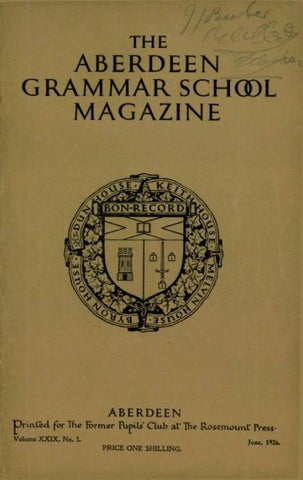
THE
ABERDEEN GRAMMAR SCHODL MAGAZINE
ABERDEEN
p
ry-tiled for The Former Pupas' Club ar The Rosemount' Press•
Volume XXIX, No. 3. PRICE ONE SHILLING.
June, 192b.
EDUCATIONAL BOOKS 6-@.>()(9' JAMES G. BISSET supply all the Class Books (New or
to CONTINUES Second-hand) suited for the requirements of the Higher Educational Institutions in the City, at the Lowest Prices. N.B.—Best Value in Students' Note Books.
JAMES G. BISSET, Classical, Medical, and Educational Bookseller,
85 BROAD STREET (Opposite Marischal College).
Telephone: Aberdeen 753.
Telegrams: "CENTRAL BAKERY."
A. B. HUTCHISON BREAD BISCUITS CAKES Best Quality.
Moderate Prices.
THE CENTRAL BAKERY
ABERDEEN Shops throughout:the City
4I
DIAMONDS SAPPHIRES EMERALDS RUBIES PEARLS
Ne411/4" -
Engagement Rings of Quality
SELECTIONS SENT FOR APPROVAL
A. & J. SMITH Jewellers, Gold and Silversmiths
191 UNION STREET ABERDEEN
A. C. LITTLE COSTUMIER & FURRIER. Always in Stock a Large Selection of Model Costumes and Model 2-Piece Suits, Furs, Fur Coats, Fur-lined Coats, Wraps, Coat Frocks, Costumes, Dresses, Jumper Suits, Showerproofs, Skirts, etc. ALL AT THE VERY KEENEST PRICES.
-INSPECTION IS INVITED.
EXCEPTIONAL VALUE IN MOURNI NGS. The Largest Selection of Black Costumes, Coat Frocks, Dresses, Coats, Skirts, etc., in the City, at the Keenest Prices. Fit is Guaranteed within 6 hours, and no Charge is made for alteration.
"THE HOUSE FOR VALUE"
105 UNION ST., ABERDEEN. OPEN ALL DAY SATURDAYS. Telephone 523.
for style and comfort no hat combines the assurance of correct appearance with the comfort of negligence so well as the Lincoln Bennett soft felt.
ALEX. BOOTH 127 UNION STREET, ABERDEEN
JAMES FYFE & SON PAINTERS AND GLAZIERS. •
.
.
OFFICE AND SHOWROOMS:
11 DEE STREET, ABERDEEN. Telephone 304.
Telegrams—" Fyfe, Painters "
WILLIAM GRAY Tailor and Outfitter, HOLBURN JUNCTION, ABERDEEN. We are Outfitters to the Grammar School, and hold Stocks of everything for present and former pupils. Your patronage will be esteemed. 'PHONE 2311. ESTABLISHED 1886.
LOW'S BOOKSTALLS 39-50 New Market Gallery, ABERDEEN. Books on All Subjects and at All Prices. 150,000 Volumes in Stock. Catalogues Issued.
'Phone 3332.
Gramophone Record Cabinet Holds 24 Records, prevents Scratches and Breakages, 16/6, post free U.K.
Wm. Jackson (Abdn.) Ltd. 18 Back Wynd, ABERDEEN.
BOOKBINDING OF ALL DESCRIPTIONS. Established 1855. Telephone No. 291.
0
0 o to
I.
FOUNTAIN PENS
s 3 a 0 0 S
LL
THE "BLACKBIRD " SELF-FILLER THE " SCRIBE " SELF-FILLER THE "SECRETARY " SELF-FILLER
7s. 6d. 3s. 9d. 5s. 6d.
J. M. RITCHIE, 45 George Street, Aberdeen
WM. DUNCAN and Glover,
Hosier 8 BELMONT STREET,
ABERDEEN.
Ladies' and Gent.'s Underwear. ELLAN-ESS, made in Hawick—a Speciality. Botany Wool Ladies' Hose and Gent.'s Socks.
e
M. McCORMICK Aberdeen's Premier House for Gowns Is in the Forefront with the Newest Fashions. ,
A lovely choice of GOWNS suitable for all occasions. TWO-PIECE JUMPER I
_ d/t t
SUITS. SUITS,
TAILOR-MADE COSTUMES, COATS, CAPES AND CAPE EFFECTS, COAT FROCKS, TENNIS AND DANCE FROCKS IN A
RANGE OF LOVELY COLOURINGS AND EXQUISITE FABRICS. •
FURS AND FUR COATS, ALL AT MODERATE PRICES. EXCLUSIVE DESIGNS FOR WEDDING TROUSSEAUX.
An Early Visit will be Appreciated.
\?Ilf
Costumiere
—
Gown Specialist
—
Furrier.
Note New Address :
377 UNION STREET, ABERDEEN. 'Phone 2499.
SUNBEAM The most flexible single cylinder ever known, with power and reliability under all conditions.
Also Special Agent for
A.J.S. and LEVIS. Any other make supplied.
GEORGE CUMMING, HOLBURN JUNCTION. Telephone 2405.
Telegrams—" INLET.'•
DECORATOR, 154 Union Street, Aberdeen SPECIALIST OE- STAINED GLASS 6' DECC4ReM) MURAL ' ,' adeeigne„cm .-11!;- • -
Telephone No. 1891.
ARCHIBALD McKELLAR Family Grocer and Wine Merchant,
454-456 Union Street, Aberdeen. . .
• •
We Specialise in
Cooked Gammons, " Sinclair's" Belfast Smoked Hams, " Harris's "
Wiltshire Bacon.
Medicinal Wines—Vibrona, Hall's, Wincarnis, Glendenning's.
Henderson Bros. 59 St. Nicholas Street, FOR ALL KINDS OF
GRAMMAR OUTFITS, RUNNING PANTS AND VESTS, FOOTBALL JERSEYS, HOSE, CAPS AND BELTS, &C. GRAMMAR SCHOOL BLAZERS -
WITH -
CAPS & BADGE TO MATCH.
-
-
Specialists in Boy Scouts', Girl Guides' and Brownie Outfits. Also Complete Outfitters for BOYS, YOUTHS, AND MEN.
PHONE 424.
59 ST, NICHOLAS STREET.
1elephone No. 1524.
Telegrams : " Bruce, Cycles, Aberdeen."
Established 1884.
GEORGE BRUCE & SONS Holburn Motor and Cycle Works,
18 HOLBURN STREET, ABERDEEN. Wireless Goods of every description at lowest Prices. and CYCLE AGENTS. MOTOR ENGINEERS, GENERAL Motor Cycle Agencies: Quadrant, Ivy, and Omega. (Any other make supplied at liberal discounts.) We Specialise in Repair Work of all makes of Cars, Motor Cycles and Cycles. Works, 1 ALFORD LANE.
CHARGES MODERATE.
Royal (Dick) Veterinary College EDINBURGH. Principal:
O. CHARNOCK BRADLEY, M.D., D.Sc., M.R.C.V.S. After attendance on Complete Courses of Instruction in this College, Students may proceed to the Examinations for the Diploma of Membership of the Royal College of Veterinary Surgeons (M.R.C.V.S.). Students of the College may also present themselves for the Degree of Bachelor of Science (B.Sc.) in Veterinary Science conferred by the University of Edinburgh. The College being recognised as a Central Institution under the Education (Scotland) Act, 1908, Students are eligible for Bursaries granted by the Education Authorities of Scotland. A Copy of the College Calendar may be obtained on application to A. C. DOULL, Secretary and Treasurer.
WALTHAM WATCH DEPOT. A large stock of Waltham, Swiss, and English Watches for Pocket or Wrist use, from 21/-. EVERY WATCH GUARANTEED.
GEO. JAMIESON & SON, 1 42 UNION STREET (next Union Bridge •
V-47.7
Y1
Y3
Y2
Yl—Grammar School Blazers and Shorts, made in Pure Wool Flannel. To fit 5 to 18 years. Prices—Blazers, 19/11 to 30/-. Shorts, 10/11 to 13/6. Caps, 3/6 each. Belts, 1/6 each. Y2—Flannel Jacket Shorts. To fit 5 to 14 years. In Brown, In Lovat, In Grey, 35/6 to 51/6. 24/6 to 34/6. 20/6 to 39/6. Also in Navy and White Stripe, 36/6 to
49/6. Y3—Well-cut Trench Coat, useful for sunshine or shower. In Navy, Dark or Light Fawn. To fit 7 to 18 years. Prices— -35/6 , 37/6, 42/6, 45/6, to 59/6. Y4-Smartly-Tailored Coats in light-weight Tweeds and Coatings. To fit 8 to 17 years. Prices-39/6, 45/6, 47/6, 54/6, to 60/-.
Johnfalconer&
(FAMOUS F0N A CENTURY •
QUARTER FOR QUALITY
•
Y4 VAGUE. )
*gal -Vreade ZeirreAouse ABERDEEN
W. LUMSDEN & SON 58 UNION STREET, ABERDEEN.
GROCERIES, PROVISIONS, ::
WINES and SPIRITS, ALL
OF
::
QUALITY.
HIGHEST
HAVANA CIGARS in Great Variety. Telegrams: " TRAVELLED, ABERDEEN."
'PHONE 260.
A•071,
DINE AT-
By AVVOINTMENT.
THE ROYAL ATHENAEUM RESTAURANT AND GRILL ROOM (Opposite Town House).
THE PREMIER DININO HALL IN THE CITY.
Patronised by the ilite of the Town and County. Choice Selection of CHAMPAGNES AND OTHER VINTAGE OLD WINES. Large selection of Havana Cigars and Foreign Liqueurs. TABLE D'HOTE DINNER FROM 6 P.M. AT 5s. 6d. Tel. No. 2273. Telegrams : Atheaaeum.
John Mitchell, Proprietor.
For .
Choice Cut Flowers. GEORGE PEGLER &CO. LIMITED,
THE
CITY FLORISTS,
167-169 Union St. 'PHONE
1098.
i i
504-508 Union St. 'PHONE 1591.
ABERDEEN.
'Phone 2899.
'Phone 2899.
.$
CROWN DAIRIES . SUPPLY . THE FINEST DAIRY PRODUCE.
GOOD MILK Is our Speciality.
7 to 13 Waverley Place.
E.,:TAD1 ISHED 1543.
PRINTING.
Wm. Cay & Sons
The
Central Press
ifimerat tailbertaiters. 415 UNION STREET AND
209 GEORGE STREET,
(JOHN MILNE),
General Printer, Lithographer, AND
Stationer,
ABERDEEN. Motor Hearses and Curs for Distant Funerals.
Telegrams—"Cay, Aberdeen.' 'Phones Nos. 92 and 54.
61-63 Belmont St., ABERDEEN.
Telephone No. 809.
PURE AERATED
Milne & Munro
WATERS If you want the Best, ask for
SANG'S No others just as good
Sole bottlers of Ward's famous Pure Fruit Crushes ORANGE LEMON LIME Beware of Imitations
263 Union Street PRACTICAL BOOTMAKERS Agents for
"Lotus" and "K" Boots Aberdeen's Leading Shoemakers 6o years ago—Make us your Scientific Shoefitters TO-DAY
SEAFORTH ROAD ABERDEEN
Phone 1289
'PHoss 10211
D. Wyllie & Son
FRED HARDIE
247 Union Street,
Photographic Artist, 416 Union Street,
Aberdeen.
ABERDEEN
•
•
IiILDRUMMY CASTLE : Its place in Scottish History and Architecture, by W. DOUGLAS SIMPSON,
D.Litt. Illustrated throughout. Price, 8/6; Postage, 6d. extra. DUNNOTTAR CASTLE: Historical and Descriptive, by W. DOUGLAS SIMPSON, D.Litt.
Fully Illustrated.
1/2 Post Free.
Telephone 402. Established 1814 . TelegraphicAddress :"Wyllie, Bookseller, Aberdeen."
For every style of In- and Out-Door Group, Composite Groups & General Portraiture, Etc., AT POPULAR PRICES. TELEPHONE 851.
SCIENTIFIC APPARATUS Microscopes and Microscopical Apparatus. Students' Requisites Slide Rules. Mathematical Instruments. 1'110TOGRAPII IC MATERIALS
I
Chemical Physical, Bacteriological Glassware. Thermometers, Hydrometers. Acids. Filter and Test Papers.
Get your Photographic Requirements at
D. S. Allan's Pharmacy 35 HOLBURN STREET (Near Holburn Junction).
Photoraktic Departworni.
NICOL SMITH CO., St. Nicholas St., ABERDEEN.
Telephone 1315.
A Large Stock of Cameras, Plates, Films, Papers, and Accessories. Dept for Kodak: arra' Kodak Supplier. Developing and Printing executed by an Expert and delivered in 24 hours.
'Phone 1624
For Drawing Instruments & Materials
T II E
CORONA PORTABLE , FOLDING
TYPEWRITER.
TAYLOR
This wonderful Typewriter has every modern improvement, Standard Keyboard of 84 keys, Back Spacer; Two-Colour Ribbon, etc., and at the same time weighs only 9 lbs. in its case, and can be carried about anywhere. Above Thouall it is reliable. sands went through the 11 ar, often in front line trenches.
SCHOOLHILL
Price only 12 Guineas.
ABERDEEN
Sole Agent for North of Scotland—
PICTURE FRAMER AND C0I.0URMAN
ARTISTS'
CHAS. H. WEBSTER Telephone 2870.
ECTAELISHED ISIS. •
•
BY APPOINTMENT ro H.M. THE KING.
J. Williamson & Son (W. II. WILLIAMSON, PROPPIL 10P),
Meat Purveyors and Poulterers,
1, 2, & 3 MARKET BUILDINGS, ('Phone 452),
ABERDEEN.
3a Alford Place, Aberdeen
HUNTER & TAIT Cabinetmakers and
Upholsterers 37 HUNTLY STREET ABERDEEN Removals undertaken by Road or Rail -
Branches: 35 FOUNTAINHALL ROAD ('Phone 1724)
Repairs Promptly Executed
OSCAR ROAD, BALNAGASK ('Phone 874).
Try our own manufactured Furniture Reviver
THE SQUARE, CULTS ('Phone, Cults 2).
Showrooms : HUNTLY STREET
GET YOUR MUSIC AND EVERYTHING NECESSARY FOR THE ENJOYMENT OF THE ART AT
JAMES MACBETH 261 UNION STREET ABERDEEN
THE
Firm was established over 80 years ago, and has been in the same family for three generations, with a PRACTICAL PIANO-MAKER aS Proprietor in each generation. Telephone No. 235
Telegrams : " Macbeth, Aberdeen"
THE HOME OF FASHION & NOVELTY.
The best appointed and most centrally situated Warehouse in Aberdeen.
You can begin and complete your Shopping under one roof at S. & H.'s.
Sangster & Henderson, DRAPERS, MILLINERS, AND COMPLETE HOUSE FURNISHERS.
UNION STREET, ABERDEEN. Telegrams: Telephone 363.
" Sangster Henderson, Aberdeen."
The Van Heusen Collar FOR SCHOOL WEAR We supply these in White and Colours—Price 1 '9 each These Collars are ironed while damp; they do not require starching
W. J. MILNE, LTD. 249 and 251 UNION STREET ABERDEEN (Opposite Royal Northern Club),
Elley,. ItI2e11 all' Zone fainters & 3Decoraters 335 Vinton trect • ilberbeen. •
•
•
•
W. KENNAWAY, Ltd. BAKERS and CONFECTIONERS,
5 and 7 Holburn Street. Luncheon and Tea Rooms,
173
Union Street, ABERDEEN
SPECIALTIESWEDDING CAKES.
SHORTBREAD-
ROYAL DEESIDE IN TARTAN TINS, ALSO A
LARGE
SELECTION OF
PLAIN AND
FANCY ICED CAKES.
M. GERARD WATCHMAKER, JEWELLER, & SILVERSMITH,
411 UNION STREET (WEST) ABERDEEN. Telephone - 447 .
ENGAGEMENT AND WEDDING RINGS, DIAMOND AND PEARL JEWELLERY, BROOCHES, PENDANTS, ETC., ALSO WATCHES, CLOCKS, SILVER, TORTOISESHELL, ENAMEL BRUSH SETS, AND ELECTRO-PLATED GOODS, IN NEWEST DESIGNS, AND LARGE SELECTION TO
CHOOSE FROM.
-IARDY ELLIS & 1\41UNION STREET. 18 REGENT QUAY & 130i
Importers of Household and Stearn Coals. Delivered by Careful and Experienced Drivers. Telephone 2889.
George Bisset Complete Outfitter and Hatter, HIGH-CLASS TAILOR AND CLOTHIER,
5 & 15 UNION ST., ABERDEEN.
Highland Outfits a Speciality FOR
BOYS,
YOUTHS, AND GENTLEMEN.
THE GRAMOPHONE is far past the experimental stages. It now provides real music, and should be in every house.
The musician or music lover who has no Gramophone is losing opportunities of hearing the finest music.
0 .t.,• 67' wra
[11
HIS MAJESTY'S THEATRE.
Aberdeen's Premier House of Entertainment and one of the Finest Theatres in the British Isles.
For full fiarliculars of this week's Programme see There/re Bills or Advertisements in Daily Press or Tram Cars. Lessee—WALTER GILBERT.
Telephone Nos. 1881, 1882.
Acting Manager—W. LOTHIAN GILBERT.
Telegraphic Address: "Plaster, Aberdeen.''
JAMES SCOTT & SON (Aberdeen), Ltd. Fire Grates :
-
Cooking Ranges AND
Antique and Modern.
Independent Water Heaters.
Mantelpieces IN
Wood and in Marble.
Inquiries regarding Genuine Old Chimney Pieces and Fire Grates solicited.
Marble, Mosaic, Terrazzo and Tiles Fire-places, Walls, and Floors.
" Thermostove "—combined Cooker and Water Heater.
A ddress :
483-485 UNION STREET, ABERDEEN.
TAILORING Suits. Overcoats, Dress Suits, Costumes. READYMADES Men's Suits and Overcoats, Boys' Suits and Overcoats, Showerprools, Waterproofs, Sports Jackets, Blazers, Flannel Trousers.
HOSIERY Latest Styles in Hats, Caps, Ties, Collars, Hose, Socks, Handkerchiefs, Shirts, Pyjamas, Gloves, Underclothing, Pullovers. SPECIALITY Complete 'Highland Outfits for Boys.
A. & J. SCOTT 29 GEORGE STREET ABERDEEN Tailors, Clothiers, and Outfitters A visit and an opportunity to serve you will be greatly appreciated Telephone No. 2299
CONTENTS. PORTRAITS. •• • • Facing page 190 Mr. JOHN BENTLEY PHILIP, M.A. . Rev. Dr. JAMES SHEPHERD, M.A., M.D., D.D. .. ,, 191 Dr. CHARLES MCLEOD (from the painting by Mr. J. B. SOUTER) •• •• • • .. .. •• 254 ,, .. .. SCHOOL PREFECTS-JUNE, 1926 .. •• ,• 255 THE RETIREMENT OF Mr. BENTLEY PHILIPAN OLD PUPIL'S APPRECIATION • • •• • • .. Page 189 Mr. PHILIP'S EARLY YEARS AT THE SCHOOL •• • • 192 A MELVIN CENTENARY •• •• • • .. •• 195 MEMORIES OF Dr. JAMES MELVIN. BY THE SENIOR MEMBER OF THE F.P. CLUB .. •• •• • • •• 198 NOTES ABOUT OLD BOYS .. •• .. •• • • 201 LIST OF F.P. CLUB CONSULS .. . • • • •• .. • 221 SOME INDIAN EXPERIENCES . . .. •• •• 223 Sir THOMAS DEMPSTER AT THE SCHOOL. BY W. MURISON 227 ON FAMILIAR GROUND .. •• .. •• •• •• 233 FROM THE SCHOOL TOWER •. •• •. •• •• 239 A PLEA FOR THE SCHOOL ORCHESTRA .. . • •• 247 Dr. CHARLES MCLEOD-PRESENTATION OF PORTRAIT TO THE
SCHOOL..
•
•
•
•
•
•
•
•
•
•
AN ADDITION TO THE SCHOOL STAFF .. •• SCHOOL NOTES •• . . . . .. • • RANDOM NOTES . . .. .. .. •• SCOUT NOTES .. .. .. .. •• SCHOOL CRICKET .. •• .. .. •• SCHOOL OFFICIALS . . .. .. •• THE FORMER PUPILS' CLUBTHE LONDON SECTION. THE CRICKET SECTION THE RUGBY FOOTBALL SECTION •• . . LIST OF NEW MEMBERS. THE CLUB COLOURS VISITORS' REGISTER . . •• •• ••
9 •
•
•. •• •• •• •. ••
•• •• • • •• •• ••
248 254 255 257 258 262 264
. • •• •. •.
•• •• •• ..
265 265 266 266
•
•
ESTABLISHED 1836
NORTHERN ASSURANCE COMPANY LIMITED
.
Assets
£15,000,000
.
ALL CLASSES OF INSURANCE LIFE
ASSURANCE BRANCH.—The Company's
Tables of Rates for Life Assurance include every class of Policy.
Write for particulars of
CHILDREN'S EDUCATIONAL POLICIES ESTATE DUTY POLICIES PARTNERSHIP POLICIES ENDOWMENT ASSURANCE POLICIES
CHIEF OFFICES t
ABERDEEN -
-
-
1 Union Terrace.
-
-
-
1 Moorgate, E.C. 2.
LONDON
Aberdeen Board of Directors. A. S. R. BRUCE, ESQ.
GEORGE M. CooK, ESQ.
D. M. A. CHALMERS, ESQ.
GARDEN A. DUFF, ESQ.
FRANCIS J. COCHRAN, ESQ.
A. MARTINEAU, ESQ.
Manager
.
-
-
. R. MACKAY, F.F.A.
aberbeen Oraminar SciNot rfiaga3ine. Vol. XXIX.
JUNE,
1926.
No. 3
The " Grammar School Magazine " is issued under the auspices of The Former Pupils' Club, in March, June, and November. All communications with regard to the " Magazine " should be addressed to the Editor (the Secretary and Treasurer of the Club), THEODORE
WATT, M.A.,
The Rosemount Press, Aberdeen. *** Members of the Club are requested to inform the Secretary of
-
any change in their address.
The Retirement of Mr. Bentley Philip. An Old Pupil's Appreciation. This summer, after completing nearly 38 years of devoted service in the School, Mr. J. Bentley Philip, M.A., is to retire. With him, into what promises to be a characteristically active leisure, he will carry the good wishes of hundreds of pupils, past and present, who hold him in affectionate esteem, and to whom his exact and faithful teaching has been at once a profit and an inspiration. An able classical scholar, Mr. Philip for years taught Latin in the Middle School. This is a period in juvenile development when such a subject must be taught on a rigidly ground-work basis. At this stage a boy must learn, if he is ever to learn, the bed-rock grammatical and syntactical mechanism of the language. Insight into its higher beauties will come later, on the basis of the sound knowledge thus painfully acquired, when the scholar passes under the care of so fine an artist as Dr. Middleton. But for the special requirements of Middle School instruction few more competent teachers could have been found than Mr. Philip. I well remember the systematic and thorough way in which he took us through page after page of Allen's Latin Grammar. The master working with pupils at such a stage has little opportunity of setting forth the larger view of a noble language : but it is his high responsibility and privilege to prepare the ground on which the choicest flowers of scholarship in due time may bloom.
190
Aberdeen Grammar School Magazine.
It is, however, as a teacher of science that Mr. Philip's name will long be remembered. I had the good fortune to undergo a two years' course of botany in his hands. It has always seemed to me that botany is by no means the best subject with which to introduce a boy to the systematic study of natural science. In every way I think the subject is far less suitable than geology. You show a boy three pieces of stone—a granite from Rubislaw, a slate from the Foudlands, a sandstone from Kildrtumny : you explain to him how each was formed, and he finds himself forthwith in the presence of the very architecture of the globe. On the other hand, botany, at least as it is usually taught, is too often merely an undigested accumulation of facts, a sporadic specimen-hunting, a wearisome routine of classificatory systems and interminable floral diagrams—like variations in cheap wall-paper patterns. You miss the sense of fundamentals, the long vistas and the wide horizons that come with the study of geology. In Mr. Philip's hands, however, botany did not underlie the objections which I have stated. The freshness, breadth, and vision of his treatment created on me, at all events, an impression never since forgotten. I believe his methods are widely adopted now : but at the time I think he must have been a daring pioneer. To begin with, there was the botany garden, where we town-bred boys learned the dignity and the basic value of labour on the soil—intuitively realizing the wisdom of the old Celtic saint who said that " among all the works of men's hands the cultivation of the earth approaches nearest to divine contemplation." And then there was the laboratory work, wherein we obtained enthralling peeps into the intimate workings of nature, that gave us all unconsciously a glimpse of the grandeur and the unity and the infinite richness of life. We grew prothalli, studied the respective functions of antheridia and archegonia, and watched the sporangium burst, scattering its myriad spores : we observed the pollen grain grow in a sticky-sweet solution, we saw the pores by which the green leaf breathes. All this is full of wonder and interest to a boy of twelve or fourteen : it is leading him on to a knowledge of life by the examination of its working methods, it is training him in powers of observation, deduction, and independent thinking, no less than in neatness of hand and accuracy in detail. In a word, botany as taught by Mr. Philip was a character-training of the first importance. Not less original and admirable were Mr. Philip's methods in the teaching of geography. Here were no endless lists of towns and products, dull as ditch-water and divorced completely from the boy's world of experience. Instead, we handled the country at our doors. With Mr. Philip at our head we trudged down to Bay of Nigg and surveyed its foreshores,
•
s
Mr. JOHN BENTLEY PHILIP, M.A.
•
REV. JAMES SHEPHERD, M.A., M.D., D.D. (See page 214.)
Aberdeen Grammar School Magazine.
$
191
learning thus how much of trained skill goes into the making of a map. In the classroom we constructed mountainous areas of sand, working out the contours with chalk, and then addressed ourselves to make an accurate map and section of our model. In the philosophy of science, Professor J. Arthur Thomson has told us, " convictions come in the school of the woods and the shore as well as in the laboratory." Conformably with so broad an outlook, Mr. Philip drew forth his class from the four walls of the schoolroom and sought out the lessons of nature in the wider schoolroom of nature's world. I often think how greatly in this pioneer work Mr. Philip must have been hampered by lack of facilities. Now he rules a very king in his own domain, controlling ample and beautifully-furnished laboratories, equipped with the most modern instruments and plant. But all the work that I have tried to describe was carried out in the dingy old classroom next door to Mr. Pope's, a narrow, ill-contrived room, fitted with desks and a single long bench in the usual classroom way, and perpetually distracted by the steamy sizzle of an antediluvian heating apparatus. Every ample personality has its margin of idiosyncrasies upon which the juvenile critic fastens with gleeful avidity. Of such whimsies Mr. Philip has had his full share, and the memory of them will linger kindly in the affections of his pupils for years to come. Who of them will ever forget the list of " articles " that had to be brought each day and ranged in due order on the desk—the ruler that must be twelve, not six inches long, the pen and pencil that had to be separate and not in combination? And who of them will forget the strenuous maps of Europe that had to be drawn in those two or three hectic minutes when the marks were being taken or the bell of release already rang ? Perhaps I may even dare to mention those highly ceremonious applications of the tawse that interrupted with happy infrequency the harmony of a class in which master and pupils gave each other the fullest measure of mutual affection and regard ! As is the case with all real teachers, Mr. Philip's interest in his pupils has not lagged at the classroom door ; witness the Saturday excursions that he arranged to places like Cove, Muchalls, and other beauty-spots on his beloved Mearns coast, or the instructional classes in surveying and photography which he conducted for the School Scouts. In photographic skill Mr. Philip must have very few equals in Aberdeen. Those who still deny that the work of the camera is art should make themselves acquainted with some of his beautiful studies of scenery along the:coast or up the valley of the Dee. Photographers nowadays, aping the fashion of the etching tool or the brush, too often seek to coerce the camera into styles of art
192
Aberdeen Grammar School Magazine.
foreign to its nature ; but Mr. Philip's photographs have always been marked by the supreme artistry of faithful portraiture. His appearances as a public lecturer, less frequent now than in earlier years, were always keenly awaited by the large audiences that enjoyed his vivid and humorous account of Sweden, a land of which he has made a special study : his library of books on Swedish subjects, I fancy, must be one of the largest in Scotland. I need do no more than mention his literary diversions, and his splendid work on behalf of the Deeside Field Club—labours of love that will amply fill the hours of his well-earned retirement. Men may come and men may go, but the School, the grand old School, goes on for ever, constantly enriching its heritage by the devoted service of such teachers as Mr. Philip. His has been a good piece of work, well done. We, who have passed through his hands, salute him, and wish him many years of continued health, happiness, and leisure to develop those varied interests upon which the imperious claims of classroom toil have hitherto imposed restraint. W. D. S. Mr. Philip's Early Years at the School. Memories of nearly forty years ago are called up by the announcement that Mr. J. Bentley Philip is retiring from active service as a teacher in the School. He joined the staff in November, 1888. I had then just entered Middle I. The preceding year had been spent in Lower III under the stimulating influence and persuasive powers of Mr. Rough. That year we had regarded as a sort of emancipation, because all our previous schooling—four years in my case—had been under the control of lady teachers. I do not mean to imply that we were in any way hostile to these teachers. Far otherwise. They were splendid. I retain the wannest regard for Miss Watson and her able assistant, Miss Duncan, who piloted me through the " First Infant Reader," and unfolded the mysteries of clay-modelling and paper-mat construction which were the main features that I now recall of the Kindergarten system of the 'eighties. And also for Miss Daniel, who took me through Lower I and Lower II. I think Miss Daniel was made of somewhat sterner stuff than the ladies who presided over the Initiatory, and we were, perhaps, a little disappointed when she was moved along with her class from Lower I to Lower II. That feeling, however, wore off, and I am sure the boys of Lower II in 1886-87 came to have a real regard for their teacher, even though at times she had to use the threat of sending for Mr. Green or dispatched some culprit to that gentleman for an interview which was brief and brisk, and tended
Aberdeen Grammar School Magazine.
193
strongly to discourage further attempts to flout the ordinary canons of discipline. But when we got into Lower III there was that feeling of emancipation ; the sort of feeling that a boy has when he gets his first pair of " longs " or, at a later stage, has his first shave. We were now under a man and had put away childish things, and we rather gloried in our fancied superiority to the " kids " in the classes below us. If, however, there was emancipation in Lower III, what is to be said about our attitude on entering the Middle School ? This experience was something quite new. We became more of a peripatetic class. We had different masters for different subjects, and these masters were each located in his own special class-room. Mr. Philip had that room above the chemistry laboratory, whence emerged at times the most appalling odours, fume-cabinets being unknown in those days. The interior arrangements of the School have been vastly altered since my day, and much for the better, but memory always goes back to the spots that were familiar, and I shall always have the pleasantest recollections of that south-east upper room where one of Mr. Philip's first classes was Middle I of 1888- 89. The new teacher had a difficult task to begin with. He was confronted by a critical audience, and he soon established the right sort of ascendancy over it. There were some " gey nickums," it is true, who caused the young master a lot of trouble, both in and out of School, but with the class as a whole his personality prevailed, and to this day I have the highest regard for the training I got under Mr. Philip. Nobody gave him that formal title. He probably knew that. We all called him " Bentley " : I wonder whether he is aware of the more paternal sobriquet with which he is honoured by the Middle I of 1925-26. There lies before me a tattered exercise book of 1889, somehow preserved, and a glance over its pages is a vivid reminder of the passion for method and neatness which inspired all Mr. Philip's teaching. " Anger is short madness," " The head is the seat of every sense," are evidently translations of Latin sentences, but it was not the admirable sentiments thus expressed that mattered so much, as the methodical and orderly way in which they were set down, and the construction of the original language explained. Consciously or unconsciously Mr. Philip was in the direct succession to the tradition of " thorough" which has done so much for many generations of Grammar boys. Apart from the ordinary work of the class, Mr. Philip opened up in the next three or four years what was for us the new world of natural science. We had had in our official curriculum some excellent instruction in physiology and chemistry from
194
Aberdeen Grammar School Magazine.
Dr. McLeod, than whom there was no finer nor more inspiring teacher, but that curriculum did not embrace anything in the way of nature study, and it was left to Mr. Philip to give us the key that unlocked the door leading to the magic and the charm of the countryside. An evening class in Botany was started under his tuition. It was purely voluntary, but it at once attracted a group of eager and keen boys. By experiment and demonstration we soon got a grip of principles, and the practical demonstration came in the delightful excursions in the surrounding country which he organized. The memory of these will always linger with me. We were keen, and our teacher was keen, and from these beginnings has developed the department which Mr. Philip has brought to a high standard of excellence. I find that on 10th September, 1892, we had an excursion " to Tremuda Bay, south from Dunnottar." Then follow in the note-book lists of the animals and plants found, with short, precise notes on various matters of interest. The note-book was a sine qua non. The teacher dictated the notes and we had to take them down neatly. Some boys may have thought there was a little unnecessary fuss about all this, but the discipline was excellent, and soon there was a spirit of emulation to see who would have the neatest book and the best array of notes. For Saturday, 1st October, in the same year, my book says " Walk to Cove," and for Saturday, 12th November, "Walk to Maidencraig. Found in flower (1) bluebell ; (2) bramble ; (3) red campion ; also a good many fungi." On 6th May, 1893, we had an excursion " Muchalls to Stonehaven," and the " bag " was a list of 36 plants, with their botanical and everyday names. A fortnight later we were at Dinnet, " examined the Burn of the Vat " and discussed the early Celtic settlements in the district around Loch Kinnord. The Queen's Birthday (24th May), being a holiday, was an excursion day, and in 1893 a walk to Culter produced a noble list of 60 plants. Three days later we were at Stonehaven and Thornyhive, and the fact is recorded among others that " two gull's eggs were found on the top of the cliffs." For the year 1894 four excursions are noted, including one to Bervie on the annual spring holiday and the usual Queen's Birthday outing, on this occasion a walk to Culter by the south bank of the Dee. These were happy days. Much has happened since. One of the brightest and most brilliant of the little band met an early death across the Atlantic. Some of the others have achieved success, one in particular world-fame in the sphere of medicine. All, I am sure, remember with gratitude and affection the teacher who made learning a pleasure. Their warmest good wishes go with him in his well-earned retirement. E. W. W.
Aberdeen - Grammar School Magazine.
195
A Melvin Centenary. In April, 1826, James Melvin was appointed Rector of the Aberdeen Grammar School, and near the time of the centenary of that outstanding event in the School's history it is appropriate that the circumstances of his appointment should be recalled in the pages of the Magazine. The famous Rector was born in Aberdeen on 21st April, 1794, and received the first part of his education at the School with which he was to be for so long associated as head. He then went to Marischal College, having gained the first bursary, and after a brilliant course, received the degree of M.A. Entering on the career of a teacher, he was first of all appointed to Dr. Bisset's Academy at Udny, and next he became a master in the Grammar School of Old Aberdeen. In 1822 he was invited by Mr. Nicoll, his former master at the Grammar School, to act as his assistant, and on his death succeeded to the post. James Cromar, who had been Rector for 22 years, died on 10th November, 1825, and the Magistrates and Town Council of Aberdeen, who were then responsible for the management of the School, determined to fill the vacant office by a comparative trial and examination of such candidates as might come forward. (A copy of the advertisement announcing the vacancy and the conditions of appointment was reproduced in the last issue of the Magazine.) According to an account which appeared in the Aberdeen Journal of 26th April, 1826, " James Melvin, one of the present masters of the School and two young gentlemen from the west country appeared for examination." This continued for three days " and was carried on with a degree of strictness well calculated to draw forth the talents and classical attainments of the competitors. The exercises proposed were various ; and comprised reading of passages from the Latin Classics, both poetry and prose, which the candidates were required to translate, construe, and analyse ; answering as they went along such critical and other questions as the passages suggested : passages in English prose were also translated into Latin ; and the knowledge of the candidates in Latin Prosody, and the various kinds of Latin verse ascertained by scanning, and by minute questionary trials. An examination also took place of their knowledge of the elements and grammar of the Greek language, which it is now intended to introduce into the course of study in the two higher classes. The whole of the examinations being completed, the examiners reported to the Town Council their unanimous opinion in favour of Mr. Melvin, who had greatly distinguished himself above the other candidates, and exhibited classical abilities of the very highest order. In opening up an Ode prescribed from Horace, Mr. Melvin was particularly happy, and the feeling which it was
196
Aberdeen Grammar School Magazine.
evident he possessed for the higher beauties of the lyric Muse was not only gratifying in itself, but gives the best reason to believe that his instruction cannot fail to transfuse into the minds of his pupils a genuine taste for classical learning, and to call it forth where otherwise it might have lain for ever dormant." On Monday, 24th April, 1826, " in one of those assemblies of the city magistrates, city clergy, college professors, and other dignitaries, not forgetting the red-coated town's officers, which took place in the main school-room, to the great delight of the boys, on gala days and always at the annual Visitation and distribution of prizes," Melvin was installed, at the age of 32, into the post which was to be his till death. On that occasion, in reply to the highly complimentary speech of the Lord Provost (Gavin Hadden), he delivered his first Latin oration, which is reproduced here as a specimen of his scholarly attainments :Civitatis huj us Consul A mplissime, Magistratusque Honorandi : Verbi Divini Interpretes Reverendi, Fidelissimi, Doctissimi : Academiae Professores Eruditissimi et de Bonis Literis Optime Meriti ; Collegae Mei Spectatissimi, Amantissimi ; Adolescentes Obsequentissimi, Speique Florentissimae ; Nihil est quod vos longs oratione morer : neque enim mihi est exercitatio dicendi, neque vires jam nunc suppetunt. Non possum tamen mihi non gratulari, quod omnibus quorum res erat uno ore consentientibus, ego competitonim dignissimus habitus sum qui veteri huic atque inclytae scholae praeponerer. Mihi praeter spew contigit ut ego qui abhinc duos et viginti annos discipulus hanc scholam pauper atque ignotus adii, utrisque tandem praeceptoribus meis succederem, primum Domino Nicoll, deinde Domino Cromar, viris arte sua nemini secundis, quorumque ego memoriam gratus semper colam. Non me latet quantum onus in me nunc susceperirn ; est quidem " periculosae plenum opus aleae" ; attamen nullum laborem defugiam, speroque, favente Deo Optimo Maximo, omnia bene processura. Vobis, Viii Amplissimi et Doctissimi, Patroni et Moderatores indulgentissimi, gratias quam maximas et agere et habere debeo ; liceatque precari ut me, et collegas meos, totamque scholam, benignitate consueta usque complecti velitis. Faxit Deus ut nec vos muneris hodie delati nec me accepti unquam poeniteat.
Throughout the next 27 years—he died on 28th June, 1853—Melvin made the Grammar School famous for its Latinity, and he produced not a few distinguished scholars. For more than half a century after his death it was the proud boast of many a former pupil of the School that he had studied under Melvin. Of those who were taught by Melvin himself there must now be only a very few surviving, and the only one who is a member of the Former Pupils' Club is the Rev. Dr. John Smith, the minister for fifty years of St. John's Church, Pietermaritzburg, Natal. To a request from the Editor of the Magazine that he
Aberdeen Grammar School Magazine.
197
should contribute an article giving some of his recollections of the School and particularly of Dr. Melvin, the doyen of the Club promptly agreed. In a letter accompanying the article Dr. Smith says—" In almost every number of the Magazine I find something, I may say, of personal interest. In the last issue I was particularly taken with the article on Sir George Gibb. In my student days I was tutor to the Gibb family for a short time, and I believe George was one of my pupils. His brother John was a fellow-student with me in the Divinity Hall—now the U.F. College, Aberdeen." Dr. Smith was born on SOth September, and is thus in his 87th year. In spite of his age he has a wonderful memory, and the article which follows will, we are sure, be read with very great interest.
Memories of Dr. James Melvin. BY THE SENIOR MEMBER OF THE F.P. CLUB. It was my fortune to enter the Grammar School shortly after I had reached the age bf ten years. I had gone through all the classes in the English department of the Public School, which at that time met in Little Belmont Street. Thereafter Latin was the predominant subject of education, only a little attention being given to other subjects, such as History and Geography, during the first three years of the Grammar School course. Besides the Rector, who took the fourth and fifth classes, the highest in the School, there were three masters, each of whom in turn took the first class, composed of the new entrants, and carried them on for three years, changing the class-room every year. At the end of the third year the class was transferred to the Rector, and passed into his room as the fourth class in the School. I remember that it was deemed a piece of good fortune for me that, as it was Mr. John Dun's turn to begin with the new scholars, I should have him for my teacher for three years. His reputation as a teacher was high, and it was said that his pupils were specially welcomed by Dr. Melvin when they came to him as his fourth class. During the first three years the junior classes had but few opportunities of seeing the Rector at close quarters. He never entered the class-rooms of the other masters. We juniors sometimes saw him coming to the School in the morning. His residence at the top of Belmont Street was only two or three hundred yards from the School. I can recall the familiar figure of Dr. Melvin, tall and erect, arrayed in black Geneva gown and silk hat, with book or papers in his hand, as he walked across the street with some deliberation and no little dignity. His whole mien gave one the impression that
198
Aberdeen Grammar School Magazine.
he was a silent, self-contained man: pale-faced, seldom smiling; with clear-cut features that suggested firmness rather than hardness or sternness ; an ascetic who seemed to have little brightness in heart or life ; a personality somewhat apart from the ordinary ; a man with whom none might take liberties. " Grim" the scholars styled him: it was near enough the mark for them, and it was applied without the least grain of disrespect—perhaps at the first with even a tinge of awe. The Rector's arrival at the gate was the signal for the scholars to betake themselves to their respective class-rooms. Meanwhile the four masters forgathered in the Main Hall beneath the clock, just opposite the entrance. On the stroke of the hour they separated and went to their several rooms, where the pupils received them upstanding. The five hours' work of the day began with prayer offered by the master, and was followed by the calling of the Roll, each scholar answering " Adsum " when his name was called out. If my memory serves me aright, there was a weekly gathering of all the classes in the Main Hall, for what purpose I cannot remember. On those occasions one felt that the Doctor carried himself quite naturally as the head of the School, and all were loyal to him in that capacity. The great day of the year was the day on which the Annual Visitation by the Provost of the City and members of the Town Council took place. They came in state with scarlet-coated attendants in advance. The Rector's appearance on the occasion was dignified and impressive to a degree. Garbed in gown and hat, he wore, after the fashion of the day, a heavy bunch of seals, which was attached to his watch and hung from his fob and dangled and jingled gently as he moved about awaiting the arrival of the august company expected. Having received the visitors with all proper formality, he addressed them in a Latin oration, which some of us suspected was beyond the comprehension of most of those worthy men. Then followed the distribution of the prizes to the successful scholars and, I think, a gold medal, the gift of the Council, to the dux of the School. The three years' preparatory tuition under Mr. Dun being completed, the class passed into the room which accommodated the fourth and fifth classes, there to receive the finishing touches of scholarship from the Rector himself. I think the scholars themselves realized that the change meant for them a distinct uplift and advance, and they did their best to prove themselves equal to the value and the dignity of the new position which they attained by the change of masters. I retain to this day a general recollection of the School life of those far-off days. Latin was the supreme interest. I cannot
Aberdeen Grammar School Magazine.
194
recall any instruction in English literature given by Dr. Melvin to his pupils. By the terms of his appointment (which had been gained by competition) the Rector was required to teach the elements of the Greek language. I do not remember any instruction in Greek from Dr. Melvin, but I can easily recall the thorough drill in that subject which we had from Mr. Geddes (afterwards Sir William Duguid Geddes, Professor of Greek in King's College, and Principal of the University of Aberdeen), who succeeded Dr. Melvin in the Rectorship of the Grammar School. It was well understood that all the work of the classes was ordered in view of the Bursary Competitions which were held in October every year in the two Colleges—King's and Marischal. Latin authors were read and every point connected with grammar, prose, and prosody was carefully dealt with, so that if the total amount read was comparatively small, yet an exact knowledge of the language was imparted. Dr. Melvin's chosen model of prose composition was Cicero, and Horace was his favourite poet. The outstanding feature in his method of tuition was the large use he made of the " Version." Two days a week were given up to this exercise. The Doctor dictated a short passage in English of his own composition, and our task was to translate it into Latin. Idioms and phrases which had been expounded to us in the course of our reading lessons were usually expected to appear in these exercises. Many of us compiled " phrase books," which had a special value of their own and were treasured even after we left the School. A scale of marks for errors in the Latin rendered by the scholar revealed the value of the paper and the writer's grip of the language. The Rector displayed a personal interest in his pupils, often addressing them by their Christian names when he called them to account for careless work or egregious mistakes in the version, and when he meted out praise and encouragement to those whose diligence and progress pleased him. Praise from him was counted a high honour, and those who got it were envied by their less fortunate brothers. I remember one occasion when Dr. Melvin called me to come up to his desk at a brief interval one day. He had my version in his hand and pointed to an error (probably a maxie I) which I had made. I can feel even now the gentle pinch he gave my ear as he exhorted me to do better next time—all in the kindest manner. An attention like that was almost coveted by the boys, and certainly it acted as a spur to greater diligence and care, if for no other reason at least to please the Rector. Of another incident of a very different kind I have a most vivid recollection. The privilege of Dr. Melvin's tuition I enjoyed only for eight or nine months, when his long and
200
Aberdeen Grammar School Magazine.
honourable career came to an end in a tragic fashion. I can recall the whole scene as though it had happened only yesterday. On 28th June, 1853, in the middle of the forenoon session, he fainted in his chair and was carried out of the School across to his residence. He died the following day without having recovered consciousness, I believe. He was only 59 years of age when his brilliant career was thus cut short. Dr. Melvin had been for some years Lecturer in Latin in Marischal College when as yet there was no Professor's chair of " Humanity " in it. But twice within a short space of time he had been passed over, first when the chair was established, and again when a vacancy occurred. His friends could not help perceiving how the disappointment told on' his spirits and his health. He felt it keenly but made no sign, and stuck to his work with stoical determination, doubtless finding • in it some solace for his wounded spirit. There was a great funeral, at which all the scholars were present along with many citizens, who gathered around the grave to pay their tribute of respect to one who had for so long occupied a prominent place in the city and wielded so great an influence on the young life of the community. Thus passed the last of the great Scottish Latinists, leaving behind him a spotless reputation, a name and a fame which abide to this day ; and it is safe to say that Aberdeen will not willingly allow the name of James Melvin to pass into oblivion. JOHN SMITH. BEAUFORT VILLA, PIETERMARITZBURG, NATAL, /9th May, /926.
Mr. Robert Collie Gray, S.S.C., Edinburgh, who entered the School 75 years ago, in a recent letter to the Editor says:— " Perhaps I am one of the few survivors of those who remember the great Latinist, and who were at the old School in his time. But I hadn't any actual experience of his teaching as, in June, 1853, when he died, I was in the second class under Beverley. But very vividly do I remember his portly and venerable form as, in tall hat and Geneva gown, he ' marched in a procession of one,' from his house in Belmont Street to the School. Though it is over three score and ten years ago, I remember well the afternoon in the end of June, 1853, when, as our class-work was proceeding, John, the old porter, came into the room and announced that the Doctor had passed away. In solemn silence we were instantly dismissed for the summer holidays."
-
•
Aberdeen Grammar School Magazine.
201
4 **• It is requested that the Editor be informed of all new appointments and interesting incidents in the careers of Former Pupils.
The dates given in parentheses after names indicate the sessions of attendance at the School.
•
John Aitken* (1917-19), B.Sc. (For.), who has been for some time a district inspector with the Aberdeen branch of the Sun Life Assurance Society, is now in the Newcastle-onTyne office of the same Company. George Anderson* (1914-24) has received an appointment on an estate at Sungei Choh, Selangor, F.M.S. Thomas Edge Anderson* (1912-21), who graduated in medicine at Aberdeen University in March, is at present one of the Resident Medical Officers at the Aberdeen Royal Infirmary. Frank Charles Briscoe Black* (1914-17) has been in the service of the Hongkong and Shanghai Banking Corporation for some time, and has recently been appointed to the Eastern Staff of the Bank. Herbert Arthur Bremner* (1893-95), Club Consul for New South Wales, mentions in a recent letter that he has been in touch with William Roger Hepburn* (1913-25), who is at a place called Narromine, 300 miles from Sydney. " He missed me when he arrived here, but I wrote him telling him to look me up when next in Sydney, and to keep in touch with me. I shall be visiting Melbourne soon, and shall look up the Club Consul there, and compare notes." Ernest A. Buchan* (1890-97), General Manager of the Anglo-Chilian Nitrate and Railway Co., Ltd., whose service he entered as clerk in 1905, has recently retired and come home. He has consequently resigned the Club Consulship for Chile, and has been succeeded in this post by James Alexander Rhind* (1902-04), who has been at Tocopilla with the forementioned company since 1912. John Rudolph Wardlaw Burnet* (1899-1901), B.A. (Cantab.), LL.B., has been appointed by the Lord Advocate to be standing Junior Counsel in Scotland for the Admiralty. • Indicates Member of Former Pupils' Club.
202
Aberdeen Grammar School Magazine.
Arnold Blatchford David Cassie* (1919-20) graduated M.A. at Edinburgh University in July, 1925, with first class honours in Mathematics and Natural Philosophy. His brother, George Leslie Cassie* (1919-20), in October last, also graduated M.A. at Edinburgh University, with second class honours in History. George Alexander Combe* (1889-95), C. M. G., M . A. , of the Chinese Consular Service, who came home on leave last year, left in March to take up the appointment of Acting Consul-General at Yunnanfu, China Patrick Ashley Cooper* (1896-1901), B.A. (Cantab.), LL.B., who is engaged in business in the City of London, had a very varied and interesting business trip to South America last year, and is at present away again there. In the Nuba Mountains. Alexander Cruickshank* (1911-17), M.B., is in the Sudan Medical Service. He has recently become a Life Member of the F.P. Club. Writing at the beginning of May, he says that the delay in sending his annual subscription has been due to his nomadic existence. " Since my return from leave last October, I have been in charge of the Bilharzia Travelling Hospital in Kordofan and Nuba Mountains Provinces, and have travelled goodly distances in my search for the disease of Bilharzia in particular, and with the object of treating the many and various diseases found in this region in general. The questions of transport and supplies of water are always vital problems. Where there is any semblance of a passable road I use the humble but very useful and comfortable Ford lorry. In the Northern Districts half a dozen camels easily carry the boxes of medicine and instruments and the hospital tents, while in the south, in the fly areas, bulls are requisitioned, and they stumble along very slowly, too often playfully casting their loads on the ground, and they can only carry half the load of a camel. Water in many parts is very scarce, and has to be carried in ten-gallon receptacles or in native water-skins. " The types of native met with, while one is trekking like this, are various, as are the languages they speak. The majority are cattle-owning Arabs, who wander with their herds from watering-place to watering-place. Among and on the top of the rocky hills one finds the Nubas, a primitive race, mostly naked, speaking a language of their own, who for years have given the Government much trouble ; only this year a punitive expedition was sent against the Nubas of Gebel Gulud, and it took over a month to dislodge them from the caves to which they retired. In the South one comes
Aberdeen Grammar School Magazine.
203
across another race, the Dinkas. They also are naked, primitive people, very tall but beautifully proportioned, and I have seen some splendid specimens of manhood among them. They have many curious customs, such as sleeping on and rubbing their bodies with wood ash, and they are a very interesting and grateful people to work among. " So far I have not come across any of the other F.P.s in the Sudan, but I met the Consul, J. L. Souper, while on leave. The Magazine is always very gratefully received, the feature of it which is of most interest to me being the Notes on Old Boys, for it is often the only way of hearing of the doings and successes of one's former classmates." Ernest Denny Logie Danson* (1892-94), M.A., D.D., who is the Club Consul for Borneo, was referred to recently in The Manchester Guardian, which said—" The Bishop of Labuan and Sarawak confirms in five languages. A letter which has just been received from him reports the confirmation of candidates in the Malay tongue. He carries round with him a pontifical which contains all the Bishop's services in five tongues—English, Malay, Land Dyak, Sea Dyak, and Chinese." Richard Barker Davidson (1906-16) is a tea planter in India, and is at present home on leave. Resignation of Professor Davidson. William Leslie Davidson* (1859-64), M.A., LL.D., has intimated to the Aberdeen University Court his resignation from the Chair of Logic and Metaphysics, to which he was appointed by the Crown in 1895. Born in 1848 at Wartle, where his father, Dr. Samuel Davidson, was a physician well-known throughout a wide area, Professor Davidson went through the complete curriculum at the Grammar School, and entered Aberdeen University in 1864. He carried off the first prize in the classes of Logic and Moral Philosophy, and graduated M.A. in 1868 with first class honours in Philosophy. In the same year he became assistant to Professor Alexander Bain, and continued in this post during his attendance at the Divinity classes at King's College. He was elected minister of the parish of Bourtie, Aberdeenshire, in 1873, and remained there for 23 years, resigning shortly after his appointment as Professor. In the minute of the Aberdeen University Court dealing with Professor Davidson's resignation, it is stated that he " served his Alma Mater in many directions with unfailing devotion. Examiner in Philosophy and in English from 1881 to 1884 and from 1887 to 1890, an examiner in the Scottish Universities' Preliminary Examinations from 1891 to 1894, as well as Burnett Lecturer from 1892 to 1895, he was then appointed by the Crown to the University's Chair of
204
Aberdeen Grammar School Magazine.
Logic, and for 31 years has discharged the duties of that Chair with conspicuous ability and faithfulness. By his powers as a teacher and by his numerous contributions to the literature of his subject he has maintained and enhanced the high traditions of Aberdeen University in Mental Philosophy, and secured for himself a place among her more eminent logicians, metaphysicians, and moralists, while by the wise and liberal part he has taken in the general life of the University and in particular by his care for the interests of her students, intellectual, social, and religious, he has earned the gratitude and affection of his colleagues and students alike." Professor Davidson has always taken the warmest interest in the F.P. Club. He was its President at the time of the celebration of the School's 13th Jubilee in 1906, and for many years he has been one of its Honorary Vice-Presidents. John Murray Easton* (1895-1905), of Messrs. Easton and Robertson, architects, London, has been declared the successful competitor in a competition for the design for the Exhibition Hall which the Royal Horticultural Society has decided to build at Westminster, covering an area of 24,146 feet. " The greatest problem dealt with," says The Architect, " has been that of lighting, which has received the closest consideration. It has been arranged on a principle similar to that of the great hall at the Gothenburg Exhibition, which has since been eagerly followed both in France and Germany. The disadvantages of top-lit areas of glass are avoided, and the light admitted by a number of tiers of vertical windows between ferro-concrete trusses which form the roof supports. The outline of these trusses follow what is practically a catenary curve, the strongest and most scientific form of arch construction, and the vertical windows are gradually shortened to follow the ascending line of the arched trusses. The surfaces of the glass, being vertical, need no obscuration, and by their use the glaring effect of flat top-lights are avoided. The building is a purely utilitarian one, very well thought out for the purpose in view, and with no unnecessary adjuncts. It will have a directness of expression arising out of the dear recognition of the nature of the problem to be solved, while the great hall has a dignity arising from its size and simplicity of treatment." John Alexander Simpson Emslie* (1905-17), M.B., has recently acquired the practice of Dr. George Cran at Banchory, It is regretted that in the last issue of the Magazine the purchaser of this practice was stated in error to be JOHN GRANT ELMSLIE* (1904-13), M.B. The latter, by the way, has become a Life Member of.the F.P. Club.
6'
Si
Aberdeen Grammar School Magazine.
0
205
Edward Fiddes* (1876-81), M.A., in view of the expiry in September next of his term of office as Senior Pro-ViceChancellor of the University of Manchester, has been appointed Ward Professor of History in that University for a period of five years. William Ogilvie Fiddes* (1904-15) has resigned his commission in the 75th Highland Field Brigade, R.A., Territorial Army, on enlistment into the ranks of the Malaya State Volunteer Regiment. James Rennie Forbes* (1920-21), who served as an apprentice in the National Bank of Scotland, Aberdeen, and for the last two and a half years in the London Office of the Hongkong and Shanghai Banking Corporation Ltd., has been appointed to the Colombo office of this Bank and has sailed for Ceylon. Thomas Guthrie Forbes* (1898-1902) Is engaged in farming near Marshall, Saskatchewan, and has now as his address Lone Rock P.O., Saskatchewan. He explains that he has not moved, but that a new railroad has been built which leaves him two miles from town instead of twelve. He is in an outlying district in N.W. Saskatchewan, close to the Alberta boundary, and says that he will be glad to give advice or help to anyone desirous of information about farming out there—" something like Punch's advice to those contemplating matrimony." . Robert Niven Gilchrist* (1901-05), M.A., who at present holds the post of Labour Intelligence Officer and Deputy Secretary in the Commerce Department of the Government of Bengal, has been appointed by the Government of `India to be technical adviser to the Government delegates to the eighth and ninth sessions of the International Labour Conference at Geneva. He was appointed to act in a similar capacity at the seventh session held last year. William Robb Gillanders (1877-80) has joined this year's Canadian Expedition to the North Pole as its historian. The explorers are starting this month (June). Mr. Gillanders has had a varied career. He began on the staff of The Aberdeen Free Press and was later on Black and White. After the War he was for a time a theatrical press agent in London, and quite rr recently_he set out for Canada. t f fl ('≥ Gilbert George Patterson Gordon* (1912-18), M.A., has been unanimously elected minister of the Carr Bridge United Free Church, Inverness-shire. He graduated in arts at Aberdeen with first class honours in Classics in 1922. Gordon Couper Grant* (1904-17), B.Sc., and Harold William Shirreffs* (1915-16), who, as mentioned in last
206
Aberdeen Grammar School Magazine.
Magazine, left for Canada in April with a view to taking up farming in one of the Prairie provinces, after inspecting quite a bit of country have finally settled on a partly-improved farm just five miles south of the town of Camrose, Alberta. It is a 320-acre farm, with 160 acres broken, and the balance is pasture, partially covered with light brush and poplar trees. They hope to get full possession of the farm in the autumn of this year. Meanwhile they are to live in one of the granaries on the farm and start clearing more land, so that they may get between 25 and 30 acres broken this summer. Sydney Watson Gray (1911-13), formerly on the Diamond Jubilee Estate, Malacca, S.S., has recently taken over the management of the Johore River Estate and of Nanetti / Rubber Plantations, Ltd. Australia went to who (1915-18), Hal1* Jamieson George after the War and engaged in sheep-rearing in Queensland, writing at the end of February, says that he has just got in from " out-back." " We are in the midst of one of the severest droughts on record, and everyone is going from daylight till dark shifting starving stock." George Howie (1906-08), F.R.C.V.S., was in March appointed Chief Veterinary Inspector of Aberdeenshire, at a salary of £600 per annum rising to £750. He qualified as M.R.C.V.S. at the Royal (Dick) Veterinary College, Edinburgh, in 1916, after a distinguished career at the College. He immediately joined the Army Veterinary Corps, serving in India in 1916-17, and after being sent to China for mules, resumed service in India as veterinary officer in charge. In August, 1920, he was appointed Assistant Veterinary Officer to the Corporation of Birmingham, and in January, 1924, he became Adviser in Veterinary Science at Armstrong College, Newcastle-on-Tyne. He obtained the Fellowship diploma of the Royal College of Veterinary Surgeons in July, 1921. William Hutcheon* (1882-84), formerly Night Editor of the Morning Post, has joined the staff of Editorial Services, Ltd., Aldine House, Bedford Street, Strand, London. For the first time in his journalistic career he is now living the normal life. Until last Christmas he had always been a " night-bird." He is now able to contrast the two modes of living, and though there are points to be argued in favour of night work, he thinks that day work for health reasons wins. Ian Duff Jackson* (1908-11), who has recently become a member of the F.P. Club, is in the service of Messrs. Gordon, Grant & Co., Ltd., Port of Spain, Trinidad. His brother, Robert Cecil Jackson* (1905-11 and 1914-15), is with the same firm,
Aberdeen Grammar School Magazine.
207
Charles Forrester King* (1912-23) has been in the employment of the Chartered Bank of India, Australia and China, 38 Bishopsgate, London, since last Christmas. Francis Henry King* (1916-25) has entered the service of the Union Bank of Scotland, Aberdeen. Robert Leslie King* (1922-24) has received an appointment in the Anglo-Saxon Petroleum Co., Great St. Helen's, London. Cecil John Lamb* (1915-22) received the degree of B.Sc. in Engineering at Glasgow University in April. He is now with the L. & N. E. Railway Co. at their Locomotive Works at Inverurie. David Proudfoot Levack (1906-09), M.B., has qualified for the Diploma in Medical Radiology and Electrology at Cambridge University, and has returned to Aberdeen, where he is to assist his father, Dr. John R. Levack. Charles Lindsay* (1905-14) is at present engaged at Rosherville Power Station, Cleveland, Transvaal. Arthur C. Lothian* (1892-94 and 1898-1904), M.A., B.Sc., of the Indian Civil Service, who has been home on leave for about a year, has recently returned to India. He has received a billet in Simla. Brian Walter Whyte Mackay* (1913-14) and George Neil Whyte Mackay* (1922-25) have sailed for South Africa, where they are to engage in fruit ranching at Kendrew, about 30 miles from Graaff Reinet. Before leaving Aberdeen they both became Life Members of the F.P. Club. Their older brother, Robert Douglas Whyte Mackay (1913-14) is 4th Officer in the P. & O. Company's Peshawar, sailing to Australia. He also holds a commission in the R.N.R. Robert Gordon McKerron (1907-13), M.A., B.C.L., has been appointed first Professor of Law in the University of Johannesburg. He graduated M.A. at Aberdeen in 1922 with first class honours in Classics, winning the Liddel Prize, the Seafield Latin Medal, the Robbie Gold Medal, and the Simpson Greek Prize. Thereafter he entered the Law School of Oxford University, and in July of last year took the degree of B.C.L. with highest honours. In March of this year he was awarded the Vinerian Law Scholarship. He is well known in Aberdeen both as a cricketer and as a tennis player. Alfred Scott Mackie* (1905- 09), M.B., who is in the Colonial Medical Service, is at present stationed at Meru, Kenya Colony. John MacMurray (1902-04), M.A., who is a Fellow and Classical Tutor in Philosophy of Balliol College, Oxford, contributed an important article, entitled "Christianity-
208
Aberdeen Grammar School Magazine.
Pagan or Scientific? " to the April issue of The Hibbert Journal.. Robert Pearson Masson* (1903-04), M.A., LL.B., has just been appointed by the Aberdeen University Court to the newly-instituted lectureship in Roman Law. He is a partner in the firm of Messrs. Lumsden & Davidson, advocates, Aberdeen, and for a number of years has been assistant to the Professor of Law in the University and lecturer in Agricultural Law. During the War he served with the Gordon Highlanders as a private and N.C.O. and later as a commissioned officer. Lord Meston* (1876-80), K.C.S.I., LL.D., presided at the half-yearly dinner in May of the Aberdeen University Club, London. At it he made the first public explanation of his selection of the territorial title of Agra and Dunnottar. " His connexion with India explains the former, but it appears," says The Sunday Times, " that he took the second designation because he is a kinsman of the famous Jacobite satirist, William Meston, who was tutor to the last Earl Marischal and his brother, the famous Field-Marshal Keith, and Governor of Dunnottar Castle, the historic seat of the Keiths. William Meston, who was at the battle of Sheriffmuir and died in 1745, was the author of a vigorous Hudibrastic poem called ' Contra Mob or The Rabblers Rabbled.' It might be said that Lord Meston's quiet work in and for India has had the effect of rabbling the rabblers there." He has been appointed by the Duke of Connaught to the office of Grand Superintendent of Royal Arch Masonry in Berkshire. He is Treasurer of the Cookham Manor Lodge, No. 4191, and was appointed Junior Grand Warden of England in 1924, and Grand Scribe N. of the Supreme Grand Chapter in the same year. Prospecting for Gold and Silver. • John Leslie Meffet Milne* (1902-13) has been located in the Northern Ontario bush for the last two or three years. In a recent letter he says that Northern Ontario is a wonderful country, and although the life is rough-and-ready, there are opportunities which are not to be found in Scotland. Just now there is a great rush into the district called Red Lake. " I have been fortunate enough," he says, " to get three claims there, and will prospect them for gold in the near future. Each claim represents 40 acres of ground, this being granted to holders of a prospector's licence, also a licence granting permission to prospect for minerals. These licences are obtained at what they call Recording Offices, at which all claims are recorded and put on file. There are certain regulations laid down by the Government which must be carried out in order to hold the claims staked. Certain work
Aberdeen Grammar School Magazine.
209
must be done and a certain amount must be completed within a definite period, which means that the pick and shovel are liable to get warm, also the back is inclined to become a little sore at night ; but when one is looking for gold or silver these small items are of little consequence. Everything is not always a success, and it is the failures that show the spirit of a man. It is a pretty hard knock to put in many months of hard work and hardship, along with most of your money, and find that it does not pay ; but there are men here in the North, in fact there are many, who have suffered that bad luck, but they never say die, and are found leading the party of any rush to open some new country. It is such who have built the Empire and helped to develop it." Just now Milne is working with the Porcupine Keora Mining Co., Ltd. They are prospecting for silver at a depth of 300 feet, and so far have had some success, but, as he says, it takes time and money to prove a mine, and it is not all easy going. He concludes his letter by saying that he has a long tramp ahead of him to get it mailed, as he is located well back in the bush. Hugh Reid Mollison* (1898-1901) has been appointed factor on the Cluny estates in the counties of Aberdeen, Banff, and Nairn, the properties of Lady Cathcart. A former factor on these estates was RANALD R. MACDONALD (1876-78), who died in 1918, John Underwood Nicol* (1900-01), who for some years has been an inspector in the service of the Scottish Amicable Life Assurance Society, has recently been appointed secretary at Aberdeen for the Scottish Equitable Life Assurance Society. Edward Alexander Paterson* (1916-21) graduated in medicine at Aberdeen University in March, and has been appointed a Resident Medical Officer at the Aberdeen Royal Infirmary. Oswald George Prosser* (1907-18), M.B., is now in medical practice at Hull. George Ferguson Ritchie* (1917-24) is serving with the Bank Line as an apprentice in the Mercantile Marine. A Model War Book. John Minto Robertson* (1894-1901), M.A., formerly classical master in Turriff Higher Grade School, and since 1923 Head Master of Kemnay Secondary School, is the editor of The War Book of Turriff and Twelve Miles Round, 1914-19 : being Records, with Roll of Honour, of the Area, and including Various War Commentaries written by Men and Women from the Area, which has recently been published by the Turriff and District Ex-Service Men's Association at the price of 12s. 6d. This is a very remarkable volume, consisting of a
210
Aberdeen Grammar School Magazine.
list of the men and women-2,670, of whom 597 fell—sent forth by the sixteen parishes or districts, excluding Macduff, that form the Presbytery of Turriff. It not only gives their names and records of service—members of the same family being grouped together—but devotes more than 100 pages to the impressions and experiences of some of those who came through the great adventure. There are intimate sketches of the War in all its aspects and on every front. In a review of the book which appeared in The Sunday Times we detect a well-known F.P., an authority on " Territorial Soldiering," writing anonymously : " You can see that the ' War Book ' of Turriff is a very human book, and one takes special pleasure in dealing with it in these columns because it is a model for all parts of the country to follow, all the more as professional soldiers are still often sceptical about the whole meaning of territorial soldiering in the broadest sense of the word. Yet it is almost certain that the future of national defence is largely connected with the manner in which it is treated as an integral part of local government." Mr. Robertson is to be congratulated on the fine result of his years of painstaking and arduous work. Randal Walker Robertson* (1892-94), who was manager in Shanghai of the Chartered Bank of India, Australia and China, retired last year from this post, and is now engaged in business on his own account. John Lyon Shaw* (1917-20) was on 30th May ordained Deacon in Lichfield Cathedral, and a week later was inducted to the curacy of St. John's, Hanley, Stoke-on-Trent. William Douglas Simpson* (1901-13), M.A., D.Litt., contributed to the April issue of The Edinburgh Review an article on Bodiam Castle, in which he deals with the late Lord Curzon's recently published historical and descriptive survey of the stronghold which he made secure against decay and presented to the nation. Sir Andrew Skeen* (1880-86), K .C. B., K.C. I.E., C. M.G., Lieutenant-General, is chairman of the Indian Sandhurst Committee who are investigating the system of military training in various countries. They started in the beginning of May with informal discussions in Whitehall, and will be engaged on their task until the first week in July. Included in their programme is a visit to Paris to investigate the system at St.-Cyr, visits to various schools in this country and the two military colleges at Sandhurst and Woolwich, and a three weeks' trip to America to see the Royal Military College at Kingston, Canada, and the West Point Academy, U.S.A. David Drummond Smith* (1893-1900), M.A., is now schoolmaster at Calderhead, Shotts, Lanarkshire.
4
6
Aberdeen Grammar School Magazine.
211
Alexander Thomas Stephen* (1906-15), who was formerly a Captain in the Indian Army, is now resident at Bulawayo, Rhodesia. An Industrial and Financial Expert. James Frater Taylor* (1886-88) has been prominently mentioned recently in connexion with the affairs of the worldfamous firm of Sir W. G. Armstrong, Whitworth & Co., Ltd. Various misfortunes have befallen this company, these being largely due to unsatisfactory investments, and in particular to its investment in the Newfoundland Power and Paper Co., Ltd. The board of Armstrongs considered it advisable to consult their bankers, the Bank of England, and Messrs. Baring Brothers & Co. were invited to become the company's financial advisers. They subsequently suggested that someone with the necessary experience should look into the company's position in Newfoundland and report. As a result Mr. Frater Taylor was in hily last appointed a director of Armstrongs, and was requested to make a report on the Newfoundland business. Immediately after his appointment he applied himself to a re-organization of the Newfoundland undertaking, and with the approval and sanction of the British Government and the Newfoundland Government, he has now completed and made effective a scheme so that there is one undertaking owning the whole of the properties and controlling directly the whole of the operations in Newfoundland and elsewhere. Mr. Taylor has also been asked to make a special investigation into the financial position of Armstrongs generally. At the Annual General Meeting of the company a short time ago, the chairman said : "We want business and we want management. I am sure you will be glad to know that pending the grave study to which we must subject such a serious question as that of the general management, we have been able to induce Mr. J. Frater Taylor to step into the breach. For the benefit of those who are not familiar with his record, I should mention that Mr. Frater Taylor is well known in many parts of the world. In recent years he has been in Canada in charge of some of the most important industrial and financial interests in that country. He has the confidence of the highest financial authorities in this country, by reason of his handling of such situations as your board has recently been called upon to consider." Mr. Taylor has been in Canada since 1909. In 1913 he became President of the Algoma Steel Corporation and of all its subsidiary companies, and in 1919 Director in charge of Finance of the Canadian Car and Foundry Company and its subsidiary companies.
212
A berdeen Grammar School Magazine.
Arthur Landsborough Thomson* (1899-1908), M.A., D.Sc., who is widely known as the author of Britain's Birds and their Nests, has recently added to his publications an important volume entitled Problems of Bird Migration. He has already done much to trace the paths of individual migrants by his conduct of the system of bird-marking instituted in 1909 by the University of Aberdeen, and his book is regarded as a most valuable contribution to the subject. The detailed studies of evidence which fill the first two parts of the book lead, in the third, to a tentative consideration of the three main problems—why birds migrate, how they worked out their present scheme of migration, and how they find their way when migrating. Graeme H. L. Thomson* (1907-17) is in the service of Messrs. Murrell, Thomson & Co., Port Elizabeth, South Africa. Wallace Troup* (1907-12), M.D., C.M., is now in medical practice in Ottawa, Ontario. He says that he would be very glad to be of assistance to any former pupil who may happen to be passing through or visiting the beautiful Capital of the Dominion. Alexander Adam Walker* (1904-17), M.A., has recently received an appointment as English master in Inverness Academy. Thomas Meikle Watt (1889-94), M.A., who for the past five years has been minister of St. Modan's Parish Church, Falkirk, has been appointed by the Overseas Committee of the Church of Scotland as permanent chaplain to the Scots congregation at Geneva. Robert Williams* (1907-21), having completed his apprenticeship as a nurseryman with Messrs. W. Smith & Son, Ltd., Aberdeen, has entered on a course of two years' training with the Royal Horticultural Society at Wisley, near Ripley, Surrey. Walter Theodore Young (1887-95) was in May appointed general manager of the Halifax Corporation Tramways. He was for twelve years in the service of the Aberdeen Corporation Tramways, and then principal assistant to the manager of the Belfast Corporation Tramways, traffic superintendent of the Edinburgh Tramways, and from 1920 manager of the Dundee City Tramways. Aberdeen University Degrees and Prizes. At the Spring Graduation of Aberdeen University degrees were conferred on the following F.P.s
Aberdeen Grammar School Magazine.
I
0
213
Doctor of Medicine (M.D.)— Charles William Walker* (1902-12), M.C., M.A., M.B., Ch.B. Awarded Honours for Thesis—" Notes on an Epidemic of Summer Diarrhoea in London." Alexander Adam McIntosh Nicol* (1915-17), M.B., Ch.B. Thesis—" An Investigation into the AutoHaemolytic Reaction of Human Urine." Doctor of Philosophy (Ph.D.)— Francis Charles Kelly* (1905-14), B.Sc. Thesis— " The Role of Iodine in Nutrition." Master of Arts (M.A.)— William Harkins* (1916-22), with First Class Honours in Classics. John Macdonald* (1919-22), with First Class Honours in Classics. Hugh Norman Blackett Wilson (1905-14). Bachelor of Science (B.Sc.)— Arthur Gilbertson Hutchison* (1909-21), with First Class Honours in Geology. James Edward Smith* (1916-22). Bachelor of Law (B.L.)— George Alexander Williamson* (1904-12). Bachelor of Medicine (M.B.) and Bachelor of Surgery (Ch. B. )— Thomas Edge Anderson* (1912-21), with Second Class Honours. Reginald Andrew Baxter Jaffray* (1910-18). George Carmichael Kelly* (1905-14), B.Sc. William Jamieson Lawrence* (1920-21). Edward Alexander Paterson* pleted final medical professional examination with distinction.
i
In the Faculty of Arts John Macdonald* (1919-22) shared with another the Dr. Black Prize in Latin. William W. Georgeson* (1911-23) was awarded the Liddel Prize for Latin Verse Composition, and the Jenkyns Prize in Classical Philology. • In the Faculty of Medicine Thomas E. Anderson* (1912-21) was awarded the Shepherd Memorial Gold Medal for " The Principles and Practice of Surgery," and the Dr. James Anderson Gold Medal and Prize in Clinical Medicine. Maxwell G. Gibb* (1913-22) was awarded the Dyce Davidson Memorial Gold Medal in Materia Medica.
214
Aberdeen Grammar School Magazine.
OBITUARY. Rev. Dr. Shepherd of Rajputana. James Shepherd* (1859-64), M.A., M.D., D.D., died at his residence, 6 Bon-Accord Crescent, Aberdeen, on 29th March, in his 80th year. He was unmarried. The passing of Shepherd of Rajputana, as he will always be known, removes a famous figure in the Indian Mission Field, a statesman-missionary whose self-sacrificing devotion won a remarkable influence for the highest good over all classes of the people in a great Indian native state, and who, as Principal Fairbairn said, " by his own single hand did more to create reverence for England than any civil or military power that England could send." Dr. Shepherd was born at Aberdeen on 2nd February, 1847. He was a son of Mr. James Shepherd, of the firm of Souter & Shepherd, wholesale druggists, and, after attending the public school, Little Belmont Street, he was for five years a pupil of the Grammar School, first in the old building in Schoolhill, and then for a year in the present building. In 1864, having won the Silver Medal for Science, he went on to Aberdeen University with a Trades' Bursary, and graduated M.A. in 1868. His thoughts had been early turned to the mission field. He was one of the little class conducted in a room in St. Nicholas Lane by Miss Melvin, and the remarkable influence radiated from that spot is witnessed by the fact that from that class, in addition to Shepherd of Rajputana, came such great missionaries as Dr. and Mrs. Laws of Livingtonia, Webster of Manchuria, and Cruickshank of Old Calabar. Shepherd's desire was to become a medical missionary and, accordingly, to prepare himself for his life's work, he went on to the Faculty of Medicine at Aberdeen University, and, having been a prizeman in Anatomy, graduated M.B., C.M., in 1871, taking the M.D. degree two years later. Simultaneously he had been attending the United Presbyterian Theological Hall at Edinburgh, and the winter of 1871-72 was spent in Berlin in further prosecution of his medical studies. He was licensed by the U.P. Presbytery of Aberdeen in 1872, and in the same year was appointed medical missionary to the United Presbyterian (now United Free Church) Rajputana Mission.
Aberdeen Grammar School Magazine.
i
,
i
215
For the first year he-was-settled in.Deoli, where he laboured with success. Then for three_ years hehworked in Ajmere until he was set apart for pioneering work in connexion with the Mission which resulted in Udaipur, one._ of the most conservative of the Rajput States, being opened for Mission work in 1877. This was the scene of his life's work until he retired. He organized and conducted at Udaipur a mission hospital of 64 beds, named after him the " Shepherd Mission Hospital," where over 45,000_cases are treated each year. In 1909 the attendance was 52,584. There were 315 inpatients and 1,205 operations were, performed. How the people of the country appreciate the Shepherd Mission Hospital was shown by a remark of a native courtier, who said to Shepherd, " I was opposed to the coming of your Mission, and so were many others, but now, if you were wishing to go, we would not let you leave." Dr. Shepherd was ordained by the Rajputana Presbytery in 1880 over the church which had grown into existence as the result of his work. His Alma Mater conferred on him, in 1898, the D.D. degree, marking in this happy and appropriate way his semi-jubilee as a missionary. In 1901 he received the Kaisar-i-Hind Medal for Public Service in India, of the Second Class, and in 1914 was given the Medal of the First Class. 1 In his Letters of Marque, where the missionary is described as a prophet, priest, and king of the State, Mr. Rudyard Kipling penned a fine eulogium of " A Good Man's Works in the Wilderness." To arrive, in providence, he-wrote, at the cure of souls through the curing of bodies certainly seems the rational method of conversion ; and this is exactly what the missions are doing. Their Padre in Udaipur is also an M.D., and of him a rather striking tale is told. Conceiving that the city should bear another hospital in addition to the State one, he took furlough, went home, and there, by crusade and preaching, raised sufficient money for the scheme so that none might say that he was beholden to the State. Returning, he built his hospital, a very model of neatness and comfort, and, opening the operation book, announced his readiness to see anyone and everyone who was sick. How the call was and is now responded to, the dry records of that book will show ; and the name of the Padre Sahib is honoured, as these ears have heard, throughout Udaipur and far beyond.
Shepherd was a fine type of true Christian manliness. Tact and sympathy, initiative and fearless devotion to duty, and a real love for the people among whom he worked, won him his remarkable influence. He was warm-hearted and generous, and greatly beloved by a wide circle of friends. In the years of his retirement he was a familiar and welcome figure at F.P. gatherings, and he delighted to recall memories of his youthful days at the " Grammar."
216
Aberdeen Grammar School Magazine.
Very Rev. Dr. J. N. Ogilvie. James Nicoll ognivie* (1872-76), M.A., D.D., died very
suddenly in Edinburgh on 9th June, aged 66 years. On the opening day of this year's General Assembly of the Church of Scotland he Was appointed to the position of Junior Clerk, and was engaged in the duties of that office up to the evening of the day before he died. He was a son of the late Rev. Alexander Ogilvie, LL.D., for many years head of Robert Gordon's Hospital and subsequently Robert Gordon's College, and graduated at Aberdeen University with honours in Natural Science in 1881. He began his theological course at Aberdeen, but completed it at Edinburgh. After a year's study in Germany, he returned to Aberdeen in 1884 as assistant to the late Rev. Dr. Mitford Mitchell in the West Church of St. Nicholas. In 1885 he was appointed a Church of Scotland Chaplain in the Indian Ecclesiastical Establishment (Madras), and four years later he became Presidency Senior Chaplain (Madras). After 20 years' service in India he returned to this country and was appointed minister of New Greyfriars Parish, Edinburgh, where he continued till 1919. In 1909 he became Convener of the Foreign Mission Committee of the Church of Scotland, and for 16 years discharged, with outstanding ability and devotion, the duties of this important office. He was elected Moderator of the General Assembly for the year 1918-19, and two years later was appointed Commissioner of the Church to the African and the Indian Missions. He was the author of The Presbyterian Churches: Their Place and Power in Modern Christendom, and his Baird Lecture of 1915 was published under the title of The Apostles of India. He received the degree of D.D. from the University of Aberdeen in 1911. Rev. Professor George Pittendrigh (1872-76), M.A., D.D., who was an almost life-long friend of Dr. Ogilvie, writes:I was present on 12th June at the memorable service in St. Giles' Cathedral and in the Dean Cemetery when what was mortal of James Nicoll Ogilvie was laid to rest. It was a great end to a great life. All through the day, in the rumble of the train and the rush of Princes Street, as in the quiet graveyard, my mind kept wandering back across the fifty years and more since I first knew him, and memories dim and almost erased became once again vivid. We entered the Grammar School together, and were put in the same class. We remained together throughout the School and King's College, and after separating for Theology we found ourselves in Madras in the same year. And when at length, after twenty years' service in India in his case, continued
Aberdeen Grammar School Magazine.
217
by fourteen years in New Greyfriars Church, and between thirty and forty on mine, we found ourselves once more together in this land, he became Chairman of a Board of Governors and I became Secretary. He was Jim Ogilvie to me at School and Jim he continued to be in all my correspondence to the end. He showed at School few signs of his future eminence, yet of all the careers of the members of his class, his was easily the most distinguished. As a chaplain in India he won the affection, esteem, and admiration of Scots throughout the Presidency of Madras. He was at home alike in the pulpit and in the thanat a St. Andrew's dinner. At a farewell gathering it was predicted that he would yet be Moderator of the Church of Scotland, a prediction which found its fulfilment in 1918. It was, however, when he was appointed Convener of the Foreign Mission Committee that he reached the zenith of his power. For some years his speech in presenting his report entranced the Assembly by its statesman-like vision and impassioned appeal, and he did more than any man in his time to awaken his Church to the significance of the Foreign Mission cause. He delivered more than one series of lectures, and he wrote not a few books, but it was his advocacy of the missionary cause that gave him his place as a leader of men, and as a power in International Councils. Through all the changes in his life, in India, at New Greyfriars, and during his Convenership, he remained the same humble, affectionate, and kind-hearted friend. G. PITTENDRIGH. Thomas Burnett (1853-55), M.A., D.D., formerly parish minister of Kennethmont, died at Aberdeen on 27th May. He graduated in arts at King's College in 1859, and in 1865 was ordained assistant and successor to his father, Rev. Thomas Burnett (1800- 02), M.A., in the charge of Daviot. Five years later he was appointed to the parish of Kennethmont, where he worked faithfully for nearly half a century, celebrating his ministerial jubilee in 1915. He was a man of ripe scholarship, and was appointed an examiner of candidates for the Aberdeen University Chair of Systematic Theology in four successive contestations. He received the degree of D.D. from the University in 1919. George Campbell* (1875-77), a Life Member of the F.P. Club, died at Harthill, Bieldside, on 28th March, aged 65 years. After leaving the School he was engaged at Kinellar Farm, Blackburn, for a number of years, and thereafter went to Canada, importing on commission hundreds of the red, white, and roan shorthorn cattle, and also Clydesdale horses. From 1899 to 1911 he was tenant of the farm of Harthill, Whitehouse, and latterly he resided at Bieldside, engaging in- the export trade to South America, principally to Argentina.
218
Aberdeen Grammar School Magazine.
He was one of the most prominent shorthorn breeders, exhibitors, and buyers in the North of Scotland. William Dunningham* (1862-65) died at Aberdeen on 14th April, aged 78 years. He was the son of Mr. William Dunningham, shipmaster, Aberdeen. In 1872 he acquired the business of Messrs. David Gill & Son, wholesale watch and clock makers, Aberdeen, and afterwards traded under the name of Messrs. W. Dunningham & Co., wholesale manufacturing jewellers. In later years he was associated in business with his two sons, ERNEST WILLIAM DUNNINGHAM (1886-89), who died in 1908, and DOUGLAS A. DUNNINGHAM (1886-90), who died in 1922. A grandson, ERNEST WILLIAM DUNNINGHAM* (1920-24) is in the business now. Mr. Dunningham was one of the guests of the F.P. Club at the Dinner held in the School Hall in October, 1923, in celebration of the 60th anniversary of the opening of the present School Buildings, being one of the members of the Club who were pupils of the School at the time of its transference from Schoolhill to Skene Street. Harold Turner Finlayson (1895-1907), M. B., Ch.B., died very suddenly at Formby, Lancashire, on 19th March, at the early age of 36. He was the eldest son of Mr. R. Boyd Finlayson, Clerk to the Aberdeen Education Authority, and graduated in medicine at Aberdeen in 1912. Medallist in Pathology and Medicine, he was regarded as one of the best clinical students of his time. Immediately after graduating, he joined the staff of Dundee Royal Infirmary as a resident house surgeon, and later proceeded to St. Mary's Hospital, where he acted as a resident casualty surgeon for over twelve months. Subsequent service as a " P. & O." surgeon and service during the War led him to visit many lands— South Africa, Australia, India, Mesopotamia, China, Japan ; and as recently as last autumn he visited several of the Northern Capitals of Europe. Naturally with such varied experience he had troops of friends, among whom the announcement of his death, so unexpected, caused consternation. It may be noted that, while serving as a Surgeon-Lieutenant with the First Battle Fleet in the early days of the War, he had Admiral Jellicoe as a patient. In January, 1916, he became a Lieutenant in the R.A.M.C., from which he was invalided in April, 1917. Thereafter he was specialist member of the Special Neurological Board, Ministry of Pensions, Liverpool, and settled in medical practice at Formby. A strenuous worker, he was ever at the call of duty, and his patients came to regard him as " a wonderful doctor, and a wonderful friend." A full life in every sense was his portion. Every moment in the day was accounted for and enjoyed. Very rarely, strange to say, was a newspaper seen in his hands,
Aberdeen Grammar School Magazine.
219
yet he kept pace with current events. A certain poignancy attaches to the fact that only last year he was arranging to commence practice in Harley Street, London, but there, too, death intervened and negotiations came to an end. Ebenezer George Gibb (1868-71) died at Bridge of Allan on 30th April, aged 72 years. He was in the service of Messrs. 3. & A. D. Grimmond, Dundee, for 39 years, first as clerk and later as manager. In 1912 he started as a bobbin manufacturer in Glasgow, and retired in 1920. He was the last surviving son of the late David Gibb, farmer, Bridge of Dye, Kincardineshire. Arthur William Grant (1882-85), B.A. (Cantab.), died at Brighton on 20th May, aged 53 years. He studied at Pembroke College, Cambridge, and graduated B.A. in 1894. In 1896 he was appointed assistant master in Ware Grammar School, and three years later he entered the Colonial Service, being appointed assistant master in Queen's College, Hongkong. In 1912 he became director of the Hongkong Technical Institute. The following year he was promoted to be second master at Queen's College, and he was acting head master from September, 1914, to. May, 1915. He retired in September, 1917, and was subsequently on the staff of the Ministry of Pensions. William McKay Herd (1876-82), M.A., died at Moruya, New South Wales, on 20th March, aged 60 years. He graduated in arts at Aberdeen in 1886, and engaged in teaching, being on the staff of the Grammar School from 1896 to 1900. He thereafter became a licentiate of the United Free Church of Scotland, and went to New South Wales, where he held various charges. William Lumsden (1881-83), M.B., C.M., died at Darlington on 13th May, aged 51 years. He was the elder son of the late Mr. Robert Lumsden, merchant, Aberdeen. He graduated in medicine at Aberdeen in 1897, and in the following year took up medical practice at Edzell. In 1909he became School Medical Officer for Forfarshire, and in 1920 was appointed to a similar post for County Durham. He took the degree of D.P.H. at St. Andrews in 1913. During the War he served with the R.A.M.C., his commission dating from July, 1915. He served at home to March, 1917 ; on the Administrative Staff (Sanitary) at Salonika, to March, 1918 ; and with field ambulances in France to September, 1918. He was awarded the M.C. in May, 1918, and was demobilized with the rank of Captain in March, 1919. Arnold Frank Macleod (1897-99), youngest son of the late Mr. Alfred Macleod, teacher of Elocution in the School, died suddenly, as the result of an accident, at Slo Paulo, Brazil, on 18th May, aged 42 years. He served an as appren-
220
Aberdeen Grammar School Magazine.
tice in the North of Scotland Bank, Aberdeen, and thereafter entered, the service of the London and River Plate Bank, being sent first to Monte Video, Uruguay, and later to Santos, Brazil. Latterly he was inspector of branches in Brazil. When the War broke out, he came home and served as a cadet in the Inns of Court O.T.C., receiving a commission in the Middlesex Regiment in December, 1915. He served in France to October, 1916, when he was wounded, and in the following year was attached as a Liason Officer to the Portuguese Army in France. In 1919 he received the Portuguese Order of the Avy, ?rd Class. William Mearns (186'-65), M.A., M.D., of Gatesheadon-Tyne, died at Darlington on 4th April, aged 76 years. He was the youngest son of the late Benjamin Mearns, farmer, Neil's Brae, Fintray. After graduating in arts at Aberdeen in 1869, and in medicine in 1873, he settled in medical practice at. Gateshead, and became a prominent member of his profession in the North-East of England. He held the rank of Lieut.-Colonel in the R.A.M.C.
Marriages. (1910-15) .—At St. Edmund's Church, Hunstanton, on 10th June, JoirN JAMES HALL ANDERSON,* M.B., Ch.B., Potton, Bedfordshire, younger son of Mr. and Mrs. George Anderson, 26 Braemar Place, Aberdeen, to Ellen Laura, elder daughter of Mr. and Mrs. George Randall, Lynncote, St. Edmund's Avenue, Hunstanton. Anderson (1903-10).—At New York, on 6th April, THOMAS MCLENNAN ANDERSON,* American Express Company, Niagara Falls, New York, formerly of 28 Braemar Place, to Williamina Singer, younger daughter of Mr. and Mrs. James Rhind, 160 Crown Street, Aberdeen. Cooper (1908-14).—At Mannofield Parish Church, Aberdeen, on 1st June, JAMES COOPER,* M.B., Ch.B., Handsworth, Birmingham, elder son of Mr. and Mrs. James Cooper, 66 Burns Road, Aberdeen, to Margaret Alice, elder daughter of Mr. and Mrs. Louis Harper, Seafield House, Aberdeen. Milne (1911-15).—At the Imperial Hotel, Aberdeen, on 15th June, DAVID CROLL MILNE,* B.Sc., D.R.T.C., elder son of Mr. and Mrs. D. C. Milne, 3 Baltic Place, Aberdeen, to Florence Williams, daughter of Mr. and Mrs. W. W. Reid, Melbourne Cottage, Nelson Street, Aberdeen. Reid (1914-16).--At the Parish Church, Dairy, Ayrshire, on 10th June, ALFRED HERBERT REID,* son of Mr. and Mrs. Alfred H. Reid of Hillhead, Ellon, to Anne Montgomerie Grizel, daughter of Mr. and Mrs. John Fulton of Broadlie, Dairy. Robson (1902-06).—At Glasgow, on 3rd June, ROBERT MCKIMMIE RonsoN,* son of Alexander Robson, 46 Belgrave Terrace, Aberdeen, to Stella Alexander, daughter of the late Mr. and Mrs. Smith, Renalien, Cambuslang, Glasgow. Slater (1914-17).—At St. Nicholas Church, Great Yarmouth, on 7th April, ALEXANDER SLATER,* eldest son of Mr. and Mrs. George Slater, of Aberdeen, to Doris Amelia, elder daughter of Mr. and Mrs. Walter Bliss, of Great Yarmouth. Stuart (1883).-At 48 King's Gate, Aberdeen, on 28th April, MITCHELL STUART,* 22 Gordondale Road, to Mary Vass, widow of Talbert Helmrich (1885-92), and only daughter of the late James Rae and of Mrs. Rae, 48 King's Gate. Anderson
i
(
Aberdeen Grammar School Magazine.
221
List of F. P. Club Consuls. The only change in the personnel of our Consular Service since the last Magazine was issued is the resignation of Ernest A. Buchan (1890-97), on his retirement from Chile, and the appointment of James Alexander Rhind in his place. The latter, like the former, has for a long time been associated with the Anglo-Chilian Nitrate and Railway Co., Ltd., Tocopilla. AUSTRALIA (New South Wales) :—HERBERT A. BREMNER (1893-95), Commonwealth Oxygen and Accessories, Ltd., Balmain. AUSTRALIA (Victoria) :—THOMAS G. WATSON (1896-99), Box 26, Stock Exchange, Melbourne. BERMUDA :-LAWRENCE OGILVIE (1907-10), M.A., B.Sc., Agricultural Station, Bermuda. BORNEO :—Rt. Rev. E. D. LOGIE DANSON (1892-94), D.D., Bishop of Labuan and Sarawak, Bishop's House, Kucking, Sarawak, via Singapore. BRAZIL :-A. BAIN MACKIE (1896-1904), Royal Bank of Canada, Caixa do Correio No. 300, Rio de Janeiro. CANADA (Alberta) :—JOHN CHARLES MURRAY LIGERTWOOD (1903-06), C.A., c/o Messrs. Marwick, Mitchell & Co., 27 Canada Life Building, Calgary. CANADA (British Columbia) :—WILLIAM ERNEST MILNE (1881-90), 347 Water Street, Vancouver. CANADA (New Brunswick) :—WILLIAM MENZIES KESSON (1893-98), Fredericton. CANADA (Nova Scotia) :—GEORGE MACKENZIE WOOD (1880-82), c/o Messrs. Joseph Wood & Co., Central Wharf, Halifax. CANADA (Ontario) :—ROBERT FLEMING (1891-98), C.E., c/o Messrs. Wood, Fleming & Co., Royal Bank Buildings, Toronto. CANADA (Quebec) :—JAMES A. ANGUS (1894-99), 340 Hampton Avenue, Montreal. CENTRAL AMERICA (Guatemala) :—CHARLES H. MOIR (1873-76), 6a Avenida Norte Prolongation No. 1, Guatemala, via New Orleans and Puerto Barrios. CEYLON :—DAVID SCOTT (1886-94), c/o Messrs. Lewis Brown & Co., Colombo. [At present in residence at 36 Rubislaw Den South, Aberdeen.] CHILE :-JAMES ALEXANDER RHIND (1902-04), The Anglo-Chilian Consolidated Nitrate Corporation, Tocopilla. CHINA (Shanghai) :—Acting Consul—EDWIN GARLAND TAIT (189294), The Small Investors Co., Ltd., Shanghai. CUBA s—ALLAN CUNNINGHAM ANDERSON (1907-12), Royal Bank of Canada, Havana. CZECHOSLOVAKIA :—Captain JOHN WILLIAM TAYLOR (1906-11), M.A., F.R.G.S., His Britannic Majesty's Vice-Consul, Prague. F.M.S. (Negri Sembilan) :—DONALD TRENCH SKEEN (1895-99), M.B., Seremban. F.M.S. (Perak) :--WILLIAM PATERSON (1900-03), Teja Estate, Batu Gajah. F.M.S. (Selangor) :—DAVID GRAEME ROBERTSON (1900-09), 1 Robertson Road, Kuala Lumpur.
222
Aberdeen Grammar School Magazine.
FIJI :—KENNETH JAMES ALLARDYCE (1894-95), Nabavatu. FRANCE :—WILLIAM GRAY (1884-94), 11 Rue Louis le Grand, Paris (2e). GERMANY -.JAMES GORDON DANIELSON (1896-1901), Hongkong and iw Shanghai Banking Corporation, Mdnckeberg Strasse 27, Hamburg. 1. GOLD COAST COLONY :—WILLIAM MILLER (1894—?), Resident Engineer, Takoradi Harbour Works, Sekondi. INDIA (Assam) :—WILLIAM H. G. HALLY (1889-96), Singlo Tea Co., Ltd., Jaboka Division, Sonari P.O. INDIA (Bengal) :—G. F. ROSE (1881-92), c/o Messrs. Andrew Yule & Co., Ltd., 8 Clive Row, Calcutta. [At present in residence at Tullich Lodge, Ballater.] INDIA (Bombay) :—GEORGE ALEXANDER THOMSON (1903-06), Chartered Bank, Bombay. INDIA (Central Provinces) :—JOHN HALL RITCHIE (1903-09), M.A., B.Sc., Agricultural Department, Jubbulpur. INDIA (Madras) :—Rev. Principal WILLIAM MESTON (1881-86), M.A., D.D., Christian College, Madras. INDIA (Punjab) :—WILLIAM NORMAN LESLIE (1892-95), M.A., B.L., Southern Punjab Railway Co., Ltd., Ferozepore. INDIA (Travancore) :—JOHN FORBES FRASER (1879-83), Travancore Tea Estates Co., Ltd., Bonami, Peermade P.O. INDIA (United Provinces) :—ALEXANDER MACGREGOR WILLIAMSON (1908-11), go The Cawnpore Woollen Mills Co., Ltd., Cawnpore. NEW ZEALAND :—Dr. THEODORE GRANT GRAY (1895-1901), Government Buildings, Wellington. NIGERIA (Northern Provinces) :—CAMPBELL GRANT McKENZIE (1910-12), Gombe, Bauchi Province. NIGERIA (Southern Provinces) :—Dr. WILLIAM EDWARD GLOVER (1896-98), c/o The Principal Medical Officer, Lagos. POLAND :—JAMES BRYCE CLARKE (1896-99), Anglo-Polish Bank, Warsaw. SOUTH AFRICA (Cape Province) :—Dr. ALEXANDER MARR GEDDES (1897-1903), Grove Avenue, Claremont, Cape Town. SOUTH AFRICA (Natal) :—DAVID STRACHAN (1893-1902), 19 Hulston's Buildings, Durban. SOUTH AFRICA (Orange Free State) :—DOUGLAS GORDON BISSET (1890-1900), Castor Siding, Private Bag, Bloemfontein. SOUTH AFRICA (Transvaal) :—JAMES MOIR (1881-93), M.A., D.Sc., Government Laboratory, Box 1080, Johannesburg. SOUTH AMERICA (The Argentine) :—REGINALD J. G. WILSON (1905-11), British Bank of South America, Ltd., Buenos Aires. STRAITS •SETTLEMENTS (Penang) :—JOHN RHYS DANSON (18971903), Municipal Office, Penang. STRAITS SETTLEMENTS (Singapore) :.--JOHN IVO DAWSON ' (1900-04), go Messrs. Guthrie & Co., Singapore. SUDAN :—JAMES LORIMER SOUPER (1898-1909), P. W. D., Wad Medam. SUMATRA :—EDWARD PERCY BARNETT (1895-1903), The Bandar Sumatra Rubber Co., Ltd., Bandar Pinang, P.O., Galang, E.C., Sumatra. UNITED STATES (Chicago) :—THOMAS B. G. HENDERSON (18941900), 1715 Illinois Merchants Bank Building, Chicago. UNITED STATES (New York) :—WILLIAM MACKINTOSH (1893-96), Royal Insurance Co., Ltd., 84 William Street, New York. UNITED STATES (Island of Hawaii) :—LOUIS WILSON (1872-75), Hilo, Hawaii. WEST INDIES (Tobago) :—KENNETH REID (1901-04), King's Bay. WEST INDIES (Trinidad) :—ARCHIBALD YOUNG (1885-93), c/o Messrs. Alston & Co., Ltd., Port of Spain.
t i
Aberdeen Grammar School Magazine.
223
Some Indian Experiences. A Jungle Incident. It is customary with many of the Indian Princes to hold shooting camps during the cold weather, and most joyous functions these generally are. During the Christmas week of 1918 His Highness the Maharaja of Panna, one of the Central Indian States, lying at the north-west end of the Vindhyas, had the officers of the Nowgong garrison as his guests at such a camp. All of us had met with a share of success except . His Highness was most anxious to secure Colonel H him something, and accordingly on the last day of the camp fixed up a shoot specially for him at a place 20 miles away. The track there was very rough going ; so he took a reduced party of three only with him, of whom I happened to be one. The beat consisted of a rocky hill some hundred feet high, covered with boulders and fairly thick jungle, and there were three machans* arranged in a hollow curve round the base of the hill. The Maharaja placed Colonel H— in the centre machan, with the others on either side, while he himself went with the beaters to see that they did their work properly. Shortly after the beat started, above the noise of the beaters there sounded a crashing of big bodies coming over the hilltop, and from the movement of the jungle it appeared that two or more animals, probably bears, were coming helterskelter down the hill, making as much noise amongst the loose rocks as a small landslide. They made straight for the centre machan, and suddenly I heard a burst of rapid fire like that of a machine-gun. There followed a short interval, filled with growls and yells, and then another burst of rapid fire, followed by complete silence. After waiting a little to make sure all was over, I went across to see what had happened and found Colonel H— with three dead bears in front of his machan. He explained that he had shot the first bear outright, but in the case of the second, his shot had gone over its head, hitting it near the stern. Apparently imagining that the third bear, which was close behind it, was the cause of its injury, the second bear had turned and attacked the other savagely. The two bears tumbled over and over each other, snarling and biting like a couple of wild cats, and Colonel H—, watching this, got so excited that he rose to his feet and emptied his magazine at them, but owing to the difficulty of keeping his feet on his insecure perch and of hitting the rapidly twisting bodies, he did not succeed in killing them. As, however, in their anger, they completely disregarded his presence, he was able to reload and discharge his whole magazine at them again, with the result • A machan is a rough shooting platform, generally on a tree.
224
Aberdeen Grammar School Magazine.
visible before me. So to his own great delight and that of went back the proud slaughterer of his host, Colonel H three fine black bears. I have since heard that other instances of animals attributing their injuries to their companions instead of to human agency and attacking them accordingly have been recorded ; but even so, it was a very uncommon incident, which I was glad to have had an opportunity of hearing, if not actually of seeing. An Indian Pied Piper of Hamelin. Another even more uncommon incident occurred in an old-fashioned state in Central India known as Charkhari, the Maharaja of which was one of the most courteous and kindly old gentlemen it was ever my lot to know. Some distance from his capital he had a game preserve, at the edge of which there was a small shikargah or shooting-box. On one occasion he took the Political Agent and myself to this shikargah to see a sight that I believe was unique in India, although I have read of its being practised in the days of the Moghul Emperors. An old man started playing a mournful, flute-like air on a pipe, and after he had piped about fifteen minutes, from all sides there converged on him a number of blackbuck. Now the blackbuck is amongst the shyest of antelopes, and nothing would ordinarily induce them to come within the near vicinity of a human being, or a building ; but on this occasion they approached within a few yards of the old man and quite close to the shikargah, seemingly absorbed in his piping. Beside him he had a tame blackbuck with a thong on each of its horns. This animal sidled up to one of the wild buck and appeared to rub its head alongside the other. While so doing, it contrived to slip the thong on its horn over a horn of the other, and slowly brought its apparently not unwilling captive right up to the old musician, who caught hold of it. The other blackbuck did not bolt despite this incident ; and the performance was repeated a second time, and doubtless could have gone on till all had been captured, but we did not wait to see more. Nobody who has witnessed a scene of this nature or the effect of monotonous piping on snakes can fail to appreciate the extraordinarily seductive effect music has on animals, and possibly there is a sounder basis for the legend of the Pied Piper of Hamelin than Browning ever knew. Magic. This capture of blackbuck by means of music partakes of " jadu," an Indian word applied indifferently to either magic or conjuring, and this recalls to me some strange conjuring
Aberdeen Grammar School Magazine.
225
performances I have seen. For just as medieval sovereigns had their Court jesters and jugglers, so most Indian princes still retain about their palaces troupes of conjurers or magicians. Hence those whose service lies in Indian States have more opportunities of seeing such performances than most. So far I have not seen the celebrated " Rope Trick," often alluded to in the tales of travellers, but I think it can justly be said that the performance I proceed to tell below was every whit as wonderful. When I was magistrate in Bikrampur, a Madrasi came and applied for a licence for a public show. In the then disturbed condition of Bengal it was usual to vet any show before giving a licence, by having a preliminary performance in private to make sure that no objectionable feature was introduced. I• accordingly directed him to give a rehearsal of his performance in the Bar library after Court hours. This he did in. a room to which he had not had previous access, and the only spectators were myself, two, reputable pleaders, my Clerk .of Court, my bearer, and a punkah-puller. He went through a number of more or less ordinary turns which have not impressed themselves on my memory, and then started to do certain feats with a bow and steel-tipped arrows. He tied two stones with separate pieces of string and made my bearer and the punkah-puller, whom he placed about a yard apart, swing them pendulum-wise until their paths crossed, and at this critical instant he shot his arrow from a distance of about ?5 yards, severing both strings at once. The amazing accuracy of this shooting with such an implement needs no comment. He then proceeded to perform a feat that even at the moment appeared incredible. He took four thin bamboo slats and tied them in pairs, one overlapping the other, over the punkah-puller's eyes by means of his puggaree, which was passed over his head and under his chin, the whole looking rather like a skeleton fencing helmet. He then partially slipped a two-anna piece (about the size of a threepenny piece) between each pair of slats right over the pupils of the punkah-puller's eyes, and then announced that he proposed to shoot both these out at once. The punkah-puller was terrified, but when the performer swore that he would not injure him and promised him some bakshish, he consented to be the target. The performer then went to the far end of the Bar library and after careful aiming, discharged two arrows at once, which flew straight to their mark, knocked out the two-anna pieces, and then appeared to open out and pass round the punkah-puller's ears. In other words, in mid flight they seemed to alter their line of direction and to diverge at a much wider angle than before. We were standing close to the punkah-puller all the time, and I saw no sign whatever of any trickery. My bearer said it was magic,
226
Aberdeen Grammar School Magazine.
and that it could not have happened. Perhaps not, but I disbelieve these stories of wholesale hypnotism without the cognizance of the victims, and in any case we were more occupied looking at the punkah-puller than at the performer. There were three fairly reputable witnesses to the happening, but if their testimony be considered inadequate, the performer bore certificates that he had performed this feat before Lord Pentland, the Governor of Madras ; and Lord Willingdon, the Governor of Bombay. In Charkhari, to which I have alluded above, the Maharaja had a very clever troupe of conjurers. They used to break bottles and eat the fragments with every appearance of enjoyment; swallow live coals, light things inside their throats and then regurgitate the coals without apparent inconvenience, while sword-swallowing appeared to be their normal habit. One performer swallowed a reel of cotton, cut with his knife a piece of skin over his abdomen, got hold of the end of the thread and then proceeded to haul out the rest of it. Last year, in Hyderabad, on two separate occasions at the house of Nawah Salar Jung, one of the great nobles of the State, I saw a remarkable performance similar in kind to that described by the late Lord Curzon in his story The Drums of Khairwan. One of the men, a lean, stringy individual, skewered himself through and through with stout steel skewers. He had one through his tongue, one through his throat from side to side, and one through each arm. He then introduced another skewer at the outside edge of his right eye, and with a jerk levered it right out of the socket. It was rather a ghastly sight, sticking out the best part of an inch, like the eye of a crab, and only adhering by means of stretched-out muscles and the retina. The curious part was that no blood came from any of the wounds, and there was no appearance of the holes being old ones. On one of the occasions our party included Dr. Hunt, the railway doctor, and a medical colleague, who examined the man's wounds and his eye with great care, but they could find no trickery. Both thought he must have lost the sight of his eye, but this he denied vigorously, and when he shoved it back into place, it certainly seemed quite normal again. With this story I think I had better stop. A. C. L.
Aberdeen Grammar School Magazine.
227
Sir Thomas Dempster at the Grammar School. (Part of Tercentenary Address to the Literary and Debating Society, 3rd December, 1925.) We are very proud of the School with its history stretching into distant ages, and its long list of famous pupils. We may be proud also of the two remarkable books which have been compiled for the honour of the School. I mean Mr. Theodore Watt's Roll of Pupils x795-1919, and Dr. Morland Simpson's Bon Record. Bon Record deals with interesting events in the history of the School and with famous F.P.s. Very few of these have been omitted by Dr. Simpson ; but among the few is the F.P. whose tercentenary we are now commemorating. The Apocrypha admonishes us to remember the men of old—the good men and the great. Sir Thomas Dempster was undoubtedly great ; but his goodness has been denied. He did not always tell the truth. He frequently told lies— some of them monstrous lies—especially when, like Richie Moniplies in The Fortunes of Nigel, he thought that a lie would enhance the glory either of Scotland or of his own family, the Dempsters of Auchterless. Our main source of information about Dempster is his autobiography, written in flowing but not always very choice Latin, with the supplementary sketch by his friend Matthwus Peregrinus. What I have to say about the School in Dempster's time has been drawn from many quarters—much of it from Bon Record. Sir Thomas makes a son of Malcolm Canmore the founder of his family, and locates the original home between the North Esk and the South. That may be a fiction, but it may be partly truth. It is certain, however, that the family had occupied lands in Auchterless, round the head waters of the Ythan, for at least a century before Sir Thomas's birth. The Dempsters were a wild race. They quarrelled among themselves and with their neighbours. They plundered houses, they stole cattle and horses, they committed manslaughter and other crimes. Some of the characteristics of the ancestral stock appear in Sir Thomas's propensity to quarrel, and his readiness to fight with fist or sword when offended, however slight the offence might be. Sir Thomas was born on the 23rd of August, 1579, one of triplets, he says, and the twenty-fourth of the twenty-nine children composing the family of his father and mother. This is one of his monstrous lies ; for he was the third and
228
Aberdeen Grammar School Magazine.
ymmgest son. His mother belonged to the Leslies of Balquhain, anti Dempster boasts that one of his great-grandmothers was the Earl of Buchan's daughter and so a Royal Stuart. He thus would make out that he was descended from kings by both father and mother. Yet he censured " the Admirable Crichton " for claiming royal descent, which, he said, many Scots did to enhance their reputation with foreigners. In the sixteenth century it was a current jest in France that every Scot was a cousin of the king. When the fighting lairds of West Aberdeenshire attacked each other's houses, helpless infants were sometimes killed or injured. Accordingly, Thomas, about the age of three, was sent for safety away from his father's mansion to live at a farm. It was at this time that he learned the alphabet in the brief space — so he asserts — of one hour. His first regular training he received in Turriff from Andrew Ogston, whom he describes as fond of flogging. But we need not regard the Turriff master as extraordinarily hard. However sensitive natures might shrink, flogging was then an essential part of teaching. An Italian fresco of the fifteenth century portrays a youngster receiving corporal punishment : so do other pictorial representations. Here is an early sixteenthcentury account of the creating of a master of grammar at Cambridge. From the Vice-Chancellor he received a " palmer " for the hands of his pupils and a birchrod for application elsewhere. "Then," proceeds the narrative, " shall the Bedell purvay for every master in gramer a shrewde boy [a " nickum " we might call him] whom the master in gramer shall bete openlye in the scolys, and the master in grainer shall give the Boye a Grote for his labour." From Turriff young Dempster was sent to Aberdeen, to the renowned Grammar School (so he terms it), then under the rectorship of Thomas Cargill, whom he praises as a very learned man and the chief teacher of Classics in the district. Three boys who, says Dempster, were his particular friends at the School became renowned scholars: Thomas Reid, James Robertson, and David Wedderburn. Reid, son of the minister of Banchory-Ternan, was a Regent in Marischal College and Latin Secretary to King James. Robertson was Professor of Humanity and Philosophy at Bordeaux and Toulouse. Wedderburn was Rector of the School for almost forty years, 1602-1640. A volume of his Latin poetry—one of two copies known to be extant—was lately brought to light in the School and is valued at £100. In those days the School was filled mostly by the sons of the chief citizens of Aberdeen and of the county families of the North-east. Dempster would be quite at home among the Farquharsons, Ogilvies, Chalmerses, Inneses, Irvings,
Aberdeen Grammar School Magazine.
229
Reids, Johnstones, Cumings, Menzieses, Gordons, Leslies, Skenes, and Forbeses, several of whom were his cousins. By the law of 1496 Barons and Lairds must send at least their eldest sons, about the age of eight or nine, to burgh schools, and keep them there till they had perfect Latin. We may assume then, since there are no admission registers to consult, that Dempster entered the School about 1588. What would we not give for an account by Dempster of his life there ! Let us, however, gather from various sources what the School life then was, at least in part. What sort of place was Aberdeen ? Not as it is now— large, clean, well-built. Its population numbered 4,000 according to one authority; according to another, 7,000. Remember there was no Union Street, no King Street, no network of streets west of the Green, no Ferryhill district. Roughly, the town stretched from the Green to- the Castlehill and from, say, what is now Gerrard Street to the shore, along by the foot of Market Street. Let us walk round the boundaries. Start at the east end of the Castlehill, near the top of Commerce Street—it did not exist, of course—and go by the line of what is now Virginia Street to the foot of the Shiprow, which did exist. Look south and you would see a wide estuary, the mouth of the Dee. At full tide it would be a noble stretch of water, at low tide it would consist of muddy islands or " inches," with runlets of water between, where now there are quays and streets, the fish market and railway yards. If you go west along the line of the present Guild Street you will reach, not a railway with a bridge, but a narrow footbridge over a burn, our burn, the Denburn, falling into the Dee. Cross the bridge and, passing up the Windmill Brae, you might go in the open country by the Craibstane to the Hardgate and to the Bridge of Dee. Instead, let us turn from the mouth of the Denburn up-stream by the Green to the west end of the Schoolhill. Then pass by the Woolmanhill and wheel to the right by what is now the back of Gordon's College. On your left you would see a marsh or loch of considerable size, extending to the east of the modern George Street. Now cut across by the line of the present Gerrard Street to Mounthooly at the end of the Gallowgate. There you could proceed westward and cross a bridge over a burn—Westburn—on your way through fields to the Stocket ; or by Causewayend you could go into the open country to the north ; or you could reach Old Aberdeen by the Spital. From Mounthooly we walk along the back of the gardens of the Gallowgate to the Castlehill ; and thus we have made a circuit of the city as it was about 1588. From near the point where we have stopped, a path twining among sandhills and over links led to the old Bridge of Don at Balgownie.
230
Aberdeen Grammar School Magazine.
Except the churches, the Tolbooth, and the houses of the county gentry and the well-to-do citizens, most of the buildings were of wood and thatched. They had all gardens of good size running back from the streets. The Castlegate was tolerably wide, and here and there were wideish spots; but most of the streets were narrow—the Guestrow still gives one some idea of their scanty width. They swarmed with beggars and with pigs ; and at every few yards there were " middens " or heaps of refuse. The School stood in the Schoolhill, a little behind where General Gordon's statue now is. That spot was the site of the School till 1863. In 1588 the School was a low, one-storey building, thatched with heather, which often blew off, and with very small windows. It had seats, which at that time the University of Paris had not. There the authorities for long made the students sit on the floor on straw that they might learn humility. In 1623 the Grammar School was neither watertight nor windtight. A new building of stone walls and slated roof was contracted for. Practically all that was taught in the School in Dempster's time was Latin, with a little Greek. There were, however, two other schools, also under the Town Council. One, the Song School, was at the north-west corner of St. Nicholas Churchyard, where the Back Wynd joins the Schoolhill. The other, also in the Schoolhill, was the Writing School. I cannot say what the hours of school were in 1588, but they were certainly longer than at present. A few years later, as neither masters nor boys were very punctual, the Town Council issued the following orders, which would be pretty much what Thomas Dempster was expected to obey. The bell of the Writing School was to ring at 6 o'clock in the morning to waken the boys ; and again for a short time before 7, when school began ; and so on for meeting and dismissing. Morning school lasted from 7 to 9 ; forenoon school from 10 to 12 ; afternoon school from 2 to 6. Later on, morning school was abolished in the winter months (Martinmas to Candlemas), and forenoon school was then from 9 to 12. These hours held good for Saturday as well. On Sunday boys went to Church and sat there under the eyes of a master. They had to give an account of the sermon. In those days games and sports were not organized as at present. But there were games and amusements ; and we find the Town Council annoyed because at times neither Rector nor assistant master went to the playhill with the boys. In the absence of a supervisor, the boys fought each other— with daggers, I am afraid, as well as with fists ; or they had battles, where stones were used, either with youngsters who did not go to school or with the pupils of the Grammar Schoo'
Aberdeen Grammar School Magazine.
231
of Old Aberdeen. This fighting continued into last century. In Bon Record, p. 231, an F.P. writes :— [The] " Denburn valley . . . was the scene of many a stone fight between the Grammar boys and the boys of the town. From time to time, one would be carried off unconscious from the battlefield." The playhill referred to was the slope of the Schoolhill down to the Denburn, along by what is now the line of Belmont Street. What did the boys play? Cricket did not exist, but various games of bat-and-ball were played. So was football, but in no regulated style like Rugby, or even Association. Later, in the next century, the boys practised the noble pastime of archery. See the Archery Medals in the Hall. They wrestled, ran races, made slides, indulged in tobogganing, without calling it by that name, walked on stilts, played at hide-and-seek, at leap-frog, at marbles, at tip-cat, at spinning the top, at see-saw, at ducks and drakes, at pitchand-toss, They snow-balled each other and the passers-by. They went swimming. One afternoon four of them played truant to go to the links. They bathed, and two of them ran races, fell into a waterway and were drowned. Years after, the survivors laid the blame of the drowning on a wrinkled hag and she was burned as a witch. Before the Reformation the boys were free from lessons at Church Festivals, as Easter and Whitsuntide, and on the Saints' days, though these were play-days only in part. With the Reformation these breaks ceased. The Town Council abolished them all. Christmas holidays were specially objected to. Naturally the curtailing of opportunities to enjoy the merrymakings of Christmas displeased the boys. But they had also a special grievance. On St. Nicholas Day (6th December) a boy of the Grammar School was chosen Boy Bishop. Dressed in bishop's robes, with other boys as attendant clergy, he imitated the Church services in St. Nicholas Church. Then he and the Rector visited the houses of the citizens to receive sums of money. In 1569 the boys sent a letter in Latin to the Town Council protesting against the abolition of Christmas holidays, and the Council granted vacation from 20th December (St. Thomas) to after Epiphany, 6th January ; but in 1575 this concession was withdrawn. Then regularly, for about forty years, there were disturbances every Christmas, in spite of the Council's bribe of three days' holiday at the beginning of each quarter. In these disturbances Thomas Dempster, being a Dempster, would certainly take part. The boys of the three schools seized one of the schools, shut themselves in, and barred the doors. They were armed with swords, guns, pistols, and other weapons. They raided the houses near the school, breaking doors and windows, and
232
Aberdeen Grammar School Magazine.
carried off peats, geese, fowls, bread, and other food. When country people passed on their way to market, the boys robbed them of fuel and fowls. The worst barring out was in 1612, when twenty-one offenders were expelled. The sons of Aberdeenshire lairds were very rowdy in that year. One of them, Patrick Gordon of Birsemore, who had been admonished by Gilbert Leslie, the writing-master, chased him along the king's highway with drawn sword and wounded him. He was fined a modified fine of £66 13s. 4d., and ordered to obtain caution for his good behaviour. Two months later Gordon's brother and Francis Murray led a band armed with clubs and swords to Aberdeen, and hunting Leslie along the streets, wounded him at the Kirk Style to the danger of his life. This insult to the town was brought to the notice of the Privy Council. But Alex. Gordon of Cluny became surety that the three chief offenders would make amends for the injury to Gilbert Leslie and the insult to the town. They agreed to pay 200 merks, half to Gilbert Leslie, half to the town. Then in the " auld kirk," on an appointed day, after sermon, they came in front of the pulpit, and asked pardon of God, and of the Town Council, and of Gilbert Leslie. Thereafter, the peacemaker, Gordon of Cluny, was entertained to a banquet of wine and sweets. The mention of sweets reminds me that every school worthy of its name has an official, or unofficial, tuck-shop, or grubber's." I cannot tell you where the tuck-shop was in 1590. I think it was, perhaps, called a druggist's. But I know you could have bought somewhere apples and pears, hazel nuts, gray peas, gingerbread, licorice, sugar plums, and other sweets, raisins, almonds, figs, and dates. I am afraid there were no " sliders " ; and the Janitor sold no chocolate. By the way, in 1602, the Servitor, or Janitor, was a remarkable man. Thomas Cargill, the Rector, died ; and till his place was filled, the School was taken charge of by the Janitor, George Mackie, who did so well that the Town Council voted him a honorarium of £10. Dempster quitted the Grammar School in 1592 under peculiar circumstances. His eldest brother, James, had married contrary to his father's wishes and had then been disinherited. One morning when the father was leaving his home on his duties as sheriff, he was murderously attacked by James. Several on both sides were either killed or wounded. The father had his thigh pierced with seven bullets and his head split open with a sword cut. Thomas's uncle, a celebrated advocate in Edinburgh, wishing to rescue the young and promising scholar from the rowdy ways of his wild kinsmen, advised him to go to Cambridge. Thomas left on his birthday, 23rd August, and only once, as far as recorded, did he come back to Scotland.
Aberdeen Grammar School Magazine.
233
Had he remained in Aberdeen, he would most probably have gone to Marischal College, and he might have obtained the Re, torship in 1602 instead of Wedderburn. But his destiny was to become a wanderer, with all the ups and downs of a scholar's life, till he reached the highly honoured position of Professor of Humanity in Bologna, and was knighted by the Pope. In 1625 he died in Bologna, far away from his native Auchterless.* In his long exile his thoughts often turned to Aberdeenshire and to Aberdeen. He never forgot to praise county and city, as, for instance, when, in his marriage ode to the Earl of Perth, he speaks of the nymphs of Don and Dee, " where the Goddess of Wisdom has fixed her temple, and where the twin Aberdeens raise airy towers and in learning do not yield to Massilia or Athens." W. MURISON.
On Familiar Ground. In fancy let us now return To old Fountain Hall and the Bandy Burn ; The old Lead Side let us think upon, With the Dam, the Grubber, and Coffee John ; And perhaps our thoughts will wander then To the tadpole pond in Robslie Den. In other words, suppose that we undertake a short regional survey, if that be a suitable expression, of an extramural area which one associates more or less with the Grammar School, and which is in any case familiar to Grammar School boys. If our survey should be found to have a Victorian flavour about it, that is only fitting ; because the building itself, in its neo-baronial Scottish, and several of the neighbouring streets have got that flavour themselves. Victoria, Albert, Osborne—these streets date themselves like old photographs. If you took your stand at the front door of the School at any time in the early 'eighties, you would have found things in front of the School much as they are now, but behind the School very different. In front the valley of the Denburn was being filled in to form the grass field which has ever since been kept by the School as a thing more for ornament than for use. To the right hand the spire of Carden Place U.P. Church had just been finished. The streets in that region were then as now. Victoria Street, from its name and the harling on the houses, one would suppose to have been built about the beginning of the Queen's reign. Albert Street is *Details of Dempster's career after 1592 will be found in an article in The Aberdeen University Review for March, 1926.
234
Aberdeen Grammar School Magazine.
later ; but, in passing, one may remark upon the excellence of South Albert Street ; short as it is, it is one of the Aberdeen streets which are really restful and pleasant to walk along. At the period mentioned the four gates of the School grounds admitted and discharged the daily tide of schoolboys which has gone on since. But, if one's memory is correct, the front gate had a more formal atmosphere about it than the others. An entrance made there was never quite free from the feeling of ceremony. That was the appropriate gate to go out at on prize-days, with your merit certificate as one of the proxime accesserunts under your arm. At ordinary times you felt more like using one of the other entrances. There was, for instance, the democratic one to the east, which the author of a celebrated Greek Grammar would have styled, I am sure, " Ah, yes ; the left-hand or Scaean gate." It recalls mainly memories of snowballing. Then there was the west gate, which was reached by a cutting that enabled you to pass from the School to the gate on the level. A boy passing along that cutting was practically invisible, except for his head ; so that, unless you were close up, your target was limited supposing you wanted to heave something at him, which was frequently the case. This gate, needless to say, faces the occident or setting sun ; to it Osborne Place is a funnel or filler, and the traffic passing through that gate is, I suppose, greater than that of the other gates put together. Some day, perhaps, we will compile some statistics on this point, with percentages of pupils with red hair entering at each gate, quantity of freckles per boy, and other data of equal interest. Furnished with illustrative graphs to demonstrate the curves, this will form excellent material for one of these volumes bound in blue paper which give so much delight to Government Departments and rather more subdued enthusiasm to the British taxpayer. One more gate remains, the north or septentrional. It was a wooden door, opposite the end of Grosvenor Place, and it bore a small brass plate with the name " J. Dennis." You might be surprised at that, until it is explained that the name referred to the occupant of a small house, with a vegetable garden, which stood at the end of the big field. So much for the gates. They were by no means essential ; because the wall, having then no wire netting on it, was scaleable at many points. That detachment of boys who came down the Craigie Loanings habitually climbed the wall at the north-west corner. They were geometricians who required no Euclid to teach them that a straight line is the shortest distance between two given points. The biggest change which is within our recollection in the neighbourhood of the School is in the region immediately to the north of the big field. The rectangle of houses bounded
Aberdeen Grammar School Magazine.
235
by Grosvenor Place, Belgrave Terrace, and Craigie Loanings occupies roughly the grounds of the old house of Westfield. Westfield House itself stood at a point about half-way along what is now Belgrave Terrace. The grounds ran down to the foot of the hill, where there was a high wall parallel to the wall of the School playground. The entrance gate was at the foot of the Loanings and faced down Albert Street. A similar house with grounds, namely Wallfield, lay north of Westfield, giving on to Rosemount. When the fine old trees of Westfield were cut down and the place laid waste, it served for a while as a place for miscellaneous recreation. There we lit the bonfires associated with the twenty-fourth of May. Then one day there came the making of a new street, the pronunciation of whose name awakened some debate. Was " Grosvenor" not to be pronounced with three syllables ; were you not expected to pronounce the S ? Aberdeen finally adopted the sound " Gruvner," to rhyme with " governor." At present, I rather think, the close o sound predominates, but with the progress of Albyn Place English, the o is almost certain to become a dipthong, and eventually a tripthong. We shall see. Incidentally that name brings to mind Hook's verses that begin something like :— The Earl of Grosvenor is an Assistant to Lord Granville ; His head outside is rich in shoot, But to beat anything into't I'd as soon thump an anvil.
One fancies that when, at the time I am writing of, Mr. Morrison was teaching a class of shock headed boys to do their sums, he must have found not a few of us quite like his lordship in the sclerocephalic way. Now why it was that the ducal house of Westminster should have been selected for the distinction of having that street named after it has never been very clear. If some Belgravian name was really required by the circumstances of the case, which is not at all obvious, one would think that it would have been better to use another name of that class where some sort of relation to the place might be established. That other name is Cadogan. With a name like " Cadogan Place " there would have been a big demand created for trouser presses in that district. And Cadogan would have had some connexion with the region. At least, if we are to believe the Grammar School to be built on what were formerly the lands of Gilcomston, we can take the other details as they are handed us. Here they are. In the beginning of the seventeenth century the lands of Gilcomston were farmed by one Thomas Garden (Thomas Gardine, tailzour, Convener of the Aberdeen Incorporated Trades, 1628). The Convener had a beautiful daughter. " Ah," you exclaim ; and rightly so, because that
236
Aberdeen Grammar School Magazine.
is where the drama begins. The continuation is on the customary lines. Enter on the scene a handsome young officer from Cromwell's army ; gallant subaltern ; infatuated young lady ; obstinate father, because old Thomas knows his mind, thinks of his bawbees, and has, perhaps, seen more than one of these English whipper-snappers about the place. " Calls himself Lieutenant Cadogan, does he? Wants to marry my daughter, eh? " The answer is No; with a possible additional remark which the applicant supposes may have reference to the Gilcomston Dam. Time passes, however ; objections are surmounted ; the stern parent is appeased ; wedding bells. From that moment the subaltern adopts Excelsior as his motto. Up he goes—Colonel, General—nothing stops him ; eventually he shoots into the peerage. Not possible to get much higher or he would have tried. So he had to remain there, he and his. That, then, is the story. Anyone who is particularly interested in the nobility and gentry can investigate the historical circumstances. The foregoing data exist in print, although neither Burke not Debrett give them any confirmation. After this digression amongst the quality, let us continue our journey. We start westward from the foot of Grosvenor Place. The road we are on was much narrower before the houses were built. It was called the Lead Side. Progress in either direction along it was called " Up the Lead Side " or " Down the Lead Side." The lead (or lade) itself runs about under the pavement adjoining the north boundary wall of the School playground. There would be no difficulty in tracing the lead from the place where it came out of Gilcomston Dam right down to the Gilcomston Mills. Near the latter it is under the middle of the street. Later this street was called Leadside Road, but latterly has become Whitehall Place. The houses which face the School playing field were built, as a dated stone upon them shows, in the year of the Queen's Jubilee, 1887. These were the first buildings which were put up on the grounds of Westfield. Going westward, about a hundred yards beyond the top of Albert Street, you come to an area which in quite recent days has become bungalized. Here the old road curved round to the north for some distance, following the north side of the Gilcomston Dam. This dam, when full, was a considerable sheet of water. It had a wooden paling all round it, which was intended to keep you out, and which, in consequence, boys made it their business to climb over. At times you would see a large number of boys of all ages inside the fence, sailing various sorts of petty craft and scuttering about as boys do in such a place. It was, however, a prohibited place, what lawyers would call a mare clausum, and the policeman used
Aberdeen Grammar School Magazine.
237
to drive us out when he came along. One can still remember how the shout of " Here's the peg ! " sent us all scurrying over the paling. From the Gilcomston Dam onwards the Denburn was open right up to the country beyond Robslie Den. At the west end of the dam, where Whitehall Road now crosses Whitehall Place, there was a little wooden bridge across the burn. The stream hereabout was ordinarily alluded to as the " Bandy Burn," and contained plenty of bandies. The neighbouring land was part of a farm which stood near the line of Desswood Place ; the staple crop grown was rhubarb. From the little bridge the old road which we have been following, that is the continuation of the Lead Side road, left the burnside and curved to the north-west. You will see the line of this curve more or less still maintained in the curve of the lower part of Desswood Place. This part of the old For one thing, road is specially deserving of mention. it had a fine hawthorn hedge along one side, a finer hedge than there is anywhere in Aberdeen to-day. For another, this part of the road took you past one of the old fountains from which Fountainhall got its name, and which at one time supplied the town with water. The best known of these fountains was at the roadside, a stone's throw west of where stood the wooden bridge which has just been mentioned. It was a small stone erection like a little cottage, and you may see it to-day in the Duthie Park. One's recollection is that the spring was still running at the time we are writing of, and that a small stream of pure water ran down from the fountain to the Denburn, just above the wooden bridge. In recollection it seems to have been like the fountain of Bandusia, clearer than glass. 0 fops Bandusia, splendidior vitro! Although in this case the glass was probably only broken bottles, one still thinks kindly of the old fountain. We have stood upon its roof a hundred times, and we remember its idle retirement under the shadow of the hawthorn hedge, whose blossoms in early summer would fall into its little stream and be borne thence away down to the vasty waters of the Bandy Burn. Continuing up the old road, you came to the house of Fountainhall, which stood back from the road, having a high garden wall and an ornamental gate. The house of Fountainhall is still to be seen in Blenheim Place ; it is the only one of the old-time buildings in this district which is now standing. From that place the old road continued in a north-westerly direction. It crossed the line of Fountainhall Road, then newly built, and eventually brought you to the foot of the Stocket Brae, which is now called King's Gate. Near the Morningfield Hospital another old road was to be met with, running south. It crossed the Denburn at the foot of the Den, by the bridge which is still there, and continued thence past
•
238
Aberdeen Grammar School Magazine.
the Rubislaw Toll and went away down by the Bleachfield. The short lane, named Spademill Lane, is the only bit of any of these old roads which is now to be seen. Just west of it stood the house of Rubislaw. It was a plain Scotch mansion house of the antique sort, with a flight of steps leading up to the front door, and it is a great pity it was ever taken down. The date of its destruction was about 1885. Like many of the other things we have mentioned, the memory of it carries a lesson. The fine trees at Westfield House, the hawthorn hedge at the fountain, and the house of Rubislaw were all beautiful things in their way, and we have all still to learn that it is much easier to destroy beauty than to create it. And now our journey from the Grammar School has brought us up to a place once familiar as Robslie Den. The Den was all open, and there were no modern houses near it, with a few exceptions. You entered the den near the east end of it. At the west end there was a big pond formed by an old quarry hole. This was a great place for tadpoles. The site of this pond is directly underneath Anderson Drive at a point just beside the tennis courts. Anyone who has played there in former days can indicate the spot with absolute certainty. From a little wooden bridge just above the pond a path led along the side of a field and brought you on to the South Stocket. Gradually, as the years passed, the houses became more numerous about the den. First the lower half of the den was shut up. More years passed and villadom continued its triumphant march ; eventually the whole den was closed, and the tadpole pond was ruthlessly filled up. Robslie Den became a thing of the past. It was superseded by Rubislaw Den. It is difficult to reconstruct things in your mind where all is changed to the eye. The other day I stood on a spot in the region we are referring to, where the tricolour violet and the little geranium (robertianum) used to cover the ground. On that spot there is now a solid concrete pavement. It is very solid and very secure. Now, time is a great layer of concrete, an incessant artificer in this line. And unless we are careful, all our memories may become buried below an impenetrable crust, just as the old Denburn lies to-day hidden and forgotten under the region of houses near the top of Osborne Place. It is something to recall that thereabout there once was an open stream flowing past the rhubarb fields. It was by no means clean ; it was filled with tin cans and all sorts of trash. But, none the less, in its waters the bandies used to dart about in the sunlight, and with the thought of them a gentle breeze blows down the years and brings us a musky whiff of hawthorn blossom to keep the bandies company in our recollection. Upon these memories no man shall lay down W. M. A. concrete.
Aberdeen Grammar School Magazine.
239
From the School Tower. Elia, in the course of some disconcertingly apt remarks on " The Old and the New Schoolmaster," states that boys are unwholesome companions for grown people. This, of course, is merely one of his hyperbolical facetiae, but Elia was an excessively grown person, was born endowed with the whimsies of middle age. And the boy would certainly retort that that section of grown people who are schoolmasters—perhaps their misfortune and not their fault, as he would generously admit—are decidedly unwholesome companions for the young. There's such divinity doth hedge a dominie. But how delightful school life would be if all masters would neutralize the gall of instruction with the honey of sweet reasonableness, and be like Field, one of Elia's masters, " the remembrance of whom comes back with all the soothing images of indolence, and summer slumbers, and work like play, and innocent idleness, and Elysian exemptions, and life itself like a playing holiday," Field, who set so little consideration on the value of juvenile time that he retired to his sanctum when his youthful charges got too obstreperous.—O for a staff of Fields ! I can hear youthful Grammarians ejaculate. Impossible to gratify such an aspiration ! They would all be transferred to other spheres of activity, and, perhaps, make the acquaintance of the Labour Exchange. There is no room for Fields in modern education, which seems to be obsessed with the ideals of mass-production. But at the other extreme from Field, Lamb's school had a Boyer, who was a rabid pedant, who had " an English style cramped to barbarism," but whose driving power was such that his room was a Tartarus inhabited by the Ululantes. But be not too hard on us, ye youthful sufferers from pedagogic displeasure, nor ye older recollectors of ditto ! You are young and blooming, we are faded and disgruntled, though our barks are usually a lot worse than our bites. You have the ingenuous ease of innocence, we aie " under the restraint of a formal and didactive hypocrisy " even in company : the chalk-dust is always on our shoulders. You can have your head down in a glorious scrum, whispering endearments to the other side, we can only stand by and envy. You can sit and suck the honey of wisdom from magisterial lips, we can only see that you do it. Yours it is at the domestic hearth, the club, to recall our nicknames, mimic our phrases and mannerisms, imitate our very physical defects : ours to reflect on the Sisyphean nature of our task, and how we sit like Patience on a monument smiling at—. But I know that, when time has assuaged the bitterness of the harsher memories, you will judge us with the generous lenity of youth. May you., in after life, say of us, as Lamb's schoolfellow said of the aforementioned monster of efficiency, Boyer, " May all his faults
240
Aberdeen Grammar School Magazine.
be forgiven, and may he be wafted to bliss by little cherub boys all head and wings, with no bottoms to reproach his sublunary infirmities ! "—though in these days of puny flagellation we operate upon less tender parts of the person. But one of the great advantages of a day school is that teachers and taught are not perpetually cooped up together. So I, like many another, hug my chains and retain membership of . that " lay monastery," that collection of " odd fishes," the common room. In the powder of instruction there is the copious jam of holidays, and " howlers " that punctuate the tedium of ramming home " many cheerful facts about the square of the hypotenuse," various and occasional respites from vaticinatory denunciations darkly hinting at undesirable terminations to the earthly careers of boys who attach only a baker's value to or, who regard Pax in bello as the antonym for indigestion, or who, excusably muddled in the amours of James V of Scotland, assert that he married a composite female, called " Bloody Mary Magdalene." It is on such moments that I would fondly dwell for a little. Without " howlers " school life would be no better than a home without a melodeon. It is a wonder that, with six or seven specialists battering at the mental peace of the young, they are not more common. Of course highly sophisticated persons work at this species of literary forgery, but a genuine " howler " relieves the " dreicimess " of assessing " essays," or irradiates the gloom of class-room practice, particularly in English and History. The treatment of the latter subject in the junior stages is still largely anecdotal, but it would be a pity to slay the goose that lays such golden eggs. Many young pupils believe that Drake's chief feat was literally to burn the King of Spain's whiskers—Sir Francis being one of Queen Elizabeth's " pirates," which historical fact is usually put more diplomatically. Of John Knox it has been said, " Here lies one that never feared the face of Mary," which is very possible, for he had a way with the women, as R.L.S. has pointed out. He also preached " ceremonies" against Mary—presumably three-hour sermonettes was in the writer's mind—and the bulk of his preaching was certainly directed " against the Roman Colics," for he was admittedly longwinded. One comes across plenty of youthful historical scepticism, for few believe that a lie never passed George Washington's lips, one desperate doubter even asserting that " they all came down his nose." Another unconscious gibe at America was that Captain Cook (the English one, not the " discoverer " of the North Pole) discovered America and lots of other little islands. That ought to be broadcast whenever America runs away with another of our Championships. I forget the context, but I have it noted that " There was a lad was born in Kiel,"
Aberdeen Grammar School Magazine.
241
which suggests a stanza with an intriguing finish. Captain Cook, too, reported on his return from Australia that he had found a nice place for convicts, because there were flowers growing all round. At a later date Havelock came over to India with the bagpipes and freed the country. Henry VIII, it is said, took part in the Crusades, a statement difficult to counter. Another Henry is reported to have said when the news of Becket's archi-episcopal obstinacy reached him, " Will no one rid me of this corpulent priest ? " James Watt invented steam : he did this one evening when he was playing with a spoon and a kettle so that he could use it on engines. Covenanters were people that followed Noll Cromwall and turned into Conventicals. Noll certainly petrified them. Ex ore infantium ! Poetic diction presents many difficulties. For instance the lines referring to the Massacre of Glencoe— " The hand that mingled in the meal At midnight drew the felon steel "
were explained as " Even the ladies who made the porridge took part in the slaughter." And the diminutive of man, according to another youthful authority, is woman. He would seem to be in for severe disillusionment. A rendering of " An 'twere not for thy hoary beard " is " If it wasn't for your gray whiskers." Lochinvar, when he " stayed not for brake and he stopped not for stone," was represented as being unable to wait for the bus. Another describing a motor tour, wrote, " The car glided off, and soon we were in the middle of a thick corpse. When the terminous of the corpse was in sight our hearts was ful of joy to see the lambs dancing in the fragrent raise of the sun," which reads like a bit of Anita Loos. Another young female, writing on railway stations, observed that there were many different houses at a station, such as the ladies' waiting-room; while another youthful epistolarist, apologizing for inability to accept an invitation, wrote " as luck would have it, I had just accepted that invitation the night before I received yours." " The bright bat flashed, and the ball was seen making its way slowly but surely to the boundary "—tricky things clichés. One occasionally gets a good one from colleagues, and unfortunately forgets it, but the father of the boy who translated " the city was still being besieged" as urbs alembicum oppugnabatur must have been a distiller. To conclude this section appropriately, " To point a moral and adorn a tale " became at the end of one translator's hexameter, " caudam decorare superbam." But it is only of one or two compensations, which, if not peculiar to the Grammar School, are by no means part of the
242
Aberdeen Grammar School Magazine.
general professional stock, that I would speak. When I have reached that state of mind not uncommon in the plagosa gems Orbilia, and faintly but felicitously adumbrated in the familiar lines— " I would that my tongue could utter The thoughts that arise in me "—
when I am beginning to suffer from that restraint of the natural man which, perhaps, accounts for that excessive disciplinary fervour, that amor sceleratus ferulce, which afflicts the more zealous members of the fraternity, I recollect that I have at hand a way of escape, an inter-correctionary release, to a place that lies only a minute away on the platform of the Flag Tower. Those who remember the topography of the School, its labyrinthine passages in which visitors always get lost, will recollect that the suite of apartments numbered 16-18 is devoted to the Natural Sciences et hoc genus omne, a sort of glory hole for cartographic lumber and scientific miscellanea, and stands in a backwater away from the great roaring looms of intellect outside and downstairs. And within the suite is the spiral staircase leading to the Flag Tower, which I regard as my private asylum when I pine for the sight of open spaces, as did Horace stewing in the quaestor's office in Rome— O rus 1 Quando to aspiciam ?
So I turn the key on the chamber of exercises, reciting with uplift the incantation— Procul, 0 procu1 este, profani 1
and unlock the other. For this occasion I have a foolish little song which I sing to the time of the Policeman's song in The Pirates of Penzance"— When the conscientious teacher's not a-teaching, Not a-teaching, Or a-wielding of his little pencil blue, Pencil blue, When he's thoroughly fed up with always preaching, Always preaching, He loves to climb the stairs and see the view, See the view : My feelings I do not pretend to smother, 'Tend to smother, When duty pedagogic 's to be done, To be done, So ingeminating softly, " 'Tis a --- bother, 'Tis a bother," Aloft I lie a-birsling in the sun, In the sun—
that is, Jupiter Pluvius, Aeolus, and the thermometric deities having been consulted out of respect for my aged
Aberdeen Grammar School Magazine.
243
bones. Soon I exchange the mournful gloom of the staircase (there is a switch which is bewitched with an undesirable intermittency of function) for the celestial light of the summit. But half-way up there is an apparently circular chamber whose area is approximately arr2 (I must improve the shining hour with such delectable formula), untenanted except for the shrivelled mummies of apples which have escaped interment in the stomachs of those who have grown to manhood without them, and a row of empty Winchesters from which the glorious stinks have long since departed. There is, too, a box with the alluring inscription " 1 Doz. reputed Pints," but, alas, it contains only more Dead Sea Fruit. At the top is the Union Jack hanging ready for action. And outside is the zinced roof about 165 feet above sea-level. What a glorious array of chimney pots besieges the eye— Chimneys to right of 'em, Chimneys to left of 'em, Chimneys in front of 'em. -
No, it won't do ! Ah, yes ! But beyond is the everlasting trinity of sea and sky and hills. Look, ye exiles, with that inward eye which is the bliss of solitude ! There, in the dim distance is Buchan Ness and the rocky coast bending to the Sands of Forvie, over which, after the discussion of a roadside lunch washed down with ginger ale, I, and perhaps you too, have wandered hand in hand with C. D. and seen him stroke the sad-plumag'd eider-duck and heard the young ones in the egg clamouring for egress to a wonderful world, what time their fathers presumptive—handsome, impudent dogs—were having whelk and mussel suppers with stories served a la sauce Rabelaisienne, just wheeling round occasionally to flaunt a gay flipper to the patient Griseldas on the nest. At the other end of the sea-view is the Lighthouse. Who that returns to his patrios lares after long years of absence has not felt his seated heart assail his ribs as the familiar beacon flashed its welcome on him, a pillar of whitewash by day, a ray of Standard Oil by night ?—this just after he is recovering from the " guff " which assails him from the fish-manure factory. There is to be another one on the other side soon— a Scylla and Charybdis sort of business. To the south stretches the line of lesser Grampian heights, their stony hillsides aglow with broom, and flecked with summer tents, testifying to the increasing number of people in this generation who believe that Better than mortar, brick or putty Is God's house on a blowing day.
There they stand before you, the old familiar faces, Tullos Cairn, the Woods of Kincorth, the Blue Hill, Clochandighter,
244
Aberdeen Grammar School Magazine.
Boswell's Monument, and, farthest away, the pinnacle of Cairn-mon-earn, the first 1,000-footer. You will certainly go, when you come home, for a little run via Stonehaven and Banchory, to pause at the head of the Slug—the col over Cairnmon-earn—and gaze for a little on the heather and on the Valley of Deeside, prinked up in her greenest attire. To the west is the high ground of Hazlehead and Rubislaw, shutting out the distance with some miles of woods, interrupted only by the scar of the quarries, once a No Man's land for all boys, now a mere blot on Suburbia. And all around is the quiet grass. Nothing doing at all ! Only Kennedy (simply and unhyperbolically, for I am gravelled to find a phrase to fit him, the best janitor in the world) taking a little quiet exercise with a " hyow " among the weeds that are determined to decorate the front of the School, two boys exchanging confidences-or solutions, a thrush sitting on Byron's head and—singing " O'er that cheek and o'er that brow So calm, so soft, yet eloquent."
What trivialities this simpleton is wasting paper on! Yes, What a little thing To remember for years, To remember with tears ! And the green grass grows all round.
But I wish it were not allowed to grow so quietly. Great asset as Rubislaw Field is, I must confess that I should like to see the nets going in the old field that enshrines the memories of half a century during that pause in the day's occupations that is known as the cricketer's hour. I miss the animation of former days: I would cheerfully make for the west gate, risking a snorter in the optic or the breadbasket, or indulge in the pleasure of trundling an over before the homeward trek. And in November afternoons we miss the excited " skailings " to see a " tousy fecht " between Classical Swots and Modern Stinkers. Many " forty years on and apart and asunder" will remember the futility of lessons on afternoons when something good was on. Rugger has enormously improved as a spectacle. Aesthetically it is the finest of games, but modern scrums, with their exasperating "feet up" and " winging," are the skimpiest of apologies for the heroic mauls of the 'nineties. Scrum reform is badly needed. But it grows chilly for bones steeped in tropic vapours. Come with me, exiles all of the far-flung Grammar line, from the Disko Floe to the Horn, from the Virgin Isles to the Kuriles, come, ye who bask in the sunshine of " Ganges and Hydaspes, Indian streams," and let us descend to the Garden and listen to the summer tintinnabulation of the Denburn,
Aberdeen Grammar School Magazine.
245
where beyond these voices there is peace. 'Tis a malodorous and insignificant runlet, but once, 0 reader, like you in its fair and shining youth, before the pollutions of this world invaded it, a particularly pure young stream, plunging down from its high mountain cradle in Kingswells. Here in the Garden it gives its final Arcadian gurgle before it descends to the gloomy realms of Dis. The School has many assets but none greater than this, this " Modus agri non ita magnus, Hortus ubi et tecto vicinus iugis avsae fons Et paullum silvae super hss foret.'
All are here. It provides cabbages and peas for the soup kitchen, I mean the Dining Hall (a recent brilliantly successful innovation), the raw material for disciples of Linnaeus, and, best of all, periodical refreshment for the souls of jaded pedagogues, and such as have the temerity to accompany them. Whatever be the fate of this holy and enchanted spot under new dispensations, let us hope that it will be preserved for all time as a gracious sanctuary for the cultivation of the humanities. Some may remember my laxity o' summer afternoons, sacred to performances of " Julius Caesar," that might move the manes of Beerbohm Tree to mutter desperately— " Is this a dagger that I see before me now ? The handle toward my hand,"
or cause the S.A.S.V. (Scottish Association for the Speaking of Verse) to expire in hopeless envy. There was a complaint once in the Magazine that boys left School in ignorance of Byron's poetry. It was not true, but I shall " mak' siccar " with a few this summer and have a command recital, chorusfashion, of that piece of sublime rhetoric, " The Isles of Greece," in the Garden under the eye of the poet. Are such things laxity? Only to the dullest of utilitarians! I, for one, would fain think that in such things " Perhaps some seed is sown The Heracleidan blood might own."
But let me introduce to you the deities of the Garden— the Chief Rab-bi, Linton bight in western phrase, his dog Ted-dy, and some other creatures. Next to Llewellyn's Gelert, Ted-dy is the most faithful hound that ever lived. In his declining years, like Jeshurun of old, he waxes fat, owing to the devotion with which he honours the lady who presides over the communal kitchen. But he does not yowl in Esslemont Avenue as some ill-bred hounds do, disturbing the feverish mental activities of the Sixth, and making them long for the administration of a deadly potion to terminate their sublunary careers. I doubt if he has barked since his salad days : he is wholly given up to an otium cum dignitate manner of living : life to him is a perpetual bourgeois Sunday
246
Aberdeen Grammar School Magazine.
afternoon. All Grammar boys he knows, even as Bill Perkins knew his tribe : " I knew he was a sailor, 'cos He wore a sailor hat."
Other people are merely tramps to be treated accordin'. Incidentally the School cap seems to be immensely popular in the town. The other day I saw a youthful bus conductor with a Grammar cap, a Gordon's blazer, and a Pittodrie tie— he only lacked an Albyn Place bandeau and Girls' High shorts to complete a charmingly eccentric exterior. Anyhow Ted-dy is a perfect specimen of the canis academicals. His chaps are whitening, and every bit of him beginning to be blasted with antiquity, but may the day of his final dissolution be far off ! Then there is a " Mackie " on the rose-tree on the wall rearing her second brood of gorlins, her tail having quite disappeared with incessant trituration. She is the cynosure of the wondering eyes of the Junior Infants, who file past while the Chief Rab-bi, on one side of the nest, speaks wonderful words'of love in her ear, lighting his pipe to exhibit her sangfroid, and Ted-dy, whom she ignores, mounts guard on the other. But if the Chief Rab-bi appears in his Sunday toggery she flees gibbering from the apparition, for she does not recognize her protector in a shaven chin and a " beshed het." The latest addition to the scholastic fauna is a young wild rabbit picked up at Rubislaw Field, and accommodated by the Chief Rab-bi in the Vinery. Possibly a passion for conic sections lured him into these academic groves. Like Pope's women he has no character at all. It is time to listen for a little, however, to the wisdom of the Chief Rab-bi in this happy Garden-state. He is one who " holds Epicurus dear and his opinion," and he would agree with Marvell on the futility of human ambition : " How vainly men themselves amaze To win the palm, the oak, or bays."
He has simply swallowed Omar Khayyam whole, and many a time I go out and order a few yards of Omar, such as" Some for the Glory of this world : and some Sigh for the Prophet's Paradise to come ; Ah, take the Cash and let the Credit go Nor heed the rumble of a distant Drum."
His nature is rooted in love of the soil and love of literature : he will expatiate with no uncritical admiration on his favourites. No man who studies Poetry and Gardening could fail to be happy, and the Chief Rab-bi is the happiest of men. The great Rebels and the Arch-heretics he admires. He will forgive me, I know, for saying that he subscribes to the annotated and amended sentiments of this popular verse :
247
Aberdeen Grammar School Magazine.
" A book of Verse underneath the Bough, A loaf of Bread (less would do), a quart of Beer, and Thou (Ted-dy) Beside me snoring in the Wilderness, And Wilderness were Paradise enow."
To the Chief Rab-bi evolution—I do not attempt to reproduce orthographically the richness of his dialect—is a great mystery, the --est thing as ever was, and as for the doctrine of the Indestructibility of Matter, that bangs Banagher. He believes in the sanity of wild creatures. A relative of his in the County of Mayo had a ram, the delicate responsivity of whose hinder parts to the breeze was an infallible barometer. He is sound on the Darwinian theory, contemptuous of those whose habits of life are wholly artificial, believing that "Nature herself makes the wise man rich," a little impatient of creeds and theologies, assuming that the chief end of man is to warm both hands before the fire of life (he has abundant opportunities of doing this in the boiler-room). He unites in one person Montaigne's ideal, " The two extremes (of mankind) contain philosophers and rural men, they concur in tranquillity and good hap." The old School Board was inspired when it appointed one so thoroughly harmonized with his environment as the Chief Rab-bi. But the shadows are lengthening on the grass and reminding me that my discourse has grown somewhat tedious. It is time to end— While all the flowers and trees do close To weave the garlands of repose.
W. M. H.
A Plea for the School Orchestra. In view of the fact that the School Orchestra, under Mr. Mackenzie Forbes, is now well established, parents of pupils with musical propensities are asked to encourage them to take up the study of some solo instrument—either string or wood-wind. The Orchestra would be greatly strengthened by the addition of some players of the viola and the 'cello. Quite a number of those who have been members of the Orchestra have now left the School, and it is hoped that with their assistance it may be possible before long to form an F.P. Orchestra. It will be remembered that before the War the F.P.s had an orchestra under the conductorship of the late Mr. Warren T. Clemens, and there is surely sufficient musical talent among F.P.s resident in Aberdeen to justify the resuscitation of the orchestra. The F.P.s of the Girls' High School have recently demonstrated what can be done in this matter.
248
Aberdeen Grammar School Magazine.
Dr. Charles McLeod, Presentation of Portrait to the School. King Charles !—and who'll do him right now ?—Browning.
But our " Charles" was never crowned king. Viceroy occasionally, to the end he was the lieutenant, right trusty and well beloved. But king or no king, he too has been executed, or hung rather, in the Great Hall. It is well. So endeth another chapter of our good old " Grammar." But what a fine chapter ! In its rugged strength and wholesome abruptness just like a chapter from that favourite book of his—the Book of Proverbs. The style was the man—terse, unadorned, serious, informed with a heart of gold. One thinks of him inevitably in terms of Carlyle and Emerson— Carlyle's heroes of sincerity, hard work, and no shams ; Emerson's insistence on character as the thing that endures. Such character the artist has revealed in the portrait—" 'Tis in grain : 'twill endure wind and weather." The presentation was a very happy and informal affair. The preliminary tea downstairs put us all in good fettle. But the Library was the real rendezvous, and here in an atmosphere redolent of science in its widest sense, and not pseudonymous, the function of the afternoon took place. Former pupils, parents of pupils, colleagues, friends—all were there. There was a plethora of Doctors. Mathematics in its restricted sense was, of course, well represented. But many of us were there in spite of Mathematics: we who had trod water ever since we heard of Trigonometry, if we represented anything, it was Pathematics ! It was a happy stroke to get Dr. W. P. Milne, Professor of Mathematics at Leeds University and Mathematical Editor for the publishers, Bell & Sons, to do the quod erat demonstrandum. Professor Milne—it may be explained to a generation that knows not " Piper "—was the boy who " lisp'd in numbers, for the numbers came." When his schoolmates played at x's and o's, he played at x's and y's. The very " P " of his name is a variable quantity. Some think it is for " Pythagoras," and say he is the best proof of his ancestor's doctrine about souls. The chairman of the proceedings that afternoon would have it it was " Proctor," as though at very baptism the halo of Cambridge were already round the infant's head. But we who knew him in Dargai schooldays acclaim him " Piper " Milne, and if not the lineal, at least the spiritual or pneumatic descendant of those " hundred pipers an' a' an' a' " who many years ago crossed the Tweed, what time " the English they a' ran awa', awa'." Has not " Piper " in his own day harried the poor Sassenach " bodies " at Cambridge, Clifton, and now Leeds ? He even, it is said, doses his
Aberdeen Grammar School Magazine.
249
victims with Scotch, on the principle presumably of explaining the unknown by the more unknown, or confusion worse confounded. It was a magnificent " blaw " then that " Piper " let off on this occasion on his pet theme Mathematics with, as leit motif, " Charlie is my darling." First he linked up in the most wonderful fashion Alexandria and Aberdeenshire, the Egyptian Nile and Ugie rills. I wondered if he would include " Where Gadie rins." There seemed no limit to his " Piperbole." He spoke of Euclid in terms bordering on affection. I fully expected him to trace the Order of the Bath to Archimedes and his pitiful loss of gravity in that " tale of a tub," and to the publication of a certain " Introduction to Higher Algebra" the popularity of the phrase " as clear as Chrystal." Did we not love Mathematics ? Did we not see it was the summum bonum ? So pleaded the Wrangler. The " wanglers " sat unmoved. But one tintinnabulation of Bell's sage counsellor did appeal even to the " athletes." It was when the " Piper," in a climax, wailed out that the history of the equation was a thing of blood ! How many " wanglers " have said that, and without recourse to the substantival epithet ! The Doctor—he had that proud pre-eminence that afternoon—had a great ovation when he rose to reply. The voice was the same as ever. I could almost hear him say— anathema !—" logarithms." A bit grizzled, no doubt, from the day—how long ago !—when he held out a helping hand to a little boy from Oldmachar Cathedral Sunday School entering the portals of the Grammar School. A fine " four square to every wind that blew " sort of man, with resolute face and beetling brows, he reminded " Kindrochit," I am sure, of one of his own baronial castles. The Doctor was a bit puzzled by all the fuss. I could see him fumbling in his vest pocket for that little bit of chalk he always carried with him. What a mercy there was no blackboard there ! He and " Piper " would have been drawing diagrams before you could say " hypotenuse." One mystery the Doctor incidentally explained to me in the course of his speech. Taking a sort of professional interest in the question of school discipline, I have often pondered the various ways in which teachers begin their lesson hour or period. One arranges his books carefully, another engages in casual remarks, another even wonders " where were we now— let me see ? " No so " Charles." It was we who were settling down while he, having entered with brisk step—and no books, just that vested interest in chalk—was giving the blackboard a friendly shake and proceeding thus, " Ye see, it's like this." He had begun, and there was nothing for us but to try to follow.
250
Aberdeen Grammar School Magazine.
What puzzled me was what to " see." He seemed to refer with familiarity to something talked of the day before. But it is not merely poets who " Look before and after, And pine for what is not."
There were no pourparlers, then, no hesitations, no frills. We plunged in medias res, with an occasional Greek " theta " or " pi " for a friendly beacon in the gathering gloom. The bell rang, " Charles " was gone, to let some other class " see." Was it any wonder that with such a teacher there could be no trifling ? He was prepared, he knew what he was to do, and did it with his might and in the appointed time. Now the explanation of it all came out when Dr. McLeod told his audience how his particular posture in the portrait had been determined by his wife. " Let him be seated in his armchair, working out some question for the next day's work on the back of an envelope, and you will have the man," said that wise lady. So it was just because of those envelopes, that chair, and the absorbed preoccupation of the night before that Charles McLeod had such wonderful mastery and quiet confidence in the handling of us boys. He had been a scout all the time—" Be prepared." It was fine to hear the true teacher's tribute to the revitalizing, rejuvenating effect on oneself of constant association with radiant youth. And again, his generous recognition of his various rectors, especially of him who shall always be to us " the Rector." If their spirits could take body again from the portraits in the Hall, said " Charles," how gladly would he creep up to his old seat in front and listen to the stately voice of " H.F.M.S." at " Prayers." Indeed, many of us have very vivid memories of " Charles " himself at " Prayers," though not so much, perhaps, in the way of piety as of sheer velocity. " Charles " was no dark horse to me. I knew from Sunday School days what he could do the Lord's Prayer in. But the sluggards who counted on the usual ten minutes—"longtemps" to be sure—had cause to rue the day " Charles" was at the desk. A few verses from " Proverbs "—" a whip for the horse, a bridle for the ass, and a rod for the fool's back "—and then " Our Father," but with no periphrasis of " trespasses " and " them that trespass against us "—plain "debts and debtors "— "Charles " taking the hurdles cleanly, leading the field, and Miss Mackie's juniors straggling or hopelessly entangled, only opening their tight-shut eyes to see the " Seventh " trooping out at the door. There were many apologies for absence those mornings. Dr. Douglas Simpson thanked the artist, and Dr. Hyslop,
Aberdeen Grammar School Magazine.
251
who, we infer, resides occasionally in Manchester, congratulated the chairman on his " tabloid chairmanship." A fine affair, with much handshaking and cracking of old days. And so to 'bus and away once more to the back o' Benachie. J. M. R. The following report is taken, with a few alterations, from the Aberdeen Press and Journal of the day following the presentation :— On Monday, 19th April, 1926, Dr. Charles McLeod, who retired last summer from the post of Mathematical and Science Master in the School, after 34 years' service, was honoured by former pupils. In the presence of a large company he was presented in the Library of the School with his portrait —the work of Mr. John B. Souter, London—which is to be hung in the School Hall. Dr. W. Clark Souter presided, and was accompanied on the platform by Dr. McLeod, Professor William P. Milne, University of Leeds, who made the presentation; Mr. George Duncan, Chairman of the Aberdeen Education Authority; Mr. D. M. Andrew, Rector of the Grammar School ; and Mr. Theodore Watt, Secretary of the Testimonial Committee. The Chairman said that the spontaneous origin of the presentation and the ready support it had received left no doubt as to the general desire of former pupils to honour Dr. McLeod. It was regretted that the portrait could not be presented in the same year as Dr. McLeod's son had gained the Ferguson Scholarship in Mathematics. He called on Professor W. P. Milne to make the presentation. Professor Milne said that when some 30 years ago he came Grammar School he had the privilege of encountering the to three very outstanding personalities. One was Dr. Morland Simpson—the great schoolmaster and humanitarian ; another was Dr. James Moir, redolent of the spirit and educational traditions of the three northern counties ; and the third one was Dr. Charles McLeod. Dr. McLeod was born and reared in the valley of Strathmore in Perthshire, and there encountered an Aberdeenshire minister who directed his steps to Aberdeen University. Dr. McLeod became a lecturer in Aberdeen University, taught in the Gymnasium in Old Aberdeen, and spent some time in Dundee, but nothing could keep him away from Aberdeen, and so he came to the Aberdeen_,Grammar School. He would like to recall the way in which mathematics was taught at that time. Dr. McLeod's son-in-law, Mr. James
252
Aberdeen Grammar School Magazine.
Strachan, had said : " In those days teachers taught mathematics and the Shorter Catechism, and taught them both in the same way," and it could not be put more pithily. (Laughter and applause.) The division of decimals was an extremely serious business, and was taught until the pupil finally and thoroughly understood and had thoroughly grasped how the division of one vulgar fraction by another was done, and what it signified. The formula used was: "Turn the second fraction heelster-goudie and multiply." (Laughter.) That was the system in use in Aberdeen when Dr. McLeod came. It was certainly crumbling, and Dr. McLeod's part in quickening that crumbling constituted his great contribution to the education of the north of Scotland. The words which described the outlook which Dr. McLeod had always adopted in his teaching were the two words " vitality " and " vision ". (Applause.) In all his teaching he always brought out the relations between mathematics and its application to electricity, etc. He never became a slave to the Bursary Competition. (Applause.) The Bursary Competition was a good servant, but it could become a tyrannical master, and Charles McLeod, in his daily teaching, sometimes forgot that the Bursary Competition was even in existence. Mathematics to him was a living, moving subject, full of great romance. In a great School like ours, with its numerous pupils, there were many boys whose main interest was not, and never would be, in mathematics, and he would like to say how they viewed Dr. McLeod. The thing that struck them more than anything else was his large-hearted humanity. (Applause.) One man told him that if anyone could have made him interested in mathematics it would be Charles McLeod—but that even he had failed. (Laughter.) Another told him that he sat up night after night trying to do riders, which he would have done for nobody else, and the reason he did so was the look of pain and broken-heartedness that would be on Charles McLeod's face when he told him that he had failed. There was not a pupil of the School who did not remember his downright honesty. There was no favouritism in that class. If one did well, it was a case of " Well done," but if one did badly, matters were not minced. (Laughter.) Professor Milne made reference to Mrs. McLeod, and said that those who were old students of the Grammar School knew what it owed to the active interest she took in her husband's work and the welfare of the School. He thought that Dr. McLeod could look back upon a long and extremely successful and happy professional life. They hoped he would have many years before him in which he would contribute to the educational amenities of the city. The former pupils of Dr.
Aberdeen Grammar School Magazine.
253
Charles McLeod had given that portrait as a memento, and in recognition of that energy, enthusiasm, width of vision, humanity, and lovableness that had combined to make Charles McLeod one of the greatest teachers that the Grammar School had ever had. (Loud applause.) Professor Milne then unveiled the portrait, and asked Mr. George Duncan to accept custody of it on behalf of the Aberdeen Education Authority. Mr. George Duncan, in accepting custody of the portrait, said they all recognized what a fine personality was that of Dr. McLeod. Officially it was a great privilege to be there to say how much the Authority had appreciated the excellent work of Dr. McLeod. They recognized that they had in him not only a great mathematician or a great teacher of mathematics, but also a man whose fine character was bound to be an influence for good on many generations of pupils—such a man as the Authority always desired to honour. Had it not been for the age-limit rule, Dr. McLeod would have taught for many years to come, for he was still full of health and vigour. Mr. D. M. Andrew said he wished, on behalf of the staff and the present pupils of the School, to be associated with the tribute that had been paid so justly and so eloquently to Dr. McLeod's services. In the long traditions of the Grammar School he felt certain there was no record of teaching service of which the School had juster reason to be proud than the record which terminated last June, when Dr. McLeod demitted office as Mathematical Master of the School. DR. MCLEOD'S REPLY. Dr. McLeod met with loud applause when he rose to reply. He was a little bewildered, he said, wondering how and in what measure he deserved all the appreciation and high encomiums he had received from those who had spoken. He would not like for his own peace of mind to sit down at the present moment and put against one another the things he had done for the Grammar School and the things he had not done during these 34 years. What made the wheels of social life go smoothly, however, was friendship, and he was proud that he was associated with the good fellowship of the Grammar School. Something had been said about his influence and about the influence of the teachers among the pupils, but that influence could never be dissociated from the reactive effect it had upon the life and character of those to whom the privilege, fortune, and responsibility was given to exercise that influence. He would draw inspiration and strengthen himself in years to come not by dwelling upon what he had done and what he had not done, but upon what the Grammar School and Aberdeen institutions had done for him and his in the years that were past. He thought that day of
254
Aberdeen Grammar School Magazine.
the large classes of pupils that had come up from the Kindergarten of the School—the pure product of the Grammar School and its teachers. He thought also of the succession of fine lads that had come from the elementary schools, and of the lads who had come from the north and north-east counties of Scotland. Great changes had taken place in education during these 34 years. When he first came to the Grammar School, the bulk of the pupils that came up to the higher classes headed for the University. Now the great bulk of them passed out and went to the far parts of the Empire, filling places in commerce and industry, and to other parts of the world, showing the virility of the Aberdeen student and the good teaching that had always characterized the Grammar School. He understood that the portrait was to be hung in the Hall, and if his spirit were to break through the canvas, he would find himself in congenial surroundings, and, perhaps, he would creep up to his old seat in front where he sat day after day for many years under their old Rector, Dr. Morland Simpson, as he read to them in the morning and gave them what he called in his own way " a peppercorn of service." He owed a great deal to Dr. Simpson, and honoured him for his ideals. In conclusion, he said he could not forget the profit and pleasure he had had during those 34 years coming in contact with the young, vigorous, and enthusiastic life of the Grammar School—the young lads there with their genius for friendship, with their love of adventure. He thanked his old pupils for their generous appreciation of anything he had done for the Grammar School, and he thanked the Education Authority and the old School Board, who had always treated him generously and with forbearance. Dr. W. Douglas Simpson proposed the subscribers' thanks to the artist—Mr. John B. Souter—for the splendid portrait which he had made for future generations to admire. He had dealt very sympathetically with the study of a rugged and ample personality, and all were indebted to Mr. Souter for the obvious love he had put into his work. Dr. A. F. Hyslop, Manchester, proposed a vote of thanks to the Chairman.
An Addition to the School Staff. Mr. Gavin E. Falconer, A.R.C.M., who for some time has been employed as a part-time singing master in the School, has recently been appointed by the Aberdeen Education Authority to be a full member of the Staff, giving instruction in singing throughout the whole School, in accordance with the requirements of " The Code."
THE PRESENTATION PORTRAIT
CHARLES McLEOD, M.A., D.Sc. MATHEMATICAL AND SCIENCE MASTER, 1891-1925 PRESENTED TO THE ABERDEEN GRAMMAR SCHOOL BY FORMER PUPILS 19 APRIL 1926
(The above is a copy of the inscribed tablet beneath the Portrait.)
School Prefects—June, 1926.
Back Row.—A. M. SCRIMGEOUR, D. R. HARPER, I. A. MCDOUGALL, R. F. SKENE, G. M. STEPHEN. Front Row.—D. M. MARK, R. W. I. BAND, G. E. C. BARTON. (Senior Prefect.)
Aberdeen Grammar School Magazine.
255
Our readers will learn elsewhere in these pages of the impending retirement of Mr. Bentley Philip, teacher of Geography and Botany. Mr. Philip has a connexion with the School of many years' standing, and we wish him a long and happy retirement.
*
*
*
We should like, in the name of the School, to congratulate Mr. Eddison on his marriage, and wish Mrs. Eddison and him everything that is good. * * * On the 22nd of April the Upper and Middle Schools were entertained by the British Broadcasting Company with a concert in the Cowdray Hall. We will not bother our readers either with the programme or with a musical criticism. We will merely say that we enjoyed ourselves very much and, to judge from the loud applause which followed each item, there was no lack of appreciation on the part of the rest. * * * When the General Strike occurred last month, " School " was not found wanting. Many volunteered and were not called up, but not a few were privileged to help their country in one of the most critical moments of its history. Amongst these were to be found coal-heavers, despatch-riders, drivers and conductors of buses, and even one " special," whose only regret was that he had no occasion to use his baton. On the other hand we know of some who were fortunate to escape the batons of the police in the Union Street riot of the 6th. We heard that a certain " Grammar " boy on national service laid out an insulting striker with a straight left. From what we know of the " rugger " capabilities of the individual in question, we are inclined to believe this. * * * unusually fine wea₹her with favoured The Art Club has been for its outings this season, and a full attendance of members at all meetings has been the result. The places visited were Broomhill, Mackie Place, the Harbour, and Perslev. The Club meets every Tuesday evening in the School, when Mr_
256
Aberdeen Grammar School Magazine.
Millar criticizes the sketches of members. Several beginners are making very good headway, and the general standard of work is very creditable. Financially the Art Club is in a stronger position than it has ever been. May it continue to flourish ! * * The School Orchestra's past season, which closed with the Mendelssohn Concert on the 19th of March, has been very gratifying in all respects. After this concert, Tom Ayrton, the President of the Orchestral Society, presented Mr. Mackenzie Forbes, the conductor, with two volumes—" Favourite Operas " and " The Operas of Wagner," and Mrs. Forbes with a box of chocolates. In a short speech he expressed the indebtedness of the Orchestra to the excellent conductorship and training which they had enjoyed under Mr. Forbes, and to the kindness of Mrs. Forbes in coming down to help at the practices. The numbers of the Junior Orchestra have risen to twelve. Nevertheless Mr. Forbes is looking for more. * * * For the last time we pen these " Notes " and, as we do so, there comes to us a feeling of relief, which, however, soon disappears, giving place to one of regret. At such a time, a sense of dissatisfaction is likely to sweep over an editor, making him realize how full of imperfections his own work has been. At this juncture we should like to express our thanks to our fellow-sufferers, the literary editor and the sports editor, for their co-operation and assistance, and most of all to the Editor of the Magazine. * * * A few more weeks will see the end of our schooldays, and those of many another. We have been very happy in the Grammar School, and our only regret is that we have not been at it long enough to say, as Mary of Scots to her beloved France, Bercean de mon heureuse enfance. * * * We all ought to make the most of our schooldays, especially as they come to a close. This is the best time of our lives. Twenty, thirty, forty years on, we shall wistfully, perhaps, look back on these days in the old School. Perhaps some may then wish that they had been more energetic on a certain June morning in 1926 and not missed prayers the last time they were held. In one's final days at School there is a peculiar significance attached to ordinary events : even the Janitor's bell rings musically in our ears. We survey almost in reverence the desks which bear our names and those of our predecessors ; we admire the plain walls of the corridors,
Aberdeen Grammar School Magazine.
257
knowing that we may not see them again ; we listen to the words of our masters more attentively than ever before. But after all, is it farewell ? Some day may we not return as distinguished F.P.s to address another generation of scholars, buy a bar of the Janny's chocolate for old times' sake, and petition the Rector for the customary half-holiday? One thing is certain : we may forget the date of the Battle of Hastings, but we shall never forget and shall ever be proud that we were pupils of the Aberdeen Grammar School. xa(pere•
Random Notes. As this is our last appearance in this Magazine, we must, according to the immemorial custom of our distinguished predecessors, heave a sentimental sigh and proceed: " It is with mingled feelings of relief and regret that we pen these last Notes." The relief needs no explanation ; it will doubtless be shared by all our readers. But the regret is a different matter. At first sight it appears to have been put in for no particular reason, but all these earnest and unappreciated souls who have been Literary Editors know its inner significance. It is the regret which results from the suppression of one's best paragraphs, and the wholesale chopping to bits of the Notes in general. * * * Extract from " Bydand " 'Bus Time-Table :—" Large t not to travel Parcels or Bags, 2d." We advise D. R by " Bydand " 'buses in future, as the expenditure might prove ruinous. * * * Overheard at the Field :— Mother (to small son)— " Come, Johnny, tell me, who are these small lads, So daintily arrayed in gloves and pads ? They seem like little angels come from Heaven." Johnny—" Hush, hush ! O, Mother, 'tis the First Eleven." * * * recently afforded a Juvenal passage of of a The translation whole crop of " howlers." Here are a few, but the perpetrators of the worst ones modestly concealed them— Animal propter convivia natum—(1) An animal convivial on account of its birth ; (2) a feast on account of the birth of an animal. Caulis miseris atque ignis emendus—A fire must be bought for the miserable cabbages. * * * A member of the Middle School, who is evidently rather weak in history, lately gave his English Master the startling
258
A berdeen Grammar School Magazine.
information that one of the Scottish Jameses married Mary Magdalene. Before "Mary" he inserted a sanguinary adjective which is usually applied to another Mary. * * * The advent of M. Christol has not yet resulted in the perfection of the French accent throughout the School; neither has Room 2 been able to resist successfully the severe tests for sound-proofness to which it is daily subjected. The members of French classes seem unable to go even to the trouble of pronouncing their native tongue correctly, and fragmentary or partly inaudible answers are often received. One of the Sixth was translating from Athalie. He made an attempt to say " Athalie furiously demands Eliakim." As heard from the front seat, he said " Athalie furiously demands a license." This sort of thing keeps our spirits up. * * * So farewell, dear readers. We take leave of you with a full heart, an empty head, and a firm determination not to take up journalism as a career. Never mind, in a few months we shall be casting a pitying glance over the efforts of our successor.
ScOut Notes. For once Easter campers gloried in sunshine and warmth. The 1st were in their accustomed spot under Midmar Castle, the 9th on a new site in their old territory of Dunecht, and the 17th at Cluny, on ground familiar to School Scouts of a decade ago. All camps embodied, as part of their routine, a training for Patrol Leaders. At Midmar this was preliminary to the larger Scout camp, and included a one day's hike ; at Cluny the camp throughout was confined to Scouters, Leaders, and their Seconds, and the camp had its lighter side in a wonderful five-hole golf course, a croquet lawn, and a rookery ; at Dunecht training was carried out in a camp open to all Scouts in the troop, and was given by the 9th Rovers to Scouts and Seconds selected as possible Patrol Leaders. Visits from camp to camp were frequent. The 1st received the whole 20 of the 9th at Midmar, whacked them at soccer, and entertained them to tea. The 17th spent an afternoon and evening at Dunecht, and learned how difficult it is to climb the easiest tree roped man to man on a 100-foot lariat. Half of the 9th crossed to Cluny, visited the rookery, licked the 17th on their own golf course, and carried off all their knives and spoons. Visitors from the 1st to Dunecht smacked their lips over hot soup round a roaring camp fire. One idea that has spread wide from the Easter Camping is that of the dixie oven. In a bank at Cluny the 17th produced anything from a roast to macaroni and cheese, and all from an
PALACE HOTEL, ABERDEEN.
TEA ROOM. GRILL R00.11. On Union Street Level.
LOUNGES.
This Hotel, maintained with every modern comfort and convenience, is the premier and best appointed Hotel in Aberdeen, and is owned and managed by the London and North-Eastern Hallway Company.
Personally patronised by Their Majesties The King and Queen, and Royal Family. Covered way from Station Platforms to Hotel Entrance, and Passenger and Luggage Lifts. Porters in RED COATS attend all trains. Electric Light, Lifts, Central Heating, Garage, etc. Private Luncheons, Dinners, Weddings, Dances, Meetings, Celebrations, etc., specially catered for. Telegraphic Address— " PALATIAL, ABERDEEN."
Telephone No.— Lines).
2920 Central (4
FOR TERMS APPLY TO MANAGER.
THE
ARISTOCRAT
OF THE CHOCOLATE WORLD
Milady of Quality Chocolates 4/- lb.
BIRRELL, LIMITED Local
Branch:
143
UNION
STREET,
ABERDEEN.
JOHN LEDI NGH AM & SON, Ltd. 48 and 470 Union Street and 60 Rosemount Place,
ABERDEEN.
Aberdeen Grammar School Magazine.
259
old dixie laid on its side in the bank with a fire below it and a chimney up the back. This opens new and thrilling ground in camp cooking. How many former Scouters of the Si hool Troops coming back to Scout Camps of to-day but would not open their eyes ! Every boy can now take a hand—a d lean and skilled hand— in the cooking : in old days there were one or two d ooks only in a troop. In old days the cook's field of ad tivity was limited by the open fire ; nowadays the (amp oven extends that field. At camps more recent than the Easter ones it has h comes been found possible, by utili?ing the great heat cooking. all the for fire oven the use to chimney, up the oven A point to note is that the introdu' tion of the camp oven does not aim at providing fancy and :nsubstantial d'shes, but entirely at supplying variety in wholesome, n(arishing, menus. Moreover, it is well to re( all the value of looking, in Si out training in view of the criticism that boys waste time preparing meals and have not their hands free for other i amp activities. There are real benefits to be derived from the encouragement of good and careful lamp cooking. A sense of cleanliness and hygiene, orderliness, and daintiness is implanted, and resourcefulness and a d heery spirit are ever being i ailed forth in the cookhouse. The recent remark of a Patrol Leader is ample testimony to the high value of i ooking in the making of character : it was, " You think, sometimes, you'll never get a meal ready in time ; the fire goes down, th s and that goes wrong, and you peg away until, at last, it all domes O.K., and you feel right happy with yourself. It's no use getting in a bad temper cooking." And now that cooking in the Si hool Troops has i ome down to the patrol system of d ooking—to the boys , ook.ng for themselves and not for forty or fifty—it sma' ks ss of the military and more of the ba' kwoods. There is n iman• e for the boy over the cook-fire as well as over the i amp-' re. in the y' tin -est of Outings have made tin for ( s a far S• i of spirit The 38th. the the School Troops, more diffii ult thing to impart than I nowled-e ifs , u1-7ng, d. The and to create it in a new Troop very d' ffi• k, and Scouters of the 38th have run out'n, s from week id , allowed n r tra'n fd one s the w'cl••n, to served have while these by the gym. head-uarters, they have 'n add:ti( n es4abl;shed something of that indenal-Ile S ou'y s-, ft, that 1-(•ne of a troop which is so easly sensed by thi, v s tor at a summer • amp. The first camp of th's troop has heen held at. Blai ktop, Countesswells. The 3 8th 's keen as r- us- and on the out-ofdoors, and there was a great res-s' ns • to lhs i all of i amp. The perfei .t weather enioyed Trus- hay • relieved i he parents' minds of mu, h of that airx:el y wIfiha i •mpan'es their boys' first camp. Parents, indeed, never qu'Ie feel at ease about
260
Aberdeen Grammar School Magazine.
their boys sleeping out, however often they may have camped. Scouters and their Patrol Leaders do all they can to assure parents of the health that comes from camping. They run their camps on sound, hygienic lines ; they visit parents and point out to them that their boys are not called to rough it in camp ; they talk to the parents as a whole whenever they get the chance. From the Scouters' point of view, the next best thing to parents' visiting their boys in camp is seeing the boys in Headquarters. ; The Open Night is an annual opportunity for parents to judge whether Scouting is giving their boys something worth while, and the large attendances at the 1st, 9th, and 17th open-nights, held in the spring, gave the Scouters the chance of making their aims widely known. The Scouters and the parents must understand each other ; but now that patrol camping is going so strongly in the School Troops, the Patrol Leader and parents of the boys in his patrol must get to know each other. It is this Leader, a very little older or even a little younger than his patrol, who professes to look after their boys for a week-end, to guide their activities ; and he can obtain great help if he knows well the parents of his patrol. Much patrol camping has been done since May, when the season opened. New camping sites have been obtained and old ones re-established. The 1st, now the sole tenants of the Outpost, have refitted this hut so that, rain or shine, week-end camping is always possible in the wild country around Clinterty. New week-end camping sites of the other three troops are at Blacktop and Kingshill, both on the Countesswells Estate. School Scouts owe a debt of deep gratitude to Mr. Gammell for the camping liberties he so willingly grants. An innovation is the Rover permanent camp at Ardoe. Here two tents are kept up all the week round. It makes a fine week-end discussion centre for the Scouters of the various troops who constitute the 9th Rover :patrol. It is, moreover, rarely situated—perfectly secluded and sheltered, yet with a view extending from the sea to Lochnagar. A view from a camping site is an asset which is not usually paid attention to in choosing the ground. A wide outlook from a tent is stimulating to the boy's mind, and the fine views of the hills which Blacktop, Kingshill, and Cloghill all command greatly enhance the value of these places as Scout camping grounds. There are possibilities at once practical and romantic in the places mentioned. A message can be flashed by signalling lamp from the Rover Camp at Ardoe to Blacktop or Kingshill, from the latter again to Cloghill or Brooke's Brae. With telescopes, indeed, it is possible to observe the wag of signalling flags. Signalling can gain a strong hold in School Scouting
'Phone 1357
J. BLAKE
THE
STATION GARAGE RENNIE'S WYND First-Class Fleet of Landaulettes for Hire SUMMER TOURS
Night and Day Service WINTER DANCES
Special Terms for F.P.s
Telephone : 86 ABERDEEN. Telegrams : WAMIL, ABERDEEN.
ROBES et MODES.
WATT & MILNE 172 Union St., ABERDEEN.
FOURRURES et MANTEAUX
SCHOOL BLAZERS and SHORTS
&ca,
To fit ages 6 to 16 years.
403 Union Street. ABERDEEN. 20/- to 30/Blazers Shorts to match - - - 10/- „ 15/7/- „ 11/White Flannel Shirts - White Cotton Shirts - 6/6 „ 10/6
I
Grey Shirts Ties - Belts Caps
6/6 to 10/6 1/6 and 2/6 1/6 „ 3/6 3/6
Aberdeen Grammar School Magazine.
261
by using this relay of camps, so like the chains of hill forts made familiar to Scouts by Dr. Simpson ! The rich and the poor Scouts of the city are at last beginning to know each other. George Cameron, late Scoutmaster of the 9th, has taken over the Shuttle Lane Mission Troop, the 10th, with the assistance of Russell Scott and Daniel Walker. These three 9th Rovers have in a few short weeks gathered into a troop 30 or 40 East-end boys. The Rovers are lending a hand as instructors from week to week, and a few of the younger Scouts are training 10th boys for their Tenderfoot Badge. The Rover aim in this field is to bring joyous and useful activity, through Scouting, into the life of the poorer boy, and to break down, in time, the barrier between East- and West-end Scouting. Cameron and his assistants are great pioneers from the School Scouts. The Rovers who, besides the above, have recently taken up positions in Troops and Packs are as follows :—W. Walker, A/C.M. 1st Pack; L. McDougall, A/C.M. 9th Pack; W. Cramb, A/C.M. 17th Pack; W. Miller, Troop Secretary, W. Nelson, A/S.M., and A. Hutchison, S/M. of the 9th Troop. The creating of A. W. Grafton Honorary Scoutmaster of the latter Troop is fine testimony to Freddy's great work for Scouting, and to his warm place in the hearts of the 9th. Mr. Henry is again giving much time to Scouting. His Surveyor's Badge Class is remarkable for the fulness of its instruction, and the Scouts who attend owe Mr. Henry a great deal for so thorough a training in Survey work. 1st and 9th Scouts, under A/S.M. James E. Smith, are this year carrying on with the excavation of Kindrochit Castle. Dr. Simpson offers plenty of open-air hard work by his excavations ; but at the same time he provides a healthy and glorious holiday for School Scouts. Many a boy would have no holiday outside town, and few boys would ever experience the joys of a week or two in Braemar were it not for the " howldng" in old castles. It is, on the one hand, real Scouty work to lend a hand in uncovering the romance of old Kindrochit and, on the other hand, healthful work and healthy play for the Scouts taking part. No trouble is being spared to make this Scout Camp a success from the work and recreative points of view, and everyone interested should see that Dr. Simpson, Mr. Norrie, and the Deeside Field Club are not hindered financially. The summer camps which precede Kindrochit are close at hand. The 1st go to Glendye, the 9th to Kinord, the 17th to Methlick, and the 38th to Haddo. The 38th more particularly, in this their first summer, have everyone's wish for good camping ; and good camping is, too, the wish extended to those Scouters who'take the 10th for their first taste of an open-air life in July.
262
A berdeen Grammar School Magazine.
School Cricket. The cricket season opened with considerable promise. Six of last season's School XI were again available, and owing to the spell of dry weather at the end of March, it was found possible to begin practice before the Easter vacation. The opening of the summer term brought a measure of disappointment, weather conditions being so wintry that both practice and matches were difficult to carry out. During this period the XI made little progress. A heavy defeat at the hands of Gordon's College marked the climax and also the end of the bad spell. Thereafter there was a great improvement in the weather, and every week showed an equally marked improvement in the form of the team. Since the defeat by Gordon's College, five successive substantial wins have been recorded, and in the return match with the College XI play had to be abandoned owing to rain at a time when the School were in a very healthy position. This season's XI must be remembered for its unusual batting strength. Every member of the XI is capable of making runs and of making them in good style. The bowling has barely reached average, but on the whole the fielding has been of a high standard.
Matches. 24th April.--School v. An F.P. XI at Rubislaw. Result : School, 92 for 6 wickets ; F.P.s, 80.
15th May.—School v. Perth Academy, at Perth. Result : School 70, all out ; Perth, 75 all out.
SCHOOL. Donald c. Pollock, b. Wilson . . . . 3 J. Scott c. Porter, b Savidge . 0 J. Robertson 1.b.w., b. Richardson . . . . . 35 A. Lockhart b. Savidge. . 3 A. Donald not out . 26 G. A. Riddell b. Richardson . 5 W. A. R. Smith b. Donald . 0 J. S. Abernethy not out . 7 Extras . . 3 — Total . . 92
SCHOOL. J. Donald b. McGregor . . 3 A. Lockhart run out . . 5 J. Robertson b. Mitchell . 9 A. Donald run out . . 11 C. Murray c. Todd, b. Smith . 12 G. A. Riddell b. Hoggan . 0 J. Abernethy c. Archibald, b. Smith . . . . 6 G. Dodds run out. . . 6 D. Middleton b. Smith . . 0 G. Marr not out . . . 5 R. Thom 1.b.w., b. Smith . 0 Extras . . . 13
F. King, G. P. Marr, and R. Thom did not bat.
70
J.
•
Bowling for School, Lockhart had 5 wickets for 11 ; Marr, 3 wickets for 22 ; and Thom, 2 for 20.
Bowling for School Thom had 8 wickets for 34, and Marr, 2 wickets for 24.
11011••IIIIIIIII•MIIIII•••••• 111111••••••••••••••
111 •
111MM••••
11•0••• 11IIIIMIN•
•
• • D E
a
■ u
m
M E •
THE LEADING
■
■
M N • 3 • M N
SPORTS HOUSE •
■ ■
■
.
e
ll
i •• :% SIMPSONS' SPORTS e.. .• ...m EMPORIUM •s a E
N
2
w
• • • .
m a
m•
II . . • • %
• ••
•
• s • %
FOR
am
QUALITY SPORTS
• • • • • • • •
U m
•
GOODS
sso
28 BRIDGE STREET
• • • • • • • •
i•
•• % • ••. •
a m m a um •
%
(Next Palace Theatre)
S s m N U
ABERDEEN
U s
•
amm
•
•
i•
•
. •
•
m •
'Phone 1094
i.
• •
U m
•
•
•
•
m •
•
Closed on Wednesdays at i p.m.
•
m •
% m a
• 0 III• MI •• • NM NIB II • • MM• • MN IIIME • NI ••• •
II ■ M••
■
•
Ern M • II • MEM MEN MI• •
M IM• ■
YOUR FAVOURITE SPORT. Be it football, golf, hockey, cricket, tennis, or badminton, here, at " The Rubber Shop," your needs are amply catered for. Expert advice for beginners. Courteous service for all. Prices are keen cut consistent with sound quality, for which " The Rubber Shop " is famed.
GYMNASTIC APPLIANCES. Boxing gloves, punch-balls, developers, spring dumbbells, Indian clubs, and everything for the gymnasium. SPECIAL TERMS TO CLUBS.
i
Rubber Shops Ltd., SPORTS DEPARTMENT,
16-18 St. Nicholas Street, ABERDEEN.
263
Aberdeen Grammar School Magazine. 22nd May.—School v. Gordon's College, at Seafield. Result : Gordons, 125 ; School, 34. SCHOOL. . . J. Donald run out A. Lockhart b. Raffan J. Robertson c. Reid, b. • . . Emslie . A. Donald l.b.w., b. Raffan . . D. R. Harper b. Raffan. C. Murray c. Reid, b. Emslie . . • G. Dodds b. Emslie G. A. Riddell c. Murrison, b. . . • Raffan . • J. Abernethy b. Raffan D. Middleton c. Raffan, b. . . . . Emslie . . G. P. Marr not out . Extras
5 2 8 2 0 2 0
25th May.--School Kv. 'Varsity 2nd XI., at King's College. Result : School, 62 for 4 wickets ; 'Varsity, 25. SCHOOL. J. Donald c. M'Intosh, b. Otty 0 . 20 A. Lockhart b. Henderson J. Robertson b. Henderson . 14 . . 6 A. Donald not out . 16 G. A. Riddell not out . 6 • Extras — 62 •
•
7I 0 0 0 8
•
34
D. R. Harper, C. Murray, J. Abernethy, D. Middleton, R. Thom, G. P. Marr, did not bat.
Bowling for School, Riddell had 5 wickets for 23 ; Marr, 2 for 46 ; and Lockhart, 1 for 13.
Bowling for School, Thom had 5 wicket for 18, and Harper, 3 for 6.
29th May.—School v. Aboyne 1st June.—School v. North U.F., at Rubislaw. Result : School, at Aboyne. Result : C.C., 71 for 5 wickets ; North U.F., Aboyne, 30 ; School, 140 for — 31. 2 wickets. SCHOOL. • J. Donald b. Finch A. Lockhart b. Wright . J. Robertson not out . . A. Donald not out . Extras .
SCHOOL. . 4 J. Mortimer b. Gillan . . 25 J. Donald b. Brown . . 85 J. Robertson b. Gillan . . 20 G. A. Riddell run out . . 6 D. Middleton b. Brown. A. Donald not out . 140 A. Lockhart not out . Extras . •
. 0 . 10 . 0 . 19 . 0 . 28 . 10 . 4 — 71
D. R. Harper, C. Murray, G. A. Riddell, J. Abernethy, D. Middleton, J. Mortimer, and R. C. Murray, J. Abernethy, G. Marr, and R. Thom, did not bat. Thom, did not bat. Bowling for School, Harper had Bowling for School, Thom had 6 wickets for 17 ; and Lockhart 4 wickets for 18 ; and Thom, 3 4 for 14. wickets for 10. Played 12
Won 8
Lost 3
Drawn 1
264
Aberdeen Grammar School Magazine.
School Office-Bearers for Session 1925-1926. Prefects. R. W. I. BAND (Senior Prefect). G. E. C. BARTON. D. M. MARK. G. M. STEPHEN. I. A. MCDOUGALL. D. R. HARPER. R. F. SKENE. A. M. SCRIMGEOUR. Byron. R. W. I. BAND.
!
House Captains. Dun. D. M. MARR. Melvin. A. D. B. MACKIE.
Keith. J. P. B. GILL.
Games Committee. THE RECTOR. Mr. DUNCAN MCGREGOR. J. C. THOM. G. 130WES. J. A. HAY. I. H. STORRIE. J. J. DONALD. A. G. WILLIAMSON. J. S. STEPHEN. R. T. S. MILLAR. A. M. SCRIMGEOUR. G. E. C. BARTON. G. A. M. SAUNDERS. A. B. DONALD. R. D. MACPHERSON. I. FLOCKHART.
President, Hon. Secretary and Treasurer, Mr. JAMESDAVIDSON, M.A. D. M. MARR. C. M. M. MURRAY. I. A. MCDOUGALL. J. S. ABERNETHY. D. R. HARPER.
Captain, -
-
Rugby Football. D. M. MARR. I Secretary,
-
I. A. MCDOUGALL.
Captain,
Cricket. C. M. M. MURRAY. I Secretary,
-
J. S. ABERNETHY.
Captain,
-
-
Tennis. J. C. THOM. I Secretary,
G. A. M. SAUNDERS.
Swimming.
Captain, D. M. MARR. I Secretary &-= Treasurer, A. M. SCRIMGEOUR. Literary and Debating Society. G. M. STEPHEN. I R.W. I. BAND. Vice-Presidents, N. F. HENRY. D. H. JOHNSTON. Secretary and Treasurer, J. M. GOSSIP. Committee. W. A. R. SMITH. J. C. NIVEN. R. F. SKENE. I D. M. MARR.
President,
Orchestral Society.
President, - J. AYRTON. I Vice-President, - D. HUNTER. Non. Conductor, Mr. J. MACKENZIE FORBES, M.A. " Magazine" Committee—School Representatives.
School Editor, Literary Editor, Sports Editor,
-
-
R. W. I. BAND. -
G. M. STEPHEN. D. R. HARPER.
Outfitters to Former Pupils. We stock the New BLAZERS, TIES, SILK SQUARES, SWEATERS, AND CRICKET CAPS.
GRAMMAR BLAZERS. E stock the approved Blazer at the undernoted prices :— (Shorts can be had to match.) To fit 6 years „ „ 7 8 9 1, „10 11 12 13 14 15 16 17 11
„
PP
„
. •
••
• •
• .
„
• •
. •
• •
•.
„
• •
• •
• •
• •
•
•
• •
•
•
•.
••
•
•
• •
•.
• •
•
•
. •
•
•
•
••
"
. •
PP
„
PP
„
„
•
„
„
••
•.
•.
• •
/X
„
„
••
•.
•
•
••
•
•
PP
,
„
• .
. •
• •
• •
„
„
„
•.
••
• •
• •
„
„
„
• .
• •
• •
• •
17/6 18/6 19/6 20/6 21/6 22/6 23/6 24/6 25/6 26/6 27/6 28/6
Flannel Suits for Holiday Wear-
12/6
16/6
25/-
Esslemont & Macintosh, Ltd., UNION ST., ABERDEEN.
WMILLAN'S SPORTS DEPT. SUPPLIES
Every Requisite for Sport TENNIS
- FOOTBALL - LA CROSSE
BADMINTON -- HOCKEY CRICKET
NET BALL
GOLF — CROQUET, Etc.
SPECIAL TERMS TO CLUBS.
MCMILLAN LTD., Union Bridge, ABERDEEN. TELEPHONE 932.
Aberdeen Grammar School Magazine.
265
The Former Pupils' Club. The London Section. The Section was fortunate in being able to secure the use of a room in the Engineers' Club in Coventry Street for its informal Dinner on the 24th March. There was a good attendance, and a well-served dinner. Pleasant surroundings, and an excellent paper made this one of the most enjoyable of our periodical gatherings. We hope to be able to continue holding our meetings here, and members who attend, even at some personal inconvenience, will find their efforts well repaid. Lord Meston was in the Chair, and the lecture for the evening on " Carillons and Carillon Playing" was given by Mr. Frederick P. Morton. Mr. Morton is an enthusiast, and knows his subject from A to Z (or the corresponding letters in musical notation. Being an ignoramus in these matters, the writer must leave it at that). Most of us were rather surprised to learn that there was a carillon in Aberdeen—a failure, and not even a splendid failure, one of the worst specimens ever exported from Belgium. Let us draw a veil over this sad piece of history--Aberdeen not getting value for its money 1 Mr. Morton described in detail the carillon as it is to be found in the Low Countries, the large number of fixed bells, with no limitation of key—all manipulated by a single player from an instrument somewhat resembling the keyboard of an organ, only different (this is intentionally vague, as Mr. Morton severely chastised a well-known novelist who made his hero do impossible things on the clavier). The lecturer gave us a specimen programme of a carillon concert, and illustrated several of the items on the pianoforte, reproducing admirably the bell effects of the original. He then described the casting of the bells (with models), the progress of bell-making in various countries (England, strangely enough, being supreme in the art now-a-days), and the famous carillons at Malines and elsewhere. It all sounds very technical, but it was a fascinating lecture, and Mr. Morton made the audience thoroughly enthusiastic on the subject —so much so that the Chairman inclined to the opinion that it would probably be necessary to rebuild a large part of Aberdeen round a bell tower in order to obtain satisfactory results from the magnificent carillon which the Granite City would no doubt, sooner or later, inevitably possess.
The Cricket Section. So far the Section has been rather unsuccessful, having won one match, drawn one, and lost the others ; but the side has been a good deal broken up, and better results are expected shortly. F.P.s were heavily defeated by Huntly in the first round of the Cup, F.P.s making only 41, a total which Huntly passed with three wickets down, although it should be stated that the F.P.s had to bowl and field with a wet ball, rain coming on just before Huntly opened their innings, and continuing at intervals. The Annual Tour will be held as usual in August, and the fixtures are very much the same as last year's.
The Rugby Football Section, This year the F.P.s succeeded in winning back the North and Midlands Cups to Aberdeen by beating Panmure in the final by 24-9. In this game they showed much better form than they had done in previous games. After the game Sheriff Dallas presented the Cup in the Grand Hotel.
266
Aberdeen Grammar School Magazine.
At the Annual General Meeting the following office-bearers were elected for next season :—Captain, J. McLeod; Vice-Captain, N. Esslemont ; Hon. Secretary and Treasurer, R. Irvin. Fixtures have been arranged for the 1st XV with Edinburgh Academicals, Edinburgh Institution, Hillhead High School F.P.s, Panmure, St. Andrews University, and Glasgow University; and for the 2nd XV with Glenalmond and Panmure. It is hoped that as many as possible of those leaving School this year will join the F.P. Club.
List of New Members of the Club. LIFE MEMBERS. Brown, Thomas Leslie (1887-89), 40 Beaconsfield Place, Aberdeen. Cruickshank, Alexander (1911-17), M.B., Ch.B., Sudan Medical Service, Khartoum, Sudan. Elmslie, John Grant (1904-13), M.B., Ch.B., 69 Fountainhall Road, Aberdeen. McCurrach, Alexander (1897-1901), Sun Insurance Office, 42 Renfield Street, Glasgow. Mackay, Bryan Walter Whyte (1913-14), 17 Brighton Place, Aberdeen. Mackay, George Neil Whyte (1922-25), 17 Brighton Place, Aberdeen. Russell, James (1890-93 and 1894-98), Bintan Estate, Puloe Bintang, Riouw Archipelago, Dutch East Indies. Walker, Thomas (1917-21), Thorngrove, Mannofield, Aberdeen. Watson, Herbert Louis (1895-1907), 19 Keir Street, Pollokshields, Glasgow. ORDINARY MEMBERS. Copland, John Taylor (1912-13), Marshall, Ralph (1915-25), 2 FontCranleigh, Newtonhill. hill Terrace, Aberdeen. Cromar, Colin Douglas Leslie Menzies, William (1922-25), (1922-25), 16 Bon-Accord Sq., Schoolhouse, Banchory. Aberdeen. Jackson, Ian Duff (1908-11), 172 Shaw, John Lyon (1917-20), 52 Bryan Street, Hanley, Stoke-onBon-Accord Street, Aberdeen. Trent. King, Francis Henry (1916-25), 46 Stewart, Peter Kennedy (1891-93), St. Swithin Street, Aberdeen. M.A., 11 Comiston Drive, EdinLedingham, Robert Gibb (1912 burgh. and 1917-19), Cothal, Dyce. Macintosh, William, M.A., Ph.D., Webster, John Duthie (1879-80), St. Paul's Rectory, Kinross. Tarves.
Club Colours. Members of the F.P. Club are reminded that the new Club Colours are now available in various forms, and that they are to be procured only from the official Club outfitters, Messrs. ESSLEMONT & MACINTOSH, Ltd., Union Street, Aberdeen. It is hoped that all members of the Club will make a point of wearing the Club tie as frequently as possible. For the information of F.P.s out of Aberdeen it may be mentioned that the cost of the Blazer complete with badge is O. 12s. 6d. (if tailormade, 9. 3s.) ; Pull-over, 19/6 ; Silk Ties, 3/6 and 3/11, and 4(11 for Irish Poplin ; Silk Squares, which may be used as mufflers or as waistbands for cricket or tennis trousers, 15/-.
Visitors' Register. Members visiting Aberdeen are requested to enter their names and addresses in the Visitors' Register, which is kept at the School under the charge of the Janitor.
BEST FOR QUALITY AND VALUE. Only the Very Finest Ingredients are Used in the Manufacture of
7q5.2k
CHOCOLATES AND CONFECTIONERY. 75 Branches Throughout Scotland. ABERDEEN BRANCHES: 54a Union Street. 459 Union Street. 10 George Street.
I HUTCHISON & SONS
)
ATTACHE AND SUIT CASE MAKERS.
Models
Prices
Exclusive
Popular
Steel Air-tight Cases and Zinc-lined Chests for Foreign Climates. Repairs receive Prompt and Careful Attention.
94 KINC STREET 10 & 11 BACK WYND 19 & 21 PALMERSTON ROAD,
ABERDEEN. Telephone 1994 (Private Exchange).
" THE SCHOOLBOYS' CLOTHIERS "
ALEX. SCOTT & CO., 58 ST. NICHOLAS STREET, ABERDEEN " THE SHOP THE BOYS LIKE"
All our Boys' Clothing are made from materials that we can guarantee to give satisfaction in wear. A Stock of over 500 3-Garment Suits to select from. Strong Tweeds, from 19/-. All-Wool Scotch Tweeds, from 24/-. Fine Quality Pure Worsteds, from 38/-. GRAMMAR BLAZERS (Single or Double-Breasted), from 13 '- . Do. SHORTS to match, from 6/-. Do. BADGES, 2/6. Do. CAPS, 3/6. Do. BELTS (with Badge Buckle), 2/6. Do. Tie, 1/-, 1/6, 2/6. We invite you to call and see our New Stock. TELEPHONE
122.
The Ideal Gift for Friends Abroad. WE PACK AND POST FOR YOU.
MITCHELL & MUIL, Ltd., Aberdeen.
FOR
GRAMMAR SCHOOL BLAZERS, CAPS, BADGES, AND TIES TRY
PATRICK McGEE Ladies' and Gentlemen's Outfitter,
27-33 BRIDGE STREET. The Colour is the most reliable that can be procured and the Cloth is sound and hard wearing. Established 1891 4".
James Angus BOOT MANUFACTURER and REPAIRER, 2 ROSEMOUNT PLACE,
ABERDEEN. OUR SPECIALITIES: Boots of all kinds made to measure. Those having Bunions and Corns should give us a trial. Our own make of BOYS' FOOTWEAR is well known for Durability. REPAIR DEPARTMENT is complete with Modem Machinery for turning out good work. Moderate charges. WORKS
-
-
-
41-47 and 52+ SKENE SQUARE
ABERDEEN
ABERDEEN
EDUCATION
AUTHORITY.
GRAMMAR
SCHOOL.
(FOUNDED PREVIOUS TO 1256.)
Rector
-
DAVID MIDDLETON ANDREW, M.A.
T
HE GRAMMAR SCHOOL provides for Boys a complete course of Study, both Elementary and Secondary, Classical and Modern. The School, which is organized in three Departments—Lower, Middle, and Upper Schools—contains excellent laboratories handsomely furnished and equipped, including a Chemical Laboratory, Science Theatre with Physical Laboratory attached, Natural Science Laboratory, Art Room, Gymnasium, Workshop, Botanical Garden, Library, Reading Room, and Museum. Pupils in the Lower School are prepared for the Control Examination of the Education Authority, while the Senior Classes are examined for the Day School Certificate (Higher) and the Leaving Certificate of the Scottish Education Department, passes in the latter examination being recognised as exempting from further examination in the corresponding subjects of the Preliminary Examination for graduation in Arts, Science, Law and Medicine at the Scottish Universities. The situation of the School in the West end of the City is open and healthy. The Class-rooms are large, and the Grounds for Recreation include separate Play-grounds for Juniors and Seniors, Tennis Courts, and a field for Cricket and Football.
ABERDEEN Headmistress
HIGH
SCHOOL FOR GIRLS.
(ALBYN PLACE.) Miss LUCY L. WARD, B.A. (Lood.)
T
HE HIGH SCHOOL provides a liberal education for Girls from 5 or 6 to 18 or ro years of age, and aims at fitting them for home life and for professions open to women. The School buildings occupy an excellent and spacious site in the West end of the City. The furnishings and equipment of the School comprise, in addition to numerous Class-rooms fitted up with many modern conveniences for teaching purposes, an Assembly Hall, Art Rooms, a Lantern Room, a School I.ibrary of 2,000 volumes, spacious Cookery and Laundry Rooms, and a suite of Laboratories of the most approved description for the teaching of Physics, Chemistry, and Biology. The School is organized in three Departments—Infants, Primary, and Secondary. The Classes in the Infants and Primary divisions are graded in accordance with the requirements of the Scottish Code. The pupils are prepared for the Control Examination of the Education Authority. Pupils in the Secondary Department are prepared for the Day School Certificate (Higher) and the Leaving Certificate of the Scottish Education Department. The subjects of study include—Scripture, English with History and Geography, Mathematics, Classics, Modern Languages, Experimental and Domestic Science, Art, Class Singing, and Physical Exercises. Pupils whose parents desire it are taught Theory and Practice of Music (Pianoforte, Violin, and Organ) in preparation for the Examinations of Trinity College of Music, London, and of the Associated Board of the Royal Academy and Royal College of Music. Advanced pupils are prepared for the Licentiate of the Royal Academy. Information as to Fees, Scholarships, Courses of Study, etc., at the Grammar School and High School for Girls is given in the School Prospectus which may be had free on application to the Director of Education, Education Offices, 22 Union Terrace, or to the Rector or Headmistress respectively.
Yes, we want a busy City. Do your bit and patronize local industry
BUY
THOMSON'S CHOCOLATES AND
CONFECTIONERY TOFFEES AND
CANDIES From 2d. per qr.
CHOCOLATES FROM 3d. PER QR. Made in the Ideal Factory, 173 Hardgate.
THOMSON, Manufacturing Confectioner, UNION
STREET
AND
BRANCHES,
ABERDEEN. ESTABLISHED 1897.
Civil Service and Business Institute Principal - J. Strati' Wishart, F.Inc.S.T.
BURNETT'S CLASSES The largest and most successful Tutorial Institute in the North for Shorthand, Typing, and all Business Subjects, General Education, University Prelims., Professional and Civil Service Exams. TYPISTS SUPPLIED CROWN (For Testimonials, Business Circulars, MSS., etc. TYPEWRITINGit Gammeter Duplicating-20 to 20,000 copiesOFFICE t perfect work.
10 NORTH SILVER STREET ESTAII. 1885.
ABERDEEN 'PlioNE 830.
LET THE BOY'S FEET CROW AS THEY SHOULD Get them fitted with their Footwear at JOHN A. DUNN'S, where you can see for yourself exactly how the boy's feet rests in the inside of the shoe by the aid of our X-RAY Shoefitting Machine, as illustrated.
-
ccrr,,chr
Agent for "Start rite" footwear.
1,--fizo,,c Lyn
Repairs done with either Leather or Gutta-Percha. 'Phone 158:
UNION ST., JOHN A. DUNN, 46ABERDEEN. PRINTED AT THE ROSEMOUNT PRESS, ABERDEEN.