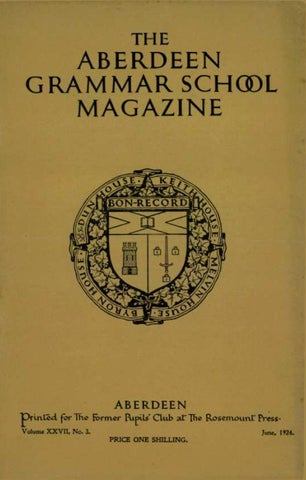
THE
i
ABERDEEN GRAMMAR SCHODL MAGAZINE
•
V
ABERDEEN
pri.nrect for The Former Pupils' Club ar The Roseniounr Press• Volume XXVII, No. 3.
June, 1924.
PRICE ONE SHILLING.
EDUCATIONAL BOOKS JAMES
G. BISSET
C ONTINUES to supply all the Class Books (New or Second-hand) suited for the requirements of the Higher Educational Institutions in the City, at the Lowest Prices. N.B.—Best Value in Students' Note Books.
JAMES G. BISSET, Classical, Medical, and Educational Bookseller,
85 BROAD
STREET
(Opposite Marischal College).
THE HOME OF FASHION & NOVELTY. You can begin and complete your Shopping The best appointed and most centrally situated Warehouse in Aberdeen.
under one roof at S. & H.'s.
Sangster & Henderson, DRAPERS, MILLINERS, AND COMPLETE HOUSE FURNISHERS.
UNION STREET, ABERDEEN. Telegrams: Telephone 363.
" Sangster Henderson, Aberdeen."
PRIZE CUPS SELECTION AT ALL
SPECIAL
A
4
PRICES
DESIGNS
PREPARED
FREE
A. & J. SMITH Jewellers, Gold and Silversmiths, Watch and Clockmakers -
1 9 1 UNION
STREET
A. C. LITTLE, COSTUMIER & FURRIER. Always in Stock a Large Selection of
FURS, FUR COATS, Fur-lined Coats, Wraps, Coat Frocks, Costumes, Dresses, Showerproofs, Skirts. etc. ALL AT THE VERY KEENEST PRICES.
INSPECTION IS INVITED.
EXCEPTIONAL VALUE IN MOURNINGS. The Largest Selection of Black Costumes, Coat Frocks, Dresses, Coats, Skirts, etc., in the City, at the Keenest Prices. Fit is Guaranteed within 6 hours, and no Charge is made for alteration.
THE HOUSE FOR VALUE
105 UNION ST., ABERDEEN. OPEN ALL DAY SATURDAYS. Telephone 523.
The Satisfaction Policy issued with the Dexter meets every possibility of dissatisfaction—howe'er remote, The Dexter keeps you dry . . and dressed. Every Dexter carries a Policy guaranteeing sati s fact ion
e
'
WEATHERPRCOFS
rr”e MEN
AND
WOME:•...
4
TO
6
GUINEAS
ALEXANDER BOOTH 1127.
Sr.. et.
UNION
37.
Sr.
NICNC-Ali
Sr..
ABERDEEN.
JAMES FYFE & SON, PAINTERS AND GLAZIERS. .
.
_
•
OFFICE AND SHOWROOMS:
11 DEE STREET, ABERDEEN. Telephone 304.
Telegrams—" Pyle, Painters "
Bed and Table Linen. BLANKETS, DOWN QUILTS, Etc.
P.
BEVERIDGE, The Linen Specialist,
39 to 43 ST. NICHOLAS STREET. Established 1841.
LOW'S BOOKSTALLS, 39-50 New Market Gallery, ABERDEEN. Books on All Subjects and at All Prices. 150,000 Volumes in Stock. 'Phone 3332.
Catalogues Issued.
Gramophone Record Cabinet Holds 24 Records, prevents Scratches and Breakages, 16!6, post free U.K.
Wm. Jackson (Abdn.) Ltd. IS Back Wynd, ABERDEEN.
BOOKBINDING OF
ALL DESCRIPTIONS.
Telephone No. 291.
Established 1855.
WM. DUNCAN, Hosier and Glover, Aberdeen.
8 Belmont Street,
Ladies' and Gent.'s Underwear. ELLAN-ESS, made in Hawick—a Speciality.
Botany Wool Ladies' Hose and Gent.'s Socks. Je
de
de
HIGHEST QUALITY. LOWEST CASH PRICES.
M. McCORMICK, The West-End Specialist. Really Artistic Styles for those who appreciate exclusive elegance and distinction. 0 Dressy Costumes ; Smart Tailored Suits; Coat Frocks; Coats in newest materials. 0 Furs and Fur Coats of every description. 0 Distinctive Evening Gowns that for smartness, elegance and individuality are absolutely without equal. O
Ladies going abroad to warm climates specially catered for. 0 Best Selection of Goods in Town at specially deflated prices. Costomiire, Gown Specialist, Furrier,
437-441 Union St. ABERDEEN. 'Phone 2499.
- Come West for Value."
GEORGE CUMMING MOTOR CYCLF SPECIALIST.
A.J.S., Sunbeam, Douglas, Levis, Harley-Davidson.
3 ALFORD PLACE ( HoL,LRN juNclioN). Telegrams—" INLET."
Telephone 2405.
Telephone 122.
Telegrams—. Biscuits, Aberdeen."
PURVEYORS TO
BY
HIS MAJESTY.
APPOINT MENT.
The Unprecedented Demand for our
'DUX' OAT CAKES HAS MADE AN EXTENSION OF THIS DEPARTMENT ABSOLUTELY NECESSARY. Our increased facilities will Ensure Prompt Attention to all Orders.
MITCHELL & MUIL, LTD., ABERDEEN.
Telephone No. 1891.
ARCHIBALD McKELLAR, Family Grocer and Wine Merchant, •
454-456 Union Street, Aberdeen. . . We Specialise in
. .
Cooked Gammons, " Sinclair's" Belfast Smoked Hams, " Harris's " Wiltshire Bacon.
Medicinal Wines ---Vibrona, Hall's, Wincarnis, Glendenning's.
HENDERSON BROS. 7
HENDERSON BROS.
For Grammar School Outfits.
For All Kinds of Outfits-Boy Scouts and Cubs, also Girl Guides.
59 St. Nicholas St.
HENDERSON BROS. For Running Pants and Vests, Football Jerseys, Hose, Caps, Belts, etc. 59 St. Nicholas St.
The new Grammar Blazer and Cap to match made of Alit. Wool Cloth. Jacket Deep Faced, with Curtain and Sleeves lined. The Best Cloth in the Market.
Henderson Brothers, Contractors' Outfitters, 59 'Phone 424.
St. Nicholas Street.
Telephone
1524.
TeleramN :
" Bruce, Cycles, Aberdeen."
Established 1884.
HOI burn Motor lsr Cycle Works GEORGE BRUCE & SONSg is Holborn Street. Aberdeen.
General Engineers, Motor and Cycle Agents. Agencies : Reading Standard, Quadrant, Humber, Edmund and Ivy. (Any other make supplied at liberal discounts.) We Specialise in Repair Work of all makes of Cars, Motor Cycles and Cycles.
CHARGES
THE DE LUXE IVY TWO•STROXE. Isis tlf Man Sporting Maist.
MODERATE.
Works, 1 Afford Lane.
Royal (Dick) Veterinary College EDINBURGH. . -
_
Principal :
O. CHARNOCK BRADLEY, M.D., D.Sc., M.R.C.V.S. After attendance on Complete Courses of Instruction in this College, Students may proceed to the Examinations for the Diploma of Membership of the Royal College of Veterinary Surgeons (M.R.C.V.S.). Students of the College may also present themselves for the Degree of Bachelor of Science (B.Sc.) in Veterinary Science conferred by the University of Edinburgh. The College being recognised as a Central Institution under the Education (Scotland) Act, 1938, Students are eligible for Bursaries granted by the Education Authorities of Scotland. A Copy of the College Calendar may be obtained on application to A. C. DOULL, Secretary and Treasurer. Get your Photographic Requirements at
D. Souter Allan's Pharmacy 35 HOLBURN STREET (Near Holburn Junction),
Photographic Department. A Large Stock of Cameras, Plates, Films, Papers, and Accessories. Dept for Kodaks and Kodak Supplies. Developing and Printing executed by an Expert and delivered in 24 hours.
4
Smart Wear
Y4
Y3
Y2
Y1
Moderately Priced
Yl. 2-Garment Grey Flannel Suit, Rugby or Sports Jacket. To fit 5 to 15 years. Prices, 17/6, 19/11, 25/6 to 39/6. Y2. Newest in Boys' Fawn Covert Coats, Single-breasted, Vent at back. To fit 5 to 10 years. Prices, 35/6, 38/6, 45/6 to 49/6. Y3. Pure Wool Flannel Blazers, in Royal Blue, complete with Pocket Badge. To fit 5 to 17 years. Prices, 22/6, 24/6, 26/6 to 30/-. Royal Blue Flannel Shorts. Prices, 10/6 to 12/11. Caps with Badge, 3/6 each. Elastic Belts, in Red, White, and Blue, 1/6 each. Y4. Double-breasted Covert Coat, with Belt at back, in Fawn or Dark Grey. To fit 5 to 8 years. Prices, 37/6, 39/6, 43/6, 45/6.
John..Falconer&O
(FAMOUS fOR A
CCR!WRY •
QUARTER FOR QU•L/TV I
vAzuE. )
(Royal _WreadereareAouse ABERDEEN
'PHONE i9.
The Empress Laundry SEAFORTH
ROAD,
ABERDEEN.
The Seal of
The Sign of Our Messenger.
o
Satisfaction.
Stevenson Bros. (Dundee) Ltd. PROPRIETORS,
Artist Dyers and Dry Cleaners. Carpet Beating. Seaforth Road (r9)
260a Union Street (898)
205 George St. (613)
237 Rosemount Place
For . .
Choice Cut Flowers. GEORGE PEGLER &CO. LIMITED, •
THE CITY FLORISTS, 167-169 Union St.
504-508 Union St.
'PlioNE 1098.
'PHONE 1591.
ABERDEEN. 'Phone 2899.
'Phone 2899.
,9ae CROWN DAIRIES . SUPPLY
.
THE FINEST DAIRY PRODUCE.
GOOD MILK is our Speciality.
7 to 13 Waverley Place.
We Specialise in
Drink
SANGS' Special Lemonade
Choice Flowers AN
Artistic Floral Work Also
and you will admit it is the finest procurable,
. Bulbs
ALSO
of Finest Quality
Iron Brew
FOR ROOM CULTURE IN BOWLS
Our Original Speciality Keenest Prices NONE LIKE
Enquiries Esteemed
IT
SANGS, LTD. Seaforth Road ABERDEEN Telephone 1289.
William Brown & Sons CABINETMAKERS
M. H. Sinclair "The Upstairs Flower Shop"
407 Union Street •'
waft Teotoe/ta "
Milne & Munro 263 Union Street
UPHOLSTERERS . REMOVERS . . .
242 Union Street
PRACTICAL BOOTMAKERS Agents for
"Lotus" and "K" Boots
ABERDEEN Agents for
Buoyant Settees and Chairs 'PHONE 1204
The House which leads in Quality at Moderate Prices 'PHONY 1028
Of Guaranteed Reliability. This Watch Bracelet is a reliable timekeeper. As an adornment for a dainty wrist it needs no recommendation. The price is lowest possible commensurate with timekeeping dependability.
£5 10s. In velvet-lined presentation case. If you cannot call we shall send this Watch Bracelet on approval for seven days' trial. Money returned if not satisfied. 15 Jewel Lever Movement in Solid H.M. Gold Case, fitted Solid Gold dainty but strong Expanding Bracelet. Price, £5 10s.
GEO. JAMIESON & SON (W. W. CARRY),
Waltham
Watch Depot,
125 UNION STREET, ABERDEEN. ESTABLISHED 1843.
Wm. Cay & Sons funeral lanbertahers. 415 UNION STREET AND
209 GEORGE STREET,
PRINTING. The
.
Central Press (JOHN MILNE),
General Printer, Lithographer, AND
ABERDEEN. Motor Hearses and Cars for Distant Funerals.
Stationer, 61 Belmont Street, ABERDEEN.
Telegrams—"Cay, Aberdeen." 'Phones Nos. 92 and 54.
Telephone No. 809.
'Phone 1750.
FINDLAY'S DAIRY, PURVEYOR OF
High-class Dairy Produce. All Milk supplies treated under modern hygienic conditions. A Guarantee of Purity. PURE DAIRY BUTTER AND FARM EGGS FRESH DAILY. SPECIALITIES:
Thick Double Cream and Rich Single Cream. Head Office and Depot: 457 Union Street. Branches throughout City, Also at Cults and Stonehaven.
We invite you to visit our Tea Room at 457 Union Street. J. D. LoGIE, Proprietor. Telephone Nos. 1881, 1882.
Telegraphic Address: " Plaster, Aberdeen."
JAMES SCOTT & SON (Aberdeen), Ltd., Fire Grates: Antique and Modern.
Cooking Ranges —„ Independent Water Heaters
I
Mantelpieces Wood and in
Marble.
Marble, Mosaic, Terrazzo and Tiles
i
I
FOR
Fire-places, Walls, and Floors.
Chambers' Fireless Gas Ranges.
Inquiries regarding Genuine Old Chimney Pieces and Fire Grates solicited
Address:
483-485 UNION STREET, ABERDEEN.
BOY SCOUTS.
GIRL GUIDES.
BROWNIES.
for Scouts, Special Display this Week of Clothing, Uniform, and Equipment Guides, and Brownies.
encourageThese splendid organizations for the good of our Boys and Girls deserve every of profit. ment, and we have decided to sell all their outfits on the very smallest cash basis We would respectfully ask Parents and Guardians to compare Our Prices with the exorbitant quarters. prices being charged tn some FOR BOY SCOUTS. Khaki Poplin Shirts, 5/- to 7/- • Khaki Serge Shirts, 6/- to 7/6 ; Navy Serge Shirts, each. 5/6 to 7/- ; Navy Serge Shorts (according to size), 3/6 to 7/6; Scout Poles, ;6d. Hats, 2/11 ; Belts, 1/6 ; Whistles, 9d. ; Lanyards, 3d. ; Shoulder Knots, 2d. Mufflers,; 1/- and 1/6 ; Haversacks, 1/9; Water Bottles. 1/6 ; Billicans, 2/- ; Garters, 40. Knives, 2/-. FOR GIRL GUIDES. Bust-28in 30in. 32in. 34in. 7/6 7/6/6 6/06 f• •• a• •• .. .. Serge Tunics 9/9/6 8/8/6 .. • • .. .. .• .. .. Drill Tunics Length-23in. 25m. 27in. 6/5/6 5/. .. .. .. •• •• .. .. Serge Skirts Haversacks, 1/9 ; Neckties, 6d. ; Whistles, 9d. ; Knives, 1/‘; Belts, 1/- and 1/6 ; each. 3d. Emblems, 2/11 ; Hats, Lanyards, 4d. ; FOR BROWNIES. Length-251n. 27in. 30in. 331n. 6/6 5/6 6/5/•• Brownie Overalls .. 9d. •• .. Belts .. 8d. .• Hats .. FOR GUIDERS. Hats, 6/6 ; Belts, 3/9 ; Ties, 1/9 ; Tunics and Skirts to Order only. FOR SCOUTMASTERS. .. 8/6 .. Khaki Serge Shirts .. 7/6 .. .. .. Hats .. .. 8/6 .. .. .. 1/9 Navy Serge Shorts .. Ties .. .. ., Khaki Breeches, Lacing, 16/6, 17/6, 25/.. 5/Belts, with Shoulder Straps .. 5/6 .. Khaki Drill Shirts .. 8, and 9, 7, 6, Boys' Grammar School V-necked Sweaters—Red, { Sizes-5, 10/8/- 8/6 9/- 9/6 White, and Blue edges, all Wool, Equipment. article of any Estimates supplied for
STREET, A. & J. SCOTT, 29 GEORGE ABERDEEN. CONTENTS. .. Facing page 172 PORTRAIT OF MR. MAXWELL H. MACKIE, M.A. 173 PORTRAIT OF THE LATE MR. ALEX. DUFFUS, ADVOCATE PP .. .. Between pp. 204 and 205 THE BYRON STATUE, 19TH APRIL 1924 SCHOOL CENTENARY TRIBUTES TO BYRON AT ABERDEEN •• •• •• •• .. AND ATHENS If •• 0. FLing page 236 .. SCHOOL PREFECTS, JUNE 1924 le •• •• .. .. RESIGNATION OF THE RECTOR •• .. •• •• .. MR. MILLER : AN APPRECIATION •• .. THE RETIREMENT OF MR. MAXWELL H. MACKIE .. •• •• •• •• •• .. NOTES ABOUT OLD BOYS THE MEMORIAL PAVILION-DR. MORLAND SIMPSON'S VERSES •• .. •• •• .. .. THE SCHOOL WAR MEMORIAL •• •• •• •• •• •. A JUBILEE NUMBER .. THE BYRON CENTENARY.. •• THE SCHOOL'S TRIBUTE TO HER GREATEST F.P. •• •• .. .. •• .. A GREEK TRIBUTE • • " BYRON, THE SCOT "-LECTURE BY MR. J. D. SYMON •. PUBLICATIONS • • •• CELEBRATIONS AND CENTENARY •• •• .. •• •• " BYRON IN PERSPECTIVE " .. .. .. ASPECTS OF OUR " MYSTERIOUS SOMETHING " AT THE SCHOOL SIXTY YEARS AGO. BY CHAS. S. S. JOHNSTON .. •• •• CAREER-VI .. ARMY SOME PHASES OF AN •• •• •• .. .. •• .. SCHOOLNOTES .. •• •• .. .. .. .. RANDOM NOTES .• .. •• •• THE SCHOOL MUSEUM. SCOUT NOTES •• . • . • .. •• •• .. SCHOOL CRICKET THE FORMER PUPILS' CLUB• • .. .. .. •• .. THE LONDON SECTION • • .. .. • THE RUGBY FOOTBALL SECTION • • •• we p• •• • .. SECTION . THE CRICKET •• THE SCHOOL WAR MEMORIAL-LIST OF SUBSCRIPTIONS .• •. • • ,. ,• LIST OF NEW MEMBERS
Page 165 168 .. .. 169 .. 173 .. 187 188 .. 189 .. •• •• •• .• .. •. •. •• • • •• 4.•
.• ••
190 191 193 197 201 206 213 217 227 231 233 235 239 240 241 241 242
ESTABLISHED
1836
NORTHERN ASSURANCE COMPANY LIMITED Assets
-
-
£15,000,000
ALL CLASSES OF INSURANCE LIFE
ASSURANCE
BRANCH.—The Company's
Tables of Rates for Life Assurance include every class of Policy.
Write for particulars of
CHILDREN'S EDUCATIONAL POLICIES ESTATE DUTY POLICIES PARTNERSHIP POLICIES ENDOWMENT ASSURANCE POLICIES
CHIEF OFFICES t
ABERDEEN -
-
-
1 Union Terrace.
LONDON
-
-
1 Moorgate, E.C. 2.
-
Aberdeen Board of Directors. SIR THOMAS BURNETT, BART.
GEORGE MILNE COOK, ESQ.
DAVID M. A. CHALMERS, ESQ.
GARDEN ALEXANDER DUFF, ESQ.
FRANCIS JAMES COCHRAN, ESQ.
ALFRED MARTINEAU, ESQ.
DAVID M. M. MILLIGAN, ESQ.
Manager
-
-
R. MACKAY, F. F.A.
abetbeen Orammar SciNot Maga3ine. Vol. XXVII.
JUNE,
1924.
No. 3
the auspices The " Grammar School Magazine " is issued under All November. and June, March, in Club, Pupils' of The Former addressed should be " Magazine " the to regard with communications of the Club), to the Editor (the Secretary and Treasurer THEODORE WATT, M.A., The Rosemount Press, Aberdeen. the Secretary of ** Members of the Club are requested to Inform any change In their address.
Resignation of the Rector. It is with very deep regret that we record the resignation of the Rectorship by Mr. Douglas Gordon Miller. In the last issue of the Magazine it was stated that he had been strongly urged to become a candidate for the High Mastership of Manchester Grammar School, but that the Aberdeen Education Authority had taken such steps as would result in his remaining in Aberdeen. Apparently, however, the Governors of the Manchester Grammar School were determined to secure the services of Mr. Miller. The salary first offered to him by that body was £1,250, rising to £1,500. When the Aberdeen Education Authority fixed Mr. Miller's salary at £1,250, he received a communication from the Governors of Manchester Grammar School asking him to become an applicant for their post at a salary of £2,000. Mr. Miller replied that he was not a candidate, and would not apply. The Manchester Governors refused to take him at- his word, and asked him to come and see them. Having interviewed him on 9th May, they unanimously appointed him, and Mr. Miller will take up his new duties after the summer holidays. A special meeting of the Aberdeen Education Authority was held on Friday, 16th May, when the Chairman, Mr.
166
Aberdeen Grammar School Magazine.
George Duncan, M.A., explained that the occasion for calling the meeting was a letter which Colonel Dawson, the Director of Education, had received from the Rector of the Grammar School, in the following terms :— Dear Sir,—Having been appointed High Master of Manchester Grammar School, I desire to resign my post as Rector of the Grammar School as from August 31st. I do so with keen regret, and I should like to express to you and the Education Authority of Aberdeen my sincere appreciation of the great kindness I have experienced. The Chairman said he was sure they received that formal intimation with very sincere regret. (Applause.) He thought there was not one of them but appreciated to the full the great asset that Mr. Miller had been to the Grammar School during the three years of his Rectorship. When they appointed him close on three years ago, he thought all of them who were members of the Authority at that time, and who took part in the appointment, were satisfied that they had made a wise selection, but he did not think that all of them probably quite anticipated the precise degree of success to which Mr. Miller had attained in his conduct of the School. That success had been marked in no ordinary degree. Whether they had regard to the scholastic record of the School during his period of office, its athletic record, the increase in the numbers attending the School, and another important point—the harmony that had reigned, not merely between Mr. Miller and the Authority, but between Mr. Miller and his staff and the boys in the School—nothing more satisfactory could be imagined. It was for these reasons that they deeply regretted his departure, but at the same time he had the feeling—and he thought it was a feeling that they all shared—that, as it was put in that day's issue of the Scottish Educational Journal— the appointment of Mr. Miller to a school like Manchester Grammar School was a high honour to Scottish education ; and he thought they there might go even further than that, and say it was a high honour to Aberdeen and a high honour to the School with which he had been connected—(applause) —and was, among other things, an indication, of which they should be proud, of the way in which the Grammar School was regarded outside Aberdeen, and the status to which the School had attained. It was rather a curious coincidence that just at this time Manchester should have at the head of both its principal schools two Aberdonians. It had taken Mr. Miller from the Grammar School to the premier Grammar School of England, and it had also taken an Aberdeen lady, educated at the Girls' High School—Miss Mary Clarke [eldest daughter of Mr. John Clarke, formerly classical master in Aberdeen Grammar School;—to be head mistress of its High
Aberdeen Grammar School Magazine.
167
School for Girls. That, again, was a signal satisfaction to the Authority. He moved the following resolution :— That the Authority accept Mr. Douglas Miller's resignation as Rector of the Grammar School, and in doing so express to him their deep regret at the loss the School has sustained through his departure from Aberdeen, their high appreciation of his eminent services, and their hearty congratulations on his unanimous appointment as High Master of Manchester Grammar School, and their sincere wishes for his future welfare and prosperity. Professor George Pittendrigh, D.D., in seconding, associated himself with the Chairman both in his congratulations to Mr. Miller and in his expressions of regret that Mr. Miller was so soon to leave them. The Chairman had not spoken in exaggerated terms ; he did not think it was possible to exaggerate what they might say of Mr. Miller. He was going to what was generally regarded as the premier Grammar School of England, and the highest post, perhaps, of the kind that was available within the Kingdom, and at emoluments that equalled, if they did not surpass, even the Principals of the Scottish Universities. They congratulated him very warmly on this great honour that had been done him, and they congratulated themselves upon the honour that had been done them in the choosing of their Rector. At the same time he thought what filled their hearts, perhaps, most was regret that they were going to lose him. Mr. Miller had identified himself with the Grammar School in a very remarkable way during the three years he had been amongst them, and he knew from conversation with many that he expressed the very deep regret of the staff and of the boys, and also of the parents of the pupils, at his departure. He was talking to two boys he met by chance after the news came out, and one of them said : " Well, sir, it is good that we have had him even for a short time," and it seemed to him that that was the true philosophic attitude that they might all take up—it was good that they had had Mr. Miller with them even for a very short time. Professor James Gilroy, D.D., supported the motion, and spoke of Mr. Miller's close touch with the boys in the playfield, which was a point teachers should not forget—that there were more ways than one of controlling, guiding, and helping boys. (Applause.) The motion was unanimously passed. The Authority adopted a resolution to advertise for a successor, no salary to be mentioned in the advertisement, but particulars as to salary to be offered to be obtained on application to the Director of Education.
168
Aberdeen Grammar School Magazine.
Mr. Miller : An Appreciation. The contribution of a Rector to the life of a school such as ours is something in the main so elusively spiritual that it is difficult adequately to describe it in words ; and because Mr. Miller's contribution to the life of the School has been in an unusual degree of this kind, it is hard to give anyone that has not come under the influence of his personality any real idea of what we are now losing by his transference to Manchester. Mr. Miller's period of office has been one of great tranquillity and happiness for the School ; it has continued the tradition of Dr. Simpson's days and at the same time permeated it with a fresh and strong personality, never obtrusive, yet always at work. The spirit of fellowship and of loyalty to the School which Dr. Simpson so constantly inculcated has been fostered by his successor, and the School has moved steadily towards its ideal of being a healthy, many-sided training-ground for later citizenship and service. For such a task a Rector of ideals and character is required —and that Mr. Miller has been pre-eminently. With him it is not what he has done but what he is that counts, and the influence of his steadfast modesty and simplicity of mind upon the pupils of the School would be hard to over-estimate. Along with these qualities he has manifested a great faith in his fellow-man, never believing less than the best of anyone, with the result that the School has fully justified his trust. It will be gathered that Mr. Miller is very different from the traditional Head Master of fiction—that stern, reserved figure that loomed over his pupils like an accusing conscience. For Mr. Miller has never allowed himself to outgrow his boyhood. Soon after he came to the School, he would be seen arriving of a morning accompanied now by a chattering companion from the Lower School, now by a dignified member of the Sixth, both equally at ease in his presence. Mr. Miller (and here one must not forget Mrs. Miller) has been a revelation in the modern spirit of camaraderie at all our social gatherings. What exactly is the secret of this quiet, kindly, but very real power of his would be hard to say. Perhaps it is his balance. He has been a Rector without fads, encouraging everything that enriches the life of a school, without bias in favour of any particular aspect. Work, games, societies have all had their place—and no more than that. In such a broad view of education the fetish of results could have no place. The School has been encouraged to work well and play well for the satisfaction and virtue that lie in so doing, not for the sake of the rewards that may follow. Such a personality as Mr. Miller's cannot be lost to a School without the deepest regret. While he has been with us, he has made the School his life, and not a soul connected with it but will lose a friend by his going.
Aberdeen Grammar School Magazine.
169
The Retirement of Mr. Maxwell H. Mackie. As was mentioned in the last issue of the Magazine, Mr. Mackie retires from the staff of the School at the close of the present session, having reached the age limit. Mr. Mackie graduated M.A. at Edinburgh University in 138'), and was " recognised" as a teacher in the same year. He started in his professional career as an assistant in the Northfield School and then in the Middle School, Aberdeen, but after a few months—in January, 1831—was appointed first assistant in the Preparatory Department of the Grammar School under the late Mr. Alexander Green. Before long he was promoted to be an assistant teacher of Classics and French, and in 1885 was appointed French Master in succession to the late Mr. William Brebner. Mr. Mackie has served in the School for the long period of 44 years, and since the retirement of Mr. Samuel Pope in 1912 he has been the doyen of the staff. This position now falls to Mr. J. Bentley Philip, who came to the School in 1888. Some Memories Grave and Gay. Is it actually a fact that Mr. Mackie is retiring from the Grammar? Somehow I cannot picture the old School without him, and the thought of his leaving seems to break a link in my School connection. Mr. Mackie to-day appears to me just the same as he did thirty odd years ago, when, as a bewildered child of seven, I was escorted to the Infant Department. Long before my introduction to the mysteries of the French language, I had heard of Mr. Mackie's abilities as a teller of thrilling stories, and later, when he became my French master, I soon discovered that his story-telling capacity quite justified all that I had heard from my seniors. I shall never forget his description of how a grizzly bear climbed on top of his log cabin in the American back-woods, and I can still feel the atmosphere of solitude and vastness of the forests as he told of his early life in what I imagined was the real land of Redskins, Cowboys, and "Deadwood Dick's Diamond Dice." This story-telling business may not have had much to do with the teaching of French, but it had a marvellous effect on us boys. We learned to know and love Mr. Mackie as a hero, and I feel certain that was a good foundation on which to build our interest in French. But Mr. Mackie kept us tuned up in another direction also. I refer to his skill as a singing master, and I wonder how many of the present School pupils realize how gifted he was in that direction. In the First Middle we had two half-hours a week at singing in a room to the north of the main corridor. Our
170
Aberdeen Grammar School Magazine.
greatest achievement was " Hark, the Goddess Diana returns from the Chase," and it was part singing at that. I began in a front bench as a soprano, but was later transferred to the contralto section at the back of the room. This radical change was the result of an examination which consisted in Mr. Mackie's whistling a series of notes once, twice, sometimes thrice, and our task was to interpret these sounds on paper by doh, te, lah, soh, etc., etc. Such was my success that I still possess a beautiful volume of Longfellow's Complete Works, on the front page of which is inscribed " For Excellence in Singing (1st Prize—equal)." None of my friends to-day could possibly believe I gained that prize honestly, and I confess the affair remains with me a mystery. Then there was a French song, which was introduced on different occasions when our regular class work was finished before schedule time. I can remember only part of the song, which ran something like this :— Passez par la le man ye Passez par la le man ye Passez par la le man ye . . . . mong payee.
Presumably the meaning had something to do with travel in Germany. Many old pupils will remember Mr. Mackie writing on the blackboard with great solemnity the following words : Pas d'elle yeux Rhone que nous. We were informed that it was not by any means sufficient to translate the words individually, but that we must grasp the phrase as a whole. Mr. Mackie also added that until we fully appreciated the true significance of what he had written, we could never hope to be a success in life. There was a twinkle in his eye as he said this, and we suspected a catch, but it took us some time to " see through it." My sorriest recollection of French at School is Eugene's French Grammar. It was a beautiful bleu del when it left the bookseller, but grimy fingers soon altered that, and its original external beauty quickly vanished. It was a terrible book, crammed full of the stalest stuff I can imagine. Oh, those reflexive verbs, the mixing up of Avoir and Etre, the pronunciation of ou, eu, au, and worse still, the subtle distinction between on, an, in, and un I Every Grammar boy knows how emphatically Mr. Mackie illustrated the different mouthing of these sounds. Somehow or other I never could grasp the thing, and my idea in those days was that to speak French correctly, it was essential to have an inflamed throat and a cold in the head. But there was the happier side in learning French. How we delighted in repeating the list of nouns that take x instead of s for the plural : bijou, caillou, thou, genou, hibou, joujou, pou. We always laughed over these
Aberdeen Grammar School Magazine.
171
words, especially over pou, little dreaming that a pou in reality is bad enough either singular or plural. Another very troublesome termination on which Mr. Mackie dwelt with the greatest delight was gne, and when we got the length of translating Le Roi des Montagnes, the very title was enough to upset the bravest among us. But we floundered through that book somehow or other, and by hook or by crook managed to overcome its numerous difficulties. Some of us became proficient even to the extent of passing Lower, yea Higher Leaving Certificates, but sad to say I was not one of those included in the list. As a matter of course we took great pleasure in seeking out methods of irritating our masters, and the particular form adopted in Mr. Mackie's case was to drum on the lid of the yellow painted waste-paper box which stood just round the corner to the right, at the top of the stair above the east entrance. We soon discovered that this box was a source of annoyance to Mr. Mackie, and we dwelt on it accordingly. Unfortunately the box in question was our undoing, for one day we set hands on the smallest member of the class during the " Short inty," and in spite of much kicking and struggling, managed to put him into the box, head first, and the lid was closed. No sooner was this accomplished than shouts came up the stairs of " Here's Mr. Mackie, watch out you chaps." We slipped into the classroom, leaving our friend in the box outside. For a time all went well, but suddenly the most appalling din broke the stillness, and Mr. Mackie soon discovered the cause when he opened the door. Little more need be said. Several boys proved their innocence, others could not, and that terrible strap of Mr. Mackie's did blighting service. That strap had a fruity sting about it which I, for one, cannot forget. It was not one of the stiff, brown leather straps of the poker type, but a limp, flabby, sodden, black abomination, which took a real grip of the hand, and dodging was no use, because if the ends of the strap fingers bit round the thumb joint, the most courageous was made to squirm. It almost brings tears to my eyes to this day when I think of those " sappy scuds." On one occasion when a class friend of mine had a birthday, we adjourned to the " Grubbers " at the corner of Esslemont Avenue and Leadside Road and purchased " Jaw Pullers," " Long Jonathan," and " Jap Nuggets," famed for their high specific gravity and cocoanut flavour. Only the Jap Nuggets remained when Mr. Mackie's hour arrived, and unfortunately one of us was caught physically unable to answer a question, because Jap Nuggets are awkward things to swallow at short notice. Mr. Mackie secured all that remained in the bag. Next day we schemed revenge, and more Jap Nuggets were purchased. The yellow and white varieties were eaten, but
172
Aberdeen Grammar School Magazine.
we kept those of chocolate tint and soaked them in ink. We made sure that our sweety-munching was observed, and of course the inevitable happened. " Bring me those sweets. Why keep them all to yourselves ? Don't be selfish." The class played up to a man, no sniggering gave the show away. Mr. Mackie ate one of those inky nuggets, and didn't turn a hair, although every eye in the class was upon him. He knew what had taken place, but he was a sport and " said nuffin'." Another incident I can recall, and I am sure Mr. Mackie has good reason to remember it. One day he appeared at School with a cheek twice its usual size, occasioned by a gumboil. He was in evident distress, his speech was not quite normal, and his temper was somewhat affected. We saw our chance. That afternoon, when tramping into his classroom, we all cultivated gumboils. Very soon, however, we were wondering if the joke was all on our side. It is strange how these events rise above the more serious side of School life. There is one thing I shall always remember about Mr. Mackie, and it was his great abhorrence of everything that was underhand and sneaking. He frequently lectured us on the subject of honesty and fairness, and I confess willingly that several things he said to us under those headings cling to me still. Mr. Mackie was extraordinarily patient and painstaking, and although he could be very angry at times, that wonderful smile of his soon swept away all our fears. Mr. Mackie's physical fitness is indicated by his swinging stride, as also by his energy on the push-bike. It is evident he has discovered the secret of perpetual youth, and I believe the secret lies in his life-long attachment to outdoor recreation. Mr. Mackie can show a good record at golf, he loves his garden, and what he does not know about fishing is hardly worth knowing. He can also take his place with most men at bridge and billiards, and he is frequently to be found in the chair at French lectures. With so many interests he has made a very wide circle of friends, and in his well-deserved retirement he will find his time pleasantly occupied with many diversions. I am sure I speak for all my old class-fellows, and for hundreds of other boys far and near who have passed through Mr. Mackie's hands, when I say that we all remember him with affection, think of him with respect, and with all sincerity wish him many happy years when he escapes from the strain and worry of official teaching. A. S.
al
Mr. MAXWELL H. MACKIE, M.A. I
4
•
I
]
•
The late Mr. ALEXANDER DUFFUS, Advocate in Aberdeen.
Aberdeen Grammar School Magazine.
173
***It is requested that the Editor he informed of all new appointments and interesting incidents In the careers of Former Pupils.
The dates given in parentheses after names indicate the sessions of attendance at the School.
•
Claud Alexander Barron* (1880- 87), C.S.I., C.I.E., C.V.O., of the Indian Civil Service, having completed his five years' tenure of the post of Chief Commissioner of Delhi, has been appointed to the office of Financial Commissioner (Development Branch) of the Punjab, and took over charge at the end of March. The post corresponds to that of Member of the Board of Revenue in the Presidency Provinces. He has also recently been appointed by H.R.H. The Duke of Connaught, Grand Master of the United Grand Lodge of England, as District Grand Master of the Punjab and Grand Superintendent of Royal Arch Masons in the Punjab. The Punjab District Grand Lodge is the third in size of the five D.G. Lodges in India, and the sixth in size of the 30 D.G. Lodges under the United Grand Lodge of England, outside the British Isles. Andrew Riddel Abercromby* (1903-13) has left the fish trade in Aberdeen and gone in for what he describes as a " much more exciting life," namely stockbroking. He is with the firm of Messrs. Myers & Co., 19 Throgmorton Avenue, London. John A. G. Adamson* (1912-19) is in the London office of the Commercial Bank of Scotland, Ltd. William Lang Baxter (1850-55), M.A., who was Dux and Gold Medallist of the School in 1855, has recently applied for the appointment of an assistant and successor in the charge of the parish of Cameron, Fifeshire. Mr. Baxter, although he left the School almost 70 years ago, is by no means the oldest surviving F.P. This venerable distinction is held by the Rev. WILLIAM CORMACK, of Rondebosch, Cape Town, who is now in his 99th year, having been born in October, 1825. Alfred Alexander Black* (1882-84), M.A., who has been for many years Secretary of the Victoria (Cotton) Mills Co., Ltd., Cawnpore, India, retired in the middle of April and has come home. • Indicates Member of Former Pupils' Club.
174
Aberdeen Grammar School Magazine.
Edward James Bruce* (1892-95), M.B., who was formerly in medical practice at North Leverton, Notts, has recently settled in Huddersfield. George Collie Cheyne* (1900-1904), M.A., B.Sc., Deputy Conservator of Forests, Burma, was on the King's Birthday appointed a Member of the Order of the British Empire. He entered the Imperial Forest Service in 1911. George Alexander Combe* (1889-95), M.A., Acting Consul General at Cheng-tu, was on the King's Birthday appointed a Commander of the Order of the British Empire. He entered H.M. Consular Service in China as a student interpreter in 1901. He is a brother of the late Lieut. ROBERT G. COMBE (1894-97), V.C. William Walker Cruickshank (1895-97), O.B.E., B.D. (a brother of the President of the F.P. Club), who entered the ministry of the Scottish Episcopal Church in 1905 as curate of S. Mary Magdalene's, Dundee, has been appointed by the Bishop of Birmingham to be vicar of St. Alban's, Smethwick, Staffs, a parish with a population of about 5,000. He has latterly been curate-in-charge of Hazelwell, Edgbaston, Birmingham. James Gordon Danielson* (1896-1901), who has been in the service of the Hongkong and Shanghai Banking Corporation, Ltd., since 1908, latterly in Yokohama, is now stationed in Hamburg. Andrew John Davidson* (1916-21) is in the employment of the Caledonia Laundry Service Co., Los Angeles, California. Arthur Raymond Gordon Emslie* (1919-22) is now resident at Brockville, Ontario, Canada. Adam Fyfe Findlay* (1879-85), M.A., D.D., was at the recent General Assembly of the United Free Church of Scotland appointed to the Chair of Church History in the Aberdeen U.F.C. College, in succession to Rev. Dr. James Stalker. He was Gold Medallist of the School in 1885, and graduated at Aberdeen University in 1889 with First Class Honours in Classics. In the following year he entered the United Presbyterian Divinity Hall, Edinburgh, and was appointed minister of the U.F. Church (later St. John's U.F. Church), Whithorn, in 1896. In 1903 he became minister of Erskine U.F. Church, Arbroath ; in 1911, of Bristo U.F. Church, Edinburgh ; and in 1921, of High U.P. Church, Linlithgow. During the War he was an Army Chaplain, serving with the Egyptian Expeditionary Force from November 1916 to November 1917. In the latter year he was appointed Kerr Lecturer, and his lectures were subsequently published under the title of By-ways in Early Christian Literature. He is the second member of his family to be appointed to a professorship, his younger brother, ALEXANDER FINDLAY* (1882-91), M.A., D.Sc., Ph.D.,
Aberdeen Grammar School Magazine.
175
having been appointed Professor of Chemistry in the University College of Wales, Aberystwyth, in 1911, and Professor of Chemistry in the University of Aberdeen in 1919. It is interesting to note that another of the candidates for the Chair of Church History was George Alexander Frank Knight (1878- 85), M.A., D.D., minister of Kelvingrove U.F. Church, Glasgow. George Topham Forrest* (1879-89), in his capacity as Superintending Architect of the London County Council, has collaborated with Sir Reginald Blomfield, R.A., in designing the façades of the new Lambeth Bridge, London, the building of which was sanctioned a few weeks ago by the House of Lords, after a great fight which lasted for over a week. It is expected that a commencement will be made very shortly with the erection of the bridge. Douglas Morrison Milne Fraser* (1898-1910), M.A., M.B., is now in medical practice at Eastry, Kent. William Ernest Gordon* (1913-17), who after demobilization from the Army was for a time a medical student at Aberdeen University, is now resident at Fort Jameson, Northern Rhodesia. John Hartley Henderson* (1913-21), who has been in the office of Messrs. James A. Jeffrey & Co., chartered accountants, Aberdeen, has just been appointed assistant on one of the estates of the Burnside Tea Estates Co., Ltd., Ceylon, and is going out there immediately. He received the appointment through the Club Consul in Colombo. James Patrick Jeffrey* (1906-18) has graduated B.Sc. in Engineering at Glasgow University. Alexander Smith Black Kemp* (1907-1916), who served his apprenticeship as an engineer with Messrs. Clyne, Mitchell & Co., Ltd., Aberdeen, has received an appointment as assistant engineer with the Anglo-Persian Oil Co., Ltd., and sailed for Persia in March. James Kemp* (1874-78) recently retired from the service of the North of Scotland Bank, Ltd., and received a presentation. He was for many years chief clerk to the secretary of the Town and County Bank, Ltd., and thereafter an official in the St. Nicholas Branch of the North of Scotland and Town and County Bank, Ltd. Percival Robson Kirby (1892-1901), M.A., Professor of Music, University College, Johannesburg, has recently been made a Fellow of the Royal College of Music, South Kensington. He went to South Africa in 1914 as organizing instructor in vocal music for the Province of Natal, and in 1921 was appointed to his present post. Douglas John Kynoch (1908-11), M.C., was recently admitted L.R.C.P. and S. (Edin.) and L.R.F.P. (Glas.).
176
Aberdeen Grammar School Magazine.
Henry Laird* (1882-85), who was recently appointed Divisional Accountant of the North-Eastern Area of the London and North-Eastern Railway, is now resident at Monkseaton, Northumberland. Alexander McCurrach* (1897-1901) was in April appointed branch manager at Glasgow of the Sun Insurance Office. He entered the service of this company at Aberdeen in 1901, and after serving for a period in Edinburgh, was appointed district inspector at Aberdeen in 1911, and district secretary at Aberdeen in 1920. Farquhar McLennan* (1888-90), D.S.O., M.B., Colonel, R.A.M.C., is at present stationed at the Military Hospital, Fort George. Lord Meston* (1876-80), K.C.S.I., LL.D., was at the Annual Festival of the United Grand Lodge of England invested as Junior Grand Warden of England. He thus becomes fifth in order of precedence in the Masonic hierarchy. Forbes Marshall Milne* (1919-22) is at present serving in H.M.S. Worcester at Greenhithe, Kent. George Mortimer* (1894-96), who went to New Zealand in 1914 and served with the New Zealand Field Engineers in Gallipoli and France, is at present home on holiday. He recently had the good fortune to win the first prize of £5,000 in a sweepstake. The only fly in the ointment is that the New Zealand Government claims tax to the extent of £600. Alexander Falconer Murison* (1860-63), M.A., LL.D., Professor of Roman Law and of Jurisprudence in University College, London, was in April appointed to the rank of King's Counsel. Not a few of the older F.P.s will remember him as English Master of the School, prior to his going to London and being called to the Bar at the Middle Temple in 1881. He is now 77 years of age, and continues to take a warm interest in the School, being a keen member of the London Section of the Club. James Rannie* (1910-16), M.B., is at present second assistant medical officer in Firvale Hospital, Sheffield. Lawrence Don Robertson* (1915-16), M.B., is now in medical practice at Hull. William George Robertson* (1884-90), B.D., Principal and Professor of English Literature, Gujarat College, Ahmedabad, India, has come home on long leave, preparatory to retiring from the Indian Educational Service. John Chesser Salmond* (1889-96) has recently become a member of the Club. He entered the service of the Capital and Counties Bank, Ltd., now Lloyds Bank, Ltd., in 1902, and has been successively stationed at Southampton, Basingstoke, and East Dereham.
Aberdeen Grammar School Magazine.
•
•
v
177
John Manson Sleigh* (1914-16), B.Sc. (Eng.), is now in the service of Messrs. S. Pearson & Son, Ltd., in charge of irrigation works on the Blue Nile in the Sudan. His address is Hag Abdullah, Sudan. Another F.P. in that area iS JAMES LORIMER SOUPER* (1898-1909), the Club Consul for Sudan. Frederick Roberts Sleigh* (1914-17), M.B., has recently been assumed as a partner with Dr. Moore, Coggeshall, Essex. Arthur Cruickshank Smith* (1893-1900) has recently retired from the service of Messrs. Sutro & Co. (Eastern), Ltd., Singapore, and has entered the business of Messrs. Gordon Graham & Co., Ltd., wholesale wine and tea merchants, Aberdeen. He has been out in the East since 1910. William Henderson Stephen* (1882-85), M.B., of Westcliff-on-Sea, Essex, while remitting his annual subscription and with reference to the injunction on the subscription form " Please write distinctly," remarks: " In Mr. Sam Pope's class in my time there were 57. I was 8th in drawing, and 57th in writing." Edward Simon Willox* (1910-17) received in May of last year a six years' appointment on a tea estate in Sumatra. Aberdeen University Degrees and Prizes. the Spring Graduation of Aberdeen University degrees At were conferred on the following F.P.s :— Master of Arts (M.A.)— Charles Stewart M`Leod* (1908-20), with First Class Honours in Mathematics and Natural Philosophy. George Innes Laing* (1911-20). Bachelor of Science in Agriculture (B.Sc.Agr.)— William Keith Moir* (1914-19). James Grainger Reynard (1912-16). Diploma in Agriculture— John George Crichton Grant* (1908-15). Bachelor of Laws (LL.B.)— William George Dean (1906-10), B.A. (Oxon). Robert Bertram Williamson* (1906-18), M.A. Bachelor of Medicine (M.B.) and Bachelor of Surgery (Ch.B. )— Arthur Morison Barron (1910-13), M.C., with Second Class Honours. Charles Burnett* (1910-17), with Second Class Honours.
178
Aberdeen Grammar School Magazine.
David Proudfoot Levack (1906-09), with Second Class Honours. Charles William Walker* (1902-12), M.C., M.A., with Second Class Honours. John Hamilton Bell (1908-14). James Cooper* (1908-14). Eric George Alexander Wemyss Fulton* (1912-17). John Alexander Gaiter (1909-13). John King Grant* (1914-16). Allan Cruikshank Hendry (1907-14), M.C. Alexander Mackay Morrice (1904-10). Alexander Goodsir Mowat (1909-10). William Reginald Pratt (1906-11). David Skinner (1909-11 and 1915-18). James Gordon Stewart (1905-17). Maxwell Campbell Wright* (1902-14), M.C. In the Faculty of Arts Charles Stewart M `Leod* (19081920) was awarded the Simpson Mathematical Prize of £65, the Greig Prize in Natural Philosophy of £30, and the Dr. David Rennet Gold Medal in Mathematics. Edward James Wood* (1908-21) was awarded the Liddel Prize for Latin Verse Composition and the Jenkyns Prize in Classical Philosophy. In the Faculty of Law Archibald Moir Williamson* (1906-16), M.A., LL.B., was awarded the Cruickshank Law Prize, with Norman James Wilson* (1905-15), M.A., LL.B., as proxime accessit. In the Faculty of Medicine Charles William Walker* (1902-12), M.A., was awarded the Keith Gold Medal for Systematic and Clinical Surgery. During the recent Students' Hospital Gala Week a new musical comedy—" The Prince Appears "—was produced, a shorter version being afterwards broadcast from the Aberdeen Studio of the B.B.C. Both the author and the composer (E. R. R. Linklater and A. F. Hyslop) are F.P.s, as were one of the producers (C. W. Walker), the conductor of the orchestra (J. I. C. Crombie), the leader of the orchestra (Neil Marr), and the business manager (G. C. Kelly). The principal male part was taken by an F.P. (Max Wright), who was supported by A. W. Grafton, W. Graham, E. R. R. Linklater, A. C. Hendry, and N. Wright. An extra song for the production was written by D. S. Walker, who, like J. I. C. Crombie, is a former Dux of the School.
Aberdeen Grammar School Magazine.
179
OBITUARY. A Past President of thelF.P. Club. Alexander Duffus* (1871-76), advocate in Aberdeen, who was President of the F.P. Club in 1910-11, and an everready and generous supporter of all its schemes, died at his residence, 11 Queen's Gardens, Aberdeen, on 3rd April, in his 65th year. He was senior partner of the firm of Messrs. Wilsone & Duffus, advocates, Aberdeen. Mr. Duffus, who was the elder son of the late Baillie Alexander Duffus, was educated at the Grammar School, and attended classes at Aberdeen University for two years. He then studied law at Edinburgh University and served his apprenticeship with Mr. Henry Tod, W.S., Edinburgh, and Messrs. Robertson and Lumsden, advocates (latterly Messrs. Lumsden & Davidson), Aberdeen. Mr. Duffus commenced practice on his own account in 1884. In 1892 he joined the late Mr. Thomas Wilsone (of Messrs. Reid & Wilsone) under the style of Messrs. Wilsone & Duffus, and since Mr. Wilsone's death in 1896 had been the senior partner in the firm. He joined the Society of Advocates in Aberdeen in 1889, and was treasurer of the Society for a term recently. Mr. Duffus was for nearly thirty years law agent of the North of Scotland Bank, and rendered valuable service in the important amalgamations in which that institution has been concerned. He was an active member of the Board of the Great North of Scotland Railway, became chairman in 1922, and when the great railway grouping scheme was carried through, was selected for the directorate of the London and North-Eastern Railway. For many years Mr. Duffus had held the post of law agent to the City of Aberdeen Parish Council and the Board of Control. He was Clerk to both the Dee and the Don Fishery Boards, and was also on the directorates of the North British and Mercantile Insurance Company (Aberdeen Branch) and the Northern Agricultural Co., Ltd. As a public-spirited citizen, Mr. Duffus was always ready to recognize his duty to the community, and in many directions he rendered valuable voluntary service. For several of the war years he was chairman of the directors of Aberdeen Royal Infirmary, and did notable work for the institution at a critical time. Another appointment which he held was that of chairman of the Local Employment Committee of the Employment Exchange, where his judicial knowledge and mind and his sympathetic personality made his services exceedingly acceptable. He was also a trustee and manager of the Aberdeen Savings Bank. In early manhood he was a keen Volunteer. He was promoted to the rank of captain in the Royal Engineers in 1889, and retired in 1896. He is survived by a widow,
180
Aberdeen Grammar School Magazine.
who is a daughter of the late Mr. James Catto, Cliff House, Cults, and a family of five sons (all F.P.s) and one daughter. The eldest son, JAMES CATTO DUFFUS (1897-1904), M.A., LL.B., advocate (Vice-President of the F.P. Club), is a partner in his father's firm; ALAN ALEXANDER DUFFUS (1900-11), M.B., Ch.B., D.P.H., is assistant medical officer of health at Singapore ; HAROLD WATT DUFFUS (1908-14) is qualifying as a civil engineer; WILLIAM BRAND DUFFUS (1908-16) is an apprentice chartered accountant ; and SYDNEY DUFFUS (1911-17) is studying at Cambridge University. The daughter is married to JAMES TOUGH OGILVIE (1881-90), Aberdeen The Sheriff Clerk of Aberdeenshire. David Littlejohn* (1850- 54), D.L., LL.D., advocate in Aberdeen, and Sheriff Clerk of Aberdeenshire, died at his residence, 9 Rubislaw Terrace, Aberdeen, on 11 th May, in his 84th year. He was one of the oldest F.P.s, and was the second in seniority on the roll of the Society of Advocates in Aberdeen. Born in April, 1841, David Littlejohn was a son of the late Mr. William Littlejohn, manager of the Town and County Bank; and after attending Dr. Tulloch's Academy and the Grammar School, he proceeded to Eastman's, Southsea, entering the Royal Navy as a cadet in the summer of 1854. During the Crimean War a flying squadron was sent to blockade the Russians in the Baltic, and the young Aberdeen middy went on one of the ships, took part in the bombardment of Sveaborg, had a daring look-in at Cronstadt, and experienced all the rigours of the winter's cruise in an ice-bound sea. A long and crippling illness brought his naval career to an end, with the Baltic medal and an unforgettable experience of ships and men little different from those of the days of which Marryat' wrote, " So that now, in his old age," wrote Dr. Littlejohn, in a reminiscent article which appeared in the Magazine in November, 1915, and was afterwards reprinted, " instead of being the Admiral of his childish day-dreams, he may be looked upon as a kind of modified but quite contented Dr. Dry-as-dust." Proceeding to Marischal College, Dr. Littlejohn attended classes from 1857 to 1860, and entered upon an apprenticeship to the law, first with Mr. William Robison and second with Mr. John Clark. For a time he was with Messrs. Burns, Maclean & Alison, writers, Glasgow, and on returning to Aberdeen, where he was admitted to the Society of Advocates in 1865, he was for a short period in partnership with Mr. Clark, under the style of Messrs. Clark & Littlejohn. From 1866 until 1884 Dr. Littlejohn was in business on his own account, but on his appointment as Sheriff Clerk of
Aberdeen Grammar School Magazine.
181
Aberdeenshire in December, 1884, he retired from private practice. Despite the exacting duties of the SheriffClerkship, Dr. Littlejohn found time to take a deep and active interest in various forms of public work. One way or another, he was in public or semi-public life for close upon half a century. From 1875 to 1878 he was a member of the old St. Nicholas Parochial Board, and from 1877 to 1885 he was Provost of Woodside. The chairmanship of the Royal Infirmary from 1888 to 1894—the reconstruction period, in which much work had to be done—followed, then came the chairmanship of the local Conciliation Board (1898-1906), and, finally, his membership of the University Court (1900-1909), which he entered as one of the General Council's assessors, specially representing the Faculty of Law. In 1903, the University conferred upon him its LL.D. degree. He was one of the most active members of the New Spalding Club, of whose Executive he was for several years the chairman. Under the Club's auspices he edited and published the " Records of the Sheriff Court of Aberdeenshire " (three volumes, 19041907), and " Aberdeenshire Fiars " (1906), a notable and laborious piece of antiquarian research. He was actively connected with the Volunteer movement from 1860 until 1882, joining the 1st Aberdeenshire Rifles as a private, getting his commission, and ultimately retiring with the rank of major. He was one of the first local recipients of the V.D. He played golf and cricket, and was an ex-captain of the Royal Aberdeen Golf Club and a leading member of the Aberdeenshire Cricket Club in its earliest days. He was a Deputy-Lieutenant of the County, and a Justice of the Peace for both the county and city of Aberdeen. His only son is Mr. WILLIAM LITTLEJOHN* (1888-92), advocate, of Messrs. Marquis, Hall & Littlejohn, advocates, Aberdeen. William James Angus (1866-69) died at Nairn on 19th April, aged 68. He was the youngest son of the late John Angus, advocate, Town Clerk of Aberdeen. He spent a considerable portion of his life abroad—in Australia, in Texas, and in the service of the British South Africa Company's Police in Matabeleland. William John Fairweather Bannerman (1865-67) died at Aberdeen on 28th May in his 74th year. He was for a considerable period employed in the University Office, Aberdeen. George Coutts* (1864-67) died at 24 John Street, Aberdeen, on 2nd May, aged 73 years. He was for many years in practice as an architect in Aberdeen. John Craig* (1864-66) died at Rhos-on-Sea, North Wales, on 7th May, aged 74 years. After leaving the School he
182
Aberdeen Grammar School Magazine.
entered the service of the North of Scotland Bank, and was successively at Turriff, Old Meldrum, Cullen, and Friockheim. In 1879 he joined the old Manchester and Salford Bank, and after occupying the position of secretary and assistant manager, ultimately became the general manager of the Bank, which, after acquiring several private and other banks in the North of England and one in London, became known as Williams Deacon's Bank, Ltd., with the governing office in Manchester. The Bank has had a leading part in the great industrial developments that have taken place in Manchester and Lancashire during the past 50 years, and all along has acted as bankers for the Manchester Ship Canal, which has done so much to bring fresh industries to Manchester. In business circles Mr. Craig's advice was highly valued, and he was held in great esteem by his colleagues and by the staff of the Bank. He resided for a number of years at Bowdon, Cheshire, being greatly interested in his large, old-fashioned garden there, and being also an ardent golfer. He maintained to the end a warm interest in his old School. James Brown Craven (1862-63), D.D., Archdeacon of Orkney in the Scottish Episcopal Church, died at Kirkwall on 17th April, aged 74 years. He was a son of Rev. J. E. Craven, a Free Church minister, and went in 1876 to St. Olaf's, Kirkwall, where he ministered until his retirement in 1914. He received from Aberdeen University in 1908 the degree of D.D., in recognition of his eminent ecclesiastical research work. His writings included a history of the Episcopal Church in Orkney from 1688 to 1882 ; records of the Diocese of Argyll and the Isles ; journals of the episcopal visitation of Bishop Robert Forbes, etc. Some years ago he presented to the Aberdeen University Library the collection known as " The Kirkwall Bibliothek." Alexander Gordon Davidson* (1872-77), M.A., M.D., died at sea on 1st April, aged 65 years. He was the chief medical officer of the Taquah Mining and Exploration Co. and the Abosso Mining Co., Gold Coast, West Africa. He was a brother of Professor WILLIAM L. DAVIDSON* (1859-64), LL.D., of the University of Aberdeen. Charles Stewart Still Johnston (1863-64) died at Erneston, Boswall Road, Edinburgh, on 3rd April, aged 74 years. In 1866, with a natural bent for architecture inherited from his father, the late James Johnston of Coubister, he was apprenticed to Mr. Robert Baldie, architect, Glasgow, who had a large general practice. After being for over five years there, he was engaged for six months in 1871-72 by the late Sir Thomas Bouch, C.E., as architectural assistant for the preparation of plans for the Tay Bridge passenger stations at Dundee, Newport, and Leuchars Junction. Thereafter he was
Aberdeen Grammar School Magazine.
183
for fully a year chief designer in a large iron foundry in Glasgow, and then for a number of years he was one of the chief assistants in the office of the late Mr. David Bryce, R.S.A., the eminent Scottish architect, who designed Fettes College and other large buildings in Edinburgh. In 188) Mr. Johnston commenced business for himself, and was chiefly engaged in the restoration of and on additions and alterations to old country mansions throughout Scotland and the North of England. He was also successful in five out of ten public architectural competitions for which he entered. During the War he engaged in munitions work for the last three years, rough-turning 4.5 shells and " tapping " (or screwing) thousands of Stokes' trench-mortar shells. He took the night shift by preference, as it left him free during the day time for architectural business and gardening ; while the day shift suited his " mate," who was a church organist. Quite recently he wrote : " Although after 58 years' experience of the architectural profession I still consider it to be the most interesting of all, because nearly every building is a different and most delightful puzzle to solve in planning and designing, I cannot help wishing that in the ' New Jerusalem ' it will be a more remunerative one than in Scotland." Some of Mr. Johnston's reminiscences of the School 60 years ago appear on pp. 213-216. John Sutherland Mackay (1864-65), M.D., died at Edinburgh on 31st March, aged 77 years. He graduated at Edinburgh University in arts in 1873, and in medicine in 1878, and received the M.D. degree at St. Andrews in 1882. After acting as assistant to the Professor of Materia Medica at Edinburgh University, he served for some time as Senior Surgeon of the Rio Tinto Co., Spain, and in 1886 received from the Spanish Government the Grand Cross of Isabel for his bravery and his services during a cholera epidemic. He was later appointed Medical Officer of Health at Kirkcaldy, and latterly was Consulting Medical Officer of Health there. Andrew Murray (1861-64), advocate in Aberdeen, died in Aberdeen on 21st May, aged 75 years. He was a son of the late Mr. Andrew Murray, for many years a prominent lawyer in Aberdeen, and served his law apprenticeship with Messrs. Davidson & Garden, Aberdeen. After qualifying as a lawyer, he entered with his elder brother, the late Mr. Alexander Murray, his father's firm of Messrs. Murray & M'Combie, the style of which subsequently became Messrs. Murray, M'Combie & Bennett. He retired from practice in 1906. William G. Robertson* (1888-90), merchant at Colpy, Insch, died there on 9th June, aged 48 years. James Graeme Sinclair (1882-&5) died in Ceylon very suddenly on 30th May, in his 50th year. He was born in
184
Aberdeen Grammar School Magazine.
Ceylon, and after being educated in this country, returned to Ceylon, where he took an active part in his father's tea planting business, and became managing director of the Dimbula Valley Tea Co. He was, until recently, the Rural (Planting) Member of the Ceylon Legislative Council, and was also chairman of the Planters' Association. David Robert Smith* (1875-77), a son of the late Rev. William Smith of the Free Church, Craigmyle, Kincardine O'Neil, died at Pietermaritzburg, Natal, on 7th March, aged 63 years. After serving his apprenticeship with the Bank of Scotland, Aberdeen, and being for a period of three years at Innerleithen, he went to South Africa and was a book-keeper in a store in Pietermaritzburg for several years. He later became partner in a laundry there. He always maintained his interest in his old School, and not very long ago accepted office as the Consul of the F.P. Club in Natal. William Summers Sutherland (1871-72), M.A., D.D., died at the Manse, Fraserburgh, on 9th May, aged 68 years. He graduated in arts at Aberdeen University in 1876, and afterwards entered the Divinity Hall. Shortly after being licensed in 1879, he was appointed a missionary of the Church of Scotland at Kalimpong, 300 miles due north of Calcutta, on the slopes of the Himalayas, and continued there till 1899. Three years later he was appointed organizing secretary in Edinburgh of the Foreign Mission of the Church of Scotland. In 1908 he returned to India as a missionary of the Scottish Universities' Mission at Kalimpong, where he was principal of a school for training teachers of primary schools in the district. He retired in 1921, and in that year was awarded the Kaisar-i-Hind Medal of the First Class for Public Services. Charles Watt* (1894-98) died after a short illness at his residence, 5 St. Swithin Street, Aberdeen, on 9th June, in his 43rd year. He was a son of the late Mr. Charles Watt, of Messrs. Watt & Milne, drapers, Aberdeen, and after leaving the School was from 1900 to 1904 in London, gaining experience with various large drapery firms there. On the death of his father he became associated in the conduct of the business of Messrs. Watt & Milne, and later was assumed a partner. When the War broke out, he held the rank of Captain, and was Supply Officer to the 3rd (Gordon Brigade) Company of the Highland Divisional Train, Army Service Corps (T.F.). He was in command of this Company, which formed part of the 51st Division, in France until November, 1915, when he returned to England for the training of the 64th Divisional Train. Later he served in France in command of the 330th Company, A.S.C., 38th (Welsh) Division, from May, 1917, to January, 1919. He was promoted Temporary Major in December, 1915, and was mentioned in despatches on 7th April,
Aberdeen Grammar School Magazine.
185
1918. " Charlie " Watt was one of the keenest of F.P.s, and was for years a member of the Rugby Team. He was also for a long period a member of the Executive of the F.P. Club, and was Vice-President of the Club when War broke out. After demobilization, he was re-elected to this office for the year 1919-20. It was on his initiation that the All-Round Trophy was presented to the School. Charles Watt has died at the early age of forty-two. I have known him for thirty of those years, first as a pupil and then as a valued friend. In the older days the test of a boy's quality was generally the scholastic test, especially the place he took in the Bursary Competition. We, many of us, knew then that that was only one test of a boy's value, and that the fetish of the Bursary Competition was absurd. The Boy Scout Test, the test of the playing field, plus mental ability, are much more correct, and it is by such tests that Charles Watt is to be judged. The modern world asks all schools the question —Do you produce men ? And Charles Watt was essentially a man, one full of charm, with a broad and sympathetic outlook on life, which he had seen in all its phases in London and Paris, and on the tented fields of France. He was one who radiated good nature, and whether on the golf links or round the card table, he was a generous rival and a delightful partner. The many deeds of kindness that he did will never be known except by the recipients of them. I remember him well at the age of fourteen with his healthy, chubby face, looking up at me with a friendly, smiling eye, with just the requisite twinkle in it, and thus to-day do I remember my grown-up friends exactly as they were in the classroom. Just Peter Pans. That is one of the delights of being a school master. School generations are very short, and to the present School race Charlie Watt may seem a veteran, yet to me he is still the ingenuous lad with that disarming smile. He took a good place in the merit lists of his various classes. But in all School activities he engaged vigorously, and especially in the Rugby teams, both of the School and of the F.P.s, where he was a tower of strength. He also showed up well in the School theatricals. I have still a clear vision of him as a stalwart Hanoverian soldier in a play called " The Jacobite," where I was asked by Captain (now Sir Charles) Neville Macready to select two of our biggest boys to assist us in the play. After he left School and went to London, he continued to take the greatest interest in all School doings, and became one of the leading members of the F.P. Executive. He was very jealous of the reputation of the School. And then when the great storm-cloud of 1914 burst over Europe, he rendered distinguished service in the A.S.C.
186
Aberdeen Grammar School Magazine.
After the armistice, on returning to Aberdeen, he took his place as one of the leading business men of our city. His early loss is deplored by all who knew him. To know him was to love him, and so it was with sad hearts that a little company of us one day, when brilliant sunshine and carolling of larks seemed to mock our sorrow, accompanied his remains to the old churchyard of Longside to lay him down among his ain folk. The deepest sympathy of our Club goes out to his mother, his sister, and his little son. C. D.
Marriages. Abereromby (1903-13).—At the St. Nicholas Church, Great Yarmouth, on 26th March, ANDREW RIDDEL ABERCROMBY,* eldest son of Mr. and Mrs.
A. Abercromby, 11 Polmuir Road, Aberdeen, to Mabel Rosina (Queenie), eldest daughter of Mr. Charles Ellis, 58 Wellesley Road, Great Yarmouth. Angus (1884-85).—At Jesmond Presbyterian Church, Newcastle, on 12th April, WILLIAM WATSON Axons, younger son of the late Henry Angus, D.D., Arbroath, to Adaline Key, youngest daughter of the late Emeritus Professor Stephenson, Aberdeen, and widow of John Henry Goodliffe, M.D., Uganda Medical Service, Rycroft, Apperley Road, Stocksfield-on-Tyne. Aymer (1913-15).—At St. Andrews, Boscombe, on 5th June, CHARLES ALASTAIR AYMER,* M.B., son of Charles Aymer, M.D., of Bervie, Kincardineshire, to Winifred Eileen Floyd, adopted daughter of W. Child Clark, of Michelgrove House, Boscombe. Brebner (1894-1900).-In South Leith Parish Church, on 5th June, Jour; BREBNER,* son of John L. Brebner and Mrs. Brebner, 2 Springbank Terrace, Aberdeen, to Mary Bertha, second daughter of the late William Allan, H.M.C., and Mrs. Allan, 12 Oakville Terrace, Leith. Durno (1909-11).-At Balbithan, Inverurie, on 30th April, GEORGE FERGUSON DURNO, Jackstown, Fyvie, to Flora, daughter of Mr. and Mrs. Duncan, Balbithan. Esslemont (1905-15).—At the East and Belmont Street U.F. Church, Aberdeen, on 28th March, GEORGE ESSLEMONT,* younger son of the late Geo. B. Esslemont, M.P., and Mrs. Esslemont, King's Acre, to Margaret Clow, elder daughter of William Birnie Nicoll, Toronto. Farquhar (1903-09).—At the Parish Church, Leigh-on-Sea, on 4th June, GEORGE NEIL FARQUHAR, M.C., Ceylon Civil Service, son of J. N. Farquhar, M.A. (Oxon.), Litt.D., and Mrs. Farquhar, late of Calcutta, to Helen, elder daughter of Mr. and Mrs. Alfred Erskine, late of Galle, Ceylon. Gray (1903-04).-At St. Mary's Chapel, Aberdeen, on 25th April, WILLIAM DUGUID GRAY, engineer, youngest son of Mr. David Gray, 173 Holburn Street, to Janet Woolhouse, only daughter of Mr. and Mrs. Robert Lees, Merkland Road East. M'Kerron (1904-10 ) .—At St. Andrew's Cathedral, Singapore, on 21st April, PATRICK ALEXANDER BRUCE M'KERRON, Colonial Civil Service, elder son of Professor and Mrs. M'Kerron, Aberdeen, to Ernestine Bickford, elder daughter of Mr. and Mrs. E. V. Pearce, Baxterley, Singapore. Milne (1897-1901).—At Holy Trinity Church, Stirling, on 22nd April, Captain HERBERT STEWART MILNE, M.C., R.A.M.C., Cairo, youngest son of the late Dr. and Mrs. Thomas Milne, Aberdeen, to Alice Christian, eldest daughter of Mr. and Mrs. Frederick Tod, 2 Snowdon Place, Stirling. Mitchell (1911-13).—At the United Free Church, Cults, on 30th April, JOHN PATERSON MITCHELL, only son of Mr. and Mrs. John Mitchell, Hawkhill, Milltimber, to Nessie, second daughter of Mr. and Mrs. Donald Meldrum, 73 Westburn Road, Aberdeen.
Aberdeen Grammar School Magazine.
187
The Memorial Pavilion. Dr. Morland Simpson's Verses.
Si quam piorum, credite, manibus Sedem beaus dat Deus, hanc habent Quorum ossa per terms per aequor Sparsa iacent ; alacres ad unum Mortem oppetebant militia in truci Raptimque obibant omnia, pro Deo, Pro rege, libertate, cara Pro patria periere laeti. V irtutis horum noblis aemula Robur iuventae hac aede sacra memor Se semper exercere in usum Iustitiae patriaeque discat.
•
H. F. M. S. a.d. vi Id. Apr. Anno Sal. MCMXX.
Translation. If to the blissful souls whom God has shriven, Be well assured, some dwelling-place is given, There they abide whose bones through land and sea Lie scattered ; all who sped with holy glee, Yea, sought their death in war's inhuman strife, Swift at God's summons, braving everything, For Fatherland and Freedom and their King, For all in life most dear they gave their life. So mindful of their valour from this Fane May sturdy youth e'er learn itself to train And consecrate, body and soul, its might For its dear Country and the cause of Right.
8th April, 1920.
#
During his last illness Dr. Morland Simpson was constantly thinking about the School, for whose welfare he had striven fearlessly and unselfishly for 27 years. Two schemes which lay very close to his heart he was not to see completed, but he died in the full confidence that they would in no long time be successfully carried through. The Byron Statue, the movement for which he initiated in 1898, was erected and unveiled last year ; and now the equipment of the Rubislaw Field, on which he was so keen, has been completed by the erection of the War Memorial Pavilion, the first appeal for which ee drafted in 1916. In anticipation of the opening of the Pavilion
188
Aberdeen Grammar School Magazine.
he found a congenial pastime in composing the foregoing lines, in which is worthily enshrined the idea underlying the Memorial. For weeks Dr. Simpson lay in bed turning over in his mind and amending and polishing both the Latin and the English verses. At length he wrote out with pencil a " fair copy " of the Latin, with the translation on the back, and this was sent to the Editor, who had previously promised to the dying Rector that his lines would appear in the Magazine at the time of the opening of the Pavilion. Over four years have passed, but " he, being dead, yet speaketh." The Opening of the Pavilion It was intended at one time that there should be a formal opening of the Pavilion, but the Committee in charge has decided for various reasons to dispense with this. In the scheme as originally outlined the names of all the Former Pupils who fell in the Great War were to be inscribed on panels inside the Pavilion, but in view of the erection by the Aberdeen Education Authority of the very beautiful and elaborate Memorial in the School Hall, it was obviously unnecessary to repeat the names in the Pavilion. If the original idea had been carried out, there would naturally have been a dedicatory service at the opening of the Memorial Pavilion, but it appeared to the Committee that nothing should be done either to add to or, possibly, to detract from the deeply impressive ceremony which accompanied the unveiling by Lord Alness last year of the Memorial in the School. It was anticipated that the Pavilion would be completed, or practically so, by the 21st of June—the date of the Annual School Sports ; and it was decided that, instead of having a formal ceremony, the occa. sion of the Sports should be taken to throw open the Pavilion for inspection by all interested. The Sports will have been held just before the publication of this issue of the Magazine, and it is intended to have in the next issue a report of them, and also a description of the Pavilion as completed, accompanied by one or more photographs.
The School War Memorial. With the publication last autumn of the Roll of Pupils 1795-1919 and the opening of the Pavilion erected in Rubislaw Field, the two branches of the War Memorial Scheme inaugurated at a public meeting held in the School Hall on 26th December, 1918, have been completed. Altogether from subscriptions and interest a total of £4,900. 4s. 8d. has been raised. From this amount £500 has been paid as a contribution towards the cost of the Roll of Pupils, and £99. 15s. ld. for miscellaneous expenses, including printing,
Aberdeen Grammar School Magazine.
189
stationery, postages, etc., leaving £4,300. 9s. 7d. for the Pavilion. It is estimated that the total cost of the Pavilion will be round about £4,700, so that there is a deficit at present of approximately £400. The response to the supplementary appeal issued early this year has not been so satisfactory as was anticipated. The Memorial Committee thought that in view of the very large membership of the F.P. Club the required balance would be quickly forthcoming, but this, unfortunately, has not been the case. It appears that less than half of the members have given any subscription at all towards the Memorial. Some did not subscribe at first because, they said, they wished to be assured that the scheme would really go on. Now that the Pavilion has been erected, their contributions may not unreasonably be asked for. Others presumably have not taken time to give the matter the consideration that is due to it from all who profess any attachment to their old School. There never has been a movement in connection with the School more worthy of support, and we trust that the members of the Club will see to it that the comparatively small adverse balance is speedily wiped off. Subscriptions should be sent to Mr. John McBain, C.A., 11 Golden Square, Aberdeen, the Honorary Treasurer of the Memorial Fund.
A Jubilee Number. This number is the 50th to be issued since the Former Pupils' Club took over the financial control of the Magazine in 1907. It is also the 50th that has been published under the direction of the present Editor. The Magazine was established as a regular periodical in 1894, and 33 numbers were published before the Club took it over, so that the present issue is actually No. 83. In the early years of its existence the Magazine's circulation was very limited, being confined almost entirely to the School, which required from 200 to 300 copies. The number of pages of reading matter never exceeded 40, and the advertisements were few. When the Club took the Magazine in hand, the number of pages was increased, and a copy was sent regularly to every member of the Club. Thus the circulation increased at a bound to:1,000 copies, and advertisers came to regard the Magazine as an excellent medium for making their announcements. Nowadays, with the great growth both in the membership of the Club and in the number of pupils attending the School, the circulation is over 7,000 copies annually. As regards size, the largest number of pages yet reached of reading matter and advertisements is 128, with the addition of eight plates of illustrations.
190
Aberdeen Grammar School Magazine.
The Byron Centenary. The School's Tribute to her Greatest F.P. On Wednesday, 16th April, the staff and pupils of the School celebrated the centenary of Byron's death. The ceremony took place in the Hall, in the morning. The Rector chose as the Scripture lesson for the day a portion of the 44th chapter of Ecclesiasticus, which commences: " Let us now praise famous men," and which includes among these " Such as sought out musical tunes and set forth verses in writing." After a short prayer, the Rector said :— " Saturday will be the centenary of Lord Byron's death. There will be few places in the world where, in the course of this week, homage will not be paid to him as a great poet, but it is our particular privilege to be able to pay homage to him not only as a great poet, but as a great Former Pupil. This morning we shall pay homage to his memory in three simple ways- simple, but none the less sincere. Firstly, one of the teachers will sing the Byron song, ' Lochnagar' ; secondly, we shall send a cablegram to Athens, where centenary celebrations are to be held ; and, thirdly, the prefects and the senior boy of each class will go out with me and hang a wreath in front of the statue of the poet, where it will remain until Saturday night. The reason for the cablegram is the very simple and comprehensible one, that Greece was the country that stirred Byron's soul and was the country for which he died in the fight for its liberty." Mr. J. Mackenzie Forbes (accompanied on the piano by Mr. A. F. Hyslop) then gave a spirited and impressive rendering of " Lochnagar," the well-known air of which, it has recently been definitely settled, was composed by the wife of a Scottish artist, Patrick Gibson, R.S.A., who served for a short time as the first art master in Dollar Academy. No more appropriate song could have been chosen for the occasion, for in it the poet has recorded for all time some of the memories of his happy holidays on Deeside while a pupil at the Grammar School :— Ah ! there my young footsteps in infancy wander'd, My cap was the bonnet, my cloak was the plaid ; On chieftains long perished my memory ponder'd, As daily I strode through the pine-cover'd glade ; I sought not my home till the day's dying glory Gave place to the rays of the bright polar star ; For fancy was cheer'd by traditional story, Disclosed by the natives of dark Loch na Garr.
At the close of the song, which had been listened to in
Aberdeen Grammar School Magazine.
191
perfect stillness, the singer was awarded a very hearty round of applause. Thereafter the Rector read the following cablegram, addressed to the British Ambassador at Athens :— Please convey to Byron Centenary Committee the following message :— " Nine hundred and eighty boys and teachers at the Scottish School where Byron, in his own words, `threaded all the classes to the fourth,' convey to the people of Greece an expression of sincere friendship, and unite with them in homage to his memory." ABERDEEN GRAMMAR SCHOOL.
A burst of applause from all present showed that the wording of the message met with their whole-hearted approval. The prefects and the senior boy of each class assembled in the Hall then proceeded outside and, after forming up in front of the recently unveiled statue of Byron, witnessed the placing on the front of the pedestal, around the poet's name, of a wreath of bay leaves, with the dates " 1824-1924 " and the School arms in colours. Photographs were taken in order to preserve a record of the ceremony, and the boys thereafter started their day's work. From a dispatch of 16th April from the Morning Post's correspondent in Athens it was of special interest to learn that the School's message had been duly delivered through the British Legation. In the course of a leading article in the issue of 19th April, the Glasgow Herald said :— "Greece has not forgotten him. The centenary celebrations at Athens have been of a kind that few countries have ever accorded to the memory of a foreigner. Byron was Europe's greatest cosmopolitan. In Continental eyes he stands out as, next to Napoleon, the greatest European of modern times. It is significant of the universality of his fame that one of the features of this centenary should have been a message to the people of Greece from the pupils of Aberdeen Grammar School, where Byron received the rudiments of his education and imbibed that strongly Scottish spirit which declares itself in some of his best known and most passionately lyrical utterances. ' I am half a Scot and bred a whole one,' he declared."
A Greek Tribute. On Saturday, 19th April, a magnificent and beautifully arranged laurel wreath arrived at the School from the Greek Legation, London, and was duly placed on the pedestal of the Byron Statue in the presence of a representative gathering of masters and pupils. On three large pale blue streamers
192
Aberdeen Grammar School Magazine.
there were printed in dark blue, with gold ornamentation, the following inscriptions :ANAPIIN 1AP
In Memory
EnI.ANSIN flAIA rH TA•OI, KM
of
OY ITHM1N MONON EN TH, OIKEIA, IHMAINEI EllI1PA.H, AAAA KAI EN TH, MH nPOIHKOYIH, ArPA• OI MNHMH rIAP' EKAITI1, THI MAAAON H TOY EPrOY ENAIAITATAI.
From GREEK
LORD
RESIDENTS
BYRON
in
who died
ENGLAND
at Missolonghi April 19th
rail-0-1HE
1824
(00TKTA. 11.43).
ErgEE_
that
GREECE MIGHT LIVE
HEEHE Out of consideration for 01 pciocipm we reprint the translation, kindly supplied by the Legation, of the famous Greek quotation :— " For to men of renown all the earth is a sepulchre, and not only does the inscription on their monuments in their own country testify their virtues but even in a foreign land an unwritten record of the mind, rather than of any monument, remains with every one for ever." The Funeral Oration spoken by Pericles, from the second book of Thucydides.
The beautiful ribbons are to be kept in the School in remembrance of the Byron Centenary.
Aberdeen Grammar School Magazine.
193
" Byron, the Scot." Lecture by Mr. J. D. Symon.
•
t-
Byron's associations with Aberdeen and the North were vividly brought before a large audience in the School Hall on the evening of Friday, 18th April, by Mr. J. D. Symon, M.A., London, the author of the recently-published volume, Byron in Perspective, a review of which appears elsewhere in this issue of the Magazine. There was a wealth of local colour in the lecture (said the Aberdeen Press and Journal, from which the following report is taken), and it was illustrated by beautiful limelight views, including reproductions from quite a number of scarce photographs. The Rector presided and was accompanied by the lecturer and Mr. Theodore Watt, hon. secretary of the Grammar School Former Pupils' Club. The Chairman said that we were particularly fortunate in the lecture and the lecturer. During that week in all parts of the world men's thoughts were turning to the great poet who laid down his life a hundred years ago for Greek freedom. They thought of him as a great poet. In Aberdeen we, too, thought of him as such, but we also thought of him as a Scotsman and as a boy who roamed on Deeside, and it was in that more intimate aspect that we were to hear of him that night. (Applause.) Mr. Symon was an Aberdeen graduate, who had made for himself a name as one of the foremost authorities on Byron in the kingdom. (Applause.) Some might have seen the review of his book, Byron in Perspective, and in any case many had read his articles. The Rector concluded by saying that in a letter to him Dr. J. M. Bulloch wrote that he was delighted to hear that Mr. Symon was coming north, and that as a man of letters and a historian he was the ideal man for the subject. (Applause.) Mr. Symon said that the audience had no need to be reminded that George Gordon Noel, 6th Lord Byron, was a Scot, but beyond the twal' mile limit it was surprising how few even well-read Scots realized how close was Byron's connection with Scotland and the north. THE HANDICAP OF HEREDITY. Outlining the history of the Gordons of Gight, the lecturer showed how the Gordon family had in them a streak of volatile temperament associated more with the Latin races than with ourselves. How they came by that gay and daft streak it was for experts in heredity to explain, but the facts of it had been made sufficiently manifest in Dr. J. M. Bullock's monumental researches into the history of the Gordon family.
194
Aberdeen Grammar School Magazine.
They were a tempestuous race. The Byrons on their side were an equally wild race. In them, at least from the fifth Lord, the poet's grandfather, there must have been some taint of madness. He killed his neighbour, Mr. Chaworth, in a duel conducted irregularly—some said murderously— in a London tavern. Tried by his peers, he escaped with the payment of the court fees, and was excused the branding on the hand, but there was no evading another brand—the mark of Cain was upon him. He lived at Newstead, unsociable, morose, credited with acts of outrage which were doubtless fictitious, but had some foundation in his character. He lived dubiously, went always armed, and was subject to wild fits of fury. Discount local myth as we might, he remained a sinister, brooding, uncanny figure. The old lord's nephew, Captain John Byron, gambler and profligate, married on May 13, the unlucky day of the unlucky month, 1785, Catherine Gordon of Gight. It was an old story how in about eighteen months Captain Byron ran through his wife's fortune. He retired to France in 1786, and in the autumn of 1787 Mrs. Byron returned alone to London, where, on January 22, 1788, her son was born at 16 Holles Street, Oxford Street. On or about March 11 Captain Byron turned up again in London, which was probably the first time he had seen his hopeful son. At this time both husband and wife were in great financial straits, and correspondence which had lately been presented to Aberdeen University, contained the significant passage—" Mrs. Byron is afraid that she has not the resolution to refuse any request Mr. Byron may make to her personally." EARLY INFLUENCES. Her movements for the next two years remained obscure, but in the early or middle months of 1790 Mrs. Byron came to Aberdeen with her lame boy, and lived successively in Virginia Street, Queen Street, and, for the longest time, in the house 64 Broad Street. The comings and goings of the little boy Byron in Aberdeen were detailed, with illustrations, and the little-known anecdote how he used to be turned out of Marischal College quadrangle by the then porter, George Pixie. Aberdeen of 1790-98 was described with the aid of plans and various views. Mr. Symon took as the key to the Aberdeen that Byron knew Seaton's well-known view of the Castlegate, a few years too late, it was true, but still, with the exception of the bank at the top of Marischal Street, in all respects the same as it was during Byron's sojourn in Aberdeen. While the city of Aberdeen in itself inspired the boy with no romantic associations, he was quick to seize upon everything in the surrounding district that made for poetry and romance— the Brig o' Balgownie and, further afield, Morven, Lochnagar,
Aberdeen Grammar School Magazine.
195
Culblean, and Invercauld and Braemar. But the city itself _ had intellectual and educational influences which also left an indelible mark upon the poet's character. Those were traced and Mr. Symon passed on to show the reactions of the Aberdeen and Scottish influences on Byron's life and works. He quoted Professor Masson's famous description of the Grammar School and authenticated the famous story, which Masson doubted, of the little Byron's tears when he was first addressed as " Domine de Byron" at roll-call in the School. He also told of the trick which Byron played upon his mother when they were staying at Banff. The boy had been sent upstairs for misbehaviour. His mother and a friend were sitting at the window talking, when suddenly, to their horror, they saw a small figure fall past the window and crash on to the pavement. They rushed out and found it was a pillow done up with young Byron's clothes. Byron remembered very well his attendance at Mr. Duncan's writing school and said he feared that he did little credit to Mr. Duncan, although he wrote better at that time than he had ever done since, for haste and agitation had spoiled as pretty a scrawl as ever scratched over a frank. He was perfectly justified in his claim, for his first letter, which is extant, showed that he wrote a beautiful although childish round hand, almost copperplate. A facsimile of it was put on the screen. LOVE OF SCOTLAND. The lecturer also spoke of the poet's associations with Aberdeen beach, from which the boy learned to swim the Hellespont, and showed that his devotion to the north did not end in lip service, as there was the strongest probability that he made one, and perhaps even two, surreptitious visits to Scotland in later life. Even in exile in Italy when he thought of returning to Great Britain, a visit to Abbotsford was among his projects, and from Pisa in 1822 he wrote : " My heart warms to the tartan or to anything of Scotland which reminds me of Aberdeen and other parts, not so far from the Highlands as that town, about Invercauld and Braemar, where I was sent to drink goats' fey in consequence of a threatened decline after scarlet fever." Having quoted the more memorable passages of Byron's poetry celebrating the mountains of the north, " the blue hills and clear streams," the lecturer noted his devotion to, and affectionate regard for, Sir Walter Scott. In each of the two poets the Scot responded to the Scot, and it was amongst Scots that Byron had found his best appreciators. Even Andrew Lang, not always a sympathetic critic, was forced at last to acknowledge the racial sympathy. As a final picture Mr. Symon had shown on the screen
196
Aberdeen Grammar School Magazine.
Dr. Pittendrigh Macgillivray's favourite view of his statue of Byron at the Grammar School, and recited Lang's memorable farewell lines to Byron :— Farewell, thou Titan fairer than the Gods ! Farewell, farewell, thou swift and lovely spirit, Thou splendid warrior with the world at odds, Unpraised, unpraisable beyond thy merit ; Chased, like Orestes, by the Furies' rods, Like him at length thy peace dost thou inherit, Beholding whom, men think how fairer far Than all the steadfast stars the wandering star.
One of the pictures which Mr. Symon showed was a view of Schoolhill, and but for the spire of the East United Free Church, substantially the same as that which must have met the eyes of young Byron as he made his way to the School. It included the house of George Jamesone, the Scottish Vandyck, the demolition of whose picturesque residence Mr. Symon deplored. The part of Broad Street upon which the old Byron house stood Mr. Symon said he had found from the working plans of the new Marischal College to be from the centre line of the gateway and coming out to the level of the railings, 120 feet towards Union Street, then 25 feet into the roadway. That would be the north-west corner of the old house and 60 feet along towards Union Street would be the site of its frontage. This and many another detail showed how keen in his research Mr. Symon has been. Mr. William Munson, in proposing a vote of thanks to Mr. Symon, said the lecturer had amply proved that he was a great authority on Byron. (Applause.) In his book, and also in his masterly article in The Aberdeen University Review, they would find much of interest to Aberdeen and the north. Mr. Symon was not a former pupil of the School, but he thought its boys would be ready to adopt him after having heard his lecture with all its wealth of knowledge so vividly set forth to them. (Applause.) Mr. Symon, in acknowledging, said he was proud of Aberdeen Grammar School, although not one of its sons, he regretted to say. As for being adopted, he jocularly suggested that he had been adopted. It occurred many years ago, in Prince Arthur Street, where—after an academic distinction had come his way—Dr. Moir met him, and, shaking him cordially by the hand, said—" I am proud of you ; as proud as if you were one of my boys." (Laughter and applause.)
Aberdeen Grammar School Magazine.
197
Centenary Celebrations and Publications. Where does Byron stand To-day? Of late years the celebration of centenaries has threatened to become almost a commonplace, but the Byron Centenary suffered no diminution from the recent tributes paid to the memory of Shelley and Keats. It has surpassed these in magnitude and in world-wide extent. The others were matters of a day and were important only in the eyes of literary people. But the Byron commemorations were talked of months before April 19, 1924, and they attracted the notice of the public at large, for they celebrated not only a poet but a personality. Even those who deny Byron's claims to be a poet of the first rank accept him as a great fact. In his own day he was a fact second in importance only to Napoleon himself. That pre-eminence is no longer his, but he remains a compelling figure. Byronism is dead, but Byron yet lives, and in the hundredth year after his physical death, his life and works evoked such a lively outburst of comment and criticism as could be called forth by no other poet of his epoch, surpassingly brilliant though that was in English literary history. The reality of all this homage to Byron has been seriously questioned, and adverse critics have made capital out of the fact that it was the poet's death that found the occasion of tributes, so many and so diverse, to his memory. But there was a fitness in that circumstance. It was by the manner of his death that Byron secured his fame and the respect of the world, a respect he had wellnigh forfeited by other incidents in his stormy career. And so it came about that not the country of his birth alone, but Greece, the country in whose service he died, paid him honour in a series of festivals. In point of elaboration and spectacle the Greek celebrations, rightly enough, surpassed those of Great Britain. But the latter did not lack significance. The Greek ceremonial began at Athens on the morning of Wednesday, April 16, with a tribute to the " Maid of Athens " (Theresa Macri), at whose house a memorial tablet was unveiled. At midnight a great fête was held on the Acropolis, where odes were sung in the poet's honour. Next morning the University of Athens paid its tribute of oratory and welcomed the British delegates, on whom honorary degrees were conferred. Among those made Doctors of Law were the Earl of Balfour, Sir Rennell Rodd, and Mr. T. P. O'Connor, while Lord Ernie (Byron's chief editor) and Mr. John Murray, the descendant of the poet's publisher, were made Doctors of Literature. These names do not exhaust the long list of those who received Doctorates. Contemporary English poetry was honoured in the person of Mr. John Drinkwater, who recited an ode. Lord Burnham replied for the British delegates. In the
198
Aberdeen Grammar School Magazine.
streets of Athens during the celebrations the Greek flag and the Union Jack intertwined were everywhere displayed. On Saturday, the 19th, the delegates and their hosts made a pilgrimage to Missolonghi, where wreaths were placed on the statue of Byron. The procession then passed to the site of the house where Byron died, and at the column marking the spot M. Papanastasiou, the Prime Minister, and Sir Rennell Rodd delivered speeches. The Prime Minister spoke of the eternal gratitude of Greece to Byron and Great Britain, and Sir Rennell Rodd emphasized the lasting strength of the ties that bound the two countries together, " despite the shocks of history." The British celebrations were many and diverse, and if less widely public in character as far as national spectacle went, were none the less hearty. One of the earliest meetings was that held on April 11, by the Poetry Society, at Byron's London house, formerly 13 Piccadilly Terrace ; on the 19th the Greek colony in London placed a wreath on the poet's statue in Hamilton Gardens, where wreaths were also placed by the Poetry Society. At the same time a wreath sent by the Greek Legation was laid on Byron's grave in Hucknall Torkard Church, Nottingham. At Harrow there was a pilgrimage to the Peachey tomb, upon which the poet used to lie and dream during his schooldays on the Hill, and addresses were delivered at a service held in Harrow Church. At Seaham Hall, Durham, where Byron was married in 1815, there was a commemorative luncheon. The remaining ceremonies in London included a service and oration at the Greek Church and a Byron luncheon at the Hotel Victoria, attended by those who could claim any connection, literary or personal, with the poet. Mr. Baldwin presided, and Mr. John Murray, who was among the speakers, showed the MS. of Childe Harold. On May 29, the Poets' Club held a Byron dinner. Mr. Alfred Noyes presided, and the discussion was opened by an Aberdonian. Byron's first public school in Aberdeen was not behindhand. On April 16 the Rector and boys assembled at the statue in the grounds and placed upon the pedestal a great laurel wreath. At the same time they sent a telegram of greeting to Athens. On the evening of the 18th a lantern lecture on Byron's boyhood was given in the School Hall, and on the 19th there was placed on the statue a wreath from the Greek Legation in London. This tribute bore a quotation from Pericles' funeral oration, as given by Thucydides. But even more remarkable than the social functions, was the huge volume of written comment contained in books, periodicals, and newspapers. For some weeks before the actual centenary day the publishers' lists had starred the name of Byron. The first book to appear was an American work —Professor Chew's Byron in England, his Fame and AfterFame, an almost complete compendium of criticism from
Aberdeen Grammar School Magazine.
199
Byron's day to the present, together with an exhaustive and very valuable bibliography. This was followed shortly by a volume of essays, Byron, the Poet, edited by W. A. Briscoe, the public librarian of Nottingham, with which Byron was connected through his ancestral home, Newstead. To this collection Professor Grierson contributed a memorable essay, " Byron and English Society." The Hon. Harold Nicolson s Byron, the Last Journey, bids fair to take classic rank as an account of the poet's final adventure, while Mr. Harold Spender has thrown fresh light on Byron and Greece in a carefully edited collection of all the poet's poetical and prose writings relating to Hellas. A new biography by Mr. Desmond McCarthy is promised, and is expected to appear before the centenary year is out. The newspapers and periodicals gave Byron a leading place during the centenary week. If any proof of the poet's influence were required, it will be found in the columns of The Observer, where for two successive issues Mr. Garvin gave his pen a rest from politics and devoted the same generous measure of space to a critical estimate of Byron. Mr. Garvin, although forced against his will to believe the darkest accusations brought against Byron as a man, found in " Byron the Poet " an imperishable quality of rallying and sallying courage. He was a path-breaker for more and better and greater movements than he knew. He was " the Public Orator of Europe." " A century afterwards finds all the rest disputed, but his iridescent genius confessed and his personality ineffaceable." A glance at other tributes shows a general agreement that Byron, as Lord Ernie remarks in the April Quarterly Review, " for good or evil probably remains the most widely celebrated figure, not even Shakespeare excepted, in English literature." If he frequently falls below the highest standard of artistic perfection, " he had to an almost unrivalled degree, passion, strength, and energy." Articles of signal ability and power appeared in The Times, The Daily Telegraph, The Observer, The Sunday Times, The Glasgow Herald, and The Scotsman. Among the weekly reviews, the Saturday's two-page article by Mr. Vernon Rendall stands without rival as sane, balanced, and deeply-informed criticism. The writer puts his finger on a vital point when he says-" Byron was a born poet, but he did not improve his gifts as a great artist does." Had he done so, he would have given fewer opportunities to his detractors, and his poetical merit would be less a matter of controversy to-day. Opinions were of necessity varied in these press tributes, but in only one case, as far as the present writer is aware, did any newspaper critic descend to an uncharitable and even malignant attack upon Byron's memory. Reply is needless. " Vituperation is not argument." The Scotsman's very able leader, which asked the question
200
Aberdeen Grammar School Magazine.
" Is Byron Alive ? " and answered it in an emphatic affirmative, was written, if we mistake not, by a colleague of Professor Grierson's. The point is worth making, as Mr. Grierson has sounded the strongest note struck, since Matthew Arnold's famous piece of advocacy, in Byron's favour. He may be regarded as pioneer of the later revival, which he heralded in his Warton Lecture of 1920. But before that, signs of a new critical attitude had not been awanting. When the echoes of the Swinburnian attack were dying away, the Edinburgh Review for October, 1900, in an article attributed to Mr. Arthur Symons, showed cause for a probable rehabilitation of esteem. It would not be the old blind enthusiastic worship of a sentimental public, but a re-discovery of qualities in Byron's poetry that would appeal to this later age, and the chief of those qualities was " actuality." The sweetness of the later Victorians had in it something of decadence. To that the freshness, the fire and the sincerity of Byron would act as a corrective. The Warton Lecturer developed this idea in an essay that marks one of the mile-stones in appreciation of Byron. Another of the centenary publications has also a special local interest for the North of Scotland. It was contributed to The Glasgow Herald of April 19, by Dr. J. M. Bulloch, and took the form of a tabular conspectus of Byron's ancestry, specially designed to show how the House of the Gight Gordons was pursued by an evil genius and an evil fate. It is a bird'seye view of the workings of the family curse, an unbroken record of passion, crime, and violent death from generation to generation, and it helps, as its author justly claims, to explain how Byron became the man he was, on the sinister side of his character. If it leaves the better side unexplained, it only makes the attractive elements more wonderful, perhaps more meritorious, considering the awful handicap of Byron's heredity. And the result of all this diverse and sometimes contending criticism ? Where does it leave Byron to-day in the poetic hierarchy ? If not, as Tennyson said, " among the great sage poets of all," certainly in a high place and with promise of a place still higher. But it will not be for perfection of literary workmanship that the future will value him. Later times will not judge him by the standards of the cunning artists in words, or seek by any ingenuity to show that his poetical virtue is akin to theirs. They will recognize that his originality took another form and will base his claims as a " maker " on what one recent critic has called " the divine and daemonic energy of Don Juan ; its verve and universality, its easy and compelling power." He might have added "its unrivalled mastery of the English language," with which Byron does exactly what he pleases, risking the charge of carelessness and even of barbarity to obtain his desired effect. And he obtains
Aberdeen Grammar School Magazine.
201
it, like a skilled marksman. Let those who disagree, try to better any supposed defective line or stanza, and see what they make of it. But Byron's great social epic and satire will depend for permanence not, as some suggest, on carefully selected passages. It is no happy hunting-ground for the anthologist, but must be taken as a whole, if its unique qualities are to be realized and the genius of its creator appreciated in full measure. Childe Harold and a few of the lyrics have high moments, but in the epic Byron is most truly himself, and by that work he will be revealed in his quintessence, both as poet and as man, to posterity. He gave the world something entirely new, something that will remain an imperishable picture of an age, even although it is also a scathing indictment of that age on counts that were, in various respects, the poet's undoing. But on his failings posterity will dwell less than on his work. The tendency towards that attitude is apparent throughout what has been written in these recent weeks. Some have held it a condemnatory fact that the tone of the centenary criticisms should have been so uniformly " apologetic." But it was, for the most part, " apologetic" in the best sense—that is, explanatory. That complex enigma, Lord Byron, stands in need (if any man or poet ever stood in need) of judicious explanation, if he is to have fair play. The opportunity has occurred and has been taken. Henceforth, it is safe to say, Byron has a chance to be better understood, and tout comprendre, c'est tout pardonner. J. D. S.
" Byron in Perspective." Mr. Symon has written a book* of weight on the eternal Byron Question, and by this time we hope it has reached Athens. It has been well taken by the critical press, and we see that the Morning Post in a special notice has spoken of the book as " the best biography we have," and this is no doubt due to the fact that much new material is provided, quite different from the everlasting commonplaces of the usual type in magazines. For the first time it has really dawned upon the writers of the Lonflon press that there is a very definite period in Byron's life known as " the Aberdonian Epoch," with the evidence stated in full of the letters by his mother. Then again Dr. J. M. Bulloch has disclosed to all the extraordinary story of the Gordons of Gight, and the Newgate Calendar of the Byrons of Newstead. Between these two sources there has arisen such a vista of Heredity and its influence as will afford absolutely fresh matter for moralists • " Byron in Perspective." April, 1924.
By J. D. Symon.
London : Martin Seeker.
202
Aberdeen Grammar School Magazine.
and critics with an eye. If the sins of the parents are visited on their hapless offspring to the second and third generations, clearly Byron paid the penalty for such an ancestry as few persons have ever been cursed with. The Greek Dramatists made the idea of the Ancestral Curse the subject of plays on the Labdacidae and Pelopidae. In the centenary celebrations at home and abroad the Town of Aberdeen and the Grammar School have certainly come to their own. Before this we had Barbour and Beattie, but they cannot be said to have set Aberdeen in the main stream of the world's literature. That can no longer be said, and we are sure to find this duly recognized in books on English Literature. We are glad to see that Professor Grierson's admirable address at the unveiling of the statue on 14th September last has been so well received on all hands. He made absolutely clear what the general public, especially in Aberdeen, had not suspected, Byron's enormous influence on the poetry and general literature of Europe. As he said, there has been simply nothing like it before or since, except the influence of Shakespeare, and that took long to tell. The catalogue of the British Museum Library bears emphatic testimony to the fact that every language in Europe has translations of Byron, and that the Continent is more familiar with him than with any other of our great writers. Scott alone can there compete with him. France has Balzac, Hugo, de Vigny, the elder Dumas, to bear witness to Scott ; Quentin Durward became and remains a French classic, relating the history of France to herself ; in Spain there is Fernan Caballero; Italy shews Manzoni, and America has Cooper. And more : at the Edinburgh Centenary of Scott in August, 1871, Sir William Stirling Maxwell finely said : " Scott's great genius has exercised an influence not the less real because untraced, unseen, unsuspected, like the Gulf Stream diffusing itself everywhere through our sounds and seacoasts in softer verdure and richer foliage. And of all the legacies which Scott has bequeathed to the world and mankind, I believe none are more precious than his own character and life." It is Byron's misfortune that no one can say this of him. We need not revive old memories of dead or dying scandal, but as to his influence on the thought of Europe there is no doubt possible. It is unparalleled in history, and it came like an avalanche. Grierson mentioned the names of Castelar for Spain, Mazzini for Italy, Lamartine and Musset for France, Puschkin for Russia, where for reasons of revolt his influence is greatest and still survives ; Heine for Germany. Goethe reaches even the acme of frenzy and absurdity on Byron. " A character of such eminence has never existed before and probably will never come again. The beauty of Cain is such as we shall not see a second time in the world. . . . Byron
Aberdeen Grammar School Magazine.
203
issues from the sea-waves ever fresh. In Helena I could not make use of any man as the representative of the modern era except him, who is undoubtedly the greatest genius of our century." This is not criticism but folly. Goethe was not qualified to speak on such a subject, for no German when he speaks of Dichtung or the Dichter has any understanding of what we in this country mean by Poetry and Poetical Diction. As they have none of it in their own vocabulary, their testimony is of no value. Much has been written on the Byronic pose and his lameness. The fictions of Trelawny and others on the last are now exploded by the evidence of his mother, first given in Mr. Symon's book. The first has long been discussed. If Byronism is dead, and happily so, Byron's work will not suffer. But it is curious that critics have forgotten Scott's detection of its real source. When he contributed his admirable criticism of Mrs. Radcliffe's novels to the Lives of Novelists for John Ballantyne's Novelists' Library, Scott saw the verbal parallels of the Giaour, Lara, The Corsair, and her description of Schedoni the monk. They will be found in a convenient form in Dent's reprint of Scott's work with the lines from Byron at the foot of the page : " His physiognomy bore the traces of many passions, which seemed to have fixed the features they no longer animated. An habitual gloom and severity prevailed over the deep lines of his countenance ; and his eyes were so piercing that they seemed to penetrate at a single glance into the hearts of men and to read their secret thoughts ; few persons could support their scrutiny or even endure to meet them twice. Yet, notwithstanding all this gloom and austerity, some rare occasions of interest had called forth a character upon his countenance entirely different ; and he could adapt himself to the tempers and passions of those whom he wished to conciliate." The anecdote of Byron and the Danish sculptor Thorwaldsen is well known in this relation. This is the real source of much of the wild fascination exercised by Byron as the Man of Mystery, with the withered heart, loving not wisely but too well, with the blighted and seared affections. Women adored him for the pose, as the readers of Ethel Dell to-day are fascinated by the hero of her novels, the Strong Man who bullies the sex. Napoleon adopted the type and found it pay. The Byronic Legend convulsed the days of the Regency, and its traces lingered long. Even a usually sane man like Professor Minto believed, against Moore's express testimony, that Byron's Thyrza concealed the personality of a beautiful maid who, disguised as a page, had followed him on his Continental wanderings. The picture of the beauty in tights seized on the imagination of all. The situation caught on, though it was as old as Viola in Twelfth Night, Bellario in Beaumont and Fletcher's Philaster, and Constance Beverly in Marmion.
204
Aberdeen Grammar School Magazine.
The poet is fortunate who has to his account a really good song with a striking air. When Byron's dramas are as dead as a door nail, and when Tennyson's Maud and The Princess have gone the way of the Idylls and his plays, to the real benefit of their better work, Tennyson will find in Balfe's " Come into the Garden, Maud," a fair passport to posterity. Byron has long found this in the striking melody of " Lochnagar," by Mrs. Patrick Gibson of Dollar and Edinburgh, a real thing that puts to flight the old sentimental ditties of " Maid of Athens " and " There be none of Beauty's Daughters," that for many a day gave him fame in the drawing-rooms of Sensibility and Culture. " Byron beat me," said Scott, with his usual magnanimity, but since then the Eildons, the Tweed, and the Silver Strand of Loch Katrine enjoy their own again, and eclipse " Sunium's marbled steep " and foreign scenes. Byron, perhaps the least national and the most cosmopolitan of our writers, gave to his own countrymen an acquaintance with foreign scenes and landscapes from which the people had been excluded by the Napoleonic Wars. Childe Harold at its best reinforced this, and he prided himself on the fact that, as he said, description was his forte. Scott's statue at Selkirk with the Lay vi, 2, has, however, proved that the most intensely national of our great writers is still the most limited in area but the most enduring in landscapes. Byron was particularly well read, and remains, after Spenser, Milton, and Gray, our fourth most learned poet. By his side Wordsworth, Shelley, and Keats are mere schoolboys. Byron's reading began early, as Mr. Symon shews, and dates from his Aberdeen days. As he thinks, Byron never knew Homer much beyond Pope's version, and his classical reading, perhaps like the modern " Greek without tears " to-day, was largely acquired through miscellaneous acquaintance with translations. Still he did know a good deal about the texts and history. He quotes Sappho (D. J., iii, 107) with ease and effect. He might have corrected his mistake about Homer's " boundless Hellespont " (B. of Ab., ii, 2) by a reference to Gibbon's explanation. I fancy he got his lines on Kirke White and the " struck eagle " from Porson's note on the Medea. Indeed he was a little fond of parading his classical knowledge, and Mr. Symon's 16th chapter is particularly well done. Of course his familiarity on the spot with Italian literature added much to his stores of general reading. Is Byron much read now ? Will he be read in the future ? If Byronism is stone dead, there may be a chance for him in his better work. The corpus surviving will not be large, and will include Childe Harold, Beppo, The Prisoner of Chillon, and the best passages judiciously chosen from Don Juan. Yet, after all, it may not be this that will keep him alive, and
i
•
•
THE BYRON STATUE, 19TH APRIL, 1924. Showing the Wreaths from the School and from Greek Residents in England.
School Centenary Tributes to Byron at Aberdeen and Athens.
".4berdeea. Press and Jotonal" photo.
"The Times" photo.—Reproduced by special permission. Statue in front of the Grammar School, Aberdeen. Byron 1.—The Boys (with the Rector) who witnessed the placing of a wreath on the 2.—Refugee Orphan Boys from Asia Minor witnessing the placing of a wreath on the Byron Statue in Zappeion Park, Athens.
Aberdeen Grammar School Magazine.
205
his once Pentecostal power is gone. To all essentials Wordsworth will live in the Golden Treasury Selection, and Shelley in a few things like The Skylark, The Cloud, and Adonais. Tennyson after his death fell quite out from his old place, and apart from a few classical pieces like Ulysses, The Lobos Eaters, and Enone, lives no more. The Tennysonianism of The Lady of Shalott is as dead as Byron's Corsair. Tennyson had no real vital hold on Life, and, as the cant phrase goes, had no abiding message to his age. He lived a sheltered life in the relaxing climate of the Isle of Wight, suggestive of retired army and navy people, with invalids in respirators and bath chairs. People have become weary of the laborious Pre-Raphaelitism of Keats and Shelley. It has largely palled on modern taste, which has reverted to more natural work. And all of them have had no successors. What, then, will be Byron's place ? We fully agree with Mr. Symon's closing words : " Byron gave the world a spark of Promethean fire, of a kind and intensity no other poet, save Burns, had communicated since Shakespeare. He was and is the Prometheus of modern poetry. Not even the lapse of a hundred years from the day when he chose his ground and took his rest is sufficient to test finally his power and its effect. He vitalized not a mere generation or a century, but an age." Tennyson said of poets and of himself that " it does not matter what we say, but how we say it." But he was fundamentally wrong, and he has paid the penalty. It is not the scabbard but the sword that really matters and tells. Mr. Symon is right. Byron's " careless literary method alienated those delicate spirits to whom the finely turned phrase was more than the vivid image, but the disesteem in which they held him is the measure of their own weakness, and the proof of their smaller originality." But to us in Aberdeen it is an abiding pleasure to associate the fine statue, and the interest it will long bring to visitors and generations at the School, with our late worthy Rector. Dr. Morland Simpson. To him alone the credit belongs. WM. KEITH LEASK.
206
Aberdeen Grammar School Magazine.
Aspects of Our " Mysterious Something." * BY THE OTHER J. M. B. An acknowledged wit, says Jack Point, has but to say " Pass the Mustard ! "—and the table roars. In much the same way when Sir J. M. Barrie, breaking a resolution he conveyed to me last June that nothing would ever induce him to speak in public again, went down to his niece's school at Wallasey, and told the girls that the secret of the English public school was a " mysterious Something," his discovery was " splashed "—that is the technical word—in every newspaper throughout the country, was discussed for days afterwards in interviews with dorninies, and is likely to become the locus classicus of the English public school charter. It is not in the least likely that the J. M. B. who is now addressing you will get any press whatever. But I would venture to suggest to you that the " mysterious Something " is not a monopoly of the English public school. The schools and universities of Scotland possess a Something too, though it is—and very properly is—quite a different sort of Something from the English brand, for ilka blade o' grass keps its ain drap o' dew—the Scots thistle as much as the English rose. It is not, of course, only the Scots school and university which have their Something. The Scots people as a whole have a Something—and being a highly idiosyncratic people, with unmistakable characteristics—a very marked Something. What else, indeed, is what we call our Mither Tongue, by which I mean not merely the audible language we speak, but the spiritual force behind it, the ideas, the impulses, the personality, of which the Vernacular or Doric is but the audible manifestation. It is a curious fact that though the Scot is more articulate than the Englishman, yet the Scots schools have been much slower than the English ones to define and to illustrate their own mysterious Something. We are beginning, however, to understand its qualities. This Club, which came into existence the very year I left Aberdeen, is an example in point, and is making great strides in illuminating the Something, not only for former pupils, but for the present pupils. Bit by bit we are getting to know more about our particular Something. A peculiarly interesting light is shed on it by two notable books which have recently appeared, simultaneously, and from the very same press—namely Mr. Theodore Watt's magnum opus, the " Aberdeen Grammar School Roll • Part of an Address to the London Section of the Aberdeen Grammar School Former Pupils' Club in Carr's Restaurant, The Strand, 9th April, 1924 : Lord Meston, the President, in the Chair.
Aberdeen Grammar School Magazine.
207
of Pupils, 1795-1919," and Dr. Alexander Shewan's " Record of the Gym." These books are almost exactly the same size, but structurally no two books could be more different, for, while Mr. Watt—probably with a very definite idea of his own metier—concentrates on biography, that is to say, showing our qualities in action, Dr. Shewan provides us with a pyschological study most whimsically presented, showing us the soul of the system, rather than its results on particular pupils. Not only are the methods of the two memories entirely different, but the Something of the two schools was entirely different, though in a sense the books are complementary, for by grasping the Something of the Gym, we understand why you now can botanize its grave in the quiet Chanonry, whereas nearly a thousand boyish voices make Skene Street and Carden Place ring with an intensely vigorous life. The great lesson of the Gym, though Dr. Shewan does not, except once, permit himself to say so, is the fact that you cannot wholly swop Somethings, though one Something may adopt certain characteristics of another Something. That is why I am such an ardent supporter of our own Something— whether it be our actual vernacular, or our spirit as expressed by such societies as this- for I believe absolutely with the Prime Minister in his recent St. David's Day speech to Welsh Londoners, that our strength as a commonwealth consists in our variety, and that the man who tries to smooth out these differences, as the German would undoubtedly have tried to do, is the man whose hand is lifted against the perpetuation and existence of our commonwealth. Now, old " Govie" Anderson tried to smooth out the differences by adopting the methods of the English public school, just as is being attempted, largely on snobbish and parenthood-by-proxy grounds, in the south of Scotland to-day—though even Felsted never dreams of mimicking Fettes. The success of the experiment depended entirely on "Govie's" personality. When he went, the system went, because it was never rooted in the soil, any more than the tropical plants, which, when dumped on the Links from fruiterers' backets, managed, as Professor Trail once told me, to bloom only once in the bleak blasts of Bon-Accord. Dr. Shewan, in one of the few passages in which he allows himself to criticize " Govie," gives a perfectly delicious account of the attempt to make the Gym boys speak what he calls " Englishy," which was the most obvious mimicry of the imported system. Most of the boys were Scots, and many were rude of speech, so that the English boys on the one hand, and on the other the Highlanders from Inverness and neighbourhood, would chaff the natives as uncouth, and not fully civilized. " Sometimes," says Dr. Shewan, "we had our revenge, as when we heard a Londoner say ' the sime dye,' as he now says ' tike the kike.' And if one of ourselves tried
208
Aberdeen Grammar School Magazine.
to talk ' Englishy,' Tom Milne was ready for him with the tale of the young gent who went South, and returned after a year or two to the parental farm, where he pretended to have forgotten the barbarous Scots names of even common objects. At the barn he put his foot on the edge of a sieve and said ` now what was it we used to call this ? ' But before any one could enlighten him, the sieve itself brought its name back to him right speedily, by jumping up and striking his shinbone with its opposite edge, which on the instant extorted from the pretender the ejaculation, ' d that gird ! ' " If the ` Govie ' heard you speaking good Doric, or even pronouncing a word Dorice, he would send you to the Tutor's room. "With proper names, laxity was beginning. Forbes, which popular etymology, in a tale we used to hear in which Gordons were also concerned, derived from the ' fore-buss ' of a bear, had got contracted into ' Forbs.' Strachan sometimes became ` Strawn.' We were within reach of the lash Leask wields when he writes, in Interamna Borealis :— ' Unsanctified snobs That could mangle the sound of a fine Scottish name, And whittle it down into—Fobbs.'
" To conclude," says Dr. Shewan, " I think we were unduly coerced. I have always borne the good old Head a little grudge for this persistent attempt to pervert us. The honest, open vowel sounds of good Scots are surely preferable to those of the Southron, which have in some cases degenerated into noises known to no other civilized people." So much for Dr. Shewan's account of one obvious difference between the Something of the Chanonry and the Something of the Grammar. So far, however, from believing that our more homely Something monopolizes all the virtues, I have to repeat that Mr. Watt's Roll is a late-corner in the field of school registers. Most of the big English schools have had their rolls for years, some of them running into more than one edition, and many of them go much further back than Mr. Watt has attempted, though none of these schools is really older than ours. But if Mr. Watt's book is rather late in the field, it is one of the best in point of execution, and it is an admirable example of the Scots skill in biographical scholarship. Although the Scot is not devoid of fancy—you have only to think of Horae Subsecivae, of George MacDonald, whose centenary we are to celebrate in December, of Stevenson or of Barrie—the biographical form into which Mr. Watt has cast his magnum opus exhibits in its meticulous memory of the past and in the enormous work involved, one of our typical characteristics as a people, especially those of us who live on the East Coast with its French-like sense of the realities. Mr. Watt's book in fact is one in a long line of works of biography,
Aberdeen Grammar School Magazine.
209
representing the earliest aspect of our devotion to ancestor worship, which started with class biographies—of saints, popes, kings, bishops, and abbots. Thus Hector Boece, the first principal of Aberdeen University, a Dundee man by birth, published his lives of the Bishops of Murthlach and Aberdeen four centuries ago. But few Aberdeen people could either read it, or buy it, for it was written in Latin and printed in Paris in 1522. A hundred years later the work of a pukha Aberdonian, Thomas Dempster, appeared posthumously at Bologna in the shape of his Historia Ecclesiastica Gentis Scotorum, wherein he claims as of Scottish birth many distinguished men of other nations, and supports his bold contentions by pretended quotations from imaginary authors. One of his most daring errors was his attempt to make Boadicea a Scottish authoress and princess. Another example of the same kind was compiled by George Mackenzie, also educated at Aberdeen, whose Lives and Characters of the Most Eminent Writers of the Scottish Nation, in three volumes, was published 1708-1722. Sir Sidney Lee has pointed out that Mackenzie's work with all its defects made a distinct step to a Dictionary of National Biography, for national biography, historically considered, is an outcome of the collections of biographies of special classes of men. Gradually the subject matter expands until it comprehends all the classes of a nation. One of the first of these big biographical dictionaries was the work of an Aberdeen man, Alexander Chalmers, who was a Grammar School boy, and whose General Biographical Dictionary in 32 volumes appeared in 1812-1817, following immediately the publication of the Biographie Universelle, which began in 1811. Another big effort was made by the Rev. Hugh Henry Rose, who, though born in Uckfield, Sussex, was really a descendant of the Kilravock family. Then the Dictionary of National Biography, the greatest piece of national biography that has ever been done, was projected by George Smith, the publisher, who, though born in Fenchurch Street in March 100 years ago, was the son of an Elgin man who had gone into partnership with Elder, a Banffshire man ; and the first editor, Leslie Stephen, belonged to a famous Aberdeenshire family. It is also typical that Who's Who should have been started by a Scots firm, namely, the house of Black, who also laid the foundation of the Encyclopedia Britannica. I could say a great deal more about the Scots capacity to produce books of reference generally. I shall content myself with mentioning the name of Chambers, a splendid companion to the Blacks, and the Blackies. The Oxford Historical English Dictionary, now nearing completion, was started by a Scot, Sir James Murray, and is being finished by another, Dr. W. A. Craigie. The Imperial Dictionary, which was the
210
Aberdeen Grammar School Magazine.
basis of the Century Dictionary, was compiled by one Aberdeen graduate, John Ogilvie, and re-edited by another, Charles Annandale—the one dying and the other graduating the year I was born. In the same year the Grammar School enrolled a Watt, namely Sir George Watt, an Old Meldrum man, whose Dictionary of Indian Economic Products in nine volumes, is a wonderful monument of industry. Sir W. W. Hunter, whose Imperial Gazetteer of India is still invaluable, was also a Scot, and in the"same connection I would draw attention to the magnificent geographical work of the Bartholomews, to Chisholm's Gazetteer of the World, and to Scott Keltie's Statesman's Year Book. Quite recently we have had in Aberdeen a master dictionary-maker in the person of the late Dr. Hastings, who was educated at the Gym. Referring to biography, however, we have become so keen on it, that no one dictionary, however encyclopedic, can hope to cover all the ground, so that we are compelled to return to the special class biography like Mr. Watt's, or at any rate, to data for biography ; and in this department Aberdeen and the north-east of Scotland are very strong indeed. Within the last thirty years we have had the long lists of the alumni at King's and Marischal Colleges by Mr. P. J. Anderson, and the more elaborate effort by the late Colonel Johnston, who dealt fully with all the graduates of the University between 1860 and 1900. We have had scores of records of individual University classes, a type of work which Aberdeen, alone of all the Scots Universities, shares with America, which has made a fine art of it. In 1922 we had Miss Allardyce's University of Aberdeen Roll of Service, a work so well done that The Times devoted nearly a column to it. Then we have had biographical accounts of the doctors, the magistrates, the advocates, and the bards of Bon-Accord. We have elaborately annotated transcripts of epitaphs, and many admirable excursions into family history, which is biography in a special sense. Some of us are now eagerly waiting the publication of the bibliography of Aberdeen writers to 1700, which Mr. Kellas Johnstone, the blithest of Aberdeen Grammar School boys— though he entered the School in 1857—has had in hand for a great many years. The instinct and the capacity to do this sort of work are inherent in the Scot, and especially in the north-eastern Scot, probably to the extent of curtailing his interest in xsthetics and artistry. We of the north-east, cannot, for example, hope to rival the " Ode on Intimations of Immortality," nor can we write ecstasies over the sky-lark, like Shelley ; nor climb the peak in Darien, like Keats. We are what we are, and we shall be wise to make the most of our equipment ; and if what Leslie Stephen called the school of infinitesimal research is in our blood, it is at least a useful, if not the highest kind of contribution to the common weal.
Aberdeen Grammar School Magazine.
211
As a matter of fact, especially in the region of biography, our work has an idea behind it. We know, quite as well as Masefield in his fine sonnet on Biography, that Long before this wandering flesh is rotten The dates which made us will be all forgotten.
But we also know that these dates and facts must be gathered together before we can grasp their generic significance as a comment on human endeavour. It was the collection and collation of an enormous number of facts that enabled Darwin to build up the theory of the Origin of Species, and which, in the region of biography, helped his cousin Francis Galton to lay the foundation of eugenics and the laws of human inheritance, now being pursued so brilliantly by Karl Pearson—who has received valuable assistance from one Aberdeen Grammar School boy, in the person of my brother, and even more by another Aberdeenshire man, Dr. Tocher, whose investigations into the question of hair in Buchan have become classic. Biography can be put to endless permutations and combinations to illustrate various aspects of the human body or mind, and the many class biographies which Aberdeen has produced serve, in the proper hands, to show us the general trends of the mentality of the north-east of Scotland, on thoroughly scientific lines, far removed from Thomas Dempster's grotesque manipulations. It has not been Mr. Watt's business to draw a moral, or to construct a thesis. He has been concerned simply with a brief statement of a limited number of facts, but even these are valuable as indications. It is never enough to go on merely praising the north. You have to justify that praise in practice. Now that is exactly what Mr. Watt's book does : it shows how the instruction given by the School has worked out in the world of action, that is to say, how it has equipped boys to face the struggle of life, which they have done in every corner of the world. The underlying idea of Mr. Watt's book, though not categorically expressed, is to show not only that the Aberdonian has certain mental qualities, but that boys from the outside world can be so inoculated with those ideas that they can make good wherever they practise them. Mr. Watt even seems to think that the training enabled the young Chinaman, who was at the School, to become a Mandarin on his return home, and I should not be surprised to learn that he pronounces English with the Aberdonian accent, that is to say that he speaks English " akwardly " (as the unpolluted son of Bon-Accord used to say). Without discussing the universal applicability of the Grammar School method, I have no hesitation in saying that it displays distinctive qualities, mainly composed of national
212
Aberdeen Grammar School Magazine.
characteristics, tempered by local considerations ; and the more I look into the causes of these characteristics, the more I am forced to believe that they are enormously conditioned by climate—a factor which really does not change to any appreciable extent, even in the midst of a vast amount of human endeavour to alter the face of nature. The sea is still on one side of Aberdeen, and happily defies the attempts of a town council to turn it into a Margate beach, with a pier and band and wonderland at the end of it. On the other side, the Grampians, beginning at Girdleness, run right round the shire and shut us off from the rest of the country, reaching on the west a position and conditions which defy the intrusion of even light railways, and make the motorist think twice about his brakes. Being thus placed in a very difficult geographical position, the Aberdeenshire man has had to use his wits to make the best of his limited opportunities. And having exercised his mind, he has had to exercise his muscles still more to make and to keep his footing on the huge granite shoulder which thrusts itself and him into the North Sea. You all know the result. He has made the valleys which lie between the sea and the hills extraordinarily fertile, though he has to apply unremitting industry to keep them in condition, and even with all his skill and industry, he will never be able to grow bananas at Balgownie or hops in the Hardgate. The difficulties he has had to face have sharpened the Aberdeen man's wits, making him hardy and tenacious enough to face any climate : and at an early period of his career, at least as early as the thirteenth century, when the Grammar School was in full swing, he saw clearly that he must quicken the process by education. Thus the equipment of brains and brawn turned him into a valuable exportable commodity, the necessity for migration being forced upon him by the inability of the countryside to support all the men it produced. Endowed with tireless ambition and a high sense of adventure, the migrant, so far from becoming muscle bound, adapts himself to the conditions of whatever place he settles in, without, however, losing his own identity. This possession of the Tenacious and the Tentative, deep rooted in his character, may seem a paradox ; but it is profoundly true, and has continued to send out Grammar School boys all over the world.
Aberdeen Grammar School Magazine.
213
At the School Sixty Years Ago. By CHARLES S. S. JOHNSTON. A pathetic interest is attached to the following reminiscences. In December last, Mr. Johnston sent to Mr. Clement K. Shorter, Editor of The Sphere, a letter in which he gave some description of the Grammar School as he had known it as a pupil. Mr. Shorter, knowing the interest taken in the School by his friend Dr. J. M. Bullock, Editor of The Graphic, sent the letter to him, and he, in turn, forwarded it to the Editor of the Magazine. On behalf of the Magazine a request was sent to Mr. Johnston that he should allow the letter to be printed in its pages, or, preferably, that he should contribute a special article incorporating and expanding what he had already written. At the end of February Mr. Johnston sent to the Editor a rough draft of his article. This was returned to him shortly afterwards with certain suggestions, and on 2nd April Mr. Johnston wrote that he had been on the sick list during the last few weeks, and quite unable to overhaul his draft reminiscences, though he had made an attempt to do so. On the following day he died suddenly at his residence, Erneston, Bositall Road, Edinburgh. A biographical note on him will be found in the Obituary of this issue.—Ed., A.G.S. Mag.
I am very glad to recall some of my experiences that may, perhaps, be of interest to your readers. My two elder brothers, James Johnston (now Laird of Coubister and Convener of the County of Orkney) and John Nugent Johnston (whose after career is described in the Roll of Pupils 1863-1919) had attended the School in 1860-61, after which the former entered the office of Mr. Alexander W. Robertson, C.A., Edinburgh ; while the latter continued at the Grammar School till the last quarter of the 1863-64 session, when he gained a small bursary of £12 at the University, but, unfortunately, broke down in health from overstudy and was obliged to take to business instead. These two brothers at first boarded with the Rev. Mr. Paterson, Bon-Accord Terrace, along with several other schoolboys whose names and adventures are still floating in my mind. As my brother John found that he could not get sufficient time or peace to study his lessons in the boarding house, he afterwards lived in private lodgings, and it was at his rooms with Miss Gordon at 22 Union Terrace (in the northmost circled portion now occupied by a lofty public building) that my mother arrived with me (by steamer from the Orkney Islands) in the beginning of September, 1863, after a wearisome sea-sick passage which I began with great disappointment on hearing that our voyage was to last only a day and a night instead of two weeks as I had understood, but, after the first two hours of calm water, I heartily wished I
214
Aberdeen Grammar School Magazine.
had never begun it, and had to spend the whole night leaning over the side of the " Prince Consort " steamer. My earliest recollection of Aberdeen is that of awakening after a refreshing sleep on the afternoon of my arrival and watching the yellow-tinted leaves of the aspen quivering in the sunlight in the back-gardens of Union Terrace and Silver Street, as I had never seen such fairy leaves before in the Orkneys. Miss Gordon was very good to us two youngsters of 15k and 13i years all the ten months we lived in her house. She rather alarmed my mother at first by telling her how much she enjoyed reading The People's Journal, because it contained so many murders and other exciting news, and I still have the recollection of reading its exciting serial story that winter about a Glasgow factory girl. I have no remembrance of my first day in the First Class at the Old Grammar School, but my general recollection of it all is that we had a very clever and genial teacher in Mr. Charles Macdonald, who had a perennial smile and allowed the whole class of about 50 boys to stand upon the seats and desks, cracking their fingers to their hearts' content, and we were truly sorry but proud of him when he left us to be professor of mathematics in Halifax University, Nova Scotia, with our First and Fifth Classes' presentation of a box of mathematical instruments under his arm and his fellow-teachers' cheque in his pocket. Our teacher, after Mr. Charles Macdonald left, was Mr. Thomas Still, who was genial enough, but also very firm, as, for instance, when Joseph Evans, after admitting he had not learned his History lesson, and being condemned to write out, I think, 40 pages of it as a " poena," walked up to his desk with a smiling face a few days afterwards and laid a handful of little scraps of paper of various sizes upon it. He was called back and asked what these were ; and, on his explaining that they were his " poena," Mr. Still gathered them up and threw them in the fire and ordered him to write it all over again on proper sheets of paper, which he was obliged to do and lay them down in a more respectful manner the second time—a week or two later. The only " poena " I remember getting from him was to write two pages of the same History for not having learned it properly. (I have still got all my old class-books of those days.) In our class, which in November, 1863, had automatically become the Second, James Low and Alexander Craigmile were the boys who almost constantly occupied the two dux places at the back of the class ; while the corresponding two places at the other end of the class, and nearest the teacher, were even more exclusively shared by two bosom friends named Alexander Scarrati (not " Scatterty" as now spelt in the Roll of Pupils) and Joseph Evans, who could not bear
Aberdeen Grammar School Magazine.
215
to be separated from one another for a moment, and when the latter was once made dux by some extraordinary piece of luck, he was back beside his friend within five minutes, to the great amusement of the whole class and himself, as he wriggled his way downwards between them, without being able to answer any of the other questions. Being a country boy, fresh from the Orkneys, I was rather backward at making School friendships, and afterwards regretted this very much, especially as it was my first and only session there. But for many years afterwards I had all the other 51 boys so clearly impressed upon my memory, with all their features and little personal traits, that I was able to rattle off their names in the order of the daily class roll-call, and even last year, when I unexpectedly got a copy of the monumental and deeply interesting " Roll " of the School from 1795, I was able to write out about 15 of their names from memory before consulting the lists, and I still clearly remember most of the 51 boys when reading over their names, even to the colour and cut of their hair and clothes. From the " Roll " I am grieved to learn for the first time that most of my 51 old classmates are now dead, our dux, James Low, having died so early as 1866 ; but very pleased to read that Alexander Craigmile and also George Davidson, who was frequently dux, are still both alive and have done good public and also recent War service. But I am greatly disappointed not to find any record of the after careers of the smiling, happy-go-lucky pair who jealously guarded the other end of the class, as I have been wondering ever since 1864 how they got on in life, and I will not be at all surprised if it should turn out that, as is so often the case with boys at school, they have occupied the highest and most responsible positions of all out of our class of 52. Among those who entertained us while attending the Grammar School were my name-father and his wife, Dr. and Mrs. Charles Stewart Still of Richmond Hill, and Mr. and Mrs. Archer Irvine Fortescue and Mrs. Boswell of Kingcausie, who were also our neighbours in Orkney during the shooting seasons, and Mr. and Mrs. Cruickshank, Quakers, of cattle-rearing fame, who had a nice home near the city at that time. I have also the most grateful recollections of the fatherly interest which the giant Mr. Milne, the manager of the Orkney and Aberdeen steamers, took in all of us boys from the far north, and even in 1877 he was greatly interested in the " Nautilus " canoe I was taking to Orkney by steamer for a long holiday, and let me off with a nominal freight for " such a cockle shell," as he called it. (I still look forward to crossing the Pentland Firth in it at its narrowest part of 3i miles l) Among the " seven wonders of the world " to me at that time were my first sight of a wasp's nest on a bush in the
216
Aberdeen Grammar School Magazine.
steep bank of the Dee about Cults and ripe brambles—neither of which were then (or now ?) to be seen in Orkney—railway trains and suspension bridges, and the Queen and whole of the Royal family in the procession up Union Street to unveil the statue of the Prince Consort on Tuesday, 13th October, 1863, including the Crown Prince and Princess of Prussia. After giving you all the above pleasant recollections of my School days in Aberdeen, it may seem rather ungrateful to quote from my letter of 12th April, 1864 : " It is just two months 11 days till we get play. Miss Gordon is cleaning all the house now," and to record from memory that my trunk was packed up all ready to start for Orkney a fortnight before the summer holidays began ; but on reaching home my pride in our Orkney " trees "—which I had boastfully compared in height to the lofty ones of the Denburn valley—had a very ignominious fall when, on climbing to the top of one of them to escape my younger brother, he laid hold of my heels without requiring to leave the ground I My next and last school session, 1864-65, was spent at Kirkwall Grammar School. There I attended a class of only six boys, of which I was frequently dux, and was naturally obliged to learn more than during my never-to-be-forgotten year in " Bon-Accord."
Writing on 27th February last, when sending a draft of the foregoing, Mr. Johnston said : " I find I have overlooked any references to our Bookseller, Adams, in the Market ; the Mechanics' Library, which we joined and where I first read in Du Chaillu's Equatorial Africa about the Gorilla, which my mother wrote me was ' a pack of lies,' but afterwards admitted its truth ; and how I signed, in Castle Street, the Public Petition in favour of the Denburn Valley Railway as a ' Student,' by direction of its custodian, instead of as ' Schoolboy,' as I had intended ; and several other incidents that might now be of interest. Also about our attending a service at the new Puseyite Chapel in Rubislaw Road, just after it was opened and had caused a sensation, and kept its worshippers busy in changing their posture every few minutes. I have not mentioned our revered Mathematical Master, Mr. Gray, who dropped his snuff on our slates, to Joseph Evans's affected disgust, when he held up his slate at arm's length and blew the snuff off."
Aberdeen Grammar School Magazine.
217
Some Phases of an Army Career—VI. BY UBIQUE. (Continued from Vol. XXVII, page 55.) A Cyclonic Experience. My first experience of a cyclone was in January 1901. The observatory which plots the track of hurricanes issued a warning on the Wednesday of the second week of January that a cyclone of large diameter was approaching the Island of Mauritius, and that it was expected that the centre would pass over it. It happened that on the night of the Wednesday in question the N.C.O.s and men of the R.G.A. were having a sing-song at Curepipe Camp, and I went up from Quatre Bornes, where I was then living, to dine in mess and afterwards play the accompaniments of the singers. When I left my bungalow at about 6 p.m. there was no sign of anything unusual. The concert was a long one and did not finish until close on 10.30, when I went to the mess for supper. At midnight quite a respectable gale was blowing, so much so that for me to walk back the five miles to my bungalow was difficult, and it was equally impossible to stay at Curepipe, because there was no accommodation, and I was in mess dress and could not very well take up my duties in Port Louis the next morning unless I got home first and changed into khaki. Eventually a planter who lived in Curepipe lent me his mule carriage, and I was driven home. My bungalow bordered on the railway, and to reach it by road from Curepipe I had to cross a level crossing at Quatre Bornes station, and about 200 yards beyond the crossing a left-hand turn for 50 yards beyond the main road brought me to my quarters. The carriage never got so far ; at about 30 yards beyond the level crossing two trees were already down across the road, blocking it completely. I dismissed the carriage, climbed over the trees, and made my way home on foot, not without some trepidation, for by this time the wind had increased in violence and other trees were rocking and swaying and bending to the furious blasts. On the following day, Thursday, there was not much increase in violence of the storm, but work of any sort was out of the question. We did get down to our duties, but the C.O. decided that we had all better take the next train home and await developments. On Friday all railway service was suspended. In the meantime the observatory officials were watching the movements of the cyclone, and according to custom, frequent reports by wire from
218
Aberdeen Grammar School Magazine.
the observatory were posted at each and every railway station for the information of the public, and we one and all battled our way through the wind and rain to read these reports. Saturday morning dawned with a considerable increase in the wind, and all during Saturday the increase continued—so much so that to go outside was almost impossible. At about 6 p.m. the wind was so fierce that we, that is the man I shared the bungalow with and myself, looked at one another with considerable apprehension. The bungalow was rocking. This other officer had had previous experience of cyclones. I said I would try to reach the station and find out the latest bulletin, and having encased myself in what I thought to be rain-proof clothing (vain hope !), started off and struggled to Quatre Bornes station, and with much difficulty reached it. The latest wire had just come in and read something as follows : " Centre approaching the Island—expected to pass over us at about midnight. All bungalows should be made secure" (i.e., made storm-proof). I turned and made tracks and was literally borne back on the wings of the storm until I reached the turning off the main road, going along which I was under the shelter of a high and thick bamboo hedge all the way to the bungalow. By this time all the servants except one had fled to their own homes and we were alone. This did not matter—it was rather a relief to have them out of the way. I got rid of my wet clothes and started to get a dinner from the special store of provisions which were always laid in for such an emergency and were and I came to the conclusion known as hurricane stores. S that if we were to be blown away, we might as well go well fed as empty, and in any case a well-fed man can usually put up with temporary and sudden inconveniences better than can a hungry one. Dinner over, we cleared the table, got into pyjamas, and played a game of chess and then sat in comfortable chairs. Sleep of any sort, even dozing, was impossible. In the meantime the wind was steadily increasing in violence and intensity, and it must by this time, which would be somewhere about 10 p.m., have been blowing steadily at over 100 miles per hour, and the rain was correspondingly heavy. The hurricane shutters had all been secured with heavy iron drop-bars about two inches square in cross-section, doors barred and locked (all except one, as will appear later on), and everything made tight as we thought, against the entrance of any wind, for, once that happens, good-bye ! The sounds outside were simply appalling. The steady booming of the wind, the roar of the storm-driven rain, crashes of falling trees, wails and shrieks as of thousands of doomed souls imploring for mercy ; and every once in a while the distant yell of triumph of the approaching gusts, which when they came, increased the noise and confusion fourfold,
Aberdeen Grammar School Magazine.
219
only to die away in the distance with a menacing snarl of baffled hate. The steady wind was all this while growing stronger and stronger, and from about 2 a.m. to 5 a.m., when the storm was at its worst, the cyclonic velocity of the wind could not have been far short of 110 per hour without the gusts. I learned afterwards from the assistant astronomer that the anemometer at the observatory was blown away, and when it departed into space the scale was registering 140 miles per hour (gusts). Think of it—wind at 140 miles per hour ! The assistant astronomer was of opinion that the highest velocity was about 150 miles per hour, and this when the centre was close. The centre was bearing straight down upon us but when a little distance north of Port Louis it suddenly switched out of the plotted path and passed us by at about 30 miles to the westward. We were expecting the centre all night, but it never came. Dawn broke at last with a sickly grin, so to speak ; but the wind and rain had not abated appreciably. To attempt to let in any daylight was quite out of the question. At the back of the house was a fairly large addition, containing a small kitchen and scullery. The door of this was a plain, i-inch rough board door, secured by an ordinary latch, lock and key, and wooden bar. It was under the lee of the house, and in the morning I went to open this door to have a look outside. I got one of the shocks of my life. That door had been merely shut and secured with its trumpery latch, the key had not even been turned in the lock, and the wooden cross bar was resting unconcernedly in a corner. Now, if anybody in the Island of Mauritius had just cause to be thankful on that Sunday morning that the cyclone had diverged from its course and taken its centre with it 30 miles off coast, we two had. Had that centre passed over us, the wind would have started after the passing with exactly the same velocity with which it had broken off—that is to say, the maximum velocity, but from the opposite quarter, and our frail and unsecured door would have received the full blast of the renewed storm, and our bungalow would have disappeared. We were jolly well out of it ! I ate my breakfast that morning, to the accompaniment of a cyclonic symphony, with a humbleness of heart and a thankfulness which were somewhat foreign to me. Breakfast over, I left 5—, by arrangement, to do the washing up, and determined to go out and have a look—I went out by the little door, turned the corner of the bungalow, and what a sight—my beautiful, trim, and flower-laden garden was a wreck, a complete and absolute ruin. At each front corner of the bungalow, when I was last outside, had stood a large rubber tree : all I saw of these was a couple of blasted stumps about three feet in height. The trees were down in all
220
Aberdeen Grammar School Magazine.
directions. On the left side of my poor ruined garden was a deep waterway, six feet deep and eight feet wide. This was full and overflowing with a rushing torrent. The roads were six inches deep in water, and this, remember, in a little Island with slopes down to the sea level of 1 in 25 in places. This will give some idea of the tremendous rainfall—the fact that that depth could be maintained in the face of the average slope and the quick drainage. The angle at which the rain fell was not very much short of the horizontal, and I calculated it by eye at about 15 degrees to the normal. I observed all this under the lee of a thick hedge which bordered our grounds to the right, otherwise I could not have faced the blast. The thick, compact, bamboo hedges served a predestined purpose. They are most pliable, are magnificent wind-screens, and contribute most materially to the safety of the house which they surround. The bungalows are low, seldom of more than one storey, and these hedges grow as high as 12 feet. Without them no house could possibly withstand the hectic fury of such storms. Believe me, there are no words in my vocabulary sufficient or adequate to describe adequately the sublime awfulness of a true cyclone. The use of superlatives in the attempt to make a suitable word-picture induces the feeling in the reader of exaggeration and consequent disbelief in, the narrative ; and on the other hand, a sober and restrained narrative does not do justice to the narrator's recollections of what he actually saw and heard. Much has to be left to the imagination of the reader, but what reader can imagine truly that which he or she has not experienced. This Sunday passed with little diminution of the windy forces of destruction, and the flood-gates of the sombre skies were as wide open as ever. This was a miserable day. Towards evening a distinct lull was noticeable in the force of the wind, but the rain was as heavy as ever. As darkness closed down, we knew that the worst was over. Yet if a stranger had been suddenly introduced to this elemental conflict, it would have been to him then a great storm. To the ear which has been keenly attuned for days and hours to the roar of the wind, the slightest easing off is perceptible at once. The gusts would be as furious as ever, but of less duration ; it was in the force of the steady wind that the change was most to be observed. Sunday—Monday morning showed a great improvement, and we were able to get about and look around with some degree of safety, and on this day our truant domestics returned. The observatory reported that the storm was receding rapidly towards southern latitudes, where cyclones are finally dissipated in the colder atmosphere. By Wednesday the tail-end of the storm had departed, the sun came out once more, and once more we were normal and resumed our ordinary avocations. Those of us who were new to
Aberdeen Grammar School Magazine.
221
the experience were devoutly hopeful that it would never be repeated ; which was a vain hope. This storm turned out to be the only one we had in 1901. It was as if the forces of nature had decided to give one great and magnificent requiem to mark the passing of a great and historical figure in the history of the British Empire—while this cyclone was raging Queen Victoria died. My experience of cyclones was to be considerably amplified during the two years following : but of all except one other, when the centre passed over the Island, introducing a new phase, the one I have just described made by far the deepest impression upon me. After all these years I can sit quietly in a silent room and recall, after a time, even the most insignificant details of this, my first experience of a cyclone. Of all the numerous others which came to Mauritius during my service there, I retain nothing but a blurred and hazy recollection, except the one the centre of which passed over us, and of that one I only clearly recall the passing over of the centre, because this was in itself a new experience which had a distinct character of its own. This experience I shall describe during the course of this narrative. THE NATURE OF CYCLONES. Twenty-one years ago there did not seem to be much knowledge locally extant in Mauritius as to how cyclones originated, or what their exact shape might be. While at Le Reduit, the Governor's residence, where I was acting as Private Secretary and Aide-de-camp for some months, the matter was sometimes discussed. The theory was, or appeared to be, that these storms arose somewhere in the vicinity of the Dutch East Indies, in that belt of calm three degrees north and three degrees south of the equator, commonly known as the Doldrums, and that the north-east monsoon and the south-east trades had a hand in the formation of a small rotational storm, which, after a time, acquired a forward momentum of its own, the rotational velocity increasing as the storm moved along its path, until finally the cyclone was in full flight across the southern Indian Ocean. By the time it reached the longitude of Mauritius, the cyclone would almost have reached its maximum both as to speed and wind velocity, and would finally be dissipated into nothingness on reaching the colder latitudes further south. How many degrees further south of 22i° S. Lat. I cannot say, but I am inclined to think that 30° S. Lat. would see the finish. Cyclones vary in diameter measured from fringe to fringe, in speed of forward movement and in rotational velocity, and the diameter of the calm centre is usually in proportion to the diameter of the whole storm, the larger storm having, of
222
Aberdeen Grammar School Magazine.
course, the larger calm centre. The smaller the cyclone, the greater the speed of the storm along its track and the greater the velocity of the wind, and therefore a small cyclone is much more to be feared than a large one. For example, the cyclone which came unexpectedly in April 1892 was a small cyclone of very high wind velocity and it was moving very fast along its track. It was this that caused the Island to be taken unawares. From the time the observatory detected it to the time that it had cut its path of destruction through the Colony, was not much more than three-quarters of an hour, and no warning could be sent out to reach all it would be intended to reach. Doors and windows were wide open, and the wind had everything its own way. The cyclone I have attempted to describe was one of very large diameter, moving slowly, as is evidenced from the fact that it took nearly a week to come and go. It was a fierce storm, because the centre happened to pass close to the island, and therefore we were experiencing practically the maximum velocity of the wind. It must not be imagined that the track of a cyclone is a fixed path, and that every cyclone must follow the same track. The paths vary with each storm, but the general direction is the same. They would sometimes pass to the north or to the south of Mauritius, in which case they would touch us lightly, or miss us altogether : but with these storms you never know. They appear to be quite easily and suddenly deflected from their ascertained course, and it is well within the bounds of possibility for the course of a cyclone which shows a track plotted on paper to carry the storm well clear of Mauritius, to change suddenly and swoop down, or give us a very close call. The plotted path of the big cyclone of 1901 brought the centre right over Mauritius, but the course changed and it passed 30 miles to the westward. Quite near enough for all practical purposes, and I remember that frail, unfastened back-door. In the discussions at Le Reduit some maintained that these storms are spiral, something like the shape of springs in a mattress, the smaller diameter being on the sea ; others that their shape is spherical. I did not know, I don't know now, but instinctively I favoured the spherical shape. In any case, whether spherical or spiral, they were an adjectived nuisance, menace, and pest. A sufficiently practical illustration of the spherical storm can be culled from a billiard table. Suppose a large billiard table, and suppose there be placed on the baulk line half a dozen balls varying in size from the standard billiard ball to a ball the size of an association football. These balls represent cyclones of varying diameters. Taking up a cue of more than the ordinary size and with a big tip to represent the initial force, the striker is required to strike each ball with exactly
Aberdeen Grammar School Magazine.
223
the same force and to impart two motions to each ball—that is a forward motion and a spinning motion. It is fairly obvious I think that the smaller balls will travel faster and spin more rapidly than the larger balls. The defect of this illustration is that it can not take into consideration acceleration of momentum and spin which the cyclone itself gathers on its journey, otherwise it illustrates in a simple manner the motions of a cyclone. The path is usually a curve. THE PASSING OF A CYCLONE CENTRE. Earlier in this article mention was made of the passing over of a cyclone centre, and it was during the season 1901-02 There that I underwent this novel experience at Vacoas. were several cyclones that season, but with the exception of one, they all passed us by at a greater or less distance, causing little inconvenience ; but, owing to their vagaries, keeping us under the threat of possibly worse to come. The one exception passed dead over the Island. It was not a bad cyclone as cyclones can be, but it was bad enough. The force of wind, as compared with that in the one previously described, might fairly be represented as 8 to 10. Its forward velocity or rate of travelling was faster than that of 1901. I do not wish to dogmatize about this, because I now had experience and familiarity breeds contempt, and it may have been as severe, and I know that it did not cause me nearly so much anxiety ; but it did cause me considerably more annoyance than my first cyclone. The bungalow I occupied at Vacoas was a two-storied one, with two dormer windows on one side of the roof—naturally, as always happens through some perversity, on the windward side. We all know that if a piece of bread and butter falls from a table, the butter side invariably kisses the carpet. A few hours after the cyclone began, I noticed that the whole structure of one of these windows began to oscillate most unpleasantly, and I spent not a few strenuous hours trying to stiffen the thing with struts inside, but do what I would, I could not get the struts tight home, and in a few minutes they worked loose and the window would begin to work to and fro at the rate of about one waggle per second. I kept at it for hours—with the same result every time. There was not a nail or a hammer in the house, and I dared not leave and work my way under a lee to the next bungalow on the chance of getting a hammer and nails, as I felt that during my absence the window might go ; and, moreover, I probably would not have been able to make anybody hear me, and they might not have a hammer in any case. Eventually, in desperation, I worked my way somehow on to a balcony outside of and underneath the window, at the eminent risk of being blown
224
Aberdeen Grammar School Magazine.
off, climbed up to the window and, half-suffocated in the effort, passed a rope round the dormer and made fast the loose end to a couple of standards and the rail of the balcony. I had to let it go at that, pray that the wind would not increase, and that the balcony would stand the strain. The rope was not very sound, but it was the best that was available. By this time dusk was falling—it would be nearly 4.30 p.m. I got into the house, breathless, soaked to the skin, and tired out ; and waited anxiously for the worst or best. The passing of the centre of the cyclone saved my household gods from being blown away. The row outside was increasing steadily from the time I had secured the window and got inside. It was raining in sheets and I began to think that we were to undergo a first-class snorter all night. As a precaution, on getting inside I set to work and cleared the top floor of all the bedding, and all furniture that I could handle, and brought it downstairs and packed it in the rooms on the first floor. When this had been done, the time would be about 6 p.m. I dropped into a chair, mixed myself a whisky and soda, and rested. Suddenly a curious thing happened : with hardly a moment's warning all the row ceased, the rain stopped, and a deathly silence prevailed absolutely over everything ; and when my ears had adapted themselves, all that could be heard was a monotonous drip-drip from the trees outside. The air was quite still, nothing was moving. When I spoke, my voice sounded like a shout, the creak of my chair was as if several twigs had been snapped—there was absolute, complete, and, it seemed, final silence, the last silence of all. It was dark, a single candle alone gave a dim light and accentuated the shadows in the corners and roof. I was alone, not only in the bungalow, but in the wide world. I seemed to have no relation with any person or thing, an Ego without any physical connection with the world. The centre of the cyclone had come. Peace had succeeded turmoil, and reaction had set in. I felt dead tired, leaden, dull and dreamy ; but not for long—I had to bestir myself, as nothing solid had passed my lips since breakfast early in the morning, and the centre would pass and the return of the cyclone might be due at once, or perhaps not for a long time. Something had to be prepared in the way of hot food. Servants as usual had gone, all except the male (gardener), but he was in a godown some distance away and had enough to do to look after himself and his young wife and family. A Primus stove soon provided for my needs ; but before sitting down, I went out at the back door, down some steps and nipped across to the godown to see if the male was all right. He was, and rather cheerful, sitting with his wife over a charcoal fire, both well wrapped up in blankets. The small baby was asleep on a charpoy.* • Charpoy—a native stringed bedstead. My male was a Hindustani, and the best servant I ever had up to then, and, indeed, afterwards.
Aberdeen Grammar School Magazine.
225
I told him to take a chance and look to the young ducks and fowls. All the young ducks had been drowned except two. Of the fowls, all were safe except the lord of the barnyard, and he was discovered next morning in the canes, and looking like nothing on earth, but full of expostulation. He was a gaily plumaged bird, and reminded me of nothing so much as some London buck who had been caught in a rainstorm in dress clothes in the very early hours of the morning without umbrella or overcoat. My rooster soon recovered. Having had a meal, I had nothing to do but await the return of the cyclone. When would it come ? Two hours ? Four hours ? One hour ? Who could tell, except the observatory people. It was most exasperating. My dormer window would not cause any more trouble, because now the storm, when it did return, would impinge upon the other side of the roof. There was something else, however. The side and front of the house open to the cyclone on its arrival were those exposed to our usual wind and rain and were watertight. The side from which the storm was due to resume was a side never, under ordinary circumstances, exposed to rain ; the sun, however, came daily on this side and the wood of the bungalow was dry as tinder and open to wind-driven rain, and so it happened. Hour after hour passed, and at long last, about midnight, the dead silence was rent and riven by a dismal wail, and in less time than it takes to write these few lines, the storm broke upon us again in its full fury, and in less than an hour water was cascading down my stairs and pouring out by the front verandah doors, which could now be opened. Some came into the dining-room, but not much, and no damage was done. The stairs carpet did not amount to much, being coir. I slept that night on a sofa. By evening of the second day this cyclone had almost gone, and things became normal again. A VENERABLE ANCIENT. There is one thing I must not forget to mention before bringing this article to a close. In the garden of the R.A. mess in Port Louis there resided an ancient of the ancients. Nobody knew his age, nobody knows it now, for I assume that he still lives. Death has been so long defied that death scarcely dare approach one so hoary and so ancient. His name I do not recollect, nor do I ever recall that he had one. Generations of gunners have come to Port Louis, served their little round of duty, departed to other scenes, married, brought up families, risen to distinction, or relapsed into merited or unmerited obscurity. Still our ancient lives on, unconcernedly noting new faces and just as unconcernedly seeing these faces depart. It is all the same to him. He recks not of time, and of distance he knows little, for he often does not move
226
Aberdeen Grammar School Magazine.
for weeks, and then, perhaps, two yards or less. He is not an aboriginal, but nobody knows how or when he came to Mauritius. He is believed to have been a sojourner in the Island before the French took it. He was taken over by the British in 1810. Nationalities and governments are of no consequence to him. Once he nearly died, not from senility or disease, but from the act of a reckless and irreverent and irresponsible man ; but the attempt failed. Our old friend lay aside for perhaps a week or two longer than usual to permit him to recover from the blow to his ancient dignity. The perpetrator of the outrage was severely castigated by his comrades, and the act is to this day reprobated whenever the story is told. The incident happened long before my time and I never learned the miscreant's name. The ancient one has often served me as a comfortable seat and a steady one. I have seen three men standing on his back when he has on occasion upraised himself upon his four legs, and they were no more to him than are three flies on the back of my hand. I regret that all my photographs of this worthy are lost, but the mental picture never fades, and I see him now lying in his shelter, head and neck and legs withdrawn securely within his huge shell, on his carapace the slight dent made by the revolver bullet of the dastard who tried to shoot him. Long may he live serene and dignified amidst his peaceful surroundings—the giant tortoise of the Royal Artillery mess, Port Louis, Mauritius. I will now close the Phases with the hope that the readers of the Magazine have not been unduly bored. I sailed from Port Louis on Christmas day, 1902, having completed more than seven years' continuous foreign service without leave to England. I left as O.C. Troops on board the " Dunera " to Cape Town, on the very same ship that had brought me into the outer world seven years one month and nine days previously. I had come out a Second Lieutenant, and was going home a Captain of more than two years' seniority. The initiation was now over, and this is a fitting and proper occasion to terminate my contribution to the Aberdeen Grammar School Magazine. (The End.)
Aberdeen Grammar School Magazine.
227
School Notes. Amongst the humble heroes of this age must be included our unfortunate colleague, the producer of the " Random Notes." It is not an enviable task to try to be funny under such adverse circumstances as prevail at present. The causes of this " grouse " are many and weighty, including the Rector's resignation, the past depressing weather, exams, more exams, and if anything else were wanting to fill our cup of sorrow to the brim, still more exams, and bad luck in them all. * *
*
It was with a strange mixture of pleasure and sorrow that we heard of the Rector's appointment as High Master of Manchester Grammar School ; pleasure that Mr. Miller should attain such eminence in his career, and that he should do so after learning the way in Aberdeen, and most profound sorrow that the School should be about to lose such a leader and such a friend. In the three short years he has been with us the Rector has introduced many improvements, most notable the system of " Houses," and has joined heartily in all the social activities of the School. The best wishes of the School will accompany him to his new position. We could say more, but it might unduly discourage his successor. * * * year, for besides the this The School is indeed unlucky Rector, both Mr. Mackie and Miss Sinclair are leaving at the end of the term. Mr. Mackie has been in the School longer than any other member of the staff, and has for a long time been head teacher of French. In his class one seemed to learn without exertion, and if only for this reason alone, Mr. Mackie's retirement is a great loss to the School. He has also interested himself a great deal in sport, and the annual Masters v. Boys Golf Match was always his special care. It is, therefore, with great regret that the School will see the end of his long period of service, and perhaps the most appropriate wish that we can send with him is that he may still see much water flow down the Dee and many finnock come up it. * * * The heartiest congratulations of the whole School go to Miss Sinclair, to Mr. Soutter, and to Mr. Gray, who are to be married soon (separately, of course). Miss Sinclair has been far more than Rector's Clerk ; she has been a personal friend of every boy in the School. She has the royal gift of remembering people, and we recall, when we occupied a very insignificant position in Middle I, how astonished we were to be addressed by name when we went to her on a message from some of the masters. Whenever anyone cut a finger on a broken test-tube,
228
Aberdeen Grammar School Magazine.
or hacked up a knee on the gravel, Miss Sinclair would bandage it up. She has joined in almost every activity of the School, and in leaving it she has the best wishes of nine hundred boys.
*
*
*
The Scottish Education Department has thought fit to abolish the Intermediate Certificate Examinations. We can state feelingly that there was ten times greater need for the abolition of the Highers. The two highest classes, composed of those wbo deserve the praise and honour of all, both for athletic and academic distinctions, are compelled, in spite of the calls of society and the pursuit of various kinds of balls, ranging from the " pale pill " of the golf links to the ball which is not a ball, that is, the Rugby ball, to lay aside their clubs, bats, rackets, and other lethal weapons, and to take up the pen and splatter ink about, to render marvellous translations from foreign tongues, to draw curious figures, to write most canine versions, in short, to lay aside all this Johnsonese pomposity and verbosity, to make an utter and complete hash of every one of the many exams they sit.
*
*
*
First come those abominable Highers ; of course there are the Prelims., but they are for the few. After a brief interval come the various medal exams, and as if three or four of these were not enough, there has been a re-examination for the Brebner French Prize after the unusual occurrence of a triple dead heat. Last, and very, very far from least, the Bursary Competition throws a gloom over the lives of the poor souls unfortunate enough to be considered worthy to try. Some masters, indeed, are avaricious enough to demand class examinations after all these, when both minds and right arms are altogether worn out. Surely this state of affairs can be bettered, surely the swot can get tennis besides a medal, or a name in the corridor as well as on the walls of the Hall.
*
*
*
The brightest spot in the prevailing gloom was the gymnastic display, taken part in by boys of all ages, and produced by the best of all gymnastic instructors, Mr. J. B. Summers. The Hall was completely packed on Thursday, 29th May, and people were turned away, or, at least, should have been. The School Orchestra entertained the audience until well past the time for the start, while the holders of reserved seats flocked in, apparently oblivious of the fact that they were causing a great deal of trouble It was all worth it, however, and when the show did get begun, the audience was very appreciative. Variety was the keynote of it all. The " Bunnies " from the infant classes were succeeded by the bruisers of the Upper School and black eyes ; one boxer did maintain that it was
Aberdeen Grammar School Magazine.
229
grease-paint, but the grease-paint took four days to disappear. The event finished as usual with the Comic Horse, which was even better than usual. The dresses were wonderful. They ranged from three most attractive young ladies, who looked as if they were straight from a " neighbouring seminary," to two of the most wild and woolly savages you could meet anywhere ; at least, one was wild and the other most certainly woolly. The whole display was a great credit to Mr. Summers, and shows his success in training all ages. Miss Cheyne, the pianist, also counted very largely in the preparation of the lower classes, and perhaps her presence in the gymnasium incited even the lordly sixth to greater effort. This display broke all records financially, and a sum of over £30 has been handed over to the Pavilion Fund. * * * Speaking of the Pavilion, it is approaching completion, and it is hoped that it will be opened before the holidays. The weather up to now has been extremely unfavourable, but a cricket team has been formed worthy of comparison with those of former years, and has met with fair success. Tennis, we fear, has been mainly confined to notices on the board stating that the courts are unfit for play, but a Tournament has been arranged, with a very good entry. The draw for partners has come out very evenly, so that there should be some good games. * * * The activities of the Art Club commenced again for this season towards the middle of May. A number of very promising beginners have joined the Club, and already the talent of these young artists is becoming apparent. An album of considerable interest should be produced at the end of the year if all goes well, as the zest for good work has made the members more than usually enthusiastic. A number of boys are enjoying the privilege of etching their Saturday's sketches on " Criticism Night," when the Club meet in School to have their work criticised by the Art Master. * * * The School orchestra continues to flourish, and all who heard its performance at the Gymnastic Assault will readily agree that its members have reached a high standard in the manipulation of their instruments. Mr. J. Mackenzie Forbes on this occasion both conducted the orchestra and sang " Land of Hope and Glory." The orchestra has been divided up into a Junior and a Senior section this year. It is a great pity that there should be no one in the orchestra to play any wood-wind instrument, but it is hoped that this will be remedied in the future.
230
Aberdeen Grammar School Magazine.
The Philatelic Society has been honoured by praise from some of the most famous philatelists in the country. Several lectures have been given, with lantern illustrations of notable stamps, among the lecturers being Mr. Edmund Bell and Mr. Walker, the Secretary of the Society. * * * On the occasion of the centenary of Byron's death there were celebrations at the School. On the evening of Friday, 18th April, a most interesting lecture was given by Mr. J. D. Symon on " Byron, the Scot," illustrated by some fine lantern views of the houses Byron lived in at Aberdeen and in the North. Mr. Symon claimed to have been adopted as a pupil of the School by a former Rector. On the following morning a fair number of the School turned up to lay upon the Statue a wreath from the Greek residents in this country. The wreath was late in arriving, but was a very splendid one. It was laid upon the Statue by three prefects, who felt very grand when they saw in next day's Daily Mail that the Greek Consul-General had done the deed. * * * The School was honoured by a hasty visit from Mr. Frank Mulholland, a high official of International Rotary, touring Great Britain in its cause. He began by being uncomplimentary to the School on an important point, that of good looks, and by being complimentary on the insignificant subject of mere good behaviour. He kept the School interested and amused during his short address, and was heartily cheered on his departure. * * * The Swimming Sports took place at the Corporation Baths on Friday, 6th June, and were most successful. W. T. Simpson was the winner of the Rector's Cup, and Keith and Dun Houses respectively won the Junior and Senior House Races. A demonstration of life-saving was given by Mr. Leys Smith and Mr. A. J. M. Edwards. * * * It is difficult to express shortly the feelings we have about writing this last note. We have been ably supported in our task, and should like to express our deepest gratitude for all assistance we have received. School has been a very pleasant place for us and we shall leave it with very great regret, but proud of having been a pupil of the oldest and finest School in the British Empire.
Aberdeen Grammar School Magazine.
231
Random Notes. A gentleman on the wireless, whose business in life'is to keep young people amused for half-an-hour a day, once made the involuntary remark at the close of one of these entertainments, "Thank Heaven, that's over! " Although the sentiment was not intended for the ears of listeners, it was nevertheless appreciated by them far more than any of the benevolent words he had previously spoken, or any of the avuncular affection he had displayed before " closing-down." Without caring to express ourselves so coarsely as the wireless gentleman, we might, when this lucubration is completed, utter a similar observation to indicate our relief that some new victim is going to succeed us in this undesirable task of penning Random Notes. A word of advice to future Editors is at this point urgent, namely, that if they are desirous of escaping the censure of critics, or the denunciations of people with injured feelings, let them either be silent, with all their witticisms suppressed, or publish an interesting thesis in three parts on " British Coleoptera." But our paragraphs are said to be rather long, and this one must end at the next full stop. * * * It is a highly commendable motive that has prompted the authorities to brighten up Hall in the mornings, and certainly the attendance of the Sixth has improved to some extent since the innovation. Formerly the representatives of that class (and perhaps of a few other classes as well) had nothing to attract them to Hall in time, except their high sense of duty, which failing, there were vacant pews. Now there is such an irresistible charm and fascination in the sea of happy, clean faces on the platform, in the galaxy of innocence and cherubic infancy, that not only do the elect make a point of registering their attendance every morning, but sometimes a rara avis comes to enjoy the delightful spectacle. We hope the little boys will always sit on the platform, for even if they do not know it, they are more effectual for ensuring good attendance than all the Scripture lessons written out in brief. *
*
*
Will the workman who last summer holidays left behind a bottle of liquor in the rostrum of Room I, please return for the bottle ? Will small boys please refrain from filling the passages with the strains of that abominable tune about a horse's tail ? Will the Fifth and Sixth take care that they do not work too hard after the Bursary Competition ? " olockpoo-Ovn rL Kpareiv ip5oviDp Ka1 irtOup.tioy."
232
Aberdeen Grammar School Magazine.
The refusal of the masters to play the usual cricket match with the 1st XI on Empire Day has not only deprived the School of a half-holiday, but also us of material to fill up this space. We are extremely disappointed that they should have adopted such an unreasonable course, because we intended to obtain from the School wicket-keeper a list of all humorous and noteworthy observations made by the masters' batsmen at various critical moments of the game. The bowling of S-e, for example, which sometimes finds other marks than the wicket, might have occasioned an assortment of terse, epigrammatic sayings, not altogether out of place in these pages, where one hardly knows what to expect. We had also intended to volunteer our services as umpire, in order to make careful and accurate note of any diverting incident with regard to the masters' play, and we had employed a score of youths in a secret service to ascertain the private views of the masters on the game. Our schemes, however, have come to naught, and we must be content to discover some other theme of interest. It is a pity the School does not possess a Croquet Club. * * * The acoustics of Hall are not pre-eminently adapted for broadcasting. Indeed, they are so poor, that on the occasion of the Wembley Opening Ceremony, all that could be gathered of it was the suggestion of breakers dashing up against the rocks, and a noise as of an imminent thunderstorm. As for the speeches of the King and the Prince of Wales, nobody could hear them on account of a gale of wind which evidently blew over Wembley that day. At the same time it is marvellous how stormy weather can be reproduced by an instrument five hundred miles distant from the place, and as the School was told afterwards, it had been shown one of the wonders of science. * * * In conclusion we should like to add that readers must be very grateful to us for never having attempted original verse in these notes. Had it not been for the scathing criticism passed by a certain master on an effusion written by the School poet, we should assuredly have given it a place here, in the hope that future generations might learn it by heart. The poem was composed with the remarkable ease and celerity of genius, under a desk in the Humanity Class-room. It is to be recorded to the credit of the School poet that the prosaicness of Greek syntax had no effect on his inspired mind. The theme he chose was not a sublime one, but his handling of it was extraordinary, and when his impassioned fervour attracted the attention of the master, it was the unsuitability of the time rather than of the poem that prejudiced him in its disfavour.
A berdeen Grammar School Magazine.
233
The School Museum. Magnificent Gift of Indian Butterflies. The School Museum has recently been fortunate in receiving a gift of quite exceptional interest and value. A few years ago Mr. G. F. RISE (1881-92), of Messrs. Andrew Yule & Co., Ltd., Calcutta, presented to the Museum a collection of Birds' Eggs from Oomgaon, Southern India. Since then Mr. Rose has kept the Museum in mind, and latterly he had the opportunity of purchasing a superb collection of butterflies from the Darjeeling and Sikkim districts (on the way to Thibet). The collection is clearly in itself of great value and is beautifully housed in a handsome cabinet of six air-tight drawers. In addition to purchasing the collection and presenting it to the Museum, Mr. Rose took the utmost pains and trouble to ensure that it should arrive at the School in an uninjured condition. How great was the care taken in this respect may be understood from the fact that the cabinet on arrival at Dundee was lowered from the ship direct into a waiting motor car, in which it was taken by road to Aberdeen. Special arrangements had to be made with the Customs House officers, who placed a seal on the box as it left the ship and deferred examination of the contents until it reached Aberdeen. The collection has arrived apparently in perfect condition. It is of course too early to give any account of the contents, which will be submitted to expert examination, and it is hoped to give a full description of the butterflies in the next issue of the Magazine. Meanwhile all F.P.s and friends of the School, no less than the School itself, will join in heartiest thanks to Mr. Rose for his generous and splendid gift. Another recent gift to the Museum is from C. H. AIKEN (1911-14). He has presented a number of personal ornaments worn by men and women of the Abor hill tribe, who live on the north-eastern frontier of Assam.
Scout Notes. If Scouting in the School proceeds with undiminished enthusiasm, it is not because of any encouragement it receives from the weather. Yet despite the prevailing cold and wet, there have been few week-ends since the beginning of May without at least one patrol-camp from the Area. The worst of all the week-ends was the May Holiday, which should have seen the completion of the County Flag Competition, for which all three School Troops had entered. However, so persistent was the rain and so bitter was the cold that the Competition camp had to be broken up and the Troops sent back to town. It says something, then, for the staying powers of the young 17th Troop that a separate patrol-camp of its Scouts lasted out the week-end under canvas, declining the proffered shelter of a barn. When the County Flag Competition was held later in May, the result was most gratifying to the Area. It may be remembered that in 1923 the 1st Troop won the Flag, the Competition taking the form of a test in Ambulance work. This year the 1st Troop have retained the trophy, with the 9th Troop as joint runners-up. But the most pleasing fact about the success of the Troops
234
Aberdeen Grammar School Magazine.
is that it was achieved in a competition designed to test the Scoutcraft of the Scouts in Aberdeen on the broadest possible lines. Each Troop that entered for the Flag sent a picked patrol, which had to go through the routine of camp for twenty-four hours under the eye of an expert and disinterested adjudicator, Mr. Neish of Tannadice. Such a competition has a great educative value for those who take part in it, and is at the same time a fair measure of the practical efficiency of the Troops, for, after all, the main thing in Scouting is camp-life. Without a doubt, the 1st Troop's success is due to Mr. Williamson's constant encouragement of camping among his patrols during his Scoutmastership, with the result that the Troop patrol, ably led by P. L. McLeod, knew exactly what to do from the very moment it arrived in camp. The 9th Troop, also, deserves great praise, particularly as the P.L. had to be changed at the last moment owing to illness, P.L. W. A. Nelson, who took over the patrol, surmounting his difficulties admirably. In the Competition for the Wolf-Cub Totem Pole the Area's most recent acquisition, the 17th Pack, took a high place, finishing third, with only two marks fewer than the leading Pack. Mr. J. F. Wyness, the Cubmaster of the Pack, has since the last issue of the Magazine been appointed Assistant County Commissioner for Wolf Cubs, but as he accepted promotion on the condition that he was allowed to carry on the duties as Cubmaster as well, he will not, fortunately, be lost to the Area. During the Spring Holidays all three Troops held camps, the 1st Troop at Midmar, the 9th at Dunecht, where by the kindness of Lord Cowdray, the boys had the use of a boat on one of the lakes in the grounds, a privilege much appreciated, and the 17th at Pitfichie, where they were joined by Mr. W. Douglas Simpson. The weather was cold, but on the whole dry, although the 1st Troop, which was on higher ground than the others, woke up one morning to find three or four inches of snow round the tents. As usual, no one was " one penny the worse." At Pitfichie the 17th Troop were twice entertained, once by Mr. and Mrs. Smith, two of the best friends the School Scouts have, and by the Rev. Mr. Grant Forbes and Mrs. Grant Forbes, whose son is a former member of the 1st Troop. The informal dance which the 17th Troop held in May of last year was so successful that the experiment was repeated, with excellent results. The Troop did its own catering, and thereby made a modest profit, with which it has bought a trek-cart, a most necessary item in a Troop's equipment. Most unfortunatelyt Mr. Rose, the Scoutmaster of the Troop, to whose enthusiasm and energy tt has owed so much, has been compelled by doctor's orders to take a less strenuous share of the work for some time to come. The situation thus created might have been very serious for the Troop at its Summer Camp but for the Scouting spirit of a Former Pupil of the School, Dr. W. L. Stephen, a Deputy Camp-Chief, and one of the best-known figures in the movement in Scotland, who acceded at once to the request that he should, in Mr. Rose's absence, conduct the Summer Camp, of which he will be in full charge. Those who know Dr. Stephen will understand what this will mean for the Troop. A master of camp-craft, he will supply the touch of experience and inspiration that a young Troop needs, and will be as good as a course at Wemyss Firs for Officers, P.L.s, and Scouts alike. Meantime, the senior members of the Troop, H.E.J. Brown and G.R. Symmers, have been promoted acting Assistant Scoutmasters and are running the Troop meetings with discretion and success. At the time of going to press it is not possible to state definitely where the 17th Troop's Summer Camp will be held, though it is hoped that a site near Dinnet will be secured. The 1st Troop's camping ground is fixed, however, for the policies of the Castle Forbes estate, a delightful spot, which will be a pleasant variation from the Troop's favourite haunt on Glen Dye. The 9th Troop is returning to Haddo House, its traditional camping home, which it last visited in 1921. Since then there has been a great influx of new members, to whom the peculiarly couthy charm of Haddo will be revealed for the first time, while the older Scouts will renew memories of former camps. After the Summer Camps come, of course, the great Scout Jamboree at Wembley in the first week of August, for which there is a large entry from the Area. The experience of meeting Scouts from all over the Empire and the demonstration of the international character of the Movement should serve to broaden and deepen the Scouting spirit in the School, and it is good that so many have taken advantage of the opportunity. A few are going farther, to the other Jamboree at Copenhagen, to which transport is being arranged by Imperial Headquarters at a very reasonable rate. Comment will doubtless be made elsewhere in the Magazine oil the departure of our Rector, Mr. Miller, but the Scouts in the School would like to
235
Aberdeen Grammar School Magazine.
add their own particular expression of regret. During his Rectorship he has been Chairman of the Executive Committee of the Area, and has shown in many ways his interest in the Movement in the School, and assisted very materially in the forming of the 17th Troop. It is good to know, however, that he is going to one of the strongest centres of School Scouting in England, so tbat his connection with the Movement will be maintained. The Aberdeen Grammar School Scouts wish him in his new duties the Scout wish of " good hunting."
School Cricket. Up to the time of writing, the Cricket season of 1924 has been a very successful one for the School. Nine matches have been played, of which we have won six, lost two, and drawn one. Although the weather in May was not ideal for cricket, still we have been able to practice regularly, and the result can be seen in the all-round improved form of the Eleven. The fielding of the team has, on the whole, been very good, and the batting and bowling have been very consistent. The following is an account of the matches played :28th April. School v. A.G.S.F.P.s.—This game, which was more or less of the nature of a trial, was played at Rubislaw on a very soft pitch. School won the toss and sent their opponents in to bat. Webster and Lindsay played steadily for some time against the bowling of Manthei and Savidge, but at 9 Lindsay was well caught by Hepburn at square leg. Hervey was next out at 13, being clean bowled by Manthei. The rest of the side fared very badly, the other eight wickets falling with only 18 on the board. Davidson and Manthei opened for School, but with the score only at 9, Davidson was bowled by Hervey. Manthei played steadily and hit McBain Five wickets were down for only 20, but with Hill in, the score increased 4. for steadily. Hill hit a good four off Hervey, but when Webster went on at 28, the scoring slowed down, and finally School were all out for 40. The fielding of the School was very good in this game. 14th May. School v. University XI.—Played at King's College on a very good wicket. 'Varsity won the toss and elected to bat, against the bowling of Savidge and Smith. Matters at first went very well for School, 5 of the 'Varsity wickets falling for 15 runs, and when seven men were out for only 23 runs it seemed that School would have an easy victory. Brown and Davies, however, got together and the score began to increase very quickly, and the partnership yielded 26 runs before Brown was bowled. The whole side were out for 81. School started very slowly, and when only 2 runs had been scored, Davidson was bowled by Callaghan, and 2 runs later, Smith was out in the same way. School collapsed after this, the whole side being out for only 35 runs. The following are the scores :— SCHOOL. UNIVERSITY XI. . 3 J. A. Davidson hit wkt., b. D. D. Callaghan b. Smith . . . . 1 . 3 Callaghan . R. Sutherland c. & b. Smith 1 . 6 C. E. Smith b. Callaghan . . . W. F. Vernon b. Savidge . . 8 . Yule c. Davis, b. Edwards . 2 G. B. Dickie b. Savidge . . 5 C. A. G. Savidge b. Edwards . 20 J. O. Salmon b. Savidge 0 . 0 W. Hill b. Edwards . . . A. J. M. Edwards run out . . 0 J. B. W. Rowe c. Harper, b. Smith 0 R. Hepburn b. Edwards . E. C. Findlayson c. Hill, b. Smith. 0 J. R. Leith c. Brown, b. Callaghan 2 . 0 . 15 R. C. Scimgeour b. Edwards . J. D. Brown b. Savidge • 0 . . 14 D. S. Cochran b. Callaghan R. M. Davis not out . • 0 D. Robertson c. Yule, b. Savidge . 2 J. B. Esslemont not out . . • 0 D. Harper b. Callaghan . 5 . . Extras . . • 8 . . Extras — . 61 . . 35 Total . Total
-
BOWLING. Savidge Smith Harper
. . .
. .
O. 14 12 2
M. 4 2 1
W. 5 4 0
R. 23 Rowe . 18 Callaghan 5 Edwards
. . .
O. 5 8 5
M. 1 0 1
W. 0 5 5
R. 3 13 11
236
Aberdeen Grammar School Magazine.
19th May. School v. 1st XI Irvine.—Played at Rubislaw. School won the toss and went in to bat. Davidson and Smith gave the School a very good start, hitting freely all round the wicket. Davidson was well caught at 27, and then Manthei and Smith took the score to 31, when Smith was caught. School continued to score rapidly, and at the end of an hour and a quarter, 6 wickets were down for 71, when School declared their innings closed. Irvine went in and fared very badly against the bowling of Savidge and Manthei. Wickets fell rapidly, and 6 wickets were down for only 16, the whole side being out for 20. Score SCHOOL.
1st XI IRVINE.
J. A. Davidson c. Mitchell, b. Mitchell c. Hill, b. Manthei . Walker . . . . 10 Anderson c. Pollock, b. Manthei . C. E. Smith c. Paul, b. Summers . 16 Beatie b. Savidge . . . E. H. Manthei c. E. Walker, b. Ord b. Manthei. . . . Walker . 7 Ferris b. Savidge . . • . . C. A. G. Savidge b. Walker 16 Wilson b. Savidge . . • D. S. Cochran c. Ord, b. Walker 4 E. Walker b. Savidge . . R. C. Scrimgeour b. Ord . 5 Hutcheon c. Duffus, b. Manthei G. G. Duffus not out . . 5 Paul, c. Duffus, b. Savidge . W. Hill not out . . 4 Summers b. Manthei . . . J. B. Esslemont, J. Leith, C. Walker not out 6 • • Pollock—did not bat. Extras . . . 4 Extras . • • Total (Innings declared closed) 71
Total
5 5 3 0 o 1 0 0 o 1 0
•
•
5 20
M. 3 3
W. 5 5
R. 7 8
BOWLING. E. Walker. C. Walker Summers . Wilson . Paul . Ord . •
• • • • •
O. 4 10 2 4 2 1
M. 0 3 0 0 0 0
R. 17 15 8 15 9 3
W. 0 3 1 0 0 1
Savidge . Manthei
O. . 8.3 . 7
24th May. School v. Kingseat Mental Hospital XI.—Played at Kingseat on a very good wicket. School batted first and Davidson and Smith opened. With only 8 on the board, Smith was given out 1.b.w. Manthei and Davidson played well, and took the score to 30, when Manthei was caught for a good 14. Davidson and Savidge then got together and took the score to 99 before Savidge was bowled. The partnership realized 69 runs. The century was soon hoisted, and when Davidson was out at 105 for a very good 38, the innings was declared closed. Kingseat went in and batted very steadily, the first two men taking the score to 22. The next three wickets fell cheaply, however, and 4 men were out for 29. The scoring was very slow, and at 40 Smith went on for Manthei. Six wickets were down for 61, and after the innings had lasted for two hours, the whole side was out for 84, School thus winning by 6 wickets and 21 runs. The fielding in this game was not as good as usual, and several catches were dropped. SCHOOL. K I NGSEAT. J. A. Davidson c. Smith, b. Catto. 38 A. Ironside b. Savidge . . 11 C. E. Smith 1.b.w. Ironside . . 5 H. Smith b. Manthei . . 20 E. H. Manthei c. Smith, b. Sharp. 14 S. Raeburn c. & b. Savidge • 0 C. A. G. Savidge b. Raeburn . 41 H. Catto b. Savidge . . • 3 G. G. Duffus not out . . . 3 A. B. Sharp 1.b.w. Manthei . 2 D. Cochran, R. Scrimgeour, R. J. Christie c. Srimgeour, b. Smith 22 Hepburn, J. Leith, J. B. Dr. Wright c. Davidson, b. Savidge 3 Esslemont, C. Stewart—did C. E. Smith b. Smith . . 5 not bat. D. Duncan not out . . . 7 Dr. Ironside b. Smith . . 2 D. Munro c. Manthei, b. Savidge 4 Extras • • • . 4 Extras . . . . 5 — Total (Innings declared closed) 105 . Total . 84 -
ICJ li11V V1
.
a
,
t+S
a
iamr
•
-
J. B. ESSLEJInxr. K. R. T. MATTHEW.
I. A. ANDERSON. C. A. G. SAVIDGE. (Senior Prefect.)
A. D. S. ANDERSON. R. C. SCRIMGEOUR.
Aberdeen Grammar School Magazine. BOWLING.
237
O. M. R. W. 27 7 1 . 8.6 31 1 0 . 8 11 1 4 0 . 0 0 12 4 . 1 20 0 6 . 27th May. School v. University XI.—Played at Rubislaw. 'Varsity batted first on a fairly soft wicket. Wickets fell fairly fast, seven men being out for 35. The last three men made a good stand and took the score to 65. The School fielding was good. School opened with Davidson and Smith, but at 2 Davidson was run out. At 9 Smith was caught and bowled, then Savidge joined Manthei and the score rose to 43 before Savidge was bowled by Callaghan. Wickets began to fall more rapidly, and 7 were down for 62, Callaghan having got most of the wickets. School were all out for 76, thus winning by 11 runs. SCHOOL. UNIVERSITY XI. 0 . . • 0 J. A. Davidson run out S. E. Chinniah b. Manthei . 4 . . 6 C. E. Smith c. & b. Callaghan . S. Fine l.b.w. Savidge 6 E. H. Manthei c. Edwards b. J. B. Rowe c. & b. Manthei. . 14 . . Callaghan . R. S. Welsh c. Scrimgeour, b. • 9 C. A. G. Savidge b. Callaghan . 19 . . Manthei . 1 G. G. Duffus c. Edwards, b. J. Otty c. Hill, b. Manthei . 5 Callaghan . . . . J. O. Salmon c. Duffus, b. Smith . 1 . . 15 D. S. Cochran c. Welsh, b. D. Callaghan b. Smith 6 17 Callaghan . . . . . W. K. Moir not out . J. W. Marr c. Duffus, b. Smith . 0 R. C. Srimgeour c. Rowe, b. 6 Edwards . . . . A. J. M. Edwards c. & b. Savidge 1 1 . . 4 W. Hepburn b. Edwards . R. Sutherland b. Savidge . 5 W. Hill c. Edwards, b. Welsh . I . J. B. Esslemont b. Welsh . . • 2 J. Johnstone not out . . . . 13 . 5 Extras . . . Extras — 76 Total . . 65 Total Savidge . Manthei . . Smith
W. 5 2 3
O. M. . 19.5 7 0 . 11 0 7 .
R. . 30 Catto 37 Ironside . 14 Sharp . Smith Raeburn .
•
•
BOWLING.
R. R. 2 17 . 8 2 18 Edwards 5 29 0 • 12 28 Callaghan 0 0 15 . 4 14 Otty . i 2 . 1.3 1 Welsh . 0 0 1 . 1 . Moir 31st May. School v. A.G.S.F.P.s' XI—Played at Rubislaw. The ground was very wet after rain, and the light was bad. F.P.s batted first, but did not fare very well on the soft wicket. Seven men were out for only 19 runs, and all the F.P. wickets fell for 33. School opened with Smith and Davidson, and runs came quickly. At 14 Davidson was bowled, and Manthei and Savidge were both bowled with only 2 more runs on the board. Six wickets were down for 27 when Duffus and Esslemont got together, and Duffus began to score freely, the score rising to 55 for 6 wickets when the innings was declared closed. Duffus batted well for 19 not out. SCHOOL. A.G.S.F.P.'s XI. . J. Lindsay c. & b. Savidge . . 0 C. E. Smith b. Allan . . 12 0 J. Davidson 1.b. w. Savidge . 1 J. A. Davidson b. Davidson 0 . . . 3 E. H. Manthei 1.b.w. Allan. . C. Moir b. Manthei 2 . . 7 C. A. G. Savidge b. Davidson E. R. Sorley b. Manthei 6 G. A. Wilson st. Hepburn, b. D. S. Cochran 1.b.w. Allan . • 0 G. G. Duffus not out • . . Manthei . . 19 A. J. Allan b. Savidge. . . 5 J. Leith b. Allan . . . 3 4 G. L. Riddell c. Manthei, b. Savidge 1 J. B. Esslemont not out . 4 W. Hill, W. Hepburn, C. Stewart A. W. Grafton b. Savidge . W. McRobert b. Savidge . . 3 —did not bat. J. Richardson not out • . 3 G. A. Fraser c. Stewart, b. Savidge 2 . 9 . . . . 4 Extras . . Extras . Savidge Manthei Smith
. . .
O. 11 12 3
M. 4 3 0
Total
.
. • •
W. 3 4 3
O.
W.
M.
-
. 33
Total
.
.
55
Aberdeen Grammar School Magazine.
238
BOWLING. Savidge Manthei
. .
. .
O. M. 9.3 3 9 3
R. 20 Allan . 9 Davidson Richardson . Moir
W. 7 3
. . . .
O. 9 8 2 2
M. 3
1 0 0
W. 2 2 O O
R. 13 17 11 4
3rd June. School v. Y.M.C.A.—School batted first and Davidson and Smith began to score quickly. Smith was bowled at 14, but with Cochran in the score rose to 42, when Davidson was bowled for a good 19. Cochran continued to score rapidly, and when the score was at 81 the innings was declared closed, Cochran having batted very well for 40 not out. Y.M.C.A. went in and batted very cautiously, 9 overs being bowled without a run on the board. After this the scoring increased, and finally, the light being too bad, stumps were drawn with our opponents' score at 56 for 6 wickets. SCHOOL. . 19 . J. A. Davidson b. Smith . . 6 C. E. Smith b. Smith . . . 40 D. S. Cochran not out . 11 C. A. G. Savidge not out . J. Leith, R. Scrimgeour, J. Donald, W. Hill, J. B. Esslemont, C. Stewart, J. Johnstone—did not bat.
Extras
.
.
.
.
5
Total (Innings declared closed) 81
Y.M.C.A. J. Donald b. Savidge. . . 20 A. Clark b. Savidge . . . 0 J. W. Copland c. Smith, b. Scrimgeour . . . 6 J. Stephen b. Smith . . . 2 H. Dowie c. Smith, b. Savidge . 1 W. Hay b. Savidge . . . 13 A. F. Smith not out . . 1 Buchan, Robertson, Strachan, Stewart—did not bat. Extras
•
•
Total (for 6 wickets)
•
.
.
.
56
M. 8 6 1 0
W. 4 1 1 O
R. 19 12 13 4
-
8
BOWLING. Smith Hay Buchan Clark
• •
• . • .
M. 2 2 0 0
O. 15 10 2 3
W. 2 0 0 0
R. 34 Savidge . 24 Smith . 9 Scrimgeour 10 Davidson
O. . 16.3 . 13 . 6 . 1
The following are the chief averages up to date :— BATTING. C. A. G. Savidge . C. E. Smith J. A. Davidson D. S. Cochran . E. H. Manthei .
C. A. G. Savidge E. H. Manthei . . C. E. Smith
•
• • • •
• • •
Times Innings. not out. . 7 1 0 . 7 . 6 0 . 6 1 0 . 4
Highest Score. 41 41 38 40• 14
Runs. Average. 124 20.6 85 12.1 68 11.3 56 11.2 35 8.75
BOWLING. Overs. Maidens. . 95.6 31 . 50 11 . 36 8
Runs. 156 99 102
Wickets. Average. 40 3.9 20 4.9 19 5.3
II•••••liall•MIIIII••••
X M•••••••••111M/1•••••••••IMMIBM . s
■■ ••••••••••
E N N U
o
•• %
N U s U
U N s
• •
s
o
• E
o
U UN
m a
• s
e
s o IN N N U
l'4
•
,
Us EN
•
U m UN
•N•
.. FOR SPORTS GOODS . •N •i
•N
oo
U N E
N
U s
s
•
▪ N
•
•
UN
• % •N
U N U E N
in• SIMPSON'S • o • • .s••N SPORTS • % EMPORIUM • .••%N • •N. %
EU No
UN
so
NE
w
N U 2
N• N E
▪ 2 8 BRIDGE STREET
e
■
(Next Palace Theatre) s
• m • NE NE % •
1094 •
E
Closed on Wednesdays at I p.m. N E • •••1111•••••••••••••••••••••••• • WISIIIMMI•E•WIIIIIIIM•IIII•••••••
i
X
% • ow e
• 'Phone
E s
se
•
UN
No • E N U o s
EVERY° THING FOR . . EVERY SPORT
CRICKET
FOOTBALL
TENNIS
RUNNING
GOLF
HOCKEY
SWIMMING
BADMINTON
THE RUBBER SHOP 1 6-1 8 St. Nicholas Street ABERDEEN (RUBBER
SHOPS LTD.)
School Office-Bearers for Session 1923-1924. Prefects. A. D. S. ANDERSON. C. A. G. SAVIDGE (Senior Prefect). R. C. SCRIMGEOUR. K. R. T. MATTHEW. I. A. ANDERSON. J. P. WEIR (left). J. B. ESSLEMONT. J. C. WISHART (left). House Captains. Keith.
Dun.
Byron.
R. C. SCRIMGEOUR. I
C. A. G. SAVIDGE.
I
K. R. T. MATTHEW.
Melvin.
J. P. WEIR (left).
A. D. S. ANDERSON.
Dames Committee.
- THE RECTOR. President, Hon. Secretary and Treasurer, - Mr. DUNCAN MCGREGOR. Mr. JAMES DAVIDSON, M.A. K. R. T. MATTHEW. C. A. G. SAVIDGE. J. P. WEIR.
J. A. DAVIDSON. N. D. BEGG. R. C. SCRIMGEOUR. J. C. WISHART. J. B. ESSLEMONT.
D. S. COCHRAN. H. E. J. BROWN. D. M. WOOD. E. H. MANTHEI. C. E. SMITH.
Rugby Football.
Captain,
K. R. T. MATTHEW. I Secretary, Cricket. - C. A. G. SAVIDGE. I Secretary,
Captain,
-
Captain,
-
-
-
J. A. DAVIDSON.
-
G. G. DUFFUS.
J. P WEIR.
Tennis.
- D. M. WOOD. I Secretary, Swimming.
Captain,
W. T. SIMPSON. I Vice-Captain, - G. ANDERSON. - J. M. STUART. Secretary and Treasurer, J. MCLEOD, E. CAY. Committee
Literary and Debating Society. C. A. G. SAVIDGE. I G. DUFFUS. D. M. WOOD. Vice-Presidents, -
President,
J. B. ESSLEMONT.
J. P. WEIR. Secretary and Treasurer, Committee. C. E. ANDERSON. I N. D. BEGG. I D. S. COCHRAN. I A. D. S. ANDERSON. Librarians of Lending Library. C. G. BROWN. K. R. T. MATTHEW. I C. A. G. SAVIDGE. I A. D. S. ANDERSON. Orchestral Society.
A. EMSLIE. I Vice-President, - W. D. WILSON. President, Mr. J. MACKENZIE FORBES, M.A. Hon. Conductor, "Magazine" Committee—School Representatives. A. D. S. ANDERSON. H. J. STRACHAN. • C. A. G. SAVIDGE. -
School Editor, Literary Editor, Sports Editor,
SCHOOL BLAZERS and SHORTS
(R.
T H ca,
To fit ages 6 to 16 years.
403 Union Street, ABERDEEN.
Blazers 18/- to 28/Shorts to match' - - - 10/- '„ 15/White Flannel Shirts - 6/6 „ 10/6 White Cotton Shirts • 6/- „ 10/-
Grey Shirts Ties Belts Caps
-
6/- to 10/1/6 and 2/6 1/6 „ 3/6 3/6
239
Aberdeen Grammar School Magazine.
The Former Pupils' Club. FOUNDED 1893.
president : ALEXANDER THOMAS CRUICKSHANK, O.B.E.,
M.A.
linceoPresibent anD Chairman of Egecuttne: JAMES CATTO DUFFUS, M.A., LL.B. Secretarv and Creasurer : THEODORE WATT, M.A., The Rosemount Press, Aberdeen. Secretaries of Sections: London Section—T. J. WILSON, C.A., 59/60 Old Bailey, E.C. 4. [This Section comprises, without additional subscription, all Members of the Club resident in London, and within a radius of 50 miles.)
Rugby Football Section—PETER M. DAVIDSON, Cairnlee, Bieldside, Aberdeenshire. Hockey Section—RANALD R. MACDONALD, M.A., B.Sc., 150 Hamilton Place, Aberdeen. Cricket Section—ALEXANDER J. ALLAN, 54 Whitehall Road, Aberdeen. Tennis Section—W. B. S. PIGGE, 49 Gray Street, Aberdeen.
The London Section. The last informal meeting of the season was held in Carr's Restaurant on 9th April, and was one of the best attended gatherings the Section has had— over 40 members sat down to dinner. It was also a hopeful sign to see so many new faces—clear evidence that the London branch of the Club is flourishing, and that F.P.s who have recently descended for their conquest of the south drift into these meetings as a matter of course. Lord Meston was in the Chair, and briefly introduced Dr. J. M. Bulloch, the lecturer of the evening. Dr. Bulloch, however, as Lord Meston said, really needed no introduction, as he has taken a lively interest in the affairs of the Section, and his speeches at other meetings have always proved a great attraction. On this occasion he spoke on "The School, the Scot, and the World." His speech was inspired by the School Roll, and he referred to the other J.M.B. (Sir J. M. Barrie) who had recently been lured from seclusion to speak on the " Mysterious Something " which could only be acquired in an English Public School education. Dr. Bulloch referred to the fascination of reading the story of F.P.s who had penetrated to the remotest corners of the earth. It was clear from this chronicle of widespread endeavour that the " Grammar " also possessed its own " Mysterious Something." Those, however, who did not listen to Dr. Bulloch's happy phrases, and his mordant witticisms at the expense of the Anglo-Scot, will have an opportunity of reading his speech in this issue of the Magazine. [See pp. 206-212.) Dr. Bulloch also paid well-deserved tribute to the untiring efforts of the compiler of the Roll. Sir David Prain followed, and spoke of the debt of gratitude the Club owed to Mr. Theodore Watt for his years of devoted labour. Col. Ewart (Boyd Cable) briefly referred to the many ways in which members of the Club might be mutually helpful.
240
Aberdeen Grammar School Magazine.
F.P. Rugby Football Section. As reported in the last issue, in the first round of the North and Midlands Cup, F.P.s beat 'Shire by 59 points (7 goals 8 tries) to nil. In the second round Gordonians were beaten at Rubislaw after a very hard game by 24 points (3 goals, 3 tries) to nil. The score does not fairly represent the run of play, however, Gordonians having hard luck in failing to score. The following Saturday F.P.s should have travelled to Inverness to meet the winners of the Brin Cup, but owing to snow the Final of this had not been played. Our game was, therefore, postponed for a week. In its place we played an Aberdeen Select XV at Rubislaw. Wretched weather conditions prevailed for this game, but the forwards, taking advantage of the muddy ground, played very well, although outweighted considerably. During the first half there was no scoring, despite continuous pressure by the F.P.s. In the second half, however, tries were scored by Esslemont, Macgregor (2), and Gordon, the last being converted by Saunders. The final score was 14 points (1 goal, 3 tries) to 5 points (1 goal). On 29th March we met Inverness in the semi-final, without our captain and scrum-half, J. T. Sorley. In the first half Sime (Inverness) bored his way through a scrum and dropped a goal from practically under the posts (0-4). Soon after resuming, F.P.s scored through Cruickshank. This was unconverted (3-4). The score remained at this till ten minutes from the end, when Macgregor neatly dropped a good goal (7-4). This was immediately followed by a spectacular dropped goal by Mackintosh from the touch-line, 35 yards out, the ball striking the post and falling through (11-4). Soon after, E. R. Sorley scored under the posts after several had handled. Saunders converted (16-4). Time came immediately after with the score : F.P.s, 16 points (1 goal, 2 dropped gqals, 1 try) to 4 points (1 dropped goal). At Rubislaw, on 5th April, we met Panmure, the Midland Champions, in the Final. Losing the toss, Panmure kicked off downhill towards the east goal. By means of their heavier forwards, they kept up a continuous pressure for ten minutes or so without scoring. Then they were awarded a free kick on our " 25 " for feet up, from which Philip kicked a beautiful goal (0-3). Roused by this reverse, F.P.s rushed the ball to the other end and heeling smartly, Macgregor scored far out. This remained unconverted (3-3). Immediately after, Macgregor scored another spectacular try far out. The kick failed narrowly (6-3). Within five minutes Panmure were on level terms however, by another grand penalty goal by Philip (6-6). The rest of this half was very even play with no more scoring. In the second half, F.P.s playing downhill soon went ahead, Gordon taking an inside pass from Macgregor and going right through. The kick again failed (9-6). Towards the end Cruickshank cut through magnificently, scoring without a man being near him in good position. The kick was charged down, no goal resulting (12-6). The game never lacked interest, and some fine handling was seen, especially the play leading up to Gordon's try in the second half. The forwards against a heavier and older pack lasted the pace better and at the end youth and speed prevailed. McLeod hooked very well, and Bruce was always prominent in the rushes. Score—F.P.s, 12 points (4 tries) ; Panmure, 6 points (2 penalty goals). Team :—J. F. Mackintosh ; D. Macgregor, C. E. Saunders, G. N. Gordon, P. J. M. Walker ; J. R. L. Cruickshank, G. M. Cochran ; J. McLeod (capt.), J. W. L. Bain, E. R. G. Bruce, P. M. Davidson, V. Dean, R. W. Farquhar, A. J. Margach, Dr. E. R. Sorley. The full team is :—G. M. Cochran ; D. Macgregor, C. E. Saunders, G. N. Gordon, P. J. M. Walker ; J. R. L. Cruickshank, J. T. Sorley (capt.) ; J. W. L. Bain, E. R. G. Bruce, P. M. Davidson, V. Dean, R. W. Farquhar, A. J. Margach, J. McLeod, Dr. E. R. Sorley. N. Esslemont and S. Humphrey played frequently for the 1st XV. This season we have played 24 games, won 22 and lost 2, these being to a Glasgow Club's Select in September (3—8) and 2nd Glasgow Academicals in January (0-12), both in Glasgow. Total points scored were 575, against 88 by our opponents. Among outside clubs played beyond those mentioned Kelvinside Academicals, Edinburgh Institution above, were Stewarts F.P.s, and Inverness. In the Aberdeen League we were undefeated, scoring against 14. points matches 206 in the six
Plus Four Suits This style of Suit is the newest thing for young men. The materials used are made by the Best Scotch Manufacturers. We stock these Suits to fit from 10 to 18 years. Price from 3 Gns.
Grammar Blazers " All Wool," with Badge and Lined Sleeves. Prices (to fit 6 years and upwards) from 14/6. Rise 1/- per size.
ESSLEMONT AND MACINTOS,H LTD., Union Street and Broad Street, ABERDEEN.
Travelling Trunks and Suit Cases. TRUNKS, SUIT AND BLOUSE CASES, LADIES' AND GENT.'S HAT BOXES. EMIGRANTS TO ALL PARTS in need of Saratoga, Overland, Wardrobe, or Cabin Trunks, Suit Cases, Kit or Gladstone Bags, Try
ALEXR. CRAIG, TRUNK AND BAG WAREHOUSE,
53 SCHOOLHILL, ABERDEEN. Thermos and Vacuum Flasks.
Refills to suit any make.
REPAIRS EXECUTED ON SHORTEST NOTICE.
WILBURN LTD., The Largest Private Firm of Retail Grocers and Provision Merchants in the City. . .
High-class Groceries, Provisions, Fruit and Confectionery at Reasonahle Prices. 209 UNION STREET and BRANCHES. FOR OUTSTANDING VALUE IN GLASS, EARTHENWARE AND CHINA,
Visit our New China Saloon—
CORNER HOUSE, King St. & Castle St.
W. KENN AWAY, Ltd., BAKERS and CONFECTIONERS,
5 and 7 Holburn Street. Luncheon and Tea Rooms,
173 Union Street, ABERDEEN SPECIALTIESWEDDING CAKES. SHORTBREADROYAL DEESIDE IN TARTAN TINS, ALSO A LARGE SELECTION OF PLAIN AND FANCY ICED CAKES.
ESTABLISHED s$,8.
,
J. Williamson & Son (W. B. WILLIAMSON, PROPRIETOR),
MEAT PURVEYORS and POULTERERS, BY APPOINTMENT TO H.M. THE KING.
1, 2, and 3 MARKET BUILDINGS ABERDEEN. Branches:
('Phone 452),
35 FOUNTAINHALL ROAD ('Phone 1724). OSCAR ROAD, BALNAGASK ('Phone 874). THE SQUARE, CULTS ('Phone, Cults 2).
ROBES et MODES.
WATT & MILNE, 172 Union St., ABERDEEN.
FOURRURES et MANTEAUX
11/11LLAN'S . . SPORTS SECTION Represents Best Makers' Goods at Keenest Competitive Prices.
Our Special " Mac" Racket, 40/-, other Prices from 10/6. McMillan's Special Cricket Bat, 15,/-, other Prices from 18/6. Boys' from 1/-. 2,000 Racket Presses, 1/- each. 1,000 Racket Covers, fully Waterproof, 1Nd. each. SPECIAL TERMS TO CLUBS.
McM ILLAN
LTD.,
UNION BRIDGE, ABERDEEN.
Aberdeen Grammar School Magazine.
241
F.P. Cricket Section. So far Jupiter Pluvius has hampered the activities of the Cricket Section, several interesting matches having had to be postponed. Of the matches played, two have been won—against Stoneywood and Crescent, the latter being a Cup Tie. Three games have been lost, two against School and one against 'Varsity, but, as all these latter have been played with very weak teams, there is no cause for dismay. The usual tour has been arranged, including matches with Perthshire, Fifeshire, Clackmannanshire and Forfarshire elevens. Everything points to a very enjoyable season.
The School War Memorial. List of Subscriptions received from 19th March to 7th June, 1924. Proceeds of Gymnastic Assault at the School • • £30 10 .. •• F.P. Club—Hockey Section .. .. .. .. 3 3 .. •• Allan, William, Ury Group, Badulla, Ceylon .. 2 2 •. •• Allan, Wm. Bisset, 5 Halkyn Avenue, Ullet Road, Liverpool O 10 Bain, Robert, 19 Deemount Road, Aberdeen .. O 15 .. .. Barron, C. A., I.C.S., Chief Commissioner, Delhi, India .. 5 0 •• Chope, J. Gordon, N.E.C. School, Barnard Castle, Co. Durham • • O 3 Cornwall, George A., Castle Street, Aberdeen .. .. •. 2 2 Croll, John, 41 Albert Street, Aberdeen 1 0 .. .. .. .. Croll, John MacArthur, 41 Albert Street, Aberdeen O 2 •• •• Cruden, Colonel George, 20 St. George's Square, Regent's Park Road, London, N.W. 1 .. .. .. 0 10 .. .. .. Cruickshank, G. L., Fyvie Estates Office, Fyvie .. 0 10 .. .. Cruickshank, Dr. J. B., 240 Stockport Road, Levershulme, Manchester .. .. .. .. .. .. .. 2 2 Davidson, Miss Edith, 414 Great Western Road, Aberdeen 6. 3 3 Donald, D. M. C., 57 Gray Street, Aberdeen 1 1 •• •• .. Fairweather, Miss Kathleen A., Grammar School, Aberdeen 1 1 .. Fiddes, James, Jun., Rubislaw Den House, Aberdeen 1 1 .. .. Gauld, G. B., Box 1151, Wellington, New Zealand.. 0 2 .. .. Geddes, Godfrey P., Postcliffe, Peterculter 1 1 .. .. .. Gordon, Gilbert G. P., M.A., 8 Richmond Terrace, Aberdeen O 5 .. Gordon' James, 70 Holburn Street, Aberdeen 2 0 .. .. .. Grant, Gordon C., The Faculty of Forestry, The University of Toronto, Canada •• •• .• O 4 • • •• Grant, Major J. F., R.A.M.C., 4 Flagstaff Street, Colombo, Ceylon 1 1 Griffith, Dr. A. Hill, Mimbridge House, Chobham, Surrey •• 10 0 Henderson, Alistair M. 14 Westfield Terrace, Aberdeen •• O 2 Henderson, Thomas B. G., 617 Harris Trust Building, Chicago, U.S.A. .. .. .. .. 5 0 .. .. .. .. Hunter, Robert, 111 Union Street, Aberdeen 1 0 .. .. .. Hutcheon, James, 34 Rubislaw Den South, Aberdeen 2 2 .. .. Insch, H. S., 113 Forest Avenue, Aberdeen O 5 •• •• •• Johnston, J. J., Cluny Estate, Slim River, Perak .. O 6 .. .. King, Alexander, Hopei, Tientsin, China 1 0 .. .. .. .. Kynoch, G. Keith, St. Leonards Adelphi Hotel, St. Leonardson-Sea .. .. .. .. O 5 .. •• .• •• Laidlaw, Roy A., 13 Regent Street, Keith .. 0 2 .. .. •• Livingstone, John, 24 Whitehall Terrace, Aberdeen •• O 2 .. Mackay, Neil and Dennis, 15 Bedford Place, Aberdeen .. O 10 .. Mackie, Dr. Alex. H., 304 Washwood Heath Road, Birmingham.. 2 2 Mackie, Miss, 21 Hamilton Place, Aberdeen 1 1 •• 00 • • MacKinnon, Capt. W. C., R.A.M.C., Cologne 1 0 .. .. •• Macleod, Professor J. J. R., University, Toronto, Canada 2 2 .. Milne, Dr. Alexander, 42 Carlton Place, Aberdeen .. 1 0 .. .. Milne, A. Forbes, Strathyre, Berkhamsted, Herts .. 1 1 .. .. Milne, R. A., Cressbrook, Queen's Road, Aberdeen O 10 •• •• Nicholls, Burwood, Jun., 64 St. Swithin Street, Aberdeen O 5 .• Nicolson, David, C.B., M.D., LL.D., Hanley Park Road, Camberley, Surrey .. .. .. 1 1 Peterkin, Daniel, 717 Railway Exchange, 80 E. Jackson Blvd., Chicago, U.S.A. .. .. 1 12 .. 00 •• ••
0 0 0 6 0 0 0 0 0 6 0 0 0 0 0 0 0 6 0 0 0 4 0 0 6 0 0 0 0 0 0 0 6 6 0 0 0 0 0 0 0 6 0 6 6
242
Aberdeen Grammar School Magazine.
Pixie, H. L., 29 Sherwin Road, Lenton, Nottingham .. .. Rae, William, 9 Queen's Terrace, Aberdeen •• •• •• Robertson, R. W., Chartered Bank of India, Tientsin, North China Rose, Alister, qo T. D. Findlay & Son, Ltd., Mongnai P.O., Southern Shan States, Burma •• •• •• •• Rose, Major A. M., D.S.O., R.A.M.C., Military Hospital, Gibraltar Ross, Alasdair .. •• •• •• •• •• •• Ross-Keyt, Dr. F. D., M.B., D.P.H., 10 Bath Street, Saltburn, Yorkshire •• .. •• •• •• .. .. Savidge, Cecil A. Grant, 92 Devonshire Road, Aberdeen .. .. Scott, Rev. Thomas, Cambridge House, Town End, Caterham, Surrey .. .. .. .. .. .. .. ,. Simpson, George T., Assistant Traffic Superintendent, B.B. & C.I. Railway, Rajputana, India .. .. .• •• •• Smith, Lieut.-Col. A. G. Nicol, 35 Queen's Road, Aberdeen .. Smith, Rev. Dr. John, 166 Loop Street, Pietermaritzburg, Natal Smith, W. A., 3 Rubislaw Place, Aberdeen .. .• •• •• Spence, Capt. Patrick Magnus, 17 Redcliffe Square, London, S.W.10, in memory of his brother, W.K.M. Spence, Royal Scots .. Stephen, Dr. John H., M.B., Ch.B., D.P.H., 89 Fountain hall Road, Aberdeen •• •• .• .. •• •• Stewart, Dr. Philip W., M.B., Ch.B., Woodside, Aberdeen •• Trail, W. R., 110 Hamilton Place, Aberdeen .. .. •. Wallace, George, 49 Spottiswoode Street, Edinburgh .. .. Williamson, Capt. Douglas, Army Dental Corps, R.A.F., British Hospital, Bagdad, Iraq .. .. .. .. ..
£0 10 0 2 2 0 3 0 0
..
1 0 0 1 1 0 0 2 6 1 1 0 0 10 0 1
1
0
0 10 0 1 0 0 0 10 0 1 1 0 1
1
0
0 1 1 0 2 2 0 0 10 0 1
1
1
1
0
List of New Members of the Club. LIFE MEMBERS. Alexander, Henry (1881-91), M.A., 11 Bon-Accord Crescent, Aberdeen. Allardyce, Gavin Leith (1894-1900), M.A., W.S., 25 Rutland Street, Edinburgh. Benzie, Alexander Swan (1907-16), M.B., Morkeu, Cults. Gilbert, Walter Lothian (1902-06), Lal Bagh, Pitfodels, Aberdeen. Hector, Rev. John (1857-62), M.A., D.D., 29 King's Gate, Aberdeen. Johnstone, Alexander (1904-10), M.A., M.B., Avonbrae, Wallace Street, Dumbarton. Riddell, John Lennox (1907-16), 16 Bayview Road, Aberdeen. Slater, William George (1914-20), 82 Queen's Road, Aberdeen. Additional Subscriptions from Life Members. The following, who became a Life Member of the Club when the subscription was £2. 2s., has remitted the additional sum of £3. 3s. in order to bring his subscription up to the new rate of £5. 5s. Peterkin, Daniel (1880-86), 717 Railway Exchange, Chicago, U.S.A. ORDINARY MEMBERS. Armand, James (1920-22), 11 Fraser Innes, John Henry Lewis (1919-23), Road, Aberdeen. Marr Lodge, Gurney Street, Begg, Frank William (1894-97), M.B., Stonehaven. 183 Great Western Road, Aber- Jackson, Colin Campbell (1921-24), deen. 172 Bon-Accord Street, Aberdeen Bell, Kenneth Sidney (1920-23), 11 Mackie, Alexander Hendry (1881-86), Park Circus Place, Glasgow, C. 3. M.A., M.D., 304 WashwoodHeath Brown, Andrew Galloway (1915-21), Road, Birmingham. 58 St. Swithin Street, Aberdeen. Milne, Forbes Marshall (1919-22), Caie, William Cecil (1919-23), 35 H.M.S. " Worcester," GreenGurney Street, Stonehaven. hithe, Kent. Donald, J. Ross (1913-24), 80 Os- Munro, Eric Macdoneld (1912-23), 3 borne Place, Aberdeen. Bayview Road, Aberdeen. Duncan, William Joseph (1915-22), McLaren, Ian Hastings (1920-23), 287 Great Western Road, AberAbbotsville, Cults. deen. Salmond, John Chesser (1889-96), Esslemont, John Connon (1910-22), Lloyds Bank, Ltd., East Dere21 Louisville Avenue, Aberdeen. ham, Norfolk. Fraser, George Angus Paterson (1911- Young, Robert William (1914-21), 1922), 70 Beaconsfield Place, Dunipace House, L a r b e r t, Aberdeen. Stirlingshire. Fraser, James Cobban (1911-23), 35 Rubislaw Den South, Aberdeen.
PALACE HOTEL, ABERDEEN.
TEA ROOM. GRILL ROOM. On Union Street Level.
LOUNGES.
This Hotel, maintained with every modern comfort and convenience, is the premier and best appointed Hotel in Aberdeen, and is owned and managed by the London and North Eastern Railway Company.
Personally patronised by Their Majesties The King and Queen, and Royal Family. Covered way from Station Platforms to Hotel Entrance, and Passenger and Luggage Lifts. Porters in RED COATS attend all trains. Electric Light, Lifts, Central Heating, Garage, etc. Private Luncheons, Dinners, Weddings, Dances, Meetings, Celebrations, etc., specially catered for. Telegraphic Address— " PALATIAL, ABERDEEN."
Telephone No.— 2920 Central (4 Lines).
FOR TERMS APPLY TO MANAGER.
R. J. MACKENZIE, LTD. Artistic and Effective Furniture. OUR Stocks will be found to be the Largest in the Northern District and our Prices are moderate. . .
DEPARTMENTS : Antique and Modern Furniture.
Cabinetmakers.
Second-hand Furniture of good quality.
Upholsterers. — :— Carpet and Linoleum Factors.
Fine Art Dealers visit our Art Saloon.
Auctioneers and Valuators.
NOTE.-Our Carpet Stock is extensive and well worth a visit.
Only best quality stocked. JAI
..te
WAREHOUSES-
419 UNION STREET, ABERDEEN. Goods Entrance-6 Justice Mill Lane. Wires—" Assets, Aberdeen." 'Phones 1168—Private Branch Exchange. Hours-9 to 6; Sat., 9 to 1.
W. LUMSDEN & SON 58 UNION STREET, ABERDEEN.
GROCERIES, PROVISIONS, :: \VINES and SPIRITS, :: ALL
OF
HIGHEST QUALITY.
HAVANA CIGARS in Great Variety. Telegrams: "TRAVELLED, ABERDEEN."
'PHONE 2e0.
I{v Al.pOIN'I MI N r-
Dine at . .
The Royal Athenaeum Restaurant and Grill Room ( Otr0SIte
TOWII
HOUSe ).
THE PREMIER DINING HALL IN THE CITY.
Patronised by the elite of the Town and Count'. Choice Selection of OLD VINTAGE CHAMPAGNES WINES.
AND
OTHER
TABLE D'HOTF, DINNER FROM 6 P.M. AT 5s. 6d. Tel. N.P. 2273. Telegrams : Ati.enacum.
John Mitchell, Proprietor.
T Ii i[
TAYLOR
CORONA PORTABLE
For Drawing Instruments & Materials
FiOLDING
TYPEWRITER. This wonderful Typewriter has every modern improvement, Standard Keyboard of 84 keys, Back Spacer, Two-Colour Ribbon, etc., and at the same time weighs only 9 lbs. in its case, and can be carried about anywhere. Above all it is 'reliable. Thousands went through the War, often in front line trenches.
PICTURE FRAMER AND ARTISTS' COLOURMAN.
SCHOOLHILL,
Pelee only 13 Guineas.
ABERDEEN
Sole Agent for North of Scotland—
CHAS H. WEBSTER Telephone 2870.
3a Alford Place, Aberdeen
High-class Tailoring in Ladies' and Gent.'s Garments. Riding Habits a Speciality.
A. M. DUNCAN, TAILOR AND OUTFITTER,
29 UNION TI-RRACE, ABERDEEN. Fit and Style Guaranteed.
A Trial Kindly Solicited.
We Stock the Grammar F.P. Ties, Price
516;
Also the F.P. Silk Squares, Price 1 Guinea.
W. J. VIILNE, LTD., :: HATTERS, ::
249 and 251 UNION STREET, ABERDEEN (Opposite Royal Northern Club).
illext% I-When antions painters & TDecorator0 335 'Union street • — •• — . Aberbeen.
FOR
GRAMMAR SCHOOL BLAZERS, CAPS, BADGES, AND TIES TRY
PATRICK McGEE, Ladies' and Gentlemen's Outfitter,
27-33 BRIDGE STREET. The Colour is the most reliable that can be procured and the Cloth is sound and hard wearing.
M. GERARD, WATCHMAKER, JEWELLER, & SILVERSMITH,
411 UNION STREET (WEST1 Telephone -
447
ENGAGEMENT AND WEDDING RINGS, DIAMOND
AND
PEARL
JEWELLERY,
BROOCHES, PENDANTS, ETC., ALSO WATCHES,
CLOCKS,
TOISESHELL, AND GOODS, IN
SILVER,
TOR-
ELECTRO-PLATED
NEWEST DESIGNS, AND LARGE
SELECTION TO CHOOSE FROM.
ELLIS & M`HARDY 13(q UNION STREET. 18 REGENT QUAY &
i IIIPOI`i
Telephone 2889.
01
Household and Stean ► Coals. Delivered by Careful and Experienced Drivers.
George Bisset, Complete Outfitter and Hatter,
5 & I5 UNION ST., ABERDEEN.
Highland Outfits a
Speciality FOR
— BOYS,
YOUTHS, AND GENTLEMEN.
SCIENTIFIC APPARATUS
FRED HARDIE, Photographic A rtist, 416 Union Street,
Microscopes and Microscopical Apparatus. Students' Requisites Micro. and Dissecting. Slide Rules. Mathematical Instruments.
ABERDEEN •
For every style of
PHOTOGRAPHIC MATER IAI.S
In- and Out-Door Group, Composite Groups & General Portraiture, Etc.,
Chemical, Physical, Bacteriological (;lassware. Thermometers, Hydrometers, etc., etc. Acids. Filter and Test Papers.
NICOL SMITH CO.,
.1T
POPULAR PRICES.
St. Nicholas St., ABERDEEN. Telephone 1315.
TELEPHONE 851.
D. Wyllie & Son
THE ABERDEEN
247 Union Street, Aberdeen. •
SCHOOL OF SHORTHAND, TYPEWRITING AND BUSINESS
Agents for Ordnance Survey Maps Booksellers, Army and Navy Stationers. Circulating Library ia connection with Mudie's, of London. Engraving, Bookbinding, and Printing of every description. Fountain Pen Emporium. Premier House in the North of Scotland fcr the sale of Scottish Publications. Publishers and Proprietors of "The Aberdeen Book-Lover."
:: TRAINING :: Al)
COPYING OFFICE • PROPRIETOR:
JAS. R. MORRISON, A.F.T. Corn.,
Telephone 402. Established 1814. TelegraphicAddress : '• Wyllie, Booksellers, Aberdeen."
19 Crown Street Established 1884.
'Phone 875.
WILLIAM GRAY ) Tailor and Outfitter, HOLBURN JUNCTION, ABERDEEN. We are Official Outfitters to the Grammar School, and hold Stocks of everything for present and former pupils in the official colours. Your patronage will he esteemed. PHONE 2211.
ESTABLISHED 1886.
Garden and Farm Seeds ,tild Plants. Forest and Ornamental Trees and Shrubs. Fruit Trees and Bushes. Bedding and Border Plants and Bulbs. Herbaceous and Rock Plants. Stove and Greenhouse Plants, etc., etc.
W. SMITH
Catalogues, descriptive of all the newest and best varieties, post free on application.
& SON, Ltd.,
Exchange Seed Warehouses, ABERDEEN.
46.
COPLAND DECORATOR
act Ntrace 9#,erciec/rtsz- SPECIALISE
9 (1/mon
CC- -
-
STAINED GLASS & MURAL DECORATIO cdeolyn.e, „i.fiticaito-e
,
ABERDEEN
ABERDEEN
EDUCATION
AUTHORITY.
GRAMMAR
SCHOOL.
(FOUNDED PREVIOUS TO 1256.)
Rector
-
DOUGLAS GORDON MILLER, M.A. (Hoes.) (Oxon.)
HE GRAMMAR SCHOOL provides for Boys a complete course of Study, both Elementary and Secondary, Classical and Modern. The School, which is organized in three Departments—Lower, Intermediate, and Upper Schools—contains excellent laboratories handsomely furnished and equipped, including a Chemical Laboratory, Science Theatre with Physical Laboratory attached, Natural Science Laboratory, Art Room, Gymnasium, Workshop, Botanical Garden, Library, Reading Room, and Museum. Pupils in the Lower School are prepared for the Qualifying Examination, while the Senior Classes are examined for the Intermediate and Leaving Certificates of the Scottish Education Department, passes in the latter examination being recognised as exempting from further examination in the corresponding subjects of the Preliminary Examination for graduation in Arts, Science, Law and Medicine at the Scottish Universities. The situation of the School in the West end of the City is open and healthy. The Class-rooms are large, and the Grounds for Recreation include separate Play-grounds for Juniors and Seniors, Tennis Courts, and a field for Cricket and Football.
T
ABERDEEN HIGH SCHOOL FOR GIRLS. Headmistress
-
(ALWYN PLACE.) Miss LUCY L. WARD, B.A. (Load.)
HE HIGH SCHOOL provides a liberal education for Girls from 5 or 6 to 18 or to years of age, and aims at fitting them for home life and for professions open to women. The School is organized in three Departments—Junior, Intermediate, and Secondary. The curriculum in the Junior and Intermediate Departments embraces the ordinary branches of an English Education, and in the Secondary or Higher Department, pupils receive advanced instruction in English Literature, Latin. Mathematics, French, German, Natural Science, Drawing and Painting, Artistic Needlework, Domestic Economy, Cookery, etc. The course in the Secondary Department also includes preparation for the Leaving Certificate of the Scottish Education Department and for the Entrance Examinations to the Universities Pupils whose parents desire it are taught Theory and Practice of Music (Pianoforte, Violin, and Organ) in preparation for the Examinations of Trinity College of Music, London, and of the Associated Board of the Royal Academy and Royal College of Music. Advanced pupils are prepared for the Licentiate of the Royal Academy. The School buildings occupy an excellent and spacious site in the West end of the City. The furnishing and equipment of the School comprise, in addition to numerous Class-rooms fitted up with many modern conveniences for teaching purposes, an Assembly Hall, Art Rooms, a Lantern Room, a School Library of z,ooo volumes, spacious Cookery and Laundry Rooms, and a suite of Laboratories of the most approved description for the teaching of Physics, Chemistry, and Biology.
T
Information as to Fees, Scholarships, Courses of Study, etc., at the Grammar School and High School for Girls is given in the School Prospectus which may be had free on application to the Director of Education, Education Offices, 22 Union Terrace, or to the Rector or Headmistress respectively.
Chocolates! If it's sweets you want the Best is none too good. The Centres are delightfully flavoured and the Chocolate is Dark and Crisp.
\\\
,
_ -
sf • '
Prices from
4id. to 9d. per Qr.
•
•
1 i •
.t‘'' t%`•
-
We mean to please you.
KNIGHT, Manufacturing Confectioner, 130 Union St. and 56-58 Rosemount Viaduct, 14 Upperkirkgate. Works—Crimon Place.
School Outfits that are right RIGHTNESS is a characteristic that shows itself in a
number of ways. There is rightness of style and fit, which means good appearance ; there is rightness of quality, which ensures durability under the exacting conditions of School wear ; and there is rightness of price, without which no keen buyer can be satisfied. We have a full range of Ready-for-Service Suits, Overcoats and all the etceteras of young Boys' and Youths' Apparel for which we claim the rightness to which we have referred. Prove to your own satisfaction the justice of our claim by visiting our Boys' Departments. Our service is a guaranteed one.
CHAPMANS 107-119 UNION STREET
ABERDEEN
THE QUALITY OF DUN N'S FOOTWEAR IS UNEQUALLED and is the fruits of long experience. Every pair put into stock in the shops of John A. Dunn, 46 and 175 Union Street, is either made on the premises or by the leading Boot and Shoe Manufacturers of Great Britain. EVERY PAIR GUARANTEED SOLID LEATHER
Boots and Shoes made to measure. Repairs done with either Leather, Rubber or Gutta-percha. Mechanical appliances fitted for the relief of foot trouble. — Graduate Practipedist in attendance—all advice on . minor foot ailments free of charge.
Agents for DELTA Footwear.
JOHN A. DUNN, ABERDEEN. PRINTED AT THE ROSEMOUNT PRESS, ABERDEEN.