PUBLISHED QUARTERLY.-Fifteenth Year of Publication.
JAMES G. BISSET, 85 BROAD STREET.
PRICE SIXPENCE.
Educational Books. L-1 '5!4t:t".
JAMES G. BISSET
C
ONTINUES to supply all the Class Books (New or Second-hand) suited for the Requirements of the Higher Educational Institutions in the City, at the Lowest Prices.
N.R.-BEST VALUE IN STUDENTS' NOTE BOOKS.
JAMES G. BISSET, Classical, flDc0ical, ant) Ebucational ~ool;sel[er,
BROAD STREET
85
-
(Opposite Marischal College).
pianofortes, harmoniums, ~-~ and Organs,
James Macbeth, Has always on hand a Magnificent Assortment of
GRAND PIANOS, COTTAGE PIANOS, FRENCH and GERMAN HARMONIUMS, For Sale or Hire on the Three Years' System.
SECOND-HAND PIANOS, ORGANS, & HARMONIUMS ALWAYS IN STOCK, VERY CHEAP.
anspection requestet) of Inv Stock before settling cluwbere.
- -
Piallopwle arid ,11u8ie Salon 1.-
181
UNION
STREET,
ABERDEEN.
CONTENTS.
SCHOOL NOTES -
-
-
NOTES ABOUT OLD BOYS THE BYRON STATUE.
-
65 68
-
71
(F.P.) -
72
By "DISCIPULUS " -
READERS AND READING IN 1868. ATHLETICS.
-
By W. K. L.
A SCHOOLBOY'S ESSAY.
By H. J. B.
-
-
76
ANALYSIS OF THE BURSARY COMPETITION RESULTS. J. S. (Sub-Editor) -
By -
79
OUR SCHOOL RIOTS THREE HUNDRED YEARS AGO -
-
80
EXAMINATIONS. By the SECOND BURSAR (W. P. MILNE, Sub-Editor) -
85
THE POSITION OF THE ABERDEEN GRAMMAR SCHOOL IN THE SCIENTIFIC WORLD -
88
INTERNATIONAL LETTER WRITING
88
-
-
90
EXTRACTS FROM THE MINUTE-BOOK OF THE DEBATING SOCIETY. RETROSPECT OF THE WORK OF THE SESSION. By J. C. LYON -
92
" THE DEBATING FINALE "
-
By J. STRACHAN
THE FOOTBALL SEASON OF 1898-99.
A SUMMARY OF THE SEASON'S PLAY. SECRETARY THE SWIMMING AND CYCLING CLUBS.
-
96
By the - 100
By the SECRETARIES 101
OUR LETTER RACK, INCLUDING LETTERS FROM " EX-BAJAN," AND FROM J. F. JAMIESON - 102 REVIEWS OF BOOKS -
-
-
ANSWERS TO CORRESPONDENTS -
-
-
-
- 104
-
-
- 105
CLARK & JOSS, Gent.'s Watches,
1Xlatcbmahers Rwellers,
From 6/6, Guaranteed.
AND
Opticians, Unequalled Selection 4
Cups, Medals,
57 Rosemount
Electro-Plated
Viaduct,
Goods, &c., &c., Suitable for
Sports' Prizes and Presentations.
Yirmack Lever Watch., Guaranteed Non-Magnetic,
Best and Cheapest Produced, 15s. 6d.
BEAUTY and FIDELITY go together in our stock of Watches and Jewellery. A reliable Timekeeper is a necessity; beautiful ornaments are a luxury, but one that we all like. Pay a visit to Clark & Joss's, and you will enjoy a rare treat in inspecting the stock. All the latest novelties are well represented, and the prices are quite up to date.
Special Terms to Presentation and Sports' Committees.
CLARK & JOSS, 87 ROSEMOUNT VIADUCT,
ABERDEEN.
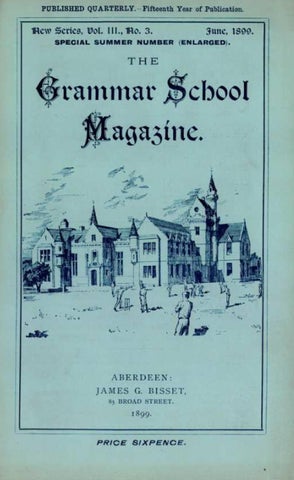
THE
Orammar School graga3ine. New Series, Vol. III.
JUNE, 1899.
No. 3.
-
SCHOOL NOTES. Haud multum abfuit quin—yes, it was a very near escape. We, our humble Penates, and the very Magazine itself, came near destruction. The fire in Bisset's warehouse was perilously near us, and the firemen were galumphing over our roof. Dense clouds of heated smoke poured into our kitchen. Even Editors have kitchens just as ordinary mortals. Our landlady went whiffling but and ben, wondering which of her chased cabinets or inlaid escritoires she would pitch on the street first. But we, like the boy on the burning deck, stood, pale but firm, clasping to our bosom our precious manuscript, our curling tresses crisping in the heat. Hasty visions of the Victoria Cross, Humane Society's Medals, and such trifles crossed our mind as we thought how we should knot together our tablecloths and towels and things, and let down the women and children first. And we, with our priceless documents, would be the last to leave the blazing buildings, and, scarred and bleeding, would emerge amidst the cheers of the multitudes. It seemed otherwise to the Gods and to the Firemaster, and so we calmly replaced our articles in our safe of triple brass. We continued to be pervaded all that afternoon with the spicy fumes from the smouldering ruins, and a fragrant blue haze hung like incense in our rooms, vividly recalling to memory one never-to-be-forgotten Easter Sunday in the majestic Chapel Royal of the Cathedral of Granada. We are glad to see Dr. Moir in our midst again after his cruise to the Peninsula. He spent most of his time at Cartagena, a town which, like most southern Spanish towns, looks quite Eastern. We spent one of the happiest years of our life in that place, and, in imagination, followed Dr. 3
66
The Grammar School Magazine.
centre of the town is a hill Moir in all his itinerary. In the remains of Moorish and called Hannibal's Mount, with the bask in the sun, lizards the Roman forts on it. There dart over spiders door trap and scorpions, tarantulas, and ground, the strew the moulded cornices which thickly grimy, but the emerges there cavern from some fearsome gipsy—demanding " backpicturesque, Gitano—the real of the time of Ferdinand tapestry sheesh." Some wonderful And then, in the arsenal, Cathedral. the and Isabella adorns of which fought at Tralie rotting the three-deckers, some hills with powerful seven the tower all falgar. And over Spain !--with the for forts, which are armed—wonderful very latest guns. with a larger The cricket season has. been inaugurated speak well may This usual. crop of broken windows than it is a very but ; batsmen our of powers " for the " swiping that notices in Hall unpleasant feature in the performance for the names calling frequently, so should have to be made a serious becomes It of those responsible for the damage. without done is damage such reflexion on a school when acknowledgment. spontaneous prompt and where the maximum In the late Bursary Competition, following places ; - the took School of marks was 1,800, our NAME.
MARKS.
PLACE.
NAME.
MARKS.
61. William K. Millar, 1184 1616 2. Wm. P. Milne, 63. Alfred F. Milne, - 1178 1410 11. Robert Bain, 64. John A. Stewart, - 1175 - 1408 12. James Shirran, 68. Edward Legge, - 1159 1396 Thomson, 14. George E. - 1133 72. 'William Rae, 18. Grmme R. L. Ritchie, 1379 Copland, 1116 78. James A. 1345 22. Win. Stephen, 82. George M. Giles, - 1104 25. David Richards, - 1336 89. Hugh M'Callum, - 1078 32. Alexander A. Moir, 1320 90. David D. Smith, - 1077 1284 39. Norman Munro, 100. R. W. Maclennan, 1037 - 1270 44. John Brebner, 104. John G. Riddoch, 1020 1200 Gilchrist, 56. Robert J. - 1005 J. Robertson, 106. 57. James G. Christie, - 1199 1195 M'Hardy, 59. John this year was distinctly The general level of our candidates to do even moderately are we if But 1898. higher than in especially of the Vlth well next year, our future candidates, in all earnestness, Greek their tackle Classical will have to
PLACE.
or take to " soft" subjects like the
girls' schools.
School Notes.
67
The comparative statistics of the Competition are dealt with in another place. Our annual Sports have been postponed this year till after the holidays. There were several reasons for this, the chief one being that the Bursary Competition prevented our gladiators from going into proper training, as they could not spare the time for such. We are glad to see the revival of another Club, the Swimming Club, which holds its Sports in the Swimming Baths on 2nd dune. It is quite unnecessary for us to impress upon the School the necessity for every boy learning to swim. The membership is already about 80—a firstclass start—but we hope to see it trebled. At the Aquatic Sports it will be necessary to give prizes, and we now hereby call upon all friends of the School to send their contributions at once to the Secretary. We hope we shall not be like the priests of Baal as regards the result of our appeal. So untie your purse-strings, and AT ONCE, please. To Parents and Guardians.—There has been prevalent in the School for several years the custom of withdrawing boys without giving due notice of the same. This, too, quite contrary to the rules laid down in the prospectus. Now, any self-respecting school demands a quarter's notice or a quarter's fees, so we hereby call on the School Board to insist on either alternative. Failing this, we shall continue to be annoyed by the rudeness of parents quietly withdrawing their boys without saying a word about it. The Rector has repeatedly drawn attention on prize days to this discourtesy, but it has had little or no effect. The only way to move the Aberdonian is to get at his pocket. MUSEUM.—The arrangement of the various collections has been taken in hand by Wm. Kesson, F.P., whose work ,is making good progress. He deserves the hearty thanks of the School. Much might be done to enhance the interest of our Museum, if collectors, of everything, would bear it well in mind, and contribute objects of natural history, especially local, such as shells, eggs, moths, butterflies, etc. ; geological specimens ; postage stamps, coins, etc. In fact, the little we have is most suggestive of what we have not, but might readily possess, if boys with a turn for col-
68
The Grammar School Magazine.
in their letting would make the School Museum an object James by presented collections and rambles. The new case addition, and handsome a are School leaving on Willox should stimulate others to be equally generous. advertising We draw the attention of our readers to the Masters our of several that seen be columns, where it will session. next boarders receive to prepared are
NOTES ABOUT OLD BOYS. is The Latest, THE latest addition to London journalism
It is a paper which is published every night at 10 o'clock. during really the very latest in more respects than one, for editors. its first week of publication it had no less than three charge has School, the of Dux former a Watson, Mr. G. T. of the financial arrangements. •
Mr. A. L. Danson is the subject of a sketch in the is Junior Common Room, Oxford. He is at Balliol, and repreis He Club. Athletic Secretary of the University as sented in a full-page cartoon in boating costume, and to resemblance facial there depicted he has a remarkable Rugger fierce " a as described is He Mr. Chamberlain. player, an improving horseman, and most successful miler. . . . He will sing you the ' Cock o' the North' after dinner, and will dance any reel that is Scotch. . . . Possesses many accomplishments, many enthusiasms, many friends." He has distinguished himself lately in walking from Cambridge to Oxford, a distance of 82 miles, in less than 24 hours, thus establishing a record for that journey. " Always something new from Africa." This time we have to record with great regret the death of Lieutenant D. G. Mackenzie, D.S.O., of the Gordon Highlanders. Poor " Piggy," as we affectionately called him, was a contemporary of our own, and he was always a great favourite with everyone who knew him. When at School he was emphatically a gentleman in the proper sense of that misused word. Along with his regiment he was at the storming of the Malakand Pass, and he also served in the Tirah campaign. In the famous Dargai charge his gallantry was such that he
Notes about Old Boys.
69
was made a Companion of the Distinguished Service Order —a rare honour for so young an officer. In December last he was selected for special service with the Niger Coast Protectorate force. On landing he proceeded on active service, during which he was struck down by sunstroke, and died on the 9th April. Mr. Andrew Hunter, M.B., has been appointed medical officer to the West African Frontier Force, and is now engaged on active duty there. After graduating at Aberdeen, Dr. Hunter studied at the Universities of Vienna and Gottingen. We wish him all prosperity, and we may perhaps be favoured in our next issue with a brief article from him. The Lumsden and Sachs Fellowship at the Free Church College, Aberdeen, has been awarded to Mr. G. G. Cameron. It is of the value of £50. •
Among the candidates for the Chair of Natural History in the University was Mr. P. Chalmers Mitchell, M.A. (Aberdon. et Oxon.), F.L.S., etc. His testimonials were of the highest order. One of our Old Boys on his return from Switzerland informs us that in Lausanne the leading dental surgeon is Mr. Eugene De Faye, whose name was once well known in our School. He now seems to be " Gallior Gallis." Though we cannot lay claim to the Hero of Omdurman, Colonel MacDonald, yet we have the Hero of Uganda, as he has been called, Colonel MacDonald, on our School list of honour. His object seems to have been to arrive at the now famous Fashoda by a route diametrically opposite to Major Marchand's, but on the way his men mutinied, and he was lost to human ken for a long time. However, his labour has not been in vain, for he has discovered great tracts of land which were never before trod by a Britisher. The two distinguished MacDonalds were seated side by side at the great banquet given to No. 1 in the Hotel Cecil. Our MacDonald was also banqueted in the Holborn Restaurant by the London-Inverness-shire Association— The Mackintosh of Mackintosh presiding. Might we not secure him when he comes north to give an address to the School?
70
The Grammar School Magazine.
We also claim that Christian hero, Mackay, of Uganda, who left the School in 1864. We are pleased to see that the Cape Parliament, whose Speaker, Dr. Berry, is of ours, has voted an annual sum of £30,000 for the -Navy. Thus are woven the threads which connect our School with the larger affairs of the Empire. Mr. H. F. Lyall Grant has obtained a Commission in the Army. Mr. Edmund Aust, whom many in the School will remember for his excellent conception of the part of the Schoolmaster in " Vice-Versa," has now gone on the stage. He was in Aberdeen lately, and called on us. He was playing in the Bandmann-Palmer Company, and seemed to be very fond of the theatrical life. We wish him all success, for he is an actor of great promise. Sir James Westland, K.C.I.E., the retiring Minister of Finance for India, is, according to the Capital, Calcutta, " the most capable, the most thorough, the most indefatigable Finance Minister of the century." The Viceroy, Lord Curzon, was equally high in eulogium at a banquet given to our distinguished Old Boy before he left for home. Mr. A. H. Mackie has been appointed Assistant to the Professor of Physiology in the University. He is a brother of Mr. Mackie, our French Master. Mr. William Troup, F.S.A., Librarian, and Secretary to the Senatus of St. Andrews University, has died at Bridge of Allan. We have also to record the death of Mr. Lauchlan Mackinnon, Commissioner to the Prince of Wales. Mr. William Yeats of Auquharney also died last month. General Reid, C.B., has been promoted to the command of a second-class district in the north of India. The Army and Navy Gazette says the appointment has given general satisfaction.
The Byron Statue.
71
Mr. C. F. Leslie, who was till lately manager of a bank in Winnipeg, has been invalided home. We wish him a speedy recovery. Lieutenant Robb, of the Durham Light Infantry, has been mentioned in despatches for gallant conduct on the Indian frontier.
THE BYRON STATUE. THE School has just cause to be proud now that hope becomes certainty, and that the statue of her greatest son is to be erected under the shadow of her walls. In paying a tribute to her most famous pupil, and one of our most famous poets, an honour has been conferred, though indirectly, upon the School which gave him the start in the great career which he carved out for himself. For although of noble birth, were it not for his poetry and his brave deeds in the first Greek War of Independence, for which Greece will ever revere his memory, Lord Byron would have been forgotten almost as soon as the breath left his body. During the deliberations over the erection of the statue much was said of Byron's character that was by no means favourable. But if enlightened Britons of the present day can look up with respect, and raise statues to Robert Burns, it should not be difficult to do the same to Lord Byron. He had his faults, for all men are mortal, but who shall say he had not his virtues too? and many would be inclined to go even further, and to say that the latter predominated. In the author of "Chillon," "Childe Harold," and "The Isles of Greece " there must have been genius, and not only genius but some inherent good, otherwise to write such poems would have been impossible. At the time when the question of site was being raised, and the Grammar School was proposed, some objected on the ground that Byron attended the Old School, in Schoolhill. Even though this was so, yet the associations that existed between the memory of the Poet and the Old School to a great extent exist no longer, for, on the transference of the name " Grammar School" from the building in Schoolhill to the present edifice, all the thousand and one traditions that hung around it were removed also ; and what is more, it is not to a building of stone merely that one's heart clings, but to the many associations which cluster round it. Far from doing harm, the
72
The Grammar School Magazine.
erection of the statue at the School will do an inestimable amount of good. For although we are proud of the possession of a register in which his name is recorded, we shall be prouder still of a proof that his connection with the School is recognised by outsiders ; and, while looking upon the statue of the great man, we shall be constrained to imitate his virtues and shun his vices. DISCIP 0 LUS.
READING AND READERS IN 1868. " Leaf after leaf he turned it o'er, Nor ever glanced aside ; For the peace of his soul he read that book In the golden eventide." —Hoop, " The Dream of Eugene Aram."
WHEN I entered the Grammar School in 1868 there was I believe that things have improved no School Library. since then, and that such a necessary adjunct to the classes has been added ; but, in our days at least, I am sure that there was no printed matter extant that we would not have faced. We had then no authorised list of the One Hundred Best Books. With us it was still as it was in the days of the Book of Judges, when there was no king in the land, but everyone did and read that which was right in his own eyes. Hence it was that, compassless, rudderless, and without a chart, we flung ourselves on the great ocean of print. As it was, so will it ever be ; for in reading, as in other subjects, there is no golden gate or royal road. Boys then read in three circulating libraries. These were Middleton's, 4 Skene Square ; Ironside's (I think), on the site of the present Public Library ; and Edgar's, at the top of Mounthooly ; the first two being affected by boys at the Grammar School, and the third by those at the Gymnasium. They certainly did a very great deal for popular education in their day, not only for boys, but for the more intelligent class of artisans and clerks, when cheap reprints were almost unknown, and the standard authors were only to be procured in the expensive complete editions. You paid your penny, and had your book for a week. As pence were scarce, it was obvious policy to effect a Triple Alliance or spheres of influence, with readers at the other two, so that the rapid circulation of three books in a week could be ensured. After thirty years the very smell of those books is dear to memory, and there is a pathetic interest in the
Reading and Readers in 1868.
73
very stones over which our boyish feet hurried to effect that junction, in the full excitement of the " To be continued in our next." Those shops were a sort of club to the working classes, and often have I sat on the top of Mr. Middleton's shop ladder listening to excited debates on local politics, men and manners, Torry Farm schemes, and Sir Alexander Anderson. I had read nearly all FenimoreCooper, Marryat, Captain Mayne Reid, Kingston, and Miss Anne Bowman before I entered the first class in the School. But one author was our never-ending joy—R. M. Ballantyne. Were he alive, he would be raised to the peerage and a pension on the petition of all good boys. The report had spread to us from Edgar's Library that " The Coral Island " was a great book, and I can remember day after day dogging another boy until I found it "in" in 4 Skene Square. It was the old edition with the coloured plates58., I think—but, were I to live to the age of Methuselah, never could I forget that hour and that book. Ballantyne has never been equalled as a writer for boys. In a cheaper form—and I believe a sixpenny issue is also contemplated—he yet reigns supreme. The other day I saw in a shop a pile of his works ready for school prizes, and I nearly wept over the recollections of my old friend " Peterk-in Gay.' Though we knew Ballantyne's second series of stories—about engines, coal mines, and lighthouses—it is as the author of " The Coral Island," " The Dog Crusoe," " Martin Rattler," and " The Gorilla Hunters" that he is yet in our heart of hearts. Then, we had bound volumes of the Family Herald and the London Journal—enough to satisfy the greatest voracity for one week. " The Boys of England" came out shortly before our first year at School, but we can recall the excitement among juveniles over the first number and its opening story of "Alone in the Pirates' Lair." A dozen B'ursary Competitions in a week alone could equal the sensation! Boys slept with it below their pillow. Some parents, confusing the new paper with the Dick Turpin trash that had gone before, were against it, but lived to see their error. I had the bound volume of one year, and gave it as a loan to the son of a retired doctor in Rubislaw Terrace. To my grief, his father burned it, and forbade me the house. The boy, in consequence I believe, took to evil ways, and later on married a barmaid. All this could have been saved ; for, whenever I hear of one of us that has risen to be a Governor-General, or something abroad, I know he was, and must have been, a good boy, one who read " The Coral Island " and true books. If boys went wrong, and took to
74
The Grammar School Magazine.
drink, I trace it to their having read Todhunter's " Euclid," Barnard Smith's and Colenso's " Arithmetic "—books that inevitably bring boys to the gallows. Wednesday was a great gala day then in Broad Street, for there came by train the penny novels and stories to the shop of Mr. Russell. One long counter was piled with them, the " London Library " at 2d., and Beadle's " American Library" at 6d. How Gymnasium boys smuggled them and books from Edgar's Library into their School I cannot say; but Professor Robertson was then a housemaster, and he may explain. I trust he winked hard the other eye. Dr. Anderson (" Guvvy ") very properly on Sundays made his boarders write out the heads of the morning sermon, but I fear that " Seth Jones," the great scout and trapper in Beadle's, often proved -victorious over the Kings of Judah and the Cities of Refuge. Nowadays I am strongly of the opinion that no boy should be allowed to enter the Grammar School without an entrance examination on " The Coral Island" ; and I hereby publicly call upon Professor Robertson to compound for such sins of his youth by seeing to it that Ballantyne's books are given as prizes at all the Aberdeen schools. In default of other books, we would read after the summer's holidays prizes given in girls' schools. These were chiefly written by Hans Andersen, and "A.L.O.E.," while the Highland story by Miss Gibb of Willowbank, in the Hardgate—" Morag "—was well known. But I think we read all these, as it were, on the sly, in a shamefaced way, as they were not voted boys' books. I fancy I must be one of the few Aberdonians that have read and survived " The Scottish Chiefs," " The Children of the Abbey," " St. Clair of the Isles," " The Wolf of Badenoch," and " The Gates Ajar." But the terribly small print ruined my eyes for ever. Saturday also was a great day with us. In the early thirties Professor David Masson, the late Mr. Edward Fiddes, manager of the North of Scotland Bank, and a third survivor used to go on the school holiday of the first of May to the Bay of Nigg, with a penny each, to spend the whole day there, and buy milk at a farm that still exists. In the absence of such pennies, we would sit by the hour, a whole forenoon and afternoon, at the docks, on the logs that were then discharged through the portholes in the bow from the Aberdeen liners that traded between the port and the river St. Lawrence. Piles of deals and battens would lie about from Norwegian ships belonging to Stavanger and Arendal. There have we sat a summer's day—why are there no such summer days now ?—watching them unload,
Reading and Readers in 1868.
75
like Kipling at Mandalay " with the Hathis piling teak," while the hot sun made the pine boards bubble with a delicious smell of resin. To read there Ballantyne's " Ungava," and his " Sandal Wood Trader," was an education. Often was a penny spent in a shop in Marischal Street— Mrs. Morrison's—over a coloured sheet of the Flags of All Nations, while we would gaze with all the gravity of rare old salts through a cheap spy-glass, the smell of the paint on which, like that on tin soldiers and engines, is with us yet. The old Indian stories are, I fear, as dead as Queen Anne. But in my time they were a living force, worth all the sadly-didactic stuff about Solar Systems and Arctic Charts in school books. There was fair information to be extracted from them, and virtue was as promptly rewarded as vice was inevitably punished in the course of 32 pages. They had a sort of fixed opening, which ran something like this :—" About the year 175—, a young man might have been seen hastily pursuing his way along the banks of the Susquehanna. He was heavily armed with rifle, Colt's revolver, and bowie knife. Times were perilous, and there were many redskins about. There had been fighting in the autumn round Fort Duquesne, and General Braddock had been slain. Suddenly a shrill shriek awoke the echoes of the forest." Then came the business—clear, sharp, and thrilling. One long-spent day comes back, when four of us enacted " The Last of the Mohicans " on the Old Town Links—I could go to the spot yet—hunting the water rats in place of the Iroquois and Apache Indians that we knew about the shores of Lakes Huron, Erie, and Superior. The time that was not given to these books was bestowed on the catalogues and reports of the great stamp-collecting firm, Stanley Gibbons & Co., then, if I remember, in Plymouth. No banker or broker ever studied the share lists as we conned these catalogues, familiar with all the history of rare issues and the legends of the science. Were there not four issues known of the block-penny Cape of Good Hope ? Had not three been traced to collections, and the fourth— might it not turn up for us one day? Boys were in league with postmen, and thought nothing of going the rounds with them, and ringing door bells with all the effrontery of a German band. Beeton's Annual and Routledge's Magazine gave much attention to the question, and certainly collections formed then would be worth a fortune to philatelists, being certain to have the " old Colonials " and " the early Mauritius," now " beyond the dreams of avarice" to the forlorn hopes of the enthusiast. The Scotsman was the
76
The Grammar School Magazine.
chief cricket report paper, but was rarely seen in Aberdeen, and copies were handed about and treasured like rare manuscripts. Daft, Emmett, Jupp, and Humphry were then in their glory, and their last score, their average, and their history were as fully known as the Latin Grammar. Andrew Higgins, I believe, is still hearty at Mannofield, and he, with Mr. Samuel Pope, neatest and nattiest of penmen, survive alone from that day unchanged to bridge the gulf of years to me. Seeing them so hale makes me cry to dream again," and fancy ;that once more I am reading " Marmon," Dalgleish's Analysis of Sentences," White's " History of Scotland," " The Latin Grammar," and Ballantyne's " Coral Island." Legends die hard. Fain would I know if there yet lingers in the School one much alive in my time. We firmly believed that a thousand pounds would be given for What " anonymous a perfectly " coloured" clay pipe. donor " had founded this bequest, and where to apply for it, were equally unknown. But I know the belief ended in practice, and that the Pleasures of Hope triumphed over the sickness at the beginning. Fathers never suspected this far-sighted Capitalism in their sons. The coming Gifford Lecturer says in one of his books that, in the fifth century B.c., the very same legends and stories were told to Greek travellers like Herodotus, at the base of the Pyramids, as are now yearly retailed still to the Cook's tourists by the guides. Dr. Beverley in our day snuffed, following Dr. Melvin, and so did Mr. Martin, the Rector. It was a tradition of the School, which we in turn also maintained. We knew the source, but who introduced the legend of the " coloured" clay? It would gladden our hearts to know if the sons are still furtively in search of that vanished El Dorado of their fathers' youth. W. K. L.
ATHLETICS. A SCHOOLBOY'S ESSAY.
[This essay was composed as an ordinary weekly exercise by a boy in IV. B., but we think it quite worthy of a place in our Magazine.—En] " A SOUND mind in a sound body" is a very common and well-known saying ; but, nevertheless, this maxim is not always carried out. A man's life is apt to' become a very
Athletics.
77
" lop-sided " one if either his mind or his body is neglected. In ancient times, among the Greeks, athletics were studied as a fine art, and were honoured accordingly. But they cultivated the mind also, and the consequence was that they were a very fine race of men. The Romans also in the times of the Emperors were very " keen" on athletics, but they did not study them to so great an extent as the Greeks. A lop-sided boy is no uncommon sight at the present time, and it is my opinion that in the North of Scotland it is the body that is in most cases neglected. In the South of England I believe that it is the mind that is neglected, but, as I have never been in England, I cannot say anything definite about it. You will perhaps at first contradict my first statement, but if you consider carefully what is meant by a boy or a man being " in condition," you will understand what I have said. A boy is not "in condition" when he has "any amount" of superfluous fat about him. He may perhaps look quite fit, but let him run a few hundred yards, and you will see him collapse. He cannot go in for an examination unless he has studied for it. So in the same way he must be trained for any athletic contest for which he enters. If it is not too personal, let us look at any of our Rugby football matches in Aberdeen, and we shall see that by the end of the first half the players are quite done out. This is the reason that when the North teams go South they are so often defeated, the South teams being " in condition," and the North teams out of condition. If a boy does not do his lessons properly, people at once say that it is laziness. Well, I am afraid that laziness is the cause of boys not training. If a boy does not do his lessons, he is punished, and is compelled to do them ; but if he does not exercise his body, he is allowed to neglect it, in Aberdeen at least. The only remedy seems to be to make games compulsory in the School. This is what is done in most of the 'South schools, and if it were adopted in the Grammar School I am sure that the School could hold its own against any of the South Schools at games. But let us look at the other side of the question. Athletics, like everything else, must be taken in moderation. It would be an even worse calamity were we not to cultivate our mind; in fact, we would become uncivilised savages if we were to neglect the cultivation of our mind altogether. Although one may think this impossible, yet if we look at the abuse of athletics we will see that those who abuse athletics are not far from the savage state. Let us look at the sad condition to which Association Football
•
78
The Grammar School Magazine.
has fallen. A company is formed, who advertise for players to play in their club for a certain sum of money. The larger the sum the better the players they get, and when they play matches the men get so much more if they win. The spectators, on the other hand, come, not to see sport, but to bet on the result. If the " home team "—that is, the team on whose ground the match is being played—is expected to win, the spectators will have a pretty large sum on the match. The consequence is that, if the home team loses, the spectators, infuriated by the loss of their money, attack the referee and the winning side with stones, etc. The police (mounted sometimes) are then called to the scene, when a regular melee takes place, in which many of the police are wounded. Next day a few dozen of the spectators are arrested and committed for trial. This is what some creatures call sport. But now let us pass on to the benefits derived from athletics. In the first place, one who takes part in athletics is seldom or never unwell. But this is a small benefit compared with the influence they have on the discipline of those who take part in them. The boys learn, or rather should learn, to obey their captain, and to do what he thinks best for his side. Let us take one game—football—as an example. A fellow must learn not to be selfish—that is, to pass the ball at the proper time. The mention of proper time leads on to another point. Football gives one presence of mind to do what is correct in an emergency, for it is the most difficult thing to know what is best to be done. You may be so placed that you might either run, or kick, or pass, and you have only. a second in which to make up your mind. Another point is to know when to pass when you are running, as you have to make up your mind at once. This latter fact is one of the most valuable benefits derived from football, or from any other game. I am sure that there would be fewer cycling accidents if all cyclists played football. I know of one incident where a fellow saved his life (or prevented a very serious accident) by his presence of mind. That boy was once a member of the Grammar XV. Cricket practices the eye in measuring distances ; so you will always notice that a good cricketer has always a good eye. Games as a whole make a fellow think less of himself and more of the team or school he is playing for. I think that is the reason that many boys who come from small private schools, and who have not played at games, sometimes think " such a lot " of themselves, and for that reason do not at first get on well when they go to a big school.
Bursary Competition Statistics.
79
I have endeavoured to show that athletics must from part of a boy's education, and that, if the boy does not take part in them, it is for his own good if he is compelled to do so. I have also tried to point out how useful they may be to one in after life when one has ceased to take part in them. I may say, in closing, that I hope the time is not far off when the School Board of Aberdeen will see how important a feature of a boy's education games are, and will make them compulsory. H. J. B. BURSARY COMPETITION STATISTICS. "Men may come, and men may go, But I go on for ever." LIKE Tennyson's immortal brook, the Bursary Competition goes on for ever. Year by year, as the time comes round, there is great excitement, which reaches a climax on the announcement of the results. As usual, a detachment was sent to fight for the honour of the School at the recent Competition. Though they have not obtained the first place, this is no proof that they have not upheld the reputation of the School. The best way to understand how the Gramviar School competitors have done is by comparing their average marks in each subject with those of competitors from other schools. A glance at the subjoined table will show the average marks of the Grammar School and of Gordon's College competitors in each subject : — English. Math. Latin. Greek. French. German. Dynamic Max.400. Max. 400. Max.400. Max.400. Max.200. Max.200. Max.200.
Grammar Sch. 334.7 262 325.2 287 159 174 117 Gordon's Col. 339.9 235.8 336.8 332.4 153.3 165 116 Ladies 325 190.8 297.4 288.8 162 156.6 Np':Att,c4T" The averages of the Grammar School and Gordon's College in English, Mathematics, Latin, and Greek are for those who obtained places in the first 50. In French and Dynamics the averages are for all who obtained places. As only one competitor taking German from Gordon's College had a place in the list, I have compared his marks with the marks of the highest scorer in German from the Grammar School. The averages of the ladies are for all who were in the list. It will be seen from the above table that the Grammar School has beaten Gordon's College in four out of the seven subjects. There is, however, one fact which proves that the
80
The Grammar School Magazine.
work done by the Grammar School boys during the last session has excelled that of Gordon's College, whom the newspapers have praised because they obtained such and such a number out of the first twenty, thirty, or forty, as the case may be. Mark this! Of all those who obtained places last year, and competed again this year, the boys from Gordon's College have risen, on an average, 36 places from last year's places, while the Grammar School boys have improved on their last year's places by 39 places. Is not this a true test of the quality of their work ? The highest marks obtained by the Grammar School candidates in each subject are as follows : — English, - Grmme Ritchie, 351. Mathematics, - W. P. Mibe and J. Shirran, 380. Latin, - W. P. Milne, 370. - W. P. Milne, 345. Greek, - Grmme Ritchie, 186. French, German, - A. Moir, 174. Dynamics, - J. Shirran, 175. The success of Norman Munro and Robert Gilchrist, of the VI. Class, augurs well for the Grammar School at the next " Comp." SUB-EDITOR.
OUR SCHOOL REBELLIONS. EXTRACTS FROM THE COUNCIL REGISTERS OF THE BURGH OF ABERDEEN. "How well Horatius kept the bridge, In the brave days of old."
NEAR the end of the sixteenth century, about the time when the Most Fortunate and Invincible Armada was approaching our shores, matters were in a rather lively condition at the Grammar School. At that time the boys of the School were divided into two classes—the town boys and the " landward " boys. These latter were for the most part sons of the old families in the Northern Counties, and when they came to study at our School they doubtless lived in lodgings, most of them free from any sort of supervision. At anyrate, to judge from what was continually happening, the restraining hand of discipline must have been a light one. These young sprigs of nobility were rather difficult of management, and, as they came to Aberdeen plentifully provided with weapons of offence and defence, such as
Our School Rebellions.
81
swords, pistols, hagbuts, etc., they must have been rather dangerous to tackle. How would Mr. Wyness and his men deal with them, we wonder? One of these young rufflers, by name Alexander Forbes of Towie, had somehow fallen out with the Doctor, or Second Master of the School, Mr. William Wedderburn, brother of the Rector whose name appears on the walls of the Hall. Burning with rage, young Forbes seems to have had the audacity to walk into the classroom and publicly cuff Mr. Wedderburn. We may conjure up the scene. Young Forbes inarticulate with rage, perhaps drawing his sword ; the Master calm and dignified ; the class sitting with bated breath waiting for the &nod ment. They had not long to wait. Instant complaint was made to the Provost and Town Council, who as patrons had a closer connection with the School than they have now. An ordinance was passed whereby the culprit was brought before the Council, where he humbly confessed his fault. But this was not sufficient. In the presence of the whole School and of the Magistrates and Council of the Burgh young Forbes " most submissively, on his knees, confessed the wrong he had done to the town and to the said Mr. William Wedderburn, and first craved the Magistrates and Council, and next the said Mr. William, pardon therefor, promising never to do the like in time coming, but to remain a friend and well-wilier both to the town and to the said Mr. William in all time hereafter, and instantly `chopped' hands with the Magistrates and the said Mr William." Our high-spirited predecessors were not always without some justification for their conduct, and we are not sure that they have not part of our sympathy in the action they took in the following matter. Long before 1560—the Reformation period—our boys had special privileges granted them about Christmas. They elected a Boy Bishop, and he, vested in mitre, crozier, and other episcopal insignia, accompanied the Rector in a visit to all the freemen of the town. By a decree of the Town Council passed in 1546 each freeman had to pay his visitors at least 4s. Scots, and as much more as he liked. It must have been great fun. And the rest of the boys had a long-continued Christmas holiday—twice as long as we have now—during which time all sorts of license was permitted them. But on the change in religious opinion the Ministers and their Kirk-Sessions looked but sourly on the pranks which the older Church had at anyrate winked at. The ministers began to sniff out superstitions and enormities, and the " auld privileges" of the Grammar School began to be docked. The boys naturally
82
The Grammar School Magazine.
were not pleased, and we can imagine the gloomy looks and angry consultations at the School door when December came round. At last, in 1568, headed, we feel certain, by some of the " gay Gordons "—for their names constantly occur in our lists—they draw up a petition to the Council on the subject—" by epistle in Latin," if you please. Could the VIIth of the present day do as much, and could our present Council read their petition? The Council was graciously pleased to listen to their request, and it was arranged that, instead of the old privileges of behaving as modern Continental nations do in Carnival time, they should have liberty to remain absent from school " from the Eve of S. Thomas till the morning after Epiphany"—i.e., from 20th December till 7th January. But, alas! faces grew longer and longer as the new religion made its way, and just at the time when George Buchanan was cramming the youthful, and, we may suppose, reluctant, King James VI. with the fruits of wisdom, using the rod by way of a digestive tonic, a blight fell on our School. Listen to this tale of woe. On the 22nd December, 1575, "the Provost and Baillies and most part of the Council "—(they don't deserve to have capital letters)—" being convened, consult on an act of privilege granted by them to the bairns and scholars of their Grammar School from the 20th December to the 7th January to have their liberty from learning and discipline enduring that time, the Council herewith, being ripely advised and consulted hereon, finds inconveniences following thereon, wherefore they annul and abrogate the said act and privilege to have no strength nor effect in no time coming, and this to be divulged and published at the Cross." Well, well, Ichabod ! Ichabod ! This was in 1575, and when '76 came round open rebellion prevailed. The School was held by the boys, and the Master (there was only one at this time) was evidently barred out, and all the old frolics at Christmas were entered into with even greater zest than Such a state of matters could not continue; before. so the Town. Council, boiling with indignation, met on 21st December, 1580, to take counsel on "the enormities committed by the disordered bairns and scholars of the Grammar School of this Burgh, in taking of the School, usurping against the Master and Magistrates this time of the year afore Yule called the Nativity of our Lord, thereby fostering the ' auld ceremonie' and right of privilege that was wonted to be granted to them," and they resolve that no " landward boy " be received in the School unless he get some burgess to find caution for him to the extent of £10.
Our School _Rebellions.
83
The very next year, however, they held the School again, but the Magistrates made a sort of compromise whereby our boys got three holidays at the beginning of every quarter. This had been more to their liking, but the riotous spirit was not yet quenched. So they turned their attention in another direction. When the country people were coming into town laden with provisions of all kinds it was the custom of these young brigands of ours to waylay them, and seize everything they could lay their hands upon—geese, fowls, peats, etc.—and as for their poor owners, " no satisfaction is made to them of the same, to their great hurt and skaith and slander of this burgh and Magistrates thereof." And the boys began to wish the old privileges back again. Three days a quarter were not sufficient for them. " The disorder and dissolute behaviour " of the School came to a great height in 1604, about "the superstitious time of Yule." They took possession of the School, and held it with the aid of swords, guns, pistols, and other weapons. The furniture was broken up. A state of siege was proclaimed. And how did the garrison get victuals? Certain fellows were selected to sally out and lay hold of whatever they could get. The country was scoured far and near by these marauding bands, and the "caravans" laden with provisions were attacked and plundered. Bending under their booty, they returned to their beleaguered comrades in school, and held a feast of the good things they had seized. The Town Councillors, honest men, once more laid their wise heads together, and turned their shocked countenances heavenward when they thought how this fostered "the superstitious keeping of holy days," and how it " bred in the scholars' hearts a contempt and misregard of their master." The resolution they came to was to increase the caution money for every scholar at the Grammar School—town's boys as well this time—to £20. Really, the Rector of the School in those days must have been a poor, feckless " body," and, no doubt, deserved all he got. He seems to have been utterly unfit to manage his young barbarians, for soon afterwafds we find our Old Boys ' troubling and striking of the servants of divers neighbours within the burgh, and using great disorder and enormities," and not at Yule-tide. The caution is therefore raised to £40 Scots. It had little or no effect, for in 1612 we find that seven youths—two Gordons among them—sons of country gentlemen, along with the scholars of the Grammar, Song, and Writing Schools, seized the Song School on the 1st December, " lang before the superstitious time of Yule." They
84
The Grammar School Magazine.
with held their fortress for three days this time, keeping it " have must It weapons." hagbuts, pistols, swords, and long of been a lively three days, for they had a capital supply well as guns their ammunition, and kept on " shotting with report on the nicht as on the day." Scouts were sent out to boys—one of gangs and at, got easily be to was food where wonders where their fathers were—wandered over the town, "committing great deeds of oppression and riots," and " masterfully taking away " fowls, poultry, bread, and provisions. They went even further than this, for they broke down the doors and windows of private houses, and laid hands on whatever they could get. We should like to have seen their cooking arrangements. We should also like to know what sort of a reception they met with at the hands— yes, hands—of their justly enraged fathers. Of course, they may have been treated a la Prodigal. However, the Provost could not pass over so serious a matter ; so more than twenty students—all of them sons of gentlemen—were expelled from the Schools. Gilbert Leslie, Master of the Writing School, had evidently informed who the ringleaders were, and so the very next day, Patrick Gordon of Birsemoir, seeing Leslie on the street, drew his sword, and set off in hot pursuit. On overtaking him " he gave forth divers and sundry strokes at the said Gilbert." He was compelled, however, to appear before the Council, and give surety for his good behaviour in future. The poor Writing Master even yet was not safe, for a few months afterwards we find that a brother of the Laird of Birsemoir, and Francis Murray, brother to the Laird of Cobairdy, along with some others, " have this day come to this burgh of set purpose, and most proudly, in contempt of law and justice, have most cruelly and unmercifully pursued Gilbert Leslie, Master of the Writing School, of his life, on the King's high street of this burgh, at the Birk stile, and have given him many bloody and best strokes with dirks and batons in divers parts of his body, to the great effusion of his blood and danger of his life." This time they were summoned before the Privy Council, were fined two hundred merks, and, in addition, had to come to the " auld kirk of this burgh on a preaching day," and to rise out of their seat in the rood loft, and stand before the pulpit to ask pardon first of God, then of the Provost and Magistrates, and lastly of the said Gilbert. But what can we expect of Grammar School boys when we find that a Mrs. Aidie, wife of the Principal of Marischal College, was convicted of "dinging and striking Janet Mackye, servant to James Birny, in Tarves, on the face, to the effusion of her blood." Just one reflection occurs to us,
Examinations.
85
that the one thing needful to quell those turbulent predecessors of ours would have been a spell of examination papers. There would have been little time for riots if they had been "cramming " for Leaving Certificates, Preliminary Examinations, and all these modern inventions of the Evil One.
EXAMINATIONS. IT has been well said that there are two inquisitive beings in this world, who surpass all others in their desire to pry into their neighbours' affairs, namely, the woman and the examiner. It has almost passed into an axiom of everyday life, that women far excel men in this desire. Now, after all, examiners are but men, and when their longing to extract knowledge is so great, what like would a woman's be? Truly, the students of the present day. have got to be very thankful that the fair sex have not yet so far ousted the wretched male as to set examination papers. Information, long ago, used to be forced from a person by torture, and this is the case even yet, though in a refined form. The victim who has to endure this ordeal approaches the examination chamber with "awe and reverence, and with bated breath," after having manfully struggled for six months before to solve the problem as to whether sleep is absolutely necessary to sustain the human frame. Within the gloomy portals of that building, the surly inquisitor awaits, and places before him a lengthy document, with a host of unintelligible instructions at the top. " Candidates must in all cases attempt eight, and not more than eight, of the following questions, of which three must be from section A, two from section B, and three from section C ; and of the three from section A, No. 3 or No. 5 must be one ; and of the three from section C, No 2 or No. 4 must be one ; and those who attempt No. 4 from section C must omit the latter half of No. 2 from section B. Candidates for the Blankshire office of Royal Shoeblacks must in all cases attempt No. 3 from section C, and omit No. 1 from section A. Those who attempt No. 6 from section A must show more than average knowledge of the subject," etc. The unfortunate victim, after spending the first quarter of an hour in vainly endeavouring to pierce the gloom which surrounds these mysterious injunctions, generally ends by doing the whole paper, and thinks that if it be at all possible to please an examiner, that must do it. But this strange being is as dissatisfied with too much as with too
86
The Grammar School Magazine.
little, and in a case like the above would, in all probability, cancel the whole paper. When one considers individual subjects, Latin naturally comes foremost. The first thing the candidates do when the dreaded Version is put before them is to read it over, a longwinded article truly it is, consisting of nearly four hundred words, about three of which the unhappy victim knows the Latin for. Then he sets to work to ransack his brains for all the Latin phrases he knows, and get them crammed into his production by hook or by crook. After a part of All the version has been done, some difficulty crops up. the Latin words ever imagined are raked together, and after infinite difficulty and pains, some exact equivalent is found. Then the candidate is confronted with the all-important question as to whether Cicero would have approved of such ,a word or not. In ninety-nine cases out of every hundred he cannot remember having seen it in the works of that infallible Pope of Latin versions, and the word has, without a moment's hesitation, to be dashed aside as something foul and unfit for use. A long-winded yarn of three or four lines is substituted instead, and the miserable wretch heaves a deep sigh of relief, and proceeds once more. He gets on for a considerable distance, describing the county as the province of Fife ; elevating the Laird of Dumbiedykes into the " Praetor with proconsular powers of Campania," and transforming the stirring address of Sir Colin Canipbell, " Highlanders, march firm, be steady, fire low," into the equally stirring address of Cesar, " Romans, make a journey firm, be steady, and don't fire your javelins into the ether." The rest of the paper generally consists of grammar, and That timesome unseen Latin to put into English. honoured, ancient dispute of the negative imperative is sure The to find an honourable position in the examination. accommodating candidate does not strive to recollect all the discussions he has read upon the subject, but puzzles his brain to remember whether his examiner prefers " ne facial, ne fac," or " ne feceris," puts down the favoured one, and adds "that some unimportant authorities, with little grounds, give the other forms." This vast work over, the candidate goes home with all speed, rushes like a whirlwind into his lodgings, tears down the dictionary, and finds that he has three " maxies." A mathematical examination is of a totally different character. It is possible for one who is not a born linguist to cram into his head some knowledge of Latin and Greek, but the unfortunate non-mathematician cannot do so in the case of his bane. If he gets a stiff paper, he simply sits and
Examination&
• 1
i I
87
stares in open-mouthed astonishment, fills the pages with an alarming array of conglomerated figures, meaningless lines, and jumbled circles. He closely observes the relentless progress of the hands of the clock, and the equally relentless beat of the examiner, as he treads listlessly up and down, now and then extending to the full extent the cavity of his countenance, and giving vent to a long, self-satisfied yawn, as he beholds before him the multitude of faces covered with alarm and apprehension, and knows that his own handiwork has been responsible for it. It is far different with the good mathematician, who is sure to score far above his less fortunate brethren in this subject. He tears along at an alarming rate, and then confronts his admiring and jealous rivals outside with the astonishing declaration that he has done " rotten." In A modern language is a much easier business. French, for example, if one is at a dead loss to find a French substantive for the English, all he has to do is to put down the English word, with the article, and in eight cases out c,f ten he will be right. The much-despised German scholar His language is crammed has not even this advantage. full of long, unpronounceable words, which almost threaten to dislocate the jaw in uttering them. Italian is, so to speak, " boiled-down " Latin, and is easier than either of the former two to remember. Last, but not least, as one would supIt generally pose, in point of difficulty, comes English. consists of what is technically called " unseen" work and " crammed " work. All around him the examiner beholds yawning students, some in hopeless despair, others tearing their hair in frantic fury to get something to say in the essay. Half a page, perhaps, has already been said about a subject which does not require four lines to discuss, and the other two or three pages have to be filled up with spunout sentences, long words, and repetitions. The crammed work is the worst of all. Dates of history, which had been got thoroughly up at the expense of much labour and toil, seem all to " Fly, forgotten, as a dream Dies at the opening day."
The victim begins to wonder when William Wallace came over from Normandy and conquered England ; how many of Charles the First's six wives were beheaded, how many were burnt as martyrs, and how many died a natural death. Henry the Eighth's intrigues get hopelessly entangled with those of Peter the Great ; and the climax is reached when the startling annunciation is made that Gibraltar is a fertile country in the north-east of Siberia, burned up by the boil-
88
The Grammar School Magazine.
ing heat. Such are the atrocities perpetrated when the victim gets hopelessly muddled. Oral examinations need not be particularly mentioned. When the candidate faces the examiner, everything is forgotten. Well might he say, in the words of Aeneas, probably uttered when undergoing a similar ordeal— " Obstupui, steteruntque comae, et vox faucibus haesit." WILLIAM P. MILNE.
of I
THE POSITION OF THE ABERDEEN GRAMMAR SCHOOL IN THE SCIENTIFIC WORLD. A COMPARISON OF ALL SCHOOLS IN GREAT BRITAIN. IN the School World, a monthly magazine dealing with educational matters, there has been an interesting series of articles on the schools of distinguished living men. In this month's issue a list of two hundred and fifty eminent scientists is given. Mathematicians and medical men are included. Forty-eight were educated privately, and no single school claims more than ten. With that number Edinburgh High School stands first. Edinburgh Academy is a close second with nine. Aberdeen Grammar School comes third with seven. Fourth in the list are the City of London School and King's College School with six each. Fifth, Eton, Harrow, and Rugby with five each. Glasgow High School and Rossall have three each. Then follow with two names Glasgow Academy, Bedford, Cheltenham, Winchester, Westminster, rppingham, etc. What strikes one in the result is the high position taken by Scotch schools. Altogether considerably more than a fifth of those at Public Schools were educated in Scotland. Of the Aberdeen Grammar School " seven" the three singled out for mention are Professor Chrystal, Sir James Reid, and Professor Trail. This fact ought to be a great incentive to the Modern Side of our School to add still more names to the list, and ought to provide material for a spirited debate next session on " Moderns v. Classicals."
INTERNATIONAL LETTER WRITING. AT the present time there are 2,000 boys and 1,200 girls in British schools such as ours who are in correspondence with
i
International Letter Writing.
4 I
89
foreign boys and girls. Mr. Stead, who is rather " cranky " in many of his schemes, seems to us to have conceived a happy idea when he thought of this plan. It must be great fun to receive such a laughable attempt at English as this :— " I come to receive your address and I am very happy of you have like correspondent, of this manners we shall learn to correspond with facility. I am a pupil of the middling school and I should like to know written and speech the English language. There is two years that I have visit London for 4 days and I am very well amused myself. There is more movement than here. I hope to return in few years and then I shall you render a visit. In waits an answer. I am to you, ' SCHOOL WORLD." Perhaps our attempts at French would cause laughter equally hearty on the other side of the Channel. We reproduce another written to us by a Spanish friend :— " MY DEAR FRIEND,—
i 41'I 4
" In my last letter you must have to find several faults that I consider to be the little practice that I have had in writing English letters. With our exercises I think that we can arrive to the end of our proposal, but I founded that you have a very particular conditions for learning the Spanish language. Knowing well your "Now the other matter we go to try. affection to the ball and being very near the Carnaval and in the Casino will have two balls and all the young ladies that gone Spaniards. I think it is necessary for spending well the times to know several or a few phrases in Spanish that I go to see if I am able to teach you in a short time and I begin by the present. " The manner to ask a dance to a Spanish young lady is ' Senorita, me permite rd. bailar un montento ?' or ' Tendria Vd. ineonveniente en bailar commigo ? ' which mean the 1st ' Miss, are you pleased for come to dance a moment I' or 'Would you had any inconvenient to dance with me 1' " Once of beginning to dance and being dancing is custom to ask ' Are you tired ?"Estd Vd. fatigada ?' and she reply ' Yes' or 'No.' If she say ' Yes," Si,' you must to take her by the arm and walking you can converse with her speaking of the ladies and customs of Spain and up all if you find an occasion do not forget to say her ' You are very pretty lady,' Es Vd. muy honita, Senorita,' and for this side you will find her very aimable all time with you. " Before of finished this letter with the same matter allow me, if you please, to give an advise. As here are not accustom to speak with foreigner is preferable not say any expression without without have the surety to tell them well but the other manner they laugh of you and of the other foreigner. This is my advice.
90
The Grammar School Magazine.
Without any more to tell you to-day I am dear friend awaiting of your bounty, EDUARDO DE ANASTASIO Y SAEZ." Is it not worth while learning foreign languages if you get answers like this? And we have still more funny ones, But the cruel printer says No. The reader will have seen the idioms that were in the minds of the Frenchman and Spaniard respectively. And if you take the English of both letters they would, by literal translation, make excellent French and Spanish. If any fellows in the School wish to try this scheme of interchange of letters, they must first of all apply to a Master, who would keep a general superintendence over all correspondence. Masters who wish to give the plan a trial should send the names and ages of boys they wish to put in communication with a foreign correspondent to Miss Laurence, Cambridge House, Wimbledon Park, Surrey.
I
THE DEBATING SOCIETY FINALE. THIS enjoyable function commenced, as usual, with a concert, where Mrs. Brumleu, Mrs. Murison, Miss Copland, and Mrs. John Allan charmed the audience with the selections they gave. Stephenson, Rae, and Hood gave a very pleasing rendering of the " Overture to the ' Bohemian Girl,' " and when we mention that Messrs Machray and Marcus Thomson were down for songs, it goes without saying that encores were frequent. In our time we have seen many' performances of " The Area Belle," some of them quite recently, but we enjoyed none of them better than the present one. The make-up of all the characters was excellent. The paint, rouge, wigs, and costumes had effected such a change on the originals that they were hard to recognise. But to come to the play itself. Pitcher and Tosser, the rivals for the hand of the fair Penelope, were most effective in their portrayal of the " Robert" and Thomas Atkins of London town. Stephenson as the nimble Pitcher, and Butchart as the stalwart Tosser, were excellent contrasts, both in their physique and in their style of acting. The other male part — Walker Chalks — had ample justice done to it by MacDonald, who looked the bucolic " Chawbacon" to the life. He was every inch a bumpkin. In school theatricals we do not remember seeing a better example of a garrulous, fussy, and interfering "old
t .
The Debating Society Finale.
91
party " than Scott's Mrs. Croaker. It was a life-like study. Then, Penelope of the golden locks looked winsome and sweetly pretty. (We hope " Stella," of the Evening Gazette, will excuse us for appropriating her special adjectives.) Shinnie pitched the part in a minor key, as it were, so that the effusive lovers got little encouragement for their pains. Taking the performance as a whole, we could have suggested one improvement only—just a little more "•co," a little more friskiness. It was a farce, you know. Mr. Ward, the stage manager, must have been highly pleased with the way in. which the whole thing went off. The stage manager, as a rule, gets little or no thanks, but it should be remembered that the success or failure of the piece depend in a large measure on his efforts. We were very glad to see that the School conducted itself in a creditable manner. Except at the beginning of the concert, there were no unseemly catcalls, squawks, or would-be witty remarks. This function is dealt with in our " Letter-Rack." The net result of the silver collection at the door was £.9 10s., we think. There were also three foreign coins—Danish, Norwegian, and Swiss. Their owners may exchange them by calling on the Secretary of the Debating Society. One remarkable thing at all Grammar School performances is the great number of threepenny pieces given as contributions. Is this custom peculiar to Aberdeen, we wonder? We are sorry to see very well-dressed people dropping in this wretched dole. Really, if a performance is worth seeing, it is surely worth a shilling or a sixpence at the lowest computation. A threepenny piece is the tip given to a railway porter for labelling one's luggage. We rather enjoy watching those who drop the widow's mite in the plate. There is something furtive and shifty about their eyes, as if they were conscious that they had done a mean thing. A lady, in a byegone year, when asked for her contribution, pretended suddenly to remember, and then tickled the coins in the plate with her daintily-gloved finger ! It is so embarrassing when one personally knows such people. One may forget kind acts, but mean ones never. We overheard one rather good remark at the end of the concert. " It is over very early," said one to another ; " I didn't think it would be so short." " Well," replied the other, " what can you expect for threepence !"
92
The Grammar School Magazine.
EXTRACTS FROM THE MINUTE-BOOK OF THE DEBATING SOCIETY. (Concluded from last number.) 1899. Jan. 13.—The Society met in Room I., the President, J. Shirran, in the chair. The minutes of last meeting having been read and approved of, the business of the evening was begun. (This formula is applicable to the beginning of every Debating Society article.) The debate was—" Treasure Island" v. " Robinson Crusoe." The paper for the former was read by the Secretary, V. Stephenson being absent. It pointed out that Robinson Crusoe was oldfashioned, wanted plot, &c. The paper for the latter was read by T. Robertson. It showed careful study of Defoe's masterpiece and the life of Selkirk, the supposed hero. Towards the end of the paper Robertson was profuse, very profuse, in poetry ; the room resounded with heart-felt (?) groans. On the question being laid open to debate, it was well discussed on all sides—(this formula is also always applicable to debating reports)—the preference being given to " Treasure Island " by 14 to 2. Jan. 20.--The President, J. Shirran, took the chair at 7 P.M., business being political. " Parliamentary Night." The members were divided into Conservatives and Liberals ; the Conservatives occupied the left side of Classroom I., the Liberals held the other side. LIBERALS. CONSERVATIVES. S. Russell. Leader J. Strachan. Premier RichStephen, Sec. for Colonies J. C. L. Members for ards, AnderPost-Master Gen. J. Scott. various Coun- son, Davidson, Chan. of Excheq. J. Kyd. ties &c., 8ze. &c., &c., &c. The Premier opened the proceedings with an attack on the Liberal Leader. The latter replied with many questions concerning the actions of the Conservative Government, some of which were witty and difficult to answer, while others were unanswerable from their impossibility. H. Butcbart asked the "Post-Master General," i.e., J. Scott, why the Canada postage had been reduced to a penny from twopence halfpenny? and objected when some one called the question nonsensical, as being rather a point in favour of the Government. The " Post-Master General," having saucily explained as best he could, entered into a fierce argument with the " Member for Brechin " i.e., Davidson, as to the exact position of a certain town in England (I forget the name), which ended in a hint from the " Speaker" that " the members were wandering from the subject in hand." Petty squabbles took place between members for various counties, and the " Speaker " had to call " Order " more than once, &c., &c. The Conservatives
Extracts from Minute Book of Debating Society.
•
I
93
were in the majority by 17 to 16, the " Speaker's" being the casting vote. The " Woolsack" on this occasion was the well-padded old chair in Room I., the M.P.'s occupying the class forms. Good order was maintained throughout. Jan. 27.—Dr. Moir was unable, owing to ill-health, to give his lecture on " Greece," causing much regret to the members of Classical VI. and VII. Feb. 3.—Under the auspices of Mr. Charles Davidson, a cinematograph and gramophone exhibition was given. The management of the business was done by Lizars, and the result was beyond praise. The sixpenny seats were crowded with pupils of the school ; many of the papas and mammas occupied the more dignified shilling cushions. (The seats, being benches, were all the same—hard wood.) A pianist had been hired, and, after an overture, the cinematograph scenes were thrown on the screen, with splendid photographs between times. The gramophone then came into action. It did squeak a little at first, but soon recovered itself, the " Cock o' the North " being its happiest effort. On the motion of the Rector, a vote of thanks was accorded to Mr. Charles Davidson, the heartiness of which was an ample reward for his trouble. The operators also received a vote of thanks. The proceeds were appropriated for the Magazine. Feb. 10.—The President took the chair at 7 P.M. The business was a lecture on " Parodies " by Mr. G. Stewart. At his introduction by the Chairman, the lecturer was received with a loud shout from the Middle School members, by whom he was well known. After an excellent introduction, the sound doctrine of which was thrown away on most of his audience, Mr. Stewart gave a long and varied selection of parodies on literature of a range extending from Shakespeare's time to the present. Some of the parodies lost their point from the original being very little known among the members—alas ! for our literary knowledge— but those on " The boy stood on the burning deck," " The Charge of the Light Brigade," &c., &c., excited roars of laughter and loud applause. The lecturer showed an extensive yet exact comprehension of the subject which he treated, and a hearty vote of thanks was never more deservedly earned. After the lecture, the usual musical evening was begun, A. Shinnie chiefly figuring in the programme. Feb. 24.—A lecture was given by Mr. C. McLeod. Mr. M‘Leod has given a science lecture these good many years back before the Society, and the large attendance in Room V. showed that they are appreciated as much as ever. This room is the home of the "Moderns," and they entered and took their seats with a familiar look around. But it was foreign ground to most of the Classicals, and as they arrived, they cast a fearful glance at the strange apparatus, their eyes finally resting upon the
94
The Grammar School Magazine.
lecturer ensconced behind a chaos of retorts, tripod stands, flasks, beakers, bunsen burners, test tubes, dry cells, and wires, &c., &c. The yellowish-red light of the bunsen flames was reflected with a lurid glare from these demoniacal utensils and from the shining blackboard behind, giving a weird effect to the scene. But their apprehensions were calmed when the lecturer began, and his remarks on the constituents of air, water, &c., enlivened by experiments (of which the best, i.e., the one with the biggest bang, was the combination of oxygen and hydrogen gas to form water), were listened to with marked attention. The very hearty vote of thanks was replied to by a few well-chosen words by Mr. M‘Leod, and the meeting terminated. March 3.—On this evening a sort of finale was held. It was half concert, half pandemonium. Half the school was present, the members with their adherents, F.P.'s in abundance, in fact, everyone having the least interest in the Society. They sat three and four to a seat, put on their best college air, waved about canes, and looked wise. The President rose to call order : the chorus of " Gaudeamus " arose also from a hundred throats, accompanied majestically by the conductor-like, wave of canes. The President sat down and looked pleasant. A song was next called for and given by J. Shinnie. Then followed a long list of songs, &c., mostly heard by those in the front seats. Some of the performers were :— Jamieson—a song (not "Loch Lomond "). Davidson--a comic song. V. Stephenson—a flute solo. a violin and flute duet. — W. Minto—a reading. S. Russell—a song (original). Shinnie, Stephenson, and another—selections from the Student's Song Book on piano, flute, and violin. Meanwhile, the room took a chaotic appearance—what could be seen of it for dust. The inhabitants of the back seats, not being able to hear by reason of the noise in the front seats, started choruses of their own. Adown the murky mist floated indistinct croaks from somewhere near the back right hand corner—it was a song. Something white bobbed up behind the place where the master's desk should have been, and indignant murmurings were heard as the wind through far-off trees, while two long black things gesticulated violently up and down, to and fro-it was the President enforcing order. But nobody minded him ; no one took the least notice of anything. Presently a noise was heard, and, with a wave of cold air, a company of members (the most noisy) passed away. Then we hauled down the windows, and having got the atmosphere somewhat cleared, we saw how matters stood. The President was sitting in the front seat recovering slowly from the effects of his violent exertions to restore order. The other members seem to
Extracts front Minute Book of Debating Society.
95
be awakening from a long sleep, hair dishevelled, and collar and By-and-by the President stood up and tie in utter disorder. made a farewell speech, praising and exhorting the members, after which he also passed out into darkness amid " three cheers for our President, Mr. Shirran." S. Russell then spoke, followed by the Secretary, and as another party of us retreated into the open air, they had begun singing again. Further up the road we heard faintly the refrain of " Auld Lang Syne " rising and falling fitfully on the night air. J. C. LYON, Secretary.
SECRETARY'S REPORT ON SESSION, 1898-99. What has been very noticeable in our Debating Society this year is the great increase in the number of members, and though about one-third of them was drawn from the Middle School, and could not be expected to speak up like their elders, yet, allowing for this, the number of " speaking " members was about three times, as great as it has been for the last few years. The membership approached fifty, and the average attendance ran to about thirty. The best speakers were drawn from the V. and VI. Classical and Modern ; it is many years since the VII. turned out in any force to our Society, there being only two others besides the President this year who belonged to that learned, albeit over worked body. Different styles have also been noticeable this year among the speakers, some well developed, some in the merely embryo stage. O ! that I may never hear again that pompous, inflated rubbish, that distasteful apeing of the English accent, that sneering wouldbe-sarcastic style ! Give me the well-weighed, deliberate argument of the old debater who puts forth his reasons with no affectation, but says what he means without beating about the bush with elaborate statements. The flurried words of the last year's member, just beginning to find his legs as an orator, the nervous falter of the novice scarce daring to look up, were, perhaps, the most familiar to us, but this ordeal which they have gone through will be remembered with gratitude by the members when they come in after life to make a speech in real earnest— and all of us must " orate " at one time or another during our pilgrimage here below. One of the features of the Society this year was the musical element. Towards the end of the session not a night passed, when, after the debates were over, we did not start what we called a musical evening, the programme being mostly songs, solos on the flute, violin, &c. I fear that, if things take the same turn next session, the debating element will be altogether swamped in the musical. [Quod Di avertant.] The behaviour has been very good, that is, for a Debating Society ; not one case of turning out occurred, though one night-
96
The Grammar School Magazine.
the night of the big concert—two small boys who were interrupting us by banging the windows outside, were dragged in and made to but that's another story. We have also had an excellent course of lectures, and, although we have not had a paper from Mr. Mackie for the first time for many years, Mr. Stewart has very ably filled the vacancy. Among the papers given by members in debates, there was not one which could be called even common-place. All were carefully prepared, as open to criticism and censure, of the accuracy and justness of which the writers were not insensible. We have bad an able President in J. Shirran, who had not only that capacity as a scholar and speaker necessary for so high a post, but also a continual interest in, and a care to be present at every meeting of the Society—a care which has not been always in the minds of some recent Presidents. Such a successful session cannot have failed to leave a mark on the minds of the members, and we will remember our escapades in the " Debater," even after our other school life begins to be forgotten, if, indeed, that were possible. J. C. LYON.
FOOTBALL. RESULTS OF MATCHES PLAYED BY 1ST XV. 1899. Feb. 4.--UNIVERSITY WANDERERS V. SCHOOL. -- The Wanderers wrote at the last moment to say that they had arranged a match with the 'Shire, and would not be able to play their fixture with the School. Feb. 11.-2ND XV. 'SHIRE V. SCHOOL.—The School won the toss, and kicked off against a fairly bright sun. The 'Shire returned and play settled down at centre field, but the 'Shire forwards by an excess of hacking, managed to dribble the ball to the School 25. The School, however, soon asserted themselves, and worked the ball towards their opponents' goal. After some give-and-take play, Fraser ran in and opened the scoring. He took the kick himself, but failed to convert the try. After a little more play, half-time sounded. Score—School, 3 points (1 try) ; Shire, 0. In the second half, play was not of such an equal nature. The play being for the most part in the 'Shire's half of the field. Butchart scored ; Robertson took the kick, but did not manage to improve on the try. The game ended— School, 6 points (2 tries) ; 'Shire, 0. Feb. 18.—No Match. Feb. 25.—On this date the Grammar were compelled to break off their engagement with the Wanderers, as it was the only date
•
The Football Season of 1898-99.
97
suitable for the match with Peterhead Academy F.P.'s. The train in which the School team travelled to Peterhead, left Aberdeen at 12.40 p.m. All the team, in charge of Mr. Ward, arrived in time at the station, where a large number of their school-fellows awaited them to see them off. The team travelled out in two engaged carriages, seven fellows in one, and nine in the other. In the carriage where the nine were seated (1) proceedings were rather lively. At Dyce as the train steamed into the station, J. F. J. sprung from his seat and thrust his body through the window of the compartment, in a vain endeavour to catch a fleeting glimpse of the receding figure of a rustic nymph. He paid for his endeavours, however, for his cap dropped off and rolled beneath the train on to the sleepers. It was delightful to see J. F. J. hugging every porter, ticket clerk, guard, or station-master he could see, and explaining his loss to them. They managed, after assuring him that his cap would be well taken care of and sent on by the next train, to get him back into his compartment. After all this had been done for him, he had the impudence to say that he had lost his bag. When he had had all the other bags pitched at him, he condescended to find his own. Then in case, I suppose, that he should lose it again, he took out his " togs " and put them into Butchart's portmanteau. Jamieson gave us two songs, both of which were much appreciated. His pathetic delivery of " The Swanee Ribber" brought tears to the eyes of his audience, and caused them to grasp their sides rather violently with their hands. Before going further, it must be said that at each station a rush was made for the windows next the platform. In one of these scrambles, Lyon seated himself in Butchart's corner, and consequently when the train started again, Butchart began expostulating, and when the row became annoying to the other occupants of the seat, both the combatants were pushed on to the floor, where they scrambled about for some time, locked in each other's tender embraces. They did not remain long on the floor, for the very good reason that whoever lay on the top got pounded and whacked till he was only too glad to get underneath again, or up to his feet. After a short interval of ominous quiet, the same performance was repeated. The others, however, had had enough, and Butchart was consigned to the care of Jamieson ; but Butchart would not be still, and after a little time both he and Jamieson were rolling on the floor. This was put an end to also, and Butchart was persuaded to re-dress himself as the train was nearing Peterhead. They went straight to the hotel on their arrival, and chancred their clothes for their football " togs," and proceeded to the links. The field of play had a decidedly lumpy and sloping appearance. The day proved fine, but a strong wind blowing down the ground interfered considerably with good play. In the first half the School played against wind and hill. Shortly after the kick-off, the School were forced to touch down, but on resuming they gradually worked
98
The Grammar School Magazine.
their way to mid-field, when Fred Fraser got the - ball, and, eluding the Academy backs, by a brilliant run scored the first try after ten minutes' play. He took the place himself, and although, owing to the strong wind, it was not at all an easy one, kicked a beautiful goal. The play was after this mostly in the School half, though Butchart and the forwards with some fine dashes relieved the pressure at times. Then Allardyce secured the ball, and managed to cross the line and secured a try for the Academy, which was converted by G. Martin. This try should have easily been prevented by the backs. There was an impression that the ball was in touch, but all our players must learn not to give way to impressions and never cease play except on the referee's whistle. No further scoring took place, and when the whistle sounded half-time, the score stood 5 all. • In the second half, the School kept the ball almost entirely in their adversary's quarters, but their combination was not so good as in the first half. There was a lot of loose play. A good drop by Fraser was well followed up, and the return charged down by Smith, who shortly fter secured the second try for the School. The place, however, was unsuccessful. The Academy had soon to touch down again, but later Butchart took advantage of their goal not being on the alert, and following up a hard kick, scored a third time for the School. The place again failed. No further scoring took place, and the match ended in a victory for the School by 1 goal and 2 tries (11 points), to 1 goal (5 points). For the School, all the backs played well, though Lyon at full back should get his kick sooner. Of the forwards, Smith, Shepherd, and Stephen were best. Altogether the Grammar are to be congratulated on the result of this their first match played away from home. TEAMS :-A.O. S. R. F.C. —Back, J. Lyon ; half-backs, T. B. Robertson, F. H. Fraser. J. Strachan ; quarter-backs, H. J. Butchart, D. F. Rae ; forwards. W. Shepherd, F. Johnson, G. Giles, J. F. Jamieson, A. Smith, W. Stephen, J. Brebner, W. R. Myres. Peterhead Acad. F. P.'8. —Back, J. Mitchell ; half-backs, Ross, D. H. Martin, G. Watt, A. Allardyce; quarter backs, J. Fraser, Stephen ; forwards, M`Michael, Shield, Rae, Noble, Hilton, Bertram, G. Martin, Watson.
A few, after the match was over, ran immediately for the hotel to get the hot water in the bath, forsooth (what about this line in THE song "No spot can shew a sturdier race 7") Much laughter was caused by the announcement that one bulky individual, who had been rather late, was bathing in a quarter of an inch of water. When the team had all dressed they went into the room where the tea was set and commenced operations. Silence reigned for the first half-hour or so, then two Peterhead fellows came in and a cheer arose. Afterwards three more Academy fellows came in, and, in answer to cries of " Speech," Lyon arose and gave an address. He expressed the hope that the match between the Academy F.P.'s and the Grammar would become an annual one. Words fail me to go on with a further description, but you may take it that we did enjoy ourselves.
•
The Football Season of 1898-99.
99
March 4.—Nomaps V. SCHOOL.—This match was played at the school before a large number of spectators. The weather was fair, except for a shower of hail at three o'clock. After the ball had been up and down the field play settled in the Nomads' 23. They, however, soon worked the ball down again towards the School goal. Several times the ball was almost over the line, but the School forwards kept well together and soon formed above it ; afterwards working it up the field by degrees. Smith once or twice got far ahead by good dribbling; he makes an excellent forward. Butchart almost scored by a drop-kick which struck the bar but fell outside. This kick was followed up by some other players who held the ball on the goal line. Several mauls took place but the ball got knocked to the 25 flag by a hack kick. Half-time, no scoring. After a short interval play was resumed. The School now began to press and several times had "hard lines" in not scoring. The ball was worked back towards the School quarters, where a series of mauls took place. From one of these the ball was passed right out to the Nomads' half line and Bisset ran in far out and afterwards converted the kick. After the ball had been centred and kicked off, the Nomads worked it back again and the School had a repetition of what the Nomads performed before. This try was not converted. Now the School strove hard to score and from a free kick near the Nomads' 25 Robertson managed to score a goal. The School still pressed on and from a run started by Rae the ball was passed along the half line and Fraser scared a try. Robertson took the kick but failed to convert. Butchart played well but kicks too much from the side of the maul. Stephen dribbled a few times but lets the ball get too far from his feet, consequently the ball gets into the hands of the other side. Shepherd, Johnstone, Myres, Jamieson, Brebner, and Giles played well forward. Shepherd had a brother on the other side ; the two came violently in contact one time when Shepherd (min.) was following up a kick. The result was disastrous to Shepherd (maj.). This incident caused some cheering. Shaw played well at half, considering that he has been out of practice for such a time. A. Milne was referee and gave, as he always does, much satisfaction. The match was considered one of the best of the season. At anyrate the School have rarely been in better form. March 11. —PETERHEAD ACADEMY F.P.'s V. GRAMMAR SCHOOL.—This match came off in splendid football weather. There was such a large number of spectators that one of the " School" was heard deploring the fact that no " gates " had been taken. The match was very hardly contested throughout. The Academy F.P.'s played with a much better team than they had in the first match with the School. Their chief change was the introduction of Tom Mackie, who played brilliantly throughout, only being eclipsed by Allardyce, another half-back. Shepherd, for the School, played well the first half. The dribbling of
100
The Grammar School Magazine.
Stephen and Smith was excellent, though that of Stephen was rather hard. The School scored once in each half, but neither of the tries was converted. Result—School, 6 points (2 tries) ; Academy F.P.'s, 0. The teams had tea in the lunch-room after the match. March 18.—SCHOOL V. 2nd SHIRE. J. STRACHAN.
SECRETARY'S REPORT ON SEASON 1898-99. Perhaps some will say that the " 1st Grammar " Rugby team is losing its prestige—that we have lost our proud title of second to none. We, while yet insignificant members of the first and second Middle, scarcely higher than the boundary ropes, remember how we viewed with awe the big, long-limbed, finelooking fellows who constituted the School team, trusting entirely in them that whatever could be done for the glory of the School would be done to the utmost of their power. How magnificent, yet terrible, the irresistible rush of the forwards with the ball before them ! How neat and nice the passing of the backs ! Though these things may have been exaggerated in our youthful eyes, it is certain that the average age of the 1st XV. is much Less than it used to be. One reason for this is that the average age of the members of the School is less than it used to be ; the race of bearded Highlanders (though not wholly extinct) is small in comparison with former generations, and of the dozen or so in the higher " Classicals," only one (MacHardy) responded to our earnest exhortations to play—if we had had six forwards like MacHardy our team would have been invincible. But the deficiency ends here. The grit of our team is not a whit abated front that of the teams of preceding years, and all of us will testify that the esprit de corps is far stronger among the members than it has been for many teams back. The way the it XV. has played together and held its own against opponents of twice its age and size is remarkable—none of its rivals has denied it this much. A better captain could not have been got in the School than F. Fraser. In running and kicking he was unmatched—the team would have been very badly off without its captain. Fraser was ably seconded by T. Robertson on the left, and J. Strachan on the right at half-back, the former being indispensable as a place kick, while the latter was never known to let a man past him, as a good many of the 2nd 'Shire remember to their cost. At quarter-back were H. Butchart, always on the ball, and E. Pae, wiry and quick in passing to the backs. The forwards though not mauling well together at the beginning of the season, improved at every match, and at the end were almost above censure. Shepherd, Myers, and Giles, last year's
Swimming and Cycling Clubs.
101
players, were ready at every pinch, while MacHardy, Johnson, and Smith, though less experienced (having begun Rugby this season) were examples of what forwards should be, quick in tackling and ready to follow up the ball. J. Shaw was sure on whatever part of the field he was placed. The worst of it is that this team cannot be put on the field again next winter. The old School trains up her children to play Rugby as it should be played, and when they would be of some use to her they go off, leaving her bereft and desolate. I may be allowed to add a few (by facts. Out of the dozen matches played, the Grammar team was victorious in seven. Our worst " lickings " were received from the 2nd F.P.'s, and of our five " losses," three were from them. We played our very best the last match with them, but were thoroughly beaten and bitterly disappointed. These F.P.'s are a thorn in our side ; it is like bringing up the young lion to turn and rend you. But we have also the satisfaction of knowing that we were not beaten by utter strangers. They are from the same nest as ourselves, and it is their training at the Grammar School that has made them what they are. The other two beatings were from the 'Varsity Wanderers by five points to four, and the Nomads by eight points to six—by no means big lickings considering the " bearded men " who make up these teams. Cf our "wins" the last match against the 2nd 'Shire was the most decisive— 20 points to 0 We had a decided victory over the Peterhead Academy F.P.'s, as was evident from the first, when directly in the teeth of a furious wind, F. Fraser ran right through them and secured a try-6 points to 0. The 2nd 'Shire began to be pitied ; they were " licked " every match. The total points for was 78 ; against, 63. J. C. LYON.
SWIMMING. GRAND AQUATIC SPORTS. THE School Swimming Club will hold Swimming Sports in the. Corporation Baths on Friday, 2nd June, at 3 p.m. The principal event will be the race for the Championship of the School. This race will be four lengths of the baths (120 yards). The winner will receive a silver medal, presented by the Rector, and will have his name inscribed on the Rector's Challenge Cup. If a sufficient number enter for this race, the Rector will also present a bronze medal to the boy who takes second place. Another event of great interest will be the Team Race between the Classical and Modern sides. The other items will be :—Senior and Junior Handicaps, High and Plunge Diving, F.P.'s Race, Blindfold Race, and the proceedings will conclude with an aquatic farce entitled " The Barber's Shop." It is hoped that all those.
102
The Grammar School Magazine.
who take an interest in swimming will buy tickets, and come to the Sports. The tickets will soon be issued, and will he priced l s , boys at the school being admitted for 6d. We would also be glad to receive any contributions from friends towards the Prize Fund which, owing to the Club being only newly started, is not as yet in a very flourishing condition. We have to thank Mr. G. Stewart for his contribution. All members of the Club should purchase the new pants which are already becoming popular. A. F. V. STEPHENSON, Hon. Secretary.
CYCLING CLUB. We heartily welcome this, our newest bantling. Things must he going well with us when there is such a healthy output of energy in the formation of so many clubs. The patrons of the Club are William Brownie, Esq., M.A., Charles Davidson, Esq., M.A., W. H. Kirwan Ward, Esq., B.A. ; the hon. captain is Maxwell H. Mackie, Esq., M.A. ; captain, William Rae ; vicecaptain, D. Ernest Rae ; secretary and treasurer, G. Stanley Russell ; committee, R. J. Anderson, K. Crawford, J. Hector, T. Watt. Runs have been arranged for the following places :— Stonehaven, Kincardine O'Neil, Haddo House, Inverurie, Alford, Bervie, Port Erroll. CLASS CAPTAINS OF CRICKET 1899. Classical VI. N. Munro. Classical V. W. E. G. Kilgour. Classical IV a. . W. L. M. Grant. Classical IV b. . . A. Hall. Modern VI. F. C. Macdonald. and V. Modern IV. . . A. Smith. Modern III a. . . A. Willox. Modern III b. • . F. Cruden. Middle III. . • V. Johnstone. Middle II a. . A. Giles. . Middle II b. . . G. Mackie. Middle I a. . . D. Jamieson. Middle I b. . . . C. McLeod.
A.G.S.C.C., 1899. Captain • Secretary
•
W. Clark. Stephen Hunter.
The following members of last year's XI. are also available this season : —W. Stephen, J. Brebner, N. Munro, T. B. Robertson, J. Clark. Messrs. Playfair & Son have again offered a bat for the highest average of runs scored in the matches of the season.
OUR LETTER RACK Box—G.P.O. GosnEN, N.Y.
DEAR I have been rather long in fulfilling my promise to write you, but " better late than never." Well, about
Our Letter Rack.
103
the the voyage in the first place. We had a very good one, I you. tell can I enough, bad it thought people said, but I was sick for three days. But after that I was all right, and one enjoyed the sail very much indeed. There were aboutcongood very a had We board. on passengers thousand cert one evening, and lots of other fun. There was anothing see single very startling occurred on board, nor did we steamers alfine very fish of any description, but saw some most every day. I stayed in N.Y. for a day or two, and then came up in - here for a few weeks. This is a lovely place. We alive good have but town, from miles two about the country, it. horse and trap, and a coloured fellow for looking afterMy came. I since time good a quite had We have already brother is very good, and was very pleased to see me. He thought I was not coming, as I did not sail for a week after I booked. How did " Area Belle" come off I sincerely hope you did all right. I have no fear of you. I see by a paper we received to-day that there is a new paper started in connection with the Grammar. I would like you to send on the " Magazine"; it is about due now, I think. Is it not? I hope you enjoyed your Easter holiday, and had good fishing. One of my brothers sails for London on the 12th of May ; he has not been home for fifteen years. I went to see X. Y. but he was out. I hope he is well. You and I were very fortunate in getting a little more than our share of impositions. How did the Bursary Competition came off? I hope the. Grrammar.was first. I suppose you have started cricket by this time ; have you ? Base-ball is the game they go in for here. We have lots of fun here, and any amount of room to romp about. It is very warm already ; as warm as the height of summer at home. I wanted very much to put on my kilt, but my brother would not hear about it. I am very much annoyed at him, and say I will put it on whether he is pleased or not. I think it is too bad not to be able to wear it. I am not quite sure when I will be home, but I don't believe I will be until September, just in time for football again. Good old footer ; I can assure you I did enjoy it, and mean to do more so this year, if all is well. Kindly remember me to your brothers, and to X. Y. I hope you are getting on well at School. With my kind wishes to you, I remain, yours sincerely, J. F. J.
104
The Grammar School Magazine.
" Ex-Bajan " writes to say that he enjoyed our concert very much, and commends the School for its example to the University in the way of behaviour. " Any rude interruptions came, as a rule, from callow bajans and ' lambs ' from the University. We hope, however, that your fellows will not take their tone from them. Remember that these first year students are the despised and rejected of all at College. No one listens to what they say, their opinions have no weigEt whatever ; they are mere ciphers. And so to revenge themselves they must perforce betake themselves to some inarticulate method of making themselves heard, of forcing themselves to be noticed. Hence the penny trumpets and twopenny bagpipes, which are so well suited to their tender years. Of course, you know that the weaker members of the School, who are not gifted with a great share of common sense, think that these loutish fellows are playing the man by their vulgar displays, and so they too commence to follow their example. REVIEWS OF BOOKS. WE have received for review a copy of "'The Waverley Historical Reader," Book VI. It deals with the period of English History from 55 B.C. to 1603 A.D. In addition to the intrinsic merits of
the work, there is a special interest attached to it, as it comes from the pen of our own English Master, Mr. Murison. It is too often the case that the task of compiling such books is given to Grub Street penny-a-liners, who mechanically produce so many weary lines of matter per day, heedless of the purpose for which the work is intended. The result is to create an aversion from the study of history in the minds of all healthy-minded readers. Mr. Murison, however, from his experience in teaching, has been wise enough to state the facts of history in a picturesque way, for, otherwise, boys are quite unimpressed. We are uncommonly pleased with the chapters about Thomas l Becket. Since de Montfort, and Sir Philip Sidney. Although there is just sufficient of the drum-and-trumpet presentment of history to whet the appetite for more, biographies of leading men are not neglected.. The literature of each period is also dealt with. If we have any fault to find, it is a slight one: we think that Mr. Murison, in his notes, presupposes too great ignorance on the part of his readers as to the meaning of words and the situation of places. We think many of his definitions are superfluous. This, however, is no great blemish. All through the book there are capital illustrations, about a hundred in number, closely following the text. A few of them, reproduced from old illuminated MSS. in the Bibliotheque Nationale, we have not seen before. Some quaint and interesting, and always apropos, head and tail pieces are given. We should be pleased to see this " Reader" introduced in our Middle School, where we know, from experience, it would be welcome.
Answers to Correspondents.
105
ANSWERS TO CORRESPONDENTS. GREAT WESTERN.-If you ask our opinion we must say that we are quite disgusted to see boy bicyclists puffing cigarettes, but what can we do 7 The remedy lies in the hands of you parents, but, in these modern days, you seem to have quite • relaxed the reins of paternal discipline. Hence the crowds of young " Hooligans," " Larrikins," " Hoboes," " Yahoos," which are so objectionable on our public streets. Schoolmasters may do their best during school hours, but what's the good unless they are backed up by home influence. We stopped an urchin in the street the other day—he had just left school—to make some remarks about the vile-smelling compound he was trying to puff through his nostrils. " Oh ! mother allows me," he replied. GI0RNALE.—Only the other day the following conundrum was proposed at an evening party :--" Why has the Aberdeen girl got one foot in the grave ?" The rude Grammarian, who, strange to say, still exists, replied : " Because there's only room for one 1" Apply this answer to your query. THREE-AND-A-HALF INCHES.—No, we think that no one below the VI. should wear high collars. What would you think if the young ladies of the High School began to "put up " (is that the phrase ?) their hair at the age of fourteen 7 You would also be rather surprised if the Masters took to wearing Etons. Besides, you know, you are thinking all the time of how they look. How can you manage to sit and study with your chin pointing to the Pleiades I POCHE.—Yes, we believe it is quite common at some schools to sew them up. It looks so slovenly to see fellows slouching along the streets or loafing at matches with hands deep in the pockets. The custom might be excused in the Arctic regions. When we were boys (eheu ! fugaces) we lived for a time with one of the Masters. If ever we were seen with hands in our pockets we had an hour's imposition. QuIvERFuLL.—We don't know when that wall of our Hall is to be filled with names. Could we not have a fresco or two painted over the gaunt space ? Something allegorical--the fight between the Titans and the Gods, for instance, emblematic of Gordon's College and the Grammar School. JUNIUS, JUNIOR.—We are so pleased to hear that you appreciate the beauties of Ovid so much. We cannot tell you why there are so many versions of that story. Like Topsy, " we 'spect it growed."
106
The. Grammar School Magazine.
HECUBA.—What is Hecuba to me, or I to Hecuba ? AETATE PROVECTUS.-It began thus :— " Bloudie Bill of Bunker's Hill," but was published in manuscript for the use of Middle III. only. Its author is now a rising divine in the Scottish Episcopal Church. His name is writ large in our School Hall. J. F. J.—We were very pleased to hear about your welfare. We hope you are getting on well in America. Did you say you were to return in September? Bons.—No, Bobby, the extract is quite wrong. We have written to the Editor of " The School World " pointing out the fact that we have two men of eminence at the English Bar—Sir James Stirling, of the High Court of Justice, and Mr. John Forbes, Q.C., Recorder of Hull. We have also one Archbishop, His Grace of Rupertsland, Primate of all Canada, Prelate of the Illustrious Order of S. Michael and S. George, Dr. Machray. It is vexing to find that all credit is given to schools where the English system of management prevails, while, to take one example, our Grammar School, which was hoary with age before many of them were heard of, is seldom mentioned. We blame Scottish Notes and Queries for its shortcomings in this respect. Our University, too, quietly assumes credit for some of our most famous names. W. DUTHIE (Collynie).—Thanks for your kind wishes for our prosperity. When we meet you must relate some of those funny stories about the Rectorship of Mr. Eyre Evans. It must have been like Pandemonium. J. G. R.—Another contribution will be welcomed, and at once, please. You would be surprised, if you were not an Editor, at the number of people who promise us contributions manana (to-morrow), and always magana. Since our last number was issued we have been promised articles from the Professor of Chinese at Cambridge, Dr. Giles; from F.P.'s in such different quarters of the globe as Valparaiso, Davos Platz, Hong-Kong, Johannesburg, Gibraltar, New York, Assam, Winnipeg! Get out your atlases, ye Middle School fellows! We have received an extremely interesting letter from Germany, from the sister of three F.P.'s What's that? Not a bit, for she is a near relative of ours. There are some amusing accounts of the life of a hausfrau, but we know the susceptible hearts of the VII., that they, too, are mortal, so we must reluctantly refrain from quoting. R. R. H. (Shanghai).—Thanks for your two years' subscriptions to the " Magazine." We hope you will enjoy it. As you ' say, life out with you does not move in a narrow circle, as with us. The average Aberdonian would certainly think it strange to rise about 5.30 on Sunday morning, have a few vigorous sets of tennis, bath, dress for Church at 7 loaf
4
.•
Answers to Correspondents.
107
in the Club till near sundown, and then more exercise and bath. What an amusing creature that mongoose of yours must be. By the way, do you say " mongeese" or " mongooses " ? MAJOR J. C. P. MANUEL.—What of that article on " Big Game Shooting in Africa" and on "Cruising in the Mediterranean" ? Spicciatevi ! DELENDA EST CARTHAGO.—Very well. We hold here peace or war. Choose which you will. But please remember the fable of the frog and the bull. Perhaps the following suits the situation better : -
,
In cornu tauri parvulus quondam culex Consedit ; segue, dixit, mole si sua Eum gravaret, avolaturum illico At ille : Nec to considentem senseram.
Which is the gnat ? 4
NOTE. We are not sycophants. It is quite contrary to our practice and belather with fulsome flattery " the twelve most belaud to prominent boys," and all that sort of thing, yet we cannot bring the present volume to a close without giving our most hearty thanks to J. C. Lyon for all his trouble in preparing voluminous and capitally written reports for us. We hope to see him with us again next year, although his return is uncertain.
Notice to our poetical contributors. Want of space prevents printing several excellent contributions. from us
e
Alt The following Masters receive Boarders:— WILLIAM MURISON, Esq., M.A., Senior English
Master, 140
Hamilton Place. J. BENTLEY PHILIP, Esq., M.A., 8 Belvidere Crescent. DAVID REID, Esq., M.A., 129 Union Grove.
W. H. KIRWAN-WARD, Esq., B.A. Cantab., 10 Forest Road.
c w
•
v I
THE
Rosemount Press, FARMER'S HALL LANE, (Telephone 1035)
•
GENER A L,
Printers anD £ithograph¢rs. Kyo Office Stationery, Catalogues, Circulars, Pani,Mlets. TEACHERS' TESTIMONIALS A SPECIALITY.
ESTIMATES ON APPLICATION. Orders also received at the " Free Press" Office. -
-
-
.
-WY
t
EDUCATIONAL BOOKS ARE SUPPLIED BY
Walker & company, 19 BRIDGE STREET, At the Lowest Possible Rate. It is considered that they carry the Largest Educational Stock.
Scbool Stationerr for the various Standards supplied at Cut Prices.
WALKER & COMPANY, Ebucationat & C3eneral Vooksellers (THE HOME OF
THE CINEMATOGRAPH),
19 BRIDGE
STREET,
ABERDEEN.
Oollego and Zcitooi Boots. Special Quality, Durability, and Neatness. 7 6, 8 6, 9 6, 10 6, 12 6.
Gymnastic Shoes, Best Rubber, 1 11, 2/6. Cenni Zboet3, 1Rminino football Voot9. THE
LARGEST
STOCK IN
THE
al0 CITY.
•K+-
JOHN A. DUNN, 26 and 175 UNION STREET.
JO. G. G. GLEN THIMFF, M.A., I.U.M., Organist and Choirmaster of Skene Street Congregational Church. Author of Works on the Mandoline, &c.
Lessons
on
piarto, Violin, Mandoline,
euifar, garlic), ;(. FOR TERMS APPLY:-
3 Belmont Street, Aberdeen, N.B.
Private Zuition I\
Technical Architectural Drawing and Scheduling (Bills of Quantities), Suitabte for architects, Eiwincertl, IS G I VI N BY
Mr. J. N. CARMICHAEL, Honoursman Building Technology, AT
9 Margaret Place, 1Rutbrieeton.
6