.
,
o •:
--4.0111•8••••- • • 4 ,
•
•
•
• •
•
i
•
•
•
•
4
1 a
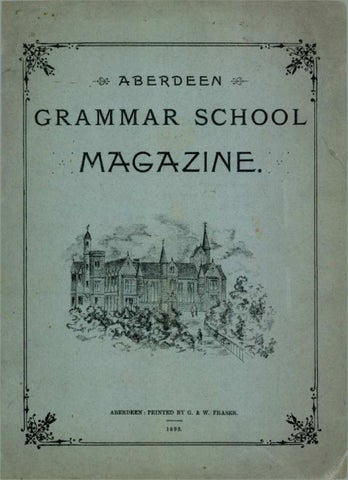
AB ERD E EN
a.
11 • .
w
GRAMMAR SCHOOL •
MAGAZINE.
• •
•
.
•
.r •
.
ABERDEEN : PRINTED BY C. & W. FRASER.
•
•
• • •
1893.
*•
•
•
•
Contents. 3<9/' PAGE.
NOTES, .
•
•
•
•
•
•
•
•
.
.
1
.
.
2
SUCCESS OF OLD PUPILS,
•
•
•
•
•
Tens McRAE,.
•
•
•
•
•
•
.
.
3
•
•
•
•
•
.
.
4
•
o
.
.
6
•
•
SOME BITS OF A SAILOR'S LIFE,
A LITTLE STAR AT MY WINDOW SHINING,
•
•
•
ON THE PRAIRIE, .
•
•
a
A LOVE SONG,
.
•
•
•
PHOTOGRAPHY,
•
•
•
•
VIRGIL, .
•
•
•
•
•
•
•
.
.
6
•
•
•
.
.
7
•
0
•
•
.
.
8
•
•
•
.
.
8
•
• • •
THE " PLAGUE" IN SWITZERLAND, .
•
•
•
•
.
.
9
•
•
•
•
•
•
•
.
.
10
.
•
•
•
•
•
•
.
.
11
" WARLOCKS AND WITCHES IN A DANCE,
•
•
•
.
.
11
JOHN RUSKIN,
.
" I USED TO THINK,"
AMONG THE CAIRNGORMS,
•
•
•
•
•
•
.
.
13
ODE TO LIFE AND DUTY,
•
•
•
•
•
•
.
.
15
•
•
•
.
.
16
.
.
16
REFLECTIONS ON THE GRAMMAR SCHOOL, THE LIBRARY,
.
THE SWIMMING CLUB,
•
•
•
•
•
•
.
•
•
•
•
•
•
.
.
17
•
•
.
.
17 18 18
REPORT OF FOOTBALL CLUB FOR LAST SEASON, REPORT OF GRAMMAR SCHOOL CRICKET CLUB, . REPORT OF DEBATING SOCIETY,
.
.
.
•
•
.
.
•
•
.
.
•
.... \
**so
*4-*
04* 141
ABERDEEN •,.<C=.
tammar *
*
*
*
*
tijool
JUNE,
NOTES. Rectorship of the Grammar School has from time to time been filled by men of no THEordinary genius ; by men celebrated not
1893_
,,
againt. *
*
*
*
*
Mr. Rough, in the Lower Departments. We have to regret the loss of our worthy English Master, Mr. H. F. Campbell, M.A., who has given up the teaching profession to study Law. Mr. Campbell was for upwards of ten years connected with the Grammar School, during which time he gave abundant proof of great abilities both as a teacher and a scholar. He took a lively interest in the Literary Club and Debating Society, of which he was Hon. Vice-President. We are confident that he will adorn the profession to which he has devoted himself, and we cordially wish him all success in it.
only in their own day, but by men who have handed down a name to posterity. The first Prof. of King's was in his day Rector of the Grammar School. Melvin also, once the best latin scholar in the north, occupied the Rectorship. Its present occupant, Dr. Moir, whose portrait we have the pleasure of presenting to our readers in this number, is a worthy successor of these eminent lights. Of Dr. Moir's attainments as a scholar it is unnecessary to speak. He is well known in educational circles as one As his successor the school has been very of the most highly cultured scholars in the fortunate in securing Mr. Wm. Murison, M.A. north. In classics, and especially in latin com- Mr. Murison has had an exceedingly brilliant position, he may be said to be an authority. career both at Aberdeen and OxforcLUniverBut it is not only as an eminent scholar sities, and subsequently in Germany. that Dr. Moir shines. As a teacher he endears He entered upon his duties in January last, himself to all his pupils. All who have had and since that time he has shown that he is the good fortune to study under him will bear not only a complete master of his subject, but us out when we say that he has always secured also an able exponent of it to his classes. not only the respect but the admiration and affection of his pupils. To listen to him was During the present year a revolution, so to in itself a pleasure. The mysteries of classical speak, has taken place in the University lore under him were explained not only as a system of Scotland, which will affect Aberdeen, duty but as a pleasure. Subjects otherwise perhaps more than any of the sister univerapt to become tedious and monotonous to the sities. Not to speak of the admission of ladies avarage school boy were brightened, and to all classes in Medicine and Arts, which all acquired a new interest from his ever ready will hail with delight, other radical changes wit and genial good humour. are being introduced which must necessarily All who have been in the " Rector's Room," revolutionize the present system of Secondary will look back with pleasure on the many Education. pleasant associations connected with it. They The devotion to classics, which has hitherto will associate with it memories not only of the been the chief feature of Aberdeen University classics, but also of the higher influence the is likely soon to become a thing of the past. teaching of their worthy and honoured Rector The study of modern languages will in all had upon them. probability take the place of that of the Since the last number of the Magazine was Ancient. An especial characteristic of these issued several changes have occurred in the reforms is the prominence which has been staff of the school. Miss Mackie, L.L.A., has given to English. The " Version," also, is likely succeeded Miss Daniel, and Mr. J. Davidson, to be abolished in the " Comp."
2
ABERDEEN GRAMMAR SCHOOL MAGAZINE.
But besides these reforms the new ordinances entail a system of preliminary examinations, which are now added to the already long list with which the modern school boy is plagued. We are strongly of opinion that something should be done to lessen the number of these examinations. THE BURSARY COMPETITION.—The number of Bursaries gained by our pupils last year was thirteen, amounting to £196 10s. for four years. The highest place we had was 3rd, which G. Stewart took. Then came F. F. McAlpine, 11th ; G. Copland, 13th ; J. Taggart, 14th ; G. M. Angus, 16th ; G. G. Cameron, 23rd ; J. P. Wingate, 46th ; P. K. Stewart, 47th ; J. Ferguson, 48th ; J. H. J. Bisset, 49th ; R. S. Troup, 56th ; D. Macrae, 57th ; G. Ironside, 60th. At the last Bursary Competition several pupils took Higher Mathematics instead of the " Version." This proved a great success. Mr. J. Taggart scored highest marks in the subject, having 389 out of a possible of 400 marks, which was considerably higher than the highest marks in " Version." This reflects great credit both on Mr. Taggart and on his able teacher Mr. McLeod. We have to congratulate Mr. T. M. Watt, our excellent Librarian, on the pleasing report which he has presented. It speaks of great energy on his part, to be able to increase the number of members. We are certain, however, there would be still more members if the proposed Reading-Room were fitted up. About two years ago it was proposed to have such a Reading-Room ; but since that time nothing more has been heard of it We are afraid that this is owing to the negligence of the School Board, as we have heard that the necessary funds are at hand. •
Success of Old 'Pupils. HE list of honours gained by. former pupils at our own and other Universities is as usual highly creditable. At Mansfield College, Oxford, Mr. J. G. Watt, B.A. (Oxon.), has gained the Deuger's and Johnson's Theological prize of £50; and James Georgeson, Pembroke College, divided with another the Fullerton Scholarship for Classics.
It
In the Exit Examination for Indian Civil Service appointments, A. R. Cumming and Claud A. Barron, gained the 5th and. 13th places respectively. Mr. Cumming at the same time gained a special prize of £30 for knowledge of Tamil. At our own University, J. C. Philip, as the best general student of his year, was awarded the Town Council gold medal. He also took first-class honours in Mathematics. K Rennet gained 2nd class honours in Mathematics. To W. G. Robertson was awarded the Dr. Morrison Literary prize. In the Arts Classes the following stand high in the prize lists :— Bajans ; T. C. Bruce, J. H. J. Bisset, F. F. Macapline, and W. I. Moir. Semis; A. M. Mackay, John Smith, and A. Duncan. Tertians ; R. M. Milne, N. Mackenzie, W. G. Robertson, W. W. Reid, and G. A. Mayor. Magistrands; J. C. Philip, Alex. Clark, K Rennet, and W. E. Henderson. Some of the best scholars of the highest Grammar School class of 1889 went to Edinburgh University, so that their names are wanting from our own University lists, but stand very high at Edinburgh University. In the Chemistry Class at Marishcal College, G. A. Mayor was 2nd, F. W. C. Turreff 5th, Maxwell W. Findlay 6th, and W. I. Moir 7th, amongst the first year students; and A. H. Mackie was 1st, and. John McLennan 6th, of the second year students. The following have passed their M.B., C.M. examination :—R. L. Brander, A. Brown, A. L. P. Cruickshank, M.A., Alex. Gregor, William Hector, John Ingram, R C. Macdonald, J. Richie, G. J. A. Watson, and T. D. Wimgate. Mr. J. C. Philip was dux of the school in 1889, and gained the Brebner prize for French in the previous year. During his career at college, he has always taken a very high position. John W. Duff, M.A. (Abdn.), B.A. (Oxon.), has lately been appointed Professor of Classics and Literature in connection with Durham College of Science at Newcastle. Mr. Duff was dux of the school in 1882, and gained five other medals connected with the school. His college successes, both at Aberdeen and Oxford Universities, have been of the very highest character, and his achievements in Classics have gained for him a wide reputation.
ABERDEEN GRAMMAR SCHOOL MAGAZINE. 2.
4 4 c 191 a E.
EN order to warn a lot o' you Grammar School lads o' the mischief 'at ower muckle study brings upo' fowk, I hae made up my mind tae gie you a chapter oot o' my ain experience. I' the first place, I may as well tell you at aince the name o' the chappie its sae concern't aboot your welfare, an' syne I'll gie ye the story o' that same chappie's attempt tae mak' for himsel' a name an' fame i' the professional and leeterary warn The name gien me at my kirsnen wis juist plain Tam Mc Rae. It wis Tammy 'at I wis kent by for the first twar year o' my life, but I begood tae grow sic a muckle chiel, 'at by an' bye the neibours cheenged it tae Tam—thinking nae doot 'at it lookit mair dignified like tae ca' me by a name mair shuitable for ane approachin' man's estate. My faither wis mair tae me than my faither—he wis likewise my name-faither; but altho' I say't maser—fa sidna—I'm muckle the cleverer man o' the twa. I may as well tell ye at aince 'at I'm my faither's only sin, an' bein' sae, I'll fa' heir—fan he depairts this life— tae the 20 acre o' grun' he coft fae the laird. However, in spite o' the gran' prospeck I had o' bein' someday a bona-fide landit proprietor, I had hungrins aifter glory o' anither kin' ; sae, ae fine day, I taul my faither, wha wis thrang at the tattie-plantin', 'at I thocht I could mak' my mark as ane o' thae lads 'at screw the coppers oot o' ye for gein' advice. At first my faither lookit dumfoonert like 'at I sud think o' leavin' the place far I'd been born an' brocht up, but fan I min't him o' the siller 'at could be made at it, an fan I taul him o' chaps like mysel' at hed risen tae weer lang goons an' curlin' wigs, while they pronoonce't judgment on their fellow-creaturs he brichen't up a bit. The neist thing and the warst o' a' wis tae brak the news tae my mither. Hooever it hed tae be dane, an' for some time I hed tae submit tae the sicht o' her tears, an' the hearin' o' her lamentations afore I could convince her 'at it wis for a' wir gweed 'at I sud gang to Aiberdeen an' be a student. Students bein' in my mither's een a set o' gweed-for-naething, graceless vagabon's, its hardly to be won'ert at altho' she had some qualms aboot latin' her only laddie jine them; bit at the lang length she yielded tae my wishes, an' even gaed the length o' sayin"at I wad mak' a fine-looking callant wi' the reed goon o' my back, and the
LIC
3
bit broddie upo' my head. Afore the week wis oot, she'd a' my hose in order, and packit wi' the rest o' my claes in an mil' kist o' my faither's, an' sync; fan I wis comin' awa she pat a twa three shillin's i' my han' forbye's fat I'd gotten for beuks, lodgin's an' siclike, an' says she, sobbin' a' the time—" Tam," says she, " see an' be a gweed laddie, an' tak' care o' yer siller, and dinna spen't upo' tibawca tae spile yer breath, nor upo' sweeties tae spile yer teeth: juist ye keep it i' yer pooch, Tam, an' syne ye'11 ken 'at t'e'll hae't tae fa' back upon : forbyes, it'll gar the lads at the collidge treat ye wi' respect fan they see 'at ye've twa three shillin's tae clink upo' ither." Arrive't in Aiberdeen I wis juist a trifle surprise't fan I heard 'at I couldna win intae the collidge withoot passin some kin' o' an examination. I at aince gaed till a doctor chap 'at belanged till the pairt I cam fae mysel,' an' speirt gin he wid examine me an' see gin I were noun' as I wintit tae collidge. The doctor leuch like tae split his sides, an' syne said, l'd better gang tae Maister Tibbet's classes, an' he wad prepare me for collidge, as it was my mental, nae my pheesical sounness 'at wis at fault. I accordinly took a note book i' my han' an' mairch't doon tae Tibbet's class. Ilka body's een wis turn't upo' me as I cam in. Dootless they thocht 'at comin' fae the kintra I wis raither green. Hooever I lookit them a' bauldly i' the face, includin' even Tibbet himsel', wha seemed tae regard me as if I were a naebody. At last aifter surveyin' me for a gweed fylie, he toddlet in aboot, an' says he "My young man, can you translate tempus fugit ?" At impidence like this my vera birse began tae rise. " Weel fegs," quo I, "yer no blate ; wad ye hae me tae ken a'thing the vera first day I'm here? Gin I'd kent that, there wad be feint a muckle eese for my bein' here." By my certies, fan the mannie saw 'at I could speak up, I'm thinkin' he keepit a calm sough for the rest o' the day. Hooever fan I gaed back tae my garret, I determin't by hook or crook tae fin' oot the meanin' o' thae twa wirdies afore I'd venture back tae the class again. But truly i' my case, tempus fagit atore I could get them, an' fat wis waur, my vera wits fled tae. Fat wye I rummelt in ower my bed that nicht I canna tell ye, but ae thing I dae ken, namely, 'at for the feck o' sax weeks I wis laid doon upo my back, an' attenit by the doctor chappie afore mentioned. The
4
ABERDEEN GRAMMAR SCHOOL MAGAZINE.
amount o' poothers an' peels. 'at I swallow't - in a sailing ship. In a steamer there is little wad have been aneuch till hae stockit ony or no sailoring to be done. The engineers and druggist's shop, an' the bill 'at cam in for firemen are quite as important functionaries pheesic at the en' o' the time wis past speakin as the captain, officers, and crew; in fact, aboot. more so. The writer made the voyage in Whan I rose again the doctor tawl me 'at I a sailing ship, in the humble position of hed hed brain fiver an' I wad never again apprentice seaman. be the chap I'd been afore. My heid, he said, He will, therefore, try and give some idea wis nae better than a foggie neap, sae he of a sailor's life. Of course it is vastly different advised me tae gang back tae my faither's, as in the case of a passenger, who is not answerI wis o' nae mair eese for study. Afore I able to anyone for what he does, and is not followed his advice I sat doon an' wrote a bit ordered about like the sailor. beukie tae warn faithers and mithers wha hed It was about the end of June last year that ambitious sins or wha were ambitious for them, I was ordered to join my ship, which was then o' the dangers o' studyin' ower muckle. I've lying at the East India Docks, London, loading nae doot, aince I could get the volum prentit, a general cargo for Melbourne, the largest and 'at lots'll tak warnin by't an' find it vera usefu' ; wealthiest of Australian cities. After arriving bit as yet I hinna gotten a publisher tae ap- in London, the apprentices, most of whom were preciate its merits. The feck o' fowk noo a Aberdonians, and some of them old Grammardays prefer trashy stuff tae gweed common ians, had to work by the ship till she was sense. Hooever I winna despair. Mony a ready for sailing. At last all was right, the great man's gotten his wark return't wi' the sails bent, the hatches closed and fastened editor's compliments afore noo. I've jist this down, and the good ship -- of Aberdeen, tae comfort me 'at aince it is publish't it'll was ready for sea. bring me a gweed sicht mair siller than ever On the morning of July 6th, we hauled out I micht hae made as a lawyer. I ken this tae, into the Thames, gave the tug the tow-rope, 'at it'll mak a name for me i' the leeterary and were towed down the river, past Woolwich, warl' as gweed as Tammas Carlyle's ony day. Tilbury, Gravesend, and Southend, past the Nore till we got into the Downs, where we J. RUTHERFORD HARROWES. had to anchor owing to a strong head-wind. That night we were tumbled out of our bunks to man the windlass and heave up anchor, for Some Bits of a Sailor's Life. the wind had increased, and the pilot thought BY AN OLD PUPIL. it advisable to shift to a safer anchorage. We HE most popular route to Australia did so, and next morning we hove up again, now-a-days is to take a passage and towed down channel. by one of the magnificent steamers This last little episode is only one of the belonging to the Peninsular and many disadvantages which those "who go Oriental, or Orient Lines, by down to the sea in ships " have to put up with. which you get to your destination in the marJust as we passed Dover, we passed one of vellously short time of five or six weeks. By this our company's vessels towing up channel. route you steam through the Mediterranean, How I wished I were in her; but it was no use Suez Canal, and Red Sea; but if you make the wishing. The tug left us a little after we had voyage in a sailing ship, you go round the passed the Bill of Portland, and when we got Cape of Good Hope, and steer about due east to the Start the channel pilot left us also, and till you arrive at Australia, after a voyage of we were fairly on our own hook. The evening eleven or twelve weeks. Few people think of watches were picked, and I found myself in going by this last route, but fifty years ago when the starboard or second officer's watch. there were only two fine steamers to carry you In sailing vessels the chief-officer and boatspeedily and safely to your destination, you swain (or " bosun " as he is called), have charge would have had to travel in the orthodox of the port watch, the second and third sailing vessel. If the reader, however, wishes officers have charge of the starboard one. to see the ocean properly, and know what a There are thirteen in each watch. The sailor's life means, he should by all means go captain, cook, steward, carpenter, and sail-
ABERDEEN GRAMMAR SCHOOL MAGAZINE.
5
•
maker do not keep watch, and have all night in, which we poor unfortunates have not. The watches relieve each other every four hours, except in the " dog watches," which I will endeavour to explain. Suppose the starboard watch to be on duty from 8 a.m. till 12 noon. This watch is then relieved by the port watch, which stays on duty till 4 o'clock in the afternoon, and so on. Now with reference to the "dog watches," it will be clearly seen that if the watches go on relieving each other every four hours, one watch would always have eight hours on deck every night. Now, the " dog watches" are for the purpose of allowing one watch to have the eight hours out one night, and the other the next night. Instead of the watch that relieved the other at 4 in the afternoon staying on deck till 8 p.m., it is relieved at 6 p.m., and comes on deck again at 8 p.m. It is again relieved at 12 midnight; and the four hours watching goes on again till 4 o'clock next afternoon, when the same thing takes place with the other watch. Time is kept at sea by the striking of a bell, two strokes for each hour; for example, beginning at 12 mid-day—one o'clock—two bells; two o'clock—four bells; half-past three— seven bells ; four o'clock—eight bells ; it then begins again, five o'clock—two bells, and so on. Every two hours, the log is hove to ascertain the speed of the ship, the man at the wheel relieved, and, if at night, the look-out also. Taking in sail during a blow is hard work, especially if it is night-time. Suppose it to be your middle watch on deck (that is from twelve midnight till four in the morning), and that you are called at a quarter to twelve, and told it is blowing bard; and that it will be "all hands furl the main topsail at eight bells." You tumble out, get into your oilskins and sea boots half asleep. Just then eight bells are struck, and at the same time your thoughts and feelings go to the four winds. As you step out on deck the first thing you get is a green sea in the face which weakens you considerably. Everything is pitch dark, and all you can see is the white foaming waves as diey tumble about the ship and seem to overwhelm her. What, with the officers shouting orders, the men singing out at the ropes, the wind howling, &c, you feel pretty confused. You are not left long in this condition, for the chief mate bellows out " away aloft and furl
the topsail." As you clamber into the main rigging you are nearly fastened to it by the force of the wind. At last you reach the topsail yard and wait for a lull. When one comes, you gather up and pass the gaskets round the canvas as quickly as possible. When this is done, you get on deck and get under the lee of the deckhouse to stand the remainder of your watch on deck. Life at sea is very monotonous, and with the exception of a blow now and then, or sighting a ship, there is very little to break the tedium of the daily work. But to resume. After getting clear of the Channel, we had plenty of head winds and calms, and forty days passed before we made the Equator. During that time we experienced very fine weather, but after we rounded the Cape of Good Hope the stormy weather commenced. At last after three months of sunshine and storm, calms and hurricanes, and almost every kind of weather, we sighted the welcome light of Cape Otway. We were not destined, however, to reach our destination without old father Neptune having another hit at us, for on the night on which we sighted Cape Otway we were hauled out of our bunks to the cry of "All hands on deck." The ship had been struck with one of the squalls which are well known in the vicinity of Melbourne. They come all at once ; blow a hurricane for about three hours, and then die away as suddenly as they came. We had just got the ship under lower topsail and foresail, when suddenly the latter gave way, the wind having split a large hole in it. We had, therefore, to get aloft again and furl it also; and as soon as daylight came we took it down and put up a heavier one. Our watch had about two hours sleep that night; but, as we had been working hard the rest of the night, I felt pretty "fagged out" when eight bells came. We had our breakfast, consisting of hard biscuits (oh, how hard!) and coffee, and then we turned in. When we came on deck again the pilot had come on board ; we were just passing through the Port Philip Heads. We sailed past the pretty little town of Queenscliffe, the fashionable watering place of Melbourne, a welcome sight to our weary eyes after having seen nothing but sea and sky for three months. That night we anchored in Hobson's Bay and, late though it was, the ship was surrounded
ABERDEEN GRAMMAR SCHOOL MAGAZINE.
6
with boats and launches, containing the doctor, custom-house officers, and above all our letters from home. What excitement there was! Each one had some wonderful bit of news to impart to his neighbour. At last we all turned in and enjoyed the first complete night's rest since we left London. The next night we unbent the sails, and next day we hove up anchor and were towed over to the Railway Pier, Williamstown, thus arriving at our destination after a passage of 92 days. J. W. H. 71 Little glap at mg Wirzaow g5ining. A LITTLE star at my window shining, When darkness darkest seemed to be, Trembled awhile and flung me a message, Message of hope to my love and me. " Darkness is good : were the light unending, Living were weary, and pleasure soon flown : God's sweet night with its rest and renewing, And its star-crown of glory were all unknown." " Trial is good : long joy becomes tasteless, Minisheth greatness, lowers thy goal : But sorrow for ever new virtues discloseth The stars of God's handiwork set in the soul." A. MITCHELL.
Oil Elie 19±(qiisie.
M
Y uncle had just returned from Texas, where he had been for upwards of twelve years. He had seen a great deal of life out there and his stories of adventures in which he had taken part were numberless. I could relate a great many of these stories, but in the meantime shall select only one, which I consider to be the best. Here it is in his own words :— " One morning I received an invitation from some friends to join them on a buffalo-hunt. I accepted the invitation and started out alone to the rendezvous. As I rode along I could not help admiring the landscape which from time to time spread out before me. At one point the plain rose like a billow against the base of a lofty mountain range, which threw out one bold and rugged spur like a promontory into the green waves. Away to the left and beyond this promontory of the prairie, rolled a wide spread of undulating plains, dotted with clumps of cactus and apparently tenanted only by the deer, the wild horse, and the buffillo.
Turning my head in the direction of the plains I observed what I supposed to be one of the droves of wild horses moving slowly towards me. They were at a considerable distance when I first observed them, but gradually they approached nearer and nearer, and as my eye fell upon them a feeling of apprehension that I could in no way account for, ran through me. At length they disappeared behind one of the undulations which cross the plain, and were out of sight so long that I had almost forgotten them, when suddenly they broke again upon the scene moving straight towards me at a swift gallop. I drew my horse up behind a cluster of cactus to let them pass, but as they rose upon the higher ground and stood out sharply against the sky I saw that each animal had an Indian slung along its side by one hand and foot, clinging to either horn of the saddle. This is a common stratagem among Indians when approaching an enemy by daylight on the prairies, and at a distance can scarcely be detected by the wariest eye, as they ride close together, and no part of the body is shown above the outline of the horse. I could trust my steed—a true son of the prairies—and urging him on he flew across the fragrant sward at a wondrous pace. As soon as the Indians perceived themselves discovered they wheeled up in their saddles again and urging their horses forward raised their war-whoop like exultant fiends. Glancing hastily behind me I saw that they were spreading over the prairie, with the evident intention of hemming me in against the mountains. My only chance of escape, therefore, was a desperate run for an elbow of the range which, could I gain and turn first, I thought, would secure my safety, as around it the wood grew very dense and I knew the Indians would not follow me into its recesses. A terrible race was that I tell you—a race for life and death—a race in which all that man prizes most was at stake ; as fast as the pursued galloped onwards the pursuers were no less rapid in their pursuit. Happily, however, I succeeded in gaining the projecting angle before the Indians surrounded me, and waving my cap in derisive triumph, I burst, with the joyful shout of one who had escaped from a deadly peril into the sheltering shadows of the wood. Here, as I expected, the baffled foe gave up the chase. I then proceeded slowly for five or si s. miles, and at last emerged once
ABERDEEN GRAMMAR SCHOOL MAGAZINE. more upon the prairie, and after a brief rest I again urged on my horse into a gallop, taking the direction which I thought would bring me back to the morning's hunting ground. After an hour's riding I found myself ascending the crest of a steep ridge. Judge of my dismay when on gaining the top, I descried another body of Indians ascending the ridge from the other side, and only about one hundred and fifty or two hundred yards distant. Unfortunately they discovered me at the same moment, and now indeed I felt that my life hung on a thread. A ride was before me, and striking my heels into my horse's flanks, I turned and rushed like a whirlwind down the hill. All depended on my getting back to the shelter of the wood. Meanwhile the Indians had gained the summit, and with frightful yells came thundering down in pursuit. But my steed, though weary, was more than a match for any of theirs, and I soon left them far behind ; but my chances of escape seemed slight for I was more than five miles from the wood. As I swept along I turned my head towards the south and saw that the whole horizon was obscured with sabre smoke, and that apparently at no great distance a vast fire was raging. After a moment's thought I concluded that tho safest course for me was the most desperate. I resolved to ride straight through that line of fire, and take my chance of passing through the flaming barrier alive. And on the other side with such a rampart between myself and the Indians I was safe I Acting upon this resolution, I urged my horse steadily forward, and soon encountered the lowering smoke as it rolled along the grass, and rode beneath the stifling shelter. 1 was now out of sight of the Indians, and leaping from my horse, I began to prepare for the passage of that sea of fire. Cutting my blanket into pieces, with one I blindfolded the animal, another I tied loosely about the lower parts of its head, enveloping the mouth and nostrils. I then protected my own face with a mask of the same material. I could hear the yells of my pursurers apparently close at hand. I was now in utter darkness, and mounting quickly I galloped towards the fire. On, on I went, I knew not whither, I cared not whither, but plying lash and spur with all the energy of desperation. The air grew hotter; hot as a furnace-breath; my lips were parched; the
7
sweat poured down every limb ; I felt stifled, chocked, maddened, it seemed as if billows of flame and fire were rolling over me ; my hair was burnt, and the flesh of my body was sorely scorched, but we knew neither pause nor hindrance, and the horse and rider still darted onward—onward I On, on I through the wreathing flames, through the roar and hiss of the fire I A few bounds more and the peril will be past. Yes ; the air is fresh and cool—oh, so deliciously cool! and balmy like the breeze which stole through the blossomy bowers of Eden. Away with the headgear which has served its purpose so well; away with the wrappings from the trembling steed ; air, air, fresh air ; and lo, we are both safe after breasting that sea of fire! For an hour we stood side by side upon the blackened plain, unable to move from sheer exhaustion. Every hair on the animal's body was gone ; its skin was terribly scorched and its limbs seemed stiffened into stone. We rested for a few hours, and then once more turned towards home, going at an angle to the direction in which we came, so as to avoid both the fire and the Indians. It was far on in the night when we arrived home, both of us in a thoroughly exhausted condition. This, boys, is the story of my adventure. Perhaps to you it does not seem very thrilling, but I tell you I shall never forget my ride for life across that prairie, and through that burning fire." ANON.
,T1 Love Song. O'ER the stretches of the bay Sunbeams on the waters play, Not more light and not more gay Than my inmost soul to-day. Mid-day sun, look down and tell, Is it well to love so well ? Song that from the linnet gushed Now in weariness is hushed ; Yet the face of love is flushed, And his longing still uncrushed. Evening star, look down and tell, Is it well to love so well ? Through the silence of the night Moonbeams gild the bay with light, What is that to love-lorn wight Lacking eyes for such a sight ? Mid-night moon, look down and tell, Is it well to love so well ? Hark, I hear the herdsman's horn ! 'Tis the breaking of the morn ; Yet love's ardour is unworn. Why, oh why is daylight born ? Morning star, look down and tell, Is it well to love so well ? J. G. F. MOODIE HEDDLE.
8
ABERDEEN GRAMMAR SCHOOL MAGAZINE.
PHOTOGRAPHY
p
HOTOGRAPHY, like other branches of chemistry, owes its origin to the ancient alchemists who, in their researches for the "Philosopher's Stone," produced a substance which they noticed blackened on exposure to the light, and accordingly they named it "Luna Cornea." The " Luna Cornea " of the ancients was, of course, our nitrate of silver, upon which the art of photography is based. Nothing more of importance is heard of this substance till 1775, when Scheele in his researches found that certain rays acted on it quicker than others. Since Scheele's observation photography has grown with enormous rapidity, and its phenomona seem to have occupied the greatest minds of the day. " But," says the reader, " you can't take an image by merely exposing to the light a surface coated with nitrate of silver. No you can't, because only the rays of light from the object to be photographed must fall on the sensitive surface. That is, you must concentrate the light from the object on to your surface and shut out all intervening rays. To remedy this, use was made of the beautiful "Camera Obscura," which had been discovered in the 16th century at Padua, and which, in its simplest and primeval form, consisted of a square box with a lense fixed in a circular hole in the centre of one side, opposite to which a piece of white paper was stretched. By means of this, a reversed image was thrown on to the stretched paper, and by substituting for the paper a surface coated with nitrate of silver, a faint image without any details was obtained, which, however, on exposure to day light, disappeared, since no chemical had been discovered with which to fix the likeness. It seemed as if the former discoveries would avail nothing, for it was not till after long and careful experiments that the chemists at last discovered a mode of retaining the image produced in the "camera obscura," on the nitrate of silver paper. Let us now turn to the continent, where the photographers were trying to find the keyhole to "photography" in a different way. We find that a process had been introduced in July, 1839, by two Frenchmen, which went under the name of "Daguerreotype," and consisted in exposing a highly polished plate of silver to the vapour of iodine, by which pure
iodide of silver was produced. This was exposed for about twenty minutes in the camera obscura, and then acted on by the vapour of mercury by means of which an image was "developed" on the plate, and which the inventor managed, though imperfectly, to fix. Having thus briefly given an account of the birth of photography, let us turn to its uses, both as a useful and interesting science. Its uses are many ; in the first place, look at it as a portrait painter. If you go into any house, rich or poor, there you are sure to find a photograph of some place, person or thing, adorning and adding to its beauties. These are often photographs of lost or far off friends, and are a substitute for the expensive oil coloured portraits of the wealthier class, and being inexpensive are also within the reach of the poorer class. Photography is now indispensable to Government for copying valuable documents, geological and botanical specimens, curiosities, &c., and no explorer or traveller is without a camera. As a hobby, photography seems to be the sister of cycling, for those who have not a bicycle have a camera. its popularity is doubtless increased by the fact that it combines recreation, science and art. Recreation in hunting for a picture; science in development and manipulation of the plates; and art in the touching up, and finishing of the prints. J. J. R. M.
+
G-
_ +
I300K II. LINE 268. 'Twins just when sleep first seals all suffering eyes, And on she steals right welcome by God's grace ; Lo ! as I slept before me seemed to rise, Bathed in a flood of tears, the mournful face And form of Hector, as in days of yore When by the car in torture dragged along, His body all was smeared with dusty gore, His swollen feet cut by the cruel thong. Ah me, how sad he looked ! how changed now From that brave Hector, who returned all bright With Achilles' spoils ; or who at Grecian prow Cast Phrygian scorching flames with arms of might. His squalid beard and locks were stiff with gore Upon his valiant form was many a scar That told of blows received from those who bore Against his native walls their arms in war. In mournful accents and with tearful eye, And waiting not to hear him we address, These words I spake :—" Oh surest hope of Troy ! Oh Dardan star ! why from these realms, confess, So long expected, hast thou tarried so
ABERDEEN GRAMMAR SCHOOL MAGAZINE. Or from what region Hector, com'st thou here ? How gladly I behold thee in my woe, Since death from you full many a friend did tear, And many grievous wrongs the city felt. But, Hector, tell me what dire cause has marred The cheerful calm that on thy visage dwelt ? And tell me why so ghastly art thou scarred ?" He answers not nor heeds my questions vain ; But heaving deep drawn sighs from out his breast, " Alas !" he cries, " flee goddess-born and strain Full every nerve these flames to leave ; oh haste. Thy cursed foes do hold thy city's walls ; Troy from the summit of her towers of might Is wrapped in flames and into ruin falls, But you your duty have fulfilled quite To country and to Priam. Now take heed, If mortal hand could proud Pergamu free, This mighty hand of mine would do the deed. Her rites and household gods Troy offers thee ; Wher'er thou go take these to share thy lot : For them search out a site for city proud, Which thou, when strife has ceased shalt raise ; but not Till with thy prows the ocean ALL be ploughed." So having said these sorrowing words he turned ; Seized Vesta's image bound with fillets bright ; Brought from the secret shrine the fire that burned, Nor e'er had died, since first it shed its light. J. ANDERSON.
THE " PLAGUE" IN SWITZERLAND. (a- 0'N Switzerland bears, wolves, and other v .4 dangerous animals have been exterminated, and the chamois exists only in a domesticated state. So we are told; but a wild bear still lives and thrives in the shape of the Swiss guide. If you keep below the snow-line you can go anywhere with a good pocket guide, such as Baedeker, but you can scarcely take a constitutional before breakfast without being pestered incessantly by the offers of service of the man-guide. Fortunately, though he is at liberty to talk you out of your resistance, he cannot enter formally into a bargain with you without the consent of the chief of the clan. From this arrangement, I presume that a part of the earnings of each individual goes to a common fund, for the benefit of the associated guides of each district. This arrangement, furthermore, guarantees the safety of the traveller, for, if a guide and a traveller were to set off together, say from Chamonix to Martigny, and the guide were to reach Martigny alone, explanations would be demanded. Of course the traveller would have fallen over a cliff. But, if, on the scene of the catastrophe being visited and examined, there were found the signs of a life-and-death struggle ; branches broken, grass trampled and stones displaced ;
X
9
and if sundry ugly scratches were found on the person of the guide, which he could explain only by pretending that he had cut himself when sharpening his pencil, then the guide would receive a fatal stroke, and the leading industry of the country would get another. When my esteemed friend Richardson took it into his head to walk from Chamonix to Martigny three years ago, he made an early start, and that for two reasons. He had studied his Baedeker well, and was confident he could avoid the expense of a guide ; and he wished to have the stiffest part of a climb of 5000 feet over before the day became disagreeably hot. He had covered half-adozen miles, when on looking back lie detected a moving speck about two miles distant on the long white road below. The speck gradually gained on him, and soon took the form of a man, and finally that of a guide. In spite of his precautions he had been detected leaving Chamonix. His friend in the rear would make up on him, relieve him of his knapsack, accompany him to Martigny and demand 15 francs for his day's work. All this dawned on Richardson as he was approaching the roadside inn where he intended to breakfast. He entered, and soon his pursuer by making good use of his gamekeeper-stride took a seat beside him, and began to question him :— " Would there be any indiscretion in my asking you where you are bound for?" "Not the slightest. I am going to Martigny." " Which road do you mean to take ? " " By the Col du Balme." " That's strange, I am going there by the same road. I took a tourist to Chamonix last night, and I am now on my way back to Martigny, and nothing for the return journey. Will you allow me to carry your knapsack?" " Oh, no! thank you, my knapsack and I have become inseparable friends. If you wish my company I shall be delighted with yours; but understand that I 'know the road and have my guide in my pocket." Richardson had seen by this time that his would-be guide was scarcely sober, and he made up his mind to give him the slip at the first opportunity. Meanwhile, resuming their journey, the guide tried to make himself agreeable in a variety of ways, such as by pointing out the various peaks, or aiguilles, in the distance (all in Baedeker), and finally by a mild form of bribery, offering some very coarse specimens
10
ABERDEEN GRAMMAR SCHOOL MAGAZINE.
of the inevitable rock crystals. After some pressing these were accepted by my friend in order to lull suspicion, and because, being probably made in Birmingham, the crystals were scarcely worth the trouble of throwing away. At last the two reached the summit of the Pass and the half-way house on it, the Hotel du Balme. They separated, the one going to the guest room, and the other going to that set apart for the guides, after the traveller had said that he meant to stay some time to take lunch, and enjoy the wealth of wild flowers, the bracing air and the glorious views of the Mt. Blanc range with its fields of snow and towering aiguilles on the one side, and the snowcapped peaks of the Rhone valley on the other. The guide mentioned as a curious coincidence that he intended to rest also for some time. The landlord of the hotel remarked that the guide was not in a condition to be a desirable companion, awl after being made acquainted with the incidents of the forenoon, he readily agreed to Richardson's proposal that on resuming the journey he should get a start of a quarter of an hour before the guide. This was done; and Richardson, on looking round aftera preci pitons descent by a zig-zag path for two miles, saw the gesticulating figure of his morning acquaintance against the sky-line, and heard his wild haloo. A shoulder of the mountain hid pursuer from pursued, and when they next came in view of each other the distance separating them remained the same. Richardson was beginning to chuckle over the success of his plan, when, on turning a sharp corner, he came on a man stretched at full length across the road, with only the white of his eyes visible and apparently at the last gasp ; while his wife was kneeling at his head moaning and wringing her hands despairingly. Richardson remained till the poor fellow was able to sit up and talk a little, and then bade them good-bye, after he had learnt that a message had been despatched to the nearest house for assistance. I have a notion that Richardson wished inwardly that the man had selected some other place for drinking more ice-cold water than was good for him. At anyrate I know that he hoped that as a reward for his self-denial and gallantry the man might have another attack, just bad enough to detain the guide for ten minutes. This probably occurred, for he reached Martigny soon afterwards with no
guide in sight, and was complimented on having walked the distance in a shorter time than it had ever been walked before. When Richardson gets towards the end of this story he always wears a dissatisfied look. He says he feels that his audience would have preferred that the guide had overtaken him, and after a fearful struggle pitched him off the end of his alpenstock into a yawning abyss where years afterwards some daring mountaineer found his bones bleached by the winter frost and the summer sun. M. H. M.
-
JOAN
RUZKIN,
MONG our latter day teachers—and we have had not a few—there is no name more worthy of our love and reverence than that of John Ruskin. He is one of our greatest living personalities, and not unworthy to be mentioned along with his compeers who have "filled the spacious times of great Victoria" with sounds that will echo while the world lasts. His influence has been felt in almost every department of art and thought, but it is on only one phase of his many sided character that it will be possible to speak just now. In this busy age, with the innumerable activities of common-day prosaic life going on around us, our sense of the beautiful and the true—the two words mean the same thing— is apt to be lost sight of. Our knowledge, in the words of our great poet, has been growing from more to more, but more of reverence has not been dwelling in us, nor have mind and soul been according well. It is against this tendency that Mr. Ruskin has been striving with all the enthusiasm of his poetical nature. He has been telling us what this loss of reverence must inevitably lead to, and tracing what it has even now accomplished. And we in Scotland need this warning even more than our friends in the south. Since the Reformation it has never been considered sacrilege in Scotland to use ancient churches as quarries, and, as a result, we to-day mourn the devastation and utter ruin of such buildings as the Cathedrals of St. Andrews and Elgin, and the sad ravages on our own Saint Machar's. This is but one example of the tendency against which Mr. Ruskin carries us.
471
11
ABERDEEN GRAMMAR SCHOOL MAGAZINE.
He tells of the value of arranging buildings, and of the noble influences which they are fitted to exert upon us. " The greatest glory of a building," he says, " is not in its stones nor in its gold. Its glory is in its age, and in that deep sense of voicefulness, of stern watching, of mysterious sympathy, nay, even of approval or condemnation which we feel in walls that have long been washed by the passing waves of humanity, it is in that golden stain of time that we are to look for the real light and colour and preciousness of architecture." In this respect, at least, the lines have fallen unto us in pleasant places, and our inheritance excelleth in beauty. No country, perhaps, is richer in "voiceful" buildings than ourown,and certainly, no country has made a worse use of them. We owe Mr. Ruskin a very deep debt of gratitude for awakening us—or attempting to awaken us—to a sense of the responsibility which our privileges carry with them. But we have inherited not only buildings but memories and associations, of which the buildings are but the embodiments and types. And among these, not the least valuable are the memories which cluster round cur schools and universities. The name of King's College, for example, cannot fail to recall those of Bishops Elphinstone and Dunbar, men worthy of all respect and veneration, and of numberless others who have helped to give the college its history. The Aberdeen Grammar School, too, is rich in such associations ; none of its pupils should ever forget that he belongs to the school where Byron studied and where Melvin taught. The school is almost coeval with the University of Aberdeen, and possesses a history which all its loyal sons should know. These concrete examples have led us from our topic, but they may serve to show what exactly is meant by such associations and such influences as Mr. Ruskin tells us of. And l t people laugh as they may, it was to such associations and such influences that Walter Scott and Alfred Tennyson and many more of our teachers owed their inspiration, and it is to such associations and such influences that we must look for more work of the kind they have given us. It is in such that patriotism finds its origin. " Love thou thy land," says Tennyson, but he adds, " with love far brought from out the storied past." This is one of the greatest lessons that John Ruskin has to teach us: many things he has to say
to us, and much good counsel to give us, but none of more value than this of reverence. Reverence, indeed, might be called the keynote of his life, as it has been the great ruling principle of his teaching. >. <
" I UgE15 cro TEINH." I USED to think the world was fair,
And coming near perfection, But many things have lost their hues, And changed upon inspection. The man that truest merit had, I thought of all the proudest, But I find folks always listen to Whoever bawls the loudest. I thought that friends were friends for aye, Whate'er might o'ertake 'em, But we make our friends to suit our ends, And for the same forsake 'em. In short, it seems that things are not Quite up to expectation, Perhaps there's better times ahead, P'raps only ruination. A. MITCHELL.
~--" Warlocks and Witches in a Dance." OME years ago the boys at a school in Aberdeenshire were startled at the midday interval by a loud crash. They soon found that the chimney of a new house had fallen, and that several workmen were injured. That forenoon one of these had ordered out of the building an old woman gathering sticks. The old woman, who had the look, the reputation, and the name of witch, had advised the man to be sure he was not near the house when it fell. It bad fallen, and he had been injured. Two hundred years before, that would have been enough to condemn her to the stake. The belief in witchcraft has existed among all peoples at some stage of their development, and is only gradually outgrown, leaving marks in the national customs and habits of thought. A witch is one who is supposed to traffic with the world of spirits, and so, by wishes or spells, to have power to help or hurt. Whether witches have ever existed or not, is immaterial ; it is enough that they have been believed to exist. The belief has had these results. Persons of weak intellect imagined they had gone through all the varied experiences of witches and accusing themselves, suffered punishment. Others were
12
ABERDEEN GRAMMAR SCHOOL MAGAZINE.
reckless imposters, who, trading on human credulity, claimed supernatural powers to kill and cure, and often did kill and cure by poisons and drugs. Witchcraft was an offence both against the Church and against the State; and the laws were rigorous and rigorously enforced. Perhaps, in no country were they enforced with greater cruelty than in Scotland. Trials were not common till the 16th century. In 1563, however, it was made a capital offence to practice witchcraft and to consult witches, wizards, or sorcerers. Soon after, began an epidemic of witch-hunting, which raged, with little intermission, for a hundred years. Rulers, lawyers, ministers, were as ready to accuse and condemn victims as the mobs were glad to make a holiday spectacle of the burning wretches. It is not much beyond the mark to say that during this period every old woman, if sufficiently ugly, ran the risk of accusation, when public opinion was in a mood for witch-hunting. In 1590, that wisest of fools, James VI., presided at a trial of witches accused of seeking to drown the king. Agnes Simpson, tortured for an hour by the twisting of a cord round her head, confessed they charmed a cat, which, with four joints of men tied to its feet was cast into the sea to raise a tempest. Amid much mirth they went to sea—some with cats on their backs—each witch in a sieve, while Satan rolled before them on the waves, dimly seen and resembling a huge haystack in size. At the same trial, the schoolmaster of Prestonpans, when his nails had been torn from his fingers, and his legs crushed to a pulp, told of a great meeting or Sabbath of witches. They marched round the church against the way of the sun, he blew into the locks, the witches entered, and the devil appeared in the pulpit in black gown and hat. Graves were opened, and human joints taken out to serve as charms, Then all took hands and danced to music from a Jew's harp. Finally they performed the world-wide act of homage to Satan by kissing his back. James VI. had the dance music played to him, and was flattered to hear that the devil regarded him as his greatest earthly foe. Some half dozen persons were put to death after this trial. Six years later the cool, cautious, and common-sense Aberdonians lost their heads about witches. One of these, besides the
usual charges, was accused of a grimmer deed. To the old place of execution, the Gallowhill, overlooking the Links, she went with a companion one dark night, while the wind blew and the sea moaned, and the chains encircling the malefactor's bodies waved to and fro and creaked as they waved. Then she cut off parts of the murderers, to be a " charm of powerful trouble" in some devilish cantrip. This woman's son on the previous Halloween had joined in a dance round the Cross to the devil's music. On this occasion Satan did not play melodiously enough to please one of the witches, who took the instrument from his mouth, brought it over his jaws with a tremendous crash, and then played to the dancers. Over twenty of the accused, chiefly women, were sacrificed. There were numerous witch-trials after this at Glasgow and Edinburgh, and in several districts of Fifeshire and Ayrshire. Persecution was most severe in 1629, 1643, and 1649. During Cromwell's rule, the English judges in Scotland would not try witches. So it was with a peculiar joy that the populace of Scotland under native judges returned to the old national sport in 1662. For the Restoration of Charles II., however pleasing to the young people of the kingdom, was calamitous to the old, the ugly, and the cross. In 1662 occurred the trial of the Auldearn witches, who were so numerous as to be divided into squads. Their confessions were voluntary. Isobel Gowdie said she was baptised in the Parish Church by the devil, who took a peculiar delight in burlesquing church services. In each squad the most beautiful, or at anyrate the least ugly, had the place of honour next to Satan, much to the disgust of the other hags. At their meetings the devil was sometimes kind, and then he would embrace them tenderly—as tenderly, that is, as he could. For he was a very large, black, rough man, and even the most hardened witch shuddered at the icy coldness of his touch. This attribute of coldness was borrowed from the mythology of our Saxon and Scandinavian ancestors, whose hell was (to use the words of the ballad), a mountain "dreary with frost and snow."
Sometimes the devil was cruel and would beat and buffet them, growling and bellowing,
ABERDEEN GRAMMAR SCHOOL MAGAZINE.
1 v
especially when they nicknamed him " Black John," instead of " Lord " or " Master." About this time the judges and lawyers, even in Scotland, began to be most cautious in condemning, persons accused of witchcraft. Great scandal had been caused by the witchfinders. Witches were believed to be marked by Satan, and the spot was said to be insensible when pricked by a pin, and to show no blood. So the witch-finder drove pins, three inches long, all over the suspect's body, till it was so deadened that feeling and blood were both gone; then he triumphantly declared her a witch. No wonder the accused preferre I to confess and be executed. Sometimes the witch, so-called, was pitched into water; if she sank, she was innocent; if she floated, she was hauled out and burned. After 1680 a saner spirit grew up among the lawyers, who either refused to try, or acquitted the accused. Sad to say, the clergy denounced this lenity and even winked at the mob's barbarity, when, chagrined at the abolition of their favourite amusement, the roughs meted out lynch law to their victims. Such was the case in Fife, both at Pittenweem and at Torryburn, in the beginning of last century. It was at Dornoch that the latest of these murders happened. In 1722 a mother was accused of riding about on her daughter, transformed into a pony and shod by the devil. She was burned in a tar barrel, and tradition tells how her execution took place amid a wild storm of wind and rain,and how during the final preparations the poor woman sat warming her bands at the bonfire of death. The law of 1563 was repealed in 1736, much to the annoyance of some bigots. In 1742 certain ministers denounced the repeal as contrary to " the express letter of the word of God," The belief in witchcraft, however, lingered on, and is not dead yet. Ever and anon we hear from some remote district of some petty persecution done to a reputed possessor of powers of harming. At times the persecution is not so petty. In 1865 an Essex mob dipped a supposed " warlock" in a pond, who died in consequence. Witchcraft ceased to be universally believed about the middle of last century, and when we find Ramsay, Burns, and Hogg using witches and witchcraft in their writings, it is done distinctly for humorous effect, and to make fun of an exploded idea. In "Tam o' Shanter,"
13
when the hero has his narrow escape from Nannie, the young witch, he sees, it is true, Alloway Kirk in all the ghostly illumination of a witches' Sabbath, he sees all the grim equipment for the hellish rites, he sees Satan, " a towzy tyke," supplying suitable music on the bagpipes, while round him whirl "Warlocks and witches in a dance ;" but Tam sees it all with the eyes and understanding of one whose habit was to be oftener drunk than sober. It would be easy to censure our forefathers who believed in witches, and acted on that belief, but censure does not come well from a generation that trusts in Mahatmas, and has thousands all agape for the answers of a Mrs. Baldwin. ST. INAN. •- - -
O.I M I WII
-
AMONG THE CAIRNGORMS. HE mist of a July morning was creeping off the Cairngorms and lifting from the solitudes of Glen Avon deer forest, when two pedestrians—the writer and a friend—sallied forth from the quaint and remote village of Tomintoul, bound for the heart of the Caringorms ; to sojourn there for three days, far from the haunts of busy men, their couch at night the heather, fur matin the bir-r-r-r of the ptarmagin, and for vesper the weird note of the curlew. In short we were bound for the " Shelter Stone" on Ben Macdhui. We had 24 miles hard walking before us, and more than the regulation weight of "full kit" on our backs. So we were up betimes. Not a soul was astir in the village. The Convent bell was still, and not even the pious nuns were abroad for early devotion in the fields. A walk of 9 miles along the birch-clad banks of the silver Avon brought us to Inchrory Shooting Lodge, where we bade farewell to, every sign of civilization, took a rough pony track along Avonside, and were soon buried in the solitudes of Glen Avon deer forest. The sun by this time was beginning to make himself felt by us. Often we wished to lay aside our burdens, but when we did sit down to rest it was not for long. For the sun, if it smote us fiercely, yet glittered on the snow wreaths of Ben Macdhui, and that glamour beckoned us on, for thither we were bound. We pressed on, at every turn glad surprises meeting us ; as wilder became the scenery and loftier the hills, so keener grew our desire to reach Loch
T
14
ABERDEEN GRAMMAR SCHOOL MAGAZINE.
Avon, of which we had heard the Tomintoul shepherds speak so much. When at last we did reach it, the scene before us held us spell-bound. The gloomy grandeur of that lonely loch, hidden away in the very bosom of the snow capped Cairngorms, where seldom human eyes rest, where the deer unheeded come down to drink, and the eagle soars above, had for us an awe-inspiring fascination. At first we did not speak. It seemed desecration to break with human voice the awful silence of that lonesome lake. No one who has not stood on the shores of Loch Avon can form any idea of the weird scene that almost scares the onlooker. We approached it from its lower end, and this is what we saw. A great sheet of dark blue water, bounded on all sides, save the gorge down which the Avon sparkles by mountains wild and rugged, that for hundreds of feet go sheer down into the loch in frightful precipices. We had a rough walk, or rather scramble, over rocks and boulders, and many an exciting jump over mountain torrents pouring their babbling contents into the loch, before we reached our destination. It took us some time to find the " Shelter Stone." This famed haven of refuge for mountaineers gets its name from a huge boulder, which is one amonomany others that have fallen from the rock's above on to the margin of the loch below. This particular one has landed on the top of three others, leaving a narrow aperture on one side, down which many a weary traveller has crawled, and found himself in a large cave— a cavern—a full-grown " Boy's-Own-Paper " Brigand would not disdain dwelling in. Previous wayfarers had built a fire-place inside it. Be sure we soon had a fire glowing there, with a kettle singing on it. The tea we made then was, now that I think of it, boiled and very " reeky " to taste. But to us at that moment it tasted as the very nectar of the gods of old, and that for two reasons, first because we made it ourselves, and second we were ravenous. In fact during the whole time we camped among the hills we were in a chronic state of hunger. We spread our rugs out on the heather we had gathered for bedding, and then sallied out for an evening stroll. By this time it was far into the afternoon, and the sun was preparing for a glorious setting. Cairngorm, bathed in the dying sun-
light, seemed nearest heaven itself, and we made tracks for its shining summit. The ascent from the Shelter Stone is for the first part almost perpendicular. It took us far longer than we expected to reach the top of the ridge which forms as it were the rim of the cup in which Loch Avon lies. Very much out of breath we mounted the ridge at last, and were rewarded with a view beautiful beyond description. Before us, at our feet, and far far down the evening sun shone into the deepest recesses of Rothiemurchus forest, and gleamed upon the still waters of Loch Morlich hidden in its midst, while winding- among the distant hills, glittering through happy farm land, loosing itself in pine-forests, reappearing only to disappear, we descried the silver sweeping Spey. On our left hand the massive sides of Cairngorm reared themselves heavenwards, while to our right, were mountain upon mountain in rugged outline, Ben Macdhui and lone Braeriach among them. From such a view we were loath to tear our eyes, and when at last we did so, the evening was far spent, and we made straight for our rest among the heather, before the night mist could enshroud us. We returned just in time, for as we crept into our beds for the night the mistghost passed over the Cairngorms, and lay along the Loch, making it weirder than ever. Rolling ourselves in our rugs, with a blazing fire near us we made for the " land of nod," and soon would have been there, had we not been suddenly startled out of the attempt. Imagine our astonishment when through the pitchy dark, and above the roar of the cataracts as they tear their way over the rocks into the loch, we heard the sound of human voices. Listening intently we could hear some one shouting directions to a party of belated mountaineers making their way down the steep path we had but lately come. As they crawled one by one beneath the shelter-stone, by the flickering light of a candle, they presented a woeful spectacle. They were seven. We prepared them some grub. Their drooping spirits soon revived under the glow of the cheery fire, and then they told us their tale of woe. Early that morning they had left their homes in a well-known cathedral township in the north, for a two day's trip in Upper Speyside. Nethy Bridge was to be their resting place for the night. They arrived
ABERDEEN GRAMMAR SCHOOL MAGAZINE. there in good time to climb Cairngorm, and return to the hotel before dusk. Too long, however, they lingered on Cairngorm searching for crystals, and despite the repeated warnings of their leader, a respected minister in the aforementioned town, they were caught in the night mists. Luckily they struck the right path for the shelter-stone, and were only too glad to cram in any way under it. After a bit all seemed to enjoy the little adventure, save one poor individual who had lost his temper and his waterproof on the way down. Sitting back to back we made determined attempts to sleep. All proved futile, however, and we had to wait patiently for sunrise to dispel the mist. With the rising of the sun came the clearing of the mist. One by one the belated wayfarers crept out to the daylight. The first to emerge was the minister, and a sorry sight was he. His " wide awake" was battered down over his ears ploughman-fashion, and held there with a cord knotted under his chin. His "dog collar" had long since disappeared, and its place was taken by a ah rimy pocket handkerchief, for all the world like those worn by a "Victoria United" warrior taking the field against the "Orion." His black coat was green with shine, and the foot of his trousers disappeared under his socks.. Another of our fellow travellers was much exercised about his best Sunday breeks, parts of which had been left behind to mark his too rapid descent down the slopes of Cairngorm. He wore a coat with pockets at the back in which his careful spouse had placed choice dainties, but which with too much pressure had lost their individuality. With the aid of a spoon he emptied those capacious receptacles, at last; when amid the ruins could be seen egg shells and mutilated cheese cakes, what had once been the inevitable orange, cheese, and figs 1 They left for Nethy-Bridge immediately, while we set too and boiled porridge for breakfast. After a hearty meal we had a two hours' quiet sleep, and then started for Ben Macdhui. We reached the top of the Ben by noon, and then made straight for Cairngorm, from whose lofty summit we had a grand view, returning to our lair for the night very hungry and very sleepy. That night we slept like tops, and the sun was high in the heavens when we rose from the heather next morning. Our provisions by this time were well nigh exhausted, and so we
15
dared not linger longer by wild Loch Avon-side. We returned to Tomintoul by the way we had come as evening was approaching. It was with a sigh of regret we lett the sterner glories of the last mountain defile, and emerged on a landscape smiling in tranquillity and peace. We enjoyed this little trip among the hills for the good it did us. It's a fine thing for anyone to be thrown entirely on one's own resources. But best of all it took us out of ourselves, out of the hum drum of every day life, and freed from the galling chains of conventionality, we knew, if it were but for three short days, what it really was to live. In these great solitudes one's thoughts are not for once of the things of time and circumstance, for with those mountain giants between you and the blue, heaven itself seems nearer. " If thou wonld'st read a lesson that will keep Thy heart from fainting and thy soul from sleep, Go to the woods and hills !"
Ode to Life and Duty. PAUSE strange one ! let the passer by Some drooping thought bestow On what is life, its works and ways, For mortals here below. Oftimes do cynics sniff and sneer, Life is not life 'tis said By that same surly snarling sect Who fancy life is dead. Its ebb and flow, who can explain Their mystery and their power, Life bounded on the east by birth, On west by death's dark tower. 'Tis short and sweet ; to some too short To drink its cup of bliss ; It comes, it goes, like a dreary dream, Till dust and dust do kiss. But chains of duties bind our days, With which we must comply With threefold will and stubborn strength Its only true ally. It must be done, it is the key With which we turn our lifeBoth rich and poor, both young and old Must work through storm and strife. Then let us all, whate'er our lot, To duty bend a knee ; Go forth with right good-hearted will, And spirits frank and free. F. F. MACALPINE.
1G
ABERDEEN GRAMMAR SCHOOL MAGAZINE.
Reflections on the Crammar School.
*
BY AN OLD PUPIL.
ITROUT doubt the Grammar School has reached the climax of its greatness and renown. For many years it has been the undisputed best secondary school, north of the Forth. It comes down to us at the present day with a fame unparalleled, perhaps, by any school of the kind in Scotland, a fame which under certain circumstances might have gone down to succeeding generations. Now it is on the eve of a new era—how it will close is beyond the imaginative range of the philosopher to tell. There were many palmy days in its historical career; met with opposition from every quarter that threatened to shake it to its foundations, it has stood preeminent above all as a seat of learning and scholarship. Its eminent rectors (Dr. Melvin, followed by the now Principal Geddes, and culminating in Dr. Moir), aided by the unflinching perseverance of the masters, soon created a name for the school. It was the writer's lot to have been the pupil of Dr. Moir. Every classical student, who has had the pleasure of listening to him must have appreciated his sound scholarship, his wonderful way of imparting his knowledge to his class; the spirit which he infused into his teaching ; his keen sense of humour, and above all his great desire for the individual student's success. The pupil beneath his eye must noless volens give his attention to the subject concerned. Sciolism he could not tolerate, there must be a perfect acquaintance with, and knowledge of the work. He was not, as Horace's master, " plagosus" fond of the rod. Reproof from him was worse than any leather thong, but strange to say he seldom needed either. His masterpiece as a teacher was the exposition of Latin composition. His book dealing with that subject has long been used in the school. It would be impossible at the present time to treat of the other masters individually; but what can be said, and what is true is that their combined efforts and untiring energy tended to make the school what it was. The Bursary Competition, the great pivot on which the University Ci reer for most revolves—has not been gaining the same laurels for the school as of yore. The explanation of this has often been given. Perhaps it is looked upon
with too much importance by secondary schools now-a-clays, for after all there is very little in it. What the Grammar School gives, and what it has given, is a thorough practical knowledge of all that the spirit of the age demands. It does not tie down and narrow the mind to classical lore ; it looked more to its development and expansion than to mere cramming. Physical training was a necessary satellite of the mental one. The two went hand in hand all through the course. The routine of school life was diversified by many clubs, societies, &c. The pupils had a longing love for it, and strived to give it as great a name as possible. Now that it is to be no longer under the same management it is fitting that one should cast a long breath over the days that they spent there, before this approaching disruption, and never fail to cherish the memories of its past, which have showered sweet thoughts on many who have paused in their career to look back. We wish it continued success as the noble feeder of their "Alma Mater." Under such improvements in the staff as it has seemed good to make, nothing should retard its onward flight with aspirations in hand, opposition in front, and a strong force behind, it should clear all obstacles from its path, and endeavour if possible to come up to the days of yore. F. F. MACALPINE. .s~o~~,.~---
THE LIBRARY. THE library has this year been attended
by more members than last year, but it is not yet up to the mark. There ought to be a larger number of members in the school. One great change which has come over the library is that it has been moved from the English class room to the old lunch room. This room has been fitted up with a stove and been covered with linoleum. To these, after the Easter holidays, a large table was found to have been added. No doubt the School Board (though they are slow about it), will at last supply chairs and papers, and add more books to the library. The reading room is intended for the use of the masters and two highest classes. At the beginning of the session the library was opened only on Thursdays; but it was requested by several members that it be
ABERDEEN GRAMMAR SCHOOL MAGAZINE.
opened on Tuesdays also. This has been done, and has been found more expedient. The library contains all the kinds of books which boys delight in. There are about 360 volumes in all, which for the most part are in excellent order. The subscription is One Shilling; and catalogues are to be had at One Penny each. J. M. WATT, Librarian.
The swimming Club. THE attendances at the Swimming Club meet-
w
inovs this winter have not been so large as might have been expected. This was probably owing to the shortness of the day—the club does not meet till 3.30 p.m.—and to the severity of the weather during the winter. But we think, that if the younger pupils would patronize it and attend the meetings at the baths, they would enjoy both a useful and pleasant afternoon ; and the Swimming Club would soon be like the other clubs of the school—an immense success. C. L. G. ackc
Report of Football Club for Last Season. Grammar Football Club played only three matches last season ; one practice match with the Victoria, resulting in a win for us ; another with the 'Shire, which we lost by 15 points; and a tussle with the 2nd Nomads, ending in a draw. The reason why so few matches were played was that, on account of the field having been lately sown, we thought it advisable not to play Rugby, in order to allow the grass to obtain a hold. But I am sorry to say the field is not much better ; and the pitch will never be a good one until the field is drained. A suggestion was made last year to play football at right angles to the cricket pitch. This, however, cannot be done, for the field becomes very narrow towards the south end, and a hard cinder path crosses the field, having at its extremity a brander. If the touch-line were taken within this brander the THE
17
field would be too narrow. Now if the cricket pitch is not in good condition this year, Rugby cannot be blamed for it. On Fridays we used to play against Gordon's College, the Grammarians completely obliterating the Gordons on every occasion except once, when they had a team of only three of their own men, all the rest being outsiders; but even then the game ended in a draw. In conclusion, let us hope that our Football Club will this year revive and attain its former greatness. If the Grammar cannot raise a team, I think a few past pupils would be most willing to play for it. The following rendered good service to the club in the matches played :— J. Milne; generally played a good game. He kicked splendidly, and passed very neatly At half he played a combined game, and got rid of that selfishness which characterized him last season. He should not use his strength so much. T. S. Slessor ; plays a hard game at forward, and kicks very well. He possesses both strength and speed and goes to work with a will. He also did some good work at half. R. J. Cheves ; has steadily risen to be a good forward; follows up nicely. J. Butchart; played a splendid game at quarter. He returns and tackles very neatly, and feeds his halves splendidly. A. B. Simpson; played a good game at goal. He is a sure kick and good tackler. J. Mearns ; played a good game at forward. He worked hard, and a little more activity would make him a reliable player. A. Hutchi'on; played well at quarter,passing well to his halves (By-the-by he is now a " Lamb.") R. Cranna (who has also become a " Med.") ; played hard at forward, tackling and following up well. D. McIver (another " Med."); is a plucky forward, he worked hard and was always sure to be in the hottest of the contest. J. McHardy; played a good game; he tackles fine, but fails in kicking. H. McLean ; a very plucky forward, and good tackler considering his weight. B.Butchart; tackles well and did some good work at forward. ALEXANDER, BROWN WALKER, Captain.
18
ABERDEEN GRAMMAR SCHOOL MAGAZINE.
Report of Grammar School Cricket Club. SEASON 1892. THE school had a fairly successful season last
year. There were 21 matches on the fixture card, and of these the school proved thems .1ves victors in 5, drew 2, and lost 8. The remaining 6 were not played. Our best victory was perhaps against the Haddo House, whom we defeated by 50 runs and 3 wickets, and our drawn game with the 'Shire, which would have inevitably turned out a win for the school—had not time intervened—was the most creditable of our draws. In this match we were materially assisted by the fine display of batting given by G. O. Gauld, who carried his bat for 45. This must be looked upon as a pretty good season, when one takes into consideration the state of the Grammar cricket field. The field was sown out in the beginning of the year all but a small portion of very rough ground at the top. On this piece we had to practice for fully three-fourths of the season, without scarcely ever shifting the wickets. From this, one can see that the school team was very much handicapped by bad practising ground. However, it is to be hoped that the field will be in a fitter condition for cricket this year. The following men played in the XI. :— J. Leibbrandt. Undoubtedly the best bat in the team. He carried off the bat presented by Mr. J. Clarke, M.A., for the highest batting average, with an average of 10. He is a very fine fielder in the long field, and occasionally bowls well. A. B. Walker. A very fair bat, with good hitting powers ; fields very smartly at coverpoint, and was a most energetic secretary and treasurer. A. Glennie. Bats well, but has a tendency to slog too much. He is a very sure catch, and was extremely useful in certain matches with the ball. W. Webster. Perhaps the best all-round man in the team; bowls fast with an easy and graceful delivery, and came off in nearly every match. His best performance was at Stonehaven, where he took 7 wickets for 12 runs. He is a hard and clean hitter, and a smart fielder in the slips. R. W. Slessor. Fair bat, but should stand nearer his wickets and cultivate a better style ; fair fielder in the long field, and bowls well round-arm.
T. S. Slessor. Very good bat; and a powerful hitter on the on side. His best innings was against the 'Shire, when he made an invaluable stand with Gauld. He fields very well in the long field, and bowls well. W. Mackay. Very steady and stylish bat, and scored very frequently. He bowls fast over-hand with fair success, and fields very smartly at mid-wicket. J. Fraser. Good round-arm bowler, and was very successful throughout the season; neat fielder, but requires practice at batting. J. Neil. Played in several matches, and showed himself a steady bat, with particularly good style; swart fielder. A. Strachan. Also played in several matches with fair success. He had splendid defensive powers, but was too slow in the field. J. .Milne. Fair bat, but is rather inclined to slog • bowls very well, and very sure catch. A.31. Mackay. A former pupil, who played for his old school in several matches ; gave great assistance both with the bat and behind the " sticks." The 2nd XI. had also a very good team, and were most successful in their matches. Their best men were J. Pirie, H. Brown, and N. Stewart. J. E. BREBNER, Captain.
Report of Debating Society. THE Society held all its meetings in the Rector's class-room. The membership was 40. We had an average attendance of about 26, and held more meetings than were held last year. This year " Impromptu Debates " were introduced. They were, on the whole, very successful—one especially was very hot, " Should Home Rule be granted to Ireland ? " This year the society can boast of some splendid speakers. Our first meeting was held on the 18th November, when Mr. Campbell, our Honorary Vice-President, gave a paper on the " Art of Public Speaking." Mr. Campbell traced from their earliest beginnings the three kinds of oratory, viz.—forensic, pulpit, and parliamentary, giving also a brief description of the chief men who adorned each branch. I am sure, Mr. Campbell, who has just left the school, will be greatly missed by the Society.
19
ABERDEEN GRAMMAR SCHOOL MAGAZINE. •
At our next meeting, the 25th November, we had an impromptu debate. The debates were :—Monthly v. Quarterly Exams., Walking v. Cycling, Town v. Country Life. Mr. J. Gilchrist defended monthly, and Mr. A. Macdonald quarterly exams. Result-monthly, 22 votes, quarterly 12. Monthly thus won by 10 votes. In next debate, Mr. H. M. Will supported walking, and Mr. J. Anderson cycling. Walking won by. 9 votes. In last debate, Mr. J. Macdonald supported town, and Mr. M. Matheson country life. Town life had a majority of 14 votes. At the close of this meeting, Mr. J. Finlayson gave us a splendid paper on "Hades." On the 9th December, the debate, " Which was the Greater General, Napoleon or Wellington ?" was taken part in by Mr. J. Finlayson for Napoleon, and Mr. J. Anderson for Wellington. This debate resulted in a win for Napoleon by 1 vote, being the chairman's casting vote. Our next debate, held on the 13th January, was, "Will Briton fall into Decay like other Nations of Antiquity?" in which Mr. M. Matheson, our respected president, supported the affirmative side, and Mr. P. K. Stewart the negative. When vote was taken, 19 voted for negative, and 11 for affirmative. Negative thus winning by 8 votes. A proposal was made at this meeting to hold a Dramatic Entertainment. A committee was appointed to consider the matter. Whether the enthusiasm died away or not, I cannot say ; however, the entertainment did not come off. At our next meeting we were to have a paper from Dr. Moir; but, on account of his being unable to attend, Mr. Murison, our much respected English Master, kindly consented to give a paper. His paper was entitled "Scotch Ballads." Mr. Mnrison read some excellent ballads. At our next meeting, 10th February, Mr. Mackie, our much esteemed French Master, gave us a Lime Light Exhibition. The subject was a "Trip to Switzerland." During the evening Mr. Mackie showed us some of the most important places, which he had personally visited. The entertainment was very n structive and enjoyable.
On Friday, 24th February, the debate was " Should everyone be trained as a soldier ? " in which Mr. A. Macdonald supported the affirmative, and Mr. H. A. Davidson the negative side. Negative 17 votes, affirmative 15. Our next debate was," Whether has Wallace or Bruce done more for Scotland?" Mr. J. McBain supported Wallace, and Mr. R. M. Souter, Bruce. On account of Mr. McBain being indisposed, Mr. A. B. Walker read his paper. This debate resulted in a win for Wallace by 6 votes. On Friday, 10th March, Mr. Macleod, our highly esteemed Science Master, gave us a Lime Light Entertainment. His subject was, " the Physical Phenomena of Water." Mr. Macleod described the various forms in which water is found—gaseous, liquid, and solid. The lecture was very instructive. The debate, " Cricket v. Tennis," although a common one, is always an interesting one. Cricket was supported by Mr. T. M. Watt, and Tennis by Mr. W. Mackay. 13 voted for Tennis, and 9 for Cricket, thus giving Tennis a majority of 4 votes. On 31st March, we had the debate, " Whether is the Miser or the Spendthrift the more injurious to Society?" The Miser was defended by Mr. A. B. Walker, and the Spendthrift by Mr. T. S. Slessor. When the vote was taken, it was found that 21 voted for the Spendthrift, and 6 for the Miser, the Spendthrift thus winning by 15 votes. On 14th April, an " Old Boy's" paper was read by Mr. W. Robertson. He chose as his subject a paper on " Barrie." Mr. Robertson gave a very interesting and descriptive paper, and read a couple of selections from Barrie's works. Our last debate was given on April 21st. The debate was, "Which has the greater influence on the Public good, the Pulpit or the Press ?" The Pulpit was supported by Mr. J. Greenlaw, and the Press by Mr. W. M. Will. Result—Pulpit 18, Press 12. In conclusion, it is to be hoped, that this Society in future will flourish, and that its membership will be increased.
G. • W. fRAWMILLMONT. W011.41,
ALEXANDER BROWN WALKER, Secretary.
19
GRID
0-•
ST
R
EE
T_
, K O SECOND-HAND BC Largest Stock of
in the North of Scotland.
NEW BOOKS IN STOCK at 3d. off is. Discount.
Unrivalled Value in EXERCISE BOOKS. Four Floors of Establishment open for inspection.
WALKER & COMPANY, Bulahortfrro altl *stationero, 19 BRIDGE STREET, ABERDEEN.
Educational Books. x zyligg
. BISSZT
Continues to supply all tIle CL74SS BOOKS (hew or Second-Rand), suited for tt2e requirements of tI2e 12iner Educational Institutions in tI2e City, at the Lowest Prices. N.B.—SPECIAL VALUE offered in Second-hand Greek and Latin Lexicons.
-44
JAMES G.
IS ET, ti4-
Ttasstrat, + Ii/gbitail • anb- : (buratiortat : Boultortfrtt, STIR, HET, 85 BROAD (Opposite Marischal College).
C. AeLEOD,
*) el 0 J-I,N
,G--x HATTER,
-6)\., STREET, ABERDEEN,
UNION
46
(Successor to SAMUEL MARTIN,)
Would respectfully intimate the arrival of all the Leading Novelties in the Trade. Always in Stock a great variety Of FOOTBALL JERSEYS, HOSE, BELTS, BOWLS, and SHIN GUARDS. TROPHY AND CLUB CAPS MADE TO ORDER. BOATING JERSEYS, CAPS, and BELTS; GYMNASTIC JERSEYS and BELTS; CRICKET SWEATERS, CAPS and BELTS; BICYCLE CAPS and GLOVES. ,
,,,,,
For SUMMER-STRAW HATS with Club Bands, New Patterns ; TIES, GLOVES, COLLARS, &c., &c. LADIES' and GENTLEMEN'S OPERA HATS, UMBRELLAS, TRAVELLERS' BAGS, KNAPSACKS, HAT BOXES, COLLAR BOXES, CLERICAL BAND CASES, LEATHER GARTERS, BOAT and RUG STRAPS. ,
,
. , , ,
.....•4. •1
SPECIAL AND ODD HATS MADE TO ORDER.
1893.
PIANOFORTES, i• , HARMONIUMS, AND ORGANS. `"1- •1 64.
-of
JAMES MACBETH 4Has always on hand a magnificent Assortment of
GRAND PIANOS, COTTAGE PIANOS, FRENCH AND GERMAN HARMONIUMS, for Sale or Hire on the Three Years' System.
SECOND-HAND PIANOS, ORGANS, AND HARMONIUMS ALWAYS IN STOCK, VERY CHEAP. ONSPEOTION REQUESTED OF MY STOCK BEFORE SETTLEHO ELSEWHERE.
Viqfpfoyfe grid.
181
Sqloofi-
UNION STREET, ABERDEEN.
George Souter, clothier and Eatter, 43 ST. NICHOLAS STREET, ABERDEEN, AS attained to the best possible state of perfection in the supplying of FIRST-CLASS CLOTHING,
M Made to Measure, at the lowest possible prices. The best evidence in support of this is in the fact that, during the past two years, the output in this Department has more than doubled, and is still increasing. SCOTCH and IRISH TWEEDS, Very Strong, for Hard Wear, at 42/-, 45/-, and 50/- the suit. TROUSERS, of same Material, 10/6 to 13/6. Finer Qualities, in TWEEDS, &c., 50/- to 65/- the suit. SCOTCH, WEST OF ENGLAND, and WORSTED TROUSERS, 13/6 to 21/- per pair. HATS, CAPS, COLLARS, FRONTS, TIES, BRACES, UMBRELLAS, BAGS, WATERPROOF COATS, &c., at keenest possible cash prices. .21r. B. —Please Note Address45
ST_
NICHOLAS
STREET,
ABERDEEN_
HATTERS, HOSIERS, AND GLOVERS, 20 & 22 Union Street, --v 2j
7sc"B ERD E EN.
ESTABLISHED 1838.
WILLIAM WALKER & SONS
UNRIVALLED TEA& 41w > •< ♦
MITE lessened duty, and the continued enormous importation enables the subscribers to offer for cash 1 their Unrivalled Teas at the following prices per lb.
:1/-, 1/2, 1/6_
These Teas are the rich and varied products of the gardens of INDIA, CHINA, and CEYLON, and are sold as they arrive in all their freshness and fragrance direct from the chest. No Packeted Teas are allowed into stock, as Tea when put into packets rapidly loses all its distinguishing characteristics, crispness, and flavour, by humidity of climate, and contiguity to smell-yielding things. Those who retain their preference for the highest qualities and selected growths of Tea, now participate in the full reduction made on the other kinds.
52 UNION STREET, ABERDEEN.
JITES 172EQBERSOR,
A SI< of*R
STREET,
13 CROWN -
for use of Customers.
—
Price Lists Post Free.
)
7 Dark Room
0- -
A,BEEDEEN. - '-
COMPLETE SETS FROM 21 ..... ..... LARGEST STOCK IN NORTH OF SCOTLAND.
C
. ALL
PHOTOGRAPHIC
REQUISITES
SUPPLIED.
CRICKET! FOOTBALL! Best Selection of Materials AT
BROW 64 GEORGE STREET, ABERDEEN.
, & CONCVANTt 0_:_:ASXV33:32XL),31 IDelietrulLer agel Iiiieferpreef C/IerDuracfurers,
18 BRIDGE STREET,
ABERDEEN, TENNIS BALLS,
NVITE inspection of their extensive stock of TENNIS RACQUETS, POLES, NETS, &c., from popular makers only. GOLF CLUBS, GOLF BALLS, CRICKET BATS, CRICKET BALLS, FOOTBALLS, &c.
I
GYMNASTIC ,upl TENNIS SHOES in variety, and at moderate
charges.
PLEASE NOTE THE ADDRESS—
C .A_ I/11=1JB
az COMPANY, (Late CAMPBELL, ACHNACH & CO.,)
18
131R,1130-
•
•
11
I i
$