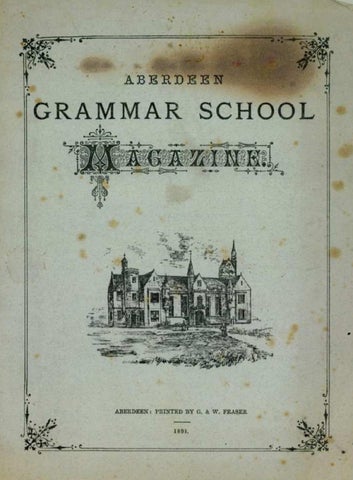
•
ABERDEEN
i
• 4,
t
GRAMMAR SCHOOL _
7 -
.
t pritRGIA,pm", 1E16)„,_ I
IP
41,46
47 ,,
,
w
ro--zoN
0
`6 k) ,
csj u
, r '
'
1
r
'
-
-
--
,_ -,--
,,
-e
•
-.
, ' -'....."7, - '.. '''.;:..---r--....'.- _ -____. .-' __.-tr..f _ .: : - -',.. --. ..."..7 4e.. _____...-_ .,., _ '''-' - -1564 i-" ••: ----./. aliiile"." ---- '74W41 -
'-'_ ___
-:7 A....AIT
:;' .-' '' '
'''' . .--7-1
- .,„--4,1',"1::.--..=.441t ,-:—_,,,,kagitc/vtiki, - . ,,.., .„
to •
•
ABERDEEN : PRINTED BY G. & W. FRASER •
r
• "•(•--: • C -=—-
--
1891. _5 -
CONTENTS_ •
•
NOTES,
.••
...
•••
• ••
1
FAMOUS FORMER PUPILS OF THE GRAMMAR SCHOOL,
••.
•••
2
RANDOM RHYMES,
•••
• • •
6
...
...
6
•• •
•••
8
SOME STORIES ILLUSTRATIVE OF HIGHLAND SUPERSTITION,
•••
8
WHAT BOOKS BOYS OUGHT TO READ, ...
•
• .•
• ••
10
WHAT'S IN A NAME?
. ••
• .•
••.
•••
• ••
11
" GOLF,"
• e •
...
• ••
• ••
...
11
BRANSCOMBE HOUSE,
•••
...
•• •
•• •
...
12
THE LITERARY SOCIETY,
...
..
...
...
...
17
•••
•••
• ..
.. .
...
18
GRAMMAR SCHOOL LIBRARY, ...
...
...
...
• ••
18
FOOTBALL, ...
...
...
...
...
•••
...
18
SWIMMING CLUB,
...
...
...
...
• .•
...
]
•.•
...
...
...
19
...
...
...
...
21
...
.••
• ••
• • •
• ••
•••
ON THE PERMANENT POPULARITY OF JACOBITE SONGS, VIRGIL.
CRICKET,
•••
BK. I.
...
.. . .
11. 305-334,
...
••.
.••
NOTICE TO CORRESPONDENTS, ADVERTISEMENTS,
•
ee
...
4 •
•••
9
i
4
ABERDEEN
Grammar Set2ool Aagazine. JUNE, 1891. Notes. AT last, after a considerable interval, the
Grammar School Magazine has reappeared. It would be difficult to give a reason why any pause in its publication occurred. Of course, last year, there being no Debating Society owing to some lack of energy on the part of the 3rd Classical, there could necessarily be no Magazine, which is wholly connected with the Literary Society. But two years ago a Debating Society did exist, with a far larger roll of members than the present one has ; so that it is not very easy to say why a Magazine was not published. Probably it was owing to the trouble which the preparing of a Magazine necessarily entails both on contributors and editor. The present school has great cause to congratulate itself on its activity in such matters. For not only has it revived the Literary Club and Debating Society, but it has held an Open Night in connection with this Society to which the general public were admitted—a thing unprecedented in the school annals. It has, moreover, reopened a Swimming Club at the Public Baths, which is in a thriving condition ; it has printed a catalogue for the now large and varied School Library (the work, we believe, chiefly of Mr. Alex. Findlay the energetic secretary); and it has decided to hold Athletic Sports. All this it has done without in any way interfering with its school work; for who will affirm that the present 3rd Classical is inferior to that of last year ?
Since our last publication a good many changes, more or less serious, have taken place. Not the least of these is the fact that our Rector is now Dr. Moir, the title of LL.D. having been conferred on him—a title which, all must admit, he has deserved to the full.
This event was the cause of great rejoicing throughout the school, and we have heard it, gleefully quoted that now we are in this respect no longer behind Gordon's College. Mr. A. V. Lothian who has for almost ten years been at once our teacher and our friend has, we regret to say, left his post as teacher here to fill a higher one as Lecturer in the Church of Scotland Training College, Glasgow. By his resignation we, as schoolboys, feel that our loss has been more than an ordinary one. For Mr. Lothian, himself a great athlete, ever took a most lively interest in all our school games. Throughout his mastership he occupied the position of Honorary Captain both to the Football and Cricket Clubs. Owing to his exertions Association Football was first started in the Grammar, which was at first most successful, but which has this year, we are sorry to say, collapsed. At cricket he always took part in at least one or two of the season's matches, and would often spend much of his time in instructing the eleven ; he has, moreover, been heard to say that in his opinion manly outdoor exercise is almost indispensable to school work. We cannot do more than wish him enjoyment and success where he now is.
Another very marked change in our school is the resignation of Mr. Legge. He has been teacher in the Grammar for thirty-six years, and was throughout liked by every one for his gentle and kindly disposition. He has assuredly amply merited the rest he now enjoys, and we feel sure that the heart of every pupil he ever had possesses a kindly recollection of him. The Grammar School did not come out of the Bursary Competition quite so well as might have been expected. In fact the result was rather disappointing; but at the end of the
2 University Session the prize lists of the Bajans mately we were victorious by six wickets. shewed that Grammarians could quite hold Gauld, the captain, took the "hat trick" in their own against all others. his first over. Among successful former pupils Thereafter a substantial tea was served r . school is John Wight Duff, B.A. (Oxon.• . e• ich the late antagonists hungrily attacked. was medallist here in 18S2, and on gaining a A better way of spending a holiday could Scholarship went to Oxford, where he gained not be devised, and we have to thank both his 1st class certificates in Moderations and Lordship and our opponents for the hospitality Litterae Humaniores. He is now engaged as with which they treated us. an Examiner for the Fullerton Scholarship. John Nicol Farquhar, B.A. (Oxon), was First Bursar here in 1883. He gained the Snell Scholarship, and, like Mr. Duff, went to Oxford, and gained a 1st class in Classical Moderations, and a 1st class in Litterae Humaniores. He has just been appointed to teach Philosophy and History in the College of the London Missionary Society in Calcutta. May success attend him ! Mr. Adam Fyfe Findlay, M.A., who was medallist here in 1886, gained last October the Brown Downie Scholarship of £100, in connection with the U.P. Church Divinity Hall, the condition being that the holder must devote one year to the special study of classics. Mr. Findlay, we believe, is at present on the Continent. William Findlay,M.A.,graduated M.B.,C.M., this year, with highest honours. Roderick M. Maclennan, MA., graduated M.B ,C.M., with honourable distinction. The excursion of the Cricket Eleven on the May holiday to- Haddo House turned out in every way successful. A conveyance was in prompt attendance at the school gate at 7'30 a.m., and, notwithstanding the chill air of the spring morning, with the help of greatcoats and mufflers a most enjoyable journey was made. On our arrival then shortly after eleven, the Earl introduced himself, and intimated that lunch would be ready at one o'clock. Until then a most delightful time was spent on the loch. After lunch came the business of the day— the cricket match. The bowling on both sides was good, the batting very indifferent. Ulti-
The School Bell still continues to deafen any unfortunate who perchance may pass beneath its thundering roar. There were, some time ago, rumours of a better modulated and less ear-splitting tinkler which was to take the place of the present one with its terrific clash ; but as yet there are no indications of any change.
Famous Former Pupils of the Grammar School, Aberdeen. BY DR. MOIR, RECTOR.
- -
(From a Lecture delivered on 18th January, 1889.) A SCHOOL which has a history of more than six hundred years must have in that period many famous pupils. As it has been connected with a famous historic city, the chances in its favour are largely increased. That Aberdeen is such a city cannot for a moment be doubted. One of its historians, Cosmo Innes, says: "Long before Edinburgh had acquired the precedency of a capital, or even the first place among the four burghs of Southern Scotland ; while Glasgow was yet an insignificant dependant on its Bishop, Aberdeen had taken its place as a great and independent Royal Burgh." Aberdeen is then no mean city, and its Grammar School shares to the full all its historic glories. Probably there is no institution in the city which has a record so continuous and honourable. Churches and forms of Government have changed. Bishops have had their day, both Catholic and Episcopal, churches which once were filled with shrines and crucifixes are now the property of Presbyterians. So in contrast with Municipal matters it may he noted here, that the title of Provost is of more recent date than that of Rector.
3 [The lecturer then gave a detailed and interesting account of famous pupils in the earliest days of the school ; but, owing to lack of space, we, with many regrets, feel constrained to content ourselves with those of the 18th and 19th centuries.] When we come to the 18th century (continued the lecturer) we find a good many famous names connected with the school. The first I shall notice is Thomas Blackwell. He was first Professor of Greek, and afterwards Principal of Marischal College. He did much to raise the standard of Greek learning in the North, and published two works which, though little valued now, were much thought of at the time. One of these was entitled " an Enquiry into the Life and Writings of Homer," the other " Memoirs of the Court of Augustus." His widow founded the Chemistry Chair in Marischal College, and left the money which forms the Blackwell Essay Fund. Dr. George Campbell, the opponent of David Hume, is the next famous pupil we shall notice. The Rector under whom he studied was Alexander Malcolm, who, contrary to the ordinary tradition of the Rectors, was dist;ngilished for Mathematics, not for Classics. His work on Arithmetic published in London was the most philosophical work on that subject which had yet appeared in Britain. Much that he places under Arithmetic would now be called Algebra. Dr. Campbell was appointed Principal of Marischal College in 1759. There is a story that he wrote to the chief of the Campbells, the Duke of Argyll, reminding him that his grandfather, or great-grandfather had held the basket into which the Marquis of Argyll's head dropped when he was beheaded. Whether this historical connection with the Duke's family helped Dr. Campbell in his application we cannot say, but he was appointed Principal. Dr. Campbell's great work, which gained him a reputation not only in Britain, but on the Continent, was his " Dissertation on Miracles," in answer to the famous David Hume's Essay on Miracles. It would be out of place to try here to settle which of the combatants had the best of the argument. Hume wrote a polite letter to Dr. Campbell saying that he had made an early resolution never to answer attacks on his opinions, but that he had never felt so violent an inclination to defend himself. Another work of Dr. Campbell's which greatly added to his reputation was his " Philosophy of Rhetoric." Several of the eminent
Scottish writers of last century devoted much time and composed works to help their countrymen to write good English. Lord Karats, Dr. Beattie, David Hume, Dr. Blair, all wrote with this view. It is interesting to recall the fact that the most famous metaphysical writer which. Aberdeen has yet produced, Dr. Alex. Bain, has followed in Campbell's footsteps, and has given us works on English Grammar, Scotticisms as they are erroneously called, and Rhetoric. Dr. Bain was for some time a pupil of the Grammar School, and must have derived some benefit from coming in contact with the accurate scholarship of Dr. Melvin. But to return to Principal Campbell. He impressed all who came in contact with him as a deeply religious and profoundly learned man. Probably no clergyman of the Established Church of Scotland can be mentioned whn has done more to save that church from the charge often brought against her that she has produced no great theological writer. Another defender of the Christian faith was also connected with the school, not however as a pupil, but as a master. This was Dr. Beattie, the author of the " Minstrel." His " Essay on Truth " gained him great fame. His portrait in an allegorical picture was painted by Sir Joshua Reynolds, and may be seen in Marischal College. He married the daughter of Dr. James Day, who was master and rector in the school for some 70 years. Their son, James Beattie Hay, was educated in the Grammar School, and was a young man of great promise. He was appointed assistant and successor to his father as Professor of Moral Philosophy, but died at the early age of 22. Another poet connected with the school was Wm. Meston. Like Beattie he was a master for some time in the school. He was afterwards appointed Professor of Philosophy in Marischal College, but when the Rebellion of 1715 broke out he adhered to the Stuart side, and lost his professorship. The Earl Marischal, by way of compensation, made him Governor of Dunottar Castle. When the Rebellion collapsed he returned to teaching, opening Academies in Elgin, Turriff, and Montrose. As a poet he imitated the famous Butler in his " Hiidibras." He shews very considerable power of sarcasm and wit ; but, sometimes like his model, borders on the indecent. While speaking of poets connected with the school I am proud that one of the greatest
4
i
•
of all poets, George Gordon, Lord Byron, was for some years a pupil in the school. We still possess a register of the school dating from 1796, in which Byron'slikame occurs as entered each quarter. He was only eight years of age when he came to the school, and he left it when between ten and eleven. The age for going to the University in those days was about thirteen, so that Byron was within a year of the highest class in the school. He seems to have occupied a fair position in the class, nearer the top than the bottom. When his name first occurs it is erroneously spelt, shewing that the English name of his father was little known in Aberdeen (it is spelt Bayron). His mother lived in a house near the entrance to Marischal College, and we can imagine the little, lame, sensitive and impassioned English boy mingling with the, to him, rough and rude Aberdeen boys. There is a story that, when the news of his having succeeded to the title which he afterwards bore reached the school, the master in calling the roll next morning designated him Domine, whereupon the poor boy, doubtless confusing the latin word with the Scots name for a pedagogue, and resenting such a name, burst into tears. The poet's vacations were spent at a place a little on this side of Ballater, and there the grandeur of Lochnagar so impressed his youthful imagination that he has in his poems put it in comparison with " Many-fountained Ida" that frowns o'er Troy. So, too, his walks on Saturdays to Balgownie's Brig's black wa' has obtained for that ancient structure a European fame, for it must not be forgotten that on the Continent of Europe Byron has a reputation second to no British poet. When the old school on Schoolhill was demolished some years ago, 0 I went round to a few old pupils and collected some £25 in order to preserve the door by which Byron entered, as well as Robert Ferguson's ancient belfry. These are all that remain to connect our present site with the ancient historical home on the Schoolhill. In last century the name of Gregory is perhaps the one which throws most honour on the Grammar School. These Gregories were connections of the famous Rob Roy McGregor, and one of them actually had the audacity to offer to take Rob's son and by education make a gentleman of him. Unfortunately Rob's ideas of what constitutes a gentleman were not those of his learned relative. David Gregory, Professor of Astronomy iri
Oxford, was born in 1661, in Aberdeen, and was educated at the Grammar School. His father was the first person in Scotland who possessed a barometer, and his prophecies as to the weather caused him to be regarded as a wizard. The Presbytery sent a deputation to interview the father, and only spared him discipline because he used his superior knowledge, not only in such uncanny ways as fortelling weather, but also in healing the diseases of his poorer brethren. His son David so distinguished himself that when he was only 23 years of age he was appointed Professor of Mathematics in Edinburgh University. Here he was the first man in Britain to teach Sir Isaac Newton's Principia. He afterwards came to be the intimate friend of Sir Isaac, and was appointed Savilian Professor of Astronomy in Oxford in 1692. His father had the singular honour of having three sons all professors at the same time; David, of whom I have been speaking; James, who succeeded his brother in the Mathematical chair of Edinburgh ; and Charles, Professor of Mathematics in St. Andrews. James Gregory, a distinguished member of the same family, is chiefly famous as the inventor of the Reflecting Telescope. He was educated at the school, and rose to be the greatest authority on Astronomy in the kingdom, and he married a daughter of Jameson the painter. He was appointed Professor of Mathematics in Edinburgh University, but did not long enjoy the chair, for after sheaving some of his pupils the Satellites of Jupiter, he was suddenly struck blind and died three days afterwards at the early age of 37. Dr. John Gregory belonged to the same gifted family, and was born in Aberdeen in 1724. After receiving his education at the Grammar School and King's College, he removed to Edinburgh, whence, after studying medicine for three years, he went to Leyden for further study. He was recalled to fill the Chair of Philosophy in King's College, but soon resigned it and went to London to practise as a physician. Here he lived on intimate terms with all the famous men of the day. In 1755 he returned to Aberdeen to fill the Chair of Medicine in King's College. He was elected to the Chair of Medicine in Edinburgh eight years after. He published various works which were much esteemed at the time. He was found dead in his bed in February, 1773. A pupil of the school who rose to fame in
5 a different way was James Gibbs, the celebrated Architect, born near the close of the 17th century. He studied architecture in Holland and Rome. He returned to Britain in 1710, and by the influence of the Earl of Mar got much employment. His first great work was the Church of St. Martin's in the Fields, London. Cunningham says of this edifice :— " All the parts are nicely distributed, nothing can be added, nothing taken away." The Radcliffe Library of Oxford was built by him, and is his most magnificent work. Of the dome of this building Cunningham says :— " It is perhaps the grandest feature in the grandest of all English architectural landscapes." In 1728 Gibbs gave to the magistrates of his native city a plan for the West Church of St. Nicholas. This church may still be seen, but neither externally nor internally is it very handsome. I do not think there is any other building in the city which can be ascribed to him. But it is time now to come to the present century. For chronicling its famous alumni, we possess the Registers of the school from 1796. These shew a number of names of men who have risen to fame in various spheres of usefulness. I can only briefly touch on them. The first great name is Byron. Of him I have already spoken. Sir James Outram, a distinguished Indian officer. Sir James McGregor, dux in 1784 ; rose to be the head of the Army Medical Department, and Rector of Marischal College. The obelisk in the Quadrangle of the college is to his memory. In 1809 the famous scholar and future Rector, Melvin, left the school, gaining the 1st bursary. He was appointed Master in 1821, Rector in 1826, and died in 1853. Sir Alexander Anderson, the most far-seeing and public spirited provost of the century, to whom is due the honour of erecting the present school. William Littlejohn, once manager of the Town and County Bank. The late Professor Ogston. The late Wm. Spalding, Professor of English in St. Andrews University. Dr. Francis Edmond, of Kings wells. Dyce, the famous Painter. Dr. Islay Burns, Professor in the Free Church College, Glasgow. Dr. Blaikie, dux in 1833 ; Professor in Free
Church College, Glasgow, and editor of " Sunday Magazine." The venerlible Principal Brown, Free Church College, Aberdeen; dux in 1817; one of the translators of the Revised Edition of the New Testament. David Masson, Professor of English in Edinburgh University, and Author of the great " Life of Milton." Dr. Alexander Bain, Metaphysician; author of works on Grammar, Rhetoric, Education, Psychology and Logic. Professor Matthews Duncan, a leading London practitioner, who died lately. Dr. Thomas Keith, M.D., Edinburgh. Professor Adams, Cork University. Dr. John F. White, Art Critic. Dr. Chalmers, China, Author of a learned work on the Chinese language. Dr. George Ogilvie, Ifeadmaster of George Watson's College, Edinburgh. His brother, Robert, one of H.M.'S Senior Inspectors. 1 heir brother, Joseph, Rector of E.C. Training College, Aberdeen. James McDonald, LL.D., Principal of Kelvinside Academy, Glasgow. James Donaldson, LL.D., Principal of St. Andrews University ; formerly Professor of Humanity in Aberdeen, and before that, Rector of Royal High School, Edinburgh. Two distinguished brothers, Charles and John G. Robertson, Indian Civil Service. Their brother is Professor George Croom Robertson, Editor of "Mind," who took the 1st bursary from the old 4th class. Three masters were at the School about this time—Mr. Sleigh, Mr. Legge, and Mr. Morison. Charles Slessor, a Senior Wrangler. Sir Robert Hamilton, Governor of Tasmania, and formerly Under-Secretary for Ireland. He, strange to say, succeeded in Tasmania another old pupil and fellow-student, Sir George Strahan, who held several proconsulships in turn. A class-fellow of their's was George McKenzie, who was the champion chess player of the world. Sir James Stirling, one of H.M.'S Chief Justices for England, and dux in 1851. He was a Senior Wrangler. A very famous and good man of the General Gordon type was Colonel Francis Duncan, M.P., and he was at school with Strahan,
•
/
6
a •
•
Hamilton, and Stirling—a rare galaxy of talent. Professor Salmond, Chairman of Aberdeen School Board, and Author of Theological works. James C. Geddes—brother of the Principal— a distinguished Indian Civil servant, cut off in his prime. Professor James Robertson, Professor in F.C,. College, and formerly Principal of Training College in Calcutta. David Littlejohn, Sheriff-Clerk. Professor Morison, University College, London, formerly English Master in this school. Wm. A. Hunter, M.P., formerly a Professor in the same college. Thomas A. Stewart, LL.D., H.M.'S Senior Inspector. Interim Rector here in 1869. Wm Eimslie, Professor. in Presbyterian College, London. John Cook, Principal of Bangalore College, India. Robert A. Neil, a distingnished Sanscrit Scholar, and Lecturer in Cambridge. Rev. James Paterson, Professor in U.P. College, Edinburgh. William Mollison, a Second Wrangler; a distinguished Mathematician and Fellow of Clare College, Cambridge. Professor Alex. Ogston. Wm. Jenkins, Indian Civil Servant. He was killed at Cabul—a man of great promise. David Ferrier, Professor of Medical Jurisprudence in London University, and Author of works on the Brain. W. R. Nicoll, Editor of the " Expositor." Mackay, of Ugunda, left School in 1864. Frank Ogilvie, Principal of the Heriot-Watt College, Edinburgh. John Ramsay, Editor of the "Aberdeen Journal," and founder of the Smith Medal— a genial and witty writer. These are some names of famous pupils. I would be very sorry if I have omitted any who deserve a place in my list. If I have done so, it is from oversight. Nor have I spoken of very recent distinguished pupils. although the prospect of our roll of fame continuing as illustrious as before is bright. It is for you, the pupils of the present day to take courage, and to determine that what Grammar boys have done you will do; and that you will do nothing to dishonour the record of your school,.but will hold high its banner in the face of the world.
•
Random Rhymes. On ! the Grammar School of Aberdeen
So famed for useful knowledge, Whence lads emerge though scarce thirteen, Equipped for Marischal College. The masters all are in their prime, Speak gently to beginners, Nor " make the punishment fit the crime " Even to the smallest sinners. Here mirth and song go gaily round, Spite of Examinations ; And when boys reach the cricket ground, " Good-bye to all vexations." Long Latin verbs no more they quote, Adieu to grammar, life's worst Bain ; For cricket's found the antidote To that, and all scholastic pain. So up, brave lads, and hold your own ! Let Aberdeen stand and admire ! Your skilful play has gained the crown From this, and every other 'shire. At football, too, your clever tricks Might well the stoutest heart appal, As rushing on with artful kicks You raise the buoyant, big, black ball. In days gone by what famous men Made thee their academic home ; And in our time, no less than then, " The cry is ever still they come." Dear Grammar School ! thy classic halls Teem with bright visions ; fancy 's fingers With living pictures deck thy walls, And round them memory's halo lingers. J. H. S.
On the Permanent Popularity of' Jacobite Songs. IT is a familiar experience of everyday life that one thing leads to another. Not only so, but many people are constantly in a puzzle to find out how things come about 1 This is as true of literature as of the affairs of everyday life. In poetry, science, and philosophy alike an absorbing study it is to trace the sequence of events, and find out how far one thing leads to another; and the study is often both profitable and entertaining. To trace the various influences that mould the literature of each succeeding age is the interesting work of many a literary critic. As an example of this kind of study, let us try to explain how it comes about that the Jacobite songs have such an abiding interest. How is it that so many songs come and go, but the ballads of the Jacobites, like Tennyson's brook, go on for ever ? Not so very long ago, " My Grandfather's
7 Clock" was the popular refrain. Now it is as dead as Methuselah. Many of us can remember when every butcher's boy, who went along the street with his tray of joints on his head, shouted that a sailor's life was the life for him, " ya ho l " but now-a-days if we were to listen attentively to this same butcher's boy, it would be found that his melody mainly referred to the " Bogie Man." How is it ? !here is no doubt that in a few months the " Bogie Man" will be a thing of the past as completely as " Kafoozalum." Again we ask, how is it ? For there is a very different story to be told of such songs as "The bonnets of bonnie Dundee," or "Hame cam' oor gude man at e'en." They are not like meteors, one moment bright, and then utter darkness for evermore. No. They are always welcome. They enjoy a steady, even popularity from age to age. " Wae's me for Prince Charlie" never becomes a catch song on the street. No ; but on the other hand, it never relapses into oblivion. I shall attempt a partial explanation of this phenomenon, for no doubt it is due to many causes, all of which could not well be enumerated. To do so, I must go back to the age of Shakespeare. The Elizabethans were giants in all forms of poetry. They wrote many giants of poems in those days. One of 100,000 lines would be regarded as little more than a bantling. And assuredly they also wrote delightful little songs, such as the English people had not heard before. In the art of song making, as elsewhere, the great master held his own. Scattered up and down the plays of Shakespeare, you will find many beautiful songs which must have charmed the knights and ladies of the Tudor age. Some of these are favourites still. In "As you like it," for instance, and in " Much ado about nothing," in which is the song where, to our shame, we are told that— " Men were deceivers ever, One foot in sea and one on shore To one thing constant never."
Nor does Shakespeare stand alone. Marlowe has some beautiful lyrics which you will find the gentle fisher quote with keen appreciation in his " Complete Angler." Iu the next generation the songs of Ben Jonson and Raleigh kept up the true lyric fervour, and passed it on to the Cavaliers. It is here we find the link between the Elizabethans and the Jacobites. While the
stern Puritans turned to an absorbing study of Scripture, and moody reflections on the wrongs which people suffered at the hands of despotic kings, the Cavaliers found del4tit in the beauty of the Elizabethan poetry. %Then the Puritans got the upper hand in Parliament, and in the war, they crushed down the drama and closed the theatres. But the songs they could not crush. As the struggle went on the Cavaliers gave vent to their loyalty and chivalry in patriotic songs and love songs. Suckling and Lovelace became their favourite poets. And even Wither could write such words as:— " Shall I, wasting in despair, Die because a woman's fair ; Or make pale my cheeks with care 'Cause another's rosy are ?"
Patriotism and love were the favourite topics of the Cavalier poets; and they transmitted this lyric spirit to the gaygallants who frivolled like butterflies round the Court of King Charles II. In his time, as you know, the pure Cavalier of the type of Peveril of the Peak was changed to the licentious fop who loved to imitate .the excesses of Buckingham and Rochester. The English songs of that time may have had more wit; but they lost the mellow purity of the age that had gone by. In Scotland, however, where James, Duke of York was governor, there was not the same excess of frivolity that characterized the English Court. While James cruelly repressed the Covenanters throughout the country, he. fostered a spirit of moderate gaiety at Holyrood, and followed the footsteps of his ancestor James V. in cultivating music and the fine arts. Poetry was cultivated in a moderate degree by Scottish Royalists, and when, some years later, James became a fugitive king, this culture—combining a patriotic love for Scotland with a loyal regard for the exiled family—found vent in song. They sang of the victories of Montrose and the-gallant bonnets of bonnie Dundee who died at Killiecrankie for the exiled king. The Jacobites clung closer to one another in adversity, and their feelings became more intense as their numbers decayed. They were never strong enough to face the prosaic brute force of the Hanoverian whigs. The " Standard on the Braes o' Mar" was but a poor military display ; and as the Jacobites were too hopelessly weak to fight for their prince, they had. to content themselves with singing his praises and singing their contempt for the " Wee, wee German lairdie."
•
•
$
•
..
8 Purcell was an apt composer of the bygone age, and his sweet airs were readily imitated and even excelled by many artists whose names are now forgotten. Patriotism and a feeling of loyalty for an ancient and unfortunate royal family were the moving excitements of the Jacobites ; and the appearance of an adventurer so romantic as Prince Charlie gave these feelings an enormous impetus. His short, brilliant, sad expedition inevitably gave rise to an efflorescence of song. The human heart was stirred to its depths by his fateful adventure. And it is because these songs are the outpourings of deep stirrings of the human heart that they are popular songs for all time. Only one other element was wanting to completely effect this. There was needed the rise of some great genius to cast a glamour over the Jacobite cause and enshrine it for ever as a sort of Epic event. Scott did this; and Burns helped beforehand by enlarging the number of our Jacobite songs and giving them a truly national setting. And were in the history of literature is there to be found such a combination as Scotland has in Burns and Scott? They gave the whole Jacobite movement an Epic grandeur, so that the wretched skirmishes of Johnny Cope and Cumberland now take rank with the feats of Achilles on the plains of Troy, or the deeds of Launcelot that so won the heart of Guinivere.
Him in the deep wood's darkling shade His mother met ; a spartan maid In Booth was she : for face and mien Of that proud race she wore serene ; Or as Harpalyce of Thrace The horses outstrip in the race, And the swift Hebrus tires ; For after wont of reverie, Her bow convenient hung had she, A huntress born ; her tresses fair Unbounded wantoned with the air ; Bare to the knee, and by her side Her flowing tunic neatly tied. Then first she spake " Oh youth, deign chew, For tidings aught I'd gladly know, If haply by this way there strayed, In hide of spotted lynx arrayed, With quiver hung her shoulder o'er And pressing close the foaming boar Aught of my sisters fair." Thus spake she, thus Aeneas replied, " None of thy sisters I espied. Oh, how shall I address thee ? thou A virgin ? nay, for on thy brow No mortal presence glows. Nor sounds thy voice as that of man, Mayhap from heaven ? the pure Dian ? Or of the blood of Nymphs ? Shine on us now ; propitious hear Our toils ; do thou our way make clear ; Under what heaven, or on what coast Driven are we, by wild tempests tossed ? Unknowing and unknown we stay Swept by the wind o'er watery way. And many a victim by this hand Shall thy propitious halls command."
Some Stories Illustrative of Highland Superstition. •
Virgil. Bk. I. 11. 305-334. BY D. MCDONALD. ALL night the chief in restless mood O'er thousand torturing cares did brood, But with the first warm streaks of day He gat him up, to hie away New places to explore. On what coasts by the tempest blown His shattered vessels had been thrown ; Who o'er the wastes supreme sway hold, For shrub nor tree does he behold, If man or beast he might espy And back with tidings swiftly fly. Within the hollow of a grove His fleet he hid, and right above A beetling crag hung o'er : With trees enclosed all around, With horrid shades and gloomy crowned. Forth steps the chief, and by his side Achates walks, that henchman tried ; While in the hero's hand are seen Two spears with broad-tipped points, and keen.
ABOUT a hundred years ago superstition seems to have been rife in almost all parts of Scotland, but it has rapidly disappeared, at least in the Lowland counties. The Highlands seem to have been most conservative of it, perhaps from the fact that its inhabitants have been longer in ignorance, and have only in recent years benefited by the civilization which has e'er now penetrated its wildest and remotest glens. It may be due to the highly imaginative nature of the Celt. Many are the stories told, some of which would seem to be plausible enough, others which no circumstance whatever could give any foundation to. The few which I relate are some of those which I have actually heard. The following incident is true and one which the originator turned to good account, In one of the Western Glens of Invernessshire, which was mostly populated by Roman Catholics, a man of more enlightened character than his neighbours possessed a piece of marshy
--
9 ground which was thickly grown over with rushes. These he used to thatch his stacks. It so happened that he began to miss some of his rushes from the marsh, and his suspicion naturally fell on his Roman Catholic neighbours. Accordingly he struck upon a plan to impose upon their superstitious fears and credulity, knowing their weakness in regard to " coinnealean " (i.e. candles or lights). One night he went into the middle of the marsh with a lantern, and there waited for the filchers. Byand-by, hearing a rustling sound, he uncovered his lantern, and moving about as noislessly as possible, held it up to view. No sooner did they observe it than they exclaimed " boin hidibh ! se an diabhal f hein a tharen," which means, " Look ! it's the devil himself," and took to their heels. The supposed devil had a hearty laugh over it and the satisfaction that he had effectually put a stop to any thievish advances in future from his simple neighbours. Another story has rather the appearance of truth about it, but from having passed through so many mouths must have received some gloss, as such stories usually do. There are few people now living in the district of Badenoch in the south of Invernessshire, who remember the Black Officer—so called from his dark 'and saturnine appearance. The incidents regarding him occurred about the beginning of this century. At that time he was acting as recruiting officer for the army, or rather he pressed men into the service. Consequently he was deeply disliked by the people, and was as greatly feared since he was reputed to be in league with the evil one. One evening, late in the season, about the beginning of this century, the Black Officer and a few of his men were encamped in the forest of Gaick, a gloomy glen four or five miles south of Kingussie. As night drew on, the men, who were at all times superstitious, began to feel " creepy," as their master's countenance wore an unusually uneasy expression. At last a sound was heard outside, and presently a figure appeared dimly in the shadow of the tent door. The figure, all the men firmly averred, wore horns, but they were not sure as to the cloven feet. However, it exclaimed, " follow me," to the officer. The latter cowered down in the tent, crying " Oh, not yet; my time is not yet come, wait for a year at least." But the stranger was inexorable, so with great trembling and reluctance the officer passed out along with him. What passed between him
and the strange personage he never told, but his countenance wore the expression of one who had seen the smoke of the bottomless pit. This incident the men of course put down as a foreboding of a violent death to the officer, and mentally resolved not to attend him next year if he should ask them to go to Gaick to hunt. A year later, in the middle of winter, the officer happened to be in Kingussie and asked some men to go with him to Gaick. He got only one man, whom he sent in quest of more from an adjoining district. After getting a sufficient number of men he went to the forest (by a forest I mean a deer forest, which may not have a single tree in it), and took up his quarters in a shieling well up the face of the frowning mountain side. Two or three nights later a storm of drifting snow—some say also thunder and lightning—raged round the hut, the like of which has never been experienced since. The men were in a state of great trepidation, and well they might be, for next morning the hut was nowhere to be seen. An avalanche had fallen during the night and had swept all away. The curious circumstance is that, when the officer's body was found many hundred yards distant from the site of the hut, his rifle was twisted round him. This gave rise to superstitious conjectures, and even today those that remember the occurrence speak with bated breath of the " Black Officer." A comparatively recent incident is rather ludicrous. One night some years ago, a man was returning home from an adjoining parish to that of Kingussie. On his lonely way he had to pass a churchyard, and of course long before reaching it he summoned all his courage to his support for the most critical part of the journey. A high wind blew. As he approached the churchyard his heart literally jumped to his throat on receiving a smart slap on the right cheek. In his terror he dared not look round for fear of seeing the angry spirit. But as he received several others in rapid succession his pace, which was at first rather swift, changed to a regular run. On reaching his destination he informed his companions in hardly coherent terms of the occurrence, and would probably have remained under the impression that the spirits of the dead had been disturbed by him, had not one of his audience, mischievously pointed to his Glengarry bonnet. Then it rapidly dawned on him that it was the ribbons of his bonnet,
10 more wholesome. " Robinson Crusoe," " The Arabian Nights," " The Vicar of Wakefield," "Don Quixote," Hans Anderson's "Fairy Tales," The " Pilgrim's Progress," and " Gulliver's Travels" are books that transport their readers to varied scenes in different lands, and are types of thoroughly distinct sorts of life. These seven would in themselves form a fair prose education for the imagination. Nor are they books merely for smaller boys. Listen to Mr. Fred. Harrison's words in " The Choice of Books "-" If you have never opened Crusoe and Don Quixote since you were a boy, and are wont to leave the Bible for some wet What Books Boys Ought Sunday afternoon—know, friend, that your reading can do you little real good." It would to Read. be ungrateful to overlook several writers who have designed much of their work for the By J. WIGHT DUFF, B.A., Oxon. entertainment of youth. Boys may choose unhesitatingly from among these—Captain Marryat's " Mr. Midshipman Easy," Fenimore " BOYS will be boys "—someday, too, they will be men, and find reason either to bless or to Cooper's "Last of the Mohicans," R. M. lament the course of reading they have Ballantyne's " Dog Crusoe," W. H. Kingston's followed in youth. If the following remarks "Three Midshipmen," Jules Verne's "Boy can suggest a few volumes useful or entertain- Captain," and Rider Haggard's " King Soloing (or both) to Grammar School boys, they mon's Mines." A great deal may be learned from Lytton's " Last Days of Pompeii," and will have admirably served their purpose. Let me preface the whole with the explana- Kingsley's " Westward Ho I" and Dickens may tion that I have confined my hints to be represented by David Copperfteld, Nicholas literature—mainly our own British literature— Nickleby, and The Old Curiosity Shop. I need and so have foreborne to trespass on the scarcely appeal to your Scottish patriotism to demands of science. For instance, although recognise that a greater than any of these has I can heartily sympathise with the interest yet to be named. Sir Walter Scott is the boys take in animals, I do not refer to works prince of novel writers: we commend none of his works specially; read of him, as Mr. on Natural History. There can be no doubt as to the first book Ruskin says, every " word." Nothing, unfits the mind more hopelessly for to be named—the Bible. Boys, young and old, whose hearts and tastes are right, will not honest study than excessive attention to fiction. forget to read the book of books both on To read too many novels is to debauch and Sundays and weekdays. But it is harder to dissipate one's mentel energy. Hence, such know what to suggest next. Perhaps it may literature as the above must he read gradually be well to pass boldly to a very different —certainly not to the neglect of more serious department, and talk of the Light Literature work. Under History and General Literature may be suggested Green's History of the which can be recommended. And first a note of warning. As a rule English People (or flume's History of Engperiodicals are to be avoided; at best they are land), Scott's Tales of a Grandfather (" being the literature of the passing hour, and surely the History of Scotland from the earliest it is far better to spend one's leisure moments times "), Carlyle's French Revolution, Landor's in the company of the greatest writers of the Imaginary Conversations, Essays, by Dr. world. A few magazines, such as "The Boy's Quincey, and Ruskin's Sesame and Lilies,. Own Paper" and "Great Thoughts," may be and probably one or two more of his; but excepted from the general condemnation. But beware of worshipping him so as to blind you there are hosts of permanent works to select to some of his extravagances. And while one reads the history of nations, from—",joys for ever," as full of thrilling adventure as any cheap periodicals, and far one must not forget the history of individual
aided by the wind, that had so forcibly impressed his mind with the idea that the manes of his forefathers were irritated against him, and he now joined heartily in the laugh raised at his expense. Many more anecdotes could be told regarding Highland superstition, but they would entail a much greater area of paper. Let these suffice as examples of the weird legends of the north as well as the highly susceptible D. McD. nature of the Highlander.
•
t
a
t4
11 men, who are the makers of history. Biography can he cordially recommended as most inspiring literature " Lives of great men all remind us We can make our lives sublime."
4
P 1
I mention only Boswell's Life of Dr. Johnson, Johnson's Lives of the Poets, Carlyle's Heroes, and Essays by Lord Macaulay (whose high conception of " every schoolboy's" knowledge cannot fail to interest you)! Last, but certainly not least, Poetry. Read Shakespeare, Milton, Wordsworth, Burns, and Tennyson ; and when you know their masterpeices you will be well able to say for yourselves what is great and good in other poets. You are probably reading at school some parts of the greatest works of antiquity in Greek and Latin : try to look on them as more than mere material for examination papers : feel that they are the real thoughts of men who lived thousands of years ago. Nothing can be more refining to the taste than a true appreciation of Homer and Virgil ; and nothing should so clearly convince you of the worth of a classical education as the practical way in which it helps students towards Matthew Arnold's ideal of culture—" to know the best that has been thought and said in the world."
What's in a Name? BY J.
•
0 i
'MANG a' the names auld Scotia boasts That don't tae English pander, Ye winna fin' a sweeter ane Than that o' Alexander. Nae doubt ye'll get mair stylish names, As Percy, and Leander ; But gin ye want an honest man His name is Alexander. As daunderin' hame the ither nicht, Whaur brooklets did meander, I hearkened tae their sang, and aye They sang o' Alexander. 'Twas in Trafalgar Bay, I've heard Brave Nelson was commander ; I dinna mind his foremost name— It sud be Alexander. Last simmer it was dreadfu' hot, I felt a salamander ; Sea breezes fanned my fevered brow, Birds whispered—Alexander. I thocht I'd tak a wee hit change Tae Netherlands and Flander ; At cheap excursions ye'r aye sure Tao meet wi' Alexander.
The guard pit in his bearded face ; Some wives were talking slander— At ance he swore an awfu' sweer ; His name was Alexander. Where'er I roam, frae East to West, Or North tae South I wander, It's a' the same—there's but a'e name, And that's aye Alexander.
" Golf." BY " LUDI GOLFICI AMATOR." GOLF or "Gowf," as slang terms it, may be fairly called the Scottish National Game. It dates back to the reign of James I., who himself took an interest in the game, which at that time was played in a very different form from what it is now. Etymologically the word is interesting, being derived from Danish " Koff" and German " Kolbe," which are cognate with " club." The game is played on Links in Scotland, and Commons in England, and is one of the intensest interest both to players and onlookers. Very few people, however, who don't play golf see the fun of the game, which, they say, " consists in whacking a piece of gutta-percha from one hole to another." They also think it is too easy to be worth while playing; but when they are persuaded to begin they find it a very different story. Perhaps for the benefit of those who don't play golf, it would be well to give a short account of how the game is played, in order to create an interest in this " royal and ancient game." The "Round," as it is termed, golfice, consists of 18 holes (sometimes fewer where the links does not admit of 18), cut out in the turf at distances from each other ranging from 100 to 400 yards—the object being to send the ball from one to another in the fewest possible strokes. The holes are small and round, being about four inches in diameter, and half a-dozen inches in depth. The balls are made of guttapercha generally, but vary in size. The clubs or instruments by which the balls are driven from one hole to another are of two kinds :— (1) Those whose head (i.e. the lower part of the club by which the ball is hit) is of wood, and (2), those whose head is of iron. The chief wooden clubs are—driver, spoon, brassy, and putter. The chief iron ones—cleek, iron, niblick.
12 The driver is used for the first shot from each other ; or 2 v 2. Any number may play each hole, which is played off a slight elevation from one upwards provided there are materials. There are golf clubs (i.e. societies) all over of sand provided for the purpose near each civilised world ; but the parent of them all the which placed, and ball is hole on which the is the " Royal, and Ancient Golf Club " of St. is called the " tee." The spoon and brassy are used on fairly Andrews. This golf club bears the same relation to other golf clubs as the M.C.C. does level ground during the course. The putter is used for the most intricate to other cricket ones, in prescribing rules, &c. play in golf, viz.: the play on the turf which There is a splendid golf course on the Aberis levelled and cut short for about twenty deen Aulton Links, which, alas, is being deyards round the hole, and called the " putting- stroyed by that abominable game—Association green." On this stroke the issues of a match Football. There were, a year or two ago, one generally depend. It is a stroke requiring or two holes on the New Town Links ; but great coolness and calculation. It is one of owing to that game they had to be taken away, the keenest interest to all concerned, and in and the result of it all is that the Aberdeen that respect this game cannot be equalled by club has departed to the Balgownie Links where it has a magnificent course, and where any other outside game. At the 17th hole, say, a couple are equal. rust, in the shape of other games, does not They lie on the green of the 18th hole in 3 corrupt. There are still, however, three clubs and 2 strokes respectively ; A with his 3rd, which play over the old course—the Victoria however, is so near as not to be able to miss with a membership of over 100, the Bon(or golficd lies " dead "), while B is 2 or 3 yards Accord, and the University; and perhaps it from the hole with his 2nd. He goes through would not be a bad plan if the good old all the necessary preliminaries, and is about to Grammar, to its numerous clubs and societies, play a stroke on which, perhaps, £50 depends. added a golf club. He raises his club, brings it down again and hits the ball; it goes straight, but has it strength enough ? Yes ! No ! It hovers on Branscombe House. the edge ! What a moment of suspense. But, joy ! it goes in. He has got his £50. Of the iron clubs, the cleek is the most use(FOR OUR YOUNGER READERS). ful. It is the only club that can be used over the whole course, from the drive to the putting. CHAPTER I. There are two things, however, for which it is observer would have seen that hardly sufficient—sand and broom, alias ANY ordinary " bunkers" and "whins." The iron is the something unusual had taken place at Bransclub to be used there, or if the ball is badly combe House, Derbyshire, one glorious day in September. Boys were standing in groups of in—the niblick. Having thus described the various imple- three or four about the quadrangle, discussing something with great excitement. The cause ments, I may state the method of play. match for of this excitement will be best explained by people are playing a two Suppose holes, i.e. whoever wins most holes wins the quoting the speech which Dr. Richards, the match. A drives off first (precedence being head master, made to the boys that morning. given by choice between the players), in the On ordinary days, after prayers, the whole direction of hole No. 1, his object being to get school immediately began work, but on this in in fewer strokes than B. Suppose A goes morning Dr. Richards, by an imperative gesture, in in 5 and B in 6, this is A's hole, and, there- made every boy reseat himself, and then fore, he drives off first (or " has the honour ") addressed them as follows :— " My boys, it grieves me more than I can to the 2nd hole which, let us say, is halved (i.e. they both take the same number of strokes). say to have to make you acquainted with the% A then drives off again. Suppose B wins this cause of my detaining you just now. Some hole, he then drives off to the 4th hole, and so time ago I received complaints to the effect that certain books, and various other articles on—the winner of the hole driving off first. of small value had gone amissing. I thought in the following may be played A match ways :-1 v 1; 2 v 1; 3 people playing against nothing of these complaints at the time,
A
I
13 them as proofs of carelessness of the have had their goods bagged. I think they regarding Oo complainants, but yesterday I was put in pos- might have told the monitors before they session of information which proved only too went to Old Richards, and given them a chance clearly that Branscombe House has a thief in of settling the thing without a beastly row ! " " There's something in that," said Trent, its midst. I make this statement with the intention of warning you to put in a place of " but I suppose the fellows thought that the safety any valuables you may possess. Before Doctor would take more efficient steps than I conclude I wish to say that should any boy the monitors, who have quite enough to do as obtain a clue to the culprit, let him not be it is, without taking on any police work." " Come along, you fellows, and have a game prevented by any trifling- considerations of schoolboy honour, but let him at once inform of cricket. We'll hear enough of this affair for me in order that steps may be taken to punish the next month," said Fred, moving off towards the person, whoever he may be, for one of the the cricket ground. The others followed, and, most contemptible crimes that a boy can com- being soon joined by several others, they mit, namely, stealing from his schoolfellows. enjoyed a pleasant game in spite of the stirring events of the day. You may now go." The boys trooped out of the hall in dead silence. Lessons became quite impossible for CHAPTER III. that day, and the masters found it useless to try to command the attention even of the As the trio and Ralph were returning, they most studious youths. All were eager to get met Miss Dolly Richards, daughter of the out and talk over this break in the monotony head master. Dolly was a pretty little girl of of school life. And it is now that our story about 15 years of age, and half the chaps in the school were enamoured of her, whose begins. attentions she received in a cool and dignified CHAPTER IL manner. But Dolly had her weak point, like LET us turn our attention to the three boys all other damsels, and that weak point was standing a little apart from the others ; they Frederic Gilbert. When she saw her chosen one approaching, are in the 5th form, and owing to the fact that they were always together, were denominated she blushed and modestly cast down her eyes. Fred, who, it must be confessed, was much in the " Trio." The eldest of the trio, who is also our hero, love with Dolly, left his companions in order was a tall, finely built lad of 18 years of age. to speak for a moment to the object of his His name was Frederic Gilbert, but he was affections. " I say, Dolly," he began, " do you always talked of as " Fred." The other members know anything about the thefts which have of the trio were Digby Ransome, and Philip heen committed in the school ?" "All I Trent, both ordinary types of the English know," replied Dolly, " is that papa has been in a regular rage since yesterday, when someschoolboy. Doctor body said that things had gone amissing. wish the " I saying, Our hero was had entered a little more into particulars, and I havn't the faintest idea who did it, but I told us whose things had been stolen." "Yes," think it is Fleming and Ward of the upper said Ransome, " It is very awkward having a 4th whose things have been stolen." At this moment Browne, who was also in thief in the school, but I'll profit by the Doctor's warning and put my family-plate and love with the fair maid, came up with a small jewellery to my bankers ! What would I do box in his hand, which he humbly begged if any scoundrel annexed my new toasting- Dolly to accept, Fred meanwhile looking on fork, or German silver scarfpin ? the very jealously. Dolly took the proferred gift with a demure thought of it overcomes me. However, joking aside, I'd be jolly glad to assist in bringing air, and thanked Browne for it, who then the sneak to justice." As he finished speaking raised his cap, and walked off with a triumpha dark youth with rather a sinster counten- ant expression on his swarthy countenance. ance approached them. This was Ralph Dolly then opened the box, and peeped in at its contents, Fred still gloomily looking on. Browne who was also in the 5th form. " Dolly," he suddenly exclaimed, " What has " Hallo Fred ! " said he, " what do you think 4th who that cad been giving you ? " upper the some of It's affitir, of this
14 Dolly, who was in a mischievous mood, replied that she didn't see that it was any business of his what she had received, "and moreover," she added, " Browne is not a cad 1 " Fred again asked in a hard dry voice to be permitted to view the contents of the box. Dolly again refused. " Very well, then," said Fred, "I'm sure I don't care." Which saying, he turned on his heel, and marched off This was a phase in the situation quite unexpected by poor Dolly, who had never meant anything serious, and she looked pitifully after Fred's retreating figure for a few moments, and then ran towards the house, locked herself into her room, and had a good cry. She then took the box, which contained a small silver pen-and-pencil case, and dashed it on the floor, stamping her little foot on it, greatly to the detriment of Ralph's gift. Meanwhile Fred was stalking towards the study he shared with Trent. As he entered the long passage which led to the row of studies occupied by the 5th form boys, he fancied he saw someone come out of his study, but he was too miserable on account of his quarrel with Dolly to take much notice of anything, and leant moodily against the wall, thinking of his late sweetheart. He soon roused himself, however, and sat down to grind for a certain scholarship for which he was intending to compete. This was called the " Maitland Scholarship," and meant £80 per annum for three years to the lucky winner, along with an entrance to Oxford. Fred's parents were not very wealthy, and his only hope of getting to Oxford lay in winning this bursary for which he was working hard. There were two of the sixth form in for it, and seven from the fifth form. Among these latter was Ralph Browne. Now, Ralph was not very fond of study; but when he did work what he learned generally remained fixed in his memory. Fred was not so clever as Ralph, hut he was much more studious, and applied himself to his work with a zeal that made up for anything that he might lack in the way of brains. CHAPTER IV. WHEN two or three days had passed, Branscombe House returned to its usual routine, and the recent thefts were almost forgotten except perhaps by the losers. Such is the nature of the schoolboy—greatly
excited one day about an event which they forget a day or two after. However, about a fortnight after the date on which this story commenced, the whole school was electrified by hearing that Trent had had some money and a few other things stolen from the study which he and Fred shared together. Ransome was the first one to be made acquainted with Trent's loss; and on questioning him he found that he had lost 17/- in money, along with a watch chain and silver pendant. Digby sympathised with his friend's loss, and asked him when he thought the theft had been perpetrated. " That's just the worst of it," said Trent. " It might have been done any time within the last three weeks; for it is that time at anyrate since I have opened the desk in which they were lying. To-day I happened to be wanting a little money, and on going to my desk found that it had been tampered with. Making a close examination, I found the articles I told you of gone." " Are you going to tell the Doctor?" said Ransome. "Yes," replied Trent, "I'm going there immediately," which he accordingly did. As in the previous case, the discovery of the thief seemed as far off as ever. One Saturday evening Ralph Browne and his friend Herbert Daker, whom we have not hitherto had occasion to mention, entered Fred and Trent's study for the purpose of consulting them about some book or other. In the course of the conversation Ralph asked Fred for his scissors, which he intended to use in the manufacture of fish hooks. " Oh, it's in my desk !" said Fred. " Here, Daker, take this key, and open that desk over there. You'll find it in the right-hand corner." Daker obediently rose up, took the key, and opened the desk. Having done so, he suddenly exclaimed in a surprised voice, " I say, this is surely the chain you lost, Trent!" turning towards him and holding out the chain. This exclamation was received in dead silence by all. Fred was the first to speak " How !— Why !—Where on earth did that come from ?" Trent then advanced and took the chain out of Daker's hand. " Yes," said he, " this is my chain ; but the pendant is gone. Ralph then said, " Well I this looks rather strange, doesn't it, Daker ? " " Do you mean to say," said Fred, flushing, " that I stole that chain ? "
15 "Well," said Ralph, with an ugly smile, " first of all Trent's things are stolen ; and then shortly after one of them is found in another all I say is that chap's desk. Why then a fellow is at liberty to draw any conclusion he pleases ; " with which parting shot, Daker and he went off, in order of course to spread the news. For a moment or two after they had left, neither Fred nor Trent spoke. At last Fred, rousing himself, asked his friend if he thought him guilty. " Certainly not," said Trent, indignantly. "The case certainly does look black against you ; but I'd sooner believe l'd stolen it myself than that you should be the thief." Which saying he rose, crossed the room, and shook his friend's hand warmly. Fred was greatly touched by his friend's generosity. " Ah, Phil!" said he, " I knew you'ld never think me capable of such a mean act ; but I swear on my honour that I have not the slightest idea how that chain got into my desk." "There is no necessity to swear that, old man. I never believed even for a moment that you did." Meanwhile highly magnified reports were spreading about the school, thanks to Ralph and his friend linker, which at last reached the Doctor's ears. At first he utterly refused to entertain the slightest breath of suspicion against Fred, whom he much admired ; but at last, when one of the monitors came and gave him a moderate account of the incident related above, he was forced to summon Fred to his presence. " Sir," said Fred, in answer to the Doctor's query regarding the charge against him, " upon my word of honour I am innocent." " Then," said Dr. Richards, " I believe you." Thereupon they shook hands, Fred thanking the Doctor for his belief in his innocence. CHAPTER V. HOWEVER, although Dr. Richards was so easily convinced of Fred's innocence, other members of Branscombe House considered him guilty, popular though he was. Among those who asserted his innocence were his two chums who made up the trio, Ransome even going the length of offering to fight anyone who averred the contrary. However, everyone felt that some steps must be taken, and he was accordingly sent to Coventry.
Ransome's main object in life now was to establish his friend's innocence, and he consulted Trent as to what he considered the best mode of doing so. Trent, however, could not advise him in any way. One afternoon as Ransom° was taking a solitary walk in a common near the school grounds, he met Miss Dolly. Politely lifting his hat, he was about to pass on, when she stopped him and said, "I say Digby, please, you might tell me all about this hateful business. I have been hearing all sorts of stories about Fred, and now I want to hear the whole truth." Digby thereupon told her all that we already know, and asked her opinion about it. Dolly was silent for some time, calling up all her feminine ingenuity, sharpened by love, to aid her in solving this puzzling problem. At last she said, " I have it. Do you know if Browne knew where Fred kept his scissors? " Yes," replied Digby, after thinking for a moment, " he must have known it, for he once before used the scissors ; and it was he in fact who placed them there the last time he used them." "Then," said Dolly, in a convinced voice, " Ralph Browne is the thief. Why l Do you think that if Fred had really stolen that chain, and put it in his desk, he would ever be so stupid as to allow anyone to go into the desk ? No. They must have been placed there by someone else, in order to throw suspicion on Fred." This was a view of the case that had never struck Digby, and he thought for some time without speaking. At last he said, " Dolly, I am sure you are right. I don't know how I never thought of this before. But, I say, though you and I believe that Browne did it, how are we to convince everybody else that he, and not Fred, is the thief ? " " Oh," said Dolly, " you must try of course and prove that Browne has had some of the stolen articles in his possession." ‘• I understand that," replied Digby ; " but what I don't know is how it is to be done." " Well," said Dolly, " I think you ought to get a list of everything that has been stolen, and then ,go down town and carefully enquire if an:v of them have been disposed of there." " Very well," said Digby, " I'll get the list at once, and then apply for leave to go into town to-morrow. Good-bye, just now."
16 CHAPTER VI. THAT afternoon he obtained from Fleming a complete description of everything that had been stolen from him and his friend Ward. He then went to Trent's study, and asked him if he remembered what coins made up the 17/he had lost. Philip said that the only coin he remembered distinctly was a jubilee crown piece; the rest was made up of florins and half-crowns. " First-rate," said Digby, " a crown-piece will surely be easily traced. I have a clue that I think will lead to something, but I cannot tell you just now. Ta-ta, old chap." Next day he got leave to go down town, and marched off thither with but a vague idea of what he was to do when he got there. However, fortune favoured him, for he had not been half-an-hour in town when, as he was passing a second-hand bookseller's shop, his eye was arrested by some books in the window, which seemed to be familiar to him He stopped, wondering where he had seen them before. At last a thought struck hint, and he took out the list from his pocket and compared something there with the books in the window. The comparison was satisfactory, and he at once entered the shop, and asked to see the books in the window. This request was at once acceeded to by the obliging shopman. Dighy's surmise was correct ; for on examining the title pages of the books he found names with a slight attempt at obliteration, which he exactly made out to be Fleming in three instances, and Ward in another. He then asked the shopkeeper who had sold him these books, to which the man replied that it was not customary for members of his trade to tell secrets of that sort. Digby however persisted that it was necessary for him to know, as the honour of certain boys at Branscombe House was affected. The bookseller immediately became interested, whereupon Digby gave him details, as far as he could, without mentioning names. The shopkeeper then described as much as he remembered of the appearance of the boy— for, as Ransome had surmised, it was a boy. The man's description tallied in all respects with Ralph Browne, and Digby felt a thrill of delight run through him as he felt that his friend's innocence was thus so nearly proved. He was preparing to go when it flashed across his mind that perhaps Ralph might have dis-
posed of the cro wn-peice here, and to his great delight and somewhat to his surprise, he found that he was correct. CHAPTER VII. DIGBY stepped away home feeling himself a born detective, and at once went and acquainted Dolly with his success. Thereafter he repaired to Fred and Trent's study, and at once told them the joyful news. A look of intense relief passed over Fred's face ; for, although he had been conscious of his own innocence, and thankful that his friends had always believed in him, still his position had been very far from comfortable for the last fortnight. The trio proceeded in a body to the Doctor's study, and Ransome informed him of his afternoon's expedition. The Doctor looked very grave, and said, " Of course I am very glad to hear that the last shadow of suspicion has been removed from Gilbert here, but it grieves me greatly to find that any one of my boys should be guilty of such an atrocious crime. I shall interview the bookseller myself this evening." So saying, the Doctor rose and shewed them out of his study. That evening Fred, who had been studying hard for the Maitland Scholarship, which was to take place on the following day, and who was consequently feeling rather seedy and in need of a little exercise, chanced to take a short constitutional, and met Miss Dolly (shall we say by accident?) Dolly looked appealingly into Fred's eyes, and that look settled all differences between them. We will draw a veil over the pleasant scene that followed. . . . . . . . Early next morning, before any of the boys in Branscombe House were astir, Ralph Browne left school for ever. . . . . . . . A few weeks later Branscombe House witnessed a pleasant spectacle. The result of the Maitland Scholarship had just been announced, and Fred Gilbert was publicly declared winner. On the same occasion the Doctor said," Boys, I have been examiner for a good few Scholarships, but seldom have I seen so good a paper as that of Mr. Gilbert. A fortnight ago .it was my melancholy duty to expel from this school a boy who was guilty not only of stealing from his schoolfellows, but of the even worse crime of allowing an innocent person to be suspected.
17 This falsely suspected person, as must be known to you all, is Mr. Gilbert, whom I have much pleasure in publicly declaring perfectly blameless." (Terrific and prolonged cheering.) FINIS. M. B. H.
The Literary Society. AT the end of this the eighth year of the Literary Club and Debating Society, I think we have great reason for congratulating ourselves on the success of the session. There is one thing, however, on which we cannot congratulate ourselves, and that is the number of our members, which this session only amounted to 37—the smallest membership there has yet been. What occasioned this falling off it would be hard to say, but it shows a great lack of interest in connection with the society on the part of the pupils of the upper school. It is only to be hoped that the society will be again started next winter, and that all the pupils of the upper school will take full advantage of its benefits. The first meeting of the society was held on Friday, November 28th, on which evening Mr. Campbell, the Hon. Vice-President, gave the opening address, the subject of which was "From Ariovistus to Bismarck ; " it was an account of the Teutonic race. Mr. Campbell gave a very able and interesting address,which was listened carefully to and greatlyappreciated by the members. The first debate for the session was on " Classical v Modern Education." The former was supported by Mr. D. McDonald, the president, and the latter by Mr. D. McMillan. Both papers were very good, and shewed a great knowledge of the subject on the part of the writers. The discussion, which was hearty, was very one-sided, and on the vote being taken, classical education got 23 votes and modern education 9. The next night was set apart for humorous readings. These were given by Messrs. J. O. Black and R. W. L. Grant, and were highly appreciated by all. On January 9th there was a debate on " Whether has the Sword or the Pen done most for Britain ? " The former was supported
by Mr. J. R. Thomson, in a paper which shewed great knowledge of the history of our country, and the latter by Mr. J. O. Black, whose paper, if somewhat illogical, kept the meeting, in fits of laughter. The discussion was again very one-sided, and on the question being put to the vote, the sword gained the day with a majority of 9 votes. There was next, on January 16th, a paper on Samuel Johnson, given by Dr. Moir, the honpresident of the society. Dr. Moir's paper shewed great knowledge of the subject, and was listened to with great attention. On January 13th there was the magazine. It was an exceedingly large one, and contained many good papers. Next came a debate on " Which was the greater general, Napoleon or Wellington?" supported by Messrs. G. G. Cameron and J. Smith respectively. Both gentlemen gave splendid papers, and there was a stiff discussion. On the vote being taken, 13 voted for Wellington, and 12 for Napoleon. We now come to a special feature of the syllabus. This is an " Old Boy's " paper, given this year by Mr. J. Hall Barron, the subject being, "Dickens." Mr. Barron gave a really excellent paper, and one which showed considerable acquaintance with the works of the great author. The fourth debate was on "Football v Cricket." This being a debate on games in which most of those present took some interest, there was naturally an animated discussion. Football was supported by Mr. J. Park Wingate, and cricket by Mr. G. O. Gauld. Both gentlemen introduced the debate well, cricket winning at the end by 8 votes. March 12th was one of the most enjoyable evenings of the session, on which occasion Mr. M. H. Mackie gave some humorous readings. The reader gave several splendid items; amongst others there was an excellent humorous criticism on the well-known nursery rhyme, " Jack and Jill went up a hill." The last debate for the session came off on March 20th. The subject was " Town v Country Life," introduced by Mr. M. M. McKenzie and Mr. R. A. Slessor. Both essayists brought out many good arguments for their respective sides, and on the vote being taken, town life received 9 votes, country life 13. On March 27th there was a concert in connection with the society. Dr. Moir was in the chair, and performed his duties in an excellent
18 and genial manner. The committee of arrangement for the concert went farther than the committees of former years had done, in admitting the public. The concert, financially and otherwise, was a great success. The deficiency in gas-light was made up for by a number of lamps hung round the walls. The platform was tastefully decked with plants. The performers, with two exceptions, all belonged to the school, and these again, with two exceptions, were all pupils. A most enjoyable evening was passed, the concert being brought to a close by the audience joining in singing " God save the Queen." The session was closed with a second reading of the Magazine. ALEX. FINDLAY, Secy.
I may mention that the result of last season's matches was very satisfactory. Nineteen matches were arranged, of these five were not played, for various reasons; seven were won, four lost, and two drawn. Our cricket club this year has suffered a great loss by the departure of Mr. A. V. Lothian to Glasgow, who, though of late years he did not play nearly so much as formerly, yet was always a very interested and enthusiastic member. He was our chief mainstay in two matches, being quite reliable as batsman, fielder, and bowler. I am sure that the club wish him great happiness in his new work, though I daresay by this time he will hardly consider it new. G. O. GAULD, Capt.
-
Cricket.
Grammar School Library.
THE cricket club is now very prosperous. We have a good fixture card, and our financial prospects are bright. Our fixtures are Asylum (twice), Caledonian (twice), Aberdeenshire (twice), Haddo House, Kemnay, University Wanderers, Stonehaven (twice), Thistle, University Vacation Team, and Stoneywood. Our chief drawback is the cricket field, which is in a very bad state, from the fact that football was played on it right through the season. We hope to remedy this by using at practice a piece of cocoa-nut matting, which is a very good substitute for turf. Our most energetic secretary, Mr. O. F. Kirby, is doing all within his power to make the club as successful as, or even more successful than, it was last year. The team this year will consist of the following :—Mr. H. Sleigh, O. Kirby, A. Mackay, J. Brebner, W. Croll, G. Scott, D. McGillivray, and myself. The other three places are pretty open to the best of the school. In connection with our match with Had do House, let me in a few words thank the team, who under Mr. C. Sleigh, treated us last season with such hospitality that the visit was re-arranged by us with great eagerness. We were, on that occasion, kindly shewn all through the owlery and stables after the match, and then we were entertained to tea along with the other team, and a very enjoyable evening was spent. We set out for home about 6 p.m., reaching town about 9.
IN commencing this report of the library, I have first of all to thank Mr. A. M. Mackay, the assistant librarian, for the great attention and efficient help he has given to the library. It is now about six years since the library was instituted. At that time there were about 70 volumes in the library, and at the present time there are over 300. During the present year there were added about 20 volumes. A sum of 32/- was received from the Rector as the proceeds of a lecture on "Darkest Africa," held during the winter session. A catalogue has been printed, which contains a list of all the books up to the present time, and costs one penny. The only cause of regret to the committee is that there are not more who take advantage of this splendid library. There are books in it to suit everycne's taste, and it is sincerely hoped that before this year is out many more will take advantage of the benefits which it affords. ALEX. FINDLAY, Librarian.
Football. It is my duty as captain to thank the officebearers and the members for the invaluable services they have rendered throughout to keep up the name of the Grammar. We must congratulate ourselves on the very successful season we have had. True,
19 we have received a good few defeats, but on retain the reputation of former years, and even, the whole we have no reason to grumble. if possible, surpass it. It would be a very difficult matter for me CHARLES CAMERON, ()apt. to criticise the individual play of the whole team, owing to its being hardly ever the same ; much praise eau hardly be accorded to but let me pass a few remarks on the good NOTE. —Too the Captain for the energy he has shewn in qualities of some of the players. connection with the Football Club. WithWILLIAM CROLL has played forward during out him as half-back, the Grammar, we the whole of the season except on one or two must all admit, would not be what it is in occasions, when he was put half-back. He football. [Ed.] dribbles well, but might follow up better. His tackling is excellent. ALEX. FINDLAY is a hard-working forward, and follows up about the best in the team. Swimming Club. G. 0. GAULD at full-back is a very sure tackler. His place-kicking is very accurate ; THIS club is now in full swing, and judging and by his long drop-kicking, has more than from the number who take advantage of the once saved a match. He is inclined, however, club's privileges in the Baths, seems in every to wait rather too long before kicking, and respect to be successful. this often lets his opponents secure the ball. The club owes its resuscitation to a few boys PETER W. IRONSIDE as a forward has dis- of the 3rd Classical, who had some trouble tinguished himself by his powerful kicking. before they managed to get a committee He has done the school much valuable service. elected ; but once that was done, arrangements FRANK MCALPINE is certainly the heaviest were soon made for getting into the Baths. forward we possess ; he always plays a hard It has in its roll of members Souter, who is game—much to his credit. He, however, is a splendid swimmer, and holds the captaincy ; rather given to " hacking in the mauls." Leibbrandt, also a good swimmer, and viceFRANK MICHIE, quarter-back, is a plucky captain ; Wingate, who swims well and dives player. He is almost invaluable to the team. very neatly ; Troup, Mearns, Croll, and Rose— WM. POPE at quarter-back is very good for all good swimmers. his size. His passing and taking of passes is The members also get the advantage of a wonderful. fully equipped gymnasium, which may perhaps HENRY SLEIGH plays half-back exceedingly have greater attractions for some than the well. He is perhaps the best all-round kick in water ; and which, though perhaps as enjoythe team. able, has not the same refreshing qualities. J. R. THOMSON has played half-back in most Those who were utterly unacquainted with of the matches. He tackles well, and is a good any of the aquatic amusements have been all-round player. He might with more practice learning fast ever since they joined; of course pass better. there are some who have made no progress at We are very sorry to hear of the resignation all, but these must be put down as cases of of our Honorary Captain, Mr. A. V. Lothian, fear, not unfitness. who always displayed an active interest in our I will be happy to receive any further subclub. His loss will be greatly felt by the scriptions, for this is a club all should join. pupils of the school. I sincerely hope that next year's F.C. will J. 0. BLACK, Sec. and Treas.
&tire to Qtorroponbento. All Communications to be written on ONE side only ; if this rule is overlooked much extra work is entailed. Rejected Communications cannot in all cases be returned.
EDUCATIONAL BOOKS. ♦N~N~N~N~•~N~~~N~N~~~1%i~♦~H~~P".- _ ♦ • ♦ ♦ ♦ • ♦ ♦ ♦ • ♦ • • • • • • ♦ • • • • • • • •NON• ~N~w•H~N~~♦~H~••~N~•~♦~••~N~N
JAMES'
.SASSET
Continues to supply all the CLASS BOOKS (New or Second-land), suited for ttie requirements of tl-ze New Educational Institutions in tlqe City, at tt2e Lowest Prices. N.B.—SPECIAL VALUE offered in Second-hand Greek and Latin Lexicons.
JAMES G, BISSET, la
--
BhIbit•at, aitr (Ebitrationat i3ouitogtfigti., 85 BROAD
ST'l=?,==
(Opposite Marischal College).
19 I31R)IDO-
S'111R4=
-1_
Largest Stock of
1E) BOOKS SFCONDHA\, t In the North of Scotland.
NEW BOOKS IN STOCK, At 3d. off IS. Discount. Unrivalled Value in
EXERCISE BOOKS. •
WALKER & COMPANY, BOOKSELLERS AND STATIONERS,
19 BRIDGE STREET, ABERDEEN.
JOHN C. McLEOD HATTER, -iSTREET, ABERDEEN,
46 UNION
(Successor to SAMUEL MARTIN,)
•
Would respectfully intimate the arrival of all the Leading Novelties in the Trade. ...
Always in Stock a great variety of FOOTBALL JERSEYS, HOSE, BELTS, BOWLS, and SHIN GUARDS. TROPHY AND CLUB CAPS MADE TO ORDER. BOATING JERSEYS, CAPS, and BELTS; GYMNASTIC JERSEYS and BELTS; CRICKET SWEATERS, CAPS and BELTS ; BICYCLE CAPS and GLOVES.
.... For SUMMER-Straw Hats with Club Bands, New Patterns; Ties, Gloves, Collars, &c,, &c. I .
LADIES' and GENTLEMEN'S OPERA HATS, UMBRELLAS, TRAVELLERS' BAGS, KNAPSACKS, HAT BOXES, COLLAR BOXES, CLERICAL BAND CASES, LEATHER GARTERS, BOAT and RUG STRAPS.
SPECIAL AND ODD HATS MADE TO ORDER. 1891.
PIANOFORTES, HARMONIUMS, AND ORGANS.
JAMES IV) ACBETH vHas always on hand a magnificent Assortment of
GRAND PIANOS, COTTAGE PIANOS, FRENCH AND GERMAN HARMONIUMS, for Sale or Hire on the Three Years' System.
SECOND-HAND PIANOS, ORGANS, AND HARMONIUMS ALWAYS IN STOCK, VERY CHEAP.
tNSPECTI0K REQUESTED- OE KY STOCK BEFORE SETTLING ELSEWHERE. riqfpfoirte gslcl Music Sqlooft-
181 UNION
STREET,
ABERDEEN.
CRICKET SUITS, LAWN TENNIS SUITS, ATHLETIC SUITS, stippliect oil
Slioftest Notice, g rid BEST TRIPTS,
A S '
2
-
(C.,
O
O
I
.<
BY APPOINTMENT, OUTFITTER FOR THE
ABERDEEN UNIVERSITY CRICKET CLUB.
26 MARKET STREET, ABERDEEN.
NOTICE OF REMOVAL.
JOHN ADAM, ->--* BOOKSELLER 73
AND
STATIONER, **-
TT.1\TIOl\TSTIR,
H
T,
HAS REMOVED TO
167 UNION STREET, CORNER OF BRIDGE STREET, (Recently Occupied by Messrs. D. WYLLIE & SON.)
HAS ON HAND A VERY LARGE STOCK OF
SECOND-EAND AND NEW CLASS BOOKS FOR
ABERDEEN AND UNIVERSITY.
.