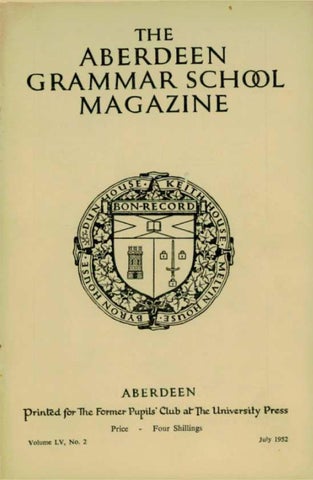
THE
ABERDEEN GRAMMAR SCHCOL MAGAZINE
ABERDEEN
prin.tZd forThe Former- Pupils' Club atihe University Press Price Volume LV, No. 2
-
Four Shillings
July 1952
JAMES G. BISSET
For TEXTBOOKS
The University Bookseller and Stationer
NOTEBOOKS
required for your studies ... for Lectures ... and all your other
STATIONERY requirements BOOKS ON TRAVEL, ADVENTURE, INTEREST, FICTION BOOK TOKENS SOLD AND EXCHANGED
Our SECOND HAND DEPARTMENT on the
85 BROAD STREET
first floor contains a large selection of books which may be purchased at reasonable prices
ABERDEEN
•
Opposite Marischal College
Telephone 20484 Open 8.45 to 5.30
PHONE 29053 •
GOOD HEALTH demands
GOOD BREAD For the children especially is it necessary to ensure their stamina and energy with good, wholesome, nourishing bread. In Hutchison's bread you'll find all these requirements are fully met. Phone or give instructions to have it supplied daily.
A. B. HUTCHISON (CENTRAL BAKERY) LTD.
BRANCHES THROUGHOUT THE CITY
21 st Birthday Suggestions Gold Cuff Links with coloured enamel school crest and F.P. colours Gold Stud Sets with Links in fine leather wallets, suede lined Hair Brushes with monogram Ivory, in pattern military Silver and Hardwoods Toilet Sets in pigskin and Contents calf leather cases. mounted in Silver, Ivory and Hardwoods Wrist and Pocket Watches in Gold, Stainless Steel and Chrome
A. & J. SMITH (Jewellers) Ltd. 191 UNION
STREET
ABERDEEN
" I need good food
f f
—and this is where you can get it ! We always have a fresh stock of all well-known dog foods including Spratt's, Spillers, etc.
Main Stockists for
Hay and Straw
Pot and Pearl Barley
Poultry and Bird
Barley Meal
Food
Coal
and
Moss Litter
Fire-
Manures
wood
WILLIAM SCORGIE GRAIN AND POTATO MERCHANT
13
ROSE STREET
.
Phone 23731
ABERDEEN
DAIRY : ABERDEEN
FARM : CULTER
Tel. 20373
Tel. 3106
For . .
QUALITY and SERVICE JOHN REITH (Kennerty Farm Dairies) LBUTED
46-48 ROSE STREET, ABERDEEN =re.,2r.u-4,17,1txxx.4-42t7.2t7.1=r1
s s
At your Service For QUALITY
FISH • GAME • MEAT Whether you shop in person or by telephone your requirements in either or both of our Departments will be looked after with tare. Our delivery system too exists foryour convenience
s . s
A. & W. ALEXANDER Fish, Game and Meat Merchants Telephone : Aberdeen 25236
49 2
UNION STREET, ABERDEEN
t7.1r4==.2=42t7.2=t7.1===t7.2=
I
Telephone 29191 1
i i i
ARCHIBALD MCKELLAR
i
Family Grocer, Wine Merchant and Tobacconist
i i i
We specialise in
Medicinal Wines
1
PROVISIONS TEAS COFFEES
VIBRONA HALL'S WINCARNIS
1
WINES, etc.
PHOSFERINE
I
1
i 1 1 i
i
I 1
I i
i i fy.........•
450-456 UNION STREET, ABERDEEN 0..ftwAl fr....a
9.1•.•
F...6
•-•••••
9,1••••• flr.ftn• .......4
.......•
WM.. • •••••...
•••• m.• 6....0
•....•
i i 4
.....,
ABERDEEN A
restaurant of charm and grace and interesting
where well-chosen meals served.
are
tastefully
In
Union
prepared
and
Street
the
at
Bridge Street corner.
KEN N AWAY'S RESTAURANTS A delightful
new
restaurant, fully
upholding the Kennaway tradition. In the main street
STONEHAVEN Also retail
bakery
shops
at Aberdeen,
Cults
and Stonehaven
ESTD 1133 • 'PHONE 21219 Still maintaining our tradition we ore endeavouring to meet the many wishes of our customers in a now greater selection of Fine Silverware, Rings in the most exquisite settings of Diamond,Emerald, Ruby, Sapphire, and in an ever widening range of personal Gifts for Gifting purposes.
-
-
--
Courtesy and service add immeasurably to the pleasure of Furnishing at— Telephone : 22695
(wB[fIDE€N) LIMITED 111INI fa .CUTUP cINC f UANIT UP ABERDEEN 419 UNION STREET
JAMES FYFE & SON PAINTERS
AND
GLAZIERS
Office and Showrooms
II
DEE STREET, ABERDEEN
Telephone 22436
Telegrams: " Fyfe, Painters "
GILBERT COURAGE Licensed Grocer 32 ESSLEMONT AVENUE Telephone 24684 SPECIALIST IN WINES, SPIRITS AND
LIQUEURS
BON RECORD For over a century, J. & A. Ogilvie have helped the people of the North-East of Scotland to solve their furnishing problems to their satisfaction. They will be delighted to place their long experience and trained staff as well as their very large and high class stock at your disposal to assist you in your difficulties. You are invited to call or write
J. & A. OGILVIE 369-373
UNION STREET
ABERDEEN Telephone 29432
Telegrams " Interiors "
For everything to do with
REFRIGERATION DOMESTIC COMMERCIAL INDUSTRIAL Consult
Spark's of Aberdeen Ltd. 16-18 ROSE STREET ABERDEEN TEL. 27366 Distributors
for
PRESTCOLD ELTAMISIMIS ISIS
FOR BETTER FOOTWEAR
TO MtS LATE
APPOINTED MEAT PUR-
JAMES LORIMER and Son (Bootmakers) Ltd.
VEYORS AND POULTERERS
l'3o;
. . 1-11;1:'-."'" . 101
MAJESTY KIND GEORGE
•
J. WILLIAMSON & SON Civil and Military BOOTMAKERS
Meat Purveyors, Poulterers and Game Dealers I, 2, & 3 MARKET BUILDINGS ABERDEEN Phone 28470
8 CHAPEL STREET, ABERDEEN (Late of 162 Union Street)
BRANCHES 35 fOUNTAANHALL ROAD
THE SQUARE, CULTS
PHONE 21724
PHONE 47121
ALSO AT CHURCH SQUARE, BALLATER ESTABLISHED
1844
PHONE 2O724
PHONE 3B
MODEL AIRCRAFT, SHIP & RAILWAY ACCESSORIES COMPLETE
RANGE
OF
KEIL,
AIRYDA KITS AND SPARES.
VERONS,
HALIFAX,
DON,
OVER 200 TO CHOOSE FROM
AMCO, ELFIN, MILLS, E.D. & K. DIESEL ENGINES ALSO ALL SIZES BALSA AND HARDWOOD IN STOCK
UNION SUPPLY CO. 266-268
GEORGE
STREET
WEST RID BOOKSHOP
ABERDEEN
For all the latest books
*
Best value in Stationery, Fountain Diaries, etc.
*
An excellent library
*
And a special PRIZE BOOKS Department. Copies of our Illustrated List of Reward Books are now available, post free. All interested in children's gifts and prizes will find book suggestions to suit all ages and requirements
Pens, Greeting
Cards,
WEST END BOOKSHOP 412 UNION STREET
ABERDEEN
P
.
I
IIIIIIIIIIIII
isr
IIIIIIIIIIIII
When it's an occasion ... be it a Dinner, Dinner Dance, Wedding, or other social function your intuition and our well founded reputation will lead you to the Northern. The constantly recurring bookings for a year ahead are some indication of the esteem in which we are held, and the satisfaction we have been able to give.
Weekly SATURDAY EVENING DRESS DINNER DANCE 12/6
;A
The
NORTHERN HOTEL KITTYBREWSTER TELEPHONE
ABERDEEN
ABERDEEN
4 3 3 4 2
FAMILY GROCERS
WINE MERCHANTS
Collies of Aberdeen COOKS
CONFECTIONERS
a
,e„.&
W6L2.6) STREET
UNION A
B
E
R
TELEPHONE
IDEEN ;
272 4 4
ALSO
AT
BRAEMAR
I
BALLATER
I
REGISTRY TELEPHONE:
& CULTS
BY APPOINTMENT GROCERS TO THE LATE KING GEORGE VI
20015
Boys will be BOYS! . . . and clothes won't stay clean for ever. But they will last longer and stay bright and fresh if you send them periodically to
GORDON CLEANING Cleaners & Dyers
HUNTLY
ABERDEEN BRANCHES 434 Union Street 505 George Street
.
ABERDEEN ABERDEEN
► .r
-
CALEDONIAN Insurance Company FOUNDED 1805 Incorporated by Special Act of Parliament
A World Wide Organisation Transacting All Classes Of Insurance General Manager : William Graham Robertson
HEAD OFFICE : St Andrew Square, Edinburgh LONDON OFFICE : 5 Lothbury, London, E.C.2
-
JAMES BLAKE LTD. Joiners and Building Contractors
Enquiries courteously solicited
7 ALBYN TERRACE Works: 23, 25, 29 Summer Street Telephone 24382 Telegrams " Blake Builders "
ALL CLASSES OF BUILDING WORK
Established over 100 years
WILLIAM CAY AND SONS (Funeral Directors) Limited Efficient Service Day and Night
Cremations All Funeral Arranged Requisites Supplied PRIVATE REST ROOM 415 UNION STREET 209 GEORGE STREET ABERDEEN ABERDEEN Tel. 29302 Telegrams—Cay, Aberdeen Tel. 20054
IMPROVED SUPPLIES are available of Typewriters, Desks (wood or steel), Chairs, Filing Cabinets, Cupboards
Come and see me
Everything for the Office
C. H. WEBSTER 489 Union Street, Aberdeen
Agents for Ordnance Survey Maps
Wyllies Circulating Library
WYLLIES (BOOKSELLERS LTD.)
247 UNION STREET, ABERDEEN Established 1814
Telephone 25534
ESTABLISH THE HABIT OF READING GOOD BOOKS
• smart men wear a -==
-__= =
74-
a
m
-
=
These superb trousers set a standard of cut and hang which is admired by good sportsmen and smart people all over the world. Selfsupporting—no belt, no pressure round the middle. In many attractive materials and colours—in stock now. Come and try on Daks. £5 I9s. 6d. TAILORED BY
SIMPSON
ESSLEMONT & MACINTOSH (RETAILERS)
LTD. TAILORS AND OUTFITTERS
UNION STREET
ABERDEEN
CONTENTS ILLUSTRATIONS Facing page
John Adam Lillie, Q.C., M.A., LLB. . . . . School Prefects-1951•52 .
8; 98
School Rugby 1st XV—Season 195t-52 . . . .
138
Facing page
School Cricket tst XI—Season 195 2 • • • • 139 Joint F.P.—Gordonian Reunion in Southern Rhodesia . . 1 54 F.P. Rugby Section ist XV— Season 1951-52 . . . 155
Our New President . . . . . . . • • Page 83 Balancing the Budget . . . . . . . . . 11 84 Boarding House Section of thc Club. The Rector's Visit to thc Gold . . . Coast. 85 . Notes about Old Boys . 86 Annual School Church Service 98 . • University Notes . • 1/ 99 Our Hockey Internationalist . . /1 Too . . . . . . The Encroaching Cold—A Journey to Canada. By David M. Craig IO1 It Books by F.P.s . . . . . . . . . 106 /1 Marriages . . . . . . . . . 107 Obituary . . . . . . • 109 ft School Section— School and Random Notes . . . I2O . /1 Changes in the School Staff—New Deputy Rector 122 7P Presenting the Prefects . . 123 /1 The Prefect . . . . . . . . . PP 125 Fear . . I26 . . . • . No Beginning ... No End. A Dry Brain . I27 IP Mind 128 . . • • PP • • Knight Errant. Gifts to the School . 129 11 The School Concert . . . 130 Literary and Debating Society . 131 . . Dramatic Society. Scottish Schoolboys' Club. Scripture Union 132 01 Music Notes. Library Notes . . . . . . . /1 133 House News. Lower School Notes. Combined Cadet Force Notes 134 Pipes and Drums . . . . . . . . . 135 Scout Notes . . . . . . . . . . „ 136 School Sporting Activities— Rugby . . . . . • . 1 37 Hockey. Tennis . . . • ,> 139 Cricket . . . 140 . . • • >. Rambling and Mountaineering Club. Swimming Club. Arts Club 141 School Office-Bearers, 1951-52 . • 11 142 The Former Pupils' Club— Annual General Meeting /0 143 New Members of the Club • • 147 Club Consuls . . • /0 148 Edinburgh Centre . 150 London Centre . 152 Yorkshire Centre . . . . . . 153 F.P. Reunions Abroad. Bengal and Assam Centre. Glasgow Centre 1 54 F.P. Rugby Section . . 1 55 F.P. Hockey Section . 156 /P F.P. Golf Section . . . . . . 1 57 F.P. Cricket Section. F.P.s in Malaya and Singapore 158 11 F.P. Club Office-Bearers, 1952-53 . • 159 Club Subscription Rates . . 160 • •
•
•
•
•
•
•
•
•
•
•
•
•
•
•
•
•
•
•
•
•
•
•
•
•
•
•
•
•
•
•
•
•
•
•
•
•
•
•
•
•
•
•
•
•
•
•
•
•
10
•
•
•
•
•
•
•
•
•
•
•
•
•
•
•
•
•
•
•
•
•
•
•
•
•
•
•
•
•
•
•
•
•
•
•
•
•
•
•
•
•
•
•
•
•
•
•
•
•
•
•
•
•
•
•
•
•
•
•
•
PP
•
•
•
•
•
•
•
•
•
•
Insurance IS necessary Every prudent person covers the everyday risks of
FIRE LIFE AND
ACCIDENT The
Northern Assurance Company Limited
ESTABLISHED IN ABERDEEN
1836
is at your service for
ALL CLASSES OF INSURANCE ENQUIRIES ARE WELCOMED CHIEF OFFICES:
ABERDEEN LONDON
. .
1 UNION TERRACE 1 MOORGATE, E.C. 2
Company's Assets
.
£47,200,000 1
Drummond Young, Edinburgh
JOHN ADAM LILLIE,
Q.C., M.A., LL.B.
Aberdeen Grammar School Magazine 68th year, Nu. 170 (New Series, 59th year, No. 161)
Vol. LV
JULY 1952
No. a
The Magazine is published under the auspices of The Former Pupils' Club in December and July. Communications should be addressed to the Editor, ALAN C. R. WATT, M.A., LL.B., 22 Bon-Accord Crescent, Aberdeen. NOTE : An asterisk after a name indicates that the F. P. is a member of the F.P. Club: dates after a name indicate the years of attendance at the _School.
-
Our New President This year's President of the Club is John Adam Lillie* (18935903), Q.C., M.A., LL.B., Sheriff of Fife and Kinross. He has been an enthusiastic member of the F.P. Club for almost fifty years and he is a founder member of the Edinburgh Centre. He was a vigorous member of the committee of that Centre from 1932 to 1951, and for many years he was vice-president. Last year he completed a twoyear term of office as president. A graduate of the University of Aberdeen in Arts (1906) and of the University of Edinburgh in Law (two), he was admitted to the Faculty of Advocates in 1912 and called to the English Bar (Middle Temple) in 1921. Ten years later he took silk, and he has been Sheriff of Fife and Kinross since 1941. From 1928 to 1947 he was lecturer in Mercantile Law in the University of Edinburgh and he is the joint author of a text book on the Mercantile Law of Scotland. Sheriff Lillie was a member of the Royal Commission on Workmen's Compensation and the Social Services. He is legal commissioner and deputy chairman of the General Board of Control for Scotland, which deals with the control of all mental hospitals and institutions for mental defectives, and he holds several other important administrative appointments. Should he ever become weary of his multifarious responsibilities, he has a farm in the Borders to which he can retreat! In electing Sheriff Lillie to the office of president, the Club has bestowed its highest honour on one who is second to none in his interest in and devotion to both the School and the Club. At functions of the Edinburgh Centre he has delivered several speeches which have been especially noteworthy for their freshness of approach and his discerning appreciation of the qualities of the School and the propensities of Grammarians. A warm welcome awaits him at the Annual Club Dinner in November and at the Dinners of the Centres.
84
Aberdeen Grammar School Magazine
Balancing the Budget The Club's Revenue and Expenditure Account for the year ending 31 December 195 I, an Abstract of which is printed on pages 44 and 145, shows that for the fifth successive year there has been a serious deficit. The deficit in x95i was abnormally high for the reason that three issues of the Magazine were charged during the year (see page 146), but the Executive of the Club decided early this year that immediate steps must be taken to restore the Club's financial position. The steps taken by the Executive, after full consideration of all aspects of the problem, were as follows :— I. The subscription for life membership has been increased from £8 to £15. 2. The subscription for ordinary membership has not been altered, and remains ar los. per annum (5s. per annum for members under twenty-one years of age on 1 January). 3. The scheme whereby life membership could be paid for by annual instalments has been discontinued. 4. The scheme whereby members under twenty-one years of age could pay £i is. to cover membership for five years has been discontinued. 5. " Instalment" life members whose payments were in arrears were given an opportunity of bringing these payments up to date : the membership of those who did not do so has been terminated. 6. F.P.s who left the School after 1920, who are not members of the Club and whose addresses are known, are being invited to join the Club. 7. The question of capitation grants to Club Centres is being reviewed in consultation with the Centres. 8. Advertising rates in the Magazine will be increased by 5 per cent. with effect from the issue of December 1952. 9. The price of copies of the Magazine to the public, which is at present is. 6d., has been increased to 4s. Boys at the School at present receive copies of two issues of the Magazine for zs. 6d. : in future they will be asked to pay 3s. 6d. 10. All life members have been invited to make a donation to the life member capital fund of the difference between the subscription which they paid (whether in one sum or by instalments) t and the sum of £1O, so that the Club may derive considerably more benefit annually from the interest on the fund and from capital redemption. The effect of these decisions will be felt only partially in 1952, but the Executive hope that the budget which they have prepared will be balanced in 1953 and subsequent years. This budget is based on a substantial increase in the Club's annual revenue : the alternative open to the Executive was to reduce the Club's expenditure either by drastically reducing the size of the Magazine or by publishing only one issue each year. They were reluctant to take either of these steps, as f An analysis of the subscriptions paid by 1,004 life members shows that 3 members paid £1 is., io6 members £2 IS., 11 members £3 3s., 386 members £3, 344 members £5 5s.. 8o members £7 and 74 members £8.
Balancing the Budget
85
they believe that the Magazine provides an invaluable link between members in all parts of the world and the School. They are convinced that any such action would be unacceptable to the majority of members. The Executive are glad to report that the appeal to life members (paragraph so above), which was sent out at the beginning of June, has already met with a gratifying response. At the date of the Magazine's going to press 265 members have contributed a total sum of Om The Executive hope that those life members who have not yet replied to the appeal circular will do so now.
Boarding House Section of the Club The Constitution of the new Boarding House Section of the Club was approved by the Executive on 18 April 195z, and on that date the latest Section of the Former Pupils' Club came into being. Membership of the Section is to be of two classes :— (a) Honorary members shall be such persons as may be elected at the Annual General Meeting of the Section, provided always that such persons are not Former Pupils of the School who are not members of the Club. (b) Ordinary members shall be members of the Club who have been resident in either the Junior or Senior Houses of the Aberdeen Grammar School Former Pupils' Club Boarding House Company Limited. The first Annual General Meeting and Reunion Dinner of the Section will be held in September or October of this year, and circulars are being forwarded to all those eligible for membership, asking them to choose one of two dates. All ex-members of the Boarding House who have not received circulars are asked to get in touch with F. K. Sellar, Interim Hon. Secretary, c/o Messrs. G. H. Bower & Gibb, advocates, zzo Union Street, Aberdeen. F. K. S.
The Rector's Visit to the Gold Coast Education in the Colonies The Rector, who has been a member of the Advisory Committee on Education in the Colonies since 2946 and of the Advisory Committee on Colleges of Arts, Science and Technology in the African Territories since 195o, was appointed in October 2951 to be one of the two members from the United Kingdom on the Governing Council of the Kumasi College of Technology. This appointment involves a few days' visit to the Gold Coast each year. Last December Mr. Robertson was invited by the Government of the Gold Coast to spend a month in that country during the summer of 1952, as chairman of a visiting team of five which is to report on the work of Achimota School and on the part it is playing and should play in the educational life of the Gold Coast. He is to leave London by air on zo July and return on 29 August.
86
Aberdeen Grammar School Magazine
*** The Editor will be glad if F.P.s will send him, from time to time, information for this section of the Magazine. News of appointments, promotions etc., and other items of interest which are not reported in the press are particularly requested.
HONOURS AND AWARDS Member of the Order of the British Empire (M.B.E.) William Alexander McConnach* (192o-26), Detective Superintendent and Deputy Chief Constable, Plymouth City Police Force, was awarded the M.B.E. in the Queen's Birthday Honours announced on 5 June 1952. He was the first junior officer of the Plymouth Force to attend the Police College at Hendon, and when he was there in 1937 he underwent a two months' course on detective work. Thereafter he held the post of chief clerk and in 1944 he became chief inspector. Three years later he was appointed detective superintendent in charge of the C.I.D. and in October 1949 he became deputy chief constable. He is a brother of Mr. James McConnach, Chief Constable, Aberdeen. Mentioned in Dispatches Alastair MacLennan* (1923-29), O.B.E., M.B., Ch.B., R.A.M.C., who was awarded the American Bronze Star Medal with V device for valour south of the Hahn River in Korea in January 1951, was subsequently mentioned in dispatches for his services in Korea. Since April he has been in Germany as Assistant Director of Medical Services, 6th Armoured Division, with the rank of Colonel. * * * Honorary Degree of Doctor of Laws (LL.D.) There are three F.P.s among the six honorary graduands who are to receive the degree of LL.D. from the University of Aberdeen at the Summer Graduation this year. William McCombie Alexander* (1887-96), M.A., B.L., retired journalist, is well known for his literary work, his scholarship and his keen interest in local history. Like his brother, the late SIR HENRY ALEXANDER (1881-91), who received the degree of LL.D. in 1935, he was on the staff of the Aberdeen Free Press and of Aberdeen Newspapers Limited and retired in 1925. He is the author of The Four Nations of Aberdeen University and Their European Background, published in 1934, and he is chairman of the executive committee of
87 Notes about Old Boys the Third Spalding Club which has published many books of local, antiquarian and historical interest. He is the author of The PlaceNantes of Aberdeenshire, to be published this year. He has travelled widely in Canada, South America and Russia and has contributed many articles to the Magazine. Henry Jackson Butchart* (1890-99), O.B.E., D.S.O., T.D., B.L., D.L., advocate in Aberdeen, who has been secretary of the University since 1919, is to retire in September 1952. A summary of the various appointments he holds and of his wide interests was included in the July 195 I issue of the Magazine, on the occasion of his being awarded the O.B.E. John Watson Robertson (19o3-o5), M.A., B.Sc., F.E.I.S., has been headmaster of the Central School, Aberdeen, since 1926. He came to the Grammar as a pupil from Robert Gordon's College and he returned as principal teacher of Mathematics in 1925, after being teacher of Mathematics and Science at Robert Gordon's Technical College and principal teacher of Mathematics at the Central School. He has been one of the four assessors of the General Council of the University on the University Court since 1943. * * * James Smart Abernethy* (1925-26), M.A., LL.B., advocate, who was a resident magistrate in Tanganyika from 1949 to 1951, was appointed a puisne judge there in December of last year. He had previously been acting as a judge of the High Court of Tanganyika. William Ernest Adam (1902-09), J.P., of St. Kentigern's Church, Ballater, is returning to Aberdeen to take up the duties of registrar and diocesan secretary and treasurer for the diocese of Aberdeen and Orkney. Canon Adam, who went to Ballater from Dufftown in 1945, has been Provost of Ballater since 1947. Francis William Alexander* (193 5-42) has been with A. H. Bex Limited, Dublin, the leading shop-fitters in Ireland, since 1950. He joined the firm as a cost accountant and latterly he has been acting as secretary. He states that there are great opportunities in Eire, that the housing position is much easier than in Britain, and that rationing and restrictions generally are almost non-existent. His brother, Eric Archie Alexander* (1935-43), B.Sc.(Eng.), is employed as a research engineer in charge of an experimental group at the Rolls Royce aircraft engine works at Derby. Lord Alness* (1884-85), P.C., G.B.E., LL.D., continues at the age of eighty-four to take a lively interest in a wide variety of public matters. As vice-president of the Scottish Amicable Building Society he contributed a message to a brochure published on the occasion of the Society's diamond jubilee and attended the diamond jubilee dinner in Edinburgh early in February. A few days later, in virtue of his membership of the Privy Council, he attended the Accession Council of Her Majesty Queen Elizabeth II. He frequently contributes articles and appreciations to The Scotsman.
88
Aberdeen Grammar School Magazine
Alexander Smith Anderson* (19o5-o9), O.B.E., D.L., LieutenantColonel, has been appointed to command the 1st City of Aberdeen Battalion of the new Home Guard. The znd Aberdeen Battalion is commanded by another F.P., Robert Mackay Ledingham* (18971909), O.B.E., T.D., M.A., LL.B., advocate in Aberdeen. Both colonels commanded battalions of the Home Guard during the 1939-45 war.
Robert Duncan Bain* (1915-23), district livestock inspector for the Ministry of Food in the area from the Moray Firth to the Firth of Forth, was chosen as one of the two judges handling all the championship classes at Smithfield Show in December 1951. Ian Francis George Baxter* (1921-33), M.A., LL.B., advocate in Aberdeen, has been appointed deputy clerk of the Court of the University of London. This body is responsible for obtaining funds for the University from the Treasury, through the University Grants Committee, and from other sources, and allocating them among the large number of colleges and institutions which form the University. The Court also deals with questions of land and property, investments, benefactions and similar matters. During the winter he was reading for the final examination for the English Bar. From 1948 to 1951 he was assistant secretary to the Northern Ireland Hospitals Authority. Robert Alexander Ross Black (1930-41), B.Sc. (Aberd.), B.A. (Cantab.), was appointed in December to the senior staff of the Bristol Aeroplane Company as project engineer and aerodynamicist. He took his B.A. with honours in Engineering at Cambridge in 1949 and in 195o he gained first class honours in Aeronautics at the Imperial College of Science, South Kensington, with distinction in aerodynamics, structures and propulsion. Last year he obtained the Diploma of the Imperial College of Science, the subject of his thesis being " The Use of Plastics in Aircraft Construction ". He is a golfing Blue of the Universities of Aberdeen, Cambridge and London. Edward Kerr Borthwick* (1933-42), M.A. (Aberd.), B.A. (Cantab.), received the degree of Ph.D. at Cambridge last December. At Aberdeen he took first class honours in Classics and at Christ's College, Cambridge, he obtained a " first " in both parts of the Classical Tripos. The subject of his Ph.D. thesis was " The Influence of Music on Greek Life and Thought ". He is now assistant lecturer in the Classics Department of the University of Leeds. Jack Leslie Keith Brown* (1921-25) has recently become a life member of the Club. He has been with Guthrie & Company Limited since 1931 and is now their planting adviser and visiting agent, stationed at Kuala Lumpur. During the war he held the rank of major in the New Zealand Army. William Morrison Brown* (1932-46), who joined the regular army on leaving School, has been serving with the 1st Battalion, The Queen's Own Cameron Highlanders, in Malaya, Tripoli and Egypt. He now holds the rank of sergeant and is serving in Austria. He is due to complete his period of service in September x953 and proposes
Notes about Old Boys
89
thereafter to attend the University of Aberdeen with a view to taking a degree in Agriculture. Austen Ogston Carnegie* (1932-45), M.A., who graduated at Aberdeen last year, has received a teaching appointment under the County of Angus Education Committee. He is at present on the staff of the Murroes School, near Dundee. George Fraser Chrystal* (1927-38), " Chrys" the cartoonist, joined the staff of the Scottish Daily Mail on 1 June 1952. He is now resident in Edinburgh. Kenneth Coutts* (1944-50), who broke the records for the threemile and one-mile events at the University Sports in 1951, when he was a student at Aberdeen, is now a student at the University of Edinburgh. At the Scottish Inter-University Sports held at St. Andrews on 31 May 195z, he won the one-mile event in 4 minutes z6 seconds. Nigel Smart Cowan* (1924-28), O.B. E., B. Sc.(Eng.), Royal Engineers, was one of the officers holding the substantive rank of major who were awarded brevet promotion to the rank of lieutenantcolonel with effect from 1 July 1951, when the system of brevet promotion to that rank was re-introduced. He has been a temporary lieutenant-colonel for several years. Ian Milne Cay Crawford* (1935-44), M.A., who described his experiences prior to and during the evacuation of the Anglo-Iranian Oil Company from Iran in an article in the last issue of the Magazine, left for Formosa in May of this year. He has obtained an appointment with a London firm of shipping agents and international traders and is to be stationed at Kaohsiung (Takao), one of the chief ports on the west coast of Formosa. He expects to remain there for four years. Sir James Ian Cormack Crombie* (1908-21), K.B.E., C.M.G., M.A., Third Secretary at the Treasury, has been appointed a member of the Coronation Joint Committee set up by the Coronation Commission. This Committee, of which the Duke of Norfolk, Earl Marshal, is chairman, consists of representatives of the United Kingdom and of all the Dominions and its task is to consider various problems which will arise in connection with the Coronation on z June 1953. Roy Alexander Crombie (1932-40) has been distinguishing himself as a cyclist. He belongs to the Aberdeen Wheelers Club and in the first open race of the present season he won first place, covering ten miles in 25 minutes 2 seconds. Alexander Robertson Cumming* (1880-87), I.C.S. (retired), celebrated his golden wedding on 22 January 2952, his eighty-first birthday. He was in the Indian Civil Service from 1890 to 1919. James Crombie Robertson Dawson* (1937-44) has been on the Physical Education staff of the Gordon Schools, Huntly, for the past three years, having qualified at Woolmanhill Physical Education College, Aberdeen. His marriage is reported on another page.
Aberdeen Grammar School Magazine David Mitchell Cooke Donald* (1926-32), B.L., W.S., has been elected a Fellow of the Chartered Institute of Secretaries. He has been a partner in the firm of Shepherd and Wedderburn, W.S., Edinburgh, since 1948, and was admitted to the W.S. Society in 1950. James Durno* (5900-02), C.B.E., retired in April, for health reasons, from the position of chairman of the North-Eastern Agricultural Executive Committee, which he had held since the Committee was formed in 1946. To mark the occasion he was entertained to luncheon by the Committee and received a presentation. Alfred John Meldrum Edwards* (5908-25), M.A., B.Com., headmaster of St. Clement Street School, Aberdeen, since 1948, has been appointed headmaster of Walker Road Primary School. From 5934 to 1 948 he was Lower School Master at the Grammar. Sir David Edwards* (1903-09), M.A., LL.B., Chief Justice of Uganda since 1947, retired in April. He was knighted in the New Year Honours of 1951. Basil Duncan Dean Emslie* (1929-35), who has been in the service of Shell-Mex and Scottish Oils Limited since he left School, has recently been employed as a retail marketing instructor. The company arranges weekly courses for garage proprietors and staff so as to improve the service for motorists at Shell-Mex and B.P. stations. In September 195i he was awarded the Territorial Efficiency Decoration (T.D.). Major Emslie's unit is 28o Field Regiment, R.A. (T.A.). John Ross Farquharson* (1916-20) has recently joined the Club. In a letter he states that he received copies of two recent issues of the Magazine from a friend, George Reginald Robertson (5921-22), Vice-Principal of Merchiston Preparatory School, Pietermaritzburg, and continues " You have no idea what pleasure the Magazine gave me. I made up my mind there and then to join the F.P. Club ". Mr. Farquharson has been with Barclays Bank (D.C. and O.) for twenty-seven years and is at present in Pietermaritzburg. Arthur Hercules Peter Ferguson* (1905-14), who was in Nyasaland prior to 1939, is now engaged in a small business in Edinburgh, making souvenirs for the tourist trade. Louis Findlay* (1924-30), M.B., Ch.B., after spending several years in Cairo as Director of Health for the U.N.N.R.A. Middle East Mission, both during and after the war,, was for four years Chief Medical Officer and later Chief of Operations for the International Refugee Organisation in the U.S. Zone of Germany. In July 1951 he was appointed Medical Consultant of the new 'body established by the General Assembly of the United Nations, the U.N. Korean Reconstruction Agency. This Agency is operating in conjunction with the U.N. Command in Korea and will be responsible later for the planning of the long-term reconstruction of the Korean economy and its civilian services. Dr. Findlay spent some time in Korea last summer and in June of this year he transferred his work from the 90
Notes about Old Boys
91 temporary headquarters in Geneva to the U.N. headquarters in New York. Thomas Forbes (1918-28) was the producer of Fester Fare, the 1952 Students' Show in Aberdeen. This was his sixth such show, the others having been Mariscbal Moments (1944), Q. for Laughter (1945), To Meet the MacGregor! (1946), Passing Fancy (195o), and Spring in Your Step (195 1). William Alfred Beaumont Forbes* (1932-42), M.A. (St. And.), at present a student of Magdalen College, Oxford, has been awarded by Gray's Inn a Bacon Scholarship of ki 5o per annum for three years. In 1951 he was awarded a Senior Entrance Scholarship at Gray's Inn. William Wares Georgeson* (1911-23), M.A. (Aberd. and Oxon.), was called to the Bar (Middle Temple) at the end of November 1951. Stephen Goodbrand* (1927-40), M.A., was licensed to preach by the Presbytery of Aberdeen in April 195z. I-Ie has been an assistant at the West Church of St. Nicholas, Aberdeen, while studying at Christ's College. At the University he had the unusual distinction of being president of both the Students' Union (in 1943-44) and the Students' Representative Council (in 1951-5z). Patrick Moir Gray* (1903-1i), who has been engaged in tea planting in Ceylon for many years, was home on leave at the end of last year. He is with the Lonach Group at Watawala, Ceylon, and is to retire next year, when he plans to return to this country permanently. Robert Hastie* (1925-35), accountant, left at the end of March to take up an appointment as Assessor, Inland Revenue Department, Hong Kong. David Sinclair Hay* (1907-11), B.L., who was a resident director of the Colonial Development Corporation (Central Africa) Limited from 1948 to 1951, now owns a tobacco plantation in Nyasaland. George Hendry (1897), M.B., Ch.B., retired this year from membership of Buckie Town Council on which he had served for twenty-seven years. Latterly he was Provost of the Burgh. Cameron Roy Innes* (1926-39), M.B., Ch.B., has been appointed to a medical practice in Rousay, Orkney. He graduated at the University of Aberdeen in 195o. James Patrick Jeffrey* (1906-18), T.D., B.Sc.(Eng.), C.A., has been appointed president of Aberdeen Chamber of Commerce. In December it was announced in the London Gazette that LieutenantColonel Jeffrey, Royal Engineers, had been appointed Brevet Colonel with effect from i February 1951. Michael Henry Keith* (1944-48) has been doing his national service in the R.A.F. He has been stationed at Air Traffic Control, R.A.F. Celle, with the and Tactical Air Force in Germany and expects to finish his service before the end of the year. On leaving School he
Aberdeen Grammar School Magazine entered the service of the Clydesdale & North of Scotland Bank Limited. Arthur Roy Handasyde Kellas* (1926-32), M.A., was transferred in January from the British Embassy, Helsinki, where he had been First Secretary since November 1949, to the British Embassy, Cairo. His present appointment is that of press attaché or, more properly, First Secretary (Information). His younger brother, Derek Mario Mitchell Kellas (1924-35), M.C., B.Sc.(For.), who has been in the Colonial Forest Service in the Gold Coast since 1938, has had to retire on account of ill-health. He is at present living in Ballater. Robert Sangster Kemp (1876-78), M.A., D.D., who is aged eighty-nine, attended the General Assembly of the Church of Scotland this year, as he has done regularly since 1925, and heard the Moderator pay tribute to his remarkable record of service to the Church. He was ordained in 1888 and has been minister of Deer Church, Aberdeenshire, since 1899. He still preaches twice every Sunday and supervises and teaches in two Sunday Schools. He has been teaching in Sunday Schools without a break since he was seventeen. Andrew Ross Laing* (1921-32), M.B., Ch.B., R.A.M.C., was transferred from the command of the British Convalescent Depot, Deversoir, to the command of the British Station Hospital, El Ballah, in March 1952, and promoted to the rank of temporary lieutenantcolonel. Eric Robert Russell Linklater* (1913-16), M.A., LL.D., whose play The Atom Doctor was presented at the 195o Edinburgh Festival, has re-named the play The Mortimer Touch. It is now running at the Duke of York's Theatre in the West End of London. Alexander David Lyall* (1932-45), M.B., Ch.B., has been granted a short service commission for four years in the Royal Navy. He left in June for Malta, where he is to be a medical officer to the 3rd Royal Marine Commando Brigade. Since graduating in 195o, he has been on the staff at Foresterhill, Aberdeen. Ian McIntosh* (1928-33), who joined Roberts, McLean and Company Limited, importers and exporters, at Calcutta in 1949, is now stationed in Bombay. His elder brother, Murdoch McIntosh* (1928-33), B.L., solicitor, is now with Messrs. McCash & Hunter, solicitors, Perth. William McIver* (1923-26) has left this country to take up an appointment as a post office radio engineer with the Government of Queensland in Brisbane. .From 1932 to 1946 he was in the Merchant Navy, being for some time a wireless operator with the Union Castle Line, and after the war he joined the radio department of the Ministry of Civil Aviation at Birdlip, Gloucestershire. Brian Walter Whyte Mackay* (1913-14 and 1922-23), M.C.S.P., has returned to Queen Mary's Hospital for Children, Carshalton, Surrey, where he held an appointment prior to joining the Department of Physiotherapy in Noble's Isle of Man Hospital, Douglas, in 1951.
92
Notes about Old Boys
93 John Mackie (1924-26), of The Bent, Laurencekirk, gave an address on " Farming in Scotland and England" to the Farmers' Club in London last December. He stated that there were far more changes in tenancies in England than in Scotland. He estimated that an average of 225 farms were advertised to sell or let every week in England, compared with fifteen in Scotland and he thought that the lack of continuity of tenancy had given a fillip to large-scale farming in England. He himself farms 1300 acres in Scotland and, in partnership with relatives, 18oo acres in Lincolnshire. Charles Stewart McLeod* (1908-2o), M.A. (Aberd.), B.A. (Oxon), was appointed by British Railways in January to be regional staff officer, Eastern Region. He had previously been assistant regional staff officer in the same region since the nationalisation of the railways on 1 January 1948. He joined the London and North Eastern Railway Company in 1927 as a traffic apprentice and from 1932 to 1935 he worked in the chief general manager's office. Thereafter for twelve years he held various posts in Scotland, and in 1947 he became principal assistant (staff) to the chief general manager. John Bryce McLeod* (1937-46), M.A., at present a student at Christ Church, Oxford, has been awarded a Rotary Foundation Fellowship entitling him to study for one year at an American or Canadian University. He went to Oxford with a Fullerton Scholarship and there he was proxirne accessit for the Junior Mathematical Scholarship, open to all undergraduates reading Mathematics at the University. The Rotary Fellowships have been awarded annually since 1945 to promote international good-will as well as to help the successful candidates educationally. John Richard Masson* (1937-43), M.A., was presented with the Silver Medal of the Royal Scottish Geographical Society in December of last year. He intends to enter the Colonial Service. Robert Alexander Esslemont Mennie* (1924-36), M.A., our Consul at Zurich, complains that he has not yet had the opportunity of exercising his consular functions. He will always be very glad to see any F.P.s who come to Zurich, whether for a few hours in transit or for a longer stay. Zurich has a link with Aberdeen which will be of interest to F.P.s who attended the University of Aberdeen after the 1914-18 war, in the person of Professor Eugen Dieth, Ph.D., LL.D. (Aberd.). Now Professor of English in the University there, he was lecturer in the German Department at King's College in the early 1920's. He was awarded the honorary degree of LL.D. by the University of Aberdeen in 1951. William George Alexander Middleton* (1940-5o) has passed the entrance examination of the Royal Academy of Dramatic Art. Before leaving for London he was employed in the Publicity Department of Aberdeen Corporation. Alexander Andrew Philip Milne (1927-31), M.A., is now on the staff of Dumfries Academy. After returning from the Far East he underwent a short teaching course at the Training Centre, Aberdeen.
94
Aberdeen Grammar Stboo! Magatine
William Proctor Milne* (1897-99), M.A., D.Sc., LL.D., formerly Professor of Mathematics in the University of Leeds, handed over to the Pro-Chancellor of that University a cheque for £300 at a ceremony in January. This sum had been raised by the Leeds Caledonian Society in recognition of Professor Milne's services to the Society for the past twenty years and to the University. The money is to be used to provide a prize for Celtic studies. Professor Milne was president of the Yorkshire Centre of the F.P. Club from 1948 to 1951. William Henry Peter Minto* (1924-27 and 1928-36), M.B., Ch.B., D.P.H., has been appointed Medical Officer of Health for Health Area Number 6 (Cornwall). After his war service, mainly with the Guards Armoured Division, he obtained his D.P.H. in 1947 and his first public health appointment was in Hertfordshire. Thereafter, until April of this year, he was M.O.H. for Brixworth and Northampton Rural Districts and Assistant County M.O.H. to Northamptonshire County Council. His younger brother, Charles Nicholson Minto (1929-39), M.B., Ch.B., has recently taken up an appointment in the tuberculosis service at St. John's, Newfoundland. Formerly he was at Culduthel Hospital, Inverness. Alexander Lessel Stephen Mitchell* (1911-19), B.L., who was entirely occupied in film production during 1951, has resumed his theatrical activities. He presented and produced First Person Singular at the Duke of York's Theatre, London, in February, and he is to present Mr. Charles Morgan's The River Line at the Lyceum Theatre, Edinburgh, during the first week of this year's Festival. Another play he has in hand is The Innocents, an adaptation of Henry James's The Turn of the Screw. William Alexander Mitchell (1911-22), who has been on the staff of Aberdeen Journals Limited in Aberdeen for many years, is now their London editor. Neil Munro (1925-27), B.Com., was in November 1951 appointed from among zo6 candidates to be entertainments manager at Bridlington. He joined the staff of the B.B.C. in 1933 as assistant stage manager and during and after the war he became well known to listeners in connection with various popular programmes, including " Twenty Questions ", the Brains Trust and " Monday Night at Eight ". Kenneth Jamieson Peters* (1929-41) has been appointed assistant editor of the Aberdeen Evening Express. He is this year's captain of the F.P. Cricket XI. Other F.P.s in the editorial department of Aberdeen Journals are Norman Morley Lawson Woodman (193849), who is " Scenario ", the Evening Express film critic, and also a features sub-editor ; Peter Sinclair Brown* (1933-46), who is on the staff of the Weekly Journal ; and George Gordon Allan* (1939-40 and 1941-51), a trainee journalist. Donald Elison Philip* (1924-32), A.M.I.E.T., is at present working at the Armstrong-Whitworth aircraft works in Coventry. William Balfour Smith Pigge (1914-21), M.T.P.I., was last year
Notes about Old Boys 95 Officer in In 1937 Planning Doncaster. and Country appointed Town he became Chief Town Planning Officer to Fife County Council. Harry James Rae* (1898-1904), M.C., M.A., M.B., Ch.B., D.P.H., was one of the six doctors whose appointment as honorary physicians to the Queen was announced in the London Gazette published on 22 April 1952. He was appointed an honorary physician to the late King on I July 195o. Ian Fraser Roberts* (1925-37), C.A., has commenced practice as a chartered accountant on his own account in Peterhead. Alexander Matheson Robertson* (1926-3o), A.M.I.C.E., A.M.I. Struct.E., who resides in Skelmorlie, Ayrshire, is now practising as a consulting engineer in the West of Scotland. Alexander Gordon Scott* (1925-29), D.S.C., R.D., is now a director and secretary of the Aberdeen Steam Laundry Company Limited. In 1949 he underwent training with the British Launderers' Research Association, Hendon, and at the London headquarters of the Institution of British Launderers. Thereafter he was assistant manager of the Dublin Laundry Company, Dublin. William Douglas Simpson* (190 i 3), M.A., D.Litt., F.S.A . (Scot.), was one of three lecturers from the University of Aberdeen who visited Shetland in connection with a Shetland University Week sponsored by the Senatus of the University of Aberdeen last April. Alfred Cahoon Bruce Singleton (1924-33), M.B., Ch.B., qualified • in February for the Diploma in Public Health of the Royal College of Physicians of London and the Royal College of Surgeons of England. He has been serving in the Colonial Medical Service in Kenya. August Henry Klie Slater* (1922-35), M.A. (A berd. and Oxon), visited Libya during April and May as a representative of the Ministry of Civil Aviation in a small United Kingdom delegation to negotiate an air services agreement with the new Kingdom of Libya. During the winter he obtained his M.A. at Oxford. John Manson Sleigh* (1914-16), B. Sc.(Eng.) (Glasg.), A.M.I.C.E., retired from the Colonial Civil Service at the end of last year after twenty-six years in the Public Works Department in Nigeria and Gambia. Latterly he was regional deputy director in Nigeria. He is now deputy chairman of the civil engineering contracting firm of John Howard and Company (Africa) Limited, whose headquarters are at Lusaka, Northern Rhodesia. The company's activities extend over Northern and Southern Rhodesia. Alexander George Nicol Smith* (188o-88), D.S.O., was incorrectly stated in the last issue of the Magazine to have commanded the 51st Divisional Train, R.A.S.C., during the 1914-18 war. He was appointed senior supply officer for the Division in '914, and in 1917 he was transferred to the staff and appointed D.A.Q.M.G., 5th Army. Later he held the same appointment on the staff of G.11.Q. Harry Elkington Smith* (1887-88), M.A., M.D., who is now aged seventy-nine, has retired from medical practice in Manchester
96
Aberdeen Grammar School Magazine
and Cheadle Hulme, Cheshire. He was medical referee to Stockport County Court and for forty years he was factory doctor for the East Manchester District and medical officer to the Post Office. William Clark Souter* (1893-98), M.D., D.O., after four years as chairman of the Aberdeen branch of the Royal Scottish Geographical Society, delivered his presidential address on " How deep is the Ocean? " at the end of 1951 and demitted office. He has been elected a vice-president of the Society. Archibald Douglas Spark* (1905-10), M.C., Major (retired), and his brothers, Arthur Percy Spark (1905-I I), M.B., Ch.B., Ian Robert Spark* (1912-14), M.B., Ch.B., and Cecil Vivian Spark* (1914-16), M.B., Ch.B., attended a service in Durris Parish Church, Kincardineshire, in January, at which they presented a plaque to the church in memory of their father, the late Reverend Robert Reith Spark, and their mother. The late Mr. Spark was minister at Durris for fifty years. The fifth Spark brother, James Christian Spark* (1918-21), M.I.Mech.E., M.I.Loco.E., has been in India since May 1951. Alexander Logan Speirs* (1926-38), M.B., Ch.B., M.R.C.P., has been awarded the Diploma in Child Health (D.C.H.) by the Royal College of Physicians of London and the Royal College of Surgeons of England. George Stewart (1889-92), M.A., B.Sc., Rector of Strathaven Academy, Lanarkshire, from 19zo to 1939, is secretary of the 1892-96 Aberdeen University Arts Class, which held a reunion in February of this year. Other F.P.s who attended were Patrick Murray (1892), M.A., retired headmaster, Dunfermline ; Alexander Bannerman Robb (1888-92), M.A., B.L., solicitor, who has been Town Clerk of Portsoy since x917 ; and Robert Alexander Slessor* (1887-92), M.A., M.B., Ch.B., D.P.H., Fraserburgh. Colonel JAMES DAWSON,* D.S.O., M.A., LL.D., who is an honorary member of the Club, was also present. Apologies for absence were received from James Haggart Clark (1888-92), M.A., who has been minister of South Church, Abernethy, since 1925, and George Copland (1889-92), M.A., Kintore, formerly headmaster at Auchterless, Aberdeenshire. Sydney Cardno Still* (1904-1o), M.A., who has been minister of St. James's Church, Paisley, since 1936, was appointed by the Reverend Doctor George Johnstone Jeffrey, Moderator of the General Assembly of the Church of Scotland, to be one of his two chaplains at this year's General Assembly. lain Johnstone McBeth Sutherland* (1933-41), M.A. (Aberd.), B.A. (Oxon), who joined the Foreign Service in January 195o, has since October 1951 been serving in the British Embassy at Moscow. He holds the position of Third Secretary. Alexander Robertson Taylor* (1927-34), M.A., M.B., Ch.B., F.R.C.S.E., has been appointed consultative neuro-surgeon for Northern Ireland. Since 1946 he has been on the staff of Professor Norman Dott at Bangour Hospital and the University of Edinburgh.
Notes about Old Boys 97 1929, in Canada went to who (1915-28), Thom* James Norman has returned to Scotland for the first time since then. He was first engaged in farming but since 1936 has been with various canning companies in British Columbia. He is now with the Anglo-British Columbia Packing Company, a concern with connections all over the Pacific Coast. The company is concerned chiefly with fishing for salmon and herring. Bruce Ewan Thomson ( x 94o-43) gained his rugby Blue at Oxford last season. After leaving the School he went to Glenalmond and he is now at Keble College. John Gibb Strachan Thomson* (1927-33), civil engineer, who has been with the Air Ministry in the North of Scotland since 1939, left in May to take up a three-year appointment with the Superintending Engineer, Air Ministry Works Directorate, Kasfareet, Canal Zone, Egypt. Daniel Jackson Walker* (1918-22) was in December appointed manager of the Stirling branch of the National Bank of Scotland Limited. He has been manager at Dalkeith since 1945 and before that he was accountant at Kilmarnock. Donald Elmslie Robertson Watt* (1931-43), M.A. (Aberd.), who is preparing a thesis at Oriel College, Oxford, about the careers of fourteenth century Scottish University students, has been searching for material in the archives of the Vatican. From March to June of this year he stayed at the British School at Rome. There he was joined for a few weeks in May by David Alexander West* (1939-44), M.A. (Aberd.), B.A. (Cantab.). West obtained a first-class in Parts I and II of the Classical Tripos at Cambridge in June 1951 and was awarded the Craven Studentship for one year of advanced study. He is tracing the MS. tradition of The Frogs by Aristophanes and after spending one term at Cambridge and another at Oxford, spent some months examining MSS. of the play in Paris, Milan, Rome, Naples, Florence and Venice. Edward William Murray Watt* (1918-31), M.A., who in September 1951 was appointed secretary and finance officer of the Inverness Hospitals Board of Management in an interim capacity, obtained the appointment on a permanent basis at the end of January. Gordon Scott Williams* (1933-46), who was formerly employed with Alex. Pixie & Sons Limited at their Stoneywood Works, Aberdeen, has been transferred to the head office of Wiggins, Teape, and Alex. Pink (Sales) Limited in London. Stanley George Williamson* (1922-25), who has been with the Chartered Bank of India, Australia and China for twenty-two years, latterly in Colombo, gave up banking in February and joined the broking firm of Forbes & Walker Limited, Colombo. He will now be permanently resident there. George Tod Wright* (1901-o6), M.A., B.D., minister of Carnock Church, Dunfermline, since 1946, was sole nominee in March for the
98
Aberdeen Grammar School Magazine
charge at Hoddam Parish Church, Lockerbie. His first ministry from 1917 to 1927 was also in Lockerbie, at Dryfesdale Parish Church. From 1927 to 1946 he was minister of St. Serf's Parish Church, Edinburgh. Norman Richard Wylie* (2927-3o), M.A., LL.B., has taken up an appointment at Entebbe as deputy registrar of the High Court of Uganda. From 1946 to 1951 he was on the staff of the Control Commission for Germany. On arrival at Kampala, the capital of Uganda, he received a warm welcome from the Chief Justice, Sir David Edwards* (1903-09), just before the latter left for home on retirement. Entebbe, the Government headquarters, is twenty-one miles from Kampala. •
Aberdeen Town Council
On account of a redistribution of the wards in the City all thirty-six members of Aberdeen Town Council retired prior to the Municipal Election in May of this year. At the election there were six F.P.s among the candidates and four of these were successful : they were James Patrick Jeffrey* (1906-28), T.D., B.Sc. (Eng.), C.A. (Progressive); Colin John MacIver (1902-03), M.A. (Socialist); Ian Gowanlock McPherson* (1910-27) (Progressive); and Alan McIntosh Morrice 941-42) (Socialist). (The first three were retiring members of the Council.) The unsuccessful F.P. candidates were Gordon Harvey Henderson* (1922-34), M.A., LL.B., and James Scott Gray Munro* (1922-28), B.L. (both Progressives). After the Election Councillor MacIver was appointed second bailie and convener of the Education Committee. * * * PETER Scorr NOBLE,* M.A., Regius Professor of Humanity in the University of Aberdeen, who is an honorary member of the Club, has been appointed Principal of King's College, London, with effect from i August 2952. Professor Noble was a member of the Education Committee of Aberdeen Town Council from 2939 to 1946 and convener of the Secondary Schools Management Committee. His son, ANDREW STEPHEN NOBLE, is this year's dux of the School, senior prefect, captain of rugby and cricket and winner of the F.P. Club All-Round Trophy. HENRY PATERSON, M.A., who retired from the staff of the School in November 1951 after more than thirty-two years' service, was in May made a life member of the Scottish Secondary School Teachers' Association. He was a founder member of the North-East of Scotland branch of the Association.
Annual School Church Service The Annual School Church Service is to be held in Rubislaw Church, Aberdeen, on Sunday, 28 September 1952, at 6 p.m. F.P.s, pupils, members of the staff, parents and all others interested are invited to attend.
School Prefects-1951-52
Strackati
Standing—J. G. Cruickshank, A. F. Florence, E. G. Anderson, A. D. C. Grassie, D. T. Baird, A. G. Littlejohn, D. G. Jamieson, A. W. Scott Brown.
Sitting—J. L. Wilkie, J. A. Brand, A. S. Noble (Senior Prefed), Mr. J. J. Robertson (Rector), J. A. S. Bert (Deputy Senior Prefect), R. W. Donald, J. G. Lillie. Insets-D. M. F. Bright, R. Bain.
University Notes Degrees and Prizes At a Medical Graduation in the University of Aberdeen on 19 December 1951, degrees were conferred on the following F.P.s DEGREES OF BACHELOR OF MEDICINE AND BACHELOR OF SURGERY (M.B., CH.B.) Richard George Gordon Allan* (1936-41). . Leslie Bow Bartlet (1939-45). Raymond Forrester Blackburn* (1941-46). Robert Brown* (193 2-43). Alan Gordon Craig* (1933-46). Robert Turner Donald (1939-41). Alan Richards Lyall* (1933-46). William Graham McKay (194I-46). Horace Edward Nutten* (1929-4o). Lindsay Symon* (1934-46).t Edward Robert Hector Tennant* (1945-46). Alistair Glass Turner* (1936-46). James Marshall Rennie Wetherly* (1919-28). Robert Erskine Wetherly* (1922-34), B.Sc. Robin Vawer Williams* (1935-46). t Awarded distinction in Surgery and Medicine.
Lindsay Symon* was the most distinguished graduate of the year. In addition to winning the Murray Gold Medal and Scholarship and the Lyon Prize (both awarded to the most distinguished graduate), he won the Anderson Gold Medal and Prize in Clinical Medicine, the MacQuibban Prize in Medicine, the Keith Gold Medal in Systematic and Clinical Surgery and the MacQuibban Prize in Surgery. Eric Kennedy Cruickshank* (1920-32), M.D., M.R.C.P., who is now Professor of Medicine, University College of the West Indies, was awarded the Straits Settlements Gold Medal (for the best thesis on a tropical medical subject submitted during the years 1948, 1949, 1950 and 1951 for the degree of D.Sc. or M.D.). He was awarded the degree of M.D. in 1943. * * * David Main Craig* (1937-50), a second-year Arts student, was chosen by the committee of the University Debating Society to represent Aberdeen in a team of three Scottish students who toured Canadian Universities in January of this year. They visited McGill University, Montreal, Queen's University, Kingston, the University of Western Ontario, London, and the University of Toronto, and on each occasion the subject of debate was " That the Commonwealth should federate ". (See pages tot-5.) A few weeks later Craig and James Edward Fraser* (1936-49) were two of the four Aberdeen students who took part in an inter-university debate in Marischal College, Aberdeen. The debate, in which representatives of eight British 99
too
Aberdeen Grammar School Magazine
Universities participated, was on the subject " That this House regrets the Act of Union" (1707) and part of the proceedings was recorded by the B.B.C. and is to be broadcast on the Third Programme in September. The Aberdeen speakers were against the motion and Alan Stirling Hall* (1937-40 and 1943-50) summed up for the negative. 1 he motion was rejected by 188 votes to 59. Craig, Fraser and Hall were all leading office-bearers in the School Literary and Debating Society in 1948-49 and i 949- 5 O. * * * In " Easter Fare ", the 1952 Students' Show in His Majesty's Theatre, Aberdeen, the producer was Thomas Forbes (1918-28) (see page 91) and the musical director and conductor was Alexander James Gray* (1931-44), a fifth-year medical student. James Edward Fraser* (1936-49) was one of the three administrators and also played several parts in the show. Another prominent member of the cast was John Forrest McClellan* (1944- 5 O). * * * Alexander Ian Cheyne* (1937-48), captain of the University Rugby XV in 1951-5z, was selected to play for the Scottish Universities against the English Universities at Leicester in February. The match was, however, cancelled. * * * Henry Jackson Butchart* (1890-99), O.B.E., D.S.O., T.D., B.L., D.L., Secretary of the University since 1919, was presented with a silver salver by the students of the University at a dinner held in the Students' Union in May. Colonel Butchart retires in September. The presentation was made by the Reverend Stephen Goodbrand* (1927-40), M.A., President of the Students' Representative Council. * * * Another important function at which Mr. Goodbrand was seen, if not heard, was the installation of the Rector of the University, Mr. James Keith O'Neill Edwards, D.F.C., M.A. (Cantab.), in February. In accordance with custom, he, as President of the S.R.C., presented the Rector for installation.
Our Hockey Internationalist Eric Douglas Watt* (1937-50), who received his first international hockey " cap " when he was at School in 1950, was awarded three further caps in the spring of this year. He has now played for Scotland on seven occasions. This year Scotland had her best hockey season for many years. Ireland, who had beaten Scotland consistently since 1935, were held to a draw, 3-3, at Belfast on z9 March 1952 and Wales were beaten 4-z at Rubislaw on 5 April 5952. England, however, decisively beat Scotland by 7 goals to nil at Glasgow on z6 April 1952. Watt was originally " capped" as left back, but this year he played as right back.
The Encroaching Cold A Journey to Canada It is difficult to communicate anything of importance about travel. People expect the journey to a foreign country, however brief, to mean or amount to far more than it does. One even expects oneself to suffer a mysterious sea-change, to perceive a new significance or perspective, by the sole fact of having existed for the moment in a different state or culture, of having reached round the world. But, although a journey such as mine to Canada may be anything from a joyride to a lecture-tour, it is in no sense profound ; and to expect fine perceptions from such a holiday is like expecting to explore the meaning of a frozen pond by skating in smooth and voluptuous movements over its surface. It is for these reasons that people ask the returned traveller all the wrong questions, like (avidly) " Was the food very rich? " or " Is it cold over there? " or " Are they really like the Americans ? ". This means that they expect answers about the thickness of steaks and people's fingers dropping off in the streets with frostbite. Whereas they should be asking questions like " Did you often feel surprised in Canada? " or " Could you live there? " And even so it is impossible to give the right answers because it is impossible to convey in such brief retrospect how deeply and gradually the experience of " foreign-ness " may influence one's world-view ; or to express (except perhaps through poetry) the entire strangeness of another country which makes every exit from a house a difficult experience, like walking into fog or solid air, whereas at home in the familiar town one's being seems to pass as easily as smoke through doors and streets. I cannot, then, make absolute statements about Canada, or present formulz for its understanding: and besides, after so short a stay I have no right to trap its character in a paragraph. But at least by depicting the rich superficies of the country as I saw it I may give other people the possibility of finding what I found myself. I went to Canada for two weeks as one of a Scottish universities debating team. There were three of us—not so few that we felt isolated or so many that we could not know each other. We flew to Canada. . . . And that tiny sentence has enough meat for another article as long as this. I can mention only one aspect of the air trip—that in it I first tasted the unreality which never left me. We touched down at Iceland, on the wet tarmac aerodrome of Keflavik set on a waste of black rocks at the edge of the sea; and then flew on through the Atlantic time-zones into a never-ending afternoon which grew ultimately into darkness over the black coast, the ice-choked estuaries and fuzzy forests of Labrador. We stepped on Canada for the first time at Goose Bay, and emerged from the plane in a choking frost. For the rest of our stay we were never rid of the peculiar Northern necessity to protect oneself from the air. Our plane was three hours late at Montreal, so the guests at our welcome party had been drinking for three hours before we arrived. 10!
Aberdeen Grammar School Magazine The unreality thickened. . . . At four o'clock in the morning we were still making epigrams about Scotland and giving interviews to glazed reporters in rooms with velvet curtains and peculiar people recumbent in chairs and empty bottles in the corners. But fatigue itself tires after three thousand miles and twenty-one hours of wakefulness: and if the waves of hospitality had not broken over our heads at the very start we might never have " arrived "—we might have remained on the outside. Our prime purpose was to debate with Canadian universities in four towns—Montreal, Kingston, Toronto and London. Thus we remained in the East—in an urban winter of frozen pavements and icicled eaves and snow deep in the sidestreets. Our days were long —beginning with orange-juice and bacon-and-egg at nine and finishing with club sandwiches and strawberry shortcake at one next morning. A pattern quickly formed—we ate drowsy breakfast between nine and ten, emerged wrapped in wool from the enervating indoors to the paralysing cold, made a slippery exploration of the town, had lunch in a slap-up restaurant, broadcast briefly or wrote notes for speeches in the afternoon, and went on to the debating hall after a vast " late dinner " at six. At first the central heating stifled us, and indoors we just leant against the walls and breathed quietly. But as we gained momentum we penetrated the towns more deeply, and the days expanded beyond midnight with protracted conversation and improbable meals. We began in Montreal, and returned there for the conclusion of our stay. Its brevity and our programme precluded proper exploration of the town but we could feel its outlines. It lies between two low wooded hills and the St. Lawrence. " Downtown " is a modern wilderness of tall buildings threatening the narrow pavements, of hectic traffic pressing in a continuous throng from block to block of the packed honeycomb. One fights to breathe. But on the slopes of the hill the roads wreathe upwards in long sweeps and convolutions: modern flats grow like the terraced vineyards of a different country and the snow-piles lie in the darkness of many trees. This airy part of the city I saw only by night, when the few streetlamps no more than blotched the shadow, and the interweaving of the streets led one back by mysterious routes to the lower world of shops and offices. My most typical view of the town I had on a cold dead day of clouded skies : I was taken to the top of the Sun Life building, thirty storeys of above the streets, and looked down on an impenetrable mosaicthe of white dirty the where distance, the in roofs, edges meeting frozen St. Lawrence was fringed with the grotesques of cranes and shipyards. It looked as though it would be impossible to live in so crammed a town: but away in the west were the white patches of open ground, and to the north was the blue tree-covered hill with houses on its lower slopes and on its summit the huge electric crucifix which at night winks its Christianity down at the coloured commercial neon of the city. The open undulations of the land between the towns have run together in my memory to a common vision of long white plains inter102
103 The Encroaching Cold sected by the black bristle of hedges and copses which the winter sun would touch to orange. There were no dykes to shackle the landscape (as they do in Scotland) with their inflexible outlines ; and the white countryside ran fluently, endlessly past the train to the north, while to the south Lake Ontario's frozen tracts stretched to the turquoise gleams of open water on our horizon. Our next place, Kingston, lies at the eastern neck of the lake, where the water opens out through bays and islands. An eighteenthcentury fort with fine walls and cannon on its battlements dominated the seaward part of the town : and the low, verandahed houses and tree-sown streets, decorated with snow bener th a cold blue sky, were quiet, exquisite, and old-fashioned after the confusion of our first metropolis. Kingston prides itself on its Scottish affinities, particularly the University, which has a regular exchange of students with St. Andrews ; and at least the graver aspect of the town and the freestone buildings showed some kinship: but the expansive streets with trees and snow-covered gardens at their edges, and the absence of poor slum houses, were at odds with the closeness, the dirt, the latent poverty of Scottish towns. Even the strident modernisms of Montreal could not compare with the extraordinary energy of Toronto's downtown. The Toronto streets are wider, more like boulevards : melting snow lay piled in the gutters, and streams of cars swept round the centre or crawled down the great straight main-streets which bore inexorably through its very heart. In the big business quarter the buildings were skyscrapers—banks and insurance offices rising in square towers which darken the sky, which make the streets insignificant and beat one down into the pavement. The Bank of Nova Scotia building, which was completed last year, is a titanic work of modern man. It is twenty storeys high and rises straight from the sidewalk in concrete cliffs. The ceiling of the vestibule is studded with gold devices on an azure ground. It is thirty feet high. Doors of sheet glass give on a main chamber of more than twice that height, the roof supported by massive marble pillars, the walls dominated by giant symbolic basreliefs—neolithic figures digging and hammering and casting nets. Long archways lead off to the manager's offices in the inner shrine; and from the ceiling soft music is discoursed. Stairs decorated with carved animals and fishes lead downwards to a glittering treasury of safe-deposit boxes. Money is changed at small bureaux of delicately wrought copper and the outer doors are massive shutters of beaten bronze. In this giant environment people were a little irrelevant and gold should have passed, not banknotes. Toronto achieved a royalty missing in the other cities. Hart House, the students' union, is in form a farflung Gothic palace, with many passages and courts, and its dining-room is a banqueting hall with fretted oaken rafters fifty feet above the floor with a long dais at one end and the arms of hundreds of universities emblazoned on its panelled walls. It was built in 1926. But unfortunately Hart House is a students' union—and the decorated Gothic conceals squash courts and dressing-rooms and—crowning irrelevancy—a
Aberdeen Grammar School Magaine swimming pool. And people in the dining-room must eat chops and sausages, not oxen roasted whole. Yet the sombre Gothic exterior turns this part of the city into a medieval town. Other parts are like a modern metropolis—a quiet residential settlement with (like Kingston) trees, fences, and snowy gardens—a concentration of industry— a university town—a raw modern growth with new apartment blocks and waste building lots. Toronto even echoes London: it is less concentrated, more various than Montreal and its bounds stretch from hill to hill. From Toronto we drove at immense speed by the four-lane Queen Elizabeth Highway to Niagara. The road pierced through the beginnings of the fruit country—tracts of low trees draped with snow, and sprinkled with curiously impermanent settlements of board houses and filling-stations and smart and glassy restaurants. A dripping fog gloomed thickly over the Falls, and we walked along the verge of the river, through sodden ornamental shrubberies, with the disembodied roar of the water in our ears. Presently the air cleared, we saw iceshoals whirling swiftly down the river, and the Falls gleamed through the fog. The furthest point of the Horseshoe was invisible but most of the huge curved cataract was in sight. It fell in long quivering columns of green water, smiting the river below into an up-curling fury of spray and stunning the wet air with sound. We went to a pavilion near by and descended a hundred feet by lift. Here our coats and things were taken away and we were helped into rubber boots and sou-westers and heavy rubber coats. Tunnels led off into the rock beneath the Falls and cold winds blew towards us from the river. The loose wooden doors shuddered in the draught and as we came near the Falls the walls quivered and the noise battered at our ears. One tunnel emerges in a concrete belvedere thirty feet from the plunge of water : another emerges from the rock behind the very plunge itself. Here the wind is strong and piercing and the water is sucked violently into one's face in a fury of soaking spray. The impression of furious power drowns and annihilates the senses and it is difficult to remember the experience without incredulity. At Toronto, Kingston and Montreal we had stayed at the students' union or in fraternity houses. At London, Western Ontario, we stayed in a hotel, and had little time to settle down or penetrate the city. Perhaps, too, our capacity to explore and wonder had reached its climax at Niagara. At Toronto we had made the acquaintance of our most impressive town, we had broadcast an interview on Canada's most popular programme sponsored by a multiple chemist with whose pills and nailbrushes our names had been prominently coupled, we had won our third debate in succession and with it the Brading Trophy which was the ostensible goal of our tour. We scored our fourth victory at London : and thence ran quietly homeward by the day's railway journey to Montreal. The return there gave us a friendly illusion of familiarity: and we pottered thankfully for the final two days, buying things in the plenitude of the big stores and discovering a curious shop in a side street where I bought little birchbark boxes stitched with porcupine quills which had been 104
The Encroaching Cold
105
fashioned by Red Indians on one of the few remaining reservations. And then we took to the air again and flew back to Prestwick, returning through the Atlantic time-zones and racing the sunrise across the sky. We had experienced little beyond the glamour of the bigger cities—the world represented by fabulous buildings and flash cars and the luscious cadences of food emblazoned on the café menus. We were told that we should have travelled further west through the rural expanse of the prairies to the Rockies and the Pacific coast. But our time did not allow us to know the truer character of country or farm or orchard—the world represented by glimpses from the railway of a man walking along the edge of the woods with a gun at sunset or women looking up at the hurrying train from the backyards of little farms. In Scotland one might sense a subtler character in a town because of its greater age and personality: but in Canada these aspects seemed submerged beneath a shell or enamel of richness, finish, conscious display. In our role of guests or travellers we could do little to strip off these masks to reveal the spirit. I went to one private home in Montreal—the flat of a French fur-designer, on the winding heights of the4ill. There I saw pictures on walls and books on shelves, I drank tea from someone's cups and sat on someone's chairs, while our host talked about Rabelais and deplored the Canadian lack of the spirituel. Even in the fraternity houses some private character was visible—a collective character of many students sticking photographs on walls and leaning skis in corners, reading the occasional book and talking excitedly about sport and politics and other people. We could find truth, too, in the quieter streets in Montreal where French-Canadian influences were visible in carved wooden verandahs and gracious avenues of very old deciduous trees with wrinkled trunks. The type of significance obtainable from such experiences as these cannot live in concrete facades dazzling with coloured neon, in glass swing-doors, in the gabble of sponsored radio or the perpetual rush of glossy cars. Perhaps this modernism has still to be assimilated, perhaps it can never rise above the functional, the purely incidental or instrumental. We might have done better, too, to experience Canada in the spring or summer when it is bright and green and expansive: the encroaching cold forces the mind into cramped moulds of houses and public buildings, offices and cafés and the wet rush from bus to shop to street. One becomes too violently aware of the necessity to resist, to survive. I can see that I may have been thrown off balance by the odd experience of living in a prosperous country: but it may never be possible in a prosperous country to get beyond the thing to what it represents—the meeting-place in the restaurant or the energy in the skyscraper. I shall not make my Canada out of the big town and the main street until I know it all: but it may be that in the end there is less to know. DAVID M. CRAIG* (1937-5o).
Books by F.P.s The Editor will be glad to receive for review in this section of the Magazine copies of books, pamphlets etc., written or edited by F.P.s. ALLAN CORMACK* (Staff, 1921-33), M.A., D.Litt., Officier d'Academie : An Historic Outline of the George Smith Bounty (Fordyce Academy). Banffshire Journal Ltd.
ALEXANDER
To one who foxed his way through Lower French on the tit-bits of instruction which fell from the beak of " Monsieur Corbeau " and is now a practising solicitor, it will be an eternal source of admiration, not unmixed with awe, that his former teacher should be responsible for two most erudite volumes pertaining to Scots Law— Poor Relief in Scotland and Teinds and Agriculture. Although of modest size, Dr. Cormack's latest publication illustrates once again that remarkable talent for patient scholarly research, spurred by infinite enthusiasm for his subject, which characterizes his larger works. His history of the George Smith Bounty, which has provided bursaries at Fordyce Academy since 18o1, was prepared to mark the revival of the Fordyce Academy Former Pupils' Association after a lapse of several years, and it appeared in serial form in the Banffshire Journal. An absorbing tale is told, and it is strange to learn that three generations of a Swedish family were the principal beneficiaries of the bursary scheme in its early years. No less interesting is Dr. Cormack's account of how he came to write the history, and in this he pays tribute to a distinguished fellow teacher in the Grammar School, the late Mr. J. Bentley Philip, whose collection of books and writings on Sweden seem to have provided the initial stimulus. J. H. G. Dr. Cormack recently contributed to the Aberdeen University Review an article on " St. Andrew's Church, Gothenburg-1699-195 I." A copy of a reprint of the article has been presented to the School Library. * * * ERIC LINK LATER* (I 913- t6),
M.A., LL.D. : Our Men In Korea. H.M. Stationery Office. zs 6d. * * * DAVID DONALD MURISON (192 2- I 9 29), M.A. (Editor) : The Scottish National Dictionary. Volume III. Part IV. Scottish National Dictionary Association. This part of the Dictionary is the last of Volume III and completes the letter E. * * * WILLIAM DOUGLAS SINIPSON* ( I 90 I - I 3), M.A., D.Litt., F.S.A.(Scot.), and V. Gordon Childe : Ancient Monuments, Scotland. H.M. Stationery Office. 6s. 106
Marriages Allardice (1934-39).—At the Church of St. Madeleine, North Kensington, London, on 22 December 19SI, WILLIAM DALLAS ALLARDICE,* son of Mr. and Mrs. F. G. Allardice, 24 Mayfield Gardens, Aberdeen, to Patricia Mary McKenna, eldest daughter of Mr. and Mrs. Ardel McKenna, 7 Brewster Gardens, North Kensington, London. Blair (192x-3r).—At the Douglas Hotel, Aberdeen, on z6 March 1952, ALEXANDER WATSON BLAIR,* elder son of the late Mr. William Blair and of Mrs. Blair, 44 Forbesfield Road, Aberdeen, to Alice M`Dougall Park, youngest daughter of the late Mr. W. Park and of Mrs. Park, 8 Pitstruan Place, Aberdeen. Bruce (I929-34).—At Greyville Presbyterian Church, Durban, on 21 June 1952, WILLIAM GILLESPIF. GILBERT BRUCE,* Ph.C., M.P.S., F.C.S., lecturer in Physiology and Pharmaceutics, Natal Technical College, son of the late Dr. H. G. Bruce and of Mrs. Bruce, Cove Castle, Loch Long, Dunbartonshire, to Joan Mackellar Kyle, third daughter of the late Mr. W. D. Kyle and of Mrs. Kyle, Durban. Chalmers (I935-4o).—At Jesmond Parish Church, Newcastle-upon-Tyne, on 3o April 1952, JAMES DURNO CHALMERS,* M.B., Ch.B., son of Mr. and Mrs. James Chalmers, 32 Carnegie Crescent, Aberdeen, to Kathleen Elizabeth Davies, daughter of Mr. Sidney Davies and of the late Mrs. Davies, Newcastle-upon-Tyne. Dawson (t937-44).—At Rubislaw Parish Church, Aberdeen, on 5 April 1952, JAMES CROMBIE ROBERTSON DAWSON,* Son of Mr. and Mrs. James B. Dawson, 68 Hilton Drive, Aberdeen, to Beryl Riddoch, daughter of Major and Mrs. John R. Riddoch, 14 East Park Street, Hundy. Duff (1 935-39).— At Ruthrieston West Church, Aberdeen, on 14 June, 1952, ALASTAIR MCCOMBIE DUFF, younger son of the late Mr. and Mrs. W. A. Duff, zo Elmbank Terrace, Aberdeen, to Helen Mary Beaton (Elms) Bain, younger daughter of Mr. and Mrs. R. Bain, 108 Cattofield Place, Aberdeen. Findlay (1940-43).--At St. Mary's Church, Chigwell, on 15 December 1951, GRAHAM FrNinny,* son of Dr. and Mrs. Alexander Findlay, Chigwell, to Shelagh Pilgrim, younger daughter of Mr. and Mrs. L. A. Pilgrim, Chigwell, Essex. Findlay (I924-3o).—At Holy Trinity Church, Geneva, Switzerland, on 25 October 1951, by the Rev. Professor ADAM FYFE FINDLAY,* (1879-85), D.D., LL.D., Aberdeen, father of the bridegroom, Louis FINDLAY,* M.B., Ch.B., United Nations Korean Reconstruction Agency, to Dorothy May Stewart, daughter of the late Mr. and Mrs. Angus Stewart, Pinner Hill, Middlesex. Gauld (1938-44).—At King's College Chapel, Old Aberdeen, on 22 December 1951, FORBES FRASER GAULD,* B.Sc., Manchester, only son of Mr. and Mrs. William Forbes Gauld. 41 Newlands Crescent, Aberdeen, to Janet M`Callum Dyker, M.A., Edinburgh, second daughter of Mr. Adam Dyker and of the late Mrs. Dyker, Station House, Aultmore, Keith. Laing (1934-45)At the Palace Restaurant, Aberdeen, on 14 January 1952, ALISTAIR ANDERSON LAiNG,* son of Mr. and Mrs. Arthur A. Laing, 15 Ashgrove Road West, Aberdeen, to Margaret Isobel Berry, daughter of Mr. and Mrs. Francis John Berry, 27 Roslin Terrace, Aberdeen. McGregor (1933-40).—At King's College Chapel Old Aberdeen, on to June, 195z, ARCHIBALD MCKENZIE MCGREGOR,* M.B., Ch.B., elder son of Mr. and Mrs. A. M. McGregor, 53 Louisville Avenue, Aberdeen, to Margaret McGregor Chrystall, M.B., Ch.B., only daughter of the late Mr. and Mrs. J. Chrystall, Antwerp, and niece of Mr. and Miss Chrystall, 31 Gordon Road, Aberdeen. MacPhail (t 93o-4t).—At King's College Chapel, Old Aberdeen, on 4 January 1952, IAN MAcPNAn„* M.A., elder son of the late Mr. M. M. MacPhail and of Mrs. MacPhail, 145 Forest Avenue, Aberdeen, to Christina Rose Macdonnell, M.A., 444 King Street, Aberdeen, only daughter of the late Rev. W. A. Macdonnell, M.A., and of the late Mrs. Macdonnell, Dundee and Finzean. 107
/ 08
Aberdeen Grammar School Magazine
Matthews (I937-48).—At Knox Anglican Church, Ottawa, on 12 April 1952, PETER GORDON MAI-maws, younger son of Professor and Mrs. J. R. Matthews, 8 The Chanonry, Old Aberdeen, to Patricia Edwards, only daughter of Mr. and Mrs. L. Edwards, 191 Broomhill Road, Aberdeen. Paul (I933-4o).—At St. Mary's Parish Church, Ellon, on 22 December 1951, DOUGLAS LAMONT PAUL,* B.L., youngest son of the late Mr. J. W. Paul and of Mrs. Catherine Paul, i8 Carnegie Crescent, Aberdeen, to Annie Strachan Stephen, younger daughter of Mr. and Mrs. Andrew Stephen, Ash Cottage, North Ythsie, Tarves. Petrie (i9z6-39).--At King's College Chapel, Old Aberdeen, on z April 1952, JAMES WILLIAM GORROD PETRIE,* B.Sc., A.M.I.C.E., son of Mr. and Mrs. James Hay Petrie, ;o6 Great Western Road, Aberdeen, to Hilda Maud Smith, younger daughter of the late Mr. Arthur E. Smith, L.D.S., R.C.S., and of Mrs. M. E. Smith, a Hosefield Avenue, Aberdeen. Robertson (1943-45)At King's College Chapel, Old Aberdeen, on 29 March 1952, GEORGE WEBSTER ROBERTSON, B.Sc.(Eng.), 13 Raeburn Place, Aberdeen, son of Mr. and Mrs. Ernest J. Robertson, London, to Elizabeth Bartlett Taylor, daughter of Mr. and Mrs. J. Taylor, to9 Union Grove, Aberdeen. Robertson (1936-42).--At St. Margaret's Church, Knightswood, Glasgow, on 15 December 1951, WILLIAM ALEXANDER CLIFFORD ROBERTSON,* son of Mr. and Mrs. William Robertson, 493 Great Western Road, Aberdeen, to Elizabeth M'Coll Smith, daughter of Mr. and Mrs. Thomas Smith, 14 Thane Road, Glasgow. Robson (z93z-44).—At Pickering Parish Church, Yorkshire, on z7 March 1952, ROBERT ALEXANDER ROBSON,* only son of ROBERT MCKIMMIE ROBSON (1902-06), 16 Bayview Road, Aberdeen, to Agnes May Skaife, only daughter of Mr. and Mrs. George Skaife, Heathcote House, Pickering. Semple (i919-41).—At King's College Chapel, Old Aberdeen, on 17 May 1952, JOHN FERGUSON SEMPLE,* B.Sc.(Eng.), youngest son of ROBERT SEMPLE* (18981905), M.D., and of Mrs. Semple, 7 Alford Place, Aberdeen, to Dorothy Johnson, elder daughter of Mr. and Mrs. Howard Johnson, 3 St. Swithin Street, Aberdeen. Smith (,923-18).-M St. Giles' Cathedral, Edinburgh, on 9 February 1932, ALAN SMITH,* B.L., son of the late Mr. and Mrs. Thomas J. Smith, Aberdeen, to Gertrude Wells Buchanan, daughter of the late Mr. and Mrs. John Buchanan, Aberdeen. Souper (7928-3t).--At St. Martin-in-the-Fields, Coventry, on 29 March 1952, HUGH Ross SOUPER, A.R.I.B.A., only son of the late Dr. H. Ross Souper and of Mrs. Souper, too Hamilton Place, Aberdeen, to Joan Margaret Davis, only daughter of Mr. and Mrs. A. J. Davis, 24 Wainbody Avenue, Coventry. Taylor (1933-40).—At King's College Chapel, Old Aberdeen, on 3 December 1951, lAN BRYSON TAYLOR,* B.Sc.(Eng.), A.M.I.C.E., eldest son of the late JOHN CAMERON TAYLOR (1904-06) and of Mrs. Taylor, 8 Babylon Lane, Lower Kingswood, Surrey, to Mary Anderson (Mollie) M`Leod, only daughter of the late Mr. Alexander WI-cod and of Mrs. M`Leod, Auchintoul, Torphins. Whyte (1934-36).-At St. Ninian's Church, Lochee, Dundee, on 22 December 1951, ROGER PETER Wiirra* (of Malaya), younger son of Mr. and Mrs. Crawford Whyte, 87 Cairnfield Place, Aberdeen, to Captain Margaret Thomson, A.R.R.C., S.R.N., Q.A.R.A.N.C. (of Malaya), daughter of the late Mr. J. M`Glashan and of Mrs. M`Glashan, Rowanbank, Carmyllie, Arbroath. Wilson (1939-45).—At the Methodist Church, Barmby Moor, Yorkshire, on 26 May, 1952, THOMAS AMBROSE FOCKLEY WILSON, elder son of Mr. and Mrs. W. G. Wilson, Waverley Hotel, Aberdeen, to Myra J. Robson, eldest daughter of Mr. and Mrs. P. Robson, Barmby Moor.
Obituary Ian Fyfe Cameron' (1918-28), A. R.I.B.A., elder son of Mr. and Mrs. John W. Cameron, 15 Richmondhill Road, Aberdeen, died in a London hospital on i i April 1952, aged forty-one. He was trained in architecture at the Aberdeen School of Architecture, qualifying in 1936, and then gained office experience with Messrs. A. Marshall MacKenzie & Son, architects, Aberdeen. For a short time he was an assistant architect with the Corporation of Dundee and in December 1938 he was admitted an A.R.I.B.A. Proceeding to London he entered the Ministry of Works and Buildings as an architectural assistant in 1939. In 1948 he transferred his activities to the Art Department of the J. Arthur Rank Organisation at Denham, but on the closing of the studios there he returned to London and at the time of his death he was with the Air Ministry, Bush House. His main interest outside his work was in the arts, particularly music and painting. An earlier interest was hillclimbing, which he pursued as a member of the Cairngorm Club. He was married and leaves a widow. ERNEST RENAN MITCHELL (1922-29), M.A., writes :Ian F. Cameron was a man of rare gifts both intellectual and human. He was a true artist and lover of the arts. He was a most attractive and interesting companion, for he had more than ability. He had personality, and that of a kind which his associates could not forget. His natural form of self-expression was with pencil or brush. But he appreciated truly the kindred arts of literature and music. He was well and widely read and delighted in music, of which he had considerable knowledge. Particularly he loved what was most spontaneous and genuine. In his approach to life and art he was neither academic nor conventional. Things which struck no chord of interest in himself or in which he detected falsity (however respectable those things might be) his mind rejected. The pretentious his wit would quickly render ludicrous by a word of entertaining irony or by a stroke of the pencil, for he had an exquisite turn for caricature and a spirited humour. He was an excellent friend and one who kept his friendships. Can there be higher praise? His talents and lovable human qualities are with us no longer. He has died in mid-career at an age when men are on the threshold of their best achievement. Those who were privileged to know him must regret his loss deeply. His younger brother, Scorr CAMERON * (1921-34), M.B., Ch.B., has been a partner in a general practice in Manchester since 5946. Robert Wilson Catto* (1920-32), M.B., Ch.B., died at Aberdeen on x8 April 1952, aged thirty-seven, after being in ill-health for about two years. The second son of the late Mr. Gavin J. Catto, manager of the Union Bank of Scotland Limited at Aberdeen, he graduated in Medicine at the University of Aberdeen in 1937 and thereafter obtained a hospital appointment at the Royal Infirmary, Oldham. From 5939 until his death he was in practice in Cowdenbeath. A friend writes: To his many friends, and even to more distant acquaintances, the untimely death of Robert Catto must have caused great sorrow. Anyone who had met him only once must have been left with a deep impression of his many genuine qualities. On his closer friends, his influence has not yet ceased. Much of his character must have been inborn, from heredity, but as regards the environmental factor the School may well feel proud of its share in the shaping of the personality that became Robert Catto. His attitude to life was level and well balanced; the spectacular held no interest for him. His interests were many but he had no fads. He found his pleasures in a wide range of activities, but he indulged in none to excess. For he put into life all of his talents, without stint, and applied himself to the more routine, even less pleasant, part of life as diligently as he did to the more rewarding. His sense of what was right and proper was impeccable—surely qualities which qualified him well for what he became—a good family doctor. How ironical that his physical health was not equal to the strain of such an exacting profession. Robert had much to put into life, and the world can ill spare his loss. 109
ITO
Aberdeen Grammar School Magazine
His was a good life, a useful life. To have shared his friendship was a rare privilege, and in mourning him we remember with affection a true and gentle man, while our deepest sympathy goes to Robert's life-long companion, now widowed. His three brothers attended the School: "JOHN CATTO* (1919-29), B.L., solicitor, has been with Messrs. Conncl & Connc W.S.3 Edinburgh, since June 1951; GAVIN JAMES CATTO* (1921-32) is on the staff of the Bank of Scotland at West Linton; and JAMES RANKINE WILSON C.arro* (1923-36), M.B., Ch.B., is in medical practice in Coventry. Robert Forbes Combe (1923-30), B.L., solicitor, died suddenly at Foresterhill, Aberdeen, on 12 February 1952, aged thirty-nine. He had been in ill-health for about two years. When he graduated in Law with distinction at the University of Aberdeen in 1936, he was the most distinguished graduate of his year. From 1940 to 1949 he was with Messrs. Wink & Mackenzie, solicitors, Elgin, and he was also Clerk of the Peace for Morayshire and Burgh Prosecutor in Elgin. Later he was a partner in the firm of Messrs. Brander & Cruickshank, advocates, Aberdeen. In 1946 he won the British Chess Championship and very fine tributes to his character and prowess at the game were contained in an appreciation printed in the April 1952 issue of the British Chess Magazine. There it was stated :— He was a very great chess-player and, taking into account the relatively few opportunities he had for first class practice, it is probable that he possessed the greatest chess brain of any British player of the last twenty years. . . . He first competed in the Scottish Championship in 1932 when, at the age of twenty, he had a very brilliant showing and gave wonderful promise for the future. He never managed to win the Scottish Championship but at his third attempt, in 1939, he tied for second and third prizes. . . . In 1946, the fourth and last occasion when he competed, he finished second. Later in 1946, he created great surprise, if not consternation, in English chess circles when he won the British Championship at Nottingham at his first attempt. It is fortunate that all the games of this particular British Championship have been preserved in an excellent book dealing with the Congress, as a study of these games shows that his victory was one of the finest ever achieved. Combe made a single appearance in international chess, in the team tournament at Folkestone in 1933, when still under twenty-one. He played a number of fine games for Scotland and suffered only a few defeats. . . . Unfortunately, after winning the British Championship, he devoted his full attention to legal business and could not find time to play in any other important tournaments. He made a last appearance for Scotland in September of last year. . . . Scotland has lost not only its greatest chess player, but also a great legal mind and a man of great personal charm and character. Combo was the son of the late GEORGE ALEXANDER COMBE (1889-95), C.B.E., M.A., formerly one of H.M. Consuls-General in China, who died in 1933, and a nephew of the late ROBERT GRIERSON COMBE (1894-97), V.C., who was killed in action in France in 1917. John Maxwell Davidson (1910-15), M.B., Ch.B., youngest son of the late Mr. Alexander Davidson of Broomhill Park, Aberdeen, and Blythewood, Inverurie, died suddenly at Stanton Fitzwarren, Wiltshire, on 17 January 1952. He was in his fiftieth year. He graduated in Medicine at the University of Aberdeen in 1925 and then practised for a number of years at Plympton St. Mary, Devon. Thereafter until September 1939 he was in practice in South-East London. On the outbreak of war 'he joined the R.A.M.C. but was invalided out of the service in 1940, and from then until his death he practised in Wiltshire. His hobby was his garden in which he took great pride. He is survived by his wife and four children. Dr. Davidson had three brothers, all of them F.P.s: DOUGLAS JAMES CUTHBERT DAVIDSON (1905-13) died at Inverurie in 1918 after being invalided out of the Merchant Navy; WILLIAM ADRIAN DAVIDSON (1904-06), Lieutenant, ist Battalion, The Gordon Highlanders, died of wounds on the Somme in 1916; and ALEXANDER CAMPBELL DAVIDSON* (1904-06) is resident at 8 Holmoak Road, Wychwood, Germiston, South Africa. He was farming in Alberta until 1923, and then bought an orange farm in South Africa.
Obituary
i 11
Alexander W. Duncan* (1892-93) died on 28 February 1952, aged seventytwo. He spent many years in the Far East and had travelled widely. After he retired he lived at Overdale, Crieff, Perthshire. An obituary notice will be included in our next issue. Percy Gordon Foggo (1878-86), the sixth of nine sons of the late Mr. Robert Gordon Foggo, sometime factor, Invercauld Estates, and the last survivor of six brothers who attended the School, died at Euroa, Victoria, Australia, on 14 November 1951. He was aged eighty-two. He was engaged in farming at Aultdowrie, Warragul, Gippsland, Victoria, and thereafter, until he retired in 1936, he was engaged in sheep farming along with his brother, Enwrx GORDON Focco (1878-84), who died in 1947. In Euroa he was secretary of various public bodies and was highly esteemed for his honesty and straightforwardness, his geniality and ready wit. Charles Fraser (1889-9x), M.A., M.D. (Edin.), D.P.H. (Cantab.), died at Hove, on 7 February 1952, aged seventy-nine. He was a son of the late Mr. Alexander Fraser, Sheriff at Portree. He graduated in Arts and Medicine at the University of Edinburgh and also took his M.D. there in 1904. Two years later he obtained his D.P.H. at Cambridge. Thereafter he was in practice in Brighton for forty years. He was a great student and left a very fine library of books, his main interest being the history of the Roman Empire. Latterly he became much interested in the Napoleonic Wars and the American Civil Wars. James Fraser* (188r-83), solicitor, Aberdeen, died at his home, 35 Rubislaw Den South, Aberdeen, on 3 i January 1952, aged eighty-four. Having qualified as a law agent in 1898, he was with Messrs. Edmonds & Lcdingham, advocates, Aberdeen, until 1913, and then for thirty-eight years was in practice on his own. He retired in June 1951. All his life he was a keen walker and climber and he was one of the oldest members of the Cairngorm Club. He was also interested in freemasonry and was a past master of St. Andrew's Lodge. For many years he was session clerk of Gilcomston South Church. The Reverend Professor DAvro CAIRNS (1912-16), M.A., writes:— It is not easy to write an appreciation of Mr. James Fraser, perhaps just because to those who knew him he was such a stable and accepted element in their life. He was not a man who revealed himself to many, but those who came into close touch with him knew him as a steadfast and wise friend as well as a very trusted professional adviser. He did many kindnesses of which only the recipients knew. But he was not only a man on whom one could ()lace an implicit reliance; he was also a man with a shrewd and humorous judgement about human nature, of which he saw so much in his professional life. There was also in him a great love of nature and the mountains, and he used sometimes to speak about the very hard discipline of work which he and his contemporaries had had at the beginning of their careers. It was the open air and the wilds which had refreshed him in those days, when other men had broken down through the sheer strain of long hours and hard work. He would sometimes speak of the expeditions of long ago. One story particularly 1 remember, of a long week-end's climbing in the Ben Alder district, which finished by his travelling home in the van of a Highland Railway goods train, working the brake for a guard who had been overcome by the New Year. I shall never forget how one rainy evening in summer he stopped at a corner where the view of Loch an Eilein and its forests and the mountains behind broke upon us in a glow of evening sunlight, as he said " Like rolled gold ". The foundation of his life was a profound religious faith of which he did not easily speak, but his friends knew that it was there. As a young man he had settled these matters, and this faith strengthened him in the suffering brought by the comparatively early loss of his wife. He has left a son and a daughter, with whom we express our sympathy in their loss. His son, JAMES COBBAN FRASER* (1911-23), M.A., M.B., Ch.B., is in medical practice in Aberdeen.
via
Aberdeen Grammar School Magazine
Henry Gray (1881-92) died at Ohura, New Zealand, on 7 April 1952, aged seventy-seven. He was a popular and highly respected member of the community there for about forty years. After being in business in Aberdeen, he went to Canada in 1906, settled in British Columbia and qualified as a surveyor. Six years later he moved to New Zealand and became an accountant with Messrs. Williamson and Bruce in Ohura, in the Taranaki district. Shortly afterwards he was appointed clerk of the Ohura Town Board and for many years he was one of the most prominent personalities in the district. On the day of his funeral every shop and office in the town was closed for two hours and over fifty wreaths were received. In a tribute which appeared in an Ohura newspaper it was stated :— Mr. Gray had a reputation of always being first. Among other things he was the first man in the district to possess a wireless set, photographdeveloping materials and numerous electric appliances, all connected to his home-made power plant. He was a pioneer in amateur radio. Although his pursuits were mainly scientific, he still found time to play the piano for the cinema in the days of silent pictures and the organ at concerts and at Church. Mr. Gray had eight brothers, all of whom attended the School: HOWARD ALEXANDER GRAY (1880-84), of The Observer, died in 1942; JAMES GRAY (1880-85) died in 1885; CHARLES MACKAY GRAY (1885-9o) was killed in a railway accident in Iowa City in 1909; ERNEST GEORGE GRAY (1885- ? and 1895-99) lives in Aberdeen; WILLIAM GRAY (1886-? and 1895-99) was killed in action in 1955; THEODORE GRANT GRAY* (1895-1901), C.M.G., M.B., Ch.B., formerly director-general of New Zealand Mental Services, is now a consultant psychiatrist in Wellington; ERIC JACKSON GRAY (1897-1900) died at Los Angeles in 1922; and DAVID BEATY GRAY (1895-98) was killed in action in 1957. Randolph Wilbur Blair Greig (1922-27), M.B., Ch.B., died at t 16 Wymington Road, Rushden, Northants, on 29 April 1952, aged forty-three. He graduated at the University of Aberdeen in 1935 and from then until the outbreak of war he held various hospital posts in England and the Isle of Man. From 1939 to 1945 he served with the R.A.M.C. in Africa and Germany and reached the rank of captain. After the war he was appcinted a house doctor at Rushden Sanatorium. He is survived by his wife and two young sons, and was the younger brother of DAVID COLLIER GREIG (1921-27), L.D.S. (St. And.). Alexander Spence Hector * (1881-89) died suddenly in London on II January 1952, aged seventy-five. He was a son of the late Thomas Hector, clerk and treasurer, Aberdeen School Board. One of his friends, Mr. Leslie Harwood, writes:— By the passing of Alexander Spence Hector advertising circles in Fleet Street have lost one who was beloved by all with whom he came in contact. Nothing gave him greater satisfaction than helping young men and women who, like himself, were lured to " the street of ink ". On leaving Aberdeen in the early days of the century he started to serve articles as an accountant with Messrs. H. B. Peat & Company, chartered accountants, London, but about 1910 he decided to seek fresh fields and secured an opening in the advertising department of the Daily Express. Being essentially of a gregarious nature with the happy knack of securing the confidence of business executives, he made friends wherever he went. After a year or two he transferred his activities to the special publicity department of the Daily Chronicle, then under the editorship of Sir Robert Donald. The first world war caused a break in Hector's career and, though in a low medical category, he enlisted in the Labour Corps and quickly found himself engaged in hard manual labour in France, for which constitutionally he was ill suited. In 1917 he was discharged and returned to the Daily Chronick where he remained for some years. Having developed a flare for financial advertising he decided to try his hand at financial journalism and secured an appointment with The Statist: later, feeling that there was scope for greater activity in the field of political and literary reviews, he joined The Spectator and quickly increased the advertisement revenue of that journal. At the time of his death he was attached to the Staples Press Limited, with particular responsibility for the advertisement columns of Taxation and American and Commonwealth Visitor.
Obituary
From his earliest days in Aberdeen, Hector had a passion for the classical composers and an especial devotion to Bach. Had circumstances permitted, he would have liked to become a professional organist and those of his friends who were privileged to listen to his piano renderings of Bach's compositions have no doubt that, had he adopted music as a profession, he would have made his mark in the world of music. " Alex.", as he was known to a whole host of friends, was a man of parts. His two hobbies were music and golf and the compiler of these notes, whilst mourning the loss of a dear friend, is gratefully mindful of the many happy hours spent in his company at London concert halls, as well as on the links of places as far apart as Cruden Bay and Moor Park, Herts. Hector had two brothers who also attended the School: THOMAS WALKER HECTOR* (1880-90), advocate in Aberdeen, retired from practice in Aberdeen about three years ago; and JOHN BLACK HECTOR (1883-96), architect, died at Loughton, Essex, in 1922. Sir Hubert Douglas Henderson* (19o1-04), M.B.E., M.A., LL.D., F.B.A., one of the best-known British economists, died at his home in Oxford on 22 February 1952. He was sixty-one. During the second world war he was economic adviser to the Treasury; from 1945 to 1951 he was Drummond Professor of Political Economy at Oxford; and last year he was appointed Warden of All Souls College, Oxford—an appointment which was regarded as a unique distinction for a Cambridge man. Ill-health, however, compelled him to resign the appointment about a month prior to his death, before he could be installed. A son of the late Mr. John Henderson, who was for a time manager of the North of Scotland Bank in Aberdeen, he went to Rugby after leaving the School and then to Emmanuel College, Cambridge, where he obtained a first-class in Part II of the Economics Tripos. In 1922 he was president of the Union. During the 1914-18 war he was secretary of the Cotton Control Board and after the war he returned to Cambridge as a Fellow of Clare College. From 1923 to 2930 he was editor of the Nation and Athenaum, then under the chairmanship of the late J. M. Keynes, and his conduct of the paper, according to The Times, was a notable episode in the history of independent and influential journalism. In 193o he became joint secretary of the newly formed Economic Advisory Council which " did something to accustom Ministers and permanent officials to use economists, and prepared the way for an economic section of the Cabinet Secretariat when war made its necessity clear". In 1934 he was elected to a Research Fellowship of All Souls and in 1938 he became a member of the Royal Commission on the West Indies. Prior to the outbreak of war in 1939 he was appointed a member of a committee to co-ordinate departmental preparations for war and from 1939 to 1944 he was economic adviser to the Treasury. He was knighted in 1942 and elected a Fellow of the British Academy in s 948 : in January 1952 he was elected an honorary Fellow of Nuffield College. From 1945 to 2948 he was chairman of the Statutory Committee on Unemployment Insurance and in 1946 he was appointed chairman of the Royal Commission on Population, which he had joined in 1944. (The Commission's Report was published in 1949.) At the time of his death he was a member of the Catto Committee set up in 195o to examine Anglo-Scottish financial and economic relations. In the course of a lengthy obituary notice in The Times it was stated:— In him social studies in England have lost one of the most stimulating and influential minds of our time. A member of no sect or school, and often in opposition to the dominant trend of opinion among economists, he enjoyed the respect and affection of all. He moved easily between the academic world and Whitehall, between civil servants and politicians, between journalists and the City. Too catholic in his interests to confine himself to any one subject, and too useful in practical affairs to be left long without interruption, his published work took the form mainly of articles on current economic policy. Few economists in his time can have had more influence on the ideas of administrators. . . . Eclectic in opinion, formidable in debate, unsparing of his limited stock of physical strength, Henderson rendered great service to the State. Gentle in disposition, simple in habits, happy in his family life, he made and kept many warm friends.
me:
p F
"3
114
Aberdeen Grammar School Magazine
William Anderson Henderson* (1879-90), C.A., second son of the late Mr. Robert Henderson, Aberdeen, died on 18 February 1952, aged seventy-seven. He qualified as a chartered accountant and was admitted to the Society of Accountants in Aberdeen in 1897: he then joined Messrs. James Meston & Company and went to London in 1899, becoming a partner in the firm's London office. In 1917 he started practice on his own account under the style of W. A. Henderson & Company, at 29 Gracechluch Street, London, E.C.3, and he was senior partner for many years until he retired in March 195o. The business is now carried on at 9 Clements Lane, London, E.C.4, and his younger son, Robert Douglas Henderson,B.A. (Oxon), F.C.A., has been a partner since 1939. Mr. W. A. Henderson was chairman of the Association of Scottish Chartered Accountants in London for the year 1911-1 2. James Ledingham* (1885-88), J.P., who was for fifty years in the service of the North of Scotland Bank Limited, died, as briefly reported in the last issue of the Magazine, at Fairfield, Kilmacolm, Renfrcwshire, on 24 November 1951, aged seventy-eight. He entered the service of the Bank as an apprentice at Ballater in 1888, and thereafter was in the Lumsden branch and in the Market branch at Aberdeen. In 1898 he was appointed accountant at Forres and from 1901 to 1911 he was accountant at Scott Street, Perth. He was then promoted joint agent in the same branch and three years later he was appointed assistant local manager at Glasgow. From 1921 until September 1938, when he retired, he was local manager at Glasgow. He resided in Kilmacolm and was an elder of the Parish Church there. LAUNCELOT HUGH Ross* (1898-1901), M.C., F.R.I.B.A., writes:— I met James Ledingham in a professional capacity in the mid-twenties in connection with the reconstruction of the Bank's principal office in St. Vincent Street, Glasgow, and we remained firm friends until his death. Naturally unassuming, he had a wide circle of business and private friends in Glasgow and Kilmacolm. He retained throughout his life a keen interest in Aberdeen and the North and had always a welcome for anyone who hailed from there—and many of his friends did. His interest in the School seemed to increase as the years passed and, when the Glasgow Centre was formed in 193o, it was fitting that he was chosen to be its first president, a position which gave him great pleasure. He attended the various functions regularly and, when advancing years prevented this, he never failed to send a telegram of good wishes. The last of these messages was sent the evening before his death. He was staunch to the North and staunch to the School, staunch to his friends and staunch to the Church. He is survived by a son and two daughters, all of whom are married. John Gibb Lorimer* (1905-14) died suddenly at The Hollics, Auchinblae, Kincardineshire, on 6 March 1952, aged fifty-three. GRAHAM HENDERS0N* (1906-12), M.C., writes:— After leaving the School he was for a period at Clifton Bank, St. Andrews, and later, after training with the Edinburgh University O.T.C., he was commissioned in the R.F.A. and saw service in France with the 51st Division. On the completion of the 1914-18 war he attended the first Planters' Course at the University of Aberdeen and in 1920 received an appointment in Malaya with the United Sua Belong Rubber Estates, Ltd., on which company's estates he was employed throughout his planting career. Latterly he was manager of Sengkang Estate, Port Dickson, the estate on which he started as a junior assistant. Between the wars he served with the Malay States Volunteer Forces, and on the outbreak of war was a member of the Malayan Local Defence Corps. Interned during the Japanese occupation of 1942-45, he had to undergo a major operation in camp, which was successfully performed under very adverse conditions, by an eminent Singapore surgeon who had to make a number of his instruments out of kerosene tins. As a result of his internment, however, his heart was affected and this finally forced his retirement in 1949. An outstanding planter, with a great sense of humour, his amazing courage and cheerfulness in sickness was a source of wonder to his fellow internees and his bright and happy personality will be missed by a large circle of friends
Obituary
i
Ii
115
in Malaya, a number of whom presented him with a silver salver inscribed with their signatures when he left Malaya. His brother, JAMES VASS LORIMER (1894-1906), O.B.E., died in London in 1946. Ritchie Doughty Lyon* (19o7-13), M.A., B.D., minister of St. Andrew's Parish Church, North Berwick, died at the Manse there on 3 December 1951, in his fifty-sixth year. " W. D. S." writes :— At School, Ritchie Lyon was liked by everybody. There was a cornpactness and a zest about him which formed a singularly attractive personality. I remember well the impression of ability which he gave—not so much perhaps in his class performances, good as they were, but in all that he undertook and said and did, in the Debater and on the playing field, and as the leader in various whimsical ploys such as boys in the Middle School are prone to devise. He came up to 'Varsity and took his M.A. in 1916 and his B.D. in 1919. His academic career was brilliant. In all his Divinity classes he took first place and gained Synod prizes in Biblical Criticism, Systematic Theology and Church History, besides a Stuart Senior Prize in Hebrew—crowning the achievement by carrying off a King William Scholarship of Li oo for two years, tenable at any university. This took him to Edinburgh, where he attended a post-graduate course in Divinity in 1919-20. Of his ministerial career I cannot pretend to first-hand knowledge, though I remained in touch with him and always welcomed a call from him in King's College Library during his occasional visits to Aberdeen. As assistant successively at Lossiemouth, St. George's in the West, Aberdeen, Rubislaw Parish Church and Govan, he carved the reputation which quickly paved the way for his appointment to the important charge of Dunfermline North Church. Incidentally, while at Dunfermline he played rugby for the town. In 5928 he was appointed minister of St. Andrew's Parish Church, North Berwick, where he remained until his death. His ministry there was a remarkable piece of effective work, both in the pulpit and in the social life of the community. A shrewd and forceful business man, he had a gift of foresight and a breadth of vision that marked him out among the clergy of his time. Foreign Missions interested him much, and to this cause amid difficult times he gave undaunted service. No one could take a stronger stand in support of his convictions, yet no one ever gave less offence to those with whom he differed. His untimely passing will be regretted not only by the Church which he served so well, but among a large circle of acquaintances who will cherish the memory of a remarkably fresh, forceful, and yet lovable personality. Alexander Hendry Mackie* (1881-85 and x886), M.A., M.D., who was in medical practice in Birmingham for forty-one years, died at Lubeck House, 796 Washwood Heath Road, Birmingham, 8, on fa April 195 2. He was aged eighty-four. At the University of Aberdeen he graduated M.A. in 1889, M.B., C.M. in 1895 and M.D. in 1900. In 1906 he went to Birmingham and entered a practice in which he remained until he retired in 1947. From 1911 to 1927 he was divisional surgeon to the Lawley Street Railway Division of St. John's Ambulance Brigade in Birmingham and from 1925 to 5927 he was corps surgeon for the Birmingham Corps. On retiring from his post he was appointed an Officer of the Venerable Order of the Hospital of St. John of Jerusalem. For a short time after he retired he lived in Aberdeen with his sister, the late Miss JESSIE A. M. MACKIE, who was junior mistress at the School from 1892 to 1923, hut latterly he lived in the city where he had spent so many happy and busy years. In 1949 he published a booklet, entitled Memories of a Scotch Doctor, which contained many amusing anecdotes and gave some insight into the varied activities of a G.P. in a busy industrial centre. Mr. Frank Jones, Birmingham, writes:— It is as a general practitioner for forty-one years in a working-class district of East Birmingham that Dr. Mackie would wish to be remembered and a full church at his funeral service testified to the esteem in which he was held. In 5941, at the age of seventy-three, he was mentioned by order of the King in the London Gazette for an act of bravery in administering morphia to a woman trapped in a badly bombed building. In a busy practice he always found time for at least one round of golf a week with three cronies of his own age, one a fellow doctor and the other two
116
Aberdeen Grammar School Magazine
grammar school masters. He was the only golfer of the club ever to quote Greek in a bunker, though with such a strong Scottish accent that his schoolmaster friends could never recognise the passage. He kept up his interest in botany and his intimate knowledge of wild flowers was a joy to his townsmen friends. He was particularly happy in his children and grandchildren. His only surviving son followed him in the medical profession and one of his daughters married a doctor. He was a brother of the late MAXWELL H. MACKIE, French master at the School from 1885 to 1924, who died in 1940. James Molt Mathieson* (189o-91 and 1894-97), M.B., Ch.B., died at Heysham, Lancashire, on to September r951, aged sixty-eight. After graduating at the University of Aberdeen in 1907, he was appointed Assistant Medical Officer, South Yorkshire Mental Hospital, Wadsley, near Sheffield, and he remained on the staff of this hospital until x941, when he retired. Thereafter he lived in Heysham. James Yeats Meldrum (1908-10) died, as briefly reported in the last issue of the Magazine, at 79 Irvine Place, Aberdeen, on z5 November, 1951, aged fifty-six. DUNCAN CAMPBELL ROBB (1918-23), M.A., M.D., writes:— Shortly after leaving the School he joined the Royal Garrison Artillery with which he served throughout the greater part of the campaign in France during the 1914-18 war. After demobilisation he joined the firm of William Knox & Company Limited, grain merchants and importers, Regent's Quay, Aberdeen, of which firm his father, the late Mr. William Meldrum, J.P., was general manager, and it was with this firm that he served throughout his career, latterly as a director. He was a well-known figure on the quayside and was highly respected by the many people with whom his business brought him in contact. Between the wars he was a member of the Special Constabulary, and during the second world war he served with them and, latterly, with the Civil Defence Hospital Reserve. He had always been a keen bowler and was a member of Great Western Bowling Club for twenty-five years. He was a past president of this club and of the Pitstruan Bowling Club and he was also a founder member of the New Seafield Bowling Club. He was a keen philatelist. It was perhaps in his garden that he found his greatest enjoyment and he liked nothing better than an evening in the greenhouse and potting shed, where only the best of everything was good enough. His close friends will remember his fondness for discussion on any topic, which revealed a wide grasp of things that matter, a shrewd appreciation of essential detail, and a pawky humour which enlivened a kindly nature. The esteem and regard in which he was held by his friends and neighbours were evident from the large congregation that mourned his passing. Much sympathy go out to his wife and family in their bereavement. James Webster Monro* (1885-93) died at lo Gladstone Place, Aberdeen, on 22 January 1952, aged seventy-three. On leaving the School he entered the business of Messrs. James Littlejohn & Sons, tea dealers and grocers, Aberdeen, and seven years later he went to London to enter the service of J. Travers & Sons Limited, produce merchants. In 1902 he became agent for this firm in Aberdeen and from 1906 he carried on business as a produce agent on his own account. For a long period he was a familiar figure at Aberdeen harbour. He used to be in great demand as a raconteur and during the late war he was a member of concert parties which entertained the troops. A keen member of the F.P. Club, he was often called upon at Club Dinners to give imitations of well-known members of the School staff in his day. His son, JAMES SCOTT CAMPBELL MONRO* (1920-32), B.Sc., M.B., Ch.B., D.L.O., is in practice at Darlington. David Chisholm Munro (1910-13), joint managing director of British Fermentation Products Limited, died at 45 Girdwood Road, Southfields, London, S.W.I8, on i5 February 1952, aged fifty-four. After being with the Royal Insurance Company Limited, Aberdeen, he went to Singapore in x919 and was in the service of Katz Brothers Limited. In 1922 he went into partnership with the late Mr. Philip Van Perlstein in the business of Van Perlstein & Munro Limited, East
1
I
4
Obituary
II 7
India merchants, Mincing Lane, London. Ten years later he helped to form a company to finance the building of a factory at Ipswich, for the manufacture of yeast for the baking trade and latterly also for medicinal purposes. This company was British Fermentation Products Limited and Mr. Munro was joint managing director. During the war years he was seconded to the Ministry of Food as an area yeast distribution officer in London, a duty which he undertook in addition to his work for his company. As a young man he was a keen amateur footballer and in later years he was a frequent visitor to Twickenham. John Gunn Nicolson (1889-90), M.A., B.D. (St. And.), J.P., minister-emeritus of Fodderty, Ross-shire, died at his home, Beechwood, Strathpeffer, on II February 1952. He was aged seventy-eight. At the University of St. Andrews he was Berry Scholar and lecturer in Hebrew. He also studied at the University of Berlin and was the winner of the Church of Scotland Gaelic Bursary. In 1900 he was called to Fodderty Parish, his first and only charge. A friend writes:— For almost half a century he was one of the most outstanding figures in church and local government circles in the Highlands. He remained a student to the end, was the recognised authority on Highland place-names, and was regarded by his ecclesiastical brethren as one of the most erudite ministers in the Church of Scotland. The ideal parish minister, he was for many years clerk to the Presbytery of Chanonry and Dingwall. For a long period he was a member of Fodderty Parish Council and of Ross-shire County Council, and he was at his best as chairman of Ross-shire Education Committee. The son of the parish schoolmaster at Durness, Sutherland, he influenced the educational life of the county by his inherent love of education and by his ripe scholarship. He was a Justice of the Peace for the county of Ross and Cromarty. Alexander Pardy (1882-84) died at 25 Hammersmith Road, Aberdeen, on 15 February 1952, aged eighty-three. He spent some years on a sugar plantation in Queensland, Australia, and then returned to attend the University of Aberdeen, where he obtained the Diploma in Agriculture in 1897. He then proceeded to Natal where he held the post of analytical chemist and lecturer to the Agricultural Department of the Natal Government. In 1909 he returned to this country to take up the appointment of county organiser in Moray and Nairn for the North of Scotland College of Agriculture. Later he held a corresponding post in West Aberdeenshire. He retired in 1934. James Duncan Philip* (1902-07) died at Aberdeen on 14 May 1952, the day after he had collapsed on Kittybrewster bowling green. He was sixty-one. After leaving the School he was in the service of the Liverpool Victoria Insurance Corporation and before the 1914-18 war he was a sporting journalist on the staff of the !reek?), News, Dundee. After being wounded while serving with the 2nd Battalion, The Gordon Highlanders, in France, he was discharged from the Army and in February 1918 he joined the Ministry of Labour in the service of which he remained until his death. He was an executive officer with the Ministry in Aberdeen for many years and latterly was supervisor in charge of employment and statistics. A well-known Aberdeen bowler, he was a member of the Kittybrcwster Bowling Club for almost thirty years and one of its past presidents. He was also president of the Counties of Aberdeen and Kincardine Bowling Association. John Carmichael Richards* (1896-99), advocate in Aberdeen, senior partner in the firm of Messrs. A. C. Morrison & Richards, Aberdeen, died at his home, 3a Rubislaw Den North, Aberdeen, on 2 December 1951. He was aged sixtyeight. He served his law apprenticeship with Messrs. F. J. Scott & Morrison, advocates, Aberdeen, and after qualifying as a law agent, he commenced practice in Fraserburgh in 1907 with Mr. (now Sheriff) Sam McDonald. After ten years he went into practice on his own account and in 1929 he joined the firm of Messrs. A. C. Morrison & Richards, succeeding his brother, the late HENRY ALEXANDER RICHARDS (1901-05). He was admitted to the Society of Advocates in Aberdeen in 1930. Mr. Richards was a well-known member of the legal profession in the city and was closely associated with the Aberdeen Deaf and Dumb Institute, the Y.M.C.A. in Aberdeen (of which he was president for several years) and Momingfield Hospital. He was one of the senior elders of Bcechgrovc Church.
118
Aberdeen Grammar School Magazine
He is survived by his brother, ROBERT RICIIARDS* (1899-1904), M.A., M.D.,
F.R.C.S.E., D.P.H., police surgeon in Aberdeen and a lecturer at the University. Two other brothers predeceased him : DAVID RICHARDS (1894-99), M.A., a former headmaster of Aboyne Higher Grade School, died in 1949; and HENRY ALEXANDER RICHARDS (1901-05), advocate in Aberdeen, who was an original partner in the firm of Messrs. A. C. Morrison and Richards, died in 1927. William George Robertson* (1884-90), M.A., D.D., died at Aberdeen Royal Infirmary on II May 1952, aged eighty. He was a former principal of Gujarat College, Ahmedabad, India, and after his return to this country in 1924, he held two charges in the Church of Scotland. He retired in 1936. After leaving the School Dr. Robertson attended the University of Aberdeen and graduated M.A. in 1894 and B.D. in 1898. At the United Free Church College, Aberdeen, he was the first student of his year and won a Lumsden and Sachs Fellowship. In 1898 he went to India to become professor of English Literature at Wilson College, Bombay, and ten years later he was appointed principal and professor of English Literature at Gujarat College, Ahmedabad. In 1912 he was admitted to the Indian Educational Service and continued to hold his previous appointment. Prior to his return to this country, he was honoured by having his portrait presented to the College " as a tribute to his untiring zeal, indefatigable energy and efficient administration ". About t z,ooo students had passed through his hands. In 1923 he was admitted a minister of the Church of Scotland and in 1925 he was given the charge of Barthol-Chapel, Aberdeenshire. From 1927 to 1936 he was minister of the Old Church of Cullen. IIe received the honorary degree of D.D. from his Alma Mater in 5935. In 1920 he published a book entitled Neglected English Classics " and two years after he retired he told the story of the Kirk Session of Cullen from the early days of the Covenant to the Disruption in a book entitled " The Church Annals of Cullen ". He contributed many articles to the Magazine. He was the eldest son of the late Reverend Professor JAMES ROBERTSON (t8611862), D.D., and he was the last survivor of four brothers who attended the School. JAMES ROBERTSON (1884-98), M.A., B.L., barrister and solicitor, Calgary, died in 1913 THOMAS BREMNER ROBERTSON (1887-1901), M.A., minister of the parish of St. Cyrus, died in 1937; and STUART MILLER ROBERTSON (1892-1902 and 1903-04) died at Toronto in 1944. Dr. Robertson's son, KENNETH WILLIAM JAMES ROBERTSON (191 I-12), is a regular officer in the R.A.F. and holds the rank of Group Captain. James Fraser Robson* (1883-95), managing director of W. Smith & Son Limited, seedsmen, Aberdeen, died at Aberdeen on 3 February 1952, aged seventythree. Ile joined the firm of which he became head on leaving the School and at his death he had been managing director for twenty years. His two sons are also F.P.s: ALEXANDER ROBSON* (1917-3o), B.Sc.(Eng.), is an engineer in Beith, Ayrshire; and THOMAS FALCONER ROBSON* (1918-31), M.A., C.A., is a partner in the firm of Messrs. Williamson & Dunn, chartered accountants, Aberdeen. Mr. Robson was the eldest of six brothers who attended the School: ALEXANDER ROBSON (1899-1900), formerly a tea planter in Assam, died in 1936; FRANCIS KELLY ROBSON (19O0-07) died in 1909, when he was a medical student at Aberdeen; ROBERT MCKIMMIE ROBSON (1902-06) retired from W. Smith & Son Limited in 1951 and lives in Aberdeen; THOMAS OGILVIE ROBSON* (1902-11), M.B., Ch.B., is an anesthetist in Aberdeen; and NORMAN KEITH ROBSON* (1900-13), B.Sc. (Agri.), is a director of W. Smith & Son Limited. Alexander Gordon Sangster (1899-1903) died at his home, 16 Argyll Place, Aberdeen, on 18 April 1952. He was aged sixty-five. He joined the staff of the Post Office at Aberdeen as a sorting clerk and telegraphist in 1905, and when he retired in 1947 he was assistant postal superintendent. He took an active interest in church matters and was an elder of St. Paul's Church of Scotland, Aberdeen. In his younger days he was a keen hill-climber and spent many holidays in the Cairngorms. Alexander Murray Scott (1900-02), marine engineer, died at Hong Kong on z6 January 1952, aged sixty-five. He served his apprenticeship with Hall, Russell and Company Limited, Aberdeen, and then went to China in the service of the Indo-China Steam Navigation Company. In 1913 he was second engineer in
Obituary
119
s.s. Yet-Shins and in 1919 he was chief engineer in s.s. Vo-Sang. During the 1914-18 war he served with the Royal Engineers and the Sherwood Foresters (Notts and Derby Regiment). His brother, THOMSON Scorr 897-19Oo), C.A., was killed in action near Arras in 1916. James Augustus Souttar (1877-82), F.R.I.B.A., retired architect, died at Sunnybank, Elie, Fife, on 24 May 1952, in his eighty-sixth year. An obituary notice will be included in our next issue. John Walker (1892-95), M.A., B.Sc.(Agri.), died on 31 January 1952, aged seventy-four. After graduating in Arts at the University of Aberdeen in 1898, he was an assistant teacher in Ayrshire and Dunbartonshire for two years before going to South Africa, where he remained for seven years. In South Africa he was successively sub-headmaster, Boys' Model School, Durban, Science and Mathematics master, High School, Grahamstown, and vice-principal, Boys' High School, Rondebosch, Capc Colony. Having returned to this country, he took the degree of B.Sc. in Agriculture at the University of Aberdeen in 19u and in the same year he was appointed headmaster of the Higher Grade Public School at Dumess, Sutherland. From 1918 to 5942 he was headmaster of the Public School, Midmar, and he took a prominent part in various local activities. For a short time he was a member of Aberdeen County Council. After he retired, he lived at I2 Momingsidc Place, Aberdeen. His son, IAN ALEXANDER FRANCIS WALKER (1928-29), has been a motor engineer in Aberdeen since 1942. Eric Moir Wilson* (1913-19) died at Aberdeen on 28 December 1951, aged fifty. He was formerly engaged in farming at Mains of Arnagc, Elton, Aberdeenshire, and latterly he resided at the Royal Hotel, Aberdeen. George Tyrell Nicol Wood* (1918-21) died at Aberdeen on 14 January 1952, aged forty-five. He was a son of the late Mr. Alexander W. Wood, 47 Argyll Place, Aberdeen, and, along with one of his brothers, he carried on the family business, A. W. Wood & Sons, plumbers and electricians, 276 Rosemount Place, Aberdeen. His youngest brother is DOUGLAS MITCHELL WO0D* (1918-29), of Barclays Bank (D.C. & O.), Nairobi. * * * FORMER MEMBER OF LOWER SCHOOL STAFF MISS MARGARET JANE LEDINGHAM, M.A., who was for thirty-nine years on the
or' ) 0 d
staff of the Lower School, died at Oyne, Aberdeenshire, on 5 May 1952, aged seventy-three. Shc graduated in Arts at the University of Aberdeen in 1901, and after teaching for three years in King Street School, she joined the School staff in 1904. She retired nine years ago. " A. J. M. E.", one of her old pupils and later a colleague on the staff, writes:— When it became known that Miss Margaret J. Ledingham had died at her brother's home in Oyne, many F.P.s must have recalled with affectionate and grateful remembrance her long period of service to the School, her robust, cheerful personality, and particularly the patient and painstaking teaching by which she prepared her pupils for the secondary department. She brought to bear on her work almost all the better characteristics of teachers from the North-East. She had the requisite firmness to enable her to deal from day to day with lively, high-spirited boys of the eleven to twelve age-group, and the soundness of her teaching methods commanded respect. Her sense of humour was keen and this inevitably appealed to her classes. Few knew the Grammar School boy better than she did and her work for the School was not confined to the classroom. Long before the school dining scheme became a concern of the Education Authority Miss Ledingham supervised most efficiently and with dignity the serving of lunches in that part of the Westfield building which is now given over to technical work. It was characteristic of her that she gave ungrudgingly of her leisure to various administrative tasks and at many a function, whether at Rubislaw Field Pavilion, within the School or elsewhere, she presided with graciousness and charm. Even in her short and well-earned period of retirement which lasted nine years, service to others was her main preoccupation.
SCHOOL SECTION The news of the death of the King came first as a disbelieved rumour and then as a stunning truth among the boys. We tend to think little of a well-known person while that person is alive and it is only when death or the fear of death comes that we realise his virtues. The School paid homage to the dead King at a service conducted by the School Chaplain in Rubislaw Church on Friday, 15 February 195z.
School and Random Notes Hello Kiddies I This is Uncle Jackie telling you that Uncle David has gone south into the big bad world and will be sending you all the latest fairy tales and fashionable wing lengths from High Wycombe —some time. Meanwhile Uncle Sandy and I will tell you all we can —well ? * * * The spring term has come round again, the time when the young man's fancy lightly turns to thoughts of L.C. exams. and bursary competitions. In this connection we congratulate Andrew Noble and John Bett on their having won a Harkness £loo bursary and a Russel £5o bursary respectively for St. Andrews University. We are all glad to see that the " Old Firm " is not going to be split up and hope that it will have as successful a career at St. Andrews as it has had at the Grammar. * * * We feel it is our duty to remark that another sign of the degradation of the times has shown itself in School. Three times in the course of February we were seized by fanatical club supporters waving raffle books and demanding that we make a voluntary contribution to funds in the hope of getting a hundred cigarettes or a bottle of —. Needless to say we were not tempted. * * * These crosses aren't kisses, they are just ways of showing we can't think of anything more to say. * * * We welcome another master this term—Mr Harold Gordon. The fact that Mr. Gordon is a geology expert is sure to cause an upheaval since it is rumoured that the School geology hammer has previously been used to break toffee in the staff room. * * * Nearer and nearer grows the date of our summer dance and so every Sunday at about 1.3o a.m., weary individuals may be seen plodding the streets of Aberdeen. If observed closely, they may be seen to pull out little note-books and violently tear a page off. They are the A.G.S. prefects. I2O
School Section Many attempts have been made to ruin the success story of our allconquering rugby team—in vain. We were told that the one which was most nearly successful was the placing of little boys on the touchline to shout for the opposing team ' Come on Daddy! " * * * Pictures of the last combined schools Geog. excursion have been spattered in the local papers but on looking closely at them we notice the absence of Grammarians. Some eight representatives did turn up, however, but on finding themselves among so many young ladies they shyly withdrew ? ? * * * The other day a large black car drove up to the School gates. Ignoring the revered notice as is the custom, it proceeded to a side door and disgorged a number of gentlemen with large bumps under their left armpits. These, we are led to believe, were members of the Sfirete checking up before the annual French trip. * * * A heavily-cloaked foreign gentleman has been wandering round the School recently, frightening lady teachers and attending choir and orchestra practices. We are told that he is the " Phantom of the School Concert " but we are sure that Mr. Norris will be able to exorcize him by June 5th. * * * " Jobs for the boys "—the phrase goes round the prefects' room and one by one furtive individuals may be seen slipping out with coat collars pulled up and caps pulled down en route to the Labour Exchange, or even, we are told, to make more personal contacts. Efforts have been made to trace the goals of these shady characters but the reporters in question never returned. It has been decided not to believe that one of our brethren has accepted a post as croupier in Monte Carlo. * * * Once more our climbing friends have become engaged in a desperate race to the top of Ben Something. This time they brought an Abominable Snowman with them who has been made the mascot of the prefects' room. He may be seen at about 4-5 p.m. on any weekday hurrying down Skene Street which has been re-named in his honour the ' Garden Path ". * * * Police in London were reinforced at Xmas by Federal Security Agents, partly, we believe, to prepare against the arrival of our School representatives to the C.E.W.C. (interpretations welcomed) conference. They are reported to have enjoyed themselves, and judging by the fan mail that has arrived since, we are inclined to believe them.
*
*
*
A scheme for decorating the walls of the School with murals has received sanction from Mr. Hemingway, after a detailed examination of the inside of the prefects' room. Conducted tours will be arranged by the senior prefect, who seems to have developed a surrealist style.
122
Aberdeen Grammar School Magazine
The School library and rest room has been redecorated after a number of hold-ups caused by a disbelief in the Town Council that paint was necessary. All is now at peace, however, and Upper VI may again be seen happily disarranging the books. * * * A visit to the Town Council chambers was arranged the other week and half a dozen of the School fathers went to visit the City fathers. We admired the floral gift from the Links and Parks Committee but suspect it is a reflection of their business speeds. * * * For the past few Mondays V and VI have been having some very interesting lectures on some of the careers we might try after leaving School. Thanks are due to the lecturers and to Mr. Russell and Mr. Millar who brought them along. * * * As one walks along the corridor, one may see little groups of frustrated Middle School boys with bags of marbles hanging forlornly from their pockets. This is the result of the tarmacing of the playground by an inconsiderate Education Committee. We suspect that arrangements for excavations are already on Poor. * * * Certain privileged classes were delighted on the last day of the winter term by a body of enterprising songsters who rendered some of the lesser known carols around the classroom doors. A voluntary contribution was expected and this was forwarded to an unnamed charity.
Changes in the School Staff New Deputy Rector The Education Committee have appointed Mr. John Lynch, B.Sc., to be Deputy Rector of the School in succession to Mr. Henry Paterson, who retired last November. Mr. Lynch, who graduated at the University of Glasgow with first class honours in Chemistry, joined the Science Department of the Grammar School in 1927, and on the retirement of the late Mr. Peter Edward in 1 936 was appointed to the headship of the Science Department, a post which he has filled with singular acceptance and success. Courteous and efficient always, Mr. Lynch will bring to his new duties an intimate knowledge of the School, and a proved devotion to its interests. He will combine the deputy rectorship with the post of principal Science master. J. J. R.
School Section
113
Presenting the Prefects Andrew S. Noble. High priest of the Hierarchy. Is on view between 4 and 5 p.m. on Thursdays, improving the British Army. A very quiet, efficient type who objects violently to the " houff" being used as a jazz club-room. Specializes in making out complicated schedules which nobody could read, even if anybody was interested. General advocate for erring prefects—very busy. Wel oghte a preest ensample for to yive By his clennesse how that his shecpe sholde lyve.
Erroll G. Anderson. Silent, dark and handsome and good at all ball games, although Erroll G's strength seems to lie in other fields 1 Usually reserved but will open out on occasion. Smooth runs the water where the brook is deep.
Robert Bain. Is rumoured to be endowing a public bench outside St. Margaret's School. Plays table-tennis and may (measles permitting) be seen in a dignified fox-trot on Saturday nights. Distrusts Geography inspectors. When we have match'd our rackets to these balls We will . . . , by God's grace, play a set.
David T. Baird. Proficient in every sport—but proficiency ends there. Sends us weather forecasts from the upper air. Despite undaunted efforts, will not be remembered in the tweed mills. The rugged open-air type, David prefers Corgarif to the Cowdray Hall but is expected at a School Dance any year now. Besides, 'tis known he could speak Greek, As naturally as pigs squeak.
John A. S. Bert. Another soldier whose favourite subjects are experimenting with half-cocks and counting the buttons on denims. Has irregular periods of hibernation and may occasionally be seen curled up beneath the table of the prefects' room. Has made several suggestions for enlivening the School Dance—nearly expelled ! He was the mildest manneed man That ever scuttled ship or cut a throat.
John A. Brand. A chubby jovial type, almost as broad as his smile. Believes that, before entering the ministry, one should experience life with a capital L and sticks by his beliefs. After intense research we can find no proof of the rumour that he keeps his diary to note Scripture Union meetings and other social events. A light to guide, a rod To check the erring and reprove.
David M. F. Bright. Sits at the back in English and makes up poetry, discusses last Saturday night, drops paper pellets down Wilkie's neck and sleeps—mostly sleeps. Often wakens up to find
124
Aberdeen Grammar School Magazine
himself in the middle of a rugby game. Has decided that the call of the big city is too much for him. And these wretched creatures will find moral support in England : they will find pity.
A. W. Scott Brown. Yet another soldier, but does not believe in keeping surplus rifles. A budding medico who enjoys Mr. Park's classes—sometimes even attends them. A specialist in mob incitement but is still trying to find out what to do once the mob is incited. . . . he smelleth the battle afar off, the thunder of the captains, and the shouting.
James G. Cruickshank. The not-so perfect prefect, as Mr. Gray knows to his cost. An expert on interior decoration but interior it must stay. Used to be athletic but now prefers to practise his athletics in a sports jacket on a dance floor. In initio mulier est confusio hominis.
Robert W. Donald. A lighthearted, lightfooted lad who believes that dancing improves his running style. The enigmatic leer which answers all questions concerning the Easter rugby tour would seem to point to some phenomenal times this summer. Time was when Love and I were well acquainted.
Alexander F. Florence. Something of a classical scholar but much less of a mathematician. Very dubious activities in the " houff " have not always lived up to his bashful expression. Quiet and inoffensive but inclined to break out on negroes and politics. Not a philistine and not a reactionary. Has been classed among Mr. Gray's " silly prefects ". Lawyers are always more ready to get men into trouble than out of it.
John G. Lillie. Heh—Lullie. Our rock-climbing maniac. Spends his free periods half way up the wall of the prefects' room, but sometimes descends to Room 15. Has a happy home life in general but is sometimes " badgered ". " Curly " to his friends. Embrouded was he, as it were a meede, Al ful of fresh floures, whyte and reede.
D. Gavin Jamieson. Difficult to know what to say here but he has a definite inclination towards fiddling. The baby of the prefects— in age anyway. . . . Latin was no more difficile, Than to a black-bird 'tis to whistle.
Marked by his dance-hall rendering Alistair G. Littlejohn. of " Too Young ". Despite many vices " Peter" is perhaps the most athletic of us all. An indispensable patron of " the Cafe" and Yardley's hair cream. Prefers to remain the dark horse of the prefects. Silentio et tenebris animus alitur.
School Section
125
Alexander D. C. Grassie. Appears at least to be the genius of the 5th year prefects and by far the most respectable. Apart from buying a certain weekly publication, his model activities range from Hockey to French. His boneshaker still brings him here before 8.3o every morning. He's as tall a man as any's in Illyria.
James L. Wilkie. Uplifts the moral tone of the Debater and takes minutes at the same time. Enjoys his daily scuffle with Brand but usually lets himself be persuaded to go to S.U. meetings. Plays hockey—but that's a long story. And snatch a grace beyond the reach of art.
The Prefect Before th' assembled School each morn he reads Some words of wisdom listened to by few; He spends long hours to learn those Hebrew names; For him to say them wrong would never do. But you all envy him his hapless lot— A houff, no lines, and buns without a queue. To catch the wary laggard who is late, He has to skulk, concealed from human view, Lest he may scare away the precious game, Then finds he has caught a Buddhist or a Jew. But you all envy him his hapless lot— A houff, no lines and buns without a queue. His precious break he must forgo to guard A stair or gate or hand out milk to you. One day in eight a free lunch he will get But that's the day we eat the saddle too. But you all envy him his hapless lot— A houff, no lines, and buns without a queue. The Epitaph Here lies the body of a prefect Whose only fault, his one sole defect, By masters he was thought too perfect : So they condemned him, too. But you all envy him his hapless lot— A houff, no lines, and buns without a queue.
•
A. F. FLORENCE (Upper V (I)).
126
Aberdeen Grammar School Magazine
Fear Out of the hostile blackness of the wood hailed another burst of machine-gun fire. The section leader screamed and fell on the ground, sobbing hysterically. Within a minute he was dead. Most of the rest were dead or wounded. As the man looked round him, he could see their dim shapeless forms sprawled on the bitter ground like empty abandoned sacks. He was holding his rifle ; it seemed heavy and meaningless in his mud-covered, sweating hands. It was obvious that he should do his duty—carry on shooting at the enemy until he was killed—it was the only thing he might do as a loyal soldier, a patriotic servant of his country. And yet he did not feel the wish for death. There was so much yet to do, so much. For, what good would his death do ? He was a poet, a good poet, one with something to give the world, one with a message. And was this all to be sacrificed, lost ? He heard a rustle. They were corning—coming to kill him. He turned to flee. His rifle fell ; he did not stop to pick it up. He ran headlong, breathless, cravenly terrified with horror at his tail. He pelted down the slope and along the cliff. Below he could hear the sea rolling up the beach and rattling back again from the hard pebbles. Once he had written a poem about the sea, a good poem, one of his best. But then the sea had been different. It had been a peaceful sea, a friendly sea, a sea powerful but benevolent. Now, however, the sea was hostile. Everything was hostile. All the world was hostile. They were coming after him. He could hear them far behind. They were shooting at him, trying to kill him. Faster ! He had to escape, had to get away from the bullets to safety; calm, sheltered safety where he could sit and write and write and be happy. And when he got back he would have strength to write, write really great poetry. He would have strength to tell of the horror of wars and the glory of life. When he got back he would— But he never did get back. Two bullets hit his back almost simultaneously. One struck him in the left shoulder, the other in the spine. He staggered a few more steps, then he collapsed. His body rolled over once and went dropping over the head of the cliff. He was still conscious in an abstract sort of way. He felt as if he were looking at himself from outside, seeing himself as if a separate being. He felt nothing when his body hit the side of the rock and bounded off. It seemed to him that this was a very interesting phenomenon; a suspended animation in space. He saw vaguely a haze welling up, nearer, nearer, nearer. Dawn was breaking. The light of the scarlet sun shone down on the grey sea. The white gulls began to flap, and swoop and scream. Down on the foreshore lay a broken and battered heap. One arm was bent underneath the body ; the other was stretched forward stiffly. The broken waves of the rising tide gradually lapped up around it. DOUGLAS WOOD (Upper IV (I)).
School Section
327
No Beginning . . . No End FIRST YEAR
School to me is not only a place of learning ; it is like a clay mould in which we are the clay. Our lives are often decided at school, whether we get on well in life or not. The first term in a secondary school is strange and enchanting— the bustle between periods, the excitement of cheering your school team to victory in a rugby match and the decided elation if they win. Somehow you gain a sense of achievement which would otherwise have slipped by unnoticed. School becomes a living thing, something which is just and kind if you do your best to please it, but which can be harsh and seem unjust when you have been shirking your duties. Maybe we'd better get used to it. FINAL YEAR
Now it is a more austere picture. Now the schoolboy ardently plods through the toils of education—an education hectically coloured by exams and dulled by routine of work and play. His mind, now developed from the innocence of youth, seeks ordered knowledge in the volumes of the classics. Realms of Mathematics and Science open new fields of a progressing world. At seventeen he has reached a stage when, rebellious to discipline, he suffers uncounted batterings from teacher and parent. When time allows—and unfortunately it always does—he is compelled to be athletic too, in a new development of body as well as mind. Trained and taught for over a decade, he is just a little apprehensive of the world at large. Soon he must leave the trainers to find his own path across the fields. Life he finds is easy, but more than a little boring. Fatigue often scares him from his task. Achievement seems so far from the grasp of the ordinary— monotony is the only sensation. The future is a hovering bird. It waits impatiently—eager to rise and visit new lands. The past has always been exciting ; the present is fenced against all enemies ; but the future will lie waiting to be occupied. My future starts at seventeen but I am not alive to its full meaning. At twelve I would have been eager to await its consequences ; at seventeen my hope is dampened; at twenty-five When a man passes Twenty-five Count the amount of him left alive.
A Dry Brain The water cart whines in the distance, swish drowns whine, whine drowns swish, and it is past, dragging behind its pitiful strip of blackened road, which the fierce sun roots up in an instant to reclaim for the shimmering haze. Small boys crouch on tar, like basking toads, bursting bubbles, disturbed now and then into squawks at a particularly fine eruption. The pavement is barred with the shadows of railings and trees. If I jump them, like this, I can forget the heat for a second, forget the futile day in school, forget the squealing kids, forget the squealing traffic, forget the dust, forget I'm going home, forget I'm
128
Aberdeen Grammar School Magazine
me. But it's no use. The glare hurts my eyes. If I close them, I can't jump and the heat sickens me. If I screw them up, in a little the muscles will be tired. I'm tired. Nothing's any use. If nothing's any use, why live? Nothing will happen that can't be accounted for. Why hope to learn more ? I know next winter we'll freeze, next summer we'll bake again. That man with the gravy-stained jacket, will he know anything new next year ? He's been to school, he's stewed, he's frozen. For what ? I don't know. Next summer he'll say this was a real summer ; I can remember real summers too. Fine days in a chair, watching cricket ; when the sun baked pleasantly and the click of bat and ball was the only noise ; days on the beach, with only the breadth of sand to cross to find relief in the cool sea ; days of long walks—of thirst. . . . There you are, I said it was no use. I was remembering only the nice things. I remember that thirst, when tongue and throat were dry and there was always another mile to go ; when water was a wonderful treasure to be denied until the last possible moment, the more to enjoy it, not the dirty reluctant substance of the water cart. On the pavement dark spots cluster and fade. It is raining, a sickly scattered effort from a grey haze that is not even a cloud. The very rain is tired by the sun. It scarcely scatters the dust where it falls, throwing up that stale, musty, hated smell. But at least it is rain. Rain to cool the air ; rain to lay the dust ; rain, an excuse to stay indoors. It pricks my face. My blazer is damp. I can feel again. The pale grass and parched earth know no difference, but I am refreshed. JoHN A. S. Bxrr (Upper VI). Mind Wandering in a world Fragrant with flutt'ring moments, Remembering the lovely instants ; Yet around, above, before We are wandering Hopeless, aimless and frustrated. We cannot hit the one who baits us so ; We cannot grab his throat And push him down upon the floor And stamp and stamp and stamp. We must refrain. We go to church, we sing the hymns, We hear the sermon and go out. Frenzy at times must grasp us And we thump uselessly at some piano Witlessly, pointlessly. We trust ourselves to straight the twisted lines That tumble in our brains. Yet only God within can move His hand And set the pattern clear. JOHN A. BRAND (Upper VI).
School Section
129
Knight Errant Now, many are the tales that have been told Of olden days when knights were bold, When wine flowed free from golden flagons And maids were caught by fiery dragons. Well, here is another to curdle your blood. It tells of a frightful stick-in-the-mud Whose grandson was a singing lad Sir Bingivere Crosbalahad. He rode through Burnham Wood one day Mounted on his charger grey, When all at once he did espy A lovely damsel up on high. At her position he did frown, For she was hanging upside-down. Some wicked knight had tied her foot To a large and leafy shoot. " Egad I " quoth he, " my hat I Odds bodkins ! Is she not lovely, Mrs. 'Oskins ? Ah I There is the wicked wight, I see, Who tied the maiden to the tree." And without a whit of hesitation, He charged with great deliberation. But still she hangs there, I'll be bound, For his lordship charged the wrong way round. DOUGLAS KYNOCH (Middle IIA).
Gifts to the School The Misses Helen and Margaret Robertson, I 84 Mid Stocket Road, Aberdeen, have made a gift of £zoo to the School to endow special prizes in memory of their brother, the late JOHN IVIINTO ROBERTSON (1894-1901), M.A., LL.D. Two prizes are to be awarded annually in the Sixth Year for distinction in Shakespearean study—a particularly appropriate subject in view of Dr. Robertson's famous open-air performances of Shakespeare's plays at Kemnay. The trustees of the prize fund arc the Rector and the chairman of the Executive of the F.P. Club.
*
*
*
EDWARD GEORGE ABERC ROM BI E'IL (191 3-z 5 ), B. Sc.(Eng.), has presented about fifty volumes to the School Library. The subjectmatter of these books includes travel, mountaineering, geography and current affairs.
i3o
Aberdeen Grammar School Magazine
The School Concert Those few of us not engaged in the intensive rehearsals for the School project, Purcell's opera ' Dido and Aeneas ", wondered how it would sound in the Music Hall on 5 June. The opera was ingeniously arranged for choral work to use the maximum number of boys. Apart from Aeneas himself, ably sung by Mr. Douglas Prosser of the English staff, the parts were distributed amongst groups of the boys. Thus Dido was sung variously by Is, Ic and Ihi, and a group consisting of F. Lyall, A. Hunter, F. George, S. Middleton, and D. Gall. As is common with large choirs, words were often indistinct. One of the highlights of this part of the programme, and obviously the feature which aroused the greatest interest and not a little surprise in the audience, was the introduction off-stage in Act I Scene a of an echo choir conducted by David Haggart. The second half of the concert was designed to show the varied musical activities carried on out of school hours. The Orchestra gave us the Minuet from the Oxford Symphony by Haydn and a Suite of Six Scottish Dances by William Alwyn. In the first of these the strings showed to advantage, and there was good variety of tone, the wood-wind and horns coming through well in the quieter sections. The Scottish Dances, written by an Englishman and therefore occasionally lacking in the purely distilled essence of Scotch, provided good opportunities for all departments of the orchestra. The Lower School Choir charmed the audience with Benjamin Britten's " Old Abr'am Brown " and set their feet tapping with Sir Hugh Roberton's arrangement of the well-known " Uist Tramping Song ". Ronald McLaren's trumpet-playing in Handel's " Let the Bright Seraphim " aroused much admiration, as did the flute-playing of Nigel Jamieson and Gordon Lees in Bach's " Flocks may graze in tranquil safety ". The Lower School Choir shone in both pieces. The Wind Quintet's playing two movements from a Divertimento by Haydn was a courageous, if not an entirely successful, venture. The Senior Choir, trained by Mr. Wilkins, sang excellently. Unaccompanied part-singing requires great courage and confidence from the performers, and genuine musical taste from the audience. Though the Choir seemed to gallop away in their first song, they soon settled down and thereafter intonation, tone and phrasing were most impressive. The quiet ending to " When I was one and twenty ", was an example of really polished singing, while the considerable rhythmical difficulties of " My Spirit sang all day ", by Gerald Fingi, were made to sound natural and easy. The finale, consisting of " Three Songs of Courage " by Sir George Dyson, was generally felt to be the most striking part of the evening. As was fitting for the closing feature of a School project, the Secondary Department plus the Orchestra all took part. The thundering quality of Dyson's music was skilfully brought out by Martin Gatt on the timpani. For participants and audience alike these songs were probably the most enjoyable item in the concert. FRANCIS R. DALZIEL (Upper VI).
School section
131
Literary and Debating Society This session the Society has performed a feat that has not been equalled for several years—it has kept pretty well to its syllabus 1 Attendances have been steady and the speaking has never flagged. Surprisingly, many Middle School boys have spoken and, although their topics were not always relevant, they brightened up the meetings considerably. However, this appearance of so many young speakers, although it bodes well for the future, shows up the marked lack of interest in the upper forms at present. The Fifth particularly has been poorly represented all year. It is to be hoped that they will take more interest in the affairs of the Society next session. This year's debate with the High School was the occasion of a good deal of hot air from various members of our Society on the subject " That the modern conventions of dress, especially in this country, are too confined ". The girls did not speak much in the open debate, but they provided an appreciative audience for the witticisms of Mr. Brand and Miss Turner who led for the affirmative and the negative respectively. Following this, the Society had two meetings among its own members. At one of these, a debate on the motion " That the scientist must serve Science and ignore the Stare ", all the leading speakers were drawn from the Sixth Year and discussion proved rather learned and above the heads of the younger boys. At the second meeting we had a film, " Chapter and Verse ", and for about the third year in succession our documentary proved a flop. This film was completely devoid of material for discussion and we are to have no more in future. Our spring term began very well with a discussion on " Evangelism". The speakers were Mr. Jack Brand (VI) and Mr. Sandy Grassie (V) and fortunately they were of entirely opposite views. Mr. Brand stoutly defended Evangelism on the basis of " Go ye into all the world ", while Mr. Grassie preferred a more tolerant religion, thought out for one's self and so less " regimented ". The result of this difference of opinion was a debate which could have gone on far beyond the time allowed for it. The following week a large contingent of Grammar boys turned up at the Central School to debate the motion " That criminal law has become too softhearted ". Mr. Florence, who led for the affirmative, carried the motion by a large majority through his spirited appeal to his bloodthirsty co-Grammarians. This debate was the most successful we have had with the Central School for several years. Our short story competition this year fell at an awkward time, during examinadons. However, quite a few entries were forthcoming and these were judged by Messrs. Cunningham, Nisbet and Robertson of the School staff. First prize went to Mr. James Cruickshank (V). Then followed our annual debate with Robert Gordon's College. This was on the subject " That Great Nations are a menace to the Common Man", and the debate proved a personal triumph for Mr. MacPhillips who was attending his last meeting of our Society. In the open debate several members of both societies aired their views—the interest never flagged. A Hat Night held at the beginning of February was a great success and this was followed by a discussion on the rather vague topic—" Of the making of books there is no end ". As the subject was so vague, the discussion wandered greatly and thus we had a rather disappointing meeting. However, the Middle School atoned for this the next week in their discussion on careers. Many boys turned up and the zeal to speak was at times overwhelming. And thus we reach the end of our session. Several visits to places of interest have still to be arranged and we hope to have a Six Schools' Debate. It has been left off until after all examinations in the hope that more people will be able to devote time to it. JAMES L. WILKTE, Secretary.
132
.Aberdeen Grammar School Maga'<ate
Dramatic Society This year the Dramatic Society put on for the entertainment and, we hope, the edification of the general public " Captain Brassbound's Conversion," one of the doubtfully successful Shavian pieces. At our opening meeting amid the usual hubbub of boys, some desiring the leading role, some just wishing to be " backstage boys ", we were unanimous in our wish to have our production at Christmas after the examinations instead of at the end of the spring term or early in the summer. We chose this Shavian comedy, which was originally written for Ellen Terry, because firstly we felt the sacred name of Shaw on the cover might attract a large audience, and secondly because the action of the play and the characters (24 male, I female) were particularly suitable for the aspiring Gielguds who compose our Society. There is always this unfortunate feature of our School productions : the male characters must be masculine and the females, in some degree, must be in the same mould. But to skip the weary weeks of reading and to arrive at the final hectic crammingin of piecemeal rehearsals. . . . We were of course given permission for leave of absence by our &ASclateculos with the usual note of regret (or is it delight ?) creeping into their voices—" we--c--ell, if you—hrn—yes—must, you must ", or " WC—e—I I now let me see . . . and where have you been, e—h? " The play was presented on 17, 18, and 19 December, with what success we cannot say. A last-minute hitch was an altogether inconsiderate attack of 'flu on the much maligned secretary. David Haggart came in at the last minute to give an altogether admirable performance as Leslie Rankin. Perhaps, though, the change from Pirate to Fresh. was not so great, eh David ? Michael Gill was the dominant figure as the very elegant, if rather elevated, Lady Cecily. This physical maladjustment, however, worked admirably, as it heightened the effect of Lady Cecily's overbearing attitude to the diminutive males. Jack Brand, with amazing aplomb and suaveness carried off the part of Sir Howard excellently. Added to this, we made a tidy profit I What more could you wish ?
*
*
*
We intend starting reading for next year's production before the end of the summer term, so that we may proceed with more speed in the autumn. A. STEWART HUNTER, Secretary.
Scottish Schoolboys' Club As in previous years the highlight of the session was the Easter rugby tour of the Borders. The party of twenty-one, which included one Gordon's College boy, were rather exhausted after playing the first three games in as many days but had a great time, even though only one game was won. On behalf of the boys I should like to thank Mr. Forbes, Mr. Mowat, Mr. Bain, and, above all, Mr. Lawson for their wholehearted support. Because of examinations the club meetings this term have been curtailed. I hope that the members, above all those in the third and fourth years, will make up for this loss at the summer camp. ALISTAIR R. P. PATON, School Representative.
Scripture Union This year the aim was to build up the membership. We were helped in this by Dr. MacAndrew and Mr. Millar who, working through their R.I. classes, interested many first and second year boys in our work. At the time of writing we have had four meetings. The first was addressed by Mr. Bins, a missionary from the Belgian Congo, the second by the Rcv. P. D. Lawrence, who spoke on the relationship between the Old and New Testaments, and the third by the Rev. D. B. Thompson, whose subject was " The Bible, Man and Jesus ". At the last meeting Canon Strachan led an interesting discussion on the theme " Must we believe the Bible ? " Our aim is to have fortnightly meetings with an outside speaker and weekly discussion groups and we feel that it is only by regular meetings that the necessary stimulus for bible reading will be given to the boys. Jomq A. BRAND.
School Section
133
Music Notes The musical energies of the School have during the past months been mainly devoted to preparation for the Concert, now almost upon us. It is some years since we ventured to book the Music Hall for the occasion, but as one of the chief aims is to allow as many ts as possible to take part, our own hall is quite inadequate, and the Musicis the only place with a suitable platform. While Hall some doubt may remain in certain juvenile minds as to how exactly Dido met her death, few will by this time plead ignorance of at least one account of the events leading up to this sad incident. The Orchestra has now a creditable wind section. Our most recent newcomers, N. Philipson and N. MacMahon, have made excellent progress on that most difficult instrument, the oboe. We now have two horns, rare for a school orchestra, even if one of them is as yet prone to unexpectedly violent fortissimos, sticking valves, and occasional waterlogging; other players are always ready with helpful suggestions for draining the numerous coils of this wonderful instrument. R. McLaren and A. F. Pringle have broken new ground in offering respectively trumpet and trombone for the L.C. Music Practical Examination. Next year J. M. Gatt hopes to follow their example on the bassoon and we should like to sec the succession maintained. Gatt is to be congratulated on being accepted into the National Youth Orchestra, now almost internationally famous, and will probably be playing in the Orchestra at the Edinburgh Festival. N. Jamieson (Flute) and J. M. Gatt have both broadcast in Children's Hour this session. However, no orchestra can flourish without a good string section. While this has been a weak spot, we are improving steadily, and several Lower School boys arc taking up stringed instruments. With these the earlier one starts, the better, and Primary III is none too soon. The Senior Choir under Mr. Wilkins has spent most of the year rehearsing for the Concert and is singing with excellent tone and confidence. Last September the recruitment of tenors and basses fell short of expectations and it was disappointing to have to turn away enthusiastic trebles and altos in the interests of a good balance . We trust that seniors will see to it that this does not happen again. The Lower School Choir has had a good year with quite a high standard of attendance and singing. Their performances at the concert of the Aberdeen Orchestral Society in the Music Hall last April drew much commendation, and we look to the younger boys to fill the gaps when the older ones pass into the Secondary School. We have been fortunate in having two afternoon concerts for schools this session, one by the Scottish National Orchestra, and the other by the London Philharmonic. There can be no doubt that these proved extremely popular and were much enjoyed by all who attended. In addition, many boys have been to the monthly concerts by the Scottish Orchestra, and we have been able to precede a few of them with informal talks and records of the music in School. Our hopes for a Music Club remain as yet unfulfilled owing mainly to the great pressure of numerous out-of-school activities. Perhaps another session will find us more successful. W. N.
Library Notes After two terms during which we were limited to a rather unsatisfactory makeshift library in the museum, the re-opening of the library proper was a very welcome event. Let it go on record that the School is most grateful to the authorities for the many improvements which have been made therein. The bookcases have been re-arranged to obtain more light from the windows, modem cork flooring has been laid, and the whole room has been redecorated in light tints. The remarkably large number of books contained in the library was brought home forcibly to those boys of Upper School who assisted with the task of refilling the shelves. One point concerning this which is worthy of particular notice is that, in the six years of its life, the Russell Bell collection has become so large that all the books cannot be contained in the shelves. Fortunately the great popularity of this section ensures that the number of books borrowed prevents overflowing. DAVID B. HAGGART.
Aberdeen Grammar School Magazine
134
House News Byron
Cricket Captain— G. Murray
Cricket Vice-Captain— A. R. P. Paton
Melvin
Dun
Keith
A. S. Noble
J. B. Rennie
R. Bain
D. T. Baird
J. J. Wilson
D. J. Stephen
Atbktics Captain— B. D. M. Grassick J. M. T. Cheync R. W. Donald Athletics Vice-Captain—
R. W. Duncan
A. G. Littlejohn W. W. Hutchison R. R. Comber E. G. Anderson although considerably prolonged this year, Championship The House Rugby by bad weather conditions, was won by Dun, who were victorious in all their games by considerable margins. This is the first time Dun have won the F.P. Club's cup for quite a number of years, and we congratulate them. The same House, however, could not continue their long run of surresses at the Swimming Gala, and Keith were worthy winners, although the excitement was kept up right to the end, the final placings only being decided by the relay races. Mr. J. C. Hunter was his usual cool, efficient self and we thank him warmly. Melvin again were House Hockey Champions, winning their three games. The outcome of the Cricket Championship is not yet clear, each House having played only one game, but it seems that Byron, with a strong team induding five ist XI players, arc well set for victory. ANDREW S. NOBLE, Senior Prefect.
Lower School Notes It would be a welcome item of information to state that there had been no changes in staff during the past half-year, but once again we record a departure. Miss Betty Gilmore, after unfortunately only two terms with us, is now in Australia. We are grateful to her for her valuable contribution to Lower School life during this short period, and particularly for her help with the 1st Cub Pack. The Lower School Choir has now performed successfully on two occasions in the Music Hall. These public performances will stimulate enthusiasm in Lower School choristers, who are already keen on this School activity. Puppetry continues to flourish, as was evidenced at the performances given to parents in School and at the annual festival of drama, mime and puppetry held in the Children's Theatre in Aberdeen. The three Lower V classes also produced plays at this festival. In sporting circles there are signs that in five or six years' time several of the present Lower V boys will be figuring prominently in School XVs and XIs. Rugger looks particularly promising : though only one fixture was played, the result was particularly pleasing in view of the nature of the opposition! A full cricket fixture-list was arranged this summer, but at the time of writing only three games have been played. Results of these have been most satisfactory. D. M. A.
Combined Cadet Force Notes The School Contingent is at present up to strength in officers but weak in the number of cadets. We are pleased to welcome Flt. Lieut. Watt who has now taken over as O.C. R.A.F. Section aim Flying Officer Barron, who thankfully gave up the considerable administrative work involved and, most generously, the rank accompanying the appointment. Lieutenant Robertson is also a welcome addition to our numbers. The Contingent will benefit greatly from the operational and training experience of these officers. A particularly gratifying feature of this session's activities has been the regular and enthusiastic attendance of this year's recruits. Their performance and attitude should ensure a good future for the Contingent. • * * The Army and Basic Sections returned to the K.O.S.B. Depot at Berwick-onTweed for a week's training during the Easter vacation. This year's " camp " was
School Section
-
1 35
even more successful than last year's, the training facilities and assistance of regulars being exemplary. Six Post-Certificate A cadets classified as cadet signallers, having successfully demonstrated their competence in the handling of R.T. sets. We are fortunate indeed in having in Aberdeen a number of T.A. units who are only too willing to assist us with training. We are again deeply indebted to 4/7 Gordons and U.T.C. for the weekly provision of instructors. Visits to 275 Fd. Regt., R.A., and B. Sqn., Scottish Horse, proved most successful innovations for Post-Certificate A cadets. It is hoped to increase the scope of these visits by another year, so that cadets, by the time that they leave School, will have a much better idea of the make-up of the Army of to-day. In shooting, the Contingent " B" team came very near to retaining the Tawse Challenge Trophy at the Wapinschaw held at Black Dog Ranges, being runnersup and only three points behind the winners. Eleven Part I and twenty-five Part II candidates sat Certificate A examinations in May and all passed. This is the first time in recent years that too per cent. success has been achieved and it is particularly gratifying in view of the very high standard that is required to achieve a pass-mark. * * * The R.A.F. Section recently visited the R.O.C. Headquarters, where further experience was gained in aircraft recognition, thanks to the co-operation of Mr. Weir, of the Technical Department, and Observer Lieutenant Leith, R.O.C. A one-day visit to the R.A.F. Station, Leuchars, has been arranged for late June at which it is hoped that cadets will obtain an up-to-date knowledge of R.A.F. flying and ground training. This year's annual camp will be held in mid-July at the R.A.F. Station, Cottesmore, which is at present engaged in the training of pilots. * * * We consider it only proper to draw the attention of parents and boys to the relative merits of pre-service training in the A.T.C. and C.C.F. The C.C.F. syllabus of training has been specially drawn up by the R.A.F. for senior secondary schoolboys in the expectation that a high percentage of regular and national service officers will be drawn from ex-C.C.F. cadets. The Contingent's training facilities are excellent and the programme is arranged so that it does not interfere with school work and other extra-curricular activities. In conclusion, may we thank all the senior cadets for their first-class backing-up during the past session? To C.S.M. Noble, Flight Sgt. Wilkie, C.Q.M.S. Bett and Sgt. Scott Brown, who deputised during John Bett's absence, we are particularly grateful for the detailed administrative work which they have carried out so well. Pipes and Drums and Drums are now fully equipped with the basic Pipes School last the At long requirements of dress. Kilts have been recently purchased, and there should be no future need for begging and borrowing to fit our pipers and drummers. The pipers' class has made most noteworthy progress this year, and the next problem will be to " find" additional sets of pipes for the several young pipers who are now ready to graduate from the practice chanter. It is worthy of mention that one young piper is now playing the pipes after only five months' tuition. A satisfying feature of this year's beginners' class is the high proportion who have persevered and got over the initial hurdle of scales, doublings etc. We are deeply indebted to Peter Cromar for his continued interest and most efficient tuition. The drumming report is not, unfortunately, such a good one. The number of learners has been the smallest for some considerable time, and progress has been disappointingly slow. This may be due, in part, to the fact that Mr. Couper, our instructor, had the misfortune to break a leg, which has been slow to heal. We had the good fortune, however, to enlist the services of Bill Guthrie, our very proficient leading side-drummer of recent years. As to the future, the prospects are good. If keen learners continue to come forward regularly every year, the School Pipes and Drums should be second to none within a very short time. D. M. A.
i;6
Aberdeen Grammar School Magar.cine
Scout Notes ist Troop " What glorious weather "—seldom do we return from camp with these words on our lips, but this Easter our luck held. The camp, as usual, was at Clinterty, and a grand week was enjoyed by all. Our thanks are due to all parents and friends, and particularly to Mrs. Watt and Mr. Walker, our joint conveners, who did so much to make our cafe successful. We offer our congratulations to all our scouts, who have gained first class or other badges this year. Summer camp is being held at Kingussie, and an excellent site has been chosen. A.S.M. Peter Brown will be in charge and we are expecting a large number to attend. It is with regret that we see Miss Mackintosh and Mr. Blair leave us. Both have done much fine work for the Group and we take this opportunity of thanking them for all the time they have so unselfishly devoted to us all We must also congratulate Miss Mackintosh on her marriage, and we wish both her and Mr. Park every happiness. The Pack, which is still at full strength, is being temporarily run by Cubmaster James Buchan of the gth Pack, and we should like to express our sincere thanks for this very scouting gesture. RONALD WALKER, StOliimarkr.
9th Troop We welcome as Cubmaster, Jimmy Buchan, a former pupil, and now a student. The Pack continues to grow larger, in spite of the numbers going up to the Troop. We have now two new assistants in the Troop, David Gibson, from Cheshire, and John Watt, from our own Troop. Ian Davidson and John Hay have both gained the Scout Cord, and Bill Hutchison and Sandy Brown have attended the scouters' course at Templars' Park. The Troop had planned to have their camp in France this year, but unfortunately sufficient funds were not raised in time. However, the Stop Watch competition and collection of waste paper raised about ,C75, and we hope to make the trip to France next year. Bob Tennant has left Aberdeen and has made the Troop a present of his canoe, which the Troop have been repairing. At New Year and at Easter a party of boys went to Braemar where they had some skiing and walking, and climbed Lochnagar and Ben Macdhui. We hope to have our annual camp this year at Glen Esk. About this and about our cafe, which takes place this year, you will hear in our next notes. J. C. Essumorrr, Group Scoutmaster. IAIN ESSLEMONT, Assistant Scoutmaster.
rith Troop The Troop's recent history has been a curious mixture of surrtm..es and snags. We have had a higher average membership over this session than for many previous years, but throughout the period we have been sadly short of scouters and senior boys. This has made it impossible to cover a really satisfactory training programme, although we have had no lack of entertaining and profitable meetings. If this report should be read by any F.P. with enough spare time for a little scouting, he would be doing us a great service in lending a hand—even temporarily. During the summer holidays just ahead of us some enterprising patrols are planning hike-and-cycling camps in the Central and West Highlands. To sum up— enthusiasm abounds in the " Seventeenth ", but leaders are badly needing reinforcements I RONALD W. I-IEPRURN, Scoutmaster.
School Section
137
School Sporting Activities Rugby Once again our Scottish winter deprived us of more than a month's rugby and caused the cancellation of what would probably have been the tat XV's most attractive fixtures—against Glenalmond and Heriot's. Nevertheless the season 1951-52 has been one of the most successful on record. Last year's prophecy that the Grammar School would keep well to the fore in Scottish schools' rugby proved very true, and indeed the ist XV were the only undefeated side in the country, winning all fourteen matches played, and having their line crossed only twice. Rugby throughout the School gets better every year and the other six teams were not far behind the 1st XV in their results. This is due not only to the keenness of the boys but also in very great measure to the unstinted labour and interest of Messrs. Edwin and James Hunter and Mr. Allardice. To them more than to anyone else goes the credit for this season's great success, and on behalf of the School I should like to take this opportunity of thanking them and also thosc other members of staff who gave their enthusiastic support and help to the various School teams. sat XV Inter-School Results 1951
Sep. 22. 29. Oct. 6. 13. Nov. 7. „ to. 24. Dec. I. 8. " „ 15.
V. Dundee High School at Dundee . . v. Glasgow Academy at Rubislaw . . v. Gordonstoun at Rubislaw . . . v. Dollar Academy at Rubislaw • • v. Robert Gordon's College at Seafield v. Abbey School, Fort Augustus, at Rubislaw v. George Watson's College at Myreside . v. Strathallan School at Forfiendenny . v. Morgan Academy at Rubislaw . . v. Royal High School at Jock's Lodge .
• • • •
•
• • • •
. • . • . . • . • .
S4-o I6-o 39-o i i-o 23-o 24-0 14-3 12-o 38-o 3-o
Won. Won. Won. Won. Won. Won. Won. Won. Won. Won.
. . • •
6-o 26-3 6-o 6-o
Won. Won. Won. Won.
1952
Feb. 23. v. Paisley Grammar School at Rubislaw . . 27. v. Robert Gordon's College at Rubislaw . . Mar. i. v. Glasgow High School at Old Anniesland . „ 22. v. Morgan Academy at Forfar Road . . . Played 14; Won 14 ; Points for, 278; Points against, 6
ANDREW S. NOBLE, Capain of id' XV.
Who's Who in the ist XV
1
A. S. Noble. 6 ft. ; l3st. 71b. Captain and wing forward. Added weight and speed wherever it was needed although, as is common in school rugby, not so effective from the set scrum. As a captain, his sense of leadership always rallied others as his skill brought him to the forefront in every game. J. M. T. Cheyne. 5 ft. 91( in. ; I x st i lb. Vice-Captain and stand-off half. At first centre three-quarter but moved to stand-off after an injury to R. Bain. A brilliant player and goal-kicker who scored a quarter of his side's points. With plenty of speed and initiative he often caught the opposing defence on the wrong foot and was an inspiration to his fellow-backs. On " off days " could be poor, but these were fortunately very infrequent. E. G. Anderson. 5 ft. xi in. ; I t St. 2 lb. Full back. Perhaps the finest player in the team. His invariably polished display of kicking, handling and tackling delighted spectators and much impressed observers in the South. Always he gave that all-important feeling of confidence to the rest of his side. Should make a name for himself in Scottish rugby.
z;8
Aberdeen Grammar School Magazine
R. Bain. 6 ft. t in. ; I I st. 7 lb. Stand-off half. A very promising player with a wide knowledge and understanding of the game and a deceptively fast long stride. His handling was good and he quickly brought his centres into action. Unfortunately he sustained a knee injury playing against Gordon's College which kept him out of the side for the rest of the season. D. T. Baird. 6 ft. 3 in. ; 1 z st. Lock. A keen student of the game who used his head to keep a move in front of the opposition. His height, good tackling, handling and scrummaging combined with a fair turn of speed made him a very valuable forward. I. A. Cavanagh. 5 ft. to in. ; 13 st. 5 lb. Right wing three-quarter. Very fast and heavy with a powerful hand-off, he was the ideal attacking wing, although inclined to drop passes through snatching at the ball. Tackled hard in defence but sometimes missed his man by rushing too eagerly straight at him instead of forcing him outside. R. R. Comber. 5 ft. 8 in. ; 1 1 st. so lb. Hooker. Exceedingly fit and fast forward, always on the ball with an astonishing knack of breaking clean away. His hooking was sometimes weak, but this was not always entirely his own fault. Tackling often devastating. R. W. Donald. 5 ft. to in. ; to st. 3 lb. Right centre three-quarter. A clever player who passed well and often gave his wing an opening. His handling WAS sometimes suspect and a little more speed would have been useful, but he was always ready to follow the loose ball and with dogged tackling rarely let his opposite number escape him. Gave his side victory against Royal High School. R. W. Duncan. 6 ft. z in. ; 13 st. to lb. Front-row forward/Lock. A fine line-out player and scrummager, infectiously keen and enthusiastic. He always kept well up with the game and tackled strongly. A valuable asset to next season's team. T. C. Graham. 6 ft. ; 13 st. z lb. Reserve front-row forward. Played in six matches and represented the School in the Scottish A.C.F. team against Wales. A hard-going player who never gave up. Inclined to make mistakes, but with more experience should do very well. B. D. M. Grassick. 5 ft. 9 in. ; to st. to lb. Wing forward. A fast and untiring player who often caught opposing stand-offs. He could gain much ground with fine breakaways, but often wasted his good work with extremely wild passing. Improved in this, however, as the season went on. W. W. Hutchison. 5 ft. 8 in. ; to st. 8 lb. Scrum-half. A very good player who brought his side many points with his swift breaks from the base of the scrum. Sometimes rather slow in getting the ball to his stand-off, but always ready to retrieve his own and others' mistakes with his fast following up and tenacious tackling. An experienced player for next year's team. E. J. S. Michie. 6 ft. 21 in. ; 14 st. 5 lb. Second-row forward. A powerful forward who was very difficult to stop in full cry. Very fit, he was surprisingly fast for one of his size, and often took a large part in forward rushes and passing movements. A very keen player who put his whole heart into the game. A. R. P. Paton. 6 ft. if in. ; 14 st. 8 lb. Second-row forward. Another " heavyweight ", and leader of the pack. An admirable tactician who controlled his forwards coolly at all times. He was responsible for many fine movements and himself played no small part in the line-outs and scrummages. Rather slow, but put his every effort into the game. J. B. Rennie. 5 ft. 8 in. ; zo st. 8 lb. Left centre three-quarter. Another fast back who followed the ball tirelessly and could break through beautifully on occasion. Gave his wing a full share of the ball, and in fact proved a most dangerous attacker. In defence, however, although possessed of a good tackle, he would wilt under pressure for no apparent reason, and then his whole game went to pieces. Should cultivate more steadiness. I. L. F. Smith. 6 ft. ; z4 st. 2 lb. Front-row forward. Although capable of a very fine performance, he often disappointed through unfitness and laziness.
School Rugby ist XV-Season 1951-52
Strachats
Standing—Mr. E. Hunter (Games Mailer), I. L. F. Smith, R. W. Duncan, E. J. S. Michic, A. R. P. Paton, D. T. Baird, R. Bain, T. C. Graham, 1. A. Cavanagh, Mr. J. J. Robertson (Rector). Sitting—W. W. Hutchison, R. R. Comber, G. A. Taylor, J. M. T. Chevnc (Via-Captain), A. S. Noble (Captain), B. D. I. Grassick, J. B. Rennie, R. W. Donald, E. G. Anderson.
School Cricket 1st XI- Season 1952
..trachan, Standing—Mr. E. Hunter (Games Master), D. J. Stephen, J. J. Wilson, J. G. Lindsay, A. L. Buchanan, E. G. Anderson, J. B. Rennie, H. McPherson, Mr. L. E. Tyson (Coach). Cluing—A. R. P. Paton, R. Bain (Via-Captain), A. S. Noble (Captain), G. W. M. Murray, D. T. Baird.
School Section
1 39
He played some exceedingly good games, however, and could break away strongly, being well to the fore in forwards' passing movements. C. A. Taylor. 5 ft. si in. ; lo st. 2 lb. Left wing three-quarter. Exceeded all expectations with his determined running which brought many tries. His handling was usually good and his defence strong. A fine wing three-quarter, although a steady player rather than a brilliant one.
Hockey At a time when local hockey has been on the upgrade, the School XI were never disgraced in their encounters with senior clubs during the past season, and the players can look back with satisfaction on a series of gallantly-fought battles. The season's record was as follows :—
Played
Won
Loft
Drawn
For
Goals Against
aI 8 Ii 2 39 44 The honour of being top goal-scorer went to S. Banks, with 17 goals to his credit. An outstanding feature of the season was the sterling service rendered by the halves and backs. The forwards were very unfortunate to lose the services of their centre-forward, H. Robertson, at a time when they were settling down to produce skilful combined play. The line never regained cohesion. In the four matches played with Gordon's College, School won three and lost one, with an aggregate of 1i goals against 6 goals. In their fixtures with outside schools, however, School were less successful. Against Fettes College, the School XI held their own during the first half, but in the second half the superior stamina of the Fettes XI, whose players are members of the 1st Rugby XV during the first part of the season, made itself felt, and the School XI were defeated by 5 goals to I. At Gordonstoun, where the same rotation scheme operates, our XI engaged in a double " surprise " fixture in which they first held the Gordonstoun znd XI to a I-1 draw and then went on, after a short pause, to tackle their ist XI, suffering a heavy defeat at the hands of the most brilliant team they had opposed during the entire season. Highlights of the season were, perhaps, the games against two " crack " local senior XIs, Ruthrieston and ist F.P.s. In both games the boys excelled themselves, holding the senior sides to wins of 3-i and 5-3 respectively. In the closing match of the season, the Masters' XI beat an overawed School XI by 3 goals to 2. The Hockey Section is deeply indebted to Mr. Tyson for providing one of the finest pitches in the country. The team which did duty throughout the season was chosen from the following: A. F. Pringle, A. L. Buchanan, *D. J. Stephen (Vice-Captain), 1-A. D. C. Grassie, A. Bremner, *J. L. Wilkie (Captain), *W. P. Hay, I-I. M. Milne, W. E. Lamont, H. D. Robertson, *S. C. Banks, J. Pacitti and D. D. Morrison. S. B. H. *Awarded Full Colours. t Awarded Half Colours.
Tennis At a meeting held early in the term the following officials were elected: Captain, R. Bain; Vice-Captain and Secretary, A. S. Noble. To date, only one match has been played, against the High School, but matches with St. Margaret's School, Albyn Place, our own boarding house, and a return match with the High School have been arranged, not forgetting a challenge match with the Masters. This year we have continued last year's revival of a tennis tournament, though its title of " School Tournament" may not be recognised by some, as the only available time for play was the afternoons when the 4th year downwards had exams., with the result that the boys in these years were excluded. The tennis courts are in excellent condition just now, and with racquets and balls provided for such a small entry fee, the long, exam-less, F.P.-less summer evenings provide opportunities for play that should not be missed by any boy.
ROBERT BAIN, Tennis Captain.
140
Aberdeen Grammar School Magazine
Cricket Although in the months of April and May our northern climate is often not conducive to the playing of cricket, the weather this year has been kind and the season has made a very good start. There are fewer players available this year but the 1st XI, a well-balanced team, is following the example of the 1st XV and to date is undefeated in School matches, having recorded some excellent wins over strong opponents. The 2nd XI, 3rd XI and Juniors' XI are rather weak, but Colts and Minors show great promise, and some attractive new fixtures have been obtained for these teams by the hard work of Mr. Edwin Hunter. I should like to thank him and all members of staff who have given their support and help so willingly, and especially Mr. Tyson, whose name is synonymous with cricket at the Grammar School. ANDREW S. NOBLE, Captain of Cricket.
1st XI Matches 19 April 1952.—v. Aberdeen University and XI at Rubislaw. University49. (Anderson, 5 for 17; Murray, 5 for 32.) School-5o for 4 wickets. (Paton, 2I not out.) z6 April 1952.—v. A. J. M. Edwards's XI at Rubislaw. School-8z for 8 (decl.). (Bain, z5; Murray, zo.) A.J.M. Edwards's XI-89 for 3. (Noble, 1 for 16.) 3 May 1952.—v. Aboyne C.C. at Aboyne. School—s37 for 8 (decl.). (Stephen, 41 '' Bain, 37; Murray, 23; Wilson, 22.) Aboyne- 55. (Noble, 2 for 5 ; Murray, 4 for 16; Anderson, 2 for 8.) to May 1952.—v. Dollar Academy at Rubislaw. Noble lost the toss and Dollar went in to bat on a softish wicket. School bowled well and Dollar, offering little resistance, found themselves 29 for 9. Then, however, the last wicket pair made a stubborn stand, adding 24 runs before Anderson dismissed one of them. Noble took 3 for 9 and Murray and Anderson each 3 for 19, while Rennie gave a very fine display behind the stumps. Dollar had batted 79 minutes, but School hit off the runs in less than half that time to win before tea for the loss of two wickets. Wilson made z6 and Bain z3 not out. 17 May 1952.—v. Perth Academy at Rubislaw. School won the toss and in three-quarters of an hour were 31 for 4, struggling against a well-directed attack. Baird (19) and Murray (18), however, saved the situation and doubled the score before being parted. The later batsmen too acquitted themselves well, especially Rennie with a very bright 31, including five fours, and School reached the respectable total of 123. Perth lost two quick wickets for 5 runs before tea, and after the interval Murray (5 for 8) and Lindsay (4 for t) skittled them out for 22 to give School a resounding victory. as May 1952.—v. Robert Gordon's College at Rubislaw. On winning the toss Gordon's decided to bat and started confidently enough, but when the score was catches 12, Mackay was brilliantly caught by Baird, who 'so far has taken seven this season. After this the batsmen could make little headway against a keen School attack and were dismissed for 43 in 9o minutes, Noble taking 4 for to, Murray 4 for 18, and Anderson 2 for 11. School had little difficulty in passing this total: Wilson (18) and Murray (15 not out) were the chief scorers. 24 May 1952.—v. Trinity College, Glenalmond, at Glenalmond. On a glorious day Glenalmond won the toss, and took first lease of a perfect wicket, fully expecting a big score. Their hopes were quickly dashed, however, for Murray, in spite of an injured knee, bowled brilliantly with able support and half the side were out for only z6. Then came a stand which added 25 runs, but when Bain came on, the complete change brought about the dismissal of the most dangerous batsman, and after a few more lusty hits the Glenalmond innings faded out for a meagre 73. Murray had 4 for 19 and Noble 3 for 9. After tea, Stephen and Wilson pushed the score along, and in an hour the score was 51 for no wicket, the highest opening stand for School for some little time. But Wilson (16), who had always looked uncomfortable, and was indeed lucky not to be out when the total was only
School Section
141
8, was caught and bowled, and a temporary collapse ensued, Bain, Paton, and Stephen (35) all being quickly out, and the score being 62 for 4. In the face of some very good bowling School took an hour to make the 53 runs necessary for victory and lost Baird in the process, but after a dour struggle McPherson and Lindsay brought the well deserved reward.
Rambling and Mountaineering Club This year the Rambling and Mountaineering Club has remained as firmly established as ever. The first excursion of the year, on 8 September, was to Sockaugh, where a blitheful party spent a pleasant and not too energetic clay dawdling over various inconspicuous bumps under the fiery heat of an autumn sun. On 6 October, the weather was not so generous, but an energetic party went flying over Morven and Cu!Wean Hill and descended to the Burn of Vat. Several excursions had been planned for the winter but these had to be abandoned because of bad weather. At last we set out again on 3 May, when a party scaled Clachnaben. Some enthusiastic people ascended Mount Shade, but from this most of the older and wiser members of the party desisted. For 24 May, a bus was hired and a large number ventured forth to taste the joys of climbing Lochnagar. The party broke into three. One group walked along the shores of Loch Muick and of the Dubh Loch, up the Alt an Dubh Loch, across to the top of the Stuic, along the plateau to the summit of Lochnagar and thence down the Ladder. A second group went up the Ladder to the summit, then down to the Loch and up again to the Meikle Pap, and a third went up the Ladder to the summit, down the Glas Alt and round the shores of Loch Muick. D. WOOD, Serreiary.
Swimming Club During the winter term the Town Council through their representative, the City Engineer, were asked to grant certain facilities at the Uptown Pond to members of the Grammar School Swimming Club. This they did and a new method of membership became effective in January, when at a very low cost membership cards were issued to club members. These cards admitted boys to the Uptown Pond between 4.3o and 5.3o p.m. each Friday of the Spring term. 536 boys joined the Club and an average of eighty boys attended weekly. It is hoped to continue this scheme during the first and second terms of each session, starting in September 195 2. In the R.L.S.S. examinations fifteen boys gained the bronze medallion and sixteen boys passed the intermediate certificate. Mr. Allardice is now preparing fifteen more candidates for the bronze medallion and four for the intermediate certificate. There are extensive facilities for the teaching of beginners and forty-six boys passed their elementary certificate. Thanks must be given to Mr. Barron and Mr. Wilson for the help and encouragement they give to advanced swimmers. The highlight of the swimming year was of course the School Gala, and again Mr. J. C. Hunter provided faultless organisation. Keith won the inter-House competition with 57 points and Dun were runners-up with 5o points. Robert Gauld won the Rector's Cup with 53 points, Brian Grassick being runner-up. The Middle School Medal was shared by Melville Watson and K. Petrie, while J. Kelly won the Lower School Medal.
Arts Club The Arts Club has again met regularly this session, and carried on the good work with a membership of thirty-two. The most ambitious pieces are a model of a railway station and sidings and a map of Australia in papier-mache, all undertaken by second year boys, as well as a small model of a priest in wood by a more advanced member. Mr. Robert Flaherty's film, " Man of Aran ", was shown one night in the Hall, and the Club hopes to see more of his pictures later this term. A. HENDERSON.
Aberdeen Grammar Schaal Magazine
14z
School Office-Bearers, 1951-52 Prefects ANDREW S. NOBLE (Senior Prefect) ERROLL G. ANDERSON JoHN A. S. BEST A. W. Sccrrr BitowN ALEXANDER F. FLORENCE JOHN G. LILLIE
ROBERT BAIN JOHN A. BRAND JAMES G. CRUICKSHANK ALEXANDER D. C. GRASSIE ALISTAIR G. LITTLEJOHN
DAVID T. BAIRD DAVID M. F. BRIGHT ROBERT W. DONALD DONALD G. JAMIESON JAMES L. WILKIE
House Captains Byron
Dun
Keith
Melvin
ROBERT W. DONALD
ANDREW S. NOBLE
JOHN A. S. BEST
ROBERT BAIN
Rugby Football
Captain
. ANDREW S. NOBLE
Captain
.
Vice-Captain
• JAMES M. T. C.HEYNE
Cricket
Vire-Captain
ANDREW S. NOBLE
ROBERT BAIN
•
Hockey
Vice-Captain
Captain
. JAMES L. WILKIE
Captain
•
ROBERT W. DONALD
Captain
.
BRIAN D. M. GRASSICK
. DONALD J. STEPHEN
Athletics I 'ice-Captain
.
ERROLL G. ANDERSON
Swimming
Vice-Captain
. R. G. GAULD
Rambling and Mountaineering Club
President
•
Vice-President
ALAN BREMNER
Secretary .
. Roy M. PRESHAW
DOUGLAS S. WOOD
Literary and Debating Society
President
.
DAVID M. F. BRIGHT
Vice-President
Secretary .
JAMES L. WILKIE
. JOHN A. BRAND
Dramatic Society
President
.
Vice-President
JoHN A. BRAND
Secretary .
. JAMES L. WILKIb
ARCHIBALD S. HUNTER
School Editors of the Magazine
School
{
DAVID M. F. BRIGHT JOHN A. BRAND
.Sports
.
.
ANDREW S. NOBLE
Scottish Schoolboys' Club ALISTAIR R. P. PATON
School Representative .
Scripture Union
Secretary .
JOHN A. BRAND
The Former Pupils' Club Founded 1893
Annual General Meeting This year's Annual General Meeting of the F.P. Club, held in the Royal Hotel, Aberdeen, on 25 March 1952, was the fiftieth since the foundation of the Club. (No meetings were held during the two world wars.) There was a disappointing attendance of only twenty-six members. Mr. Ian G. McPherson, Vice-President of the Club and Chairman of the Executive, was in the chair. Executive's Report for the Year The Secretary read the Report by the Executive for the year 1951, from which the following arc excerpts :— MEMBERSHIP The following is an analysis of the membership of the Club as at 29 February 1952 with the corresponding figures as at z8 February 1951 :— Life Membership Fully Partially Paid Paid
28/2/51
29/2/52
Ordinary
Honorary
Staff
Total
872
12
8
2211
—t
— ,-,—.—
— 72 =.
1093 1098
161 221
1008
+5 ..—•
.---
4-6o
— 136
.------
13
.7.--
8 -
2283
LOSSES BY DEATH During the year the deaths of fifty-five F.P.s, of whom twenty-four were members of the Club, were reported. Among those who died in 1951 were Mr. T. D. H. Brown, a former secretary of the London Centre, Mr. W. G. Craigen, a member of the Executive for twenty-seven years and a former vice-president of the Club and chairman of the Executive, Emeritus Professor Alexander Low and Dr. J. Minto Robertson. Another death during the year was that of Miss Jessie A. M. Mackie, formerly Junior Mistress at the School, and an honorary member of the Club. LEGACIES Miss Jessie A. M. Mackie bequeathed to the Club a legacy of zoo. THE CLUB AND THE SCHOOL At the School Prize-Giving in July 1951 the Club presented silver medals as usual for Geography, German and Spanish. The winner of the Club's All-Round Trophy and the John No Dawson Prize was A. Stewart Fraser. THE MAGAZINE The Magazine continues to be published twice yearly. It will be noted from the Accounts that the cost of production has again increased and the Executive have been giving considerable thought to the effect of the increased cost on the financial position of the Club. CLUB CENTRES AND ATHLETIC SECTIONS The various Centres and Athletic Sections continue to flourish. All Centres have held annual reunions and in Hong Kong and Southern Rhodesia joint reunions of F.P.s and Gordonians have been held. In connection with the sporting activities of the Club the Executive arc glad to place on record the award of further international hockey " caps " to a member of the Club, Eric D. Watt. 143
ABERDEEN GRAMMAR SCHOOL Abstract of Revenue and Expenditure Account £91 17 0 215 2 0 26 13 0
REVENUE Ordinary Subscriptions received prior to January 1951 . . Ordinary Subscriptions received in 1951 . . . . . Arrears recovered in 1951
£333 12 0 89 13 3 47 16 3 231 5 0 23 13 70
. . . . Revenue from Investments . . • Surplus from Entertainments Account Interest at 4 per cent. on Life Member Capital Fund • • . . Sales of " Roll of Honour " .
1950
(Memorials) 26 12 0
Deficit for year
.
.
.
.
.
.
.
. £106 13 0 . 183 5 0 . 39 16 0
• •
•
•
•
•
•
•
•
•
•
•
. . .
£329 14 113 5 26 18 236 10 6 6
•
.
444 16 74 £1,157 11
£752 12 4
0 9 I 7 9
94
Balance Sheet as £549 0 6
CAPITAL AND LIABILITIES I. GENERAL CAPITAL FUND . II. LIFE MEMBER CAPITAL FUND— . Amount at credit at 31 December 1950 Life Members' Subscriptions received In 1951 Less—Transferred to Revenue and Expenditure . . . . . Account .
6,560 1 11 25 0 0 10 0 0
.
£5,550 1 11 363 2 0 £5,913 3 11 236 10
7
III. ENTERTAINMENTS SUSPENSE ACCOUNT. . . . . . . • Amount at credit IV. CLUB DEVELOPMENT RESERVE ACCOUNT—Amount at credit . V. ORDINARY SUBSCRIPTIONS PAID IN ADVANCE— Balance of Subscriptions received prior to 31 December 1950, applicable to future years Subscriptions received in 1950 applicable to • . . . . future years .
210 0 0 2 17 6
—
100 0
0
0
0
£8,252 II
2
20
5,676 13 4 25 0 0 10 0 0
269 6 0 81 9 0
175 19 0 1,605 8 7
(Memorials) 4 3 8
£549 0 6
VI. FUNDS OP CLUB SECTION IN A BEYANCE-MOIOT Section
•
150 15 0 4
3 8
VII. GIFTS AND LEGACIES10 Shares in Boarding House Co. Ltd. . . . Legacy from Miss Alice Lamb . Legacy from Miss I. A. Anderson . Legacy from Miss Jessie A. M. Mackie .
. . . ,
VIII. MAGAZINE. . . Advertisements prepaid Account due for December 1951 Magazine
.
.
.
.
.
.
.
.
2 17 6 329 8 5
•
100 0 0
•
20 0 0
£10 100 100 200
0 0 0 0
IX. HONORARIAAmount due to Sec. and Treas. and Editor of Magazine . X. POSTS—Amount due to Secretary and Treasurer
.
•
0 0 0 0
410 0 0
£7,277 18 5 NoTE.—The cost of three issues of the Magazine is charged
FORMER PUPILS' CLUB for year ending 31 December 1951 EXPENDITURE
1950 £129 7 4 613 0 3 110 4 9
. . . . . . . . . Working Expenses Magazine—Cost for year, less revenue from advertisements and sales . . . . . . . . Miscellaneous Expenses
£144 1 9 905 18 54 107 11 7
£1,157 II
£752 12 4
94
at 31 December 1951 ASSETS £6,009 13 9 1,605 8 7 (Memorials)
1. CASH IN HAND AND IN INVESTED FUNDS
.
.
.
. £6,101
9
54
•
46
7
6
.
5
0
0
II. CAPITATION GRANT-
10 0 0
Grant for 1952 paid in advance to London Centre
.
III. ADVANCE TO LONDON CENTRE-
14
0 0
Balance outstanding . IV.
.
.
.
.
.
.
.
GENERAL REVENUE AND EXPENDITURE ACCOUNT-
Deficit in Revenue and Expenditure Account for year ending 31 December 1947 . . . Deficit in Revenue and Expenditure Account for . . . year ending 31 December 1948 Deficit in Revenue and Expenditure Account for year ending 31 December 1949 . . . Deficit in Revenue and Expenditure Account for . . year ending 31 December 1950 .
£217 19 10 143 13 7 224
3 5
26 12 £612
612 8 10
Add—DEFICIT in Revenue and Expenditure Account for year ending 31 December 1951
0
8 10
444 16
7f 1,057
5 54
V. MAGAZINE-
—
Stock of Envelopes in hand Cash in Hands of Editor .
•
• •
42 16 0 25 0 0
ABERDEEN, 11 March 1952.—We have examined the foregoing Revenue and Expenditure Account for the year ending 31 December 1951 and relative Balance Sheet as at 31 December 1951, compared the figures with the vouchers, and found the Accounts correct. We are of the opinion that the annexed Balance Sheet correctly states the position of the Club as at 31 December 1951. We have had exhibited to us the various Securities supporting the Funds at the dose of the Accounts. The Securities are all entered in the Balance Sheet at cost prices. (Signed) BOWER & SMITH, C.A., Honorary Auditors.
245 UNION STREET, ABERDEEN.
£8,252 11 2 in the year 1951 as compared with two in 1950.
£7,277 18
5
146
Aberdeen Grammar School Magazine
SOCIAL
The Annual Dinner was held for the first time in the Northern Hotel, Aberdeen, on Thursday, x November 1951, when 174 members and guests were present. The venue of the Annual Ball was also changed and this function was held in the Beach Ballroom, Aberdeen, on Wednesday, 26 December 595x. 407 members and guests were present. It was generally agreed that the change of venue in both cases was for the better but the Executive hope to introduce certain improvements in the arrangements for both functions in 1952. Reports on Athletic Sections Brief reports were then submitted by the Secretaries of the various Athletic Sections. Mr. N. I. W. Me!drum reported that, although the Rugby Section had had an indifferent season so far as results were concerned, they had a playing membership of seventy and had fielded four teams. On behalf of the Hockey Section Mr. R. P. Wishart reported that 1951-52 had been their best season since the war, the xst XI having been defeated only once. He appealed for more members but was able to announce that the Section was solvent. Mr. N. C. Irvine reported that the Strathmore XI of the Cricket Section had reached the semi-final of the Three Counties' Cup Competition and that the Reserve XI had had a series of successful matches. He stated that a more attractive fixture-list for the Reserve XI had been arranged for 1952. The Golf Section was reported by Mr. W. L. Connon still to be in a flourishing condition and in the best financial position of any of the Sections. Treasurer's Report The Treasurer submitted the Accounts of the Club for the year ended 31 December 1951. He explained that, since the number of issues of the Maptzins published each year had been reduced from three to two, the issues charged in the Accounts for the year had been those of the previous December and the July in the current year. The Club's auditors had suggested that it would be more satisfactory if the two issues charged in the year's Accounts were those actually published in that year and the Executive had decided to adopt this suggestion. Accordingly the issues of December t95o, July 5951, and December 1955 had been charged in the Accounts for 195x. In future, of course, only two issues would be charged. The Accounts (see pages 544-545) were then approved by the meeting. Office-Bearers for 1952-53 The honorary president, Mr. J. J. Robertson, and all the surviving honorary vice-presidents were re-elected. The retiring president, Mr. J. C. Duffus, was elected a new honorary vice-president. The chairman expressed the Club's high appreciation of Mr. Duffus's services. Mr. John A. Lillie was elected president for the year 5952-53 and Messrs. Ian G. McPherson, Maurice Cramb, J. Scott MacLachlan and Alan C. R. Watt were re-elected vice-president and chairman of Executive, vice-chairman of Executive, honorary secretary and treasurer, and editor of the Magazine respectively. In accordance with the Constitution, Dr. M. G. Gibb and Messrs. C. R. Cruickshank and R. J. Maitland retired from the Executive and their places were filled by Messrs. Eric Buthlay, Alexander Cromar and James Reid. (The full list of officebearers is given on pages 159 and r6o.) Messrs. Bower and Smith, chartered accountants, were thanked for their services as honorary auditors and re-appointed, as was Lieutenant-Colonel J. P. Jeffrey, auditor of the accounts of the Sections. The Financial Position of the Club The Treasurer submitted a full report to the meeting on the decisions of the Executive regarding steps to be taken to improve the Club's serious financial position. These decisions, are reported on page 84.
The Former Pupils' Club
147
New Members of the Club x December 1951 — x5 May 1952 LIFE MEMBERS
Croll, John MacArthur (1912-24), M.B., Ch.B., D.P.H., 7 Rosebery Avenue, Lincoln. Gordon, Alexander Forbes (1937-42), 45 Cumberland Mansions, Bryanston Square, London, W.I. Green, David Alexander (1947-51), 51 Carlton Place, Aberdeen. Humphrey, Reginald Alexander Milne (1912-17), M.B., Ch.B., 20 Polmuir Road, Aberdeen. Livingstone, Rognvald Maitland (1939-50, Hillcrest, Craigton Road, Aberdeen. Mennie, Robert Alexander Esslemont (1924-36), M.A., B.P. Benzin and Petroleum A.G., Handelshof, Uraniastrasse, Zurich, Switzerland. Murray, Alexander John Robertson (1928-39), B.Sc., Ph.D., 16 Selwyn Crescent, Hatfield, Herts. Robson, Norman Keith Bonner (1933-40, B.Sc., 70 Rubislaw Den North, Aberdeen. Thomson, Keith (19t3-49), 10526 Bobwhite Beach, Whitmore Lake, Michigan, U.S.A. LIFE MEMBERS (under Paragraph 5 of Constitution) Alexander, William Johnstone (1 931-43), B.Sc. (Eng.), 86 Fountainhall Road, Aberdeen. Coates, Kenneth Ernest Grant (1945-51), c/o Barclays Bank (D.C. & O.), Salisbury, Southern Rhodesia. Eddison, )ohn Michael (1939-48), Prospecthill, Bicldside, Aberdeenshire. Frazer, Allan Cameron (1925-30), M.A., W.S., to Atholl Crescent, Edinburgh. Guthrie, William Henderson (1939-50, tat Sunnyside Road, Aberdeen. MacDonald, George Forbes (1942-46), 7 Thistle Street, Aberdeen. Millie, John Andrew (1938-50), 22 Rosehill Avenue, Aberdeen. Monro, Stanley (1938-51), x5 Norfolk Road, Aberdeen. Murphy, Peter Alexander (1945-50, 92 Gaitside Drive, Aberdeen. Robb, Ian Kerr (x947-50, 34 Broom Crescent, Rotherham, Yorkshire. Steven, Robert Clement (1933-41), M.A., LL.B., 107 High Street, Old Aberdeen. Stroud, George David Wright (1914-19), 3z Woodburn Avenue, Aberdeen. ORDINARY MEMBERS
Abel, Carl James (1946-51), 22 Racden Avenue, Aberdeen. Aitken, William Harry Albert (193640 and 1944-47), Windsor, West Cults, Aberdeenshire. Bruce, David Barron (1938-4o and 1945-47), Morronc, West Cults, Aberdeenshire. Farquhar, Eric (1941-44), 18 Woodstock Road, Aberdeen. Farquharson, John Ross (1916-20), Barclays Bank (D.C. & O.), P.O. Box 1374, Pietermaritzburg, Natal, South Africa. Grant, lain Scott (1941-51), 43 Cairnfield Place, Aberdeen. Keith, Michael Henry (1944-48), Tarty, Elton, Aberdeenshire. Low, John Arthur (1898-1901), Mains of Kineorth, Nigg, Aberdeenshire. MacDonald, Ian Robert (1940-52), zr &afield Drive East, Aberdeen.
Miller, Alexander Louden (1945-50, St. Mary's Manse, 489 King Street, Aberdeen. Milne, William Alexander (1948-52), z Great Western Place, Aberdeen. Raitt, Norman Grant (1946-5 1), 43 Aboyne Road, Kaimhill South, Aberdeen. Rennie, William Reid (1945-50, 17 Af₹leck Street, Aberdeen. Robertson, Hugh Donald (1945-52), 82 Rosemount Place, Aberdeen. Ross, David Douglas Gordon (1939-47), 33 Wellbrae Terrace, Aberdeen. Shewan, William Gordon (1948-50, 95 Union Grove, Aberdeen. Slorach, Eric James (1950), 12 Esslemont Avenue, Aberdeen. Turner, Bruce (1 945-50, 37 Osborne Place, Aberdeen.
Aberdeen Grammar School Magazine
1 48
F.P. Club Consuls There have been the following changes in the roll of Club Consuls since December 193i :— Resignation Finland—ARTHUR ROY HANDASYDE KELLAS (1926-32), M.A.
Transferred to
Cairo. (See page 92.) Appointments Northern Rhodesia—JOHN MANSON SLEIGH (1914-16), B.Sc.. M.I.C.E. (See
Page 95-) Russia—lain Johnstone McBeth Sutherland (1933-41), M.A., B.A. (See page 96.) * * * The full roll is now as follows:—
AFRICA Egypt—ALEXANDER GEORGE WALKER (1906-20), c/o Northern Assurance Company Limited, St. Mark's Building, P.O. Box 1695, Alexandria. Gold Coast—EDGAR. REUBEN GAULD (1917-23), M.B., Ch.B., M.R.C.P., Medical
Specialist, Sekondi Hospital, Sekondi, Gold Coast, B.W.A. Kenya—GRAEME GEORGE SUTHERLAND (I903-09), P.O. Box IOO2, Nairobi, Kenya Colony. Northern Rhodesia—JOHN MANSON SLEIGH (1914-16), B.Sc., M.I.C.E., cfo John Howard & Company (Africa) Limited, Great North Road, Lusaka, Northern Rhodesia. Portuguese East Afriea—MARSHALL KEITH DUGUID (1919-29), c/o Duguid & Anderson Limited, P.O. Box 4zz, Beira, Portuguese East Africa. Southern Rhodesia—JAMES WYNESS MACGREGOR (1910-23), P.O. Box 91, Umtali, Southern Rhodesia. Tanganyika—GEORGE ALEXANDER WILSON (1920-23), M.B., Ch.B., Medical Specialist, Labour Department, Dar-es-Salaam, Tanganyika Territory.
Union of South Africa Cape Province (Cape Town)—Professor WILLIAM SOUTAR MACKIE (1895-1901), M.A., B.A., Drumoak, Greenfield Road, Kenilworth, Cape Town. Cape Province (East London)—JAMEs MELVIN (1904-10), C.B.E., M.C., T.D., M.B., Ch.B., 44 Queen Street, Cambridge, East London, C pc Province. Natal—FRANK BRUCE FARQUHARSON DUGUID (1919-26), 8 Lambert Road, Durban. Transvaal—JoHN EWAN HENDERSON (1884-87), P.O. Box 4466, Johannesburg.
AMERICA Canada Alberta—DOUGLAS HARPER (1888-98), M.A., B.L., 609 Tegler Building, Edmonton, Alberta. British Columbia—WILLIAM ERNEST Mn.NR (1881-90), c/o Milne & Middleton, 137 West Pender, Vancouver, B.C. (Private address—i837 19th Avenue West,
Vancouver.)
Manitoba—JOHN DUGUID CRUICKSHANK (1899-1904), The Canadian Bank of Commerce, Personal Loan Department, Winnipeg, Manitoba. Ontario—RoseRv FLEmrNo (1891-98), Wood Fleming & Company, Royal Bank Building, Toronto a, Ontario. Quebec—NORMAN MACKINNON (1907-16), B.Sc.(For.), 4095 Cotc des Nciges Road,
Montreal, Quebec.
Falkland Islands ROBERT STEWART SLESSOR (1927-29), M.B., Ch.B., S.M.O., Port Stanley, Falkland
Islands.
Mexico PATRICK JOHN MILROY WALKER (1914-20), C.A., Apartado 38 Bis., Mexico, D.F.
The Former Pupils' Club
149
South America Brazil—JAMES IRVINE MELVILLE (1917-21), The Royal Bank of Canada, Rua 13
de Novembro, 240, Sio Paulo, Brazil. Colombia—ROBERT WILLIAM YOUNG (1914-21), Embotelladora Tropical, S.A., Calle 9 del y Carrera Eugenio Macias, Barranquilla, Colombia.
United States of America Colorado—FRANCIS JAMES MIL.NE (1924-35), M.R.C.V.S., Assistant Professor of
Veterinary Surgery, Colorado Agricultural and Mechanical College, Fort Collins, Colorado. Illinois—JAMES BRUCE SMITH (1918-25), The Bruce Smith Insurance Agency, 208 South Lasalle Street, Chicago, Illinois.
West Indies British West Indies—KENNETH Ram (1901-04), King's Bay, Tobago, B.W.I. Dutch West Indies—GEORGE FERGUSON RITCHIE (191[7-24), Lag() Oil & Transport
Company Limited, Marine Department, P.O. Box 643, Aruba, D.W.I.
AUSTRALIA Australian Capital Territory (Canberra)—CHARLES OGILVIE WILL BOWMAN (1910-I3), Manager, Capital Hill Hostel, Canberra, A.C.T. New South Wales—ALAN REID (1911-14), 3 Iona Avenue, West Pymble, Sydney. Western Australia—IAN THOM (1912-25), Wydga Station, Mount Magnet, Perth,
Western Australia.
EUROPE Channel Islands—WILLIAM MILLER (1894-?), Beaufort Hotel, St. Helier, Jersey. Russia.-1AIN JOHNSTONE MCBETH SUTHERLAND (1933-41), M.A., B.A., British
Embassy, Moscow (c/o Foreign Office, London, S.W. r). Switzerland (Geneva)—JAMES LAWSON MowAT (1915-16), M.A., Ph.D., C Bureau International du Travail, Geneva, Switzerland. Switzerland (Zurich)--RoBERT ALEXANDER ESSLEMONT MENNIE (1924-36), M.A., B.P. Benzin and Petroleum A.G., Handelshof, Uraniastrasse, Zurich,
Switzerland. Yugoslavia—Professor Dr. DRAGOSLAV MILETITCH ([916-18), Mcdicinski Fakultet,
Skoplje, Yugoslavia.
FAR EAST Hong Kong—FRANK CHARLES BRISCOE BLACK (1914-17), c/o Hong Kong & Shanghai Banking Corporation, Hong Kong. Malaya (Negri Sembilan)--WILLIAM JOHN MEARNS (1916-2o), Seremban Estate, Sungei Gadut, Negri Sembilan, Malaya. Malaya (Selangor)—WILLIAM Scorr GILCHRIST (1929-36), B.L., c/o Messrs.
Bannon & Bailey, advocates and solicitors, Kuala Lumpur, Malaya. Singapore—WILLIAM FERRIER MAVOR (1923-3o), M.A., c/o Customs House, Maxwell Road, Singapore.
INDIA, PAKISTAN and CEYLON India (Madras)—IAN CUMMING (1907-14), C/O Vernon & Company, 36 Second Line Beach, Post Box 79, Madras. India (West Bengal)—HERBERT BREMER SCOTT (1905-08), C.B.E., M.C., The Royal Insurance Company Limited, 5-7 Netaji Subhas Road, Calcutta. Pakistan (Karachi)—HERBERT TOWER SORLEY (1899-1909), C.S.I., C.I.E., M.A., D.Litt., F.R.S.A., Somerset House, Karachi. Ceylon—CHARLES JAMES STRAcHRi4 (1917-21), Anglo-Ceylon General Estates Company, P.O. Box 1;, Colombo, Ceylon.
NEW ZEALAND ANDREW ALEXANDER MARR DUCAT (1924-28 and 1929-34), 5 Scaforth Terrace, Karori, Wellington, New Zealand.
150
Aberdeen Grammar School Magazine
Edinburgh Centre The Annual Dinner was held in the Lyceum Rooms, Edinburgh. on Friday, 14 March 1952. The chairman Was MR. DOUGLAS JOHNSTON, Q.C., M.P., President of the Centre and the School's only representative in the House of Commons, and the principal guest was SIR JAMES CROMBIE, Third Secretary to the Treasury, the School's most distinguished representative in the Civil Service. The other official guests were MR. J. J. ROBERTSON, Rector, MR. J. C. DUFFLIS, President of the parent Club, Mr. H. A. Shewan, Q.C., representing the Edinburgh Branch of the Gordonian Association, MR. J. SCOTT MACLACHLAN, Secretary of the Club, and MR. JAMES STIRRAT, President of the Glasgow Centre of the Club. The others at the top table were SIR ANDREW CLOW, MR. J. A. LILLIE (who has since been appointed President of the Club), and MR. E. Ros BitcErr, Vice-President of the Edinburgh Centre. There was an attendance of thirty-four members and guests. " THE SCHOOL AND THE CLUB "
In proposing this toast Sir James Crombie said that, as a representative of Whitehall, he was the last person who should dare to address an audience in the capital city of Scotland since they in the Treasury had sometimes been charged with exploiting hard-working and industrious Scotland for the benefit of lazy and self-indulgent England I Another disqualification—particularly in view of the fact that the chairman was a former Minister—was that he was a civil servant, and that civil servants were normally voiceless and rarely appeared in public. Sometimes they offered a little discreet advice to their Ministers, and sometimes they even ventured a little mild criticism, but that was very rare, and never in public I (Laughter.) Referring to the School's record of distinguished men, Sir James said that perhaps Lord Byron was the most outstanding Grammar School boy, but that there were many others in various spheres who claimed our respect and the respect of the country. He mentioned Eric Linklater " who has qualities that are in some respects Byronic and in other respects perhaps not so Byronic ", and distinguished men in the public service like Lord Alness and Douglas Johnston. The business world was also one to which the Grammar School had made a substantial contribution, and he referred to the very special contribution that F.P.s had made to such countries as Malaya. After saying that uppermost in his own memories of the School were the personal friendships and associations he made there, he went on to suggest that, as individuals, we developed ourselves to the best in a small community like a school. The world had got rather over-organised today. We had national organisations, international organisations and supra-national organisations and they were all inevitable. But an organised world did not give the individual an opportunity to develop himself in the way that he could do and did at school. Sir James concluded by saying that he hoped the School would continue to produce boys of all-round quality. " Among his other attributes," he said, " the all-round boy must be a boy of strong character and of moral courage, and one who has set his course and holds to it steadily. He must be able to inspire respect and affection : that is a quality which is very important today in the extreme state of organisation of the world to which I have referred. A state of organisation is not a natural state, and if we are going to make the organisation work, we want personal qualities in a high degree." THE RECTOR'S REPLY
In the course of his reply, the Rector referred briefly to a recent question in Aberdeen Town Council about the extent of his absences from the School. He said: " During this winter one of our City Councillors felt it necessary to call for a return of the precise number of my absences on public business during the preceding three years. If I refer to this, it is not to animadvert on his action, still less to impute motives, but rather to suggest that what is significant here is nut this isolated incident but the consistently generous attitude of the whole Education Committee throughout the ten years during which I have served on the Advisory Council on Education in Scotland or the Advisory Committee on Education in the Colonies, or on both.
The Former Pupils' Club
151
" This should not be taken for granted; for it must be borne in mind that there is little precedent for such sustained participation by schoolmasters in committee work at national level: administrators—yes; doctors and lawyers—yes; but not dominics I " All the more heartening, then, has been the unfailingly enlightened attitude of the Education Committee over that long period. Never has permission been refused or grudgingly given: on the contrary it has been granted always with manifest goodwill and recognition of the truth that there arc educational interests and obligations of major importance which lie far beyond the confines of the Dee and the Don." THE PRESIDENT'S REPLY . Mr. J. C. Duffus, replying on behalf of the Club, also referred to the Rector's work as a member of national and imperial educational bodies: He said that he and most loyal Aberdonians supported Principal T. M. Taylor when, at the London Centre Dinner in December, he deplored the half-veiled attack recently made on the Rector in the Town Council. He went on : " When you have a Rector who is so highly thought of as to be appointed by Governments to their advisory committees, and is invited to go out to a colony and inspect, report and advise as to educational progress, then most Aberdonians prefer to be proud of such a Rector rather than niggle about the absences from the School which these commitments entail." Mr. Duffus suggested that the School and the Club were at present at a sort of crossroads. The first difficulty was not so much the abolition of fees as what sprang out of the decision, namely, the proposal to restrict places in the School to the sons of ratepayers and the tests which a boy must pass to remain at the Schocl. The excellent leavening of country boys was being cut down, and many boys who would have come to the School and the Boarding House were now diverted to schools where they would start and definitely finish their education. The second difficulty might in the long run affect the Club as well as the School. This difficulty might be described as a restriction on export. He thought it was true to say that the strength of the Club in the past lay in the fact that tt had the opportunity, and that it was one of the first to seize the opportunity, of making itself almost a world-wide organisation. The new restriction arose from two modem tendencies, namely nationalisation in this country and self-governing aspirations abroad. The latter had quite definitely restricted the overseas posts which had so largely in the past been filled by Scots. He was not, however, pessimistic since the Club was in a good position to fight against these difficulties. They must take every step open to them from time to time to ensure that the School continued in the future as it had done in the past to train boys to be willing to accept leadership and take responsibility, since it was the insidious tendency of present circumstances td develop a desire to avoid these duties. If the School continued to give to its pupils the excellent training it had given in the past, the harm caused by the first difficulty could be kept in check, and the second difficulty could be overcome by the production of boys of a calibre capable of breaking through any export restrictions. The toast of " The Guests " was proposed by the vice-president of the Centre, MR. E. Ros BfaxErr, who mentioned that of the total company of thirty-four no fewer than seventeen were lawyers. One of the most distinguished of these, Mr. H. A. Shcwan, Q.C., a prominent member of the Edinburgh Branch of the Gordonian Association, replied. The toast of " The Chairman " was proposed by Mr. W. 0. PATTULLO. The following F.P.s were present at the Dinner, the list being arranged in order of seniority, based on date of entry to the School :1893. A. Lillie (1893-1903). 1895. . Wyllie Fenton (1895-1908). 1896. Sir Andrew Clow (1896-98), R. A. Lillie (1896-1905). 1897. J. C. Duffus (197-5904). 1908. Sir James Crombie O908-2O. 1911. J. Lindsay Duncan (1911-24), James Stirrat (1911-21). 1913. D. H. Johnston (1913-26).
152
Aberdeen Grammar School Magazine
1915. J. R. L. Cruickshank (1915-2x). 192o. E. Ros Birkett (I92o-zz). 1922. H. D. Jamieson (1922-34), J. S. MacLachlan (1922-32). 1923. F. S. Taylor (1923-28). 1924. J. R. Fiddes (192 4-37), Douglas Reith (1924-35). 1925. A. C. Frazer (1925-30), H. E. R. Shand (1925-34). A. C. R. Watt (1 925-37). 1926. D. M. C. Donald (1926-32), J. R. Mackay (1926-37). 1927. A. R. Tayk r (1927-34). 1932. D. K. Cameron (1932-35). 1939. W. 0. Pattullo (1939-41). Hon. Member. J. J. Robertson (Rector). *
*
The Annual General Meeting of the Centre was held in the course of the Dinner. The retiring office-bearers were re-elected for a further year. These office-bearers are :—
President—Douglas H. Johnston, Q.C., M.P. Vice-President—E. Ros Birkett. Hon. Secretary and Treasurer—Allan C. Frazer. Committee—Lord Mackay, D. K. Cameron, J. H. Davidson, H. D. Jamieson and Douglas Reith.
London Centre The Annual Dinner of the Centre was held in Brown's Hotel, W.x, on Thursday, 13 December 195x. The President of the Centre, LORD Maims, was in the chair, and the chief guests were MR. J. C. DUFFUS, President of the Club, and Dr. T. M. Taylor, Principal and Vice-Chancellor of the University of Aberdeen. There were forty-seven F.P.s present, including SIR ARTHUR LOTHIAN, a past president of the Club. Principal Taylor, who was warmly received, proposed the toast of " The School and the Club ". He expressed the pleasure he felt at addressing a gathering of former pupils of a School whose members made so rich and varied a contribution to the university over which he presided. He added a personal word of pleasure at appearing, as it were, once more before Lord Alness, who had shown him much kindness when he was a junior counsel at the Bar and Lord Alness was Lord Justice-Clerk. In a thoughtful speech the Principal exhorted his listeners to be on their guard against the over-centralising trends of present-day life, and to be watchful for their liberties. Reaction against centralised control must not, however, have mere parochialism for its outcome. That Aberdeen might not be free from such dangers was apparent in the misguided questions recently asked in Aberdeen Town Council about the absences of the Rector, whose distinction in the wider fields of United Kingdom and imperial education councils might, the Principal felt, have removed him from the scope of petty attacks launched by people whose minds were blinkered. Mr. Duffus replied to the toast and MR. J. W. BENZIE proposed the toast of " The Chairman ". The following F.P.s accepted invitations to the Dinner, the list being arranged in order of seniority, based on date of entry to the School :— i882. F. P. Morton (1882-94). 1884. Lord Alness (1884-85), Robert Inkster (1884-88). 1886. D. B. Rae (1886-94), J. Burnett Rae (1886-97). 1892. Sir Arthur Lothian (1892-94 and 1898-1904). 1897. J. C. Duffus (1897-1904)1899. A. Landsborough Thomson (1899-1908). 1900. A. A. Duffus (1900-11). 1904. E. C. Gordon (1904-09). 1905. H. G. Edwards (19o5-14), J. A. S. Emslie (1905-17). 1908. Gilbert J. Anderson (1908-21), Sir James Crombie (1908-z 1), A. G. Esslemont (1908-20). 1909. F. S. Anderson (1909-12), G. M. Cochran (1909-22).
The Former Pupils' Club
155
F.P. Rugby Section For the F.P. Rugby Section the second half of the rugby season just ended has been very similar from a playing point of view to the first half—not outstanding. The record of the ist XV before Christmas had been so disappointing that it was clear the time had come for changes and experiments. Unfortunately, from the New Ycar until the last Saturday of February, no rugby was possible owing to frost, snow and ice and as a result no progress could be made in team-building. In fact for two whole weeks Rubislaw was covered by nearly two inches of ice. When the weather cleared, a largely experimental side was got together and this showed excellent form in holding Kelvinside Accies to a draw in Glasgow, being very narrowly defeated by Gala and soundly defeating Gordonians. This last game was, in the opinion of the writer and others, the best display of rugby given by an F.P. side for some seasons and more than one Gordonian player said that they were lucky to get away without a considerably bigger score against them. To compensate to some extent for cancelled matches, games were arranged in April, but owing to the call of other activities these were undertaken by sides not quite up to strength. The Centralian Club, however, deserve all credit for their surprise victory which was achieved by the most deadly of tackling. The weather so interfered with the matches of the znd and other XVs that it is difficult to comment either favourably or unfavourably about them. There was, however, great keenness and attendances at training were better than for many years. The Section as usual entered Sevens for the tournaments at Inverness, Elgin and Aberdeen. The F.P. Seven won at Elgin, and were defeated in the final at Inverness by Edinburgh University : at Aberdeen they fell badly from grace, being defeated by Harris Academy F.P.s in the second round. The Aberdeen Sevens Cup, which F.P.s had held since 1946, was won by Perthshire Academicals. Eight players represented F.P.s in the three tournaments : E. H. Cruickshank, E. Craig, I. Stuart, R. H. W. Cradock, W. D. Allardice, M. G. Lyall, D. N. Georgeson and B. S. Gray. Although the past season has been disappointing, the displays given by the xst XV at the close of the season promised well for next season. Last season all boys leaving School who remained in town and continued to play rugby joined the Section and it is to be hoped that there will be the same number of recruits next season. This season the membership was large and as a result fixtures for four XVs are being arranged for next season. The ist XV list is most attractive and includes two new fixtures—with Melville College F.P.s and Boroughmuir F.P.s, both at Rubislaw. At the end of the season an informal dance was held in the Palace Restaurant. This was most successful and was thoroughly enjoyed by the large number of members and friends who attended. Colours awards for season 1951-52 were as follows :— Full.—W. D. Allardice, D. N. Georgeson, B. S. Gray, C. D. Mowat, J. S. Sutherland, E. H. Cruickshank. Hall—E. Craig, M. G. Lyall, D. Stuart, I. Stuart, G. B. Nicolson, J. W. Cradock. sat XV Results 19SI Dec. 15. v. Glasgow University at Rubislaw . . 0-14 Lost. „ 22. v. Dollar Academicals at Rubislaw . . 19- 6 Won. „ 29. v. Aberdeenshire at Rubislaw . . . 3- 8 Lost. •
•
•
•
•
•
. v. Kelvinside Academicals at Balgray . v. Gala at Rubislaw . . . . . v. Musselburgh at Musselburgh . . . . . rs 15- v. Gordonians at Rubislaw v. Dundee High School F.P.s at Rubislaw . 29. Apr. 16. v. Centralians at Chanonry . . . „ z6. v. Aberdeen Wanderers at Hazlehead .
. .
1 952
Feb. 23. Mar. 1. 0/ 8. „ 22.
V. Aberdeen University at Rubislaw .
.
. • . . .
. .
8-23 Lost. 6- 6 Drawn. . 5- 8 Lost. . 9-19 Lost. . z2- 8 Won. . 24- 8 Won. . 5- 9 Lost. . 12- 8 Won.
Aberdeen Grammar Seim/ Magazine
156
and XV Results 1951 Dec. 22. v. Aberdeen Wanderers and XV at Hazlehead
.
.
Lost.
. . • . •
. 13- 6 . 8- 9 . as- 8 . 14- 3 . 9- 6
Won. Lost. Won. Won. Won.
195 2
Feb. 23. v. Aberdeenshire and XV at Rubislaw . . . . Mar. 8. v. Moray at Rubislaw v. Gordonians and XV at SeaficId . . 29. v. Perthshire Academicals and XV at Rubislaw Aberdeen Wanderers znd XV at HazIehead Apr. 5. v. PS
15.
*
*
*
The following fixtures in the South have been arranged for the first half of season 195 2-5 3 :— Sep. 27. v. Perthshire Academicals at Perth. Oct. 4. v. Allan Glen's School F.P.s at Glasgow. „ t8. v. Edinburgh Academicals at Edinburgh. „ 25. v. St. Andrews University at St. Andrews. Nov. zz. r. Greenock Wanderers at Greenock. Dec. zo. v. Glasgow University at Glasgow. N. I. W. MELDRUM, Hon. Secretory.
F.P. Hockey Section The 195r-52 season was one of mixed fortunes. Until the New Year the ist XI played excellent hockey, as results show, and the second half of the season, with its many fixtures with touring clubs, was eagerly anticipated. Unfortunately, bad weather intervened, and in eight weeks only one match was played. When fixtures were resumed, the standard of hockey had declined, and, while results were fairly satisfactory, the team's play was poor in comparison with that of the earlier part of the season. Undoubtedly the long spell of inactivity was to blame. The " A " XI was even harder hit, and ten of their fixtures were cancelled. Invariably the members of the " A " XI played hard and were unfortunate not to have more victories to show for their efforts. Despite the long idle spell, both XIs held their own with teams from other districts, and the two defeats suffered by the ist XI were by Aberdeen University. Colours for season 195z-52 were awarded to J. Buchan, T. Wilkinson and G. S. Williams. The end of the season had one compensation in that Rubislaw was the scene of the international hockey match between Scotland and Wales, which resulted in a well-earned victory for the Scots. We extend our congratulations to Mr. L. E. Tyson for preparing a pitch which earned the praise of both players and officials. Our congratulations go also to R. P. Wishart, who has been our secretary and treasurer for so long, on his appointment as president of the Northern District of the S.H.A. It is difficult to assess our prospects for next season. We have lost R. E. Wetherly and G. S. Williams among others, and consequently there arc problems which cannot be solved until the new season commences. A full and interesting fixture-list has been arranged and we appeal to all hockey players and others leaving School who are interested in playing hockey, to contact the secretary of the Section, or to come along to our trial matches at the start of next season. 1st XI Results 1951
Dec. I. v. Ruthrieston . . „ 8. v. Robert Gordon's College „ 15. v. Gordonians . . „ zz. v. Centralians . . .
. . . .
. .
. . . .
. . . .
. . . .
5-1 7-o 4-3 4-2
Won. Won. Won. Won.
SIMPSONS' fo r
SPORTS & SERVICE Tennis
Badminton
Cricket
Golf
Football
Bowls
Table Tennis
Hockey
Swimming
Running
Squash
Games
Tennis and Badminton repairs and re-stringing a Speciality also Expert Golf and Cricket repair work
'Phone 21094
impsons' SPORTS EMPORIUM 28 BRIDGE ST
Closed Wednesday 1 p.m.
ABERDEEN
(Corner of Bath Street)
JOHN SIMPSON & SON (S. & T.) LTD.
Aberdeen Grammar School F.P. Club Boarding House Co. Ltd. GRAMMAR SCHOOL HOUSE JUNIOR HOUSE 6 QUEEN'S ROAD
SENIOR HOUSE 8 QUEEN'S ROAD
ABERDEEN
The Houses are conveniently situated in the west end of the town, and arc equidistant from the School and the Playing Fields. The Senior House, which can accommodate 45 Boarders, is specially designed and fitted for the purpose, having large common rooms, modern dormitories, bathrooms, changing rooms etc. The Junior House, which has accommodation for about 18 Boarders, is available for boys up to is years of age. The Company have their own Hard Tennis Courts (3) and large Playground adjacent to both Houses. Fees, £159 per annum.
House Master
Mr. JAMES W. COULTHARD
Under House Master
Mr. DUNCAN M. ANNAND, M.B.E. Matrons
MISS HELEN OGILVIE
MI'S. MARGARET D. ANNAND
For Application Forms and further particulars apply to the Secretary of the Company, Mr. JAMES C. DUFFUS, Advocate, 7 Golden Square, Aberdeen.
YOU CAN FLY as a Naval Officer DURING YOUR NATIONAL SERVICE
The most exciting years of your life can be those of your National Service. And you can profit by it, too. By taking a R.N.V.R. Commission in Naval Aviation you can fly with the Fleet during your service, with good flying pay and the chance of foreign travel. You will also have the opportunity to serve a further two years and qualify for a gratuity of up to £525 tax free, and for a period beyond that date with further gratuity or a good chance of a permanent Commission. Alternatively, you can take a Short Service R.N. Commission which carries
a gratuity of k 1,soo tax free after 8 years; and Short Service Aircrews have a one in five chance of a permanent Commission. Pay is high —a Lieutenant of 2 years' seniority can earn about £650 and all found (nearly £i,ooo if married and 25 years of age). For full details post the coupon today.
Secretary of the Admiralty, C.W. Branch, i T°BJ/54 Queen Anne's Mansions, London, I Please send me, without obligation, a FREE copy of i FLY WITH THE ROYAL NAVY' which gives full details of Short I Service and National Service Commissions. Candidates i should be between 17 and 24 years old ; physically fit ; hold School Certificate with pass in Maths., or General Certificate of Education with pass at ordinary level in English, Maths., and one optional subject. Name I 1
Address
1 I
"Braemar" Knitwear LIGHTWEIGHT PULLOVERS Round or V-neck styles, in Lovat, Mid-Grey . . • • . and Brown
55/-
HEAVYWEIGHT In Blue, Fawn and Chocolate
•
39/I I
.
68:6
CARDIGANS Lightweight
.
841-
•
•
Heavyweight
Former Pupils' Cashmere Ties . Pure Silk Ties . ., ,, . Sports Ties Cashmere Scarves Cuff Links with Crest . . Plaques .
•
•
•
•
•
•
•
•
•
•
10/6 16/6 18/6 31/6 42/62/3
ESSLEMONT & MACINTOSH LTD.
(RETAILERS) TAILORS AND OUTFITTERS
UNION STREET
BRANCHES THROUGHOUT
gig CITY
OF DEPENDABLE QUALITY
BAKERS OF QUALITY • ABERDEE4'- '
----
The PALACE Restaurant OPEN TILL 11 P.M.
Our Five Floors are at your Service
OUTSIDE CATERING A SPECIALITY
Phone 26570 FOR TABLE RESERVATIONS AND FUNCTION ENQUIRIES
AP
* Tunic or Coat style * With 2 Soft or 2 Trubenised (Regd.) Collars * Numerous Woven Poplin designs and shades to choose from * Tailored in any size, including extra large
Special Inclusive Price
TAX
FREE
The above price is in order at time of going to press but may fluctuate
JOHN FALCONER & CO. LTD. UNION STREET
Phone 25345
ABERDEEN
Ironmongery
STRACHAN
A large and varied stock always in hand
Commercial and
Sheetmetal work a speciality
Portraiture Photography
H. LEITH & SON LTD. 26-28 Netherkirkgate ABERDEEN Telephone 28777
416 UNION STREET ABERDEEN Telephone 20851
TELEPHONE ARFRDEEN
.
TELEGRAMS 'GALLOWSES' ABERDEE N
23950
Clothes for Well Dressed Men W • J • MILNE
LTD
•
Men's Outfitters
ABERDEEN
WHOLEMEAL BREAD SOFT BISCUITS PERKINS
N • A • SAAIDNIDS aiderand 90/0d/O/ter 15 FOUNTAINHALL ROAD
ABERDEEN PICNICS CATERED FOR
BOOKBINDING OF ALL DESCRIPTIONS
WILLIAM
JACKSON
(ABERDEEN)
LIMITED
18 BACK WYND. ABERDEEN Telephone 22591
Established 1855
"THE HOUSE OF FASHION"
UNION ST.
ABERDEEN
The Store Conveniently grouped together for easy, tireless shopping, our New Fashion Salons solve the problem of how a woman can dress really well. You will find the latest fashions well represented at Watt and Grant's. where, by long tradition, we sell only the best. Ground Floor—Fashion Accessory Department and Linens. First Floor—Fashions and School Outfittings. Second Floor—Millinery, Knitwear and Underwear. Third Floor—Restaurant and Coffee Lounge.
The Restaurant You will find the Restaurant a perfect rendezvous for Morning Coffee, Luncheon and Afternoon Tea. It is noted for its pleasant atmosphere, excellent service and, above all, for its good food, personally supervised by our Chef de Cuisine.
Tbe Ropper Rettle mobern COCKTAIL lounge ... . . . there's nothing quite like it in the North . . . its already an institution in
Aberdeen.
The
new
direct entrance from Union has
earned
Consult!
THE EXILES
LEAVE BOOKS ...
in
the Kopper
Kettle
in
the
Buffet Lounge.
They record the
Terrace full
i .
marks.
names of exiles
/ home on leave.
UNION TERRACE
•
ABERDEEN
•
TELEPHONE
29233
MANAGING DIRECTOR
•
JAMES MERCER
RESIDENT MANAGER
•
R. C. TUCKER
This is the ' Caley's' counterpart in Elgin. With the same reputation for comfort and service. Owned and controlled by The Caledonian Hotel, Aberdeen. Telephone ELGIN 2539.
CORPORATION
OF ABERDEEN -
ABERDEEN
EDUCATION COMMITTEE
GRAMMAR
SCHOOL
(FOUNDED BEFORE I2f0)
RECTOR . JAMES J. ROBERTSON, O.B.E., M.A., B.D., F.R.S.E., J.P. HE GRAMMAR SCHOOL provides a complete course of Primary Tand Secondary Education for Boys.
The School is organised as follows :—Kindergarten (5-7), Lower School (7-12), Middle School (12-15), Upper School (15-18). The School, which occupies an extensive site in the West End of the City, has, in addition to ample classroom accommodation, an Assembly Hall with Stage, a spacious Library and Reading Room, five well-equipped Laboratories, three Art Rooms, two Music Rooms, four Workshops, two Gymnasia, a Dining Hall, a Museum, and a Botanical Garden. while the School has a Classical tradition, it offers considerable variety of courses, the subjects of the Secondary Department being (in addition to Religous Education, Music, Physical Exercises and Games), English, History, Geography, Latin, Greek, French, German, Spanish, Mathematics, Physics, Chemistry, Botany, Zoology, Art and Crafts, Technical Subjects, and Commercial Subjects. Boys are prepared for the Universities, the Civil Service, the Professions, Commerce and Industry. The Examinations normally taken are the Leaving Certificate of the Scottish Education Department and the Bursaries Competitions of the Scottish Universities. The School has spacious Playing Fields at Rubislaw, the games played being Rugby Football, Cricket, Hockey, and Tennis. There are two Boarding Houses run in conjunction with the Grammar School.
ABERDEEN HIGH SCHOOL FOR GIRLS (ALBYN PLACE)
HEAD MISTRESS . MISS B. M. ROSE, M.A. (OXON.), J.P. HIGH SCHOOL provides a complete course of education for THE girls between the ages of 5 and ift years. It is organised in three
Departments—Infants, Primary and Secondary. The girls in the Secondary Department are prepared for the Leaving Certificate of the Scottish Education Department and the Bursary Competition and the Preliminary Examination of the University: and those pupils who take Music, for the Examinations of the Associated Board. The subjects studied comprise Scripture, Physical Training, Class Singing, English, History, Geography, Mathematics, Physics, Chemistry, Biology, Latin, Greek, German, French, Music, Art and Craft, Needlework, Cookery and Laundry. There is considerable variety possible in the choice of subjects and courses. At least one afternoon a week and Saturday mornings are set aside for organised games at the School Playing Field of eleven acres situated at Hazlehead. Information as to Scholarships, Courses of Study, etc., at the Grammar School and the High School for Girls is given in the School Prospectuses, which may be had free on application to the Director of Education, Education Offices, Municipal Buildings, Castle Street, or to the Rector or Head Mistress respectively.
ERE uR111
Full savings facilities are provided for present and former pupils of all ages by the
ABERDEEN SAVINGS BANK WITHDRAWALS ON DEMAND
INTEREST 2* PER CENT.
-
TENNIS
AND
GYM
SHOES
correct fitting by X-RAY pedoscope
JOHN A. DUNN LTD. FAMILY BOOT AND SHOE MAKERS
46 UNION STREET, ABERDEEN also at PETERHEAD, ELGIN, FORFAR, TURRIFF Phone 20158
PRINTED AT THE ABERDEEN UNIVERSITY PRESS