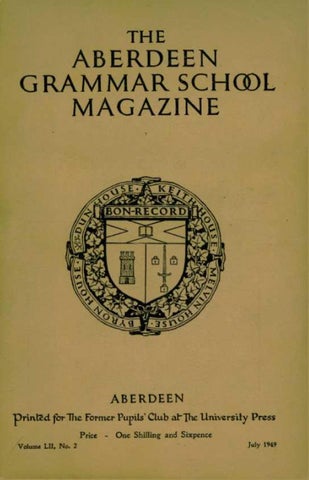
THE
ABERDEEN GRAMMAR SCHGDL MAGAZINE
ABERDEEN
primed for-The Former pupils' Club al-The University Press Price Volume LII, No. 2
- One Shilling and Sixpence July 1949
BOOKS NEW AND SECOND-HAND
Educational Books — Legal — Medical Classical—Technical—Theological, etc. Students'
Notebooks
and
all Stat-
ionery requirements
James G. Bisset Bookseller and Stationer
85 Broad Street Aberdeen Opposite Morischal College
•
PHONE 753 •
GOOD HEALTH demands
GOOD BREAD For the children especially is it necessary to ensure their stamina and energy with good, wholesome, nourishing bread. In Hutchison's bread you'll find all these requirements are fully met. Phone or give instructions to have it supplied daily.
A.B.HUTCHISON LTD THE CENTRAL BAKERY
BRANCHES THROUGHOUT THE CITY
LITTLES have just what you are looking for Something to wear that is well cut, Smart and practical and not too expensive
SUITS
-
TRA VEL COATS MODEL COATS FROCKS DRESSES
E1 E
4 ••-•
•
.4
-'
GOWNS FUR COATS
•
Sizes to fit all figures from 36` hip to 56' hip
A. C. LITTLE & SONS LTD. 105 Union Street, Aberdeen
DAIRY : ABERDEEN
FARM : CULTER
Tel. 1213, 7013, 7014
Tel. 6
KENNERTY FARM DAIRY
WILLIAM REITH Sole Proprietor: JOHN REITH
46- 48
ROSE
STREET,
ABERDEEN
At your Service For QUALITY
FISH • GAME • MEAT Whether you shop in person or by telephone your requirements in either or both of our Departments will be looked after with care. Our delivery system too exists for your convenience
A. & W. ALEXANDER Fish, Game and Meat Merchants
S S 49 2 UNION STREET, ABERDEEN t7.2=======r4r4ncr4zrx=re.: Telephone : Aberdeen 5172
1
S S S S S S S S S S
•••1••• ••••1••• •••••••• •••••••• •••••.• Om.•••••
1 i
Telephone 189I- 2 i
ARCHIBALD
i
McKELLAR
Family Grocer, Wine Merchant and Tobacconist
i
I
! S
We specialise in
Medicinal Wines
i
PROVISIONS
VIBRONA
I
TEAS
HALL'S
COFFEES
WINCARNIS
WINES, etc.
PHOSFERINE
i
i
450-456 UNION STREET, ABERDEEN
i
MN...1YMa • • ••••• • ••••••-• •-•••••• ••••••• • .0. • ••••••-• ••••••-• • •••-• • .0... ••••••• • •••• • •
.••••-.."
/„/ ,/ hiA,Y: EN._N,,A__W f
_ W'KENNAWAY L'.° BAKERS and CONFECTIONERS
RESTAURATEURS
Phone 237/
173 UNION STREET ,
-
,
ABERDEEN
Also at 5 HOLBURN STREET ABERDEEN • STONEHAVEN and CULTS _
,
-
-
I i i i i i i i i i i ) 4
Consult
Jamieson
and
Carry
GIFTS for all Special Occasions Experts in Engagement Rings Fine Jewellery Solid Silver Watches
JAMIESON
&
CARRY
GOLDSMITHS SINCE
GEORGE THE SECOND
UNION BRIDGE
ABERDEEN
RO ERTS (ABDN.) LTD. MAKERS OF FINE FURNITURE AGENTS FOR
" NESTA" SPRING INTERIOR MATTRESSES "HOUSEPROUD" KITCHEN FURNITURE " PEL " TUBULAR STEEL FURNITURE
LINOLEUMS A large stock of good quality furniture and furnishings always in stock. We have a well organised workshop for repairs, which can be done expeditiously.
CARPETS FRENCH POLISHING REMOVALS REPAIRS
419 UNION STREET ESTABLISHED
A : ERDEEN
TEL2E6P9115ONE
JAMES FYFE & SON PAINTERS
AND
GLAZIERS
Office and Showrooms
II
DEE
STREET, ABERDEEN
Telephone 304
Telegrams : " Fyfe, Painters "
For Holidays Abroad in Summer For Ski-ing and Curling at Christmas For Educational Tours at Easter Apply
THE WAYFARERS II Albyn Place ABERDEEN Telephone
2 8614
BON RECORD For over a century, J. & A. Ogilvie have helped the people of the North-East of Scotland to solve their furnishing problems to their satisfaction. They will be delighted to place their long experience and trained staff as well as their very large and high class stock at your disposal to assist you in your difficulties. You are invited to call or write
J. & A. OGILVIE 369-373 UNION STREET
ABERDEEN Telephone 433
Telegrams " Interiors "
For persevering men . . .
. . . now and then Like everything of quality to-day, Simpson clothes are scarce.
But we shall soon be getting a quota
from this famous firm.
If. like many men, you
won't be content with less than Simpson's, please come in and ask us.
READY TO WEAR SUITS in a good range of fittings Top Grade Utility
.
.
.
.
£II 4s. 5d.
Hard Wearing Saxonies and Cheviots
£16 to E17
Fine Worsteds
£17 to £24
.
.
.
.
ESSLEMONT & MACINTOSH (RETAILERS)
LTD. TAILORS AND OUTFITTERS
UNION STREET
ABERDEEN
The choice of your
ARRANGEMENTS may be a little restricted these days, but we have been able to maintain our stocks at a good level, and have on display a pleasing range of modern and period designs for your selection
James Scott & Son (Aberdeen) Ltd. UNION STREET
483-485
ABERDEEN Phone 1881-7-3
ESTABLISHED ISIS
FCR BETTER FOOTWEAR APPOINTED MEAT PUE•
JAMES
LORIMER
.,
N;ITAte_' rermc3N,
TO HIS MAJ-
4 o.v . 11
ESTY
THE
VETOES AND
KING. DATED
POULTERERS
1ST JULY 1940
and Son (Bootmakers) Ltd.
J. WILLIAMSON & SON Civil and Military BOOTMAKERS
Meat Purveyors, Poulterers and Game Dealers I, 2, & 3 MARKET BUILDINGS ABERDEEN Phone 452
8 CHAPEL STREET, ABERDEEN (Late of 162 Union Street)
BRANCHES 35 FOUNTAINHALL ROAD
THE SQUARE. CULTS
PHONE 1724
PHONE CULTS 2
Also AT CHURCH SQUARE. BALLATER ESTABLISHED 1 844
PHONE 724
PHONE 38
MODEL AIRCRAFT •
COMPLETE E.D.
OF
KEIL-KRAFT
DIESEL
ENGINES,
RANGE
AND AMCO
BALSA, DOPES
AND
ALL
KITS, MILLS, CO,
ENGINES.
ACCESSORIES IN STOCK
J. T. CAMERON & SON SPORTS
HOBBIES
266-268 GEORGE STREET, ABERDEEN
Telephone 24412
Aberdeen's most popular bookshop WES f END 630%S.1110?
If it's a book
You will find an excellent selection of old and new favourites at the modern
WEST END BOOKSHOP 412
UNION
STREET,
ABERDEEN
•
For picnic, party or family larder Delicious, ready-to-serve dishes for the picnic hamper or the unexpected guest . . . wines in profusion, from a charming, light, delicately flavoured Moselle to the sparkling exhilaration of Champagne ... savouries, fruits, jellies and refreshing beverages to tempt the most jaded palate . . . and, of course, the bestknown brands and finest quality in an ever-increasing variety of staple foods You'll simplify your catering problem by shopping at Collie's
awe,. Gee,,,gaz,ti 269-271
UNION
By APPOINTMENT
FAMILY
GROOM
GROCERS TELEPHONE
STREET,
4800
(4 LINES) REGISTRY TEL. 20015
TO H.M. THE KIN:
ABERDEEN WINE
MERCHANTS ALSO AT
CULTS TEL.
28
BALLATER
TEL.
14
BRAEMAR
TEL.
212
V CONTENTS ILLUSTRATIONS Facing page William Clark Souter, M.D., D.O. 108 School
An Old Class Group—Lower I, 1912-13 . . . . . . . R. A. R. Black . W. D. Allardice. D. W. C. Smith Mr. Duncan M. Annand, M.B.E., M.A. . . . • . School Cricket 1st XI- Season 1949 • • • • • School Prefects, 1 948-49 • •
109 124
125 140 141 172
Facing page
Rugby 1st XV-1948-49 1 73 School Contingent, Combined Cadet Force—Officers and N.C.O.s . . . . 188 The London Centre Dinner, December 1948 . . 189 . F.Y. Rugby Section ist XV—Season • • • . 202 1948-49 F.P. Hockey Section ist XISeason 1948-49
•
.
•
203
The New Regime at the School . . . . . . . Page 105 The War Memorial in the School Hall. F.P. Club Memorial Schemes • „ 107 The New President of the F.P. Club . . . . . . „ io8 An Old Class Group—Lower I, 1912-13 . . . . . . „ 109 The Future of the Teaching Profession. By the Rector . . . „ 1 to At Government Expense. By Philip Dawson . . • . . „ III International Refugees. By Louis Findlay . . . . . „ 114 An Old Class Group—Classical VI, 1896-97 . . • . . 16 Blitz Journey—London, October 1940. By D. P. Cochran . • „ 117 Mengalum—An Islet of the South China Sea. By J. S. A. . . . „ 519 Books by F.P.s . . . . . . . . . . „ 1 20 University Notes . . . . . . . . . . „ 123 Our Golf Internationalist . . . . . . . . „ 124 Our Two Rugby Internationalists . . . . . . . „ 125 Anniversary of the Death of Lord Byron . . . . . . „ 126 Notes About Old Boys . . . . . . . . . „ 127 Marriages . . . . . . . . • • ,1 8 Obituary . . . . . . . . . . . „ 550 School Section— School and Random Notes . . . . . . . „ 155 Changes in the School Staff . . . . . . . „ 159 Life in a Japanese Internment Camp • • . . . 7, 161 Together We Build a New World. A Short Story . . . .,i 63 " As Ithers Sec Us " . . . . . . . 166 Two Theatrical Occasions . . . . . . . „ 167 Dreamland . . • • . . . . . . „ 169 Soldiers. Who's Who among the Prefects . . . . . „ 170 School Sporting Activities . . . . . . . „ 173 Lower School Notes . . . . . . . . „ 178 House Notes . . . . . . . . . . ,, 179 The Literary and Debating Society . . . . . . „ i8o Combined Cadet Force Notes. Pipes and Drums. The Arts Club „ 181 Scout Notes . . . . . . . . . „ 182 . The Dramatic Society. A Letter to the Editor . . . . „ 184 School Office-Bearers, 1948-49 . . . . . . . „ 185 The Former Pupils' Club— Club Executive Notes . . . . . . . . 186 The Edinburgh Centre . . . . . . . . „ 187 The London Centre . . . . . . . . . „ 189 The Glasgow Centre . . . . . . . . „ 191 F.P. Reunions Abroad. The Annual Dinner and Annual Ball . „ 193 The Annual General Meeting of the Club . . . . . „ 194 The F.P. Club Boarding House . . . . . . . „ 199 F.P. Rugby Section . . • . . • . . . „ 201 F.P. Golf Section . . . . . . . . 202 F.P. Hockey Section. F.P. Cricket Section . . . . F.P. Club Consuls . . . . . . . . . :: 220043 The Bengal and Assam Centre. The Yorkshire Centre 20. . F.Y. Club Office-Bearers, 1949-50 . . . . . . „ 207 in
I
14
22
,,
,,
(‘
V
•
ti '•ts
-
ESTABLISHED IN ABERDEEN 1836
Northern Assurance Company Limited Enquiries solicited for all Classes of Insurance
FIRE Insure your Dwelling-house and Furniture with the Local Office
LIFE Attractive rates for Endowment Assurance and all other classes of Life Assurance ACCIDENT Insurance granted against Third Party Risks of all kinds Company's Assets
-
£38,230,000
CHIEF OFFICES:
ABERDEEN . . LONDON
1 UNION TERRACE i MOORGATE, E.C. z
Branches and Agencies throughout the World
-
Aberdeen Grammar School Magazine 65th year ; No. 164 (New Series, 56th year, No. 1551
Vol. LII
JULY
5949
No. a
The Magazine is published under the auspices of The Former Pupils' Club, twice a year at present—in December and July. Communications should be addressed to the Editor, ALAN C. R. WATT, M.A., 12 Bon-Accord Crescent, Aberdeen. [Nom : An asterisk after a name indicates that the F.P. is a member of the F.P. Club.]
The New Regime at the School Survey by the Rector Two years have passed since the discontinuance of fees, and, while parents and F.P.s in and around the city are not ill-placed to form their own judgment, Grammarians further afield may welcome a brief survey of the position. Throughout the secondary department there is singularly little change other than a steady increase in numbers, part of which would certainly have taken place in any event. Our own Lower School pupils, representing a fairly wide intelligence range, have passed on as before ; a considerable number of able, if not brilliant, boys from the primary schools of the city, who would formerly have been awarded Free Places, now enter our secondary department by the normal process of transfer, while others again, less able but by accepted standards fully qualified for senior secondary education, have taken the place of the fee-paying element from other schools, an element which varied very greatly in quality. The result is a real but not spectacular rise in the average level of ability and attainments and a rather more adequate r6presentation of good working-class boys in the secondary department of the School. As always, different types mix well together and our extra-curricular activities are undiminished in vigour and variety. With the passing of fee-paying, we have encountered a demand for primary school places far beyond our power to meet, and Lower School classes (ages 7- i z) have grown in size. Regrettable on educational grounds, this increase may be forgiven, because it springs from the almost compelling desire to take some at least of the bright children whose parents so eagerly seek their admission to the Grammar School. And it should be stressed that these additions to our primary classes are decidedly good material, being chosen in conformity with the
z o6
Aberdeen Grammar School Magazine
Committee's reasonable requirement that boys admitted at eight, nine, or ten must be of such quality that there is little doubt of their reaching at twelve the city standard for entry to senior secondary schools. Unquestionably, the feature of the present situation about which folk are least happy is the necessity for subjecting little boys of four and five to psychological tests. It must, however, be borne in mind that whenever a school of this type, whether fee-paying or not, is recruiting its infants from a whole city, the sheer pressure of demand for places imposes a method of selection little different from our own. In my experience, parents are, if not pleased with the present arrangement, at any rate reconciled to it. They recognise that the testing is fair in intention and honestly carried out. They rightly suspect that while there may be some chanciness in the selection from among many bright children, there is small likelihood that a dull child will shine in the tests. And lastly, they are fair-minded enough to admit that they cannot suggest a practicable alternative—other than a ballot for places I So far then, the abolition of fees has not materially altered the make-up of the School, nor does it seem likely to do so for some years ahead. What the more distant future holds is here, as elsewhere, veiled from us—perhaps mercifully so I In conclusion, two things should be put on record : first, there is no sign whatever that the School has ceased to commend itself to the professional and middle classes, from which it has mainly recruited in the past ; and second, the Education Authority has most loyally kept its pledge that the staffing and equipment of the Grammar School would not suffer from the abolition of fees. J. J. R. Further Honour for the Rector At the annual meeting of the Educational Institute of Scotland held at Edinburgh on io June 1949, the Rector, Mr. James J. Robertson, O.B.E., M.A., B.D., F.R.S.E., was received as a Fellow of the Institute. He was among those recommended by the Board of Examiners as " persons who have rendered signal service to education ".
Annual School Church Service The Annual Grammar School Church Service is to be held in Rubislaw Church, Aberdeen, on Sunday, I I September 1949, at 6 p.m. The Service will be conducted by the School Chaplain, Rev. P. D. Lawrence * (1906-16), M.A., and the Rector will also take part. F.P.s, pupils, members of the Staff, parents, and all others interested are invited to attend.
Aberdeen Grammar School Magazine
to
The War Memorial in the School Hall Aberdeen Town Council have decided to allocate the sum of £240 towards the cost of the War Memorial in the School Hall, and the balance of the cost is to be met from the F.P. Club Memorial Schemes Fund. Work on the erection of the War Memorial (which will include the 1914-18 War Memorial) on the East wall of the School Hall has been commenced and plans for the unveiling ceremony are being made by a Joint Committee of representatives of the Town Council and the Club. The ceremony is to be held in the Hall on Thursday 27 October 1949 (the day before the Club Annual Dinner), and we are particularly pleased to announce that the Right Honble. Lord Alness, who unveiled the 1914-18 War Memorial on 8 May 1923, has consented to come to Aberdeen for this special occasion, to unveil the Memorial to those who gave their lives in the second world war. The Club Executive feel sure that there will be widespread satisfaction that this distinguished F.P. who has been present on so many important occasions in the Club's history and at several other gatherings connected with the School, is to honour this ceremony with his presence. The Lord Provost of Aberdeen will preside at the ceremony and the President of the Club, Dr. W. Clark Souter, and others will take part. Invitations to the ceremony will be sent in due course to the nextof-kin of the 194 F.P.s whose names appear on the War Memorial, and also to subscribers to the F.P. Club Memorial Schemes Fund. F.P. CLUB MEMORIAL SCHEMES Roll of Honour The Roll of Honour, which includes a notice and photograph of each of the 194 F.P.s who died on active service or who were killed through enemy action during the recent war, is now in the hands of the printers. Proofs will be sent to the next-of-kin in the near future, and it is hoped that the Roll will be published before the unveiling of the War Memorial in the School Hall on 27 October 1949. A copy is to be presented to each of the next-of-kin and copies will also be available for sale. (Over seventy copies have already been ordered by F.P.s.) The W. P. Stewart Memorial Fund As soon as the other Club Memorial Schemes have been completed, the balance of the Club Memorial Schemes Fund will be allocated to the W. P. Stewart Memorial Fund, which, as already intimated, is to be used to assist boys at the School to participate in extra-scholastic activities. Dr. Theodore Watt's Portrait The Executive of the Club have decided to present to Mrs. Watt a replica of the portrait of the late Dr. Watt, which was presented to the School on 1 November 1948.
sob
Aberdeen Grammar School Magazine
The New President of the F.P. Club Club is William Clark Souter* This year's President of the (1893-98), M.D. (Abdo.), D.O. (Oxon.), an F.P. who is well known both in his profession and in many other circles. Dr. Souter has for over forty years been an ophthalmic surgeon in Aberdeen. After being Assistant Ophthalmic Surgeon to Aberdeen Royal Infirmary for twenty years, he became Ophthalmic Surgeon in 1926 and held this office for a further twenty years—probably the longest combined period of service given to the Infirmary by any of its honorary officials. From 1926 to 1946 he was also Lecturer in Ophthalmology at the University of Aberdeen and since 1938 he has been Ophthalmic Surgeon to the Aberdeen Eye Institution, which was founded about 1823 by a famous F.P. of the School, Sir James McGrigor. In 1932-33 he was President of the Aberdeen MedicoChirurgical Society (also founded by Sir James) and in 1939 he was President of the Section of Ophthalmology at the Annual Meeting of the British Medical Association in Aberdeen. Later he was VicePresident of the Royal Society of Medicine's Section of Ophthalmology and from 1941 to 1944 he was Vice-President of the Ophthalmological Society of the United Kingdom. He is the surviving original Vice-President of the Deeside Field Club, a former President of the Aberdeen Business and Professional Club and the present Chairman of the Aberdeen Centre of the Royal Scottish Geographical Society. In virtue of historical research embodied in " Dr. William Harvey and Aberdeen ", published in The Aberdeen University Review, he is a member of the Edinburgh • Harveian Society. It is perhaps not generally known that Dr. Souter was probably the first F.P. to cross the Antarctic Circle and thereby qualify for membership of the exclusive Antarctic Club. In 1903 he was appointed Surgeon to H.M. Antarctic Relief Ship, Terra Nova, which went to the relief of Captain Scott in the Discovery. Other F.P.s who have been in the Antarctic are SIR JAMESON BOYD ADAMS (18 93-94), K.C.V.O., C.B.E., D.S.O., Commander R.N.R. (retired), ROBERT SELBIE CLARK* (1893-19o I), M.A., D.Sc., and JAMES WILLIAM SLESSER MARR* (1913-19), M.A., B.Sc., Lieut.-Comdr. R.N.V.R., all of whom went there with Shackleton on different expeditions. " Scout Marr ", as he was known when he accompanied Shackleton in the Shackleton-Rowett Expedition of 1921, has made numerous other expeditions to the Antarctic and in 1947 CHARLES MICHAEL MACINTYRE BEGG ( I 933-36), M.A., B.Sc., Ph.D., was Biologist in a factory ship which headed an expedition to investigate the whaling position in that part of the world. Our new President has always taken a keen interest in the School and the Club and he was for several years the Club's representative on the Secondary Schools Management Committee. Many F.P.s will remember with pleasure several characteristically witty afterdinner speeches which he has made at Club Dinners and Dr. Souter is assured of a very cordial reception when he presides at this year's Dinner at the end of October.
OM WILLIAM CLARK SOLITER,
M.D., D.O.
An Old Class Group—Lower I, 19I2-13
Back Row—N. B. Sellar, Rex Fowell, P. R. Wood, David Sinclair, J. C. Fraser, Lionel Stuart, J. 0. Rae, Gilbert Courage, C. E. Anderson, Edward Clyne, Miss A. C. Adam.
Third Row—T. K. Macdonald, Edward Brodie, A. L. Mitchell, I. W. Davidson, J. W. Pope, R. M. Taylor, Li Chan Shih, A. F. Burnet, J. E. Wilson, E. A. McKinnon.
Second Row—G. A. P. Fraser, J. W. MacGregor, H. F. James, F. J. Lees, J. A. G. Adamson, R. S. Walker, Asher Gillespie, J. M. C. Gill, J. T. Anderson, J. D. Wood.
Front Row—John Milne, P. L. Fleming, J. C. Esslemont, W. W. Georgeson, N. B. Wright, G. R. Leathern.
Aberdeen Grammar School Magazine
109
An Old Class Group—Lower I, 1912-13 (See opposite page)
Charles Ernest Anderson* (1912-24), B.Sc.(Eng.), is Electrical Engineer to Bowater & Company, paper manufacturers, Ellesmere Port. Edward Brodie* (1910-19), C.A., is Assistant Secretary of the British Empire Trust Company Limited, London. Gilbert Courage* (1910-21) returned from Canada in 1947, and is now a licensed grocer in Aberdeen. Ian Winsted Davidson (1912-24), B.Sc., is an artist in Aberdeen. John Connon Esslemont* (1910-22), B.Com., is a director of John E. Esslemont Limited, wholesale merchants, Aberdeen. Rex Fowell (191 2-z3} is a builder and civil engineering contractor and lives at Cults. George Angus Paterson Fraser* (1911-22), M.B., Ch.B., is in medical practice at Market Deeping, Peterborough. James Cobban Fraser* (1911-23), M.B., Ch.B., is in medical practice in Aberdeen. William Wares Georgeson* (19,1-23), M.A., I.C.S. (retired), is District and Sessions Judge at Tanjore, Madras, India. James Munro Christie Gill* (1910-22), M.B., Ch.B., is in medical practice at Inverurie. Asher Gillespie (1910-19) is engaged in the fish trade in London. Harold Frederick James (1912-19) is a music teacher in Aberdeen. Francis Jamieson Lees (1910-22), M.B., Ch.B., is in medical practice at Banff. George Rendle Leathem (1913-16 and 1917-19), M.A., B.D., is minister of Ferryhill South Church, Aberdeen. Thomas Kyd Macdonald* (1910-19), B.L., advocate in Aberdeen, is a partner in the firm of Messrs. J. D. Mackie & Dewar, advocates, Aberdeen. James Wyness MacGregor* (191o-23) is Town Engineer at Umtali, Southern Rhodesia. Eric Arthur McKinnon (1911-15) is with the Works Directorate of the Air Ministry in Aberdeen. He leaves for Aden in July. John Milne* (1912-23), M.A., is a teacher in Torry Junior Secondary School. John Wilson Pope* (191o-24) is a civil engineer in the City Engineer's Office, Aberdeen. James Ogilvie Rae* (1912-21) is with the North British & Mercantile Insurance Company Limited in Calcutta. Norman Bruce Sellar (1912-2I) is in partnership with his brother at the Station Garage, Aberdeen. David Sinclair* (1912-21), B.Sc.(Agr.), is farming at North Loirston, Nigg, Kincardineshire. Robert McIntosh Taylor (1912-18) is with the Bon-Accord Coal Company, Aberdeen. Ralph Spence Walker* (1910-22), M.A., is Lecturer in English Literature at Aberdeen University. Percy Robert Wood* (1910-20) is a director of Edward's (Aberdeen) Limited, wholesale provision merchants, Aberdeen. Ninian Blundell Wright* (1910-23), M.B.E., M.A., B.D., is minister of the Kirk of the Covenant, Dalmellington. Up-to-date information has not been obtained in respect of the following : John A. G. Adamson (1912-19) ; John Taylor Anderson (1912-17) ; Alexander F. Burnet (1912-16 ; Edward Clyne (1912-24) ; Patrick Lyons Fleming (1911-14) ; Li Chan Shih (1913-16) ; Anthony Leslie Mitchell (1912-15) ; Lionel Stuart (1908-16) and James Douglas Wood (191 1-22). JOHN EWEN WILSON (191o-2o), A.M.I.C.E., died at Inverness in 194o. Miss ALEXANDRA C. ADAM died in 1931.
Ixo
Aberdeen Grammar School Magazine
The Future of the Teaching Profession The Rector's Speech at the F.P. Dinner in Edinburgh The following is a report of the Rector's speech when he replied on behalf of the School to the toast of " The School and the Club" at the Annual Dinner of the Edinburgh Centre of the F.P. Club on 4 March 5949. I am worried about the future of my own profession. I see recruitment of men teachers for secondary schools drying up. .It has taken the western world a long time to make up its mind about education. From the time of Plato onwards, it has realized in its better moments that this business of moulding the new generation is the most important single undertaking of an enlightened society, but that is just a sort of fitful awareness. Most of the time we have been so incurably practical, so materialistic in our pursuits, that the tending of bairns has seemed a rather subordinate, unimportant occupation for grown men, compared with the business of guarding the health of our bodies or securing the validity of our deeds and the safety of our property. After the war I hoped that our country would at last determine to secure a first-class educational system at all costs, but my hopes have been dashed, for neither the remuneration nor the status accorded to the secondary teacher is such as will recruit our schools. I don't dwell at any length on the question of monetary reward though that cannot, of course, be dissociated from the appeal, or lack of appeal, of a great national service ; but, apart from the money aspect, we are in sore need of precisely the sort of support that F.P. Clubs—this and others—could give us in vindicating the right of the schools to a decent measure of independence. I suggest that F.P.s should regard the teachers of their sons not as a queer sort of folk towards whom a certain kindly condescension is felt but as a very devoted and, on the whole, a very able body of men engaged on a job which has nothing unmanly, nothing prosaic about it, but which is, on the contrary, one calling for the most robust and virile qualities and for all the resource and intellectual vigour that the best of us can muster. But if you are to get such teachers, there must be a really fundamental change in public opinion in regard to the teaching profession. Of course, once in a while, you have a man of genius like Lord Wavell saying that it would be very much for the good of society if we paid our teachers more and our lawyers less, but these sporadic utterances are not enough ; it requires that this should be the considered conviction of the men and women who influence opinion throughout the land and who determine policy. The peculiarity about our profession is that you can only secure some measure of recognition by ceasing to teach. It is not so with Law or Medicine ; but in Teaching, if you are to be a " success ", then you must fall from the height of teaching to the ancillary services. You must become a Head Master ; you must be elevated to the Inspectorate ; or you must run away and be an administrator— and that is what is happening.
Aberdeen Grammar School Magazine It is so absurd this impression that the realities of education occur not in the commerce of teacher and taught but in board-rooms, where the gravity of officials is fitly matched by the solemnity of elected persons. That is where most people think the vital things are happening, and, of course, on any sane view this is completely nonsensical. If we had any realism about us, we would proclaim again and again that these things are incidental, justified only in the measure that they forward the one fundamental work of the teacher and the pupil. And so, if by some magic I could gather all these genuinely devoted and enthusiastic F.P. Clubs of Scotland together, my first appeal would be—Can you, who are people of standing, you who are articulate, find means to bring it home to Scotland at last that, if something is not done, there will be a progressive decline in the teaching profession and that it will be worst where its effect will be most calamitous, among the boys at the upper end of the school. I have always been sensible of the immensely important part played by women in Scottish education and in the life of our country generally, but I have no doubt at all that, if we are to go the way of the United States and have secondary teaching become almost wholly a woman's profession, that will be a major calamity for Scotland.
At Government Expense Last summer I was one of the fortunate sixteen officers in the Training Branch of the Royal Air Force Volunteer Reserve in Scotland, who were selected to attend an Advanced Soaring Course in Germany as a reward for our efforts at week-ends as gliding instructors to the Air Training Corps cadets. Friday 13 August was the date of our departure by air from Edinburgh, and that date quite lived up to its reputation. The countryside on the flight down to Kent was looking glorious, although the damage being done by the Berwickshire floods was awe-inspiring—chimney tops alone were visible, bridges were covered by the water, and there was a tremendous patch of dirty muddy brown water at the mouth of the river Tweed. Inland it appeared like a very large lake. After passing many places well known to me during my sojourn in the Forces during the war, we arrived over Kent and for the next four days there was never a dull moment owing to mishaps to the aircraft on landing and in the air. To cut a long story short, we eventually arrived two days later at Buckeburg, one of the aerodromes for the airlift to Berlin, and even then our plane was flying on only one good engine. The saying " If you've time to spare, travel by air " is certainly very true I Next day we reached our destination, Oerlinghausen, a little village on the edge of the Black Forest. For those readers not conversant with the general idea of gliding and soaring, I had better digress and state the fundamentals of it, with special reference to Oerlinghausen. The gliders themselves are constructed of spruce, plywood and glue, and, as you will appreciate, are as light as possible. To enable landings to be made in restricted
Aberdeen Grammar School Magazine 112 areas, there are spoilers fitted, which act as dive-brakes and steepen the rate of descent without increasing the speed. As regards launching the glider—this is effected by means of winches, some of which are adapted balloon barrage winches. The engine on the winch drives a drum to which is attached some thin cable, usually about ;,ooo feet long, the other end of which is attached to a hook fixed either on the nose of the glider or else at its centre of gravity, thus enabling a higher launch to be made, although the strain on the glider is greatly increased. The drum is then revolved at a speed which varies according to the wind strength but is usually about thirty to forty m.p.h. The cable is wound in, the glider pulled forward till it attains flying speed, and with the control column well back for a nose launch and in neutral for a centre of gravity launch, the glider is pulled up like a kite in a very steep and, for the first few occasions, breath-taking climb to between Boo and moo feet, according to conditions. The pilot pulls a lever in the cockpit, thereby releasing the cable and thereafter everything depends on his own efforts and skill at keeping the glider airborne. There are two main methods whereby a glider can remain airborne longer than it does during a controlled descent, namely Thermal Soaring and Ridge Soaring. The former depends on turning the glider in a rising air mass which takes the glider upwards with it. Various parts of the earth's surface, for example sand and ploughed fields, heat up quicker than their surrounds. At intervals of approximately every half an hour, the heated air mass above these parts breaks away from the surface and rises at a progressively faster rate through the surrounding air. If then the air mass is rising faster than the rate of sink of the glider, the glider will gain height while it is in this mass. Such masses are, of course, invisible but can be recognised by the very rough conditions inside them and there is in the cockpit an instrument called a variometer which indicates whether the glider is climbing or descending. The procedure is that whenever a patch of turbulent air is encountered and the needle of the variometer flicks up, the glider is put into a turn and the needle watched very carefully. If the glider is still climbing after one complete turn, then the turn is continued until the variometer shows a rate of descent, when the pilot levels out and searches for another thermal. The diameter of these thermal up-currents is usually very small and it will be appreciated that it is very easy indeed to fly out of them by inaccurate turns or even just by turning outside them. The ideal conditions for this type of soaring are a gentle breeze and a bright blue sunny sky with some heaped massive cumulus clouds. Ridge Soaring, as the name indicates, is carried out by flying along a ridge and taking advantage of an area of lift which is created in front of the summit, when the wind is blowing directly on to the ridge. The glider is flown just heading out of wind in front of the top and allowed to drift along from one end of the ridge to the other. This method can only be carried out when the wind is blowing directly on to the slope and it entails hard work for the pilot owing to the rough air. Oerlinghausen used to be one of the pre-war centres of the German gliding clubs and possesses a very fine residential clubhouse situated
Aberdeen Grammar School Magazine
i 13
at the foot of the soaring slope amongst trees and heather. It was, in fact, very reminiscent of the Western Highlands. The flying-field itself is some two miles away, surrounded by trees, for which one soon learned to have a healthy respect, in view of the possibility of not getting back to the field from a flight. The situation is ideal for both methods of soaring as the soil is very sandy and there is a ridge about Goo feet high two miles from the landing-ground. The usual procedure there was to take off, circle after release in an attempt to pick up a thermal, or, if this was unavailing, make straight for the ridge, circling in any thermals met en route. Thereafter, we flew along the ridge until a thermal was picked up, wherein as much height as possible was gained. Once the thermal petered out or was lost, we went back to the ridge to maintain the height gained until another thermal was encountered, and so on. If 3,OOO feet above release was reached, we left the ridge and flew across country in an attempt to fly thirty miles, which is one of the conditions of the Silver C Award. This type of flying is quite hard work, as the glider, being very light, is tossed about quite heartily and has to be flown all the time. No " hands off " flying in gliders! I personally had no previous experience of soaring, so it was bewildering and most exhilarating for me as an ex-power pilot to be still climbing after being airborne for quarter of an hour in an aircraft without engine or parachute and at a height of over z,ooo feet. Until then I never believed it possible I Unfortunately, although the weather was fine during the Course, it was not very good for gliding. Only one Course member managed to get away on a " cross country• " but he put up a grand show by flying fifty miles ; and then, being very cold, he landed at an aerodrome in the middle of aircraft returning from the air-lift to Berlin. He was not very popular! There were no serious mishaps on the Course although one person, trying very hard indeed to remain airborne for five hours, another Silver C Award condition, had to land on the top of some trees, after four hours and forty minutes. Although the glider was badly damaged, he was unscathed and returned to earth by climbing down one of the trees. The flying instructors, maintenance fitters, carpenters and winchdrivers, were all ex-Luftwaffe and very pleased at still being connected with aviation, as well as being in a position to obtain cigarettes, which were very scarce, the Black Market value being los. for twenty. As far as could be ascertained, the German rations were meagre but the same could certainly not be said about military rations. Steak was a common item on the menu. In fact, I had a meal which would have been considered superb in pre-war days but which, including a bottle of wine, cost only 8s., while the service was peerless. A pint of beer cost 6d. in the messes I Alas, such a course could not continue indefinitely and it was with much regret that we packed our bags and flew back to Sir Stafford Cripps and his austerity Britain. PHILIP DAWSON (I925-7).
114
Aberdeen Grammar School Magazine
International Refugees For some time the Editor of the Magazine has been asking me to write an article on my work with the International Refugee Organization in the American Zone of Germany. I am grateful for the opportunity, as it gives me the chance to present a world problem for which the final solution has not yet been found. It also enables me to present to readers a problem which can readily become forgotten. Human memories are short, especially when they concern facts which . we want to forget. The problems of the post-world war period are abundant in every country and it is easy, in consequence, to put from our minds some of the issues which still require action. One such problem is that of the vast numbers of refugees who were victims of war conditions, conditions which uprooted them from their homelands, divorced them from their families and caused many of them to suffer years of hardship and torture in concentration and labour camps. The second world war created a vast new refugee problem, that of the millions of Europeans moved by the Nazis across frontiers for racial and political reasons and for forced labour. International action has been taken with regard to refugees since the end of the first world war. Dr. Nansen, famous as an explorer, was one of the leading spirits under the League of Nations and the phrase " Nansen Passport" is still to-day frequently heard on the lips of our present refugee group. Following the Nazi persecution in Germany and Austria, refugees received assistance through the Inter-Governmental Committee onRefugees. [At the end of the second world war the Allied Occupying Armies in the course of their advance liberated about 8,ooo,ooo United Nations nationals and during the immediate post-war period arranged with the assistance of UNRRA for the repatriation of approximately 7,000,000 of these refugees.] Later this work was largely undertaken, as soon as conditions permitted, by UNRRA as a part of its wide-scale relief and rehabilitation programme. The UNRRA operations came to an end in July 1947 when it was decided that the major supply phase of rehabilitation to war-devastated countries could be terminated. The problem of refugees, however, still remained and the United Nations organized and established at that time its specialized agency, the International Refugee Organization. The present refugees for whom this organization is responsible arc scattered throughout the three Western Zones of Germany, Austria, Italy and the Middle East, the Far East, and others in a different category are to be found throughout Western European countries. In the American Zone of Germany, where I work, there still remain over aoo,ooo refugees who originated principally in the Baltic and Eastern European countries. They represent the remainder of the forced labour and concentration camp victims as well as those who fled from their homelands in fear of political and religious persecution. They include also the children kidnapped under the Germanization programme, thousands of whom have since been traced to the homelands and institutions from which they had been taken as booty.
Aberdeen Grammar School Magazine 115 In the group are the tragic remnants of European Jewry many of whom now are finding the door open for emigration to Palestine. During 1944 and 1945 I was working with many thousands of refugees in the Middle East, our largest refugee camps being in the desert of Sinai on the route of the Children of Israel's march back to the Promised Land. To-day, we see from the Western Zones of Germany and other European countries a further and perhaps final stage in this movement to Israel. In the American Zone of Germany to-day, as in other zones and countries, the International Refugee Organization is providing full care and maintenance services to the refugees, but self-government is an important and essential part of our administration. The refugees, in most instances, have built their own churches and schools and have provided other facilities. They have their own police forces, to a large extent they staff the administrative offices and, in my own field of work, they staff the hospitals and clinics and play an important part in regard to the various other aspects of our public health activities. The International Refugee Organization is constantly engaged in the further training of assistant nurses and home visitors and in the post-graduate training of doctors and other medical personnel. In the total group about sixty per cent. of the refugees are skilled workers and many are employed in camp services or in other work. Vocational training schools are preparing large numbers of other refugees for suitable trades. THE PROBLEM REQUIRING AN ANSWER
Continued care and maintenance for indefinite periods cannot, however, be considered a suitable solution to this problem of the refugees. Repatriation to their former countries is one possible solution ; absorption into the local economy is another ; lastly, the resettlement of refugees in new countries presents a third solution. With regard to repatriation the record is good. As mentioned before, 7,000,000 of the 8,ooo,ooo refugees liberated in Europe have been repatriated and this scheme is still being continued on a voluntary basis under the International Refugee Organization. Absorption into the local economy, which was largely the solution of the refugee problem after the first world war, is less practicable this time. There is the natural animosity felt by the refugees towards the Germans at whose hands they have suffered so much, and countries such as Germany and Austria have themselves been so largely devastated by the war that an increased population would add to the difficulties of the occupying authorities. Resettlement in new countries, therefore, appears likely to be the main solution. At the present time over thirty countries have accepted refugees from Europe and elsewhere. Britain has played a very large part in this programme and her example in this respect is one of which we can be proud. Refugees are also being resettled in other Western European countries, in U.S.A. and Canada, in South American Countries, in North Africa and Australia. The International Refugee Organization to-day has the largest civilian transportation shipping fleet in the world with thirty-six ocean-
Aberdeen Grammar School Magazine going passenger ships. Each day at least one International Refugee Organization ship carrying refugees leaves from a European port and each day the Organization is spending 05,000 to send its ships to the four corners of the earth. Up to the end of March 1949, approximately 130,000 have been transported to new lands and this figure does not cover the total number who have been resettled by the International Refugee Organization, since thousands have travelled on the Organization's trains to Eastern European countries and many passages have been purchased on private vessels. When I was in the Middle East, I was concerned with arranging the shipping movements of thousands of refugees home to Yugoslavia and Greece and, when I think of our constant difficulties in chartering passenger space, I am amazed at the development and growth of the present I.R.O. passenger transport fleet. t 16
UNITED NATIONS IN ACTION
The International Refugee Organization is an example of the United Nations in positive and successful action. Eighteen nations are now members of the Organization and forty nationalities are represented on our staff. We work as a united organization and our individual nationalities seem of little importance. For example, on my own staff in the Health Department I have doctors, nurses and others of sixteen nationalities. That Doctor So-and-so is Cuban or American or Polish never enters my head as a matter for consideration ; that Nurse So-and-so is Irish or French or Danish is equally of no concern. Our staff meetings show us already as some new kind of international hybrids. Perhaps after a period of years working on the common problem— an international human problem—we have unconsciously discovered a secret the politicians may never find. The International Refugee Organization is a live organism, not just an organization. In its daily routine work it brings hope and happiness to countless of the war's most tragic victims. New homes arise prosperously, new families are growing in freedom, new adventures of discovery, opportunity and development are being found as in all the greatest emigrant movements in history. This is the greatest one and the job is still only partially completed. Lou1s FINDLAY (1924-30).
An Old Class Group—Classical VI, 1896-97 In the notes which accompanied the photograph of Classical VI, 1896-97, in the last issue of the Magazine we stated that one member of that class had not been identified. GEORGE HENDRY (1897), M.B., Ch.B., of Buckie, has since let us know that the missing man is Alexander Simpson (1897-98), son of the late Mr. George Simpson, sometime a shoemaker in Bank Street, Buckie, and a former Provost of the Burgh. We have no up-to-date information about Simpson, however ; about 1923 he was engaged in" motor car work " at Salisbury, Southern Rhodesia. The new President of the F.P. Club, Dr. W. Clark Souter* (1893-98), was also a member of this class but for some reason he was not present on the day the photograph was taken.
Aberdeen Grammar School Magazine
117
Blitz Journey—London, October 194o It was late one evening in mid-October 194o. Air raids were at their height in London and Fate swept me along through the heart of the City in a crazy tour by car, which I will never forget. If I hadn't met three Canadian soldiers in the " Hand " at the Crooked Billet, this story would have been completely different. They were decent lads. We became friendly in that easy way which wartime creates by its silent destruction of the conventions that appear to be justified in other days known as peace. We fortified ourselves with a few pints of " old-and-mild ". These fellows were going to Waterloo and, as the intermediate lines were not functioning, I naturally offered to drive them to the station. That started it. Eleven o'clock had just struck. A raid was in full progress but our journey was quite uneventful till we reached Earl's Court on the King's Road. There we became conscious of the horrible acrid reek of high explosives. Vivid flashes tore into Nature's darkness in front of us. Debris including glass was all over the road. I pulled up. On the advice of a warden we proceeded via the Embankment. After passing Lambeth Bridge we seemed to go through an avenue lined by hugh fires on each side. The road was again blocked and we had to go west on to Constitution Hill and past Buckingham Palace, through Admiralty Arch, along the Strand, and so to Waterloo. It was the witching hour of midnight but I didn't give it a thought. I dumped my load of khakiclad figures, said cheerio, wished them all the best, and steered a course for home. Pall Mall and Piccadilly were barricaded. I swung up Regent Street. While I was waiting for traffic lights to change, 1 heard a bomb descending and I flattened out along the driving seat. Nothing happened. It must have been farther away than I anticipated. As the lights were still against me when I regained the perpendicular, I'm afraid I infringed the law by going through them. On I went to Oxford Street, turned left at the Circus and, en pas.rant, noticed that the building on the north-east corner was a mere shell. As I drove along to Marble Arch I had to run over numerous hose pipes as the N.F.S. were concentrating on buildings at the foot of Edgeware Road. I got the mistaken impression that the Connaught Club was ablaze. Across in Hyde Park the Ack-Ack guns were in action. I tried to get along Bayswater Road but had to abandon the attempt, go a little farther North and then run parallel to it. I got as far as Earl's Court Road but, after proceeding down it for a few hundred yards, I had to turn back as it was completely blocked. Then I made for Hammersmith Broadway—back to Wimbledon—and to bed. It was difficult to sleep after that nightmarish journey. My brain buzzed as incident tumbled over incident. My nerves were jumpy but I was sure they would have been seriously torn if the drone of the car hadn't drowned lots of disagreeable noises. I was thankful for that. The appearance of Piccadilly Circus struck me as strange as my thoughts
118
Aberdeen Grammar School Magazine
wandered again. Didn't it look as dead as a deserted city ? Yes, that was it—a deserted city—but created by the lashings of war. I was the only motorist there as I passed through on my return journey. Few people were there—mostly wardens and police. I could have counted them all on my fingers. Incredible as it may seem, I saw only one other car during the whole of the double trip, and so I reflected there was one other blankety fool on the road that dirty night. To-day, eight years later, I fear many of us look somewhat older as a result of living during the war years in London, a city that was pounded by bombs, doodlebugs and rockets. Our daily duties were more or less satisfactorily done, but only now are we slowly but, I hope, surely recovering from the effects of it all. It entailed months of sleepless nights when one seldom if ever experienced what then seemed the luxury of getting into pyjamas. Distant sounds would catch the attention and at once one was listening intently with every muscle taut and every nerve apprehensive. The sound would increase in volume and the inevitable wailing of the sirens would heighten tension until the flying bomb with its rhythmic note would pass low over the roof-tops or dip and burst in very close proximity. The inevitable column of dust would be seen rising high into the sky above the shattered buildings, to be followed almost immediately by the clanging of the bells of fire engines and ambulances rushing through the streets. What they did in the city's streets under bombardment from the skies has greatly enhanced my opinion of the Londoners. My war-time experience gave me the opportunity of forming a true estimate of the great men and women of London. I am afraid that when I went there in 1937 I had a different opinion. I am glad to know how wrong I was. Another and final word. It is now more or less only a memory, but there is something much more than that underlying it all. That experience, grim and heartbreaking as it was, had a hidden value which it is impossible to assess. It was an experience that brought about a cleansing of the soul, if you follow what I mean. I have to admit that during some of the worst nights, when survival seemed remote, a " post-mortem " examination was conducted by personal introspection. I wished I had lived certain phases of my life differently. It is astonishing how many simple things there are which I can appreciate much better now that we are returning to, dare I call it, normal times. We can live a more or less civilized life again, released from the perpetual listening for the wail of the siren at the expense of so much nervous energy in the interest of self-preservation. We are now settled in comparative peace and attend to our duties with a feeling of confidence, and we can also turn to our affairs of leisure as nothing is going to happen to rend us to pieces or leave us with shattered minds or to witness mutilations and devastation. We once again breathe freely, conscious of our release from that hell of fear and exhaustion. D. P. COCHRAN (1906-I5).
Aberdeen Grammar School Magazine
tt9
Mengalum—An Islet of the South China Sea Off the West coast of North Borneo, some forty miles due West of Jesselton, lies the little island of Mengalum. It is squarish in shape, each side being approximately two miles long, and it is ringed by wide white sandy beaches that hurt the eyes with their glare in the noonday sun. On three sides and part of the fourth Mengalum is surrounded by coral reefs which come almost to the surface, if they are not actually uncovered, when the tide is low. No ships can approach the island and although launches can anchor within a stone's throw of the shore where the reefs are absent, the anchorage is so open that it is only usable in favourable weather. The local inhabitants, however, a handful of Binadins who live in a line of palm-roofed huts below the only eminence on the island, a hillock some fifty feet high at the North-West corner, seem to be able to land from their prahus anywhere when the tide is favourable. Where the Binadins came from originally is uncertain but I rather think they are the descendants of Sulus who have ventured out of the Sulu Sea through the channels separating Borneo from Palawan. They are wonderful seamen and their little boats with their coloured rhombic sails may be seen miles out in the South China Sea as they travel up and down the coast of Borneo from island to island. Most of them spend the greater part of their lives in their boats but those on Mengalum seem to have adopted a more settled way of life ; they have planted several acres of coco-nuts along the foot of the hillock and, on its slopes, sufficient sweet-potatoes, tapioca, pineapples, and fruit trees to serve their needs. Mengalum is, except for the one hillock, flat, hot, and mostly covered with thick jungle. Were it not for two quite different reasons, it would be far less interesting, as it is far less picturesque, than most of the other islands that lie off the Borneo coast. The first reason why Mengalum is interesting is that it may prove to be the source of oil wells and the second is that a hundred yards inland in a small clearing in the jungle lies a large iron anchor. How the anchor came to be there, and why it remains on the surface and has never been covered by rotting vegetation or sunk into the soil, is a mystery. It might from its size have been the anchor of a large sailing ship but from its shape 1 am inclined to think that it is more likely to have been the anchor of some enormous junk. The local natives treat the clearing where the anchor rests as a shrine and all sorts of superstitions are attached to it. They say that it must be treated with reverence and that an offering of a piece of white cloth should be hung up nearby when anyone visits the anchor in order to placate whatever spirits reside there. All sorts of misfortunes are said to have befallen a sailor from the Admiralty survey ship, H.M.S. Herald, who had the temerity to dance a hornpipe on the anchor when he went ashore there in 1938 or 1939. Some day, if oil remains as valuable a commodity as it is in 1948, Mengalum may be a spot of importance on the map, and that, dear readers, is my sole excuse for writing about it. J. S. A.
Aberdeen Grammar School Magazine Books by F.P.s LL.D.: A (I 882-91), M.A., D.Sc. Hundred Years of Chemistry. Second Edition. Duckworth. z is. * * * GEORGE SUTHERLAND FRASER (1924-35), M.A. : News from South America. The Harvill Press. los. 6d. * * * F.B.A. (Died 1946) : On LL.D., M.A., (i go i-o3), LAIRD JOHN Human Freedom. Allen and Unwin. 7s. 6d. John Laird, at his death the Regius Professor of Moral Philosophy at the University of Aberdeen, was undoubtedly a born philosopher and the circumstances of his upbringing in a Deeside Manse, at the Aberdeen Grammar School, and later at the Universities of Edinburgh and Cambridge happily ensured the realisation of his vocation. He shares in rich measure the capacity of our most famous philosopher, David Hume, for returning the Scottish verdict of not-proven to much argumentation on the philosophical issues which he was constantly revolving in his mind : when he held by positive convictions and conclusions, one knew these had not lightly been achieved. The subject of Human Freedom was one to which he must have given a lifetime's thought, a subject intricate and involved, yet calling in the end for decision and conviction and one therefore congenial to him at once as philosopher and man. He was a deep student of the philosophical classics and knew them in that fruitful way which meant a perpetual reconsideration of all vital issues in the light of the great thinkers' master-works : Augustine, Calvin, Spinoza, Hume and Kant were assuredly very present to him as he prepared his Forwood Lectures on the Philosophy of Religion at the University of Liverpool in 1945. Here he gave, somewhat informally in the manner of the spoken lecture, of his ripest. He saw three possible theoretical standpoints : indeterminism, its extreme opposite, fatalism, and, thirdly, voluntaristic determination. He felt an intellectual dislike for sheer indeterminism as savouring of magic, and of utter fatalism as incredible : he took his own stance on voluntaristic determination. Voluntaristic determination does not, he said, mean uncaused determination. Voluntaristic determinists insist that man is a moral agent, who looks before and after, weighs pros and cons, perpends, and is loyal or otherwise to moral principles. Voluntaristic determination grows out of causally relevant antecedents in a continuous intelligible history, but a responsible action is " self-caused not other-caused ; its dominant cause is generated from antecedents within the agent". Human behaviour in a formed character is reliably predictable. " I have found my tobacconist much more reliable than the utility lighter he sold me." The final form of this his last book—the last of many from his pen— was prepared by the author before his death. In it his treatment of a congenial subject shows his great bent for analysis and acute arguALEXANDER
FINDLAY *
Aberdeen Grammar School Magazine
121
mentation. He was one of the most learned philosophers of his generation. R. A. LILLIE (1896-1905). * * * ERIC LINKLATER * (1913-16), M.A., LL.D. :
The Pirates in the Deep los. 6d. (A novel for young people.) * * * CHARLES A. WILSON (1878-79) : Aberdeen of Auld Lang Syne. A Pictorial Retrospect. Printed by Henry Munro Ltd., Aberdeen. 1 5 s. In days before the hand camera and the picture postcard, both of which are relatively modern affairs, the photograph, as such, of scenes and people, occupied a remarkable place ; and the initials G.W.W. at the foot of scenic photographs were well known. They indicated the work of George Washington Wilson, a pioneer and leader in commercial photography. From the great stock of Wilson photographs, Mr. Charles Wilson has made this book, which is a record of Aberdeen scenes and people as seen by the eye of the camera during the past hundred years. There is ample variety in these pictures. To mention only a few : here is the Grammar School as it was before the Denburn was filled in ; and here is the Gilcomston Dam, once very familiar to Grammar boys. Here is Carden Place only half built, and here are the St. Nicholas Bells being paraded through the streets, a classic fiasco which is well described in the text. Very vivid are the pictures of the bicycle boom in the eighties ; and equally vivid are all the various hats, whiskers, and skirts to be seen in these pages. The groups of Aberdeen notables of the past prompt the reflection that the corresponding people of to-day, while they may be equally praiseworthy, have not got such individual and striking faces as their predecessors had. The book also gives an insight into the history of photography. Here is a picture of a row-boat on the Loch of Park in 1856, the first snap-shot or instantaneous photograph ever taken. Most of the pictures reproduced, moreover, were taken with the wet plate, the dry plate not having been invented till about 188O. The former necessitated, for outdoor work, a travelling darkroom. That used by Wilson was a sombre horse-drawn vehicle which, after it had served its original purpose, became well known in the Aberdeen streets, if our supposition is correct, as the Nazareth House van. Apart from the pictures, Mr. Wilson is to be complimented upon the accompanying letterpress, which in itself is remarkable for its range and its accuracy of detail. W. M. ALEXANDER (1887-96). Green Sea.
Macmillan.
*
*
*
FENTON WYNESS* 91 5-zo), F.R.I.B.A., F.S.A. (Scot.) : Let's Look Around Aberdeenshire. Four booklets on the Aberdeen, Deeside, Garioch and Huntly areas. (Further booklets on the Alford, Ellon, Fraserburgh, Peterhead, and Turriff Areas in preparation.) Education Committee of Aberdeen County Council. is. each.
I 22
Aberdeen Grammar School Magazine
The Aberdeen County Education Committee on the recommendation of the Aberdeenshire Youth Council has wisely sponsored the publication of these valuable booklets. Not only will they serve the youth of the County by encouraging an interest and pride in their own County but they will encourage teachers and parents to take a proper pride in the richly variegated story of this North-East corner of Scotland which is so replete with fact and legend. Here the dry bones of history come to life : interesting historical facts are judiciously intermixed with legend and folk-lore. One can trace the fascinating tale of our County through the mists of prehistory down to modern times. Each volume has a clearly printed map showing the places of interest mentioned in the text and there is also a carefully devised and dated key dealing with the castle plans and sculptured stones with their characteristics. Many of the place names, e.g. Gaelic, are explained. Intelligent tourists will readily buy such a readable account of the story of Aberdeen and County, an account which radiates from the City up Dee and Don and covers all the regions between. Armorial crests of the old families adorn the text and, as a preface to each booklet, there appears a reconstructed sketch of some famous castle to stimulate the imagination. These volumes are a challenge to other Counties of Scotland to emulate the example of Aberdeen County Council. CHARLES DAVIDSON (1882-86).
•
* * * With an Introduction by ERIC 1937-47. Verse Student Scottish LIN KLATER* (1913-16), M. A., LL.D. Published for the Scottish Union of Students by The Ettrick Press. 3s. 6d. As Eric Linklater rightly insists in his Introduction, the significance of this anthology lies in the fact that it numbers among its authors students who matriculated first in the University of War. All the old levity, hilarity, profundity, near profundity and iconoclasm of other student anthologies are here, but there is an additional unique contribution, unique both now and hereafter because there was and can only be one 1939-45 war and only one generation who fought in it and returned to the sheltering arms of their Alma Mater to record their experience in the light and in the shadows of the post-war world. Two thoughtful little poems from the pen of Alexander Brown t are to be found in what we might term the reflective section of the anthology. Both reveal a great delicacy of touch. Kenneth Buthlay t, Hector Gray t and Royston Milne t contribute amusing and satirical poems ; the last is a classical piece of student drollery and one is only sorry to miss the original Donald Dawson t illustrations. A. R. TAYLOR (1927-34). t Alexander John Youngson Brown (1923-36), M.A.. Kenneth George Buthlay* (1930-42) ; John Hector Gray* (1917-29), M.A., LL.B., C.A. ; Royston John Milne* (1918-3o), M.A., LL.B. ; Donald James Dawson (1919-27 )(Kiled on active service in 1944).
Aberdeen Grammar School Magazine
123
University Notes Albert Alexander Lawrence* (1940-46) was selected to play for the Scottish Universities rugby team against the English Universities at Glasgow on zz January 1949 and Gerald Kilvington Townshend* (1941-45) was selected to play for the Scottish Universities in a corresponding hockey match at St. Andrews on 19 March 1949. * * * No records were broken by F.P.s at this year's University Sports but it is interesting to note that the following records set up by F.P.s in the years stated still stand :100 yards W. O. Fiddcs (1904-15) 10-2 sees. (1922) 220 yards One mile Three miles Discus Javelin
J. S. G. Collie (1905-1o) A. W. C. Lobban (1925-35) A. W. C. Lobban (1925-35) D. W. C. Smith (1930-41) D. W. C. Smith (193o-41)
z2.4 sec. 4 mins. 29 secs.
(1914) (1939) 15 mina. 25'7 sue. (1939) 125 ft. ix } ins. (1947) 1f4 ft. 8i ins. (1945)
DEGREES AND PRIZES
At the Spring Graduation on 31 March 1949 degrees were conferred on the following :— Degree of Doctor of Medicine (M.D.) :— Ronald George Simpson* (1925-38), M.B., Ch.B., with commendation for thesis (" Lymphogranuloma Inguinale : A clinical study of the bubonic form of the disease based upon observations on 3 57 cases "). Degrees of Bachelor of Medicine and Bachelor of Surgery (M.B., Ch.B.) :— Ranald Fyfe Findlay Steven* (1933-43). Degree of Bachelor of Laws (LL.B.) :— John Robert Mackay* (1926-1937), M.A. Degree of Bachelor of Law (B.L.) :— Eric Buthlay* (1928-40). William Catto Connon* (1928-40). William Lewis Connon* (1930-40). Douglas Gordon Patterson* (1929-36). In the Faculty of Law Robert Kilgour Booker* (1928-41) and Robert Clement Steven* (1933-41), M.A., were two of the three students who shared the Whyte Prize in Accountancy for Law Students. In the Faculty of Medicine Lindsay Symon* (1934-46) was awarded the Chanock Gold Medal, the Fife Jamieson Memorial Gold Medal and the Lizars Gold Medal, all in Anatomy ; Duncan Morison McLellan (1937-45) was awarded the Dyce Davidson Gold Medal in Materia Medica ; and William Ian Cranston (1936-38) was awarded the Ogston Prize in Surgery. * * * UNIVERSITY OF EDINBURGH
David Forbes Ross* (1924-35), M.B., Ch.B. (Aberdeen), passed the final examination for the Diploma in Medical Radiodiagnosis (D.M.R.D.) in March 1949.
524
Aberdeen Grammar School Magazine
Our Golf Internationalist On 54 April 1949 the Scottish Golf Union announced that Robert Alexander Ross Black* (1930-41) had been selected to play for the Scottish international golf team in the contests between the four home countries at Portmarnock, Dublin, from 16 to 18 May. Unfortunately, however, Black had to withdraw from the team. He is at present a student of aeronautical engineering at Trinity College, Cambridge, and examinations there prevented his travelling to Dublin. In congratulating him on the honour he has won, we express the hope that in future years he will be able to take his place in the Scottish team unhampered by academic commitments. Sandy Black, who is the younger son of Professor J. B. Black, Professor of History at the University of Aberdeen, is very well known in Aberdeen and the North-East as an outstanding golfer. At the University he graduated B.Sc. in 5944 and B.Sc. with first class honours in Mathematics in July 1948 and during his years there he won not only a full blue for golf but also a half blue for rugby. Last autumn he went to Cambridge to continue his studies and immediately gained a place in the University golf team. In February, after Cambridge had played at Addington, the golf correspondent of The Times wrote :— The player I particularly wanted to see was Black, from Aberdeen, of whom I
had heard almost unutterable things. He turns out stripped for action with the shortest of shorts and of stockings, looking like a tough rugby football player rather than a golfer, and is, I should judge, prodigiously strong. That he has a fine game in him I am sure, but I don't think I saw him quite at his best. He is out of practice, having had, as I am told, the doubtful taste to work very hard. Give him some days of continuous golf and Hoylake at full length, and Oxford may have cause for fear.
And so they had. In the University match at Hoylake on zz and 23 March, Black and his partner won their foursomes match by 3 and 2, and in the singles on the following day Black, playing as Number One in the Cambridge team, beat Frank Tatum, the leading Oxford golfer, who is Danish open champion and a former American inter-universities' champion. At the end of the first round Tatum was z up, but in the afternoon, according to The Times, " there were many reversals of morning leads and the one that was worth diamonds and pearls to Cambridge came in the first match. The Cambridge captain had wisely put Black first as the one man who had the power to beat Tatum. He justified the choice, not indeed by superlative brilliance but by fine fighting golf ". He won by 2 and I. In the Scottish Golf Union trial at Old Troon on 5 April, Black further distinguished himself by defeating a Walker Cup golfer by 4 and 3, and The Scotsman reported that among the new hopes he completely stole the thunder. His display was all the more meritorious in that prior to the trial he had never seen the Old Troon course. Later in the same month he played in the Walker Cup trial over the Birkdale course at Southport. After completing his studies at Cambridge this summer he is going to the Imperial College of Science, London. We wish him the best of good fortune both there and on the golf course.
By courksy of Aberdeen Journals Led.
R. A. R. BLACK
W. D. ALLARDICE
D. W. C. SMITH Photographs by courtesy of btalniain, Edinburgh
Aberdeen Grammar School Magazine
115
Our Two Rugby Internationalists For the second successive year we are delighted to be entitled to use this heading for a page in the Magazine. This season W. Dallas Allardice* (1934-39), who won four " caps " in 1947-48, was "capped" for each of the four matches against France, Wales, Ireland and England and each time he had an F.P. team-mate in Douglas W. C. Smith* (1929-41). On behalf of the Club we extend to our two rugby internationalists heartiest congratulations on the honour they have brought to themselves, to the Club and to the School. Scotland started the season splendidly with victories over France at Paris and Wales at Murrayfield but lost the remaining matches against Ireland and England. In his eight appearances for Scotland Allardice, who plays at scrum-half, has not yet had an opportunity of playing behind winning forwards but his courageous display in every match has won him great praise from that highly critical band of experts, the rugby correspondents. In particular, his display at Paris, when it was reported that every time he got the ball he got three or four of the giant French forwards as well, will long be remembered by those who saw that match. Smith played in the left wing position in each match but in the Calcutta Cup match at Twickenham, after Jackson, Scotland's right wing, had been injured, he was given the unenviable task of playing for most of the game on either the left or the right wing, whichever was on the open side. He was particularly prominent in the Welsh match at Murrayfield. Who among the thousands of spectators on that occasion will ever forget his series of dashes down the wing and his thrilling try at the corner-flag during the tantalisingly exciting second half ? At School, Douglas Smith played for the 1st XV in 1939-40-41, being captain in 1940-41, and for the 1st XI in 1940 and 1941. He was also an outstanding athlete and his records in the too yards (to seconds, 1941), Cricket Ball (112 yards, t foot, 81 inches, i94o), Putting the Shot (46 feet, 4 inches, 1941), and Discus (129 feet, 7 inches, 1941) still stand. As long ago as 1938, when Smith was aged thirteen, Mr. Duncan Macgregor, then Games Master at the School, wrote in the Magazine : " Age for age, this boy Douglas Smith beats anything we have previously experienced ". At Aberdeen University he played in the XV for four seasons, 1943-47, gained his full blue in 1944 and captained the team in 1946-47. He was also awarded a full blue for athletics and he holds the University records in the Discus (125 feet t xi inches, 1947), and Javelin (1S4 feet 8i inches, 1945). In 1946 he was selected for the Scottish Universities' athletic team and in 1947 he captained the team. In September of that year he graduated M.B., Ch.B. and subsequently was on the staff of Aberdeen Royal Infirmary until October 1948, when he joined the R.A.M.C. He is at present medical officer at the R.A.M.C. Depot, Crookham. While at the University he played rugby for Scotland in three unofficial international matches against New Zealand, Wales and Ireland in 1946 and since joining the Army he has played in a large
t2,6
Aberdeen Grammar School Magaine
number of representative matches. He was in the Army team last season which beat the Navy and drew with the R.A.F. and in April he played for the British Army against the French Army at Paris. Later he was chosen for the Combined Services against Lancashire and invited to join the Barbarians for their Easter tour in Wales. He also captained the Depot R.A.M.C. side which won the Aldershot District Cup. • Reserve Scrum-Half for Scotland. The School received a further rugby honour this season in that for the French and Welsh matches another F.P., W. T. H. Hay* (1928-38), was selected as reserve in attendance for the scrum-half position in the Scottish side. (He was also chosen for the Irish match but was injured at the time and had to withdraw.) That one School should provide both the player and the reserve for a position in the national team is believed to be unique and it is interesting to note that Allardice and Hay were scrum-halves for the School 1st and and XVs respectively in 1937-38. That season Hay played scrum-half for the 1st XV in the first match of the season, when Allardice was a centre three-quarter, but thereafter Allardice was chosen as scrum-half, in which position he has played ever since. On leaving School, Hay, who is the younger son of GEORGE E. HAY (1895-1902), who has recently retires from the School Staff, was for three years at the Loughborough Physical Training College, Leicester, and played for the College 1st XV for three seasons, being captain in 1940-41. Thereafter he was for a time Assistant Representative for the Midlands District on the Central Council for Recreative Physical Training at Stoke-on-Trent and then for eighteen months he was principal teacher on the Physical Education staff of Gordon's College. In 1943 he joined the R.A.F. and was an air gunner until 1945 when he transferred to the Physical Fitness branch. In 1945-46, when stationed in the Naples area, he captained the C.M.F. XV and the All-Italy XV. From November 1946 until October 1948 ne was assistant to the Head of the Physical Fitness (Training) branch at the Air Ministry and, having been granted a permanent commission in the R. A.F. in August 1947, he is now Physical Fitness Officer at the R.A.F. College, Cranwell. In 1947-48 and 1948-49 he played rugby for the R.A.F. and also for the Combined Services.
Anniversary of the Death of Lord Byron On the occasion of the 1 z5th anniversary of the death of Lord Byron there was placed on the Byron Statue in front of the School a chaplet of laurel leaves with some Gordon tartan ribbon and a card bearing the wording : Missolonghi. April 19th, 182 4. I dream'd that Greece might still be free.
By the courtesy of the Rector it remained there for a week.
Aberdeen Grammar School Magazine
127
—• • The Editor is glad at all times to receive from any quarter items of information for this section of the Magazine.
The dates given in parentheses after names indicate the sessions of attendance at the School. HONOURS AND AWARDS Knight Grand Cross of the Order of the British Empire (G.B.E.) Sir (William) Wilson Jameson* (189z-19o z), K.C.B., M.D., LL.D., D.Sc., F.R.C.P., K.H.P., was created a G.B.E. in the 1949 New Year Honours. Many readers of the Magazine will already be familiar with Sir Wilson's distinguished career as his name has regularly appeared in " Notes about Old Boys " on the occasions of his receiving new appointments and further honours. He has been Chief Medical Officer of the Ministries of Health and Education since 1940 and is a member of a large number of important committees. He has received the honorary degrees of LL.D. from the Universities of Aberdeen, Manchester and Toronto, D.Hy. from the University of Durham and D.Sc. from the University of Cambridge. He is an Honorary F.R.C.P. of Canada, an F.R.C.O.G., and an Honorary Fellow of the American Public Health Association and of the New York Academy of Medicine. He has also been awarded the U.S.A. Medal of Freedom with gold palms. Always a keen F.P., he has for several years been an honorary vice-president of the F.P. Club. Commander of the Order of the Bath (C.B.) Francis Sheed Anderson* (1909-1z), Under-Secretary, Ministry of Food, was gazetted a Companion of the Order of the Bath in this year's New Year Honours. Formerly head of the firm of Anderson Brothers, granite merchants, Aberdeen, and a member of Aberdeen Town Council from 1936 to 1938, he joined the Food (Defence Plans) Department in 1938 on a voluntary part-time basis and became Divisional Food Officer for the North-East of Scotland at the end of 1940. In November 1943 he was appointed Director of Fish Supplies in the Ministry of Food ; three months later he became Principal Assistant Secretary ; and he has held his present post of UnderSecretary since January 1945. In the early months of this year he led the United Kingdom delegation to the International Wheat Conference in Washington. (See page 13o.) Kenneth Alexander Macdonald Tomory* (1899-1908), O.B.E., M.B., Ch.B., Major-General, was created a Commander of the Order
i 28
Aberdeen Grammar School Magazine
of the Bath (Military Division) in this year's Birthday Honours. Until March he was D.D.M.S. at H.Q. Scottish Command, Edinburgh Castle, and senior R.A.M.C. officer in Scotland and he has now taken up an appointment at H.Q. Eastern Command. He graduated in Medicine at the University of Edinburgh in 1914, and played as a three-quarter in the University rugby team. After graduation he was granted a permanent commission in the R.A.M.C. and during the 1914-18 war he served in England, India, Mesopotamia, and at Baku. In 1920 he was posted to Hongkong, and thereafter had tours of duty in various stations abroad. At the outbreak of war in 1939 he held the rank of Major, and at the beginning of 1944 he was with the H.Q. of a division of the Home Forces with the rank of Colonel. On 17 June it was announced that Major-General Tomory had been appointed an Honorary Physician to the King, with effect from I 2 May 1949. Alfred Buyers Valentine* (5905-II), M.A., Under-Secretary, Ministry of Town and Country Planning, was also gazetted a Companion of the Order of the Bath in the New Year Honours. Classical Dux of the School in 191i, he graduated M.A. at Aberdeen University with first class honours in Classics in 5959 and joined the Civil Service the following year. He was for some years with the Ministry of Labour and was secretary and technical adviser to British delegations at various I.L.O. conferences. In 1937 he was appointed Assistant Commissioner for the Special Areas in Scotland and in 1939-40 he was in charge of the Scottish section of the Children's Overseas Reception Scheme to the Dominions. In November 5940 he was appointed Principal Assistant Secretary in the Ministry of Supply and the following year he was transferred to a similar appointment in the Ministry of Home Security. Commander of the Order of the British Empire (C.B.E.) James Durno* (5900-02), formerly of Crichie, Inverurie, and now of Uppermill, Tarvcs, Aberdeenshire, was awarded the C.B.E. in the New Year Honours. He has for several years been one of the best known personalities in agricultural circles, particularly in the NorthEast of Scotland. He is Chairman of the North-Eastern (Scotland) Agricultural Executive Committee, Vice-President of the Royal Northern Agricultural Society and a former chairman of the Royal Highland and Agricultural Society of Scotland. In 5944 he was presented with his portrait in appreciation of his services to the NorthEastern Agricultural Co-operative Society, and to Agriculture in general. He is owner of one of the most valuable herds of Shorthorn cattle in the country. Herbert Brebner Scott* (5905-08), M.C., Manager for the East (covering India, Burma, Ceylon, Pakistan and Iraq) for the Royal Insurance Company Limited, the Liverpool and London and Globe Insurance Company Limited and their subsidiary companies, was awarded the C.B.E. in the Birthday Honours this year. A son of the late WILLIAM J. Scow (1879-89), sometime Manager of the Royal
Aberdeen Grammar School Magazine
129
Insurance Company Limited in Aberdeen and later in Edinburgh, he joined the " Royal " after the 1914-18 war, and was in the Shanghai and Calcutta offices for varying periods until last year, when he received his present appointment. He still lives in Calcutta at 5-7 Netaji Subhas Road (formerly z6 Dalhousie Square), an address well-known to many F.P.s on account of Mr. Scott's generous hospitality there, particularly during the recent war. While in Shanghai, he was our Consul for China and one of the F.P.s who donated the Shanghai Clock to the School in 1917. On returning to Calcutta in 1939 he was responsible for the formation of the Bengal and Assam Centre of the Club and was its energetic and devoted Secretary until last year, when he was appointed President. He has recently been re-elected Secretary and he continues to be Club Consul in Calcutta. Member (Fourth Class) of The Royal Victorian Order (M.V.O.) Alexander Johnston Slessor* (1918-30), M.B., Ch.B., F. R.C. S., was one of the nine doctors who signed the first bulletin after the operation of lumbar sympathectomy on the King on 12 March 1949. He was assistant to Professor (now Sir) James R. Learmonth, Professor of Surgery at the University of Edinburgh, who performed the operation with Professor J. Paterson Ross, Professor of Surgery at the University of London. Earlier in the year Mr. Slessor spent two periods of about a fortnight each attending the King at Sandringham. On 3 May 1949 it was announced that he had been appointed a Member (Fourth Class) of the Royal Victorian Order—an honour which is conferred for extraordinary, important, or personal services to the Sovereign or to the Royal Family—and in the Court Circular of 17 May 1949 it was announced that, along with two of the other doctors who attended the King, he had had the honour of being received by the King, when His Majesty invested him with the Insignia of Membership of the Order. Mr. Slessor, who is a son of the late THOMAS STEWART SLESSOR (1889-94), M.A., M.B., Ch.B., who was in medical practice successively at Glamis, Aberdeen and Inverness, graduated in Medicine at Aberdeen University in 1935. He was elected an F.R.C.S.E. in 1938, and an F.R.C.S. (London) in 1941. In the latter year he was appointed Acting Superintendent of the Western General Hospital, Crewe Road, Edinburgh, and from 1943 to 1946 he served in South Africa and India with the R.A.M.C., in which he was a specialist in peripheral nerve surgery and held the rank of Lieut.-Colonel. After demobilisation he joined the staff of the Department of Surgery in the University of Edinburgh, and since January 1948 he has been Assistant Surgeon at the Western General Hospital, Edinburgh. Officer of the Order of the British Empire (O.B.E.) James Gordon* (1905-06), Chief Engineer, s.s. Moreton Bay of the Shaw Savill & Albion Company Limited, was awarded the O.B.E. in the New Year Honours. He served his apprenticeship as an engineer with Barry, Henry & Cook Limited, Aberdeen, and during
130
Aberdeen Grammar School Magazine
the first world war he served in H.M.T. Marathon of the Aberdeen Line. In 1920 he was appointed Second Engineer in that ship and since 1921 he has been a Chief Engineer. During the recent war he served in troopships in many parts of the world. Military Cross (M.C.) Alexander George Gunn Williamson* (1914-26) has received the M.C. for gallantry in Siam in December 1941. He joined the Indian Army in 194o and served in the 8th Punjab Regiment as a Lieutenant. After escaping from Penang Island, where he was left behind, he rejoined his company but was recaptured in February 1942, and from then until September 1945 he was a prisoner-of-war in Singapore. Before joining the Army he was a tea planter in Upper Assam and he has returned to his post there since the war. He is at present on leave in this country. The award was delayed on account of the loss of records during the war and the political changes in India. * * * James Smart Abernethy* (1925-26), M.A., W. S., formerly Commissioner of Lands and Mines in North Borneo, joined the Colonial Legal Service at the end of last year and was appointed an Additional Sessions Judge for the Colony. In this capacity he dealt with all the serious crimes and relieved the ex offcio Sessions Judges, the three Residents, of most of their judicial duties. He has now accepted an appointment as a Resident Magistrate in Tanganyika and left Jesse1ton, North Borneo, for Dar-es-Salaam at the beginning of May. Francis Sheed Anderson* (1909-12), C.B., Under-Secretary, Ministry of Food, was leader of the United Kingdom delegation to the Second International \X'heat Conference held in Washington from z6 January to 23 March 1949. In addition, he was spokesman for the thirty-seven importing countries represented at the conference. An international wheat agreement was reached last year but broke down on account of the failure of the United States Senate to accept the President's recommendation that it be ratified. This year, after eight weeks of hard bargaining and frequent threats of deadlock, an agreement was reached which will govern a large part of the international trade in bread grain during the next four years. At the conclusion of the conference on 23 March, the thirty-seven importing countries and five exporting countries indicated that they were prepared to sign the agreement ana it is expected that it will be ratified by all these countries. The effect of the agreement will be to reduce the price which importing countries—of which the U.K. is by far the greatest—have to pay for much of their wheat, and during the remainder of its existence it will ensure importing countries against recurrent shortages and exporting countries against the effects of extreme surplus. The new pact has been welcomed not only as a triumph of give-and-take in international negotiation but also as likely to set a precedent for other commodity agreements in the future.
Aberdeen Grammar School Magazine
131 George Anderson* (1914-24) has returned to Kedah, Malaya, where he was in the early years of the recent war, and is employed by Kuala Muda Rubber Estates Limited. He has been engaged in rubber planting since he first went to Selangor in 1926. Nigel Eckford Anderson* (1935-43) has been with Steele Brothers & Company Limited, Rangoon, since demobilisation from the R.A.F. in April 1948. His brother, David Anderson* (1935-42), is studying Geography at the University of Aberdeen. Colin George Marr Angus* (1925-36), Captain, R. A .S.C., who holds a regular commission, is at present a staff captain at H.Q. North-Eastern Sub-District, Kaduna, Northern Nigeria. During the war he held staff posts in India, Burma, Malaya, and Sumatra. Alexander Spring Archibald (1915-22), M.A., was inducted in June 1948 to the charge of Wanganui East Presbyterian Church, New Zealand. Previously he was for a year minister of Hownam Church, near Kelso. Robert William Ingram Band* (1924-26), M.A., who has been in the Malayan Civil Service since 1932, is now Commissioner of Labour for Johore, with headquarters at Johore Bahru. Before the war he was in Kuala Lumpur and thereafter he was District Officer in Christmas Island, Straits Settlements. From May 1941 he served as a Captain in the Intelligence Corps, attached to the 8th Australian Division, until he was taken prisoner by the Japanese. Harold Stanley Bennett* (1928-4o), M.B., Ch.B., has been attending a course in Radio-diagnosis at the University of Sneffield. During his service with the R.A.F.V.R. he spent a year in India and nine months on a Bomber Command station in Suffolk. William George Rowntree Bodie* (1913-22), A. R.I. B. A., F.S.A. (Scot.), passed the final examination of the Town Planning Institute in 1948 and was in February of this year elected an Associate Member of that Institute (A.M.T.P.I.). Previously senior town planning assistant in Aberdeen, he has been seconded to the staff of Messrs. W. Dobson Chapman and Partners, planning consultants to the Corporation of Aberdeen, who are engaged in making a survey of the city and planning its future development. Ian Farquhar Booth* (1916-28), M.A., D.P.E., has been appointed deputy head master of Loveburn St. John's Junior Secondary School, Dumfries. Edward Kerr Borthwick* (1933-42), M.A. (Abdn.), B.A. (Cantab.), spent Easter this year in Greece, having been awarded a Henry Arthur Thomas travel exhibition scholarship by the University of Cambridge. AnDther of these scholarships was won by Hamish McNaughton Henderson* (1932-44), who is at Pembroke College. The scholarships are awarded annually to male students for travel in Greece, Italy and the Mediterranean, the amount of award being dependent on success in one or another of the Parts of the Classical Tripos. Peter Sinclair Brown* (1935-46) and Allan Melville Brown* (1935-47), who are twin brothers, are both serving in the R.A.F.
Aberdeen Grammar School Magazine After many attempts to have themselves posted to the same station, they were successful last March when they were re-united at the R.A.F. Station at Kinloss, Morayshire. Before being " called up " Peter was a junior reporter with Aberdeen Journals Limited in Aberdeen and his brother was on the staff of the North of Scotland Bank Limited. Ronald William Gower Bryant* (1920-32), M.A., M.Sc., who has been with the Ministry of Town and Country Planning, London, since April 1947, has recently joined the Planning Department of Lancashire County Council and is living in Preston. Under the Town and Country Planning Act, 1947 local planning authorities were charged with the duty of preparing development plans for their areas within three years of 1 July 1948 and there is naturally a great deal of research and survey work to be done in connection with these plans, not only on the " town planning " side but also from the economic, social and geographical aspects. In a big county such as Lancashire the complexity of the task can readily be imagined. Mr. Bryant has for many years been an enthusiastic designer of working railway models—a hobby which he describes as " pure escapism and light relief from the serious business of living ". Along with some other enthusiasts he has been making model railways on the remarkably tiny scale of two millimeters to one foot, which is half the smallest commercial scale. (The track guage is approximately I inch.) So far Bryant has been specialising in the architectural and scenic side while others have been making locomotives, and some of their combined handiwork has been on view at this year's Model Railway Club Exhibition in the Central Hall, Westminster. One of the models made by the " syndicate" is of a Highland Railway tank engine built at Inverness in 1870 ; it is two inches long, has a twelvevolt motor, goes up an incline of i in 3 and lives in a matchbox. Bryant is responsible for the "Inversnecky and Drambuie" branch of the Highland Railway, which serves Inversnecky pier and an imaginary peninsula in the Moray Firth ! The pier lives in a three-foot guitar case ; Seatown Inversnecky and a part of Ben Snecky in a mandoline case ; and Drambuie Junction in another mandoline case. He tells us that there is a Beach Pavilion supporters' badge by the switchboard, which is coyly hidden in the Inversnecky Lime & Agricultural Company's works. Recently he has been working bn the construction of the station bus—a double decker of pre-1914 vintage with open top and a spiral staircase at the rear. This model goes comfortably into a matchbox. This fascinating hobby, he warns us, is " not a racket for the ham-handed " I Alexander Whincup Carle* (1914-20), B.Sc. (Eng.), who retired prematurely from India in August 1948 on account of the political changes in that country, is now employed in the service department of Albion Motors Limited, Glasgow. He joined the B. & N.W. Railway with headquarters at Gorakhpur, United Provinces, India, in November 1928 as assistant locomotive superintendent, and was promoted district superintendent in 1934. During the last two years of his service he was in charge of three steam ferry services across the Ganges, with headquarters near Patna. T32.
Aberdeen Grammar School Magazine
133 John MacArthur Croll* (1912-24), M.Et., Ch.B., D.P.IL, who was appointed Lecturer in Bacteriology at the University of Sheffield in 1935, was seconded to take charge of the constituent laboratory at Lincoln under the Emergency Public Health Laboratory Service in September 1939. This Service was established at the beginning of the war under the direction of the Medical Research Council on behalf of the Ministry of Health and in April 1945, when the Service was put on a permanent basis (and re-named the Public Health Laboratory Service), Dr. Croll resigned his post at Sheffield and became director of thd laboratory at Lincoln. Charles Davidson* (1882-86), M.A., was in April of this year appointed President of the Deeside Field Club. He is a founder member of the Club and has always taken a characteristically keen interest in all its activities. At a meeting of the Club in June, at Fetteresso Castle, near Stonehaven, he was invested with a new badge of office which another F.P., Fenton Wyness* (1915-20), has designed and presented to the Club to be worn by its president. " C.D. " is also President of the Aberdeen and District Pipers' Society and Honorary President of the Aberdeen Branch of An Comunn Gaidhealach. Scott Mackenzie Davidson* (1943-44) is planting with Harrisons & Crosfield Limited on Penang Estate, Bahau, Negri Sembilan. He served with the Seaforths in Malaya in 1947 and after demobilisation returned to that country in July 1948, where his first job was on Linsum Estate, Rantau, Negri Sembilan. While there, he was working with another F.P., Ian Douglas Booth (1938-4o), who during the war served with the Australian Army. William Mackay Davidson* (1914-28), M. B., Ch.B., formerly Lecturer in Morbid Anatomy at the University of Aberdeen, is now working in the Department of Pathology at King's College Hospital, Denmark Hill, London. Vaughan Nicol Dean* (1913-2o), C.A., who has been associated with the film industry for about twenty years, has been appointed General Manager of the Associated British Picture Corporation Limited, Elstree Studios, Boreham Wood, Herts. David Inglis Duff* (1915-16) has retired from India. He went there in 1920 to join Messrs. Barry & Company, one of the Inchcape group of firms in Calcutta, and has been resident senior since 1945, being concerned mainly with the jute manufacturing industry. Messrs. Barry & Company have now been amalgamated with another firm of the same group, Messrs. Macneill & Company, the new company being Macneill & Barry Limited. In 1946-47 Mr. Duff was a Member of the Bengal Legislative Assembly until the grant of selfgovernment to India in August 1947. Another F.P., Ian Campbell Barclay*(i 921-23), who has been with Messrs Macneill & Company in Calcutta since 1928, is continuing with the amalgamated company and Robert Mitchell Bonner* (1922-28), C.A., is to be one of their accountants.
[34
1
Aberdeen Grammar School Magazine
Arthur Hugh Dunnett * (1927-35), M.B., Ch.B., who has been in the Gold Coast as a medical officer in the Colonial Service since 1946, has been awarded, after examination, the Diploma of Tropical Medicine and Hygiene at the University of Edinburgh. He is at present on the staff of the Colonial Hospital, Sekondia, Gold Coast. Basil Duncan Dean Emslie* (1929-35), who has been in the service of Scottish Oils and Shell-Mex Limited since he left School, was appointed last July to be superintendent for the Springburn area of Glasgow. Previously he was in the Regional Office of the Petroleum Board there. He is Secretary of the Glasgow Centre of the F.P. Club. Andrew Scott Finnie*(192 5-3 5 ), M.A., C.A., was on 1 April 1949 assumed as a partner in the firm of Williamson & Dunn, chartered accountants, Aberdeen. Two of the other three partners are also F.P.S—CHARLES WILLIAMSON* (1883-85), M.A., C.A., and THOMAS FALCONER ROBSON* (191 8-3 I ), M.A., C.A., who was assumed as a partner in 1947. Williamson Jackson Finnie* (1928-3i), B.Sc., M.B., Ch.B., D.A., is now in practice at Esholt, Shipley, Yorkshire. He graduated at Aberdeen University in Medicine in 1938 and during the war served in India as a specialist in Anaesthetics. His son Brian is in the School Boarding House. Matthew George Fisher (1896-1900), K.C., M. A.,LL.B , Professor of Civil Law in the University of Edinburgh and Dean of the Faculty of Law, delivered the laureation address when H.R.H. Princess Elizabeth received the honorary degree of Doctor of Laws from that University at the beginning of March. At the conclusion of his address, after recalling how, not many months before, in moving and inspiring words the Princess had dedicated hers-elf to the service of the nation, he said :— . . . and as, with humble pride, we see passing through our midst the "
generation of those who have been cried in the crucible of these bitter years and have emerged undaunted to face the tasks which the future will lay upon them, may we not feel that by the conferment of this degree you and they are knit together by an invisible bond ? To them it belongs to build the old wastes and to raise up the former desolations ; and it is our prayer that in the fullness of time under your guidance there may dawn for Britain a second Elizabethan age which in its grandeur will outshine its predecessor and that in the days to come men will say :— The world's great age begins anew, The golden years return, The earth doth like a snake renew Her winter weeds outworn."
Albert James Fraser* (1934-39) left in April for Trinidad where he has received an appointment with the Ste. Madeleine Sugar Company Limited. During the war he served with the R.A.F. in the Far East and since demobilisation in 1946 he has been farming with his father at Alford. He expects to be in Trinidad for at least three years. George Sutherland Fraser (1924-33), M.A. (St. Andrews), two of whose books were reviewed in the last issue of the Magazine, is now well established in London as a writer both of prose and of verse. In 1946 he was awarded one of ten literary fellowships granted by the
Aberdeen Grammar School Magazine
135 well-known publishing firm of Messrs. Hodder & Stoughton to writers selected by a committee nominated by the Society of Authors. For him, as probably for some of the other recipients, he says, Messrs. Hodder & Stoughton's generosity has made the difference between carrying on with writing as a spare time hobby and carrying on with writing as a full-time job. In 1947 he received the chance to go on a cultural mission to Latin America for three months and the book which he wrote on his experiences during that trip was published in May of this year. (See page 12o). He is a junior director of a small publishing firm, The Harvill Press, and also publishes with various other firms. He has been engaged to write reviews and articles and to give broadcast talks including a series on " Common Speech in Poetry " in the Third Programme last autumn. In a recent letter to the Rector he says that if there are any boys now at the Grammar School who cherish literary ambitions as he did, even in his schooldays, he would say to them that if they are lucky, if they have talent and if they are sociable and versatile, they can keep afloat in London. There is a chance of independence and a wonderful range of acquaintance though not, at least by nis own experience, much hope of soon growing rich I Alan George Gibb* (1926-36), M.B., Ch.B., was in December 1948 admitted a Fellow of the Royal College of Surgeons of Edinburgh. Alexander Rennie Giles* (1920-21 and 5927-29), B.Sc. (Agr.), who is farming at Gateside, Tarves, has been appointed District Scout Commissioner for the Turriff area. He was previously a tea planter in Assam and during the war he served in India and Burma with the Royal Signals and held the rank of Major. James Marcus Gossip (1921-27), B.A. (Oxon.), B.D. (Edin.), is minister of a Presbyterian Church in East London, South Africa. In 5935 he was appointed a missionary of the Church of Scotland and posted to Rajputana, India, and in 1943 he was seconded for chaplaincy service with Scottish troops in India. Alexander Gray* (1910-22), M.A., LL.B., has been appointed Vice-President of the Scottish Squash Rackets Association, and Chairman of the Council, and presided at the first Scottish Open Squash Rackets Championships held at Edinburgh in April of this year. In March he received a presentation to mark his retirement from the post. of honorary treasurer of the North of Scotland Badminton Championships, which he had held for sixteen years. He has also retired recently from membership of the Council of the Scottish Lawn Tennis Association, upon which for many years he has been the representative of the North-East of Scotland. Ranald Forbes Greig* (5925-30), L.D.S., is now in practice at Peterborough. He qualified at St. Andrews in 1935 and after a short time at Arbroath became an assistant dental surgeon in Peterborough. During the war he served in the Army Dental Corps and held the rank of Major. William Aitken Brown Hamilton (1921-27), M.A., formerly Under-Secretary and Director of Establishments and Organisation
136
Aberdeen Grammar School Mageqine
at the Ministry of Education, has been appointed Assistant UnderSecretary of State and Director of Establishments and Organisation in the Commonwealth Relations Office. lie gained first place in the open competition for the administrative grade of the Home Civil Service in 1931 and during most of his service he has been with the Ministry of Education. During the war tie was seconded for a time to the Ministry of Food. Douglas Harper* (1888-98), M.A., B.L., who has been in legal practice in Edmonton, Alberta, for over forty years, recalls in a letter the days when he played rugby for the F.P. and XV and latterly for the ist XV at the time when " Tip " Butchart, Leonard Smith and Douglas and Maurice Williamson, among others, were playing and Edward Watt acted as referee. He says that in his day no F.P: player was ever " capped " for Scotland and that he is very proud to learn that in recent years some F.P.s have been playing for Scotland in international matches. " I still, however, remember H. F. Menzies, our Physics teacher and games master who played for Scotland against Wales on one occasion when I was at School. I also remember with what awe we saw him return to the Masters' Room on the Monday morning after the match, bruised, battered-looking and completely spent. G. O. Gauld, Jim Butchart and especially W. R. (Bert) Butchart all seemed to be of international calibre but were never selected. I had the pleasure of renewing acquaintance with Bert Butchart on a recent visit to Vancouver." Mr. Harper is our Consul for Alberta and he says that for many years the post has been a complete sinecure but that in the past year he has received several communications by letter and hopes that he has been to some extent helpful to those who corresponded with him. He goes on to say that the recent discovery of what appear to be quite extensive oil-fields in the vicinity of Edmonton, along with the subsidiary industries in connection with oil, such as oil refineries, will mean that Alberta and the City of Edmonton will progress rapidly. This in turn may mean, he hopes, that consular business will increase. George Hay* (1925-35), who has been in the service of the AngloIranian Oil Company Limited since he left School, is now Harbourmaster at Bandar Mashur, Abadan, South Iran. George Edward Hay (1895-1902), M.A., who was appointed to the School Staff in September 1909, retired in January 1949. (See page i59.) Ian Kennedy Hay* (1920-33), M.B., Ch.B., of the Colonial Medical Service, is now Lecturer in Bacteriology at the Medical Research Institute in Lagos, Nigeria. Formerly he was in British Cameroons. Charles Lamond Henderson (1909-13), M.A. (Edin.), K.C., who was called to the English Bar at the Middle Temple in June 1920, was in January of this year appointed Recorder of Bedford. He held corresponding appointments at Newark from 1943 to 1945 and at Warwick from 1945 until this year. William Gordon Hendry* (1924-36), M.A., LL.B., has joined
Aberdeen Grammar School Magazine
1 37 Messrs. Shepherd & Wedderburn, W.S., Edinburgh, as a legal assistant. He is engaged mainly in legal work connected with the Scottish Amicable Building Society. He is living meantime in Dunfermline. John Blain Howitt* (1926-36), who went to India in 1938 and subsequently served with the R.A.F. in the Far East, is now Manager of the Laina Tea Estate, Talap P.O., Assam. Maxwell Innes (1897-1900) retired at the beginning of March 1949 from the staff of the head office of the Union Bank of Scotland Limited, Aberdeen, where he was first teller. On his retirement he received gifts from the staffs at the Castle Street office and other branches of the Bank, and associated with these gifts were several of the Union Bank customers who held Mr. Innes in great affection. He joined the Bank in 1905 at the head office, served for a time at the West End branch and at Turriff, and returned to the head office in 1921, since when, until his retirement, he has been continuously " on the counter ". William Begg Jack* (19,3-19), M.A., who was formerly on the staff of The Mount Junior Secondary School, Greenock, was in January 1949 appointed first assistant at Chapelton Public School, Port Glasgow. James Olav Jeffrey* (1923-29), civil engineer, has for over a year been a road engineer with the Public Works Department at Tabora, Tanganyika. His area covers some four hundred miles of road and he is also responsible for the town of Tabora and the aerodrome there. The roads are made of earth and few of them have bridges, but the Government are now spending a large amount of money on new plant and it is expected that within the next few years communications will be greatly developed. His area extends to within forty miles of the Belgian Congo and he hopes shortly to spend some local leave in the Lake Kivu area. Recently he visited Lake Tanganyika and the town of Ujiji where Stanley met Livingstone. Douglas Harold Johnston* (1913-26), B.A. (Oxon.), LL.B. (Edin.), K.C., M.P., who was appointed Solicitor-General for Scotland in October 1947 and elected M.P. for Paisley in February 1948, made his maiden speech as a Member of the House of Commons and as a Member of the Government when he moved the Second Reading of the Legal Aid and Solicitors (Scotland) Bill on 16 December 1948. Archibald Russell Johnstone (1908-11), who in February 1947 was appointed Editor of British Ally, the newspaper published in Moscow by the British Foreign Office, resigned from that position at the end of April 1949 and, at the same time, renounced his British nationality " to remain in the Soviet Union and to devote what energies and abilities I have to the cause of peace ". His resignation, which came as a complete surprise to the British Embassy, was first intimated in a letter published by Pravda over his signature. The following day the British Ambassador received by post a short handwritten letter signed by Mr. Johnstone in which he explained that he had resigned his position for reasons of conscience, since he could not
Aberdeen Grammar School Magazine agree with the present anti-Soviet direction of the periodical's policy. Some days later, in answer to questions in the House of Commons, the Under-Secretary to the Foreign Office stated that Mr. Johnstone had good technical qualifications and experience and that reports on the performance of his duties during the two years since his appointment were satisfactory. His functions were those of technical editor and he was in charge of the preparation of the paper for printing. He was not responsible for its editorial policy nor was he in a position to influence its political content. Mr. Johnstone began his journalistic career when he joined the staff of the Aberdeen Journal in 1912 and after serving in the Royal Engineers with the 51st Division in France, Belgium and Germany during the war, he went to Manchester as sub-editor of the Daily Dispatch. Some months later he took up a corresponding position on the staff of the Daily Sketch in Manchester. Later he went to Spain where he and his wife ran what our Spanish correspondent describes as a " Tolstoyan type of wooden bungalow" as a summer holiday haunt near Barcelona. About the time of the outbreak of the civil war in Spain, Mr. Johnstone went to Mexico and from 1940 to 1943 he worked for the British Ministry of Information there. He returned to England in 1946 and joined the News Chronicle with which he remained until he received his appointment in Moscow. Alexander Macpherson Keith* (1922-23), M.A., M.B., Ch.B., F.R.F.P.S.G., who is First Assistant Orthopaedic Surgeon at the Victoria Infirmary, Glasgow, was in December 1948 admitted a Fellow of the Royal College of Surgeons of Edinburgh. Robert Sangster Kemp (1876-78), M.A., D.D., celebrated his jubilee as minister of Deer Church, Aberdeenshire, in February of this year. At a largely attended social meeting held in the church hall, Old Deer, he was presented with an inscribed wallet and notes, and tribute was paid to Dr. Kemp as minister, public administrator, scholar, sportsman, musician and man. To mark the occasion Dr. Kemp handed over a sum of £50o to his congregation for the maintenance of the church hall which he presented to them shortly before the war. Robert Thom Kessack* (1942-47) is at present attached to the Royal Artillery and is serving with S4 A.A. Regiment, R.A., at Gibraltar. James Gray Kyd* (1891-98), C.B.E., F.R.S.E., presided at a conference held in Portree on 21 and 22 April 1949, under the auspices of the Scottish Council of Social Service, at which it was decided to form a Skye Council of Social Service. The object of the new Council is to secure co-operation in promoting the general good of the community in the Isle of Skye and to assist the work of statutory authorities and voluntary organisations engaged in advancing education, developing resources, furthering health, improving the skill of country craftsmen, and relieving poverty, distress, or sickness. Alistair Anderson Laing* (1934-45) is in the service of Allied Hotels. For a year he was assistant manager of the Douglas Hotel, I 38
Aberdeen Grammar School Magazine
139
Aberdeen, and is now working in the Stores Department at Perth. In September he is to return to the West of Scotland Catering College to complete his training. Robert Mackay Ledingham* (1897-1909), M.A., LL.B., who was the district representative for the North on the committee of • the Scottish Rugby Union from 1926 to 1928 and from 1930 until this year, has now been appointed a special representative. John Robert Stephen Innes* (1923-35), M.B., Ch.B., has succeeded him as district representative. ' Eric R. R. Linklater* (1913-16), M.A., LL.D., went to Helsinki in April to open an exhibition of some zooo British books—representative of British publishing during the past year—arranged by the British Council. His latest play, " Love in Albania ", said by one critic to be " as sparkling and riotous a piece of comedy as has yet come from Mr. Linklater's pen " and by another as " a play of splendid confusion decorated with some of the best dialogue to be heard in the London theatre at the moment ", was presented as the opening play of this year's Bath Festival. Three months earlier the premiere of the play was given in the Citizens' Theatre, Glasgow, and it is now running at the Lyric Theatre, Hammersmith. Norman Henri Lyall* (1912-16), C.A., who went to Cape Town, South Africa, about twelve years ago, is now in Johannesburg. Before going to South Africa, he held posts in Colombo, Lisbon and Calcutta. Ernest Ian McConnach (1931-43), who completed his course at the Aberdeen School of Architecture in June, has left this country for Kenya. Along with another fellow architect from Aberdeen, he has gone to work with Ernst May, a well-known architect and town planner at present in East Africa. He will be working on several schemes for the Africans themselves, such as schools, a co-operative building at Kilimanjaro, and a plan for a new African town at Kampala. He is to be living near Nairobi in the first place. Last November McConnach won the Aberdeen Corporation Medal for the best design for a municipal or civic building. His winning design was for a model hospital staff home. George Grant Macdonald* (1895-96), M.A., M.D., who has been for many years in private practice in London, has been appointed a Master Barber-Surgeon of the Worshipful Company of BarberSurgeons, one of the City of London's oldest trade guilds. Thomas Kyd Macdonald* (191o-19), B.L., sole partner of the firm of Esson & Macdonald, advocates, Aberdeen, was on i June 1949 assumed as a partner in the firm of J. D. Mackie & Dewar, advocates, Aberdeen, on the amalgamation of the two firms. Colin John Maclver (1902-03), M.A., who has been teaching since 1908, retired in February last. He was on the staff of his old School from 1927 to 1939, when he was promoted to be head master of Kittybrewster School, and for the last six years of his service he was head master of Frederick Street Junior Secondary School, Aberdeen. Mr. MacIver has recently been elected a member of Aberdeen Town Council.
1 40
Aberdeen Grammar School Magazine
Brian Walter Whyte Mackay* (1913-14 and 1922-23) has passed the Conjoint Examination of the Chartered Society of Physiotherapy and is now entitled to practise massage and medical gymnastics. He is continuing his studies with a view to obtaining the additional electrotherapy qualification. He did his training at the Royal Infirmary, Glasgow, and is now working in the Physiotherapy department of Queen Mary's Hospital for Children, Carshalton Beeches, Surrey. Maitland Mackie (1897-1902), O.B.E., of North Ythsie, Tarves, who is chairman of the North of Scotland College of Agriculture, recently presided at a demonstration held on his farm in connection with the College's " More from Grass " campaign. The main object of the demonstration, which was attended by 8oo people, was to show how rotational and rationed grazing might increase food production and it was pointed out that more milk could be obtained from fewer acres, thereby leaving more land for cereal crops. Harvey Goodwin Mackintosh* (19 I 2-15), H.D.D., L.D.S., R.C.S., a partner in the firm of Messrs. J. G. & H. G. Mackintosh, dental surgeons, Aberdeen, and one of the best known golfers in the North-East, was in January elected president of the Northern Open Golf Championship Committee. John Maclennan* (1914-20), A.R.I.B.A., A.M.I.Struc-t.E., of Messrs. Jenkins & Marr, architects, Aberdeen, has been elected president of the Aberdeen Society of Architects. In a speech to the Society after his election, he spoke of some of the difficulties that beset architects at the present time. " We are standing," he said, " as the bulwark for our clients against the ramifications and interferences of the various ministries which come before us in the course of our work. . . . Every time we get a building licence we are looked upon as potential criminals." Mr. Maclennan has recently retired from Aberdeen Town Council on which he represented Ruthrieston Ward for over twelve years. William Milne McPherson* (1878-79) celebrated his golden wedding on 1 June 1949. He joined his father, the late Mr. Alexander McPherson, in the bakery business in 1879 and eight years later commenced business on his own account. Until he retired two years ago he owned two baker shops in the Queen's Cross district of Aberdeen, latterly in partnership with his son, Ian Gowanlock McPherson* (1910-17), who is now carrying on the business. Mr. McPherson, senior, is an original member of the Scottish Association of Master Bakers and is still closely connected with the Geographical Society and the Cairngorm Club, of which he is a founder member. He has travelled extensively abroad and his hobby is languages. Robert Alexander Esslemont Mennie* (1924-36), M.A., who is with BP Benzin and Petroleum A.G., has settled down in Zurich at his Company's head office. Ile expects to be staying there for a number of years and has been appointed an F.P. Club Consul,
SiPat ham
MR. DI NCAN M. ANNAND, M.B.E., M.A.
Lower School Master See page 1S9
School Cricket 1st XI- Season 1949
Strackan
Bath Row—Mr. E. Hunter (Games Master), J. N. Kemsley, D. H. Henderson, A. R. Paton, E. McLeod, S. Monro, G. L. Fraser, Mr. L. E. Tyson (Coach). Front Row—F. D. Watt, J. C. K. Steel (Vice-Captain), E. H. Cruickshank (Captain), R. T, Hamilton, F. P. Lynch,
Aberdeen Grammar School Magazine
14f
Lewis Middleton* (1919-32), B.Sc. (Eng.), is managing director of a new company, Lewis Middleton Limited, building and drainage etc. contractors, which was formed in May of this year. He is continuing to play a leading part in many golf tournaments in the NorthEast of Scotland and his round of 7o, during the Northern Open Championship held at Balgownie in April, equalled the professional record for the course, which had been set up the previous day, and now stands as the amateur record. His brother, Allan Adrian Middleton (1924-34), won the Phillips Trophy in June, thereby becoming the Aberdeen club medal-play champion. Wyndham Anstruther Milligan (1887-88), M.A., M.D., F. R.C. S., is this year's president of the Aberdeen University Club, London. Benjamin Disraeli Milne* (1893-97), who has been managing director of Spencer (Melksham) Limited since 1939, visited South Africa last year in connection with the Company's contracts in that country. He has been in the service of Spencer's for almost forty years. Alexander Lessel Stephen Mitchell* (1911-19), B.L., is coproducing with J. B. Priestley a film of which Mr. Priestley has written the original scenario, a new play by J. B. Priestley for the autumn, with Wilfred Pickles playing the leading role, and a musical show at present being written by Alan Melville. He has just returned from America, where he has arranged for the production of Terence Rattigan's, " Playbill " in the autumn. Within the last three years he has presented in London " The Animal Kingdom ", " Royal Circle ", " Gathering Storm ", " Playbill ", and Tolstoy's " The Power of Darkness ". James Alexander Milne Moir* (1929-33) is employed as a civil servant with the British Columbia Provincial Government and has been concerned with the new Provincial Hospital Insurance Service, the second scheme of its kind in Canada. The experience of working in a new organisation which is constantly developing and enlarging and meeting all kinds of problems has been, he says, most instructive and interesting. He recently met our Club Consul in Vancouver, WILLIAM ERNEST MILNE* (1881-90). Alexander James Morrison (1903-05), M.A., was in February appointed minister of Logie-Easter Church, Ross-shire. Since 1944 he has been at Laggan Church, Kingussie, and before that he was for sixteen years minister of Woodside North Church, Aberdeen. Hugh Henry Neville (1938-40), M.A., B.Sc., has been appointed Lecturer in Chemistry at Queen Mary College, London, where he has been a demonstrator since 1946. William Fenwick Newlands* (19o5-o9), C.A., has been reappointed President of the Society of Chartered Accountants in Aberdeen. Of the six members of the Society's Council this year four are F.P.s—Andrew Galloway Brown* (19 I 5-21), C.A., Gordon James Innes (19o 5 -07), C.A., Edward Birnie Reid* (19oz-13), O.B.E., C.A., and Thomas Falconer Robson* (1918-3O, M.A., C.A.—and the Secretary and Treasurer is Lessel Murray Davidson* (1905-14), C.A.
142
Aberdeen Grammar Sebool Magazine
Harold Bean Pearson* (1928-36) has been assistant to the General Manager of Lewis Berger & Son Limited, paint manufacturers, London, since March, 1949. On account of his leaving Aberdeen he has had to resign from 275 (H.) Field Regiment, R.A. (T.A.), in which he served for ten years, latterly with the rank of Major. Donald Ellson Philip * (1924-32), who lives in Coventry, was last December awarded the Diploma of Associate Membership of the British Institute of Engineering Technology in Automobile Engineering (A .M.I.E.T.). William Wallace Porter* (1915-23), who was first elected president of the Aberdeenshire Cricket Association in 1939, was re-elected to that office early this year, and has now been president for a longer period than any of his predecessors since the Association was formed in 1884. He is also president of the Aberdeenshire Rugby Football Club, and since 1932 he has been assistant county commissioner for Wolf Cubs in the City of Aberdeen Boy Scouts' Association. Harry James Rae* i R R M.C., M.A., M.B., Ch.B., D.P.H., Chief Medical Officer for Public Health Services in the city of Aberdeen and counties of Aberdeen and Kincardine, recently presented his report in respect of the city for 1947. He mentions that in Aberdeen the death-rate from 'pulmonary and non-pulmonary tuberculosis was thirty-five and six respectively per too,ooo of population, while for the whole of Scotland the rates were sixty-six and fourteen respectively. For the second year in succession there were no deaths from diphtheria—a record which he attributes largely to the intensive immunisation campaign conducted with pre-school and school children. Dr. Rae has been appointed a regional member for the North-East of Scotland on the Scottish Orthopaedic Council. Another member is Alexander Milne Rennie (1925-28), M.B., Ch.B., F.R.C.S., who is an orthopaedic specialist in Aberdeen. Charles Adam Rankine* (1918-30) is now working with the British East Africa Corporation in Nairobi, Kenya. 1 ie was previously with United Engineers Limited, Singapore, and during the war he was a prisoner in Siam, Formosa and Japan. William Leslie Richards* (1924-35), M.A., LL.B., advocate in Aberdeen, a partner in the firm of Messrs. A. C. Morrison & Richards, Aberdeen, was in February appointed Clerk of the Peace for Aberdeenshire, in succession to the late Professor A. C. Morrison. Robert Lindsay Graeme Ritchie* (1894-99), D.Litt., LL.D., who was Professor of French Language and Literature in the University of Birmingham from 2919 to 1946, has since the latter year been Professor of French in University College, Exeter. Alexander Rollo Robertson* (1924-32), M.A., LL.B., who received an appointment with the United Steel Corporation in Sheffield in 1938 and who has been since the war with one of the Corporation's subsidiary companies in Cumberland, recently attended a three months' course at the new Administrative Staff College at Henley-on-Thames. John Minto Robertson* (1894-1901), M.A., LL.D., who retired last year from the head mastership of Kemnay Junior Secondary
Aberdeen Grammar School Magazine
143 School after twenty-five years in that post, has been appointed Editor of The Aberdeen Univers,ly Review. John Watson Robertson (1903-05), M.A., B.Sc., Head Master of Aberdeen Central School, was in January appointed by the Secretary of State for Scotland to be a member of the Regional Advisory Council for Technical Education in the North-East of Scotland. On the Council he represents both the secondary school head masters and the Provincial Committee for the Training of Teachers. Another member of the council is William Hay Stephen* (192o-29) (q.v.) who is an employers' representative. Altogether five regional advisory councils were established in Scotland and the intention was to secure through the various members of the councils, whether they officially represent educational or industrial interests, as wide and as well-balanced a representation of industry and commerce in each region as possible. Charles Macdonald Ross* (1917-25), M.B., Ch.B., has been appointed medical superintendent of Hollymoor Hospital, Northfield, Birmingham. Previously he was deputy medical superintendent of Gateshead Mental Hospital (later named St. Mary's Hospital), Stannington, near Morpeth, Northumberland. He has specialised in mental diseases for more than ten years. James Knox Russell (1932-37), M.B., Ch.B., who is on the staff of the Aberdeen Maternity Hospital, has passed the examinations for Membership of the Royal College of Obstetricians and Gynaecologists (M.R.C.0.G.). Cecil Arthur Grant Savidge* (1913-24), M.B.E., M.A., who joined the Indian Civil Service in 1928 and the Foreign and Political Department of the Government of India in 1933, went from Hyderabad to Baluchistan as Revenue Commissioner after the partition of India in 1947. From April last year he held the posts of Agent to the GovernorGeneral and Chief Commissioner in Baluchistan and in a letter at t he end of the year he said that he had had a most interesting and strenuous period of office at the Residency in Quetta. During the greater part of the summer the late Mr. Jinnah, first Governor-General of Pakistan, was with him and Mr. Savidge says it was a great privilege to see so much of the founder of Pakistan, who was a most inspiring personality. His death in Karachi on the evening he left Baluchistan was a tragic occurrence and cast a great gloom over the whole country. Pakistan, he goes on, has made tremendous strides during the short period of its existence and there are a great many British officers both in the civil departments and in the Services. " I am lucky here in having a number of old officers from the Political Service working under me and all the Pakistanis are most friendly and helpful." Unfortunately, doctor's orders have compelled Mr. Savidge to give up his interesting job and retire from the East. He returned to the U.K. in January. Alexander Gordon Scott* (1925-29), D.S.C., was last December awarded one of four E9o scholarships given by the Laundry Industry Education Board. Thereafter he had three months' intensive training in laundry chemistry, technology, engineering and textiles at the
Aberdeen Grammar School Magaine British Launderers' Research Association, Hendon, and a month's business administration course at the London headquarters of the Institution of British Launderers. He is now assistant manager of the Dublin Laundry Company in Dublin. Before the war he served in the Mercantile Marine and he has recently been awarded the Reserve Decoration. He won the D.S.C. during the war for attacks on enemy submarines. His brother, Andrew Maxwell Scott* (1925-36), B.Sc. (Eng.), is in charge of the test sheds of Rolls Royce Limited at their Glasgow factory. Reginald Mitchell Scott* (1919-28) has been appointed sales manager of Claud Hamilton (Motors) Limited, Glasgow, which is a branch of the well-known Aberdeen company with which he was previously employed for eleven years. During the war he was with Blackburn Aircraft Limited, Dumbarton, and since then he has been working in Dundee as the representative in the North of Scotland area for Edward Joy & Sons Limited, Filtrate Works, Leeds. Lancelot Mitchell Shutte* (1929-40), who has been with Plant Protection Limited at their research station at Fernhurst, near Haslemere, Surrey, left this country in January for Peru. During the war he held a commission in the Royal Marines. August Henry Klie Slater* (1922-35), M.A., was in February appointed by Mr. G. S. Lindgren, M.P., Parliamentary Secretary to the Ministry of Civil Aviation, to be his Private Secretary. Mr. Slater, who is Secretary of the London Centre of the F.P. Club, was successful in the Civil Service competition held in May 1947 and, after some months in the Public Record Office, joined the Ministry of Civil Aviation in February 1948. During the Easter Parliamentary Recess he accompanied Mr. Lindgren on a tour of the airports in the Scottish Highlands and Islands and in the course of an informal meeting with the County Convener and others in Kirkwall, he met Douglas Moir Wood* (1918-29), M.A., LL.B., who has been Clerk of Orkney County Council since June 1940. David Smith* (1921-25), of The Liverpool and London and Globe Insurance Company Limited, who went to Belfast in January 1947 as assistant manager of the Company's branch there, was on i April 1949 appointed local manager. Since going to Ireland he has continued to take a very lively interest in rugby and has done a great deal of refereeing. Schools rugby, he says, is taken very seriously in Northern Ireland and about forty schools compete annually for a Cup which was presented about seventy years ago. The final this year was played at Ravenhill, the international ground in Belfast, on 26 March before zo,ooo spectators and he was honoured by being selected to take charge of the match. The Schools' Cup Final is, he says, a great social occasion and the event in the rugby calendar in Northern Ireland, apart from the international match against Wales which is played in Belfast every second year. Erik Malcolm Smith* (1925-38) is now associated with his father Mr. Malcolm Smith, in Malcolm Smith Limited, fish salesmen and trawler owners, Aberdeen. His brother, Archibald Harald Smith* (1929-38), holds the rank of Lieutenant in the Royal Navy.
144
Aberdeen Grammar School Magazine
145 William Garnett Smith*- (1922-30) left this country at the end of March to join the Bombay office of the Chartered Bank of India, Australia- and China, in whose service he has been for about fifteen years. Before the war he was in Kuala Lumpur and since 1945, when he was released from captivity in the prisoner-of-war camp at Changi, Singapore, he has been in Calcutta. In Bombay he expects to be working along with another F.P., William Brian Richardson* (1920-28), who has been transferred there from Malaya. Arthur Percy Spark (19o5- I t), M.B., Ch.B., who has been in practice at Stoke-on-Trent for over twenty-five years, has been elected Lord Mayor of the City of Stoke-on-Trent. Ile has been a member of the Stoke City Council since 1929 and is now also Senior Justice of the Peace. In 1946 he was promoted to be an Officer Brother of the Order of St. John and was decorated by H.R.H. the Duke of Gloucester in November 1948. In his younger days he was a distinguished sportsman and represented Scotland as a heavyweight athlete. George Stephen* (1936-42), Lieutenant R.N., who holds an " extended service " commission in the Royal Navy, has for the last two years been instructing at the Naval Operational Flying School at Lossiemouth. Originally commissioned in January 1945 as a pilot in the Aviation branch, he was in a night-fighter squadron for some months and after the war he joined the display squadron and then had a tour of the East in a " Seafire" fighter squadron in H.M.S. Venerable, being based successively at Ceylon, Singapore and Hongkong. Referring to the Magazine, he has this comment to make : " You've no idea what pleasant reading it makes when you're sweating it out in some tin-can carrier off the Philippines with month-old copies of the Telegraph as one's only consolation I " William Hay Stephen* (1920-29), of Messrs. John R. Stephen, fishcurers, Aberdeen, was in June elected chairman of the Federation of British Kipperers' and Herring Merchants' Associations. The secretary of the federation is John Hector Gray* (1917-29), M.A., LL.B., C.A., of Gray and Kcllas, solicitors, Aberdeen. Both chairman and secretary were in the same class at School. John Mitchell Stuart* (1913-25), M.B., Ch.B., who was in general practice at Goodmayes, Ilford, Essex for thirteen years, is now Medical Officer to Vickers-Armstrong Limited at their naval construction works, Barrow-in-Furness. Last year he was successful in obtaining the Diploma in Industrial Health granted by the Conjoint Board. John William Taylor* (1906-1i), C.M.G., M.B.E., M.A., has since last August been His Majesty's Minister dealing with economic and commercial affairs at the British Embassy, Washington, D.C. Since he joined the British Consular Service in 1919, he has held appointments in various parts of Europe and America, and his last appointment before he returned to Washington was that of Minister (Commercial) at the British Embassy, Cairo. Sir William Robert Tennant* (1904-1o), C.I.E., M.A., was invested with the insignia of a Commander (Brother) of the Venerable
1 46
Aberdeen Grammar School Alagazine
Order of the Hospital of St. John of Jerusalem at a ceremony held in Edinburgh on 8 June 1949 during the second general assembly of the Priory of Scotland since its revival two years ago. This order is the country's oldest order of chivalry. Arthur Landsborough Thomson* (1899-1908), C.B., O.B.E., M.A., D.Sc., F.R.S.E., F.R.G.S., Under-Secretary to the Medical Research Council, a committee of the Privy Council for medical research, has been elected President of the British Ornithologists' Union for the period 1948-53. He has published several books on ornithology, particularly on bird migration. George Grant Thomson* (1910-1 2), who has been with the Hongkong and Shanghai Banking Corporation since 1920, latterly as manager of the branch at Jesselton, North Borneo, retired at the beginning of this year and planned to return to this country after a visit to South Africa. James Ross Tocher (191o-3z), M.B., Ch.B., who is in practice in Arbroath, was in January 1949 appointed police surgeon for the burgh in succession to his father, the late Dr. J. W. Tocher. Richard William Wainwright* (1919-37), M.A., who has been scorer for the Aberdeenshire Cricket Club for the past three years, was presented with a gift in recognition of his services at the Club dinner in January 1949, held in celebration of their winning the Scottish Counties' Cricket Championship in three successive years. Daniel Jackson Walker* (1918-22), Agent of the National Bank of Scotland Limited at Dalkeith, has been re-appointed honorary treasurer of the Scottish Hockey Association. David Brand Watt* (1934-40, M.B., Ch.B., who graduated at Aberdeen in 1947, is now an assistant in a busy industrial practice in Sunderland. Previously he was an assistant at Middleton-in-Teesdale, Barnard Castle, County Durham. Edward William Watt* (1883-94), T.D., M.A., LL.D., D.L., left this country at the beginning of June to attend a conference of the International Congregational Council at Boston. Dr. Watt, who is a past president of the Congregational Union of Scotland, is attending the conference as one of the Scottish delegates. The first meeting of the Council was held in London in 1891 and similar meetings have been held at intervals since then, alternately in Great Britain and America. Ian Mackenzie Watt* (1935-43), B.Sc. (Eng.), who was demobilised from the Army in June 1948, has been serving his marine engineering apprenticeship since last August with Messrs. Alexander Stephen & Sons, Linthouse, Glasgow. His apprenticeship is due to finish in February 1950. James Campbell Williamson* (1924-34), M.C., the first president of the Aberdeen Junior Chamber of Commerce which was formed early last year, was in May 1949 elected Vice-Chairman of the Federation of Scottish Junior Chambers of Commerce. Both he and his brother, Ronald Alexander Williamson (1928-36), are associated
Aberdeen Grammar School Magazine
147 with their father, Mr. M. H. Williamson, in the business of A. R. Gray Limited, flour and produce importers, wholesale fruit, provision, grain merchants and commission agents, Aberdeen. Stanley George Williamson* (1922-25), of the Chartered. Bank of India, Australia and China, has been posted to the Bank's office in Colombo. In January 1948 he was appointed secretary of the Bengal and Assam Centre of the F.P. Club but at the end of the year he had to return to this country temporarily on account of ill-health. Howard Bruce Wilson* (1921-25), M.B., Ch.B., D.P.H., D.A., was in March admitted a Fellow of the Faculty of Anaesthetists of the Royal College of Surgeons of England. The Faculty, which was formed in 1948, is an academic body interested in the advancement of anaesthesia as regards both research and the training of future specialists. Herbert Horace Eugene Wiseman* (1896-1903), M.A., F. E.I.S., Hon. A.R.C.M., Musical Director of the B.B.C. in Scotland since December 1945, is to receive the honorary degree of Doctor of Music from the University of Edinburgh on 8 July 1949. He is a past president of the Incorporated Society of Musicians, and before joining the B.B.C. was for twenty-five years Director of Music under the Edinburgh Education Committee. He has been visiting Canada this year as a representative of the B.B.C. Fenton Wyness* (1915-20), F.R.I.B.A., F.S.A. (Scot.), is the author of a series of booklets entitled " Let's Look at Aberdeenshire " published by the Aberdeenshire Youth Council. (See page 121.) One of these, " Let's Look at Deeside ", has been used as the basis of a historical pageant which is to be presented in the grounds of Aboyne Castle in August of this year. About 4oo boys and girls, members of youth organisations, will take part. Mr. Wyness is also author of a brochure prepared in connection with the pageant which covers 6,ooo years of Deeside history, from prehistoric times to the reign of Queen Victoria. * * * ABERDEEN TOWN COUNCIL
At the Municipal Election held in May 1949 Ian Gowanlock McPherson* (1910-17) was re-elected a member of Aberdeen Town Council, and at the same time Andrew Riddel Abercromby* (19O313) and Colin John Maclver (1902-03), M.A., were elected to the Council for the first time. Mr. Abercromby was a Progressive candidate in Ruthrieston Ward and Mr. Maclver a Socialist candidate in Greyfriars Ward. Two other F.P.s, Gilbert Frewin Hamilton (1921-30), B.Sc., M.B., Ch.B., and James Patrick Jeffrey* (1906-18), T.D., B.Sc. (Eng.), C.A., also stood as Progressive candidates at the Election but were unsuccessful. John Maclennan* (1914-20), A.R.I.B. A., A.M.I. Struct. E., F.R.I.C.S., who had represented Ruthrieston Ward since 1936, retired this year by rotation and did not seek re-election,
148
Aberdeen Grammar School Magazine
Marriages Anderson (r924-3o).—At Rubislaw Church, Aberdeen, on 1 June 1949, FRANCIS ARNOT ANDERSON, youngest son of Mr. H. A. Anderson, C.E., 121 Hamilton Place, Aberdeen, to Isobel Catherine Hosie, only daughter of the late Mr. J. B. Hosie, Factor and Commissioner of the Fife Estates, and of Mrs. C. M. Hosie, Fife Lodge, Banff. Barclay (1921-23).—At St. Andrew's Church, Calcutta, on 19 April 1949, IAN CAMPBELL BARCLAY*, only son of the late Mr. Nathaniel Barclay and of Mrs. Barclay, Peterhead, to Esther Scott, elder daughter of the late Mr. Adam Scott and of Mrs. Scott, 104 Sudbury Court Drive, Harrow. Beaton (1937-4o).—At Lochee West Church, Dundee, on 6 April 1949, DOUGLAS ROBERTSON CRAIG BEATON, son of Mr. and Mrs. J. Beaton, 3 Deemount Gardens, Aberdeen, to Mary Pollok Donald, younger daughter of Dr. and Mrs. W. Donald, 23 Ancrum Road, Dundee. Begg (19z6-z8).—At Christ Church, Trinity Road, Granton, Edinburgh, on 25 January 1949, the Rev. IAN FORBES BEGG, M.A., son of the late Rev. John S. Begg and of Mrs. Begg, Greenlaw Court, High Street, Old Aberdeen, to Lillie Taylor Paterson, daughter of the late Mr. Gordon Paterson and of Mrs. Paterson, 37 School Drive, Aberdeen. Bruce (1922-26).—At St. Saviour's Parish Church, Hitchin, Herts., on 8 January 1949, IAN LESLIE BRUCE*, younger son of the late Mr. John Bruce (formerly of Malaya) and of Mrs Bruce, Westcliff-on-Sea, to Jean Mary Warder, daughter of Mr. and Mrs. E. J. Warder, Hitchin, Herts. Cairns (1912-r6).—At St. Columba's, Oxford, on 16 December 1948, the Rev. Professor DAVID CAIRNS, M.A., Christ's College, Aberdeen, to Rosemary Russell, eldest daughter of Dr. A. S. Russell, Christ Church, Oxford. Collie (r916-26).—At Queen's Cross Church, Aberdeen, op la April 1949, GEORGE FRANCIS COLLIE*, M.B.E., B.L. advocate in Aberdeen, elder son of the late GEORGE DUNCAN COLLIE (1869-72 and 1873-75) and of Mrs. Collie, Morkeu, Cults, Aberdeenshire, to Margery Constance Fullarton Wishart, youngest daughter of the Rev. and Mrs. James Wishart, Middleton of Pitfodels, Aberdeen. Collie (1918-29).—At London, on 17 January 1949, JAMES MICHAEL VERNON Cows* younger son of the late GEORGE DUNCAN COLLIE (1869-72 and 1873-75) and of Mrs. Collie, Morkeu, Cults, Aberdeenshire, to Mrs. Elizabeth L. J. D. Walker, Sloane Street, London, S.W. I. Gibson (1918-23).--At Cliftonville Private Hotel, Aberdeen, on 11 June 1949, ALEXANDER ROUGH GIBSON, eldest son of Mrs. Gibson and of the late Mr. Alexander R. Gibson, Ncwpark, Kingswells, to Evelyn Clark Mollison, widow of Charles Mollison, zz Elmbank Terrace, Aberdeen. Hutchison (1927-29).—At King's College Chapel, Old Aberdeen, on rz April 1949, KENNETH WILLIAMS HUTCHISON, son of the late Mr. A. B. Hutchison and of Mrs. Hutchison, 84 Queen's Road, Aberdeen, to Helen Cresswell Cowie, elder daughter of Mr. G. Cowie and of the late Mrs. Cowie, 93 Whitehall Place, Aberdeen. Kemp (1938-40).—At Bathurst Church, Toronto, on 9 April 1949, IAN DAWSON KEMP*, son of Mr. and Mrs. A. D. Kemp, 41 Hammersmith Road, Aberdeen, to Margaret Sinclair Rollett, daughter of the late Mr. and Mrs. W. S. Rollett, Muirkirk, and niece of Mrs. Eddie, 7 Howburh Place, Aberdeen. Laing (1923-35).—At Inverleith Church, Edinburgh, on 9 April 5949, THOMAS BRYCE JEFFREY LAING, only son of Mr. and Mrs. John R. Laing, 227 Great Western Road, Aberdeen, to Eleanor Margaret Kidd, younger daughter of Mr. and Mrs. J. S. Kidd, Edinburgh. Milne (1923-34).—At Gilcomston (St. Colm's) Church, Aberdeen, on 4 December 1948, ARTHUR GRANT MII.NE, elder son of the late Mr. and Mrs. Robert Milne, 262 Queen's Road, Aberdeen, to Julia M'Kenzie Lawrie, second daughter of Mr. and Mrs. James Lawrie, 3 Sunnyside Road, Aberdeen. Milne (1924-29).—At St. Mary's Cathedral, Aberdeen, on 15 December 1948, RONALD JAMES MILNE*, son of Mr. and Mrs. W. J. Milne, x6 Louisville Avenue, Aberdeen, to Caroline Catherine Durnin, daughter of Mr. and Mrs. Andrew S. Durnin, 38 Forest Avenue, Aberdeen.
Aberdeen Grammar School Magazine
149
Mitchell (/922-29).—At King's College Chapel, Old Aberdeen, on 27 December 1948, ERNEST RENAN MITCHEIL, M.A., only son of the late Mr. H. B. Mitchell, procurator-fiscal, Peterhead, and of Mrs. Mitchell, 18a Becchgrove Terrace, Aberdeen, to Hester Elizabeth Stewart, elder daughter of Mr. and Mrs. F. R. Stewart, 7 Rubislaw Den South, Aberdeen. Munro (x922-28).—At King's College Chapel, Old Aberdeen, on 8 March 1949, JAMEs Scorr GRAY MUNRO*, B.L., advocate in Aberdeen, younger son of Mr. and Mrs. John D. Munro, Eastbank, Fonth ill Road, Aberdeen, to Helen Bain Ballantyne, daughter of Mr. and Mrs. James Ballantyne, 385 Great Western Road, Aberdeen. Park (I932).-At St. Phillip's Church, Kensington, London, on 4 April 1 949• JOHN MrrcHELL PARK, M.B., Ch.B., younger son of Mr. and Mrs. William Park, 5o King's Gate, Aberdeen, to Adele Nordica Ball, only daughter of Mr. Harold Ball, Manor Farm, Taunton, and of the late Mrs. Ball. Phillips (1937-44).—At St. Andrew's Cathedral, Aberdeen, on 28 May 1949, IvoR ERROLL PHILLIPS*, son of Mr. and Mrs. John Phillips, Ivoalian, Bieldside, to Alice McGill, daughter of Mr. and Mrs. Chas. McGill, /4 Sunnyside Road, Aberdeen. Porter (1933-37).—At Melville Church, Aberdeen, on z6 April 1949, ROBERT PORTER*, son of the late Mr. Robert Porter and of Mrs. Porter, t2 Thomson Street,
Aberdeen, to Dorothy Giles, daughter of Mr. and Mrs. G. Giles, " Lynwood ", Cults. Russell (1921-32).—At Ngcwanguba, Transkei, South Africa, on 3o April 1942, DOUGLAS THOMAS HENDERSON RUSSELL*, third son of Mr. and Mrs. S. B. Russell, West Park, Cults, to Olga Eileen Harrison, younger daughter of Mr. and Mrs. S. S. Harrison, Ngcwanguba. Shand (1925-34).—At St. Andrew's Parish Church, North Berwick, on 1 December 1948, HARRY EDWARD ROSS SILAND*, C.A., son of Mr. and Mrs. Edward Shand, 45 Anderson Drive, Aberdeen, to Maureen Mary Archibald, L.R.A.M., younger daughter of Lieut.-Colonel and Mrs. D. M. Archibald, St. Hilda, Clifford Road, North Berwick. Simmers (192 4-35).—At St. Ninian's Church, Aberdeen, on 5 April 1949, ROBERT KNOWLES SIMMERS*, son of the late Mr. R. P. Simmers, Hatton, and of Mrs. M`Hardy, Auchenblae, to Elizabeth Pratt, only daughter of Mr. G. Pratt, Easter Tohnauds, Torphins, and of the late Mrs Pratt. Smith (1929-38).----At St. Mary's Church, Nantwich, on 16 April 1949, Lieutenant ARCHIBALD HARALD Sstrne, R.N., younger son of Mr. and Mrs. Malcolm Smith, 58 Rubislaw Den North, Aberdeen, to Andrena Carr, younger daughter of Mr. and Mrs. W. A. C. Carr, Weaverdale, Barony Road, Nantwich. Torvaney (i938-4o).—At St. James's Episcopal Church, Aberdeen, on 22 April 1949, ALISTAIR WILLIAM LOGIE TORVANEY, M.A., son of the Rev. and Mrs. W. R. Torvancy, 31 Gladstone Place, Aberdeen, to Mrs. Florence C. Sutherland, daughter of Mr. J. Bittiner, 1 Woodburn Avenue, Aberdeen. Watt (1925-36).—At Sr. Christopher's Church, Nakuru, Kenya, on 4 June 1949, JOHN PETRIE. WArr*, younger son of the late Capt. Leslie Watt, and of Mrs. Watt, 63 Morningfield Road, Aberdeen, to Marion Inglis Moffatt, elder daughter of the late Mr. and Mrs. T. Moffatt, Linthorpe, Middlesbrough. Westland (1 926-36).—At East and Belmont Church, Aberdeen, on 26 March 1949, ALEXANDER DOUGLAS JOHN WESTLAND, only SOH Of the late Mr. Alex. Westland and of Mrs. Westland, 17 Beaconsfield Place, Aberdeen, to Irene Wallace, only daughter of Mr. and Mrs. A. Wallace, 178 Union Grove, Aberdeen. Williams (1925-36).—At London, on 1 June 1949. HARRY LYON WILLIAMS*, A.R.I.B.A., son of Mr. and Mrs. Sydney A. Williams, Thurlcstone, West Cults,
Aberdeenshire, to Freda Kathleen Shepard. Yule (tgio-at).—At Finzean Parish Church, on 26 March 1949, EDWARD LAWRENCE YULE*, solicitor and C.A., only son of Mr. John S. Yule, advocate in Aberdeen, and of the late Mrs. Yule, to Mona Margaret Price, M.A., LL.B., elder daughter of the late Mr. John S. Price, Delisle, Saskatchewan, Canada, and of Mrs. Price, 1 x Gladstone Place, Aberdeen.
15o
Aberdeen Grammar School Magazine
Obituary William McMillan Anderson* (1895-1902), M.A., died at Troon, Ayrshire, on 25 September 1945, aged sixty-two. He had been a teacher of Mathematics at Ayr Academy since 1919. In 1907 he graduated M.A. at Aberdeen University and thereafter held teaching posts at Dunnikier School, Kirkcaldy, Rothesay Academy and Troon Higher Grade Public School before going to Ayr. For several years before his death he also held the appointment of Superintendent of the Evening School Continuation Classes but had to relinquish this post on account of ill-health in 1940. Mr. Anderson was an elder of the Church and always took a great interest in social work. He was Captain of the Troon Company of the Boys' Brigade for many years and associated with the Youth Movement. In an issue of the Magazine some forty years ago, it is recorded that he " used to be a tower of strength in our football team ". Claud Alexander Barron* (1880-87), C.S.I., C.I.E., C.V.O., F.R.G.S., I.C.S. (retired), died at Newbury, Berkshire, on 29 December 1948, aged seventy-seven. After spending his probation for the Indian Civil Service at Clare College, Cambridge, from 1890 to 1892, he went out to the Punjab as an Assistant Commissioner in the latter year. He was Under-Secretary to the Punjab Government from 1896 to 1898, Settlement Officer at Kohat from 1900 to 1906, and Chief Secretary to the Punjab Government from 1912 to 1916. In 1918 he succeeded the present Lord Halley as Chief Commissioner of Delhi Province and held this important post for six years at a time when civil disturbances were all too frequent. In June 1922 he was created a C.V.O. for services in connection with the visit of the Duke of Windsor (then Prince of Wales) to India. He was a Member of the Council of State from 1921 to 1924 and after his term of office at Delhi he returned to the Punjab as Financial Commissioner. In 1928 he retired from the I.C.S and received an appointment as Revenue and Public Works Minister in Bahawalpur State, then the largest native state in the Punjab. During his three years there he was concerned with the Sudej Valley Canals Project. He returned to this country in 1931 and lived at Newbury. Robert Bruce* (1886-89), C.B., D.S.O., T.D., M.A., M.D., D.L., J.P., Honorary Colonel, The Gordon Highlanders, died at Cults, Aberdeenshire, on 28 April 1949, aged seventy-seven. He graduated in both Arts and Medicine at the University of Aberdeen and took the degree of M.D. in 1899. From 1898 to 1946 he was in practice at Cults. He was a man of wide interests and, in addition to the activities referred to below, he was County Commissioner in the City of Aberdeen Boy Scouts Association for many years and latterly Honorary County Commissioner. He was a past president of the Aberdeenshire and Kincardineshire division of the British Medical Association and of the Aberdeen branch. DR. HARRY JAMES RAE* (1898-1904) writes :— " Dr. Robert Bruce was born and brought up in the rugged and intensely rural Garioch district of Aberdeenshire. Throughout his long life, he maintained a sincere and homely manner and did not attempt to assume an artificial personality. He had a very versatile career. For many years he conducted an attractive practice in the populous suburban centre of Cults. He was acknowledged by patients and professional colleagues alike to be the ideal type of family practitioner—the family friend and adviser. His military career was outstanding. For over thirty years he was connected with the Territorial Army, and in the first world war he commanded the 7th Gordon Highlanders in France. Later in that war, he was transferred to the R.A.M.C., but, on the termination of the war, he reverted to the command of the 7th Gordon Highlanders and retained that position until 1924. He was held in the highest esteem by the personnel under his command. One veteran recently told the writer that, from the men's point of view, " They had never met a more perfect gentleman ". After World War II, Dr. Bruce gave up general practice, retired to Braemar and took office as County Councillor for Braemar, after having had long experience in Local Government as a member of the School Board and other parochial bodies. Representing as he did the area adjoining Balmoral, he exercised great tact in seeing that the beautiful royal domain was carefully sheltered from loss of amenity by promiscuous tree-cutting and the like. In the County Council meetings, his criticisms centred chiefly around medical affairs. He was always outspoken in
Aberdeen Grammar School Magazine
15i
all matters when his own wide life experience enabled him to sec farther ahead than the average County Councillor. Robert Bruce will be sadly missed by a host of friends and admirers. It can be truly said of him that his personality endeared him to all with whom he came in contact." John Croll* (1881-83) died at his home, 41 Albert Street, Aberdeen, on 7 January 1949, aged eighty-two. After serving his apprenticeship as a marine engineer with Messrs. Hall Russell & Company, Aberdeen, he was for eight years an engineer on various trading steamers and for a time he was chief marine engineer on the s.s. Damascus (Aberdeen White Star Line) plying between Tilbury and Sydney. Thereafter he was for nine years manager of the Aberdeen Engineering Works, North Woolwich, London, and he retired to Aberdeen in 1911. He was a champion gymnast in his youth and after his retirement his main activity was walking, preferably among the hills and especially on his beloved Lochnagar. He was a very regular attender at Carden Place Church and was proud of the fact that he was connected with that Church when it was situated in George Street. He always had a very deep affection and admiration for the School and followed the fortunes of the F.P. rugby team with great interest, never missing an opportunity of attending their matches. Charles Davidson (188o-83), Captain (retired), B.I. Steam Navigation Company Limited, died at Edinburgh Royal Infirmary on 8 April 1949, aged seventy-five. He served his sea apprenticeship on a barque from 1887 to 1891, joined the British India Steam Navigation Company on Indian coastal service as Third Officer in 1893, and rose to be Commander in 1911. In 1902 he was appointed a SubLieutenant in the Royal Naval Reserve and in 1911 he was promoted LieutenantCommander. At the outbreak of the 1914-18 war he was in command of the MaIda, one of his Company's vessels which were converted to troopships, but after she had been torpedoed in August 1917 on a homeward voyage from Boston, with serious loss of life, his health was seriously impaired. He served for eight months at Milo on the Aegean Sea from November 1917, and then, after being promoted Commander, he was placed in charge at Patras, Greece. After demobilisation in 1919 he retired and went to live at Kinghom, Fife. He lived a very quiet life but was always interested in shipping affairs and, as long as his health permitted, he went to Glasgow every month to attend a meeting and luncheon of the Master Mariners' Association. His son, CHARLES JAMES DAVIDSON (1913-16), has joined the same Line as his father and last year he was promoted to the rank of Captain. Frederick John Dean* (1896-1901), M.A., died at Falkirk on 9 January 1949, aged sixty-six. After graduating M.A. at Aberdeen University in 1904, he entered the teaching profession and joined the staff of Camelon Public School, Falkirk, where he remained for tight years. From 1912 to 1932 he was second master at Victoria Public School, Falkirk, and from 1932 to 1944, when he retired, he was head master successively at Limerigg Public School, Blackbraes-Califomia School and Greenhill Public School. He was keenly interested in School football and was one of the founders of the Falkirk and District Schools' Football Association. He was its president for many years and represented the Falkirk area on the Scottish Schools' Football Association. He was a keen chess player and at one time president of the Falkirk Chess Club. On several occasions he played for the East of Scotland in their representative match with the West and he was several times champion of the Falkirk Club. James Andrew Sandilands Grant* (i933-41), only son of the late Dr. J. A. S. Grant and of Mrs. Grant, Ythan House, Montrose, died at Park, Perak, Malaya, as the result of a road accident on 21 January 1949, aged twenty-five. While at School he stayed at the Boarding House and played for the 1st XV in 1939-40 and 1940-41. On leaving School he volunteered for the R.A.F. at the age of eighteen and served as a bomb aimer until the end of the war. Thereafter he joined the Palestine Police but returned to this country in March 1948 when that Force was disbanded. Six months later, however, at the request of the Colonial Office, he joined the Special Police in Malaya and left home on to September 1948. GEORGE STEPHEN* (1936-42), Lieutenant R.N., writes :— " The tragic death of Jimmy Grant came as a great shock to all those who knew
15 2
Aberdeen Grammar School Magaine
him during his six years at School. Whether one met him on the rugby field or in the boxing ring, he was always a dominating personality, with his great strength, speed and boundless good humour. Thereafter he became Scottish Universities' heavyweight champion and won considerable renown in the ring during his R.A.F. service. The news of his sudden death in a motor accident was a grievous blow to those of us who claimed his friendship. Especially will he be missed by his many friends of Grammar School House days, when his personality and sportsmanship epitomised all that is good in the youth of to-day. Sadly, but with affection, we mourn his passing." John Duncan MacDiarrnid* (1889-93), M.A., B.L., J.P., advocate in Aberdeen, died suddenly at his home, 23 Gray Street, Aberdeen, on 27 May 1949, aged seventy-three. He had been in legal practice on his own account for fortyeight years and, in addition, he had a long record of service to the community . From 1912 until 1929 he was a member of the Aberdeen Parish Council, being chairman from 1925 to 1928, and when that body's duties were taken over by the Town Council in 1929, he was elected a member and served on it for ten years. For sixteen years, until he retired in 1947, he was a member of the Aberdeen Education Committee; he was a magistrate for several years and was appointed senior baillie in 1937. He was secretary of a large number of local bodies and associations and session clerk of the West Church of St. Andrew from 1919 until his death. He joined the Territorials in 1908 and was the first captain and commanding officer of the Gordon Brigade Company of the Army Service Corps. During the first world war he served with that Corps in Salonika, Palestine and Egypt, and during the late war he held the rank of major and commanded a company of the Home Guard in Aberdeen. His wide interests brought him many friends and his jovial disposition earned for him well deserved popularity in many circles. Alexander Stronach Marr (1878-86) died in London on 19 April 1949. He was a son of the late Mr. Alexander Marr, one of the proprietors of the old " Aberdeen Free Press ", and was on the commercial staff of that newspaper for many years. Thereafter he was Editor of the " Fishing News " and, after the amalgamation of the two Aberdeen newspapers in 1922, he continued his association with the " Fishing News " as Editor until 1926. In that year he went to reside in Birmingham and joined the advertising staff of the Daily Express with which he remained until he retired about 1934 owing to ill-health. At the beginning of the war he went to live in Sheffield. His great interest, apart from his work, was fishing, both trout and salmon, and in his earlier days he was very keen on rifle shooting, being at one time secretary of the Aberdeen Rifle Club. His son, ALEXANDER STRONACH MARK (1913-14), who served with the Merchant Navy during the 1914-18 war, was formerly a salesman with the Boston Whipper Knight Company and is now manager of a chain of laundries in Maryland, U.S.A. Alfred Edward Milne (1893-94), advocate in Aberdeen, of Allt Dubh, Kinellar, Aberdeenshire, died suddenly on 24 March 1949, aged seventy-two, at Inverness, where he had gone only the previous day for a short holiday with friends. He served his Law apprenticeship with Messrs. James & George Collie, advocates, Aberdeen, and after qualifying was for four years an assistant in the Law department of the Caledonian Railway Company, Glasgow. He started practice on his own account in 5906, was chief assistant to the late Mr. George Falconer, advocate in Aberdeen, from 1910 to 1914, and went into partnership with Mr. W. D. Reid in 1917, the firm name being Milne & Rcid. Mr Milne was also sole partner of the firm of David & Stodart J. Mitchell, advocates, Aberdeen. He was an authority on the bagpipes and for many years was a judge at piping competitions at the principal Highland Gatherings throughout the North-East. His son, WILLIAM GurinuE MILNE (1921-32), M.A., LL.B., advocate in Aberdeen, is a partner in his father's firm. Alexander Monro (1882-84), M.A., J.P., formerly minister of South Church, Menmuir, and of Lundie and Fowlis, Dundee, died at Springbank, Brechin, on 8 March 1949, in his eighty-second year. After graduating M.A. at Aberdeen University in 1888 and studying at the Free Church Divinity Hall, Edinburgh, he was assistant minister at Markinch, Fife, and Ladyloan Church, Arbroath, before succeeding his father, the late Rev. George Monro, at Menmuir in 1898. He
Aberdeen Grammar School Magazine
1 53
remained in that charge until 1930 and, between them, father and son had seventysix years unbroken ministry at the Menmuir Church. He was inducted to Lundie and Fowlis Church in 1930, retired to Brechin in 1937 and celebrated his ministerial jubilee last year. Apart from his ministerial work his chief interest was Education and from 1918 to 1945 he served on the Education Authority and Education Committee of the County of Angus. He was also a member of the Religious Education Committee and the Angus Education Trust and was convener of the Students' Committee of Dundee Presbytery. James Rust * (x876-85), M.A., M.D., died at " Pembridgc ", Graham Road, Malvern, on 10 December 1948, aged seventy-nine. ALEXANDER HENDRY MACK IF.* (1881-80, M.A., M.D., formerly of Birmingham, writes :— " Dr. James Rust had a distinguished career in Arts and Medicine at Aberdeen University and won the Gold Medal in Surgery. He was house surgeon to the late Sir Alexander Ogston before taking up an appointment in China, and then, having returned to England, he bought a practice in Great Colmore Street, Birmingham, where he remained for over forty years until his retirement. He helped to form the Aberdeen University Club for Birmingham and the Midlands, was our first president and presented a silver cup to be competed for by the golfing members of the Club. When he retired from general practice, he went to live at Malvern. He was a kind and generous friend, well loved by everyone, and he will be greatly missed." By his Will Dr. Rust directed that, after a few legacies had been paid, the residue of his estate should be paid to his sister and that on her death, and after a further bequest of £1,5oo to another beneficiary, one-quarter of the balance of his estate should be paid to the University of Aberdeen. The gross amount of his cstate was over £45,000. George Shepherd (1882-85), eldest son of the late Mr. George Shepherd, Shethin, Tarves, Aberdeenshire, died at Raxton, Tarves, on 11 April 1949, in his eightieth year. An F.P. writes :— " A great break with the past has occurred in Tarves through the death of Mr. George Shepherd, late of Shethin and latterly of Raxton, Tarves, the oldest tenant on the Haddo House Estate. He started farming at Shethin at the beginning of the century and has remained a tenant of the Aberdeen family ever since. He saw rapid changes in agriculture. He started farming before wild white clover was introduced, and when threeyear-old grass was considered worth only the rent per acre of the farm. Now, with wild white clover, a three-year-old pasture is worth four to five times as much. He saw the ' back ' and ' side delivery' reapers give place to the binder, and, in a smaller degree, their giving place in turn to the ' combine' with which the oats are cut and threshed at the same time. He saw the horse ousted by the internal combustion engine, and latterly all his cultivations were done by the tractor. He began early to grow the newer varieties of oats, and when a thousand pounds of grain was sold off one field at Shethin, it was the ' speak ' of the parish. Mr. Shepherd, a kindly and courteous man, will be much missed by the older generations of farmers in Aberdeenshire." . LORD ALNESS* (5884-85) writes :— " The passing of George Shepherd recalls to my mind many happy memories of the days which he and I spent together when we were pupils of the Grammar School. Our relations were intimate in this sense—that he and I both lived under the hospitable roof of Mrs. Salmond, sister-in-law of the late Principal Salmond, at 34 Fountainhall Road. Number 34 was then the last house on the right-hand side, as you go up from Queen's Cross to the Stocket Road. Beyond No. 34 were green fields. 0 tempera, o mores! George Shepherd and I were two members of a household which included Jammie Macdonald, Jim Key, Archie Watson, Lamond Lackie, and a few others. We were a happy if somewhat intransigeant household, and George Shepherd was a popular member of it. Our tutor for home work was Alfred Cooper, afterwards a clergyman of distinction, both in Cairo and Inverness. Well, those golden days of youth will, of course, never return ; but they remain a treasured memory. They are more than that. They were at once an inspiration and a challenge, as we stood upon the threshold of life together."
1 54
Aberdeen Grammar School Magazine
John Douglas Taggart * (1906-14), M.C., B.Sc. (Eng.), son of the late Sir James and Lady Taggart, Aberdeen, died at Manchester on 8 June 1949, aged fifty. At the outbreak of the first world war he was a member of the School Company of the Gordon Highlanders and went to France with first contingent of the city battalion. He subsequently returned to this country, was commissioned in the Royal Field Artillery and served with 1S7 Brigade (City of Aberdeen) Artillery, known as " Taggart's Own " on account of the leading part taken by Sir James in the raising of the unit. A graduate in Engineering of Glasgow University, he was for a time with the British Electric Plant Company Limited, Alloa, and thereafter held a post in the Manchester Corporation Electricity Department for over twenty years. Allan Henry Grant Wilkinson (1932-34), eldest son of Mr. Henry A. A. Wilkinson, Margaret Cottage, Persley, Aberdeen, and great-grandson of the late Rev. James Allan, D.D., of Marnock, Banffshire, died at the Western General Hospital, Edinburgh, on 16 December 1948, aged twenty-seven. George Williamson (1877-78), M.A., M.B., C.M., F.R.C.P.E., second son of the late GEORGE WILLIAMSON (1829-34), of Shempston, Morayshire, and one of five brothers who attended the School, died at Bonally, Murtlc, Aberdeenshire, on 11 January 1949, aged eighty-five. After graduating in Medicine at Aberdeen University in 1886, he practised in Stonehaven for ten years before acquiring the practice of the late Dr. Alexander MacGregor in Aberdeen, which he carried on until he retired about fifteen years ago. For a time he was Lecturer in Medical Ethics at Aberdeen University and he served on the Boards of Management of the Aberdeen Royal Mental Hospital and of Morningfield Hospital. He was the oldest member of the Aberdeen Medico-Chirurgical Society and was present at the Society's Founder's Day dinner held last November. Of his four brothers who were at the School, ALEXANDER MORRISON WILLIAMSON (1 8 71-7 5), M.A., advocate in Aberdeen, died in 1933 ; ROBERT MoIR WILLIAMSON * (1882-83), M.A., LL.B., LL.D., advocate in Aberdeen, is senior partner in the firm of Paull & Williamsons, advocates ; CHARLES WILLIAMSON* (1883-85), M.A., C.A., is senior partner in the firm of Williamson & Dunn, chartered accountants, Aberdeen, and INNES CUTHBERT WILLIAMSON (1886-91) is in Durban, South Africa. Henry M. Williamson * (1866-7o) died at Edinburgh on 26 July 1948 within a few days of his ninetieth birthday. He was born in Huntly, where his father had succeeded the late Principal Rainy as minister of the Free Church, and he spent some thirty years in business as an underwriter and insurance broker in Glasgow. He retired in 1908 and, after a period abroad, settled in Edinburgh in 191o. Mr. Donald Maclean, formerly Head Master of Boroughmuir Higher Grade School, Edinburgh, a personal friend of the late Mr. Williamson, writes :— " Apart from angling and foreign travel (he had been round the world in a sailing ship), his two dominant interests were the Church and Literature. During the first world war he placed his Accounting experience freely at the disposal of the Scottish Churches' Huts organisation. He was on the Board of the Edinburgh Medical Mission and sat for many years in the General Assembly as a representative, successively, of the Presbyteries of Strathbogie and Mull. His interest in books, of which he had acquired an exceptionally rich collection, remained fresh and vigorous until within a few weeks of his death. He carried into a changed world the standpoint of an earlier time and set for those who knew him a high standard of genuine culture, of humanity, and of fidelity in all the relations of life." William Donald Wilson (1883-88) died at Aberdeen on 27 December 1948, in his seventy-sixth year. After qualifying as a chemist he went to Malaya in 1898 and was manager successively of Maynard's Dispensary, Singapore, the Penang Dispensary and Malacca General Stores Limited, Malacca. In 191o he opened a dispensary in Malacca on his own account and expanded the business until it became the leading dispensary in the town with a considerable wholesale connection. In 1930, on account of ill-health, he sold the business and three years later he returned to this country and lived at z6 Carnegie Crescent, Aberdeen. He was very musical, a keen shot and an enthusiastic angler and bee-keeper. His son, WILLIAM DONALD WILSON * (1914-25), M.D., D.P.H., is an assistant medical officer of health in the Public Health department of the County Council of Inverness.
Aberdeen Crammar School Alazazine
1
5S
SCHOOL SECTION School and Random Notes Reluctant as we are to court notoriety, we have been instructed to fill some pages of this Magazine, and, after the rejection of a ten canto heroic poem on " The Escape of the Dons from Relegation " by one editor and of an Essay running into several thousand words on " Bets I have Lost " by the other, we have decided to take the easy way out and write Random Notes instead. Once more the rust has been scratched off the editorial pen-nib, and the editorial ink-pot filled with a viscous, sedimentary, lethallooking ooze known as School ink. The editors, by dint of a fishy diet and careful economy, have at last saved enough brain-cells to perpetrate yet another School Section of the A.G.S. Magazine. So we would recommend the next page or so for those who can appreciate the purest literary style now available, purged as it is from split infinitives (Quiet, Craig l), expletives, semi-colons and the Moral Tone. * * * Although leaving the Lower School is generally regarded as emancipation and the Secondary Pupil affects bland ignorance about " Westfield ", such complacency was severely shaken when the news spread that Freddy—officially Mr. A. J. M. Edwards, but this is only a postal address—had been appointed Head Master of St. Clement Street School and would therefore have to leave our midst. The entire School was fear-akin-to-panic-stricken and the general topic of conversation was " Who will be put in his place ? " The memories of Freddy were swapped—Freddy as games master, Freddy on the cricket-field, Freddy on the war-path and Freddy's understanding which stood him in such good stead both as a teacher and as emergency doctor on the sports-field. Faces grew longer and longer, and the Education Committee were most unpopular for having the perspicacity to see in Freddy those qualities we most admired. But Freddy is essentially the great F.P., and we must not begrudge him congratulation merely because we lose so much by his promotion. His stories of his own schooldays have shown that his affection for his old School has easily survived the attempts of that same School to drive him out of his mind. * * * The appointment of Mr. Duncan Annand as Lower School Master met with the approval of all. We conservative Grammarians take a long time to regard a new master as one of the Staff, but, as Mr. Annand has already served this preliminary period and merited our goodwill, we feel that Freddy's mantle has not fallen on unworthy shoulders. Mr. Roy M. M. Miller has been appointed in Mr. Hay's place, and we wish him every success in his new position. He has been familiar to us both in Scripture Union circles and during his T.C. course. * * * We note in passing, that both Mr. Gray and Mr. Paterson have completed thirty years of teaching at the Grammar School. We
Aberdeen Grammar School Magazine bow our heads in reverence—thirteen years as pupils have been almost too much for us! * * * We are very pleased to report that work on the War Memorial is proceeding. The 1914-18 Memorial has been removed to the East wall of the Hall, and panels added to accommodate the names of those who fell in the recent war. Though the work is not yet complete, it is obvious that the finished Memorial will be a very fitting tribute to those F.P.s who made the supreme sacrifice. * * A Lectern Bible has been presented to the School by Mrs. Katharine Duncan, daughter of the late Rev. James Duncan (1861-65). This generous gift completes the handsome Lectern given to us by the Bengal F.P.s in 1946 and is a worthy addition to the furnishings of the Hall. * * * The B.B.C. has certainly been interested in the School this year. First the Quiz of unhappy memory—then three other programmes over which the School, with bland assurance, claims proprietorial rights. In two of these the Rector played a leading part in discussions on Scottish Education. The third was a play by Mr. Peter Cook of the School Staff, entitled " Scott Couper ". Those who heard the play were indeed interested, but, if anything, disappointed that the subject was not Mr. Scott Couper of the School Staff. * * * In December we enjoyed a most interesting and instructive lecture on the Chinese situation by Mr. Hugh Garven, who had left China but a few weeks previously and so could speak with eye-witness precision on the subject. The questions that followed were evidence of the School's keen interest in the lecture. * * * We would like to congratulate our two Internationals, Doug. Smith and Daily Allardice, on their consistently fine play in all the International Matches this season. Large School parties attended both the Murrayfield games—in fact, throughout February, the Gym. resembled a Travel Agency, what with the arrangements for a round tour by the ist XV, fast luxury coaches for the sporting set, British Railways' best for the poker fiends and a fish van for the School Editors. We fully expect that next year Mr. Hunter's organising genius will provide for trips by sea and air. * * * The School Swimming Gala (short `a 's please) was the usual success—we are beginning to wish we could exercise the Editorial scorn on a few flops or misfires—and all concerned both in swimming and in administration deserve the School's thanks. The popularity of this event is firmly established, not least among the small boys who regaled themselves throughout the gala. Floreat A.G.S. I We may even have a swimming pool by 2049 ! * * * We commend the choice of Eric H. Cruickshank as a member of the party visiting Sweden in July under a Kemsley Newspapers scheme.
156
I
I
I
I57 Aberdeen Grammar School Magazine junior his 1939—in in Eric has been popular ever since he joined us is Senior days he was consistently class captain and at present he Cricket Captain, Rugby School Captain, House Melvin Prefect, RepresenCaptain (for the second year), Athletics Captain and S.S.C. all-round this completes proficiency scholastic general His tative. picture of our lanky Senior Prefect. Eric says he is going to start taking in the Press and Journal. * * * attended Two senior pupils, J. K. Farquharson and J. E. Fraser, CitizenWorld in Education for Council a conference arranged by the was ship in London at the end of last year. Their general reaction eminent speakers the and excellent were that though the speeches of world and interesting, the net result was to show the impossibilityblistering, are groups discussion the on co-operation. Their views their cynical, and unprintable. Nevertheless, they wish to express possible, visit this making for Council sincere gratitude to the Town speak and and rate very highly the educational value of hearing experts I) said ('nuff London. of heart spending four days in the * * * to Keith The Town Council has changed its support from Melvin yellow, School the paint to decided has this of token a as and House waiting instead of the customary green. Dun supporters are eagerly comthe return to proceed will they when Left, the to swing a further holds sway pliment by painting the town red. Byron, however, still concerned. are curtains Hall renewed the as as far * * * both the library clocks memory, editorial within time first the For synchronised. are going. But alas I—not from Mr. The startling resolution that the clocks be wound came clocks Y'know, :—" theory following Walker, who propounded the Mmmmm ? ? Jackson James e-e-eh, wound, they're unless go won't ear-pulling.) What ? We--don't—know—thaat—e-e-eh ? (Pause for ? " Mr. now we were Where (scherzo). well well, well, well, Well, Janitor. the by substantiated been Walker's hypothesis has since * * * into Whilst masters have, on occasion, been known to lock classes their to as caution extreme exercised now, until have, they rooms, joined the own freedom. But Mr. Lawson has braved precedent and inherent any for not renowned, are deeds whose those of ranks glorious of their merit, but for the boldness of their execution and the rareness I classroom his into himself locked Lawson Mr. fact, In incidence. Lab. Chemmy of rattling the of tired One would like to suppose that, atmosphere of teacups and wearied of the gossip and smoke-wreathed preferably Yogi, doing seclusion of the Staff Room, he spent his hours of words, man a than rather action of man I A no But table. under the better. somewhat anything, if but, done, he did what we all would have Janny fetched spark bright some Soon door-knob. the He rattled round all classes of work the disturbed and the ensuing hammerings rival would " Vinctus Lawsonus " all. of delight great to the Aeschylus. cum sic Janny ait, " Lacrimarum longe manere tempora vos poterunt : ad opem brevis hora fcrendam est."
i 58
Aberdeen Grammar School Magazine
Inter res gestas Erici, illi tam probi praefecti maximi are one or two which are hardly—well, dash it, hardly. . . . During one particularly rainy day, Eric was drenched whilst out buying balloons (why on earth ?) and on returning to School decided that his trousers were so wet as to require drying on the Prefects' Room radiator. Thus for several periods he sojourned in the Room in little more than his shirt tails. However, there are classes which must be attended if " extreme unpleasantness " is to be avoided. So a lanky figure, satyr-like in flowered knickerbockers with frills around the knees (these later appeared in the Swimming Gala) flitted across to the Home of Heartrending Groans, to the immense delight of the attendant multitude. * * * During a recent conversazione officially dubbed the Bursary Comp. we were surprised to read in the heading of our Latin Paper—" the winged Perseus sees Andromache chained to a rock. . . ." We had always understood, from the Society columns of the " Iliad ", that Hector was the man in Andromache's life, but then, even Noble Homer sometimes sleeps. A Maxi I Four marks off I * * * Following an announcement or field-order posted on the Games Notice-Board, several of the younger members of the School were seen going around with worried faces, looking up dictionaries and other tomes indiscriminately. They were trying to find out what an " open-knecked. shirt " was. (Knicker, knez, Knebelite, knipse, knub, knush, knib, knur but knot kneck I) * * * We have always felt that Agricola could not have been so pure as Tacitus makes out, and we are glad to draw attention to the besetting vice of this polygamous rascal, as ambiguously recorded in the pages of Tacitus himself. Our Sixth Year DAB hand at translation recently construed optimae uxori as " the best of his wives ". The Emperor Catullus Bobus languidly showed airy approval by ceasing to chew his spectacles and allowing a grin to meander over his face. * * * This year, as in every other, a boy in the Sixth Year swallowed some Ferrous Sulphate (not to be confused with Oxalic Acid) but this year, as in no other, the retort of the nearby master was—" Well, James, now you will have an iron constitution ". All within range of this wicked pun winced visibly. " Oh, No, John, No John, No John, No I" *
*
*
Wearied by the amount of congratulation we have been dishing out, we feel that we must stop or bust. The brainpower of two " so absolutely superficial that they do not even understand the philosophy of the superficial " has its limitations. But in self-justification—and self-protection--we must quote the principle that guided us throughout these notes—" Do not do unto others as you would that they should do unto you. Their tastes may not be the same."
Aberdeen Grammar School Magazine
159
Changes in the School Staff Our New Lower School Master MR. DUNCAN M. ANNAND, M.B.E., M.A., has been appointed to
i
succeed Mr. Alfred J. M. Edwards (1908-2.1), M.A., B.Com., as Lower School Master. He is a native of Aberdeen and was educated at Central Secondary School. He graduated at Aberdeen University, where he represented the University at association football, crosscountry running and athletics, being Inter-'Varsity mile champion in 1936 and gaining a full blue for athletics. He commenced teaching in 1938 and served in various schools in Aberdeen city and county. In April 1939 he entered upon full-time military service as Adjutant, 7 Gordons, and after a spell there was appointed Adjutant of a young soldiers' battalion commanded by Lord Rowallan, the present Chief Scout. He graduated at the Staff College, Camberley, in 1943, and then served as a staff officer in the Central Mediterranean theatre with H.Q. Fifth (U.S.) Army, H.Q. to Corps and H.Q. 5 Corps. He was mentioned in dispatches for his services during the Salerno landings, and awarded the M.B.E. and the U.S. Bronze Star Medal for his part in the Anzio landings. His last appointment, before release with the rank of Lieut.-Colonel in January 1946, was Assistant Quartermaster-General of 5 Corps in Austria. Mr. Annand joined the Lower School Staff in 1946. He now commands the School Contingent of the Combined Cadet Force and supervises the School Pipes and Drums which he has helped to resuscitate. We offer him our hearty congratulations on his well-merited promotion and wish him a full measure of success in his new duties. Departures MR. ALFRED J. M. EDWARDS, M.A., B.Com., was in November
o i
1948 translated to the upper grades in the headship hierarchy, when he as appointed Head Master of St. Clement Street School, Aberdeen. If long sojourning in our baronial halls is a suitable qualification for such a post, he is indeed well recommended. He was a pupil here from start to finish, showing his prowess to great effect both in the classroom and on the field ; and since 1934, as Lower School Master he has given sterling service to the Grammar by his sympathetic and encouraging attitude to youngsters and their problems, and by the unfailing urbinity which marked his negotiations with parents and his dealings with colleagues. His remarkable versatility as sportsman made him a many-sided " blue " at 'Varsity and while himself remaining keenly active in sports all the year round, not least as County Cricketer, he has been most generous of his time and talent in games at Rubislaw and in Swimming—alas I in alien ponds. During the war years he kept our sports activities going with great vigour, despite discouragements and difficulties of every sort. MR. GEORGE E. HAY, who " left school " not for the first time in February last, has had to obey the laws of the Medes and Persians in St. Andrew's House, Edinburgh, and join the sublimes animae in the Elysian Fields of Retirement. Man and boy, he had a connection with
16o
Aberdeen Grammar School Magazine
the Grammar of nigh on fifty years. His own schooldays arc somewhat apocryphal, being authenticated from one source only, but to judge by illuminating flashes of reminiscence from his own lips they were enlivening, carefree and jolly. In 1906 he did himself and his School great credit by gaining his M.A. degree with first class honours in Classics, being one of a very brilliant year. After a teaching apprenticeship in various places he " came home ", and joined the Grammar Staff in 1909. Since then he has been kenspeckle to generations of Grammarians, who, in two world wars and in the years between, have often recalled his teaching ways and days with pleasure and relish, in tent and billet and trench, and at F.P. sederunts of every type. All good wishes for the future go with him to his suburban retreat, where on the amoena virecta of the golf-course may he long be one of those who, in Vergil's prophetic words,
d
Contendunt ludo et fulva luctantur arena . . . Magnanimi heroes, nazi melioribus annis.
A SCHOOL APPRECIATION It was always an experience to have Doddy as a teacher, for we regarded him as the rearguard of the Old School of masters most of whom had disappeared from our ken. He seemed as much an integral part of the School as the Clock Tower or the old carved desks, so much so that he generally passed along the corridor unobserved. But it was in Room 4 that his personality expanded and he displayed those traits which endeared him to us. Doddy was at his best when telling anecdotes—his drywit was most effective when, with twinkling eyes and twitching mouth, he revealed some oddity of human behaviour. But on the other hand, his next most appreciated performance was when be got annoyed. Every schoolboy likes seeing his teacher in a rage, and Doddy's exhibition was well worth watching. He first glared over his spectacles at the unwitting offender, and then began to expostulate in a low rumble which rose to a roar of exasperation. Then more muttering—for Doddy was always charitable enough to cloak his frankest opinion of some obstreperous youth. Finally the Hay humour prevailed and both spectacles—the removal of which marked the peak of his wrath—and smile, returned to his face. Some sly epigram or sarcastic epithet then marked the cessation of hostilities. Doddy was, however, difficult to provoke, and efforts to arouse his anger were often baulked by his long patience. Our last meeting with Mr. Hay was a happy affair, and it was a spruce Doddy— looking scarcely more than the forty years he had served the School—who entertained us with a discourse both interesting and humorous. His final " Exit Doddy!" was a cry of victory, and victory over forty years of Grammar School pupils is hard won. A. G. S. Arrivals
MR. ROBERT M. M. MILLER, M.A., B.D., joined the Staff at the
beginning of the spring term as an assistant in the Lower and Middle School classes. He received his schooling at Airdrie Academy before entering Glasgow University, where he graduated in Arts in 1936, and in Theology in 1939. Thereafter for six years he moved among most of the senior secondary schools in the North of Scotland as visiting and organising representative of the Schools' Scripture Union. He has since qualified at Aberdeen Training Centre as a teacher (with special emphasis on the Religious Instruction aspects of the curriculum), and has now come to the Grammar after short periods of service in several other schools in the city.
4
Aberdeen Grammar School Magazine
161
Life in a Japanese Internment Camp to February 1943 was a fateful day for many Allied residents in Shanghai as it heralded a new life for us. His Highness, the Emperor Hirohito, on whose head alone the sun shone, had given orders that the first batch of all those who were unfortunate and stupid enough to support the Allied cause was to be " segregated ". I was one of this heroic, fearless first batch. Let me give you a picture of the camp. At the corner of the Yu Yuen Road and Tifeng Road there was and probably still is a fire station. Adjacent to the fire station was my old school—the Western District Public School for Boys. Separated by a fence from the boys' school was the Yu Yuen Road School for Girls. Behind these two schools were a group of British Army huts which had also been used as a school for girls—the Public Thomas Hanbury School. The fences between the three schools were pulled down and little cubicles were made by erecting partitions in the former classrooms. The buildings were called " blocks ". Thus the Japs had an ideal segregation centre. The settling-down process which took place over the first few weeks proved to be a most painful and distressing period. On the second day after our arrival we were all ordered to gather in front of a high-ranking Japanese official who discoursed at some length on the subject of our internment, at the pleasure of the Emperor, with much sucking of teeth and rubbing together of hands. His oration was comically interrupted by a small child who declared that he wished to be taken to the lavatory. The Jap was too stupid to take offence at this direct disapproval of his oratory. Our daily fare consisted of three doses. Breakfast consisted of " congie "—rice boiled in water until it became soft and almost liquid, the rice used being of the coarsest grain and, to accentuate its unpalatability, still retaining the husks. Tiffin was the next attempt at a meal ; it consisted of more rice and some concoction which was flatteringly called stew. At Dinner there was still more rice and stewed soya beans which, though they contained innumerable vitamins, always had to be appeased by a little bicarbonate of soda. Every morning at 9.3o and every evening at 9.3o our dear little friends, the guards, paid us a visit—for roll-call. To a person who sees them for the first time, all Japs look alike, but to us these guards revealed definite individuality. There was the "Emperor", a comparatively tall, smart and efficient-looking soldier whose appearance and bearing instilled a little respect into our minds. The " Crab " was another visitor. As his name implies, he tended to walk sideways ; this was probably caused by the friction between his huge sword and the floor. After breakfast and roll-call there was a rush for soya-bean milk which supplemented the " udder " milk. I can still feel the back-lash of that milk as it swirled down my gullet. At to a.m. I went to a collection of rooms which went somewhat ambitiously under the name of " school ". We studied such subjects as Maths., Dynamics, English, French and Geography. The study
162
Aberdeen Grammar School Magazine
of Physics and Chemistry was impossible as there was no apparatus, and the Japs forbade us to look at any History book. The reason for this reluctance to allow us to study History was obscure, but we attributed it to their belief that, when Japan ruled the world, only Japanese History would be studied. At 12 o'clock we were finished with school for the day, and after tiffin we pursued such sports as football, hockey, rugby, and tabletennis in winter, and tennis, cricket, baseball, soft-ball, basket-ball, net-ball, boxing and tiddley-winks in the summer. We were surprisingly well equipped with sports gear and everyone took part in and enjoyed these games. Even men well past their fiftieth birthday would join in the games of soft-ball, and the competitive spirit between the three blocks was as keen and rigorous as that which exists between League Cup favourites. But I'm afraid we wasted a great deal of the meagre supply of energy we derived from our " food " with all the inter-block games. After evening roll-call we would stroll down to the football field or play chess or bridge. Occasionally we were treated to a concert or a play. Some of these plays were excellent, considering the difficulties which existed in procuring costumes and stage props. I remember particularly well one performance of " Twelfth Night ", put on by the Camp Dramatic Society. In April 1945 we were moved to a former " Sacred Heart" hospital in the Yangtsepoo district of Shanghai. Surrounding the camp were Japanese barracks. At this time American bombing was becoming particularly intensive; so the Japs knew what they were doing when they shifted us to the industrial area of Shanghai. This new camp stank, both literally and figuratively. Between mosquitos and the smell caused by the deficient sanitary arrangements we were demented. The pessimists even managed to convince us that this would be our home for the next five years, such was the gloom that settled over us. We were treated to American raids nearly every day and it was a wonder our camp was never hit. We had an up-to-date knowledge of the progress of the war, provided by an ingenious contraption built by one of the internees. The Japs once had trouble with a multi-valved radio and they asked one of the electricians to remedy it. He fixed the radio once and for all, by removing some of the main components, and returned it to them with a few wise shakes of his head and an explanation that the radio could not be repaired. With his spoils, he built a short wave radio inside one of his children's toy trains. We got the news from K.G.I., San Francisco. On 7 August 1945 we learned that the war was over. None of us would believe it at first, as rumours had been rife during the last month or so, but this time it was confirmed by official reports. We were free at last. Our reactions to the good news puzzled us all. Why didn't we become jubilant, hilarious, " slap-happy ", or rush about, burnt-up with joy ? Instead we merely accepted our liberation. I think we were all unable to grasp the full significance of the word " freedom ". C. M. GRTJBB (Upper VI).
Abetideen Grammar School Magazine
163
Together We Build a New World A Short Story Johann Heinemann stood on the doorstep wondering what he had heard. A wild, fluid burst of sobs came from the kitchen. Johann stood on the doorstep and looked at the books in his hand. Herr Braun had said just to bring them back when'he had finished with them, but never before had the house felt like this. Another of those weird, passionate cries forced its way, out of the kitchen. What was the matter ? Frau Braun was away, and would not return till to-morrow. Herr Braun and Susanne were at home. What was this hideous wailing ? Johann opened the door little by little. The fire looked natural • enough. Herr Braun's desk seemed in order, but the chair was knocked over. On the bed in the darkest corner of the room someone was struggling in an agony of tears. Johann flashed his torch : it was Susanne. He could not remember ever having seen her cry, and never in all his life had he seen anyone cry like this. He wished she would tell him what was the matter, but did not speak to her. He had a feeling that he should never have entered the house. Where was Herr Braun ? A fountain pen lay open on the desk. That was not like Herr Braun : neither was the overturned chair. Johann looked at the tangled figure on the bed. Had her father perhaps been angry with Susanne ? Such a thing had never happened before. He stared round the room again—Susanne in tears, the overturned chair, the fountain pen, a cigarette stub smouldering on the floor, the crumpled mat ; Jan thought, and suddenly the explanation came to him. There had been one of those sudden, unofficial sallies in which_ a man disappears. He was wondering whether it would be better if he left Susanne to cry or if he should stay to keep her company, when she noticed him. "Jan. Stay with me Jan. I don't want to be alone. They've taken away Daddy." And she went on crying. A chill draught battled with the pale candlelight. Johann manipulated a lump of coal he was keeping alight ; but the room had become cold, desperately cold. He remembered Herr Braun's thin black coat, and taking it from behind the door, laid it over Susanne. It would at least be something more than that blanket. Would Herr Braun be missing his coat ? He sat down again beside that little lump of coal. It was a very small piece and would soon go out. The clock on the mantelpiece ticked and ticked, but a thickness pervaded the room and clogged its wheels. Johann thought what he would have felt like if it had been his father. The candle guttered. Susanne murmured, " Oh Daddy ! " in a ghastly, spirit-like voice. He wondered if that was what she had said when the soldiers had come in. Soldiers 1 Oh, that the Fatherland might rise again and throw out the usurper 1 Susanne was quiet again, and as he thought of her misery he felt that Time, which alleviates all pain, had deserted them. Johann sat
Aberdeen Grammar School Magazine still for perhaps five minutes, then he began to shiver. Blast 1 What sort of a life is this ? What is there to live or hope for ? What have I to enjoy in this mess that was the Fatherland, in this stinking hole of slavery. Susanne was crying in her sleep. Poor Susie ! They have taken her father—the swine. At least I have a father : a father who is no better than a slave ; a father who cannot clothe and feed his family. I have a mother ; my mother used to be beautiful. I have brothers and sisters, pinched and lean— mere scraggy bodies—like myself. Susanne was quiet, but it was colder. Jan shivered and continued to shiver because he could not stir his brain to think how to stop. There were curious little pauses between his shivers ; they never lasted long, and he was not altogether glad when they came. He shivered. People shiver when they get an electric shock. He shivered. A shiver is used in torture, but it can't be worse than this. He shivered. The Gestapo used to electrocute people. I expect the British and Americans and Russians do too. He shivered a long series of shuddering convulsions and before they stopped he had ceased to hope that they would. It was dark, dark and cold. How cold it was, cold and dark I And all the while the clock ticked louder and louder, but the room was filled with cold clots which gradually collected round him. He felt the slowly clasping pressure send chilly tremors through his groin. He shuddered. Somewhere in the darkness a lost soul screamed, " Daddy I " He revived suddenly. " Oh, my God, how can she live ? " He began to search for wood, paper and matches. A little light, a little warmth, and the room would be alive again. They would live again in the warm glow. " I don't know Jan. I wish I could die." He unbent. " You heard me, Suse ? I thought you were asleep." He blew gently at the flame. " Perhaps I was. I've had terrible dreams, Jan. I'm glad you're here. It's terrible being alone . . . and being without Daddy." She cried quietly. Johann, crouching over the fire, thought he could hear her beautiful soul sobbing and flowing into the blankets. As he blew the fire he became angry. Susie was beautiful. She had never been unkind to anyone. She had kept their spirits up in the raids. An American soldier had given her gum and she had shared it round all the children in the street. Why should she be so tormented ? May Hell take those brutes 1 In the flicker of the light his broad hands seemed to be clutching at something ; seemed to be clutching, squeezing, ripping the life out of something. If only he could get those men, those beasts 1 His
164
I 65 Aberdeen Grammar School Mageqine face became a ruddy, graven image of revenge. He tore the muscles from an arm. He hauled a struggling tongue out of its swollen throat. He was ripping the skin off someone's belly when he became conscious of something wrong. From his vision of coiling red and purple guts he turned to listen. The clock was stopping. A clamminess caught at his face and forced him down, down into an unknown abyss of desolation and deep, deadly darkness. " Stop I Stop I" he snarled. " What's the matter, Jan? " Through his inferno he faintly heard Susanne's terrified voice. Then the darkness cleared and he regained control. " Sorry Suse. I was getting a bit screwy. I must stop thinking." " I wish I could stop thinking." " I know Suse. I'd like to do something. If only I could have five minutes with one of them I I'd screw off his ears ; I'd saw through his neck ; I'd tear out his brain and tease it slowly into little pieces to feed to the cockerel in our backyard. I'd . . ." " Stop I Stop saying that Jan. I can't bear to hear you cursing. All you want is revenge. But even if you get it, you won't bring Daddy back. You can't replace him; so don't talk like that. It makes me think you're filled with beastliness." " I'd better go. I never seem to be able to have the right ideas, or say the right things. I'm sorry, Susanne. 1'11 go home ; I'll go home ; it will soon be morning." No, don't go. I want you to stay. I want to talk." But they remained silent for a long time, and when they did talk it was about Jan's uncle's farm and the cow which, according to Uncle Eduard, would calve next week. Would the calf be like the one Susanne had seen when she had been ten ? Would it suck her hand with its broad rough tongue ? He thought it would. The hours passed smoothly, almost peacefully, for now Susanne seemed to be able to think of her father without crying openly. But often she would stop for a moment and Jan would see her eyes like two welling, dull-red furnaces which melted into fallen sparks. He was standing, face to the window, waiting for her to speak again, when he began to wonder if there was a lightness in the sky. Moving slowly to the window he looked out on the cold city. Yes, there was a greyness in the East. Dawn was coming, dawn and another day. Could he face the world ? Could Susanne ? What would she say to her mother ? How would she say it ? Was it perhaps his duty to say it ? Damn, he was no good at saying things. If only there was something he could do. . . . " Susanne, what can I do for you this morning ? " " Nothing Jan. It's good of you to offer, but really, there's nothing unusual to be done." Her eyes, he thought, burned incense. " Jan, how do you not understand? We can do nothing. Fighting is no use. We can pray and be strong in hope." A first, crimson glow tingled the woolly clouds which slept along the horizon of slates and chimney pots.
166 Aberdeen Grammar School Magazine " Look at it Susie. It is waking up just the same as yesterday ; it doesn't seem to care what happens." Susanne slipped out of bed and came to the window. She stood in front of Jan, looking at the glorious sky. Jan looked at her tangled hazel hair. " But it's beautiful, Jan. The sky is alive : its beautiful." " It is, but it seems wrong. Why doesn't it look what it is, hard and sharp—like a scrap heap ? Look at that now. There's a symbol of it all." An air-lift plane was slowly ruling an irresistible path across the flaming sky. " I don't think so, Jan." She lifted her hands to hold his. " Peter gave me gum, you know. He was always great fun—everybody liked him." " Blast ! What's that to do with it ? " " Jan I Don't. Last night Daddy . . . " She blinked for a moment. " Last night Daddy said they were good—the way they did what they had promised." " Then I wish they'd do something about us. It's not our fault we're here. If it had been my father, I would be roaming the streets— trying to kill people. Life wouldn't be worth living." " No, it's not. At least, the old life's not. Don't go back to the old world Jan—I can't." So together they faced the rising sun. One of his broad hands held her to him. The idle smoke was peaceful not brooding. Somewhere a thrush was trying a new song. " Jan." " Yes, dear ? " " Let's build our new world together, shall we ? " And they kissed. " JOHN HAMILTON (Upper IV).
" As Ithers See Us " Mr. Ali Husni, Head Master of Omdurman Junior Secondary School, and Mr. Nasri Hamza, of Hantub School on the Blue Nile, were our guests for a fortnight during the summer term. They have kindly written for the Magazine the following account of their visit:— The few days we spent in the Aberdeen Grammar School are going to stand out as one of the best memories of our visit to this country. We were very much struck by the happy and pleasant atmosphere of the School. The Rector, Mr. Robertson, and all members of the Staff were very kind to us and they offered us all possible help. We soon felt as if we were teachers in the School. The boys' discipline won our greatest admiration. In class, in the library, when moving from one classroom to another, in the play-field, etc., the boys moved quickly but with the least possible noise—a thing you hardly get in schools as big as this one. We were very interested in the questions put to us by both Staff and boys. We wish we were able to stay longer. Thank you all very much indeed, and good luck to your School.
Aberdeen Grammar School Magazine
167
Two Theatrical Occasions 1. 1 IARRoGATE 1 have just returned from flarrogate where I have been representing the School at the British Drama League's First Amateur Theatre Week. It was a full week and often delightful. Mornings and afternoons were spent at lectures and discussions and each evening in the gilded vastness of the Royal Hall small troupes of amateurs presented offerings ranging from Euripides to a jolly little play about Durham miners. The first production, an arena presentation of Christopher Fry's verse comedy " A Phoenix Too Frequent ", was a special performance to bring the preliminary conference to a close and restore the combatants (for there had been some bonnie fechtin') once more to amity. The play, which might have been written by Hamlet's Gravedigger, had he had an Oxford education, had a rather different effect, for the audacity of the play's wit together with the novelty of the presentation split the audience, the youngsters supporting the arena production against the die-hards who clung to their belief in the proscenium. On Sunday evening Drama Christi, four players from the diocese of St. Alban's, presented a starkly impressive performance of " The Covenant ", a play written by their director, which brought ritual and mime back to the theatre in a way that has not been seen since the Church was divorced from the Stage. After these successes the Week itself began with a tedious performance of Farquhar's " The Beaux' Stratagem ", the play that marks the twilight of the Restoration brilliance, The production played five minutes over three hours and the audience remained cold throughout. The following night Euripides took the stage with " The Trojan Women" in a pretty-pretty production by a lady from Southport which reduced the horror of the great play to a series of pretty posturings. It was with Moliere's " Tartuffe ", in a free and easy version by Miles Mallcson, the most delightful droll on our stage, that the week leapt into sparkling life. The Bradford Civic Theatre which presented the play is not just another amateur group but a fully fledged organisation, owning its own theatre, run under one experienced professional, Miss Esme Church. At times there was as much Malleson as Moliere and, if the heights of style and satire which we would have expected from the Comedie Francaise were missing, the company made up for it with superb attack and abandon. After Moliere came another French play—Andth Obey's "Noah ", an odd and wholly diverting mixture of simplicity and Gallic wit. Noah himself, one of the grandest characters in modern drama, was beautifully played, halfway between Helpmann's Dr. Coppelius and Wolfit's King Lear. His only rival was the Cow, blithely hoofed by an unseen young actress. The only new play, " Dog for Dellmont ", a shrewd and genuinely funny study of a Durham miner caught up in the greyhound racket, was played with a winning lack of exaggeration by the Sunderland Drama Club (for whom it was written) and was the success of the
Aberdeen Grammar School Magazine Week. As the most northerly representative I found the dialect entirely comprehensible after twenty minutes. And so to Shakespeare and the closing performance : the Leeds University Union Theatre Group in G. Wilson Knight's production of the seldom seen " Timon of Athens ". Mr. Knight himself played Timon, surrounded by a cast of all-too-obvious undergraduates, which had the unfortunate effect of making the gay spendthrift look like everyone's grandfather. Yet it was a bold effort, and a unique chance to see the play. If the amateurs did well, the professiosials stole the show. The strong team of experts who led discussions and threw out many illuminating suggestions included Robert Speaight, John Burrell, Richard Southern and the elegant Stella Mary Pearce, but two were outstanding—the ebullient little Frenchman, Michel Saint-Denis, and Esme Church whose utter forthrightness won her a warm following and several public declarations of undying love 1 My warmest memory will be of the unfailing tact and patience of the director, E. Martin Browne, who handled voluble speakers with brilliance. 168
II. BIRMINGHAM
While at Harrogate, I received an invitation to the British Theatre Exhibition at Birmingham and the Rector granted me an extension to go South for it. In the Bingley Hall was a magnificent show covering the entire history of our theatre. Exhibits ranged from the prized collection of Zoffany theatre pieces from the Garrick Club to Leslie Hurry's triumphant designs for the Royal Opera production of "Turnadot". Everywhere great names gazed down, but what impressed me most was Epstein's head of Sybil Thorndike, modelled in 1925 when the triumph of " Saint Joan " was at its height. It told me more than anything I have seen or read why Shaw wrote the play for her and why, of all the actresses who have played the part, she alone has fused the peasant with the saint. All the leading theatres in Britain were represented, the prominence of the Glasgow, Perth and Dundee Companies making Aberdeen's absence all the more lamentable. On an Elizabethan stage Shakespearean excerpts were played with verve by a bright young company, several members recruited from the Old Vic, and everywhere were prints, portraits, designs, costumes and models to delight the eye. But the greatest institution in theatrical Birmingham is the Repertory Theatre, and I had not been in the city quarter of an hour before I was standing on the tiny stage admiring Paul Shelving's settings for Henri Gheon's " The Marvellous History of Saint Bernard ", which I saw later in the day. The performance was one of the most delicate things I have seen in the theatre, touched again and again by gusts of robust and uninhibited humour. Ann Casson's Our Lady had a rare grace and dignity and Alan Badel was the best formal Fool I have seen, but 1 could not help watching the young man playing the small part of the minstrel. The last time Sir Barry Jackson presented this play in this famous theatre (in his own lovely translation) the part was played by a young actor who soon made a name for himself. The name was Laurence Olivier. MICHAEL S. JAMIESON (Upper VI).
Aberdeen Grammar School Magazine
Dreamland In the dim dreamland of my constant sleep My mind is given to the realms of night And all my aspirations then take wing And fly in endless pageant, fancy-free, Before the vision of my inward eye ; And always in perpetual train they fly To those far places, soundless as the sea That breaks in constant ripples through my dreams ; Their names resound like bells, the tocsin notes Ring in sonorous clangour through my sleep : The endless routes of drifting caravans Stalking in noiseless progress, and the ships With sails of snow and decks of beaten gold That hasten soundlessly on quiet winds To vanish over ocean's distant rim ; And all the timeless traffic of the mind-Nomadic races journeying endlessly With weary dream-sick eyes, the present merged In vague unconscious thoughts of previous years, And all the future stretching through the dim Uncertain passage of the unforeseen. Such names are there as weary wanderers Gasp in tired breaths, their ardent eyes afire With the great story of their yesterdays In all the sanctuaries of the earth : Then were their distant visions realised— Then did they tread the realms of Paradise. And as I hear these tales my soul is fired With swift imagination of the Earth As a strange unknown place devoid of men, A place of lonely ancient citadels, Filled full with silence where imagined haunts Of alien tribes bemock our steadfast minds And lead our wandering steps on dusky roads Unbeaten by the tread of human feet. In this vague bourne of tranquil misty space Such names are hid as distant Samarkand, That old dream-haunted travellers' ancient shrine Where all ways journey and whence none return : Baikal's abysmal deep ; and huge Tibet Where lurk Time's ghosts in an infinity Of vast and dusty silence full with sleep ; The shadowed regions of Mongolia, Timeless save where the ceaseless shifting winds Make light the powdered dust of centuries ; And there the peaks look down from crystal heights Where Time hangs motionless in realms of air And nothing stirs and silence dwells alone In ageless desolation ; and old lakes
169
170
Aberdeen Grammar School Magaine Where things were born that perished with the years In aeons when the very voice of Death Broke not the silence of Eternity. Thus glides my vision over tranquil seas And dusk-dim oceans where no shore disturbs The constant passage of the soundless tides, Rolling in silence far beyond our sight To the faint realms of some Elysium Where break the ripples of our endless dreams. DAVID M. CRAIG (Upper V).
Soldiers (With apologies to Mr. John Masefield)
Stout and hardy warrior from sea-bound Sparta, Proud to die defending Thermopylae's last line, With a round shield of bull-hide, Short sword and leg-greaves, No love for Athens, and a taste for good red wine. Chivalrous crusader, from green and pleasant England, Determined to defeat the heathen Saracen, With his glittering spear and helmet, Pocketful of relics, Mighty prancing war-horse, and troop of mail-clad men. Stocky red-haired " Desert Rat " from somewhere in the Highlands, Sweating on to Tripoli from dusty Alamein, With his .3o3 and bayonet, Tattered kilt and " Woodbines ", Humming, as he goes, of " Lil' Marlene ". A. STEWART HUNTER (Middle Is).
Who's Who among the Prefects Eric H. Cruickshank. Senior Prefect, i.e., odd-jobs-man to the
Rector and general runner to the Messrs. H. Occasionally in School, rarely in classes, never in Sandy's, but always in time for Hall. Is usually connected with anything which runs with any degree of efficiency and is free from utter chaos. Largo al factotum della citta, largo.—Sterbini. * * * J. Edward Fraser. A miraculous mixture of Baden-Powell and
brilliance. We are not sure which Wodehouse character the long hair and amiable grin are meant to represent, but the rest of these notes bear striking witness to his normal state of mind. The village all declared how much he knew, 'Twas certain he could write and cipher too.—Goldsmith.
*
*
*
J. Keith Farquharson. A man of cool efficiency whose interests
are equally distributed between Peterhead's chances in the Highland
Aberdeen Grammar School Magazine
171
League and the organisation of Sutherland's bus service. Convenes the library committee, assembles squads to re-catalogue the library— then supervises. You're not a man, you're a machine.—G. B. Shaw. * * *
David A. Brittain. Occasionally captain of the boarding house. Unky is a racy character who combines a ready turn of wit with an ability to draw an iron curtain over his experiences among the fleshpots of Cuminestown (not New Byth). Shows a flair for lawyerisms, quibbles, irrelevancies and other red-herrings. He might have turned out something pretty fruity, if he had started recollecting his long life.—P. G. Wodehouse.
* * * W. A. J. Davie. The fact that he took his jacket off at the School dance does not necessarily signify anything, as his only considerable vice in private life is the slaughtering of large quantities of inoffensive Aberdeenshire livestock with a miscellaneous assortment of smallbore cannon. Rule Britannia ! Britannia rules the waves ! Britons never, never, never shall be slaves I
* * * Brian S. Gray. Spares time from swill-swirling at Parkhill to play for the ist XV and to direct Dun's fortunes. Drives a Humber hearse between times. A blond chap with a winning smile—those curls look so beautiful, no wonder he doesn't wear a hat. His honest, sonsie, bawsn't face, Ay gat him friens in ilka place.—Bums. * * *
Frederick P. Lynch. May be seen in the Mannofield area with hockey stick or Jice, both of which he manipulates with a skill born of long practice. An arch-radio-fiend, skilled in assembling and dissembling. Wildly enthusiastic about cricket, hockey, and a curious form of net-ball played with long thin sticks (not Jices, though vaguely similar in appearance). Type of true love kept under I—W. S. Gilbert. * * *
Patrick G. Innes. Punctual, practical and pseudo-romantic— and thow (ow). Pat has a collector's mania for Victorian motormowers—preferably the type with an involved system of pulleys, ropes, and strings to start them. Displayed admirable fortitude and physical endurance by supporting a banner throughout the first act of " Murder in the Cathedral ". That's what the C.C.F. does for you. A rather tall handsome chap, with wavy hair.—J. B. Priestley.
* * * Eric McLeod. One of the red-stocking boys, who shows with his Watt namesake a remarkable aptitude for cricket and hockey. Apparently completely heedless of the temptings of Satan and certain others, for he smiles his slow enigmatic smile when asked about his extra-mural activities. We ain't goin' to have any beastly Erickin'.—Kipling.
Aberdeen Grammar Scbool Mage#ne W. D. Ogston. Wogston (alternatively Dogston) possesses a keen eye which he uses with very great effect at Portlethen Small Bore Rifle Club. The club bore is fairly small. Also rides a small ladies' bicycle with no brakes at the pace of a snail with crutches. 172
Did nothing in particular, And did it very well.—W. S. Gilbert. * * *
David M. Craig. Our stocky little pedant who has a form of innuendo particularly his own. Keen rugby player and captains the and XI. Inclined to miss an obvious endeth, but perhaps it does lessen the tedious effect. Sings a thing called " Buttons and Bows " which he made up himself. He is as little of a proser as possible, but he blurts out the finest wit and sense in the world.—Hazlitt. * * *
Alan S. Hall. Convert from Conservatism, who says he believes in a benevolent despotism-with A. S. H. as (occasionally) benevolent despot to keep everyone on the write lines. When neither benevolent nor despotic, engages in inter-school debates with such gusto as to send one frettie character quite frothy. Writes his initials on ceilings. I do not mind lying, but I hate inaccuracy.—Butler. *
*
*
John F. McClellan. Though frequently mistaken for Danny Kaye, Forrest preserves his equanimity through thick and thin except when the G.P.O. mis-spells his surname. His few serious utterances are marked by their adenoidal timbre. A child—with a most knowing eye.—Edgar Allan Poe. * * * Charles D. Mowat. Good old Cheawleeey 1 Our artist who lives in terror of a certain shrub or bush. Dresses in true MacrobGray's School style and also likes music with plenty colour, swing, beat, bump, bop, bonk, bunk and rebop (coming under the heading of " rhythm "—Messrs. Falconer and Eddison please note). Plays for xst XV, and in summer runs round the track making noises like the Chatenooga express. Curly-haired and ruddy-checked, he was a fine child, only missing beauty by a certain over-lusciousness.—Swinton. * * *
Andrew M. M. Steven. A man who hates inefficiency and dotes on every man dooing his dooty, properly. Should make an ideal Civil Servant—either as an idealist statistician or M. of F. snooper. Keen, tries hard, and may succeed with plenty of practice. He is the only prefect to be in two places at once and to be regularly consigned to a third. Step (on) hen 1 Utilior cuivis quam mihi cura mea est.—Ovid. * * *
Eric D. Watt. A freckled youth of robust countenance. Sober, steadfast and vaguely demure, he is usually clad one stage less luridly than Charlie—but he is an artist. However quiet Eric may be, his ties certainly speak for themselves. Watt a tie 1 For a prefect he is remarkably free from vice. I would not be—not quite—so pure as you.—Butler.
School Prefects-1948-49
Siraaars
Bath Row—W. D. Ogston, D. A. Britain, E McLeod, E. D. Watt, C. D. Nlowat, A. S. Hall, W. A. J. Davie, J. F. McClellan, A. M. M. Steven, D. M. Czaig. Front Row—B. S. Gray, F. P. Lynch, E. H. Cruickshank (Senior Prefect), Mr. J. J. Robertson (Rector), J. E. Fraser, J. K. Farquharson, P. G. Junes.
School Rugby 1st XV—Season 1948-49
Standing—Mr. E. Hunter (Games Master), ). C. K. Steel, B. Y. J. Morris, A. v.'. Milligan, C. D. Mowat, W. I). Brooker, B. S. Gray, J. W. Littlejohn. Sitting—W. T. McKain, H. B. Paterson, P. G. Inns (Viet-Capahr), L. H. Cruickshank (Captain), R. F. Craig, A. G. Watt, A. M. North. Infront—R. T. Hamilton, M. G. Hampton.
Aberdeen Grammar School Magazine
173
School Sporting Activities Rugby The general standard of rugby throughout the School in season 1948-49 has proved to be satisfying. All teams have recorded many creditable victories and this is most gratifying, as opposition has been increasing in strength, due to the raising of the standard of school rugby in the years following the war. The 1st XV, although suffering occasional set-backs, have shown a much improved form, and the margin of points in most cases has been decreased. Our younger teams have met with many successes and must dispel any doubts as to the future of rugby in the Grammar School. This season there has been a marked increase in the number of fixtures, principally for our younger sides, and next season the number may be even greater. The result of this is clearly shown in the unbounded enthusiasm of our younger members. Notable among the new fixtures was the revival of the 1st XV Glenalmond game. The highlights of the season were the trips to Edinburgh for the Welsh and Irish Internationals, where the boys followed with interest, and pride, the exemplary play of Mr. W. D. Allardice. We should like to take this opportunity of congratulating him on his many " caps ". EDWIN HUNTER, Games Matter.
Jan. 29. Feb. 12. „ t9. z6. Mar, z6. Apr. 2.
1ST XV Irrrvit-SCHOOL RESULTS . . . v. Glenalmond at Rubislaw v. George Ileriot's School at Rubislaw' . . v. Gordon's College at &afield . . v. Paisley Grammar School at Paisley . v. Morgan Academy at Rubislaw • . . v. Royal High School at Rubislaw
. . . . . .
. 0-19 Lost. . 0-14 Lost. 5- 6 Lost. . . 14- o Won. o- o Drawn. • . 3- 8 Lost.
WHO'S WHO IN THE 1ST XV E. H. Cruickshank. 6 ft. 11 ins.; tz st. 5 lbs. Captain and centre threequarter. An eminent captain who led the team exceptionally well throughout the season. Given any latitude on the field, his speed proved too much for the opposition. Touch-kicking good and has a fine long-distance place kick from all angles, which has been a great asset to the side. A harder tackle could be cultivated. Should do very well in senior rugby. P. G. Innes. 5 ft. 8 ins. ; is st. 3 lbs. Vice-Captain and centre three-quarter. Came into his very best form in the second half of the season. Fast and penetrative in attack, he made many fine openings for his wing partner. Defensive play has shown outstanding improvement this year. Possesses a long safe touch-kick in defence. His improved form this year augurs well for his future career in the game. J. C. K. Steel. 5 ft. 9 ins.; I I st. 5 lbs. Full back. Safest pair of hands on the field. His touch-kicking was always sure, although sometimes lacking in distance. On the whole, positional play is sound, but sometimes " the ball is rather slow in reaching him ". Is a steady and reliable place-kicker near the posts. His tackling was never really tested and altogether he had a successful season. M. G. Hampton. 5 ft. 7 i ins ; to st. 2 lbs. Wing three-quarter. Very fast in attack with a quick eye for an opening ; he often exploited the swerve at speed with great success. Defensive touch-kicking proved very sound, hut he could often have hit his man harder in the tackle. Brought into the side late in the season, he showed great improvement. A. G. Watt. 5 ft. 9 i ins. ; i t sr. Wing three-quarter. Capable attacking man in this position, although speed deteriorated slightly towards end of season. Scored many fine tries, but must learn to watch the ball closely while handling. Shows up well and is usually steady in defence. A most powerful runner when on form, and enjoys a really hard game. H. B. Paterson. 5 ft. 9 ins. ; 9 st. 9 lbs. Stand-off half. Always concentrates on setting his " threes " moving, which he does in sound fashion. Possesses the
1 74
Aberdeen Grammar School Afagazine
speed over a short distance to cut through, but sometimes lacks confidence in his own ability to do this. Plays best when roused. Has a solid defence, but kicking shows room for improvement. A truly reliable player. R. T. Hamilton. 5 ft. 8 ins. ; I I st. 3 lbs. Scrum-half. A well-built scrumhalf with a really good service when he strikes his form. Tactical kicking from the base of the scrum very helpful. Often uses a cunning breakaway, but sometimes weak in defence at close quarters. Started season well, but fell off latterly. C. D. Mowat. 6 ft. i in. ; 13 st. 5 lbs. Second-row forward. Tall, strong leader of the forwards, who encourages by unstinted example. Excels in loose play and is a tower of strength in line-out work. Sometimes inclined to withhold himself when really energetic leading is required. Has had a good season and has great possibilities for the future. W. D. Brooker. 6 ft. i in. ; II st. so lbs. Front-row forward. Never outstandingly conspicuous but did a great deal of hard work in the loose and the set scrums ; speeded up during season, but will still have to chase the loose ball quicker. Has gained a lot of experience, and should be a good backbone for next year's side if he returns to School. A. M. North. 5 ft. 7i ins. ; 9 st. 8 lbs. Hooker. Brought into the side late in the season and proved to be a hooker of outstanding ability. Quite fast and very keen, he made up for lack of stature with zest and enthusiastic play. Showed up well and has great possibilities. W. T. McKain. 5 ft. 9 ins. ; si st. Front-row forward. Another of the silent workers, he showed great improvement in his hooking compared with the previous season. Was latterly moved to front-row forward, where his knowledge of the position proved very• valuable. A great trier. A. W. Milligan. 6 ft. 1 in. ; 13 st. 3 lbs. Second-row forward. A youthful but gigantic member of the pack, who made up for lack of speed by whole-hearted endeavour. Gives a good shove in set scrums, but line-out work is below that expected from one of his height. With more knowledge of the game, should prove a very good forward. B. T. J. Morris. 6 ft. ; 1 I St. 3 lbs. Wing-forward, and outstanding in this position. Has a fine turn of speed and handles so well that he has been a more than adequate reserve for the back division. Covering and tackling also showed up well. Had a most satisfactory season and should go far in the game. J. H. Littlejohn. 5 ft. 9i ins. ; r t st. 5 lbs. Lock. Really came into his own in this position. Gives a strong shove in set scrums and proved invaluable in loose work. Always backs up well, but tackling and covering could be improved. Has shown remarkable improvement this year, and has the right attitude for senior rugby. B. S. Gray. 5 ft. soi ins. ; 1 st. 5 lbs. Wing forward. Proved to be an invaluable utility man, though he is undoubtedly more at home at wing forward. A very steady worker in the loose, he was often really outstanding. Tackled strongly and showed good sense in covering work. Would be an outstanding forward if he cultivated more speed " on the loose ball ". R. F. Craig. 5 ft. 7 ins ; to st. 4 lbs. Wing forward. Another adaptable player who proved to be a talented dribbler. Often rather slow in tackling the opposing stand-off, but generally his blind side positioning was sure. Scored some line tries by dogged backing-up and quick breaking. A promising all-round player.
Hockey Readers of these notes will observe that no precise records are ever given of match results. This, I feel, is sound policy, for scores often do more, or less, than plain justice to a side. We are proud, however, to find from other sources of statistics that we finished with the best record of the junior sides in the city. We can look back on some matches which were highlights in the season's play ; our wins over Gordon's College, two wins over the strong Aberdeen team and a fiercely fought draw with the powerful F.P. team. Results like these were secured by sterling team play and some brilliant individual work. The players would indeed be flattered if I were to confide some of the highly complimentary remarks
Aberdeen Grammar School Magazine
. 175
passed about their stylish play this season. Certainly no sidc has exceeded them in their loyalty to each other and in their determination to do well by the School. Now this grand side has to be broken up. In these days, when a boy's immediate future is uncertain, no accurate estimate of the future can be made. We lose for certain Fred Lynch, a sound if self-effacing captain, Eric McLeod, George Mackie, Tom Wilkinson, C. M. Grubb and probably one of the Cromar twins. No one could wish for better lads to he in a side and I only hope that they remain in the game, for all should do very well in it. On the credit side is the return of Eric Watt and Jimmy Milne, two very fine players indeed. There are also some promising young players, notably D. G. Nelson, K. Gilbert and Ian Stewart. In conclusion we gratefully acknowledge our fine facilities for play and thank Mr. Tyson for his ungrudging help in our remote headquarters, while marvelling at his uncanny ability in producing implements of play at short notice. Athletics At a meeting held at the beginning of this term, Eric Cruickshank was elected Captain of Athletics and Kenneth Coutts, Vice-Captain. To date we have had only one fixture. This was at King's College, when the School competed on a handicap basis against the University team and the Emergency Physical Training Centre. The evening was a triumphant one for the members of the School team, who carried off all the honours and finished easy winners. We can feel justly proud of our performance. After the successful outcome of last year's venture, the School is again sending a team to compete in the Inter-Scholastic Sports at Inverleith, Edinburgh. As well as the Senior side, we are taking three boys to take part in the junior events. The following have been chosen to compete :--A. G. Watt, E. H. Cruickshank, K. Coutts, D. H. Henderson, A. M. North, S. J. Clew, A. Taylor, R. W. Glashan, A. Paton and I. Cavanagh. The School Sports were held on so and Is June and, although rain prevented many people attending on Friday, a record crowd witnessed some very line performances on Saturday. E. H. Cruickshank won the open championship for the second time, with a total of t8 points and A. G. Watt was runner-up with 12 points. Keith again won the inter-House championship, finishing well ahead of Byron, with Melvin third. On behalf of all boys of the School, I should like to express thanks to Mr. James Hunter, and his brother, Mr. Edwin Hunter, for their usual magnificent organisation which made the Sports such an outstanding success. E. H. CRUICKSHANK, Captain. *
*
*
SCHOOL ATHLETIC RECORDS At this year's School Sports Kenneth Coutts broke the School record for the half mile (a mins. 7.8 secs.) which was set up in 1930 by G. A. Paterson. The list of School Records is now as follows :— to sees. D. W. C. Smith (1941) too Yards W. J. G. Meldrum 23 secs. (1935) 220 Yards (1935) Quarter Mile W. J. G. Meldrum 51.4 secs. (1949) Half Mile K. Coutts 2 mins. 7.2 secs. (1924) R. C. Scriingeour 4 mins. 45 secs. One Mile 1 W. T. B. Joss (191 3) Broad Jump ft.W. J. G. Meldrum i 21 ft. ", in. (1935) 5 ft. 6i ins. H. D. Jamieson (1934) High Jump liz yds. 1 ft. 9 ins. (19.40) D. W. C. Smith Cricket Ball (1931) {( T. F. Robson 1 9 ft. 6 ins. (1948) J. Dunn Pole Vault (1948) P. McAndrew ) 46 ft. 4 ins. (1941) D. W. C. Smith Shot Putt (1935) Hurdles T. J. T. Nicol i6 secs. 173 ft. (1939) C. M. Hall Javelin 129 ft. 7 ins. (1941) D. W. C. Smith Discus
176
Aberdeen Grammar School Magazine Cricket
Although only six of last year's outstanding side returned this year, it was fully expected that this would be yet another successful cricket season for the School. Eric Cruickshank was re-elected Captain of the ist Xl, with John Steel as ViceCaptain. Up to the date of writing the 1st XI have been beaten only once in eight games, our defeat being at the hands of Glenalmond. The 2nd XI, under the captaincy of David Craig, have not experienced the same success as in recent years, but they are a strong side and should have some good results when settled. We are glad to note that the 3rd XI, Colts, Juniors and Minors have all been recording good wins and several of their members have shown great promise. Once more our thanks arc due to Messrs. E. Hunter, J. C. Hunter, W. D. Allardice and T. H. McCrea for their untiring work in umpiring matches. A special word of thanks is due also to Mr. Tyson for his coaching and for his excellent work in preparing pitches at Rubislaw. IST XI INTER-SCHOOL MATCHES 23 April t949—v. Arbroath High School, at Rubislaw. Arbroath High School-20. (Henderson, z for it ; Cruickshank, 6 for 6.) School-23 tor z. (Kemsley, 17.) 3o April 1949—v. Dundee High School, at Dalnacraig. School-85 for 6. (Steel, z6 ; Kemsley, 17 ; Cruickshank, 13 ; Hamilton, 17 not out.) Dundee High School-45. (Watt, 3 for 6 ; Lynch, 3 for 7 ; Cruickshank, z for 7 ; Henderson, 2 for 17.) 11 May 1949—v. Gordon's College, at Rubislaw. Gordon's won the toss and elected to bat on a hard, fast wicket. Their opening batsmen began well, but the partnership was split when Cruickshank bowled Pixie in his third over. They suffered a further set-back in the next over, McLeod clean bowling Woolard. At the tea interval Gordon's had lost 3 wickets for 24 runs and with the first ball after tea, Cruickshank had Cockburn leg before. Wickets then fell rapidly and with only a half-hour gone after tea, Gordon's were all out for 56. Bowling for School, McLeod took 4 for 17, Cruickshank, 4 for 26, Monro, z for 9. School suffered an early reverse when Hamilton was run out with the score at 6. With the addition of 15 more runs, Kemsley followed him back with 16 to his credit, he too being run out. Worse was to come 1 Cruickshank, Steel, Monro and Henderson were all out quickly, half the side being dismissed for 36. Paton and Watt then came together and by dogged perseverance and brilliant defensive play, they slowly raised the score to 54, before Watt was l.b.w. for 12. Paton deservedly made the winning hit and School won by 3 wickets, Paton being unbeaten with s5. The failure of the early batsmen had given Paton and Watt a chance to prove their worth and both played their part admirably. 14 May 1949—v. Inverness Academy, at Inverness. Inverness Academy-69. (McLeod, 1 for 2 ; Lynch, 5 for 3s ; Cruickshank, 2 for 6.) School—35 for 4 (Match abandoned). (Cruickshank, 25 not out.) 21 May 1949—v. Glenalmond at Rubislaw. Winning the toss, Cruickshank put Glenalmond in to bat on a hard, fast wicket. School gained an early success, McLeod breaking the opening partnership with the score at 12. Cruickshank added to this by clean bowling James without further scoring. Henderson then replaced McLeod, and bowling with speed and accuracy, secured 3 wickets in his first 6 overs. Glenalmond had now lost five wickets for only S7 runs. School, however, unaccountably lost their grip and bad fielding allowed Glenalmond to race to the 200. At the tea interval Glenalmond declared with a total of 214 for 7. Henderson bowled well to take 4 for 42 ; Cruickshank, 2 for 8o ; McLeod, 1 for 41. School opened with Kemsley and Hamilton and once again got off to a bad start, losing their first wicket at 1 when Hamilton was leg before. Steel and Kemsley
177
Aberdeen Grammar School Magaine
then came together and a good stand resulted, the score climbing to 45 before Kemsley was out for 17. School's only hope now was for a draw, and Steel, Cruickshank, Paton and Henderson all did their hit and defended dourly, but with only three minutes to play, School lost their last wicket with the score at 90. (Glenalmond, however, had the choice of claiming the extra half-hour if required.) z8 May 1949—v. Perth Academy at Perth. Perth Academy—I ro for 9 (declared). (Henderson, 2 for 23 ; Lynch, 2 for 23 ; Cruickshank, 4 for 24.) School-6o for 5. (Cruickshank, zo ; Kemsley, 19 not out.)
J. N. Kemsley E. H. Cruickshank J. C. K. Steel . . A. Paton
Batting and Bowling Averages Total No. of Runs Innings 88 6 . . . 69 . . . 5 67 6 . . . 6 . . . 42
Times Not Out 1
Average 17.6
1
17.2
I
13.4
2
10.5
Wickets Average Runs Overs Maidens 6.1 10 61 30.2 7 20 61.1 11 149 7.4 10.6 106 ro 8 . 35.7 12 36 . 7 13.4 94 Qualification-7 wickets. Stop Press. 25 June 1949—v. Glasgow High School at Glasgow. Glasgow High School—rrz for 5 (declared). School-114 for 5 (Cruickshank 66, Steel 3z not out).
. F. P. Lynch E. H. Cruickshank D. H. Henderson E. McLeod .
.
Swimming Some effort was expended this year in trying to arrange fixtures with other schools or clubs ; but most of these were surprisingly reluctant to offer anything except vague hopes. Yet some headway was made, and this is reflected in a keener spirit in School swimming. A competition for the " under sixteens " took place against Elgin Academy in December. The School won fairly easily ; but the Academy won the relay and were superior in diving. Their acceptance of our challenge was much appreciated, as swimming only recently became one of their activities. Late in April, the seniors performed creditably against the University club at King's College. R. Gauld, a new boy, swam excellently, but the rest of the team seemed out of training and much below Gala form. A relay team competed with Gordon's College at their annual gala. It was a remarkably close race—our best performance against Gordon's for many years. Requests for fixtures were made to Gordonstoun, Inverness Academy and George Watson's College. The suggestions, though declined, may yet bear fruit. The School Gala held in February was, of course, the highlight of the swimming year. A large number of entries revealed an amazing amount of talent, and the finals were very keenly contested. The success of the event was assured by the excellence of Mr. James Hunter's organisation. The Rector's Cup was won by J . Thompson (Dun), R. Shand (Keith) being runner-up. The medals for the Middle and Lower Schools were carried off by R. Gauld (Keith) and P. Philip (Dun). The following were the officials for 5948-49 Captain, P. G. Ines; Vice-Captain, J. L. G. Thompson; Secretary, R. C. Shand. The following swimmers have, up to date, represented the School : H. Bates, D. M. Grassick, K. A. Grassick, R. H. W. Cradock, A. H. Duthie, R. Gauld, R. T. Hamilton, P. G. Innes, R. C. Shand, C. R. Smylie, W. A. Steele, and J. L. G. Thompson. R. W.
178
Aberdeen Grammar School Magazine
Lower School Notes The most noteworthy event of this session has been the promotion of Mr. Edwards from the Lower School to the headship of St. Clement Street Primary School. The opportunity was taken at a presentation in Hall of showing him how much the boys of the Lower School appreciated him and the never-ending work that he did for them and their predecessors. We extend to Mr. Edwards our heartiest congratulations on a well-deserved promotion, and we are sure that his connection with, and interest in, the Lower School will remain the closest possible. * * The end of the session will see the termination of a long period of service in the Lower House when Miss Pine retires. The many Grammar School boys who have had the good fortune to pass through her class will remember her for her well-informed and thorough teaching and above all for her personal interest in all the members of her class, both past and present. The boys of the Lower School and her colleagues join in wishing her good health and many happy years of retirement. * . * * It is with regret that we record the continued absence of Miss Tough owing to ill-health. We wish her a speedy and permanent recovery. In the provision of relief staff for the Lower School we have been fortunate in having the services of Miss Flynn, initially with IB and now with IVA, Miss Swan, ably deputising this term for Miss Tough, and Mr. Andrew Millar who has temporarily taken charge of IVB. To them and to Mr. Roy Miller, who has been of inestimable help in taking classes with IVA and IVB, we extend a hearty welcome and our deepest thanks. * The past two terms have seen changes in regard to monitors with the departure of Malcolm Dodd, VB, and Stewart Taylor, IVB, and the appointment of Gordon McBain, VB, and Bruce Lenman, IVB, to take their places. To all the monitors who have been of such great assistance during the session we say " Thank you ". Their bearing and diligence in performing their duties augur well for their future careers in the School. * * * The Lower School has been well to the forefront this session in activities outside the class-room. In January selected pupils of Lower III gave an exhibition of physical education, under the supervision of Mr. James Hunter, to P.T. teachers in the E.P.T.C. at Woolmanhill, while the boys of Lower V, under the guidance of Miss Raffan, played a prominent part in the Puppet Festival held under the auspices of Aberdeen Education Committee in the Art Gallery. The art and crafts exhibition and puppet plays presented in School in May were a source of great interest to parents and friends, and " Full House " and queueing were the order of the day. * * * On the games side, the Lower School Rugby XV give promise of good things to come in later years, while Lower IV, and Lower III on one occasion, gave evidence of good ability on the soccer field against teams from Aberdeen primary schools. The Lower School Cricket XI have had three fixtures to date, one against a Primary Schools Select XI, and have recorded comfortable victories in all cases. The Lower School was well in the swim at the Annual Swimming Gala as usual, the Lower School champion this year being Pat Philip, VA. D. M. A.
Aberdeen Grammar School Magazine
1 79
House Notes Byron House At the beginning of the summer term the following officials were elected : Cricket Captain, Frederick Lynch; Vice-Captain, S. McPherson ; Athletic Captain, A. Taylor ; Vice-Captain, D. Kilgour. The House were unsuccessful on the sports-field during the winter term but have done better this term. Although the cricket team are not as strong this year as they were last year, it is encouraging to note the promising form shown by the younger members of the team. So far we have drawn with Dun and have been defeated by Keith. The junior cricket team have done well, having defeated Dun and drawn with Keith. FREDERTCK LYNCH, Florae CaPtain.
Dun House At a meeting held just after the Easter holidays, the following officials were elected : Cricket Captain, E. D. Watt ; Vice-Captain, R. T. Hamilton ; Athletic Captain, W. T. McKain ; Vice-Captain, B. S. Gray. For the third year in succession, the House have won the Swimming Trophy. We must join in congratulating J. Thompson, whose splendid swimming inspired his team-mates and gained him the Rector's Cup. In the inter-House rugby matches, Dun finished third, but there was a great improvement on last year's showing. Two cricket games have been played so far, in which we drew with Byron, but were heavily beaten by Melvin. The junior team, captained by D. Harvey, lost to Byron but defeated Melvin. BRIAN S. GRAY, House Captain.
Keith House A House meeting was held after the Easter holidays and the following officials were elected : Cricket Captain, J. C. K. Steel ; Vice-Captain, A. M. M. Steven ; Athletic Captain, A. G. Watt ; Vice-Captain, H. B. Paterson. The year now drawing to a close has been a successful one for the House. The seniors have won the Rugby Cup for the second year in succession. The hockey team have played well to win the inter-House hockey tournament. The annual School swimming gala was also an exciting event for Keith, who ran Dun very close for the championship. The first cricket match against Melvin was drawn, the recognized bats of the side putting up a fine display of " cunning singles ". The match against Byron was won, but only after a vigorous " wag of the tail". We wish to thank all those masters who do so much for the House, especially those who do the spade-work that is often taken for granted. PATRICK G. INNES, HMO Captain.
Melvin House Officials for the summer term were appointed as follows : Cricket Captain, E. H. Cruickshank ; Vice-Captain, E. McLeod ; Athletic Captain, K. Coutts ; Vice-Captain, E. H. Cruickshank. Although just failing to become House rugby champions this year, we played very convincingly and deservedly finished as runners-up. Both Dun and Byron were soundly beaten, our only defeat being at the hands of Keith. Our hockey team, too, had the same success as the rugby team and we congratulate them on their good performance. Swimming was never the House's strong point, but this year we showed up much better than in previous years. We must congratulate, especially, our relay teams at the Gala, who gave a marvellous
display.
Melvin's prospects in the cricket world this year arc, at the moment, very bright as, with one game to go, we are still unbeaten. A draw was the result of the first game with Keith and we soundly thrashed Dun by so wickets, thus avenging our defeat of last season. E. H. CRUICKSHANK, House Captain.
18o
Aberdeen Grammar School Magazine
The Literary and Debating Society The Debating Society season has come to a close, damped down at last by the Highers, and our memories of the year's programme are of arduous and keen-witted discussion, if not of a throng of younger members leaping eagerly to their feet and clamouring to be heard. The High School Debate, in which we were represented by Mr. J. Forrest McClellan speaking for Internationalism versus Patriotism, was notable only for the very small attendance from our Society, the amount of speaking we did, and the rigid but voluble discipline of the chairman. The Masters' feature the following week was a considerable success, however —what would probably be described nowadays as an " all-time box-office high ". Mr. Cunningham, speaking, of course, for Classics, and Mr. McLeod, defending, naturally, Modern Languages, contested the debate with wit rather than logic, anecdote rather than axiom, and thus provided perhaps the most enjoyable meeting of the year. Mr. Cunningham dwelt lovingly on every word like an experienced orator and Mr. McLeod waited expectantly for every laugh like the practised raconteur which he no doubt is. The programme for the first term was wound up with a varied and stimulating discussion on Education, Middle School members giving the lead ; a reminiscent talk by Mr. R. J. Anderson on the School some fifty years ago; and a hilarious and equally reminiscent debate on ballroom dancing in which much was learned of the private lives of the two principals, Messrs. Edward Fraser and J. Forrest McClellan. Two special items should also be mentioned here. First is the Short Story Competition, in which the judges, after being compelled to cut down the incredible entry of twenty-eight (fully twice the existing record) to nine, awarded first, second and third prizes to " Sometimes I Think " by V. Jackman of IV, " Le Jour est Arrive", by W. A. J. Davie of VI; and " The Intruders", by D. M. Craig of V. The Sheriff Court visit was most interesting and enjoyable for the hospitality and patience in explanation of Sheriff Laing and the solicitors present, and the generosity with which the Sheriff tempered justice with mercy. The Society waits patiently but with undiminished and breathless expectation for its visit to the Town Council Chambers. The Debate with the Central School (" That Religion is the opiate of the masses "), in which the Grammar speakers were Messrs. David M. Craig and Alan S. Hall, was distinguished for the silence of the Central Society, but we cannot preen ourselves on our eloquence as, in the Debate with Gordon's the following week, only one out of our membership of 103 was able to overcome the universal embarrassment or, perhaps, lack of ideas, which occasionally smites us like the murrain of beasts in ancient Egypt. A reasonably interesting discussion of Scottish Independence was followed by the " plum" of the year's syllabus. Mr. Eric Linklater spoke for three-quarters of an hour on " General Alexander—the Man and the General " with great skill and a vast fund of immensely interesting illustration to a full Society attendance and as many of of irok1oi as took advantage of the unusual privilege. The Parliamentary Debate that followed, on the Second Reading of the Protection of Animals (Hunting and Coursing) (Scotland) Bill, 1949, resembled the genuine prototype closely in that it ended in violent scenes of personal abuse, hysteria, and good-humoured chaos, but differed from it greatly in that the Second Reading was carried by one vote only. This was a meeting which resulted in vast enjoyment and universal sore throats. The season ended with the innovatory success, the Four Schools Debate, which was staged at the High School with a remarkably light amount of preliminary organization. The Affirmative, Mr David M. Craig and Miss Myra McKenzie, supporting the view that Tradition is one of the most dangerous influences in the modern world, defeated the Negative, Mr. McKenzie (Gordon's) and Miss Neilson, by one vote and the Society thus finished the season by equalling the M.C.C.'s South African record where the touring team won two consecutive matches by one run! Davin M. CkAtc, Secretary.
•
Aberdeen Grammar School Magazine
I81
Combined Cadet Force Notes These notes herald a new era in the Cadet life of the School with the passing away of the Independent Company, Army Cadet Force, and the entry of Aberdeen Grammar School Contingent, Combined Cadet Force. Numbers have dropped slightly during the past six months, but the strength of the contingent is still satisfactory with three officers and eighty cadets. Training of the Basic Section has proceeded regularly and uneventfully, and by the evening of t3 June, when examinations for Certificate " A ", Part I, take place, the forty-six cadets entered will know whether or not they are fit to pass next session into the Army or R.A.F. Sections of the Unit. Training has been greatly improved and enlivened during the past weeks by the efforts of C.S.M. Murray of the Travelling Wing. The newly-formed R.A.F. Section, small as yet in numbers but great in enthusiasm, have started training for the A.T.C. Proficiency Certificate in Electricity and Signals under Mr. Barron. The training programme has been interrupted, but enlivened, by flights in R.A.F. aircraft from Dyce. So far, experience has been given in joy flights, navigational exercises and air manoeuvres. Five cadets are now well forward on a course in gliding. Little time has been given to shooting this session, but it is intended that the whole of the remainder of the pre-camp period will be spent on ranges, Army and R.A.F. Sections on .303 and Basic Section on . zz. Sgt. W. D. Ogston set a very high standard for the unit in being chosen as a member of the C.C.F. team in the Inter-Services Small-Bore Competition. Though not shooting as well as usual, he finished eleventh in a team of forty. This year, for the first time, the unit will go to camp in two parties. The majority of cadets, comprising Army and Basic Sections, will spend a week at Gailes on the Ayrshire coast, while the R.A.F. Section is going still farther afield to Locking, near Weston-super-Mare. Intending campers are smaller in number than one would have hoped for, but for those who arc going to camp, an enjoyable and instructive week is assured. D.M.A.
Pipes and Drums The doings of the pipers and drummers of the School are being recorded separately from Cadet Notes, as non-members of the contingent, boys now in Middle I and II, are now being included in our ranks. Fifteen boys, mostly still at the practice chanter stage, are in the piping class ; of these seven have already graduated to the goose or bagpipes. Ten boys are steadily building up a repertoire of drum beatings. Success is undoubtedly being achieved by both pipers and drummers, thanks to the efforts of P/M Rennie and Mr. Cowper, and it is confidently expected that the School Sports of 195o will sec our own Pipes and Drums lead the March Past of Competitors. We have been very fortunate in obtaining the loan of three sets of bagpipes and two tenor drums, largely through the services of Colonel G. P. Geddes. Pipe and drum equipment at present being up to our requirements, the difficulty now being faced is that of providing dress for the pipers and drummers. This is a problem still to be solved. It is hoped that the beginning of next session will see a further intake of young pipers and drummers, so that continuity may be achieved. An invitation to join us is also extended to boys who can already pipe or drum. D.M.A.
The Arts Club An exhibition of members' work was held in the Schools Service Room of the Art Gallery from 7 to 3o June 1949. Among the exhibits were examples of the early sketch books of the original Art Club founded by the late Mr. C. R. Leslie Millar in 1957, and present-day projects in a variety of media. Thanks are due to all who helped prepare the exhibition, to Mr. Atkinson for a brilliant piece of postercraft in the vestibule of the gallery, and to the organisers of the Schools Service Room for their hospitality.
18 z
Aberdeen Grammar School Magazine
Scout Notes reit Troop Since the last issue of the Maglzine our first post-war café is over and proved a great success, raising a profit of over £zoo. Part of the money has been used for altering and repairing our hut at Clinterty, Kinellar, and providing three new patrol tents. It is practically impossible to single out any one parent for doing more than the others, as all worked hard to make the cafe a success, but I think a special word of praise should be given to the Group Committee and, in particular, to Mr. W. S. Walker, the Hon. Secretary, for taking on the responsibility for the whole café and for the immense amount of work he did. We had an unusual and very enjoyable Christmas party last year when we invited the Queen's Cross Guides to join us in the festive celebrations. The company numbered about seventy and a very happy, though somewhat noisy, evening was enjoyed by all. On z5 March we held our most successful open-night for the past three years and it was greatly enjoyed by all parents and friends present. Under the able guidance of A.S.M. Ian Thomson, who combined an endless programme with good feeding and took full advantage of reasonably good weather, a very successful camp was held at Clinterty. We must not forget the excellent backing he received from the other A.S.M.s and P.L.s. It is with regret that we see Acting A.S.M. B. Gray leave us, but he feels that, on account of pressure of work, he cannot do justice to both his work and Scouts, and his work must come first. We wish him luck in his exams and feel confident that he will not lose touch with us and that we shall see him when he has some time to spare. The following promotions have been made : T.L. J. E. Fraser to Acting A.S.M.; P.L. E. Watt to T.L. ; Second R. Renton to P.L. ; Scouts H. Wynne-Edwards, R. Wood, E. Gregor and R. Bunting to Seconds. The Pack have done extremely well this year by gaining first place in the Swimming Gala and reaching the semi-final of the five-a-side football where they played very hard and very well indeed. We offer them our heartiest congratulations. I should like to apologise for a previous omission and to congratulate Miss L. Brown on gaining her warrant as A.C.M. of the Pack. J. K. BLAIR, SCO/iifflaMr.
9th Troop
The Troop and Pack held their Christmas parties on Saturday 18 December. In traditional " bun feed " style many small boys were observed to devour great quantities of pies, chips, buns and cakes without a thought for the morrow 1 After the Group party was over, the Court of Honour held a " flannel dance ", when we had as our guests members of the High School Company of Girl Guides. The evening was a great success after the initial shynesses were overcome 1 We would like to thank the parents for providing the ice cream, cakes, prizes, etc., which helped the " hop " to go with a real swing. The Court of Honour Dinner was held in style this year in Ardoe House Hotel. Over twenty were present, including our guests, Mr. A. H. Brown, Mr. Fenton Wyness, Dr. A. Gordon Laing, a former Scoutmaster, and Rover Mate Bruce Allan. During the evening Mr. Brown was presented with a Thanks Badge by Second Billy Hutchison in recognition of his services to the Group over a considerable number of years. At a meeting of the Group Committee on 17 January Mr. Watt, our Treasurer, was presented with a Thanks Badge, and the Ladies of the Committee with Supporter Badges, for their assistance during the past three years. On 24 January, Mr. Wyness delivered a lecture, " Colour in the North-East ", illustrated with coloured slides, in aid of Group funds, which benefited to the extent of nearly (3o. We should like to take this opportunity of thanking Mr. Wyness for helping our funds to this extent. The meeting was attended by upwards of 25o people, and was under the chairmanship of former Lord Provost Sir Thomas Mitchell. Mrs. Milne has been appointed convener of out Café Chantant to be held in December. It is hoped a large sum of money will be raised to allow us to continue our work without financial worries. We shall be looking to the parents and friends of the Group to support our efforts.
Aberdeen Grammar School Magazine
183
The " Ninth" have certainly taken on an international flavour. We now have as helpers Mr. Sven Jacobsen, a Scoutmaster from Sweden, Rover Fritz Witschi, from Switzerland, and of course our permanent Assistant Scoutmaster, Mr. Egil Andersen from Norway. These scouts from other parts of the world have shown the great bond scouting can make between the nations of the world. Despite the bad weather at Easter, ten boys of the Troop completed successfully their " first class hike ". Unfortunately, owing to the lack of snow, we were unable to go skiing as we had planned, but an enjoyable week-end was spent at Braemar Hostel by twelve members of the Troop. The Troop are making good general progress. Scout Sandy Brown has been promoted to the rank of Second of the Wolves. The summer camp this year will be held at Corriemuh'ie, Braemar, and we take this opportunity of inviting any old members or friends of the Troop to visit the camp on Visitors' Day, Sunday 17 July. Miss Gauld is now back as Cubmaster of the Pack after her illness, and we hope her health will allow her to carry on her good work. The Pack are still at full strength under the leadership of Miss Gauld, Miss Taylor and a newcomer, Miss Troup, whom we welcome. They are assisted by two of the Troop, Seconds Sandy Brown and John McBain, who are a great help in all the Packs activities. T. N. WATSON, Scoutmaster.
i7th Troop The Troop have been flourishing in the past term ; several members have gained proficiency badges and there is a fine keenness on Scoutwork. The Troop showed. their ability in the five-a-side football tournament ; the junior team won the shield for the second year in succession and the senior team were beaten in the final, t-o, after a hard struggle with the tith Troop. The Troop at this time arc becoming very camp-conscious, and members are encouraged to make more use of the excellent camping facilities at Templars' Park. During the past term one of our P.L.s, Alan Macdearmid, was called up to the Navy. We wish him all the best and a speedy return to " civvy street " and to the Troop. We have also been unfortunate in temporarily losing the services of our popular Scoutmaster, F. R. Paterson, who was in Foresterhill and who is now recovering from a spinal operation. All the members of the Troop join with me in wishing him all the very hest, and a speedy return to the Troop. The Cubs continue to flourish under the leadership of Miss Murray, Miss Walker and Miss Lumsden. Their contribution to the Bob-a-Job campaign was only bettered by one other Scout Troop. New members will be welcome at meetings of the Pack which are held on Thursday evenings from 6 to 7.3o p.m. at our headquarters in Salisbury• Lane. Promotions : P.L.s Longmore and Cheyne to be Acting A.S.M.s. ; P.L. Monro to be T.L. ; Seconds Sheriffs, Booth and Findlay to be P.L.s of Owls, Woodpigeons and Eagles respectively ; Scouts Ritchie, Macdearmid, Greig and Sutherland to be Seconds of Curlews, Owls, Woodpigeons and Eagles respectively. A. STUART, A.S.M.
Scottish Schoolboys' Club Once again the highlight of this year's activities was the rugby tour of the Borders during the Easter holidays. The team was a strong one, chosen mainly from School and Gordon's College, with one representative from the Central School. The tour was even more successful from a playing point of view than last year's—of four matches we won three and drew one. We derived much satisfaction from our victory over the Border Champions—Jed Thistle—who were the only side to beat us last year. The party was a very happy one, and great fun was had by all. Although there have been no indoor meetings this term, the great attraction is the annual summer camp to be held during the summer holidays. We extend our heartiest thanks to Messrs. J. C. Frame and J. Reid for their untiring work in connection with the tour, and also to Mr. T. H. McCrea for his good services to the S.S.C. in the past year. E. H. CRUICKSHANK, Sokol Representative.
184
Aberdeen Grammar School Magazine
The Dramatic Society This session, another outstanding success enhanced the already splendid reputation of the Aberdeen Grammar School Dramatic Society. On z1 and 22 December 1948 the Society presented T. S. Eliot's great tragedy, " Murder in the Cathedral". We were indeed fortunate in being allowed to present the play in St. Machar's Cathedral, for the atmosphere thus created was a great help to us in our attempt to recapture the spirit of the play. Once again we would express our indebtedness to Dr. Baird and the Session of the Cathedral. On both evenings all Soo scats were occupied and we wish to thank the audience for their great consideration to the actors. The way in which they " dispersed quietly to their homes without doing anything which might provoke a public outbreak ", was typical of their attentiveness throughout the performances. We were quite overwhelmed by the generosity of some of the critics and even " those who know " were very complimentary to our somewhat inelegant efforts. Just how much of the credit for our success is due to our producer, Mr. Russell, we know only too well. Despite many disturbing crises, he preserved that attitude of the utmost calmness and imperturbability which we have all come to associate with him. Mr. Bell, our stage manager, faced several difficulties in stage lighting, not least of which was that the lights were controlled from several different points in the Cathedral, necessitating a careful signalling system. The final effect was, however, a triumph in itself. To all the other members of Staff who helped with costumes, stage management, and make-up, and to the long-suffering but patient technical department, we again say thank you. Without these willing helpers the performance could never have been as memorable as it was, but with their help we hope again to reach the same high standard in the not far distant future. A. STEWART FRASER, .Secretary.
A Letter to the Editor Sir ! The most popular article in any school magazine is the one which deals with the idio—idiosync--eccentricities of the School's " characters ". So, for the last issue of this rag—I mean mag.—I wrote a riotously amusing article about the men of the Fifth Year. When I handed it to the Magazine Committee, they wept on my shoulder, they licked my boots, they kow-towed hysterically. . . . " So you like it ? " I ventured. " Yeh I Yeh I Yeh I " cried they ; " this is a solid joy". Yet, dear reader, that fine contribution of mine was tucked away midst some mediocre trash about tst, znd, 3rd, 4th and 6th year boys, in the minutest of print and—ay, here's the rub—my name was not appended. Now, I ask you. Has anyone at any time ever written anything for any school magazine with any other intention than that of seeing his name in bold type at the foot ? I think not. I was hurt. I had to keep a brave smile playing about my stiff upper lip. At that time I was working on a hilarious skit on the Staff. 1 even had a metre to fit " strawberry, strawberry jam ". I had got something to rime with " Morning, Janter ". 1 had constructed a complex Homeric simile concerning " cows gazing out of a field—and they were crying ! " (Well, so would you if you weren't getting your hooves back till 4 o'clock.) But what's the use ? The wretched editor would probably stuff it at the foot of the page where Miss Rose leads us to believe that the High School for Girls provides " a complete course of education for girls between the ages of 5 to 18 years ". As the bookie's son said to the members of the third-rate boarding-house after the Great Metropolitan Handicap, " ' Yo-Yo ' can't do this to me." Yours indignantly, John Forrest McClellan (Upper V).
Aberdeen Grammar School Magazine
18 5
School Office-Bearers 1948-49 Prefects ERIC H. CRUICKSHANK (Senior Prefect) F. P. LYNCH FRASER J. E. P. G. INNES J. K. FARQUHARSON E. Mc:LEou D. A. BRITTAIN W. D. OosroN W. A. J. DAVIE D. M. CRAIG B. S. GRAY
A. S. HALL J. F. MCCLELLAN C. D. MOWAT A. M. M. STEVEN E. D. WArr .
House Captains Keith Dun P. G. INNES B. S. GRAY
Byron F. P. LYNC7I
Melvin E. II. CRUICKSHANK
Rugby Football
Captain .
.
E. H. CRUICKSHANK
Captain .
.
E. H. CRUICKSHANK
Captain .
.
F. 1'. LYNCH
Captain .
• J. C. K. STEEL
Captain .
.
E. H. CRUICKSHANK
Captain .
.
P. G. INN ES
Vice-Captain
•
L'ice-Captain
. J. C. K. STEEL
P. G. INNES
Cricket
Hockey
Vice-Captain
.
E. D. WArr
•
D. A. BRITTAIN
.
K. Courrs
•
J. L. G. THOMSON:
Tennis
Vice-Captain Athletics
Vice-Captain
Swimming
Vire-Captain Secretary—R. C. SI i t D
Literary and Debating Society
. President Vice-President . Secretary .
. . .
. . .
. . .
. J. E, FRASER . A. M. MILNE . D. M. CRAIG
Dramatic Society
. President Vice-President . Secretary .
School
.
. . .
. . .
. . .
. J. E. FRASER . M. S. PaintsoN . A. S. FRASER
School Editors of the Magazine .Sports . J \X'. A. J. DAVIE • U. E. FRASER.
E. H. CRUICKSHANK
Scottish Schoolboys' Club (S.S.C.) . E. H. CRUICKSHANK .
School Representative . Convener .
.
Library Committee Secretary . J. K. FARQUII ARSON
. M. S. JAMIESON
186
Aberdeen Grammar School Magazine
The Former Pupils' Club Founded .893 Club Executive Notes Since the publication of the last issue of the Magazine there have been numerous changes affecting the Club. These notes no longer appear above the signature of Mr. R. B. Williamson, whose period of office as Vice-President of the Club and Chairman of Executive has terminated, and I should like to place on record our high appreciation of his valued services to the Club in that capacity.
*
*
*
It is provided in the revised Constitution that the Rector, ex officio, should be a member of the Executive. We hope that, as a result, there will, in future, be an even closer liaison between the School and the Club. We look forward to having the benefit of Mr. Robertson's advice in our deliberations, and we would assure him of a warm welcome at our meetings. We hope, too, that the members of the School Staff will take advantage of the new provision in the Constitution which permits them to become Staff Members of the Club and that the Staff Members, when their number reaches twenty, will send their representative to the Executive.
*
*
*
At the last Annual General Meeting of the Club it was pointed out by Mr. Charles Davidson that the membership of the Club might be increased, as many F.P.s mentioned in the )tfagaine were not members of the Club. The Secretary of the Club and the Editor of the Magazine have since been collaborating in the production, from their respective records, of a list of the names and addresses of all surviving F.P.s who have attended the School since 192o and who are not members of the Club. This is a labour of considerable magnitude and some time must necessarily elapse until it is completed, because, although the names and addresses of members of the Club, and even of those who have not yet paid their subscriptions, are readily enough ascertainable, great difficulty will be experienced in tracing all the others. However, the work is proceeding, and, when the requisite list has been compiled with as much accuracy as is possible in the circumstances, we hope to communicate with those F.P.s who, for one reason or another, have not joined the Club, or have allowed their membership to lapse, and to invite them to share in the benefits of membership of a Former Pupils' Club which we believe to be second to none. It is to be hoped that the response to this appeal will be gratifying, and that, as a result, the annual revenue of the Club, which has, in past years, been giving cause for concern, will be augmented until the Club's finances reach a degree of affluence more than adequate for our requirements.
*
*
*
In connection with the 1956 Sept-Centenary Celebrations I have to report that Dr. W. Douglas Simpson has been approached by the Secretary and has expressed his willingness to undertake the production of a History of the School.
*
*
*
Those responsible for the organisation of the School Sports cannot be complimented too highly. There were no intervals of inactivity during which the interest of spectators might have flagged. Although Mr. J. C. Hunter, the Games Master, used the excellent loud-speaking apparatus almost continuously, he used it, I thought, with restraint and to great effect. His commentary certainly added to my enjoyment. Our congratulations go to Eric Cruickshank who won the Senior Championship for the second year in succession—I had nearly said " for two years running I " As the years go by we shall watch with special interest for further development in the prowess of Master Bruce Clew, who, at the age of ten, contrives to clear 5 feet 9 inches in the pole vault. ALEXANDER GRAY, Chairman.
Aberdeen Grammar School Magazine
187
The Edinburgh Centre This year's Annual Dinner of the Edinburgh Centre was held in the North British Hotel, Edinburgh, on Friday, 4 March 1949. LORD MACKAY, President of the Centre, was unfortunately unable to be present and the chair was taken by the Vice-President, Mr. J. G. KYD, former Registrar-General for Scotland. There was a company of forty-three and the chief guests were Mr. J. J. ROBERTSON, the Rector ; Dr. J. Mthrro ROBERTSON, formerly Head Master of Kemnay School ; Mr. R. B. WILLIAMSON, Vice-President of the Club ; Mr. H. G. EDWARDS, President of the Glasgow Centre ; Mr. W. M. Dewar, Head Master of George Heriot's School, Edinburgh ; and Mr. H. L. F. Fraser, representing the Edinburgh Gordonian Club. " THE SCHOOL AND THE CLUB " Mr. DOUGLAS H. JOHNSTON, K.C., M.P., Solicitor-General for Scotland, was to
have proposed the principal toast but he was prevented at the last moment from being present and his place was taken by Mr. FRANK S. TAYLOR. In proposing the toast Mr. Taylor said that he belonged to one of the most undistinguished batches ever produced by the School. None of them won the Bursary Competition, they were beaten at rugger by Gordon's and they broke no athletic records. On the other hand; these things, while important for the reputation of the School, did not matter so much as we sometimes thought. Neither scholastic success nor athletic renown was the greatest gift of the School to its pupils. Ours, he went on, was a period of interregnum. The famous Masters of the past, such as " Towdie ", " Caesar", " Spicey ", and " Bunter", had gone or were going. New Masters came, some moved on quickly and others stayed to become the great ones of to-day ; but in the life of a school as old as ours even Masters have only a passing significance and the School itself has a life and tradition which its sons absorb insensibly in their passage from the back of the Hall where they start as inky schoolboys to the front, which they reach as prefects. THE RECTOR replied on behalf of the School and spoke of his fears for the future of the teaching profession. (His speech is reported on pp. i to and t II of this issue.) In replying for the Club Mr. R. B. WILLIAMSON, Vice-President of the Club and Chairman of the Executive, stressed the value to the Club of its Centres in various parts of the United Kingdom and abroad. They made possible, he said, meetings of F.P.s of different ages but with a common background. They provided an opportunity for reunions of old friends and for the making of new friends. Referring to the recent changes at the School he said that the pessimists had been confounded and that the abolition of fees had in fact led to very little alteration in the School's status. The value of tradition was still kept in view and in this connection he paid tribute to the Rector who, he said, was always anxious to further the interests of the Club. The Club could be of great value to the School in that it kept alive the School's tradition and sponsored athletic activities. Mr. Robertson had told him that the successes of F.P.s in the sporting field helped the School and that the School was proud to bask in the reflected glory of its Old Boys. " THE Gussrs "
The toast of " The Guests " was proposed by the Chairman who said that he was very proud to have the honour of proposing this toast as the guest of the evening, Dr. J. Minto Robertson, was an old class-fellow at the School and a lifelong friend. He had brought honour to the teaching profession and would long be remembered in Kemnay where he had been Head Master for a quarter of a century. He (the Chairman) was at present engaged on compiling the Third Statistical Account of Scotland and he was very pleased indeed that Dr. Robertson had undertaken the survey for the Parish of Kemnay. Mr. Kyd also extended a hearty welcome to the other guests. He said that the absence from the Dinner of the Solicitor-General had spoiled a joke that he had prepared. He had intended to say that probably for the first time at a Grammar F.P. Dinner there were seated three Generals—Mr. Douglas Johnston, SolicitorGeneral ; himself, Registrar-General ; and Major-General Tomory, who was
188
Aberdeen Grammar School Magazine
leaving Edinburgh soon to take up duties at Eastern Command. He had been very surprised on receiving the December issue of the Magazine to discover from the " Notes about Old Boys" that his next-door neighbour was an F.P. He kept this information for three days—until 31 December—and then first-footed MajorGeneral Tomory ! The toast was replied to by Dr. J. MiNro ROBERTSON and by Mr. W. M. Dewar. Dr. Robertson, in the course of his speech, recalled his early days at the School, when education was a more leisurely affair. Then there was time to learn, time to play and time to think—a strange contrast to the present day. He agreed with all the Rector had said and considered that the position regarding the teaching profession would be aggravated by the raising of the school leaving-age. Mr Dewar said that he considered himself to be a Former Pupil of the School as he was " educated " as a young teacher by the boys of the School. He spoke of some of his memories of the School—of the School Party which he took to Rome in April 1931, of the Sports Field at Rubislaw, of " Frank " and his love (?) for the people who ruled at Union Terrace, of " Fiery Bill ", and of his introduction to drama and dramatic production in which he had taken an active part for several years. " THE CHAIRMAN "
In proposing the toast of " The Chairman", which was replied to by Mr. KYD, Mr. DAVID M. C. DONALD said that to become an Actuary, let alone President of the Faculty of Actuaries, was in itself an astonishing feat ; to those who, like himself, had just managed to scrape through Lower Mathematics, it was a miracle. Furthermore from 1912 to 1921 Mr. Kyd was Actuary to the Irish Insurance Commission. Surely he must be a superman who could cope with both the Irish and Statistics at one and the same time. It was in a sense true, he said, that the Chairman was an arithmetician in the clouds, as he was a member of the Scottish Mountaineering Club and had made several contributions to mountaineering literature. He was therefore, presumably, one of the " mountain kids ". That, however, was being dangerously provocative because, as Chairman of the Scottish Ancestry Research Council, Mr Kyd was in a very strong position. While they regretted the absence of Lord Mackay, he concluded, they had been amply compensated by the wit and good humour of his deputy. THE COMPANY
The following members of the Club were present at the Dinner, the list being arranged in order of seniority, based on date of entry to the School :1885. J. R. Pope (1885-96). 1891. J. G. Kyd (1891-98). 1893. J. A. Lillie (1893-1903). 1894. J. Minto Robertson (I 894-59o t). 1896. R. A. Lillie (1896-1905). 1899. K. A. M. Tomory (1899-1908). 1903. D. S. Walker (1903-16). 1905. H. G. Edwards (1905-14). 1906. R. B. Williamson (1906-18). 1909. Thomas Mackintosh (1909-14). 1914. J. H. Davidson (191 4-19)1915. J. R. L. Cruickshank (1915-21). 1918. A. J. Slessor (1918-30), D. J. Walker (1918-22). 192o. R. W. Catto (1920-32), J. W. M. Sutherland (1920-24 and 1928-29). 1921. R. F. McFarlane (1921-25). 1922. A. B. Donald (1922-28), H. D. Jamieson (1922-34). 1923. F. S. Taylor (1923-28). 1924. J. R. Fiddes (1924-37), Douglas Reith (19 24-35). 1925. A. C. Frazer (1925-3o), J. I. R. Rankine (1925-37), J. H. Rohb (1925-29). N. A. Ross (1925-31). 1926. D. M. C. Donald (1926-32). 1928. G. F. Hendry (1928-39), William Sutherland (1928-34). 1932. D. K. Cameron (1932-35). Hon. President. Mr. J. J. Robertson.
School Contingent, Combined Cadet Force Officers and N.C.O.s
Strachaa
Bark Row—L/Cpl. W. Jack, L/CpI. R. W. MacIntyre, L/CpL A. W. Milligan, L/Cpl. A. G. Watt, L1Cp1. J. L. Brebner, L/Cpl. L. Anderson. Middle Row—Cpl. K. Coutts, Cpl. R. W. Glashan, Sgt. R. H. Thomson, Sgt. W. D. Ogston, Sgt. C. K. Mackay, Cpl. N. V. R. Simpson, Cpl. A. S. Fraser. Front Row—C.S.M. P. G. Innes, Lt. R. S. Couper, Major D. M. Annand, M.B.E., OA. J. W. Barron, C.Q.M.S. D. Jack.
The London Centre Dinner—December I948
Top Table (Extreme right). Left to Right—A. R. H. Kellas, A. C. R. Watt, J. W. Milne, Mr. G. Mollison, J. S. MacLachlan, Mr. Charles Donald, Sir Arthur Lothian, Lord Airless. Mr. J. J. Robertson, Charles Davidson. Dr. W. A. Milligan, F. S. Anderson.
Aberdeen Grammar School Magav'ne
589
The London Centre Forty Years Old On s3 December 1908 a meeting of F.P.s in London was held in the Inns of Court Hotel * to discuss the formation of the first Section (later called Centre) of the F.P. Club, and on 16 January 1909 the London Centre was formally inaugurated. The same evening the first London Centre Dinner was held and there were present on that occasion twenty F.P.s and a few guests, the chairman being the late Dr. R. J. (later Sir John) Collie. These events were recalled at the first official post-war Dinner of the Centre held in the Connaught Rooms, just forty years later, on t6 December 1948. The Right Honourable LORD ALNESS, President of the Centre since 1938, was in the chair, and included in the company of ninety F.P.s and guests were three of the original members of the Centre, Mr. J. C. O. Lawrence, Major D. H. W. Williamson and Brigadier M. J. Williamson. The four other original members of the Centre who are still members, Messrs. J. H. Barron, C. E. Garland, George Watson and T. J. Wilson, the first Secretary of the Centre, were unfortunately unable to be present. Before the dinner Lord Alness, who had travelled up from Bournemouth for the occasion, welcomed the company individually and throughout the evening his gracious and witty chairmanship contributed in large measure to what was a delightful function. Accompanying His Lordship at the top table were SIR ARTHUR LOTHIAN, President of the Club ; Mr. J. J. RoamrsoN, the Rector ; Mr Charles Donald, President of The London Gordonians ; Mr. CHARLES DAVIDSON, Past President of the Club ; Mr. J. SCOTT MACLACHLAN, Secretary of the Club ; Dr. W. A. MILLIGAN, President of the Aberdeen University Club, London ; Mr. G. Mollison, President of the London Branch of the Mackie Academy F.P. Association ; Mr. Robert Anderson, Kemsley House ; Mr. F. S. ANDERSON, Mr. J. W. MILNE, Dr. EDWARD W. WArr, Past President of the Club ; Mr. ALAN C. R. WATT, Editor of the Magazine ; Mr. CHARLES REID and Mr. A. R. H. KELLAS. After dinner the Chairman extended a warm welcome to the company. " Let us try ", he said, " for a little time to forget, if possible, the outside world with all its troubles and tribunals. Let us enjoy this seasonably good pleasure, for full enjoyment ought to be the characteristic of a Christmas meeting such as this." " THE SCHOOL "
The first toast of the evening, " The School ", was proposed by Mr. J. Scott MacLachian who brought the good wishes of the parent Club to the oldest and largest of the six Club Centres. He said that the School had long been recognised as one of those solid Scottish grammar schools which turned out boys with a sound and sensible background, boys trained and fit to take their places in the battle of life—not all to be leaders in their chosen sphere (although many had risen to great heights), but all to be honest, reliable citizens playing their part truly and well. One test of a school, he said, was how deep an impression it made on its pupils and how much interest they took in it after they had left. In this connction a guide could always be found in the strength or otherwise of a school's former pupils' club. " Our own F.P. Club ", he went on, " is one of the strongest in the country. We all of us have a deep and true regard for our School and, to my mind, that proves its value and worth. Some time ago, you will recall there was an upheaval in Aberdeen when the question of the day was whether or not fees were to be abolished at the School. The Executive of the Club kept a watchful eye on the progress of events at the time—not so much in regard to the abolition of fees as to whether or not the whole character of the School might be changed. Some members of the local Town Council had indicated their desire to see the status of the School altered to that of an ordinary senior secondary school, which would have meant the * This establishment no longer exists. It was originally situated at 268/27o High Holborn and zo/23 Lincoln's Inn Fields. The site is now occupied by the Post Office Telephone Exchange (Holborn). (We are indebted to the Secretary of the London Centre for this information.—Editor.)
19o
Aberdeen Grammar School Magazine
abolition of the Primary Department, but, as events developed, this threat did not materialise—at least not for the present. Throughout the controversy the Club, and indeed all friends of the School, were anxious that its special background and tradition should not be lightly cast aside in favour of the anonymity of just another senior secondary school. Happily these distinctive features have been borne in mind by our local authorities. " During the controversy ", he concluded, " I was in constant and close touch with our Rector. Naturally enough, extreme views were expressed on both sides, hard words may have been spoken and certainly bitter thoughts were thought, but throughout the discussions we could not but be aware of the personality of Mr. Robertson who, by his reasoned and calm approach, impressed upon everyone the soundness of his views." The Rector, in the course of his reply, said that he shared to the full the conviction of F.P.s that the Grammar School had in its character and nature something apart, something distinct, from the typical Northern school. The tradition of the North-East was an admirable one in as much as it was a tradition of hard work, but it was narrow, and in the Grammar School there had been a sincere effort to realise a far more human and comprehensive conception of education. We must recognise, he said, that, while the work of learning was a good thing, the voice of the pedagogue was not the only voice to which the young should give ear. " THE CLUB "
" C.D." proposed the toast of " The Club " in his own inimitable manner to the delight of the company. In his own words he simply burbled, sending out radiant rays of pleasure at meeting so many of his old pupils. The President of the Club, Sir Arthur Lothian, no stranger to the Centre's functions, replied. The toast of " The Guests " was proposed by Mr. F. S. Anderson, and had two respondents, Mr Charles Donald, whose pointed wit delighted and enlivened the company, and Mr. Alan C. R. Watt. Mr. A. R. H. Kellas proposed the toast of " The Chairman ", to which Lord Airless replied. With a glance at the clock he recalled a meeting which he once attended at which one of the speakers excused himself after a long and boring speech by saying that there was no clock in the room, whereupon one member of the company cried out " Thank God there's a calendar ". THE COMPANY
The following F.P.s accepted invitations to the Dinner. (The list is arranged in order of seniority based on date of entry to the School.) 1882. Charles Davidson (588z-86), F. P. Morton (1882-94). 1883. E. W. Watt (1883-94). 1884. Lord Alness (1884-85), J. W. Milne (5884-95). 1886. J. Burnett Rae (1886-97). 1887. W. A. Milligan (1887-88). 1890. L. J. Smith (1890-i9o1). 189z. Sir Arthur Lothian (1892-94 and 1898-5904). 5893. J. R. Esson (1893-97). 5894. George Pink (1894-97), W. L. Watson (1894-96), D. H. W. Williamson (1894-1902), M. J. Williamson (1894-1903). 1895. J. M. Easton (5895-5905), G. M. Giles (1893-19oo), Charles Reid (5895-1906). 1897. Douglas Porter (5897-1902). 1898. J. C. 0. Lawrence (1898-99). 1899. A. Landsborough Thomson (5899-1908). 5901. James Ewing (1905-07). 1903. A. R. Murray (5903-53). 5904. J. F. Ferguson (i9o4-09), W. E. Drummond Smith (19o4-09). 1905. G. A. Carroll (1903-1z), J. A. S. Emslie (1903-17). 5906. J. H. S. Bennie (1906-16), D. S. Stewart (5906-18). 1907. Redvers Ironside (1907-57). 5908. H. D. Christie (1908-20, J. I. C. Crombie (1908-20, A. G. Esslemont (1908-20), C. S. McLeod (5908-20). 1909. F. S. Anderson (5909-52).
Aberdeen Grammar School Magazine
191
J. C. Esslcmont (1910-22), Charles Gillespie (1910-18), J. R. Hay (1910- / 3). G. T. Simpson (1910-20), E. S. Willox (1910-17). 1911. A. A. Barnet (1911-19), Alexander Taylor (1911-15). 1912. J. W. Benzie (1912-19), A. G. Emslie (1912-24), A. W. Grafton (1912-22). 1913. V. N. Dean (1913-2o), Thomas Robertson (1913-19). 1914. W. G. Ironside (1914-24) C. G. Walker (1914-22). 1915. G. W. Bowes (1915-28), W. C. McIntosh (1915-20), L. Don Robertson (1915-i6). 1917. I. L. Bruce (1917-19 and 1922-26). 1919. J. H. L. Inns (1919-23), W. G. Marshall (1919-23), J. C. Wishart (1919-24)• 1920. C. A. Brown (192o-32), W. P. Smith (1920-25), J. L. S. Thomson (1920-27). 1921. D. G. E. Bennie (1921-24), William Smith (1921-30). 1922. C. W. France (1922-31), J. S. MacLachlan (1922-32). 1923. E. D. Mackworth (1923-27), A. H. K. Slater (1923-35). 1925. C. W. Matheson (1925-34), W. H. P. Minto (1925-27 and 1928-36), I. F. Roberts (1925-37), A. C. R. Watt (192 5-37)• 1926. J. A. Gray (1926-3o and 1932-35), A. R. H. Kellas (1926-32). 1927. D. J. Calder (1927-31). 1928. K. M. Bell (1928-34). 1929. D. P. Bruce (1929-35). 1932. W. M. Ewen (1932-34), B. H. Smith (1932-35). Hon. President. Mr. J. J. Robertson.
1910.
Future Activities Members arc asked to note that the Annual Dinner will be held on Thursday, 15 December 5949 in the Chez Auguste Restaurant, Old Compton Street, W.r. A small joint "working party" of the Centre and of the London Branch of the Former Pupils' Club of the Aberdeen High School is examining the possibility of holding a joint Centre-Branch dinner-dance during the 1949-1950 season. The Centre's Annual General Meeting (preceded by an informal dinner) will be held in October on a date to be announced.
The Glasgow Centre The Annual Dinner of the Glasgow Centre of the F.P. Club was held as usual in the Grosvenor Restaurant, Glasgow, on the last Friday of January, 28 January 1949. Mr. H. G. EDWARDS, Secretary of the Centre since its formation in 1930 until 1948, free from his secretarial duties for the first time on account of his wellmerited appointment to the office of President, was in the chair and, along with him at the top of the table, were Mr. J. J. ROBERTSON, the Rector, Mr. CHARLES DAVIDSON, Dr. Robert Aird, President of the Glasgow Gordonian Club, the Rev. SYDNEY C. STILL, Paisley, Mr. ALAN C. R. WATT, Editor of the Magazine, and Mr. BASIL D. D. Emsuz, Mr. Edwards' successor as Secretary of the Centre. Mr. J. HAROLD ROBB represented the Edinburgh Centre and there were present altogether twenty-six F.P.s and guests. Mr. Charles Davidson, who was paying his first visit to a Glasgow Centre Dinner, was the principal guest and he received an enthusiastic welcome. During the evening he once again delighted a gathering of F.P.s by showing his unfailing skill at remembering the names and faces of many of those who were his pupils at the School over thirty years ago, and by giving them all a characteristically hearty greeting. " THE ScHoca. AND THE apt" The Rev. SYDNEY C. STILL in proposing the principal toast of the evening said that he was engaged in a good deal of administrative work in connection with education in Scotland and that everywhere he went he was impressed by the high regard in which the Aberdeen Grammar School was held in educational circles throughout the country. Referring to the loyalty of F.P.s to the School, he said that there was more nonsense talked about the Old School Tie than about anything else. The man who could not find some source of deep and strong loyalties to his school was going through life singularly ill-equipped.
19z
Aberdeen Grammar School Magazine
The F.P. Club, he went on, was an organization stretching to the ends of the world and helping to preserve these loyalties, and the School was enjoying one of its greater times, thanks very largely to Mr. Robertson, who had earned the affection and gratitude of all F.P.s. " C.ID." was a legendary figure more closely associated with the Grammar School than any other man living. We all look back, he said, with affection to our old teacher who gave us glimpses of a more colourful and exciting world. " C.D. "'s mind was stored with experiences of all sorts and he opened magic casements in a way that none of the other Masters could do. He went about as if he knew the secret of the Sphinx and the riddle of the universe. Replying for the School, the Rector spoke of the place of the teaching profession in the community, and suggested that bodies such as F.P. Clubs could do an immense amount to influence public opinion, and to buttress teachers against the increasing pressure of officialdom, occasional parochial follies and the arrogance of the wrong type of elected person. He hoped that more F.P.s would follow Mr. Sydney Still s example and take a share in the work of educational administration. " C.D."'s REPLY ON BEHALF OF THE CLUB On rising to reply on behalf of the Club, " C.D." received a great ovation, the company rising to its feet and singing " For He's a Jolly Good Fellow ". After referring to the Magazine, and to the article of outstanding merit by George Henderson of Classical VI in the School Section of the last issue, he went on to thank various speakers for their references to his ability as a teacher to get away from the confined atmosphere of the classroom. This, he said, was entirely due to the experience he had gained from foreign travel. At every opportunity he had hurried off to the Continent—for a year in Spain, to wander round Art Galleries, or to visit Paris, Rome, Venice or other cities. In such surroundings, he said, one rises into a higher atmosphere. " C.D." then regaled the company with reminiscences of his days at the School, both as pupil and teacher, and with characteristic impersonations of some of the old Masters. Nowadays, he said, Masters were so different. They are much more " chummy " and no longer remain on a lofty Olympian height. " THE GuEsTs " This toast was proposed by Sheriff J. LINDSAY DUNCAN, Kilmarnock, and replied to by Mr. Leslie Pearmain, Glasgow. Referring to the Rector, Sheriff Duncan said that he represented the type of liberal head master who was in touch with modern trends and yet respected the traditions of which we were proud. Mr. LAUNCELOT H. Ross, a former President of the Centre, proposed the toast of " The Chairman " and Mr. EDWARDS replied. THE COMPANY
The following F.P.s were present at the Dinner, the list being arranged in order of seniority, based on date of entry to the School :1881. Charles Davidson (1882-86). 1895. C. S. Buyers (1895-98). 1898. L. H. Ross (1898-1901). 1901. George Lawrence (1901-03). 1904. S. C. Still (1904-so), D. M. Wright (1904-to). 1905. H. G. Edwards (1905-14)19o6. D. C. Sangster (1906-13). t9o9. A. A. Rae Smith (1909-16). 191r. J. Lindsay Duncan (1911-24), James Stirrat (1911-21). 1912. K. R. T. Matthew (1912-24). 1914. H. M. Morgan (1914-2o). 1919. Albert Christie (1919-29). 1925. J. H. Robb (1925-29), A. C. R. Watt (1925-37). 1926. J. G. M. Birss (1926-38). 5927. J. A. N. Watt (1927-39). 1929. B. D. D. Emslie (1929-35). 1935. I. M. Watt (1935-43). Hon. President. Mr. J. J. Robertson. •
•
Aberdeen Grammar School Magazine
1 93
F.P. Reunions Abroad Hongkong At Hongkong on 21 April 1949 there was held what was described in a local newspaper as " a rather unusual function ", namely a reunion of F.P.s of the Grammar School and of Robert Gordon's College. This joint reunion was the happy idea of A. D. S. Anderson (1918-24), at whose residence the function was held. The company numbered eighteen—8f F.P.s and 9jt Gordonians, the odd half in each case being " Tootie " Begg who was at both schools I A most enjoyable evening was spent and it is reported that " by it p.m. no Sassenach could have got even the list of the arguments about the respective merits or demerits of Aberdeen's two great schools without the aid of an interpreter" I A month later a second reunion was held when G. A. Leiper, one of the Gordonians, acted as host, and it is proposed to hold similar functions half-yearly. (The next has been arranged for September). C. G. Smith (Gordons) acts as unofficial secretary and his hard work has rounded up no less than twenty-two Aberdonians, fourteen of whom, we are told, had the misfortune to go to the wrong school l The following F.P.s were present at the first reunion : A. D. S. Anderson (1918-24), Director of Yu Tung Tai Limited ; James Alexander (1919-18), B.Sc. (Eng.), Port Works Officer in the Public Works Department ; S. D. Begg (1909-10) of Blair and Company Limited ; F. C. B. Black (1914-17) of the Hongkong and Shanghai Bank ; Gordon Burns (1926-33) of Steel Brothers and Company Limited ; J. R. Lawrenc;(t9t8-51), C.A., of Percy Smith and Company . A. D. Learmonth (1922-25) of the China Provident Loan and Mortgage Company Limited ; The Hon. Andrew Nicol (1903-15), Director of Public Works and a member of the Legislative Council ; and G. F. Walker (1907-20), C.A., of Percy Smith and Company. Writing on 15 June, our Club Consul in Hongkong says :— " Hongkong has been a good deal in the headlines lately, and I am sorry to say most of what has been appearing in the Home press can only be described as nonsense. Most of it is misleading, and some of it downright dangerous. Our Governor put the matter in a nutshell when he said ' While not expecting trouble we must nevertheless prepare to face it, should it arise'. I can assure you people here are not at all worried about the outcome. " It is possible that trade with a Communist China will be on a much restricted scale, but we have had our ups and downs in the past, and we face the future with confidence."
North Borneo The toast of " The Aberdeen Grammar School " was drunk probably for the first time in Borneo at a Dinner of three F.P.s and their wives at the house of our Consul, J. S. Abernethy, in Jesselton, on 12 January 1949. We understand that the three F.P.s had all met before at dinner quite frequently but " this was a special F.P. Dinner". The F.P.s concerned were J. S. Abernethy (1925-26), M.A., W.S. (see page 130), J. M. Smith (1924-32) of Steel Brothers and Company Limited and G. G. Thomson (t9t0-12), who has since retired from the Hongkong and Shanghai Bank.
Switzerland R. A. E. Mennie (1924-36), M.A., and J. L. Mowat (1915-16), M.A., Ph.D., our Consuls at Zurich and Geneva respectively, had dinner together at Zurich on 26 March '949.
The Annual Dinner and Annual Ball This year's Annual F.P. Dinner is to be held in the Caledonian Hotel, Aberdeen on Friday, 28 October, and the Annual Ball is to be held in the Music Hall, Aberdeen, on Friday, 23 December. Details of these functions are given in a leaflet enclosed with the copies of this issue which are addressed to members of the Club in Aberdeenshire and Kincardineshire. Any other members able to attend either function should communicate with the Secretary as soon as possible.
194
Aberdeen Grammar School Magazine
The Annual General Meeting of the Club The forty-seventh Annual General Meeting of the F.P. Club was held in the Caledonian Hotel, Aberdeen, on 16 March 1949. Mr. R. B. Williamson, VicePresident of the Club and Chairman of the Executive, was in the chair and there was an attendance of about sixty members. Executive's Report for the Year
The first business was the Report by the Executive for the year 1948 which was read by the Secretary. The Report included several items of interest with which members will be familiar as they have already been mentioned in the Magazine. For this reason these items are not included among the following excerpts from the Report :— MEMBERSHIP AND SUBSCRIPTIONS The following is an analysis of the membership of the Club as at z8 February
5949 with the comparable figures at 28 February 1948 :-
28 / 2 /48 t
28/2/49
Life Membership Fully Partially Paid Paid 1,050 97
Ordinary
5,084
i o6
1,078 1,068
+34
+9
—10
ExtraHonorary ordinary
52 12
39 39
-- --
Total
2,276 2,309 +33
ft Editor's Note. The figures given in the Magazine of July 5948 were not entirely correct.] The membership of the Club continues to increase and the present figure is the largest in the Club's history. The number of boys joining the Club immediately on leaving School or soon afterwards continues to be very satisfactory. LOSSES BY DEATH
During the year the deaths of forty-five F.P.s, of whom eighteen were members of the Club, have been reported. Among those who died were Colonel Lachlan Mackinnon, advocate in Aberdeen, who was Dux of the School in 1870 ; Ernest Rennet, advocate in Aberdeen, one of the founders of the F.P. Rugby Section in 1893 ; Professor J. A. Stewart, Professor of Burmese at the School of Oriental and African Studies, University of London ; W. M. G. Dawson, a former Club Consul for the United Provinces, India ; and William G. Walker of the Glasgow Evening News, first School Editor of the Afagazine under the new regime introduced in 1907. THE CLUB AND THE SCHOOL
At the Annual School Prize-giving in June 1948 the Club presented Silver Medals as usual for Geography, German and Spanish. The winner of the Club's All-Round Trophy and the John No Dawson Prize was John M. Eddison, son of Mr. James S. M. Eddison, House Master at the Club Boarding House. The AllRound Trophy Committee were so impressed with the qualifications of John Dunn that they awarded him a special proxime earth! prize. The Club Boarding House is not at present full, due largely to the doubts which arose in regard to the admission of boys to the School after the abolition of fees. As it now appears that these doubts have been removed, the number of Boarders should increase. THE MAGAZINE The Magazine continues to be published twice yearly and the Executive recommend that this arrangement continue in view of the continuing increased costs of production. The expenses are heavy but the Executive feel that the Magazine is of great interest to members of the Club and that its present size should not be reduced. The Executive wish to congratulate Mr. Alan C. R. Watt on the excellent standard he has maintained since taking over the editorship from his late father.
Aberdeen Grammar School Magazine
1 95
CLUB CENTRES
The five Centres of the Club in Edinburgh, Glasgow, London, Yorkshire and Bengal and Assam all continue to flourish and have held successful reunions. The Malayan Centre has been revived but it has not yet been possible to hold a reunion. CLUB SECTIONS
The Athletic Sections continue enthusiastically and successfully. The Cricket Section won the Strathmore Union Championship in 1948—a particularly meritorious performance as this was only the second year of their membership of the Union. The Rugby Section, while not having such a successful season as last year, have had very good results and the Executive congratulate W. D. Allardice and Dr. D. W. C. Smith on being " capped " for Scotland. The Hockey Section now have three XIs and are probably stronger this year than ever before in their history. The Golf Section have completed their second season and their outings are now an established and popular part of the Club's activities. The Tennis Section restarted in 1948. The membership was not large and enthusiasm not great but it is hoped that both will increase during the summer of 1949. FINANCE
Despite the increased subscription rates introduced two years ago the Club's annual expenditure continues to exceed its revenue. This has been partly brought about this year as a result of no dividend having been received on the Club's shareholding in the Boarding House Company. The Executive have recommended a further increase in Club subscriptions, details of which are given elsewhere, and they are of the opinion that the new rates are not too high in view of the many advantages of membership. It will be recalled that it was previously agreed that the Club's financial position would be reviewed at the end of 1949. The Executive regret having to make a further increase but are satisfied that this step is necessary. SOCIAL
The Annual Dinner was held in the Caledonian Hotel, Aberdeen, on 29 October 1948 and was attended by 170 members and friends. Sir Arthur Lothian, President of the Club, was in the chair and the function was most successful. The Annual Ball was held in the Northern Hotel, Aberdeen, on 27 December 1948. Numbers were limited to 300 this year and as a result several applications for tickets had to be refused. The Executive regret that this had to be done but they would remind all members that equal opportunity was given to all to apply for tickets. Arrangements are being made to hold the 1949 Ball on 23 December, in the Music Hall, Aberdeen, which has been redecorated. REPORTS ON ATHLETIC SECTIONS
Brief reports were next submitted by the Secretaries of the various Athletic Sections. Mr. N. I. W. Meldrum reported that the Rugby Section now had sixty playing members and that as many as thirty-four players had at various times during the season played for the 1st XV. The Section hoped that covered stand accommodation would be available at Rubislaw before long. Mr. R. P. Wishart stated that the Hockey Section had run three XIs during the season and hoped to have a fourth next season. The 1st XI had done well and the znd XI extremely well. An Easter tour had been arranged for the Section in Glasgow. Mr. G. A. C. Walker presented a report on the Golf Section. He hoped that many new members would join in 1949 and he stressed the social side of the Section's activities. Mr. A. H. Innes, for the Tennis Section, stated that only nine F.P.s had so far joined but that it was hoped to obtain recruits from among those leaving School. Owing to the unavoidable absence of Mr. N. H. Macdonald, no report was submitted by the Cricket Section. NEW CONSTITUTION
The Chairman explained to the Meeting that during the year the Executive had revised the Club Constitution and incorporated various amendments which had been introduced since the Constitution was originally framed. He explained the
ABERDEEN GRAMMAR SCHOOL Abstract of Revenue and Expenditure Account REVENUE Ordinary Subscriptions received prior to January 1948 . Ordinary Subscriptions received in 1948 . . Arrears recovered in 1948 . . . . Revenue from Investments . . . Surplus from Entertainments Account . . . Interest at 4 per cent. on Life Member Capital Fund . . Miscellaneous—Sale of " Roll of Pupils". Deficit for year . . . • • . . •
•
.
•
. .
•
•
•
•
•
•
•
•
•
•
•
•
•
•
•
. . . . .
£105 6 0 171 10 6 7 9 0 £284 5 6 92 19 11 4 14 5 225 3 2 0 10 0 143 13 7 £751
Premium Account— Premium on £450 3 per cent. Defence Bonds uplifted during year .
6 7
4 10
0
£755 16 7
Balance Sheet as CAPITAL I. GENERAL CAPITAL FUND
AND
LIABILITIES .
.
£549
0 6
II. LIFE MEMBER CAPITAL FUND-
Amount at credit at 31 December 1947 . Life Members' Subscriptions received in 1948
Less—Transferred to Revenue and Expenditure Account
.
.
•
•
•
£5,297 6 5 331 14 0 £5,629 0 5 225 3 2
•
5,403 17 3 III.
ENTERTAINMENTS SUSPENSE ACCOUNT-
IV.
Amount at credit at 31 December 1947 . . . . CLUB DEVELOPMENT RESERVE ACCOUNT—Amount at credit .
25 0 0 10 0 0
V. ORDINARY SUBSCRIPTIONS PAID IN ADVANCE-
Balance of Subscriptions received prior to 31 December 1947, applicable to future years Subscriptions received in 1948 applicable to future years . . . . . .
£100 15 6 96
1
6
£225 8 149 15 150 11 904 3 71 0
6 8 2 0 0
196 17 0 VI. MEMORIAL SCHEMES-
(I) Roll of Honour Memorial . (2) Theodore Watt Portrait . (3) W. P. Stewart Memorial. . (4) To be allocated by Executive . (5) Copies of " RoU of Honour " . VII. VIII.
•
•
•
•
•
•
•
•
•
•
FUNDS OF CLUB SECTION IN ABEYANCE—Meter Section • GIFTS AND LEGACIES-
10 Shares in Boarding House Co. Ltd. . Legacy from Miss Alice Lamb . Legacy from Miss I. A. Anderson . .
.
1,500 18 4 4 3 8
£10 0 0 100 0 0 100 0 0
. . .
210 0 0 IX.
DONATIONS FOR SWIMMING POOL-
Amount as in last Account . . Transferred to Memorial Schemes
. .
. .
.
.
£40 0 40 0
0 0
.
.
-
X. MAGAZINE-
Advertisements prepaid XI.
.
.
.
1 17 6
HONORARIA-
Amount due to Hon. Sec. and Treas. and Editor of Magazine . XII. PosTs—Amount due to Secretary and Treasurer . . .
100 0 20 0
0 0
£8,021 14 3
FORMER PUPILS' CLUB 'or year ending 31 December 1948 EXPENDITURE . . . . . . . . . Norking Expenses tfagazine—Cost for year, less revenue from advertisements and sales . . . . . . . . qiscellaneous Expenses
£143 6 4 507 19 6 104 10 9
£755 18 7
at 31 December 1948 ASSETS .
.
.
.
£7,349 9 8
.
.
.
.
268 11 2
Grant for 1949 paid in advance to London Centre
.
.
.
42 0
I. CASH IN HAND AND IN INVESTED FUNDS II. MEMORIAL SCHEMES—
Expenses incurred to date
.
.
•
III. CAPITATION GRANT— IV.
EXPENDITURE
DEFICIT IN REVENUE AND COUNT for year ending 31 December 1947—
Carried forward
.
.
•
0
AC-
.
•
A dd—DEFICIT IN REVENUE AND EXPENDITURE
ACCOUNT for year ending 31 December 1948
£217 19 10 143 13 7
361 13 5
•
the foregoing Revenue and Expenditure Account for the year ending 31 December 1948 and relative Balance Sheet as at 31 December 1948, compared the figures with the vouchers, and found the Accounts correct. We are of the opinion that the above Balance Sheet correctly states the position of the Club as at 31 December 1948. We have had exhibited to us the various Securities supporting the Funds at the close of the Accounts. The Securities are all entered in the Balance Sheet at cost prices. (Signed) BOWER & SMITH, C.A., Honorary A uditors. ABERDEEN, 16 February 1949.—We have examined
245 UNION STREET, ABERDEEN.
£8,021 14
3
598
Aberdeen Grammar School Magazine
new provisions, details of which are given below, and thereafter the new Constitution was unanimously adopted by the Meeting. Mr. J. L. Riddell moved a vote of thanks to the Executive and, in particular, to Mr. J. S. G. Munro and the Secretary for all the work they had done in connection with the framing of the new Constitution. OFFICE BEARERS FOR 1949-50 The Rector, Mr. J. J. Robertson, was re-elected Honorary President and Sir Arthur Lothian, retiring President, was elected an Honorary Vice-President. Dr. W. Clark Souter was unanimously elected President for the ensuing year and Mr. Alexander Gray was elected Vice-President and Chairman of the Executive. (Mr. Gray then took over the chair from Mr. Williamson.) Mr. Ian G. McPherson was elected Vice-Chairman of the Executive and Mr. J. Scott MacLachlan and Mr. Alan C. R. Watt were re-elected Honorary Secretary and Treasurer and Editor of the Magazine respectively. As Mr. R. D. Bain had resigned and Messrs. R. B. Williamson and R. P. Wishart retired in terms of the Constitution, three vacancies in the Executive required to be filled and, after a ballot, Messrs. W. L. Connon, A. J. Peters and J. L. Riddell were declared elected. (The full list of office-bearers is given on pages zo7 and zo8.) Messrs. Bower & Smith, C.A., were thanked for their services during the past year and unanimously re-appointed Honorary Auditors. Mr. R. B. Williamson pointed out that the Auditors had received no honorarium in respect of their services each year since the Club was founded and his motion that a token honorarium of five guineas be paid to them was unanimously passed. Colonel J. Patrick Jeffrey was re-appointed Auditor of the Accounts of the Sections and thanked for his services during the past year. Mr. Charles Davidson stated that he had noticed in the of the Magazine that many of the F.P.s mentioned were not members of the Cland he suggested that steps be taken to increase Club membership. The Chairman gave an assurance that this suggestion would be carefully examined by the Executive. Colonel J. Patrick Jeffrey referred to the Inscription which the F.P. Club had had engraved in I93o on the wall of Gray's School of Art in Schoolhill to mark the site of the School from 1757 to 1863. He felt that many members of the Club were unaware of this Inscription and he suggested that a photograph of it and a short article might be published in the Magazine. It was agreed on his suggestion that the stone should be cleaned and the lettering renewed. .The Meeting closed with a vote of thanks to the Chairman.
Revised Club Constitution At the Annual General Meeting of the Club held on i6 March 1949 a revised Constitution was formally adopted. This Constitution incorporates various amendments which have been made from time to time to the previous Constitution. The main alterations are as follows :1. subscription rates have been fixed. (See p. 208). z. Executive of the Club :— (a) Provision is made for the Rector of the School to be ex officio a member of the Executive. (b) Provision is made for members of the School Staff to be eligible for membership of the Club and for their representation on the Executive. 3. Provision is made for the Editor of the Magazine to be an office-bearer of the Club and an ex officio member of the Executive. 4- Provision is made for the three representatives of the Club on the Boarding House Directorate to be ex oft:is the Chairman of the Executive, the Vice-Chairman the of Executive and the Secretary. A complete print of the new Constitution is enclosed with this issue of the Magazine and members of the Club are requested to retain this print. Amendments will be issued as required from time to time in future issues of the Magazine so that all members will be able to keep their copies up to date.
Aberdeen Grammar School Magazine
199
The F.P. Club Boarding House Mr. Eddison's Retirement Mr. J. S. M. EDDISON, M.A., of the School Staff, is retiring from the post of House Master of the F.P. Club Boarding House at the end of the present session and is to be succeeded by Mr. JAssas W. COULTHARD, M.A., who has been Assistant House Master for the past two years. At a meeting of the Directors of the Boarding House Company held on 20 June 1949, ALEXANDER MCKENZIE. JOHNSTON* (1898-t903), who has been appointed Chairman of the Directors, paid this tribute to Mr. Eddison:— The Boarding House was opened in April 1928 and Mr. Eddison was appointed its first House Master. He has thus been with us without interruption for twentyone years. He has seen the House develop, expand and eventually hive off its Juniors to a separate house (No. 6 Queen's Road) next door. He has acted in loco pareniu to a whole generation of boys. The success of these boys as citizens of the world, their obvious fine standards of morals and of manners are no accident. They are a direct reflection of the same qualities in Mr. Eddison and are his greatest achievement, as is their respect and affection his greatest reward. Mr. Eddison has attended the meetings of Directors from the beginning, where his sound and balanced counsel has been invaluable, when projects were to be initiated or difficulties overcome. In peace or war, in good times or in bad, the Directors, the Staff and the boys all knew that Mr. Eddison was there, quiet, competent and unruffled, and we would like him to know that we did and do appreciate his quality and the fine work he has done. We wish him and Mrs. Eddison happiness and good luck under their own roof, and we would add our good wishes to their son, John, in whose promising career we have a special interest.
List of Boarders The following is a complete list of the fifty boys who have been resident in the Boarding House this session.
Entered in Session 1939-40 John Charles Kindness Steel, s. of Mrs. Steel, 82 Bedford Court Mansions, London, W.C.1.
Entered in Session 1940-41 Cassels Alan Wilson Ramsay, s. of I-Iugh G. Ramsay, " Broom Close ", Cornsland, Brentwood, Essex.
Entered in Session 1941-42 Alaister Gillies MacCrimmon, a. of A. G. MacCrimmon, The White House, Turnberry, Ayrshire.
Entered in Session 1942-43 David Allan Graham, s. of Gordon Graham, Potterton House, Balmedie.
Entered in Session 1943-44 David Lyall Anderson, s. of Mrs. Anderson, " Kinnoull ", West Cults. Kenneth William Bowie, s. of Mrs. Bowie, Buchan Hotel, Ellon. David Antony Brittain, s, of Dr. J. Simpson, Gordon House, Cuminestown. Richard Henry Whitby Cradock, s. of Mrs. Cradock, 125 Desswood Place. John Alexander McKenzie Holloway, s. of Mrs. Holloway, Betchworth Avenue, Reading. Neil Roderick Johnston, s. of Mrs. Johnston, 164 Cromwell Road, London, S.W.S. Alexander Watt, a. of Captain Frederick R. Watt (19°5-16), efo Creches Castle.
zoo
Aberdeen Grammar School Magazine Entered in Session '944-45
Erroll Gray Anderson, s. of Mrs. D. Anderson, " Kinnoull ", West Cults. John Douglas Benzie, s. of John William Benzie (1912-19), C.A., D'Abernon Close, Esher, Surrey.
David Jack, s. of F. W. Jack, " St. John's Wood ", Invcrugie. lain Michael Bruce Mackay, s. of Dr. J. B. Mackay, 25 Sprowston Road, Forest Gate, London, E.7.
John Stevenson Milligan and Anthony Wallace Milligan, ss. of Mrs. Milligan, Stracathro Hospital, by Brechin.
Ian Slessor Smith, s. of Geo. F. Smith, 14 Auldcast?e Road, Inverness. James Charles Stewart, s. of Mrs. L. Lodge, 436 Linthorpc Road, Middlesbrough. John Laurence Wishart, s. of Rev. Wm. P. Wishart, St. Laurence Manse, Forres.
Entered in Session 1945-46 James Michael Findlay Chalmers and Ian Fyfe Chalmers, ss. of James Chalmers, Rembau, Negri Sembilan, Malaya.
Donald Stewart Cook and James Thomas Ferguson Cook, ss. of William Ferguson Cook (i9 i t-i3), Woodend, Dehiowita, Ceylon.
William Jack, s. of F. W. Jack, " St. John's Wood ", Inverugie. Roger Sampson, s. of Eric Sampson, West Rise, Hessle, Hull.
Entered in Session 1946-47 David Michael Fraser Bright, s. of Wing Commander Edgar Bulmer Bright
(1921-32), A.F.C., M.B., Ch.B., c/o National Provincial Bank, Ruthin, Wales.
Anthony Alan Chalmers and John Colin Chalmers, ss. of Alan Chalmers (191519), c/o Hongkong and Shanghai Bank, Singapore.
William Gordon Glennie, s. of William Robert Daniel Glennie (1911-17), S.E.C. Office, H.M. Dockyard, Hongkong.
Lessel John Charles Rennie, s. of John C. Rennie, Wester Fintry, Kintore. Douglas Fraser Ross, s. of Simon D. Ross (1914-19), Dept. of Agriculture, Nigeria. John Lindsay Stephen, s. of James Stephen, East Mashers, St. Cyrus. Michael Brian Tosh, s. of Alfred McLaren Tosh (1929-31), Inchture, Perthshire. Euan Alexander Laing Wilson, s. of Dr. George Alexander Wilson (1920-23), Medical Dept., Dar-es-Salaam, Tanganyika Territory.
Entered in Session 1947-48 James Milne Thomson Cheyne, s. of Mrs. M. I. Cheync, Bcdfield, Headbourne Worthy, Winchester.
Maitland Mackie, s. of Maitland Mackie (1926-28), Westertown, Rothienorman. Alistair Ronald Parlane Paton, s. of Mrs. I. M. Paton, 29 Beechgrove Avenue. William McCulloch Rae, s. of William Brewster Rae (192o-24), Lepetkatta T.E., Barbaruah P.O., Dubrugarh, Assam.
Alastair Duncan Mackay Rainnie, s. of Mrs. J. E. Kirby, 71 Bcechgrove Terrace. Colin Edward Gilchrist Riach, s. of Francis E. Riach, Sandakan, B.N. Borneo.
Entered in Session 1948-49 Kenneth Ernest Grant Coates, s. of Squadron Leader G. F. L. Coates, D.S.C., R.A.F., Block 35, H.Q., A.C.F.E., R.A.F., Changi, Singapore.
Thomas Nicholas Ducat, s. of Thomas Ducat (1919-22), Sandung Tea Estate, Doom Dooma, Assam.
Brian William Finnie, s. of Dr. Williamson Jackson Finnie (1928-3i), Woodbank, Station Road, Esholt, Yorkshire.
Ronald Leslie Pyle and William Dryden Pyle, ss. of Dr. T. D. Pyle, Gramount, Stronsay, Orkney.
James Bruce Roberts, s. of J. H. E. Roberts, P.O. Box No. 8, Livingstone, Northern Rhodesia.
John Robert Garnet Rust, s. of John Bruce Rust (1919-29), Bridgend, Inverbervie. William Lee Sleigh, s. of John Lee Sleigh (1913-16), Newseat of Tolquhon, Tarves. John Godsman Watt, s. of Alan M. Watt, Weetingshill, Maud.
Our extensive selection of books covers the whole field Publications by recognised artists and leading of Art. authorities include the following subjects : Drawing. Painting. Lettering, Sculpture, Poster-Work, Cartoon, Pastels, Architecture, Modelling, Weaving, Sewing and Needlework. To those who cannot call personally we shall be glad to forward a selection of books on approval. Orders can ?kJ V) be accepted fur—
STUDIO • • ARTIST ART & INDUSTRY
(Monthly) I 9
DISPLAY . . (Monthly) ART AND CRAFT (Quarterly) ART BULLETIN •,
TAYLORS ART SALON SCHOOLHILL • ABERDEEN • PHONE 2870
When you want really reliable Sports Equipment, for yourself or someone else, you will find quality and selection combined at
impsons' SPORTS EMPORIUM 28 BRIDGE ST
ABERDEEN
(Corner of Bath Street)
Tennis, Badminton and Squash Racquet repairs and restringing a speciality, prompt attention being given to Racquets sent in by post Phone 1094
JOHN SIMPSON & SON (S. & T.) LTD.
Aberdeen Grammar School Magazine
20 I
F.P. Rugby Section The second half of the past rugby season has been somewhat disappointing from the point of view of the F.P. Rugby Section. Up to Christmas, despite frequent changes in the teams owing to injuries etc., all three XVs had remarkably good records and all defeats were by very small margins. Since then, however, all sides have had disappointing results and have lost games which they had the ability to win. Any slight disappointment that might be felt at these results, however, was compensated for by the selection of W. D. Allardice and D. W. C. Smith to play for Scotland in all four international matches. Not only did both our representatives prove themselves worthy to represent their country but between them they scored nearly half the points scored by Scotland during the season. We are also pleased to record that another member of the Section, F. R. Paterson, played in the Final Trial at Murrayfield on 8 January, in addition to Allardice and Smith. As mentioned above, the ist XV fell somewhat from grace in the second half of the season, but they still had a remarkably good record. The most pleasing feature of the season was the success with which young and more or less untried players filled positions in the 1st XV when they were called upon. Actually during the season thirty-four different players turned out at one time or another for the ist XV, which, if not a record, is certainly an unusually large number to have to call on for one team. The constant changes in the 1st XV affected even more severely, of course, the team-play of the 2nd and 3rd XVs and they also fell from grace latterly, but on the whole the season for them was quite successful. The Section were invited to send a Seven to the " Sevens" at Galashiels on a April but through a lack of understanding of the Sevens game as played in the Borders, they were defeated in the first round by Jedforest. I should like to place on record the Section's immense debt to the Gala Club for their hospitality on this occasion and also when the rat XV went to Galashiels in March. At the local Seven-a-side tournament held at Linksfield on 9 April 1949, the F.P. " A " Seven retained the Cup for the fourth successive year and once again never had their line crossed. They beat Aberdeenshire in the first round, 25-0, F.P.s " B " in the second, 19-0, Wanderers in the semi-final, 19-o and 'Varsity in the final, 14-0. The Seven which played at both Galashiels and Linksfield were J. M. Milne, E. Hunter, E. Craig, W. D. Allardice, W. L. Connon, R. J. Bain and J. C. Hunter. The " B" Seven at Linksfield were J. S. Sutherland, K. G. Buthlay, R. F. Buthlay, I. Donald, D. N. Georgeson, T. G. Smith and I). S. Robbie. Colour awards for the season were as follows ;— Full—W. D. Allardice, E. Buthlay, W. L. Connon, D. N. Georgeson, E. Hunter, J. M. Milne, J. S. G. Munro, F. R. Paterson, D. W. C. Smith and A. H. Tawse. Half—R. J. Bain, K. G. Buthlay, A. G. Craig, C. K. Cruickshank, K. W. Hunter, and A. D. Lyall. At the Annual General Meeting held at Rubislaw on 19 April 1949, the following officials were elected for season 1949-50 :— Hon. President-Dr. J. S. Walker ; Captain—E. Buthlay ; Vice-Captain—D. N. Georgeson ; Hon. Secretary—N. I. W. Meldrum, m Carden Place, Aberdeen. Hon. Treasurer—W. C. Connon ; Hon. Teams Secretary—D. N. Georgeson. Training will commence for the season on Tuesday, 16 August 1949 and a large turn-out is hoped for. All rugby-playing boys leaving School are urged to join the Section. With the present high cost of travelling, the Section's financial position is not of the strongest and it is hoped that the " gates " at home matches will show an improvement next season. All F.P.s are reminded that they can become nonplaying members of the Section by paying a subscription of £i (tos. for those of at or under). Such members obtain free entry to all home matches and in addition can obtain through the Section grandstand tickets for international matches. The playing records of the three XVs for last season were as follows :— P. W. L. D. Pts, for Pts. against ist XV . . 25 14 3 8 363 165 and XV . . 21 10 I1 270 208 3rd XV . . 15 7 8 — 190 149
102
Aberdeen Grammar School Magaine Results since the last issue of the " Magazine " 1st XV
1948
•
. . . Dec. 18. r. Glasgow University at Rubislaw • 25. v. Hutcheson's Grammar School F.P.s at Rubislaw 1 949 . Jan. tS. v. Glasgow Academicals at Rubislaw . • • • „ 22. v. Morgan Academy F.P.s at Dundee 9 v. Aberdeen University at King's College . . . . . . Feb. 122.. v. Gordonians at Seafield . 59.v. Glasgow High School F.P.s at Old Anniesland . . . . Mar. 5 v. Ayrshire Select XV at Seaton . • . • • „ 52. v. Gala at Galashiels . . „ 19. v. Dundee High School F.P.s at Dundee . . . . 26. v. Musselburgh at Rubislaw „
. .
6- 5 12- 6
. . . . . . . . .
Lost. 3- 5 8- 8 Drawn. 8-16 Lost. 9- 6 Won. 3-17 Lost. 3- o Won. 9-14 Lost. 32- 0 Won. 6- 9 Lost.
Won. \X on.
and XV 1948
. 16- 6 Won. Dec. 18. v. Perthshire Academicals znd XV at Rubislaw . . 5- 8 Lost. 25. v. Aberdeen Wanderers " A " XV at Rubislaw . 1949 . . . to- 5 Won. . Jan. t 5. v. School 1st XV at Rubislaw . o- 6 Lost. V. Aberdeenshire 1st XV at Hazlehead . . . . . 0-17 Lost. Feb. 1292: v. Perthshire Academicals znd XV at Perth . . • : • -1 . ., 19. v. E.P.T.C. 1st XV at Rubislaw 38.94 Lost. 26. V. Edinburgh Academicals znd XV at Edinburgh . 29- 6 Won. . . Mar. 1 2. v. Aberdeenshire znd XV at Rubislaw. . . . 11-13 Lost. „ 19. v. Gordonians znd XV at Rubislaw . . . . Lost. • 3-35 „ a6. v. Highland at Inverness . • N. I. W. MELDRUM, lion. Secretary.
F.P. Golf Section At the second Annual General Meeting held in the Caledonian Hotel, Aberdeen, on 16 March 1949, the following officials were elected : Captain, Dr. M. G. Gibb ; Vice-Captain, H. G. Stephen ; Committee, W. L. Connon, I. L. Smith, H. J. Stewart, and N. R. Wishart ; Secretary and Treasurer, G. A. C. Walker. Dr. Gibb expressed the Section's thanks to the retiring captain, J. Lennox Riddell, for the work he had done during the first two years of the Section's existence. Dr. M. G. Gibb and W. G. Thow have generously donated to the Section a trophy for a knock-out tournament. The first outing for this season was held at Ballater on 8 May 1949, when there was a very good attendance of members. The prize-winners were G. E. Barton, W. C. Bryce, W. G. Thow, T. M. Hutchison and F. J. Meldrum, who had the best scratch score. The second outing was held at Aboyne on 19 June 1949, and the prize-winners on this occasion were G. Henderson, N. Jones, J. C. N. Reid, I. L. Smith, A. H. Tawse, A. D. Troup and I. Henderson. It is perhaps noteworthy that at this outing one member, P. S. Boyd, in the course of playing two holes lost four balls and one club 1 Further outings have been arranged at Bieldside on to July and on a date to be fixed in August, at Aboyne on 18 September, and at Ballater on 9 October. G. A. C. WALKER, Hon. Secretary.
F.P. Club Rugby Section 1st XV-Season 1948-49
Standing—N. I. W. NIeldrum (Hon. Secretary), D. N. Georgeson, A. G. Craig, A. D. Lyall, R. J. Bain, J. C. Hunter, A. H. Tawsc, K. G. Buthlay, J. M. Milne. Sitting—E. Buthlay (Hon. Treasurer), W. L. Connon (Hon. Teams Secretary), J. S. G. Munro (Vice-Captain), W. D. Allardice (Captain), R. F. Buthlay, E. Hunter, C. it. Cruickshank. In front—T. G. Smith, J. S. Sutherland.
F.P. Club Hockey Section 1st XI- Season 1948-49
Standing—R. P. Wishart (Hon. Secretary), I. A. Middleton, G. S. Williams, T. I. Morrison, C. G. Masson, R. Lynch, W. Dick. Sitting—D. W. Johnston, R. E. Wetherly, A. W. A. Main, A. H. Innes (Captain), A. J. Peters (Vice-Captain), P. E. G. Mitchell, I. K. Shaw. (Absent—A. J. G. Notholt).
Aberdeen Grammar School Magazine
203
F.P. Hockey Section The 1948-49 season was the most successful since pre-war days. Throughout the whole season, three teams were consistently fielded and it seems likely that next season a fourth team may be formed. The standard of play is continually improving and from impartial outside reports it seems that next season our sat XI will be a force to be reckoned with in Scottish Hockey. The znd XI have done well and have defeated some of the local senior XIs. At Easter a most enjoyable tour was held in the Glasgow district. Four games were played in four days against some of Scotland's strongest teams. We hope not only to repeat this tour next season but to make it an annual event. The Annual General Meeting was held on 24 April 2949 when the following office-bearers were elected :— Hon. President—The Rector • Hon. Vice-Presidents—A. G. Gibb, W. Makohn, A. W. A. Main, J. Sutherland, D. J. Walker, W. Christie, I. M. Park and W. N. Stewart ; Captain 1st XI—T. L Morrison • Vice-Captain 1st XI—A. Johnston; Captain and XI—M. Inns ; Secretary and Treasurer—R. P. Wishart, Is John; Street, Aberdeen ; Match Secretary—G. S. Williams ; Additional Member of Committee—A. J. Peters. The following awards were made last season :— Full Colours—A. H. Innes,t A. J. Peters,f A. W. A. Main,f T. I. Morrison and A. J. G. Notholt. t Re-award. In conclusion the Section wish to thank all those who so generously supported them last season and look forward to a continuance of that support. 1ST XI RESULTS . . . . 8-2 Won. . . . Jan. 8. v. Ruthrieston F.P.s . . 4-2 Won. . . . . . „ 25. v. Aberdeen . . . . . . 2-3 Lost. 9 V. Training Centre . . 1-2 Lost. . . . . . Feb. b. 5'. v. Centralians . 2-2 Drawn. . . . . . „ 12. v. Morgan Academy F.P.s . 2-0 Won. . . . . . . „ 19. v. Aberdeen . . . . . 3-1 Won. 26.. v. Grove Academy F.P.s . • 6-o Won. . . . . . . Mar. 1 2 v. Richmond . 3-2 Won. . . . . . 19. V. Training Centre . 3-2 WOO. . . . . . Apr. so. v. Medium Regiment . . . 1-3 Lost. . . . . „ 15. v. Western at Glasgow 1-2 Won. . . . . . „ 26. v. Ferguslie at Paisley 1-2 Lost. . . . „ 27. v. Scottish Dyes at Grangemouth . 2-2 Drawn. . . „ z8. v. Steppe at Stcpps . R. P. WISHART, Hon. Secretary.
F.P. Cricket Section The present season has, at the time of writing, been in striking contrast to last year's triumphal progress. The Strathmore side have played nine games of which three have been won, one drawn and five lost. We have lost the services of D. W. C. Smith and T. H. McCrea, while L. E. Tyson and W. D. Allardice have played only on rare occasions. The bowling has not been in the same class as last season's but compares favourably with other sides in the Union. The batting has been very unreliable and the fielding could be much improved. T. M. Allan and D. Stuart were re-elected Captain and Vice-Captain respectively for the 1949 season. The Grade XI have done well and are joint leaders of Grade II, having played four matches, winning three and losing one. Their success is in no small way due to the inspiring captaincy of A. H. Innes and, if the side continue to display their present form, they should gain promotion to Grade I. We are again indebted to Mr. C. H. Webster, treasurer, Mr. Park, umpire, Miss Heather Irmes, scorer, and Mrs. Tyson, Miss Tyson and Miss Anne Innes, who have looked after the teas. In conclusion, the Section wish to extend a warm invitation to all boys leaving School to join the Section. J. W. CRADOCK, Hon. Secretary.
zoo
Aberdeen Grammar School Magazine
F.P. Club Consuls Since the last issue of the Magazine J. S. Abernethy (1925-26) has had to resign his post as Consul for North Borneo, Brunei and Sarawak at Jesselton, North Borneo (see page 130) and Andrew Nicol (1903-15) has resigned from the Consulship at Hongkong F. C. B. Black (19x4-17). previously Consul at Shanghai, has been appointed Consul at Hongkong. R. A. E. Mennie (1924-36) has been appointed Consul at Zurich, Switzerland ; and Dr. R. S. Slessor (1927-29) has been appointed Consul for the Falkland Islands at Port Stanley. The addresses of our new Consuls are given in the following complete list. * * *
AFRICA Egypt—ALEXANDER GEORGE WALKER (1906-20), e/O Northern Assurance Company Limited, St. Mark's Building, P.O. Box 1695, Alexandria. Gold Coast—EDGAR REUBEN GAULD (1917-23), M.B., Ch.B., Medical Department, Kumasi, Gold Coast, B.W.A. Kenya—GRAEME GEORGE SUTHERLAND (1903-09), P.O. Box tooz, Nairobi, Kenya Colony. Nigeria (Northern Provinces)—Captain CAMPBELL GRANT MCKENZIE (1910-12), c/o The Secretary, N.P., Kaduna, Nigeria, N.P. Nigeria (Southern Provinces)—SupeIintendcnt FREDERICK STRATHERN PHILIP (1914-24), Police Headquarters, Lagos, Nigeria. Portuguese East Africa—MARSHALL KEITH DUGUID (1919-29), C/O Duguid & Anderson Limited, P.O. Box 422, Beira, Portuguese East Africa. Sierra Leone—EDWARD WILLIAM MURRAY WATT (1918-31), M.A., District Commissioner, Bo, Sierra Leone. Southern Rhodesia—JAMES WYNESS MACGREGOR (1 9 I 0-23), P.O. Box 91, Umtali, Southern Rhodesia. Tanganyika—GEORGE ALEXANDER WILSON (1920-23), M.B., Ch.B., c/o Health Office, Dar-es-Salaam, Tanganyika Territory.
Union of South Africa Cape Province—Professor WILLIAM SOUTAR MACKIE (1895-1901), " Drumoak ", Greenfield Road, Kenilworth, Cape Town, Cape Province. Natal—FRANK BRUCE FARQUHARSON DUGUID (1919-26), 8 Lambert Road, Durban, Natal. Transvaal—JOHN EWAN HENDERSON (1884-87), P.O. Box 4466, Johannesburg, Transvaal.
AMERICA Canada Alberta—DOUGLAS HARPER (1888-98), M.A., B.L., 609 Tegkr Building, Edmonton, Alberta. British Columbia—WILLIAM ERNEST MILNE (1881-90), e/O Milne & Middleton, 347 Water Street, Vancouver, B.C. Manitoba—JoHN DUGUID CRUICKSIIANK (1899-1904), The Canadian Bank of Commerce, Personal Loan Department, Winnipeg, Manitoba. Ontario—ROBERT FLEMING (1891-98), Wood Fleming & Company, Royal Bank Building, Toronto z, Ontario. Quebec—NoastAN MAcKINNoN (1907-16), B.Sc.(For.), 1610 Sherbrooke West, Montreal, Quebec.
Falkland Islands ROBERT STEWART SLESSOR (1927-29), ALB., Ch.B., S.M.O., Pon Stanley, Falkland Islands.
Aberdeen Grammar School Magazine
2.05
Mexico PATRICK JOHN MILROY WALKER (1914-20), C.A., Apartado 12 Bis., Mexico, D.F.
South America Brazil—JOHN BLAKE LYON (1900-04), c/0 San Paulo Gas Company, Caixa Postal
19a, Sit) Paulo, Brazil.
Colombia—ROBERT WILLIAM YOUNG (1914-21), Embotelladora Tropical, S.A.,
Calle 9 del y Carrera Eugenio Macias, Barranquilla, Colombia.
United States of America Illinois—JAMES BRUCE SMITH (1918-25), The Bruce Smith Insurance Agency,
ao8 South Lasalle Street, Chicago, lllinois.
West Indies British West Indies—KENNETH REID (1901-04), King's Bay, Tobago, British
West Indies.
Dutch West Indies—GEORGE FERGUSON RITCHIE (1957-24), Lago Oil & Transport
Company Limited, Marine Department, P.O. Box 643, Aruba, Dutch West Indies.
AUSTRALIA Western Australia—IAN Thom (1912-15), Wydga Station, Mount Magnet, Perth,
\Western Australia.
EUROPE Channel IslandsWILLIAM MILLER (1894- ?), Franc Fief House, St. Brelade,
Jersey. Norway—L. GEORGE STEPHEN SIMONSEN (1910-14), FOCVein, 5, Framnes, Sandefjord, Norway. Switzerland (Geneva)—JAMES LAWSON Mow/a (1915-16), M.A., Ph.D., c/o
Bureau International du Travail, Geneva, Switzerland. Switzerland (Zurich)—ROBERT ALEXANDER ESSLEMONT
MENNIE
(1924-36),
M.A., B.P. Benzin and Petroleum A.G., Handelshof, Uraniastrasse, Zurich, Switzerland.
FAR EAST Hongkong—FRANK CHARLES BRISCOE BLACK (1914-17), djo Hongkong &
Shanghai Banking Corporation, Hongkong. Malaya (Negri Sembilan)--GRAHAM HENDERSON (1906-11), Sua Betong Estate, Port Dickson, Negri Sembilan, Malaya. Malaya (Selangor)—ALExANDEa Ross MURRAY (1903-13), c/o Drainage & Irrigation Department, Kuala Lumpur, Malaya. Singapore—WILLIAM FEAR/ER MAYOR (1923-30), M.A., 0/0 Customs House, Maxwell Road, Singapore.
INDIA and CEYLON India (Bombay)—BENTAMIN Bocrrit (1935-39), c/o Mackinnon, Mackenzie &
Company, Ballard Estate, Bombay. India (Madras)—IAN CUMMING (1907-14), di0 Vernon & Company, 36 Second
Line Beach, Post Box 79, Madras.
India (West Bengal)—HERBERT BREENER Scow (1905-08), C.B.E., M.C., The Royal Insurance Company Limited, 5-7 Netaji Subhas Road, Calcutta. Ceylon—CHARLES JAMES STRACHAN (1917-21), Anglo-Ceylon General Estates
Company, P.O. Box 13, Colombo, Ceylon.
206
Aberdeen Grammar School Magazine IRAQ
ERNEST STRACHAN (1923-24 and 1926-36), Squadron Leader, Air Headquarters Iraq, Royal Air Force, Habbaniya, British Forces in Iraq. NEW ZEALAND ANDREW ALEXANDER MARK DUCAT (1924-28 and 5929-34), 75 Hawker Street (Flat 4), Wellington, New Zealand.
The Bengal and Assam Centre At the Annual General Meeting of the Centre held on the same evening as the Annual Dinner in the Bengal Club, Calcutta, on 29 April 1949, the following officials were appointed : President, F. F. Crichton ; Hon. Secretary, H. B. Scott ; and Hon. Treasurer, R. M. Bonner. D. I. Duff, R. H. Duguid, A. T. L. Mackenzie, W. G. Macmillan, J. 0. Rae and G. C. Whyte were also present at the Dinner and Meeting, and the Centre had the pleasure of entertaining two F.P. guests, S. M. Fraser of Assam, who was passing through Calcutta on his way home on leave, and Lieut. T. J. Henderson, R.N., of H.M.S. Birmingham. Mr. Scott, the retiring president, was in the Chair, and after the toasts of The King and The Old School had been honoured, he referred to Mr. D. I. Duff's retirement from India. Mr. Duff was Club Consul in Calcutta from 1930 to 1939 and has always been a staunch supporter of the Centre. He will be greatly missed. The Centre's annual golf match against bogey was held on the new course of the Royal Calcutta Golf Club on 6 March 1949, when Messrs. Barclay, Crichton, Duff, Duguid, Mackenzie, Macmillan, Scott and Whyte took part. Mackenzie won the beer tankard presented by the retiring president, which had been excellently engraved with the School crest by Messrs. Jamieson & Carry, Aberdeen. Messrs. Rae and Bonner joined the company for lunch.
The Yorkshire Centre The Annual Dinner of the Centre was held at the Great Northern Hotel, Leeds, on so December 1948, and the following is a list of the members present :— Professor W. P. Milne (1897-99) (Hon. President of the Centre), A. I. Adams (1919-3o), J. E. Anderson (1916-20), L. G. Boyd (1918-29), J. Gatherer Brown (1905-08), W. F. Dunnett (1919-22), E. G. Grafton (1909-15), Ian D. Inns (193338), Ian G. Innes (s905-o8), R. R. F. MacLennan (19o9- t 8), 0. G. Prosser (1907-18), J. C. Spark (1918-21), Leslie Watt (1923-35), E. J. Wood O908-2O, and T. C. Young (191o-17). (Considering the fact that the total membership of the Centre is only about thirty-four, the number present at the Dinner reflects the enthusiasm of Club members resident in the County.) Professor W. P. Milne proposed the toast of " The School " and he was followed by Professor E. J. Wood who proposed the toast of " Caledonia Stern and Wild " : Dr. Ian G. Innes concluded the toast list by asking " Oh Why Left I My Hamc ?"
(Apologia pro vita mea).
The Dinner was followed by the first Annual General Meeting at which committee members were elected to replace those retiring by rotation. The following Committee holds office for the current year : Professor W. P. Milne (Hon. President), W. F. Dunnett, E. G. Grafton, Ian G. Irmes, R. R. F. MacLennan, A. J. Adams and T. C. Young (Hon. Secretary). The Annual General Meeting was followed by the service of Birse Tea, a popular feature which now regularly concludes all functions of the Yorkshire Centre.
Aberdeen Grammar School Magezine
207
F.P. Club Office-Bearers, 1949-50 Honorary President : JAMES J. ROBERTSON, O.B.E., M.A., B.D., F.R.S.E., F.E.I.S. (Rector since 1942.) Honorary Vice-Presidents : The Right Honble. Lord ALNESS (1884- The Honble. Lord MACKAY (ALEXANDER MORRICE MACKAY) (1882-91), K.C., 85), P.C., G.B.E., LL.D. M.A., LL.D. President, 1928-29. President, 1931-32. Sir ANDREW GOURLAY CLOW (1896-98), K.C.S.I., C.I.E. The Right Honble. Lord MnstoN (1901-02). Sir PATRICK ASHLEY COOPER (18961901), B.A., LL.B. DOUGLAS GORDON MILLER, M.A. President, 1937-38. Rector, 1921-24. CHARLES DAVIDSON (1882-86), M.A. Sir WILLIAM PETERS (1900-06), C.M.G., President, 1947-48. M.A. Colonel ARCHER IRVINE FORTESQUE Lt.-Col. ALEXANDER G. NICOL SMITH (1892-97), D.S.O., M.B., Ch.B. (1880-88), D.S.O. President, 1939-46President, 1926-27. Sir WILLIAM LYALL GRANT (1884-91), Sir WILLIAM ROBERT TENNANT (1904" T.D., M.A., LL.B. to), C.I.E., M.A. Sir HUBERT DOUGLAS HENDERSON Sir JOFIN MACKAY THOMSON, C.B., (1901-04), M.B.E., M.A., LL.D., M.A., F.R.S.E. F.B.A. Rector, 1920-21. Sir (WILLIAM) WILSON JAMESON (18921902), G.B.E., K.C.B., M.D., LL.D., GEORGE WATSON (1873-77). President, 1934-35. D.Sc., K.H.P. Sir ARTHUR LOTHIAN (1892-94 and Lt.-Col. EDWARD WILLIAM WATT (1883 1898-1904), K.C.I.E., C.S.I. 94), T.D., M.A., LL.D., D.L. President, 1936-37. President, 1948-49. President : WILLIAM CLARK SOUTER (1893-98), M.D., D.O. Vice-President of Club and Chairman of Executive : ALEXANDER GRAY (1910-22), M.A., LL.B. Secretary and Treasurer : JOHN SCOTS MACLACHLAN (1922-32), M.A., LL.B.,
zzo Union Street, Aberdeen. Editor of Magazine : ALAN CROMBIE ROBERTSON WAIT (x925-37), M.A. 12 Bon-Accord Crescent, Aberdeen. Secretaries of Centres : Bengal and Assam—H. B. Scorr (1905-08), C.B.E., M.C., The Royal Insurance Company Limited, 5-7 Netaji Subhas Road, Calcutta. Edinburgh—J. H. ROBB (1925-29), 31 St. Andrew Square, Edinburgh 2. Glasgow—B. D. D. EmsLrE (1929-35), 13 Lochaber Road, Killermont, Bcarsden, Dunbartonshire. London—A. H. K. SLATER (1922-35), M.A., 2 Newton Grove, London, W. 4. Malaya—W. F. MAYOR (I925-3o), M.A., c/o Customs House, Maxwell Road, Singapore. Yorkshire—T. C. YOUNG (1910-17), C.A., 35 Gledhow Wood Road, Leeds 8.
z o8
Aberdeen Grammar School Magazine
Secretaries of Sections : Cricket—J. W. CRADOCK (1940-46), 125 Dcsswood Place, Aberdeen. Golf—G. A. C. WALKER (1917-2;), MO/learn, West Cults. Hockey—R. P. WisHART (1919-31), 21 John Street, Aberdeen. Rugby—N. I. W. MELDRUM (1925-37), M.A., LL.B., io Carden Place, Aberdeen. Tennis—A. H. INNES (1933-45), 74 Burns Road, Aberdeen. Executive Committee : The Vice-President of the Club, Chairman. IAN G. McPHEasoN (1910-17), Vice-Chairman. The Secretary and Treasurer, and Editor of Magazine, ex officiis. ALAN J. PETERS (1920-30), C.A. ANDREW R. ABERCROMBY (1903-13). J. LENNOX RIDDELL (1907-16). WILLIAM L. CANNON (1930-40), B.L. MITCHELL C. Ross (1914-2I), B.Sc., CHARLES R. CRUICKSHANK (1925-39). M.P.S., Ph.C. MAXWELL G. GIBE (1913-22), M.B., IAN L. SMITH (1918-30), B.Sc., Ch.B. A.M.I.C.E. JAMES A. MCGREGOR (1935-44). ROBERT J. MAITLAND (1912-18), O.B.E. WILLIAM G. THOW (1911-22), L.D.S. NEIL I. W. MELDRUM (1925-37), M.A., GEORGE A. C. WALKER (1917-2;). One representative from each of the LL.B. Sections. JAMES S. G. MUNRO (1922-28), B.L. Hon. Auditors : Messrs. BOWER and SMITH, C.A.
Club Subscriptions The Executive of the Club regret that it is again necessary to increase Club subscriptions. Members will recall that subscriptions were increased on I March 1947 and that at the time it was hoped that that increase would be sufficient to meet the increasing expenditure. Unfortunately, after eighteen months' working on these figures, the Club's finances show that the increase has not been sufficient to meet the rising costs. As a result, at the Annual General Meeting of the Club held in March 1949, when the revised Constitution of the Club was adopted, increased subscription rates were at the same time approved. The Executive would point out that the main charge on the Club's finances is the production of the Magazine. The only alternative to increasing subscription rates would have been to reduce either the size or the quality of the Magazine and this the Executive feel would have been contrary to the wishes of the majority of members. As a result, Club subscriptions, with effect from 1 January 195o, will be as undernoted and all members making payments are asked to note these changes. At the same time the Secretary would earnestly request that all Ordinary Members endeavour to remit their subscriptions annually without reminder, as, in face of rising costs, every endeavour is being made to cut down the expense involved in sending out reminders. It is appreciated that in many cases subscriptions are remitted late purely through forgetfulness or dilatoriness and the Secretary is always loathe to terminate the membership of any individual. Repeated reminders, however, all cost money and the Club's finances are at present not sufficient to justify additional expenditure in this respect. The co-operation of all members would be welcome.
Subscription Rates with effect from x January 195o ORDLNARY MEMBERSHIP. ups. per annum (5s. for those under 21 years of age on 1 January). Any Former Pupil under 21 years of age has the option of paying the sum of £I Is. to cover membership for five years, provided he joins the Club not later than 31 December immediately after leaving School. LIFE MEMBERSHIP. £8, or eight consecutive annual payments of £t Is.
JAMES BLAKE LTD. Joiners and Building Contractors
Enquiries courteously solicited
7 ALBYN TERRACE Works: 23, 25, 29 Summer Street
ALL CLASSES OF BUILDING WORK
Telephone: 8811-2 Telegrams : " Blake Builders "
Established over 100 years
WILLIAM CAY AND SONS (Funeral Directors) Limited Efficient Service Day and Night
Cremations Arranged
All Funeral Requisites Supplied
415 UNION STREET & 209 GEORGE STREET, ABERDEEN Telephone—Aberdeen 92 and 54 Telegrams—Cay, Aberdeen
IMPROVED SUPPLIES are available of Typewriters, Desks (wood or steel), Chairs, Filing Cabinets, Cupboards
Come and see me
Everything for the Office
C. H. WEBSTER 489 Union Street, Aberdeen
Wyllies Circulating Library
Agents for Ordnance Survey Maps
WYLLIES Booksellers, Stationers
247 UNION STREET, ABERDEEN Established 1814
Telephone 402
ESTABLISH THE HABIT OF READING GOOD BOOKS
CC
Top of the Form
55
Clothing for Boys by
7
a/cone/my Boys'
GENUINE HARRIS TWEED
OVERCOATS Single Breasted—Raglan Sleeves—All-Round Belt In Blue-Blue/Lovat—Green/Lovat—Brown/Lovat and Fawn/Brown shades Sizes 28" to 42" length
Prices from
108/3
Expertly Tailored for
JOHN FALCONER & CO. LTD. Complete School Outfitters 65 UNION STREET
ABERDEEN
" I need good food
PP
—and this is where you can get it ! We always have a fresh stock of all well-known dog foods including Spratt's, Spillers, etc.
Main Stockists for
Pot and Pearl
Hay and Straw
Barley
Poultry and Bird
Barley Meal
Food
Coal
and
Moss Litter
Fire-
wood
Manures
WILLIAM SCORGIE GRAIN AND POTATO MERCHANT
13
ROSE STREET
.
Phone 4014
ABERDEEN
The North's ONLY Cleaning and Dyeing Service Safe
Speedy
Reliable
ABERDEEN BRANCHES-
434 UNION STREET, ABERDEEN Telephone—Aberdeen 3971
505 GEORGE STREET, ABERDEEN Telephone—Aberdeen 6385
DUNDEE BRANCH-
28 WHITEHALL CRESCENT, DUNDEE Telephone—Dundee 3650
THE GORDON CLEANING CO. LTD. Cleaners and Dyers HUNTLY
Ironmongery
STRACHAN
A large and varied stock always in hand
Commercial and Portraiture Photography
Sheetrnetal work a speciality
H. LEITH & SON LTD. 26-28 Netherkirkgate ABERDEEN Telephone 2S9
416 UNION STREET ABERDEEN Telephone 851
W. J. MILNE LIMITED Men's Outfitters 249-251 Union Street, Aberdeen (Opposite Royal Northern Club) Telegrams : Gallowses, Aberdeen Telephone : Aberdeen 1293
SOFT
BISCUITS
LONDON BUNS
W • M • Mc PHERSON (Oder alld at.Alioter 15 FOUNTAINHAII ROAD
ABERDEEN FRENCH BREAD WHOLEMEAL BREAD
BOOKBINDING OF ALL DESCRIPTIONS
WILLIAM JACKSON (ABERDEEN)
LIMITED
18 BACK WYND, ABERDEEN Telephone 291
Established 1855
u-g.117,,a,a4,.iff-I9.-,z.m.,zaTc.eff-,,,-iv
pk
6.4
Admittedly the best Lunch
:( 6=4 eA
tif
v, GI4 (% A
N ,A.,1 ,/,--% 1 '4
place
to
in Aberdeen
hl
Pi) h" Pk)
Watt & Grant's
i',4
RESTAURANT
,P-
ht Pk
As in all the other sections of the store, Quality is the predominating
feature. Despite the difficulties of Rationing, every effort has been
h
made to
supplement the variety of the Menu by adding new and
attractive unrationed dishes. You will find the Restaurant an ideal
4, e -g
c
place
to bring your friends
Luncheon or Tea.
for
N
Meals are quickly
and daintily served by a courteous and efficient staff
4,
n
K Watt & Grant Ltd., Union St., Aberdeen
G*4
0;1
K ‘,4
kzigrwogg,t-5,;wt6gz-,-,g.zzg,rgr_gr_Ifi
- -
-
- -
- • -• •
-
"Bon-Record" unobtrusive and all male service which
A toast to set memories a-jingle and reminiscences a-flowing with "do you
does nothing to hinder the flow of
and " saw old so and
talk—an occasion demanding the new
remembers " so's "
tripping off tongues in spate.
Gentlemen's Lounge in the " Caley ".
A time for all good men to come to
More
the aid of the party and an occasion
shape of Dinners, Cocktail Parties and
An
Receptions are taken care of in the
definitely labelled " Men Only ".
formal
get-togethers
in
the
occasion calling for deep, solid, easy
new extensions known respectively as
chairs and glasses at the ready with an
the Burns Room and the Square Room.
THE CALEDONIAN HOTEL R.S.A.C.
•• A.A •*
UNION TERRACE TFLEPIJON4
29 I 6
R.A.C.
ABERDEEN
CORPORATION
OF ABERDEEN - EDUCATION COMMITTEE
ABERDEEN
GRAMMAR
(FOUNDED BEFORE
SCHOOL
I2 5 6)
RECTOR . JAMES J. ROBERTSON, O.B.E.,
B.D., F.R.S.E.
HE GRAMMAR SCHOOL provides a complete course of Primary Tand Secondary Education for Boys.
The School is organised as follows :—Nursery Class (4-5), Kindergarten (5-7), Lower School (7-1z), Middle School (1z-15), Upper School (I5-18). The School, which occupies an extensive site in the West End of the City, has, in addition to ample classroom accommodation, an Assembly Hall with Stage, a spacious Library and Reading Room, five well-equipped Laboratories, three Art Rooms, two Music Rooms, three Workshops, two Gymnasia, a Dining Hall, a Museum, and a Botanical Garden. While the School has a Classical tradition, it offers considerable variety of courses, the subjects of the Secondary Department being (in addition to Religous Education, Music, Physical Exercises and Games), English, History, Geography, Latin, Greek, French, German, Spanish, Mathematics, Physics, Chemistry, Biology, Art and Crafts, Technical Subjects, and Commercial Subjects. Boys are prepared for the Universities, the Civil Service, the Professions, Commerce and Industry. The Examinations normally taken are the Senior Leaving Certificate of the Scottish Education Department and the Bursaries Competitions of the Scottish Universities. The School has spacious Playing Fields at Rub:slaw, the games played being Rugby Football, Cricket, Hockey, and Tennis. There are two Boarding Houses run in conjunction with the Grammar School.
ABERDEEN HIGH SCHOOL FOR GIRLS (ALLYN PLACE)
HEAD MISTRESS . MISS B. M. ROSE, M.A. (OXON.) HE HIGH SCHOOL provides a complete course of education for girls between the ages of 5 and 18 years. It is organised in three Departments—Infants, Primary and Secondary. There is, in addition, a Nursery Class. The girls in the Secondary Department are prepared for the Leaving Certificate of the Scottish Education Department and the Bursary Competition and the Preliminary Examination of the University : and those pupils who take Music, for the Examinations of the Associated Board. The subjects studied comprise Scripture, Physical Training, Class Singing, English, History, Geography, Mathematics, Physics, Chemistry, Biology, Latin, Greek, German, French, Music, Art and Craft, Needlework, Cookery and Laundry. There is considerable variety possible in the choice of subjects and courses. At least one afternoon a week and Saturday mornings are set aside for organised games at the School Playing Field of eleven acres situated at Hazlehead.
T
Information as to Scholarships, Courses of Study, etc., at the Grammar School and the High School for Girls is given in the School Prospectuses, which may be had free on application to the Director of Education, Education Offices, Municipal Buildings, Castle Street, or to the Rector or Head Mistress respectively.
ABERDEEN SAVINGS BANK TOTAL
FUNDS
EXCEED
£36,000,000 Deposits accepted over a period of years up to a total of £2,500 and, in addition, Government Stock and Bonds may be purchased through the Bank
Interest 21 per cent. per annum
Money repayable on demand
RUGGER AND FOOTBALL BOOTS correct fitting by X-RAY pedoscope
JOHN A. DUNN LTD. FAMILY BOOT AND SHOE MAKERS
46 UNION STREET, ABERDEEN also at PETERHEAD, ELGIN, FORFAR, TURRIFF Phone 158 PRINTED AT THE. ANFROF.EN UNIVERSITY PRESS