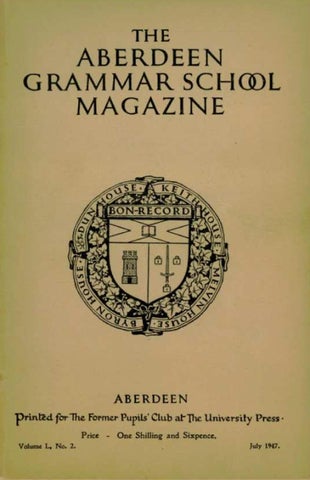
THE
ABERDEEN GRAMMAR SCHML MAGAZINE
ABERDEEN forThe Former Pupils' Club atlhe University Press • Price - One Shilling and Sixpence. Volume L, No. 2.
July 1947.
EDUCATIONAL BOOKS LEGAL • THEOLOGICAL MEDICAL • CLASSICAL New and Second-hand
BOOKS
CLASS STUDENTS NOTEBOOKS
•
SCHOOL EXERCISE BOOKS
James G. Bisset Bookseller & Stationer 85 BROAD STREET
::
ABERDEEN
Opposite Marischal College
•
PHONE 753 •
GOOD HEALTH demands
GOOD BREAD For the children especially is it necessary to ensure their stamina and energy with good, wholesome, nourishing bread. In Hutchison's bread you'll find all these requirements are fully met. Phone or give instructions to have It supplied daily. -
A.B.HUTCHISONII LTD.
BRANCHES THROUGHOUT THE CITY
OLD GOLD AND SILVER Urgently Wanted also
FINE JEWELS and ANTIQUE SILVER Out-of-Date WATCHES JEWELLERY CHAINS COINS and Odds and Ends of every description realize
HIGH PRICES to-day
Full Value received at;j
A. & J. SMITH ICI Union Street ABERDEEN
ILITIT ES have just what you are lockine for Something to wear that is well cut, smart and practical and not too expensive
SUITS
,.rek
TRAVEL COATS MODEL COATS
\\ .
FROCKS .\\{.•
0 O1
,
/1OO
coo
DRESSES
'
t
:
GOWNS
-
FUR COATS
-
-
-
Sizes to fit all figures from 36' hip to 56" hip
-
-
A. C. LITTLE & SONS, LTD. 105 UNION STREET
•
ABERDEEN
EtTABLISMIO I i 18 APPOINTED MEAT PURVEYORS AND POULT RRRRR TO
. IS• • API
HIE MAJESTY TH. KING DATED 1ST Nay 194O
J. WILLIAMSON de, SON (w. B. WILLIAMSON. PR OIRIl10R1
Meat Purveyors, Poulterers and Game Dealers 1, 2, Ii 3 MARKET BUILDINGS, ABERDEEN 'Now
452
SEANCES, I Si f OUNTAINHALL ROAD 'PHONE 1724
THE SQUARE. CULTS 'PEONS, CULTS 2
ALSO AT CHURCH SQUARE, BALLATER.
'PEON. III
BY
TO THE LATE
APPOINTMENT
KING GEORGE V
GRANITE MONUMENTS Designs and Prices on Application Monuments carefully packed and forwarded to all parts of the world Letter-Cutting done in Town and Country at Moderate Rates
JAMES TAGGART & SON Granite
Works
92 GREAT WESTERN ROAD, ABERDEEN Telephone-1658
Established over 50 years
For Better Footwear
JAMES LORIMER & SON (BOOTMAKERS). LTD.
CIVIL and MILITARY BOOTMAKERS
8 CHAPEL ST.
ABERDEEN
(Late of x62 Union Street)
Estd. A.D. 1844
'Phone 724
WM, KENNAWAY LTD, Quality Bakers, Confectioners and Caterers
AaERDEEN O When on a visit to Aberdeen—Gateway to Royal Deeside—rest and dine at our
RESTAURANT AND TEA ROOMS 173 UNION STREET Here you can have the finest service at reasonable cost.
The Restaurant is
fortable.
commodious and
com-
Our rooms are available for all types of
functions—Phone 2371.
Telephone No. 1891.
ARCHIBALD McKELLAR Family Grocer, Wine Merchant and Tobacconist,
450-456 Union Street, Aberdeen. . . We Specialise in . . Cooked
Gammons, Finest Belfast Smoked ,Hams, Wiltshire Bacon.
Medicinal Wines—Vibrona, Hall's, Wincarnis, Phosferine.
THE VALUE OF RECOMMENDATION " We have been recommended to you by Every day that phrase is being used by Customers on their first visit to our showrooms.
THE
REAS 0 N—
OUR STOCK is of good quality and our prices are reasonable. OUR SERVICE Is of a personal nature and we study the requirements of every Customer.
SATISFACTION IS OUR AIM
ROBERTS (Abdn.) LTD. CABINETMAKERS AND UPHOLSTERERS
THE FURNISHING HOUSE OF ENTERPRISE
419 UNION STREET, ABERDEEN Telephone 2695
Established 1873
JAMES FYFE & SON PAINTERS AND GLAZIERS. •
•
•
OFFICE AND SHOWROOMS-
11 DEE STREET, ABERDEEN. Telephone 304.
Telegrams
" ry re,
Painters."
• FAIR SHARES . . . is an admirable policy.
Here you are
assured of your fair share, but there is an added advantage in that customers registered for rationed goods can order their fish supplies at the cost of only one telephone—or personal—call.
A. % W. ALEXANDER FISH, GAME AND MEAT MERCHANTS Tel.: Aberdeen 5172
492 UNION STREET
-4
ABERDEEN
FARM: CULTER
DAIRY: ABERDEEN Tel. 1215, 7013, 7014
Tel. 6
KENNERTY DAIRY
FARM •
WILLIAM REITH Sole Proprietor: JOHN REITH
•
46-48
ROSE
STREET, ABERDEEN
CONTENTS ILLUSTRATIONS Facing page
Facing page
. F.P. Club Jubilee Dinner . . Charles Davidson, M.A. . School Prefects—June 1947 • . . Lieut. Norman Jolly . . . . . James Hay The Staff of the School—June 1947 . William P. Stewart, M.A. .
School Cricket ist XI- Season 171 1 7 School Rugby Football tst XV, . 200 . Season 1946-47 • F.P. Club Rugby Football Section 1st XV-Season 1946-47 • 201
io8 10 138 1 39 139 166 17o
• A Message to Former Pupils from the Rector . Abolition of Fees. The Present Position . . . The New President of the F.P. Club The School and the Club. By Eric Linklatcr . . • Notes about Old Boys . . . . . . . . . Marriages • • . . . . . . Pro Patria Mortui . . . . . . . Obituary South with a Modem Whaler. By M. Begg . . . India in Retrospect. By H. T. Sorley . Creator of the Granite City ". By W. D. S. . Advocates and Chartered Accountants in Aberdeen . . . University Notes . The School Staff—Then and Now. •Annual School Sports School Section— School and Random Notes . Lower School Notes . Mr. W. P. Stewart . Changes in the School Staff . Mr. Pepys has a Spin . . • . . . Winter Evening Athens—Day and Night. Their Names Unknown . . • . . . . Tale of a Kettle . . . . . Spring . Who's Who in the Prefects. L'Afflige School Games Activities— . . Rugby . . . . Hockey. Cricket • Athletics. Swimming. Tennis. . . . . House Notes . . The Literary and Debating Society . The Rambling and Mountaineering Club . . . • . . Scout Notes . Army Cadet Force : The School Company S.S.C. • School Office-Bearers for Session 1946-47 • The Former Pupils' Club— . . . . Club Executive Notes Complimentary Dinner to Mr. J. L. Riddell . Honorary Members of the Club • Annual General Meeting of the Club . . The Jubilee Dinner of the Club. . . The Jubilee Ball . The Edinburgh Centre . The Bengal and Assam Centre . . The Glasgow Centre . • The Malayan Centre . . . F.P. Rugby Section . Macgregor . Presentation to Mr. Duncan F.P. Cricket Section. F.P. Hockey Section . F.P. Golf Section. F.P. Club Consuls • . . . . . News from our Consuls . Rates of Subscription for Membership. Addresses Wanted . . F.P. Club Office-bearers, 1947-48 •
•
•
•
. Page „ . „ . „ . „
•
•
•
•
•
•
•
•
•
•
•
•
•
4
4
•
•
•
•
•
•
•
•
•
ff
152
•
•
•
•
ff
1 57
•
"
•
•
•
•
•
•
•
•
•
„
•
•
ft
161 162 163 166
•
•
•
•
•
•
•
ft
•
•
•
•
•
•
•
f f
•
•
•
•
•
•
•
•
•
•
•
•
•
•
•
•
•
•
•
•
•
•
•
•
ff
•
•
•
„
•
•
„
•
•
•
•
•
•
•
•
•
•
•
•
•
•
•
•
•
•
•
•
•
•
•
•
•
•
„
•
•
•
•
ft
•
•
•
•
•
•
•
•
•
•
•
•
• •
•
•
If
•
•
ff
•
•
•
•
•
•
•
•
•
•
•
•
ff
•
•
•
2>
•
•
•
ff
„
•
•
•
•
•
•
•
„
•
•
•
•
•
•
„
•
•
•
•
•
•
f1
•
•
•
•
•
•
„
•
•
•
•
•
fl
•
•
•
•
•
„
•
•
•
•
f f
•
•
•
•
•
•
•
•
>0
•
ff
•
Of
•
IP
•
•
•
•
167 169 17o 172 173 174 175 176 178 179 181 t8;
•
•
•
toy 107 109 111 113 1 37 139 140
•
184 185
IS, 186 187 188 189 19o 19o 191 194 I 197 198 199 200 201 202 203 204 205 206 207
GRAMMAR SCHOOL OUTFITS Small deliveries of good quality Grammar blazers and shorts, made
by one
of our
leading pre-war makers, are now occasionally available
BLAZERS : Have deep facings, lined sleeves, and large upturns for lengthening.
Fitting 7 to 13 years,
Prices from 53/- to 66/-. 6 COUPONS.
SHORTS :
Double seats, belt loops and inside brace buttons.
Fitting as above.
Prices 28/7 to 32/2. 3 COUPONS.
CAP AND BADGE, 6/-. BOYS' STOCKINGS from 3'10 to 5 3. 1 COUPON.
BOYS' SCARVES : in Grey with colours.
11 /-.
1 COUPON.
BOYS' TIES : I
4 II.
COI I'll's..
ESSLEMONT & MACINTOSH (RETAILERS) LTD.
UNION STREET, ABERDEEN
" I need good food" —and this is where you can get it ! We always have a fresh stock of all well-known dog foods including Spratt's, Spillers, etc.
Main Stockists for :—
Pot and Pearl Barley Barley Meal Hay and Straw Coal and Firewood Poultry and Bird Food Moss Litter Manures
WILLIAM SCORGIE GRAIN AND POTATO MERCHANT
13 ROSE STREET
•
Phone 4014
ABERDEEN
THINGS ARE
Established over 100 Years
GETTING BETTER
WM. CAY & SONS (FUNERAL DIRECTORS) LIMITED
Far larger and better supplies are available of
415 UNION STREET
TYPEWRITERS
and
DESKS (wood and steel)
209 GEORGE STREET,
CHAIRS FILING CABINETS
ABERDEEN
CUPBOARDS Everything for the Office
All Funeral Requisites Supplied
Come and see me
Cremations Arranged
C. H. WEBSTER 489 Union Street ABERDEEN
Telegrams—" Cay, Aberdeen." Telephone Nos. 92 and 54.
Telegrams : ' Blake Builders'
Telephone: 8811-2
JIAMIES I[31L A~IIIIE IL1fID.. said
Joiner/4
Building Contractors
7 ALBYN TERRACE Works-23, 25, 29 SUMMER STREET, ABERDEEN
All classes of Building Joinery
::
Enquiries courteously solicited Wyllies Circulating Library
Agents for Ordnance Survey Maps
WYLLIES Booksellers, Stationers
247 UNION STREET, ABERDEEN Telephone 402
Established 1814 ESTABLISH
THE
HABIT
OF
READING
GOOD
BOOKS
DRAWING
STRACHAN
PAPERS
COMMERCIAL
PENCILS BRUSHES EVERY REQUISITE
PORTRAITURE
FOR THE ARTIST
PHOTOGRAPHY
at
•
Taylors'
Telephone 851 •
Picture Framers 49-51 SCHOOLHILL
416 UNION STREET ABERDEEN
'Phone 2870
ENGAGEMENT
--
AND
GEM RINGS Consult us when choosing " The Ring" or any ring for that matter. Our comprehensive and exquisitely styled range plus our expert knowledge and guidance are at your disposal. Inspect our display of gift and presentation pieces in Solid Silver.
JAMIESON & CARRY ESTABLISHED 1733
WATCHMAKERS
142
UNION
AND
GOLDSMITHS
STREET,
NEXT UNION BRIDGE
ABERDEEN
I
TO OUR CUSTOMERS We regret that the present restrictions on both men and materials make it impossible for us to maintain the usual high standard of service which we have carried on for over a century. We can assure you that we are doing our utmost to please you and trust that you will be patient with us.
J. & A. OGILVIE 369 UNION STREET ABERDEEN Telephone No. 433
Telegrams : " Interiors"
The choice of )iuur
FIREPLACE ARRANGEMENTS may be a little restricted these days, but we have been able to maintain our stocks at a good level, and have on display a pleasing range of modern and period designs for your selection.
James Scott & Son (Aberdeen) Ltd. 483-485 UNION STREET ABERDEEN Phone 1881-2-3
„.__.... , -4:-..- ,-,
i
r_
r
IRO
I
••
. p-i , N --.1
_„ -„,, -4 10 ------,— .... „,,, - .... --4 1i ., IR 0,,,, ' - ' ^c „..4 /I
>.
... .
i 3. i i ti'till
4 11 (IRO, (0,""
( OLLIE N
:,..,
-7- 1 -;-"-----1 _ - ---,:-.4.:911i
—4
..." -
Moderns of the Old School Believing that the old friendly, individual relationship between buyer and seller need lose nothing to efficiency, Collie's, in their spacious, modern and up-to-date premises in Union Street, still spirit of personal the foster attention and helpful assistance.
ad/tem C,"lie do LIMITED
Family Grocers and Wine Merchants
-
269-271 UNION STREET ABERDEEN
Also at CULTS
Telephone 4800 .4 Liner Registry Telephone 20015
Telephone 28
BALLATER „
14
„
212
BRAEMAR A ppoiwtortiii
Grocer's to H311. The Mi..
ESTABLISHED IN ABERDEEN 1836
Northern Assurance Company Limited Enquiries solicited for all Classes of Insurance
FIRE Insure your Dwelling-house and Furniture with the Local Office LIFE Attractive rates for Endowment Assurance and all other classes of Life Assurance ACCIDENT Insurance granted against Third Party Risks of all kinds Company's Assets
-
3s ,8oo,ooo
CHIEF OFFICES:
ABERDEEN . LONDON .
I UNION TERRACE i MOORGATE, E.C. I
Branches and Agencies throughout the World
PROPOSED MEMORIAL SCHEMES The Executive is at present framing detailed plans with regard to the following three Memorials. A representative sub-Committee has been appointed to make detailed arrangements and it is hoped shortly to issue an appeal for subscriptions. This is a preliminary notice only and further details will as soon as possible. circulated be x. War Memorial. It is proposed to compile a Roll of Honour containing photographs and biographical details of every Former Pupil —whether a member of the Club or not—who was killed on active service or who died through enemy action during the period 3rd September 5939 to I 5 th August t94S. A copy will be presented to the next-of-kin in each case and copies will also be on sale. In order that this Roll may be complete any Member aware of any war casualty not previously reported in the Mageqine is requested to notify the Editor as soon as possible. It is also hoped that the existing 1914-18 War Memorial in the School Hall will be extended to include the names ofthose who gave their lives in the recent World War. Memorial to the late Dr. Theodore Watt. It has been decided to arrange for the painting of a posthumous portrait of the late Dr. Watt to be presented to the School and hung in the School Hall.
a.
3. Memorial to the late Mr. William P. Stewart. The Executive feels there will be a general wish among Former Pupils and others associated with the School that some form of Memorial should be established to the late Mr. Stewart. Details are at present under discussion.
Aberdeen Grammar School Magazine 63rd year : No. z6o (New Series, S4th year, No. 15i) JULY 1947
Vol. L
•
•
No. a
The " Grammar School Magazine" is issued under the auspices of The Former Pupils' Club, twice a year at present—in December and July. All communications with regard to the " Magazine" should be addressed to the Editor, ALAN C. R. WATT, M.A., c/o The University Press, 6 Upper Kirkgate, Aberdeen. [NozE: An asterisk after a name mutates that tbe F.P. is a member of the F.P. Club.]
-
-
-
- -
--
A Message to Former Pupils from the Rector. While certain matters still await consideration the education authority has now laid down the main lines of its policy, following the decision to abolish fees in the Grammar School, and one may comment on the situation with a freedom that would not have been permissible six months ago. I regard these proposed changes as untimely for the following reasons. First, the Grammar School badly needed a period of quiet in which to recover from the serious and prolonged disturbances of the war years ; for in work and morale alike it is meantime convalescent rather than fully restored to health. Second, precipitate abolition of fees has forced the Committee to anticipate the Advisory Council's Report on Secondary Education and to make major decisions without regard to the findings of that body. Third, it must be evident to anyone familiar with the facts that there can be no permanently satisfactory reorganisation of senior secondary education in Aberdeen, so long as one of the largest centres of such work must lie outside any scheme proposed. The effect of the latest changes can only be to aggravate an already difficult situation. One could have have wished, therefore, that the local authority had been content for a time to continue and, if need be, to extend the Free Place Scheme, pending a review at national level of the whole problem of secondary school organisation, including the relations between maintained and direct grant schools and the proper functions of endowments and bursaries under post-war conditions. But, while one may regret the decision as ill-timed it would, in my opinion, be quite wrong to characterize the abolition of fees as unfair or as simply a thrusting of party politics into the field of education. We must not make the naive assumption that the arrangement whereby a school is financed by very large expenditure of public money conjoined with the payment of very modest fees has all the sanctity of immemorial age. Moreover, the abolition of fees in publicly maintained schools has been going on steadily in Scotland for more than
t o6
Aberdeen Grammar School Magazine
a generation, and not a few schools, comparable with our own in antiquity, have had to adjust themselves to this change. And lastly, it is only right to remember that by the Education Act of 1944 Mr. Churchill's administration abolished fees in every English Secondary school maintained (as Aberdeen Grammar School is) by a local education authority. The actual decisions of the Town Council are set out on pages 107-9 of this issue, and, on any fair reading of them, it will be conceded that the authorities have shown real concern to preserve the traditions and existing structure of the Grammar School, so far as that is possible on a non-fee-paying basis. The decision that present pupils of the Secondary Department shall be free to complete their schooling undisturbed, and the concession that for this year at least all boys in Lower V may pass unchallenged into Middle School, should relieve parents of immediate anxiety or the necessity for making hurried plans. On what terms present pupils will in future pass from the Primary to the Secondary Department the Committee has not yet determined. There may be reluctance to allow uncontrolled transfer for the long period of seven years, necessary if all existing pupils are to pass on to Middle School. On the other hand a rigorously selective procedure would certainly result in the turning out of considerable numbers, since recruitment to the Kindergarten and Primary Departments has not till now been regulated by tests. One may hope for some middle way whereby, without admitting to the Secondary Department pupils manifestly unfitted for the work there, it may be possible to avoid wholesale rejection of boys who have become strongly attached to the school, having entered it years before with no thought that their title to remain there would ever be disputed. But by far the most important and reassuring decision taken by the authorities is that the Grammar School shall be free, as it has always been, to recruit from the whole city. Neither the abolition of fees nor any other change could have made so complete and final a break with the long past as a decision to turn the Grammar into a district or area school, entry to which was determined solely by place of residence and administrative decree. As it is, boys will continue to come to us for the very satisfying and substantial reason that their parents wish them to do so ; and if, where there are more claimants than places, ability to profit rather than priority of application is the determinant—well, that is a principle of selection which is neither unfamiliar nor indefensible. Whether the decision to continue the Kindergarten and Primary Departments represents the freely chosen policy of the town authorities or rather a surrender to circumstances it is perhaps wiser not to inquire too closely at this juncture : either way, Grammarians will rejoice that it is still to be possible for a boy to have only one school from first to last—and that the best of them all I And, if it seems to ordinary human judgment somewhat incongruous to be subjecting little fellows of four and five to psychological tests, let it be remembered that some basis of selection there must be and that the education
Aberdeen Grammar School Magazine
107
committee is very properly concerned that in the years ahead as few children as possible should enter the Grammar School at five only to experience the distress and upset of having to leave it again at twelve. Particularly welcome is the willingness of the Committee to consider on their merits applications for admission to the school from outside the city. Like the historic High Schools of Edinburgh and Glasgow, the Grammar School has always had a more than local function and recruitment, and the clamant need for residential facilities such as our two boarding houses most admirably provide would make it a major misfortune if our Committee were to circumscribe its educational interest by its administrative boundaries. Few Schools have stronger imperial and overseas connections than our own, and it would be little to our credit if, at the very time when we are actively recruiting for all the colonial services, we destroyed the possibility that loyal Grammarians abroad should send their sons back to the city and the school where they themselves were nurtured. Admittedly there are difficult legal and financial problems to be solved here, but it is not asking too much of a great city to expect that it will continue to desire for its ancient school a more than parochial place and status within the educational scheme. If I were asked to forecast the consequences of these impending changes on the Grammar School, I should be confident that the immediate effects will be comparatively slight, but about the more remote ones it would be riskier to prophesy. The general level of diligence and attainment in the School may well rise, and that would be no trifling gain, provided always that it was not bought at the price of that tolerant generous spirit which in the past has welcomed diversity of type and talent and has seen in its pupils boys to be schooled and not simply examinees to be tutored. For the North East, with its admirably strenuous but somewhat narrow conception of schooling, still needs the witness and the reminder of the oldest of all its places of learning—that education is life and preparation for life in its entirety and not simply an equipping of the young for remunerative employment. J. J. R. 11 June 1947. •
Abolition of Fees—The Present Position.
•
The abolition of fees in all schools under the jurisdiction of the local Education Authority is now an accomplished fact. In terms of the decision of the Town Council dated 21 October 1946, the Education Committee were instructed " to discontinue at the earliest possible date, and not later than the commencement of the session following upon the summer vacation of 1947, the charging of fees in primary and secondary schools and to report as to any necessary consequential arrangements ". On TO March 1947, the Education Committee had under consideration a memorandum by the Director of Education on the arrangements necessary to give effect to this decision, and made the following recommendations inter alia, which were subsequently approved by the Town Council, viz.:— (a) That consideration of the possible need for an extension of facilities for senior secondary education within the City be deferred until the time is appropriate for a comprehensive survey of the position, having in view the
i 08
Aberdeen Grammar School Magazine
Report on secondary education to be issued soon by the Advisory Council on Education in Scotland, and any directions consequential thereon which may be issued by the Scottish Education Department. (b) That, in any reorganization, the existing distinctive character of the schools be preserved, so far as is consistent with a policy of making the facilities at the schools more freely available to children of all classes. (c) That consideration of the question of the retention, or otherwise, of the primary departments of the schools be deferred until the general building position in the country has improved, and that pupils be enrolled in the primary departments of the schools for Session 1947-48 on the basis aftermentioned. (d) That, without prejudice to the future, pupils in the primary departments of the schools who, according to the arrangements previously in force, would have passed into the secondary departments at the commencement of Session 1947-48, be allowed to do so at that time. (e) That, subject to (d) above, the standard of fitness as determined by the Common Entrance Examination, and as hitherto regulating entry to the Central Secondary School, be made applicable for Session 1947-48 to new entrants to the secondary departments of the schools. (f) That, without prejudice to any future decision to be taken by the Committee with respect to promotion from primary to secondary departments, pupils in respect of whom fees were formerly paid be allowed to remain in their respective departments. (g) That the Committee defer consideration of the question of the future selection of pupils for the secondary departments of the schools after Session 1 947-48. (b) That, in respect of Session 1947-48, and without prejudice to the future, pupils from Primary Schools in the City of the requisite standard of fitness, as determined under (e) above, be selected for vacancies in the secondary departments of the schools on the principle of free choice by the parent, and, where further selection is necessary on account of limited accommodation, this be based on (i) merit and suitability, and (ii) other relevant factors, including family connection with the schools. (i) That pupils be selected for admission to the primary department of the schools (including the Nursery Classes) on the basis of an individual test appropriate to the age of the pupil, to be administered by the Educational Psychologist, whose report will be considered by the head teacher of the school, along with the Director. (1) That the necessary text-books and other materials required for the schools be purchased from local booksellers for Session 1947-48. Admission and retention of pupils residing within the area of other Education Authorities. (m) That, with respect to pupils from outside the City area already in attendance at the schools, the question of their being allowed to continue be considered in relation to the circumstances of each individual case. (s) That, with respect to new entrants from outside the City area, admission be conditional upon (i) the availability of the necessary accommodation ; (ii) the attainment by the pupil of the standard of fitness referred to under (e) above ; and (iii) the granting of an undertaking by the Education Authority responsible for the education of the pupil that they will make a contribution in terms of Section 24 of the Education (Scotland) Act, 1946. It was decided to remit to a Special sub-Committee consideration of all questions which may arise as a result of the above decisions, including questions relating to (a) pupils in the boarding-house ; (b) playfields ; (c) prizes and endowments ; and (d) staffing. The Education Committee's decisions would seem to suggest that it is the Committee's policy to respect the principle of continuity in education and to avoid any disruptive change which would involve transfer of school on the part of existing pupils. This principle will no doubt be taken further into consideration when the future of the primary department comes to be considered. The elimination of the primary departments in the senior secondary• schools--even if such were practicable at present—is by no means a certain corollary to the abolition of fees.
F.P. Club Jubilee Dinner—January 1947
ISy ct.urtesy of Aberdeen journals
Standing—Mr. J. Scott MacLachlan, Mr. R. S. Howell, Mr. T. D. Smith, Mr. James Hay, Bishop Hail, Mr. A. R. Cumming, Mr. Charles Davidson, Dr. D. P. Levack. Sitting—Mr. A. T. Cruickshank, Mr. Eric Linklater, Mr. J. L. Ridden, Mr. J. J. Robertson, Colonel H. J. Kinghom.
See rage 194
_VacMahon
CHARLES DAVIDSON,
M.A.
Aberdeen Grammar School Afagazine
109
The situation as regards County pupils already in the school (see para. (m) above) is very much in a state of flux at the moment. In this case the local Education Authority again showed a desire to avoid any discontinuity in the education of these pupils, and were prepared to allow them to continue attendance at the Grammar School provided (a) the County Education Authority would bear the cost, or (b) failing such an arrangement, that the parent would pay an amount equivalent to the contribution normally payable by the County in terms of the new Act. Special arrangements were to be made for a reduction of the sum payable by the parent where hardship would be involved. It transpired, however, that the new legislation has removed any possibility of the parent paying at all, so that the decision as to whether existing County pupils are to continue at the school or not again devolves, as in the case of new entrants, on the Education Committee of the place of residence. The local Education Authority has appointed a small sub-Committee to meet representatives of the Councils of the Counties of Aberdeen and Kincardine to discuss the whole question, and the result of their negotiations must be awaited. 'The position in regard to pupils resident in the boarding house is equally indeterminate. This is a very special case in so far as there exists in respect of these pupils no County Education Authority with whom to confer. There is no cause, however, for misgiving as there is every reason to believe that the Education Authority will see that, as far as possible, the education of the existing pupils in the boarding house will be adequately secured.
The New President of the P.P. Club. Mr. Charles Davidson appointed. At the Annual General Meeting of the F.P. Club held on To March 1947, Charles Davidson* (188z-86), M.A., was unanimously appointed president for the year 1947-48. His election was proposed by Mr. J. Lennox Riddell who spoke of the special place that " C. D." held in the hearts of all those who were his contemporaries at School from 1882 to 1886 or his pupils when he was a master there from 1893 to 1920. To F.P.s all over the world, said Mr. Riddell, " C. D." was better known than anyone else connected with the School. After graduating at Aberdeen in 1886, Mr. Davidson was for two years an assistant master at Torquay and thereafter he spent a year as a private tutor in Spain. In 1893 he returned to his old School as an assistant master in Classics and English, and he held that post for 27 years. From 1920 until he retired in 1939 he was lecturer in Spanish at Aberdeen University. He joined the F.P. Club in the second year of its existence, 1894, and ever since then he has taken a very keen interest in everything connected with the School or the Club. In the early days of the Magazine no one knew so many F.P.s personally, and out of his knowledge sprang originally the " Notes About Old Boys ", which have ever since been a special feature of every issue. In 1907, when it was decided that the Magazine would be managed by a committee of former and present pupils, he was one of the three members appointed by the Executive of the F.P. Club, the others being the late Mr. William Keith Leask and the late Dr. Theodore Watt. The Executive of the Club feels sure that Mr. Davidson's appointment to the presidency—the highest honour that can be bestowed by the Club—will give the greatest satisfaction to all F.P.s and he is assured of a great reception, when he presides at the Annual Dinner which is to be held in October of this year.
Ito
Aberdeen Grammar School Magazine
Open Letter to " C.D." On his election as President of the F.P. Club. " C.D.", dilectissime, President of the F.P. Club, A.G.S.O.M., pervenisti. And not before time. So did other potent signiors defer the award of their O.M. to an almost forgotten Lady of the Lamp, who had long occupied her niche in history's shrine, till, just on the eve of world-war deluge, they woke up to find the lamp still burned, albeit with lessened glow. Has not Lytton Strachey told it all ? Your lamp still burns bright, wherever you roam, whether in the wake of our most famous F.P., Childe Harold, in the romantic realms of Italy and Spain, or in homely Buchan, tracing, like Soames Forsyte, the branches of your family tree. And your part has ever been a colourful one. To ingenuous Victorian boyhood you were the glass of fashion. Did you not don fresh habiliments for afternoon school—" a fellow that hath two gowns, and everything handsome about him " ? Golf handicaps were naught to you, but in plus fours you were the ne plus ultra; and even to-day, when " utility " cramps sartorial élan, you take the road to the isles, resplendent in the garb of Old Gaul, as it were the Chevalier come to life again. But it is not of your multifarious interests and activities I would fain write on this occasion, although I recognise these as your elixir vitae. Nor even shall I speak of that interlude as University Lecturer in Spanish, though if ever there was a voice fashioned by nature for the bravura of the language of Romance, that voice was yours. Count Fosco could not have bettered it. The School, the School it is that claims you as its very own. You are the link, our sole remaining link, with an age that is gone, the Grammar School of the 'nineties and the first decades of the twentieth century. You are inseparable from that era, when the only world-wars we knew were of H. G. Wells's imagining. In later life we think less of the formal lessons taught and more of the men who taught them. We recall voice, manner and idiosyncracy. To live in close daily companionship with all those richly diverse personalities was an education in itself. Such a personality was yours—gay, debonair, versatile, cosmopolitan. You have always been a great actor, both on and off stage. You believe with Antonio this world's a stage where every man must play a part. Only yours has not been a sad one. Whatever your part, you have played it with infinite verve and gusto. You were the first master I met in the School, and I took you, in your black gown and tonsure, for a monk. " The devil a monk was he ", but, as I soon perceived, a man of a very kindly Scotch heart, who, while he trod the primrose path of dalliance, strewed it with little, nameless acts of kindness which he may not, but others do, remember. " C. D.", your former pupils all the world over rejoice in the honour that has come to you. Ave atque salve. J. M. R.
Aberdeen Grammar School MastRine
III
" The School and the Club" Eric Linklater's Speech at the Jubilee Dinner. At first sight it is a high and distinguished honour to be asked to propose the toast of one's old school ; but when one recalls the great age of our old school, the honour wears a somewhat grim expression, and instead of being exalted by it, one is likely to be humbled. A man, if he has tolerably good health and keeps away from his doctor, may live for seventy years ; but the Grammar School has lived for seven hundred. It is, on the other hand, much younger than any of us, for every year, with its intake of recruits, it begins life anew. And therefore, whoever speaks of it must be respectful of its venerable years and tender towards its youth. That it has done good service to the town of Aberdeen, no one can deny, and no one who has read anything of the lives of old pupils will dispute its honourable share in the building and service of the British Commonwealth, and in the defence of civilisation in two great wars. Let us say, being as modest as we can, that it has justified its existence; and being as hopeful as we are entitled to be, let us say also that we believe it can do something to promote the welfare and the wisdom of future generations. At present, of course, we are in the midst of a social revolution, which, among its other activities, threatens to remove from the Grammar School its ancient privilege of teaching those who want to be taught in it—of teaching them in the Grammar School way, and to substitute the less gracious modern responsibility of accommodating those whom the law will require to be taught in a standardised, mass production way. I am no politician, however, and I have no comment to offer on the trend or roll of revolution ; but by virtue of some fragments that remain from the education that was once imprinted on me—there is nothing like leather—by their virtue I am something of a historian, and therefore can assure you that the School has already survived several revolutions and hundreds of revolutionaries, and has a fair prospect accordingly of out-living this and these. It survived the turmoil of the French Revolution, which infected also most of this country ; it survived the Jacobite years of 1715 and 1745 ; it survived the theological battles of the Covenanters and the Reformation; it survived the romantic insurgence of the Highlanders that was so rudely rebuffed at Red Harlaw—and so, judging purely on form, I think there is a good chance that it will survive those wellintentioned but grievously mistaken social reformers of to-day, who believe that everything must be reduced to a dead level so that they may build a brave new world entirely on horizontal lines. Let me repeat, and assure you, that, as I am no politician, I have no desire to rouse in you against anyone else, or to create dissension in this fair City ; but having spent some years on the classical side of the Grammar School, I am, inevitably, a moralist and therefore entitled to comment, in a high and dispassionate way, on some of the disgusting and destructive faults that infest the minds of men and the traffic of the world to-day, as they did yesterday in Tyre and Sidon and Sodom and Gomorrah. As a moralist I can say that the people
112
Aberdeen Grammar School Magaine
of Gomorrah were as hard-working and well-intentioned as the people of Aberdeen ; but they made mistakes which were fatal to themselves, and to their reputation. And I have no hesitation in saying that where you have an institution that for seven hundred years has proved its value to the community that surrounds it—and when that institution has within itself the power to grow and adapt itself to the changing needs of the community—then to destroy that institution and the tradition which keeps it alive, for the sake of a policy and a theory of government, is an ill-advised and wasteful project. No policy or theory of government has ever lasted seven hundred years ; but history sometimes preserves the memory of folly for even longer than that. The City of Aberdeen his a character uncommon in Scotland, in that for some considerable time it has nourished both a local pride and a reasonable degree of local prosperity. In Scotland they seldom go together ; but here they do. And Aberdeen has built on four things; its industries, the produce of the neighbouring country, the University, and the Grammar School. Now to interfere with a cornerstone is always a serious operation ; to interfere with one of the cornerstones of a city that is so usually happy as to be both proud and prosperous on that foundation, is a reckless operation ; and to substitute for a well-tried and solid cornerstone a piece of theoretical concrete manufactured from unknown materials to a formula that history has several times condemned, looks very like a suicidal operation. All this, of course, I say without political bias or prejudice, but in the calm and benevolent tone of a life-long moralist. Continuing in that tone, I should like to offer those good-hearted men on the Town Council, who honestly wish to improve their City and embrace the well-being of its people, my own opinion of how that might be done, in this province of education. I believe that to increase the value and promote the virtue of the Grammar School, its Rector and Governing body should be given much greater independence and authority than at present they enjoy. There is no more valuable citizen than a good schoolmaster, and he should be cherished accordingly. A good schoolmaster is a man with a vocation, with a specialised training, with professional knowledge ; and when he has been selected to rule and conduct a school, he should be trusted and encouraged to put his knowledge and his enthusiasm to work as his own conscience and experience dictates. He should be as little subject to outside authority as possible. It is not examinations, it is not even the books he reads, that educate a boy and teach him to be a good boy, it is the personality of the schoolmaster. But the schoolmaster has to develop his personality, and he cannot do that if he is everlastingly bedevilled by changing policy, by trumpery regulations, by remote officials, and by an authority that in its own place may have the sweetest nature in the world but knows nothing about the proper purpose of education. Those of you who are contemporaries may not remember very much of your Homer and your Horace, your Milton and Burke, or your spherical geometry—I think that is what it is called—but we
Aberdeen Grammar School Magazine do remember, and vividly remember, Morland Simpson and Caesar Middleton, and Murison and Macleod, and Charles Davidson, and the manner in which they taught. We forget our lessons, but remember our schoolmasters ; and we remember them, because they were men in their own right, and so had a lesson to teach which was independent of their books. If future generations are to have the same advantage, then their schoolmasters must also have the liberty to teach in their own way. The schoolmaster's duty is to his pupils, not to a Town Council, and it is more sensible to trust a boy to the conscience of a man with a vocation, than to a Committee with a grievance. It will be no service to Aberdeen to reduce the Grammar School to a fragment in some flat new pattern of standardised instruction, but Aberdeen might serve both its pride and its prosperity by giving the School autonomy, and so encouraging it to maintain and strengthen a tradition of humane scholarship and personal responsibility that in the past has contributed much, not only to this corner of Scotland, but to the achievement of Britain overseas. Of the School's place, in the larger world, we have been reminded, at regular intervals, by the Magazine that was for so many years the courageous voice of Theodore Watt speaking in the name of the Former Pupils' Club. Year after year the articles he published, and the notes about Old Boys that he gathered with such meticulous zeal, were comment on contemporary history and glosses on Imperial geography. Sometimes after reading the Magazine, the whole world seemed to be suspended in a net whose strings and strands were all Grammarians knotted together by Club Consuls and branches of the Club. For that generous conception of the School and the Club we are indebted to Theodore Watt, who was not merely an industrious, devoted, and skilful editor, but a visionary ; and I suggest that a small but excellent memorial to his vision—and a very timely memorial to the School's influence abroad—would be an anthology of articles published in the Magazine during the past forty years. The last number in itself is a memorial, for Alan Watt, with an excellent spirit and impressive ability, has given new life to that which his father established, and when we congratulate him on his achievement, there is also a rumble in our throats of self-congratulation. He has been good, and we have been lucky ; and that is a very satisfactory division of fortune. He will, I hope, also be persistent, and continue in goodness, so that we may continue in satisfaction ; for the Former Pupils' Club without its Magazine would be like a town without a Directory, an orchestra without its music, or even a Church without its Bible. And the Club must not be weakened, for as the School has served the Town, so now I think the Club should serve both, by impressing on the Town its continuing need for the School and the School's tradition. There is a crisis, but the crisis may be weathered as previous crises have been. The problems and difficulties of our age are neither exceptional nor unique, and it is one of the advantages of a school with a history that it has a long memory of misfortunes that have not been fatal. I was reading last year the life of a distinguished Old Boy,
114
Aberdeen Grammar School Magazine
Sir James McGrigor,* who, after being dux in the School, had a very adventurous life in the Army and became Wellington's Principal Medical Officer in the Peninsular campaign ; and I was very pleased to discover that McGrigor, while serving in Egypt, was one day perplexed by a situation very like those with which some of you have lately been familiar in our poor dishevelled Europe ; a tragic situation, with some comedy in addition—of what we call " displaced persons ". The "displaced persons" with whom McGrigor had to deal were• three handsome young Circassian women. When first he met them, they were running away from some Turkish horsemen who were pursuing them with angry cries and waving scimitars. McGrigor rescued them, and taking them back to camp, extracted from them their sorrowful history. The Turkish horsemen had at one time been their husbands or their lovers. But when the French invaded Egypt, the Circassians were regarded as conquered territory, and settled down with their new protectors. Then the British arrived, and threw out the French, and the ladies acquired a new domicile in our lines. But the War came to an end, the British began to go home, the ladies were left behind, and their Turkish lovers re-appeared ; and the Turkish way with a wanton was to tie her in a sack and throw her into the Nile. But the British way with displaced persons has always been more humane than that, and you will be relieved to hear that McGrigor's ladies had a happier fate ; one went to Bengal with an admiring officer, and an elderly English gentleman adopted the other two. McGrigor's life is full of interest, and his capacity for survival may be noted with approval. At the age of seventy-eight he was still serving as Director-General of the Army Medical Department, and when he suggested that it was time for him to retire, the Duke of Wellington, who was Commander-in-Chief, and a year older, impatiently made answer, " No, no, McGrigor, there's plenty of work in you yet " I So he laboured for two more years, and then retired to live in tranquillity. And what the Duke said to his Doctor, we can say to the Doctor's school : " There's plenty of work in you yet "—and to do its work properly, the School must be allowed to do it in its own way. There is much virtue in old age that keeps its savour and its strength. " Sweet is old wine in bottles, ale in barrels ; Dear is the helpless creature we defend Against the World ; and dear the schoolboy spot We ne'er forget, though there we are forgot.' It was another Old Boy who wrote that, though he was not, I fear, a member of the Former Pupils' Club. His name was Byron, who also wrote : " I wish men to be free as much from mobs as Kings ". In the memory of his splendid name I give you the Toast of the School, and its faithful chorus, the Former Pupils' Club ; and couple with them the names of their well-chosen and devoted guardians, the Rector and Mr. Lennox Riddell. * Sir James McGrigor, M.D., was dux of the School in 1784. In addition to his becoming head of the Army Medical Department, he was elected Rector of Marischal College. The obelisk formerly in the quadrangle there and now in the Duthie Park, Aberdeen, is to his memory.—Editor.
Aberdeen Grammar School Maga;-.ine
115
*.* The Editor is glad at all times to receive from any quarter items of information for this section of the " Magazine."
The dates given in parentheses after names indicate the sessions of attendance at the School. •
HONOURS AND AWARDS. KNIGHTHOOD FOR MR. WILLIAM PETERS.
William Peters (1900-06), C.M.G., M.A., senior British trade commissioner in the Union of South Africa, was created a knight bachelor in the King's Birthday Honours announced on 12 June 1947. He graduated M.A. at Aberdeen University with " double firsts ", in Mathematics and Natural Philosophy (191o) and Economic Science (1911) and in 1914 he went to Russia as a Carnegie Fellow, his research subject being " Credit in Russia ". During the 1914-18 war he was in the service of the Russian Government and in 1919 he became a secretary in H.M. Commercial Diplomatic Service. From 1921 to 1924 he was assistant agent with the British Commercial Mission in Russia and from 1924 to 1927 he was commercial secretary to the British Mission in Moscow! As a result of the break_in diplomatic relations with Russia he then returned to this country and the following year he was appointed commercial secretary at the British Legation in Stockholm. In 1929 he became United Kingdom Trade Commissioner in the Irish Free State and in 1937 he went to take up a similar appointment in Cape Town. Companions of the Most Distinguished Order of St. Michael and St. George (C.M.G.). James Ian Cormack Crombie* (1908-21), M.A., received the C.M.G. in the New Year Honours announced in January 1947. Since August 1946 he has been Third Under-Secretary to the Treasury. A short account of his varied and distinguished career since he first joined the Home Civil Service in 1926 was given in the Magazine of December 1946. John William Taylor * (1906-11), M.B.E., M.A., also received the C.M.G. in the 1947 New Year Honours. He served in the 1914-18 war as a Captain in the Gordon Highlanders, and entered the British Consular Service in 1919. After being Vice-Consul at LyOns and at Prague, he was appointed Consul at Vienna in 1933. After five years there he was transferred to Baltimore, U.S.A., and in 1943 he was appointed Consul for the States of Maryland, Virginia, North
Aberdeen Grammar School Magazine 116 Carolina, and part of West Virginia. Later he joined the British Legation at Guatemala, Central America, and in 1945 he returned to Prague as Counsellor (Commercial) at the British Embassy. Last year he was appointed Minister (Commercial) at the British Embassy, Cairo. In addition to his duties as representative of the British Government abroad, he was for many years F.P. Club Consul in Prague and Vienna. Readers of R. H. Bruce Lockhart's " Guns or Butter ", published in 5938, will remember the author's striking tribute to Captain J. W. Taylor, who was Consul in Vienna when the Germans occupied the city in March 1938. Some passages from the book were quoted in the Magazine of November 1938, and it is interesting to note that in one of these the author said he hoped the Foreign Office would not overlook the merits of Mr. Taylor, who in very difficult circumstances had shown courage and energetic ability in the highest degree. Officer of the Order of the British Empire (O.B.E.). Maitland Mackie* (1897-1902), of North Ythsie, Tarves, Aberdeenshire, is one of the leading agriculturists in the north-east of Scotland and a specialist in dairy farming. He is vice-chairman of the North of Scotland College of Agriculture, a member of the Aberdeen Milk Board and a member of the Department of Agriculture's Hill Sheep Advisory Committee. He is a past president of the National Farmers' Union in Scotland. American Bronze Star Medal. William Adam* (1925-37) was, in February 5946, by command of Major General McBride, commanding XX Corps, U.S. Army, awarded the American Bronze Star Medal " for meritorious service in connection with military operations against the enemy in France, Germany, and Austria between 8 August 1944 and 8 May 1945." The citation went on : " While serving as a Special Liaison Officer to XX Corps, Captain Adam worked tirelessly and with great resourcefulness to accurately furnish complete information of the disposition of the British Forces. His conscientious and co-operative performance of duty is in keeping with the highest military traditions, . and reflects credit upon the British Army." Commissioned in June 1939 as a and Lieutenant in the 5/7th Battalion, Gordon Highlanders, Captain Adam joined " Phantom ", the G.H.Q. Liaison Regiment, in 1940 and served with that unit in North Africa and Sicily. " Phantom " was later an important part of Britain's Intelligence organisation prior to and after D-Day in Europe. With its headquarters in as Army Group, " Phantom" had four squadrons, three of which were attached to the Canadian Army, the British and Army, and the U.S. Army respectively, the fourth being engaged on special service. Captain Adam belonged to the third of these squadrons and he was one of the officers lent to General Patton's Third Army, which was part of 12th Army Group. He and another F.P., a former class-fellow, Henry Duncan Crow (1929-31), Captain, 5th Dragoon Guards, and also a " Phantom "
Aberdeen Grammar School Magazine
117
officer, were the first British officers to enter the notorious Concentration Camp at Buchenwald, and among his grim experiences there, Captain Adam had the somewhat more pleasant duty of assisting in the identification of a British Officer who had been a prisoner in various concentration camps for three years, including eighteen months in Buchenwald. Captain Adam was demobilised in May 1946, and is now studying for the degree of B.Sc. (Agr.) at Aberdeen University. Richard George Gordon Allan* (1936-41), Captain, Sherwood Foresters, has been serving on the Personnel Selection Staff at H.Q., S.E.A.L.F., Singapore. William Dallas Allardice* (1934-39) has been attending a year's course at the Emergency Physical Education College which has been established in Aberdeen, and of which the principal is Mr. W. H. Lawrie, former physical training master at the School, and now lecturer in physical education at the Aberdeen Training Centre. The course is a short and intensive one, run by the National Committee for the Training of Teachers for ex-service men and women, and is a substitute for the normal three years' course. Allardice has now been appointed to the physical education department of the School staff, and all those connected with the School who know of his outstanding prowess in physical training and games of all kinds, and of his remarkable war record in the Commandos, will be very gratified to know that his services as a teacher are to be utilised in the School. Robert John Anderson* (1895-99), Managing Director of Messrs. Reith & Anderson, Ltd., auctioneers, livestock salesmen, and valuers, Kittybrewster, Aberdeen, has, on the amalgamation of his firm with the Central Mart, Aberdeen, retired from active management of the livestock sales side of the business and is now in charge of the estate agency formerly run by Messrs. Reith & Anderson Ltd. He holds a seat on the board of the new company, which is known as Aberdeen and Northern Marts Ltd. In April it was announced that Mr. Anderson had been elected to the General Council of the Institute of Auctioneers and Appraisers in Scotland. Colin George Marr Angus* (1925-36) was granted a regular commission in August 1946 and now holds the rank of Captain in the R.A.S.C. Before the war he was in the hotel and catering business, training to become a hotel manager. He was commissioned in the Gordon Highlanders in May 1940, served with the 9th Gordons in India, and held staff posts in India, Burma, Malaya, and Sumatra. He returned to this country in January 1947. Alexander Spring Archibald (1915-22), M.A., minister of St. Andrew's Church, Turriff, was in February 1947 inducted to Hownam Church, near Kelso. Christopher Charles Barnett (1915-2i), M.A., B.D., has been elected minister of Hilltown Church, Dundee. Archibald Ernest Bennett* (1920-30), A.R.I.B.A., has recently given up architecture for music, and during the spring he was touring
lig
Aberdeen Grammar School Magazine
as pianist to an operatic octet. He was previously an architectural assistant in H.M. Office of Works, but he has always been an accomplished musician and many F.P.s will recall his distinguished performances as a pianist at several School concerts. Eric Ros Birkett* (1920-22), C.A., secretary of John Menzies and Co. Ltd., wholesale booksellers and newsagents, Edinburgh, has been elected vice-president of the Aberdeen, Banff and Kincardine Edinburgh Association in Edinburgh. William George Rowntree Bodie* (1913-22), A. R.I.B.A., A.R.I.A.S., was in March 1947 elected a Fellow of the Society of Antiquaries of Scotland. Until recently he was Senior Town Planning assistant with the City Engineer, Aberdeen, and he has now been seconded to the staff of Mr. W. Dobson Chapman, planning consultant, who has been engaged by Aberdeen Town Council to make a survey of the city and to plan its future development. Eric William Harcourt Brander* (O R_94-1901), M.A., LL.B., of Messrs. Brander & Cruickshank, advocates, Aberdeen, was in December 1946 appointed chairman of the Scottish Herring Producers' Association. He has for many years bean connected with the herring industry, having been the first chairman of the Association. He retired from this post in 1935, when he was appointed a member of the Herring Industry Board, but on account of dissatisfaction with the work of the Board he subsequently resigned. Mr. Brander's re-appointment as chairman of the Association has been hailed with satisfaction by the fishermen, who regard him as a worthy champion of their interests in trade disputes and negotiations. ' Alexander Campbell Brands* (1925-27), M.A., LL.B., has been assumed as a partner by Mr. J. M. Clapperton, advocate. The firm is now known as Messrs. Clapperton and Brands, advocates, Aberdeen. Alexander John Youngson Brown (1923-36) has gained a Commonwealth Fund Fellowship and is to spend a year at the University of California. At School he had the distinction of winning the silver medal for English in his fifth year and he was a school editor of the Magazine. At Aberdeen University he commenced an honours course in English but changed to Economics and he is to graduate M.A. with first class honours in that subject in July 1947. He has contributed several poems to the Aberdeen University Review, some of them based on his war experiences in the Fleet Air Arm in which he served from 1940 to 1945. He is to leave this country in September and while in America he is to continue his studies in Economics. Charles Grant Brown* (1921-24), M.A., LL.B., a partner in the firm of Messrs. Burnett & Reid, advocates, Aberdeen ; Ranald Esslemont* (1903-13) of Messrs. Esslemont & Macintosh, Ltd., Aberdeen ; and George Alexander Williamson* (1904-12), B.L., of Messrs. Paull & Williamsons, advocates, Aberdeen, have been appointed members of the local Board of the Union Bank of Scotland, which was set up in Aberdeen early this year. The formation of a local Board is a new development in Scottish banking. It is to hold its meetings in Aberdeen and serve the interests of the Bank over the area from Stonehaven northwards, including Orkney and Shetland.
Aberdeen Grammar School Magazine
I59
Ronald William Gower Bryant* (t92o-32), M.A., M.Sc., has written to say that the note in the last Magazine about his being with the Ministry of Town and Country Planning at Newcastle-uponTyne, reads as if he were, running the whole show I " Actually," he says, " I am a cog in a complex machine—in matters industrial we work with the Board of Trade and the Ministry of Labour— but there is a grand feeling that something effective is at last being done about the former ' distressed areas '." Having been successful in the reconstruction scheme examination for the administrative group of the Civil Service, he expected to be transferred to London in April and to be switched from research to the administrative side. John (Ian) Brunton Cameron (1923-28), M.A., B.D., son of GEORGE GORDON CAMERON (1889-91), M.A., B.D., was. in June of this year inducted as minister of St. John's Church, Montrose. Since 1935 he has obeen with the Calabar Mission of the Church of Scotland in Nigeria. His elder brother, George Gordon Cameron (19i 5-57), M.A., B.D., who has been a minister of the Church of Scotland since 1931 in Glasgow and Bathgate, is now minister of St. John's Church, Dundee. Marcus Harvey Carson* (1926-36) is now on the clerical staff of Aberdeen Royal Infirmary. He was formerly a Corporal in the R.A.M.C., and was mentioned in dispatches, having served in the North African, Sicilian and Italian campaigns. Alan Chalmers* (1915-19), who has been in the service of the Hong Kong and Shanghai Bank for over 26 years, latterly in Kuala Lumpur, Malaya, has been transferred to Singapore, to which branch he was first posted in 1924. During the war he was for two and a half years temporarily on the staff of Barclays Bank (Canada) in Montreal, as all the branches of the Hong Kong and Shanghai Bank were in enemy hands. Up to 1941 he had been in Shanghai. James Durno Chalmers* (x933-4o), M.B., Ch.B., who took a prominent part in rugby and athletics both at School and at Aberdeen University, has been serving with the R.A.F. on the shore of the Great Bitter Lake, about forty miles from Ismailia. In a letter he states that he finds time for at least one game of rugby every 'week, and also for games of tennis and squash. George Fraser Chrystal* (1927-38) was in January 1947 declared the winner of the Aberdeen Evening Express Cartoon Competition. Since then he has contributed to that newspaper many amusing cartoons which have been concerned mainly with the fortunes of Aberdeen Football Club. A Flight Lieutenant during the war, he is now a student at Gray's School of Art, Aberdeen. William Clark* (1893-99) has retired from Durban Navigation Collieries Ltd., Dannhauser, Natal, S. Africa, after 34 years' service and is now living in Durban. He is one of five brothers, sons of the late Rev. Alexander Clark, Free Church, Kingswells, who over half a century ago trudged daily the four miles from Kingswells " through
x zo
Aberdeen Grammar School Magazine ' dubs ', along the ' Lang Straucht ', down past Oakbank into Mid Stocket Road, and down, Craigie Loanings to the School". The only tangible connection he now has with the School is a gold medal awarded him for gymnastics and this has been transformed into a brooch for his wife I George Francis Collie* (1916-26), M.B.E., B.L., advocate, was in March 1947 appointed president of the South Aberdeen Unionist Association. He had previously been a vice-president and chairman of the Political Committee. The retiring president was also an F.P. —George Alexander Williamson* (1904-12), B.L.—and he has now been appointed an honorary president. James Michael Vernon Collie* (1918-29), who went to Argentina in 1932 and was until 1939 ranching near Entre Rios in the employment of Bovril Ltd., has now moved to Uruguay where he has again taken up ranching. On his estancia and two others run by the same company there are 8ooo sheep and z6oo head of cattle end they are also engaged in sowing about 14,000 acres of wheat and linseed. At the cattle sales in Palmitas and Conchilla, he says prices are quite incredible and higher than they have ever been known before. The same applies to cereals and, provided last year's wholesale damage by locusts is not repeated, a bumper year is expected. The roads in his vicinity are " simply frightful", especially after a big rain—in his Ford he recently took four hours to go 24 miles—but he expects soon to be able to buy a jeep in Montevideo and that, he thinks, should make things easier. Even at present, however, there are compensations ; on his estancia he has a choice of grapefruits, lemons, limes, apples, tangerines, oranges, pears, apricots and grapes I Robert Forbes Combe* (1923-30), B.L., British Chess Champion, took part in 31 simultaneous games of chess at a demonstration in the Music Hall, Aberdeen, one evening in December of last year. He was opposed by some of the best players in the city and district, but lost only two of the games, winning z7 and drawing 2. It was reported that he won profound respect from his opponents and a large gathering of spectators for his powers of concentration and devastating resource. Mr. Combe is to represent Scotland in the Chess Championship of Europe at The Hague in July. As British Champion he is qualified to represent either Britain or Scotland but he has elected to represent Scotland. Sir Patrick Ashley Cooper* (1896-1901), B.A., LL.B., has had the Freedom of the City of London conferred upon him by presentation--an honour given as a mark of high distinction for exceptional services to the country, the Empire, or the world at large. In accordance with tradition, his name has been recorded in the Roll of Fame. Sir Patrick's distinguished career will be familiar to all readers of the Magazine, and there will be widespread satisfaction at this latest honour bestowed on our distinguished F.P. Gilbert Courage* (1910-21) has recently returned from Montreal, Canada, where he went in 1929. He was in the tobacco business on
•
0
121 Aberdeen Grammar School Magaine his own account until 1940 and he then served for four years in the Canadian Army. Nigel Smart Cowan* (1924-28), O.B.E., B.Sc. (Eng.), Colonel, is now in Berlin attached to H.Q. Transport Division of the Allied Control Commission for Germany. During the war, after service in North Africa and the South-West Pacific, where he served with U.S. Forces in Dutch New Guinea, he was a member of the staff of the Supreme Allied Commander, South East Asia. His younger brother, Ian Campbell' Cowan* (1924-33), B.Sc., M.B., Ch.B., previously Orthopaedic Registrar at Stracathro Hospital, Brechin, Angus, is now director of physical medicine and rehabilitation_ at Sunderland Royal Infirmary. John Alexander Cruickshank (1926-29), V.C., Flight Lieutenant, R.A.F.V.R., was for the second successive year appointed an aide-de-camp to the Lord High Commissioner (Mr. George Mathers, M.R) at the General Assembly of the Church of Scotland, while His Grace was in residence at the Palace of Holyroodhouse. Douglas George Dempster* (1924-33), B.Sc., B.Sc.(Agr.), has been appointed by the North of Scotland College of Agriculture to be regional director of county work in the North-East area. For the past four years he has been county organiser in Ross and Cromarty, as well as executive officer and secretary to the War Committee. He was acting chairman in the Highland Area of the Activities Committee of the Scottish Association of Young Farmers' Clubs, and also honorary secretary of the Ross-shire Seed Potato Growers' Association. John Diack" (1916-19), who is timekeeper in a Detroit motor works, recently came to this country on a very brief visit—his first journey home for eighteen years. Ian Mackenzie Drummond* (1929-34) has been manager of the Majestic Cinema, Durham, since 1938. After leaving School he was first associated with three cinemas in Bishop Auckland, and then went to London for further experience in the cinema and film business. James Lindsay Dustcart* (1911-24), M.A., LL.B., Ph.D., SheriffSubstitute of Ayrshire at Kilmarnock since April 1942, has prepared a Second Analytical Digest of Cases, the period this time being 1930-1940. According to The Scotsman, it is " a remarkable storehouse of case law and judicial expression of opinion, and the system of arrangement and indexing appears to be all that could be desired ". Before receiving his present appointment he was Sheriff-Substitute of Ross, Cromarty, and Sutherland, at Stornoway—being then, at the age of 34, Scotland's youngest Sheriff—and before that he was an official reporter of cases in the First Division of the Court of Session. In 1939 he published a new edition of " Glegg on Reparation ", and he has written extensively on other legal subjects. He will also be remembered by many F.P.s as an enthusiastic mountaineer, and as the originator of the plan to leave a visitors' book at the Shelter Stone on the shores of Loch Avon in the heart of the Cairn. gorms.
1. 22
Aberdeen Grammar School Magazine
James Durno* (1 900-02) recently sold the well-known farm of Crichie, Inverurie, of which he had been owner for about 32 years. He is now living at Uppermill House, Tarves, and is continuing to take a very active part in agricultural affairs in the north-east of Scotland. He is vice-president of the Royal Northern Agricultural Society which is to hold its first post-war Royal Northern Show in July 1948 at Hazlehead, Aberdeen, and chairman of the NorthEastern Area Agricultural Executive Committee. David Edwards* (19o3-o9), M.A., LL.B., has been appointed Chief Justice of the Protectorate of Uganda. Previously he was a Judge of the Supreme Court in Palestine, and, as reported in the last issue of'the Magazine, acted for two periods as Chief Justice of Palestine. John Fordyce Robertson Fairweather* (1919-25), F.C.I.I., who has been in the service of the Royal Insurance Company since he joined it in 1925 at Aberdeen, and who has been in South Africa since 1937, was recently appointed agency manager for the Transvaal, and is to have his headquarters at Johannesburg. He was on leave in this country during the early part of this year and returned to South Africa in May. Before receiving his new appointment he was resident inspector at Nairobi. Donald Frank Farquharson* (1929-41), Lieutenant (A), R.N., who, after being commissioned into the R.A.F. in 1944, transferred to the Fleet Air Arm, is now serving in H.M.S. Triumph, which has its base in Malta. James Raffan Fiddes* (1924-37), M.A., has since October 1945 been studying for the degree of LL.B. at Glasgow University with a view to being called to the Bar, and he hopes to become an advocate in the autumn of this year. He is at present a law apprentice with Messrs. Maclay, Murray & Spens, solicitors, Glasgow. During the latter part of the war, after a distinguished career at Glasgow and Oxford Universities, he entered the Naval Intelligence Department of the Admiralty. Working as a temporary civilian officer far inland, he says that he never saw or entered any craft more heavily armoured than a punt, a fact which " has sometimes occasioned surprise in those to whom ' working in the Admiralty' inevitably suggests passing sleepless nights in the crow's nest or at least controlling the price of battleships ". His younger brother, Brian John Fiddes* (1927-37), after studying theology at Oxford, has now entered the Civil Service and is at present with the Town and Country Planning section of the Department of Health for Scotland in Edinburgh. Adam Fyfe Findlay* (1879-85), M.A., D.D., LL.D., is to resign from the Chair of Christian Ethics and Practical Theology at Aberdeen University on 3o September 1947. He has held this Chair since 1935, and before that he was professor of Church History at Christ's College, Aberdeen, for 11 years. He is also to retire from the Mastership of Christ's College, Aberdeen, which appointment he has held since 1937. Charles William France* (1922-3z) is now inside manager of
Aberdeen Grammar School Magazine
123
General Services (London) Ltd., Rupert Street, Piccadilly Circus, London. Rudolf William Galloway* (1902-06), C.B., C.B.E., D.S.O., M.B., Ch.B., Major-General, D.D.M.S., H.Q., Western Command, Chester, became a life member of the Club in January of this year. He has had a long and distinguished career in the R.A.M.C., being first commissioned in 1914 and reaching the rank of LieutenantColonel in 1917. Between the wars he was for a period Senior Medical Officer in Shanghai, and during the recent war he held a variety of high medical appointments, being A.D.M.S., Marseilles Area, until the collapse of France in 1940, A.D.M.S., 51st Division, in North Africa, D.D.M.S. in Tripolitania and in Sicily, and D.D.M.S. Allied Forces H.Q., C.M.F. Subsequently, until May 1946, when he received his present appointment, he was Deputy Director-General of Army Medical Services at the War Office. William Robertson Gauld* (1923-3o), M.D., M.R.C.P., is now an assistant physician at Aberdeen Royal Infirmary. His younger brother, Edgar Norman Gauld* (1923-3z), M.B., Ch.B., is serving as a Squadron Leader in the R.A.F. William Wallace Gauld (1928-32), M.A., elder son of the Rev. WILLIAM WALLACE GAULD* (1893-98), M.A., D.D., minister of Queen's Cross Church, Aberdeen, has been appointed an assistant principal in the Administrative Class of the Civil Service, and is at present with the Department of Agriculture for Scotland. He graduated with first class honours in Classics at Aberdeen University in 1943, and during his six years' service in the Army, he rose to the rank of Major in the Pioneer Corps. He was with the Invasion Forces on the Normandy beaches, and latterly with B.A.O.R. His younger brother, David Tetras Gauld (1928-34), B.Sc., is assistant lecturer in the Department of Zoology at Edinburgh University. He was previously resident biologist at the Loch Sween Research Station in Argyll. Richard William Geater* (1938-47), who left School in February of this year, distinguished himself by becoming a life member of the Club on the same day. He has gone with his family to Toronto, where he has entered the employment of the British American Oil Company. William Wares Georgeson* (19r r -23), M.A., I.C.S., who, as reported in the last issue of the Magazine, was home this year on leave from Madras, wrote an interesting letter in April to the Editor of the Aberdeen Press and Journal, in which he gave his opinion on food in this country as compared with food in India. " While I do not wish," he said, "to minimise the extreme unpleasantness of continued restrictions over many years, as regards the quality of the food, comparing it with the diet of Europeans (apart from the hill stations and, perhaps, the large towns, of which I have insufficient experience) I find it even to-day, on the whole, better and more interesting than the food has ever been in India. If it is compared with the presentday diet, the superiority is more marked. As regards quantity, all that I need say is that I have put on weight since my arrival in this
12 4
Aberdeen Grammar School Magerine
country. This is quite apart from what is due to better cooking and the better climate." Douglas Wyndham Maling Grant* (1937-4i) is in his second year at Cambridge, reading for the History Tripos with the intention of taking up teaching in Scotland on completion of his training. He has already had teaching experience, having been a junior master at a preparatory school at Bromsgrove, Worcester, and at Widford Lodge Preparatory School, Chelmsford, Essex. John Hector Gray* (1917-29), M.A., LL.B., C.A., partner in the firm of Messrs. Gray and Kellas, solicitors, Aberdeen, has been appointed secretary of the recently-formed Federation of British Kipperers and Herring Freshers' Associations. An important part in the inauguration of the federation, which includes representatives of herring kipperers and freshers at practically all the herring ports in Scotland and England, was taken by another F.P., William Hay Stephen (192o-29). The principal object of the new federation is to co-ordinate the work of the various associations and to deal with the Ministry of Food and other interested bodies. Theodore Grant Gray* (1895-1901), C.M.G., M.B., Ch.B., has retired from the position of Director-General of the New Zealand Mental Services and is now a consultant in Wellington, New Zealand. Eric William Hunter Greig* (1927-39), who joined 274 Field Company, R.E., in the 5 i st Division just prior to the crossing of tho Rhine, and served with that Division until some time after the fighting ceased, has now gone to Palestine, where he is a sergeant in the Royal Engineers, engaged as educational instructor with the 1st British Infantry Division. David Haine* (1930-42) is now learning farming with his uncle, at Compton, near Newbury, Berkshire. Hamish Thomas Burns Hall * (1927-32), M.A., is studying Law at Edinburgh University, and is an apprentice with Messrs. Mitchell and Baxter, W.S., Edinburgh. Andrew Bertram Hay* (1921-31), M.B., Ch.B., M. R.C.O.G., has been appointed consultant gynaecologist and obstetrician for the Highlands with his headquarters at Inverness. His area includes Orkney, Shetland and the Hebrides. Sir Hubert Douglas Henderson* (1901-04), M. B. E., M.A., LL.D., Drummond Professor of Political Economy at Oxford since 1944, and one of the leading economists in the country, contributed an article to the Sunday Times and a letter to The Times, shortly after the publication of the Government's " Economic Survey for 1947." In the former, which was entitled " Creeping Inflation ", he stated that our present economic troubles, though they have been aggravated by a severe winter, are a natural outcome of the huge long-continued, and still continuing, excess of purchasing power over the supply of goods and services. The tempo of inflation has been kept fairly slow, and the danger of a runaway inflation, such as overtook the currency of every belligerent country in Europe after the 1914-18 war, has been averted, but the large surplus of purchasing power has
Aberdeen Grammar School Magazine
125
led inevitably to the dwindling of stocks, to a lack of goods in the shops, and to the more serious delays in delivery of supplies for production. Bottlenecks and reduced production inevitably result and the overall insufficiency of supplies leads to discontinuous work, lower output, and creeping paralysis. The remedies he suggested were retrenchment, the setting aside of any idea of further relief from direct taxation, and an increase in indirect taxation. In his letter to The Times, to which the Editor devoted a leading article on the same day, Sir Hubert pointed out the disadvantages of introducing foreign labour to this country and thereby increasing consumers' demands. We may hope, he said, that a trickle of immigrants will yield us net advantage, if they are wisely chosen with a very strict eye to our industrial bottlenecks and with a vivid sense that each of them will add to our needs as well as to our manpower. He went on to say that the picture presented by the White Paper of a grave overall shortage of manpower, aggravated by maldistribution, was distorted, and that in fact the reverse was the case, the essential trouble being maldistribution. Referring to the influences tending to reduce the proportion of our population in civilian employment, he said that the elimination of a year's supply of new recruits to industry by the raising of the school leaving age was in all our circumstances " flagrantly foolish ". On 9 May 1947 Sir Hubert delivered the Rede lecture to the University of Cambridge, his subject being " The uses and abuses of economic planning ". Kenneth John Hogg* (1929-41) is a radar operator with the R.A.F., stationed at Lodeve in the South of France. He expects to be demobilised in September of this year. Before joining the R.A.F. in 1944, he was an analytical chemist with Scottish Agricultural Industries, Ltd., Dyce, Aberdeenshire. James Cochrane Neilson Horn* (1923-3O has recently become a life member of the Club. Since September 1946 he has been the representative of the Circulation Department of The Times in the North of Scotland area. Lawrence Leslie Huss* (1909-18) has recently taken up a new appointment as senior engineering assistant to the Roads and Bridges Department of Perth County Council. From 1923 to 1931 he was in Egyptian Sudan with Sudan Plantations Syndicate Ltd., and in 1936 he was appointed chief surveyor and later resident engineer on the staff of Perth County Council. During the war he served as an officer in the Royal Engineers. John Robert Stephen Innes* (1923-35), M.B., Ch.B., was chosen to be a travelling reserve for the Scottish Rugby XV for all four international matches in the early months of this year. He was first " capped " for Scotland against Wales in February 1939, and was also selected for the matches against Ireland and England in that year. During the war he played for Scotland in several Services' international matches. Sir (William) Wilson Jameson* (189z-19oz), K.C.B., M.D., LL.D., Chief Medical Officer of the Ministry of Health, has published
1 z6
Aberdeen Grammar School Maga.#ne
his public health report for the year ended 31 March 1946 and for the first time this report has been combined with the general report of the Ministry of Health for the same period. In his report Sir Wilson states that the return of so many soldiers and prisoners-of-war, often the carriers of every known infectious or tropical disease, set a great problem in public health which was triumphantly solved. Owing to the watchfulness of the epidemiological and intelligence sections of the Ministry and to the alertness and thorough supervision of port and district medical officers of health, such dangerous invaders as typhus, smallpox and malaria were given little chance to spread. James Patrick Jeffrey* (1906-18), B.Sc. (Eng.), C.A., T.D., visited Denmark in February of this year as president of the Aberdeen Rotary Club and presented to the Copenhagen Rotary Club a miniature St. Andrew's flag on a silver flagstaff mounted on an Aberdeen granite base. This was a gift from the Aberdeen Club in testimony of the city's admiration for the spirit and courage of the Danes during the war, and for the help they gave to many British prisoners-of-war. One of the latter who regularly received a food parcel from the Danish Red Cross during his years of captivity in Germany was Joseph Robert Carry* (1918-30), head of the wellknown Aberdeen firm of jewellers, Messrs. Jamieson & Carry. He, too, is a Rotarian and it was he who designed and fashioned the silver mast and lanyard. Writing in the March issue of the Bulletin of the Rotary Club of Aberdeen, Colonel Jeffrey described the scene when he handed over the flag on 18 February in Copenhagen. The hall was decorated with the flags of many nations, its walls were covered by the armour, helmets, and spears of warriors of old, and a picture of King Christian Tenth and his Queen looked down on a company of over a hundred Danish Rotarians, all standing politely at attention. In addressing them, Colonel Jeffrey said how much the Rotarians in Aberdeen as a Club and as a section of the Scottish people admired the fortitude shown by the people of Denmark from the time of the Hun invasion on 9 April 1940 until they were liberated by British troops, and how especially they applauded the courage which inspired the people of Denmark in the summer of 1944 to carry out a general strike as a protest against German encroachment, thereby compelling the enemy to give way. Alexander McKenzie Johnston* ( 8_ 9_g-19o3) of Messrs. Smith and Johnston, Ltd., wholesale produce merchants, Aberdeen, was in February 1947 re-elected president of the Wholesale Grocers' Association of Scotland. James Gray Kyd* (1891-98), C.B.E., Registrar-General for Scotland, has on several occasions recently been giving some interesting conclusions drawn from Scotland's vital statistics for 1946. The general health of the population was very satisfactory but our future is wrapped up in the question of loss of population. The birth rate in 1946 was the highest recorded since 1926-20.3 per cent. per thousand—and the death rate was the lowest since 1939 but the excess of births over deaths—about 40,000, the highest since 1913—
127 Aberdeen Grammar School Magazine had been washed out by " the drift South and overseas." It really means, he said, that all our excess babies born should have a label on them, " For Export Only ". In the ten years from 1921 to 1931 we lost 400,000 by migration and the process was still going on. In 1946 153,930 people had left Scotland for England and the influx from that country had been only 114,230. 35,85o had emigrated and only 19,060 had come to Scotland from abroad. In addition there was the tragic loss to Scotland during the two wars of about 70,000 in the first world war and 34,ooo in the second. From England and Wales during the period 1921 to 1931 only 178,000 had emigrated and the comparative figures showed that 8o out of every thousand left Scotland while only 5 out of every thousand left England and Wales. There was also concern, he said, over the drift within Scotland from the countryside to the towns and he instanced the case of Aberdeenshire which during the period 1871 to 1931 suffered a greater loss from migration than from deaths. Mr. Kyd emphasised that he did not for one moment suggest that there should be any restriction on emigration, but he felt strongly that it was our duty as far as possible so to design and plan our economy that there are sufficient jobs and homes and amenities in order to keep our people at home. Talking of foreign marriages, he said that the most attractive of the Dominion and Allied troops seemed to be the Poles who in 1946 married almost as many Scots girls as in the previous year. Canadian marriages dropped from z5oo to an insignificant 416, and American matches from 9zo to 120. (It may be, however, that the dwindling number of eligible suitors from the New World remaining in this country accounts for this changed state of affaires.—Editor). Charles Mitchell Liddell* (i920-31), M.B., Ch.B., is now in practice at Cults, Aberdeenshire, having taken over the practice of Dr. ROBERT BRUCE* (1886-89), who has retired and now lives in Braemar. Dr. Liddell was previously practising in Birmingham. Alexander Lightbody* (1922-33), B.Sc. (Eng.), A. M.I.Mech. E., is at present taking an advanced course in aeronautics at the new College of Aeronautics at Cranfield, near Bletchley, Bucks. The course is a two-year one and is of a post-graduate character. Students are normally drawn from Government research establishments, the three Services, and the aircraft industry. Previous to this he was at the Royal Aircraft Establishment, Farnborough, and from 1939 he was engaged on research and development work on aircraft armament. He later specialised on bomb design and bomb ballistics. He is joint author of the Ministry of Aircraft Production's War Record " The Air Ballistics of Bombs ". His younger brother, John Cumming Lightbody* (i92 5 -3 7), M.B., Ch.B., has since October 1946 been in medical practice at Epsom, Surrey. Eric R. R. Linklater* (1913-16), M.A., LL.D., is co-operating with Peter Ustinov in the preparation of the script for a film version
2 z8
Aberdeen Grammar School Magazine
of his novel " Private Angelo ". Peter Ustinov, who has been described as one of the most brilliant of the younger British film makers, is also to play the title role in the new film. Location scenes are to be filmed in Italy. In June Mr. Linklater, along with Viscount Samuel, represented Britain at the 19th international congress of the P.E.N. Club in Zurich. 400 writers from 35 nations took part in the congress. James Lewis McAllan* (1931-34), M.A., LL.B., was in December 2946 appointed to be a legal assistant on the staff of the Aberdeen County Council. He served his law apprenticeship in Aberdeen with Mr. E. J. Cormack, advocate, and graduated M.A. in 29i7 and LL.B. in 1939. He was on military service for five years. Duncan Herdman McDougall* (2921-34), C.A., was, on his return from the Army in the summer of 1946, admitted to the Aberdeen Society of Chartered Accountants. He is now with Messrs. Wilson, Stirling & Co., St. Vincent Street, Glasgow. Brian Walter Whyte Mackay* (1913-14 and 2922-23), son of the late ROBERT WHYTE MACKAY (1882-90), O.B.E., is now studying physiotherapy at the Royal Infirmary, Glasgow, having returned from South Africa, where he went in 1926, along with his brother, George Neil Whyte Mackay* (2922-25). For several years the two brothers were engaged on fruit ranching at Kendrew, Cape Province, and later at Walmer, Port Elizabeth. During the war Brian served for over six years in the Union Defence Forces, firstly in the S.A.A.F., and for the last nine months in the Demobilisation Corps at the Port Elizabeth depot. His brother, George, also served with the U.D.F. throughout the war, first with the Coast Garrison Artillery at various batteries round Cape Peninsula, and later with the South African Engineers, when he was in charge of a mobile unit of the Aerodrome Maintenance Company, a job which took him to many aerodromes in the Western Cape, and as far as Namaqualand. Among other things, he had to plant the various types of grass required in the different localities and make and repair concrete and asphalt roads and runways. On demobilisation he rejoined his old firm, R. G. Dun & Co., as a reporter. He is now one of the senior staff in the Cape Town office. James Ross Mackenzie* (1929-41), M.B., Ch.B., who graduated in September 1946, is at present on the staff of the General Infirmary, Burton-on-Trent. Patrick Alexander Bruce McKerron* (2904-1 o), C.M.G., Colonial Secretary, Singapore, was on 17 May 1947 installed as Officer Administering the Government of Singapore, following the departure of the Governor, Sir Franklin Gimson, on home leave. The ceremony, which took place in the Council Chamber, Empress Place, commenced with the reading of the Royal Commission by the Acting Colonial Secretary and a 15-gun salute. The Chief Justice then administered the oath and thereafter Mr. McKerron greeted members of the Advisory Council, the Municipal Commission and Consular Body. After the ceremony the new O.A.G. received the Royal Salute from the Guard of Honour drawn up outside Empress Palace.
Aberdeen Grammar School Magaine
129
John Scott MacLachlan* (i922-3z), M.A., LL.B., Honorary Secretary and Treasurer of the F.P. Club, has been assumed by George Haddon Bower* (1877-87), C.B., M.A., as a partner in the firm of Messrs. G. H. Bower & Gibb, advocates, Aberdeen. Charles Stewart McLeod* (1908-20), M.A.(Aberd.), B.A. (Cantab.), son of the late Dr. Charles McLeod, formerly principal Mathematical and Science Master at the School, has been appointed principal assistant (staff), at the office in London of the chief general manager of the L.N.E.R. Neil Ian Wilson Meldrum* (1925-37), M.A., LL.B., who graduated in Law at Aberdeen University in April of this year, is now a legal assistant with Messrs. Morice and Wilson, advocates, Aberdeen. He is secretary of the Rugby Football Section of the F.P. Club. Robert Alexander Esslemont Mennie* (1924-36), M.A., who has been in the London office of the Anglo Iranian Oil Co. since 1943, went at the end of April to an associated company in Paris, the Societe Generale des Eludes de Petrole, where he expects to be for six months. Charles Barclay Millar (1921-35) son of the late Mr. C. R. Leslie Millar, former art master at the School, attended a meeting of the Returned Prisoners-of-War Association in London in May and presented to Viscountess Mountbatten, the president of the Association, a clarinet made from odds and ends of material while he was a P.O.W. in Japanese hinds. At the meeting the president was greeted by " Terang Bulang " a Malayan tune that became the " Lili Marlene " of the Far East, played by Mr. Millar on his clarinet. The instrument, which was constructed from bamboo and an American mess-tin, was played at camp services and concerts and proved a great morale-lifter in those grim days. Mr. Millar, who was an officer in the Royal Engineers, has since demobilisation returned to the office of the City Engineer, Aberdeen. George Angus Mitchell* (1902-13), T.D., F.R.I.B.A., has been appointed president of the Aberdeen Society of Architects, of which he was previously president in 1939. He is sole partner in the firm of Messrs. George Bennett Mitchell & Son, architects, Aberdeen. The vice-president of the Society is John Maclennan* (1914-20), A.R.I.B.A., A.M.I.Struct.E., partner in the firm of Messrs. Jenkins and Marr, civil engineers, architects, surveyors and valuators, Aberdeen. Mr. Maclennan is also a member of Aberdeen Town Council, being a representative of Ruthrieston Ward. Mr. Mitchell has also been appointed president of the Aberdeen Rotary Club in succession to James Patrick Jeffrey (q.v.). Eric Kerr Morrison* (1921-32), M.A., who, after serving in the ranks of the Black Watch, was commissioned in the Intelligence Corps and rose to the rank of Major, received a permanent commission in the Royal Army Educational Corps in June of this year. Since demobilisation he has been teaching French and German at St. Clement Danes (Holborn Estate) Grammar School, Shepherd's Bush. One of his spare-time activities is the compilation of crossword puzzles,
130
Aberdeen Grammar School Magazine
and to date over sixty of these have been presented to test the mental agility of the readers of the Aberdeen Weekly Journal. John Mortimer* (1923-27), the well-known Aberdeenshire cricketer, has been appointed manager of the National Employers' Mutual General Insurance Association Ltd:, Aberdeen. James Scott Gray Munro* (1922-28), B.L., advocate, has been assumed by his father, Councillor John D. Munro, advocate, as a partner in the firm of Messrs. Stephen and Smith, advocates, Aberdeen. David Donald Murison (1922-29), M.A. (Aberd.), B.A. (Cantab.), Editor of the Scottish National Dictionary, in a letter to The Scotsman welcoming the announcement that a linguistic atlas of Great Britain is to be prepared under the auspices of the Philological Society and that Scotland is to have its own place in the project, said that the increased interest in and enthusiasm for Scots was very gratifying, but, to be of any value, it must be based on the spadework of methodical and accurate investigation such as the preparation of a Scottish dictionary and a Scottish dialect atlas involves. For it has to be admitted, he went on, that an enormous amount of nonsense has been talked about Scots, very largely because the theorisers produced their theories first and only rarely studied the facts afterwards. The atlas would be welcomed as an essential collateral work with the Scottish National Dictionary. The Scots tongue is an ever-changing language and these changes are in the main phonetic and occur within the dialects, with which the National Dictionary does not concern itself, except incidentally, but which would be one of the features of the Atlas. Henry William Rankine* (1925-35), B.Sc. (Eng.), is now on the staff of Aberdeen County Council in the department of the County Surveyor and Engineer. His younger brother, James Ian Raeburn Rankine* (1925-37) who left the Merchant Navy in 1946 after serving in it since pre-war days, is now on the staff of the Ordnance Survey and is meantime working in Edinburgh. Robert Lawrence Richards* (1922-34), M.D., elder son of ROBERT RICHARDS* (1899-1904), M.A., M.D., D.P.H., F. R.C. S. E., has recently returned from America, to which he went in 1946 on being awarded a medical travelling scholarship under the Rockefeller Foundation, New York. He spent nine months at the Mayo Clinic, Rochester, Minnesota, and three months at the Montreal Neurological Institute. In November 1946 his book on " The Peripheral Circulation in Health and Disease ", which was based on the thesis for which he obtained the degree of M.D., with highest honours, at Aberdeen University in 1944, was published by Messrs E. & S. Livingstone, Edinburgh, and very favourably reviewed in the British Medical Journal. " The disciples of the late Sir Thomas Lewis ", said the reviewer, " will recognise in this book a monograph which deserves a place with those of the master himself in the library of clinical science. Its foundations in physiology, its substance of controlled observation, and its framework of well-informed argument, combine to build a structure which is both a worthy memorial to good work and a guide
Aberdeen Grammar School Magazine
131 to those who wish to follow the scientific method in clinical investigation and practice. . . . It is clear that in order to fit himself to make the best use of his opportunities, the author made a close study of the literature, and one of the chief features of the book is his critical survey of the work and opinions of his predecessors and contemporaries in the field. From the pen of many a writer such a review makes tedious reading, but Dr. Richards's care in the arrangement of his references and his attractive literary style, have given his readers enjoyment with instruction, and the book is of special value as a comprehensive account of the literature of the peripheral blood vascular system brought up to date. . . . While the author does not claim this book to be an extensive treatise, it will prove to be most useful to the clinician in his daily practice, as well as providing him with valuable advice about where to look for further information." George Alexander Riddell* (1915-26), C.A., who has been Secretary of D. Napier & Sons, Ltd., Aero Engine Works, Acton Vale, London, since 1934, has been appointed chief accountant to the English Electric Company (the parent company of the group to which Napiers belongs), and is now resident in Stafford. William Murray Ritchie* (1922-32), M.B., Ch.B., D.L.O., is now on the staff of the E.N.T. Hospital, St. Vincent Street, Glasgow. He lives at Bridge of Allan and travels to and from Glasgow daily. Alexander Kay Robertson* (1942-44), son of Mr. J. J. Robertson, Rector of the School, has, at the age of 18i, won a scholarship in Classics at Magdalen College, Oxford. He is at present a third year Arts student at Aberdeen University, where he is taking an honours course in Classics. Charles Macdonald Ross*. (1917-25), M.B., Ch.B., was in September 1946 appointed deputy medical superintendent of the Gateshead Mental Hospital, Stannington, Morpeth, Northumberland. He graduated at Edinburgh University in 1930, and thereafter held hospital appointments in Edinburgh. In 1938 he spent eight months in the U.S.A., studying American psychiatry, being attached to the Phipps Clinic, Baltimore, and in 1939 he was appointed deputy superintendent of the Royal Mental Hospital, Edinburgh. William John Sim* (1933-37), who served in India and Burma with the Royal Indian Army Service Corps from 1941 to 1946, has returned to India in a civilian capacity after eight months in this country. He is now imports manager at the Cochin branch of Messrs. Harrisons and Crosfield, Ltd., on the Malabar coast, South India. George Taylor Simpson* (1910-20), has been appointed general manager of the Jodhpur State Railway, India, of which he has been deputy general manager for some years. This railway provides the main link between Bombay Presidency and Sind. He went to India in 1923 to be assistant traffic superintendent of the Bombay, Baroda & Central India Railway, and in 1926 he joined the Jodhpur State Railway, being promoted deputy traffic manager in 1927 and chief traffic manager in 193 5. William Douglas Simpson* (1901-13), M.A., D.Litt., was in
132
Aberdeen Grammar School Magazine
December 1946 appointed by the King to be a member of the Royal Commission on Ancient and Historical Monuments and Constructions in Scotland. In January of this year he was appointed a member of the reconstituted Ancient Monuments Board for Scotland, and in the same month he was appointed an office-bearer of the Scottish Regional Group of the Council for British Archaeology. Rowand Gordon Chalmers Skinner* (1935-39), D.F.C., B.Sc. (Eng.), has since his demobilisation from the R.A.F. in September 1946 been serving his apprenticeship with the English Electric Company in Stafford. Charles William Sleigh* (1874-79), C.B.E., M.A., LL.D., Strichen, chairman of the National Committee for the Training of Teachers, and one of the leading authorities in the north-east of Scotland on educational matters, wrote to the Secretary of the Club on receiving the last issue of the Magazine to say that he thoroughly agreed with the terms of the Club Executive's protest against Aberdeen Town Council's proposal to abolish fees in the School, adding that he wished his name to be included in the list of protesters. Next to Lachlan Mackinnon (1865-7o), Dr. Sleigh is the oldest surviving dux of the School. He was dux and gold medallist in 1879. Alexander Johnston Slessor* (1918-30), M.B., Ch.B., F. R.C. S., who was demobilised last year from the R.A.M.C., in which he had reached the rank of Lieut.-Colonel, is now on the staff of the Department of Surgery at Edinburgh University. From 1941 to 1943 he was superintendent of the Western General Hospital, Crew Road, Edinburgh, and his army service was spent in South Africa and in India, where he was from 1943 to 1946. David Smith* (1921-25), well-known to all rugby players in Aberdeen on account of his having been a player and referee for over twenty years, left Aberdeen for Belfast in January of this year on his appointment as assistant manager of the Belfast branch of the Liverpool and London and Globe Insurance Co., Ltd. He has been with this company for 2! years. To mark the occasion of his leaving, Mr. Smith was met by representatives of all rugby clubs in Aberdeen and presented with a gift as a mark of appreciation for all that he had done for the game in Aberdeen. Finlay Smith* (1893-96) has written from Barvas, Stornoway, to say that he recently saw the Magazine of January 1946, in which there was published a photograph of the Sixth Class (Classical), 1894-95, of which he was a member. After leaving the School, he qualified as a teacher in Glasgow, and spent all his teaching life in schools on the west coast of Lewis. In 1939 he retired from Barvas Public School, of which he had been head master for at years. He has expressed regret at having been out of touch with the Grammar School all that time, but has now made amends by joining the Club. George Walker Stewart* (1931-35), civil engineer, younger brother of the late Mr. William P. Stewart of the School Staff, is now with Earth Movers Ltd., Shildon, Co. Durham.
Aberdeen Grammar School Magazine
133 Ernest Strachan* (1923-24 and 1929-36) has been granted a permanent commission in the R.A.F. He is at present serving in the Air Ministry at London, and is going on the R.A.F. Staff College course in July. He has been in the R.A.F. since before the war and was commissioned in 1941. Adrian Stronach* (1899-1902), manager of the Aboyne branch of the North of Scotland Bank since 1927, retired in April of this year after forty-five years' service with the Bank. For twenty years Mr. Stronach has been secretary and treasurer of the Aboyne Highland Games Management Committee and of the Aboyne Sheep Dog Trials. Writing in the Aberdeen Bon-Accord a correspondent said on the occasion of Mr. Stronach's retirement : " For twenty years he has been the guiding hand behind the two Deeside events, and has won the respect and thanks of spectators, competitors, and the Press. It is seldom that tributes come from these three sources, which often represent conflicting requirements, but the Aboyne banker has a way of his own for dealing with such matters, and he quickly dissolved difficulties and differences." Mr. Stronach is to continue his association with the Aboyne Sheep Dog Trials as joint secretary. Robert Jamieson Thom* (1923-29), M.A., lecturer in Education at Manchester University, was in March of this year appointed secretary of the newly constituted National Committee for Visual Aids in Education. Set up by the Ministry of Education, this committee will plan on a national scale the future development of educational policy with regard to the use of films and other visual aids to education. Andrew Pearson Thomson* (1894-98), who has been an engineer in various parts of Africa since 1908, has retired and settled in Rosetta, Natal. In a letter he says that this is a very pretty district, 4,500 feet above sea-level, and has a temperate climate. It is half a mile from the National Road, 41 miles from Pietermaritzburg, and 21 hours from Durban by car. Hugh Haldane Thomson* (2928-3o and 1933-37), writes to say that in March 1946 he fulfilled his schoolboy hankering to enter the Colonial Service. At his first station—Mwinibunga, Northern Rhodesia—" the nearest Europeans are 5o miles away, and the grocers but 35o. The mail comes once a week in a lorry on a road which wouldn't be classed at all in England, but then we have our own wireless transmitter and Post Office—I being Deputy Post Master I —so that we are not so cut off as you might at first imagine." During the war Captain Thomson went to the Middle East in 1941, spent 15 months battling in the desert, was taken prisoner by the Germans, and handed over by them to the Italians. After the Italian armistice in 1943, he " dodged out of camp without any difficulty ", and took to being an Italian civilian. " Ten weeks, mainly spent in walking from Parma in the North to Cassino, found me lousy but happy in the American lines, a most adventurous journey, especially the last mile and a half through the German and American lines." Later he served with the Sixth Airborne Division in
Aberdeen Grammar School Magazine Normandy, Belgium, and Holland, and " finally said good-bye to warfare when my glider was shot down crossing the Rhine. Armistice found me convalescing and seeking interviews with the Colonial Office." William Henry Pibel Walker* (1926-39), Major, R.A., has obtained a regular commission in the Army. He is at present stationed near Karachi with 28 Field Artillery. Before the war he was in the Scottish Horse and during the war he served in Africa, India and Burma, where he took part in one of the late General Wingate's expeditions. George Clark Warrack* (1924-37), B.Sc. (For.), SOO Of WILLIAM CLARK WARRACK* (1898-1909), late of Malaya, and now residing at Oldmeldrum, Aberdeenshire, is an assistant forester with the British Columbia Forest Service. He is attached to the research division, and is primarily concerned with the silvicultural problems of secondgrowth Douglas fir stands at Cowichan Lake experimental station, Vancouver Island. Ernest F. Watson (1897-1900), R.D., R.N.R. (Retd.), Captain, R.N.V.R., N.Z.D. (Retd.), is now, after almost 36 years' service in the New Zealand Naval Reserve, a marine surveyor in Dunedin, New Zealand. After leaving the School, he served his apprenticeship in the Aberdeen White Star sailing ships, Bargue and Strathdon, and subsequently went to New Zealand where he became an officer in a steamship company. As long ago as 1901 it was reported in the Magazine that he was joining the Naval Reserve " as every patriotic British seaman should " and in a recent letter he says that his happiest connections are with the Honorable Company of Master Mariners, London. As far as the sea is concerned, he says, this is the parent body and it is doing a lot of good for the Merchant Navy. Mearns Bruce Watson (1920-29), B.Sc., Ph.D., chairman of the Council of the Scottish National Party, was one of the speakers at a gathering held in Arbroath on 5 April 1947, to commemorate the signing of the declaration of Scottish Independence at Arbroath Abbey on 6 April 1320. The best way they could honour these great Scotsmen, he said, was to become inspired with the same spirit of fearless independence. The first essential to tackling the problem of reconstructing Scotland was a Scottish Parliament, a freely-elected democratic government responsible to no one but the Scottish people and having full financial control in Scotland. Edward William Murray Watt* (1918-31), M.A., who joined the Colonial Service in 1936 and was posted to Sierra Leone, was in February 1946 promoted District Commissioner. He is at present on leave in this country until October, when he is due to return to Bonthe, Sierra Leone. John George Moncur Watt (1934-39), M.A., assistant minister at North Morningside Church, Edinburgh, has been appointed minister of Bonnygate Church, Cupar. Norman Herbert Fenwick Weldhen* (1934-39), who is in the 134
Aberdeen Grammar School Magazine
'35 mile a 25,00o country after this Royal Navy, has recently returned to trip to the Far East, which included visits to Hong Kong, Shanghai and Chinwangtao on the border of Manchuria. While off Port Arthur his ship, while engaged in rescuing a Chinese crew from a sinking vessel, was challenged by a Russian warship, whose captain thought Nationalist Chinese were being evacuated from this strongly-held Communist area. After proving her identity, the British ship was allowed to pass on, and shortly after she arrived in harbour several Nationalist troopships entered and disembarked troops, mules, etc., to round up the Communist Army which had raided the town the previous night. Robert Moir Williamson* (1882-83), M.A., LL.B., LL.D., who reached the age of 8o in June of this year, was earlier in the year appointed honorary president of the Cairngorm Club, of which he has been a member since 1892. Norman Forsyth Wisely* (1920-32), of Messrs William Wisely and Sons, Ltd., contractors, Aberdeen, received a presentation in May of this year from the members of the Aberdeen sub-area of the Road Haulage Association, of which he had been chairman for two years. He was described as an outstanding local and national personality in the road haulage industry and tribute was paid to his untiring work in the organisation of opposition to the nationalisation of road transport. He has been succeeded as chairman by his elder brother, William Reid Wisely* (1918-25). Robert William Young* (1914-21) who has been Club Consul for Colombia, South America, since 1940, writes to say that Barranquilla, where he lives, is now a very busy port. He is confident that from time to time F.P.s will be passing through and he hopes they will visit him. In his own business he says that after the war they are at last beginning to get some new machinery, which, when installed, will work twelve hours daily and produce 5oo dozen bottles of " CocaCola " per hour. TERRITORIAL COMMANDING OFFICERS. Recruiting for the new Territorial Army began on i May 1 947, and before that date the names were announced of the Commanding Officers of the various units being raised in the north-east of Scotland. Among these are Lieut.-Colonel James Patrick Jeffrey* (1906-18), B.Sc. (Eng.), C.A., T.D., who commands " A" Field Engineer Regiment; Lieut.-Colonel Alexander Milne (191 1 -1 3), B.L., T.D., who is C.O. of the new 4/7th (Machine Gun) Battalion of The Gordon Highlanders ; and Lieut.-Colonel Thomas Patrick Edward Murray* (1907-18), O.B.E., M.A., LL.B., who commands the 51/52 Division Signal Regiment. Major Robert James Maitland* O.B.E. (1912-IS), has been appointed to command 239 Field Park Squadron, one of the two Aberdeen squadrons of the regiment commanded by Colonel Jeffrey.
i 36
Aberdeen Grammar School Magazine HIGHER MEDICAL QUALIFICATIONS.
The following higher medical qualifications gained by F.P.s have not so far been recorded in the Magazine. Diploma in Anaesthetics (D.A.) :— John William Laing Bain* (1915-22), M.B., Ch.B. Kenneth Stewart Crawford (1918-3o and 1932), M.B., Ch.B. Alfred William Raffan* (191 9-31), M.B., Ch.B. Fellowship of the Royal College of Physicians (F.R.C.P.) :— Alexander Adam McIntosh Nicol* (1915-17), M.B., Ch.B. Membership of the Royal College of Physicians (M.R.C.P.) :— William Robertson Gauld* (1923-30), M.D. Robert Semple* (1922-34), M.B., Ch.B. Diploma of Medical Radiology (D.M.R., D. & T.) :— Alexander Adam Ness Bain * (1916-29), M.B., Ch.B. Membership of Royal College of Obstetricians and Gynaecologists (M.R.C.O.G.) :— Andrew Bertram Hay* (1921-3O, M.B., Ch.B. BADMINTON IN THE NORTH-EAST.
Several F.P.s took a prominent part in various representative badminton matches in the spring of this year. Hugh Mackenzie Crombie* ( i 911- zo), M.B., Ch.B., L.D.S. and Eric McDonald Munro* (191 2-23) were selected to play for the North-East Group team which played against the East Group and the North Group. In the encounter against the latter Alexander John Kemp* (1925-27 and 1929-35) was also in the North-East team and Norman Stanley Whitehead* (1911-18) was a reserve. In the North of Scotland Badminton Tournament held at Aberdeen in March Kemp won the Men's Singles (Handicap) (Class A) and, along with Munro, he also won the Men's Doubles (Handicap) (Class A). Munro was chosen as reserve for the Scottish team which played against England at Aberdeen on 14 March 1947. F.P.s. AT GOLF.
The Maitland Shield, which is competed for annually by the Golf Clubs in Aberdeen and district, was won this year for the first time by Decside Golf Club whose first team beat Murcar Golf Club by two holes in an exciting final. Three of the four players in the winning team were F.P.s, namely Allan Adrian Middleton (1924-34), Andrew Scott Finnie* (1925-35) and Hugh Andrew Willox* (1925-35). The Royal Aberdeen first team, which reached the semifinal of the competition, also included three F.P.s, namely Lewis Middleton* (1919-32), Harvey Goodwin Mackintosh* (1912-15) and Logie Samuel Bain* (1919-31). The following week Dr. Logie Bain won the Phillips Golf Trophy and became the first unofficial medal play champion of Aberdeen.
Aberdeen Grammar School Magazine
1 37
Marriages. Aitken (1930-33).—At Echt Church, on 29 April 1947, HAROLD FERGUSON MERCHANT AITKEN, M.R.C.V.S., of Banchory, to Mrs. Marie Cumes, Raemoir Hotel, Banchory, and London, SW.2. Anderson (193-42).—At St. Martin's Parish Church, Camborne, on 3 April 2947, ALEXANDER GEORGE ANDERSON,* only son of Mr. and Mrs. W. J. Anderson, 87 Braemar Place, Aberdeen, to Daphne Patricia Hilary Pidwell, youngest daughter of Mr. and Mrs. C. D. Pidwell, Vyvyan Arms Hotel, Cambome, Cornwall. Buchanan (,9z5-36).—At the Priory Church, Bridlington, on 14 June 1947, JOHN RusT BUCHANAN,* son of the late Mr. and Mrs. John Buchanan, 52 Albyn Place, Aberdeen, to Audrey Winifred Fligg, daughter of the late Mr. Albert E. Fligg, and Mrs. Fligg, Bridlington. Couper (1932-39).--At Gilcomston South Church, Aberdeen, on 27 December 1946, ROBERT SCOTT COOPER,* youngest son of the late R. W. Cowper and of Mrs. Couper, 4 Richmondhill Gardens, Aberdeen, to Jean Alison Reid, eldest daughter of the late D. W. Reid, of Brentwood, Essex, and of Mrs. Reid, 408 Great Western Road, Aberdeen. Davidson (1929-41).—At Aberdeen, on 14 June 1947, THOMAS WILLIAM NICOL DAVIDSON,* only son of Mr. and Mrs. A. A. Davidson, Dunmail, Cults, to
Margaret Elizabeth, eldest daughter of Mr. and Mrs. Ralph Mortimer Johnson, Beechwood, Bicldside. Forbes (1921-34).--At King's College Chapel, Old Aberdeen, on z April 1947, FREDERICK ALASTAIR FORBES,* M.B.E., M.B., Ch.B., only son of Mr. and Mrs. Frederick Forbes, Inchgrove, 42 Belgrave Terrace, Aberdeen, to Elizabeth Birnie Allan, only daughter of Mr. and Mrs. A. J. Allan, Clovelly, 32 Craigie Park, Aberdeen. Gordon (1925-27).—At the West Church of St. Nicholas, Aberdeen, on 9 April 1947, ROBERT ANDERSON GORDON,* son of the late Robert Gordon and of Mrs. Gordon, 48 Fountainhall Road, Aberdeen, to Florence May Stephen, daughter of Wm. C. Stephen and of the late Mrs. Stephen, 34 Albury Road, Aberdeen. Gray (1925-27).--At King's College Chapel, Old Aberdeen, on 7 June 1947, EDWARD GRAY, younger son of the late Mr. and Mrs. A. W. Gray, 131 High Street, Inverurie, to Muriel Winifred Fraser, elder daughter of the late Mr. G. T. Fraser and of Mrs. Fraser, Cromeen, Kintore. Hanna (1916-22).—At Beechgrove Church, Aberdeen, on 3 April 1947, DAVID HANNA,* elder son of the late John Hanna and of Mrs. C. Hanna, i 1 z Desswood Place, Aberdeen, to Alice Ruth, widow of H. T. Nicol Sands (1913-18). Hendry (192.4-36).-At St. Cuthbert's Church, Carlisle, on 28 April 1947, WILLIAM GORDON HENDRY,* eldest son of Mr. and Mrs. W. J. Hendry, 83 Beaconsfield Place, Aberdeen, to Sarah Margaret (Sadie) Turner, second daughter of Mr. and Mrs. I. Turner, of Stanger Farm, Cockermouth, Cumberland. Jackson (I 1 24-35).—At Martyrs' Church, St. Andrews, on 3 September 1946, SYDNEY HART ACKSON,* younger son of Mr. and Mrs. Logan H. Jackson, " Ardlui", 303 Broomhi Road, Aberdeen, to Marion Thomson Spittal, elder daughter of Mr. and Mrs. William H. Spittal, 34 Clifton Street, Burnley, Lancashire. M'Caskill (1939-41).—At Cults West Church, on 17 December 1946, HARRY WILSON M'CAsetu.,* only son of Mr. and Mrs. H. M'Caskill, 16 School Road, Culter, to Annie (Nan) Tough, only daughter of Mr. J. Tough and the late Mrs. A. Tough, Victoria Villa, Cults. Mackay (1919-28).—At St.Vincent's Church, Sheffield, on 8 May 1947, Squadron Leader LEWIS ALEXANDER MACKAY,* son of Mrs. Mackay, Birse Lodge Hotel, Aboyne, to Mary Ruth O'Kelly, daughter of Mr. E. R. O'Kelly, 19 Lawson Road, Sheffield. Reynard (1929-33).—At the Methodist Church, Crown Terrace, Aberdeen, on 27 December 1946, NAPIER CAMPBELL REYNARD,' 31 Mile End Avenue, Aber-
deen, to Ann Morrice, daughter of Mr. and Mrs. Joseph Morrice, 6 Bedford Road, Aberdeen.
Rigby (t9t8-28).—At Melville Church, Aberdeen, on 15 January 1947, HENRY RIGBY, only son of the late Mrs. G. E. Ritchie, 2o Hilton Street, Aberdeen, to Bernice Helen Webster, youngest daughter of Mr. and Mrs. John Webster, 122
Desswood Place, Aberdeen.
138
Aberdeen Grammar School Magazine
Robb (t918-23).—At St. George's Presbyterian Church, Sunderland, on z May 1947, DUNCAN CAMPBELL ROBB, M.A., M.D., son of Alexander Rohb and the late Mrs. Robb, 8t Irvine Place, Aberdeen, to May Lee, eldest daughter of Mr. Thomas W. Lee and the late Mrs. Lee, 13 Duke Street, New Seaharn. Robertson (1937-41).—At Darvel E.U. Congregational Church, on 3o April 1947, IAN Smrrit ROBERTSON, son of Mr. and Mrs. W. G. Robertson, 205 Clifton Road, Aberdeen, to Margaret Mair Barker, only daughter of Mr. and Mrs. Allan Barker, 34 Glen Crescent, Darvel, Ayrshire. Scott (1925-29).—At Queen's Cross Church, Aberdeen, on 5 April 1 947, ALEXANDER GORDON SCOTT,* son of the late Mr. Alexander Scott, of Mrs. Scott, Lisieux, France, to Eleanor Jenkins, daughter of theCalcutta, and late Horace Jenkins, Burghcad, and the late Mrs. Hyland, Londonderry. Scott (1903-13).—At St. Andrew's Presbyterian Church, Singapore, February 1947, Squadron Leader WILLIAM WALKER Scorr,• to Marjorie on 8 Anne Trussler. Todd (1920-32).—At St. Andrew's-Lhanhryde Parish Church, Morayshire, on 25 December 1946, Dr. WILLIAM MAXWELL TODD,* Lecturer in Chemistry, Royal Technical College, Glasgow, son of Mr. and Mrs. John E. Todd, Road, Aberdeen, to Frances Anne Masson, daughter of Mrs. M. Masson43 Burns and the ate Mr. Masson, Woodside, Elgin. Walker (1928-31 and I932-35).—At Queen's Cross Church, Aberdeen, on z6 February 1947, ARTHUR WILLIAM WALKER,* younger son of Mrs. the late Mr. Geo. Walker, Tillygreig, Udny, to Margaret Patricia Walker and Bruce, only daughter of Mr. and Mrs. P. L. Bruce, Dalveen, Dyce. Warrack (19 24-37)--At St. Mary's Anglican Church, Kerrisdale, Vancouver, on 15 February 1947, GEORGE CLARK WARRAcK,* B.Sc.(For.), son of Mr. WILLIAM CLARK WARRACK* (1898-1909), and Mrs. Warrack of Malaya and Redgarth, meldrum, to Winifred Aileen Forbes, elder daughter of Mr. and Mrs. Alex. OldForbes (of Brooksdale) and 5312 Laburnum Street, Vancouver. Warwick (1920-26).—At the Caledonian Hotel, Aberdeen, on 5 I947, EDWARD WARWICK, youngest son of Mr. E. Warwick and the lateFebruary Mrs. E. Warwick, 33 Menzies Road, Aberdeen, to Nellie Cooper, only daughter of Mr. and Mrs. Irvine S. Cooper, S4 Albury Road, Aberdeen. Wood (1922-25 and 1926-32).--At Marylebone Presbyterian on 6 June 1947, GEORGE STEWART WOOD*, younger son of Mr. andChurch, London, Wood, London, to Patricia Fulton Salter, daughter of Mr. and Mrs.Mrs. Alexander Fulton Salter, 20 Alpha Road, Prospect, Adelaide, South Australia.
Former Master appointed Rector of Heriot's. It was announced in May of this year that Mr. W. M. Dewar, M.A., had been appointed headmaster of George Heriot's School, Edinburgh. Mr. Dcwar, who is a graduate of Edinburgh University, started teaching career at the Aberdeen Grammar School, where he was his an assistant Classics master from 1929 to 1932. In the latter year he was appointed head Classics master at Dumfries Academy and since 1941 he has been rector of Greenock Academy. While at the School, Mr. Dcwar took a great interest in the annu al productions of the Dramatic Society and in April 1931 he took a small party of Grammarians to Rome.
Annual Dinner '947. Members are asked to note that the Annual Dinner is to in the Caledonian Hotel, Aberdeen, on Friday, 31 Octoberbe held 1947. The president of the Club, Mr. Charles Davidson, M.A., will preside. The Executive has decided that, if possible, the Annual Dinner of the Club will be held each year on the last Friday of October.
School Prefects—June 1947
Standing—R. D. Milne, G. H. Bell, E. G. Cran, J. W. Jones, I. Cuthbertson, A. I. Cheyne, J. M. Eddison,
I. R. Fraser. Nicolson (Senior Prefect), Mr. J. J. Robertson (Rector), H. Taylor, A. J. H. Paterson, W. A. Stewart. Inset—J. M. Craig.
Sitting—J. S. Sutherland, V. G. R. Stephen, G. B.
NORMAN JOLLY
Lieutenant, R.A.M.C.
JAMES HAY
Aberdeen Grammar School Magazine
139
Pro Patria Mortui. " I bow only done my duty of a mall is bound to do."
—TENNYSON, Ballad of " The Revenge."
Nordian Jolly (1914-23), M.B., Ch.B., Lieut., R.A.M.C., was posted missing after the ship in which he was travelling with a hospital unit was torpedoed on 7 December 1942. He was later presumed killed in action. He graduated in Medicine at Aberdeen University in 1928 and obtained an appointment as house surgeon at the Royal Infirmary, Aberdeen. Later he went to a similar post in the Royal Infirmary, Oldham, Lancs., and he then became an assistant in Blackpool. From 1933 until April 1942, when he joined the R.A.M.C., he was in practice at Formby, Lancs. He served for a short time in Ireland and was killed while on his way overseas. When at School, he played for the ist XV and later he was a member of the University Rugby team. One of the commanding officers under whom he served has written : " He was most popular with all of us. He had a cheerful disposition and was a most willing and conscientious worker. We were all very sorry when he was posted away from here." Missing. James Hay* (1919-27), who before the war was an assistant on the Bockit Maradja Estate, Pematang, Siantar, Sumatra, Dutch East Indies, has been missing since 14 March 1942. After returning to Sumatra from home leave in 1940, he joined the Stadswacht (Dutch Home Guard) and later volunteered for the demolition squad. No official news of the circumstances of his being reported missing has been received but, according to unofficial information, on 14 March 1g42 after the Japanese invasion of Sumatra, he was left to demolish some police cars and he then tried to rejoin his unit which was retreating to the hills. His motcr cycle was later found on the roadside. A Dutchman who spoke to him on 14 March has stated that he was killed on that day about 4 p.m. ERRATUM.
In the July 1946 issue of the Magazine there was published a list of those F.P.s who died or were killed while serving with the Forces in the late war. Recently ERNEST REX CHUTER* (1926-51) has written to the Editor drawing attention to " a slight error in overstatement " in that his name appears in the list. While serving as a sergeant in the R.A.F. in 1941, Mr. Chuter was reported missing (see Magazine of June 1941) and no further news was received about him. He was a prisoner-of-war for three and a half years and thereafter, we are pleased to report, he returned safely to this country. When the list referred to was being compiled from the various issues of the Magazine published during the war, Mr. Chuter's name was inadvertently included. We are glad to have this opportunity of pointing out the mistake and of apologising to Mr. Chuter. He is now living in Bournemouth and has recently joined the F.P. Club.
1 40
Aberdeen Grammar School Magazine
Obituary. John Malton Adcock* (1901-11), A.M.I.C.E., died suddenly at Wigan on 17 May 1947, aged 51. After serving his apprenticeship as a civil engineer in the Harbour Office, Aberdeen, he becatne a civil engineering assistant with Associated Portland Cement Manufacturers Ltd., Gravesend, in 1919, and two years later entered the service of the Corporation of North Shields. Later he became engineering assistant in the Borough Surveyor's office, Tynemouth, and in 1928 he joined Imperial Chemical Industries. In 1931 he joined the staff of Hampshire County Council and later he was employed by the County Bordugh of West Ham as engineer-in-charge of the High Street (Stratford) Improvement. From there he joined the War Office staff and became engineer at Woolwich. In the early part of the war he was co-ordinating engineer for Chorley, Lanes, and he then went to the Ordnance factory at Swynnton, where for a time he was maintenance engineer. Latterly, having been transferred to the Open Cast Coal Board, he was assistant progress engineer for the North-West, having charge of work on various coal sites, first around Burnley and later around Wigan. William Robertson Clark* (1907-I I), A.M.Inst.C.E., M.I.Struct.E., died at Aberdeen on zx January 1947, aged 51. After leaving the School he trained as a clerk in the service of Messrs. Peterkin & Duncan, advocates, Aberdeen, and later as an apprentice civil engineer with the Great North of Scotland Railway, with which he subsequently became an assistant engineer. In 1920 he joined the staff of the Gold Coast Railways, becoming an assistant engineer at Secondee, British West Africa. In 1933 he was appointed assistant engineer of the Gold Coast Railway at Kumasi, and later he was appointed District Engineer at Tarkwa. In all he spent over eighteen years in the Gold Coast and retired in 1939. During the war years he was engaged in civil defence work in Aberdeen (City Engineer's office) and was a Rescue Officer. A keen scout, he founded the it th Aberdeen Troop of Boy Scouts in 1915. He played hockey for the F.P.s' ist XI before leaving for West Africa and when home on leave. TWO AGED BROTHERS DIE WITHIN A DAY.
Charles Cooper* (1875-80) and Frank Cooper* (1867-70), sons of the late Mr. Francis Cooper, Aberdeen, died on 23 February and 24 February 1947, aged 85 and 91 respectively. Charles Cooper, after leaving School, joined the reporting staff of Aberdeen Journals and in 1883 he went to Chester. In 1895 he was appointed editor of the Chester Courant and the Cheshire Observer, a post which he held for 5o years until he retired early in 1946. He was founder of the Chester Caledonian Association, and three times its president. He celebrated his golden wedding in February 1939, and after retiring he continued to live in Chester. Frank Cooper, R.D., R.N.R., his elder brother, died at Dundee on the following day. He served his apprenticeship as an engineer with Messrs. Hall, Russell & Co., Aberdeen, and subsequently joined
Aberdeen Grammar School Magazine
141 the P. & O. Steam Navigation Co. as a junior engineer in 1878. He quickly obtained his Board of Trade certificates of competency, and was promoted to the rank of chief engineer in 1888. He served in this capacity until 1896, when he retired from the sea to take up an appointment with Messrs Buck & Hickman, Ltd., toolmakers and engineers, London, where he was in charge of the American tool department. In the same year he was awarded the Denny Gold Medal for his paper " Engineers and the R.N.R.", read at the Institute of Marine Engineers. Later, for his long service with the R.N.R., he was awarded the Reserve Decoration. In 1908 he opened the Birmingham branch of Messrs. Buck & Hickman, and was manager there for some years, but he eventually returned to the London office, having been appointed assistant director. He retained this post until his retirement in 1939, and thereafter he went to live with his daughter in Dundee. Peter MacLeod Cran (1881-86), fourth and last surviving son of the late Mr. P. M. Cran, City Chamberlain, Aberdeen, died at London on 3o May 1947, aged 72. Trained in the Burgh Surveyor's office, Aberdeen, he became an assistant in the engineer's department, London County Council and subsequently chief assistant in the engineer's department, Southgate District Council. During the 1914-18 war he served in Greece and Palestine and on demobilisation he returned to his post in Southgate and remained there until he reached the age of 6o in 1935. He was recalled in 1937 for two years and again in 1940, remaining until six months before his death. His four brothers were also F.P.s. JAMES CRAN (1876-80) died in 1924 ; GEORGE T. CRAN (1878-87) and NEWELL BURNETT CRAN (1878-84) died in South Africa in 1945 and 1923 respectively; and ALEXANDER MCI-LARDY CRAN (I888-9o and 1896-98) died in 1928. Douglas F. H. Crombie (1876-83) died at Aberdeen on 4 February 1947, aged 79. After serving his apprenticeship as a chartered accountant with his father, the late Mr. John Crombie, C.A., in Aberdeen, he joined the staff of Aberdeen Corporation as a clerk, subsequently becoming chief clerk and cashier in the City Rates Office, a post which he held for many years. In 1916 he was appointed adjutant of the 1st (City of Aberdeen) Volunteer Regiment, and altogether he had over 33 years' service in the ist Volunteer Battalion, Gordon Highlanders, and the 4th Gordon Highlanders (T.F.). For many years he was a well-known figure in the Aberdeen battalion of the Boys' Brigade and be also took a keen interest in the Life Boys' movement. James Wallace Crombie* (1907-15) died at Canwell, Sutton Coldfield, on 3 February 1947, aged 47. He was a son of the late JOHN CROMDIE (1874-78), who died in 1937. Mr. Crombie was engaged for many years in poultry farming first in Surrey and later at Sutton Coldfield, Warwickshire. After the outbreak of war he was employed on the staff of Morris Commercial Cars Ltd., Birmingham, and he held this post until his death. For the greater part of the time he was head of the production control section engaged in the administrative side of the manufacture of the Crusader tank.
142
Aberdeen Grammar School Magazine
His son, ANTHONY JOHN WALLACE CROMBIE (1931-33), was commissioned in the Royal Engineers in March 1947, and posted to the School of Military Engineering, Ripon, Yorks. William Crombie* (1873-78) died at a nursing home on 5 March 1947, aged 84. He was the elder son of the late Mr. James Crombie, shipowner, Aberdeen, and brother of the late JOHN CROMBIE (1874-78), who died in 1937. On leaving the School he entered his father's business, Messrs. James Crombie & Sons, wholesale produce merchants and shipping agents, Trinity Quay, Aberdeen. He was one of the city's leading Liberals for many years, being a fervid Gladstonian, and an enthusiastic supporter of the late Mr. James Bryce, Liberal RR to 1907. He was a life-long M.P. for South Aberdeen from 1__5 member of St. Paul Street (later Albion and St. Paul's) Congregational Church and was treasurer for many years. He took a great interest in the affairs of the Congregational Union of Scotland, and was a director of the London Missionary Society. Mr. Crombie was the oldest surviving original member of the F.P. Club. AN OLD FRIEND OF THE SCHOOL. Alexander Thomas Cruickshank* (1882-87), O.B.E., M.A., J.P., advocate, died at Aberdeen on 29 May 1947, aged 78. An original member of the F.P. Club and president in 1923-25, he took a great interest in everything connected with the School and the Club and his last public appearance was at the Club's Jubilee Dinner in January of this year. After graduating M.A. (with honours) at Aberdeen University in 1891, he served his law apprenticeship with Messrs. C. & P. H. Chalmers, advocates, and with a firm in Edinburgh, and he was admitted to the Aberdeen Society of Advocates in 1897. He was an assistant with Messrs. Wilsone & Duffus, advocates, for some years, and in 19oz he entered into partnership with Mr. A. J. Brander in the firm of Messrs. Brander and Cruickshank, advocates, now one of the best-known legal firms in the city. He was treasurer of the Aberdeen Society of Advocates in 1929-31 and president in 2938-40. He was for many years on the Aberdeen School Board and on the Board of Governors of Robert Gordon's College. While convener of the Secondary Schools Committee of the former, he played an important part in the scheme for the opening of Rubislaw Field (see Magazine of December 1946) and his term of office as president of the F.P. Club covered the period which included such important events as the unveiling of the Byron Statue on 14 September 1923 and the great Club Dinner in the School Hall on 19 October 1923 to mark the Goth anniversary of the opening of the present building in 1863. Arising from a suggestion put forward at that dinner by Mr. Douglas G. Miller, then Rector of the School, a scheme was worked out for the establishment by the Club of a School Boarding House and it was Mr. Cruickshank who, along with Mr. Miller, put forward the project to the Executive of the Club in June 1924.
Aberdeen Grammar School Magazine
143 chairman During the 1914-18 war Mr. Cruickshank was the first of the Aberdeen Central War Savings Committee and a member of the Scottish Savings Committee. He took a great interest in the Episcopal Church of Scotland and was a life-long member of St. James' Church, Aberdeen, of which he was for a time organist. Until shortly before his death he held the high office of Bishop's Chancellor for the Episcopal Diocese of Aberdeen and Orkney, in which post he played an important part in the work of the Diocesan executive and financial committees. His other great interest was music. He was on the Council of the Aberdeen Music Festival since its inception and he was subsequently appointed chairman and president. His SOD, JAMES STANLEY ROWLAND CRU IC KSH AN K* ( I 914-2i), B.A., LL.B., W.S., is a partner in the firm of Messrs. Brander and Cruickshank and lecturer in Constitutional Law and History at Aberdeen University. He has succeeded his father as Chancellor of the Diocese of Aberdeen and Orkney. Dr. George Duncan, Mr. Cruickshank's oldest friend, writes : By the death of Mr. A. T. Cruickshank the Grammar School has lost one of its oldest and most attached friends. It was largely his interest in the School that led him many years ago to become a member of the School Board in the days when Dr. Morland Simpson reigned as Rector. It is no secret that in these days the Grammar School and its Rector did not always get sympathetic consideration from all the members of the Board and it was largely his desire to support the School that led Mr. Cruickshank to stand for election to the Board. After his election, he took a very active interest in all departments of its work but, at the same time, the interests of his old School always lay closest to his heart. For several years he was Convener of the Secondary Schools Committee of the Board. It was at his suggestion that I was chosen by the Board to fill a casual vacancy in the membership and, a few months afterwards, when he saw that I was willing to do all I could to fill his shoes, he resigned his membership and, although I had been for so short a time a member, I was appointed Convener of the Secondary Schools Committee in his place. It was entirely due to Mr. Cruickshank that in this way I became interested in educational administration which became one of my greatest interests in life, and for this I was always most grateful to him. But Mr. Cruickshank had many other interests. He was devoted to the Scottish Episcopal Church in which he ultimately attained the high rank of Chancellor of the Diners,. of Aberdeen. To music also he was devoted—just as devoted as his many friends were to himself. These friends will sadly miss him, and not least the many friends he had among the former pupils of his old School for which he did so much. FORMER PRIMUS OF SCOTTISH EPISCOPAL CHURCH.
Ernest Denny Logie Danson* (1892-94), M.A., D.D., President of the F.P. Club, 1932-33, and an honorary vice-president, died, as briefly reported in the last issue of the Magazine, at Walkerburn, Peebleshire, on 9 December 1946. Earlier in the year ill-health had compelled him to resign the office of Primus of the Episcopal Church in Scotland, which he had held for three years, and three months before his death he was obliged for the same reason to resign his office as bishop of the Scottish Episcopal Diocese of Edinburgh, which he had held since 1939. Born in 188o, Dr. Danson was a son of the late Very Rev. Dr. J. M. Danson, dean of Aberdeen and Orkney, and he was one of five brothers who attended the Grammar School. After graduating M.A. at Aberdeen University in 19oz with honours in Mental Philosophy,
144
Aberdeen Grammar School Magazine
he attended the Theological College of the Scottish Episcopal Church, Edinburgh, and was ordained deacon in 1906 and priest in 1907. From 1906 to 191I he was curate of the Cathedral Church, Dundee, and in 5911-1z he held a similar appointment in the Cathedral Church at Singapore. In 1913-14 he was acting chaplain in Java, and from 1914 to 1917 he was chaplain of Negri Sembilan, Federated Malay States. In 1917 he was consecrated bishop of Labuan and Sarawak by the Archbishop of Canterbury at Lambeth Palace, and for the next fourteen years he served in that diocese, where his jurisdiction covered 8 r,ooo square miles, and which included Sarawak, Labuan, Brunei, and North Borneo. He was required to confirm in five different languages, and he always carried with him a pontifical which contained all his services in English, Malay, Land Dyak, Sea Dyak, and Chinese. In 1931 he returned to this country, and was appointed assistant bishop of Carlisle and canon of the Cathedral. He remained there until 1938, when he was appointed assistant bishop of Edinburgh and provost of St. Mary's Cathedral. In the same year he declined the office of bishop of St. Andrews, believing that it would be unfair to leave Edinburgh so soon after his appointment. In 1939 he was unanimously elected bishop of Edinburgh, and in 1943 he was appointed to the office of Primus. During his unusually adventurous life, Dr. Danson was twice shipwrecked—once when the P. & O. liner, Mooltan, was attacked in the Mediterranean during the 1914-18 war, and later when the Marcia, in which he was returning from a holiday in New South Wales, to which his wife belonged, collided with another ship six miles off Singapore. On both occasions the Bishop had to take to a lifeboat, but was uninjured. Throughout his life, Dr. Danson took a very real interest in the Grammar School, as well as in his other old school, Glenalmond. He was F.P. Club Consul for Borneo from 5917 to 1931, and at the second annual dinner of the Glasgow Centre of the F.P. Club in January 1932, he gave a very racy and humorous speech in proposing the toast of " The School and the Club ". Later the same year he was elected president of the F.P. Club, and he presided with great acceptance at the annual Club Dinner in December 1932. On demitting office in 1933, he was appointed an honorary vice-president of the Club. In 192i he received the honorary degree of D.D. from the University of Aberdeen at the early age of 41, and in his will he has bequeathed to the secretary of the Representative Church Council of the Episcopal Church in Scotland his D.D. hoods and gown, to be given to the first clergyman of the Episcopal Church in Scotland who shall receive the degree of Doctor of Divinity from Aberdeen University after his death. Of Dr. Danson's four brothers who attended the School, ARTHUR LLEWELLYN DANSON (0385-89), B.A., I.C.S., died as the result of an accident at Lahore in 1912, and EDMUND WILMOT DANSON (1887-92) died as the result of a shooting accident at Moulmein, Burma, in 5925. His surviving brothers are JAMES GORDON DANSON* (18941903), M.D., F.R.C.P., Surgeon-Captain, R.N. (Recd.), and JoHN
Aberdeen Grammar School Magazine
1 45
RHYS DANSON* (1897-1903), M.B.E., who was for many years electrical engineer with the municipality of Georgetown, Penang, until he retired in 1941. He was for many years F.P. Club Consul at Penang. George Davidson (1879-8o) M.A., M.D., died at Cairnaqueen, Torphins, on 14 March 1947, aged 83. A son of the late Rev. George Davidson, LL.D., Logie Coldstone, he was educated at the Grammar School and at Aberdeen University, where he graduated M.A. in 1884, M.B., C.M. in 1887, and M.D. in 2894. After being assistant medical officer at Govan Lunatic Asylum in 1887-88, he was in practice at Portlethen, Kincardineshire, at Southam, Warwickshire, and later at Torphins, where he worked until he retired in 1925. During the 19141918 war he rose to the rank of Major in the R.A.M.C. and in 1915 he was one of the officers of the Highland Field Ambulance attached to the 29th Division, which was mainly in command of Aberdeen medical graduates and which volunteered to attend the first landing party from the " River Clyde " at Gallipoli. He returned from the Eastern Front with the 29th Division, after being " mentioned" and awarded the Silver Star of Serbia, and from 1926 to 1919 he served in France and Belgium. In the latter year he published a diary of his war experiences under the title " The Incomparable 19th and the River Clyde ", described as a very realistic picture of the landing and desperate fighting on the Gallipoli peninsula. Theodore Davidson (1888-99), managing director of Messrs. J. & A. Davidson, Ltd., coal merchants, Aberdeen, died suddenly at his home in Aberdeen on 3 June 1947. He had been at business on the previous day. After leaving School he was for six years with the North of Scotland Bank before joining the firm of Messrs. J. & A. Davidson which had been founded by his father. In 1922 he succeeded his eldest brother, the late JAMES DAVIDSON, as managing director. He took a great interest in freemasonry and had recently been invited to membership of the thirty-second degree. Both his elder brothers, JAMES DAVIDSON (1883-89) and NORMAN DAVIDSON (1884-94), M.B., Ch.B., D.P.H., died in 1946. William Spruce Dearer (1902-03) died suddenly at Aberdeen on 1 December 1946, aged 17. The only son of the late Dr. W. P. Dester, he had been engaged for many years in farming at Hillside of Fishrie, Turriff. John Adam Dunn* (1889-97) died at Aberdeen on 22 December 1946, aged 67. On leaving School, he entered the well-known business of his father, John A. Dunn, boot and shoe warehouseman, Aberdeen, and in 1900 he became sole proprietor. His business connections ranged from the Moray Firth coast to Perthshire, and his firm had branches in Elgin, Banff, Huntly, Turriff, Fraserburgh, Peterhead and Forfar. John Gill* (1879-8o) died at a nursing home in Pretoria, South Africa, on 26 January 1947. Born in 1866, he went to South Africa at the age of zz and became branch manager in Pretoria for Messrs. Jagger 8c Co., wholesale merchants, Johannesburg. After retiring on pension from this firm, he represented Wallachs' P. & P. Co., Ltd., printers, Pretoria.
146
Aberdeen Grammar School Magazine
David Glennie (1883-86), son of the late John Glennie, 48 Watson Street, Aberdeen, died suddenly on 8 December 1946, in his 77th year. George Frederick John Hendry (1889-91), M.B., Ch.B., D.P.H., died at Olnadale, Voe, Shetland, on 28 May 1947, aged 63. For over 4o years he had been in medical practice in the districts of Voe and Mossbank and the islands off these coasts. It has been said that he was part of the family background of generations of Shetlanders in these districts. George Howie (1906-08), F.R.C. V. S., veterinary divisional inspector in Aberdeen city and county for the Ministry of Agriculture and Fisheries, died suddenly in Aberdeen on 29 May 1947, aged 55. After leaving School he entered the mercantile marine but in 1911 he decided to follow his father in a veterinary career. He entered the Royal (Dick) Veterinary College, Edinburgh, in 1912 and qualified with honours as M.R.C.V.S. in 1916, being the most distinguished student of his year. Thereafter he served with the Army Veterinary Corps in India. After demobilisation he was appointed assistant veterinary officer to the Corporation of Birmingham; in 1921 he obtained the fellowship diploma of the R.C.V.S. ; and in 1924 he became veterinary adviser for the counties of Northumberland, Cumberland, Westmoreland and Durham, and lecturer in veterinary hygiene at the Armstrong College, Newcastle-on-Tyne. In 1926 he was appointed chief veterinary inspector for Aberdeenshire and in 1933 he became chief veterinary officer under the Regional Veterinary Service scheme. When his department was transferred in 1938 to the Ministry of Agriculture, he obtained the appointment which he held until his death. Alfred James Hynd (1881-83), M.B., C.M., D.P.H., died on 31 December 1946, at Wigan, Lancashire, aged 7z. The son of the late Mr. and Mrs. Hynd, 1 Rubislaw Den South, Aberdeen, he graduated M.B., C.M. at Aberdeen in 1898, and took his D.P.H. two years later. He was in practice at Winton, Hampshire, and at Liverpool, before going to Wigan, and he was in practice there for many years. During the first world war he served with the R.A.M.C., and was in Salonika and Bulgaria in 1918-19. A FORMER PRESIDENT OF THE CLUB.
Harry Jackson Kinghorn* (1876-8o), C.B., D.L., T.D., Colonel, president of the F.P. Club, 1935-36, and an honorary vice-president, died suddenly at Aberdeen on 24 March 1947, in his 8oth year. He was head of the well-known firm of Messrs. James Kinghorn & Sons, drapers, Aberdeen, and one of the city's leading business men, being on the board of directors of a large number of Aberdeen concerns. Colonel Kinghorn's record in the Volunteers and Territorials extended over nearly fifty years, during which time he rose from being a private to the command of Divisional Engineers in the 1914-18 war. Three years after he left the School he joined the Volunteer Battalion of the Gordon Highlanders and in 1894 he received a commission in the Aberdeenshire Royal Engineers (Volunteers). He was
Aberdeen Grammar School Magazine
147
promoted to the rank of Captain in 1905 and Major in 1910, and in 1914 he commanded the and Highland Field Company, R.E. He served in France with the 7th Division from December 1914 until he was badly wounded at Neuve Chapelle in March 1915. The remainder of his war service was spent in this country. In May 1916 he was promoted Lieut.-Colonel and appointed C.R.E. to the 64th Highland Division. In August 1918 he was mentioned in dispatches. On the resuscitation of the Territorial Army he was appointed C.R.E. of the 51st Division, and on retiring in 1923 he was promoted Colonel. In 1926 he was made Honorary Colonel of the 51st Divisional Royal Engineers, and from 1927 to 1931 he was chairman of the City of Aberdeen Territorial Association of which he had been a member since 191o. Colonel Kinghorn was an original member of the F.P. Club and at the Jubilee Dinner on 24 January 1947 he was the senior member present. He was elected president of the Club in 1935, and presided at the Annual Dinner in November of that year. He is survived by two sons, both of whom are F.P.s. ALASTAIR HARRY KINGFIORN* (1905-14) joined Messrs. J. Findlay & Co., Calcutta, in 1920, after serving as a Flight Officer in the R.N.A.S. and in the R.N.R. as a hydrophone officer. In 1926 he went to New Zealand, from which he returned the week before his father's death. KENNETH LESLIE WATSON KINGHORN* (1915-16) has been associated with his father in business. Alexander Clark Macdonald (1892-93), solicitor, Aberdeen, died at Kemnay on 13 February 1947, aged 69. He served his legal apprenticeship with Messrs. Butchart & Rennet, advocates, Aberdeen, and qualified as a law agent in 1903. Thereafter he continued with that firm as a legal assistant until February 1933, when he left to take up business on his own account at 14 Crown Street, Aberdeen. He retired two months before his death. Kenneth Macleod (1888-89), M.A., died at The Manse, Tain, on 27 March 1947, aged 79. He graduated M.A. at Aberdeen University in 1894 and from 1902 he was minister of Kincardine West Church, Ardgay, Ross-shire. Thomas D. McNeil (1889-94), retired tailor, died at Peterhead on 1 June 1947. He served his apprenticeship in the woollen trade in Edinburgh and spent two years in Glasgow and three years in Canada before joining his father in Messrs. Keates (Edinburgh) Ltd., clothiers, Edinburgh. During the 1914-18 war he served with the 2/6th Seaforth Highlanders and with the R.A.M.C. in Salonika and Chanak (Dardanelles). He was invalided home from Constantinople in 1919. A PIONEER OF RUGBY AT THE SCHOOL.
John Eric MacRae* (1883-87), M.A., J.P., died in Dundee on 12 March 1947, aged 77. He had been rector of All Souls' Church, Invergowrie, near Dundee, since 1924, and dean of Brechin since 1936. He was one of the best known figures in the Scottish Episcopal Church, and had an unrivalled knowledge of the history of that Church.
Aberdeen Grammar School Magazine Born at Fettercairn, he was at school in Jersey and at George Watson's College, Edinburgh, before coming to the Grammar School in 1883. From there he went to St. Andrews University, where he graduated M.A. in 1892, and from 1892 to 1894 he studied at the Edinburgh Theological College. In 1894 he was appointed curate of St. Paul's Episcopal Church, Dundee, and two years later, having been ordained priest, he became curate of St. Saviour's, Pimlico, London, S.W. In 1899 he returned to Scotland as chaplain of St. Mary's Cathedral, Edinburgh, but in 1901 he retraced his steps southward, and became senior curate of Christ Church, Albany Street, St. Pancras, London. In 1904 he was appointed rector of St. Clement's, Salford, and in 1910 of All Saints, Worcester, holding the latter appointment for ten years. From 1915 to 1917 he served as a chaplain to the Forces in France, being awarded the Croix de Guerre (Belgian) in 1915 and being " mentioned " in 1917. In 5920 he became organising secretary of the Clergy Sustentation Fund of the Episcopal Church in Scotland, and within four years he had placed its work on a satisfactory footing. He was then appointed to Invergowrie, and seven years later he became canon of the Cathedral Church of St. Paul, Dundee. In 1936 he succeeded another F.P., the late VERY REV. J. B. JOBBERNS (188o-86), M.A., D.D., as dean of Brechin. From 1930 Dean MacRae was editor of The Scottish Guardian, the weekly journal of the Episcopal Church in Scotland which he started. He was author and editor of " Scottish Churchman's Tracts ", author of " Origins of Presbyterian Ministry" and editor of the Scottish Episcopal Year Book from 1928 to 1938. When at School Dean MacRae was one of the pioneers of rugby football at the Grammar. He was a member of the team and honorary treasurer from 1886 to 1887. In the Magazine of December 1941 he contributed a most interesting account of these early days when rugby enthusiasts had many obstacles to overcome. In making a plea that the names of these pioneers might be honoured in the records of the School, he wrote " We had no ' Games Master' ; no plans of rivalry between teams ; no trophies ; no subsidies of money for expenses ; no proper field for play or practice ; no rewards of any kind. But we made rugby possible for the School, and in a measure for the City and the University also ". John Forbes Michie* (1881-82) died at Toronto, Canada, on 2O February 1947, in his 8oth year. He was born at Belnagauld, Strathdon, and remained there for six years after leaving the School. He then went to Toronto, where he was employed with Messrs. Davidson and Hay, wholesale grocers. A year later he joined his brothers in the wine and grocery business of Michie & Co., Ltd., of which he became president and managing director. He was actively associated with many business, church, and sport interests in Toronto. He was a staunch presbyterian and chairman of the Board of Managers of St. Andrew's Church, having been a member of the Board for forty years. He was elected president of the St. Andrew's Society
148
Aberdeen Grammar School Magazine
149 for three successive years. Golf, shooting and fishing were among his hobbies, and he was a member of five yacht clubs, and several other sporting clubs. One of these was the Caledon Club of which he was a past president and at which, along with the F.P. Club Consul in Toronto, ROBERT FLEMING* (1891-98) he entertained the four Grammar School members of the Scottish Schoolboys' party which toured Eastern Canada in 1937. He was an original officer of the 48th Highland Regiment which was raised in 1891 by Colonel John Davidson of Wartle, Aberdeenshire, a brother of the late Professor WILLIAM LESLIE DAVIDSON (18S9-64), LL.D., and a cousin Of CHARLES DAVIDSON* (1882-86), M.A., now president of the F.P. Club. Colonel Michie joined the Regiment as a lieutenant, and in 1923 he was appointed to the command of the Regiment. Known as the " Father of the Regiment ", he was then the only original member of the " 48th " still serving with it. According to The Toronto Globe and Mail, he was " an outstanding figure in the tartan and kilt and bonnet of Toronto's ist Highland Regiment ". He returned to this country on a visit in 1927 and was a keenly interested spectator at the Lonach Gathering, Strathdon. Forty years earlier he had achieved the honour of being declared the best dressed Highlander at this Gathering, and he was an honorary patron of the Lonach Highland Society until his death. James Gilchrist Niven (1887-91), M.A., died at Rothienorman, Aberdeenshire, on 3 May 1947. After graduating at Aberdeen University in 1894, he studied at the Episcopal Theological College, Edinburgh, and in 1899 he was appointed curate of St. Mary's Cathedral, Edinburgh. Two years later he received a similar appointment in Glasgow, but the following year he returned to Edinburgh on being appointed senior curate of St. Paul's Church, York Place. Later he was appointed to St. Barnabas' Church, Greenside, Edinburgh, and he retired in 1940. •
John Mackay Proctor (1888) advocate, died at Aberdeen on 17 April 1947, aged 71. He commenced his legal career as assistant
to the late Mr. John B. Barclay, advocate, Aberdeen, and on the latter's death in 1916, he started business on his own account. He was admitted to the Aberdeen Society of Advocates in 1919 and he retired on account of ill-health in December 1944. Mr. Proctor was for many years a keen member of the old High U.F. Church, and he was superintendent of the church's Sunday School. William James Profeit (1885-87), M.A., B.Sc.(Agr.), died at Aberdeen on 25 December 1946, aged 76. He graduated M.A. at Aberdeen University in 1892, and was a school teacher from then until 1901. Thereafter he returned to the University and took the degree of B.Sc.(Agr.) in 1903. The same year he was appointed assistant lecturer in Chemistry at the North of Scotland College of Agriculture, and in 1912 he was appointed interim lecturer in Agriculture, being also county organiser for the college. From 1914 to 1935, when he retired, he was lecturer on the Principles of Agriculture at Aberdeen University. Mr. Profeit had a wide knowledge
Aberdeen Grammar School Magazine of the history of agriculture, and he was the first lecturer to tour the North of Scotland giving talks on the subject. William Reid (1876-78) died at Carnoustie, Angus, on 18 March 1947, aged 85. After graduating M.A. at Aberdeen in 1884, he became an assistant teacher at King Street Public School, and then English master at Robert Gordon's College. Thereafter he was appointed head master of Glentanar Public School (1885-87), Banchory Devenick Public School (1887-96), Errol Public School, Perthshire (1896-1904), and finally of Fraserburgh Public School (1904-21). On his retirement in 1921, he returned to Errol, Perthshire, and was elected a member of the Perthshire Education Authority in 1922. Roland Sinclair (19oo-oz), M.B., Ch.B., D.P.H., died at Oban on 18 May 1947, aged 59. Son of the late Mr. George Sinclair, shipowner, the last provost of Old Aberdeen, he graduated at Aberdeen University in 191o and was in practice in Keith and Edzell prior to the 1914-18 war. In 1915 he was appointed assistant school medical officer for Aberdeenshire and in the same year he joined the R.A.M.C. and served in France. He was invalided out of the Army in 1917 and while recuperating he did " locum " work and public health work until 1922 when he took up general practice in Aberdeen. He had surgeries in Bon-Accord Crescent, Torry and Cove Bay, but in 1927 he gave up the first of these and went to reside in Torry. Ill-health compelled him to retire in April 1939 and thereafter he lived near Fettercairn. When the Home Guard was formed, he became medical officer to the local battalion and spent much of his time in organising aid posts and in giving lectures. When a P.O.W. camp was established near Laurencekirk, he was appointed British M.O. and he held this post for 4 years until he retired in January of this year. George Smith Sommerville* (1923-29), M.A., minister of Methlick Church, died suddenly while on holiday at Mains of Inverey, Braemar, on 4 June 1947, aged 36. He was one of the best known of Aberdeen's younger ministers and a prominent athlete while at Aberdeen University. He graduated M.A. there in 1933 and thereafter took his divinity course. While at School he had been a member of the 1st XV and at University he was a full blue in rugby and captain of both the rugby and swimming clubs. While a student he became assistant at Woodside South Church and later at St. Machar's Cathedral. In 1937 he was appointed minister of Greyfriars Parish Church, a post which he held until 1941 when he became minister at Methlick. He took a great interest in youth work, being founder of the Hilton Sunday School and originator of the Bridge of Don Sunday School and evening services. During the war he served as a chaplain in the Royal Navy. John Swanson Stewart (1896-98), senior director of Messrs. Stewart & Co., Bon-Accord Quarries, Aberdeen, died at Dumfries on 31 May 1947, aged 63. Ile had not enjoyed robust health for several years but he had been at business up to the day before his 150
Aberdeen Grammar School Magazine
15 1
death. He went to Dumfries when a branch of his firm was opened there in 1909 and conducted the monumental business in addition to looking after the larger aspect of the firm's interests. The business is a family one, the other director being Mr. Stewart's younger brother, and it has had many important contracts both at home and abroad. John Thomson (189o-9z), retired farmer, Milltimber, Aberdeenshire, died at Aberdeen on z6 May 1947, aged 7o. He had a life-long connection with Milltimber district, having been a farmer at Upper Beanshill and later proprietor of the estate of Beanshill which had belonged to his family for several generations. He took an active interest in agricultural affairs and was secretary of the local branch of the N.F.U. Since 1943 he had been the representative for Drumoak and Peterculter on Aberdeen County Council. FORMER MEMBERS OF THE STAFF. Legacies for the School and the Club.
Miss ISOBEL A. ANDERSON. Miss Isobel A. Anderson, who was a member of the School Staff from 1898 until 1932, when ill-health compelled her to retire, died at Aberdeen on zo May 1947. On coming to the School Miss Anderson was associated first with Miss Duffus and later with Miss Adam in the Preparatory School, hut in 1914, when Lower I was separated from the Preparatory Department, she was transferred with her class to the Lower School, of which Miss Mackie was Junior Mistress. For the next eighteen years she continued in that position, presiding over Lower I and later Lower IA. During the summer vacation of 1932 she fell ill and was unable to return to School. She will be remembered by many hundreds of former pupils for her devotion to her work, her charm and her sincere loyalty to the School. As a mark of her affection for the School and her old pupils, she has left legacies of £5o to the Education Committee to be applied towards the construction or maintenance of the proposed swimming pool at the School and £loo to the F.P. Club to be applied for the purposes of the Club as the Committee of the Club may decide. MISS LUCY DUFFUS.
Miss Lucy Duffus who was head of the Preparatory School from 1897 to 1901 died at Aberdeen on 9 February 1947. From 1901 to 1929 she was Infants' Mistress at the Aberdeen High School for Girls. Mr. GEORGE MURRAY.
Mr. George Murray, M.A., who, before he graduated at Aberdeen University in 1882, was a part-time teacher at the School, died on 13 February 1947, in his 91st year. Described by Dr. A. A. Cormack as " a great example of the dominie of days that are passing ", he started his teaching career at the age of 13, when, as a pupil-teacher, he had charge of twenty-four children. From 1889 to 1921 he was headmaster of the village school at Dyce.
15z
Aberdeen Grammar School Magazine
South with a Modern Whaler. A Biologist in the Antarctic. . Charles Michael MacIntyre Begg (1933-36), M.A., B.Sc., Ph.D., spent last winter in the Antarctic as biologist in " Balaena", a new factoryship which headed an expedition to investigate the whaling position in that part of the world. He returned to this country in May and promptly fulfilled a promise made before he left—to write an article for the MAGAZINE. Till recently, the word " whaling " conjured up in the minds of most people a picture of a small open boat filled with tough, tanned sailors, pursuing, in heavy seas, a monstrous fish-like creature of fantastic strength which, if it did not destroy them, they slew with harpoons and lances. I suppose the main source of such a picture was " Moby Dick ", and Melville's account was not at all fantastic at the time it was written. In the last year or two, however, considerable attention has been paid to the whaling industry by the Press, due largely to the fact that there is a world shortage of fats. The idea that the meat of the whale could be frozen and brought back to relieve shortage in that direction has given publicity value to articles on the subject, so that now people probably have a fair notion of what whalehunting is like. A whaling expedition comprises two sections—the mother ship or floating factory, and the catchers. The mother ship is a large vessel fitted with machinery for extracting oil from the whale, and any other by-products, and sufficient tanks to store about ro,ooo tons of whale oil. " Balaena ", the most modern factory ship afloat, carried, in addition to her oil plant, several other plants for utilising the whale more thoroughly. She had machinery for quick-freezing whale meat, refrigerated holds for storing the frozen product and machinery for making meat meal—a valuable cattle food and fertiliser made from meat not good enough for human consumption. She also carried plant for extracting liver oil with its vitamin D, a bone meal plant, and a plant for preparing meat extract suitable for soups and gravies. Much of this plant was, of course, experimental, but even if it did not all work perfectly, it has shown that much more can be got from the whale than has ever been got before. This is important, as whales have been going down in numbers for many years now. To assist in spotting whales and finding passages through the ice, and indeed for ice reconnaissance generally, " Balaena " carried two Walrus aircraft, operated by ex-Fleet Air Arm crews. These aircraft did not really have a fair chance to show their paces in the recent season, as whales turned out to be more plentiful than was anticipated ; but they have shown that aircraft can make a valuable contribution to the whaling industry. By comparison to the mother ship, the catchers are tiny. They are about the size of a small trawler (roughly 200 tons) and are capable of some 15 knots. They are set low in the water, and in consequence the deck is nearly always awash. Towards the bows, they sweep upwards to the platform where the harpoon gun is mounted—an
IN"
Aberdeen Grammar School Magazine
1 53 invention which has revolutionised whaling. The catchers are built for seaworthiness and for operating amongst the ice. Each year they must make two journeys of some io,ooo miles, including two passages through the storm-swept " Roaring Forties ", that belt of water between 40° and 5 o° South which seems to gather to itself all the winds of the world—yet a catcher is very rarely lost. So much for the general make-up of a whaling expedition. " Balaena" carried in addition to her whaling crew three people from the Meat Investigation Board, whose primary job was to decide whether or not whale meat was suitable for bringing back for human 9dE 1 30
E
I20
Au
- 40 MADAGASCAR
10
South Africa
KERGUELEN ISLAND
• 50
HEARD ISLAND
60 S
TASMANIA
[V144151/Mil CAPE TOWN
Antarctica
CROZET ISLAND O
Newlealand 46tsr..d
ROSS SEA
GRAHAM LAND
•
consumption ; a biologist, appointed by a body known as the " Discovery " Committee, to investigate the general biology of whales and, in particular, to gain as much information as possible regarding the age, composition and health of the whale populations ; and a newsreel photographer to make a British Documentary Film of whaling for a feature called " This Modern Age ". This film should be released about September and will give a much better idea of how the work is carried out than can any article. " Balaena " left Belfast, where she was built, at the end of September. She visited Norway to pick up Norwegian crews, returned to Southampton, and then sailed for Las Palmas in the Canaries to take on fuel oil. From there she made for Capetown, where she arrived in the first week of November. On i x th November, we saw land for the last time for 5 months, and by the 18th we were somewhere around 6o° South 8o° East.
i 54
Aberdeen Grammar School Magazine
There are two main types of whale, the toothed whales and the whalebone whales. The toothed whales include the Sperm, which feeds mainly on cuttle fish of one sort or another, and yields a very valuable oil. The whalebone whales include the largest animal on earth, the giant Blue whale. In spite of its huge size, it feeds on a small shrimp about 3 inches long which occurs in vast quantities on the surface of the cold Antarctic waters. The Blue whale filters off these " krill" from the water by means of huge bristle-edged horny plates, called baleen plates, hanging from the upper jaws. While the oil from the whalebone whales is not so costly as that of the Sperm, a much greater yield is obtained per whale, so they are hunted extensively. Whales are protected by international agreement, and there is a restricted season during which whalebone whales can be caught. This season normally extends from 7 December to 7 March, but is extended meantime to 7 April owing to the fat shortage in Europe. In the interval between i8 November and 7 December, therefore, " Balaena " dealt with Sperm whales only. The Sperm is a toothed whale, measuring about 5o feet in length. His head is enormous, and blunt at the front. All over him, but specially round the head, there are the marks left by the suckers and horny-tipped tentacles of the octopuses on which he feeds. These marks show that some of the octopuses must be of considerable size. The Sperm seems to swallow his prey intact—he has no teeth in the upper jaw—for many whole cuttle fish were found in the stomachs of these whales. On one occasion a fish, between four and five feet long, was found in addition to the normal diet. It is an interesting point that no female Sperm whales are ever found in Antarctic waters ; only the Blues leave the warmer waters, and no satisfactory explanation has yet been found for this. All round the whale is a thick layer of hard fat or blubber. This serves to insulate him from the icy waters he inhabits—a very necessary protection, for the whale, like all mammals, is warm blooded. This blubber is removed in long strips on the deck of the factory ship and fed into boilers where the fat is extracted and separated. The head of the Sperm contains a large body of spermacetti, which runs out and freezes on the deck when the head is split open. This is the most valuable of all whale oils, though nowadays it is not kept separate from the oil extracted from other parts of the body. From the Sperm whale, too, is obtained costly ambergris, a somewhat wax-like substance used in the perfume industry. It is probably formed round the horny cuttle-fish beaks in the intestine in much the same way as a pearl forms round a piece of foreign matter in the oyster—as a protection against further irritation of the intestinal lining. At midnight on 7 December, the whaling season proper began. The catchers were now allowed to hunt the giant Blue and somewhat smaller Fin whales. Let us follow the hunt from its start to the time when the whale has been completely " parted " and disposed of from the factory ship. As soon as it is light, the catcher sets out on the hunt. At the top of the fore-mast is a " crow's nest", and here a look-out is
Aberdeen Grammar School Magazine
1 1.
1
1
15 5 stationed from beginning to end of the chase—a cold job in the biting Antarctic wind. More often than not, the catcher is amongst loose pack-ice or " brash ", and the periodic banging of ice against the hull is a constant accompaniment to the rapid beat of the engine. For perhaps an hour the catcher steams on thus through the ice floes. On some of these, seals lie sleepily ; on others the little black and white Adelie penguins waddle to the edge to see what is doing ; but for the most part the only living things visible are the birds, especially the beautiful pure white Snowy Petrels, constant frequenters of the pack ice. Sooner or later, however, a cry of " Hvalblast " from the look-out focusses all attention in the direction of his pointing hand, and there, far on the horizon can be seen a puff of white vapour rising mushroomlike into the cold air. The catcher swings round, and her stern goes down as her speed is increased to its full fifteen knots. About half an hour suffices to bring us near enough to the quarry to see his great slate back as he breaks the surface to blow foul and breathe in fresh air. As he gulps in air through two gaping blow holes set on top of his head, he is already starting to submerge again, and the last parts visible are the small dorsal fin and the giant tail flukes, about twelve feet across from tip to tip. The skill of the gunner is now called into play. He must hunt the whale until he manoeuvres his catcher into a suitable relative position for firing—usually so that the whale comes up to blow just beyond the bows. This involves anticipating the direction and speed of the whale after each blow. Such a hunt may last anything from fifteen minutes to eight or nine hours, if the whale is old and wary. Sometimes a pair—a male and a female—is chased together, occasionally a school of perhaps a dozen. Sooner or later, the gunner has his catcher in position. As the huge back curves out of the water just beneath him where he stands on the gun platform, he fires. The whale, terrified and, if not mortally, at all events seriously injured by the explosion of the pointed grenade screwed on to the end of the harpoon, " sounds ", seeking safety in depth. The tough rope attached to the shaft of the harpoon hisses out over the rollers, often smoking with the friction set up. In a short time the monster appears again to breathe, several hundred yards away. Again he tries to submerge, his great tail thrashing the water and blood into a foam, but tension is maintained on the rope by means of a powerful spring and a winch, and slowly but surely he grows tired. The catcher hauls up on him, and a second harpoon puts an end to his struggles and agony. One feels sorry for this huge defenceless and, in general, peaceable creature as he lies motionless in the water, surrounded by his own blood, and one wonders whether a more humane method of killing could not be devised. But war-torn Europe needs his fat, and until some other method is devised, the present must serve. Air is now pumped into the carcase to keep it afloat, and the whale is either flagged and left to be collected later, or tied up alongside the catcher and towed back to the factory, a distance maybe of fifty miles. Back at the stern of the factory, a line is sent down to the catcher and passed round the tail of the whale. lie is cast off from the
15 6
Aberdeen Grammar School Magazine
catcher, and lies floating astern amongst ten or twenty of his fellows. When his turn comes, he is hauled to the beginning of the " slipway ", and a grab is lowered on to his tail just in front of the flukes. This grab is attached by hauser to two large winches set above the factory deck in the middle of the ship. By means of these, he is pulled up the sloping slipway on to the after-deck, usually called the flensing deck, flensing being the process of stripping off the blubber. A good Blue whale will measure about ninety feet, and weighs something over a hundred tons, so he takes up quite a lot of room on the deck. When all the blubber has been removed, the carcase is drawn for'ard on to the fore-deck, where the rest of the dismemberment is carried out. The head is removed, sawn up, and fed down to bone boilers ; the meat is stripped off for boiling down or making into meat meal, and the rest of the skeleton is sawn up and boiled. Nothing is wasted except the intestines, which are thrown over the side. When fully utilised, such a whale is worth about £t 5 oo. Generally, there is one whale on the fore-deck and one on the after-deck day and night. Two shifts were run of twelve hours each. As a result, little proper cleaning of the deck can be done, and the worst feature of a whale factory is the stench which constantly pervades the air. Very often whales are decomposing or " burning before they are brought on deck, and occasionally one will burst with the pressure of gas inside it. Altogether, working on the factory is a messy and rather unpleasant business. However, one gets used to it, and the only time I really noticed it was after returning from a week's trip on a catcher—the smell hits one like a solid wall 1 The weather throughout the season was remarkably good and, apart from one or two storms, and a rather heavy passage through the Forties, we were very lucky. To the east especially, round about 65° South i 1 o° East, we experienced brilliant sunshine and cloudless skies, and the temperature never fell below i6° F.—higher than some of the temperatures experienced in Britain last winter 1 The temperature was very rarely, if ever, above freezing point, so we got no rain—only snow. It was, in fact, a much pleasanter place in which to spend last winter than Britain. The ship was excellently heated and air conditioned, and food was plentiful and, in the main, good. Towards the end of March, the wind began to blow harder and colder, and, as the Antarctic autumn drew near, new ice could be seen forming in the sea—huge fields of pan-cake shaped pieces about two feet across. The sea can freeze very rapidly in these latitudes, and for that reason is dangerous to shipping. On 7 April the last whale was brought in, and by the 9th we were steaming full speed westwards, the season over. The catchers accompanied " Balaena" to round about 6o° South 35° East where they were refuelled for the last time before Capetown. The last catcher fuelled, " Balaena" herself turned North, and within a fortnight we had left the icebergs behind us and were sweltering in the heat of the tropics. On iz May we docked in Southampton. On the t3th I went ashore, and by the t4th I was suffering from a violent sore throat and cold—the first I had had for over eight months. M. BEGG.
t
•
r t
Aberdeen Grammar School Magazine
15 7
India in Retrospect. Herbert T. Sorley* (1899-1909), C.S.I., C.I.E., M.A., D.Litt., recently retired from the Indian Civil Service which he entered in 1914. He was for four years Chief Secretary to the Government of Bombay—the highest post open to a member of the permanent Civil Service in an Indian province governed by a Ministry. This article is the first of two that Dr. Sorley has written for the MAGAZINE : the second, entitled " Some Memories of Thirty Years in India", will appear in our next issue. z. A Summing-up. " Round the decay Of that colossal wreck, boundless and bare The lone and level sands stretched far away."
It was strange to be saying goodbye to India after more than thirty years there, after nearly a generation of toil in helping to build up the British way of life there. It was strange but not unduly sad. The shape of things to come has been evident for so long now that, if there was any wrench of disappointment, it came with no painful element of surprise. During the time I have lived in it, India has changed enormously in many ways. But it has changed in some ways only. In other ways—and these often the most subtle, penetrating and nearest the deep things of the soul—India is incredibly and miraculously the same. Perhaps indeed it is unchangeable. I believe that most British people now resident in India feel that the joy of living there has departed. In its place are anxiety and disquiet of heart, not because they know that the good old days have gone for ever, but because they feel that Britain in some sad way, out of muddled and overleaping idealism in fulfilment now of past pledges and in a wild ecstasy of wishful thinking, is falling down on her job in India, leaving the furrows but half ploughed and the plough itself derelict in the broken earth. Why should this be so ? I think it is largely because of the way in which Britain is demitting office. The transfer of power was bound, of course, to come sooner or later. It need not, however, have come in this manner, which is filling with acute misgivings the minds of those who know India well. They feel that the end does not crown the work, but rather that the work itself is petering out in frustration and futility. Not in this mournful way was Britain expected to render account of the two hundred years of intelligent stewardship separating our own day from the day of Robert Clive or to leave without the happy assurance that the lessons of history have been learnt. For, after all, the fundamental and inescapable fact is that instead of handing over power to a strong India, a united India and a literate India, Britain will be yielding power to an India that is weak, divided, sectarian and largely illiterate, showing but few signs of being able at present to assimilate the essentials of toleration or to work out a calm compromise under which man may live amicably with fellow man. Throughout her whole history India has never been a unity.
158
Aberdeen Grammar School Magazine
During the days of the last war, when wartime regulations covered a wider field of common direction than the ordinary laws of the land provide for, India was nearer complete administrative unity than ever in the past. But this unity was delusive. It was the product of bureaucratic efficiency working in time of war with greater freedom than is possible when the life of the state is not menaced by external foes. India is not now, and never has been, a social, a political or a religious unity. Many great upheavals have occurred in the past because of this fact. The plant of Indian nationalism, therefore, has had very difficult soil in which to grow. While nationalism could rally opinion against alien rule, it could make but little progress towards achieving the other kinds of unity necessary for constructive state-building. The stage which India has reached to-day provides an interesting example of the progress that can be achieved towards social and political education in a sphere where in the past the main directing power has come from the exhortations and instructions of an alien bureaucracy with but little help from India itself. India has in fact been most typically itself while conserving and eulogizing the characteristics of its age-old civilisation, which is unfortunately not in consonance with events as they happen in the modern world. Thus much thinking in India has been frustrated and embittered. It is likely to remain so till the true testing comes. To-day only a small section of the immense population of the Indian sub-continent is educated. The mass is not only uneducated but is illiterate : partly because, till comparatively recently, only a small proportion of the populace was interested in education and partly because putting to school hundreds of millions of people could have happened only gradually and at immense cost in money and social preparation. As a result education has been lopsided. A small class has learnt to express itself powerfully and persuasively in the language of modern democracy and so to influence by words and actions the immensely larger body of uneducated and illiterate persons who constitute the bulk of the population. Large sections of this mass can now be moved by the spoken word in a way never before possible. It was quite contrary to the will of any government with the traditions of Britain to restrain by force the ebullitions of such opinion when it takes the form of incipient nationalism, even when, as has happened so often in the last twenty years, this can mean serious threats to law and order. After all, Britain has for two generations been encouraging the expression of this opinion. She can hardly now complain if the steed, grown strong by this special feeding, takes the bit between its teeth and refuses to be led or directed any more. This is the position to-day. In India there is very little understanding of the force of the ideas that have moved the western world during the last fifty years, still less of the urge of the influences that led to the breaking out within one generation of two world wars that have convulsed the social structure of organised society and altered so many modes of life that our grandfathers considered to be reasonably secure. The general opinion of persons who, from long residence in India or from personal experience of conditions there, are in the best
Aberdeen Grammar School Magazine 159 at least coming is India position to know, is that the change-over in fifty years too soon, before India is able to build a stable modern state or capable of defending itself in a hostile world of power politics. It is, of course, for Indians to disprove these gloomy prognostications and to prevent the emergence of civil war adding to the poverty and distress so common throughout the land. The poverty of India is due to a vast variety of causes, of which the presence of an alien government is not one. The real causes are found in the inherent weaknesses of oriental civilisation and are centred mostly in social customs, habits and beliefs which strike at the root of economic efficiency. In so far as these have religious or quasi-religious sanction they arc amongst the most difficult of all things to modify. Thus even if India were a land untormented by religious differences and sectarian fanaticism, the future would be difficult enough. As it is we can hope only that moderation will prevail till fundamental conflicts can be resolved by those into whose hands power will be given. There is a saying in India that no dynasty can long survive the building of a new capital in Delhi. The British power itself seems likely to prove once again the truth of the adage. New Delhi is still a new capital barely completed in its grandiose plan. The noble edifices of Lutyens and Baker which rise to create the lovely silhouettes against the sunset sky of Raisina near the old imperial city of the Moghuls will, in a merely physical sense, be a worthy memorial to the British occupation, provided they are allowed to remain as they are. The present, however, is hardly the time to look for much goodwill towards the departing power. The next generation will be of cooler mood. After thirty years there will be greater appreciation and more generous understanding of what Britain has done during her days of responsibility there and why she did it. It is too soon to sum up adequately the character of British achievement in India. To do that is not the task of contemporaries. Some salient facts, however, contemporaries can and ought to emphasise now. First, this is the only voluntary cession of power of its kind in history. Power is being transferred not from weakness but from strength, as the result of a deliberate policy and of free choice. Those countries and peoples which criticise British conduct in India will find it hard to parallel in their own history anything at all like this or anything so unself-regarding as this yielding up of imperial power because this is considered to be the fulfilment of a noble ideal of trusteeship. Second, Britain has always regarded herself as the bearer of a mission to India. Even in the seventeenth century, long before the battle of Plassey and the " diwani " of Bengal, the Directors of the Company were saying that their object was to " lay the foundations of a large well-grounded English dominion in India for all time to come." The hope was that India would be part of the British Commonwealth. This is still the hope. Third, for the last century at least the British have set out to provide an honest and uncorrupt form of government in a country with a bad reputation for intrigue and corruption. Not even the most embittered enemy of Britain can truthfully say that they have failed
16o
Aberdeen Grammar School Magazine
or that this ideal has not been constantly before the eyes of British administrators for the last century. The impartiality and fairness of the British is acknowledged every time a British official is called in to deal with matters where neither Hindu nor Muslim will trust the other : and that has happened often indeed in the past. Fourth, the British have established in India a standard of public honour and justice which will remain a permanent influence for good in the clashing disagreements of the future. Indeed it is through the inspiration of this example that the nationalist movements of to-day have prepared their programmes of social advance and political progress. I have said above that very likely the magnificently opulent buildings of New Delhi will remain as a physical memorial of the British domination of India. Other more important things will, however, persist even if the architecture of Delhi be levelled with the ground. Three of these vast imponderables occur to me. I believe they will remain after the Union Jack has been hauled down from the flagpoles and " God Save the King " is no longer played ceremonially on the parade grounds. All are important but all are not of equal value. Persons who know India may think of still others that should be added to them. In my list I would place first an ethic of justice and fair dealing; second, the equity and good sense of English law ; and third—it may seem an anticlimax to many—cricket. A few words on each will suffice. First, as regards the ethic of justice and fair dealing : this is derived from Christian ethics and Christian moral practice and forms the basis of all schemes of social betterment in the land. The padres and missionaries plying their thankless business have often built far better than they knew. Generations unborn will be grateful to them. If the idealism which underlies so much advanced thought in India to-day is any criterion, educated India owes to the spirit of the missionaries much more than it does to the jejune doctrines of John Stuart Mill and Karl Marx. Then as regards the equity and good sense of English law, both common and statutory, all that need be said is to demonstrate how much of it has coloured the thinking of the lawyer class so important and powerful in present-day political India. Thirdly, there is cricket, a game which Indians play with supreme skill, thanks to their quick eyes and their nimble wrists. It will not be long before India can test to the utmost the best players of England and Australia in this essentially Anglo-Saxon game. Indians have taken very kindly to it and it has taught them something of the team spirit which the indigenous games lack. It is not nothing to be leaving India in such circumstances as these. Unlike all previous conquerors of India, the British have refused to allow themselves to become submerged in the welter of Indian peoples. They have never regarded themselves as other than aliens in a continent where they had a civilising mission to perform. They have remained fresh and keen and have achieved this by continued recruitment from, and periodical recuperation in, the land of their birth. Few of them have ever wished to settle permanently in India or to
161 Aberdeen Grammar School Magazine allow their traditions to be overrun by the customs and practices of the East. But since the British are now leaving India before their work is really done and before India is ready to reap the full benefits of their long domination, India must always remain, to those who have helped to build up there the British way of life, a land of vast and unexplored regrets. " By the waters of Babylon we sat down and wept : when we remembered thee, 0 Sion. As for our harps, we hanged them up : upon the trees that are therein. For they that led us away captive required of us then a song and melody in • our heaviness : ' Sing us one of the songs of Sion '. How shall we sing the Lord's song in a strange land ?"
H. T. SORLEY.
Creator of the " Granite City." Centenary of Archibald Simpson's death. In Aberdeen on 17 May last, celebrations were held, under the joint auspices of the Town Council and the Aberdeen Chapter of the Royal Incorporation of Architects in Scotland, to mark the centenary of Archibald Simpson (179o-1847), who was at the School from 1799 to 1803. It was right that his memory should have been thus honoured for to Simpson, along with his rival John Smith, is mainly due the credit for the creation of modern Aberdeen—the " Granite City " as we know and love it. ' These two men were Aberdeen's first regular architects in the modern sense— as distinct from the old-fashioned building masons. They got their opportunity by the laying out of Union Street and King Street, which broke the city's medieval bonds and secured it lebensraum on the open lands to north and west. The secret of Archibald Simpson's success as an architect lay in his mastery of the material he had to handle—Aberdeen granite. Considered as a medium of architecture, the three chief characteristics of granite are its strength, its permanence, and its monumental quality. These characteristics are expressed by Simpson in his granite buildings by the splendid proportions of their main mass, coupled with the subtlest refinement of modelling, recalling Nature's craftsmanship in granite as displayed in the grand yet sensitive outlines of the Cairngorm Mountains. Simpson's mastery of the classical style, and his ability to handle it in granite, may be studied in four of his finest buildings—the Music Hall, the old Royal Infirmary, the North of Scotland Bank and the New Market. Equally distinguished is his classical work in freestone, as shown in St. Giles' Church and the Anderson Institute in Elgin. By contrast, his Gothic designs are relatively unlearned, yet they are always interesting (as in St. Andrew's Cathedral), and in the Belmont Street group of Free Churches he achieved real distinction. Some of our most beautiful streets, such as Bon-Accord Terrace, Square and Crescent, were designed by him. He has also left us a number of extremely fine country houses, such as Stracathro, W. D. S. Heathcot, Murtle, Park, and Thainstone.
162
Aberdeen Grammar School Magazine
Advocates and Chartered Accountants in Aberdeen. A survey of the lists of members of the Society of Advocates in Aberdeen and of the Society of Chartered Accountants in Aberdeen shows that F.P.s predominate among the senior members of each Society. Of the a 1 Advocates admitted more than 4o years ago, io are F.P.s, one is an honorary member of the Club, and another was a Master at the School. Among the 18 Chartered Accountants admitted up to the same date (1907), 1i are F.P.s. The lists showing - place on the seniority roll of their respective Societies, dates at School, and dates of admission to the Society, are given below. Advocates. I. z.
LACHLAN MACKINNON, M.A. (1865-70)
R. M. WIttrAmsoN,* M.A., LL.B., LL.D. (1882-83) 3. GEORGE DUNCAN,* C.B.E., M.A. LL.D. (Hon. Member of Club) 5. JAMES HAY,* M.A., LL.D. (1883-87) 6. J. EVERARD RAE,* M.A. (1885-87) 7. H. F. CAMPBELL, M.A., B.L. (Master at School) 9. JOHN WEBSTER, M.A., B.L. (1881-9o) 12. G. H. BOWER,* M.A. (1877-87) 16. J. D. MACDIARMID,* M.A., B.L. (1889-93) 17. ERNEs.r RENNET,* M.A., B.L., C.A. (1879-88) 19. J. W. GARDEN,* M.A., B.L. (1886-95) 20. WILLIAM MACKAY,* M.A., B.L. (188 4-94)
1878 1891 1894 1896 1896 1897 1898 1899 1901 1901 1903 1905
Chartered Accountants. 1. J. G. BRUCE,* C.A. (1882-85) t 893 2. CHARLES WIILIAMSON,* M.A., C.A. (1883-85) 1894 1895 3. JAMES CHEVES, C.A. ( I 884-85) 1897 5. W. A. HENDERSON,* C.A. (1879-90) 1899 7. ERNEST RENNET,* M.A., B.L., C.A. (1879-88) 8. W. MITCHELL SMITH,* C.A. (1881-91) 1900 to. G. E. LEV1E,* C.A. (1884-88) 1901 13. J. G. SLESSOR, M.A., C.A. (1891-96) 1906 15. J. W. Mu.rns,* O.B.E., C.A. (1884-95) 1906 16. BRUCE W. MILNE, C.A. (1881-83) 1906 18. W. A. OGG,* C.A. (1897-x90o) 1907 It is also interesting to note that, as was pointed out in the last
Magazine, all the present officials of the Society of Advocates are F.P.s. There is also a preponderance of Grammarians among the officials of the Society of Chartered Accountants. Details are as follows :— Society of Advocates—
President-JAMES WILLIAM GARDEN,* M.A., B.L. (1886-95). Treasurer—GEORGE HADDON BOWER,* M.A. (1877-87). Secretary, Factor and Librarian—NORMAN JOHN JAMIESON WALKER,* M.A., LL.B. (1893-19oz). Auditor—CHARLES WILLIAMSON,* M.A., C.A. (1883-83).
Society of Chartered Accountants—
Members of Council— WILLIAM FENWICK NEWLANDS,* C.A. (19o5-09). CHARLES GRAY KENNAWAY,* M.A., B.Sc., C.A. (1904-16). ALAN MCBAIN,* M.A., C.A. (1903-
14). Librarian--GoaDoN JAMES INNES, C.A. (1905-07). Law Agent—GEORGE DUNCAN,* C.B.E., M.A., LL.D. (Hon. Member of Club). Secretary and Treasurer—LESSEE MURRAY DAVIDSON,* C.A. (1905-14).
Aberdeen Grammar School Magazine
163
University Notes. At the Aberdeen University Edinburgh Association Dinner held in the Caledonian Hotel, Edinburgh, on 7 February 1947, the chief speaker was Mr. Eric Linklater* (1913-56), M.A., LL.D., Rector of the University. In the course of his speech Mr. Linklater said that Universities were never more important or more sadly needed than to-day. From the point of view of the ordinary man, he thought it very necessary that somebody should speak, not only for Aberdeen University, but for all Universities, . . . " because with the advance of science we can see on all sides of us that what we need more and more is the advance of intelligence, and Universities are supposed to encourage and inculcate intelligence. In this present stage of the world—which is one of those interesting but painful stages which the world goes through—there is a tendency to substitute for the importance of the individual mind the importance of large and inchoate states of mind " . . . " We have ideologies," he said, " of the right, of the left, and the centre, and all these ideologies arc bad and monstrous because they diminish the individual." Another of the speakers was the Secretary of the University, Lieut.-Colonel Henry Jackson Butchart * (189o-99), D.S.O., B.L., who described some of the steps taken by the University Court to preserve Old Aberdeen as a Cathedral and University town. All the ground at the back and west of College Bounds and High Street from Humanity Manse to St. Machar Drive now belongs to the University, and two-thirds of the property in High Street has been acquired. Many of these properties have been reconditioned as residences for the staff. Colonel Butchart also referred to the increased Government grants for Universities. " Timeo Danaos et dona ferentes," he said, which translated into Scots might be " He who pays the piper calls the tune." * * * At a meeting of the General Council held on 21 December 1946 Robert Mackay Ledingham * (5897-1909), O.B.E., M.A., LL.B., was one of two candidates nominated to fill the vacancy for an Assessor on the University Court, caused by the death of the late Dr. Theodore Watt. The other candidate was Dr. Mary Esslemont, daughter of the late GEORGE BIRNIE ESSLEMONT (1871-76), and after a postal vote had been taken, she was elected. * * * Among the organisers of the twenty-eighth—and possibly last— annual Charities Campaign which raised over f 15,000 for the Aberdeen Hospitals there were as usual several F.P.s. Douglas William Cumming Smith* (193o-41) was chairman of the whole organisation; Douglas Keith MacTaggart* (1927-39), M.A., was chairman of the Saturday Committee which organised the intensive street collections and money-making entertainments throughout the city on the last day of Gala Week; and Adrian Michael Campbell Duffus (1932-38) was one of two co-administrators responsible for
164
Aberdeen Grammar School Magazine
the organisation and administration of " Cakes and Ale," the very successful musical revue presented in His Majesty's Theatre, Aberdeen, during the week. Mr. Duffus was also one of the principals in the show, and other F.P.s who took a prominent part were Percy Stuart Boyd* (1927-4o) and Robert Arthur Spark (1926-35). * * * Ian Milne Cay Crawford* (.1935-44), a member of the University Hockey XI, was chosen to play for the Scottish Universities side against the English Universities at Edinburgh on 15 March 1947. He was also chosen for the Home Scots Final Trial, and was reserve for the Final Scottish Hockey Trial in February. * * * At the annual athletic sports held on 31 May 1947 Douglas William Cumming Smith* (193o-41) broke the University record in the discus, which he himself had set up in 1946, with a throw of 125 feet ir inches. In the following week at the Scottish interUniversity athletic championships held in Glasgow, Smith again won the discus event and he was second in putting the weight. Robert Arthur Spark (1926-35) won the javelin event. Smith was president of the University Athletic Association for the session 1946-47 and a prominent member of the University Rugby XV. DEGREES AND PRIZES.
At a Graduation on 1 April 1947 degrees were conferred on the following :— Degree of Doctor of Medicine (M.D.) :— James Eric Alexander Bartlet (1922-34), M.B., Ch.B. Thesis—" Chemotherapy in the Treatment of Scarlet Fever and Haemolytic Streptococcal Tonsillitis, with particular reference to Penicillin " (in absentia). John James Todd Morrison (1928-32), M.B., Ch.B., D.P.H. Thesis—" Military Hygiene Problems in a Base Area." Leslie Watt* (1923-35), M.B., Ch.B. Thesist —" Penicillin Therapy of Gonorrhoea, with Results in Treatment of 483 Cases." Degree of Bachelor of Laws (LL.B.) :— Neil Ian Wilson Meldrum* (192 5-37), M.A. Degree of Bachelor of Medicine and Bachelor of Surgery (M.B., Ch.B.) :— John Lowell Kilgour* (1936-41). Ian Wayman Sinclair* (1938-41). Clyne Robert Bruce Stewart* (1931-4 1). David Brand Watt* (1934-41). John Cowie Whyte (193 1-4 I ). f Awarded commendation for thesis.
Aberdeen Grammar School Magazine
165
REUNIONS OF UNIVERSITY ARTS CLASSES.
1893-97 CLASS. The 1893-97 Arts Class held its jubilee reunion in the Caledonian Hotel, Aberdeen, on 14 April 1947. Of the 82 who graduated in 1897, 36 are still alive, and nine of these were present at the Dinner. Among these was Mr. D. M. ANDREW,* M.A., Rector of the School 1924-4z, and four F.P.s : the Rev. John Greenlaw* (1884-93), who has been a minister in Buckie since 1908 ; John Duncan MacDiarmid* (1889-93), M.A., B.L., advocate in Aberdeen, who is secretary of the Class ; the Rev. John Thomson (1882-93), M.A., \Vest Church, Carmyllie, Forfarshire ; and Alfred Wright (1883-88), M.A., Aberdeen. 1908-12 CLASS. Members of the " Last Seventh" at School.
The 1908-I2 Arts Class held a Reunion Dinner in the Caledonian Hotel, Aberdeen, on Friday, z7 December 1946. It was their ninth reunion since graduation and 35 members attended, presided over by Dr. A. R. Murison of Marr College, Troon, who was the first bursar of the year. Five F.P.s were present, all of them members of the last 7th Classical at School. They were :— William George Walker (1908-1z), M.A., now of the Glasgow Evening News who was Dux of the School in 1908 ; James McAllan* (1903-08), M.A., B.Sc. (Vet.), M.R.C.V.S., late chief veterinary officer for Northern Ireland, now a principal secretary in that Department of the Government of Ulster ; Adam Alexander Ritchie* (1903-08), M.A., B.Sc., late of the Indian Education Service, now of Auchindoir Lodge, Rhynie ; Edward Wyllie Fenton* (1895-1908), M.A., B.Sc., lecturer in Biology at Edinburgh University; and Ian George Innes* (1905-08), M.A., M.D., of Hull, who has acted as secretary of the Class since graduation. A very enjoyable evening was spent and the old friendly rivalry between the Grammar and Gordons was kept up as of yore by quite a few witty remarks and interjections. W. G. Walker was asked to edit a " Class Record " by a unanimous decision of the meeting. Arthur Landsborough Thomson* (1899-1908), C.B., O.B.E., M.A., D.Sc., assistant secretary of the Medical Research Council (although in Aberdeen at the time) was prevented from being present by illness ; Ernest Main (1903-08), M.A., now Press Attaché to the British Embassy in Cairo, wrote a long and interesting letter of apology; and Robert Forgan (x 898-1908), M.A., M.D., of May & Baker also wrote apologising for his absence as he had to be in Africa at the time. Other F.P.s who could not crime included George Knowles Fraser* (1907-08), M.A., D.Sc., of the Macaulay Research Institute in Aberdeen ; Charles Mann* (1903-08), M.A., LL.B., of London ; and Hugh Grant Adam (1907-08), M.A., of the Melbourne Herald.
166
Aberdeen Grammar School Magazine
The Staff of the School—Then and Now. In the issues of the Magazine dated November 1923 and June 1935, there appeared photographs of the School Staff taken in June 1923 and June 1935 respectively. Another twelve years have passed and we include in this issue a photograph of the Staff taken in May 1947. In 1923 the Staff numbered 46, by 1935 it had increased to 5o and now in 1947 its strength is 63. Of these, 22 appeared in the 1935 photograph, namely, Miss J. F. Davidson, Miss Duff, Miss Gracie, Miss Pixie, Miss Winifred Robertson, Miss Stewart, Miss Tough, Mr. Baxter, Mr. Collie, Mr. Cunningham, Mr. Eddison, Mr. Edwards, Mr. Falconer, Mr. Gray, Mr. Hay, Mr. Lynch, Dr. Macandrew, Mr. Andrew Milne, Mr. Park, Mr. Paterson, Mr. Soutter and Mr. Walker. Nine present members of the Staff have appeared in all three photographs. In order of seniority of joining the Staff they are Mr. Hay (September 1909), Mr. Soutter (February 1910), Miss J. F. Davidson (October 1913), Miss Pixie (August 1914), Miss Duff (September 1917), Mr. Gray (April 1919), Mr. Paterson (April 1919), Miss Gracie (September 1919) and Dr. Macandrew (January 1921).
Annual School Sports. Presentation by F.P.s of New School and House Flags. The Annual Sports were held at Rubislaw on Friday and Saturday, i; and 14 June 1947. On both days the sports were favoured with good weather and an outstanding feature was the efficient organisation and smooth running of the programme, thanks mainly to the work of the Games Master, Mr. James C. Hunter. Competition for the senior individual championship was very close. J. Dunn was first (to points), W. Clark second of points), J. Morrison third (9 points) and J. Sutherland and W. Michie fourth equal (8 points). Outstanding results were obtained by J. Morrison who won the open mile in 4 mins. 47 secs. (z secs. above the School record set up in 1914) and J. Dunn who cleared 9 feet in the pole vault. E. Cruickshank won the Group 1I (14 and 15 years) championship. He broke the Group II high jump record with a jump of 5 ft. 3i in. and another record in this Group was broken by K. Coutts whose time for the half-mile was z mins. 13.1- secs. The House Championship was won by Melvin House with tit points ; Keith were runners-up (97 points), and Byron third (74 points). * * * At the commencement of the sports on 14 June 1947 Mr. Charles Davidson, president of the F.P. Club, handed over to the Rector a new School banner, presented by Cecil Arthur Grant Savidge* M.A., I.C.S., and four heraldic House standards (1913-24), presented by Wing Commander Robert Douglas Bruce* (1913-zz), M. B., Ch.B., Joseph Robert Carry* (1918-30), John Connon Esslemont* (t9t0-zz) and James Fenton Wyness (1915-20). The heraldic banner and standards have been designed by Mr. Wyness and are a most welcome acquisition for the School.
The Staff of the School—June 1947 •
••••••—•••
•
.
-
ole ' • " Th:i
•
_ , 4 46
wroualen.m.
n n--
- —
--
'
,
—
-
-
• ----
no.
,
11111 '
^,-. - -
--.11 4. ==
tr:1
.....••••••••
.1" 4' 410..05.1 * .
aporworweir anomoro+roi,.
..
•
, —.„
r. 1 0 4
k•-4
# -
Stritorso • B. Hunter, E. E. Morrison, S. M. Park, I. Taylor, Bruce, D. A. Weir, D. M. J. Russell, A. B. Hunter, Watt', J. C. H. Miss Fourth Row—Miss M. H. Matheson, J. W. Coulthard, J. S. Lawson, K. Atkinson, Miss E. Morrison. J. F. Davie, E. Hunter, D. Armand, A. J. Johnstone, C. W. Bell, Third Row—T. H. McCrea, C. W. Hemingway, W. Cunningham, G. E. Falconer, J. W. Collie, A. G. Baxter, J. W. Barron, R. S. Couper, R. Wilson, R. McLeod. Mrs. M. MacGregor*, Miss N. E. Chalmers, Mrs. S. Angus, Miss Second Row—D Wright (Assist. Janitor), Miss I. J. R. Mackintosh, Mrs. A. Campbell, Miss E. Donald*, Robertson, Mrs. C. Grant, Mrs. M. S. Adams*, Mrs. M. Macmillan, E. B. Miss Gracie, K. M. Miss Raffan, M. C. Miss Ogilvie, M. A. E. Tough, Miss E. M. Stewart, Miss I. (Janitor). Ritchie J. (Librarian), Miss B. Gibb (Secretary), Miss M. A. Macfarlane Miss J. F. Davidson, H. Paterson (Deputy Rector), J. J. Robertson (Rector), Front Row—J. S. M. Eddison, G. E. Hay, A. J. M. Edwards (Lower School Master), Miss C. S. Finis, A. Milne, C. Soutter, Dr. R. M. Macandrew, J. F. Walker. Mistress), J. (Kindergarten Robertson Miss W. Lynch . A. H. Gray, Miss A. H. Duff, J. * Temporary Teachers.
Aberdeen Grammar School Magazine
167
SCHOOL SECTION. School and Random Notes. " O tempora, o mores! " (Following immemorial precedent, we
quote from the classics, in this case one M. T. Cicero, our illustrious predecessor in the art of saying few things in many words.) The School is not what it was. No longer are skulls tied to the tops of flagpoles, no longer do boys rise in armed revolt against their oppressors. We have come to the conclusion that never in the history of schools can there have been such a law-abiding school as the Grammar School in this year of grace x947. If for this reason only, there is, we regret, an extreme paucity of sensational and mirth-making incidents in the few disjointed notes which follow. * * * Behind the School the trenches with which we were so familiar during the war have now been demolished. Apart from the symbolic significance of this action, it means that a much needed extension can now be made to our playground accommodation. This will, of course, mean that we can expect the appearance in the School precincts of commanding notices concerning perambulations upon the sparse herbiverous growth.—(We Grammarians, you know, never let grass grow under our feet.) * * * by painters and decorators upon assault unexpected Owing to an their room, lady members of staff recently found themselves in the position of displaced persons. However, the prefecture, with accustomed gallantry, put their spacious lounge at the disposal of Miss Macintosh and her coffee percolator. We were later informed that the staff had greatly admired the exquisite wood carvings and plaster decorations which are outstanding features of this period room. (Since it does not appear that the prefects' room will be included in the redecoration programme, several people have suggested that we appeal to the National Trust for an ancient monument restoration grant.) * * * We scholars who know only too well how difficult it has been to obtain school text-books during the last few years have watched with mixed feelings the arrival in School of so many thousands of copies of all these books which we ourselves have found unobtainable. The new school " book-room" will certainly save the tempers of masters and the souls of booksellers, but whether it will be beneficial to the pupils is more doubtful. * * * This term we are proud to announce a most " heavenly " howler. A devout member of the Middle School, on being asked in an examination to name the metre of a certain passage of Latin verse, wrote that it consisted of a line of dactylic hexameter and a line of
168
Aberdeen Grammar School Magazine
pentameter, and was " an angelic couplet." In the words of a famous mediaeval Pope, " Non elegiaci sed angel". * * * On 11th April the School held its annual dance. Thanks to the enthusiasm of Mr. Macleod and a willing band of helpers from the staff, the function was a great success. * * * The Dramatic Society held a highly successful concert on i8 December 1946. Three short one-act plays were performed in the School Hall before a large audience. The School orchestra under Mr. Falconer provided music during the intervals. * * * Earlier this term Miss Henderson, the School librarian, left to enjoy a well-earned retirement. At an informal gathering Miss Henderson was presented with a small gift in appreciation of her loyal service during her long connection with the School. Mr. George Strachan, head of the technical department, retired on 7 February. At a meeting in hall he related several anecdotes concerning his experiences at the Grammar. Even those of us who got no further than the " rotten job " stage in technical work realise what Mr. Strachan has done to establish and expand the technical department. The term has seen the departure also of Mr. P. Murray Stewart, the School gym. master, who goes to take up an appointment in Perthshire. During a farewell address on 28th March, Mr. Stewart stressed the outstandingly good quality of the Grammar School boy, and the very real presence of school spirit and loyalty which, he said, he had never seen in such evidence in any other school. Prefect H. Taylor presented Mr. Stewart with a gift from the School. * * * Original research by members of Upper IV has cast new light upon our history. According to one authority, Kirk o' Field was a country house where Darnley was living alone with the Smallpox. —County family perhaps ? * * * Another student of history informs us: " When Henry VII came to the throne he started to break down the precarious pinnacle upon which he was perched." Rather risky, don't you think ? * * * Considerable stir was caused in the English department when one pupil, apparently in possession of a hitherto undiscovered folio, delivered an enthusiastic thesis upon Gray's " Elegy in a Country Garden ". And in the following introductory comment upon Wordsworth's " Westminster Bridge ", there is a very real note of authority and finality. " This poem is about Westminster Bridge, as any intelligent person could deduce from the title ".—We agree. * * * To date, three members of the prefecture have been called into the Services. Senior prefect G. B. Nicolson is now serving in the
169 Aberdeen Grammar School Magazine R.A.F. at Padgate, while V. G. R. Stephen and H. Taylor are in the army. We wish them all success and good luck for the future. * * * affluvia which emanate various the We are only too familiar with from certain quarters of the School, and which apparently form an indispensable part of a science course. We are told, however, that even the science staff possess some hidden " spark of celestial fire " on the subject of " lab. stinks ". One morning in March, a young and industrious scientist unfortunately pulled the wrong stopper out of the wrong hole during his struggles with a complicated piece of apparatus. An evil-smelling liquid poured forth, whereupon the usually sedate master rushed up, crying distractedly, " Oh ! my bench, my bench, it'll smell for weeks I " Incredible it may seem, yet, after hearing this, we believe that some day, perhaps not within our lives, of course, the fume cupboards may be restored to working order. * * * And now we come to the end of our miscellaneous parvum in multo. One good thing about an end is that, " come we early, come we late ", we are bound to reach it, and need not be surprised by it when we arrive : one bad thing about it is that it involves us in writing such nonsense as we are at present doing. And, " quae cum ita sint ", this correspondence is now closed.—Ed.
Lower School Notes. Despite all forebodings as to its future, the Lower School, for the present at all events, pursues the even tenor of its way. A passer-by at interval or during lunch break would notice little change in the activities in the Whitehall Place playground. Tennis-balls, " sorbo" bouncers, even golf balls, are kicked hither and thither as games go on through each other and individuals practice ball-control wherever they can find space. But inside the Lower School there are numerous differences which might be noted by an observant former pupil. Spanish is taught in a ground floor classroom at the extreme west of the building where once Lower Is " lisped in numbers ", and another room in the Westfield building has been converted into a " benchwork lab." On a Thursday afternoon, when classwork is over, the Lower School choir, recently formed, may be heard practising under Mr. Taylor, and before long there is likely to be another innovation, a Lower School Orchestra. Radio lessons may sometimes be heard in progress, and the day may not be far distant when classes will broadcast to each other plays and recitations instead of relying upon the B.B.C. as at present. The Lower School's two greatest needs, however, are, as ever, an assemblyhall, and a recreation or reading room. Both, unfortunately, seem as far off as the Grammar School Swimming pond. A. J. M. E.
17o
Aberdeen Grammar School Magazine
Mr. William P. Stewart. Mr. William P. Stewart, M.A., assistant master in the Mathematics department of the School Staff since 1926 and assistant house master at the Boarding School since 1935, died suddenly at a nursing home in Aberdeen on 23 March 1947, aged 46 years. His untimely death came as a great shock to his large circle of friends, which included colleagues and past and present pupils of the School. No member of the Staff was more popular or more respected and none has done more for the welfare of the School and all those connected with it. " Bill " Stewart was a former pupil of the Central School, Aberdeen, and a graduate of Aberdeen University. After two years as a teacher at the Middle School, he came to the Grammar in 1926 and for 21 years, in addition to his work as a successful and painstaking teacher of mathematics, he was associated with a wide variety of interests affecting the well-being of the School, its pupils and its F.P.s. Those interests are well-known and do not require to be enumerated. Many will especially remember from pre-war days his enthusiasm for all branches of sport, his coaching of " Minor " Rugby XVs, his leadership of the 17th Crew of Rovers and his eager participation in the annual School excursions to the Cairngorms. At the outbreak of war he left to serve in the Royal Artillery and quickly rose to the rank of Major. In 1941, however, he was invalided out of the Army and returned to School. Thereafter he entered more wholeheartedly than ever into School activities. Of his great work in the raising and maintenance of the School Company of the Army Cadet Force, which he commanded from 1942 until his death, mention is made in the appreciation printed below. For a time he commanded the City of Aberdeen Battalion of the Army Cadet Force, with the rank of Lieut.-Colonel. From 1941 to 1946, in the absence of Lieut.-Colonel Duncan McGregor, he was coach of the 1st and and XV.s and supervised training in athletics. He looked after the business side of School dramatic peformances and took part in Masters' debates at the Debating Society. At the Boarding House his good influence with the boys, both in their work and their recreations, was most marked and beneficial. He kept in touch with many former boarders and with cadets who had graduated from the A.C.F. to the Forces, and he delighted in meeting them on their return to Aberdeen. He took a great interest in the F.P. Club and was for many years on the selection committee of the Rugby Football Section. The large attendance of pupils, staff and F.P.s at his funeral service in Queen's Cross Church, Aberdeen, on :5 March 1947 was striking testimony to the high esteem in which he was held by all those connected with the School. A Schoolboy's Tribute. By the sudden death of Mr. W. P. Stewart the School has lost one of its most popular teachers. " Bill ", as he was known to one and all, took a very active part in all branches of School life. He
Mac .11a !Ion
WILLIAM P. STEWART, M.A.
School Cricket 1st XI-Season 1947
Strad:an
Back Row—Mr. E. Hunter (Games Master), J. M. Eddison, E. H. Cruickshank, R. Lynch, J. Dunn, A. S. Hall (Scorer). Middle Row—I. Donald, T. I. Morrison (Vice-Captain), W. A. Stewart (Captain), D. R. Mitchell, D. S. Robbie. Sitting (infront)-J. C. K. Steel, R. T. Hamilton.
Aberdeen Grammar School Magazine
171
brought into existence the School Company of the Army Cadet Force, and during the war years he ungrudgingly devoted much of his spare time to the coaching of School rugby and athletic teams. To these, and many other activities, he cheerfully and enthusiastically gave his help and inspiring leadership, despite his indifferent health. In the School Boarding House, Bill found another field for his varied talents. As assistant house-master he constantly proved his ability to handle boys out of School as well as in the classroom. But we, the present pupils of the School, remember Bill especially as a capable and inspiring teacher. No man worked harder, and no master achieved better results. We remember Bill no less for the true friendship which he extended to each one of us. By his efficient teaching and kindly interest in every one of his pupils he won the hearts of all. Though he understood us so well that he seemed one of us, yet no one was held in higher respect. He could joke with us, laugh with us, but his teaching always held our attention and interest. Bill is sadly missed, but the memory of his life, given so wholeheartedly to the well-being of the School and its pupils, is ever with us who .were privileged to know him. A Tribute from the School Company, A.C.F. To every present and former cadet of the company, the death of Major W. P. Stewart, the Commanding Officer, is a personal loss. When he returned in 1941 from service with the Royal Artillery, Major Stewart willingly consented to form a School Cadet company and within a short time had organised what was, and still remains, the most efficient company of the Army Cadet Force in the North of Scotland. Of all the many calls on his time, the Boarding House, the Rugby XV, the Mountaineering Club, the business management of School dances and dramatic performances, the Cadet Force came first. So keen was he to produce efficient cadets that the members of the School Company not only completed their training for certificate " A ", but the majority of boys went on to take certificate " B ", the standard attained by the Senior Training Corps of the University. The value of that training has been shown by the large number of cadets who, when they were called up, have gone to Officers' Training Corps, and by one—and he is not likely to be the last—who has been selected to continue his training at Sandhurst. But it was not only the " good soldier " type who worked with enthusiasm in the Cadets. Major Stewart had that ability to inspire all who joined with his own sense of the value of the training and of the satisfaction arising from efficiency and good discipline. The annual camp and the yearly week-end hike to the hills were triumphs of Major Stewart's organising genius, and no cadet who had been to one would from choice miss another. If his approach to the Cadets as a military organisation was marked by great enthusiasm, his attitude to that other side—the creation of good and useful citizens—proved him a born leader of boys. " Major" Stewart he was officially, but to every cadet he was " Bill "—a term of
172
Aberdeen Grammar School Magazine
endearment, of appreciation and of comradeship, which arose from the close personal relationship he established with every boy until he knew him thoroughly and understood how to get the best out of him. There was no such thing as a bad boy to Bill Stewart, for he believed implicitly that every boy was capable of recognising and upholding right standards of conduct and thought if the correct approach was made to him. Seldom was he disappointed in his faith, and even then he blamed himself and not the boy. Others may have taken a share in running the Cadet Company, but no officer nor N.C.O. would hesitate to admit that the success of the Grammar School Company was in very great measure due to its Commanding Officer.
Changes in the School Staff. Departures. Miss Marguerite Henderson, for many years the School librarian, was
unfortunately obliged in January last to resign her post owing to ill-health. Mr. James S. MacPherson, assistant in Classics, is now Classics Master at Campbeltown in Kintyre, and has started to till his own garden within sight of the North-Western Approaches. Mr. P. Murray Stewart, who has been Gymnastic master at School for ten years, left us at the end of March to take up duty as Organiser of Physical Instruction in Perthshire, where he seems to be enjoying his new field amidst the varied beauty of Strath, and Glen, and Ben. Mr. George Strachan, Head Teacher of Technical Subjects for 15 years, much against his will had to admit the attainment of retiral age in February, and now enjoys well-earned leisure in his own energetic way.
Arrivals. Mr. James Barron was educated in his native Aberdeen, and during his
apprenticeship with W. McKinnon & Co. Ltd., engineers, he took courses at the Technical College which qualified him for the National Certificate in Mechanical Engineering. After securing in 1937 his Chapter VI qualification at Aberdeen Training Centre, he taught in Stonehaven until he joined the R.A.F. in 1940. After air-crew training, he was switched to radar work, and had much experience both in operations and as instructor. After demobilisation in 1946, he resumed his post in Stonchaven, and from there was appointed assistant in the ever-growing Technical Department of the School. Mr. Barron is a keen swimmer, having been associated with the Victoria Swimming Club for many years, and he has already imparted some of his skill to young Grammarians. Mr. Robert Scott Couper (1932-39), is also an Aberdonian, and a product of the Grammar, of which he was classical dux in 1939. He graduated M.A. with first class honours in Classics in 1942, and was soon after commissioned first in the Royal Artillery and then in the Royal Scots. He saw some hard service with the B.L.A., and finally in S.E.A.C., returning from Singapore for demobilisation. He was quickly " off the mark " with his course at the Training Centre, from which he joined the Classics Department of the School. Miss Margaret Macadam MacFarlane has succeeded to the post of library assistant in place of Miss Henderson. Miss MacFarlane was educated at Whitehill S. School, Glasgow, of which she was dux and head girl in r9.45. She joined tha library staff of the Royal Technical College, Glasgow, whence she was appointed to the Reference Department of Aberdeen Public Library some eighteen months ago. Mr. Eric E. Morrison, who has come to assist in the Mathematics side, was dux and gold medallist of the Central School, Aberdeen, in 1936. After graduating M.A. in 1940 with first class honours in Mathematics and Natural Philosophy,
Aberdeen Grammar School Magazine
173
he was for two years civilian technical officer to the Air Ministry, and thereafter was commissioned in the R.A.F.V.R. Latterly he served in North West Europe with the invasion forces. From January to September 1946 he assisted in the Natural Philosophy Department at Marischal College, and, on completing his teaching course at the Training Centre, joined the School staff. Mr. David Taylor, who has joined the staff as assistant to Mr. Falconer, music master, is Aberdeen-born and a former pupil of the Central School. He comes of musical stock, as his father was well-known as a vocalist in Aberdeen in church and concert-hall circles. Mr. Taylor obtained distinction in the final examinations of the Royal Schools of Music, and later became a Licentiate of the Royal Academy of Music and of the Trinity College of Music, London. His intention to take up School music was interrupted by the war, and it was only after 5i years of service in the Royal Artillery, mostly on the Channel coasts, that he was free to complete his reacher-training. * * * Mr. William Dallas Allardice. See note on page 117.
Mr. Pepys has a Spin. June 1947. 18th. Lay long abed. This day very foul for rain and wind. To the Admiralty and thence to the " Three Tuns " at Charing Cross and did there meet Phineas Pett and made merry with some excellent Flemish wine. I-Ie did then introduce me to a young man whom he did call the Air-Man, so-called seemingly because he doth guide an apparatus whereby one may fly like a bird. At which I was very interested and the Air-Man did then ask if I desired to see his strange Contrivance and fly in it. I did readily agree to meet him again to-morrow that I might see for myself the strange Machine. 19th. A fine calm day. Up betimes and to the " Three Tuns " and did there meet the Air-Man. We did then hire a carriage and thence to a meadow outside Smithfield where the Air-Man kept his Contrivance. I was mighty surprised when I did see the Machine, it being like a huge metal bird, At which I began to fear for my limbs as I did not like to trust myself and my new wig to this strange apparatus. But I did conquer my fear and did go into the Machine most boldly considering my quaking limbs. The Air-Man did then tie me to a seat at which I was very wrath as he crushed my new lace. Then he did turn some levers and with thunderous noises the Machine moved along the meadow and jumped into the air. I did then begin to feel dizzy and squeamish but did try not to show my discomfort to the Air-Man, who did not show any signs of being uncomfortable. He then made the Machine leap and twist about to the mighty discomfort of my stomach. Being now far above the land we did look down on the country and did see a wonderful sight, as the whole country could be seen for miles around at one sweep of the eye. But being too miserable to notice I besought the Air-Man to put me on firm ground once more. He then did make the Machine to dive down in a manner that made my heart jump. At last we came down at which I was mighty glad but preserved the grace to thank the Air-Man for the flight. Then home as quickly as a carriage would take me and did drink small beer to clear the dizziness. A fine supper and so to bed. R. PATERSON (Middle ILA).
174
Aberdeen Grammar School Magazine
Winter Evening. The boy ran upstairs taking them two at a time. He reached the top and crossed the short landing to his room, breathless with his exertions. Entering his room he walked briskly over to the window. Still breathing heavily he leant on the sill and looked out over the lines of houses, grey and boring, each one a copy of its neighbour ; over the tree-clad hill, and black leafless trees, their colour symbolic of the season ; then up to the sky—his ultimate destination. He glanced at the stars, few as yet, since the sun had scarcely set, and at the full moon ; then back down the sky, beginning as a dark blue above him, then getting lighter as he lowered his eyes towards the horizon, turning green where it mingled with the yellow of the setting sun, forming a glorious panorama of colours which amazed him more each time he saw it. Over on his left clouds loomed tinged with red and curiously contorted, as clouds are wont to be in the evening as if resting after their breathless chase throughout the day. His eyes had wandered back to the sunset, but the inner eye had begun to supplant the outer eye, seeing over the horizon into the depth of the country, where he had spent his earlier boyhood. He remembered the nights he had roasted potatoes in a smoky fire with his friends (and eaten them, too) ; the nights they had stayed out late and been chided when they got home, he bearing the brunt of it since he was the eldest and should have known better ; and the log raft, a simple affair whose simplicity belied its strength (but it had been fast and had been their pride and joy until their parents had heard of it and then more trouble ; but of that he was proud for had he not planned and organised the building of it ?) He remembered the first girl he had noticed as a girl ; she too had come to these feeds and grubbed in with the rest. She had been pretty with dark hair that was always untidy and she had been strong and brave, and a smile contorted his lips when he thought that she must have had a hardy digestive system to partake of the roasted potatoes. Then he thought of the time when he was trying to show off his skill and courage before her by climbing on a branch over a stream and had fallen in. He had been annoyed at first but soon he had joined in laughing, though he remembered with a tinge of shame that she had had a good start. Were those the best years of his life, he wondered. Slowly and reluctantly he slipped back to the present. The sun was now settling down further, so far down indeed, that only a thin narrow strip of yellow above the horizon indicated where it had disappeared. He turned from the window comfortably drowsy after his spate of imaginative wanderings. With difficulty he dragged himself back to the present, quickening his mind and step as he reached for his books and set himself to study, back again in the monotony of his life as a " big boy ", which he had so often longed for as a child. How ridiculous is life, he thought, when you are a child you want to be a man, and when a man you wish you were a child again. ALAN W. SIMPSON (Upper VI).
Aberdeen Grammar School Magazine
17 5
Athens—Day and Night. Silent in the sunset stretches Ancient Athens, " violet-crowned" ; Overhead glow purple heavens— Over Mount Aigalcos. Blue against a darker ocean, Westward lies pale Salamis, And the Isle of far Aigina Lies, a black line, in the South. Sleeping lies the lovely city, Circled by its hills of gold : Pearly shine the marble temples On the frowning citadel. Down below, in Port Peiraieus, Furled are all the triremes' sails : Not a breath of wind disturbs them ; As the Sun descends to rest, Into Port Mounychia's harbour One belated trireme sweeps, Flashing in the phosphorescence Of the ever-darkening sea. Here and there, in port and city, Sudden gleam of helm or spear Shows the presence of a hoplite, Guarding wall or citadel. Suddenly the Southern twilight And the Southern Sun descend. Stars appear, and o'er a silver Sea ascends a silver Moon : Bathed in cold clear light, depicted Are the houses' bare facades, And the temples' marble columns, High on the Acropolis. Hardest white and softest sable, Prancing steeds and stately gods Brilliantly arc silhouetted On the temple's marble frieze.
Parthenon and Erechtheion, And Thescion's pearly floor, Faintly arc illuminated By the moonlight, filtering through Every pale translucent roof-tile, Falling on the floor below, And reflected from the flutings Of the pillars numberless. Every night must have its ending, And, on Grecian coasts and isles, Chaste Diana long descended, While o'er far Euboic hills, Rosy dawn's first flush is tingeing Pink the skies of Marathon, And the sacred groves of olives, And Hymettos, honey-mount, And the peak of Lykabettos All arc coloured by the dawn. In the east the Sun in splendour Rises in a fiery sky, While above the sleeping city Palest mauve the clouds are tinged. But with sunrise Athens wakens, And, in city and in plain, Both in olive-grove and vineyard, Parthenon and citadel, Market-place and teeming harbour, Now begins another day. Lean swift triremes plough the billows, Distant mariners espy On Athene's golden spear-point Flashes of the distant Sun. Sunlight gilds the red roof-tops of Athens, called " the violet-crowned", Bright with temples and with statues— Fairest from the hand of man. J. MORLAND CRAIG (Upper V1).
Their Names Unknown. Who arc these strangers, awestruck and amazed, Like gentle cows who chew their thoughtful cud, Watching the rampant bull who shows his strength, Stamping and roaring in his fearful prime ? Who are these mortals, grasping for the truth, Like seeking chemist, who, with skill precise, Discovers facts which the whole world astound ; And, servants, rend their masters, Man, with wars ? Who are these cravens, cow'ring 'neath the lash, Like fawning dogs, who seek with slimy tongue To mitigate the wrath of master stern And to regain in him a comrade kind ? Who are these rioters, noisy, unrestrain'd, Like lawless crowd, shouting it knows not why, Fickle in mood, with sullen temper fierce, Fearing the living agent of the Law ? Who but the schoolboys, showing difirent shades Of manner when with tutor stern or kind, Or weak or strong, or understanding men, Like jackal to the lion or the lamb. J. EDWARD FRASER (Upper IV).
176
Aberdeen Grammar School Afagazine
Tale of a Kettle. " You're black ", said the pot to the kettle, with what was surely unnecessary abruptness. The kettle waved its expressive and somewhat aquiline spout, as if sacrilege and blasphemy had been committed. " Well, no wonder ", it defended itself ; " after all I hate had eighty-seven years of service with the family of Feather alone." " Pah 1 " bubbled the pot, with that blase contempt which the younger generation always seems to fcel for its elders. " How long did it take you to make that one up ?" The kettle was clearly hurt. " It's perfectly true", it protested. " Look up any of the family records, and you'll see me mentioned." "Bah! Mere kettles aren't mentioned in family annals. Now, the Pot family has a very exalted place in literature. Why ! we play an exceedingly prominent part in Macbeth ! " " Well, that doesn't make any difference to me", persisted the kettle, aggrievedly and untruthfully. " I was forged just on z6; years ago—in fact, in 168 4." " What I " The pot was incredulous, but then you know how cynical these pots are. " Yes," claimed the kettle, still more proudly. " In 1684, Ambrose Walk, blacksmith and farricr, made me, and as he struck the penultimate blow at my spout—he died I " " Died I " spurted the pot, now thoroughly interested in spite of itself. " But I still don't see how you're mentioned in any family records—even the blacksmith's." The kettle twisted itself round awkwardly on the hob, and exhibited not only the unfinished appearance of the spout, but also three deep, horseshoe-shaped dents behind the handle. " There I " it said, in triumph. " What do you think made those?" The pot confessed its ignorance and demanded an explanation. It was growing impatient, but kettles have always been good story-tellers, and it refused to be hurried. " Well ", began the kettle, " it's a long story. As I told you, 1 was made by Ambrose Walk, and he died as he was putting the finishing touches to my magnificent body." The kettle preened itself. " People were credulous and superstitious in those days—in fact, still are—and soon it was all round the little village of Mugslcy Thorpe that there was a curse on me. All lies, of course—mere rumours and fantastic embroidery—but the fact remains that no one would even look at me in the sale of Ambrose's possessions, till a middle-aged man, Pcnberthy Chink, bought me for a mere pittance. He was said to be slightly—hrm—wrong in the head "—and the kettle touched its lid significantly—" and no other theory could justify the events that took place while I was in his possession. He lived in a big house, Fustick's Place, it was called, I think, and a great, dark house it was, all shadows and dark, polished oak, and rooms opening into each other again and again, like one of those infernal puzzles little boys torment their elders with at Christmas time. The kitchen was like the one in the `Wind in the Willows', only not one whit so cheerful. There were the same rows of plates, and bags of onions, and baskets of fruit, and cheese, and great hams, but I don't think anyone had ever penetrated all the corners and alcoves of the kitchen. When a lamp was lit there, the light grew and swelled uneasily, as lamplight does, and so there was a sort of lake of illumination in the middle of the floor, with a thousand shadows menacing it as if trying to reclaim it from the lamp's grasp. This may sound a bit fanciful, but it's the impression it made on me at the time, and I want to tell you my feelings. " I was alone for hours and hours at a time, because there were no great ranks of pans and pots, as there are here. Just a few almost illiterate toasting-forks, and some battered, stained pewter, and a disreputable stew-pot near me on the shelf, a surly brute, of little or no education, who seemed discontented with life. But Chink would come down from somewhere upstairs, suddenly, and prowl round, through the maze of cellars and pillared passages, candle in hand, but without the traditional night-cap and flapping slippers. One night he didn't come down. The lamp he had lit several hours ago had grown pinched and meagre. Its poor light scarcely reached the shelf we sat on. Everything seemed to be magnified and misshapen. The shadows, distorted to giant height, leered and beckoned
Aberdeen Grammar School Magazine
177
and hovered and shifted, in disconcerting rhythm, and the lamp was clearly at the end of its allotted span. " And then I heard it—a noise of dripping or tapping superimposed on a low, grinding moan. I still remember the awful stillness that closed in as the sound died away. I'm not normally a nervous utensil, but that silence could be felt, like an actual object, and it seemed to me to be damp and cloying, like moist velvet. And then doors banged and clattered, and desperate, mad footsteps broke in upon the absolute silence, and a crazy screeching hit upon the quiet. The kitchen door, a massive affair with a bolt like a pillar, swung open, and in crawled Penberthy Chink—yes, crawled, for he was insane, mad as a hatter, and his eyes glared and rolled, and his mouth quivered. " It was a week till anybody came to the house, and all the time we just sat there helpless on the shelf, while Chink slowly died a hideous death on the floor in front of us. Nobody knew why he died or why he went mad. He was buried in unconsecrated ground, at the edge of the village. " After that I was more unpopular than ever, and I was connected with a string of the most appalling misfortunes. I was given to distant relatives of Chink's— farmers, they were—who lived in an antediluvian manner in a miserable cottarhouse on a decaying estate. The man of the house was found one morning impaled on the spikes of a harrow in his single field, and in his eyes was the fear of the devil himself And maybe that's not such an extravagant expression because it was no mortal who perpetrated those awful crimes—for crimes they were indeed. " For years after that I was an outcast, and I remember that after fully half-acentury of miserable squalid life in a cheap ironmonger's, some rash fellow bought me. "It was 1855, during the Crimean War, and awful tales trickled home from the front of the ghastly conditions out there—soldiers with little or no equipment and a uniform miserable for that cruel climate, fighting blindly amid a sea of sweat and blood. The son of the family into which I had been bought came back from the Crimea a virtual lunatic. He had been slightly wounded in a sabre charge, and had lain semi-conscious on the ground while hundreds—thousands—a myriad stamping, booted feet spurned him, and crushed him, and bruised him. And he still lived over again those frightful moments on the battlefield. He would sit in the kitchen staring straight in front of him, ' like a look-out at sea', and gripping hard the arms of his chair, and observing everyone with dull eyes. One night he sat there right into the small hours, and his parents wouldn't touch him, because they were afraid of his madness. The next morning he was dead, his skin a flaccid white, and his eyes dully glassy, just as they had been in life. " I stayed on in that kitchen, for the family hadn't been apprised of my reputation. Then the local busybody roused herself, had a few words with my owners, and recounted my gruesome history so graphically that the farmer and his wife took fright, and handed over ' the kettle which brings bad luck', as I had now come to be called. " Theoretically, I was to be deposited forthwith on the local rubbish-dump ; actually, I was carried home by that stupid, interfering woman. The negotiation didn't avail her much, however, because a little over a year later she committed suicide. I heard how she had been found lying on her crumpled bed, with one of those great, old-fashioned bell-ropes embedded in her throat, the red cordage twisting and wrinkling the soft flesh. " Again a sojourn in an ironmonger's, among the lower classes, and jostled by filthy knives and contemptible cutlery, and then Paul Feather bought me—he had just built this house, and was fitting it out. It was curious, perhaps, to buy an old, fourth- or fifth-hand kettle for a new house, but he ' collected ' curios and bits of old porcelain—anything he could lay hands on, in fact—and he regarded me as a bit of a find. He kept his special treasures in a great, gloomy, brooding room, with myriads of candles on the walls, for he hadn't put gas into the house, although he could quite easily have done so. (He was more than a little daft at the time.) He rarely lit these candles, but when he did, all his great array of bright things gleamed and sparkled, like a bunch of icicles in thin winter sunshine. There was the conventional row of glass cases, and I reposed in state in one of these. He was a curious man, my owner, and dabbled in all sorts of magic, and rites pertaining to queer sects in forgotten countries.
178
Aberdeen Grammar School Magazine
" One night he crept into his ' museum ', as he called it. There was a moon that night, and it was full—a great pallid orb with its aura of cold light casting rigid shadows. He stole cautiously up to my case, opened it, and took me out. He was grinning, and whistling gently through his teeth, and shafts of thin moonlight illuminated his rolling eyeballs and gaping mouth. He commenced a sort of dance along the floor in front of me, yelling and screeching, then crouching suddenly, and creeping in absolute silence along the floor, like a wild beast stalking prey. Then he ran back at me suddenly, tripped on the carpet, and fell, screaming madly. His head was dashed through the glass of the case and his neck was literally cut through and through by the razor-edges. I learned later he had imagined he was performing rites in worship of the Moon, and I was to be some kind of burial urn. " And so ", concluded the kettle, " in this house have I remained, seeing much, observing much, but being little used, for I am the perpetrator of all horrors in the eyes of this household." " And what ", queried the pot, " was the cause of the three horseshoe dents ? " " The legend runs ", replied the kettle, " that the Devil was a witness of that weird ' ceremony ' in the museum, and that he kicked me with his cloven hoof in passing, in token of my having been present at the death of the smith, my maker, but I give little credence to that,—I think it is the indelible birthmark imprinted on me from birth by the smith." " Do tell me more ", implored the pot, now thoroughly enthralled. " The frying-pans say you even know the talc of the Ghost of Feather, which no man certainly does." But the wise, fatherly old kettle shook his lid. " We have supped full enough of horrors for one sitting ", he said. He boiled over abruptly with a prodigious clattering, and a hissing of steam. The lid shot off, and rolled, protesting vehemently, into the white heart of the fire. The kettle never spoke again. DAVID M. CRAIG (Middle IIIA).
Spring. The flowers are out, the fields are green ; The mist, a veil descending low, Is slowly melted by the sun In azure sky. The birds all sing, the squirrels frisk About the hills, beneath the long shadow Of blue mountains that climb from the green Earth where they lie. The air is fresh, the breeze is warm, Each tree a hymn of swaying boughs, Each branch a lilt of trembling leaves That smile and sigh. The brave bees hum while on the wing ; The dew, a haze of gleaming threads Is strangely fading from our view As if to die. The fey lambs dance, the rabbits prance. Sound and form, gay symphony of song, Flight upward through the light To God on high. J. GORDON POLLOCK (Middle IA).
•
Aberdeen Grammar School Magazine
179
Who's Who in the Prefects. G. B. Nicolson. Senior Prefect. Used to spend his time explaining to High School girls what drop goals are. Has now departed, complete with moustache, to fill the position vacated by the retiring Flying Officer Kite. V. G. R. Stephen. Rugby Captain and C.S.M. Must have been a fine bouncing boy in his youth. Has now been demoted to private in a more serious organisation. W. A. Stewart. Cricket Captain. A jazz-fiend who is frequently seen rushing across to the dining-hut singing " One Meat Ball ". Believed to be organising a swing-group in opposition to Mr. Falconer. J. S. Sutherland. Athletics Captain. A keen athlete who trains on coffee and buns. Now that fees have been abolished, he has decided to return to School next year. J. M. Eddison. Tennis Captain. A fine scholar and a good all-round athlete who excels in a hard game of billiards. E. G. Cran. Snooker Captain. Reigns supreme over all the snooker fiends of Upper VI. May be heard at odd moments restoring order among the small boys in the library. A. J. H. Paterson. Our kilted President of the Debating Society who could argue the tail off a donkey. Often mistaken for a farmer on entering the School gates. J. M. Craig. A classical genius of high repute who is rumoured to do small boys' Latin homework for a moderate fee. G. H. Bell. A product of the " Happy House" who is renowned for a remarkable eating capacity. Is capable of devouring all A. B. Hutchison's buns at one interval. H. Taylor. A technical man of unusual ability who has solemnly promised to redesign the Prefects' Room at a future date. R. D. Milne. The proud possessor of a motor-cycle which can even climb hills. Believed to be entering for this year's T.T. races. I. Cuthbertson. The tall boy of the Prefect's Room, who always receives a , tremendous ovation at School Concerts, when he appears on the stage with his double bass tucked under his chin. A. I. Cheyne. A budding farmer who spends most of his time designing radiocontrolled tractors. Recently turned down an offer to act in an advisory capacity to the Ministry of Agriculture. J. W. Jones. This fellow was responsible for a traffic hold-up in Union Street quite recently. We think that the leek tied on to the front of his car may have been the cause of this. I. R. Fraser. Difficult to know what to say about this character. We hear he was rather alarmed when he was told that there was going to be a decrease in comb production.
L'Afflige. Enfin disparaltra ton sterile chagrin, Et tous ressentiments rentrent dans lc neant. O rappelle-toi, lorsque s'impose le sort, Sa mile beaute devant cat appal si fort ! A cette heure supreme, on voyait son visage Rayonner encore de son viril courage. Helas I Nous n'ouirons plus son rire joyeux Qui eclairait les ombres de nos cocurs soucicux. O puissance du sort ! 6 ephemeres annees ! L'heure derriere vint, si lente et tant aim& . . . Il la vit arriver, sans crainte et sans remords, Et it gonta enfin k charms de la mort. IAIN CUTIIBERTSON (Upper VA).
18o
Aberdeen Grammar School Magazine
School Games Activities. Rugby. Season 1946-47 will long be remembered for the devastating effect the weather had on all sporting activities, and the School XVs, like all others, suffered accordingly. The following attractive 1st XV fixtures were unfulfilled—Dollar Academy, George Heriot's School, Strathallan School, Paisley Grammar School, Glasgow High School and the two Dundee Schools, the High and Morgan Academy. Only five games were played between the beginning of December and the end of March. Four of these were lost, but in the fifth, against Glasgow Academy at Glasgow, the team played their best game of the year and matched a strong Academy team in a pointless draw on a heavy, water-logged ground. The general impression must be, that the prophecy made in the last issue of the Magazine, that this would not be an outstanding year for School rugby has been fulfilled. Yet, the standard of play throughout was much higher than the margin of" points would indicate, and there was a willing learn-spirit which only the handicap of lack of height and weight failed to put to a better advantage. The znd and 3rd XVs also suffered from the cancellation of their games and only 3 games were played by each team. Of these, the znd XV won one, drew one and lost the other, whilst the 3rd XV, a well-balanced team with great possibilities, registered two victories and one drawn game. J. C. H. First XV—Inter-School Matches. 7 December 1946.—r. Strathallan School at Rubislaw. Lost o-i 1. 14 December, 1946.—r. Glasgow Academy at Glasgow. Draw o-o. 18 January 1947.—r. Gordon's College at Seaficld. Lost 0-25. 28 March 1947.—r. Royal High School at Rubislaw. Lost 3-17.
Who's Who in the 1st XV. V. G. R. Stephen. 5 ft. 6 in. ; to st. 5 lb. The Captain of the team and a clever scrum-half with an excellent service from the base of the scrum. A dour whole-hearted player who plays best when the opposition is heaviest. I. V. Anderson. 5 ft. 9 in. ; TO st. 5 lb. Vice-captain and leader of the pack. A whole-hearted player with a sound knowledge of forward play ; a good leader and useful with his feet in forward rushes. J. S. Sutherland. 5 ft. 7 in. ; to st. 5 lb. A reliable full-back who is cool and courageous under pressure. Requires more speed in getting across but compensates for this with an excellent tackle and sense of position. W. M. Murray. 5 ft. 7 in. ; to st. 8 lb. A strongly built wing three-quarter with a good burst of speed. Interprets the term " straight running " too literally, but has good penetrating powers. Requires more experience. G. B. Nicolson. 5 ft. 7 in. ; 1o st. z lb. A clever stand-off half with a safe pair of hands. Effective in attack and defence, kicks drop-goals when most required. A sound, whole-hearted player. J. M. Eddison. 5 ft. to in. ; to st. 5 lb. An elusive centre of great ability. Has mastered the short kick ahead and makes excellent openings for his wing. An enthusiastic player, sound in defence and attack. J. Dunn. 5 ft. ill in. ; 11 st. z lb. A new-comer from abroad who has played whole-heartedly in all games. Strongly built, with a grand tackle and fine kicking ability. Lacks speed but is very enthusiastic.
Aberdeen Grammar School Magazine
18 I
W. D. Michie. 5 ft. 6 in. ; 9 st. 8 lb. The fastest member of the team. His handling and tackling should improve with experience. Sense of position must also be cultivated, but the possibilities are there if he can develop them. W. L. Clark. 5 ft. 11 in. ; 1 I st. 5 lb. A big, strong, useful forward who requires to develop more control and energy. Could be an excellent team member if he set his mind to it. H. S. MacRae. 5 ft. It in. ; it st. An excellent hooker who works hard for the whole game. Effective in a line-out and a grand unselfish player. I. H. L. Murray. 5 ft. 1 i in. ; to st. 9 lb. An effective front row forward who plays hard throughout the game. Has an excellent tackle and backs-up extremely well. H. J. G. Connochie. 5 ft. 9 in. ; 14 st. I 2 lb. A heavy penetrating second-row forward. Requires to develop more control ; should prove an effective member of a pack with experience. R. D. L. Smart. 5 ft. 9 in. ; 70 st. 13 lb. A speedy wing forward who is equally sound in attack and defence. A. I. Cheyne. 6 ft. ; 12 st. Started the season in the znd XV, graduated to the tst XV, and became one of the most effective members of the pack. Controls the ball well, is speedy and is always on the ball. Very promising. W. A. Stewart. 5 ft. i t in. ; i 1 st. 4 lb. An enthusiastic wing forward who plays whole-heartedly throughout. Tackles well and backs-up well. Very sound.
Hockey. Hockey, to be well played, demands a dry, hard pitch, otherwise it becomes a slogging match. Enough has been written elsewhere about our " worst ever" winter to prepare readers of these notes for a pretty thin chronicle of matches played. Actually only 3 matches could be played in the second half of the season and of these 2 were won and t was lost. Over the whole season we won 8 matches, lost 5 and drew t. This may not seem a brilliant record but the opposition was strong. It is a fact that the team was a good one all over and very good in parts. A disappointing feature was the failure of the forwards in many matches to round-off clever outfield play by scoring goals. But all were keen and enjoyed the game and that is what matters. In the team there were several real personalities. David Ross, in goal, was very good but must remember to get back quickly after making a clearance. At back Ian Morrison, a very able and loyal player, and Harvey Wallace, a first-class player in the making, were clever and strong. Wallace should remember, however, that a quick clearance is the duty of a back. At half-back Arthur Notholt, Peter Mitchell and Jim Davidson were a sound trio. Mitchell at centre-half is a magnificent player with good ball control, who should go far in the game. In the forward line Harry Taylor, Robert Lynch and Alex. Farquhar played extremely well and greatly enhanced their reputations. On the wings Graham Burr and James Mitchell were variable in performance. Just a bit more " bite" inside the twenty-five would have made all the difference. A young forward, desperately keen and full of promise, Peter Rattray was discovered in the latter part of the season. It has been a treat to run such a side. They were all very keen. They were well captained by Farquhar who was full of enthusiasm and became a most forceful forward and a grand distributor of the ball. To many of these boys it is good-bye. We hope they have enjoyed the game and that they will cherish many happy memories of a fine side. In conclusion the thanks of the side are due to Mr. Stanley Hunter for many feats of umpiring under Arctic conditions.
Cricket. At the beginning of the season W. A. Stewart and T. I. Morrison were elected Captain and Vice-Captain respectively of the ist XI. The team was unfortunate in losing the services of G. B. Nicolson the " star" bowler of last year's team, who left for service in the R.A.F. at the beginning of the summer term. Five of last year's team, W. A. Stewart, T. I. Morrison, 1. Donald, D. R. Mitchell, and J. C. K. Steel, returned to School this year and five of last year's znd Xl, J. M. Eddison,
182
Aberdeen Grammar School Magazine
E. H. Cruickshank, D. S. Robbie, R. Lynch and J. Mitchell, were promoted to the tst XI. J. Dunn, a newcomer from South Africa, has proved to be a very fine batsman and an excellent wicket-keeper. Up to the time of writing the team has only lost one inter-school match—and that very narrowly. Early in the season the fielding was often at fault but has since improved with every game. Main honours go to J. Eddison and J. Dunn for batting, E. Cruickshank and A. Stewart for bowling, and I. Donald and J. Steel for fielding. In conclusion we wish to thank Mr. Tyson, Mr. Macrae, Messrs. E. and J. Hunter, and other officials of the School for their kind help in coaching and umpiring during the present season.
1st XI Inter-School Games. 3rd May.-11. Dundee High School, at Dundee. Dundee won the toss and sent School in to bat on a soft wicket. Apart from Nicolson, the School batsmen failed completely against the bowling of Leddie and Dreyer. School were dismissed for 23 of which Nicolson made t8. Rain began to fall when Dundee went in to bat. The match had to be abandoned on account of the weather, with the score at 15 for three. For School, Nicolson took two for 8 and Stewart one for 7. loth May.—v. Morgan Academy, at Rubislaw. Morgan won the toss and sent School in to bat on a soft wicket. After a bad start School rallied and J. Dunn (is) and J. Eddison (20 not out) batted strongly to bring the score to 52 when Dunn was brilliantly caught at mid-off. Two more wickets fell quickly after this and School finished with 56 for nine (declared). Against the bowling of Stewart and Cruickshank, Morgan could make little headway and finished with a score of 35 for seven, of which Ireland scored 12. For School, Stewart took four for 18 and Cruickshank three for 15. Match drawn. 14th May.—v. Gordon's College, at Rubislaw. Gordon's won the toss and elected to bat on a soft wicket which afforded better opportunity for batsman than for bowler. School's fielding in this game was very poor and many opportunities were lost in the early stages of the game. W. Paisley (42), A. Smith (33) and D. Beaton (so) all batted well, and College finished with the large total of 142. For School, Stewart took four for 53, Cruickshank two for so and Morrison two for 23. J. Eddison and E. Cruickshank opened for School and the latter was clean bowled by Smith when he had scored only five runs. J. Steel joined Eddison and played an aggressive innings of 19 before he was caught in the slips. J. Dunn and J. Eddison now came together and played brilliantly till Eddison was run out, having scored 41. The score was now 107 for three and Grammar seemed almost certain to win when, unfortunately, Dunn, who had scored 38, was caught at deep mid-on. School's batting now collapsed and only Stewart (8) and Robbie (x3) offered further resistance. Grammar finished only six runs behind with a score of 136. This was one of the best games ever played with Gordon's College and School was very unlucky to lose by so narrow a margin. i7th May.—v. Gordonstoun School, Elgin, at Gordonstoun. Grammar lost the toss and were put in to bat on an extremely hard wicket. J. Eddison (31), J. Dunn (is) and J. Steel (is) all batted soundly and School's innings was brought to a close at 89. Gordonstoun did not offer great resistance to the bowling of Stewart and Cruickshank, only Carnegie (16) reaching double figures. Final score, 54. For School Cruickshank took six for 16 and Stewart four for 24. 24th May.—v. Trinity College, Glenalmond, at Rubislaw. Glenalmond came North with a great reputation, having beaten George Watson's 1st XI and Perth Academy ist XI. Stewart won the toss for School and elected to give Glenalmond first lease of a very fast wicket. He opened the bowling himself and in his first over dismissed McIntyre, the Glenalmond Captain, for no runs—an encouraging start. Morrison bowled from the other end and in his second over claimed a victim with the score at 6. 21 was on the board before the third wicket fell to Stewart, who was bowling exceedingly well. With the score at 46 Stewart obtained his third and Glenalmond's fourth wicket. From this point wickets fell at regular intervals and Glenalmond were out for 87. Stewart took 6 for 35, Morrison 3 for 17.
Aberdeen Grammar School Magazine
183
Mitchell and Eddison opened for School and with the score at so Eddison was bowled by Millar. Cruickshank joined Mitchell and these batsmen, with a little luck, speedily increased the score. The School total was at 73 before Mitchell was bowled, having played a splendid innings for 35 runs. Soon after Cruickshank was caught in an attempt to score the last few runs quickly—a gallant effort. He, too, had played a grand innings, scoring 39. Steel also was dismissed for a before the Glenalmond total was passed, with Morrison and Dunn not out. School's final score was 88 for four—a great feat. School showed their best form in this match and special praise is due to Stewart and Morrison for bowling and to Mitchell and Cruickshank for batting. Well done School ! Highest Total Times No. of Batting Averages— Score. ' Runs. Average Innings. Not out. 2co 96 1 . . . 41 J. M. Eddison . 5• 1 14.75 . . 59 J. Dunn . . 38 . 5 12.6 63 o . . E. H. Cruickshank 39 . 5 Bowling Averages— . W. A. Stewart T. I. Morrison . E. H. Cruickshank
. . .
Overs. 63 19 43
Maidens. 13 6 14
Runs. 137 40 90
Wickets. Average. 19 7's 8 5 8•s i1
Athletics. At a meeting held after the Easter holidays, J. S. Sutherland and A. I. Cheyne were elected Captain and Vice-Captain respectively. This season we are engaged in more contests than is the usual custom. Fixtures have been arranged with the Atalanta Club, the Emergency Physical Training Centre, besides the customary fixture with Gordon's College. In addition the School is entering teams versus Gordon's College for the " Evening Express" Trophy and in theYouth Pageant at Pittodrie against Dundee and Aberdeen schools. In the fixture with the Atalanta Club, which took the form of a three-cornered contest between School, Gordon's College and the Atalanta Club, the standard of athletics in most events was unusually high. Perhaps the most outstanding performances were the mile and half-mile in both of which School took the first two places. In these middle-distance races, the running of J. Morrison and K. Coutts has been extremely good. In this competition School figured in second place with so points to Atalanta's 34. Next season the position should be excellent as only one or two of the team are leaving. We should like to thank Messrs. E. and J. C. Hunter for their untiring efforts in coaching the team and also Mr. Tyson for having the field in such excellent condition and for providing all the facilities that are always at hand.
Swimming. After the autumn's successful gala, interest in swimming seemed to evaporate in the November mists. April's sickly sunshine and the advent of Mr. Barron inspired a number to offer themselves for instruction in the crawl. Mr. Barron is himself a skilful executant of this stroke, and tuition from him is an opportunity not to be neglected by any aspiring swimmer. However modest our resources, we have never declined a challenge from Gordon's. P. Robertson, P. Innes, M. Lyall and J. Thomson are to be congratulated for no mean performance in the relay at our rivals' gala. May quiet seas and deep rivers give summer welcome to more of our swimming gallants. R. W.
Tennis. At a meeting held at the beginning of term the following officials were elected : Captain, J. M. Eddison ; Vice-Captain, G. Leslie. The Club has already over 7o members and the courts are in daily use. No matches have been played yet, but arrangements are being made to play local teams. J. M. EDoisON, Captain
184
Aberdeen Grammar School Magazine
House Notes. Byron House. At this term's House meeting the following officials were appointed : Captain of Athletics, Arthur Notholt ; Captain of Cricket, J. M. Eddison ; Vice-Captain of Cricket, T. Morrison. The rugby awards for this year have been : J. M. Eddison, tst XV full colours ; I. Murray, half-colours ; I. Donald, znd XV colours. In the hockey field the house was well represented this year. Full colours were won by R. Lynch and A. Notholt, and re-awarded to A. Farquhar, T. Morrison and H. Taylor. So far this term the House has played only one cricket match—against Dun ; and our victory in this first encounter shows that in this direction the House is in a very healthy state. The result of the match was : Byron, 84 runs for 8 wickets ; Dun, 43 runs, all out. ALBERT PATERSON, House Captain.
Dun House. Before reviewing this term's activities I should like to congratulate on behalf of the House those in Dun who received rugby and hockey awards : 1st XV Cap : R. D. L. Smart ; 1st XV Colours : H. J. G. Connochie (re-award), G. B. Nicolson ; Hockey, 1st XI half-colours : D. D. Ross. Dun ran out third in the Inter-House rugby matches, being, however, only very narrowly defeated by Melvin. At a House meeting held early in the term the following officials were elected : Cricket Captain, G. B. Nicolson; Vice-Captain, R. D. L. Smart; Athletic Captain, I-l. J. G. Connochie. Unfortunately for the House, G. B. Nicolson has been called away on military service. R. D. MILNE, House Captain.
Keith House. Before reviewing the term, we must congratulate the following on awards gained in sport. 1st XV Cap: I. V. Anderson ; 1st XV full-colours: A. I. Cheyne and J. S. Sutherland; tat XV. half-colours: W. D. hlichie ; znd XV colours: 1. R. Fraser, R. Geatcr, M. MacPhail and E. J. MacRae ; 1st XI Hockey colours : P. Mitchell. This year the House was runner-up CO Melvin in the Rugby Cup and we suffered our one defeat at the hands of that House. The junior team was not quite so successful and was placed third in the competition. However, next year most of the senior team are returning and the position looks very bright. At the House meeting held after the Easter holidays, the following officials were appointed: Cricket Captain, J. C. K. Steel; Cricket Vice-Captain, P. Mitchell; Athletic Captain, J. S. Sutherland. So far this year there have been no senior cricket matches but already the juniors have made an excellent start to their programme with convincing wins over Melvin and Byron. All that remains to say is to thank Mr. Gray and the House officials for their assistance and to wish Mr. Gray a speedy and complete recovery from his recent illness. J. S. SUTHERLAND, HOW! Captain.
Melvin House. The House has been very unlucky to lose the services of its popular Captain, V. G. R. Stephen, who left for thc Forces at the beginning of the summer term. The I-louse, I am sure, will join with me in wishing him thc best of luck. The officials for the present term were elected as follows : House Captain, W. A. Stewart ; Cricket Captain, W. A. Stewart ; Cricket Vice-Captain, D. R. Mitchell ; Athletics Captain, E. H. Cruickshank ; Tennis Captain, A. Petrie. Before reviewing this term's activities we must congratulate the following Melvin boys on receiving rugby awards : V. G. R. Stephen, tst XV Cap ; H. S. Macrae, W. A. Stewart, tat XV Full-colours ; W. L. Clark, J. Dunn and W. M. Murray, tat XV Half-colours. Congratulations are also due to our Rugby teams which were successful in winning both the Junior and Senior Rugby Cups.
Aberdeen Grammar School Magazine
I 85
This year the House has a very strong Cricket XI which includes four members of the 1st XI. On the Athletic side the House prospects arc very bright. The standard has improved noticeably in the last few years, and no fewer than seven Melvin boys were chosen to represent the School in recent athletic meetings with outside clubs. In conclusion I wish to thank Mr. Milne and all officials of the House for their W. A. STEWART, House Captain. strong support.
The Literary and Debating Society. The first of our meetings this term was a Masters' Brains Trust in which Messrs. Lynch, McCrea and Gray participated. The first question to arouse interest concerned the habit of boys of smoking in school. Mr. Lynch was most outspoken in his condemnation of this practice. The other members of the Trust were more moderate in their views. Another interesting question was the abolition of examinations. Next came an inspiring talk by the Head of the Classics Department, Mr. Andrew Milne, entitled " Lost Atlantis ". To a record audience Mr. Milne expounded his belief in the existence of Atlantis and held the interest of members with a fascinating speculation (apologies to Mr. Milne) on the origins of the Basque and to CroMagnon peoples of Northern Iberia. Of inter-school debates there have been two. The first was a discussion with the High School on " Present Trends in Education ". The school speaker was Andrew Milne. In the after-speaking, the Advisory Council on Education for Scotland came in for some biting criticism. An extremely enjoyable debate was that with Gordon's College on " That the Church be dissociated from the State ". One antidisestablishmentarian accused a disestablishmentarian of looking upon the Church as it was now constituted as " nationalised"! Allegations of being part of the Government's propaganda machine were made against the Church and the motion was carried by a comfortable majority. Another singular attraction, due deference to which was not signified by the attendance, was a lantern lecture on " Forests in Different Parts of the World " by Professor H. M. Steven, Professor of Forestry at Aberdeen University. He spoke of trees both cultivated and uncultivated, common and curious. A debate—" That all armament manufacture be controlled by an International Authority "—aroused some discussion on how to keep the peace, as did another debate—" That conscription be abolished ". This motion was defeated. At last came the event of the year—the short story competition. D. M. Craig gained first place with " Tale of a Kettle", a particularly gruesome story, and second place with " Frenzy ", a tale told on Jekyll and Hyde lines. J. F. Kirk won third place with " The Perfect Crime ?" Our thanks must again be expressed to George Henderson of IV who has so J. W. JONES, Secretary. generously painted our posters.
The Rambling and Mountaineering Club. With the coming of the summer months the Club is now once more firmly established under the leadership of Mr. Cunningham, and as in former years there is a large and enthusiastic membership. The first outing of the year was to " carbuncled Clochnaben " where the Club enjoyed good weather and a fine climb. A good view was obtained from the summit. The second expedition took place on lo May to Kerloch. The day was good and, though a slight haze reduced visibility a little, the party spent a very• enjoyable hour on the summit. On our annual Lochnagar climb we made a new record, which, we hope, will not be challenged during our membership. We made the climb twice (almost). Our first progress was a normal one through mist to a misty summit. Our second, commencing at 6 p.m., was favoured with sunshine, which enabled us more easily to locate our lost sheep on the snow-bound slopes of the Ladder. Now for the Cairngorms !
r86
Aberdeen Grammar School Magazine
Scout Notes. rst Troop. When we look back over what has happened since our last notes the first event that comes to mind is the Christmas Feed, when small boys overfilled their stomachs with pies, buns, cakes and plum puddings, not to mention bottles of lemonade. At our 1946 Christmas Feed we had the pleasure of the company of two of our former Acting Scoutmasters, Dean Mackowie and George Davidson. Dean is in the R.A.F. and George is meantime in Birmingham where he is now S.M. of a junior Scout Troop. Parents and friends of the lads have been well catered for during the past few months. There were two Whist Drives held in Scout Headquarters, and an Open Night which was very successful. The Troop was inspected by two of the parents, numerous games were played, in some of which the fathers joined with boyish enthusiasm, the boys were watched at their Scoutwork, two short sketches were presented, and the evening was rounded off with a cuppie of tea and a cake. Amongst our guests were D.C. Ian Ritchie and Mr. Coulthard, acting D.S.M. for the Grammar School Troops. Next August the first international Jamboree since 1938 will be held in France. A number of Aberdeen Scouts are going, among whom are two of our members, W. D. Michic and J. B. Baxter. W. Brooker is on the reserve list. These lads will attend a few week-end training camps at Templars Park during the season. Easter camp was held as usual at Clinterty over a period of two weeks : for the first week we had the younger lads, who showed remarkable keenness for work and were continually clamouring for the Scouters to take tests. Many second class tests were passed, the chief being the outdoor trio, Axemanship, Cooking and Fire Lighting, although the wood for the latter was inclined to be damp. During the second week, a few of the older boys went out and, whilst having a very enjoyable time, carried out some jobs which helped to brighten up the hut and to make the path to the well less muddy and more comfortable to walk on. Glen Muick, Glen Callater and Clinterty were the places visited by members of the Troop during the May week-end. One patrol went to Clinterty, another camped out in the same vicinity, a few members of the Wolf patrol camped in Glen Muick, whilst a more adventurous type found his way to Glen Callater. All spent a happy, though damp, week-end. Summer camp this year will he held at Felagie, Glen Aberarder on the Invercauld estate, in July. We congratulate W. Brooker and J. Howison on gaining their First Class badges. The following promotions have been made : to P.L., E. Fraser and B. Gray ; to Second, E. Watt, W. Wood, D. Henderson, S. Clew, P. Leatham and S. MacPherson. The Pack still continues to flourish under the able eye of Miss I. Mackintosh and the membership at present is about 5o with 8 new recruits. They arc to be heartily congratulated on gaining znd place in the Totem Pole Competition, being only a few marks behind the winners. J. B.
gth Troop. The Troop is at present without a scoutmaster, as George Allan, who took over when Gordon Laing left us last winter, is now leaving in his turn. Pressure of other work makes it necessary for him to do so. The Troop will miss him and we take this opportunity of thanking him for all he has so energetically done for us. The Group is also losing Miss Chalmers, who is soon to be married. We extend to her our best wishes for a happy future. It does not seem long since she came to us, but the work she has done has been appreciated by all, and the Cubs will long remember her enthusiastic leadership. We are indebted to Gavin Alexander, who has frequently helped us of late. He will be in charge of the summer camp, when four patrols will spend a fortnight at Loch Lee. The site, nestling among the foothills of the Grampians, is at the head of Glen Esk and not far from the historic Keep of Invermark. The Cafe Chantant referred to in the last issue was held in the School. Over 300 was realised, thanks to the efforts of parents, scouts and cubs.
Aberdeen Grammar School Magazine - the County Flag competition are
187
Preparations for under way and a patrol under P.L. Ian Donald will be entered and will, we feel sure, uphold the standard of the Ninth. Second A. Smith (Spider) has been selected to go to the Jamboree in France this summer. It is possible that another member of the 'Troop may accompany him. The weather at Easter was not favourable for camping, or other outdoor scouting activities, so the main body of the troop, considering that discretion was the better part of valour, remained at home instead of going to Glen Tanar. Several patrols have since spent week-ends under canvas, and the prospects of smelling " woodsmoke at twilight" are now brighter than ever. Seldom has the Troop been so keen to camp and, alas, seldom have we had so few to lead them. R. F. B. [We have been asked to bring to the notice of readers of the MAGAZINE the existing vacancy for a scoutmaster of the 9th Troop. Any F.P. wishing to volunteer for this post should communicate with Mr. I. C. Ritchie, 4 Manor Place, Cults, or with Mr. J. W. Cowl/hard of the School Staff, Grammar School House, 8 Queen's Road, Aberdeen.—ED.].
i7th Troop. Though camping occupies the most prominent place in our present plans, other aspects of scouting have not been forgotten. With continued good weather we intend holding several outdoor meetings at Hazlehead. The 'Troop put up a good show by collecting over 2,ooo jam jars in response to the recent• request of the Ministry of Food. The irregular attendance of some members during the period of school exams. was detrimental to the smooth running of the Troop, but attendance is now improving again. The 17th has great hope of success in the forthcoming Athletic sports. A meeting of parents is to be held in the near future and we hope that parents and friends will do their best to be present. A. S.
Army Cadet Force: The School Company. The Company strength remains at 85. The Signals Group has fallen from favour, Advanced Infantry training thereby benefiting. 14 cadets will take certificate " B " at the S.T.C. camp at Dunbar. Senior Cadets have attended courses in P.T., Signals, and Technical Training. In a recent examination held at Bridge of Don barracks, z8 cadets sat and passed Certificate " A", Part I, 5 cadets sat and passed Certificate " A", Parts I and II, and 8 cadets sat and passed Certificate " A", Part II. All these were recruits who joined last September. 'The summer camp will this year be at Barry. Preparations for the Cairngorm hike are being made. The Pipe band continues to function, but a lack of chanters prevents some promising young pipers from getting the necessary practice. Any former cadet who has a School chanter, or any F.P. who has one lying idle, is asked to send it to School. The Company has been fortunate in securing Major Duncan M. Armand, M.B.E., a master at School, as Commanding Officer. Major Annand served throughout the war with the 5/7th Gordons and attained the rank of Lieut.-Colonel.
Scottish Schoolboys' Club. What with last minute crises of Higheritis and weather anxieties, we•have to record, rather reluctantly, that we were able to fill only two of the eight billets allotted for the Easter Camp. We will not, we hope, be found thus failing again. Meanwhile plans go forward for Bruar in August. For all the ancients who will now be able to participate without remorse of conscience and for the uninitiated who have yet to see the secret marvels, this will be high midsummer revel boundless and free—B.U.s and Club subscriptions having been furtively fleeced beforehand. Stanley has promised to look in on the proceedings. Pass-word— " Bruar or bust on 5 August ".
Aberdeen Grammar School Magcqine
i 88
School Office-Bearers for Session 1946-47.
G. H. BELL. A. I. CHEYNE. J. M. CRAIG. E. G. CRAN. I. CUTHBERTSON.
Prefects. G. B. Nico',sow (Senior Prefect). J. M. EDDISON. V. G. R. STEPHEN. I. R. FRASER. W. A. STEWART. J. W. JONES. J. S. SUTHERLAND. R. D. MILNE. H. TAYLOR. A. J. H. PATERSON.
Byron. A. J. H. PATERSON.
Dun. G. B. NICOLSON.
House Captains. Keith. J. S. SUTHERLAND.
Rugby Football. I Vice-Captain .
Captain
.
.
V. G. R. STEPHEN
Captain
.
.
W. A. STEWART
Captain
.
.
A. P. FARQUHAR
Captain
.
.
J. M. EDDISON.
Captain
.
Captain
.
Melvin. V. G. R. STEPHEN.
I. V. ANDERSON.
Cricket. I Vice-Captain . T. I. MORRISON. Hockey. I
Vice-Captain . T. I. MORRISON.
Tennis, I Vice-Captain . G. E. LESLIE.
Athletics. J. S. SUTHERLAND. I I 'ice-Captain . A. I. CHEYNE.
.
Swimming. R. W. STRACHAN I I 1-e-Captain . G. PATERSON. Literary and Debating Society.
President . . . Vice-President . . Secretary and Treasurer
.
. .
A. J. H. PATERSON. J. MORLAND CRAIG. J. W. JoNEs.
Dramatic Society. . J. W. JONES. . . . J. MORLAND CRAIG. . P. M. GORDON. .
President . . . Vice-President . . Secretary and Treasurer
.school
School Editors of the Magazine. ( J. M. EDDISON. Sports - G. B. NICOLSON. tw . A. STEWART.
{ A. J. H. PATERSON. , MORLAND j. CRAIG.
Rambling and Mountaineering Club. . . . . W. MURRAY.
President
Scottish Schoolboys Club (S.S.C.). . . J. S. SUTHERLAND.
School Representative .
Aberdeen Grammar School Magazine
[ 89
The Former Pupils' Club. Pounded 1893.
Club Executive Notes. Former Pupils at home and abroad will, I appreciate, be particularly interested to hear the latest information about " The Future of the School ", in view of the letter that appeared under that heading from the Chairman of the Executive in the December 1946 issue of the Magazine, and in that connection there will be found in another part of this issue an up-to-date summary by the Rector of the present position. The Executive is keeping in close touch with developments from time to time and, in my view, Former Pupils should not adopt a despairing attitude in the matter. After all, the School has known the vicissitudes of the last seven hundred years, including many wars and rebellions at home and abroad, and it is not therefore likely to change its character and identity in a year or two because of what a statutory committee may ordain. Might I rather suggest that F.P.s should rally round and support the Club and School, so that we present as united a front as possible. The closest co-operation, both on this matter and others affecting the School and Club, exists between the Executive and Mr. Robertson, and on behalf of the Executive I tender to him our appreciation of the manner in which he has accepted the Club as an integral part of the tradition of the School. * * * In view of the fact that " The Future of the School " is not yet settled, the Committee appointed to consider as to the memorial to be erected or created' to the Former Pupils who fell in the 1939-1945 war and to the late Dr. Theodore Watt has found it exceedingly difficult to submit any definite proposals. The subject is, however, receiving careful attention and it is hoped at an early date to make some definite pronouncement. * * * Since the last issue of the Magazine, the members of your Executive have entertained their late vice-president and chairman, Mr. J. Lennox Riddell, to a complimentary dinner, as a small token of their appreciation of the unique record set up by him in acting in these capacities for the period of 8 years from 1939 to 1947 and, with the co-operation of the late Dr. Theodore Watt, in keeping the Club functioning during the difficult war years. * * * I cannot close without a reference to the loss the School and Club have sustained by the death of the late William P. Stewart, who had been a Master of the School since 1926 and had taken a great interest in the youth organisations of the School, and also a very active interest in the activities of the Club. He was ever ready to lend a hand and to devote his leisure for the good of the School and we mourn his loss at so early an age. I wish also to refer to the death of the late
190
Aberdeen Grammar School Magatine
Miss Isobel A. Anderson, who was for many years the Infant Mistress in the School and who endeared herself to so many of us. Many Former Pupils abroad and at home will remember with gratitude the painstaking interest taken by Miss Anderson in their junior and more unappreciative days. She was a fine lady of the old school who had earned her rest. As a token of her great interest in the Club, Miss Anderson has left it a generous legacy of f, roo. R. B. WILLIAMSON, Chairman.
Complimentary Dinner to Mr. J. Lennox Riddell: John Lennox Riddell (1%o7-16) retired at the Annual General Meeting in March 1947 from the offices of vice-president of the Club and chairman of the Executive, which he had held for eight years. To mark the occasion past and present members of the Executive Committee arranged a Complimentary Dinner to Mr. Riddell in the Caledonian Hotel, Aberdeen, on z4vApril 1947. The toast of " Our Guest" was proposed by the new vicepresident of the Club and chairman of Executive, Robert Bertram Williamson (1906-18), D.S.O., M.A., LL.B., who referred especially to the great work done by Mr. Riddell in keeping the Club going during the war years when it was seldom possible to arrange meetings of the Executive. He also spoke of his predecessor's invaluable liaison work with the Rector of the School and of his untiring efforts to prevent any serious alteration being made in the status of the School. Mr. Riddell replied and further speeches were made by Messrs. J. P. Jeffrey, J. C. Duffus and J. S. G. Munro, all of whom expressed appreciation of Mr. Riddell's work. Those present, in addition to the Chairman arid Mr. Riddell, were : J. C. Duffus, A. J. M. Edwards, Alexander Gray, J. Patrick Jeffrey, J. Scott MacLachlan, Ian G. McPherson, R. J. Maitland, N. I. W. Meldrum, J. S. G. Munro, Mitchell C. Ross, Ian Lewis Smith, G. A. C. Walker, Alan C. R. Watt, and R. P. Wishart.
Honorary Members of the Club. At a meeting of the Club Executive on 31 March 1947 it was decided to offer honorary membership of the Club to Miss Beatrice R. Brown (Rector's Secretary, 1924-46), Mr. William W. Dickie (Classics Master at the School, 1928-38), and Lt.Colonel Duncan MacGregor (Games Master at the School, i919-45). All three have gladly accepted the Executive's invitation to become honorary members. Under the Constitution of the Club, past members of the Teaching Staff of the School and any persons showing a special interest in the School or the Club may be elected Honorary Members. The list of such members is now as follows :— D. M. ANDREW, M.A., Rector of the Lt.-Colonel DUNCAN MACGREGOR, M.B.E. School, 1924-42. JAMES A. MACKIE, J.P. Miss B. R. BROWN, M.A. A. A. CORMACK, M.A., Docteur es Miss JEssIE A. MACKIE. RODERICK MACRAE, M.A. Lettres. Colonel JAMES DAwsoN, D.S.O., LL.D. DOUGLAS G. MILLER, M.A., Rector of the School 1921-24. W. W. DICKIE, M.A. JAMES J. ROBERTSON, M.A., B.D., GEORGE DUNCAN, C.B.E., M.A., F.R.S.E., Rector of the School LL.D. • since 1942.
Aberdeen Grammar School Magazine
191
Annual General Meeting of the Club. The Annual General Meeting of the F.P. Club was held in the Caledonian Hotel on Monday, to March 1947. Mr. J. Lennox Riddell, the Vice-President, presided over a very good attendance of members. After a few words of welcome from the Chairman, the Report by the Executive for the year 1946 was submitted. EXCERPTS FROM REPORT BY THE EXECUTIVE. MEMBERSHIP AND SUBSCRIPTIONS.
The following is an analysis of the membership of the Club as at 28 February 1947 with the comparable figures at 3o April 1946. Life. ExtraFatly Partially total. 4r)r.clina7,i,.. Honorary. ordinary. Paid. Paid. 2,125 10 134 890 70 39 30/4/46 • 962 I0 88 256 819 2,234 28/2/47 1,022 39 _ 109 +102 -71 +18 +60 -
-
-
-
+
These figures include those whose subscriptions are in arrears for one year only. It will be noticed that the war-time trend of an increase in Life Membetship continues. The number of boys who join the Club immediately on leaving School, or shortly afterwards, continues to be very satisfactory. THE CLUB AND THE SCHOOL.
At the Prize-giving in June 1946, the Club presented Silver Medals for Geography, German and Spanish. The winner of the Club's All-Round Trophy and John Ivo Dawson Prize was A. Alexander Lawrence. The F.P. Club Boarding House continues to be full to capacity and there is a considerable waiting list of applicants for admission. Priority to applicants is given first to sons of shareholders and next to sons of members of the Club. FINANCE.
Owing mainly to the heavy cost f5f producing the Magazine, the expenditure of the Club for the year 1946 exceeded the revenue by £160 7s. Tod. as will be seen from the Abstract of Accounts which accompanies this Report. The total Revenue and Expenditure Account deficit since the outbreak of war is £4f9 os. 5d. The Executive has decided to write this deficit off and this has been incorporated in the Accounts for the year 1946. On the motion of the Chairman, seconded by Mr. W. Mitchell, the Report and also the Accounts for the year ended 3t December 1946 were unanimously adopted. Reports of the activities of the Cricket, Hockey and Rugby Football Sections • were submitted by representatives of these Sections. On the motion of the Chairman, seconded by Mr. G. A. C. Walker, the following • sentence was added to the Constitution of the Club :— " The Editor of the Magazine shall be ex officio a member of the Executive." Mr. Charles Davidson Was unanimously appointed president for the ensuing year and, after his election, Mr. Davidson delighted the meeting for a few minutes with a typically reminiscent and racy speech of thanks and appreciation for the honour done to him. The other office-bearers and members of the Executive for 1947-48 were appointed in accordance with the list which appears on pages 207-8. Messrs. Bower & Smith, C.A., were thanked for their services during the past year and unanimously re-appointed honorary auditors of the Club's Accounts. Mr. J. Patrick Jeffrey, C.A., was unanimously re-appointed auditor of the Accounts of the Sections. The Meeting concluded with a vote of thanks to the Chairman for his conduct of the Meeting and for his outstanding and conscientious work as vice-president • of the Club and chairman of the Executive since 1939.
ABERDEEN GRAMMAR SCHOOL Abstract of Revenue and Expenditure Account REVENUE. Ordinary Subscriptions received prior to 1 Jan. 1946 Ordinary Subscriptions received during 1946 .. .. .: .. Arrears recovered in 1946 .. Revenue from Investments Miscellaneous .. Deficit for year .. .
.. ..
..
..
..
..
..
.. . ..
.. •. ..
.. .. ..
£85 6 0 134 15 0 2 0 0
.. .. ••
••
.. .. .
£222 1 0 136 6 11 0 10 0 160 7 10 £519 5 9
Balance Sheet as CAPITAL AND LIABILITIES. I. GENERAL CAPITAL FUND— 1.5,422 13 11 Amount at credit at 31 December 1945 Life Members' Subscriptions received during 1946 58.5 7 0 Less—Transferred to Life Member Capital Fund .. £5,000 0 0 Deficit in Revenue Expen.. 459 0 5 diture Account ..
£6,008 0 11
5,459 0 5 £549 0 6 • . 5,000 0 0 -
II. LIFE MEMBER CAPITAL FUND III.
ENTERTAINMENTS SUSPENSE ACCOUNT—
IV.
CLUB DEVELOPMENT RESERVE ACCOUNT—
Amount at credit Amount at credit
..
..
..
••
.
15 0 0 10
0
0
V. ORDINARY SUBSCRIPTIONS PAID IN ADVANCE-
Balance of Subscriptions received prior to 31 December 1945, applicable to future years .. Subscriptions received in 1946 applicable to future years .. VI. FUNDS OF CLUB SECTION IN ABEYANCE— Motor Section .•
.•
VII. GIFTS AND LEGACIES10 Shares in Boarding House Co., Ltd. Legacy from Miss Alice Lamb .. Donations for Swimming Pool ..
• • . •
• • •
• •
• £95 19 0 89 14 6 .
•
• •
185 13 6 4 3 8
£10 0 0 100 0 0 40 0 0 150 0 0
VIII.
BENGAL CENTRE—
Amount received to account of cost of Lectern for School Hall IX. " MAGAZINE"— Advertisements prepaid .. X. HONORARIA— Amount due to Secretary and Treasurer and Editor of Magazine
50 0 0 I
18 4
105 0 0 £6,070 16 0
FORMER PUPILS' CLUB. for year ended 31 December 1946. EXPENDITURE. £121 14 10 382 12 11 14 18 0
.. . Working Expenses Magazine—Cost for year, less revenue from advertisements and sales .. .. .. .. Miscellaneous Expenses •
Og
40
••
be
O4
O.
*I.
4.
..
£519 -
5 9
at 31 December 1946. ASSETS. I. CASH IN HAND AND INVESTED FUNDS
.
. •
..
£6,070 16 0
ABERDEEN, 28 February 1947.—We have examined the foregoing Revenue and Expenditure Account for the year ended 31 December 1946, and relative Balance Sheet as at 31 December 1946, compared the figures with the vouchers, and found the Accounts correct. We are of the opinion that the above Balance Sheet correctly states the position of the Club as at 31 December 1946. We have had exhibited to us the various Securities supporting the Funds at the close of the Accounts. The Securities are all entered in the Balance Sheet at cost prices. BOWER & SMITH, C.A., (Signed)
•
Honorary Auditors. 245 UNION STREET, ABERDEEN.
£6,070 16
0
194
Aberdeen Grammar School Magazine
The Jubilee Dinner of the Club. The Jubilee Dinner of the F.P. Club was held in the Caledonian Hotel, Aberdeen, on Friday, 24 January 1947, and was attended by 176 members and guests—a record number in the long history of F.P. Dinners. Mr. J. Lennox Riddell, Vice-President of the Club and Chairman of the Executive, presided, and was accompanied at the top table by Mr. Eric Linklater, Mr. J. J. Robertson, Rector of the School, Dr. Edward W. Watt, Mr. J. Scott MacLachlan, Secretary and Treasurer of the Club, Dr. D. P. Levack, President of Robert Gordon's College F.P. Association, Mr. T. D. Smith, President of the Aberdeen Watsonian Club, Mr. R. S. Howell, President of the Aberdeen and District Heriot Club, and Mr. G.M. Lawrence, Secretary and Treasurer, Robert Gordon's College F.P. Association. After the meal—outstanding in its quantity no less than 'in its quality—had been served, the Chairman, before welcoming the company, said they would all feel that there was a vacant chair at the Dinner. We miss very much, he said, the presence of our late President, Theodore Watt, who was elected president of the Club in June 1946 and who, but for his death, would have presided at this Dinner. Mr. Riddell explained that the Jubilee of the Club had fallen in 143 but that on account of the war no celebrations were then possible. It had been decided to make the Club's first post-war function .a Jubilee Dinner and it was on that account all the more gratifying that there was so large an attendance. In welcoming the principal guests, the Chairman said that the Rector's vital personality had already made its mark on the character of the School, and he expressed the hope that the School would long benefit from Mr. Robertson's presence. Dr. David Levack had the unique distinction of being at the Dinner as an F.P. of the School and also as the official representative of Robert Gordon's College F.P. Aisociation, of which he was now president. Referring to Mr. Eric Linklater, Mr. Riddell said that the pungent wit of much of his writing, the profound scholarship of more, and the deep philosophy and morality underlying --some of his work marked him out as the most versatile literary figure of our time. The Chairman also referred to the fact that there were present three ex-presidents of the Club—Mr. A. T. Cruickshank (President 1923-25), Colonel H. J. Kinghorn (President 1935-36) and ex-Lord Provost E. W. Watt (President I936-37)—and four members who had joined the Club during the first year of its existence— Colonel H. J. Kinghorn (1875-80), A. T. Cruickshank (1882-87), Charles Davidson (1882-86) and James Hay (1883-87). " THE SCHOOL AND THE CLUB".
Mr. Eric Linklater proposed the toast of " The School and the Club". His speech is reported in full on pages 111-14 of this issue. The Rector, Mr. J. J. Robertson, replied on behalf of the School, and the Vice-President, Mr. J. Lennox Riddell, on behalf of the Club. The Rector said there had been a great deal of talk in recent years about the right kind of school. Educationists in the South had on many occasions defined what objects were to be kept in view and what changes were required to be made. But when he left the South and came to Aberdeen, he had found that these objects were already acknowledged and that these changes had already been made in his new School. In one respect, perhaps, the Grammar School had not moved with the times—it. was still not a co-educational institution, but he for one had never noticed any particular disadvantage arising from this fact that had not been made up for by the traditional initiative of the Grammar School boy. Referring to Mr. Eric Linklater, the Rector said one of the arts of the novelist that he (Mr. Linklater) did not know was how to squirt like a cuttle-fish at his old School. On the contrary, he actually rejoiced with mildness and a certain grace, never suggesting that it had blasted his youth and quenched his genius. He warmed all their hearts with his wit and the manifest sincerity of his good feeling for his School and theirs. Mr. Robertson then went on to speak of the School and of some of the changes that might be expected. The recommendations of the Education Committee of the Town Council had not then been published and his up-to-date remarks on this subject are contained in his Message to Former Pupils on pages to5-7.
Aberdeen Grammar School Magatine
1 95 Mr. J. Lennox Riddell, in his reply, enumerated some of the recent activities of the Club and mentioned the formation of a Memorial Sub-Committee with the two-fold object of considering a suitable memorial for the fallen, and one for the late Dr. Theodore Watt. Referring to the Town Council's decision that fees in the Grammar School would shortly be abolished, he said that the Executive Committee of the Club did not consider that the abolition of fees in itself was necessarily such a serious matter, although he did submit that in our day, in all walks of life, far too many things were becoming free and therefore they tended to be taken too much for granted. There was plenty of talk nowadays about rights and very little talk about privileges. He expressed the hope that it would always be considered a privilege to get into the Grammar School. Mr. Riddell went on to read an extract from an article in which the views of some critics of the English Public Schools were said to be : (a) That they stink of dead languages, are narrow of curriculum, nests of sportworship, envenomed by sadism, and are altogether deplorable centres of jobbery, snobbery and plutocratic domination, and (b) That it is a thundering scandal that the children of the poor are debarred by class privilege from entering into these little bits of heaven. This, he suggested, might also be said to be the attitude of some critics of the Grammar School! " OUR GUESTS ".
Dr. W. Clark Souter, in a characteristically witty speech which provoked almost continuous laughter, proposed the toast of Our Guests ". He referred among others, to the Right Rev. The Bishop of Aberdeen and Orkney, Bishop Hall, to Chief Constable McConnach, and to two of Aberdeen University's new professors, Professor D. R. MacCalman, and Professor Rex Knight. The toast was replied to by Bishop Hall. " THE CHAIRMAN
Mr. R. B. Williamson, in proposing the health of the Chairman, referred to his invaluable work during the war, when the running of the Club was left almost entirely to the late Dr. Theodore Watt and to Mr. Riddell. The latter replied and proposed the toast of " Bon-Accord ". During the evening the company was entertained by songs from Ronald G. C. Smith, with his ukelele, and the Club's first post-war function came to an end with the singing of " Auld Lang Syne ". By common consent it was voted an outstanding success, and it is reported that celebrations were continued in various parts of the town at smaller, unofficial parties that went on until a late hour. THE COMPANY.
The following Members of the Club were present at the Dinner. (Dates of attendance at School are given in each case and the list has been arranged in order of seniority, based on the date of entry to the School.) 1876. Col. H. J. Kinghorn (1876-80). 188o. A. R. Cumming (1880-87). 1882. A. T. Cruickshank (1882-87), Charles Davidson (1882-86). 1883. A. J. Christie (1883-87), James Hay (1883-87), Emeritus Professor Alexander Low (1883-86), E. W. Watt (1883-94). 1887. Dr. R. A. Slessor (1887-92). 5889. Alfred Smith (1889-96), Dr. H. Edgar Smith (1889-97). 1893. Dr. W. Clark Souter (1893-98), N. J. J. Walker (1893-1902). 1894. W. G. Craigen (18 94-97 and 1900-02), G. G. Nicol (1894-1903). 1896. Dr. J. Elder (1896-1902). 1897. J. C. Arthur (1897-1900). 1898. A. McK. Johnston (1898-1903). 1899. Dr. Robert Richards (1899-1904), H. T. Sorley (1899-1909). 1901. W. Douglas Simpson (19ot-t 3). 1902. A. E. Bruce (1902-15), G. A. Mitchell (1902-13). 1903. R. Esslemont (103-13), A. McBain (1903-14)1904. Dr. J. G. Elmslie (1904-13), C. G. Kennaway (1904-16), G. A. Williamson (1904-I2)-
196
Aberdeen Grammar School Magazine
J. P. Kennaway (1905-17), J. Leith (1905-17). G. A. Buyers (1906-08), D. P. Cochran (1906-15), H. J. Edwards (19o6-17), J. P. Jeffrey (1906-18), J. Patterson (1906-12), R. B. Williamson (1906-18). 1907. J. L. Riddell (1907-16), Dr. A. C. Hendry (1907-14)1908. A. J. M. Edwards (19o8-21), E. J. Galloway (1908-18), G. N. Gordon (19o8-19). 191o. J. M. C. Gill (1910-22), A. Gray (1910-22), T. K. Macdonald (1910-19), I. G. MacPherson (1910-17), C. W. Williamson (1910-17). 1911. J. M. Gardiner (1911-23), W. W. Georgcson (1911-23), W. G. Thow (1911-22). 1912. Dr. T. E. Anderson (1912-21), J. H. Leith (1912-23), E. M. Munro (1912-23), T. G. Sellar (1912-18), N. B. Saar (1912-21). 191 3. J. B. Fsslemont (1913-24), Dr. M. G. Gibb (1913-22), J. I. Scott O913-2O, Dr. J. S. Walker (1913-17). 1914. R. Duthie (1914-19), W. G. Hutchcon (1914-23), D. L. Lamb (1914-20), J. MacLennan (1914-20, D. L. Rennet (1914-26), M. C. Ross (1914-21). 1915. Dr. J. W. L. Bain (1915-22), R. D. Bain (1915-23), G. W. Bruce (1915-24), H. Fsslemont (1915-19), R. L. Milne (1915-26), W. W. Porter (1915-23), J. S. Yule (1915-x9 and 1926-28). 1916. G. F. Collie (1916-26), M. Cramb (1916-29). 1917. G. A. C. Walker (1917-23). 1918. J. R. Carry (1918-30), R. J. Milne (1918-30), T. L. Smith (1918-30), F. F. Stott (1918-3o). 1919. J. Alexander (1919-28), J. G. Bisset (1919-20 and 1922-29), Dr. N. S. Clark (1959-29), L. Middleton (1919-32), R. P. Wishart (1919-31). 1920. D. F. Middleton (1920-25), A. J. Peters 0920-301, H. G. Stephen (192o-30). 1921. I. F. G. Baxter (1921-33), C. G. Brown (1921-24), T. II. Murdoch (1921-27), E. H. Manthei Stott (1921-24), E. C. Wilson (1921-33). 1922. A. S. DtItTIO (1922-30), J. S. MacLachlan (1922-32), J. S. G. Munro (1922-28), G. Q. Murray (1922-27), A. R. Smith (1922-26), F. A. Smith (1922-28 and 1930-33)1923. R. F. Combe (1923-30), Dr. J. R. S. Innes (1923-35), A. G. Williamson (1923-26 and 1928-29). 1924. A. J. Cooper (1924-30), S. R. Smith (1924-30), J. C. Williamson (1924-34)1925. W. Adam (1925-37), R. F. Buthlay (1925-38), C. R. Cruickshank (1925-39), I. S. Flett (1925-37), A. C. Frazer (1925-30), N. I. W. Meldrum (1925-37), H. W. Rankine (1925-35), A. C. R. Watt (1925-37). 1926. K. W. T. Fuldc (1926-38), D. W. Mathieson (1926-38). 1927. R. G. C. Smith (1927-34), A. R. Taylor (19 27-34)1929. T. W. N. Davidson (1929-41), D. G. Patterson (1929-36). 1930. W. C. Bain (1930-39). 1932. G. G. Mathieson (1932-44). 1933. C. L. C. Souter (1933-41). 1934. H. W. Gray (1934-44). 1935. A. J. Hadden (1935-39), J. A. McGregor (1935-44). Honorary Member. Dr. A. A. Cormack. Apologies for absence. Dr. George Duncan (Honorary Member), Col. G. P. Geddes (1903-11), J. B. Turnbull (1897-99), R. J. Maitland (1912-18).
1905. 1906.
The Jubilee Ball. The first post-war Annual F.P. Club Ball, which was also the Club's Jubilee Ball, was held in the Music Hall Buildings, Aberdeen, on Friday, 14 February 1947, from 8.3o p.m. to 1.30 a.m. 343 members and guests—a record number— were present. Enjoyment of the function was impaired to some extent by the exceptional severity of the weather and the inadequacy of the allotment of fuel for the heating of the spacious buildings—the event coincided with the first clays of the national fuel crisis—hut those who took advantage of the full and varied programme of dances were able, thanks to their energetic gyrations on the floor, to forget the chilliness of the atmosphere.
Aberdeen Grammar School Magazine
1 97
The Edinburgh Centre. The first Annual Dinner of the Edinburgh Centre of the F.P. Club since 1939 was held in the Caledonian Hotel, Edinburgh, on Friday, 14 March 1947. Lord Mackay, President of the Centre, was Chairman, and he was accompanied at the top table by the Rector of the School, Mr. J. J. Robertson, J. Lennox Riddell and J. Scott MacLachlan, representing the parent Club, J. G. Kyd (1891-98), RegistrarGeneral for Scotland, Sheriff J. A. Lillie (1893-1903), W. M. McLachlan (1876-78), Sir Alexander Gray, Professor of Political Economy in the University of Edinburgh, and Allan C. Frazer (1925-30), Secretary of the Centre. The following F.P.s were also present, along with a number of guests :— T. E. Aird (1914-15), W. A. Baxter (1916-19), James Craig (1922-32), Dr. A. B. Donald (1922-28), D. M. C. Donald (1926-32), W. M. Ewen (1932-44), E. W. Fenton (1895-1908), A. H. P. Ferguson (1905-14), B. J. Fiddes (1927-37), V. W. Jaffray (1930-36), H. D. Jamieson (1922-34), D. H. Johnston (1913-26), R. A. Lillie (1896-1905), Thomas Mackintosh (1909-14), Douglas Reith (1924-45), J. Harold Robb (1925-29), H. F. Scrimgeour (1921-3o), H. E. R. Shand (1925-34), A. J. Slessor (1918-3o), A. R. Taylor (1927-34) and F. S. Taylor (1923-28). " THE SCHOOL AND THE CLUB ".
Mr. J. G. Kyd, Registrar-General for Scotland, proposing the toast of " The School and The Club " said :— " I don't think that there is very much reason why I should propose this Toast, except that I was for a very long time a pupil at the Grammar School. I had the privilege of coming to the School in the year in which our chairman was dux, and I stayed there for many years until my father realised it was really useless to try and educate me any more, and I left. 1 wasn't at all a distinguished pupil of the School. I gained two prizes, one was for Bible and the other was for gymnastics. I am really more proud of two prizes I received unofficially, one from one of the greatest men I have ever known—Dr. Charles MacLeod—who was chemistry master and who, heaven only knows how, got me through my examinations as a mathematician. He gave me a prize for proficiency in chemistry. The other prize I got unofficially was for poetry. The prize, which I have still got, was given by ' C. D.' " We are all very proud to be Former Pupils of the Aberdeen Grammar School. I believe- it is the oldest school in the Empire with a continuous existence and I for one never cease to be glad that my links lie in Aberdeen and that I was sent to the Grammar School. In regard to the Club I don't think there is any F.P. Club in the world that quite fulfils its purpose as does the Aberdeen Grammar School Former Pupils' Club. " I think that our School has probably done more to build up our Empire than any other school in Britain. We have Consuls all over the world and the work that we have done as a school, by our former pupils, to knit this Empire of ours together is unbelievable. Recently I have been giving vent to certain feelings of dismay in regard to the future of this country if the best of our youth are going to go abroad and leave us at home denuded of their ability. But I think that the produce of our School, under our present Rector, is of such a high standard that we can afford to let some of our men go abroad and still keep men at home to run the old country here." The Rector, Mr. J. J. Robertson, replying for the School, said :— " The very deep satisfaction I have found in meeting with the Edinburgh Grammarians takes on a specially warm and gratifying quality because my thoughts go back to-night to another evening some five years ago when amid the gloom of war and the rigours of winter some of the senior members of this Centre of the Club arranged to meet a Rector not yet installed and you, sir (Lord Mackay), were the spokesman of their welcome on that occasion, and you confided to me your assurance of friendly support and welcome. " Now that was in itself a very gracious thing, but it bad a special significance because of my peculiar situation at that time. The road from Aberdeen to F.dinburgh has been hallowed by many pilgrimages and many who have taken it have never given even a backward glance. I found myself here in Edinburgh surrounded by a sort of shamed embarrassment, the sort of feeling that might have
198
Aberdeen Grammar School Magazine
been shown to a motorist who in his own territory and in broad daylight was proposing to drive a car up a one-way street in the wrong direction. But you came together and you welcomed me. I knew then that not merely did the Grammar School produce men of high distinction in the most varied fields, which is important, but it produced sons in whom was a very loyal and generous spirit. " I knew that if I was leaving the ancient metropolitan High School, it was for no featureless bit of educational provincialism but for an institution not merely as ancient as the Royal High School but as distinguished and rich in its tradition and as fine in its achievement. I come back after five years to report that this very comforting assurance 1 had was well founded. " I cannot conceive of a happier school. It is quite extraordinary with what zest these youngsters live their years there, with what reluctance they leave it, with what persistence they come back again. Nowhere have I been so conscious of a spirit that holds the whole body of pupils. " The Grammar School, whatever its faults, has certainly bred men. Some of her sons may have fallen a little short in intelligent quotient but they have lacked neither ' guts ' nor commonsense. The fact that this school has in the two wars given the lives of almost 450 of its sons would alone attach an imperishable dignity to its record and entitle it to the high and respectful consideration of all who have any dealings with it. But I think we must recognise that those who are presently charged with its fortunes feel, and that quite sincerely, that certain major changes must be made in its life." [The remainder of Mr. Robertson's speech is covered by his Message to Former Pupils (pp. 105-7).1 Mr. J. Lennox Riddell, former vice-president of the Club and chairman of the Executive, replied on behalf of the Club. He gave some details of the proceedings at the Annual General Meeting of the Club, and said that the most important business was the election of " C.D." as president for the year 1947-48. Referring to the abolition of school fees in Aberdeen, he said that this step had been proposed by an Englishman who was probably judging the Scottish educational system by his English experiences. Mr. Riddell said that the Grammar School represented an excellent cross-section of many classes of the community and it was interesting to note that at the present time no less than one-quarter of the boys in the Secondary Department of the School were not paying fees. After quoting " the secret of happiness is to have a hearth of thought at which you may always warm your hands ", Mr. Riddell concluded " we have that hearth of thought, gentlemen, in our recollections of the grand school at which we have been and the many splendid fellows we have known there ". The toast of " Our Guests " was proposed by the Chairman and replied to by Sir Alexander Gray. Mr. Douglas Reith proposed the toast of "'The Chairman ", and Lord Mackay replied. * * * The Edinburgh Centre recommenced activities with an informal Tea Party in January of this year. Approximately twenty members attended and it was decided to hold an Annual Dinner in March. During the Dinner a short business meeting was held and the following were appointed office-bearers for the session 1947-48 : President—Lord Mackay, LL.D. ; Vice-President—J. A. Lillie, Esq., K.C. ; Hon. Sec. and Treasurer—J. H. Robb ; Members of Committee—Dr. A. B. Donald, A. C. Frazer, J. G. Kyd, H. D. Jamieson and Douglas Reith. The Edinburgh Centre is now over too strong and the Hon. Secretary will be pleased to hear of any members of the Club taking up residence in the Edinburgh area and to keep them in touch with Centre activities.
The Bengal and Assam Centre. A golf match was held un the Royal Calcutta Golf Club " B " Course on Sunday 23 March 1947, followed by titfin at the Club. Ten members participated and A. T. L. Mackenzie was the winner, being 3 up on bogey. As D. I. Duff, W. G. Macmillan and J. 0. Rae arc at present on home leave, the Annual Dinner of the Centre has been postponed until their return.
Aberdeen Grammar School Magazine
199
The Glasgow Centre. The first post-war Annual Dinner of the Glasgow Centre of the F.P. Club was held in the Grosvenor Restaurant, Glasgow, on Friday, 51 January 1947. Mr. D. M. Wright (1904-10), President of the Centre, was chairman, and he was accompanied at the top table by the Rector, Mr. J. J. Robertson, Mr. H. S. Meikle, representing the High School Club of Glasgow, J. Scott MacLachlan (1922-32), Secretary of the parent Club, Alan C. R. Watt (1925-37), Editor of the Magazine, D. P. Cochran (1906-15), H. G. Edwards (1905-14), Secretary of the Glasgow Centre, and Mr. Eric de Banzie. The other F.P.s present were : Rev. Peter Diack (1904-09), B. D. D. Emslie (1919-35), J. R. Fiddes, Junr. (1924-37). George Lawrence (1901-05), James Ledingham, J.P. (1885-88), D. H. McDougall (1921-34), Dr. Keith R. T. Matthew (1912-24), H. M. Morgan (1914-20), Dr. W. Murray Ritchie (1922-32), D. C. Sangster (19o6-13), A. A. Rae Smith (1909-16), Rev. S. C. Still (1904-10), James Stirrat (1911-21) and J. A. N. Watt (1927-39). " THE SCHOOL ".
The toast of " The School" was proposed by Mr. Harvie S. Meikle, A.C.I.I., a member of the Executive Committee of the Glasgow High School F.P. Club. He referred to the links between Glasgow High School and the Aberdeen Grammar School, and particularly to the fact that the future of both Schools was threatened by the decision in both cities to abolish fee-paying in all schools under the control of the local authority. In Glasgow the decision had been reached some time ago, and the High School, having determined to fight for its future, had appointed an Endowment Committee to gather " the sinews of war " and organise propaganda of the right kind. It was hoped to raise sufficient funds to enable the High School to make itself independent of the Town Council, and already subscriptions had come from all corners of the globe. They in Glasgow had decided that the longestablished traditions and the special character of the educational system in schools such as the High School could never be preserved within the framework of the Glasgow Corporation scheme. So also, said Mr. Meikle, the Aberdeen Town Council's decision would almost certainly lead to the Grammar School's becoming a non-fee-paying territorial school, with all the limitations that such a system implied, unless the Former Pupils decided to fight. We are not fighting, he said, to maintain an obsolete form of education, because the standard of our education has never been called in question. Nor yet are we fighting to preserve for a particular class, privileges which are denied to others, but we are fighting for one of the most important of all freedoms, the freedom to educate our children in the way that seems best to us, provided the standards we provide are not lower than those laid down by authority. We are fighting to preserve those traditions and those intangible things which go to produce the type of individual needed in the world to-day. Education of the individual, he said, must be for life, and not merely for work. He suggested that if the Scottish Education Department was anxious to improve upon the general products of the secondary school, it should go back to some system of education authority based upon the old ad hoc system where, at least, those concerned were really interested in the subject of education. Whatever happened, education must not become a pawn on the political chessboard. In reply, Mr. J. J. Robertson, Rector of the School, expressed his pleasure " as an Ayrshire loon " at being back in Glasgow, at meeting a representative of his old school, Glasgow High School, and at renewing his acquaintance with Mr. H. G. Edwards, the Secretary of the Glasgow Centre, whom he had known many years ago as " a young emissary of Bon-Accord and Bon Record ". He then discussed the proposed changes at the School. As in the case of Mr. Robertson's speeches at the other Dinners, his remarks are not reported in the Magazine as he has dealt with the matter fully in his Message to Former Pupils. " THE CLUB ".
The toast of " The Club " was proposed by the Chairman, who spoke of the deep affection felt by all F.P.s for the Club. He recalled the happy carefree days at School, and the Masters, such as Bentley Philip, Pat Edward, and Morland •
zoo
Aberdeen Grammar School Magazine
Simpson, whose memory would linger on throughout the lives of all who were privileged to be taught by them. He referred to the large number of F.P.s— almost 19o—who had answered the call during the war and had not returned. I le also spoke of the death of Dr. Theodore Watt, who had been Secretary of the Club and Editor of the Magazine for so long. His zeal and enthusiasm, said Mr. Wright, were absolutely astonishing. The toast was replied to by Mr. J. Scott MacLachlan, Secretary and Treasurer of the parent Club, who described how the various pre-war activities of the Club were one by one being revived and in some cases extended. He paid tribute to the keenness of the Secretary of the Glasgow Centre, Mr. H. G. Edwards, and said it was an indication of his efficiency that the Glasgow Centre was the first of the Club Centres to be revived. The success of this first post-war dinner gave promise that the Centre would continue to flourish as it did before the war, and he expressed the best wishes of the Executive of the parent Club for the success of the Centre in all its activities. " OUR GUFSTS
The toast of " Our Guests " was proposed by the Rev. Peter Diack, who was School Editor of the Magazine in 1908-09. Like the Chairman, he recalled some of the Masters at the School in his day—" Max" Mackie, " Caesar" Middleton, " Spiccy ", and Morland Simpson. The tradition of great Rectors, he said, was being ably maintained by Mr. Robertson who had spoken that evening " ably, wisely and beautifully ". The toast was replied to by Mr. Eric de Banzie, a wellknown journalist in Glasgow, and the writer of a daily column in the Frening * Any member of the Club going to Glasgow is invited to get into touch with the Secretary of the Glasgow Centre, Mr. H. G. Edwards, 43 Marlborough Avenue, W. 1 (Telephone : Western 1516), or 193 St. Vincent Street, C.2 (Telephone: Central 5452).
The Malayan Centre. The new Secretary, W. Ferrier Mayor (1923-30), who has recently been transferred from West Pahang to Kuantan, Pahang Coast, is enthusiastically setting about the re-establishment of this Centre. Transport presents a difficulty that did not exist in pre-war days because cars arc scarce and trucks are not the ideal way of getting around on roads that are none too good. Mayor, however, has launched the Centre by means of circulars and news-letters every 7-8 weeks, and has himself paid visits to the two main centres, Singapore and Kuala Lumpur. (One of these newsletters sent to all members of the Centre gave details of the latest developments in the " fees question " at the School.) Informal gatherings arc being v.rranged in Singapore and Kuala Lumpur and it is hoped to have a larger function in the autumn. The Secretary's address is c/o Customs and Excise, Kuantan, Pahang Coast, and all F.P.s going to Malaya are requested to contact Mr. Mayor before or immediately on arrival in the country. He promises that members of the Centre will do all they can to make the first days of settling down in Malaya an easy task for new arrivals. The following are the present members of the Centre : John R. Bell (1905-14), J. L. K. Brown (1911-25), G. F. Brown (1921-25), Alan Chalmers (1915-19), D. S. Cruickshank (1918-23), Yen Hoi Loo ( t 907-14), Graham Henderson (1906-12), J. J. Johnston (1905-06), W. C. Kemp (1924-26), C. F. King (1912-23), F. H. King (1916-26), J. G. Lorimer (1905-14), W. Ferrier Mayor (1923-30), P. A. B. McKerron (1904-10), W. J. Meatus (1916-20), A. R. Murray (1903-13), D. B. Palmer (1915-24), W. Brian Richardson (1919-28), W. W. Scott (1903-13), A. M. Scrimgeour (1921-27), and D. O. Wright (1914-16). Army Personnel.—Captain R. G. G. Allan (1936-41), Captain G. Cassie (193 2-40), Sergeant S. M. Davidson (1934-44) and Lieut. G. E. Fcarby (1937-45).
School Rugby Football ist XV-Season 1946-47
Strackan
Back Row—Mr. J. C. Hunter (Games Master), J. M. Eddison, A. I. Chcync, W. L. Clark, J. Dunn, H. S. MacRae, I. H. L. Murray. Middle Row—J. S. Sutherland, H. J. G. Connochie, 1. V. Anderson (Vice-Captain), V. G. R. Stephen (Captain), R. D. L. Smart, G. B. Niculson, W. A. Stewart. Sitting (in frant)—W. D. Michic, W. M. Murray.
F.P. Club Rugby Football Section 1st XV—Season 1946-47
trackas
Back Row—F. R. Paterson, L. Middleton, A. D. Lyall, L. Milne, J. S. G. Munro, R. J. Bain, W. L. Connon, J. A. McGregor, N. I. W. Meldrum (Hon. Sec. and Treas.). Middle Row—J. H. Warrack, R. F. Buthlay, N. S. Mercer (Vise-Captain), C. R. Cruickshank (Captain), J. R. S. Innes, E. Hunter, I. M. Duguid. Sitting (in fro.v1)—W. D. Allardice, 1. G. K. Phillips.
Aberdeen Grammar School Magazine
203
F.P. Cricket Section. At the Annual General Meeting held at Rubislaw at the end of March, there was a large attendance of members. At this meeting the following officials were appointed : Captain, J. S. Manley ; Vice-Captain, H. S. Cardno ; Hon. Secretary, A. H. limes, 74 Burns Road (Tel. 3931) ; lion. Treasurer, C. H. Webster, 489 Union Street (Tel. 5o5). At a later meeting in May, the following officials for the Grade XI were appointed : Captain, I. Craig ; Via-Captain, W. Malcolm ; Hon. Secretary, J. W. Cradock, 115 Desswood Place (Tel. 2946). Also at the meeting, the Hon. Treasurer spoke of increased expenses as the Section would require new kit for the Strathmore XI. The subscription was raised to £7 IS. ; for those people in the first year with the Section, tos, 6d.; and for schoolboys playing during summer, 5s. 3d. The Section takes this opportunity of welcoming back such stalwarts as H. S. Cardno, I. Craig, W. Malcolm, D. Stuart, and J. Lindsay (former 'Shire player and Mannofield captain). W. C. M. Lawrence gave valuable assistance to the Section when home on leave in May. J. A. Innes has only appeared once, but intends playing in as many games as possible. He is still at Fort Augustus and, when unable to come to Aberdeen, he turns out for Northern Counties in the Highland League. Up to date the Strathmore XI have played 6 games, won 3, lost 3, and stand 3rd in the Union table. They suffered a surprising defeat against Gordonians. The Grade Xl do not appear to have hit their form as they have not yet won a game in the five they have played. The Section appeals to schoolboys leaving school to support the Section, and also to those F.P.s on leave or demobbed to contact any of the above officials. The Section wishes to congratulate L. E. Tyson for the work he has done for the Section, and to thank Messrs. Park and Westland for umpiring the Strathmore and Grade Games respectively. A. H. INIsHIS; Hon. Secretary.
F.P. Hockey Section. At the Annual General Meeting held at Rubislaw at the close of last season, there was a large attendance of members of the Section, but a disappointing attendance of members of the School Hockey teams who had been invited to the meeting. The following officials were appointed for season 1947-48 : Captain—A. Peters ; Vice-Captain--A. W. A. Main ; Secretary—A. H. Innes ; Treasurer—T. M. Knox. At this meeting it was decided that the Section should increase the subscription from los. to I5s., payable in two instalments, if desired. For those people who are in their first year after leaving School or who are in their first year with the Section, the subscription is sos. This increase in the subscription in the coming season has been considered necessary because most of the pre-war fixtures have been arranged for next season and these will entail increased travelling expenses. Games are to he played with the following clubs : Murray Royal, at Perth ; Anchor, at Glasgow—games in each case being away from home ; Grove Academy F.P.s, Morgan Academy F.P.s, Brechin, Inverness Academicals and Fraserburgh. The Section appeals to players leaving School to support the Club, and those willing to do so should get in touch with any of the above-mentioned officials before the start of next season. At Rubislaw we have one of the finest pitches in the North of Scotland, thanks to the work of groundsman, L. E. Tyson, and the members of the Section wish to record their appreciation of his grand work. In season 1946-47, the 1st Xl played ix games : won 9, and lost 3. (For-47 goals ; Against-17 goals.) The following Colours were awarded : Full-colours—A. Peters (re-award), A. H. Innes, D. W. Johnston, A. W. A. Main. ilalf-rolours—T. M. Knox, R. P. Wishart. A. H. INNEs, Hon. Secretary.
WEST HNC samosa,
• - "7;1 . -
BOOKS FOR
MODERN BOYS
• i-,---
BOOKS WITH GOOD STORIES BOOKS OF INFORMATION FOREIGN STAMPS AND ALBUMS NOTEBOOKS, PENCILS, RULERS, Etc.
WEST END BOOKSHOP 412 UNION STREET
•
ABERDEEN
Bakers of Quality PHONE
2544 When restrictions are lifted and materials available we hope to still further our good relations with our many customers.
hams
-
CALEDONIAN COMPANY Incorporated by Act of Parliament
INSURANCE
The Oldest Scottish Insurance Office A World-wide Insurance Organisation Controlled from Scotland Equipped
to
undertake
all
types
of
Insurance Business
JOHN
R. POPE
•
General
Manager
Head Office: 13 St. Andrew Square, Edinburgh,2
5 UNION
TERRACE,
ABERDEEN
204
Aberdeen Grammar School Magazine
F.P. Golf Section. At a meeting held in the Caledonian I lotel on to March 1947, the following
committee was elected to inaugurate a Golf Section of the F.P. Club : Dr. L. S. Bain, Dr. M. G. Gibb, J. L. Riddell, H. G. Stephen and H. J. Stewart. G. A. C. Walker (of George Lauder (Aberdeen) Ltd., Clyde Street, Aberdeen), was appointed Secretary and Treasurer. The general feeling of the meeting was that the Section should be regarded from a social rather than a strictly competitive viewpoint and the main purpose will be to arrange outings, preferably on Sundays. The first outing was held on Saturday 17 May 1947 at Ahoyne when a company of nearly 3o enjoyed a day of magnificent weather and pleasant golf. Some prizes had been donated and the best return was that of W. N. Stewart (71-3=68). E. H. Manthei Stott was runner-up and Dr. M. G. Gibb third. The company then had a meal at the Birse Lodge Hotel and afterwards an informal meeting was held at which it was decided to make the annual subscription 7s. 6d. Among the suggestions discussed were a golfing week-end, a knock-out competition and games with other clubs. The Committee is keeping these in view and they will probably be incorporated in the 1948 programme. A second outing was held at Ballater on Sunday, zz June 1947. After play the company had a meal in the Loirston Hotel, when a very handsome trophy was presented to the Section by Mr. Andrew Walker for annual competition. All golfing F.P.s arc invited to join the Section and should communicate with any of the above named Committee. G. A. C. WALKER, Hon. Secretary.
F.P. Club Consuls. AUSTRALIA (Western Australia) :—IAN THOM (1912-25), Wydga Station, Mount Magnet, Perth, Western Australia. BRITISH WEST INDIES (Tobago) :—KENNETH REID (1901-04), King's
Bay, Tobago, British West Indies.
CANADA (Alberta) :—DOUGLAS HARPER (1888-98), M.A., B.L., 609 Tcgler
Building, Edmonton, Alberta, Canada.
CANADA (British Columbia) :—WILLIAM ERNEST MILNE (1881-90), elo Milne, Middleton, Ltd., 347 Water Street, Vancouver. CANADA (Manitoba) :—JOHN DUGUID CRUICKSHANK (1899-1904), Personal Loan Department, The Canadian Bank of Commerce, Winnipeg. CANADA (Ontario) :—ROBERT FLEMING (x891-98), C.E., Messrs. Wood, Fleming & Co., 700 Royal Bank Buildings, Toronto, 2. CANADA (Quebec Province) :—NORMAN MACKINNON (1907-16), B.Sc.
(For.), clo National Business Publications Ltd., St. Anne de Bellevue, Montreal.
CEYLON :—CIIARLES JAMES STRACHAN (1917-21), Anglo-Ceylon General Estates Co., P.O. Box 13, Colombo. CHINA (Shanghai) :—FRANK CHARLES BRISCOE. BLACK (1914-17), c/o
Hong Kong and Shanghai Bank, Shanghai.
EAST AFRICA (Tanganyika) :—Dr. GEORGE ALEXANDER WILSON (1920-23), c/o Health Office, Dar-es-Salaam, Tanganyika Territory. EGYPT :—ALEXANDER GEORGE WALKER (1906-20), c/o Northern Assurance Co. Ltd., St. Mark's Buildings, P.O. Box 1695, Alexandria. HONG KONG :—ANDREW NICOL (1903-15), Public Works Office, Public
Works Department, Hong Kong.
INDIA (Assam and Bengal) :—HERBERT BREBNER SCOTT (1905-08), M.C.., Royal Insurance Co. Ltd., 26 Dalhousie Square, Calcutta. INDIA (Bihar) :—ALEXANDER WHINCUP CARLE (1914-20), B.Sc., District Local Superintendent, O. Sc T. Railway, Mokanchghat, Bihar, India. INDIA (Hyderabad) :—CECIL ARTHUR GRANT SAVIDGE (1913-24), M.B.E., Director-General of Revenue, Beguinpet, Hyderabad, Deccan. INDIA (Madras) :—IAN CUMMING (1907-14), c/o Messrs. Vernon & Co., 36 Second Line Beach, Madras. INDIA (Rajputana) :—GEORGE TAYLOR SIMPSON (1910-20), Jodhpur State Railway, Jodhpur. KENYA :—GRAEME GEORGE SUTHERLAND (1903-09), Land Bank, P.O. Box too; Nairobi.
PARENTAL PRIDE . . . When youngsters look neat the pride of the parent knows no bounds . . . That's why more and more mothers are now shopping at
alcone,rd BOYS' DEPARTMENT READY IN TWEEDS Boys' Two-Piece Suits, fitting 5 to 14 years. Priced from 41/6 Tailored by " Beau Brummel" for the little chap, from 5 to 8 years. Priced from 39/1 Be Sure and Visit Our New TRAVEL GOODS DEPT. On the Ground Floor. J. FALCONER & CO., LTD., UNION ST., ABERDEEN
lf IFI IE C CIV IlD 0 rS C IL ILAIS II NI C
CC.. Cleaners and Dyers, HUNTLY ABERDEEN BRANCHES-
434 UNION STREET, ABERDEEN. Telephone—Aberdeen 3971.
505
GEORGE
STREET,
ABERDEEN. Telephone—Aberdeen 6385.
DUNDEE
BRANCH-
28 WHITEHALL CRES., DUNDEE. Telephone—Dundee 3650.
Aberdeen Grammar School Magazine
205
MALAYAN UNION (Negri Sembilan) :—GRAHAM HENDERSON (1906I a), Sua &tong Estate, Port Dickson, Negri Sembilan. MALAYAN UNION (Pahang) :—WILLIAM FERRIER MAVOR (1923-30), Senior Customs Officer, Kuantan, East Pahang. MALAYAN UNION (Selangor) :—ALEXANDER R. MURRAY (1903-13), Deputy Director, Drainage and Irrigation, Suleiman House, Kuala Lumpur. MEXICO :-PATRICK J. M. WALKER (1914-20), C.A., Apartado 12 Bis, Mexico, D.F. NIGERIA (Northern Province) :—Captain CAMPBELLGRANT McKENZIE (19 i 0-12), c/o The Secretary, N.P., Kaduna. NORWAY :—L. GEORGE STEPHEN SIMONSEN (1910-14), Ferjeveien 5,
Framnes, Sandefjord.
PORTUGUESE EAST AFRICA :-MARSHALL KEITH DUGUID (1919-29), c/o Duguid and Ivo, Limitada, Builders and Contractors, Beira, Portuguese East Africa. SOUTH AFRICA (Cape Province) :—Professor WILLIAM SOUTAR MACKIE (1895-1901), M.A., Drumoak, Greenfield Road, Kenilworth, Cape Town. SOUTH AFRICA (Natal) :—DAVID STRACHAN (1893-1902), 78/82 Salisbury House, Smith Street, Durban, South Africa. SOUTH AFRICA (Transvaal) :—JOHN EWAN HENDERSON (1884-87), P.O. Box 4466, Johannesburg, South Africa. SOUTH AMERICA (Brazil) :—JOHN BLAKE LYON (1900-04), c/o The San Paulo Gas Co., Ltd., Caixa, Sao Paulo, Postal 195, SID Paulo, Brazil. SOUTH AMERICA (Colombia) :—ROBERT WILLIAM YOUNG (1914-2O, Embotelladora Tropical, S.A., Barranquilla, Colombia, South America. SOUTHERN RHODESIA :-JAMES WYNESS MACGREGOR (1910-23), P.O. Box 91, Umtali, Southern Rhodesia. U.S.A. (Chicago) :—JAMES BRUCE SMITH (1918-25), The Bruce Smith Insurance Agency, 208 South La Salle Street, Chicago, Illinois, U.S.A. WEST AFRICA (Sierra Leone) :—EDWARD WILLIAM MURRAY WATT (1918-31), District Commissioner, Bonthc.
News from Our Consuls. The Editor invites Club Consuls to submit from time to time reports on their consular activities, such as their meetings with F.P.s, and any other items of interest. Such reports should be sent so as to reach him by 1 December and 1 June for the December and July issues respectively.
Marshall Keith Duguid (1919-29), Club Consul for Portuguese East Africa, has taken over duty at Beira from his brother Frank Bruce Farquharson Duguid (1919-26), who is now resident in Durban and has had reluctantly to relinquish his appointment. Robert Fleming (1891-98), Consul for Ontario, Canada, reports three examples of the value of publishing Consuls' names in the Magazine. On his arrival in Toronto from the U.K., RICHARD W. GEATER* (1938-47) (see page 123) contacted our Consul, who was able to give him some advice as to how to continue his education in the evenings, and he is now employed full-time with the British American Oil Company. Another F.P., after the issue of the last Magazine, wrote to Mr. Fleming from England asking him to send used Canadian stamps, and our Consul is now doing so. He also had a visit recently from Norman Mackinnon (1907-16), B.Sc. (For.), who lives in Montreal and who, at Mr. Fleming's suggestion, is now to act as F.P. Club Consul there. He already knows many F.P.s there and, as Montreal is in summer-time the normal port of entry into Canada, his services there as Consul are likely to be most useful. Mr. Mackinnon travels all over the provinces of Quebec and Montreal in the interests of his firm. In the event of his being out of town when a F.P. wishes to see him, enquiry should be made at the address given in the list of Consuls.
Kenneth Reid (1901-04), Club Consul for British West Indies at Tobago, hopes to fneet any F.P.s who may be visiting his part of the world. He is a Governor
of Bishop's High School, Tobago, to which he passes his copy of the Grammar
School Magazine " as an example of what a school can do".
206
Aberdeen Grammar School Magazine
Rates of Subscription for Membership. Owing to increased costs generally and, in particular, owing to the increased cost of printing the Magazine, the Executive has found it necessary to increase the rates of subscription with effect from I March 1947, as follows :— Old rate. New rate. Life Membership . . . . . . L5 0 0 7 0 0 or by consecutive annual instalments . 5 5 0 7 7 0 • Ordinary Membership— For those of 2 i years of age and upwards at commencement of Club year (1 January) . o 5 o . . o 7 6 For those under zi years of age at commencement of Club year (1 January•) . . . . . o 2 6 0 3 6 The previous arrangement whereby those under 21 received membership for SEVEN years by a single payment of £I is. has now been altered to cover a period of FIVE years. NOTES.— I . Former Pupils who were ordinary members of the Club on 31 December 1946 will pay a subscription for 1947 at the old rate and the new rate will take effect as from t January 1948. 2. Former Pupils joining the Club (or rejoining after a lapse of membership) after t March 1947 will pay a subscription at the new rate. 3. Members paying for life membership by five annual instalments, commenced before i March 1947, will be liable only for a total subscription thereby of L5 5s. 4. Junior members who before t March 1947 made a payment of Li is. for seven years will not be affected by the change until the expiry of the seven years from date of payment. THE PRICE OF TIIE " MAGAZINE."
Also with effect from i March 1947 the price of the Magazine has been increased from is. per copy to is. 6d. per copy. Commencing next session pupils at School will receive 2 issues for zs. 6d. instead of z issues for is. 6d. as at present. Members of the Former Pupils' Club will continue to receive each issue of the Magazine free of charge. •
Addresses Wanted. The Secretary is out of touch with the following members. Magazines sent to the addresses shown have been returned. Any information regarding these members will be appreciated. Dr. J. CLARK BELL . formerly at 13a Fonthill Terrace, Aberdeen. JAMES A. BLACK 68 Forest Road, Aberdeen. . CHARLES I). W. BOWMAN „ 285 Hawkhill, Dundee, and The W.A.P.V., Bota, Victoria, British Cameroons, West Africa. JAMES GORDON • 201 Woodford Avenue, Ilford, Essex. JAMES D. L. KEITH • 28 Willowdale Road, Fazakerley, Liverpool 9. JOHN M. KELLAS 54 Oakley Street, Chelsea, London, S.W. 3. LOKE YAIK CHEE • 96 Ampang Road, Kuala Lumpur, Malaya. Franc Fief House, St. Brelade, Jersey, Channel WILLIAM MILLER Islands. A. G. MILNE 262 Queen's Road, Aberdeen. R. A. MILNE . . Little Orchard, Mayford, Nr. Woking, Surrey. The Neuk, Kinellar, Aberdeenshire. GEORGE C. THOMSON Burleigh, Sykc Cluan, Ivor, Bucks. GEORGE E. WILLIAMS The Secretary would greatly appreciate if all members notified him promptly of changes of address in order that there may be a minimum of delay in delivery• of Magazines. OP
PP
11,
•
PP
•
PP
PP
PP
•••••••••••••••••••••••••••• w•nm•••••••••••••••••••••••• no ✓ mas so •
•
No o now so . o s so• • No2 • i•
SIMPSONS' FOR SPORTS! Specialists in Outdoor Sports Equipment
■
no■ • EN•
Expert Tennis and Badminton Repairs and Restringing
no • o n UNN E UNo N■
impsons' SPORTS EMPORIUM 28 BRIDGE ST
■
•
(Corner of Bath Street) ■
on• no • m a N UU No N nu ■ ■
■
. i ABERDEEN
SPORTS OUTFITTERS & GOLF CLUB MAKERS
■
Nno o noo n• • U N o•w . • • IR■• ■ ■
min •
we• we • en• so • N U noo nN E U E N I UNo s n E • U N we■ E nNo • U N ■ • n a noo Nn E o•w me • onn
E
no• • N 'Phone I094 E Nos N• • m a n a o s o•w ow we • UnN JOHN SIMPSON & SON S. & T.i LTD. os • • ■• NI • II■• Ill• ■ IM • IN■a le • IIIIME III . . ■ ■
MEN'S OVERCOATS We regret that the supply of good quality Men's Clothing is still insufficient to meet the demand. These coats may help you to keep your wardrobe going until better times return. Hand Woven Harris Tweed Coats in smart raglan styles
12 to IS gns. Raincoats by Burberry, Rodex and Barracuta.
and
Belted
unbelted
styles.
Utility-74 6. Non-utility—f5 I9s. 6d. to f9 9s.
•
ESSLEMONT & MACINTOSH (RETAILERS)
LTD. TAILORS
UNION
AND
STREET
OUTFITTERS
ABERDEEN
Aberdeen Grammar School Magazine
207
F.P. Club Office-Bearers 1947-48. Honorary President : JAMES J. ROBERTSON, M.A., B.D., F.R.S.E. (Rector since 1942). Honorary Vice-Presidents : The Right Hon. Lord Alness, Sir William Wilson Jameson, K.C.B., M.A., M.D., LL.D., P.C., G.B.E., M.A., LL.D. (1 892-1902). (1884-8 5). President, 1928-29. The Hon. Lord Mackay (AlexDavid Middleton Andrew, M.A. ander Morrice Mackay), M.A., Rector, 1924-42. LL.D. (1882-91). Sir Andrew Gourlay Clow, President, 1931-32. K.C.S.I., C.I.E., M.A. (1896- The Right Hon. Lord Meston 98). (1901-02). Sir Patrick Ashley Cooper, B.A., Douglas Gordon Miller, M.A. LL.B. (1896-1901). Rector, 1921-24. President, 1937-38. Lt.-Col. Alexander G. Nicol Colonel Archer Irvine-Fortescue, Smith, D.S.O. (18 8o-8 8). D.S.O., M.B., Ch.B., A.M.S. President, 1926-27. (I 892'97). Sir John Mackay Thomson, C.B., President, 1939-46. M.A. John Malcolm Fyfe (1882-87). Rector, 19zo-z T. President, 1925-26. George Watson (1873-77). Sir Robert William Lyall Grant, President, 1934-35. M.A., LL.B. (1884-90. Lt.-Col. Edward William Watt, Sir Hubert Douglas Henderson, T.D., M.A., LL.D. (1883-94). M.A., LL.D. ( 19 01-0 4). President, 1936- 37. President: CHARLES DAVIDSON, M.A. (1882-86). Vice-President and Chairman of Executive: ROBERT BERTRAM WILLIAMSON, D.S.O., T.D., M.A., LL.B. (1906-18). Secretary and Treasurer : JOHN SCOTT MACLACHLAN, M.A., LL.B. (1922-32), 220 Union Street, Aberdeen. Editor of Magazine : ALAN CROMBIE ROBERTSON WATT, M.A. (1 925-3 7), cfo University Press, Aberdeen. Secretaries of Centres : Bengal and Assam Centre—H. B. Scorn, M.C. (1905-o8), 16 Dalhousie Square, Calcutta. [The Centre comprises all members of the Club resident in Bengal and Assam.]
Aberdeen Grammar School Magazine
2 o8
Edinburgh Centre—J. HAROLD ROBB (1925-29), 31 St. Andrew Square, Edinburgh, 2. [The Centre comprises, without additional subscription, all members of the Club resident in Scotland south of the Tav and east of a line drawn from Perth to Stirling, and from Stirling to Carlisle.]
Glasgow Centre—H. G. EDWARDS (190 5-14), 43 Marlborough Avenue, Glasgow, W. I. [The Centre comprises, without additional subscription, all members of the Club resident in the south-western counties of Scotland—west of a lint drawn from Stirling to Carlisle.]
London Centre— [The Centre comprises, without additional subscription, all members of the Club resident in London, and within a radius of 5o miles.]
Malayan Centre—W. FERRIER MAYOR, M.A. (1923-30), Senior Customs Officer, Kuantan, East Pahang. Secretaries of Sections : Cricket Section—A. H. INNEs (1933-45), 74 Burns Road, Aberdeen. Golf Section—G. A. C. WALKER (1917-23), 39 Rubislaw Park Crescent, Aberdeen. Hockey Section—A. H. INNES (1933-45), 74 Burns Road, Aberdeen. Rugby Section—N. I. W. MELDRUM, M.A., LL.B. (1925-37), to Carden Place, Aberdeen. •
Executive Committee : The Vice-President, Secretary and Treasurer, and Editor of Magazine, ex offciis. NEIL I. W. MELDRUM, M.A., A. R. ABERCROMBY (1903-13). LL.B. (1925-37). R. D. BAIN (1915-23). C. R. CRUICKSHANK (1925-39). JAMES S. G. MUNRO, B.L. (1922-28). A. J. M. EDWARDS, M.A., B.Com. (1908-21). J. LENNOX RIDDELL (1907-16). Dr. M. G. GIBB (1913-22). MITCHELL C. Ross (1914-21). J. P. JEFFREY, T.D., B.Sc., C.A. G. A. C. WALKER (1917-23). (1906-18). R. P. WISHART (1919-31). J. A. McGREGOR (1935-44). IAN G. MCPHERSON (1910-17). One Representative from each of the Sections. R. J. MAITLAND, 0.B.E.(1912-18). Hon. Auditors : Messrs. BOWER and SMITH, C.A.
Church Service. A Grammar School Service will be held in Ruhislaw Church on Sunday, 14 September 1947, at 6 p.m. Intimation is given now, in order that pupils, staff, parents, and F.P.s may keep the date free.
Admittedly the best place to Lunch in Aberdeen
Watt & Grant's
RESTAURANT As in all the other sections of the store, Quality is the predominating feature.
Despite the difficulties of
Rationing, every effort has been made to supplement
the variety
of the Menu by adding new and attractive unrationed dishes. You will find the Restaurant an ideal place to bring your friends for Luncheon or Tea. Meals are quickly and daintily served by a courteous and efficient staff.
Watt & Grant Ltd., Union St., Aberdeen
WE SPECIALISE IN
GALLOWSES II
W. J. MILNE, LTD. Hatters
ABERDEEN Phone 1293 Telegrams: "Gallowses"
Opposite Royal Northern Club
IRONMONGERY A LARGE AND VARIED STOCK ALWAYS ON HAND SHEETMETAL
WORK
A
SPECIALITY
H. LEITH & SON LTD. 26 and 28 NETHERKIRKGATE Phone 259
ABERDEEN
McPHERSON
W. M.
Baker and Confectioner IS FOUNTAINHALL ROAD AND
8
ST.
SWITHIN
STREET
ABERDEEN TELEPHONE HIS
Jackson's Bindery •
18 Back Wynd Aberdeen
N
ESTABLISHED 1855
TELE PHONE
Z
BOOKBINDING OF EVERY DESCRIPTION
BIND FIND FAST FAST
Leather Goods Lettered with Initials or Inscription Maps or Plans Mounted
•
TRADE MARK
Loose Leaf Specialists
STAY
AT
THE
Caledonian Hotel ABERDEEN A.A.••••
R.S.A.C.
Telephone 2916 (3 lines)
R.A.C.
Telegrams " Repose, Aberdeen"
Overlooking Union Terrace
Gardens.
Three minutes from Station.
Quiet.
80 Bedrooms, all with H. and C. Running Water. PRIVATE SUITES.
ELECTRIC LIGHT.
CENTRAL HEATING. LIFT.
LOUNGES.
WRITING ROOM.
AMERICAN BAR.
GARAGE
40
CARS.
Dining Room and Restaurant 1 la carte. Grill Room open until 11.45 p.m.
•
En Pension Weekly from
Six Guineas. •
Managing Director. JAMES MERCER
CORPORATION
OF
ABERDEEN-EDUCATION COMMITTEE.
ABERDEEN
GRAMMAR
SCHOOL
(FOUNDED BEFORE I256.) Rector
-
JAMES J. ROBERTSON, M.A., B.C., F.R.S.E.
HE GRAMMAR SCHOOL provides a complete course of Primary Tand Secondary Education for Boys. Kinderis organised as follows :—Nursery Class
(4-5), The School garten (5-7), Lower School (7-i z), Middle School (12-15), Upper School (15-18). The School, which occupies an extensive site in the West End of the City, has, in addition to ample classroom accommodation, an Assembly I Tall with Stage, a spacious Library and Reading Room, five well-equipped Laboratories, three Art Rooms, two Music Rooms, three Workshops, two Gymnasia, a Dining Hall, a Museum, and a Botanical Garden. While the School has a Classical tradition, it offers considerable variety of courses, the subjects of the Secondary Department being (in addition to Religous Education, Music, Physical Exercises and Games), English, History, Geography, Latin, Greek, French, German, Spanish, Mathematics, Physics, Chemistry, Biology, Art and Crafts, Technical Subjects, and Commercial Subjects. Boys are prepared for the Universities, the Civil Service, the Professions, Commerce and Industry. The Examinations normally taken arc the Senior Leaving Certificate of the Scottish Education Department and the Bursaries Competitions of the Scottish Universities. The School has spacious Playing Fields at Rubislaw, the games played being Rugby Football, Cricket, Hockey, and Tennis. There are two Boarding Houses run in conjunction with the Gram,: ar School.
ABERDEEN
HIGH
SCHOOL FOR GIRLS.
(ALBYN PLACE.) Head Mistress . Miss B. M. ROSE, M.A. (Oxon.).
HIGH SCHOOL provides a liberal education for Girls from THE 5 to 18 years of age. It is organised in three Departments—Infants, in the Infants and Primary divisions
Primary, and Secondary. The Classes are graded in accordance with the requirements of the Scottish Code. Pupils in the Secondary Department are prepared for the Leaving Certificate of the Scottish Education Department and University entrance and Bursary Competition examinations. Pupils, whose parents desire it, can be taught Theory and Practice of Music (Pianoforte, Violin, Singing, etc.) and can be entered, if desired, for the examinations of the Associated Board of the Royal Academy and Royal College of Music. The School buildings occupy an excellent and spacious site in the West end of the city. A Playing Field of eleven acres, situated at Hazlehead and provided with a suitable pavilion, is used for organised games. Information as to Fees, Scholarships, Courses of Study, etc., at the Grammar School and High School for Girls is given in the School Prospectus, which may be had free on application to the Director of Education, Education Offices, or to the Rector or Head Mistress respectively.
a
eralion gosfierdp
is Scotland's special title for the new National Savings Campaign: and as on all former occasions the Aberdeen Savings Bank is taking a prominent part. Help to make the Campaign a success, help to keep prices down, and help to provide for your own future by depositing your Savings in the Aberdeen Savings Bank, which pays two and a half per cent. interest and lets you have your money when you want it.
SHOE FITTING BY X-RAY
JOHN A. DUNN Family Boot and Shoe Maker
46 UNION STREET ABERDEEN Phone 158
Repairs Executed
SPECIALISTS IN YOUNG-PEOPLES FOOTWEAR I'llINTRD AT TIIN. ABERDEEN UNIVERSITY PRIM.