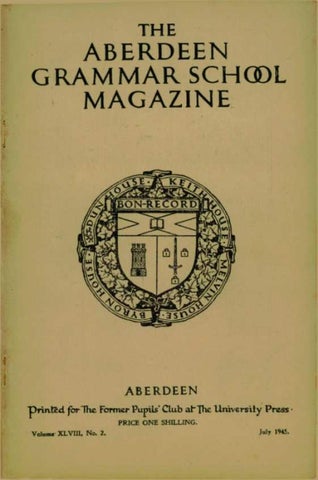
THE
ABERDEEN GRAMMAR SCHODL MAGAZINE
ABERDEEN printed forlhe. Former Pupils' Club al-The University Press • PRICE ONE SHILLING. Volume XLVIIL No. 2.
July 1945.
EDUCATIONAL BOOKS LEGAL • THEOLOGICAL MEDICAL • CLASSICAL New and Second-hand
CLASS STUDENTS NOTEBOOKS
BOOKS •
SCHOOL EXERCISE BOOKS
James G. Bisset Bookseller & Stationer 85 BROAD STREET
::
ABERDEEN
Opposite Marischal College
•
PHONE 753
•
GOOD HEALTH demands
GOOD BREAD For the children especially is it necessary to ensure their stamina and energy with good, wholesome, nourishing bread. In Hutchison's bread you'll find all these requirements are fully met. Phone or give instructions to have it supplied daily.
- - BRANCHES THROUGHOUT THE CITY
OLD GOLD AND SILVER Urgently Wanted also
FINE JEWELS and ANTIQUE SILVER Out-of-Date WATCHES JEWELLERY COINS CHAINS and Odds and Ends of every description realize
HIGH PRICES to-day
Full Value received at
A. & J. SMITH 191 Union Street ABERDEEN
LITTILES have just what you are looking for Something to wear that is well cut, smart and practical and not too expensive -
11,417 '
N
_-
SUITS TRAVEL COATS MODEL COATS
-
FROCKS
7
DRESSES GOWNS FUR COATS
(
-
I
1
— i
-
, ,1
--
Sizes to fit all figures ' -
from 36" hip to Sofs" hip
A. C. LITTLE & SONS, LTD. 105 UNION STREET
•
ABERDEEN
ESTABLISHED IBIS His MAJESTY TUE KING DATED In JULY 1940
APPOINTED MEAT Puityarofts AND POULT RRRRR TO
J. WILLIAMSON & SON 1w. B. WaLIANION, PROPRIETOR)
Meat Purveyors, Poulterers and Game Dealers 1, 2, & 3 MARKET BUILDINGS, ABERDEEN 'PHONE 412 THE SQUARE, CULTS 'PHONE. CULTS 2
BRANCHES , 31 FOUNTAINHALL ROAD 'PHONE 1724
'PEONS 36
ALIO AT CHURCH SQUARE, BALLATER.
RY
TO THE LATE
APPOINTMENT
KING GEORGE V
GRANITE MONUMENTS Designs and Prices on Application Monuments carefully packed and forwarded to all parts of the world Letter-Cutting done in Town and Country at Moderate Rates
JAMES TAGGART & SON Granite
Works
92 GREAT WESTERN ROAD, ABERDEEN Telephone-1658
Established over 50 years
For Better Footwear
JAMES LORIMER & SON (BOOTMAKERS), LTD.
CIVIL and MILITARY BOOTMAKERS
8 CHAPEL ST.
ABERDEEN
(Late of 162 Union Street)
Estd. A.D. 1844
'Phone 7a4
WM. KENNAWAY LTD. Quality Bakers, Confectioners and Caterers
ABERDEEN ®
When on a visit to Aberdeen—Gateway to Royal Deeside—rest and dine at our
RESTAURANT AND TEA ROOMS 173 UNION STREETHere you can have the finest War Time service at reasonable cost.
The Restaurant is commodious
and comfortable.
Our rooms are available for all
types of functions—Phone 2371.
Telephone No. 1891.
ARCHIBALD McKELLAR Family Grocer and Wine Merchant,
454-456 Union Street, Aberdeen. .
Cooked
.
We Specialise in . .
Gammons, Finest Belfast Smoked Hams, Wiltshire Bacon.
Medicinal Wines—Vibrona, Hall's, Wincarnis, Phosferine.
THE VALUE OF RECOMMENDATION " We have been recommended to you by----
to
Every day that phrase Is being used by Customers on their first visit to our showrooms.
REASON-
THE
OUR STOCK is of good quality and our prices are reasonable. OUR SERVICE is of a personal nature and we study the requirements of every Customer.
SATISFACTION IS OUR AIM
ROBERTS (Abdn.) LTD. CABINETMAKERS AND
THE FURNISHING HOUSE OF ENTERPRISE
UPHOLSTERERS
419 UNION STREET, ABERDEEN 'fele phone 3693
Established 1873
JAMES FYFE & SON PAINTERS AND GLAZIERS. •
•
.
OFFICE AND SHOWROOMS :-
11 DEE STREET, ABERDEEN. Telegrams- " Fyfe, Painters."
Telephone 304.
IRONMONGERY A LARGE AND VARIED STOCK ALWAYS ON HAND SHEETMETAL WORK
H. LEITH
A
SPECIALITY
& SON LTD.
26 and 28 NETHERKIRKGATE Phone 269
ABERDEEN
• FAIR SHARES . . . is an admirable policy.
Here you are
assured of your fair share, but there is an added advantage in that customers registered for rationed goods can order their fish supplies at the cost of only one telephone—or personal—call.
A. Sk W. AILEXANIDEU FISH, GAME AND MEAT MERCHANTS Tel.: Aberdeen 5172
492 UNION STREET
+
ABERDEEN
• DAIRY: ABERDEEN Tel. 1115, 7013, 7014
FARM: CULTER Tel. 6
KENNERTY FARM
DAIRY •
WILLIAM REITH Sole Proprietor : JOHN REITH
• 46-48 ROSE STREET, ABERDEEN
CONTENTS ILLUSTRATIONS Facing page
Facing page
Major-General T. G. Rennie, . . C.B., D.S.O. . Surgeon Lieut.-Commander R. G. . . Dingwall, O.B.E. Flying Officer William Davidson . Flying Officer W. D. Cheyne Flying Officer A. J. Jenkins, . . . D.F.C. . Flying Officer A. G. McLean Chief Engineer Alexander • . • Thomson . Second Officer L. K. Melvin Leading Asdic Rating K. D. . . • . Petrie
74 8z 83 83 90 9o
•
98 99 99 114 114 I15
. Trooper T. J. M. Forbes . . Flying Officer Harry Ross . Flight Sergeant J. V. Hay Major G. A. Rowton . . Lieut. E. S. P. Rebecca • Captain J. H. M. Wyness, M.C. • . Cadet W. H. Wyness • . Lieut. W. G. Fraser . Lieut. I. F. Tocher . • . Corporal John Sang Sergeant Rear-Gunner D. S. Lennie School Rugby Football 1st XV, . • • . 1944-45 School Prefects, June 1945 .
91 91 98
115 122 122 123 I23
130 136
Page 73 • • • A Message to Former Pupils. By J. J. R. . • • 75 The Effects of the War on the School Registers 76 . Notes about Old Boys . . . . . . . . 92 Roll of F.P. War Service . . • . . . . . . 93 . Marriages . . . . . . . 95 . . Pro Patria Mortui I02 . . . . Obituary . 107 In Faerie Haunts (verse). By John Morland Craig . 108 . These German Towns. By W. M. A. . . . . . • . 114 An Operational Parachute Drop . 115 Freeing the Sporades. By Surgeon Lieut. D. A. H. McNaught, R.N.V.R. 118 • Everyday Moslem Life. By Bramwell W. H. Cook 120 M.A. Milne, Gordon A. Officer Two Poems. By Pilot 122 . Impressions of Oxford. By Alexander J. Gray School Section— 123 School and Random Notes I27 Notes Rugby The Athletic Sports, 1945. 13! • • Hockey . 132 • • Cricket . 135 . . . . . House Notes . . . 137 . The Literary and Debating Society . 138 The Dramatic Society. The Orchestral Society. Scout Notes • 139 Army Cadet Force : The School Company 140 Squadron 1299 No. : Corps Training Air 141 School Office-Bearers for Session I944-45 The Former Pupils' Club— ,, 142 . The Club Boarding Houses . 144 The Rugby Section. The Bengal Centre •
•
•
•
•
•
•
•
•
•
•
•
•
•
•
•
•
•
•
•
•
92
PP
•
PP
PP
•
9
•
•
•
a
•
•
•
•
PP
•
•
•
22
•
•
•
•
PP
•
•
•
•
21
•
72
•
•
21
•
•
•
•
PP
•
•
•
•
•
8
•
•
•
•
PP
•
•
•
•
•
•
•
•
•
•
•
•
•
•
•
•
•
•
•
•
•
9.2
SCHOOL OUTFITS ARE A PROBLEM Owing to manufacturers being wholly employed on
Govern-
ment contracts we are at the moment unable to supply many of
the Grammar
Garments.
We
School
will do our
utmost to fit your boy with a serviceable school outfit.
ESSLEMONT & MACINTOSH (RETAILERS) LTD.
UNION STREET, ABERDEEN
" I need good food PP —and this is where you can get it ! We always have a fresh stock of all well-known dog foods including Spratt's, Spillers, etc.
Main Stockists for :—
Pot and Pearl Barley Barley Meal Hay and Straw • Agent for :
Coal and Firewood Poultry and Bird Food
Hadfield's Fertilisers
Moss Litter
•
Manures
WILLIAM SCORGIE GRAIN AND POTATO MERCHANT
13 ROSE STREET
•
Phone 4014
ABERDEEN
1843
1943
What About
Established 100 Years
TYPEWRITERS ?
WM. CAY & SONS
DESKS ?
(FUNERAL DIRECTORS) LIMITED
CHAIRS ? and all other
415 UNION STREET and
OFFICE EQUIPMENT ?
209 GEORGE STREET,
ABERDEEN
CAN I
HELP YOU ?
I am both Buying and Selling All Funeral Requisites Supplied
C. H. WEBSTER
Cremations Arranged
489 Union Street
Telegrams—"Coy, Aberdeen." Telephone Nos. 9.2 and 54.
ABERDEEN
Telephone: 8811-2
Telegrams : 'Blake Builders'
JAMIES 113ILAIFIU Joiner
► and
Building
Contractors
106 CROWN STREET Works-23, 25, 29 SUMMER STREET,
All classes of Building Joinery
::
ABERDEEN
Enquiries courteously solicited
Agents for Ordnance Survey Maps
Wyllies Circulating Library
WYLLIES Booksellers, Stationers
247 UNION STREET, ABERDEEN Established 1814 ESTABLISH
THE
-
HABIT
Telephone 402 OF
READING
GOOD
BOOKS
DRAWING
STRACHAN
PAPERS
COMMERCIAL
PENCILS BRUSHES EVERY REQUISITE
PORTRAITURE
FOR THE ARTIST
PHOTOGRAPHY
at
•
Taylors'
Telephone 851
•
Picture Framers 49-51 SCHOOLHILL
416 UNION STREET ABERDEEN
'Phone 2870
We Buy
I
YOUR OLD GOLD, SILVER, SILVER PLATE & GEM-SET JEWELLERY HIGHEST PRICES PAID 1
JAMIESON & CARRY -
Watchmakers • /tare
Iles • Saversr,, , ,
142 UNION STREET -ABERDEEN--
TO OUR CUSTOMERS We regret that the present restrictions on both men and materials make it impossible for us to maintain the usual high standard of service which we have carried on for nearly a century. We can assure you that we are doing our utmost to please you and trust that you will be patient with us.
J. & A. OGILVIE 369 UNION STREET ABERDEEN Telegrams : " Interiors"
Telephone No. 433
The choice of your
may be a little restricted these days, but we have been able to maintain our stocks at a good level, and have on display a pleasing range of modern and period designs for your selection.
James Scott & Son (Aberdeen) Ltd. 483-485 UNION STREET ABERDEEN Phone 1881-2
,
.
?- -
1
---.4
,-...-;-.03,.. ...4-_,:.40--,---,--1-4-, - -; , te.7.!::-.:-'
•,,,V,
, 1 lo i .znqs-r"wr..7
I -,''.:1, OlAs
-
'
:LI:,;11.-
i 14
- _$ 19
'
'
'11 14?
1
'
—
1,
1 1
)-
,
.1
i , I, 1
—
-
1'
-
, t, .
,
_
-
TO-DAY and TO-MORROW To-day practically the whole world is at war, and business everywhere is restricted to Even so, bare necessities. discriminating of thousands people will testify to the pleasure of shopping at Collie's of Aberdeen.
In the to-morrow' to: which we all look forward, this be will firm progressive pleased to renew the full high standard of goods and every made that service sheer of visit an experience delight.
aiditais) Cow' veoitct FAMILY GROCERS
AND
WINE
MERCHANTS
269-271 UNION STREET ABERDEEN Bi Appuirilment
Telephones: CENTRAL 4800 (4 lines)
Branch Shops at CULTS, BALLATER, and BRAEMAR
Telephones : Cults 28; Balloter 14; Braemar 212
a
•
ESTABLISHED IN ABERDEEN 1
836
Northern Assurance Company Limited Enquiries solicited for all Classes of Insurance
FIRE Insure your Dwelling-house and Furniture with the Local Office LIFE The Company's tables of rates for Life Assurance include every class of Policy ACCIDENT Insurance granted against Third Party Risks of all kinds Company's Assets
-
L 3 2, 5 00,000
CHIEF OFFICES:
ABERDEEN . LONDON .
i UNION TERRACE i MOORGATE, E.C. z
Branches and Agencies throughout the World
Aberdeen Grammar School Magazine 6rst yrar: No. 156 (New Series, 52nd year, No. 147)
Vol. XLVIII
JULY 1945
No. z
The "Grammar School Magazine" is issued under the auspices of The Former Pupils' Club, twice a year in war-time—in January and July. All communications with regard to the " Magazine" should be addressed to the Editor (the Secretary and Treasurer of the Club), THEODORE WATT, M.A., LL.D., The University Press, 6 Upper Rirkgate, Aberdeen.
A Message to Former Pupils. It would be straining words to describe as uneventful the term in which VE Day fell. Yet it is true that this session has kept to the end the same quality of calm that marked its opening months. We continue to be too popular. The flow of incomers has filled up all our empty places. Many must wait, others have had to be turned away, and a roll which three short years ago stood at 71o has mounted to 96o. Among the newcomers we have a special welcome for those boys from the East who, returning to their fathers' School after hardships and vexatious delays, are cheerfully facing the difficulties of readjustment. This session has seen a further expansion of technical and practical work among us, and to a degree hardly realized, our activities now lie outside the traditional field of the Grammar School. That there should be this generous provision for varied needs and aptitudes is wholly good ; but I feel some concern at the sharp decline in the extent (not the quality) of Classical studies in the School. Greek for all may be an outmoded folly, but Greek for none, or none for Greek, would be a calamity. For an able boy Greek provides an incomparable stimulus and satisfaction, and, while the technological needs of the future are admittedly great, bomo .rapiens has not in the recent past shown such excess of his distinctive quality that we can view with composure his abandonment of a rich and perennial source. The work of both Training Units has continued at the highest level of keenness and efficiency. For the Army Cadets there remain a need and an incentive, but it is unlikely that the Air Training Squadron will, in its present form, survive this session. Nothing is here for tears, but much for pride. The job has been done, superbly
Aberdeen Grammar School Magazine 74 done, and the Air Training Corps is perishing of its very success. I am entirely at one with the officers of the Squadron in feeling that good sense decrees the fall of the curtain, and that only a weak sentimentalism would seek to prolong an activity once the conditions that gave it life and meaning have passed away. It is too soon to speculate on the form and extent of pre-training in the post-war years. How our XVs and XIs have fared is set down elsewhere. A summary verdict on the past year might be—steady improvement, with the promise of still better things to come. Very gratifying has been the return to the School of the Evening Express Cup—looking none the worse, one is bound to confess, for its four years' sojourn in another place! At Easter Mr. Edwards felt obliged, by pressure of work, to resign his post as Acting Games Master. It says much for his devotion to the School that he was willing to undertake this difficult task, and much for his athletic skill and understanding of boys that he has performed it with so much success through the hard years of war. Before another issue of the Mago#ne the School loses two Masters who have served it well and done pioneer work in their own subjects. Mr. Wm. M. Henry, Principal Geography Master, joined the English staff in 1913. Older generations of Grammarians will recall his power and prowess as an athlete ; all alike will acknowledge the range and vigour of a mind equally at home in wide fields of literature and in that new and fruitful study of Geography, where he has given so fine a lead to the teachers of the North-East. Mr. George R. Strachan's term of service has been shorter but no less significant in the development of our curriculum. A craftsman of a very high order, a masterly guide to the intricacies of Technical Drawing, he has long anticipated in his own practice much that is now acclaimed as new and individual in the teaching of Technical subjects. Mr. Strachan has had the satisfaction of seeing his subject become an integral part of the curriculum, and in his last session he has presented at the Senior Leaving Certificate a first and biggish group of boys whose work has evoked high praise from His Majesty's Inspectors. Grammarians everywhere will learn with pride and gratitude that the library of the late William Munson has been gifted by Mrs. Munson to the School. " The Munson Collection," kept intact, will be the fittest of all memorials to one who was in the noblest sense a bookman, and from it generations of boys will glimpse the intellectual stature of one of the finest scholars who ever served their School. On a recent Saturday morning I was working alone in the School and, hearing footsteps, went out to find a stranger in the building. He had passed out of the Grammar School half a life-time before, but, as we talked, it was clear how much it all meant to him still. When he had gone, this question plagued me—Once our legislators have had their way and patterned all schools to their liking, will there still be some, forty years on, who are moved to turn aside into a shabby, silent building, and let the years fall away, and recapture for a moment there that morn of youth when the foot was light and hearts were glad ? J. J. R.
Tom GORDON RENNIE, C.B., D.S.O., M.B.E. Major-General, The Black Watch (R.H.R.) See p. 95.
Aberdeen Grammar School Magaine
75
The Effects of the War on the School Registers. Now that victory in Europe has been achieved and the threat of immediate danger to our land removed, the effects of the war on our School registers can be revealed. In general, the life and organisation of the School have not been disturbed in any way comparable to the experience of many schools in other parts of Scotland, but after some five and a half years of war it is only fitting that a balance sheet should be presented for those to whom the welfare of the School is a matter of moment and interest. CREDIT.-In common with other schools throughout the country, the Grammar School was closed for some three weeks after the outbreak of war in September 1939. By the end of October thirty-five pupils, hailing from Edinburgh, Glasgow, Dundee, Wales, London, and various places in England, were admitted ; the majority of them claimed a connection with the city and some were sons of former pupils. The city, however, soon became a target for the Luftwaffe, which submitted it to several tip-and-run raids ; as a result, most of our Scottish " evacuees " returned home to districts which were much freer from such embarrassing attention. Of the thirty-five, fifteen returned within a year, eight completed the session, seven remained a little longer, while five, all of them now proud " Grammarians," are still with us. Later, when Service demands made Aberdeen a place of residence for many parents, a few boys were enrolled. Some of them are still here, although a southward trend has begun, now that schools and accommodation are once more available in England. As recently as August 1g44 the V-bomb raids on London and the surrounding counties caused another evacuation from that area. Because of the " staggered " holidays, the School was then in session, and eight boys were admitted. All have now returned south. DEBIT.—A number of Grammar School boys left the city in the later months of 1939 and the early part of 1940 to seek sanctuary in the country districts. By the end of the latter year many of them had begun to return and almost all are again within the School walls. A few went further away to join their parents in India and Malaya, and these, too, if still of school age, are back again. Many requests for enrolment of younger boys are coming from the Far East, via Australia, and every• effort will be made to comply with these requests, although there is yet no indication of the date of return to this country. Only one boy took advantage of the Government evacuation scheme to the United States of America ; he remained on the other side for two years, returned, but after a short spell at the " Grammar " he has gone on to Merchiston. GENERAL.—We have welcomed the sons of two European refugees, fleeing from the Nazi tyranny. On the whole, therefore, the School has not been unduly upset, nor have classes been ridiculously inflated in numbers. We can only express the hope that those who have been with us at any time during the war period have enjoyed and profited from their stay.
76
Aberdeen Grammar School Magazine
-
* The Editor is glad at all times to receive from any quarter items of information for this section of the " Magazine."
The dates given in parenthesis after names indicate the sessions of attendance at the School. SERVICE DECORATIONS. Companion of the Order of St. Michael and St. George (C.M.G.). Patrick A. B. McKerron* (1904-10), Colonel, of the Malayan Civil Service, who escaped from Singapore in February 1942 and after a year in Ceylon as Political Secretary to the Commander-inChief received a War Office appointment in London, is now Deputy Head of the Malayan Planning Unit. As such he was created a C.M.G. in the Birthday Honours List, June 1945. Commander of the British Empire Order (C.B.E.). James Melvin (1904-1o), M.C., M.B., Ch.B., Colonel, R.A.M.C., was in April gazetted C.B.E. He was a Captain in the R.A.M.C. in the last war and was awarded the Military Cross in 1917. In the present war he served in the Middle East and received the honour of O.B.E. (Military Division) in March 1941. He was for a time in medical practice in Rochdale and thereafter in Streatham, London. Officers of the British Empire Order (O.B,E.). Alastair MacLennan* (1923-29), M.B., Ch.B., Lieut.-Colonel, R.A.M.C., was made an O.B.E. in March. He entered the Army after graduating in Medicine at Aberdeen in 1934. In the present war he had a period of service in Malta and then was appointed A.D.M.S. at the War Office, later becoming A.D.M.S. at 21st Army Group Headquarters. He has latterly been in command of a field ambulance with the B.L.A. Philip Rene Mitchell (1916-22), M.B., Ch.B., Lieut.-Colonel, R.A.M.C., was created an O.B.E. in February. He served as M.O. with the 4th Battalion The Gordon Highlanders in France up to the evacuation in 1940, and later was on service in Eastern England. At the beginning of this year he was A.D.M.S. in a French town. It is of interest to record that when the lost pipes and drums of the 4th Gordon Highlanders were found in the Hotel de Ville of Roubaix, * Member of the Former Pupils' Club.
Aberdeen Grammar School Magazine
77 Lieut.-Colonel Mitchell took charge of them and had them returned to Aberdeen. Member of the British Empire Order (M.B.E.). John Duncan MacLennan (1923-29), M.D., Major, R.A.M.C., received in March the award of M.B.E. After graduating in Medicine at Aberdeen University in 1934, he was for a time assistant in the Bacteriological Department there, before going to London as a lecturer in the School of Bacteriology. During the war he has served in Egypt, Italy, and France. He is a twin brother of Lieut.-Colonel ALAsTAIR MACLENNAN* (see above), and their father is Colonel FARQUHAR MACLENNAN* (1888-90), D.S.O., M.B., Ch.B., who now lives in retirement at Milltimber, Aberdeenshire. Distinguished Service Cross (D.S.C.). Alexander Gordon Scott* (1925-29), Lieutenant, R.N.R., was awarded the D.S.C. in May for courage, skill, and determination in attacks on enemy submarines. In the same month he was also mentioned in dispatches. Since leaving the School he has been in the Mercantile Marine. Military Cross (M.C.). Richard Lewis Leith* (1915-19), Major, R.A.C., was awarded the M.C. in March, being decorated by Field-Marshal Montgomery at Ypres. After graduating B.A. at Cambridge, he took up farming near Newtonmore, Inverness-shire, for a time, and then went to Darvcl, Ayrshire. In 1940 he volunteered for the R.A.C., with which he has been on the Continent since D Day. John Kinnear Mackay* (1919-33), M.B., Ch.B., Captain, R.A.M.C., was awarded the M.C. in April. He graduated in Medicine at Aberdeen University in 1939, and joined the R.A.M.C. as Lieutenant in January 1940. Before going to France he served in Africa, Sicily, and Italy. He won the University golf championship in 1938 and was North of Scotland amateur billiards champion in the same year. James Fraser McLuskey* (192o-31), B.D. (Edin.), C.F., was in March awarded the M.C. This was, no doubt, in recognition of his service with the Special Air Service, some account of which was given in the last issue of the Magazine. William Mitchell Park (1931-32), Captain, Royal Corps of Signals, has been awarded the M.C. for gallantry while serving with the Chindits in Burma. He is now with an Indian Paratroop Brigade. Before joining up he was on the staff of the West-end branch of the North of Scotland Bank Ltd., Aberdeen. Robert Park Yunnie (1921-26), Lieutenant, The Black Watch, was awarded the M.C. in February. Since leaving this country at the end of 1939, he has served in Palestine, Libya, Tunisia, and Italy, being latterly a member of the 8th Army Special Service Squadron. Before the war he was local secretary of the Guardian Assurance
Aberdeen Grammar School Magazine Co., Ltd., Aberdeen, and later resident consultant in Bristol of the Manufacturers Life Insurance Co. of Canada. 78
Bar to Distinguished Flying Cross (D.F.C.). David Burgess Ross* (1928-36), Flight Lieutenant, R.A.F., was in April awarded a Bar to the D.F.C. he won in 1943. It has been officially recorded that on one occasion his aircraft was detailed to attack Cologne. " During the sortie one engine was made unserviceable, and on leaving the target area an attack was made by a Messerschmitt 210. Flight Lieut. Ross skilfully directed evasive action and by his accurate fire drove off the enemy fighter. By his cool courage, efficiency, and devotion to duty over a long period, he has set an outstanding example to all members of his squadron." In April it was reported that he had completed his third tour of operations, carrying through more than fifty-two attacks on enemy targets, and, along with his skipper, had the distinction of being the first to complete two tours with the Lion Squadron of R.C.A.F. Bomber Group in Britain. Ferguson George Donaldson Smith* (19z 2-33), Flight Lieutenant, R.A.F.V.R., was awarded a Bar to his D.F.C. in April of this year. " Since being awarded the Cross in February 1944 he has taken part in many operations and has rendered valuable assistance to his captain, frequently in the face of intense enemy opposition." Distinguished Flying Cross (D.F.C.). Charles Mortimer Hall* (1929-40), Pilot Officer, R.A.F., was awarded the D.F.C. in March. He joined the R.A.F. immediately after leaving the School, and the citation of his award stated that he had shown himself to be an exceptional pilot, and his keen courage and determination had been an inspiration to all in the squadron. Mentioned in Dispatches. Ian Harvey Cassie* (1925-35), L.D.S., R.C.S.(Edin.), Flight Lieutenant, R.A.F., was mentioned in dispatches in the New Year's Day Honours List for distinguished services in dentistry in the Middle East, North Africa, and Italy. He has been attached to the Headquarters Unit of the Desert Air Force in Italy. Robert Norman Lees* (1920-33), M.C., M.B., Ch.B., Major, R.A.M.C., was in May mentioned in dispatches for gallant and distinguished service with the R.A.M.C. on D Day. Thomas Menzies* (1 905-1o), O.B. E., M.B., Ch.B., Colonel, R.A.M.C., was in February mentioned in dispatches for services in Italy, where he was at A.F.H.Q. Alexander James McCombie Simpson* (1933-38), Lieutenant, R.A.C., was recently mentioned in dispatches. Before enlisting as a Private in the Gordon Highlanders he was a medical student at Aberdeen. He has been on active service in the East for over three years.
79 been The Right Hon. Lord Alness* (1884-85), P.C., LL.D., has re-appointed in the new Government a Lord-in-Waiting in His Majesty's Household. He was first appointed to the office, which is a political one, in 1940. William Adam* (1925-37), Captain, The Gordon Highlanders, has been serving in the G.H.Q. Liaison Regiment since its formation in 1940 after the fall of France. He was in North Africa and Sicily, and has latterly been with the American 3rd Army from Normandy to Germany. The Liaison Regiment has been nicknamed " The Phantoms," and has been operating on every front in the European and the Middle East theatres of war. It has recently been disclosed that the Regiment has been the eyes and the ears of the Army on both sides of the fighting front. Not only has it notified all units of the Allied Armies of the positions of Allied troops, but there have been groups of officers and men, skilled wireless operators, reporting movements of the enemy behind their lines. Arthur J. H. Aitken* (1927-38), M.B., Ch.B., Lieut., R.A.M.C., is an R.M.O., King's Regiment, India Command. Since his arrival in India he has met three F.P.s : John B. Bittiner* (1925-38), M.B., Ch.B., and Frank N. Forster* (1921-25), M.B., Ch.B., both officers in the R.A.M.C. ; and his brother, Hugh G. J. Aitken* (1928-40), who is in the R.A.F., S.E.A.C. Wilfrid Philip Shepherd-Barron* (1896-1903), M.C., T.D., M.Inst.C.E., M.I.Mech.E., who has been Chief Engineer, Port of London Authority, since 1938, has been strenuously engaged during the last five years in the struggle to keep London's harbours open, and has had only one week's holiday since war began. His worst time was during the 1940-41 blitz, when there was a constant battle against fire, mine, and high explosive. Acres of warehousing were lost, huge stores went up in flames, and quays and docks were wrecked. George Davidson Bisset* (1918-31), Captain, R.E., was reported in April to have been wounded in Italy. He has been with Commando units in all the European theatres of fighting. He took part in the liberation of Greece before going to Italy. [As this issue of the Magazine is passing through the press Captain Bisset is reported to have died of wounds in enemy hands in April.] Robert Kilgour Booker* (1928-41), Flying Officer, R.A.F., is reported to have been stationed in Assam and to have been sometimes flying over the place where he was born. Earlier he was engaged in the dropping of supplies to Wingate's expedition and making night landings behind the Japanese lines to bring out casualties. This was quite a tough job during the monsoon. Thomas Stewart Boyd* (1930-38), who, before joining up, was a temporary clerk in the Civil Service, Edinburgh, has been serving in the Royal Navy as a Radio Mechanic, engaged on maintenance of Radar equipment on ships. William Lumsden Cairncross* (1931-36) is a Radio Officer in the Merchant Navy. From early in 1942 to early in 1943 he served Aberdeen Grammar School Magazine
80
Aberdeen Grammar .School Mngaine
in a troopship on the East African and Indian coasts, and in the summer of the latter year went into the Mediterranean with the assault force on Sicily, following the land campaign right up to the Salerno landings. Since that time his journeyings have been on freighters, mostly in the Atlantic area. An intimation of his marriage appears on another page of this issue. James Jolly Calder* (1866-69), M.A., on 1 8th June of this year completed 66 years in the ministry of the Church of Scotland. He was for at years minister at Rhynie, Aberdeenshire, and for 32 years at Cairney, Aberdeenshire. For over 12 years he has been living in retirement in Stonehaven. Being now in his 93rd year he is believed to be the Senior Member of the F.P. Club. Robert Henderson Calder* (1921-24), who has been serving as a Trooper in an Australian Armoured Regiment, says in a recent letter that it has been most interesting and heartening for all in his quarter of the globe to have had the pleasure of welcoming the Royal Navy, now in Australian waters in considerable strength. The hospitality offered to the Navymen has been most impressive. Andrew James Campbell (1886-87), B.A.(Cantab.), D.D., minister of Evic, Orkney, was in May duly elected Moderator of the General Assembly of the Church of Scotland. In submitting Dr. Campbell for election the retiring Moderator said that the name and work of Dr. Campbell were familiar to most of them. They were aware of his brilliant academic career. They knew how he exercised two very notable ministries, in Lerwick and in the famous parish of St. John's, Glasgow. It was during his experience as Clerk of the Presbytery of Glasgow that he acquired two qualities which had often struck them in that House—his knowledge of Church procedure and law, which was very profound and exact, and also his knowledge of the extraordinary and bizarre vagaries of the clerical mind. On these grounds alone he would have had a claim to the highest honour the Church could give, but as they also knew, there were other qualities of head and heart that had won him the trust and the love of all who intimately knew him. At the end of March Dr. Campbell received the Freedom of Kirkwall. Alan Chalmers* (1915-19), of the Hongkong and Shanghai Bank, who was for two and a half years temporarily on the staff of Barclays Bank (Canada) in Montreal, has recently returned to this country, and is now waiting to go out to the Far East again. George Collie Cheyne* (1900-04), M.A., B.Sc.(Agr.), who joined the Imperial Forest Service in Burma in 1911, managed to escape from Burma when the Japanese invasion began and got back to this country. He is at present secretary of the Kincardineshire Agricultural Executive Committee. Norman Stuart Clark* (1919-29), B.Sc., M.B., Ch.B., has recently been promoted to be Lieutenant-Colonel, R.A.M.C., and is now Officer-in-charge, Medical Division of an Indian General Hospital (Combined) in Southern India. He was previously stationed in
81 Aberdeen Grammar School Magazine Lahore, and before leaving it did a tour of the whole of Lahore District (an area not much smaller than Scotland), to collect information for a rehabilitation scheme for Indian troops. During a visit to one of the Gurkha depots he just missed meeting Captain JAMES ALEXANDER DONALD* (192o-32), who had gone on leave on the previous day. James Cobban* (1925-32), of the Burmah-Shell Co., Ltd., has been transferred to Keamari, Karachi, India, after three years of what he describes as " knocking around the Middle East " while " lent " to the Shell Company of Egypt Ltd. F.P.s IN INDIA. (19 z 6-38), M.A., Connon* Campbell
Lieutenant, Intelligence Corps, recently wrote a long letter to the Secretary of the F.P. Club " after a very pleasant cycle spin round Colombo." In this he narrates some of the Aberdeen and particularly the F.P. contacts he has made since landing in India. In Delhi last October he met his first F.P., DOUGLAS KNox CAMERON* (1932-35), L.D.S., R.C.S.(Edin.), who was a School Prefect in 1934-35. " I wasn't to know," writes Connon, " that he would be the operator when I sank into a dental chair to await the officer to give me the works I " From November till early January he was in Bombay and bumped into JAMES ALEXANDER CARDNO* (1929-32), who had just arrived, and was on his way to an R.A.F. wireless college as a lecturer. There he also met his old friend HARRY GOLDING* (1926-37), who is also in the R.A.F., and spent a very happy week going around with him. While he was in Bombay he was " spotted " by another F.P. This was HENRY N. MACPHERSON* (1934-37), now Captain, R.E.M.E. After two months " back North," Connon had again occasion to return to Bombay, and when waiting at Delhi 'drome for the Dakota to take off at 4 a.m., a matter-of-fact voice said " Good morning, Mr. Connon." The speaker was the navigator, ROBERT K. BOOKER* (1928-41), who had been very busy for a time " dropping supplies to Wingate and company " and was then having a " rest " in Transport Command—" Karachi one day, Hyderabad the next, Colombo on Wednesday, Shillong the day after . . . what a life! " Arrived at Bombay, Connon next met JOHN C. S. ARNAUD* (1929-40), newly commissioned into Intelligence, whom he again came across in April in Calcutta, bound for Burma. When in Calcutta he duly paid a visit to the Club Consul, H. B. Scum,* and his " flat mate," W. G. MACMILLAN* (1916-22), Ph.D., of the Indian Jute Mills Association. In Madras he came indirectly in touch with WILLIAM C. WALLACE* (1933-38), now a Lieutenant in the Indian R.E.s. Finally he mentions that NORMAN G. ROBB* (1913-22), whose home has been in Edinburgh for the last eight years " is now in our racket in Calcutta." Connon seems to be seeking " intelligence " as keenly as any journalist and certainly has been getting around. In the report of a recent informal " get-together " dinner of about forty Aberdonians in New Delhi we read that Lieut. Campbell Connon contributed a violin solo I Robert Rannie Cook* (1899-1908), who was in North Borneo and the F.M.S. from 1913, is at present in Sydney, where he is a
8z
Aberdeen Grammar School Magazine
member of the Committee in charge of the Malayan Research Bureau. This has prepared very extensive lists of civilian internees, volunteers, prisoners of war, and others in Japanese hands. Included in these are the names of not a few unfortunate F.P.s whose internment or imprisonment has already been reported in the Magazine. Sir Patrick Ashley Cooper* (1896-1901), B.A., LL.B., Governor of the Hudson's Bay Company, in a recent letter refers to the most interesting trip he had last autumn in and over the wilds of Canada. He was away for three and a half months and travelled about 23,000 miles, including 19,000 of flying. He was in the Arctic at the mouth of the Mackenzie River and also along what is called the Staging Air Route. He saw a great number of aeroplanes being flown along there to be handed over to the Russians. In the first week of May the Hudson's Bay Company celebrated the 275th anniversary of its founding. At a luncheon held in London at Claridge's the Governor presided and read the following message of congratulation from the Prime Minister: " The Hudson's Bay Company is the oldest chartered company in the world, and its life has been filled with achievements of which you may be justly proud. Yours is a fine record of enterprise in opening the vast territories of North America and in serving their peoples. In sending you my good wishes I am glad to recall the fact that John Churchill was its third Governor." The Chairman added : " Can you expect a boy to lose his heart to a study of the Duke of Marlborough's campaigns when a new Marlborough holds the stage in this, the most vital real-life drama for centuries ? " John Alexander Cruickshank (1926-29), V.C., Flight Lieutenant, R.A.F.V.R., was specially mentioned by Sir Archibald Sinclair, Secretary of State for Air, when presenting in the House of Commons on 6th March the Air Estimates for 1945. " During the first four critical days from D Day, Coastal Command made 38 sightings, which resulted in several destructive attacks. In every case the U-boats fought back desperately with Flak, but our indomitable aircrews—heroic men like Flight Lieutenant Hornell and Flying Officer Cruickshank, whose gallant exploits earned for them the Victoria Cross—flew in low through the Flak and bombed with deadly accuracy." Thomas Davidson* (1893-97), D.S.O., was in March gazetted Honorary Colonel of the 75th Heavy Regiment R.A. (Highland), T.A. David M. C. Donald* (1926-3z), Captain, R.A., was in May appointed Staff Captain (A), H.Q., zi Army Group. James Forrest Donald* (1938-4o and 1941-44) is the youngest Life Member of the F.P. Club. He attained the age of It in March of this year. Adrian Michael Campbell Duffus (1932-38) has been elected President of the Aberdeen University Students' Union for 1945-46. He is the seventh F.P. in succession to hold the office. All the male Presidents of the new Union (the first was a woman) have been F.P.s.
RONALD GRANT DINGWALL, Q.B.E.
M.S., Ch.B. ; Surgeon Lieut.-Commander, R.N. See p. 96-
WILLIAM DAVIDSON
WILLIAM DAVID CHEYNE
Flying Officer, R.A.F.
Flying Officer, R.A.F.
Si. p. 95.
See P. 95.
83 Aberdeen Grammar School Magazine Alexander William Duthie* (1910-11), who has been for many years in the Administrator's Office, Cape Town, has recently been promoted to be Principal Clerk, and is now in charge of Hospitals and Educational Finance Sections. In a recent note he says that he will gladly welcome any F.P.s who are passing through Cape Town. Basil Duncan Dean Emile* (1929-35), who has been serving with a Forward Observer Unit R.A. (Airborne), C.M.F., was promoted to Major in June of last year, shortly after the fall of Rome. He then took up parachuting again, having trained in the Middle East early in 1943. He had a short spell in the South of France, and was lucky enough to be amongst the first to enter Cannes, where they received a terrific reception from the much relieved French. He then went on to Greece, which he remarks was an interesting and initially enjoyable experience, spoiled by the stupidity of E.L.A.S. "I am glad to be able to say that, once we had overthrown them; we were even more popular than when we pushed the Germans out. Most of the Para. Brigade took a very dim view of the home press at that time." Thereafter he was again back in Italy. John F. R. Fairweather* (1919-25), of the Royal Insurance Co., Ltd., Nairobi, Kenya, is now a Major, and a D.A.D.E.W., H.Q., East Africa Command. Donald Frank Farquharson* (1929-41), of Coulsdon, Surrey, has been in the R.A.F. for two years, and got his " wings " and a commission in April of last year. He is now in the Fleet Air Arm as a Sub-Lieutenant (A), R.N.V.R. Alexander Findlay* (1882-91), M.A., D.Sc., LL.D., formerly Professor of Chemistry in the University of Aberdeen, was in March re-elected President of the Royal Institute of Chemistry. Louis Findlay* (1924-30), M.B., Ch.B., who now holds a commission in the R.A.M.C. in the Middle East, was previously for over a year with a British Red Cross Medical Unit in Addis Ababa, Abyssinia. During his stay there he seized an opportunity that arose in April 1943 to visit the monolithic churches at Lalibela, a sacred town in the central highlands of Ethiopia. This place is accessible only by mule transport across the mountains from Dessie, but he made the journey comfortably in three days, experiencing wonderful hospitality on the way, thanks largely to letters of introduction to the local Governors which he had received from I-Iis Imperial Highness the Crown Prince of Ethiopia. These monolithic churches were discovered in 15 20 by a Portuguese priest and are the most interesting archaeological monuments in Ethiopia. The,only monuments with which they can be compared are the Pharaonic temples on the Nile near Wadi Halfa and the rock temples at Petra. A most interesting account of the expedition, with photographic illustrations and a very helpful map, was published in the Bulletin of the Society of Coptic Archaeology. Robert Ian Mackay Finlayson (1908-i i), who served his apprenticeship as an engineer with Messrs. McKinnon & Co., Ltd., Aberdeen, and thereafter was assistant manager on a tea estate in Upper Assam,
Aberdeen Grammar School Afagazine 84 is now Chief Superintendent, Lockhead Aircraft Corporation, Liverpool. Williamson Jackson Finnie* (1928-31), B.Sc., M.B., Ch.B., is now Major, R.A.M.C., and serving as a specialist in anaesthetics in an Indian General Hospital, having obtained the Diploma in Anaesthetics, R.C.S. and P. (Lond.) in 1940. He has met in India one of his old School classmates, James H. Stewart* (1926-31), Major, R.A.M.C., who is second in command of a casualty clearing station. Matthew George Fisher (1896-1900), K.C., M.A., LL.B., Dean of the Faculty of Law and Professor of Civil Law in the University of Edinburgh, has had conferred upon him by the President of the Polish Republic the Order of Polonia Restituta (Third Class) in recognition of services rendered during the war. Archer Irvine-Fortescue* (1892-97), D.S.O., M.B., Ch.B., Colonel, R.A.M.C.—the President of the F.P. Club—was in February gazetted a Deputy Lieutenant of the County of Kincardine. William Wallace Gauld* (1893-98), M.A., has received the honorary degree of D.D. from the University of Aberdeen, where he is minister of Queen's Cross Church. As Convener of the Jewish Mission Committee of the Church of Scotland he recently visited Palestine, where he conducted an investigation into the position of the work being carried on among the Jews by that Church. James H. McI. Gordon* (1901-02), M.C., was in March gazetted Honorary Colonel of the 92nd Anti-Tank Regiment, R.A. Very Rev. James Harvey* (1870-75), M.A., D.D., in April completed sixty years in the ministry. He is senior minister of Lady Glenorchy's North Church, Edinburgh, and was formerly Joint Senior Clerk to the General Assembly of the Church of Scotland. David Sinclair Hay* (1907-11), Squadron Leader, R.A.F., has been adopted as Socialist candidate for Parliament by the Central Aberdeenshire Labour Party. Before joining the R.A.F. in 1940 he was General Manager of the Scottish Industrial Estate at North Hillington, Glasgow. From February 1942 until recently he has been serving in Assam and Burma. Hamish McNaughton Henderson* (1932-4o) has been awarded a major scholarship at Pembroke College, Cambridge. Robert Alexander Innes* (1928-31), Captain in a Medium Regiment, Royal Artillery, S.E.A.C., was a " spotter " at the recent breaching of the walls of Fort Dufferin, Mandalay. The Fort contains the Palace, Government House, Gaol, Club, Poli; Ground, and other Government buildings. It is surrounded. by a moat about 75 yards wide, with a wall on the inner side. Each wall has a main gate in the centre, set obliquely to the bridge leading to it, and protected from direct fire by a massive buttress on the moat side. Captain Innes's brother, Ian Adam Innes (1936-38), graduated B.Sc. in Engineering at Aberdeen University in March of this year, and is now a Midshipman in the Fleet Air Arm.
Aberdeen Grammar School Magazine
85
James Geddes Greig Irvine (1927-34) was one of two Scottish students who in March were announced to have won the Cecil Peace Prize (awarded annually for the best essay on a peace subject by a matriculated student at any of the British Universities and Colleges), and is the recipient of L5o. He has been discharged from the Army and is at present a third-year Arts student at Aberdeen University. Sir William Wilson Jameson* (1892-1902), K.C.B., M.D., LL.D.(Aberd.), Chief Medical Officer of the Ministry of Health, is to receive the honorary degree of Doctor of Hygiene from the University of Durham at Newcastle in July. Charles Forrester King* (1912-23), of the Chartered Bank of India, Australia and China, who with his wife was a prisoner of the Japanese in Manila, was released by the Americans. He was reported in March to be very cheerful and rapidly improving in health. The first postcard from him after the fall of the Philippine Islands came at the New Year. A message from him was broadcast on the Melbourne radio early in April. James Gray Kyd* (1891-98), C.B.E., Registrar-General for Scotland, has recently been made chairman of the new Scots Ancestry Research Council, which is already being kept very busy. William Elder Levie* (1889-93), Professor of Conveyancing in the University of Aberdeen, received in March the degree of M.A. from the Senatus Academicus. William Milne Littlejohn* (1901-02), Colonel, R.A., has been appointed Hon. Colonel of the 56th (Highland) Medium Regiment. Alexander M. Mackay (1889-90) is one of those who lived through the German occupation of the Channel Islands. He is a wine merchant and shipper, 73 years old, who came to Guernsey from Nairn in 1902. In an interview after the liberation of the Islands he said that many of them found that the occupation gave them a sense of frustration which led to nightmares. They could not sleep peacefully for years and they suffered from loss of memory. He was one of the lucky few who saved their cats from the marauding, hungermaddened Germans. Kenneth William MacKenzie* (1893-97), D.S.O., M.C., M.B., Ch.B., who was for a number of years in the Indian Medical Service and in 1914 became a Deacon in the Scottish Episcopal Church, is returning to India, where he has served several terms as a medical missionary. This time he is going to Kashmir. With this in view he has resigned from his position as Rector of St. John's Episcopal Church at Pittenweem in Fife. Roy Alexander Mackenzie* (1939-41) is now a first line Pilot in the Fleet Air Arm. His carrier was one of the two mentioned in the special reports issued early this year of the large convoy which got through to Russia with Rear-Admiral McGrigor in command of the escort. Neil Bruce MacKinnon* (1930-40) is a Seaman in H.M.S. Swale. Writing some months ago, he said that he had been having quite a
86 Aberdeen Grammar School Magazine good time shifting about from place to place and had seen quite a bit of the world. Basil G. McLellan (1887-89) has been appointed Director of the Scottish Seaweed Research Association Ltd. For over 4o years he has been chief chemist with Messrs. Rowntree & Co., Ltd., cocoa and chocolate manufacturers, York. Douglas Stuart McMillan* (1896-1904), F.R.I.B.A., has recently retired from the position of Technical Adviser in Scotland to the War Damage Commission, after nearly four years' service. He has resumed practice as an architect in Aberdeen. Douglas S. S. Marr* (1919-3z), Lieutenant, Highland Light Infantry, was in May reported to have been wounded on the Western Front and to be in a hospital in England. James W. S. Marr* (1913-19), M.A., B.Sc., Lieut.-Commander, R.N.V.R., leader of a party of scientists and administrative officials who last year established fully equipped and self-contained bases in dependencies of the Falkland Islands, has relinquished his command owing to ill-health. Edwin Roy Marston* (1936-39) has recently returned to this country after spending fifteen months in the U.S.A. and Canada in R.A.F. training. He is now a Flying Officer. Alistair MacDonnell Milne* (1924-3z), Major, A /Tank Regiment, R.A., wrote in February that he was then in action in Burma, after having come through the battle of Kohima and the Manipur campaign with safety. William Mitchell* (1919-3z) has recently been promoted Lieut.-Colonel in the R.A.O.C. He has been for some time the Liaison Officer to the American Army (Chemical Warfare) Depots. In 1943 he was Chief Ordnance Officer of a British-American depot, which comprised 5o per cent. British and 5o per cent. American personnel. Latterly all the British were replaced by Americans, and the depot was taken over by the U.S. He has had an excellent opportunity of studying Anglo-American relationships, and although the administration of an Anglo-American unit is not an easy matter, it is, at any rate, an interesting one, and he says that he certainly learned to understand the American " away from home," be he white or coloured. Ian Alexander Moir* (1924-3z), M.A., B.D., Ph.D., was in March elected minister of Tower Parish Church, Stanley, Perthshire. Previously, for three years, he was assistant in St. Giles' Cathedral, Edinburgh. Edwin Morgan* (1906-12), who has been for many years in the service of the Canadian Bank of Commerce as an Inspector, wrote in April that he had recently returned from a two months' trip to Trinidad and Barbados, where the Bank has branches. He is now a Special Representative and makes frequent trips to the United States, establishing contacts and developing business there.
87 Aberdeen Grammar School Magazine James Lawson Mowat* (1915-16), M.A., Ph.D., who was an interpreter in the International Labour Office, Geneva, and, coming home, received a commission in July 1940 on the General List (Intelligence Branch), was in December last released from the Army so that he might return to his pre-war job. The I.L.O. moved its headquarters from Geneva to Montreal in 1940, and he was glad to go over there early this year, for a time at least. First impressions of Montreal were pleasant, he says. After wartime England the chief attractions were material things—the abundance and variety of food, street lighting at night, etc. The whole of his war service was spent in the Directorate of Military Intelligence, War Office. He held the rank of Temporary Major from August 1942. SCAPA FLOW CAUSEWAYS.
George Gordon Nicol* (1894-1903), D.S.O., M.Inst.C.E., civil engineer, Aberdeen, who joined the Admiralty service in May 1940, was for the following four years in charge of the construction of causeways to protect the naval base at Scapa Flow against a repetition of U-boat attacks such as occurred when H.M.S. Royal Oak was sunk in Scapa Bay near Kirkwall. The causeways link the Orkney mainland at the Holm parish village of St. Mary's with the islands of Lamb Holm and Glimps Holm, Burray, Hunda, and South Ronaldshay. The barriers have dosed the channels of Kirk Sound, Holm Sound, Weddel Sound, and Water Sound. At the time of Dunkirk thousands of workmen were engaged on the job. Great overhead railways were erected to carry hundreds of thousands of tons of material and concrete blocks, and to drop those materials into the sea, which was successfully stopped from flowing and ebbing in some channels at speeds exceeding eight knots. About two years ago it was possible to surface the causeways with roads for construction transport, and last year the highways were completed to make the finest traffic roads in the North of Scotland. An idea of the vast quantity of material used in the work can be gathered from the fact that over 500,00o cubic yards of quarried rock lie under the causeways, while over 300,000 tons of concrete were utilized in the construction work. Mr. Nicol had under his supervision no fewer than 1,700 men for a period of over three years. He is a former Vice-President of the F.P. Club and one of the directors of the School Boarding House Company. Alexander Paterson* (I9I0-21), M.B., Ch.B., Sale, Cheshire, is a Captain in the R.A.M.C. and is now in Burma with the West African Forces. Gibb Niven Pennie* (1923-26), M.A., B.D., who for the past three and a half years has been resident chaplain and lecturer in the Scottish Episcopal Theological College, Edinburgh, has recently been appointed priest in charge of Christ Church, Dalbeattie. His brothers Ian Durance Pennie* (1926-33), M.B., Ch.B., and Donald Durance Pennie* (1928-37), M.B., Ch.B., are both Captains in the R.A.M.C.
88
Aberdeen Grammar .cchnol Magazine
Patrick Taldo Pirie (19o6-o7), M.C., Colonel, The Gordon Highlanders, was one of a party of that regiment from different parts of Italy who assembled at Anzio on Sunday, 8th April, for the unveiling of a memorial to their comrades of the 6th (Banffshire) Battalion who fell in battle there. Colonel Pine commanded the Battalion in France. Another member of the party was Captain Frank Evans Hoggarth* (1921-25). David A. Pope* (1881-88), who has been for many years engaged in farming at Hope Farm, Hayter, Alberta, is now at Devanha Stock and Grain Farm, Hayter. John Robert Pope* (1885-96), who on leaving the School entered the service of the Caledonian Insurance Co. and has latterly been its Accident Superintendent, has recently been appointed General Manager of the Company, with which he has been associated for almost fifty years. James Ogilvy Rae* (1912-21) is Lieut.-Colonel, R.I.A.S.C., and A.D.S.&T., H.Q., South Iraq Area, Paiforce. He hopes to be home this summer for 61 days' leave and, incidentally, to be married. Before joining the Indian Army he was for years with the North British and Mercantile Insurance Co., Ltd., mainly in Calcutta. Alfred William Raffan* (1919-30, M.B., Ch.B., Major, R.A.M.C., has latterly been an Anaesthetic Specialist in the B.L.A., after four and a half years in Egypt and Italy. Douglas Finnie Reid* (1934-41), Flight Sergeant, R.A.F., was reported missing from air operations on 24th March 1945. William Brian Richardson* (1919-28) was one of the liberated British internees in the Philippines who broadcast over the Melbourne radio early in April. He said that he was still very well and hoping that he would soon " get out of here." He was in the service of the Chartered Bank of India, Australia and China in Manila. George Croom Robertson* (1921-34), who before the war was an insurance inspector in Beckenham, is now home after serving overseas for nearly five years. He started as a Driver in a Cavalry Brigade, and has latterly been engaged as an Instructor at Aldershot. John Charles Robertson* (1 935-40) is now a Petty Officer in the R.N.V.R. and was recently working as an ordnance artificer in a landing ship tank. From the time he left the School until he was called up in October 1943 he was serving as an apprentice with Messrs. John M. Henderson & Co., Ltd., Aberdeen. John Minto Robertson* (1894-1901), M.A., Head Master of the Secondary School, Kemnay, Aberdeenshire, since 1923, has received the honorary degree of LL.D. from Aberdeen University. To mark the event he was entertained to luncheon in April by a representative company of secondary school teachers throughout the North of Scotland, the gathering being presided over by JAMES MATHEwsow MILNE* (1895-1902), M.A., D.-es-L., rector of Nairn Academy, who remarked that the honour of LL.D. was too seldom conferred on the teaching profession. Special mention was made of the long series
89 Aberdeen Grammar School Magazine of open-air productions of Shakespearean plays by pupils of the Kemnay School. In a characteristic speech Dr. Robertson referred to what he regarded as essentials in educational practice. Among these were attention to adult education, independent of examination requirements ; the intellectual supremacy attained through the study of Latin and the Humanities ; and above all, the necessity for permeating all studies by the spirit of religion and faith. Dr. Robertson has for many years been a very welcome contributor to the Magazine. He is the third member of a Grammar School class to receive an honorary degree of Aberdeen University, the other two being the Rev. GEORGE STANLEY RUSSELL* (1894-1901), M.A., D.D., and THEODORE WA-re (188919or), M.A., LL.D. Lawrence Don Robertson* (1915-16), M.B., Ch.B., holds the rank of Flight Lieutenant in the R.A.F. and is in charge of its hospital in Tenby, Pembrokeshire. Douglas Thomas Henderson Russell* (192o-32) is a Sapper in a Roads Construction Company of the South African Engineers Corps. He left Aberdeen in 1937 and settled in South Africa. He has been serving in Italy and hopes to see Aberdeen again before long. He is one of five brothers who are all members of the F.P. Club. Hamish Rutherford* 0921-23), M.A., has recently joined the staff of Stowe School, Buckingham, where one of the original masters was the late IAN ANDERSON CLARKE (1902-08), M.A., B.Sc.(Agr.). Eric Garden Sangster* (1927-39), B.L., is a Lieutenant in the Gordon Highlanders, and-is attached to the 29th Tanganyika Battalion, King's African Rifles, East Africa Command. George Brown Cameron Sangster* (1928-37), D.S.C., LieutenantCommander (A), R.N.V.R., has been commanding officer of a Hellcat Squadron which spotted shellbursts for the cruisers during the occupation in the early part of this year of Ramree Island in the Indian Ocean. He has flown naval aircraft in Madagascar, at Salerno, and over air Russian convoys on the way to Murmansk. It was in the greatwon he that 1g44 March in Circle Arctic the within and sea battle the D.S.C. William Kelman Scott* (1899-1902) has been appointed Staff Officer in the London Telecommunications Region of the Post Office. Harold Frederick Scrimgeour* (1911-3o) who was in the Engineering Branch of the Department of Health for Scotland, is now in India as a Lieutenant in the Royal Engineers. After two years of silence word has come from his brother, Arthur Martin Scrimgeour* (1921-27), who has been a prisoner of war in Japanese hands, that he is in a camp in Thailand and keeping well. Harold William Shirreffs (1915-16), who was for a number of years engaged in farming at Camrose, Alberta, now holds a commission in the R.A.F. and has been in charge of cadets undergoing training at the Hendon Technical College.
9o
Aberdeen Grammar School Ma aline
Frederick Roberts Sleigh* (1914-17), M.B., Ch.B., who was formerly in medical practice at Hampton Hill, Middlesex, is now at Biggar, Lanarkshire. Alan Smith* (1923-28), B.L., of Messrs. William Mollison and Smith, solicitors, Aberdeen, has received a commission in the R.A.S.C. and has left for service in the Tropics. James Bruce Smith* (1918-15)' the F.P. Club Consul in Chicago is a partner in the firm of Rice, Buchanan and Smith, engaged in general, insurance in Chicago, Peoria, and Springfield, Illinois, and also runs the Bruce Smith Insurance Agency in Chicago. The Chicago Times of 3rd Feb. 1945 reported that ' Bruce (Jamie) Smith, the little Scotchman, popped into the office recently to explode a few rolled R's on behalf : of rugby as a post-war sport in this country. Says Jamie : ' R-r-reports coming to me from England, Ireland, Scotland, and Canada tell how Americans are developing into star rugby players. What does that mean ? That means we will have plenty of material for rugby teams here after the war. It means the game will blossom forth and be a big attraction like ice hockey.' It was worth looking into as a possible post-war major sport with returned war veterans competing. Smith, you may recall, made a determined effort to introduce rugby to Chicagoans six years ago under the sponsorship of the Chicago Rugby Football Club, which at the time claimed the national championship." In a recent letter our Cousul says : " My biggest ambition in life is to see an American Rugby Fifteen versus the Aberdeen Grammar School F.P.s—played at Rubislaw." James Runcieman Sutherland (1907-17), M.A.(Aberd.), B.Litt. (Oxon.), was last year appointed Professor of English Language and Literature in Queen Mary College, University of London. He was previously Professor of English Literature in Birkbeck College, London, from 1936. His inaugural lecture at Queen Mary College on " English in the Universities ' has recently been published by the Cambridge University Press. In it he defines what is, for him, the temperament necessary to make the study of English most profitable to a student. He discusses and stresses the importance of general learning and shows how low a level of such learning is common now. He urges a deeper preparation in classics, in social history, and in the history of criticism, as an essential to any fruitful devotion to English. Andrew Pearson Thomson* (1894-98) is now resident at Geita, Tanganyika Territory, which is actually a gold mine. He is still with the old, original Sir Robert Williams Group. At present he is manager and also chief engineer, most jobs out there now being doubled owing to shortage of man power. He opened up the property at Geita in 1935, went back to Kenya at the end of 1938, and to England in after being on the high seas on his way to Angola, Portuguese 1939, West Africa, when war was declared. He flew back to Geita in 1940, before the fall of France. Daniel Jackson Walker* (1918-1z), accountant at the Branch of the National Bank of Scotland Ltd., has beenKilmarnock appointed
ALEXANDER JAMES JENKINs, D.F.C.
ALEXANDER GEORGE MCLEAN
Flying Officer, R.A.F.
Flying Officer, R.A.F. see
p. 97.
See p. 9s.
ALEXANDER THOMSON
LOUIS KAY MELVIN
Chief Engineer, Merchant Navy
Second Officer, Merchant Navy See Q. zuz .
See p. 98.
Aberdeen Grammar School Magazine
91 agent at the Bank's branch at Dalkeith. He is a special constable and holds the Police Long Service Medal and Bar. Maurice Joseph Williamson* (1894-1903), M.C., M.B., Ch.B., Colonel, R.A.M.C., is officer commanding the Shaftesbury Military Hospital, which was recently visited by the Duchess of Kent and is one of the largest and best planned military hospitals in the United Kingdom, occupying a site of 15 acres. It .contains boo beds and among the patients are wounded from Burma, India, the Middle East, and Italy, as well as other theatres of war. William Reid Wisely* (1918-25), Captain, The Gordon Highlanders, has received the Territorial Army Efficiency Decoration. RETURNED PRISONERS OF WAR. Of F.P.s who have been Prisoners of War in Germany the following are now back in this country :—JAmEs GORDON BISSET* (1919-20 and 1922-29), Captain, R.C.S. ; GEORGE W. BRUCE* (1915-24), Major, Gordon Highlanders ; JOSEPH R. CARRY* (1918-30), Lieut., R.C.S. ; GEORGE M. RAE DUFFUS (1920-25), M.B., Ch.B., Major, R.A.M.C. ; JAMES H. FOWLER* (1925-37), Signalman, R.C.S. ; ROBERT M. GIBB (1920-32), Lieut., Argyll and Sutherland Highlanders ; JAMEs R. GUY* (1924-36), Lieut., R.C.S. ; SYDNEY H. JACKSON* (1924-35), Sergeant, R.E. ; ALEXANDER J. KEMP* (1925-35), Gordon Highlanders; JAMES
S. McPHERsoN* (1928-33), M.A., znd Lieut., Gordon Highlanders ;
FREDERICK D. MORGAN* (1927-33), and Lieut., Gordon Highlanders ; T. P. EDWARD MURRAY* (1907-18), Lieut.-Colonel, R.C.S. ; HENRY W. RANKINE* (19 2 5-35), and Lieut., R.E. ; ALFRED H. REID (1914-16), Major, R.C.S. ; DOUGLAS REITH* (1924-35), and Lieut., R.C.S. ; GRAHAM N. S. ROBERTSON (1931-32), 2nd Lieut., R.C.S. ; HARRY E. R. SHAND* (1925-34), znd Lieut., Gordon Highlanders ; JAMES R. S. THIRD* (1916-28), M.B., Ch.B., Captain, R.A.M.C. ; R. BERTRAM WILLIAMSON* (1906-18), LL.B., Major, R.C.S. ; and NORMAN R. W'YLIE (I927-3o), Signaller, R.C.S. There must, of course, be a number of others whose return to this
country has not yet been announced. ABERDEEN UNIVERSITY DEGREES.
At a Graduation Ceremony at Aberdeen University on 29th March 1945 degrees were conferred on the following :— Degree of Doctor of Philosophy (Ph.D.) :— Alexander Cantlay Hutchison* (1927-33), M.A., B.Sc. Degree of Bachelor of Science in Engineering (B.Sc.Eng.) :— In Mechanical Engineering— Ian Adam Innes (1936-38). Donald William Matheson (1936-41).
In Electrical Engineering—
Douglas Macbeth Leslie* (1937-42). James Pratt Milne* (1937-42).
Degrees of Bachelor of Medicine and Bachelor of Surgery (M.B., Ch.B.) :—Ernest Munro Jack* (193o-38).
Aberdeen Grammar .School Magazine
Roll of F.P. War Service. Eleventh Instalment.
It should be noted that the Roll contains the names only of Former Pupils who are members of [he F.P. Club.
ALEXANDER, Eric Archie (1935-43), Aberdeen.
Sub-Lieut. (A), R.N.V.R.,
Fleet Air Arm.
ALEXANDER, Francis William (1935-42), Aberdeen.
Sub-Licut. (A) (May Trained in Trinidad. ANGUS, Colin George Marr (1925-36). Captain, India Command. BROWN, Robert (1932-43), Aberdeen. Midshipman, Fleet Air Arm. CAMERON, Scott (1921-34), M.B., Ch.B., Aberdeen. Captain, R.A.M.C. CLARK, Alexander Reid (1938-42), Peterculter. znd Lieut., R.A.C. CONNON, Campbell (1926-38), M.A., Aberdeen. Lieut., Intelligence Corps, India. COULL, Albert (1920-32), M.B., Ch.B., Aberdeen. Surgeon Lieut.-Commander, R.N.V.R. DAWSON, James Crombie Robertson (1937-44), Aberdeen. Air Gunner, R.A.F. DEY, George Alexander (1936-42), Aberdeen. L.A.C., Radar Section, R.A.F. DOBSON, James Samuel (1925-39), Aberdeen. Captain, R.A. DOIG, John A. M. (1930-36), Aberdeen. B.Q.M.S., Medium Regiment, R.A. DUFFUS, Alexander James (1932-38), Aberdeen. Flying Officer, R.A.F. GILCHRIST, William Scott (1929-36), Aberdeen. Lieut., R.N.R. GREIG, Eric William Hunter (1927-39), Aberdeen. Sapper, R.E. HERD, Peter Bryan (1932-39), Aberdeen. Flight Sergeant (March 1944)* R.A.F., Burma ; Warrant Officer (August 1944). INNES, Ian Dunbar (1933-38), M.B., Ch.B., I-Iull. Surgeon Lieut., R.N.V.R. JONES, Richard Gemmell (1928-38), Aberdeen. Lieut., Med. Reg., R.A. McINTOSH, Murdoch (1928-33), B.L., Inverness. Major, R.A., India. MACKINNON, Neil Bruce (1929-40), Aberdeen. A.B., R.N. MACPHERSON, Henry Nicoll (1934-37), Aberdeen. Captain (Nov. 1944), India. MARSTON, Edwin Roy (1936-39), Aberdeen. Flying Officer, R.A.F. MILNE, Derek Allardyce (1923-35), M.B., Ch.B., Aberdeen. Captain, R.A.M.C. NICOL, David Mark W. (1933-44), Aberdeen. Sapper, R.E. (April 1944). PHILIP, Ellis Murray (1937-43), Aberdeen. L.A.C., R.A.F. RICKART, George Barclay (1923-30), Newtonhill, Aberdeen. Flight Lieut., R.A.F. ROBBIE, George Muir Glen (1930-41), Aberdeen. Lieut. (June 1944), Gordon H ighlandcrs. ROBERTSON, Alexander Rollo (1924-32), M.A., LL.B., Sheffield. Lieut., Gordon Highlanders. ROSS, William Kerr (1931-41), Aberdeen. Sub-Lieut., R.N.V.R. SEMPLE, John Ferguson (1919-41), Aberdeen. and Lieut., R.E.M.E. 1944), R.N.V.R.
SHINNIE, Ian Gray (1918-28), Aberdeen. Major, R.E.M.E. SPEIRS, Alexander Logan (1926-38), M.B., Ch.B., Aberdeen. Surgeon Lieut., R.N.V.R.
TAYLOR, Frank SaLmond (1923-28), Edinburgh. Lieut., R.A. WATT, Alan Crombie Robertson (1925-37), Aberdeen. Major (Jan. 1945), R.C.S., India.
WATT, James Robertson (1936-41), Aberdeen. Trooper, Armoured Brigade, B.L.A.
WELDHEN, Norman Herbert Fenwick (1934-39), Aberdeen. Midshipman (E), R.N.
Aberdeen Grammar School Magazine
93
Marriages. Cairneross (1932-36).—At the East Church, Broughty Ferry, on 16th September 1944, WILLIAM LUMSDEN CAIRNCROSS,* Radio Officer, M.N., fourth son of Mr. and Mrs. Cairncross, 26 Forfar Road, Dundee, to Margaret Kathleen, only daughter of Mr. and Mrs. D. C. Robertson, 330 King Street, Broughty Ferry. Colley (1926-35).—At St. John's Episcopal Church, Aberdeen, on loth March 1945, L./Sgt. JOHN KENNETH COLLEY,* R.E. (B.L.A.), Aberdeen, to Irene Emma, only daughter of Mr. and Mrs. Jas. G. Singer, 38 Gray Street, Aberdeen. Craig (1927-39).—At King's College Chapel, Aberdeen, on 18th May 5945, F. Offr. JOSEPH CRAIG, R.A.F.V.R., eldest son of Mr. and Mrs. Joseph Craig, 5 Woodburn Avenue, Aberdeen, to Subaltern Helen Menzies, A.T.S., only daughter of Col. Thomas Menzies,* O.B.E., R.A.M.C., and Mrs. Menzies, 24 Gordondale Road, Aberdeen. Currie (1927-34).—At the Blakader Aisle, Glasgow Cathedral, on 26th April 1945, ANDREW CURRIE,* M.B., Ch.B., Captain, R.A.M.C., B.L.A., son of the Rev. Andrew and Mrs. Currie, Machrihanish (Ordiquhill, Newhills), to Marjorie Evelyn, A.T.S., youngest daughter of Mr. Oliver J. Cousins and of the late Mrs. Cousins, The Lodge, Ovingdean, Sussex. Dempster (I924-33).—At King's College Chapel, Aberdeen, on 3oth March 1945, DOUGLAS GEORGE DEM esTER,* B.Sc., B.Sc.(Agr.), son of Mr. George Dempster, 4o Ashgrove Road West, Aberdeen, to Charlotte J. Gordon, nursing sister, Q.A.I.M.N.S. (R.), elder daughter of Mr. and Mrs. Robert Gordon, z6 Ashgrove Road West, Aberdeen. Grant (1928-38).—At Govan Old Parish Church, Glasgow, on 3oth May 1945, Lieutenant CHARLES GRANT,* M.B., Ch.B., R.A.M.C., only son of Mr. Charles and the late Mrs. Grant, I52 Great Western Road, Aberdeen, to Fli,abeth, elder daughter of the Rev. and Mrs. T. B. Stewart Thomson, 87 St. Andrew's Drive, Glasgow. Hay (1920-27).—At Aberdeen, on nth June 1945, JAMES ARCHIBALD HAY, elder son of the late Mr. A. D. I-lay and of Mrs. Hay, 12 Salisbury Terrace, Aberdeen, to Jean D. Dunn, youngest daughter of the late Mr. James Calder and of Mrs. Calder, 402 King Street, Aberdeen. Irvine (1926-33).--At Rubislaw Church, Aberdeen, on 22nd May 1945, PATRICK FoattEsT BEDDIE IRVINE, Lt., R.H.A., B.L.A., eldest son of Mr. and Mrs. Jas. R. Irvine, Heston, Rubislaw Den North, Aberdeen, to Janette Margaret, eldest daughter of Mr. Robert R. Johnson, M.C., and Mrs. Johnson, Minto Cottage, Cardenden, Fife. McAllan (1925-32).—At King's College Chapel, Aberdeen, on 18th April 1945, JAMES WArr McALLAN, Lieut., R.A.M.C., elder son of Mr. James McAllan * (1903-08), and Mrs. McAllan, 7 Knockdarragh Park, Belfast, to Jean Stuart ("Kiki"), daughter of the late Mr. R. Stuart M`Kay, solicitor in Aberdeen, and of Mrs. M`Kay, 3 Queen's Terrace, Aberdeen. McCombie (i9x6-29).—At King's College Chapel, Aberdeen, on 28th April 1 945, GEORGE HENRY MCCOMBIE,* younger son of the late Mr. George W. McCombie, Auchenhamper, Inverkeithny, Turriff, and of Mrs. McCombie, 22 Carlton Place, Aberdeen, to Ida May, elder daughter of Mr. and Mrs. William Morrison, " Croftdcne," Dycc, Aberdeenshire. Macdonald (I9x0-19).—At Greenwich Village Presbyterian Church, New York City, U.S.A., on 21st April 1945, THOMAS KYD MACDONALD,* Licut.-Cmdr., R.N.R., advocate in Aberdeen, second son of the late Mr. Ranald R. Macdonald and of Mrs. Macdonald, r5o Hamilton Place, Aberdeen, to Virginia, daughter of Professor and Mrs. John H. Gerould, Hanover, New Hampshire, U.S.A. M`Ewan (1929-35).—At King's College Chapel, Aberdeen, on 7th June 1945, GEORGE LAMB M'EwAN,* M.B., Ch.B., son of Mr. and Mrs. J. B. McEwan, Bright Street, Aberdeen, to Marie Munro Rankin, Q.A.I.M.N.S. (R.), daughter of Mr. and Mrs. T. M. Rankin, 64 Queen's Road, Aberdeen. MacKay (1919-29).----At Ilolburn West Church, Aberdeen, on 3rd February 1945, RODEIUCK ANDREW MACKAY, of Abadan, Persia, elder son of the late Mr. Roderick MacKay, Aberdeen, and of Mrs. MacKay, Lytham St. Anne's-on-Sea,
94
Aberdeen Grammar School Magaine
to Betty, younger daughter of Mr. and Mrs. A. F. Matthew, 544 Holburn Street, Aberdeen. McLeod (193o-33).—At King's College, Aberdeen, on ;oth March 1945, Engineer Officer (M.N.) DOUGLAS JAMES MCLEOD,* youngest son of Mr. and Mrs. Peter McLeod, 193 Westburn Road, Aberdeen, to Ida Walker, M.A., eldest daughter of the late Mr. Lawrance and of Mrs. Lawrance, 58 Fountainhall Road, Aberdeen. McPherson (1928-33).—At the Caledonian Hotel, Aberdeen, on 26th May 1945, Lt. JAMES S. MCPHERSON,* Gordon Highlanders, son of Mr. and Mrs. Jas. S. McPherson, 7 Rubislaw Park Crescent, Aberdeen, to Doreen W. M'Robb, elder daughter of Mr. and Mrs. Robert M`Robb, to Orchard Street, Aberdeen. Meldrum (1925-35).—At Corpus Christi Church, Tonbridge, Kent, on 22nd March, 1945, WILLIAM JAMES GILLAN MELDRUM,* M.B., Ch.B., Captain, R.A.M.C., elder son of Rev. Dr. and Mrs. Meldrum, to Carden Place, Aberdeen, to Kathleen Valentine, B.A., A.R.I.A.M., daughter of Mr. and Mrs. Madden, ; Wellesley Terrace, Cork. Moir (1928-38).—At Holburn Central Church, Aberdeen, on 31st March 1945, GEORGE WELLINGTON MOIR,* C.A., eldest son of Mr. and Mrs. G. Moir, 81 Ashley Road, Aberdeen, to Margaret, only daughter of the late Mr. Reginald Henrickson and of Mrs. Henrickson, 61 Holburn Street, Aberdeen. Murray (1933-36).—At St. Andrew's Garrison Church, Aldershot, on 9th April 1945, ROBERT GARDEN MURRAY,* Captain, R.A.M.C., son of the late Mr. Robert Murray, M.R.C.V.S., Rugelcy, Stafford, and of Mrs. Murray, 95 Forest Avenue, Aberdeen, to Patricia, Q.A.I.M.N.S. (R.), youngest daughter of Mr. C. F. SpencerSmith and of the late Mrs. Spencer-Smith, formerly of Shrewsbury Park, Belfast. Nutten (1926-38).—At King's College Chapel, Aberdeen, on 17th April, 1945, ROBERT EDWARD PAGE NUTTEN, Lieut., R.A.M.C., younger son of Mr. and Mrs. F. Nutten, 38 Ferryhill Road, Aberdeen, to Dorothy (M.A.), only daughter of Mr. and Mrs. R. Slessor, 6 Wallfield Place, Aberdeen. Pennie (1923-26).—At Holy Trinity Church, Micklegate, York, on 6th June 1945, Graz NIVEN PENNIE*, M.A., B.D., son of the Rev. Canon Pennie, Bucksburn, Aberdeenshire, to Catherine Mary, daughter of Mr. and Mrs. S. E. Robinson, 9 St. Clement's Grove, York. Rettie (i925-31).—At St. Machar's Cathedral, Old Aberdeen, on 31st March 1945, JOHN Ocs-row RETTLE, R.A.F., younger son of the late Mr. John O. Rettie, granite merchant, and the late Mrs. Rettie (formerly of " Abbeygrecn," Ashgrovc Road, Aberdeen), to Iris (A.T.S.), youngest daughter of Mr. and Mrs. James Low, Upper Pcrsley, by Woodside, Aberdeen. Robertson (r926-3o).—At the Church of St. John the Evangelist, Edinburgh, on 23rd March 1945, ALEXANDER MATHESON ROBERTSON,* younger Son of the late Mr. J. T. Robertson and of Mrs. M. J. Robertson, 261 Great Western Road, Aberdeen, to Marjorie, second daughter of Mr. and Mrs. W. H. Bingham, " Elmbank," Elmbank Road, Wigan, Lanes. Salthouse (1925-3o).—At St. Devenick's Church, Bieldside, Aberdeenshire, on 17th April, 1945, EDWARD CLIFFORD SALTHOUSE, younger son of Mr. and Mrs. Salthouse, Bieldside, to Una May, only daughter of Mrs. Craib, Cults. Simpson (t919-28).—At Paris, Ontario, on 25th September 1944, Flight Lieut. JOHN ALEXANDER TRACER Stmpsox,* D.F.C., younger son of the late Mr. William Evan Simpson and of Mrs. Simpson, The Log Cabin, Swastika, Ontario, to Evelyn, only daughter of Mr. Percy Jesse and the late Mrs. Jesse, Kingston, Ontario. Speirs (1926-38).—At King's College Chapel, Aberdeen, on 3rd February 1945, Surgeon Lieut. ALEXANDER LOGAN SPEIRS,* younger SOn of Mr. Alex. Spcirs, 34 Hamilton Place, to Inez Mary Brebner, M.B., Ch.B., only daughter of Mr. and Mrs. Hugh Brebner, 21 Carlton Place, Aberdeen. Tulloch (1923-29).—At Bcechgrove Church, Aberdeen, on zrst March 1945, WILLIAM JAMES CAMERON TULLOCH,* elder son of the late Mr. and Mrs. James Tulloch, 1°6 Brighton Place, Aberdeen, to Mary, daughter of the late Mr. John Wood, Portknockie, and of Mrs. Wood, 9 King's Cross Avenue, Aberdeen.
Aberdeen Grammar School Magazine
95
Pro Patria Mortui. "I have only done my duty as a man is bound to do."
-TENNYSON. Ballad of " The Revenge." MAJOR-GENERAL T. G. RENNIE.
Tom Gordon Rennie (1908-10), C.B., D.S.O., M.B.E., MajorGeneral, The Black Watch (R.H.R.), was killed in action in Western Europe in March 1945, aged 45 years. As a long note about him appeared in the last issue of the Magazine (pp. 4-5), it need be repeated here only that he was commissioned in the Black Watch in 1919, and in the present war served with the Highland Division in 1940 as a G.2 (Major), and was decorated with the M.B.E. for his services in France. At the end of that year, as a G. x (Lieut.-Colonel) he took over command of the 5th Black Watch and led them in the Battle of El Alamein, where he won the D.S.O. In December 1942 he was given command of a brigade, and after being wounded in January 1943, he returned to his brigade in May, and led it as the assault brigade of the Highland Division in the invasion of Sicily. From December 1943 he was in command of the Third British Infantry Division. Having been wounded in the arm shortly after D Day, he returned to this country, and then went back to France ih September as G.O.C. 5x st (Highland) Division. In recognition of his distinguished services in Normandy he was awarded the C.B. in September of last year. He was killed by a mortar shell after the crossing of the Rhine, when visiting tactical headquarters of his brigades in the newly-won bridgehead near Rees. He married on 9th June 1932 Miss Huldah Walker, only daughter of Mr. and Mrs. H. Giles Walker, of Over Rankeillour, Cupar, Fife, and is survived by her and by his mother, who resides at Radlett, Herts. His father was the late Dr. Thomas Rennie, Foochow, China, a native of Kintore. William David Cheyne* (1929-40), Flying Officer, R.A.F., died on active service in March, as the result of a flying accident, aged 21 years. He was the only son of Mr. and Mrs. William T. Cheyne, 17 Edgehill Terrace, Aberdeen. On leaving the School he started on his apprenticeship as a chartered accountant, but in 1942 volunteered for the R.A.F. After preliminary training in this country he went to Canada, where he got his " wings " and received a commission. When he came back he was posted to Coastal Command. William Davidson* (1932-42), Flying Officer, R.A.F., who was reported in the last Magazine to be missing, lost his life on operations in December 1944. Twenty years of age, he was the second son of Mrs. E. M. Davidson, 51 Gray Street, Aberdeen, and of the late Mr. James Davidson, Mill of Clola, Mintlaw. In his last session at the School he was Senior Prefect and Captain of Rugby, and won the All-Round Trophy and the John No Dawson Prize. In October 1942 he went to Edinburgh University for the short six months' course as an R.A.F. cadet, and after some preliminary training in England, left in the following July for the Transvaal, where he " passed out " in May 1944, gaining his " wings " as a fighter pilot and receiving a commission. After a time he went to Egypt for further training
96
Aberdeen Grammar School Ma,gerine
and then to Italy, being posted in October to a squadron of the Desert Air Force, which kept moving up as the Eighth Army moved on. He was shot down in December when attacking an important bridge, heavily guarded by flak, and his body.was later found beside his plane and buried in a cemetery in Forli. His C.O. in a letter of condolence wrote about his quiet, efficient manner, his keen spirit, and his popularity with all, adding these words : " He was a real asset to my squadron, and if fate had not so sadly overcome him, I should have had great faith in his future success." The loss of Bill Davidson has been felt by the School with peculiar poignancy. He had been gone from us so short a time, and there was so much to keep him in our remembrance and love. Senior Prefect, Captain of his House, F /Sgt. in the A.T.C., Captain of Rugby, Vice-Captain of Athletics, Winner of the All-Round Trophy, Scoutmaster of the 1st Troop—to set it down thus is to record far less the distinctions he sought than the fields of service he found : it is to mark the outward signs of those inward graces and qualities of worth that made him beloved of all who knew him. His was indeed a blithe and generous spirit, choosing always the good part of service and showing a thoughtfulness for others rare in one so young. He exercised the sheer compulsion of character, and by a sure instinct even the heedless saw in him a pattern of youth. To have lost him is grievous, but to have had him is great gain that abides, nor in a life so good does completeness wait on length of years. J. J. R. Ronald Grant Dingwall* (I 91 2-a I), O.B.E., M.B., Ch.B., Surgeon Lieut.-Commander, R.N., who was reported missing in May 1941, was in May of this year presumed to have lost his life at that time. Born in 1903, the son of the late Mr. William Dingwall, tea planter, Dooars, India, and of Mrs. Dingwall, 7o Desswood Place, Aberdeen, he spent nine years at the School, where he was a keen member of the 9th Troop of Scouts, and then went on to Aberdeen University, graduating in medicine in 1927. He played full back for the University ist XV in 1925-26, and represented Aberdeen in long jump at the Scottish Inter-Universities Sports in June 1926. He was also a capable and enthusiastic golfer. Some time after graduating, he joined the Medical Service of the Royal Navy and served in the flagship H.M.S. Kent in Far Eastern waters. After completing a short-term commission, he left the Navy and took up practice in Kent. He was recalled for a short spell in the autumn of 1938, and was again recalled just before the outbreak of war in 1939, holding the rank of Surgeon Lieut.-Commander. In the spring of 1941 he was present, as Principal Medical Officer, in H.M.S. Gloucester, at the Battle of Cape Matapan and took part in operations off Crete, during which his ship was lost, and subsequently he was posted as missing. In the Birthday Honours List of that year he was gazetted O.B.E. He married in June 1935 Miss Elizabeth Woodham, daughter of the late Captain Charles B. Woodham, D.S.O., Duke of Cornwall's Light Infantry, and of Mrs. Woodham, Cranleigh, Surrey, and is survived by her and two sons.
Aberdeen Grammar School Magazine
97 Thomas Joseph Macrae Forbes* (1933-41), Trooper, i3/18th Hussars, R.A.C., was killed in action in East Holland on 18th March 1945, aged zo years. The second son of the late Mr. Thomas Forbes and of Mrs. Annie Forbes, 23 Ferryhill Place, Aberdeen, on leaving the School he entered the Aberdeen Wireless College, but on attaining the age of 18 was called up to the R.A.C. and went across with it to France after D Day. His death occurred when his squadron was taking part in the break-out at a Rhine bridgehead. His older brother, HUGH THOMAS CHRISTOPHER FORBES (1933-38), Gunner Signaller, R.A., was killed in action in North Africa in March 1943 (see Magazine June 1943). His younger brother, DONALD FRASER CHRISTOPHER FORBES* (1936-44), volunteered for the R.A.F. in October of last year and recently completed a six months' course at Christ Church, Oxford. William George Fraser* (1927-33), Lieutenant, The Gordon Highlanders, was killed in action in Western Europe on 9th February, 1945, aged z8 years. The only son of the late Mr. William Fraser and of Mrs. Fraser, 48 Forest Avenue, Aberdeen, he was employed in the Head Office of the North of Scotland Bank, Aberdeen, and on the outbreak of war was mobilized as a Territorial. After training in the spring of 1941 in an anti-aircraft O.C.T.U. in England, where there were no fewer than six other F.P.s (as recorded in the Magazine, June 1941), he received a commission in the Royal Artillery and reached the rank of Captain. Later, like so many others under the age of 3o, he was transferred to the Infantry and posted as a Lieutenant to the ist Battalion, The Gordon Highlanders. He had been in this for only two months when he was killed instantaneously by a shell while leading his men. His commanding officer wrote : " We had not been allowed to have him with us very long, but he had made many friends and had shown himself to be a gallant and fine officer and man." James Vincent Hay (1926-35), Flight Sergeant, R.A.F., son of Mr. and Mrs. George Hay, formerly of Huntly Street, Aberdeen, and now of Clacton-on-Sea, was killed, aged z8 years, on 31st December 1944, when the Lancaster in which he was bomb-aimer collided with another plane and crashed into the sea near the Isle of Wight. His promotion to commissioned rank came through just before he lost his life. After leaving the School, where he played in the 1st XV, he joined the Metropolitan Police in March 1936, being stationed in the C.I.D. at Blackheath. There he was marked out for promotion to Scotland Yard after the war. Alexander James Jenkins* (1934-4o), D.F.C., Flying Officer, R.A.F., who on izth September 1944 was missing on air operations in Italy, was in February of this year officially regarded as having lost his life at that time. The elder son of the Rev. W. J. Jenkins and Mrs. Jenkins, The Manse, Dyce, he was zz years of age. On leaving the School he was to proceed to Aberdeen University but volunteered for the R.A.F. He gained his " wings " in Canada in 1941, and was commissioned in 1942. He took part in the North African campaign,
Aberdeen Grammar School Magazine 98 attached to Bomber Command, and was awarded the D.F.C. in respect of long-range sorties against Tunis and Bizerta docks and airfields. He participated in attacks against enemy transport in the Tunisian mountains and in intensive operations in daylight against heavily defended landing grounds. He subsequently took part in many operational sorties, and his C.O. referred to him as one of his best pilots, who was a great help to crews with less experience. David Strang Lennie (1937-42), Sergeant Rear-Gunner, R.A.F., was killed in a crash in Holland when his plane was returning from its target in North-West Europe on the night of 7th/8th February 1945. He was the son of Mr. William Lennie and of the late Mrs. Lennie, 85 Hilton Road, Aberdeen, and was in his loth year. After leaving the School, where he was an enthusiastic Cadet, he was employed in the office of Messrs. F. A. Ritson & Co.' C.A., Aberdeen. He was called to the R.A.F. in September 1943, and, after training, had fifteen successful sorties to his credit. Latterly he was a Sergeant Rear-Gunner and expected early promotion to Warrant Officer, having no ambition for a commission. Ritchie Allan Low (1915-27), Lieutenant, Gurkha Rifles, died from wounds in Burma in April 1945, aged 34 years. The younger son of the late Mr. Charles Low, Cothill, Grandhome, and of Mrs. Low, St. Olaf, Kemnay, he was for five years in the National Bank of India in London and then for five years with the same Bank in Bombay. When in London he played rugby for the United Banks. After the outbreak of the present war he got a commission in the Navy, but as this was not to his liking, he changed over to the Army as a Private, and later received a commission in the Gurkha Rifles. For some time he was in the Military Academy at Dehra Dun, where he was promoted Captain, and thereafter engaged in training for jungle warfare. Being anxious, however, for more active service, he relinquished his Captaincy and was serving in Burma as a Lieutenant. Alexander George McLean* (1929-39), Flying Officer, R.A.F.V.R., was reported missing and then believed killed on air operations in October 1944. Born in Malaya in May 1922, he was the eldest son of Mrs. McLean, 11 Mayfield Gardens, Aberdeen, and of Mr. James McLean, rubber planter (civilian internee, Singapore). After leaving the School he was on the staff of the Aberdeen Savings Bank until he joined the R.A.F.V.R., in which he received his commission as a Pilot Officer in March 1944. His younger brother, IAN COOK MCLEAN* (1930-43) is Sub-Lieutenant (A), R.N.V.R., serving with the Fleet Air Arm in the Far East. Louis Bay Melvin (1917-2o), Second Officer in the Merchant Navy, has been posted as missing—supposed killed or drowned at sea on 26th August 1944, aged 41 years. The sixth son of the late Mr. Leslie F. Melvin and of Mrs. Melvin, 8z Gray Street, Aberdeen, he entered the Merchant Navy on leaving the School at the age of 17, and remained in it for some years. At the outbreak of the present war he volunteered for service again in the Merchant Navy and became a Petty Officer on a tanker. He was present at operations at Narvik
KENNETH DtrNBAR PETRIE
Leading Asdic Rating, R.N. Patrol Service See P. 99.
THOMAS JOSEPH MACRAE FORBES
Trooper, r 3 /18th Hussars, R.A.C. See P. 97.
•
HARRY Ross
JAMES VINCENT HAY
Flying Officer, R.A.F.
Flight Sergeant, R.A.F. See p. 99.
See p. 97.
Aberdeen Grammar School Magazine
99 and Dunkirk in 1940, and later with Russian convoys. At the beginning of May 1944 he volunteered for special service in connection with D Day. Later, while he was on duty in the English Channel, his ship struck a mine and sank immediately. Kenneth Dunbar Petrie* (1925-37), Leading Asdic Rating, R.N. Patrol Service, was reported to have been killed in action on 3rd March 1945, while engaged in the protection of ships in northern waters. Born at Perth in April 1920, he was the only son of Mr. James D. Petrie, Superintendent of Branches, North of Scotland Bank Ltd., Aberdeen, and of Mrs. Petrie, 86 Cornhill Road, Aberdeen. After going right through the School, he entered Aberdeen University in 1937, taking the Honours Classics course. Before completing his studies, however, he was called up in July 1940 and joined the Royal Navy as an Ordinary Seaman. After preliminary training at Skegness, Lowestoft, and Portsmouth, he was drafted to the Coastal Patrol Service. Shortly afterwards he qualified as an Asdic rating, and was transferred to Devonport, being there during the period of intense enemy bombing. In January 1942 he joined H.M.S. Northern Sky and engaged in patrolling between Orkney and Iceland for about six months. He was next based at Belfast, and made several crossings of the Atlantic with convoys. In May 1944 he was transferred to H.M. whaler Southern Flower, based on Iceland, and was lost when that ship sank as the result of an explosion during action with the enemy. Edward Sutherland Pryor Rebecca* (1923-35), Lieutenant, R.A., only son of Mr. and Mrs. A. Pryor Rebecca, 12 Ashley Park Drive, Aberdeen, was killed instantaneously in Germany on 3rd March 1945, aged 26 years. On leaving the School he entered the office of the Royal Insurance Co., Aberdeen. In April 1939 he became a Territorial, joining the R.A., and after three years was granted a commission. His commanding officer wrote : " I was very glad when he came to my troop, for I had already heard of his energy and efficiency. He soon had a complete grip on all the troop's affairs, and showed great energy and acumen in organizing everything according to his own ideas. Yet it is not as an officer only that we shall miss him, but as a personal friend of every one of us. In addition to all his other qualities he had the great gift of always being able to create an interest in any topic of conversation and to keep it alive with his wit and repartee." He married in November 1942 Miss Evelyn May Strath, younger daughter of Mr. and Mrs. William Strath, 4 Hammersmith Road, Aberdeen. Harry Ross* (1935-41), Flying Officer, R.A.F., was killed on air operations in January 1945, aged 22 years. I-Ie was the younger son of Mr. and Mrs. Henry Ross, 67 Burns Road, Aberdeen, and on leaving the School joined the R.A.F., being trained in the U.S.A., where he got his " wings." For a considerable time he was an Instructor in this country, but since October of last year had been flying a Mosquito.
Aberdeen Grammar School Magazine Geoffrey Allen Rowton* (1 9 zo-3 I ), B.A., LLB., Major, R.A., was killed in action in Burma in February 1945, aged 3z years. A son of Lieut.-Commander and Mrs. H. S. Rowton, 7 Devanha Gardens, Aberdeen, he went right through the School and was awarded the All-Round Trophy in June 1931, having been Captain of the ist XV for 193o-3I. On leaving the School he went to Peterhouse, Cambridge, and graduated B.A., with a place in the Law Tripos, in 1934. Returning to Aberdeen, he served as a law apprentice with Messrs. Henry J. Gray & Connochie, advocates, and took the LL.B. degree at Aberdeen University in 1937. In June 1939 he received a commission in the 4th Gordon Highlanders (T.A.), and some time after mobilization was with the 8th Gordons, attached to the Anti-Tank Regiment, R.A. Latterly he was in command of a battery with the 36th Division in Burma. He was killed when fighting north of Mandalay. He married, on z3rd September 5939, Miss Nancy Burns, elder daughter of the late Mr. William Burns of Rangoon and of Mrs. Burns, 47 Gray Street, Aberdeen. He was for several seasons Captain of the F.P. Rugby 1st XV. A Fellow Officer's Tribute. It was with the deepest regret that I heard of Geof.'s death in action. It was my privilege to serve under and with him for over four years as a machine-gunner and A/Tank gunner, and I knew well of his qualities as an inspiring and determined leader—a leader whom his men regarded with devotion and admiration. He was ever understanding and painstaking when men came to him with their troubles, and his legal training and his sense of fairplay earned him the reputation of being a just and righteous adjudicator in all matters of discipline. My association with Geof. was broken in November 1943 when his battery was transferred for service in the Arakan and we of his old Regiment battled with the enemy in Assam, but from then onwards, although we were engaged on different fronts in India and Burma, stories of the grand work he and his battery were doing were continually reaching me. It was a happy reunion when he, John Lawrence, Gordon Burns and myself—all F.P.s—met at Shillong in July of last year, and it was my hope that our next meeting would be in Mandalay, but it was not to be, for Gordon was granted a well-deserved home leave and now only Johnnie and I remain. Geof. was killed to the north of that town when the 36th Division was forcing a bridgehead over the Irrawaddy. Although Geof. died a Gunner, his allegiance was a divided one. As is the case with all of us who are converted Gordons, his loyalty to the parent Regiment never failed. There was no commander more insistent upon the retention of all the old traditions, the pipes, and the Highland dress. Geof.'s passing is a severe loss to the Gordon Highlanders and to his innumerable friends who have fought and served with him in the " Forgotten Fourteenth Army." A. M. M. 100
Aberdeen Grammar Schaal Magazine
ioi
John Sang (1931-35), Corporal, The Welch Regiment, was killed in action in Burma on 5th April 1945, aged z5 years. He was the youngest son of the late Police Sergeant William Sang, 9 Wallfield Crescent, Aberdeen. After leaving the School he went to Plymouth, where he was employed in an outfitter's business. He joined the Army in January 1940 and was sent to Burma last year. Alexander Thomson (1918-2.2), Chief Engineer, Merchant Navy, was killed by an explosion in the engine-room of his ship, off the North Coast of Africa, on zest January 1945, aged 38 years. After leaving the School he served as an apprentice with Messrs. Hall, Russell & Co., Ltd., shipbuilders, Aberdeen, and for a number of years was in the service of the P. & O. Steam Navigation Co. Latterly he was with the Overseas Towage and Salvage Co. He is survived by his wife and eleven-year-old son, who live at Westcliffe-on-Sea. Ian Fowler Tochet (1926-34), Lieutenant, The Black Watch, younger son of Dr. and Mrs. J. W. Tocher, Jock's Lodge, Arbroath, died in March 1945, of wounds received in Western Europe, aged 23 years. After finishing his schooling at Arbroath, he immediately volunteered to join the newly formed Boys' Battalion of the Black Watch. He served in North Africa and Sicily and then with the B.L.A. He was a keen cricketer. James Harkins Mackenzie Wyness* (1933-39), M.C., Captain, R.A., died in a military hospital in Birmingham in February 1945, aged 23 years. A son of Captain J. M. Wyness, Harbour Pilot, and Mrs. Wyness, z Belvidere Crescent, Aberdeen, he became a law apprentice with Messrs. Brander & Cruickshank, advocates, Aberdeen. As a Territorial he was called up in 1939 and received a commission in the Royal Artillery in November 1940. He saw service in India and with the Persia and Iraq Force, and then in Sicily, Italy and France. In September of last year he was wounded at Le Havre, and in December was gazetted M.C. " for conspicuous gallantry and distinguished service in North-West Europe." He was the winner of the All-Round Trophy at the School in 1939. William Harkins Wyness* (1938-39), a younger brother of Captain James FL M. Wyness (above), lost his life at sea off the Canary Islands on 14th July 1941. He became a Cadet in the Merchant Navy in July 1939 and was in the service of the British Tanker Company.
102
Aberdeen Grammar .School Magazine
Obituary. ALEXANDER SPEIRS.
The sudden and tragic passing of Alexander Speirs—a few hours after he had attended the wedding of his younger son—closes a great epoch in the history of the School. He was the last of a much-loved band of colleagues who gave loyal service for more than a generation. Some twenty years ago he lost his beloved and devoted wife, who gave her life in attendance upon the sick-bed of their younger child ; and from that time he found his chief solace in the care and society of his two boys, both of them now distinguished Former Pupils. None of those who have known the Grammar School during the last forty years can forget that handsome, dignified, guardsmanlike figure, whether it adorned the class-room or the annual sports or cricket match at Rubislaw Field. What a tonic to us was that infectious chuckle of his, when his mind revolved round the telling of a story, or was regaling us with the antics of the bumptious I His robust presence, redolent of life-long devotion to rod and golf club, was as the wind on the heath. During his long retirement he was often to be seen bound for a day on the Dee or for the almost daily round with the veterans of Bieldside, full of vigour and the joy of life, like a country laird. Those of us who knew the Grammar School in his day cannot but feel a nostalgic longing : such names as Charles McLeod, George Middleton, William Munson, Peter Edward, James Davidson, and Alexander Speirs recall the tender grace of a day that is dead, before we became engulfed in the levelling cataclysms of two world wars. About the Old School of those days there was something sui generis ; and such differences, however legitimately earned or inherited, excite the jealous hostility of the demagogue. Before it suffers final strangulation in the bureaucratic tentacles of the State octopus, let us remember with gratitude the quiet, dignified labours of such men as these, whom the congenial conditions of former days attracted and retained. Former pupils as they journey westward will reflect with sustained and mellowed thankfulness, long after the maths. and the science and all that have disappeared below the eastern horizon, upon the innocent and happy associations recalled by the passing of the last of these great gentlemen. Jackstown, Rothienorman, George Ferguson Durno (i 909-1 died there on 16th April 1945, aged 49 years. On leaving the School he entered the service of the North of Scotland Bank. In the last war he was for over two years in France as a Private in the Gth Battalion Gordon Highlanders (T.F.) and after receiving a commission in May 1917, he served at home until demobilized in April 1919, when he returned to the staff of the North of Scotland Bank, and then accepted an appointment with Messrs. Harrisons & Crosfield Ltd. in Sumatra. Returning home in 1922, he took up farming and in the following year purchased the farm of Jackstown, Rothienorman, which he carried on successfully until his death. This was due to his having been
Aberdeen Grammar School Magazine
10 3
" gassed " in the last war. He married in April 1924 Miss Flora Duncan, youngest daughter of the late Mr. Andrew Duncan, Balbithan, Inverurie. His elder son, JAMES DUNCAN DURNO, was at the School 1940-42, and his younger son, GEORGE FRASER DUNCAN, has been at the School since 1939. John Knox Ewart (1 881-83), D.S.O., Major, R.A.S.C., died at Biggin Hill, Kent, on loth March 1945, aged 72 years. Having been trained in law offices, he was for nearly five years Sheriff Clerk Depute of the county of Nairn. He then turned to commercial life and was district manager at home and abroad for several large business houses. Then for many years he was district manager of Army Canteen business throughout Scotland, becoming later associated with Trust Houses Ltd. At the outbreak of the last war he received a commission in the Army Service Corps, and served at home and in France and Belgium. After being Senior Supply Officer of Divisions in the Army of the Rhine, he was in Ireland as Officer Commanding R.A.S.C., Londonderry sub-district. He was promoted Major in July 1915, and was awarded the D.S.O. in January 1918 and the Belgian Croix de Guerre in December 191 8 . He was an older brother of Lieut.-Colonel ERNEST ANDREW EWA RT (1882-8;), O.B.E.-" Boyd Cable "—who died in August 1943. James Florence (1872-78), son of the late Mr. James Florence, who used to live at to Queen's Road, Aberdeen, is reported to have died at Bangalore, Mysore, India, on 17th December 1939, in his 78th year. After serving for over five years in the North of Scotland Bank, he joined Messrs. James Laing & Co., ironmongers, Aberdeen. In 1887 he went to India, entering the service of the Bank of Bengal, and continued with it until his retiral in March 1919. Thereafter he resided at Kievcote, Coonoor, South India. In 1927 he presented to the School a large quantity of Indian moths, all named and classified. George Topham Forrest* (2879-89), F.R.I.B.A., formerly Architect to the London County Council, died suddenly at Port Appin, Argyllshire, on 31st March 1945, aged 73 years. Son of the late Mr. George S. Forrest, who lived at 175 Skene Street, just opposite the School, he served his pupilage as an architect with Messrs. Brown and Watt, Aberdeen, and then went to London. In 1898 he was appointed principal architectural assistant to the City Engineer, Leeds, and in the following year entered the service of the West Riding of Yorkshire County Council. In 1905 he became Education Architect to Northumberland County Council, in 1914 County Architect for Essex, and in 1919 Superintending Architect of Metropolitan Buildings and Architect to the London County Council. In this capacity he was responsible for big housing developments, schools, and hospitals, and was closely associated with the construction of the Chelsea, Lambeth, and Waterloo Bridges over the Thames. He was the author of numerous papers dealing with architectural subjects and contributed several articles to the Magazine of his old School, in which he took a warm interest. He was a keen member of the London Centre of the F.P. Club, being for a time its President. He retired from the L.C.C. in 1935 and for the last two years had been living at Port Appin.
104
Aberdeen Grammar School Magazine
George Scott Inkster (1883-89), for many years an officer of H.M. Customs and Excise, died suddenly at Peterculter, Aberdeenshire, on zznd March 1945, aged 72 years. Ormonde John Lowell Kilgour* N.D.A., N.D.D., elder son of the late Mr. and Mrs. J. P. Kilgour, 72 Hamilton Place, Aberdeen, died suddenly at 6 Primrosehill Gardens, Aberdeen, on 17th May 1945, in his 5oth year. When the last war broke out he was mobilized as a Private in the School Company of the 4th Gordon Highlanders (T.F.), but was discharged in February 1915 owing to ill-health contracted in training. After serving as a surveying officer to the Timber Supply Department of the Board of Trade, 1917 to 1919, he became Director of the States' Experimental Farm, Jersey, having previously been awarded the Diploma in Agriculture at Aberdeen University. Latterly he was joint proprietor of the Casino Cinema in Aberdeen. During the last three or four years he was also an Inspector with the Board of Trade (Price Regulation Committee). It was recorded in the last Magazine that on loth November 1944 he had married Miss Christine Horne, " The Grotto," Abbotswell Road, Aberdeen. He is survived by one son of his first marriage, JoHN LOWELL KILGOUR (1936-41), who is a medical student at Aberdeen University. William Walker Lackie* (1885-87), C.B.E., son of the late Mr. David Lackie, Montrose, died suddenly at Burwood Park, Waltonon-Thames, on loth February 1945, aged 75 years. After studying at University College, Dundee, and Glasgow University, he was with a firm of electrical engineers in Glasgow from 1890 to 1894, when he entered the service of the Electricity Department of Glasgow Corporation. He was promoted to be Deputy Chief Engineer in 1898, and Chief Engineer and Manager in 1906. He continued in that post until 1920, when he was appointed one of the Technical Commissioners under the Electricity (Supply) Act, 1919, a post which he held until his retirement in 1934. He was made C.B.E. in 1919. James Laird (1882-83), M.B., C.M., died at Laurencekirk on 8th April 1945, in his Both year. A son of the late Mr. Alexander Laird, Crathie, he graduated in Medicine at Aberdeen University in 1891 and practised his profession in Huddersfield. In the last war he served as a Lieutenant in the R.A.M.C. William Lawrence (1903-05), eldest son of the late Rev. William Lawrence, Banchory-Devenick, died at Buenos Aires on loth March 1945, in his 55th year. He served as an apprentice engineer with Messrs. William McKinnon & Co., Ltd., Aberdeen, and then entered the service of the R.M.S.P. Company. In the last war he was for over four years in the Mechanical Transport, Army Service Corps, and after demobilization went to Argentina, where he continued until his death. George Mackie (1884-86), M.B., C.M., son of the late Dr. George Mackie, Insch, Aberdeenshire, died at Wellington, Shropshire, on loth April 1945, aged 75 years. Practically all his professional life was spent at Wellington. Duncan George Morison Mearns (1896-98), youngest son of
Aberdeen Grammar School Magazine .
105
the late Rev. DUNCAN GEORGE MEARNS (18 S9-61), B.D., of Disblair and South Kinmundy, minister of Oyne, Aberdeenshire, 1874-96, died at St. Andrews on ;ist March 1945, aged 6o years. He joined the Bombay, Baroda and Central India Railway in 1906 as a probationary Assistant Traffic Superintendent and rose to be a District Traffic Superintendent. In 191 z he entered the service of the Bombay Port Trust, becoming Manager. After his rctiral in 1936 he resided at St. Andrews. Johnstone Murray* (1879-85) died at the Homes of St. Barnabas, Dormans, Surrey, on 25th January 1945, aged 75 years. After studying at Edinburgh University for four years and at the Episcopal Theological College, Edinburgh, for two years, he was ordained in the Church of England in 1892. He served as a curate in Leicester, Northampton, and West Hendon, and was appointed Rector of All Saints', Norwich, in 1903. In September 1925 he became Rector of Tacolneston, Norwich, and. continued there until his retirement in June 1943. He was a keenly interested member of the F.P. Club and had contributed to the Magazine. William Murray* (1878-79), who was a planter for many years at Neboda, Ceylon, and latterly lived in retirement at 24 Belgrave Terrace, Aberdeen, died there on 3oth May, 1945. Sydney Keith Ogilvie, who was at the School for a short time in 1904, died suddenly on 4th March 1945 in Sydney, N.S.W., aged 55 years. He was the youngest son of the late Rev. John Ogilvie of Slains, Aberdeenshire. William Sharp Birnie Petrie (1877-79), M.A., a Canon since 1923 of the Episcopal Church in Scotland, died at the Rectory, Alford, on 16th March 1945, aged 81 years. He graduated M.A. at Aberdeen University in 1884 and then entered the Scottish Episcopal Church, becoming Rector at Strichen, Aberdeenshire, in 1898, and Rector of St. Andrew's Church, Alford, in 1919. Five years later he was appointed Canon of St. Andrew's Cathedral, Aberdeen. When he went to Alford it was to succeed his father, the late Canon James Petrie, who had held the same charge since 1881. He was one of five brothers who attended the Grammar School between 1874 and 1891. Three of them became ministers of the Episcopal Church and the other two became doctors. George Cruickshank Rae (1881-86), son of the late Mr. James Rae and of the late Mrs. Rae, 48 King's Gate, Aberdeen, died at Winnipeg, Canada, on 3rd April 1945, aged 7o years. He was for many years a partner in the firm of Messrs. Rae & Henry, wholesale grocers, Winnipeg. Stuart Miller Robertson (5893-5904), youngest son of the late Rev. Professor Robertson, D.D., United Free Church College, Aberdeen, died suddenly at Toronto, Canada, on nand December 1944, aged 58 years. Immediately after leaving the School he went to Canada, and was for a time in the Royal North-West Mounted Police. Then for five years he was in Dominion Government Lands offices. In the last war he served from August 1914 successively with the
i o6
Aberdeen Grammar School Magazine
Fort Garry Horse, Canadian Expeditionary Force; the Gordon Highlanders, and the Argyll and Sutherland Highlanders, in which he became a Sergeant and won the Croix de Guerre. Thereafter he returned to Canada and continued to reside there. On the outbreak of the present war, in view of his previous knowledge of police work, he was asked to join the Secret Police and served under " a highly decorated British Colonel who was with Lawrence of Arabia in the last war." William Rose* (t881-88) died at 66 Fountainhall Road, Aberdeen, on 13th March 1945, aged 75 years. A son of the late Mr. James Rose, who lived at 5 Rubislaw Terrace, Aberdeen, he joined in z 890 his father's firm of Messrs. Donaldson Rose & Co., shipowners, and carried it on for many years. On retiring, he went to live in St. Andrews, but returned to Aberdeen some time ago. In the last war he served as a motor cyclist and despatch rider in the Royal Engineers. He married in December 1933 Miss Frances H. Stanley of 49 Norfolk Square, London. Edward Clifford Salthouse (1925-30), younger son of Mr. and Mrs. John Salthouse, Bieldside, Aberdeenshire, died in Aberdeen on 5th May 1945, in his 3oth year. His marriage, less than three weeks before, is recorded on another page. James Lawrence Smith (1877-79), C.B., M.V.O., M.B., C.M., Surgeon Rear-Admiral, Royal Navy, eldest son of the late Mr. Alexander Ernslie Smith, advocate in Aberdeen, died at Waterlooville, Hants, on 28th April 1945, aged 82 years. He graduated in Medicine at Aberdeen University in 1883, and in the following year joined the Medical Service of the Royal Navy. He was promoted to be Fleet Surgeon in 1900, Deputy Surgeon-General in 1912, and SurgeonGeneral in 1916. He served in the Suakin operations in 1884 and 1885, for which he received the Egyptian Medal and Clasp and the Khedive's Bronze Star. He attended Prince Henry of Battenberg in his last illness, and was made an M.V.O. in 1898. For his services in the last war he was created a C.B. in 1917, and Officier, Legion of Honour, in 1918. When serving in Egypt as a young naval surgeon he was credited with saving the life of Kitchener. Porridge was the means he used for removing a bullet from the throat of the famous soldier. After his retirement in 1919 with the rank of Surgeon Rear-Admiral, he lived until a few years ago at Banchory. James Gordon Sutherland* (1872-75), M.A., D.D., senior minister of Trinity Church, Galston, Ayrshire, died in Edinburgh on 4th June 1945, in his 87th year. He was a son of the late Rev. JAMES SUTHERLAND (1832-37), M.A., D.D., Free Church Minister at Turriff, who was born in r years ago. After studying at Aberdeen University, where he graduated M.A. in 1879 and B.D. in 1891, he was appointed minister of the Free Church, later Trinity U.F. Church, Cralston, in 1884, and there spent the 41 years of his active ministry. In 1920 the General Assembly of the United Free Church of Scotland selected him as Junior Principal Clerk and colleague of the Very Rev. JAMES HARVEY* (1870-75), D.D., and at the Union of 1929 he became
t
.
0
107 Aberdeen Grammar School Magazine one of the three Clerks of the General Assembly of the Church of Scotland, retiring in 1938. "He was a competent official," said The Scotsman, " without suffering from the defects of what is known as the official mind. His interventions in debate were equally sagacious and helpful, whether on some point of procedure or on questions of doctrine and practice." Edwin Garland Tait* (1892-94), elder son of the late Mr. Edwin Tait, F.F.A., Aberdeen, died at Pootung Civil Assembly Centre, Shanghai, China, on 31st January 1945, aged 67 years. On leaving the School he entered the service of the North British & Mercantile Insurance Co., Aberdeen, and after serving with the Norwich Union Fire Insurance Co., in Liverpool, Dublin, Cape Town, and London, was for six years in Manila as an insurance manager. In 1913 he went to Shanghai and from 1916 was manager there for the Norwegian Lloyd Insurance Co. Later he was manager of the Small Investors Co. When both went into liquidation he bought a seat in the Shanghai Stock Exchange and carried on an extensive stockbroking business until he was interned by the Japanese in 1942. At one time he took a great interest in horse-racing and won several races with his own ponies. He also played frequently for the Shanghai Cricket Club, making very good scores. He acted for a time as the F.P. Club Consul at Shanghai, and was one of the donors to the School of the Shanghai Clock. Thomas Gladstone Thomson (1894-1900), youngest son of the late Mr. George Thomson, at one time of Tor-na-coille, Banchory, died very suddenly in New Zealand on 22nd January 1945, in his 61st year. He married in 1910 Miss Mary Smith, youngest daughter of the late Mr. Andrew Smith, Craigielea, Aberdeen. One of his sons was killed and another wounded while serving with the New Zealanders in Italy.
In Faerie Haunts. A Faerie Castle stands amid the rocks, Its turrets red arc glinting in the Sun, And aye the Faerie Queene with shining locks Looks out, as at her bidding pixies run. To find amid the dells a web of silk For fair Titania's silver dress and veil, And then perchance a cup of Elfin milk, Which midnight Faerie tables shall regale. •
i
Next day, in darksome forest, circles green Are all that's left to mark the Faerie dance, Which by the Elfin-fearing folk arc seen, Who sign the Cross, and then bemoan the chance That brought them to this weird and Facric haunt, Where at Full Moon had sounded Elfin chaunt. JOHN MORLAND CRAIG (IV.).
i o8
Aberdeen Grammar School Magazine
These German Towns. [Nov.—This article was written some months before the collapse of Germany: it will, perhaps, therefore be found all the more interesting now.— Editor, A.G.S. Mag.] Most of the large towns of Germany have figured in the news from the beginning of the war onwards. The following notes about them are written from recollections which extend, off and on, over a considerable period ; from a time which many would now probably regard as remote, down to the year x939. What has happened in these towns since the latter date is, of course, quite obscure ; and as regards their physical appearance it is impossible to know in many cases whether " is " or " was " is the correct tense to use. The changes which came about in Germany between the wars were very great in political, social, and economic matters ; the changes in the outward appearance of it, in town and country, were no greater than the changes elsewhere in the same period. By the time the war ends, many of these towns will require something like complete rebuilding. Hitler's propaganda promises that they will be replaced by finer and more beautiful towns. The German language does not distinguish between a town and a city ; they have no sort of honorific word like the latter. " Stadt " applies to all towns of any size. The word " Grossstadt," however, is used for a large town ; and while the precise implication of the term may depend on what is in the mind of the speaker, in official tabulations a Grossstadt (Large Town) is a place with too,ooo or more inhabitants. More notable, however, `ikkknother class of town which is scarcely to be found outside Germany, namely, the " Residenzstadt." The term may be old-fashioned but it is highly descriptive. These towns were the residences of the various kings, grand-dukes, and dukes, who were the rulers of the separate states, and where these rulers in the seventeenth and eighteenth centuries held their courts. Karlsruhe, Weimar, Hanover, Stuttgart, and a good many lesser places are of this class. These towns possess considerable amenities derived from their past. They usually contain a palace, now perhaps turned to some useful purpose but still retaining something of the grandeur of its period ; and these buildings are usually surrounded with fine public parks and gardens. With the last war and its sequels the potentates whose ancestors once held petty state in these towns receded into the background ; and at the same time they lost much of their character as residential towns, for which they were fitted by their amenities. What we call a residential town would be called in German a " Rentnerstadt," a " town of rentiers " ; and that class of people, the formerly comfortably off, have been in genteel poverty for the last twenty years. Another class of town that used to be typical of Germany is the small university town, like Heidelberg, Gottingen, Jena, and many more. These have lost character during the Hitler period. For one thing the Hitler regime has cut down the number of university students very drastically ; for another, the universities have been aligned to
f
t
I
109 Aberdeen Grammar School Magazine the party machine. Conditions are said to vary in different universities, but the general plan is that while the professors are looked after by a " Leader of the Teaching Staff " (Dozentenfuhrer), the students arc looked after by a " Students' Leader " (Studentenfiihrer). These arc purely party officials, and it is they who determine who shall have promotion, bursaries, or appointments. This is a characteristic specimen of the sort of party alignment (Gleichschaltung) which runs through the whole exterior life of the German people. Cologne is the most important town in western Germany. It is the administrative capital of the Rhineland, and a glance at a railway map will show its importance as a centre of communications. As is the case with many Continental towns, it has an inner town, or older part, which is separated from the more modern outer districts by a circular string of avenues, called the Ring ; the latter represents the place formerly occupied by the old town walls. From a long distance off Cologne has a very conspicuous landmark in its huge cathedral. This, of course, is one of the biggest churches in the world ; and its massive nave and great pair of spires figure in most pictures of Cologne. As a matter of fact, Cologne cathedral is of recent completion ; it was finished only in the past century, although the design and older parts of it are medieval. Of more interest to any tourist who had the time to examine them are—or were—the preGothic churches of Cologne. Half a dozen of these were reckoned important examples of the style called Rhenish Romanesque ; this is a style which is to be seen all over the Rhineland in abundant examples, being the characteristic ecclesiastical style of that part of Europe. It is rather unequal in its effectiveness, but in good instances produced beautiful buildings. Anyone in Aberdeen who does not know the Rhenish Romanesque should take a look at a familiar building, namely Belmont Congregational Church. Looked at from Union Terrace, with its little arcade running round the apse and its four towers, in two pairs of unequal size, it will be seen to be a modest but perfectly faithful copy.of the style, a style of church which many British soldiers have come to know both in the last war and in this. The Rhineland (Rheinland, Rheinprovinz) was until recently a province of Prussia. Latterly, presumably, it has become an administrative Gau of the Third Reich. The river itself is a big stream, with a width on the average, as at Cologne, of near a quarter of a mile. Its current is in most parts fairly strong and its water is sufficiently discoloured to make anything invisible in it below a foot in depth. From many points of view, however, the most interesting thing about the Rhine is the traffic which normally goes on upon it. It is the most hard-working of all the large rivers of Europe. The normal vehicle of this river traffic is a tug followed by four or six barges, and at no time of the day or night will one wait long on the banks of the Rhine without being passed by one of these trains of barges either going up or coming down. Duisburg-Ruhrort below Cologne and Mannheim many miles above arc the two terminal points of this great traffic ; and the transport between these places is not limited to the water, because there is a busy railway line on each side of the river besides.
Ito
Aberdeen Grammar School Magazine
The German railways, like ours, are for the most part steam driven. There are some high speed electric lines ; and Diesel-driven single coaches are not infrequent. The local electric car lines are good, running through many rural or semi-rural areas. These carry much of the traffic which in this country goes on buses. One curiosity of a railway is at Wuppertal near Cologne, where the small river, the Wupper, has a so-called Hanging-Railway (Schwebebahn) suspended over it, with electric cars hanging from an overhead rail ; this runs for some miles through the towns of Elberfeld and Barmen. The large railway stations in the important towns are as a rule excellent and very easy to find one's way about in ; in this respect they are the best in the world. These remarks, however, do not apply to some of the recently erected stations, like the one in Stuttgart ; that station, much admired by those who like totalitarian art, is stated to be now considerably knocked about. A totalitarian railway station—the leading example is Mussolini's big station in Milan—is a great structure of concrete whose vasty halls are built with the express purpose of flabbergasting the traveller ; they seem to be entirely away from the fundamental idea of a railway station, which is that from its very nature it is a place which people want to get out of, in one way or the other, as quickly as they can. Talking of railway stations, there is one comparative consideration as between this country and Germany which must have struck many people, at least those of any imagination. In this country most of the large towns have two or three main line stations, with relative connecting lines outside ; in Germany almost every town except Berlin has only one big central station into which all passenger trains run. This is the case in such big cities as Hamburg, Frankfurt, or Leipzig. You have only to ask yourself, in these years of air bombardment, which is best off : a British town with its separate stations inherited from the old companies, or a German town with its railway system and central station planned from the start? In this respect one may reflect that there is much to be said for non-planning. A notable product of totalitarianism is the construction of motorroads, of the type called in Germany an Autobahn. This is a road, with special entrances and exits, entirely reserved for motor traffic. There were two main lines of these completed more or less before the war, one from east to west through Berlin, the other from north to south. But anyone looking at these roads in the years just before the war would have judged that, while they might be roads of the future, their actuality was quite unremunerative, having regard to the visible traffic on them. Germany has always pushed its freight traffic on to its waterways and railways ; its motor lorry transport was relatively less than that of this country. But it was in the number of private cars that the chief difference was noticeable. Germany has nothing like the number of private cars that there are here, the chief reason being that the section of the people corresponding to our car owners are too poor, and have been so since the last war. This, together with the national concentration on armaments, had effects that were quite visible on any Autobahn. In other words these motor roads
Aberdeen Grammar School Magazine
m
were grandiose things for the future ; as indeed was the famous People's Car (Volkswagen). At the time the latter was first adumbrated any German, not himself part of the machine, would give you quite.a frank opinion about it. Look for a moment at some of the other towns which have figured in the news. Take Stuttgart, for instance. It is the capital of Wurttemberg, which was a kingdom at least until quite recently and may still be so, although the minor royalties and other rulers of the old constituent states are now so invisible that they might well be nonexistent '• probably it is now called the Gau Wurttemberg, or perhaps the Gau Schwaben, for the Nazis are fond of the old German terms and this region was historically Swabia. Stuttgart is a large town lying in a cup, up the sides of which creep the houses. In its middle is the station just mentioned ; and near it is a former royal palace, now a museum and library, around which is a fine public park. At the north end of the hollow in which the town lies are the chief factories, of which those of Bosch and of Daimler are two well-known names. Stuttgart then is a combination of an old Residenzstadt and a modern industrial town. A similar dual character is presented by Hanover. They call it Hannover and put the stress on the o. At the west end of Hanover is Herrenhausen, the palace of the former kings of Hanover, who succeeded to a different heritage. This palace has a large park, which is now the chief Sunday resort of the Hanoverians. The kings of Hanover, although they came to an end less than a hundred years ago, belong to the distant past and are forgotten. Of much more importance to modern Hanover is the Continental-Gummi-Werke, which is one of the largest rubber factories in the world. Not very far away from it is Brunswick, which in peace time is largely concerned with the making of pianos. For the Germans are not only a musical people; they have also understood very well how to make money out of music by providing the tools for it. Look at any sheet of classical music ; as like as not it is printed in Leipzig. In Leipzig, too, the great printing centre, you can see how German classical learning has been turned to profitable account with the Teubner and other texts familiar to students. Returning to Southern Germany let us take a look at Nuremberg. They spell it Nurnberg ; it is the chief town of Franconia (Franken). Very few towns of its size have conserved the medieval appearance which Nuremberg possesses, at least the old city within the walls ; the modern part of the town is outside these. Its timbered houses overhang the streets and squares, not decrepit antiquities but full of present-day life. It is more or less like the picture-book version of a romantic town, and it is the outstanding thing of the kind in Germany. When the Nazis made Nuremberg the ceremonial centre of the Third Reich, they displayed their historic consciousness. Of the First Reich, the medieval German Empire, this was one of the chief towns. The Second Reich, that of the Hohenzollerns, centred in Berlin and Potsdam. The Third Reich went to Nuremberg because in German minds it was so expressive of German romance. As showmen, and totalitarianism means constant showmanship, they knew that no other
Ira
Aberdeen Grammar School Magazine town had such an emotional appeal to the German people ; moreover, and from a practical point of view, it. was a town relatively free from the particularist interests which attach, or seem to attach, to most of the provincial capitals. In modern times Nuremberg has been the centre of German toy-making. To the east of there is Austria, with its large capital city, which is out of relation to its truncated body. Vienna is not actually on the Danube. It is some miles away from the river. In fact it is on a small river which bears its own name, called die Wien (feminine, I think, but the genders of these German rivers are a constant trap for the unwary). Vienna lost its imperial character with the last war, and became a rather drab and impoverished place. This, it may be recalled, is a fate which awaits imposing cities as a result of war. Elderly Frenchmen used often to remark on what was the chief change they had seen in Paris as a result of the war of 1870 ; they said the noticeable thing was the departure of style from Paris. So it will no doubt be this time, all over Europe. But cities go on for a long time living on their reputations. The administration of German towns differs from ours in that the town government is mainly in the hands of permanent officials. The burgomaster is a salaried official who, if successful, can hope for advancement to the same post in a larger town, the burgomastership of Berlin being the pinnacle of the profession. The average German takes little interest in municipal affairs ; in this as in other matters he has been accustomed to have things done for him ; in fact he has always relied on the administrative machine. Now that machine has a tradition of efficiency behind it in town government, railways, and many other things. In the historical point of view it probably reached its highest point of efficiency in the reign of William II, that is to say, not because of him, but during his time. When the Republic came there was a definite falling off. Party jobbery and other abuses began to creep in. One heard at that time of important public appointments made entirely by political manoeuvring. These things shocked and disgusted many intelligent Germans and had not a little to do with the collapse of the Weimar republic. I still recall the words of an old friend at that time, a highly intelligent man. " We can't make a success of democracy," he said ; " we are not like you ; we have no tradition." German towns have always been remarkable as suppliers of entertainment for their people. They all carry on civic theatres and opera houses, many of which are excellent and keep high-class music and drama constantly available. Lesser theatres and cinemas are privately owned ; but the cinema has not reached the all-embracing popularity it has in this country. It is characteristic of the intellectual turn of the German mind that many towns have amongst their civic amusements a Planetarium. This is a remarkable contrivance made by Zeiss of Jena, the great optical firm, for exhibiting the stars and planets in their courses. The spectators sit under a white domed ceiling, the lights go out, and from an apparatus in the middle a complete reproduction of the starry heavens appears above. It moves as the stars
Aberdeen Grammar School Magazine
I13 should move, and the planets and the moon move in their respective ways. This device is, perhaps, the most remarkable toy that German ingenuity has ever contrived. And anyone who has seen it in operation will agree that it is one more phenomenon that reminds us how strange is the bundle of contrasts that the German mind presents to the world. The bomb that falls on a Planetarium will destroy a mechanism that cost some £30,000 (such was the figure mentioned to me) ; which is negligible as things go. As in Continental towns generally, the overwhelming majority of German town-dwellers live in flats. A general feature of the better flatted houses, often five or six stories high, is the little veranda, often only a few square feet in area, which is decorated in summer with geraniums and other bright-coloured flowers. Some of our housing schemes have copied this feature with considerable success. The totalitarian system, in its working, penetrates all streets of dwelling houses. Every so many flats has a party supervisor, the so-called Blockwart (Block-warden). This, to our minds, is a very sinister institution ; he is the party representative—or spy if you like—whose business it is to report anything about anybody in his section which is not in line with Nazism. There is no particular concealment about this ; at least I found in the years just before the war that older Germans were glad to unburden themselves to a foreigner about this and other matters ; while young Germans talked equally freely from the other standpoint—they were thoroughly pleased with every party institution and were proud to explain it. I do not know if there are quite so many swastika flags hung out now as there were at that time in German towns ; or quite so many big portraits of Hitler everywhere. These things expressed the enthusiasm of youth and the cynicism of age ; to the former they are realities, to the latter protective devices. Many a German has put up a portrait of Hitler with the back-thought that it would be a useful thing for the police to look at if they were to come along his way ; at the same time scarcely any German was without some share, albeit sometimes rather detached, in the mass admiration for the national hero. After all, he has been a devil of a fellow, hasn't he ? This mass admiration is a thing of faith; it is unaffected by reasoned argument, with its probing doubts ; and after the living Fiihrer is gone, he will be succeeded by a Hitler-myth which will outlive the Third Reich. W. M. A.
I14
Aberdeen Grammar School Magazine
An Operational Parachute Drop. It might have been an exercise, this parachute drop we made in the vineyards of Provence. My job was Officer in Charge of Forward Observation Teams supporting the Parachute Force with fire from naval guns and guns landing from the sea. In the afternoon of the 14th the " sticks " were transported in 3-tonners to the airfield, which was lined up and down either side of the long runway with parachute aircraft. Equipment and parachutes were fitted, and all looked very immobile. Containers were fitted to bomb racks and there followed a short chat by the pilot, who had done the Normandy show as well, on what to do if we were brought down at sea, and then there was nothing to do but eat and sleep, if you could, until take-off at oz.oo hrs. on the 15th. Midnight saw us having breakfast and at 01.00 hrs. the few hundred aircraft on the 'drome started up mid much dust and noise. At 01.30 hrs. we redecked ourselves and enplaned ; from then on there was very little conversation. As there were no lights allowed we had to remain fully kitted up during the three-hour flight. Our 'plane roared as we sped up the runway ; the wise guy remarked, " We're off, you've had it now," and we became airborne. The kit was useful for relaxing in and I was asleep shortly after take-off. I awoke with the cry, " Cigarettes out! Half-an-hour to get hitched up." We fix our static lines and inspect each other to make sure we are securely tied up. Tea is passed round. Next comes, "Ten minutes to go1 " and we stand up. The atmosphere is tense, and no one says very much ; we all wonder if we'll land O.K. and if there will be any opposition. o5.oo hrs. on my watch; red warning light goes on ; people shuffle forward a bit ; green light, and the next thing I know I am out of the door. A tug on the shoulders, and above me is my parachute fully developed ; I look down into the clouds. We are dropped from a good height, as the aircraft cannot lose much height after crossing the coast. Through the cloud, although there is no moon, I can see the outline of a road. That means I am getting near the ground. I try to remember all the rules for a good landing, feet and knees together, etc., a soft bump—I am in France! I throw off my parachute, take out a compass and get my bearings— still too dark to follow features, but I'm quite confident I am in the right place. I follow back the line of flight while more aircraft buzz overhead. In the distance an occasional rifle and machine-gun shot, but nothing near at hand. I find our container and some of my party ; we take out our wireless set and proceed by compass to the R.V. As daylight breaks, the sand model we have studied so much reappears and there is no longer any need for a compass. Slowly we reach our objectives and both the worries we had as we got out of the 'plane are over ; the landings are good—only one or two strained ankles—and there is little opposition. We meet our first Frenchman, a farmer, quite amazed by our appearance, but equal to the situation with " Bon jour! Vivent les Anglais 1 Vive la France 1 "
GEOFFREY ALLEN ROWTON
EDWARD SUTHERLAND PRYOR REBECCA
B.A., LL.B. ; Major, R.A.
Lieutenant, R.A. See p. zoo.
See p. 09.
JOHN HARKINS MACKENZIE WYNESS, M.C.
WILLIAM HARKINS WYNESS
Captain, R.A.
Cadet, Merchant Navy. See p. lox.
See p. rat.
Aberdeen Grammar School Magazine
Freeing the Sporades. By Surgeon Lieut. D. A. H. McNAuGHT, R.N.V.R. Probably few would ever have heard of the Sporades, still less of Scopolos, if it had not been for the Greek war of liberation. Even so, very few will have come across the name save by accident. It was our pleasure arid privilege in H.M.S. T— to be in at the liberation of these islands, following the mass invasion at Athens. Great was the disappointment of the ship's company that they could not get ashore at Athens, but the stay there was brief. However, perhaps they had the best of it in the end. The Germans must have been forewarned that the area was becoming too hot for them, for, before we could " liberate " the island, they had gone. I should say that the Army, carried on board and landed in the dark, did the actual " liberation." The main interest in the visit lay in the welcome we received from the local inhabitants. Though these people had been on the verge of starvation for years, they came off in dozens in small boats to shower gifts of flowers and fruit, nuts and wines in large quantities, on all concerned. Mr. Mayor paid an official visit, speaking in a slow, southern drawl, having been in the United States for some years. He was wined and dined by the officers and then simply sat with a beam on his old face, with, perhaps, the trace of a tear in his eye, saying, " I am so pleased to see you, so pleased," over and over again. He brought with him the local mechanic and the local schoolmaster, who, on seeing the ship, volunteered to join, and would barely take " No " for an answer. The only way to mollify them was to take their names and say that we would transmit their offers to the correct Greek authorities, whereupon the schoolmaster started to write reams and reams about his own qualifications and those of his friend the mechanic, who, knowing no English, insisted on carrying on an animated conversation with anybody who would listen. Mr. Mayor tried his best to interpret. The fourth member of this delegation spoke profuse and excellent English, also with an American drawl. He had spent twelve years in New York and spoke of the other members as " guys." His cry, like that of all the other people we met, was of the famine—no coffee, no sugar, no tea, and little milk. Shoes were their greatest need, as the Germans had taken all these from them. One story was of a lad in the village who had had all his toes cut off to prevent his escape. This had been done by the Italians, who were the first occupants of the island before the coming of the Germans. It is interesting to note that though there is little love for the Germans, there is still less for the Italians. This last man suddenly found that he was addressing the doctor, and lapsed into a detailed description of his duodenal ulcer, which had not been improved by his diet. He was most grateful for a dose of Maclean's Powder. The rumour of this treatment spread, and it had repercussions the following morning.
516
Aberdeen Grammar School Magazine
The First Lieutenant came to the doctor at breakfast and said he had a patient on deck, a female; on his going to investigate, a crowd was found on deck and when he approached it, the eldest man took a step forward and, gazing at the sky, burst into a prepared speech. " When I see the ships come in, I could not come ; my olives, you see, require picking up before the snows come ; you know they freeze, the olive, and he no good for oil. As I say, I see the ships come, I run, I stop, I look and my heart was full, so full. I run and tell my family, ' the English come 1 the English come 1 ' and then I was so busy I could not come ; you see my olives they are on the ground and I must pick them before the snows come," and so on. " But to-day I come, though I cannot come back, I have to pick the olives, you see, but I come to say, to express how glad I am to see you ; this is my daughter, she is sick." And so the doctor saw the woman and did for her all that could be done, which was little enough, but before he was half done, the man again appeared with another fellow, " My brother." It seemed that both these people had unbounded faith in the " Doc.," though nothing could be done in two hopeless cases. They had little faith in their own medicos, though these were quite competent people who had been working under extraordinarily difficult conditions for four years. The incident did not end there, for the doctor was at once loaded with gifts, which there was no refusing. First a live chicken with its feet tied. The owner said, " Give him a little corn, he is hungry, for I catch him last night." A plate of honey cakes followed, a basket of nuts and fruit, and a bottle or two of the perfect poison, namely " Oozoe." I am no Greek scholar and don't know what the derivation of the word may be, but it is the name of a clear anisette which cauterizes the gullet. Evidently the donor read the thoughts passing through the doctor's head, for he said rather naively, " I no poison you, look 1" and he took a large gulp, quickly wiped the top and handed the bottle back. He was very dissatisfied with the doctor's meagre sip, which was quite enough. The smell was far more overpowering than the taste. Later, in the quiet of the wardroom, ' Oozoe " was put to the flame test, and rivalled the best naval meth. for hotness of flame. These islands are extraordinarily beautiful, being well wooded and covered with an undergrowth of brambles, heather, and numerous other plants and flowers whose names were unknown. The autumn crocus appeared frequently, and one was reminded of home by the dandelions and daisies. The brambles were every bit as good to eat as those found at home. Another plant of unknown variety but good to eat resembles strawberries and grows in profusion on bushes. The local, when asked in dumb show, said they were " Oozoc," but I don't believe him. Wild life was not very much in evidence. A foraying expedition with small-bore rifles was anything but a success. Fish was a better thing to try for. This could be " caught " in the way that the locals did it, namely, with small explosive charges dropped into the water from a boat. When the stir had settled, the astonished fish which
Aberdeen Grammar School Magazine
117
appeared were collected. The Greeks got their explosive from their friends the enemy by rifling the German mines laid in their waters. On another occasion we went ashore on a larger island, where the British had been for about one month, following the evacuation of the island by the German forces. We went up a narrow street and turned off into what appeared to be a blind alley. At the end we found a smiling woman and her husband, the local policeman. These invited us into their house. This consisted of a small room, the floor-boards of which were scrubbed whiter than ever I have seen wood before. The ceiling was of the same material and as white. The walls were whitewashed and hung with little pictures of a religious nature, but there was one of an attractive little girl of about five, who was the daughter of the house, Rebecca. While we were trying to understand this man, having no common language save cigarettes, the good lady disappeared behind the scenes and returned with a tray containing a dish of jam, quince I think, which we had to eat by the spoonful. I was the not unwilling victim in that the good lady thought that not enough was being eaten and ladled it into my mouth. This was followed by a small sip of cognac and a draught of cold water, followed again by nuts and fruit. We felt that this hospitality should be repaid and searched our pockets for chocolates and cigarettes. These were charmingly received by madam. Next followed a photograph as we took our farewell, and for this our hostess hurried away to change and do herself up, appearing in her Sunday best along with her husband in full war paint. The cat Lulu also arrived in time but was somewhat unto-operative. But this was no farewell, for the policeman then proceeded to show us the sights of the town : first, through a wicket gate into an orchard, where stood a church, in whose crypt was a grave of some forgotten British airman who apparently crashed in 1928. Next on the programme was a bomb crater in the midst of the orchard, where, our host explained, with smiles, a British bomb had fallen, and finally came the piece de resistance, the German cemetery, wooden crosses and swastikas and all, and with a flourish our attention was called to an open grave, where the last of them was to be placed that afternoon —a good reason for the cheerful countenances of the children playing about I Here we were left to wander round the village, peering into flour mills, where the grain went into the top of the mill, and, while the owner waited, the flour came out at the bottom to fill the self-same sack in which it had arrived ; into the bakery, where the loaves were large, round, and indigestible-looking and had a whole almond nut stuck in the centre to act as steam-escape valve ; into the middy, to watch hand-made nails being turned out at an extraordinary speed, nails which were beautifully finished, with square shaft and bevelled hexagonal head. Returning to the jetty and liberty boat, we were pestered by small boys offering handfuls of useless German notes in exchange for a cigarette. The only way of escape was to sow the cigarettes broadcast and during the ensuing scrum run for dear life.
I 18
Aberdeen Grammar School Magazine
Everyday Moslem Life. During the three years I have spent in Arabic countries, numerous opportunities have presented themselves of learning about the customs of that seemingly boundless state which stretches from Samarkand to the Sudan, and from Casablanca to Calcutta. The most unique occasion of all was a visit to the Arab city known as the Kashah of Tunis, a city where contrasts arc most marked between one sect of Mohammedanism and another. The basis of Arab religion, the Koran, has caused as many differences of opinion as has the Bible, though the Moslem faith can be said to be divided into two divisions—Turkish and Arabic, the latter being the older. In Arab cities the Turkish mosque is easily distinguishable by its pentagonal structure and minaret, whereas an Arabic mosque is marked by its domes. Arab society, however, is not based on religion, but is rather a pyramid of various commercial castes. The bazaars, or " souks," of Arab cities are not only shops, but gilds, comparable to the medieval gilds in English history. For example, if an Arab is a hatmaker, he is regarded as a member of the " souk " of hatmakers, a very aristocratic merchant in the Arab scale of society. Similarly, a lower " souk" is that of the perfume-makers, the candle-makers, and so on. Each " souk " is responsible for the defence of the property belonging to its particular trade, and I had the opportunity of actually talking to a man who had knifed and killed a burglar of his shop during darkness, and who was not penalized by the Arab courts of justice for his act, because he was defending a society of carpet-makers. Arab justice as meted out by five old men in Tunis is very wise and almost astonishingly simple. I witnessed a husband standing in the open courtyard before these old men and pointing at his wife, nestling in a corner of the court, cringing like some frightened animal. She was holding a child in her arms. The husband was saying the child was not his, but was silenced by a deep voice : " Have you not given food to the woman during her pregnancy ? Very well, then, since you have fed the woman, you have fed the child and it is yours I " Not an expression passed across the dark face of the old man, his white beard appearing particularly white against his robes of many colours. The husband did not argue, but walked away with his wife and child. Contrary to many beliefs, the marital relations of an Arab home are seldom unpleasant. Beneath the veil and cloak many Arab women wear beautifully hand-made silken wear, and are very charming. All Arab women, however, are illiterate. There arc only very few exceptions, and I discovered that some of them did not even know of the existence of World War II. This is explained by the jealousy exercised by the father over the child ; and on reaching the age of twelve, the female child is not permitted to leave the harem. I knee she must serve her father until she is betrothed to some friend of her father's choosing. After a very elaborate wedding and a week of ceremony, the girl is installed in the harem of her husband. Evening skies over Arab lands arc always clear and starry. The
Aberdeen Grammar School Magazine
119
Moslem loves his evening, for it is then that he gathers with his friends at a restaurant and drinks black coffee and water, and smokes a pipe of opium with his companions. In Tunis, opium smoking is very common. A feature of these Arab restaurants is the oldfashioned gramophone with its gigantic loud speaker, which wails its strange modal music down the narrow streets. Kairouan, the great Moslem city of Tunisia, is a centre of pilgrimage, since the Prophet proclaimed that seven pilgrimages to Kairouan were equivalent to one pilgrimage to Mecca. The Prophet left a legacy of three hairs from his beard at this city, and the Mosque of Mohammed's beard is very sacred to the Moslem communities of Tunisia, Algeria, and the Great Erg. The Arab of Tunisia is clean in his habits in comparison with the irreligious Arabs of Egypt or Iraq. He is often well dressed and considers himself of the class of Arab which is the fine-featured fighting man of the desert, whom Lawrence praised so much for his qualities of leadership. I shall never forget the Bey's palace in Tunis—a vast edifice of fine white stone, containing priceless mosaics and carpets. In the banqueting hall there arc thirty-one golden chairs around a table of polished cedar-wood, for the Bey has thirty wives in his harem. Green being the sacred colour of Mohammedanism, the flat roofs of the palace are tiled in green. The Arab wakes early in the morning, and the women are found grinding corn, attending to the dishes of " cuish-cuish " which will await the master on his return from the " souk." If he is not riding his mule, it stays in the corner of the room, ready at all times to accompany its master. In an Arab house there are two rooms, and the harem always remains in the rear room, no wife daring to enter the room of her husband without his consent. If he entertains a friend, she must wait on the men at meal-time, but seldom do the women eat from the same plate as the men. The rich Arab eats in a reclining position on a Kairouan cushion and finds time no hindrance to his eating. A meal often lasts several hours. An Arab town is always silent after 15 .oo hours until the cooler evening breeze sets in, and it is during the afternoon that, before sleeping, one member of the harem is invited to her husband's embrace. The Moslems are robbers in regard to art, for their decorations in their public places are usually Byzantine mosaics, Christian tapestries, or old Roman pillars gathered from the ruins of many ancient cities dotted across the northern shores of Africa---Carthage, El Djem, Sabratha, and Leptis Magna. An example of this artistic " borrowing" can be seen in the Mosque of Omar in Jerusalem, built on the site of Solomon's Temple on Mount Moriah : it was here that Abraham offered up Isaac as a sacrifice, and since the spot was sacred to the crusaders, they built a church here with mosaics of the chalice of wine and bread. These mosaics now adorn this great mosque, though the site has become Mohammedan. With my nostrils tingling with smells of perfume, hashish, and incense, I was not sorry for a few hours in European Tunis again I BRAMWELL W. H. COOK (1936-39).
tzo
Aberdeen Grammar School Magazine
Two Poems. Found among the papers of Pilot Officer A. GORDON MILNE, M.A., posted missing from operations, 2O/zt September 1941. I. And is not even God in all His blinding glory Safe from the blast of Hell ? They strike in ghastly foolishness, And seek to wreck our nation With deeds that bring, Not terror, but a myriad voices Raised to curse. They strike, and strike again, And leave the imprint of their bloody hands Even on the house of God. And yet we do not flinch : We are a proud nation. Our temples may go down to dust And twisted girders ; Yet God remains to guide us. His sanctuary is in our hearts, Despite their hellish machinations. He loves and guards the right. So by His side we scoff at steel and lead. Our homes are broken beams and stone, His too ; Yet with His love to guard us Our faith shall never be. [Probably written after seeing blitzed Bristol and Bath, early 1945.] II. Outside, for once, the night is still and calm. There is a crescent moon, Chill and cold. Yet here is a warmth, and snug complacency, Voices murmuring like the sound Of the limitless sea Beyond the dunes of Don. The band swings into the rhythm of an old tune. They sit, and talk, and gape. What are their thoughts ? One thing is not far from them— Is he coming ? All around are blasted and fire-gutted buildings ; This has escaped. For how long ? To-morrow ? Next week ?
Aberdeen Grammar School Magazine Or will to-night see one more twisted shell, Where once was life and laughter ? Laugh while you can, you slaves of fear I Hell lies behind the curtain of to-morrow.
121
[Probably written after an aerodrome had been blitzed, August 19411
Impressions of Oxford. Oxford, city of cap and gown, has long been looked upon by citizens in every part of the world as the Metropolis of Learning. It was, therefore, with some joy, some awe perhaps, that 1 realized I was being sent there by the Navy for what is known as a University Short Course. If the good folk of Aberdeen were to behold several youths walking down Union Street attired in different types of gowns, they would surely think that Gala Day had arrived once more, and that their pockets were to be emptied. In Oxford the sight of the gown is very common and it is even in wartime a characteristic of the city. Closely related to the gown is academic dress, which must needs consist of a dark lounge suit, a white collar, and a bow tie. The undergraduate gown is something which no one can understand. These gowns have been passed from hand to hand for many years and boast great antiquity in many cases. It seems that the more numerous the rips and tears, the more venerable the wearer. The war has added a grimmer note to Oxford life. No longer is your spare time your own but that of a training corps. Academic dress, worn for special occasions, has largely been replaced by the uniform of one or other of the three Services, and the combination of gown and blue or khaki battle dress, or bell-bottoms, brings home to one most vividly what a specialized war we are fighting : a war in which the Government is prepared to pay for an undergraduate's stay at Oxford, in order that his learning may he put to the purpose of gaining ultimate victory. Stalking round the streets like military police are the proctors, or " Progs," as they are known to the undergraduates. The " Progs " are the keepers of law in the University and sweep the town periodically looking for defaulters, accompanied by the " Bullers," whose athletic capacity is such as to render escape almost impossible for a wrongdoer. A story is circulated about a champion cross-country runner who took a pair of " Bullers " right round Oxford at a hot pace in order that (first) he might evade capture and (second) that he might put his pursuers' running to a severe test. Such is the spirit of some undergraduates. " Rags " are becoming uncommon, except on the last night of a cadet course, when the denizens of Oxford must needs seek the protection of their homes from the high-spirited outside. Perhaps it is the Scottish element among cadets that is responsible for the excessive exuberance. Scots just now in Oxford are numerous and eight Aberdonians are here on short courses. We all hope that the Oxonians will acquire the homely North-east dialect, and that we in
112
Aberdeen Grammar School Magazine
turn will not gain too much of the accent for which this place is famous. Our American brothers-in-arms are to be seen gazing in wonder at the noble architecture, whilst complacently chewing their national sweetmeat. They have become quite accustomed to the sight of the gown, and we to the American military police with their white accoutrements. Despite wartime conditions the University is still run on a collegiate basis and preserves much of the old tradition. Each undergraduate is equipped with a study and a bedroom, the former usually suggesting a battleground. This system has great social merits, as a student rapidly becomes acquainted with his neighbours, and in wartime, with short courses, we may find a cobbler's son living next door to an Indian aristocrat, and both enjoying the experience of hearing the other's social views. The installation of a new Warden at our particular College proved interesting. After a Chapel ceremony, to which all the Dons processed with great dignity across the quad., a grand dinner was served in hall. I shall say nothing of the items on the menu except that for wartime they were really excellent. After dinner the choir sang madrigals, and a loving cup was passed round each table. This was filled with a concoction, pleasant to the taste, made from a special recipe dating back, in all probability, to the founding of the College. I find the spirit of Oxford vaguely reminiscent of that of Aberdeen Grammar School. Why, I cannot say. It is not due, I imagine, to the fact that there are four Grammar F.P.s here, but to the antiquity of the Colleges. We are rather proud of the history of the old School and likewise are the undergraduates proud of the age of their Colleges. This, I think, fosters in them a behaviour akin to that which I was accustomed to before. I do not mean a very hard-working, austere regime, but rather a " free and easy " attitude to life. Just a theory, but perhaps there is something in it. I have not as yet mentioned naval training. This is strenuous but, nevertheless, quite enjoyable. The Division is in point of fact a shore-training establishment, or " stone frigate," as it is called in the Service. It is to all intents and purposes a ship and run as such. I had to unlearn much of what I learned with the School squadron of the A.T.C., but have got more or less to know the ropes by now. The time-table followed is one consisting for the most part of navigation and signals, and is generally designed to give us all a good grounding in naval work, so that on obtaining a credit in these subjects, we have a considerably shortened stay in our next training establishment. So much for Oxford as seen from a short-course cadet's point of view. I will make no comment other than this—that short courses at Universities like Oxford or Cambridge are a great help towards improving the social outlook of many. One cadet, on being asked what he thought of Oxford, replied to his tutor : " Well, Sir, I have never before found myself disagreeing with so many and liking so much those whom I disagree with." That I think sums up the spirit ALEXANDER J. GRAY. of Oxford in wartime.
WILLIAM GEORGE FRASER
TAN FOWLER TOCHER
Lieutenant, The Gordon Highlanders See P- 97-
Lieutenant, The Black Watch (R.ILR.) See p.
•
JOHN SANG
DAVID STRANG LENNIE
Corporal, The Welch Reginient
Sergeant Rear-Gunner, R.A.P. See Q. JOI.
See p. gd
Aberdeen Grammar School Magazine
I 2.;
SCHOOL SECTION. School and Random Notes. " . . . and let us run with patience the race that is set before us." What a race! Indeed, we wonder how we ever reached the finishing tape. They say the days of miracles are passed, but we disagree ; for we survived the Bursary Comp. to find that we had to try what are known as "medal examinations." After our noble craniums had been emptied of the little that was in them, we were quietly informed that the Magazine notes had to be ready within a few days. Our first impulse was to commit suicide on the spot ; but we did not like the idea of having " deceased " after our names in the list of School Officials. With some reluctance, then, we began the customary brain-racking. Often were we forced to " run a moist pen through everything and start afresh." Often did one editor say to the other, " Truly, I would the gods had made thee poetical! " At last we are satisfied that our notes are fit for presentation. Now, dear reader, we trust you will be sympathetic as you say, " I-Icre may we sit and view their toil." * * * In the Rector's unavoidable absence on Empire Day, Mr. Charles A. Forbes, who presided at assembly, delivered an inspiring address on the British Empire. While Mr. Forbes's eloquence is well known in the Debating Society, his voice is less often heard in the " Lower House " and everyone welcomed the opportunity of bearing witness to his gift for the apt remark and the telling phrase. * * * The next few weeks mark the retirement of two members of staff who have spent a great part of their respective careers at the " Grammar "—Mr. W. M. Henry and Mr. G. R. Strachan. We extend to them our good wishes and the hope that they will enjoy their well-earned leisure to the full. * * * Two Prefects, R. L. Mackinnon (Senior Prefect) and J. M. Bruce, left at the end of the spring term. A. W. A. Main was appointed Senior Prefect. * * * Never, as far as we know, has our School been honoured with a mascot. It would appear that the animal world recently thought to put this right. In Hall one morning, just after the reading of the scripture passage had begun, a cat was seen on the stage. It passed in front of the Prefect who was reading and crossed the stage in full view of the School and Staff. Re-appearing at the foot of the stairs, it again crossed the Hall, disappeared under the front-row seats and finally reached the back of the Hall. The restraint and self-control which the School displayed was incredible. Not a laugh was heard during the whole performance. The next appearance of the innocent animal decided its fate—innocent because we believe that a number of conspirators were responsible for its next performance. The scene was set in Hall for the daily entrance of the Prefects. The usual steady murmur of the assembled School was suddenly drowned by a roar—a grave strategical error on the part of the conspirators, because this drew the attention of " or 8dZetca." Prefectorial heads appeared in the doorway, and, when they saw
124
Aberdeen Grammar School Magazine
the occupant of the " seat of Mars," their gasps of horror excelled even those of Vergil's women and children. All being proficient cadets, they were quick to appreciate the situation. While they guarded all means of escape, their section commander, surviving the barrage of hoots and hisses, carried out a flanking attack on the unsuspecting creature. The would-be mascot was seized and " forcibly ejected " midst cries of " shame!" We leave to our readers' imagination what would have happened if " Ille Ipse " had beheld his feline impersonator seated on the second Stone of Destiny. * * * Being an official of the School, our " Janny " makes a point of doing nothing unless it has official sanction. This is shown by the following incident. If anyone had ventured near the School on the forenoon of VE Day—a very unlikely occurrence —he would soon have noticed that the School flag was not flying. Indeed, the " Janny," in obedience to the official orders, refused to hoist the flag until the Prime Minister's announcement of the end of the war. Would that all Grammar schoolboys carried out orders as exactly as our " Janny " does! * * * Vocational training is playing an ever-increasing part in the School curriculum. The latest, unofficial lesson given to the School was in piano-shifting. Because practical men have little spare time nowadays, the Staff thought fit to postpone Morning Prayers. While the whole School stared in amazement, the " Hall grand " was stripped of its legs, raised on to the stage and there re-assembled. This done, the demonstrators departed, having given one of the most interesting lessons the School has received for many a day, although not a word was spoken. If any unfortunate parent reaches home to find his dismantled piano scattered in all corners of his house, he has our deepest sympathy ; but, we regret, we can accept no responsibility for such incidents. * * * The Elimination Waltz at School dances can be a dangerous weapon in the hands of a clever Master of Ceremonies, especially if there are Masters on the floor. At the last Cadet Corps dance a certain officer, " airy " both in speech and in cadet corps, quickly drew the attention of all the young ladies. When, therefore, the Master of Ceremonies gave them the opportunity of kissing the nearest officer, there was a rush from all corners of the Hall towards an embarrassed (though we doubt that) but, certainly, delighted teacher. * * * At interval one forenoon a first-year pupil happened to be passing behind the School. His attention was attracted by smoke billowing forth from one of the cycle sheds. " Fire! " he thought. He was about to dash to Miss Brown's office and telephone for the Fire Brigade, but, on closer inspection of the situation, he found that such action was unnecessary. Indeed, there was no fire after all. There was in session, however, a group of pupils who have not yet received official recognition as a School society. * * * The Upper VI Greek class was in session. The master (of boating fame) had just suggested that a certain pupil might " honour the class " by translating a passage from Sophocles' " Antigone." The other three scholars waited in silent expectation. Without much hesitation over the Greek " W rtiauf3c" the pupil broke the silence by saying, "O tomb" (toom)—the correct translation, which was nevertheless greeted by prolonged laughter. The surprised teacher demanded to be told the cause of the laughter, but the Upper VI classical students, not wishing
Aberdeen Grammar School Magazine
125
it to be known that they were acquainted with the common slang of the lower classes of the School, refused all explanation. The teac her, no doubt having the same views as his superior in the Department, believed that all should share and share alike. Later, he was careful to use some such word as " grave," lest " tomb" should cause laughter in which he would be unable to share. It can now be disclosed to all and sundry that " toom" (pronounced the same as " tomb ") is a slang expression peculiar to the Grammar School. * * * The advance of science and increased specialization have not been without effect in the School. A Sixth Year chemistry student, in the course of his experiments, discovered a new explosive, whose formula, it is believed, the War Office is anxious to secure. After preliminary tests, it was decided to make the final trial in no other place than the Library. Our Librarian is always extremely interested in all that Sixth Year pupils are doing. Unfortunately, she was not consulted before the experiment was carried out. When the fuse had burned for the specified time, the powder made its presence felt with an explosion which, although harmless, was by no means noiseless. George — (Washington would be a fitting surname) had never any intention of concealing that he was the author of the disturbance. When called in question, he said that he wished to " liven things up in an all too quiet Library." It is to be regretted that the authorities have strange views about schoolboy humour, even when it is " Mirth that has no bitter springs." * * * Any visitor to the School, one forenoon before the Easter vacation, might have wondered whether he had arrived at a fancy dress ball. The corridor was filled with boys in various stages of dress and undress. Some were to be seen changing from striped jerseys into blue ones ; white shorts became blue with amazing suddenness. Some stalwarts of the 1st XV, poised on the toes of their rugby boots, firmly believed that they could outshine the most graceful ballerina. The reason for this strange and confusing spectacle, lest our readers should be wondering, was that the photographs of the rugby and hockey teams were being taken at School, and not at Rubislaw, as in previous years. * * * With VE Day yet another old School custom—the annual Masters v. Boys cricket match—was taken from the dusty shelves on which it had been laid during the war years. Rubislaw, ringed round with pupils, awaited the appearance of the Masters' team with great curiosity and impatience. All the customary members were there, including such a scholarly personality as Mr. James (Glasgow, and proud of it!) Eddison and a large number of F.P.s, including two International rugby players. But the murmur soon spread round the cheering (probably ironically) mass of infants, " There are only ten men." Who was the eleventh ? All awaited eagerly his arrival, but the minutes passed and there was no sign of him. At last he came, but fifteen minutes late—the door was not locked, entrance was not barred him—that paragon of Graeco-Roman structure, that advertisement for Grantown's sunny sands and Doric occupation, the one and only R W , M.A. Here we digress a moment to ask, as he has done so often during the session of the two Prefects in his Upper VI Greek class, " Did you have a good excuse for being late ? " " 0 shame, where is thy blush ? " May it be added in this brief recording of the event that the School would never have won had it not been for the wicket-keeping of the " Janny," who added seventeen valuable runs to the School's total. Note we say, WON, for the School
i z6
Aberdeen Grammar School Magaine
team did win. Taking a conciliatory view of the whole matter, however, we, the boys, since the score-books recorded all but the correct scores, allowed them to say that they drew, lest their wrath would be expressed in more scholastic precincts. We should also like to inform all the rest of the Masters that tea will be served at 5.37 in future years, and not at 4.t5, as on this occasion. * * * In March of this year the School had the inevitable inter-school debate with the " High." Within the past few years these meetings have struck a deeper note, with the discussion of art, religion, and politics, but on this occasion a lighter topic was chosen, the debate being on whether the hypocrite is preferable to the boor. This, however, did not prevent one intrepid moralist informing us that the hypocrite's inside was black. Where the moralist received this piece of " inside " information remains a mystery, but it obviously made a profound impression on the gathering. Unfortunately for the affirmative, no one had the presence of mind to suggest that the boor's inside was tartan, and so the affirmative lost the debate. * * * In connection with the above, it is to be noted that " of EV rat, " hit upon the happy plan of " selecting " the Grammar contingent. In view of the forthcoming dance, it was thought undesirable that the proceedings should be marred by the passing of furtive invitations or by unseemly twitchings of the eye. In the interests of decorum it is to be hoped that this practice of selection will long continue.
*
*
*
During the Easter term an Archdeacon was being shown round the Library. During his progress he paused suddenly and, looking over the shoulder of one of the " students," asked kindly what he was doing, murmured a few words, and passed on. No sooner had the gentleman departed than a sepulchral voice remarked : " Now boys, that was an Archbishop! Archbishops are accustomed to being ' stood to,' when they address a person. Always remember that in future! " We notice with regret the passing of that stern covenanting spirit which played such a large part in the building of our national character of yore. To-day, there is a dangerous tolerance in the air. *
*
*
During a recent period of some disturbance in the Library, above the rampant din rose a voice, terrible to hear— " Come, you spirits That tend on mortal thoughts, unsex me here, And fill me from the crown to the toe top-full Of direst cruelty! " A condition of minor panic ensued, but it was later discovered that the fearsome words emanated from a too anxious Shakespearean student, eager to proceed with his study of " Macbeth " above the noise of battle loud. * * * The time has now come for us to close this magnificent anthology of snippets. We hope our shrewd observations on contemporary life will earn the enthusiasm and gratitude of our less enlightened fellows. On the closer examination of the photograph groups which adorn this number, however, our hope perceptibly dwindles. Thus we must resign ourselves to joining the ranks of those immortal geniuses, little appreciated in their own day, who hold an unassailable position in the imperishable records of our great literature. So now, farewell . . .
Aberdeen Gran/mar School Magazine
-
127
The Athletic Sports, 1945.
Class Individual Champion
Runner-Hp
Champion Hours
Howe Totals
Open A. M. Davidson J. W. Baird Keith 29 pts. Keith 1 (K) as pts. (M) 9 pts. Melvin s 1s t eq. 97 pts. P • W. D. Michie Dun ;rd 9o pts. II R. D. Milne i pts. Dun pts. (K) 8 Byron 4th 4o pts. (D) 16 pts.-i J. W. Cradock (M) 8 pts. E. H. Cruickshank John Grant III Melvin 23 pis. (M) 12 pts. (M) 9 Pt-s• IV R. W. Glashan A. James Grant Dun 15 pts. (D) s; pts. (M) 6 pts. V Hamish Munro Ian Cavanagh Keith iok pts. (K) 6 pts. (D) 5 Pts• VI Brian Freeland D. Euan Baird Byron 9 pts. (B) 6 pts. (D) 5 Pts• The Athletic Sports of 1945 were carried through very expeditiously and satisfactorily on Friday and Saturday, 8th and 9th June, despite some heavy showers which fell on both days. While there was nothing spectacular in the results, one outstanding feature was the resuscitation of the March Past of all competitors after it had been in abeyance for five years. The Rector, flanked by the President of the Houses, the four Housemasters and Major Duncan Macgregor, took the salute at a point opposite the Pavilion, and to stirring music by the pipes and drums of the combined band of the University S.T.C. and the School Company A.C.F., the competitors made a brave and memorable show as they swung past the saluting base. Another pleasing return to the pre-war sports meeting tradition was the serving of teas in the Pavilion by the ladies of the Lower School staff. On both days parents and friends patronised the tea-room in great numbers, and all expressed their delight and gratitude that the custom had been restored. No records were broken but A. M. Davidson came within six feet of D. W. C. Smith's record discus throw of 129 ft. 7 in., while Ian Ogilvie was only 5 in. short of W. D. Jamieson's high jump record of 5 ft. 6} in. The promising young athletes of Class II were not to be denied their share of the limelight, for in the 44o yd. race they bettered the time of their elders by 0.4 sec. and in the 220 yd. they equalled the time set up in the Open Class. The above table indicates quite clearly the keen rivalry in the inter-House contests and reveals the closeness of the struggle waged by the three leading Houses for supremacy. Melvin led most of the way with Dun a good second,until Keith secured 24 points from the Junior and Senior Relays to make a tic between Keith and Melvin. Byron was again disappointing but may take comfort from young Freeland's performance in Class VI ; another few years and Byron may be challenging the leaders.
Rugby Notes. Our prophecies, which were made in the last issue of the Magazine, to the effect that School rugby was on the rise, have been partly fulfilled. Weather played havoc with our fixture list this year, for every game in January and the first week of February had to be abandoned because of the wintry conditions that prevailed. In the first game of the season, mainly through lack of practice, School suffered a heavy defeat at the hands of the Edinburgh Royal High School. Later games, against Heriot's, Perth Academy, Glasgow High School, and Gordon's, showed that this year's School side was not such a poor team as the first term had indicated. The 2nd XV suffered both from the cancellation of their games, because of the weather, and the numerous injuries sustained by ist XV players, which caused a constant drain on the talent of the and. These handicaps did not, however, prevent
i z8
Aberdeen Grammar School Magazine
the team from being the best for many years, and indeed, with such talent as will be available next year from these two teams, we can undoubtedly build up a very strong team. In closing we should like to put on record our appreciation of the work of Mr. Edwards, who, after having held the post of Interim Games Master since the beginning of the war, has found it necessary, through pressure of School work, to hand over the task. We are sure the whole School joins in thanking Mr. Edwards for a job well done. As always, we again accord to Mr. W. P. Stewart thanks for invaluable work during the term, well knowing what a terrible day it will be for School rugby when " Bill " ceases to be our Rubislaw tutor.
1st XV Matches. 6th January, 1943.—v. Royal High School, at Jock's Lodge, Edinburgh. Team : J. W. Cradock ; R. L. Mackinnon, E. Craig, I. Smart, J. A. G. Elmslie ; A. A. Lawrence, J. M. Milne ; R. L Watson, W. M. Brown, D. C. McNutt, C. C. Allan, E. Argo, G. C. Kirkland, J. G. Matheson, P. K. Booker. During the first half the School were completely outshone both forward and back but, through the faulty handling of the High School backs, our opponents never really dominated the early play. It was fine play on the part of their captain, W. D. T. Baxter, that led to Spence opening their scoring. Shortly afterwards Sinclair scored a second time, and Baxter converted. The School team were kept pinned in their own half, from which they seldom emerged. At half-time—Royal High School, i i ; A.G.S., nil. The nonchalance of the School side was maintained in the second half, when play reached a very low standard indeed. School were not heeling the ball from the scrums and so the backs were not given the chance to set any progressive movement in motion. It necessitated hard-tackling on the part of a few players like Mackinnon, Kirkland, and Elmslie to keep the Edinburgh boys from adding to the score. McPherson and Heaton scored for the High School, and in one of the frequent forward rushes against which the Grammar forwards seemed to be as powerless as Lilliputians, one of the High School forwards scored an unconverted try. Final score—Royal High School, zo ; A.G.S., o. loth February.—For the match with George IIeriot's College at Goldenacre School showed two changes in the team which had been so heavily defeated by Royal High School. Team : J. W. Cradock ; R. L. Mackinnon, A. A. Kelso, I. Stuart, J. A. G. Elmslie ; A. A. Lawrence, J. M. Milne ; G. Rhind, R. L. Watson, E. Argo, C. C. Allan, P. K. Booker, G. C. Kirkland, J. G. Matheson, W. M. Brown. This game was typical of the games with Heriot's, and all that is expected of a team out to conserve its winning record was on view. No quarter was given but none had been expected. The School tackling, which had proved our undoing at Jock's Lodge, had improved and, with Fortune favouring us for the first time in the season, we managed to avert such a colossal defeat as our forbears of 1944 had suffered. Never during the first half were School on the offensive, but the fact that a penalty goal, following an infringement in a loose scrum, was Heriot's only reward showed that the defence was not one that would " wobble at any moment." Half-time—Heriot's, 3 ; School, nil. The School half-backs were so well marked by the opposing wing forwards that on the few occasions when the ball emerged from our side of the scrum, it got no further than them. In defence the School right wing was outstanding, the ' do-or-die " tackling tactics of Mackinnon and Kelso, a newcomer—in his first interschool game—often succeeding when all seemed lost. Elmslie on the other wing completely overwhelmed his opponent. All the forwards but Kirkland had an off-day, but when School did set the pace, it was due to the initiation of the wing orwards. These periodic attacks fizzled out through lack of support. Final score—Heriot's, 1q ; School, nil. 3rd March.—v. Glasgow High School, at Rubislaw. Team : J. W. Cradock ; J. W. Baird, R. L. Mackinnon, E. Craig, J. A. G. Elmslie ; A. A. Lawrence, V. G. R. Stephen ; R. L. Watson, W. M. Brown, D. C. McNutt, C. C. Allan, E. Argo, G. C. Kirkland, J. G. Matheson, P. K. Booker. The Glasgow team, the strongest school team in Glasgow, travelled north with the reputation of having defeated Heriot's the week before. School's chances, on paper, looked negligible, but it was School
Aberdeen Grammar School Magazine
129
who, in the end, were rather unlucky to lose a well-contested game. At the last moment our scrum-half dropped out through injury, and the and XV fly half, Stephen, was brought in at short notice to fill the gap and to play in his first School game. After a period of strong School pressure Cradock opened our scoring with a difficult penalty kick from far out and from an acute angle. The scores were levelled by Littlejohn, who, from a melde on the School line, dived over to score. Two quick tries by Blair and Hawthorn damped the morale of the School team, and a situation such as that in the first Gordon's game was envisaged by the pessimists. Half-time-School, 3 ; Glasgow It S., 9. However, that was not to be, and School fought back strongly and though, during the whole game, the Glasgow line was not crossed, they were hard pressed to register a win. In the final stages, with only seven forwards—McNutt was badly injured in the knee in the middle of the second half and could not resume— School increased the pressure and sustained it even after Cradock had kicked another brilliant penalty goal. Matheson and Brown in particular of the forwards set a very high standard of play. To the Glaswegians we say " Thank you " for the best game of the season from the point of view both of the spectator and the player. Final score—School, 6 ; Glasgow H. S., 9. 7th March.—v. Robert Gordon's College, at Scafield. Team : J. W. Cradock ; J. W. Baird, R. L. Mackinnon, E. Craig, J. A. G. Elmslie ; A. A. Lawrence, J. M. Milne ; R. L. Watson, W. M. Brown, I. M. Brooker, C. C. Allan, E. Argo, G. C. Kirkland, J. G. Matheson, P. K. Booker. This game, cancelled from 3rd February, was played on a Wednesday afternoon, which afforded not the best conditions for play at &afield. It was one of the most evenly contested games of the season. Play swung from end to end with the usual energy which one associates with these games. It was only the outstanding play of John Rose, the College full-back, that prevented the fast-moving School three-quarters from scoring ; his handling and tackling played a prominent part in the first half of the game and it was he who probably saved his side from going under. In the School side Lawrence and Argo —the latter for his robust tactics in the loose—caught the eye by their prominent part in the School attacks. The interval came without a score, and hopes and expectation ran high in both camps. The second half was just as exciting as the first, if not more so. Play was fast and furious. School launched attack after attack but were always hurled back by a Gordon's counter-attack. It was not until half-way through that McCombie, after a loose scrum, scored far out on the wing ; Farrell failed with the kick. Mackinnon promptly inspired his team to action, and after Booker and Kirkland had set them going with a dribble which took them half the length of the field, for the last ten minutes we assaulted the Gordon's line with all our remaining energy to try to swing the balance in our favour. But it was not to be, and, when the final whistle blew, we had once again to bow the knee. Final Score—Gordon's, 3 ; School, nil. The results of other games played during the session were-24th February, School, 8, Perth Academy, 8-- at Ruhislaw. 24th March, School, 3, Morgan Academy, i 6—at Dundee.
Who's Who in the 1st XV. R. L. Mackinnon (Wing or centre thrcequartcr). Captain of the side. Fast and determined runner and plucky tackler. An ever-improving player whose side would have had a better record if the team as a whole had emulated his example. Only fault was a tendency to delay his passes. J. W. Cradock (Full back). Not fast but fields extremely well and is a safe tackle. Feature of his play, however, is his excellent place kicking and ability to find touch. Cool and courageous under pressure. J. A. Grant Elmslie (Centre threequarter or wing threcquarter). Sturdy and strong with all the physical attributes which go to make an outstanding player, yet somewhat lacking in confidence and in consequence rather disappointing. Good in defence and rose to the occasion in both games with Gordon's College and against Perth Academy, yet at other times, although receiving a fair share of the ball, hardly realised expectations.
130
Aberdeen Grammar School Magazine
E. Craig (Centre threequarter). Not speedy but elusive, and clever when in possession. Guilty of indecision at times and must share the blame for the team's lack of thrust in the middle. Should, nevertheless, develop into a sound threequarter or outside half. I. Stuart (Centre threequarter or outside half). Slowish for the most part in movement and in passing, yet capable of seeing openings and making scoring chances. Entirely unselfish almost to a fault and, like Craig, somewhat lacking in " devil." Will improve with experience. J. W. Baird (Wing threequarter). Intelligent student of the game and really promising player. Deceptive runner, fast and elusive. Kicking rather weak but tackling good. Has scored some really well-taken tries. A. A. Lawrence (Outside half). Wholehearted and clever player. Moves quickly and does his best to set his " threes " in motion, but, like his Captain, suffered frequently from lack of adequate support. Should be heard of in future. J. M. Milne (Scrum half). Stylish player with effective " cut through." Scored some good tries but service and defence were sometimes suspect. Often handicapped by slow heeling. D. C. McNutt (Front row forward). Energetic and effective forward who revelled in hard going. A sound player, although not fast, and certainly a " seventy minutes " man. An asset to any team. W. M. Brown (Hooker or wing forward). Lightly built but exceptionally plucky. Probably more effective as a wing forward than as a hooker, yet serviceable in both positions. Good kick and has a fine conception of the game. R. L. Watson (Front row forward). Hard working. Not ostentatious but very effective both in scrums and line-outs. His best game was the Gordon's match, in which he was the outstanding School forward afield. Ought to develop into a player well above the average in next year's team. P. K. Booker (Second row or wing forward). Probably the most improved player in the XV. Speedy, determined, good tackle and very useful in the line-out. A menace to the opposition in School's loose rushes. C. C. Allan (Second row forward). Excelled in starting movements from loose scrums and usually played a paying game. At times, however, was prone to remain " on the fringe " when shoving was imperative. A useful forward who would be more valuable to his side were he to show more " fire." E. Argo (Front and second row forward). The " find " of the season. Improves with every game and plays with tremendous zest. Usually foremost in loose rushes, tackles tenaciously and has all the makings of a first-rate forward. His only defects are due to lack of experience. J. G. Matheson (Lock). Very effective in line-outs and plays a hard game when fit. Was well worth his place and should develop into a fine forward if he perseveres in senior rugby. G. C. Kirkland (Wing forward). Vice-captain of the side. Fine forceful forward, full of energy and team-spirit. Quick to break up and a reliable player both in defence and attack. At his best in loose rushes, being very similar to Argo. A. A. Kelso (Centre threequarter). Showed up well in defence on his few appearances for the 1st XV, but hardly came up to expectations as a constructive player. With practice and improved technique ought to turn out a useful player for any club.
2nd XV Matches. Owing to the bad weather in January and February there were very few of the znd XV fixtures fulfilled. Of the small number that were played the and XV's best victory was at the expense of Gordon's College, whom they soundly defeated at Rubislaw by zo points. This session the team was under the able captaincy of I. Stuart, and he had the assistance of several who had had experience of play of inter-school rugby standard, when the 1st XV had to call on their services owing to injuries. 24th February—v. 1.T.C. 2nd XV, at Rubislaw—Won, z6-nil. ioth March—v. Robert Gordon's College znd XV, at Rubislaw—Won, 20-nil.
School Rugby Football ist XV.—Season 1944-45.
Standing—Mr. A. J. M. Edwards (Interim Genies Afaster), D. C. McNutt, J. G. Matheson, I. Stuart, Mr. J. J. Roberston (Rector), J. W. Cradock, R. L. Watson, E. Argo, Mr. W. P. Stewart (Coca-h). Sitting—J. W. Baird, C. C. Allan, P. K. Booker, G. C. Kirkland (Vice-Captain), R. L. Mackinnon (Captain), A. A. Lawrence, A. A. Kelso, W. M. Brown J. A. G. Elmslie. In front—E. Craig, J. NI. AI:Inc.
Aberdeen Grammar School Magazine
131
Hockey. At the end of the season 1944-45 School finished fourth in the Aberdeen (Wartime) Hockey League. This concluded a very successful season for the XI, The results, compared with those of last year's team, were on the whole better, and at the end of the season the team achieved a balance which could not have been bettered. The and Xl were rather unfortunate in their games this season. They did well, however, to run close to Gordon's 1st XI in the league. Sonic tst Xl results of the season :—v. R.G.C. 1st, 6-o ; v. R.A.F. 4-o; v. M.R., 5-o ; v. A.G.S.F.P., 4-2 ; v. Centralians, f-s ; v. I.T.C., z-3.
Who's Who in the ist XI. Gordon S. Murray. The politico-philosopher of the team ; his persuasive powers have done much to keep opposing forwards from rattling the ball past him. He is still too prone to prefer his stick to his feet in making clearances, but he is never " fears." Motto—" Here's tae us I Wha's like us ? ' George W. Warder. The strong, silent man ; his play is marked by his clean hitting, skilful ball control, a remarkable power of recovery, and swiftness of foot. He is one of the outstanding figures in both School and district hockey. " O what can ail thee, knight-at-arms, Alone and palely loitering ? " Sydney Cruden. Strong, but seldom silent ; a grand club-player, who has been an excellent foil to his partner ; a " breezy " defender, who is difficult to pass even on the left side ; adept at turning defence into attack by a sudden upfield dart. " And knew not whether to rejoice or mourn, But doubtfully received." Arthur W. A. Main, " Li'l Arthur" ; first-rate tackler and stopper who improved with every game he played. Once he strengthens his hitting, particularly of a dead ball, he should prove an ideal half-back. Opposing left-wingers treat him with great respect. " Of studie took he most cure and most hede. Noght o word spak he more than was node, And that was scyd in forme and reverence, And short and quik, and full of by sentence." Gerald K. Townshend. Captain. From being a stylish right-half last season he developed into a powerful centre-half. A dominating figure on the field. His flicking, unerring judgment of a ball in mid-air, long sweeping passes to the wings, constant prompting of his forwards—all stamp him as a first-class player. " Who can tell for what high cause This darling of the gods was born ? " Alan G. Westland. On his day he was as good a player as any in the team. He was adept at stopping the ball, making a judicious cross-field pass, supplying his immediate winger and forcing the game. He was versatile, too, and no mean exponent of the centre-half position. " Yes. What am I ? Am 1 Robert, squire of Baudricourt and captain of this castle of Vaucouleurs, or am I a cowboy ?" Douglas W. Johnston. The discovery of the season. Speed, ball control, disconcerting swerve, fearlessness contributed to make him a dashing winger, who fully deserved the honour conferred on him at the end of the season by the Association. He seemed to enjoy every game heartily ; he must have been a terror to any defender who was steady but slow of foot. " With thy clear, keen joyance, languor cannot be." W. Graham Mackay. The stylist, whose ambition was to trick his opponent in the smallest possible space. Still too shy to shoot within the circle, but once he develops this part of his game, he will make opposing goalkeepers tremble. Effortless and polished, his handling of a stick is a delight to watch. Ambition—to transfer the intricate steps of the dance-floor to the hockey field. " Ile was as fresh as is the month of May."
z
Aberdeen Grammar School Magazine
Alexander H. butes. " Sandy " ; he added zest and vigour to the forward line, for he was never afraid to shoot when an opportunity presented itself. A fine sportsman who took to the game naturally and quickly. " Full of wise saws and modern instances." Alexander P. Farquhar. An enthusiast, who played hockcy with all his heart and soul. When he perfects his shooting, he will be a very dangerous player. His keen desire to flick is not yet fulfilled, but he is passing through the " scoop " stage. He should be a tower of strength in next session's team. " Be thou, Spirit fierce, My spirit! Be thou me, impetuous one ! " Ronald W. Macandrew. " Guid gear gangs in sma' buik." He filled the most difficult position on the field with great distinction and power. His powerful crossing, ball-control and hitting promise a bright future in the game. He also knew where the goal lay. " His eyen twinkled in his heed aright As doon the sterres in the frosty night." John MCP. Mutch. A useful goalkeeper who seldom did himself complete justice on the field. A strong hitter of the ball, he placed too much trust in his stick and too little in his feet. He frequently longed for the wide open spaces of the field. Motto—" Ich dien." T. Ian Morrison. As centre-forward he lacked the incisive thrustfulness of the goal-getter but he should develop satisfactorily. He was often much more effective at practice than in a match. His enthusiasm was boundless. " Wha does the utmost that he can Will whyles dae mair."
Cricket. Since the Rugby XV had proved itself to be a team, although better than the previous year's side, not in a category comparable with those of pre-war years— since the Hockey XI had fulfilled but one inter-school game—high hopes were placed in the Cricket XI to revive the fast-withering laurels of the School in the branches of sport. The burden of upholding the ancient traditions of the School was, indeed, a heavy one, but with eight members of the 1944 side available, the outlook seemed favourable. Because A. M. Davidson, last year's Captain, thought that he would not still be at School during this summer's term, he had declined the Captaincy, and A. A. Lawrence was elected Captain in his stead, while I. Stuart was appointed Vice-Captain. The first mishap that overtook the team was the loss of G. B. Nicholson, a young batsman and fast bowler of exceptional promise, who, shortly after the beginning of the term, was taken ill with appendicitis and will not play this year. For the four places which, therefore, remained to be filled, there was keen competition, and four of last year's znd XI have been promoted to fill the gaps. On a prima facie glance at the results of the matches—two wins, one defeat, and a draw (which was more conciliatory than merited)--one would think that the team was not a very good one ; but one must remember that its fixture list has been marred by the cancellation of three inter-school games—against Lcys School, Arbroath H.S., and Perth Academy—either through bad weather or for some other reason. It seems a great pity that a team which would probably prove itself primus inter pares should be in this way prevented from achieving success. However, during June there still remain sonic inter-school games to be played, and, on its present form, the team should prove successful. The znd XI has been even more successful than the ist, for it has not yet suffered defeat, despite the several deprivations made of its talent by the 1st XI. For many of their games they were without their Captain, B. Spence, and their brilliant young bowler, J. R. Dale. The weather has proved more kind to them, for all their fixtures have been fulfilled. Among the many teams which have fallen victim to their intensive howling attack and their batting prowess has been Gordon's College. Here we should like to draw the attention of all readers to the fact that every School team has so far been successful in its struggles against " the other place "— Colts, Juniors, and Minors. These games with Gordon's (home and away) arc
Marprers School for (bids (Incorporated)
ALBYN PLACE, ABERDEEN. Head Mistress: Miss M. E. HOLLAND, M.A.Cantab. (Classical Tripos). Chairman of the School Council: Mrs. P. C. MILLAR.
T. MARGARET'S SCHOOL FOR GIRLS is an Incorporated School, registered according to the Companies (Consolidation) Act, 1908. It is administered under the management of an eleaive Council of prominent citizens, on lines similar to those of well-known Girls' Schools in other parts of Scotland. The School Stands in its own grounds in the beet part of the City of Aberdeen, and in all respeas is well equipped to secure the comfort of pupils and the efficiency of the education imparted. The aim of the School is to provide a first-lass education on modern lines, to care specially for the development of charaaer in the pupils, to prepare them for the interests and responsibilities of social life, and to enable those who desire it to proceed to the higher education of the Universities or to train for a career.
S
School Boarding House, Woodlands, Cults. The Council of the School has been fortunate in securing the lease of a large mansion house standing in extensive grounds on the Deeside road three miles out of Aberdeen. The Boarders travel to and from School daily in a private bus, and, while attending school in town, they have the advantage of healthy country surroundings out of school hours. Full responsibility is taken by the School if the parents wish, and holidays are arranged for. Information as to Fees, Entrance Scholarships, Courses of Study, etc., is given in the Prospectus, which may be had on application to the HEAD MISTRESS 17 ALBTN PLACly ABERDEEN.
134
Aberdeen Grammar School Magazine
usually their only fixtures, and the members of these teams are looking forward eagerly to the return matches. Even when we descend to the lowest team sponsored by the School—namely, that of the Lower School—where the bowling feats of Stanley Monro—our future Larwood—and the many sprightly batting performances of Neil Kelmslcy amaze the cricket hierarchy of the School, we find nothing but a longer list of victories (perhaps in revenge for their football set-backs) to deck the glorious pages of the 1945 cricket annals. In conclusion, we extend our own thanks as well as those of the whole School to Mr. Tyson for his coaching, which has resulted in such success ; to Mr. C. A. Forbes, who has shown great willingness and impartiality in umpiring—a tiresome task even when the weather is good ; to all the Masters who have so kindly undertaken the nocturnal guardianship of Rubislaw during the summer months ; and to all officials and players alike who have helped to make this, in more ways than one, a " victory " summer session. The main honours go this season to A. M. Davidson for bowling, A. A. Lawrence for batting, and G. W. Warder for fielding ; while the wicket-keeping of P. K. Booker has always been of a very high standard.
ist XI Matches. A.G.S. Mannoficld, at Mannoficld.—A.G.S., 85 (Milne 24, Innes 13) ; Mannofield, 86 for 3 (Stuart 3 for 31). A.G.S. t. A.G.S.F.P.s, at Rubislaw. A.G.S., x41 (Lawrence 48, Warder 22, Innes 17, Westland to) ; A.G.S.F.P.s, 78 (Innes 4 for 7, Davidson 6 for 3o). A.G.S. r. Morgan Academy 1st, at Rubislaw.—On a wicket which was still soft from the previous night's rain and which afforded better opportunity for batsman than for bowler, Morgan went in to bat. Wickets fell quickly, however, and there were four wickets down before the score reached double figures. A stand had to come and it was due to Ireland and Wilson, who scored 27 not out and 21 respectively, that the score sheet began to look more respectable. It was the attack of Innes and Stuart that finished the innings ; within three overs Stuart had dismissed the last five batsmen for eight runs, and their innings ended at 56. School were faced with no great task, but the opening pair, Westland and Warder, together with Milne, were dismissed before they had settled down. A partnership between Lawrence and Davidson, however, brought the score to 39 before the latter was bowled when he had made to. When the score reached 55 and victory was two runs ahead, Inncs was unfortunately run out through indecision on Cradock's part. At the end of the next over Lawrence called in Cradock and P. K. Booker with the score at 57. Result—A.G.S., 57 for 7 ; Morgan Academy, 56. A.G.S. r. R.G.C. 1st, at Seafield.—Gordon's, electing to bat first, began exceptionally slowly (they took two hours to raise 5o), yet despite their careful and (in places) tiresome batting, the wickets fell cheaply, only Chisholm resisting the continual changes in the School attack. Hobbs was caught at the wicket off Davidson, and shortly afterwards Farrel fell to Westland at first slip—a well-timed though somewhat lucky catch. When Dale, a third-year bowler, came on, things began to happen quickly. In his first over he dismissed Chisholm, the Gordon's skipper and opening bat, and with the next ball had Miller caught at square leg ; the scoreboard now read S9 for 7. Chance, however, turned the game in Gordon's favour, and a rather unorthodox partnership realised 40 runs. However, Inncs dissolved this partnership, and the College innings ended at 117. After the tea interval, School opened, as usual, with Warder and Westland to the attack of McCombie and Chisholm. With only eight runs on the board Warder was caught at cover off the former and Milne joined Westland. These two quickly slowed down the Gordon's attack, but Westland was clean bowled when playing forward to Chisholm, at 21. Then Milne and Davidson came together, immediately setting about the bowling, ; twos came freely, interspersed with occasional fours. Gordon's switched their bowling without effect. Then in the first over after his resumption at the Seafield end Chisholm had Davidson l.b.w. However, Lawrence (30) and Milne (43) continued the scoring orgy. Collapse then followed, Cradock, Inncs, and Macandrew being speedily dismissed, and the score which had once read 107 for 3 now looked more pleasing to the College fieldsmen at 114 for 8. Excitement was tense—to quote one authority, " the chilliness of the bitter north-east
SCHOOLBOYS
enjoy
coming here for books forgetting foreign
and stationery (not stamps ! )
FORMER PUPILS in after life continue to
appreciate
the atmosphere
of this
friendly bookshop
WEST END BOOKSHOP 412 UNION STREET
ABERDEEN
•
Telephone
ABERDEEN
2544 for THE BAKERS OF
of ABERDEEN 1
JOHN
!
LEDINGHAM
&
SON,
111141f$ Rosemount Bakery and Branches ABERDEEN
LTD.
/
a
q C
LOTHING
sideration
COUPONS
these
days,
are
but
a
con-
our
Dry
Cleaning and Repair Service will retain the shape and appearance of your present garments
Parcels received at
The Claremont Cleaning Service 2 Beechgrove Terrace
Aberdeen Steam Laundry TELEPHONE
15 3 I
Aberdeen Grammar School Magazine
1 35
wind was allayed only by the tense excitement and ardour of the School supporters." However, Stuart, who played an invaluable innings, and Booker carried the total past that of Gordon's, and Lawrence declared at 1 at for 8 wickets. To the whole XI we add our humble thanks to those of the rest of the School. A.G.S. v. The Staff XI, at Rubislaw.—A.G.S., 86 (Davidson 3o not out, Innes 18) ; Staff, 86 (D. W. C. Smith, 22 ; Tyson 20, J. Shallcrest 14). For School, Innes 3 for 15, Davidson 4 for 30. Highest Times Runs. Average. Score. rat XI Batting Averages— Innings. Not out. io8 21.6 . . 5 A. A. Lawrence . 48 65 16-25 1 30* A. M. Davidson . . . 5 15.6 . . J. M. Milne — 78 43 • 5 52 18 . . — 10'4 A. H. Innes . 5 rat XI Bowling Averages— Overs. . 66 . A. M. Davidson . . A. H. Innes • 33 . . I. Stuart . . 58
Mdns. 19 9 to
Runs. Ito 8o 146
WktS. 14 9 15
Average. 7'85 8.89 9.73
and XI Matches. School v. R.G.C. and, at Seafield.—School, 56 ; R.G.C., 49. School v. Perth Academy and, at Rubislaw.—School, 64 ; Perth, 17. School v. Fraserburgh Academy 1st, at Fraserburgh.—School, 8r for 3 ; Fraserburgh, 75. School v. Mackie Academy ist, at Rubislaw.—School, 85 ; Mackie Academy, al. The 2nd batting averages arc led by B. Spence, the Captain, with 35. 5 (highest score, p not out), and C. C. Allan comes second with 16.34 (highest score, so). At the top of the bowling averages is J. Dale with 2.2, next C. C. Allan with 4-5, and third B. Spence with 7.
House Notes. As we forecast in the last issue of the Magazine, Keith, with a team which consisted for the most part of players from the nit or and XVs, came out on top for the third successive year. The final placings in the House Rugby Championship were : Scores Points. For. Against. Lost. Won. Played. Senior. _ 10 15 Keith 173 5 • • 5 6 88 f4 2 . Dun . • 5 3 2 13o 15 Melvin 3 I • • 4 0 15 0 Byron 92 4 . 4 • Junior. Keith . Melvin . Dun . Byron .
. . . .
Played. . 13 . 13 . 13 . 13
Won. to
to 5 I
Lost. 3 3 8 I2
Points. 20 20 10 2
Byron House. The following officials were elected at the House meeting at the start of the summer term :—Captain of Cricket, Alan G. Westland ; Vice-Captain of Cricket, Maxwell A. A. Innes ; Captain of Athletics, J. A. Grant Elmslie. The House rugby team once again failed to beat any of their opponents in the last series of inter-House rugby matches. Their defeats were by no means heavy, and it is hoped that more enthusiasm will develop within the House for this noble game. The Hockey team were slightly more fortunate. They had to suffer only one defeat, which was mentioned in the last issue. There is no doubt that the hockey team would have covered itself with glory had the other two inter-House matches taken place.
136
Aberdeen Grammar School Magazine
There has been no inter-House cricket this season, owing mainly to bad weather, but although the matches would have been close, 1 have no doubt that the House would have gained two victories out of three matches. The House has gained five Colours from various School activities ; William M. Brown and J. A. G. Elmslie being awarded rugby ist XV Colours ; and Alan G. Westland, Douglas Johnston, and Alexander P. Farquhar gained hockey rst XI Colours. Ian Brooker also brought credit to the I louse by being elected ViceCaptain of tennis for the School Tennis Club. For the future sessions I wish all the boys in Byron House the very best of luck and hope that they will rally round their respective games Captains and once more bring success and distinction to the House of Byron. J. A. GRANT ELNISLIE, House Captain.
Dun House. During the session the following have been awarded rugby Colours, and we take this opportunity of heartily congratulating them :—tst XV Colours—E. Argo, R. L. Watson, I). C. McNutt (re-award) ; tst X V Half-Colours--E. Craig, I. Stuart ; znd XV Colours—A. G. K. Monro, G. B. Nicolson, I. G. Rogers, S. F. Hutcheson, A. D. Lyall. We must also congratulate G. K. Townshend on receiving his 1st XI Colours for hockey. At a meeting held early in the summer term the following officials were elected :— Cricket Captain, I. Stuart ; Cricket Vice-Captain, G. B. Nicolson ; Athletic Captain, D. S. McConnach. We were unfortunate to lose, early in the term, the services of G. B. Nicolson, our Cricket Vice-Captain, who fell ill with appendicitis, and will not play this session. The IIouse is doubly honoured this year—firstly, by the election of D. S. McConnach as Captain of the Athletic group ; and, secondly, by the inclusion of A. J. K. Monro in the successful Evening Express Cup team. Up to the time of writing there have been no inter-House cricket matches, partly owing to the weather and partly to the mid-week fixtures of the 1st XI. In conclusion, I wish to thank Mr. Forbes for his whole-hearted support of the House, and hope that those returning next year will keep the flag flying. I. M. STUART, House Captain.
Keith House. At the meeting of the House at the beginning of the summer term the following officials were elected :—Captain of Cricket, A. M. Davidson ; Vice-Captain of Cricket, A. A. Lawrence ; Captain of Athletics, A. M. Davidson ; Captain of Swimming, C. Knowles. This term the House has a very strong Cricket XI, which includes five members of the 1st XI and three of the znd XI, but owing to weather conditions and various School activities there have been no inter-House cricket games played. The athletic side of the House will sadly miss R. L. Mackinnon and W. K. Smart in the open class this year, but there arc a number of promising athletes in the junior ranks. The House has had a very successful year, both among its senior and junior activities, and congratulations arc due to all its members on their fine display. All that remains for those of us who arc leaving the House this year is to wish the remaining members the very best of luck and express our sincere hope that Keith will maintain the high standard it has shown in these last few years. A. M. DAvinsoN, Flouse Captain.
Melvin House. The House was very unlucky to lose its popular Captain, J. M. Bruce, who has left for the Forces. The House, 1 am sure, will wish him the best of luck. The officials for the present term were elected as follows :—House Captain, G. W. Warder ; Cricket Captain, G. W. Warder ; Vice-Captain of Cricket, J. W. Cradock ; Athletic Captain, V. G. R. Stephen. At the close of the rugby season many members received Colours. 1st XV Full Colours :—J. W. Cradock, J. G. Matheson. Half Colours :—J. W. Baird. Several of our House hockey players gained their tst XI hockey Colours ; they were :—R. W. Macandrew, G. W. Warder, W. G. Mackay and A. W. A. Main.
School Prefects—June 1945•
/
Bath Ron•—A. 0. Lyall, 0. C McNutt, K. I. Sutherland, 1. Stuart, F. K. SAlar, A. A. Liwrence. Front Ron,.—P. K. Booker, G. K. T..wnshenJ, A. W. A. Main (Senior Prefect), Mr. J. J. Ro'32rtspi-t (Rybr), J. A. G. Elmslie, L M. Brooker, A. M. Davidson. Absent on Military Service—R. L. Mackinnon (Senior Prefect) ani J. M. Bruce.
1
"Nr ' ft luso .1v Aq !um puoaas s os put `uospaqou . /x‘ . O pus uossassd 3farf (q sauoss o3 papsoyas sate uopuaw algranouoH „ .u/sD - uosaitrurn pus sauur rptescsw of •P9 .sL Jo sazpacoesa pus uoluy . /g -1 of papsuAks SRA% 1101 Jo azud 3sni pus `uosim pus 'sastrev, `sacpod •SISS2W 033t4 saSpn/ 3tu, , muorspachuoD Loss slogs 343 `Irensn 55 `men uo/ssag alp jo Supaatu 3s5! atu, .zz o3 s alon ft Aq UOm ssooq aq3 pua alp UT : anIssasSIN pus Suissaramj atugoaq uoos 3! `35.333 35 mop satpus vein uo/ssnas/p 343 qSnotply .3.npr:Sau 393 soj papuoaas own ‘uosuagoll -TA . O pus `anpsualgre 3133 103 pal own 'map/said ‘As.:O1 -1/ •Ak f al3th IRV:TUMID aq3 8unuasasda21 „*.looq asp 03 amssajmd st ausaodAq aq3 seta „ sun passqap uoisou: alp pue `gait1a puz uo plat s-ern mogas tiS/H ags gip!. Supaam /mutts 341, .aSptuS ou pasnoss 4 pus 'ass/plum/ sera 3/ `(paSalit aq) Iturq ou pap sr : usss/sztglua :mint desss 343 Jo asn 343 pauoddng uossmsd .sykr „ 2 sloogas u/ pau/ssal aq ununismnd imodsoa Frogs „ guilt tuyosanb saspouNT . 535/313x3 asp 333":03 O3 peg own 1343533 passm54 343 so/ AystdtuAs so; pasIss sagusau auo sng 43/soteaumq Jo mons; 14 alD/A 1511IL aqi, „ Z Iso/nautog uo ssruj sure-Kt mil Jo uom!do 343 s/ 354h6. , sem , uopsanb lug at -sac/sod pus tpuAl `uossalud . gzsgaw pus ‘sosaall 341 `111A0.1a ss/14 papnpu! `ssru,r, surng ,ssasstrAr t sgSnosq rain Su/inollo; ata -spisA -3AVIS U101.1 sasdroa Su/rems Jo 3-TE aqs jo tiouduasap pspassem s ans2 same/A .s/Ar ssarpps s/q jo usd 1st/ 343 uI „logoart Jo suo/assod sno/doa pus suanbasj „ Aq tuop33s; spy ABMS tsSjs os paapu3 as own `mu: SunoA pus sAoq Ur apess 243 so; snoposou ss/n tmalasagy 3543 pass sasnem .shr „ -psaa pus a/qv—Su/I/anus -Apoir „ 110 suss s esame& 2yt sum/ os do pawns ssacituatu Jo sacrunu pioaas
s (sp
< -SIN so sAspRog ag sArpuns wogs „ pus „c pm/Tumid aq :to/pas/A/A Pjn04S „ mate passnasm suousanb sallso 341 Suomv . puspoas so; suatus!prd snow -ouosns ue Jo mons; u! 433ads Su/silos s atalif usAl Q j . A/314/ )U5 Supswasu/ Ansuopdaaxa sum galqin „‘uomumjii . 35H „ s Jo uuo; 343 :mos Supaatu ssau aca . passnas/p osjs sArld s,assadsa3jsgS Su/Ism/nosy Jo sagssurAps aq3 •Aspo!sur /s/suelsqns s Aq Uwe 3Apsuutst 341 pu3 341 ur . ssmatsrega sossads33/eqs Jo sqsdap xalckuoa 343 03 uo/ssmdxa padAsoaxass pus inoiregs u £juo 3AIS pinoa sops us legs sun (uoluv •Er .1) an/35.2au mil Jo./ luau/ass 33143 344 3//4/n &213s3/41 alp Ut panamas uopousa p3u3u/Spq legs paz/stticitua 2/54D . /Ar -1 anususnire 341 sod „ .Aprus 343 ul peal urga affs3s 341 uo pasar sallag Si a:racism/Ns sem, „ 110110113 341 paltqap Asapos aq3 SUUDDin m/q3 6.4 sv . u/Es/sif sualsnaid os 3543 Asagqous 343 30 Aug Aq panssui sou ssm uo/sranpa pus 'um° silo 14 usgs Imo/ satiSm :prim t uo sstn antsina ismsAgd `33UE15111 103 'sloops /zsN uf -wags mos.; Sumsamos tura/ p/no3 ain 3543 sno pasumd uosruon .ssyi %pm, reaugod so; uopsanpa pasnqs prq s/zeN moo Suynoqs 13234 •5(00435 1153113O u/ sq2ns3 pus Autuas3O to snsaA amos suads own 'IoogaS Jo uAq uospiow .ss/Ar Aq uan/S Ss& , uopsanpm /514%,/ „ uo sgasppt us Assn:ref 4395 up -uopotu 34s nu/sae anon Strmuon s Aq panosdds 313111. smatunars 94 pus `spsolis suzaup 343 3543 sassuoa repos pus dp/suo/uudtuoa aq3 passasss saspog `luaus -u/suasua Jo Luso.; Azg/ s ssni /um 343 7543 panoad u/spi 92notrw msalloog .d £q an/stSau 341 pus 'map/said-3mA `u/sysi •AN, Aq uopa/nuoa 31:218 43//n platidn ssze. anutussup 343 „ . uousu alp Jo 3J// 041 110 saajja pror 5 ssq stuaup 341 „ `uo/sotts 343 uo osrgap s 43ps. 113133 Suisds 343 patiado Asapos
• Alapos 2upeciaci pue brialyT ata •
forojj 'smarm -Akk . O '110/A. OSM £341 tpUlit. .una ssureSs puoaas ay put 'Asola/n luilusssqns t pau/52 £341 g3/ gm 14 ‘IsasAEr m1O5 35513 aq3 ‘satusEt otas paSsId ssq asnoH somnf sno '534335W asnoH 133/3/.13 somas ou wag 3n54 31343 4Snocisly • Asosmn o3 10043s 343 padiag Fu/sq . 1 uoupadtuoa dna aatu Aisps ktung 303331 343 ur *nod suguodur/ s/g3 :Ian/ Jo 3saq aq3 tum tisyn I yawn asnoH atp soj leads I laajaid somas Jo uo/3/sod a/q/suodgas 343 03 uren •NT . /10, •NT 30 3u-2u:3u/odds aq3 Aq pasnouog uaaq set/ asnoH ay/
Li!
atIltRapv imps spramatiD unp.aqv
138
Aberdeen Grammar School Magazine
The Dramatic Society. We deeply regret that the Society has given no performance this session. "Phis does not mean that the Society has been idle—far from it. The Junior Section, under Mr. Eddison, has been very active. The work of Fifth Year members was necessarily curtailed by the Leaving Certificate and Bursary Competition examinations. Mr. Forbes cast J. M. Barrie's " The Boy David " amongst the Sixth Year Section and some Middle School boys. Production has gone well. It is hoped to give a performance before Christmas. A. W. A. M.
The Orchestral Society. After an interval of more than five years the Orchestral Society has at last restarted its activities. The number of players is most encouraging, and although they are mostly young, their age in no way lowers the quality of their performance. Strings arc meantime in predominance and any wind instrument players in the School will be welcomed. Under the baton of Mr. Falconer the orchestra has been playing, amongst other pieces, Handel's " Water Music," and a sonatina by Ignaz Plcycl ; hut it has not yet been possible to hold a public performance. However, it is hoped that the orchestra will direct its energies in this direction early next session. Throughout the winter parties from the School have spent many enjoyable evenings at the Scottish Orchestra concerts. The most noteworthy occasion was at the beginning of February, when we were privileged to witness an afternoon rehearsal. The remarks of the conductor, Mr. Warwick Braithwaite, and the orchestra's playing, were both entertaining and instructive, and we express our thanks to Mr. Falconer for arranging these visits to the Music Hall. A unique occurrence in the history of the School was the broadcast on 8th February by a choir of Middle School boys. Their renderings of " Afton Water " and " The Road to the Isles " were heard by F.P.s as far away as India and Africa, and the letters received from them tell how delighted they are to know that the interest in music in Aberdeen Grammar School has been in no way diminished by the war. We hope it will become even greater in the future. A. W. McI.
Scout Notes. 1st Troop. After our winter programme we started outdoor Scouting this year with a successful week's camp at Clinterty during the Easter holidays. We had a good number of keen Scouts and the weather was very favourable throughout. The older ones amongst us enthusiastically undertook the task of transporting the equipment in the trek cart, which, although built by Scouts about 3o years ago, is still going strong. Following this, the Patrol Leaders ran an enjoyable camp during the May week-end. Some of the Scouts, after a " Midnight Hike " up Brimmond, slept in a hut of brushwood and bracken, one of three built the previous day, and were uncomfortably wakened in the morning by the steady dripping of rain through the roof. The Curlews, under Y.L. Gerald Townshend, had a happy week-end at the beginning of June near Aboyne. To continue our camping, a good site has been secured near Haddo House fur a summer camp during July. The Troop has taken part in the Annual Parade and Scouts' Own Service, the Five-a-Side Football, Swimming, Athletic and County Flag Competitions, and weekly meetings have continued as usual. Several promotions have been made since the last issue of the Magazine. William Michie and Ian Thomson are now Patrol Leaders, and Peter Brown and George Fraser are Seconds. The Cub Pack is still as strong as ever and the annual all-day outing to Clinterty has been planned as usual. The Pack gained second place in the Five-a-Side Football and in the Swimming Gala.
Aberdeen Grammar School Magaine
13 9
As the fighting draws steadily to a close, surely it will not be long now before we can welcome back to the realm of scouting those of our old Scouts who are willing and eager to help us in this great game. GEORGE C. DAVIDSON, Acting Scoutmaster.
9th Troop. The Easter Term brought only one event of interest in the Scouting calendar, the Jamboree which was held in Aberdeen. Scouts from the Norwegian and Belgian schools nearby visited Aberdeen for a week-end and the Ninth took their share in the games on Kincorth, in the camp fire in the School Hall and, perhaps most interesting of all, in giving hospitality to some of the visitors overnight. Some language difficulties appeared, but the whole scheme proved a success in revealing the International aspect of Scouting. Easter Camp was held near Midmar Castle and it is encouraging to report that twenty-one Scouts ventured to brave the elements. This is a sure indication of the keen spirit in the Troop. Two events stand out as noteworthy, thc fifteenmile hike over the Hill of Fare to Torphins and the mysterious disappearance of the meat, whether by human or canine agency. Ten Scouts camped at Invercanny during the May week-end. The weather was not too kind and they did not need to visit the waterworks to obtain plenteous supplies of pure water. The Summer Term has been burdened with the usual Parades, to which the Victory Parade was added. It seems almost an exception to have a Sunday without a Parade I The Cubs distinguished themselves in the Swimming Gala by winning the Cup. The Scouts were not so successful there, but the honour of the Troop was upheld by winning the County Flag. It is the first time since 1937 that we have won this coveted prize and the patrol under P.L. Alistair Laing must be congratulated on their fine effort. It is up to the Troop to maintain its lead. DONALD E. R. WATT, Acting Scoutmaster.
17th Troop. Though the coming summer camp occupies the most prominent place in our present plans, we have not forgotten that Scouting is an all-round business. Badge work is proceeding in an orderly and satisfying manner. The Troop was represented in the County Flag competition by a patrol led by P.L. Murray. We were fifth, equal with the 14th Troop. The Troop took part in the Swimming Gala, and is now looking forward to the Scout sports with no small hopes of success. The hut, too, has been the scene of much activity. Saws, planes, paint-brushes and sundry other tools have been called into play. The P.L.s have even been seen scrubbing the hall floor I About the beginning of the year, the Hut was twice burgled. The police were called in and succeeded in recovering some of the stolen gear, but much of it, including a primus stove, has not been returned so far. Through the kindness of Lord Forbes, a site for the summer camp has been obtained in the Castle Forbes estate, on the banks of the Don. The Troop will be in camp from the 23rd to the 3oth of July. The Scouters are in the midst of their annual struggle with ration books, permit cards, etc. The P.L.s, though young and fairly new to the job, have got down to business in a truly " Scouty " manner. They will have a fine opportunity of showing their mettle at the summer camp. Promotions.-Second Symon to be P.L. of the Pigeon patrol; Second \lacdearmid to be P.L. of the Curlew patrol. GORDON MATHIESON, Acting Scoutmaster.
Army Cadet Force : The School Company. The War Certificate " A " Examinations, the Company Trek, and the Summer Camp are the chief topics of conversation among the School Army Cadets at the moment. In the recent examinations 23 cadets passed Part I of Cert. " A " and 4o Cadets gained the full certificate by passing Part z. A very creditable performance.
140
Aberdeen Grammar School Magazine
The Company Trek takes place from 15th to 17th June, when we return to our old camping site at the " Robbers' Copse " in the Caimgorms. About 8o of us will be spending the week-end in the hills, and given decent weather, we hope to visit the tops of Ben Macdhui, Cairngorm, Cairntoul, and the Devil's Point, with a look in at the Shelter Stone and the Corrour Bothy. Summer Camp will take place during the first week of July, and Fochabers is to be our location this year. We hope for better weather than we had at Huntly last year, and equipped with bicycles, we should be able to get some good sea bathing at Spey Bay. The Company has lost the services of a number of our senior Cadets since Easter. Marshall Bruce (Army), David Davidson (Merchant Navy), Neill Dickson (left School), and Keith Smart (training for Merchant Navy) have all left us, and the following promotions to fill the vacancies have been made :—C.S.M. J. Grant Elmslie ; C.Q.M.S. G. K. Townshend ; Byron Platoon, Sgt. G. M. Paterson ; Dun Platoon, Sgt. I. G. Rogers ; Melvin Platoon, Sgt. I. M. Mitchell. The Company Pipe Band continues to attract more Cadets, and, combining with the S.T.C., our bandsmen had the honour to take part in the recent Victory Parade.
Air Training Corps : No. 1299 Squadron. Camp.—An enthusiastic response has been made to the projected Camp at Crimond. Final arrangements are being made. Our camp slogan is still the same, " Camp is a profitable holiday." Courses.—There has been keen competition to get places in course for gliding at Fordoun, for Air-sea-Rescue, and for Dyce. The last-named course included Link Trainer, Dome Trainer, Sten Gun, and Rifle Shooting. The voluntary swimming class at Gordon's has been well patronized. Parade.—The A.T.C. Wing Parade on Victory Day was of a very high standard in march discipline. The parade was in charge of F/Lt. Lynch. F/O. Forbes was in command of the Empire Youth Parade on loth June. London Review.—Sgt. Stewart and Sgt. Hutchison represented the Squadron in the March Past in London in May. A very attractive programme of entertainments and sight-seeing had been arranged for z,ooo cadets from all parts of Great Britain. The A.T.C. made a very favourable impression. Training.—The New Engine Section, under Mr. Davie, Technical Department, is very enthusiastic. A number of cadets will try the Proficiency (Engines) Examination this month. Post-Proficient Cadets are again indebted to F/Lt. John, O.C., U.A. Squadron, for an attractive and varied programme, including shooting and flying. All Cadets have fired 25 rounds on the miniature range. Prizes will be awarded on the final results. Examinations.—Ten Cadets have passed the First Class Cadet Test : thirteen will sit the Proficiency Test at the end of the month. Personnel.—The Squadron numbers stand at 42. Attendance has continued at practically too per cent. throughout the session. As no new programme has been issued, and as there is no longer any inducement to join the Squadron, it may be assumed that numbers next session will fall below the line of profitable continuance. In view of the transitional period in the life of pre-service units, the officers of No. 1299 have resigned their commissions as from ist August 1945. An appreciation of the four years' work of the Squadron will appear in next issue. The O.C. most cordially thanks officers, N.C.O.s and cadets for a year of loyal and enthusiastic work. The spirit of the Squadron has never been higher than in this difficult transition year. It is with great pleasure we record a further distinction gained for the School Squadron of the A.T.C. by one of its Sergeants, Simon- F. Hutcheson. In the recently-published Youth Magazine of the Aberdeen Youth Council, the winning cover-design was submitted by Sergeant Hutcheson. With its fine conception and artistic execution the design has been much commended. Congratulations, Simon l R. M. M., O.C. 5299 Sq., A.T.C.
PARENTS You will appreciate the difficulty of advertising any specific article pertaining to
BOYS' SCHOOL WEAR during wartime. We do, however, assure you that our merchandise is still supreme in Quality and Value, and that maximum stocks are still maintained of all permitted
SCHOOL REQUIREMENTS We are most willing to assist you on any point which will conserve your coupons for the most essential
BOYS' WEAR PLEASE CALL AT YOUR CONVENIENCE AND DISCUSS YOUR PROBLEMS WITH US
JOHN FALCONER & CO. Limited UNION STREET ABERDEEN Phone 3412
111-1IE COIRIIIDO
CIIL ILANII NC
Cleaners and Dyers, HUNTLY ABERDEEN BRANCHES-
434 UNION STREET, ABERDEEN. Telephone—Aberdeen 3971.
505
GEORGE
STREET,
ABERDEE N. Telephone—Aberdeen 6385.
DUNDEE BRANCH-
28 WHITEHALL CRES., DUNDEE. Telephone—Dundee 3650.
Aberdeen Grammar School Magazine
141
School Office-Bearers for Session 1944-45. Prefects. R. L. MACKINNON, A. W. A. MAIN (Senior Prefects). P. K. BOOKER. J. A. G. ELMSLIE. F. K. SELLAR. I. M. BROOKER. A. A. LAWRENCE. I. STUART. J. M. BRUCE. A. D. LYALL. K. I. SUTHERLAND. A. M. DAVIDSON. D. C. McNurr. G. K. TOWNSHEND.
House Captains. Dun. Keith.
Byron. J. A. G. ELMSLIE.
I. STUART.
Melvin.
A. M. DAVIDSON.
Games Committee.
President Hon. Secretary and Treasurer -
- THE RECTOR. - Mr. P. M. STEWART.
E. ARGO. P. K. BOOKER.
D. C. AlcNurr. J. G. MATHESON.
W. M. BROWN.
R. L. WATSON. A. M. DAVIDSON.
J. W. CRADOCK. J. A. G. ELMSLIE.
Captain
-
Captain
-
Captain
-
-
Captain
-
G. K. TOWNSHEND.
1. STUART.
G. W. WARDER. A. G. WESTLAND.
S. CRUDEN.
Rugby Football. I Vice-Captain - G. C. KIRKLAND. Cricket. A. A. LAWRENCE. I Vice-Captain - I. STUART. Hockey. G. K. TOWNSHEND. I Vice-Captain - G. \V. WARDER. Athletics. R. L. MACKINNON.
-
Captain Captain
A. P. FARQUHAR. D. W. JOHNSTON. R. W. MACANDREW. W. G. McKay. A. W. A. MAIN.
A. H. INNEs. J. M. MILNE.
A. A. LAWRENCE. G. C. KIRKLAND. R. L. MACKINNON.
J. M. BRUCE. G. W. WARDER.
A. M. DAVIDSON
Tennis. A. STUART. I Vice-Captain - I. M. BROOKER. Swimming. R. W. STRACHAN. I Vice-Captain - A. D. LYALL. Dramatic Society.
President Vice-President Secretary and Treasurer -
-
A. G. WESTLAND.
M. A. A. INNES. A. W. A. MAIN.
Literary and Debating Society.
President Vice-President Secretary and Treasurer -
-
-
J. W. R. GRAY. A. W. A. MAIN.
J. B. ANTON.
School Corps. A.C.F. COMPANY.
O.C. - - Lt.-Col. W. P. STEW %RT. C.S.M.
O.C.
_ 1.J. M. BRUCE. 13. A. G. ELMSLIE.
A.T.C. SQUADRON. - Flt. Lt. R. -. M. MACANDREW.
Flt. Sgt. - D. C. McNtrrr.
Pipe-Major A. W. A. MAIN.
Editors of the Magazine.
J. W. R. GRAY. School - 1 A. W. A. MAIN.
i
Sports - f P. K. BOOKER.
l A. G. WESTLAND.
z
lberdeen Gra ',mar School lfqgazine
The Former Pupils' Club. Pounded 1893.
Secretary and Treasurer : THEODORE WATT, M.A., LL.D., The University Press, 6 Upper Kirkgate, Aberdeen. Secretaries of Sections : Cricket Section—C. H. WEBSTER, 88 Fountainhall Road. Rugby Section—N. I. W. MELDRUM, ro Carden Place.
Rates of Subscription for Membership : . . LIFE MEMBERSHIP . • . • £i Or Five Consecutive Annual Payments of £r Is. each. ORDINARY MEMBERSHIP— For those of zr years of age and upwards at COMmencement of Club year (1st January) . . For those under 21 years of age at the commencement of Club year (1st January) . . . but for those under z i a single payment of LI Is. will secure membership for SEVEN YEARS.
O
O
O
5
O
o
2
6
The Club Boarding Houses. List of Boarders. As usual in the June issue of the Magazine a complete list is given below of the boys (68) who have been resident in the Boarding Houses during the past session. ENTERED IN SESSION 1935-36. Thomas Hill Buchan, s. of Captain J. I. Buchan, Governor's House, H.M. Prison, Peterhead. ENTERED IN SESSION 1936-37. Patrick Gordon, s. of Sidney Gordon, c/o Bank of London and South America, 7 Tokenhousc Yard, London, E.C. z. John Tower Sorley, s. of Dr. John T. Sorley (1904-17), M.A., c/o A.D.M.S., Lagos, Nigeria. ENTERED IN SESSION 5938-39. Peter M. Gordon, s. of Dr. D. G. Gordon, " Revoan," Ellon. ENTERED IN SESSION 1939-40. George F. Durno, s. of George F. Durno (1909-11), Jackston, Rothienorman. John C. K. Steele, s. of Charles S. Steele, 8z Bedford Court Mansions, London, .C. x. ENTERED IN SESSION 1940-41. C. Alan W. Ramsay, s. of Hugh G. Ramsay, " Broom Close," Comsland, Brentwood, Essex. John W. Cradock, s. of Mrs. E. M. Cradock, 125 Desswood Place, Aberdeen. Alan Robson, s. of Capt. Robson, Nazareth House, Southend-on-Sea.
•••••••••••••••••••••m•••••• •••••••••••••••••Newsm•••• U.
U N N o
% U N
• • • is
SIMPSONS' FOR SPORTS! %
n o s o nu am • U N
%
s o w o o n is. is • m e
%
U N a s n o N s o w E N U N s o s o •N
% % % % •o s • n
o a um el . N ill . N
E
•
Specialists in Outdoor Sports Equipment
s
•
EXPERT REPAIR WORK
le s
ma s
•o s
e s e o N N U N
SiMPSCIIS. SPCBIS
E
•
Emporium
w
e e m w o sli
le • • •
Sports Outfitters and Golf Club Makers 28
BRIDGE
STREET,
ABERDEEN
w
Business Hours until further notice:
il Ns el
II •• • N U •
•
s •o o
8.30 a.m. to 6.30 p.m.
Wednesday, I p.m.
'Phone 1094.
INEIII•••11111111IIIII•IIIIIMMI••••••••••• •111•1111110•••••••••••• INIIII•IIIM•IIIII•
U N E N N U •U N s n o N o U N U N U N U s s o •U N E N • o w a U N E N In UN f • o N • N U N s •
UNIFORMS FOR THE SERVICES Army, Navy, and Air Force Uniforms for both Men and Women in Stock Ready to Wear or Tailored to Measure
Price List for Services on request at THE MAN'S SHOP
ESSLEMONT & MACINTOSH (RETAILERS)
LTD.
TAILORS AND OUTFITTERS
UNION
STREET
ABERDEEN
Aberdeen Grammar School Magazine
1 43
ENTERED IN SESSION 1941-4a. Ian G. Rogers, s. of Eric W. Rogers, Grinan Estates Ltd., May Pen, Jamaica. Ian M. Stuart, s. of Dr. J. M. Stuart, 47 Goldington Road, Bedford. John Michael Luxton, a. of Charles E. Luxton, Caimess House, Lonmay. Forbes K. Sellar, s. of Mrs. Mary Lumsden, 178 Forest Avenue, Aberdeen. Gordon Hamilton Bell, s. of Dr. J. H. Bell (1908-14), 55 Wood Street, Walthamstow, London, E. 17. Alaister Gillies MacCrimmon, s. of A. G. MacCrimmon, Adela House, Baleygunge, Park Road, Calcutta. ENTERED IN SESSION 1942-43. W. Graeme H. Bell, s. of William S. Bell, 56 Bridge Street, Aberdeen. Michael J. Fox and Peter J. Fox, ss. of Leslie H. Fox, Milton Lodge, Keith. Norman S. Kirkby, s. of A. R. Kirkby, 19 Esplanade Mansions, Calcutta. Jeremy Sands, s. of Mrs. Alice R. E. Sands, 13 Forest Road, Aberdeen. Richard D. L. Smart, s. of George M. Smart, The Braes, Bieldside. James S. Stewart, s. of Dr. Donald S. Stewart (1906-18), 41 Hendon Way,
London, N.W. 2.
Robert L. Watson, s. of Mrs. A. M. Watson, Holly House, Montrose. ENTERED IN SESSION x943-44. W. Lyail Anderson, s. of Mrs. Anderson, Bank of New South Wales, Sydney. Alexander L. Black, s. of Dr. S. A. B. Black, 71 Forest Avenue, Aberdeen. Kenneth W. Bowie, s. of Mrs. Bowie, Buchan Hotel, Ellen. David Brittain, s. of Dr. J. Simpson, 5 Birmingham Road, Walsall. James Cowie, a. of Mr. Alex. Cowie, 3 Redfield Road, Montrose. Richard Cradock, s. of Mrs. Cradock, 1z5 Desswood Place, Aberdeen. John Holloway, s. of Mrs. Holloway, Betchworth Avenue, Reading. Neil Johnston, s. of Mrs. Johnston, 7o Fountainhall Road, Aberdeen. Michael Kearon, s. of Mrs. Bush, to Macdonnell Gardens, Watford. Michael Keith, s. of Mr. John Keith (1905-08), Mains of Tarty, Ellon. Alexander Maclntyre, s. of Mrs. Maclntyre, " Cruachan," Tomintoul. Grahame Marshall, s. of Mrs. Marshall, 684 King Street, Aberdeen. David Orton, s. of Mrs. Orton, Monecht House, Echt. William Sinclair, s. of Mr. Alastair Sinclair, 39 Old Edinburgh Road, Inverness. Alexander Skinner, s. of Lieut.-Commander Alex. Skinner, R.N.R., Marine Dept.,
Lagos, Nigeria.
Ian Smith, s. of Mr. John Smith, New Pitsligo. Wilson Tait, s. of Mr. Charles E. Tait, Aberdeen Arms Hotel, Tarves. Alexander Watt, s. of Captain F. R. Watt (1905-16), 3 Woodstock Road, Aberdeen. ENTERED IN SESSION 1944-45. Gordon C. Kirkland, s. of Mrs. P. J. Kirkland, Thistle Inn, Auchenblae. Wm. W. Isles, s. of J. R. Isles, 37 River Street, Montrose. Neil W. Gollan, s. of Donald Gollan, Connaught Hospital, Freetown, Sierra
Leone.
George J. Gill, s. of Alex. S. Gill, Douglashead, Tarves. John S. Milligan and Anthony Milligan, ss. of Mrs. Milligan, Stracathro Hospital,
by Brechin.
lain M. B. Mackay, s. of Dr. J. B. Mackay, Mallock House, Old Meldrum. Eric. C. M. McLeod, s. of Dr. John McLeod, Glencorse, Fraserburgh. David Jack, s. of Major F. W. Jack, St. John's Wood, Inverugie. John Chalmers, s. of Marshall Chalmers, Maud. John L. Wishart, s. of Rev. Wm. P. Wishart, St. Laurence Manse, Forres. James C. Stewart, s. of Mrs. L. Lodge, to Newlands Park Drive, Scarborough. Ronald Sleigh, s. of John L. Sleigh (1913-16), Newseat of Tolquhon, Tarvcs. Michael Thomson, s. of Mrs. G. M. Thomson, Cromlet Hill, Old Meldrum. Alex. McL. Telford, s. of A. M. Telford, cio Sudan Water Supply Board, P.O. Box 282, Khartoum, Sudan. Ian G. McPherson, s. of Dr. H. G. McPherson, Lochengair, Stonehaven. Peter J. Ingrams, s. of L. St. C. Ingrams, 18 Cheyne Row, Chelsea, London, S.W. 3. John D. Bennie, s. of John D. Benzie, 27 Colquhoun Drive, Bearsden, Glasgow.
144
Aberdeen Grammar School Magazine
John C. Wilson, s. of John Wilson, Batchart, Blairs. Ian S. Smith, s. of Geo. F. Smith, 14 Auldcastlc Road, erness. George C. E. Gibb, s. of Dr. G. Gibb, 54 Cairnfield Place, Aberdeen. Erroll G. Anderson, s. of Mrs. D. Anderson, 15 Beechgrove Avenue, Aberdeen. James Leishman, Richard Leishman, Kenneth Leishman, Douglas Leishman, ss. of Mr. R. L. Leishman, 26 Harlaw Road, Aberdeen. Angus Petrie, s. of Mrs. Petrie, Alleppey, Travancore, S. India.
The Rugby Section. The thing which will be most remembered about the second half of the 1944-45 rugby season, I am sure, will be the long spell of bad weather, when for Saturday after Saturday play was impossible. At the beginning of January, F.P.s and Gordonians were persuaded to play a match at Rubislaw in two inches of frozen snow. Those persuading were safely attired in heavy coats and stood on the touch line saying things like " This is nothing to the conditions under which we used to play." The players coming off the field at the end of the game with bleeding knees, legs, and arms, had some pretty rude remarks to make, but doubtless in years to come when they are also on the touch line they will urge on the youth of tomorrow with the same statements I After the weather cleared a full programme of games was carried out. As in the first half of the season more matches were lost than won, owing to the same reasons—lack of backs and the general youthfulness of the teams. However, in the last match of the season, a team strengthened by one or two players on leave beat an R.A.F. side by 44 pts. to nil. The only disappointment in that game was that " Willie" failed to get a try, despite the efforts of the rest of the team and the referee. At the annual seven-a-side tournament the F.P. " A " Seven, strengthened by J. A. lanes, played very well and reached the semi-final, where they were rather unfortunate to be narrowly beaten by Gordonians. The " B " Seven was narrowly defeated by I.T.C. " A." It has been a pleasure to see many F.P.s on leave turn out for the Section. 'rhcse included L. S. Middleton, D. Stuart, J. S. G. Munro, A. H. Tawse, M. Tawse, I. M`Lean, J. I. Taggart, J. S. Wishart and J. Calder. .Middleton, on lengthy leave after overseas service, played regularly and proved a great help. To close the season an Aberdeen Select XV played and soundly defeated an R.A.F. " Select" from the North. F.P.s in the Aberdeen team were : Ft.-Lt. C. R. Cruickshank, J. A. McGregor, J. H. Warrack and I. G. K. Phillips. In conclusion, I would appeal to all ruby-playing schoolboys who are leaving School this summer and will be staying in Aberdeen, to get in touch with the Secretary. Remember that the F.P. Club is your club, and without support from the School could not exist. N. I. W. MELDRUM.
The Bengal Centre. The Annual General Meeting of the Centre was held on x6th February 1945 at the residence of the President, G. C. Whyte, in Judge's Court Road, Calcutta. Ten members were present. A statement of the accounts for the year 1944 showed a cash balance of Rs. boo and one interest-free Prize Bond of the value of Rs. too. Office-bearers for x945-46 were elected as follows :—President, G. C. Whyte ; Secretary, H. B. Scott ; Treasurer, F. C. B. Black. The question of a proposed joining up of F.P.s in Bengal and Assam was discussed, the general feeling being that there would be much to gain and little to lose by such an amalgamation, particularly in view of the dose association between the two Provinces and also because F.P.s resident in Assam normally pass through Calcutta when coming or going. It was agreed that the Secretary of the Centre should consult the Secretary of the Club regarding the proposal. When the formal business had been concluded, the members were entertained to supper by Mr. and Mrs. Whyte. After supper, F/O. R. F. Skene provided some first-class entertainment by sleight of hand, and the evening was rounded off with songs at the piano, Mrs. Whyte fulfilling the dual role of pianist and leader of the chorus.
Admittedly the best place to Lunch in Aberdeen
Watt & Grant's
RESTAURANT As in all the other sections of the store, Quality is the predominating feature.
Despite the difficulties of
Rationing, every effort has been made to increase the variety of dishes by adding new and attractive unrationed menus. You will find the Restaurant an ideal place
to bring your friends
for
Luncheon or Tea. Meals are quickly and daintily served by a courteous and efficient staff.
Watt & Grant Ltd., Union St., Aberdeen
JOHN HUTCHISON SADDLER AND LEATHER GOODS MERCHANT
10-II BACK WYND ABERDEEN -
-
Telephone
1994
-
REPAIRS OF ALL KINDS EXECUTED ON THE PREMISES
WE SPECIALISE IN
GALLOWSES •
W. J. MILNE, LTD. Hatters
ABERDEEN Phone 1293 Telegrams: "Gallowses"
Opposite Royal Northern Club
W. M. McPHERSON Baker and Confectioner
15 FOUNTAINHALL ROAD AND
8
ST.
SWITHIN STREET ABERDEEN
TELEPHONE I 5 I S
Jackson's Bindery 18 Back Wynd Aberdeen
• FP. N
O Z
ESTABLISHED 1855
W
BOOKBINDING
Z 0 I a W W I-
OF EVERY DESCRIPTION
FAST
FAST
Leather Goods Lettered with Initials or Inscription Maps or Plans Mounted
TRADE MARK
Loose Leaf Specialists
STAY
AT THE
_
Caledon Pan .
c
-
—
Hotel
—
ABERDEEN A.A.••••
R.S.A.C.
Telephone 2916 (3 lines)
" Repose, Aberdeen"
Telegram!
Overlooking Union Terrace Gardens. Three minutes from Station. Quiet.
Running Water. PRIVATE SUITES.
ELECTRIC LIGHT.
CENTRAL HEATING. LIFT.
LOUNGES.
GARAGE
40
CARS.
Dining Room and Restaurant h la carte. Grill Room open until 11.45 p.m.
En Pension Weekly from
Six Guineas.
Manager, JAMES MERCER.
R.A.C.
CORPORATION
OF
ABERDEEN-EDUCATION
ABERDEEN
GRAMMAR
COMMITTEE.
SCHOOL
(FOUNDED PICIVIOUS TO 12 56.) Rector
-
JAMES J. ROBERTSON. M.A., B.D.,
HE GRAMMAR SCHOOL provides for Boys a complete course of T Study, both Elementary and Secondary, Classical and Modern. The School, which is organized in three Departments—Lower, Middle, and Upper Schools—contains, in addition to the usual classrooms, a Chemical Laboratory, Science Theatre with Physical Laboratory attached, Natural Science Laboratory, Art Room, Gymnasium, Workshop, Botanical Garden, Library, Reading Room, and Museum. Pupils in the Middle School are prepared for the Leaving Certificate of the Scottish Education Department, passes in the latter examination being recognized as exempting from further examination in the corresponding subjects of the Preliminary Examination for graduation in Arts, Science, Law, and Medicine at the Scottish Universities. The situation of the School in the West end of the City is open and healthy. The Class-rooms are large, and the Grounds for Recreation include separate Playgrounds for Juniors and Seniors, Tennis Courts, and a field for Cricket and Football. There is also a Boarding HOLM run in conjunction with the School.
ABERDEEN
HIGH SCHOOL
Head Mistress
FOR GIRLS.
I ALE TN PLACE.) - D4166 B. M. ROSE, M.A. (Oran.).
THE HIGH SCHOOL provides a liberal education for Girls from ) to t8 years of age. It is organised in three Departments—Infants, Primary, and Secondary. The Classes in the Infants and Primary divisions are graded in accordance with the requirements of the Scottish Code. Pupils in the Secondary Department are prepared for the Leaving Certificate of
the Scottish Education Department and University entrance and Bursary Competition examinations. Pupils, whose parents desire it, can be taught Theory and Practice of Music (Pianoforte, Violin, Singing, etc.) and can be entered, if desired, for the examinations of the Associated. Board of the Royal Academy and Royal College of Music. The School buildings occupy an excellent and spacious site in the West end of the city. A Playing Field of eleven acres, situated at Hazlehead and provided with a suitable pavilion, is used for organised games.
Infonuation as to Fees, Scholarships, Courses of Study, etc., at the Grammar School and High School for Girls is given in the School Prospectus, which may be had free on application to the Director of Education, Education Offices, or to the Rector or Head Mistress respectively.
-
The best form of
SOCIAL SECURITY is a private bank balance of your own
• Open an account in the
ABERDEEN SAVINGS BANK and add to it regularly Money repayable on demand
Interest 2i per cent.
SHOE FITTING SY X-RAY
JOHN A. DUNN Family Boot and Shoe Maker
46 UNION STREET ABERDEEN Repairs Executed
Phone 158
' —
/
-
SPECIALISTS IN YOUNG-PEOPLES FOOTWEAR ///1"—=. • -
---."PleIN'Ilil.,
A r '1.1-
•IfiNTALIN
UNIVINYI TN /MEM.