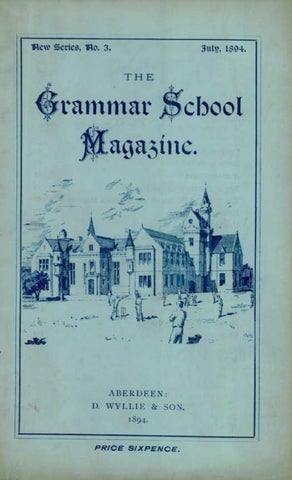
114cw %cricfs, 114o. 3.
rammar
cbool
agt3ince.
ABERDEEN: D. WYLLIE & SON. 1894. PRICE SIXPENCE.
CONTENTS. --00}040.-
Rage. .
.
•
83
.
.
.
.
86
.
.
.
•
87
.
.
.
.
89
THE SANDS OF FORM, OR THE MAIDEN'S MALISON.
.
90 96
.
GENERAL NOTES
NOTES AIXII'T OLD BOYS .
ATHLETIC NOTES
.
.
.
THE ALTEIIATIONS IN TIIE BUILDING
.
.
.
.
.
.
.
.
.
.
.
.
.
.
.
• 101
A \\rum) OF VALEDICTION TO EUCLID
.
.
.
.
A BEAR HUNT IN SYRIA—Chap. III.
.
.
.
• 104
THE UNIVERSITY LICENSING COURT .
.
.
.
.
PIERRE
.
UISTEAN MOH
THE TAVISH
103
108
.
.
.
.
.
• 110
.
.
.
.
.
.
113
TA HIELANTMAN'S PRAYER
.
.
.
.
.
.
113
A MOVING PEROR (((((((
.
.
.
.
.
.
113
.
.
.
.
.
. 111-
.
.
.
.
.
THE DOOM OF
NUGAE CANORAE
.
.
F. P. CIA'Il
MEMBERSHIP oF CRICKET
.
.
.
114
TIIE
Orammat Scr?oot tilaga3inc. -
New Series. —a__ ___
JULY, 1894.
No. 3.
GENERAL NOTES. OWING to the arrival of the summer vacation, and consequent dispersal of the pupils, the summer number of the Magazine is issued somewhat before the date at which it is due. The last quarter has been a busy one at the school. Examinations have crowded upon us—Science and Art Department, Leaving Certificate, and those connected with the ordinary work of the classes, not to mention the visit of the Government Inspectors. The month of June now concludes the school year, and on the resumption of work in August, the new classes will be formed, and a fresh stage of progress entered upon. The Dramatic Society of the F.P. Club gave a most attractive and successful evening entertainment on Thursday, the 26th of April, in the Silver Street Hall, which was quite filled, indeed overcrowded, for many of the audience had to stand. The Rector, who presided, explained in the course of the evening that the proceeds of the entertainment were to be applied towards the formation of a fund for providing an adequate recreation ground in the vicinity of the city, for the present and former pupils of the school. Part I. of the programme included—selections on the piano, Miss Millar (who also played the accompaniments); song, Miss M. L. Christie; humorous reading, "A Frenchman's Dilemma in New York," Herr Hein ; song, Miss Robertson ; song, Mr. R. S. Machray ; song, Miss B. Ogilvie Will ; song, Mr. G. O. Gauld. The second part consisted of the performance of a farcical comedy entitled, " Turn Him Out," 8
84
The Grammar School Magazine.
which kept the audience in roars of laughter from beginning to end. The cast was composed of " Nicodemus Nobbs," Mr. Davidson; "Mr. Moke," Mr. Edmund Bell; "Mrs. Moke," Miss Fletcher; " Eglantine Roseleaf," Mr. George Walker; and "Susie" (maid of all work), Miss Gordon. This entertainment is one outcome of the successful inauguration of the club, and it is to be hoped that similar evenings will, from time to time, bring old and new Grammarians together. The F.P. Club held its first supper in the Bon-Accord Hotel, on the evening of Friday, 4th May, when there was a large attendance of members. Dr. Ogilvie Will, one of the honorary vice-presidents, occupied the chair, and Dr. T. A. Stewart, Her Majesty's Chief Inspector of Schools, acted as croupier. To the toast of " The Army, Navy, and Reserve Forces," Lieutenant Colonel George Will, R.A., and Captain Duffus replied. In proposing the toast of the evening, namely, " The School," the Chairman referred to the antiquity of the institution, stating that the names of the Rectors were known back to 1497. He pointed out that distinction had been obtained by former pupils in every profession and walk of life, making special reference to Lord Byron, Dr. Beattie, Dyce, the famous painter, and, among prominent members of the medical profession, Dr. Gregory and his three sons. In later times, they had among past pupils Dr. Bain, Professor Masson, Dr. Donaldson, now Principal of St. Andrews University, and the late Professor Croom Robertson. Many other pupils had attained to high distinction, among them—Sir James Outram, Colonel Francis Duncan, R.A., Sir George Strahan, Sir Robert G. C. Hamilton, Sir James Stirling, Professor Murison, Mr. R. A. Neil, of Cambridge, and Mr. W. A. Hunter, M.P. for North Aberdeen. In the medical profession the name of the Grammar School pupils was legion, but he would instance particularly Sir James M`Grigor, Dr. Thomas Keith, and Dr. David Ferrier, a conspicuous figure in his own department. The Rector having made an appropriate speech in reply, Dr. Thiselton Urquhart proposed " Our Masters," and replies were made
General Notes.
85
by Dr. Moir and Rev. J. W. Legge. Mr. Martin, formerly Rector of the school, proposed " The Club," for which Dr. T. A. Stewart replied in a racy speech. The concluding toast was " The Chairman and Croupier," proposed by Mr. Sleigh, late Mathematical Master. Songs were contributed by Mr. G. B. Esslemont, Mr. David Kilgour, Mr. Bataan, Mr. Savage, and Mr. Kinghorn, and a very interesting gathering had a befitting finale in the singing of "Auld Lang Syne." At the last meeting of the Society of Antiquaries of Scotland, held in the Antiquarian Museum, Edinburgh, on Monday, 14th May, Mr. Alexander J. S. Brook, F.S.A. Scot., gave an account of the Archery Medals belonging to the school, together with those of St. Andrews -University, both of which sets were exhibited by permission of the authorities of the respective institutions. The medals exhibited are stated, in an account of the proceedings of the meeting, to be very interesting, both by reason of many of them being excellent and characteristic examples of Scottish silversmith work and engraving, and of the portraits, heraldic bearings, and inscriptions relating to famous historical personages which they exhibit. The annual inspection of the school by Her Majesty's Lispector, Dr. T. A. Stewart, took place on Wednesday, 6th June. Mr. R. D. Leslie, Advocate, has generously sent the Rector the sum of £1, to be spent at his discretion for the encouragement of summer sports. The school will break up for the summer vacation on the 22nd of June, on which day the distribution of prizes v.-ill take place in the Albert Hall. The final meeting of the Botany Classes took place on Friday, June 15th. After prizes were distributed, a presentation of books (on Botany and Geology) was made to Mr. Philip.
•
86
The Grammar School Magazine.
On the afternoon of Saturday, June 16th, there was an exhibition of Kindergarten work by the Initiatory department, which was largely visited by parents and friends of the pupils. The exhibition was varied by an interesting programme of songs, recitations, dancing, and musical drill. NOTES ABOUT OLD BOYS. J. C. Murdoch, M.A., with Honours in Classics, has been appointed Classical Master in Dingwall Academy. John Hay Lobban, M.A., with Honours in Classical Literature and Mental Philosophy, is carrying on the summer course of the Chalmers Chair of English Literature in the University of Aberdeen, as assistant to Professor Grierson. Rev. George Maclnnes, M.A., B.D., a former pupil who left the school over thirty years ago, has been elected Moderator for the current year of the General Assembly of the Presbyterian Church of New South Wales. Adam Fyfe Findlay, M.A., has gained the BrownDownie Fellowship of '£100 in Sacred Literature of the United Presbyterian Church. He proceeds to Athens in September, where, among other studies, he will apply himself to the acquisition of modern Greek. Wm. Loudon Morrison has been made Senior Tutor of Clare College, Cambridge. J. H. Barron has passed second class in Honours Moderations at Oxford University. At a meeting of the Senatus of Aberdeen University on Saturday, June 2nd, it was reported that the prize of twelve guineas by Dr. Morrison of Geelong for the best essay giving a critical estimate of Tennyson as a lyric, epic, and dramatic poet, had been gained by R. W. Lyall Grant, a former pupil of the school.
Notes (tbuot Old Buys,
87
•
At the medical graduation in April, the following F.P.'s received the degrees of M.B. and C.M. :—A. L. Cobban, M.A., C. G. Cowie, M.A. (now a resident doctor in Royal Infirmary), Albert Henderson, M.A., A. D. Kelly, John Glanville Milne, James L. Salmond, M.A. Dr. Albert Henderson and Dr. Andrew Hunter are at present studying in Vienna. Dr. J. Glanville Milne is, we believe, working in Middlesex Hospital, London. Dr. James L. Salmond was appointed House Surgeon to Aberdeen Sick Children's Hospital, but is at present invalided. Dr. James Will, who died a few days ago, is father of Dr. Ogilvie Will and of Colonel Will. He was, next to Principal Brown, probably the oldest F.Y. Robert A. Niven, a former medallist in Classical V., died on April 9th, at Hong-Kong. After completing his apprenticeship in the Turriff Branch of the North of Scotland Bank, he obtained an appointment in the HongKong and Shanghai Banking Corporation, and after being a couple of years in their London office, he was drafted for service in the East, and attached to the staff in Bangkok, Siam. . Mr. Niven was a valued official in both establishments in which he served, and by his frank, open, unassuming manner, he became a favourite with all with whom be came in contact. ATHLETIC NOTES. The Swimming Sports are to take place on Monday, the 25th June, at 715 p.m., and it is hoped that those who cannot assist us directly by taking part in the performance, will, at least, help us indirectly by coming to look on. Perhaps it will be rather late in the day to remind
88
The Grammar School Magazine.
intending competitors that six attendances at the baths are necessary in order to be eligible to compete. Junior members desiring to take part in the sports will be heartily welcome. Mr. Mackie has been kind enough to promise to superintend the proceedings. The Grammar figured conspicuously at the 'Varsity Sports, especially so in the football line. The F. P.'s, with the help of a couple of present pupils and Mr. Menzies, first beat the 'Varsity scratch in a splendid game. The teams numbered seven a side, and on the ball being kicked off, the Grammar immediately began to press. They continued throughout the game to keep the 'Varsity men well in their own ground, and several times almost succeeded in scoring. At last John Milne managed to dodge in very cleverly from a maul close on the goal line. The try was subsequently converted. Score—Grammar, 5 points; 'Varsity Scratch, nil. The final competition took place later on, in which the Grammar were pitted against the 'Varsity. The Grammar in this also managed to keep the 'Varsity men well back. By a couple of Macdonald's kicks, however, the 'Varsity twice gained a great deal of ground, and on the second occasion would have scored if the man had not been shoved into touch. After some mauling they got in behind with difficulty. The Grammar had previously scored off a fine pass from Mr. Menzies to R. Mackay, who, after a splendid run, in which he was ably backed up by John Milne, in case of accidents, passed the 'Varsity back and planted the ball neatly between the posts. A goal resulted. Score— Grammar, 5 points ; 'Varsity, 2 points. Among others, we may also make mention of W. Lumsden, who won the half-mile and long leap; J. M. Duncan, who made an excellent second in the golf drive, and ran very well in the finals for the 100 yards' confined handicap ; and J. A. S. Grant, who made a good show at the high jump, and was joint winner by a considerable distance in the Pick-a-back.
THE ALTERATIONS IN THE BUILDINGS. The work of reconstructing the hall proceeds apace, and, it is hoped, will be completed in time for the new session. The floor is to be level throughout, with a raised platform at the west end, approached by a new door opening into the passage to No. 2 Class-room. By removing the arched ceiling and throwing a floor across from the level of the gallery balustrade to the window transoms, space has been gained for three fine new class-rooms, opening on to a new corridor above the gallery, and approached by flights of stairs carried up from the east and west stair-heads. These new rooms are lit by dormer windows on the north side, and the large centre room of the three will make an excellent Art room. The gallery will be separated from the hall by a glass partition, and will probably be turned into a lunch room for those unable to reach home at the midday interval. In addition to these changes it is intended to divide each of the large class-rooms—now numbered 5 (Mr. Pope's), 3 (Mr. Clarke's, formerly Mr. Sleigh's), 9 (Mr. Philip's), and 11 (Mr. Murison's)—with separate entrances to each of the new sections. The partitions in some of these rooms will be movable, so that the rooms may still, on occasions, be used as one whole. The Chemical Laboratory is to be enlarged by throwing into it the portion now partitioned off as a Mathematical Class-room, and is to be entirely refitted. No. 7 (Mr. Menzies', formerly Mr. Clarke's) will be fitted up as a Physical Laboratory, with a theatre for lectures. The German Room, No. 4, has already been enlarged by the removal of the partition and addition of the back room formerly attached to Class-room 3. It is confidently expected that the acoustics of the ball will be much improved. The alterations in this part of the buildings are now well advanced ; those intended in the class-rooms await the holidays. Owing to the position of the hall, the progress of the work has caused very little disturbance. Indeed it may be doubted whether the " horse " and musical drill were not at any time superior in noise to Mr. M`Robbie and all his myrmidons.
90
The Grammar• School Magazine.
The project of a new Gymnasium is still under consideration. Meantime the gymnastic classes, now recognised as a compulsory part of the curriculum, are being carried on in the hall beneath the Skene Street Congregational Church—just outside our gates. The School Board has also sanctioned a scheme of alterations in the Pavilion. This will have a lavatory attached, and shuttered windows opening into the field, and be fitted up with locker seats and panels, on which the names of cricket and football teams will be recorded, honoris eausa. The school is to be congratulated on the prospect of alterations which will do so much to improve its accommodation both in size and number of class-rooms and in the fittings. Apart from history and tradition, our buildings, externally, are among the finest in Aberdeen, nor can it have been an accident of fancy that the stately south front became the embodiment in native granite of the national architecture. A just pride in our school is the privilege of its humblest member ; but even the youngest is old enough to learn that the chief adornment of a school is the lives of its alumni. ''Avopes rtiNts
THE SANDS OF FORVIE, OR THE MAIDEN'S MALISON. (WAHRIIEIT I.7ND DICATUNC.)
"DONE!" cried Master Lewis Gordon, and ratified the bargain by striking hands with his companion. The latter was a skipper, half pirate, half trader, from his nationality usually called Peter the Fleming. It was the year 1412, and the merry month of May. The two were seated at a table, on which were flagons of wine, and a small glass bottle of the strong waters that foreign traders still brought to Scotland. There also lay on the table a bag of gold, which Gordon pushed across to the captain. " 'Tis thine," said he, " if thou drown the maidens." " Good," muttered the Fleming. Then hiding the gold under his jerkin, and emptying a goblet of red wine to the success of the scheme, he set off to reach his ship before dark.
The Sands of Forvie.
01
The maidens were Gordon's nieces. Their father, Sir Robert Cheyne of Forvie, had been killed the year before at " Red Harlaw," of which the ballad says— "On Ifononday at morning The battle it began ; On Saturday at gloamire Ye'd scarce kent wha had wan. And sic a weary buryin' I'm sure you never saw, As was the Sunday after that On the muirs aneath Harlaw."
Margaret and Marjory were now motherless, and ]eft in wardship to their mother's brother, Lewis Gordon, who had studied at Padua, and so was reputed to know "black art" or magic. He had resolved to make away with his nieces and get possession of the lands of Forvie. In the Fleming, whom he had met in the low countries, he knew he would find a suitable accomplice. Not far north of the city of Aberdeen is the river Ythan. Along the north of its estuary lie the Sands of Forvie, now a dreary, desolate desert of sand hills and coarse grasses, then a district rich and fertile, though swept by the east wind, which on that coast seldom appears to cease. The morning after the compact, Gordon called his eldest niece, Margaret. " My dear," said he, " Captain Peter is to send a boat to-day to take us to his ship. Thou knowest he has many curious trinkets and rare jewels to please a maiden's eye, and that strange talking bird, the Papingo, which I myself would see. Thou and Marjory busk at once." "We will, sir," answered Margaret, and bounded lightly away, humming— "O wha is this has done this deed, And tauld the king o' me, To send us oot at this time o' the year To sail upon the sea."
She found Marjory, ever soft-hearted, in tears. Allison, the old nurse, had seen the White Lady of Slains, who never appeared save to forebode ill to Forvie. The Lady, daughter of the Baron of Slains, had, in the 13th century, been married to a Cheync, who (so tradition ran) starved
92
The Grammar School Magazine.
her. When death or disaster threatened the Forvie she came weeping at the Donjon Gate, and had been last seen on the eve of Red Harlaw. Then the Laird had fallen, and now the nurse foretold some ill to either or both of the maidens. Margaret laughed away her sister's fears, and scolded Allison for her dismal croaking. Then the sisters got ready for the trip. When they reached the small hamlet, near which a boat was waiting them, they found an old "crowder" chanting to an appreciative group a brand-new ballad of Harlaw— " And thar the Knicht of Lawriestoun Was slain into his armour scheeu ; And gude Sir Robert Davidson, Wha Provost was of Aberdeen ; The Knicht of Panroure, as was seen, A mortal man in armour bricht ; Sir Robert Cheyne, sae stout and keen, Left to the warld their last gude nicht."
Catching sight of the new-comers, the reciter broke into another ballad— " flak' ready, mak' ready, my merry men a', Our gude ship sails the morn:" " Now ever alake, my master dear, I fear a deidly storm. I saw the new moon late yestreen Wi' the auld moon in her arm ; And if we gang to sea, master, I fear we'll come to harm."
"Another foreboding!" sighed Marjory, while Gordon scowled on the throng, which made way for him with many a muttered, " Jesu, Maria, shield us well !" Margaret had whispered the singer to go to Forvie and wait their return, The boat was just starting when a messenger hurried down announcing a visitor for Gordon. Jumping ashore, he bade the others go aboard ; he would follow. The ship was soon reached—a fine specimen of vessels of the time and kind built and manned to do a little trade and a great deal of piracy. The maidens were charmed with the strangeness of everything, especially with the curiosities from Spain and Africa. In the meantime the crew had made ready to set sail, and while the maidens were in the cabin tasting rare
The Sands of Forvie.
93
fruits and sweetmeats, the captain slipped on deck to order the anchor to be weighed. For some time the maidens were indifferent to the change in the ship's motion, and when in alarm they ran on deck, it was only to feel the peculiar sensation of seeing the shore receding. They could mark a figure wildly waving his arms. " Ho, my beauties !" cried the captain, " you are mine now. See your double-faced, lily-livered uncle pretending I have kidnapped you when he paid me to do it." Marjory fell at his feet, and promised, if he put them ashore, to give him a talisman she wore round her neck. It was a crucifix, set with seven large and fine pearls from her native Ythan, and believed able to preserve from drowning and other dangers by water. " Keep it for thyself," grinned the captain, "thou 'It need it when afloat in a little boat full of holes, like the sieves of thy sisters the witches." The rough jest was followed by his own harsh laugh, in which the crew joined with ready chorus. But Margaret kept her eyes fixed on the little white church of S. Adamnan. There was her father's tomb, himself in knightly effigy, and there they had buried her mother—dying of grief after Harlaw. As Margaret gazed, fierce resentment filled her heart, and found utterance in the curse— "If ever maiden's malison Did light upon dry land, Let nought be found on Forvie's glebes But thistle, bent, and sand."
Away sped the ship with a fresh breeze, and Forvie's white church was lost to view. In silent fear the maidens waited their doom. But the captain's heart was touched. Though, after a fight, he had often sent his prisoners home by sea (as making them walk the plank was then called), he could not, in cold blood, set the hapless two adrift. So he determined on a compromise between his bargain and his better feelings, and was to put the maidens ashore as soon as he came to English land. Hindered, however, by prudence, from touching at places where he was better known than loved, and by a storm, which nearly tossed his ship on the Goodwins, "that dangerous flat and fatal," and
94
The Grontioop School Mogozime.
then sent him westward through the Channel, he could not land till he reached Cornwall. There, on a lovely evening in June, Margaret and Marjory again set foot to earth in a valley at the head of a creek, and the pirates sailed away. Soon three horsemen approached, surprised to find two strangers of gentle bearing. The horsemen were Baron Trevelyan and his sons. The maidens found a home in Trevelyan Castle, and in time married the sons. Margaret had one daughter, Marjory one son ; and it was the fond hope of all that they should be united, and keep the family fortune whole. . . . . . . . . • Then, as now, time passed like the shadow of smoke, and it was already 1434. Marjory had been dead for several years, and the talisman was the most valued treasure of her son, who knew well the strange tale of the sisters. Young Edward was to marry his cousin as soon as luckless May was ended. He was then with the English ships, which watched the fleet that was conveying the Princess of Scotland to France. To relieve the tedium, the English pursued and captured some Netherland barks, laden to their great joy with wine. But just then a Spanish fleet came up and took the wine from them, and, in seeking .safety, the English fleet missed the Scotch Princess. Ignorant of this, the English were still cruising about, when a heavy storm scattered them. Edward's captain, a grizzled old sea-dog of Flanders, ran northward before the gale. For several days and nights they were tossed about on the deep, seeing neither sun nor star. One afternoon the sky cleared for a little, and they noticed quite close a river mouth, having high rocks to the south, and to the north sand hills, with a town lining the shore. " Aberdeenl" groaned the captain, and kept out to sea rather than brave the bar. He sailed on, fearing nothing, for the vessel was still seaworthy. But he had not gone far, "When the lift grew dark, and the wind blew loud, And gurly grew the sea ; The ankers brak', and the tapmast lap, It was sic a'deidly storm, And the.waves cam' owre the broken ship, Till a' her sides were torn."
The Sande of Forvie.
95
The ship was driven to pieces on a sandy beach : Trevelyan and the captain alone got to land. As they rolled insensible on the shore, men were waiting, not to help, but to kill and plunder. The robbers, however, were stopped in their work by the parish priest, a venerable old man, and to his house they carried the shipwrecked sailors. It was a slow and weary task: on they stumbled amid the sand, which the wind was whirling along in blinding eddies, piling it like wreaths of snow on the fields, and among the cottages. To escape burial, the dwellers in the low-lying houses had already fled to the higher ground. Trevelyan was quickly brought back to life, but the captain had been badly hurt, and the doctor saw he had only a short time to live. The priest was ready to shrive him, when he cried "I must confess. But I did not drown them." " Whom didst thou not drown, my son ?" asked the priest. " Forvie's Maidens." " Forvie's Maidens !" was the wondering cry of the priest, the doctor, and Edward. Then the captain told his story, ending with the words, " I could die in peace did I know what became of them." "I know," quickly came from Trevelyan, who had been lying on a low settle within- the gleam of the fire. He had half risen on his elbow, his doublet open at the throat, and the crucifix of pearls round his neck. At that instant the door opened and an old woman entered. Seeing Trevelyan, she stopped and gazed : then, pointing to him, she cried, " The talisman my bonnie bairn's talisman!" She was Marjory's nurse. Edward now told his story, and, to his surprise, learned he was in Forvie. When the priest asked the nurse why she had come, " The Laird," she said, " is dying. The foul fiend has come for him, and two drowned women, he cries, are always near. And, holy father," she added, " yester-even I saw the White Lady, but this time she was smiling." The priest and Trevelyan hurried off to the Laird. The storm had increased, and all but the highest ground was covered with sand, so that the priest could not help feeling and saying, "The Maiden's .Malison is falling on Forvie." They found the Laird deserted and half delirious. He recovered sufficiently
4
96
The Grammar School Magazine.
to confess what his hearers already knew. Stricken in conscience, Gordon said he never had a moment's peace after he put away his nieces. He prayed Edward to forgive him, and showed where to find a casket of jewels. Year by year the produce of the land he had turned into money and bought gems, while he lived in a niggardly way, blessing none, and by none blessed. He died with the turn of the tide, and the priest read the service over the dead body where it lay. He and Trevelyan got out by a hole in the roof, so high was the sand. The only building not overwhelmed was the church, where many sought shelter. From the instant of the Laird's death, the storm grew less violent, and fell before dawn. When the sun rose, pale and sickly, it shone upon a wild, weltering waste of solitary sand, instead of fair fields and happy homes, and to this day nothing is found on Forvie's shore but thistle, bent, and sand.
PIERRE. CHAPTER I.—THE CHESTNUTS. IT was a cold, wet November day. Paris was, if not under a cloud, at least in an extremely wetting drizzle, and the cabs rushed along at an even more headlong pace than usual, in the drivers' anxiety to get into shelter. The roastchestnut vendors' braziers looked uncommonly tempting, especially the one to which a little gamin edged nearer and nearer in a vain attempt to get some warmth and protection from the pitiless wet. At length an idea struck the boy. He walked up to the chestnut vendor, as if all the gold in California were his, and demanded the price of the chestnuts. Dubot, seller of roast chestnuts, scanned the ragged form suspiciously, and Pierre returned his stare with a steady uaze) and basked in the full heat of the fire. Then a deceptive air of frankness and innocence in the open face of the boy enthralled Dubot, and he answered in a mild tone, " Four sous the half litre." " Too dear by half," remarked Pierre, in a contemptuous tone. The chestnut vendor said
Pierre.
97
nothing for some time, but it was evident that an idea was slowly maturing in his unfertile brain. Pierre was content to wait, enjoying the full warmth of the fire. At last Dubot managed to get out his idea. Any amusement was better than utter monotony this dreary day. These gamins were as agile as eels. He would have a circus performance. "Show me some good tumbling, and I'll give you half a litre of roast chestnuts. But, mind, it must be five minutes good tumbling or you get nothing." Pierre was disposed, by a natural talent for arguing, to try to gain some concession, but the might, and consequently the right, were on the other side. In a moment he was performing the most remarkable twists and turns, converting himself into Catherine wheels with great dexterity, and flinging himself to apparently certain destruction among the feet of cab and omnibus horses. It was all over in a minute. Pierre was whirling in a more that usually daring gyration, round swung a cab at full speed, down went Pierre amid the plunging of the horse, the yells of the cabmen, and the absolute stupefaction of Dubot. The cab stopped about a hundred yards down the street, the fare jumped out and ran back to where the blubbering chestnut vendor bent over a ragged little body, with pale sweet face and towsled black hair. M. de Xanville put his band to where the boy's waistcoat should have been. The heart beat fitfully. Now a couple of gendarmes came running up with a stretcher from some neighbouring barracks. " Take him to Rue St. Honord, No. 16, first floor." Scarcely had the procession proceeded two hundred yards along the street when M. de Xanville felt a touch on his elbow. There stood the chestnut vendor weeping copiously. "That is for him," he said, pressing a paper bag into the gentleman's hands, and returned to his stall. The bag contained half a litre of chestnuts. CHAPTER 1I.-RUE ST. HON0RE, No. 16. Pierre soon recovered from the shock. He had been merely knocked down and stunned, not run over. During his illness the good-hearted M. de Xanville treated him with
98
The Grammar School Magazine.
great kindness. He often came and sat at the bedside, asking the boy questions about his past life. It was a simple story, common enough in Paris. Pierre had been a gamin all his life. Of his parents he knew nothing. He had picked up a livelihood by various shifts, begging, earning a copper here and a franc there, and, I fear, stealing. He had spent some of the most comfortable days of his life at the expense of the Government, and the only thing he had objected to was the very small amount of freedom allowed to His Imperial Majesty's pensioners. This part of his life, I regret to say, Pierre forgot all about in his recital to Monsieur. And M. de Xanville was greatly taken by that dark face, great brown eyes, mass of silky black hair, and finely cut features, including a most aristocratic nose. The end of it was that when Pierre was again on his feet, he did not go forth from Rue St. Honore, No. 16, but appeared in a very smart, dark green livery, with brass buttons. Since our hero is established here as page, it is necessary that we should glance at the domestic arrangements of M. M. de Xanville himself is a de Xanville's household. widower, about fifty years of age, with grey moustaches and chin tuft, a, l'Empereur. He is a retired avocat, and still goes occasionally to listen to the cases at the Palais de Justice. He has a son, Emile, aetat two-and-twenty, lieutenant in the Cuirassiers, quartered at present in Metz. He has a daughter, Cdcile, aetat fourteen, resident at present at Rue St. Honor4, about to depart to receive the finishing touches to her education at some convent. The company into which Pierre found himself more particularly cast consisted of Jeannette, the maid ; Marguerite, the cook ; and Jacques, the coachman and butler. Jeannette was young and pretty, with a constant smile at the corners of her rosebud lips, and with black, laughing eyes, and a delicate little nose, the least little bit retrousse ; the neatest little Frenchwoman that ever wore cap and apron. Marguerite was fair, fat, and forty. Jacques, the coachman and butler, was a Gascon, with prominent cheekbones, and many were the stories of the days when he had served in Africa, and cut " Turks " through the middle with
Pierre.
99
as little compunction as he now cut sausages. His was the charge of the smart little barouche and the two brown ponies that made such a smart little turn-out in the afternoons in the Bois de Boulogne, with Monsieur and Mdlle. C4cile inside, and Jacques and Pierre on the box. So the weeks passed for Pierre, cleaning the boots and the silver (none of which disappeared), helping in the stable, and driving in state, with cockaded hat, through the Bois de Boulogne on the afternoons. At last life began to become monotonous to the street gamin, who had never before known restraint. At this stage an extraordinary process commenced. Pierre began to have a very strange feeling under the ribs whenever he saw or thought of Mdlle. Cdcile, which was pretty often. Every afternoon when she stepped out of the barouche in which she had been driving, she was assisted by the hand of Pierre ; every afternoon Pierre sat for two glorious hours in front of her. How he wished it was behind, as in some carriages! Before long he was madly and hopelessly in love. To say that he would cheerfully put his head, a la Sir Walter Raleigh's cloak, in the mud for her to step upon, is to give but a faint idea of the lengths to which his loyalty extended. He would have been delighted to leap head first from the top of the house, or tie a forty-pound weight round his neck and jump into the Seine, if these extravagances would have afforded her any pleasure. As it was, and since she required no such exuberant expression of his attachment, he was ready, at her slightest word or motion, to run her messages, to fetch and carry like a slave—and no slave was ever half so devoted as Pierre. The merest glance of her eye, the lightest touch of her hand, was payment for hours of toil. It may be supposed that the heart of Pierre was not altogether veiled from the eyes of the servants' hall. Indeed, his unlucky attachment became for a time the favourite topic of conversation. Jacques was immensely tickled, and ridiculed the notion in his most sarcastic way. Marguerite, the cook, was beyond measure indignant at the slightest hint of it—the impudence! A street boy to admire, even 9
100
The Grammar School Magazine.
in the most distant way, the beautiful Mdlle. Cecile' Her round figure heaved with wrath at the thought, her cheeks, always flushed from bending over the fire, became a deeper crimson, her eyes flashed flame, and she gave a snort of indignation. But Pierre found a valiant champion in Jeannette. " Le pauvre petit," she used to say, after a more than usually violent outbreak on the part of Marguerite, or an especially biting sarcasm from Jacques. " And why should he not, the poor child ? Is he not a good boy, and as pretty a one as there is in Paris? And perhaps" (mysteriously) " his parents may be of higher rank than we know. He has the face of an aristocrat." Whereat Jacques waxed extremely jealous. For was he not enamoured head over ears of this same Jeannette ? And getting Pierre alone in the stable one day he began to bully him. But Pierre, snatching up a clasp knife (I regret to say that Pierre was not quite a model youth) threatened to stick it between his ribs, being in that condition of mind in which he did not much care whether he lived or was guillotined. For his hopeless love and the banter of his fellow-servants was fast driving him beyond the limits of endurance, and had it not been for Jeannette he would probably have done something desperate. But seeing the clasp knife, and Pierre so evidently in earnest, the Gascon turned a pale green, and from that hour he refrained from jesting before the face of the unfortunate lover. But he made up for this by laughing at him the more behind his back, until he got taken in hand by Jeannette, and received such a talking to as made him keep silence, or vent his displeasure to Marguerite in private. Marguerite was not so easily kept under, and she never ceased her groans and outcries at the audacity of the gamin. At length—after some months had elapsed, and Pierre had passed through several vicissitudes, which, as is well known, are the invariable concomitants of true love, and which we need not particularise here—somehow or other, M. de Xanville got wind of the matter, and questioned Marguerite, who made a clean breast of it, as she had been longing to do for some time past. To say that M. de Xanville was furious is to put the matter mildly. He did
Pierre.
101
not take time to think calmly and treat the affair as a boyish craze. Had he done so, it would in all probability have died a natural death. But M. de Xanville packed the weeping Cecile off to the convent some months earlier than he had intended, and summoning Pierre abused him in no measured terms. Pierre remained silent, for he did not forget what he owed to his master, and went out of the study choking with smothered rage and despair. Soon M. de Xanville's anger began to cool, and the good-natured man began to have uncomfortable suspicions that he had made rather a ridiculous outburst. For the affair was an absurdity. A penniless outcast, a boy off the streets, to make love to his daughter' Preposterous' Finally he determined to keep his daughter away for the present, and to speak to Pierre next morning in a kind, fatherly way, pointing out the folly of his conduct. Certainly not to dismiss him from his service, which had been his first intention. Next morning Pierre had disappeared. High or low nothing was to be seen or heard of him, and strange to say none of the silver had disappeared also, which would certainly not have been the case had he absconded six months earlier. For some time the most intense excitement reigned at Rue St. Honore, No. 16, and M. de Xanville made en. quiries in every direction, but in vain. Pierre had vanished like smoke, and the excitement gradually cooled. In two or three years he became a shadowy memory, something to talk about—a part of that past which is so much sweeter and romantic than the everyday present. GUILLAUME DE LISLE. (To be Continued.) UISTEAN MOR. Bha ceathairneach uair ann an ait araidh do'n a Ghaeltachd, a bhitheadh a marbhadh Fhuathan agus Bhocaidhean. 'Se b'ainm da'n duine threun so Uistean Mor MacGhille Phadruig. Char fins a chur thuige gu'n robh Fuath ann an aite ris an canadh iad an Tombuidhe. Bha'm Fuath so a marbhadh cuid agus a cur moran a cochall an cridhe, agus
102
The Grammar School Magazine.
cha ghabhadh duin' air an rathad a ghabhail 'n deigh d'an oidhche tuiteam. Thainig Uistean, agus 'nuair a bha e aig bun a chnuic chaidh e steach do thigh Breabadair-na'n-casan-buidhe, a bha chornnuidh ann a sin. Ars am Breabadair ri Uistean—" 'S fhearr dhuit fuireach a nochd." " Ni mi sin," ars Uistean, " or tha mi dol a mharbhadh Fuath an Tombuidhe a nochd." " Dh'fhaodadh nach eil sin cho farasda ; co leis a mharbhas to Gobhar-an-Tombuidhe," ars am Breabadair ? " Le mo ghunna," ars Uistean. "De mar a freagair an gunna," ars am Breabadair? " Mar a freagair, feachaidh mi 'n claidheamh oirre," ars Uistean. " De mar a tig an claidheamh as an truaill ? " "Mar a tig," ars Uistean, "feachaidh mi Piuthar mo Mhathar oirre." Air na h-uile h-airrn a dh'ainmich Uistean, chuir am Breabadair rosad; ach cha b'urrain e rosad a chuir air Piuthar a Mhathar (be so a bhiodag). Char Uistean a reisde gu mullach a chnuic ; agus air mullach a chnuic bha toull anns am b'abhaist do'n a Ghobhair a bhi laidhe. Leig i meigeid aisde 'nuair a chual i Uistean. Thubhairt esa—" Am beil thu 'g-iarraidh do mheann, a chealgach " ? " Ma tha, tha e again a nise," ars isa. Rug Uistean a reisde air a Ghunna, ach cha d' rachadh srad aisde. Thug e laimh a reisd air a chlaidheamh,ach cha tigeadh e as an truaill. " C'ait am beil a nise Piuthar do Mhatair," ars a Ghobar ? 'Nuair a chual Uistean so leum e sirre, agus a cheud sathadh a thug e dhi leis a bhiodaig, leig i rhn aisde. "'S iongantach leamsa, a bhiasd bhochd," ars Uistean, " mar a' toir mi bainne g'u leor dha do mheann a nise." Agus cha 'n fhac e 'Ghobhar tuilleadh. Thill e air ais gu tigh a Bhreabadair, agus 'nuair a bheothaich e colas, chunnaic e 'm Breabadair na laidhe fo'n a bheairt, a sileadh na fala. " Ma's tusa 'bha deanadh a letheid do chall air an Tombuidhe, cha'n fhaigh thu as nis fhaide," ars Uistean. Mharbh e 'm Breabadair fo'n a bheairt, agus cha death duine tuilleadh a mharbhadh air an Tombuidhe bho'n uair sin.
A WORD OF VALEDICTION TO EUCLID. THE GRAMMAR SCHOOL, ABERDEEN, June, 1894. MR. EUCL1DES, The Elysian Fields, Hades, Via Styx.
DEAR SIR, Just a line or two. We bid you now farewell—a long farewell. You look surprised, sir, even indignant ; but hear us. For the future, our path and yours lie far apart. We may as well tell you the worst—your little book is now an optional subject. We are passing the Leaving Certificate. We have choice of other company. We mean to choose it. We bear, however, no malice. Since, then, we have journeyed so long with you, we wish to part as friends. Consider, therefore, this letter—which we hope you will receive by an early post—as word of valediction from the students of the Grammar School, Aberdeen, Scotland, North Britain, past the Pillars of Hercules, in the happy regions of the Hyperboreans, beyond the North Wind. Since first you dwelt above ground, we have seen some strange mutations. New ordinances have arisen, we have lost old notions, especially that your creations are necessary for our spiritual well-being and M.A. degree. You used to say there was no royal road to Geometry. We hasten to assure you there is to Natural Philosophy. Many of us will enter on that regal way. Many more will do so in the days to be. Haply you dreamt of a deathless fame—vanity of vanities We would fain wish that enmity were unknown in your present habitation. If it is otherwise, our letter will not be superfluous. We have heard that the dwellers in Elysium delight to recount their deeds and earthly fame. Might it be that you too, carried away by enthusiasm, have chalked your blackboard, and shewn how props were done ? Might it be that your hearers have longed for new ordinances to arise, and that your lectures should be optional ?
104
The Graminar School Magazine.
In that case you must have enemies. We feared it was so. We trembled lest they should hear before you of the change at Aberdeen. What confusion of face had been thine had they taunted you with the defection of the students of the Grammar School, Aberdeen, when you boasted of the homage of mankind Be not then, prithee, wroth at our warning. Again we would say farewell, and with a " God bless you," we are Most emancipatedly yours (Pro the Grammarians), GIOVANNI.
A BEAR HUNT IN SYRIA. CHAPTER
BEAR.
IN our last chapter we had reached Muchtara, the chief place of the Druzes in Lebanon. While my horse is taking a drink in the stream that waters the valley, I may refresh the memory of my readers by mentioning a few facts in connection with this strange people. The digression is, in fact, quite necessary in order to explain the vile trick played by one of then► when we were half-way up the mountain. You must know that Syria abounds in races and religions. In things political, Providence has given to the Turk the difficult task of hammering them into something homogeneous, and, in the course of the ages, developing in them something of the nature of patriotism. In race they are supposed to be a remnant of the old Canaanites. In religion they are said (it is a secret religion), to believe in transmigration. This transmigration is not from men to animals in their case, but according to them the soul lives in a succession of human bodies. For instance, they would give a quite literal meaning to the Bible connection between Elijah and John the Baptist. It follows from this that the number of Druzes is complete and invariable. Thus, after 120 years, a man may find himself living as the daughter
A Bear 110 id is S,q,•;,(.
105
in a house where formerly he was living in state and beating his wife like a worthy Druze head of a family. But at last the Druze soul grows weary of its wanderings, and after the requisite number of changes, finds a place of rest and reviving in Chilia! Thus far as to their political position and religious leanings. Perhaps as the outcome of these they are, in their outward conduct towards other men, the most inveterate liars. This is the more strange as they have proved that they are by no means a cowardly people. But their so-called Religion, or Transmigration Free Masonry, allows them to tell lies if it be for the advantage of a true Druze to do so. Punica fides is not worthy of being mentioned in the same breath with Druze lying and treachery. But it is time to jerk up my horse's head and jog on, as it is a four-hours' ride to Djezzin, where I expect to meet my friends. Leaving the valley we again strike the mountain path, and pass through scenery the finest in this part of Lebanon. You look down on a magnificent valley, with a stream winding through it ; and on each side are great precipices and bare rugged slopes. Sometimes the bridlepath comes rather inquisitively near the edge, which lends a pinch of the trembling fascination of the sublime to what was before merely picturesque. Here are marks of cannonballs left by the Turks in their Attempt to storm a fortress cut in the living rock. Under this cliff it began to grow dark, and the path became more perilous than before. My horse was getting tired and sleepy, and had stumbled several times. As I was still an hour's ride from the end of my journey, there was nothing for it but to get off and lead him. Arrived at lljezzin, at the foot of Hermon, at eight o'clock, having ridden from seven in the morning, I at last succeeded in finding my friend's house, and on walking up and calling out " Mortimer 1" I heard the welcome reply, " Hullo' come along." He came out immediately and gave me a hearty welcome. I handed over my horse to his servant and entered, and sat down thankfully in an American easy chair. I then joined heartily in a supper of shanerbah,
106
The Grammar School Magazine.
coosa-mahsheh, castellata, ruz-a-samineh, lebban and aneeb. After reading over that list and guessing from the rhythmic music of the pronunciation how very succulent and nourishing that supper must have been, you will understand my feeling equal to the ordeal that came immediately after it. This was nothing less than to be introduced to a real live Syrian bear, a bear from Mount Lebanon. The lantern was lit and carried in front by a Syrian cook. I followed quite .unarmed. Mortimer brought up the rear carrying a rather thick, strong stick, by way of giving an official appearance to the procession. On our opening the door of the outhouse where the bear was kept, there sure enough was Bruin, a sturdy cub, but securely chained. He had been caught about two months before. Along with his two brothers and his mother, he had come down from the mountain with the intention of having a high time amongst the vineyards and fields of Indian corn. When pressed by the villagers, the mother showed great resource and courage in sometimes pushing and sometimes carrying her young ones in the attempt to bring them all off safely. But it was not to be. She escaped with one of her family, another was shot, and this was the third that was growling and blinking at the light of our lantern. The villagers on catching him at once broke his teeth with a stone, and seemed to be in doubt what to do next, when Mortimer rode up and at once relieved their perplexity by buying him of them. That, however, was but a small part of the transaction. The important part of the business was to get him home. The mule on whose back he was placed, securely nailed up in a strong wooden box, nearly came to a bad end. The bear began to get tired of his cramped position, and took to moving about. The mule had come to suspect and smell that there was an uncanny creature somewhere near him, and at a very dangerous part of the bridle-path was with difficulty prevented from stepping down the nearest precipice, with a view to shake off the uneasy feeling. However, the brute was safely housed. At first sight one would have no hesitation to tackle such a miserable, dirty, grey rag of a beast, but after what Mortimer told me about him, my respect for
A Bear Hunt in Syria.
107
his bearship grew. It seems that about two months after his capture his collar had got worn and unsafe. It was necessary to have him re-collared. Who was to bell the cat ? It required seven men to lie on the top of this mere cub, and when the operation was successfully performed, he sprang up as lively as ever, and the seven pairs of legs required all their time to get beyond reach of his jaws. I felt very much obliged for this information. Looked at sideways he had the appearance of an ill-made retriever, but a glance at his broad, shaggy chest and bent-out bull-dog legs, revealed his immense power, and hinted at the wisdom of living at peace with all men and—bears. Next morning early we started off for Mount Hermon. Our cavalcade consisted of the cook and his donkey, with cooking utensils, &c., a mule with blankets, provisions, guns, and knives. The knives were suited either for skinning bears or for opening tins of preserved meat. At the first village we picked up the last of our party, Mr. Winter. Here we also laid in a supply of barley for our horses, for we were to spend the night half-way up the mountain—sub Jo'je. At the very commencement of the ascent some time was lost, owing to the entire load slipping underneath the mule and having to be repacked. Then away we went again, gaily and hopefully. Mortimer and Winter knew the way quite well, having been several times as far as the spring half-way up the mountain, where we were to spend the night. In fact they were so familiar with the road, that when we had climbed for about an hour they proposed to take, instead of the usual round-about path, a short cut that some one had spoken to them about. We took the short cut. Now, though in geometry it be true that two sides of a triangle are together greater than the third side, yet, in practice, that short third side occasionally turns out to be very long indeed. The taking of that short cut began our troubles and ends this chapter. (To be Continued.)
THE UNIVERSITY LICENSING COURT. THE annual sitting of this Court was on the xth current. The business was smaller than usual ; only one applicant appeared this year, Dr. Fossil M`Fog. He desired a renewal of his licence for the issue of Classical Emendations, Conjectures, and Various Readings. Mr. Blades M'Snuff, solicitor, appeared on his behalf. Now the whole place was packed with Grammarians, and the proceedings promised to be very lively, and the opposition very keen. They had chosen the " dux" of the school to be their spokesman, and were to conduct their own case. When affairs were in this state, in walked the venerable Doctor himself. On this there arose such a storm of groans and hisses, that the learned scholar looked somewhat flustered. Mr. Blades M'Snuff hastened forward to meet him, and a hurried consultation was held. Evidently the omens were not much to their liking, but the case was called and there was no drawing back. Thereupon M'Snuff, in support of the application, presented a petition to the Court. " My Lords," he began, " it were superfluity on our part " —(cries of " We want no Blades nor roots either ")—" to annunciate that we have the felicity to represent our honourable client, Dr. Fossil M`Fog, a scholar not .more, insignis for the profundity of his readings than his multitudinous emendations in the Classics. These asseverations many praesens "—(hisses, and cries of, " Throw emendations to the dogs ")--" will homologate. " I now recitate to the Court this Memorial subsignated by nineteen learned gentlemen. True, the Memorialists are in number inconsiderable, but their paucity is contraposited by their ripe scholarship and gravitas. The subsignatories are Dr. Mummy Fitz-Mummy, Oxon."—(loud and continuous interruption, amid which the name of Prof. Nonenity Flint could alone be heard " recitated " by the pertinacious Blades). In fact the Grammarians would hear no more, and the Court ruled the application as stated.
The University Licensivy Court.
109
The Grammarians had now their say. " My Lords," began their champion, " to put the case in brief, we are here to day to protest against a public nuisance "—(loud cheers). "Dr. Fossil M`Fog and all his supporters are the worst enemies of learning. Year in and year out he has issued his ' emendations.' To call a spade a spade, these are but impertinences. From his persevering to issue these for the past twenty years, people have come to believe there is something in them. But, in truth, his `conjectures' are about a tenth as reliable as the weather forecasts of a penny almanac. If that were all we would not be here to-day; but that is not all. We are the victims, the wretched victims of this word-mongering Zadkiel. Our lives are made a burden, and our memories groan under a most grievous bondage. " His petition, you observe, is signed by a paltry nineteen—of the same feather as himself, of course, and interested in keeping up this cruel and inhuman traffic. " In support of our case, I hold in my hand a petition signed by all the boys in the Grammar School. I have also a petition signed by the adjacent ratepayers. They protest emphatically against the noisome smell arising from the midnight-oil works where the roots are produced. " My Lords, in conclusion, permit me to pray you to deserve this day the undying gratitude of all the students of the Grammar School." A tremendous burst of cheering followed, and the judges smiled kindly. After five seconds' consultation the verdict was—" The renewal of this perverted licence is refused unanimously." (Loud cheering, and the Court rises to the strains of" For they are jolly good fellows, For they are jolly good fellows, For they are jolly good fellows, That nobody can deny.")
IAN.
110
The Grammar School Magazine. THE DOOM OF THE TAVISH.
TELL me, my Muse, to sing of whatsoever you wish me,
With the single exception of dusty primordia rerum. mciya, 'act& eke, of the Celt, the furious Tonal', 'Amapa got 'el,YETE Mourra who smashed the well-kilted Mactavish. Arma, virumque moo who trod on the mighty one's bagpipes, Et e,ertamen erut Mactavish with Tonal', a great one. Truly Tavish Mactavish was great in the eyes of beholders, Skilled calamos in flare leves to play on the bagpipes ; And beloved by both was bonnie x.EUK_EPOS 4.bx Jeannie— Poooadcruxot Jeannie, 7Xavicamts, i/plyiv€la, Like unto Aphrodite, the bonnie, the tartan-clad Jeannie. But let me turn to Mactavish, the great red-bearded Mactavish, Tavish glorious in plaid, in bagpipes and flying streamers— All the glory of chaunter and drone, and the gay flying streamers— Glory of sporran and kilt, and belt and tartan stockings, Glory of swelling calf, the well-padded-legged one Mactavish. So he stood in his grandeur, and sounded the wild, wailing pibroch, Proudly he stcod erect, and marked time with the shoe silver-buckled Proud and erect he marched, and around him the scream of the pibroch, " Ho ro mo nean bhoideach," or it might be " The Campbells are coming," So lie stood in his glory and knew not that doom was upon him. Great the delight of the lassies admiring the well-padded leggies ; Great the delight of all, but specially of grey-eyed Jeannie ; Great the delight of all, except of the Celt—jealous Tonal'. " Tonal' Mactonal'," he said to himself, and smote on his bosom, Doubting whether to run and at once make an end of Mactavish,
The Doom of the ravish.
111
Or whether it might be better to wait and see what would happen. " Patience," he said to his mighty heart, " thou hast borne far greater Tribulation than this, patience a little longer." Then, with a dignified frown, he strode up to well-kilted Mactavish— " Why toes she stand in ta puplic way making tamt noises, Woult'nt she sit in ta cutter or take herself out of ta sunshine, She shoot be ashamt of herself with such an intecent performance." Not one word emerged from the lips of red-bearded Mactavish, Chiefly because those lips were applied to the end of the chaunter ; Only the eyes came out of the head of well-kilted Mactavish. Then came a yell, and a fist met the nose and the eyes of the piper. How can I ?—ah 1 who shall aid me to tell of the terrible conflict? Pale,I fain would retreat at the thought of impending disaster. Then, with a cry of terror, the lassies fled from the conflict, Then, with a long-drawn wail, the bagpipes gasped forth their agony. Nothing was seen or heard, but plaids and the waving of tartan, Dust, confusion, and yells, in most unintelligible Gaelic, Red beards and redder faces, and howling and tearing of tartan. Not very long, however, did the desperate conflict continue ; Zeus in heaven hung out the scales, according to custom, Went through the usual proceedings, and Mactavish's weight flew upward ; Quickly Mactavish's heels performed the same operation, Quickly Mactavish descended—ah ! woe is me in the telling?— Like a stone from a catapult he flew, and, alas I came down on the bagpipes, Which, being quickly contracted, expired with a shriek like a baby. But at this point I must halt, for tears are my utterance choking.
112
The Grammar School Magazine.
This was the end of the conflict : the glory remained with Mactonal' ; The lassies now turned to him, and despised the red-bearded Mactavish ; And on the rosy lips of grey-eyed Jeannie Mactonal' Printed a kiss with a smack like report of a pistol, and Tavish Tore his hair for rage, but dared say nought to Mactonal', For his courage had fled with a squeak like a bat to nethermost Hades. TREWS MACTARTAN.
NUGAE CANORAE. To teach his grandson draughts then His leisure he'd employ, Until at last the old man Was beaten by the boy.
Olim solebat bene latrunculariam Mandram docere saepe auos nepotulo, Solidain remotis post diem negotiis ; Tandemque " ludo lamberatus est suo." How cloth the little crocodile Improve his shining tail, And pour the waters of the Nile On every golden scale !
How cheerfully he seems to grin, How neatly spreads his claws, And welcomes little fishes in With gently smiling jaws ! (" Alice in Wonderland.")
Paruulus ut tennis caudae crocodilus honores Semper amat proprias excoluisse nates, Quam bene natiuo fulget quaeque aurea dorsi Squaina renidentis flumine, Nile, tuo. Gaudia quanta illo rictu capere, ecce, uidetur ; Quam belle teneros explicat unguiculos, Leniter arridens oris dum pandit hiatum, Pisciculi subeunt, credula turba, gulam.
Nitgae Canorae.
'
ila
When Bibo was forced from this world to retreat, As full of champagne as an egg's full of meat, He turned in the boat, and to Charon he said, He would be put back, for he was not quite dead. "Trim the boat and sit steady," stern Charon replied, " You must have forgot you were drunk when you died !"
Cum Bibo de nostra est iussus decedere terra, Potor erat Bacchi plenus, ut oua cibi. Vertitur in cymba tristi exclamatque Charonti, " Flecte ratem, hens, non iam deperiturus cram ! " " In media," sic toruos nit, " lac natio quiescas : Quonam lies ? uino nonne sepultus eras ? "
TA HIELANTMAN'S PRAYER. GUlD and gracious Providence pless a' ta Mackays an' a'
ta Phairsons for ever more auld langsyne. Pless ta wee stirk, an' mak' him a big coo ; pless ta wee soo, an' mak' him a big boar, or eve' ta Mertimas tryst. Pe graciously pleased to send us floods o' water, so that there may be grass plenty for man and beast ; and rivers o' whisky, and mountains o' tobacco and sneeshin', as big as ta hills of Strathmore. Oh pe graciously pleased to send us swords and pistols in plenty to kill a' ta Lowlanders—ta teevils ! Pleas a' ta ither Mackays, an' especially oor wee Tonal, an' Sandie, ta lang leggit loon, for ever more, auld langsyne. Amen. X. A MOVING PERORATION. Nainsel was a Grammar poy of ta highest elan, who took ta preachin'. Ta eloquent peroration of ta elevteenth head of her first discoorse pe worth recordin' :— " Tearly peloved brethern and sistren, you will pe surprised, to pe surely, most painfully surprised, yes, inteed, most painfully surprised, to learn that there pe one hardened and wicked sinner in this congregation. There they sit: SHON
114
•
The Grammar School Magazine.
they are under her eyes—her finger points straight upon tem — that tall hat droops — that face turns crimson. Brethern and sistren, that pe not the telicate blush of modest maidenhood. It pe the deep and conscious flush of-ofof—" (Five ladies make for the door—short cut). -
MEMBERSHIP OF F. P. CLUB. THE following members have been enrolled, in addition to
those published in the previous issue. The dates of attendance at the school cannot be given, as the information received is too meagre :— Frank Anderson. J. W. Barclay, M.A. M. B. Barclay. W. Edmund Bell. Win. Brownie, M.A. A. J. Campbell. James Chalmers. A. Charles. J. Cheves. John Connel. W. Cran. W. Christie Crowe, M. B. A. Davidson. Alex. Davidson. James Davidson. H. J. Edwards. John H. Fraser. Arthur Glennie. F. W. Glennie. Alex. D. Gray. Wm. Hall. Peter Harper. Thomas W. Hector, Jun. Alex. S. Hector. Gustav Hein. James Hutcheson. Andrew Hunter, M.B. John Jameson. J. A. Johnstone.
I
Harry Kellas. Rev. Murdo Macdonald. R. S. Ma•chray. Maxwell H. Mackie. C. M‘Leocl. Ian M `Quarrie. G. E. Marr. Frank Michie, M.A. J. W. Milne. H. F. Menzies. James Moir, LL. D. J. M. Munro. W. Murison. Rev. Johnstone Murray. J. B. Philip, M.A. Samuel Pope. A. W. Robertson, M.A. Frank Ross. James L. Salmond, M.A., M.B. Wm. A. Salmond. Wm. J. Scott. James Shewan. C. W. S. Sleigh. W. Tulloch. J. D. Thomson. George Walker. W. K. Watt. Colonel Will.
CRICKET. THE season has been rather unfortunate for the School, since, out
of nine matches played, only three have been won, while five The wins were over the have been lost, and one drawn. Boys (return) ; the losses were Old F.C. Normal, Cults, and the
Cricket.
115
inflicted by the University, the Braemar, the Shire, the Old Boys, and Alford; and the draw was against M'Kinnon's Engineers. Below is given a detailed account of the matches. GRAMMAR SCHOOL V. ABERDEEN UNIVERSITY.—This, the first match of the season, was played at the University Grounds, on Saturday, April 12. The University team was the strongest available, and consequently the Grammar were rather at a disadvantage. G. O. Gauld and Weinmann had 25 and 35 respectively, while Clarke had 19 and Kirby 10. Fraser and Milne shared the wickets. For the Grammar, W. Gray (8) and J. Butchart (6) had the highest scores. Gauld captured seven wickets for 10 runs, and Kirby and Sellar shared the remainder. Full score :— UNIVERSITY. GRAMMAR. .T. F. Christie, c Milne b Fraser . 4 E. W. Watt, b Gauld F. Sellar, b Fraser 2 J. W. Milne, c and b Giulia . . G. O. Gauld, b Milne 25 W. Gray, b Gauld D. V. Haig, b Milne 1 J. Milne, b Gauld A. M. Mackay, b Fraser . . . . 8 J. H. Fraser, b Kirby O. F. Kirby, c Butchart b Milne . 10 T. S. Slessor, b Gauld C. T. Weinmann, c Slessor b Fraser 35 J. M`Bain, b Sellar A. T. Clarke, c W. Gray b Fraser . 19 J. G. Slessor, b Giulia A. N. Haig, b Milne 0 A. G. Gray, h Gauld N. Blackett, not out 4 J. Butchart, b Sellar Keyt, b Fraser 2 B. Butchart, not out Extras 13 Extras
-
Total . .
.
123
Total
.
2 1 8 0 1 4 3 0 1 6 2 12
. . . 40
SCHOOL v. BRAEMAR.—Played at the Grammar School Grounds, on Saturday afternoon, April 21, and resulted in a win for the Braemar by 19 runs. Full score :— BRAEMAR. GRAMMAR. GRAMMAR
N. Legge, c M`Bain h Slessor . . 26 J. Lyon, b Slessor 12 W. Robb, b Milne 1 .1. Matthew, c and b Slessor . . 2 W. Matthew, b Slessor '1 T. A. M. Gordon, c Fraser b Milne . 0 J. M. Pirie, run out 1 J. Fraser, b Slessor 1 W. Ruddiman, b 0 G. Gordon, b Slessor 0 J. Gauld, not out 0 Extras 8
• • . •
-
Total . . . . 54
.T. W. Milne, b T. Gordon. . . . 5 .1. Butchart, c Ruddiman b Robb . 6 W. Gray, c Lyon b Gordon . . . 2 H. F. Menzies, b Robb 1 .1. H. Fraser, b Gordon 6 '1'. S. Slessor, b Robb 0 .1. Milne, b Robb 3 J. M`Bain, b Robb 2 A. G. Gray, lbw b Gordon . 0 E. W. Watt, b Gordon 0 J. Slessor, not out 0 Extras 10 ---Total . . 35
• .
Bowling Analysis—Braemar. Oven. 16'2 7 9
John Milne J. H. Fraser T. S. Slessor
Maidens. 4 4 2
Runs, 28 7 9
Wickets. 3 0 6
3 4
15 11
5 5
Grammar. W. Robb T. A. M. Gordon
1O
. .
12 11
116
The Grammar School Magazine.
GRAMMAR SCHOOL v. ABERDEENSHIRE.—This fixture came off at Mannofield on April 28, and turned out somewhat disastrously for the Grammar. Mackay and Jas. Milne started for the Grammar, against Ranfield, the new 'Shire professional, and Whyte. Mackay went with Ranfield's second ball, and Menzies, who followed, got a like dismissal from Whyte's second delivery, the score being 2 runs for two wickets. When the score reached 10 for five, Gray was put on in place of Ranfield, and the whole side was out in 15 overs for 18 runs. Whyte captured seven wickets for 4. The 'Shire did not make a long stand, being dismissed for 43—W. K. Burnett 11 not out. Full score :— GRAMMAR. W. Mackay, b Ranfield . • • • Jas. Milne, b Whyte H. F. Menzies, b Whyte . • • • .T. H. Fraser, h Whyte T. S. Slessor, b Whyte J. Butchart, b Gray A. G. Gray, lbw b Whyte . . . John Milne, not out John M`Bain, c Cumming b Gray . J. G. Slessor, b Whyte W. Gray, b Whyte Extras
Ranfield Whyte Gray Milne Fraser T. Slessor
0 3 2 2
0 1 1 3
0 0
2 4
-
'SHIRE. J. F. Christie, b Slessor . . . H. M. Gray, b Milne J. S. Whyte, c Fraser b Milne . G. Allardyce, b Milne J. R. Milne, c Fraser b Slessor . Ranfield, b Milne W. A. Burnett, not out . . . R Cumming, b Fraser A. Cook, b Milne R. S. Wallace, run out
9 6 0
0
5 5 11 2
0 0
-
Extras
Total. . . . 18 Bowling Analysis—Grammar. Oven. Maidens. 4 1 4 71 4 1 'Shire. 9 20 8 15 5 1
5
Total
43
Runs. 4 4 6
Wickets. 1 7 2
24 12 4
5 1 2
GRAMMAR SCHOOL v. F.C. NoRmAL.—This match was played at the Grammar School Grounds on May 12th, the School obtaining their first win this season by 36 runs. For the Normal, White scored 11—the only double figures —and captured six wickets ; while, for the Grammar, M'Bain and Fraser had five wickets each, and B. Butchart scored 20, and brought off two difficult catches. Full score :— F.C. NORMAL. Whyte, c Gray b M`Bain . . . . 11 Royston, b Fraser . . . . . . 0 Adams, c B. Butchart b M`Bain . 9 Allott, c and b Fraser . . . . . 3 Ramsden, c B. Butchart b M`Bain 1 Dawson, c and b M`Bain . . . . l 6 Johnstone, c and b Fraser . . . 4 Peel, c and b M`Bain 4 Schofield, c and b Fraser . . . 3 Findlay, b Fraser 1 Nicol, not out 10 Extras — Total . • • • 53
GRAMMAR. H. F. Menzies, b White . . . . 6 J. Butchart, b Royston 3 A. Gray, run out J. Fraser, b Whyte 8 J. M`Bain, b Whyte 12 J. Milne, b Whyte . . 5 W. Gray, c Nicol, b Whyte 1 J. Slessor, c and b Adams . . 1 E. W. Watt, not out 8 A. Milne, c and b Whyte . . 7 B. Butchart, b Allott 20 Extras 9 Total
.
•
• 89
Cricket.
117
GRAMMAR SCHOOL r. WRINNON'S ENGINEERS.-011 May 19th the School met M‘Kinnon's Engineers, on the ground of tha former, the match resulting in a draw. Full score :— ENGINEERS. J. Low, c Fraser b Milne . • . • 1 C. Young, b Milne 5 D. Gordon, b Milne 9 N. Milne, b Milne 0 A. Henry, b Milne 0 K. Leslie, b I'raser 4 E. Smith, c J. Butchart b Milne . 0 W. Milne. c Jas. Milne b Fraser . 0 G. Glennie. not out 1 W. Ironside, b Milne 0 G. Robertson, b Milne 0 Extras
SCHOOL. J. Milne, c Robertson b Gordon . . 0 A. G. Gray, b Leslie 6 B. Butchart, b Gordon 0 J. Butchart, c Robertson b Gordon 4 J Fraser, not out I J. M`Bain, b Gordon 1 Jas. Milne, b Gordon 0 W. Mackay, b Leslie 0 E. W. Watt, not out 0 J. G. Slessor, 1 to bat. A. Milne, Extras 'I Tot 1
1
Analysis of howling—Engineers. Oveis.
J. Milne J. Fraser
11 10
Maidens. 2 2
Runs. 6 14
Wickets. 8 2
1 1
11 5
2 5
School. Leslie Gordon
7 6
GRAMMAR SCHOOL r. CULTS.—This match was played at the School Ground on Saturday, May 19. The Cults captain, winning the toss, sent the School to the wicket, and they were not dismissed until they had scored 86. James Milne and Fraser put on 36 for the last wicket, Milne being 27 not out. The Cults batting completely broke down before the bowling of Fraser, Mackay, and John Milne, the whole side being out for 21. Milne had five wickets for about 8 runs. Full score :— Sl'HOOL. H. F. Menzies. b Keyt 0 E. W. Watt, b Keyt 6 J. Slessor, at Joseph b Davidson . 12 B. Butchart, c Sinclair b Davidson 1 A. Milne, b Fraser 10 W. Mackay, b Keyt. . . • . 1 J. H. Fraser, run nut 8 A. G. Gray, c Davidson b Fraser • 5 W. Gray. b Fraser 0 John Milne, b Fraser 4 James Milne, not out 27 Extras 12 Total .
. . . 86
CULTS. Ross, b Milne 1 Joseph, lbw b Milne 10 Keyt, c Mackay b Fraser . • . 0 W. Davidson, c Menzies b Milne . 2 H. Sinclair, not out 3 A. Davidson, c and b Milne . . . 0 H. Fraser, b Mackay 0 A. M`Kenzie, hit wkt b Milne 0 J. Walker, b Fraser 1 P. Eason, c Gray b Fraser . . . 0 T. Morison, b Mackay 2 Extras 2 — Total . . . . 21
GRAMMAR SCHOOL v. ALFORD.—This match was played at Haughton Grounds, Alford, on Saturday, June 2nd, and resulted in a win for Alford by 32 runs. The Alford score was 78, to
118
The Grammar School Magazine.
which R. P. Fraser contributed 36, and the Grammar put together 46, W. Mackay being 16. Full score :— SCHOOL ALFORD. 2 H. F. Menzies, run out W. Murray, h Mackay . R. 1!. Fraser, c Fraser b Milne . • 36 B. Butchart, h Wallace J. He'd, c a••d b Mackay . . . • 5 .T. H. Fraser, b Wallace • • 0 A. G. Gray, run out J. Millar, b Freer 1 W Mackay, c Wallace b Reid . F. H. Petrie, 13 Mackay Jas. Milne, c and b Wallace . Fraser R. Murray, b 4 .1. M`Bain, b Petrie • A. Wallace, c ilackay b Fraser 8 J. Butch art, run out . . • J. Sheriffs, c Menzies b Milne 1. A. Milne, not out W. Brander, c Menzies b Milne 12 W. Gr,iy, o Sheriffs b Reid 1. Berry, not out . 2 Extras ' . . Mackay and b A. Bain, c Extras Total . . . Total . . . 78
6 . 0 . 2 3 16 4 1 . 1 4 . 2 7 . 46
GRAMMAR SCHOOL V. OLD BO-VS.—OR Friday afternoon, June 1, the Former Pupils played the School, at the School Ground. The captain of the F.P.'s, winning the toss, sent his men to the wicket, and the score mounted to 93 before they were dismissed. A. M. Mackay scored 19, including 2 fours ; H. P. Sleigh 18-5 threes ; while Dr. Glennie was top scorer with 32-1 four, 3 threes, 4 twos. W. Mackay took 5 wickets at a cost of 8 each. The feature of the School innings of 34 was the batting of Mr. Menzies, who went in first and carried his bat through to the tenth wicket for 18. G. 0. Gauld had 5 wickets for 14. Full score :— SCHOOL.
OLD BOYS. A. M. Mackay, b Mackay . O. F. Kirby, b J. Milne . J. F. Christie, b Mackay . • G. O. Gauld, b Mackay . • • W. G. Scott, b Mackay H. P. Sleigh, b B. Butchart . . Dr. F. Kelly, b Mackay . . . Dr. Glennie, b Milne . . . . R. Petrie, at J. Butchart b Milne B. Sleigh, b Butchart . . . G. B. Scott, not out . . Exti as
IL F. Menzies, c Petrie b Kelly . A. G. Gray, c Kirby b Gould . IL F. M. Simpson, c Scott h Gauld .1. W. Milne, c Mackay b Gauld. W. Mackay, b Gauld j. Milne, b Gauld .1. M`Bain, b W. G. Scott . . . .1. Butchart, b H. P. Sleigh . . B. Butchart, b H. P. Sleigh . . E. W. Watt, st Mackay b Kelly. W. Gray, not out Extras
Analysis of Bowling —Old Boys. Runs. Maidens. ovens. 36 3 17 0 40 10 6 1 7
J. Milne W. Mackay B. Butchart
•
•
•
School. 10 6 4 2 2
. 18
. 1 . 1 . 2 2 1 . 2 . 2 . 2 . 0 0 3
Total . . . . 34
93
Tet•il
G. 0. Gauld W. G. Scott H. P. Sleigh J. Glennie F. Kelly
19 0 • 2 • 4 • 5 • 18 0 • 32 6 1 • 0 • 6
1 1
0
0 0
14 9 4 3 1
Wickets. 3 5 2 5 1 2 0 2
Cricket.
119
GRAMMAR SCHOOL V. OLD BOYS.—This return match was played at the School ground on the afternoon of Friday, June 8th. The School had first lease of the wicket, and began with Butchart and Gray against the bowling of Sleigh and Leibbrandt. With the score at 11, Gray was bowled by Sleigh and John Butchart was dismissed at 21, and Milne took his place. Menzies who came next went with Gauld's first delivery. No great stand was made by the rest of the team, and the innings ultimately closed for 63, John Milne having 21 to his credit. The Old Boys began their innings with Mackay and Boulton, against the bowling of W. Mackay and .John Milne. Boulton went with Mackay's fourth ball, and Kirby was caught by J. Butchart with the score at 15. Gauld, the fourth man in, was caught and bowled by Mackay after he had made a three hit. The other batsmen were out for small totals, except Leibbrandt, who had 17, while Mackay was 14. Amid great excitement the School pulled off a well-earned victory by 4 runs, the last man being caught in the slips by Mr. Simpson. Full score :— SCHOOL.
OLD BOYS.
4 A. G Gray, b Sleigh . 9 Jas. Butchart, b Gauld . . John Milne, c Kelly b Sleigh . . 21 H. F. Menzies, b Gould . . . . 0 J. H. Fraser, c G. Sleigh b Gauld . 2 H. F. Morland Simpson, b Gauld . 0 3 W. Mackay, b Kirby 7 James Milne, b Gauld li James Slessor, b Kirby 1 E. W. Watt, b Kirby 0 B. Butchart, not out 10 Extras — Total . . . . 63
A. M. Mackay, lbw b Milne . . . 14 H. .1. C. Boulton, b Mackay . . . 0 0. F. Kirby, c J. Butchart b Mike. 6 G. 0. Gaunt, c and b Mackay . . 3 J. Leibbrandt, c Fraser b Milne . . 17 H. P. Sleigh, c Mackay b Mike . 2 J. E. Brebner, c Fraser b Milne. . 4 N. de B. Griffiths, c Slessor b Fraser 4 G. B. Sleigh, c Jas. Mime b Milne . 0 F. Kelly, c Simpson b Mike . . . 3 0 Sub., not out 6 Extras — 59 Total
Analysis of Bowling—School. H. P. Sleigh J. Leibbrandt G. 0. Gauld 0. F. Kirby
livers. 11
.
•
•
Maidens.
Runs.
Wickets.
3 O 3 1
22 9 19 2
3 0 4 3
O 2 O
24 23 6
2 7 1
2 11 2.1 Old Boys.
W. Mackay John Milne J. Fraser
7 12 5
FIRST TO LEAD.
STILL AHEAD.
Boys' Pleated Suits at 4 9, rare value. Norfolk Suits at 5 3, cannot equal. E arc thc
rgcst dealers, and Suits are
W made up to our own instructions front
newly designed materials we have specially selected for good appearance and hard School or Holiday wear. These are A 1 Holiday Suits.
Note other qualities at 2/11, 3/5, 4/9, 5/6, 6/9, 7/11, 8/9, 9/11, and 10/6. The marvel of the Trade is our
Gent's Navy Serge Suits at 18/6.—A ll Sizes. Letters and Money Orders address to
ADAM PRATT,
Crown Clothing Co., 15 Broad St., Aberdeen.
SCHOOL BAGS and. BOOZ, STRAPS, Strong and. Cheap, Made on the :remises; TRUNKS, PORTMANTEAUS, GLADSTONE BAGS, EMIGRANT TRUNKS, do.. cec.
Magnificent Selection at Moderate Prices.
GAUL & WILSON'S rtWest:ent) Z'runfl anb (Portmanteau tWarefioube. 5a BON-ACCORD STREET, ABERDEEN. N.B.—Repairs promptly executed.
_
JOHN C. KLEOD, HATTER,
46 UNION STREET, OULD respectfully intimate to pupils of Grammar School a Large Stock of Cap and aleugarrr Maboes, its authorised; also, football 3ersers, iSelts, Vatbing Pants, Costumes, and ties.
W
Great variety of Football, Cricket, Tennis, and Boating rerseys, Sweaters, Knickers, Trousers, Shirts, rackets, Belts, Cowls, Caps, and Hats. TROPHY AND CLUB CAPS MADE TO ORDER.
for Bummer—atm') flats, With
and other pane
Bands, Guards, Puttarees, ,c. liew %tries felt 'bats, tweet Caps, &c. Ties, Scarfs, Collars, Braces, and Umbrellas.
THE NEW HOWE CYCLES. Ube ll1cw bow, Macbtne Co., %O., OlaNow, BD: to intimate that they have Opened a Itninch Estahlishment at
244 UNION STREET, Aberdeen, Where they have Stocked a Large Selection of their famed NEW HOWE CYCLES, including all the leading Tyres of 1894.
See our 1894 Patterns, our New Roller Brake, our New Detachable Crank, our New Detachable Folding Mud Guards, our New Detachable Gear Case, and our New Locking Bit. PNEUMATIC SAFETIES from £9. CUSHIONS from £6 70s. See our sigh Grade Machines at £12 and £15; also a Special Lino of Ilighost Grade Pneumatic lafeties, slightly used, from £10. Any of one t ,Atwate?Machines may be purchaxed front our Depot or Ayeuls upon our Gradual ['aim, id Sy.,t, in. No Interext. No Finem. No Trouble. Accessories of all kinds. Catalogues on application.
Aberdeen Depot . 244 UNION STREET. R. S. MITCHELL, Manager.
EDUCATION-Ili BOOK$. JAMES G. BISSET Continues to supply all the CL ISS BOOKS (New or Second-Hand) suited for the Requirements of the higher Educational Institutions in, the Cliff, at the Lowest Prices.
N.B. -Best value in STUDENTS' NOTE BOOKS.
JAMES G BISSET, Classical, Mebical, anb Ebucational ISoohseller,
85 BROAD STREET, Opposite Marisehal College.
CAMPBELL & CO., Successors to CAMPBELL, ACHNACH, & CO.,
3nbia.1Rubber an 11Claterproof Manufacturers, 18 BRIDGE STREET, ABERDEEN, Show one of the Largest and most Select Stocks in
WATERPROOF, AIRPROOF, & INDIA-RUBBER GOODS. CHOICEST GARMENTS FOR LADIES AND GENTLEMEN In most l'ashionable Styles.
Newest .Pattern-9 and Select Designs.
Sporting anD ffisbing 'Requisites in great radar. CARRIAGE APRONS, LORRY COVERS, CART & LOIN COVERS. DOOR AND CARRIAGE INDIA-RUBBER MATS Made to any Size and Design on the shortest ,nd ice. India-Rubber Sheet, Insertion Valves, Packing, Washers. Hose Pipes. Belting, &c. SOLE AGENTS IN ABERDEEN AND NORTH FOIL,
The Argyle Rubber Co.'s New Potent Rubber Foot Grip, used for Gulf, tte,
anspection reapectfullp Solicite0. Paw Note the Address—
CAMPBELL
ci COMPANY,
Successors to CAMPBELL, ACHNACH, & CO.,
18 BRIDGE STREET.
EVERYBODY SHOULD READ IIIE
WEEKLY FREE PRESS. FRESH FEATURES. RACY ARTICLES. PITHY PARAGRAPHS. PERSONAL INTERVIEWS. SOCIAL AND FASHIONABLE GOSSIP. CRISP NOTES AND COMMENTS. SERIAL STORIES AND LOCAL TALES.
And all the Local and General News of the Week.
A Big & Bright Pennyworth That should be found in every Household.
OF ALL NEWSAGENTSEVERY
FRIDAY.
PIANOFORTES, HARMONIUMS, AND ORGANS. -`•
:arnes
acBctit
HAS ALWAYS oN HAND A MAGNIFICENT ASSORTMENT OF
gRAND pu\No,s, coTT/1qE ptim\leA FRE NC 11 A ND QG RAM NI RX 0
U
For Sale or Hire on the Three Years System.
SECOND-HAND PIANOS, ORGANS, & HARMONIUMS ALWAYS IN STOCK, VERY CHEAP.
anspection requested of ntp Stock before settlinn asewbere.
Pianoforte and Music Saloon-
181 UNION STREET, ABERDEEN.
19
BRIDGE
STREET.
•OO.1.1.•%.O.%%"O.1AAVVV1.1%.,
LARGEST STOCK OF
SECOND-HAND
BOOKS
In the North of Scotland. NEW BOOKS IN STOCK at 3d. off ls. Discount.
UNRIVALLED VALUE IN EXERCISE BOOKS. Sour floors of Egablisbment open for jnopection.
WALKER & COMPANY, Booksellers and Stationers,
19
BRIDGE
STREET,
ABERDEEN.
D. WYLLIE & SON'S NEW BOOKS. JUST
PIT3F3LISI-MET).
DAVID THOMSON, I.A., Professor of Natural Philosophy in the University of Aberdeen ; a sketch of his Career. By W. L. Low, M.A., Rector of St. Columba, Largs, and Canon of Cumbrae. With Two Photogravure Portraits. 250 copies, numbered. Crown 8vo, cloth, 5s. NETT. 20 copies on large paper, numbered, Demy 8vo, cloth, 1081 Subscribers' names received. DR. KIDD OF ABERDEEN: A Picture of Religious Life in Bygone Days`. By Rev. JAMES STARK. With Portrait and Two Illustrations. Second Edition, Revised and Enlarged. Crown 8vo, cloth, 3s. 6d. NETT. NEW BooK by the Author of 0° CRIIISIE SKETCHES." THE HUMOURS OF GLENBRUAR. By FERGUS MACKENZIE. Crown 8vo, cloth, 3s. 6d. CRUISIE SKETCHES : Studies of Life in a Forfarshire Village. By FERGUS MACKENZIE. Third Edition. 32mo, Pictorial Cover, Is. ; cloth, Is. 6d. THE THANAGE OF FERMARTYN, including the District commonlY called Formantine: its Proprietors, with Genealogical Deductions ; its Parishes, Ministers, Churches, Churchyards, Antiquities, &c. By Rev. WILLTAM TEMPLE, M.A. Demy 4th, cloth, 21s. to Subscribers.
247 Union St., ABERDEEN: Branch —43 BRIDGE ST.
JOSEPH REID. SILK
FROM
AND
FELT HATS, SCARFS, TIES, &C.
THE
BEST
MAKERS. -
inspection 3nvite0.
TRAVELL1 N ( ; BAGS, HAT CASES, UMBRELLAS, WALKING STICKS, &c.
NOTE THE ADDRESS--
389
UNION
STREET.