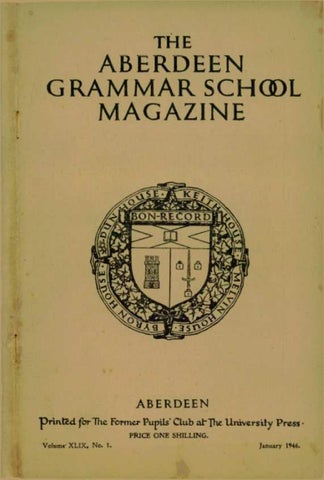
THE
ABERDEEN GRAMMAR SCHOU MAGAZINE •
ABERDEEN prini241for The Former Pupils' Club al-The University Press PRICE ONE SHILLING. Volume XLIX, No. 1.
January 1946.
EDUCATIONAL BOOKS LEGAL • THEOLOGICAL MEDICAL • CLASSICAL New and Second-hand
BOOKS
CLASS STUDENTS NOTEBOOKS
•
SCHOOL EXERCISE BOOKS •
James G. Bisset Bookseller & Stationer 85 BROAD STREET
::
ABERDEEN
Opposite Marischal College
•
PHONE 753 •
GOOD HEALTH demands
-
GOOD BREAD For the children especially is it necessary to ensure their stamina and energy with good, wholesome, nourishing bread. In Hutchison's bread you'll find all these requirements are fully met. Phone or give instructions to have it supplied daily.
BRANCHES THROUGHOUT THE CITY
OLD GOLD AND SILVER Urgently Wanted also
FINE JEWELS and ANTIQUE SILVER Out-of-Date WATCHES JEWELLERY CHAINS
COINS and Odds and Ends of every description realize
HIGH PRICES to-day
Full Value received at
A. & J. SMITH 191 Union Street ABERDEEN
LITITES have just what you are looking for Something to wear that is well cut, smart and practical and not too expensive -
SUITS
•
TRAVEL COATS
V
MODEL COATS
,
FROCKS DRESSES
,r
/
C
7
f
,
4'
•
/,
-
‘
(
GOWNS FUR COATS -
Sizes to fit all figures
I i
from 36" hip to S6' hip
/
1 i
-
A. C. LITTLE & SONS, LTD. 105
UNION STREET
•
ABERDEEN
ESTAILIINIO 1 8 18 A►,OINTID HUT PURYSYORS AND PO
His MAIMY TH5 KIND DAIS° 151 JULY 194o
J. WILLIAMSON de, SON B. WILLIAMSON. P5O5111RO11)
Meat Purveyors, Poulterers and Game Dealers 1, 2, & 3 MARKET BUILDINGS, ABERDEEN 'PHONI 4f2 BRANCH.. i 35 FOUNTAINHALL ROAD 'NOM 1724
THE SQUARE. CULTS 'PHONS. CULTS 2
Also AT CHURCH SQUARE. BALLATER.
'PHONII 38
BY
TO THE LATE
APPOINTMENT
KING GEORGE V
GRANITE MONUMENTS Designs and Prices on Application Monuments carefully packed and forwarded to all parts of the world Letter-Cutting done in Town and Country at Moderate Rates
JAMES TAGGART & SON Granite Works 92 GREAT WESTERN ROAD, ABERDEEN Telephone-1658
Established over 50 years
For Better Footwear
JAMES LORIMER & SON (BOOTMAKERS), LTD.
CIVIL and MILITARY BOOTMAKERS
8 CHAPEL ST.
ABERDEEN
(Late of 162 Union Street)
Estd. A.D. 1844
'Phone 724
WM. KENNAWAY LTD. Quality Bakers, Confectioners and Caterers
ABERDEEN ® When on a visit to Aberdeen—Gateway to Royal Deeside—rest and dine at our
RESTAURANT AND TEA ROOMS 173 UNION STREET Here you can have the finest service at reasonable cost.
The Restaurant is
fortable.
commodious and com-
Our rooms are available for all types of
functions—Phone 2371.
Telephone No. 1891.
ARCHIBALD McKELLAR Family Grocer and Wine Merchant,
454-456 Union Street, Aberdeen. . . We Specialise in . . Cooked
Gammons, Finest Belfast Smoked Hams, Wiltshire Bacon.
Medicinal Wines—Vibrona, Hall's, Wincarnis, Phosferine.
THE VALUE OF RECOMMENDATION "We have been recommended to you by
PP
Every day that phrase is being used by Customers on their first visit to our showrooms.
THE REASONOUR STOCK Is of good quality and our prices are reasonable. OUR SERVICE Is of a personal nature and we study the requirements of every Customer. SATISFACTION IS OUR AIM
ROBERTS (Abdn.) LTD. THE FURNISHING HOUSE OF ENTERPRISE
CABINETMAKERS AND UPHOLSTERERS
419 UNION STREET, ABERDEEN KeteblIshed 1873
Telephone 2698
JAMES FYFE & SON PAINTERS AND GLAZIERS. •
OFFICE AND
•
• SHOWROOMS-
11 DEE STREET, ABERDEEN. Telephone 304.
Telegrams " Pyle, Painter.."
IRONMONGERY A LARGE AND VARIED STOCK ALWAYS ON HAND SHEETMETAL WORK A
H. LEITH
SPECIALITY
& SON LTD.
26 and 28 NETHERKIRKGATE Phone 259
ABERDEEN
• FAIR SHARES . . . is an admirable policy.
Here you are
assured of your fair share, but there is an added advantage in that customers registered for rationed goods can order their fish supplies at the cost of only one telephone—or personal—call.
A. SK W. AILEXANIDIEIR FISH, GAME AND MEAT MERCHANTS Tel.: Aberdeen 5172
492 UNION STREET
+
ABERDEEN
- • - -DAIRY: ABERDEEN Tel. 1215, 7013, 7014
FARM: CULTER Tel. 6
KENNERTY DAIRY
FARM •
WILLIAM REITH Sole Proprietor : JOHN REITH
•
46-48
ROSE STREET, ABERDEEN
CONTENTS ILLUSTRATIONS Colonel Lachlan Mackinnon at the Prize-giving, 29 June 1945 . . . . . . . Captain G. D. Bisset . . . . . . Flight Sergeant D. F. Reid . . . . Bomber Pilot R. D. W. Jamieson • . . . . . Sergeant A. M. Geddes . • . . . . . Flight Lieut. J. B. Michic . Lieut.(A) E. H. Goodbrand . . . . . . . . . . . . Private J. L. M. Burr Sub-Lieut.(A) R. A. G. Mackenzie . . . . . Sergeant G. J. Macpherson . . . . . . Private M. H. A. Mackintosh . . • • • • The Sixth Class (Classical) 1894-18 95 . . . .
. Facing page z6 27 . PP 27 . 27 • PP 42 • PP 42 Centre . . PP . ,, . ,, . Facing page 43 • PP 43 . ,, 58
A Message to Former Pupils. By J. J. R.. . . . . Honour for the Rector. Knighthood for Former Rector . . . . . The War and the School . Home by Air from New Zealand. By Theodore G. Gray . . Prisoner in Thailand . . . . . . . . . . Notes About Old Boys . . . . . . Marriages . . . . . . . . . . . • . Pro Patria Mortui . . . . . . . . . Miss C. M. Mayor . . . . . . . The Toll of War . . . . . . . . . Obituary . . . . . . . . . Captives of the Japanese . . . . . . . . An F.P. Club Branch in Thailand I . . . . . . The Sixth Class (Classical) Fifty Years Ago . . . . San Francisco. By James L. Mowat . . . • • In China with a Friends' Ambulance Unit. By D. F. N. Crawford An F.P. Looks at Prague—November 1945. By J. L. Kilgour . School Section— School and Random Notes . . . . . . Lux in Tenebris (Verse) . . . . . . . Rugby Football . . . . . . . . Hockey . . . . . . . . . . Swimming. House Notes . . . . . . The Dramatic Society . . . . . . . The Literary and Debating Society Lower School Activities during Winter Term S.S.C. Scout Notes • • • . Army Cadet Force : The School Company . Air Training Corps : Squadron No. 1299 . The Former Pupils' Club— The F.P. Club Boarding House . . . Club Consul. The Rugby Section . . . . . The Cricket Section . . •
• Page
1
a •
St
o
PP
.
"
•
Pp
•
S.
. o .
. •
• . . . •
3 5 7 II
37 40 PP 43 PP 44 46 54 55 57 59 „ 64 „ 69
• •
99
•
PP
•
PP
•
73 76 76 79 8o 81 82 83 83 85 85
•
PO
•
•
•
•
PP
•
•
•
•
•
•
•
•
PP
•
•
•
•
Of
•
•
•
•
P.O
•
•
•
•
•
•
•
•
•
. • .
„ 86 " 87 „ 88
SCHOOL OUTFITS ARE A PROBLEM Owing to manufacturers being wholly employed on Government contracts we are at the moment unable to supply many of the Grammar Garments.
We
School
will do our
utmost to fit your boy with a serviceable school outfit.
ESSLEMONT & MACINTOSH (RETAILERS) LTD.
UNION STREET, ABERDEEN
-
\!, "p
" I need good food
PP
—and this is where you can get it ! We always have a fresh stock of all well-known dog foods including Spratt's, Spillers, etc.
Main Stockists for :—
Pot and Pearl Barley Barley Meal
.
Hay and Straw
Agent for :
Hadfield's Fertilisers •
Coal and Firewood Poultry and Bird Food Moss Litter Manures
WILLIAM SCORGIE GRAIN AND POTATO MERCHANT
13 ROSE STREET
•
Phone 4014
ABERDEEN
1943
1843 Established 100 Years
What About TYPEWRITERS?
WM. CAY & SONS
DESKS ? CHAIRS ?
(FUNERAL DIRECTORS) LIMITED
and all other
415 UNION STREET
OFFICE EQUIPMENT ?
and
209 GEORGE STREET,
HELP YOU ?
CAN I
ABERDEEN
i am both Buying and Selling All Funeral Requisites Supplied
C. H. WEBSTER
Cremations Arranged
489 Union Street Telegrams—" Cay, Aberdeen." Colophons Nos. 92 end 54.
ABERDEEN
Telephone : 8811-2
Telegrams : ' Blake Builders '
IES 13 ILAIFIL LIU.
JO
Joiners and Building. Contractors 7 ALBYN TERRACE Works-23, 25, 29 SUMMER STREET,
ABERDEEN
Enquiries courteously solicited
All classes of Building Joinery
Agents for
Wyllies
Ordnance Survey Maps
Circulating Library
WYLLIES Booksellers, Stationers
247 UNION STREET, ABERDEEN Telephone 402
Established 1814 ESTABLISH
THE
HABIT
OF
READING
GOOD
BOOKS
DRAWING
STRACHAN
PAPERS
COMMERCIAL
PENCILS
&
BRUSHES EVERY REQUISITE
PORTRAITURE
FOR THE ARTIST
PHOTOGRAPHY
at
•
Taylors'
Telephone 851
•
Picture Framers 49-51 SCHOOLHILL
416 UNION STREET ABERDEEN
'Phone 2870
We Buy
I
YOUR OLD GOLD, SILVER, SILVER PLATE & GEM-SET JEWELLERY HIGHEST PRICES PAID I
JAMIESON & CARR Watehmak•ri i iturclirti • Si!worn'''.
142 UNION STREET ABERDEEN_
TO OUR CUSTOMERS We regret that the present restrictions on both men and materials make it impossible for us to maintain the usual high standard of service which we have carried on for nearly a century. We can assure you that we are doing our utmost to please you and trust that you will be patient with us.
J. & A. OGILVIE 369 UNION STREET ABERDEEN Telephone No. 433
Telegrams : " Interiors "
The choice of your
FIREPLACE ARRANGEMENTS
•
may be a little restr icted these days, but we have been able to maintain our stocks at a good level, and have on display a pleasing range of modern and period designs for your selection.
James Scott & Son (Aberdeen) Ltd. 483-485 UNION STREET ABERDEEN Phone 1881-2-3
4
i
-
1
, -
,
ANDREA (OW
1 , i
•
, , •••, ,
-•,.
• •
A QUESTION OF POLICY Recently politics have been a major topic on everyone's lips. The question of policy has had considerable attention. So long as Groceries and Provisions are in short supply and rationing is in force it will be the policy of Collie's of Aberdeen to make fair and equitable distribution of all available goods.
Gediseola FAMILY GROCERS AND WINE MERCHANTS
269-271
UNION
STREET ABERDEEN
Telephones: CENTRAL 4800 (4 lines) Branch Shops at CULTS, BALLATER, and BRAEMAR
Telephones : Cults 28; Ballater 14; Braemar 212 a
ESTABLISHED IN ABERDEEN 1836
Northern Assurance Company Limited Enquiries solicited for all Classes of Insurance FIRE Insure your Dwelling-house and Furniture with the Local Office LIFE The Company's tables of rates for Life Assurance include every class of Policy ACCIDENT Insurance granted against Third Party Risks of all kinds Company's Assets
-
£3 2,600,000
CHIEF OFFICES:
ABERDEEN . i UNION TERRACE LONDON . I MOORGATE, E.C. z Branches and Agencies throughout the World
Aberdeen Grammar School Magazine 62nd year: No. 157
Vol. XLIX
(New Series, S3rd year, No. 148)
JANUARY 1946
No. 1
The "Grammar School Magazine" is issued under the auspices of The Former Pupils' Club, twice a year at present—in January and July. AU communications with regard to the " Magazine" should be addressed to the Editor (the Secretary and Treasurer of the Club),
-
THEODORE WATT, M.A., LL.D., The University Press, 6 Upper Kiricgate, Aberdeen.
A Message to Former Pupils. The Term that is past will linger in memory as the Time of Returning—the coming again of Old Boys from distant places ; the joy of welcoming back the prisoners of war ; and (most agreeable of disturbances to School routine) the reappearance of several of the younger Staff, all of whom had been so long away that, save to a few VIth Formers, they returned as strangers. The normal sanctity of the Time Table has been cheerfully disregarded to make room for Mr. Stewart McPherson, happily restored to us from the rigours of a German prison camp, for Messrs. Baxter and Bruce, full of scientific lore not learned in college lecture-rooms, and for Messrs. Cunningham and Mackenzie, who have so far genially resisted all efforts to extract the more sensational secrets of Army Intelligence. But our natural satisfaction at the return of our own must not make us unmindful of all we owe to those who have shared with us the work of the war years. The loyalty and keenness of these temporary colleagues could not have been greater had their future been indefinitely bound up with the Grammar School. Mr. Henderson, Mrs. Ross, Miss Morrison, and Miss Holm have all established a firm title to our respect and goodwill. Three losses from the • permanent staff fall to be recorded at this time. The decision of our Games Master, Lieut.-Colonel Duncan McGregor, not to return to his post here finally closes a colourful chapter in the recent story of the School. Great gifts as an athlete, combined with tireless energy and unusual singleness of aim, made him one of the most potent influences on Grammar boys during the years between the wars. But his decision, however much regretted, must be accepted as wise. The work of a Games Master calls for certain physical qualities that the years gradually steal from even the most vigorous, and no one who knows
z
Aberdeen Grammar School Magazine
Mr. McGregor can imagine his being reconciled to telling where of old he would have shown, or to watching where he would once have been in the thick of it. His old pupils and friends will be content to look back on a job admirably done and to anticipate for him no less success in other fields of work. At Christmas Mr. Charles A. Forbes, our Principal English Master, left us to become one of His Majesty's Inspectors of Schools. He has done much for us in a little time, and rarely can any Master have secured such a place of influence in three and a half years. It is testimony not alone to great gifts of mind and artistry but also to an interest that reached out generously to every side of the School's life and finely enriched them all. He leaves in the Grammar School a host of friends, grateful for the zeal with which he served within its walls and proud of the distinction with which he represented us in the wider cultural life of the city. Younger generations of F.P.s, revisiting the School, will miss the familiar figure of " Janny ", for Mr. Theodore Clark left us in December to set up in business for himself. When a straight and capable man works as hard for a school as he did, he contributes much to the comfort and efficiency of a big community, and comes to bulk large in its regard. We wish " Janny " much satisfaction and prosperity in the new venture. " Respice : Prospice" says the old motto; and if, looking forward, I have the confidence to wish you all a good New Year, it is in no spirit of foolish optimism, but because, looking back, I see in ills endured and difficulties surmounted evidence of a temper that will not be overborne by anything 1946 may bring. J. J. R.
Honour for the Rector. The Secretary of State for the Colonies has invited the Rector of the School to be a member of the Advisory Committee on Education in the Colonies. The Committee, of which the Parliamentary UnderSecretary is Chairman, meets monthly at the Colonial Office, London. Membership of the Committee is for a period of three years. The Rector is the only member from Scotland.
Knighthood for Former Rector. Older F.P.s will have learned with interest of the honour of knighthood that is to be conferred on Mr. John Mackay Thomson, Secretary to the Scottish Education Department since 1940. Although not himself an F.P., he is the son of one—the late Rev. PETER THomsoN (1861-63), who was minister of Dunning, Perthshire, from 1878 to 1910, and died in 1935 in his 9oth year. Mr. Thomson succeeded the late Dr. Morland Simpson as Rector of the School in 1920, but in the following year was appointed to the Inspectorate of the Scottish Education Department, being succeeded in the Rectorship (1921-24) by Mr. Douglas Miller, who last year retired from the High Mastership of Manchester Grammar School, having occupied the post for z r years.
Aberdeen Grammar School Alagazine
3
The War and the School. For all it has endured during the Second World War the Grammar School deserves a George Cross : our infants turned out to accommodate an ambulance depot ; our dining-hall and kitchen commandeered for a wardens' post ; our pavilion occupied for six long years by a " mobile unit " that never moved ; our store turned into a Home Guard arsenal ; our grounds made a barrack-square and dug up into an N.F.S. reservoir and Dig-for-Victory plots ; and lastly—crowning humiliation—our main buildings invaded and subjected to ruthless occupation for five years. Pity the poor Janny : two schools humming from 8.3o on Monday morning till 5.3o on Saturday evening ; Evening School four nights a week ; Home Guard on Friday evening and all day on Sunday; fire-watchers all night and every night, holidays or no; youth clubs, church societies, dramatic societies using the Hall ; A.T.C., two A.C.F.s, and G.T.C. ; four hundred windows to black-out every night ; cleaners fed-up and rebellious 1 How would you like to teach quadratic equations cir Latin Grammar to hungry boys at half-past five on a Saturday night ? If those five years of cohabitation with the Central School had been due to enemy action, our troubles would have been met with resignation; but needless pinpricks are more exasperating than actual hardships borne in a worth-while cause. We were like enemy aliens, " displaced persons ". Once we resorted to Rubislaw Pavilion to make a wedding presentation, but the A.R.P. staff had not the tact to withdraw from their comfortable chairs round the fire ; and Mr. Andrew, in his quiet, inimitable way began his address : " We are gathered here for this private, or rather semi-private, function." One deprivation we resented more than any was the desecration of our Hall : for three whole years we never met as a School for an act of corporate worship in that place of memories, encompassed about with its cloud of witnesses. Once we had a furtive gathering there, when the Malayan Clock was presented, in a space cleared of a clutter of dress-making; tables, wardrobes, and sewing-machines—the whole suggestive of an airborne landing in enemy territory. Amid all the depressing talk that the Central would never again return to their old building, it was a tonic to observe the Herculean labours of Mr. Robertson to move mountains. His faith was at last justified in April 1944. Now it is all over, the ghost of our old friend William Kennedy comes back sadly to survey the scene. The steam-navvies soon made short work of that lovely green sward in front of the School, originally laid down, we are told, with turf all the way from Arran. That green was his pride and joy. Whenever it needed cutting he sent for the jobbing gardener with the old white horse ; but when we came under the Town Council, the green—in these days of integration of public services—came under the jurisdiction of the Superintendent of Links and Parks, who had it cut according to schedule with a weird contraption drawn by a superannuated motor-chassis. Even the grass could not escape a planned economy I Now our old friend sees a wilderness of rank grass, banks of clay, and a huge concrete tank, filled once and
Aberdeen Grammar School Magaine 4 never used. He now goes round to the field below the Gym., where in place of the grass whereon we used to bask on a fine June afternoon, he sees a waste of unkempt, weedy, disused plots. Round behind the Gym., in the field where we had many a happy game, he threads his way through a no-man's land of mouldering air-raid trenches, fringed by a hideous architectural slum. Here are the huts introduced for the Central School in 1940, and now, as our numbers are being swollen, retained as a permanent memorial of the occupation. Beside them is our new gimcrack " Dining Hall ", a real army cookhouse jauntily raising its saucy " lum " to the aristocratic buildings overhead. Our pre-war dining-hall is now the School workshop ; there we ran a self-supporting scheme of dinners for boys from outlying homes, the food prepared by our own cook on the premises. But self-support and private enterprise are old and happy far-off things : we must now partake of subsidies, even to the extent of moral, intellectual, and physiological indigestion. In regard to the educational work of the School, it may be said— though generalizations are always suspect—that on the whole the bookish boy, who has a tendency to be egocentric, suffered little ; whereas the more lively, responsive, adventurous type was gravely unsettled and handicapped by our unnatural and constantly switching hours. With propaganda directed at him from platform, press, cinema, and wireless, and Old Boys coming in to regale him with their exploits all over this ever-shrinking globe, he was always itching to be finished and was a source of worry to his parents. Continual changes of staff had a most upsetting effect—some classes in Mathematics and in English had as many as five changes of teachers in one session—and one must feel sorry for the boys who entered our Upper School in 1939, for they never knew secondary schooling on full time. School activities had to lead a hole-and-corner existence. The evening meetings of the " Debater " had to be suspended ; rugby and cricket had to be played on alternate months in the morning—this followed by a heavy meal did not make a whetting hors d'oeuvres to a long afternoon in school—whilst travel restrictions and Saturday school cut down fixtures to a minimum. Swimming practice for lack of facilities was severely curtailed ; one cast covetous eyes at that big white elephant of a tank in front of the School. The A.T.C. and Cadet Corps did amazing work in the depressing conditions. In July and August 1940 there was a very successful and enjoyable forestry camp at Ballater ; and in the summers of 1943-45 we had the unusual experience of August school. There were successful harvest camps in September 1943 and 1944 ; in 1945, under pressure from the Scottish Office, we had our second break in October for the potato harvest. As it turned out, there was no work for us, and in R.A.F. parlance we were declared " redundant!' ; however, we were not browned off, for during the whole break there was only one wet day. Ten masters were away on service, and the loss of all this youth and vigour was a serious blow. Their places were taken by retired teachers and by ladies, who introduced courtesy and grace into an otherwise too monastic atmosphere. Mr. Stewart McPherson, one
Aberdeen Grammar School Afagazine
5 of our Classical staff, was taken prisoner at St. Valery and was five years in captivity along with Mr. Lawrie, our former Gym. Master, of happy memory. Mr. Lewis Morrison, who served temporarily on our Maths. staff for about a year in 1940 and left pleasant memories with pupils and colleagues alike, was killed in an air-raid over Germany. The Scottish Education Department came to a panicky decision in 1939 to suspend the Leaving Certificate, but in response to pressure of public opinion instituted a War Leaving Certificate, which was awarded from 1940 till 1943. The examination for it was decentralized and conducted on a regional basis by committees of Secondary teachers presided over by H.M. Inspectors. On the whole the system worked fairly well, though the examination had not the authority or uniformity of the national one. The passes for various quite creditable reasons tended to rise, and as university entrance must be severely rationed and controlled, it has been decided to reinstitute the national examination in 1946, a step which most teachers will welcome with relief. Unequally incident war-time hardships such as broken homes, anxiety and upsetting news about fathers and brothers on service, air-raid alarms, and staffing difficulties would have made a rigid, impassive, uniform examination quite unjust. When we think of what might have been, we can only be profoundly thankful that the educational machine was able to function as it did. The number of killed from the United Kingdom in the First World War came to the appalling total of 744,7oz ; in this War, to 244,723, a decrease of two-thirds. Amongst former pupils of the Grammar School, the numbers of killed in the two Wars come to 243 and 'So, a decrease of only one-quarter. These figures seem to bear out that the manly, alert, well-set-up, not-over-bookish, attractive type of boy turned out by schools such as ours—the type so keenly sought by the R.A.F. and Fleet Air Arm, not to speak of the 51st Division—gave outstanding service in this War, and by their sacrifice saved a national shambles. Let us not forget these 180 smiling boys who never quibbled whether to render unto Caesar or to render unto God. " They were young, straight of limb, true of eye, steady and aglow." How petty, how trivial now seem the marks in Algebra and Latin, in the presence of the supreme sacrifice and—the peace of God. To have worked with them and known them intimately is a great privilege : a beacon-light against the shallows of cynicism, an inspiring memory that pours contempt on all our pride. Like David, they were ruddy, and withal of a beautiful countenance, and goodly to look at. They " were lovely and pleasant in their lives, and in their death they were not divided."
Home by Air from New Zealand. Once you have decided to travel by air, the first essential is to secure a good priority, and it is at this stage that you become acquainted with the magic letters V.I.P. Modesty prevents me from disclosing just what these letters stand for, but if you secure the status of a V.I.P. you are ensured agai nst
6
Aberdeen Grammes• School Magazine
being dumped on a Pacific island and having your seat collared by some passenger more august than you can claim to be. This matter of priority having been made safe, I received instructions to proceed from Wellington to Auckland, where I would be collected on the morning of 24 June, and would in due course be delivered at my sister's address in London. It is all just as simple as that ; no tickets to worry over, meals provided on the voyage, and accommodation• arranged at all intermediate stops. We left Auckland in a Liberator plane at 7 a.m. on 24 June and had lunch in Fiji at a p.m. At 3 p.m. we hopped over to Canton in the Phoenix group of islands, arriving there about 9.3o p.m. Canton is an atoll on which the Americans have constructed a splendid airstrip on the coral. After dinner at Canton, we left for Honolulu, arriving there the following morning about 9.3o a.m. As we had in the meantime crossed the International Date Line the date was still 24 June—the day we had started our journey. Hickman air port, Honolulu, lies adjacent to Pearl Harbour, which we crossed, and it afforded us a striKing example of American organisation at its best. Planes were leaving the ground every quarter-hour as regularly as trains do from a London terminal station, bound for all parts of the States, but it was distinctly encouraging at that time to hear over the loud speaker, " passengers for Okinawa and Saigon will report at No. 1 gate in ten minutes ". Leaving Honolulu about so p.m., we arrived at San Diego, South California, on Monday, 25 June, at 12.45 p.m. We spent two days in San Diego and left on a Skymaster plane on Thursday, z8 June, at 4 a.m. on a direct, non-stop flight to Dorval, the airport at Montreal, which was reached about midnight the same day. Our final flight across the Atlantic was also fortunately of the non-stop variety : we took off from Dorval about mid-day on Saturday and landed at Northolt, near Uxbridge, about 15 hours later, thus completing our trip from New Zealand to London in a week and in 72 hours' actual flying time. Although our average speed was 187.5 miles per hour, there is no sensation of speed when flying above the clouds, as we did at 9,000 feet ; it was for all the world as if we were travelling across a vast snow-field, and our passage was much smoother than it usually is on an express train travelling at over 7o miles per hour. One sees nothing but vast stretches of white fleecy cloud, and the trip would tend to be very boring were it not for congenial company, the frequent service of snacks, and a good supply of light literature ; an additional trial for devotees of my Lady Nicotine is the very necessary veto upon smoking. The passage by air from New Zealand to Home is not one to be recommended to those seeking a pleasure or recuperative trip, but it is made in greater comfort and with less worry than I experienced on a recent journey by train with intermediate stops between London. and Aberdeen. THEODORE G. GRAY (1895-1901).
Aberdeen Grammar School Magazine
7
Prisoner in Thailand. To give an impressionistic account of life in the jungle camps on the Burma-Siam railway, to convey the " feel " of being a prisoner of war, is the only proper answer to the question, " What was it like ? " But such an answer could be given only by an artist, which I am not. The best I can do is to give the stage directions, a catalogue of where and when, leaving the play itself to be inferred. For the first few months after the surrender of Singapore we saw little of the Japanese. We were concentrated in Changi barracks, on the north-east corner of the island, about 20 miles from the city. Soon numbers of troops were removed for work on the docks, for building a road and monument on Bukit Timah, the scene of the hardest battle on the island, and for other jobs. Large parties were sent to Japan in June and July 1942, and the first working party moved to Thailand to begin the Burma-Siam Railway. A party of Australians was sent by sea to Victoria Point and to Moulmein to begin work on the railway from the northern end. Their ship was bombed and sunk on the way, but most of them got ashore. Those who were left in Changi after these first movements—about 1 5 ,ooo officers and men— lived a quiet life whose main constituents were hunger, bed-bugs, and boredom. The poor and industrious fought hunger by growing vegetables and by sea fishing (neither very productive), and by dietetic experiments, such as cooking hibiscus leaves and snails. The rich engaged in black marketing—buying tinned goods from Malays, keeping enough for themselves and selling the remainder at profit. The black market kings were usually independent of the rations. Boredom we tried to dissipate in the usual ways—by games, study, and theatricals. We even had drills and " Tewts," and one sternly regimental C.O. established a battalion office complete with orderly officer and orderly-room sergeant, who had to sit there all clay, properly dressed and ready for business. The barracks were divided into five areas fenced off with barbed wire and guarded by Sikhs of the Indian National Army. Many of these were still loyal and had joined only after enduring cruel torture, with the intention of deserting at the first opportunity. Others were strongly anti-British and took vindictive pleasure in humiliating their former officers. Failure to salute these guards was punished by beating on the spot or by removal to a punishment camp, where illtreatment was systematically administered. The Japanese allowed the Sikhs to do as they would with us, but they treated them with contempt, and would beat them if they failed to show due respect to a Japanese of whatever rank. We seldom had direct contact with the Japanese at this time, but when we did, we had cause to remember it. The most memorable instance we called the " Selarang Incident ". Orders had been received from Tokyo that all prisoners must sign a document promising not to escape. We refused. We were ordered at i 2. hours' notice to concentrate in Selarang Barracks, in ordinary times a regimental barracks designed for eight or nine hundred men. There were fifteen
8
Aberdeen Grammar School Magazine
thousand of us. We were told we would stay there without water or rations until we agreed to sign. There were no latrines, and we at once began to dig, night and day. Cases of dysentery were present and their number was increasing. There was danger of diphtheria. There would certainly have been many deaths, but fortunately, on the third day, the Japanese agreed to a written order which invalidated our signatures. In October 1942 began a series of drafts to Thailand, for work on the railway, which by the end of the year had practically emptied Changi. Our numbers had by this time been reinforced by large contingents of Dutch and Dutch-Eurasian troops from Java and Sumatra, so that these movements must have involved something like the strength of two divisions. We were given no inkling of what was in store for us. On the contrary, we were told that we were going to formed camps, where we would be " treated like gentlemen " ; that sick men should go if they could travel ; and that we should not take cooking utensils, as these would be provided. The journey from Singapore was made in closed 9-ton galvanised-iron trucks, each of which held 3o or 33 men, with all their belongings. No one could move a little finger without disturbing his neighbour, and to move a leg was a major effort of gymnastics and diplomacy, which had to begin by establishing ownership of the leg. The heat was intolerable and sleep impossible. The journey lasted three days and four nights. The Siam-Burma railway ran from Bangpong on the BangkokSingapore line, to Kanburi, near where it crossed the Me Klong by a big bridge, and so up the left hank of the Menam Kwe-Noi to Three Pagodas Pass, and on to Moulmein, a distance of about three hundred miles. The line was divided into sectors of about fifty kilometres, each of which was allotted to a group, which worked in camps dispersed at intervals of four or five kilometres. When a sector was finished, the group would march on, leap-frogging through other sectors, completed or under construction, to a new sector, perhaps too kilometres up the line. Behind followed the line-laying party, who laid the rails straight through all sectors. Being always at railhead, they usually lived rather well. After a long march up the river we would be shown a patch of bamboo and thorn, which was to be our camp. Blunt axes and parangs with brittle handles or no handles at all were used to clear the thick tangle. Then we would go out into the jungle to cut more bamboo and start building—first Japanese huts and stores, then, perhaps, our own. In the early days we were allowed to make huts for ourselves before beginning work on the railway, but later, when the " speedo " was in full swing, there was no time for this. During the monsoon of 1943, from May until October, the best accommodation we had was a number of leaky tents, or rather parts of tents, which might reasonably have held half-a-dozen, but had in fact to hold twenty as a minimum. Some had not even this amount of shelter. The huts, when built, were about fifty yards long, thinly roofed with palm thatch, no walls, and with bamboo platforms down each side, seventy five centimetres (or less) of which was a man's bed. They were
Aberdeen Grammar School Magazine
9 draughty and not very waterproof, but it was a great comfort to be off the ground. Work on the railway consisted of jungle-clearing, making embankments and cuttings, quarrying, bridge-building, and so on. Making embankments was simple in dry weather on soft ground, but these two conditions were seldom fulfilled simultaneously. In wet weather it was torture on any sort of ground. Earth clung to the shovel, the sacks on which the earth was carried, stretcher fashion, became like lead weights, and bare feet could find no sure foothold. Bridgebuilding was mostly a monotonous repetition of heave, heave, heave, as we dragged timbers out of the jungle, hauled them into position, and drove long piles into the ground by means of a " monkey "— a heavy weight pulled to the top of a rod by ropes and let fall. I can think of nothing more deadening to the mind except the treadmill. The last stages of bridge-building were quite exciting—wielding a fifteen-pound hammer at giddy heights, knocking in the iron dogs which held the rickety structure together, or manoeuvring heavy cross-baulks into position. This excitement was intensified by the antics of the Japanese, who become progressively madder the higher they are from the ground. Scaffolding is used in the first stages of bridge-building and is later dismantled frantically, without regard for safety. Many a time a Jap in a frenzy of speed has sawn off the pole he stood on. Some pneumatic drills were available for quarrying, but the cliffs were usually too steep for the compressors to be brought up, so most of the drilling was done by hand. A series of holes was drilled, charged, and blown twice a day. Often in clearing up the debris one would come on an unexploded charge. There was great danger, too, from falling rock, as the Japs' manner of blasting was quite haphazard. The rock was sharp limestone and cut the men's boots and then their feet to ribbons. We would rise at six o'clock in the morning, breakfast in the dark off a starchy slush of rice, called porridge, and march three or four kilometres to work. We would carry lunch with us or have it brought out—it was always cold either way. More rice and then stew was the usual menu and a horrible responsibility it was for the man who carried the stew over the rough and slippery ground. We worked on all day in the mud, goaded on by the screams and blows of the Japanese until eight or nine o'clock, and then marched home, gathering firewood as we went, to supper in the dark and a wet bed. We didn't notice the mosquitoes, the lice, or the bugs. Lack of food, overwork, exposure, and insanitary conditions inevitably brought disease in their train. Malaria, beri-beri, and other diseases of malnutrition with grotesque and disfiguring symptoms, dysentery, and finally cholera seized fatally upon men already in the last stages of exhaustion. Thousands died and were buried in jungle cemeteries. Thousands more, weakened almost to death, fleshless, comfortless, and apparently hopeless, yet clung obstinately to life, survived a journey to the base camp, and slowly recovered. The doctors did what they could, and that was much ; but they lacked
To
Aberdeen Grammar School Magazine
drugs and instruments, their " hospitals " were primitive, and they had constantly to fight against the incessant demands of the Japanese for more workers. The railway was finished in October 1943. Ballasting and adjusting, and cutting fuel for the engines occupied us for another three months. Then most of the prisoners were moved down river to the plains, where food was more plentiful and work less pressing. Parties were left up river and relieved at regular intervals. Their work was fuel-cutting and repairing bomb damage, for by this time our bombers were paying regular attention to the railway. But for some time most of us remained in large camps, engaged in such pursuits as gardening, carrying rice-sacks, building, and making deep ditches and bunds round the camps. We had some leisure for games and entertainments, and many minor industries and handicrafts-shoe-making, tailoring, chair-making, and so on were practised. At the beginning of 1945 it became apparent (as we knew well enough from other sources) that the Japanese were expecting an invasion. Restrictions were tightened to a ludicrous extent—laughing and whistling were forbidden—and " incidents " became of almost daily occurrence. The slightest disobedience of orders or a mere appearance of " arrogance " was the pretext for a beating, or a suspension of " privileges ", such as washing, for the whole camp. Soon the officers were separated from the men, and more large movements began to take place to the hills east of Bangkok, where parties of prisoners were being employed on making roads and blasting caves in the hills for petrol and ammunition dumps. Air raids with bombs and leaflets became more frequent, there were movements of Japanese troops, and among the prisoners feelings of subdued expectancy alternated with scepticism and ridicule. We had heard this sort of thing so often before. When at last the day came when we heard it was all over, we would not believe it. An invasion we might have believed, for that was the obvious next step, and we were waiting for it. But proof piled itself on proof, and after three days we did really believe it. Our wireless set, which had been so courageously operated all these years by a few determined men, had been out of action for some months for lack of batteries. We soon got some and for days listened to every bulletin from Chungking to London and gradually pieced the story of the last months together. When we learned about the atom bomb we were dumbfounded, but wasted no time in vain debate about the propriety or otherwise of using it. I may finish by borrowing from an artist who has conveniently expressed our feelings— Oh how comely it is and how reviving To the spirits of just men long oppressed, When God into the hands of their deliverer Puts invincible might, To quell the mighty of the earth, the oppressor, The brute and boisterous force of violent men.
WAWA.
Aberdeen Grammar School Magazine
II
*„* The Editor is glad at all times to receive from any quarter items of information for this section of the " Magazine."
The dates given in parentheses after names indicate the sessions of attendance at the School. SERVICE DECORATIONS. Companion of the Bath (C.B.). Clarence Edward Greeson (1902-05), Isd.D., R.N., Surgeon Captain (Acting Surgeon Rear-Admiral), was in December gazetted C.B. Ile was a Fleet Medical Officer in I l.M.S. Warspite at the Battle of Cape Matapan and latterly was in charge of the Naval Hospital at Kingseat, New Machar, Aberdeenshire. Commander of the British Empire Order (C.B.E.). John Moir MacKenzie* (1905-08), O.B.E., M.C., T.D., M.A., M.B., Ch.B., Acting Brigadier, R.A.M.C.—one of four brothers who attended the School—was in July promoted to be C.B.E. for distinguished services in Italy. He graduated in medicine at Aberdeen University in 1915 and was immediately commissioned in the R.A.M.C. He was made O.B.E. (Mil. Div.) in 1923. Distinguished Service Order (D.S.O.). Robert Bertram Williamson* (1906-18), LL.B., Major, Royal Corps of Signals, was awarded the D.S.O. in September. He was captured when serving with the 5 1 st Division at St. Valery, in France, and after being for nearly five years a prisoner in Germany, was liberated by the Americans. The youngest son of ROBERT MOIR WILLIAMSON* (1882-83), LL.D., he is, like his father, a partner in the firm of Messrs. Paull & \Villiamsons, advocates, Aberdeen. Officers of the British Empire Order (O.B.E.). James Catto Duffus* (1897-1904), M.C., LL.B., was at the New Year gazetted O.B.E. Throughout the war he took a leading part in the civil defence of Aberdeen, being successively Officer-inCharge of A.R.P. Control and Report Centres ; Deputy A.R.P. Controller ; and finally Controller of the Civil Defence Services in the City. He went through the whole of the previous war as an officer * Member of the Former Pupils' Club.
Aberdeen Grammar School Magazine
in the R.F.A., latterly with the 5ist Division, being awarded the M.C. and the Croix de Guerre. Alfred William Grafton* (1912-22), C.A., General Secretary, Motor Agents' Association, Ltd., received the honour of O.B.E. at the New Year. Ronald John Keir* (1924-3z), Acting Squadron-Leader, R.A.F., received the award of O.B.E. at the New Year. After graduating B.Sc. with Honours in Electrical Engineering at Edinburgh University, he joined the B.B.C. engineering staff in 1937 and was employed at various stations. He became Pilot Officer in the R.A.F.V.R. in 1940 and served in the Engineering Branch in Egypt, North Africa, Italy, and Germany. Thomas Duncan Macintosh* (i904-tt) was made an O.B.E. at the New Year. He entered the service of the Bombay, Baroda and Central India Railway Co. at Bombay in 1919 and became Chief Mechanical Engineer at the Locomotive Administrative Offices at Ajmer, Rajputana. Thomas Patrick Edward Murray* (1907-18), I,L.B., LieutenantColonel, Royal Corps of Signals, was in October created O.B.E. He was taken prisoner with the 51st Division at St. Valery and released in April last. A son of the late JOHN MURRAY (1868-75), M.A., advocate, Aberdeen, he has resumed work in the firm of Messrs. Stewart & Murray. Members of the British Empire Order (M.B.E.). Joseph Robert Carry* (1918-3o), as a Lieutenant in the Royal Corps of Signals, was gazetted M.B.E. in October. He, too, was taken prisoner with the 5ist Division at St. Valery, and is now a Captain. He is sole proprietor of the firm of Messrs. Jamieson and Carry, jewellers, Aberdeen. An intimation of his marriage appears on another page. George McNaughton Rae Duffus* (1920-25), M.B., Ch.B., Major, R.A.M.C., was made M.B.E. in December. He was captured in 1940 at St. Valery, and, along with another doctor, was put in charge of the hospital at a prison camp at Marienburg, East Prussia. When the Russians captured that famous town, Major Duffus did magnificent work in organizing hospitals behind the Russian lines for released prisoners who were sick or otherwise incapacitated. Harold Esslemont* (1915-19), Flight Lieutenant, R.A.F., was gazetted M.B.E. at the New Year. For two years before he was demobilized in October last he was Air Crew Personnel Officer on the headquarters staff of No. too Special Duty Group of Bomber Command. He was mentioned in dispatches in 1944. John MacDonald McKiddie* (1929-3z), M.B., Ch.B., Major, R.A.M.C., was made M.B.E. in July last. He graduated in medicine at Aberdeen in 1937. Eric McDonald Munro* (1912-23), Major, Royal Engineers, was gazetted M.B.E. in October. He served with the 51st Division in France in 1940 but was successful in getting back to this country.
Aberdeen Grammar School Magazine
13
He is the youngest son of JAMES M. MUNRO* (1880-84) and is a member, with his father, of the firm of Messrs. Milne & Munro, bootmakers, Aberdeen. Alastair George Sharp* (1918-24), M.A., LL.B., Major, The Gordon Highlanders, was gazetted M.B.E. at the New Year. In civil life he is a barrister of the Middle Temple, London. Military Cross (M.C.). James Samuel Dobson* (1925-39), Captain, Royal Artillery, was awarded the M.C. last summer for services in Italy. He joined up early in the war as Bombardier, R.A., and served with the Ayrshire Yeomanry in North Africa and Italy. An intimation of his marriage appears on another page. Denys William England (1927-35), B.Sc.(Eng.), Captain, Corps of Royal Engineers, killed in action in August 1944 (as reported in Magazine, January 1945), was awarded posthumously the Military Cross for outstanding work in Northern Italy. The following is taken from the official citation :— " This officer has been responsible for all reconnaissances of the railway line
in the forward areas. With complete disregard of his personal safety he carried out these reconnaissances in close liaison with the forward troops, under enemy small arms and mortar fire. With great coolness and skill he produced at the earliest possible moment first class reports, on which complete plans for repair could be based. The consistent accuracy and completeness of these reports enabled repairs to be put in hand with the minimum of delay and greatly accelerated the rate of reconstruction of the railway. Captain England has shown outstanding qualities of leadership in his work and in the happiness of his relations with his men. His fearless conduct and devotion to duty have been an inspiration to all with whom he worked."
Oswald George Prosser* (1907-18), M.B., Ch.B., Major, R.A.M.C., was recently awarded the M.C. As a Territorial before the war he joined a Field Ambulance in Hull and went to France with the 5oth Division in 1940, coming out on the last day at Dunkirk. In the following April he went with the same Division to Libya, and having been captured in the Desert in June 1942, was interned in Italy. In April 5943 he was repatriated and again joined the 5oth Division, going with it on the initial assault on D Day. He has recently been demobilized and has resumed his medical practice in Hull. He is a son of the late ALFRED A. PROSSER (1877-86), Secretary of the North of Scotland College of Agriculture. Air Force Cross (A.F.C.). John Charles Nicol Reid* (1935-27), Flight Lieutenant, R.A.F.V.R., was awarded the A.F.C. at the New Year. He joined the R.A.F. at the beginning of the war and, after getting his " wings ", did a tour of operations with Fighter Command. He was then transferred to Training Command and was an Instructor at Montrose for three years. Early in 1945 he resumed operational flying and served in N.W. Europe and Germany. He has recently been demobilized and has resumed business with his father in the firm of Messrs. J. & G. Michie, fishcurers, Aberdeen.
14
Aberdeen Grammar School Magazine
Military Medal (M.M.). John Wolkoff* (1921-25), Gunner, R.A., was in December awarded the Military Medal for services in Italy. Born in Moscow, he came to Aberdeen with his father in 1922, and after leaving the School, became associated with his father in the business of herring merchants and exporters. He was in the 8th Army and fought in the North African Campaign from El Alamein. Mentioned in Dispatches. Robert Duncan Bain* (1915-23), Captain, The Gordon Highlanders, was " mentioned " in November for service in Italy. Ian Harvey Cassie* (1925-35), L.D.S., R.C.S. (Edin.), Flight Lieutenant, R.A.F., was in June " mentioned " for the second time —for services as a Dental Officer in Italy. Alan Flockhart Esson* (1929-34), Lieutenant, R.N.R., was last June " mentioned " for the second time—" For gallantry, tenacity, and undaunted devotion to duty in patrols in the Aegean area throughout one of the most dangerous periods of the war in the Mediterranean." He has been serving in command of H.M. submarine Ultimatum. He had the very interesting experience of being sent to Oslo to take over from the Germans one of the largest types of U-boat and of bringing her to this country. He is a son of GEORGE FORBES EssoN* (18941903), Lieutenant-Commander, R.N.R. Alexander Irvine (1932-35), Sergeant, 65th Medium Regiment, R.A., was recently " mentioned " for gallantry on D Day. He was among those evacuated from Dunkirk in June 1940. James Patrick Jeffrey* (1906-18), T.D., as Major, R.E., was mentioned in dispatches in October. He was latterly Lieut.-Colonel, and has now been demobilized (see p. 24). Ian Meldrum* (1923-36), Captain, The Gordon I lighlanders, was "mentioned" in November "for gallant and distinguished services in North-West Europe ". August Henry K. Slater* (1922-35), Captain, R.A., was recently " mentioned." See pp. 32 and 36. Malcolm Kerr Smith* (1921-30), Captain, 3rd Assam Rifles, India Command, was " mentioned" for gallant and distinguished services in Burma and on the Eastern Frontier of India, November 1943 to May 1944. He is now a Major. Robert E. Wetherley Stroud (1914-19), B.Com., Flight Lieut., R.A.F., was " mentioned " in January. In civil life he is a chartered accountant. Andrew Riddel Abercromby* (1903-13) and Francis Floyd Stott* (1918-30) were in October elected joint honorary secretaries of the Aberdeen Stock Exchange. Of the committee of four, three arc F.P.s— George Douglas Allan (1896-98), Alister Mackinnon (1896-99), and Charles Whyte Williamson* (1910-17).
Aberdeen Grammar School Magazine
I5
INTERNMENT IN BORNEO.
James Smart Abernethy* (1925-26), LL.B., W.S., who in 1938 was promoted to be a First Class Magistrate in the North Borneo Government Service, was Food Controller in North Borneo when war broke out in the Far East. When the Japanese, on 19 January 1942, occupied his headquarters at Sandakan, he happened to be out of the town, and when on his way back, two days later, learned that the enemy had arrived and interned all Government officers who refused to work for them. He turned back, up the Kinabatangan River, with his wife and two small children and a very loyal Chinese amah. For several months he tried to " run " part of the unoccupied portion of North Borneo as the only free European magistrate, but his party was gradually forced further and further up the river, until they finally had to take refuge in a native house in the jungle, in the very heart of the territory. There they were captured by a Japanese patrol on 4 September and taken to Sandakan, where they were interned with the other local Europeans. In January 1943 his wife and children were transferred to the internment camp at Kuching, and two months later he was removed there also. Although they were not by any means well treated, their sufferings were mild compared with those of the British " other ranks ", whose camp adjoined the male internees' camp at Kuching. For the last year (1944-45) Abernethy was Camp Secretary. At the conclusion of the war they were released by the 9th Australian Division, who were exceptionally kind both at Kuching and at Labuan, whither the freed prisoners were taken to a convalescent camp that had been prepared for them. They left Labuan for home on a troopship on 16 October and reached Southampton on 24 November. Abernethy reports that during their flight up the Kinabatangan River they found no disloyal Chinese and very few doubtful natives. Several of the Chinese on occasion risked severe punishment for giving them help and information. Although they have, of course, lost all their material possessions, they consider themselves very fortunate to have come home alive and in reasonably good health. Theodore Martin Allan* (193o-36), M.B., Ch.B., recently had his A. W. Garden Fellowship of L3oo at Aberdeen University renewed for a further year. He is working in the Bacteriology Department, and received his first Fellowship, of Lzoo, in the autumn of 1942. The Right Hon. Lord Alness*—Robert Munro—(1884-85), P.C., LL.D., was recently entertained in Edinburgh at a complimentary luncheon held in his honour on the occasion of his retiral from the post of President and Chairman of the Scottish Savings Committee after four and a half years' work. The Right Hon. Joseph Westwood, Secretary of State for Scotland, proposed the health of Lord Alness, who, he said, had given unstintingly of his time to the Savings Movement. He had been a great example to his fellow-countrymen—a hard worker, a great statesman, and a fine Scot. An illuminated address is being prepared for presentation to Lord Alness but will not be completed for some months. In its place at the luncheon a token copy
16
Aberdeen Grammar School Magazine
of the address was handed over. Since 1939, when the Savings Committee started operations, no less than L715,000,000 has been raised. Ian Alfred Anderson* (1912-24), B.Sc., M.B., Ch.B., has recently been appointed Lecturer in Clinical Chemistry in Aberdeen University. Robert John Anderson (1931-37), M.B., Ch.B., Surgeon Lieutenant, R.N.V.R., has been stationed at the Naval Hospital, Cochin, S.W. India. Robert William Ingram Band* (1924-26), M.A., of the Malayan Civil Service, returned to this country in the latter part of October, after three and a half years of captivity in Changi and in Thailand, having been taken a prisoner at Singapore. During the short war against Japan in Malaya he was a Captain in the Intelligence Corps, attached to the 8th Australian Division. He hopes to return to his duties in Malaya in the course of next summer. Wilfrid Philip Shepherd-Barron* (1896-1903), M.C., T.D., M.Inst.C.E., M.I.Mech.E., as Chief Engineer, Port of London Authority, since 1938, contributed largely to the proud war record of the greatest port in the world, as sketched in an exhibition last summer in the bomb-scarred entrance hall of the Port of London Building. At the opening it was stated that in connection with the invasion of Europe and the victorious campaign in the west, over 23,000,000 net registered tons of shipping were dealt with at the port, and the volume of military stores, ammunition, petrol, and the rest, handled between D Day and the end of last May was 2,760,000 tons, including 202,000 tanks and other vehicles. Ian Francis George Baxter* (1921-33), M.A., LL.B., is at present serving in Vienna on the staff at the headquarters of the Allied Military Government (Austria). He joined up in 1939, being commissioned in the Lothians and Border Yeomanry (Tanks). In the Italian campaign his regiment formed part of the 6th Armourcd Division and engaged in all the battles along the Apennines, including Mt. Cassino, the Gothic and Gustav Lines, etc. He was then appointed to the staff at 8th Army H.Q. on the Army/Air Co-operation Branch, and was liaison officer between Army H.Q. and one of the R.A.F. Wings. He now holds the rank of Major. Eric William Beattie* (1921-28), C.A., a Column Officer in the London Fire Force Headquarters, was in September demobilized and appointed Secretary of Messrs. Turney Brothers Ltd., Trent Bridge Leather Works, Nottingham. Charles M. M. Begg (1932-36), M.A., B.Sc., Assistant in the Natural History Department, Aberdeen University, was in October appointed a Carnegie Teaching Fellow. Stewart Duncan Begg* (1909-10) was mobilized with the Hongkong Volunteers in December 1941 as a Sergeant-Major, having previously served with Volunteer Corps units in Hongkong and Shanghai for 20 years. At Hongkong, after many narrow escapes, ending in a five-mile swim, he survived the massacre on Christmas Day 1941 in St. Stephen's Hospital, Stanley, where his wife, First
17 Aberdeen Grammar School Magazine Commandant of the Volunteer Nursing Detachment, was serving as a V.A.D. and where she was murdered, by Japanese soldiery. He is Secretary of Messrs. John I. Thornycroft & Co.'s branches in Hongkong, China, and the Philippines, and is at present at the Head Office in London. His older brother, Captain T. A. T. BEGG (1909-10), died as a prisoner of war after the fall of Singapore, and his younger brother, NORMAN D. BEGG* (1915-20), M.D., is Medical Superintendent of the Eastern Hospital, Homcrton, London. Eric Ros Birkett* (1920-22), C.A., as on previous recent St. Andrew's Days, sent on 3oth November another cheque as a contribution towards a School Swimming Pond. The cheque was for £14 16s., bringing the total of his contributions to £40, which he suggests is " a good round figure ", and he adds " I do trust that this humble start will soon result in School's having a first-rate pond." Thomas Blair* (1934-44) has been gazetted 2nd Lieutenant in the Royal Scots and was recently on embarkation leave. Edward Kerr Borthwick* (19i3-42), who is at present in his final year in Arts at Aberdeen University, has been awarded a major classical scholarship at Christ's College, Cambridge. Geoffrey Farquhar Brown* (1921-25), who was on Bandar Estate, Kiang, F.M.S., and became a prisoner in Japanese hands, got back to this country in October and has now left for Malaya again. Harry Ernest Johnstone Brown* (1920-24), who is in the service of the National Bank of India Ltd., arrived in this country by air in July last, after serving for eight years in Jinja, Uganda, and for ten months in Dar-es-Salaam, Tanganyika Territory. In spite of having been for nine years without a break in the Tropics, he was in excellent health. Jack Leslie Keith Brown (1911-23), who was on a rubber estate at Kerling, Ulu, Selangor, joined the New Zealand Forces, becoming a Major. After being a prisoner of war, he got home last autumn and returned to Malaya in December as an estates visiting agent. David Cairns (1912-16), M.A., is the author of " The German Reaction to Defeat : an Address given to the Seventh Meeting of the British Council of Churches ". Having resigned from his charge at Bridge of Allan, he became a Chaplain to the Forces, and as such, spent eight months in Germany. In the address he mentions some topics which have importance in that country at the present time and have a bearing on the general reaction to defeat. Douglas James Calder* (1927-31), who joined the R.A.F. in 1940, has now been demobilized and is working in his father's watch and jewellery business in (appropriately I) Diamond Street, Aberdeen. He was latterly serving with a repair and salvage unit with the Army on the Rhine. He said that since he went over in August 1944 he had not come across a single F.P., but had met several Aberdonians during his tour with repair parties. His elder brother, Robert Henderson Calder* (1921-24), who was serving as a trooper in an Australian Armoured Regiment, having now been discharged, is in Sydney, N.S.W., and has been contemplating the starting of business
18
Aberdeen Grammar School Magazine
on his own account as the representative of firms in the mother country. He was previously associated with Stewarts & Lloyds (Australia) Pty. Ltd., Sydney, as sales manager of their precision tube section. Andrew Campbell* (i9oz-o4), M.B., Ch.B. (Edin.), F.R.C.S.E., has now returned to Johannesburg, where he was in practice for twenty years. He left it on medical advice some three years ago. James Durno Chalmers* (I935-4o) and Douglas W. C. Smith* (1930-41) were two of the three students who represented Aberdeen University in the international rugby match held in Edinburgh last March, when Scotland beat England 2I-6. Chalmers was last year President of the Aberdeen University Athletic Association and also President of the U.A.A. of the four Scottish Universities. George Fraser Chrystal* (1927-38) is now a Flight Lieutenant in the R.A.F. Like that of a good many others, his service, apart from a period of training abroad, has been confined to this country. Latterly he has been a flying instructor. Andrew Clark* (1895-1901), M.A., who retired in August 1943 from the post of Secretary and Treasurer of the School Board, Queenstown, Cape Province, and thereafter was helping in Pretoria to make up the shortage of clerical assistants in the Defence Department of South Africa, has recently been appointed secretary-accountant of a co-operative creamery in Queenstown—to his great astonishment, he says, in view of his age, but his immediate superior—the manager— is still hale and hearty, even though he is nearing 8o years of age! James William Spence Cobban* (192o-21), who was in the Lands Department, Salisbury, Southern Rhodesia, was some time ago seconded to the Land Bank, Salisbury, as valuator and agricultural adviser. In a recent letter he says that he will be very willing in the brighter days that lie ahead to give what assistance he can to any youngster whose thoughts turn to settling in Rhodesia. Douglas Paterson Cochran* (1906-15), who was for a number of years Manager of the South-West London office of the Royal Exchange Assurance, has been appointed Manager of the Dundee Branch, a post which carries with it the managership in Dundee of the State Assurance Co. Ltd. and the National Provincial Insurance Co. Ltd. He was the enthusiastic and efficient Secretary of the London Centre of the F.P. Club. Sir Patrick Ashley Cooper* (1896-1901), B.A., LL.B., Governor of the Hudson's Bay Company, has again been over in Canada. Nearly all his journcyings have been by air, beginning with an excellent Atlantic flight. Writing to the editor in October, he said that things in the west were booming in the most tremendous way. The farmers were better off than they had been for a quarter of a century. Andrew John Maxton Cruickshank (1919-25) was taking the leading part in Emlyn Williams's " Spring, 'Goo ", presented by the Company of Four at the Lyric Theatre, Hammersmith. This was his first appearance on the stage after four years of Army service with the Welch Fusiliers. He started his theatrical career nearly twenty years
19 Aberdeen Grammar School Magazine ago with the Aberdeen Lyric Opera Company under the direction of ALEXANDER M. SHINNIE* (1896-1900). Eric Kennedy Cruickshank* (1 9 zo-32), M. B., Ch.B., who was a prisoner of the Japanese, recently returned to Aberdeen and has been appointed a Lecturer in Medicine at the University. John Alexander Cruickshank (1926-29), V.C., Flight Lieutenant, R.A.F.V.R., won his Cross, it was disclosed last summer, when a member of a Catalina squadron operating from Sullom Voe base in the Shetland Islands, which, until recently closed down, was the most northerly and probably the most isolated aerodrome in Britain. His squadron, No. 210, moved into the Voe in March 194z. Their duties included patrols off the Norwegian coast, anti-shipping sorties, and air cover for convoys from Spitzburg and Archangel. When Flight Lieut. Cruickshank won the V.C., he was making the first successful attack on a U-boat by means of the newest type of centimetre Radar. His flying-boat was one of the first to be fitted with the equipment, and his job was primarily to protect Russia-bound convoys. In the engagement he received seventy-two wounds. Radar proved so effective in locating surfaced U-boats that the Germans were compelled to build new types of under-sea craft. Ian Ainsley Fearon David* (1936-4o), B.Sc.(Eng.), is Captain, Airborne Forces, and has become a Parachute Captain. After landing in India he went off to a transit camp near Bombay, where he met John Ferguson Semple* (1929-41), who was waiting to go to Bangalore. While at the camp he received word from home that his brother, Roy F. David (1929-40) was free, after being in Japanese hands from the fall of Singapore. He made inquiries at Bombay and discovered that his brother was at the time in Bangalore, recovering in a hospital, prior to repatriation. Ian was posted to Burma and on the train to Calcutta met Captain Roderick F. M. Semple* (1927-38), M.C., of the Parachute Engineers. At Calcutta he " bumped into " Lieutenant Charles Nicholson Minto* (1929-39), M.B., Ch.B., R.A.M.C., at the Grand Hotel, who told him that Gordon Fordyce Cassie* (1929-39), M.B., Ch.B., R.A.M.C., was also in Calcutta, but they did not meet. He felt quite sure that during his sojourn in Burma be would have the good fortune to come across some more F.P.s. Andrew John Davidson (1916-21) has been for the last seventeen years business manager of the Daily Breeze in Los Angeles, California. In an appreciation of his services to that paper on his going to take up a similar but bigger job for the Alhambra Post Advocate it is stated that no paper had a harder working executive and no community a better booster. As a member of the staff of the paper he had lent himself enthusiastically to every progressive plan. Thus, he had taken pictures, read proofs, written advertisements and stories, and planned promotions. " Of course, Andy is really Scotch-American, having become an American citizen years ago. In his civic work, he was most sought as a ' one man committee '. He got things done. He tackled each of his civic duties with the same zeal and pride of
20
Aberdeen Grammar School Magazine
accomplishment that he used toward his business tasks. Whatever the assignment, he got the job done with dispatch." Frederick John Dean* (1896- r 9oi), M.A., has now retired from the head-mastership of Greenhill Public School, Bonnybridge, and is resident in Falkirk. He taught at Falkirk and round about from 1904, the year in which he graduated at Aberdeen University. James Alexander Donald* (192o-32), C.A., is now a Major, and has been serving in Burma, Assam, and Punjab with the 7th Gurkha Rifles. After qualifying as a chartered accountant in Aberdeen in 1938, he went out to a post in Ceylon and joined the Indian Army at an early stage of the war. Sydney Wardlaw Duguid* (1922-27), who became a civil engineering assistant with the Admiralty, is now in the Superintending Civil Engineer's Department, H.M. Dockyard, Chatham. Leo Durnin (1914-17), Assistant City Architect, Aberdeen, has resigned and has gone into private practice as an architect in Aberdeen. He served his apprenticeship with Messrs. Wilson & Walker, Aberdeen. Nenion Elliot* (1909-45), B.D., who has been Church of Scotland minister at Slamannan, Stirlingshire, since 1928, was in April last inducted to Sorbie, Garlieston, Wigtownshirc. Frank Millar Esson* (5918-25), Lieut.-Colonel, R.E., was early in 1945 appointed Assistant Director of Transportation to at Army Group and has been serving with a control team in the Ruhr-Rhine area, in charge of operating on Rhine and German canals. Prior to this appointment he was on staff with 21 Army Group on the Port Construction Force, which was responsible for the planning and construction of Mulberry Harbour in Arromanches. When crossing to Normandy he had the experience of being in charge of a yacht, one of 19 craft used by the Port Construction Force for special work in connection with the harbour, and on arrival commanded one of the two sapper companies responsible for the assembling and maintenance of " Mulberry ". John Frederick Ferguson* (1904-09), Major, Chief Constable of Sussex during the war, has returned to Scotland Yard as an Acting Assistant Commissioner of Police of the Metropolis. Before the war he was Deputy Assistant Commissioner and Commandant of Hendon Police College. Louis Findlay* (5924-30), M.B., Ch.B., after serving for over a year as medical officer in charge of the Yugoslav Refugee Camp at El Shatt, near Suez, was appointed Director of the Health Division of UNRRA in the Middle East and granted the temporary rank of Major. In a Middle East list of honours and awards he was mentioned, being " highly commended by the Commander-in-Chief for outstandingly good services." Andrew Scott Finnie* (1925-35), M.A., Major, Royal Corps of Signals, has been stationed at G.H.Q., West Africa.
Aberdeen Grammar School Magazine
21
THREE F.P. PRISONERS IN JAVA.
Frederick Alastair Forbes* (1921-34), M.B., Ch.B., Flight Lieutenant, R.A.F.V.R., was a prisoner of war in Japanese hands on Hiroco, a coral island in the Ambon group, between Java and New Guinea, from April 1943 to September 1944. There British soldiers and R.A.F. men, with native forced labour squads, levelled an airfield on the hard coral rock with picks, chisels, and shovels as their only tools. Sick men were forced to work by the Japs, and the death-rate rose to more than ten a day when a plague of dysentery struck the camp. The Japs demanded co men for work every day, but each day there were fewer than 400 fit to stand on their feet. Virtually powerless, Dr. Forbes, by sheer courage stood up to the Japs and made them give way. Adamantly he refused to pass sick men for duty. Constantly he ran great risks to save them and even suffered physical violence. When the main party of prisoners left Hiroco, Dr. Forbes volunteered to stay behind to tend the sick. In October he was reported to be on his way home. Since his return to Aberdeen Flight Lieutenant Forbes has reported that so far as he is aware there were only three Aberdeen prisonerof-war officers in Java, the two, besides himself, being Squadron Leader Douglas G. Emslie Benzie* (1921-24) and Flight Lieutenant Leslie C. Liddell (1922-33). In 1941, a few days before the fall of Singapore, Forbes met Benzie at Air H.Q. there, but in the rush of evacuation, they lost each other and later met in Java, where Liddell and Forbes were together in the awful days before the Dutch capitulated. The three spent some time together in 1942 in a prisoner-ofwar camp at Malang, above Sourabaya. " There, as you may imagine," Forbes writes, " we talked away the days and nights on such subjects as Aberdeen, the School, F.P.s, relatives we knew, and carried on the usual small talk." In the summer of 1942 Liddell was sent to Batavia with half the camp, and that was the last that Forbes saw of him, although later he heard that Liddell had put up " a very good show " during a typhoid epidemic, in which he fell a victim, being later shipped to Japan. Benzie and Forbes stayed at Malang till September 1942, when they were sent down to Sourabaya. In April 1943, when Forbes was sent off to the Ambon group of islands, Benzie stayed on in Java. On the islands there were approximately 4,000 men (British and Dutch), with only two British medical officers (an Englishman and Forbes). Conditions there were " grim and not very interesting." Benzie flew home after the Japs packed up and Liddell was reported to be coming home via America. Forbes sums up: " Join the R.A.F. and see the World I " Allan Cameron Frazer* (1923-3o), LL.B., with the rank of Lieutenant, was latterly in the Planning and Statistics Branch of a large ordnance establishment. He has now returned to the practice of law in Edinburgh and hopes soon to get the Edinburgh Centre of the F.P. Club going 'again. William Wallace Gauld* (1893-98), M.A., D.D., who is Convener of the Jewish Mission Committee of the Church of Scotland, visited
22
Aberaeen Grammar School Magazine
the Holy Land in the spring of 1945 and contributed to the June number of Life and Work" Some Impressions of Palestine ". Malcolm Walker Geary (1918-26), M.A., in June received an appointment under the Aberdeen Education Authority. Godfrey Power Geddes* ( i 9o 3- I I), D.S.O., T.D., Colonel, The Gordon Highlanders, has been appointed Honorary Colonel of his old Battalion, the 5/7th Gordons, in succession to Colonel ROBERT BRUCE* (1886-89), C.B., D.S.O., T.D., M.A., M.D. Since his release from the Army in May 1945, Colonel Geddes has been very busy on semi-military jobs. He is Vice-Chairman of the County of Aberdeen T.A. Association, Deputy Chairman of the Scottish N.E. Army Cadet Force, and Chairman of the Overseas Club and Empire Societies War Hospitality Committee (Aberdeen). During most of the late war he was Garrison Commander at Aberdeen. Robert Crombie Gibb* (1926-37), who joined the R.A.F.V.R. in September 1940, was released in October last, after two and a half years' service abroad, and has resumed business with his father in the firm of George Gibb & Son, builders, Aberdeen. John P. B. Gill* (1920-26), M.A., I\4.B., Ch.B., is in medical practice at Canisbay, \Vick, Caithness. George William Goodbrand* (1895-99), who was a tea planter for many years in Assam and was latterly in tea at Rangoon, retired in 19i9, intending to settle in Burma. His plans, however, were upset by the Japanese, and he helped the Americans in the construction of the Burma Road. John Peter Grant* (1935-41), who was a Boarding House boy, is now a Lieutenant in the India Command. Theodore Grant Gray* (1895-1901), C.M.G., M.B., Ch.B., Director-General, Mental Hospitals Department, Dominion of New Zealand, came home last summer by air and has contributed to this issue of the Magazine an account of his trip, which took only 7z hours of flying time! Hamish Thomas Burns Hall* (1927-32) is a Lieutenant in the Navy and has been in a Fleet Sweeper. David Sinclair Hay (1907-II), Squadron Leader, R.A.F., stood as the Socialist candidate for Central Aberdeenshire at the General Election but was unsuccessful. James Hay* (1883-87), M.A., B.L. (father of Squadron Leader Hay), has retired from the Aberdeen Town Council after seventeen years' service, during fifteen of which he was Convener of the Links and Parks Committee. During this period he was largely responsible for the construction of the " uptown " baths, the Linksfield Stadium, and the development of Hazlehead as a sports centre—to mention only the more outstanding civic developments. He continues to be a member of the Aberdeen University Court. Ian Kennedy Hay* (1920-33), M.B., Ch.B., Captain, R.A.M.C., was with the 181st Airborne in Holland and Norway, and has now gone to the Far East with the 44th Airborne.
23 Aberdeen Grammar School Magazine William T. H. Hay* (1928-38), who joined the R.A.F. in 1943, is now a Flying Officer. He has been appointed Physical Fitness Officer for the Naples area and organizer of rugby for Italy, North Africa, Greece, Malta, and Austria. He is Captain of the All-Italy XV. A report from Sulmona describes him as " an outstanding officer, who has worked hard and played hard and shown very exceptional powers of leadership." Sir Hubert D. Henderson* (19oi-o4), All Souls College, Oxford, contributed to The Times of rz December last an important letter on the financial agreement between this country and the United States for a loan " upon conditions which are calculated to ensure default." The letter, to which special reference was made in a leading article in the newspaper, concluded with these words :—" The decision to accept the financial agreement has already been taken by the Government. It can be defended by an appeal to the many grave and obvious disadvantages which would have ensued if the negotiations had broken down. In all the circumstances this argument may be decisive. But this is not a good reason for optimistic distortions of the consequences of what has been arranged. The disillusionment and recriminations which inevitably lie ahead will be the greater in proportion as we cultivate illusions now." Graham Henderson* (r9o6-zz), M.C., Major, F.M.S. Volunteer Force, was a prisoner of war in Malaya after the fall of Singapore. This was his second experience of captivity, for he was wounded and taken prisoner in France in March 1918. A prismatic compass which he lost at that time has now been returned to him. A Royal Artillery troop sergeant found it not long ago in a house in which he was billeted in a village near Dortmund, and it was sent to the Gordon Barracks at Aberdeen, as it bore the inscription " Graham Henderson, 5th Bn. Gordon Highlanders." William Lewis Henderson* (1919- p ), B. Sc.(Agr.), Major, The Gordon Highlanders (T.A.)—a younger brother of Graham Henderson—took an Anti-Tank Battery, R.A., to the Middle East in July 1941, and joined the 4th Indian Division in the Desert. It operated with the 5th Indian Infantry Brigade of that Division from El Alamein to Tunis. Later, after qualifying as a parachutist, Henderson joined a Special Service Unit, Raiding Support Regiment, and operated with this in the Dalmatian Islands and Yugoslavia in support of Tito's partisans. He was home on leave last September and thereafter returned to Italy. Steven Leslie Henderson and Thomas Jaffrey Henderson, who, as twins, entered the School together in 1932 and left it in 1938, have been divided in their war service, the former being in the Army as Lieutenant, R.E., and the latter in the Navy as Midshipman (E). Last summer, however, they had the good fortune to meet in Trieste. Kenneth John Hogg* (1929-41) worked as an analytical chemist for Scottish Agricultural Industries Ltd. for three years, gaining the National Certificate in Chemistry at the Technical College. Having volunteered for air-crew duties with the R.A.F., he was called up in
24
Aberdeen Grammar School Magazine
July 1944, but owing to the cessation of hostilities before the completion of his training as an air-bomber, he was remustered to the Radar Section of the R.A.F. Herbert Saunders Insch* (r9f6-22), C.A., who in 1928 entered the service of Messrs. Cooper Brothers & Co. of London and Liverpool, has recently been appointed a special investigator with the British Tabulating Machine Co. Ltd., London. On the outbreak of war he was called up as a Bombardier, 3rd Batt., London Scottish, and in the following February received a commission in the Gordon Highlanders. Some months later he was posted to the Royal Scots and served with a battalion of this regiment in India. In July 1943 he was posted to the Civil Affairs Staff, Burma, and was released last July, having by that time attained the rank of Major. Victor Wallace Jaffray (1930-36), M.A., who was Classical Dux of the School in 1936, is now studying Law at Edinburgh University, being apprenticed there to Messrs. J. & F. Anderson, W.S. James Patrick Jeffrey* (1906-18), B.Sc.Eng. (Glasg.), T.D., Lieut.-Colonel, R.E., who was latterly commanding a training battalion of West African Engineers, has recently been released. In September last he wrote from Kaduna, Nigeria, that there were quite a number of Scotsmen and Aberdonians there and in the surrounding district. Charles Watt Michie* (1923-25), O.B.E., M.A., was in the Secretariat; Gordon Wilson (1915-19) was a District Officer, but seconded to Public Relations ; and Frederick S. Philip* (1914-24) was in the Nigerian Police. Pat Jeffrey's first introduction to C. W. Michie was through seeing him wearing the F.P. tie in the Club in Kaduna one night. He was delighted to have a visit from David P. Levack* (1906-09), C.B.E., A.D.M.S., Nigeria, looking extremely fit and well in spite of his four years of captivity in Germany: he is now back in this country and has been demobilized. Douglas Harold Johnston* (1913-26), B.A. (Oxon.), was in September appointed by the Lord Advocate to be an Advocate-Depute. He has been at the Scottish Bar since 1932. Charles Forrester King* (1912-23), while on the staff in Manila of the Chartered Bank of India, Australia and China, became a prisoner of the Japanese but was released early in 1945. He left Manila in March and after two months in Australia reached this country in September, having been absent from it since 1935. I-le was in the Shanghai office of the Bank for six years, and after five months' leave in Australia, was posted to Manila in 1941, where he was " Japped " on z January 1942. His brother, Francis Henry King* (1916-26), of the Hongkong and Shanghai Bank, was likewise " _lapped " in Hongkong at Christmas 1941. He spent all his internment in Stanley Camp, Hongkong, and when released, volunteered to take up his duties again with the Bank. Their brother, Robert Leslie King* (1912-24), has been in the service of the Caribbean Petroleum Co. at Maracaibo, Venezuela, since 1936. He is at present home on leave and is to join the Anglo-Egyptian Oil Co. at Cairo.
Aberdeen Grammar School Magazine
25
William Young Laidlaw* (1925-35), M.B., Ch.B., Captain, R.A.M.C., has latterly been in charge of a prisoner-of-war camp in the M.E.F., after serving in Kcnya, Somaliland, and Abyssinia. Robert Arthur Drysdale Lindsay* (1933-39), Captain, R.E., is at present attached to the Imperial Corps of Engineers, H.Q., B.M.M.E., British Somaliland, and has been stationed at Addis Ababa, Abyssinia. He was previously for three years in East Africa, latterly as an O.C.T.U. instructor. In a recent letter he gives an amusing account of his starting a chicken run " with an cyc to getting a few decent eggs, instead of the sparrow eggs the Habosch chicken generally lays. Today we got a sitting hen, with the hopes of some chicks in the near future. Not only this, but a rabbit hutch, too, comprises part of the ' farm'. Considering that a rabbit here costs about £1, and we have got about eighteen rabbits, we arc not doing so badly." Football still holds a lot of interest for him, even though playing at the altitude of Addis Ababa is a " killing job." Near Christmas time the very bright full moon brought the only old association with that festival. Looking out of his window just before going to bed, he saw the ground so white in the rays of the moon that it looked just like snow. RECTOR OF ABERDEEN UNIVERSITY.
Eric R. R. Linklater* (1913-16) was in November elected Rector of the University of Aberdeen, of which he became a graduate in Arts in 1925. The only other graduate and F.P. to become Rector since the fusion of King's and Marischal Colleges in 186o was Professor ALEXANDER BAIN (1835-36). The new Rector's victory was outstanding, in that he won in all the four " Nations " under which the students voted, in accordance with custom. The other candidates were Admiral Sir Robert L. Burnett, Sir John Anderson, and Mr. Tom Johnston. A few days after his election the new Rector, on his way home to Orkney from Edinburgh, took his place as President, ex o§Fcio, at a meeting of the University Court. It is interesting to recall that the last Rector, Sir Stafford Cripps, in his rectorial address in February 1943, took for his peroration words put into the mouth of Beethoven " by a distinguished son of Aberdeen University, Eric Linklater ". About that time, too, the following tribute was paid by The Scotsman : " Major Linklater is a Scotsman using the radio for a high purpose. In ' The Great Ship ' he rises to new heights of poetic and literary vision. In him the B.B.C. have found a writer who can reach a degree of literary eloquence surpassed by no one." Michael Peter Littlejohn* (1939-43), son of WILLIAM MILNE Lirri.E.jorix* (1901-02), in October received a commission in the Gordon Highlanders, after attending the Officers' Training School at Mhow, India. Murdoch McIntosh* (1928-33), B.L., Major, R.A., returned to this country last August, after four years' service in the Far East. Thereafter he was put in charge of a Royal Artillery rehabilitation centre at Richmond, Surrey. Archibald McKenzie* (1922-3i), who left this country in 1934 to take up a tea-planting appointment in India, served in the recent
z6
Aberdeen Grammar School Magazine
war as an officer in the Gurkha Rifles. While in the Middle East he became a prisoner in Italian hands, and after a spell of nearly three years in Italy and Germany, returned safely to this country in April last, and later went back to India, after his marriage, as recorded on another page. Kenneth Pirie MacKenzie* (i9oi-o7), M.A., M.B., Ch.B., Lieut.-Colonel, R.A.M.C., who was reported missing, was actually for over three years a prisoner in Japanese hands in Burma. In a Reuter telegram from New Delhi published in the newspapers last June it was stated that Colonel MacKenzie had returned there with a grim story of maltreatment of prisoners of war. The Japanese had a careful and ingenious system of torturing people mentally and physically, he said. In the first stage every officer prisoner had solitary confinement for at least two months. Every effort was made to cause mental confusion. Physical torture included an unvarying rice diet, which caused beri-beri after a few months, and resulted in slow starvation. Prisoners were slapped as often as 4o times, and kicked on the shins with steel-tipped boots for the slightest fault. Then faces and chests were lashed with heavy buckled belts, which left deep scars. While being marched—barefooted—men who fell out through thirst or exhaustion were dragged to their destination by their feet. Douglas Nelson Mackinnon* (192 r -34), M.A., M.B., Ch.B., Captain, R.A.M.C., in August last returned from Italy, and was thereafter working at a resettlement unit for prisoners of war on repatriation. THE DUX AND GOLD MEDALLIST OF 1870.
Lachlan Mackinnon (x865-7o), D.L., M.A., V.D., the Dux of the School in 187o, was recorded in the Magazine of November 1940 as having been present at the School Prize-giving on the previous z8 June, when he addressed the gathering as the Gold Medallist of 1870. On 29 June last, as the Dux of 75 years ago, he was again present, and in spite of being in his 91st year, gave a lively and inspiring address to the boys, wearing on his lapel the coveted medal. " With practically all my contemporary friends gone," he said, " I might be something of an old milestone marking time far back on a disused road. But that is not the way with me. I enjoy the company of young people." Does he not still play a good hand at bridge ? John Scott MacLachlan* (1922-32), Major, R.E., was in November admitted a member of the Society of Advocates in Aberdeen. Charles Stewart McLeod* (1908-20), M.A. (Aberd.), B.A. (Cantab.), Acting Goods Manager, Scottish Area, London and NorthEastern Railway Co., was some months ago appointed Assistant Divisional Manager, Southern Area. He entered the service of the L.N.E.R. in 1927 as a traffic apprentice. Harry Gordon Macpherson* (1938-44) joined the Royal Engineers as a sapper in November 1944 and has been working as a topographical draughtsman, serving in the South-East Asia Command. Archibald Campbell Macrae* (1896-1905), Colonel (retired), Indian Medical Service, and an Honorary Physician to the King, is
By courtesy of " The PM::: artd Journal". COLONEL LACHLAN MACKINNON AT THE PRIZE-GIVING, 29 JUNE 1945 Also in the picture (left to right): Professor Noble, Lord Provost Sir Thomas Mitchell, Rev. Professor Fyfe Findlay, Rev. Professor Henderson, Rev. P. D. Lawrence, Mr. Charles Davidson, Dr. George Duncan. See p. z6,
DOUGLA:, I 1NNIE REID
GEORGE DAVIDSON BISSET
Flight Sergeant Air-Bomber, R.A.F.
Captain, No. 9 Commando See P. 40.
see P. 43.
Aberdeen Grammar School Magazine
27
the Chief Medical Officer for the British zone in Austria. It was reported in September that he had already done valuable work in the care of " displaced persons "—the thousands of slave workers whom the Nazis drove from their own countries. Harry Maitland* (1931-33) lately returned to this country from Singapore, where, as he wrote, " I have been an unwilling guest of the Japanese for the past three and a half years ". He joined the staff of the Mercantile Bank of India, Ltd., in London in 1936, and after being for a time in the Bangkok office, was transferred to the Singapore office in 1941. Dennis Trevor Llewellyn Marr* (193o-42), who joined the Navy as an Ordinary Seaman in July 1942, is now a Sub-Lieutenant, R.N.V.R. Since leaving Britain in February 1944 he has been in India and Malaya, where he landed on D Day. While at Port Swettenham a short time after, he had the remarkable luck of meeting his cousin, Colin George Marr Angus* (1925-36), Captain, I.E.M.E., then stationed in Kuala Lumpur. Since then he has been over to Java, and when writing in October was " stagnating " in Singapore. " It's rather pleasant ashore here, but things have not really settled down yet, and prices are painfully high! " Douglas S. S. Marr* (1919-32), who held a commission in the Highland Light Infantry, has been demobilized and has since been appointed Secretary of the British Metal Window Manufacturers' Association Ltd., London. John Angus Colin Marr* (1936-43), son Of EDWARD G. 11,IARR* (1899-1901), is now an AIB in H.M.S. Grenville, serving in Far Eastern waters. He has been in Australia several times and reports that in Sydney he met Sub-Lieut. (A) Roy Brown* (1932-43), R.N.V.R., and Lieut. (A) James F. Urquhart* (1928-39), R.N.V.R. Mart. left the School in April 1943 to go to Oxford University on the Naval Short Course scheme. In October of that year he joined the destroyer Grenville, a unit of the British Pacific Fleet, whose task was to escort the aircraft carriers in their attacks on Sumatra, the Sakashimas, and in the final assault on Japan itself. This had necessitated extra long periods at sea, varying from three weeks to 45 days—" no fun ", he states. Leslie Deane Mavor* (1923-33), A.F.C., is now a Wing Commander in the R.A.F. and has been doing a tour of duty at the Staff College, Bracknell, Berks. William Ferrier Mavor* (1923-3o), M.A., who was a Preventive Officer in Malaya, received a commission in the Malayan Intelligence Corps in December 1941, being attached to an Australian Division, and became a prisoner of war at the fall of Singapore in the following February. Most of his time thereafter was spent at Changi Camp, where fortunately he kept his health. He is now in this country, enjoying a long period of leave. William George Campbell Melvin* (1921-32) is now Captain, R.E., and was recently with 378 Works Section, R.E., S.E.A.C.
28
Aberdeen Grammar School Magazine
John Middleton* (1919-23), who, on leaving the School, entered the service of the Royal Insurance Co. Ltd. at Aberdeen and was latterly Agency Superintendent, has been appointed Local Manager of the Company's branch at Dundee. William Miller* (1894- ?), who was formerly an engineer in the Government service, Gold Coast Colony, was living in retirement at St. Brelade, Jersey, Channel Islands, until June 1940, when he had to make a hurried departure to Southampton. In September 1945 he sailed from Southampton and is now back again at the former address. Both journeys were made—to and from Southampton— in the same ship, but, as he writes, " in somewhat different circumstances!" Alistair MacDonnell Milne* (1924-32) is now Lieut.-Colonel and in August last was in command in India of the Too (Gordon Highlanders) A /Tank (S.P.) Regiment, R. A., South-East Asia Command. This regiment is a converted Territorial machine-gun battalion of the Gordons. John Billing Milne* (1929-35) entered the service of Messrs. Gordon & Co., Calcutta, in 1938, and when war broke out joined the Volunteer Medium Battery raised in that city. In October 1940 he was called to the 2/45th Medium Battery and served in India and Burma. He was one of the men in the " Nyakyedauk Pass Epic" (see Lord Mountbatten's order of the day of 29 February 1945) who was lucky enough to fight his way out. Later he was again in the Arakan, and after much scrapping, was fetched out in November 1944 and repatriated. Recently he was with the 88/12th Medium Regiment, R.A., in Cornwall. Thomas Gordon Milner* (1925-37), Lieutenant, Madras Sappers and Miners, R.E., who was stationed at Singapore when it fell, was sent from there in October 1942 to Formosa, where he remained until the beginning of September 1945. He arrived home in the middle of October, having travelled via Manila, Victoria B.C., and New York, arriving at Southampton by the Queen Elizabeth. He reports that in Singapore he met Eric Bartlet,* Eric Cruickshank,* Graham Henderson,* Ninian Mackie,* and (the late) Raymond Wilson (with whom he was particularly friendly). In Formosa he met Charles B. Millar (son of the late Mr. C. R. Leslie Millar, Art Master of the School) and Charles A. Rankine.* The conditions there were certainly unpleasant, but the food was fair and there were no brutalities. Alexander James Falconer Monro (1899-i9oz), O.13. E., M.A., recently resigned from the ministry of Kinnell Church, Arbroath, and has been inducted to the charge of Ford Church, Midlothian, for a short-term ministry. Douglass Alexander Mortimer* (5895-99), solicitor, Dundee, has given up his office there owing to his now having a full-time post with the Pensions Appeal Tribunals for Scotland. James Lawson Mowat* (5955-16), M.A., Ph.D., from whom another welcome contribution appears in this issue, attended last
Aberdeen Grammar School Magazine
29
autumn the International Labour Conference in Paris, and then went on to a Maritime Conference at Copenhagen, hoping for a short visit to Scotland before returning to Montreal, whither the I.L.O. moved its headquarters from Geneva in 1940. Hugh Alexander Murray* (1919-25), M.A. (Aberd.), B.A. (Cantab.), who since 1938 has been Lecturer in Classics in the University of Durham, has recently been appointed to the Professorship of Classics in Wellington, New Zealand. He was Classical Dux of the School in 1925. At Cambridge he was placed in the First Class both in Part I and Part II of the Classical Tripos. William Robertson Myers* (1895-99), who joined the Chinese Maritime Customs in 1904 and who, after being for eight months, mostly in solitary confinement, in Japanese hands, returned to this country in 1943, has now gone back to the East as the British Red Cross Commissioner for all China. His official address is Chungking, c/o British Embassy. He has been for some time in Shanghai. George Gordon Nicol* (O_94-1903), s D.S.O., M.Inst.C.E., who was for nearly five and a half years Superintending Civil Engineer of the Admiralty in Orkney, and in that capacity supervised the construction which blocked the eastern approaches to Scapa Flow, was in October entertained at a complimentary dinner given by the members of the Orkney Mainland Admiralty staff of the Civil Engineer-in-Chief, and presented with a farewell gift. Tribute was paid to his skill, personal qualities, tact, and understanding during the time he had been in charge of the great wartime engineering feat. Norman Thomas Nicol* (1925-39), on leaving the School, entered the Merchant Navy and became a radio officer in April 1940. In this capacity he was for three and a half years on convoy work in the North Atlantic, and thereafter for two years " trooping " in the Eastern Mediterranean. Thomas James Trail Nicol* (1930-35), M.A., Chaplain to the Forces, 4th Class, received from the King at Holyrood in September the Military Cross which was awarded to him in June 1943. This, it has been disclosed, was won on a ridge near Wadi Akarit, where he went out under fire to collect wounded men during a battle in which the 5th Black Watch were fiercely engaged. Later he distinguished himself in a battle near Breville, in France, by taking over the medical officer's work when the doctor was wounded. He was a private in the Black Watch early in the war, and before long was commissioned first as a combatant officer and then as a chaplain. He served with the 51st Division in North Africa, Sicily, and on the Continent. George Alexander Paterson* (1920-30), who came home from Buenos Aires in September 1942 and joined the Gordon Highlanders as a private, later receiving a commission, was in action with the 5/7th Gordons attached to American, Canadian and British Armies. Later he was attached to the 8th Belgian Fusiliers, and latterly has been a staff Captain in a Liaison H.Q. attached to the Poles. Ian Durance Pennie* (1926-33), M.B., Ch.B., Captain, R.A.M.C., has recently been promoted Major.
30
Aberdeen Grammar Sehool Magazine
Donald Ellson Philip* (1924-32) was from 1940 employed in munitions with the British Thomson-Houston Co., Ltd., at Rugby. Kenneth G. Pimley (1924-37), who is in his fifth year in Medicine at Aberdeen University, was awarded the Fulton Prize in Neurology for 1945. Donald Bruce Rae* (1886-94)—one of five brothers who all attended the School—recently retired from the managership of Lloyds Bank Ltd. at Reigate, Surrey. He began his banking career fifty years ago at the Commercial Bank of Scotland in Aberdeen, where his father was manager. He then went to London and later received an appointment in the Capital and Counties Bank Ltd., Threadneedle Street. After the war of 1914-19, in which he served first as a private and then as a commissioned officer in the Army Service Corps, he was appointed manager of the Reigate branch of Lloyds Bank, with which the Capital and Counties Bank had become amalgamated. He continued in that post for z6 years, until his retirement. James Ogilvie Rae* (1912-21), Lieut.-Colonel, R.I.A.S.C., is now back in " Civvy Street ", with the North British & Mercantile Insurance Co. Ltd., Calcutta. After his marriage, which is recorded on another page, he left the United Kingdom and travelled out to India via Dieppe, Toulon, Alexandria, Cairo, Haifa, Damascus, and Bagdad. On ist November he said goodbye to Iraq " not with any regret ", after serving in it for four and a half years. He was " demobbed " at Ferozepore in the Punjab, and three days later resumed his previous job in Calcutta. When writing in mid-December he expected to be flying very shortly to Shanghai, to look after the remains of his company's organization there, and after some months to return to Calcutta. Charles Adam Rankine* (1918-30), in the service of United Engineers, Ltd., Singapore, was a prisoner of war for the best part of two years in Siam and then in Formosa and Japan. When he was being taken to Formosa in September 1944, the prison ship was sunk by American dive-bombers off the Philippines, but he was fortunately rescued by a Jap gun-boat. In Formosa he met TitomAs G. MILNER* (1925-37). Douglas Reith* (1924-35), M.A., who was studying law at Aberdeen University when the war broke out, and as a znd Lieutenant in the Royal Corps of Signals was taken a prisoner of war in France in June 1940, continued his studies in Germany, and there passed in the last subject he required for the LL.B. degree. At the graduation ceremony in Marischal College on 28th June last he was duly " capped " amid very hearty applause. He served his law apprenticeship with Messrs. C. & P. H. Chalmers, advocates, Aberdeen. William Brian Richardson* (1919-28) reached this country in September, after his internment in the Philippines. He was in the Chartered Bank in Hongkong from 1937, then in Iloilo from 1940, and in Manila from May 1941. He was in Japanese hands for about three years, but in February last was liberated and went to Sydney,
Aberdeen Grammar School Magr<ine
31
Australia, where he was married in June. His honeymoon took the form of a trip back to the Old Country, and he went East again in November. Harry B. C. Ritchie* (1914-30), who held a commission in the R.A.S.C., crossed to France with the B.E.F. in 1939, and returning there about a month after D Day, went all the way through to Germany, ending up near Hamburg. He came back to this country in December and has now been demobilized. He served his apprenticeship as an engineer with Messrs. Wm. McKinnon & Co., Ltd., Aberdeen. Robert Erskine Rollo* (19z9-39) is Staff Captain in charge of Welfare at the Embarkation Camp at Ostend. He has been in charge of Welfare work at Calais and Brussels since being wounded in September 1944, when in action with the and Battalion K.O.S.B. James Murray Ross* (1903-14), who was for a number of years engaged in rubber planting in Perak, F.M.S., and later joined the Firestone Plantations Coy., Cape Palmas, Liberia, West Africa, came home in 1940 and received a commission in the Gordon Highlanders, in which he had served throughout the war of 1914-19, first as a private and then as a commissioned officer. Prior to his demobilization in August last he commanded an Independent Company of the Gordons from January 1945, with the rank of Captain. He has now gone out to Malaya in the service of the Malayan Rubber Estate Owners Co. Ltd. (Harrisons & Crosfield Group). John Hugh Gunn Ross* (1924-31), B.A. (Oxon.), B.D. (Aberd.), who was latterly Secretary of the Church of Scotland Committee for Huts and Canteens for H.M. Forces, read the lessons at the Thanksgiving Service in August in St. Giles' Cathedral, Edinburgh, where he has been one of the assistant ministers. Robert W. A. Salmond* (1891-99), O.B.E., Ch.M., M.D., D.M.R.E., who was a pioneer in radiology and latterly Consulting Radiologist, University College Hospital, London, has recently retired from practice in Harley Street and settled at Barnes. John Sangster (1896-190o), who qualified as a chartered accountant in Aberdeen and went to U.S.A. in 1910, later crossed to Canada and is now Excise Tax Auditor at Winnipeg. He is looking forward to retirement, which at latest comes in 1949, and feeling the call of his native country, intends to settle in Scotland. In a recent letter he refers with regret to the death of his old English master, Mr. William Murison, and expresses an eager desire to obtain a copy of the latter's "English Composition ". Other teachers he recalls are Charles Davidson, Peter Edward, Maxwell Mackie, and William Brownie. Two of his classfellows at the School were ANDREW CLARK,* of Kingswells and WILLIAM MACKIE,* of Drumoak, both of whom have been settled for many years in South Africa. Reginald Mitchell Scott* (1919-28) has been released from Blackburn Aircraft Ltd., Dumbarton, where he was employed from 1939 as an aircraft fitter. He has now resumed his peace-time post
32
Aberdeen Grammar School Magazine
as representative for Messrs. E. Joy & Sons, Ltd. (filtrate oils) in the North of Scotland, with headquarters in Dundee. Alexander James McCombie Simpson* (1933-38)—son of the late Dr. JAMES A. SIMPSON (1891-94), Alford—was last summer serving as an officer of A Squadron, 116 Regiment (Gordons), R.A.C., in Burma. He reported that other F.P.s in the regiment were Archibald James Lockhart (1925-27), Colin George Marr Angus* (1925-36), James Hughes* (1925-35), and Hugh Berry (1919-27). At the end of June he had a game of rugger at Rangoon, as he was returning from leave in India, but after ten minutes " rain stopped play ". Ian Catto Simpson (1920-31), M.B., Ch.B., has recently been admitted a Fellow of the Royal College of Surgeons of Edinburgh. Arthur Skene* (1928-33), who was resident overseer to the British Tabulating Machine Co., Letchworth, is now assistant works manager there. In August 1944 he received from the Admiralty's Director of Electrical Engineering a special letter of appreciation of the work that he had done in connection with production at Letchworth, Ronald Fraser Skene* (1918-26), M.A., Flying Officer, R. A.F., has been posted as a Welfare Officer in the British Air Force Occupying, Japan. August Henry K. Slater* (1922-35), M.A., sailed from Glasgow in January 1943 to North Africa with the 79th (Hertfordshire Yeomanry) H.A.A. Regiment, R.A., of which he became Adjutant in July of the same year. He held that position till February 1945, when the unit was disbanded, and he went to Allied Force Headquarters, Caserta, to the G-z Section (Counter-intelligence), and from there, after the capitulation, to Austria, to the Intelligence Organisation of the Allied Commission to that country, serving first in Villach and then in Vienna. He has now been released and is studying at Merton College, Oxford, where he is a Classical Exhibitioner. Charles William Sleigh* (1874-79), C.B.E., M.A., LL.D., Strichen, has retired from the post of Convener of the County of Aberdeen, to which he was appointed four years ago. He has completed forty-seven years of public service and is now in his 83rd year. Alan Douglas Smith* (1929-40) is Leading Stoker in H.M. M.F.V. 1174. He says that since he left the United Kingdom he has visited such places as Gibraltar, Mostaganem, Algiers, Malta, Tobruk, Bizerta, and has had an enjoyable time sightseeing and photographing in many places of interest. Charles Edward Smith* (1923-24)—son of CHARLES R. SMITH (1881-88)—is now back in civilian life, after serving throughout the war with the Royal Army Ordnance Corps. He has taken up an appointment with Messrs. James Miller (Food Products) Ltd., of Manchester, as their South Aberdeen representative. Charles Edward Smith* (192I-32)—son of CHARLES E. SMITH (1889-92)----is now a Major in the 15th (Scottish) Inf. Div. Signals, B.A.O.R.
Aberdeen Grammar School Mageqine
33
ANOTHER RUGBY INTERNATIONALIST.
Douglas W. C. Smith* (193o-41) played in the three-quarter line for Scotland in the memorable match against the New Zealand Army at Murrayfield in January and was chosen to play for Scotland against Wales at Swansea in February. Our last Internationalist was JOHN R. S. INNES* (1923-35), who won three " Caps " in 1938-39. In earlier days GEORGE A. LEDINGHAM* (1894-1905) played for Scotland against France in 1913, and RODERICK R. F. MaCLENNAN * (1909-18) played for England against Scotland in 1925 and also against France in the same year. William Smith* (1921-30), B.Sc., M.B., Ch.B., after serving for six years in the R.A.M.C., has been " demobbed " and has returned to his practice in Brixton, London. Apart from service in the United Kingdom, he was in Sierra Leone, Gambia, Normandy, and Belgium. His brother, John Morrison Smith* 0924-34 who was in the service of Messrs. Steel Bros. & Co. Ltd., Rangoon, " walked out " of Burma during the Japanese invasion and has been serving in Palestine. The youngest brother, Roy Stuart Smith* (1931-40), has completed his training at Gray's School of Art, Aberdeen, and was among the exhibitors at the recent exhibition of former pupils' work. John Stewart* (1898-1905), M.A., D.D., the well-known Church of Scotland missionary at Moukden, has recently left this country as a member of a commission sent by the Church of Scotland Foreign Mission Committee to Manchuria to study the situation there and consult with the authorities of the Chinese Church concerning the kind of help it will need from the Church of Scotland. Henry James Strachan* (1917-24), M.A., Classical Master, Spilsby Grammar School, Lincs, is now a Flight Lieutenant in the R.A.F., which he joined in 1940, and is engaged as an Education Officer in India. Robert Donald Strachan* (1912-19), M.A. (Aberd.), B.A. (Cantab.), who has been for a long period Classical Master in Dalry, Ayrshire, has recently become Principal Teacher of Classics in Peterhead Academy and Organising Head Master of Peterhead Evening Continuation Classes. John Paterson Sutherland* (1912-15), who has been for long in the service of the British Linen Bank, latterly as agent for eight years at the Fort William branch, was in October appointed joint agent at the principal office of the Bank in Perth. Robert Jamieson Thom* (1923-29), M.A., is Principal Teacher of English and History in Macduff High School, Banffshire, entered the R.A.F, in 1940 and received a commission in the Administrative and Special Duties Branch in 1941. During his service he was the Adjutant and Wing Administrative Officer at various stations of Coastal Command and Transport Command at home and overseas. In the Transport Command Station, Bahamas, he assisted in the organization of the South Atlantic Ferry Route and was responsible for the administration of R.A.F. stations in Jamaica, British Honduras, Puerto Rico, Trinidad, Balem, Natal, and Ascension. He was sent
Aberdeen Grammar School Magazine 34 to Jamaica and Cuba with the R.A.F. Y.M.C.A. supervisor on a special mission to organize educational and entertainment films for Allied troops in Jamaica and to organize facilities for R.A.F. personnel in Cuba. Later, he was responsible for the administration and inspection of R.A.F. Pacific island bases in the Hawaiians, Phoenix Islands, Fijis, New Zealand, and Australia. In May 1945 he was appointed personal assistant to Air Vice-Marshal Marix, Air Officer Commanding H.Q. 45 Group, Transport Command. Alexander Bain Tonnochy (1897-1902), M.A. (Edin.), who became an assistant in the British Museum Department of British and Medieval Antiquities and Ethnography, has recently been appointed Deputy Keeper of that Department. He has as a colleague in the Museum HERBERT J. M. MILNE* (19oo-o5), M.A. (Aberd.), B.A. (Cantab.), who has been in the MSS. Department since 1912. Vane Walker* (1904-05), M.A., who was appointed priest in charge of St. Clement's Episcopal Church, Aberdeen, in 1928, has recently become Rector at Cupar, Fife. James Webster (1888-94) and John Webster (1888-97), who have both been in California for many years, are the sons of Mr. James Webster, The Brae, Cults, who recently died there in his io3rd year. He was the father-in-law of the late Mr. William Murison, of the School staff. William Welch* (1914-17) is a Chief Engineer in the Nfercantile Marine. George Alexander Wilson* (1882-83), who retired to South Africa a good many years ago, is now resident in. Port Elizabeth. His son, Dr. George A. Wilson* (1920-23), is in the Medical Service at Dar-es-Salaam. Herbert H. E. Wiseman* (1896-1903), M.A., was in December appointed by the B.B.C. to be its Director of Music in Scotland and will take up his duties early in 1946. He has been Director of Music of the Edinburgh Education Committee since 1920, and has been broadcasting for over twenty years. Duncan J. J. Wright* (1929-3z), A.R.I.B.A., has recently joined the staff of Messrs. A. & V. Burr, who are in practice in Gower Street, London. During the war he was an aircraft draughtsman, and before that was on the staff of the City Architect, Aberdeen. Norman Richard Wylie* (1927-30), M.A., LL.B., who was a prisoner of war at Marienburg, East Prussia, and in the early part of this year was forced to march from there to Magdeburg and beyond, was eventually released by the Americans and returned to this country in May. He is now in the service of Messrs. Stewart & Murray, advocates, Aberdeen. Archibald Young* (1885-93), who was the F.P. Club Consul for Trinidad for many years and contributed articles on Trinidad and Barbados to the Magazine, has now returned to this country, after spending forty-seven years in the West Indies. He is living at Staines, Middlesex.
Aberdeen Grammar School Magazine 35 ARCHIBALD of brother John Young* (I889-94)—a younger YOUNG—who was in the service of the American Water Works and Electric Co., New York, has recently retired, on reaching the age of 63. He resides at Great Neck, N.Y., and hopes to pay at least one more visit to Scotland and Aberdeen, which he has not seen since 1926. ABERDEEN UNIVERSITY COURT.
The governing body of the University consists of fourteen members, and of these, five are F.P.s and six are members of the F.P. Club. The President of the Court is the Rector, Eric Linklater* (1913-16), M.A., and the Rector's Assessor is Edward Birnie Reid* (x9oz- x3), O.B.E., C.A. The Town Council Assessor is James Hay* (1883-87), M.A., B.L., and three out of the four Assessors elected by the General Council are John Watson Robertson* (1903-05), M.A., B.Sc. ; Theodore Watt* (1 889-i9o1), M.A., LL.D. ; and George Duncan,* C.B.E., M.A., LL.D., who, although not an F.P., is one of the few honorary members of the F.P. Club. The Secretary of the Court has for many years been Henry Jackson Butchart* (189o-99), D.S.O., B.L. ABERDEEN UNIVERSITY DEGREES AND PRIZES.
At the Summer Graduation at Aberdeen University on 28 June 1945 degrees were conferred on the following :— Degree of Master of Arts (M.A.) :— William Mitchell Hunter Caldwell (1929-41), with Second Class Honours in Classics. George Irvine Matthews (1925-33). Degree of Bachelor of Education (Ed.B.). First Class :— Donald Ritchie Keith* (1925-34), M.A. Degree of Bachelor of Science in Engineering (B.Sc.Eng.) :— In Mechanical Engineering :— Alexander George Anderson* (1933-42). Degree of Bachelor of Laws (LL.B.) :— Douglas Reith* (1924-35), M.A. With Distinction. At a Graduation Ceremony at Aberdeen University on 26 September 1 945 degrees were conferred on the following :— Degree of Master of Surgery (Ch.M.) :— John Low Stephen* (1921-28), M.A., M.B., Ch.B., F.R.C.S.E. Awarded Commendation for Thesis—" A Clinical Survey of Carcinoma of the Colon and Rectum in a Municipal Hospital, with Notes on Acute Obstruction of the Colon." Degree of Bachelor of Medicine and Bachelor of Surgery (M.B., Ch.B.) :— James Barr* (1928-40). Harold Stanley Bennett* (1928-40). James Durno Chalmers* (1935-40). William Gordon Cameron Craigen* (1931-40). Lawson Douglas Davidson* (1934-40).
36
Aberdeen Grammar School Magazine
Eric Francis Ducat* (1929-40). Thomas Menzies* (1931-40). Stewart Sinclair Fowler Munro* (193o-31 and '934-40). John Mitchell Park (1931-32). William Clyne Taylor (1931-40).
At a Graduation Ceremony at Aberdeen University on 31 October 1945 the following degree was conferred :— Ninian Mackie* (1927-37), with First Class Honours in History. At a Graduation Ceremony at Aberdeen University on zi December 1945 degrees were conferred on the following :— Degree of Bachelor of Science in Engineering (B.Sc.Eng.) :— In Mechanical Engineering— Eric Archie Alexander* (1935-43). William Johnstone Alexander* (1931-43). Ian Mackenzie Watt* (1935 -43)•
In Electrical Engineering— Robin Christopher Aitken* (1 931-43). Robert Finlayson Carswell* (1933-43). George Chessor Davidson* ( 1 934-43)•
In the Faculty of Arts in June Alexander Kay Robertson* (194244) was awarded the de Gurbs Prize in Greek, and Edward Kerr Borthwick* (1933-42) the Liddell Prize for Greek Verse Composition. In the Faculty of Law, in June, Douglas Reith* (x924-35), M.A.,
was awarded the Edmond Prize (for the most distinguished graduate in Law of the year 1 944-45 who has attended the classes of Scots Law and Conveyancing), and the Lyon Prize (for the most distinguished graduate in Law of the year 1944-45). In the Faculty of Medicine, in September, William Clyne Taylor (193x-4o) was awarded the MacQuibban Prize in Medicine. ONE F.P.'s CONTACTS. Harry Slater* (1922-35), about whom a note appears on another
page, has at the Editor's request provided the following record of F.P.s he met while on military service abroad. In the summer months of 1943 he met Captain WILLIAM K. DRON* (1921-34), R.A.S.C., at Setif, Algeria ; Captain MARK I. HEPBURN (1929-33), R.A.M.C., in Tunis ; and Captain WILLIAM D. SWINNEY (1918-31), R.A.M.C., and C.Q.M.S. DOUGLAS H. SYMON* (I922-31), R.E., at Philippeville, Algeria. In August of that year he saw Captain JAMES C. W.ILLIAMSON* (1924-34), M.C., Gordon Highlanders, and JOHN R. HAY (1910-13), D.A.P.M., at H.Q., Philippeville Area. In the following year he met Captain DAVID GOVE BISSET* (1923-33), R.A.M.C., at the British General Hospital, Zerizer, Algeria, and later at Trani, Italy; and Captain ROBERT SEMPLE* (1922-34), R.A.M.C., at Perugia. In January 1945 he met Captain SWINNEY again near Florence and dined with him. Two months later he met Major HARRY J. RAE (1923-35),
•
Aberdeen Grammar School Magazine
37 Royal Signals, at Allied Force H.Q., Caserta ; and shortly afterwards, Captain GORDON P. WALLACE (1920- 31), R.A.M.C., in Naples (the latter is now a Major at G.H.Q., C.M.F., Rome). In June 1945 he met Captain SEMPLE again in Naples, and in July, Captain EDWARD T. SHEN-NAN* (1924- 34), R.A.M.C., both on their way hone ; and in August, DOUGLAS H. SYMON again at Villach, Carinthia. The foregoing include only those that Captain Slater saw, or met and spoke to. During the same period he came across the tracks of a number of other F.P.s, including Major JOHN J. G. MORRISON (1928-32), R.A.M.C., at A.F.H.Q., and Captain BASIL E. BROCKS* (1927-;6), R.A.M.C., at Philippeville.
Marriages. Adams (1935-37).—At Birnic Parish Church, on 25th October, 1945, Major WILLIAM ADAMS,* London Scottish, only son of the late Mr. and Mrs. J. Adams, Nether Anguston, Culler, to Annie (Nan) Roger, only daughter of Mrs. Pixie, The Level, Birnic. Anderson (1931-37).--At the Church of Scotland, Beauly, on 3rd July, 1945, Surgeon-Lieut. JACK ANDERSON, R.N.V.R., son of Mr. R. J. Anderson,* Strathbeg, Pitfodels, Aberdeen, and the late Mrs. Anderson, Milton of Fintray, Aberdeenshire, to Jean, daughter of Major and Mrs. H. R. Dewar, Croyard, Beauly. Birss (1926-38).--At King's College Chapel, Aberdeen, on 12th July, 1 945, Major JOHN GORDON MICHIE BIRSS,* M.C., Gordon Highlanders, son of Mr. and Mrs. John C. Birss, z8 Craigie Park, Aberdeen, to May, elder daughter of Dr. and Mrs. John Johnston, 7 Albyn Place, Aberdeen. Black (i929-38).--At Brunton Church, Markinch, on and July, 1945, JAMES HENDERSON DEAS BLACK,* Lieut., Fife & Forfar Yeomanry, youngest son of the late Mr. and Mrs. John Black, Auchmuty House, Markinch, Fife, to Christina Rolland, youngest daughter of Mr. and Mrs. James Dalrymple, 23 Lady Nina Square, Markinch, Fife. Boyd (1927-4o).—At King's College Chapel, Aberdeen, on 5th October, 1 945, Corporal PERCY STEWART BOYD,* ist Parachute Brigade, 1st Airborne Division, son of Mr. and Mrs. Mark Boyd, is Lynwood Avenue, Anlahy, East Yorks, to Helen Marie, daughter of Dr. John A. Innes and Dr. Elizabeth Innes, Aberdeen. Calder (1921-33).—At Ferryhill South Church, Aberdeen, on 3oth July, 1945, Licut. CHARLES CUMMING CALDER, R.N.V.R., son of Mr. and Mrs. C. C. Calder, 14 Forest Road, Aberdeen, to Isobel Elizabeth Ross, only daughter of the late Mr. J. W. Pixie and of Mrs. Pixie, 5o Broomhill Road, Aberdeen. Calder (1927-31).—At Melville Church, Aberdeen, on 3rd September, 1945, DOUGLAS JAMES CALDER,* son of Mr. and Mrs. James C. Calder, 8o Union Grove, Aberdeen, to Dorothy A. F., second daughter of Mr. and Mrs. W. Stuart, 64 Rose Street, Aberdeen. Cameron (1916-18).-At St. Michael's, Chester Square, London, on 8th September, 1945, Dr. CHARLES WILLIAM MORRISON CAMERON,* only son of the late Dr. and Mrs. Cameron, of Inverurie, Aberdeenshire, to Joan Furse (Bunty), only daughter of Engineer Vice-Admiral and Mrs. John Kingcome, of 71 Greenhill, Hampstead, London, N.W.3. Carry (1918-3o).—At Farnham Parish Church, Farnham, Surrey, on 29th September, 1945, JOSEPH ROBERT CARRY,* younger son of the late Baillie and Mrs. W. W. Carry, 314 Great Western Road, Aberdeen, to Diana, youngest daughter of the late Rev. Bernard Keymer and of Mrs. Keymer, Chantry, Farnham. Catto (1923-36).—At St. Peter's Church, Croft, Darlington, on 28th November, 1945, Surgeon-Lieut. JAMES RANKINB WILSON CATTO,* R.N.V.R., youngest son of Mr. Gavin J. Catto and the late Mrs. Catto, tot Hamilton Place, Aberdeen, to Marjory Garthwaite Minor, only daughter of Mr. and Mrs. J. W. Angles, of Darlington, and widow of Major B. Minor, M.B.E.
38
Aberdeen Grammar School Magazine
Conner (1924-3o).---At St. Mary's Church, Leicester, on z7th October, 1945, LEWIS CONNER,* only son of Capt. James Conner, M.R.C.V.S., and Mrs. Conner (formerly of Aberdeen), to Betty, only daughter of Mr. and Mrs. Terence Rowlett, t6o Howard Road, Clarendon Park, Leicester. Coull (192o-31).---At St. Paul's Church, Greenock, on 3rd October, 1945, Surgeon Lieut.-Commander ALBERT COULL, * second son of Mr. and Mrs. Wm. Coull, 25 Anderson Drive, Aberdeen, to Flora Darroch, eldest daughter of Mr. and Mrs. Joseph Shields, 6 Newton Terrace, Greenock. Cruickshank (1897-98).--At Auchaber Church, Forgue, on 22nd November, 1945, JOHN W. CRUICKSHANK,* Logic Newton, Rothienorman, to Elizabeth, youngest daughter of the late Mr. and Mrs. P. Harper, Old Meldrum. Dickson (1921-24).—At Aberdeen, on 28th November, 1945, HENRY MITCHELL DICKSON, only son of Mr. and Mrs. W. J. H. Dickson, Aberdeen, to Ida, only daughter of Mr. and Mrs. D. Stuart, Glenlivet. Dobson (1925-39).—At Gilcomston (St. Colin's) Church, Aberdeen, on 6th November, 1945, Capt. JAMES SAMUEL DOBSON,* M.C., Ayrshire Yeomanry, only son of Mr. and Mrs. R. C. C. Dobson, 155 Hutcheon Street, Aberdeen, to Audrey Margaret Sievwright Fraser, elder daughter of Mr. A. L. Fraser, Birmingham. Duguid (t934-41).—At Grange Park Methodist Church, London, on zznd September, 1945, JOHN SIMMERS DUGUID, son of Mrs. J. H. Duguid and the late Dr. J. H. Duguid, March Banks, Hatton, Aberdeenshire, to Freda Margaret, elder daughter of Mr. and Mrs. G. H. Langham, Winchmore Hill, London, N.21. Fairweather ( I 919- 23). —At Edinburgh, on 1st October, 1945, DAVID SCOTT FAIRWEATHER, Johannesburg (South African Forces), younger son of Dr. Sylvester Fairweather and Mrs. Fairweather, 67 Broadway North, Walsall (formerly of Aberdeen), to Gertrude, youngest daughter of Mr. A. R. Imlah, 140 Carrick Knowe Drive, Edinburgh and the late Mrs. Imlah, Aberdeen. Gauld (I928-34).—At Bonkle Parish Church, on 18th October, 1945, DAVID TERR AS G AULD, B.Sc., to Marjorie Mary, daughter of Mr. and Mrs. Thomas Archibald, Allanton, Lanarkshire. Gibb (1926-37).—At St. Peter's Church, Brockley, London, on 26th October, 1945, ROBERT CROMBIE GIBB,* son of Mr. and Mrs. Robert Gibb, 89 Westbum Drive, Aberdeen, to Dorothy Jakes, daughter of Mr. and Mrs. A. J. Pearce, 20 Musgrove Road, New Cross, London. Gossip (1921-27).—At St. Matthew's Church, Riversdale, C.P., South Africa, on 12th July, 1945, Rev. JAMES MARCUS GOSSIP, B.A., B.D., Jodhpur, Rajputana, to Dorothy, daughter of Mr. Wilson and the late Mrs. Wilson, Datcham, Riversdale. Hunter (19I7-26).----At Nairobi, on 1 zth June, 1945, EDWARD ALEXANDER HUNTER,* son of the late Mr. A. C. Hunter, is Cromwell Road, Aberdeen, to Marjorie Manby, of Arusha, Tanganyika. McKenzie (1922-31).—At St. Matthew's Church, Ealing Common, London, on 21st June, 1945, Lieut. ARCHIBALD McKENzts,* 8th Gurkha Rifles, to Ivy Florence Alliband, to Freeland Road, Ealing, London, W.5. Manthei (5921-24).—At Skene Street Congregational Church, Aberdeen, on 9th July, 1945, ERIC HENDERSON MANrin,* son of the late Mr. John L. Manthei, Shanghai, and of Mrs. C. Manthei, Aberdeen, to Nellie Jane Margaret Ritchie, 1.V.R.N.S., daughter of the late Mr. John S. Smith, London, and of Mrs. H. J. Smith, Aberdeen. Milne (1923-35).—At Greenhank Parish Church, Edinburgh, on uth September, 1945, DEREK ALL A RDYCE MILNE, * Major, R.A.M.C., only son of the late Baillie W. P. Milne and of Mrs. Milne, 3 Devanha Gardens, Aberdeen, to Sheila Macintosh, daughter of the late Captain and Mrs. J. Cameron, 47 Grecnbank Crescent, Edinburgh. Pennie (19z8-37).—At St. Machar Church, Bucksbum, on 13th November, 1945, DONALD DURANCE PENNIE,* Capt., R.A.M.C., youngest son of the Rev. Canon and Mrs. Pennie, to Beatrice Elizabeth, youngest daughter of Mr. and Mrs. W. F. Laing, III Broomhill Road. Aberdeen.
Aberdeen Grammar School Mageqine
•
do
•
•
39
Rae (19I2-21).—At Trinity Methodist Church, Sutton, Surrey, on i4th July, 1945, Lt.-Col. JAMES OGILVIE RAE,* Indian Army, only son of Mr. Archibald F. Rae and of the late Mrs. Rae, Moorlands, Sutton, Surrey, to Clare Patricia, youngest daughter of the late Mr. and Mrs. C. P. Allan, formerly of Victoria, R.C., and Shanghai, China. Reid (19a3-37).—At John Knox Church (Gerrard Street), Aberdeen, on zoth August, 1945, Ft. Lt. JOHN CHARLES NICOL REID,* R.A.F., son of Mr. and Mrs. John Reid, 140 Bon-Accord Street, Aberdeen, to Frances Kathleen, daughter of Mr. and Mrs. Frank Home, 48 Clifton Road, Aberdeen. Reith (1923-35).—At St. Peter's Church, Peterculter, on 6th August, 1 945. JOHN Reim,* son of the late Mr. John Reith, Kennerty, and of Mrs. Reith, Forest Road, Aberdeen, to Anna, elder daughter of Mr. and Mrs. Willox, Bit-ley, Midmar. Ritchie (1922-32).—At St. Margaret's, Lee, on 1st September, 1945, Sqd. Ldr. W. MURRAY Rrrcine,* son of Mr. and Mrs. S. Ritchie, toz Hammerfield Avenue, W.A.A.F., daughter of the late Dr. and Aberdeen, to Julia Favell (" Fay "), Mrs. W. Scott, Sale, Cheshire. Robertson (19o7-18).----At Rutherford Church, Aberdeen, on loth December, 1945, ALAN GRAEME ROBERTSON,* Federated Malay States, to Kathleen J., daughter of the late Mr. and Mrs. John Galloway, Gordondale House, Aberdeen. Ross (1930-33).—At St. Mary's Episcopal Church, Aberdeen, on 4th August, 1945, IAN GORDON Ross,* youngest son of the late Mr. William MacLeod Ross and of Mrs. Ross, 14 Claremont Street, Aberdeen, to Cis Henderson, only daughter of Mr. and Mrs. William A. Reid, 1 Viewfield Gardens, Aberdeen. Ross (1914-31).—At the University Chapel, St. Andrews, on z6th October, 5945, Rev. Joizt4 HUGH GUNN Ross,* M.A. (Oxon.), B.D., only son of the Rev. J. Ross and Mrs. Ross, 34 Beaconsfield Place, Aberdeen, to Margaret Flora Isabel, only daughter of Mr. F. H. Sawyer, University of St. Andrews, and Mrs. Sawyer, Ruberslaw, St. Andrews. Slater (x92.2-35).—At the University Chapel, King's College, Aberdeen, on 29th October, 1945, AUGUST HARRY KLsE SLATER,* Capt., R.A., son of the late Mr. Joseph Slater and of Mrs. Slater, 15 Polmuir Road, Aberdeen, to Mary Chalmers (" Judy "), daughter of the late Dr. and Mrs. A. G. Simmins, Islington, London. Strachan (i9I7-21).—At St. Andrew's Church, Colombo, on 18th August, 469 Great 1945, CHARLES JAMES STRACHAN,* son of Mr. and Mrs. Pat Strachan,Mrs. Foster, Western Road, Aberdeen, to Margaret Elizabeth, daughter of Col. and St. Maurice House, Plympton, Devon. Williamson (1914-16).—At Aberdeen, on ist December, 1945, ALEXANDER GEORGE GUNN WILLIAMSON,* son of Dr. G. A. Williamson, 15 Forest Road, Aberdeen, to Isobel, second daughter of Mr. and Mrs. J. Farquhar, zo Rosehill Avenue, Aberdeen. Williamson (I894-1902).--At Marylebone Parish Church, London, on zist November, 1925, Major DOUGLAS HERBERT WALKER WILLIAMSON,* The Army Dental Corps (retired), eldest son of the late Dr. W. H. Williamson (1864-69), of Aberdeen, to Mabel, younger daughter of Mr. and Mrs. R. Hart, Long Clawson, Leicestershire. Wilson (I920-28).—At St. Machar's Cathedral, Aberdeen, on 14th August, J. Wilson 1945. ALLAN WILLIAM Ross WILSON, son of the late Mr. Alexanderdaughter of and of Mrs. Wilson, 432 King Street, Aberdeen, to Bella Cordiner, Mr. and Mrs. James Morrison, 57 St. Swithin Street, Aberdeen. Wilson (I9o5-r5).—At St. Columba's Catholic Church, Banchory, on i4th July, to Jean Symon, 32 Roschill 1945, NOIU.IAN JAMES WILSON,* Balgranach, Milltimber, Avenue, Aberdeen.
40
Aberdeen Grammar School Magazine Pro Patna Mortui. " I have only done my duo as a man is bound to do." —TENNYSON, Ballad of " The Revenge."
George Davidson Bisset* (1918-31), Captain, No. 9 Commando, only son of Mr. and Mrs. Joseph Bisset, 84 Desswood Place, Aberdeen, died of wounds while in enemy hands in Italy on i6 April 1945, aged 31 years. On leaving the School he served part of his apprenticeship as a structural engineer with his father's firm, Messrs. George Bisset and Son, Aberdeen, and part in Edinburgh, where, at Heriot-Watt College, he obtained the degree in structural engineering. Later he
•
engaged in this work in South Africa, but returned to this country
in August 1939 to join the Army and received a commission in the Royal Engineers. Shortly afterwards he was attached to the Independent Companies and volunteered for special service in Norway. He next joined the Commandos and served in France, the Channel Islands, North Africa, the first campaign in Italy, in Greece, and again in Italy. When in North Africa he sustained a fractured spine but fully recovered from this. The following account of his final exploit is taken from an official statement from the War Office :— On the night 15/16 April his unit was ordered to clear the enemy from the houses south of Fossa Marina, about three miles from Lake Commachio, and if possible to rush the main bridge. Captain Bisset, acting as Commando Demolition Officer, was working with orders to search the bridge for any demolition charges and remove them to make the bridge safe for our troops to pass over. When the leading troops tacked the bridge, Captain Bisset, regardless of heavy and accurate fire, was the first across. Whilst in the middle of the bridge, he realized that to remain on the bridge would be almost certain death and so sent back the sappers accompanying him and carried on himself, tracing demolition fuses and neutralizing them. He eventually reached the enemy side of the canal when a tank appeared, which opened up very accurate fire over the bridge, but it seemed that Captain Bisset was not hit. The unit was unable to force a crossing that night, owing to intense and accurate fire, and Captain Bisset has not been heard of since. It was largely due to this officer's superb gallantry and total disregard for his own personal safety whilst removing demolition charges from the bridge, right under the nose of the enemy, that the bridge was not totally demolished, and thus was able to be used later for the general advance of our troops. This officer has continually shown very great leadership and devotion to duty and is utterly fearless in battle.
When at School Captain Bisset played rugby in the 1st XV and later for the F.P.s. He was also keen on boxing, rowing, and mountaineering. While on leave in this country he won the middle-weight championship of the Commandos. John Lundie Michie Burr (1912-32), younger son of the late Mr. Patrick Burr and of Mrs. Burr, 3 Westburn Drive, Aberdeen, died (of beri-beri) whilst a prisoner of war in Japanese hands on 1 August 1943, aged 26 years. After leaving the School he trained as a gardener at Craibstone, Ballater, and Dunecht, and became undergardener at Ury House, Stonehaven. He joined the Army in 5940, serving as a Private in the 9th Battalion The Gordon Highlanders in Orkney till September 1941, when he was transferred to the and Battalion. He was wounded in Malaya before the fall of Singapore and was a prisoner in Thai Camp.
a
•
41 Aberdeen Grammar School Magazine Alexander McPherson Geddes* (1916-39), Sergeant, R.A.F., son of Mr. and Mrs. A. E. M. Geddes, tz Louisville Avenue, Aberdeen, was missing from operations over Kiel Bay on 18/19 April 1944, and is now presumed to have lost his life at that time, aged 22 years. On leaving the School he intended to become a tea and rubber planter, and with this in view was for about a year with Messrs. Wm. McKinnon & Co., Ltd., engineers, Aberdeen. Thereafter, for two sessions, he attended the planters' course at the North of Scotland College of Agriculture and was at the same time a member of the University Air Squadron. In June 1942 he joined the R.A.F., and after a period in this country went to Canada, where he obtained his navigator's " wing." Returning to this country in the summer of 1943, he received further training and had been on operations for only three weeks when his plane and its crew were lost. It will be of interest to mention that the portrait which is reproduced in this number was taken by Dr. " Archie " Hyslop a year or two before McPherson joined the R.A.F. Edward Hutcheon Goodbrand* (19 z 8- 34), Lieutenant (A), R.N.V.R., son of WILLIAM C. K. GOODBRAND (1905-07) and Mrs. Goodbrand, 7 Rubislaw Den North, Aberdeen, was first reported missing and then presumed killed on active service in June 1945, aged zz years. He lost his life as the result of an aircraft accident at sea. Having joined the Navy in 1941, he was one of the pilots chosen to serve in the first M.A.C. ships and fought in many of the Atlantic battles, engaging also in experimental work. He was then transferred to an escort carrier for Russian convoy work, his ship being one of the two that was specially commended in this connection. Later he was escorting troops at the landing in South France, and then went East, joining an aircraft carrier. He was present at the capture of Rangoon and took part in actions in the Malacca Straits on numerous occasions, including one when a Japanese cruiser and some destroyers were sunk. Ronald David Whamond Jamieson* ( g ) Bomber Pilot, R.A.F., was reported missing on 24 March 1944 and is now regarded as having died on that date. Born in 1923, he was a son of the late Mr. Ronald Barrie Jamieson, Ceylon, and of Mrs. Jamieson, Arrocher Lodge, Kirriemuir, and a brother of Sergeant Pilot JOHN ALEXANDER BARRIE JAMIESON (1928-35), who was killed in action in August 1941, while operating over Germany. On leaving the School Ronald joined the R.A.F. as a cadet, and after training in this country, he became a bomber pilot at Cranwell. Proceeding to Kelstern, he was on active service bombing Germany every few days from November 1943 to 24 March 1944. On that day he was piloting a heavy Lancaster on a raid over Berlin at 5.3o p.m., but it did not return. A document found in captured German records states that the aircraft crashed and exploded upon contact with the ground, being almost entirely destroyed, and it is believed that the whole crew must have perished. One of his co-pilots wrote : " I found him always a perfect sportsman, willing to give another chap a helping hand, and above all, he had that spirit of comradeship and unselfishness that makes one a little self-ashamed."
_Aberdeen Grammar School Magazine Desmond T. Kavanagh (1924-29), Captain, Airborne Division, was posted as missing in October 1944, as reported in the Magazine of January 1945. Since then his death has been officially presumed. A note about him appeared in the issue referred to. lain Charles Fordyce MacGregor (1919-zo) Leading Aircraftman, R.A.F., only son of the late Rev. John MacGregor and Mrs. MacGregor, Fordyce, Portsoy, died on z7 August 1943, whilst a prisoner of war in Japanese hands, aged 34 years. Roy Alexander Grant Mackenzie* (1939-41), Sub-Lieutenant (A), R.N.V.R., only son of Mrs. Grant Mackenzie, 49 Portland Court, London, W.1, died on zo June 1945 as the result of a flying accident, aged a' years. After leaving the School he qualified as an external student of London University and studied for the degree of B.Sc. (C.E.), the first examination for which he had passed when he joined the Fleet Air Arm. He gained his " wings " as a Pilot in Canada in April 1944, and subsequently as a Fighter Pilot flew his Hellcat on the Russian convoy route aboard the Campania and the Vindex. His death occurred while he was on a special course of instruction in photographic reconnaissance in this country. He crashed at Wincanton, Somerset, and was buried with full naval honours at the Naval Cemetery, Sherborne, Dorset. Malcolm Hugh Alexander Mackintosh* (1936-37), Private, 5th Battalion, The Gordon Highlanders, was posted missing after his battalion was captured near St. Valery on x a June 5940. In the morning of that day he was in Major George W. Bruce's truck proceeding to St. Valery. The Major, who was marching with the battalion, never got there, and as, on capture, all the officers were separated from the N.C.O.s and other ranks, he never heard that Mackintosh was missing till nearly a year later. From 1940 continuous efforts were made to trace the missing soldier, but nothing definite was ever reported about him and his death is now presumed. A son of Mrs. Jessie A. Mackintosh, Glan-y-mor, Dufftown, he came to the School when almost 18 years of age and spent the session 1936-37 in Classical VI. His aim was to enter the R.A.F., but being rejected on medical grounds, he entered the service of the Northern Assurance Co. Ltd., Aberdeen. After the outbreak of war he was called up and posted to The Gordon Highlanders, going with them to France. There he acted as a clerk under Major Bruce, who wrote of him : " He always gave of his very best, and no matter how hard and trying the circumstances, never lost his calm and cheerful countenance. I will always remember him as one of the most upright and gallant boys I ever had the privilege to serve with. He was an example to us all." George John Macpherson* (1933-40), Sergeant, R.A.F., elder son of Mr. and Mrs. Harry Macpherson, 69 Fonthill Road, Aberdeen, is presumed to have lost his life while flying in a Stirling bomber in February 1944, aged 23 years. He was serving as an apprentice with Messrs. James A. Jeffrey & Co., chartered accountants, Aberdeen, when he volunteered for the R.A.F. on his 19th birthday. He received all his training in this country and served in Bomber Command. 42
*
-
RONALD DAVID WHANIOND JANIIE•+uN
ALEXANDER MCPHERSON GEDDES
Bomber Pilot, R.A.F.
Scrgeant, R.A.F. See p. 41.
see P.41.
JAMES BARNETT MICHIE
EDWARD HUTCHEON GOODBRAND
Flight Lieutenant, R.A.F.
Lieutenant(A), R.N.V.R. See p. 4
p. .
JOHN LUNDIE MICHIE BURR
ROY ALEXANDER GRANT MACKENZIE
Private, znd Batt. The Gordon Highlanders
See p. 4"-
Sub-Lieutenant (A), R.N.V.R.
See P. 42.
MALCOLM HUGH ALEXANDER MACKINTOSH
GEORGE JOHN MACPHERSON
Private, id) Batt. The Gordon Highlanders
Sergeant, R.A.F. See p. 4a.
See P. 42.
Aberdeen Grammar School Magazine 43 No. 467 James Barnett Michie* (1924-27), Flight Lieutenant, Squadron, R.A.A.F., who was posted missing in February 1943, is now known to have lost his life then. The only son of Mr. and Mrs. James Michie, Willow Hedge, Abbotsbrook, Bourne End, Bucks, he was 31 years of age. On leaving the School, he entered the service of the North of Scotland Bank Ltd., Aberdeen, and then went to the Midland Bank, Redhill, Sussex, and eventually to the Gray's Inn branch in High Holborn, London. While there, he joined the Flying Reserve, and had his training at Feltham, Middlesex. In the summer of 1939, having been offered a post on the staff of Flying Training Ltd., he resigned from the Bank and was taken over with the firm by the R.A.F. on the outbreak of war. For two and a half years he was an Instructor (Flying) at various R.A.F. stations, but petitioned for transfer to the combatant forces and in 1942 was posted to Bomber Command. He took part in a number of night operations, being several times over Italy and Germany, and was on night duty when the Lancaster of which he was the pilot was shot down over Northern Germany on 19 February 1943. He married in 1939 Miss Joan Beryl, daughter of the late Mr. Ashton of Richmond, Surrey. Douglas Finnie Reid* (1934-41), Flight-Sergeant Air-Bomber, R.A.F., was posted missing over Germany on 24 March 1945, and is now presumed to have lost his life on that date, aged 11 years. The younger son of Captain and Mrs. Thomas Reid, z8 Lilybank Place, Aberdeen, on leaving the School he joined the R.A.F. and went to Glasgow University A.T.C. for a special course before going to Canada to finish his training. His elder brother, Lance-Corporal THOMAS CAMPBELL REID (1933-39), died of wounds at El Alamein on 23 October 1942, aged 22 years.
Miss C. M. Mayor. The death of Miss Mayor, the Matron of the Junior Boarding House, in August 2945 came as a great shock to those who had seen her packing off her young charges with the usual efficiency at the beginning of the summer holidays. Miss Mayor's association with the Boarding House dated back to its opening in 1928, when, with twelve boys in residence, she did much to lay the foundations of a most successful enterprise. After nine years of good work in the Senior House she moved to the Junior House, where she realised her heart's desire to take charge of the youngest boys. From the beginning her whole life was centred on the House and the well-being of the boys. Their successes during their School days were hers, and she continued to take a lively interest in all that they did long after they had left the House. Some 25o boys have been under her care and felt the force of her personality. There was something Spartan in her outlook : she never spared herself in her work and thought for her charges, and she taught them the virtues of independence and self-reliance not only by precept but also by example. Miss Mayor will long be gratefully remembered for her work and her personality by all who came in contact with her_
44
Aberdeen Grammar School Magazine
The Toll of the War. After the war of 1914-18 a Roll of Honour was compiled and -eventually 143 names were recorded on the Memorial in the School Hall. Doubtless a similar Memorial will commemorate those who have fallen in the war of 1939- 45. In the meantime a provisional list has been compiled, comprising the following 174 names, and the Editor will be grateful to anyone who points out any omission (the names of brothers are bracketed) :— Harry Bews Anderson. John Anderson. John Eric Bain. Peter Coryndon Luxmoore-Ball. James Shearer Wood Ballantyne. Robert George Leslie Baxter. Alexander Thomson Begg. David Mathieson Bell. John Russell[Stewart Bell. Walter George Swan Benzie. George Davidson Bisset. Ian Campbell Bennett Black. Harold Anderson Blackball. Leonard John Blackhall. John Brown. Andrew H. Bruce. George Allan'Burnett. John Lundie Michie Burr. Leonard Massie Cheer. William David Cheyne. Alastair Mackenzie Cockie. James Whyte Connon. Ian Maxwell Cormack. William Scott Cormack. James Ronald Coulter. George Craig. Henry George Craigmile. John Milne Rigg Cruickshank. James Mean's Davidson. William Davidson. Alexander George Dawson. Ronald Grant Dingwall. John Donaldson. Robert Norman Drennan. Sydney Duffus. ( Denys William England. l John Martin Harry England. Stephen George Eason. John Fiddes. I Thorwold Anderton Firth. A John Alexander George Firth.
Robert David Spittal Fleming. James Francis Forbes. f Hugh Thomas Christopher Forbes. l Thomas Joseph Macrae Forbes. Henry Alexander Shaw Fraser. William George Fraser. John Davidson Frost. Ian Ross Fyfe. Angus Frederic Galloway. Alexander McPherson Geddes. George Leask Gibb. Harry Bethune Gilchrist. James Gillan. Harry William Glennie. Edward Hutcheon Goodbrand. Douglas William Gordon. Angus William Grant. 1 John Grant. A William Mitchell Grant. Lawrence Harold Gruer. Kenneth John: Haine. Lawrence Graham Murray Hall. William Alexander Munro Halley. James Vincent Hay. Charles Albert Hendrick. Allan Cruickshank Hendry. Douglas Harry Mostyn-Hoops. John:Peter Hutcheson. Alexander Burnett Hutchison. Douglas Alexander Watt Innes. William John Sivewright Ingram. James Graham Irvine. John Alexander Barrie Jamieson. l Ronald David Whamond Jamieson. Alexander James Jenkins. William Fraser Jenkins. Ian Alexander Bruce Johnstone. Desmond Kavanagh. Alexander Smith Kemp. David Strang Lennie. Hugh Evelyn Lister.
Aberdeen Grammar School Alagaine Ritchie Allan Low. Charles Ludwig. John Macpherson Macdonald. lain Charles Fordyce MacGregor. Edward Mackie McIntyre. Norman Crichton Maclver. Dennis:Lorraine Mackay. John Woffenden McKenzie. Alistair Campbell Mackenzie. Roy Alexander Grant Mackenzie. Malcolm Hugh Alex. Mackintosh. Alexander George McLean. John Bruce MacLeod. John McKenzie MacMillan. George John Macpherson. James McPherson. Robert Reid Maitland. James MacPhail Massie. I John Cunningham Meikle. t Robert Coulson Meikle. Louis Kay Melvin. William McDonald:Menzies. Norman Alexander Mercer. James Barnett Michie. Stuart Auldjo Middleton. Andrew Gordon Milne. Douglas Wilson Milne. Kenneth David Milne. William Francis Milne. Alastair Ian Taylor Moir. John Manwaring Steward Moir. George Pirie Mollison. James Maconachie Morrison. Robert Philp Munro. Arthur Meldrunt Murray. James Henderson Ogilvie. Alexander William Ogston. Donald Noel Boyd Orr. George Murray Paterson. John William Paul, Jun. Charles Willox Peasland. Kenneth Dunbar Petrie. William Ford Watson Porteous. Robert Albert Rainnie. Douglas Finnic Reid. l Thomas Campbell Reid.
45 Edward Sutherland Pryor Rebecca. Basil John Allan Rennie. Tom Gordon Rennie. William Benton Rennie. Alexander Arbuthnot Rodger Riddel. John Moir Robertson. Kenneth Hood Robertson. John Alexander Rose. Charles Hugh Eddie Ross. Harry Ross. James Matthew Rose. Geoffrey Allen Rowton. John Sang. William Robert Scorgie. Alan Milne Scott. John Michael Scott. Wynne Jarvie Scott. Ian Alexander Seggie. John Hall Davidson Sharp. James Gordon Shepherd. Charles Pearson Skene. Sydney Robertson Smith. Ernest Robert Sorley. Vernon William Lamond Stanion. Allan James Stewart. 0 John Maxwell Stewart. Robert Andrew Stewart. Brian Alexander Sutherland. Alastair Tait. James Cowie Thom. Edward Mackson Thompson. Alastair Drummond Thomson. Alexander Thomson. Ian Fowler Tocher. Alexander Moir Walker. Charles Chamberlin McC. Watt. George Theodore Robertson Watt. Robert Allan Stewart Watt. Reginald George Weighill. Gordon Bowman Will. Raymond Graham Wilson. John Paterson Smith Worling. I James Harkins Mackenzie Wyness. I William Harkins Wyness. Donald James Young. Charles Dunbar Yule.
46
Aberdeen Grammar School Magazine
Obituary. GEORGE W. J. FARQUHARSON.
Many F.P.s have learned with regret of the death of Mr. George W. J. Farquharson, M.A., which occurred at Cupar, Fife, in November last. He was 52 years of age. He graduated M.A. with Honours at Aberdeen University in 1919 and received the degree of Ed.B. in 1921. In the latter year he was appointed principal teacher of English in Fordyce Academy, and three years later became an assistant English master in the Grammar School. In 1929 he was appointed Head of the English Department, on the retiral of Mr. Munson, and in 1937 he was appointed Rector of the Bell-Baxter School, Cupar. As chairman of the North Division of the Scottish Community Drama Association he did outstanding work in organizing the drama festivals in North and North-East Scotland. " Fiery " (no boy would have called him anything else, and he knew and loved the sobriquet) had a difficult succession. To assume the leadership of the English department of a great secondary school is one thing : to assume it from a man like the late William Murison, one of the then masters who could, in Mr. D. M. Andrew's recent words,' " with propriety have held University Chairs in their several subjects ", is another. " Fiery " was not a classical scholar like his predecessor in office. But he knew and loved the subject he professed to teach, and therein lay his greatness and success. None of his pupils could fail to be struck by the enthusiasm and accuracy with which he expounded all the matters in the very wide field of general as well of specialized knowledge that his subject covered. He was, happily, not one of those who believed that English could be written or understood and appreciated by those who had no knowledge of grammar or language : hence the insistent call " look it up! " to those who regarded Weekley's Dictionary as a mere piece of lumber to he carried round unopened for five or six years : and hence the time devoted to Sonnenschein, and Grant. But all in due proportion. That was but the necessary preliminary training period: to it succeeded hours of great pleasure with the giants, Shakespeare, Chaucer, Milton, Dryden, Pope, Burns, Keats, Shelley, Tennyson, Wordsworth, and with the lesser dwellers on Parnassus, amongst whom he was not afraid to include " the moderns" for his pupils' delectation. The enjoyment was greatly increased by Fiery's sense of the dramatic, and by his histrionic ability by means of which his reading of Shakespeare became almost a " one man show " as the inflections of his voice and his actions changed to suit the parts of the different characters. He loved the end of the term, for then he could throw off the fetters of the curriculum and lead his young flock out to wider pastures. Who cannot now hear him almost snarling "Din! Din! Din! You limpin' lump of brick-dust, Gunga Din," or his stately and sonorous tones in " Quinquereme of Nineveh" suddenly changing to the staccato snap with which he almost shot out, " Dirty British coaster 'Aberdeen UniversiO Review, Vol. XXX, 4 (No. 91, Summer 1944), p. 374.
Aberdeen Grammar School Magazine 47 with a salt-caked smoke stack." It was great fun, and Fiery enjoyed it as much as his classes : but it was also a novel and compelling invitation to go further and seek deeper, and Fiery passionately wanted all his pupils to do this. His sense of humour was marked and his wit mordaunt and at times even boisterous. The question of the elemental spirits would crop up in some text : " What is the salamander ? " the Master would ask solemnly : " The Spirit of Fire, Sir," flashed the answer back in chorus from the delighted class. And Fiery would smile, " mightily pleased with himself," 1 and the lesson would proceed. Great enthusiasm for his subject : marked ability to teach it, not always in the orthodox way : very wide reading and general knowledge : a great love of humanity : a passion for accuracy and correctness of form : a knowledge of the world : a resolute character and independent mind: and great charm (with a certain roguishness) and courtesy—all these gifts and powers Fiery possessed, and for thirteen years he devoted them wholly to the School. Those who now mourn him are " mourning their own last hope of seeing once again, in this life, their incomparable friend."2 A. H. K. S. William Alexander (1877-78), son of the late Mr. James Alexander, Nether Justice Mills, Aberdeen, died in Aberdeen on 6 October 1945, aged 81 years. He carried on for many years the family business of Messrs. James Alexander & Son, millers and grain merchants. Francis Maurice Campbell (1922-26), only son of the late Mr. F. M. Campbell, 69 Devonshire Road, Aberdeen, died on 13 October 1945, aged 34 years. Clifford Cuthbert Chance (5905-06), M.C., M.B., Ch.B., D.P.H., died suddenly on 18 September 1945, aged 55 years. In the war of 1914-18 he started as a surgeon in the Royal Navy, but in 1917 was transferred to the R.A.M.C., in which he became an Acting Major, and was D.A.D.M.S., G.H.Q., Army of the Rhine, in 1919. He was awarded the Military Cross in June 1918. For about six years he was a surgeon with the P. & O. Steam Navigation Co., and then engaged in private practice in London. William Lindsay Cook (2881-83), S.S.C., Edinburgh, died suddenly on /5 September 1945, aged 72 years. A son of the late Mr. Alexander S. Cook, an Aberdeen magistrate, he passed from the School to the University and was admitted a law agent in 2902. Ten years later he became a member of the S.S.C. Society. He was latterly the sole partner in the firm of Messrs. Lindsay Cook & Dickson, S.S.C., Edinburgh, and was previously for a time also a partner of Messrs. George Falconer & Co., S.S.C., Aberdeen. He married in 1932 Miss Jean P. Wylie, Coatbridge. ' Prof. A. F. Murison's rendering of Homer's description of Paris, Iliad See A.G.S. Mag., Vol. XXXVII, No. t (November 1933), p. 3. • 'The Times, 21 December 5943, obituary notice of Maurice Baring•
48
.-lberdeen Grammar School Magazine
Sinclair Cooper* (1876-78 and 1882-85), M.B., C.M., died recently at Blackpool, Lancs, where he had engaged in medical practice from 1894. A son of the late Mr. William Couper, he was born at Burghead in 1868, and graduated in medicine at Aberdeen in 1891. In 1926 he was elected a Fellow of the Royal Society of Medicine. A cousin of his, with the same name, was at the School in 1868-71, became an engineer in Glasgow and Alloa, and died in Glasgow in 1944 in his 88th year. Robert Cranna (1891-94), M.B., Ch.B., died in Manchester on 12 June 1945, aged 68 years. A son of the late Mr. Robert Cranna, farmer, St. Fergus, he was born at Crimond and graduated in medicine at Aberdeen in 1901. He had been in medical practice at Bolton from r9o5. He married in 1908 Miss Mary D. Pine, daughter of Mr. William Pirie, farmer, Middleton of Rattray, Crimond. Ian Douglas Cruickshank* (1919-23) died suddenly at 67 Hammersmith Road, Aberdeen, on 3o September 1945, aged 38 years. On leaving the School, he was apprenticed as a dental mechanic to Dr. J. M. Chrystie, Aberdeen, and was with him as his chief mechanic when he was called up to join the Aberdeen Police War Reserve early in 1941. During the whole of the war years he was attached to the Harbour Police Division. His great hobby, even as a schoolboy, was conjuring and ventriloquism. In these arts he became well known in the North-East, giving his services freely for many charitable purposes. He married in July 194o Miss Agnes Laidler Brock, of 67 Hammersmith Road, Aberdeen. James Durno* (1929-35), Uppermill, Tarves, son of JAMES DURNO* (1900-02), Crichie, Inverurie, was killed on 14 January 1946, when his car was in collision with a Polish army truck near Fordoun. He was 28 years of age. At the outbreak of war he was mobilized as a Territorial and served with The Gordon Highlanders for a year, until released from the Army to resume fanning at Uppermill. All the time he was at the School he lived at the Boarding House. He played both in the School and the F.P. rugby XVs and on several occasions for the North of Scotland. His younger brother, Lieutenant (A) LESLIE DUNCAN DURNO* (1931-38), R.N.V.R., who was for seven years in the Boarding House, was officially reported missing about a year ago, when operating in the Far East. Robert Glegg Garvie (1886-96) died in Aberdeen on 16 June 1945, aged 68 years. One of five brothers who all attended the School, he qualified as a law agent in Scotland and thereafter, for the sake of his health, went to Portuguese East Africa, where he engaged in mercantile business. Returning to Aberdeen, he was from 1917 a partner in the family business of Messrs. Robert Garvie & Sons, engineers, Canal Road. He was unmarried. Gilbert George Patterson Gordon* (1912-18), M.A., B.D., died at Ayr on 21 July 1945, aged 45 years. A son of Mr. George Gordon, he was born at Tarland, and passed from the School to Aberdeen University, where he graduated M.A. with First Class Honours in Classics in 1922 and B.D. in 1925. In the following year he was
Aberdeen Grammar School Magatine 4g ordained minister of the U.F. Church, Carr Bridge, Inverness-shire, and three years later was appointed to St. Paul's Church, Aberdeen. In 1936 he was elected to Sandgate Church, Ayr. During the war he rendered great service in canteens for the Forces. He married in June 1930 Miss Jean G. Maclean, only daughter of Mr. Alexander Maclean, Glencharnoch, Carr Bridge, by whom and four children he is survived. Alexander Leo Hay (1898-190o) died at Sydney, Australia, on 28 July 1945, aged 6o years. He was the only son of the late Mr. Alexander Hay, 18 Gladstone Place, Aberdeen, and after leaving the School became cashier to a firm of seedsmen in Edinburgh. Later he went to Australia, where he engaged in the seed trade. He married in Sydney, in 1919, Miss Vera d'Arcy Burke of that city. F.P. CLUB CONSUL IN NEW YORK. Thomas Best Gibson Henderson* (1894-190o), son of the late Captain Joseph Henderson, Aberdeen, died suddenly in New York at the New Year, aged S9. On leaving the School he served his apprenticeship as a chartered accountant with Messrs. James Milne and Co., C.A., Aberdeen, and having qualified in 1908, went to the U.S.A. in the following year. After serving as auditor with motor companies there, he entered in 1912 the service of Lybrand, Ross Brothers & Montgomery, certified public accountants, who have offices in several of the largest cities in the States, and became a member of the firm on i January 1918, being at the time of his death senior partner. He was the F.P. Club Consul first in Chicago and latterly in New York. George Allan Maxwell Hendry (1919-2o), M.B., Ch.B., son of Dr. GEORGE F. J. HENDRY (1888-91), Olnadale, Voe, Shetland, died on 29 November 1945, aged 33 years. He graduated in Medicine at Aberdeen University in 5941 and engaged in practice as an assistant in Aberdeen and latterly in Beauly. Early in 1945, wishing to qualify for a higher degree, he took up work at the Southern General Hospital, Edinburgh. William Elder Levie* (1889-93), M.A., Professor of Conveyancing in the University of Aberdeen, died on 4 August 1945, aged 64 years. A son of the late Mr. Daniel Levie, distillery manager, Aberdeen, he served as a law apprentice with Messrs. Adam, Thomson and Ross, Aberdeen, and qualified as a law agent in 1905. In the following year he became conveyancing clerk and chief assistant with Messrs. L. Mackinnon & Son, advocates, Aberdeen, and was admitted a partner of this firm in 5915 and a member of the Society of Advocates in Aberdeen in 1921. He was appointed to the Hugh MacLennan Chair of Conveyancing as recently as December 1944, and in February last the University conferred on him the degree of M.A. He made a special study of conveyancing and Scots Law, and was the author of several text-books and articles dealing with these subjects. He was twice married : in 1914 to Miss Edith Sim (who died in 1924), daughter of Mr. Charles Sim, jeweller, Insch ; and in 5932 to the widow of Mr. A. E. Anton, solicitor, Buckie. He is survived by three sons, who have all attended the School, and two daughters.
Aberdeen Grammar School Magazine Archibald Hall Macandrew (1877-80), a son of the late Mr. Daniel Macandrew, Vinery Lodge, Cults, died at Exmouth on i6 December 1945, aged 81 years. He was in business in Aberdeen for a time and went to New Zealand as a sheep farmer in 1883, and four years later to Australia. From 1893 he was engaged as a tea planter in Assam, but returning to this country, became a master in St. Peter's School, Exmouth. In the war of 1914-18 he served for a time with the Royal Fusiliers in East and Central Africa. George Mackay* (I89o-9z), late minister of Croy, Inverness-shire, died at 55 Morningfield Road, Aberdeen, on z5 June 1945, aged 72 years. He was ordained U.F. minister at Altnaharra, Sutherlandshire, in 1902 '• was translated to Kilcalmonell, Kintyre, in 1909 ; to Drumblade, Strathbogie, in 1912 ; and to Croy, Gollanfield, in 1930. He retired in 5943 and came to live in Aberdeen. Chalmers William McKinnon* (1872-74) died at so Rubislaw Terrace, Aberdeen, on 17 August 1945, aged 86 years. After leaving the School he was for seven years with Mr. James Meston, C.A. Aberdeen. In 1884 he became a partner in the firm of Messrs. William, McKinnon & Co., engineers, Aberdeen, from which he retired in 1906. Robert S. Maclauchlan (1890-92), minister-emeritus of St. George's Presbyterian Church, Sunderland, died there on 5 September 1945, aged 69 years. He became minister of the U.F. Church, Lamlash, Arran, in 1902, and at Panbride, Carnoustie, in 5906. Christian Hoyer Millar Milne* (1881-87), M.A., D.Litt. (Aberd.), D.Phil. (Oxon.), Emeritus Head Master, Daniel Stewart's College, Edinburgh, died suddenly in Edinburgh on 27 November 5945, aged 75 years. A native of Montrose, he passed from the School to Aberdeen University, where he graduated M.A. in 5895, with First Class Honours in Philosophy. In the following year he was appointed a Classical Master in George Watson's College, Edinburgh ; in 1900, Rector of the High School, Arbroath ; and in 1911 Head Master of Daniel Stewart's College. Retiring from the last post in 1935, he went to Oxford, where he was an undergraduate of an unusual kind—a Fellow Commoner at Worcester College. There, in 1941, he obtained the degree of Doctor of Philosophy, his thesis being entitled " A Critical Edition of Bede on the Seven Catholic Epistles based on the Two Early Oxford Manuscripts ". He received the degree of D.Litt. from Aberdeen University in 1926 in consideration of " A Reconstruction of the Old-Latin Text or Texts of the Gospels used by Saint Augustine, with a Study of their Character". This, the result of many years of labour, was published by the Cambridge University Press. Sir Peter Chalmers Mitchell* (1879-8o), C.B.E., D.Sc., M.A., LL.D., F.R.S., F.Z.S., for many years Secretary of the Zoological Society of London, died in a London Hospital, as the result of an accident, on z July 1945, aged 8o years. Born at Dunfermline, eldest son of the Rev. Alexander Mitchell, D.D., minister for half a century of the North Parish Church there, he passed from the School to Aberdeen University, where he graduated M.A. in 1884, with Honours
-50
Aberdeen Grammar School Magazine
51
in Mental Philosophy, and was awarded the Seafield Gold Medal in English. He then went on to Oxford, where he became B.A. in 1888, with First Class Honours in Natural Science, and received the degrees of M.A. in 1893 and D.Sc. in 1901. From 1888 to 1891 he was University Demonstrator in Comparative Anatomy at Oxford, and for the next two years Organizing Secretary for Technical Instruction to the Oxfordshire County Council. Later he lectured on biology at Charing Cross Hospital, London, and at the London Hospital. During this period he published his "Outlines of Biology" (1894) and "Thomas Henry Huxley" (1900). In 1903 he was appointed Secretary to the Zoological Society of London. In this post he proved himself a shrewd and very able administrator. During the war of 1914-18 Dr. Mitchell was attached to the Imperial General Staff, with the rank of Captain, and was engaged on special duty under the Directorate of Military Intelligence in the War Office and on many missions to Holland and France. I-ie received the honour of O.B.E. in 1917 and of C.B.E. (Military Division) in 1918. In the latter year he became a member of the editorial staff of The Times, and in 19zo took part as passenger and observer in a pioneer flight from London to Cape Town arranged by that newspaper. Unfortunately the flight failed, the machine crashing to the east of Lake Tanganyika, when taking off from the aerodrome at Tabora. In 1921 his relationship with The Times was changed to that of Scientific Correspondent, and he continued in that capacity until he retired in '935. The Zoo celebrated its centenary in 1929 and it fell to Dr. Mitchell to write its centenary history. In 1934 he resigned from the Zoo, having been responsible, during his tenure of office, for the erection of the Mappin Terraces, Monkey Hill, the Reptile House, the Aquarium, and the laying out of the new Zoological Park at Whipsnade, in Bedfordshire. In recognition of his services he was created a Knight Bachelor. After his retirement he went to live at Malaga, and he was there when the civil war broke out in July 1936. In the following year he was detained by the Spanish insurgent forces but was soon released. In that year he published his autobiography " My Fill of Days " and in the following year " My House in Malaga ". Although Sir Peter spent only one year at the School, he always took a warm interest in it and became a Life Member of the F.P. Club. To its London Section he gave a talk in 1921 on " Africa and Imperial Air Routes ", and in February 1939, at the annual dinner of the London Centre, he proposed the toast of " The School " in a speech full of reminiscences of his early days in Aberdeen. He became a Fellow of the Royal Society in 1906, and received the degree of LL.D. from Aberdeen University in 1914. Charles Murray (1881-91), M.A., M.D., D.P.H., died at Aberdeen on 5 October '945, aged 7o years. A son of the late Mr. James A. Murray, Aberdeen, he graduated in arts at Aberdeen University in 1896, and in medicine in 1899. Two years later he was awarded the D.P.H., and in 1903 graduated M.D. with highest honours. For a time he was in medical practice in Wimbledon, London, and then
5z
Aberdeen Grammar School Magazine
became Senior Assistant Medical Officer of Health for Dumfriesshire. Latterly he was in retirement in Aberdeen. Charles Brown Ogilvie (19oz-o4), son of Rev. John Ogilvie, Manse of Slains, died suddenly at Folkestone on 15 December 1945, aged 57 years. After serving with Messrs. Walker & Duncan, civil engineers, Aberdeen, he received an appointment in 1913, under the Colonial Office, in the Public Works Department of the Federated Malay States. Later he engaged in rubber planting in the F.M.S. Pirie Philip (1864-67), M.A., B.D., who was minister of the parish of Kells, New Galloway, from 1879 until his retiral in 1921, died at March, Cambridgeshire, on 18 August 1945, in his 95th year. He was the author of a book entitled " A New Interpretation of the Cross ", published as recently as 1942. Hugh Lewis Pirie* (1899-1904), M.C., M.I.Mech.E., of Ashtead, Surrey, died suddenly in Leeds on 19 September 1945, aged 56 years. He served as an apprentice engineer with Messrs. James Abernethy and Co., Aberdeen, and after two years in London, gained further experience in Canada and the United States. He became a Lieutenant in the Army Ordnance Department in 1915 and served in France to August 1918, thereafter becoming Senior Inspector of Ordnance Machinery, North Russia Expeditionary Force, Archangel. He was demobilized with the rank of Major in July 1919, having been awarded the M.C. in 1917 and the Russian Order of St. Stanislaus, znd Class, with swords, two years later. After being engaged as an engineer in London and Nottingham, he was in 1929 appointed Chief Combustion Engineer and Adviser to Amalgamated Anthracite Collieries, Ltd. About five years later he was appointed Chief Engineer to the Coal Utilisation Council, London. In May 1943 he became Chief Fuel Engineer to the Ministry of Fuel and Power, and organized a department with full technical staff to give free advice to users of all forms of fuel under war-time conditions. Peter L. D. Raeburn* (1876-78) died in a prison camp near Shanghai on 6 April 1945, in his 83rd year. He entered the Chinese Imperial Maritime Customs Service in 1887 and served, most of the time in the Works Department, until 1923, when he retired. He joined the Shanghai Volunteer Corps immediately on arriving in Shanghai in 1887 and served therein continuously for over fifty years, being the Father of the Corps for several years before its disbandment at the outbreak of the recent war. He was living at Shanghai when the Pacific War started and was interned in the Lincoln Avenue Concentration Camp on z8 June 1944. In the following December he suffered a slight stroke and was removed to the Shanghai General Hospital, where he passed away. He was awarded the Order of the Chia Ho, 6th Class, in 1917, and 5th Class in 1921. He was a keen member of the Shanghai Branch of the F.P. Club and was one of the donors to the School of the Shanghai Clock in the tower. Maurice John Spring Reid (r9o9-13) died in Aberdeen on zz December 1945 aged 48 years. On leaving the School he entered the service of the North of Scotland Bank, Aberdeen, and after being
Aberdeen Grammar School Magazine
53 King Street became agent at the various branches, he accountant at branch, Aberdeen. During the war he served at the A.R.P. Report and Control Centre, Woolmanhill, Aberdeen, and later transferred to the Anti-Aircraft Section of the Home Guard. He was a son of the late Mr. Thomas Reid, who lived at 21 St. Swithin Street, Aberdeen, and married in September 1929 Miss Jane R. Booth, daughter of the late Mr. James Booth and of Mrs. Booth, 23 Orchard Street, Aberdeen. Stephen Keith Sellar (1911-16) died suddenly at 38 Louisville Avenue, Aberdeen, on a November 1945, aged 44 years. A son of the late Mr. John Sellar, he engaged as a plasterer in Aberdeen. In May 1928 he married Dr. Mary M. Farquhar, elder daughter of Mr. and Mrs. D. A. Farquhar, 4o Osborne Place, Aberdeen. David Alexander Shirres (1 879-80), M.B., C.M., died in Montreal at the end of December 1945, aged 81 years. After practising for a time at Tarves, Aberdeenshire, he went to Canada in 1893 as physician on the staff of the Governor-General of Canada, the Earl of Aberdeen. In 1897 he began in Montreal a special study of nervous diseases, and later was appointed Professor of Diseases of the Nervous System in the University of Vermont, U.S.A. Later he was Neurologist at the General Hospital, Montreal. He was the son of the late Mr. James Shirres, who used to live at 15 Albert Street, Aberdeen. John P. Sleigh (1885-86), St. John's Wells, Fyvie, Aberdeenshire, died on 16 July 1945, aged 78 years. He became famous as a breeder, judge, and exhibitor of the best type of Clydesdale horses, not only in Britain but in the Dominions. He engaged in farming, first at Hillhead of Crimond, and then about 45 years ago took over the 5oo-acre farm of St. John's Wells, on the Haddo House estates, and subsequently purchased it. His son, JOHN LEE SLEIGH, was at the School 1913-16 and now farms at Newseat of Tolquhon, Tarves. An older brother is Dr. CHARLES W. SLEIGH* (1874-79), C.B.E., late Convener of the County of Aberdeen. Harry Burnett Smith (1889-98), son of the late Mr. Alexander Smith, of Messrs. A. & J. Smith, watchmakers and jewellers, Aberdeen, died there on 12 December 1945, aged 6z years. He studied watchmaking in Chaux-de-Fonds, Switzerland, for four years, and in 19oz became superintendent of the workshops of Messrs. P. Orr & Sons, court jewellers, Madras. Next he was the representative of a firm of diamond merchants in Bombay. For health reasons he returned to this country and was latterly a director and the secretary of Messrs. Sparks Ltd., mechanical and electrical engineers, Aberdeen. A FORMER MASTER.
Rev. JOSEPH M. MORMSON, M.A., who was a Modern Languages Master in the School from 1900 to 1918, died at Chichester on 23 June 1945, in his 79th year. On leaving the School he took Holy Orders. His first charge was at the Episcopal Church at Monymusk. Later he was appointed Rector of St. Luke's, Cuminestown, Turriff, from which he retired in 1937 to take up residence at Chichester, where he continued to give his services to the Church and to hospitals.
54
Aberdeen Grammar School Magazine
Captives of the Japanese. For weeks after the collapse of the Japanese last August great interest was aroused by the daily publication of lists of those who had been prisoners of war and were then reported to have been released and to be on their way home. In the Magazine of June 1943 it was stated that about a hundred F.P.s were known to be resident in Hongkong, Malaya, and the East Indies, and that, since the fall of Hongkong and Singapore and the overrunning of those parts by the Japanese, there was great anxiety about our Old Boys. For over three and a half years that anxiety continued, but now it would appear that practically all have survived their ordeal. In The Observer of 6 January 1946 there appeared a moving " Salute to Prisoners' Pride " by Eric Linklater, the following passages from which ought certainly to be preserved in the Magazine :— Of the multitude of prisoners who have come home since the war finished, many have returned, from the Far East especially, with fretted nerves and weakened bodies, but very many with an unbroken spirit that is the symbol of a moral victory for which no bells have pealed and which will not be remembered with the Battle-names on regimental colours ; yet their victory was real and should not be forgotten. To remain undefeated in spirit amid all the material circumstances of defeat is man's most signal triumph, and a great number of our prisoners—now, it may be, a little surly, or indolent perhaps, and sometimes strangely irritable—are men who have fought for their pride and saved it whole, a little Britain of their minds, in a long, unchronidcd and private war. It was a war in which no decorations could be given, but to have come out of it with a whole spirit is its highest honour, and mere survival is a very pretty campaign-ribbon. . . . . . . . . . . On the race-course and in racing stables our bloodstock has never lacked recognition and appreciation ; but our human stock has a longer history than the line of the Godolphin Barb, and carried heavier weights. None of it was ever more cruelly handicapped than the prisoners of war, and those who have finished the course and come home deserve not only the applause of the moment but also the respect that abides.
The following is a list of those F.P.s who have been reported locally to have been freed, but there must be a good many more whose release has not been recorded :— James Smart Abernethy (1924-26), Geoffrey Farquhar Brown (1921.25). LL.B., W.S. Jack Leslie Keith Brown (1921-25 ). John Abel Aitken (1918-22). George Douglas Allan (1919-30), George Alston Buyers (1906-08), C.A. C.A. Douglas Scott Cruickshank (1918George Anderson (1914-24). z3), B.Com., C.A. Robert William Ingram Band Eric Kennedy Cruickshank (192O(1924-26), M.A. ;2), M.B., Ch.B. James Eric Alexander Bartlet Roy Fearon David (1929-40). (5922-34), M.B., Ch.B. Frederick Alastair Forbes (1921Stewart Duncan Begg (1909-to). 34), M.B., Ch.B. John Richardson Bell (1905-14). Douglas Gordon Emslie Benzie James Milner Fraser (1918-20). Graham Henderson (1906- I z), (1921-24), D.F.C. M.C. Alexander Youngson Blair (1921Ian James Johnston (1905-06). 2 4).
Aberdeen Grammar School Magazine
55 Charles Forrester King (1912-23). Alan Graeme Robertson (1907-18). Douglas Graeme Robertson (1904Francis Henry King (1916-26). Leslie Carse Liddell (1922-33), is). Ernest Graeme Robertson (191OM.B., Ch.B. 19). John Gibb Lorimer (190 5-14). Kenneth Pink MacKenzie (1901- Arthur Martin Scrimgeour (192127), M.A. 07), M.A., M.B., Ch.B. Richard Lyall Sharp (1920-37), Ninian Mackie (1927-37), M.A. James William MacLeod (1920M.A. Ian Murray Shaw (1908-16). 31), B.Sc.(Eng.). Douglas Gray Smart (1906-16). Harry Maitland (1931-33). William Ferrier Mayor (19z3-3o), Norman Strachan (1917-23). George Grant Thomson (19ro- i 2). M.A. James Godsman Mearns (1913-w), Alexander James Turner (1907-11), M.P.S. B. Sc.(Agr.). William John Mearns (1916-20). George Findlay Walker (1907-2o), , C.A. Charles Barclay Millar (1921-35). Thomas Gordon Milner (192 5 -37). William Clark Warrack (1898Alexander Ross Murray (1903-13). 1909). David Barclay Palmer (1918-24). Alexander George Gunn WilliamWilliam Brian Richardson (1919- son (1914-26). 28). Stanley George Williamson (192225). Charles Adam Rankine (1918-30).
An F.P. Club Branch in Thailand ! JAMES M. FRASER (1918-20), who was engaged as an architect in Singapore and in 1941 became a Captain in the Straits Settlements Volunteer Force, has written the following brief account of the doings of F.P.s during their period of internment in Singapore and Thailand:— After we had been marched inside the wire at Changi Camp, Singapore, we had a fair amount of freedom within our own areas, and for the first six months we hardly ever saw a Nip. The greatest hardship in Changi was lack of food and this shortage was not alleviated until a South African Red Cross ship arrived in June 1942. We ran a University and a School of Architecture in our spare time after working hours, and the classes were very popular and well attended. We were also able to have out-door meetings, and Robin Band organized two meetings of F.P.s during our stay in Changi. I was present at the first one, when about 15 attended, but was unable to attend the second, which was a much bigger one, about 35 being present on this occasion. There were altogether about 5o F.P.s interned in Singapore at this time. Soon, however, working parties started going out to other camps on the island and it was impossible to arrange any more meetings. In October 1942 the great exodus to Thailand took place, and a large proportion of F.P.s made the four days' and four nights' train journey from Singapore to Bangpong. We were packed into steel trucks at the rate of 3o to a truck with all our kits, and it can be imagined how
56 •
Aberdeen Grammar School Magaine
miserable the trip was. Conditions in Thailand on the building of the famous Thai-Burma railway were pretty grim, and for the first two years it was a hard struggle for existence. There was little time for meetings or social gatherings. We were scattered over many camps up and down the line, and many of us spent a good deal of our time in the so-called camp hospitals. Nevertheless we kept our spirits up and in almost every camp we managed to get B.B.C. news at regular intervals from wireless sets run at a great risk by those who operated them. When things started going badly for the Nips, our freedom was greatly curtailed, and in addition to being put behind large fences and bunds, we were forbidden to have meetings of any kind. In January 1944 all officers were segregated from the men and put into a camp at Kanburi. There were 3,000 officers in this camp of all allied nationalities, and we were subjected to the severest restrictions. This did not prevent us from having meetings and enjoying ourselves when the opportunity offered, and in this camp we were able to form a small branch of the F.P. Club, which met fortnightly behind a clump of bushes and round an air-raid trench ; there we got together and discussed the good old days at the School and the incidents that occurred then. The names of Towdy, Picker, Pat Edward, Tiny, and the inimitable C.D. were often on our lips. For these meetings we dressed ourselves in our best evening dress, which consisted of a very much patched and darned pair of shorts. Our ordinary working garb consisted of a pair of wooden clogs and a rather tattered loin cloth, which we called a " Jap Nappy ". There were 15 F.P.s in this camp and the meetings were very well attended and heartily enjoyed. We toasted the Club in our only beverage, which was cold tea, and smoked cigarettes made of the rank Thai weed which we used for tobacco. Other schools and universities had their meetings and re-unions, but we claim that this branch of the F.P. Club was unique. The Nip guards never found us out, which was just as well for us. The punishment would have been to stand in front of the guard-room at attention for a period of 48 hours or more, and a good beating-up into the bargain. Fortunately we can remember the humorous incidents of our captivity when we have forgotten the darker side, and it is undoubtedly a fact that it was this ability to see a joke that saved many of our lives. The names of the F.P.s in the Kanburi branch of the Club are as follows :—Ian Aitken, George Williamson, D. G. Robertson, Arthur Scrimgeour, — Bruce, George Allan, Robin Band, William Warrack, Graham Henderson, Richard Sharp, Ninian Mackie, Jeff Brown, Ted Clyne, myself, and another whose name I cannot remember. It might also be of interest to mention that I carried an old F.P. tobacco pouch with me throughout captivity, and when it _was no longer serviceable as such, I cut it up and used the colours as a flash in my Australian hat. When asked what regiment I belonged to I used to answer, " Grammar F.P.s "!
Aberdeen Grammar School Magazine
57
The Sixth Class (Classical) Fifty Years Ago. In various issues of the Magazine during the last thirty odd years reproductions have appeared of old class photographs, and in this issue it has been considered appropriate to reproduce a composite photograph of the highest class on the Classical side in 1895. This is one of the very few class groups composed of individual portraits. In the centre appear the six Masters who taught the class, with, above, the Dux and Gold Medallist of 1894-95. At the bottom there is a picture of the School before the east and west wings were added, when there were no Westfield Buildings, no Byron Statue, and no Shanghai Clock. The following are brief particulars of those appearing in the photograph :— Henry Fife Morland Simpson, M.A. (Cantab.), LL.D. (Aberd.), Rector 18931920 ; died 15 May 1920, aged 6o years. James Moir, M.A., LL.D., D.Litt., Rector 1881, Co-Rector 1893, retired 1849 ;
died 16 May 1902, aged 56 years.
Maxwell Hutchison Mackie, M.A. (Edin.), joined Preparatory Department 1881 ; French Master 1885-1924 ; died 22 March 1940, aged So years. Charles McLeod, M.A., D.Sc., Mathematical and Science Master 1891-1925 ; died 14 December 1943, aged 82 years. William Munson, M.A., English Master 1893-1928 ; died 21 March 1944, aged
So years.
Alexander Munro, Gymnastic Instructor ; died December 1908. Peter Anderson (1892-96), Auchmill (unannotated in " Roll of Pupils "). John Badenoch (1894-95), Portsoy ; I.A. 1900 ; teacher ; student of divinity 1914-16 ; private, R.A.M.C. 1916 ; died in Mesopotamia 1917. William Chalmers Bowie (1890-97), Aberdeen ; M.A. 1901 ; principal Latin
master, Central School, Aberdeen, 1905 ; retired 1943.
George Alexander Combe (1889-95), Aberdeen ; C.B.E. 1924 ; M.A. 1899 ; ConsulGeneral in China 1929 ; retired 1932 ; died 1933. Arthur Dymock (1887-95), Kemnay ; O.B.E. (MI) 1918 ; M.A. 1900 ; Lieut.-
Colonel, Army Ordnance Dept. 1915 ; retired 1925 ; died 1941.
James Forrest (1893-95), Lonmay ; M.A. 1899 ; classical master, Secondary
School, Coatbridge, 1910 ; rctired.
James Henry Fraser (1889-95), Aberdeen ; M.A. 1899 ; master in High School,
Durban, Natal ; retired 1930.
William Fraser (1893-96), Rogart ; M.A. 1901 ; inspector of schools, South
Africa ; died 1918.
James William Garden (1886-95), Aberdeen ; D.S.O. 1918 ; M.A. 1899, B.L. 1902 ; advocate in Aberdeen since 1903. Minto Rodger Gillanders (1881-95), Aberdeen ; M.C. 1919 ; M.A. 1900 ; teacher of mathematics and science, Elgin, Banff, Keith ; died 1940. Henry Frederick Lyall Grant (1888-95), Aberdeen ; D.S.O. 1917 ; M.A. 1898 ;
Colonel, Royal Artillery ; retired 1933.
Robert Donald Keith (1892-95), Turriff ; M.A. 1898, M.B. 1902, M.D. 1904 ; principal, King Edward VII Medical School, Singapore ; died 1918. William Norman Leslie (1892-95), Folla-Rule, Aberdeenshire ; M.A. 1898, B.L., 1901 ; agent and auditor, Southern Punjab Railway Co., Ltd., Ferozepore, India ; retired 1930 ; fruit grower, Orange Free State ; died 1937. Malcolm Macarthur (1893-95), head master, Nigg, Ross-shire ; retired. John McBain (1887-95), Aberdeen ; M.A. 1899, B.A. (Oxon.) 1901 ; joined Lord
Northcliffe's publishing organization : acting editor" Harmsworth's Universal Ency clopaedia ", 1915-17 ; died 1922. George Mackay (1894-97), Rhenevie, Bettyhill, Sutherland ; M.A. 1901 ; mathematical master, Vancouver, B.C. ; died 1930. William Harry Melvin (1894-95), Montrose ; M.A. 1899 ; solicitor and Town Clerk, Keith.
58
Aberdeen Grammar School Mag‘nine
George Bennet Thomson Michie (1887-97), Aberdeen ; M.A. 1901, B.D. 1905 ; parish minister, Gourock, 1907 ; died 1938. Murdo Morrison (1894-96), Tong, by Stornoway ; M.A. 19o1 ; Director of Education, Inverness-shire, 1919 ; retired 5937. George Cameron Murray (1894-95), Barrow-in-Furness ; electrical engineer ; went abroad. Neil John Robertson (1893-95) joined South African Constabulary. John Warrack Runcieman (1894-95), King Edward, Aberdeenshire ; M.A. 1899, B.L. x9oz ; solicitor, Milnathort. James George Slessor (1891-96), Aberdeen ; M.A. 1899 ; chartered accountant in Sheffield from 1906. Finlay Smith (1893-96), Aberdeen (unannotated in " Roll of Pupils "). David Edward McPherson Stewart (1894-96), Newtonmore, Inverness-shire ; became school teacher. Edward Alexander Strachan (1892-95), Woodside, Aberdeen ; baker and confectioner, Woodside, Aberdeen. James Strachan (1885-95), Aberdeen ; M.A., B.Sc., 1899 ; B.A. (Cantab.), with First Class in Natural Science Tripos, Part II, 19oz (7th wrangler, 19ot) : Divisional Inspector, Board of Education, England ; retired 1939 ; secretary of the Friends' Education Council. John Walker (1892-95), Bourtie, Aberdeenshire ; M.A. 1898, B.Sc.(Agr.) 1911 ; head master, Midmar ; retired. George Robertson Watt (1885-95 and 1897), Aberdeen ; School Dux and Gold Medallist 1895 ; B.A. (Cantab.), with First Class in Classical Tripos, Part II, 1906 ; professor of English and Philosophy, Presidency College, Calcutta ; died 1908.
In the group there are 29 boys, although the term " boy " does not seem to be appropriate to those members who had moustaches( In those days, half a century ago, there was a great disparity in the ages of the members of the highest class, as not a few came as grown men from the Highlands and Islands to be prepared for the University Bursary Competition. In this particular class there were actually thirty members, and the oldest, John Cameron, who was born in 1865, does not appear. At the top end of the age scale, in addition to Cameron, there were two (Macarthur and Morrison) of z3 years, one (Smith) of 21 years, and one (William Fraser) of 20 years. At the other end of the scale there was one (Michic) of 15 years and four (Grant, Slessor, Strachan, and Watt) of 16. Of the thirty members of the class no fewer than zz graduated M.A. at Aberdeen University. Of these, six took a second degree at Aberdeen—three B.L., two B.Sc., and one M.B., Ch.B. ; two graduated B.A. at Cambridge and one B.A. at Oxford. As might be expected, nearly half the members of the class devoted their lives to Education, four went in for Law, three for Divinity, two for the Army, and only one for Medicine. With regard to Honours, George A. Combo, who became a Consul-General in China, was made C.B.E. In the war of 1914-18 Arthur Dymock was made O.B.E., James W. Garden and H. F. Lyall Grant were awarded the D.S.O., and Minto R. Gillanders was awarded the M.C. More than one third of the members of the class went abroad, and it is rather remarkable that only three (Bowie, Garden, and Edward Strachan) have spent their lives in Aberdeen. Eleven of the class are known to have died.
THE SIXTH CLASS (CLASSICAL) 1894-1895 In centre: George R. Watt ; Mr. Murison, Mr. McLeod; Mr. Mackie, Sergeant Munro; Mr. Morland Simpson (Rector), Dr. James Moir (Co-Rector). On left .ride (from top downwards): Finlay Smith, G. C. Murray, Jas. Forrest ; R. D. Keith, G. B. T. Michic, W. C. Bowie ; Jas. Strachan ; J. H. Fraser, Malcolm Macarthur ; J. G. Slessor, Murdo Morrison ; Wm. Fraser, N. J. Robertson, John Badcnoch. On right side (from top downwards): H. F. L. Grant, John McBain, J. W. Garden ; Gco. Mackay, D. E. M. Stewart, E. A. Stracttan ; W. N. Leslie ; G. A. Combo, M. R. Gillanders ; Peter Anderson, John Walker; W. H. Melvin, J. W. Runcicman, Arthur Dymock.
Aberdeen Grammar School Magazine
59
San Francisco. By the time this appears in print the San Francisco Conference of the United Nations may have faded from some readers' minds. It would be a pity if this should be the case, for one of the reasons for the partial failure of the former League of Nations was precisely that there was not a sufficient body of informed public opinion in every country supporting it and bringing pressure on Governments to fulfil their obligations. It is to be hoped that the San Francisco Charter, even if imperfect, will have effective and continued public support. But I do not intend to say much about the Conference itself, the decisions of which have appeared in the press. My purpose is rather to give some impressions of the city. As far as I know, I was the only F.P. who attended the Conference, having been urgently summoned thither as interpreter when the numerous committees got busy and put an undue strain on the small interpreting staff originally engaged. I flew in a military plane from Ottawa to San Francisco—my first journey by air. It was extremely interesting to look down on the lights of Toronto, Detroit, and Chicago. Thereafter I slept until we approached Cheyenne (Wyoming) next morning. From there to Salt Lake City was a rather dull stretch of flat and arid country, but the view of the snow-capped Rockies as we crossed into California was inspiring, although my interest in the scenery was somewhat offset by a slight malaise as we rocked and dropped in air-pockets. For the last part of the journey we travelled through the mist which so frequently envelops San Francisco—a real Scotch mist, if such a thing can be said to exist so far from Scotland. My return journey was by commercial plane to New York and thence to Montreal—a round trip of some 5,8oo miles. I found it very comfortable and pleasant (except for the bucketing over mountainous areas), but a stretch of 25 hours of air travel with only a few brief landings and no sleeping facilities such as will be provided in peace time is both tiring and rather tedious. I landed in San Francisco in pouring rain, which was evidently the belated tail-end of the rainy season. Thereafter, except for occasional mist, the weather was delightful—warm and latterly hot in the sun, but with a cool, invigorating breeze blowing steadily from the Pacific. Anyone who objects to a high wind had better keep away from San Francisco, but for myself I should be quite prepared to settle there, for I found it very bracing. The city is attractive and full of life and, to my mind, has " character "—a quality which one can sense but which it is difficult to convey in words ; most European cities have it ; I found it in New York and in Quebec ; it seems to be lacking in Montreal and in Washington (although I know several people who do not agree with me as regards Washington). Wherein lies the charm of San Francisco? First of all in its situation. Sprawling lazily over a number of hills—several of them 90o feet high, while other parts of the city are at sea level—it occupies the northern part of a peninsula some six miles wide between the Pacific Ocean and the huge bay which forms its splendid natural harbour.
6o
Aberdeen Grammar School Magazine
From the tops of the numerous hills there are magnificent panoramas in every direction, and the chief impression is one of light and gaiety. While I was there the sky was generally blue, although sometimes white clouds hid the sun for a time ; in the residential parts of the city green trees made a frame for houses which were mostly dazzlingly white or else a very light grey or sand colour. In the business part, skyscrapers tower above the older buildings, and many of the big hotels also rise to 15, zo, or 3o stories ; but the majority of San Francisco residents seem to prefer small houses of one or two stories to great blocks of flats. Many of these small houses show traces of the influence of the old Colonial style of architecture, and there was little of that uniformity which is so deadly in, say, the streets of a London suburb or in many a post-t9x 8 municipal housing scheme. There are, of course, many larger mansions, for this is a city where people have made fortunes and built themselves substantial houses ; but even here, where the war seems far away (except for the presence of thousands of U.S. sailors), the servant problem is making the upkeep of these houses difficult. The animation of the streets and the colourful, cosmopolitan crowd also contribute to the attractiveness of San Francisco. There are large numbers of Chinese, Negroes, Filipinos, and Mexicans, as well as descendants of immigrants from most of the countries of Europe, and, of course, sailors from the seven seas. The Negroes exhibit their usual love of brightly-coloured clothes, and the general run of American men would seem to favour brighter attire than the average Briton. Perhaps I am merely showing old-fashioned prejudice when I fail to appreciate their gaudy ties and their sports jackets with blue checked sleeves, revers and pockets on a light beige background. One of the main arteries of San Francisco is Market Street, which has four parallel sets of tramlines and room for a single line of traffic between them and the pavement (or rather sidewalk). I suppose early training teaches the inhabitants when descending from cars on the inner line to avoid being crushed by those on the outer line ; to me it seemed a constant menace, although I must admit that in five weeks I never saw an accident. Some of the trams (or I should say street-cars) are driven by Chinese or Negro women, presumably a war-time expedient. Negro women conductors were numerous. In the United States, as in Canada, conductors have a very easy time : there is no upper deck, and they do not even have to move about the lower deck. They open the door (all street-cars have folding doors like those on most of our long-distance buses) and see that every person who enters drops his seven cents, or a corresponding ticket, costing z 5 cents for four, in the appropriate receptacle. Their only other duties are to give change if a traveller has not the exact seven cents and to issue transfer tickets to those who have to change to another route to reach their destination. The fare of seven cents (about threepence halfpenny) seems to be general throughout North America, irrespective of the distance travelled. The traffic signs in San Francisco fascinated me. When the lights were about to change, a gong sounded as a warning ; in addition,
Aberdeen Grammar School Magazine
61
the signs both for vehicular traffic and for pedestrians showed the words " Stop " and " Go " as well as the appropriate lights. The street-cars on the steeper routes in San Francisco are still run on the cable system, which is thought to be the only safe one on the gradients which exist in many parts of the city. As far as I could judge, it seems to work more efficiently than the old cable cars in Edinburgh, where the cables were constantly breaking and holding up the traffic for long periods. If they broke in San Francisco, I fail to see how they would increase safety. One of the less pleasant features of street life in San Francisco was the wail of sirens, which reminded me unpleasantly of wartime London. I was rather distressed to find that I still reacted every time as to an air-raid warning. American cities apparently use sirens on all their fire-engines, ambulances, and police cars, and San Francisco appeared to have fires umpteen times a day. There arc probably several reasons for the activity of the local fire-brigades : many of the houses are of wood, the constant high wind fans the flames, and the memory of the fire that followed the great earthquake is perhaps still strong. In any case, even a very minor outbreak of fire seemed to produce four or five fire-engines within a very few minutes. Incidentally, there was one earthquake shock while I was there—a very minor one, but enough to waken me and make me wonder why my hotel was shaking so violently. I had not realized that seismic activity was still quite common in this area. Yet I should not be in the least surprised to find that San Francisco claimed to produce bigger and better earthquakes than any other place, for it seems to specialize in superlatives. Under Union Square, in the centre of the city, it has one of the largest garages in the world ; it has the world's largest open-air swimming pool ; it claims to have in the Oakland Bridge the longest bridge in the world (although I seem to recall that a bridge across Sydney harbour has stolen that title) ; the bridge of 1} miles across the Golden Gate, which is the entrance to the Bay, is said to be the longest single-span suspension bridge in existence ; the Chinese city in San Francisco is the largest outside China—although the inhabitants are really good Americans, and the occasional pagoda-like buildings are merely a commercial stunt in an area which is disappointingly quiet and respectable, when one walks through it at night expecting to sec dope addicts staggering out of opium dens and sinister Orientals knifing each other in dark corners. A few miles out of San Francisco are forests of redwood, said to be the world's oldest and tallest trees. They are certainly impressive, some of them being 3oo feet high, 15 feet in diameter, and over r,ooo years old. The clover I saw in a redwood forest also seemed to me to be outsize, measuring some three inches across. If only I had found a four-leaf specimen I felt I should have ensured good luck for myself for years to come. One superlative which is not claimed by the local propagandists was the tallest man I have ever seen. I-Ic must have been close on eight feet and looked rather a pathetic spectacle as he strolled along the street, followed by a gaping crowd.
Aberdeen Grammar School Magazine Some of my American friends disagree when I talk of San Francisco as more expensive than the Eastern States, but as I have visited both this year, I am inclined to think they are basing their opinion on pre-war conditions. I certainly found meals more expensive than in New York, but it may be that I did not know where to look for the more reasonable restaurants. One thing which I thought excessive was to be obliged to pay a dollar (about 4s. 6d.) for a hair-cut, and I found little consolation in the notice on the wall which had drawings of Hitler, Mussolini, and the Mikado (described as " Ratso, Fatso, and Japso ") and the legend : " Blame them for higher prices ". Prices may to some extent be conditioned by the fact I already mentioned, that there are lots of wealthy people in the city. One local man told me that whereas in New York a tip of ro or r5 per cent. is considered adequate, a San Francisco waiter or taxi-driver expects about 25 per cent. and thinks people from the Eastern States are stingy because they adhere to their normal tipping rates. Personally I noticed no undue concern over tips, and the waiters and waitresses who served me were uniformly friendly. In fact, their form of address was decidedly free and easy, judged by English standards. It was no uncommon thing for a waitress whom one had never seen before to approach the table with the words : " Hullo. What'ye gonna have ? " One thing to which I could not get used in restaurants was the fact that if one ordered, say, curried veal, rice, and salad for lunch, the waitress would first of all produce rolls and a large saucer of marmalade! Apparently butter was rather scarce and was served only with the evening meal, but some substitute had to be provided at lunchtime. The Americans took it in their stride, just as I have seen American soldiers in London eating bread and jam or marmalade with their ham-and-egg breakfast—if they could get an egg. It's true that we take red-currant jelly with mutton, but the jelly has a tart flavour ; the Americans seem capable of mixing sweets and meat indiscriminately. They are not a nation of gourmets, although they may be gourmands. San Francisco has hundreds of bars, generally long, narrow, dimly lighted rooms with stools for zo to 4o persons at the counter, a few tables in addition, and the inevitable juke-box, which is almost constantly kept playing by some enthusiast. Apart from a very rare Strauss waltz, all the tunes were of the most modern. The favourites appeared to be " Rum and Coca-Cola " (which I suspect was sponsored by the manufacturers of the latter beverage) and a song, whose title I forget, in which " sugar candy " was made to rhyme with " she understands me "—presumably what is known as yens fibre. The result was that it was usually impossible to engage in conversation, for the juke-box plays at full strength and drowns all other sounds. In one bar a notice on the wall advertised " hot buttered rum ", but the drink, if it was a drink, sounded so unsuitable for San Francisco weather that I did not venture to experiment. While on the subject of bars, I may mention one sentence which I overheard (during a quiet interval) in the conversation of some business men—it seems
6z
Aberdeen Grammar School Mager{ine
63
typical of their attitude : " You can sell anything if you wrap it in cellophane "! The local newspapers—and this is true of the whole of the North American continent—were a source of continual annoyance to me. You start with the main news on the first page, and in the middle of a sentence of each item you come to the notice : " Continued on p. ix, col. 7 ". I still have not found out whether the average American turns religiously to each page as required and then returns to begin the next item on the first page. I found I tended to read everything on the first page and to hope that when I came to page 6 or 15 or whatever it might be (there may be 32 pages or more in an American newspaper), I would still remember the beginning of the broken sentence. I suppose it must be the excessive number of pages that accounts for the extremely bad proof-reading in even the New York Times, which is the best paper on this side of the Atlantic. Much has been written already about the incomprehensible (to the British reader) headlines in American papers, so I will not go into that subject. There was, however, one headline which was new to me : " Paramount shows two whodunits ". On reading further I found that certain cinemas were showing two murder mystery films. This reference to the American language tempts me to ignore the title of my article and conclude with a few remarks on the interesting subject of Canadian French, with which I have been brought into contact since coming to work in Montreal. Basically, Canadian French is x 7th or 18th century French with a certain accent of its own. For instance, when I took a flat here my landlady informed me that she had left quelques cadres ; it transpired that she meant she had left some pictures on the wall, and this use of cadre was current in older French. In course of time, however, the French Canadians have adopted numerous English, or rather American, words for all the more modern developments. Sometimes these have been replaced by a similar sounding French word, as when a taxi-driver refers to his vehicle as mon char. In other cases the English word is used in the middle of an otherwise French sentence, which is somewhat disconcerting. My French-Canadian charwoman rang me up one day in connection with my laundry and asked : " Est-ce qu'il fact mettre de l'amidon dans les coleres (collars) ? " The story is also told of the French-Canadian lorry-driver in France who, when a tyre burst and he had no jack, said to the nearest French garage proprietor : " Donnezmoi un jack pour mon truck" ; he is still convinced that the French are a backward race who don't understand their own language. Some of the translations that have been accepted in the language are almost unbelievable : you may hardly credit it, but I assure you that any evening in Montreal you may sec numerous hot-dog stands in the streets with the inscription : " Chiens chauds et patates frites ". It is a curious fact that French people arriving here have greater difficulty in understanding Canadian French and in making themselves understood than have English people with a fair knowledge of French. This seems to bear out what I have frequently noticed in international meetings : a French interpreter will understand much more than an
64
Aberdeen Grammar School Magazine
Englishman of a speech made in bad English by a Jap, whereas the English interpreter will give a fluent interpretation of a speech in bad French which was almost incomprehensible to a Frenchman. This reminds me that San Francisco proved a meeting place for several of the old Geneva interpreters who had not seen each other since 1940 but who still have a much higher standard of training and experience than any others. In San Francisco we were kept working from 10.30 a.m. until 11 p.m. or midnight, and the delegates showed equal devotion to duty. In fact, the most striking impression 1 received from the Conference was of the determination of the great majority of those present that they would do a better job than in 1919 and that the new United Nations Organization must be made to work effectively. For that it needs your support—and I mean you. JAMES L. MOWAT (I9 I 5 -I 6).
In China with a Friends' Ambulance Unit. Our party of five arrived in India in the spring of last year (1944), and after a day or two in Bombay, went across to Calcutta, where we spent the remainder of a fortnight waiting for a plane passage across " the Hump ", and filling in the time getting various items of equipment which we had not brought out from England, and spending our modest pocket money on devices for keeping cool, which proved quite ineffective ; but I suppose that one excuse is as good as another for consuming ices and iced drinks. The journey across " the Hump " has been written about quite a lot, in American magazines at least, and the details must be familiar to many, from reading. It was my first time in a plane, however, so the experience was completely novel. The trip from Calcutta to Kunming takes about seven hours by DC3, three and a half hours to Dinjan, and three and a half hours from there to the chief city of Yunnan. The really interesting part is the second stage, but after a short period of purposeful climbing, during which we had a really wonderful view of the clouds we were shortly to run into—and what clouds!—banked impossibly high, of all imaginable fantastic shapes and sizes, beautiful and terrible in turns—we were indeed enveloped in misty grey and could see nothing through it all. At this time, too, though 1 believe we were not more than 16,000 feet up, we got a bit sleepy, and even giggly. I played three games of chess on a pocket set with the chap who was sitting next to me, and had to wake him up for each move, and somewhat naturally I won all three. We did not emerge from cloud until we were coming down to land, and then—what a difference! In Calcutta, boiling under the summer sun, and perspiring with the steams of an imminent monsoon, everything had been brown and bare; but here below us were rich green fields, soaking from heavy rains, and we landed with drops lashing against the windows, and as we turned off the landing strip towards the customs, we ploughed through deep mud, such as you get in cart-tracks at home, and it was really quite a welcome sight.
Aberdeen Grammar School Magazine
65
We were in Kunming for only a day or two. It is rather a strange place just now. Yunnan, being in the west of China, has been the last of the provinces to feel the effects of western " civilization ". The people are backward compared with those in the cast, and as their thinking is, so is the standard of living. The streets are stony, and when it rains they get filthy with mud, which lingers far too long, because drainage is inadequate, if not lacking altogether ; and as in plumbing and sanitation, so in other respects. The effect of the war situation has been to make Kunming an airport, large, busy, and vital ; and all of a sudden there has been the impact of machinery, speed, and efficiency against antique ways of life and industry. The contrasts are ludicrous. A narrow, bumpy bridge will be crowded with coolies shouldering laden " tiao" poles swivelling over the ground, when suddenly all will be scattered to left and to right as a mud-bespattered jeep careers rather indiscriminately through. As the slow and sullen mule train plods painfully with its heavy load over the centuries-old worn and rutted track, a stirring roar from the heavens draws all eyes to the magnificent sight of a silvery four-engined bomber pursuing its steady way across the skies. Here, at a restaurant, pronounced ' fan-dien,' we had our first Chinese meal in China. We had had one in India, but that was not enough to give us any skill in manipulating chopsticks. I hope I did not look as clumsy as I felt. Everybody gets a bowl of rice, which is refilled as often as you like, without any extra charge. Then, in the middle of the table, are placed several dishes, all containing food chopped small, such as eggs (done usually after a sort of omelette fashion), tomatoes, pork, beef, cabbage, fish, and lots of others I can't think of just now, done in all sorts of different ways, with varying flavours and methods of cooking, and sometimes mixed together, so that you can have an infinite variety of dishes if your cook is ingenious enough. I think I heard of one cook who had four hundred ways of cooking eggs. Both chopsticks are held in one hand, and the idea is to take a " chopstick-full " of one of the dishes, stick it on top of your rice, and then shovel the combined result into your mouth. It's rather a far cry from a knife, fork, and spoon, but it's not so mad or difficult as it may seem. For one thing, you don't have to wait interminably while father cuts up the chicken and then hands it round to mother, who adds the potatoes and vegetable, while Jimmy pours out the gravy. it takes half a minute to dish out rice to about a dozen folk, and for refills each person helps himself from the big bowl, which is usually in the middle of the table or somewhere handy. Then you can choose any dish you want. If there is something there you don't want— then you just don't take it. Another advantage is that there are very much fewer dishes to wash up afterwards—one bowl and a pair of chopsticks per person, and perhaps a half dozen plates. The Unit headquarters in China were then in Kutsing, a small city about a hundred and sixty kilos east of Kunming. The journey takes seven hours by express train, sometimes only three and a half hours by jeep, and anything from seven hours to two days by Unit truck. The day we went it took about eight hours. The transport
Aberdeen Grammar School Magazine situation in China is pretty difficult, as you can imagine when you consider that for the past eight years no spares or new machinery or trucks have been able to come in, and are only now starting to come in in anything like adequate quantity. Roads in Yunnan were not made for wheeled traffic, and it is not long before the repeated shaking and continual vibration gets a truck pretty well knocked about, and under ordinary circumstances ready for the scrap-heap. The Unit has been working with 1938 Dodges and Chevs, and has been no more fortunate in getting spares or gasoline than anyone else. The result is now that, for example, the truck on the Kunming-Kutsing run takes eight hours to the trip and then spends a week in the garage undergoing repairs. That half of the Unit personnel in China which is not engaged in transport work has been split up into small medical teams of eight or ten people, each including a couple of doctors and a nurse or two. I had done five months' X-ray work and thirteen months' theatre work at home, in addition to one or two other odds and ends, and was due to go on a medical team. But before anyone is sent to a team he is given a short period at one of the hostels, such as Kutsing, where he is gradually broken-in to Chinese life and ways, and at the same time tries to learn some of the language. Most of Yunnan is over six thousand feet up, and that needs a little getting used to ; some people get upset by Chinese food, and they have to get used to that ; everybody almost certainly gets diarrhoea sooner or later, and you have got to get used to that, too. Then one must learn to get on familiar terms with bed bugs, fleas, lice, without contracting either plague, relapsing fever, or typhus. The advent of DDT is a great boon. At Kutsing I spent mornings learning Chinese, and afternoons working at a small mission hospital which is temporarily being run by the Unit. Here I was started giving anxsthetics, a job which I have rather taken to, and still enjoy quite a lot. Later I was initiated into the mysteries of a generator, the idea being that I would go down to a team as X-ray man. About a mile away from the hostel is a hill, rising about 1,5oo feet. An hour's walk takes you to the top, from where you can get a wonderful view of the plain below, the ridge of hills at the far side, which extend to left and to right as far as eye can see. There is something about plains in China—in Yunnan at least ; I can't answer for other parts of China—that you don't get elsewhere, which is, that they extend completely flat right to the foot of the hills that border them and then rise up suddenly without any warning, like a steep island rising sheer out of the sea. The plains themselves consist of rice paddyfields, each about 500 square yards on the average and separated from each other by a little ridge of land, perhaps a little after the style of pre-agricultural-revolution days at home. Only in China the little ridge is necessary, for the paddyfields are flooded much of the time, and you need something to walk on, if you are to get around at all. Up till last year the medical teams had tended to work in with the Chinese army, which did need help in giving medical attention to its soldiers. This need, however, has been gradually diminishing, and the Unit is turning to purely civilian work. One of the many
66
Aberdeen Grammar School Magazine
67
opportunities in this direction came with the wish on the part of the Yunnan health authorities to re-start medical work in re-occupied cities. Such a place is Tengchung. Two or three of us left Kunming towards the end of October, travelling down the Burma Road to start on the project of getting a hospital going. The first day out of Kunming was most enjoyable, largely because of its novelty, but the scenery was nothing to the magnificence of what came later. I do remember, however, that I had borrowed a pair of orange-tinted sun-glasses, which gave the landscape a richness that quite enraptured me. One got the impression of looking at a technicolour film, and I realized for the first time how artificial the colouring of a technicolour film really is. The second day's journey is where the scenery really starts to make you sit up and take notice. Almost immediately we started to climb steeply, twisting and turning all the time. We were on a truck running on alcohol and we passed a number of charcoal-burners almost at the foot of the hill. I remember wondering, as they crackled moodily when we passed them, and as our own truck changed down to low, in order to make the gradient, how on earth they could possibly make it. We must have climbed steadily for nearly three hours before we got to the top of that mountain, which is close on 12,000 feet, and at the top—what a view! Looking back we could see, stretching from side to side, range after range of mountains, one behind the other receding into the distance. The sun had not yet dispelled the morning mists and greyness, and the hills appeared dark and grey, ridges of darkness etched against the sun, which threw them into such relief. To the right, miles away, and far down below, was a little valley, filled with wisps of whiteness. The whole was a scene of peace and grandeur, beautiful beyond description. I forget the exact details of the rest of the journey, but the general outline is unforgettable—tense and dramatic. The Burma Road has several characteristics, all of which tend to make the traveller very interested in the scenery, the road itself, and the ability of the driver. The hills are all very high, and you can't get round them ; you've got to go over the top. They are also very steep, which means, first, that there are innumerable hairpin bends, and second, that from the edge of the road the hill slopes away almost sheer, so that if you look over the edge of the truck, as likely as not you do not see any hillside, but thousands of feet below, a plain, or rushing river, or something equally uninviting. The road is also very narrow, so that there is just room for two trucks to pass, and sometimes not even that, and you have to juggle positions before you can get past. The scenery is really magnificent all the way—the one word I had on my lips all the way was " terrific ", and for once it was not the usual schoolboy cliche, but the mot juste. If ever the scenery began to enrapture one to the exclusion of feelings of anxiety about one's safety, the spectacle of an overturned truck, lying a complete wreck against a tree in the lower hillside, served to bring one's mind back to " realities ", and prevent one from enjoying the journey too much. When not perched on hillsides, we were crawling along rocky gorges, river running below—never less than a hundred feet below, unfortunately, so that
68
Aberdeen Grammar School Magazine
the prospect of skidding over the edge remained as uninviting as before. There had been landslides at more than one point along the road, and we were held up more than once while the rubble was pushed out of the way. To cross the Salween gorge the road drops 8,ooo feet, at first not sheer, as was usual, but gradually down an elephantine sort of mountain (to avoid saying " mountainous mountain ", which sounds ridiculous). Once across the gorge, the road climbs up again just as far, which shows how long it takes to travel a distance a crow could do in ten minutes or so. From this point one soon reaches the hill which had its top blown off in order to dislodge the Japanese. Tengchung itself has a wall about a mile long each way, but has buildings outside the wall, especially on the west side. The city within has suffered so extensively from bombardment as to be completely razed. The wall itself has been breached at intervals of about twenty yards all along, but has withstood the bombing very creditably, considering that it was never built to endure that kind of attack. I suppose that it is one of the ironies of fate that the city was not destroyed by the Japanese but by the Chinese and their allies. When the Japanese came, they just walked in unopposed, and took the city intact. They occupied it for two years, and dug themselves in so effectively that only by the most superhuman efforts could they be ejected. This included the razing of the city to the ground. If you go through the shattered remains now, there is nothing but rubble on all hands, and now that some months have gone by, a kindly covering of green grass softens the scenes of desolation. Way back in November, when we came, a dilapidated Confucian temple was selected to be our hospital. After some delay, plans, etc., having been worked out, one of the two local firms of carpenters was put on the job of repairing the place and making it fit for use as a hospital. There were just four of us here at the time : a doctor from Boston, a Chinese doctor, an English nurse, and myself. Meantime we were running a small O.P.D. for a couple of hours in the morning. In a way this was an absurd thing to do, for we had only a small box containing a minimum of drugs and equipment, limiting hopelessly the amount of effective treatment. Almost immediately we had people coming in with explosive wounds, so we had to rig up a temporary operating-room. In my excursions round the city I had picked up an electric light bulb from a bomb-hole, which by some stroke of fortune was intact, and by an equally strange coincidence was Ito-volt, the same as our generator. We were thus able to operate on evening emergencies under electric light; and with an X-ray unit also in working order, we were on our way to becoming the real thing. I never was much good at describing scenery, so I'll deal with the weather side of it first. From about the middle of May to the end of September is the rainy season. All the rest of the time it's dry. When you consider that the rainy season is little worse than a really wet English summer, you will realize that if ideal weather exists at all, it exists in Yunnan. From October onwards for seven months the land basks in perpetual sunshine—I admit that in Tengchung it has slipped up once or twice, but that is a local variation—never becoming too
Aberdeen Grammar School Magazine
69
hot, and only for a short while in December becoming at all cold, and then only at nights. In summer the sun is almost vertically overhead, but, I suppose, because of the height above sea-level, the atmosphere seldom gets unbearably hot and sticky, though a few minutes in the hot sunshine will soon scorch the skin. It isn't much fun staying indoors in the summer, but the rainy season has its compensations. One is that three days out of seven are usually fine anyway. Another is that some of the thunderstorms are most spectacular. Another, not at all to be despised, is the variety of cloud effects. Yunnan sunsets surely cannot be bettered in any part of the world. They are consistently good throughout the province, but in some parts are really of unsurpassable beauty, so that evening after evening one will say to another : " Do come out and look at the sunset ". Towards the end of the year, with work increasing on all hands, our team was augmented quite a bit. Unfortunately, a week later, nearly all of our reinforcements were diverted to a place about a day's walk away to cope with an outbreak of plague. Apparently there was nobody else to cope with it, and it was quite important, because it was more or less on the Burma Road, and might invade China through that route unless it was checked. We went into the hospital in the middle of January, and since then have been slowly getting the place into shape. It will have a capacity of sixty or seventy beds, and is meantime half full. There have been innumerable snags all the way along, and, in any case, things proceed very much more slowly here than at home, even although you expend twice the amount of energy to try and get them done. I myself have dropped all my jobs, except anesthetics, in order to do hospital administrating, which is scarcely what I was originally sent down here to do. But the Unit is rather short of people with business experience, so with seven years in a bank I could hardly have hoped that something like this wouldn't happen. Our next big job will be the devolution of the hospital. We shall certainly have to withdraw, later if not sooner, and there must be some Chinese staff found to take over. Between now and then we shall hope to get the hospital working at full capacity and on a sound financial footing. DOUGLAS F. N. CRAWFORD (t924-34).
An F.P. looks at Prague—November 1945. The day of 17 November 1939 was one of peculiar significance for the people of Czecho-Slovakia, and also for the Youth of the World. On that day the students of Prague became martyrs—providing the first symbolic spark of revolt against the Nazis in Europe by an occupied people. This day, now held throughout the world as International Students' Day, provided the cue for the World Students' Congress held in Prague under the auspices of the Confederation Internationale des Etudiants. This, then, was the background to the invitation extended to the Universities of the World—an invitation which two Aberdeen final-year medical students, Mrs. C. B. A. John and myself, were able to accept.
Aberdeen Grammar School Magazine To say that one would go to Prague in three months' time was as easy as falling off the proverbial log. Coming down to the practical arrangements of travelling across half of war-torn and, in particular, disorganized Europe—to say nothing of getting out of this country—was a very different matter. The full reality of what we were about to do began to percolate into our brains when we saw the look of almost disbelief which crossed the faces of the helpful staff of Messrs. Mackay Bros. when we said " Prague ". Six years of exclusion from the Continent of civilians must almost have made them regard the map of Central Europe as we do the pattern of a wall-paper—decorative, but useless. They provided us, however, with excellent help against the heavy arm of Bureaucracy—to wit, the Passport Office in Glasgow, which all but sabotaged the entire trip by refusing to allow us our passports until the very last moment. We had, in fact, to spend two anxious days in London, uncertain as to whether we should be allowed to proceed or not. The boattrain was due to leave at 6.3o p.m. on Tuesday, 13th—our passports arrived at 4.35 p.m., leaving us under two hours to collect our luggage, get our visas, have a meal and do the almost hundred-and-one things one remembers at the last minute. These we contrived to do and eventually found ourselves with nearly 15o students of assorted nationalities and about loo Czechs returning to their native land after a war-time sojourn in this country. From Dover by ship to Ostend in the early hours of the morning leaves very little impression on my memory—save a pathetic trust that it would grow no colder and that straying mines wouldn't cross our steamer's course. Ostend harbour by the cold light of the morning on Wednesday the 14th was a depressing but symbolic first view of post-war Europe. Great lengths of devastated, crumbling quays were there, former hives of industry, now deserted and having a vague air of unreality. Our train—a handsome, long, and very well-equipped affair belonging to the Belgian Red Cross—stood waiting in the station adjoining the harbour. We began to share the train's feelings as we waited with 65o other shivering souls for two long hours until it was unlocked. When we were finally ensconced in its comfortable but crowded interior—all the students being in the first two coaches— we were told it would not leave until 3.3o that afternoon, or, in five hours' time. Many of us, therefore, seized the opportunity of looking round the town. Here the devastation of the harbour was reproduced in a diluted form—and the same air of unreality was there— conveyed largely, I think, by the silence and the almost complete lack of people. Thinking of our long journey, we then made our first mistake—that of trying to buy bread, which introduced us to the ubiquitous "tickets ", without which few necessities can be purchased. So with necessities, but I was able to buy two kilos of black grapes for the equivalent of is. 6d. a pound—pears and apples as well. At 3.3o an engine appeared and attached itself to the train —but, for an hour, did nothing but exhale large quantities of steam. Finally we started and began the second stage of our journey.
7o
Aberdeen Grammar School Magazine
71 Brussels came and went in the dark and finally we reached Liege, after a very slow journey, at about midnight. After a longish stop there we all decided sleep was called for—a sleep which was rudely disturbed at 5 .15 a.m. by our first experience in Occupied Germany. In Aachen, at this unearthly hour, we were taken out, compartment by compartment, across rubble which had once been a station, surrounded by rubble which had once been a city—taken to where British officialdom sat enthroned in probably the only wind- and waterproof shelter for miles—a railway truck in the siding. At 8.3o in the morning, when the formalities were finished, we pulled slowly out of Aachen's remains into the miles of devastation which had been the Ruhr. Whatever one had read of the damage here, one was still unprepared for the ghastly reality, " testifying to the accuracy of our bombers "—what rubbish I All it does is to stand as one monument (among many) to the monstrous futility of war. These are not merely towns destroyed—they are the horrible evidence of civilization destroying itself—and an awful warning of the already long-obsolete methods of obliteration in man's hands. The despair of the countryside was reflected in the faces of the people whom we passed or spoke to when we stopped—for stop we did, many, many times. However, to tell you of our journey at length, interesting, enthralling as it was, would provide sufficient material for two articles. Suffice it to say that we passed Coblenz, Bonn, Godesberg, Mainz (where we crossed the Rhine), Wurzburg, and Nurnberg, stopping at each long enough for a little exploration. The damage grew less and less as we proceeded South and East. At one o'clock on Saturday morning we crossed the Czech frontier and later on we had our first sight of welcoming faces on the stations through which we passed—from small waving crowds to municipal receptions complete with brass bands. It was indeed as if the sun had come out from behind the clouds—people happy again. A large reception awaited us at Pilsen, but this was as nothing to the tremendous ovation from tens of thousands of people in Prague, when our train finally came to a stop at its destination. The huge Wenceslas Square was crowded with cheering throngs. One felt distinctly like telling them that some mistake had been made—that we were only students, students who happened to be foreign by accident of birth. These two facts, we later discovered, were sufficient to warrant the most wonderful hospitality to us. This was the start of ten days in which one's main duty was to be pleased—and say so in many speeches—with the multitude of receptions, concerts, operas, and dinners given in our honour. If one came away with no other feeling it was that of wonder at the seemingly unending hospitality of the people and students of Prague. Prague is relatively undamaged. There was a bomber raid by American 'planes which missed their way and hit the residential centre—causing damage to flats with considerable loss of life, but little else is touched. The famous old clock on the old Town Hall was deliberately shelled by the Germans in the latter days of the fighting, but it is not beyond repair. The only other buildings
72
Aberdeen Grammar School Magazine
damaged are the University colleges, which housed severally the H.Q.s of the various German administrative authorities—and, as such, were the scenes of bitter hand-to-hand fighting. Many students had trophies of these battles—mainly swords and pistols of German officers who had " no further use for them ". One Czech who was particularly charming to me had helped to operate an underground radio broadcasting to London from 1942. Of his group of i so, only to survived. Goods are relatively plentiful in Prague (plentiful, that is, when one remembered that only six months had passed since the occupation) —textiles were especially prominent, although food was (and is) very poor and scarce. Our ration cards entitled us, as delegates, to three times the normal adult ration in most things—and yet we were often hungry ! In all my stay, with one exception, I met no Czech who had not had at least one member of his family spending a period in a concentration camp. With such an emotional background (and the Czechs are an emotional people) one views the mass-expulsion of the Sudeten Germans with new understanding. Members of the Government made themselves available to us— especially the Foreign Minister, Mr. Jan Masaryk. He provided me with my most uncomfortable moment by arriving and speaking at a Reception just before I was due to say some words of thanks on behalf of the Scots present : however, follow him I did, and those who have heard his witty and brilliant locutions will sympathize. The Congress itself was a success, in so far as it brought about a broader understanding, based on friendship between the various nationalities. I have most vivid impressions of an Indian who did much to disabuse me of many illusions I had about his country. The Dutch delegates were charming and gratifyingly stable in their views on international and political problems. The Russians—most intriguing of all—kept disappointingly much to themselves, and said little in private or in public that did not savour of well-worn, well-learnt slogans. The French and the Belgians showed an almost fanatical illogicality whenever anything appertaining to Germany was under discussion. And there were many others, some of whom became close friends, and all were interesting. The final benefits of the Congress may not be felt for years, but that effect will be good, as mutual understanding was furthered. The first snow had fallen overnight in Central Europe as we drove in the early morning through Prague to the airport. As we went, we took our last regretful glances at that lovely city, and there were few, I think, who did not vow to themselves that one day they would return. Jour.' L. KILGOUR (1936-41).
Aberdeen Grammar School Magazine
73
SCHOOL SECTION. School and Random Notes.
.
The municipal records of Aberdeen reveal that in the year 1612 the pupils of the Grammar School seized the School buildings and held them against the teachers. The pupils—according to the account given in Kennedy's " Annals "—were fully armed with " hagbuts, pistols, and other offensive weapons " ; but the authorities acted swiftly, and the ringleaders were sent to prison and twenty-one of " the most prominent insurgents " were expelled. A few such exploits to-day are just what are needed to enliven these notes, but somehow the Grammarians of 194$-46 are soberer men than their illustrious predecessors. * * * Since the last issue of the Magazine the General Election has been held, and even the hallowed timbers of the Hall have re-echoed to party catchwords. This is not to say that the Staff failed for one moment to conduct themselves with proper restraint; the Town Council was kind enough to lend the Hall to each of the candidates in turn, and each made good use of it. Daily we expected to arrive at School to fmd the Hall strewn with expiring Socialists, or at least to see a Capitalist or two strung up from one of the cross-beams. The absence of such scenes only goes to prove the apathy of the electorate of South Aberdeen. * * * The end of the war has brought the return from military service of five members of the Staff—Mr. A. G. Baxter, Mr. A. Bruce, Mr. W. Cunningham, Mr. N. St. C. Mackenzie, and Mr. J. S. McPherson. The School extends to them its congratulations on a safe return and best wishes on the resumption of their teaching. We must also give a hearty welcome to Miss Malcolm, Mr. S. B. I lunter, and Mr. R. McLeod, who joined the Staff in the Christmas team * * * The School Choir has been progressing steadily under the guidance of Mr. Falconer, and now occupies the platform during Prayers. Years I and II sing soprano and alto, and years V and VI, along with some of the staff, sing tenor and bass. One or two boys from III and IV who are not too much handicapped by breaking voices also take part. At the end of last session twenty-five first-year boys sang the " Skye Boat Song " and " Afton Water " for the B.B.C. in " Trimsatlantic Call." Last term three classical and three Scots songs were given by the Choir in Carden Place Church to help the Church Extension Fund. There were also vocal solos by Dugal Bruce, Gordon Cowie, and Alastair Millar ; a violin solo by Michael Shields, and a 'cello solo by Andrew Milne. The School Orchestra, which was revived last session after a lapse during the war years, resumed practice in January. * * * F.P.s who remember the time when the Prefects numbered seven or eight may be surprised to hear that there are no fewer than fifteen this year. They may well ask, in the words of Rectorissimus, " Quis custodiet ipsos custodes ?" One cynic suggested that the increase is merely a tactful method of ensuring that the whole reactionary element in the School shall always be in the front row at prayers, within easy reach of stern Rectorial admonition. Our own reason is that never before in the annals of the School were to be found at one time fifteen such ardent devotees of the higher virtues, all deserving of official recognition.
74
_Aberdeen Grammar School MagaVele
The following have been made Prefects for the session :—A. A. Lawrence (Senior Prefect), J. B. Anton, J. W. Baird, W. M. Brown, A. M. Cain, J. W. Cradock, A. G. Craig, J. B. McLeod, J. M. Milne, G. B. Nicolson, I. G. Rogers, I. Stuart, H. Taylor, R. F. Watson, and R. V. Williams. We offer them our best wishes for a successful term of office. * * * Towards the end of August the School was honoured with a visit from the Moderator of the General Assembly, our F.P. the Right Reverend Dr. A. J. Campbell. In a stimulating address the Moderator explained the significance of his office and made a plea for more entrants to the ministry. * * * The School Dining Hall, which was completed last term, is a subtle compromise between the Scottish Baronial style and the but-and-ben. Since the authorities believe that pupils cannot pursue their intensive studies without proper nourishment, two courses arc provided at a cost of 4d. ; and every day at lunch-time there gathers a long line of omnivorous Grammarians, all bawling hoarsely, "Lovely grub, lovely grub." The lunch-in-schools scheme can be officially regarded as food for thought. * * * The Literary and Debating Society has had a very successful term, and both the membership and the average attendance stand at record figures. Undoubtedly the highlight of the term's activities was the showing of that classic of the cinema, Eiscnstein's " Battleship Potemkin " ; it will certainly come up for heated discussion in next term's debate, " That the film is not a serious work of art." The Dramatic Society, too, has been active, and we are looking forward to its production in the spring of Shaw's play, " The Applecart." * * * Three " interim" members of the Staff left us last term—Miss E. Morrison, Mrs. M. Ross, and Mr. J. S. Henderson ; and we can only say how grateful we are to them for their help at a difficult time. Mr. W. M. Henry and Mr. T. Clark (better known as " Janny ") have retired, and all of us hope that they will enjoy to the full their well-earned leisure. We also record the loss of Mr. Charles A. Forbes, who, after three and a half years as head of the English Department, has been appointed to the Inspectorate. * * It gives us great pleasure to note that the ISt XV thoroughly thrashed Gordon's ist in December's match : the score was a brilliant 17-o. While on the subject of sports, we have a proposal to make for next season. We found in an old copy of the Magazine that in 1899 Grammar had two cricket matches with the Asylum, now the Mental Hospital. In the first match, the Asylum were all out for 3o, and School had 36 for a. In the return match, Asylum made a supreme effort and actually knocked up 55, but School won again with 93. We suggest that the fixture be renewed in the coming summer. * * * Our summer holidays were again staggered this year so that we might give a hand in the potato-lifting. Our first month fell in July as usual, but the School did not break up for the second till the zoth of September. There were several epistolary outbursts in the local press: it was contended—and rightly too— that hotel bookings made many months before were being upset, that no one could be expected to wear out clothes at the work without some grant of coupons, that there was no real shortage of manpower, and that school work would be seriously
Aberdeen Grammar School Magazine
75
interrupted. These protests went unheeded and arrangements for school parties were made. Then, quite suddenly, the authorities took it into their heads that they did not need us after all. By that time all the evil had been done. * * * Miss Brown, we regret to say, took ill with tonsilitis and was absent for about five weeks before the Christmas holidays began. News of her return brought a thunderous bout of cheering from the assembled School : we all hope that she has fully recovered. * * * The day when the end of Lease-Lend was announced witnessed a strange outburst of emotion from several pupils. We were amazed to see stoical seniors weeping on each other's shoulders and suspected that this was something more than mere sympathy for Mr. Dalton & Co. Since then, our spies inform us, the S.U. has taken the matter up with the Tobacco Controller. * * * The Rugger and Hockey Dance was held on /9 December and all present agreed that it was a great success. The attendance was bigger than it has been for some years, but the buffet was more than adequate and there was ice-cream for all. At the interval several most enjoyable piano solos were given by Clifford Gillan and Sandy Mon ro. The Elimination Waltz was very interesting : the last two boys had to compete in wooing their partners. The prize was won by Gordon Nicolson, whose wooing, we must admit, was masterful. The Eightsome Reel was danced with unusual zest, and much of the credit must go to the A.C.F. The last parade of term was taken up by a lesson in country dancing in the Gymnasium. * * * It is customary in these notes to mention a fruitless search for howlers and to add that the lack of them is a tribute to the intelligence of the School. But this year tradition must be broken—a howler has been well and truly howled. One of the august Vlth had been translating with some success a letter by Cicero to his wife—in this instance a highly emotional epistle, or, in other words, a red-hot super-lovey-dovey-special. Towards the end Cicero expresses the hope : " Cornplexu tuo moriar "—which was unhesitatingly translated as " I shall marvel at your complexion." (Palmolive then, too ?) * * * The Christmas term was ended with a service in Hall conducted by the School Padre, the Rev. P. D. Lawrence. This was followed by carol-singing under the direction of Mr. Forbes, which was the best ever. R. S. Watson, G. G. Cormack, G. A. M. Stewart, and H. Taylor each sang one verse of a carol solo, and after that Mr. Forbes sang two verses. Alistair Miller of Ix gave a delightful rendering of " As Joseph was a-walking." * * * This brings us to the end of our task. Our frantic search for something to say has made us wonder what on earth the ordinary schoolboy records from day to day. How much easier would our task have been if we could open Smith Major's diary and quote a jotting like this : " Lost my temper in the Latin period and shot old What's-his-name through the heart. Thought better of it in the evening and wrote conciliatory letter to his solicitors." Meantime we must console ourselves with the reflection that time brings all things ; and, having emptied our noble craniums, we quietly and solemnly lay aside the editorial pen.
76
Aberdeen Grammar Schaal Magazine
Lux in Tenebris. (6 December 1945.) Sad we sate, confronting doom, In the Hall ancestral, Struggling midst December's gloom With exams. semestral. Air was charged with Chemistry, Greek, and Deutsch, and Spanish— (O to be in Brodick Bay Or in Machrihanish!) Hour by hour the circling air Thicker grew and foetid ; Chill December's atmosphere Centrally was heated! Brains were reeling recklessly Midst the dark miasma. Should we faint or fade away, Who will fetch the plasma ? Sudden came a ray of joy, Fluttering through our prison, Halting, swooping, darting, coy, From the grave arisen. O'er our heads athwart the Hall Soared the hopeful token. Bless that gay Red Admiral For its help unspoken!
Rugby Football. For two seasons the School rugby XV and its supporters have suffered a series of reverses, but throughout this long period the School spirit never failed, and now it has had its reward, for this year's side, under the coaching of Mr. W. P. Stewart and the captaincy of A. A. Lawrence, has proved to be the best side for many years. In all, eight School matches have been played up to the time of writing, and six of these were won. In these games 109 points were scored and S9 conceded. On I December the XV took its long awaited revenge on Gordon's, and won decisively by 17 points to nothing. This was one of School's biggest victories over Gordon's. Two new School fixtures with the Abbey School from Fort Augustus and the Paisley Grammar School were inaugurated this year and both were won.
zst XV Matches. C' October 1945.—v. Morgan Academy, at Rubislaw. Team : J. W. Cradock ; J. W. Baird, E. Craig, A. A. Lawrence, J. M. Milne ; I. Stuart, V. Stephen ; I. Anderson, W. M. Brown, G. R. Rhind, G. Anderson, H. J. Connochic, I. G. Rogers, R. L. Watson, R. D. L. Smart. Morgan kicked off down and for a spell play was very even, for although Morgan got more of the ball, their halves were frustrated by the forwards, who were breaking very fast. School took the lead when A. A. Lawrence kicked an easy penalty goal, and a few minutes later, after a defensive period, the School three-quarters got moving and Baird scored at the corner. The kick failed. School maintained the pressure and Cradock kicked a splendid penalty from far out. Soon E. Craig scored an unconverted try after a fine breakaway by Stephen and interpassing between Stephen, Stuart, and Craig. Half-time—School, is pts. ; Morgan, Nil.
Aberdeen Grammar School Magazine
77
After a good spell of attack in the second half, in which Baird and Stephen nearly scored, School completely lost their grip of the game. The forwards, with the exception of Brown, became passengers because they couldn't last the pace. The " threes " had to defend tenaciously. Morgan scored three unconverted tries in this period. School just deserved their win, the first in an inter-school game since 1942-43. Final score—School, 12 pts. ; Morgan, 9 pis. 13 October.—v. Glenalmond, at Glenalmond. Team: J. W. Cradock; J. W. Baird, E. Craig, A. A. Lawrence, J. M. Milne ; I. Stuart, V. Stephen ; I. Anderson, W. M. Brown, G. R. Rhind, G. Anderson, H. J. Connochie, I. G. Rogers, R. L. Watson, R. D. L. Smart. School travelled by bus to Glenalmond and the game commenced after lunch. After pressure by School the Glenalmond left wing finished off a good movement to score far out. The kick failed. A few minutes later the same man scored another unconverted try. The game then settled down to an even struggle and after Cradock failed narrowly with a penalty, Lawrence kicked one from in front of the posts. Half-time—School, 3 pts. ; Glenalmond, 6 pts. School were handicapped in the second half by injuries to Baird and Stephen. In this period School got very little of the ball and the defence suffered through the opposing stand-off being given too much freedom by the wing-forwards. Because of this and bad tackling the same winger scored twice, one try• being converted, and the stand-off also scored. School then rallied and after the forwards were nearly over, Craig went through and passed to Milne, who scored an unconverted try. This game showed that there was room for much improvement in the side. Final score—School, 6 pts. ; Glenalmond, 17 pts. zo Octobcr.—v. Dundee High School. Team : J. W. Cradock ; J. W. Baird, E. Craig, G. B. Nicolson, J. M. Milne ; I. Stuart, V. Stephen ; I. Anderson, W. M. Brown, G. R. Rhind, W. A. Stewart, H. J. Connochie, I. G. Rogers, R. L. Watson, W. Y. Salter. School were without A. A. Lawrence, who was injured and G. B. Nicolson was brought into the team. W. A. Stewart and W. Y. Salter played in place of G. Anderson and R. D. Smart. Early in the game J. Milne finished off a good movement to score an unconverted try. Even play followed, with the forwards having most of the play. Dundee High took the lead when a try, which was converted, was scored beneath the posts. School rallied and Craig made a grand opening to let Nicolson score a try which was converted by Cradock. Halftime—School, 8 pts. ; Dundee High, 5 pts. Dundee pressed after the change over and scored an unconverted try, but School's lead was restored when Milne scored a try which was also unconverted. School continued pressing and Watson increased the lead with a well taken try from a line out. School suffered in this game through an early injury to Baird, which made him a passenger throughout the game. Final score—School, 14 pts. ; Dundee High School, 8 pts. To November.—v. Abbey School, Fort Augustus, at Rubislaw. Team : J. W. Cradock ; G. B. Nicolson, E. Craig, A. A. Lawrence, J. M. Milne ; I. Stuart, V. Stephen ; C. S. Knowles, W. M. Brown, G. R. Rhind, H. J. G. Connochie, I. Anderson, W. Y. Salter, R. L. Watson, I. G. Rogers. Abbey School kicked off and, after some forward play, confined mostly to the visitors' half, J. M. Milne finished off a good three-quarter movement to score near the corner. Cradock failed with the difficult kick. Other scores followed through Milne, Nicolson (2), and Craig. Cradock converted one with a splendid kick, and Lawrence brought out the full points from another. Half-time—School, 19 pts. ; Abbey School, Nil. The second half was a repetition of the first and tries were scored by Milne and Stuart. Lawrence kicked a penalty and Brown dropped a good goal. Both at forward and at back School secured the mastery, and the final score gives a clear indication of its supremacy. Final score—School, 32 pts. ; Abbey School, Nil. 17 November.—v. Paisley Grammar School, at Rubislaw. Team: J. W. Cradock ; G. B. Nicolson, E. Craig, A. A. Lawrence, J. M. Milne ; I. Stuart, V. Stephen ; C. S. Knowles, W. M. Brown, G. R. Rhind, G. Anderson, H. J. Connochie, I. G. Rogers, R. L. Watson, W. Y. Salter. This was School's first fixture with the West side. School soon took the lead with a fine penalty by Lawrence. Paisley pressed hard and a centre scored a grand try beneath the posts. This try• was converted. School rallied, and after Lawrence had made an opening and kicked ahead,
78
Aberdeen Grammar School Magazin,
Milne dribbled over for an unconverted try. Play was very fast. Half-timeSchool, 6 pts. ; Paisley, 5 pts. Play was very even in the second half and Paisley regained the lead with an unconverted try. School again fought back and Milne scored after a good movement. School went further ahead when Stuart touched down after a forward rush. Both these scores were unconverted. This was the fastest game seen at Rubislaw this season. Final score, I z pts. ; Paisley, 8 pts. 24 November.—r. Perth Academy, at Rubislaw. Team: J. W. Cradock ; G. B. Nicolson, E. Craig, A. A. Lawrence, J. M. Milne ; I. Stuart, W. M. Brown ; C. S. Knowles, H. McRae, G. R. Rhind, I. Anderson, H. J. G. Connochie, I. G. Rogers, R. L. Watson, W. Y. Salter. Perth Academy came to Rubislaw with a great reputation. They were unbeaten and had scored over zoo points for the loss of only 3. After some good play by the School backs, Stuart cut through for the first try scored against the visitors this season. Cradock failed with the kick. Soon after the kick-off, Perth carried play to the School half, and after a spell of pressure, they deservedly scored an unconverted try. Perth attacked from the kick-off, but after good kicks by Stuart and Brown, play went back to the Academy half. Before long School regained the lead, when Watson, who was backing up splendidly, scored after a cut through by Craig. The Perth stand-off and centre three-quarter frequently menaced the School line, but there was no further scoring in the first half. Half-time-School, 8 pts. ; Perth Academy, 3 pts. In the second half the visiting forwards ruled set and loose scrums and gave their backs a plentiful supply of the ball ; only quickness in recovery saved School in the hectic twenty minutes following the resumption. After a good three-quarter movement, however, Milne ran well and Rogers dribbled over to score near the corner flag. Cradock converted magnificently. Perth continued to rule the set scrums, but there was no more scoring. Final score—School, 13 pts. ; Perth Academy, 3 pts. 1 December.—r. Robert Gordon's College, at Seafield. Team : J. W. Cradock ; G. B. Nicolson, E. Craig, A. A. Lawrence, J. M. Milne ; I. Stuart, V. Stephen ; G. R. Rhind, W. M. Brown, C. S. Knowles, I. Anderson, H. J. G. Connochie, I. G. Rogers, R. L. Watson, W. Y. Salter. A penalty kick was soon awarded against Grammar, but the School backs cleared. After a scrum on the Gordon's ' ", School three-quarters had a good move, and Milne ran over near the corner for an unconverted try. School kept up pressure and Milne nearly sent Watson over. After a kick ahead by Stuart, Flolls, the College full back, slipped, and Nicolson ran in to score another unconverted try. School came back to the attack, and first Rhind, then Craig nearly got over. A penalty was awarded against Gordon's, but McCombie cleared splendidly after Cradock's unsuccessful kick. Gordon's were content to kick for touch at every opportunity and there was no further scoring. Half-time-School, 6 pts. ; Gordon's College, Nil. Gordon's resumed without stand-off Stevens, and School attacked immediately. Nicolson failed narrowly to drop a goal. After good work by Brown and Craig, Milne scored another try, Cradock just failing to convert. After a spell of midfield play, Cradock found a good touch, and School's pressure was rewarded when Milne scored a fine try, which was converted by Lawrence. For the first time Gordon's threatened the School line, but first Cradock and then Milne cleared with well-judged kicks. After further pressure, Lawrence put the finishing touches to a good three-quarter movement to score an unconverted try. There was no further scoring, and School thoroughly deserved to win by this substantial margin. Final score—School, 17 pts. ; Robert Gordon's College, Nil. 8 December.—v. Glasgow Academy, at Rubislaw. Team: J. W. Cradock ; G. B. Nicolson, E. Craig, A. A. Lawrence, A. G. Craig ; I. Stuart, V. G. R. Stephen ; C. S. Knowles, W. M. Brown, G. R. Rhind, I. Anderson, H. J. G. Connochie, I. G. Rogers, R. L. Watson, W. Y. Salter. Glasgow Academy immediately carried play into the School half, and Thomson kicked a penalty goal to put the visitors in the lead. After the kick-off, the Academy threequarters returned to the attack, and only a desperate tackle by Watson prevented a score. The School backs saw little of the ball, and before long, bad marking let Thomson through to score a try, which he converted himself. The visitors kept up pressure, but a School rush with Brown in the forefront carried play to the Academy goal-line. Thomson, a
Aberdeen Grammar School Magazine
79
brilliant tbreequarter, was a continual source of danger, and the Academy threequarters carried play back to the School line for Thomson to kick another good penalty goal. Half-time—Schoul, nil ; Glasgow Academy, 11 pts. Play was far more even in the second half, but quite against the run of play, Jarvis, the Academy left wing, scored an unconverted try. School forwards were playing very well, with Brown, Rhind, and Watson outstanding in the loose. In the set scrums School was getting more than its share of the ball, but owing to an erratic service from the scrum, Stuart was rarely able to get his backs in motion. School were now doing all the attacking and Stephen got over, but his foot had been in touch ; at last the pressure was rewarded when A. C.G. Craig scored a try on the blind side. It was not converted. School continued to have the better of the play, but there was no further scoring. The first-half display of the home team was its worst of the season. They failed to make the best of the conditions, and they were discouraged by the Glasgow side's early scores. The visiting team, who possessed a march-winner in Thomson, thoroughly deserved their victory. Final score--School, 3 pts. ; Glasgow Academy, 14 pts.
The 2nd XV. The znd XV has had a moderately successful season. After a bright start, injuries to 1st XV players took away some of their best players, including G. B. Niculson, their Captain. A. J. K. Monro was given the captaincy of the side and J. B. McLeod, other regular players were : A. G. Craig, W. W. Isles, J. M. ) R. V. Williams, W. Clark, R. D. L. Smart, A. Stewart, II, McRae, G. Anderson, W. S. Scott, A. Turner, 1. Fraser. Results of Matches. • Won 3— o . . v. Central School tst, at Rubislaw • Lost 1 r— 6 . v. Glenalmond znd, at Glenalmond . . Won 9— 3 v. Gordon's College and, at Rubislaw . Won 13— 6 . . v. Central School ist, at Rubislaw • Lost 8— 3 v. Arbroath High School ist, at Arbroath . . Lost 3— 9 v. Gordonstoun School 1st, at Rubislaw . . . Won 16— 8 . . v. Perth Academy 2nd, at Rubislaw . • Lost zo—lo . . . v. Gordonstoun School 1st, at Elgin . . Lost 6— 5 . . . v. Dundee High School znd, at Dundee . Lost 6— 9 . . . . . v. Central School ist, at Rubislaw Summary : played in ; won 4 ; lost 6. points for, 74 ; points against, 8o. •
•
•
•
•
•
•
•
•
•
•
•
•
•
•
•
• •
The 3rd XV. Although the 3rd XV, captained by R. Milne, suffered a very heavy defeat at the bands of Glenalmond, they did not let this reverse deter them, and have since beaten Dundee High, Arbroath znd XV and Gordon's. "I hey have played 6, won 4 and lust 2. Results of Matches. 3-54 Lost . • . Oct. 13. v. Glenalmond 3rd XV, at Rubislaw . . . Won 9— 5 „ zo. v. Dundee 1-figh School 3rd XV, at Dundee • Won 24-11 . . „ 27. v. Central School and XV, at Rubislaw . Won 36— o Nov so. v. Arbroath High School and XV, at Rubislaw . Won 3— o . . . .6 v. Gordon's 3rd XV, at Scofield . . Lost 6— 9 . . . v. Gordon's 3rd XV, at Rubislaw
Hockey. Once again the School has a strong Hockey XI and this year's side, under the able coaching of Mr. C. A. Forbes and Mr. I. M. Park, has developed into a strong wmbinatiun worthy of the fine record of its predecessors. The side has registered a " double " by beating both Gordon's College and their F.Y. Gordonians. The School's F.P.s were also beaten.
8o
Aberdeen Grammar School Maga7ine
Matches. . Lost 2- 4 . v. Aberdeen . . Won 6-1 v. Training Regiment . . Won 6—o v. Lads' Club . . Won 6—o v. Gordon's College . Lost 2-7 v. R.N.A.S. (Rattray) . Won 6—o . v. Gordonians • Won 6—s r. A.G.S. F.P.s . . Lost 1-2 v. Centralism . . . Played, 8 ; won, 5 ; lost, 3 ; drawn, o. Goals for, 34 ; against, 15. •
•
•
•
•
•
•
•
•
•
•
•
•
•
•
•
•
•
•
•
•
•
•
•
•
•
•
•
•
•
•
•
•
•
•
•
•
•
•
V
•
•
•
•
•
•
•
•
•
•
•
Swimming. At a meeting held in August the following appointments were made :—Captain, G. R. Rhind ; Vice-Captain, M. J. Longrnore ; Secretary, A. R. Lyall. In the Gordon's College Pond on 13 September R. W. Strachan retained the Rector's Cup by a narrow margin of 9 points ; G. R. Rhind and M. J. Longmorc were second (equal) with 8 points ; A. D. Lyall was fourth. G. R. Rhind won the medal when he and Longmore met again in the Up-town Baths at the beginning of November. On Friday, 13 December, Melvin won an inter-House competition with 17i points ; Keith was second with 8 points, and Byron and Dun were third and fourth respectively. There is still very little enthusiasm shown for swimming by the senior boys, but if the keenness in the junior years spreads to the higher classes, swimming should once again take an important place in the Grammar School.
House Notes. Byron House. At a meeting held at the beginning of term the following officials were appointed :—House Captain, W. M. Brown ; Rugby Captain, W. M. Brown ; ViceCaptain, J. M. Eddison ; Hockey Captain, A. P. Farquhar; Swimming Captain, M. J. Longmore ; Junior Rugby Captain, W. D. Brooker. Only one Senior House game has been played so far and that was against Dun, who defeated us very heavily. This defeat was due to the lack of interest shown by the Senior boys who, I am afraid, need to take an example from the Junior House boys. The Junior Rugby XV has played three games, won one, and lost two, but these were only by a small margin of points and I am certain they will be able to defeat their opponents in their next encounters. On behalf of Byron House 1 would like to congratulate J. B. Anton and 11. Taylor on being elected Prefects, and also R. W. Strachan on retaining the Rector's swimming cup. Up till now no House hockey games have been played, but when they are, I am sure the Ilouse will give a good account of itself. To conclude, 1 would ask every member to do his utmost for the House on all future occasions. W. MORRISON BROWN, House Captain.
Dun House. At a meeting held early in the session the following were elected :—I louse Captain, I. Stuart ; Rugby Captain, G. Stuart ; Rugby Vice-Captain, E. Craig ; Swimming Captain, E. Craig ; Hockey Captain, J. S. Duncan. Up to the time of wr ing we have played but one House rugby match—this, against Byron, whom we heat rather easily, and so far our XV has not been strongly tested. I am confident, however, that, with six of our team playing for the ist XV, we shall bring honour to the House once more. The Junior Ilouse XV, under the captaincy of James A. Cowie, has played three games. In these we have not been too successful, having been beaten by the rival Houses, but with a keener interest and a more determined attitude towards the game, the juniors should do better. I feel that it would be hardly correct to allow the departure of our House Master,, Mr. C. A. Forbes, to go unmentioned. One of the finest of the modern group of young teachers, he has endeared himself during his short stay of three years to the
Aberdeen Grammar School Magazine
81
whole School. We have lost not only a grit scholar, a witty speaker, a keen sportsman, and a true devotee of his School, hut the best Housemaster Dun House has known. He has directed much of his energies to the welfare of his House and, from my association with him during the last two years, I have recognized very fully the influence he has had : by his organizing capacity given to us tirelessly he has raised us to a place which the House has rarely attained. To bid farewell is not enough : we wish you, Sir, god-speed and success in the great educational tasks which lie ahead, and hope that your memories of us will be as happy and as long-lasting as ours of you. I. STUART, House Captain.
Keith House. At a meeting early in the session the following appointments were made :— House Captain and Rugby Captain, A. A. Lawrence ; Rugby Vice-Captain, J. M. Milne ; Captain of Hockey, E. G. Cran ; Captain of Swimming, C. S. Knowles. The following are to be congratulated on gaining 1st XI Caps last season :— A. M. Davidson (re-award), A. H. Inncs, J. M. Milne, and A. A. Lawrence (re-award). Only one House rugby match has been played in the first term, when a decisive win was registered against Melvin. Eight members of the House play regularly for the ist and znd XVs and we all wish them a very successful season. In the forthcoming Spring term prospects seem bright as far as inter-House rugby is concerned. Our Junior rugby has made quite a promising start and shows every likelihood of providing promising material for the future. Swimming has not been too successful, but R. E. Tennant and C. S. Knowles have done their parts well. A. A. LAWRENCF, House Captain.
Melvin House. At a meeting held at the beginning of the term the following office-bearers were elected for the session 1945-46 :—House Captain, J. W. Baird ; Rugby Captain, J. W. Cradock ; Swimming Captain, G. R. Rhind ; Hockey Captain, W. G. Mackay. Prospects for a successful Melvin rugby season looked quite bright, but with a weakened side, the I-louse went down to Keith by 21 points to 5, after leading 5-o. Melvin Juniors have had a successful team, losing only to Keith. Only one senior House game was played last term, but provided that injuries and laziness keep away from Melvin, the House should give a good account of itself in the forthcoming matches. Four Melvin boys have been made Prefects : J. W. Baird, J. W. Cradock, A. M. Cain, and J. B. McLeod. W. G. Mackay has been elected Captain of School Hockey. The House congratulates G. R. Rhind on winning the Rector's silver medal for swimming, and its other swimmers on emerging supreme in the interHouse competition. J. W. BAIRD, House Captain.
The Dramatic Society. The Society's meetings began in September, and since then the Senior Section, comprising years III to VI, have been engaged in rehearsing Shaw's " The Applecart ' , with a view to giving a performance before the Leaving Certificate exams. in March. The play is an ambitious undertaking, but progress is being made with keen actors led by an enthusiastic committee. Unfortunately the Society is to be deprived of the invaluable services of Mr. Forbes, who is leaving the School. The thanks of the Dramatic Society go to him for all the tireless effort he has put into its activities during his all too short stay at the Grammar. An interesting feature of the term's activities was the invitation extended to senior members by the Dramatic Section of the High School F.P. Club to attend their monthly open meetings. At the first of these, five Vlth Year Grammarians joined forces with a corresponding number of High School Sixth Formers in a series of excerpts from several plays. These meetings have proved most enjoyable, and we look forward to future evenings at the High School. B. K. C.
8z
Aberdeen Grammar School Magazine
The Literary and Debating Society. The recent term, the first peace-time one since 1939, has been the most successful for the Society, at least since pre-war times, the number of members reaching the astonishing total of 8o, with an average attendance of about 5o. This great increase is due mainly to two innovations, one the restoration of the annual subscription of is., which makes members feel they " have a stake in the Society ", the other the printing of a syllabus of weekly meetings from October x945 to June 1946: the Society's programme has thus been publicized and more recruits attracted. At the first meeting—a general business meeting held on z6 October—the President, J. B. Anton, outlined briefly and generally the programme for the session. Except for the debates with the Central and Albyn Schools and Gordon's College, meetings arc being held on Fridays at 4 o'clock. Syllabuses were also distributed to the number of 35, at this meeting. The following Friday a " Hat Afternoon ", the first of three planned for this session, was held, and included such diverse matters as the future of the Liberal Party, " the ideal woman ", trolley-buses in Aberdeen, smoking among the senior classes, the School war memorial, co-education, Mr. Donald Woltit, and compulsory military service. The speakers were mostly brief and sometimes made the usual disclaimers of relevant knowledge, but the after-speaking was lively and often humorous. On 9 November a wholly novel feature was introduced—the film " Battleship Potemkin ", which was borrowed from the National Film Library, was shown through the generosity of Mr. C. A. Forbes, to whom the Society wishes to extend its cordial thanks for his unfailing support and invaluable assistance during his service, now unfortunately terminated, at the School. The first " straight debate " of the session—" That Britain should ask for inclusion in the U.S.A."—followed on the next Friday. The speakers were J. F. Kirk and M. Lyall for the affirmative, and L. Symon and D. Robbie for the negative. The ensuing discussion was often irrelevant, and the one-sidedness of the debate was shown both in the near-monopoly of discussion by the negative and in its victory by a large majority. Friday, 23 November was marked by a fascinating exposition by Professor Roe of the French people—their customs, daily life, internal politics, and foreign policy. The complexities of French political parties were unravelled for us in a sparkling discourse, enlivened by the Professor's delightful wit. The next debate, " That it is impossible for the intelligent roan to believe in the supernatural", was notable for the excellence of the after-discussion, which was always lively and sometimes aggressive. Among points discussed were miracles, prophecy, spiritualism, the origin of the Universe, and the existence of God. Political disputes were vented with considerable acrimony and even greater irrelevancy in the discussion on " Private Enterprise v. State Control ", which took place on 7 December, exams. notwithstanding. D. M. Craig opened for Private Enterprise, and Andrew Milne (nut to be confused with Mr. Milne, M.A.) for State Control. The Society divided into three sections consisting of the three main parties, and the division at the end showed a considerable majority for Private Enterprise. Our annual debate with the High School on the ensuing Tuesday took the form of an informal discussion on " Democracy ". J. B. Anton and A. M. Cain were the most prominent speakers on the Grammar School side, and the discussion seemed to circle round the standard of living, until it rested at last on constitutional problems, where it ended. The last meeting of the term was the traditional "Masters and Boys" debate, in which Mr. Walker supported the historian against the scientist, ably defended by Mr. Gray. The two leading speakers were the only members of the Staff present, but were well supported by A. M. Cain and J. W. Jones respectively. Mr. Walker's pithy speech, chock-full of epigrams, took effect, and the historian, to everyone's surprise, won narrowly. Again the Society's thanks arc due to A. Brown and also to G. Henderson of III, for several ingenious posters which have undoubtedly helped to publicize the Society's activities. J. M. C.
SCHOOLBOYS
enjoy
coming here for books and stationery (not
forgetting foreign
stamps ! ) FORMER PUPILS in after life continue to appreciate the atmosphere of this friendly bookshop
WEST END BOOKSHOP 412 UNION STREET
•
ABERDEEN
Telephone ABERDEEN
2544 for THE BAKERS OF QUALITY,
of ABERDEEN JOHN
LEDINGHAM & SON, LTD. 141f$ Bakery and Branches Rosemount ABERDEEN
,yoy C
LOTHING
sideration
COUPONS
these
a
con-
our
Dry
are
but
days,
Cleaning and Repair Service will retain the shape and appearance of your present garments
Parcels received at
The Claremont Cleaning Service 2 Beechgrove Terrace
Aberdeen Steam Laundry TELEPHONE
I 53I
Aberdeen Grammar School Magazine
83
Lower School Activities during Winter Term. No particularly ambitious venture was undertaken by Lower School pupils during the term other than the swimming contest with Gordon's College Primary Department, in which out boys performed creditably but retired vanquished. Our most promising swimmers and divers at present appear to be E. Anderson, R. W. L. Bedingfeld, R. W. Cradock, B. Grassick, D. T. Baird, H. Robertson, A. Bruce, C. Smylie and A. J. Grant. A play, " Westward Ho I ", was presented in classroom 41 by the boys of Lower 4b on the last day of term. It was well received by the classes who saw it in turn. Derek Stewart as John Cabot, James Cruickshank as Cardinal Morton, and Donald Patterson as King Henry VII performed especially well in the principal parts. Rugby flourishes among the " 4's and s's " and Lower III, and III boys continue to play " soccer" with great zest. The Lower School " representative" rugby team, captained by Richard Cradock, has beaten most of the First Year sides it has met on Saturday mornings and looks forward confidently to the match with " Gordon's " early next term. The sympathy of all went out to young Gordon Blyth, who had the misfortune to sustain a fractured leg at practice. Inter-House rivalry has seldom been keener. The most imposing ceremony of the session to date was the presentation of badges in Hall by the Rector to the Monitors.
S.S.C. Away back in rot; a handful of Edinburgh schoolboys spending the week-end in camp together discovered that religion was not a thing apart from their ordinary daily life, but a way of living. From that simple beginning sprang a movement, the Scottish Schoolboys' Club, which has helped hundreds of fellows to grow up into the right kind of men. The Club runs regular discussion groups, games meetings, camps at Easter and in the summer. Until recently the Club was confined mainly to the boys of the big Edinburgh and Glasgow schools, but a branch has now been established in the Grammar School and in other schools in different parts of the country. Already twenty boys from A.G.S. have taken part in the S.S.C. Easter Camps and their enthusiasm augurs well for the future of the Club. The Committee for the session is as follows :—School Representative, Robin V. Williams ; Class VI—John Baird and Alan G. Craig ; Class V, Gordon B. Nicolson and John S. Sutherland ; Class IV, Ian R. Fraser and Ian H. L. Murray. A. T. M. •
Scout Notes. 1st Troop. The weather did not favour the summer camp at Haddo House this year, but enjoyable camp-fires were held with neighbouring Guides and members of the Boys' Brigade, We are indebted to the rabbits, which abounded on the estate, for solving the problem of meat rationing so economically. Meetings started in August and have continued in real earnest without a break, an effort being made to get outside as often as possible. During December we welcomed to Troop meetings two of our old Scouters, whose interest in scouting is still very much alive, John Blair and Alistair Calder. We hope to be able to start Senior Scouts in the summer for Scouts and ex-Scouts over s 5 years of age, under the leadership of Alistair Calder. We still have a very full Troop of five large Patrols and the enthusiasm shown for Patrol activities is very encouraging. A six-weeks' Patrol Competition was won by the Swifts, the Lions being a short distance behind. During the last few months the following promotions have been made: to Assistant Scoutmaster, Gerald Townshend and Ian Booker ; to Patrol Leader, Eric Cruickshank, Ronald Walker, and Peter Brown ; to Second, Raymond Lascelles and Alastair Michie. The First Class Badge has been won by P. L. William Michie.
84
Aberdeen Grammar School Magazine
We welcomed the news that a Scotsman, Lord Rowallan, has been made Chief Scout, and judging from the fine work he has already done, the choice could not have been better. Turning to the realm of finance, I would like to record that parents and friends did a magnificent job of work in September and by means of a coffee evening realized almost £130. The most heartening feature of the event was the happy and friendly spirit which accompanied the hard work done by the ladies. A suggestion that an addition be made to our hut at Clinterty is meantime being considered. The Cub Pack is still a very vigorous and thriving concern. How could it be otherwise with Miss Macintosh at the helm? Members of the 16th Aberdeen Pack shared the many pleasures of the annual Christmas Party with our own boys. GEORGE C. DAVIDSON, Acting Scoutmaster.
9th Troop. The most eagerly anticipated event in the Scouting diary is always summer camp and this year was no exception. Three large patrols spent a fortnight at the foot of the hills at Corriemulzie, near Braemar. The weather could have been kinder, but it did not deter us from arranging a two-day hike. We went up Glen Eye and spent a memorable night under the stars around open fires, watching the sparks rising into the still air until they no longer glowed. Glen Connie saw us the second day as we tramped home, watching in amazement herds of stags prancing gracefully over the heather. The lure of the hill-tops was great, but until the second last day the weather was not favourable. One glorious day, however, and we were wading across the Dee and up the Quoich to the top of Ben a' Bhuird. As the sun was sinking, we tramped back to camp ready to cat anything and everything offered to us. A lock bridge was built successfully and it withstood a three-foot rise of river level which threatened to flood one of the tents. Even parents dared to walk on its stout roadway. During the holidays in October Donald E. R. Watt, who has led the Troop during the last two difficult years, joined the Air Force. This necessitated yet another change of Scoutmaster. No new recruits will be accepted into the Troop in the spring term. The leadership of the Pack has also changed. Since before the beginning of the war Miss Robertson has proved a very able and efficient Cub Mistress and has carried on for a long time with little assistance. Sincere thanks arc due to her for her valuable services. Miss Norah Chalmers has now taken over the Pack, with Miss Elizabeth Aitken and Miss Maida Smith as assistants. We wish them every success in running what must be the largest Pack in Aberdeen. A. G. LAING, Acting Scoutmaster.
z7th Troop. The Troop has been so successful in the last few months that it has been possible to form a fifth patrol, although this has brought some patrols below full strength. An ideal camping site on the Castle Forbes estate was found for the summer camp, of which the high light was the treasure-hunt. The whist drive held during the autumn term was highly successful, through the organizing ability of T. L. Stewart, who has since left us to join the Forces. The success of the Christmas feed may be judged from the following list of left-over provisions—one half cake I Our A.S.M., Gordon Matheson, has had to leave us because of the very heavy demands made on his time by work at the University. The promotions are as follows :—P.L. Murray to T.L. ; Second Connachic to P.L. of Eagles ; G. Macdonald to Second of Eagles ; Second Geater to P.L. of Owls ; H. Longmore to Second of Owls ; J. Sutherland to P.L. of Peewits (new patrol) ; A. Cheyne to Second' f Peewits. I. MURRAY, Troop Leader.
SPECIAL VALUE FROM
Falconer's Boys' Section • GRANITE GREY
SHIRTS AND BLOUSES
$ I •
Sizes-11f Prices 7/-
12
7/7
SHIRTS 12i 13
13i
II
8/8
9/2
9/6
8/1 6 COUPONS.
BLOUSES Sizes 00 to 3 qualities at 7/. and 7/5 in two Stocked 4 COUPONS.
JOHN FALCONER & CO. Limited UNION STREET, ABERDEEN Phone 3412
III-IIE ICCIRIIIDON CIILILASII NC (CID',,, Cleaners and Dyers, HUNTLY ABERDEEN BRANCHES-
434 UNION STREET, ABERDEEN. Telephone—Aberdeen 3971.
505
GEORGE
STREET,
ABERDEEN. Telephone—Aberdeen 6385.
DUNDEE BRANCH-
28 WHITEHALL CRES., DUNDEE. Telephone—Dundee 3650.
Aberdeen Grammar School Magazine
85
Army Cadet Force : The School Company. The following promotions were made for the current session :—C.S.M., I. G. Rogers ; C.Q.M.S., G. Paterson ; Pipe Major, J. W. Cradock. Byron Platoon Sergeant, N. Scott ; Dun Platoon Sergeant, R. L. Watson ; Keith Platoon Sergeant, A. A. Lawrence ; Melvin Platoon Sergeant, V. G. R. Stephen. The work of the School Company of the Force continues to attract the senior boys at School. Some forty Cadets left the Company on leaving School, and about twenty younger boys were enrolled as recruits. In addition to the work for War Certificate " A ", cadets who have gained this may train in signalling (including wireless) or advanced infantry training. Our Church parade took place to Rubislaw Church on Sunday, 4 November, when the company received an address from our Padre, Rev. P. D. Lawrence. Colonel Bruce Campbell, Cadet Commandant for Scotland, visited the School Company on Friday, 23 November, and expressed his satisfaction at the smart turn-out and evident keenness of the cadets. Our final parade for the winter term took the form of a session in Scottish country dancing. All enjoyed the coaching on how to dance the eightsome reel, and we hope to see some improvement on the performances of young Grammarians at School dances. We were sorry to part with St. J. S. Henderson, who has left the staff of the School, but are glad to hear that he is continuing his interest in the A.C.F. with the Torry Company. W. P. S.
Air Training Corps : Squadron No. 1299. The warrant authorising the formation of Air Training Squadrons is dated 15 February 1941. The first cadet in 1299 Squadron enlisted on 26 February of the same year. On 21 September 1945 the official Stand-down of the Squadron, after four and a half years' service, took place after Morning Assembly. Following appreciative remarks by the Rector, the O.C. briefly summarized the history of the Squadron. It was pioneered by Flight Lieut. Lynch as Commanding Officer and Flight Officer Christie as Adjutant. They had to assimilate and operate the multiplying regulations required for a Corps that was ultimately a quarter of a million strong on the national basis. They had to face the half-day problem with unventilated rooms and blacked-out windows. They were responsible not only for administration but for training in Navigation, Calculations, Signals, and Foot-drill of all cadets at all stages, until post-proficient cadets went to the U.A.S. When a cadet left the A.T.C. he proceeded to an I.T.W. (Initial Training Wing), and then to an E. F. S. (Elementary Flying School). The I.T.W. course did not include flying. It was entirely academic. Within a very short time the A.T.C. had so expanded its field of training that the I.T.W. courses, originally scheduled for ao weeks, were reduced to 18, 16, /2 weeks and finally washed out. At the peak it took roughly £3,000 to produce the finished pilot, and the reduction of zo weeks was credited to the A.T.C. When the bombing of industrial targets in Germany was a priority programme, 7o per cent. of all air-crew on British buses were ex-A.T.C. personnel. The A.T.C. badge found itself stepped-up, as V.R. had been before it. In August 1943 Flight Officer Forbes took over the Adjutancy, consequent on Mr. Christie becoming a head master in Perth, and the present writer became C.O. at the repeated request of Mr. Lynch. The new officers inherited a perfect set of records, and a sell-propelling Squadron. In 1945 the circle of training was completed when Civilian Instructor Davies, of the Technical Department, successfully presented cadets for the proficiency examination in erTines. Two of the Squadron cadets made the supreme sacrifice, William Davidson and George Gibb. We salute their memory and we record with pride that they wore our uniform. In 1941 Squadron 1299 set out to do a modest job of work. It has completed its task. R. M. M.
86
Aberdeen Grammar School Magazine
The Former Pupils' Club. Founded 1893. President : Colonel ARCHER IRVINE-FORTESCUE, D.S.O., M.B., Ch.B. Vice-President and Chairman of Executive : JOHN LENNOX RIDDELL.
Secretary and Treasurer : THEODORE WArr, M.A., LL.D., The University Press,
6 Upper Kirkgate, Aberdeen. Secretaries of Sections : --- Cricket Section— Rugby Section—N. I. W. MELDRUM, to Carden Place.
Rates of Subscription for Membership : LIFE MEMBERSHIP . . • Or Five Consecutive Annual Payments of £i is. each. ORDINARY MEMBERSHIP— For those of at years of age and upwards at commencement of Club year (1st January) .
Ls
0
0
o
5
o
O
2
6
•
For those under at years of age at the commencement of Club year (1st January) . . . but for those under zi a single payment of L i is. will secure membership for SEVEN YEARS.
-
The F.P. Club Boarding House. Boys who entered the House in Autumn 1945. The following boys entered the House at the beginning of the Autumn term :— Donald S. Cook and James T. F. Cook, ss. of W. F. Cook (1911-13), " Woodend," Dehiowita, Ceylon. James M. F. Chalmers and Ian F. Chalmers, ss. of James Chalmers, 20 Carlton Place, Aberdeen. William Jack, s. of F. W. Jack, St. John's Wood, Inverugie, Peterhead. James R. S. Turner, s. of Robert J. Turner, A.I.O.C., Masjid-i-Sulaiman, Iran. Roger Sampson, s. of Eric Sampson, 148 English Street, Hull.
ANNUAL MEETING OF THE BOARDING HOUSE COMPANY. The Seventeenth Annual General Meeting of the Aberdeen Grammar School F.P. Club Boarding House Co., Ltd., was held in the registered office of the Company, 7 Golden Square, Aberdeen, on 17 October 1945, Dr. Edward W. Watt, the Chairman of the Company, presiding. •
• • el • . SIMPSONS' FOR SPORTS! .•• • il •wN• •
M II • II M MEIN IN MEM II IMMIE • II III II E • II • MI • a • • Ern • • • • • • II II II II • • IN • • II • • II IN • a • II •
. •• i sil %• % • IN i ts i
is am i N E • i • • sell on • • o s i
• Els •• • ."• % %
Al i
m U N U N U • st IN N •
s ....
Specialists in Outdoor Sports Equipment EXPERT REPAIR WORK
% SIMPSCnS . % Ds Sports •
• a E s • EN i • •
•
•• %• • • i • % E N. • s
Emporium Sports Outfitters and Golf Club Makers
28
BRIDGE STREET,
ABERDEEN
Business Hours until further notice: 8.30 a.m. to 6.30 p.m.
• •
Wednesday, I p.m.
'Phone 1094.
o
w e s • si • • U U N ••
IIm U ■• UN • IN: m Uma • s' UN• •• • e •
i• s
is: E N
• •• •■
NE • a U NE % % •• e s
- ■ MI • • • MUM el • U MI II M M II MI III a •IIIN ■ IN a • • • II IN • III • Ill II • • a IN ■ II • IN • • II • • III • • • IN • II II II IN • •
LOU NG E 0 SU I TS
.,
" Demob " Suits are at present absorbing almost
the
entire
production
of most
Clothing Manufacturers. As
a
consequence
we
anticipate
that
supplies will be very scarce indeed during the next six months. We hope for an improvement in the situation towards the end of the year, and are looking forward to the day when we can offer you again our range of 55 fittings in Suits.
•
ESSLEMONT & MACINTOSH (RETAILERS)
LTD.
TAILORS AND OUTFITTERS UNION
STREET
ABERDEEN
Aberdeen Grammar School Magazine
87
The report of the Directors to the meeting stated that both the Senior House and the Junior House had been well booked during the year, there having been 47 boys in the former and 16 in the latter. There was now a waiting list for both Houses. The gross income for the past year showed a material increase and both Houses a satisfactory profit. As the Directors had been unable to provide depreciation for some years past, the bulk of the increased profit had been used to depreciate the Buildings and Furnishings by a total of L288 tos. 5d., and after providing for all other expenses and estimated tax liability, the net profit for the year amounted to ... ... ... ••• ... £441 9 3 Brought forward from last year .• • • • • 114 7 3 Making a total for allocation of • •• E555 16 6 The Directors recommended that this sum be allocated as follows :— r. In writing off A.R.P. Expenditure ... ... 2. In payment of Directors' fees ... .. ... ... ... 3. In payment of a Dividend of 5 per cent., less tax ... ... 4. In carrying forward to next year • • •
• • •
• • •
• • •
£69 9 4 35 O O
187 to
O
263 17
2
L555 i6 6 On the motion of the Chairman, the Report was unanimously adopted. Mr. A. McK. Johnston, the retiring Director, was re-elected, and Mr. Alan McBain, C.A., was re-appointed Auditor.
Club Consul. HERBERT BREBNER SCOTT (1905-08), 26 Dalhousie Square, Calcutta, the Secretary
of the Bengal Centre of the Club, who has been for a number of years the Club Consul for Bengal, was recently home on leave, when it was arranged that he would take over the Consulship for Assam also. In view of his long residence in Calcutta and of the fact that F.P.s going to or coming from Assam must almost necessarily pass through Calcutta, it was felt that it would be helpful if the Club's representative for Assam were resident in Calcutta.
The Rugby Section. So far this season the F.P. Rugby Section has had somewhat mixed fortunes. At the start of the season prospects seemed quite bright, and with the return of a few experienced players a successful season was hoped for. The slowing down of officers' demobilization, minor injuries, and the desertion of some players to another club struck severe blows, and by the middle of November things were in as difficult a condition as they have been during all the war. However, latterly, prospects have improved very considerably, and although up to date only one team has been fielded, by the time these words appear in print, the F.P. Club will probably be running two sides. The playing record up to date reads :—played 9—won 5, lost 4 ; points for, 97 ; points against, 69. It is interesting to note in comparing this season with last that more games have already been won than were won in the whole of last season. 'Iwo narrow defeats have been sustained at the hands of Gordonians. On both occasions both teams have been strongly represented and I must be just in admitting that the " Onians " (as our local press terms them) were just worthy their win. In the game against the University a very weak F.P. side did well to hold 'Varsity to a fairly close game. The F.P. forwards were well on top, and had the backs been at any thing like full strength, the result might well have been reversed. The finest performance so far has been the defeat of Glasgow High School F.P.s at Rubislaw. Grammar F.P.s luckily were able to field a very strong side and won more comfortably than would appear from the score of 8-6. Before coming north the Glasgow team had lost only one game out of eleven played.
88
Aberdeen Grammar School Magazine
The pack has played consistently well, and has always been able to get a fair share of the ball. The backs have suffered from continual changes, but from now on it should be possible for approximately the same people to turn out every week. We have been glad to welcome back to the Club, on demobilization, N. Mercer, C. R. Cruickshank, K. G. Buthlay, R. E. Wetherley, J. S. McLachlan, D. T. H. Russell, and we hope shortly their number will be augmented by many more returned warriors. J. A. Innes has been able to leave his exile at Fort Augustus to play in the more important matches. J. A. Lines, N. Mercer, J. H. Warrack, and Dr. J. D. Chalmers were selected for the Aberdeen team against a Northern Services Select on 24 November. At the Annual General Meeting the following officials were elected :— Captain, L. Middleton ; Vice-Captain, I. G. K. Phillips ; Hon. Sec. and Treas., N. I. W. Meldrum. Middleton has so far been able to play only while on leave, but will shortly be demobilized.
Results. . . . Sept. 29. r. School, at Rubislaw . Oct. 6. v. No. 9 I.T.C., at Bridge of Don „ 13. v. Gordonians, at Rubislaw . • . . ,, 20. v. Wanderers, at Hazlehcad „ 27. v. R.N.A.S., Peterhead, at Rubislaw . . . . Nov. to. v. 'Varsity, at King's 17. v. R.N.A.S., Peterhead, at Rubislaw . . . . Dec. 1. v. Gordonians, at Seafield 8. v. Glasgow High School F.P.s, at Rubislaw •
•
•
•
•
•
•
•
•
•
PP
•
•
•
•
PP
3o— o Won •
2O— 4 Won
• o— 6 Lost • ii-8 Won . 7-1 4 Lost • 5-1 5 Lost . 3— o Won . 13—i6 Lost • 8— 6 Won
NEIL I. W. MELDRIM.
The Cricket Section. The Cricket Section is presently in an interesting position, as, on the one hand, several of the stalwarts who have been prominent during the war will no longer be taking an active part in 1946, while on the other hand, it is hoped that there will be quite a flood of energetic and skilful players returning from the Forces. Everything is ready for a big development of the Section's activities, as the wicket, thanks to the enthusiastic work of L. E. Tyson, is now the finest in the North of Scotland, while the Section's finances are in a much sounder position than formerly. All that is required is the appearance and co-operation of plenty of keen cricketers : given that, a successful and enjoyable season in 1946 is assured. A good attendance is specially requested at the business meeting to be held in April. In 1945 a lot of good cricket was played, F.P.s finishing fourth in the Aberdeenshire League, and showing their best form against the more powerful of the opposing clubs. The bowling of L. E. Tyson was again a leading feature of the season's work, and he was well supported by A. M. Davidson, and, on oeisions, by Al. Edmond. Good batting form was shown by Neil MacDonald, A. J. M. Edwards, L. E. Tyson, A. A. Lawrence, A. M. Davidson, and others, and the eleven had a fine wicket-keeper in Dr. T. M. Allan and a zealous and popular Captain in W. S. Gibb. J. A. Innes appeared only once, and was a great success with bat and ball versus Gordonians. Edwards has taken on the onerous duties of Hon. Secretary of Aberdeenshire, and Neil MacDonald intends to follow Edwards to Mannofield, while the writer is retiring from the duties of Honorary Secretary and Treasurer, having carried out his promise to see the Section through the war years. C. H. W.
Admittedly the best place to Lunch in Aberdeen
Watt & Grant's
RESTAURANT As in all the other sections of the store, Quality is the predominating feature.
Despite the difficulties of
Rationing, every effort has been made to increase the variety of dishes by adding new and attractive unrationed menus. You will find the Restaurant an ideal place
to bring your friends
for
Luncheon or Tea. Meals are quickly and daintily served by a courteous and efficient staff.
Watt & Grant Ltd., Union St., Aberdeen
JOHN HUTCHISON SADDLER AND LEATHER GOODS MERCHANT
10-11 BACK WYND ABERDEEN
Telephone
1994
_ - _
REPAIRS OF ALL KINDS EXECUTED ON THE PREMISES
WE SPECIALISE IN
GALLOWSES •
W. J. MILNE, LTD. Hatters
ABERDEEN Phone 1293 Telegrams: "Gallowses"
Opposite Royal Northern Club
W. M. McPHERSON Baker and Confectioner
IS FOUNTAINHALL ROAD AND
8
ST.
SWITHIN STREET ABERDEEN
TELEPHONE 15 IS
Jackson's Bindery 18 Back Wynd Aberdeen
• (-1 O
ESTABLISHED 1655
TELEPHONE
Z
BOOKBINDING OF EVERY DESCRIPTION
BIND; FIND FAST' FAST `Og' cq-4.
0
TRADE MARK -
Leather Goods Lettered with Initials or Inscription Maps or Plans Mounted Loose Leaf Specialists
AT THE
STAY
Caledonian Hotel ABERDEEN R.S.A.C.
Telephone 2916 (3 lines)
" Repose, Aberdeen"
Telegrams
Overlooking Union Terrace Gardens. Three minutes from Station. Quiet.
80 Bedrooms, all with H. and C. Running Water. ELECTRIC LIGHT.
PRIVATE SUITES.
CENTRAL HEATING. LOUNGES.
LIFT.
AMERICAN BAR.
WRITING ROOM. GARAGE
40
CARS.
Dining Room and Restaurant la carte. Grill Room open until 11.45 p.m.
• En Pension Weekly from
R.A.C.
A.A.••••
Six Guineas.
• Manager, JAMES
MERCER.
CORPORATION
OF
ABERDEEN-EDUCATION COMMITTEE.
ABERDEEN
GRAMMAR
SCHOOL
(FOUNDED IILIORE 1256.)
Rector
-
JAMES J. ROBERTSON, M.A., B.D.,
HE GRAMMAR SCHOOL provides a complete course of Primary Tand Secondary Education for Boys. :—Nursery
Class (4-5), KinderThe School is organised as follows garten (5-7), Lower School (7-11), Middle School (f2-15), Upper School (15-18). The School, which occupies an extensive site in the West End of the City, has, in addition to ample classroom accommodation, an Assembly Hall with Stage, a spacious Library and Reading Room, five well-equipped Laboratories, three Art Rooms, two Music Rooms, three Workshops, two Gymnasia, a Dining Hall, a Museum, and a Botanical Garden. While the School has a Classical tradition, it offers considerable variety of courses, the subjects of the Secondary Department being (in addition to Religous Education, Music, Physical Exercises and Games), English, History, Geography, Latin, Greek, French, German, Spanish, Mathematics, Physics, Chemistry, Biology, Art and Crafts, Technical Subjects, and Commercial Subjects. Boys are prepared for the Universities, the Civil Service, the Professions, Commerce and Industry. The Examinations normally taken are the Senior Leaving Certificate of the Scottish Education Department and the Bursaries Competitions of the Scottish Universities. The School has spacious Playing Fields at Rubislaw, the games played being Rugby Football, Cricket, Hockey, and Tennis. There are two Boarding Houses run in conjunction with the Grammar School.
ABERDEEN
HIGH SCHOOL FOR GIRLS. (ALBYN PLACE.)
Head Mistress
- Mies B. M. ROSE, M.A. (Oxon.).
HIGH SCHOOL provides a liberal education for Girls from THE 5 to i8 years of age. It is organised in three Departments—Infants,
Primary, and Secondary. The Classes in the Infants and Primary divisions are graded in accordance with the requirements of the Scottish Code. Pupils in the Secondary Department are prepared for the Leaving Certificate of the Scottish Education Department and University entrance and Bursary Competition examinations. Pupils, whose parents desire it, can be taught Theory and Practice of Music (Pianoforte, Violin, Singing, etc.) and can be entered, if desired, for the examinations of the Associated Board of the Royal Academy and Royal College of Music. The School buildings occupy an excellent and spacious site in the West end of the city. A Playing Field of eleven acres, situated at Hazlchead and provided with a suitable pavilion, is used for organised games. Information as to Fees, Scholarships, Courses of Study, etc., at the Grammar School and High School for Girls is given in the School Prospectus, which may be had free on application to the Director of Education, Education Offices, or to the Rector or Head Mistress respectively.
The best form of
SOCIAL SECURITY is a private bank balance of your own
• Open an account in the
ABERDEEN SAVINGS BANK and add to it regularly Interest 21 per cent.
Money repayable on demand
SHOE FITTING BY X-RAY
JOHN A. DUNN Family Boot and Shoe Maker
46 UNION STREET ABERDEEN Phone
ISS
Repairs Executed
SPECIALISTS IN YOUNG-PEOPLES FOOTWEAR 1'MINTMIt AT THR AIRRLRRN UNIVERSITY ?MM.