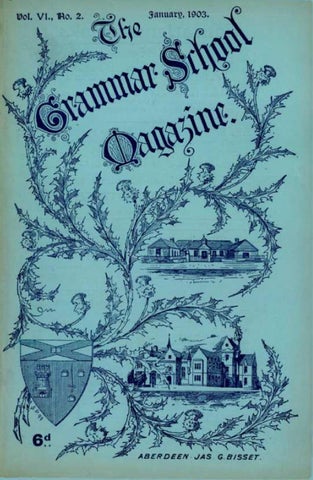
Vol. VI., 111o. 2.
KT-A - l Qr
3anuary, 1003.
,
,
- 4.. 7-
sd ABERDEEN ✓AS G.B/SSET.
Educational Books. JAMES G. BISSET ONTINUES to supply all the Class Books (New or Second-hand) suited for the Requirements of the Higher Educational Institutions in the City, at the Lowest Prices.
C Ifr•
N.B.—BEST VALUE IN STUDENTS' NOTE BOOKS.
JAMES G. BISSET, Classical, flUbical, aub 3E.Micational
85 BROAD STREET (Opposite marischai College).
The Sportsman's Depot and Athletic Stores.
GEO. M. MACKAY (Fellow of Educational Institute of Scotland), Angling Correspondent for the " Field," " Fishing Gazette," &c.
50
STREET,
BRIDGE -
BERDEE
-
Telegraphic Address—"MACKAY,
1\1 .
Bridge Street:
N.B.—Close to Railway Station.
High-Class Tackle of every description, for River, Lake, or Sea Angling.
Flies
dressed to any pattern. Greenheart and Cane Rods, Reels, Lines, etc.
Angling Bureau and Fishing Agency. All information as to waters in the North of Scotland.
Advice given.
Guns and Shot of the best and latest description. Air and Spring Guns a speciality. Golf.—Clubs, Golf Bags, Golf Balls, ctc. Simpson's, Weir's, and other makers. Fishings and Shootings arranged.
Cricket.— Lockwood, Ayres, Lillywhite, &c. Tennis, Croquet, Bowls. &c. Football.— The latest and best in the Market. Repairs.—Rods, Reels, Guns, Clubs, Rackets, Cycles, etc., repaired at shortest notice.
Golfing, Cycling, and Angling Gloves. Physical Culture and Gymnastic Apparatus.— Boxing Gloves: Flasks, Knives, etc. Mackay's Anti-Midge, for Gnat and Mosquito Bites, is. Bottles. Post, ls. 2d. Larger Bottles, 2s. 6d.
Post, 2s. lld.
In-door and Out-door Games of every description.
4
I
CONTENTS.
-
-
-
Frontispiece .. 41 -
-
-
-
-
-
-
-
-
PORTRAIT OF Mr. JAMES C. KNOX SCHOOL NOTES
-
-
NOTES ABOUT OLD BOYS
-
-
-
-
-
-
-
45 46 54
AN INDIAN CHRISTMAS -
-
-
-
-
-
57
THE PHYSICAL REGISTER
-
-
-
-
-
FOOTBALL NOTES -
-
-
-
-
-
-
62 64
THE FIRST FIFTEEN
-
-
-
-
-
FORMER PUPILS' CLUB -
-
-
-
-
-
-
-
-
-
-
-
-
-
-
-
-
LIBRARY
-
-
FROM THE FAR EAST
DEBATER NOTES
-
THE JUDICIAL NIGHT
OUR POETS' CORNER-SHERLOCK'S UNDERSTUDY
75 77
MY ARGOSY
-
-
-
OUR CONTEMPORARIES -
-
-
-
-
78 79
-
-
-
-
-
80
SCHOOL OFFICIALS
-
•
I
-
68 70 71
C. lit Lawrence,
Shorthand.
The Aberdeen School of Shorthand,' =
Type=Writing.
-
19 CROWN STREET.
Book=Keeping.
Prospectus on application. Telephone 875.
TEXT BOOKS
+ :4
Of aII (NEW AND SECOND-HAND), AT
D. WYLLIE & SON 3
247 UNION STREET,
RDEE ABEN.
JOHN C. M'LEOD, HATTER, 48
UNION
STREET,
OULD respectfully intimate to pupils of Grammar School a Large Stock of Cap and Glengarry Badges, as authorised; also, Football Jerseys, Belts, Bathing Pants, and Costumes.
W
Great Variety of Football, Cricket, Tennis, and Boating Jerseys, Sweaters, Knickers, Trousers, Shirts, Jackets, Belts, Cowls, Caps, and Hats.
TROPHY
AND CLUB CAPS
MADE
TO
ORDER.
For Summer—Straw Hats, with Club & other Fancy Bands, Guards, Puggarees, &c. NEW STYLES FELT HATS, TIVEED CAPS, cee. Ties, Scarfs, Collars, Braces, and Umbrellas. 1902.
42
The Grammar School Magazine.
Cricket Teams, as well as to the Swimming Club. His place as Secretary of the 1st XV. has been taken by J. MTherson. Leonard had attended the " Gram." longer than any other boy in the School, as he entered it in 1890, and has been with us for twelve years. We regret also that D. H. W. Williamson has left us for the -University. His place as a "footer" player will be difficult to fill, and the 1st XV. miss him very much.
*
Our frontispiece for this number is the "counterfeit presentment" of Mr. Knox, and we feel sure that all will appreciate it. Mr. Knox has been with us for only two years, but in that time he has done excellent work, and has won the confidence of his pupils. His career as a student was crowned with many honours. In 1893 he entered the University as Second Bursar, in 1897 he shared the Black Latin Prize, and finished up by taking First Class Honours in Classics. It may be mentioned here that at the University he was a pupil of Mr. Middleton.
1
We regret that Dr. Walker's name was omitted from the list of donors of Sports Prizes in the Magazine last We are very sorry that such an year and this year. omission should have been made, and trust that it will not happen again. We have received from Admiral Sir Arthur Farquhar, K.C.B., a contribution of £1, and the promise of an article for our next issue. For many years past Sir Arthur has been our chief supporter, and has given us annual donations. We must thank him most heartily for his long-continued generosity. The Finale of the Literary and Debating Society is to come off early in February. This Concert is always a great success, but this year it ought to be even more so, as the play is an exceptionally good one. The first part of the programme will, as usual, be musical. The play is a farce in one act entitled " Chiselling." Mr. Charles avic son as TTary"Consented li to act as Stage Manager, and, under his management, we are sure the play will be attended with great success. The cast is as follows :—
_ •
Larkspur, a Sculptor Trotter, his Manservant Dr. Stonecrop ... Mrs. Piper, a Landlady Kate, Stonecrop's Niece
••• ..• ••• •••
••• .. ••• ••• •••
••• ••• . ••• .
••• ••• ••• ••• •••
J. M‘Pliers.n. H. M‘Pherson. P. B. Simpson. J. G. Danson. H. G. M. Wilson.
JAMES C. KNOX, Esq., M.A.
w
E
5ramrnar Scf?oot tiraga3ine. Vol. VI.
JANUARY, 1903.
No. 2.
ANOTHER milestone in the track of time ! 1902 is behind us, with all its varied experiences. Some tasks have been accomplished, others unachieved, and now 1903 is before us, with all its possibilities " for weal or for woe." Now is the time for good resolutions. Let us hope that they may be realised. Meantime it is fitting that we should now wish, as we do most cordially, all our readers—both former pupils and present pupils—A Happy and Prosperous New Year. Since our last issue some noteworthy changes have taken place in the Magazine Staff. Ian K. Burnett has resigned his post as Editor. Our last number showed throughout his great ability for carrying on the Magazine, and we are sorry to lose him. We lament also the loss of Leonard J. Smith, who fulfilled so well the duties of Sports Editor. Notwithstanding these changes, we are assured that everyone concerned with the Magazine will strive to maintain the efficiency to which it has been brought by our predecessors. Leonard J. Smith is really a great loss to us, as he took such a great interest in School affairs. He is not only a loss to the Magazine, but also to the Football and
42
The Grammar School Magazine.
1
Cricket Teams, as well as to the Swimming Club. His place as Secretary of the 1st XV. has been taken by J. MTherson. Leonard had attended the " Gram." longer than any other boy in the School, as he entered it in 1890, and has been with us for twelve years. We regret also that D. H. W. Williamson has left us for the -University. His place as a "footer" player will be difficult to fill, and the 1st XV. miss him very much. Our frontispiece for this number is the " counterfeit presentment " of Mr. Knox, and we feel sure that all will appreciate it. Mr. Knox has been with us for only two years, but in that time he has done excellent work, and has won the confidence of his pupils. His career as a student was crowned with many honours. In 1893 he entered the University as Second Bursar, in 1897 he shared the Black Latin Prize, and finished up by taking First Class Honours in Classics. It may be mentioned here that at the University he was a pupil of Mr. Middleton. We regret that Dr. Walker's name was omitted from the list of donors of Sports Prizes in the Magazine last year and this year. We are very sorry that such an omission should have been made, and trust that it will not happen again. We have received from Admiral Sir Arthur Farquhar, K.C.B., a contribution of £1, and the promise of an article for our next issue. For many years past Sir Arthur has been our chief supporter, and has given us annual donations. We must thank him most heartily for his long-continued generosity. The Finale of the Literary and Debating Society is to come off early in February. This Concert is always a great success, but this year it ought to be even more so, as the play is an exceptionally good one. The first part of the programme will, as usual, be musical. The play is a farce in one act, entitled " Chiselling." Mr. Charles Davidson has kindly consented to act as Stage Manager, and, under his management, we are sure the play will be attended with great success. The cast is as follows : — Larkspur, a Sculptor Trotter, his Manservant Dr. Stonecrop Mrs. Piper, a Landlady Kate, Stonecrop's Niece
• • •
J. M`Pliersrm. H. M‘Pherson. P. B. Simpson. J. G. Danson. H. G. M. Wilson.
•
"411
o
School Notes.
43
For this issue we have been fortunate enough to secure an article from Mr. J. M. Bulloch. Mr. Bulloch is the editor of the Sphere, and takes a great interest in our Mag. Fred. W. Galloway, who is now in the Indian Police, has also sent us an interesting article, " An Indian Christmas." We publish here another article from an " Old Boy" in a distant land, entitled " An F.P. in Far Peking," by Student Interpreter Combe. We have been unable to publish all the articles which we have received, but they will appear in our next number. The Football Season is now in full swing. The Grammar has not been quite so successful as in former years, but this is accounted for by its very light weight. This much, however, can be said for the team, that it has scored in every match played this season, and it is questionable whether the same can be said about any other club in town—even the 'Varsity. The attendance at the practices has been better, and we trust that it will be kept up. We would suggest that the 1st and 2ud XV.'s go for a run every week. It would keep them in excellent training. In this number we produce a criticism of the 1st XV. This should prove very interesting to the School, especially to the 1st XV. themselves. In the match between the 2nd City and 2nd Nomads, the School was well represented. H. M`Pherson, our Captain, was chosen to captain the 2nd City team, while L. J. Smith, M. J. Williamson, and J. M`Pherson were also chosen from the School XV. All the scoring was done by Grammar fellows and Grammar F.P.'s, L. J. Smith, by brilliant play, scoring three times in succession. About a dozen Highland students have lately come to the Grammar. Quite a Highland invasion ! We hear that one of them is a good athlete, and we hope to see his name flourishing at the next Sports. We are glad to see such a number of F.P.'s on the Students' Representative Council. A. R. Williamson, W. W. Jameson, T. B. Robertson, J. A. Shepherd, William Rae, Edward Legge, A. Irvine Fortescue, W. B. G. Minto, and A. M. Gauld have all been elected. It is gratifying to see the S.R.C. being " ruu " by " Old Boys."
44
The Grammar School Magazine.
We regret to say that Mr. Duncan has left us to take up another position. May all success attend him. Since the publication of our last Magazine a sad and notable event has occurred, which we must not pass over. That is the death of G. A. Henty, the famous novelist. As a writer of books for boys he has never been surpassed. In his earlier life he was a war correspondent, and saw much active service. His later years were given to writing. His books are chiefly historical, and so prolific was his pen that he has turned out over seventy delightfully written tales. There is a very fair selection of his books in the School Library. The membership of the Library is still very small. The Library is not sufficiently supported by the Tipper School, who ought to be an example to their younger friends. Numerous new books have been added, and many more are coming. The Reference Library is not patronised as it ought to be. All the best books for consultation are to be found there, and yet fellows do not realise how much good can be got from it. We hear that the magazines in the Reading Room are no longer to be paid for out of the Games Fund. This is a step in the right direction, as the Games Fund ought to be kept strictly for outdoor games. As it is, the magazines are not altogether suitable. Harper's, People's Friend, etc., could easily be done away with. The Debating Society has not been so successful as in former years. The membership has fallen off to some extent, and the subjects and speeches are weak. But there is one thing we are pleased to see—younger members are beginning to speak more frequently. All praise is due to our new President, John 111`Pherson. He conducts the meetings well, and keeps would-be noisy members in check. The Judicial Night was a great success. The case, which took the form of a murder trial, in which J. D. Mackay was the prisoner, was conducted with all the dignity of a Supreme Court. W. W. Jameson, as Judge, played his part extremely well. J. G. Danson, the
School Notes.
45
Sherlock Holmes of the evening, and J. M'Arthur, R. M. "Beelzebub," a witness, were most amusing. Easton, as a barmaid, appeared "quite fetching," and showed uo bashfulness in answering questions referring to her " love affairs." Great praise is due to J. MTherson for his eloquent speech for the prosecution, and also to Ian K. Burnett, who confused utterly the opposing witnesses by his excellent cross-examination. What is the use of having a School badge if it is not to be worn? How few Grammar boys wear it! The number of fellows who don badges is something like one in every ten. This is not as it ought to be. Every Grammar fellow should have either a badge or a Grammar cap, and why not both ? The Sports Prize-giving was held on Friday, the day on which we broke up for our Christmas Holidays. The prizes were presented by Rev. Professor Paterson, who added zest to the proceedings by his stirring advice to those present. The prizes were pretty equally divided, as there was no especially brilliant competitor to carry off the lion's share.
LIBRARY. THE Library cannot yet be said to be flourishing, as the
membership is not what it ought to be. We are sorry to have to record the departure of L. J. Smith, and we also regret that, even with reduced ranks, the Librarians do not find they have too much to do. Several really good books have been added, and it is more than ever worth one's while expending a shilling on joining. Among the new books are :--- The Brass Bottle," Anstey ; " The Firebrand," Crockett ; " The Silver Skull," Crockett ; " Kim," Kipling; " In the Palace of the King," Crawford. In addition to these, several new books have been presented by present pupils. This is a form of contribution we are always pleased to receive. J. B. G.
46
The Grammar School Magazine.
AT the great Durbar Celebrations at Delhi, Dr. George Watt was made K.C.B. Sir George was educated with us, and afterwards at Glasgow University. For a time he was Assistant Professor of Botany in Aberdeen University, and in 1873 he was made Professor of Botany in the University of Calcutta. In 1887 he was appointed to the highly responsible post of Reporter on Economic Products to the Government of India. In discharge of this duty he visited every part of India, and embodied the results of his researches in a " Dictionary of the Economic Products of India," an exhaustive work of nine volumes.
The Principalship of the Scotch High Schools in Bombay has just been conferred on Mr. Edward J. Henderson, M.A., at present Master of Modern Languages in the Alva Academy, near Stirling. Mr. Henderson held for three years at the Grammar School one of the scholarships awarded by competition by the Town Council. In class examinations he always occupied the highest places, and He especially distinguished carried off several prizes. himself in French and German by carrying off the Brebner Special Prize as the Dux of his year in both these languages. At Aberdeen University he obtained a good place in the bursary list, being then the only one who secured a bursary at the competition by taking modern languages in place of the " version." Captain A. Kirkland Robb, of the Durham Light Infantry, has been appointed Adjutant of the Rangoon V. Rifles. The tenure of office is for five years. Native mounted infantry to the number of 150, drawn from the troops assembled for the Delhi manoeuvres, have been ordered to proceed at once to Somaliland, under the command of Major G. W. Rawlins, 12th Bengal Cavalry, and Captain A. Skeen, 24th Punjab Infantry.
Notes about Old Boys.
47
Captain Skeen, like all his brothers, was educated at our School. He was gazetted in 1891, promoted to his lieutenancy in 1893, and to his captaincy in 1901, and he has already seen active service both on the North-West Frontier, where he served under Sir William Lockhart, and in the recent operations in China. For the defence of Malakand and the engagement at Laudakai, Captain Skeen holds the medal with two clasps. Captain Skeen's brother, who holds a lieutenancy in the Indian Staff Corps, and who was amongst those Indian officers selected for service in South Africa, is at present in Aberdeen on furlough. A beautiful memorial window, designed by Mr. Strachan, has been placed in King's College Chapel in memory of a former Rector, Sir William Geddes, late Principal of the University. We regret to announce the death of Mr. John Imray, M.A., London. Mr. Imray was a civil engineer in London, and one of the highest authorities on patents. It will be especially interesting for our Modern fellows to read the account of Mr. Imray's. life :—John Imray was the son of Rev. John Imray, of Longside, Aberdeenshire, and was born at Peterhead on 12th August, 1820. He received his first education at the village school of Longside, and, when thirteen years of age, proceeded to Aberdeen to attend the Grammar School. Mr. Imray was soon successful in obtaining a scholarship at Marischal College, Aberdeen, where he obtained the Mathematical scholarship and subsequently his degree of M.A. In 1837, he proceeded to London, and succeeded in obtaining an entry into the firm of Maudsley, Sons, & Field as a pupil, commencing work there in May, 1838. Whilst at Messrs. Maudsley's, Mr. Imray assisted Mr. Field in preparing the drawing for the arrangement of the marine engine known as the double-cylinder engine, which was considered a great advance at that time. During the latter part of the time he was at Maudsley's he was employed in his leisure hours by Dr. Reid in preparing drawings for the warming and ventilating of the new Houses of Parliament, etc. At the expiration of his apprenticeship at Maudsley's in May, 1842, he left that firm and began work in the ventilation office of the new Houses of Parliament, where he remained until 1850, assisting Dr. Reid in most of his work, and being especially engaged in arranging the ventilating
48
The Grammar School Magazine.
apparatus in the Royal yacht called the " Royal George," and also in preparing the rooms of Buckingham Palace for the great balls and the Opera House for the Queen's State visits. He took levels for a line of railway in Essex, and for the line between RuFby and Manchester. In 1850 he joined Arthur Collinge in partnership in an engineering business at Lambeth, and during 1854 constructed a large number of engines for Messrs. Maudsley and Messrs. Penn for war vessels and gunboats required at that time. In the 1862 Exhibition he exhibited several steam engines, and also a steam hammer, which he had invented. From 1864 he commenced to act professionally as adviser and expert in law cases connected with patents and machinery, and about this time he wrote a treatise on Practical Mechanics and the Steam Engine, which formed part of " Orr's Circle of the Sciences." In 1867 he gave up his engineering business at Lambeth, and started as consulting engineer and patent agent in Great George Street, Westminster, and was then employed to repair the Lambeth Suspension Bridge. He gave certain suggestions to Mr. W. H. Barlow in designing the great St. Pancras Station. In conjunction with Mr. R. Richardson, C.E., he prepared plans for a canal to bring a supply of sea water to London, and for the formation of a light overhead railway from Islington to the City. For some time he took the leading part in an institute called the Inventors' Institute, and acted as editor of the Scientific Review, and, as such editor, took a leading part in the controversy between Professor Wheatstone and W. Fothergill Cooke as to who really hi vented the electric telegraph, and it is believed that, in consequence of his endeavours, Sir William Cooke also received the honour of knighthood. In the year 1871 he joined Mr. Abel, brother of the late Sir Frederick Abel, in partnership as consulting engineers and patent agents, in which business he took a very active part until a fortnight before his death. For many years he was employed as an expert in most cases of patent litigation, and among the principal cases may be mentioned the telephone actions, the Otto gas engine actions, the Westinghouse brake actions, railway signalling actions, and the Welsbach gas lighting actions. In the year 1882 the Institute of Patent Agents was formed, when he was elected Vice-President, and the succeeding year was elected President, and he devoted a considerable time to the successful formation of this Institute and the obtaining of its Royal Charter. He was also a member of the Institution
Notes about Old Boys.
49
of Civil Engineers, of the Institution of Mechanical Engineers, and of the Royal Institution. When the Borough Council Act came into force, he was returned as one of the first members of the Borough Council for Holborn. Mr. Imray was a devoted manager of the Royal Scottish Corporation, a former President of the Caledonian Society of London, and a member of the Scots Lodge of Freemasons. The Right Rev. William Mair, D.D., minister of Earlston, Berwick, and ex-Moderator of the Church of Scotland, is to retire, after 34 years as parish minister of Earlston. When the General Assembly, in 1893, resolved to reconstruct the General Assembly Hall in Edinburgh, Dr. Mair became personally responsible for the total cost of £10,000. It was opened the following year free of debt, Dr. Mair having himself raised every single penny required. A master of Church Law, his book thereon is the standard authority of the Church. Among honours conferred on Dr. Mair was his portrait in oils by Sir George Reid. We regret to announce the death at Bombay of Mr. James Leask, Second Health Officer of the Municipality, who sometimes acted as Chief Sanitary Officer, and had a salary of £1,000 per annum. He had come unscathed through all the dangers and hard work associated with the great plague and famine, which brought death to so many in India, although he was actively occupied throughout the whole of that time in looking after the sanitary condition of the city. Now he has fallen a victim to appendicitis. Mr. Leask, who was 47 years of age, was a native of Aberdeen. He was educated at Michie's Academy and Aberdeen Grammar School. Afterwards he entered the office of Messrs. William Leslie & Co., shipowners, Marisehal Street, and at the close of his apprenticeship went to the Bombay office of the great firm of Messrs. Fleming and Company, whose leading branch was in Glasgow. The failure of the City of Glasgow Bank and its effect upon the firm with which he was engaged, threw Mr. Leask out of employment. With undaunted courage, determined to make the best of matters, he went to Persia, where he found employment, and after a time returned to India, having secured the appointment of Town Clerk of Kurrachee. After being for some time in that position, he was appointed to the post he occupied till his death, as Assistant Health Officer of the Bombay municipality.
50
The Grammar School _Magazine.
His ability in carrying out the duties of his office was fully recognised, and he was within sight of promotion to the position of Chief Sanitary Officer over a large district at a considerably increased salary. Many will remember Mr. Leask before he left Aberdeen as a most enthusiastic-member of the Aberdeen Boating Club, a well-known athlete, and a keen volunteer in No. 1 Company, as it then existed, of the Gordon Highlanders. His love of volunteering remained with him all his life, and in Bombay he became Colonel of the Volunteers. He was looking forward with the greatest interest to going with part of his battalion to the Durbar at Delhi. His brother is our distinguished F.P., Mr. W. Keith Leask, to whom this Magazine is deeply indebted for his kindness in contributing so many delightful articles. Sir Thomas Sutherland, K.C.M.G., has been elected Every Vice-President of the Suez Canal Company. Grammarian should read his long and interesting article on Grammar School and University Life in the New-Year's number of Alma Mater. We envy the luck of Harrow School in having so generous a benefactor as the late Mr. Panmure Gordon. He has left that School his splendid Byron Collection, We have to be along with a marble bust and pillar. content with the poet's name on our register. Vox et • jiraeterea nihil. We have to record the death of Mr. John Brebner, M.A., LL.D., late Minister of Education in the Orange - Free State, and formerly Classical Master in Aberdeen Grammar School and a graduate of the University, where he took his degree in 1852. Soon after completing his Arts course Dr. Brebner was appointed Classical Master of Aberdeen Grammar School, and retained that appointment until about the time Mr. Patrick Evans became Rector of the School. Soon after that Dr. Brebner went to South Africa, and he was for some time engaged in teaching in Burgersdorp. Subsequently he was appointed a professor in Somerset East, and while acting in this capacity he inspected different schools in the district. Ultimately he was appointed Minister of Education for the Orange Free State, and for a considerable time discharged the import ant duties of that office to the evident satisfaction of the Free
Notes about Old Boys.
51
State Government. In 1893, in recognition of his scholarly attainments and important educational work, his Alma Mater conferred on him the honorary degree of LL.D. He retired a number of years ago on a pension granted from the Free State. It may be mentioned that the late Dr. Brebner paid a visit to Aberdeen Grammar School in the autumn of last year. He was welcomed as an " Old Boy " who had left the School as a first bursar to go to Marischal College in 1848, and as Classical Master at the School for ten years. It is understood that he was an applicant for the vacant Rectorship of the School, but, being unsuccessful in his candidature, went to South Africa, where, as Inspector of Schools in the Orange Free State and as Minister of Education there, he was on intimate terms with the Boer leaders before the outbreak of the war. They speak of raising a memorial to him in Bloemfontein, either in the form of a statue or by founding scholarships in the Grey College which he did so much to develop. Dr. J. J. R. Macleod, at present demonstrator in physiology in London Hospital, and Mainnon Scholar of the Royal Society, has just been appointed lecturer in Chemical Physiology and Pathology and Physiological Chemist in the Sir Andrew Clark Institute, London. Dr. Macleod, in 1898, graduated with honours in our University, where he is co-examiner in Physiology. He has just had the title of D.P.H. conferred on him by Cambridge University, and he is the author of the section on chemical physiology in the elaborate work on practical physiology newly published by Arnold, London. We regret to announce the death of Mr. John Hay Smith, Staff Inspector of the Egyptian Salt and Soda Company, Ltd., which occurred at Belouan, near Cairo, on 26th November. Born at Deldonald, Banffshire, in February, 1869, he entered the army in 1885, and served in India and Egypt, being afterwards attached to the Military Mounted Police in Cairo. On leaving the army, Mr. Smith took over the management of the Soldiers' Club, Cairo. In May, 1894, he joined the Egyptian Government Salt Department, was transferred to the Salt and Soda Company when the Department was taken over by the Company, and was in its service up to the time of his death.
52
The Grammar School Magazine.
Mr. Hanna, Superintendent of Physical Training to the Education Board of Otago, was one of the most popular gymnastic instructors we ever had at School. Those of us who had the privilege of being taught by him were delighted to see him on his visit to Aberdeen a few months ago. The Education Board of Otago have, on Mr. Hanna's recommendation, adopted the system of physical education invented by Major Cruden (F.P.). Mr. Duncan M`Millan, C.E., Great Northern Railway, Derby, has been appointed assistant engineer to the Ceylon Government Railways, and has left to take up the duties of his new post. Mr. M`Millan joined the engineering staff of the Lancashire and Yorkshire Railway about eleven years ago, and for the past four years he has been in the engineering department of the Great Northern Railway, Derby, and for the greater part of that time was second in charge. The Benchers of Lincoln's Inn, London, have appointed Mr. John Forbes, T.C., to be Keeper of the Walks. The other three officials appointed were the Lord Chief Justice as Master of the Library; Sir Edward Clarke, K.C., as Dean of the Chapel ; and Lord Macnaghten as Keeper of the Black Books. These four gentlemen become in succession the Treasurer of the Inn, the highest office at the disposal of the Benchers. The King has also been pleased to appoint Mr. Forbes a Commissioner to go on the Oxford and Midland Circuits, in place of Mr. Justice Phillimore. For the degree of LL.B. at Edinburgh University Mr. IL W. L. Grant has passed in General Jurisprudence, Public International Law, and Scots Law. Mr. Hardy Philip has passed in Scots Law and in Conveyancing. We regret to record the deaths of the following " Old Boys " : —Lieutenant R. M. Garden, at Agra, of enteric fever ; John Macintosh Scott, fruit farmer, Fresno, California; the Rev. James Cameron, M.A., Portarlington, Australia; James W. Barclay, C.A., on a voyage home from Buenos Ayres, where he occupied an important position on one of the railways ; Peter Cruickshank, M.A., Schoolmaster of Tarves.
Notes about Old Boys.
53
Coming to some of our younger F.P.'s, we have to congratulate Allan Sutherland on the important Art Scholarship he has obtained after a searching examination. The scholarship is one tenable for six years, we believe, and enables him to live at the new Art College, near Arbroath. We are sure that Allan has the real stuff in him, and that some day he will make his mark. His caricatures are still a delightful memory to us. We heir that Thomas Davidson, of Mugiemoss Paper Works, is now at Vienna, studying the art of paper making there. You may see Tom's photograph in our corridor in some of the footer groups. William Leslie, who was in the same class, is now engaged in tea-planting in Ceylon, and is doing very well. Another member of that class, Harry J. Watt, Dux of the School, will soon receive his Ph.D. degree from Berlin University. James A. Bower, who is tea-planting in Assam, has become one of the best polo players in that part of India. No important polo match is played where he is not included. Our " Old Boys " at the University are still keeping up the reputation of their School. We see, for instance, at the recent important political debate in the Union, that the leaders were both F.P.'s. James Rae was leader for the Conservatives and W. B. G. Minto for the Liberals. Ultimately the former won by three votes. We spent a pleasant evening lately with Archie Bisset, who was with Lord Dunraven's sharpshooters in the late war. He had some interesting stories to tell of how his column nearly captured De Wet, but didn't. He leaves for South Africa soon. His stalwart brother, A. M., has got a place in the great Tanganyika Concession. Hugh is engineer on a P. & O. liner. William Murray, M.B. (Edin.), has passed the first half of his examination for the F.R.C.S., London., and has just taken his D.P.H. (Diploma in Public Health) at London University. His brother Jack, of Glenburnie Park, after a business training in England and in the United States, has now come back to Aberdeen.
54
The Grammar School Magazine.
Dr. A. G. Davidson has taken the D.P.H. of London University. Mr. Archibald M. C. Mutch, M.A., has been appointed Headmaster of the Mathematical Department in the Royal Belfast Academical Institution. At the Grammar School he was Town Council Silver and Gold Medallist, Latin and Mathematical Dux, Dux of School, and Queen's Prizeman in Science and Art and Advanced Mathematics. At the University he devoted special attention to Mathematics, Natural Philosophy, and Chemistry. In Mathematics he gained First Prize in Graduation Class, Third Prize in Intermediate Honours Class, and Second Prize in Senior Honours. He was First Prizeman in Graduation Natural Philosophy, Second Prizeman in the Honours Class, and Bronze Medallist in Chemistry. He graduated M.A. in 1898, with honours in Mathematics and Natural Philosophy, and was bracketed equal for the Boxill Mathematical Prize. He attended the Church of Scotland Training College during his last two years at the University, and was Senior Student and Ogilvie Medallist. Nearly four years ago Mr. Mutch was appointed to the teaching staff of Gordon's College, his work consisting mainly in teaching Mathematics. FROM THE FAR EAST; OR, AN F.P. IN FAR PEKING. A WELL-KNOWN traveller in the East has said that Peking is well worth a visit because of two occasions it affords for feeling that excitement of the senses dear to all travellers, and known as " real traveller's joy." The first, he says, is when the way-worn globe-trotter catches a first glimpse of this ancient seat of the Tartar Khans, and the second comes to him when he turns his back on it! In this rather pessimistic sentiment most foreigners in Peking heartily concur, no doubt chiefly because the city is peculiarly unclean, even for a Chinese city. Seen from the distance of a mile or so, after the traveller has ridden a couple of days in the monotonous plain in which it is planted, Peking forms a very striking feature of the landscape. The huge city wall, crowned at intervals with great watch-towers, and rising to a height of fifty feet, extends in front of you several miles in a
From the Far East.
55
straight line. And this impression of solid strength is not diminished in the mind of the traveller when he passes into the city by a tunnel in the wall forty feet in length. Once inside the city, you find yourself in a street where the side-walks are several feet below the level of the main road and often separated from it by booths and tent-like erections set up for night-watchmen. You are surrounded by Chinese in every colour of costume, from the crimson and yellow silks of the well-to-do to the dirty blue of the coolie class. Imperturbable yellow faces they have, with large foreheads, high cheek-bones, small nose with no bridge, large lips and weak chin. The "almond" eyes and black pigtail are additional characteristics known to all outside the Flowery Land. The main road lying between and above the side-walks is several inches deep in dust. The paving-stones are huge, and many are missing, leaving deep pits into which cart-wheels jolt with a sudden effectiveness which shakes all the bones of the person inside. Between the main road and the side-walks runs an open sewer, one of the worst plagues of life in Peking. The Chinese themselves seem quite unaffected by the odours arising from it; probably they would be rather sorry to see it done away with, as it belongs to the category of " old custom," and it would require something more than a mere odour to change that. Over shop doors on either side of the road hang signboards, like flags, of wood painted gold colour, blue, yellow, or vermilion, and advertising great bargains or wonderful reductions at the "Emporium of Righteousness and Tranquillity." One enterprising business man calls his " The Original Boot Shop " ; another puts out a notice to the effect that he has " only one price," and so on with the same advertisements as were familiar to us in papers at home. The street is worth watching from a little distance, say the top of the wall where the dust does not get at you, and it makes a curious mixed impression—the silk clothes on the side-walks, the stench from the sewers, the cart upsetting an imperturbable gentleman in the road, the incessant shout from hucksters and "Cheap Johns," the dust stirred up by the carts, and the gorgeous flags above the shops, with their quaint Chinese characters in colours too bright to be lost sight of even in the dust of a Peking street. You must get up on to the wall before you get a good
56
The Grammar School Magazine.
view of the lie of Peking. You then find it is composed One, really of two cities lying alongside each other. oblong in shape, is the Chinese or Outer City; the other, which is square, is called the Tartar or Inner City. This latter lies on the north side, and its south wall does duty as the north wall of the other. The Tartar wall is considerably bigger and broader than the Chinese wall, and the city it surrounds is regularly laid out in the form of a Tartar military camp. In the centre of it lies the Palace, or Forbidden City, sometimes also called the Pink City, because its walls are of that colour. Round this, but still inside the 'Tartar City, is the Imperial City, its walls covered with tiles of the Imperial yellow colour. In the Imperial City are many State offices and buildings for In the Tartar City live the ordinary official servants. Chinese, it being found that the original inhabitants, who were Tartars, got too poor to occupy the wealthy houses, so that at present more Chinese than Tartars live in the Tartar City. Altogether, it will be seen there are four cities in Peking, and we might add a fifth by including the Foreign Legation Quarter, which lies in the extreme southeast corner of the Tartar City against the south wall. Since the siege the Legation Quarter has been fortified with a wall loopholed for defence, and protected also by a moat and glacis. Peking, though not precisely in its present arrangement, is the Cambaluc of Marco Polo, the capital of Kubla Khan's great empire, and perhaps the strongest and most populous city in the world of those clays. Regarding its Emperor, Polo says in his quaint style: " If you were to put together all the Christians in the world, with their Emperors and Kings—ay, and throw in the Saracens to boot—they would not be so potent as this Kublay who is Lord of all the Tartars both of the Levant and of the Ponent." To-day the Empire is weak. Cambaluc has been invaded by despised aliens, its gates blown up, and its sacred places polluted by foreign feet. Still, when all is said and done, it remains an established fact that the Foreign Quarter of Peking is singularly free from bad smells, even from dust, and Legation Street at present is a delight to the rickshaw coolie and to those who go down to the Gate in carts. It is a far cry from the days when the sole European population consisted of a few Russian prisoners and half-adozen self-exiled Jesuit priests. To-day no one turns to
From the Far East.
57
look after a foreigner ; soldiers of almost every nation in Europe parade the streets, and civilians and officers have their club, and frequent the tennis courts, footer grounds, race-course, and golf links, not to mention garden parties and " At Homes." There is no doubt but that the Chinese, from the mandarin to the coolie, think regretfully of the old days when there were no upstarts of foreigners to thrust a " superior" civilisation upon them. But they can't help themselves, so they smile and buy themselves bicycles and railways and telegraph lines ; and when they have learned all the Westerner has to teach, then they will have no more use for him. Keen-witted Jews cannot live in China and compete with the native; the decline and fall of old Jewish colonies in China is a matter of history, and the ordinary European will be useful only to do "coolie pidgin" to a Chinese "captain of industry." There will be no need for China to. arm her millions to drive the foreigner into the sea. It will be simply a case of the "survival of the fittest," and the "red-haired barbarian" will disappear as quietly and mysteriously as he came. G. A. C., British Legation, Peking.
AN INDIAN CHRISTMAS. I.
WE were six. In our ordinary life we were gentlemen policemen, but as we stood on the verandah steps preparatory to starting we were as fine a collection of ruffians as you might meet between Calcutta and Lahore. We all were dressed in our oldest shikar costumes, and the combined disreputable effect took some beating. In India an old pair of boots must be treasured as your soul. We had six treasures, and our other garments, riding-breeches, putties, and all, were equally valuable. All arrangements had been satisfactorily completed— at least we profoundly hoped so—as we tried to get into one gharri licensed to carry four. Hours before the tents and heavy baggage had been sent to the station, which was only a mile and a half distant. The start was not a success. We had deposed the " gharri-wallah," and one of us had taken his place, when
58
The Grammar School Magazine.
something happened. We had to dismount in a manner more hurried than dignified, while the horses, lightly treating broken springs and a ditch, went for a canter across country. To look at an Indian cab-horse you might think there was nothing in him, but that is a snare and delusion. As we picked ourselves together and extricated ourselves from our guns, we expressed ourselves unreservedly upon things in general ; but the situation was saved by the appearance of another gharri, which we promptly annexed in spite of protests. F didn't drive this time. We explained to him that we wanted to get to the station, and that, sometime when we had leisure to drive to nowhere in particular and stay there, we would accept his services again. We arrived at the station in time, passing the luggage on the way. It was quite a good exhibition of driving, though " I says it as ought not to." There were four of us inside, one on the box, one on the top, and two natives clinging to the steps. The final curve into the station yard was a magnificent effort, and I was so lost in admiration of it that, failing to pull up in time, we gave the station a nasty knock with the pole, but failed to do it any damage. The train came. Like most Indian trains, it came when it liked, which, luckily for our luggage, was late. There were seventeen coolies loading up a first-class with miscellaneous articles. I will not swear to the part each played, but this was the number that finally ranged themselves outside for payment. When all was over there was one window left to look out of, and half a door; so we seated ourselves on the top of things, and smoked thoughtfully. We delayed that train considerably when we got out and transformed the platform into an Old Curiosity Shop. We made the guard and passengers wild, but they said nothing to be compared with what we said when we found no bullock-carts ready for us. We had to leave a shikaree and servant behind, and tramp six miles to the selected camping ground. Two of our number had taken upon themselves all duties with regard to the camp, and these two promptly lost_ themselves and us when we extended to do a little shooting en route. We found later that they had secured a horse each, and had gone on a little raid of their own ; but this was no comfort to us when at sunset we arrived
An Indian Christmas.
59
at the " jheol," which was fully two miles by one, without the remotest idea as to whether it was north, south, east, or west we were to be situated, or where these directions were. It was a lame way of spending Christmas Eve, we reflected, as we squatted, hungry and cold, in the midst of a native village to await the return of the search party we had sent out. As usual on such occasions, there was a full tally of pipes, but little tobacco, so we tossed for it by the light of a dirty lamp, and fell to wondering how the home people were spending their time. We were doing the half-mile up and down the main street to warm ourselves—it was about as dangerous as pig-sticking—when news came. The bullock-carts toiled up, creaking slowly along the lumpy road. There had been a breakdown. There always is when a native is left In this instance a bullock had fallen and in charge. gone to sleep for two hours, and no one seemed to have troubled to wake it. We were busily engaged fixing up the tent when, with rode in. They had and F a clatter of hoofs, O'C know why dinner to wanted and quails, a hare and some wasn't ready. How different camping in India is from camping at home. The blaze of the fires lights up the figures of bearers and syces flitting about among the trees and ropes. Further off, in the shadow, is a group of inquisitive villagers. Pariah dogs sneak about among the pails and boxes, looking for scraps. The white oxen and roughskinned buffaloes are waiting patiently for an evening meal, twitching their ears contemplatively as they watch the stir from their station near the carts. The cry of the peasant scaring the wild pig from his fields is broken by an occasional jackal chorus or the hoot of a screech owl. The shikarees squat circlewise and chatter o'er the common hookah. Over all are the stars, partially dimmed by tbe upward drifting smoke. II.
It is morning. It is intended to be an Indian morning, but it hasn't caught hold of the " coral strand " or " sunny plain " idea. It is one of those mornings that good stayat-home English people would never credit India with. It is absolutely freezingly cold, and the sahibs don't like it, as the bearer will tell you, who has just had a boot thrown at his head for not awakening them sooner, and another for awakening them at all.
60
The Grammar School Magazine.
Ere morning mists lifted we had crept down to the jheol and were hidden among the reeds. When all were in station the whistle came down the line, and it barely reached the endmost man ere the day's work was begun. , who had been impatiently watching two ducks, O'C let go at the signal, and a fine mallard fell to him, while the silent jheol burst into a tornado of flapping wings as the startled birds rose from the water. There is always one man in a party with whom it is a point of religion to fire both barrels. He gets into the thick of the fight every time, and, as certain as one barrel is let off, the other follows ; as sure as the other follows, he misses with both. He has the first shot in on every occasion--not from any selfish motive ; he cannot keep it back. F tried his best on this morning, and his cri-crick followed sharp on O'C 's with the usual result. A frightened quack was all he obtained from the band that went streaming away. They did not all escape, however, They were a careless lot, those ducks. In addition to not rising beyond range, when fired at, they never observed another figure crouching on the bank. Their last mistake was pardonable ; dozens before had not seen that figure. It was one that could hide itself behind a pebble and a blade of grass. Two left their fellows, and the water splashed to right and left. A pause of a minute and another flight passed that spot, and again two dropped. The sport grew fast and furious. Round and round the jheol the birds went in lessening flights. Here an old bird would break from the rest, and, panic-stricken, make for his own little pool, but before he reached it a shot would ring out and he would fall helpless or be driven back again among the rest. The shikarees, with their eager cries of "Upar" (above), were retrieving in the reeds, stripped to a loincloth, plunging up to the armpits in search of the wounded, and dragging them forth triumphantly by the neck. The birds are scattering now, and the firing is less frequent. Many have fled far off in search of safety ; many have sought the centre where the deeper waters lie ; many are dead. The sun has long passed the meridian and is low in the west before we set off for camp. Two of us had eaten all the tiffin ; so four hungry and wet men left the scene first and promptly emptied the sole whisky bottle while their bearers undid their muddy boots and putties. At dinner that night the firelight flickered on the
i
•
I Y
An Indian Christmas.
61 •
glossy feathers of some sixty ducks dangling from the trees. All kinds and sizes were there—teal, mingled with the nobler mallard and red-headed porchards, jostled against shurlers. We were all tired, but each, as he stretched his weary limbs round the cheerful blaze, had long stories to tell of the wonderful hits he had made. Each had lost many of the birds he had dropped, none more than F—, whose part of the jheol must have been left a sepulchre. We pitied the poor ducks left that night to mourn their dead and his luck in the weeds ; we sympathised with F our arranging and, before, times and times done as we had little beds round his prostrate six feet three, we went to sleep. Ducks next morning were not a success. After the opening shots they circled high and left the jheol, and nothing but " kutchnai " remained. Thus we decided to do cross-country shooting in the direction of the railway station that we were due to reach by five. We began by tramping through some long grass in the hope of starting buck. Something did start ; it was not a buck but a wild boar. He got up slightly in front, and, turning, charged past me. I fell—not literally but figuratively. The ill success of the morning was to blame for my most unsportsmanlike action. I swung round and landed that boar square behind the shoulder with a '450 Winchester, and he crashed forward on his head. It was all over in a minute, but my shikaree had time to flee. He returned and his call brought a crowd of cultivators round the fallen devastator of their fields. The shikaree, now brave as a lion, explained to them the whole occurrence, how he had led the sahib to the place and helped him to kill the pig. Surely the sahib would give great " backsheesh " to him for his work. After Fiving directions for the tusks to be extracted and sent in to headquarters, we moved off again. We came to the Ram Gunga, where it had no right to be, and had to ford it breast-high. Then we saw some teal, and to fly them for us. He did, but it was by two sent F-shots that sent them off in the wrong direction. We later that his is not the way to fly birds, showed F but consideration of his size took the edge from the reprimand. Being uncomfortably wet, we sat down upon the bank to dry ourselves and have tiffin. The drying came off all right but the tiffin did not. Soda water having run short,
62
The Grammar School Magazine.
there was nothing to drink, and we had no bread. Only a few " chapaties ' had been packed, and these, when not well buttered and assisted down by liquid, run indiarubber fairly close. We discovered a cold fowl, but no one could pull its limbs apart, so we smashed it in with a gun-butt, and fought for the best fragment. Amidst a dead silence F suggested looking at its teeth. We didn't, but we asked calmly whose servant had made up the basket. When we found out, we didn't call him names ; we didn't even threaten him ; we waited collectively and individually. Having secured a few quails and partridges, we drew near the station. A hundred yards from it, two wolves took occasion to show themselves when no one's gun was loaded. The train came along sharp for a miracle, but it was late when it left. As a parting shot, to show our goodwill and fellowship at the festive season, we slung a very high duck at the Bengali babu who acted as stationmaster, and left him lamenting his fallen caste. We were singing tenderly of our home upon the Swaney River when the train pulled up at NI—, and our Christmas Camp was over. F. W. G.
THE PHYSICAL REGISTER. THE schedules for the proposed register have now been printed, and the work will be commenced as soon as the necessary apparatus for measurements is supplied. It is intended to take statistics of the School once a year, in the third quarter of each session. The details of which observations will be taken will include tests of hearing, sight, and sense of colour, statistics of complexion (eyes, skin, and hair), measurements of the head, height, weight, and girth of chest, arm, and leg, etc., with notes as to the forms of exercise and games in which each boy engages. The Character Reports for the third quarter will be issued on a special form, embodying an abstract of the measurements, and of the tests of hearing and sight. The importance of the last two items, from the educational standpoint, is very great, the experience of practised oculists showing clearly that the progress of many school children is retarded by defects of which even their parents have
The Physical Register.
63
often no suspicion ; and, in consequence, deficient progress is often assigned to wrong causes. In order to give the parent some standard of comparison by which to gauge the physical development of his son, the Report will also contain the average measurements for the age-group (e.g., 11 to 12 years) to which the boy belongs. No doubt this will entail a good deal of work in registration. But as the plan has been carefully worked out, with the advice of eminent medical men, and much consideration of the possibilities and advantages to be derived from such a register, it is hoped that the work will prove of great utility. Briefly stated, the main object is educational, to provide staff and parents with some of the Inleading facts in the physical growth of the boys. cidentally, by stimulating the interest of both parents and boys, it is hoped that those who may feel disposed to neglect this side of education will learn the better to appraise the great gifts of health and strength, and recognise their important bearing on the mental and moral growth. As a subsidiary but very important object, such a record may be expected, in time, to prove of very considerable interest and value to the anthropologist, the student of mankind from the scientific point of view. For such a purpose our School appears to offer a field of special interest, being composed of many various elements, from town and country, at home and abroad, and affording opportunity, such as only schools possess, for a series of observations extending for many years over the period of most rapid growth and development. One word of caution will not seem out of place at the commencement of this project. The testing of hearing and sight is mainly a matter for expert medical advice. The tests to be applied and the results to be indicated will therefore be simple and of a general nature, such as may, with a little practice, be readily applied even by those who are not medical experts. The results indicated are intended, therefore, merely to call the attention of parents in a general way to defects, where such appear to exist, in order that competent medical advice may be obtained S. on the subject.
64
The Grammar School Magazine.
1ST. XV. FIXTURES. GRAMMAR SCHOOL V. 1ST NOMADS (October 11).—The Nomads turned up with a strong team, J. W. Milne, of the 'Varsity, playing for them. The School, losing the toss, played up the first half. Immediately from the kick-off the Nomads pressed, and within the next ten minutes they had scored thrice, though failing to convert in any case. This made the School play up, and they kept their opponents well in check. Not long before half-time, C. Macleod, by a clever kick, gave the Grammar a good opportunity to score, which it did through M. Williamson. E. M`Bain converted. At half-time the scores were— Nomads, 9; School, 5. In the second half the Nomads' score rose fast, and this was chiefly owing to the School three-quarters not marking their men properly. Yet the School did get now and then into the Nomad 25, but did not manage to score again. H. M`Pherson and L. Smith played well for the School. Milne and Leslie were best for the Nomads. At time the score was—Nomads, 38 points ; School, 5 points. GRAMMAR SCHOOL V. 2ND PANMURE (October 13).—The Panmure could not get up a team for this match. GRAMMAR SCHOOL V. 1ST GORDON'S COLLEGE (October 18). —This match was played in the School Grounds in the presence of a large body of spectators. The School kicked off towards the west. The ball was returned, however, and play was carried on for a little time in the School 25.
School Football Notes.
65
Gradually, however, the School drove their visitors back, and Duncan scored from a forward rush. D. Williamson converted. Not long afterwards the School again got behind. This time it was Johnston who touched down, and D. Williamson again converted. At half-time the scores read—School, 10 points ; Gordon's College, nil. In the second half the School did most of the pressing, the forwards shoving their heavier opponents with apparent ease. A penalty kick was awarded to the School in the Gordon's 25, and D. Williamson kicked a splendid goal.. Soon after this the School scored again, but the kick failed. When the whistle blew the scores were—School, 16 points (2 goals, 1 try, 1 penalty goal) ; Gordon's College, nil. The two MThersons and Smith played best for the School, while Murray played a safe game for the College. Mr. T. B. Robertson acted as referee. GRAMMAR SCHOOL V. 2ND NOMADS (October 25).—This match was played in the School Grounds. Again the School started playing up-field. The first half was fairly equal, although perhaps the Nomads had the best of it. It was almost entirely a forward game, and there was not much passing on either side. At half-time neither team had crossed their opponents' line. In the next half the School had the best of it. It was not very long before L. Smith, after a good run, scored for the School. H. MTherson just missed the kick by inches. The Nomads now began to " buck up," and transferred the play to the School's end of the field. A. Mortimer broke away from a scrummage and scored for the Nomads. The try was unconverted. The scores remained unchanged to the end, which found play in mid-field. Result--3 points each. The School was not at full strength, as they had only one of their ordinary three-quarters playing. H. M`Pherson was most noticeable for the School, and Thomson played a good game at back for the Nomads. GRAMMAR SCHOOL V. DUNDEE HIGH SCHOOL 2ND F.P.'s (November 1).—This match was played at Mannofield in fine weather. The Dundee team turned up short, but they picked up two men and the School gave them two, which made the sides equal. In the first half there was a good deal of end-to-end play. The School forwards generally shoved their opponents and got out the ball well, but the Dundee tackled safely. Near the end of the half D. Williamson scored for the School. He brought out full points himself. There was no more scoring this half. In the second stage the Dundee were kept in their own end
66
The Grammar School Magazine.
all the time. The School scored twice in this half, but only one of these tries was converted. Full-time result— School, 13 points (2 goals, 1 try) ; Dundee High School F.P.'s, nil. H. M`Pherson and D. Williamson played best for the School. Mr. T. B. Robertson acted as referee. After the match, the School entertained their visitors to tea in the Queen's Restaurant. After tea, choruses and A pleasant songs made the time pass very quickly. evening was concluded by both teams joining in " Auld Lang Syne." GRAMMAR SCHOOL v. 2ND 'SHIRE (November 8).—The School scratched this match, as six of the team were laid up. GRAMMAR SCHOOL v. DUNDEE HIGH SCHOOL 2ND F.P.'s (November 15).—To play this match the team travelled to Dundee. The weather, which had been threatening in the morning, cleared up in the afternoon. Dundee kicked off, and from the start kept the School pretty well in its own end of the field. Things, however, were seldom dangerous for the School, who, on their part, were now and then aggressive. One of the Dundee men had a good run down the touch-line, but was brought down in fine style by Giles. At half-time there had been no scoring. In the next half the School played much better, and Dundee seldom got much past mid-field. At last the School scored rather far out. The try was not improved upon. Soon after this Dundee came away with a rush, and one of their men forced himself over. Again the try was not converted. Some give-and-take play followed, but there was no more scoring, and an exciting game ended in a draw, 3 points each. The School forwards mauled their opponents, but the backs were not able to take full advantage of it. After the match the F.P.'s gave us a tea, which, as usual, was followed by a concert. One Dundonian gave two excellent recitations. A jovial evening was brought to a close at eight with the singing of " Auld Lang Syne." GRAMMAR SCHOOL v. 'VARSITY A. (November 22).—This match was played at the School Grounds in fine weather. The School began playing up. From the start play was confined to mid-field, but the 'Varsity men soon came away with a rush, and Henry scored. The try was unconverted. The School now began to play a better game, transferred the play to the visitors' 25, and had rather hard lines in not scoring, their passing game being superior to the 'Varsity's. Half-time was sounded with the scores
School Football Notes.
67
still one try in the 'Varsity's favour. In the second half the School had far the best of the game, the play very seldom being in their 25. P. Simpson, with a nice nut, opened the scoring for the School. Full points were not brought out. The 'Varsity now in their turn began to press, and scored through Gordon, owing to M. Williamson missing a pass. The kick was again ineffective. Shortly after this, M'Arthur got over by dint of good following up. The try was converted. Not very long afterwards, M. Williamson got over from a nice pass from L. Smith. The kick was a somewhat difficult one, and was not successful. When the whistle blew, the scores read—School, 11 points (1 goal, 2 tries) ; 'Varsity A, 6 points (2 tries). H. II`Pherson, L. Smith, and Simpson were most noticeable in the Grammar team, while Baillie was the best for the 'Varsity. GRAMMAR SCHOOL v. 2ND NOMADS (November 29).—This match was played at the School. Though it was fine, the ground was in a very muddy state. The Nomads turned up with a very strong team, several first men playing for them. The Nomads kicked off and forced a touch down. Very soon afterwards they scored from a forward rush. Saunders converted. The Nomads still continued pressing, however, and scored again through Saunders. The kick was successful. There was not much relief gained from the kick-out, and soon after Leslie scored far out. The kick failed. At last the School began to wake up and forced the Nomads into their own half of the field, but failed to score. Close upon half-time the Nomad forwards carried the ball over the School line, but the kick again failed. Half-time-2nd Nomads, 16; School, nil. After the interval the School played up better, and kept the Nomads well in check. At last the Grammar broke away, and M. Williamson, getting the ball, scored between the posts. E. NE`Bain converted. After this play was almost a repetition of the first half, the Nomads scoring three unconverted tries, and time was called with score-2nd Nomads, 25 points (2 goals, 5 tries) ; School, 5 points The School (1 goal). Mr. Baillie acted as referee. forwards pushed the Nomads in the scrum., but the Nomads were far superior in the open. GRAMMAR SCHOOL v. lsr F.P.'s (December 6).—This match had to be abandoned owing to the state of the ground. 2ND CITY v. 2ND NOMADS (December 13).—In this match four of the Grammar team took part, and it was a notice-
68
The Grammar School Magazine.
able fact that they did all the scoring. D. Williamson, who scored once, played for us at the beginning of the season. L. Smith scored three times, and J. M`Pherson once. L. Smith was easily best among the backs. 2ND XV. FIXTURES. Oct. 11. v. 1st Gordon's College: Lost by 50 points to 0. Nov. 15. v. 2nd Gordon's College. Won by 3 points to 0. Won by 6 points to 3. Nov. 29. v. Queen's Cross. Won by 3 points to 0. Dec. 13. v. 2nd F.P.'s.
THE FIRST FIFTEEN. In comparison with former years it must be acknowledged that the present team hardly comes up to the usual standard of those which have gone before it, though some of its members show a talent for the game that would be hard to beat. Among the backs, for instance, are one or two really excellent players, but, as a whole, they lack proper combination and the art of passing surely and at the right moment. The forwards are a hard-working and dependable lot, and it is mainly owing to their exertions that the team has emerged victorious from some hardfought fights. Most of the team are playing in the 1st XV. for the first time, so this perhaps accounts for the slight falling off from past years. The team may not be at the head of the Junior League this year, but as many of the members are likely to be playing for the next few seasons, we shall in all probability find them part of a team that will rival, if not outshine, the victories of its predecessors. The following is a brief criticism of the team : — BACK. E. MTAIN.—Kicks very well, and smart at finding touch, but is not always sure of his tackle. Very safe placekick. THREE-QUARTERS. M. J. WILLIAMSON.—The leading light of the threequarters. His passing and kicking are equally good, while he never misses his tackle. Has scored in every match he has played in.
School Football Notes.
69
P. B. SIMPSON.—Has improved greatly since the beginning of the season. Is pretty fast, and rather a good kick. Should remember to mark his man and try to be surer in his tackling. W. PATERSON.—Finds touch well, and sometimes brings off a good tackle. Does not always play his hardest. D. ADAM.-A good kick, but rather weak in tackling. Would play better with more confidence. HALF-BACKS.
L. J. SMITH.—An exceedingly smart and unselfish player.
Passes and takes a pass equally well, while his tackling and kicking are all that could be desired. Can always be depended upon. C. M`LEon.—Combines well with the other half. Smart at passing and kicking. Should endeavour to be surer and quicker in his tackling. FORWARDS.
H. ALTHEnsoN (Captain).—Plays a splendid game himself, Shoves his and keeps his forwards well in hand. hardest in the mauls, and is particularly good at touch. Always on the ball, and dribbles excellently. J. APPHERSON.—Uses his weight well in the mauls; follows up smartly. Rather a good kick, but sometimes plays a little wildly. A. F. JOHNSTON.—Rather light, but plays an excellent game. Tackles and dribbles well in the open. Would perhaps make a good three-quarter. W. E. WALLACE.—Follows up and mauls well. Good at touch, and always tackles successfully. Ought to improve greatly by next season. W. J. DuNcAN.—Useful in the mauls, but is rather slow in the open. Especially weak in kicking. J. IPARTHun.—Commenced this year. Uses his weight well in the mauls, and can dribble. Not very good at kicking, and sometimes passes wildly. J. D. MACKAY.—Plays a hard game, and keeps well on the ball. Sometimes plays rather wildly. I. K. BURNETT.—Has been rather unfortunate in being disabled for the rest of the season. Useful in the mauls, but is rather slow.
The Grammar School Magazine.
70
FORMER PUPILS' CLUB, 1902-1903. THE officials for this year are as follows : —
Hon. President—H. F. Morland Simpson, M.A. (Cantab.) President—Dr. J. Scott Riddell. Vice-President—Dr. J. F. Christie. Hon. Secretary and Treasurer— Alfred W. Edwards, Esq., 267 Union Street. Aberdeen. Committee— Mr. Theodore Watt. Mr. J. Everard Rae, M.A. Dr. James Crombie. „ W. Dickie Smith, M.A • Mr. G. Stanley Russell. „ J. C. H. Macbeth. „ James W. Milne. „ C. T. Christie. „ Colin M. Kerr. „ A. G. Smith. „ Harry Kellas. „ Thomas B. Robertson. „ Robert Hally. „ James M. Pixie. Mr. Harold Merrylees. Representatives from Affiliated Clubs— Dramatic Club, . Football Club, .
Mr. Charles Davidson, M.A. Mr. Samuel Pope, Jun., Solicitor. SYLLABUS.
1902. Dec. 6. Dec. 31. 1903. Jan. 7.
SMOKING CONCERT in Grand Hotel, at 7.30 p.m. CINDERELLA.
LECITURE—"Oxford" (Illustrated by Limelight Views), in School Hall, at 8 p.m., by R. S. Rait, Esq., M.A., Fellow and Lecturer of New College, Oxford. Jan. 10. SMOKING CONCERT. Jan. 23. CLUB BALL. Feb. 6. SYMPOSIUM in School Hall, at 8 p.m.—Subject of Discussion — " Is a man better equipped for life by a Classical or Modern Education ?" Feb. 20. CONCERT in School Hall, at 8 p.m. Feb. 28. SMOKING CONCERT. Oct. 28. ANNUAL BUSINESS MEETING in School Hall, at 8 p.m. The members of the Dramatic Club hope to give an entertainment during the course of the season.
Debater Notes.
D:E", aATZR"
71
NOT }'S
EXTRACTS FROM THE MINUTE BOOK OF THE LITERARY AND DEBATING SOCIETY. [I have to thank A. F. Johnston for occupying the post of Secretary during the three weeks I was unable to carry on my work.—M. J. W.]
FRIDAY, October 3.—The Society opened their season in Room I. at 7 p.m., on above date—the President in the chair—when Mr. C. Davidson gave an exceedingly enjoyable reading to a fairly large attendance. He chose some scenes from " The Rivals," in which his portrayal of Mrs. Malaprop and her malapropisms was much enjoyed. He next read from "The School for Scandal," giving the scene describing Lord and Lady Teazle's domestic bliss. Mr. Davidson finished up by reading the last scene from " Henry V." Katherine's broken English was very well rendered. Mr. Davidson was accorded a very hearty vote of thanks at the close. The President, after Mr. Davidson had left the room, made a speech, in which he thanked J. G. Dauson for the help he had given in drawing up the syllabus. A few subjects were then debated, and the meeting closed at 9.15. Friday, October 10.—Mr. J. N. Carmichael gave a fluent extempore speech on the affirmative side of the debate, " Manual Training from an Educational Standpoint." He finished up by saying that he wished to hear speakers on the opposite side, and not those who were on his own. J. Rae, J. G. Danson, G. S. Russell, and W. J. Cruickshank then spoke, but none really opposed Mr. Carmichael's side of the question. No vote was taken on the subject. The syllabus and rules were then read, and members enrolled for the coming session. The business of the evening
72
The Grammar School Magazine.
was impromptu debates, but the subjects chosen by the sub-committee evidently did not suit the Society. After a little a Hat Night was proposed and seconded. There was a great similarity among some of the debates, and the speaking on them as a whole was not good, Friday, October 17.—The President introduced the lecturer, G. S. Russell (F.P.), in a short speech. The subject of his paper was "Some Poetry and Fiction of our Own Day." He compared literature as a whole to a roundabout, with its ups and downs; he gave Tennyson as a height and Austin as a depth. He then proceeded to read some quotations from Tennyson and a very clever parody on one of Austin's works. After this he gave a witty summary of a presentday novel. He quoted Marie Corelli as the best presentday novelist. At the close of a very interesting paper, a hearty vote of thanks was awarded. J. Rae made a short speech criticising the paper. J. G. Danson then took the chair, and the debate, " Is Fiction a Curse?" was well threshed out. Affirmative, I. K. Burnett and W. Reid ; negative, J. Rae, A. Bain, and C. E. Garland. The voting resulted—Affirmative, 9 ; negative, 13. Friday, October 24.—The Society was informed that I. K. Burnett had resigned his position as President, and J. M`Pherson was unanimously elected in his place. After the election, the new President took the chair and a Hat Night was proceeded with. Some of the subjects were well debated, several new members taking part in the discussions. The best debates were, " Should the School have a Founders' Day? " and " Apart from politics, is Ritchie or Asquith the better man?" This last debate was almost entirely discussed by two prominent former pupils, who seemed to take a great delight in contradicting each other. These two, however, wandered from the subject, and ended in talking of nothing else but the political careers of the two men. The debate, " Should the Games Committee pay the tea for the Dundee High School?" gradually branched off into a discussion about the probability of buying a new field, and the misuse of the Games Fund. Friday, October 31.—The business of the evening was the debate—" Is Britain declining?" I. K. Burnett supported the affirmative, and A. Bain the negative. The former pointed out how all the great kingdoms of the past had perished, and compared our Empire with that of Spain when at its height. He said
Debater Notes.
73
that our army was weak, that our navy would soon be outclassed by Germany, that we had lost our commercial supremacy, and that the people were immoral, uneducated, and a set of drunkards. A. Bain was then called upon, and in his paper he pointed out that Britain possessed half the carrying power of the world, was the greatest manufacturing country, and had the greatest colonies. The population of Britain, also, was continually increasing. These were all proofs that Britain was not declining. After the papers had been read the subject was open for debate. The chief speakers were :—Affirmative, C. E. Garland ; negative, W. Reid, W. W. Jameson, and G. S. Russell. The vote was then taken, and the result was that seventeen voted for the affirmative, and fifteen for the negative. The Society then began to criticise the rule which the Committee had passed in reference to former pupils. Instead, however, of criticising the Committee as a whole, several singled out one member, and seemed to think the fault lay with him. There were repeated cries for the " member in the corner," but the " member in the corner " did not speak. The debate " Maitland v. Walker" was then proceeded with. I. K. Burnett spoke for the former, and A. Lyon for the latter. No votes were taken. Friday, November 7.—The business of the evening was the criticism of the Magazine. No one had much to say against the Magazine, and everyone agreed in saying that it was one of the best numbers that had ever been issued. In an eloquent speech J. G. Danson proposed a vote of confidence in the Editor, a vote which was unanimously approved. After the criticism, a Hat Night was started. Some of the subjects were very good and were well debated, but all the members should address the chair when they begin to speak. The chief debates were —" Should we have oral examinations? " and " Did the School funk the 2nd 'Shire? " The vote was taken on the last subject. The result Ras—Affirmative, 8; negative, 21. Towards the close W. Reid took the chair. The chief speakers of the evening were I. K. Burnett, J. B. Gillies, G. H. Mair, and J. D. Fiddes. Friday, November 14.—The debate for the evening was "Have we too many periodicals?" The affirmative was taken by M. Williamson, and the negative by A. F. Johnston. Williamson gave his paper first, and was followed by Johnston, with an extremely well-thought-out paper. His chief argument was that magazines keep people at home. The President,
74
The Grammar School Magazine.
in a short speech, then opened the subject for debate. On the whole the subject was well discussed. I. K. Burnett, J. G. Danson, C. E. Garland, J. D. Mackay, J. B. Gillies, and It. N. Paton all spoke at some length. After the summing up, the vote was taken and resulted—AffirmaImpromptu debates were now tive, 14 ; negative, 10. started. The best one was " Are ghosts real or imaginary?" Some very creepy stories were told, and the statement that there were ghosts in the room caused quite a furore among the younger members. Friday, November 21.—The business of the evening was the debate, "Are Athletics overdone?" Affirmative, W. A. Lothian; negative, J. B. Gillies. The former's paper was long, and the audience not particularly orderly, so that some of it was not heard. He laid weight upon the fact that the large crowds which stand watching football matches could be better employed elsewhere. Gillies gave a shorter paper, and one much to the point. On the debate being thrown open to the Society, it was well discussed. The most remarkable feature of the speaking was the number of members who made their maiden speeches. On the vote being taken, the result was found to be—Affirmative, 8 ; negative, 17. When impromptus were called for, the Society was hard to please in the way of debates. At last, however, " Short v. Long Courtships " was decided upon. The question was seriously debated, but no vote was taken on the subject. The best speakers of the evening were—I. K. Burnett, W. J. Reid, J. D. Mackay, and A. Murray. The meeting was much disturbed by some members coming in and out all through the evening. We hope this will be discontinued as much as possible. Friday, November 28.—J. G. Danson, Vice-President, was in the chair, and he called on E. M. Maclean to give his paper on " The Social Condition of the Highlands at the Present Day." Maclean had received notice only two days beforehand, but his paper showed no evidence of this fact. He said that the Highlands were in a very bad state, and a disgrace to the Government. The condition of the Highlands was as bad as that of the much-talked-of Ireland. He had known villages to be destroyed in order to make a deer forest. It was only their loyalty which prevented the Highlanders from making as much disturbance as the Irish do. When the Chairman invited criticism of the paper, everyone who spoke acknowledged that it was a very
Debater Notes.
75
good paper indeed. J. Morrison made an extremely good impromptu speech on the subject. The old debate, always a favourite, " Is it better to have loved and lost than never to have loved at all? " was then discussed. The usual affecting confessions were made, and the former won by 15 to 8. W. J. Reid spoke very eloquently for the former, and I. K. Burnett ably took up the other side. J. Macpherson, E. Maclean, J. Morrison, and J. Macarthur also spoke well. Although there was not much time left, a Hat Night was proposed and carried, but only three debates were spoken on. Friday, December 5.—The Society met in Room XIX. on the above date. There was not such a good attendance as the fact that Professor Davidson was lecturing ought to have brought out. Mr. Murison had kindly consented to preside. He introduced the lecturer, who is a wellknown philologist, in a neat speech. Professor Davidson then gave a paper entitled " Romance in Words." He showed how very many extremely common words had extraordinary changes in meaning before they arrived at their present-day senses. He gave some exceedingly interesting information concerning the words " bawbee," " bachelor," - birk," and " bike." The lecture passed all too quickly for the Society, and a most pleasant hour was spent. At the end, the President proposed a vote of thanks to the lecturer, which was heartily given. Professor Davidson, in replying, asked for a vote of thanks to Mr. Murison for presiding. After the lecture one debate was rather scrappily discussed, and then Hat Night was proposed and carried. The best debate was " Painting v. Sculpture," and the vote resulted—Painting, 10 ; Sculpture, 5. Friday, December 12.—On this date the Judicial Night was held, an account of which will be found below. Friday, December 19.—The meeting was of a somewhat lively character, as the members, after two days of examinations, were exulting in the arrival of the holidays. No subject of importance was discussed. M. J. WILLIAMSON, Sec. THE JUDICIAL NIGHT, Being an Account of the Annual School Assizes, held under the Auspices of the Debating Society. THIS took place on December 12th, and, as members from
76
The Grammar School Magazine.
the lower classes were admitted, Room I. was packed to overflowing. Punctually to the hour the two senior counsel, with their respective juniors, were ushered in, and, when these were seated, the Judge made his appearance. The charge was then read, and the prisoner pleaded " Not guilty." The charge, it may be said, was one of murder, and the clues that had been obtained by the worthy Detective Picklock Holes, from the blood-stain on the shirt to the imprints of the prisoner's boots, would have done credit to Sherlock Holmes himself. A formidable array of witnesses had to be gone through, and all of them kept up their parts in a most creditable manner. The poor prisoner was strictly guarded by two stalwart policemen, but, despite their vigilance, he was on one occasion only prevented from making his escape by the most scientific tackling of one of the leading counsel—strange conduct, was it not, on the part of a man who had Of the witnesses some just pleaded "Not guilty"? deserve especial notice. The detective gave his evidence in a most " sergeant-like" manner, but, strange to say, some of it was most conflicting. A bearded physician submitted to the court a learned diagnosis of the case in language that completely baffled the foremp,n of the jury, while a suspicious-looking pawnbroker had to be comA most disreputable mitted on a charge of perjury. character, who termed himself " Beelzebub " something or other, and who would certainly have appeared to greater advantage after a vigorous application of soap and water, was perhaps the tit-bit of them all. The three ladies were also got up very well, but, when they raised their hands to take the oath, one was astonished at the size of the gloves that were displayed to view. The barmaid was decidedly—well, just what you would expect a barmaid to be like, while the soldierly appearance of one of the last witnesses was extremely natural. After the examination, which was perhaps rather long, though exceedingly well sustained by both counsel, these learned gentlemen gave most eloquent orations, and the Judge summed up in favour of the prisoner. On returning, the Jury gave a verdict of " Not proven," and the prisoner was informed that he left the Court without a stain upon his character. The whole proceedings, if rather long drawn out, did great credit to all concerned, and proved a pleasant change from the ordinary course of the Society. W. W. J.
•
Our Poet's Corner.
77
SHERLOCK'S UNDERSTUDY. [The meaning of the following is rather obscure, but, like Browning's poems, it is well worth studying. We ourselves had to read it three times before understanding it fully.—ED.] THE mother oft proclaimed the child Most keen of observation ; No parlour fly, she fondly said, Escaped his scrutination, Nor glass-topped wall nor lock defied This ruthless scrutination. In after years he nightly scanned Deep mysteries, unfolded By minds that bore the very brand With which his own was moulded, This Argus-eyed capacity With which his own was moulded. Ah ! Nature clearly showed the line She meant him to pursue. " Your work is unprepared, my friend, I know it by your hue, Or if you carve the desk, my friend, How can your knife look new ? " " What seems to you a pallid fear Is but malignant apple. The blade was bent as it engaged The fruit in deadly grapple." In rage the master loud exclaimed : " What's that you said of grapple? " With pain impending, Sherlock cried : The strap's been in the fire." " By which the more," the master said, " I reach my great desire." The Argus-eyed had fondly thought That genius soared much higher.
78
The Grammar School Magazine. MY ARGOSY.
Verses written on board the Atlantic transport liner, Menominee (pronounced with the accent on the " nom"), which bore the F.P. from bustling New York to tired old Tilbury on the Thames. September, 1899.
BROADWAY behind—Pier 39, All on a chill October day. The gangways linger long in line, For friends are loath to go their way. A bell rings out : the cable lowers— A jerk, a splash, and then we're free. We're bound at last for England's shores, On board the brave Menominee. The pier fades quickly out of sight : Then each one fondly strains the eye To see his little flag of white, The handkerchief that waves “ Goodbye ! " Past barque and barge and bar we race, And turn our back on Liberty. Yet Freedom only grows apace On board the frank Menominee. It comes (I'm told) at Sandy Hook : The pretty girl who would not dare In town to greet you with a look Grows friendly in her folding chair. For Maters, when their hearts are soft, Grow drowsy on the slumberous sea ; The Poppas play at cards full oft Aboard each good Menominee. On land again, I greatly fear, The voyage jester may be mute. He will not sing nor dance : though here He daily charms us with his lute. And solemn souls who never' play, No matter what their chance may be, Will shuffle-board it every day, On board the gay Menominee. At night—those wondrous starry nights— (Charmed is the mesh of Cupid's nets) Some curly-headed girlish sprites Are fond of puffing cigarettes.
Our Poet's Corner.
79
You note in corners of the deck The old duet of He and She ; I know their whispered nothings check My sleep, O false Menominee. We rise, we talk, we tea, we lunch, We tea once more, and then we dine ; And after that we're asked to munch Some sandwiches (at half-past nine). Life seems indeed an endless round Of bread and beef and tart and tea : For weeks I'll hear your bugle sound, O many-mealed Menominee. Soon Father Thames will bear us on, With stately sweep to London Town, When every girl, of course, will don Her latest hat and smartest gown, We'll say Goodbye and go our ways— The world is wide as Arcadee. And yet we can't forget the days We sailed the ship Menominee. J. M. Bur..Locn (F.P.). " OUR CONTEMPORARIES." WE beg to acknowledge with thanks the receipt of the following Magazines : -" The Edinburgh Academy Chronicle" (3), "The Glasgow Academy Chronicle," " High School Sentiment," " The Nelsonian," " The Olavian," " St. Andrews College Magazine" (2), "The Washington Jeffersoniau" (2), " The Yellow Dragon." The following are extracted from some of these :— " Breathes there a boy with soul so dead, Who never to himself hath said, ' I will my college paper take, Both for my own and family's sake'? If such there be: let him repent, And let the Maq. to him be sent ; And if he'd pass a happy winter He in advance must pay the printer." (Adapted.) " Why is a month shorter in Kansas than elsewhere? --Because the wind blows at least two days out of every week."
80
The Grammar School Magazine.
Zcbool Officials. -
SESSION,
1902- I 903.
Games Committee.
President, The RECTOR. Hon. Secretary, Rev. W. H. K. WARD, B.A. Mr. JAMES DAVIDSON (representing Lower School). I H. M'PHERSON (Cricket, Football, L. D. Cox (Cricket). A. M. GEDDES (Cricket). and Swimming). I J. M'PHEasox (Football). A F. JOHNSTON (Swimming). IL G. M. WILSON (Magazine). M. J. WILLIAMSON (Football).
Football.
Captain, Secretary,
-
.
-
H. .M‘PnzusoN. J. M`PliERSON.
.
Literary and Debating Society.
- J. MTHERSON. Vice-Px esidents. J. G. DANSON, A. BAIN, W. J. REID. Secretary and Treasurer. M. J. WILLIAMSON. Committee. A. F. JOHNSTON. W. S. ANGUS. H. M`PLIERSON. E. P. DUNCAN. J. D. MACKAY. President,
-
-
Library.
Reference, Rev. W. H. K. WARD, B.A. Lending, M. J. WILLIAMSON, J. B. GILLIES, J. RAE, H. G. M. WILSON.
Magazine. Editor-in-Chief, Literary, Sport, Business Manager,
. -
-
-
-
-
HERBERT G. M. WILSON. IAN K. BURNETT. MAURICE J. WILLIAMSON. JAMES B. GILLIES.
Swimming Club.
Captain, Vice-Captain, Secretary and Treasurer,
W. J. DUNCAN. J. B. GILLIES.
Committee.
H. MTHERSON. IAN K. BURNETT. A. F. JOHNSTON.
A. P. JAMESON. J. D. MACKAY. W. E. WALLACE. The Hon. Secretary of the Former Pupils' Club is Mr. Alfred Edwards, 267 Union Street, Aberdeen.
i
THE GRAMMAR SCHOOL MAGAZINE
Published Quarterly throughout the School Year. The Magazine may be obtained from the Janitor, at the School; James G. Bisset, Bookseller, Broad Street; and D. Wyllie & Son, Booksellers, Union Street. The Annual Subscription to the Magazine is 2s. ; or, post free, 2s. 6d., at home or abroad. All subscriptions should be forwarded to the Business Manager of the Magazine, Grammar School, Aberdeen.
Rudge-Whitworth and Triumph Cycles, Two of Britain's Most Noted Makes,
dile
Can now be had from Including Free Wheel, Two Brakes, and all Accessories. CATALOGUES FREE ON APPLICATION
£10 10s.
ALEXANDER TAYLOR, Jun., 404
UNION
STREET,
CHRISTIE & GREGOR -- FOR,
FLANNEL SUITS, NORFOLK SUITS, WALKING SUITS,
tailors ant) lbosiers,
43 UNION TERRACE, Aberdeen. Chu .forth of ,icotland Jancy (Nods emporium For
,
/
11Clet)Oing Gifts,
\A„ ... , " A g. '0
,L ;
16irthbap +Gifts,
s,
\
.
o\
,,I, ,
x\'
Ipresentations, anb
pri3es, &c. solicit the favour of a visit to our Showrooms, which ME respectfully are replete with a most attractive variety in all Departments. Workshop on the Premises for the Covering, Repairing, and Manufacture of Umbrellas, &c.
McMILLFIN, LTD., 151 UNION
STREET, ABERDEEN. ;TIM. STE WA RT, Manager.
NEW SEASON'S GOODS
Are aarirlivsi ng daily h a des of in Leather at
JOHN A. DUNN'S
,
THE GLOBE BOOT AND SHOE HOUSE, Come and have
All Goods
your Choice.
marked in Plain Figures
The
and at
Variety is
Lowest Prices.
Endless. See
See
WINDOWS.
WINDOWS.
26
UNION
STREET, ABERDEEN.
or Rubber. Also, Repairs a Specialty, either in Leather, Gutta Percha, Pair. Rubber Revolving Heel Pads—Ladies', is., Gent's, Is. 3d. per Telephone No. 158.
Cji0011 BOOK )f.< AXD fdATEVIALS. Drawing Instruments, CHEFPEST
ON
RECORD.
WALKER & COMPANY, ooksellers and stationers (UNDER ROYAL PATRONAGE),
19 BRIDGE STREET, ABERDEEN.
pianofortes, harmoniums, and Organs.
James Macbeth Has always on hand a Magnificent Assortment of
GRAND PIANOS, COTTAGE PIANOS, FRENCH and GERMAN HARMONIUMS, For Sale or Hire on the Three Years' System.
SECOND-HAND PIANOS, ORGANS, & HARMONIUMS ALWAYS IN STOCK, VERY CHEAP.
Pianoforte and Music Saloon--
181
UNION
STREET,
ABERDEEN.
NabOReme JamesEwing • 1,
•
PHOTOGRAPHIC
artist, .
•
•
11 Crown 3 AND AT
Braemar.
A. c
J. SMITH, Opticians,
Telephone No. 417.
23 & 25 St. Nicholas St., Aberdeen. Catalogue Free oa application,
R. BOYS' and YOUTHS' OUTFITTER.
thletie Outfits OF ALL KINDS.
X
117 and 119 UNION STREET, ABERDEEN.
( 21
utherfanel,
•
Stair-Butting,
11
iolburn Street, ABERDEEN.