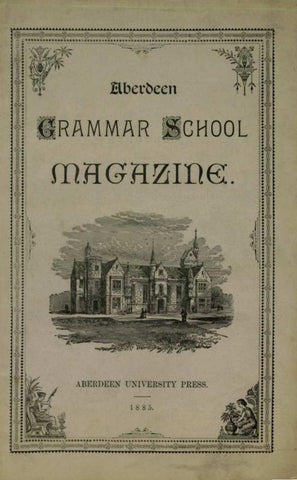
itherbeen RAMMAR
CONTENTS.
PAGE
EDITORIAL AND PREFATORY, NOTES,
.
.
.
•
•
1
•
•
2
•
4
•
HISTORY OF THE GRAMMAR SCHOOL,
•
•
•
•
•
•
SONNET TO TROY,
•
•
•
•
•
•
•
•
.
•
.
•
.
•
•
10
•
•
•
•
•
•
•
•
•
•
11
•
•
•
•
•
•
•
•
•
•
13
THE LITERARY SOCIETY, .
•
•
•
•
•
•
•
•
15
A GREAT SEA FIGHT,
.
•
•
•
•
•
•
•
•
21
TRANSLATION OF HORACE,
•
•
•
•
•
•
•
•
CHAUCER,
•
•
•
•
•
•
•
•
•
•
•
CRICKET, .
•
• •
•
•
•
•
•
•
•
•
•
•
25
•
•
•
•
•
•
•
29
•
•
•
•
•
•
•
29
FOOTBALL NOTES, L'ALLEGRO,
.
NOTICES TO CORRESPONDENTS, ADVERTISEMENTS,
.
•
•
•
•
22 23
A-REx,17E H ; i\T
GRAMMAR SCHOOL MAGAZINE, Obiforiar anb Wrefatorv. HERE comes a time in the life of every man of letters when he feels the literary energy within him full to overflowing. He must commit to writing—or even to print—some of the teeming thoughts of his busy brain. And so his literary firstborn appears. This eventful time comes at an early age with some men : while with others it makes no appearance till late in life. Pope lisped in numbers: Macaulay wrote Epics and Universal Histories at five : Hobbes, on the other hand, was thirty before he learned the language that was to be the medium of most of his Philosophical Speculations. As it is with the Man of Letters, so it is with the School of Letters—for what is a Grammar School after all, but a School of Letters ? Some Schools bud into literary activity at an early age. Hardly have they got beyond the " mewling and puking " stage
T
before they begin to fit their tongues "To dialogues of business, love or strife."
The " Fettesian" is already of many years' standing, and so is the "Lorettonian" and many others. Now surely the older Schools, such as ourselves, are not to be behind-hand. Only the other day did the Charterhouse School rouse itself to its literary senses and project its periodical. We observe that in the Second Number, which appeared in December, they give a fac-simile of a page of the original manuscript of " The Newcomes " from the hand of a certain Mr. Thackeray who is an " old boy " of theirs. Grammar The Aberdeen than even School is much older the Charterhouse. It may be said to have passed through the Seven Ages—having probably seen as many centuries. Certainly it "sought the bubble reputation" in the person of valiant Rector Wedderburn
,v)'"
2
centuries ago. Were it not that it has so recently renewed its youth, we might be inclined to say that it is now shifting "Into the lean and slippered pantaloon ".
We may hope that though late in beginning its literary career, it may, like Hobbes, have a long literary life before it. Literary energy may long lie latent if there is not forthcoming something, like the " efficient cause" of Aristotle, to summon it into activity. Such an " efficient cause " have we in our much-respected Rector, Mr. Moir, to whose kindly encouragement this Magazine owes its life. We are not to forget that "old boys" too have helped greatly to fill its pages with what we hope will prove both amusing and instructive to the
gentle reader. Our " old boys" are perhaps not so well known as Mr. Thackeray, but then who knows to what they may yet come ? We purpose confining the first year's issue of our Magazine to a Christmas and a Summer Number, but we may say that, if it receive an encouraging reception, we shall in future years make it a Quarterly. We conclude with a hope that " old boys" will not only contribute to our Magazine, but also help to increase its circulation. It ought to be—what is much needed—a bond between the present and the former pupils of that which is often called the New Grammar School, but which we prefer to call the OLD OLD GRAMMAR !
"gofes. HE Athletic Sports, held in Articles on Athletics given bethe School Park on 7th low, the last Season has been June last, were highly successhighly creditable to our various ful. The contests were entered Cricket Clubs. The Report into with spirit, and the Gymspeaks for itself, as to the nastic Exercises bore witness doings of the School Eleven ; to the painstaking method of and we may add that the Instructor Black. After the younger Clubs showed that Games were over, Lord Provost when the day comes, they will Matthews addressed the boys, be ready to take the place of and Miss Matthews presented the First Eleven, and uphold the prizes to the victors. all its present prestige.
T
As will be seen from the
We
understand that
the
3 Rector is to take steps to have the Cricket pitch in better order next Season. This will be much appreciated by the members of the Cricket Club. If younger boys will be strictly prohibited from going on to the pitch, they will have the consolation of seeing better Cricket at the School Matches.
t
The Old Grammar School, erected in Schoolhill in 1757, has been removed to make way for the erection of the new School of Art. To form some link with the old building, it was suggested that some part of it should be re-erected in connection with the present building. Accordingly, the old belfry—presented to the School, in 1627, by Robert Ferguson— along with the old doorway, has been re-erected in front of the pavilion. Together they form a rather striking entrance. A Coat of Arms with Motto has been designed for the School. It may be seen on the cover of the School Prospectus, or on the Football jerseys and Cricket jackets of the School Teams. The number of Academic successes scored by the " Grammarians" during the last year
is very creditable. It speaks well for the success of the new order of things in the School. In the Indian Civil Service list of last year, Mr. James S. Meston gained the 20th place. This year, Mr. Geo. Carmichael obtained the 25th place. We hope that there are others soon to follow. Mr. John N. Farquhar, who was so distinguished a pupil of the School during the Session 1882-83, and who gained the first place at the Bursary Competition in 1883, has gained an open Scholarship at Christ Church, Oxford, of the value of £85 per annum. The fact that Mr. Farquhar has gained this distinguished place at Oxford within fourteen months after leaving the School, shows that the Secondary Schools of Scotland might be able to prepare direct for the English Universities, if they were encouraged to do so. Thus they would be fairly on a level with the English Public Schools. It will be remembered that last year, Mr. Edward Fiddes scored a similar success at Cambridge University.
4 The Bursary Competition came and went in its turn, and again redounded to the credit of the School. Mr. Wm. Findlay narrowly missed the place taken by Mr. John F. Thomson in 1882, and by Mr. John N. Farquhar in 1883. Twelve
Bursaries of the aggregate value of over £800 were gained by pupils of the School. There were five Grammar School boys among the first eight names on the list. May the School win many such laurels!
Aistorti o f1e grammar
cOooC.
(Read to the Grammar School Literary Society, 5th Dec., 1884.)
By JAMES Mont, Rector. IF I can inspire the present pupils of the School with pride in the history of its past, the chief object of this Paper will be gained. It is a legitimate source of pride to be connected with an Institution which has produced so many famous men, which has done so much to fit Aberdonians to take an honourable and distinguished place in the world, and whose origin is so lost in the mists of antiquity, that it is impossible to say when it had its first beginnings. An eminent native historian and alumnus of the School, Dr. Joseph Robertson, has shown that in the early Scottish Church, both before and after the changes introduced by the Scottish Queen known as St. Margaret, there were three classes or grades of a scholastic
kind—the scholar, the master of the schools, and the ferleiginn or lecturer. In 1124, we find mention of a Rector of the Schools of Abernethy. In 1211, St. Andrews has its first mention of a Magister Scholarum. In 1262, Thomas de Bennum, Rector Scholarton de Abirdene, is a witness to a deed by the Bishop of Aberdeen given at Inverurie. The School then existed before 1262. This deed is to be seen in the Register of the Abbey of Arbroath, and but for the preservation of this Register, there would be no distinct reference to the School until 1418, when it is mentioned in the Town Council records. In the Register of the Bishopric of Aberdeen, under date 1256, we find that it was the duty of the Chancellor of
5 the Cathedral "to provide a proper master for the government of the Schools of Aberdeen, able to teach the boys both grammar and logic". How long the School had existed before this date will probably never be ascertained; but six hundred years of existence in unbroken succession presents a phenomenon all but unique in Aberdeen. We have had in that period Roman Catholic Bishops, Episcopal Bishops, and Presbyterian Ministers in our town Churches, while the Grammar School has continued to supply the town with education suited to every century of its existence. The University of King's College, venerable as it is, can count but four centuries of work. Probably there is no existing title in Aberdeen which has had a continuous representative so long as that of Rector of the Grammar School. The first Provost whose identity is known, dates ten years after Thomas de Bennum. It will be seen that the School at first was under the fostering care of the Church, and doubtless chiefly existed for the education of priests. One would naturally look to the Records of the Town Council for references to the Grammar School ; but as only a few fragments of these
exist before 1398, we cannot avail ourselves of them until after that date. In 1418 there was a vacancy in the Rectorship, occasioned by the death of Andrew de Syves, and the Chancellor of the Church presented John Homyll to the post for life; giving him at the same time, as a mark of office, a birretum or close-fitting cap. In the case of John Homyll, the provost and community seem to have had the right of recommending, the Chancellor the right of collation or ratification. This is remarkable, considering the date, and shows how long the School has had a connection with the Town Council. In 1479, we find an entry to the effect that, at the instance of the King, my Lord of Aberdeen, and the Chancellor of Aberdeen, five pounds Scots was to be paid yearly to the then Rector, Thomas Strathachin, out of the common good of the town until "he be promovit til a service within the kirk of St. Nicholas". Five pounds Scots seems a very poor salary, but we must remember that money was worth a great deal more then, and as we shall see, there were other perquisites which must have made up a sum on which one could live comfortably. As showing the value of money then, Hector Boice, his contem-
6 porary, the first Principal of King's College, had only forty marks of salary—a sum equal to 44 shillings sterling—yet as Dr. Johnson says, " it was probably equal not only to the needs but the rank of Boethius". The value of money is further seen from the fact that the Town Council, in 1444, fixed the price of a sheep at two shillings and eightpence Scots money. It was about this time that we first see something like compulsory education. A statute of James IV. (1494) required all " barronnes and freehalders that ar of substance to put their eldest sonnes and aires to the Schules fra they be sex or nine years of age, and til remaine at the Grammar Schules quhil they be competentlie founded and have perfite Latine ". The next reference to the School in the Burgh Records is under date 1509, when John Marshall was appointed Rector by the " provost, baillies, counsell, and communitie," as successor to William Strachan, who appears to have succeeded Thomas Strachan. This John Marshall at the same time received as a mark of his presentation a gift of a pair of beads, a ceremony which I am unable to explain. He is interesting as the first person who held and taught
Protestant views in Aberdeen. In 1521 he was summoned before the provost to answer for these doctrines, and then distinctly said that he held the School from the town, and that he did not recognize the Court of Rome as his master. Two years after, however, he was obliged to admit his errors, and was forgiven. The question whether the Chancellor or the Town were the patrons of the School came up again in 1538, when the former presented to the vacant Rectorship a Mr. Hew Munro, and the latter a Mr. Robert Skeyne. The result of the contest was that the town's nominee was appointed, and this was the last occasion apparently when the Church put forward its claim to make the appointment. I now come to an interesting extract from the Burgh Records, which throws light on one source of income of the Rector. During this age a custom existed of the pupils electing one of their number as Boy Bishop, or episcopus puerorum. He had a mitre, crosier, and other insignia of office, and received the reverence of his fellows. Such elections are known to have been made in English and French Schools. The Rector, accompanied by the Boy Bishop, visited the freemen of the burgh
7 in succession, and by the decree of the Town Council each freeman had to give at least 4s. Scots, and might give as much as he liked. If he failed to pay the 4s., he had to pay 8s. of a fine in addition to the original demand. The date of this decree is 1546. It may be mentioned that when the Reformation swept away this custom as popish, it still continued in another shape down to the end of last century, for at Candlemas a King was appointed instead of a Bishop, who held office for six weeks, and money was claimed from parents according to their liberality, those parents who gave most liberally finding their reward in their boys being promoted in their classes. This could only lead to favouritism and snobbery, and accordingly the Town Council wisely abolished the custom. The next event I notice shows the boys asserting their rights by petition to the Town Council. In January, 1569, an epistle in Latin was sent to that body, complaining of the Rector, John Henderson, that he was depriving them of their lawful holidays at Christmas. A letter was also received from the Rector in which he speaks of the " enormitie of his saidis scollaris ". The Council de-
cided that the pupils should have liberty to absent themselves from St. Thomas Even before Yule to the day after the Epiphany. Seven years after this, however, the Council, finding certain " inconvenientis followand " from these holidays, abrogated them. In 1581 the question came up again, and a compromise was arrived at whereby instead of the Yule play the boys were to get three days at beginning of " ilk rath " or quarter. Peace, however, was not restored, but matters again became serious, for in 1604 we find that the pupils at the "superstitious tyme of Yuill" had taken the school and held it against their master with " swordis, gunnis, pistollis, and utheris wappynnis, spulzeing, and tacking of puir folkis geir, sic as geisse, foullis, peittis, and utheris vivaris ". The Council decreed that the master should receive no pupil to the school without some friend being caution or surety for his good behaviour to the extent of twenty pounds Scots. Eight years after, however, seven young men, sons of country gentlemen, seized the Song School and held it for three days with " hagbuttis, pistollis, swordis, and lang wappynnis ". Twenty students, all sons of gentlemen, were expelled from the schools
8 of the burgh for this offence. Nor did the matter end here, for Gordon of Birsmoir, a near relative of two of the exiled youths, attacked the master of the Writing School with his sword on the street, giving him He adsundry " straikis ". mitted his fault, and found surety not to molest the master in future. But the hot blood of the Birsmoirs could not be thus cooled. For a brother of his, along with the brother of the laird of Cowbardie, with " sum utheris, thair complices," a few months afterwards " cam to this burgh of sett purpos and provisioun, and maist proudlie in contempt of law and justice, and maist crewallie and unmercifullie perseuit Gilbert Leslie, reidar, and maister of the Writing School of this burgh, of his lyiff, on the kingis hie streitt of this burgh, at the kirk styill, and hes gevin him many bluidie and best straikis with durkis and battounes in divers partis of his bodie, to the great effuseoune of his bloode and danger of his lyiff ". The two were arraigned along with Birsmoir, and only got off by the intercession of Gordon of Cluny. Birsmoir paid a fine of two hundred merks, and the three were ordered to " cum to the auld kirk of this burgh on ane preiching day, and thair
immediately efter the ending of the sermone befoir the blessing, to ryis out of thair seat in the ruid loft and compear befoir the pulpitt, and thair in all humilitie ilk ane severallie efter either, crave pardon," &c. See p. xxxi., Introduction to Burgh Records, Vol. II. (Spalding Club.) But we must not be too much surprised at the wild spirit then prevalent in the School when we find even the wife of the Principal of Marischal College convicted of "dinging and stricking Janet Mackye, servant to James Birny in Tarves, on the face to the effusioun of bloode". About this time, it appears the scholars had to attend the Church in a body on Sunday, but they seem to have been seated in a part of the Church where they could neither see nor hear the minister, the result being that a petition was presented to the Kirk Session by the Rector that they should get more suitable sittings. They were accommodated with seats partly in the loft, partly downstairs, and had to take notes of the sermon, and were afterwards examined by the masters. There are still certain seats in the West Parish Church which are known as the `Believers' Seats,' not because their occu-
9 pants excel in Christian faith, but because they are so situated that they have to believe the minister is present, for they cannot see him, and hardly hear him. About this time, that is, about 1600, the Rector had to assert his rights against certain rival teachers who had set up schools in town. The Town Council supported his claim, allowing, however, a certain Edward Diggens, an Englishman, to teach writing and arithmetic. The Rector at this time was a famous man, David Wedderburn. He was the friend of Arthur Johnston, the poet; of Dr. Patrick Dun, the munificent benefactor of the School ; of Scot of Scotstarvet, the Maecenas of the time; of the painter, George Jamesone, the first Scottish artist ; and of the pious Bishop Forbes. He himself was an elegant Latin poet, and his Verses are preserved for us in the Delitice Poetarum Seotorum, published in 1637. He received from the Town Council gifts of money for writing a Latin poem of welcome to James VI. when he revisited Scotland in 1617. And he had previously got a sum for writing a thanksgiving for the King's escape from the Gowrie Conspiracy. With all his scholarship, however, he
seems to have roused the indignation of the parents against him by exacting higher fees from the pupils than they thought he was entitled to. He was also accused of taking " from everie bairne ilk Sunday twa pennies to be gevin to the puir, it being no point of charitie to cans bairnis give silver to the puir, thai having no silver of their own, but that for quhilk they mak sum wrang shift". He also took eightpence every month for bent money, i.e,., permission one afternoon in the week to go to the links for play, and at the beginning of every book " twal pennies ". New regulations were made and ordered to be printed in great letters on a board, and to be affixed in the School, that neither master nor pupil might plead ignorance for the future. Wedderburn had as assistant for a time, Mr. Thomas Reid, who afterwards held the office of Latin Secretary to King James VI., and who was ancestor of the great Scottish philosopher of that name. The period we are now speakbig of was an important one in Aberdeen. It might be called its Augustan age. There were now two Universities within a mile or so of each other, and England had no more. The population was probably about
10 8000, and had nearly doubled in fifty years. Printing, which had been discovered some hundred and fifty years before, was first introduced into Aberdeen about 1623, the first printer being Edward Raban. We have mentioned some of Wedderburn's contemporaries in Aberdeen, such as Jamesone, Johnston, Forbes, &c. The activity shown by Wedderburn is seen in the School being rebuilt : the interest in education, by the gift of 1000 merks to the School from Dr. Cargill, in 1614 ; another citizen gave 500 merks, in 1625 ; the foundation of the Drum Bursaries, in 1629; the gift of a bell and bell-house by Robert Ferguson, in 1627 ; and above all, by the munificent gift of Dr. Patrick Dun, Prin-
cipal of Marischal College, in 1631. He left the lands of Ferryhill, at that time unfeued, and bringing in an annual rent of 600 merks, for the " maintenance and entertainment" of four masters, and ordained that the interest should accumulate until a sum was obtained which would produce an additional 600 merks of annual interest. With this sum, other lands were to be purchased, so that the whole annual income from his gift might amount to 1200 merks. By this noble gift the teaching staff of the School was increased from one to four. A new era of the School may thus be said to have begun, and here we leave our history of the School until our next Number.
onnet fo grov. AKE, ancient Ilion of heroic day, God-founded on the fountains ! I behold Fierce H6re's judgment red around thee fold, And Western chivalry, dashed with dismay, Mark thy great Hector, lion-like at bay 'Mid stricken throng, or, like a comet rolled From his deep orbit, hurl on Hellas' hold The blazing brand—affrighted night's sole ray— In black-browed anguish lo! one sits afar Nursing his wrong, nor reeks his people's weal ; Till friendship reft hath burned a deeper scar Into his soul than time or hope can heal ; Forward he flashes to the ridge of war, And Troy's last hope accepts the avenger's steel.
W
—A. G.
11
foof Bat gtotes. BY AN OLD FORWARD. " And some with many a merry shout, 'Mid riot, revelry, and rout, Pursue the football play."
HE following Paper is intended to be a brief sketch of the results of the matches played by the School in the season of 1883-84, and a few remarks (complimentary and otherwise) are added on the play of the individual members of the team. It is a fact well known to football players, and one which is frequently forgotten by a casual spectator of the game, that it is the team as a whole that gains the victory, and that most praise is not always due to the man who makes the run behind, or otherwise brings himself prominently before the spectators. Wherefore we shall refrain from bestowing much praise on any one member of the team, and confine most of our remarks to the team as a whole. We think the School lads gave a very happy start to their football season at the election of Office-bearers for the Club, for men better suited for the offices could not have been found in the whole School. First, E. D. Jameson, the Captain, proved most able in the choosing of his teams, and in placing his men in the field ;
T
secondly, the Committee, B. Harvey, W. Davidson, and W. Findlay, were always most enthusiastic in forwarding the interests of the Club; and lastly, the Secretary, R. G. Foggo, ably conducted the business transactions. Twenty fixtures were down on the card issued by the Secretary, and of these five were won, three drawn, and five lost ; the other seven did not come off, owing, for the most part, This we to bad weather. think is a very creditable result, considering the very heavy teams the School was sometimes pitted against. In the second match of the season against the Gymnasium, the Grammar had very hard luck, for, after a very exciting and well - contested game, and also after great disagreement on the part of the umpires, the Gyms came off victors by a try to nil. This disgrace, however, was completely wiped out on the 23rd of February, when the Gymnasium received a heavy defeat at the hands, or rather the feet, of the Grammar. It was always noticeable in
12 the matches played by the School, that though the whole team, and especially the forwards, were very light, yet they were able to hold their own against a much heavier team ; and this, we think, was due mainly to the energy of the captain, who, by dint of regular practice, always brought his men to the post in good form, and bent on winning. This was chiefly evident in the match against Marischal College, played at the Grammar Grounds on the 17th November, when notwithstanding the weight of their opponents, the School played up so pluckily that the game ended in a draw. The slipperiness of the ground, perhaps, greatly tended to this result, for it was impossible to form mauls, and in the loose scrimmages that took place all through the game, the School had the advantage. Harvey, Lothian, and Foggo showed some very fine play. One of the best - contested matches of the season was Marischal College v. Combined Schools, which ended in a decided win for the Schools ; and in this game, E. D. Jameson, A. Younie, and J. Stewart, behind, and Lumsden, Foggo, and Taylor, forward, greatly distinguished themselves. Of those who generally played behind the scrimmage, the two
half-backs, E. D. Jameson, and B. Harvey were by far the best. Both always played a very fast game, their tackling and dropkicking being sure and judicious. It may not be out of place to remark that if Harvey would trust more to speed and dodging, and not so much to weight, he would play a far more effectual game. Mr. A. V. Lothian, who had lately begun to play Rugby, also did splendid work for the School at half-back, and we venture to affirm that if he had a little more practice he would play a better game (if it were possible) under the Rugby rules than under Association. The two quarters, A. Younie and W. Findlay, are both very good men. They were very swift and always played an exceedingly willing game. Of the forwards we name Davidson, Findlay, and Foggo, as the pick. The first-named is a splendid man at the mauls, and always does good work for his side ; Findlay played quite as good a game forward, as he did at quarter, and he scored more tries than any other member of the team ; Foggo also played hard at the mauls, and the only thing that could be said against him was, that he was rather light ; but this was fully compensated for by the splendid work be did in the
13
loose scrimmages, and in his being always on the ball. The other forwards were, for the most part, light, and their value lay, not so much in their individual play, as in their playing well together, and in always following up hard. Most of the team of 1883-84 have left the School, and have gone to swell the ranks of other clubs in town, but the Grammar team now in the field is by no means to be despised, having succeeded in beating the 'Shire and Gymnasium, and tieing with King's College. They bid fair to finish off their card quite as successfully as did the team of last year, only some of the forwards seem to think it highly improper to
follow up the ball, or to put down their heads when in a maul. It may be worth while mentioning that the School have changed their colours to scarlet. This colour is rather bright, but looks very well in the field, and is greatly to be preferred to the old blue. It is also worthy of mention that at the general meeting of the Club at the beginning of this season, a very handsome set of touch flags was presented to the Club by two "old forwards," and the Club should be proud of the gift, as it shows that the donors, though they have left the School, have still its interest at heart.
cil'Arfegro. FTER Milton left Cambridge in 1632, he went to live with his father at Horton. Here it was that he wrote the Allegro and Penseroso. To the former of these poems we wish briefly to call your attention. Throughout this poem, as well as in the Penseroso, we find traces of the influence of his surroundings on Milton. Horton indeed was a fit place for a mirthful man. There he could experience all
A
the pleasures mentioned in the poem. The first part of the poem, consisting of the first ten lines, may be looked upon as an introduction. Melancholy is banished and denounced as "Of Cerberus and blackest midnight born ".
In the next part L'Allegro invites mirth and gives her genealogy. " But come thou goddess fair and free, In heav'n y-clept Euphrosyne."
14
He depicts her as the daughter of Venus and Bacchus, or "as some sages sing " (the " sages " probably referring to Milton himself, 'as it has not been found elsewhere), the daughter of Then Zephyr and Aurora. comes an invitation to the companions of Mirth; these are Jest, Youthful Jollity, Quips, Cranks, Wanton Wiles, Nods, Becks, Wreathed Smiles it
Such as hang on Ilebe's cheek, And love to live in dimple sleek ; Sport that wrinkled care derides, Laughter holding both his sides ; And in thy right hand lead with thee The mountain nymph, sweet Liberty."
Then comes an entreaty addressed to Mirth to admit him of her crew. Then we have the morning pleasures of L'Allegro. The first of these is " To hear the lark begin his flight,"
and the crowing of the cock, and the sound of the hounds and horn, " From the side of some hoar hill Through the high-wood echoing shrill ".
Again, L'Allegro is supposed to be walking, not unseen like Penseroso, but in broad daylight On reading this part of the poem, do not we seem to hear the whistle of the ploughman, the song of the milkmaid, the sound of the mower as he whets his scythe, and to see the
" Russet lawns, and fallows gray," The "mountains on whose barren breast The lab'ring clouds do often rest," The "meadows trim, with daisies pied," The "shallow brooks, and rivers wide,"
and the towers and battlements " Bosom'd high in tufted trees " ?
These are the pleasures of country life in open day. We have now the pleasures of country life in the evening. The country lads and lasses " Dancing in the chequer'd shade,"
and all the villagers, old and young, coming out to be refreshed by the cool evening air; the old men enjoying their pipes, the women chatting, or watching the children at their play. Then we have the pleasures of night ; the villagers gathered round the fire drinking ale, and telling stories of fairies, goblins, fiends, etc. Next come the pleasures of town life ; the pleasures of busy life ; of the tournament ; of literary struggles ; of marriage-feasting and theatricals. Then there are the pleasures of the theatre, of hearing the plays of Shakspere or " Rare Ben Jonson ". In the last section we have the pleasures of music and poetry. L'Allegro wishes to be lapped in "soft Lydian airs" and " immortal verse ". He
15
delights in music which would have charmed Orpheus himself, and at the end, declares his resolution to abide with Mirth, if
she will give him these pleasures. " These delights if thou canst give, Mirth, with thee I mean to live." J. B.
O1Oferan? g.ocietv.
ARLY in November, 1882, the idea of forming a Literary Society in connection with the School was suggested to the Rector by some pupils in the highest class. Mr. Moir, with his characteristic interest in the welfare of his pupils, at once entered heartily into the proposal. At a meeting of the Upper School, held in the Rector's class-room,. the proposal was enthusiastically received, and an interim committee was appointed to draw up a code of rules, and to make preliminary arrangements. At a second meeting held soon afterwards, the report of this committee was read and adopted. It was resolved that the Society should be called "The Aberdeen Grammar School Literary Club and Debating Society," that it should meet every alternate Friday at 7 P.M. in the Rector's class-room, and that the Annual Subscription should be One Shilling. The election of Office-bearers for the Session was then proceeded with, the following gentlemen being appointed :—
E
t
t
k.
Patrons— Professor Geddes, LL.D. ; Professor Salmond, D.D. ; Professor Milligan, D.D. Honorary President— James Moir, Esq., M.A. Honorary Vice-President— Hugh F. Campbell, Esq., M.A. President— Mr. Alfred A. Cooper. Vice-Presidents— Mr. Robert W. Iunes, Mr. John Lendrum, Mr. Robert Smith. Secretary— Mr. Donald Macmillan. Treasurer— Mr. Surtees Hume. Editor of Magazine— Mr. James L. Salmond. Committee— Mr. John Gordon, Mr. Howard A. Gray, Mr. Johnstone Murray, Mr. James L. Salmond, Mr. James Skeaff. The drawing up of a Syllabus for the ensuing Session was relegated to the Committee, who after painstaking activity, placed
16 an interesting and attractive Syllabus in the hands of members. Ten regular meetings of the Society were held throughout the Session, of which one was occupied bythe Honorary President's Inaugural Address, one by the reading of the Magazine, four by Lectures and Essays, and four by Debates. The Inaugural Address was delivered by the Honorary President, Mr. Moir, who, after a brief allusion to the origin of the Society, and the uses and advantages of such societies, read an interesting and exhaustive paper on " Samuel Johnson ". Of the four debates, one was historical, two educational, and one political. The historical debate was one taken from Scottish history, namely, "Has Wallace done more than Bruce for Scottish Independence ?" The question was decided by the Society in the negative by a majority of 8 votes. Of the two educational debates, one was on the wellknown question, "Liberal v. Scientific Education". The subject was keenly and exhaustively discussed, and, on a vote being taken, it was found that 27 supported the Scientific, and 14 the Liberal side. The other educational debate, which was of course of great interest to a School Society like our own, was on the question, " Is life at
the Public School of England preferable to life at the Grammar School of Scotland?" After a long and spirited discussion, those gentlemen who supported the patriotic side of the question came off the victors by a majority of 9 votes. The political debate was "Should the Government grant Home Rule to Ireland ?" Each of the gentlemen who opened the debate ably supported his side, but the discussion, as was to be expected, was rather one-sided, and when the question was put to the vote, the Home Ruler was found to stand alone. One of the most important " events " of the Session was a Lecture by Professor Geddes, one of the Patrons of the Society, on "Literary Memories of Aberdeen ". Besides the ordinary members there was a large attendance of the public, and the class-room in which the Society met was crowded. The Lecturer, after acknowledging in suitable terms his election as a Patron of the Society, proceeding to the subject of his Lecture, gave a careful and minute account of all the Literary Lights of Aberdeen, from Barbour downwards, referring particularly to Lord Byron and Dr. Arthur Johnstone. Professor Geddes was listened to with great interest, and at the
ft
17 close of his Lecture was accorded a hearty vote of thanks. The last regular meeting of the Society was occupied by a Lecture, by Mr. Hugh F. Campbell, M.A., the Honorary VicePresident of the Society, on " English Oratory of the 18th Century ". Mr. Campbell gave a minute and interesting account of the political, pulpit, and forensic oratory of the 18th century. The Lecture was greatly appreciated, and at the close a hearty vote of thanks was given to Mr. Campbell. Besides those two Lectures, two Essays were read during the course of the Session by former pupils. Mr. Edward Fiddes read a paper on " Lord Macaulay," and Mr. Robert A. Lendrum, M.A., upon " Thomas Carlyle ". Each of these papers bore marks of elaborate study and preparation, and a thorough acquaintance with the subjects with which they dealt. The remaining meeting was occupied by the reading of the Magazine, which was a great success, a circumstance due to the care and energy displayed by the Editor in compiling the Magazine. The papers, all of which were of a high order, were on the following subjects : The Grammar School (a historical sketch), The Siege of Caerlaverock, Government, A Great
Sea Fight, Fiction, Bret Harte and American Humour, Repartee, and The Song of the Six (a poem). At the close of the Session a Musical Evening was held, at which there was a short programme of vocal and instrumental music. This Session of the Society was, in every respect, a success, and far excelled the most sanguine expectations of those who originated the Society. The total membership during the Session was 58, and the attendance reached the average of 37. The Finances of the Society were also satisfactory, its Income exceeding its Expenditure by considerably over a third. The written matter which was brought before the Society (including the Lectures, Essays, Magazine Papers, and Papers of Openers of Debates), was of a very high order, and bore marks of careful study and preparation, a very gratifying circumstance, especially in a young Society like our own, in which this point most of all requires care and attention. The speaking was at first rather crude and confined to a few of the more prominent members. This was only to be expected in the first Session of such a Society, but by the end of the Session marked
18 improvement had been made in this department. Lastly, the most perfect order was preserved at all the meetings, a fact which reflects great credit upon the members of the Society. In Session 1883-84 it was resolved to continue the Society for the ensuing Session, and a meeting was held to elect officebearers. At this meeting the Patrons, and the Honorary President, and Honorary Vice-President, were re-elected, and the following gentlemen were appointed to the other offices :—
President— Mr. John Lendrum.
Vice-Presidents— Mr. Howard A. Gray, Mr. Johnstone Murray, Mr. James Reid.
Secretary— Mr. Robertson.
Treasurer— Mr. Davidson.
Editor of Magazine— Mr. Kelly.
Committee— Mr. Barnett Harvey, Mr. Lawrence Cheves, Mr. Robert G. Foggo, Mr. James Black, Mr. William Meston. The Syllabus which was shortly afterwards drawn up by the Committee was of the same nature as that of the preceding
Session, and embraced a considerable variety of subjects. The Inaugural Address was given by Mr. Hugh F. Campbell, M.A., the Honorary VicePresident of the Society. Mr. Campbell addressed the meeting on the subject of Debating Societies, laying particular stress upon how members ought to prepare themselves for debates, and suggesting various subjects which might furnish material for future debates under the auspices of the Society. Mr. George Harvey, M.A. (Classical Master), also read a paper before the Society, choosing as his subject " Addison ". Mr. Harvey gave a vivid sketch of life and society in England in the time of Addison, and then proceeded to give an account of Addison and his writings. Mr. Harvey illustrated his remarks by extensive extracts from the author's works, several of which afforded great amusement. In this Session, as in the preceding one, two papers were read by former pupils. A paper on " The Stars" was read by Mr. Robert S. Kemp, M.A. Mr. Kemp's paper was interesting throughout, and although the subject was a wide one, he treated it in a manner which was both interesting to his audience and as exhaustive as was possible in so limited time.
19 The other paper was read by Mr. George Carmichael, and was upon "Burns". Mr. Carmichael examined carefully and minutely the life and works of Burns, and his paper bore marks of extensive acquaintance with the poet's works. The debates embraced a rather wider area than those of the former Session. Of the two historical debates, one belonged to ancient and the other to modern history. The debate —" Has Cicero or Caesar done most for the World ? " was entered into very fully and minutely, and the Society declared in favour of Caesar by a majority of 22 votes. The other historical debate was on the popular question—" Was the Execution of Charles I. justifiable ? " The question was discussed both by the openers of the debate and by the gentlemen who followed them in a manner which showed careful study of the history of the times. The meeting after considerable discussion adopted the negative by 27 votes to 11. The interesting question—" Is the Cultivation of the Body as Important as that of the Mind ? "—also came under the notice of the Society, and was the subject of the most successful debate that has yet been held. The debate was opened by two elaborate and carefully
prepared papers, and the discussion was taken up with great zest by the members present, the various points being carefully and analytically discussed. At the close of the debate, the negative was carried by a majority of 10 votes. The remaining debate, which, as was natural, partook of a slightly comical element, was on a social question — " Is the Barbarian happier than the Civilized Man? " The Society signified their approval of the barbarous state by a majority of 18. The Magazine, from its success in the preceding Session, occupied two nights in the programme, and these two nights constituted two of the most pleasant meetings of the Society. At the first of these meetings the papers were as follows: Science," — " Mathematical " What Folks are Saying," " Chaucer," " A Mathematical Romance," "Anecdotes of the Life of Goldsmith," " A Voyage from Bombay to Portsmouth," "The Boyhood of Dickens," "Aberdeenshire Dialect". There was also a poetical Translation of Horace's Odes, Book iv. 7. At the second, which was the last regular meeting of the Society, the articles bore the following titles :—"Il Pensoroso," " Misnomers," " The Venerable Bede," " Kissing,"
20 "L'Allegro," "A Cricket Ballad," " Epitaphs," " What Folks are Saying," " An Old Skipper's Yarn," "Notions about Names," " The Ladies ". At each meeting a hearty vote of thanks was passed to the Editor, for the energy and skill he had shown in compiling the papers. The Session was brought to a close by a Musical Evening, held in the Rector's Class-room. Admittance was extended to all the pupils, and the room was crowded. A very pleasant evening was spent in the enjoyment of a large and varied programme of vocal and instrumental music. At one of the meetings, the question of publishing an annual in connection with the School was discussed. The proposal was unanimously agreed to, a committee was appointed to carry the resolution into effect, and the result is the present volume. The Society has already entered upon its third Session, which—from the office-bearers elected and the syllabus already issued—bids fair to be fully as successful as either of the two preceding Sessions. The insti-
tution of this Society has supplied a long-felt want in the School. Hitherto, as Professor Geddes pointed out in his Address to the Society two years ago, too much attention has been paid in our schools to the `ratio,' and too little to the `oratio,' and this is especially the case in schools such as our own, whose traditions extend back for 700 years. Such a Society trains the pupils to fulfil their duties in after-life, and accustoms them to business habits and forms in a way in which nothing else can. It also brings the pupils into far closer and more intimate relations with the masters, and impresses upon the former more forcibly the fact that both are working for the same end. A third and very useful result is, that by getting former pupils to read papers, the connection and interest of old boys in the School is closely maintained. We shall now leave the Society for another year, congratulating them on their success in the past, and wishing them still greater results in the future.
21
A Orval. l ea HERE is a great sea adventure, which is not commonly known, but which has been described in Tennyson's beautiful ballad " The Revenge ". It is that of Sir Richard Grenville, a " man of Devon," who fought in his small ship "the Revenge" for a day and a night against fifty-three Spanish line-of-battle ships. Grenville, under Lord Howard, was at the Azores with the Revenge and five other ships, when they received intelligence of fifty-three Spanish sail approaching. Lord Howard knew that with their numbers and in their condition, there was nothing for them but flight. Accordingly he sailed away with five of the vessels, leaving Sir Richard to transport a great number of sick men from the land on board his vessel. Having faithfully and heroically accomplished this task, Grenville set sail, and soon came in sight of the Spaniards; from whom he had resolved never to flee. So he ran his little ship "right into the heart of the foe," until he met
T
" Their mountain-like San Philippe, That of fifteen hundred tons, Which up shadowing high above us, With her yawning tiers of guns,
Took the breath from out our sails and we stayed."
Then commenced one of the most terrific sea-fights the world has ever witnessed. Grenville fought with indomitable courage, for as galleon after galleon attacked the brave little ship, they were repulsed, and as Tennyson beautifully says:— " Ship after ship the whole night long, their high-built galleons came ; Ship after ship the whole night long, with her battle thunder and flame ; Ship after ship the whole night long drew back with her dead and her shame ; For some were sunk and many were shattered, and so could fight us no more. God of Battles ! was ever a battle like this in the world before."
After having fought all night and expended all his ammunition, Grenville still lay defiant in the midst of his many crippled foes; and he cried to his gunner to sink the ship, for it was better to fall into the hands of God than into the hands of Spain. But his seamen agreed to ask the Spaniard to promise to let them off if they yielded ; so the agreement was made, and Grenville, mortally wounded, was brought on board the Spanish flag-ship, where he was laid by the mast, and complimented on
22 his bravery, with true Spanish politeness: but he rose to his feet and said :— " I have fought for queen and faith like a valiant man and true, I have only done my duty as a man is bound to do ; With a joyful spirit I, Sir Richard Grenville, die—" And he fell upon their decks and he died.
Then the hero was honourably buried in the deep, and a Spanish crew was put aboard his brave little ship, and the whole company sailed away; but a storm arose, and "The little Revenge herself went down by the island crags, To be lost ever more in the main".
Thus this great contest, the story of which seems incredible, but is nevertheless true, was fought. It deserves an honourable place in the annals of Britain's sea-fights, in which so many Spanish vessels have been destroyed, owing in some measure perhaps, to the fact that the little English ships were, on account of their smaller size, able to manoeuvre with astonishing rapidity; while, on the other hand, the great Spanish vessels were clumsy, and awkward in their movements.
gransrafion. HORACE, ODES IV. 7. LED are the snows: fresh on the plain The pastures now are seen ; And to the trees once more return Their vernal coat of green.
F
The face of earth is changed: all things Another garb have donned ; The rivers, dwindling, 'twixt their banks Glide past to seas beyond. The Graces now, fair sisters three Whose forms no robes impede,
In fairy movements with the nymphs Midst twining dances speed. 0 man ! think not to live always, This life is but a sight, Thus warns the year, thus warns the hour That parts the benignant light. To vernal breezes yields the cold Of winter's icy blast : On spring the balmy summer treads, Yet destined not to last.
23 For soon sere autumn comes again With fruit in plenteous store ; Then sluggish winter, dark and drear, To cover earth once more.
Yea, naught which thou hast got thyself, For thine own soul's delight, Shall 'scape the hands of thy true heir And shun his grasping might.
But yet the moon's revolving beams For these afford some meed ; Yet we a shadow are and dust Like men of nobler need.
When thou, my friend, hast yielded up The breath which now we draw, And Minos over thee has cast His just and changeless law ;
Then, 0 my friend, who can foretell What man will dare to say Whether the gods a morn will add Unto thy brief to-day 3
Then can no eloquence of thine Or action change thy doom ; For e'en Diana could not bring Her swain from Stygiau gloom. J. L.
§0aucer. HE parentage and birthplace of Chaucer were at one time subjects of great controversy among authors. But it is now pretty generally agreed that he was the son of John Chaucer, citizen and vintner of London. The date of his birth cannot be determined with any certainty. Most writers state that it took place about the year 1340. Very little is known of his early life and circumstances. We can only infer from his writings that his parents must
T
have been tolerably wealthy, so as to enable their son to enjoy the advantages of an education extending over an area wide enough to bring within its range the vast store of Chaucer's knowledge. The place of his education also has been, and still is, matter of dispute. Some say Oxford, others Cambridge; while others confidently affirm that he was both at Oxford and at Cambridge. All that can be said, for certain, as to his education
24 is, that all his works teem with matter illustrative of his genius, of his high culture, and of his possessing an extensive acquaintance both with literature and things in general. Like most gentlemen of his day he spent some time in military service. In 1359 he was serving in France under Edward III., and was made prisoner. He soon afterwards returned to England and married Philippa de Roet, daughter of Sir Payne Roet, a gentleman of Hainault. In 1367 Chaucer was appointed a valet of the King's Chamber, an office commonly held by young men of birth and position. This post was destined to give the finishing touch to his moral education, enjoying, as he must doubtless have done, all the advantages of a " society of the highest refinement". Soon afterwards we find him employed on a public mission to Italy ; and during this visit there is reason to think that he came in contact with Francis Petrarch, the great poet of Italy. In 1374 Chaucer was appointed Controller of the Customs for the port of London. But, notwithstanding his holding this post, he continued to be employed abroad from time to time upon various diplomatic missions. In 1386 he sat in the House of Commons as a re-
presentative of the county of Kent. In the following year he was appointed to the valuable office of Clerk of the King's Works. Soon after this he had the misfortune to lose all the offices he had previously held, and consequently was reduced to such a degree of poverty that he was compelled to sell the pensions which had been conferred upon him from time to time. In this distress he seems to have continued for several years, until he received a pension from the king, which enabled him to live in comfort for the rest of his days. He died on the 25th October, 1400, probably at his own house in Westminster, and was buried in Westminster Abbey. Chaucer's varied career could not be otherwise than beneficial to him. As a soldier, a courtier, a diplomatist, and a man of business, he had the very best opportunities of studying character, and becoming acquainted with the real life of his age. His chief work is that called the Canterbury Tales, which consists of a series of interesting narratives, related by a miscellaneous company in the course of a religious pilgrimage to Canterbury.
25
gricfief. LTOGETHER eleven regular first-eleven Matches were played last Season. Of these, six were won, and five lost, a fair amount of success considering our opponents. The wins were :-
A
1. Bonaccord C.C. by 21 runs. 2. King's College C.C. by 41 runs. 3. Banchory C.C. by 41 runs. 4. Aberdeenshire C.C. (Return) by 13 runs. 5. Chanonry House C.C. (Return) by an innings and 135 runs. 6. Grammar School C.C. (Old Town) by 3 runs.
The defeats were :1. Aberdeenshire C.C. by 27 runs. 2. Chanonry House C.C. by 22 runs. 3. Thistle C.C. (Stonehaven) by 5 runs. 4. R. L. Asylum C.C. by 9 wickets and 51 runs. 5. King's College C.C. (Return) by an innings and 31 runs.
We scored in all 820 runs for 130 wickets, giving an average of 6.3 per wicket, while our opponents made 702 runs for 121 wickets, with an average of 5.8 per wicket. Besides the above-mentioned matches, the Combined Schools v. 'Shire resulted in a win for the Schools by 14 runs. The Grammar "six" scored 53 runs, while the "Gym" only made 21.
Now a word more particularly
about the two " Gym " matches, as these are the most important matches we play, and the ones which create far the greatest interest and excitement. The first, played on 26th May, is the great blot on our result. We had confidently expected to win, but came away beaten. This was almost wholly due to the excellent bowling of J. A. Macdonald for the " Gym," who took in the first innings 7 wickets for 21 runs, and in the second 7 for 26. The second was a very remarkable match indeed. The Grammar scored the large total of 152, of which J. Key had 34, and B. Harvey 65. But now comes the remarkable part. The " Gym " went in and were all out in a few minutes for 5, including 3 byes. Following on, they scored 12, of which 7 were byes. Thus for the two innings, 7 runs were scored and 10 byes. The Grammar bowlers had it all their own way, Roy having 11 wickets for 0, and Harvey 9 for 7. It may be mentioned that Macdonald this time also did everything for his side, taking 8 wickets for 64 runs, while the other two men were run out.
-do gm squi. `meal. ogi. Amp -adso wow pun `ioogas aqj
110SV9.1 017[J,
'S92'SJOAV p110009 pun alp uoamlog aatioaaj -pp V 1.V0.1 001 auj s! °Jam. Ong -puotatus -f pun `ifoll T `oB2od uopJo9 -11 `AII931 Aq ouop uaoq sug aD!AJOS pooV `pal age jo -z uosatuur -a 01. SIMI 92V.I0A.V puoaos Jo Jriouog alp ‘S91101VIII 9AU k[II0 ui pakeid sug ag su Ina -s5upiui palaiduma anoj Joj 1.6 cage.losu qsagalg lyou 91[1. sug /Cog -f *uargai kluouugo g9 pun `tuni.o.1 aims, agq. 2,T7 `a2aHoo s,RaIx 4sulau ig uaoq aAvg sasoas 4sagg!g sIll -gaium liana! „ mice „ alp IT am; pun `sogalum ax!gs, agi jo gava ono `slip „r!s„ anoj uosuos alp gnog2noagq pug Bug ag : pang Fru oaaj uaag sug 2um.lg sIll -s2u!uui popiduaoa aanoia ao,I 3. g3 JO 92M19A'S UV
.6
' / PIE 'A `kelP uLl -8 `llassull `fog T . T.9 - g.t `.SaAaull '3.
S92`V.19AU Ota '1101VIU 9110
ut palmog ATiox
mosuas gxou dawn Alois pool v og sosImoad puu `sagalvw tri papttoq kuipula -NT -sum gi aoj g 3lool. a q asagm NaTera uakegouols alp In Airep -adso tunIpatu u su as!! 1.-eaa5 Jo uaag osre sug Hassull -ssaaans poo2 gipt. pun ‘1191.VEU 119A9 ui /45uIdoe.asaad papttog sug ag -aaptiog 1.sag agq. sdregiad s! ogm `Aou satuoa tuIg .1911-v -Buqmog pun 2uppq ui mpg soaptaas va.12 s!!! Joj a4.vid-uopdpastti un mpm qug u gnt0 atp, moat panIoaaa or! UOSVOS ars jo pua age q.u pal.uq.s aq &lag km! puu -one 1.sag2N aq sug .Soitaull up& oiag •cuotp. anailaa o4. .Spogou jnq `Hassell puu q9A -aull `.Sou `siopt.og pool /me. °aim. pug a.m. -soRuuga adota aoj noj sum 4ugni guaaB u q.uotu -lavdop s!gq. uI— ~xr~mog - poiCuidsw
OS
A9AJVH
-J198
OLUUS
SUIT ‘.19A9M01[ ‘.S9A.IUTI
&!!1.4.ug alp `ll!ul.duo ago jo uoRdoaxa oi2upg alp Inw- --191sILLIVa - galuta
ono u! poke-0 gana `alAuct 'f pun `o2Sod • -f `110SpIANT - As `Along -LA T `iluggoo `1143!4!ppu uI treg puoaas ago aoj) 'cox T puu c(uosuas Jo Keg i.sag age aoj) tmtas
•g 'Arpuu •
,a20a 9 -
-g quax
Ittuag `opluoie ugor `uosouruf -ta a - `siaavag-aamo 9t14 Hu .1° palspuoa limas, au
k!snonaIdsuoa
goigAl
'11011131
loan 01 911[09 101I SUIT
901:19pUlIOD
pomogs una4. ay. jo anon Tug; s! sdugaad
'111VaL HILL 93
27 portunity of thanking its Hon. Captain for the great interest he has taken in the School Cricket, and for the services he has rendered the team in the matches, especially by his bowling. The King's College match ended in a victory for the School chiefly through his bowling. FIELDING. —The fielding of the team was very poor. R. Gordon Foggo, however, distinguished- himself at Point, and J. Glennie proved a most useful and efficient Long-Stop. A good fielder is quite as indispensable to a team as a good batsman or bowler. It is often fielding that wins a match, and it is to be hoped that the Grammar School Cricketers will pay more attention to this part of the game next season. THE CLUB. FUNDS. —We are sorry to say we are in debt to the extent of several pounds. We had a considerable debt to start with this season, and we have not managed to wipe it off as yet, though we hope to be able to do so soon. We have only the subscriptions of members to depend upon, and we cannot make the charge of admission high, as too few would then join. As it is, only about 30 joined last
season. This does not give us very much money with which to buy expensive cricket material—and we require a great deal of it, as practice goes on every suitable day throughout the season. GROUNDS. —W e have remarked above that in many respects the team was not up to the mark. Indeed it was not as good as it might have been, for it did not improve much as the season wore on. And little wonder. For we have not a proper practising ground. There is one large field, but unfortunately it has to be used for football in winter, which entirely unfits it for cricket. However, as our Rector is beginning to look into the matter, we may expect some improvement ere long. REMARKS. — 1. As to practising, of course it is very difficult in a day-school to have regular compulsory practices, as some pupils are free at one hour, others at another. Still it is essential if we are to become a good team. And we think that some rules might be drawn up fixing certain days and hours for practice, and making it necessary for every member of the eleven to attend a certain number of practices.
28 2. There is one other point we should like to say a word about, one which is far from favourable to the School cricket. Many of the classes, even in the Upper School, instead of joining the School Club, form separate clubs. This is all very well for the younger boys, but not for those in the Middle and Upper Schools, for they must have very inferior material to play with. They have an idea that they would not have any fun in the Grammar Club, but this is a mistake. And indeed, if they all gave their support to the School Club, it would be in a position to keep two wickets going, one for the eleven, and We hope one for the rest. twice as many at least will join the School Club next season as did last season. This Report may perhaps not seem very cheerful, but we have considered it better to point out the faults than to praise the good qualities of our cricket. We consider the lookout not at all bad. For if good ground is obtained, good cricketers will follow : and the School . eleven will soon require the strongest team of the 'Shire to beat them.
J. L. SALMOND : Bats in good style, but has not been very successful. Rather slow in the field.
J. KEY: Promising bat, but lacks style. Might be sharper in the field.
THE CRICKET CHARACTERS Of those who in the past season represented the Grammar School.
A. F. FINDLAY: Great room for improvement in batting. Has bowled for the Grammar. Promises well for next season.
R. G. FOGGO : Has very good defence, but his average would have been greatly increased by hitting more freely. Very sharp field at point. E. D. JAMESON: Might have been a very good bat with more care and practice. Good hitting power. Good field. J. ROY : Good bat if he would only remedy his loose forward and back play. Undoubtedly our best bowler. A. HASSELL : A neat bat, but not successful. Sharp field at slip. Good slow bowler, almost our only change for the past season. F. KELLY: Fair bat, but rather apt to give chances. Fields well at long-leg. J. A. R. GLENN IE : Fair bat, but greatly lacks the power of hitting. Very sure longstop.
29 We wish he may long be our honorary Captain.
A. V. LOTHIAN, Esq.: Has on many occasions rendered great assistance to the School, both in bowling and batting, but especially in the former.
B. HARVEY, Capt. G.S.C.C.
NOTICES TO CORRESPONDENTS. Correspondents are requested to write on only one side of the paper. "An Old Forward's" letter cannot be inserted as he did not give his name and address. The Editors invite contributions for the Summer Number.
FRENCH AND GERMAN CLASSES AT 62 DEE STREET. HEIN.
HERR
FOOTBALL 1 CRICKET 1 BOATING 1 j
0
11 DT
Da i L _E 0
Co
D,
HATTER,
W
OULD respectfully call attention to his Stock (very superior class) of JERSEYS, SWEATERS, HOSE, BELTS, and COWLS. TROPHY and CLUB CAPS and Special Patterns of JERSEYS, &c., made to
Order. A few of Stewart's Football Calenders still for Sale, Threepence each.
46
TT i\T 1 b I\T
Sail-L HI -R1
January, 1885.
CLASS BOOKS, EXERCISE BOOKS, PENCILS, and everything necessary for School use SUPPLIED AT THE
VERY LOWEST POSSIBLE PRICE FOR READY-MONEY BY
ykLEXAN DER JVI URRAY, EDUCATIONAL BOOKSELLER,
271 UNION STREET, ABERDEEN.
30
LAWD,T
-TENNIS
RACQUETSe
LAWN TENNIS BALLS.
LAWN TENNIS NETS. LAWN TENNIS SHOES. FOOT BALLS.
FOOT BALLS.
ASSOCIATION AND RUGBY SHAPES, BEST MAKERS. Books of Rules of Tennis and Football.
CAMPBELL, ACHNACH & CO., 30iu jtubber Manufacturers, a
18 Bridge treet, ABER,TDEE. I
gN9P
W AlCg,
BOOKSLLLER, S7ATIONER, <IND
NEWSAGENT,
29B UNION PLACE. School Books and Stationery of Every Description. SUPERIOR BOORBINDING EXECUTED IN THE BEST STYLES.
•
31
(-4
M/MWM
9CD
elect Library rid 1,cading Club, 199 UNION STREET AND I CROWN STREET, A]3E,1~DEE1-I V
,
-3*ESTABLISHED 1852.*<TERMS OF SUBSCRIPTION (commencing at any date)—from One Guinea upwards.
JUVENILE LIBRARY-HALF-A-GUINEA. REVIEWS AND MAGAZINES ALONE-HALF-A-GUINEA. A. & R. MILNE supply every requisite in School Books and School Stationery on the best terms.
aiing & f rinter5 to the laniversitr, 2 qlppertiiragate,
t
Arc Wariefies of '3ooft Wora-4afin, Oreeli, Asarem, Oortnan, 3,itaffyntaticaf, &C.
:32
JOHN ADAM, 0enerat & )Eôucational Voollseticr AND
STATIONER,
Largest and Best Stock in Town of Foreign and Classical Books. DIBglIAL DISCOUNT BOA, COH.
PIANOFORTES, HARMONIUMS, AND ORGANS.
N
JAMES MACBETH
AS always on hand a magnificent assortment of GRAND PIANOS, COTTAGE PIANOS, FRENCH AND GERMAN HARMONIUMS, AMERICAN ORGANS, for Sale or Hire on the Three Years' System. SECOND-HAND PIANOS, ORGANS, and HARMONIUMS always in Stock, very Cheap. Inspection requested of my Stock before settling elsewhere.
NORTE OF SCOTLAND PIANOFORTE AND MUSIC SALOON, 164 UNION STREET, ABERDEEN.
EDUCATIONAL BOOKS. JAMES GORDON BISSET ONTINUES to supply all the CLASS BOOKS (New or Second-hand) suited for
C the Requirements of the Higher Educational Institutions in the City, at the Lowest Prices. N.B.—SPECIAL VALUE offered in Second-hand Greek and Latin Lexicons.
JAMES GORDON BISSET, CLASSICAL, MEDICAL, AND EDUCATIONAL BOOKSELLER,
59 BROAD STREET, Opposite Marischal College.