Educational Books. •
JAMES G. BISSET
C
ONTINUES to supply all the Class Books (New or Second-hand) suited for the Requirements of the Higher Educational Institutions in the City, at the Lowest Prices.
N.B.-BEST VALUE IN STUDENTS' NOTE BOOKS. •
JAMES G. BISSET, Classical, liDebical, ant) Ebucational Zooilsetier,
85 BROAD STREET (Opposite MarIsobel College).
Aberdeen Sports Warehouse Everything for Golf, Tennis, Cricket, Swimming, Running, Bowling.
et
Everything for
• tt-'.
•
y
Boxing, Football, Cycling, Motoring, hockey, and the Gymnasium.
SPECIAL TERMS TO CLUBS.
The LONDON RUBBER CO. I6-I8 St. Nicholas Street, ABERDEEN. 'Phone 2363
Telegrr m•--"Waterproof,
Aberdeen."
A. & J. SMITH, Jewellers, Silversmiths, Watchmakers, Opticians, 191
STREET,
UNION
.
AND
23 & 25 ST. NICHOLAS STREET, ABERDEEN.
-
RINGS.
ENGAGEMENT
RINGS.
SIGNET MILITARY
WATCHES.
BRACELET
WATCHES.
CIGARETTE PHOTOGRAPH
&
A.
J.
CASES. FRAMES.
SMITH,
acwetlero, %ilversmiths, 'Watchmakers, Opticians, 191
UNION
STREET,
AN J
23 & 23
ST. NICHOLAS ABERDEEN.
STREET,
Telephone 1991.
RIGBY'S
DELICIOUS SWEETS, 54 Union Street.
•
-
Wait at RIGBY'S for Beach Car. ELLIS & M'HARDY, IS REGENT QUAY & I3CY UNION STREET.
•
Importers of Household and Steam ,Coals.
Delivered by Carefu? and Experienced Drivers. Telephone 2889.
WbeiVINW1114,111,44141111411W1"/%14,111bWililllillAW01);
• i•
Telegrams-" Biscuits, Aberdeen."
Telephone 122.
BY APPOINTMENT.
PURVEYORS TO HIS MAJESTY
!
$
I The Unprecedented Demand for our 1
i
`DUX' OAT CAKES 1 HAS MADE AN EXTENSION OF THIS DEPARTMENT ABSOLUTELY NECESSARY.
•
Orders. Our increased facilities will Ensure Prompt Attention to all
1
MITCHELL & MUIL, LTD., P
ABERDEEN.
1W444%11"VION~NINNAIV&S%-t
t:-`iSt
Established over 40 Years.
Telephone 2995 Central.
W. WELCH, bairbresser, Perfumer, anb Ornamental 'bait Manufacturer,
10 BRIDGE
STREET,
ABERDEEN. Ladies' and Gentlemen's Hairdressing Rooms. MANICURE
AND
CHIROPODY
COUR'Es.
Qualified Assistants sent out to Customers' own Residences.
W. & J. HAY, tilline ilDercbantt3,
459
-
UNION
Cigar Importers
Telephone 2274.
STREET.
and Cigarette Specialists.
-
LEARN TO SHOOT C
Not a toy, but a serious weapon.
with a B.S.A. Air Rifle
(Guaranteed accurate up to 50 yards.) Made in various Weights and Bores.
. " Junior " Model, for Boys and Ladies. Heavy Model for Adults. Ammunition, No. 1 Bore, 2,- per 1000. Catalogues Free.
Inspection Invited.
Intending Purchasers can Shoot Rifles on our Underground Rifle Range in Aberdeen.
ALEXANDER MARTIN, Gunmaker, 128 UNION STREET,
.
ABERDEEN.
Telegraph-- Martin, Gunmaker, Aberdeen.
Tel. No. 480. Telephone No. 1524.
Telegrams : Bruce. Cycles, Aberdeen.
GEORGE BRUCE & SONS,
Established 1884.
Holburn Motor and Cycle Works,
I'
MILBURN STREET. ABERDEEN. Blacksmiths. Engineers, Motor and Cycle Agents. Agents forthe Ariel, Ivy, limnher. Radom, Rover, connaualit, etc., Cycles and Motor cych.,
Gas & Oil Engines Repaired. Lawn Mowers Sharpened, etc. Works 1 ALFORD LANE.
CITY GOLDSMITHS' CO. (A. liOLDSWOlalt,
98 Union Street, ABERDEEN. Second-hand Diamond Jewellery a Speciality.
ENGAGEMENT RINGS.
ft-
Finest Selection :tad most Reasonable Prices in the North of Scotland. Latest London Designs. Set 18 carat Cold and Platinum. From 601- to £30. Other Prices from 10/6 upwards. Inspection and Comparison Invited. Ring Size Cards Free. Note.--Owing to limited window space we hold a large Reserve Stock inside which we shall be pleased to show to intending purchasers.
For really reliable India rubber and Waterproof Goods, try the Actual Makers,
Campbell & Company, 18 Bridge St., ABERDEEN. Telephone No. 157.
Este)). 1878.
Telegrams : " RUBBER."
Established 1847.
Zogan's Music %atoms, 349 Union Street, Aberdeen. PIANOS and OROANS.—A Large and Varied Selection of the Best
An Inspection Invited.
Models 1,1ways on hand. Instalments.
Cash or
.MUSIC.—Up-to-date Music of all kinds always on hand. Examination Any kind of Music sent on and Educational a Speciality. approbation. Music specially ordered delivered in Three days. MISCELLANEOUS.—Violins, Bagpipes, Mandolins, Strings, and
all
Musical Accessories of the Best Quality. Telephone 903.
CONTENTS. PORTRAITS OF THE RT. HON. ROBERT MU N RO AND BISHOP •
Between pp. IN and 109
MILITARY HONOURS AND REWARDS TO F.P.'s -
77 83 92
ANTHONY MITCHELL
-
-
-
.
..
.
-
109
LEITERS FROM EAST AFRICA AND THE CAPE -
113 119 124 1•?6 128 131 132 135 136
PRO PATRIA MORTM
-
NOTES ABOUT OLD BOYS • ANTHONY MITCHELL -
THE HUN FROM HOME
-
-
.
.
SCHOOL NOTES -
-
RANDOM NOTES
-
NOTES ON outt Scorrs
• •
IN GLORIOUS EGYPT-
-
-
.
-
SCHOOL " DEBATER" NOTES
-
-
SCHOOL FOOTBALL NOTES THE FORMER PUPILs' CLUB
-
-
. -
Telephone 2309.
WEST END CAFÉ, LIMITED,
154 UNION STREET. BREAKFASTS, LUNCHEONS, TEAS, Finest in City.
Prices Moderate.
DINNERS,
Everything First-Class.
Concerts, Dances, and At Homes Purveyed in Cafe.
GENTLEMEN'S LUNCHEON AND SMOKE ROOMS DOWNSTAIRS. •••••MIO•=•14.1.1t-•
Telephone
408.
Established
-1811.
G. & W. FRASER, Printers and £Itbographers, Wholesale and Manufacturing Stationers, BELMONT
WORKS,
10 Belmont Street and Gaelic Lane. Office and Show Room
8 BELMONT STREET.
Large and Varied Stock of School Stationery. Every Description of Commercial Printing and Lithographing executed with Taste and Despatch.
Teachers' Testimonials a Speciality.
NEAT. CHEAP. QUICK.
Printing.
ESTIMATES GIVEN.
**
THE CENTRAL PRESS (John Milne), GENERAL PRINTER, LITHOGRAPHER, AND STATIONER,
61 BELMONT STREET, ABERDEEN. Telephone No. 809. Telephone 431.
130WIVIAN & SON, Picture grainers, 187 UNION STREET, AND 79 HOLBURN STREET. GET YOUR PHOTOGRAPHIC REQUIREMENTS AT
D. SOUTER ALLAN'S PHARMACY, (Near Ho!burn /, Junction
35 Holburn Street ‘ -
—
Photographic Department. A Large Stock of Cameras, Plates Films, Papers, and Accessories. Depiit for Kodaks and Kodak Supplies. Developing and Printing executed by an Expel and delivered in 24 beam.
Telephone 1624.
The Rosemount Press BEING EQUIPPED WITH UP-TO-DATE PLANT IN ALL ITS DEPARTMENTS CAN SUPPLY EVERY DESCRIPTION OF
PRINTING AND BOOKBINDING IN THE BEST STYLE AND ON THE •
MOST REASONABLE TERMS.
Farmers' Hall Lane, Aberdeen. Telephone No. 1035.
TO BE PUBLISHED SHORTLY.
Interamna Borealis BEING
MEMORIES
AND
PORTRAITS
FROM
AN
OLD
UNIVERSITY TOWN BETWEEN THE DON AND THE I)EE
By W. KEITH LEASK, M.A. NEW EDITION OF
Life at a Northern University By NEIL N. MACLEAN, M.A. Edited, with Introduction and Notes, by W. KEITH LEASK, M.A.
-
-
-
-
THE ROSEMOU NT PRESS, ABERDEEN.
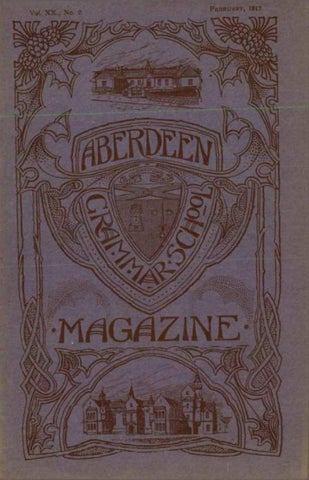
aberbeen Grammar Sc1?oot triaga3ine. It
Vol. XX.
FEBRUARY, 1917.
No. 2 -
The "Aberdeen Grammar School Magazine" is issued three times a year -in October, February, and June— under the auspices of the Former Pupils' Club. All communications regarding the Club should be addressed to the Secretary and Treasurer, JAMES W. MILNE, C.A., 154 Union Street, Aberdeen; and all communications regarding the Magazine should be addressed to the Editor, THEODORE WATT, M.A., 10 Moray Place, Aberdeen. Articles, letters, notes, veraes, photographs, etc., intended for the June, 1917, issue of the " Magazine " should be sent to the Editor not later than 15th May.
Military Honours and Rewards to F.P.'s.
•
Distinguished Service Order. The following nine Former Pupils have received the D.S.O., with effect from 1st January, 1917:— Major (temporary Lieut.-Colonel) Robert Bruce* (18861889), M.A., M.D., Gordon Highlanders (of Cults). He has been three times mentioned in dispatches : —by Field-Marshal French, 30th November, 1915: and by General Haig, 30th April, 1916, and 13th November, 1916. Major James Alexander Butchart (1889-95), Royal Artillery. He received his commission in the Army in 1900, and was promoted Captain in 1911, and Major in October, 1914. In pre-war days he was aide-de-camp to the Governor of Madras.
Major (temporary Lieut.-Colonel) Hugh Allan Davidson
(1889-92), M.B., Royal Army Medical Corps. He was commissioned in 1900, and promoted Captain in 1903, and Major in 1912. Major (temporary Lieut.-Ccionei) Henry Frederick Lyall He is on the General Grant* (1888-95), Royal Artillery. Headquarters Staff of the East African Force, and was
78
Aberdeen Grammar School Magazine.
mentioned in Lieut.-General Smuts's dispatch of 8th May, 1916. Before going to East Africa he was on the General Headquarters Staff of the Mediterranean Expeditionary Force, and was mentioned in General Sir Ian Hamilton's dispatch of 22nd September, 1915. Major William Forbes Lumsden (1887- 1), Royal Garrison Artillery. He was mentioned in Field-Marshal French's dispatch of 14th January, 1915, and General Haig's dispatch of 30th April, 1916. In June of last year he was appointed Assistant Quartermaster-General with the temporary rank of Lieut.-Colonel. Captain (temporary Major) Alexander George Smith* (1880-88), Army Service Corps. He has
Nicol-
recently received a staff appointment in France. He is a member of the Executive of the Former Pupils' Club, and a former Vice-President of the Club. Lieut.-Colonel (temporary Colonel) Charles William Profeit (1884-87), M.B., Army Medical Service. He
was the first F.P. to be " mentioned " in the present War, his name appearing in General French's dispatch of 8th October, 1914. He was again mentioned in Field-Marshal French's dispatch of 14th January, 1915. More than a year ago he was appointed a Deputy Assistant Director of Medical Services. Major (temporary Lieut.-Colonel) Theodore Francis Ritchie (1888-93), M.B., Royal Army Medical Corps.
He received his commission in 1901, and was promoted Captain in 1904, and Major in 1913. His brother, Major MICHAEL B. H. RITCHIE (1897-98), M.B., also of the Royal Army Medical Corps, received the D.S.O. in January, 1916. He is now a Deputy Assistant Director of Medical Services. Major (temporary Lieut.-Colonel) Alexander MacGregor Rose* (1883-94), M.B., Royal Army Medical Corps.
He was made a prisoner of war at Ypres in November, 1914, and was repatriated in June, 1915. He was mentioned in General Haig's dispatch of 30th April, 1916. Bar to Military Cross. Temporary Captain Kenneth William Mackenzie*
(18931897), M.C., M.B., Royal Army Medical Corps, was in February awarded a Bar to his Military Cross. " He displayed great. courage and determination in conducting a hazardous and very difficult enterprise for the rescue of wounded from dug-outs in the newly-captured enemy trenches. He set a splendid example throughout." He was awarded the Military Cross in October (see lingazine, Vol XX., No. 1, p. 27). Military Cross. Captain
William John Sivewright Ingram* (1905-06), M.B., Royal Army Medical Corps Special Reserve, was
Aberdeen Grammar School Magazine.
•
•
79
awarded the Military Cross in November. " He tended the wounded under very heavy fire, displaying great courage and He set a splendid example of determination throughout. coolness and devotion to duty." He graduated in medicine at Aberdeen in 1912. Second Lieutenant Ronald Maclure Savege (1912-13), Royal Artillery, was awarded the Military Cross in November. " When an ammunition recess of his battery was set on fire by a shell, he entered the recess and extinguished the fire. On another occasion he did fine work as 'F.O.O." He attended the School only for a short time, before commencing the study of medicine at Aberdeen University. He received his commission in July, 1915. Temporary Captain John Lyon Booth* (1904-10), Seaforth Highlanders, was awarded the Military Cross in December. " He led his company in the attack with great courage and initiative, capturing the position and maintaining it against He graduated M.A. at very heavy odds for five hours." Aberdeen University in 1914, and thereafter joined the staff of the Aberdeen Daily Journal as a sub-editor. He enlisted in the 4th Gordon Highlanders as a private, and subse quently received a commission in the Seaforths. The following four Former Pupils were awarded the Military Cross on New Year's Day :— Captain (temporary Major) John Milne* (1888-94), Gordon Highlanders (of Braemar). Second Lieutenant (temporary Captain) Ceorge Robert Wilson Stewart (1906-13), commanding a Trench Mortar
Battery. Before the War he was a student of medicine at His brother, Captain JAMES SMITH STEWART* Aberdeen. (1901-08), M.B., R.A.M.C., was awarded the Military Cross in September last. Captain James Noel Thomson (1896-1900), Royal Artillery. He was an officer in the Regular Army before the War, and was mentioned in General Haig's dispatch of 30th April, 1916. Captain Maurice Joseph Williamson* (1894-1903), M.B., He received his commission in 1909, and was R.A.M.C. For more than a year he has promoted Captain in 1912. been stationed at Salonika. Temporary Lieutenant Alexander Cordon Peter (1887-89), M.A., M.B., Royal Army Medical Corps, was awarded the " He tended and dressed the Military Cross in January. wounded under very heavy fire, displaying great courage and
80
Aberdeen
Grammar School Magazine.
determination throughout." Prior to the War he was on the staff of St. Pancras Infirmary, London, and later was medical officer at Prestea Hospital, Secondi, Gold Coast. Second Lieutenant Maxwell Campbell Wright* (1902-14), Gordon Highlanders, was awarded the Military Cross in January. " He assumed command of and led his company in the attack with great courage and determination. He set a splendid example throughout." Second Lieutenant Wright is only 20 years of age, and like Second Lieutenant ALLAN CRUICKSHANK HENDRY* (1907-14), who was awarded the Military Cross in October last, was a pupil at the School immediately before the War broke out. He now holds the position of youngest F.Y. officer to receive a reward for gallantry. Rev. Joseph M'Hardy (1883-84), Temporary Chaplain to the Forces, 4th class, has recently been awarded the Military Cross. He studied at Blair's College for four years, and thereafter at the Scots College, Valladolid, Spain. Before the War he was priest at St. Cuthbert's, Kirkcudbright. Brevet Lieutenant-Colonel. Major Farquhar McLennan* (1888-90), M.B., Royal Army Medical Corps, has been awarded the Brevet of LieutenantColonel, with effect from 1st January, 1917, for valuable services rendered in connection with the War. He was appointed a Deputy Assistant Director-General of the Army Medical Service in November, 1915. Serbian Military Decoration. Official information reached Aberdeen in November as to the officers of the British Mission with the Royal Serbian Army on whom the King of Serbia has bestowed military decorations. In the list is the name of Captain Douglas C. Watson (1892-1900), R.E., who received the Saint Sava Decoration, 5th Class. It will be remembered that this Mission did immense service in extricating the Serbian Army last winter. " No one," writes Major Solomon, " deserved a decoration more than did Captain Watson, and it is with the greatest pleasure that all his old comrades have seen the award." Captain Watson's death at Athens on 16th June last was recorded in the last issue of the iltrigri:ine. Distinguished Conduct Medal. Sergeant Ian Williams* (1903-06), London Regiment, has recently been awarded the D.C.M. for conspicuous gallantry in the field in June, 1916. When the War broke out he was in the employment of Harrod's, London. Charles A. P. Walker* (1894-1902), of the Ca nadians , has also received- the D.C.M.
Aberdeen Grammar School Magazine.
81
Mentioned in Dispatches.
di
Temporary Colonel Peter Mackessack (1887-89), M.B., Royal Army Medical Corps, was specially mentioned in the dispatch of 8th October (published on 6th December) from Lieutenant-General G. F. Milne, Commanding British Salonika Army. He graduated in science at Aberdeen University in 1892, and in medicine in 1896. In the following year he entered the medical service of the Army, and now holds the rank of Lieutenant-Colonel in the R.A.M.C. Last year he was promoted to be temporary Colonel whilst acting as an Assistant Director of Medical Services of a Division Temporary Captain Robert Scott Dewar (1885-90), M.A., M.B., Royal Army Medical Corps, was also mentioned in Lieutenant-General Milne's dispatch. He graduated in medicine at Glasgow in 1905, and subsequently became a medical practitioner in Govan. When he first went on service in April, 1915, he was attached to a clearing station at Imbros. Lieutenant (temporary Captain) James Meston Reid*
(1896-1907), West Lancashire Divisional Engineers, R.E. (T.F.), was mentioned in the Mediterranean dispatch published on 13th July, 1916. The following were mentioned in General Haig's dispatch of 13th November, 1916, published on 2nd January, 1917:— Captain (temporary Major) Eric William Harcourt Brander* (1894-1901), Gordon Highlanders—on General
headquarters Staff. Major William Forbes Lumsden (1887-1), Royal Garriso❑ Artillery—on General Headquarters Staff. Major Alexander Lyon* (1893-1902), D.S.O., Gordon I Iighlanders—on General Headquarters Staff. Temporary Captain Launcelot Hugh Ross* (1898-1901), General List—on General Headquarters Staff. Major James Alexander Butchart (1889-95), Royal Field Artillery. Major (temporary Lieut.-Colonel) Marcus Charles James Hartland-Mahon* (1885-88), Royal Field Artillery. Captain (temporary Major) Thomas Davidson* (1893-97),
Royal Field Artillery. Major (temporary Lieut.-Colonel) George Alexander Smith* (1888-91), D.S.O., Gordon Highlanders, commanding
a battalion of the Royal Lancaster Regiment.
Major (temporary Lieut.-Colonel) Robert Bruce* (1886-
1889), Gordon Highlanders.
82
Aberdeen Grammar School Magazine. Temporary Second Lieutenant George Harper Macdonald
(1900-05), Gordon Highlanders (killed—see Magazine, Vol. XX., No. 1, p. 14). Temporary Major John K. Ewart (1881-83), Army Service Corps. Captain James Vass Lorimer* (1894-96), Army Service Corps. Captain (temporary Major) Alexander Ceorge NicolSmith* (1880-88), Army Service Corps. Lieut.-Colonel (temporary Colonel) Charles William Profeit (1884-87), M.B., Army Medical Service. Major (temporary Lieut.-Colonel) Hugh Allan Davidson (1889-92), M.B., Royal Army Medical Corps. Major (temporary Lieut.-Colonel) Theodore Francis Ritchie (1888-93), M.B., Royal Army Medical Corps. Major (temporary Lieut.-Colonel) Alexander MacGregor Rose* (1883-94), M.B., Royal Army Medical Corps. ' Captain Joseph Ellis Milne* (1882-84), D.S.O., M.D.,
Royal Army Medical Corps.
Major (acting Lieut.-Colonel) William Rae* (1888-1900),
D.S.O., Canadian Infantry.
The names of the following were published in February as having been brought to the notice of the Secretary of State for War for valuable services rendered in connexion with the War:— Lieut.-Colonel George Haddon Bower* (1881-87), T.F. Lieut.-Colonel H. H. Brown (1871-74), M.B., R.A.M.C. Captain (temporary Major) Robert Bruce* (1896-1901), Royal Engineers. Capt. (temp. Major) C. L. Cobban (1891-96), Indian Army. Captain Patrick Ashley Cooper* (1896-1901), Royal Field Artillery. Lieut.-Colonel George A. Cornwall* (1879-80), Royal Engineers. Major William Gordon Craigen* (1894-1902), Royal Field Artillery. Captain (temp. Lt.-Col.) Magnus Mowat* (1882-84), R.E. Temp. Lieut.-Colonel Alexander Ogilvie (1880-81), R.E. Major Francis Grant Ogilvie (1872-74), late R.E. Lieut.-Colonel John L. Reid* (1879-84), T.F. Reserve. Lieut.-Colonel and Honorary Colonel David Brown Douglas Stewart* (1874-77), F.F. Reserve. Major (temporary Lieut.-Colonel) Edward William Watt*
(1883-94), Gordon Highlanders.
Aberdeen Grammar School Magazine.
83 •
Pro Patria Mortui. . " So they gave their bodies to the commonwealth and received, eachfor his own memory, praise that will never die, and with it the grandest of all sepulchres, not that in which their mortal bones are laid, but a home in the minds of men, where their glory remains fresh to stir to speech or action as the occasion comes by."—TnucYDIDEs, II., 43.
'Web flbatbeson kisser (1890-97), South African Horse, died at Durban of malarial fever on 24th November, aged 34 years. He was one of five brothers who attended the School. He served a sea apprenticeship in the Aberdeen Line of Messrs. George Thompson & Co., and remained with them for seven years, during part of the time being attached to the Royal Naval Reserve. In 1904 he abandoned the sea and engaged in sheep-farming in the Orange Free State. Since the outbreak of the War he had been serving with the Colonial forces. 30bit krobje (1906-11), Second Lieutenant, Bedford Regiment, was killed in action in France on 14th November, aged 21. Before the War broke out he was an apprentice in the West-End Branch of the North of Scotland and Town and County Bank, Ltd., and was a private in the Grammar School Company of the 4th Gordon Highlanders. In June, 1915, he went to Sandhurst and received his commission in the Bedford Regiment. He crossed to France in July, 1916, and after five months' service there was killed during an advance. 'Robert 'Ragout libom Catto (1889-90), Captain, Gordon Highlanders, was killed in action in France on 4th He was managing director of November, aged 43 years. Messrs. James Catto, Ltd., Aberdeen, for 15 years. In October, 1914, he joined the Gordons, and went to the Front in May, 1916. He was killed by a piece of shrapnel just after he had come out of his dug-out. He was in the act of taking up a pick and shovel and was found with these still in his hands. His Colonel writes: ' By his death I have lost an excellent officer who was most valuable and efficient, and was one who was remarkably cool and brave under fire on all occasions. GorDon Crate IDutTus* (1904-05), Lance-Corporal, Canadian Contingent, died on 24th December, from wounds received in action in France, aged 22. After he left the School, his education was continued in Glasgow, and then he entered the office of Messrs. Stephen & Smith, advocates, Aberdeen. Later he received an appointment in the Canadian Bank of Commerce, and gained rapid promotion, rising to the position of accountant in one of the branches in Saskatchewan. He was very fond of sport of all kinds, and was an excellent shot. He played a good game of football, and was " Indicates Member of the Former Pupils' Club.
84
Aberdeen Grammar School Magazine. •
G. C. lu 11 ,
R. K. T. CATTO.
JOHN RR n I i i
•
J. B. MMES.
Aberdeen Grammar School Magazine.
65
for some time a member of the Aberdeenshire Cricket Club. When the War broke out, he was not happy until he had uniform on, and he gave his life for his country without a murmur. .
a
•
'Roberta flegicken3ie jferguson (1912-13). Second Lieutenant, Gordon Highlanders, was killed in action while leading his platoon, on 13th November, aged 21 years. Having entered the service of the Canadian Bank of Commerce, he enlisted in the Canadian Mounted Rifles in 1914, and served in the trenches in Flanders last winter. He received a commission in the Gordon Highlanders in February, 1916. 3ames Crutchsbanh (BtIt (1881-89), Lance-Corporal, Royal Scots Fusiliers, was killed in action on 12th October, aged 38 years. For some years he was employed in the general manager's department of the Great North of Scotland Railway, and subsequently entered the service of the Caledonian Insurance Company, becoming chief agency inspector. In this capacity he was stationed for a time in Inverness, next at Aberdeen, and then in Inverness again. He enlisted in March, 1916, and was at the Front for about three months. He was an accomplished and versatile musician. 3ames mrown etutes* (1895-1904), Captain, Gordon Highlanders, died of wounds, in France, on 14th November, aged 30 years. He was the only son of Thomas Robertson Gillies* (1862-66), advocate and auditor of Sheriff Court, Aberdeen. After leaving the School, Captain Gillies served a five years' law apprenticeship with Messrs. C. and P. H. Chalmers, Aberdeen, and graduated B.L. at Aberdeen University in 1908. He continued his legal studies in Edinburgh, and in 1910 entered into a business partnership with his father, the firm being known as T. and J. Gillies. In the same year he was admitted a member of the Society of Advocates in Aberdeen. For several years Gillies was an officer in the Gordon Highlanders (T.F.), and qualified at a School of Musketry and also as an Instructor in Army Signalling. When the -War broke out, he no longer held a commission, having resigned some months previously, but he at once rejoined, and was gazetted Captain in his old battalion as from 7th August, 1914. He underwent training in this country with the battalion, but did not cross to France with it, owing to a breakdown in health. On recovering, he served as Adjutant, and later as Major in a second line battalion. In the early part of 1916 he rejoined his battalion in France, and for several months acted as temporary Major. He was killed in action shortly before the capture of Beaumont-Hamel, when in charge of a detachment clearing out a German trench. He
86
A berdeen Grammar S'eltool Magazine.
was a conspicuously capable officer and a born leader of men. While a pupil at the School, Gillies took a prominent part in sports. He was captain of the Swimming Club, and later, while at the University, greatly helped the water-polo team by his skilful play at half-back. In the affairs of the Former Pupils' Club he early took a deep interest, and was a member of the Executive from 1912. In this capacity he rendered much valuable service, particularly in matters where his legal training could be turned to account. His colleagues felt that in all matters his judgment was worth having, as it was invariably based on a careful study of the subject under discussion. On 24th February, 1913, the Motor Cycle Section of the Club was formed, and Gillies was elected its first Captain. • It was here, perhaps, that he was seen at his best. None of the members or their guests who took part in the week-end runs (now only splendid memories) will ever forget the Captain and his Matchless. Nothing made him lose his temper. Punctures or breakdowns were mere incidents in the run and his high spirits never left him. When others were in difficulties his assistance was always practical, and not merely a suggestion as to what to do or how to do it. As with everything he undertook, he went into motor-cycling thoroughly. He not only knew how to drive, but understood the mechanism in all its details. That he deeply enjoyed the outings of the Section is amply proved by the racy accounts he contributed to the Magazine. In addition to motor-cycling, he revelled in mountaineering. From earliest years he loved the hills, and spent many a happy day among them. Inverey was his favourite headquarters, and there his keenness for walking and climbing found ample scope. In 1912 he succeeded another F.P., James Gray Kyd* (1891-98), as Secretary of the Cairngorm Club and Editor of its .Journal, and subsequently he became Treasurer also. In these capacities he acted with characteristic energy. In August, 1915, he married Miss Rhoda Ledingharn, • third daughter of Alexander Ledingbam* (1865-69), advocate in Aberdeen. By her he is survived, and by a son whom he never saw. Such is the tragedy of war ! The sorrow at his death was widespread and profound, for all who knew him felt that they had lost one of the finest and truest of friends. Mantel 114. Macbattte (1885-87), Captain, Veterinary Corps, died of wounds on 20th December, aged 37 years. After qualifying as a veterinary surgeon, and practising in Keith and Aberdeen, he went to New Zealand, where he was first employed in Government service, and sixteen years ago started near Christchurch on his own account. On the outbreak of war he enlisted in the New Zealand Veterinary Corps, and received a commission.
Aberdeen Grammar School Magazine.
87
3an ilBalcolnt fllYZaren* (18961901), Private, London Regiment, was killed in action (as briefly reported in last Magazine) on 7th October, aged 33 years. After leaving the
School, he engaged in mercantile business in Aberdeen until 1910, when he went to California and engaged in banking and in fruit farming near Los Angeles. Early in .1916 he came home, and enlisted in the London Regiment. He went out to France after a few months' training and took part in the advance on the Somme.
,tP •
FROM A CORRESPONDENT. It was on a winter week-end ten years ago that I first met Ian M`Laren. He was considerably after my time at the Grammar and I did not come to know him until a common interest in hill-climbing brought us together. Four of us went up to Ballater to try ski-ing on Morven and he was one of the party. This was the first of many outings on the hills both in summer and in winter. Two in particular stand out in my memory, both in March, when we climbed Ben Muichdhui and Cairntoul. There was also a fortnight's walking tour in Switzerland, our first introduction to the Alps. Twice M`Laren went back to Switzerland in winter for ski-ing, on which he became very keen. He was one of the three Aberdeen men who attended the meeting held in Edinburgh at
88
. Aberdeen Grammar School Magazine.
which the Scottish Ski Club was founded. His zest for mountaineering did not leave hiin when he went out, to California, for he spent his holidays there in the Sierras and wrote enthusiastic letters about camping out in the woods and climbing Mount Baldy, the chief summit near Los Angeles. I could always picture the neat, light, almost prim figure and imagine him organising expeditions and getting up parties for the hills. When he came home last March to join the Army, he spoke of all the charms of outdoor life in California and of how he was going back there after the War, and some of his old friends talked half jocularly of emigrating with him to that land of constant sunshine and cool sea breezes and pines and mountains. He was to suggest excursions for us and arrange them pleasantly as in the old days on Deeside. They will never come, these outings of our fancy: the circle is broken. On the hills a man's friendships are knit close and M`Laren and I came to know each other well. He was alwayg curiously quiet and reserved. His manner was so subdued that a stranger wondered if he was getting any enjoyment at all. It was difficult to think that a man so restrained might yet be the centre and driving force of a whole party. Such M`Laren often was. It gave him genuine pleasure to entertain and he was kind and hospitable to a degree. He liked having people about him and all who knew him liked being with him. On the hills he seemed tireless. He was one of the party of men who climbed the six Cairngorms in one day —one of the biggest walking feats done in the Highlands— and I can well believe his companions who tell me that he came down from the last hill as neat and as unperturbed as when he started eighteen hours before. He was equable and even, never outwardly elated and never outwardly depressed. At first you thought him unresponsive, but you gradually got past this and came to know the generous and attractive nature that lay behind his quietness. I did not see him after he joined the London Scottish. He fell instantaneously on the Somme. So he would have wished, rather than to be maimed and never able again to climb the hills. Never have the mountains seemed so peaceful or the beauty of the hills so poignant as during these bitter years of war. Everyone of us has lost friends and each of us loves to think of them in some setting known only to himself. It is among the hills that I shall always see Ian M`Laren. flOctlbannee (1909-10), Private, 3obit (Marks to Bedford Regiment, was killed in action on 15th September, aged 20 years. Before enlisting more than two years ago he was an apprentice in the mercantile marine. Etnbrew 1Robertson* (1908-09), Second Lieutenant, Gordon Highlanders, was killed in action in November, aged 24
Aberdeen Grammar School Magazine.
93
of your city." Another speaker at the meeting was Colonel LACHLAN MACKINNON (1865-70)—Dux and Gold Medallist of the School in 1870—who is commandant of the City of Aberdeen Volunteers. Assisting the Imperial War Cabinet
Sir JAMES SCORGIE MESTON* (1876-80), K.C.S.I., Lieutenant-Governor of the United Provinces of Agra and Oudh, is one of the two Indian officials who were recently selected _ to assist the Secretary of State for India, when representing India at the forthcoming sittings of the Imperial War Cabinet. Sir James is, says The Times, " one of the most distinguished of Indian Civil Servants. When in 1912 he was appointed Lieutenant-Governor of the United Provinces he had already seen 27 years' service, no fewer than 20 of which had been spent in those provinces. As District Officer, as a Settlement Officer, and as Director of Land Records he was in direct touch with the people and with the economic problems which affect an agricultural people. He spent four years as Secretary to the Local Government, and in 1904 he went to South Africa to help in reorganizing the Civil Service at the Cape and the Transvaal. In 1906 came his transference to the Government of India Secretariat, with Sir James a short term as temporary Finance Minister. Meston has the reputation of enjoying in an exceptional degree the esteem of the people of Northern India, and he is an exceedingly sympathetic administrator." The " British Weekly."
Sir WILLIAM ROBERTSON NICOLL* (1866), M.A., LL.D., is to be congratulated on the 30th anniversary of the founding
of the British Weekly. On that occasion a correspondent, in giving his reminiscences, wrote :—" I remember some of us were doubtful as to whether the British Meekly would survive. Dr. Robertson Nicoll had only recently come to London from Kelso, and no one knew then the depths of his editorial ability. Dr. Nicoll believed .in giving his readers some first-rate literature. In the series ' Books which have Influenced Me ' he obtained a delightful article from Robert Louis Stevenson, but the circulation was not noticeably helped. A contribution by Mr. Gladstone was not more successful in raising sales. Then J. M. Barrie began his charming and original sketches, appearing under the Then work by S. R. pseudonym of ' Gavin Ogilvy.' To complete the trio Dr. Crockett aroused admiration. Nicoll induced ' Ian Maclareii ' to write, and for several years the Briti4i Meekly was enriched with his brilliant work."
94
Aberdeen Gra Thrnar School Magazine. The Captured s.s. Yarrowdale. WILLIAM BUYERS (1864-66) is captain of the S.S. Yarrow-
dale, which was captured by a German raider in the Atlantic and brought into Swinemiinde, on 31st December. Captain Buyers entered the service of Messrs. Adam & Co. (the owners of the Yarrowdale) many years ago. He became ,captain in 1877, and has commanded since then various of the company's vessels. M‘Bain Memorial Medal for Mathematics. JOHN M`BAIN* (1877-79), C.A., is to present to the School
a gold medal for mathematics, open to the competition of Classical VI. and Modern VI. It is to be given for a period of five years and is in memory of his son, JOHN MORTIMER M'Bsix, who died of wounds on 9th July, 1916. The School in the past has been under many obligations to Mr. M`Bain, and this latest instance of his kindness will serve to keep green the memory of one who was a very brilliant student. ROBERT SELBIE CLARK* (1894 -1901), M.A., B.Sc., who was biologist to the Shackleton Antarctic Expedition, arrived in London on 8th November last. He was one of the party of 22, under the leadership of Mr. Frank Wild, who were marooned on Elephant Island, in the South Shetlands, from April to the end of August. We had hoped that in this issue of the Magazine he would relate some of his experiences, but the authorities lost no time in gazetting him a temporary sub-lieutenant in the Royal Naval Volunteer Reserve, and now he is away again learning the gentle art of mine-sweeping. He just managed, by the way, to get married between times. CAPTAIN JOHN Ross MACNEILL* (1905-06), M.A., M.B., of the Royal Army Medical Corps, is at present serving in Mesopotamia. In a letter written before Christmas he says : — " We had a race-meeting the other day, A.S.C. bronchos being much in evidence. The absence of a grand stand, however, rather ' militated' (as the best journals have it) against the complete enjoyment of the finishes. There were half a dozen ' lluggie Stuart' establishments, all of which did a roaring trade owing to the complete absence of favourites. A couple of wet canteens and a big tea-tent added to the gaiety of nations, while a sprinkling of sisters from various hospitals, most of whom rode over in time for tea, was rapidly absorbed in the general scheme of things. It fears me these damsels must be getting enlargement of the cerebral contents owing to the fuss made over them, the proportion of eligible males being 300 to 1 or so. Nevertheless, this is rather a seventh heaven compared to the trek down from Kut." ARTHUR MORISON CHALMERS (1881-82), H.M. Consul-
General at Yokohama, has been appointed a Companion of the Most Distinguished Order of Saint Michael and Saint
•
0
•
•
A berdeen Grammar School Magazine.
95
George (C.M.G.). He entered the Japanese Consular Service • in 1882. His brother, JAMES LEGGE CHALMERS (1867-69), who died in November, 1914, entered the Chinese Customs Service in 1873. Their father was Rev. Dr. JOHN CHALMERS (1843-44), M.A., LL.D., the distinguished Chinese missionary and scholar. Sir DAVID PRAIN* (1872-73), M.A., M.B., LL.D., F.R.S., C.I.E., C.M.G., Director of Kew Botanic Gardens, has just been appointed a member of the Executive Committee of the Carnegie Trust for the Universities of Scotland. Hon. Lieut.-Colonel Sir JOHN COLLIE* (1873-76), M.D., is organizing an institution at Golder's Green, London, for the curative treatment of discharged neurasthenic soldiers. In a recent article in TNe Times he described the treatment and cure. JOHN NIcoL FARQUHAR (1882-83), M.A., Litt.D., Literary Secretary for the Y.M.C.A. in India, is one of the University men who have gone to France to deliver lectures in the Y.M.C.A. huts. He has taken as the subject of his lectures, " Britain and India," with special reference to the religious beliefs and ideals, and future of India. Professor ALEXANDER FINDLAY* (1882-91) has also been in France delivering a series of lectures on Chemistry. CHARLES MICHIE* (1881-84) has recently received an important appointment in connexion with the administration of war pensions in Scotland. HARRY J. Witsoie (1883-86) is National Service Commissioner for Scotland. Prior to the War he was Deputy Superintending Inspector of Factories for Scotland and North Ireland. . JAMES S. B. DAVIDSON* (1889-99) has been appointed by the High Commissioner of Australia Control Officer of Australia House, the new London headquarters of the Commonwealth. He was previously chief assistant to Messrs. A. Marshall Mackenzie & Son, architects, London, who designed this magnificent building. Rev. GEORGE REITH* (1854-57), M.A., D.D., minister of Kelvingrove U.F. Church, Glasgow, celebrated his ministerial jubilee in November. He was Moderator of the General Assembly of the United Free Church of Scotland in 1914. HENRY ALEXANDER RICHARDS* (1901-05) was in January admitted a member of the Society of Advocates in Aberdeen. PETER DIACK* (1904-09), M.A., a former School editor of the Magazine, is joint author of a remarkable memoir published in November under the title of " Student and Sniper Sergeant," being the life story of J. K. Forbes, 4th Battalion Gordon Highlanders, who fell for his country on 25th September, 1915.
06
Aberdeen Grammar School Magazine.
Rev. JAMES BREBNER (1852-55), M.A., D.D., minister of the parish of Forgue, has retired after a ministry of 47 years. Rev. THOMAS BREMNER ROBERTSON (1887-1901), M.A., of Newhills U.F. Church, Aberdeenshire, has been elected minister of Bainsford U.F. Church, Falkirk. The following have been appointed " additional examiners " by Aberdeen University Court : —English— WILLIAM SOUTAR MACKIE (l895-1901), M.A., Southampton; French—ROBERT LINDSAY GRAEME RITCHIE* (1894-99), M.A., D.Litt., Edinburgh; Botany—RosEnT JOHN HARVEY-GIBSON (1872-76), M.A., Liverpool. Second Lieutenant ALFRED MARSHALL THOM (1900-01), M.C., Gordon Highlanders, was in November gazetted Flight Commander in the Royal Flying Corps, Military Wing. He was awarded the Military Cross in July, 1915. Second Lieutenant ALAN ALEXANDER DUFFUS* (1900-11), Royal Field Artillery (T.F.), has been seconded for duty with the Royal Flying Corps. Lieut. -Colonel GEORGE HADDON BOWER* (1881-87), Gordon Highlanders, has been appointed to the command of a battalion of the Black Watch. Major FRANCIS GRANT OGILVIE (1872-74), C.B., at present holds a special appointment under the Ministry of Munitions, and is graded for purposes of pay as an Assistant Director at the War Office. Rev. DAVID COOPER REES* (1897-1907), M.A., who is serving with the R.A.M.C., was recently in hospital in Salonika, having been wounded in action. He was dux of the School in 1907. ARTHUR LESLIE SCOTT (1908-13), son of James Scott* (1864-67), M.A., I.S.O., has received a commission in the West Yorks Labour Battalion. Captain ARCHIBALD FORBES HYSLOP* (1897-1910), Gordon Highlanders, has been seconded for duty with the Yorkshire Light Infantry. Rev. GEORGE Ton WRIGHT* (1901-06), B.D., Dumfries, is at present working in one of the Scottish Churches' huts in France. ARTHUR A. WILLIAMSON* (1904-07) has recently been gazetted a Second Lieutenant in the Gordon Highlanders. NORMAN JAMES WI',sox* (1905-15) has received a commission in the Gordon Highlanders. Lance-Corporal JAMES DUNBAR WALKER (1910) has received a commission in the Machine Gun Corps. Prior to the War he was on the staff of the Canadian Grand Trunk Railway, and latterly has been serving with the Gordons.
Aberdeen Grammar School Magazine.
97
Captain HENRY JACKSON BUTCHART* (1890-99), of the Scottish Horse, has received an appointment on the AdjutantGeneral and Quartermaster-General's Staff. Lieutenant-Colonel JOHN Low REID* (1879-84), of Cromleybank, Ellon, is in command of the let County of Aberdeen Volunteer Battalion. ROBERT JACKSON MACLENNAN (1882-86), of the Glasgow News, author of various sketches and plays, organized and was a member of the first Scottish concert party which recently visited the Western Front. • Second Lieutenant ALLAN CRUICKSHANK HENDRY* (19071914), M.C., has been gazetted to the Flying Corps. ERIC DOUGLAS MCDONALD* (1909-13) is serving with a Canadian machine gun section. When war broke out he was in the service of the Canadian Bank of Commerce. ALEXANDER CAMERON SCOTT (1895-98) is a Second Lieutenant in the Gordon Highlanders, and was wounded in November. He previously served with the London Scottish, and was wounded at Messines.
Sergeant HARRY JAMES Lima* (1905-06), Highland Light Infantry, was in January reported wounded and a prisoner in Germany. In a post card to his father he wrote:—" I have no doubt you will be wondering why I have never written lately, but by the fortunes of war, I am now a prisoner. We were cut off, and were without food and water for eight days, and combined with these discomforts I was also wounded. I have two shrapnel wounds in back, and left shoulder fractured, but I am getting on as well as can be expected." JAMES FIDDES* (1904-14)' has been awarded a prize cadetship at the Royal Military College, Sandhurst.
•
ROBERT ARTHUR MILNE (1907-15) passed 27th into the Royal Military Academy, Woolwich, as a result of the competitive examination held in November. ROBERT AITKEN* (1897-1903) has been gazetted Second Lieutenant, Royal Garrison Artillery, from the 2nd Artists Rifles O.T.C. His nephew, ALEXANDER AITKEN* (1909-14) is a Second Lieutenant in the Gordon Highlanders. DAVID H. HALLIDAY* (1904-07) is at present training in No. 3 Officer Cadet Battalion. GEORGE ROWLAND HILL* (1911-13), who since leaving the School has been engaged in engineering in Bath, has entered the Royal Naval Air Service. JOHN HORNE WILSON (1885-91), M.D., holds a commission in the R.A.M.C., and is attached to the 37th Casualty Clearing Station.
98
A berdeen
Grammar School Magazine.
Captain DOUGLAS GORDON CHEYNE* (1901-05), M.D., R.A.M.C., has now obtained a commission in the Regular Army. In addition to his other duties he is commandant of the 9th Corps School of Sanitation, and one of the lecturers to the 2nd Army School of Sanitation. ROBERT FLEMING* (1891-98) is now serving with the Canadian Pioneers. He sent to the Magazine from France a realistically drawn and worded Christmas card got up by himself " for the boys." CLIFFORD C. CHANCE* (1906), M.B., having been invalided from the Navy, has joined the Red Cross. When writing recently, he expected to be sent to a hospital in Cairo. Lieutenant WILLIAM GEORGE MELVIN* (1888-96) and Lieutenant ARTHUR WILLIAM ST RACHAN (1893-1901) have been recently stationed at Peshawar, India. ALEXANDER SMITH ANDERSON* (1905-09), who enlisted in the King's Royal Rifle Corps, is now serving with a battalion of the Rifle Brigade in France. HERBERT LOUIS WATSON* (1895-1907), after spending twelve months in training in England with the King's Liverpool Regiment, and twelve months with the Royal Engineers in France, has lately been brought home by the Ministry of Munitions, and now is resident in Glasgow.
MARRIAGES. DP GREGOR (1886-87).—At 26 New Bongate, Jedburgh, on
1st December, WILLIAM J. XV GREGOR, chemist, Ellon, to Lizzie, elder daughter of James Brunton, District Road Surveyor. HALL (1892-95).—At Warminster, Wiltshire, on 18th November, ERNEST NEWTON HALL, Australian Field Artillery, son of Robert Hall, Woodside, Aberdeen, to Catherine, third daughter of James F. Anderson, manager, Drimnagh Paper Mills Co., Dublin (late of Donside Paper Co., Ltd., Aberdeen). KIRBY (1892-1901) .—At the First Presbyterian Church, Pietermaritzburg, Natal, on 23rd December, PERCIVAL ROBSON KIRBY, son of the late John Kirby, Professor of Music, Aberdeen, to Maud, daughter of Robert Inchbold, accountant, Leeds. GAULD (1893-98).-At Beechgrove United Free Church, Aberdeen, on 21st February, Rev. W. W. GAULD* M.A., minister of the United Free Church, Callander, to Charlotte Jane, only daughter of John Reid, 78 Forest Avenue, Aberdeen.
A b erqeen,
Grammar
S!ch
Ma yazine .
99
HECTOR (1893-1901).--At Trichinopoly, S. India, on 16th November, KENNETH STUART HECTOR,* Bank of Madras, youngest son of the Rev. John Hector,* D.D., to Claudia Henrietta, elder daughter of Wynford Beaufort Grimaldi, of Bournemouth, Hants. CLARK (1894-1901).—At the Presbyterian Church, Queen's Road, Brighton, on 23rd November, ROBERT SELBIE CLARK,* M.A., B.Sc., to Christine Ferguson Macdonald, of Edinburgh. WILLIAMSON (1894-1903).—At St. Philip's Church, Kensington, London, on 28th November, Captain MAURICE JOSEPH WILLIAMSON,* son of the late Dr. W. H. Williamson, to Dorothy, daughter of the late Dr. Keith, Aboyne. GOODBRAND (2895-1900).----At Greenwich, on 4th December, STEPHEN GOODBRAND,* W.A.M.S., elder son of James Goodbrand, Aberdeen, to Catherine Jean, daughter of the late Peter Iunes, Perth. BRUCE (1897-1903).—At Kitsiland Presbyterian Church, Vancouver, B.C., on 18th November, ARTHUR CROMAR BRUCE, of Kerrisdale, Vancouver and Aberdeen, to Fanny, second daughter of the late S. B. and Mrs. Morse, of "Schandau," Frances Road, Bournemouth. STEWART (1898-1905).—At Moukden, Manchuria, on 14th December, Rev. JOHN STEWART, eldest son of Rev. James S. Stewart, Aberdeen, to Flora Christian Gladys, elder daughter of the late Rev. Colin Mackenzie, St. Ninians, and Mrs. Mackenzie, Stirling. Roes (1899-1902).—At Edinburgh, on 25th January, Captain DOUGLAS GEORGE ROBB,* R.E., to Ethel, youngest daughter of Mr. and Mrs. Calvert J. Grant, of 5 Denhamgreen Avenue, Edinburgh. SMITH (1900-08).-At Christ Church, Clapton, London, on 14th February, JAMES DRUMMOND SMITH,* R.F.C., son of Rev. Wm. Smith, Greyfriars U.F. Church, Aberdeen, to Edith Marion, daughter of Samuel Ward, Redcot, Exeter. ROBERTSON (1900-09).--At the Presbyterian Church, Penang, on 23rd December, DAVID GRAEME ROBERTSON,* junior, of D. G. Robertson, Ltd., Kuala Lumpur, to Helen Johnston (Nellie), youngest daughter of the late John Ledingham, Aberdeen. on LYON (1900-11).—At the Imperial Hotel, Aberdeen, 6th November, Lieutenant DOUGLAS LYON,* R.A.M.C., youngest son of Charles Lyon, 10 Carden Place, to Jessie Margaret, second daughter of Robert Alexander, iron merchant, Aberdeen. Free GILCHRIST (1901-05).-At Wellesley Square United GILChurch, Calcutta, on 3rd January, ROBERT NIVEN KrishPrincipal, Service, Educational CHRI ST,* M. A ., Indian
100
.
Aberdeen.
Grammar
School Magazine.
nagar College, Bengal, to Winifred, daughter of William Buyers, shipmaster, 29 Gladstone Place, Aberdeen. MACMURRAY (1902-04).--At St. Mary's, Islington, London [in December], JOHN MACMURRAY, Second Lieutenant, Q.O. Cameron Highlanders, to Elizabeth Hyde, daughter of the late George Campbell, of Banchory. RITCHIE (1903-09).-At Bombay, in January, Lieutenant JOHN HALL RITCHIE,* Mahratta Light Infantry, son of John Ritchie, 12 Mile-end Place, Aberdeen, to Winifred M. Reid, U.F.C. Mission, Bombay, daughter of the late J. Wilson Reid, M.A., Royal Academy, Inverness. DAWSON (1905-06).—At Skene Street Congregational Church, Aberdeen, on 3rd November, Rev. D. STEWART DAWSON,* M.A., Second Lieutenant, Gordon Highlanders, son of Mrs. Dawson, Belmont House, Aberdeen, to Jessie Stewart, younger daughter of Mr. and Mrs. J ames Dow, 16 Elm Place, Aberdeen. M`KENZIE (1909-11).—At St. James', Stonehaven, on 3rd January, THOMAS BEST-GIBSON M`KENZIE,* Gordon Highlanders, to Annie Amy Innes, only daughter of the late John Hector Anderson, M.D., and of Mrs. Anderson, Waverley, Stonehaven. OBITUARY. Our Oldest "Boy."
.
General JAMES NOWELL YOUNG* (1831-36) died at Eastbourne on 13th January, three weeks before his 93rd birthday. He was latterly believed to be the oldest surviving former pupil of the School, and he was undoubtedly the senior member of the F.P. Club, which he joined in 1907. He entered the military service of the Honourable East India Company on 21st August, 1840, and served in the campaign of 1842 in Afghanistan, under General Pollock, including the forcing of the Khyber and Jugdalak Passes, actions in the Tezeen valley and in the Huft Kohtul, and the recapture of Cabul (medal). On the transfer of the Government of India to the Crown, he joined the Bengal Staff Corps (now the Indian Staff Corps). He remained in India until 1880, coming home only twice on furlough during his 40 years' service. 'For the last few years he was Judge Advocate-General in Bengal, an appointment which had also been held by his father, Major Gavin Young. He was promoted Major-General on 24th August, 1881; Lieutenant-General on 14th January, 1887; and General on 1st March, 1891. From 1888 General Young lived at Eastbourne, where his upright figure (typical of his character) was familiar to many. He possessed a remarkably good memory, and his friends used to enjoy hearing his reminiscences, told with a quiet humour
Aberdeen Grammar School Magazine.
101
peculiar to himself. But it was not only for bygone days that his memory served. It was equally good for recent events, and in spite of his great age, he retained his mental
powers to the end. He was often consulted on business matters, as great reliance was placed on his clear judgment and sound advice. On 28th December last General Young met with an accident while out for a walk, falling backwards on the pavement. Up to that time he had been in his usual good health, and at first he seemed to be recovering. The shock, however, proved to be too much for him, and he gradually became weaker, and passed away on 13th January. The senior member of the Club is now the Rev. GEORGE WISELY, M.A., D.D., for many years Presbyterian Minister to the Forces at Malta. He was born on 21st January, 1826, and was a pupil at the School in the years 1841 and 1842. The Leader of the Dutch Reformed Church.
Rev. ANDREW MURRAY (1838-41), M.A., D.D., the wellknown leader of the Dutch Reformed Church, died at Wellington, South Africa, in January, at the age of 88. For
102
Aberdeen Grammar School Magazine.
more than a generation he was the most conspicuous figure in the ecclesiastical life of South•Africa. He was born at Graaf Reinet in 1828, and when ten years old came to Aberdeen, where he studied at the Grammar School under Melvin. He graduated in Arts at Marischal College in 1845, and then took his divinity course in Holland, chiefly at Utrecht, preparing himself for the Dutch Reformed Church. After three years he was ordained, and on his return to South Africa in 1848, was sent by the Synod of the Dutch Reformed Church to minister to the Boers across the Orange River. Seven years of incessant travelling and preaching, combined with attacks of malarial fever, broke his health down, and he was sent to Europe to recruit. On his return he resumed work in the Orange Free State for three years, and then accepted a call to Worcester, Cape Colony. During his ministry here he was chosen Moderator of his Church. Later he became minister of the Cape Town Church, and after seven strenuous years there, finally took a smaller charge at Wellington, Cape of Good Hope. He took an active part in the Home and Foreign Missions of his Church, and started a Mission Training College. He was president of the undenominational South African General Mission, formed in 1894. Owing to age and failing health he retired from the ministry in 1906, forty-four years after his first election to the Moderator's chair. Dr. Murray, who received the D.D. degree from Aberdeen University in 1898, was a voluminous author of devotional works. Rev. JOHN REID (1845-49), M.A., minister of the parish of Crail, died on 8th February, aged 83. He graduated in Arts at Marischal College in 1853, and after studying divinity at King's College, became assistant minister successively at Largs and Cortachy. He had been minister at Crail for a very long period. In the Australian Gold Rush.
(1846-50) died at Old Aberdeen on 31st December, in his 82nd year. His career was a striking one. In his 17th year he emigrated to Australia, carrying with him testimonials from the Lord Provost of the day (with the seal of the city), the consuls, and other leading men of the town. Soon after his arrival he was offered, and accepted, the management of the original gold buying business founded by the chemist who assayed the first specimen of gold found in Victoria, and before he was 18 he had secured another appointment as manager of a firm of importers at £500 per annum, and within twelve months from the date of his landing he had begun an extensive export business. Mr. Walker's knowledge of Australia was full and exact, and he had quite a store of interesting recollections of its marvellous progress. JOHN WALKER
Aberdeen Grammar School Magazine.
103
He saw much of the wild life associated with the gold rush at Ballarat, and was foreman of the jury at one of the trials there of a leader of a gang of desperadoes. He came back to this country in 1857, and resided for a few years in Aberdeen. He then turned his attention to agriculture in Shetland, and was a well-known breeder of sheep. Later on he was largely interested in copper mining operations at Sumburgh, and for nearly twenty years was very active in county administration in the Shetland Islands. Mr. Walker afterwards lived in Edinburgh, but in 1881 left this country for South Africa, and was officially employed in reporting on the agricultural development of the Colony by railways and otherwise. As a contractor he carried out important works, On returning to including the Cape Junctions Railway. this country he first settled in London, but latterly, having retired from business, resided in Aberdeen. A Worker with Florence Nightingale. JOHN MAITLAND (1847-49), late tea and coffee planter, Ceylon, died at Westcliffe-on-Sea on 7th January, aged 82. He was trained as a chemist in Elgin, and during the Crimean War joined the Army. He worked with Florence Nightingale, and was nursed by her through an attack of cholera. When the war ended, he went to Ceylon, and for the long period of 40 years was a prominent coffee and tea planter there. He returned to this country about 20 years ago, and resided mostly at Westcliffe-on-Sea. Across the Desert by Camel. (1855-56), another tea and coffee ANDERSON GEORGE He planter, died at Cruden on 25th December, aged 76. attended Marischal College during the session 1856-57. In 1858 he went to Ceylon in the pre-Suez Canal days, travelling After being engaged for 13 across the desert by camel. years in coffee planting in Ceylon, Mr. Anderson went to Travancore, India, where he opened up large properties for the Scottish India Company of Inverness, besides owning several private properties. He retired in 1891. ALEXANDER FORBES ANGUS (1856-58) died at Sydney on 6th January, aged 72. Part of his life was spent in China. DAVID EASTON (1862-63) died at Aberdeen on 10th February, aged 67. He spent nearly all his business life as accountant in the firm of Messrs. Davidson & Garden, advocates, Aberdeen. His eldest son, ROBERT MORRISON EASTON* (1894-1904), M.A., M.B., is a captain in the Indian Medical Service ; his second son, JOHN MURRAY EASTON* (1895-1905), is an architect in London, and was severely wounded while
104
.4 berdeen Grammar School Magazine.
serving in France with the London Scottish in the early days of the War; his third SOD, DAVID STUART EASTON (1905) is a pupil at the School. JOHN LEDINGHAM (1863-66) died at Milltimber on 9th December, aged 65. He was joint managing director of Messrs. William Williams & Sons, Ltd., distillers and wholesale wine and spirit merchants, Aberdeen, with which firm he had been associated for more than 40 years. •
Distinguished Medical Service in India. JOHNSTON SHEARER* (1864-69), M.A., M.B., D.P.H., C.B., D.S.O., Indian Medical Service (retired), died at Bridge of Allan on 6th February, aged 64. Having graduated in Arts at Aberdeen University .in 1873 and in medicine in 1877, he entered the Indian Medical Service in 1880. He served in the Egyptian Expedition of 1882 (medal and bronze star) ; in the Burmese Expedition of 1887-88 (medal and two clasps); in the Hazara Expedition of 1891 (clasp) ; in the Miranzai (2nd) Expedition of 1891 (clasp) : in the Waziristan Expedition of 1894-95 (clasp, and mentioned in dispatches); and with the Tirah Expeditionary Force in 1897-98 (medal and two clasps, and mentioned in dispatches). For services rendered in the Tirah Expedition he was decorated with the Distinguished Service Order in 1898. Ten years later he was made a Companion of the Bath, and he retired in 1910 with the rank of Brevet Colonel; Thereafter he resided in Glasgow. COLONEL
HENRY STRONACH
November, aged 60. cantile marine.
(1868-70) died at Inverness on 28th He was formerly a captain in the mer-
WILLIAM CHRISTIE CROWE* (1870-72), M.B., died at Aberdeen on 21st November, aged 64. He graduated in medicine at Aberdeen Univeriity in 1887, and thereafter practised his profession in his native city. He retired from active work a number of years ago. JOHN ADAMS (1873-78), M.A., died at Aberdeen on 3rd February, aged 55. JOHN JAMES LINDSAY (1876-77) died at Aberdeen on 28th November, aged 54. He served an apprenticeship as chemist in Aberdeen, and for a time managed a business there. After being in London and on the South Coast, in 1892 he commenced business in Aberdeen as a chemist on his own account, and so continued until his death. ROBERT MILNE (1878-82), clerk, died at Aberdeen on 15th November, aged 47. He was for a number of years in South Africa.
Aberdeen Grammar Schoot Magazine.
105
JOHN BARCLAY BARCLAY* (1868-73), advocate, died at Aberdeen on 3rd December, aged 61. After studying at King's College, he served a leval apprenticeship with the late
Mr. James Paull, advocate, and was admitted a member of the Society of Advocates in Aberdeen in 1882. Some time afterwards he started business in Aberdeen on his own account, and gradually built up a very fine connection. A Doctor in the Siege of Kimberley. WILLIAM RUSSELL* (1878-85), M.D., died at Kimberley, South Africa, on 10th December, aged 48. He graduated M.B., C.M. at Aberdeen in 1890, and took his M.D. with honours in 1896. For seven years he was house surgeon at Toxteth Infirmary, Liverpool, and later was superintendent of hospitals at Maidstone during the memorable contagious diseases epidemic there. He went to South Africa in 1898, and was given the position of senior house surgeon of the Kimberley Hospital early the following year. He held the office with great credit during the famous siege of 1899-1900. His tireless devotion and self-sacrifice, linked with high professional skill, was signally acknowledged in an autograph letter sent to him by direction of Queen Victoria. A letter of similar import was also received by Dr. Russell from FieldMarshal Earl Roberts. He relinquished his post three years
106
Aberdeen Grammar School Magazine.
ago to enter upon private practice. When the present War broke out, he immediately offered his services, and did excellent work in the German South-West African Campaign. After this came to an end he resumed practice in Kimberley. ROBERT ANDERSON HENDERSON* (1878-87) died in Aberdeen on 3rd November, aged 45 years. He was for a long time associated with his father in business as a draper in Aberdeen. In 1908 he went to Tobago, West Indies, and engaged in cocoa planting until 1914, when he returned home with heart
trouble, from which he never recovered. A keen volunteer, he joined the 1st V.B. Gordon Highlanders in 1897 as a private, and three years later received a commission. During the Boer War he went out from Aberdeen with the 3rd Service Company, and in recognition of his services was given the rank of honorary lieutenant in the Army. An intimate friend writes of him as follows :—" The news of the death of ' Bob ' Henderson stirred many memories among his old comrades. The battalion in which he had served, before business took him across the Atlantic, was in the trenches. Many of the men he knew were fighting there; some of his oldest and staunchest ftiends had fallen. Henderson returned to this country in broken health a few months before the War, and when the crisis was on us he was as keen as he was in the South African days to play his part. He followed with the closest attention the larger strategy of the campaigns, and the varying fortunes
Aberdeen Granintar School Magazine.
107
of his own old unit were studied with special care. Truly it was a case of the spirit being willing, but the flesh weak. He hoped against hope that he might be able to ' do his bit ' and it was with pathetic eagerness that he tried to search out a way to be of use. Even an ' office job,' though hardly congenial to his active temperament, would have satisfied him, as enabling him to release a fit man, but it was not to be. Thus was he thrown back on himself and he never faltered or repined. He had no illusion as to the serious nature of his illness, but his brave and manly spirit refused to be daunted. He had always a cheery word and a smiling face for his friends, and he was eager to hear the latest news of those he knew, of methods of training, and of the actual fighting. His shrewd comments and his sage advice showed that his predominant interest in soldiering had not in any way abated, and a talk with him was a welcome tonic to one at least who deeply valued his friendship and often profited by his sagacious counsel. Henderson has been well described by one who knew In many him as ' a born soldier and a devoted patriot.' respects,' says this friend, ' he was a typical Scot of the best type, a little reserved and perhaps a little shy, but true as steel and warm of heart to his friends ; always polite, with a courtesy which unfortunately is becoming a little oldfashioned ; . . . kind and unselfish; hating sham and pretence and pride with a deep hatred ; and with an instinctive reverence for what was clean and lofty and worthy.' In that tribute we have the man as he was, and those who were privileged to know him, and, knowing him, valued his friendship, will cherish the memory of a very gallant gentleman." GAVIN LANG CRUI CKSHANK (1879-81), chemist, died at He served an Rothienorman on 23rd December, aged 51. apprenticeship as chemist in Aberdeen and in Edinburgh, and thereafter started on his own account in Fyvie. In 1892 he removed to Rothienorman, where he carried on a very successful business. Our Bishop. The Right Rev. ANTHONY MITCHELL* (1882-86), M.A., D.D., Bishop of Aberdeen and Orkney, died at Bishop's He Court, Aberdeen, on 17th January, aged 48 years. graduated in Arts at Aberdeen University in 1890, and thereafter studied at Caius College, Cambridge; Edinburgh University, and the Episcopal Theological College, Edinburgh. He was ordained by the Bishop of Edinburgh deacon in 1892 and priest in 1893. In the former year he became curate of St. Mary's Cathedral, Edinburgh, and in the latter yea curate of St. John's, Dumfries. In 1895 he was appointed rector of St. Andrew's, Glasgow ; and nine years later, rector of St. Mark's, Portobello. In the meantime, in 1903, he
1
108
Aberdeen Grammar School Magazine.
received the B.D. degree of Aberdeen University, with honours in all the subjects. In 11905 he was chosen by the College of Bishops as Principal and Pantonian Professor of Theology in the Edinburgh Theological College, and in the same year was made Canon of St. Mary's Cathedral, Edinburgh. In January, 1912, he was unanimously elected Bishop of the Diocese of Aberdeen and Orkney, and was consecrated in the following April. This very brief outline of Bishop Mitchell's career is supplemented on pp. 109-112, by a more intimate sketch, written by one who was a classfellow of his both at the School and at King's College. Bishop Mitchell was always deeply interested in his old School, and became a member of the F.Y. Club when he returned to Aberdeen. He was one of the guests of the Club at the annual dinner held in November, 1912, and made the presentation to Mr. Samuel Pope from the members of the Club on the occasion of his retiring after 45 years' service as art and writing master of the School. The Bishop's speech was a memorable one, and a reference he made to the condition of the School cricke pitch was the genesis of the movement which culminated in the opening of the magnificent new playfield at Rubislaw last September. WILLIAM EWART GLADSTONE MORRISON (1891-97) died at Aberdeen on 6th February, aged 34. He served an apprenticeship as engineer with Messrs. William M`Kinnon & Co., Aberdeen, and the Great North of Scotland Railway Company, Inverurie. Thereafter he served as a marine engineer with the Aberdeen Line. Latterly he was engaged as an engineer in Aberdeen. ROBERT MACLEOD* (1892-96) died of malarial fever at Batu Gajah, Federated Malay States, on 10th February, aged 32 years. He served an apprenticeship as engineer in Aberdeen, and afterwards went to sea, gaining the certificates required of marine engineers, and the extra-chief's certificate. For several years he was in the service of the Bucknall Steamship Lines, Ltd. In 1914 he was appointed Government inspector of machinery in the Federated Malay States. JAMES ST. CLAIR SAUNDERS* (1893-1900) died at, Kuala Lumpur, Federated Malay States, on 1st November, aged 31. He was in the service of Messrs. Harrisons & Crosfield, Ltd., on a rubber estate. Before he left for the East he was an enthusiastic member of the F.P. Rugby Football Club.
f
i
I The Right Honourable ROBERT MUNRO, K.C., M.P., Secretary for Scotland.
The Right Rev. ANTHONY MITCHELL, D.D., Bishop of Aberdeen and Orkney.
. Aberdeen Grammar School Magazine.
109
Anthony Mitchell. My earliest recollections of Anthony Mitchell go back to the School session 1883-84, when he was promoted from Class III. (Junior) of the Middle School, where he had been First Prizeman in the previous session, to join us in the First Classical Class of the Upper School. Most of us looked upon this new-corner, who had been promoted over a whole session's course to our class, with suspicion, but Anthony soon won his way to all our hearts by his genial behaviour and by his excellent scholarship, which gained him the 4th prize in his first session with us. In the 'following session he showed what his mental powers were by being our Silver Medallist, and in our last year at School Anthony was Dux of the School and Gold Medallist. Our Dux, however, was not by any means a book-worm, for he could play cricket and football with the best of us and his athletic abilities were recognised by his being chosen for the School XV. in 1884-85, when he played among the He found his place in the School XI. in 1885 forwards. when Barnett Harvey was Captain. It was an unfortunate season for the Grammar so far as cricketing results were concerned, for there was but one solitary win recorded, but that was a memorable one against our old rivals the Chanonry House team. The Grammar won the match by 5 wickets and 55 runs, and Anthony, after being ducked in his first innings, In 1886 scored a most useful 23 at his second venture. had a which XI., School of the Anthony was in command of Two lost. won and 5 matches 8 of season most satisfactory 3 in and case one in runs of 6 things near very the losses were the other, so that the School was in excellent form. No small credit of this good season's work was due to the careful work of the Captain, who made the largest total of runs for the season, and captured the most wickets himself. He was a just but a stern captain, was Anthony, and his candid report on the season's work in the School Maget:ine for 1886 shows what lie thought of us all and our work. That winter he played again in the School XV. and looks his cheery self in the picture of the team to be found in the 1887 Magazine. Athletics, however, did not constitute the only field in which our friend shone, for he early evinced an aptitude for
110
Aberdeen Grammar School Magazine.
both poetry and fiction. Quite a thrilling short story entitled " Just in Time," written under the pen name of " Noll " in the School Magazine of 1886, was Anthony's first essay in fiction. " A Warm Corner " and " Little Bill " are " Noll's " contributions to the winter Magazine of 1886, and also a quaint little poem " To my Cat." In the 1887 Magazine " Noll " writes a capital little story in two chapters, and he is also the author of a weird tale with the thrilling title " The Bloody Buccaneer: or The Phantom's Revenge." This extraordinary title earned for its author, for many years after, the nickname of " The B.B.," and in an old cricket group of a King's College team part of this title is prCserved when his name is printed " A. B. Mitchell." In that same 1887 Magazine " Noll " blossomed out once more into poetry with a five verse poem entitled " To the Brook," which shows us Anthony in a serious mood, and a two verse poem called " Maria," which shows the merry humour that always twinkled in Anthony's eyes. These poetical productions were, however, surpassed by a lengthy poem of 28 stanzas called " A Tale of the Sea by Ancient Mariners," which has to be read to be appreciated. His fellow mariner was Charles G. Cowie, and the poem was composed at odd times in various classes. Mitchell's mast fantastic production for the School Magazine appeared ,n 1888 when " The Speechless Spectre: or, The Sanguinary Stab," first appeared in print, though all of us in the class had read it with much relish in manuscript form at the end of an exercise book. Don't imagine from all this, gentle reader, that Anthony Mitchell could not appreciate more serious poetry, for in the Report of the School Literary Club and Debating Society for 1887 you will find it on record that " an exceedingly able and concise paper on Longfellow was read before the Society by Mr. A. Mitchell, and by it the members were filled with the desire to have a more thorough acquaintance with the great poet." All this scholarship, literary ability, and athletic skill, Anthony carried on with him to the University, when he entered King's College as 4th Bursar in 1886, became one of the editorial staff of Alma Mater, and got his place in the College XI. and XV. Classics was Anthony's strong subject during his college career and he graduated in 1890 with First Class Honours, being Dr. Black Latin Prizeman, Seafield Latin Prizeman, and Jenkyns Prizeman in Classical Philology. Mr. J. M. Bulloch, in a recent number of Alma Mater, has described in his own inimitable way, what Anthony did for that well-known periodical at a very critical stage of its career, and we all looked forward with interest to the poems written under the nom-de-plume " A Minus Ahalfe " that Anthony contributed to the pages of the University magazine. The bulk of these poems were included in the first book
Aberdeen Grammar Seizool Magazine
111
published by our distinguished classfellow, in his Magistrand " Tatters' from a Student's Gown " was the title year. chosen for the little volume of poems, which those of us who possess copies will cherish all the more now as reminding us of what Anthony's thoughts were on things grave and pay in our student days. After his graduation Mitchell went to the " Arenas of the South," to wit Cambridge, for one session, but his thoughts • turned towards the ministry of the Episcopal Church, to qualify for which he went to the Theological College at Edinburgh. At this College he carried everything before him and was ordained to the ministry in 1892. Curacies at Edinburgh Cathedral and Dumfries gave him his first opportunities of showing what his powers were, but he made his mark as a coming man in his Church at a meeting of the Representative Church Council in Glasgow. He was at the time Rector of St. Andrew's, Glasgow, and was appointed to put before his fellow churchmen the pressing needs of mission work in the second city of the Empire. A closely reasoned speech, full of telling statistics, kept his large audience spellbound for nearly au hour, and was the beginning of great things both for mission work in Glasgow as well as for the earnest and eloquent speaker. After a brief term of office as Rector of Portobello, Anthony 'returned to the Theological College of the Episcopal Church as its Principal, and did most excellent work in the training of men for the ministry. Those of us who knew him well were not at all surprised when, in 1903, he took his degree of Bachelor of Divinity at Aberdeen with honours in every subject, and later was unanimously elected Bishop of the Diocese in which he had been born and brought up. On St. Anthony's Day, 1912, the prophet was asked to return to his own country as head of his beloved Church in that region, and for the next five years, despite ill health, he managed to get in a vast deal of hard work that his Diocese will benefit from in the years to come. Although he had now become a Bishop in the Church of God, Anthony was still the same humble-minded, earnest man that we had always found him to be, with not the slightest trace of swagger about him, who still loved a good story and could tell you as good a one in return. I see him yet at our last Arts Class Reunion acting as our chairman and talking over old days at School and at College, singing the old choruses and thoroughly enjoying the night's proceedings. We were all proud of our distinguished classfellow and there would be many sad hearts among all his old friends when they received the news that on St. Anthony's Day, 1917, Anthony Mitchell had fought the good fight of faith and entered into his rest. It is a strange ending to what promised to be a life of even more distinguished service on
112
Aberdeen
Grammar
School
Magazine.
the earth, anici onkf wonders whether •he had a premonition of this tragic ending of his earthly days when he wrote in 1890: I would not pray for length of years— To feel my eye grow dim, And drink the last d regs of the cup Now trembling at the brim !. Nor high renown—a little while In men's report to be; Then leave my name to reap the fame That death denied to me! Fame he has not had, perhaps, to the extent that his earthly career promised for him, but those of us who were privileged to enjoy his friendship feel all the poorer for the want of Anthony's strong kindly presence with us on the earth. We shall never forget all that he was to us and we leave him to sleep beside the waters of the silvery Dee till the Resurrection Morning, allowing him to write his own epitaph in lines that he composed for the death of a fellow student, who had, like himself, a tragic ending in 1888: The battle din of life still sounds But as the roar of some far sea : Our armour bright is yet untried, Save in the strife of mimicry. We pant with haste to join the fray, But one has fallen by the way. A comrade lost ! a trusty heart ! Where trusty hearts were needed sore, That lived the morning of a life, And now is gone for evermore And as we gather where he fell, We breathe with tears our last farewell. But we must tighter grasp our arms, And seek again the darkening fray— Ah ! happy thou that sleepest here, At rest beside the trodden way, For now thy short-lived task is done, Now is thy crown of victory won.
.
J. B. J.
Aberdeen Grammar School Magazine.
113
Letters from East Africa and the Cape. An F.P. Captain in the Indian Medical Service, who was formerly on a hospital ship in the Mediterranean, and has latterly been on a hospital ship working up and down the East Coast of Africa, has sent home a remarkable series of letters, from which we are permitted to quote, as follows:— DAR-ES-SALAAM, GERMAN EAST AFRICA, 16th September, 1916.
" This is our next stopping place after Mombasa. We are a sort of coasting steamer for the present. We got here two days ago, I think (but time is so vague just now), and so far we have lain outside the town, and there is no sign yet of our going in. This place was only taken by us from the Germans about ten days ago. I suppose it is generally known by now. It looks rather a nice town—what we can see of it from here, though we can't really see much but palm trees. We stayed in Mombasa, or rather Kilindini, for two days. The two towns are within two miles of each other on a small island jammed close into the coast, and almost surrounded by coral reef, as the most of this coast seems to be. It's extremely pretty and tropical all along, an absolute change from the barrenness of the Egyptian coastline. The whole range of coast is thick with coconut palms and smaller It is the rainy trees, and very green, just now anyway. season here, and it is really quite cool, quite a treat after Egypt. We were ashore in Mombasa, going from Kilindini to Mombasa in tram-cars which for primitiveness f haven't seen beaten yet. The natives shove them with their hands, and you scramble along precariously, wondering when you are going to be shot off the rails. Going down hill, under the The guidance of gravity alone, this feeling gains force. natives then simply hang on to the car somewhere, glad to get a short rest. There are rickshaws too, a few of them. It is not a bad town—some decent shops and hotels, mostly run by Indians, and the usual Eastern native bazaar, with its usual indescribable appeal to all the senses at once, particularly the sense of smell. We spent an afternoon too on a beach at Kilindini, a typical Swiss Family Robinson coconut island. We had a glorious bathe—free from sharks—and wandered about through the woods into typical jungle country, mostly full of coconut palms. I longed to get further up country, into the big game reserve. It's a wonderful sight, I believe, lions, zebra, hippo., buffalo, etc., prowling in herds all along the railway. The fatalities among the natives from lions when the railway was being built, were huge. " I know nothing about this town so far. This morning we rowed over to one of the islands lying near. We could only get the boat so far up and had to wade across the low-
114
Aberdeen Grammar School Magazine.
tide shallows through the warm pools. They were simply heaving with life: myriads of crabs scuttled about, shrimps, shell fish, and several water snakes, one about a yard long. We got some very fine shells, clearing out their inhabitants when we got back to the ship. We could not risk bathing here : there are too many sharks about. We have seen several huge brutes swimming past the ship. The weather is very pleasant, though just a trifle enervating sometimes. The whole place is exceedingly pretty, so green and rich looking. We are hoping to be sent into Zanzibar. We passed the island, of course, coming down here from Mombasa, but saw nothing of the town, which I believe is rather fine." BM:AMOY°, 24th September, 1916.
" This is only a few miles up the coast from Dar-esSalaam. We are going in here to pick up some more sick, and then going on to Zanzibar. I have had several walks ashore, both in the town of Dar-es-Salaam itself, and in the jungle round about. The town is quite a change from any of our former ports, with its shelled buildings and general air of having been badly battered. It had been a fine town, and is still : beautiful bungalows and buildings. The Germans we saw in the streets did not look too happy, and their shops are miserably empty. They had got no supplies of course, not even any letters, for two years. A friend and I took a long stroll through the jungle one afternoon. We kept mostly alongside the estuary of a big river that comes down through richly wooded country, ploughing our way through rank grass and bushes, or along the swampy low-tide sand. It was simply alive with brilliant pink crabs, with only one leg folded across them. I thought at first they were detached claws, until each one ran away and disappeared into a hole in the sand. There are lots of hermit crabs too, those beasts that, Hun-like, seize on any shell that suits them and make themselves comfortable in it, withdrawing into it like a snail when you touch them. There are any amount of fruit trees— bananas, lemons, sweet limes, papayas, and coconuts. The mangoes here are bad, not like the Bombay mango, but the papayas and smooth-skinned oranges are delicious." ZANZIBAR.
" We did not stay long at Bagamoyo ; we got on our sick —British, Indian, and African—this forenoon and left at once, getting in here a few hours later. It's a fine town, with its pretty-coloured buildings showing along the sea front. We had scarcely anchored when the merchants were swarming on deck with their wares laid out—ivory and purple and fine linen, as in the days of the Chaldees, with the ubiquitous khaki in every form thrown in, to give it a modern war
Aberdeen Grammar School Magazine.
115
However I waited till I got ashore, though touch. I had a they had some beautiful little ivory animals. and we prowled through walk ashore later with the shops with the shamelessness of (some) women shopping at home, intending to buy nothing and see everything. Eventually we both bought a small zoo of elephants. I got one ivory and two ebony ones about two inches high, and beautifully done. They are perfect little things and will look very pretty on a small table. This place is famous for both ivory and ebony, the hippo. ivory being rather coarser and greyer than the elephant. It is a pretty town, and recalled an Indian station vividly, with its English men and women, and their bungalows, only they were going about mostly in rickshaws instead of ponies. We are hoping to get a look round the country outside the town to-morrow." SAAIMNI, GERMAN EAST AFRICA, 13th October, 1916.
"Excuse the paper : the Germans forgot a few small things when they left Dar-es-Salaam, and this is good to write upon. We are on our way North again from D., collecting sick at various places. I think I posted a letter last in Mombasa, since then we have been from Mombasa to Zanzibar and Dares-Salaam, taking down the South African General Hospital. They were a fairly big crowd, mostly settlers in South Africa. Their Colonel (Skinner by name) was an Aberdeen man. Also Arthur Milne (Fountainhall Road) was another of them. He works in Johannesburg in ordinary times. We had quite a lively time when they were on board. They have gone into a large hotel in Dar-es-Salaam and are transforming it into a hospital. " Yesterday we were at Bagamoyo and to-day came on here, a little way farther north. We had a great morning. We lay about three miles off, and after breakfast started off in our new motor launch to look for some landing place. Eventually we got stuck in the mud some way from the beach, frightening away a crowd of fine flamingoes. The sun was blazing down, and the yellow beach and green palms and mangroves and the blue sea, with the native huts among the trees, made a typical tropical picture. After a time the only British officer in the place hove in sight with four Swahilis carrying a string bed. They waded in, floundering in the ooze, and got alongside us. Our Colonel, a man of no mean weight, carefully edged on to the charpay and immediately sank the bearers up to the neck in the mud. They cried on their gods to save them, and the Colonel got down into the water. There was nothing else for it, so we all got in. The water was knee deep, but the sand below was soft black ooze, and we staggered through it up to the hard beach, with our boots and puttees soaked with mud. The officer in charge
116
Aberdeen Grammar School Magazine.
lives alone in the old German fort. Goodness knows how he is not mad. We collected his sick and plunged back into the sea again. This time the tide had risen and we were up to the waist in water before we got to the launch. It was great sport and quite a novel way of collecting sick, but I never saw such filthy mud in my life. However we got changed when we got back and comfortably lunched, and now I see we are moving again." 5th November, 1916.
" We are still ploughing along, making for Cape Town, where we should arrive on Tuesday. We went straight past Durban yesterday morning without calling, though it is quite probable we may go in on the way up, if we don't coal at Cape Town. We have fairly got into the open sea. There was a tremendous swell yesterday—the full roll of the whole Southern ocean. It is always the same here, but we are going pretty straight into it meantime, and only pitching a lot. When we get round the corner to-morrow we shall roll to some tune, with a sea like this on the beam. I have never seen such huge, long mountains of water even in the Bay. Each swell must be 300 or 400 feet across, and the ship sinks right down into the valleys between. However there is no gale, and the ship is behaving well. It was just about here that the Waratah disappeared, but she was a top-heavy brute. " We are in the land of the albatross now. They are following the ship day and night—yesterday was the first day we saw them at all. They stick very rigidly to about this latitude, circling round the ship with a beautiful easy flight, hardly ever moving their wings, banking and turning just like an aeroplane. They would go for a man in the water at once, beating him with their enormous beaks, making specially for his eyes. They, and their smaller brothers the mollymawks, swarmed round the wrecked sailors in the Falkland Islands Battle, beating them off the wreckage they were clinging to, and pecking their eyes out, just like an Indian vulture. " The change in temperature yesterday was extraordinary. The moist hot beastliness is gone, and we are all in thick clothes again, thick pyjamas and blankets at night, and warm baths. It will be cold enough in Cape Town, I imagine. I don't think we shall be there long." At Sea, 13th December, 1916.
" We had au absolute orgy of mails yesterday in Cape Town, and it will take me some time reading them yet, before I get quite a connected idea of the lot. To begin with,• we got into dock early and began disembarking after breakfast. As we were getting the men off into the train which was standing just alongside, I saw a car come up and a sailor
Aberdeen Grammar School Magazine.
117
got out and came on board hauling the well-known sacks with him. I wish you could see a mail day on board. The sacks go in the smoking room, where a crowd of only too willing sorters collects, like vultures round a carcase: Indians, officers, Each sisters, R.A.M.C. orderlies, ship's officers and men. thinks he is helping to make up the different piles for officers, ship, Indians, R.A.M.C. and those no longer on the ship: in reality he is rushing through a heap of rubbish, looking for the diamond in the deposit—his own name. Nobody else matters. Different names are shouted out as each sorter finds a letter or paper for someone else in the room, and the owner stuffs it in his pocket. In time the floor is a mess of sacking, twine, and riff-raff—and a brooding silence settles down on the ship, as each slinks away to his cabin, or some corner of the deck, to devour, hurriedly at first, what means so much to himself and so little to anyone else. There is an atmosphere of glorious selfishness for a time, and any interruption is greeted with a savage snarl. Then after a time the period of convalescence comes on, and people begin Did to exchange notes. ' What's your latest, Major? ' your wife get your wire from Salonika, mine did? ' and so on. The first glorious meal is over, undigested true enough, and the work goes on again, with the anticipation of more fastidious picking and choosing and synchronising later on. And mine want some synchronising too, dating from 9th August to 15th November, with the former ones received at Durban waiting to be placed in order and re-read in their A big day like yesterday only happens new perspective. twice a year say, but when it comes it wipes out the months of waiting at one sweep. When I wrote two days ago I was cursing the post people, not that there is any reason yet why I should be reading letters written four months ago only now, still the outlook is altered. , , . . . It's very sad about Gillies' death, though he is only one out of thousands, and yet it comes home more than most. I was at School and College with him so long, and remember making him laugh in Caesar's class at the wrong moment, often enough, which he was prone to do. says I'll surely be ready to settle down soon. " I see I'm amused at the word ' soon,' as if I shouldn't jump at it this evening. No, by now, one port is very like. another. There was no glamour about seeing Durban and Cape Town and for the first time. I often remember how, when I got our first sight of the East at Port Said, and came as near raving over it as two Scotchmen could, a lady who knew it well said she often wished she could see it again for the first time. I know very well what she meant. Also, there are some places I wish I could see again for the last time ! was saying I was a lucky dog to see so much of the J world. However I'm writing him too, to modify his opinion
118
A berdeen Grammar School Magazine.
about my luck. And yet to be stuck in °lie place for ever , I don't think I could stand that, though the onetime feeling of mystery, almost impossibility of getting to countries that seemed only names, is toned down by realisation and comparison." 17th December, 1916. " We have taken a tremendous time on this short run from Cape Town to Durban. Wind and weather have mostly been against us, and also we are short of firemen. Like everything else they are not easy to get now. Some of our R.A.M.C. men volunteered to go down. They are not doing much, as we have no patients, and they are getting good extra pay for it. We keep much closer to the coast coming up than going down, and yesterday and to-day it has realiy been very pretty. Yesterday morning just before lun'ch we passed East London, and saw everything distinctly with our glasses. It is a pretty, clean-looking town with its red houses, and tram-cars, and crowded beach, like some bathing resort at home in peace times. One of the Union Castle's latest mail boats was lying at anchor just outside. The coast is all green, undulating country like coming up the Channel along the South Coast of England, fine cattle country. It is slowly getting warmer, not that we are in any hurry to get back to the heat, but when the temperature dropped below 60 deg., going South, we were not too comfortable after coming out of the genial East Coast. However it will be hot enough on shore at Durban. They are going to coal and drydock the ship, and scrape her boilers there, so we shall all have to quit and live ashore, a welcome relief from what gets to be almost imprisonment sometimes. On shore you can always get away from people for a bit each day anyway : on ship you can't, and yet there are people who will try to arrange picnics and meetings of any sort among our same old selves, even on shore--sisters being the worst that way. However and I at least make no bones about it. ' No, we want to gtt right away and lose you when we are ashore, see nothing of you till we get aboard again.' Any retorts that may follow fall gently down either side, like water off a duck. And still some people can't see it, which thing does not affect the underlying principle. " We shall have Christmas Day on the high seas again, not sitting round a blazing fire mallieureusement ; my body will be in the Indian Ocean, among a number of other more or less absent-minded bodies, but the part of me that even the War Office can't dictate to, will be far farther North, and the Union Castle Company's champagne will be mentally imbibed in a little gathering that is invisible to any other. What a painting these little dream companies on one hospital ship alone would make !"
Aberdeen Grammar School Magazine.
119
The Hun from Home. Some Types I have Met. " I do not like thee, Doktor Fehl," nor can I explain why. Our preachers and politicians, professors and pedagogues, dull dogs many of them, have hammered into our heads for a generation past that Germany is our spiritual home, but many of us refused to believe it. A scorned minority, some of us still continued to bow before the shrine of the brilliant culture of the Latin races. Was it the Celt in our nature that warned us, or were we prompted by the subtle effluence from the Auld Alliance 'twixt France and Scotland, to step nimbly aside from the great Juggernaut car of " Kultur " which claimed so many victims? Who knows? Let Herr Kuno Meyer in some ponderous tome enlighten us when the War is over. My own aversion from Teuton influence is a gradual growth of more than twenty years. I 'am speaking not of the German at home, but of the Germans I have met in my travels in various parts of Europe. I came back on every occasion with antipathies strengthened. When with them, one felt that malaise which many feel in the presence of schoolmasters, who, as Lamb says, want points given them, like indifferent whist players. The admonitory forefinger of superior wisdom is always being waggled in our The German in the same way unwilling faces, we feel. wishes to compel you, willy-nilly, to accept his point of view. I received my baptism of kultur in the South of Spain. I lived for a year in the ancient city of Cartagena, the seat, in turn, of Phoenician, Roman, Moorish, and Spanish civilization. In this city were old established English, French, and Italian " colonies " who, with their wives and families, lived on terms of great friendship with each other, and with the Spanish people in general. Most of the members were There in business relating generally to the silver mines. was also a German " colony "—all men. For more than six months the headquarters of the German " colony " were in the hotel where I lived. Consequently I saw more of them than I wished. They were conceited, arrogant, self-assertive, looking with pitying contempt on what they called the decadent Latin races. Apart from business, their will to conquer had—so they boasted—strewn their paths with bleeding hearts. Don Juan himself was a novice compared with them in the conquest of the female heart. One of them, tall, huge in bulk, with great blond moustachios was nick-named Bismarck. But he was more like a younger edition of Hindenburg. Four or five others completed the colony. They had come to the South of Spain to undersell, if possible, the representatives of British firms.
120
Aberdeen Grammar School Magazine.
I remember yet with a shudder their horrible table manners, their loud thumping noises as they stoked in their food, their hideous guttural German speech which grew louder and louder as their faces and bull-necks grew redder and redder under the influence of the generous red wine of Spain. One thought, in this and in other respects, of the famous banquet of Trimalchio as depicted in the realistic pages of Petronius Arbiter. And dinner over, they would try to lead me into conversation in English so as to get lessons gratis. The travelling German will always address you in your own tongue, no matter how badly he may hash it up, so as to improve himself at your expense. He will not usually speak to you in German. I used to climb the little Hill of Hannibal which dominates the town and has a fine view of the magnificent harbour with the isle of Escomenera beyond, and there I would sit watching the gorgeously-coloured butterflies, scorpions, tarantulas, trap-door spiders, or other interesting " beasties," when who should often appear but one of the Germans, an unwholesome fellow with a scrabbly fair beard, to see what English he could get from me gratis. I usually beat a hasty retreat. All these Germans lived a life apart; they were, in fact, tabooed. The other " colonies " appeared at the receptions of the Captain-General of the province, or at the receptions on the Fleet, but no Germans were invited. Once when spending a holiday in Italy, I was travelling from Rome to Venice when the train came to a halt in one of the tunnels in the Apennines. A train in front had gone off the rails. All the passengers had to dismount and retrace their steps. A railway official led the way waving a torch till we got to the entrance. Then up the mountain side he led us with encouraging cries—there was, absolutely no danger—and down the other side till we 'coined the railway again. Here we got into some cattle trucks and arrived at a picturesque village tired and hungry. We reached a comfortable little inn, and French, Italian, and Briton were soon seated at a meal chatting gaily over the experience. Glasses were clinking, and healths in all the three languages were being proposed, when lo! a vision in the door. Enter three bulky Germans on a walking tour, like tramps, dirty and unshaven, with rucksacks on back, with no coats, their shirts wet with perspiration. They made straight for our table. We felt as did Red Ridinghood in her conversation with the wolf, when with twittering accents she faltered " But w-w-hat big teeth you have got, grandmamma ! " The gaiety faded away. " Tedeschi " (Germans) was whispered round. Nothing abashed, one of these cultured sons of the Fatherland with duelling scars on his face, noting my nationality, asked me in heavy tones if I were
Aberdeen Grammar School Magazine.
121
English. " No, Scots," I answered. " Are the mountains of Schottland so tall or as tall as the mountains of Schweiz ? " " Oh," I corrected, " are the Scottish hills as high as the Swiss mountains? " And so the Ollendorffian conversation continued, till he asked me to write the correct phrases in his note book. This went to such a pitch that my patience was exhausted, and I had to shut him up by telling him that I had come to Italy to speak Italian, so would he kindly speak in that tongue. I shall briefly pass over my experiences of Marienbad in Bohemia, whither go all the excessive beer-swillers of Germany who can afford it, to get their elephantine bulk brought down to normal dimensions. It was comic if it had not been so tragic to see people who would have made their fortunes as fat freaks in some travelling circus, waddling along the graduated walks, beings shaped like gigantic French pears set on end, trying to bring twenty-two stones of pendulous, flabby flesh down to fourteen stones or so. And the fat boys and the fatter girls with_ short skirts and socks! One Christmas time while travelling along from Nice to Marseilles, I was standing in the corridor. Next me was a young man who bumped into me with the motion of the train. He apologized in French, but seeing I was English he then addressed me in very good English with no accent. I asked him where he came from. He answered Roumania, where he had been educated in a lycee in Bucharest. from " Who was your professor? " I asked. " Herr Berlin." While conducting a young Chinese over the South of France I ran across a class of youths from a German high school who were being personally conducted by their master An round the wonderful Roman remains in Provence. excellent plan. We were in the fine amphitheatre at Arles, and for a short time I had left my friend to decipher an inscription. On returning, I found the class surrounding the bewildered Chinese, and the professor bombarding him with questions in English. Why had he come to Europe? Why was he going to Scotland? Why had he not gone to Germany, where the system of education was so good ? What fees was he going to pay? I indignantly rushed up, for I had overheard part of the questioning, and told him in French, not too politely, what I thought of him. " Very fool man that," sagely remarked the Oriental. On another occasion, near Bruges, I met a Polish family, two of the members of which, young men, spoke English, one with fluency. I asked him where he had learned it. He said, " In Varshava, where we never use the hated Germanized form Warsaw. My professor of English was But we have at the present moment in the German." University of Aberdeen a German teaching French ! Rue voulez-vows?
122
Aberdeen Grammar School Magazine.
Come with me now in thought to the Isle of Skye, and I shall tell you of another and more pleasant type of Hun. I spent a few weeks in his company in the Dunvegan Hotel. The young Baron Georg von M had been in a German cavalry regiment, but, developing a chest weakness, was invalided out. He is of the same name and family as the Court Chamberlain of Saxony, who is mentioned very prominently in a certain book of memoirs by the Ex-Crown Princess of Saxony. His mother thought that it would be a good thing for him to find a Scottish wife, and so he started on his quest via the West Highlands. A change from court circles in Dresden to the rugged grandeur of Skye. The baron was most susceptible to feminine charms. He was always talking of the artist's line of beauty, of the poise of the head, or the dimple on the elbow, or some such thing. But the artless Highland type did not attract him. He kept a diary in which he seemed to note everything. Towards the close of the evening, when the little smoking-room was crowded with the skippers and mates of the trading steamers as well as with the hotel visitors and local worthies, tongues began to wag freely, and the baron was ragged unmercifully. " Spy " was the politest name applied to him. His country's faults were frankly pointed out to him. Spades were called spades. He boldly championed Deutschland fiber Alles, but made no converts. There he sat drinking everything that was offered him, but never reciprocating, arguing for Deutschtum with owl-like solemnity till the angry sailor-men banged out of the room with a flood of Hamburg-German ribaldries. The baron then turned to his old theme Cherchez la femme. He wished to come to Aberdeen to see me, and to find what types of beauty we produced. He came. His baron's coronet on his large gold solitaires caused a certain fluttering. But our Aberdeen young ladies are not accustomed on introduction to hear a military click of heels and see a cavalier bend over their hand and imprint a flickering salute thereon, murmuring at the same time the formula of pleasure at meeting the high and well-born fraiilein. It is certainly a pretty ceremony, but to be quite successful the fair one must make no display of self-consciousness. Unfortunately for the baron, many of the—what shall I say ?—more eligible ones had not returned from what he called villeggiatura, and so Aberdeen missed the opportunity of providing a baroness for Saxony. The aesthetic eye of the baron was offended by the gait of the Aberdonienne. " Incessu patuit dea," he quoted, but he found no real goddess here. However, he at last met perfection in a certain sea-side resort south of Aberdeen, and according to his description this " inexpressive she " fulfilled all the canons of symmetry. And—shall we hope—they lived happy ever afterwards, for they are married.
•
A berdeen Grammar School Magazine.
123
Not far from Skye, on the mainland, amidst majestic Highland grandeur, with a view of an important strategic position, a German baron had acquired a deer forest. This he had shut in with au extra high fence, with warnings to trespassers everywhere. Complaining of this alien interloper shutting out all access to the mountain's, I once asked a fine white-bearded head-keeper what he, as a Scotsman, thought of it, and where were the old Highland gentlemen. With a gesture of great dignity towards these lands " that are by richt his ain," he exclaimed, " Ah, but the Baron von S----- is no gentleman. He is a usurer." Not far from Loch Maree, in the part where the great sea-lochs, like fiords, run far inland, I once met a German on holiday. He was professor at one of the smaller German Universities. He had come to the Highlands to botanize, so he told me, and was searching for a rare water-lily which he declared was to be found in the mountain lochs. He left the inn early in the morning with his vasculum on his back, and returned about dusk. He had strange tales to tell us of his wanderings round the Caspian Sea, in the Caucasus, and in Central Asia. It was certainly piquant to sit round the peat fire of a Highland inn and hear the tales of Tiflis and Batoum, and of the lovely Circassian women, and the wild revels of the fair at Nijni Novgorod. But what did he carry in his vasculum? Plans or plants? That same year I had tea in the same inn with a highly educated Japanese who was walking from Cape Wrath to Glasgow. And a week later, near the Falls of Glomach, I passed the time of day with two Germans tramping it all the way from Beauly to the Kyle. Their student songs made the solitudes ring again. In the year before the War I travelled from Holland to Germany, and while in Gerrriany I felt that indefinable latent sense of hostility everywhere. In the dining-car between Cologne and Brussels some Germans were seated opposite me. They drank large quantities of hock before With dinner was served, and devoured roll after roll. hilarious laughter they pledged the health of the one whose birthday it was, and showers of crumbs shot from their mouths across the table in my direction. I barricaded myself behind a French newspaper which I had been reading, and somehow or other got through dinner. I was so glad when we got to the Belgian frontier, where the inspection of baggage took place, that I went to the fruit-stall and said to the motherly French-speaking " body " there—" Thank God, madame, I am out of the land of barbarians and back to civilization again." Beaming with pleasure she insisted on filling my pockets with large black plums, for which she would take no payment. As a last sample of kultur, let me give an account of what happened on board the steamer from Hamburg to New-
124
Aberdeen Grammar School Magazine.
castle. Returning from Vienna, I spent a few days in Magdeburg, where I saw the pretty custom of gargling the throat from finger-bowls and then squirting back the water in the bowl. In horror, I fled from Hunland. We missed the tide when approaching Newcastle, and so breakfast was a leisurely one as we moved slowly up the Tyne. As there was no motion of the vessel the saloon was crowded. Opposite me I noted two types of the kind that one sees as caricatures of English women in foreign papers. " Prunes and prisms "one thought. They were middle-aged, angular, and cold, but oh! so perfectly proper in manner. Very English. Mortifiers of the flesh, too, so little did they eat. Not so was my neighbour, a lusty Teuton, with large sausage-like fingers. Almost everything on the generous menu card he sampled heartily, and the noises he made while eating! The virginal eyes opposite coldly disapproved, but he continued eating, eating, long after everyone else was At last the finished. Curious eyes were gazing at him. steward appeared behind his chair and asked in a stage whisper, " Could I get you a steak and onions now, sir? " In a loud satisfied voice, heard all over the saloon, he roared, " No, my belly tells me I have had enough. Ho ! Ho !" A chill silence fell on all, and the faintest pink mounted to the cheeks of our vis-à-vis, whose eyes drooped in feeble flutter of protest before this modern Gargantua. And so . . . " I do not like thee, Doktor Fehl." C. D.
In Glorious Egypt. Captain NORMAN STEPHEN GILCHRIST (1897-1901), M.D., of the Royal Army Medical Corps, writes from Alexandria as follows:— " Really, I do think you would love the climate here. I am inclined to call it the best I know in the world. It is hot in summer, but never fearfully so, if one dresses comme it fact. It is dry; one perspires freely and does not notice I love the it—which means that it evaporates quickly. constant sunshine; you can always make your arrangements beforehand—the weather never interferes—except, perhaps, I suppose the glory of out in January and February. Egyptian sunsets is not unknown to you. But lately, I must confess, they have been a thing to marvel at and to gaze upon in speechless amaze. Those weird reds and crimsons and pinks of the painters are not his fancy at all—he simply tries to reproduce them and fails miserably. What painter could ever put down that afterglow ? And the nights here are no less glorious—the moon seems so much more queen of the heavens—the light she can shed much more abundant—the stars infinitely more numerous. You should see her rise one still evening through the tufted tops of the palm groves.
.4 berdeen
Grammar School
Magazine.
12
The sun one minute has dip, dip, dipped and gone so quickly as the subtropical.or tropical sun does—and it is dark and still. Then insects begin to buzz and hum; frogs to croak in thousands, and presently our moon peeps through and it is nearly daylight again. If these palm groves on a peaceful summer's evening do not make one feel sentimental, I wonder And then in the distance the weird droning, what can. ' Yah he, hah ' of the native on his ' felukka ' as he drifts slowly down the canal with his load of cotton, rice, or sugar. " For the native cannot help overloading his boat; he cannot avoid overloading his horse, his camel, his donkey, Greed—overpowering, never-ending lust of the his wife. ' piastre '—is his whole existence. If the wind got up, his boat would swamp. His horse or his donkey will fall down dead under their load—he will try to beat him back to life. Nothing more disgusting have we ever seen than the Egyptian's cruelty to his Arab ponies. Lovely little stallions they are when they arrive in Alexandria (the mares are never allowed out of Arabia), full of life, high-spirited, and swift. But soon they fade, fed as they are on stuff like sawdust, and not much of that; perhaps a very little grain mixed with it to make them eat the straw—for such I believe the ' sawdust ' really is. Then the Arab's ' Kurbag ' (whip) never rests. Let his ponies do their damnedest, he lashes on and on. But of late he's more careful. The officers (and men) have had a nasty habit since we came of letting the cabby (` arbaggi ') have stroke for stroke on his own back with their canes. One of our M.O.'s coming home one night late (and perhaps an peu grist' as they say) had a cabby who beat his horse till it fell exhausted. He nipped out and gave the cabby such a hiding that he's not sure if either he or his horse ever got home! " Have you ever done the Nile trip? Do it before you It need not be very costly, but should be done in die! I did it as far up as January or February or March. You remember Ben. Assouan, where the huge dam is. Saunders ?—well, he and I and another fellow did it in great We hired a ' dahabieh ' (houseboat), style last February. and went up the Nile three days from Luxor—took three guns, and did it in real millionaire fashion ! Then we caught the train on to Assouan and Philw (the gem of all we saw). Here the railway ends, and we could not go as far as Wady Halfa—much as we wanted to—much less to Khartoum. But I must be wearying you with all this ' bosh,' so I'll say no more, but I could fill reams of our trip there—Cairo and its wonderful mosques and bazaars ; Luxor with its temples, and Thebes with its tombs of the ancient Pharaohs. Then on through sugar-cane harvests for miles to Assouan. The native got darker as we went south, till the Nubians, we found, were quite black."
126
Aberdeen Grammar School Magazine.
Better late than never! And accordingly we take the liberty of wishing our readers, even at this late hour, a happy and most prosperous New Year. Gone the glamour of the Christmas holidays ; gone, too, the terrors of the examination week! But their memory remains, in the former case to cheer, in the latter to sadden, for, although another vacation looms ahead, so also do more examinations. The snowstorm aroused but a feeble interest in the mind of the hard-working junior. Even the War fades into oblivion. The War, however, now impresses us in the Upper School inore than ever, by reason of the new Army Order. To all who leave us for service, the best of luck ! Shortly after these Notes appear in print, the "Leavings," like some grim, inexorable spectre, will for a season hold the School in thrall. With them will come the " Prelims," and then the " Bursary Comp." To all the competitors in this last we offer our best wishes of success, and express the earnest hope that as aforetime the School may triumph. Before the " Comp.," however, the Easter holidays intervene, when our palsied frames and minds work-sated may for a brief space remain quiescent. Examinations and holidays alike will very probably have been forgotten by the time the next number of the Magazine makes its appearance.
e?) We here take the opportunity of congratulating the Literary and Debating Society on what has indubitably proved a " record " season. An account of Judicial Night appears elsewhere in this issue, but we feel it incumbent upon us to mention briefly the outstanding features of this chef d'oeuvre, partly for the benefit of those who were not present, and partly to revive pleasant memories in the minds of those who were. The judge performed his arduous task with the utmost dignity and composure; one felt, on viewing from a distance those pensive features, that " his soul was like a star,—and dwelt apart." The witnesses, albeit a weirdly assorted mob, delivered their evidence, one and all,
Aberdeen Grammar School Magazine.
127
in a masterly manner, and the unfortunate prisoner acted his part to the life. We must not forget to compliment the various court officials, all of whom are worthy of the highest praise for the excellent way in which they accomplished their The attendance on this occasion was most several duties. gratifying, being undoubtedly the largest we have yet seen at any meeting of the Society. The Sing-Song is also unanimously acknowledged to have We •should suggest a been an " extraordinary " success. little more music and less prating next time, much as the oratory seems to be appreciated. Solos, duets, choruses, and sundry " glees," however, were rendered with tremendous zest, if little melody, but musical talent is in no wise lacking. The customary serenading proved an extremely popular feature of the evening's amusement, the enterprise being assisted by favourable weather conditions. ,
S
41,
The meetings of the Society, indeed, have been very well attended up to the present. All the lectures, we are pleased to observe, have been extremely popular, if we are to judge from the almost deafening applause which has greeted our ears each Friday evening. The debating, as usual, is good only " in parts," the bulk of the work being undertaken by the seniors; for, although on some nights acriter din yugnatur, yet there are occasions when the inspiration dies, the interest flags, and the juniors preserve a stony silence,—at least so far as debates are concerned. Originality, moreover, is often apparently non-existent. The Society was not instituted that members might discuss the apparel of the Office-Bearers or vice-versa. However, the best of luck to the " Debater," during the remainder of the season, which now, alas, draws near its conclusion to the great sorrow, we are confident, of all who have attended its meetings during the winter. The football XV. has also conducted " business as usual," in its wonted dashing and triumphant style, as our readers will proudly gather from the results of matches played. The weather of late has been very favourable, but, in the earlier part of the season, several matches had unavoidably to be ,postponed, owing to the great rains. The Sports Editor is inwardly fuming at this digression on our part, and even goes the length of uttering veiled threats of what will happen if we do not instantly quit his territory. We make all haste, therefore, to grant his request.
128
Aberdeen Grammar School Magazine.
The School Library, thanks to the energy and enthusiasm of the Librarians and certain cithei^ loySis of literature, finds itself to-day in a flourishing condition. We should prefer, indeed, Lo see more of the older youths members ; for it gives us considerable pain to think of what they are missing in the " literary line." This, however, is the annual plaint of the Magazine Editor. Need we state that there is yet time for non-members to join the Library and reap the fruits of true delight, on their depositing there a small " eleemosynary contribution " ? We cannot but mention, with a feeling akin to pride, the long list of military honours which have fallen to former pupils of the School since the last number of the Magazine was issued. Full details will be found elsewhere, but we feel it our bounden duty to congratulate all who have thus nobly upheld the traditions of their School. It is the one bright spot amid the tragedy of war. Among the ancient School institutions we have mentioned, we might rank the Literary Editor. This rogue, with "quips and cranks and wanton wiles," delights in ridiculing his fellows. He does not even possess the slightest respect for our own grey hairs, but, smiling sardonically, includes us in the category of his especial butts. Ah, cruel ! As for us, we are powerless. " Gravity becomes our rank and station, To jest would be to lose our reputation." Oh, for three lines in which to sum up the character of this veritable snake in the grass. It must not be. Such is the piteous plight of a Magazine Editor., 0 As we approach the close of these, our second School Notes, it is fitting that we should touch briefly on their composition. We attacked them with a determined spirit,—a spirit which gradually ebbed as we became more deeply embedded in the morass; but ere the publication of our next attempts in this direction, our cares will have vanished, our woes have been dispersed, and, all aglow with eagerness, we shall precipitate our editorial selves into the work of constructing our final School Notes.
Aberdeen Grammar School Magazine.
129
Random Notes. [Enter Merryman moping apart.] " I have a song to sing, 0 ! " [Chorus of male voices.] " Sing us your song, 0! " [Merryman, loq.] • " It's the song of a merryman woeful weak, Who learns no French, who swots no Greek, Whose mind is blank, whose brain is bleak, Whose Notes are excessively Random." [Chorus of youths.] Heigh-day ! Heigh-day ! Misery me ! Lack-a-day-dee ! He's got to jest With ghastly zest, So long as the public demand 'em." Here we sit chewing the editorial pen, in much the same position as the hero of a popular melody—All dressed up and nothing to say. What we chiefly object to is the lack of anything to write about. Unlike that other cheerful writer of Random Notes, President Woodrow Wilson, we cannot write notes upon nothing. After the manner of the unhappy Israelites, to quote another example, we cannot make breeks without straw. Since our last series of jejune japes, we have been leading of retired retrospection. But now Spring is at hand. life a For lo, the holidays are over and gone ; the time of the singing of bards is come. The Classical putteth forth his green socks and the noise of the Modern is heard in our land. All this, however, has little effect upon the phlegmatic Sixth. They still remain the same little knot of simple zealots, moving silently around with wan smiles, and tired, workfurrowed faces. They have tasted the bitter waters of Greek Verse and Analytical Geometry and never laughed again. But the Fourth and Fifth are a merry crowd. Bright socks and variegated neck-wear light up the Stygian blackness of their little corridor. Here a splash of blue sock is seen on the oak-panelling, or a blush of fiery-red tie is reflected on the shining knob of the hall-door. Even they, however, fade into drab insignificance beside the vermeil-tinted Moderns. The splenetic Sixth, hastening to purchase a slate-pencil or a farthing-biscuit, find themselves encompassed about with a throng of vividly-dressed demoniacs. The scene is like the heart of a tropical forest at mid-day, when paraquets and marmosets jump about from cocoa-nut By to cocoa-nut, and lemurs chatter in the noisy branches. the Round " from [Adapted lemur? is a the way, what World in a Perambulator," by Jules Verne.]
130
Aberdeen Grammar School Magazine.
The contributions extracted from the Magazine Box are three in number--all anonymous. One public-spirited, lad, unable to give us an epic or a serial story, has done what he could and sent us an interesting series of jottings regarding his home work from 5th December to 9th December. Thus we learn that his spelling on Monday was from eczema —dauphiny, while that of Friday was from madrigal— porringer. Another lad breaks forth into fine indignation about the Byron -Statue, calling it a standing joke and several other things. But surely he is making a grave error. The Byron Statue is not a standing joke. That is just the trouble. It may be a standing joke some day, but as yet it is still clay in the hands of the potterer. The third contributor deserves mention but not encouragement. In a crumpled corner of besmirched foolscap he makes the momentous query, " How long would a canary take to fly over the janitor's box ? " Intending competitors should hand in their replies to the Editor not later than 15th March. A jest of doubtful veracity has filtered through to the editorial ear. A certain absent-minded member of the staff, part of whose duty consists in instructing Mod. IIB., was one day making his solitary way to the class-room of those erudite youths. As he journeyed along the passage, wrapped in thought, he came at length to the room where the diminutive students were sitting in silent expectation of his advent. Pausing on the threshold, amid the wide-eyed excitement of his youthful scholars, the great man was heard to mutter dubiously, " IIB. or not IIB." A suggestion is current, emanating, we have little doubt, from Mr. John Growll, that our somewhat lacustrine football-field be ploughed up and planted with potatoes. - This would be too much of a turn-up. We have a better proposal to make. Why not have window-boxes for all the classrooms, full of fresh-green shoots and nodding potato stems? We can imagine each lad bestowing lavish care upon his favourite potato, and watching with jealous eye the rapid growth in his neighbour's pot. And then in summer we can see the Sixth reclining in a sort of rustic arbour, surrounded by pink and white potato blossoms; while the bees hum about continually with learned drone, and the flower-scented breeze is carried to the delicate nostrils of the labouring scholards. Pedagogue—" Boy, who was Homer? " Pupil—" Homer was the man who wrote the Idiot and the Oddity." (Collapse of pedagogue.) Our jovial contemporary on the other page, the Editorin-Chief, Go-to, has been indulging in a few peevish witticisms at our expense. Stung at last by his malevolent gibes, we dashed off the following beautiful lines one winter evening :—
Aberdeen
Grammar
School
Magazine.
131
" My editor, my editor, that standest scowling by, With thy neatly-creased pantaloons and scintillating tie, Think not to jest with sorry wit to my discredit, or I'll slay thee with a winnowing-fan, thou grim-lipped editor." [Notes.—The later MSS. substitute " twin-toothed editor " for " grim-lipped," but we prefer with Jebb to keep the original reading. Schreiber-Anderson supplies " wateringcan " for " winnowing-fan," alleging that the latter never existed outside Latin Grammars.] And now for a season our Random Notes are at an end. " As the crackling of thorns under a pot, so is the laughter of the fool," saith the Preacher. But who's been laughing ?
Notes on our Scouts. There are now well on to 150 members of this Movement in the School. This is a splendid record when one considers the number of boys of the required age. They are distributed mainly in the 1st Troop (about fifty strong, ali Grammar boys) and the 9th, which, though not recruiting exclusively from the School, has about 45 Grammar boys on its roll. Besides this we must include the Wolf Cub Pack attached to the latter Troop, which now numbers over twenty and is almost entirely composed of boys of the School. The other Scouts belong to the 8th, 11th, 12th, 21st, and 23rd Troops. The record of the School stands equally high in War Work. About three-quarters of those over fourteen have now served their month on the Admiralty Coastguard; and in the staffing of the Y.M.C.A., Military Hospitals, and Fire Brigade orderly services, the School Scouts have also played a notable part. There must be very few who do not now wear at least the Twenty-eight Days' War Service Badge. It says much for the good condition of the Troops that, in spite of the drain upon their senior members caused by the needs of the Army, they have not only kept " going strong," but have even The depletion has indeed been severe. added to their numbers. The 9th Troop, with a membership of over 100, is running now with only two assistants. The let Troop has been even more hardly dealt with; its one effective Assistant, Mr. Stanley Grant, volunteered for service nearly a year ago as a Scoutmaster with the Y.M.C.A. huts in France. The 9th Troop has now a Roll of Honour exceeding thirty members, and it is its proudest privilege to stand at the head of all Aberdeen Troops in this respect. Quite recently the Wolf Cub Movement, designed for boys below the full Scout age, was re-organised, and the result has been a marked impetus in membership all over the country. The leaders of the 9th Troop's Pack are aiming at a roll of at least 40 strong, and all boys of the Lower School who may feel inclined to join should pay a visit to the Headquarters, Cuparstone Lane, any Saturday afternoon. A feature of the winter's work in the two Troops has been the Joint Gymnastic Club. In this work they have been fortunate in securing a first-rate instructor. Mr. John Alexander, a member of the 7th Coy. Boys' Brigade, most kindly undertook this additional task when invited, and the thanks of both Troops are due to him for his work. In this way, in a large section at least of the School, an effort is being made to supply the loss of physical training involved in the commandeering of the Gymnasium. W. D. S.
132
Aberdeen
Grammar School Magazine.
School " Debater" Notes. So far as it has gone, the " Debater " has been very successful and has been well supported by all the classes of the necessary age. We hope that the enthusiasm will not die off before the end of March: 27th October—On this date Mr. Munson Hon. President, delivered a very interesting lecture upon " Witchcraft." When Mr. Sutherland had introduced the lecturer to a large audience, Mr. Murison, proceeding with his lecture, surveyed generally the history of witches and wizards; then he cited actual examples from the history of Aberdeen and elsewhere, relating the horrible tortures that the witches suffered. In concluding lie mentioned that a witch was once the cause of the death of two Grammar School boys. 3rd November—Under the presidency of Mr. M. H. Mackie, M.A., the Society met in the Hall at seven o'clock. After being suitably introduced, Rev. Lucking Tavener commenced his illustrated lecture "A Holiday in the Trossachs." He described various beautiful places including Dunblane, Allan Water, Aberfoyle, and Loch Earn. Throughout the lecture appropriate passages from " The Lady of the Lake " were read. 10th November—The subject of the evening was a debate between Mr. J. G. Stewart and Mr. J. A. Spark, upon " Should there be a Channel tunnel? " Supporting the affirmative in a wellprepared paper, Mr. Stewart pointed out the advantage the tunnel would give us in communication with France. Mr. Spark, on the other hand, pointed to the disadvantages that the tunnel would have. Mr. Spark's paper was very witty and clever, but Mr. Stewart won by a small majority. After the debate a " Hat Night " was held, in which the chief debates were " Should there be a swimming bath for the School? " and " Has the football t ea m deteriorated? " Mr. D. Thomson and Mr. McCallum introduced their characteristic witticisms, thus adding to the enjoyment of the evening. 17th November—Room I. was well filled to hear a lecture by Rev. Austin Foster, Bieldside, upon "Emerson's Essay on Circles.5' Mr. Charles Davidson, Hon. Vice-President, introduced the lecturer, who then gave a few brief facts about the life of Emerson and about his work. Continuing he mentioned the different circles, such as conversation and literature, in the existence of man. At the finish the Chairman thanked Mr. Foster for his impressive lecture. " Magazine Night " was held after this, but there was very little good criticism, as most of the articles were excellent. The ' Random Notes" editor of course came in for some chaff, but he defended himself cleverly. 24th November—The subject for the evening was a lantern lecture in the Hall, entitled " With Dante through the Land of Darkness." Rev. T. Angus Fraser, after being introduced by Dr. McLeod, gave some facts about Dante's life and poems. Then a diagram of the deadly sins was shown along with their punishments. Lantern slides illustrated Dante's walk through the depths of the Inferno. 1st December—The subject of the evening was " Impromptu Debates." Mr. McCallum, Vice-President, took the chair in the absence of Mr. Sutherland. The debates were very poorly sustained and many of the members were rowdy and had to be cautioned. The meeting broke up at 8.45 p.m.
McMILLAWS7 BESIDE THE BRIDGE. THE PLACE FOR
EVERYTHING IN
PRESENTATION GOODS. SPECIAL
TO
TERMS
COMMITTEES.
MoINILLAN, Ltd., UNION BRIDGE, ABERDEEN.
Military Outfits. Officers' Uniforms and Equipment FOR ALL BRANCHES OF THE SERVICE.
W. DAVIDSON & SON, MILITARY
123
TAILORS,
UNION STREET, Aberdeen.
TELEPHONE 579.
Established over 70 years
Chiropody
Established i$8$.
Manicure
-
Face Massage Electrolysis Electric Hair Treatment
J. F. NEAVE, Ltd., M.N.C.S.,
hairdressers and Chiropodists, 118 Union Street. (Under Queen's Cinema.) 'Phone 2315. Telegrams: Neave, Aberdeen.
BY
DINE AT
APPOINTMENT.
The Royal Athenaeum Restaurant
and Grill Room
(OPPOSITE TOWN HOUSE).
VT&
THE
PREMIER
DINING
HALL
IN
THE CITY.
ava. )?a'tronised by the elite of tile town 44 County. *cE3* CHOICE SELECTION OF
OLD VINTAGE CHAMPAGNES AND OTHER WINES. HIGH-CLASS PURE HIGHLAND POT-STILL WHISKY, Tel. No. 2273. Telegrams: Athenaeum.
John Mitchell, Proprietor.
Aberdeen Grammar School
Magazine.
133
8th December—" Shakespearean Evening " was held in Room I. with Mr. Sutherland in the chair. Extracts from Shakespeare's works were read to the members by the President; and there was a newspaper cutting about "Shakespeare and the War" much enjoyed. 15th December—" Judicial Night." 22nd December—The Christmas "Sing-Song" was held in Solos were Room I. under the presidency of Mr. Sutherland. rendered by Mr. W. E. Gordon, Mr. H. Ritchie (F.P.), Mr. E. R. Linklater (F.P.), and Mr. A. McBain (F.P.). Mr. McCallum ably officiated at the piano along with Mr. Ironside and Mr. Easton. 12th January—Mr. G. Middleton, M.A., Hon. Vice-President, delivered a very interesting lecture in Room I. upon " America." He began his lecture by giving a description of the voyage across from Liverpool to New York. He described graphically New York, with its " sky scrapers " and its never-ending roar of traffic. Then he took the train to Denver, the great mining centre, and gave a very impressive description of the city and its beautiful surroundings. The lecture was greatly enjoyed by all. 19th January—Mr. Sutherland presided over a large attendance, when Mr. D. Stewart (aff.) and Mr. W. E. Gordon (neg.) Both gave good papers and the debated upon "Free Trade." votes were equally divided. A " Hat Night" filled the rest of the evening. 26th January—The Society met in Room I. under the presidency of Mr. Sutherland to hear a lecture entitled "More Travelling Impressions " from Mr. Charles Davidson, M.A., Hon. VicePresident. After being suitably introduced, Mr. Davidson described a voyage round the Spanish coast and a journey into Spain, which included many humorous anecdotes. Paris was next visited and then Austria, of whose inhabitants the lecturer gave a very excellent account. At the close, Mr. G. E. Hay, M.A., said a few words in praise of foreign travel, and asked the large audience to accord Mr. Davidson a hearty vote of thanks. It may be mentioned that the ten Serbian boys attending the School have been made Hon. Members of the Debating Society, and are present regularly.
Judicial
Night.
" There's a breathless hush in the close to-night Ten to seven ---" and a breathless mob awaiting the trial of Zebedee Tooker, vagrant, who is being charged in connection with the disappearance of Miss Lizzie Weird. But hark! the erratic timepiece in Room I. with a wheezing rattle chimes out seven times on the chill breath of sickly night. Forth from the nestling shelter of the Janitor's Box stalks a periwig-pated dignitary of the Bench, fresh from the titivating stencil of Cowie. Close behind stride the anaemic usher and four jovial members of counsel with trailing gown and shambling gait. Inside the court, however, all was turmoil. The miserable prisoner, with an ugly gleam in his eye, was stamping around something horrid, while the frail form of Lizzie Weird was seen crouching in a corner. To which unholy uproar entered the Rev. Psalmuel Theohald Apokalips with seraphic smile and be-spectacled countenance. After advancing the interests of
134
Aberdeen Grammar School Magazine.
his Sunday School, which the grinning Tooker once attended, the reverend gentleman withdrew, muttering quietly. The melancholy Miss Weird then slid forward to the witness-box with a noise such as a seed-cake might make. Her somewhat tearful evidence, along with her distraught appearance, brought an ugly leer on to the rubicund visage of the wretched Tooker. Came a dainty waitress, Mary Culter, with rippling cachinnation and snowy apron. Far from being perturbed with her overwhelming evidence, the ubiquitouS. Zebedee with a hollow grin inaugurated an impromptu musical turn on an asthmatic concertina, but, with a raucous bellow, the entire cordon of police—P.C. Johnny Walker, P.C. Hohenzollern Hun-ter, and the muscular Inspector MacSwill Magee—precipitated itself on the a-bashed transgressor and neatly trepanned him. Even this hubbub, however, was insignificant in comparison with the earsplitting din which now reverberated along the corridor. Suddenly a sodden tatterdemalion, one Tome Bawling, newsboy, burst into the court with a noisy smile, jingling in his palm two greasy coppers. This lad's evidence with that of the next witness, Vandyke Brown, a street artist, was most valuable. From them the Court learned with a stir of excitement that the prisoner had kept a hen-run. Witnesses swore that this was the eggsact truth. The Counsel for the Prosecution, swaying with emotion and perspiration, was then proceeding to call out the latent possibilities of the English tongue, when his utterances were cut short by the advent of Signior Rallentando A. Sharp, an itinerant musician. His somewhat corybantic remarks, punctuated as they were by sundry renderings on a concertina had scarcely died away into silence, when the Court rose to a man to greet Miss Kitty Brewster. A respectful silence covered the pea-strewn floor, and even the besotted Zebedee gazed about him in sheepish delight. But as she was giving her little scraps of evidence, a husky voice was heard without, and the sound of a beard scraping on the panels. Entered with unsteady step and syncopated breathing, the ruddy landlord of " The Green Label." Mr. Alco Hall. As he persisted in seeing two prisoners, his evidence was remarkable only for its duplicity. The band then exhaled a dreamy melody and the portal creaked. In skipped H. Oratio Rottenly with a rumbling silence. His nose twitched musically, what time he gazed fondly on the delighted Zebedee. After rendering a little snatch of song in a rich tremolo, he gave way to the last witness, Signior A. Matola, Fish and Chips Merchant. who entered with a chuckle like a milk-can. On perceiving the face of this tradesman, Zebedee, who had for some time been chewing the flowers on the plaintiff's hat, clung aghast to the hot-pipes. Scalding his digits, he uttered a bad word, upon which his lordship groaned deeply. Banishing an austere smile the Counsel for Defence now made a moving appeal to the Jury. His Warship, Mr. Kroozer, whose jovial face had all this time been saddening into a ghastly grin, now addressed the Jury, who mumbled toothlessly in response. Assuming the black cap, his Warship then broke out into a hectic heat of wrath. Finally pointing one trembling finger at the gently-smiling Zebedee he sentenced him to instant matrimony with Miss Lizzie )Veird. Unhappy Tooker swooned away on to a beaker. The hot pipes moaned and wrenched at their sockets. The electric lights flickered dimly in the foetid atmosphere. At length the Rev. Psalmuel Theobald Apokalips, being awakened from a quiet snooze, mumbled a few words of apology and then united the twain for three years or the duration of war. The Court then arose and sang the weddinghymn to the. tune "Clementine," while Mr. and Mrs. Tooker filed out silently into the night. ROABERT and JAMIE.
Watt & Milne,
)(lg-cktss Oressmakers, Costumiers,
I72
I
Ilr
)qti,7 jYtilligers,
Union Street,
Furriers, eCcraies'
Aberdeen.
Outfitters.
ARGO'S STORES, 81 c? 83 GEORGE STREET.
Men's, Qoutbst, & boys' Zuitz. Best Value in Town.
Remember the Boys at the Front. We send Tobaccos, Cigars, and Cigarettes DUTY FREE. Frill particultsps ifrf
JAMES YULE & SON, 17 UNION BUILDINGS.
Established over a t eat?, ey.
DAVIDSON BROTHERS, Cabinetmakers ant) 'Upholsterers, CARPET WAREHOUSEMEN,
Removal Contractors & Complete House Furnishers,
131; UNION STREET, RBERDEEN. Works—liadden's Mills, Rennie's Wynd. 'Phones---Isai and 1591a.
WM. SMITH, HIGH-CLASS
FRUITERER, FLORIST, and CONFECTIONER. THE SHOP FOR LUCKY
WEDDING BOUQUETS.
Only Address:
HOLBURN
JUNCTION
(TOP OF UNION STREET). Telegraphic Address—Smith, Aberdeen, isai.
Aberdeen Grammar School
Magazine.
135
14th October—On this date the School played a match against a team of Gordon's College F.P.'s at the New Field. The ground was very soft, and good play, owing to this, was difficult. The School came off victors by 15 to 11. Huss and Stephen were the best three-quarters and W. E. Gordon the best forward. 21st October—Our opponents on this date were the School F.P.'s. The match took place at the New Field upon a very fine pitch and without any wind. The game ended 37-6 for the School. 28th October—The School played Gordon's College upon this date at the New Field upon a soft pitch. The School scored repeatedly and had easily the best of the game. Result 27-0. 11th November—The School again played a team of School F.P.'s at the New Field. The play was more equal than in the previous game, but still rather one-sided, since the F.P.'s have had no practice. The best School men were G. Gordon, E. Willox, and M. Stephen. Result 18-3. 8th December--A very strenuous game was played against the Officers of the 3rd Gordon Highlanders on this date upon a pretty wet pitch. The Highlanders were a very heavy lot and the School did well to keep them out up to half-time. The forwards on both sides had most of the game and there was very little handling of the ball. Stewart played well as back and W. Gordon as " flying " half. The game ended in a draw, 0-0. 20th January—School again met Gordon's College. The ground was frost-bound and the air cold, so that good play was impossible. The play was very scrappy and there was little three-play or passing. There was one outstanding try by the School when M. Stephen touched down after a good run by the School. Result 23-3 for the School. 27th January—The School played the " Nomads" in a match which resulted 18-3 for the School. Sutherland was one of the best on the School side. 3rd February—A return game was played against the Gordon Officers upon a good pitch. The School had great difficulty in making headway against their opponents, who were very heavy and fast and scored repeatedly. Result :-34-9 for Officers. Scorers for School, Stephen, Lindsay, and Sorley. The School had bad luck in being beaten by so many points.
136
Aberdeen Grammar School Magazine.
The Former Pupils' Club. List of New Members. Life Members. The following have become Life Members of the Club since the last issue of the Magazine :— John G. Smith (1891.9), Heatherlea, Fleetwood. Colin A. McLaren (1902-05 and 1909-10), Fernielea, Murtle. Dr. R. W. A. Salmond (1891-99), 9 de Crespigny Park, Denmark Hill, London, S.E. Robert Malcolm, Jr. (1911-15), 67 Sunnyside Road, Aberdeen. James Stewart (1863.66), Proctor House, Newcastle-on-Tvne. Captain Simpson Shepherd (1890-97), 6 Marine Terrace, Aberdeen. Lieutenant D. Macfarlane (1909-14), 13 Beaconsfield Place, Aberdeen. William W. Lackie (1885-87), 13 Derby Crescent, Glasgow. Herbert L. Snowie (1899-1901), Messrs. Harrisons & Crosfield, Ltd., Kuala Lumpur, F.M.S. Alexander Low, M.D. (1883-86), 142 Blenheim Place, Aberdeen. Captain John McPherson (1900-03), Australian Expeditionary Force. Captain J. W. Taylor (1906-11), Adjutant, 42nd Training Reserve Batt. Captain D. Porter (1897-1902), filrandholm Cottage, Woodside. Kenelm R. Hood (1892-1900), Rookfield, Buckhurst Hill, Essex. James C. Lyon (1893-1900), 21 Waverley Place, Aberdeen. George Gordon (1887-88), Ashlel House, Kemnay.
Ordinary Members. The following have become Ordinary Members of the Club since the last issue of the Magazine :— Lieut. James Cooper (1908.14), 66 Burns Garnet R. Fraser (1907.08), H Belgrave Road, Aberdeen. Douglas P. Cochran (1906-15), 61 Westburn Road, Aberdeen. Edward W. Irvine (1908-15), 10 Westfield Terrace, Aberdeen. Victor Alex. Cran (1910.15), 1 Albert Street. Arthur IL P. Ferguson (1905.14), 21 Deeswood Place, Aberdeen. John C. Adams (1914-16), 260 Broornhill Road, Aberdeen. Alex. Milne (1911.13) 12 Belvidere Crescent. J. E. Beveridge (1907-14), Dyce. D. C. Munro (1.910-13), 37 Forest Avenue. James Rannie (1910-16), Eastleigh, Peterculter. Richard C. Urquhart (1912-14), Kinuernie, Dunecht. Alexander Anderson (1912-15), Con:dirty, Huntly. James Roland Murdoch (1911-15), 42 Halgreen Road, Murrayfteld, Edinburgh. William J. Craig (1909-14), 63 Mile-end Avenue, Aberdeen. George J. Taggart (1910-16), 140 Broomhill Road, Aberdeen. Alexander Sharp (1912-15),62 .leffrey's Road, Clapham, London, S.W. Edmund J. Bulloch (1881-87), 34 Corn Exchange, Manchester. Robert Tough (1909-15), W. Huxterstone, Countesswells. William W. Scott (1903-13), 9 Bayview Road, Aberdeen.
Terrace, Aberdeen. Andrew M. Chrystall (1898.1902), P. Ranch, Voltage, Oregon, U.S.A. Alex. Ian Curr (1907-16), 17 Rubislaw Den South, Aberdeen. John G. Alcock (1912-14), 79 Stanley Street. Charles G. Kennaway (1904.16), 16 Gladstone Place, Aberdeen. Charles A. Hendrick (1906.15), Military College, Wellington, India. Henry Humble (1913-16), " Dowalty," Crathes. John A. Sharp (1912-16), 133 Union Grove. Lawrence Ogilvie (1907-16), 70 Gladstone Place, Aberdeen. Eric Duff Gray (1912-16), 341 Great Western Road, Aberdeen. William R. Sellar (1911-16), 11 queen's Road, Aberdeen. Ian A. Littlejohn (1913-16), 19 Westburn Drive, Aberdeen. Norman A. Sinclair (1913-16), 12 Carlton Place, Aberdeen. Harvey G. Mackintosh (1912.15), " Edenholme," Stonehaven. David Anderson (1908-11), North Loirston, Nigg. George F. Murdoch (1911-16), 651 King Street, Aberdeen. Alex. R. Gray (1910-16), 36 Osborne Place. Alastair H. Kinghoru (1905-14), 10 Albert Street, Aberdeen. NVilliam 0. Fiddes (1904-15), Marchtnont, Rubislaw Den South, Aberdeen.
Memorial Pavilion Fund. The following donations have been intimated :— Mr. John M`Bain, C.A., 11 Golden Square, Aberdeen Mr. Charles W. Sleigh, 93 High Street, Strichen Mr. C. J. Davidson, 15 Dee Street, Aberdeen
.. ••
£10 10 0 1 0 0 10 10 0
TELEPHONE No. 1891.
ARCHIBALD McKELLAR, family Grocer and Wine I12ercbant,
456 UNION STREET, gESERDEEN. *-- — Ire .'preittlise
itr
Cooked Gammons, "Sinclair's" Belfast Smoked Hams, "Harris's"
Wiltshire Bacon.
Medicinal Wines—Yibrona, Hall's, Wincarnis, Glendenning's.
W. J. MILNE, 251
UNION
STREET,
ABERDEEN. (Opposite Royal
Northern Club.)
-
Telephone 1293.
Appointed Agent for Burberry Coats.
Messrs. MORGAN, photographic artists, Miniature painters, ant) Makers of Eirtistic frames, .
393 UNION
•
•
•
STREET,
ABERDEEN. it*
Special Cerms to Grammar School Stuaetits.
g. g 10 A.M. TILL 5 P.M.
TELEPHONE No. 603.
Have you friends abroad or at the Front ? Are you sending reminders to them ?
OUR SPECIALITIES arc known and appreciated in all parts of the World.
Orders can now be booked for
PLUM PUDDINGS, SCOTCH BUNS, SHORTBREAD, and other seasonable goods. Special Attention given to Packing and Dispatching. ---•_
K 5 and 7 IIOLBURN STREET and 173 UNION STREET.
GEORGE — THE"
ANDERSON, IRONMONGER,
STREET,
BROAD
19
"Journal" and "Express" Office exactly opposite.
The recor;nised Store for herbs and Fenders—all kinds all sizes. Incandescent Lighting a Speciality. 'PHONE 2174.
Telephone No. 609.
"Reid, Auctioneer, At. ordeen."
JOHN W.
REID,
auctioneer, thilitatot, ail fire assessor, 7 CROWN STREET and 63 LOCH STREET, ABERDEEN, S A_ 7_,
S HELD
-VT = E K
Y-
Established 1883.
Grammar School Specialities. N y ",Pg. Football Shoals, wide cut, 3/11, 4/6. Cream Flannel Football Shorts, correct cut, 3 6, 4 6. Cream Knitted Sweaters, Polo Collar, 4/6, 5/6. Coloured Cashmere Jerseys, Newest Colours, 5'6, 3 11, 6 6, 7 6. cream Viyella Jerseys, Buttoned Shoulder, 4/6, 4 11, 5 6. V bite Wincey Shirts, detached Collar, 3/11, 4,43. White Net and Repp Shirts, Polo Collar. 2/6, 2 11, 3 6. Nary Serge Eton Caps, Piped Red, White, Blue, 1 6. Self•Navy Serge Eton Caps, 116, 1/11/ . Grammar School Cap Badges, 21d. e:ich. Red, White, Blue Knitted Ties, Cd. each. Red, White, Blue Elastic Belts, 6d. each. I [Navy Cloth Tennis Jackets, Corded Red, White, Blue, 4, 6, 4'1 1, 5:13. Boys' White Eton Collars, various depths, 6d. each ; 2/9 half (bozo, Youths' Soft Collars, Double or;yolo style, ed. each ; 2/9 half dozen. Youths' White Starched Collars, double style. cal 'us deptim 6d. each; 2/9 half dozen.
,~i-
=. .""1
`
- --tE:~
`i
~,
01-IN FALCONER0C0 FAMOUS FOR A CENTURY&' QUARTER FOR
QUALITWVALUE J
T HE ROYAL ARCADE / BERDEE
Established r8S9.
Telephone 1750.
FOR
MILK and CREAM, BUTTER, EGGS, TEA CAKES, SCONES, & OATCAKES, -
TRY -
FINDLAY'S DAIRY, 457 UNION STREET, & BRANCHES, ABERDEEN; Also, THE SQUARE, CULTS.
W. LUMSDEN & SON, 58
UNION
STREET,
Etbcrbcen. GROCERIES, PROVISIONS, WINES and SPIRITS, ALL OF HIGHEST QUALITY.
HAVANA CIGARS in Great Variety. Telegrams: "TRAVELLED, ABERDEEN."
'PHONE 260.
A. MURRAY & CO., Zooksellers ant) Stationers,
412 UNION
STREET,
ABERDEEN. Telephone No. 6. Typewriters Hired and Repaired.
Sole Agents for
"Royal," "Imperial," "Hammond," & "Corona" Typewriters. FOR .
.
.
Drawing Instruments and Materials, Victurc framer ant)
TAYLOR,
Colourman, SCHOOLHILL, ABERDEEN.
Telephone 2870.
J. GEDDES, Uobacco a Cigar IliSercbant. • All High-class Tobaccos, Cigars, and
Cigarettes in perfect condition may be had at ql
lb All kinds of Smokers' Requisites A large and varied stock of Walking Sticks by the best London Makers
46
Sole Agent for the famous Dunhill Pipes.
478 Union Street, Aberdeen. Established 1832.
Tel _ phone 523.
A. CRUICKSHANK & CO., 105 UNION STREET, lbotliert3, 610PCUE4, an0 Zbirtmaltem All Class of Shetland (foods and Clan Tartans in Stock.
ABERDEEN
GRAMMAR
SCHOOL.
(Founded previous to 1256.)
Rector—H. F. MORLAND SIMPSON, M.A. (Cantab.), LL.D., F.S.A. Scot. The School, which is one of the Secondary Public Schools of Scotland, provides for Boys a complete course of study—Elementary anti Secondary, Classical and Modern. The Lower School receives Boys of the Infant stage and upwards. The School contains excellent Laboratories—Chemical and Physical, Art Room, Workshop, Botanical Garden, Gymnasium, Library, and Reading Room. The situation of the School is open and healthy, within ten minutes of the Railway Station. There is a Cricket Field, and there are separate Playgrounds for the various departments. Boarders are received by several of the Masters. • Information as to Fees, Scholarships, etc., is given in the School Prospectus, which may be had free on application to the CLERK of the Smoot Roam), 22 Union Terrace, or to the RECTOR.
ABERDEEN HIGH SCHOOL FOR GIRLS. Head Mistress—Miss LUCY L WARD, B.A. (Loud.) The School, which is one of the Secondary Public Schools of Scotland, is organised in Three Departments—a junior, an Intermediate, and a Secondary—the last combining Modern and University Sections. The Art and Music Departments are under highly qualified Masters and Governesses. Pupils are received from the age of Five Years. The recent additions, consisting of an elegant Hall, Cookery and Laundry Rooms, and a Suite of Laboratories of the most approved description for the teaching of Physics, Chemistry, and Biology, make the School one of the best 'quipped in the country. A Library and Reading Room and Luncheon Rooms are provided. The School occupies a spacious site in the West End of the City, within twelve minutes of the Railway Station. The Head Mistress can arrange for the Boarding of Pupils from a distance. Information as to Fees, Scholarships, etc., is given in the School Prospectus, which may be had free on application to the CLERK of the Smoot. BOARD, 22 Union Terrace, or to the HEAD MISTRESS.
A. MURRAY & CO" Moohectlers anh Stationers.
412 UNION
STREET,
ABERDEEN. Typewriters Hired and Repaired.
Telephone No. 6. Sole Agente for
"Royal," "Imperial," "Hammond," & "Corona" Typewriters. .
FOR
.
.
Drawing Instruments and Materials, 'p
TAYLOR,
t
er :i tl , tot r 11
SCHOOLHILL, ABERDEEN. Telephone 2870.
J. GEDDES. tobacco 8 Cigar Merchant. •
All High-class Tobaccos. Cigars, and Cigarettes in perfect condition may be had at (Al
IN All kinds of Smokers' Requisites a large and varied stock of Walking Sticks by the hest London Makers
Sole Agent for the famous Dunhill Pipes.
478 Established
1832.
Union Street, Aberdeen. Telephone
523.
A. CRUICKSHANK & CO., 105 UNION STREET, bosterii, Olovers, aub Zbirtmalter9. All Class of Shetland Goods and Clan Tartans in Stock.
All Fresh from Ellon Daily. The Fountainhead for
Pit, ,,, 4, 11 tIEW lk 0 nl -:I LAID -I
4/
4)
_-
‘PC)*'
----____—
, ...--'
Fine Buchan Butter, Fresh Farm Eggs, Fine Home-made Memo, Fowls, Chickens, Rabbits, Ducklings, Jams (all own make), Honey (in Supers, 11b. and 2lb.), Honey (in nice Tumblers).
MILNEy Ellon Stall, New Market ; TELEPHONE 746.
-
And Branch-404
UNION STREET-Tel. 251.
JAMES FYFE & SON, PAINTERS & GLAZIERS, OFFICE & SHOWROOMS, II DEE ST. Tel.: Fyfe, Painters.
'Phone 304.
Best Quality of DRUGS, etc., at Lowest Cash Price.
JAMES D. DUNCAN, M.P.S., ChemOtolDbarmaci6t,
231 UNION STREET 311.
231
Telephone
D.
WYL LI E
&
S 0 N,
247 UNION STREET, ABERDEEN. Agents for Ordnauco Survey Maps. Booksellers, Army and Navy Stationers. Circulating Library in connection with Mudie's, of London. Engraving, Bookbinding, and Printing of every description. Fountain Pen Emporium. Premier House in the North of Scotland for the sale of Scottish Publications. Publishers and Proprietors of " The Aberdeen Book-Lover." Established 1814. Telephone 402. L Telegraphic Address : " Wyllie, Booksellers, Aberdeen."
CAST=OFF CLOTHING. Mrs. M`CALL, 50 UPPERKIRKGATE,
ABERDEEN
(Established over quarter of a century)
will wait upon Ladies and Gentlemen, and give Extreme Value for all Kinds of
OLD GOLD AND SILVER,
LEFT-OFF CLOTHING,
WORN-OUT JEWELLERY, SHEFFIELD PLATE,
TRINKETS,
FALSE TEETH,
FURS,
FURNITURE, etc., etc. BANKERS -North of Scotland and Town & County Bank, Ltd. Telephone No. 3002.
BUSINESS STRICTLY PRIVATE.
M. GERARD, JEWELLER AND SILVERSMITH,
411 UNION STREET (WEST).
Engagement and Wedding Rings. JEWELLERY OF EVERY DESCRIPTION: ALSO
Watches, Clocks, Silver and Electro-Plated Goods in Newest Designs, and Large Selection to choose from. Telephone 447.
ABERDEEN
GRAMMAR
SCHOOL.
(Founded previous to 1256.)
Rector—H. F. MORLAND SIMPSON, M.A. (Cantab.), LL.D., F.S.A. Scot. The School, which is one of the Secondary Public Schools of Scotland, provides for Boys a complete course of study—Elementary and Secondary, Classical and Modern. The Lower School receives Boys of the Infant stage and upwards. The School contains excellent Laboratories—Chemical and Physical, Art Room, Workshop, Botanical Garden, Gymnasium, Library, and Reading Room. The situation of the School is open and healthy, within ten minutes of the Railway Station. There is a Cricket Field, and there are separate Playgrounds for the various departments. • Boarders are received by several of the Masters. Information as to Fees, Scholarships, etc., is given in the School Prospectus, which may be free on application to the CLERK of the SCHOOL BOARD, 22 Union Terrace, or to the RECTOR.
ABERDEEN HIGH SCHOOL FOR GIRLS. Head Mistress—Miss LUCY L WARD, B.A. (Load.) The School, which is one of the Secondary Public Schools of Scotland, is organised in Three Departments—a Junior, an Intermediate, and a Secondary—the last combining Modern and University Sections. The Art and Music Departments are under highly qualified Masters and Governesses. Pupils are received from the age of Five Years. The recent additions, consisting of an elegant Hall, Cookery and Laundry Rooms, and a Suite of Laboratories of the most approved description for the teaching of Physics, Chemistry, and Biology, make the School one of the best equipped in the country. A Library and Reading Room and Luncheon Rooms are provided. The School occupies a spacious site in the West End of the City, within twelve minutes of the Railway Station. The Head Mistress can arrange for the Boarding of Pupils from a distance. Information as to Fees, Scholarships, etc., is given in the School Prospectus, which may be had free on application to the CLERK of the SCHOOL BOARD, 22 Union Terrace, or to the HEAD MISTRESS.
CAST-OFF CLOTHING AND OLD JEWELLERY WANTED.
Mr. and Mrs. D. McKAY, 15 SC80068166, Give Highest Prices for Ladies' and Gentlemen's Cast-off CLOTHING, OLD JEWELLERY, FALSE TEETH, OLD PLATE, &C.
Either Mr. or Mrs. McKAY will call at your residence on receipt of Post Card or Telephone 2612. BUSINESS STI: I CTLY .1)1:I VATE. BANK REFERENCE. TELEPHONE 2612. :Vote .4 (1,ds,i -15 SCHO0LHILL. Bring or send your Cast-off Clothing to ras.itztyl., 18 Sohoolhill.
When you are in need of ANYTHING in the Chemist's line Telephone 1784, ^ or call at
476 UNION STREET (Between Rope Street and Holburn Junction) when your requirements will be attended to.
WILLIAM ,.Gsg Cbenifst
F. HAY
(From Dunoan Flockhart & Co., Edinburgh),
476 UNION STREET, ABERDEEN. (Near Holburn Junction.)
FRED HARDIE, Vbotograpbic artist,
416 UNION ST., --BERDEEN, a For every style of In- and Out-door Group, Composite Groups, and General Portraiture, etc., At Popular Prices.
Telephone 851.
TYPEWRITING OFFICE
C. M. LAWRENCE, 19--CROWN TELEPHONE 876
STREET-19
.The
'ouse witfi the .2Trcictae.
Perfect Fitting Suits for Boys and Youths. 1 JOU naturally do not wish to pay more for your clothes than i s necessary. At the same time you want to be correctly fitted and get a suit that Nvill hold its shape for months to come. R. K. SMITH'S service of READY-TO-WEAR CLOTHING is so well known that we have no hesitation in asking you to call and see the big variety of styles and fittings we offer at prices that enable you to dress with economy and good taste. Our name on your suit is a dependable guarantee of quality and style- --and there is no guess work about the workmanship either.
R. K. SMITH, Ltd., The King's Buildings, II3-II9 Union Street, ABERDEEN. Telephone No, 677.
Telegrams- "Clothing, Abordeen."
— Those Totally Different Shoes." Good finish very often is the de-
Established over Half a Century.
ciding
factor with a Lady when buying
JOHN A. DUNN
Boots.
Cy- lobe toot lbouze,
With DUNN'S
26 & 176
BOOTS
UNION STREET,
AND
ABERDEEN.
SHOES FINISH
is an important item.
QUALITY GUARANTEED. TUL' ROSEMOUNT PRESS, ABERDEEN.