I
CONTENTS.
SCHOOL NOTES THE LIBRARY
-
-
-
NOTES ABOUT OLD BOYS
SONNET -
-
-
-
-
41
-
-
-
_
46
•
•
•
47
-
-
IN THE DARK
Frontispiece
-
WILLIAM MURISON, ESQ., M.A. -
-
-
CONCERNING NAMES
-
-
-
THE " UNDERSTANDING" OF THE POLICEMAN
50 -
53 54
-
-
57
"THE EDITOR WISHES YOU TO SEND A HUMOROUS ARTICLE "
-
-
-
-
THE F.P. CONCERT MR. WILLIAM MURISON, M.A. -
-
-
-
58 -
60
-
61
-
THE JUDICIAL NIGHT
62
•
4
FOOTBALL NOTES
-
-
-
-
-
DEBATER NOTES
-
-
-
-
_
-
-
65 69
WILLIAM MITRISON, EN., M.A., SENIOR EN,;LISH MASTER, ABERDEEN GRAMMAR SCHOOL.
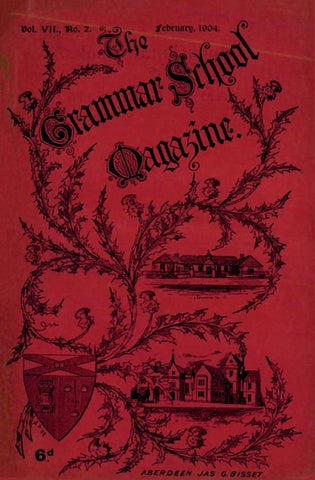
THE
Orammat Scr?oot tilaga3ine. /
Vol. VII.
FEBRUARY, 1904.
No. 2.
- -
SCH004 IT is certainly a trifle late to wish anyone "a Happy New Year " ; but, though a month or so of it has already flown away, we do not feel that we could publish this number without wishing that everyone of our readers— present boys and " Old Boys "—may find the remaining months of 1904 as happy as they could wish. Fellows do require some good wishes at this time of the School year, for the Bursary Competition is hovering in the near future, and demands the utmost exertion for working. Although we have no outstanding genius in the highest classes at present, there are a number of boys all about equal, and the average of the School in the Competition ought to be good. With his usual generosity, Admiral Sir Arthur Farquhar, K.C.B., has sent a donation of £1 to the Magazine. This is no new thing : for the last five years or so Sir Arthur has sent these donations at frequent intervals, but repetition has not by any means dulled our sense of gratitude. Our " Oldest Boy" is among the old School's most loyal sons. Once again the School XV. has recovered its lost position. Certainly things looked very bad for the Grammar at the beginning of the season, for only one of last year's
42
The Grammar School Magazine.
1st came back to School. But that one, who now holds the place of Captain, has, by his energy, succeeded in making fellows turn out to Wednesday practices, and brought together a team which ranks amongst the first junior teams in the City. The Football Season will soon be over now, and already we are begun to look out for Cricket. We have nearly completed our list of fixtures, which, we think, is a very • good one. We have arranged for more matches than were played last year, and have done away with fixtures with teams which it takes a day's journey to reach. Our Captain this season is Andrew Campbell, and with such au able cricketer as he is at our head we ought to do well. Campbell is a good all-round player. He has a quick eye for batting, is a good bowler, and an excellent fielder. Before the Cricket Season begins a serious difficulty will have to be settled. That is the question of the practice field. We cannot get King's, as that place has been secured by the " other place." We cannot get a field of our own, as there is not one to be found within a suitable distance. So what are we to do? Mannofield was a grand place to practise on, and while we rented it School fellows were admitted to all the 'Shire matches on showing their Grammar fixture cards. But this place was not taken full advantage of last year, and it would be rather a pity if we were to get Mannofield and then fellows did not turn out for practice. We hear that the obelisk to Sir James Macgregor, K.C.B., M.D., F.R.S., which has stood for many years in the quadrangle of Marischal College, will have to come down to make way for the extension of our big brother in Broad Street. If that is so, it will be erected elsewhere, and we would suggest that the most appropriate place— next to its present site---would be the grounds of the Grammar School. Sir James was not only an alumnus of Marischal, but also an " Old Grammar Boy." Everyone will be glad to hear that the " Debater" Finale is coming off soon. The date has been fixed for 4th March, and the play is to be "The Scheming Lieutenant," one of the cleverest farces ever written. The play, which takes place in the Georgian era, will be staged
School Notes.
43
with all the picturesque costumes of that period. Special scenery is being got, for there are three acts. As the circulars put it, everything is being done " regardless of cost." So then, I prithee, gentles all, be liberal, for we do deserve more than three pennies. Mr. Charles Davidson has once again consented to be our Stage Manager. We all know Mr. Davidson's ability for such a position, and, judging from the way in which he piloted us through last year's " Chiselling," we are sure that he will make this concert an even greater success. The following is the caste : — Lieutenant O'Conner Doctor Rosy Justice Credulous Mrs. Bridget Credulous Sergeant Trounce Corporal Flint Lauretta -
-
-
• -
-
Soldiers
-
-
-
-
-
-
H. G. M. WILsox. R. M. EASTON. A. P. JAMESON. J. B. GILLIEs. G. E. SCROGGIE. R. D. LESLIE. A. Smrrtr. I F. D. LESLIE. L. F. MERRYLEES. W. L. OXFORD.
There seems to be no lack of Dramatic Entertainments just now at School, for it is not long since the F.P.'s had a very successful Concert, and, after the Finale, we hear the F.P.'s Football Club are to hold a Concert in the School Hall. They aro busy rehearsing the amusing play, " Done on Both Sides," and, as most of the players have already distinguished themselves in our School plays, we look forward to something good. The Club wishes to reduce its debt, which we understand is considerable. It has secured the services of Mr. James B. Scott for Stage Manager, who, it will be remembered, rendered us great assistance at our last Finale. The caste for " Done on Both Sides " is : — Mr. Whiffles Mr. Brownjobn Mr. Pygmalion Phibbs Mrs. Whiffles Miss Lydia Whiffles -
-
-
-
-
P. B. SIMPSON. HUGH MCPHERSON. J. D. MACKAY. L. J. SMITH. D. W. CLAPPERTON.
Mr. Murison's portrait as a frontispiece will, we are sure, be welcomed by all our readers, especially those at School. It is just eleven years ago since Mr. Murison entered the Grammar School as Senior English Master, and we hope that he will be with us for many years to come. His career as a student was exceptionally brilliant,
44
The Grammar School Magazine.
and his career as a teacher has been none the less so. Details of Mr. Murison's successes at the University and since then will be found on another page. The Debating Society is by no means in the flourishing condition it ought to be in. There is an excellent membership as far as numbers go, but there are, alas ! very few members who take any interest in the Society. We admit that those who join the Society do better than those who do not, but surely, if only from the truly Scotch determination to " get one's money's worth," all those who are members should try to attend regularly. As for the number, and unfortunately it is a fairly large number, of those who come down with no other apparent intention than that of disturbing the meetings, words are inadequate to describe their conduct, especially in the case of some who, we know, could speak well if they liked. A mournful but nevertheless palpable fact is that the fewer the number the more enjoyable the meeting usually is. Several of the best-argued and most interesting debates have taken place at meetings which consisted of fifteen members at the most, those fifteen, as a rule, comprising all those who really work for the Society's good. The chief complaint of those who neglect to attend is that the meetings are stale, but they have the remedy for this in their own hands : let them turn up in better numbers and help to enliven the debates. The staleness will then soon disappear. Perhaps it is true that the speaking is confined to a few individuals, but what else could be the case when nobody else will speak? It is especially to l e regretted that so few of the Sixth take part in the debates ; few of them, as a matter of fact, turn up at all. The Sixth are a strong class both in numbers and ability, and ought to give School affairs a big impetus when they come into the Seventh. Laziness and lethargy appears, unfortunately, to be a strong point with them. Yet another melancholy fact with regard to the Society has also come under our notice. Several members have not yet paid their subscriptions, though the syllabus is nearly completed, and, if rumour speaks true, this applies to some members of the Committee. Let us hope that all offenders in this respect will make amends before long'
School Notes.
45
Nothing could have been better than the splendid way in which all those who took part in the Judicial Night Over a hundred were sustained their various parts. present to hear the " case," and seats were selling at a premium. Burnett as judge was inimitable, the counsel were good, as also were the witnesses. Cheyne and Mackie as "guardians of the peace" played their parts excellently, and Jameson as Dr. Beechamp Pillington fairly brought down the house when he nearly knocked over the witnessbox in his attempt to get into it. Rae as the accused, Richards as Mrs. Smuggs, Easton as Miss Walton, and Wattie as a schoolmaster, were beyond criticism. Notwithstanding the large number who took part, everything went off successfully. May the Finale be as successful ! The interest F.P.'s are taking in University Societies We hear that no fewer than is quite astonishing. eight out of twelve on the Staff of Alma Mater are " Old Boys," and that three out of the four principal positions in the Debating Society are also held by them. G. Stanley Russell is both Editor of the Magazine and President of the " Debater." Russell, it will be remembered, held similar positions when he was at School. A. R. Williamson, a former Dux of the School, and a contributor to this number, is also on the Alma Mater Staff, and a VicePresident of the Debating Society. We have been unable to publish all the articles which we have received, but they will appear in our next number. Mr. J. Wight Duff has promised us an article on his days spent at the Gram. for our next number. On looking over an old Magazine, we read a School Note which stated that " each Class has now been provided with a locker for holding the football and cricket material. This is really a great improvement----." Yes, it is decidedly a great improvement for preserving the footballs, for we know of one Class having no less than three footballs secured in its locker, although at the beginning of the season it had only one! During the past few months extensive operations havebeen going on in connection with laying out a Botanical Garden. Hot-houses have been built, and the green slopes running down to the garden have been beautifully laid
46
The Grammar School Magazine.
out with gravel walks. The Lodge has been extended and greatly improved in appearance. With all these changes the western side of the front entrance ought. to present a very artistic and tasteful appearance. Mr. J. B. Gillies, Edinburgh, has presented several interesting volumes to the Reference Department of the Library. We beg to thank Mr. Gillies for his generous gift. We are glad to note that the Reference Library is now being largely taken advantage of. Whether it is the volumes of Punch or the "Encyclopaedia Britannica" which attract fellows there we cannot say, but let us hope it is the latter. Just as we go to press, we hear that Mr. Murison has gained another success in the form of a Carnegie grant for historical research. We understand that after these grants were awarded, Mr. Murison found that circumstances would not allow him to take advantage of his one, and accordingly he resigned. He has not, however, abandoned his intention of investibatina o 1-5 the antecedents of the Reformation in Scotland.
THE LIBRARY. " READING," says Bacon, " maketh a full man." Evidently a large number of Grammarians disagree with Bacon in this, for we have still the old complaint to make, that there are too few members. There are certainly a great many good books in the Library, and lately quite a number of new ones has been presented by J. B. Gillies, including four volumes of the " Wide World Magazine." We wish to thank J. B. Gillies very much, and to assure him that his gift is warmly appreciated. We also take this opportunity of thanking Mr. Mackenzie, who has presented several volumes of the " Boy's Own Paper." B.
COLONEL J. R. L. MACDONALD, C.B., is in command of the Expedition that is slowly making its way towards the sacred city of Lhassa, in ribet. The Rev. Anthony Mitchell, B.D., has been appointed incumbent of St. Mark's Episcopal Church, Portobello. Mr. Mitchell is one of our exceptionally clever " Old Boys," and his friends hope that some day he may adorn the Episcopal Bench. He took a hearty interest in our Magazine in its infant years. His class at the University gave six clergymen to the Scottish Episcopal Church, which is, I imagine, almost a record. The Rev. G. A. F. Knight, M.A., Auchterarder, has been inducted to St. Leonard's U.F. Church, Perth. George Wallace, recently in our Modern VI., has taken a good position in the recent examination for men clerkships in the Second Division of the Civil Service. He made 2,341 marks out of a possible total of 3,400. We regret to announce the death of one of our veterans, the Rev. J. G. Michie, Dinnet. He was well known for his literary, antiquarian, and geological attainments, and was the author of several important works, such as " The Records of Invercauld," which he brought out for the Spalding Club. James Simpson, who was in Modern VI. last year, has received an important appointment in the Cape Observatory, which is directed by another " Old Boy," Sir David Gill, K.C.B., who rejoices in the sonorous title of Astronomer-Royal for the Cape of Good Hope. We hope soon to have in the ranks of our " Old Boys " an Envoy Extraordinary and Minister Plenipotentiary.
48
The Grammar School Magazine.
We have to announce the death of the Rev. John Barrack, M.A., late minister of Falkland Parish Church. He was a brother of a former Rector. Two out of the three Fullerton Scholarships have this year fallen to F.P.'s. The one in Philosophy has fallen to J. F. Anderson, M.A. (with double honours). He is at present assistant in Logic to Professor W. L. Davidson, who seems to have almost always an F.P. as his assistant. This Scholarship is of the value of £100 for two years. The other, in Mathematics, has been secured by W. P. Milne, M.A., now of Clare College, Cambridge. After his exceptionally brilliant career at School and College, we fully expect to find him Senior Wrangler some day soon. William G. Macleod, who left us in June, 1902, has passed 13th in the examination for Naval Clerkships, obtaining 2,619 out of a maximum of 3,600 marks. Well done, Mr. Paymaster ! We have seen in town lately Mr W. D. Leslie, planter: from Ceylon ; Mr. W. Moir, planter, Guatemala ; Mr. James Meston, a former dux, and now of the Indian Civil Service ; Mr. G. Carmichael, also dux, and of the same Service; Mr. James Fraser, Rangoon, whose brother William was married recently; Mr. Alastair Keith, banker, Vancouver; and Mr. James Scott, H.B.M. Consul-General, Canton, formerly Consul at Seoul, Corea. By the way, we forgot to mention that Sir David Gill has received a Royal Medal from the Royal Society for having, inter alia, found a new method of observing the places of the planets. The Rector has received a long and interesting letter from Charlie Walker, who is now in the service of the Hudson Bay Company. His letter is written from the lonely Wabasca Post via Athabasca, in the North-West Territory. To us there is something in these names strangely suggestive of the " perilous seas in faery lands forlorn." Written on the first day of November, the letter, after crossing pathless wastes of snow, reached us in January. A few names will give a general idea of the letter : —Indians, scows, fur, Grand Rapids, beavers, dogs,
Notes about Old Boys.
49
barter, mocassins. He tells of a wondrous flame of natural gas rising to a height of fifty feet, which has been burning day and night for many months. He says that he is always pleased to hear anything about his old School. Is he a subscriber to the Mag.? We notice that the three brothers Ogilvie, so well known in the educational world, two of whom are F.P.'s, and all of whom are LL.D.'s, have been entertained to dinner in Edinburgh by the Aberdeen University Edinburgh Association. One of them was Headmaster of George Watson's College, Edinburgh; the second was head of Robert Gordon's College, Aberdeen; and the third is Principal of the Church of Scotland Training College, Aberdeen. FLOREANT OMNES. Lieut. Edmund Danson, of the Indian Marine, is at home on furlough, and has many thrilling stories to tell of the Nicobar and Andaman Islands and of missions to sultans and sheikhs in the Persian Gulf and along the coasts of Arabia. Things in that part of the world seem still to be as they were in the days of good Haroun-alRaschid. Lieut. R. Machray is also home from Nigeria, looking very fit in spite of his wound and in spite of malaria. When leaving that abominable country, he saw another F.P., Dr. Patrick Grant, carried on board the homewardbound mail steamer, and evidently very ill. Still another F.P., Dr. A. G. Davidson, is Medical Officer on one of the goldfields there, but he has not suffered in the slightest degree since he went there. Dr. C. Thiselton Urquhart has had some exciting experiences in Bloemfontein during the recent floods, where he rendered good service in resuscitating those rescued from the jaws of death. We are sorry to have to record the death of the Rev. James Sutherland, D.D., senior minister of Turriff U.F. Church, who was a pupil in the days of William IV. Several articles from his pen have appeared in our columns. We shall miss his kindly presence and venerable form from our annual prize distributions, for he made it a point to be present on these occasions.
50
The Grammar School Magazine. IN THE DARK.
IT's rough luck on some chaps that they're such beasts, because it's their nature, and they can't help it. Now, Banks always was a beast. From the very first day that he came to be English master it was clear to the whole School that that was the style of him, and the longer he stayed the more certain it was. My brother Dick called him " an unmitigated little bounder," and Dick is a medical student, so I suppose he ought to know. My people got acquainted with Banks, because he used to come to the house sometimes, as the pater had discovered that he was a bit of an authority on old books, and pater was simply dotty on that subject, though I had a notion that Banks had another reason for coming besides the books. How the old man could stand him at any price I never could make out, for he had short, bristly red hair, an ugly, squashed-uplooking face of the most ghastly whiteness, and a queer, jumpy way of walking, like a frog. Brook, the Editor of the School magazine, and an awfully clever chap—not clever at books, you know, but really smart—said he reminded him of a galvanised corpse, which was a pretty good idea. It would take too long to tell half the mean things that he did when he was in the School, so I'm only going to give you the story of the trick that Chris—that's my sister—and I played on him. The thing happened this way. We were doing an English exam. one day in November, and Banks, of course, was watching. Well, I was pretty fairly stumped, and was in a bit of a funk, having made a mess of the last exam., and knowing that I'd be in for a belting from the Rector if I didn't make something of a decent show—and I can tell you that a belting from an old international half-back is not a thing to be sneezed at. Opposite me sat Tomlinson, the head of the class, writing away like a machine. " Tommy," I whispered, when Banks was at the other end of the room, " I'm stumped, and I'll get a thrashing from the Rector. Will you show me your paper? " " No, thanks. Don't want a wolloping too ! " And he grinned. " Come on, Tommy ; it's only to save me a licking." " Can't be done." " You mean, miserable, measly little microbe
In the Dark.
51
" Jolly good alliteration that, Manson," he broke in. " Shut up ! If you don't give me a look, I'll punch your head till you can't see." " No, you won't." " Wily not? " I asked. " You wouldn't be such a cad," he answered, with a cunning sort of look. Well, I hadn't thought of that, but it would have been a bit mean to hit him for not showing me his paper, and he was rather a delicate chap anyway. At this point Banks came along, and I looked busy and thoughtful till he was away a bit again. Then I suddenly remembered some chaff that I had heard about Tomlinson after the " Debater " Concert. " Tommy," I whispered again. " If you do it, I'll ask you round to the house and introduce you to my sister Chris." That fetched him. He glanced up quickly, and blushed like anything. " No ! Will you though? " he asked, looking a bit soft. " Honest injin, I will." With that, we exchanged papers, without any noise, and I had just barely got my eyes on the first page when I felt myself jerked round by the shoulder. Banks ! The brute had turned in the middle of his walk, and spotted us. Well, he pretty nearly scared the hair off my head ; and, as for Tommy, he looked simply green. Banks compared the two papers far a bit, then gave me my own one, made me sit away at the other end of the bench, and, told us both to come to his room at four o'clock. We went, of course, neither of us feeling very perky. Banks was looking uglier than usual. " This afternoon I discovered you two boys in an act of dishonesty during an examination. What have you to say? Tommy didn't speak, so I said, " Please, sir, we weren't cribbing. Tomlinson merely gave me a look of his paper to help me a bit, and it wasn't his fault." " No," said Tommy, " and I didn't get anything off Manson's paper." " That I can well believe, Tomlinson," said Banks ; " but I am surprised to have found you doing so reprehensible a thing. Still, I believe your action was prompted by kindness, and I do not think that any great
52
The Grammar School Magazine.
measure of blame attaches to you. As for you, Manson, the matter is one of such seriousness that I feel it to be my duty to report it to the Rector to-morrow morning, and I can only say that I trust be will deal with you with the severity which your offence deserves. Go." And we went. When I got home, Chris noticed I was a bit down on my luck, so I told her all about the business. Chris had just put up her hair a few weeks before, and, though it had made her a bit sidey, she was all right when nobody was about. She thought for a bit, and then she said— " It's to-morrow morning he's going to tell the Rector, isn't it? " " Yes." " Well, he is coming here to-night to see the pater, but, as he is not to be home till to-morrow, I'll perhaps be able to manage it for you—if Mr. Banks is only on the same tack as he was last time he was here." Then she told me her plan, and you just bet your boots I cottoned on to it. Sure enough, about eight o'clock, Banks called, and was taken up to the drawing-room, where Chris was waiting him. For nearly an hour I sat in the hall, and then I heard the door upstairs open. In half a second I had turned out the light—though Chris said only to put it very low—and got into position behind a lot of coats and things that hung from a row of pegs on one side. Down they came, talking and laughing, into the hall, where it was as dark as anything. Chris came round to my side of it, and gave me a little push with her foot, just to make out exactly where I was. " Now for our bargain, Miss Manson," said Banks in a low tone. " Very well," said Chris, in a wobbly sort of voice that made me afraid she was going to spoil the whole thing by laughing. " Just one, remember, and you're not to tell the Rector about Fred." " Of course not." With that he took a step forward, Chris came close back against me, I pushed out my head between a couple of coats, and the brute kissed me right on the mouth. Ugh ! I'd as soon have kissed a dead cat. " I say, Miss Manson, don't you think I might have one more, just to " No, no, Mr. Banks—your bargain, your bargain! " Before he knew where he was, she had said " Good night," and he was outside the door.
In the Dark.
53
How we laughed ! Great Scott, how we laughed ! It would have cheered you up for a month just to have heard us. Next morning Banks sent for me. " H'm, Manson, I have been thinking over your case since last night, and have concluded that perhaps your conduct was not so serious as at first I supposed. This time I shall take no further action in the matter, but you will have to be very careful in future, very careful indeed." " Thank you, sir." He didn't say more, and it was lucky for me, for I felt as near exploding as if I'd had a can of dynamite for breakfast. A month afterwards I was shifted out of his class, and then Chris told him. She said he was the maddest man she had ever seen. Rare girl, my sister Chris ! J. M. C.
SONNET. From the French of M. de Heredia. [Hercules slays the Nemean Lion, and wears its skin.]
AFTER the Queller passed within the wood, Tracking alone the dreadful prints aright, A roar betrayed their close embrace in fight. . . . Then peace. The sun descends 'neath darkness' hood. Through copse and thorn, o'er many a well-ploughed rood, An awestruck herd towards Tiryns strains his flight. He turns, and marks with eyes dilate in fright, Where nigh the trees the tawny monster stood. He shrieks. He seems to see Nemea's awe Ope at the sky—blood-red his armed jaw— The tangled mane—the fangs of ill-repute ; For shadows lengthening as the twilight flees, 'Neath the weird skin that flaps round Hercules, Blend man and beast, half-hero and half-brute. J. WIGHT DUFF.
54
The Grammar School Magazine.
CONCERNING NAMES. THE names of living things—animals, birds, fishes, plants —are almost wholly descriptive. Unfortunately, they are so often disguised by lapse of time, and by change of pronunciation, as they are transferred from language to language, that it is sometimes difficult to assign the original feature which gave them their designation ; but we are able to trace a great many, enough at least to justify the conclusion that if we could only lay bare the changes that the baffling names have undergone, we could explain the remainder in the same way. The red-breast, the daddy-long-legs, the cuckoo, the flounder are all perfectly obvious cases ; others less obvious are, when we get to the heart of the word, just as significant. Some prominent bodily feature, some characteristic sound or action, some outstanding note of colour, some striking habit of life has guided mankind to a nomenclature. This is only what we should expect. A child still calls a dog a bow-wow, a train a puff-puff, a pig a grunter. The child is father to the man, and our far-off ancestors proceeded on parallel lines. An examination of some disguised forms reveals occasional interesting and illuminative facts. Rhinoceros needs no explanation ; it is pure Greek for nose-horn; in other words this is the animal with a horn on its nose. So the porcupine is the prickly, spiny pig; the tortoise the creature with the twisted feet. The redstart is the bird with the red-tail ; start is the same word as stark in stark-naked, which means tail-naked, the lower parts of the body being exposed. The char is a disguised Gaelic name for the red-bellied fish, and all who have seen a char will at once recognise the fitness of the name. The pike is the peak (the same word as pick in pick-axe), and is so named from its sharply-pointed jaws. The grebe takes its name from its crest ; the coot from its short bobtail ; the oyster from its hard, bony shell. Stork is probably the same word as stalk, and points to the bird's height and long legs. The rabbit is named from a word meaning hind-quarters ; it is the creature with the (conspicuous, white) tail. These instances show the very natural way of naming by calling attention to some conspicuous part, sufficiently distinctive in itself. Colour is so obvious a feature that this alone is often decisive. The grouse is the grey partridge; the grilse the
Concerning Names.
55
grey salmon ; and the grayling is in the same category. Greyhound, however, has nothing to do with colour, grey here meaning a dog. The' mackerel is the stained or spotted fish, from the dark blotches on its skin. The same explanation applies to the perch, which is also a spotted fish with dark bands. The donkey is the little grey horse. Compare whiting, wheatear, yellow-hammer, black-cock. To give the general appearance, size, or shape is a more logical mode of naming, and is fairly common. The grampus is just grandis piscis—the grand or big fish ; the minnow, on the other hand, takes its name from minutus, and is the small fish. Plaice is from a word meaning flat, and is just the flat or plate-like fish. The skate is the squat fish ; the eel the snake-like fish ; the porpoise the hog-like fish. The porpoise is not a fish at all, any more than the whale, although we still talk of the whale fishery, but the names were given long before Natural History became scientific, and are still retained. Turbot is from a word meaning spindle or reel, and points to the rhomboidal shape of that fish. Ray and roach are identical words, and explain themselves as easily as radium. The ling is the long fish, and the chub is the fat one. Compare the word chubby. The caper-caillie is the horse of the woods, or, to change the metaphor, he is the cock of the forest, his great size being his distinguishing feature. The turnip is the bulbous, rounded root, as if it had been turned by a turning lathe. But the parsnip is the root that is dug up (L. pastinare, to dig up). The weasel is named from its thinness. The sprat is the sprout or small fry. The sounds that animals utter are often seized upon as a naming feature. Especially common is this in the case of birds. The pee-wit, the partridge, the whip-poorwill, the corn-crake, the owl are all labelled from their call-notes. The cock too belongs to this class. Chaucer describes Chanticleer as calling out "Cok-cok," when the fox first surprised that magnificent bird amongst the coleworts. The heron draws his name also from his harsh voice : he is the croaker. So with the raven. Compare the German /tether (the laugher) for the jackdaw. It is natural that this should be prevalent in the naming of birds ; but it is not confined to them. The bull is probably the bellower. Equally noticeable is the desire to name by some
r.` •
56
The Grammar School Magazine.
characteristic activity—the way in which the animal moves. The hare gets his name from a Sanskrit word meaning jumper. The tiger—familiarly known as stripes in India —takes his real name from an entirely different point of view—his swiftness of motion. The same root is applied to a word for arrow ; and Tigris contains the same elements—it is the swift-flowing river. The dromedary is also the fast runner. The horse, too, is the runner. But the stag is the mounter. In Scotland a stallion is called a " staig " from the same suggestion, while stallion itself comes from stall, he being a horse kept in a stable and doing no farm-work. The duck is the diver ; the sparrow the flutterer; the swallow the tosser or mover to and fro, from its rapid flight. The wolf is the tearer ; the whale is the roller; the snipe the snapper; the pigeon the chirper. The salmon is the leaper, from a Latin verb (satire) meaning leap. The trout is the nibbler with the teeth. The tench is also a nibbler, though his name comes by a different channel. The sturgeon is the stirrer, because he stirs up mud by floundering at the bottom of the water. The snail is the creeper, literally the sneaker, for snail and sneak are from the same root. The lamprey is the licker of rocks, because he clings to them. The tunny is the darter; this large fish of the Mediterranean is often seen darting after flying fishes. The dace is also a darter, dace and dart being the same word, and its swift motion is singled out as its most descriptive feature. The gurnard is the grunter, so called from the sound the fish makes when taken from the water. The sow is the producer, from the large number of her progeny. The mole is the creature that throws up the mould. The rat is the gnawer, the mouse the stealer or little thief. The bat, rearmouse, or flittermouse gets all three names from the characteristic fluttering of the wings. The lapwing, however, is not the bird that flaps the wings ; many birds do that. It is the bird that turns about or turns its head round when it is running—a very quaint suggestion, but one perfectly true to nature. The dormouse is the dozemouse or sleeping-mouse because it sleeps through the winter. The herring takes its designation from the fact that these fishes move in shoals (here, an army). Otter is another form of water ; he is the water animal. The chaffinch frequents barn-doors and picks amongst the chaff ; so the linnet feeds on flax or hempseed, our linseed, which explain their names.
1
•
;
0
2
•
-
Concerning Names.
57
It is not often that accidental and non-essential circumstances are seized upon. Still there are cases. The halibut is the holy plaice—excellent eating for holy days. The deer is simply a wild animal. The parrot is little Peter—a nickname. The naming of plants follows similar lines. The sorrel is the sour herb, which introduces a new element, the sense of taste. So with smell. The nasturtium is the nose-twister, because its pungent odour has a marked effect on the nasal organ. Thyme is the sweet-smelling plant—from a word meaning incense. The nettle is a stinger. The lettuce is named from its milky juice. The daisy is the eye of day, i.e., the sun, which it resembles. The saxifrage is the stone-breaker, because it was credited with the power of dissipating chalk stones in the bladder. And so on ; the list is endless. A. MACKIE.
THE " UNDERSTANDING" OF THE POLICEMAN. Otrit streets are in a chronic state of repair. My curiosity was aroused some time ago by this general upheaval, so much so that I asked a friend of mine the reason of it. My friend did not seem in an amiable frame of mind. His answer was curt—" Ask a p'liceman." " A policeman!" thought I. "Policeman" at once suggested - feet," and by a little process of the " law of association " I had got at the root of the whole matter. I then wished to find out if the regulation boot was made of any special material—for Aberdeen granite is not specially yielding. I interviewed the Head of Police on this matter. He was not amiable either. He had large force at his command, I felt the point of his argument. I think the regulation boot is made of some special material. Its armour plate seems thick. I should know. The foot of the policeman is only relatively different from anybody else's. It might be defined as that part of his hind leg which in ordinary circumstances is in closest proximity to terra cotta—terra firma, I mean ; my Latin always was weak. On scanning the measure of the feet of the guardian of the peace we see at once they are no tripping ones- —staid spondees—two longs. A well-known Scottish professor has obtained an accurate computation.
58
The Grammar School Magazine.
He devoted no small part of a lecture to the working out in yards of the circumference of "the foot of the Capitoline slope." In some busy corner you see the traffic halt as the warning hand of " the limb of the law " is raised. Has it ever struck you how much more easily he could put his foot down? The policeman is a true sportsman. He wishes to give his game a fair start. The clang of a policeman resounds along a granite street—it is as the slamming of many doors. Have you ever seen the imprint of Robert's foot on a muddy road? What a halo of romance clusters round the miry pit! It requires no very vivid imagination to picture it filled with water—nymphs disporting themselves in the shallow end, while away in the distance, far out of sight, the angler pursues his gentle art. C. A. M.
"THE EDITOR WISHES YOU TO SEND A HUMOROUS ARTICLE." To ask a man to write a humorous article on a few days' notice is like putting a revolver to his temples and telling him to make a good joke on the spot. The former is my predicament, the latter expresses how I feel. Now, to ask a serious, stolid individual like myself to write a humorous article is worse than madness, for if I were to write a funny article it would probably be funny in one sense, but not the sense I meant. I mark that you do not want a witty article—it is a humorous article you want. Now, wit, as I think, is that which makes a man hold his sides with laughter. Humour produces a quiet but broad smile of satisfaction ; its manifestations are internal. So it seems that I have to tickle the " innards " of " the good old Grammar breed," and probably, if my jokes (save the mark) don't have point, I get despised for my trouble. The joke that won't come off never produces the smile that won't ditto. To raise the latter type of smile, whether it arise from Quaker Oats or humour, is above all things the function of a man born to it, and had I the pathos of a Dickens, mingled with his exquisite humour, or the power, like
Humorous Article Wanted.
59
Kipling, of depicting a Mulvaney, nothing would delight me more than to affect the hearts of the boys of the old School by such a mixture of pathos and humour. But, alas, I have not that power. I am more at home when studying the Greek dictionary and the thousand and odd pages of which the editors had the audacity to make one joke, which Mr. Middleton will tell you, if you ask him. No, I shall not make a joke ; I am sure that those exouisite and literary jokes interlarded between the notes of the Magazine will make you laugh enough—they always make me laugh. It is my opinion that if Liddel and Scott were to insert such exquisite and side-splitting jokes between the articles on re and 'Ye and PA' we should all be delighted. There is really nothing to hinder them following the example of the Grammar School Magazine, while the back numbers of Comic Cuts would supply plenty of material, for the travels of Weary Willie are as unending as those of Odysseus. I am afraid you will feel inclined to excise my gentle hints, but, as long as I am at grievances, I may mention another thing. " Old Boys " sometimes like to attend the Debating Society, once in a session at least, but when they find the Society door locked, and some youths hammering it from without, they feel inclined to shake their heads, and with damped enthusiasm wend their weary way elsewhere. These remarks I make are not said in bitterness, but merely as a suggestion that a remedy might be applied. You see I have dropped once more into a serious vein, joking is so utterly foreign to my nature. The fellows of the Sixth and Seventh are probably by this time looking forward to that trying exam.—the " C'omp.,"—while the younger classes are undoubtedly in that state of blessed oblivion which only class exams. break. Everyone is likely taking things in that philosophic spirit so well intepreted by Omar Khayam, if he only omitted his decided love of Bacchus— " While the rose blows along the river brink, With old K — the ruby vintage drink ; And when the angel with his darker draught Draws up to thee—take that and do not shrink."
We students, immersed up to the ears in the abstruse depths of Psychology or Ethics, soon learn this— " And if the wine we drink, the lips we press, End in the nothing, all things end in—yes— Then fancy while thou art, what thou shalt be, Nothing—thou shalt not be less."
60
The Grammar School Magazine.
You probably are beginning to think that " cal' kail het again " is not savoury, and that, however interesting it is to read Charles Lamb's or Oliver Wendell Holmes' reminiscences, you don't want commonplaces and general platitudes from a mere undergraduate. Well, I started to write a humorous article, but, alas' it has descended into the depths of watered sentiment— the =5w, iSOXot of the Greeks. For my own part I have let my pen run almost unconsciously through a maze of words, the subject of which is probably as obscure to you as it is to me. A. R. W.
THE F.P. CONCERT. A VERY successful Concert was given in the Hall on Friday, 5th February. The Committee, in view of the fact that formerly the collections consisted in too great a proportion of threepenny-pieces—surely the meanest coin that circulates—determined to make a fixed charge, and the financial result has justified their decision. The audience had much more room and the Society more money. The well-arranged programme had as its contributors Mrs. Morrice, Mrs. Norman Macbeth, Mrs. H. J. Kinghorn, Miss Evelyn Riddell, and Mr. J. C. H. Macbeth, Mr. Ian Ogilvie Will, Mr. R. S. Callaghan, Mr. A. C. Kidd. All these performers gave a capital rendering of their various parts, and drew hearty applause from the audience. Special mention must be made of the telling recitations that were given by Miss Ethel Hall with splendid effect. The programme ended with the brilliant little comedy " Chalk and Cheese," in which the characters were taken by Miss Dora Danson, Miss Emily Danson, and Mr. C. Davidson. Dr. J. Scott Riddell, the President of the Club, made, of course, an ideal chairman. During the first part of the programme some disorderly urchins evidently thought it the proper thing to make several ejaculations and vulgar remarks. If they think that it is amusing for an audience to hear such, they ought to ask the Committee to be allowed to take their place on the platform, and fire off their " witticisms " from that vantage ground, and not from the cowardly shelter of the back benches. As soon as one of the masters seated himself in the disturbing
The F.P. Concert.
61
area, silence reigned. This policing is a hateful thing, but it seems to be necessary. Special notice was taken of several rude fellows by someone behind the scenes, and they will not be allowed to come to the School Concert next month unless accompanied by their mothers.
MR. WILLIAM MURISON, M.A. IT is with very much pleasure that we publish the portrait of our Senior English Master. In 1884 Mr. Murison took his degree at our own University, with First Class Honours in Classical Literature. In all his English, Greek, and Latin classes he took prizes ; he was also the Simpson Greek Prizeman, Seafield Latin Medallist, Jenkyns Prizeman in Philology, and—last and perhaps greatest of all— Fullerton Scholar in Classics. He was scholar in Classics at Gonville and Caius College, Cambridge, in 1885, and in the same year won the " Ferguson." After this most distinguished career, Mr. Murison attended lectures in English Literature, etc., at the University of Freiburg, in Baden, and studied History in London under Mr. Hubert Hall, Director and Honorary Secretary of the Royal Historical Society. In 1888 he gained the Blackwell Prize in English at Aberdeen for his essay on " Ancient Theories of Education," after which he became a Master in Spier's School, Beith—a position which he held for four years— and in January, 1893, he was appointed to the position which he now holds. With such a record behind him, it is not surprising to find that Mr. Murison is such a splendid teacher. Exact, and a strict disciplinarian, he is also able to make his subject extremely interesting, and to impart to his pupils a fondness for literature which, as a rule, goes with them far beyond the walls of the Grammar School. He might take " Thorough " for his motto, for all he does is done well. The School owes much to Mr. Murison—not merely for the prestige which his efficient work has gained for it in examinations, but also for the interest that he takes in its social life. He has for many years been Honorary President of the Literary and Debating Society, and almost every year his name figures on its syllabus, while he has also contributed more than once to the pages of this Magazine.
62
The Grammar School Magazine.
Mr. Murison's published works include the Concluding Part of " Leslie's Historic of Scotland," which he edited for the Scottish Text Society; a School History of England, being Parts VI. and VII. of the Waverley Historical Reader ; an Essay on Sir David Lyndsay ; Selections from Burns, Byron, and Campbell ; and last, though not least, a book that we all know well, "Selections for Paraphrasing." Let us hope that the School will long have the benefit of the work of such a distinguished scholar and excellent teacher as Mr. Murison.
THE JUDICIAL NIGHT. THIS annual and much-looked-forward-to function came off on 11th December. The case on trial was a breach of promise suit by a respectable Holburn Street landlady against a young man who had been her lodger. This case had aroused a good deal of interest, an interest which was considerably augmented by the posters displayed in the School Corridor. The Court was crowded in every corner, there being scarcely standing room. Very soon after 7 p.m., the counsel had taken their places, the judge had made his stately bow to the Court, twelve intelligent and upright men had been sworn in as jurymen, and the trial was ready to begin. The senior counsel for the plaintiff gave his opening speech, making a powerful appeal to the jury on behalf of the cruelly-treated and heart-broken lady whom he had the honour to represent. The junior counsel for the defendant delivered a short but very eloquent and effective speech, and the examination of witnesses commenced. The first was the plaintiff herself, a female who rejoiced in the felicitous surname of Smuggs. Throughout the whole trial, appearances were against her, especially her own. When she proudly announced her age as thirty-six, the jury were filled with suspicion, and wondered what sort of woman this could be. She seemed, however, immensely popular with the Court, who applauded her loudly every time she drew her handkerchief and trumpeted loudly, or fixed on her spectacles and glared at the counsel or the judge. She seemed to find
The Judicial Night.
63 •
little favour with the latter, the redness of her nose evidently being a sore point with his lordship. The defendant, on the other hand, was the last person one would have expected to have " got entangled " with such a woman as Mrs. Smuggs. Tall, erect, handsome, and well dressed, he looked every inch a gentleman, and I fear that, had the jury been composed of ladies, the plaintiff would have stood a poor chance of winning her case. The witnesses were very varied in character and dress, varying from the prim and haughty Miss Walton to the humble milk-boy. Miss Walton looked very charming, and was charmingly got up. She seemed very much annoyed at some rather impertinent questions put to her by the counsel for the plaintiff and the foreman of the jury. Her conduct with Mr. Archer, the defendant, according to the evidence, seemed to have been rather " shady," to say the least of it. The milk-boy, a ragged-looking youngster, who bore the sinister name of William Tough, and the haughty but suspiciously red-nosed physician, Dr. Beechamp Pillington, were perhaps the cream of the witnesses. Both kept the Court in fits of laughter during their cross-examination, and the brilliant way in which the doctor silenced the opposing counsel who attempted to ridicule his diagnosis was heartily applauded. The junior counsel for the plaintiff, especially, was completely nonplussed by the learned language of the physician, and had to acknowledge his ignorance by resuming his seat. The amusing sally which took place when the doctor diagnosed Mrs. Smugg's fiery-red nasal organ produced roars of laughter which the combined efforts of judge, usher, and policemen were totally unable to check. Among other witnesses who deserve special mention are the servant, the office-boy, and the policeman. The first of these with her shrill voice and stern seriousness of face caused great merriment in the Court, but seemed not in the least disconcerted at this nor yet at the severe examination to which she was submitted by the counsel for the defendant. The office-boy, a lad who bore the evangelically-associated name of Alexander Torrey, also stood his examination and cross-examination as well as any of the witnesses, defying even his lordship's attempts to put him " in a corner." The stalwart and sturdy Constable Coppem gave his evidence in an admirably lucid
64
The Grammar School Magazine.
manner, and the only time during the whole trial that he was disconcerted was when his companion's helmet was knocked over his eyes by some person in Court. Another witness worthy of notice was the old schoolmaster, whose nose, like those of other witnesses, bore witness, cheerfully supported by its owner's own evidence, of a too liberal indulgence in. aqua vitae. He had, in fact, a bottle in his pocket, but it was " commandeered " by a policeman and given into the custody of the judge. (It was noted, by the way, that his lordship became a good deal more eloquent and energetic after this.) The old dominie, however, raised objections to the retention of his " bottlie," and proved so obstreperous that he had to be ejected from the Court-room. The same fate befel the milk-boy, whose only fault seemed to be that of being deeply smitten with Miss Walton's charms. Archer himself gave his evidence in a very straightforward manner, though some of it told rather heavily against himself. He preserved perfect composure all through the trial, seeming not in the least disturbed by the disclosures about his conduct with Miss Walton. All the witnesses deserve great praise, but it was a pity that some were not content with amusing the Court during their own examination, but persisted in causing laughter by their antics and disturbing the progress of the case all through the trial. After the examination the senior counsel for the defendant and the junior counsel for the plaintiff made their summing-up speeches, but both were very much spoiled by having to be greatly curtailed owing to the exigencies of time, the latter speech having to be made in three minutes. The jury then adjourned and returned immediately with a verdict for plaintiff, who received five shillings damages, with expenses. The plaintiff and defendant, it was noticed, left the Court arm in arm, which leads us to hope that the love tragedy may yet have a happy ending. Thus ended a very amusing and interesting trial, which was very well sustained by all concerned, and was only marred by the pressure of time, which withheld in many respects much that would have enhanced the interest of the trial. It is to be hoped that, by an earlier start, or in some other way, this defect may be remedied on future occasions.
School Football Notes.
65
SCHOOL V. 2ND 'SHIRE (October 31).—The School won the toss and played down, having the sun at their backs. They were soon in the 'Shire 25, and Adam scored a lovely try between the posts, which, however, was not converted. The School continued to press, and Robertson scored far out. The kick was again unsuccessful. At half-time the score stood-2nd 'Shire, 0 ; School 6 (2 tries). As soon as the game resumed, the 'Shire came away with a rush and scored between the posts. The kick was converted by Mollison. They pressed hard, but Reid had a fine run along the touch-line, and brought the game into midfield. The game at this time was very hard and fast. Robertson, who had been playing a fine game, intercepted a pass and scored ; he himself brought out full points, and a hard game ended-2nd 'Shire, 5 ; School 11. For the School, Adam, Robertson, Eddie, and Reid played well. Scroggie was unfortunate in getting hurt at the beginning of the game. The victory was very popular, being the School's first for the season. SCHOOL V. DUNDEE HIGH SCHOOL 2ND F.P.'s (November 7).—On this date the School travelled to Dundee to engage in a match with the 2nd XV. of Dundee High School F.P.'s. The F.P.'s played half of their 1st men, and were by far the heavier lot. It had been raining heavily through the week, and the ground resembled a mud bath more than a " footer " field. At three o'clock the game started, and, after a minute's play, the School had to
66
The Grammar School Magazine.
touch down. The 25 kick brought no relief, and the play settled in our territory. After a fine passing bout, the Dundee men scored far out, but the try was not converted. Soon afterwards they scored again, and this time the kick brought out full points. The slippery ground and the heavy weight of their opponents put the School at a great disadvantage, and, although our forwards managed to hold their ground, they seldom succeeded in heeling out the ball. Three more tries were recorded in a short time. At half-time the score stood—F.P.'s, 17 points ; School, 0. In the second half the School played up considerably, and held out their opponents for about a quarter of an hour; but, just when the Grammar were getting towards their opponents' goal, the Dundee three-quarters got hold of the ball, and scored after a run down the whole field. The kick again failed. The School now made a hard effort to score, and for a time were very dangerous. However, it ended in nothing, and the Dundee men charged down the field once again and got behind. Three more times they got in behind, but none of the tries were converted. The game thus ended—F.P.'s, 29 points ; School, 0. By this beating the School were by no means disgraced, for, as we said before, the Dundee team was a mixture of the 1st and 2nd XV. After the match the School were entertained to tea, and a very enjoyable evening was spent until train time. Scnoor, v. 2ND F.P.'s (November 21).—It had been raining the last few days, and, what was worse, it poured on Friday night and all Saturday morning. Four of the School team were absent. However, the School started with five forwards and no full back. The F.P.'s kicked up field, and Macleod scored immediately after. The kick failed, The F.P.'s soon scored but the 25 broUght no relief. again, but again failed to bring out full points. In the meantime the School were not idle; Robertson followed up a kick from the School 25 and scored far out. The difficult kick failed. For the rest of the game before halftime play was confined to the School territory By halftime the F.P.'s brought the score up to 18 points against the School's 3 points. Play started again almost immediately. The F.P.'s, who were by far the heavier lot, nearly always mauled our forwards, and consequently scored once or twice through forward rushes. The School, however, pressed hard, and gradually play went into our opponents' territory, and shortly after Ross scored with a
School Football Notes.
67
short run. Robertson converted. Play again drifted down to the School territory and the F.P.'s scored three times in succession. Then the School woke up again. Robertson intercepted a pass from the scrum, and, after The try was a long run, scored between the posts. converted. The F.P.'s kicking was exceptionally good towards the end. Leonard Smith played a splendid game, kicking and passing equally well. The three-quarters hardly ever had a chance of doing anything. The game was entirely played by the forwards. The scores at full time were—F.P.'s, 32 ; School, 13 (2 goals, 1 try). SCHOOL V. 2ND NOMADS (January 9).—Played on the School Grounds. The ground was in excellent trim, as also was the School team. After the kick-off, the School pressed down towards the Pavilion, and were soon on the Nomads line, where touch was given. Here Kelman did a very neat thing. He made as though he was to throw the ball far out, but dived under and scored a magnificent try. Robertson failed with the kick. The 25 kick brought relief to the Nomads, and play settled in mid-field, but the School were bent on success, and Robertson scored a good try, but again failed with the kick. Half-time was then called with the score standing at—School, 6 (2 tries) ; Nomads, 0. On resuming, the Nomads pressed very hard, and were several times on the point of scoring, but the School always managed to save. No further scoring took place, and the game ended in semi-darkness. The match ended in a well-fought victory for the School. The scores were—School, 6 (2 tries) ; Nomads, 0 SCHOOL 2. 2ND 'SHIRE (January 16).—It was against the 2nd 'Shire that the School won its first victory for the season, and a few minutes after they kicked off towards the west it was easily seen that they were determined to repeat it, for Robertson scored beside the posts and easily converted it. After this the 'Shire pressed, but Wilson accepted a pass from Adam, and, after a run, scored far out. The difficult kick failed. Scores at half-time were— School, 8 (1 goal, 1 try) ; 'Shire, 0. In the second half we completely outplayed our opponents, raising our score to 24 points, without allowing them to increase theirs. Ross scored off a throw-out from touch, and Wilson converted. Robertson again managed to cross the line, and kicked a magnificent goal Shortly afterwards Adam scored, Eddie just missing with the kick. Just before time was called,
68
The Grammar School Magazine.
Ross scored again for us, but the try- was not improved upon. Thus ended a good game in a splendid victory for the School. Scores at the finish were—School, 24 (3 goals, 3 tries) ; 2nd 'Shire, 0. MODERN V. CLASSICAL (January 20).—This match started at 3.15, the Classicals kicking off towards the west end. During the first few minutes the Classicals had the best of the game, but the Moderns gradually pushed them backwards, and, after some good passing, Scroggie got away and scored far out. The kick failed. For the rest of the game play was very equal. Neither side got in behind before half-time. When the whistle blew for halftime, the scores were—Modern, 3 (1 try); Classical, 0. Soon after the kick-off, the Moderns brought the play into the Classical territory, but, after a series of scrummages, they were forced to retire. Kelman got away, and brought the ball into the Modern 25. Soon after, Wilson ran in from touch, but failed to convert. In a few minutes the Classicals scored again through Findlay. The Modern's 25 kick took them to mid-field, and play remained there most of the time. At full time the scores were—Classical, 6 (2 tries) ; Modern, 3 points (1 try). S. X. Robertson refereed. SCHOOL V. QUEEN'S CROSS (January 23).—The above fixture was played off in the School Grounds. Although there had been no rain for some time, yet the ground was soft. Queen's Cross kicked off towards the west, but the ball was soon sent back, and the game remained in midfield for some time. After two or three dead mauls, the three-quarers passed the ball right along the line, and Scroggie, though in a difficult position, slipped through beautifully. The kick, however, failed, but the School kept on pressing. Once the Queen's Cross had a chance of scoring, but Cheyne soon stopped it. At half-time the scores were—School, 3 (1 try) ; Queen's Cross, 0. Soon after the game started again, the School took the play into their opponents' 25, and although play was kept there for a considerable time, we failed to score. Two free kicks were given to the School, but neither of these added to the score. The School had by far the best of the game, allowing the Queen's Cross to enter its 25 only once. The three-quarters all played well when they got the ball, but, owing to the state of the ground, the forwards kept it to themselves. Scroggie, Adam, and Cheyne played very well. Scores—School, 3 (1 try) ; Queen's Cross, 0.
School Football Notes.
69
2ND XV. FIXTURES. 2ND GRAMMAR V. 2ND GORDON'S COLLEGE (November 7).
---This match was played in the School Grounds in frosty weather. The teams were well matched. The game ended in a victory for the School by 14 (1 goal, 3 tries) to 0. A. Reid, F. Merrylees, Stewart, and Campbell scored. The School forwards played very well, but the passing among the three-quarters was rather wild. 2ND GRAMMAR V. 1ST QUEEN'S CROSS (January 31). —The above teams met on the Queen's Cross Grounds at Mannofield. The 2nd School played four short, but played well, considering they were playing against a first team. When the game ended, the score was—Queen's Cross, 27 ; 2nd School, 0. A. CAMPBELL.
FRIDAY, October 30, 1903.—On the above date was spent one of the most enjoyable meetings which our Society has held. It took the form of a lecture from Mr. Murison on " Legendary Ballads of Scotland," with musical illustrations by Mrs. Murison. The attendance was very large, and close attention was paid to the proceedings. The lecture was no less interesting than well written, and was still more enlivened by Mrs. Murison's excellent rendering of the old ballads. Mr. Middleton, who presided at the meeting, proposed a vote of thanks to the lecturer and Mrs. Murison and Miss Webster, which was heartily responded to. Afterwards the Society held a " Hat Night."
70
The Grammar School Magazine.
A. J. Findlay was in the chair. This meeting was interrupted by some outsiders, but was otherwise of a quiet nature. Friday, November 6, 1903.—The Society met in Room I.—A. J. Findlay in the chair. The question, " Is the present system of competitive examination a good one? " was debated. J. B. Gillies read for the affirmative side of the debate a paper which was both very interesting and well written. H. G. M. Wilson, in turn, read the negative side, which was also very interesting and showed careful preparation. The Society did not debate very much on the subject. The votes were taken, and Wilson won by a majority of 14. As nobody seemed particularly anxious to propose a debate, the meeting was turned into a " Hat Night." None of the debates caught on well. The chief speakers were Gillies, Wilson, Paton, and Richards. The meeting broke up at 9.45. Friday, November 13, 1903.—Another debate was held on this date—the President occupying the chair. The subject was—" Are Carnegie's gifts altogether beneficial ? " R. Masson, who had received very short notice, read a short and enjoyable paper on the affirmative side. Richards, who supported the negative with a very carefully prepared and able paper, succeeded in turning the Society in his favour. The debate was discussed very well, being one of the best this season. The votes were— Negative, 22; Affirmative, 12. The next debate was, " Should the School 1st XV. give a dance? " S. M. Robertson supported it, and gave a few reasons. A few others spoke, some for and some against. The vote was not taken. Certain F.P.'s, who honoured us with their presence, were very troublesome to the Society on several occasions. This is not as it ought to be, and shows a bad example to the younger members. The meeting broke up at 9.30. Friday, November 20, 1903.—A large number of members assembled on this date to discuss the Magazine. The Vice-President, A. Findlay, was in the chair. Never has the Maaazine been so vigorously criticised. Many faults were found with it, and many valuable suggestions were made which, we hope, will be g yen a trial. I. K. Burnett objected to having jokes along with the School Notes. This seemed to be the general opinion of the Society. After the criticism of the Magazine was finished, most of the members left, and so the Society decided to
Debater Notes.
71
have a " Hat Night " as usual. " Should the price of the Magazine be lowered ? " was well discussed. R. N. Paton said that it was impossible to do so, unless it was sure that more than double the number that are sold now would be sold. The Society broke up at 9.30. Friday, November 27, 1903.—The Society met in Room V. to hear Mr. C. Davidson's lecture on " Portugal." The small sum of 3d. was charged on all non-members. A very large number attended the lecture. Mr. Davidson's remarks were most interesting. He spoke chiefly of Cintra and Oporto, explaining fully the numerous views which were thrown upon the screen. The garden scenes of Cintra, as represented by the lantern, were beautiful in the extreme. Mr. Davidson gave a very amusing account of how he saw the Queen of Portugal in Cintra. At the end of the lecture, H. G. M. Wilson proposed a vote of thanks to Mr. Davidson, and J. B. Gillies proposed another to Mr. Kennedy for managing the lantern. These were both heartily responded to. The meeting broke up immediately afterwards. Friday, December 4, 1903.—No fixed debate or lecture took place on this night. The question, " Has money or talent more influence? " was to have been discussed, but Dawson, one of the speakers, was unavoidably absent. A " Hat Night" was proposed and carried. The debates were well discussed, but the Society soon came to the end of the debates, and there was yet another hour left. " Free Trade r. Protection" was proposed. R. Richards was strongly in favour of Free Trade. Most of the Society had something to say. No vote was taken. The question, " Caesar v. Cicero," was discussed next. This debate lasted for a long time. R. Richards spoke in favour of Cicero, while Caesar was supported by members of the lower classes. On the vote being taken, it was found that Caesar was victorious by a majority of 4 votes. H. G. M. Wilson was in the chair. The meeting broke up at 9.30. Friday, December 11, 1903.—" Judicial Night" was held on the above date. There was a very large attendance. No minutes were taken on account of the absence of the Secretary. An account of the proceedings will be found elsewhere. Friday, January 8, 1904.—The Society met in Room I. to hear Mr. A. C. Hay, who read a paper on " Edgar Allan Poe." Beginning with some facts about the poet's early years, Mr. Hay got as soon as possible to his works, and for three-quarters of an hour kept his audience enthralled.
72
The Grammar School Magazine.
Mr. Hay read very well, and his extracts were much appreciated. Among other extracts, he read the whole of Poe's poem " The Raven." A. J. Findlay, who occupied the chair, in thanking Mr. Hay, expressed the hope that he would be able to favour the Society again in the future. After Mr. Hay had finished, two statements he had made were used for debates and were eagerly discussed. A " Hat Night" gave rise to the debate, " Will Japan or Russia be victorious? " This also was well debated. Friday, January 15, 1904.—On the above date the debate, " Does Education tend to decrease Crime? " took place. J. A. Wattie read a short, interesting paper for the negative side. W. Wallace (F.P.) supported the affirmative with great enthusiasm, and brought out many facts in favour of his side of the question. There was not much debating on the subject. The vote being taken, W. Wallace won by 2 votes. A " Hat Night " was held after this. Very few members remained in the room, but the debates were on good subjects and very well argued. A certain F.P. on this occasion passed a few insulting remarks about the Committee. The Chairman at once asked him to resume his seat, and stated that, if there was any complaint to make, he was to send it to the Committee, who would take the necessary measure to put it right. We would express our desire that F.P.'s who honour us with their presence on Friday evenings refrain from being insolent and impertinent. Friday, January 22, 1904.—Mr. Mackie introduced the Rev. D. Ritchie Key, M.A., to the Society in a neat speech. Mr. Key's lecture was on "Australia," with limelight views. He started at the scene of his landing in Adelaide, and explained everything worthy of note about the town, dealing minutely with the population, the arrangement of streets, plans of building, and Botanical Gardens. Then he gave a description of Melbourne and Sydney and other towns. Some of the towns were built in the American fashion, others in the British. The chief buildings of each town were the Post Office and the Town Hall. This was one of the most enjoyable lectures we have had, and the Society showed by their close attention how fully they appreciated it. At the close, Mr. Mackie proposed a vote of thanks, which was heartily given. H. G. M. Wilson thanked Mr. Mackie for presiding. The sum of 3d. was charged on all non-members. The Attendance was large. The meeting broke up at 8 p.m. A. CAMPBELL, Secretary.
GOLF CLUBS
Any one in want of same should see our Stock. YAgent for . . .
GOLF BALLS
D. & W. AUCHTERLONIE, ST. ANDREWS.
GOLF BAGS .
ALEX. TAYLOR, 404 Union Street,
CHRISTIE & GREGOR gailors and Xo5iers, 43 UNION TERRACE, Aberdeen. Che north of ,...:, cotiand jrancy 03oods emporium For
Webbing Gifts, iSirtbbap +Gifts, lpresentations, aro
pri3es, solicit the favour of a visit to our Showrooms, which WE respectfully are replete with a most attractive variety in all Departments. Workshop on the Premises for the Covering, Repairing, and Manufacture of Umbrellas, &c.
1110111ILLRN, LTD.,
1511UNION STREET, ABERDEEN.
WM. STE WA ET, Manager.
Are arriving daily in all shades of Leather at
NEW SEASON'S GOODS JOHN A. DUNN'S,
THE GLOBE BOOT AND SHOE HOUSE, Come and have
All Goods
your Choice.
marked in Plain Figures
The and at Variety is Lowest Prices. Endless. See
See
WINDOWS.
WINDOWS.
26
UNION
STREET,
ABERDEEN.
Repairs a Specialty, either in Leather, Gutta Percha, or Rubber.
Also,
Rubber Revolving Heel Pads - Ladies., is., Gent's, ls. 3d. per Pair. Telephone No. 158.
(
.°* cl ss
JOHN A BRUCE
Grocer, Italian WafelRouseman, arld
1 Beechgrove Tel race. Telephone No. 682. • •-
Wirle Merd?ant A TRIAL SOLICITED. cs.e.yr