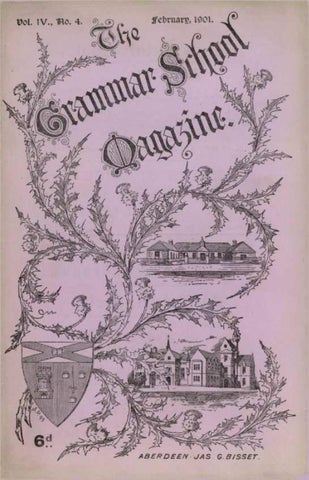
,
rebruarp, 1901.
i
Vol. IV., 140. 4.
(TS
(
Qr
Educational Books. ,t).,*v2)
JAMES G. BISSET
C
ONTINUES to supply all the Class Books (New or Second-hand) suited for the Requirements of the Higher Educational Institutions in the City, at the Lowest Prices.
N.B.—BEST Ir_fLUE IN STUDENTS' NOTE BOORS.
JAMES G. BISSET, Clastcal, ilbebical, alib Ebucational Vook6eiler,
85 BROAD STREET (Opposite Marischal College).
pianofortes, harmoniums, and Organs. James Macbeth Has always on hand a Magnificent Assortment of
GRAND PIANOS, COTTAGE PIANOS, FRENCH and GERMAN HARMONIUMS, For Sale or Hire on the Three Years' System.
SECOND-HAND PIANOS, ORGANS, & HARMONIUMS ALWAYS IN STOCK, VERY CHEAP.
jiwpection requested of nt Stock before settling elzewbztc. Piuliolorte and Music SWorm-
181 UNION
STREET, ABERDEEN.
CONTENTS.
PORTRAIT OF THE HON. SIR JAMES WESTLAND,
Frontispiece.
-
-
DEATH OF QUEEN VICTORIA -
-
-
-
-
119
-
-
-
-
-
-
120
NOTES ABOUT OLD BOYS
-
-
-
-
125
" WHEN WE WERE BOYS," II.-SIR
JAMES WESTLAND
128
A HOLIDAY IN THE TYROL
-
-
-
-
132
-
I.
..
K.C.S.I., LL.D.
SCHOOL NOTES
-
-
-
THE SCHOOL ARCHERY MEDALS
134
THE SCHOOL MUSEUM
-
-
-
-
-
-
139
" DEBATER " NOTES
-
-
..
-
-
-
141
-
-
-
-
-
-
-
147
" OLD BOYS" FOOTBALL
-
-
-
-
-
14M
CHARACTERS OF 1ST XV.
-
-
-
-
-
152
SCHOOL FOOTBALL NOTES
-
-
-
..
LIBRARY
-
1
1
154
1 i
1
SHORTHIIND
and
TYPEWRITING.
C. M. LAWRENCE, Cbe Elbert)een Zebool of Zbortbanb, 19 CROWN STREET. Prospectus
on
application.
-
TEXT BOOKS * Of alt Itinbs (NEW AND SECOND-HAND), AT
D. WYLLIE & SON 9
247 UNION STREET, ABERDEEN.
ROYAL SUNBEAMS.
Reduced in Price from £18 18s. to £14 14s. With the famous Oil Bath Gear Case. 62
M. WATT & CO.
St. Nicholas Street.
470 Union Street.
1 20
The Grammar School Magazine.
/ e ,
-
7
I tt How one could write, if one only knew how to begin!' We began by writing " School Notes," and then sitting down and looking at it, waiting for our attendant spirit It's quite a case of " Write! " to tell us what to say. " What shall I (that is, we) write? " The usual thing in an opening note is to enlarge upon the increased circulation of one's Mag.—but, no thanks !—or to acknowledge anything we have received--so we will : —Letters from H.R.H. the Duke of Cornwall and York, and Lord Rosebery, accepting copies of our last Mag., and in the latter case congratulating us on it; from Sir Arthur Farquhar, enclosing another donation of X1, which we are almost ashamed to acknowledge, as Sir Arthur is sending us agreeable surprises of this sort so frequently ; and from Rev. Father Humphrey, S.J. (F.P.), promising us an Besides these, our letter-bag has been full of article. letters that are of interest only to ourselves, and which we shall not bore our readers with. To come to the affairs of the A. G. S., with which we are more particularly concerned, it appears to our humble mind that the School in many respects was never better than it is now. The 1st XV. is supposed to be the best for some years. Offices in the School are eagerly—we had Truly things are almost said most eagerly—accepted. going well with us as a School, though we still want a few things, including a new field. Where are those who are supposed to look after our interests in this respect? We have a right to ask when that field is to be bought, and why it is not already bought. The present football field is far too small, as anyone can see with half an eye. We look to those who promise that the Grammar School shall receive every attention, to see that it receives a new football field, and that soon.
-
Another thing that wants setting right (while we are adjusting matters) is the position of the "pay." Some
THE HON. SIR JAMES WESTLAND, K.C.S.I., LL.D. (E.P.).
THE
Orammar Scf2oot tllaga3ine. VOL IV.
FEBRUARY, 1901.
No. 4.
the Death of her 11/ajestp the Queen. WHILE our mighty Empire is plunged into mourning and a sorrowing world looks on in deepest sympathy, it is not meet that we should pass over in silence such a dire calamity as the death of our beloved Queen, Victoria the Great and truly "of blessed memory." We are proud and thankful that we were born in her reign—a reign of glory, and a reign of virtue. By her many noble qualities—most of all, perhaps, by her own purity, goodness, and womanly sympathy—Her Majesty endeared herself to all classes of her subjects, and to the younger generation she was, in the truest sense of the word, our Mother-Queen. Now she is gone— the greatest woman, Queen, and mother that the world has ever seen; but an imperishable memory remains. As Ruskin says—" Every noble life leaves the fibre of it interwoven for ever in the work of the world." While we cannot but grieve that we have lost so great and good a Ruler, we must not bury our all in the past. By the will of God, after a truly well spent life, Her Majesty has been taken from us, but she has left us the greatest legacies in her power—her glorious memory and her noble son, who now reigns in her stead. "The Queen is dead," we say in mournful tone, yet after a pause we can add with heart and voice, "Long live the King !"
1 20
The Grammar School Maga:ine.
•
How one could write, if one only knew how to begin! We began by writing "School Notes," and then sitting down and looking at it, waiting for our attendant spirit to tell us what to say. It's quite a case of " Write'. " " What shall I (that is, we) write? " The usual thing in an opening note is to enlarge upon the increased circulation of one's Maq.—but, no thanks !—or to acknowledge anything we have received—so we will : —Letters from H.R.H. the Duke of Cornwall and York, and Lord Rosebery, accepting copies of our last Mag., and in the latter case congratulating us on it; from Sir Arthur Farquhar, enclosing another donation of £1, which we are almost ashamed to acknowledge, as Sir Arthur is sending us agreeable surprises of this sort so frequently ; and from Rev. Father Humphrey, S.J. (F.P.), promising us an Besides these, our letter-bag has been full of article. letters that are of interest only to ourselves, and which we shall not bore our readers with. To come to the affairs of the A. G. S., with which we are more particularly concerned, it appears to our humble mind that the School in many respects was never better than it is now. The 1st XV. is supposed to be the best for some years. Offices in the School are eagerly—we had almost said most eagerly--accepted. Truly things are going well with us as a School, though we still want a few things, including a new field. Where are those who are supposed to look after our interests in this respect? We have a right to ask when that field is to be bought, and why it is not already bought. The present football field is far too small, as anyone can see with half an eye. We look to those who promise that the Grammar School shall receive every attention, to see that it receives a new football field, and that soon. Another thing that wants setting right (while we are adjusting matters) is the position of the "pay." Some
School Notes.
121
one proposed to take it away, but that would be vandalism with a vengeance. There is a very awkward corner there, from a footballer's point of view, and it would be a splendid thing if the pavilion could be turned round a bit so ds to avoid that corner coming in the way of the players. In the name of the School we extend a cordial welcome to Mr. Knox, successor to Mr. Watt, who has left us for Perth amid general regret. Mr. Knox was once a pupil of Mr. Middleton and a Second Bursar. The Literary and Debating Society is again to be congratulated on a most successful session. Their meetings have been most enjoyable, and the members on the whole have been most anxious for the common good. The VicePresidents and the Secretary—especially the latter—have had some hard work to do, but have done it with a will, with the one desire that the Society may flourish. We particularly thank the Secretary for the " Extracts from the Minute Book " that adorn our pages. To the Rector, Mr. Murison, and last, but by no means least, Mr. Middleton, who have shown a kindly interest in us, we are most sincerely grateful. The membership is the largest since the foundation of the Society ; so in every way it is flourishing, and we hope it may continue to do so till "moons shall wax and wane no more." — In this issue appears the second of the series of articles entitled "When We were Boys," being the experiences of some of our most distinguished "Old Boys" while at this School. The article is by the Hon. Sir James Westland, K.C.S.I., LL.D., who is one of our best-known Anglo-Indian statesmen. By the courtesy of Sir James we are also enabled to publish his portrait. We have received a letter from Lieut-Colonel Sir George King, K.C.I.E. (F.P.), who was a class-fellow of Sir James's while at the "Gram." Sir George has become a subscriber to the Magazine, and wishes it and the old School every success. The Exhibition of donations to the Museum was a great success, and one wonders how such a heterogeneous collection was got together. A fragment of Carlyle's " Frederick the Great," in his own handwriting; old numbers of the
122
The Grammar School Magazine.
Magazine, including the very first ; and other interesting relics of the past figured in the collection. Among other things were the key and bell of "Ye olde Gramer Scoole" and old prints of Lord Byron and Simon Fraser (Lord Lovat). To Mr. Carmichael we must give special notice, not only for the splendid work that was shown by pupils of his classes, and the beautiful model of a wheelbarrow made by a boy who had had but three sessions in the Workshop, but for the mast complete and ingenious writing-desk we have ever been privileged to see. We heard not a few wishing " it were mine," and no wonder ; any man might be proud to have it. On the Wednesday morning following, the Rector took the VII over the Museum, and the Class saw many things which in its own rambles it had not noticed. Mrs. Rodger, the widow of the late Dr. Rodger (F.P.), has not forgotten, as some people do with our " Old Boys," that John Hill Burton was educated at the Grammar School as well as at the University of Aberdeen. She has generously presented us with a splendid bust of this, one of the most famous of the many great sons of our School. We owe Mrs. Rodger a deep debt of gratitude for her gift. Our next number will be the last of the present volume, and therefore we intend to make it specially attractive. We have been promised an article by Sir Thomas Sutherland, G.C.M.G. (F.P.), and we hope to have other articles from distinguished F.P.'s. It will probably be observed that we publish for the first time some notes on F.P. football. How we could have published three numbers of a magazine without thinking of making that a feature of them passes our comprehension. However, better late than never ; and we have, through the kindness of an F.P. whose name is among the best-known in city football circles, some splendidly written notes on the 1st (F.P.) XV. We are deeply indebted to him for his notes, and hope our readers will appreciate them as they ought to be appreciated. The four corner brackets of the large hall are filled by busts of Lord Byron and John Hill Burton (two " Old Bays "), Sir William Geddes (a former Rector), and—
School Notes.
123
Seneca! Could not this ancient gentleman, with that agonised expression on his face, be removed, and someone else who has some personal connexion with us, and who also tries to " look pleasant," be substituted? By the way, it is a noteworthy fact that out of our former Rectors no less than three are still alive—Mr. T. W. K Evans, Mr. A. Martin, and Dr. Moir. The kindness of Dr. Williamson (F.P.) in being cicerone to the seventy odd " Grammar " boys who visited the Art Gallery must be acknowledged. Dr. Williamson has also delivered a masterly lecture on " What Art can do for us." The match between the School and Gordon's College was terribly one-sided—too much so to be interesting. Alas ! in athletics and matters of that sort the College is miles behind us; but, when they knew beforehand that they would be beaten, it showed a good spirit on their part to play. Why could not this match be an annual function ; and, after it, why not a tea or something of the sort, and a general feeling of good fellowship? We must not forget that since our last issue Mr. J. M. Morrison has published an English translation of the poems of Leopardi. Dr. Richard Garnett, along with other critics, compliments Mr. Morrison on the result of his labours, and praise from him is well worth the having. We do not presume to criticise Mr. Morrison's book—to do so would smack somewhat too much of " cheek " on our part—but we pin our faith to these authorities. The Concert and Dramatic Performance, which has been finally fixed for Feb. 22, should be interesting. The first part of the programme will, as usual, consist of a concert, for which several ladies and gentlemen, well known in musical circles, have kindly consented to give their services. The play is a farce in one act, entitled " Little Toddlekins," and the cast is as follows :— Mr. Jones Robinson Brownsmith ... ... J. Gordon Danson. Mr. Barnaby Babbicombe (of Babbicombe Bay) Captain Littlepop ••• ••• ••• ••• Amanthus ... ••• ••• ••• • ••• Annie Babbicombe •• • ••• ••. •.• Susan ... ..• •• • ••• ... ...
G. Stanley Russell. ... J. Macpherson. ... D. Bruce Nicol. ••• ... A. Lyon. ... ... D. Robb.
The Stage Manager is Mr. J. Moncrieff Morrison, M.A.,
124
The Grammar School Magazine.
who deserves our best thanks for the deep interest he has shown in the play and the time he has spent on the rehearsals. We are pleased to hear of the success of John Shaw in There were 80 the recent Post-Office Examinations. vacancies, 900 competitors, and Shaw took the 28th place. This is a very good place, and we heartily congratulate him on his success. The criticism of the 1st XV., which appears in this number, ought to be very gratifying to the School in general and the XV. in particular. It is comforting to know that though School football will soon in all probability lose T. B. Robertson, D. Anderson, and other Nestors of the field, it will still have valiant men like M. Macrae and D. B. Nicol to keep up its old reputation for Rugby. The article on the Archery Medals was thought of because we do not think that the School is quite aware of the value of them as antiquities. St. Andrews University and Harrow are, we believe, the only other institutions which possess similar relics of the old Archery Competitions. A Special Service was held at the School on Friday in memory of Queen Victoria. The service was most impressive, and, in our opinion, will quite fulfil the object for which it was held. We may safely say that never yet have we heard an address which impressed us more, and it was a good thing for the School that Professor Paterson—whose interest in it is so well known—was the one chosen to give it. All listened in wrapt attention: and at the end we noticed how even the most boisterous spirits were hushed, while the more thoughtful fellows were going about as if the grief were—as indeed it is—very near and personal. We understand that Mr. Ward is shortly to take Holy Orders. It is to be hoped that this will not necessitate his leaving us, as he would be sadly missed.
Notes about Old Boys.
125
DURING the last sad days at Osborne the world waited with bated breath for the almost hourly bulletins signed by Sir James Reid, M.D. Insignificant a part though we were of Her late Majesty's subjects, yet we of the Grammar School had a family pride in knowing that our Dux of 1865, Sir James, was doing the utmost that medical skill could do—but, alas ! all in vain—to save the life of our beloved Queen. The Right Honourable Lord Justice Stirling, Dux of the School in 1851, and afterwards Senior Wrangler at Cambridge, was sworn in before the Lord Chancellor at the House of Lords on October 27th, and took his seat on the Bench of the Appeal Court on October 29th along with the Master of the Rolls and Lord Justice Collins. This is perhaps the highest honour that has been won by any of our Old Boys in the legal profession, but we hope for even higher honours in the future for Sir James. Who knows but that he may occupy the Woolsack some of these days ? None of our local newspapers noted the fact that he was an old Grammarian. The notices in the Scotsman and in the Times made amends for the shortcomings of the Aberdeen press. A silver medal for Mathematics has been presented to the School by Mr. G. B. Esslemont, a prominent member of the F.P. Club, and President of the Aberdeen Liberal Association. We thank Mr. Esslemont moat cordially for showing his interest in the School in such a lively manner. Medals are now given for Classics, Mathematics, and English. Long may the F.P. Club continue its generosity. It has, however, been lying dormant this winter. Wake up, Mr. Secretary, and remember that at " the other place " they have started an Old Boys' Club on lines similar to ours. We are not to allow them to outstrip us.
How many of our readers ever heard of Cruden's Con cordance ? And how many have read it? We know it as a ponderous tome that gives an air of respectability to a
126
The Grammar School Magazine.
library, but we have never ventured to " enquire within " it. Well, the late Mr. Cruden was an Old Boy, and it is interesting to note that he is held in higher honour in London than he is with us, for a stained glass window is to be dedicated to his memory in the Church of St. Saviour, Southwark. November 1st was the. 130th anniversary of his death. As the School Board has announced its intention of filling our Library shelves with many additional volumes, might we suggest that it add Cruden's Concordance to the Old Boys' shelves ? Our School has indeed been honoured by the Secretary for War, for he has appointed Mr. George S. Gibb, LL.B., Manager of the North-Eastern Railway, to be one of a Committee of six to consider how to reform the War Office. The Right Reverend Dr. Mitchell, minister of South Leith, has been elected to the high office of Moderator of the Church of Scotland. He was a pupil of Melvin's. Lieutenant-Colonel Charles Stuart Gordon has been transferred for duty with the local garrison at Castlehill. Angus M. Urquhart and Robert Garden have got commissions in the Royal Garrison Artillery. Urquhart won the Neil Arnott prize for Experimental Physics at College, sharing it with another. He was until lately mathematical master at Keith. Garden was at Oxford. Alexander Findlay, M.A., B.Sc., Ph.D., has been appointed research assistant and lecturer on Organic Chemistry in St. Andrews University. He studied at Aberdeen and at Leipsic, and obtained the degree of Doctor of Philosophy with highest honours. Dr. T. D. Cumming died at Path, South America, of yellow fever, as he was about to proceed up the Amazon on a voyage for his health. His two elder brothers, Old Boys both, have distinguished themselves in. the Indian Civil Service. — Many of our fellows are wondering what career they should enter on. If they can achieve the success of our F.P., William Duthie of Collynie, they will think of farming. At a sale of shorthorn cattle he held the other day 19 calves were sold at an. average price of £150 8s. 6d. And one calf went at 355 guineas! Who would be a
Notes about Old Boys.
127
struggling parson with £300 a year or a poor underpaid dominie when by breeding "nowt" he can get such sums of money? The proverb says—" Who drives fat cattle should himself be fat." It would seem so. The Rev. Anthony Mitchell, Rector of St. Andrew's, Glasgow, who was chaplain to the troops in South Africa for three months, has now returned, and is lecturing on his experiences at the front. 41,
4,
The Rev. G. G. Cameron has been elected minister of the Alford U.F. Church. He had a brilliant scholastic career. Harry J. Watt, Bain Gold Medallist and Hutton Prizeman, Assistant to Professor Davidson, has been awarded the Fullerton Scholarship in Mental Philosophy at Aberdeen University. The Rev. F. H. Petrie has been appointed to the Episcopal Church at Monymusk in succession to the Very Reverend Dean Walker. John Rae, M.A., late Under-Secretary of Works, New South Wales, has died at the age of 88. He was closely identified with the early history and progress of the colony. He was born in Aberdeen in 1813, and, after being with us and at Marischal College, he took his M.A. degree at Edinburgh in 1832. Under his auspices the railway system of the colony was organised, and he was appointed Railway Commissioner, and in this capacity he came to Europe, and investigated many of the railway systems. Poet, author, journalist, historian, artist, administrator, he achieved distinction in all these various avocations. G. T. Watson, M.A., B.L., late Dux of the School, has died at the early age of 28. Those of us who remember him at School and College, how he won success in every branch of study, predicted a brilliant future for him, but it was not destined to be. William C. Bowie has been recommended for the Jenkyns Prize in Classical Philology at the University. George A. Combe, M.A., has gained the ninth place in the open examination for Student-Interpreterships in the Chinese Consular Service. There were 59 candidates. He left the School in 1895 as ninth bursar. Why do not more of our fellows enter for these Consular appointments?
128
The Grammar School Magazine.
John A. M`Lean, who passed from the School to Marischal College, died at Lumphanan recently, aged 19. The University of St. Andrews is about to confer the degree of LL.D. on Sir George Reid, President of the Royal Scottish Academy.
"WHEN WE WERE BOYS "-II. THE HON. SIR. JAMES WESTLAND, K.C.S.I., LL.D. I FIND it no easy matter, after the lapse of so many years,
to recall the facts of my connection with the Aberdeen Grammar School with sufficient accuracy to warrant my putting them down on paper ; and I leave to the editor the entire responsibility for the idea that my statement By a of them them can interest anybody but myself. calculation based upon the dates recorded in some of my books I find that it was in January of the year 1853 that I joined what was then the Second Class, under Mr. Beverly, rightly spoken of in the last number of the Magazine as the best and kindest of teachers, and under The staff of the him I remained till November 1854. School consisted of the Rector and three puisne masters ; of these three masters each in turn took up a set of boys— usually about 50 or 60—as the " First Class " of the School, and conducted them through three years' teaching as First, Second, and Third Class, after which they passed under the Rector, who ran two classes—the Fourth and the Fifth. The building which contained the School was built on the plan of the letter H, the cross-piece being a large hall, used only once or twice in the year for special functions, and the four wings serving respectively for the First, Second, Third, and combined Fourth and Fifth Classes. The First and Second Classes entered their class-room direct from the open space in front, but the higher classes had to pass through the hall before reaching theirs. The general plan of all was the same, namely, two rows of seats and desks, rather hard, somewhat narrow, and very delapidated, with a master's desk at the northern end. The masters arrived during the four or five minutes preceding the hour of meeting, each entering the large hall, where they waited for each other below the clock facing the principal door, thence marching off, when the hour
i
" When We were Boys."
129
struck, to their respective class-rooms. Until they arrived, the boys were free, and fairly boisterous. One rather favourite occupation for this time of waiting was the siege of one class-room by the boys of another class. The fighting took place at the door, and the weapons were the caps or " bonnets" worn by the boys—the hard and tough material of a " Glengarry" can give you a disagreeable stinging sensation when it comes into violent contact with your face, especially if the contact is sufficiently rapid to anticipate the automatic defensive operations of your eyelids. The Second and Third Classes were the chief wagers of these wars, the Fourth and Fifth being protected by the halo of their seniority, and of their immediate connection with the Rector. The fights necessarily ceased when the masters arrived and occupied their usual station in the large hall. We looked on with some awe during the few minutes they passed in conversation, wondering what weighty matters could be under the discussion of such exalted minds—in all probability it was nothing more important than the current state of the weather, and the chances of its clearing up before noon. Of Mr. Beverly I remember very little, except his kindly manner, which interfered not one whit with his capacity for keeping order in his class. He was lame, and unable to move even in his class-room without the aid of a thick stick, and he had a curious habit, as he walked, of twisting his cane (the symbol of discipline) wheelwise up and down the ladder of his fingers. The master of the class above his was Mr. Geddes, who, on the death of Dr. Melvin, in the middle of 1853, succeeded him as Rector, passing to the charge of the Fourth and Fifth Classes a month or two before the boys reached him whom he had already brought through the First, Second, and Third Class. Dr. Melvin was looked up to with great respect by every boy from the youngest upwards. His " versions " (exercises for translation into Latin) had the reputation of being models of Latinity, the study of which was a tradition of the School. He lived in a house in Belmont Street, a few doors south of the Free Churches, and therefore in the immediate vicinity of the School ; and it was in that house that he died, after an illness of a week or two, during which his condition from day to day was anxiously watched by all the scholars. He died a few days before the summer vacation was to begin, and there was not a single boy in the School who received with feelings other than those of sorrow the announcement that the death of the venerable
130
The Grammar School Magazine.
•
old Doctor necessitated the premature commencement of the holidays. I had finished my year of Fourth Class under Mr. Geddes, when he also gave up the Rectorship. The Greek professorship in King's College had become vacant, and every boy in. the Grammar School became a partisan of Mr. Geddes's candidature for the vacancy. The afternoon it was made public, we all stood in the courtyard awaiting Mr. Geddes's arrival for his class duties, and as he turned the corner, coming across from Belmont Street, he was received with a cheer which must have convinced him in what regard he was held in the School. I remember him turning round to us, after he had passed through the courtyard, and up the steps leading to the hall door, and saying to us that we seemed to be as glad of his promotion as he was himself. His place was taken, by way of interim appointment, by- a Mr. Kelman, while the Magistrates, the patrons of the School, made enquiry for a permanent successor. After two or three months they chose a Mr. Evans. It was a most unlucky choice. Rumours of strange want of discipline, and the gradual falling away of the boys from the class (for example, the opportunity was taken by a Mr. Barrack to re-open the Old Town Grammar School, to which many of Mr. Evans's pupils at once transferred themselves) induced the Magistrates, after a short time, to offer Mr. Evans terms of retirement. What became of him afterwards I do not know, beyond that he engaged in some literary work in London. Looking back now, I think it must be admitted that Mr. Evans never had a fair chance. It would have been difficult for anybody to have followed such teachers and scholars as Dr. Melvin and Mr. Geddes (I give the latter the name by which he was then known, and not the titles he afterwards earned) ; but Mr. Evans came from Ireland, and we took it as an insult to us that any Irishman should be thought capable of teaching those who had sat at the feet of the Rectors I have named ; again, he pronounced Latin and Greek after the English fashion, which we, of course, considered unscholarly ; and he, perhaps, did not exhibit that familiarity with Latin composition which sat, like a well-fitting garment, upon his predecessors; he offended, unwittingly perhaps, the sense of the School by showing that he was capable of questioning their dicta; and in this way he stirred the prejudices of his pupils. He was, unfortunately, very shortsighted, and thus gave these prejudices the oppor-
" When We were Boys."
131
tunity of breaking out in violent breaches of discipline. In short his failure arose less from incapacity in respect of scholarship than from want of knowledge of the Aberdeen schoolboy. No amount of shortsightedness would have prevented a Melvin or a Geddes from being master in their own. class-room. The Grammar School did not pretend to teach anything but Latin and Greek ; for anything else we had to go elsewhere ; and after Grammar School forenoon hours were over most of the boys went for an hour or more of teaching to the Little Belmont Street School—mainly to Mr. Robert Gray's classes for arithmetic, Euclid, and the like. Mr. Gray's assistant when I was there was Mr. Rennet—the only time I had the advantage of sitting under that distinguished teacher. All things have a beginning, and even Dr. Rennet once taught small boys vulgar fractions—he made me at least understand them. The central part of the Grammar School curriculum was the weekly or bi-weekly " version" ; by it were places in the class taken, and mainly by it was our standard judged when we passed from the portals of the Grammar School to those of Marischal or King's College, through the Bursary Competition. But here there was a curious difference between the Old Town system and that of the New Town. The latter allowed the use of dictionaries ; the former forbade them; and on the morning of the Bursary Competition Broad Street was filled with boys (or now, perhaps, rather young men) laden with piles of books, enough to form a porter's load ; while all that the King's College competitor carried with him was his writing materials. I have seen something of competitive examinations since those days, but I admit I have never been able to understand why at Marischal College bursaries were awarded or prizes given to those students who had the best dictionaries, or exhibited most capacity in the mechanical process of finding their way through them. One scene more, and I have done. It is a scene which was repeated in Aberdeen every year, two or three evenings after the Bursary Competition. On part of the site where the Municipal Buildings now stand there was then an open street, Huxter Row, on the east side of which was the entrance to the Town Council Room. The competitors have come to hear their fate, and stand in the dark in the open street. When eight o'clock strikes, the Town Sergeant throws open the window above the Council door, and shouts, in order, the names of the winners of bursaries ;
132
The Grammar School Magazine.
and after each name, one boy enters the door and passes upstairs, followed by a cheer. When they are all gathered in a line in the Council Room (or ante-room), the Magistrate or Councillor in attendance enquires in turn of each successful competitor if he accepts or declines the bursary he has won. Those of the better-off classes were often instructed by their parents to decline, in order that the bursary might pass on to students who were really dependent on their winning a bursary for their ability to go to College at all. .Some parents did what was better still—their sons accepted the bursaries they had won, and they paid the College fees for some student who would not otherwise find his way to a University education. I do not know how far it is now the case in Aberdeen, but in my day it was certainly not unusual to find students who had to earn their bread during the summer in order that they might obtain a University education in the winter—a class of men who have done much honour to the Scottish system of Education, and who were to be found, and perhaps still are, in many a schoolhouse and manse in the North of Scotland. The dingy building in Schoolhill afterwards descended to baser uses, but occasional visits to Aberdeen, before its disappearance to make way for the Gray School of Art, enabled me to make several pilgrimages to its ancient gates. Our number is now, alas! sadly dwindling, but there are many " Old Boys" besides myself who prefer its humble simplicity to the flaunting towers and gables of its successor in West Skene Street, and who would not admit that Ichabod could be inscribed over its doors.
A HOLIDAY IN THE TYROL. FOR one who wishes to escape for a brief space in the height of summer from the noise and smoke of a great town, and from our depressing British climate, there are probably few places in Europe that possess stronger attractions than Tyrol. Switzerland at that time of the year is overrun by bustling English and American tourists, whose proximity does not always conduce to repose ; but, if one goes a little further east over Vorarlberg, one, so to speak, gets the whole place to oneself. I put aside the temptation to visit the Paris Exhibition, and, within four days of leaving Scotland, found myself in
A Holiday in the Tyrol.
133
Innsbruck, a place which I had visited several times before. The position of Innsbruck renders it, according to competent judges, one of the most beautiful towns on the Continent. It lies about 2,000 feet above the level of the sea, and is surrounded on all sides by the Alps, some snowcapped peaks rising to a height of 9,000 feet. Through the middle of the city the river Inn, which is spanned by several bridges, rushes in its broad, swift course to the Danube ; while towards the south is seen the approach to the Brenner Pass, which leads to South Tyrol and Italy. The capital of Tyrol is a curious mixture of ancient and modern. The older streets, which date centuries back, are built after the Italian fashion, with colonnades, and frescoes on the houses ; while the newer part of the city displays the familiar architecture of the better class of German town. The city possesses a large number of churches, one of which, the Hof-Kirche, is probably unique. It contains tile tomb of the Emperor Maximilian, and twenty-eight huge bronze statues representing his ancestors, who include King Arthur of England. There is also a University--mainly theological. It has about the same number of students as Aberdeen; but there is nothing remarkable about the buildings, which are plain. A further touch of picturesqueness is added to Innsbruck from the fact that it is a garrison town, with about 2,000 soldiers. Some of the uniforms are very striking, but the men lack the smart look that is to be seen in a British or a German regiment. The North Tyrolese are in appearance singularly like the Lowland Scotch. They are a kind1S, people, and their salutation to each other and to strangers of "Griis Gott" is very charming as well as very courteous. The dialect of the country people is at first extremely difficult to understand, and differs in a marked degree from literary German. The dress of the peasants, especially of the women, on holidays, is very gaudy, not to say theatrical. Every little valley has got its own special costume, so that one who knows the country well can tell at a glance where any peasant comes from. The Tyrolese word for "peasants " is Buren (German Bauern), which is also German for " the Boers." One curious result of this is that the Tyrolese have got it into their heads that they are blood relations of our enemies in South Africa. This feeling has been fomented by the efforts of an unscrupulous press ; and, I fear, our war policy has few supporters in Tyrol. Last winter they actually held a festival in Innsbruck to celebrate our defeats.
134
The Grammar School Magazine.
The life of the people, as in most German towns, is spent in summer largely in the open air. Whole families proceed regularly in the evening to a concert garden, to take their supper and listen to the music, which is often rendered by military bands, and is very good as a rule. While in Innsbruck I generally took my meals in the " Restauration" at the Schloss Weierburg, a house that was at the end of the 15th century a hunting-palace of the Emperor Maximilian. It was rather quaint to think of one's self as sitting under a chestnut tree which dates from before the Battle of Bannockburn (if the statement made about the age of the tree is true, and it appears to rest on trustworthy historical evidence). The journey across the Brenner Pass carries one through some very romantic scenery. The highest altitude (upwards of 4,000 feet) is attained at Brenner, a few miles south of Innsbruck. Here the air is delightfully pure. I stayed for some days there, and also at a quaint old village called Sterzing, a little farther south. At Sterzing all travellers used to stop in the old coaching days ; and the visitors' books at the Hotel " Alte Post," which go as far back as 1841, are most interesting, containing as they do the names of so many famous men who spent a night there on the way to Italy. As one goes farther south the vegetation becomes quite different. One gets clear of the pine woods, and finds oneself in a true southern climate, amidst the myrtle and the vine. In July, however, the heat is fearful, and the mosquitoes are everywhere—so much so that in Bozen it is almost impossible to sleep. I went south as far as Trient, the capital of South Tyrol. The intense heat warned me that a visit to Verona, which I had contemplated, was out of the question; and, after a stay of two days in this purely Italian town, I went back by easy stages to the more grateful coolness of North Tyrol, from thence to Munich for a few days, after which I returned to Austria once G. M. more. THP, GRAMMAR SCHOOL ARCHERY MEDALS. IF we except Ferguson's bell, presented to the School in 1626, and some fragmentary records in two old registers, our School possesses no original relics of its past history more ancient, or, of its kind, more interesting than the Silver Arrow and fourteen Medals displayed in the Hall.
The Grammar School Archery Medals.
135
The character of the School as a seminary of learning in yet earlier times is eloquently attested by the quaint Latin rules drawn up in 1533 for its management and course of study by John Vaus, first "Humanist" or Professor of Latin when King's College was founded. A copy of these rules is also to be found in the Hall, along with the rules drawn up in 1700 by the Town Council. Ignorant critics sometimes speak of our present interest in sports as an innovation. The Medals, as well as the rules of 1700, are evidence that it is rather a revival of a necessary and still much neglected part of education. The German Emperor's appeal for men, not scholars, when he cut down the burden of the schools' curriculum, was emphasised by the statement made a few years ago by a distinguished German headmaster, that of military recruits from the leading secondary schools of Germany some fifty per cent. had to be rejected as physically unfit! That is one of the things that is not made in Germany better. The need of training our youth up to the first and chief duty of a State, self-defence, was early realised in Scotland, as elsewhere. Repeatedly laws were enacted that all "yemen [yeomen] of the realme betuixt xvj. and sexty yeris sal be sufficiandly bowit and scheffit " [provided with bow and sheaf or quiver] anno 1425 ; and again, in 1457, "It is decretyt and ordanyt that wapinschawingis be haldin, . . . . and that the fut ball and the golf be utterly criyt donne and not usit . . . and schuting be usyt ilk Sunday, and that ilk man schut sex schottis at the lest, . . . and this to be usyt fra pasche [Easter] till alhallomess [Nov. 1st], and that ilk man within that parochin that is within fyfte and passit xij. yeris sall use schuting. . . ." In 1471 football and golf are again forbidden, and similar legislation occurs in 1491 and 1535. After the Restoration these public contests, suppressed under the Puritans, were again revived by order of Government. Those who have read Scott's " Old Mortality " will recall the admirable description in the opening chapters of such a wappenschaw in 1679. It is interesting to note that this date falls midway in the period covered by our own medals-1664-1699. In spite of Dalgetty's surprise at being wounded by an arrow, archers were not seldom employed in the Civil War. The ill-fated Lord Kilpont commanded the bowmen on Montrose's left at Tippermuir. Archery was employed in the '45, and even as late as the battle of Leipzig, 1813, by Russian troops. But long ere then the use of this primitive " artillery," as it is quaintly
136
The Grammar School Magazine.
called in the Bible, had yielded to firearms ; and perhaps the change of weapon had something to do with the decay of this good old practice in ovr own School—though history tells us of " Grammar boys ' who, as early as 1604, took the School from the masters, and held it with swords, guns, and "hagbits "—a "barring-out" which finds its counterpart in the records of Edinburgh High School, with the most grievous results to a Baillie who attempted to storm the stronghold. Our Medals have been more than once described. The fullest account of them, handsomely illustrated, was given by Mr. Alex. J. S. Brook, F.S.A.(Scot.), in the Proceedings of the Society of Antiquaries of Scotland, 1893-4 (pp. 444469), in which the question, raised in 1891, as to our title to consider them a genuine School relic, and not the possession of Marischal College, has been finally set at rest. In point of fact a register is extant, proving that the Arrow and Medals were a School possession before the series was completed. Each Rector on taking office had to sign a receipt for this property, witnessed by two of the town's Baillies, and these receipts occur in the volume in question, by Mr. Findlater, Rector, 1679 ; Mr. John Milne, who succeeded him in 1717 ; and Mr. James Dun (Dr. Dun), Rector from 1744-1803. No complete register of boys at the School exists for the XVII. Century; and as the names of seven of the fourteen inscribed on the Medals occur in the Marischal College registers as having entered College in the years in which they each gifted their Medal, it was argued, with some degree of plausibility, that the Medals were not ours. They could prove that these lads were in that year at Marischal College : we could not prove that they were then, or at any time, at the Grammar School. The case for the " pursuer" broke down, however, when it was pointed out that though our registers do not cover all the period, the name of Theodore Morison of Bognie, the last winner of the contest, in 1699, does occur in the self-same register above-mentioned, in which it is stated that he gifted Cornelius Tacitus, in October, 1699, no doubt at his " going to the Colledge," the custom then being for boys on leaving school to make the library a present of books or 14p. (a mark) for the purchase of books—another good old custom, unhappily obsolete. There can therefore no longer be any reasonable doubt that our claim to this heirloom of the School is not only based on. " nine points of the law," but has an incontestable proof to establish the tenth point also—a well-founded
The Grammar School Archery Medals.
137
and continuous record of possession—proof that the Medals were held for the School as early as 1679, and that in 1699 the last winner was a " Grammar boy " at the date of his Medal. I will not go the length of saying that there was no such thing as " pot-hunting" in those days; but a commendable feature in these contests was that the winner did not receive a Medal—he was only too proud to give one, bearing his arms, initials, or motto, to be attached by a chain to the Arrow, probably to a ring passing through the hole in the shaft. Medals and Arrow are of silver, but neither in purity of metal nor in design and workmanship do they reflect credit on the silversmiths of Aberdeen who made them. In common with all Scottish silverwork at the time, the metal was seriously alloyed, 1 oz. in the lb. of 12 ozs. being the maximum of alloy permitted by law. Our Medals are debased on the average as much as 2 oz. 4 dwt. 12 gs. The names of the winners and the date of contest are inscribed on the Medals, or inferred on other grounds, and are as follows : — (1) George Mackenzie, 1664. Note the stag's head, the famous " Caberfae" of the Kintail and Tarbat Mackenzies. (2) Thomas Fraser, 1665; bears the cognizance of the Frasers, three " fraises." (3) John Bannerman, 1666. The arms resemble those of the Bannermans of Elrick, but have not been fully identified. (4) Andrew Skene, 1667 ; probably a son of Andrew Skene of Ruthrieston, Dean of Guild in 1667. (5) Adam Gordon, 1670, with the usual arms of the Gordons, " three boars' heads erased" [torn off, with jagged edges] and the famous family motto, Bydand. This was doubtless Adam Gordon of Glenbucket, entered as a student at Marischal College in 1670. (6) John Gordon of " Breachly," 1672 ; also mentioned in the University records for that year, but otherwise not identified with any known Gordon of Brachlie. (7) James Moir, 1673, septimo vicit (which shows that there was a real gap in the contests in 1668, 1669). This was the second Moir of Stoneywood, born in 1659, M.P. for the county for 15 years, and one of the Commissioners on the Union effected in 1707 ; died 1739. At the date of the contest he was therefore 14 years old, no unusual age to enter the University, then and right into the middle of the past century.
138
The Grammar School Magazine.
(8) John Skene, 1674, identified with John Skene, fourth His son of James Skene of Newtyle ; born 1658. father was "ane excellent poet in the Scottish language." (9) Walter, Lord Deskford, 1675. The Medal bears the arms of the Earl of Findlater. The donor was eldest son of the third Earl, and died some time before 1698. (10) John Udny of Udny, 1676. The obverse represents Orpheus—in Roman dress—charming the beasts ; the reverse bears the Udny arms, with two picturesque savages as " supporters," and the motto AL MT 110P IS IN GOD, with the donor's name and date. This is the most artistic of the Medals. (See illustration..) This John Udny was M.P. for the county from 1703 to 1706. In 1701 he married Lady Martha Gordon, daughter of George, first Earl of Aberdeen, and High Chancellor of Scotland. (11) William Keith, Earl Marischal, 1677. This was the ninth Earl, succeeded to the title in 1694, and died in 1712, aged about 52. Like others of his family, to their grievous cost, he was a strong Jacobite and antiUnionist, described by a contemporary as " very wild, inconstant, and passionate ; . . . a hard drinker, a thin body, a middle stature, ambitious of popularity." (12) Alexander Fraser of " Streichen," 1678; eldest son of Thomas Fraser, fourth of Strichen. (13) Sir John Ogilvy of In.verquharity, 1679 ; the third baronet; came of a distinguished family of Forfarshire Royalists. (14) Theodore Morison of Bognie, 1699, son of George Morison of Bognie and the Viscountess Frendraught, " vicit 1699 anno aetatis 14mo." He died in 1766. His epitaph in the Aberdeen Journal of the period is worth recording as a delightful specimen of journalistic bathos—" He lived without an enemy, and died without a groan." * It is of interest to note on the whole series that the donors all came of noble or " county" families. Was it that the town's bairns were too poor to compete, or too inexpert to win? Possibly the gap between 1679 and 1699 may have been filled with their names. But this is mere conjecture. No doubt the wapinschaws took place * For the description of the Medals and historical notes the writer is indebted chiefly to the article by Mr. Brook above-mentioned. His illustrations of these and the St. Andrews Medals, showing both sides, have been framed and hung in the Hall.
The Grammar School Archery Medals.
T
139
then, as now, on the Links, still our city's principal playfield, though much encroached on. A handier space for Grammar boys was on the open slopes of the old School Hill, now so hideously marred by the buildings which face Union Terrace. Hither in later times they were accompanied by the " Hebdomadar," or usher in charge for the week, whose duty it was to supervise them at their play. Such was the law laid down by a wise Town Council in 1700. Now it is thought a disparagement to a teacher to betray any interest in boys' games.
THE MUSEUM.
I
i
Ox December 8 an exhibition of objects recently acquired for the Museum was given in the Hall, and was largely attended by boys and their friends. So much interest was shown in the exhibits that they were kept on view for several days, and visited by almost every class in the School. The keen interest evinced has already borne practical fruit in many valuable additions ; and it is understood that the Board has under consideration a proposal to convert the old Lunch Room into a Museum, where all may have an opportunity of studying the various articles, suitably displayed. Naturally, in the Hall, and with articles so recently acquired, little attempt could be made as yet at classification. It was pleasant, among many national industries, to see so many of our local firms worthily represented. To mention the names of all who have so generously contributed would much exceed our present space ; and to select a few only would be invidious : are they not all written in. " the Book of the Museum " ? The most valuable of recent donations, a set of twelve Victorian War Medals, handsomely framed, presented by Dr. Alex. Walker (F.P.), has found a worthy place permanently in the Hall. The medals are for the Crimea (2 British and 1 Turkish), Indian Mutiny, China, Burmah, Bhotan, Hazara, North-West Frontier, and 3 Egyptian (one of them native). A pair of fetters brought home from Omdurman, 1898, by a soldier of " the Fighting Fifth," and presented by Dr. Francis Kelly (F.P.), has been placed along with the medals ; and also, from Mr. Charles Davidson (F.P.), a fragment of the Mahdi's Flag, presented to Dingwall by General Hector Macdonald. A feature of special interest will be the specimens of
140
The Grammar School Magazine.
Clan Tartans, presented by Mr. James Esslemont (F.P.), by whom already some 70 various samples have been contributed, representing over 60 clans. These will be mounted, with a few brief historical notes, the clan motto, slogan, &c., and will then form a very instructive and, so far as we know, unique series. Some of them, being seldom asked for of the dealers, are very rare and difficult to obtain ; but it is hoped in time to make the collection quite complete. The chief credit for recent additions of industrial products is due to John Shaw, acting on a hint from our good friend Dr. Cramond, who supplied many names and lists of firms disposed to help in such a purpose. Shaw has been indefatigable in correspondence, and gave most generously of his time and labour in promoting the Exhibition. The boys themselves contributed largely of their treasures, and made valuable additions to our scanty stock of natural history specimens—eggs, butterflies, moths, minerals, fossils ; old or foreign weapons, and many other curios. Mr. Louis Wilson (F.P.) has since sent two dozen large-sized photographs of places of historical interest, &c., some of which have now been framed; the rest will be framed when the needful funds are forthcoming, as well as some fine engravings, historical portraits, illustrations of Shakespeare, &c., most of which were on view. Nor should we omit to thank the ladies of the staff for their skilful help in arrangement, and Mr. Donald, Janitor (pro tern.), who assisted with great energy and devotion. We hope that the Board will see to it that these objects are suitably housed, as their value to the School will depend largely on the facilities to be provided for showing them where all may study them. Many of the contributions showing stages of manufacture are of particular value as object lessons. As befits our School, the Classics, as well as the Moderns, were not forgotten. But objects representative of ancient Greek and Roman life are not easily acquired, and as a rule we must be content with illustrations. Replicas of Greek and Roman coins in electrotype are not expensive. Something may be done in this and other directions, if boys will take care to make a "bumper house " at the Assault on the 8th February. The surplus, after paying expenses, is to be devoted to the Museum. Besides the collections for the Museum, occasion was taken to exhibit a large series of drawings by Mr. Pope's pupils, and specimens of woodwork done in the workshop, as well as some excellent drawings and designs, from Mr. Carmichael's evening class in Building Construction.
4 1
s I
Literary and Debating Society.
141
L I
EXTRACTS FROM THE MINUTE BOOK OF THE LITERARY AND DEBATNG SOCIETY. 1900. FRIDAY, October 5.--The first meeting of the Society was held on Friday, October 5, at 7 p.m., when Rev. J. M. Danson, D.D., delivered a paper entitled " On the Art of Mr. Murison, the Hon. President, Reading Aloud." occupied the chair. Dr. Danson said that he considered it a great honour to read the opening lecture of the Society twice in succession. He then delivered his paper, introducing from time to time imitations of the different accents of the various districts in southern Scotland. The lecture was well attended and applauded. At the close of Dr. Danson's lecture, Mr. Murison called upon the President, G. S. Russell, to thank the lecturer; and in a few wellchosen words Mr. Russell fulfilled his duty. The Secretary then proposed a vote of thanks to Mr. Murison for preAt a meeting of the Society after the lecture, siding. the Secretary read out the rules of the Society, laying particular stress on the new ones. Rule 16 was strongly opposed. Former pupils were proposed and seconded as members. The meeting then closed, and the Secretary took the new roll. Friday, October 12.—The Society met on the above date in Room I.—the President in the chair—when " Magazine Night" was held. The minutes were read by the Secretary, and were approved by the Society. J. C. Lyon then led off the criticisms on the Magazine. After him, T. B. Robertson spoke, and he was followed by
142
The Grammar School Magazine.
many others, who discussed minor points. Perhaps the chief fault found with the Magazine was that no report of the Swimming Sports was given in it. A hot discussion ensued over this point. After all remarks had been made on the Magazine, it was agreed that, on the whole, it was a great success. The evening was now turned into an impromptu, and J. C. Lyon took the chair. Several debates were ably argued ; but few of the new members spoke. The roll was not called on this date, since all names had no•t been given in to the Secretary. Friday, October 19.—The Society met on the above date in Room I. Th. Watt, Vice-President, took the chair. The business for the evening was a debate, entitled "Would the partition of China be justifiable? " J. C. Lyon took the affirmative side, and G. S. Russell the negative. J. C. Lyon was called upon to read his paper first, and this he accomplished with great skill. On finishing he was loudly cheered. G. S. Russell followed with his paper for the negative, and, although he gave a good paper, opinion went against him. The papers were well criticised, and the discussion was warm. W. Brodie, G. Danson, and B. Wright spoke for the affirmative ; A. Williamson and J. Edwards for the negative. Both Lyon and Russell summed up in. few words, the latter vehemently attacking Lord Salisbury's attitude in the Chinese crisis. On votes being taken, it was found that J. C. Lyon had won the evening with 32 votes against 14 votes on the other side. A debate was started after the papers, in discussing which, T. Gray was pleased to inform us that a liar was straightforward. Another gentleman also distinguished himself on this occasion by talking nonsense. The Chairman now noticed that the debate was verging on the absurd side, and he promptly put an end to the meeting. Friday, October 26.—On the above date Mr. J. N. Carmichael delivered a lecture in the School Hall entitled " The Paris Exhibition." Mr. Mackie presided, and after a few scathing and humorous remarks at the Secretary's expense, he apologised for the absence of Dr. Sherriffs, Mr. Duff, and Mr Milne. He then proceeded to introduce the lecturer, and called upon him to deliver his paper. Mr. Carmichael, after a few preliminary remarks, in which he thanked the School for supporting him when a candidate for the " Paris Tours," gave a most interesting account of his travels. He described his journey to Paris, his hotel, his rambles through the Exhibition, and all the principal streets and sights of Paris. Over the monument
I
Literary and Debating Society.
t i
4 fir'
143
of Marshal Ney Mr. Carmichael became quite eloquent. From time to time he introduced appropriate snatches and verses of poetry, which created great laughter among the audience. After the lecture, Mr. Carmichael gave a limelight exhibition showing several famous sights of Paris. When Mr Carmichael had finished his lecture, the Chairman proposed a vote of thanks to him, which was very heartily responded to. G. S. Russell then thanked the Chairman in few words, but was somewhat interrupted by unnecessary noises from the back of the Hall. After thanking the late Janitor for working the slides, Mr. Mackie and the lecturer left the platform, and the proceedings closed. Friday, November 2.—The Society met on the above date in Room I., the President in the Chair. The minutes of the last two meetings were read and approved of by the Society. A debate was now held, entitled " Should Competitive Examinations be abolished?" The Secretary read the paper for the affirmative side of this debate, and T. G. Gray that for the negative. Mr. Gray, on coming forward to deliver his paper was received with hearty cheers from practically the whole meeting. He delivered an excellent paper, and supported his theory extremely well. On returning to his seat he was again loudly cheered. There was little debating on the subject by the members, and on votes being taken, it was found that Mr. Gray had defeated the Secretary by a huge majority of 23 votes, a circumstance which seemed to give great pleasure to the Society, whit again applauded the popular member. Votes were now taken in connection with the Finale Committee. The result of the polling was as follows : —J. C. Lyon, 40 votes; W. Brodie, 39; T. B. Robertson, 37; G. S. Russell, 33 W. W. Jameson, 25 ; A. Mortimer, 22 ; and J. G. Danson, 21. A debate was now started, entitled " Is it better to have loved and lost than never to have loved at all?" One member, with his usual flow of eloquence, made a long speech on the subject under debate, and said that he had never been smitten by the shafts of Cupid. Another gentleman, in his elevated and upheaved feelings of emotion, was so touching and so poetical in his remarks, that had he spoken much longer than he did, no doubt the whole Society would have been in tears. But luckily the member sat down in time, and thus avoided what might have been a most pathetic incident. No vote was taken on this debate ; and as J. C. Lyon, who was in the chair, had permitted us to remain till 9.30 instead of 9 p.m., the roll was called, and the meeting broke up.
144
The Grammar School Magazine.
Friday, November 9.—The Society met on the above date in Room I., at 7 p.m., Th. Watt being in the chair. The minutes of the last meeting were read and approved of by the Society. Hat night was to have been held on this date, but on the consideration of the committee, it was decided that the debates should be chosen by the sub-committee, instead of as in former years by the Society itself. Six debates were chosen, but so minute and lengthy were some of the members in their speeches that only three debates were actually discussed. The first debate, " Caesar v. Cicero," was well argued. W. Brodie led off for Caesar, On the other and was backed up by several members. hand, A. Williamson and J. M. Robertson supported Cicero. Votes were taken, and it was found that Caesar had beaten Cicero by 32 to 12. The next debate which came up was —" Is the character of Napoleon worthy of admiration?" W. Cruickshank started the affirmative, and was followed by G. S. Russell. J. C. Lyon spoke for the negative, and was backed up by the Secretary. G. S. Russell again spoke; and then there came from J. M. Robertson what was, without exception, the best speech as regards matter ever delivered in our Society during the past few years. Robertson excelled himself on this occasion, and built up a strong defence for the negative. He was followed by C. Garland, J. Hector, and C. Crawford. G. S. Russell again held forth on the side of Napoleon, and, for one in an J. C. isolated position, made a most gallant defence. Lyon again spoke ; and his speech was, as most of his are, fluently delivered and moderate in matter. The results of this debate were—Affirmative, 16 ; negative, 35. No debate was so well handled as this during any of our former meetings this session. The third debate on our list—" Is a man ever justified in taking his own life? "— was quite a contrast to the one preceding it. It was badly taken hold of ; and the only good point about it was that several who had not spoken before made their debuts— for instance, D. Williamson. W. W. Jameson also gave us a rambling speech on the subject. The affirmative side beat the negative by a large majority. At the summons of the Chairman, the roll was called, and the meeting broke up. Friday, November 16.—The Society met on the above date in Room I.—Mr. Middleton in the chair. In the unavoidable absence of Dr. Moir, Mr. Joseph M. Morrison kindly consented to deliver a paper to the Society. The lecture was entitled " Gottfried Keller (Poet and Novelist),
i
,
I
Literary and Debating Society.
I a
0 i
1
145
Switzerland's Greatest Literary Genius." Mr. Middleton in. few words introduced the lecturer, who apologised to the Society for reading to them what he unjustly called " a slow paper." Mr. Morrison gave us an excellent lecture ; he was minute in his details, eloquent in delivery, and interesting to the hearer. He first dealt with the life of Beller, and told us how he had been expelled from school (a fact which seemed to excite the Society's admiration). The lecturer also said that he had met the poet and interviewed him; he described the interview, and then went on with the life of the poet ; but the crowning-point of the whole lecture was when Mr. Morrison proceeded to give us some of the poet's works, translated into English by the lecturer himself. The Society applauded the verses heartily, more especially those entitled " The Fatherland," " The Monk," and " Morning." At the conclusion of the lecture, Mr. Middleton thanked the lecturer very cordially ; and Mr. Morrison was again loudly cheered. G. S. Russell thanked Mr. Middleton for presiding; and, to judge from the Society's cheers, they felt very thankful to the Chairman. Friday, November 23.—The Society met on the above date in Room I., J. C. Lyon being in the chair. The minutes were read; but M. Macrae raised the objection that they were too long. The Chairman defended the Secretary, and votes were taken. The minutes were approved of by a large majority. Impromptu debates were to have been held on this night, but since all seemed to object to the debates chosen, the evening was converted into a "Hat Night." Several good debates were taken from the " hat," but one or two members (with the intention of being witty) put in debates which were not original, and which were very absurd. The Chairman, however, checked any approach to nonsense. The meeting broke up a good deal later than usual. Friday, November 30.—The Society met on the above date in Room I., when no minutes were read. "Parliamentary Night" was held on this evening instead of the debate appointed, it having been found necessary to postpone the debate. The following were the office-bearers on Parliamentary night : —Speaker, Th. Watt. Government: —First Lord of the Treasury, A. Williamson; Chancellor of the Exchequer, F. Dean; Home Secretary, J. G. Danson; Colonial Secretary, J. C. Lyon; Indian Secretary, J. Macpherson ; Secretary for War, W. Brodie ; President of Board of Trade, C. F. G. Crawford ; Members
146
The Grammar School Magazine.
for various constituencies. Opposition: —Leader, G. S. The Russell ; Members for various constituencies. Opposition led off its attack on the Government as soon as the Speaker had made his opening remarks. The Secretary for War was attacked on all sides ; but so acute were his abilities, and so numerous his prompters, that he easily foiled the members on the Liberal side. The Colonial Secretary rather gave the Conservatives away in his remarks, and was not as quick as he might have been in The leader of the catching up the Liberal blunders. Opposition seemed as determined to puzzle the Home Secretary as the Home Secretary was to confound the member for South Aberdeen, G. H. Mair. The Opposition made great complaint against the First Lord of the Treasury for not speaking at the beginning; and perhaps The Secretary for India was its complaints were just. well up in his information, and quite astonished the The leader of the Liberals by his store of knowledge. Opposition, who was very inquisitive during the whole evening, might have been seen by all, prompting his stalwart henchmen of South Aberdeen and Dundee. The chief speakers on the Liberal side were—G. S. Russell, G. H. Mair, T. Gray, and D. G. Robb. flair's remarks on the Medical Corps were very interesting and quite original —perhaps a little fictitious at times. The leader of the Opposition ran down the extreme pro-Boers. One gentleman on the Liberal side commanded the Home Secretary The chief topics not to get excited over his speeches. debated on were the war, the Medical Corps, the Workmen's Compensation Bill, the Indian Famine, and some Treasury questions. At the end of the evening votes were taken, and it was found that the Conservatives had won the evening by the large majority of 19. The roll was now taken, and the meeting broke up. Friday, December 7.—The Society met on the above date in Room I., G. S. Russell being in the chair. The minutes were read, and a large majority disapproved of those for Parliamentary Night ; some debating followed on the point, and the Secretary was instructed to doctor his minutes. A debate was then held, entitled " Is professionalism degrading to sport?" Affirmative, T. B. Robertson ; negative, IV. Brodie. These two gentlemen both gave very good papers.; Mr. Brodie's was somewhat shorter than usual. M. Macrae spoke for the affirmative ; J. C. Lyon and I. Burnett for the negative. The results of the voting were—Affirmative, 20 : negative, 10. Several
I
0
t
Literary and Debating Society.
147
debates were now chosen, but, as all were rejected, the evening was turned into a " Hat Night." The meeting closed somewhat early, after the roll had been called. Friday, December 14.—The Society met on the above date in Room XIX., when Mr. Philip gave an exceedingly interesting lecture, entitled " Travel Notes on Sweden," with limelight views. Mr. Murison took the chair at 7 p.m., and, in a few words, introduced the lecturer to a very large audience, not all belonging to the School. Mr. Philip commenced his lecture by thanking the officials of the Debating Society for having him to lecture on this occasion ; and then went on to describe his tour to Sweden. The views of Swedish towns, country, and people, were all taken up by the lecturer, and they showed very well on the screen. At the close of the lecture the Chairman called upon the President to thank Mr. Philip, and Mr. Russell fulfilled his task very well. The vote of thanks was heartily responded to, as also was that proposed by J. C. Lyon to the Chairman. J. G. D. (To be continued in our next.)
LIBRARY. THE Library is now in the best working order, and this is chiefly due to the mighty exertions of T. Watt, our righthand man in this institution. NEW BooKs.—The Rector has presented "An Ocean Free Lance" (by Russell), and a lady has given us " Cricket" in the " Boys' Own Bookshelf " series. STAFF.-A. Lyon has joined the Library staff. MEMBERSHIP.--Better, but still not what it ought to be.
G. S. R.
OUR CONTEMPORARIES. WE beg to acknowledge with thanks the receipt of the following Magazines : —" The Edinburgh Academy Chronicle" (2), "The Glasgow Academy Chronicle," " The Olavian," " The Cranleighan."
148
The Grammar School Magazine.
O)0,
46
...,z/ - \-9 IT would be a useless task to give a
. history or even a resume of the .----f ' successes and failures of the F.P. team J .2 during the present season or during .) the past few seasons. All our readers who are interested in football will be well posted already in that subject, and to those who are' not sufficiently interested to read the results of matches in our daily papers, such a history would probably be intolerably tedious. We propose, therefore, to take a sort of general review of the present season's team, and to point out to It seems a some extent its most striking weaknesses. pity to talk of weaknesses in connection with the team ; but " fat's are chiels that winna ding," and the F.P.'s phenomenally successful career of the past four years has at last been interrupted. Unfortunately this year's team has often had to play in a sadly weakened condition, and so comparisons with former teams are somewhat unfair, but we must confess that the team is hardly so formidable as in former years. Its peculiar feature is that, though the back division is decidedly more speedy than it has ever been, yet it is not a successful back line. This is due entirely to a sad lack of combination and unity of purpose. There seems to be a want of understanding between the backs and an absence They no longer rely on each of system in their play. other either in defence or in. attack, but each player, on being called upon to act, does his utmost for his side, and there his duty seems to end. It is surely possible, with the excellent material that the team now has, to get a back division superior to any in the past.
Old Boys' Football.
149
It would be well to see what led to the extraordinary scoring of the past few years. On looking back, we are firmly of opinion that the power of the former back line lay in its method of play. We do not say that the method employed was beyond reproach, but the continued success which accompanied it certainly indicates a considerable amount of virtue. What was this method? Generally speaking, the plan of campaign was simply to kick into touch until well within the opponents territory, and then trust to passing and not to individual runs. As a plan it is pleasingly simple and exceedingly effective. The wisdom of this method is all the more apparent when one considers that, during the last few years, the forward portion of the team has always been very fight. The forwards were plucky, clever, and full of dash, but continuous pushing against weightier opponents would certainly have been fatal to the team's success. The long punting into touch saved the forwards an infinite amount of work, and they knew this and fully appreciated it. Then when judicious kicking had taken play well into the opponents' territory, the forwards used their energy, undiminished by hard pushing, in heeling out smartly to the backs, who indulged freely in passing, and frequently scored thereby. Thus both divisions of the team worked in unity, and the results were very satisfactory. Of course the whole plan of attack was strongly backed up by a most determined defence when the opponents were pressing. It was a pleasant sight to see the hawk-like swoop with which the backs pounced on the opposing backs when there was danger to be averted. In fact it was no uncommon thing to see an opponent grassed even before the ball quite reached him. We well remember the loud protests of the Edinburgh Wanderers against this proceeding. While hardly sanctioned by the laws of the game, it was a most effective method of ending an attempted bout of passing. There seem still to be many players who do not appreciate the difference between tackling an opponent who is receiving his pass and has not got up speed, and tackling a player who has got into his stride. But perhaps it would be well to depart from generalisation, and discuss a few of the players individually. It will be understood, of course, that any criticisms which may follow are not not written in malice but with the view of bringing clearly before the players the errors to which they are liable, and which might not be so definitely stated in friendly conversations.
150
The Grammar School Magazine.
Merrylees at back has at times played well, but is erratic. He attempts to pick up the ball at too great a speed. When he does field clean it looks pretty and saves time, but—and we are afraid the "but" should be in capitals—fielding at full speed is much too risky. The essential of a back is to be sure, not spasmodically brilliant. We should like to see him punt with either foot, and always into touch. Of the three-quarters, Gauld stands out prominently as the most resourceful player. He can kick with either foot, and from most difficult positions. (Why do not all backs practise this?) It is very pleasing to note that, though past brilliance in scoring would almost warrant some slight selfishness, he is now the most unselfish three-quarter in the team. The score of the team for this season would probably be considerably greater if the other threequarters were as willing to institute passing runs. We must in passing accord to " G. 0." our heartiest congratulations on his success in gaining a place in the Trial International Match. Ogilvie, as centre three-quarter, is very quick and active, and has unbounded energy, but is not a good kick, and is not accurate in passing. Fraser and Johnson, the two wing three-quarters, are very similar in many respects. Both are fleet, especially Fraser; both can punt far with the right foot; both need too much time to field and kick; both have difficulty in finding touch, and neither can punt left foot. We would impress on them that, besides being useful, there is a vast amount of pleasure to be obtained by learning to do a long punt into touch, with one man embracing the neck, one round the waist, and one hanging on to each foot. Such a moment is worth living for. Both Fraser and Johnson should remember that when the ball is passed to the wings it does not mean that the passing ends there. A glimpse at the Edinburgh 'Varsity passing would have convinced them of this, for frequently the ball was passed out to the wings, and promptly travelled back to the centre. Of the halves Barnett is the better. We have hardly a fault to find with him, except want of speed. He passes out like clockwork, and, though not a strong kick, can find touch accurately. When an opponent has the ball, Barnett has a delightful habit of commandeering that opponent's boots. And last, but by no means least, he never speaks a word.
4
*
Old Boys' Football.
•
151
Harry Butchart has energy for two, but has followed too closely the style of his brother Bertie. This might be well if he had Bertie's speed ; but he has not. He never seems content to be merely a link between the forwards and the backs, but always wants to get past his man. This is good in its way, if he would pass then, but, unfortunately, in jinking his opponent he looses touch with the threequarters, and so renders them useless. We should like to see him pass more often; and, when he jinks, let him remember that his jinking should be to make openings for his three-quarters, and not for himself. Harry has not his partner's golden gift of silence during a match. The forwards, we are glad to see, have improved immensely this season. Their open work and tackling is very good, but there is room for improvement on the touch line. A short pass back to the three-quarters often gives a splendid opening. Their heeling is hardly clean enough. The ball is apt to hang too long in the last row. It is comforting for Old Boys to see so many promising players among the present pupils. When they come to join the ranks of the F.P.'s we may assure them that they will receive a hearty welcome. K. R. 0. K.
NOTICE.
• r
WITH the next issue of the Magazine (which will contain Title Page and Index of Volume IV.) it is intended to give as a Supplement a complete list, class by class, of the names of the pupils now at the School, with date of entering, the names of the teaching staff, and the School officials for the session. This Supplement ought to be exceedingly popular, and is sure to be treasured as an interesting memorial of School days.
152
The Grammar School Magazine.
THE FIRST FIFTEEN. •
BY THE SECRETARY.
•
FOR combination and united strength the present 1st XV. has never been equalled. There have been teams with a greater number of brilliant players, and there have been teams that made more points for the School, but for systematic play (which is the only real good play), our present team is unmatched. It has never been so easy within memory to get the team to " turn up." At least a dozen of the 1st are " enthusiasts," and would not funk a What a game though there was snow on the ground. difference to the last few years, when the Secretary had There is to "pray" the members to "try" to play! actually competition for a place in the 1st this year. We have beaten every second team in town this season, except the 2nd F.P.'s, and they gave us 5 points. The School team had the best of the match throughout, however, and the F.P.'s acknowledge that they only scored by The " School " has not had such a boast to a " fluke." make these good few years. The chief characteristic of the team as a body is its unselfishness. The forwards do not want to " show off" by keeping the ball among themselves and making rushes ; they " heel" out to the halves, who, also unselfish, throw the ball out to the three-quarters, thus enabling the team to score. The 1st realises that it is the team that scores, not the individual member who places the ball behind the opponents' goal. This combination is the secret of all good play. A brief criticism of the individual players may be advantageous :— T. ROBERTSON (Captain).—The best all-round man on the field. Has great speed. His only fault is that he is too bent on scoring. The mainstay of the team. W. BRoDIE.—Brilliant and unselfish at half. Always has hold of the ball when the forwards heel out. A sure " pass" to the three-quarters. Doesn't always work his hardest.
1 i
,
153
Characters of First XV.
B. JOHNSON (left Nov.).—Was a hardworking, trustworthy three-quarters. A very difficult " man" to get past. Didn't always pass as he should have done. GRANT.-A good " tackler," and passes well.
A little too
slow.
I
Seldom RoBsox.—A very promising three-quarters. misses his tackle. Very sure at giving and taking a pass. Very quick in passing out to Doesn't always notice his opponent
LILLIE.-A steady half.
three-quarters. well enough.
M. MACRAE.—The best all-round forward. Brilliant at mauling, rushing, and tackling. Gets a trifle blind through excitement at times. D. ANDERSON.-A reliable, experienced forward. kick and tackler. A little slow. MACPHERSON (major).—A good forward.
Good
Follows up and
mauls well. MACPHERSON (minor).—Runs M. Macrae very close as the
best forward. Always pouncing on the ball from touch, and getting away. Shoves like an ox in. the mauls, and follows up the ball closely. Has a brilliant career as a player in front of him. MAC. ANDERSON.-A full back who seldom lets the ball
past him.
Keeps cool usually, and always kicks well.
`CRAWFORD.-A " handy " forward.
Heels out very well.
Is improving rapidly. JAMESON.—One of the best at getting away with the ball.
Does not " shove" his best in the mauls. scorer; perhaps too much so for a forward.
•
t.
A good
There are very great possibilities in D. B. Nicol and A. Johnson. J. C. L.
154
The Grammar School Magazine.
FOOTBALL NOTES. •
1900. GRAMMAR SCHOOL V. 1ST NOMADS (October 6).—The School opened their season by playing the Nomads, Mr. A. B. Butchart acting as referee. The scores were— N omads, 3 tries (9 points) ; Grammar School, 1 try (3 points). The School are to be congratulated on the exhibition they gave, considering it was their first match. There are several changes in the team since last year, but every member seems worthy of his place. The School threequarters played well together, and after a little practice should be invincible. A. Bisset, Walters, Maclean, Barker, and Fleming were the pick of the Nomads. GRAMMAR SCHOOL V. 2ND F.P.'s (October 20).—We have received no report of this match. The scores were2nd F.P.'s, 1 goal (5 points) ; School, nil. GRAMMAR SCHOOL V. 1ST F.P.'s (October 27).—Our fixture for this date was with the 1st F.P.'s, who did the School a very great honour by bringing out their usual team against them. Mr. IV. Mackay acted as referee. The School won the toss, and elected to play up field. The F.P.'s kicked off, and play soon settled in the School 25. The superior passing of the F.P.'s soon showed itself, and Fraser opened the scoring. Gauld converted the try. Shortly afterwards Gauld scored again, followed by Fraser, Merrylees, Watt, and Ogilvie. In the second half the play was more interesting to watch, as the School played a much safer game. The F.P.'s, however, still kept up the pressure, and scored three tries, two of which were converted. From a maul near the School goal the School forwards took the ball down to the F.P.'s 25. Here a
Football Notes.
155
free kick was granted to them, and Robertson converted. The School took courage from this, and the F.P.'s had to act for a little on the defensive. From a maul at centrefield Robertson got off, but was tackled on the line. He was, however, backed up by Lyon, to whom he passed, and who' scored. The try was unconverted. After this the .F.P.'s began to press, and H. Butchart scored for them, but the try proved unproductive. The scores were—F.P.'s, G goals 4 tries (42 points) ; Grammar School, 1 penalty goal 1 try (6 points). GRAMMAR SCHOOL V. 'VARSITY WANDERERS (November 10).—This match was played at the School Grounds before a large turn-out of spectators. Mr. A. B. Butchart acted as referee. The School lost the toss, and kicked off towards the Gymnasium. After some time a kick by one of the Wanderers found touch about ten yards off the School goal line. From touch Robertson got off and scored for the School. The kick was futile. Soon afterwards the same player scored for the School. The try was converted. The Wanderers now had a look-in, and both Munro and Patterson scored for them, Angus converting both tries. Play after this was transferred to the Wanderers' 25, and a dropped goal was added to the School's total. The second half opened favourably for the School, as the return kick by the Wanderers was rushed down. The School carried the ball right over their opponents' line; but, owing to some misunderstanding among the School forwards, the 'Varsity goalkeeper got possession. and touched down. Only once in this half were the 'Varsity dangerous, but, owing to the sound defence of the School full back, they were driven back to centre-field. While here the ball was kicked into touch, and Brodie, touching out quickly, scored a try for the School. The kick brought out the major points. From this time on, the School had the best of it, and, but for the splendid defence of the 'Varsity :three-quarters, would have scored again. The whistle for time was blown, with the School in the 'Varsity 25. Final Result—Grammar School, 2 goals (1 dropped) 2 tries (17 points) ; 'Varsity Wanderers, 2 goals (10 points). GRAMMAR SCHOOL V. 2ND 'SHIRE (November 17).—This match was played at the School Grounds before a fair attendance of spectators. Mr. W. Mackay acted as referee. The 'Shire kicked off towards the West Gate, but the game had not been long in progress when Robertson opened the scoring for the School. The try was converted. From this time to the end of the first half the School had by far the
156
The Grammar School Magazine.
best of the play, and if the ball had not been wet—which impeded their passing a great deal—they would have scored a few times. Towards the end of this half Macrae was in evidence, and, but for too hard kicking, would have secured a well-earned try. Shortly after the beginning of the second half the School were awarded a free kick, which gave them a lead of other three points. Try as the 'Shire would, they could not get past centre-field, the School forwards keeping them well in check. From a beautiful passing bout, initiated by Brodie, and which went right along the three-quarter line, Grant scored for the School. The kick was unproductive. Shortly after this the School obtained another try, which also remained unconverted. The 'Shire then began to play a little harder, but they were never really dangerous, as the School threequarters kept them back by sound tackling and good kicking. Shortly before the end of the game Gray got off for the 'Shire, but was brought down in the School 25. The Grammar forwards took the game to centre-field, where it was when the referee blew for time. Scores— Grammar; 2 goals (1 penalty) 2 tries (14 points) ; 2nd 'Shire, nil. The School deserved this win, as they were playing two men short, besides having three 2nd XV. men playing for them. The 'Shire played three of their 1st XV. Macrae played a very hard game. GRAMMAR SCHOOL V. GORDON'S COLLEGE (December 1). —As the Grammar had no fixture for this date, they played It a friendly match with Gordon's College 1st XV. would hardly be fair to criticise the play in this match, as it was the first time most of the College boys had played. In fact they should rather be congratulated in not being afraid to meet such formidable opponents. In this match the School never showed better form in their three-quarter line, their passing being exquisite. Some one even said " it was better than the exhibition of passing which the Edinburgh 'Varsity gave." The School won easily by 3 goals 12 tries (51 points) ; Gordon's College, nil. Tries were obtained by Lyon (3), Robson (2), Lillie (1), Macpherson (minor) (1), Robertson (8). GRAMMAR SCHOOL v. 2ND NOMADS (December 8).—This match was played at the School grounds in dull weather. The School won the toss, and elected to play towards the West Gate. The Nomads kicked off, and play settled down at centre-field, till by some loose play amongst the Nomads' forwards the ball was taken to the School 25. Here Robertson intercepted a pass, and, after a run almost
•
•
tr. r
•
Football Notes.
r i
(.•
157
the length of the field, scored for the School. The try was converted. The School now began to play up to their usual standard, and kept the Nomads well in check. From a scrum in front of the Nomads' goal the School obtained a dropped goal. The second half was perhaps the stiffest tussle for victory which the School have had this year. Play for about ten minutes on end took place at centrefield, without either side having any advantage. At last a free kick being given to the School, play was transferred to the Nomads' 25. Do what the Grammar would, their three-quarters could not break through the splendid defence of the Nomads' three-quarters, although they were repeatedly on the verge of crossing the line. At last the Nomads were forced to touch down. The light was now fast failing, and towards the end of the game the ball could hardly be seen. The Nomad forwards completely got off, and after some fine dribbling Forrest scored for them. The try remained unconverted. The School got little benefit from the kick-out, and had to play a strong defensive game. The Grammar forwards took the game to centre-field, and it remained there till the whistle blew. Result—Grammar School, 2 goals (1 dropped) (9 points) ; 2nd Nomads, 1 try (3 points). The Grammar forwards played very well, but towards the end of the game, they seemed to be quite done up. D. Anderson, M. Macrae, Macpherson (minor), and Jameson were the pick of the Grammar forwards. Brodie and Lillie at half watched their opponents beautifully. The passing of the School three-quarters was superior to that of the Nomads. S. Shepherd at half and Middleton forward were the pick of the Nomads' team. Forrest at three-quarters also played a safe game. D. E. Rae at half was outclassed by W. Brodie. GRAMMAR SCHOOL v. 1sT F.P.'s (December 15).—This return match was played at the School Grounds before a fair attendance of spectators. Mr. Rennet (F.P.) acted as referee. The School won the toss, and elected to play towards the Gym. The School played much better in this match than they did in their first fixture against their more experienced opponents. The F.P.'s, however, by superior passing, managed to get into the School 25. Here, owing to Robertson not marking his man, the F.P.'s scored through Fraser. The try was unconverted. Shortly after this E. Watt scored a second try which Gauld converted. The School now had a series of dangerous rushes, and, but for the splendid defence of the F.P.'s three-quarters,
158
The Grammar School Magazine.
would have scored. The School were, however, beaten off, and Johnson, following up a kick, scored a third try for the F.P.'s. The same player converted. The wind which had been blowing all through the first half now increased to a gale. The F.P.'s took all the advantage they could get from it, and kept the game well within the School 25 for the rest of the time. Gauld opened the scoring for the From the kick-out he F. P.'s, but failed to convert. dropped a beautiful goal from centre-field. Shortly after this he again scored for the F.P.'s, although there was some dispute about the ball being held on the line. Watt took the kick, but failed to convert. Shortly after this Fraser scored again, and the kick brought out the major points. After this another dropped goal was added to the F.P.'s total, being quickly followed by another try by Ogilvie. The latter remained unconverted. The F.P.'s were still pressing when the referee blew for time. Result —F.P.'s, 5 goals (2 dropped) 5 tries (38 points) ; Grammar, nil. T. B. ROBERTSON, Captain. (To be continued.)
THE GRAMMAR SCHOOL MAGAZINE Published Quarterly throughout the School Year. The Magazine may be obtained from the Janitor, at the School; James G. Bisset, Bookseller, Broad Street; and D. Wyllie & Son, Booksellers, Union Street. The Annual Subscription to the Magazine is 2s. ; or, post-free, 2s. 6d., at home or abroad. All subscriptions should be forwarded to the Business Manager of the Magazine, Grammar School Aberdeen.
i I
Back numbers of the Magazine since 1885 may be had on application to the Business Manager. All literary communications should be sent to the Editor, Grammar School, Aberdeen. Correspondents must enclose their names, not necessarily for publication. 1
J. Seivwright's
Charles Playfair &Co.
FAMOUS FOR
Wedding Presents, Presentation Articles, Needlework, and Bazaar Goods.
Umbrellas— Re-covering in an hour. •
111 Union Street.
Union Bridge. Cricket anb football Material. Fishing Tackle.
?oxing Glove5. Fencing Foils.
'novelties. )4 ., Spectatties.
GOLF CLUBS & BALLS.
Che forth of %cotland jfancy Ooods emporium Foy.
ITClebbing Gifts, iSirtbbay + Gifts,
- presentations, anb - pri3es, &C. E respectfully solicit the favour of a visit to our Showrooms, which are replete with a most attractive variety in all Departments. Workshop on the Premises for the Manufacture of Umbrellas, &c.
W
IVIcIIIILLAN, LTD., 151 UNION STREET, ABERDEEN. WM. STEWART, Manager.
JAMES EWING, photographic Artist, 11 CROWN AND
STREET.
AT BRAEMAR.
X"--6,5
TELEPHONE—No. 417.
AN
Photographic Studio,
26 UNION TERRACE, ABERDEEN (Opposite WALLACE STATUE). and Buildings. Every kind of Photographic Work done, including Portraiture from separate School and other Groups taken either direct or built up Old Pictures photos, ENLARGEMENTS in Black and White or Colour. &c., &c. Copied,
NOTE THE ADDRESS-
26 Uniort 7erraee, Aberdeen.
Special Book Sale. WRIAER & COMPANY Offer their Magnificent Stock of
Books at Greatly Reduced gates, will be irrespective of cost price—many of the Books sold at Half-price and under.
This offer is also extended to Cameras and Magic Lanterns, Field and Opera Glasses, &c. (Educational Books excepted.)
WALKER & COMPANY, The Home of the Cinematograph,
19 BRIDGE ST., ABERDEEN.
JOHN C. M'LEOD, HATTER,
.
48
UNION
STREET,
OULD respectfully intimate to pupils of Grammar School a Large Stock of Cap and Glengarry Badges, as authorised; also; Football Jerseys, Belts, Bathing Pants, and Costumes.
W
)
Great Variety of Football, Cricket, Tennis, and Boating Jerseys, Sweaters, Knickers, Trousers, Shirts, Jackets, Belts, Cowls, Caps, and Bats. TROPHY
AND
CLUB
CAPS
MADE
TO
ORDER.
For Summer—Straw Hats, with Club & other Fancy Bands, Guards, Puggarees, &c. NEW STYLES FELT HATS, TWEED CAPS, dye. Ties, Scarfs, Collars, Braces, and Umbrellas. Ift(IL
CYCLES. . . Swift Cycles - - from £lo 10S. los. Sparkbrook Cycles „ 15s. New Hudson „ „ „ „ £8 los. Rossleigh
oroRepyge pouliITE5
--*••••-tr4-
The latest Novelties for 1901 are
" Swift" X Frames and "Flexible" Spring Frames. Every Machine is Fitted with Dunlop, Palmer, Clipper, or Warwick Tyres. Bowden or Back-Pecalling Brakes, Free Wheels, Gear Cases,'&c.
-
Call, write, oe Mlrphonr far New Semton'x Catalagae.
Rossleigh Ltd
y
Government Contractors.
512 UNION ST. (West End). Telephone 1752.
A. a J. SMITH, Optician, 23 & 25 St. Nicholas St., Aberdeen. Catalogue Free on application.
F. B. KELLY, 10 ST. NICtiOliFIS STREET.
tailoring. (--
- Th
Football & Cricket Outfits, Athletic Costumes.
Evening Tress wits. %bids, 'Cies, Gloves.
A. BOYS' AND YOUTHS' OUTFITTER.
thletie Outfits +
1);.1o.
, OF ALL KINDS.
101 UNION
STREET,
MARKET ARCADE.