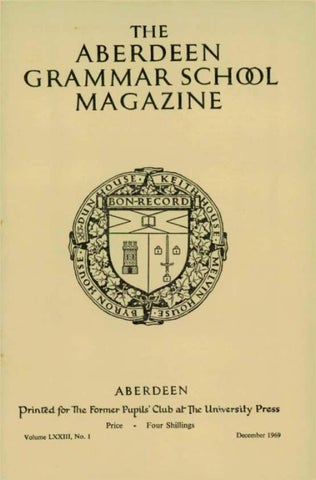
TIIE
ABERDEEN GRAMMAR SCHML MAGAZINE
ABERDEEN
print ct for The Former- Pupils' Club at- The University Press Price Volume LXXIII, No. I
-
Four Shillings December 1969
WELBECK COLLEGE AT 16 YOU CAN TRAIN TO LEAD TOMORROW'S ARMY 1. The Army requires a pi °portion of highly trained technical officers, and for this requirement Welbeck College plays an important part. The College has vacancies annually for 75 boys of about 16 to 17 years of age, in two half-yearly intakes in January and September. They are given a two-year sixth-form education with the emphasis on Maths and Physics. There are excellent facilities for all games and sports, including sailing. The most that parents will be asked to contribute is £70 per term. For some Welbeck is absolutely free. Major items of clothing, holiday travel warrants, books, stationery, etc., are provided free. There are virtually no extras 2. From Welbeck the boys enter Sandhurst for a further two years' training, and on leaving are commissioned into one of the following : Royal Corps of Signals, Royal Army Ordnance Corps and Royal Electrical and Mechanical Engineers. There are in addition, some vacancies in the Royal Artillery, Royal Engineers and Royal Corps of Transport. At Sandhurst the cadets receive pay. There are no charges to parents whatsoever. Ex-Welbeck cadets are gaining a high proportion of the top places on passing out from Sandhurst. The majority qualify for an engineering degree course at Cambridge or the Royal Military College of Science. 3.
Conditions of Entry.(a)
Boys must be between the ages of 15 years 9 months and 17 years 2 months on the first day of the month in which they enter Welbeck, i.e., 1st January or 1st September.
(b)
They should be up to pass standard in the Scottish Certificate of Education or (G.C.E.) at Ordinary Level in Mathematics, Physics, English Language, and some other subjects, of which Chemistry and a foreign language are desirable. The closing dates for receipt of application is 10th January, and 1st June for the September and January intakes respectively.
(c)
For further details write to:— BRIGADIER J. L. PROUDLOCK, Schools Liaison Officer, H.O. Scotland (Army), P.O. Box 85, General Post Office, Edinburgh, EH1 2YX. who will he pleased to visit the parents of boys to give any help required.
• - - - •::-. •
-
•'
• , •.
•• •.,..... -• • -••••
- - -'
• • 4
0
,,,
• •
• • . ,,
•• "
4"
COAL SUPPLIERS OF THE FINEST GRADES OF COAL
OIL AUTHORISED DISTRIBUTORS FOR SHELL & BP SCOTLAND LTD.
ELLIS & MCHARDY LTD HEAD OFFICE
18 REGENT QUAY ABERDEEN
By Appointment To TIER MAJESTY TIIE QUFFN Ironmongers
Stivitteota, The House for Cutlery The superb
selection,
eminently suitable
for
the
home, for gifting or presentation reflects the latest in British and Continental designs.
SCHOOLHILL & 265 UNION ST., ABERDEEN Telephones: Schoolhill 25242
•
Union Street 28130
ROBERT MILNE AND SON Fellow Institute British Decorators
Decorator
263 HOLBURN STREET ABERDEEN Telephone No. 24556 ESTIMATES FREE
11
WHOLESALERS FOR THE NORTH-EAST OF SCOTLAND
A. R. GRAY LIMITED 64 MARKET STREET
ABERDEEN, SCOTLAND Telephone: 24336 (3 lines)
Telegrams: "GRAY", ABERDEEN
Agents for
JOSEPH RANK LTD. CALEDONIA FLOUR MILLS, LEITH
MOTOR BODY, PANEL & WING REPAIRERS, CAR UPHOLSTERY, ACETYLENE WELDING, CELLULOSE SPRAYING UNDERSEALING & SELF-DRIVE HIRE CARS
J. & W. GEORGESON LTD. Balmoral Motor Body Works.
Est. 1896
80 BROOMHILL ROAD, ABERDEEN Telephone 29241
iii
"Books of the hour and the books of all time" RUSKIN
Whatever your taste in books, whether you're looking for literary, educational or light reading, whether you require Teach Yourself or text books, you'll find Bissets are the bookshops which fulfil your particular needs.
James G. Bisset Ltd. in Association with Blackwells of Oxford 12-14 Upperkirkgate, Aberdeen 99 High Street, Old Aberdeen
Now at College of Education Bookshop, Hilton, Aberdeen
William Scorgie
Skilled anglers agree_
The SHARPE ' SPECIALIST ' -is a rod with a real difference
13 & 17 Rose Street Aberdeen Tel. 23731
The Sharpe "Specialist" range of Fly Rods combine all that's best in the latest materials and fittings, plus the proved advantages of Split Bamboo, to produce the most up-to-date Ely Rods on the market. The "Specialist" is the rod for the knowledgeable fisherman who can appreciate the real difference he finds in this new rod_ Come to our Showroom and handle these new rods—get the proper "feel" of them.
Grain and Potato Merchant
Sharpe's VISIT OUR PET SHOP
OF ABERDEEN J. S. SHARPE (Fishing Tackle) Ltd 35 Belmont St Aberdeen
-
-
. . . and always of course for stylish Business and Sports wear . . •
P cso MEN'S
WEAR
131 HOLBURN STREET, ABERDEEN (Corner of liollybank Place)
NO PARKING PROBLEM
iv
MAIN FORD DEALERS SINCE 1911
1
THE HARPER MOTOR CO. LTD
Car & Commercial Vehicle Department HOLBURN JUNCTION, & 180 HOLBURN STREET ABERDEEN
Tractor & Service Department UNION GLEN, ABERDEEN
depots at ElIon & Laurencekirk
ESTABLISHED 1818
• For QUALITY
DRY CLEANING
APPOINTED
Claremont
MEAT PUR•
TO NOR
YIYOTIE AND
MAJESTY
POULTERERS
THE QUEEN
J. WILLIAMSON & SON
The Cleaners
Meat Purveyors, Poult-
450 UNION STREET 27 ROSEMOUNT VIA.
erers and Game Dealers
ST. NICHOLAS STREET 122 KING STREET All in Aberdeen
I, 2, & 3 MARKET BUILDINGS ABERDEEN
and at
Phone 28470
THE SQUARE, CULTS 0
Apish for ' TOWE LMASTER '
Head Office and Works:
40 CLAREMONT STREET Telephone
BRANCHES
52255
COIN-OP LAUNDRETTE AT l05 VICTORIA ROAD, TORRY T.I. 20532
35 FOUNTAINHALL ROAD.
Phone 21724
THE SQUARE, CULTS.
Phone 47822
ALSO AT CHURCH SQUARE, BALLATER.
design conscious printers
A
ABERDEEN UNIVERSITY PRESS FARMERS HALL
vi
Phone 38
Achieve your aim! Our advertising men are geared to help you promote your sales or project your company's image. You can have their advice just by lifting the phone to: Mr. Derek Robb, Display Advertisement Manager, "The Press & Journal ", Tel. 22331 Ext. 3 Mr. Joseph Logan, Display Advertisement Manager, " Evening Express ", Tel. 22331 Ext. 25 Mr. William Gordon, Classified Manager, Tel. 22331 Ext. 21
vii
The Aberdeen Glass & China Co. Ltd. Suppliers to the Trade of Table, Kitchen and
Bar
Equipment and
Axminster
and
Wilton Carpeting 14-16 RENNIE'S
WYND, ABERDEEN
TELEPHONE 52478 9
Spence Alsop Ltd. FOR THE FINEST ABERDEEN - ANGUS BEEF
NEW MARKET BUILDINGS Tel 50703 Branches at
The Square, Cults. Tel 47825, 48357 Hazlehead Shopping Centre. Tel 38718 viii
Suits in new and up-to-date patterns and in regular, short and long fittings can be seen at THE MAN'S SHOP. Prices from f22.10,- to 50Gns.
ESSLEMONT & MACINTOSH (RETAILERS) TAILORS AND OUTFITTERS
UNION STREET
LTD.
ABERDEEN ix
GRAMMAR SCHOOL OUTFITS FOR BOYS BLAZERS (All Wool)
£6 : 2 : 6
Sizc 7,
PULLOVERS WOOL/NYLON Size 30", 52/-
(School Colours)
MUFFLERS
18/6
TIES
7/11 from 13/6
STOCKINGS
„
YOUTHS' TROUSERS
57/6
(Terylene/Worsted)
SPORTS JACKETS
from £6 : 7 : 6
"mar'
ESSLEMONT & MACINTOSH LTD.
(RETAILERS) TAILORS AND OUTFITTERS
UNION STREET
ABERDEEN
x
N
LEWIS MIDDLETON LTD. PUBLIC WORKS CONTRACTORS
GREENBANK ROAD TULLOS ABERDEEN
Tel. 54121
/
For SEA, RIVER or LOCH
MOULDACRAFT DINGHY Our glass fibre dinghies for rowing, outboard, fishing or sailing, and our new ' HIAWATHA' CANOE are the complete answer—
• SEAWORTHY • STRONG • EXTRAORDINARILY LIGHT •
and require practically NO MAINTENANCE
For full details send for illustrated leaflet to:
MOULDACRAFT PRODUCTS GREENBANK ROAD, TULLOS, ABERDEEN Phone 27366/7
xi
SPECIAL! SPECIAL! SPECIAL!
, ry
FAMOUS GOODYEAR :TYRES OFFER
eowso (7.6v-
oridlittS 11 1" — frornus
SAT
8
You always get the best tyres tram your Goodyear deulet
GOOD YEAR
KENWAY tyre house WILLOWBANK ROAD, ABERDEEN.
xii
Tel. 28311
Aberdeen Grammar School Magazine 86th year No. 2oy (New Series 76th year No. sy6) DECEMBER 1969
Vol. LXXIII -
i
-
The Magazine is published under the auspices of The Former Pupils' Club twice during the year, in December and June General
Alistair G. Gracie, i a Fernielea Crescent, Aberdeen
Editor
Editor of the School Section
Bruce Finlayson, M.A., M.ED.
Editor of Notes, Obituaries and Marriages
Charles Ritchie, 25 Nethermains Road, Muchalls, Kincardineshire.
Advertisements
J. A. G. Mearns, Mearns Publicity, 7 Carden Place, Aberdeen.
Secretary of the F.P. Club
Brian K. Crookshanks, T.D., M.A., LL.B. 25 Crown Street, Aberdeen.
The General Editor invites contributions from F.P.s for the next issue of the Magazine and requests that all copy, both for him and for the Notes Editor, be submitted by is May, 1970. Readers are asked to support the advertisers, without whose support publication of the Magazine would not be possible.
Printed for The Former Pupils' Club at The University Press Aberdeen
CONTENTS General Section— Rector's Message . . Whatever happened? . Club Subscriptions . An Odc • . Aftermath of a Revolution Who's Who? . . School Section— School Office-bearers Random Notes Staff Changes House Notes Festival Trip Literary Section Sporting Activities Music Notes. . C.C.F. Notes . Lower School Notes Societies' Notes .
•
•
•
•
•
•
•
.
page
•
•
•
PI
•
•
•
•
•
•
•
•
•
•
•
•
•
•
•
•
•
If
•
•
•
•
•
•
•
19
91
•
11
3 6 8 9 Io
•
•
•
•
•
•
•
•
•
•
•
•
•
•
•
•
•
•
•
•
•
•
•
•
•
•
93,
IS
•
•
•
•
•
99
19
•
•
•
F.P. Section— Club Office-bearers The Club's Club . The Annual Dinner Section Reports . Notes About Old Boys Obituaries . Marriages . Use this Space! New Members Club Consuls
•
•
13
•
•
•
•
•
•
•
•
11
21
•
•
•
•
•
•
•
•
11
22
•
•
•
•
•
•
•
•
19
•
•
•
•
•
•
•
•
9•
71
•
•
•
•
•
•
•
•
•
•
•
•
•
•
•
•
•
•
•
•
•
•
•
•
If
•
••
•
•
•
•
•
•
•
•
•
••
•
••
•
•
•
••
•
••
•
•
•
•
/I
•
•
••
•
•
••
•
•
11
•
•
••
•
•
•
•
•
•
•
•
•
••
•
•
•
••
•
•
••
•
•
••
•
•
••
•
•
••
•
•
•
•
•
•
••
•
••
•
•
••
•
••
•
•
•
••
12
•
•
•
51.
11
11 11
32 39 40 42 43
49 51 52 57 61 64 67 69
71 72
An asterisk * appearing after the name of an F.P. indicates that be it a member of the F.P. Club. The years appearing after the name of an F.P. are those of his attendance at School.
Rector's Message It is mid-November as I write and the new Session, if the adjective is appropriate, is well on its way. On the whole it bears a very close resemblance to its predecessor and some of the points I made in my report last year are still very relevant. Once again we have had an unusually large intake into the First Year-245 this time—and any elbow-room which we might have expected from the loss of two Lower School classes has been taken up by this large influx. At the top of the School we have over i 5o boys in the Sixth Year and one of my major commitments at the moment is to complete confidential reports on i zo boys who are submitting applications for admission to a university—to say nothing of those who are applying for other institutions or for employment. In staffing we have every reason to congratulate ourselves on a full complement of well-qualified staff able to cope with the growing numbers and with the increasing complexities of the time-table. The large turn-over of staff, which has been such a marked feature in recent years, has fallen off to some extent this session, although some departments have been more seriously affected than others. We have, for example, five new members of staff in the Modern Languages Department and it is perhaps a sign of the times that four of the five are women. Our losses, however, though fewer than of late, have included at least two very senior members of staff, one by retirement and one by emigration. I refer, of course, to Mr. Charles Hemingway and Mr. Stanley Hunter, whose departure from the School was reported at greater length in the June number of the Magazine. Most of the outstanding events and successes of the year were also reported in the June issue and do not call for further mention here. At the same time interim reports of activities for the current term will be found elsewhere in these pages and there is consequently no need for me to deal with them separately in this message. An exception may, however, be made in the case of swimming. Here the tremendous upsurge of interest which followed on the provision of a School pond has borne fruit not only in performance at school and inter-school level but in the fact that two boys, now in their Fifth Year, have been chosen to swim for Scotland in full international competitions. Further details will be found in the report on the Swimming Club. It would have been gratifying to have ended my report on this note. This, however, is not possible. Since the start of the current term there have been two new developments, arising out of the plans for the introduction of comprehensive education in the city, which are of immediate and pressing concern for the future of the School, and I should like to take this opportunity of reporting on them. It will be recalled that the original plan, approved by the Secretary of State two or three years ago, envisaged an interim period from 197o to 1975 when the Grammar School would have no intake from city Primary Schools into its First Year. The four classes remaining in the Lower School would be an exception to this rule and would be allowed to proceed into the Secondary Department in 197o and 1971. Thereafter 5
Aberdeen Grammar School Magazine 4 for the period in question we would have no pupils in the First or Second Years but might be expected to take an intake from some of the city Secondary Schools into our Third Year and at a later stage into our Fifth Year. The same procedure would apply to the High School for Girls but other Secondary Schools in the city would have a comprehensive intake into the First Year and would continue to develop, depending on the provision of suitable accommodation, as one-tier comprehensive schools. There would, in fact, be something equivalent to two parallel systems operating in the city during this period, a onetier and a two-tier system. When the position came to be reviewed early this autumn in the light of the overall accommodation situation, it was decided that two of the smaller Secondary Schools, Rosemount and Ruthrieston, would be unable to cope with the anticipated numbers in their First Year and that some modification of the scheme would have to be introduced. At the last meeting of the Education Committee, accordingly, it was decided to scrap the original plan for the Grammar and High Schools and to make provision for a First Year intake on comprehensive lines next session. Under this arrangement boys attending Ashley Road Primary School and boys attending Mile End, Skene Street and Skene Square Primary Schools, who would under present arrangements be admitted to Rosemount School, will come to the Grammar School. Girls attending these Schools will be admitted to the High School. Official intimation of this decision was received only this week and it is much too early to assess all the implications. We are, of course, going to have to cope with comprehensive education earlier than we anticipated and this will call for some thinking and planning in the months ahead. As against that we are hopeful that numbers will be smaller than we have had to face in recent years and that this will give us a reasonable opportunity of dealing with the various problems that may be expected to arise. The most pressing one will undoubtedly be the problem of rooms for instruction in practical subjects such as Technical, Art and Science, which are even at present barely adequate to meet the demands made on them. The second development is in some ways a much more disturbing one. A few days before the start of the Summer vacation intimation was received from the Director of Education that his Committee wished to give consideration to the naming of the new comprehensive schools to be established in the city. As the Grammar School fell within this category, I was requested to submit observations by the end of September. Early in the new term a Staff meeting was held to consider the matter and the outcome of the discussion was a unanimous decision to recommend that the name of the school be left unchanged. It was pointed out that there was ample precedent for comprehensive schools being called High Schools, Academies or Grammar Schools—Keith Grammar and Campbeltown Grammar are cases in point. There was also precedent for old and venerable institutions—some as old as Aberdeen Grammar School—going comprehensive and retaining their name. Ayr Academy is one example of this. There was, finally, the argument that a change in the pattern of education within the School
Rector's Message
5 did not necessarily justify a change of name. The Grammar School has been part of the history of Aberdeen for over five centuries at least and during that period has undergone many changes. There can be little comparison between the small thatched Grammar School which at the end of the sixteenth century received a grant of £6 from the Town Council for repairs on the grounds that it was "presentlie ruynous and decaying" and the Grammar School in the early years of this century. If all the claims made for comprehensive education are to be substantiated there is no reason to fear that the Grammar School will not in years to come, once it has adjusted to the change, continue to play an honourable part in the history of Aberdeen and make a worthwhile contribution to the education of its sons. Despite these and similar representations made by the Former Pupils' Club, which was also consulted, the Committee decided at its last meeting that all comprehensive schools under the new scheme will bear the title "Academy". The Schools' sub-committee has now been instructed to consider the question of names and is to submit recommendations at an early date. No indication has been given of the probable timing of such a step so far as it affects the Grammar School but one can only hope that it will not be put into effect without due notice to all concerned and due consideration of all the implications involved. It is, for one thing, difficult to imagine that the Education Committee will be so rigid or so doctrinaire in its attitude as to fail to take into account the wishes of the 1,30o pupils who are now members of the Grammar School and who have come to identify themselves with its name and traditions. Regard should also be had to the wishes and views of the parents of these pupils, who so far have not been consulted. The question of school uniform is very relevant in this connection. The School crest, being matriculated by the Lyon King of Arms, is legally bound up with the present name of the School and it has always been my understanding that a blazer bearing the School badge cannot be worn by anyone who is not a pupil of "Aberdeen Grammar School". These are only a few of the points that spring to mind. There are likely to be many more—notably those concerned with endowed prizes and benefactions—which may call for legal decision and to which it is hoped careful consideration will be given by the Committee before they decide on a final date for the renaming of the School. It is at least arguable that the change should be deferred for some years till the majority of the pupils now on the roll have completed their Secondary education and till the School can be described, in fact rather than in anticipation, as fully comprehensive. As I write, Christmas is only a few weeks away. There appears to be at the moment some doubt as to whether the Magaine will be out before term ends and for that reason it may be inappropriate to extend to my readers the usual seasonal greetings. I can, however, do the next best thing, which is to offer all of you my warmest good wishes for a happy and prosperous New Year.
7 , .,
6
Aberdeen Grammar School Mageqine
Whatever happened . . . ? PRIMARY 7B 1958-59 "The Grammar School provides for boys a complete course of study, both primary and secondary." So claims the 1.96,9170 School Prospectus. Sadly, this is no longer so. For in 197z the Primary Department will bid farewell to its last "graduates". Isoys also saw the end of a school era—the last intake of pupils at nursery age. An F.P. from that class traces the careers of his classmates in Primary, 7B. N. M. Bothwick (1952-65) started his University career in the Arts Faculty but "changed lanes" and is now in his third year of a science course. R. H. G. Bradford (1951-65), this sometime physicist spent the latter part of this summer in rain-soaked Southern Ireland gathering material for a geography thesis (and drinking Guinness I). Final year geography student at Aberdeen University. B. J. Carrie (1952-64) graduated B.Med.Biol. with honours in July 1968 at Aberdeen University and is now a fifth year medical student. K. F. Christie (1952-65) worked as a clerk in the Bank of Scotland, Aberdeen for two years on leaving School. Is now in his third year at the College of Speech and Drama, Glasgow. H. S. Clark (1951-65) from School went to Dartmonth College and is now a Sub-Lieutenant in the Royal Navy. Is presently completing various courses before joining H.M.S. Lincoln. Has also been selected for flying training. M. B. Colvin (1952-65), B.sc. graduate from Aberdeen University in 1969. Now employed as an Assistant in the local City Engineer's Department. J. H. Cook (1953-63) was on the staff of Aberdeen Journals before emigrating to Canada where he has joined a steel company in Hamilton, Ontario. G. H. Cowie (195 2-65) abandoned training as a chartered accountant and is now studying for an M.A. degree at Aberdeen University. G. P. M. Crawford (1953-64) has distinguished himself in his medical course at Aberdeen University. Now in sixth year. Recently returned from a three-month scholarship in Chicago, U.S.A. M. J. Dunlop (1952-65) graduated M.A. from Aberdeen University in July of this year and is now thought to be training as a chartered accountant. S.J. C. Esson (1952-64), thought now to be a chartered accountancy apprentice. Left School and joined the City Sanitary Department. G. G. Farquhar (1952-62) entered a family business on leaving School. A. Hardie (1954-63) finished his schooling (not by choice) at Bristol Grammar School. From there returned north of the border with "A" levels to Edinburgh University. Graduated with first class honours in Classics in 1969. Is now pursuing his classical studies at Oxford (Corpus Christi).
- a•y-
Whatever happened . . .?
7 G. W. Hay (1951-65), studying in his final year joint honours FrenchGerman at Aberdeen University. Spent 1966-67 academic year as an English assistant in Millau (South of France). From Easter to August this year was in charge of mentally handicapped children in Darmstadt, West Germany. J. F. Hendry (1951-65) graduated LL.B from Aberdeen University in July 1968 and is now serving a two year apprenticeship in Aberdeen. D. A. Lamont (1951-65), deputy senior prefect in his sixth year at School, is now a final year Russian student at Aberdeen University. Has just returned from a year at Moscow University where he was a member of a highly select British Council Exchange Group. Has still not won full colours at Hockey (see Magazine, June 1965). G. Letts (195 z-6z) on leaving School went to Aberdeen Trades College (now Aberdeen Technical College). Is now a qualified television engineer with British Relay locally. Hopes to join the technical staff of a T.V. company. R. A. MacDonald (1951-64) left School in 1964 and worked briefly as a fish buyer. Then became an Assistant Fishery Officer in Shetland before returning to Aberdeen—for a short spell as a fish salesman. Then went to Aberdeen College of Commerce for two years and is now on the Teachers' Special Recruitment Scheme and is studying at Aberdeen University. B. A. Mail (1953-65), M.A. graduate from Aberdeen University in 1968. Entered journalism and works for Inverness Journals, a subsidiary of the Thomson organisation. Also writes for film magazines. A. H. Merrilees (1951-58) completed his schooling in Preston, Lancashire. H. R. Millar (1952-65) awarded the Former Pupils' Club All Round Trophy in his year as senior prefect (1964-65). Has since graduated B.Med.Biol. with honours in Pathology at Aberdeen University. Is now a fourth year medical student. B. R. Morgan (195 z-65), graduated with second class honours in History from Aberdeen University in July 1969. Also a full blue at table tennis. Is now at Aberdeen College of Education. H. E. Morrison (1951-65) graduated LL.B. from Aberdeen University in July 1969 and is now a chartered accountancy apprentice in Aberdeen. A. Noble (195 2-62), on leaving School served his apprenticeship as a motor mechanic with Aberdeen Motors Ltd. A. J. Philip (1952-65) attended Aberdeen University from 1965 till 1969. Now employed by I.C.I. in Codiham, Surrey. P. M. Rankine (1954-61) on leaving School joined Messrs. Clark 8c Chapman Ltd. Present whereabouts unknown. H. W. Reid (1952-6r), left school at 14 (or so) to finish his schooling at Fettes College, Edinburgh. From there he went to Oxford to study history. Graduated this summer with second class honours and is now on a training course with the Scotsman newspaper. M. F. Rennie (1952-65), from school went to the Central School of Speech and Drama in London. Won a John Gielgud Scholarship in 1967 and a Rediffusion Television drama scholarship in 1968. Appeared
8
Aberdeen Grammar School Magazine
in "Hamlet" at the 1968 Edinburgh Festival. Recently finished playing in "She Stoops to Conquer" at the Garrick Theatre, London. D. J. F. Robertson (1954-65), graduated Dip. Comm. from lleriot Watt University in July 1968. Spent the next academic session at Aberdeen College of Education and is now teaching commercial subjects at Carricle Vale School, Corstorphine, Edinburgh. R. C. Shirreffs (1951-65), described as "distressingly brilliant" in the June 1965 edition of the Magazine. Won znd Bursary in the Aberdeen University Entrance Bursary Competition. Was the most distinguished M.A. graduate in 1968. Is this year completing his LL.B. degree before entering the legal profession. D. W. Smith (1954-65), stalwart F.P. rugby forward—captained School 1st XV 1964-65. Also is a znd Lieutenant in the Army as well as being a fifth year medical student at Aberdeen University. A. D. Thomson (1951-65), Medical student at Aberdeen University. S.R.C. President 1969-7o. Is having a sabbatical year this year. A. B. Venters (1951-63) left School at "0" level stage and joined Robert Lawsons Ltd., Dyce. Until recently was a quality controller with that firm and is now a quality controller with A.C.W. Ltd., Aberdeen.
Club Subscriptions Several members of the Club whose subscriptions have fallen into arrear have expressed interest in joining the Club Centre or in renewing their Club membership for various other reasons. Many have been deterred from doing so because of uncertainty regarding the amount of subscription they would be required to pay. If any such persons are known to members it should be explained to them that they are not required to pay the subscriptions for the full period of their lapsed membership. If they rejoin as Life Members the subscription is a single payment of £15. If they rejoin as ordinary members they are required, in terms of the Club Constitution, to pay the subscription for the two years following their last payment (being the years in which they were sent Magazines with reminders about their outstanding subscriptions) together with the subscription appropriate to the year of rejoining. The Secretary can readily quote to such lapsed members the sum involved in each individual case.
Ode to Esslemont Avenue Comprehensive School or Academy With profuse apologies to William McGonagall, Self-styled Poet and Tragedian born Edinburgh 183o Hail! Sons and Daughters of Bon-Accord Join with me and sing a paean of praise To this wonderful silvery edifice. Which is beyond price or bliss. `Twas in this Year of Grace, nineteen— That the Fair City of Aberdeen Built of grey granite—strong in duration Saw a Revolution in Education. Which to some, no doubt, will give great jubilation But to others will be cause for mortification If not a modicum of extreme frustration Which could result in—shall we say—consternation? Beautiful Avenue! Soon thou shalt see A lachrymal indication of this education From all and sundry Especially from every Plenipotentiary of Education Without the slightest thought of remuneration! If I, on a box of strong cardboard stand, Lord Byron I see on this revered land Who, like me, was "touched " by the Muse's hands And which will outlive the times of sands Or should I say the sands of time? This noble pile from its granite foundation Has been in receipt of many an ululation Because of its nice design and situation And the clever boys who have benefited in their education Which has resulted in great benefit to the local population And although you may think this is reiteration It's all in the cause of the New Education! What the future will bring What wonders untold! When you put the sheep and the goats In the very same fold! I'll leave you to assess the implication Let's give TWO cheers for the New Education! FRANK E. CRUICKSHANK
9
to
Aberdeen Grammar School Magazine
Aftermath of a Revolution It is a year now since the outbreak of riots in the French universities, and nearly a year ago—at the end of June, just as the trouble was dying down—I went to Montpellier and visited the university there. Montpellier is in the South of France, a long way from Paris and from the trouble at the Sorbonne. There were no barricades, felled trees, or uprooted paving stones, but they could claim a sit-in and demonstrations. Most of the students had gone home when I arrived and the university was quiet. At the new Arts Faculty building there was a lawn sprinkler watering the car park and, in the distance, the sound of a radio playing pop-music. On a wall someone had painted the letters "U.N.E.F."—the French national students union. On the main entrance door a torn poster flapped slowly beside a small typewritten notice, signed by the Principal, announcing that no classes would be held until further notice. Just inside the door another poster, handwritten on a large sheet of graph paper, lay trampled on the floor. At the foot of the staircase there was a large lecture room, in which students had argued for hours about different brands of Socialism. The blackboard held an enormous picture of Mao-tse-Tung and the floor was littered with pamphlets, crumpled Gauloises packets, and squashed cigarette ends. At the top of the staircase, which was covered with broken plaster and electric cables, where students had ripped out all the power points, I found an unexploded Molotov cocktail. It looked genuine, but proved to be nothing more dangerous than an empty lemonade bottle filled with water and stoppered to look like a bomb. The staircase to the next floor was blocked by a pile of desks and chairs—the only barricade at the University. The classrooms were all the same—desks pulled together to form beds, all convenient receptacles filled with ash and cigarette butts, enamel mugs sticky with congealed wine dregs, and cupboards filled with hundreds of empty bottles. The last room in the corridor served as a student headquarters and it was in this room that we found the small handful of students who still remained to occupy the University. There was a poster on the door—"Beware of dangerous dog." ("chien mechant," which, following the President's famous speech, had been rewritten as "chienlit mechant".) The woman I was with, who taught Latin at the University, knocked and a genuine revolutionary opened the door. He looked ferocious in his long hair, leather jacket, and complete revolutionary uniform, but he was very courteous to the lecturer, who was a staunch supporter of de Gaulle and the U.D.R. (de Gaulle's party) and very much a "bourgeois reactionary". He showed us a rack of gleaming, unused helmets (for fighting the riot police) and a fellow revolutionary asleep on the balcony (keeping a look-out for the police). He sold us a copy of "Action", a student
newspaper supported by the U.N.E.F. The front page bore a picture of one of the riot police and the headline, "Powerless against the
Ino's Who?
II
popular university—the workers and the students". In Montpellier at least, a couple of middle-aged policemen could probably have regained control of the University. Although the student riots in Paris were an admirable thing, in Montpellier and, I suspect, in most other provincial universities, the students seem to have spent most of their time drinking and smoking—and thoroughly to have enjoyed themselves. M. Jom OSBORNE, Upper VI
Who's Who ? The Treasurer would be glad to hear from the member who delivered an envelope at the Secretary's office in August containing a 1969 subscription remittance slip and a £i note but without any name or any other means of identification.
School Section School Office-bearers Prefects GRAHAM C. M. WATT (Senior Prefect) Scorr HENDERSON (Deputy Senior Prefect) NORMAN C. BAND DEREK D. BAVIDGE JON H. CHRISTIANSEN ALAN CHRISTIE ERIC H. CROCKART STEPHEN M. DAVIDSON JOHN L. DUNCAN JOHN D. FLETCHER RANALD J. FORDYCE
WILLULM G. FRASER RICHARD GAMBLIN IAN GOODFELLOW ALASTAIR M. HARGREAVES WILSON S. HENDRY DAVID A. HEWET STEPHEN c. INGLIS ROY S. KEIL EVAN J. LAWRENCE
KENNETH F. MCLEAN THOMAS M. NASKRET ANDREW D. NISBET NICHOLAS J. OSBORNE. KENNETH F. PARK ALFRED T. ROBERTSON GEOFFREY H. SMITH GORDON URQUIIART DOUGLAS R. WILLIAMSON
House Captains Byron
Dun
JON. H. CIIRISTIANSEN
SCOTT HENDERSON
Keith
Melvin
ALASTAIR M. HARGREAVES
THOMAS M. NASKRET Rugby
Captain SCOTT HENDERSON
Vice-Captain ALASTAIR M. HARGREAVES Hockey
Captain GEOFFREY H. SMITH
I' 7Ce-Captain WILLIAM G. FRASER
Swimming
Captain R. J. FORDYCE
Vice-Captain E. J. LAWRENCE Literary and Debating Society
President Graham C. M. WATT Secretary N. JOHN OSBORNE
Vice-President ERIC H. CROCKART Treasurer DAVID I. CORMACK Dramatic Society
President ANDREW G. COOK Secretary DAVID MALCOLM
Vice-President STEPHEN G. INGLIS Treasurer DAVID I. CORMACK Cadet Force
C.S.M. MALCOLM KERR Editors of School Section DAVID I. CORMACK STEPHEN M. DAVIDSON
PETER W. DICKIE Rot S. KEIL I2
N. JOHN OSBORNE GRAHAM C. M. WATT
School Random Notes News has just arrived that the prefects-masters committee has given its approval for the School to move from Schoolhill to Skene Street, although it doubts the wisdom of such an action. * * * post of Howff Tea Lady. This is a for the invited are Applications desirable position in a famous and established old residence, and demands a high degree of satisfactory service. The successful applicant will be under twenty-one, of good stock, properly proportioned, blonde (Raquel Welch excepted), be able to finish toes in three darts and do Archie's homework. There will be no salary but the lucky young lady will receive board and lodging and free transport to away rugby matches. Applications should include a life-size photograph and telephone number, and should be addressed to the Selection Committee, The Howff, Aberdeen Grammar School. * * * And now, here is a late result: Prefects ... o Mr. Baxter ... z * * * We regret to announce that the pupils' gazette will not be called the Pupils' Gazette. * * * Complaints have been pouring in from the sixth year to have some new ventilation installed in their toilet, since at present they find themselves unable to see their hands for the smoke. We must inform the sixth year, however, that they protest in vain as the playing of cards in the School is forbidden anyway. *
*
*
All change for the Newquay Express now standing in room II. * * * who, we hear, has recentlybagged all to Mr. Stephen, Congratulations the Munros in Scotland. (The uninitiated may note that a Munro is a three thousand foot high mountain, of which Scotland has 277). Mr. Stephen only started climbing some fifteen years ago and is a prominent member of the Hillwalking Club. Meanwhile, the Nature Conservancy are looking for a small, hairless and bespectacled man, carrying a large brown bag. * * * had. behan The Dramatic Society's * * * committee does not work. prefects-masters It has been said that the However, the few prefects and masters involved need not feel ashamed of this as the rest of the School does not work either. * * * and the Hillwalking Club. LOST: Mr. Spence Ij
Aberdeen Grammar School Mageqine 14 If Peter Thain and Alastair Scotland happen to read these notes we should like to say sincerely how much we miss their cheerful and friendly presence. If, on the other hand, they don't read these notes.... * * * The present prefecture, the largest and worst at darts for several years, is most notable in that of the twenty-nine strong Gestapo, the membership of the Debater is also twenty-nine. This amazing statistical coincidence is the result of a furious recruitment campaign, held in the Howff by Debater Officials. The response at first was slow, but picked up spectacularly as even the Howff's most stalwart diehards succumbed to the threat of a month on Technical Stairs. *
*
*
The suicide rate at School dinners is twice the prunes and custard. * * * Where there's a will there's sixty-eight waifs. * * * What's 6 ft. a in., long-haired, dosn't play for the 1st XV and walks into walls ? * * * An air of mystery and intrigue surrounds the Howff these days, as hardly a week goes by but, horrible dicta, a prefect disappears from our midst, leaving no trace and without explanation. Fellow prefects are made to wonder—Has the dreaded Mafia struck again? Has he been kidnapped for the High School Hockey Dance? Has he suffocated in the sixth year bog? Or, worse still, Has he gone to Gym? The answer is none of these, merely that it's Howflie Driving Test Time and more and more prefects are sitting the test in secret. To which we say— Shame. * * * Due to untold embarrassment and scandalous rumours, the phrase "Bob's your uncle" has now been banished from the English Language. * * * The success of the reel "Bill May of Boddam" dedicated to Mr. William May of Lab. 4, had induced the staff to reveal the titles of previous dedications. *
*
*
You keep me hanging on—to Mr. Falconer Get off of my cloud—to the C.C.F. Boom bang-a-bang—to Mr. Bruce Roman in the Gloamin'--to Mr. McLeod One of us cannot be wrong—to Mr. Baxter Whale Meat Again—to the Cooks. I'm forever blowing bubbles—to Mr. Walker * * * Finally, the editors will not be sending Christmas Cards this year and we would like to wish all our friends a Happy Christmas and an even Happier New Year
Staff Changes STOP PRESS I I
x5
I Red Star lose unbeaten record to RAGS in Hovvff Darts League stop. Division carried off after checking on double one stop. Full report in next issue stop *
*
*
The class list of Upper VI Maths now reads as follows : Ellis, Hendry, Watt, Ellis, Watt, Hendry, Watt, Watt, Ellis, Watt, Watt, Watt, Hendry, Watt, Watt, Hendry, Ellis, Watt, Watt, Watt, Watt, Hendry, Watt. Staff Changes This is the time when the species known as teacher, avis rara, tends to rest quieter in spirit, almost domestic. On the other hand, June is the time when migratory impulses are felt to quiver throughout the School and one finds oneself nodding farewells to colleagues, of old and new standing, who have succumbed to the impulse to shift elsewhere. In November, at the moment of writing anyway, one looks less fearfully at the state of the staff; one relaxes, even with a touch of complacency. Indeed, the School has been most fortunate in being able to say that the many vacant posts of last June have been filled completely. And now let me turn to the task of welcoming the new members to the School. Let me say, however, that if these brief notes seem to be repetitive or clumsy this is mainly because there are no less than fifteen people to introduce. Two new members to the Geography Department are Mr. Russell Gray and Mr. Robert K. Munro. Mr. Gray is an F.P. of the School who left in 1965 to attend Aberdeen University where he took an Arts degree. He then attended Aberdeen College of Education where he continued his interests in Drama, Hockey and the O.T.C. Mr. Munro came originally from Invergordon which he left to attend Aberdeen University and, latterly, the College of Education. For both of these members, this is their first appointment. To the Mathematics Department has come Mr. Brian J. Walker who hails from Inverurie, but he too may be claimed as an F.P. since he attended Grammar for his fourth, fifth and sixth years. Mr. Walker attended Aberdeen University and declares interests in bridge and hockey of which he is a qualified referee. Mr. Jeffrey Jones and Mr. Gordon Rae have joined the Science Department. Mr. Jones came from Darlington to Aberdeen University to study Chemistry. He has had since then a varied if brief career in Pirate Radio and Publicity before spells of teaching at Bankhead and Cults. This, however, is his first appointment as a fully qualified teacher, as it is for Mr. Rae, who took his Physics degree at Glasgow University but attended Aberdeen College of Education for his professional training. At the same time he took his M.Ed. at Aberdeen University. Mr. Rae has varied interests. He played the clarinet in Glasgow University Orchestra and plays hockey and tennis. The ranks of the School's Department of Modern Languages have been swelled by no less than five new members—Mrs. Janette Shaw,
16
Aberdeen Grammar School Magatbte
Mrs. Eva Cowie, Mrs. Marion T. Petrie, Mrs. Patricia A. Falconer and Mr. Alexander G. Gauld. Mrs. Shaw is an Aberdonian and attended Aberdeen University, since which time she has bad varied teaching experience. She taught at Muirfield Primary School, Aberdeen, before coining to the Grammar. Mrs. Shaw is a singer of some merit and has sung for the Scottish Opera Company and the Edinburgh Festival Chorus. Mrs. Cowie, after taking her degree, has also held a variety of teaching appointments. She taught at Powis Secondary School, Aberdeen, for six years and at Aberdeen Academy for one year. She has also taught in Germany and in Singapore. Mrs. Cowie has interests in drama and has taken part in the Children's Theatre and the Teachers' Drama Group. Mrs. Petrie belongs to Lanark and attended Edinburgh University. She took her professional training at Moray House and taught at Lesmahagon High School before coming north to join the Grammar Modern Languages Department. Mrs. Falconer hails from Cullen and went to Aberdeen University and Aberdeen College of Education. During this period she also found time to do valuable work at the Christian Ski Centre at Aviemore. And last but by no means least in an otherwise veritable female invasion comes Mr. Gauld, a Gordonian, who attended Aberdeen University and did a brief spell of teaching at the Aberdeen College of Commerce before coming to the Grammar. Another Gordonian to join the staff is Mr. Ian S. Reid who has come to teach Economics. He came originally from Edinburgh but later came to Aberdeen where, after school, he attended the University. He is interested in hockey and football and, as one of his colleagues puts it, is "often seen reading the Financial Times". The Art Department has been joined by Mr. James R. Cruickshanks, an experienced teacher who has taught in Aberdeen and elsewhere. He was at the Academy, Northfield and Frederick Street Secondaries, all schools in Aberdeen, but his longest stay, of ten years, was at Ruthrieston Secondary School. He also had a spell of two and a half years at Buckie High School. Mr. Cruickshanks plays the violin and has played for the University Symphony Orchestra. Finally, the English Department which has three new members— Mrs. Elise May, Mr. Malcolm McDougall and Mr. Eric Brown. Mrs. May, of course, already knows the School as two of her boys attended the Grammar. Previously a full-time housewife, as she describes herself, she had a brief spell at Summerhill Secondary School, Aberdeen, before joining the Grammar staff. Mr. McDougall is a late entrant to teaching, being formerly an administrator in the Health Service for a few years. By attending night-school classes, he gained University entrance qualification and promptly became a full-time student at Aberdeen University. There he made his mark as President of the University Literary Society. Originally an inhabitant of Banff' and later Elgin, Mr. Brown has already taught for a brief time at Milne's High School, Fochabers, after leaving Aberdeen University where he obtained his English degree. He is a rugby player and has participated in motor sport.
17 Staff Changes Finally, the clerical staff has been joined by Mrs. Edna Wallace who formerly did service at Muirfield School, Aberdeen. She replaces Miss Marilyn Treasurer who left last session. And that is the credit side of the staff balance sheet, a very healthy one indeed. But, as if to prevent one from becoming just too complacent there is the small but important group of leavers who escaped mention in the previous issue of the Magazine. Mr. Grant Anderson of the Modern Languages Department, who came from Inverness, stayed only a year before moving on to Kinlochleven where he is teaching before taking up an appointment in Germany. Mr. Quentin Cramb and Mr. Murray McAllan, both of the English Department, have left, Quentin to go to St. Andrews and Murray to Alloa. Mr. Tait, Head of the English Department, has written the following of them: For the English department it is now almost a matter of Magazine routine to have to record and lament the departure of another of its members. This time it's a double event. Mr. Quentin Cramb left at the close of the summer term on his appointment to the post of principal teacher of English in Madras College, St. Andrews. It is a promotion well deserved, a recognition of the qualities that made him, while he was here, a most successful and a most popular teacher and colleague, and coming as it does at so early a stage in Mr. Cramb's professional career is occasion for the highest congratulation. He taught five years here, in his old school. It was a happy day for the Grammar when he was induced to transfer from the Gordon Schools, Huntly where he had taught fcr a session, for into those five years he packed so much effectual activity that we are still left admiring. The English Department, particularly, is aware of what he did and what Mr. McAllan did both in quantity and quality; and it feels the deprivation more, consisting as it does in large part of a group of young men who were students and friends together at University and elsewhere before happy accident brought them as colleagues into the same school. As a teacher Mr. Cramb's aim, consistently pursued, was to have all the pupils in all his classes at all levels of ability share in the work— thinking, speaking, writing and acting—and find a sensible pleasure in it. In these last few years when there's been a great deal of pretentious jargoning about such abstractions as "motivation" and "involvement" too little relevant action has attended the talk. It was obviously a pleasure for boys to have a teacher who knew, as it were, intuitionally what these undoubtedly valuable ideas implied, who believed in them and acted on them. Mr. Cramb, in fact, got the best from his pupils because he had faith in their ability to respond to his own vital interests. He believed also that in so responding they would come to know better and to realise more fully their own latent capacities. A to-and-frombusiness in which boys learn to come to easy terms with their own nature and so possibly be better citizens for it made sense to Mr. Cramb. As it did to Mr. McAllan. Inevitably Mr. Cramb involved himself in a whole lot of other School activities. He coached, umpired and played in athletics, rugby and
18
Aberdeen Grammar School Magazine
cricket, while in golf, as well as playing for the masters, he came to organise the annual outings. The organising of the examinations conducted by the English Speaking Board was in his hands, and as the numbers entering for this test from the School has risen quite menally in the last few years he had plenty to do. All of it phenowas done efficiently. But he is best remembered, possibly, for his work Dramatic Society and in particular for the productions of thewith the School play. He brought to the society a peculiar dedication, annual stemming from the knowledge of the benefits he had derived, he was a pupil in the School, from the happy productions of when Mr. King. His university years, giving him the opportunity to read widely and to act and direct, widened his knowledge and his sympathies and this further dimension soon declared itself in the School plays. The last two productions "Julius Caesar" and "Chips with Everything" between them displayed a breadth of sympathy and an expertise in staging that made them—it is agreeable to record—successes both aesthetic and financial. In all or nearly all those activities Mr. McAllan was a companion, ally and friendly competitor. He has followed Mr. Cramb's example in leaving us for a promoted post in the south, though this move southwards may be also interpreted as a necessary, ineluctable part of the McAllan syndrome. When Mr. McAllan joined the Grammar School coming on to four years ago it was mentioned in the staff notes that he seemed predestined from his childhood to oscillate between Aberdeen and more southerly parts of Scotland, and now the pattern repeats itself. The offer of a post as special assistant in Lornshill Academy, Clackmannan, too attractive, as he was presently circumstanced, to be rejected, is a clear sign that fate was again knocking at the door and not to be denied. We must accept the dictates of destiny but we do so sadly, with regret, for in losing him to the south or anywhere else we have lost a delightful personality. Mankind might well, split into two great groupings, the human and the we think, be Mr. McAllan belongs outstandingly to the first group—ahumanoid. man happy to respond as a full human being to the circumstances of life, neither prig nor pedant, and perhaps something of a poet. He worked well for the School. He played and coached on the sports field, in the practice of teaching he was active, adaptable and ingenious, particularly concerned to get his pupils to speak and to and he teamed happily with Mr. Cramb in producing the act with ease, He went into things enthusiastically, with no fabricatedSchool plays. not aggressively, but with a verve that inspired affectionexuberance, and made other people want to participate. And if things went wrong most resilient. Indeed he had need to be for, as he himself he was the first to admit, he seemed accident-prone—falling off would be stage, for example, or down a stair, or through a ceiling, or getting ina the way of a strong, hard cricket ball, or being found out in small misdemeanours when a little worldly prudence would have saved him. Indeed Mr. McAllan probably fell short in this quality of canny worldly-wisdom, and indeed he was probably the better man for it. We William Blake, a wiser man than most of us said of this samerecall that Prudence
House Notes
19
that is so often extolled that it is "a rich, ugly old maid courted by Incapacity". I hear that Mr. Cramb and Mr. McAllan have both settled acceptably into their new positions. The School would offer to both its congratulations and wish them and their families well; and also wish them to come back occasionally and visit us. This would seem an appropriate place to acknowledge the services rendered to the English Department by Miss Lindsay who took over Mr. McAllan's classes in September and carried them on till Mr. Brown's arrival. She quickly gained the respect and affection of her pupils and she has left a most pleasant memory behind her. We thank her and wish her all success in her new teaching post in Northfield Secondary School. Finally a brief word about a former member of the staff, Mr. Charles Hemingway who was until last June Head of the Art Department. We hear that he is in hospital recovering from an operation and we all would like to send him our best wishes for a speedy recovery. We hope that by the time he reads this he is feeling much better and will soon be able to pay us a visit.
House Notes Byron At the beginning of the term, the following officials were elected to represent the House: House Captain, Jon H. Christiansen; Vice-Captain, Stephen N. Davidson; Rugby Captain, Jon H. Christiansen; Vice-Captain, Gordon Urquhart; Hockey Captain, Geoffrey H. Smith; Vice-Captain, W. Gavin Fraser; Swimming Captain, Stephen N. Davidson; Vice-Captain, Gordon Urquhart. Last year was one of the most successful the House has had for many years. However, this was because of the enthusiasm of a small number of boys and it is hoped that more interest will be shown in House activities by other members from all years. The most successful side last year was the cricket side which, although a young team, made a clean sweep of the senior championship and this year we arc hoping for the same success. The House rugby teams had mixed success last year. The XV-a-side team did little to attain the teamwork and determination of the seven-a-side team which won the Malaya Cup. This year the rugby team should be more experienced than last year's and it is hoped that Byron will improve in position. Last year the House won the Athletic championship and worked hard to do so, despite the disappointing number of people from the House who entered. We hope, however, that the number of competitors from the House will increase when we defend the championship. Our prospects in the hockey tournaments are better than they have been for a few years and the House should collect something from the hockey team. The House's performance in the swimming gala has always been disappointing and last year was no exception. The only bright spot in the gala was that Stephen N. Davidson won the Rector's Cup and the Rector's Silver Medal against difficult opposition. It is felt that if there arc more people ready to participate in the gala our performance will improve. Finally, I would like to take this opportunity to thank Mr. Baxter for his help in the organisation and running of the House. JON CHRISTIANSEN, House Captain
10
Aberdeen Grammar School Magazine
Dun At the House meeting this year, the following officials were elected: House Captain, Scott Henderson; Vice-Captain, Graham C. M. Watt; Rugby Captain, son; Vice-Captain, Malcolm Kerr; Hockey Captain, Alan Walker;Scott KinderVice-Captain, Alfred Brack; Swimming Captain, Ian Milne; Vice-Captain, Richard Brown. At the end of last term, the House finished second in the Athletic points behind the winners, thanks mainly to the success by younger Sports, 16f members of the team. In cricket, once again it was the younger sides that produced the best results by winning the middle school cup, while the senior teams came second in the sevens and third in the eleven-a-side. This year our greatest chance is in hockey, where we have several ist players. In contrast, there is a lack of rugby players in the House to takeand and XI last year's strong team. However, this may be overcome by enthusiasm over from and visation. Again, we are not over endowed with swimmers in the senior improevents of the gala, but our younger members should have sufficient success to ensure a favourable result. Finally, I would like to thank Mr. R. McLeod for his constant help and guidance throughout the term. SCOTT HENDERSON, House Captain
Keith The following officials were chosen to represent the house at a meeting earlier this year: House Captain, Alastair Hargreaves; Vice-Captain, Derek Bavidge; Rugby Captain, Derek Bavidge; Vice-Captain, Alastair Hargreaves; Hockey Captain, John Fletcher; Vice-Captain, Alan Archibald; Swimming Captain, Ranald Fordyce; ViceCaptain, Derek Bavidge. Although we had several good athletes in our team last summer, we came in only third in the sports. In cricket we did not do as well as we had hoped. This was partly because we had a young inexperienced side. This year's rugby prospects are fairly good. We should have a strong seven-a-side team. The House hockey players are enthusiastic and have good experience. There are strong year players. In swimming it looks as if we have a good chance of fourth and fifth success this year as very few of our older swimmers have left. In conclusion I would like to thank Mr. Stephen and his colleagues for all the help we have been given in running the House affairs. ALASTAIR M. HARGREAVES, House Captain
Melvin Although the House did not do well in the Sports, spirit and shown by the boys. With the influx of new fifth year members our endeavour were prospects in the House rugby and hockey are better than they were in previous years. hockey team has several XI members in it. Our prospects in the Gala look The House the captaincy of E. J. Lawrence who was recently chosen for the Scottishgood under swimming team. Our thanks again to Mr. Will and the other members of staff who have continued their help and support. Officials: House Captain, 'I'. M. Naskret; Vice-Captain, R. S. Keil; Rugby Captain, R. S. Keil, Vice-Captain, R. Gamblin; Hockey Captain, A. Christie; Vice-Captain, K. Park; Swimming Captain, E. J. Lawrence; Vice-Captain, R. S. Keil. THOMAS M. NASKRET, House Captain
Festival Trip
21
Aberdeen Grammar School Festival Trip 3o August to 2 September 1969 At the ungodly hour of 7 a.m. on the morning of Saturday, 3o August 1969, a train left Aberdeen Station. On it, were boys of the Grammar School, under the supervision of Mr. Finlayson and Mr. Morrison of the English Department. Ahead of this group lay four days of concentrated activity—the Theatres, Cinemas and Concert-halls of the capital were to be invaded; not only by us but by the thousands of visitors who had come to experience the annual Edinburgh Festival. Our temporary home in Edinburgh was the Pollock Halls of Residence—under the cliffs of Arthur's Seat where we were to sleep and have breakfast. The rest of the day was to be spent as we chose. So, having settled in at the Pollock Halls, we scattered into the city, to try and get to know it and to find lunch. In the afternoon we assembled at the Lyceum Theatre to see our first play, Ibsen's "The Wild Duck", performed by the Scottish Actors' Company. A company affiliated to the British Arts Council and associated with such names as Leonard Maguire, Hugh MacDairmid, Fulton Mackay and Andrew Cruickshank might have, we thought, given a more stimulating performance. But there were no complaints about the play most of us attended that evening, Shakespeare's "Richard II". No mention here of this play is necessary. It achieved great publicity in the national press and was hailed as the highlight of the Festival. The Prospect Theatre Company, starring Ian McKellen, produced an outstanding performance, with superb acting and staging. While most of us saw this production, several went to a performance of "The Fools or a strange dream of a clown" by the celebrated Czech Mime Company, "Theatre on the Balustrade". This was one of the Festival's best offerings. The timing, precision and versatility of the ten actors was incredible and they fully deserved the long ovation, especially the director, Ladislav Fialka, who devised the various themes. A few then went to the nearest revue by the Nottingham University Revue Group which turned out to be quite entertaining. Yet another group visited the Tattoo which again maintained its high standard. The following day, Sunday, was possibly less active for us. Some attended a concert given by the Trio de Trieste of music by Vivaldi, Brahms and Ravel. There was a chilling and original production of "Dracula" at the Traverse Theatre and there were also films featuring the Doors and the Rolling Stones. That evening, however, nearly all of us saw the British premiere of "Easy Rider". This film, featuring Peter Fonda, concerns the travels of two American hippies by motorbike, the social rejection they encounter and the pathetic end they meet. This brilliant film built up to a mind-deadening climax. At the end, the entire audience sat, stunned to silence, then filed out with scarce a murmur. This was a most impressive film. On our return to the city centre, some of us came upon the "Arts Lab", in the original Traverse Theatre. Described as "an energy centre where anything can happen and usually does", this provided several fascinating films, accompanied by deafening beat music. The next day, Monday t September, was very full. In the morning, some attended "Group Grope", presented by Keck University. This was an exercise in experimental and improvised drama and was most stimulating. In the afternoon, a few of us saw two works by Samuel Beckett, "Krapp's Last Tape" and "Endgame". The evening was taken up for the most part with a play, "Would you look at them Smashing All Those Lovely Windows!" written by David Wright. This play attempted to show the gallantry and humour of the Irish Easter Rising, but at the same time impressed the fact of its utter futility and pathetic nature. This was good entertainment (especially as free glasses of Guiness were distributed to the audience before the play started!)
2a
Aberdeen Grammar School Magazine
Some of us next hurried off to see the Bristol University Revue (which advertised free sherry). This was an extremely fast and comic show and at the end the players did throw about a dozen miniatures of sherry into the audience. It was now after midnight, but we had heard of a "Folk/Rock Interpretation of the Old Testament" called simply "The Word", which the University of Southern California were staging. Depending on whether American hippy "dancing" appeals to you or not, this really had to be taken with a bit more than a pinch of salt. That was enough for one night. We returned to Pollock Halls, sat and chatted till 3 a.m., then turned in. Tuesday, our last day, was rushed but we did manage to see in the afternoon what was to be our last play. This was also performed by the Prospect Theatre Company, and also starred Ian McKellen in the title role of Marlowe's "Edward II". Although not quite as enjoyable as "Richard II", this was still an outstanding performance, building up to a powerful climax with the murder of Edward. As soon as the play ended, we made our way to the station and boarded our train. We all departed (but only just all), sorry to go, but absolutely worn out. We had spent an extremely profitable four days. The weather had been kind to us; we had adventured into Edinburgh; we had seen much that was stimulating; above all we had enjoyed ourselves. But all of this was due to the efforts of Mr. Finlayson who made all the necessary arrangements and, despite last-minute hitches, organised the whole trip. His labours were not, I can assure him, in any way unsuccessful, and were most definitely very much appreciated. DAVID CORM ACK, EDWARD OGILVIFI
Literary Section The Pike I see the sleek and silver flash Then the glistening waters splash. He jumps so high in the air And gives the passers-by a scare. Out from the straggling river reeds The river hunter boldly speeds. Minnows quickly streak away As the pike comes out to play. When he has no more appetite, Then gone from him is all his might. He sneaks back on his way, The hunter waits another day. DUNCAN MURRAY, Primary 6A
If j
`Nosrivrrim
s-rionoa •sre atp w spnad ati3 smolt:I sags go azaasq alp iptm alqtuedasw !sn twit Supprem ssatposq 335 *AOf pus wed pue ma; puy •smeasp sno Jo sapuntp atp 2upeaatiad Suprniliq Aq se paleanas %Nap al!uuw sir go sea; trr zsoi ase put iatpo tiara 01 saonoy In° undo .3! n sr 3! 3AOT JO 4O303OO1 V 13! puy 61.1tail pavu SIT Jano asop smad atp asogaci 3toltp laptas papunoin sir w P001cl 3t1.4 'Pm O3 Sannog 2tussed e Apapq undo Apoq atp pallossucoun `wed w Jog !anoi alq wed paau j mg '30A03O; cared tutu; pass; pow& jo *az s !Sun-a put tp.tto atp olu! claap 53OO1 Erb!! mod o3
aseq 030A1. 4203 4iw L1SpYt
sSay aseq Atu Jo =Awl an2rij alp 2AOCIE U1°13 S UR33tt& I put wed so; slow alio om 'Il!Ed 30j pasiss 32A2U legs Immo& paroqs `3305 alp O3w Amami fltmp samoq preH •Allaq uaa32 Strqddp sAsrea atp car aStrrqd ssaArid alp Jo slooq poppn3s Isms epos uaas2 atp op!! Sas satutuns atp se Apqns se Apoq AUT SLIVilOSSM S! pup& 2tu. •tp.m) alp wosg pllos Aw sSai armnt do mos8 ssziS atp tuoI3 puy %iv alp go IaAllS 01:14 O3 aprig tpta Supura 55522 atp tiSnonp SUILT plum sagolao aqi
uununy ui AciSnu fr
uoymy Lawn.
14
Aberdeen Grammar School Magazine Channel Crossing
The train glides out along the last stretch of welded rail without a sound. And there is concrete and sea; and in the bare grass, wooden sleepers piled, dripping orange with rust stains. I have been asleep. The shudder of the train slowing down brings me back to the red cushioned compartment with its cardboard floor. A signpost floats past, blue; and I stretch and shiver. That window is open. I stand up to close out the draught when to my nostrils and tongue comes the sweet, green smell of sea air. The afternoon sun lies shattered on a million tiny waves. I turn from the window and find I have to climb over suitcases and seats to reach my coat. Then suddenly the train has halted and the corridor is bumping and heaving with people and luggage. Oh, we shall never get out now. Open the window, then. Yes right down. And I slide the door back and push my way out into the thronging passage. Excusing myself various times, I make for the door of the carriage. And eventually, flattening my body to the wall and half throwing, half dragging myself, I come to the door. I step down on to the level concrete and, don't my feet hurt? I must find the right window now. As I walk back down the long cement runway, yawning in the fresh breeze, I look in all the windows. There you are, leaning out. At last. All right pass the stuff down. Careful. It's heavy. But I've got it and lower it gently to the ground where one by one I lay the bulging cases, propped up against each other. And then you close the window. Through the glass I watch you brush the seats with your hand and disappear out into the crowded corridor. I do not like waiting alone beside the train. The diesel is humming and the place is not familiar. Even though I know you will come, I still fear that the train will be on the verge of leaving altogether, carrying you with it and I will be abandoned here. I wish you'd come soon. Meanwhile, I have a look at my surroundings. Behind, the carriages slope into the distance to where the coast turns. The carriages stand between me and the green fields on the other side so that I can see nothing but the platform, the sea, a corrugated iron tunnel and the masts of the ferry. It is as if this were the farthest tip of land going out into the sea with England far off and invisible. Then you appear beside the other, unknown faces. Here, take this case. And this too, look; and we follow into the tunnel where everybody has formed a long queue. The roof is low and although it is four o'clock on a July afternoon, the strip lighting is on. It seems quite sinister. Around us are people such as I have never imagined. Young men, bearded, in cycle capes and rucksacks. Girls with shiny plastic raincoats and only a small travelling bag over one shoulder. Even the middle-aged women look odd in jeans or long coats and boy's shoes. Everywhere there are bare arms and strange, coloured hats. I begin to feel like a refugee about to step off the end of the world with imminent disaster at my heels. A man in a glass kiosk, with a sailor's hat on, takes my passport and looks at me and at my photograph. I wonder what he is thinking. There are windows in the side of the shed here and I can just see the stern of the boat. It is painted black and white at the top, crusty with many coats and welding scars. High up, the people already on board are looking down and seem to welcome us as guests while we clatter up the collapsible steel gangway, which doesn't feel very safe.
zi
Literary Section
We find our way to the top dcck and emerge beside the giant steel wall of the funnel and the radar thing lazily gyrating. Having set down the luggage we stand at the rail and watch the cranes winding big bundles aboard. Through the deck I can feel the engine murmuring deep down. On the quay is the tall, open shed over which it is still impossible to see the fields. The land has vanished somehow. I think of Noah sailing away on the ark and I think that this might be the last ship sailing from a doomed world. The sun goes behind a cloud and the sudden cold wind makes me yawn again. Let's sit down. So I sit with my hands in my pockets, goose-pimpled and expectant. Finally the engine changes pitch and the shed and cranes move slowly away from us. Behind them, the black land rises to meet the sky. Goodbye. And soon England's coast is a grey shadow beneath the glare of the sun which has come out again. Overhead seagulls glide, spectating; and in London the evening traffic is building up as shops and offices close for the day. DOUGLAS R. WILLIAMSON, VI
South Sea Island Standing by this wintry bus stop Waiting ever for the bus to come In this frosty, biting, cold air, Watching snug warm drivers in cars Whirl, lurch through the filthy icy slush. Snow flakes falling and melting In the dirt beside the road. Oh for warmth and comfort ... Visions come of yellow beaches, Soft, green, grassy slopes, Brown, hairy palm trees Swaying by the sea shore Under a warm tropical sun, In a blue clear sky, With, but a few fluffy white clouds, Tepid crystal waters With fish of everlasting colours Swimming freely and with ease. To be swimming with them, With the warm waters all around, Down to the beautiful coral And sifting seaweed, To swim to an atoll With inexhaustible strength, To be able to lie on the shore Under the caressing sun— To lie in the sun forever, Forever to lie in the sun ... Sudden slush as the bus goes past, Into the freezing fog, Leaving me to wait— For the next bus. COLIN HAY, IIA
z6
Aberdeen Grammar School Magazine The Gentle Arts of Teachership and Pupilship
(being a dissertation upon the skyves, dodges and sundry other practices at present rife in Aberdeen Grammar School)
Tcachership is sternly telling a class to "work quietly on your own"—first thing on a Monday morning. Tcachership is a "free" discussion with an essay waiting in ambush for an unsuspecting class. Pupilship is steering a free discussion away from the prepared essay topic. Pupilship is confining a teacher to complete irrelevancies for two periods. Tcachership is a surprise test on two periods-worth of irrelevancies. Teachership is saying as a class stampedes, "The bell is a signal to me, not to you"; and then complaining when another teacher keeps a class in late. Pupilship is leaving an art room like the massacre of Glencoe at 4 o'clock, but laboriously tidying up when the next period consists of actual, hard work. Teachership is hinting that homework will be lessened if membership of a certain, pet society increases. Pupilship is joining every society in sight to placate the teachers, and then only attending the A.G.M. Tcachership is belting the first year for it, haranguing the third year about it, and praising the sixth year for free thinking. Pupilship is being in the sixth year. Pupilship is going cross country running on cold afternoons with: three shirts, two pairs of socks, a scarf, woollen mittens and a packet of c-s for company. Tcachership is cruising round in a car, organising spot checks on the cross country runners. Teachership is working off one's aggression on Education Authority time— and getting paid for it! Pupilship is the maximum activity on as many sheets of foolscap as possible, in the minimum time, for the minimum outlay of energy. A. C. C. IV
The Old Grey House The wind was whistling through the trees And in the distance came the jingling keys That belong to the man who unlocks the doors Of the Old Grey House. His beard is long, his back is bent, He lives in the woods in a little old tent And every night he will rouse To unlock the doors of the Old Grey House. The 1-louse has been empty for one hundred years For this is the House that everyone fears. Never a bird and never a mouse Goes anywhere near the Old Grey House. But every night in the cold, still air He approaches the house with scarce a care And uses the keys that unlock the doors Of the Old Grey House. DONALD KELMAN, Primary )B
Literary Section Our Town
27
There is no more in this town than white stars leering at geraniums in the windows. In the faded concert hall a cleaner sweeps up litter and the precious echoes. In the library, street lamps glow on the stiff smothered books; bells out of time ring heavily as cars splash past. A girl waits in a shop door as the moon rises from the chimneys. A pub door swings hard open glittering light and beer on the damp grey pavement. She looks at her watch. The dark heavy sea heaves in to cafes on the prom. She waits. The click of light switches and the bucket's clatter echo through the darkened hall. He does not come. PETER W. DICKIE, Upper VI
Street Scene I hurriedly walked down the long, lonely street. On each side of me slum-like houses rose menacingly, with a hint of eeriness. It had begun to grow dark and the few puny street lamps flickered and thcn burst into a weak light, casting small shadows on objects a few feet away, but, outside that circle of light, there was gloomy, ghostly darkness. Somewhere a church clock struck half past eight, the loud booming tones echoing for miles around. Then—silencel—only to be broken by a frantic cat mewing and clawing at a battered door after being shut out for the night. A wind sprang up, the kind that is not very blowy but very cold. Not very far away there was a resounding crash followed by the scared chirp of a bird. I suppose it was a milk bottle. Then down the street came a rattle followed by a, "Come on, old Girl." Into my sight there loomed an old shaggy horse. It must have been a Clydesdale because it was an immense height, with its mane hanging down from its neck. As it went under a street lamp, 1 saw that it was chestnut coloured. The horse was pulling an old, ramshackle cart that looked as if it had come out of the seventeenth century. At the front, on a bench, sat an old man with the reins in his old, wrinkled hands. His shaggy hair and beard, whitened through the years, glistened as the light shone on it. He wore a long coat buttoned up at the neck not unlike the coats worn in mid-winter by Russian and English troops in the Crimean War. The wheels squeaked and rattled for want of oil. On the cart was a silhouette of an old iron bedstead. The whole rattling contraption disappeared into the dark as if it had been swallowed up and the street returned to its misty silence. JAMES Rusr, Primary 7B
18
Aberdeen Grammar Scheid Magatine City To the false, grey horizon it stretched, This neon, tartnaced road to success, Like the river to the sea. And we like the pebbles and sand Rolling and cluttering towards it. It was a foggy, dense morning. The people like flies buzzing hopelessly, Feeling for their every step. This was London! Or at least the road to it, The metropolis, stretching vast and cumbersome towards me, And the roads and railways, outstretched fingers, Grasping and pulling me From the pasture and industry of old England. Rumbling dangerously onward, We reached the humming centre of the hive. Here the whole of the garden was run; Towns, flower-like, are sucked dry of their Pollen, which ends up here. The van scrambled wearily to a halt. The flies now squeezed and pushed Through the caverns underground Pouring out into the squares and places, Mole-like in their subterranean acceptance. Dazed I watched on as men, women, Fat, old, young, ugly, even bizarre tramped Past: Is this my life? The outcast, the barbarian from the North, Amazed at this my first glimpse of my Future den: Will I become a fly and Crawl and flutter like my brothers? My life now rests with you, City. JAMES RAE,
VI
Underwater Fishes swimming to and fro, Coloured red and indigo, Swimming fast and swimming slow. But oh! They're off—what made them go? Ah, here is their tormentor now, A dark-blue shark, and look at how His mouth which nature set so low Is opening to catch a fish—just now! GORDON Gasnast, Primary 6A
Literary Section
29
Sorry for Them Every time I see a person cripple or a human being not made perfect I want to screw the experience up and throw it in the fire. Actually, it's worse than that: obscene as gurgling in the throat or talk of dogdirt when I am eating. I can't help it. But if God created us as we are asked to believe and made some imperfect so that the perfect might be sorry for them or to test the measure of that compassion then it did no good. Because compassion is as weak as feathers and this is so unspeakable that being sorry does no good. DOUGLAS R. WILLIAMSON, VI
The Poems of Japan In a contrast to the rigidity of Latin, and the extreme looseness of English, Japanese verse can be fluid within the bounds of tradition. The following are an attempt to achieve the mood of Japanese poetry—the seventeen syllable haiku, the epigrammatic senryu and the longer tanka—in English. Hai& Drip, drip, drip on sandstone wrung stone yields, and my mind if pierced by water
Settow "A poem I" he said far too easy for the amateurish poet.
Tanka Japan: Who once were Them, but now are Us Whose cities burned to keep the Free World free, and spend such hours just brewing tea. Tankers and Judo Cameras and Senryu Chase each other delicately round the rim of steel mills, clean and grim among the mountain fog. A. CRAIG CLUNAS, IV
3o
Aberdeen Grammar School Magaine The Reluctant Poet Sitting in my bedroom all alone Thinking of father and brother who had gone To Pittodric—to see a football match While I must sit and wait and watch The clock, and wonder if the Dons tonight Will beat the "Bhoys" in green and white. While trying to adjust my brain And think of poetry not the game So that one day I may appreciate The literary merits of the great. Of course these sentiments arc right But why must I do it on such a night "A time and place for everything"— Now that phrase has a familiar ring But someone's got their priorities wrong So why must I have to go along With those who may not think the same, And put their poetry before the game Some day a poem I may try to write But why, oh why, must it be to-night? JAMES G. ARGO, IIA
2T Here comes 2T rushing in, The tall, the short, the fat, the thin, Some of them shout, all make a noise What a great rumpus for thirty-one boys! Enter the teacher with eagle eye. "Shut up and listen!" he doth cry. "Today I'm in a very bad mood, As my wife hasn't given me any food, So any noise and I'll pounce on you all And kick you about like a soccer ball." At this remark all went still As if the team had lost ten-nil. As he barks an order, it's carried out, Everyone fears his roar and his shout. This sums up our masters in a nut-shell, The cruel monsters make us all rush pell-mell. Actually they're not all that bad, There isn't one whom I'd say is mad! RANALD GAULD,
srr `NOSIVA GIAVa .8upayns Jo pus u!ed jo ‘suissala.s. 3ng 'auo Lusa synoA ‘suodsam papoma pus suuopun usol rpm& `stm Luau paunuaa saamos pursnoy auck •alusq jo a2paitaoun ain!itTlyfi lng `Duo Alaea SITITIOA `SlEDS pus sputum% Supsaq Alystdaayg esa!Plos puesnoy 2011u, II! '11g
) OO1,, ‘SW1.1303 titEl MIA Amu,
`auo Aloe; synoy, •sunil pus sauopun mau Supraq Alpnosd 'MA w papretu sia!plos pusenoy 2231jj,
alma owl
lil Jadcfn `mxxci. •Ak
sad
• asojaq isaA ay naj Ram& SUMO' 3111 301I ale s‘usul pp us Jo leg paua3443 ay3 mu! pna pue .3ayvix ippyn saes:al ay Ivy Aquo :Sun you &mow 3! • Aes nok J*11VW 3! S2Op away plo pa3!3 sp43 Su!253acl no c ass Am& • ploo 2o$Sew ay3 aiojaq lza3las pasrguoa '31agq Sul/twit, s •Supiapisti s s! ;say)[, •8p& ASStuos s al!i saan uo paxy i!e aniq ay xir aims sap1.1 'prig • puyn jo nusq e uo Tata 3jos ay 03 flupusis `gu!ails 'Bup.otu `122.t1E01 JO *d03SOpplen E aioq Alcitua ay q2nonu, UOJS s! aan B -puytt 2u!sp ay3 ul uadstra pus urA03q elms jo uteop Vu!Ai ay amjag 3EZIA 118A1
iaquianom I£
uoyaas C.stuala
Sporting Activities Rugby This year, we began the season with a very inexperienced side having only five players who appeared regularly for the 1st XV last year. Our backs appeared to be solid in defence although possibly lacking in pace while the pack was once again light but mobile. Our first game was against Dundee High at Monymusk which we lost 3-o. Their score came at the end of the first half, when a slip-up at the front of a line-out, just on our goal line, allowed one of their forwards to score. This, and indeed our whole performance can be accounted for by the lack of experience and the complete change of pace met by the younger members of the line. The next four games saw a marked improvement in our performance not reflected by the scores, each being lost by a considerable margin. The games against Wednesday Club, Glasgow Academy and Dollar were all lost at the end of the second half after having a share of the pressure throughout, but with nothing to show fot it. The other game, against Gordonstoun, saw the return of our old failing to start well, and we lost three points early on. Once again we eventually raised our game and played well enough to win, but actually lost through stupid mistakes. Following these games, we had a practice during the mid-term holiday and returned confident that we had sorted out our problems. Our first game was against Aberdeen Academy and it turned out to be our first win. Bad weather prevented much handling and kept scoring to a minimum. Consistent pressure however resulted in the game seldom entering our half of the pitch and we eventually broke through to score once in each half, the first try being converted to give us victory by 8 points to nil. Our next match was against St. Aloysius which was in some ways our best game, but in others our worst. In the first half we produced all the points, our forwards taking complete command of the game and we went t; points ahead through three tries and two conversions. Unfortunately in the second half we relaxed our former control and allowed the opposition to come back and lead 17-13 with one try, one conversion, three penalties and a drop goal. As a result of slackening our game we found it difficult to pick up and it was too late when we finally got back on top to score another try which was not converted and so we lost 16-17. The following match was against Robert Gordon's College and we produced our best form. The forwards were matched against a formidable Gordon's pack and did exceptionally well in getting most of the ball from loose play while the backs completely shut out a fast Gordon's back division. In the first half we maintained pressure for a considerable period, using some very good ball from the forwards but went down three points from a penalty. In the second half Gordon's received more and more of the ball as the game progressed and their weight took its toll, but constant harassing meant they made many mistakes and were continually relieved only by a long kick for touch. They did however get another three points through a charge down being picked up. The team did not however give up and we carried on playing just as well to the end of the match, keeping the final result to 6-o. After this game and despite results so far, we look forward with confidence to what is possibly the hardest part of our fixture list. Finally, I would like to thank Mr. Falconer for coaching and training which has helped to maintain a high team spirit in spite of disappointing results. SCOTT HENDERSON, Captain
;a
SIMPSONS' FOR SPORT SKI-ING See our Large Selection of Skis £8 8 0 pair £10 19 6 pair £11 3 6 pair £13 10 0 pair £15 18 6 pair £19 10 0 pair £25 0 0 pair £31 17 6 pair £33 19 6 pair £43 15 0 pair £52 10 0 pair
Champion Fischer Redmaster Kurier Kombi Glungezer Standard Fischer Quick Super Glungezer Epoxi Hit Roving Silverglass Senator Blizzard Fibreglass Special CR 50 CPM 70 BINDINGS
35/- pair 59/11 pair 52/- pair
Titan Toe Pieces Twist Toe Pieces Skimeister 754 Toe Pieces Mark IV Cable Assemblies Marker Simplex Toe Pieces Rocket Toe Pieces 100 Rocket Toe Pieces 2000 Tyrolia 3000 Heel Release
57/6 86/9 89/6 110/6 209/-
pair pair pair pair pair
BOOTS Kitzbuhl Lacing Stefan Lech Clip
£8 12 6 from £12 19 6
from
from £13 10 0 from £15 9 0
Henke Clip Canazei
Hiring Facilities
All Other Accessories in Stock
Large Range of Toys, Games and Fancy Goods
impsonts' SPORTS EMPORIUM BRIDGE ST
ABERDEEN
Telephone 21094 Open on Thursdays until 8 p.m., and all day Saturdays
34
Aberdeen Grammar School Magatine Swimming
Once again the School took part in the Northern Swimming Leagues and handsomely won the under-17 section without defeat. Unfortunately there is a distinct lack of enthusiasm for swimming in the sixth year and the School was unable to enter a team for the over-17 league. During the summer break, Euan Lawrence and Ranald Fordyce were chosen to represent their country in an international match against Ireland. These two swimmers also swam against Denmark at Copenhagen. Both acquitted themselves well with Euan achieving two personal best times. Also during the holidays, Euan and Ranald attended the Scottish Swimming Championships. Euan won the boys' 220 backstroke. Ranald won all four events for which he entered, x to and 12O butterfly and zzo and 44o individual medley. In the Age-Group Championships in November the School had its best ever representation and was duly rewarded with five firsts, two seconds and a third. D. Murray swam exceedingly well to win three championships, ioo and zoo front crawl and zoo individual medley and was a member of the medley relay team which won the 13-14 medley race. Also in this 14 year age-group was E. Rose who came second in too backstroke and third in zoo intermediate medley. Rose was also a member of the winning team relay, the others being Alistair Sim and Douglas Fleming; Douglas gaining second place in the 13-year-old breaststroke with James Wyness coming fourth in the same event. Both Duncan Murray and Eddie Rose have shown great improvement over the past year and if this continues both could be contenders for places in the Scottish team in the not too distant future. Ranald Fordyce gained two firsts in the 16-year-old group: too butterfly and zoo intermediate medley, the latter being in record time. Euan Lawrence, who was to have competed in these championships and was indeed favourite to win the t6-year zoo back stroke, was struck down by an ear infection, and was unable to compete. He was declared fit to take part in the Scottish Schools Championships a week later and again he went to his starting block as favourite. This event was closely contested but Euan's grit and determination shone through in the last ten yards and he gained the decision by a touch, at the same time setting up a new record as was the victory recorded by Ranald Fordyce in the zzo intermediate medley. This success gained for Ronald the Copland Trophy for the most outstanding boy's performance of the championships. Duncan Murray established himself as the best under x6-year-old medley swimmer when he repeated the previous week's performance by again winning the event. Eddie Rose gained third place in the under 16 backstroke while Douglas Fleming took second place in the same age group. I would like to thank Mr. Spence who has given up much of his spare time to build up a swimming team and also Mr. Falconer and Mr. Paterson for their help in the Swimming Club. RANALD FORDYCE, Swimming Captain
Ski Club The office bearers in the club this year are: Iain Riach, President; Richard Jeffry, Vice-President; Paul Seaton, Secretary; William Watt, Treasurer. As yet there have been no outings, but this year promises to be a good year as the Club has enough money to keep the cost of the outings at the same low level as last year's and also to buy some new equipment. This season we are hoping for a slightly better response than last season's, especially from the younger boys. Finally we would like to thank Mr. Walker for all his help in organising the club. PAUL SEATON, Secretary
.331ge so3sloods pus rxruojrxi axojasay sty 3sq3 s,leaS suods pinup so; sAep apqrAo[ua gaps ameold O3 aesq Hon 11103J Supq 3ssai alp 3OU ' sailueqa aq =III 03 3!.naus 'tuatuantssaw 31 loops aq3 3E113 2111!3 suodg pinom aq was u! sl! puompzu •tuJoj Ixam asap seas ua3losq sr.& p3o3a3 auo pooll sere prepue3s alp ISE1 3113 sera snu, •paipnba auo pus usql amp ay pus 3aqleapik peg aql nunbasuoa ' aapae3d so; liqunuoddo jo 3pri tl!EI 3113 JO 2113 S5133.3%. •atojoq 111 al!dS 131i3E3 UE woe; 2131S1313 sappomp 3113 JO suods lootps 6961 aqi, wale passam injunsaq ql!te latptain twin 35513O03 suods iootps
'S.13AVIci 219e1123
pus zu quls'I uosp!Asu •J!, pus Ipsq 03U! Suldolanap aq o3 wags AuvW •llain StnAsid s! siapuaJap reel Auqspuadap /!3q3 `Avid 3nq aum •NT `uosp!Asa •s jo au!! piratuoj Suous `uosumpy ) pus Aaio g `Apssiraw •}I ispualod aq3 asqsa3 O3 laA Apra s! 3I •msz!smpua s Aptnup 3nq s3aArld Amu Jo Is `Arm Taut& saps 2u!plag Jo uoqs aq lou Alum3333 !!!re 3nq AIWA 11313S 13EI `3SITj surux13 Lp! -sating aD9 mrs!r2E salvo sloops Supms `uoos am 30oj of )IS&i0J aeg-Auly `1U333 sup Asp-rues ipso `pus -acrd 30J do pau3n3 Aumumloe aegq sioq 11103J Osuodsat aq3 re3A spu, •ssioD 3113 pup `ilu!ftrinoouo 3soul uaaq set; 3saA `auolsuqof •a3n3n; alp Jo; alou o3 mind se aupps! pus AstspIN patind ansq sAoq uaamm `pj03 jjy 343 10; weal 3nq uouuaux mum aq uaA!S o3 ‘linop aumil alp um! col U331 33E Mind 'S3A0U3 113313.1E3 3E3U *tilos itu!dopeap abs pus paAsid Smog 3S117-2E 21.71E2 aq3 23punct 31LL • t4 uoin Aaql xpnyts. lootras alqz •aspuoId oi, 'amp Amp aAtli pa3o3s Am poi 3saq aq3 `z papa3uoo pus spoil S£ -ssaA ssq uma3 uoaq flu!Asid /Haze sup uossas pus an 2u!tnoqs -sap!suo3 sq•Appato. sa2ustp =33 •q141.1 sum u/srpintpua ,ss3Asid s3.! 3nq &a; ars sutra pasuusSio amos u! And (33 soma apmlno alp Jo uomsoduro3 aq j, •uomsoddo laqleu•papaouoo spoil O3 A3!unuoddo us Aavoq pazsa3alu!sAoq 2,03 O3 pasn s! s! swans lou s! imp pau!uualap Aq saq33stu uorn pus aril uopsodord Jo palms spa 3som 3!alT4 ampaija •suou!sod uI asaql suna3 343 ps£ nc s! 53! xoj arnipq applou g y 1X ca£ pussawns 111533 s! padolanap u! sraisld 3sailuoils s‘auo SuTAnd Aq reoBselO u! lualu pus spuripm 350p25 UnI33 -gusnoi, umnya-salui asp so; ssaArid Jo pod atp 1:11 ass pus (ufilu ammo) And 3olAsj, ammo) (3;a! wain papaps Jo; sAocllootps quom ssaAsid Supsollo; apspy 3p1) `(3peq auuaa) Titus `(3154 3443) sawed `(re02) pisqltraw apuojap •spadsoul Sumnuoid motu aq3 335 laqstm pus 23.t,33Fr Ailu!s3333 ars pus pispue3s uj ix 3SI aq3 u! meld Nog oq 3sOg3 SurumanT3aqz uj •anbniqaal u! sapuap au!j pnnuo; IX 3st reau )!"' ors fitmoy, pus anruau Aaq3 3nq apes 3S1 3113 Inv 3829 =OW qnni. Asid -gap 113143 ioj do saIsuz tpuve. -van 311,E pucoas sap= aril s‘xsaS me! se po08 sr 30U s!`sunoi, Jo Aaupldw 3934 s,jo0g3s atp 35T 3qnop `33ustulopad os `as; sein 1-9 s A/O33p%. xaeo pusig2g1 Jo a3usn! smolop aql Suquoms Arse swaps 31039 3E113uaaq aerq ou s! asaqj, •smare poo2 qiInoqqs s‘uopsop ailallop agy •plagras 35 ilou!A o-I 5 31039 p113 3!Samtpai! 23E 01111& SpIEMIOJ S111 saps 40ogpS 35111525 sqnsas 3gj .3p!ds Suppe! pus s! xmlus Az/go30 •ouoppsq 3q3 u!s3dr3 pus ljrre u3str! 01 atuos O3131 A.3u383n 13030 `3posl twit Strom Amy; sl 13551d pus g3!u3S U101; 3143 2ulturoj turaz sisai 355j Hu!spd.rns 3O11 3503313143 s! m[3 3113 tusal s! 33trajap 3U, j, .313335 O3 amp awns Supiel 395t Jo 33stri Apo s,n3A 3O31133X3 1! ptre read s!tp Tootps O3 pawl-L3= aerti aps A331OOH if
soympv Yuyso4
36
Aberdeen Grammar School Magazine
School Athletic Championships HOUSE CHAMPIONSHIP it. Byron 2. Dun 3. Keith 4. Melvin
130 pt. 11 3i P1-
x03f pt. 74 P1-
INDIVIDUAL CHAMPIONSHIPS Group I
i. G. Smith (D) 13 pt. z. B. Boyd (K) 12 pt. 3. A. Wilkinson (D) 9 pt. Group j
1. D. Sweeney (B) 14 Pt. z. R. Carson (B) iz pt. 3. P. Davidson (K) II pt.
Group 2
1. J. Macdonald (K) z i pt. 2. C. Paterson (M) i i pt. 3. R. Fordyce (K) 10 pt. Group j
1. D. Milne 2. G. Duff 3. S. Gilbert
(K) (D) (D)
9 pt. 7 pt. 4 Pr.
Group f
x. A. Kiltie (D) 131 pt. z. S. Brady (D) Toil pt. 3. N. McWilliam (K) 7 pt. RECORDS I. Group III—Long Jump D. Sweeney 19 ft. 5f in. (J. McWilliam (1958) 18 ft. z in.) 2. Group II—too yards (equalled) C. Patterson xo.6 sec. (D. Smith (1940) x0.6 sec.)
Badminton Society Badminton continues to flourish in the School. The Club is meeting four times a week, once for the first, second and third years and three times for the fourth, fifth and sixth years. The enthusiasm shown by the younger boys should with coaching ensure a good team for years to come. This year's senior singles and doubles tournaments are progressing satisfactorily and we intend to run similar junior events after Christmas. We have arranged our usual series of matches with other Senior Secondary Schools in the town and have already recorded a win over Robert Gordon's College. We have also arranged matches with the staff and we are looking forward to these. At the time of writing we are trying hard to arrange coaching for all sections of the Club and this should ensure a fairly large entry for the N.E. Schools' Christmas Tournament. Our thanks once again go to Messrs. Shand and Wilson for their guidance, Mr. Falconer for his generosity with equipment and to the Janitor for his toleration. JonN ECUs, Secreeary
Sporting Activities
37
Hill Walking Club The past summer has been a busy and energetic one, even by the standards of the Hillwalking Club. In general the Club is in as healthy a position as it has ever been, with an enthusiastic membership, highlighted by the large turnout of second year and the unprecedented number of sixth year "regulars". the first and The long week-end at Cannich was particularly eventful and will both by a spectacularly broken window and the longest and shortest be remembered expeditions ever undertaken by the Club. Since Glen Affric Youth Hostel was being army, the mountains in that area were not immediately accessible to arebuilt by the party staying in Cannich. It was decided to combat this by walking up the path to the head of Glen Affric, climb its surrounding peaks by night and return to Cannich along the high tops. On the map this seemed a formidable prospect but in the decided to attempt not only this, but two separate outlying peaks as event it was the bus at so o'clock on a clear night with fourteen in the party. Some well. We left thirty-two miles, eight Munro's and 9,5oo feet later, a party of six sixteen hours, returned to the same spot. As the night had worn on, sore feet, fatigue and a gale force wind had decreased the numbers as two parties descended into the valley from the midpoint of the ridge. At eight in the morning, on the top of the thirteenth highest mountain in Scotland, having walked twenty miles and climbed four Munro's, with a further twelve miles and four Munro's to climb, and with a vicious gale blowing, the feeling is one of unreality. As the clouds dropped and the last four mountains were obscured from view, the last ten miles seemed to pass very quickly tion to complete the marathon, that we assumed a strangeandsuchwasourdeterminaindifference to the weather. That one of our number did the round in gymshoes and another had done the Yogwalk three days previously, made the exploit somewhat more remarkable. Equally remarkable, in some respects, was the expedition held when a patty of fourteen, after walking five miles and ascendingtwo days later, hitched a boat ride back to the bus and thereby avoided what a certain only 75 feet, master deigned to call "a gentle breeze and a spot of rain". That is the end of the story of the longest and shortest expeditions of the Club. The activities of the Club do not stop at the end of the summer parties were busy during the holidays. These included a successful term and several campaign in the Fannichs, a formidable traverse of the Ben Alder District and a large sixth year near Aviemore, a location which seems to hold a particular gathering of attraction for members of the Club. The result of many years' regular attendance is a spate of people now milestone of fifty Munro's. These include Andrew Nisbet, Harold reaching the Rankin, John Dennis, Brian Caie, Kenneth McLean, Roger Jack, David Hewet, Grant Alexander, Brian Kelman, Michael Robb and Nigel Wood. The recent programme has been a week-end at the new Ardgartan Hostel, the crossing of Jock's Road and the future holds trips to the Devil's Elbow and hills in the lower Deeside chain. Also in the near future we hope to produce a second magazine to repeat the success of the first. Finally, on behalf of the Club I must thank Mr. Stephen and Will for running the Club and also Messrs. Garrow, Henderson, Scott, Spence Mr. and Walker who are mostly quite new to the Club and whose presence we greatly appreciate. GRAHAM WAIT, VI
38
Aberdeen Grammar School Magazine Angling Club
This term the Angling Club has met on Wednesday evenings, and these meetings have been attended by a small but enthusiastic group of members who come mainly from the Middle School. and, At the end of last session we went on our summer outing to Loch Aboyne ice, unlike our outing during the winter, when we found the Loch covered with conditions were very pleasant. We fished for pike and perch, and caught them in reasonable numbers. We intend to pay the Loch a visit in late autumn, for that is when the large pike are most active. During the mid-term break we went to Ellon to fish in the Ythan. The river was them very low, but the pools were full of migratory fish, waiting for rain to enable and trout sea Some river. of the stretches upper the beds in spawning their reach to pleasing particularly was it and conditions, poor of the spite in finnock were caught, successful. to see that some of the youngest members were among those who were
Curling Club Though all of last year's seniors have left the Curling Club, the continuance of the School Club seems guaranteed for this year at least. A small number from the Upper Donald's and a similar number of younger boys are attending the weekly practices in term. Ice Rink and it is hoped to organize a Junior and Senior team in the spring As we are all newcomers to the sport we arc being coached by Mr. Alan Johnstone, should like to an experienced player who has represented Scotland at curling. I is also thank Mr. Johnstone for giving up his time to help us and a word of thanks Ncw times. difficult through club the carrying for Scott Mr. and Waters due to Mr. members will always be made welcome and are certain to enjoy this rewarding ancient sport. KENNETII F. MCLEAN
Music Notes The Annual School Concert took place on 9 June in the Music Hall. The main items in the programme were two Choral/Orchestra works, the first being Purcell's Birthday Ode to Queen Mary "Come, ye Sons of Art". The solo parts were taken by Miss Elizabeth Izatt, who had sung for us in Britten's "Little Sweep" (reviewed in the last Magazine), Miss Pamela Mayor, making her last appearance as a member of the Lower School staff, and Former Pupil Mr. Hugh MacLeod. We of the Music Department arc particularly sorry to lose Miss Mayor. Her singing has delighted Grammar School audiences both in Aberdeen and as far afield as Regensburg, and we hope to welcome her back to sing for us on many future occasions. The Purcell work enabled the Choir to limber up for the more serious undertaking presented by the first ten numbers of Carl Orff's "Carmina Burana". This proved a popular work both with choir and orchestra, giving everyone plenty to do. At first in rehearsal the pronunciation of the Latin and the Old German words had presented a problem, particularly to the younger boys, but by the time of the performance the unusual language had been thoroughly mastered, and the boys were able to launch with real gusto into the vital rhythms of the work, so that the wag who said that we had had "an Orff night" was truly confoundcd I The remainder of the programme featured the Madrigal Group, ably directed by Mr Dinnes in two sixteenth-century part songs, and the Lower School Choir, who, under the lively direction of Mr Swalwell, sang with their usual verve, effectively raising the roof in their last item, Dyson's "Poet's Hymn", in which they were joined by the trebles of the Senior Choir and the full majesty of the Music Hall's fine organ. The orchestral highlights included two movements from Mozart's Sinfonia Concertante, with two of our National Youth Orchestra members as soloists— Marshall Willox and Stephen Tees. The latter has since left school to take up his studies at the Royal College of Music, London. He and Michael Cormack (who has also left to read music at Aberdeen University) shared a performance of Telemann's Viola Concerto in G, and Alan Brunnen, our leading trumpeter, featured in the Finale of Haydn's Trumpet Concerto. Perhaps the star of the evening was James Crockett, who coped manfully with the difficult and intricate coloratura of Mozart's well-known "Alleluia". Since the start of the new session, the choir has already given an important performance. Our School Chaplain, Rev. Ernest Sangster, asked us to present, at an evening service in Beechgrove Church, a programme to illustrate the various ways of singing psalms. The BBC recorded this, and the recording was relayed on Radio 4 on a November. The items ranged from Plainsong to modern settings of the Psalms by Britten and Bernstein. The next date in our musical calendar is 17 December, when we shall be presenting our Annual Carol Service in St. Machar's Cathedral.
The Listening Circle Looking down the programme of meetings held this term it is seen that many aspects of music have been covered. Chamber music predominated. Ian Anderson gave us a chance to hear music for pedal harpsichord and some sixteenth-century polyphonic music of Gabrielli; Lennox MacKenzie introduced Schubert's string quintet and Mr. Skinner gave an erudite talk on music in association with literature, illustrating his readings of Aldous Huxley's "Point Counterpoint", Heine's "Die Forelle" and modern Greek poems with music by Bach and Schubert. In the first meeting Mr. Falconer of the Physical Education Department played a very personal selection of orchestral music—Ravel, Dave Brubeck, Beethoven and Sibelius were included. Nor was opera neglected; Mr. Hawksworth gave an introduction to the 39
40
Aberdeen Grammar School Magazine
music and libretto of "The Rake's Progress" by Stravinsky for the benefit of those who attended the Sadler's Wells production at H.M. Theatre on 21 October, and David Cormack lulled then blasted the Music Department with Wagner's Siegfried Idyll and the immolation scene from Gotterdammerung. John Osborne introduced the fifth symphony of the Danish composer Carl Nielsen and the only concerto of the term was introduced by Ronald Craig—Chopin's 1st Piano Concerto. After a very large attendance at the first meeting, attendances dropped to about ten. "Serious music" after four o'clock is viewed with studied apathy. My thanks go to Mr. Hawksworth for giving up his room and much of his time in tape-recording records, and to Mr. Will and David Gilmour for the posters. Meetings are planned for next term. PETER DICKIE, President
Folk Song Society Over the past year the Club has continued to thrive and has been favoured with talented guests who included such well known names as Duncan Allen, the young Inverness guitarist, Donald Bruce and Sandy Cheyne. The standard of the Society has continued to improve and compares very favourably with the high standard attained in the past. Our thanks again to Mr. W. May for his continued support. GORDON TAYLOR, V
C.C.F. Notes Mr. Ronald McLeod usually prefaces this section with a few remarks about the overall activities and strength of the Army and R.A.F. sections. At the moment of going to press, he is in hospital recovering from an operation for the removal of a duodenal ulcer. We all hope that he is well and that he will return soon to the school where his cheerfulness and often outrageous humour arc already much missed.
R.A.F. Section The annual inspection this year was made by Group Captain Fountain, Commanding Officer of R.A.F. Kinloss. This proved to be a success with displays by the Contingent's grasshopper glider at Rubislaw and a combined cadet exercise at Scotstown Moor. During the School holidays cadet activities did not cease. A visit was made to the R.N.A.S. Lossiemouth Air Day in July and it is hoped that this may become an annual event. Between 26 July and 2 August there was the annual camp at R.A.F. Scampton. The activities included flying in Chipmunks, gliding, •22 and •303 rifle shooting, an assault course and a leadership exercise, swimming and visits to various parts of the airfield. The section was placed second in the inter-squadron competition out of twelve units. Later in August two cadets gained their "A" and "B" gliding certificates at R.A.F. Ouston (Newcastle). In September there was a visit to the Battle of Britain Air Display at R.A.F. Leuchars, giving cadets a chance to see a wide variety of aircraft in service with the R.A.F.
C.C.F. Notes
41
Chipmunk flying this session was arranged for October but was postponed till November. This again had to be cancelled because of adverse weather conditions. On 3o October Group Captain Hunter, the commanding officer of Air Cadets Scotland and Northern Ireland, visited the section and gave a talk on the benefits of the cadet force. Cadets have now started their basic training for the forthcoming exams in Easter. At the start of the session there was a satisfactory number of cadets joining the R.A.F. Section which now stands at fifty cadets and twelve N.C.O.s. Our thanks go to O.C. Flight-Lieutenant Mcleod, R.A.F. Section Officer, Pilot Officer Brooks and S.S.I. Rogers for their continued support of the section. Flt/Sgt. A. J. GRANT
Army Section The promotions in the Section this year are as follows: Sgt. Kerr to C.S.M., Cpls. Christie and Watt to C/Sgt., Cpl. Dey to Sgt., Cdts. Andrew, Brown, Duffus, Martin and Smith to L/Cpl. This summer the annual camp was a great success, a very interesting and entertaining programme being followed. Two days were spent hillwalking and bivouacing in the Glencoe area and a day was devoted to watermanship on a nearby loch. All the exercises were quite successful. The usual inter-platoon competition was run and Tiger Platoon won by 19 points. We were very pleased to have a large number of recruits this year who have now started, under the guidance of R.S.M. Langlands and Sgt. Sharman of the zz Training Team, a course which will lead to the Proficiency Exam, possibly at the beginning of the next school year. Some N.C.O.s attended a cadre over three week-ends at Fonthill Barracks under the 22 Cadet Training Team and some A.C.F. Officers. Lastly, on behalf of all the cadets, I would like to welcome z/Lt. Gray to the Contingent. I would also like to thank Flt/Lt. Mcleod for his efficient running of the contingent, and to extend this to the other officers of the Contingent and Regular Army Officers and N.C.O.s who gave their continued support to Flt/Lt. Mcleod. MALCOLM KERR, C.S.M.
The Pipe Band The band has started well this year with quite a number of new recruits in both sections. However, we still lack professional tuition, which will be necessary if the band is to be successful. We are fortunate to have our usual drumming instructor, Mr. Russel Gray, on the staff of the School this year, and we thank him and Mr. McLeod for their help and advice in the running of the band. STEPHEN INGLIS, Pipe Major
Lower School Notes During the first week of the summer holidays approximately fifty boys attended the Lower School camp at Tarland School, where we enjoyed bright weather and had a pleasant time. Our activities were many and varied—there was golf, fishing, football, cricket, rounders, walks and the boys' own form of tennis in the school playground. The golf competition was won by Derek Reekie and Gordon Milne and the fishing competition by Hamish Duthie and Keith Greig. One of the most remarkable things about camp was the number of "birthday" parties. Even Mount Keen's umpteen-millionth birthday was enthusiastically celebrated. The fact that the boys really enjoyed camp was shown when some boys had to leave before the end of the week to accompany their parents on holiday. They left very reluctantly and with tears in their eyes. We started this session with 112 boys in PVI and VII. Two boys have since left and the Lower School roll stands at 110. We now occupy rooms 33, 34, 36 and 37 in the Lower School building and are fortunate still to have room 35 as a general purposes room. Because of the impending change-over to decimal coinage and the metric system, the boys are busy in their arithmetic lessons, learning to handle decimal coins and metric weights and measures. It is already clear to us that the boys are doing this with more ease than we, who have for so long been accustomed to £ s. d. and imperial measure. The prolonged summer has meant regular attendance for games at Rubislaw and Harlaw, on Monday and Friday afternoons. The Lower School rugby XV has had three games so far . The results were: lost 3-o v. Minors v. Aberlour lost 27-0 lost 6-5 P. Minors Although our XV has not yet registered a win, we must remember they only started to learn the game in August and they have been playing against older and more experienced opponents. Their progress is shown by the fact that in their second game against Minors they were leading until the closing minutes. A PVII soccer team did well to draw 6-6 with Cults Academy while a PVI team lost 2-0 to Cults. The PVI defeat was due mainly to the lack of teamwork. In October, the Lower School choir took part in a service of praise in Beechgrove Church and we look forward to hearing them in the School Carol Service in St. Machar's Cathedral on Wednesday, 17 December. This term we have had outings to "The Magic Flute" and the Hogarth Puppets. The PVIls also spent an informative hour aboard H.M.S. Ocelot when that submarine paid a visit to Aberdeen Harbour. The new monitors have been installed and are performing their duties well. They are Gary J. G. Allan, Norman T. Crichton and 42
Societies' Notes 43 John R. Kay (Deputy Head) of VIIA; Callum A. McDonald (Head), Forbes F. McLennan and Ian C. Strachan of \TUB; Alexander H. Milne and Cameron Munro of VIA and John Adam and Peter J. Mitchell of VIB. J. N.
Societies' Notes Historical Society At the Annual General Meeting last year the following officials were elected: David C. Kenworthy, President; N. John Osborne, Secretary; David I. Cormack, Treasurer. Craig Clunas was elected Vice-President at the first meeting of this term. So far this year we have seen two fairly interesting films and have heard several talks. Mr. Duncan gave an illustrated talk on "Looking up History". Mr. Colvin Greig of the College of Education, on his third visit to the School (which is a clear indication of his popularity), talked about further developments at the excavations he is conducting at Pennan. Mr. James Scotland, Principal of the College of Education, gave an excellent, extremely entertaining talk on the History of Scottish Education. Attendances have not broken any records, but have been very good and show that the Society is most definitely prospering, despite gloomy prophecies that interest would eventually die. We have quite a large membership and now have about enough in the funds to pay for some kind of excursion in the summer term— this is something that the committee is considering. Once again we must thank Mr. McCombie for his suggestions and advice and for the considerable time and interest that he devoted to the Society. N. Jonx OSBORNE, Secretary
Motor Club The committee for this year is R. Jeffrey (President), J. Ritchie (Secretary) and W. Watt (Treasurer). In the short period so far, the Club has already had a successful and entertaining day-trip to Ingleston racing circuit at Edinburgh, coupled with several film shows of post-Second World War racing. It was hoped to use the club car but attempts to try and start the car met with complete failure. During the coming months it is hoped to revive the car and to give members an insight into advanced techniques of driving, a service which will be provided by Mr. Dinnes of the Music Department. Trips to race meetings will also continue, wherever possible, as these have proved a great success on previous occasions. More film shows are hoped for and there is a possibility of a Treasure Hunt in the very near future. The committee wish to thank all who have helped in making the Club a success, especially Mr. Dinnes without whose help the Club would not have been possible. W. WATT,
Treasurer
44
Aberdeen Grammar School Magazine
Dramatic Society On 24 June 1969, towards the end of the summer term, the Society presented a programme incorporating prose, verse and music entitled, "The Winter of Our Discontent". This production on the theme of revolution met with a relatively large response and proved thoroughly successful. An extraordinary general meeting of the Society was held, on the 26th of the same month, to elect new honorary officials and deal with other business raised at the earlier annual general meeting. The election of new honorary officials was made necessary by the resignations of Mr. Cramb (Honorary President), Mr. McAllan and Mr. Tait (Treasurer). I feel the whole Society would wish here to express publicly its gratitude to these three members of staff. At the extraordinary general meeting Mr. Tinto was elected Honorary President and Mr. Northcroft Treasurer. The Society has, however, encountered a number of unforeseen difficulties this term concerning the choice of play, with the result that there will be no production of the usual kind. But as the membership of the Society is quite large and many members wish to take part in some form of activity this year, a production is certainly envisaged although what form it will take is not yet clear. Probably a presentation along the lines of last term's, "The Winter of Our Discontent", will take place. Produced so late in last term as to miss being mentioned in the last edition of this Magazine, was an additional performance of a Dramatic Society venture. Several senior members of the society wrote and produced an experimental stage work entitled "The Winter of Our Discontent". This enterprise had as its theme Revolution, in the broadest sense of the word, and illustrations of the various aspects were presented in different forms; pure drama, prose-readings, tableaux, poetry and combinations of these. The programme was composed of extracts from works of literature, which were chosen by the boys as suitable for stage presentation. Selections were taken from obvious sources; the Communist Manifesto, "Julius Caesar", theAmerican Declaration of Independence: but much material was taken from less obvious or wellknown sources; "Luther" by John Osborne, "The Life of Galileo" by Brecht, "Autumn Journal VI" by Louis MacNeice. Revolution in the spheres of politics, science, religion and industry were all dealt with, but without making any case for any one side. The object was to stimulate the thought of the audience. A good dramatic balance was achieved by contrasting, for example, the harsh cruelty of Richard III's speech (from which the title of the production was derived) with the humour and more subtle effect of Tetzel's speech from "Luther". The audience was thrilled by the tableau representing the futility, tragedy and gallantry of the Irish Rebellion, and shocked by the horror of the Spanish Civil War as Hemingway tells it in "For Whom the Bell Tolls". They were touched by the pathos of Stephen Spender's "Ultima Ratio Regum", and amused by the embarrassment of the characters in the representation of the French Revolution; a simple queen, an ignorant soldier, an executioner who wishes his wages to be raised on account of the "increased cost of living". The production came to a climax with a thought for the future: "Revolution will go on." But how? Like Peter Porter's poem, "Your Attention Please"? "The Winter of Our Discontent" was performed free of charge to a small audience of anyone interested on the evening of Tuesday, 24 June 1969. It is a good thing for pupils to act on their own initiative, without the assistance or direction of Staff, and to produce as successful an item as this. Let us hope that this trend will continue, especially within the Dramatic Society, where the scope for active experimentation is at its widest. DAVID I. CORMACK, Secretary
Isappud `sing bumf 'ODUMS!SSV sp; 103 101!1114 0111 01 )US `aalrepe pus dpq so; Azmo •sw o3 08 snustp mo -am3n; strilpq s quo 343 an!if o3 saspuosd spp pus `atuoanno aq pings auapadxaut spp Jo tpnus 'sal:pp:us Jo sagas sno pus `Lnum-i ssaqo mo w suoiupps atp tp!A •paAridsw osps SW& aauapodsa Jo spas; s `aasoqtuEf 0111 m ss snq `sluautsumos asatp ipoq ur uaas sem Arid pooil atuos •app ioogaS aippm alp soJ OH Jo uuno utiof pm2.PP VII Jo 3[0(O tomfe3O aptyn 'isu alp u! V9 Jo apsad palsaJap yL Jo qqou ;neva `101U/03 0111 uI • S1113111V111/1011001pS aiPPII4i pus ioogaS JUICY' Art10 MU 3AVLT am 11:0A spp ss; os •sAoq sallunoti atp Jo autos os 03!pescl gamut pasmbas tpnw autos on!2 os sn alga ;pm stqi, -stuns wits pasasua ansq am qa!qm ai `an.lsal ssato slooups uaapsaqy atp so; matuaileanoaua awns sn °anti, set; spp pus `troapsaqy U10.1.1 swear 1314'10 31r1 OAOCIS patistus am `12Aatil0H 'SWUM* uaasig ails Jo mo 1111131 paqspng pus 'sups. silo; Apto aeurtu pinoa uas Jo =as mo asatim `aapurtu ur ppm sem trapyr. `aasoquittf uopepossy asap, sopmf qsploas alp ur umotts sem se `Ipiluarss ssassod sat( sou swop quip alp `sanantoH .3seai is Si a ;mos ma; Istau alp q8ncutp sn aas pinoqs tuns s‘seaA spp ur q3noL pus amapadsca uaamlaq aaurn ayy • useas ;amps 101!}; aapunc; z 12AO urm HU 01 spzeoq sus germ suatuzusnoi, ssato ,spotps IsuopeN saulu &puns alp Jo p11110.1 puoaas aqs patpeas seq um) mo lootps samoa aq3 mos; /imams sapnpur tiattim psoaas s of ilupp dpplacituaus quip Ippn SS0113 103 1V1l poo2 a traaq set; sttaii srgy
qnip fitsato ata
isvp.o/s- `amiorso bumf •MtisuarmD ppom ur uopranpg so; pauncr3 aqs Jo aauasaJuop alp 3e lootps aq3 masaidas os setu3s!sto sa3Js 3sM uopucri ol Smo8 aq osie ;pm busman pus ittap!sasd atp pus uaapsaqy u! spotps Ampuwas soluas aq3 Jo yarn grim aseqap e 2u!net; aq imp am Iensn sy llsH i°°gaS alp u! ODUVU ,S(001f3S X!S s ;nog os usid osis •Asolosispes mow aq `adot; am `min gamin auo salpour Not; Arm 316. 1ST kqpq!ssod s s! amyl 1nq `SV*3311S 1VOIS V 1011 SS& `sagosaO ui ppq sem tppyn `aseqau ,siootps xis 0111 `ApssunsioJun %Ian" puouara IOSS3j0Jd UJOJJ )fl53 put '„assam 23num auo„ s `(sauospd aq3 sr ArtstaN .n41 tp!m) JERI, 'pow a aq ;pm amt.'s twos Jo pun a tp pus mou uaammq puv •e!ssnli tsr awn sp4 uo >tiel s OAVS 'AppOS 3‘4130 1U2P1rS3Jd 13111.103 e `suoturn pleuoci •sw •s re-; fimsuaan alp pus Elmpur-; uoon 2141, •tusiumu -wo•D/utspsed uo pair.qap pus 1111110] a psq ant; •papsn Alan sr snqsuAs 311j, •snaA q3J13 pus tpsno; 0111 tutu.; slansads ma; os 31V amyl ley a3surtuoJun s! 3! mnq `ssasa3ur uaa3; s umotis angq S.129111DUI JatMOA •s,lassfissw -3s tp!in autqau vamps-mug atp so; 3no panard sem Asssmq alp 2353 u!--ssaA sp33 se; os poog Affettopdaoxa uaaq *egg saauspuany •JJ.IIISDAU '3138111103 I FlAria fC1/91107S `ausoqs0 tiqof •N !supra-kr-9s14 `4Je313013 • H opH ..fintpynk; '33EA •B,; •D ammo :ass umssas spp so; papap spspwo atm
Appos Suptqacif pue Ase.ialn
sti
!WON ,Say/d/JOLS'
46
Aberdeen Grammar Stbool Magazine
The Film: Society The Membership of the Society continues to increase each year and with this has come a new affluence which has enabled the Society to arrange seven programmes this year instead of the usual six. The Society is, for the first time in its history, presenting a full programme of cinemascope films. This year's parents' night is on i6 January and the film which will be shown is "The Magnificent Seven", a western considered by many to be the best ever made. Although the 18th season of the Film Society is only one film old at the time of writing, it appears that it might be the most successful yet. Our thanks and appreciation go out to all those involved with the Society. Roy KEIL, Upper VI
The Film Study Group After many years of absence from the list of School societies, the Film Study Group is now reappearing and we hope it will establish itself as one of the major societies of the School. The basic reason for the reintroduction of the Society is primarily to provide an opportunity for a deeper more detailed study of the factors, apart from that of pure entertainment, involved in film making. The exceptionally good facilities, which are available to us now, also make The Film Study Group a far more attractive proposition than it was before. The Society is open to all members of the fifth and sixth years and we hope to have our first meeting early in January. Roy KEIL, Upper VI
Radio Club The following letter which was received from Mrs. M. Reekie, a Geriatric Health Visitor, explains how the Radio Club has been occupying itself recently: "Owing to the increasing need for beds in Mental Hospitals for younger patients, a scheme is now in operation whereby the less afflicted elderly patients are being discharged from Kingseat Hospital. These persons who re-enter the community are usually very much alone and some are invariably lonely. They are visited regularly by Health Visitors but frequently their only recreation and source of information is by means of a radio set. Two of the sets repaired by the boys of the Grammar School will go to an elderly lady who came home after two years in Kingseat Hospital. While making arrangements for her discharge, it was found that her house had been broken into and the furniture destroyed by vandals. We were able to refurnish her house but at that time could not provide a radio. Although the Association of Social Service provides radio sets for the blind and other needy persons, we are indeed extremely grateful for the added service by the Grammar School pupils."
Aeromodelling Club The Club has been going ahead very quickly this year and we have already had several new models flying with a few more ready to follow shortly. We have also a firm foothold in the sphere of radio-controlled models and our first model, a "Super Sixty", using pulse proportional equipment, is being prepared and should be flying by the end of the year. Altogether, the Club has been progressive and hard working this year.
Societies' Notes
47
Geographical Society Membership of the Society is again high in this our second year of existence. It is particularly encouraging to see a large contingent of Middle School members attending meetings and we hope for the continuance of this trend. So far this term we have had several slide-illustrated talks by university lecturers, all of which have been of an exceptionally high standard. Talks have been on a wide range of topics including the National Parks of the U.S.A., the contrasting faces of Peru and the aftermath of a volcanic eruption in the ice wastes of Antarctica. It is hoped to arrange excursions and perhaps a little field work in the summer term, time and weather permitting. In conclusion, I would like to thank Mr. Gelly and his colleagues of the Geography Department upon whose co-operation and assistance the society depends. KENNETH F. MCLEAN
The Scientific Society The large membership this year has been very encouraging and the committee sincerely hope that the syllabus that has been drawn up will satisfy the varied interests of the members. In addition to the normal lectures and demonstrations we hope to arrange a dance and an excursion sometime during the year. The meetings, unlike those of last year, will not be held in King's College as we feel that this is unsuitable for the majority of the members as far as transport is concerned. It is proposed to use the Technical College for this session since this is more central. Our thanks go to Mr. Bruce for his interest and co-operation. WILSON HENDRY
Stamp Club The Stamp Club began this year very well. Two or three new ideas arc being carried out this session. One of these is of having a Stamp auction. The first talk this session was given by Mr. Hawksworth of the Music Department. He gave a very good illustrated talk on stamps dealing with music. We have also planned this year to have displays and films on stamps. DONALD F. GEMMELL, IIA
Photographic Society This year the membership is approaching one hundred, the largest since the start of the Society fifteen years ago. Ironically enough this is the first year that the Society has not been led by Mr. Will who has had little spare time since his promotion to Head of the Art Department. He is, however, ever helpful. The fortyfive members of the first and second years meet on Monday and Tuesday nights when we are indebted to Mr. Scott and Mr. Ord for the use of their rooms for teaching purposes. Because the darkroom has been heavily booked by the younger members, certain members of the sixth year have darkroom periods during the day. The success of the Society this year may be attributed to the members who help with instruction and we trust that we can count on their continued co-operation and help. DAVID HEWET and KEVIN RENNIE
48
Aberdeen Grammar School Magazine Railway Society
Partly because of our successful exhibition last year, membership has increased considerably. This term we have been fortunate in acquiring a room to set up the model railway. Work has proceeded rapidly on the model and we hope to have it in full operation by Christmas. Next term's programme is intended to be a little more varied than that of the past session. We would like to express our thanks to Mr. Bruce and Mr. Coull for their valued help. Office bearers: President, Ian R. Greig; Secretary, Alan T. Smith; Treasurer, lain Hatrick.
Scripture Union Although numbers have been small this session, they have at least been consistent. The programme for the session has been quite interesting. Mr. Duncan gave a talk about the Holy Land and this was accompanied by slides. We have also had a music session at which we heard records of various gospel singers and groups. We would like to thank Mr. Duncan and Mr. C. Stewart for their help and guidance during the term. ALAN SMITH, Secretary
Former Pupils' Club Section (Club Founded
It September 1893)
Club Office-Bearers, 1969-7o Honorary President: JOHN VASS SKINNER, M.A., B.LITT., DIP. ED.
(Rector since 1959)
Honorary Vice-presidents: ERIC Ros BIRKETT (1920-22), C.A. HENRY JACKSON BUTCHART (1890-99), D.S.O., O.H.E., T.D., B.I ., LL.D., D.L. JOSEPH ROBERT CARRY (1918-30), M.B.E., DOUGLAS PATERSON COCHRAN (1906-15), P.INST.I.B., A.A.I.B. ALEXANDER GRAY (1910-22), M.A., LL.B. THE HON. LORD JOHNSTON (1913-26). JOHN ADAM LILLIE (1893-1903), LL.D., M.A., LL.B., Q.C. ERIC LINKLATER (1913-16), C.B.E., M.A., LL.D., T.D. IAN GOWANLOCK MCPHERSON (1910-I7).
The Right Hon. Lord MESTON (1901-02). JOHN LENNOX RIDDELL (1907-16). Sir
JAMES
JACKSON
ROBERTSON,
O.B.E.,
LL.D.,
M.A.,
B.D.,
P.R.S.E., P.E.I.S.
(Rector 1942-59). CECIL A. G. SAVIDGE (1913-24), M.B.E., M.A. Sir JOHN WILLIAM TAYLOR (1906-II), K.B.E., C.M.G. Sir JOHN MACKAY THOMSON, C.B., M.A., P.R.S.E. (Rector, 1920-21). Sir LANDSBOROUGH THOMSON (1899-1908), C.B., O.D.E., M.A., D.SC., P.R.S.E., LL.D. ROBERT BERTRAM WILLIAMSON (1906-I8), D.S.O., M.A., LL.B. EDWARD JAMES WOOD (1908-21), b1.A.
President : GEORGE EDMOND CROMBIE (1916-21), C.M.G.
Vice-President of Club and Chairman of Executive JOHN MAXWELL MILNE (1934-46), M.A.
Secretary and Treasurer : BRIAN K. CROOKSHANKS (1934-46), T.D., M.A., LI..B.
25 Crown Street, Aberdeen.
General Editor of Magazine : ALISTAIR GEORGE GRACIE (1953-66) 12 Fernielea Crescent, Aberdeen.
49
Secretaries of Centres : Central Africa—GEORGE M. GROAT (1927-40), 2 Cornwall Lodge, Umptali Road,
Beams Station, Salisbury. Dundee—ROBERT S. RILLET (1946-55), c/o Bank of Scotland, Blackford, Perthshire. Edinburgh—DAVID A. BRITTA/N (1943-49), M.A., LL.B., 2 Circus Gardens, Edin-
burgh. Glasgow—JotiN G. M. BIRSS (1926-38), M.C., M.A., A.C.W.A., 57 Whittingchame
Drive, Glasgow W 2. London—R. A. E. Mennie (1924-36), Rookcry Cottage, Duck Street, Wendens
Ambo, Saffron Walden, Essex. Malaysia—BRIAN S. Gay (1943-49), B.SC., P.O. Box 207, Banting, Selangor. Yorkshire—Arm-ma J. ADAMS (1919-3o), "Guyscliffe", Clara Drive Calverley,
Pudsey, Yorks. Ireland—ANDREW M. M. STEVEN (1936-50), M.A., I.L.B., C/0 Secretary's Office,
The Queen's University of Belfast, Belfast. Secretaries of Sections : Cricket—ALEXANDER M. DAVIDSON (1937-45), B.L., IS Golden Square, Aberdeen.
Golf—C,oLIN C. ALLAN (1936-45), C.A., 63 Gray Street, Aberdeen. Hockey—S. FORBES (196o-66), lit Kings Gate, Aberdeen. Rugby—CHARLES RITCHIE (1945-51), 25 Nethermains Road, Muchalls, Kincardineshire. Executive Committee : The Vice-President of the Club, Chairman. Vice-Chairman—IAN LEWIS SMITH (I918-3o) The Secretary and Treasurer, and General Editor of Magazine, ex effigies. The Rector of the School, ex officio. JOHN W. CRADOCK (1940-46) A. J. M. EDWARDS (1908-21) WILLIAM M. EWEN (1932-44)
DONALD A. FOWLIE (1944-57) DOUGLAS G. FOWLIE (1950-64) DR. DOUGLAS R. IIARPER (1944-58) JOHN F. HENDRY (1951-65)
PHILIP N. LOVE (1952-58) JOHN C. A. MICHIE (1944-59) W. WALLACE PORTER (1915-23) JOHN B. RENNIE (1947-53) A. FROST TAYLOR (1929-35) MELVILLE F. WATSON (1942-56) ERIC D. WATT (1937-50)
Section Represenialives Cricket—JoHN G. N. FRASER (1942-55)
GO/f—COLIN C. ALLAN (1936-45) Hockey—Join.; P. DRUMMOND (1947-58) Rugby—CHARLES RITCHIE (1945-51)
Seaff—RoBERT MCNAT Swimming—H. A. B. HARPER (1950-57) Hon. Auditors : Messrs. BOWER and SMITH, C.A. 5o
The Club's Club aware from the circulars issued in October, will be As members the Club Centre at 86 Queen's Road, Aberdeen, was officially opened on Friday, 17 October 1969, by the Club President, Mr. George E. Crombie, C.M.G. There was a good representation of members present to witness the President pulling what he himself admitted was very far from being the first pint of beer drawn off. The President welcomed the official guests at the Opening who included the representatives of the various firms of contractors and suppliers who had been involved in the reconstruction and furnishing of the premises. In thanking them for their co-operation in enabling the work to be completed so quickly the President made special reference to the Architects, Messrs. Leo Durnin, Minto & Strachan, on whose shoulders had fallen the burden of planning the conversion of the premises and designing the two Bars. It had been possible to open the Sports Sections Bar in the basement in early September and the whole premises are now operational. Meals are available at lunch-time and in the evening, and morning coffees are also being served daily except on Sundays. The bedroom accommodation has been furnished and by the time this Magazine reaches members this accommodation will be available for let. Enquiries in this connection should be addressed to the Secretary. The Centre Committee has given approval to the use of the premises in connection with private functions and terms for these, varying as to whether it is a Club function or one sponsored by an outside body, can be obtained from the Secretary. On the financial side, returns from the Club since its opening are encouraging. Membership stands at just under 400 and new applications are coming in steadily. The Centre Committee and the Executive have been disappointed by the response to the Appeal for funds issued in the Summer. This has now reached a total of £4,500 but this figure is not sufficient to close the gap between the available funds and the total cost of the project. The Executive has sold certain of the Club investments and has made the proceeds available on loan to the Club Centre. It is earnestly hoped that it will not be necessary to sell any further investments and that those members who have not so far contributed to the Appeal will give the matter further urgent thought and make a donation to this Fund. The Executive never disclosed any target figure for the Appeal but in fact it was reckoned that if the average donation from Club members was £5 (allowing for those who would donate generously in excess of this figure and those who could only afford to give a smaller sum) the Appeal could raise £5O,OOO. At the very least the Appeal is required to bring in £6,000 and it is therefore still far short of the required sum. The Executive has been encouraged by the number of very generous donations, several of them in three figures, and has been equally gratified by the response from many young F.P.s who have donated sums in the region of £5 or £a each. 51
52
Aberdeen Grammar School Magazine
What is disappointing is the large number of F.P.s known to have the interests of School and Club very much at heart who have failed to respond at all. It is not too late and if the remittance form issued with the Appeal has been lost that need not deter anyone from contributing.
The Annual Dinner The President of the Club, Mr. George E. Crombie, c.m.c., presided at the annual dinner which was held in the Treetops Hotel, Aberdeen, On 3o October 1969. "THE SCHOOL AND THE CLUB"
The principal toast of the evening was proposed by Captain lain Tennant of Innes House, Lhanbryde, Elgin, who said: "What a very much better term `Former Pupil' is than `Old Boy'. As a Former Pupil one is young forever, and as an Old Boy, one is old at once. "Your Secretary was kind enough to let me see some back numbers of your Club Magazine, and I note that my two predecessors, occupying this hot seat, were gentlemen of great learning and intellectual ability, very closely tied to this famous city and its famous School. This year you have gone one off, and honoured somebody with a splendid dinner and kind invitation for which he is most grateful; somebody who has not been connected with your School except as an admirer, is proud enough to think he has some connection with your great city, is of low intellectual ability, in spite of, or because of, having been educated at Eton, Cambridge, The Guards and Grampian Television. Only when he got to the last-named and met some of the brilliant brains from Aberdeen Grammar School, and other less mentionable educational establishments of the silver city, did he start to wonder if in fact the greatest affiliation he had to the city was that his head and the city were made of the same material. My attitude to work at school was much the same as that of Jerome K. Jerome, which I read in your Club Magazine—`I like the work, it fascinates me—I can sit and look at it for hours'. "On an evening such as this, the thoughts and the conversations are apt to relate to the past—thoughts of those little blue blazer days, and later the big blue blazer days, of the football field, of the hockey field, of the classroom activities and of those unmentionable moments standing outside the Rector's study and realising that shortly the only thing dividing you and the Rector is going to be a strip of leather. You will remember the school concerts and many old faces, and you will wonder where they have gone, what they are doing now and, in sadness, remember those who are no longer here at all. "These are the emotions of any form of reunion, and without emotion life is barely worth living—long may such gatherings con-
The Annual Dinner
53 tinue so that, although we may not live in the past, we can at least live with it, and ensure that the present is worthy of that past in trying to build a future that will eclipse them both. "It is the future that matters, and a thriving Club such as this, with its magnificent new premises at 86 Queen's Road, must have a great influence on the future of those who are now passing through your old seat of learning and the many who have yet to do so. What the powers-that-be are going to do with your old school remains to be seen, but at least it seems likely that whoever proposes this Toast in twenty years time, will start—`Ladies and Gentlemen' or even `Gentadies'—being an amalgam of the two, when the fairer sex have finally gained equal status and no longer require precedence. In some areas one might wonder if the day isn't coming when boys and girls will share feather cushions on the floor of the classroom, smoking pot, drinking hooch, with a gramophone playing hard, and all at once trying to instruct a teacher on how to instruct—but this could never happen at Aberdeen Grammar School. "At this moment of time, we are conscious of a great revolution going on in our way of life. We are fighting, or, in some cases, tolerating, permissiveness. There is a feeling of apathy towards all forms of politics or politicians. The powers-that-be are arguing the advisability of trying to join the European community. (For my own part I can't see how Europe could ever be a community, it's difficult enough keeping the local W.R.I. sweet with each other.) At home we are facing the inevitable rehash of Local Government, whether it is to be in the terms of Lord Wheatley's Report or not. Our whole educational system is in the melting pot. We are facing a battle between the belief in the economic freedom of the individual against the belief in the sharing of the fruits of commercial effort throughout the whole community, no matter who makes up that community. "Many feel a marrying of these two extremes is the correct answer— but is such a marriage permanently possible, when fundamentally nature impels man to work either to produce gain for himself or, at the other extreme, through fear of being shot if he doesn't. Any great compromise in these two extremes is unnatural, and such a compromise runs the risk of producing a soporific society, with all the gumption taken out of it, because in such a society extra effort will not produce comparable gain, while no effort at all will result in not much less reward. Man is not naturally soporific, so when his society heads this way, he rebels, and that is just what is happening, but so many don't know what, in fact, they are rebelling against. "I am a square—sometimes I think this is beneficial because if you're square, you can't move unless you're pushed—if you're not square, you've got curved edges so you can roll, and gravity demands that anything which can roll must roll downhill." THE RECTOR'S REPLY
Mr. Skinner said the name of the School must be retained, despite the introduction of comprehensive education in the city.
Aberdeen Grammar School Magazine 54 He was referring to letters from the corporation received by headmasters throughout the city, seeking suggestions for the naming of schools under the new comprehensive system. He was met with thunderous applause when he went on : "I discussed this with the staff, and the opinion was that there was no need to change the name of Aberdeen Grammar School. "There is no reason in our opinion why the School should not continue to make its contribution to the youth of Aberdeen and take its place in the history of Aberdeen in the future as well as in the past." He added that a number of schools, including Keith Grammar School, had retained their names despite going comprehensive. THE PRESIDENT'S REPLY
In his reply, Mr. Crombie said: "With the Queen's Speech at the opening of Parliament in mind I wonder if I dare say a word or two on the controversial subject of comprehensive education. I can't speak as an expert on education or even as a parent—let alone a politician. But as F.P.s of the Grammar School we are all bound to be interested in what I might call its social composition. Most of us would like to see this kept as broadly based as possible. The proposed scheme for Aberdeen provides that by 1975 there will be twelve comprehensive schools in the city, catering for children aged i x plus and upwards. The A.G.S. would be one of those schools. The twelve schools will draw their pupils from area primary `feeder' schools and will all be co-educational. The feeder zones are not yet finally determined but the suggested zone for the A.G.S. is the east end of the Mile End area—that is Whitehall Place to Esslement Avenue phis Skene Street, Skene Square and the Causewayend areas. It is obvious that if the scheme is adopted in this form (irrespective of whatever advantages the scheme as a whole may or may not have) the School will be deprived of the healthy `Social mix' which it has at present and indeed has had to a large extent throughout its long existence. Furthermore there is a danger that the School may be deprived of its ancient name of the Grammar School which has survived all the other radical changes in the system of education over so many centuries. I agree with our Executive Committee that this is quite unnecessary. "These changes will have to be considered carefully in relation to their possible effects on the F.P. Club and upon the relations between the Club and the School itself. We all naturally hope that this relationship can continue as harmoniously as in the past. This is a subject that will probably have to be discussed at our next A.G.M. in March. Meanwhile if there are at present some doubts about the future of the School, that seems to me all the more reason for supporting the F.P. Club by joining the new Club Centre as a visible symbol of our determination to preserve what is good in the traditions of the past." THE GUESTS
The toast of the guests was proposed by W. W. Dickie who said:
The Annual Dinner
55 "It has been said, not without a considerable degree of truth, that the most difficult toast to give at a Dinner such as this is the Toast of the Guests. By the time its proposer starts to speak the Chairman has already indicated, by constant looking at his watch, that time is passing all too quickly, the company has had a surfeit of oratory and the proposer himself has been a poor, heroic, lonely soul who has sat all evening foregoing the grape and the grain lest, when called upon at long last to speak, he slides ungracefully—and disgracefully--under the table. However, he has one compensation in that by the time his turn comes, alcohol has efficiently subdued the higher critical centres of his listeners and they are prepared to suffer anything provided that it does not last so long that the late licence has expired by the time he sits down." Those who attended the dinner:1905 1906 1 997 1908 1909 1910 1911 1912 1913 1914 1915 1916 1918 1919 1920 1921 1922 1923 1924 1925 1928 1929 1932 1933 1934 1935 1936 1937 1938 1939 1940
H. J. Edwards (19o5-17), J. Leith (1905-17). D. P. Cochran (1906-15), R. B. Williamson (1906-18). E. J. Galloway (1907-18) G. R. Fraser (1907-08), J. L. Riddell (1907-16). A. J. N. Edwards (1908-21). J. G. Kilgour (1909-16). A. Gray (1910-22), L. R. Harper (19'0-'7), I. G. N. McPherson (1910-17), W. G. Thow (1910-22). R. J. Maitland (1911-18). J. G. Sellar (1912-18). N. G. Gibb (1913-22), J. B. Esslemont (1913-25), H. S. Milne (1913-25), T. Robertson (1913-19). W. G. Hutcheon (1914-23), E. A. Sinclair (1914-21). W. W. Porter (1915-23). A. M. Campbell (1916-27), G. E. Crombie (1916-21), G. P. Fyfe (1916-24), D. Hanna (1916-22). L. G. Boyd (1918-29), J. R. Carry (1918-30), R. H. Duguid (1918-23), W. M. Miller (1918-23), R. J. Milne (1918-30), I. G. Shinnie (1918-28), I. L. Smith (1918-30), A. D. Troup (1918-22), W. R. Wisely (1918-24). P. Crombie (1919-24), J. H. L. Inns (1919-23), A. M. Wilson (1919-31). N. F. Wisely (1920-32). N. R. Beattie (1921-31). J. Reid (1922-34), A. R. Smith (1922-26). G. E. C. Barton (1923-26). J. C. Sellar (1924-34). W. L. Forbes (1925-28), G. C. Massie (1925-37), A. C. R. Watt (1925-37). J. S. Manley (1928-31). B. D. D. Emslie (1929-35), D. N. Georgeson (1929-40), K. J. Peters (1929-41). F. C. Connon (1932-44), W. M. Ewen (1932-44), R. L. Mackinnon (1932 -45). R. F. F. Steven (1933-43). E. Craig (1934-46), B. K. Crookshanks (1934-46), J. M. Milne (1934-46). J. A. McNicol (1935-41)• C. C. Allan (1936-45), T. G. Smith (1936-43)• D. N. Armand (, 937-49), A. M. Davidson (1 937-45), J. D. Rust (1937-48), E. D. Watt (1937-50). T. G. Coutts (1938-51). S. A. C. Robertson (i939-51). A. A. Lawrence (1940-46), W. C. M. Lawrence (1940-43), I. R. Macdonald (1940-52).
56
Aberdeen Grammar School Magazine
1941 J. W. Cradock (1941-46), H. B. Paterson (1941-5o). 1942 I. M. S. Park (1942-55), W. S. Wilson (194z-55)• 1943 D. A. Brittain (1943-59), A. M. Campbell (1943-53), R. W. Donald (1943-52), W. J. McKay (1945-5x), A. C. Maitland (1943-51), M. F. Watson (1943-56). 1944 A. K. Campbell (1944-f3), A. M. H. Crawford (1944-51), D. A. Fowlie (i94457), E. Grieve (1944-5o), D. R. Harper (1944-58), J. C. A. Michie (1944-58), G. M. Milne (1944-58), 1945 T. Craig (1945-50), D. K. Parkinson (1945-59), C. Ritchie (1945-5x). 1946 H. M. Aird (1946-61), R. S. Brown (1946-55), M. B. Edwards (1946-60), C. A. Michie (1946-60), A. R. Smith (1946-61). 1947 J. P. Drummond (1947-58), J. B. Rennie (1947-53). 1948 M. G. Henderson (1948-60), D. I. Morgan (1948-54), R. S. Rilley (1948-55). 1949 G. J. Dorward (1949-63), A. W. Rodger (1949-61). 1950 D. G. Fowlie (1950-64), H. A. B. Harper (1950-57), G. V. Stone (1950-63). 1951 R. H. G. Bradford (1951-65), A. M. Grieve (1951-64), G. W. Hay (1951-65), J. F. Hendry (1951-65), E. A. S. Porter (195 1-58), R. C. Shirreffs (1951-65). 1952 H. 0. Cameron (1952-58), P. N. Love (1952-58). 195; M. R. Carry (1953-60). 1954 D. J. F. Robertson (1954-65). 1955 W. H. K. Anderson (1955-68), R. A. Davidson (1955-67), R. J. Grant (195568), G. Mathieson (1955-68), A. Rae (1955-69). 1959 M. A. Batchelor (1959-65), A. G. Campbell (1959-65), G. G. Lewis (1959-65), H. R. Macleod (1959-68). 1960 S. G. Dorward (1960-66), S. L. Forbes (1960-66), D. W. Inkson (1960-66). 196z J. L. Mackenzie (1962-68). 1963 J. S. Lessels (1965-69), N. G. M. Watt (1963-69). 1964 R. W. Duncan (1964-69). 1965 S. W. Cummings (1965-69). Honorary Members—W. W. Dickie, J. V. Skinner. Staff Members—J. Bradbury, A. Bruce, D. Hawksworth, A. McCombie, R. McNay, J. McRoberts, W. May, P. Scott, I. T. Stephen, J. Will, R. Wilson, A. Stevenson.
Section Reports Cricket Prior to the Annual Dinner of the Section, the following officials were appointed for season 1969: President, K. J. Peters; Strathmore XI—Captain, W. R. Stewart; Vice-Captain, J. B. Rennie; Grade XI—Captain, J. G. N. Fraser; Vice-Captain, R. 1. Maitland; Reserve Grade—Captain, A. Tough; Secretary, A. M. Davidson; Match Secretary, H. M. Aird; Hon. Treasurer, W. M. Ewen. As the writer humbly puts pen to paper the celebration festivities which follow cricket championship success are still recent enough to tarnish the eloquent phraseology required to give credit to the successful season theCricket Section hasenjoyed! Season 1969 will be remembered for the Second XI's long awaited and greatly overdue step up from Grade IV in the Aberdeenshire Cricket Association Championship; the innovation of a Third XI which consisted mainly of schoolboys; the second Annual Week-end Tour of the Borders; the Club Single Wicket Competition and the rat Xl's overall improvement in the Strathmore Union. Weather again played a prominent part in the Section's activities during the first few weeks of the season, either cancelling games which the Strathie side could well have been expected to win or causing a premature conclusion to other matches with F.P.s making a strong run in at the finish only to be thwarted by rain, fog or failing light. During the season however the senior side again had to rely on the experience and contributions of captain Alistair Stewart and his aide-de-combat, J. B. "Sam" Rennie. It was refreshing too to watch Sandy Simpson, back playing for his old Club after missionary work in the Midlands, hitting the ball with great confidence and aplomb. He settled in as an opening batsman and with Oliver Will scored many runs and was not unknown to take one or two wickets.Iain Richardson, too, developed into a more than useful medium pace bowler and Section wishes him well down south. Three schoolboys Richard Gamblin, Alfie Robertson and Ian Goodfellow acquitted themselves well in their first full season in Union Cricket, and with more direction and application these boys have a very promising future. With the blessing of the School authorities the Section was able to sponsor a third eleven, and under the enthusiastic captaincy of Alec Tough the schoolboys responded readily to their weekly afternoon game of cricket. The Section is indebted to them all, for without a steady intake of the schoolboy cricketers the future of the Section would be very uncertain. The tour of the Borders was again a very worthwhile venture and although not as successful as last year victories against strong opposition were recorded. To Raymond Sinner goes the honour of being the first winner of the Club's Single Wicket Competition. The tournament was an unqualified success and next year it is intended to organise more regular competitions. To John Fraser goes the honour of captaining the successful Grade IV Eleven. Although a recognised and regular 1st XI player John was more than willing to knit an experienced and well balanced side into a match winning combine and his enthusiasm and dedication have been well rewarded. Apart from scoring over z8o runs he won the Grade IV Batting Cup and Forbes Stuart, who lived up to his earlier promise as a bowler, lifted the Grade IV bowling honours. Although it is invidious to mention particular names in what was undoubtedly a team success, David Robertson, Frank Black, Ronnie McKay, Graeme Thain and Alistair Maitland will all remember season 1969 as one of their most enjoyable. The Section owes its customary but grateful thanks to Messrs. Matthews and Milne for the weekly preparation of the wickets, to the girls who most willingly and efficiently served the teas at Rubislaw, to Bill Ewen for his sterling financial guidance and to Hector Ain' who has decided to step down from his onerous and time consuming position of section administrator—we wish him well in his premature retirement I IT
58
Aberdeen Grammar School Magazine
Finally the match secretary wishes to thank all members of the Club who have supported him over the past four seasons both on and off the field, and wishes to inform members that the customary Section Dinner will be held in early April 1970; the date to be confirmed and members will be notified accordingly.
Golf
The Section continues to grow in strength with a membership of forty, and an average attendance of members and friends of thirty-six at the six outings. During the season three outings were held at Ballater and one each at Fraserburgh, Montrose and Aboyne. The fine weather again deserted us and the outings at Fraserburgh and Montrose were especially damp. The Secretary was strongly reprimanded for the weather, which is about the only thing that he has any control over within the section. Competition for the prizes was keenly contested at all outings and the Committee, by judicial reduction of handicaps amongst the "bandits", managed to increase the number of prizewinners. At the Ballater outing held on 3f August, the "H.A.R." Trophy was competed for with Gordonians. The Section was represented by E. D. Watt, R. I-I. Cradock and J. M. Clark, whose combined net score of zoo strokes was sufficient to retain, by seven strokes, the Trophy once again for F.P.s. The Section sent a team to compete in the Queen Elizabeth Coronation School's Tournament at the Royal Burgess Golf Club, Edinburgh. The team was J. Cradock, E. A. S. Porter, R. L. MacKinnon, W. D. Mitchell, D. H. Chapman and C. C. Allan. The match was played in near perfect conditions and we again suffered a second round defeat at the hands of Morrisonians, having gained a bye in the first round. Our performance will probably not be remembered at Barnton, but it is certain that some of the individual shots will long be discussed at the nineteenth. The Annual Dinncr of the Section was held on Friday, 54 November 1969, in the Northern Hotel with an attendance of sixty-three. The toast of the Club was proposed by Mr. B. K. Crookshanks and was suitably replied to by the Club Captain, Mr. J. C. Williamson. Mr. J. W. Cradock proposed the toast of the guests, which was replied to by Mr. I. Shepherd. During the evening the past Captain, Mr. E. Craig, presented for Annual Competition a magnificent mahogany Wooden Spoon some three feet long. The Trophies for 1969 were won as follows: Russell I lenderson Cup, R. H. Cradock; Walker Cup, A. Maitland; Jeffrey Mug, J. M. Clark; Gild; Thow Trophy, J. C. Williamson; Allison Fowlie Troply, D. G. Patterson; Carry Cup, W. D. Mitchell; Craig Spoon, W. Anderson. The Office-Bearers for 1970 arc: Captain, J. C. Williamson; Vice-Captain, J. W. Cradock; Hon-Secretary, C. C. Allan; Committee, D. G. Dempster; D. H. Chapman; E. D. Watt; A. Maitland. The first outing of 1970 has been arranged for Ballater on ; May. New Members will be welcome, but should contact the Secretary beforehand. Next year's Dinner has been arranged for Friday, 13 November 1970, in the Northern Hotel. COLIN C. ALLAN, Hon. Secretary
Section Reports
59
Hockey
U
The xst XI results so far are as follows: 2-1 6 Sept. v. Harris Academy F.P.s at Dundee 7 Sept. v. Inverleith at Edinburgh 3-3 7 Sept. v. I.C.I. at Grangemouth 7-1 1-0 13 Sept. v. Grove Academy F.P.s at Rubislaw zo Sept. v. Morgan Academy F.P.s at Rubislaw x-o 6-3 27 Sept. v. Aberdeen at Links 3-0 ix Oct. v. Madras College F.P.s at Rubislaw 18 Oct. Fraserburgh (Scottish Cup) at Rubislaw 5-o o-o 25 Oct. v. Dundee University at Rubislaw
O
We were very fortunate this year in having an influx of many promising players from School, who have made the competition for places very keen in our three XIs. It is noteworthy that both David McNay and Bill Urquhart are currently playing in the 1st XI. We must thank Mr. McNay once again for all of his efforts in training and coaching players to such a high standard. The total number of players at the beginning of the season was over sixty and it would appear to be a sound proposition to consider starting a 4th XI, so that the Section can make adequate use of the playing talent available. Because of our numbers, some players only get one game every second or even third week, but the selection committee makes every effort to see that everyone gets a game as regularly as possible. So far this season the xst XI have only lost two games, but have already beaten practically all of the Midland opposition, and the snd XI is unbeaten to date. The 3rd XI as usual have borne the brunt of the positional changes from week to week, but look set for a very successful season.
The Ayr Festival proved to be a very enjoyable week-end, although we suffered our only two defeats of the season so far. We took a young pool of players with us, and I am sure they benefited greatly from playing both with and against experienced players in this Festival. Sconisb Cup We arc competing once again in this competition, after reaching the final last year and being narrowly and somewhat unfortunately beaten by Stepps. We have already beaten Fraserburgh 5-o and are looking forward to playing against R.G.I.T. in the next round. The section was well represented at the Baxter Trophy Competition and North did very well to come out on top. After playing three of their five games, the competition had to be abandoned after heavy rain. The pool of players included: E. D. Watt, A. K. Campbell, F. P. Drummond, J. Gauld, C. L. Forbes, F. K. S. Lawson, D. McNay, A. Hampton, and J. Leiper. Unfortunately A. Hampton broke a bone in his hand in a trial game and could not compete, but we wish him a speedy recovery. F. K. S. Lawson was at Largs at the S.H.A. Training week-end once again, and we trust he will be representing Scotland during the season and add to his growing number of caps. We arc also glad to note that Ian Middleton also attended the S.H.A. weekend as an umpire and was selected to umpire in the Baxter Trophy competition. Another player who has joined the ranks of umpires is Tom Craig. It is most encouraging for North hockey to see such experienced players as Ian and Tom, contributing to the game in such an important way. The Grammarian XI under the non-playing captaincy of A. Cromar continues to turn in creditable performances every week. J. Cap/am
6o
Aberdeen Grammar School Magazine Rugby
Season 5969-70 started optimistically with an encouraging number of players attending our training sessions in August. With Doug Georgeson implementing S.R.U. coaching methods—emphasising ball work and the skills of the game in addition to fitness—we progressed to the start of the season. The ist XV quickly settled and produced good results, in particular wins against Broughton, Dunfermline and Allan Glens and a notable draw against Jordanhill College. At this time the well drilled pack gave the backs the quality possession required and big scores were mounted against local opposition. At the end of October the side was disrupted by injury and representative calls and seemed to lose its rhythm and some of its spirit. It is hoped that by the time this artide goes to press results will show that this was merely a temporary phase. Consistently the best players have been Harry Millar, Phil Love and Ian Gray until he sustained his foot injury. In dealing with the and XV I think it fair to note that selection this year has been difficult because of the number of talented players who arc keen and playing well— especially wingers and back row forwards. With Doug Georgeson as captain the team have played well and despite being smaller than many opposition packs have won through by teamwork and determined play. Notable players who are constantly worthy of promotion are Stuart Cummings, Jimmy Andrews and Bruce Keil in the pack, and Graeme Davidson and Kevin Carter in the backs. A good znd XV is the backbone of any club and this year we can feel happy in having such strength in depth. The 3rd XV has disposed of most oppositions and the rugby has been enjoyed by young and old alike. In this respect I would like to welcome Ronnie Comber and Hugh Thomas in their return to the playing side. Their experience is invaluable in bringing out the best form of our younger players—including our first season F.P.s who have made such a welcome contribution to the Club. Whilst having enough players to run a 4th XV the committee have found it difficult to arrange fixtures. It seems that suitable opposition within the cityandarea is in short supply. However we hope to produce regular games in the new year and trust that our many playing members will be given opportunities to show their skills. The Club looks forward to welcoming Royal High School F.P. and Edinburgh Wanderers to Rubislaw in February. Our Club centre in Queens Road gives us ample opportunity to entertain visiting teams in addition to providing enjoyment on the field. The Club house has made a notable difference to the section's activities, and a growing number of supporters are now following the teams fortunes week by week. Their interest is most welcome and their financial help is appreciated in the face of ever mounting travel costs. Again I would extend a welcome to any former players to spectate at Rubislaw and join us in the clubhouse afterwards. It is not the purpose of an interim report to pass judgment on the seasons activities and the full effect of the S.R.U. coaching scheme will not be known for some time. Its initial superficial advantages are supplemented by the increased awareness it has produced in the players of their role on the pitch. As with all schemes the effort still has to come from the individual if improvement in standards is to be achieved. D. G. Fowt5E, Captain The following fixtures may be of interest to F.P.s not living in Aberdeen. 3 January v. Melville College F.P.—Ferryfield 24 January v. Jordanhill College—Jordanhill 35 January v. Glasgow Accies—New Anniesland 21 February v. Glasgow H.S.F.P.—Old Anniesland 14 March v. Boroughmuir—Meggetland
HONOURS AND AWARDS
Kenneth Forbes Brown* (1935-47), previously manager, Sarawak, for United Engineers Limited, has been made an M.B.E. in recognition of his services in selling British manufactured heavy equipment. He is now Division Manager, Head Office, Singapore, responsible for sales programming of heavy equipment throughout the Republic of Singapore, West and Fast Malaysia, Brunei and the Republic of Indonesia. David Raeside Auld* 0947-60, who is a former Aberdeenshire cricket player, is presently in Canada and playing for Cowichan in the Victoria and District Cricket Association league. He qualified at Jordanhill and is now head of the physical education department of Glenlyon School, Victoria, Vancouver Island. In the league, his club have won the title for the seventh year in succession. Leonard Bird, (1939-43), left Singapore in 1959 to establish a marine electronics servicing business in Fremantle, Western Australia. He now resides at 1 Welby Place, Myaree, W.A. 6154. Stanley Hay Umphray Bowie (1932-37), BSC, DSC, FGS, MIMM, C. Engineering, Chief Geologist Chemist of the Institute of Geological Science, Consultant Geologist to the United Kingdom Atomic Energy Authority and visiting Professor of applied Geology at Strathclyde University, will deliver a paper at N.A.S.A. Florida in January on the result of his investigation of the Moon samples he received in September. Nelson Charles Bowman* (1931-43), MICE, was trained as a Civil Engineer with Aberdeen County Council and then held posts with various Local Authorities in England (Chichester, Harlow New Town and Gateshead) before coming back to Scotland in 1963 to take part in the early designs of the New Town of Livingston. He is at present Deputy Chief Engineer to the Livingston Development Corporation which is the Government office responsible for the design and construction of this town to house i oo,ooo people. One of the unique features of Livingston is the road system designed to cope with traffic in the year woo together with a pedestrian segregated system which allows safe walking from home to church, school, shops, etc., using direct routes and pleasant underpasses. Computers are extensively used for traffic forecasting, drainage design and bridge calculations. About £2.7 million of civil engineering work is to be under construction next year with another £2.8 million at design state. The present population of Livingston is about to,ooo. Dr. Leslie George Boyd* (1918-29), has been a general practioner in Northallerton, Yorkshire, since 1946. He is in a group practice 61
Aberdeen Grammar School Magertine with four other doctors and is now the second senior doctor in the practice. Douglas Bremner (195o-56), has been appointed by the National Trust for Scotland as principal of the Countryside and Conservation Centre to be established in the proposed Culzean County Park, Ayrshire. A B.Sc. graduate of Aberdeen University, he has lived in Ayrshire for five years and will take up his position in December. He has been employed by the Field Studies Council at Malham Tarn Field Centre, Yorkshire since 196z and for the last five years has been warden. M. P. Clark (1948-56), left School to go to Gordonstoun. Attended Dartmouth College and is now a Lieutenant in the Royal Navy and a Senior Pilot on H.M.S. Glamorgan which was a Royal guard vessel at the recent Investiture of the Prince of Wales. Douglas Paterson Cochran* (1906-If), FA.B., Managing Director of Cochran Insurance (Consultants) Limited has become a member of the Laurence Philipps Group of companies. This London firm of Incorporated Insurance Brokers have been involved in insurance broking throughout Britain during the last seventy years. Mr. Cochran will be continuing on a consultancy basis and as Chairman of Directors. John Michael Eddison* (1939-48), Bsc, is now resident in Brunei Town, Brunei. In recent years he has spent fifteen months working with the Canadian Department of Transport on the extension of Vancouver International Airport, B.C. Thereafter he rejoined Scott Wilson Kirkpatrick and Partners of London and was appointed Resident Engineer for the rehabilitation of Belize International Airport in British Honduras, Central America. In January 1969, he went to Brunei as Deputy Resident Engineer on the construction of a new £6 million international airport, specifically designed for the Concorde and Jumbo jets. He states that there are quite a few Aberdonians in Brunei but no other F.P.s as far as he knows and he would be very pleased to see any F.P.s who visit that area on business or pleasure. recently Alexander Gordon Esslemont* (1908-10), B.COM., retired from being a Secretary and a Director of H. J. Heinz Company Limited and has been appointed Honorary Secretary of the Presbyterian Society of England. George Edward Fearby* (1937-45), was appointed a Director of Fraser & Co. (Established 1873) stock, share, exchange, metal and property brokers in the Republic of Singapore Exchange Brokers Association. James Martin Gardiner* (1911-23), o.B.E. has been appointed Founder President of the International Association of Fish Meal Manufacturers. Michael John Knight* (1958-64), has graduated B.D.S. of the University of St. Andrews, where he was awarded the Da11 Medal as the best student in Ceramic Work. He is at present an Assistant Dental practioner in Dundee. Surgeon-Captain (D) Eneas Burnett Mackenzie R.N. (1919-31), joined the Royal Navy after qualifying as a Dental Surgeon in Edinburgh. He moved in various ships including the aircraft carrier 6z
Notes about Old Boys
63
H.M.S. Eagle during the war and lately served at Malta and Gibraltar. At present he is attached to the Ministry of Defence in London. Dr. Lesley MacKintosh Mackenzie (1927-29), o.B.E., elder brother of the above, is in partnership in London where he works from three surgeries, one of which is in Harley Street. He examines and reports on the staffs of banks, insurance and shipping companies, etc. After graduating at Edinburgh University he joined the Indian Army in February 1939 with whom he served in the Desert and Italian campaigns. For his service in the latter he was awarded the O.B.E. (Military Division). After the war he was appointed to take charge of the European Hospital in Bombay which he relinquished to take up his present post. Neil McKinnon (1950-63), was recently chosen for the part at London's Sadler's Wells Theatre to sing one of the leading roles in Poulenc's "Dialogues of the Carmelites" before the Prince of Wales. A singer and flautist whilst at school he went to Manchester College of Music to study opera singing, appeared successfully as Siegmund in "die Walkure" and produced "Simone Boccanegra", "La Serve Padrona", and "Pagliacci" for the Manchester Opera Company. Thomas Ian Morrison* (1934-47), T.D., B.SC., I.R.I.C., spent a period of seven weeks during the summer in Malaysia visiting both Penang and Sarawak. He was sent by the British Council as a Tutor in a team from Scotland, who ran two courses for Malaysian Science Teachers, State Science Supervisors and Inspectors of Schools. The visit may be followed up in 1970. Richard Reece (1952-65), who was a full-time student at Aberdeen College of Commerce for one year, came top in the Scottish National Certificate examination in business studies of costing and received his prize from the Duke of Edinburgh in Edinburgh on 24 November. He worked as a Civil Servant in Edinburgh for a year after leaving School before returning to Aberdeen as a clerk with the North of Scotland Hydro-electric board. He then went to college for a year before taking up his present post with Sandilands Chemical Works, Aberdeen as cost accountant. Ferguson George Donaldson Smith (1922-33), D.F.C., who joined the Metropolitan Police in 1934 was appointed head of MI5 in 1965. After distinguished service in the R.A.F. during the war when he gained the D.F.C. he became private detective to Ernest Bevin the then foreign secretary and thereafter took a leading part in the Vassal Spy Case. Recently he was promoted to the rank of Deputy Assistant Commissioner of the Special Branch of New Scotland Yard. William Stevenson (1948-59), took part in a series of organ recitals in St. Machar's Cathedral during the summer months. He graduated with honours in music at Aberdeen University and after becoming organist at Greyfriars Church, Edinburgh took up a short time ago the post of principal music teacher at Morgan Academy, Dundee. Gordon Scott Williams* (1933-46) has recently been appointed a Product Manager with the Wiggins Teape Group, and has moved from Manchester to the London area, where he is now residing at Leatherhead.
Obituaries Bertram John Alexander Gray Barr* (1903-13) died on 11 June 1969 in Hospital at Orpington, Kent. After leaving School, he joined the North of Scotland and Town and County Bank and thereafter was with the Mercantile Bank of India. He retired in 1951 after thirtytwo years service in branches in India, Burma and Ceylon. Latterly he was manager in Bombay and in 1931, when accountant in the Madras Branch, was appointed F.P. Club Consul. Ernest Alexander Buchan (1890-97) died at his home in Dorset on 13 August 1969. He entered the service of the Anglo-Chilean Nitrate & Railway Co., Ltd., as a clerk in 1905 and became General Manager in 1922. He retired from service in 1926 at which time he resigned as Club Consul for Chile. William Coull (1917-3o) died in hospital in Aberdeen on 7 October 1969. He spent all his working life in the licenced trade. He was manager of the Prince of Wales, St. Nicholas Street, Aberdeen, which his family has owned since 1935. He took over as manager after the death of this father. During the Second World War he served in the R.A.F. John Henry Newman Craigen (1894-I9o5) died at Whitstable, Kent on z6 September 1969. He served his apprenticeship as an architect with Messrs. Kelly & Nicol, Aberdeen and was thereafter in the Valuation Department of the Inland Revenue. He subsequently joined the Aberdeen Free Press as a sub-editor and later served on the staffs of the Glasgow Citizen and the Daily Herald, Manchester. James Ian Cormack Crombie* (1908-21), K.C.B., K.B.E., C.M.G., M.A., LL.D., died at his home on 24 May 1969. During his years at School he was Dux and gold medalist (Classical) for 1921, Senior Prefect, School Editor of the Magazine, Captain of the Swimming Club, President of the Orchestral Society and Vice-President of the Literary and Debating Society. In 1925 he graduated M.A., with first class honours in Classics and was awarded the Doctor Black prize in Latin and shared with William Wares Georgeson* (1911-23) the Liddel Prize for Greek verse composition. He then studied at Gonville and Caius College, Cambridge, until he received a temporary appointment as an Income Tax Inspector at Edinburgh. After joining the Civil Service he was posted to the War Office. In 1932 he was appointed private Secretary to the Financial Secretary to the Treasury and in August i 946 was appointed Third Under-Secretary to the Treasury. In January 1947 he received the C.M.G. in the New Year's Honours List. He was then made a K.B.E. in the New Year's Honours List in January 1950. In the 1957 New Year's Honours List, he was made a Knight Commander of the Order of the Bath. His Doctorate of Laws was conferred on him by Aberdeen University in 1959. He retired at the end of 1962 as Chairman of the Board of the Customs and Excise. A. W. T. writes: "I first met hina when he was working in the Treasury, which he joined early in his official career soon after starting as an Assistant Principal in the War Office. He served there from 1929 to 1955 (with an interruption from 1941 to 1946, when he was Principal 64
65 Obituaries Establishment Officer in the Ministry of Food and later on loan to the Foreign Office as an Assistant Under-Secretary of State.) After nine years as a Third Secretary in the Treasury, he became Chairman of the Board of Customs and Excise. This was a most felicitous posting. It gave James Crombie himself great pleasure and he brought exactly the right qualities to the post. A modest man, in no way outwardly brilliant either in speech or on paper, he had in fact a powerful intelligence—penetrating but well balanced, and coupled with all the shrewd judgment associated with his fellow countrymen. His evident fairmindedness enabled him to maintain and enhance the traditional good relations between department and the industrial and commercial interests from whom indirect taxes have to be collected. Add to all this a personal friendliness and unassuming charm which made him popular with all ranks of the department and his marked success is readily understandable. His interest in music was not merely that of a listener. He was a good amateur violinist and had a fine bass voice. Typically, he sang as a member of the St. James's Singers, the department's choral group, and his fervent interest in opera led to his appointment as a director of the Sadler's Wells Trust. His interest in sport, too, was more than that of a spectator. He lent his encouragement to all the department's sporting and social activities, but was particularly keen on swimming, a sport in which he himself was no mean performer. He was an efficient and popular chairman of the Civil Service Sports Council. In his later years he suffered from persistent ill-health which gave him a lot of pain, but this was never seen to impair his patience and amiability. He will be loyally and affectionately remembered among his former collegues with whom he was himself so understanding and loyal." Douglas Watt Duthie* (r91 5-21), M.A., B.SC., PH.D., F.I.C., died at his home near Bristol on zo June 1969 after prolonged illness. He graduated M.A., 1925 at Aberdeen and B.sc., in 1926. After he worked in the Bio-chemical Department of the Rowett Research Institute for a year and then received an appointment under the Chilean Iodine Committee as assistant to their Research Chemistry Technical Advisor. He was appointed lecturer in Chemistry at the Imperial College of Tropical Agriculture, Trinidad, in 1931 and in 1937 took up an appointment under the Colonial Agricultural Service as chemist to the Department of Agriculture, British Guiana. That same year he was elected a Fellow of the Institute of Chemistry. In 1933 he was appointed soil chemist at the East African Agricultural Research Station, Amani, Tanganyika. In 1952 he joined the East African Agricultural and Forestry Research Organisation at Kikuyu, Kenya and upon his retirement returned to settle in this country. Alexander Ian Kerr (1907-16) graduated M.B. CH.B. at Aberdeen University in March, 1922. He went into practice in Rochdale in partnership with James Melvin (1904-191o), M.B., in 1925. In 1933 he moved to Dorset and was in general practice in Poole until his retirement.
66
Aberdeen Grammar School Magazine
John Maclennan* (1914-20) A.R.I.B.A., F.R.I.A.S., F.R.I.C.S. died at his home on 13 May 1969. On leaving school he went to Robert Gordon's School of Architecture, graduating in the early Isaos and was elected an Associate of the Corporation of Architects in Scotland in 1928. He joined the firm of Jenkins & Marr and succeeded his father who was sole partner in the firm. He became a member of Aberdeen Town Council in 1936, and during the war served as a Major in the Royal Engineers. After the war, he continued to serve on the Council and was Vice President of the Aberdeen Society of Architects in 1948, becoming President in 1949. David McHardy Semple* (1 9 o 1 -o 6), o. B. E., M. I. MECH. E., M.I.CHEM.E., died in Glasgow on z6 February 1968. A son of the late Rev. Robert Semple, n.n., he was Modern Dux of the School in 1906. After serving an engineering apprenticeship with James Abernethy & Co. Ltd. at their Ferryhill works in Aberdeen, he went out to Hawaii in 1912 where he was associated with the sugar industry. In 1920 he moved to Manila, and in 1924 he returned to Scotland. He joined the Mirrlees Watson Co. Ltd. in Glasgow, becoming a director of the company a few years later and eventually Managing Director and Chairman. He retired as Managing Director in 1962 and relinquished the Chairmanship in 1966. In 1929 he had been a member of a Government Commission investigating the sugar industry in the West Indies. He was a governor of the Royal Technical College, Glasgow, until it became Strathclyde University, a Director of Glasgow Chamber of Commerce, and a past President of the Scottish Engineering Employers Federation. The award of the O.B.E. was in recognition of his services to engineering and technical education. Sir William Robert Tennant* (1904-I0), C.I.E., M.A., LL.D. He graduated M.A., with First Class Honours in Classics at Aberdeen University in 1914, being awarded the Town Council Gold Medal as the most distinguished graduate in the Department of Language and Philosophy. In the Second World War he held a commission in the Royal Garrison Artillery, serving in India, Mesopotamia, Persia, Kurdistan and Armenia. In 1919 he joined the Indian Civil Service as an Army candidate and began as an assistant magistrate and collector. By 1925 he was Deputy Accountant General with the United Provinces. Two years later he was Deputy Secretary in the Finance Department, Imperial Secretariat, New Delhi. Thereafter, he became Deputy Auditor General of India and in the New Year Honours List of 1941 was created a Companion of the Order of the Indian Empire. He was created a Knight Bachelor in the New Year Honours List announced on 1 January 1948, having retired from India in 1947 after twenty-eight years in the Civil Service. In February 1948 he was appointed Secretary of the Scottish Universities Entrance Board, a position which he held until 1953 when ill health forced him to relinquish this post. Gavin Bruce Wilson* (1945-S9) M.A., LL.B., died at Aberdeen on 3 October 1969 aged twenty-eight. He studied arts and law at Aberdeen University and served his legal apprenticeship with the city firm of Mackenzie & Wilson. After qualifying he spent a year in practice in Edinburgh, gaining experience, and returned to Messrs. Mackenzie &
Marriages
67
Wilson. In 1968 he joined Messrs. Clark & Wallace and was a partner in that firm at the time of his death. He was a member of the Society of Advocates in Aberdeen, and was secretary of Aberdeen & District Angling Association. Marriages Adam (19Go-64).--At Trinity and Alvah Church, Banff, on 6 September 1969, MICHAEL JoHN ADAM, younger son of Mr. and Mrs. William Adam, 7 Provost Graham Avenue, Hazelhead, Aberdeen, to Marea, only daughter of Mr. and Mrs. L. Gibson, 8 Smith Road, Banff. Anderson (1958-64).--At King's College Chapel, Aberdeen, on 25 July 1969, JOHN LEEDS ANDERSON,* only son of Mr. and Mrs John Anderson, 6 Granton Place, Aberdeen, to Alison Elizabeth, only daughter of Mr. and Mrs. Alexander Grant, 51 Albury Place, Aberdeen. Bruce (1945-56).—At Beechgrove Church, Aberdeen, on 6 September 1969, MICHAEL JOHN BRUCE, son of Mr. and Mrs. Douglas Bruce, 12 Woodhill Place, Aberdeen, to Diana Elizabeth, daughter of Mr. and Mrs. Alexander Reid, 56 Byron Avenue, Aberdeen. Cairns (1943-57)At Killermont Parish Church, Bearsden, on to September 1969, JAMES PEIER CAIRNS,* elder son of Mr. and Mrs. J. G. Cairns, 414 Great Western Road, Aberdeen, to Leslie Helen, elder daughter of Mr. and Mrs. J. M. Kerrigan, 8 Durness Avenue, Bearsden. Donald (1946-5o).—At St. Alexander's Orthodox Church, Athens, on 19 April 1969, SIDNEY MILNE DONALD, youngest son of Mr. and Mrs. Herbert M. Donald, 46 Rubislaw Den South, Aberdeen, to Betty, only duaghtcr of Col. and Mrs. Charalambos Prepouthis, 2, 21st April Street, Ikismos Papagou, Athens. Dower (1956-61).—At King's College Chapel, Aberdeen, on 18 July 1969, MICHAEL JAMES DOWER, only son of Mr. and Mrs. James Dower, 67 Braeside Place, Aberdeen, to Moira, elder daughter of Mr. and Mrs. Roderick A. Mackenzie, 41 Beechhill Gardens, Aberdeen. Downie (1951-6z).—At King's College Chapel, Aberdeen, on 15 August 1969, WILLiAm DOWNIE only son of Mr. and Mrs. William S. Downie, 131 Albury Place, Aberdeen, to Cynthia Ann, only daughter of Mr. and Mrs. Frederick J. Heasman, Surbiton, Surrey. Dunnett (x958-63).—At Nigg Parish Church, Aberdeen, on 4 April 1969, JOHN DuHNErr, younger son of Mr. and Mrs. J. T. Dunnett, 114 KirkhillRoad,Aberdeen, to Valerie, elder daughter of Mr. and Mrs. C. A. Hutcheon, 4 Loirston Road, Cove Bay, Aberdeen. Glover (196o-66).—At King's College Chapel, Aberdeen, on 2 October 1969, STUART CUNNINGHAM GLOVER,* second son of Mr. and Mrs. Douglas Glover, 99 Hamilton Place, Aberdeen, to Linda Joyce Barbara, younger daughter of the late Mr. James Anderson and Mrs. Norman Robb, 3 Argyll Place, Aberdeen. Gray (1956-58).—At King's College Chapel, Aberdeen, on 7 July 1969, LAURENCE GRAY, youngest son of the late John Gray and Mrs. Gray, 25 Richmond Terrace, to Elizabeth Sim, only daughter of the late John Whiteford and Mrs. Whiteford, 6 Garioch Road, Inverurie. Hepburn (1959-65).—M St. Sylvester's Church, Elgin, on 3o June 1969, IAN RONALD HEPBURN, 233 Union Grove, Aberdeen, to Irene Elizabeth, elder daughter of Mr. and Mrs. F. Slowey, 69 Mayne Road, Elgin. Lawrence (i957-63).--At St. Nicholas Congregational Church, Aberdeen, on 5 July 1969, ALASDAIR JoHN ALEXANDER LAWRENCE,* only son of Mr. and Mrs. J. C. Lawrence, 12 Devonshire Road, Aberdeen, to Nia, elder daughter of the Rev. and Mrs. I. Jones, z6 College Square, Llanelli, South Wales.
68
Aberdeen Grammar School Magazine
McHattie (I949-63).—At St. Peter's Church, Peterculter, on 19 September 1969, PETER MURRAY McHarm, only son of Mr. J. McHattie and the lateMrs.McHattie, 5 Belgrave Terrace, Aberdeen, to Moms Leslie, youngcst daughter of Mr. and Mrs. L. D. Bonar, 23 Hillside Road, Peterculter. Matheson (195z-58).-At Barry Parish Church, Camoustie, on 15 July 1969, AI.ASDAIR Butorarr MATHESON, M.B. CH.B., son of the late Chief Constable A. J. Matheson and of Mrs. Matheson, 81 Hamilton Place, Aberdeen, to Moira, daughter of Mr. and Mrs. W. MacFarlane, 8 Barry Road, Carnoustie. Millar (1948-61).—At King's College Chapel, Aberdeen, on it April 1969, DAVID GAVIN MILLAR, eldest son of Professor and Mrs. W. M. Millar, 16 The Chanonry, Aberdeen, to Judith Ann, youngest daughter of Mr. and Mrs. Robert Gibb, Menie House, Balmedie. Moir (1959-64).—At King's College Chapel, Aberdeen, on 19 September 1969, IvoR JOSEPH ALEXANDER MOIR.* only son of Mr. and Mrs. Joseph Moir, 4 Eden Place, Aberdeen, to Dorothy Anne, only daughter of Mr. and Mrs. Robert P. Thomson, Janitor's House, Gordon's College, Aberdeen. Morgan (1 95z-56).—At Woodside Congregational Church, Aberdeen, on 26 July 1969, ALAN ROBERTSON MORGAN,* only son of Mrs. E. Morgan and of the late Mr. J. Morgan, 3o Anderson Road, Aberdeen, to Sheila Ann, younger daughter of Mr. and Mrs. A. Bowie, 467 Great Northern Road, Aberdeen. Morrison (1958-62).—At Hillington Park Church, Glasgow S.W.2, on 21 June 1969, ALAN CHARLES MORRISON, son of Mr. and Mrs. C. D. Morrison, 29 Stanley Street, Aberdeen, to Norma Valerie, daughter of Mr. and Mrs. R. E. Stone, 29 Bowfield Drive, Glasgow S.W.2. Reid (1955-6x).—At St. Columba's Church, Elgin, on x August 1969, STEWART REID, only son of Mr. and Mrs. S. Reid, 9 Moir Crescent, Aberdeen, to Jennifer Anne, elder daughter of Mr. and Mrs. W. A. Masson, Cunninghaugh, Spey Bay. Smith (1954-65).—At Old Luce Parish Church, Glenluce, Wigtonshire, on I August 1969, DAVID WILLIAM Surrti,* elder son of Mr. and Mrs. J. G. Smith, Kilrenny, Victoria Street, Mach, to Lily Wallace, younger daughter of Mr. and Mrs. H. Wallace, North Milton, Glenluce. Smith (i956-61).—At Cookney Parish Church, on 21 June 1969, KENNETH MOIR INGRAM Surrtt,* only son of Mr. and Mrs. A. J. Smith, z6 Thomson Street, Aberdeen, to Janet, younger daughter of Mr. and Mrs. H. Adams, West Cookney, Netherley, Stonehaven. Stone (I957-63).—At King's College Chapel, on 16 July 1969, GORDON VICTOR SToseE,* only son of Mr. and Mrs. V. Stone, 71 University Road, Aberdeen, to Aileen, elder daughter of Mr. and Mrs. J. M. Wilson, Kincaim, Blairs, Aberdeen. Stuart (1950-64).—At Rubislaw Church, Aberdeen, on 3o August 1969, RODERICK JAMES STUART, younger son of Mr. and Mrs. Roderick A. Stuart, 29 Westholme Avenue, Aberdeen, to Sheila, daughter of the late Mr. and Mrs. George M. Davidson, formerly of Bearsden, Glasgow.
USE THIS SPACE!
Aberdeen Grammar School Magazine
In recent editions of the Magazine, the quantity of material independently submitted for inclusion in the Notes About Old Boys section has declined considerably. To help maintain the high standard of the Magazine it would be appreciated if F.P.s would contact the Notes Editor, Mr Charles Ritchie, z5 Nethermains Road, Muchalls, Aberdeenshire, with any material worthy of inclusion in this section. The success of the Magazine depends on YOU!
New Members of the Club (15 May 1969-15 November 1969) Ordinary Members BLAIR, Albert (1963-69), 128 Gray Street, Aberdeen. BRUCE, John Alastair (1938-45), Beaconhill Road, Milltimber, Aberdeen. BUDGE, Russell George (1956-69), 28 Raeden Park Road, Aberdeen. CARROLL, David Sutherland (1956-69), 79 Brighton Place, Aberdeen. CARTER, Kevin Charles (1962-68), 77 Victoria Road, Aberdeen. CORMACK, William Fraser (1963-69), 77 Leslie Terrace, Aberdeen.
Caioirrom, Irvine Coull (1965-69), 12 Kinkel! Road, Craigiebuclder, Aberdeen. CUMMINGS, Stuart William (1965-69), 79 Devonshire Road, Aberdeen. DUNcAN, Richard William (1963-69), 51 Hammerfield Avenue, Aberdeen. EDWARDS, Philip George (1956-69), 33 St. Swithin Street, Aberdeen. HOLDSWORTH, John Seton (1953-64), 136 Hamilton Place, Aberdeen. LESSELLS, James Stewart (1963-69), 36 Gladstone Place, Aberdeen. McNAY, David Forrest (1956-69), 25A Polrnuir Road, Aberdeen. Mara, Ian L. (1956-69), 14 Crathic Terrace, Aberdeen. MERSON, James Tannock (1963-69), 318 Queen's Road, Aberdeen. MITCHELL, David R. (1953-47), Fiddes Bridge, Fordoun. MORRISON, Gordon Grant (1963-69), 15 Devanha Gardens South, Aberdeen. FE nuE, William Alexander (1963-69), 64 Polmuir Road, Aberdeen. RAE, Alan William James Melville (1956-69), ro Carden Place, Aberdeen. REID, David Macaulay (x956-69), 16o Ashgrovc Road West, Aberdeen. RENNIE, James M. (1963-69), 2 Prospect Terrace, Aberdeen. RITCHIE, George McWilliam (1963-69), 76 Upper Mastrick Way, Aberdeen. SANGSTER, Roderick Gordon (1963-69), 26 Ashgrove Road West, Aberdeen. SCOTLAND, Alastair Duncan (1961-69), 67 Forest Road, Aberdeen. SLESSOR, Colin (1961-68), 112 Mastrick Drive, Aberdeen, SMITH, Alistair James (1956-69), 21 Byron Avenue, Aberdeen. SMITH, Jeffrey Norman Falconer (1963-69), 189 Craigton Road, Aberdeen. SUTHERLAND, Bruce (1963-69), 35 Springfield Gardens, Aberdeen. Tarr, Ian McPherson (1956-69), 98 Caimcry Road, Aberdeen. TEES, Stephen Alexander (1964-69), 7 Rosebery Street, Aberdeen. URQUHART, William Stephen (1955-69), 346 King Street, Aberdeen. WArr, Nigel George Morley (1963-69), 37 Richmondhill Road, Aberdeen. WILKINSON, Alistair Thomas (1955-69), 44 Grosvenor Place, Aberdeen. Staff Members BRADBURY, James McDougall, 37 Beechhill Gardens, Aberdeen. MORRISON, John A., 24 Balmoral Place, Aberdeen. STEWART, Magnus, 6 Woodburn Crescent, Aberdeen.
Life Members FREELAND, Derek Michael (1957-61), 8 Kemnay Place, Aberdeen. HAMILTON, H. Alan S. (1943-56), 35 Kildrummy Road, Aberdeen.
HUTCHEON, Graeme Gordon (1951-62), 3 Glenhome Court, Dyce, Aberdeen. LYON, James Cay (1953-59), Stone Gables, Bogentory, Dunecht, Skene. MCALLAN, George Cooper (1944-53), 146 South Anderson Drive, Aberdeen. PHILIP, Ellis M. (1937-43), 128 Broomhill Road, Aberdeen. 71
72
Aberdeen Grammar School Magazine CLUB CONSULS AFRICA
Kenya: John Morrison Smith (1924-32), Messrs A. Baumann and Co. Ltd., Box 538, Nairobi, Kenya. Southern Rhodesia: Ernest Duncan Brown (1913-17), P.O. Box 631 Umtali, Rhodesia. South Africa: Professor William Soutar Mackie (1895-1901), M.A., B.A., Drumoak, Greenfield Road, Kenilworth, Cape Town. AMERICA George Harley Deheurere (1957-58), P.O. Box 233, Elk Garden, West Virginia 26717, U.S.A. CANADA Ontario: Richard William Geater (1938-47), 436 Sheppard Avenue East, Willowdale. Quebec: Norman MacKinnon (1907-16), B.SC., The Chateau Apartments, 1321 Sherbrooke Street West, Apartment D-1, Montreal. Ottawa: Wallace Troup (1907-12), M.D., 49 Powell Avenue, Ottawa, 1. Alberta: Gilbert Douglas Menzies (1933-43), 15414, 74th Avenue, Edmonton, Alberta. Vancouver: George Barclay Rickart (1932-30), The Vancouver Insurance Agents' Association, 325 Howe Street, Vancouver 1, B.C. MEXICO Patrick John Milroy Walker (1914-20), c.A., Sierra Fria 330, Mexico to, D.F. FALKLAND ISLANDS Robert Stewart Slessor (1927-29), M.B., CH.B., S.M.O., Port Stanley. SOUTH AMERICA Brazil: James Irvine Melville (1917-21), The Royal Bank of Canada, P.O. Box 8065, Rua 15 de Novembro, 240, Sio Paulo, Brazil. Colombia: Robert William Young (1914-2O, Embotelladora Tropical, Calle 9 del y Carrera Eugenio Macias, Barranquilla. WEST INDIES Kenneth Stroud Duncan (1948-54), cio Texaco Trinidad Inc., Tax Department, Pointe-a-Pierre, Trinidad, West Indies. AUSTRALIA New South Wales: Alan Reid ('911-14), Kingscote, 68 Cecil Street, Gordon, Sydney. Western Australia: Ian Thom (1912-25), Wydgee Station, Mount Magnet, Perth. NEW ZEALAND Andrew Alexander Marr Ducat (1924-28 and 1929-34), 9 Park Avenue, Northcote, Auckland. FAR EAST Singapore: Brian Scott Gray (1943-49), P.U. Box 207, Banting, Selangor.
Club Consuls
73
EUROPE Switzerland: James Lawson Mowat (1915-16), M.A., PH.D., 4 Chemin Du Mt. Blanc, Chene-Bougcrics, Geneva. Yugoslavia: Professor Dr. Dragoslair Miletitch (1916-18), Medicinski Fakultet, Skopje. Note: Any errors in the above list tither in personnel or addresses are regretted. It is suggested that, in order to keep records up-to-date, Consuls should get in touch with the Secretary to confirm or correct their details above mentioned. Any F.P.s presently resident abroad who would be willing to participate in the consular scheme should get in touch with the Club Secretary.
ROBERT GORDON'S INSTITUTE OF TECHNOLOGY ABERDEEN This Institute provides a wide variety of Courses and qualifications ranging from Certificates and Diplomas (equivalent to an Ordinary Degree) to CNAA Degrees of B.Sc., both Ordinary and Honours. In general, entry requirements are three Highers with two Ordinary Grade passes, but full details are available from the Registration Officer, Robert Gordon's Institute of Technology, Schoolhill, Aberdeen AB9 1FR. Telephone : 29384, who also will give advice regarding grants.
B.Sc. DEGREE COURSES I Honours Degree—Electronic Engineering II Ordinary Degree—Chemistry, Physics, Physical Science, Pharmacy.
HIGHER NATIONAL DIPLOMA Mechanical Engineering, Institutional Management, Catering and Hotel Keeping.
INSTITUTE DIPLOMA Architecture, Art, Commerce, Dietetics, Domestic Science.
RICS FINAL PROFESSIONAL EXAMINATION Building Economics.
PROFESSIONAL QUALIFICATIONS Child Care, Librarianship, Management, Personnel Management, Social Work.
Shoes correctly fitted
I
by X-RAY pedoscope
JOHN A. DUNN LTD. FAMILY BOOT AND SHOE MAKERS
46 UNION STREET, ABERDEEN also at PETERHEAD, ELGIN, FORFAR, TURRIFF Phone 20158
*NM
cliEyss, $OTORs ,
#00.7
. 4
RUSTIN
60 Great Weston] lid, Aberdeen. TEL
25264
MORRIS
-- 1,---7-Itti,M_Milk,
pramasmaa miaamr
fil jant
e
. vmaces": ;61 ''.--)t..-•
xiii
O.
•••
.
DRY CLEANED CLOTHES LOOK SMARTER LAST LONGER when dry cleaned by—
Sangster's VALET SERVICE LIMITED 102 HOLBURN STREET 43
ROSEBANK TERRACE
106 BON-ACCORD STREET 131 ROSEMOUNT PLACE 657 GEORGE STREET
• TELEPHONE
22719
for collection and delivery
xiv
13"1"JAMES G. MUTCH MOTORS IJMITED
H
MOTOR 8.ELECTRICAL ENGINEERS
366 KING STREET • SEAFORTH ROAD • ABERDEEN
For Electrical Contracting —wiring, servicing, repairs— small jobs and large jobs alike, contact
ABERDEEN ELECTRICAL ENGINEERING CO. LTD. 17 BELMONT STREET ABERDEEN TELEPHONE 2_2375
Why an insurance broker All prudent people and business organisations now seek the protection of insurance for cover against the common risks of modern life. The difficulty many firms and individuals experience is to decide what risks should reasonably be covered; how much it will cost to cover such risks, and what kinds of insurance are best suited to their individual needs. More often than not, it is the insured's own lack of experience in insurance affairs that causes misunderstandings and disappointment in the event of a claim. The wise man seeks the advice of an insurance broker because his job is to buy the right insurance in the right market. His services cost you nothing as he receives his brokerage from the insurance company. In choosing a qualified insurance broker, you cannot do better than deal with a member of the Corporation of Insurance Brokers.
COLLINS, HALDEN & BURNETT, LTD. INCORPORATED INSURANCE BROKERS
211 UNION STREET, ABERDEEN Tel. 24926
xvi
J. R. W. LEIPER Insurance Broker
Insurance is a very necessary part of modern life. It is wise to ensure that families and business organisations are adequately protected against all reasonable risks. Here the Insurance Broker can be of great assistance in advising on all aspects of insurance. Lack of experience and detailed knowledge on the part of the insured can lead to difficulties when negotiating a claim. The Insurance Broker's services cost nothing and it is his job to know what kinds of insurance are best suited to individual needs.
13 RUBISLAW TERRACE ABERDEEN Telephone: 28793
wii
WILLIAM WILSON & CO (ABERDEEN) LTD. AMEN,
Our showhouse has on display the widest range of kitchen units and furnishings, domestic equipment and bathroom suites in the North of Scotland. Make your choice and we will arrange to charge you through your usual tradesman.
Head Office, Warehouse and Showrooms:
505 Great Western Road, Aberdeen
Showroom:
Longman Industrial Estate, Inverness
Showroom:
Pinefield Industrial Estate, Elgin
wilt
WATCH FOR THE MAN OF THE MOMENT-
BULOVA ACCUTRON Don't even call this timepiece a watch. All the parts that make a watch fast or slow have been left out of it. BULOVA ACCUTRON time is kept by the vibrations of a tiny tuning fork which divides every second into 350 equal parts. (Your present watch divides a second into only 5 parts.) It is the only wrist timepiece guaranteed in writing for accuracy. It's worth the time to you to look into BULOVA ACCUTRON. Prices from £56: 10:0 in stainless steel. SOLE AGENT
JAMIESON & CARRY ENGAGEMENT RINGS, WATCHES, GIFTS
142 UNION STREET, ABERDEEN. Tel. 21219
"If a man empties his purse into his head, no one can take it away from him. An investment in knowledge always pays the best interest." Franklin.
We agree • • • . . . and would add that the best interest on your savings is obtained through an account in the Aberdeen Savings Bank. If you do not already have a Savings Account, start now—either through the School Bank or through an account with your local branch of the
ABERDEEN SAVINGS BANK xix
11 THE HAMMOND ORGAN Musics most glorious voice"
- -
- -
Perfect for Church, Hall or Home
Sole Agents for HAMMOND & EVERETT ORGANS
BRUCE MILLER'S 1""ii 51-53 GEORGE STREET- ABERDEEN Tel: Aberdeen 20278/9
With its powerful, east-west
mounted
engine,
velvet smooth Hydrolastic suspension, fresh-air ventilation, and ample room for five, the
AUSTIN 1800 Mk II IS A WORLD BEATER Why not let us quote you for a new 1800.
Your present car
taken in part exchange.
THE AUSTIN DISTRIBUTORS
h 13111 D _t`i f)11 LIMITIP
UNION ROW, ABERDEEN. Tel 29155 (5 lines) SHOWROOM-254 UNION STREET
Xsi
"Alexanders for everything Electrical"
TV'S • RADIOS • GRAMS • HI-Fl • STEREO SOUND • TAPE RECORDERS- RECORDS • WASHING MACHINES • FLOOR POLISHERS • SPIN DRYERS • CLEANERS • FRIDGES — in fact, everything for the modern home !
•
I
61> 0
''''•-
4..
. .
HOLBURN ST. 8, 344 GEORGE ST. ABERDEEN. .Xii
MITCHELLS SPECIALISE ENTIRELY IN SELF-DRIVE HIRE
that's the BIG difference! X Widest choice of cars, all de luxe models, Minis, 1100's, Cortinas, M.G. and Riley 1100's, Zephyr 4's, 1000's, Automatics X Every car thoroughly checked before each hire. X You book with complete confidence—MitchelIs never let you down at the last minute. X Proper insurance, so important when you hire a car.
MITCHELLS ti
FREE COLOUR BROCHURE giving full information and rates. Call. write. phone for a copy
also self drive VANS 12 ISE 17 cwt. "alp Vans for business or private use.
35 CHAPEL STREET ABERDEEN TEL:50305
AlsoatDundetEdinburgh&Perth. /NW
W. J. MILNE Men's Outfitters and introducing 'West One '
27 ALBYN PLACE ABERDEEN ABI I YL Telephone 23950 Established 1904
'Gallowses'
1
Assurance
Commercial Union Assurance is waiting to help you at over 320 local offices Aberdeen Branch i Union Terrace Telephone : 53711 and 29413 All members of the Commercial Union Assurance Group are members of the British Insurance Association.