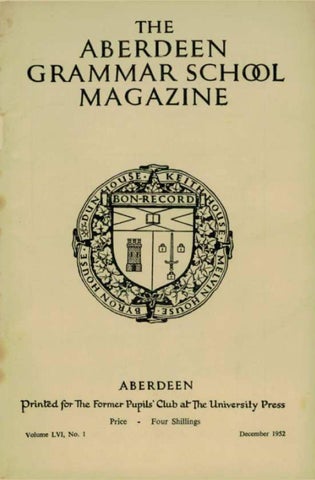
THE
ABERDEEN GRAMMAR SCHML MAGAZINE
ABERDEEN
prinrtd. for "The Former Pupils' Club al-The University Press Price Volume LVI, No. 1
-
Four Shillings December 1952
JAMES G. BISSET
For TEXTBOOKS required for your studies ...
The University
NOTEBOOKS for Lectures ... and all your other STATIONERY requirements
Bookseller and Stationer
BOOKS ON TRAVEL, ADVENTURE, INTEREST, FICTION BOOK TOKENS SOLD AND EXCHANGED
SECOND HAND DEPARTMENT on the
85 BROAD STREET
first floor contains a large selec-
ABERDEEN
tion of books which may be purchased at reasonable prices
Telephone 20484
Our
•
-
- -
Opposite Mari'chal College
Open 8.45 to 5.30
PHONE 29053 •
GOOD HEALTH demands
GOOD BREAD For the children especially is it necessary to ensure their stamina and energy with good, wholesome, nourishing bread. In Hutchison's bread you'll find all these requirements are fully met. Phone or give instructions to have it supplied daily.
A. B. HUTCHISON (CENTRAL BAKERY) LTD.
BRANCHES THROUGHOUT THE CITY
21st Birthday Suggestions
I 4f
Gold Cuff Links with coloured enamel school crest and F.P. colours Gold Stud Sets with Links in fine leather wallets, suede lined Hair Brushes with monogram in Ivory, pattern military Silver and Hardwoods Toilet Sets in pigskin and Contents calf leather cases. mounted in Silver, Ivory and Hardwoods Wrist and Pocket Watches in Gold, Stainless Steel and Chrome
A. & J. SMITH (Jewellers) Ltd. 191 UNION
STREET
ABERDEEN
" I need good food"
i
—and this is where you can get it ! We always have a fresh stock of all well-known dog foods including Spratt's, Spillers, etc.
Main Stockists for
Pot and Pearl
Hay and Straw
Barley
Poultry and Bird Food
Barley Meal Coal
and
Moss Litter
Fire-
wood
Manures
•
WILLIAM SCORGIE GRAIN AND POTATO MERCHANT
13
ROSE STREET
.
Phone 23731
ABERDEEN
DAIRY : ABERDEEN
FARM : CULTER
Tel. 20373
Tel. 3106
For . . QUALITY and SERVICE
JOHN REITH (Kennerty Farm Dairies) LIMITED
46- 4 8
ROSE
STREET,
ABERDEEN
At your Service For QUALITY
FISH • GAME • MEAT Whether you shop in person or by telephone your requirements in either or both of our Departments will be looked after with care. Our delivery system too exists for your convenience
A. & W. ALEXANDER Fish, Game and Meat Merchants
g
Telephone : Aberdeen 25236
g
492 UNION STREET, ABERDEEN
rwt7.2=re,x7.1===max.rx.r=====g
g
i i
Telephone 29191
1
MCKELLAR
ARCHIBALD
Family Grocer, Wine Merchant and Tobacconist
i i 1 1 1 1
We specialise in
Medicinal Wines
PROVISIONS
VIBRONA
TEAS
HALL'S
COFFEES
WINCARNIS
WINES, etc.
PHOSFERINE
1 1 1 1 1 1 1 1 1 1
1 1
1 45o-456 UNION STREET, ABERDEEN
i
1
i gra..
•••••.•
ilirr'l riliTrli 11117"1.717!'"•1!1,77'1111,11iwirr,Tplwrnprrip9rilormummung .......... . g-
all Fr ,1"1,
I"Itt'Tit ":!!'
a
THE WORLD'S GREATEST
2 -
BOOKSHOP
N. -g-
N
..-
H -.-
IF * POP.— -E 2
g
Subscriptions taken for British, American and Continental Magazines. Large department for Music and Gramophone Records. 119-125 CHARING CROSS ROAD, LONDON, W.C.2
-z..-
Gerrard 5660 (16 lines)
*
Open 9-6 (inc. Sots.)
Two minutes from Tottenham Court Road Station
.5: ▪ n11, 111........
*
All new books available on day of publication. Secondhand and rare books on every subject. Stock of over 3 million volumes.
-. = _.-_-,;_,-7:E -TE-_---_--.-
BOOKS
.....
,,,,,I ............................
--4_.
-
— :.,-_: --•-• EA. F3 -
--.. .- -
=, --7. L-'=, --
-
ESTO 1133 • 'PHONE 21219 Still maintaining our tradition we are endeavouring to meet the many wishes of our customers in a now greater selection of Fine Silverware. Rings in the most exquisite settings of Diamond,Emerald, Ruby. Sapphire, and in an ever widening range of personal Gifts for Gifting purposes.
z (Mel
a~it
01_ SMITHS UNION BRIDGE
ABERDEEN
Courtesy
immeasurably
add to
and service
the
pleasure at—
Furnishing Telephone:
22695
s
INIINI
(4:1B“11:1.E€N) LIMITED :
cIN-E
cUANITUP;
. 7
, 7
7 - Ell:;!,414Tir, ILF111,7117:TIN
UIT1I
A
CUTUT4
of
JAMES FYFE & SON PAINTERS
AND
GLAZIERS
Office and Showrooms
II
DEE STREET, ABERDEEN
Telephone 22436
Telegrams : " Fyfe, Painters "
It is no matter of opinion but a matter of course . . . for stylish Business and Sports wear . . . .
.
MENSWEAR
82 UNION STREET ABERDEEN
Tel. 20462
Famed for all kinds of Furniture and Furnishings for over 100 years
J. & A. OGILVIE CABINETMAKERS AND UPHOLSTERERS
369-373 UNION STREET
ABERDEEN Telephone 29432
Telegrams " Interiors "
For everything to do with
REFRIGERATION DOMESTIC COMMERCIAL INDUSTRIAL Consult
Spark's of Aberdeen Ltd. 16-18 ROSE STREET ABERDEEN TEL. 27366 Distributors
for
PRESTCOLD ESTA,'11,-IFO IBIS
FOR BETTER FOOTWEAR
TO His
APPOINTED
JAMES LORIMER
LATE
MEAT PUR-
MAJESTY
VEYORS AND
KING GEORGE
POULTERERS
VI
and Son (Bootmakcrs) Ltd.
J. WILLIAMSON & SON Civil and Military BOOTMAKERS
Meat Purveyors, Poulterers and Game Dealers I, 2, & 3 MARKET BUILDINGS ABERDEEN Phone 28470
8 CHAPEL STREET, ABERDEEN (Late of 162 Union Street)
BRANCHES 3S FOUNTAINHALL ROAD
THE SQUARE. CULTS
PHONE 21724
PHONE 47822
ALSO AT CHURCH SQUARE. BALLATER ESTABLISHED I 844
PHONE 2O724
PHONE 3R
The PALACE Restaurant OPEN TILL 11 P.M.
Our Five Floors are at your Service
OUTSIDE CATERING A SPECIALITY
Phone 26570
•
FOR TABLE RESERVATIONS AND FUNCTION ENQUIRIES
twigs'? FRD - soommop --
~...--~ . ,
it 1 i 1
- -* * * *
_- . -•
-
,
r ,-~ •
--
77- n
-
-;j,-
-
-
For all your Gift Occasions
Fountain Pens—a selection to suit every pocket Diaries to please everyone Children's Books for all ages Books—the best of Fiction, Biography, Travel, etc., and indeed Everything a Good Bookshop can Supply Please ask for our illustrated Monthly Book List, sent Free on request
WEST END BOOKSHOP JOHN MENZIES & CO., LTD. 412 UNION STREET ABERDEEN
•
•IIP ; f Ii •'S. i
r rf
-
When it's an occasion ... be it a Dinner, Dinner-Dance, Wedding, or other social function your intuition and our well-founded reputation will lead you to the Northern. The constantly recurring bookings for a year ahead are some indication of the esteem in which we are held, and the satisfaction we have been able to give.
Saturday DRESS EVENING DANCE DINNER
i
12/6 - -
The
NORTHERN HOTEL KITTYBREWSTER TELEPHONE
ABERDEEN
ABERDEEN
4 3 3 4 2
1
I
The subject of
WINES... is a never ending topic of interest to those who practise the art of gracious living . it is a subject on which we are always delighted to contribute the knowledge of long and wide experience
awateiv GC& 'gate STREET
UNION
ABERDEEN TELEPHONE":.
ALSO
AT
BRAEMAR
BALLATER 2 7 2 4 4
& CULTS
REGISTRY TELEPHONE:
ST APPOINTMENT GROCFRS TO THE LATE KING GEORGE VI
20015
Boys will be BOYS! . . . and clothes won't stay clean for ever. But they will last longer and stay bright and fresh if you send them periodically to
TH E
GORDON CLEANING CO. LTD. Cleaners & Dyers
HU NTLY
ABERDEEN BRANCHES 434 Union Street
.
ABERDEEN
505 George Street
.
ABERDEEN
TELEVISION The denial of a Relay Station which would ensure more consistent results in Aberdeen and the North-East is a keen disappointment. Fortunately we cannot be deprived of fringe receptions from Kirk 0' Shotts and on some favourable sites reception is remarkably good with Murphy Television Sets. Before undertaking such a commitment as the purchase and installation of Television equipment, however,
we
urge
that
you
arrange for our qualified technicians to visit your home, make tests and submit a report on
potential
reception
prospects.
This
service we undertake without obligation.
ALEXANDERS Radio
•
Radiograms
•
Television
81 HOLBURN STREET. ABERDEEN Telephone
22364
JAMES BLAKE LTD. Joiners and Building Contractors
Enquiries courteously solicited
7 ALBYN TERRACE Works: 23, 25, 29 Summer Street
ALL CLASSES OF
Telephone 24382 Telegrams " Blake Builders "
BUILDING WORK
Established over 100 years
WILLIAM CAY AND SONS (Funeral Directors) Limited Efficient Service Day and Night
Cremations All Funeral Arranged Requisites Supplied PRIVATE REST ROOM
209 GEORGE STREET 415 UNION STREET ABERDEEN ABERDEEN Telegrams—Cay, Aberdeen Tel. 20054 Tel. 29302
IMPROVED SUPPLIES are available of Typewriters, Desks (wood or steel), Chairs, Filing Cabinets, Cupboards
Come and see me
Everything for the Office
C. H. WEBSTER 489 Union Street, Aberdeen
Wyllies Circulating Library
Agents for Ordnance Survey Maps
WYLLIES (BOOKSELLERS LTD.)
247 UNION STREET, ABERDEEN Established 1814
Telephone 25534
ESTABLISH THE HABIT OF READING GOOD BOOKS
The New REMINGTON Contour 6 This is the electric shaver you have long wanted . . . a shaver which cuts all the hairs of the toughest beard yet cares for the tenderest skin. The pleasure this amazing shaver gives is a revelation. And why? Because the Remington Contour "6" fits the contours of the face, no matter how held. A demonstration model is fitted for your trial in our MAN'S SHOP
ESSLEMONT & MACINTOSH LTD .
(RETAILERS) TAILORS AND OUTFITTERS UNION STREET
ABERDEEN
. . . . . . A Letter to Former Pupils Balancing the Budget. Dr. A. G. Hutchison Memorial Fund . . . . Alpine Holiday. By W. D. Brooker . . . Travel in Yugoslavia. By J. W. Baird . . • . . . . . . Books by F.P.s . . . . . . Notes about Old Boys . . . . . . . . University Notes . . . . . . . . . . Marriages . . . . . . . . . Obituary
. Page • ,, •
1>
•
,
3 4 8 10
•
It
•
/2
•
Pt.
27 30
PO
33
• •
School Section— . . . . . . . School and Random Notes . . . . . . . Changes in the School Staff . . . . . . . . School Excursions . . . . . . . . . Between Two Worlds . . . . . . . Round Her Little Finger . . . . . . . . The Sea and the Moon . . . . . . . Forest Fire. Firework Display . . . . . . . House News. Swimming Club . . . . . . Literary and Debating Society . . • • . . Music Notes . Dramatic Society. Scripture Union. Scottish Schoolboys; Club. Arts Club . . . Combined Cadet Force Notes. Pipes and Drums . . . . . . . . . Scout Notes . . . . . . . . . Lower School Notes •
•
•
•
School Sporting Activities— . . . Rugby . . . . Hockey . . . . Cricket. Athletics . Rambling and Mountaineering Club
•
•
•
.
•
ft St tt PI
19 'Pt
PP
58
•
•
•
•
Pt
•
•
•
•
Pt
•
•
•
•
•
Pt
•
•
•
Pt
•
•
•
•
•
•
PP
•
•
•
•
•
•
•
ft
•
•
•
•
•
•
•
PS
•
•
•
•
•
•
•
it
•
St
•
•
•
•
•
•
•
•
•
•
•
•
•
PP
•
•
ft
•
•
51 52 53 54
Pt
ft
•
•
42 46 47 48 49
55 56 57
9.3
•
•
11
50
tt OP
•
Former Pupils' Club— . Annual Dinner . Glasgow Centre . . . . London Centre F.P. Reunion in Malaya . Boarding House Section . . F.P. Cricket Section . . F.P. Golf Section . . . . • . . F.P. Rugby Section . School and F.P. Rugby Fixtures in the South. Club Boarding . . . . . . House. Club Consuls . . . F.P. Hockey Section. New Members of the Club . . . . . . F.P. Club Office-Bearers, 1952-53 •
I
ft
PP PP .
59 61 6: 6: 63 67 69 7o 71 72 73 74 75 76 78
Insurance IS necessary Every prudent person covers the everyday risks of
FIRE LIFE AND
ACCIDENT The
Northern Assurance Company Limited
ESTABLISHED IN ABERDEEN
1836
is at your service for
ALL CLASSES OF INSURANCE ENQUIRIES ARE WELCOMED CHIEF OFFICES:
ABERDEEN LONDON
. .
1 UNION TERRACE 1 MOORGATE, E.C. 2
Company's Assets
.
£50,800,000
Aberdeen Grammar School Magazine 69th year, No. 175
Vol. LVI
(New Series, 6oth year, No.
DECEMBER 1952
No. i
The Magazine is published under the auspices of the Former Pupils' Club in December and July. Communications should be addressed to the Editor, ALAN C. R. WATT, M.A., LL.B., is Bon-Accord Crescent, Aberdeen. NOTE :
An asterisk after a name indicates that the F.P. is a member of the F.P. Club; dates after a name indicate the years of attendance at the School.
-A Letter to Former Pupils When I last wrote eighteen months ago, I had to tell of renovation in full flood and of a school given over to the whole tribe of workmen. With the restoration in the next few weeks of the lists of names in the Hall, the work will be completed, and it is perhaps timely to stress again how extensive the scale of reconstruction and improvement has been. Short of pulling down everything except the frontage and rebuilding, the Town has done almost all that was possible to bring our accommodation and equipment up to the best modern standards. To the visitor the most noticeable changes will be in the Hall and the Library, but we who pass our days in the School are perhaps even more grateful for the freshness and improved lighting of the buildings as a whole, for the thorough reconditioning of the laboratories, and not least for the long overdue refurnishing of all our classrooms. Last session was memorable alike in scholarship and in games to a degree which disposes of any suggestion that the School is in eclipse. F.P.s, who rightly attach great importance to the All-Round Trophy, would derive much satisfaction from Mr. J. C. Duffus's presidential tribute to the fine quality of the boys who were interviewed for this coveted award over a quarter of a century. May I supplement what he said by a reference to the remarkable record of last session's winner, Andrew S. Noble—such a record as even a great school can hope to show only once in many years. He was Dux of the School and Harkness Scholarship Winner at St. Andrews University; Senior Prefect; All-Round Trophy Winner; Captain of Dun House; Captain of Rugby; Captain of Cricket; Sergeant-Major of the School Contingent, Combined Cadet Force; Pipe Major of the Band; First Violin in the School Orchestra; and active member of the Debater. To achieve so much, and with it great popularity of the best kind, is success indeed, and we rejoice that it should have come to the son of Principal Peter Scott Noble, who throughout his fifteen years in the city never wavered in his support of the Grammar School.
z
Aberdeen Grammar School Magazine
Nothing perhaps has made it so difficult for friends of the School to reconcile themselves to the abolition of fees as the rigid exclusion in the past five years of all day-pupils from outwith the city. I am happy, therefore, to report that the Education Authority has this summer made substantial concessions. First, the severe rule that where a parent moved outside the city to live, any child in attendance at a city school must be excluded as from the beginning of the following session has been relaxed, and in future any child who has spent two years in the Primary Department or has entered the second year of a Secondary Course will be undisturbed. Second, in so far as accommodation is available, outwith pupils who are qualified for a five years' course will be considered for admission to the Secondary Department of the Grammar School, provided one of these five conditions is satisfied :— (i) that the parent is a Former Pupil of the School; (z) that the boy has a brother or brothers already attending the School; (3) that the parent pays rates for business premises in the city or works in the city; (4) that the parent resides in the suburbs of the city; (5) that, in the opinion of the Rector, the boy in question is likely to make an outstanding contribution to the School. Such pupils, if admitted to the School, will not pay fees. It is true that, except for Boarders in the Junior House, there is still no admission of outwith pupils to our Primary Department; but it must in fairness be recognised how difficult is the position of an Education Authority, which for sixty Infant places a year has already some 300 claimants from within the city itself. If it be argued that Direct Grant Schools lay down no territorial limits whatsoever, it has to be remembered that the public monies they receive are not from local sources but from the Treasury, and that the attitude of their Governors must consequently differ somewhat from that of an Education Authority maintaining a school in part at least from city rates. Readers of the Magazine will be interested to learn that the first meeting was held recently of a Joint Committee of Town, School, and F.P. Club to initiate arrangements for the celebration of our SeptCentenary in 1956. The Lord Provost, who continues to act as Official Visitor to the Grammar School, is interesting himself personally in the arrangements, and it is hoped that it may prove possible to indicate the date and nature of the celebrations in the next issue of the Magazine. J. J. R.
Balancing the Budget In June 195z all life members of the Club were invited to make a donation to the life member capital fund of the difference between the subscription which they paid (whether in one sum or by instalments) and the sum of £no, so that the Club might derive considerably more benefit annually from the interest on the fund and from capital redemption. This was the most important of various steps taken by the Executive of the Club to restore the Club's financial position. Up to 1 December 195z the total amount of donations received from 351 life members was £1,770. The Executive regard this as quite a gratifying response but it is thought that the appeal may have been overlooked by many F.P.s who would wish to contribute. Life members who have not yet replied to the appeal circular are asked to do so now.
Dr. A. G. Hutchison Memorial Fund A group of F.P.s is sponsoring the Dr. A. G. Hutchison Memorial Fund in memory of Arthur Gilbertson Hutchison (1909-21), B.Sc., Ph.D., who was killed as the result of a cliff accident on the Pembrokeshire coast, South Wales, on 6 August 1949. He was aged fortyseven. " Hutch" was well known to his contemporaries at the School and University as a great personality, and to many others as an outstanding scoutmaster of the 9th (Grammar School) Troop. After a brilliant academic career at the Universities of Aberdeen and Cambridge he received an appointment as an exploration geologist with the Royal Dutch (Shell) Oil Company in Sarawak. From 1936 to 1941 he was in Trinidad and thereafter he was for a year with the Burmah Oil Company Limited in Burma and in Australia. At the time of his death he was senior geologist on the staff of the Royal Dutch (Shell) Oil Company. Several of his contemporaries who wish to honour his memory have had informal meetings in this connection, and have decided that some form of memorial should be established. The exact form of the memorial will, of course, depend on the funds collected, but the F.P.s who are sponsoring the Memorial Fund have in mind the erection of a climbers' hut or an indicator on the summit of one of the Deeside hills which he knew so well and loved so much. Some F.P.s have already contributed to the Memorial Fund, but it is felt that many more will wish to subscribe. Contributions should be sent to the Honorary Treasurer of the Fund, Mr. Robert L. Milne, 9 North Silver Street, Aberdeen. Further information about the form which the memorial is to take will be published after the extent of the response to this appeal is known.
3
Alpine Holiday Editor's Note.—According to Mr. B. H. Humble in his recently publi..hed book, The Cuillin of Skye, the writer of this article, WILLIAM DIXON BROOKER* (1938-50), along with another )oung climber from Leeds, achieved in 195o and 1951 " the most notable climbing in the Cuillin during the past quarter-century ". This summer Brooker turned his attention to the Alps. A first Continental holiday is always something which fills the mind of a young man with wild conjectures and anticipation. To me it also meant a first Alpine season and my thoughts turned to sunlit spires of rock remote and aloof from the glaciers at their feet, mountain valleys with forested walls and over all a cloudless blue sky. Our party consisted of seven other students and myself and the rendezvous was Chamonix Mont Blanc. The major problem of our trip was that of transport. The majority decided to travel to London by road and thereafter by boat-train to France. My own voice, crying out in the wilderness, elected to make the whole journey by motor-cycle. As my machine had been manufactured some years before I was born, I had my misgivings, but these proved unfounded and no incurable breakdowns presented themselves. First impressions of France were too many and vivid to describe; everything was new, from the bumpy, arrow-straight roads to the crisp, slender loaves. My first night was spent in a field near Versailles. Sleep was elusive by reason of the aggressive chirping of innumerable crickets, but once achieved, was deep and dreamless. All next day I spent riding across France on the magnificently engineered, but poorly maintained, Routes National. The following morning I had my first glimpse of the Alps, incredibly high and white above hazy foothills. At midday I rattled into Chamonix and proceeded to locate my friends. They were encamped 3,000 feet above the valley on a moraine slope masked in dwarf rhododendron and juniper. Within feet of the tents ran a huge gash in the mountainside in the bed of which frothed a grey glacier stream, a mere trickle by morning and a roaring torrent by evening. At 5.5o a.m. I was roused from my sleeping bag, exhorted to swallow a repulsive mess of partially fried and wholly greasy potatoes and told to " Get a move on up the hill ". My breakfast stayed down for perhaps five minutes and I was sick several times during the stumbling grind up twilit moraine slopes to the glacier. My tiring journey and the altitude combined to make me very weary indeed by the time we had at last reached the Col de Nantillons at the glacier head. A short doze in the sun improved matters somewhat and the exhilarating rock ridge springing towards our objective, the Aiguille de Blaitiere, stimulated me to some awareness of my surroundings. On three sides was a sea of jagged spires couched on slender buttresses whose foundations lay deep in glittering, twisted glaciers. Here and there high shattered ridges connected the spires with vast rock walls furrowed by couloirs of dazzling white. The rock was a friendly 4
Alpine Holiday
5
red-brown colour and warm and rough beneath my hand. On the fourth side the mountain plunged to the glacier, the glacier to the moraine and the moraine down forested slopes to the dreamy green valley of Chamonix. My eye followed the ridge upon which I stood and soared up the pinnacled crest to the cloudless blue sky of my anticipation. My dreams had come true. Refreshed by our surroundings, we made short work of the ridge and soon came in sight of the summit tower. It lay vertical and menacing at the far side of a curving snow arete. Some brisk work with the ice-axe disposed of the arete and the formidable steepness above proved a threat without substance as the wall was liberally supplied with cracks and flakes. There was a double summit of twin horns; the first climbed by way of a deep and strenuous cleft and the other by an airy crack. The descent was by the same route and, as we plunged down the soft snows of the upper glacier, the sun sank in a glory of scarlet and gold. Darkness dogged our footsteps as we unroped at the moraine and began the nightmare slopes of boulders leading to camp. Very tired, we returned seventeen hours after setting out but this weariness was soon dispelled by contentment with the joys of a good meal and a cheerful fire. Such was my first Alpine day and it had fulfilled all expectations. For the next nine days we climbed among the Chamonix Aiguilles and between us ascended the Aiguilles des Charmoz, Grepon, Fou, Ciseaux, Requin and Moine. These peaks and by far the greater part of the Mont Blanc massif are composed of coarse, red granite of a very massive nature. The massif is a remnant of the old Hercvnian foreland enclosed in the Alpine young fold system and it is to this coarse granite that the rock owes its excellent climbing characteristics. The area offers some of the finest mountaineering in the world and has always been very popular with British climbers. Indeed, Mummery and other contemporary Britishers made the first ascents of many of these peaks. Between climbs it was our custom to descend to Chamonix, both for relaxation and supplies, by what must surely be one of the longest and steepest paths in the Alps. Apart from the sumptuous meals occasionally obtained in a tiny restaurant, our diet consisted almost entirely of bread, spaghetti, cheese and fruit. This proved quite adequate and after a few days we were all very fit indeed and with physical capabilities that surprised ourselves. Chamonix is a boom town in the sense that it booms during the tourist season. In winter its hotels stand empty, its streets deserted: in summer the whole place swarms like an antheap. Gigantic buses shaped like stratocraft and equipped with terrifying klaxons disgorge their cargoes of trippers in the Square. The streets throng with a gaily coloured multitude in clamorous search for postcards and souvenirs. Here and there a drab object in ragged khaki, shuffling along with dusty boots, betrays the presence of the British climber and his lean holiday purse. However, in Chamonix nobody condemns by appearance and a companion and I were gratified to hear an awed whisper, Regarder les Guides, as we passed.
6
Aberdeen Grammar School Magazine
Our climbs thus far had been nothing out of the usual but now we laid plans for bigger game. From the Italian valley three great ridges leap northward to Mont Blanc, separated by 4,000 feet precipices. They are the Brenva, the Peterey and the Brouillard, in that order from east to west. The central ridge, the Peterey, is by far the greatest and between it and the Brouillard lies a lesser ridge, the Innominata. According to all reports, the Innominata route was one of the finest and longest in the Alps and, in spite of only a score of ascents since its discovery in 1919, was not of excessive technical difficulty. This was our choice. As far as we could judge, conditions promised to be favourable due to the long spell of perfect weather we had enjoyed in France, broken only by an occasional thunderstorm. Ice and snow would be at a minimum but, unfortunately, the dangers of falling stones would be increased. Four of us, J. W. Morgan, M. C. S. Philip, J. M. Taylor and myself, left Chamonix rather late one day for Italy. The remainder of the party, under the energetic leadership of T. W. Patey, climbed Mont Blanc by the Aiguille de Bionassy and later the Aiguille du Dru. Our way to Italy lay up the Mer de Glace and Glacier du Giant to the Col du Giant. The latter was crossed in thick mist and the only thing to tell us we had passed the frontier was the slight downward gradient. Staying for the night at the Torino hut, we enjoyed the most impressive and beautiful views of the Brenva face and peaks of the Peterey arete against the evening sky. Next morning we descended to the valley and spent the day eating and provisioning in Courmayeur. This village is a sleepy little place of narrow streets and some very old dwellings of an almost primitive nature. All the roofs are tiled with thick grey slabs of the local slate. Towards evening we began the approach to our climb, winding up a dusty motor-road to a wooded upper valley. At one point we were surrounded by a horde of gesticulating soldiers flourishing rather alarming sub-machine guns, but it turned out that they merely wished to examine our passports and we continued without hindrance. Some six miles from Courmayeur we struck off through the forest on our right and bivouacked for the night in one of the most delightful spots it has ever been my good fortune to visit. All around were stately larch and pine and sloping green meadows watered by a bubbling snow-fed stream. We planned to spend two days on the climb. On the first we intended to reach the Bivouac Eccles, a tiny shelter clinging to the ridge at 13,ooo feet. At this point the Innominata ridge merges into the main south face of Mont Blanc and this final section of z,5oo feet presents the chief mountaineering problems. We prayed that the good weather would hold, for on a climb of this nature sudden bad weather may prove extremely dangerous. One drawback was that the Bivouac Eccles had been destroyed by a rock fall a fortnight previously and we should have to make do with the stars as a roof. A long morning passed in the warm and strenuous ascent to the Gamba Hut where we made a temporary halt. The serious climbing began here and during the remainder of the day we climbed on by
Alpine Holiday
7 shoulder glacier, rock and finally a most exciting ice ridge to the upper of Pic Eccles. The remains of the hut were scattered over the cliff below and we collected a good deal of splintered debris as firewood. In addition we found several blankets and our proposed bivouac became a more cheerful prospect. The platform itself was very cramped for four and a fire, and Taylor had to take the precaution of belaying himself to an iron spike in order to avoid a sudden departure valleywards. All night the avalanches boomed down the colossal precipices on either hand but, in spite of this and the intense cold, we all managed to sleep a little. At 5 a.m. we resumed activity and forced some food down. My boots had been exposed during the night and had to be thawed over the stove. Due to this and other delays, it was 8 a.m. before Col Eccles was behind us and we were embarked on the upper face. A glorious dawn left us in warm sunshine. Taylor and Philip had forged ahead and Morgan and I followed some distance behind. An exhilarating rock rib led upwards by cracks and towers for almost one-third of the face. The next move was to cross an ice couloir to a larger buttress on the left. We could hear the occasional hum of falling stones and one fall raked the whole width of the couloir. When our turn came, Morgan balanced precariously across, slashing tiny nicks in the ice. He climbed up the bank in order to safeguard me with the rope. While we were crossing, small stones like a battery of grape-shot spattered above but without more ado I pendulumed across to comparative safety. The buttress upon which we were now established proved fairly easy and we mounted steadily upwards, first by rock and later by several aretes of rather rotten ice. The altitude was having its effect on our bodies and it was z p.m. when we reached the summit ridge. Snow goggles were a necessity for the remainder of the way. Morgan had no crampons and great care was needed along the final icy approach to the top of Mont Blanc (15,781 feet). At 4.3o p.m. we strolled along the firm track beaten by many tourist feet along the apex. It led into the eye of the setting sun and the snows burned with a golden light. The descent was very lovely, easy and rapid. Within an hour and a half we were knocking the snow off our boots at the door of the Grands Mulets hut. That night a great storm broke and in the morning we descended the long path to Chamonix, first in wet snow and later in torrential rain. A few days later we were all back across the Channel, each with his own vivid memories of an unforgettable holiday. W. D. B.
Travel in Yugoslavia In many British minds, Yugoslavia is a rather large and unattractive land mass bordering on one side or other of the Iron Curtain. Comparatively few tourists consider its possibilities. Travellers to Greece are inclined to shudder at the prospect of a rail journey through the length of Yugoslavia and usually go their way by sea or air, or, at the worst, in well-appointed wagons lits. In doing this they are missing a great deal, for even in transit the foreigner can find much in Yugoslavia that interests and instructs. The country is of the greatest appeal to the more enlightened type of tourist who normally travels in the back of a lorry or in local buses and trains and who is rather tired of the depressing and inevitable sight of groups of fellow-countrymen with guide-books, studiously absorbing culture in the art galleries and cathedral squares of Western Europe. Travel in Yugoslavia on a tourist visa is remarkably cheap. By rail, third class, from the Austrian frontier to the Greek frontier costs approximately L3. I have spent some hundred hours in third class Yugoslav railway compartments and this is the one aspect of the country's life on which I feel qualified to write. I can most heartily recommend the Yugoslav National Railways to certain types of tourist. Those who have journeyed third class from Marseilles to Paris or from Rome to Milan during the height of the summer will not need to be reminded of the rather cramped conditions which prevail, the odour of wine, garlic, salami and rank tobacco, the nursing mothers with their seemingly invariably diseased offspring, the water closet which does not work—all those things which make travel on the Continent such a varied delight. The connoisseur of those smells and sensations has fresh fields to conquer in Yugoslavia. The trains are frequently cleaner than in Italy and France and are possibly less crowded. One normally has room to stand. Here is a great opportunity for the student of humanity. Yugoslavia comprises a number of provinces, all of which continue to enjoy a measure of autonomy and all of which have certain individual characteristics. In many places there is a colourful Turkish element which adds its originality to that of the Serbs, Croats, Bosnians, Montenegrins and the others who comprise the Yugoslav people to-day. All these different types might be represented in the railway carriages, all, perhaps, speaking their own languages and dialects, did one but know it. Add to this a smell which one likes to think is slightly Eastern and which is undeniably Balkan, an alphabet which one does not understand, and frequent visits of armed military and police, particularly when the train runs near the frontiers of Hungary and Bulgaria, and there emerges a fair picture of a railway journey in Yugoslavia. This in itself is worth travelling thousands of miles to begin, and, of course, it is wonderful when it is all over. There are other ways of travel. One can fly JAT or go by road. The first of these alternatives would have many advantages. Aircraft go with ease over country which road and rail have not vet penetrated, but the unreal patchwork which would be the view from the air is not 8
Travel in Yugoslavia
9 to be compared to the cross-section of land and life which is displayed to the traveller on land. Unfortunately Yugoslavia possesses only one road which is good by Western standards—the recently constructed Belgrade-Zagreb emtoput, so it is obvious that travel by car has its shortcomings. Then, of course, one could go by rail, first or second class, but this is neither one thing nor the other and is unthought of by the true seeker after experience. Yugoslavia has much to offer the visitor other than the joys of travel. The Dalmatian coast has claims to be regarded as the most beautiful in Europe and here are to be found the hotels and the comforts of the type familiar on the Riviera. Even so, these centres of " civilisation " are outposts on a coast which is characterised by natural, unspoilt beauty, by medieval remains, by towns and villages which show little sign of twentieth-century influence. The two chief cities in Yugoslavia are Zagreb and Belgrade, very different in character. Zagreb, from its geographical position and its history, is not unlike any town of comparable size in Western Europe. It has museums, churches and galleries, people of Western ways and manners. Possibly for these very reasons it is less interesting than the capital, Belgrade. Belgrade has had a nobler and stormier history than Zagreb, and few ancient monuments or places of interest survive, other than the Kalemegdan, the famous old Turkish fortress, dominating the confluence of the Rivers Sava and Danube. A concession is made to the tourist in Belgrade, and there is a guide-book, in English, available for the visitor. This slim volume is published by " The Office for Propaganda and Touristic Reclame of the Direction of the Undertaking ' Putnik ' for Serbia ". For the most part, the book is filled with photographs of modern buildings—the headquarters of the Communist Party, the " Central Home of the Yugoslav People's Army ", the General Post Office, and so on. A beautiful and most interesting Orthodox Church receives only a mention in passing. A choice passage in the guide-book indicates the attitude: " Beograd, the capital of Yugoslavia, is marching quickly into the Socialism, losing more and more the anachronistic marks which a remote history has stamped in its face." The city is inclined to be shoddy. There are no really first class hotels. Shop windows are remarkably empty. The scars of war remain. But the people have character, and the city throbs with life. I was lucky enough to he in Belgrade on the night of Yugoslavia's Olympic soccer victory over U.S.S.R. The overjoyed reactions of the populace, the cries of Zivio Tito, and the demonstrations outside the Russian Embassy gave every indication of a people whose morale was high, whose spirit was fully sufficient to enable them to forget the high costs and the low standard of living, and who possessed the necessary urge and strength to stand on their own feet. Skoplje, the capital of Macedonia, is in some ways more interesting even than Belgrade. The atmosphere is totally different from that of Western European towns. Turkish mosques with their minarets give the architecture on one side of the River Vardar a thoroughly Eastern aspect. The arid, brown hills which surround the town are quite
IO
Aberdeen Grammar School Magazine
un-European. In many ways, Skoplje is a sinister little place, but one which had for me a peculiar fascination. The surrounding countryside is probably of even greater interest. The British tourist is in most places treated with courtesy and respect by officials and with an unconcealed interest and liking by the people. Everywhere I went, I found the Yugoslavs friendly and willing to talk. Language difficulties were in most places overcome by the occasional use of German, spoken by many Yugoslavs, particularly in the North, and by frequent draughts of Slivowitz, that peculiarly potent and pleasing Balkan spirit. As regards getting to the country, the obtaining of a visa involves the filling up of fragebogen in triplicate and a small financial outlay. The chief fly in the ointment is the intractable financial policy, whereby one is encouraged to take large sums of money into the country and indeed compelled to take in a certain amount, but is not allowed to take any money out. This becomes embarrassing when one's ticket expires at the frontier. This article is not sponsored by the Yugoslav tourist agency, " Putnik ", nor is it intended as an authoritative armchair dissertation on the lines of " Yugoslavia—The Contemporary Scene ". It is prompted partly by editorial request, but mainly by my desire to make known the possibilities of this fascinating country and to record the pleasure, the interest, and the instruction which my own all too short stay afforded me. J. W. BAIRD (1936-46).
Books by F.P.s The Editor will be glad to receive for review in this Section of the Magazine copies of books, pamphlets, etc. written or edited by F.P.s. PETER TAYLOR FORSYTH (18S9-64), M.A., D.D.: The Principle of Authority. In Relation to Certainty, Sanctity and Society. Independent Press. 18s. 6d. This " essay in the philosophy of experimental religion " by the late Dr. P. T. Forsyth was first published in 1913. It has now been re-issued under a new imprint and newly indexed, in a second edition. P. T. Forsyth: The Man and His Work by William L. Bradley has been published recently by the Independent Press. 18s. 6d. * * * JAMES GRAY KYD* (1891-98), C.B.E., F.F.A., F.R.S.E. (Editor): Scottish Population Statistics including Webster's Analysis of Population, syyy. Published privately by the Scottish History Society. * * * JOHN MACMURRAY (19o2-o4), M.C., M.A.: Interpreting the Universe. Faber and Faber. 8s. 6d. (First published in 1933. Now re-issued.) * * * ROBERT LINDSAY GRAEME RrrcInE* (1894-99), M.A., D.Litt., LL.D., Docteur de l'Universite de Paris and Docteur de PUniversite de Caen: Chritien de Troyes and Scotland. Oxford: Clarendon Press. London: Cu mberlege. zs. 6d.
4
* The Editor will be glad if F.P.s will send him, from time to time, information for this section of the Magazine. News of appointments, promotions etc., and other items of interest which are not reported in the press arc particularly requested.
Edward George Abercromby* (1913-2 5 ), B.Sc.(Eng.), A.M.Inst.C.E., A.M.I.W.E., who has been in the service of the Metropolitan Water Board since 1933, has since 1948 been deputy superintendent of the New Works Drawing Office. A keen hill-walker, Mr. Abercromby has completed several long " lone " tours during the last few summers: in 1949 he went from Crathie via the Cairngorms, Dalwhinnie, Ben Alder, Kinlochleven, Aonach Eagach and Ben Starav to Loch Awe, a distance of about 145 miles, including 40,900 feet of climbing. The journey took twelve days. In 195o he walked from Tomdoun via the Cluanie hills, Achnashellach, Ben Eighe, Sliogh, An Teallach, Altnaharrie, Ullapool, Stac Polly, Cul Beag, Cul Mor, Suilven,Canisp and Ben More Assynt to Lairg—t82 miles and 40,500 feet of climbing. This took him seventeen days. In 1951 he made a variation of his route in 195o and last summer he went from Forsinard Station via Ben Loyal, Ben Hope, Gobernuisgach Lodge, Achferry, Kylesku Ferry, Quinag, Lochinver, Achiltibuie, Ben More Coigach, Ullapool, Gruinard Bay, Poolewe, Torridon, Shieldaig, Beinn Bhan, Strome Ferry, Killilan, Carn Eige, Mam Sodhail, Glen Affric and Cannich to Drumnadrochit-25o miles and 31,700 feet of climbing in fourteen days. Michael Alexander Aggett* (1930-42), A.M.Inst.C.E., has been since April 1950 with the firm of James Williamson & Partners, chartered civil engineers, Glasgow. After leaving Aberdeen in 1947, he was engaged for short periods on harbour works in Nairn and in Dorset and then spent fifteen months in Lincolnshire on civil engineering work in connection with extensions to a large steelworks there. He was elected an A.M.Inst.C.E. in January 1951. Robert Aitken (1897-1903), M.Inst.C.E., retired from the post of deputy county surveyor with Bedfordshire County Council in October 1951 after twenty-four years' service. He continues to live in Bedford. William MacCombie Alexander* (1887-96), M.A., B.L., LL.D., received the honorary degree of LL.D. from the University of Aberdeen in July 1952. In the course of his laureation address Professor T. B. Smith, Dean of the Faculty of Law, said:— His particular claim to academic distinction rests on wide-ranging study both in the Arts and the Sciences. Mr. Alexander has established a reputation
12
Aberdeen Grammar Srbool Magazine for his intimate knowledge of Botany and Geology, especially as they concern the North of Scotland. But it is in the sphere of language study that his chief work has been done. He is conversant with all the chief European languages, including Russian, and indeed was taken as language expert on Professor Carroll's expedition to Tomsk in 1936. He has travelled widely, not only in Europe but also in Africa and the Americas. Mr. Alexander's deep interest in the history of his own land and particularly the North-East of Scotland led him to undertake a survey of the Place Names of Aberdeenshire. Others had broken the ground here, but he has pushed the study much further by field work in collecting and recording the names, many hitherto unnoted, in accurate, phonetic script and in excerpting their forms from documentary sources. To accomplish this end, he had first to make himself master of Scottish Gaelic, an instrument indispenablc to his task. The fruits of this work have just appeared in a volume in the Spalding Club series, and will prove by far the best documented study of the place names of a county yet to appear in Scotland. Mr. Alexander has given much service to the University on the General Council and its Committees. In this connection must be mentioned his book The Four Nations of Aberdeen University and their European Background . . . which was published as a University Study in 1934. It was acclaimed as an important contribution to the academic history of Western Europe.
William Allan* (1899-1901), who was formerly engaged in tea and rubber planting in Ceylon, is now living in Timaru, New Zealand. Alexander Smith Anderson* (19o5-o9), O.B.E., J.P., D.L., Lieutenant-Colonel, retired at the end of June from the posts of Aberdeen manager of the Norwich Union Life Insurance Society and Aberdeen manager of the Norwich Union Fire Insurance Society. He had held the former post for twenty-eight years and the latter for sixteen. John Wilson Baird* (1936-46), M.A., spent part of a holiday last summer in Yugoslavia and three days in Skoplje. On his arrival there he sought out the F.P. Club Consul, Professor Dr. Dragoslav Miletitch* (1916-18), who was overjoyed at having an opportunity of exercising his consular functions for the first time. He took Baird completely in hand for the duration of his stay in Skoplje and extended to his guest most cordial hospitality in return, he said, for the very warm welcome he received from F.P.s in Aberdeen during his visit in March 195 1. Charles Barron Bisset* (1909-18), M.A., B.Sc., who was in Uganda for many years, latterly as deputy director of geological survey at Entebbe, was appointed director of geological survey in Tanganyika Territory earlier this year, with headquarters at Dodoma. Percy Stuart Boyd (1927-40), M.A., Ph.D., has been appointed to the posts of clinical psychologist at Colorado Psychopathic Hospital and medical psychologist at the University of Colorado, Denver, U.S.A. He left this country to take up his new posts in November. During the war he served with the ist Parachute Brigade, 1st Airborne Division, and was wounded and captured at Arnhem in September 1944. He graduated M.A. at the University of Aberdeen in 1948, with honours in Psychology-Philosophy, and since then he has been on the staff of the Department of Mental Health in the University. He obtained his Ph.D. in July of this year.
Notes about Old 13oys
13
Alastair MacKenzie Brown* (1934-46), M.A. (Aberd.), obtained his B.A. at the University of Cambridge in June 195z, gaining a " First" in Part II of the English Tripos. He was also elected a Scholar of St. Catharine's College. In July he was a successful candidate in the examinations for the administrative grade of the civil service and has since been appointed to the Scottish Home Department at St. Andrew's House, Edinburgh. Henry Jackson Butchart* (189o-99), D.S.O., O.B.E., T.D., B.L., LL.D., J.P., D.L., retired from the post of Secretary of the University of Aberdeen on 3o September 595z. The University Court commissioned the painting of his portrait, one copy of which now hangs in the University, and he was also honoured by the academic staff, the administrative staff, the General Council and the student body. At the presentation of the portrait to Colonel Butchart, Principal T. M. Taylor said that in all her long history the University had never had an officer who devoted himself with more zeal, energy and singleness of mind to the defence and furtherance of her interests. At the Summer Graduation Colonel Butchart received the honorary degree of LL.D. The Dean of the Faculty of Law, in the course of his laureation address, said:— Aberdeen has had many distinguished sons whom Alma Mater has rejoiced to honour, but none, I am confident, who has rendered more filial, devoted and continued service to his own University than has Colonel Butchart. He had his schooling at Aberdeen Grammar School before coming to this University, where he entered with enthusiasm and success into all student activities, physical and intellectual. . . .
Professor Smith went on to refer to his distinguished service with the Territorial Army, to his command of the Officers Training Corps in the University from 1925 to 1933—he is now its first Honorary Colonel—and to his chairmanship of the City of Aberdeen Territorial Association from 1947 to 195o. He mentioned that he was County Commissioner for Aberdeen in the Boy Scout movement, a Deputy Lieutenant of Aberdeen and an honorary sheriff-substitute. The Dean continued:— First and foremost, however, he is Secretary of the University of Aberdeen —an appointment which he has held since 1919. The past three decades have seen tremendous changes and developments in the universities of this country, and to cope with them administrators of the highest order were essential. This university has been outstandingly fortunate in its Secretary, upon whom the great daily burden of administration falls. Those qualities apparent in his many and versatile interests were happily blended to make the ideal Secretary of this university. He has the skill of the lawyer, the enthusiasm and sociability of the sportsman, the loyalty and determination—and might one add the " ferocity ' , of the soldier, the selfless devotion of a son for Alma Mater. . . . There is no aspect of university life upon which Colonel Butchart does not hold firm views, and none lies outside the range of his astonishing and tireless activity. A descendant of the Bruce, he has taken the spider as his example—and not for industry alone. His resignation this year marks the end of an epoch in the history of the University—for Colonel Butchart's position is unique. . . . He is now, at three score and ten, just getting into his stride, and many achievements, we trust, still lie ahead of him—perhaps in the mountains on foot or on skis. Perhaps, however, on the strength of his doctorate, he will complete his celebrated apocryphal work on the Great Wall of China I
14
Aberdeen Grammar School Magazine
Albert Caie* (1944-48) is serving in a Royal Naval Hospital at Gosport, Hampshire. He was recently promoted to the rank of leading sick berth attendant. John Brunton Cameron (1923-28), M.A., B.D., has recently returned to Nigeria, where he has been appointed tutor at Trinity Theological College, Umuahia. Arnold Blatchford David Cassie (1919-2o), M.A., D.Sc. (Ellin.), Ph.D. (Loud), director of research at the Wool Industries Research Association at Leeds, addressed the Mathematics and Physics Section of the British Association at its annual meeting in Belfast in September. Speaking about a man's merino wool three-piece suit, he was reported to have disclosed that more than half the suit did not exist at all, 6o per cent consisting of air and only 4o per cent of wool fibre. He went on to say, however, that the surface area of the fibre extended to 2,400 square feet, the equivalent of the floor space of six large rooms. Alexander de Buy Catto (1934-38), whose marriage is reported on another page, is a surveyor on the staff of Aberdeen County Council. He is a son of Alexander Stewart Catto* (1900-03), who has been on the staff of Messrs. Brander & Cruickshank, advocates, Aberdeen, since August 1924. Bramwell William Harold Cook* (1936-39) was appointed in October to be principal master of music at Brechin High School. For the last four years he has been teaching in Aberdeen, latterly as music master at Frederick Street Junior Secondary School. Sir Patrick Ashley Cooper* (1896-1901), B.A. (Cantab.), LL.B. (Aberd.), has resigned from the governorship of the Hudson's Bay Company after twenty-one years in the post. He is retaining his other directorships and continues as a member of the Court of the Bank of England. Kenneth Coutts* (1944-50) competed at the Scottish Amateur Athletic championships at Edinburgh in June, and won the mile event in 4 minutes 2r.z seconds. At the School Sports in 1950 he reduced the School record for the mile, which he had set up the previous year, by 4 seconds to 4 minutes 37.5 seconds. David Low Cowie* (1942-44 who has been with the Mercantile Bank of India Limited in Singapore and Malaya since December 1949, has recently returned to the Singapore office after fourteen months at Kuala Trengganu. He hopes to be home on leave at the end of 1953. George Frederick Cox* (1899-1906), who has been minister at Harray, Orkney, since 1922, was this summer appointed Moderator of the Orkney Presbytery. James Craig* (1922-32), M.A., LL.B., was admitted as a member of the Society of Writers to Her Majesty's Signet in November of this year. He has recently been assumed as a partner in the firm of R. Addison Smith and Company, W.S., Edinburgh.
15 Notes about Old Boys Alexander Munro Davidson* (1937-45), B.L., has been assumed as a partner in the firm of C. & P. H. Chalmers, advocates, Aberdeen. Hamish Lindsay Davidson (1935-38) is assistant manager of the Crown Hotel, Newcastle-upon-Tyne. After leaving the School he attended Kilmarnock Academy, where he was senior prefect and captain of rugby and cricket in his final year. After war service in the R.A.F., he spent two years at the Ross Hall School for Hotel Management and qualified in 1950. Thereafter he obtained practical experience at Great Yarmouth and at the Caledonian Hotel, Aberdeen, before taking up his present post in April 195 1 . Philip Dawson* (1925-37), M.A., LL.B., was admitted as a member of the Society of Advocates in Aberdeen in June 1952. Since the beginning of this year he has been a partner in the firm of James and George Collie, advocates, Aberdeen. Andrew Ducat* (1902-06), who has been in the service of the North of Scotland Bank Limited and latterly the Clydesdale & North of Scotland Bank Limited since 1907, retired at the end of August 1952. He had been manager of the George Street branch in Aberdeen since 1936, and before that he was manager of the Harbour branch from 1929 to 1931 and of the Commercial Road branch from 1931 to 1936. Shortly after his retirement he was entertained by sixty Aberdeen business men at a complimentary dinner and presented with a silver coffee service and salver and a wallet of notes. Harold Bisset Duff* (1923-z9), B.Sc.(Eng.), A.M.Inst.C.E., is now on the staff of the Ford Motor Company at Dagenham as civil engineer in charge of maintenance and new construction. He lives at Hornchurch, Essex. Alexander James Duffus* (1932-38), B.L., advocate, and James Gilchrist Innes* (1932-39), M.A., LL.B., have been partners in the firm of Wilsone & Duffus, advocates, Aberdeen, since the beginning of this year. The other three partners are also F.P.s—James Catto Duffus* (1897-1904), O.B.E., M.C., M.A., LL.B., Donald Arbuthnot Davidson* (1905- I 5), B.L., and James Bryce Esslemont* (1913-24), M.B.E., B.L. Douglas Watt Duthie* (1915-21), M.A., B.Sc., Ph.D., F.R.I.C., who joined the Colonial Agricultural Service in 1937, is now with the East African Agriculture and Forestry Research Organisation at Kikuyu, Kenya. He was formerly at Amani, Tanganyika Territory. John Murray Easton* (1895-1905), F.R.I.B.A., a partner in the firm of Easton & Robertson, chartered architects, London, left in September for a business trip to Singapore and Malaya. His firm has been engaged to design a new university for Malaya on a site of 1,400 acres north of Johore Baru, and the ultimate aim is to provide accommodation for 5,000 students and 5,00o staff, including families. Mr. Easton's firm is also designing a new university for Reading and new buildings for the Universities of Oxford, Cambridge, London and Newcastle-upon-Tyne as well as at Queen's University, Belfast.
16
Aberdeen Grammar Sehool Maga?ine
Ile is a past president of the Architectural Association, London, which was founded by an architect from Aberdeen 104 years ago. He has been in London since 191o and the many important commissions he has had include the designing of the British Pavilion at the Exhibition of Decorative Arts in Paris in 1925 and the Empire and United Kingdom Section of the New York World's Fair in 1939. George William Ferries* (1933-47), M.A., Pilot Officer, has been awarded his navigator's wing at an R.A.F. training school in Canada. He graduated with honours in Psychology-Philosophy at the University of Aberdeen in 1951. Alexander Findlay* (t 882-9 t), C. B. E., M.A., D.Sc. (Abend.), Ph.D. (Leipzig), LL.D. (Aberd.), F.R.I.C., who was Professor of Chemistry at the University of Aberdeen from 1919 to 1943 and who now lives in retirement at Beckenham, Kent, returned to Aberdeen in September of this year for the opening of the University's new Chemistry building in Old Aberdeen. The new building was first considered by the University Court as long ago as 1919, but Professor Findlay expressed the opinion that the period of waiting had been to the ultimate good of the Chemistry Department. Any new building erected between the two world wars would already, he said, have become seriously inadequate. William Alfred Beaumont Forbes* (1932-42), M.A. (St. And.), was placed in Class I of the Honours School of Jurisprudence at the University of Oxford in August 1952. Henry James Fraser* (1918-22) has been on the staff of Boots Pure Drug Company Limited since leaving the School. He served his apprenticeship in Aberdeen, and after qualifying as a pharmacist in 1928, he had experience with the company in branches throughout Scotland and in some of the larger English cities. He was appointed manager of the Galashiels branch in 1933, and subsequently held similar posts in Inverness and Aberdeen. Since 1947 he has been general manager for the North of Scotland and resides and has his office in Aberdeen. His brother, Alexander Fraser (1923-25), is captain of one of the Anglo-Iranian Oil Company's tankers and was one of the skippers who refused to sign the notorious receipts presented to them by the Persian Government last year, prior to the company's evacuation from Abadan. James Gray Fraser (1887-88) celebrated his golden wedding in August of this year. He retired in 1944 after forty-seven years in daily journalism, including thirty-nine years at Westminster. From 1907 he was on the staff of the Glasgow Herald, being successively reporter, parliamentary sketch writer, lobby correspondent, London editor, and political correspondent. James Milner Fraser* (1918-20), A.R.I.B.A., M.T.P.I., A.M.I.Struct.E., Manager, Singapore Improvement Trust, undertook a tour of the United States and the Caribbean areas last year at the invitation of the Singapore Government. His purpose was to study housing
Notes about Old Boys
17
and planning and, according to the annual report of the Trust for 195 1, Mr. Fraser collected an immense amount of information on a great variety of subjects which will be of considerable help in planning a policy and a programme for the special problem of Singapore. The subjects which he studied included planning methods and legislation, highways and parkways, traffic control and parking, housing policy and legislation, materials and methods of construction, site organisation and equipment, housing management, multi-storey housing and community planning, slum clearance and redevelopment, industrial planning and methods of housing finance. Johnston Milne Fyvie* (1897-1906), who has been with the Buntin Reid Paper Company Limited in Toronto since 1924, has been a director of the company for many years, director of sales since 1948 and, in addition, vice-president of the company since 1950. He served his apprenticeship with Messrs Lewis Smith & Son, Aberdeen, and was later with C. Davidson & Sons Limited at Mugiemoss Paper Mills, Bucksburn, Aberdeen. He has recently re-joined the F.P. Club. Frederick Michie Gardiner* (1937-45), C.A., is now with Messrs. Howden & Molleson, chartered accountants, Edinburgh. He qualified in May 1951, and was married in September of this year. William Wallace Gauld* (1893-98), M.A., D.D., minister of Queen's Cross Church, Aberdeen, since 1927, is to retire in January 1953. A graduate of the University of Aberdeen, he was minister successively at Fairlie (Ayrshire), Callander, Langside Hill U.F. Church, Glasgow, and New North U.F. Church, Edinburgh, before returning to Aberdeen twenty-five years ago. In 1935-36 he spent six months as a special preacher at the Scots Church in Sydney, Australia, and in 1945, when he was convener of the Jewish Mission Committee of the Church of Scotland, he visited Palestine. He was Moderator of the Aberdeen Presbytery from 1941 to 1943 and received the honorary degree of D.D. from his Alma Mater in 1945. Godfrey Power Geddes* (i 9o5 -1 I ), D.S.O., O.B. E., T.D., M.A., D.L., Colonel, has been appointed Sector Commander (North-East Counties) in the Home Guard. He is Honorary Colonel of the 5/6th Battalion, The Gordon Highlanders, and was Garrison Commander in Aberdeen during the late war. He is secretary and a director of the Culter Mills Paper Company Limited. William Wares Georgeson* (1911-23), M.A. (Aberd. and Oxon.), who was for over twenty years in the Indian Civil Service, is now personal assistant to the assistant secretary of the Renold & Coventry Chain Company Limited at Manchester. Stephen Goodbrand* (1927-40), M.A., leaves this country in January for a six months' post in Ceylon as minister of the Church of Scotland in Colombo. He was licensed to preach by the Presbytery of Aberdeen in April 195z and ordained in September. John Alexander Harrow* (1925-36), M.B., Ch.B., is in medical practice at Keswick, Cumberland.
Aberdeen Grammar School Magazine Gordon Matthews Hector (1924-25) has been appointed Secretary to the Government of the Seychelles Islands. His first post in the Colonial Service was in Kenya, where he went in 1946, and he has since held appointments as district officer, district commissioner and secretary of the Kenya Roads and Transport Authority. William Gordon Henderson (1926-38), M.B., Ch.B., whose marriage is reported elsewhere in this issue, has been appointed a lecturer in Bacteriology at Whitechapel School of Medicine, London Hospital. He was formerly on the staff of the Pathological Department of the North Middlesex Hospital, Edgware. Reginald Alexander Milne Humphrey* (1912-17), M.B., Ch.B., now holds an appointment with the Ashanti Gold Fields Corporation in the Gold Coast. His brother, Stanley Frank Walker Humphrey* (i91 2-zz), M.A., B.L., C.A., is in Johannesburg. Alastair Gray Walker Hunter* (195o-5z) left School in October to accompany his parents to Hawkesbury, Ontario, Canada. Aged six, he is the youngest member of the F.P. Club. Kenneth Williams Hutchison (1927-29) competed in the Scottish Amateur Golf Championship at Carnoustie in July. He was among the sixty-seven who qualified for the match-play stages of the championship but was beaten in the third round. Cameron Roy Innes* (1926-39), M.B., Ch.B., who has been in medical practice at Brinian House, Ronsay, Orkney, is now in practice at Castlebay, Isle of Barra. After war service in the R.E.M.E. he resumed his medical studies at the University of Aberdeen and graduated in 1950. Before going to Ronsay he held hospital posts at Foresterhill and Woodend, Aberdeen, and was thereafter in Dufftown and the Island of Barra. Archibald Clive Irvine (19o8-1o), M.A., M.D., who has been a medical missionary of the Church of Scotland in Kenya since i 919, has recently been in this country on leave and visited Aberdeen as a member of a missionary deputation. He graduated in Medicine at the University of Aberdeen in '917, took his M.D. in 1925 and was ordained as a minister of the Church of Scotland in 1933. Sir Wilson Jameson* (1892-1902), G.B.E., K.C.B., M.D., LL.D., D.Sc., F.R.C.P., has been appointed Master of the Worshipful Society of Apothecaries of London. Percival Robson Kirby (1892-1901), M.A., D.Litt., F. R.C. M ., Professor of Music in the University of Witwatersrand, South Africa, since 1921, intended to retire in 1948 but was persuaded to retain his chair. He is now definitely retiring and, to mark the occasion, the South African Broadcasting Company has arranged a special programme of his musical compositions. He is a great authority on the music of the native races of South Africa and his book on their musical instruments was published by the Oxford University Press in 1935. Douglas Murray Knowles* (1926-37) left the R.A.F. in July 195z after serving for thirteen years. From December 1949 until April of this year he was stationed at Aldergrove, Northern Ireland. He has 18
Notes about Old Boys
19
now received a post as a radio engineer with Maritime Central Airways, Charlottetown, Prince Edward Island, Canada. He was married last June. Leslie Ambrose Lawrence* (1938-47), son of the late HARcousT JUST LAWRENCE (1901-04), served in H.M.S. Conway, the Merchant Navy's training school, from 1947 to 1949, and since then he has been serving his apprenticeship with Alfred Holt & Company (Blue Funnel Line). Most of his trips have been to the Far East. William Alan John Longmore* (1945-51) left this country in November, after a year's practical farming near Banchory, to take up a post on a rubber estate near Seremban, Negri Sembilan, Malaya. Duncan Herdman McDougall* (1921-34), C.A., was assumed as a partner in the firm of James A. Jeffrey & Company, chartered accountants, Aberdeen, in November 1952. Sir Patrick Alexander Bruce McKerron* (1904- r O), K.B. E., C.M.G., who was Colonial Secretary, Singapore, from 1946 to 195o, and has since retired, was one of the speakers at a Summer School organised by the Royal Empire Society at Cambridge in August of this year. His subject was " Malaya—The Essential Problem ". He said that everyone who knew Malaya and who had followed the situation there since the emergency broke out five years ago, felt that a turning point was reached with the murder of Sir Henry Gurney in the autumn of 1951. Something had had to be done as there was only one more chance of solving the problem; if we did not take that chance, we would inevitably lose Malaya. In the history of our Empire, he said, it has always been necessary to find the right man and he thought that what had since happened had shown that a very wise choice was made when General Templer was sent out. Things were now beginning to shape in the right direction. Malaya was the most important part of the world to-day in the Cold War and he was convinced that, if we showed the same confidence in ourselves and our destiny as our fathers had shown when they were building our Empire and Commonwealth, some of us would live to see, and our children would certainly live to see, a free, democratic and independent Malaya—a Malaya which would be the richest and most prosperous Dominion for its size in the Commonwealth. William Alan Nelson Mackie (1927-32), D.S.C., M.B., Ch . B. (Edin.), whose marriage is reported in this issue, is an assistant in a medical practice at Hawick. After leaving the School he attended George Watson's College, Edinburgh, where he was awarded his 1st XV " Cap " in 1939. After two years in the Faculty of Medicine at the University of Edinburgh, he volunteered for flying duties in the Fleet Air Arm, was trained in the United Kingdom and in Canada and became a torpedo bomber reconnaisance pilot. In 1944 he was sent to Boston, Massachusetts, and joined an operational squadron of Avenger aircraft which was raised there. He returned to this country with the squadron (No. 857), which was then sent to join the East Indies Fleet at Trincomalee, Ceylon. Based in H.M.S. Indomitable,
Aberdeen Grammar School Magazine they raided oil refineries in Sumatra, and after a spell in Australia, they joined the Americans in their attacks on the islands between Formosa and the mainland. " V.J." Day saw them in Sydney, but soon after they left for Hongkong, where they tried their hands at all sorts of things from train drivers to policemen. He returned home in December 1945, and resumed his medical studies in February 1946. He graduated in 1949. Ian Hastings McLaren* (19 I3- t 9 and 1920-23), A.R.I.B.A., A.R.I.A.S., who is in practice in London and Wimbledon as an architect and surveyor, last year carried out the reconstruction of the Royal Scottish Corporation building in Fleur-de-lis Court, near Fleet Street, which was badly damaged during the war. It is now back in full use again as a meeting place in London for Scotsmen. As well as running his own practice he is also senior partner in the firm of H. A. Scrase & Partners, architects, having taken over this practice in 1939. In Wimbledon he often meets four other F.P.s who are resident there—Francis Sheed Anderson* (1909-12), C.B., George Murray Cochran* (1909-22), Alfred William Grafton* (1912-22), O.B.E., C.A., and George Johnstone Anderson* (1921-28). James Fraser McLuskey* (1920-31), M.C., M.A., B.D. (Edin.), minister of East Church, Broughty Ferry, is chairman of the Youth Department of the British Council of Churches. He took part in a conference of young people of thirteen different denominations and eight different nationalities which was held at Iona in September, and spoke on " The Ecumenical Movement ". George Alexander McNab* (1936-44), A. R.I.B.A., A. R.I.A.S., who is an assistant in the City Architect's Office, Aberdeen, has won the Silver Medal of the Institute of British Architects. This medal is awarded for the best set of drawings submitted to the annual exhibition by British and Commonwealth students at Final Schools of Architecture which are recognised by the R.I.B.A. He was married in October. Colin Campbell Reith Macpherson* (1935-44), M.A., has been awarded the Clark Bursary of Lzoo per annum for three years by the Presbytery of Aberdeen. He is now undergoing the Divinity course at the University of Aberdeen and Christ's College, Aberdeen. He graduated at the University in July with first class honours in History. Harry Maitland* (1931-33), who has been with the Mercantile Bank of India Limited since 1936 in Mauritius, Colombo, Bombay, and Singapore, is to leave Singapore next April for Karachi, where he has been promoted accountant. Samuel Wyatt Mayer (1 88o-81 and 1885-87), solicitor, who was joint agent of the Keith branch of the Commercial Bank of Scotland Limited, retired from that post at the end of October. He has been in practice in Keith since 1900 and was appointed joint agent of the Bank in 1908. William John Mearns* (1916-20) has retired from Malaya and is at present living near Taunton, prior to leaving for a farm in Somerset 20
Notes about Old Boys
21
in January 1953. He had been engaged in rubber planting in Malaya since 1927, and was latterly F.P. Club Consul for Negri Sembilan, Malaya. Robert Taylor Stewart Miller* (1925-26), M.A., B.D., who was on the staff of the Department of English at Wilson College, Bombay, from 1935 to 1951, has since been working as district missionary at Jalna, a town in Hyderabad State, India. Ian McDonald Milne (5938-52) gained first place out of 2367 candidates representing 456 schools in Britain for a French essay in a competition arranged by the Alliance Francaise, a department of the French Embassy in London. As a result he was the guest of the French Government for ten days in Paris. He is now at the University of Aberdeen. Charles Nicholson Minto* (5929-39), M.B., Ch.B., who has been working in the Tuberculosis Service of the Department of Health, St. John's, Newfoundland, was appointed in November to be Medical Officer of Health for Caithness and District Hospitals Officer in that county. David Rutherford Mitchell* (1935-47), who served his apprenticeship as an engineer with William McKinnon & Company Limited, Aberdeen, left in November for Assam to take up a post as a tea planter with Duncan Macneill & Company, Calcutta. He was a member of the F.P. Cricket Section from 1947 to 5952. Eric Beir Morrison* (1921-32), M.A., Major, Royal Army Educational Corps, has been appointed headmaster of Queen Victoria School, Dunblane. He received a permanent commission in the R.A.E.C. in 1947, and in 1948 he was stationed in Kenya. Thomas Ian Morrison* (1 934-47), B.Sc., was commissioned in the Royal Army Service Corps in October and has been posted to specialist employment in Germany where he deals with the petrol, oil and lubricant supplies of the R.A.S.C. He is a national serviceman. Since leaving School he has been well known in both the Hockey and Cricket Sections of the Club: he was captain of Hockey in 1949-5o and 1950-51.
James Manson Munro* (5880-84), of Milne & Munro Limited, Aberdeen, celebrated his golden wedding on 1 2 June 1952. At a family celebration party there were present five F.P.s and one present pupil, namely his sons, Hamish Andrew Munro* (5908-21), Ian Barclay Munro (59 x 5-22) and Eric McDonald Munro (195 2-23) ; and his grandsons, Hamish McDonald Munro (194o-55), Roderick Constable Munro* (1941-51) and Neil Malcolm Munro (at School since 5942). (The three grandsons are sons of Eric Munro.) Thomas Patrick Edward Murray* (1907-18), O.B.E., M.A., LL.B., Lieutenant-Colonel, Royal Corps of Signals, who commands the 51st (Highland) Divisional Signal Regiment, had among his officers at this year's camp, held at Stobs Camp, Hawick, eight other F.P.s. His second-in-command, who has since retired, was Alfred Herbert Reid (1954-56), and his medical officer, James Ross Sinclair Third*
22
Aberdeen Grammar School Magazine
(1916-28), M.B., Ch.B., Major, R.A.M.C. : the other F.P.s were Robert Cameron Birnie Reid (1933-37), C.A., and Robert Clement Steven* (1933-41), M.A., LL.B. (T.A. Officers); Douglas Reith* (1924-35), M.A., LL.B., advocate (T.A.R.O.); and Gordon Harvey Henderson* (1921-34), M.A., LL.B., Brian Ludwig (1922-29), M.A., and Alan Crombie Robertson Watt* (1925-37), M.A., LL.B. (" Z" Men). The Honorary Colonel, Edward Birnie Reid* (1 902-13), O.B.F.., C.A., visited the regiment during camp. John McPherson Mutch* (1932-45) and Robert Cameron Birnie Reid (1933-37) were admitted in September to membership of the Institute of Chartered Accountants of Scotland. Harold Adair Nelson* (1 919-3 a), A.M.Inst.C.E., A.M.I.Mun.E., A.M.I.W.E., who was appointed deputy water engineer for the Borough of Chelmsford in February 195o, is now water engineer and manager to the Corporation of Banbury and the Northern District of Oxfordshire. Arthur John George Notholt (1937-38 and 1939-47), B.Sc., is a lecturer in Geology at a mining college in Wigan. He was married in August of this year. William Paterson* (1900-03) has presented his holding of 125 shares in the F.P. Club Boarding House Company to the Club. He was engaged in farming in Lanarkshire from about 1931 to 1949 and before that he was engaged in rubber planting in Malaya for over twenty years. He now resides at the White House, Abington, Lanarkshire. Douglas Lamont Paul* (1933-40), B.L., is now farming at Quarry Hill, Fraserburgh. Donald Durance Pennie* (1928-37), M.B., Ch.B., is in practice at Forfar. His eldest brother, Gibb Niven Pennie* (1923-26), M.A., B.D., is minister of St. Mary's Episcopal Church, Hamilton; and his other brother, Ian Durance Pennie* (1926-33), M.B., Ch.B., has been in practice in Golspie and Rogart since last year. Charles Duncan Peterkin* (1893-1905), C.B.E., T.D., M.A., LL.B., advocate in Aberdeen, has been appointed president of the Society of Advocates in Aberdeen. He joined the Society in 1914 and was treasurer from 1949 to 195 I. Richard Reginald Maitland Porter* (1895-1906), M.C., M.A., M.B., Ch.B., F.R.C.S.E., was invested as an Officer of the Order of St. John of Jerusalem at the annual festival of the Scottish Priory of the Order, held in Glasgow at the end of June. Major Porter also received the Long Service Medal. Harry James Rae* (1898-1904), M.C., M.A., M.B., Ch.B., D.P.H., Q.H.P., who has retired from the posts of Medical Officer of Health for the City and County of Aberdeen and the County of Kincardine, is now a member of Aberdeen Town Council. He was returned unopposed at a recent bye-election in Rubislaw Ward.
Notes about Old Boys
23
John Everard Rae* (1885-87), T.D., M.A., advocate in Aberdeen, retired at the end of July 1952 from the office of Clerk of the Peace for Aberdeen. He had held the appointment for twenty-three years. Mr. Rae has been a partner in the firm of Adam, Thomson & Ross, advocates, Aberdeen, since 1901. Alexander Bannerman Robb (1888-92), M.A., B.L., solicitor, recently retired from the office of Town Clerk of Portsoy, which he had held since 1917. George Arthur Roberts* (1921-32), a director of Roberts (Aberdeen) Limited, cabinetmakers and upholsterers, was awarded the Oscar Barnack Trophy at this year's exhibition of Leica camera work sponsored by Leica Postal Portfolios. The trophy, which was presented for the first time in 1938, is named after the inventor of the Leica camera. His winning photographs were " City in Mourning ", a picture of Edinburgh taken from the Calton Hill; " Solitude ", a view looking across Loch Linnhe to the Glencoe hills; " Storm over Loch Sunart "; and " Morning Mists ". John Watson Robertson (1903-05), M.A., B.Sc., LL.D., F.R.S.E., F.E.I.S., headmaster, Central Secondary School, Aberdeen, received his LL.D. from the University of Aberdeen in July. In the course of his laureation address Professor T. B. Smith, Dean of the Faculty of Law, said of him:— Mr. John Watson Robertson is a true son of the North-East and has all the qualities which make that region distinctive in Scotland. His year at the University (1909) was of a vintage memorable for its mathematicians, and Mr. Robertson's performance was memorable even among the galaxy of first class honours men. He has since dedicated himself to the pursuit of his particular subject, Mathematics, and generally to furthering the interests of education in the North-East of Scotland, especially in Aberdeen itself. Seventeen years he devoted to the teaching of Mathematics in this university and in various Aberdeen schools, and for quarter of a century he has been headmaster of the Central Secondary School, Aberdeen. As a teacher of Mathematics, Mr. Robertson is acknowledged by all who know his work to have attained a degree of excellence which is extraordinarily rare—if not unique—in our time. Himself a pupil of the celebrated Hector Munro Macdonald, Mr. Robertson has followed in the tradition of his revered master, both in his general attitude to life and also in that complete devotion to his subject which is one of his most marked characteristics. His labours in Mathematics have not, however, been limited to formal instruction in school or university. By private tuition he has prepared a great number of men and women to occupy positions of trust and responsibility in many callings and in many countries. There has probably been no one in our region who in this respect has exerted an influence comparable to that of Mr. Robertson since David Rennet, who received his doctorate of Laws in 1885. As headmaster, Mr. Robertson has greatly enhanced the reputation of the Central School, and has set it in the very front rank of Scotland's secondary schools. . . . His successful pupils—and they are many—are well known for earnest endeavour and for solid successful work. There must be many in this company who owe to Mr. Robertson the sure foundation of sound academic training and the inspiration which a great teacher can impart.
Dr. Robertson is to retire from the headmastership of the Central School in 1953.
24
Aberdeen Grammar School MagiRine
Francis Ogilvie Robson* (1933-42), Lieutenant, R.N., was in command of an inshore minesweeper at Hongkong from February 1951 to July 1952. On leaving the School he attended the Royal Naval College, Dartmouth, for four years and then spent eight months as a cadet in the cruiser, H.M.S. Frobisher. In 1947-48 he was a midshipman in H.M.S. Norfolk, the flagship of the East Indies Station, and after a spell at home in 2949-5o, he returned to the Fat East, serving in H.M.Ss. Triumph and Unicorn, both aircraft carriers. Ian Grant Rogers (1941-46), who completed his training at the School of Architecture, Gray's School of Art, Aberdeen, last summer, has been awarded a scholarship by the British Council for study abroad. He is to spend about five months in Brazil, continuing his training in architecture. James William Rogers* (2940-43), B.Sc.(Eng.), left this country in September for Jamaica where he is employed as a structural engineer with Messrs. Marple & Ridgeway. He is living at Kingston and is engaged in the construction of a new harbour about twenty miles from there. David Forbes Ross* (2924-35), M.B., Ch.B. (Aberd.), D.M. R. D. (Edin.), has been appointed consultant radiologist to the Hastings Group of Hospitals, and now lives at St. Leonards-on-Sea, Sussex. From 195o he was senior registrar in the X-ray Diagnostic Department of King's College Hospital, London. Robert Gray Sangster* (2929-3o), B.Sc.(For.), who has been assistant conservator of forests in Uganda for some years, has recently been transferred to Morogoro, Tanganyika Territory, as conservator of forests. For 1951-52 he was president of the Caledonian Society of Uganda, which is now in its forty-fifth year: his predecessor in this office was Sir David Edwards* (2903-09), Chief Justice of Uganda from 1947 to 2952, and the F.P. connection with the Society is being continued by Norman Richard Wylie* (2927-30), M.A., LL.B., who is honorary treasurer this year. Alastair James Margach* (1915-22), B.Sc.(Agri.), and Norman Wylie are, Sangster believes, the only two F.P.s now left in Uganda " but others may be lurking somewhere! " Richard Lyall Sharp (2920-27), M.A., left in November for the United States of America, having been appointed to the United Kingdom Treasury and Supply Mission in Washington for two years. Andrew James Shinnie (1897-1903), O.B.E., M.D., D.P.H., Medical Officer of Health for the City of Westminster since 1924, was in July presented by the Royal Institute of Public Health and Hygiene with the Smith Award. This honour is given to a medical officer of health who is recognised " as having done the most noteworthy work in the discharge of his official duties ". Alastair George Simon* (1932-45), who is with the Mercantile Bank of India Limited, was transferred in November 1951 from the Singapore branch to the Bank's office in Rangoon.
Notes about Old Boys
25
John Coutts Smollett* (1938-43), who returned at the end of 195o from British Guiana, where he had been engaged in sugar planting for two years, is now farming at Gardenstown, Banffshire. Herbert Tower Sorley* (1899-1909), C.S.I., C.I.E., M.A., D.Litt., F.R.S.A., returned from Pakistan in October to his home in Salisbury, Southern Rhodesia, after completing a contract of two years' employment as a member of the Central Board of Revenue at Karachi. The board controls the collection of all the revenues of the country and the land frontiers of Pakistan include " what is probably the most difficult customs frontier in the whole world, running 1,700 miles over land, sea and river "—the frontier between Pakistan and India in East Bengal. In Karachi he helped to found a cultural confabulum called " The Group ", which meets once a month and has serious subjects for discussion. Dr. Sorley delivered two addresses to " The Group ", one entitled " Language and Expression " and the other " Present Day Reactions to the Realisation of the Limitations of Knowledge ". Adrian Hay Stephen (19 I 4-18), minister of St. Cuthbert's Church, Glasgow, since September 1948, is now minister of Knox Church, Halifax, Nova Scotia. Bruce Ewan Thomson (1940-43), who is at Keble College, Oxford, has for the second successive year been awarded his Rugby Blue. David Landsborough Thomson* (191 1-18), M.A., B.Sc., Ph.D., LL.D. (Middleburg and Aberd.), F.R.S.C., F.C.I.C., Professor of Biochemistry, McGill University, Montreal, received his second honorary doctorate of Laws in July, when he was honoured by his Alma Mater. The Dean of the Faculty of Law said of him: David Thomson was born in Aberdeen, son of that most eminent biologist, Professor Sir James Arthur Thomson. To be born into the academic purple, as it were, has its drawbacks as well as its advantages, since the son must himself achieve altogether exceptional eminence to be assessed on his own merits rather than as son of his father. Professor David Thomson's claim to celebrity is entirely in his own right. Educated first at Aberdeen Grammar School and at this university, he went on to Cambridge, where he was 1851 Exhibitioner, and to Grenoble and Graz. In 1928 he was appointed lecturer in Biochemistry at McGill, rising in the academic hierarchy to become chairman of the Department of Biochemistry and since 1942 Dean of the Faculty of Graduate Studies and Research. He has written extensively on many aspects of Biochemistry, and speaks with the authority of an acknowledged master. His brilliant talents have been put at the disposal of many public bodies in Canada.. . Professor Thomson's interests are by no means bounded by the lecture hall and laboratory, and indeed his versatility is one of his most astounding characteristics. Nut only has he written books on Biology, but also a detective novel, and has composed light verse and crossword puzzles. He is almost as knowledgeable on ballet and modem poetry as on Biochemistry. . . . His hobbies include—as befits an Aberdonian—mountaineering and music, and he is a brilliant and witty conversationalist and speaker—in a wide range of languages. Professor Thomson's knowledge in fact is encyclopaedic, astonishing both in its range and in its detail. He has upheld the highest traditions of Aberdeen and of Scotland in a university in Canada, where so many Scotsmen have found a second homeland and have, by their character and achievements, won honour and renown for the land which gave them birth.
z6
Aberdeen Grammar School Magazine
Wallace Troup* (1907-12), M.D., C.M., has been Medical Director in Canada for the Metropolitan Insurance Company for over twenty-five years. Last year he assumed responsibility for the company's health and welfare programme under which health information is given to the general public. He visited Aberdeen in 1951 and is already looking forward to the School's Tooth anniversary in 1956. Charles Walker* (1929-41) in now working in the Veterinary Department at Kabete, Kenya. George Alexander Craig Walker* (1917-23) has been appointed the first area officer of the White Fish Authority in Scotland. His area extends from Aberdeen to Inverness. Alan Crombie Robertson Watt* (1925-37), M.A., LL.B., advocate in Aberdeen, has been appointed Town Clerk of Ballater. He is a partner in the firm of Gray & Kellas, solicitors, Aberdeen. James Fergus Watt* (1921-25), B.L. (Edin.), has been a legal assistant with Aberdeen Corporation for the past fifteen years. Two of the other legal assistants in the Town House are also F.P.s: they are Hamish Thomas Burns Hall* (1927-32), M.A., LL.B. (Edin.), and Spence Ford Thomson* (1922-25), B.L. The latter qualified at the University of Aberdeen in July of this year. David Alexander West* (1939-44), M.A. (Aberd.), B.A. (Cantab.), has been appointed assistant lecturer in Classics at the University of Sheffield. Ronald Alexander Williamson (1928-36) has been appointed to be the representative from the North-East of Scotland on the Steering Committee of the Christian Youth Assembly. He is associated with his father and brother in A. R. Gray Limited, flour and produce importers, wholesale fruit, provision and grain merchants and commission agents, Aberdeen. Herbert Horace Eugene Wiseman* (x896-1903), M.A., Mus. Doc. (Edin.), A.R.C.M., F.E.I.S., Musical Director of the B.B.C. in Scotland since December 1945, has retired. Previously he was for twenty-five years Director of Music under the Education Committee of Edinburgh Town Council. John Young* (1889-94), who was in the service of the American Waterworks and Electric Company, New York, until he retired in 1945, visited Scotland last summer. He resides at Great Neck, New York. * * * SIR JOHN MACKAY THOMSON * (Rector, 1920-21), C.B., M.A., F.R.S.E., Secretary of the Scottish Education Department since 1939, retired in September. He is an honorary vice-president of the Club.
University Notes At the Summer Graduation in the University of Aberdeen on 3 and 4 July 1952, degrees were conferred on the following F.P.s:--Honorary Degrees DEGREE OF DOCTOR OF LAWS (LLD.) William MacCombie Alexander* (1887-96), M.A., B. I„ Henry Jackson Butchart* (189o-99), D.S.O., O.B.E., T.D., B.L., D.L. John Watson Robertson (1903-05), M.A., B.Sc., F.R.S.E., F.E.I.S. David Landsborough Thomson* (1911-18), M.A., B.Sc., Ph.D., LL.D., F.R.S.C., F.C.I.C. Higher Degrees DEGREE OF DOCTOR OF PHILOSOPHY (PH.D.) Percy Stuart Boyd (1927-40), M.A. Thesis—" Dysmenorrh4 )ea —A Psychological Investigation." George Paterson Fraser (1933-45), B.Sc. Thesis--" The Metabolism of Some Antimalarial Drugs." DEGREE OF DOCTOR OF MEDICINE (M.D.) Robert Semple* (1922-34), M.B., Ch.B., M.R.C.P. (With Commendation.) 'Thesis--" Intermittent Claudication. A clinical study with an investigation of some aspects of peripheral arterial disease in diabetics." Honours and Ordinary Degrees DEGREE OF MASTER OF ARTS (M.A.) (1) With First Class Honours Colin Campbell Reith Macpherson* (1935-44), in History. (2) With Second Class Honours Peter Mitchell Gordon* (1939-48), in History. Ian Kirk Shaw* (1941-44), in Economic Science. Malcolm Thomas Henderson Hamilton* (1931-43), in Geography. William David Michie* (1935-48), in Geography. (3) With Third Class Honours lain Cuthbertson (1946-48), in French-Spanish. (4) Ordinary I)cgrcc David Antony Brittain* (1943-40. Peter Low Cromar* (1942-48). Maxwell Alexander Allen Inns* (193 2-4S). Ian McRae Mitchell (1 942-4 5). Derek Ogston (1937-47). 27
z8
Aberdeen Grammar School Magazine DEGREE OF BACHELOR OF LAWS (LL.B.) (t) With Distinction
Brian Kerrington Crookshanks* (1934-46), M.A. Norman Alexander Shepherd (1 930-3 2), M.A. (2) Ordinary Degree
David Robert Bellamy Cay (1933-46), M.A. John William Rcid Gray (1931-45), M.A. John Middleton Melvin* (1935-42), M.A. Ian McRae Mitchell (1942-45), M.A. DEGREE OF BACHELOR OF LAW (B. L.) Ordinary Degree
Spence Ford Thomson* (1922-25). DEGREE OF BACHELOR OF SCIENCE (B.Sc.) With Second Class Honours
David Anderson* (1935-42), in Geography. Harry Gordon Macpherson* (1938-44), in Geography. DEGREE OF BACHELOR OF SCIENCE IN AGRICULTURE
(B.Sc. (AGRL)) Ordinary Degree
Kenneth Gavin Martin (1933-44). DEGREE OF BACHELOR OF SCIENCE IN FORESTRY
(B.Sc. (FOR.)) Ordinary Degree
Donald Fraser Christopher Forbes (1936-44). DEGREE OF BACHELOR OF SCIENCE IN ENGINEERING
(B.Sc. (ENG.)) (1) With First Class Honours James Lawrie Gordon (1947-48), in Civil Engineering. (z) With Second Class Honours
John Michael Eddison* (1939-48), in Civil Engineering. (3) Ordinary Degree
David Macdonald Patterson (1937-44), in Mechanical Engineering. Robert Begbie Matthews (1935-48), in Electrical Engineering. DEGREE OF BACHELOR OF MEDICINE AND BACHELOR OF SURGERY
(M.B., CH.B.) Alistair Davidson Calder (1926-40). George Cassie* (193 2-40). Peter Harvey (193 5 -41). Alexander Henry Innes* (1933-45).
•
University Notes
29
Medals and Prizes Colin Campbell Reith Macpherson* (1935-44) shared with another the Caithness Prize and the Forbes Gold Medal in History; Ian Howard Marshall (1946-5O was awarded the de Gurbs Prize in Greek; and James Edward Fraser* (1936-49) shared with another the Jenkyns Prize in Classical Philology. John Forrest McClellan (1944-5o) was awarded the Calder Verse Prize. Arthur William Alexander Main* (1939-45), M.A., was awarded the Primrose Prize in Church Ilistory and the first of two Stuart Prizes in Hebrew; and Ronald William Hepburn (1936-44) was awarded a Henry Prize in Divinity (£16). Brian Kerrington Crookshanks* (, i 934-46), M.A., was awarded the Edmond Prize (for the most distinguished graduate in Law) and the Society of Advocates Prize in Evidence, Pleading and Procedure; Norman Alexander Shepherd (1930-32), M.A., was awarded the Society of Advocates Prize in Conveyancing and the Prize for Scots Law II; and Thomas Ballantyne* (1942-47), M.A., was awarded the Whyte Prize in Accountancy (for Law students). Leslie Duffus Cruickshank* (1938-4o and 1945-49) was awarded the Chanock Gold Medal in Anatomy; Michael James Williams* (1936-45) was awarded the Dyce Davidson Gold Medal in Materia Medica; and Kenneth Duthie Sargison (1944-46) was awarded the Fife Jamieson Memorial Gold Medal and the Lizars Gold Medal in Anatomy. * * * The degree of Bachelor of Education (Ed.B.) with first class honours was conferred on JAMES WILLIAM COULTHARD (School Staff), M.A. (Edin.). He was also awarded the MacDonald Prize. * * * At the Graduation in the University of Aberdeen on 29 October 1952, degrees were conferred on the following F.P.s:— DEGREE OF MASTER OF ARTS (M.A.) John Hood Symon (1937-49). DEGREE OF BACHELOR OF SCIENCE IN ENGINEERING (B.Sc. (ENG.)) William Thomas McKain (1943-49)• * * * On 29 October 1952 it was announced by the Senatus of the University that Charles Francis Roe* (1937-49), along with another, had been awarded the Venn Prize in Physiology and Michael James Williams* (1936-45) the Munday Prize in Pathology. UNIVERSITY OF EDINBURGH
At the Summer Graduation in the University of Edinburgh in July 1952, the degree of Bachelor of Laws (LL.B.) was conferred on Peter Carmichael Millar* (1933-44), M.A.
Marriages Allan (1936.41).—At King's College Chapel, Old Aberdeen, on 6 August 1952, RICHARD GEORGE GORDON ALLAN,* M.B., Ch.B., elder son of the late Mr. and
Mrs. Richard S. Allan, Bieldside, to Priscilla Elizabeth Gray, M.A., youngest daughter of Mr. and Mrs. James Gray, 89 Union Grove, Aberdeen. Arnaud (1929-40).—At King's College Chapel, Old Aberdeen, on to July 1952, JOHN CHARLES STUART ARNAUD, M.A., son of the late Mr. Stanley W. Amaud and of Mrs. Arnaud, 1 Kepplcstone Avenue, Aberdeen, to Dena I. Smith, daughter of the late Rev, and Mrs. Murdo Smith, Custom House Street, Ullapool. Bittiner (x925-38).—At Bishopwearmouth Church, Sunderland, on 4 July 1952, JOHN BRUCE BIrrINER,* M.B., Ch.B., son of Mr. J. Bittiner and of the late Mrs. Louise Bittiner, i Woodburn Avenue, Aberdeen, to Pauline Craggs, younger daughter of Mr. and Mrs. W. L. Craggs, 9 Hudson Road, Sunderland. Brooker (1954-45)At King's College Chapel, Old Aberdeen, on 18 July 1952, IAN MACKINTOSH BROOKER,* M.B., Ch.B., elder son of Mr. and Mrs. J. G. Brooker, 49 Anderson Drive, Aberdeen, to Marie Alice Newbigging, elder daughter of Mr. and Mrs. T. M. Newbigging, 1 1 5 Broomhill Road, Aberdeen. Carswell (T933-43).—At King's College Chapel, Old Aberdeen, on 27 September 1952, ROBERT FINLAYSON CARSWELL,* B.Sc. (Eng.), son of the late Mr. R. Carswell and of Mrs. Carswell, 225 Clifton Road, Aberdeen, to Nina Kern, daughter of the late Mr. Kern and of Mrs. Kern, Switzerland. Catto (1934-38).—At St. Ninian's Church, Aberdeen, on 20 September 1952, ALEXANDER DE Buy CATTO, son of ALEXANDER STEWART CATTO * (1900-03) and of Mrs. Catto, New Elvet, West Cults, Aberdeenshire, to Janie Ewan, only daughter of the late Mr. Alexander Ewan, J.P., Banchoq, and of the late Mrs. M. Ewan, 2S7 Mid Stocket Road, Aberdeen. Cocker (1919-22).—At St. Paul's Church, Aberdeen, on 18 June 1952, ALEXANDER MORRISON COCKER, son of the late Mr. and Mrs. Alexander Cocker, 16 Beechgrove Terrace, Aberdeen, to Anne Gowans Rennie, daughter of Mr. and Mrs. John H. Rennie, ita Balgownie Crescent, Bridge of Don, Aberdeen. Davidson (1934-45). At the South Church, Aberdeen, on 17 July 1952, DAVID JOHN MCKENZIE DAVIDSON,* younger son of the late Mr. John McKenzie Davidson and of Mrs. McKenzie Davidson, West Cults House, West Cults, Aberdeen, to Gladys Sheila MacLeod Moir, elder daughter of Mr. and Mrs. John T. Moir, S4 Clifton Road, Aberdeen. Davidson (1935-38).—At King Street Church, Kilmarnock, on 8 September 1952, HAMISH LINDSAY DAVIDSON, son of Mr. and Mrs. J. A. Davidson, Bank House, 26z Union Street, Aberdeen, to Isabella Valiance (Isobel) Thomson, daughter of Mr. and Mrs. J. Thomson, Schoolhouse, 10 Dick Road, Kilmarnock. Davidson (1 932).—At St. Mary's Episcopal Church, Aberdeen, on 16 August 1952, RICHARD CHARLES DAVIDSON, B.Sc. (Eng.), younger son of Mr. and Mrs. J. A. Davidson, Mexico City and 29 Salisbury Terrace, Aberdeen, to Maureen Avril Stickland, only daughter of Mr. and Mrs. A. G. Stickland, 128 Broomhill Road, Aberdeen, late of Dar-es-Salaam, Tanganyika. Farquhar ( 1 9zo-31).—At Aberdeen, on 2 August 1952, JOHN WOOD FARQUIAR, son of Mr. and Mrs. J. W. Farquhar, 45 Skenc Terrace, Aberdeen, to Christina Falconer, second daughter of Mr. and Mrs. G. Falconer, Merryhillock, Frascrburgh. Flett (1925-37).—At Lindsay Road Baptist Church, Sunderland, Cu. Durham, on 16 August 1952, IAN STARK FLErr,* M.A., Ed.B., son of the late JOHN Ft.hrr (1897-1903) and of Mrs. Flett, 261 Clifton Road, Aberdeen, to Moyra D. Potter, daughter of Mr. and Mrs. R. D. Potter, 44 Hunter Terrace, Sunderland. Forbes (i932-42).—At the Chapel of the Assumption, Kensington Square, London, on 3o August 1952, WILLIAM ALFRED BEAUMONT FORBES,* elder son of Mr. and Mrs. William Forbes, Kilmeny, Galashiels, to Helen Elizabeth Harting, elder daughter of the late Mr. Robert Harting and of Mrs. Harting, Hillingdon, Middlesex. 30
Marriages
31
Fraser (1934-39).—At St. Ann's Church, Port of Spain, Trinidad, on 5 July 1952, ALBERT JAMES FRASER,* second son of Mr. and Mrs. James Fraser, 9 Springfield Road, Aberdeen, to Sigrid Odermann, daughter of Professor Richard Odermann and of the late Mrs. Marie Odermann, Germany. Fraser (1941-4z).—At Tomaveen, Aberdeenshire, on zo October 1952, FRANCIS ION JAMES FRASER, son of Major Francis Fraser, O.B.E., M.C., Tomaveen, and of Mrs. Fraser, to Loma Gordon Reid, daughter of the late Mr. Herbert H. Reid, M.B.E., F.R.I.B.A., and of Mrs. Margaret Reid, Ceylon. Gardiner (19_7-45).—At Kingskettle Parish Church, Kingskettle, Fife, on Mrs. W. F. Gardiner, z9 Norfolk Road, Aberdeen, to Janet Page Penman, younger daughter of Mr. and Mrs. J. Penman, 38 Haughfield Terrace, Kingskettle. Gill (19zo-28).—At HoIburn West Church, Aberdeen, on 12 July /952, JAMES REGINALD GILL, youngest son of the late Mr. and Mrs. John Gill, 345 Holbum Street, Aberdeen, to Barbara Mary Gom, younger daughter of Mr. and Mrs Charles Gom, Newton, 1 Braemar Place, Aberdeen. Henderson (19z6-38).—At St. John's Church, Horrabridge, Devon, on 2 August 1952, WILLIAM GORDON HENDERSON, M.B., Ch.B., only son of Mr. and Mrs. William Henderson, 3o Osborne Place, Aberdeen, to Dr. Joan Marshall, elder daughter of Commander Edward T. Marshall and of the late Mrs. Marshall, Hillside, Horrabridge, Yelverton, South Devon. Kellas (I926-32).—At St. Alban's Cathedral, Pretoria, South Africa, on z7 August 1952, ARTHUR ROY HANDASYDE KELLAS,* M.A., second son of the late HENRY KELLAS (1881-87) and of Mrs. Kellas, 63 Carlton Place, Aberdeen, to Bridget Le Rougetel, only daughter of Sir John Le Rougetel, High Commissioner for the United Kingdom in South Africa, and of Lady Le Rougetel. 3O August 1952, FREDERICK MICHIE GARDINER,* C.A., son of Mr. and
Knowles (19z6-;7).—At St. Vincent's Episcopal Church, Edinburgh, on 28 June 1952, DOUGLAS MURRAY KNOWLES,* son of the late Mr. and Mrs. oseph Knowles, Tyncholm, Queen's Road, Aberdeen, to Thelma S. Corps, daug ter of Mr. and Mrs. M. C. Corps, Cliffside, Wormit, Dundee. Mackie (Ip6-32).—At Belmont Congregational Church, Aberdeen, on pp August 1952, EDWARD CHRISTIE MACKIE,* SOLI of Mr. and Mrs. John Mackie, 6 Argyll Crescent, Aberdeen, to Margaret H. Taylor, daughter of Mr. and Mrs. J. S. Taylor, 46 Richmondhill Place, Aberdeen. Mackie (1927-p).—At Hawick Old Parish Church, on 7 October 1952, WILLIAM ALAN NELSON MACKIE, D.S.C., M.B., Ch.B., only son of Mr. and Mrs. W. E. W. Mackie, 5 Ventnor Terrace, Edinburgh, to Dorothy Anne Alida Wilkinson, elder daughter of Major and Mrs. P. C. E. Wilkinson, Whitehaugh, Hawick. McNab (1936-44).—At Causewaycnd Church, Aberdeen, on 1 October 1952, GEORGE ALEXANDER MCNAB,* son of the late Mr. William McNab and of Mrs. McNab, 133 Hamilton Place, Aberdeen, to Meredith Rust, daughter of Mr. and Mrs. James Rust, 79 Fountainhall Road, Aberdeen. Matthews (1935-48).—At St. Mary's Church, Great Beddow, on 19 July 1952, ROBERT BEGBIE MATTHEWS, B.Sc., elder son of Professor and Mrs. J. R. Matthews, 8 The Chanonry, Old Aberdeen, to Una Sybil Hockley, only daughter of Mr. and Mrs. Hockley, Beehive Lane, Chelmsford. Milne (1929-41).—At King's College Chapel, Old Aberdeen, on 19 September 1952, COMYN MILNE,* eldest son of Mr. and Mrs. John Milne, 44 Ashley Gardens, Aberdeen, to Isabella Margaret Anderson (nee Masson), daughter of Mr. and Mrs. J. L. Masson, 19 Argyll Place, Aberdeen. Milne (1937-44 —At King's College Chapel, Old Aberdeen, on 25 July 1952, JAMES PRATT MILNE,* only son of Mr. and Mrs. James S. Milne, 19 Deemount Road, Aberdeen, to Eleanor Smith Clubb, only daughter of Mr. and Mrs. John S. Clubb, 57 Mid Stocker Road, Aberdeen.
32
Aberdeen Grammar School Mastrzine
Niven (1941-44).—At St. Joseph's R.C. Church, Woodside, Aberdeen, on 17 November 1952, ALAN FOWLER NIVEN,* son of Mr. and Mrs. Alan Niven, 55 Carlton Place, Aberdeen, to Barbara Dorothy Teresa Clarke, daughter of JAMES BRYCE CLARICE * (1896-99), Q.B.E., Chanonry House, Old Aberdeen, and of the late Mrs. Angela Clarke. Notholt (1937-38 and 1939-47).—At King's College Chapel, Old Aberdeen, on z August 1952, ARTHUR JOHN GEORGE NOTHOLT, B.Sc., son of Mr. and Mrs. A. J. G. Notholt, 533 Holbum Street, Aberdeen, to Agnes Amot Beveridge, daughter of Mr. and Mrs. R. A. Beveridge, 4 Hilton Road, Aberdeen. Oliver (1941-42).—At Trinity Church, Crown Street, Aberdeen, on 8 November 1952, JAMES OLrvER,* younger son of Mr. and Mrs. Walter Oliver, 18 &afield Drive West, Aberdeen, to Elizabeth Ross, elder daughter of Mr. and Mrs. Peter Ross, 416 North Anderson Drive, Aberdeen. Salter (1932-45).—At Holburn Hall, Aberdeen, on 4 July 1952, WILLIAM Youxososr SALTER, elder son of Mr. and Mrs. William Salter, 248 Queen's Road, Aberdeen, to Grace Armour Walker, elder daughter of Mr. and Mrs. David Walker, 27 Beaconsfield Place, Aberdeen. Smith (1928-40).—At the Marcliffe Hotel, Aberdeen, on rr July 1952, LUTHER Kr-rsosr Ssirrn,* elder son of the late Mr. J. M. R. Smith and oE Mrs. B. R. Smith, The Neuk, Newtonhill, to Muriel Mary Young, elder daughter of Mr. and Mrs. W. W. Young, Trinity Road, Brechin. Spark (19o5-1o).—At the Manse, 8 Ann Street, Edinburgh, on 18 October 1952, Major A. DOUGLAS SPARK,* M.C., The Gordon Highlanders (Recd.), to Mary Irene (Dolly) Harper, 8 Atholl Place, Edinburgh. Spence (1932-45).—At Aberdeen, on 3o July 195z, BERTRAM SPENCE,* only son of Mr. and Mrs. Bertram F. Spence, 549 George Street, Aberdeen, to Williamina Duthie Webster, elder daughter of Mrs. Webster, 15 Roslin Street, Aberdeen. Stewart (1932-36).—At St. Matthew's Parish Church, Edinburgh, on 1 September 1952, ALEXANDER LINDSAY STEWART, only son of Mr. and Mrs. P. C. Stewart, 42 Cluny Gardens, Edinburgh, to Edith Kathleen Ford, only daughter of Mr. and Mrs. S. L. Ford, 6 Midmar Avenue, Edinburgh. Stuart (1929-43).—At King's College Chapel, Old Aberdeen, on 6 August 1952, DOUGLAS STUART,* elder son of Mrs. Forbes Stuart, 36 Victoria Street, Aberdeen, to Mary Hetherington Innes, elder daughter of Mr. and Mrs. J. S. Innes, 74 Burns Road, Aberdeen. Summers (1929-38).—At Torry United Free Church, Grampian Road, Aberdeen, Oil 23 July 1952, DAVID WILLIAM SUMMERS, younger son of Mr. George Noble Summers, 39 Dcvanha Gardens South, Aberdeen, and of the late Mrs. Summers, to Mary Morrice Robertson, younger daughter of Mr. and Mrs. John Crighton Robertson, 37 Abergeldie Road, Aberdeen. * * Gauld (School Staff, I947-52)--At Queen's Cross Church, Aberdeen, on 9 July 1952, the Rev. Douglas Brian Thompson, B.A., Th.M., Newcastle-uponTyne, and minister of Carden Place Church, Aberdeen, to ISOBEL MARGARET GAULD, M.A., eldest daughter of WILLI.%M WALLACE G.SCLD * (1893-98), M.A., D.D., and of Mrs. Gauld, 6o Desswood Place, Aberdeen. *
School Visit to Industrial Estates in West of Scotland
A party of senior pupils visited Industrial Estates in the West of Scotland in June 1952. This photograph was taken at Wcstclox Factory, Strathleven Industrial Estate. 6), Left to Right—D. G. Mamoch (No. t), D. N. Angus (No. 2), A. G. Falconer (No. 3), J. B. L. M. Robb (No. 4), J. C. Chalmers (No.1z), I. A. Moir (No. ), K. I. Gordon (No. 8), M. W. Newcombe (No. to), A. G. Littlejohn (No. it), A. D. C. Grassie (No. J. G. Cruickshank (No. 13), D. T. Baird (No. 14.), B. M. Bruce (No. 15), D. G. Jamieson (No. 16), A. F. Florence (No. 17). Bee page 47
THOMAS SCOULAR CAMPBELL
Corporal, ist Battalion, The Black Watch
Obituary KILLED ON ACTIVE SERVICE Thomas Scoular Campbell (1942-46), Corporal, ist Battalion, The Black Watch, was killed in action in Korea on 19 November 1952. Aged twenty-two, he was the only son of Mr. and Mrs. J. B. G. Campbell, 46 Balgownie Road, Bridge of Don, Aberdeen. On leaving the School he served his apprenticeship as an engineer with John M. Henderson & Company Limited, Aberdeen, and thereafter he was called up for national service in October 1951. With his battalion, he left for Korea in February of this year. In a letter to Mr. and Mrs. Campbell, his platoon commander wrote:— May I, as Thomas's Platoon Commander, say how very sorry I am that he should have been killed in action just last night. He fell with so many others in the battalion who were shelled and mortared very badly for twelve hours. He was a very efficient section commander, who was very keen on his job and who took a very great interest in his section. He was always very cheerful and helped enormously to keep the platoon in one piece in difficult situations. I shall miss him very much indeed. Last night was probably the worst the battalion has spent since it has been out here. Our company, occupying a feature called " The Hook ", was very badly mortared and shelled all night. During this time about three hundred Chinamen tried to take it. The company was reinforced by " B " Company and two platoons of this company and eventually the enemy withdrew. Our casualties were heavy. Only about thirty-five men remain in each of the two original companies. The fact that the hill was held at all is remarkable, and will go down well in the history of the regiment and the country for which your son fought so nobly. RONALD WEST STRACIIAN (1942-47) writes:— To those who passed through the Grammar with " Scoular ", the news of his untimely death on the verge of manhood comes as a very personal loss: too few years have passed to dim the memory of such a singularly fine personality. In several years of varying fortunes at School, I can remember no occasion which found him in any mood other than one of complete happiness and contentment with his lot. Few attain this and surely none other could have imparted such an infectious quality to it. This, combined with a degree of sincerity and kindliness unusual in one so young and a special aptitude for games, for he was a fine cricketer and excelled in swimming, diving and many other sports, explained his wide popularity. Although his apprenticeship in life has proved so short, his friendship over many war-troubled years imparted to those of his class inestimable pleasure and fostered an affection which they will always cherish. It is hard to understand why so bright and buoyant a spirit should have been thus early quenched. On behalf of his many friends at School, we extend very deep and respectful sympathy to his parents. John Aitken (1882-87) died at Wolverhampton on 15 June 1952, aged eighty. From 1887 to 1905 he was in the service of Messrs. James Garvic & Sons, painters, Aberdeen, and thereafter he was a partner in the family business of Alexander Aitken & Sons, painters, Aberdeen. After retiring he went in 1939 to live in Wolverhampton where, although over seventy years of age, he did his share of street fire-watching during the war. His main interest was in the Presbyterian Church of which he was an elder: his favourite reading was the School Roll of Plods and he never tired of looking through its pages. 33
34
Aberdeen Grammar School Magatine
Mr. Aitken had three brothers who attended the School: JAMES AITKEN WILLIAM AITKEN (1882-87), who was also a partner in the family business, died in 1944; and ROBERT AITKEN (1897-1903), A.M.Inst.C.E., lives at 23 Beverley Crescent, Bedford (sec page i i). Of three sons who were at the School two survive: JoHN AITKEN (1917-19), B.Sc.(For.), has been with the Sun Life Assurance Society in London since 1928, and lives at 20 Cornwallis Road, Maidstone, Kent; and FREDERICK ROBERT AITKEN* (1918-21) is with W. H. Dorman & Company Limited, diesel engine manufacturers, Wolverhampton. ALEXANDER AITKEN (1909-14) died in France in 1917. William Buyers* (1894-99), retired rubber planter, died at 5 Rubislaw Den North, Aberdeen, on 15 October 1952, in his seventieth year. Son of the late Mr. James Buyers, agent of the British Linen Bank in Aberdeen, he commenced training as a banker but gave this up and went to Malaya in 1905 to join the AngloMalay Rubber Company Limited. He served this company for twenty-four years, being for most of the time manager of Terentang Estate, Sungei Gadut, Negri Sembilan, and returned to this country in 1930. For seven years he lived at Redhall House, Fordoun, and then came to Aberdeen. His only son, WILLIAM JAMES LESLIE BUYERS, is a pupil at the School. lie was the sixth of seven brothers who attended the School and only one survives him: he is LESLIE BUYERS* (1894-1901), formerly manager of Atherfield Tea and Rubber Estate, Avisawella, Ceylon, and now resident in Banchory. (He retired in 193z.) JAMES JOHN BUYERS (1878-85), who was engaged in banking and shipping in Australia, British Columbia and South Africa, died at Aberdeen in 1939; EDWARD BUYERS (1878-85) was lost at sea in 1890; STEWART SALMOND BUYERS (1879-88), solicitor, Aberdeen, died in 1935; ALEXANDER LAING BUYERS (1880-89), rubber planter in Johore, died at Aberdeen in 1923; and CHARLES SHEPHERD BUYERS (1881-89) died at Malacca in 1919. William Clark* (1893-99), the fourth of the five sons of the late Rev. Alexander Clark of Kingswells, all of whom attended the School, died at Durban, South Africa, on 3 August 1952, aged seventy-two. After leaving the School he served his apprenticeship with Messrs. John Cook & Son, shipowners, Aberdeen, and went to South Africa in 1905, being first in East London and thereafter in Durban. From 1907 to 1912 he was in the employment of the Dundee Coal Company, Talana, Natal, and he was then appointed assistant secretary of Durban Navigation Collieries, Daruihauser, Natal. He retired from this post in December 1945 after thirty-three years' continuous service and took up residence in Durban. Soon afterwards he offered his services to the government and was accepted for clerical work in the Customs Department at Durban. He held his post until he reached the age of seventy, when he was compulsorily retired. Thereafter he lived in complete retirement, having become less robust in health. He is survived by his widow, a native of Glassel, a son and a daughter. Three of the Clark brothers survive: ALEXANDER CLARK* (1885-89), M.A., is living in retirement in East London, South Africa; JAMES HAGGART CLARK (1888-92), M.A., retired from the ministry in 195o and is living in Abernethy, Perthshire; and ANDREW CLARK* (1895-1901), M.A., is Town Clerk of Keiskama Hock, Cape Province, South Africa. The fifth brother, GEORGE CLARK (1889- ?), died in British Columbia in 1929. William John Cramb (1915-25), optician and jeweller, Montrose, died there on 24 September 1952. He was aged forty-three. He had been in business on his own account in Montrose since 1932 and was an enthusiastic motor cyclist, being chairman of the Montrose and District Motor Cycle Club. He was the elder brother of MAURICE CRAMB* (1916-29), M.A., LL.B., advocate in Aberdeen, who is a partner in the firm of Cormack. Cramb & Gibb, advocates, Aberdeen. William Kennaway Dron* (1921-34), managing director of William Kennaway Limited, Aberdeen, died in Aberdeen on 19 June 1952, after a short illness. A friend writes:— Ken Dron was born in Dundee on 14 May 1916 and attended the School from 1921 to 1934, in which year he kft from Classical V. His father, the late Mr. David Dron, bought the old-established Aberdeen bakery business of (1882-87) died at Dunoon in 1915;
Obituary
35
William Kennaway Limited in the year of Ken's birth and destined Ken to succeed him in the business, which was, in the inter-war years, expanding considerably. Accordingly Ken attended the Royal Technical College, Glasgow, from 1935 to 1937 to study the theoretical side of bakery, taking the certificate of merit of the Scottish School of Bakery in 1937. He had earlier spent some time in Perthshire, gaining experience from the practice of a small country bakery where, one imagines, and as his father no doubt foresaw, sound commonsense would correct any tendency to an over-academic approach. He then went on to obtain some experience of accountancy and book-keeping in the office of Messrs. Mitchell, Kennaway & Company, chartered accountants, and thus variously equipped, joined the family firm in 1938. He was then just settling into his appointed and chosen life work, when for him, as for all of his time, the second world war brought a check and a change of plan. He enlisted as a Guardsman in the Scots Guards, serving first at Chelsea Barracks at a time when heavy German air-raids were sweeping London. Later he was to recall this time as " one in which he never smiled ", for Guards' standards, though attuned to p&atv-, do not relax in war. Then after O.C.T.U. training he was commissioned in the Royal Army Service Corps, commanding a Field Bakery, R.A.S.C., in the U.K., in North Africa with the First Army, and in North-West Europe with as Army Group. Herein he was thoroughly at home, with an ideal small command (" a show of his own ") for the efficiency of which he could in a real sense be personally responsible. He returned to the U.K. on leave late in 1945 to find his father dying : and on the latter's decease on 25 December of that year he was released from the Army, plunging right in, as managing director, to the complexities of a business much changed by war-time trading conditions and restrictions of which he knew nothing. At this time as he afterwards said, he felt " his youth slip away beneath him ". But he set to work doggedly, and, in these latter years, had had the satisfaction of seeing the business refashioned, and set securely on its post-war course by his own efforts largely unaided. His outside interests were in keeping with his character—solid and useful. He was, for example, a manager of Carden Place Church of Scotland; area bread officer for the North of Scotland under the Ministry of Food; a Burgess of Guild; and a founder member of the Aberdeen Junior Chamber of Commerce, where his fellow-members keenly miss his ability and vigorous personality. Writing so soon after such a personal loss, I cannot do full justice to my subject. Suffice it to say that all memories of him are happy, and not a few distinctly enlivening to recall. By temperament and outlook he was essentially simple; and in simple, straightforward loyalties he lived out his life-for his family above all, for his business, for his church, and for his friends. Simplicity did not, however, cloud his vision: with pretentiousness and with sham he could be quite ruthless, and affectation would be sure to bring forth from him some devastatingly pointed comment. Even at School his opinions and judgement were direct and mature for his age, and it is interesting now to recall how certain masters recognised this with an apparently casual " What do you think, Dron? " on some topic of general interest. He was not much disposed to religious or philosophic doubts or queries: one guesses that he put a few simple questions, and, obtaining satisfactory answers, settled the matter once for all. On holiday and journeys abroad he was a rewarding companion, always enquiring and eager to learn and to share a humorous story or experience: indeed foreign lands removed his reserve, and showed to all the abounding humour and good spirits that usually were known only to a few. Though he kept it quite dark, he had a knowledge of French above the average, and an unsuspected flair for recherche words. His schooldays he regarded as a preparation for his future work in life, but he was not insensitive to the wider aspects of culture in music and art. Latterly—after going to live in Bieldside in 195o—he had developed strong interests in country pursuits (which he shared with his wife), and it seemed clear that these would soon develop into something " concrete "—farming, perhaps, or " scientific " gardening. His passing at the age of thirty-six is a grievous loss to his family and his
36
Aberdeen Grammar Stbool Magazine
friends. Men of such settled integrity arc always rare, and Aberdeen as a community has lost one who had made for himself a place in the city not often obtained by a man of his years. Alexander (Alistair) William Duncan* (1892-93) died, as briefly reported in the last issue of the Magazine, on z8 February 1952, aged seventy-two. After leaving the School he entered the service of the Eastern Telegraph Company with which he remained until 1909. He was stationed successively in Cornwall, Cochin China, Straits Settlements, Cocos-Keeling Island, China, India and Australia. Thereafter he was engaged for a year in collecting and working wild rubber in Sumatra and from 1910 to 1915 he was in the service of the Netherlands Colonial Petroleum Company in Java, Sumatra and Borneo. From 1917 to 1920 he held a commission in one of the Gurkha regiments and in 192o he was in command at Shillong. A few years later he went to Italy to stay with his sister, and from 1925 he had a chitteau at Sus in the Busses Pyrenees, where his wife and he accommodated guests for the salmon fishing. In 1934 he moved to Portugal and three years later he returned to Scotland in order to help his brother and brother-in-law in the running of the Crieff Hydro. During the war the hydro itself was occupied by troops but he stayed on to look after the rest of the estate. In 1944 he contracted bronchopneumonia, and although an invalid, he remained at Crieff until 1948, when he went south to reside at Weybridge, Surrey. He was an excellent shot and fisherman and a very good naturalist. When he went to England, he interested himself in studying the place names of Surrey and their Celtic origin. Articles from his pen appeared from time to time in The Field, and to the Magazine he contributed several interesting articles culled from his varied experiences in India, the Far East and Australia. Mr. C. C. Clark of Grouville, Jersey, writes:— My old and valued friendship with " Dunk ", as he was always called by his colleagues, commenced when we were quite youngsters serving together in the Far East at various branches of the Eastern Extension Cable Company, now known as Cable & Wireless Limited. He was a very cheerful, generous and lovable character—he was ever a most loyal friend—and he won popularity and regard amongst his colleagues and acquaintances wherever he went. He had a most unselfish nature and never spared himself in being ever ready to assist anyone in adversity. Never being very fond of routine office work, he resigned from the Cable Company to join an oil firm in North Borneo, for which he did prospecting work in many districts of Borneo and Sumatra. He served with them until the outbreak of the first world war when, as was to be expected of one of his adventurous spirit, he moved away from these parts to join up in the Indian Army. George Mackie Gibb (1915-27), M.B., Ch.B., died in London, on 14 September 1952. He was aged forty-two. After graduating in Medicine at the University of Aberdeen in 1936, he held posts at Hull and Doncaster. In 1939 he went to France with the 56th Medium Regiment, Royal Artillery, and took part in the evacuation from Dunkirk in 1940. Thereafter he was invalided out of the Army and held posts in London, Surrey and Northampton. From 1943 to 1946 he served as a surgeon in troopships travelling to the Far East. Andrew Duncan Creswell Hall (1923-28) died at Foresterhill, Aberdeen, on 28 September 1952, aged forty. He was the younger son of the late Mr. Alexander Hall and of Mrs. Hall, so Dee Street, Aberdeen. He served his apprenticeship with the King Line and during the war he was in the Merchant Navy. Thereafter he was a first officer with the Tyne-Tees Company but had to retire in 195o on account of ill-health. Thomas Walker Hector* (1880-90), advocate in Aberdeen, died at his home, St. Leonards, Banchory, on 9 August 1952, aged seventy-nine. Son of the late Mr. Thomas Hector, clerk and treasurer to Aberdeen School Board, he served his law apprenticeship with the late Mr. John Otto Macqueen, S.S.C., Aberdeen, from 189o to 1896 and then spent two years in legal offices in Edinburgh: from 1898 he was in practice on his own account in Aberdeen. In 1913 he was admitted to the Society of Advocates in Aberdeen and in 1929 he acquired the business of Messrs. Williamson Booth, Mintos & Morrison, solicitors, Aberdeen. He retired in 195o.
Obituary
37
Mr. Gavin Sinclair, advocate in Aberdeen, writes:— Mr. Hector was a respected member of the legal profession and devoted his knowledge, time and energy to promoting and protecting the interests of those who sought his advice. In addition to keeping himself abreast of the development of the law, he found time for general reading, particularly history. His mind was well furnished and to saunter with him in the woods around Banchory or spend an evening with him by the fireside discussing legal, historical and general topics was a mental refreshment. He was broad-minded in his judgments and tolerant of other people's views but could express his opinion of men and affairs in unmistakable terms, especially if by chance he was moved to impatience. He had many acquaintances and to his intimate friends he was a breezy, cheery, genial and almost boyish companion. At bridge or golf—pastimes which he enjoyed—he could be a doughty partner or opponent and, like the good sportsman that he was, he was never unduly elated by success nor depressed by defeat, taking the ups and downs and the incidental chaff and banter in all good humour. When bad health overtook him, he bore his affliction with wonderful patience and resignation and to the very end his youthful spirit abided with him. Ile had a devoted wife, an affectionate family, and a happy home where one was always sure of a hearty and hospitable welcome. Life is enriched by contacting fellow travellers and personalities of Mr. Hector's worth and all the poorer when they depart and go hence. The death of his brother, ALEXANDER SPENCE HECTOR (1881-89), on 11 January 1952, was reported in the last issue of the Afagazine. Another brother, Josh BLACK HECTOR (1883-96), architect, died in Essex in 1922. J.P., Provost of Buckie from 1946 until George Hendry (1897), M.B., early this year and a medical practitioner in Buckie for over forty-five years, died suddenly at his home on 5 November 1952. He was aged seventy-three. Only a short time before his death his wife and he returned from a six weeks' Mediterranean Cruise. A native of Buckie, he graduated in Medicine at the University of Aberdeen in 1903 and, after a short spell as an assistant near Sunderland, he returned to Buckie and carried on a practice there until he went into semi-retirement in 1947. He took a special interest in maternity and child welfare work. For twenty-seven years he was a member of Buckie Town Council and he was widely known in the North-East of Scotland, not only in the medical profession but also as a member of various public bodies. " W. W. D. " writes:— It was my good fortune to meet Provost Hendry very soon after I came to Buckie and 1 liked him from the start. He was a doctor of the old school, the real family doctor, to whom all his patients were known by their Christian names and by whom all, rich and poor, were treated alike. Well, hardly so, for many a poor patient never received a doctor's bill nor paid a penny for the medicine which the doctor prescribed. Dr. Hendry had already arranged with the chemist that the account be charged to himself. The extent of his generosity to his church, to the local High School, and to the town as a whole will never be known. Just recently he gave a cheque for over £40o to his church, having promised to give an amount equivalent to that raised at the sale of work. His three sons, two of them doctors like their father and the third a professor of Engineering, were educated at Buckie High School. The doctor's gratitude to the school was shown in the presentation annually of a handsome book prize to the most distinguished pupil in Science. Truly it has been said of Dr. Hendry that he was one of Nature's gentlemen. In more senses than one Buckie will be the poorer by his sudden death. Harcourt Just Lawrence* (1901-04), formerly manager of Hoolungooree Tea Estate, Moriani, Assam, died suddenly at Ormiston, Laurencekirk, on 29 September 1952. He was aged sixty-four. Son of the late Rev. W. M. Lawrence, Cook
38
Aberdeen Grammar School Magazine
Island, South Pacific, he went to Assam in 1914 to become assistant manager of the Hoolungooree Tea Estate and he was promoted manager five years later. He retired on grounds of ill-health in 1941 and lived first in Banchory and thereafter in Laurencekirk. During his last two years in India he was F.P. Club Consul for Assam. A keen sportsman, he played both cricket and football in his younger days and was a life member of Aberdeenshire Cricket Club. Latterly he followed the fortunes of the F.P. Rugby XV with great interest and was present at their match against Heriot's the week before his death. JOHNSTON MILNE FYYIE* (1897-1906) writes:— I knew Harky Lawrence long before we were at the Grammar—we lived in the same house in Beaconsfield Place, he in the lower flat and I upstairs. We went through school together and, on leaving, Harky went to serve his apprenticeship as an engineer and I to the paper trade. After our apprenticeship days were over, it was not long before India called to my old friend and we who had throughout our boyhood days been inseparable, were parted for a few years. On his return home in 1910 I asked Harky to be best man at my wedding, to which he consented. Since that time we have met only once, I having come to Canada a few years later. This, however, did not make any difference, and although we did not write to each other very often, our friendship was just the same as it was in the old Grammar days. No man ever had a truer friend—fair weather or foul. I do not recall his ever having made an unkind remark about any one, and he was always the first to offer assistance when required. I have lost my friend--no one ever bad a better. There will be an empty space from now on. His son, LESLIE AILEROSE LAWRENCE* (1938-47), is serving in the Merchant Navy. (See page 19.) Kenneth MacKintosh (19z3-35), son of Mr. Kenneth MacKintosh, painter and decorator, lo Loch Street, Aberdeen, died at 34 Belvidere Crescent, Aberdeen, on 12 June 1952, aged thirty-four. In his final year at School he was awarded the F.P. Club Silver Medal for the best scholar in German and played for the ist XI at cricket. On leaving the School he studied Medicine at the University of Aberdeen and from 1939 to 5945 he served with the Royal Air Force as a wireless operator, mainly in the Far East, Egypt, Persia and Iraq. On demobilisation he entered the export business and was appointed export manager with Messrs. McIroses, tea brokers, Edinburgh. In 1951 he joined T. Sc. H. Smith Limited, Blandlield Chemical Works, Edinburgh. Alexander Mackay Morrice M.B., Ch.B., died at Southampton on ai August 1952, aged fifty-four. During the 1914-18 war he held a commission in the 6th Battalion, The Gordon Highlanders, and thereafter he studied Medicine at the University of Aberdeen, graduating in 1924. He held appointments at Tor-naDee Sanatorium, Murtle, and at Bootle Borough Hospital before commencing practice in Southampton in 1927. For twenty-five years he was the certifying factory surgeon for Southampton and medical officer to many large factories in the town. His health had been failing for a considerable time. ALLAN CRUIKSHANK HENDRY* (1907-14), M.C., M.B., Ch.B., writes:— So Sandy Morrice has gone and with him another link with the '14218 war, from which he returned with impaired health but not spirits. He was one of the huge post-war class in Medicine and he quickly became one of the most popular figures, distinguishing himself in both the academic and athletic sides of University life. His keen sense of humour was a real pleasure to those of us who knew him best. After graduation his life was spent mainly in Southampton, where he worked in a large practice. He continued to labour during the Blitz, although his house was severely damaged and he was separated from his family. The strain took toll of his health but he had apparently recovered and looked very well before he was struck by his fatal illness. Those of us who knew him mourn his going.
Obituary
39
Daniel Peterkin* (ago-86) has died in Chicago. For many years he was associated with the Morton Salt Company there. William Balfour Smith Pigge (1914-11), M.T.P.I., died at St. Peter's Hospital, Chertsey, near Woking, Surrey, on to August 1952, aged fifty. He had been chief planning officer at Doncaster, Yorkshire, since 1949. His first town planning appointment was with the Singapore Improvement Trust, with which he was an assistant from 1929 to 1934, and thereafter he was town planning assistant with Woking Urban Council for three years. From 1937 to 1945 he was chief town planning officer, Fife County Council, and in 5945 he returned to Singapore for a short time to assist with the programme of rehabilitation there. M.I.M.E., F.R.G.S., a former Mayor Alexander Reid* (1882-85), of Richmond, Surrey, died at Richmond on z6 July 195z, aged eighty-two. He had lived there for forty-four years and served on the Town Council, although not continuously, from 1925 until February of this year. He was Mayor in 1932-33 and became an alderman in 1945. After training in Aberdeen and at the Firwd Collieries and Ironworks, Wrexham, North Wales, he became general manager of the Firwd Works in 1892, at the age of twenty-three. Four years later he became the first manager of the Kent Coalfields at Dover and from 1900 to 1908 he was in China, becoming general manager and engineer of the Pekin Syndicate Limited. From 1908 he was in practice as a consulting engineer in London but he continued to travel abroad extensively. In 1911 he went on a business trip to India, Ceylon, Labuan, Brunei, Borneo, Philippines, Hongkong, Shanghai, Honan, China and Japan, returning to England by the TransSiberian railway via Vladivostok, and in 1932 he went on a tour to Hungary, Czechoslovakia, Germany and France. His public services in Richmond were manifold. In addition to his membership of the Council he was also a member of the Main Sewerage Board, to which his professional advice was freely given. He was one of the Charity Trustees and was associated with the now defunct Richmond Athenaeum, the Thesbian Club and the Richmond Operatic Society. He was a devoted member of St. Matthias' Church and a church warden for many years. He was a pioneer of the Thames Barrage Scheme—a proposal to dam the Thames by means of a barrage at Woolwich. In a tribute published in a Richmond newspaper one of his former colleagues on the Town Council wrote:— Richmond has lost in Alexander Reid a colourful personality that can be ill-afforded. He knew everyone and everyone knew him. His amazing energy sent him on his early morning walks on the Hill and the Terrace long before most of us got up, making friends with the early morning workers cleaning the streets or delivering milk and papers. In real friendliness he spoke to everyone he met. He was often the backer of lost causes and never hesitated to speak his mind, often with a Scots witticism, thereby softening the pungent word. Few men have earned so much affection and esteem as Alexander Reid. Finlay Smith* (1893-96), headmaster of Barvas Public School, Wester Lewis, for twenty-one years, died on 7 April 195z. A native of Carloway, Lewis, he was aged seventy-eight. On leaving the School he spent two years teaching in Uskiva and Gramsdale Schools in Benbecula before attending the Free Church Training College in Glasgow. He obtained his certificate there in July 1901 and, after a short time as an assistant at Carloway Public School, he was appointed headmaster of Duncarloway Public School in x9oz and held that post until he was appointed headmaster at Barvas in 1918. He retired in 1939. He had a long record of public service in Lewis. In 19o4 he was elected a member for Uig in the old Parish Council and at the time of its dissolution in 1929 he was a member for the parish of Barvas. His interest in local government continued and he represented the Barvas district in the District Council. He was associated with many voluntary associations and during the late war he was an active member of the Lewis Agricultural Executive Committee. For some years he co-operated with the Department of Agriculture in experimental work, and as a tribute the Department's new grazings park at Lower Barvas bears his name. He was treasurer and session clerk of the United Free Church in Stornoway and later of the Church of Scotland, of which he was senior elder.
40
Aberdeen Grammar School Magazine
In an appreciation which appeared in the Stornoway Gazette it was stated:— He remained ever youthful in spirit; joyous, radiating vitality and goodwill wherever he went. In his own home he was a genial host, full of banter and with a wealth of reminiscences which astounded his bearers and revealed a wonderful memory of past events and lore. The company of children was an especial delight to him, and children recognised in him a personality of the rarest gifts, a man of faith and joy and love. James Augustus Souttar (1877-82), F.R.I.B.A., died, as briefly reported in the last issue of the Magazine, at Elie, Fife, on 24 May 1952, aged eighty-five. Son of the late Mr. James Souttar, F.R.I.B.A., Aberdeen, he was articled to his father for five years, one of which he spent in England, and he also studied architecture on the Continent. In 1892 he commenced practice in Aberdeen, in partnership with his father, and among the buildings he designed at this time were the Citadel in Castle Street and the Sailors' Institute. In 1899 he commenced practice in London and remained there for forty-one years until he retired in 1940. He was architect of the Pathological Laboratory at the University of Oxford, the Central Building at the Police Orphanage, Redhill, Surrey, " The Heugh ", Stonehaven, and many other buildings. He was an original member of the Aberdeen Society of Architects, which was founded in 1897. His brother, WILLIAM GEORGE WF-STERBERG SOUTTAR (1895-190I), who was in Madras from 1900 to 1915, farmed at Swinton Hill, Duns, Berwickshire, from 1915 to 1926. He then went to live at Croydon and died there in 1929. Patrick Magnus Spence* (1904-06), M.C., Lieutenant-Colonel, died suddenly at Deal, Kent, on zo September 1952, aged sixty-one. A resident of Reigate for over twenty years, he had recently moved to Deal in anticipation of his retirement in March 1953. He was financial secretary of the Royal Insurance Company Limited and the Liverpool and London and Globe Insurance Company Limited in London. After serving his apprenticeship with the National Bank of Scotland Limited in Aberdeen, he joined the foreign staff of the Hongkong and Shanghai Banking Corporation in London, and at the beginning of the 1914-18 war he was commissioned in the 18th (Public Schools) Battalion, The Royal Fusiliers. In 1915 he transferred to the Grenadier Guards (S.R.) and served in France and Belgium from 1916 to 1918, having the honour of commanding the King's Company during part of that period. He was awarded the M.C. at the Battle of the Somme and a Bar at the Battle of Solesmes. After the war he joined the staff of the Imperial and Foreign Corporation Limited, London, and was later with the United States Debenture Corporation, London. In 1929 he was appointed financial secretary of the Royal Insurance Company Limited and the Liverpool and London and Globe Insurance Company Limited. On the outbreak of war in 1939, being a member of the Supplementary Reserve, he rejoined the Grenadier Guards and served at Windsor, on the Whitehall defences and as camp commandant at Catterick. In 1942 he was appointed O.C. Troops in the troopship Strathmore and travelled over 16o,ooo miles, mostly on trips to the Far East. He took part in the North Africa and Normandy landings and retired in 1945. He was a member of the Guards Club and of the City of London Club. Golf was one of his relaxations and he was a member of the Walton Heath Club and latterly of the Royal Cinque Ports Golf Club at Deal. He is survived by his wife, three daughters and a son, Kenneth Magnus Spence, who is captain of the Oxford University rugby team this season. Lieutenant-Colonel H. E. E. Ault, O.B.E., writes:— I was honoured to count myself Magnus Spence's closest friend. When I was an Ensign and first went to France during the 1914-18 war, I then knew him only as one of those legendary figures whose reputation for bravery made such as I simply worship. Whilst still not knowing him personally, I supported his company at the crossing of the River Salle at Solesmes in October 1918. For sheer gallantry his conduct that day was unsurpassed and I vowed that I had looked upon the bravest man I was ever likely to sec. It was not until June 1939 that I got to know Magnus really well, and our friendship grew closer as the years went by. He was an extraordinary mixture. beneath a cloak of austerity, at times almost of gruffness, he concealed a
F.P. Reunion in Malaya
Dragon. Kuala L u mpur
Left to Rigbt—j. M. Leishman, G. R. Burns, J. 1. K. Brown, W. S. Gilchrist, Alan Chalmers (Chairman), Loo Yew Hoi, Norman McLean, V. G. R. Stephen, I. D. Booth, Thomas Blair. Sec illage 7o
F.P. Cricket Section 1st XI-Season 1952 (Runners-up, Three Counties Cup)
Bath Ron•—J. S. Nlanley, R. T. Hamilton, D. Stuart. A. M. Davidson (Hon. Secretary), C. Spence, G. Murray, A. J. M. Edwards, S. Munro, A. A. C. Edmond. 1•ront Ron•—Mrs. D. Stuart (Scorer), 1. Stuart (Vice-Captain), K. J. Peters (Captain), L. E. Tyson, D. R. Mitchell (Hon. Match Secretary). .11itidle Row
Obituary 4I sentimentality at complete variance with his outward appearance. He loved his family dearly, delighted in their successes, and at all times was willing to lend a ready car to any of his friends in trouble. He did good, then, by stealth and used to be furious when found out so doing. Like all of us, he had his faults. He would be the last person not to have admitted them, but the pure gold which was Magnus Spence outweighed such considerations. His hosts of friends miss him greatly. I personally feel lost without him, and have yet to face up to the fact that I shall never see him again. He was a kind man, a human man, of great intelligence and ability, but over all, to me, he was a great Grenadier. That shall be his epitaph and there could be no finer one. Patrick Strachan (1882-83), J.P., formerly of East-Town, Tarland, died at Aberdeen on 27 July 1952, aged eighty-three. For over fifty years he was at the farm of East-Town, Tarland, and during that time he gained for himself a national and international reputation as an expert on Aberdeen-Angus and commercial cross cattle: the herd which he himself founded at East-Town in 1887 became one of the most noted in the North-East of Scotland. He retired to Aberdeen in 1938, after being entertained by almost Soo friends at a dinner given in his honour in a marquee at Tarland Showyard, there being no hall of sufficient size in the district. " Pat Strachan " had a long record of public service. He was the youngest-ever J.P. in Aberdeenshire and for forty years he was a member of Aberdeen County Council. When he retired in 1938, he was the " father " of the Council. A FORMER PRESIDENT OF THE CLUB George Watson* (1873-77), who was President of the F.P. Club in 1934-35, died on 3o June 1952, aged ninety. Latterly he lived at Pilgrims Corner, Lower Kingswood, Tadworth, Surrey. At the time of his death he was a director of the Rio Claro Investment Trust Limited—a position he had held for forty years. For most of this period he was chairman of the company. He entered business as a junior clerk with the Glasgow Bank and was thereafter in India with a firm of merchants. Subsequently he visited and resided in many parts of the world, including U.S.A., Brazil, South Africa, India, Ceylon, Java and various continental countries. He held many company directorships, was chairman and managing director of Lidgcrwood Limited, export merchants and engineers, London, Coatbridge, Brazil, Dutch East Indies, etc.; chairman of the MadeiraMamore Trading Company Limited; president of the Madeira-Mamore Railway Company; deputy chairman of Associated Equipment Company Limited and the Colonial and General Investment Trust; and a director of several other companies, including the London Electric Railway Company and other companies concerned with transportation in the United Kingdom and South America. He was a member of Walton Heath Golf Club for many years and until about five years ago he played a few holes of golf most mornings, before going to his office in the City. He attended his office regularly until two ycars ago. A founder member of the London Centre of the Club, he maintained a keen interest in the School and the Club throughout his life. When the Boarding House Company was formed in 1928, he became the company's largest individual shareholder and he considered the opening of the School Boarding Houses to be the Club's greatest achievement. In 1933 he presented fifty-one volumes, mostly concerned with Scottish history and antiquities, to the School Library. FORMER MEMBERS OF THE SCHOOL STAFF WILLIAM COLLIE, M.A., B.Sc., F.E.I.S., headmaster of St. Paul Street School, Aberdeen, since 1949, died on 3 October 1952, aged fifty-three. He was a member of the School Staff for twenty-three years, his subjects being Science and Geography. For nearly twenty years he was secretary of the Aberdeen Secondary District of the Educational Institute of Scotland and for a time he was president of the Aberdeen branch of the E.LS. I lc was also secretary of the Teachers' Nursing Association prior to 1948. JAMES &limns SourrAa, M.A., known to hundreds of Grammarians by the nickname of " Suivi", died at Aberdeen on it October 1952. He was in the French Department of the School for thirty-seven years and retired in 1947. JAMES
SCHOOL SECTION School and Random Notes Literary men, and the young still more than the old of this class, have commonly a good deal to rescind in their style in order to adapt to business. But the young, if they be men of sound abilities, will soon learn what is not apt and discard it; which the older will not. The leading rule is to be content to be commonplace— a rule which might be observed in other writings, but is distinctively applicable Henry Taylor (1836). to these.
Although perhaps presumptuous about our " sound abilities ", we can assure you, 0 Best Beloved, that in the past few weeks we have learned " what is not apt "—but can't afford to " discard it "I No edificial hammerings (i.e. for the present), the " offices" built, " Twinkus Mathematicus " hackneyed to death. . . . We are trying to tell you (No! You haven't guessed!) that we are in the " jolly exciting " position of having nothing to say and three gaping pages to say it in! * * * For the first time in living memory, one of the School Editors of the Magazine is not a Prefect. This may be due to the fact that only one Prefect can write. * * * Once again the Library is open for " study " at lunch time. Daily a stream of young "students" salute officials on guard, shuffle through the Museum and take their places to recover from the effects of indigestion . . . we are deterred from using the more obvious term. The said retreat is a close rival to " Cribbers " as the premier indoor rendezvous. * * * The lively band of youth that is the Cadet Force—prefixed Combined—continues efficiently and, as yet, without accident. We hasten to add that life becomes increasingly dangerous for late departers on Thursdays—perhaps we are being a little anticipant—but, what with bodies lying full length on the landings and rifles found on the stairs . . . well, you can never be too sure, can you? So far nothing sensational has happened—touch Wood—ach, but he's one of them too. * * * The latest Society to spring into School life is the Film Society, formed under the guidance of Mr. Hemingway. This Society proposes to hold four film show-discussions this session. The first two films will probably be " Louisiana Story " and " Henry V ". * * * It must be somewhat disquieting even for the Janny—used to so many convoys passing his lookout—to see only three, sometimes only two, coasters bound for the Classical harbour. This sad state of affairs cannot be lined at the great Helen—about whom even we Philistines have heard—but is probably yet another result of State management. 42
School Section
43
The School congratulates this year's Prefects on their appointment to office. Re-appointed were Alexander D. C. Grassie (Senior Prefect), Erroll G. Anderson (Deputy Senior Prefect), James G. Cruickshank, Alexander F. Florence and Alistair G. Littlejohn. Newly appointed were James F. R. Bowie, Ian W. D. Buxton, David G. Crichton, Ronald W. Duncan, Brian D. M. Grassick, John A. M. Holloway, Archibald S. Hunter, Charles S. A. W. Levitt, Ian A. Moir, John Pacitti, Lessel J. C. Rennie, Ian S. Smith, David V. S. Williamson, Laurence A. Williamson and Douglas S. Wood. * * * The boys of the School gave a large and enthusiastic donation to the King George VI National Memorial Fund. The collection was made during November when we all did our best to pass other schools' totals in this very noble cause. Our contribution amounted to £45. * * The boys of the School join the boys of the House in wishing Mr. Annand success in his new appointment as Housemaster of the Boarding House. We also welcome a representative from the little boys, Mr. Morrison, as Assistant Housemaster, and have to bid a regretful good-bye to Mr. Coulthard who goes into the comparative retirement of teaching a few French classes. By way of,this being a Boarding House note, let us say that there are now only 5.5 boys to every House Prefect—truly a black day for the Plebs I Nothing of note has been given the chance to happen in the past six months. * * * To start the winter season in red stockings is tempting providence ! Nothing daunted, the 1st XV registered a cricket score against Dundee High School. We refute the suggestion that the " Towsy Tusslers " znd Edition will appear at Pittodrie at the next Local Derby. The return of several "Old Favourites " at the start of the season founded the unfortunate rumour that the Sports Department had awarded several Anglo-American 'ball scholarships. The vet y idea—that and a pension too! * * * Novel schemes instituted in the Dining Hut allowed 1st Year boys to pass through the outside door free of charge. We have never seen so many hairy knees in the ist Year! * * * Mr. Lawson has been sadly demoted to the Lower School building this term. By popular demand of Gabby Hayes' fans, he is remaining there. * * * From the Second Year comes this news—" Since School restarted five of us have spent every Saturday morning filming. After this filming business was suggested by Mr. Hemingway, we began with a will. It was a novel experience for us and we saw many places which would have been otherwise inaccessible. So far we have been filming the harbour and things connected
Aberdeen Grammar School Magazine 44 with it. We intend to include all the important places of Aberdeen and it is sincerely hoped the film will be a success." * * * A movement was started among senior boys to found a Schools' Dance Club. They were encouraged by the fact that the present Club is closing, but all that has been achieved is some publicity in the Press and the obstacle of official dissuasion. To future years of boys we pass on the hope that someday the School may have a Recreational Club . . . we have done our best. * * * controversy in School smouldering) time this The burning (by concerns the wearing—more often parading—of red-braided blazers. Some say there should be red for all sports; others are just for rugby; and some even say there should be none at all. We offer our humble suggestion proclaiming red braid compulsory for the whole School and that those with exceptional athletic prowess be allowed to rip it offl Now someone will tell us we're jealous. * * * An unusual precedent has been set this year in that there have been neither additions to nor departures from the Senior Staff. We are glad to report this fact. Time gathers affection for familiar faces. Of the new masters, our friend " Hoom-phrey " has made quite a name for himself—we have " heared "1 Worried F.P.s may be glad to know that Mr. Gray has quite settled down again after the disturbances next door—and is looking forward to Coronation " Sweetie Duty " as Q.M.S. I . . . . Ach . . . you know I * * * Early in the term, the School Flag dipped to half-mast in respect for two former members of the Staff—Mr. Collie and Mr. Souter. Mr. Collie, although he-Arnaster of St. Paul Street School since 1949, lived and died as a teacher in this school. We recall his friendship to us in our early years; those away are always in his debt for his tireless efforts on their behalf. Mr Souter, from an earlier day, is remembered for the work he did in moulding the Modern Languages Department. Both these masters will be missed for the support they gave the School. We, their pupils, pass on our sympathy to their families. *
*
*
The Debater has not been without highlights this term. A matter of days after the start of term, the harassed President found himself on a taxi ride with a famous actress. This was prior to a visit to the School by Miss Cathleen Nesbitt—then appearing in " The Player King ". Miss Nesbitt gave some sound advice to members of the Debating and Dramatic Societies. Not without the use of some " expressive" words, the gracious lady gave us a delightful initiation to public life and we thank her for such a memorable talk. Messrs. Cook and McNay made a scintillating debut in the Society at the Staff Debate. Despite warnings about the strength of the floor
School Section
45 from the hammer-handy father, we were persuaded with artistic Cooking that Science is on the way out! * * * We hear the School Leaving Age has been raised to zo. * * * No more embarrassing squeaks—No more Rectorial grimaces. " Auld Creckie " has had her overhaul. General Norris deftly nips in ahead of a veritable Regiment of Staff and Prefects, and keys up for our matinal chant with a certain knowledge of success. * * * School mathematicians, busily at work since the start of the term, can at last release the news that each Prefect has 5 -ro; square feet in the Prefects' Room. Welfare, Sanitary, Health and Hygiene (apologies to those we've omitted!) officials please take action! Don't let us be the laughing stock of the School emerging from the " Howff " after study periods, 5 .1o3 feet tall and r foot broad. * * * Crucial—" The cemetery of dead books " (quote Gray) is being used by more gravediggers than ever this year. We can't decide whether this is due to Miss Boyd's sweetie supply or the renewed beauty of the walls. The new surroundings are certainly very pleasant for reading and working. * * * Until now the Grammarian had always regarded the Capital as the sublime attraction in the South, but the latest indication is that some prefer the West. The Glasgow trip in the summer provided the few with varied and interesting escapades, i.e. to augment their education. Ripping up Loch Lomond in a motor boat, climbing several hundred feet up the hill-face in a thirty-seater charahanc, cryptic disappearances after supper, a jolly sing-song now and again . . . all adds to one's knowledge—and how! * * * We feel it our duty—School and all that—to suggest to G.H.Q. the return of our once suspended lights in the Hall, instead of the flush fluorescent efforts we see now. What with overcrowding and one or two other discomforts, one or two nippers—three might be managed—hung from each of the lanterns would considerably ease congestion. . . . This is your voice—" The Voice of Gr-America "— crying through your column. * * * Well! We had always considered Archie one of us. * * * hunting ground of many an be the happy Rubislaw continues to athletically-minded boy—i.e. one and all. Weather conditions have spared us a perfect programme this season—in spite of the weekly envelopments of night and fog at about 3.3o. The gradual diminishment of the ist XV has fired the witticism that the Pay. be used as an Infirmary annexe.
46
_Aberdeen Grammar School Magazine
To those who were unfortunate enough to miss the headline publicity the School received in November, let us repeat that " the Grammer Scheel wis in The Bulletin". We recall with regret that all sign of spiritual descent from the top-billed Byron is no longer extant--or so we glean from the poetic responses received. The rush to purchase the said pages quite overwhelmed the Janny who had a thoroughly enjoyable morning collecting tu'pences. Well done Patsy! * * * We confirm the rumour that Civil War has broken out in what used to be the " Howff "—now Sixth Year convalescent quarter. We also confirm the fact that a number of junior officials have been accused as squatters in the adjacent doak room. *
*
*
We refute the report that a First-Year boy was sucked up by the new hand-drier . . . we do, however, entertain the possibility! * * * The Editorial Bouquet this year must surely go to our old companions of the last six years. " Ingenuity of Task ", we hear, is their motto. Did anyone say " Jobs for the Boys " . . . " Fairy Lights " . . " Tu'pence on the No. 4 " . . . ? No, No . . . We didn't.
Changes in the School Staff Arrival
Miss MARGARET C. H. ADAMS joined the Lower School Staff in September of this year, taking the place of Miss Betty Gilmore, who emigrated to Australia at the beginning of the year. Miss Adams, a Londoner by birth, moved to Aberdeen during the war and completed her day-school education at the Central Secondary School. After her period of training at Aberdeen Training College, she was employed in Aberdeen primary schools and takes her post in Lower IIA after spending the last two years at Middlefield Primary School. Departure
Miss ISOBEL M. GAULD, M.A. Yet another member of the Kindergarten Staff has exchanged the draughts of a schoolroom for the comforts of a home of her own! During the summer holidays Miss Gauld was married to the Rev. D. Brian Thompson, B.A., Th.M., minister of Carden Place Church, Aberdeen, and we wish her much happiness in her new life. We would express our gratitude to her, also, for the five years of very happy and effective teaching which set so many small Grammarians on the right road to learning, and we would assure her that her services were very much appreciated both in the School and in the 9th \X'olf Cub Pack.
School Section
47
School Excursions We feel that scant notice and little appreciation have been given to these activities in recent years. On this page we present a synopsis of the more important School excursions this year. The generosity and effort which made them possible came as always from the School Staff and the Education Committee. May they accept as thanks these evidences of our enjoyment. GLASGOW INDUSTRIES (JUNE)
A highly successful experiment was carried out in the first industrial tour for Higher Science candidates—organised by Mr. Peter Cook. On the first day, the company set off in our chartered bus for Clydebridge. There, suitably (or usually) attired in dirty macs and old trousers, we were conducted on a comprehensive tour of the Iron and Steel process. The Tuesday brought us to the largest railway factory in the country (Springburn), to the contrasting precision of the latest Westclox factory and an evening drive up Loch Lomondside to the Loch Sloy Scheme. Later a full day was spent at I.C.I. (Ardeer), touring the chemical and engineering departments and watching an amazing demonstration of jet-propelled models and explosives. Everywhere the hospitality was grand. Our only complaint— J. G. C. Y.M.C.A. breakfasts! * * * FRENCH TRIP (JULY)
This year's French Holiday Excursion took the form of a twelveday visit to Paris. The party, led by Mr. Cunningham, arrived there in time to enjoy a well-cooked French dinner. From our pension in the Luxembourg district, visits were made to all the prominent sights and other amusing ones—the Zoo, Bois de Boulogne and the Paris sewers ! Before we left, we spent a day at Versailles touring the palace and D. N. A. boating on the lake. * * * EDINBURGH FESTIVAL (AUGUST)
Sixth Year boys, with Mr. Macdonald to supervise, spent four days at the Festival. The time there was crammed with visits to Ballet, Opera, Concerts, Exhibitions, Films and the Theatre. Opera enthusiasts can claim to have been to the first performance in Britain of " Mathis der Maier " and others to that of " Tyl Ulenspiegle " by the New York City Ballet. The solo rendering of Dickens's " Bleak House " by Emlyn Williams provided an interesting contrast to the large cast at the final performance of " The Highland Fair ". Generally admitted to be the most stirring spectacle was the Midnight Tattoo on the Castle Esplanade. Although the merits of bands from Holland and France must be recognised, it is hard to mention them along with our own Pipes and Drums. If the edified discussions held after performances are to be taken as any indication of the value of the visit, it was indeed worth while. A. F. F.
48
Aberdeen Grammar School Magazine
Between Two Worlds Another Autobiography In the beginning we were, all of us, far from any idea of what lay ahead of us. That may or may not have been a happy state of affairs. The unquestionable truth is that age progresses hand in hand with thought, so that most of us now have a dear idea of the past already moulded, though still quite ignorant of the future. In whatever stage of the development we may be, we find ourselves continually analysing the situation—summoning back the past, conjuring the future. Though the proportions may vary, time allows us all a past and a future. Life came to me far from the place which was to be my ultimate settlement. This lucky accident has afforded me personal experience, brief because it is still young, varied because it is always revolving into a new angle. If life is moulded by places, mine has been well shaped; if it be done by people, it is not less firm. Wordsworth would tell us infancy is bound to nature—and in those early, barefooted days, I certainly communed with the animals, the plants, the earth and with the natives who, by colour so like one's own at that age, are found the more friendly. The pigs in the forest, jungle natives in their huts, screeching parrots in the trees above, coloured richly-patterned infancy. When war so rudely crashed down on happiness and forced a hurried flight to a cruder, rougher land in the south, a sudden, quite precocious understanding was heaped upon my early mind. An unsettled, unwelcomed existence as a refugee in this new place was endured but soon came a long sea journey in search of new people. The gentle native of the tropics who had been the companion of infancy, the rebuke from a people—unbalanced by the short effect of time—that broke the spell, and the indifference of a neutral ship's crew that gave an unnatural quiet to a hun-infested sea, had all been powers in the opening years. A happier stay in a tense, racial medley of black and white, formed the foundation of first schooldays. The movement was completed in the space of a decade. Qn returning to a peace-time Britain, never having heard the thunder of bombs nor the whine of the siren, yet infinitely richer in experience, I had to start serious education. It is a tragedy of life that the delightful process of growing up must be chained to the monotony of learning, and the carefree days of my communion with nature have often given me a more than usual dissatisfaction with this temporary imprisonment. In my second world, there is only the • " school feeling ", which covers a certain feeling of frustration, always an impending- doom at exam. time, and a good lot of enjoyment too. Perhaps at this stage, more than any other, do those who rule one's day make the most lasting impression—though many would be loath to believe it. The most annoying rub is the constant regimentation in school life. We seem to be volunteers living in a world of compulsion—so that many leave the cloister ill-prepared for the sharp swing of life's pendulum. We are here to be trained—not to be prepared—and so long as x per cent. pass the Great Exam. each year, we are told to be satisfied.
School Section
49 The story does not end there. Many set out for the future and stumble immediately. The uncertainty of what we are to face adds greatly to the excitement of playing with fortune. Plans are no reward. So long as we hope—and try to fulfil that hope—nothing more can be done. For myself, I can only hope the future runs parallel with the past—then there will be no limit to what may be expected. Further training will only be another milestone in the general thrill of experience. So many places are left unvisited; so many people are waiting to be met. The aesthetic qualities may dominate the future— but success and failure still lie on balanced scales. To the sensuous, to the ready, the chances of variety, of interest, of reaching sublime exaltation, are given without warning. Gauguin, Lawrence, Stephen Spender . . . ? Who knows? JAMES G. CRUICKSHANK (Upper VI).
Round Her Little Finger Maud had quite made up her mind That her new spring dress should be of grey, But she thought t'would be best to appeal to Frank, For she wondered what he would have to say. She always adapted herself to his views In her ever gentle feminine way. Broaching the matter that night, she said, " What is the colour you'd choose for me? " " Get anything at all, my dear— Anything but grey ", said he. " What about pink? I do love pink." " But Elsie has pink and so has Marie." " Yes, of course—then pink is off. Would you like black and white? Don't frown! " " My dear, half-mourning ? Surely not 1 And they don't have black and white in town." " Then black and red ? That would be nice, But that's the same as my evening gown." " Would you like yellow?"—Oh I Frank. " Then white ? " " It soils so soon. No, that's not right." " How about cream? Is that any better? The dirt shows awfully on Elsie's cream sweater." " Then make it a little darker, say . . ." " You mean a sort of . . . kind of . . . grey? " " Exactly m'dear ! And if I may say, There's nothing would suit you as well as grey." " To decide for myself once more I've failed. Your judgement has again prevailed! " DOUGLAS R. KYNOCH (Middle ILIA).
5o
Aberdeen Grammar School Magatine
The Sea and the Moon Gabriel stretched his stiff, weary limbs as the burnt hulk of the ship yawned in the choppy waves which quivered her shell. For twelve days La Petite Bergere had lain on that unknown ocean, her burnt beam sinking gradually, almost imperceptibly, into the swell. Twelve days ago. From a little flame came a fire that quickly gained on the rotting ship's timbers. The crew had deserted. They did not hear his frantic cries for mercy as they pulled away from that heat of a thousand kilns. He had been left on board, on a gigantic, smouldering furnace. Perhaps God pitied him, for that night came the rain, sweeping in torrential belts, whipping up the frothing sea, making impregnable clouds of stetm billow from the hold of the charred, blackened vessel. " That was twelve days ago ", he thought, as he turned his wrinkled shrunken, bitten fingers towards a small pool of water, carefully collected in a pannikin. He turned his parched, blackened stick of a tongue over his cracked lips, and looked thoughtfully into the large disc of the moon, which glared piteously down from its black, starstudded realm. To-morrow the sun would become master with all its heat, so Gabriel left his carefully hoarded water supply alone, and continued to stare up at the moon. He lay thoughtfully looking at its globe. He wondered. That silly, stupid moon. Basking in our earth's glare. He moved again and continued to stare. A mocking face stared back. Gabriel turned. Was he mad? He continued to stare, but now at the pool of water. Curse! There it was still, its white, stupid face dancing in the ripples of the water! He raised himself and heedlessly emptied the water. Down it rolled, drip by drip, into the scuppers, into the sea. Ile watched it foolishly. There was his last supply of water. However, he had shown that stupid, ugly face that he was master. He had sent it dripping and trickling into the salt sea. He rolled over again and peeped through a slit in his fingers at the white ball in the sky. Damn ! It was still there, smiling exasperatingly with its stupid, ugly, round face in our earth's light! Gabriel stood up, an anger swelling inside him. He gathered up his strength and yelled at the bobbing moon. Why had it a right to steal our light ? Gabriel picked up a wooden spoon, and threw it at the wobbling, ugly globe. It seemed to hit it with a hollow rattle, and the ship rolled, knocking him off his feet. He scrambled up. Infuriated, he picked up more missiles, throwing all at the grimacing face in the sky. Each hit it with a hollow rattle and disappeared into space. The moon gave an empty, sonorous chuckle and pushed its white face nearer. The boat shook madly. Gabriel struck at it, and felt himself being drawn into an empty whiteness, all thirst, all discomfort gone, all weight lifted. ALAN K. G. PATERSON (Middle II1A).
School Section
51
Forest Fire A slender grey plume of smoke coiled through the air from the bush all around the clearing. Almost before it had stopped, a mass of raucous birds swept past, their gaudy reds and blues standing out in the brilliant sunshine. Suddenly the wind increased and with it came a new sound, a rustling and bustling which grew nearer and nearer, until with a mighty crash a living flood engulfed the peaceful clearing. Every living thing was fleeing, terrified, filled with the age-old fear of fire. Mingling with the huge grey shapes of an elephant herd in Indian file, delicate brown-eyed deer came leaping past, hardly swerving, charging, clearing their way by a series of determined rusheswith lowered heads and horns swept hack. Over the swirling mass a troop of monkeys swept through the branches, like black bats against a ruddy background. A harsh screaming announced that a living eddy from the great horde had been caught in the flames. Huge sinister black mambas, driven from their lairs, fell into the flames, writhing viciously, only to be reduced to ashes. Glowing cinders and live brands sent flying by myriads of hoofs spread the flames until sparks were flying from a living wall of flame which leapt hither and thither in a desperate attempt to catch the fleeing masses in its fiery grasp. B. P. LENMAN (Middle IIIA).
Firework Display Through the murky black of night, Across the frosty winter air, Comes the murmur of conversation, Tensely hushed in expectation— When upwards stabbing through the darkness soar Ten brilliant coloured rockets. Oh! What a glorious sight! In a twinkling they near the pin-pricked stars, Speeding to reach them before their power fails. With an exultant swishing cry They leap upward to the sky; Till, one by one, their roaring burning tails Give out, and they dribble back to earth once more, Mere smoking, burnt-out chars. DAVID BONAVIA (Middle Is).
52
Aberdeen Grammar School Magazine
House News Byron I louse Captain— E. G. Anderson I louse Vice-Captain— I. S. Smith Rugby Captain— E. G. Anderson Rugby Vice-Captain— I. S. Smith Swimming Captain— E. G. Anderson Hockey Captain— A. F. Pringle Junior Rugby Captain1. B. Kcnnaway
Dun
Keith
Melvin
B. D. M. Grassick A. G. Littlejohn
R. W. Duncan
A. D. C. Grassie
W. W. Hutchison
J. B. Rennie
B. D. M. Grassick J. B. Rennie
R. W. Duncan
R. R. Comber
W. W. Hutchison
A. G. Littlejohn
B. D. M. Grassick K. R. Petrie
R. W. Duncan
A. D. C. Grassie
W. E. Lamont
S. C. Banks
R. S. McKay
R. R. Robb
M. L. Bywater
Dun House were deprived of their captain early in the session when B. D. M. Grassick left School. The inter-house rugby games as usual were fought with keen interest. The Dun House team seems to be the most formidable of the four: it overcame the Byron team without any difficulty and its scrum is superior to any other. Melvin rather unexpectedly beat Keith in a very closely played game. The two remaining inter-house fixtures will be played next year. No inter-house hockey games have so far been played.
Swimming Club The Annual Meeting was held early in the new session and was well attended by boys from all years. The following officials were appointed:—Captain— Brian D. M. Grassick; Vice-Captain—Erroll G. Anderson; Secretary—Ronald W. Duncan. Swimming at School continues to be a voluntary activity, but nevertheless 168 boys have become members of the School Club. The "Club" hour is 4.3o to 5.3o p.m. on Friday afternoons, and the Town Council have again granted us the privileges extended to us last year. This, coupled with the smallness of the membership fee, has helped greatly to encourage our swimmers. Provision for the teaching of beginners is again good, and four classes, each 5o strong, receive weekly instruction in the Middle School and Municipal ponds. Two life-saving classes, Intermediate and Bronze Medallion, are at present being prepared by Mr. Allardice for the Life Saving Association tests which are to be held this term. We are pleased to record that lain Wares of Middle HI has won the Royal Life Saving Society's Bronze Cross—being the first Grammar boy to gain this award. At this point we must thank Messrs. Hunter, and the many members of the Stall for the help which they have given to the Swimming Club. The Annual Gala, the highlight of the swimming year, will be held in the Municipal Pond, Justice Mill Lane, on Friday, 13 February 1953, at 7.3o p.m. It is hoped that the entry will be as large as in previous years and that competition will be as keen. RONALD W. DUNCAN, Secretory.
School Section
33
Literary and Debating Society The membership this year is once again slightly larger than that of the previous year-15 a members as compared to 143. Quite a large proportion of these members are attending debates regularly and the attendance at inter-school debates has been very heartening. As always seems to happen, our members have contracted the bad habit of keeping their opinions to themselves at inter-school debates. The library is once again in use after a long period of reconstruction, during which our Society had " emigrated " to the Geography room. The library is an almost ideal spot for debates, but a considerable amount of manoeuvring with the tables and chairs is necessary before and after each debate. The opening meeting took the form of a talk given by Miss Cathleen Nesbitt, the celebrated actress, to the Dramatic and Debating Societies. Her talk on the theatre proved extremely interesting, as also did her answers to the questions put to her after her talk. Our first straight debate—" That international games are good neither for sport nor peace "—was introduced by Mr. Smith, our vice-president, who spoke convincingly on the dangers of international sport. His motion was, however, defeated after a short but persuasive speech from Mr. Bremner. The next debate saw an exceptional turn-out since it was the annual debate with the Staff. The motion, " That an appreciation of the arts stands higher than a knowledge of science ", was ably supported by our " tame " author on the Staff, Mr. Cook, and by fair means or foul, he managed to convince the Society that the opposition's case, as expressed by Mr. McNay, was cruelly perverted. It was, however, at the following meeting that the "latent brotherhood" of the Society came out into the open. The meeting was our first inter-school debate of the season and was with the girls of Albyn School. As usual our society turned out in force to visit another school and quite a few strange faces were to be seen among the boys attending the debate. The motion, " That ' Ladies First ' is, and ought to be, an obsolete rule of conduct", was hotly debated, but by dint of the greater number of boys present, we managed to carry the motion by a narrow margin. The debate with Gordon's College on the motion, " That the powers of the Second Chamber should be strengthened", also saw a good attendance, but the quantity of speaking from the Grammarians proved to be deplorably small. The debate, however, turned into the expected semi-political argument, which proved quite lively due to the numerous shades of the rainbow evident among the speakers from both schools. The next meeting was a home debate on the motion, " That the politicians are paying too high a price in Korea ". This topical debate aroused quite violent feelings at times from some of our members and deteriorated a little due to this. Perhaps the fact that two such contrasted speakers as Mr. Wood and Mr. Montgomery were opposed to each other, explains the high feelings at the debate. The motion for the debate with the High School—" That hypocrisy is necessary for pleasant social relations "—must have stirred the consciences of the numerous Grammarians who attended, obviously bent on clearing their spotless characters from any slur of hypocrisy. Their efforts were entirely unnecessary, for the motion was carried by a substantial majority. Yet another inter-school debate followed the next week—this time with the girls of St. Margaret's School. The motion, " That the extension of the franchise to women has not justified itself in practice ", luckily did not degenerate into another battle of the sexes, as the contribution to the speaking from the girls was rather less than expected. Our Society was honoured by the presence of Mr. Duncan Macrae, the famous Scots actor, the following Friday. Mr. Macrae gave a very interesting talk on the dilemmas facing him as an actor on both stage and screen and on the reasons for his preference for plays. This afternoon meeting drastically reduced the numbers present at the customary F.P. debate in the evening, but the motion, " That secrecy in the medical profession is simply professional fraud ", produced the expected " fireworks " among our F.P.s. Mr. Malcolm Lyall and Mr. James Wilkie were the leading speakers in a very lively debate, and the motion was carried by a large majority, possibly due to the preponderance of medical F.P.s at the debate.
54
Aberdeen Grammar School Magazine
Finally I should like to thank on behalf of the Society all those who have helped it in any way. I should like to single out Mr. Russell, once again the driving forcc behind the Society, for our special thanks in recognition of what he has done, and is doing, for the Society. ALEXANDER D. C. GRASSIE, Setretevy.
Music Notes Music in the School has gone on as busily as ever this term, in class and out of it. In addition to existing organisations—Orchestra, Senior and Junior Choirs— classes in recorder-playing have been started in the Lower School. There has been a strong demand, and two classes have been formed, under the guidance of Mr. Wilkins and Miss Taylor. The Lower School at least will be hearing something of their prowess before long, and we hope that some of the boys will eventually proceed to learn orchestral wind instruments for which recorderplaying is excellent preparation. The most important musical event of the term was a visit by Mr. Bernard Shore, H.M. Chief Inspector of Music in England, and before the war, principal viola player in the B.B.C. Symphony Orchestra. After a brief introduction by the Rector, Middle School heard a half-hour's recital of music for viola and piano by Mr. Shore and Mr. Dalby, the City Superintendent of Music. If anyone was under the delusion that the viola was an instrument for " broken down violinists ", he must surely have left the Hall permanently and thoroughly enlightened after this masterly performance. Boys may like to be reminded that Mr. Shore's book The Orchestra Speaks is in the School Library and gives an entertaining account of life behind the scenes in a professional orchestra, with many interesting side-lights on the ways of famous conductors at rehearsal. On the occasion of the annual Concert for Schools given by the Scottish National Orchestra on 19 November, the demand for tickets from Grammar boys was unprecedented. The original allocation of 13o scats had to be increased to zoo, and even then some seventy boys had to wait until another year. The programme this year was most apt for newcomers to the community of listeners-to-music, including as it did the Overtures to " The Barber of Seville " by Rossini and to " The Merry Wives of Windsor" by Nicolai, a movement of a Beethoven Symphony, some Tchaikowsky, and a Gilbert and Sullivan excerpt. The novelty of having a concert in a morning certainly resulted in fresher playing by the orchestra, while the new conductor, Karl Rankl, displayed a complete absence of showmanship. The School Orchestra is working at three Carols specially arranged and orchestrated by J. G. Kenos of V. There is a great scarcity of music suitable for a fairly full School orchestra and we hope we shall be able to do justice at Christmas to the very creditable score that Kellas has prepared. There are now some thirty boys learning stringed instruments under the Education Authority's scheme. This term we have been without a teacher of wind instruments, but understand that this position is about to be remedied. If so, the Orchestra may look forward confidently to a successful future. There is still a double bass waiting to be learned. No doubt its size has a good deal to do with the apparent unpopularity of this instrument, but the scarcity of good bass players in this area would ensure for a successful pupil, apart from his cultural value to the School and town, many social contacts in adult life and many opportunities of augmenting his income. The Senior Choir is rehearsing fora recital to be given on z9 January in Rubislaw Church, at the invitation of the Ecclesiological Society of Aberdeen. The programme will contain specimens of Church Music from the sixteenth to the twentieth century, with a representative selection of organ music. This is the first venture of its kind in recent years and we hope that boys, F.P.s, parents and friends interested in the music of the School will attend in large numbers. The Choir created a splendid impression at the Concert last summer and will be out to keep up its reputation. W. N.
.S.chool .Section
55
Dramatic Society The Dramatic Society, I am glad to say, continues to hold for some nonfee-payers an attraction. We, as they say in the minute book, " commenced reading with a view to casting ", " Tobias and the Angel ", by James Bridie. The production is now (at the time of writing) taking vague shape under the capable hands of Mr. Macdonald. We had at the outset a very promising selection of Sixth Year boys, but whether they deemed it below their prefcctorial dignity or not, we do not know—sufficient to say " they fell by the wayside ". However, the Beecher's Brook of the December Exams. cleared, we shall tackle anew the intricacies of the fortune-hunting Tobias. The performances are to be given on 19, zz and 23 December in the School Hall. A. STEWART HUNTER, President.
Scripture Union During the current session we have had two meetings. The first, in October, was addressed by the Rev. J. W. Meiklejohn, secretary of the Scripture Union Inter-School Fellowship. One result of his visit which we hope will stimulate interest within our branch is that we decided to become associated with this Fellowship. We look forward to closer co-operation between the various branches and to the benefits which may follow from inter-school activity. At the November meeting we had a missionary speaker, the Rev. John Perry, B.D., from Jamaica. Monthly meetings will be continued during this session. It is an encouraging feature that so many First Year boys have joined our branch and we hope that our membership will continue to expand. The habit of daily bible-reading is one which we are seeking to promote. As in former years we are indebted to Dr. MacAndrew and Mr. Miller for their continued interest and support. IAN A. MOIR, Secretary.
Scottish Schoolboys' Club The attendance at the opening meetings of the Club was poor but towards the end of the session the membership increased to about twenty. The Club has again benefited from the supervision of Mr. Lawson, especially in the badminton section, and also from the enthusiastic support of Mr. McGhee in both basketball and quoits, which he introduced. The discussion groups have yet to get under way but it is hoped that the varied and interesting topics for debate and addresses from outside speakers, will attract a large number of boys. ERROLL G. ANDERSON, .School Representative.
Arts Club The Arts Club carries on its work this session with an excellent membership of fifty-two. Numerous projects are under way, the most important of which is the painting of several large panels representing various forms of music ranging from opera to Morris-dancing, to adorn the walls of Room 6. A series of film shows is to be held in the School Hall, open both to members, at is. 6d., and to non-members at 2s. 6d. The films will be mostly of very high artistic standard, such as Robert Flaherty's " Louisiana Story ", but one programme will be devoted entirely to " shorts ". ALASTAIR A. R. HENDERSON, Seer/fag.
56
Aberdeen Grammar School Magazine
Combined Cadet Force Notes This year the complement of the School Contingent is 4 officers and 82 cadets, of whom 46 are in the Basic Section, 13 in the R.A.F. Section and 23 in the Army Scction. The gratifying increase in numbers of recruits augurs well for the future well-being of the Contingent, provided that subsequent " 3rd Year" intakes continue at the same high level. Promotion has been gained by C.Q.M.S. Williamson, Sergeant Hunter, Corporals Dow, Harper, Levitt and Wood, and Lance-Corporals Rae, Macgregor and Prcshaw, on the Army side, and Sergeant Crighton and Corporals Park, Morrison, Lothian and Taylor on the R.A.F. side. Training is proceeding methodically. " Hup-two-three " can be heard far and wide as the Basic Section exercise feet and lungs in the Kindergarten playground under the eagle eye and controlled by the stentorian voice of R.S.M. Howitt, Scots Guards. Recruit proficiency in the use of the rifle improves weekly, so well, in fact that, when range practices begin with Mark VIII .22 rifles next term, the marksmanship should be of a high order. The Part II Squad, after preliminary skirmishes and slinging about of rifles, have abandoned " Slope—H-arms" owing to climatic conditions outdoors, and are now systematically working through the Bren syllabus. Post-Cert. A cadets (twelve in number) are well through a course of training in signalling under the instruction of R.Q.M.S. Taylor, R. Signals. By next Easter a further number of cadets should therefore be wearing the crossed flags of classified signallers. The proposed R.A.F. visit to Leuchars materialised in an enjoyable day spent on dual instruction in a Tiger Moth. This sort of news should improve the recruiting in the R.A.F. Section, which has lately become very poor. The Annual R.A.F. camp was held this summer at Cottesmore, where fourteen cadets flew an average of four hours each in Ansons and Prentices. They also had a forty-minute flight in the famous " Washington ", alias B.29. In fact, altogether it was an excellent camp. A welcome addition to our ranks this session is Captain Gray, who has just retired from the position of Quartermaster of the local T.A. and A.F.A. Captain Gray performs the detailed work of looking after stores etc. and his coming has brought light into the darkness surrounding various A.F.s ooo emanating from remote and too frequently-corresponding regular military establishments. Is it too much to expect that our last year's rating of " Excellent " for maintenance of small arms will reach the dizzy, and we hope unambiguous, height of " Incredible " ? Annual training at camp for 1933 is being planned on the basis that the Army and Basic Sections will go afield during the Easter vacation while the R.A.F. Section will do likewise in the summer. So far destinations have not been decided.
JOHN M. HOLLOWAY, C.S.M. Pipes and Drums Interest in piping and drumming this session continues at a higher level than of recent years. With instructors unchanged, progress is being steadily maintained in both classes. Numbers for this session are as follows: the two piping classes (pipers and beginners) arc eight and ten strong respectively, while ten boys are receiving instruction in drumming. We are pleased to note that the drummers are showing signs this year of accomplishing regular practice at home. With a class composed almost entirely of beginners, sustained and conscientious " homework " will be necessary throughout the session. It is planned that combined practices of pipers and drummers will commence next term. Supply and maintenance of instruments continue to be a financial headache, our particular deficiency at present being sets of bagpipes. Unless we get over this difficulty, as we did with dress, by borrowing and scrounging, it would appear that the size of the School Pipes and Drums will be limited by the relatively small number of sets of pipes available. D. M. A.
School Section
S7
Scout Notes 1st Troop A very fine summer camp was held this year at Kingussic. The camp was run by A.S.M. P. Brown arid we extend both to him and to Robin Glashan, a former scout, our thanks for a good job well done. The Troop is, as usual, very enthusiastic, and during this session we have visited the Fire Station and had lectures on Scouting in Australia, Ski-ing and Youth Hostelling. We welcomed the news that Mr. J. C. Esslemont had been appointed District Commissioner and, judging by the tine work he has already done, the choice could not have been better. The Pack is still very much above standard, and we would take this opportunity of thanking Miss Hutcheson and our scouts who help her—particularly P.L. W. Wolkoff and Second G. Collier. We arc also very grateful to Miss Clunas, who has recently agreed to help Miss Hutcheson. The following promotions have been made: P.L. G. Nicol to be Acting A.S.M.; P. L. J.Hay to be Troop Leader; Seconds B. Sim, R. Miller, E. Ross, S. Wilson and Scout W. Wolkoff to be P.L.s; Scouts I. Bishop, B. Harper, G. Collier, J. McIntosh and D. Nicol to be Seconds. Our congratulations go to P.L. B. Sim on his gaining the First Class Badge. A.S.M. H. R. Wynne-Edwards has left us to take over the 17th Troop and we arc confident that our great loss is their even greater gain. We still have four vacancies in the Troop and any new recruits will he welcomed. K. WALKER, 3rorrima.rier.
gth Troop This year it has again been the Ninth's turn to hold the Café Chantant, as evidenced by the whirlwind of work which always precedes such a function. As usual, the success of the Cafe was assured by enthusiastic work from Group parents, making it possible to raise a sum of almost £400. It was opened by Sheriff Hamilton. In the evening a concert, run by scouts and cubs, was held, with the new 9th Troop Reel, composed for the occasion by Mrs. Maurice Cramb, and a play by former S.M. Robert L. Milne. The Pack outing in June, despite wet weather, was thoroughly enjoyed. It was held at Glen Dye, near the Brig o' Bogendreep. This year also ten of the older cubs spent a week in camp at Dinnet. The weather was glorious and the boys occasionally interrupted their bathing activities to eat or to sleep. The Troop has again been enlarged by the influx of several cubs from the Pack, There have also been changes in the Troop. New P.L.s include A. Esslemont, M. Mackie, R. McLeod and J. Robb; A.S.M. John Watt has gone to Edinburgh to Vet. College; A.S.M. Sandy Brown to army service and P.L. Billy Hutchison to the 17th as A.S.M.; J. C. Esslcmont has left to become D.C. Western District, Campbell Connon filling his place as Group Scoutmaster. Weather at the summer camp was dry but dull. However, this did not deter expeditions to Mount Keen, or to test the echoes at Carlochy, above Loch Lee. In the second week a party of enthusiasts climbed Mount Battock at night to see the sun rise, forgetting that it didn't. Still, cold wet mist at zooo feet at 4 o'clock in the morning is an experience always to be remembered. I AIN ESSLEMONT, StOniMafiff.
17th Troop Unfortunately there was no Troop camp this summer, but we are very grateful to the 9th and 23rd Troops who each kindly invited a patrol from the 17th to join them. This last season has been one of tempestuous comings and goings. We were indeed sorry to lose Scoutmaster Ronnie Hepburn this summer, but A.S.M. David
i8
Aberdeen Grammar School Maga.zinc
Proctor nobly filled the breach for several months, ably assisted by Billy I lutchison, until help could be found. The Pack which is now fifteen strong, welcomed Miss Mercer as their Akela last month. The cubs arc all most enthusiastic and would be glad to have new recruits on Thursdays at 6.3o p.m. The strength of the Troop itself stands at twenty-nine, with attendances good on the whole ; the Kestrel Patrol has been disbanded for the present, so we arc working with four patrols. A party from the Troop made use of the mid-term holiday by going out for the day up Fcughsidc. A good time was had by all, and several outdoor tests passed. An open night is being held, and early preparations for our Café next year are under way. A successful whist drive took place in October, and a jumble sale is being prepared for early next year. James Wallace and William Balfour have gained the Second Class Badge this term, and Brian Bruce has gained his First Class Badge. H. R. WYNNE-EDWARDS, Acting Seoutmarter.
Lower School Notes The Lower School roll remains constant, with classes varying in numbers from thirty-four to thirty-seven, except, of course, the Lower V classes, which are smaller. The Lower V contingent is, however, perhaps the biggest-ever this session, eighty-six boys having sat the City Transfer Examinations in November. We welcomed Miss Margaret Adams to the Lower School Staff in August, and arc confident that she will find her dealings with Lower IIA as congenial as her predecessors did. For a short time in November we had the pleasure of having back in our midst, as a " relief" teacher, Miss Duff, whose period of retirement appears to have given her renewed vigour. Pleased as we arc to welcome Mr. Lawson and his classes to our building, it was with regret that we had to form an " out-station " in the Kindergarten by moving Miss Aileen Stewart and her class of Lower IA there at the beginning of the session. This change was necessary because of Secondary Department requirements for additional accommodation. Once again a new race of Lower School monitors has appeared on the scene. This year we have " veterans " Ian Yeats, Brian Finnic, Edward Slater and Morris Gray, and " rookies " Alastair Gordon, Robert Watt, Eric Allan, Seaton McKenzie, Michael King and Charles Michic. May their present positions of authority give them experience for the posts of responsibility that will probably come their way in future years. Normal schooling continues uneventfully and with little change. The " Curriculum of the Primary School ", involving a revision of Schemes of Work in Primary Schools, has now been published by the Education Committee, and its excellent recommendations are being put into effect in the Lower School. Extra-curricular activities continue to flourish, with music increasing its scope by introducing two classes for boys interested in the recorder. The keenness of the Lower School Choir continues unabated. After exhaustive auditions, rehearsals arc now well on the way for our Christmas programme of nativity plays and choral music, which will take place in the School Hall on the morning of the last day of term. Our thanks arc due to Mr. Seller and Mr. Norris especially, for their efforts in making this innovation possible. Physical educational activities maintain their traditionally high place in the life of the Lower School boy. Owing to a disastrous succession of " wet-weather " Mondays, it is not yet possible to assess the worth of our Lower V rugger, but Lower IV soccer is of a particularly high standard this year. Enthusiasm for swimming continues on an upward curve, as is shown by the full complement in both the Lower IV and Lower V beginners' classes and the strong representation of Lower V boys in the School Swimming Club. D. M. A.
School Section
59
School Sporting Activities Rugby School were fortunate in having seven of last year's extremely successful 1st XV back for another session but lost the services of B. I). M. Grassick after a month's rugby. Good weather favoured the opening four games, two of which were won, one drawn and the other lost. This defeat by Dollar Academy was the first reverse the 1st XV had suffered since February 1951. The standard of the znd and 3rd XVs has been rather low compared with previous years, but the great improvement in Minors and Juniors provides hope for future success in Senior School Rugby. 1ST XV INTER-SCHOOL MATCHES
27 September 1952.—v. Dundee High School, at Ruhislaw. Team: E. G. Anderson (Captain) ; I. A. Cavanagh, J. D. M. Nicholson, J. B. Rennie, I. McLeod; J. G. Lindsay, W. W. Hutchison; A. C. Reed, J. C. Chalmers, J. S. Milligan R. W. Duncan, L. D. Morrison, B. D. M. Grassick, N. R. Johnston, R. R. Comber School settled down quickly into a fast open game and soon took the lead, Cavanagh scoring after some delightful passing by the three-quarters. The School pack dominated play, and after considerable pressure in Dundee's half, they were suitably rewarded when Comber, backing up well, scored a fine try which was converted by Rennie. Duncan, leading the forwards, scored a try near the posts after a forwards' passing movement and this was easily converted by Rennie. At half-time School had a substantial 25-o lead, thanks to additional tries by Cavanagh (2), Anderson and Milligan. During the second half, School carried on in their confident manner, forwards and backs playing in perfect harmony against rather weak opposition. Tries were added by Duncan, Comber, Johnston, Hutchison, Rennie and Chalmers, Rennie converting two of them. Result-School, 47 pts.; Dundee I-Iigh School, nil. 4 October 2952.—v. Glasgow Academy, at Glasgow. Two changes were made in School's team. K. N. Fraser replaced Mcl.cod and A. G. Littlejohn came in for Grassick who had left School. The sides were evenly matched and the conditions favoured handling movements. A three-point lead was quickly gained by the Academy, but School rallied and after continual pressing, Duncan scored a well-deserved try. School's pack was much superior in the set scrums, but rather ragged and slow in the loose; the backs got plenty of the ball, but their moves were continually cut short by quick, hard tackling by the Academy's backs. The 3-3 draw at half-time did not reflect the territorial advantage held by School throughout the first half, but this could have been rectified if School had not given away needless penalties in advantageous positions. The Academy took the lead again after the re-start through a penalty award. School's backs failed to show any initiative and spoilt some good passing movements with pointless kicking ahead. The forwards, however, fought with determination to level the score. After much hard work this was achieved when the whole scrum crossed the Academy's line and Comber touched down. This enthusiasm among the forwards continued and the game ended with School attacking. The result was satisfactory but School could have won if the opportunities offered had been exploited. Result—School, 6 pts.; Glasgow Academy, 6 pts. I I October 1952.—v. Gordonstoun, at Gordonstoun. Misfortune struck the unchanged School team early on in the game when Lindsay had to leave the field, and a little later Rennie also had to go off when he sustained a wrist injury. School, however, were first to draw blood, when Comber converted a penalty kick. Conditions were damp underfoot, but the ball was quite dry. School, sorely depleted in the back division, elected to depend on their forwards as much as possible. After half-time, Johnston and Comber were moved from the pack to the
6o
.,•lberdeen Grammar School Magazine
three-quarter line. School's pack now had the difficult task of holding a fightingfit Gordonstoun pack with only six men. In the set scrums School were vastly superior, and the backs played staunchly considering the havoc wrought in their ranks. Comber converted a second penalty award and Cavanagh finished a long run up the right wing with a determined try in the comer to give School a deserved win. School played well, and the determination adopted by the players saved them in adversity, and made them worthy of their win. Result—School, 9 pts.; Gordonstoun, nil. 18 October 1952.—v. Dollar Academy, at Dollar. For this game School's pack was reshuffled. L. A. Williamson was included in the pack, while Comber moved to centre from wing-forward owing to the injury of Lindsay. There were also some positional changes in the three-quarter line. Dollar started the game in an aggressive mood and it was obvious that they meant to give their speedy backs every possible opportunity of attack. Their tactics bore fruit, but their try should have been prevented. School's backs did not settle down and the forwards were slow to cover up. During this lapse Dollar built up a substantial lead, taking every opportunity offered. In the set scrums School had an equal share of the ball and in the line-outs, thanks to good jumping by Duncan and Morrison, School had the lion's share. The backs failed to produce the rugby of which they are capable, and Dollar's quicksilver attack was a constant worry to them. Dollar's 18-0 lead at half-time was rather flattering considering the amount of pressure School had applied. In the second half, the School team was afire. Immediately the forwards swept up-field. On Dollar's 25-yard line the ball was smartly heeled and went out to Comber, who got through to score a try which was converted by Anderson. A beautiful drop-goal by Anderson further decreased Dollar's lead, but this lead was soon restored when Dollar's elusive backs scored twice. School, never daunted, fought back and Milligan scored. Shortly afterwards Littlejohn scored after a melee on Dollar's line. School fought hard, but were well beaten by a Dollar attack to which they had no answer. Result—School, 14 pts.; Dollar Academy, 26 pts. 8 November 1952.—v. Robert Gordon's College, at Rubislaw. There were two changes in the School team for this match. H. McPherson came in for the injured Hutchison and K. N. Petrie replaced Morrison in the scrum. Weather conditions were poor and School displayed their prevalent fault, namely inability to settle down quickly. It was fully ten minutes before the School team began to show any signs of playing good rugby. Despite the greasy ball, the backs handled well and it was Comber who opened the scoring after a handling movement. Duncan enhanced School's lead in a good solo effort. A misunderstanding on the left wing between some of School's backs led to a score by Gordon's just before half-time. During the second half play was as keen as could be hoped for, but both forwards and backs were greatly hampered by the weather conditions. Rennie, however, scampered over for a try in the corner and Johnston soon added three more points to School's total. Johnston scored again soon afterwards and School were well on top of the gallant opposition. School well deserved to win, for they displayed more initiative and thrust than Gordon's and throughout the game tried to play open and attractive rugby. Result—School, 15 pts.; Gordon's College, 3 pts. 15 November 1952.—V. Abbey School, at Fort Augustus. The rather heavy conditions at Fort Augustus in no way slowed down the game which was played at quite a fast pace. School started very sluggishly and within fifteen minutes found themselves ten points down, owing to the shaky defensive play of the backs and to a greatly improved Abbey team. School suffered a further setback when Nicholson left the field with a suspected broken collar-bone. Johnston was moved out to the wing and the backs were rearranged. After this, School seemed to play with more spirit and, following a spell of continued pressure in their opponents' half, Duncan scored an unconverted try.
School Section
6r
Soon after half-time, with the score io-6 against, School were awarded a penalty just inside the Abbey half, and Anderson again produced a magnificent drop-kick reminiscent of the Dollar game, to reduce the lead by three points. The team bucked up considerably and went all out to score that try that would give them the lead. After a series of line-outs and scrums in the Abbey " 25 ", Williamson broke through to score. Comber had to leave the field through injury and the lead was again reversed when Abbey scored from the kick-off—all within seconds of the final whistle. This was a game which School could have won easily, had they not underestimated their opponents' strength in the opening minutes. Result—School, 12 pts.; Abbey School, z3 pts. 22 November I952.—v. Perth Academy, at Rubislaw. A School team, much weakened by injury and absence, met Perth Academy on the home ground. I. S. Smith and R. Henderson were playing in their first game for School. A false start with a set scrum after School had kicked off, and a free kick awarded to the visitors, opened a game of rather uncertain play. A long period of end-to-end play culminated in Comber's crashing through the Perth team and passing out to Duncan who scored easily. He failed to convert his own try. Immediately after, the new wing-threequarter, Henderson, caught the ball from a passing movement and after a fine solo run scored near the posts. Again the play lapsed until the ball came out to Rennie, who ran through to touch down. Both these tries were unconverted. With the score 9-0 against, the Perth team pressed hard after the re-start. School, however, nearly scored after two breaks first by Rennie and then by Johnston. Both sides seemed to lose all zest to play until Anderson rallied the team with a sudden attacking movement finishing with a pass to Duncan, who scored in the corner. Florence failed to convert. In the last minute of play, Perth were awarded a difficult penalty but a fine kicker gave the visitors their only points. Result—School, t2 pts.; Perth Academy, 3 pts.
Hockey The School Hockey Section has carried through a full programme of fixtures to date, and though victories have been rare, enthusiasm has not suffered and competition for places has been keen. For the 1st XI, the season has been a disappointing one to date. With strong, steady players such as A. Grassie and A. Bremner back in the defence, and with S. Banks, A. Pringle and W. Lamont forming a clever and dangerous trio in the forward line, it seemed reasonable to hope that the fine record of last year's team would at least be equalled. Defensive weaknesses soon became apparent, however, and the forward line, though always potentially dangerous, failed to translate its skill into goals. Matches with Gordon's College have resulted in a draw and a one-goal defeat. With a little more care in shooting, the School team should be able to win the next round. The 1st XI's best performance to date was their 3-I victory over a 'Varsity " A " XI which fielded three former School hockey captains. The and Xi has so far a 3-2 victory over Gordon's College to its credit and, under the enthusiastic leadership of R. Angles, it is due to undertake a fuller programme than has been previously possible. The annual fixtures between our 4th Year and Colts XIs and corresponding Gordonstoun teams resulted in interesting matches. At Gordonstoun our teams were both defeated, but in the return matches a big improvement in play led to a double victory for our teams. The 4th Year XI also did well to defeat 'Varsity 3rd XI by 3 goals to r. In the spring term, the xst XI is due to meet four different school sides—a record number in any season—and these fixtures are awaited with interest. S. B. H.
6z
Aberdeen Grammar School Magazine
Cricket Season 1952 was one of the most successful in the history of School Cricket. The 1st XI had an especially gratifying season, winning seven of the eight inter-school matches played. Their solitary defeat was at the hands of a strong Glasgow High School XI. A very encouraging win by four wickets over Glenalmond was one of the highlights of the season, along with the fact that our old rivals from Seafield were twice defeated by the strong School XI. On the whole, the success was a team success but we must congratulate Andrew Noble on his excellent captaincy, and George Murray on his many fine all-round performances. Thanks are due to Mr. Morrison for his efficient and untiring umpiring and to. Mr. Tyson for preparing excellent wickets and giving players the benefit of his wide experience in the form of well-directed tips. The younger teams played very attractive cricket throughout the season, and it is obvious from their play that School have some very fine cricketers in the making. In conclusion we must mention the Masters v. Boys match, an occasion enjoyed by both players and spectators and providing a fitting conclusion to a most enjoyable season.
Athletics Annual Sports Over seven hundred boys took part in elimination heats for the Annual Sports this year, which were held on T3 and 14 June. On Friday the weather was bad, but competitors overcame the difficult conditions and provided many thrilling races and good performances. On Saturday the weather conditions improved, and the same high standard of athletics was maintained. The last event of the Sports, the senior relay race, decided the result of the InterHouse Competition. Keith House won the championship and Byron, one point behind, were runners-up. R. W. Donald was the Senior Champion with E. G. Anderson runner-up, while in Group z, I. A. Cavanagh was the leading athlete. In Groups 3 and 4 the champions were B. Freeland and M. L. Bywater respectively. The Lower School Champion was D. H. N. Somerville. There were several outstanding performances on both afternoons, foremost being R. W. Donald's time of 2 minutes 6 seconds for the Group i half-mile. In Group 2 I. W. J. Allan ran the quarter-mile in 56.8 seconds, the best time for this event for several years. Other outstanding performances were recorded by B. Freeland in the Group 5 quarter-mile and shot-putt events, by M. L. Bywater in the Group 4 75 yards' hurdles and by N. A. Duncan who ran the Group 5 75 yards' hurdles event in 12.9 seconds. Scottish Schools' Athletic Championships A large team of twenty-three boys represented the School at the Scottish Schools' Athletic Championships held in Glasgow on 21 June. Although the weather conditions were poor, all boys recorded performances within the standard times and distances, but only Ian Cavanagh in Group B was " placed ". He was third in the too yards' sprint.
Rambling and Mountaineering Club This year the Club continues to be well supported. Last year's syllabus was rounded off by a week-end of camping in the Cairngorms. The party climbed to the top of Ben Macdhui and there split up, returning separately over Cairn a Mhaim, Cairngorm and Derry Cairngorm. This year there have been two excursions so far :— one to Morven on zo September and another, a highly successful trip, to Lochnagar on it October. It is hoped to carry out an extensive programme during the spring and summer terms. DOUGLAS S. WOOD, Secretary.
Former Pupils' Club Founded 1893
Annual Dinner The Annual F.P. Club Dinner was held in the Northern Hotel, Aberdeen, on 7 November 1952. One hundred and fifty-four members and guests were present. This year's President, MR. JOHN A. LILLIE, Q.C., M.A., LL.B., Sheriff of Fife and Kinross, was in the chair, and the principal guest was Mr.John Cameron, D.S.C., Q.C., LL.D., Dean of the Faculty of Advocates. With them at the top table were MR. J. J. ROBERTSON, Rector, MR. A. G. Nicol. SMITH and DR. EDWARD W. WATT, two former Presidents, DR. ROBERT A. LILLIE, the President's brother, Mr. D. E. Collier, Headmaster, Robert Gordon's College; Mr. E. C. Finlayson, representing the Gordonian Association, Mr. W. Balfour Robb and Dr. W. J. Donaldson, representing the Aberdeen Centres of the Heriot Club and the Watsonian Club respectively, Sheriff Archibald Hamilton, Aberdeen, MR. I. G. McPREasom, Vice-President of the Club, and MR. C. S. McLEon, representing the London Centre of the Club. The other Centre representatives at the Dinner were MR. J. G. M. BIRSS, Glasgow, and MR. A. C. FRAZER, Edinburgh. " THE SCHOOL AND THE CLUB " Mr. John Cameron, who proposed the principal toast, was introduced by the President, who said that he did not know whether it would be John Cameron, the learned Q.C., who would be addressing the company that evening, or Commander Cameron with bluff straight-forwardness, or Dr. Cameron, about to give a learned disquisition on the ideal principles on which a School and a Club should be run. In the course of a humorous speech Mr. Cameron stated that he wished to consider one aspect of a matter which is sometimes glossed over or forgotten—the importance of the Scottish day school with its traditions, which had played a big part in the life of this kingdom, was playing it to-day, and would, he hoped, continue to play it for many centuries in the future. " I wish ", he said, " to contrast our Scottish day schools, to which I owe my own individual loyalty [Mr. Cameron is an Edinburgh Academical], with the English public school. The English public school produces a type—it may be that it is an admirable type, but it is a type-whereas the Scottish day school produces individuals. The English pubrilchool is based upon a monastic tradition or at least upon segregation to produce uniformity, whereas the Scottish day school presents to the world the result of two influences in fusion—the home and the school. If we think back upon our school companions, we can think of the multiplicity of homes from which our friends were drawn. Side by side with the influence of the school day by day was the influence of the home in moulding the character of the boy. " To-day I think we are becoming more and more aware of the dangers inherent in uniformity in civic, social and political life. Those virtues which most of us here were brought up to regard as valuable are not those, to say the least, which arc nourished by the welfare state. The virtues of independence, self-reliance and responsibility ate neglected and I think you will agree with me when I say that uniformity and security spell in the end of the day surrender of all freedom to tyranny and dictatorship. " Every day, every month, every year we see more uniformity in amusement— those blasted television screens for instance (A voice:—We don't have them here)— that is why I say Aberdeen is a most fortunate city—uniformity in the syndicated press, news poured out from the sausage-machine, opinions poured out over the broadcasting system—all of which tend to abdication of the function of rational thought and inculcation of acceptance of thoughts handed out from above. The P.R.O. is a symptom of modern life. " The success of Aberdeen in commerce and in law as well as in the intellectual pursuits is due to the fact that in this city people are taught to find our facts, and 63
64
Aberdeen Grammar School Magazine
that is to-day not altogether a fashionable habit. We are beginning to learn that it is not wise to tamper with the foundations of freedom—that freedom which is the basis of our modem society. The bases of that freedom are individual independence and a sense of individual responsibility. Proof that your School has been a fruitful nursery both of wisdom and of civic virtue is found in every walk of public life, not least in the Bar of Scotland, where we are happy to count so many names of distinguished men nurtured in the Grammar School of Aberdeen." He went on to say that everyone who looked back on his own schooldays realised the great influence that the personality and character of the men who taught him had wielded on the formation of his own character and outlook. In a brief reference to one who played a most distinguished part not only in the foundation of the Club but also in the history of the School, he said that Dr. Morland Simpson was one of those men who brought the qualities of fire and imagination to the task of the pedagogue. He lifted the humanities from the arid plane of the grammarian to the higher peaks of beauty and romance, to the ideals of human endeavour, human judgment and, indeed, human failure. " It is to me ", he concluded, " a very great honour indeed to be asked to come here to-night and present for your acceptance the toast of this ancient School which has played so great a part in the life of this city and, through its pupils, in the life of this kingdom, the empire and the world." THE RECTOR ' S REPLY
Replying on behalf of the School, the Rector said that this was the nineteenth reply he had made to the toast of the Grammar School and added " What a shocking tale of dinners unpaid fort " He then referred to some of the events in the life of the School during the past twelve months and went on:— " So much then for the past. What of the future? This very day saw the first meeting of a Joint Committee of Town, School and Club, to discuss the celebration of our Sept-Centenary in 7956, when by accepted convention the School may be considered to have existed for 700 years. That our material needs will be cared for in the years ahead is not in doubt: the interesting speculation is whether the Education Authority may find it possible to make the government of the School accord a little better with its antiquity, importance, and complexity of function. But speculation here must keep company with commonsense. How often have I been asked by F.P.s and others ' What's happening to the Grammar now that it has come under the Town Council? '—as if here were some private foundation which by an evil chance had been seized by an unscrupulous municipality. And yet four-and-a-half centuries ago we find the Pope siding with the Town Council against the chancellor of the diocese in their claim to appoint the Master of the Grammar School, and the Master himself admitting that he held his appointment from them' as his predecessors had done in times gone by'. The right of the Town to control the School has never been in dispute: the real question for us as citizens is what it has always been down the centuries—Is the Town dealing with the School as wisely and generously as it might? " Certain things, of course, the Education Authority could not do. It could not cease to be responsible for the School's budget and the main heads of expenditure, or for major decisions of policy or for final ratification of appointments. But is there any statutory reason why it should not give the Grammar School what the English Education Act of 5944 provides for Secondary Schools in general—An Instrument of Government. A Council say of seven members—four Town Councillors along with representatives of the University, the parents and the F.P. Club—in a word a group of people actively interested in the School and charged with real responsibility, with whom the Rector could be in regular contact. " What sort of objections might we expect to any such suggestion? First, perhaps, the question why should the Grammar School be treated differently from any other school in any respect whatsoever? To which one might reply : if it is possible, with no disparagement whatever of other churches, to see in the venerable church of St. Nicholas the enduring symbol of centuries of Christian worship in this City, would it be so strange to accord a similar kind of ceremonial primacy and recognition to the ancient Grammar School as standing for the age-old task of educating the young. Again we may be told: you cannot have any degree of autonomy, since you are publicly maintained. Surely an outmoded doctrine,
Former Pupils' Club
65
which if rigorously applied would within twenty years strip every institution in the country, including the universities, of their independence. I was invited this summer by the Governor of the Gold Coast to report on the most famous school in West Africa. Achimota has no endowments and draws three-quarters of its revenue straight from the public coffers, but it enjoys autonomy almost as complete as that of the University College. And yet the African Government of the Gold Coast is just as keen on democratic control as is Aberdeen Town Council. What the next generation has to think out is a new conception of autonomy in terms of which all manner of institutions will be given the degree of independence they need to attract and keep professional or technical staff of the requisite quality, and to function at their best. " And so, if the rhetorical question be put to us: is the Grammar School any more important than an infant or primary school, it might properly be replied that in God's sight it probably is not, but that it is surely a flight from commonsense not to recognise how great is the difference between the simple structure and function of a primary school, and the complexity of a large secondary school, with its great curricular range, its thirty or forty honours graduates, its sixth form work, its intimate relations with the universities and colleges, the senior civil service, the forces, the professional bodies, and all the many forms of employment at responsible level. Of the three most historic schools in Scotland I have been pupil of one and Rector of the other two, and I still hope, sir, that I may live to see a somewhat grudging spirit pass away and the City Councils give to these schools the place and status which are their due—aye, and not to them only, but to all the great secondary schools which have been fashioned after their pattern." THE PRESIDENT'S REPLY
Replying on behalf of the Club, Mr. Lillie said how profoundly sensible he was of the honour done to him in his election as President. He could think of no higher honour, coming as it did from the F.P.s of a school which had its representatives all over the world, which stood in so high repute and was of a lineage so ancient. Referring to the state of the Club, he said that its officials had no immediate anxieties, but that there was one matter about which he personally—and there were other F.P.s of like mind—was frankly unhappy—namely, the restriction on entrance to the School to boys whose parents live in Aberdeen. One relaxation of this restriction had already been allowed, whereby boys in the Club boarding houses qualify for entrance to the School, but that was not enough. The School belonged to the whole of the North of Scotland and had drawn much of its virtuosity from that fact. " If I might attempt ", he went on, " to characterise in a phrase the essential spirit of the School, I would say its spaciousness of outlook. That was certainly so in my time and the liberating ideas of Dr. Morland Simpson gave it great addition. We boys from the town breathed deeper, and from a more invigorating air, because of the presence in our midst of boys from the far places of the earth and from the countryside. By and large, in proportion to their numbers, these were the most vital element among our school companions. " I think that, of the various influences which beat upon a boy at a great school, the human environment of his school companions can be most productive of positive good to him. This is well realised in the boarding schools: it is perhaps not so clearly recognised in the day schools. " Looking back, I say that the boys who came from the hinterland of the city, and the Highlands and Islands—relatively few in numbers perhaps, and doubtless boys of more than average promise in most cases—brought to the life of the School a distinctive something in which we all shared, a robustness derived from the background of their early lives. They were boys of most marked individuality, with a certain maturity quite natural to them. " So I make my plea that the School territory be enlarged to its true and traditional boundaries—let us say from the Esk to the Shetlands. The town boys, 1 contend, will be greatly the gainers thereby and few will be displaced. Let such be the territorial framework, but let the framework be open to include boys born within it, and those whose fathers were pupils of the School. That, I feel, is their rightful inheritance."
66
Aberdeen Grammar School Magazine " OUR GUESTS "
The toast of " Our Guests " was proposed by MR. ALAN C. R. WArr, and Mr. John F. Hall, who bad just retired after fourteen years' membership of Aberdeen Town Council, replied. MR. IAN G. MCPHERSON proposed votes of thanks and the formal part of the evening's entertainment concluded with the toast of " BonAccord " and the singing of Auld Lang Syne. The following members of the Club were present at the Dinner, the list being arranged in order of seniority, based on date of entry to the School. 188o. A. G. Nicol Smith (188o-88). 1883. E. W. Watt (188 3-94). 1890. Simpson Shepherd (189o-97). 1893. J. A. Lillie (1893-1903), N. J. J. Walker (1893-1902). 1894. William Shepherd (1894-1903). 1895. R. J. Anderson (1895-99). 1896. R. A. Lillie (1896-1905). 1897. A. E. M. Geddes (1897-1903). 1899. Robert Richards (1899-1904)19oo. D. G. Robertson (1900-09). 1902. George Forbes (1902-04). 1904. James Fiddes (1904-14), C. G. Kennaway (1904-16). 1905. James Leith (19o5-17). 1906. H. J. Edwards (1906-17), J. P. Jeffrey (1906-18), W. C. MacKinnon (1906to), R. B. Williamson (1906-18). 1907. J. L. Riddell (1907-16). 1908. A. J. M. Edwards (1908-21), E. J. Galloway (1908-18), C. S. McLeod (1908-20). 1909. J. G. Kilgour (1909-16). 1910. James Gill (1910-22), Alexander Gray (191o-22), T. K. Macdonald (1910-19), I. G. McPherson (191o-I7), E. G. Robertson (1910-19). 1911. W. G. Thow (191I-22). 1912. R. J. Maitland (1912-18), J. G. Sellar (1912-18), N. B. Sellar (1912-21). 1913. J. B. Esslemont (1913-24), M. G. Gibb (19,3-22), N. G. Taylor (1913-23)1914. Robert Duthie (1914-19), W. G. Hutcheon (1914-23), John Maclennan (1914-20), D. L. Rennet (1914-26), M. C. Ross (1914-21). 1915. Harold Esslemont (1915-19), R. L. Milne (1915-26), W. W. Porter (1915-23). 1916. Maurice Cramb (1916-29), F. F. Crichton (1916-19), David Hanna (1916-22). 1917. J. H. Gray (1917-29). 1918. J. R. Carry (1918-3o), Thomas Forbes (1918-28), William Miller (1918-23), I. G. Shinnie (1918-28), I. L. Smith (1918-5o), F. F. Stott (1918-30), E. W. M. Watt (1918-31), W. R. Wisely (1918-25). 1919. James Alexander (1919-28), J. G. Bisset (1919-29), N. S. Clark (1919-29), Lewis Middleton (1919-32), J. S. Stephen (1919-29), A. D. Troup (1919-22). 192o. H. G. Stephen (1920-30), W. H. Stephen (1920-29). 1921. W. J. Brown (1921-28), G. H. Henderson (1921-34), E. H. M. Stott (1921-24). 1922. J. G. W. Davidson (1922-28), J. S. MacLachlan (1922-32), J. S. G. Munro (1922-28), H. C. Reid (1922-34), F. A. Smith (1922-28 and 1930-33). 1923. G. E. C. Barton (1923-26), R. R. Russell (1923-35). 1924. James Reid (1924-34), A. G. B. Young (1924-26). 1925. A. C. Frazer (1925-30), James Hughes (1925-35), H. W. Rankine (1925-35), . C. N. Reid (1925-37), A. C. R. Watt (1925-37). 1926. I. G. M. Birss (1926-38), J. R. Mackay (1926-37), H. M. R. Watt (1926-38). 1927. P. S. Boyd (1927-40), William Milne (19 27-39)1928. Eric Buthlay (1928-40). 1929. R. J. Bain (1929-41), T. W. N. Davidson (1929-41), D. G. Patterson (1929-36). 1930. W. L. Connon (1930-40). 1931. Simpson Shepherd (1931-41). 5934. R. J. Aitken (1934-43). 1955. A. C. Mutch (1935-41). 1936. W. A. C. Robertson (1936-42). Honorary Member. J. J. Robertson (Rector).
Former Pupils' Club
67
Glasgow Centre The Annual Dinner was held in the Grosvenor Restaurant, Glasgow, on zi November 195z. The new President of the Centre, MR. C. S. BUYERS, was in the chair and with him at the top table were Mr. W. McL. Dewar (A.G.S. Staff, 1929-32), Headmaster, George Heriot's School, Edinburgh; MR. J. A. LILLIE, President of the Club; Ma. J. J. ROBERTSON, Rector; Mr. A. L. Aitkcnhead, Secretary, Glasgow High School Club, Mr. J. Macaldowie, Secretary, Glasgow and West of Scotland Gordonians, and MR. A. C. R. WArr, Editor of the Magazine. There was an attendance of twenty-nine members and guests. " THE SCHOOL AND THE CLUB "
The principal toast was proposed by Mr. W. McL. Dewar, who said that it was a particular pleasure for him that the toast, in the case of the School, should be linked with the name of Mr. Robertson, whom he had long been privileged to count a friend and whose leadership in Scottish education he, in common with all his colleagues, had been happy to follow. That Mr. Robertson's advice and wise counsel should have been sought by authorities not only in Scotland but further afield was some measure of his stature. In the course of a witty speech Mr. Dewar stated that it was twenty years, almost to a day, since he personally had found himself confronted by the prospect of finally leaving the Grammar School. The recollections of his immediate reaction to the coming severance remained particularly vivid, even after twenty years. He looked back on three-and-a-half crowded but happy years during which, so he felt, he had made all the mistakes usual in a dominie beginner, together with several quite assuredly peculiar to himself; he had learned that, if a boy's best friend is his mother, a master's best friend is the janitor; he had been press-ganged into running a class magazine, inveigled into producing plays and brow-beaten by the younger members of the staff into learning how to play hockey; he had proved by personal experience that youthful zest could be prolonged and a youthful figure preserved by twice weekly refereeing at Rubislaw. In brief, he had grounds for nothing save deep gratitude: anything he had given to the Grammar had been repaid ten-fold. He went on to refer to " Caesar " Middleton, one of a noble company who were scholars in their own right, Olympic in their detachment, yet on occasion jovially unbending. They set up standards within the School and without, in the classroom and in the staffroom, in their bearing and in their pronouncements, in their honest sense of their own dignity and worth—in fact in every moment of their professional lives. These were the salt of the educational earth, the leaven that leavened the scholastic whole, and who would deny that the gain to the schools in which they served was beyond reckoning? " The great tragedy of Scottish education to-day ", he continued, " is that this race of dominie giants is fast disappearing and that there never was a time when the restraining and constraining influence of such men was so vital to the educational life of this country. In any sober appraisal it would be an exaggeration to say that we are at present witnessing the final stages of the demoralisation of a great profession, but there is certainly a grave danger that the teaching profession will lose itself in the lifeless morass of mediocrity." Mr. Dewar went on to comment briefly on two factors affecting this situation, which could not be overlooked and which certainly should not be disregarded. " It is my task ", he said, " as it is the task of any headmaster to advise boys on the careers for which their individual capacities best fit them: it is equally our task in the highly competitive organisation of present-day society to institute effective comparison between the many and varied vocations on which a boy may enter. Material considerations must inevitably have their place in this issue and there is no doubt that for the type of young man that is wanted and needed in it, teaching compares most unfavourably with other professions. I feel bound to point out to the boy who seriously considers entering the teaching profession that the maximum salary open to him (ii,6z5) is a moiety of what would come naturally and at an ordinary level to him in other professions and that he would be well into his forties before he could hope even to compete for that figure. A voice may whisper to the boy from the other side to look at the short hours and long holidays
68
Aberdeen Grammar School Magazine
he would have, but my own voice would be raised loudly in reply that this type of man was never content to leave the hours short or the holidays long. " The second factor is that from every quarter to-day there comes a demand for boys of a quality equal to the exacting tasks of the times. It is profoundly significant that the demand—and it is a clamant and persistent demand—is for the type of boy the Grammar School and others of its kind have so long been helping to produce, but I seriously doubt whether, in what I shall discreetly call " official quarters ", the significance of this fact is appreciated or the far-reaching but inevitable conclusions drawn from it. In their stark essentials these conclusions are that as a nation we cannot afford to make less than the best of our best boys and girls and that every school should be given every facility to this end. My plea is not for the preservation of privilege, whether real or alleged—the times are too serious for the niceties of the debating chamber—but what I do say is that those schools which have this long tradition of making a vital contribution to national life at the highest level have the additional and very real responsibility still resting firmly with them of setting that pattern for others. They would do well to remember that the only way to keep laurels fresh and green is to keep them growing." In the course of his reply on behalf of the School, the Rector, after referring to certain matters of more personal interest, said:— " It would be foolish to suggest that all our major troubles arise from the proneness of elected persons and administrators to leave undone what we think they ought to have done, while doing what is little to our liking. In fact, the most vexatious problem that besets the senior secondary school has nothing to do with committees and officials: its source is in the present state of society itself. I refer to the problem of the not very bright middle-class boy. " When a working-class boy is slow at his books, his father takes him away and ' gives him a trade ', but for the middle-class or professional parent it is not so simple. Bernard Shaw gave us a waiter with a son a C.C., but even Shaw did not suggest that in our society a Q.C.'s son may become a waiter: voluntary movement on the social and economic ladder is one-way only. Consequently the dullish son of a middle-class family is confined to careers all of which now require that bookish education for which nature has ill-equipped him. He gets a poor, muddled schooling, and a constant undesirable experience of his own insufficiency, which in many cases breeds a life-long hostile contempt for culture and the things of the mind. The parent clings to the pathetic belief that, if only his son would attend and work hard, all would be well: the school endures what it cannot cure, but as educators we are sorely troubled in conscience. " What can a good school do in such cases? " If the boy is not an unmitigated slacker, it can make him feel that he has respect and goodwill, despite his thin performance: it can stand between him and unreasonable parental demands that spring from pardonable anxiety and not so pardonable hurt pride: it can sometimes persuade the prospective employer not to make a fetish of paper qualification. " In the main, however, we can only compensate for unsuitable instruction by the kindliness, sanity, and worth of the human relations within the life of the school so that, if many a decent youngster must leave with little Latin and less Mathematics, at least he carries away things which at the end of the day may well have proved no less necessary for the journey. " But, you will see how fully this bears out Mr. Dewar's insistent claim that nothing matters compared with the quality of our teachers, and how sorry is going to be the plight of the schools, if teaching attracts only those who, lacking vision and a large humanity, are content merely to scramble for examination passes. " If on occasions such as this the names of many masters are recalled with affection, it is above all because they cared for the boy and not merely for the examinee. That is why they succeeded in producing the good school which its sons want to remember, not the bad school which its victims hasten to forget." In his reply on behalf of the Club SHERIFF LILIIE said that it was a very pleasing feature of such functions that representatives of the F.P. Clubs of similar schools should be invited as guests. He thought that joint reunions such as had been held in Glasgow, Southern Rhodesia and Hongkong were an excellent thing. Kindliness and a liking for one's kind were Scottish characteristics and it was a natural and healthy development that the F.P.s of Scottish day schools should get together from time to time.
Former Pupils' Club
69
EP. Clubs were a means of preserving what was best in our society, especially in the case of such schools as the Grammar School with its great traditions and great achievements. The present was mainly what the past enabled the present to be and the subconscious appreciation of impressions of school years was a source of great vitality to F.P. Clubs. We were refreshed by savouring anew the ambrosial food of which we had partaken at school. The toast of " Our Guests "was proposed by Dr. R. L. RICHARDS and Mr. A. L. Aitkenhead replied. Mr. 1). McH. SEMPLE, Vice-President of the Centre, then proposed a vote of thanks to the Chairman and to Mr. Birss, the Secretary. The following F.P.s were present at the Dinner, the list being arranged in order of seniority, based on date of entry to thc School:1914. A. W. Carle (1914-20). 1893. J. A. Lillie (1893-1903). 1915. C. J. Lamb (1915-zz). 1895. C. S. Buyers (1895-98). 1919. Albert Christie (1919-29). 1901. George Lawrence (1901-03). 1922. R. L. Richards (1922-34)D. McH. Semple (1901-06). 1923. G. N. Penny (1923-26). 1904. W. O. Fiddes (1904-15). 1925. A. C. R. Watt (1925-37). 1911. James Stirrat (1911-:1). 1926. J. G. M. Birss (1926-38). 191z. I. A. Anderson (1912-24). 1929. B. D. D. Emslic (19/9-35). C. F. Thomson (1912-14). 1913. W. B. Jack (1913-19). 1934• R. J. Armstrong (1934-41)• *
*
*
The Annual General Meeting of the Centre was held in the Grosvenor Restaurant, Glasgow, on 29 October 1952. The following office-bearers were elected for 195z-53:— President—C. S. Buyers (1895-98); Vice-President--D. McH. Semple (1901-06); Hon. Secretary and Treasurer—J. G. M. Birss (5926-38); Committee—D. C. Sangster (1906-13), I. F. Stratton (1921-23), Rev. G. N. Pennie (1923-26), Dr. R. L. Richards (1922-34), B. D. D. Emslic (5929-35). On 2 October 1952, an informal dinner-theatre party was held in conjunction with the Glasgow Branch of the Aberdeen High School F.P. Club, and the Glasgow and West of Scotland Gordonians. This was the third such function held with the Gordonians but it was the first occasion upon which the High School Former Pupils had taken part in the event. There was in all a company of about eightyfive and the evening proved to be most successful and was greatly enjoyed by all present. The party met in the Berkeley Restaurant, North Street, and afterwards visited the Theatre Royal where Harry Gordon was appearing in " Half-Past Eight ". All members of the Club resident in the Glasgow area who have not already done so, are invited to contact the Secretary of the Centre, J. G. M. Birss, 99 Essex Drive, Glasgow, W.4 (Telephone—Scotstoun 4901), in order that they may be kept fully informed of the Centre's activities.
London Centre The Annual General Meeting was held in the Albert Tavern, 52 Victoria Street, S.W. 1, on 9 October 1952. In the unavoidable absence of the President, Lord Alness, the chair was taken by Sir James Crombie, K.B.E., C.M.G. The report of the Centre for the year 5951-52 was read by the Secretary. He stated that the average number of members during the year was 165. Mr. J. W. Benzie had been appointed to represent the Centre on the Council of the Scottish Schools (London) Association. In accordance with the Constitution, Messrs. D. P. Bruce, Ninian Mackie, C. S. McLeod and G. T. Simpson retired from the Committee and Messrs. J. W. Benzic, G. M. Cochran, J. K. Colley and A. G. Esslemont were appointed in their place. A report on the Annual Dinner held on 15 December 1952 will be included in the next issue of the Magazine. The Annual Dance is to be held this year in the Paviour's Arms, S.W. x, on Friday, 6 March 1953, in conjunction with the Aberdeen High School F.P. Club and the London Gordonians.
70
Aberdeen Grammar Sebool Magazine
F.P. Reunion in Malaya Memories of " Collective Punishment" Forty Years Ago A very successful Reunion Dinner was held in the Majestic Hotel, Kuala Lumpur, on 57 October 1952. Only ten F.P.s were able to be present but the enthusiasm for the function was reflected in the fact that only three of those present are resident in K. L. ALAN CHALMERS (who was in the chair) came from as far as Penang (through two badly flooded areas) and THOMAS BLAIR came over zoo miles from Kulai in South Johore, through what is probably the most bandit-infested area of the Federation. Loo YEW Hot, the senior F.P. in Malaya, proposed the toast of " The School " in admirable fashion. He said that all expenses in connection with his education had been paid by his grandfather who, although he knew only two words of English—" Yes " and " No "—was a great believer in a good English education. Accordingly in the spring of 1907 Loo Yew Hoi and his brother and uncle found themselves in the Granite City and lived in a house at the junction of Beechgrove Terrace, Fountainhall Road and King's Gate. He joined Lower III and had first Miss Anderson and then Miss Mackie as his teachers. He remembered these two ladies with affection as they were most considerate and patient towards him. As he intended to be a doctor, he went to the Classical side of the Middle School, but after one year of Greek and Latin he changed his mind and switched to the Modem side, where he had the benefit of the teaching of most of the Masters at that time, including the Rector, Dr. Morland Simpson. Some of the names that came to mind were Charles Davidson (affectionately known as " C. D."), Murison, Dr. McLeod, Bentley Philip and Mr. Pope, the drawing master. " We have all read ", he went on, " in the local papers recently about ' collective punishment' but I knew what this meant forty years ago. I can never forget that day when one of us smeared some very sticky stuff on the chair of one of the masters who was very short-sighted. He sat down, as we hoped; the lessons began and everything was lovely in the garden. " It couldn't have been more than three minutes before he tried to get up. lie got up only a couple of inches and then sat down again. When he did eventually manage to rise, 4 angry' was not the word; he was simply furious. " There was deathly silence in the class. He banged the table and shouted ' Will the brat who did this come forward immediately? , There was no response. He glared up and down the class and still no one moved. He finally fixed his eyes on me—but 4 nivver a word cam oot o' me moo '! " It was fortunate for me that I was sitting in the last row at the top of the class, because he started to work on the first row with his well-worn leather strap with three fingers at the connecting end. All the boys knew the art of taking 4 evasive action ' so that, instead of the strap landing on a young palm, it came down on thin air most of the time. When it came to my turn, he had very little strength left to do much damage. " I must not forget to mention Mr. Summers, our gym. master. He was about my height but he was as broad as he was tall and had the strength of a gorilla. We had a most enjoyable hour once a week doing exercises on the Swedish bars, horizontal bars, parallel bars, vaulting horse, etc. One exercise we had to do on the horizontal bar was to swing down from the top and tum a somersault before landing on our feet. When it came to my turn, I was petrified with fear and could not let go my hands. 4 Now then laddie ', he would say, ' don't keep swinging up there all day or yell catch yer death o' cold'. On another orrasion he became quite anxious and said ' Dinna let go noo or ye'll brak' yer bloomin' neck '." With such memories uppermost in his mind and remembering also that the Grammar was founded nearly 70o years ago, he had very great pleasure in asking the company to be upstanding and join with him in drinking to " The Auld School ". The following F.P.s were present at the Reunion, the list being arranged in order of seniority, based on date of entry to the School:1907. Loo Yew Hoi (1907-14). Kwong Yik (Selangor) Banking Corporation, Kuala Lumpur.
Former Pupils' Club 1915. 1921. ;925. 1929. 1934. 1 934.
1938. 1943. 1 943.
71
Alan Chalmers (1915.19). Hongkong and Shanghai Banking Corporation, Penang. J. L. K. Brown (1921-25). Guthrie & Co. Ltd., Kuala Lumpur. G. R. Burns (1925-3x). Negri Sembilan Proprietary Estates, Seremban. W. S. Gilchrist (1929-36). Bannon & Bailey, solicitors and advocates, Laidlaw Building, Kuala Lumpur. O.C.P.D., Kulai, Johore. Thomas Blair (1934-44). V. G. R, Stephen (1934-47). Pertang Estate, Bahau, Negri Sembilan. Bukit Hitam Estate, Puchong, Selangor. I. D. Booth (1938-40). J. M. Lcishman (1 943-47). 1st Bn., The Gordon Highlanders, Tampin, Negri Sembilan. Norman McLean (1943-48). Chembong Estate, Rembau, Negri Sembilan.
Apologies for absence were intimated from the following:1895. J. Murray Easton (1895-1905). On short visit to Singapore and Malaya. (See page 15.) 1915. D. B. Palmer (1915-24). Customs Department, Kuala Trengganu. 1921. G. W. F. Brown (1921-25). St. Helier Estate, Bahau, Negri Sembilan. 1930. J. R. Bell (1930-35). Jurut Estate, Bukit Mertajam, Province Wellesley. { Both serving with 1st Bn., The Gordon Highlanders, in Negri Sembilan. Opera1934. J. M. Milne (1934-40tional requirements prevented their being 1947. N. V. R. Simpson (1947-51). present.
Boarding House Section The first Annual General Meeting and Dinner of the Section was held in the Royal Athenaeum Restaurant, Aberdeen, on 25 October ;952. The President of the Section, Mr. J. S. M. Eddison, was in the chair and the guests and speakers were Mr. Duncan Armand, Senior Housemaster of the Boarding House, and Mr. J. Scott MacLachlan, Secretary of the F.P. Club. Mr. Armand expressed the pleasure he felt in addressing this gathering of the former pupils of the House, and wished the Section every success for its future. He outlined some of the ways in which he hoped the Section would be able to help those boys who were at present in the Junior and Senior Houses. Mr. MacLachlan, who was warmly received, welcomed the Section as a part of the Former Pupils' Club. He added that it augured well for the future of the Section that members should travel from as far afield as Hull (as Dr. Ian D. Innes had done) for the express purpose of being present that evening. He also expressed the hope that many of the former Boarding House boys who were at present abroad would be in this country in 1956 for the Sept-Centenary celebrations, as special arrangements were being made for overseas visitors. The following office-bearers were elected for the coming year:—President--J. S. M. Eddison; Vice-President—W. D. .Allardice; Secretary and Treasurer— F. K. Sellar; Committee—A. J. M. Edwards and I. F. Ogilvie. The following F.P.s were present at the Dinner, the list being arranged in order of seniority, based on date of entry to the School:1908. A. T. M. Edwards (1908-21) (Under Housemaster, 1934-35 and 1939-40). 1922. J. . MacLachlan (1922-32). 1924. G. S. G. Walker (1924-30). 1932. G. M. Paterson (1932-46). 1933- G. S. Elrnslie (1 933-43), I. D. Inns (1933-38), F. K. Sellar (x933-45). 1934. R. J. Aitken (t934-43). W. D. Allardice (1934-39). i935. L. j. Harper (1935 -37), J. A. McNicol (1935-41 ), I. F. Ogilvie (1935-45). 1936. J. T. Sorley (1936-45). 1938. A. W. L. Torvaney (1938-40). 1939. G. F. Durno (,939-47), J. M. Eddison (1939-48), N. W. Taylor (1939-42). 1942. D. A. Graham (1942-43 and 1944-50), A. G. MacCrimmon (1 942 -49). 1943. D. A. Brittain (x943-49). G. J. Gill (1944-48). Honorary Member. J. S. M. Eddison (Housemaster, 1928-49).
1T 44.
72
Aberdeen Grammar .School Magazine
F.P. Cricket Section Season 1952 saw the Section's Strathmore Union XI enjoy improved playing fortunes. In the League, F.P.s finished seventh, while in the Cup the side had a great run, accounting for an Aberdeenshire Association Select and Aberdeen University on their way to the final. In a thrilling match at Brechin before over 1,ooo spectators, F.P.s went down only after a heroic battle with Strathmore—with but three balls of the match left. Despite an injury to our opening bowler during the game, F.P.s took the honours (in the opinion of the crowd) but Strathmore took the Three Counties' Cup after one of the most exciting finishes seen at Brechin. (Scores—Io4 for seven and 103 for five.) Keen bowling and tight fielding brought F.P.s distinction in the Cup; batting was the mainstay of the League campaign. Not for years have F.P. sides run up so many big scores. Six times F.P.s declared with big totals, and our score against Brechin at Rubislaw (262 for four, decl.) may well be an F.P. and Strathmore Union record. No fewer than three batsmen topped Soo runs during the season. In bowling, 1932 goes down as " Tyson's Year". Our stalwart cricketer, L. E. Tyson, won the Strathmore Union Cup for the best bowler. Maintaining superb form throughout the season, Tyson returned several amazing figures. He took 6 wickets for 6 runs against Dundee High School F.P.s, 6 for 29 against Arbroath, 6 for 33 against Meigle, 5 for 22 in the return game with Dundee High School F.P.s, and 5 for 55 against Blairgowrie. Against the Aberdeenshire Association in the Cup he took 6 for 14. The good form of individual members of the Section was recognised by the Aberdeenshire County club. J. S. Manley, G. Murray and A. M. Davidson, all of the Section, played for the County team. 'The Reserve XI played a series of friendly matches, and at the Annual General Meeting of the Section held in October, it was decided to seek admission for the side to the Aberdeenshire Cricket Association. At the A.G.M. the following appointments were made :—Hon. Match Secretary (1st XI)—A. M. Davidson; Hon. Match Secretary (2nd XI)—C. Clark. The thanks of all members of the Section are due to Mr. Tyson for those excellent wickets, to Major Andrews and other gentlemen who so willingly umpired, to Mrs. D. Stuart and Jack Milne for scoring and to that ever-faithful band of ladies who see to it that the Rubislaw tea interval is such a pleasant occasion. STRATHMORE UNION XI AVERAGES
Batting J. S. Manley . A. J. M. Edwards D. R. Mitchell A. M. Davidson K. J. Peters .
Bowling :— L. E. Tyson . A. M. Davidson A. A. C. Edmond . S. Monro G. Murray .
. .
• • •
.
•
•
•
. .
.
. .
(League Matches only) Times Innings Not Runs Out
Iligbest Score
0
81
32.20
35t 64t 40t 88f
19.20 18.87 18.oo 17.82
Wickets 43 29
Average 8.11 io.68 13. 42
IC
322
6 x 96 18 2 302 9 4 90 18 1 303 t Denotes not out Overs 18 3- 3 139'3
. 102 . 70.2 . 140
Maidens 46
38
Runs 349 310
25
255
19
II 18
2S4 425
14 22
Average
18.14 19'31 A. M. DAVIDSON, Hon. Secretary.
Former Pupils' Club
73
F.P. Golf Section The Section's 1952 season was very successful and was distinguished by a most enjoyable joint outing with our good friends of the Gordonian Golf Section. This joint outing was held at Aboyne on 14 September and the success of that day was aided by the presence of several members of the Melville College rugby team; they took part in the outing and shared with Gordonians and ourselves in the joint prize-list. The results at this outing were as follows:—
Handicaps 1 to lit-
Handicaps 12 and Over—
1st H. J. Stewart . . . 79 (to) 69 ist G. M. Lawrence (Gordonian)75 a) 63 J. L. Williams (Gordonian) 78 (9) 69 2nd J. S. G. Munro . . 87 (22) 65 . 8i (to) 71 3rd E. C. Finlayson (Gordonian) 84 (18) 66 znd A. Reid (Gordonian) G. A. Forrest (Gordonian) 76 (5) 7t 4th J. Argo . . . 86 (18) 68 R. F. Tully (Gordonian) . 9z (24) 68 The last outing of the season was, as usual, held at Ballater and was well attended. The prize-winners were:—
Handicaps r to I I— I H. J. Stewart . znd W. A. Ross (Guest) A. C. Mutch . . . J. L. Riddell . 3rd Dr. M. G. Gibb G. W. Smith (Guest)
Handicaps iz and Over. 78 (to) 68 1st G. E. C. Barton . . • 77 (6) 71 znd L. Durnin . 81 (to) 71 3rd R. J. Bain . . . • 75 (4) 71 4th J. S. G. Munro • 75 (3) 72 5th J. C. Renfrew (Guest) • 77 (5) 72 •
. 83 (18) 65 . 91 (zo) 7t . 86 (14) 72 • 93 (20) 73 • 90 (1 5) 75
After the outing Mr. A. W. Logan of the lnvercauld Arms Hotel presented the Section with a very acceptable gift which he wished to be raffled at the Section Dinner with a view to raising funds for the Section. The principal prize winners for the year are as follows:—
Walker Cup (3 best net scores)—H. J. Stewart Jeffrey Mug (3 best scores over tz Handicap)—J. S. G. Munro. Russell-Henderson Cup (3 best scratch scores)—Dr. M. G. Gibb. Gibb-Thow Trophy—J. G. Kilgour. Stapleford Mug—Dr. M. G. Gibb and H. G. Stephen. J. L. Riddell Trophy—R. J. Bain. The trophies were handed over at the Annual Dinner held in the Northern Hotel on z8 November 1952, when forty-two members and guests spent a very enjoyable evening. The Captain, Mr. George Walker, presided and welcomed the company. Mr. Alan Watt, Editor of the Magazine, proposed the toast of the Section in his usual inimitable manner, and Mr. Walker replied suitably. Mr. W. G. Thow proposed the toast of " Our Guests " and pointed out how fortunate we were in the Section in having such good friends to make our outings the success they undoubtedly were. Mr. J. K. Hall of Gordonians replied. The toast of the Captain and Chairman, Mr. George Walker, was proposed by Mr. J. S. G. Munro, who reminded us of all that George had done for the Section, and suggested that the constitution of the Section should be amended to permit his re-election as Captain for a further period of two years. When Mr. Walker rose to reply, he was given a great ovation. H. G. STEPHEN, Hon. Secretary.
74
Aberdeen Grammar School Magazine
F.P. Rugby Section At the Annual General Meeting held during the summer, D. N. Georgeson was re-elected captain for the third successive season and E. H. Cruickshank was re-elected vice-captain, while J. S. Sutherland and G. B. Nicolson took over the duties of teams secretary and treasurer respectively. The rugby season to date has been fairly satisfactory, although as usual there have been some disappointments. The membership is over seventy and accordingly it has been possible to held four teams regularly on Saturdays. Last year a fourth team was fielded on occasions, but so far as can be gathered from the records the Section has never fielded four sides regularly. The influx of new members has been satisfactory, but strange to say, the recruitment from School has been a little disappointing in view of the very large number of rugby-playing boys who left last year. The F.P. Club is the only Aberdeen dub included in the Scottish unofficial championship and to keep its position in Scottish rugby requires full support from boys leaving School. The 1st XV to date has had mixed fortunes. There are the makings of a very good side but lack of experience has been a drawback so far. However, there are signs of steady improvement and, once the upsets of the trials are over, there are substantial hopes of good things to come. The best results to date have been those against Heriot's F.P.s, Hillhead High School F.P.s, Aberdeen Wanderers and Aberdeen University. The Heriot's game was one of the best to be seen at Rubislaw for some years and F.P.s were rather unfortunate to be beaten by a try scored in the last movement of the game. Before meeting F.P.s, Wanderers had played nine games without defeat, but despite appalling conditions F.P.s played some beautiful rugby to win handsomely. The feature of the University match was that seven players were playing for the North in the trial, whereas the University had only two off, and yet such a depleted team still managed to achieve a pointless draw, being further handicapped by having only fourteen fit men all the second half. The znd XV has also done reasonably well with generally good results despite frequent changes. The other sides have also done well. Several very good results have been achieved, 3rd 'Varsity having been defeated by our " 3rd A' XV by the remarkable score of 65-o and Strathmore held to a win by only five points. Such are the resources of the Section that several teams played by the 3rd XV are played by the 1st XVs of other local clubs and these teams have been held to close games. Ott the whole the fixtures arranged for the 3rd XV would not so long ago have been considered znd XV matches. It has been the policy of the Section this year to play as open rugby as possible and I think I can say that this policy is proving fairly successful. There is a very great enthusiasm in the Section and this has been reflected in the very large turn-outs for training, and in the willingness of players to make sacrifices to keep fit. In some cases these include even training every morning at 7 o'clock. As a further opportunity for training, the Section has this year entered a team in the local basket ball league. Despite a certain ignorance of the rules, two games have been won and two lost. The following players have been selected for trials this season:— North v. MidleMds at Linksfield on 15 November 1952.—W. D. Allardice, E. H. Cruickshank, D. N. Georgeson, W. M. Brown, C. D. Mowat, I. Stuart, T. G. Smith. North v. South at St. Andrews on 22 November 195z.—W. D. Allardice, W. M. Brown, D. N. Georgeson, C. D. Mowat, T. G. Smith. It is most satisfactory to have such a large representation in these matches and quite an honour that four F.P. forwards should have been in the pack to meet the South. It is also to be noted that W. D. Allardice, who appears to grow younger as the years pass, was chosen to captain the North for both matches and that D. N. Georgeson, our captain, was chosen to lead the forwards. sat XV Results . 11-11 Drawn. Sept. 13. v. Melville College F.P.s at Rubislaw Lost. 9-II . . 20. v. George Heriot's School F.P.s at Rubislaw Lost. 3-13 . . . 27. v. Perthshire Academicals at Perth . 17-13 Won. „ 29. v. Hillhead High School F.P.s at Linksfield
OFFICIAL SUPPLIERS OF SPORTS GOODS TO SCHOOLS AND YOUTH CLUBS
anything you require in Sports Goods can be supplied from our comprehensive selection
Badminton and Tennis repairs or re-stringing completed within 24 hours also
Golf and Cricket repairs EXPERT WORKMANSHIP
Open Saturday 6.30 p.m.
ILmpso
,
SPORTS EMPORIUM (JOHN SIMPSON & SON (S.& T.) LTD)
28
BRIDGE
STREET
ABERDEEN (Corner of Bath Street)
'Phone 21094
Aberdeen Grammar School F.P. Club Boarding House Co. Ltd. GRAMMAR SCHOOL HOUSE JUNIOR HOUSE
SENIOR HOUSE 8 QUEEN'S
6
ROAD
QUEEN'S ROAD
ABERDEEN
The Houses are conveniently situated in the west end of the town, and are equidistant from the School and the Playing Fields. The Senior House, which can accommodate 45 Boarders, is specially designed and fitted for the purpose, having large common rooms, modern dormitories, bathrooms, changing rooms etc. The Junior House, which has accommodation for about i8 Boarders, is available for boys up to II years of age. The Company have their own Hard Tennis Courts (3) and large Playground adjacent to both Houses. Fees, £1S9 per annum. House Master Under House Master
Mr. DUNCAN M. ANNAND, M.B.E. Mr. JAMES D. MORRISON
Matrons Miss HELEN OGILVIE
Miss MARGARET T. HEGGIE
For Application Forms and further particulars apply to the Secretary of the Company, Mr. JAMES C. DUFFUS, Advocate, 7 Golden Square, Aberdeen.
Former Pupils' Club Oct. 4. v. Allan Glen's School F.P.s at Bishopbriggs „ 11. v. Dollar Academicals at Rubislaw . . „ 18. v. Edinburgh Academicals at Raebum Place „ 25. v. R.A.F., Kinloss at Rubislaw . . Nov. 1. v. Centralians at Rubislaw . . . . „ 8. v. Aberdeen Wanderers at Hazlehead „ 15. v. Aberdeen University at King's College . „ 22. v. Greenock Wanderers at Greenock
75 . • • • • • •
and XV Results Sept. zo. v. George Heriot's School F.P.s and XV at Rubislaw Oct. 4. v. 8th T.R.R.E. at Rubislaw . . . . • ix. v. R.N.A.S., Lossiemouth at Lossiemouth . . . . 18. v. Perthshire Academicals at Rubislaw . . . • • 25. v. Moray at Elgin . Nov. 1. v. Aberdeen Wanderers znd XV at Hazlehead . 8. v. Panmure znd XV at Rubislaw . . . . 15. P. Aberdeenshire XV at Chanonry . . . . . 22. v. Greenock Wanderers znd XV at Greenock . •
•
PP
PP
Lost. o— 8 17- 6 Won. Lost. 3-16 63- o Won. 33- 6 Won. Won. 14- 3 o- o Drawn. o- 8 Lost. o-36 14-11 35— 3 19-x6 3 -
14
37-1 i 8- 6 o- 6 3- 8
Lost. Won. Won. Won. Lost. Won. Won. Lost. Lost.
N. I. W. MRLDRUM, Finn. Secretary.
School and F.P. Rugby Fixtures in the South 7. F.P.s P. Old Grammarians at Edinburgh. School v. Dundee High School at Dundee. F.P.s v. Glasgow High School F.P.s at Old Anniesland. PP 2 1 2 8 : School v. Paisley Grammar School at Paisley. aar. 14. F.P.s v. Gala at Netherciale. Feb.
Club Boarding House There arc resident in Grammar School House this session fifty-two boys, of whom thirteen are boarders in the Junior House and thirty-nine in the Senior House. The following boys have entered the House since December 1951 : — Alan Lawrence Brown, s. of Harold Brown, 3 Rue General Wilson, Mustapha Pasha, Alexandria, Egypt. David Rennie Cruickshank, s. of Mrs. J. Henderson, Egerton Agricultural College, P.O. Njoro, Kenya Colony. Robert Lawson Falconer, s. of Robert L. Falconer, University College of West Indies, Mona, Kingston, Jamaica, B.W.I. David James Remedios, s. of Dr. S. C. Remedios, P.U. Box No. 75o, Addis Ababa, Ethiopia. Gordon Alan John Thomson, s. of Gordon L. Thomson, Trinidad Leaseholds Ltd., Barrackpore, Trinidad, B.W.I.
Club Consuls There have been the following changes in the roll of Club Consuls since July 1952:— Resignations Malaya (Negri Sembilan)—WILLIAM JOHN MEARNS (1916-2o). (See page 2.o.) Pakistan (Karachi)—HERBERT TOWER SORLEY (1899-1909), C.S.I., C.I.E., M.A., D.Litt., ER.S.A. (See page 25.) * * * On account of lack of space, the full roll of Consuls cannot be included in this issue. It will be found on pp. 148-9 of the July x952 issue.
76
Aberdeen Grammar School Magazine
F.P. Hockey Section So far this season the results of the Club's two hockey teams have left little room for enthusiasm. The xst XI has won but four games of the nine played and the and XI has so far failed to register its first victory. The first team started off the season very shakily but the defence has steadied up and improved since then. If the forwards would play with a little more dash and understanding, we might yet come out on top of the unofficial league inaugurated in Aberdeen this year. Individually, F.P. players have done quite well and five of the team, A Cromar, R. L. Cromar, W. Dick, I. A. Middleton and D. Nelson, were selected to play in the local trial. In addition the Cromar Brothers and D. Nelson have been chosen to represent the North against the Highlands in a further inter-district trial game. Since last season the Section has lost the services of D. Johnstone, T. Wilkinson and G. S. Williams and to them we offer our best wishes. The difficulty this season of getting two teams together each week has become more than usually acute. The flow of recruits from School becomes less and less each year and anyone wishing to join the Section would be very welcome indeed. We once more take this opportunity of thanking Mr. Tyson for his efforts in keeping the Rubislaw hockey pitch one of the best in the North. OfFicc-bearers elected for this season were as follows :—Captain—A. Cromar; Via-Captain—I. A. Middleton; Secretary—R. P. Wishart; Tearer Secretary— A. J. Peters.
rat XI Results • . . Sept. 27. v. Aberdeen at Rubislaw 4. v. Ruthrieston F.P.s at Rubislaw . Oc. a I. v. Grove Academy F.P.s at Rubislaw PO . x8. v. Richmond at Rubislaw PP • 25. v. Gordonians at Seafleld Nov. Nov. 1. v. Grammar School at Rubislaw . 8. v. Centralians at Rubislaw PP . . . . x5. v. Aberdeen at Links IP . 22. v. Aberdeen University at Kings . PI (x.) Indicates League Game. •
•
• •
.
•
•
•
•
• •
.
. . .
Won. 4-2 Lost. 3-4 Lost. 3-5 4-0 (L) Won. 1-0 (L) Won. Won. 8-x Lost. 2-3 t-i (r) Drawn. 0-2 (1.) Lost.
A. CROMAR, Captain.
New Members of the Club 15 May 1952 - 25 November 1952 LIFE MEMBERS Brown, William Morrison (1932-46), 3o Momingfield Road, Aberdeen. Bruce, Robert (1929-37), 78 Angusfield Avenue, Aberdeen. Davidson, James Watt (1932-39), M.B., Ch.B., Springbank, Methlick, Aberdeenshire. Wilson, Alexander (1940 and 1944-30), 21 Anderson Drive, Aberdeen. ORDINARY MEMBERS Allan, Ian William James (1944-52), Campbell, John Roy (x943-50, Bleak House, Newtonhill, Kincardineshire. 79 Polmuir Road, Aberdeen. Anderson, Eric Robert (1948-52), 5 Dee Coutts, John lsbister (1946-52), 15 Watson Street, Aberdeen. Place, Aberdeen. Ben, John Alexander Stuart (1946-52), Creswell, Ian Frederick (1946-49), xx Millburn Street, Aberdeen. 35 ngusfield Avenue, Aberdeen. Brand, John Arthur (1939-52), c/o Dalziel, Francis Robert (1939-52), 90 Forest Avenue, Aberdeen. Anderson, 256 Union Grove, AberEddie, Robert Moir (1936-39), c/o deen. Dhamai Tea Company, Jun P.O., Buchanan, Alexander Lindsay (1945-52), Sy'het District, Eastern Pakistan. 273 Rosemount Place, Aberdeen. Bunting, Ronald Strachan (1945-52), Elder, Keith Robert McMillan (19461952), East Manse, Cults. 19 Howburn Place, Aberdeen.
Former Pupils' Club Forbes, Thomas (1918-28), 43 Rubislaw Den South, Aberdeen. Fyvie, Johnston Milne (1897-1906), cio Buntin Reid Paper Co. Ltd., The Paper House, 117 Peter Street, Toronto, 2B, Canada. Gill, Michael Peter (1939-52), 9x Osborne Place, Aberdeen. Grassick, Brian Douglas Miller (19381952), 395 Great Western Road, Aberdeen. Gregor, Ewan William (1946-52), 20 Hollybank Place, Aberdeen. Grieve, David Rollo ( i 939-52), x Rubislaw Place, Aberdeen. Hardie, Alexander Merrie (1918-28), M.A., B.Sc.(Eng.), A.M.I.E.E., 25 St. Swithin Street, Aberdeen. Hay, William Petrie (1946-5 2), 5 Belgrave Terrace, Aberdeen. Heddle, George Malcolm (1946-52), 103 Hamilton Place, Aberdeen. Howitt, Angus Philip (1948-52), io Donmouth Road, Aberdeen. Jones, William Geoffrey (1941-48), c/o Royal Northern Club, 204 Union Street, Aberdeen. Kilgour, Lindsay (1940 and 1943-5 2), 49 Forest Road, Aberdeen. Kincaid, James (1943-52), 41 Hilton Drive, Aberdeen. Lawrence, Leslie Ambrose (193 8-47), Ormiston, Laurencekirk. Lillie, John Gordon (1944-52), 38 Mugiemoss Road, Bucksburn, Aberdeenshire. Longmore, William Alan John (1 945195 I), ; Murray Terrace, Aberdeen. MacDonald, Alistair Gordon (1942,2), 21 Seafield Drive East, Aberdeen. McIntosh, Charles Meatus (1949-52), 83 Westbum Road, Aberdeen. MacMahon, Neil (1946-52), 56 Cranford Road, Aberdeen. Macnab, James (1945-47), c/o Hall of Residence, Foresterhill, Aberdeen. Marnoch, Derek George (1940-52), 142 King's Gate, Aberdeen. Milne, Ian William Masson (1941-52), 49 Albert Street, Aberdeen. Morgan, William James (1948-52), zo Mayfield Gardens, Aberdeen. Murray, George (1951-52), 4o Bedford Place, Aberdeen. Nicol, Andrew Graeme (1939. 5 2), 50 Whitehall Road, Aberdeen.
77
Nisbet, Robert MacDonald Miller (x943 and x945-52), 53 Beaconsfield Place, Aberdeen. Noble, Andrew Stephen (1939-52), 20 Holland Villas Road, Kensington, London, W. 14. Norrie, Dennis Gerald (1946-52), 5 Caimview Crescent, Aberdeen. Paton, Alistair Ronald Parlanc (1947-5 z), 29 Beechgrove Avenue, Aberdeen. Porter, William Albert (1946-5z), 9 Donbank Terrace, Woodside, Aberdeen. Primrose, Robert Chalmers (1946-52), Kinneil, Newhills, Aberdeenshire. Pyle, Ronald Leslie (1948-52), Geramount, Stronsay, Orkney. Rainnie, Alastair Duncan MacKay (x945-52), 71 Beechgrove Terrace, Aberdeen. Reid, Graham Forrest (1946-52), Red House, Cruden Bay, Aberdeenshire. Robertson, William John (1921-30), x x Stephen Street, Kingston, Ontario, Canada. Robson, Francis Ogilvie (x933-42), c/o zoz Queen's Road, Aberdeen. Simpson, Neil Victor Ridgley (x947-5 x), Fairview, Inchgarth Road, Cults, Aberdeenshire. Smart, John Kirkton 0946-54, 18 Back Hilton Road, Aberdeen. Stephen, Donald Johnston (1946-54, Craigewan, Hillhead Road, Bieldside, Aberdeenshire. Stroud, Robert Erskine Wetherley (1914-19), 4 Kingshill Terrace, Aberdeen. Taylor, George Abel (1946-52), 4 Watson Street, Aberdeen. Taylor, George Angus (1917-22), Ch.B., 37 Kensington Road, Oldham, Lancashire. Thow, Terence William Stephen (194149), 4 Queen's Road, Aberdeen. Torvaney, Alastair William Logic (19381940), 13 Crown Terrace, Aberdeen. Wares, lain (1942-52), Langhills, Miller Avenue, Wick. Watt, John Goclsman (1949-52), Meilde Clinterty, Kinellar, Aberdeenshire. Weir, Stuart (1944-46 and 1947-52), 31 Leslie Road, Aberdeen. Wilkie, James Lindsay (1946-54 5 Deemount Road, Aberdeen. Yorston, Terence Grigor (1942-49), 41 Courtfield Road, London, S.W.7.
Club Subscription Rates ORDINARY MEMBERSHIP.
on x January). LIFE MEMBERSHIP. kI5.
tos. per annum (5s. for those under 2I years of age
Aberdeen Grammar School Magazine
78
F.P. Club Office-Bearers, 1952-53 (Abbreviated List) Honorary President : JAMES J. ROBERTSON, O.B.E., M.A., B.D., F.R.S.E., F.E.I.S.
(Rector since 1942) President : JOHN ADAM LILLIE (1893-1903), Q.C., M.A., LL.B. Vice-President of Club and Chairman of Executive : IAN GOWANLOCK MCPIIP.RSON (1910-17). Secretary and Treasurer : JOHN SCOTT MACLACHLAN (1922-32), M.A., LL.B.,
zzo Union Street, Aberdeen.
Editor of Magazine : ALAN CROMBIB ROBERTSON WATT (1925-37), M.A., LL.B.,
12 Bon-Accord Crescent, Aberdeen.
Secretaries of Centres : Bengal and Assam—H. B. Scorn (1905-08), C.B.E., M.C., The Royal Insurance
Company Limited, 5-7 Netaji Subhas Road, Calcutta.
Edinburgh—A. C. FRAZER (1925-30), M.A., W.S., to Atholl Crescent, Edinburgh, 3. Glasgow—J. G. M. BIRSS (1926-38), M.C., M.A., 99 Essex Drive, Scotstoun,
Glasgow, W.4. London—A. H. K. SLATER (1922-35), M.A., a Newton Grove, London, W.4. Malaya—W. F. MAYOR (1923-30), M.A., c/o Customs House, Maxwell Road,
Singapore.
Yorkshire—W. F. DUNNETT (1919-22), B.A., C.A., Grey Gables, Old Park Road
Leeds, 8.
Secretaries of Sections : Boarding House—F. K. SELLAR (1933-45), 220 Union Street, Aberdeen. Cricket—A. M. DAVIDSON (1937-45), 18 Golden Square, Aberdeen. Golf—H. G. STEPHEN (1920-30), 252 Union Street, Aberdeen. Hockey—R. P. WISHART (1919-31), 21 John Street, Aberdeen. Rugby—N. I. W. MELDRUM (1925-37), M.A., LL.B., 15 Golden Square, Aberdeen. Executive Committee : The Vice-President of the Club, Chairman. MAURICE CRAMS (1916-29), M.A., LL.B., Vice-Chairman. The Secretary and Treasurer, and Editor of Magazine, ex officiu.
The Rector of the School, ex officio. MITCHELL C. Ross (1914-21), B.Sc., M.P.S., Ph.C. (1918-30), B.Sc., IAN L. SMITH A.M.Inst.C.E. HENRY G. STEPHEN (1920-30).
ERIC BUTHLAY (1928-40), B.L. JOSEPH R. CARRY (1918-30), M.B.E. WILLIAM L. CONNON (1930-40), B.L. ALEXANDER CROMAR (1944-50). ALFRED J. M. EDWARDS (1908-21),
M.A., B.Com.
DOUGLAS N. GEORGESON (1929-39). ALAN J. PETERS (1920-30), C.A. JAMES REID (1924-34). J. LENNOX RIDDELL (1907-16).
JOHN S. SUTHERLAND (1935-48). WILLIAM G. THOW (1911-22), L.D.S. One representative from each of the Sections.
LEARN TO FLY IN THE ROYAL NAVY during National Service or on Short Service Commission
FLYING as an officer in the Royal Navy means making the most of every minute of your time. You and your friends will travel the world by sea and air — finding adventure and excitement in Britain's finest fighting service. Pay is excellent, leave generous and one in every five officers is offered a permanent R.N. commission. Candidates should be 5'7 to 24 years,fit, and hold General Certificate of Education, or equivalent, with pass in English, Maths and one optional subject.
r To Admiralty, C.W. Branch (CL/54), Queen Anne's Mansions, London, S.W.I. Please send me details without obligation of National Service/Short Service (J whichever applies). Name Address Age
7
alconew
SHIRT HOSPITAL
11111 REJUVENATION CHARGES
-
Sf3/3 3/3 3/3
COLLAR REVERSED ON COLLAR ATTACHED SHIRTS ONLY
3/3
REFRONT NECKBAND
-
CUFFS REVERSED
-
DOUBLE CUFFS INTO SINGLE CUFFS
-
PATCHES -
-
-
-
-
-
-
1 /- EACH
NOTICE WE
CANNOT
OPERATIONS
ACCEPT OTHER
SHIRT
THAN
" PATIENTS "
THOSE
FOR
MENTIONED
ABOVE
JOHN
FALCONER
UNION STREET
&
Phone 25345
CO.
LTD.
ABERDEEN
CALEDONIAN Insurance Company FOUNDED 1805 Incorporated by Special Act of Parliament
A World Wide Organisation Transacting All Classes Of Insurance General Manager : William Graham Robertson
HEAD OFFICE : St Andrew Square, Edinburgh LONDON OFFICE: S Lothbury, London, E.C.2
SHIRTS & TIES Younger men will be interested in our range of collar attached shirts in self colours and stripes
30/- to 59/6 There is an excellent selection of shirts 2 "Trubenised " (Reg.) collars
with
35/6 to 55!These may be had in plain colours with an extra long sleeve at 37/6 F.P. Woollen Scarf 28/6 Tic to match 10.6
Silk F.P. Tie 15/.
ESSLEMONT & MACINTOSH LTD.
(RETAILERS) TAILORS AND OUTFITTERS
UNION STREET
ABERDEEN
Ironmongery
STRACHAN
A large and varied stock always in hand
Commercial and Portraiture Photography
Sheetmetal work a speciality
H. LEITH & SON LTD. 26-28 Netherkirkgate ABERDEEN Telephone 28777
TELEPHONE ABERDEEN
23950
v=1MILNES TTE PtACC .
• •
j""
4t6 UNION STREET ABERDEEN Telephone 20851
(
"IIIW,e4l.44.=
TELEGRAMS 'GALLOWSES' ABERDEEN
Clothes for Well Dressed Men W
•
J • MILNE
LTD
•
Men's Outfitters
ABERDEEN
BRANCHES THROUGHOUT
Oite
TEA r di4 44(filI BREAD
CITY
OF DEPENDABLE QUALITY
BA KERS OF QUALITY • ABERDEEN
-----
BOOKBINDING OF ALL DESCRIPTIONS
WILLIAM
JACKSON
(ABERDEEN)
LIMITED
18 BACK WYND, ABERDEEN Telephone 22591
Established 1855
"THE HOUSE OF FASHION"
A
UNION ST.
Ltd. ABERDEEN
When there is a question of quality, to-day's modern woman looks for the best her money can buy and she knows that the name Watt & Grant is a guarantee of fine workmanship and quality materials
The Store Ground Floor—Fashion Accessory Departments and Linens. First Floor—Fashions and School Outfitting. Second Floor—Millinery, Knitwear and Underwear. Third Floor—Restaurant and Coffee Lounge.
The Restaurant You will find the Restaurant a perfect rendezvous for Morning Coffee, Luncheon and Afternoon Tea. It is noted for its pleasant atmosphere, excellent service and, above all, for its good food, personally supervised by our Chef de Cuisine.
ZEbe /topper ?kettle utobern COCKTAIL lounge ... . . . there's nothing quite
THE EXILES / LEAVE BOOKS
like it in the North ... already it's an institution in
Aberdeen.
new
The
direct entrance from Terrace
Union
Consult these books in the Kopper Kettle and in the Buffet Lounge. They record the / names of exiles home on leave.
has
earned
UNION
full
TERRACE
marks.
•
ABERDEEN
RESIDENT MANAGER
•
TELEPHONE
29233
R. C. TUCKER
This is the ' Caley's ' counterpart in Elgin, with the same reputation for comfort and service. Owned and controlled by The Caledonian Hotel, Aberdeen. Telephone ELGIN 2646.
CORPORATION
ABERDEEN - EDUCATION COMMITTEE
OP
ABERDEEN
GRAMMAR
SCHOOL
(FOUNDED BEFORE I2S6) RECTOR .
JAMES J. ROBERTSON, O.A.E., M.A., B.D., P.R.S.E., J.P.
HE GRAMMAR SCHOOL provides a complete course of Primary Tand Secondary Education for Boys. Lower
The School is organised as follows :—Kindergarten (5-7), School (7-W, Middle School (t2-r5), Upper School (15-x8). The School, which occupies an extensive site in the West End of the City, has, in addition to ample classroom accommodation, an Assembly Hall with Stage, a spacious Library and Reading Room, five well-equipped Laboratories, three Art Rooms, two Music Rooms, four Workshops, two Gymnasia, a Dining Hall, a Museum, and a Botanical Garden. While the School has a Classical tradition, it offers considerable variety of courses, the subjects of the Secondary Department being (in addition to Religious Education, Music, Physical Exercises and Games), English, History, Geography, Latin, Greek, French, German, Spanish, Mathematics, Physics, Chemistry, Botany, Zoology, Art and Crafts, Technical Subjects, and Commercial Subjects. Boys are prepared for the Universities, the Civil Service, the Professions, Commerce and Industry. The Examinations normally taken are the Leaving Certificate of the Scottish Education Department and the Bursaries Competitions of the Scottish Universities. The School has spacious Playing Fields at Rubislaw, the games played being Rugby Football, Cricket, Hockey, and "I ennis. There are two Boarding Houses run in conjunction with the Grammar School.
ABERDEEN HIGH SCHOOL FOR GIRLS (ALBYN PLACE)
HEAD MISTRESS .
MISS B. M. ROSE, M.A. (OXON.), J.P.
HIGH SCHOOL provides a complete course of education for T HE girls between the ages of 5 and 18 years. It is organised in three
Departments—Infants, Primary and Secondary. The girls in the Secondary Department are prepared for the Leaving Certificate of the Scottish Education Department and the Bursary Competition and the Preliminary Examination of the University: and those pupils who take Music, for the Examinations of the Associated Board. The subjects studied comprise Scripture, Physical Training, Class Singing, English, History, Geography, Mathematics, Physics, Chemistry, Biology, Latin, Greek, German, French, Music, Art and Craft, Needlework, Cookery and Laundry. There is considerable variety possible in the choice of subjects and courses. At least one afternoon a week and Saturday mornings are set aside for organised games at the School Playing Field of eleven acres situated at Hazlehead. Information as to Scholarships, Courses of Study, etc., at the Grammar School and the High School for Girls is given in the School Prospectuses, which may be had free on application to the Director of Education, Education Offices, Municipal Buildings, Castle Street, or to the Rector or Head Mistress respectively.
-
if AberdeenSo
lypeon
There is no recognised text book on Thrift, but in many pass books of the ABERDEEN SAVINGS BANK excellent examples of Thrift will be found.
RUGGER
AND
FOOTBALL
BOOTS
correct fitting by X-RAY pedoscope
FAMILY BOOT AND SHOE MAKERS
46 UNION STREET, ABERDEEN also at PETERHEAD, ELGIN, FORFAR, TURRIFF Phone 20158 PAINTED AT THE ABERDEEN UNIVILESITY PRESS