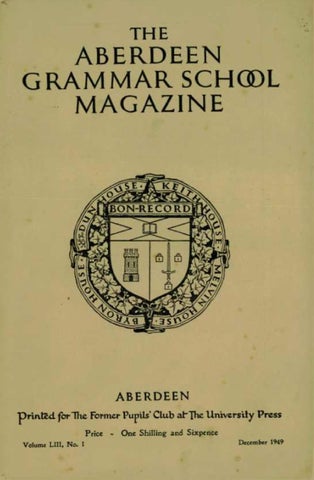
THE
ABERDEEN GRAMMAR SCHGDL MAGAZINE
ABERDEEN
print ci for The Former Pupils' Club atilie University Press Price - One Shilling and Sixpence Volume LIII, No. 1
December 1949
A PENNY for your thoughts . . . an old tag certainly, and if you are interested in the expression of other people's thoughts, then a visit to Bisset's Book Shop will more than repay you, for here will be found a fine selection of Books giving up-to-date views on present day and everyday problems. If unable to make a personal call, do not hesitate to write, as our Postal Department gives prompt attention to all orders and enquiries. Any book available but not in our stock will willingly be procured for you
JAMES G. BISSET Bookseller and Stationer
85 Broad Street Aberdeen
Opposite Marischal
•
College
PHONE 29053 •
GOOD HEALTH demands
GOOD BREAD For the children especially is it necessary to ensure their stamina and energy with good, wholesome, nourishing bread. In Hutchison's bread you'll find all these requirements are fully met. Phone or give instructions to have it supplied daily.
A. B. HUTCHISON (CENTRAL BAKERY) LTD.
BRANCHES THROUGHOUT THE CITY
21st Birthday Suggestions Gold Cuff Links with coloured enamel school crest and F.P. colours Gold Stud Sets with Links in fine leather wallets, suede lined Hair Brushes with monogram pattern in Ivory, military Silver and Hardwoods Toilet Sets in pigskin and Contents calf leather cases. mounted in Silver, Ivory and Hardwoods Wrist and Pocket Watches in Gold, Stainless Steel and Chrome
A. & J. SMITH (Jewellers) Ltd. 191 UNION STREET
ABERDEEN
ti
" I need good food" —and this is where you can get it ! We always have a fresh stock of all well-known dog foods including Spratt's, Spillers, etc.
Main Stockists for
Pot and Pearl
Hay and Straw
Barley
Poultry and Bird Food
Barley Meal Coal
and
Moss Litter
Fire-
wood
Manures
WILLIAM SCORGIE GRAIN AND POTATO MERCHANT
13 ROSE STREET
.
Phone 23731
ABERDEEN
DAIRY : ABERDEEN Tel. 20373
FARM : CULTER Tel. 3106
KENNERTY FARM DAIRY WILLIAM REITH Sole Proprietor : JOHN REITH
46- 48 ROSE STREET, ABERDEEN
ma7.1r7.1==mux.zr7.2===r7.2r4z= At your Service For QUALITY
S
FISH • GAME • MEAT Whether you shop in person or by telephone your requirements in either or both of our Departments will be looked after with rare. Our delivery system too exists for your convenience
A. & W. ALEXANDER
S S S
Fish, Game and Meat Merchants Telephone : Aberdeen 25236
S
49 2 UNION STREET, ABERDEEN
t=t7,2===t7.2t7.2t7.1=t7.1=7,1====
1
i i i i i i i i i i i i i i
i f, ....r•
I
Telephone 29191
i
ARCHIBALD
MCKELLAR
I i i i I i i i
Family Grocer, Wine Merchant and Tobacconist We specialise in
Medicinal Wines
PROVISIONS
VIBRONA
TEAS
HALL'S
COFFEES
WINCARNIS
WINES, etc.
PHOSFERINE
i
i i
450-456 UNION STREET, ABERDEEN •• ■••• ."••••• S. ......
1..••••• MID. 1111.• Mar*
0...m. 1,1•••
••• ■••• t'.1.4
*.••••• ....1.4 HIM
-
•••••.• el
I
I "II NkLAVJA'Y
-
• ' WOK€N
UNION STRICT
-1114K X R CONficncipaisi, STAIIR ATEURS,
/
-
73 UNION STREET E:.RDEE N
STREET AB DEES- •
-
ONEHOEN and CULTS •
.J.
ESTO 1733 •
PHONE 21219
Still maintaining our tradition we ore endeavouring to meet the many wishes of our customers in a now greater selection of Fine Silverware, Rings in the most exquisite settings of Diamond,Emerald, Ruby, Sapphire, and m on ever widening range of personal Gifts for Gifting purposes.
OE. 9 T ITHS UNION BRIDGE
► ABERDEEN •
-
RO1° E
TS (A DN.) LT
MAKERS OF FINE FURNITURE AGENTS FOR " NESTA " SPRING INTERIOR MATTRESSES "HOUSEPROUD" KITCHEN FURNITURE " PEL " TUBULAR STEEL FURNITURE
LINOLEUMS
A large stock of good quality furniture and furnishings always in stock. We have a well organised workshop for repairs, which can be done expeditiously.
CARPETS
FRENCH POLISHING REMOVALS REPAIRS
419 UNION STREET ESTABLISHED 1873
ABIERDEEN
FEL.1N 1-ME 2 6
•
JAMES FYFE & SON PAINTERS
AND
GLAZIERS
Office and Showrooms
II
DEE STREET, ABERDEEN
Telephone 22436
Telegrams: "Fyfe, Painters"
GILBERT COURAGE Licensed Grocer 32 ESSLEMONT AVENUE
Wide Variety of Liqueurs
Telephone 2 4684 Supplier of WILLIAMS & HUMBERT SHERRIES GILBEY'S WINES & SPIRITS SANDEMAN'S PORTS
BON RECORD For over a century, J. St A. Ogilvie have helped the people of the North-East of Scotland to solve their furnishing problems to their satisfaction. They will be delighted to place their long experience and trained staff as well as their very large and high class stock at your disposal to assist you in your difficulties. You are invited to call or write
J. & A. OGILVIE 369.373 UNION STREET
ABERDEEN Telephone 29432
Telegrams " Interiors"
" Top of the Form"
Clothing for Boys by
Boys' GENUINE HARRIS TWEED
OVERCOATS Single Breasted—Raglan Sleeves—All-Round Belt In Blue-Blue/Lovat—Green/Lovat—Brown/Lovat and Fawn/Brown shades Sizes 28' to 42' length
Prices from 108/3
Expertly Tailored for
JOHN FALCONER & CO. LTD. Complete School Outfitters 65 UNION STREET
ABERDEEN
••••••••
The choice of your
FIREPLACE ARRANGEMENTS may be a little restricted these days, but we have been able to maintain our stocks at a good level, and have on display a pleasing range of modern and period designs for your selection
James Scott & Son
Ltd.
(Aberdeen)
483-485 UNION STREET ABERDEEN Phone 29181
ESTABLISHED 1 8 1 8
FOR BETTER FOOTWEAR
JAMES
LORIMER
APPOINTED
TO
MEAT PUR-
EST 1
MIS Mu•
VEYORS ANO
KING, DATED
POULTERERS
I sr lure 1940
THE
and Son (Bootmakers) Ltd.
J. WILLIAMSON & SON Civil and Military BOOTMAKERS
Meat Purveyors, Poulterers and Game Dealers I, 2, & 3 MARKET BUILDINGS ABERDEEN Phone 28470
8 CHAPEL STREET, ABERDEEN (Late of 162 Union Street)
BRANCHES 3S FOUNTAINHALL ROAD
THE SQUARE. CULTS
PHONE 21724
PHONE 47812
ALSO AT CHURCH
ESTABLISHED 1844
PHONE 2O724
SQUARE. BALLATER
PHONE 38
MODEL AIRCRAFT, SHIP & RAILWAY ACCESSORIES COMPLETE
RANGE
OF
KEIL,
AIRYDA KITS AND SPARES.
VERONS,
HALIFAX,
DON,
OVER 200 TO CHOOSE FROM
AMCO, ELFIN, MILLS, E.D. & K. DIESEL ENGINES ALSO ALL SIZES BALSA AND HARDWOOD IN STOCK
UNION
SUPPLY CO.
266-268 GEORGE STREET
ABERDEEN
The West End Bookshop For all the latest books *
Best value in stationery
*
Up-to-date library
*
Stroll around and be assured of courteous, friendly service and expert advice
WEST END BOOKSHOP 412 UNION STREET
ABERDEEN
Moderns of tbe otb 5tb00i
T
O-DAY . . . as in the more spacious days when
this business was founded . . . the twin virtues
of courtesy and service, always notable characteristics of private trading, continue to be assiduously fostered. That friendly, individual relationship between buyer and seller which brings pleasure to each and every transaction is never lost sight of in our constant effort
to increase the efficiency of our service
BY APPOINTMENT GROCERS
To H.M. THE KING
aniA,24,Geeif,,gated Family Grocers and Wine Merchants 269-271 UNION STREET ABERDEEN Also at CULTS TELEPHONE 27244
•
BALLATER
•
BRAEMAR
REGISTRY TEL. 20015
Boys will be BOYS! . . . and clothes won't stay clean for ever. But they will last longer and stay bright and fresh if you send them periodically to
GORDON CLEANING Cleaners & Dyers HUNTLY
ABERDEEN BRANCHES 434 Union Street 505 George Street
.
ABERDEEN ABERDEEN
For persevering men . . .
. . . now and then Simpson clothes are gradually becoming more plentiful.
We can usually show you now a
reasonably good selection of suits from this wellknown firm. Please come in and ask to see them.
READY TO WEAR SUITS in a good range of fittings Utility
.
.
.
.E6 I Ss. 6d. to £10 Its. I Id.
Hard Wearing Saxonies and Cheviots Fine Worsteds
.
.
.
.
E16 to £17 £16 to E22
ESSLEMONT & MACINTOSH LTD.
(RETAILERS) TAILORS AND OUTFITTERS
UNION STREET
ABERDEEN
CONTENTS ILLUSTRATIONS Facing page
Facing page
The Site of the Old Grammar School a Upper VI, 1949-50 School Rugby ist XV, 1917-18 34
.
.
.
50
. . Page 1 . . . The War Memorial in the School Hall . . i . . . . . . F.P. Club Memorial Schemes . .•. . . „ z . . . . . The Old Grammar School . . . „ . . . . . . Notes about Old Boys . 3 . . . 19 . . . . . . University Notes . Marriages . . . . z6 . • • . . . Obituary . . . . . . School Rugby ist XV—Season 1917-18 . If 34 34 Books by F.P.s . . . . . . . 37 North-East Speech—More Reflections from a Distance. By W. W. G. 40 . . . . . . Mackay of Uganda. By Peter Cook 1:,' 4 3 . . . • Reflections on Spain. By lain Cuthbertson • ll The Rector 45 . . . ' 46 A Fortnight in Sweden. By Eric H. Cruickshank . • • . . . ,', 47 Old Copies of the Magazine . . . School Section— . . . . . . . School and Random Notes >, 48 . . . . . . Changes in the School Staff . ., 53 . . . . . . . . Derek D. Stewart . >, 54 . . . . . . . The School in France . ,. 55 56 . . . . . . . . Singapore to Sydney . . . . . . . „ S7 Memories of Zululand . . . . . . . . . Autumn . . " 58 . . . . . . . . . „ 6o House Notes . . . . . . . . . „ 6i Lower School Notes School Sporting Activities— . . . . . . Rugby . . . . , 6z1 Hockey. Cricket . . . . . . . . ,,, 64 • . „ 65 Literary and Debating Society . Dramatic Society. Scottish Schoolboys' Club • „ 66 . . . . . • • „ 67 . Scout Notes . „ 68 Rambling and Mountaineering Club. Swimming „ 69 Combined Cadet Force Notes. Pipes and Drums The Former Pupils' Club— . • • Club Executive Notes . 70 The Annual Dinner of the Club • 71 . . . . . . . . . London Centre 75 Glasgow Centre. Yorkshire Centre. F.P. Club Boarding House 76 F.P. Club Consuls . . . . . . . . . 79 F.P. Cricket Section . . . . . . . . . . . . . . . . 8z F.P. Golf Section . . . . . . . „ 83 . . F.P. Rugby Section . . . . . . . . F.P. Hockey Section . F.P. Club Office-Bearers, 1949-50 . . • 5 • • 86 Club Subscription Rates. New Members of the Club . . ,,
.
.
•
•
•
.
.
.
.
.
.
SO
22
t,
•
•
•
•
•
•
•
•
•
•
,,
•
•
•
•
•
•
•
•
•
•
•
•
•
•
•
•
•
•
•
•
•
•
IP
81
1,
SS
8 4
*9
8
PS
Insurance IS necessary Every prudent person covers the everyday risks of
FIRE LIFE AND
ACCIDENT The
Northern Assurance Company Limited
ESTABLISHED IN ABERDEEN
1836
is at your service for
ALL CLASSES OF INSURANCE - ENQUIRIES ARE WELCOMED CHIEF OFFICES :
ABERDEEN LONDON
. .
1 UNION TERRACE 1 MOORGATE, E.C. 2
Company's Assets
.
£40,300,000
i
Aberdeen Grammar School Magazine 66th year; No. z65 (New Series, 57th year, No. 156)
Vol. LIII
DECEMBER 1949
No. I
- — The Magazine is published under the auspices of The Former Pupils' Club, twice a year at present—in December and July. Communications should be addressed to the Editor, ALAN C. R. WATT, M.A., LL.B., 12 Bon-Accord Crescent, Aberdeen. (Nom : An asterisk after a name indicates that the F.P. is a member of the F.P. Club; dates after a name indicate the years of attendance at the School.]
The War Memorial in the School Hall The unveiling of the War Memorial in the School Hall, which was to have taken place on 27 October 1949, had unfortunately to be postponed. It had been decided that the 1914-18 War Memorial, which was erected on the North wall of the Hall, should be moved to the East wall, and that there should be added to it a Memorial to the 194 F.P.s who lost their lives in the 1939-45 War. The work of erecting this combined Memorial on the East wall was completed, but unfortunately it was found that, due to the light from the windows in the South wall of the Hall falling obliquely on the East wall, the gold lettering of the names on the Memorial was to a large extent illegible. Various experiments were carried out, but none was successful in overcoming this lighting difficulty while the Memorial remained on the East wall. It has accordingly been decided that the combined Memorial will now be erected on the North wall of the Hall, on which the light falls directly. It is hoped that the work will proceed at an early date, and that the unveiling of the Memorial will take place during the Spring term. Next-of-kin and subscribers to the Club Memorial Schemes will be notified of the date of the ceremony as soon as possible. F.P. CLUB MEMORIAL SCHEMES
Roll of Honour Publication of the Roll of Honour has been deferred on account of the postponement of the unveiling of the War Memorial in the Hall, as it was thought that the Roll would most opportunely be published a short time before the unveiling ceremony. It is now being printed, and next-of-kin and subscribers will receive their copies early in 195o.
z
_Aberdeen Grammar School Magazine
The W. P. Stewart Memorial Fund Arrangements for the administration of this Fund have now been made by the Memorial Sub-Committee of the Executive of the F.P. Club, and will soon come before the Executive for approval. The Fund is to be used to make grants to enable Grammar School boys who show promise in games or athletics, or are otherwise deserving, to participate in extra-scholastic, sporting or Youth organisation activities in connection with the School, in which they might not otherwise be able to take part.
The Old Grammar School The photograph on the opposite page is reproduced from the March 1931 issue of the Magazine, and shows an inscription on the granite face-work of Gray's School of Art, Aberdeen. This was a little undertaking of the F.P. Club Executive about twenty years ago to mark a historic spot. There are more photographs and an interesting article on the subject in the Magazine referred to, but many are unaware of the inscription, or indeed that the Old School stood where it did, and it is thought that it may be of interest to reopen the subject with a few words here. Names used to mean more in the old days than they sometimes do now, and Schoolhill is no exception, for it was on this somewhat diminutive eminence that one of the earliest seats of learning was established. Alexander II had a residence there, and it was he who introduced a religious fraternity called the Blackfriars to the Burgh. Early in the thirteenth century he gifted his house to them and there is no doubt whatever that Blackfriars Street took its name from their monastery. This street forms the West boundary to the Art Gallery, and it is interesting to read of the discovery of human bones in the excavations for the foundations of this building, bones which are believed to be those of persons connected with the Blackfriars fraternity. There is solace in the knowledge that these were carefully collected and deposited in a small vault prepared for them nearby. In the town's register of three hundred and sixty years ago there are details of extensive repairs to the Grammar School, and the old bell which now rests in the Rector's Room bears witness of its presentation to the School in 1627. The only pictorial records of the School are those of the buildings which were erected after 1757. These consist of the present School, and the one which our grandparents knew on the Schoolhill, the belfry and doorway of which form part of the cycle shed in the grounds of the former. May these for long be preserved to remind us that the building in Skene Street which we know as " The Gram." is but a branch—albeit a noble one —of the tree whose roots are centuries deep in the soil of the old Schoolhill. G. G. Nicol, (1894-1903).
Aberdeen Graniniar School Magazine
3
* The Editor will be glad if F.P.s will send him, from time to time, information for this section of the Magazine. News of appointments, promotions, etc., and other items of interest which are not reported in the Press are particularly requested.
William Adam* (1925-37), M.A., B.Sc.(Agri.), who graduated in Agriculture at the University of Aberdeen in July of this year, is now farming at Lower Bodachra, Dyce, Aberdeenshire. Francis Sheed Anderson* (1909-12), C.B., Under Secretary, Ministry of Food, who, as reported in the last issue of the Magazine, was leader of the United Kingdom delegation to the Second International Wheat Conference held in Washington early this year, was in July elected chairman of the International Wheat Council for 1949-50. The election took place at the first meeting of the Council, held in Washington, and the second meeting was held in November in London, which is to be the permanent headquarters of the Council. The object of the Council is to administer the International Wheat Agreement which was signed in March by forty-one countries. James Alexander Angus* (18g4-99), who went to Canada in 1906, has retired after being Superintendent of Construction and Maintenance, Western Hotels, Canadian Pacific Railway, for twenty years. His area extended from Fort William, Ontario, to Victoria, British Columbia, and included the well-known Banff Springs Hotel, the Château Lake Louise, and the Empress Hotel, Victoria, B.C. Vancouver was his winter headquarters, but during the summer he moved to Banff, Alberta. He has now taken up permanent residence in Vancouver. Robert Joss Bain* (1929-41) has recently become a partner in his father's firm, Messrs. Gray & Bain, carpenters, joiners and contractors, Aberdeen. In October it was announced that he had been awarded a National Certificate in Building (higher) at the School of Architecture of Robert Gordon's Technical College, Aberdeen. Charles Leith Barron (1907-19), M.B., Ch.B., has been appointed chief surgeon of the Railway Hospital, Crewe. After graduating at the University of Aberdeen in 1931, he was house surgeon for a time at the Royal Northern Infirmary, Inverness, and then an assistant in Blackpool. Thereafter he was in practice at Armadale, West Lothian, at Buckie, and at Newcastle-upon-Tyne. In 1940 he was appointed assistant
Aberdeen Grammar School Magazine 4 medical officer to the Education Authority of the City of Birmingham, and for some time prior to taking up his new appointment in October of this year, he was industrial medical officer at Derby. Norman Darroch Begg* (191 5 -24), M.D.(Aberd.), D.P.H. (Lond.), who was medical superintendent at the Eastern Fever Hospital, London, until 1946, was loaned by London County Council in February of that year to go as epidemiologist in the U.N.R.R.A. Mission to Poland. Latterly he took charge of the Health Division of this Mission, and was transferred on i July 1947 to the World Health Organisation. The revival during that period, he says, of the gaunt graveyard of Warsaw was something not easily forgotten. When the emergency work in Poland terminated in October 1948, he resigned his permanent appointment on the staff of London County Council to continue international health work, and has since i January 1949 been in charge of the Special Office for Europe of the World Health Organisation, Geneva. W.H.O., in addition to providing technical services on a world basis, has divided the world into six major regions where special health programmes are arranged to meet the particular needs of the area. The European Region embraces twenty-seven member governments which present health problems of great variety and interest. William George Rowntree Bodie* 913-22), A. R.I.B.A., A.M.T.P.I., F.S.A.(Scot.), was in August appointed an assistant chief planning officer to the Glenrothes Development Corporation, which is concerned with the establishment of the new town in Fifeshire which the Minister of Town and Country Planning decided some time ago to set up. He was previously senior town planning assistant in the City Engineer's department of Aberdeen Corporation, but for the past two years he has been on the staff of Messrs. W. Dobson Chapman & Partners, planning consultants to the Corporation. James Edward Bothwell* (1915-23), M.A., LL.B., advocate in Aberdeen, has been appointed secretary and treasurer of the Cairngorm Club. He is sole partner of Messrs. Macqueen & Findlater, advocates, Aberdeen, and a former honorary secretary of the Aberdeen District of the Scottish Youth Hostels Association. Percy Stuart Boyd* (1927-40), M.A., who graduated at the University of Aberdeen in 1948, with honours in PsychologyPhilosophy, is now an assistant in the Department of Mental Health at the University. George Rettie Burns (1925-3i), who first went to the Far East in 1934 to take up an appointment on a rubber estate in Malaya, is now in business at Seremban, Negri Sembilan, Malaya. Eric Buthlay* (1928-4o), B.L., was admitted to the Society of Advocates in Aberdeen in October 1949. He graduated in Law at the University of Aberdeen in April, and is now a legal assistant with Messrs. G. H. Bower & Gibb, advocates, Aberdeen. He is captain of the F.P. rugby team this season, and also captained the North XV which played against the Midlands in the international rugby trial
I
The Site of the Old Grammar School
THE ENTRANCE TO ROBERT GORDON'S COLLEGES
showing Inscription on Wall of Gray's School of Art
•
ON THE SCHOOL HI LL STOOD THE GRAMMAR SCHOOL OF ABERDEEN FOR OVER SIX CENTURIES THIS STONE MARKS THE SITE OF THE SCHOOL FROM 1757 TO 1663 WHEN THE PRESENT BUILDING IN SKENE STREET WAS ERECTED INSCRIBED BY THE ABERDEEN GRAMMAR SCHOOL FORMER PUPILS. CLUB
MCM XXX TILE IN:.,CRIPI:ION
.
•
Aberdeen Grammar School Magazine 5 match at St. Andrews in November. His marriage is reported on another page. Gordon Fordyce Cassie* (1929-39), M.B., Ch.B., who has been on the staff of the Anatomy department of the University of Aberdeen, has received an appointment as surgical registrar at the West Middlesex Hospital, London. His elder brother, Ian Harvey Cassie* (1925-35), L.D.S., R.C.S.(Edin.), who has been in South Africa for the past two years, is now in practice as a dental surgeon on his own account at Rondebosch, Cape Town. James Durno Chalmers* (1935-40), M.B., Ch.B., has been awarded the Diploma in Child Health by the examining board of the Royal College of Physicians of London and the Royal College of Surgeons of England. He is now engaged in child health work in Barnstead, Hackney and Shadwell hospitals, which belong to the Queen Elizabeth group of hospitals in London. Robert Forbes Combe (1923-3o), B.L., solicitor, of Messrs. Wink & Mackenzie, solicitors, Elgin, and Clerk of the Peace for the County of Moray since 1946, is to go into partnership with Messrs. Brander & Cruickshank, advocates, Aberdeen, at the end of this year. When he graduated in Law, with distinction, at the University of Aberdeen in 1936, he was the most distinguished student of his year. In August 1946 he won the British Chess Championship. James Lewis Conner* (1924-30) is on the staff of The General Electric Company Limited at Coventry. He left Aberdeen in August 1936 and, after spending two years on an engineering course with the Company, was appointed production supervisor in their condenser manufacturing department. From 1941 to 1945 he was in charge of one of the Company's dispersal factories in Leicester and, although he has returned to work in the parent factory at Coventry, he continues to reside in Leicester. Up to the outbreak of war he played regularly in the Company's rugby and cricket teams, being captain of the former for four years. During that period he also turned out for the Warwickshire Colts XV. He has now retired from active participation in the game but is a keen and critical supporter of Leicester Tigers. William Lewis Connon* (193o-4o), B.L., was admitted to the Society of Advocates in Aberdeen in August 1949. He is a legal assistant with Messrs. Mackenzie & Wilson, advocates, Aberdeen. James Craig* (1922-32), M.A., LL.B., who has been legal assistant to the County Clerk of Clackmannan at Alloa for the past fifteen months, joined the firm of Messrs. R. Addison-Smith & Company, W.S., Edinburgh, at the end of November. Before going to Alloa, he was a legal assistant on the staff of Edinburgh Corporation. Newell Burnett Cran (1910-I i), who went to Gwelo, Southern Rhodesia, before the 1914-18 war, and entered the service of the municipality of Salisbury after demobilisation, is now senior maintenance officer in the Public Works department of the Rhodesian
6
Aberdeen Grammar School Magazine
Government. When in Beira, Portuguese East Africa, recently, inspecting a block of flats which are being built for the Rhodesian Government customs officers, he found that the director of the company responsible for their erection was an F.P.—Marshall Keith Duguid* (1919-29), our Consul in Beira. Mr. Cran is now joining the F.P. Club. James Gordon Dawson* (1 921-34), B.Sc.(Eng.), who, since 1946, has been assistant director of research, Thornton Aero Engine Laboratory, Shell Refining and Marketing Company, Chester, left England in September for a three months' tour of the U.S.A. and Canada on behalf of his firm. Thomas Dewar Duguid* (1936-39) is now in the service of the Silonibari Tea Company Limited, North Lakhimpur P.O., Upper Assam, India. He has joined the Bengal and Assam Centre of the F.P. Club. Eric Henry Weir Duncan* (1918-26), M.B., Ch.B., D.P.H., who has been in practice in Banff for ten years, received an appointment in August as port medical officer and assistant medical officer of health for Greenock. After graduating at the University of Aberdeen in 1931, he held hospital appointments in Aberdeen and London and was in practice in London from 5936 to 1938. While at Banff, he was a specialist in anaesthetics at Chalmers Hospital. Basil Duncan Dean Emslie* (1929-35), of ScOttish Oils and Shell-Mex Limited, Glasgow, has been appointed lubricants supervisor for the Fifeshire and Edinburgh area. He is to continue to live in Bearsden, and to be Secretary of the Glasgow Centre of the Club. John Frederick Ferguson* (1904-09), C.B.E., Chief Constable of Kent since 1946, has been appointed by the Secretary of State for the Colonies to be a member of a Mission to investigate the present and long-term problems connected with the organisation and administration of the Federation of Malaya Police Force and to advise the Federation Government thereon. Major Ferguson was in the Army for twenty-five years and joined the Metropolitan Police as a chief constable in 1933. From 1938 to 1940 he was Commandant of the Metropolitan Police College at Hendon, and thereafter he became a deputy assistant commissioner at Scotland Yard. From 1943 to 1945 he was Chief Constable of Sussex, and thereafter he rejoined the Metropolitan Police as assistant commissioner. He was awarded the C.B.E. in June 1948. William Alfred Beaumont Forbes* (1932-42), elder son of Mr. William Forbes, formerly Senior English Master at the School and now Rector of Galashiels Academy, graduated M.A. at the University of St. Andrews in June 1949, with first class honours in Economics and Modern History. In June 1944 he entered the Univerity as a Harkness scholar, and he has now been awarded the Rosen Prize (first equal), as the most distinguished graduate in Economics, Politics and History, and the Tyndall Bruce post-graduate scholarship of
Aberdeen Grammar School Magazine
7 £300. He is to take the course in Law at Magdalen College, Oxford. William Wares Georgeson* (1911-23), M.A., I.C.S., was incorrectly stated in the last issue of the Magazine to have retired. He was on leave in England this year, but expected to return to India in December. He is District and Sessions Judge at Tanjore, Madras. John Paterson Beveridge Gill* (1920-26), M.A., M.B., Ch.B., who is in general practice at Canisbay, Wick, Caithness, also serves the lonely island of Stroma. At a meeting of the Caithness National Health Executive Council held at Thurso in September, the question of an inducement grant to cover the hire of a boat to take Dr. Gill to Stroma was discussed and it was reported that he had sometimes to make as many as eighty trips a year to this outpost. James Hall McIntosh Gordon* (1901-02), M.C., D.L., J.P., a director of George Gordon & Company Limited, timber merchants, Aberdeen, has been elected a commissioner on the Aberdeen Harbour Board. Another new commissioner is George David Wright Stroud (1914-19). Douglas Wyndham Maling Grant* (1937-41), B. A .2 who graduated at Trinity College, Cambridge, in 1948, with second class honours in the Historical Tripos, has since September 1948 been on the staff of Drumtochty Castle School, Auchenblae, Kincardineshire. He is History Master, with English as a subsidiary subject. George Mitchell Groat* (1927-40), who went to Southern Rhodesia two years ago to take up a civil service appointment, is now farming at Hartley, about seventy miles from Salisbury, Southern Rhodesia. He was for a time in the Accountancy department of the Farmers' Co-operative Society and thereafter in the customs clearing department, but has now decided to forsake an office desk for an outdoor life. In a recent letter he states that, since going to Salisbury, he has met several F.P.s, including James William Spence Cobban* (1920-21), John Morgan Yule* (19 i 4-19 and 1923-24), Bowman Stiven Laird* (1928-40), B.Sc. (Eng.), who was at School with Groat and has now settled in Vereeniging, Transvaal, and William Mitchell Park (1932), M.C. Alfred Alexander Harper (1918-25), M.A., M.D., has been appointed Professor of Physiology in the University of Durham, at King's College, Newcastle-upon-Tyne. He has held lectureships at the University of Leeds, St. Thomas's Hospital, London, and at the University of Manchester. In 1947 he obtained the degree of M.D. from the University of Aberdeen, with highest honours, the title of his thesis being " The Control of Gastric and Pancreatic Secretion ". Hamish McNaughton Henderson* (1932-44) obtained a "First" in the Classical Tripos (Part i) at Pembroke College, Cambridge, in June 1949, with distinction in Latin and Greek verse composition. George Hendry (1897), M.B., Ch.B., Provost of Buckie, was appointed by the Secretary of State for Scotland in August of this year
8
Aberdeen Grammar School Magaine
to fill a vacancy which had arisen on the Electricity Consultative Council for the North of Scotland District. James Rannie Hendry* (1928-40), who qualified as a member of the Pharmaceutical Society in June, is at present undergoing further training with Messrs. Lewis & Burroughs, Kensington. Thereafter he is to return to Aberdeen and enter his father's business, Messrs. Gordons, chemists. His marriage is reported on another page. Henry Humble (1913-16), M.A., B.Sc., who has been Rector of Milne's Institution, Fochabers, since November 1943, was at the end of November appointed Rector of Elgin Academy. He was previously on the staff of this school from 1925 to 1932, as principal Science and Mathematical Master, and from 1932 until he went to Fochabers, he was Headmaster of Rothes Junior Secondary School. John Henry Lewis Innes* (1919-23), who has been with Messrs. Robinson & Glyn, stock and share brokers, London, since 1929, was admitted into partnership on 6 July 1949. Robert Alexander Innes* (1928-31), B.Sc.(For.), has been a district forest officer with the Forestry Commission in the North of Scotland Conservancy since October 1947. His headquarters is at Dingwall and the forests in his district extend from Ardross, near Alness, across Ross-shire to Wester Ross and include those in the islands of Skye, Raasay and Lewis. At present he has the following eleven state forests under his charge—Ardross, near Alness; Clach Wath, near Evanton; Torrachility, near Strathpeffar; Longart, at Inchbrae, by Garve; Lael, at Braemore, Ullapool; Slattadale, on the shores of Loch Maree; Achnashellach, in Central Ross; two forests near Lochcarron; Glenbrittle, in Skye; and Raasay. He has also two experimental plots of eight acres and two acres at Balallan and at Valtos, Uig, both in Lewis. Unfortunately, in the past, the people of Lewis have not favoured the Forestry Commission's presence on the island, and since 1930, when the plots were laid out, Balallan has been destroyed on two occasions. It was planted for the third time in 1947. Sir (William) Wilson Jameson* (1892-1902), G.B.E., K.C.B., M.D., LL.D., D.Sc., F.R.C.P., K.H.P., who has been Chief Medical Officer of the Ministries of Health and Education since November 1940, is to retire from the public service on reaching the age limit on 11 May 1950. In a leading article on the day on which his impending retirement was announced, The Times said that Sir Wilson . . . has helped to write a new, bright chapter in the history of national health. Through war-time blockade and peace-time privation the people's health, judged by all available evidence, has been preserved and even improved. . . . His term of office saw the spread of remarkable new drugs such as penicillin, and it saw the war with all its difficulties, the Emergency Medical Service, the risks of shelter life, the threat to food supplies. It was for his successful leadership of the country's medical services through all these trials that he was awarded in the United States both the " Medal of Freedom with Gold Palm " and the Lasker Award of the American Public Health Association, which he shared with Lord Woolton, Sir Jack Drummond and Lord Boyd-Orr. When the war was over further unprecedented duties fell upon the Chief Medical Officer. The Education Act of 1944 threw up new safeguards for the
Aberdeen Grammar School Magazine
9
health of school children. . . . The National Health Act arrived with all its wideranging complexities. At the centre of it all Sir Wilson Jameson's shrewd counsel and persuasive Highland voice always struck the note of responsible and skilled public service. His broadcasts were heard by many; his work will last as the foundation for better health in the future. It is a fine tradition that his successor, Dr. John Charles, now inherits.
Arthur Roy Handasyde Kellas* (1926-32), M.A., who joined the Foreign Office and Diplomatic Service in 1939, left London at the end of November to take up an appointment as First Secretary in H.M. Legation at Helsinki, Finland. Previously he was a First Secretary at the Foreign Office, London. Charles Forrester King* (1912-23), who joined the Chartered Bank of India, Australia and China in 1925 at the Bank's London office, was posted from Shanghai in June 1949 to take charge of the branch of the Bank at Medan, Sumatra, Dutch East Indies. He was in Shanghai for six years prior to 1941, and was the first secretary of the China Centre of the F.P. Club. In 1941 he went to Manila, and from 1942 he was in a Japanese prison camp until released by the Americans in 1945. George Alexander Ledingham* (1894-1905), D.S.O., M.C., T.D., who has been living in the South of England since the end of the 1914-18 war, went by air on a visit to Southern Rhodesia early this year, and he returned there in October. Before the late war he was a civil engineer at Bordon, Hampshire, and in 1939-40 he commanded a Royal Artillery• regiment. After Dunkirk, when the regiment was re-formed, he was retired on account of having reached the age limit, but in 1944 he returned to France and served there and in Holland and Germany in the Military Government until the end of the war. On his return to England he was appointed secretary of the United Nations War Crimes Commission, with Lord Wright as his chairman, and he served in that capacity until all the cases of German war crimes had been disposed of. Stanley Frederic Lindsay* (1930-32), M.B., Ch.B., has been in practice at Banchory since i October 1949. He graduated at the University of Aberdeen in 1937 and during the war he rose to the rank of Lieutenant-Colonel in the R.A.M.C. William Nathaniel Litster* (1917-24), who is in the service of the Milk Marketing Board, has been appointed Manager of the Redhill Cattle Breeding Sub-Centre, with effect from i May 1949. Douglas Yeats Lobban* (1922-34), who has been tea planting in Assam since before the war, is now on the Muttrapore Estate, Suffry P.O., Assam. John Gibb Lorimer* (1905-14), who has been engaged for many years in rubber planting at Port Dickson, Negri Sembilan, Malaya, has had to retire on medical grounds, and he sailed from Singapore at the beginning of November. His health was seriously impaired during his internment by the Japanese during the late war. Robert Francis Gordon McCallum (1910-17), M.A., who is Classics Master at North Kelvinside Academy, Glasgow, has been
to
. Aberdeen Grammar School Magazine
responsible for two of the most popular programmes in " Children's Hour " during the past few months—" Down at the Mains ", which was broadcast from Glasgow, and " Dee, Don, and Dominie ", from Aberdeen. He graduated M.A. at the University of Aberdeen in 1923, with first class honours in Classics, and was for a time assistant to the Professor of Humanity at the University. In his student days he was well known as an actor, pianist and composer of Gala Week shows. In 1916-17 he was a School editor of the Magazine. Ernest Ian McConnach (1931-43) has been awarded a diploma in Architecture at the School of Architecture of Robert Gordon's Technical College, Aberdeen. As stated in the last issue of the Magazine, he is now in Kenya. William Alexander McConnach* (1920-26), a brother of Mr. James McConnach, Chief Constable of Aberdeen, was in October appointed Deputy Chief Constable of Plymouth. He has been with the Plymouth City Police for many years and was appointed Detective Superintendent in charge of the C.I.D. in 1947. George Lamb McEwan* (1929-35), M.B., Ch.B., was in July admitted a Fellow of the Royal College of Surgeons of Edinburgh. Ian McIntosh* (1918-33), who went to Calcutta in 1947 to enter the service of the Samnagar Jute Company, received an appointment early this year with, Roberts, McLean & Company Limited, importers and exporters, Calcutta. He now lives in Calcutta and is a member of the Bengal and Assam Centre of the Club. His elder brother, Murdoch McIntosh* (1928-33), B.L., is still serving with the Control Commission for Germany at Kiel. Donald Hugh James Mackay* (1912-18), B.L.(Edin.), W.S., who was a procurator-fiscal depute in Glasgow, Edinburgh and Aberdeen from 193 I to 1940, is now with a Glasgow firm of solicitors. In 1940 he took over the business of Messrs. Anderson & McArthur, solicitors, Stornoway, and in 1942 he joined the R.A.F. as an A.C.2. After training at the R.A.F. Officers' School, Cosford, he was commissioned for the third time in his life, and became administrative officer in 16 Group, Coastal Command, stationed mostly at Dyce, until 1944, when he was attached to the Army. He went to France as Scots Legal Officer in the Legal Aid Section of z1 Army Group, and for a time he had command of No. 7 (Scots) Forward Legal Aid Section. He was demobilised with the rank of Squadron Leader in 1945. Thereafter he went into practice in Lossiemouth, and in 1948 was appointed Town Clerk of Pitlochry. He resigned this post in April of this year, and went for a few months to Vancouver, B.C., where he was an articled clerk to a K.C. Alexander George Robertson MacKenzie (1894), A.R.S.A., F.R.I.B.A., has been chosen to act as assessor in the competition for the best design for the large extension to the medical buildings planned by the University of Edinburgh. He was nominated as assessor by the President of the Royal Institute of British Architects and the appointment was confirmed by the University. He was
Aberdeen Grammar School Magazine
xi
President of the Royal Incorporation of Architects in Scotland from 1947 until this year, and in the course of his distinguished career as an architect he has been engaged to design many important buildings. Almost forty years ago he was the architect of the memorial which King George V placed in Crathie Church in memory of King Edward VII. John Mackenzie* (193o-32), C.A., who for the past eight years has been in the service of Stewarts & Lloyds Limited, Birmingham, received an appointment in March 1949 as assistant secretary to the National Cash Register Company (Mfg.), Limited, Dundee. He states that he is happy to be back again in Scotland, although he finds the Dundee accent harder to understand than " Brum " English I John Moir MacKenzie* (19o 5 -o8), C.B.E., M.C., T.D., M.A., M.B., Ch.B., Colonel, R.A.M.C., has retired from the Army and is now living at Castle Lodge, Glenbuchat, Aberdeenshire. He was first commissioned in the R.A.M.C. in April 1915. Maitland Mackie (1897-1902), O.B.E., who has been responsible for several novel agricultural enterprises in the North-East of Scotland during the past forty years, has recently had built on his farm of North Ythsie, Tarves, a new building which covers 8,ooo square feet. It is a covered cattle court, in the form of a parabolic arch of solid concrete, to hold i zo cattle. Ninian Mackie* (i927-37), M.A. (Aberd.), who has been an articled clerk in London for the past three years, passed the final examination of the Law Society in June, with second class honours. There were 115 candidates for honours, and of these two obtained first class honours and seventeen second class honours. He is now a partner in the firm of Messrs. Arthur Hunt & Hunt, solicitors, London, with whom he did his training. Eliot Digby Mackworth* (1923-27), M.D., M.R.C.P., who is in consulting practice in London, was recently appointed visiting physician to the Royal Northern Hospital, Holloway, London. About fifteen years ago he was successively house physician and house surgeon in this hospital. His brother, Norman Humphrey Mackworth (1923-34), M.B., Ch.B.(Aberd.), Ph.D.(Cantab.), who is assistant director of the Medical Research Council's Applied Psychology Research Unit in the Psychological Laboratory at Cambridge, has recently been awarded a fellowship at St. John's College, Cambridge. Their father, Norman Walter Mackworth (1892-96), M.B., Ch.B., F.R.C.S.E., J.P., Lieutenant-Colonel, I.M.S. (retired), lives at Greystones, Dyce, Aberdeenshire. George Campbell Massie (1924-38), M.A., is now teaching at Pitmedden, Aberdeenshire. His marriage is reported on another page. Eric William Masson* (1938-42), who has been in the Aberdeen office of the London & Lancashire Insurance Company Limited since leaving the School, left in November to take up an appointment in the Company's Calcutta office. His younger brother, James
12
Aberdeen Grammar School Magazine
Cameron Masson* (1938-46), is an apprentice engineer with Hall, Russell & Company Limited, Aberdeen. John Alexander Masson* (1935-43) is now engaged as an assistant planter on the Nahartali Tea Estate, Dikom P.O., Upper Assam, India. James Melvin* (1904-10), C. B. E., M.C., T.D., M.B., Ch.B., is now in general practice at East London, Cape Province, South Africa. Before the war he was in practice at Streatham, London, and during the war he rose to the rank of Brigadier and held the appointment of D.D.M.S., 8 Corps, on the Baltic. Thereafter he went to Berlin with the Control Commission for Germany, as the British representative on the quadripartite Public Health Committee, and remained there until February 1948, when he resigned. In a letter he says that the more he sees of East London, its climate, its people, and its wonderful hinterland and coast line, the more he likes it. He has joined the local Yacht Club and acquired a " sprog ", the type of light yacht that is used for racing. He is the latest addition to our list of Club Consuls. David Croll Milne* (1911-15), B.Sc., who has been assistant to the Chief Engineer of the Manchester Ship Canal Company since 1942, was in October appointed Chief Engineer. He was at one time Assistant Harbour Engineer to the Government of Western Australia, and from 1932 to 1940 he was Engineer and Chief Executive Officer to the Greymouth Harbour Board, New Zealand. Thereafter he was for two years on the staff of a London public works contractor. James Pratt Milne* (1937-42), B.Sc.(Eng.), who graduated in Electrical Engineering at the University of Aberdeen in 1945, and has since been in Warwickshire, is now employed by Messrs. Kennedy and Donkin, consulting engineers, Edinburgh. His firm are consultants to the Hydro-Electric Board and his work is concerned with the North of Scotland Hydro-Electric Board's schemes throughout Scotland, especially the Loch Sloy project. Malcolm Ross Milne* (1926-35), M.B., Ch.B., medical officer and flying doctor at Broome, Western Australia, still finds himself within the F.P. orbit. Recently he was with some trepidation expecting a medical " high-up " to inspect his station. This was the newly-appointed Assistant Commissioner of Public Health, who turned out to be not only an Aberdeen graduate but a Grammar F.P. to boot! His visitor was William Sharp Davidson* (1921-26), M.B., Ch.B., D.P.H. In a letter describing the meeting, Dr. Milne says:
He left School in 1926, but remembered me as a small boy with Dad, who under another sobriquet taught him Latin in Classical V. Isn't it a small world? We had some grand pow-wows about the Old School, fitted in eagerly amid a mass of Public Health business and discussion—quite a breath of home it was. He also plays bridge: so the evenings passed sweetly with some splendid rubbers. Albert Alan Minty (1912-16), who has been in Canada for twenty-
seven years, is a Sergeant in the Royal Canadian Mounted Police at Moose Jaw. At the end of 1948 he was admitted as a serving brother
13 Aberdeen Grammar School Magazine of the Venerable Order of the Hospital of St. John of Jerusalem by approval of His Majesty. He was one of thirty-eight Canadians granted the honour of admission to, or promotion in, the ceremonial order. The announcement of these honours was made by the Governor-General, Lord Alexander, and in the issue of the Moose Jaw Times-Herald published at the time, there appeared a photograph of the Governor-General and Sergeant Minty, taken on the occasion of the former's visit to Moose Jaw in the spring of 1948. Sergeant Minty has been doing ambulance and first-aid instruction work for both civilian and Mounted Police groups for the past ten years. Douglass Alexander Mortimer* (1895-99), solicitor, who in 1948 was appointed legal member and president of the Electricity Arbitration Tribunal in relation to proceedings in Scotland, was in July of this year appointed by the Lord President of the Court of Session to a corresponding position on the Gas Arbitration Tribunal, set up under the Gas Act, 1948. James Lawson Mowat* (1915-16), M.A., Ph.D., who has been on the staff of the International Labour Office since 192,8, was in September appointed head of the new Maritime Section of the I.L.O. At the time of his appointment it was officially stated that, because of the outstanding success of the Maritime Service under Dr. Mowat's leadership, it had been decided to make it a technical section. In a letter to the Editor at the end of July, he stated that he was then engaged on a very interesting job. The International Transport Workers' Federation had threatened to boycott many of the ships which had been transferred to the flag of Panama (which now has about three million tons of shipping—more than France), alleging that many of these ships were too old to be allowed to sail under the flag of countries with strict standards of seaworthiness, and that the transfers were frequently for the purpose of evading taxation, recognised standards of safety and high standards of working conditions. The Government of Panama asked the I.L.O. to make an impartial investigation into these charges and a Committee of three, consisting of a Government representative, an employer and a trade unionist, was set up. Dr. Mowat's job was to collect all the relevant information for the Committee, prepare comparisons between Panamanian law and practice and those of leading maritime countries, and accompany the Committee on visits of inspection. The first meeting was held at Brussels and, up to the time of writing, the Committee had also visited Antwerp, London, Leith, Blyth and South Shields. It was expected that the Committee would be able to produce a useful report in the autumn. Dr. Mowat stated that the Inquiry was proving very enlightening, and was rather a new departure for the I.L.O., which might lead to interesting developments in other directions. (A note on Dr. Mowat's report on " Seafarers' Conditions in India and Pakistan " appears on page 35.) Ian Gordon Munro (1932-37), B.Sc., M.R.C.V.S., has been appointed house surgeon for a year at the clinic of the Royal (Dick) Veterinary College, Edinburgh.
14
Aberdeen Grammar School Magazine
Stewart Sinclair Fowler Munro (1930-31 and 1934-40), M.B., Ch.B., who graduated at Aberdeen in 1945, and served with the R.A.F. for two years in this country and India, is now junior registrar at the Western Ophthalmic Hospital, Marylebone Road, London. His marriage is reported on another page. Thomas Henderson Murdoch* (1921-27), M.A., L.G.S. M. (Floc.), L.R.A.M., L.L.C.M., has been teaching at St. Margaret's School for Girls, Aberdeen, for the past two-and-a-half years. His subjects are Speech Training and Drama, and he has been devoting himself entirely to private teaching and to teaching at St. Margaret's, except during the past two summers, when he has been Entertainments Manager for Stonehaven. In 1949 he issued a fortnightly Bulletin and Guide to the Town's entertainments and 6,ooo copies were issued during the season. This job, he says, can be summed up in the phrase " Never a dull moment ". He has been invited to carry on the good work in 1950. Thomas James Trail Nicol* (1930-35), M.C., M.A., who served in the 51st Division during the war, first as a combatant and later as a chaplain, resigned from the charge of St. Luke's Church, Broughty Ferry, in the spring of this year and rejoined the Army. He is now Chaplain to the 1st Battalion, The Royal Scots Fusiliers, and has been stationed in the Ruhr. His brother, David Mark Wotherspoon Nicol* (1933-44), is serving his apprenticeship with Messrs. D. and J. R. McMillan, architects, Aberdeen. William Paterson* (1900-03), who has been farming at St. John's Kirk, Symington, Biggar, Lanarkshire, for about eighteen years, sold his farm this summer and intends to spend about a year travelling in Malaya, Australia and New Zealand. From 1909 to 1931 he was engaged in rubber planting in Perak, Malaya, and he was at one time F.P. Club Consul for Perak. Douglas Gordon Patterson* (1929-36), B.L., son of JAMES PATTERsoN* (1906-12), M.A., LL.B., was in August of this year admitted to the Society of Advocates in Aberdeen. He is a legal assistant in his father's firm, Messrs. Watt & Cumine, advocates, Aberdeen. Charles Duncan Peterkin* (1893-1905), C.B.E., M.A., LL.B., advocate in Aberdeen, has been appointed Treasurer of the Society of Advocates in Aberdeen. He is senior partner in the firm of Messrs. Peterkin & Duncan, advocates, Aberdeen. Herbert G. Pope* (189o-19oz), the youngest of five sons (all F.P.s) of the late Mr. Samuel Pope, for many years Art Master at the School, is to retire in May 1950 from the post of City Assessor and Electoral Registration Officer for the City of Aberdeen, which he has held since 1919. His eldest brother, SAMUEL POPE (1876-87), solicitor, Aberdeen, died in 1946; David A. Pope* (1881-88) retired last year after farming at Hayter, Alberta, for thirty-two years; William A. Pope* (1881-9o) was in the service of the Caledonian Insurance Company in Aberdeen and Manchester, and is now retired;
Aberdeen Grammar School Magazine
15 and John Robert Pope* (1885-96) is General Manager of the Caledonian Insurance Company, Edinburgh. James Ogilvie Rae* (191 z-as), who has been in the service of the North British and Mercantile Insurance Company, chiefly in Calcutta, for almost twenty-five years, has decided to give up commerce. He left India in September and intended to take up outdoor work in New Zealand. David Forbes Ross* (1924-35), M.B., Ch.B.(Aberd.), D.M.R.D. (Edin.), is now a radiologist on the staff of the Aberdeen Royal Infirmary. Forbes Keith Sellar* (1933-45), who was demobilised from the R.A.F. in February of this year, is now serving his Law apprenticeship with Messrs. G. H. Bower & Gibb, advocates, Aberdeen. During the latter part of his service in the R.A.F., he was employed in connection with the Berlin air-lift. In May of this year he was granted a commission in the Territorial Army Reserve; he now holds the rank of Lieutenant and is attached to the Woodside Company, 1st Battalion, Army Cadet Force. Richard Lyall Sharp (1920-27), M.A., who has been in the Treasury since 1946, has for the past year been one of the private secretaries to the Chancellor of the Exchequer, Sir Stafford Cripps— and a most interesting year it must have been! He graduated at the University of Aberdeen in 1937, with first class honours in Classics, and in 1939 he was placed in Class I of the Classical Tripos (Part II) at Cambridge. L. George Stephen Simonsen* (1910-14), who served his apprenticeship with Messrs. George Elsmie & Son, shipowners, Aberdeen, and went to Norway in 1919 to join Messrs. Johnsen and Bergman, shipbrokers, Kristiania (now Oslo), has returned to this country. Latterly he was engaged chiefly in the whale and sperm oil business. He was also F.P. Club Consul for Norway. Ronald George Simpson* (1925-38), M.D., was incorrectly stated in the last issue of the Magazine to have obtained the degree of Doctor of Medicine " with commendation ". This should have read " with honours ". In October he passed the examination for membership of the Royal College of Physicians of London (M.R.C.P.). Arthur Skene (1921-33), who joined the British Tabulating Machine Company at Letchworth, as Admiralty representative, in 1944, received an appointment with the Company as superintendent of production at the end of the war. Early this year he was appointed works manager of a new factory which has been opened by the British Tabulating Machine Company at Castlereagh, near Belfast. His brother, Ronald Fraser Skene* (1918-26), is a manager and accounts officer with the National Hostels Association at Westwood, near Bradford-on-Avon. Charles William Sleigh* (1874-79), C.B.E., M.A., LL.D., was at the end of June re-elected chairman of the National Committee for
Aberdeen Grammar School Magazine the Training of Teachers, and also of the Central Executive Committee. At the time of the annual meeting of the National Committee held in Edinburgh, he was indisposed, but his speech was read to the meeting. He warned the Committee of the dangerous situation which would face them, if the present shortage of teachers of Mathematics and Science in Scottish secondary schools was allowed to continue. Honours graduates in these subjects had now open to them many vocational avenues that offered far greater financial attractions than school teaching, yet the failure to provide the necessary numbers of highly qualified teachers of Mathematics and Science in the seco ndary school was bound in the long run to have an adverse effect upon the supply of technical scientists. There seems, he said, to be no escape from the conclusion that an adequate number of teachers of these vitally important subjects will not be assured until the salaries and conditions of service in school teaching are comparable with those open to honours graduates in other fields of work. died at (Editor's Note.—We regret to have to add to this note that Dr. Sleigh He was aged
16
Aberdeen on 8 December 1949, as the result of a street accident. eighty-six. An obituary notice will appear in our next issue.)
Robert Arthur Smart* (1919-3T), M.B., Ch.B., Major, R.A.M.C., who has a regular commission, held the rank of Lieutenant-Colonel at the end of the war. He remained in B.A.O.R. until January 1947, when he was posted to the senior officers' course at the Royal Army Medical College, Millbank. In July 1948 he took the Diploma in Public Health of the Royal College of Physicians and Surgeons, England, and the following month he was posted to the Army School then, of Hygiene as an instructor. He has remained there since when year, this of beginning at the months except for a period of five he visited Canada on temporary duty. John Anthony McCredie Smith* (1927-38), M.D., received an appointment this summer as senior registrar (BO in Obstetrics at Queen Charlotte's Hospital, London. He was admitted a member of the Royal College of Obstetricians and Gynaecologists (M.R.C.O.G.) earlier in the year. John Tower Sorley* (1904-17), M.A., M.B., Ch.B., who has been in the Colonial Medical Service in Nigeria for about twenty years, was in July appointed medical officer and principal lecturer in hygiene in at Aberdeen Training College. He took up his new appointment specialist senior was he country, September. Before returning to this at the Creek Hospital, Lagos, Nigeria. Douglas Roy Spence* (1939-46), B.Sc.(Eng.), who graduated in Mechanical Engineering at the University of Aberdeen in July of this year, is now taking a post-graduate course with A.E.C. Limited, at Southall, Middlesex. Thomas Dickson Spiby (1921-27), M.A., is now a teacher in the service of the Education Committee of Aberdeen Town Council. Ernest John Stephen* (x935-40) is now with a Westminster firm engineers and is living at Kingston-on-Thames. Last consulting of of the April he was successful in the final section of the examination
17 Aberdeen Grammar School Magazine Institution of Civil Engineers. He has been playing scrum-half for the University Vandals, whose ground is at Walton, and recommends the club to any other F.P.s living in the area who want to play rugby. James Souter Stephen* (r919-29), M.A., B.D., Ph.D., was the preacher at a harvest thanksgiving service which was broadcast from Mortlach Church, Dufftown, in October. He has been minister there since 1942. The church is one of the oldest in Scotland and dates from the days of St. Columba. George Still (1911-13), farmer, Strathray, Kinellar, Aberdeenshire, has been appointed a Justice of the Peace for the County of Aberdeen. David Philip Stuart* (1922-3o) has been appointed Agent at the Torry branch of the Aberdeen Savings Bank. He joined the Bank in 1930 and became Agent at the St. Machar branch in 1938. After the war, during which he served in the R.A.F., he was appointed Agent at the Bucksburn branch, and for the past two-and-a-half years he has been an inspector of branches. Ian Bryson Taylor* (1933-40), B.Sc.(Eng.), A.M.I.C.E., has for the past two years been with Sir Wm. Halcrow & Partners on the Glen Affric project. He is on the staff of the Resident Engineer. Another F.P. who is working with him is Forbes Fraser Gauld* (1938-44), B.Sc.(Eng.). Peter Tawse (1941-45), SOI1 of BERTRAM WILLIAM TAWSE* (1913-16), was placed first in this year's list of successful candidates in the open scholarship examination held at Merchiston Castle School, Edinburgh. After leaving the School he attended Lathallan School, Colinsburgh, Fife. Alan Crombie Robertson Watt* (192 5 -37), M.A., LL.B., Editor of the Magazine, who graduated in Law at the University of Aberdeen in July of this year, is now a legal assistant with Messrs. Gray and Kellas, solicitors, Aberdeen. He has been appointed a town clerk depute of Ballatcr. Ian Stuart Watt* (1928-4o), B.Sc.(For.), is now a district forest officer with the Forestry Commission and lives at Newburgh, Fife. James Allan Newton Watt* (1927-39) qualified as a chartered accountant in May 1948, and was duly admitted a member of the Institute of Accountants and Actuaries in Glasgow in September of that year. He is at present with Messrs. Thomson, McLintock and Company, C.A., Glasgow. Alan George Westland* (1934-45) has been appointed a director of Wyllies (Booksellers) Limited, Aberdeen, on the formation of the company to acquire the business of booksellers, stationers, etc., carried on under the name of Wyllies, at 247 Union Street, Aberdeen. His father, Mr. George W. Westland, and his mother are the other directors. Alexander Douglas John Westland* (1926-36) is on the staff of the Royal Insurance Company Limited, Aberdeen. Francis Newton Westwater* (193o-39) is engaged in rubber planting on the West Country Estate, Kajang, Malaya.
18
Aberdeen Grammar School Magazine
George Alexander Wilson* (1920-23), M.B., Ch.B., who has been in Tanganyika since 1931, latterly as M.O.H. at Dar-es-Salaam, has been appointed medical specialist in the Labour Department at Dar-es-Salaam. William Reid Wisely* (1958-25) has been appointed a district manager under the Road Haulage Executive. The area for which he is responsible includes the whole of the North of Scotland from Kincardineshire and Inverness-shire northwards. His brother, Norman Forsyth Wisely* (192o-32), is manager of the Aberdeen General Group. They were formerly directors of William Wisely & Sons Limited, haulage contractors, Aberdeen, which has now been taken over by the British Transport Commission. Herbert Horace Eugene Wiseman* (1896-5903), M.A., F.E.I.S., Hon. A.R.C.M., Musical Director of the B.B.C. in Scotland, and formerly Director of Music under the Edinburgh Education Committee, received the honorary degree of Doctor of Music from the University of Edinburgh on 8 July 1949. In his laureation address the Dean of the Faculty of Music said:— Mr. Herbert Wiseman . . . is an Aberdonian by birth, breeding and degree, and sought his musical masters at the Royal College of Music, London. His studies completed, he was appointed organist of Holy Trinity Church, St. Andrews. For more than a decade, interrupted by his service as a soldier during the first world war, he gave St. Andrews the fruits of his enterprise as a maker and teacher of music, notably at Madras College and St. Leonard's School, until called to direct musical education in the schools of the capital. His reign of a quarter of a century in this office was marked by notable developments in the standards and scope of school music in this city, above all by his institution of orchestral concerts for school children in which, forestalled only by Liverpool, Edinburgh gave the lead to the whole of Britain. Through competitive music festivals and summer schools; as adjudicator, lecturer and conductor; as author of school text-books and of programme notes on public concerts; as an untiring and valuable committee man, and chairman of the Scottish Music Committee promoted by the Carnegie Trust and the Council of Social Service; and perhaps above all, as the friend and adviser of numberless musicians and music-lovers, Herbert Wiseman is known and honoured not only throughout Scotland but throughout Britain, as a vigorous apostle of the cause of music.
In September, at the request of the Scottish Students' Song Book Committee Limited, The Scotsman announced a competition for a new students' song for a prize of ten guineas, and it was stated that Dr. Wiseman had accepted an invitation to act as adjudicator. The first condition of the competition is that each entry must be " an original song suitable for community singing and having for its subject some aspect of student life, preferably in Scots universities generally or in a particular Scots university." Entries require to be submitted by 31 December 5949. Dr. Wiseman was also adjudicator at the Mod of An Comunn Gaidhealach, held at Inverness in October. Earlier in the year he had spent six months in Canada and Nova Scotia and he commented that he had seen more tartan in the streets of Vancouver than in the, streets of Inverness in Mod Week.
Aberdeen Grammar School Magazine
19
University Notes John William Reid Gray (1931-45), M.A., is Editor of Gaudie this year and Ian MacPhail* (1930-41), M.A., is Editor of Alma Mater. *
*
*
Alan Fowler Niven* (1941-44) is Sub-Secretary of the Students' Representative Council and one of the two Aberdeen University representatives on the Scottish Union of Students. * * * Raymond Forrester Blackburn* (1941-46) was selected to play for the Scottish Universities hockey XI against a Scottish XI at St. Andrews on to December 1949. .
Degrees and Prizes At the Summer Graduation in the University of Aberdeen on 7 and 8 July 1949, degrees were conferred on the following:— DEGREE OF DOCTOR OF PHILOSOPHY (PH.D.) Alexander John Robertson Murray* (1928-39), B.Sc. Thesis —" The Ultrasonic Degradation of High Polymers ". DEGREE OF MASTER OF ARTS (M.A.) (i) With First Class Honours
Douglas Gray* (1928-41), (M.A., 1944), in Economic Science. Edward Macallan Robertson (1936-41), in Mental Philosophy. (z) With Second Class Honours
Patrick Kilgour Booker* (1933-45), in History. Kenneth George Buthlay (1930-42), in English. John William Reid Gray (193I-45), in Moral PhilosophyEnglish. Ian MacPhail* (193o-41), in Mental Philosophy. Arthur William Alexander Main* (1939-45), in Classics. Maurice Robert Andre Roe (x934-45), in Classics. (3) With Third Class Honours
Hamish William Gray (1934-44), in Mental Philosophy. John Hamilton Taylor* (1934-45), in English (Language and Literature). (4) Ordinary Degree
David Robert Bellamy Cay (1935-46). Brian Kerrington Crookshanks* (1934-46). James Alexander Dey (193 5 -38). James Gilchrist Innes* (1932-39). John Maxwell Milne* (1934-46). Norman Alexander Shepherd (1930-32).
2O
Aberdeen Grammar School Magazine DEGREE OF BACHELOR OF LAWS (LL.B.) (i) With Distinction
Alexander Elder Anton* (1932- 33 and 193 5 -40), M.A. (a) Ordinary Degree
Campbell Connon* (1926-38), M.A. Philip Dawson* (1925-37), M.A. James Gilchrist Innes* (1932-39). Robert Lewis Ross (1 923-32), M.A. Alan Crombie Robertson Watt* (1925-37), M.A. DEGREE OF BACHELOR OF LAW (B.L.)
Douglas Lamont Paul* (1933-4o). DEGREE OF BACHELOR OF SCIENCE (B.Sc.)
(t) With Second Class Honours
George Paterson Fraser (1933-45), in Chemistry. John Harold Mundie (1932-45), in Zoology. Gerald Kilvington Townshend* (1941-45), in Geology. (z) Ordinary Degree
Sydney Emslie Durno* (,93 5-37). James Killah* (1939-44). DEGREE OF BACHELOR OF SCIENCE IN AGRICULTURE
(B.Sc. (AGRI.))
William Adam* (1925-37), M.A. DEGREE OF BACHELOR OF SCIENCE IN ENGINEERING
(B.Sc.(ENG.)) John Bruce Davidson (1931-32), in Civil Engineering. Gordon Nicol Henderson* (1926-37), in Civil Engineering. Angus William Lindsay* (1935 - 38), in Civil Engineering. George Webster Robertson (1943-45), in Civil Engineering. Douglas Roy Spence* (1939-46), in Mechanical Engineering. In the Faculty of Arts Patrick Kilgour Booker* (1933-45) shared the Caithness Prize in History; Theodore James Crozier* (1931-43) and Maurice Robert Andre Roe* (1934-35) shared the Jenkyns Prize in Classical Philology; and Kenneth George Buthlay (193o-42) was awarded the Seafield Gold Medal in English. In the Faculty of Law Alexander Elder Anton* (1932-33 and 1935-4o), M.A., was awarded the Edmond Prize (for the most distinguished graduate in Law for the year, 1948-49, who has attended the classes of Scots Law and Conveyancing); and Robert Kilgour Booker* (1928-41) was awarded the Hunter Medal in Roman Law.
Aberdeen Grammar School Magazine At the Medical Graduation on 28 September 1949, degrees were conferred on the following:— DEGREES OF BACHELOR OF MEDICINE AND BACHELOR OF SURGERY (M.B., CH.B.)
(I) With Honours
William Ian Cranston (1936-38). (2) With Commendation
George Gordon Mathieson (193 2-44). (3) Ordinary Degree
Ian McIntosh Cochran (1942-43). Edgar Alexander Fox* (1925-37). Archibald McKenzie McGregor (1933-40). James Anderson McGregor* (1935-44)• Douglas Keith MacTaggart* (1927-39), M.A. Ronald Gavin Ross* (1937-44). Ronald McKerron Sinclair (1936-41). Robert Anderson Smith* (1929-4o). William Ian Cranston (1936-38) was awarded the Anderson Gold Medal and Prize in Clinical Medicine, the Davidson Smith Prize in Diseases of Children, the Keith Gold Medal for Systematic and Clinical Surgery, the MacQuibban Prizes in Medicine and Surgery, the Matthews Duncan Gold Medal in Obstetrics, the Murray Gold Medal and Scholarship (for the most distinguished graduate in Medicine for the year, 1948-49), and the Ogston Prize in Surgery. *
*
*
At a Graduation on 26 October 1949, degrees were conferred on the following:— DEGREE OF MASTER OF ARTS (M.A.)
Andrew Whyte Cruickshank (1934-41). Stephen Goodbrand* (1927-4o). DEGREE OF BACHELOR OF SCIENCE IN ENGINEERING
(B.Sc.(ENG.)) John Alexander Grant Laird* (1928-40), in Mechanical Engineering. Neil Scott* (1938-46), in Civil Engineering. * * * John Charles Stanley Arnaud* (1929-40), M.A., qualified for the Diploma in Education during the year, 1948-49.
22
Aberdeen Grammar School Magazine
Marriages Aitken (1931-43).—At St. Mary's Church, Stafford, on zz October 1949, ROBIN CHRISTOPHER AITKEN,* Lieutenant, R.E., B.Sc. (Eng.), younger son of Mr. and
Mrs. G. Jeffrey Aitken, Denhead House, 167 Anderson Drive, Aberdeen, to Sheila Adelaide Slater, only daughter of Mr. and Mrs. J. A. Slater, zz Gordon Avenue, Stafford. Alexander (i935-42).—At St. Luke's Church, Lochee, on 1 October 1949, FRANCIS WILLIAM ALEXANDER,* elder son of Mr. and Mrs. William Alexander, Ayrtoon, S3 Kingshill Avenue, Aberdeen, to Agnes Robb (Nessie) Wilson, only daughter of Mr. and Mrs. Andrew Wilson, 4 Anderson's Lane, Lochee. Allison (1928-30.—At King's College Chapel, Old Aberdeen, on 12 October 1949, THOMAS PHILLIP GRAY ALLISON,* elder son of Dr. and Mrs. E. R. Allison, to Queen's Road, Aberdeen, to Rosalind Mary Seggie, younger daughter of Mr. and Mrs. A. S. Seggie, 413 Great Western Road, Aberdeen. Anton (1932-33 and 1935-4o).—At. St. Mary's Cathedral, Aberdeen, on zo September 1949, ALEXANDER ELDER ANTON,* M.A., LL.B., son of the late Mr. Alexander Elder Anton and of Mrs. Catherine S. Levie, 63 Hamilton Place, Aberdeen, to Doris May Lawrence, only daughter of Mr. and Mrs. A. M. Lawrence, 9 Albert Terrace, Aberdeen. Brown (1925-34).—At the St. Angus Church, Crawcrook, Durham, on 2 July 1949, DOUGLAS BROWN, third son of Mr. and Mrs. George Brown, 39 Cranford Road, Aberdeen, to Dorothy Fiddes, only daughter of Mr. and Mrs. John Fiddes, Woodside, Ryton-on-Tyne, Durham. Brown (1932-43)At King's College Chapel, Old Aberdeen, on 3 August 1949, ROBERT BROWN,* elder son of Mr. and Mrs. Robert Brown, 3o Motnin reld Road, Aberdeen, to Margaret Clark, elder daughter of Mr. and Mrs. Alex. Clark, 53 Smithfield Road, Aberdeen. Buthlay (1928-40).—At King's College Chapel, Old Aberdeen, on 2 July 1949, ERIC arruLAY,* B.L., second son of Mr. George M. Buthlay, London, and of the late Mrs. Elizabeth Buthlay, 16 Carden Place, Aberdeen, to Margaret Elizabeth Innes, elder daughter of Dr. John A. Innes and Dr. Elizabeth Innes, Aberdeen. Buthlay (193o-42).—At King's College Chapel, Old Aberdeen, on 25 July 1949, KENNETH GEORGE BUTHLAY, M.A., youngest son of Mr. George M. Buthlay, London, and of the late Mrs. Elizabeth Buthlay, 16 Carden Place, Aberdeen, to Sheila M`Lcod, youngest daughter of Mr. and Mrs. Wm. M`Leod, 25 Cromwell Road, Aberdeen. Campbell (,9ao-3o).—At Holbum West Church, Aberdeen, on 7 September 1949, ROBERT M`NIE CAMPBELL,* son of Mr. and Mrs. David J. Campbell, 16 Carden Place, Aberdeen, to Roberta Taylor Duthie or Ochsner, daughter of Mr. Stewart Duthie, 31 Devonshire Road, Aberdeen. Cassie (i929-39).—At King's College Chapel, Old Aberdeen, on to September 1949, GORDON FORDYCE CASSIE,* M.B., Ch.B., son of Mr. and Mrs. J. H. Cassie, The Chalet, West Cults, to Doris Charles, S.R.N., daughter of Mr. and Mrs. W. J. Charles, Heights o' Dee, Murtle. Christie (I937-39).—At. St. Barnabas Church, Middlesbrough, on z July 1949, WILLIAM MASSON CHRISTIE, son of Mr. and Mrs. A. Christie, 56 Murray Terrace, Aberdeen, to Mabel Joyce Young, eldest daughter of Mr. and Mrs. F. R. Young, S7a Oxford Road, Linthorpe, Middlesbrough. Craib (193o-34).—At St. Mary's Church, Blackheath, London, on 6 August 1949, DAVID ANDREW YOUNG CRA1B,* M.B., Ch.B., son of the late Dr. A. George Craib and of Mrs. Craib, 23 Devonshire Road, Aberdeen, to Ann Neely, daughter of Dr. and Mrs. Guy Neely, 53 Lee Road, Blackheath, London. Craig (1937-40).—At East Kilbride, on 12 July 1949, PETER WALPINE CRAIG,* only son of Major W. H. Craig, M.B.E., T.D., and of Mrs. Craig, Kingswells, Aberdeenshire, to Mary Miller, elder daughter of Mr. and Mrs. A. Miller, East Kilbride. Crawford (1925-34).—At St. Andrew's Church, Edinburgh, on zo August 1949, DOUGLAS FRANK NOEL CRAWFORD,* only son of the late Mr. and Mrs.
Aberdeen Grammar School Mazazine
23
V. F. S. Crawford, Coulsdon, Surrey, and nephew of the Misses Robertson, 7 Richmondhill Road, Aberdeen, to Ruby Fraser Ellis, only daughter of Mr. and Mrs. R. J. D. Ellis, 6 Brunton Terrace, Edinburgh, 7. Dawson (1 92 3-34).—At St. Mary's Chapel, East Church of St. Nicholas, Aberdeen, on 19 November 1949, WILLIAM IAN DAWSON,* SOD of Mr. and MIS. William Dawson, 56 Whitehall Road, Aberdeen, to Margaret J. Duguid, S.R.N., S.C.M., elder daughter of Mr. and Mrs. A. Duguid, Mill of Ardoe, BanchoryDevenick. Drummond (193z-35)M. St. Simon's Church, Southsea, Hants, on z6 August 1949, HUGH MACKENZIE DRUMMOND, Luton, Beds., younger son of the late HOWARD GRAHAM DRUMMOND (1894-98), and of Mrs. Drummond, Aberdeen, to Sylvia Joan Underwood, younger daughter of Mr. and Mrs. W. J. Underwood, Southsca, Hants. Fraser (1933-45).—At Holburn West Church, Aberdeen, on a December 1949, GEORGE PATERSON FRASER, B.Sc., son of Dr. and Mrs. G. K. Fraser, 272 Great Western Road, Aberdeen, to Dorothea Emslie, daughter of the late Mr. Alan C. Emslie and Mrs. Hennebery, Canada, and niece of the Misses Emslie, z44 Great Western Road, Aberdeen. Fraser (1908-19), At Gordon House Hotel, Aberdeen, on If August 1949, STANLEY MAVER FRASER,* son of the late Mr. George Fraser and of Mrs. Fraser, Bury, Lancashire, to Alice Harper Craig, eldest daughter of the late Mr. and Mrs. A. G. Home, 49 Burns Road, Aberdeen. Gow (1920-33).—At the Old High Church, Inverness, on 3o September 1949, THOMAS WILSON Gow, younger son of the late Mr. William Gow and of Mrs. M. J. Gow, 56 Gladstone Place, Aberdeen, to Ellen June Blair (Blossom) Whittet, only daughter of Mr. and Mrs. J. P. Whittet, Clashmore House, Dornoch, Sutherland. Grant (1935-44—At King's College Chapel, Old Aberdeen, on 2 September 1949, GEORGE Scorr GRANT,* elder son of the late Mr. George Grant and of Mrs. Grant, Glenfarclas, Marypark, Banffshire, to Catherine Joan Ferries, daughter of the late Mr. Peter Ferries and of Mrs. Ferries, 97 Devonshire Road, Aberdeen. Gray (i9z9-41).—At Holbum West Church, Aberdeen, on 9 November 1949, ALISTAIR (PETER) GRAY,* second son of Mr. and Mrs. Tosco Gray, 72 Louisville Avenue, Aberdeen, to Margaret Ann Stratton, only daughter of Mr. and Mrs. Herbert Stratton, 25 Harcourt Road, Aberdeen. Hendry (1928-40).—At Melville Church, Aberdeen, on 17 September 1949, JAMES RANNIE HENDRY,* M.P.S., younger son of Mr. and Mrs. W. J. Hendry, 83 Beaconsfield Place, Aberdeen, to Muriel M'Culloch, only child of Mr. and Mrs. P. M'Culloch, 14 Blenheim Place, Aberdeen. Herd (r932-39).—At Lausen, Switzerland, on 18 October 1949, PETER BRYAN HERD, son of Mr. and Mrs. J. C. Herd, 47 Brighton Place, Aberdeen, to Gertrud Louise Scholer, only daughter of Herr and Frau Scholer, Boeckten, Switzerland. Innes (1933-38).—At St. Machar's Church, Daily, Ayrshire, on 27 August 1949, IAN DUNBAR INNES,* M.B., Ch.B., son Of IAN GEORGE INNES* (1905-08), M.A., B.Sc., M.B., Ch.B., and of Mrs. lrmes, 396 Anlaby Road, Hull, to Mary Douglas Ferguson, only daughter of the late Mr. G. R. M. Ferguson, F.C.I.I., and of Mrs. Ferguson, Daily, Ayrshire. Keith (1925-34).—At King's College Chapel, Old Aberdeen, on 3o June 1949, DONALD RITCHIE KEITH,* 93 Fountainhall Road, Aberdeen, son of Mr. and Mrs. W. A. Keith, Fife Arms Hotel, Macduff, to Christina T. R. Cassells, daughter of Mr. and Mrs. J. Cassells, Wardknowe, Paisley. Mackintosh (t938-42),—At the Douglas Hotel, Aberdeen, on 3 September 1949, WILLIAM ANGUS MACKINTOSH, only son of the late Mr. Mackintosh and of Mrs. Mackintosh, Highland Hotel, Aberdeen, to Isobel Slessor Dunbar, elder daughter of Mr. and Mrs. John Dunbar, Lancaster House, Fraserburgh. M`Laren (19:9-40).—At Nigg Parish Church, Aberdeen, on 17 September 1949, HARRY B. TODD M. LAREN,* younger son of Mr. and Mrs. William M`Larerl, 46 Murray Terrace, Aberdeen, to Elizabeth Findlay, second daughter of the late Mr. Juhn Findlay, and of Mrs. Findlay, Middleton, Tullos, Aberdeen.
24
Aberdeen Grammar School Magazine
MacTaggart (,933-45).—At King's College Chapel, Old Aberdeen, on 3o July ,949, WILLIAM KEITH MACTAGGART,* B.Sc. (Eng.), younger son of the late Mr. D. MacTaggart and of Mrs. M. MacTaggart, 43 Desswood Place, Aberdeen, to Christina Carnegie Geddes, B.Sc. (Eng.), only daughter of Mr. and Mrs. James Geddes, 96 Blenheim Place, Aberdeen. Mart (1936-43).—At St. Andrew's Scots Church, Georgetown, British Guiana, on 15 September 1949, JOHN ANGUS COLIN MARR,* younger son Of EDWARD GEORGE MARR* (1899-1901), and of Mrs. Mart, Brading, Isle of Wight, to Bridget Mary Elizabeth Nicole, only daughter of Major and Mrs. J. Nicole, Atkinson Field, British Guiana. Marshall (1915-27).—At King's College Chapel, Old Aberdeen, on 3 August 1949, CLEMENT MARSHALL,* M.A., LL.B., advocate in Aberdeen, 48 Newlands Crescent, Aberdeen, younger son of the late Mr. and Mrs. James Marshall, Aberdeen, to Betty Donald, eldest daughter of the late Mr. R. S. Donald and of Mrs. Donald, 196 Great Western Road, Aberdeen. Massie (1914-38).—At High Church, Fortes, on 3 August 1949, GEORGE CAMPBELL MASSIE,* M.A., son of the late Mr. George D. Massie and of Mrs. A. C. Massie, 94 Hamilton Place, Aberdeen, to Dorothy Ellan Drysdale, daughter of the late Mr. E. S. Drysdale, Southern Rhodesia, and of Mrs. C. Drysdale, Balnoe, Sheriffbrae, Forres. Morrice (1941-42).—At St. Ninian's Church, Aberdeen, on 3 August 1949, ALAN WINTOSH MORRICE, only son of Mr. and Mrs. H. G. Mortice, Broadstraik, Skene, to Jean Walker Summers, youngest daughter of the late Mr. and Mrs. G. Summers, 39 Sunnyside Road, Aberdeen. Munro (1930-40).—At St. John's Presbyterian Church, Kensington, on 3 September 1949, STEWART SINCLAIR FOWLER MUNRO, M.B., Ch.B., only son of Mr. and Mrs. A. S. Munro, Aberdeen, to Isobel Robertson, only daughter of the late Mr. C. P. Robertson, O.B.E., and of Mrs. Robertson, 27 The Fairway, North Wembley, Middlesex. Paterson (1937-38).—At East and Belmont Church, Aberdeen, on 5 September 1949, ALBERT PATERSON, youngest son of Mr. and Mrs. J. Paterson, 39 Devonshire Road, Aberdeen, to Violet Mary M`Gill, eldest daughter of Mr. and Mrs. J. M`Gill, Junction Croft, Maryculter. Philip (1937-43).—At West Church of St. Nicholas, Aberdeen, on 27 August 1949, Ews MURRAY PHILIP,* youngest son of Mr. and Mrs. J. D. Philip, 38 Beaconsfield Place, Aberdeen, to Dorothy Stewart, elder daughter of Mr. and Mrs. F. D. Stewart, rz5 Holburn Street, Aberdeen. Phillips (1937-42).—At Cults West Parish Church, Aberdeenshire, on 1 October 1949, Ausrma PHILLIPS,* son of Mr. and Mrs. John Phillips, Ivoalian, Bieldsidc, to Haydee Mary Lawrence, only child of Mr. and Mrs. Oliver Lawrence, Doune, 21 Kingshill Avenue, Aberdeen. Raffan (19t3-24).—At St. Ninian's Church, Aberdeen, on 11 August 1949, ERIC M`LEOD RAFPAN,* younger son of Mr. and Mrs. John Raffan, Hazlemuir, Woodburn Avenue, Aberdeen, to Joan Alexandra Freeman Lawie, only daughter of Mr. and Mrs. James Elsmie Lawie, Legatesden, Pitcaple, Aberdeenshire. Ramsay (1942-44).—At St. Devenick's Church, Bieldside, on 25 October 1949, GORDON GEORGE RAMSAY, Merchant Navy, twin son of Mr. and Mrs. G. G. Ramsay, 278 Great Western Road, Aberdeen, to Christine Baxter Anderson, daughter of ROBERT JOHN ANDERSON* (1895-99), Strathbeg, Pitfodels, Aberdeen, and of the late Mrs. Christine Anderson, Milton of Fintray, Aberdeenshire. Reith (1924-35).—At Giffnock South Parish Church, on 3 September 1949, DOUGLAS KEITH,* M.A., LL.B., advocate, 11 Heriot Row, Edinburgh, younger son of the late Mr. and Mrs. William Reith, Aberdeen, to Elizabeth Archer Stewart, youngest daughter of Mr. and Mrs. H. W. Stewart, 24 Langtree Avenue, Whitecraigs, Renfrewshire. Kitson (I928-33).—At St. John's Renfield Church, Glasgow, on 14 September 1949, CHARLES DAVID RrrsoN,* elder son of Mr. and Mrs. F. A. Ritson, Holmelea, Elgin, to Susan MacArthur Gillies, only daughter of Mr. and Mrs. H. M. Gullies, 6 Nottingham Avenue, Glasgow, W.z.
Aberdeen Grammar School Magazine
15
Robb (1933-36).—At St. Paul's Episcopal Church, Aberdeen, on 30 July 1949, JOHN BRUCE Roan, younger son of Mr. James Robb and of the late Mrs. Robb, 2a Ferryhill Place, Aberdeen, to Dorothy Elliott, youngest daughter of the late Mr. and Mrs. Elliott, Arlesey, Bedfordshire. Ross (1924-35)----At King's College Chapel, Old Aberdeen, on 16 September 1949, DAVID FORBES Ross,* M.B., Ch.B., D.M.R.D., son of DAvm MAIN Ross* (1884-88 and 1893-?) and of Mrs. Ross, 31 Osborne Place, Aberdeen, to Irene Mary Shand, M.Ch.S., daughter of Mr. and Mrs. Edward Shand, 45 Anderson Drive, Aberdeen. Shaw (1941-44).—At King's College Chapel, Old Aberdeen, on 17 August 1949, IAN KIRK SHAW,* son of Mr. and Mrs. William J. K. Shaw, 209 Forest Avenue, Aberdeen, to Margaret Cox Begg, daughter of Mr. and Mrs. Thomas L. Begg, 28 Forbesfield Road, Aberdeen. Skene (1928-33).—At St. Mary's Church, Hitchin, Hertfordshire, on 26 August 1949, ARTHUR SKENE, youngest son of Mr. and Mrs. C. P. Skene, 51 Angusfield Avenue, Aberdeen, to Sheila Anita Phillips, only daughter of Mrs. F. Phillips, Wychling, London Road, Hitchin. Smart (r906-16).—At Sr. Devenick's-on-the-Hill, Banchory-Devenick, on 9 August 1949, DOUGLAS GRAY SMART,* son of the late Mr. and Mrs. Arthur A. Smart, 45 Leggart Terrace, Aberdeen, to Mabel Annie Ifutcheon, daughter of the late Mr. James Hutcheon, Dounepark, Banff, and of the late Mrs. James Murray. Smith (1929-40).—At Queen's Cross Church, Aberdeen, on io August 1 949, ALAN DOUGLAS SMITH,* elder son of Mr. and Mrs. Douglas Smith, Gosforth, Newcastle-upon-Tyne, to Jean Hay Cassie, S.R.N., S.C.M., younger daughter of Mr. and Mrs. James Cassie, 14 Gladstone Place, Aberdeen. Smith (1925-38).—At St. Ninian's Church, Corstorphine, on 24 October 1949, ERIK MALCOLM SMITH,* elder son of Mr. and Mrs. Malcolm Smith, 58 Rubislaw Den North, Aberdeen, to Jean Margaret Milligan, elder daughter of Mr. and Mrs. J. B. Milligan, 5 Corstorphine Bank Avenue, Edinburgh. Spiby (I92.1-27).—At King's College Chapel, Old Aberdeen, on 5 August 1949, THOMAS DICKSON SPIRY, M.A., al Ashley Road, Aberdeen, to Gladys M. Smith, daughter of the late Mr. Peter Smith and of Mrs. Alice Smith, 48 Union Grove, Aberdeen. Stephen (1927-37).—At Laurieston Church, Falkirk, on 16 June 1949, WILLIAM STRACHAN STEPHEN,* son of Mr. and Mrs. W. T. Stephen, 48 Forbesfield Road, Aberdeen, to Alexandrina Wood Grassam, daughter of the late Mr. John Grassam, J.P., and of Mrs. Grassam, 7o Grahamsdyke Street, Laurieston, Falkirk. Taylor (5938-40).—At Holburn Central Church, Aberdeen, on 14 July 1949, DONALD TAYLOR, only son of Mr. A. Taylor and of the late Mrs. Taylor, 184 Union Grove, Aberdeen, to Doreen Elizabeth Lithgow, only daughter of Mr. and Mrs. W. H. Lithgow, 5o Morningside Avenue, Aberdeen. Usher (1920-32).—At West Church of St. Andrew, Aberdeen, on 20 August 1949, IIARRY BERTRAND USHER, son of the late Flying Officer Harry Usher, R.A.F., and of Mrs. Usher, 6 Hosefield Road, Aberdeen, to Helen Taylor, second daughter of the late Mr. and Mrs. Harry Taylor, Aberdeen and Dundee. Watt (1925-37).—At the Parish Church of St. Thomas, Brampton, Chesterfield, on 12 July 1949, ALAN CROMBIE ROBERTSON WATT,* M.A., LL.B., third son of the late THEODORE WArr (1889-1901), M.A., LL.D., and of Mrs. Watt, 18 Rubislaw Den North, Aberdeen, to Helen Hughes, youngest daughter of Mr. Arthur Hughes, Morley Lodge, Greasborough, Rotherham, Yorkshire, and of the late Mrs. Hughes. Wood (19lo-19).—At St. Nicholas (Union Grove) Church, Aberdeen, on 3o June 1949, ALEXANDER CHARLES WOOD, SOD of the late Mr. James A. Wood and of Mrs. Wood, 51 Albury Road, Aberdeen, to Jean Rae Sherriffs, youngest daughter of the late Mr. and Mrs. James Sherriffs, 5o Ferryhill Road, Aberdeen.
z6
Aberdeen Grammar School illagazine
•
Obituary James Barron (1884-80, M.Inst.C.E., died at to Liverpool Road, Penwortham, Preston, Lancashire, on zz November 1949, aged eighty-one. After leaving the School he entered the Harbour Engineer's office at Aberdeen and attended Robert Gordon's Technical College, taking first place in the United Kingdom for Mechanical Engineering. Thereafter he was associated with his father, the late Mr. James Barron, a well known civil engineer, and later he carried out extensive harbour works for the Admiralty at Wicklow, Ireland. In 1901 he went to Preston, and for thirty-two years he was Engineer and General Superintendent of the Ribble Navigation Undertaking there. At that time many people had lost their early confidence in the Undertaking, but under Mr. Barron's guidance the scheme prospered. In May 1933 he reached the retiring age and was thus himself unable to carry the project to completion, but he spent the next five years writing " A History of the Ribble Navigation from Preston to the Sea ", which has become a standard work on esturial engineering. In his book, which was published by the Corporation of Preston in 1938, he gives a full and well-illustrated account of how the Corporation overcame the immense physical and political difficulties encountered in rendering the Ribble navigable for ships from the sea to Preston. In a review the Mantheskr Guardian described this well-documented work as "as much a monument to his affection for this wayward and stubborn arm of water as to his industrious research. In him the Ribble has found the comprehensive historian it has hitherto lacked." The Town Clerk of Preston, in an Introduction, says : " Preston was fortunate when it secured Mr. Barron's services. A man of outstanding ability in his profession, charming manners, persuasive eloquence, and one who takes the most meticulous care in even small details, he was an ideal man for the task which he undertook. As a colleague he was esteemed by all his fellow officials, at whose disposal he was ever ready to place his knowledge and experience." Mr. Barron was also a gifted musician, and well known as a singer, pianist and organist. His brother, WILFRID PHILIP SHEPHERD-BARRON* (1896-1903), M.C., T.D., M.Inst.C.E., M.I.Mech.E., is Chief Engineer, Port of London Authority. William Edmund Bell (1878-83), F.S.A. (Scot.), solicitor, died suddenly at Aberdeen, on to November 1949, aged seventy-seven. Son of the late Rev. Henry W. Bell, minister of the High Church, Aberdeen, he attended Robert Gordon's College after being for five years at the School, and served his Law apprenticeship with Messrs. Morice & Wilson, advocates, Aberdeen. He was enrolled as a solicitor in 1898 and was in business on his own account in Aberdeen for over fifty years. He was known throughout Scotland as a philatelist and was the surviving founder member of the Aberdeen and North of Scotland Philatelic Society, which was formed in his office in 1910. He was also a keen book collector and had a large collection of old books on Aberdeen. A keen freemason, he was one of the oldest members of St. Andrew's Lodge, Aberdeen, and for many years he was an elder of the High Church, Hilton. Charles Edward Boggle (1884-86), a grandson of the late Mr. James Manson, Cromlethill, Old Meldrum, Aberdeenshire, died at Johannesburg, South Africa, on 21 October 1949, aged eighty-one. After being for a time in a chartered accountant's office in Aberdeen, he went to the Transvaal in 1888 to engage in gold mining, and subsequently joined a prospecting expedition to Madagascar. He later resumed gold mining in South Africa and he served in the Boer War as a Lieutenant in the Scottish Horse, being in Ladysmith during the Siege. After the war he engaged again in prospecting in South Africa and was at one time manager of Masterpiece Mine, Golden Valley, Gatooma, Southern Rhodesia. Thereafter he was manager of Glass Block ranch until 192z, when he became manager of • New Brighton ranch in Rhodesia, which belonged to his brother. After the latter's death he became owner of the ranch but decided later to sell it and live nearer the coast. He liked Africa and was happy living there but nothing pleased him more than a present of heather for the St. Andrew's Day dinner.
Aberdeen Grammar School Magazine
2.7
Henry Alexander Bothwell (1902-04) died in London, on 3 July x949, aged sixty. A friend of his, who sat at the same school desk in the opening years of this century, has sent us this appreciation:— " Henry Bothwell served throughout the first world war in the Royal Field Artillery and for many years thereafter he battled bravely against ill-health, a legacy of his war service and the cause of his death at a comparatively early age. After a period as a Law student, he became prominent in city business circles, and early in 1914 he was appointed representative of the Oliver Typewriter Company in the Black Country, with headquarters at Birmingham. War service intervened and on demobilisation, Henry returned to Aberdeen to become representative in the North of Scotland and Islands for Messrs. Tulloch & Company, hardware merchants. His war service disability cut short a promising commercial career and in the early 192os he followed in the footsteps of his grandfather and took up violin-making in premises in the New Market, Aberdeen. As a young man he took a keen interest in youth welfare in the city, and with three other young men, founded the St. Katherine's Literary and Physical Club, which catered for lads in the Shiprow area. This was in 1909 and the Club, which was apparently the forerunner of the St. Katherine's Community Centre of to-day, became defunct on the outbreak of war in 1914. Henry was a talented musician and he assisted many worthy causes with his violin. In the fullness and vigour of his youth he gave ungrudgingly of his time and talents for the welfare and entertainment of his fellows." Alexander Eric Bruce* (19o2.-13), M.A., LL.B., advocate in Aberdeen, died at his home, 132 Hamilton Place, Aberdeen, on as October 1949, in his fifty-second year. After a year at the University of Aberdeen, he joined the Edinburgh University O,T.C. in May 1916 and was commissioned the following year in the Royal Garrison Artillery. He served in France and was wounded. On demobilisation in 1919, he returned to Aberdeen and graduated M.A. in 1921 and LL.B., with distinction, in 1923, winning the Edmond Prize, awarded to the most distinguished graduate of the year in Law. He served his Law apprenticeship with Messrs. Davidson & Garden, advocates, Aberdeen, of which his father, Mr. A. S. R. Bruce, was senior partner and in 1926 he was assumed as a partner. He was formerly, along with his father, joint honorary secretary and treasurer of the Royal Aberdeen Hospital for Sick Children, and for many years he was secretary of the Aberdeen Lads' Club. He was also clerk and treasurer to the Royal Aberdeen Asylum for the Blind. During the recent war he served in the Royal Artillery and attained the rank of Major. A friend writes :— " At School I did not know Eric very well. Unless one was in the same class or the same team, or a play-fellow outside School hours, one did not normally get to know one's schoolfellows intimately ; but after the 1914-18 war, I came to know him very well indeed. His interests in these days were tennis, billiards and bridge. He was for many years a regular attender at F.P. dinners and dances and, although normally inclined to be rather shy and reserved, he was usually on such occasions the life and soul of the party. After he stopped playing tennis, he took up golf enthusiastically, and there were few Saturdays when he was not to be seen at Balgownie. He was also, I believe, although I could not follow him to these dizzy heights, a very fine Contract Bridge player and might have gone far in representative matches, had he had the time to devote to it. One bad hoped that after the second world war, in which he again served of his own free will, he might have been left for many years with his wife and son, but it was not to be. Ave alp* vale." William Taylor Cook (1894-98) died at Aberdeen, on 17 November 1949, as the result of a road accident. He was aged sixty-six. In 1906 he joined the firm of Messrs. Alexander W. Martin & Company, linen hosepipe manufacturers, Aberdeen, and after his father's death he was managing director until the firm changed hands in 5921. From 1941 he was employed in the bleaching, dyeing and waterproofing works of Richards Limited, Garthdce, Bridge of Dee, Aberdeen. He was a quiet unassuming man who never wished to be in the limelight and he had few interests outside his home and his books.
28
Aberdeen Grammar School Magazine
Alexander Cooper (1880-83) died at Parkview, Belvedere Road, West Cults, Aberdeenshire, on 18 October 1949, in his eightieth year. On leaving the School he joined the firm of Messrs. Davidson & Garden, advocates, Aberdeen, and remained in their service for sixty years. He was very thorough in all he did and was much respected by all members of the staff. An outstanding golfer, he was the holder of many trophies and a pioneer of the Deeside Gold Club, of which, at the time of his death, he was the oldest member. Arthur Patrick Craib (1897-1903) died at Aberdeen, on 2 September 1949, aged fifty-nine. A son of the late Dr. James Craib, Kandy, Ceylon, he was one of three brothers, all F.P.s, who engaged in tea planting in Ceylon. He was first on the lnvery Estate and later manager of the Lansdowne and Lellopitiya Estates, Ratnapura, and of the Ruttapitiya Estate, Palmadulla. John Arthur Cumming (1876-82), I.C.S. (retd.), died at Parkstone, Dorset, on 7 July 1949, aged eighty-three. The second son of the late Mr. Robert S. Cumming, Aberdeen, he was one of four brothers who attended the School and one of two who served in the Indian Civil Service. After two years at Balliol College, Oxford, he went to India in 1887 and became an assistant collector and magistrate in Madras Presidency. He was promoted head assistant collector and magistrate seven years later, sub-collector and joint magistrate in 1899, and collector and district magistrate in 1903. He retired in 1913. Until 1919 he lived at Parkstone, Dorset, but during most of the war years he worked with the British Medical Association, where he was chief of staff to the secretary of the Association and concerned entirely with the calling up of doctors for military service. He remained in this post until 1920 and two years later he went to reside in Oxford. In 1928, on account of his wide financial and administrative knowledge, he was invited by the Rev. C. M. Chavasse, now Bishop of Rochester, to assist in the foundation of a new Oxford College, St. Peter's Hall. This College was established " to provide a University education with full collegiate life for men of limited means, whatever their future profession, and for candidates for Holy Orders, and to exert a Christian influence, true to the teaching of the Bible and the Book of Common Prayer ". Mr. Cumming accepted the difficult and onerous duties of appeal secretary, clerk to the council and bursar in a purely honorary• capacity. He guided the finances of the Hall with conspicuous success and in less than ten years over L155,ooo had passed through his hands. The present Master of St. Peter's Hall, Canon R. W. Howard, has paid this tribute to Mr. Cumming :— " His energy and skill in the promotion of the Appeal Fund, his care and acumen in the management of the Hall's all too slender resources, were an incalculable asset to St. Peter's Hall when it was struggling to survive the many dangers and difficulties which inevitably accompany the earliest years of a new college. He gave himself without stint to the task; the Hall itself will be his most lasting memorial." His elder brother, ROBERT CUMMING (1875-77), advocate in Aberdeen, died in 1910; ALEXANDER ROBERTSON CUMMING* (1880-87), I.C.S. (retd.), lives in Aberdeen; and THOMAS DONALDSON CUMMING (1 882-9o), M.B., C.M., died in Brazil in 1900. William Greig (1886-92), only son of the late Mr. J. Knox Greig, chartered accountant, Aberdeen, died at Kirkwall, Orkney, on 29 July 1949, aged sixty-eight. After a short period in his father's office in Aberdeen, he joined the Solicitor's department of the North British Railway, which later became the London and NorthEastern Railway, at Edinburgh in 1898, and served there for thirty-seven years. He served throughout the 1914-18 war, chiefly in France, where he worked in the Ordnance department of the Royal Engineers. For many years he spent his annual holiday in Orkney, and after retiring he spent four months there every summer, fishing in the lochs. He was a most successful and experienced fisher. William Scott Hall (t882-92), M.B., Ch.B., died at Epworth, Lincolnshire, on 14 November 1949, aged seventy-four. A native of Kincardine O'Neil, he graduated at the University of Aberdeen in 1897, and then did some post-graduate study at Middlesex Hospital, London. Thereafter he became an assistant in a practice in Lincolnshire, and from about 1903 to 1920 he was in partnership in Bradford. During this time he acquired a very extensive practice, and also took a keen interest in local politics. In 1915 he joined the Army and served with the
Aberdeen Grammar School Magazine
29
R.A.M.C. for four years, including two in France. After the war he took over a practice in Scunthorpe, Lincolnshire, and rapidly acquired a prominent position among the local doctors, who frequently sought his advice in difficult cases. Later he became a magistrate, and his knowledge and understanding of human nature were of great value on the bench. In 1946 he retired and went to live at Epworth, a town a few miles from Scunthorpe. His hobby was the collecting of old prints. Arthur Gilbertson Hutchison* (19o9-21), B.Sc. (Aberd.), Ph.D. (Cantab.), was accidentally killed as the result of a cliff accident on the Pembrokeshire coast, South Wales, on 6 August 1949. He was in his forty-seventh year. He had been spending a holiday at Tenby, making a study of rock formations. Dr. Hutchison, who was the son of Mr. William Hutchison, 2I Cromwell Road, Aberdeen, was senior geologist on the staff of the Royal Dutch/Shell Oil Company. He graduated B.Sc. with first class honours in Geology at the University of Aberdeen in 1926, and thereafter he was elected a Fellow under the Carnegie Trust Research Scheme for the Universities of Scotland, his subject of research being " The Metamorphic I-listory of the Deeside Limestone, Aberdeenshire ". He took the Ph.D. degree at Cambridge in 1929 and spent the next three years as an exploration geologist with the Royal Dutch/Shell Oil Company in Sarawak. In 1932 he was appointed joint demonstrator in Mineralogy and Petrology at the University of Cambridge but he rejoined his Company in the following year. From 1936 to 1941 he was in Trinidad and thereafter he was for a year with the Burmah Oil Company Limited in Burma, and in Brisbane, Australia, from 1942 to 1943. He was at various times employed at the Company's head office in The Hague, and at the time of his death he had just returned from South America, where he had been for a year, and was due to go back to The Hague. In his younger days he was an enthusiastic Scout in the 9th (Aberdeen) Troop and passed through every rank from Wolf Cub to Scoutmaster. He was in charge of the " Ninth " for a few years and was one of the most outstanding Scoutmasters in the history of the Troop. WILLIAM JAMES ADAIR NELSON* (1914-24), C.A., who succeeded him as Scoutmaster of the 9th Troop in 1917, writes:— " It is hard to credit that Arthur Hutchison, of all men, could die by a climbing accident. Those who knew his alertness, skill and resource can with difficulty believe that he could ever place himself in danger, or fail to extricate himself from any situation within human control. It is more easy to believe that the rock face gave way beneath his feet or that be was overtaken by some other ' Act of God'. It is some slight consolation to know that he must have died instantly. He was outstanding in his generation in Aberdeen. At School and at the University he was a scholar of distinction, whose future eminence as a geologist was clear while he was still a student. Had he chosen to follow an academic career, he would certainly have become a great professor of geology. But it was inevitable that a man of his energy and love of action should choose a life of exploration and so, on the conclusion of his studies at Cambridge in 1929, he joined the Royal Dutch/Shell Group of oil companies. He spent his whole career with this great concern, working for them in all parts of the world and rising rapidly to the front rank of his profession. He became chief geologist of the group and one of the foremost field geologists in industry. It is, however, not as a geologist, but as a man that he is remembered. To the contemporaries of his youth in the 192os he was the born leader and inspirer. It seemed then that there was nothing he could not do and do well. At once athletic and artistic, he had all the gifts and qualities the rest of us would have wished to possess. His main field of inspiration was in the 9th Scout Troop, which his example and spirit continued to animate for years after he had left Aberdeen. He was one of a few who, after the first world war, raised the standard of scouting in the School to the highest level it has ever reached. He took scouting out-of-doors to the hills and moors in a manner that has never been forgotten by those who shared it with him. None could capture better than he the enthusiasm of boys and young men, in whom he awakened feelings of loyalty and admiration that have remained unchanged to this day. For twenty years after he first went abroad, his friends received from all parts of the world letters that were mirrors of the lands of which they told and of
30
Aberdeen Grammar School Magazine
the mind and spirit of their author. The rivers and jungles of Borneo, the towns and fens of Holland, the coasts and mountains of South America, all were brought to life in his pages. His Company have said of him, ' Throughout his career he attained the highest degree of professional eminence, while his outstanding tact and friendliness endeared him to everyone with whom he came in contact. His particular interest in the welfare of his subordinates gained him innumerable friends and the greatest respect. This, together with his outstanding organising ability, made him the ideal exploration leader.' It is fitting that he died as he had lived, exploring for the fun of it, at the height of a life that was the admiration of all who knew him." John Mitchell Kellas (1881-88), third son of the late Mr. James F. Kellas, died at Aberdeen, on 14 October 1949, aged seventy-six. He spent forty-seven years in the service of the British Linen Bank, joining the West End branch of the Bank at Aberdeen in 1888 and becoming Agent of that branch in 1904, after short periods in the Elgin branch and in the head office at Edinburgh. In 1909 he was appointed Agent at Kilmarnock and in 1924 he was transferred to Hawick. Five years later he became Manager at Dundee, where he remained until he retired in ► 935. He spent most of his retirement in London but returned to Aberdeen a month before his death. His eldest brother, ALEXANDER MITCHELL KELLAS (1881-84), D.Sc., Ph.D., died at Kampa Dzong, Tibet, in 1921, when he was a member of one of the early Mount Everest expeditions; HENRY KELLAS (1881-87), advocate in Aberdeen, one of the original partners of Messrs. Gray & Kellas, solicitors, Aberdeen, died in 1923; and ARTHUR KELLAS (1896-1901), M.B., Ch.B., D.P.H., was killed at Gallipoli in 1915. Douglas John Kynoch* (1908-11), M.C., L.R.C.P.S., L.D.S., third son of the late Mr. Alexander Kynoch of Messrs. Farquhar & Gill, Aberdeen, died at his home, 4 Rubislaw Place, Aberdeen, on 4 October 1949, aged fifty-three. He was one of the best known dental surgeons in the city and had been in practice there for over twenty years. He studied for a time at the University of Aberdeen but, after the 1914-18 war, he went to the Universities of Glasgow and Edinburgh. At Edinburgh he was the most brilliant student of his year in 1923, and was first prize medallist in the practice of medicine, dental surgery and diseases of children. During the first world war he served as a Captain in the 4th Battalion, The Gordon Highlanders (T.F.), and was twice wounded and once gassed in France. In 1917 he was awarded the M.C. ROBERT RICHARDS* (1899-1904), M.D., D.P.H., F.R.C.S.E., M.A., writes:— " To his friends, and they were many, the name of Douglas Kynoch conjures up pleasant memories. They think of his handsome figure and fine military carriage, conspicuous even in a crowd. They think of his professional ability, which made him one of the foremost dental surgeons in town, and especially of that gentleness of touch, particularly noticeable with children, which robbed the dentist's chair of all fear. They think of his characteristic modesty in this and in all other spheres, of his open-handed generosity in material things and of his kindly judgments in all his associations with his fellows. They think of his devotion to sports and his excellence in them, especially in golf and fishing, and of his love of the open air shown in his frequent caravan holidays in which many of his friends shared. They think of his patience in a most trying illness and of that courage which faced up to its inexorable progress without complaint, a courage that was a rebuke to those who have never been called on to face serious ill-health. They think perhaps most of all of his happy home life, of his devotion to his wife and daughters and his constant thought and consideration for their welfare and happiness. When they think on these and other more intimate associations, they rejoice that they had the privilege of his friendship and affection." John Francis Ledingham* (1901-11), youngest son of the late ALEXANDER LEDINGHAM (1865-69), advocate in Aberdeen, died at Lerwick, Shetland, on to July 1949, aged fifty-two. He left School to join the Regular Army, and eventually became a Captain in the London Scottish and served throughout the 1914-18 war, in which he was wounded and gassed. For some time after the war he was connected with Philip Morris & Company Limited, cigar importers and cigarette manufacturers, Bond Street, London, until the business was taken over by an American firm. He then went to Shetland and lived there for many years, first at Lerwick and afterwards at Reawick and Olligarth. During the late war he joined
Aberdeen Grammar School Magazine 31 the R.A.F. and, after serving in West Africa, was stationed at Scousburgh Camp, Dunrossness. After demobilisation he went to live at Catfirth, Nesting, Shetland. After the 1914-18 war he held a commission in the Territorial Army, and in March 1929 he was one of two officers of the London Scottish who were selected to go with a detachment of the regiment to represent the Territorial Army at the funeral of Marshal Foch in Paris. According to an obituary notice which appeared in the Shetland News:— " He frequently came into Lerwick, and his tall, erect and soldierly figure was well known to many people. He was very courteous and gentlemanly, and he had a wide circle of friends in both town and country, all of whom will much regret his death. His chief recreation was walking, and despite the leg injury he sustained in the Great War, he walked long distances all over the mainland, and thought little of travelling to Lerwick and back to Reawick." He was a younger brother of two other F.P.s, GEORGE ALEXANDER LEDINGHAM* (1894-1905), D.S.O., M.C., T.D., A.M.I.C.E. (see page 9), and ROBERT MACKAY LEDINGHAM* (1897-1909), M.A., LL.B., advocate in Aberdeen. Angus Fraser Mackay (1912-19) died suddenly at Inverness, on 24 October 1949, aged forty-seven. After leaving the School he was for a t ime at Daniel Stewart s College, Edinburgh, and in 1925 he became tenant of Wester Lethendry, Cromdale, on the Seafield Estates in Speyside. For a time he was with the Milk Marketing Board and from 1940, having volunteered for the Army, he served in the Pioneer Corps. Discharged prior to D Day in 1944, he worked for a short time with the Middlesex Agricultural Executive Committee and in September 1944 he joined the Department of Agriculture for Scotland at Inverness, where he remained until his death. He was a younger brother of DONALD HUGH JAMES MACKAY* (1912-I8), B.L., W.S. (see page zo). Daniel McLaren (1885-88), late of Messrs. Gray, Watt & Company, rope manufacturers, Aberdeen, died at 16 Blenheim Place, Aberdeen, on 8 October 1949, aged seventy-five. Thomas Pemberton Main* (1883-87) died suddenly at Gannochy, Cornhill Road, Aberdeen, on 22 June 1949, aged seventy-one. He served his apprenticeship as an engineer with Messrs. Barry, Henry & Company, Aberdeen, and then went to sea, subsequently gaining his Chief Engineer's certificate. In 1907 he entered the service of the Shanghai Gas Company Limited and remained there until 1936, when he retired to Aberdeen. In 2938 he went back to Shanghai for a holiday but the war prevented his return home and for three years he was interned in a civilian camp in Shanghai. He eventually managed to return to Aberdeen in October 1947. Richard Norris Petrie (1886-88), M.B., C.M., died at Stromness, Orkney, on 17 August 1949, aged seventy-eight. After graduating at the University of Aberdeen in 1899, he was in England for a time and then in practice in Benbecula and at Finstown, Orkney, before going to Stromness. Altogether he practised in Orkney for over forty years. He was the last surviving son of the late Canon Petrie of Alford and was one of five brothers who attended the School.ons PETRIE (1874-77), M.B., C.M., District Surgeon, Melmoth, Zululand, Natal, died there in 1942; WILLIAM SHARP BIRNIE PETRIE (1877-79), M.A., Rector, St. Andrew's Episcopal Church, Alford, died in 2945; EDMUND JAMES PETRIE (1879-82), M.A., Rector, St. Margaret's Episcopal Church, Newlands, Glasgow, died in 1933; and FREDERICK HERBERT PETRIE (1890-91), M.A., Ph.D., Venerable Archdeacon, and former Vicar General of the Wellington Diocese, New Zealand, died last year, aged seventy-three. John Lumsden Rae (1882-85) died at Hillside, Cecil Park, Pinner, Middlesex, on 12 July 2949, aged seventy-three. After spending five years in the Engineerin-Chief's department of the Great North of Scotland Railway at Aberdeen, he went to London and from i 905 he was chief assistant to Sir John Wolfe-Barry, Mr. Arthur John Barry and Sir Walter C. Hughes, consulting engineers, Westminster. A son of the late Rev. John Rae, M.A., of Causewayend U.F. Church, Aberdeen, he was one of three brothers who attended the School : JAMES GEORGE A. RAE (1882-85), of the Union Bank of Australia Limited, died in New South Wales in 1940, and WILLIAM HENDERSON RAE (1885-86) was also in the service of that Bank in Australia until he was invalided home in 1907.
32
Aberdeen Grammar School Magazine
David Richards (1894-99), M.A., died suddenly at Findhom, Morayshire, on 19 October 1949, aged sixty-eight. After graduating M.A. at the University of Aberdeen in 1903, he entered the teaching profession and was for three years English Master at Forres Academy. In 1906 he became an assistant master at Auchterarder Public School and in 1910 he was appointed Headmaster of Blackford Public School, Perthshire. In 1928 he received a similar appointment at the Higher Grade School, Maud, Aberdeenshire, and from 1929 to 1932 he was Headmaster of Aboyne Higher Grade School. In each of the places to which his profession took him he was ordained to the eldership of the Church, and in Aboyne he was session clerk. His great delight WAS in literature of all kinds and he has left a wonderful library of books, to which his many friends had access at all times. While on the staff of Forres Academy, he founded the Forres Hockey Club, which became supreme in the North, and at Aboync he was a member of the Ahoy= Games Committee. A native of Auchterarder, Perthshire, he was one of four brothers who attended the School, the others being JOHN CARMICHAEL RICHARDS* (1896-99), advocate in Aberdeen; ROBERT RICHARDS* (1899-1904), M.D., D.P.H., F.R.C.S.E., M.A., police surgeon, Aberdeen; and HENRY ALEXANDER RICHARDS (1901-03), advocate in Aberdeen, who died in 1927. William Farquharson Smart (1906-14), a son of the late Mr. Arthur A. Smart, commission agent, Aberdeen, died suddenly at The Haven, Maryculter, Kincardineshire, on 27 October 1949, aged fifty-one. After the 1914-18 war he engaged in rubber planting on the Sungei Krian Rubber Estate, Perak, Malaya, for nine years, Muar and from 1928 to 1931, when he returned to this country, he was on the River Estate, Johore. From 1937 until his death he was on the staff of the General Accident Fire and Life Assurance Corporation Limited, Aberdeen, as an inspector until 1948, and thereafter in the claims department. During the late war he held the rank of Captain in 201 (G.H.Q. Reserve) Battalion, Home Guard, and in connection with his Home Guard duties he obtained the Commander-in-Chief's Certificate of Good Service in January 1944. Later the same year he was presented with a certificate of the King's appreciation of the manner in which detachments of auxiliary units carried out their duties while His Majesty was in residence at Balmoral Castle. Two of his five brothers also attended the School. DOUGLAS GRAY SMART* merchants, (1906-16) has been with Thomas Howden Limited, wholesale producemarriage is Aberdeen, since 1939, and is now a traveller with that firm. His who reported on another page. EDWARD DAVID ALEXANDER SMART (1907-19), was local secretary of the North British and Mercantile Insurance Company Limited at Inverness from 1932 to 1942, died there in 1942. Africa, Andrew Pearson Thomson* (1894-98) died at Rosetta, Natal, South Tornaon 6 July 1948, aged sixty-seven. Son of the late Mr. George Thomson, & coille, Banchory, he served his apprenticeship as an engineer with Hall, Russell & Company Limited, Aberdeen, from 1898 to 1902, and joined the Shaw, Savill an Albion Steamship Company Limited in 1904. The following year he received he joined appointment as a construction engineer in Johannesburg and in 1909 Rhodesia. Messrs. R. Williams & Company, Tanganyika Concessions, Northern Group of For many years thereafter he was in the service of the Sir Robert Williams Congo, companies, and was at various times engaged in gold mining in the Belgian in 1938 but in the Sudan, in Northern Rhodesia and in Tanganyika. He retired returned in 1940 to Geita in Tanganyika and held the posts of manager and chief engineer there. In 1947 he finally retired and went to live at Rosetta, Natal. SIMPSON SHEPHERD* (1890-97) writes:— and " I have known A. P. Thomson all my life. We were at school together later we both went to ' Hall Russell's' where we ' served our time'. Thereafter line. Later on, ' A.P.' went to sea as an engineer with the Shaw, Saville and AlbionRobert Williams, he joined another school pal, A. A. Thomson, a nephew of Sir & A.P.' in the Belgian Congo and from then on, these two were known as ' A.A. an expeditionary On the outbreak of the 1914 war, ' A.P.' went to Tanganyika with for Sir force. On completion of hostilities he went to the Sudan, prospecting area, Robert Williams' Company, and when gold was discovered in the Kentan Natal, where he had charge of the engineering side of the project. He retired to until his death, he indulged in his favourite hobbies, fishing and gardening. He
Aberdeen Grammar School Magazine
33 had a happy personality, and was loved and respected wherever he went, for he never failed to inspire trust and confidence. * * * GEORGE DUNCAN,* C.B.E., M.A., LL.D., advocate in Aberdeen, the first and only Chairman of the Aberdeen Education Authority and Convener of the Education Committee of Aberdeen Town Council from 1929 to /943, died at Aberdeen, on 3o September 1949, aged eighty. Although not himself an F.P.—he attended the Old Aberdeen Grammar School—he was for over thirty years a very great friend of the School and he was, in the words of the present Rector, "as proud of the Aberdeen Grammar School and as careful of its interests as if his own boyhood memories centred there ". For many years he presided at the annual School prizegiving and at numerous other functions connected with the School, and in token of his services to the School he was elected an honorary member of the Club. When he retired in 1943, he donated the sum of £250 to found the Masson-Bain Medal and Prize for English, in commemoration of the names of two very distinguished F.P.s—DAVID MASSON (1831-35), the Miltonic scholar who was Professor of English in the University of Edinburgh, and ALEXANDER BMN (5835-36), who, as part of his duties as Professor of Logic, first taught English in the University of Aberdeen. In the letter which he sent at the time to the Rector, Mr. J. J. Robertson, Dr. Duncan said:— " I should like to do something for the Grammar School in return for the great pleasure I have had from my long official connection with the School and my friendship with the various Rectors in my time—Morland Simpson, Mackay Thomson, Douglas Miller, David Andrew and yourself—a notable succession; and I do not forget the honour which the Former Pupils of the School did me in electing me an honorary member of their Club." MR. D. M. ANDREW*, Rector of the School during the greater period of Dr. Duncan's connection with it, writes:— " The services rendered to Education by Dr. Duncan have been widely and fittingly acknowledged. It is right, however, that present and former pupils should be reminded of the debt owed him by the School. When, in 1919, Mr. Duncan (as he was then) was elected Chairman of the newly-constituted Education Authority, he inherited a legacy of strained relations between the School and the former administrative body—the School Board. There is no need to revive a familiar story, except to say that a very distinguished Rector was not accorded by his Governors the support and encouragement he was entitled to expect. With the advent of Mr. Duncan, confidence both in and out of School was quickly re-established. ' The Grammar' ceased to have news value for the local Press and what might not inaptly be termed the Golden Age was ushered in How was it done? The Chairman had a task after his own heart. He had great administrative gifts, and while in the main conciliatory, he could be grimly tenacious of his considered views. Moreover, he had under him in the Authority a body of men and women who were there because of their interest in Education. But there was another pillar in the edifice. I can only surmise, but I have little doubt that no major item of policy was approved till it had been ' vetted' by a Director of Education whose judgment Duncan had every reason to trust. Duncan might make mistakes, so conceivably might Dawson, but a mistake by both, acting in unison, was unthinkable. It was during these years that a series of new projects was launched to bring the School into line with modern requirements. In some cases the Club took the initiative, but hardly one of its ventures would have succeeded without the backing of the Authority. On School social occasions, Dr. Duncan was always a welcome guest. There he was not the Chairman of the Authority, but a member of the Club, mingling easily and naturally with both young and old. When the promised history of the School appears, we shall know better where to place him among its benefactors. Meantime it seems safe to predict that George Duncan and the Grammar School will always—in Mr. Churchill's phrase—be ' mixed up together'. This is the form of remembrance which I imagine he would have valued most." * * Mrs. H. F. Morland Simpson, widow of the late DR. H. F. MORLAND SIMPSON, Rector of the School from 5893 to 1920, died at Aberdeen on is September 1949. *
34
Aberdeen Grammar School Magazine
School Rugby 1st XV-1917-18 The following are short notes on the F.P.s who appear in the photograph of the School 1st XV--x 917-18, which is reproduced on the opposite page:— William Andrew Baxter* (1916-19), M.A., B.A.(Cantab.), has been Rector of Linlithgow Academy since 1941; Charles Barron Bisset* (1909-19), M.A., B.Sc., is Deputy Director, Geological Survey of Uganda, at Entebbi, Uganda; George Norrie Gordon* (1908-19), B.Sc., B.L., is a solicitor and lives in Aberdeen; Laurence Leslie Huss* (1909-18) has been Senior Engineering Assistant, Roads and Bridges Department, Perth County Council, for the past two years; Donald Hugh James Mackay* (1912-18), B.L.(Edin.), W.S., is with a firm of solicitors in Glasgow (see page xo); William Keith Moir* (1974-19), M.A., B.Sc.(Agri.), has been Headmaster of Edzell School since 1941; David Skinner ( x go9-11 and i9 x 5 -18), M.B., Ch.B., has been in medical practice in Burnley, Lancashire, for over twenty years; Donald Sinclair Stewart* (1906-18), M.A., M.B., Ch.B., is in medical practice in London; and Patrick John Milroy Walker* (1914-20), C.A., is now with the American Smelting and Refining Company in Mexico City. He is Club Consul for Mexico. ROBERT ALBERT SPARK (1917-19), who played twice for " The Rest " in international rugby trials, died at Medan, Sumatra, Dutch East Indies, in 1938 ; MAXWELL STEPHEN (1906-18), Lieutenant, 17th Nowshera Mountain Battery, R.A., was killed on the North-West Frontier of India in 1929; and ALEXANDER MOIR WALKER (1914-18) died at Nairobi, Kenya, in 1939. MR. JAMES DAVIDSON, M.A., F.E.I.S., who also appears in the photograph, was on the Staff of the School from 1892 to 1932. For most of that long period he was a teacher of Mathematics, but during the 1914-18 war he looked after School sporting activities. He died in May 1936. Up-to-date information has not been obtained about the following F.P.s: Herbert Owen Hopkins (1914-18), M.A., who was Assistant Secretary to the Famous Lasky Film Service Limited, London, in 1929; Keith Thomson (1913-19), who before the late war was with the Chrysler Motor Company, Detroit, U.S.A.; and John George Weir (1912-18), who was Assistant Factory Overseer, Grandholm Mills, Aberdeen, a few years after he left School.
Books by F.P.s ERIC LINKLATER* (1913-16), M.A., LL.D.: A Spell for Old Bones.
Jonathan Cape. 9s.
* * * ALEXANDER HENDRY MACKIE* (1881-86), M.A., M.D. : Memories of
a Scotch Doctor. Printed for the Author by The Aberdeen University Press. 5s. The fame of Aberdeen as a Medical School rests not only on the number of distinguished medical men whose names are household
School Rugby ist XV-Season 1917-18
7ra
'it
411
ir $
'
"'a%*71).
4
1w
-
Standing—Mr. James Davidson P. J. M. Walker, ). G. Weir, D, Skinner, A. M. Walker, D. H. J. Mackay, R. A. Spark, W. K. Moir, C. B. Bisset. Sitfing—L. L. Huss, M. Stephen (Vecretary), G. N. Gordon (Capiain), W. A, Baster, K. Thomson. In Fronl—H. 0, Hopkins, D. S. Stewar.
Aberdeen Grammar School Magazine
35 words in the world of Medicine, but also—and perhaps more particularly—on those who have chosen the role of general practitioner for their lifework, and who have year in year out served their day and generation without expectation of reward other than a satisfied conscience. Of such was the author of these Memories, and he, too, is one of these general practitioners, and they are a goodly number, who, though attaining to the highest academic distinction, have regarded general practice as one of the most worthy and satisfying branches of Medicine. This record of his work in academic Medicine and later in both country and town practice gives a very fine picture of the family doctor at his best, trusted and beloved by all, full of humour and understanding of human nature, unassuming and yet always reliable in emergency, and fully aware of himself as but an instrument of a Divine Providence in his work. His fear, like that of so many more of us, is that this most desirable type is fast disappearing under the new Medical Service. ROBERT RICHARDS (1899-1904). * * * JAMES LAWSON MOWAT* (1915-16), M.A., Ph.D.: Seafarers' Conditions in India and Pakistan. Report on a Mission of Enquiry, OctoberNovember 1947. International Labour Office, Geneva. zs. 6d. The author of this Report is Chief of the Maritime Service, International Labour Office, Geneva. The Indian seafarers' representative at the International Labour Conference had frequently pointed out that their conditions were not fully realised and that they must be studied at first hand. Dr. Mowat's visit to India and Pakistan in 1947 was accordingly arranged, and in his Report he gives an admirably readable survey of seafarers' conditions in the main ports of the two Dominions. Considering the unavoidable shortness of his visit, his booklet is extremely comprehensive and covers the methods of recruitment, conditions of work on board ship, welfare and hygiene ashore and the education and training of seafarers. There is also an interesting chapter on the Trade Union movement among seafarers and an early estimate of the effects of Partition, which had taken place a few months before his visit. (A copy of the Report has been presented to the School Library.) * * * WILLIAM DOUGLAS SIMPSON* (I 90 I - I 3), M.A., D.Litt., F.S.A. (Scot.): The Earldom of Mar. Being a Sequel to The Province of Mar (1943). Illustrated. Aberdeen University Studies, No. 1 24. The Aberdeen University Press. zls. Dr. Simpson's earlier volume, The Province of Mar, related the history of the valleys of Dee and Don from the days of their first known human inhabitants in the Middle Stone Age to the establishment of Feudalism and Catholicism. He now gives us a sequel which carries the story on through the Golden Age and the Wars of
36
•
Aberdeen Grammar School Magazine
Independence, the early Stewart period and the Reformation, the Civil Wars and the Revolution, up to the Jacobite Rising of 1715. This north-eastern corner of Scotland is a perfect subject for the topographical historian. Partly highland but separate and different from the rest of the Highlands, and partly lowland but distinct from the central plain where the bulk of Scotland's population is massed, Aberdeenshire has always gone its own way with a certain independence of the rest of the Kingdom. Even in our days of flat uniformity some trace of this local individuality remains. Yet often Aberdeenshire has played a central part in Scottish history. In the Wars of Independence the tide turned not at the famous battle of Bannockburn but at the obscure battle of Culblean, near Ballater; in the struggle between Catholic and Protestant the battle of Corrichie, on the Hill of Fare, had no small effect in ensuring the victory of the new faith; in the Civil Wars the first blood was shed near Turriff; in these wars Aberdeen, as the main centre of Royalist resistance to the Covenanters, suffered more than any other town in the British Isles; the only effort on behalf of the dethroned Stewarts that stood any chance of success, the " Fifteen ", was planned at Aboyne. Truly a noble, romantic and fascinating story is the subject of this book, which, along with the earlier volume on the " Province ", is the harvest of a lifetime's devoted study. Every one of that large and increasing body who feel attracted to the study of the history of our city and county must be profoundly grateful to Dr. Simpson for sharing with them the results of his researches, and for his skill in combining detailed learning with literary grace to produce a work of scholarship as readable as any novel. But the reader must not expect from this book what it does not offer. Its history is of the good old classical type, mainly political, military and ecclesiastical. Though the social aspect appears incidentally, the economic, on which so much stress is laid nowadays, is ignored. This the author leaves to others whom it may interest. On the other hand, the cultural and artistic aspects receive full justice. The place of architecture is specially prominent, and there is an appended chapter on the castles which are the great artistic glory of the county. The book is admirably illustrated with seventy photographs, drawings and plans, which show well on the large crown quarto page, and the production is of the high standard that one expects in a book published by the Aberdeen University Press. Will not Dr. Simpson now complete the trilogy by giving us a companion volume on the history of Aberdeen city? A new history of Aberdeen is long overdue, and there is no one so competent as he to supply this crying need. J. F. W. * * * FRANK SALMOND TAYLOR* (1923-28): Banking in Scotland. Blackwood. as. 6d. * * * James Beattie's Day (Editor): RALPH SPENCE WALKER* (1910-22) Book, 1773-1798. Printed for the Third Spalding Club, Aberdeen.
Aberdeen Grammar School Magazine
37
North-East Speech More Reflections from a Distance Having read the article by G.T.S. in the Magazine of July 1948 and being myself, though also several thousand miles away, as good an Aberdonian as he obviously is, I cannot resist the challenge to a bout of logomachy. G.T.S. puts before the residents of Aberdeen a very cheerless dilemma in dividing the speech of the town into two exhaustive alternatives, " Shiprow English " and " Albyn Place English ". He recognizes no third. The unjustfied designation "Albyn Place English ", although in practice much used, I suspect, to stigmatize any accent that reveals a better education than that of the user, properly and in G.T.S.'s article means, I take it, the affected accent that results when people consciously imitate an accent that is not natural to them because they consider it the accent of a socially superior class. G.T.S. says to Aberdonians : " Your natural speech is unbelievably ugly; if you do not use it you are intolerably affected ". This is nonsense. The speech of the uneducated in most large towns is " unbelievably ugly ", and to educated people the ugliest generally appears to be that of their own town. Affected speech also is a phenomenon not peculiar to Aberdeen, and one that in my opinion is not of the slightest significance. In Aberdeen, as elsewhere, there is a third mode of speech, namely the unaffected speech of cultured people. This G.T.S. has inexplicably ignored ; yet it is on this basis alone that any profitable comparison can be made. G.T.S., indeed, appears to be comparing the English of the educated Englishman with that of the uneducated Scotsman. He says " educated English people do not drop their ' h 's ' ". He also talks about " the drum-like roll of the Scottish ' r' ". Educated Scotsmen do not roll their " r's " like drums. Before the quality of a thing can be judged one must decide on the standard by which to judge it. G.T.S. has not told us by what standard he compares two manners of speaking, nor do I find any general principle enunciated in his article. The Englishman's standard is simple; it is himself. Consequently, in speech, whatever deviates from the normal speech of the educated Southern Englishman is wrong. G.T.S. seems to have accepted this standard, no doubt unconsciously, and, although I agree that some of his particular criticisms are salutary, this is the only general principle that emerges from his argument. For example, the vowel in " bag " is pronounced more open by the Aberdonian, more closed by the Londoner. In consequence the Aberdonian seems to the Londoner to be saying " bahg ", while the Londoner seems to the Aberdonian to be saying " beg ". What of it ? G.T.S., however, infers from the former that the Aberdonian's pronunciation is wrong and from the latter that his ear is wrong. J. M. Bulloch would have drawn diametrically opposed inferences, with equal justification. Apart from the relative standard of such wide acceptance as makes for wide comprehension, if we are to compare modes of speech
38
Aberdeen Grammar School Magazine
we must have some absolute standard of value. In the absence of any in G.T.S.'s article I suggest my own. Pronunciation, like most other things, may be judged by two standards, functional and aesthetic ; in the case of pronunciation clarity of meaning and beauty of sound. Judged by the latter standard the English of the educated Englishman probably passes well, although in such a matter custom so influences taste that it is hard to be positive ; judged by the former it certainly fails badly. Both facts may perhaps be attributed in part to the same quality, its slovenliness. Compared with other languages English, wherever it is spoken, is, so far as sounds requiring physical effort are concerned, spoken in a slovenly manner, but, apart from the speech of uneducated townsmen, which is not relevant, the accent styled, rather arbitrarily, the " Oxford accent " is the most slovenly of all. By ironing out the harsh and difficult consonantal sounds, while achieving its distinctions in great part by vowel sounds requiring a good ear but little effort, English has become a language that has an equable and pleasant flow, but only with the sacrifice of clarity, which its vowel system cannot entirely avert. This may be illustrated by the elision of two difficult sounds, the guttural spirant and the " w " preceding an " r ", which has conduced to euphony, but only at the cost of possible confusion between such words as " rite ", " right ", " write " and " wright ", all distinguished at one time in standard English and still in the Aberdeenshire dialect. This example may seem irrelevant to a comparison of the speech of educated people, but it illustrates a trend of the southern speech which other parts of the country only follow. The so-called diphthongization or triphthongization, rather polyphthongization, of vowels, established in the " oh " and " ay " sounds and creeping into the " ee " and " oo " sounds, is due simply to a failure to keep the mouth firm during pronunciation, resulting in the production of both an on-glide and an off-glide. Although from association with Englishmen I now do this myself, I can think of no absolute standard by which the practice is commendable. The modern fashion, not yet quite adopted in Aberdeen, of assimilating all unaccented vowels to a single almost imperceptible sound makes for neither clarity nor euphony. In specific illustration of the English treatment of difficult consonants I cannot do better than consider the three examples given by G.T.S., namely " h ", " wh " and " r ". Here it must be remembered that the issue is obscured by the fact that the pronunciation of educated Englishmen is automatically the correct pronunciation, so that it is logically impossible for any pronunciation general among educated Englishmen to be incorrect. When, therefore, G.T.S. says that educated Englishmen do not drop their " h's ", if he means that they do not omit them where to do so is incorrect, he is obviously right, but he is saying nothing. If he is saying anything, he must mean that they do not omit them where their ancestors employed them or where Scotsmen still do so. If he means that, he is wrong. There is undoubtedly a tendency for the aspirate to disappear from standard English. Englishmen habitually drop their "h's" at the beginning of unaccented syllables, except
I
a
Aberdeen Grammar School Magazine
39 and is recogafter a pause. Of course this has become respectable nized in spelling. Englishmen almost always write "an hotel ", very seldom " a hotel ". As regards " wh ", it is true that some Englishmen do make a slight distinction, but this is considered unusual. Fowler, a sound authority, recognizes no difference between "w" and " wh" in standard English. G.T.S. appears to deny that Englishmen ever completely omit the " r". No Englishman would agree. It is retained initially and between vowels, and I have no intention of upholding the rolled Scottish " r " against the flapped English " r " in such positions, but finally and before consonants it has utterly perished. True, modification of the preceding vowel sound generally indicates its restingplace, but consonantal sound there is none, and modern dictionaries do not recognize any. Further, almost all educated Englishmen insert an " r" between words ending with an unaccented open vowel and words beginning with a vowel, though few are conscious of it, and many do so after words ending with " aw ", even accented. The " r " sound is, in fact, well on the way to being a mere glide between vowels, with no etymological significance. In contrast with the Englishman's difficulty in pronouncing consonants, I must notice a characteristic which his language shows no tendency to lose and in which it certainly leaves the English of Scotland behind, namely the splendid gamut of vowel sounds. In fact this is still being amplified, new vowel sounds evolving to replace missing consonants. The strength of standard English lies in its vowels, the weakness in its consonants ; Aberdeenshire English equals neither the strength nor the weakness. G.T.S. notices the former fact but not the latter. The weakness of Aberdeenshire English in the pronunciation of vowels exists only in comparison with standard English ; in comparison with most languages Aberdeenshire English has a good vowel system. In fact, apart from those that indicate the missing " r ", I can think of only one English vowel sound absent from educated Aberdeenshire speech, that in " would " ; and to compensate we have one lacking in standard English, that in "gey ". The educated Aberdonian does, of course, distinguish between two " a " sounds, though not in as marked a fashion as the Englishman, and if he rimes " gather " with " rather ", that is due merely to his manner of pronouncing that particular word and others like it. In conclusion, if we consider the number of sounds distinguished in the two modes of speech, honours are divided but preponderatingly with Aberdeen speech. The man speaking with an educated Aberdeen accent does not distinguish between " wood " and " would "; the educated Englishman does not distinguish between " curb " and " kerb ", or, usually, between " wither" and " whither", " the oration " and " the Horation ", " Amelia ate " and " ameliorate", or even " draw is " and " drawer is ". The Aberdonian, moreover, generally makes his distinctions clearer. Some Englishmen with poor ears cannot discern all their own distinctions, including the example
40
Aberdeen Grammar School Magazine
that I have given. " Sure ", " shore " and " Shaw " are almost, though not quite, the same in standard English ; they are clearly different in Aberdeen. To sum up, the general characteristics of English speech, initiated in the South and always more advanced there than in the North, are on the one hand the development of a beautiful and delicate vowel gradation and on the other the omission of difficult consonantal sounds, the clipping of unaccented syllables and the adulteration of accented vowels, tendencies of which all but the first are antagonistic to clarity. When the slovenliness in the choice of words that now pervades the writings most widely read has reduced all words to the same meaning and slovenliness in diction has reduced all to the same pronunciation, the speech of man will have turned full cycle. W. W. G.
Mackay of Uganda In October of this year services were held in Uganda, in London and in Rhynie to commemorate the centenary of the birth of ALEXANDER MURDOCH MACKAY (1863-66). Uganda salutes Mackay as its foremost pioneer missionary; London holds the headquarters of the Church Missionary Society which sent Mackay to Uganda; Rhynie is his birthplace. Nor was he forgotten in the Grammar School, where he was a pupil for three years. Mackay was a lad of about fourteen years when he came to the School, and he would be among the first pupils to enter the present building. It was his first school. All his previous education he received from his father, A. M. Mackay, Free Church minister in Rhynie. A rigorous education it must have been, including, as it did, the reading of Gibbon's " Decline and Fall of the Roman Empire " and Milton's " Paradise Lost" before the boy was eight years old. The classics were ever at his elbow. Not that his schooling was wholly bookish, for the father did more than follow the religious wrangles of Hugh Miller in The Witness—he was a student of geology, well versed in the wonders of the Old Red Sandstone. Consequently the views of Buckland, Lyell, Chambers, and above all of Darwin, would be discussed in the light of the facts found in and around Rhynie. It is an odd thought that in the same year, 1859, as Sir Roderick Murchison advised Captain Speke to return to Africa and continue his explorations to verify that Victoria Nyanza was indeed the source of the Nile, he should call upon the Mackays in Rhynie on his way to Aberdeen for the British Association meeting. We can imagine young Mackay listening to the tales of the great inland sea, and of the fabulous country of Uganda with its tyrannical ruler, King Mtesa, a country and a king that he was to see for himself years later. At the time the boy's leanings were to things mechanical. He haunted the blacksmith's shop. He would walk the four miles to Gartly station to look at the railway engines. On one occasion his father, going into Aberdeen, asked the boy what he would like brought back, and received the surprising answer—a printing set.
Aberdeen Grammar School Magaine
4'
It was this same printing set that was used by Mackay in Uganda to print the Gospel of St. Matthew in Luganda. When he came to Aberdeen, he wrote home to say, " Aberdeen is a fine city; it has shipyards ". It is not surprising that when Mackay left the Grammar School, he proceeded to Edinburgh University to study Engineering. His studies complete, he took a post in the drawing office of an engineering firm in Berlin. His speciality was designing boilers and steam machines. But, although Mackay's natural aptitude was for engineering, the effect of being brought up the son of the manse was not lost. The learning of his father and the memory of his devout mother went with him to Berlin. Thus it is we find him at the age of twenty-five, while translating Lubsen's " Differential and Integral Calculus " into English, also translating Bonar's " Grace and Truth " into German. And as he grew older, his thoughts turned more and more to Christian work, particularly to missions. Hence, when the Daily Telegraph in 1875 published Stanley's appeal for a mission to go to Uganda, Mackay was ready to respond. The appeal was for someone who was " a teacher, a missionary who could teach people how to become Christians and cure their diseases, a man who could turn his hand to anything—like a sailor ". Mackay applied, and was accepted by the Church Missionary Society of London. He spent his time between his acceptance and his leaving for Africa by fitting himself further for his task. He consulted explorers on travel, doctors on medicine and missionaries on their experiences. He visited the printing works of Edinburgh, the engineering shops of Glasgow and the furnaces of Lanarkshire. Much as all this knowledge, all this experience, was to help him, he took with him something greater, something that was to help him much more—a tenacity of purpose and a simple trust in God. The journey from the coast of Zanzibar into the interior of Africa was a terrible affair. There were eight missionaries in the party. Two took so seriously ill as to return home, two died of malarial fever, and two were murdered by natives on the southern shores of Victoria Nyanza. The only survivors to reach Uganda were Mackay and Mr. Wilson, a minister It took Mackay two years to make the journey. He arrived at the court of King Mtesa in November 1878. Uganda he found a country of cruelty, ignorance and disease, and yet under Mtesa a country more centrally controlled and efficiently administered than neighbouring territories. Mtesa was a crafty ruler who was concerned as to the security of his country from outside interference. Mohammedanism had been taught in Uganda before the arrival of the Anglican missionaries, but Mtesa feared the Egyptians and he welcomed the Anglicans as representing the power of Britain. And so Mackay and Wilson were given official sanction for their work. Later for a time they were superseded by White Fathers who had come from Algiers to preach the way of Roman Catholicism, but, when Mtesa found the White Fathers had no power to speak for France, he threw them out of Uganda. They returned later.
Aberdeen Grammar School Magazine Mackay's work consisted of a little preaching at court and much teaching outside of it. He set up a workshop which served for a thousand and one tasks. He maintained a sailing vessel on Lake Victoria, assembled materials for a steamer, built a mission house, set up the small hand-printing press, and made several contrivances to amuse King Mtesa. Above all, he taught the natives to read. He translated hymns and services into Swahili and spent much time on his translation of St. Matthew into Luganda. Missionaries came and went, and there were many changes in the mission station, but Mackay remained. His force of character, his patent belief, and his steadfast will deeply impressed the natives of Uganda. Mtesa respected him for his spirit—and for his usefulness. While Metsa lived he protected Mackay from personal violence, but when he died—a pagan as he had lived—a new situation arose. His successor, Mwanga, was young and fickle, cruel and dissolute. He was surrounded by chiefs who were more than ever fearful of their country being " eaten " by the white man. The Germans had already begun their annexations in what is now Tanganyika; the British East Africa Company was not far away. The distrust and suspicion were turned against the Anglican Mission, and a reign of terror resulted. Converts and followers of the mission were brutally maimed and slaughtered. Bishop Hannington, on his way to take over control of the Mission, was murdered as he approached the borders of Uganda. Mackay went in daily fear of his life but continued in his task as best he could. In the darkness the faithful readers would come to his house for the learning they dare not seek by day. For a period Mackay was the sole representative of the Mission, and there came a time when he, too, was forced to leave. In 1888 he crossed to the South end of the lake after ten years' continuous service in Uganda. At Usambiro he established a mission station and carried on his work until such time as he might return to Uganda. But it was not to be. In 189o, at the age of forty, he died of malarial fever, the sickness which had claimed so many others. Fourteen years Mackay had spent in Africa; from the day he landed he never left its shores. Much has happened in Uganda since 189o. The face of the country bears an order and an outlook that was unknown in the wild days when Mackay was there. Mission work is extensive and general. But the name of Mackay is not forgotten. He is remembered as the pioneer of the missionaries, as a man of resolute character and high belief. H. M. Stanley, who considered Mackay should have been the appointed leader of the mission station, and not just its recognised factotum, paid him this high compliment: " Mackay," he wrote, " a tough little Scotsman, the best missionary since Livingstone." 42
PETER COOK.t
f Editor's Note. Mr. Cook, who is a teacher in the Science Department of
the School, wrote the script for the B.B.C. feature, " Mackay of Uganda ", broadcast in October as a tribute to Mackay, the hundredth anniversary of whose birth fell on 13 October 1949.
i i i
Aberdeen Grammar School Magazine
43
Reflections on Spain " Men and women from many parts of Europe as well as brethren from our beloved Spanish America peep through Santander at the things of this old Spanish land which is so plain and categorical and which by being so has been so much misunderstood and ill treated by an unfriendly propaganda. Just your presence here, students from abroad, proves your benevolent curiosity for our matters as well as your wish to understand this Spanish style of living which though being different to other ones and though dissenting with many of your customs, does not oppose anyone or anything but that which Occidental Christian spirituality mast oppose with an instinctive and reasonable movement of self-defence."
This passage cannot fail to stimulate an interest in Spain. It forces the weary reader to leap from his arm-chair and to rush headlong into the nearest passport office. Perhaps this is slightly exaggerated. Curious quotation it undoubtedly is, for the strange terms in which it is couched remain the original workmanship of some nameless Spanish genius. Nevertheless, its vague, deep-sought language has a certain indefinable charm, as the critics might say. Such is but a brief extract from a trilingual document issued gratis to all students at the end of their summer course at the University of Santander. These words do mean something, however. The old Spanish land has been sadly misunderstood—not once only, but very many times. In recent years the more enlightened historians have set themselves the not inconsiderable task of re-educating public opinion about " doings in the Deep South". Not unexpectedly has the " black legend " (legenda negro) remained distinctly black. Spain is a land more unknown than misjudged. We must " peep through Santander ". The traveller, long accustomed to creating a vision of crackling castanets, and guitars whose haunting melodies fill the streets of Seville in Holy Week, undergoes a startling change of mind as he moves from train to train at the frontier. Those colourful matadors and picadors who danced to the strains of Berlioz, those gory bulls and Don Quixote are in very short supply. Back in his own land, he had dreamed dreams of dark-eyed ladies serenaded under the most poetic of stars by black-cloaked gallants of Castille. In those days he had licked his insular lips and smelt cigars and sherry, or even oranges. . . . Somewhere in the shadows of his mind he even remembered a Civil War. His visions become rapidly distorted and quite unreliable. Spain has become for him a new and very real phenomenon whose complex existence sorely tries the most thoughtful mind. Spain is one big contrast. A terrifying revolution takes place in his habits. He finds himself turning night into day with disquieting ease, he gluts himself regularly at ten o'clock every evening before crawling into bed towards three or four on the following morning. The situation worsens, darkness covers him, he is certain that " night " must possess more than a merely physical connotation—especially when he is brought to realise the import of one Spaniard's remark, " Spain is the last home of the microbe ". His landlady, a joyful, hardworking rib of Adam
Aberdeen Grammar School Magazine (for men say they are men in Spain), is unable to oblige him with the most simple geographical information, although she treasures a framed map of Europe with Jesus Christ pointing to Madrid. Her small son, however, is being taught all those other things. The traveller is amazed by an Archbishop's exhortation to harder work, an exhortation full of choice quotations from the very best people. The idea of hard work is quite beyond the grasp of his paralysed intellect. Large, silent, mirror-surfaced " American cars " sit solidly in the streets of the holiday centre; their smartly-tailored occupants fly from iced-coffees in gilded bars to their yacht club for untouchables, they move unthinkingly from valuable dinners to gay night clubs. Their menfolk are as unscrupulous with the stubborn hair on their perfumed scalps, as are their priceless queens with the inevitable black thread amongst the gold. These ladies hold hands when their husbands feel bored and cast their eyes elsewhere. Our Spanish gentry express themselves rather badly. Ascending from the soft, silken cushions to the unshaven plumbers hammering a living in the room above, our traveller is immediately welcomed by a host of handshakes and backslappings. From the extraordinary little overstaffed tramcars to the dingy backstreet pubs in the " Chinese quarter ", he meets the same delightful people. The landlady proudly introduces her many relatives, great and small, to the strange foreign gentleman; she mends his socks unobserved and scrubs his wooden floor every day. From the infinite resources of his memory, the landlord succeeds in extracting the name of some acquaintance who " can do Flamenco ". This last reminds the traveller of the " she is fey " being said of some Highland crone. Any conversation in Spain is necessarily interrupted by the pitiful wails of an armless boy as he cries Loteria para boy. In order to obtain a satisfactory picture of the various manifestations of what is traditionally termed " Victorianism " by the present, wiser generation of our country, one has but to turn to present-day Spanish life for the desired insight into " the sham respectability of our forbears ". However, there is a world of subtle differences between those very things which seared the heart of Samuel Butler and his like and those other things which amuse and also annoy the well-meaning visitor. In that land there is no dissembling. The Spaniard wears his jacket and tie for playing table-tennis because no opposing ideas would have entered his head. Spain is our grandmothers' earthly paradise: a land of full dresses, long sleeves for mass-going, and no shorts for gentlemen except for beach-sports. These honest folk are endeavouring to preserve a certain human dignity, a dignity which always has been dominant in the soul of Spain. Here and there it is actively promoted—last summer the archiepiscopal authorities in Barcelona felt bound to criticise the wearing of shorts by women: this was due to " northern " influences, it was said. Again, on the beaches, small patrols of white-coated policemen, whose politeness reminds all those who have experienced it of prewar German police, promenade themselves along the length of the
44
Aberdeen Grammar School Magazine
45 sands. They are intent upon the discovery of those miscreant foreigners whose wilful display of their person may merit a fine to be exacted on the spot. Those who choose to bathe on Spanish shores must be well furnished with pesetas (for bathing-boxes and possible fines), long shorts for play, and not infrequently with a large, decent bathing-dress (knitted top preferred). The few bold Spanish ladies who dare immerse themselves beyond the toes, clothe themselves in voluminous, balloon-like drapings whose moistened surface resembles that of a crumpled sea-lion skin, all wet and hangy. All this is somewhat amusing. Our traveller's friend was prosecuted for exhibiting a pair of irregular bathing trunks at his window during the drying process. Amusing it may be for us, but to the Spanish mind prudery is an English word (via Oscar Wilde's French). One dresses as befits the particular dignity of one's own sex under the law of God and His Church. Admittedly, there is a strong movement afoot in " Franco " Spain for the preservation of these virtues against all outside influence. This attitude is one which deserves sympathetic consideration. Our wayfarer found Spanish food (" food" in preference to " cuisine "), new and lightsome, and in most cases surprisingly palatable. Exceptions were made when what appeared to be miniature Va. bombs were placed in an ocean of greasy brownness. These objects he ate not uncritically and observed more intimately their semblance to the same Vas. Later on, when the traveller was in his bed, the landlord came and proudly informed him of their precise zoological classification—" stuffed cuttle-fish ". Nevertheless, our friend's adventures with a fried octopus were less unhappy, and very much to his taste. . . . They can jolly well keep their bull-fighting. Translating his thoughts into a vastly different sphere, the visitor found that Spain was very much like a small boy with an unconscionable inferiority complex. Despite a very lively interest in conditions of life in other countries (of which they, like we, are lamentably ignorant), the people of Spain feel themselves being gradually distanced from the rest of Europe. This is no doubt due in a considerable degree to the form of government in that country, but it is equally true that unless the peoples of other countries like our own decide to cast away our old ideas of the Spaniard, which date from the Armada and smell of the Romantics, and resolve to develop a new understanding of a land and people whose cultural heritage is as great as our own, then complete isolationism will be born—a prelude to final disintegration. Spain has its faults and so have we. The platitude is unfortunately true. LAIN CUTHBERTSON (1945-48).
The Rector The Secretary of State for the Colonies has invited Mr. J. J. Robertson to serve for three years on a newly-constituted Committee which is to advise on the development in the African territories of Colleges of Arts, Science and Technology. The Chairman of the Committee is Dr. Keith Murray, Rector of Lincoln College, Oxford.
46
Aberdeen Grammar School Magazine
A Fortnight in Sweden As the liner Saga, carrying the Kemsley Scholarship party, of which I had the good fortune to be a member, lost the swell of the North Sea and the Skagerak, and began to glide smoothly among the skerries, we could see, away ahead in the half-light of the dawn, the buildings of Gothenburg appearing on the horizon. We sailed past the impressive coastline, a scattering of skerries—rocky islets— among the many bays and islets of the jagged coast, past the oiltanks, the great ship-building yards and busy quays, and so on to our berth. The usual customs formalities over, we set foot in Sweden, to begin an all-too-short visit to what seemed to us to be a veritable Utopia. Our stay in Gothenburg, the second largest city, was limited —we were due to catch the State Railways electric train for Stockholm at mid-day—but in three hours we saw enough to convince us that here was a very beautiful city, with modern buildings and extensive parks. We started to journey again, this time for our final destination— Stockholm. The journey took us through country of breath-taking beauty, through woodlands interspersed with lakes, shining and glinting in the sun, through sleepy little villages and towns, and finally across one of the many waterways on which the city is built, into the Central Station of Sweden's capital. If we had been impressed by the beauty of Gothenburg, words could not express our feelings for Stockholm, known as " The Venice of the North " because, like Venice, the city is built on a group of islands surrounded by a maze of waterways. The beauty of Stockholm is not an old one—it is a city of modern buildings, new bridges, and wide, tree-lined avenues. The waterways which weave their way between the buildings really make the beauty of the city, and the best method of touring Stockholm is to take a motor-boat and nose your way up the small channels, past industrial buildings, beautiful residences with gardens running down to the water's edge, and past the interminable lines of motor-boats and launches. Almost every family has at least one such boat tied up in the channel at the foot of the garden and, indeed, young people receive motor-boats as presents in Sweden where a British boy would expect a bicycle or a motor-cycle. What, then, is the lot of the average Swede? The majority of Swedes live in flats, but these are the last word in cleanliness, and are well equipped with modern appliances. Slums are unknown in all Swedish towns, and most of the working classes live in these modern flats which give a feeling of brightness, airiness and space that makes even the humble home of a workman seem pleasanter than the average British artisan home. How does the life of a Swedish schoolboy compare with our own? The young Swede does not start school until the age of seven, and must remain there for seven years. During our short stay in the country we spent two days at a Stockholm high school vacation camp. These camps—separate ones for boys and girls—are in
Aberdeen Grammar School Magazine 47 themselves an excellent education. They are run generally by the boys themselves, more particularly by their " leaders "—prefects— and by two or three of the younger masters. The camps are built on islands in the archipelago and consist of several small cottages or lodges built of wood, with dormitories, libraries, recreation rooms, and even a small, excellently equipped hospital. The nursing duties, like all other duties, are performed in rota by the boys themselves. Here the boys stay for between one and two months, some to study, others to enjoy their holidays, rowing, swimming, and in other forms of recreation. The Swedish boys themselves feel very strongly about the usefulness of these camps, and they certainly seem to teach the habit of fending for oneself. There is, of course, ample opportunity for such pursuits; the numbers at the camps are relatively small, and the many unoccupied islands are ideally suitable. Should the Swedish schoolboy decide to go in for higher education, he remains at school until the age of nineteen or twenty, when he goes for one year's compulsory military service. This over, he returns to pursue his advanced studies. Obviously, few parents can afford to keep their children until the age of twenty-five or more, but it is possible for students to borrow the money they require from University funds or from savings banks. As, however, the loans must eventually be paid back, many young Swedes start their working life deeply in debt. The Swedish University students are easily distinguished by their white "seamen's" caps, and the streets of Uppsala, the main University town, present a sea of white heads during term. We were reluctant to leave the lovely towns of Uppsala and Stockholm, but our trip was nearing an end. After our farewell banquet at Gothenburg, we found ourselves once more aboard the liner, gliding smoothly between the skerries, only this time towards the open sea. What were our thoughts as we waved farewell to the crowds thronging the quayside? The Swedes are undoubtedly a happy people, proud of their country and rightly so. They have not been embroiled in war for too years, and during this long spell of peace they have had a chance to expand and modernise their cities and develop their country into one which is now well to the fore in foreign trade. All of us will retain many memories of a wonderful trip, of the beauty of the countryside, and especially of the hospitality of the Swedes, who could not do enough for us. ERIC H. CRUICKSHANK (1940-49).
Old Copies of the Magazine Requests for old copies of the Magazine arc received from time to time from members of the Club who wish to complete their sets of issues. Members who have copies of old issues which they do not require arc accordingly asked to send them to the Secretary, so that these requests may be met. It is also proposed that a complete file of the Magazine should be presented to the School Library, and for this purpose copies of the following issues are required: Volumes I-X, all issues, and Volume XII, No. 1 (October 1908).
48
Aberdeen Grammar School Magazine
SCHOOL SECTION School and Random Notes When I have seen by Time's fell hand defaced The rich proud cost of outworn buried age: When sometime lofty towers I see downrazed.. . .
Which is exactly what is going on at School just now. It would be unfair to impute all the blame to Time's fell hand (workmen will be workmen, after all), but the metaphor will do. What with lofty towers being downrazed all over the landscape and brass eternal narrowly missing us as we walked along the corridor, we found it difficult to get any peace to compile this fragmentary history of School life for the past term, but the Prefects' Room is a safe sanctuary anyway. No workmen would ever dream of going near it. . . . * * * We welcome to School this session a very considerable number of new Staff members. Mr. James Morrison, M.A., has joined the Lower School Staff in a permanent capacity, and the following temporary appointments have also been made: Mr. Baines has gallantly returned from retirement to teach in the Music Department; Miss Ledingham, M.A., has taken the place of Mr. Eddison in the English Department; Mr. Watt is helping in the Technical Department during the long absence of Mr. Davie (we should like to say in this connection how sorry we were to hear of his serious illness, and to wish him a quick recovery); M. Lecoeur and Senor Gilabert are braving the stormy seas of an unfamiliar language to teach French and Spanish conversation respectively; and Mr. Trevor Smith, M.A., has become an Assistant Master in the Lower School. On behalf of the School we welcome all these new teachers very heartily. * * * We congratulate the following boys on being appointed Prefects for Session 1949-1950: Alan S. Hall (Senior Prefect), John F. McClellan (Deputy Senior Prefect), David M. Craig, Charles D. Mowat, Andrew M. M. Steven, Eric D. Watt, William D. Brooker, David Jack, Charles K. Mackay, Alastair M. North, John J. Rae, Gordon S. Cowie, A. Stewart Fraser, Denys H. Henderson, Gordon L. Macandrew and John H. Wylie. * * * We congratulate George L. Chalmers of Upper V, Troop Leader of the z9th Troop, on being made a King's Scout. This great distinction has been gained by only one other Aberdeen Scout under the new proficiency badge scheme. The School, as usual in such matters, is proud to share in the reflected honour. * * * The War Memorial has recently been extended to include the names of those who lost their lives in the 1939-1945 war. The new
Aberdeen Grammar School Magazine 49 section is in the same style as the old one, and the whole has been placed on the North wall of the Hall. To many this will be a tragic reminder of the long lists of fallen which the Rector read out at every prize-giving throughout the war. Let us hope that no further additions will have to be made to a number already far too great for one school alone to have contributed to the ranks of the slain. * * * It was the Season of mists and mellow fruitfulness, Close bosom-friend of the maturing sun.
In the North-East of Scotland the sun had matured much more quickly than it apparently does in the South-East of England. . . . It was the season of red noses, blue faces, upturned collars, sotto voce and chilblained hands. . . . It was the one and only season when the sixteen members of the prefecture could be in the " Room " at the same time without fear of suffocation or perspiration. . . . It was that period of supreme mismanagement. . . . It was the week before the heating went on. * * * wilds of South Africa or England the In case F.P.s returning from or Malaya should shy away startled from the changed face of the School with the haughty disclaimer " We don't know this place! ", we are appending a brief description of the extraordinary things that are being done to the buildings just now. The Janny's Box, the dear old Janny's Box, has been forcibly evacuated from its immemorial vantage-point at the end of the corridor to a position ten yards further West in the North wall of the corridor (Shame upon the alteration for all its triviality!); the erstwhile Room i z (of blessed memory!) is becoming what at the moment looks like a swimming bath but will be used eventually for more mundane purposes; the position once occupied by the Janny's Box and the cloakroom next Room 15 is being degraded to a similar melancholy end; and the gate at the West end of the School leading out to Osborne Place has become a wall, while part of the wall on the North side abutting on Whitehall Place has become a gate! In the face of such well-meant chaos, striking as it does at the very core of our existence, the replating of the Shanghai Clock and the complete repointing of our noble Scottish Baronial walls will seem but trivial. Any day now, indeed, we expect to find George Gordon, Lord Byron, firmly established in the Lower School playground. Sic transit gloria mundi, we fear! * * * Edinburgh at the end of Summer; the Festival; some great performances; some sordid little cafes; and invariably a rush to be into the slick, newly-painted, and positively palatial hostel by eleven o'clock. This year a School party again went to spend a week-end there to imbibe culture, and to jostle in the great warm stream of humanity which normally passes us by in our North-East isolation.
5o
Aberdeen Grammar School Magazine Mindful of those who, late their pride and joy, Lie pale and breathless round the fields of Troy.
Such was the lament of the Trojan women, but the School 1st XV have more stamina, apparently, than the Trojan warriors of old, and not one player could have been described as pale at the end of the Gordon's match, although a little breathlessness was just beginning to make itself felt. .Quid multa, our 1st XV triumphed over Gordon's 1st XV by 3 points to nil, and they deserve our warmest congratulations for their tenacious and untiring display. The Hockey XI won by a margin more substantial—the handsome one of 7 goals to 3, and we only hope that neither team will make the mistake of last year's 1st XV and nullify an early victory by a defeat later in the season. * * * Last year's Editors had the pleasurable job of congratulating W. D. Allardice and D. W. C. Smith on their fine play for Scotland in the Rugby Internationals of 1948-1949. We hope that this will fall to our lot this year. In the meantime we shall only say how anxious we are that " Dally " will recover quickly from his cracked fibula, which has been keeping him out of the game for some weeks. We feel sure that he will quickly regain the form which made him one of Scotland's outstanding players last season. * * * The project to turn a certain subterranean apartment in the School grounds into a Prefects' Swimming Pool has been abandoned. * * * It has come to our ears through sundry devious channels (we Editors have our methods, you know) that a section of the School remote from our ken had an hour of truly enthralling entertainment one afternoon, while the Sixth Year was slaving itself to death in its diverse classrooms. The entertainment this year was not a Temperance Lecture but a film of Great Cultural Value, we feel sure. Unfortunately, our information ends here, as we were sternly debarred from attending. Was it too naughty for sensitive Sixth Year feelings ? Or is the Sixth Year considered sufficiently cultured already? We trust that the Powers That Be do not consider us beyond hope till we actually are F.P.s. We also hope that someone will tell us all about it some day. We get very lonely sometimes in the long hours of leisured seniority. . . . * * * This one comes from the immortal spring of all great howlers— Room r 5. A youth, being asked to scan a line of Vergil's " Aeneid," Book V, began loud and clear at the line: Nec diri . . ,
Before he could proceed any further in his sordid tale, the Jovial One counselled him joyously to " go away, my man, and neck your dearie elsewhere ". Asking for it, we feel.
Upper VI- Session 1949-50
Back Row—K. Courts, J. P, _Morris, A. S. James, J. 4 I. Duncan, D. A. Graham, J. C. Stewart, H. B. Paterson, S. McPherson, A. M. M. Steven. Second Row—A. Cromar, E Grieve, J. W. I lowison, R. Sampson, C. D. Mowat, W. D. Brooker, D. Wilkinson, J. J. Rae, A. D. Michie, C. K. Mackay. Front Row—P. B. Forbes, R. T. Hamilton, D. M. Craig, A. S. Hall, Mr. J. J. Robertson (Rector), J. F. McClellan, A. M. North, I. Esslemont, J. Buchan.
Aberdeen Grammar School Magazine
5I
The Debating Society membership has reached the " alltime high " of one hundred and sixty (x6o!), and the officials can proudly claim that 3 to 4 per cent-3 to 4 per cent!—normally speak at meetings. In the old days that would have meant something like three-quarters of a member, but times have changed. Of this vast membership, seventy or so normally attend. We think it is extraordinarily decent of them. We must not condemn the absent majority out of hand, however. While engaged on their mysterious pursuits after School on Friday, they doubtless think with real yearning of the treat they are missing. We are very sorry for them too. And they have their uses, for they could accurately be described Society's floating bank balance. Like other drones, they are the as not entirely useless. And for those of you who dislike the somewhat prosy title of Literary and Debating Society, we should like to point out that, owing to the delivery and personality of a certain office-bearer, we might well substitute the title of Melodramatic Society. * * * The project to turn ex-Room x 2 into a Prefects' Snooker Saloon has been abandoned. * * * In case nobody has noticed it, the School is being run rather efficiently this year. Time was when it was every boy's ambition to be a Prefect. Such magic phrases as " Cream Buns Without Queueing " and " Late for Hall Without Lines " inspired every laddie, if not altogether to abandon wrongdoing, certainly to take every precaution against being caught. But now the fifteen miserable serfs hurrying and scurrying at the behest of the be(h)east present a pitiable enough object, and a sufficient warning against deception. * * * At the Moment of Going to Press (we have been wanting to use this phrase since we were quite small), the wheels of the Dramatic Society are slowly getting up speed (and grinding exceeding small in the process). Alterations to the stage are promised if the redecoration of the School has not reduced the Council to utter bankruptcy by Christmas, and final allocation of parts is expected to be finished quite comfortably by late December. (The production is scheduled for to, it and 1 z January.) The title of the play is " The Government Inspector ", but, in case anyone should think of going to Law (1) about this, we hasten to add that the characters in the play are entirely fictitious and that no reference is intended to any living person. * * * The project to turn the Staff Room into a Convalescent Home for Prefects has been abandoned.
S2
Aberdeen Grammar School Magazine
It was really extraordinarily decent of the City Architect and his minions to supply the genuine Verulamium atmosphere for a certain member of Staff who feels ill-at-ease without an odd excavation here and there. We have sent for some opium and expect any day now to give birth to a rather fine essay, " On the Knocking on the Wall in Room 15 ". We Editors, too, appreciate the City Architect's generous action. Many an embarrassing little scene over some unseen prep. has been relieved by the thunderous blows of the minions aforesaid. And while the Happy Man is blessing his soul and glaring vague indignation out of the window, many a fine point of translation has been cleared up. * * * We should like to congratulate the boy who left his scarf at the " Justice Street" (??)—well, well, even Homer—Swimming Baths, on the night of the High School " Gala ". (We like short " a's " too.) We should like to meet the boy—what a sense of humour! And to have it announced in Hall too! We shouldn't think there's been such a sensation since the first day the first Prefect didn't say " Here endeth the lesson ". Certainly not such a titter! * * * The project to turn the recent excavations at the back of the School into a communal grave for Prefects has been accepted and laid before the Town Council for approval. * * * Although the Boarding House heart sank into its Boots at the news of Mr. J. S. M. Eddison's departure, it has since been given new heart (and new Boots) by the promotion of Mr. James Coulthard to Principal House Master and the appointment of Mr. Duncan Annand to be Assistant House Master. We hope they will both settle down nicely. . . . * * * Fifteen years ago, when we were quite small, a brown-eyed gypsy took us by our little hand, looked into our boyish face with dark, unfathomable eyes, and muttered in mysterious tones, " Some day, you poor sucker, you'll have to write the School and Random Notes ". Since then Time has rolled on in its own sweet way, we have reached the years of stern, handsome, unbending maturity (t 7 in the shade), and another erratic chapter has been added to the A.G.S. Mag. We have been nasty to the Town Council only twice, kept down any mention of the Prefects and their " Room " to every second note, made only twenty-seven veiled hints, and displayed throughout a witty, urbane and cultivated command of the language. We asked our Power That Is to perforate these pages, but he said that readers could just ignore them if they felt that way. So, with all due humility, we lay down our pen and crawl off to our hole, exhausted, but vaguely satisfied at the completion of our parvum opus. Requiescamus in Pace. •
Aberdeen Grammar School Magazine
53
Changes in the School Staff Departures MR. JAMES S. M. EDDISON, M.A., who joined the English Department of the School in 1925, and who was House Master of the F.P. Club Boarding House from its opening in 1928 until this year, left School at the end of last session on being appointed Headmaster of Smithfield Primary School, Aberdeen.
A SCHOOL APPRECIATION We congratulate Mr. Eddison on his promotion to the post of Headmaster of Smithfield School: but we are very sorry that he has left. Few men could better understand, control or teach boys. He was indeed an excellent teacher. But no one in School ever remembers a master because his percentage of Leaving Certificate passes was high. We shall remember " The Boss " as one of the great characters of the School; we shall remember his vivacity, his humour and his kindness. Of course (well, he can't object now) he had his peculiar little faults. We often wonder if he ever really did understand why Prefects have to get out five minutes before interval and come in five minutes after; he was, too, pretty free with chalk, and his favourite method of securing attention (the slammed desk lid) must have shattered many a sensitive nervous system. " Jimmy Edd." was undoubtedly one of the most popular and successful masters the School has known. Ile earned this title, first through his interest in the School; he was the Boarding House Master; he was interested in the Dramatic and Debating Societies; he was a Captain in the A.C.F.; and he could always be relied upon to put up a good show in any Masters-Boys match: secondly, through his interest in his pupils; nobody was allowed to feel unnoticed in Room zz. We can hear " The Boss " at this point, saying, " Come, come, tell them that I'm a first-class teacher and a jolly fine chap. They know it already, anyhow." Anyone who has had Mr. Eddison as a teacher will know it. We write this to tell him that, although he speaks with his tongue in his cheek, we do so with complete sincerity. A. G. S. $ * * retired in July 1949, after MISS CHRISTINA S. PIRIE, Lower School. A native the in service years' completing thirty-five of Glasgow and graduate of Aberdeen University, Miss Pixie commenced teaching in 191o, and started her long service in the Lower School in September 1914. Lower III and IV were the classes which benefited from her stimulating and informative teaching, and it was with the deepest regret that the news of her premature retirement, owing to ill-health, was received. At all times unruffled, her presence will be greatly missed in the classroom and at School functions, particularly on Sports Days,
Aberdeen Grammar School Magazine 54 where her share in the arrangements for the tea-tables contributed largely to the regular success of this most important part of the activities on these days. Miss Pirie is the fortunate possessor of a remarkable memory for faces and names, which probably accounts for her continued correspondence with many of the boys, now alas! no longer boys, who were fortunate enough to have her as a classteacher. Popular with boys and colleagues alike, her friendliness and knowledge of the world, gained through many holidays abroad, will be sadly missed. We wish her good health, above all, and many happy days in her retirement. Arrival MR. JAMES D. MORRISON, M.A., is a well-equipped recruit to the teaching staff of the Lower School. Of Aberdonian stock, he had his secondary education at the Central School, and graduated at Aberdeen University in 1939. He joined the Army in 1940 and, after varied spells of home training, served in the Middle East from 194z to 1946, rising to the rank of Major as Deputy Assistant Director of Supplies for Palestine and Transjordan. Before his present appointment to " the Grammar", he taught with notable success and skilful zest in Causewayend and Sunnybank Schools. His belief in up-to-date approaches is evidenced by the fact that he is secretary and treasurer of the North-East Branch of the Scottish Educational Film Association. In bidding him welcome to the School, we wish him all happiness and success among his young charges.
Derek D. Stewart The early days of the session were shadowed by the news of Derek Stewart's grave illness, and his death on 18 September 1949 occasioned widespread grief in the Grammar School. To the feeling of shock was added a painful sense of loss in the passing of this gifted and lovable boy. Great scholastic ability sometimes sets a youth a little apart from his fellows; but Derek was wholly unspoiled by success and revealed a modest, generous, and kindly nature that endeared him to all. He would have exercised increasingly the best kind of influence in the Grammar School, and would have brought great credit to it; that we are left with only our gratitude for what he was and the memory of high promise denied its fulfilment, belongs to the pathos of our human lot. J. J. R. The Derek Stewart Prize in Mathematics In memory of their son, Derek D. Stewart, Dr. and Mrs. John D. Stewart, 17 Belvidere Street, Aberdeen, have made a gift to the School of £zoo, the interest on which will provide an annual prize for the best pupil in Mathematics in Middle
Aberdeen Grammar School Magazine
55
The School in France it is with great satisfaction that we can announce the success of a trip to France, organised by Mr. William Cunningham, the Head French Master, for the benefit of certain boys who look forward to a pass in Higher French in the near future. But three gay weeks across the Channel were in no way marred by the ordeal of March. Newhaven treated us well, as the sea was almost like glass. Just before the ship left, we found that one of the party was missing but, thanks to the kindness of the officials, we arrived in Paris together. The Gare St. Lazare was our first experience of Paris, and we must have looked rather strange. Wearing our kilts, we definitely had that foreign air. Our week in Paris was very varied and hectic, as we visited all the well-known monuments, etc., and some of the not so well-known ones also, such as the interesting little cafes in the back streets. To a certain number of the boys, our sojourn in Paris was brightened by the fact that a party of Edinburgh school-girls was staying in our school on the floor above us. French food came up to our expectations, and there was plenty of it, although the routine was reminiscent of school lunches. If the food was good, one helping was your lot, but if, as in the case of the vegetables, it was a little too well flavoured with cod-liver oil, you could have as much as you wished. An extremely delicious dish was tomatoes stuffed with garlic and goodness knows what else. It has to be remembered that a Paris tomato looks almost like a small pumpkin, so the dish was satisfying as well as tasty. Deauville was our next port of call, and everyone agreed that, after walking miles through Paris, this was going to be a period of rest. Bathing three times a day was just natural. France again did us a good turn by sending a plane-load of young English ladies, but they were a little older, and it was only when we offered to take them to the Casino that they said they might think about being sociable. They could not speak a word of French, so our Master was overwhelmed when they found out he could interpret their every desire. A tour of the landing beaches and of Caen was the only big outing we had, except, of course, for a very disastrous trip on a small launch to Le Havre across the Seine estuary. Everyone agreed that Le Havre, although not a prepossessing town, was a very welcome port in a storm. None of the party will ever need to look up sea-sickness in a French dictionary again. On returning to Paris, we were greeted cheerfully by our friends. The next day, we took leave of the city and, in Mrs. Cunningham's company, reached Dieppe to find a gale blowing the sea into a fury. Still, without tying ourselves to the mast, feeling very unwell, we reached Newhaven. The Customs were very helpful and allowed us to pass without question—so, vainly trying to conceal bulges of contraband articles, we slipped into the train bound for London, the first step towards home. ALEXANDER L. MILLER (Upper V(I).)
56
Aberdeen Grammar School Magazine
Singapore to Sydney Parrots and laughing jackasses cackled in the trees, crickets sang and toads croaked in the dense undergrowth but, oblivious of these counter-attractions, I, a boy of six, sat on the verandah of my Eastern home, listening with fixed attention to the conversation of my parents. The Japs had entered Indo-China. To my father this had been the deciding factor; we were to leave Singapore. The idea of the capitulation of Singapore was scoffed at by most of the Europeans, but those who are left can appreciate that our move was sensible. The following weeks were packed with rapid preparation for our departure which took place with the utmost speed possible. In the dim light of the dawning we drove away from our home, my mother, brother and I. The formalities completed, we said farewell to our friends at the airport and, after motoring some distance, we were transported in a launch to the gigantic flying-boat. I can remember the helper saying, as I was being lifted aboard, " You'll be twice as big when you come back from your holiday ". Well, it has been a long holiday and perhaps I shall be twice as big! During the first morning, we flew over hundreds of miles of deep, blue sea, first the Straits of Malacca and then the Java Sea, before swinging round to land at the refuelling base of Batavia at noon. A short jaunt round the harbour passed our time there and once again we taxied and rose gently into the air. We travelled over Java all afternoon and the picturesque patchwork fields stick vividly in my memory, although there must have been a great deal of jungle as well. It was quite dark when we landed at Surabaya, and from the landing jetty we were whisked away in cars to a hotel. Next day we were called at 5 a.m., for this was to be a long day. I remember being dressed by a kind, quiet Chinaman who had a son of my age. I wonder where they all are now. This man led us to cars and we were again taken to the " boat". That day we crossed a mass of islands, one after the other, until we landed for fuel at Dilli, a little island of half a dozen shacks, a Roman Catholic school, a refuelling station, and fifty naked natives in constant fear of earth tremors. In the afternoon we journeyed over the Timor Sea and landed at Darwin in Australia at 8 p.m. At the famous Kangaroo Resthouse we spent the night. We saw next morning that Darwin was a very new town of half-completed buildings; the supermodern Kangaroo Resthouse is the pride of the populace. On the third morning we walked down a gradient to the water and rowed out to the flying-boat. That day we traversed Australian scenery proper! We flew across the barren wilds of Northern Territory, landing for fuel in the Gulf of Carpentaria, before starting off across Queensland. In the evening we rose for the majestic East Australian Highlands and landed at the port of Townsville. This place reminded me of a Wild West village in the films, with wooden houses and overhanging balconies, rough roads and bridle bars. Our last day took us on a tour down the wonderful coast. Below
Aberdeen Grammar School Magazine
57
were the creamy, foaming breakers rolling on to the golden sands, surf-riders and bathers. On our left we could faintly identify the Great Barrier Reef and to our right stood those imposing mountains, ever present, standing serene in their tranquillity. This indeed was a picture of contrasts. The beautiful city of Brisbane was our refuelling base, but we soon left there, now eager to reach our destination. At 4 o'clock we caught our first glimpse of Sydney. The flying-boat circled round and round, enabling her incoming passengers to admire this marvellous sight. The calm blue waters of the huge bay stretched away in creeks in all directions. The millions upon millions of white-walled dwellings glittered in the brilliant light beneath their multi-coloured roofs. Roofs, tiled in red, grey, blue, green and white, dazzled on all sides as the plane lost height. But there above all stood the enormous steel span—Sydney Harbour Bridge. The great king looked solemnly down as he guarded that fascinating harbour of ferries, launches, ships and ocean liners. We touched down, the surf rushed by—the journey had ended. JAMES G. CRUICKSHANK (Middle IIIA).
Memories of Zululand When we were studying South Africa, I was reminded of my visit to the Game Reserve of Hluhluwe in Zululand a few years ago. This area is mainly reserved for the protection of the rhinoceros, although there are large numbers of zebra, wildebeeste, varieties of buck, warthogs and goats. We—my parents and I—set off from Durban and travelled by car for two days over hilly country dotted with cacti and thorn bushes: through the land of Chaka and Cetewayo, the Zulu warriors. Night was falling as we drew near to Hluhluwe. In the headlights' glare we saw the few rondavels and thatched cottages marking the end of our journey. A party of South Africans welcomed us and gave us a meal, after which we retired to our cottage. Next day we were invited to accompany one of the gamewardens on a trip to look for rhino. We boarded the " box-body "—the name given to a truck with built-up sides and driver's cab—and off we went feeling tremendously excited and a little nervous. As the vehicle bumped along the rough track overhung by grasses and thorn bushes, we wondered whether we would be lucky or not. From the more open parts of the track we caught distant glimpses of wildebeeste and koodoo. Suddenly the grass grew so thick that we had difficulty in driving through it, and we in the " box" clutched the wooden sides to steady ourselves. Then—" Bump! " The truck hit what at first seemed to be a rock. Imagine our surprise when the rock snorted and lumbered away, casting a glance of annoyance in our direction. I saw the beady eyes and the huge white form of my first rhino. To my great relief rhinos do not like box-bodies I ALASTAIR A. R. HENDERSON (Middle Iw).
58
Aberdeen Grammar School Magazine
Autumn The air is fuzzy, and the downward hair Of trees droops listless in the soaking air— The flow of sap a rumour told by fools And murmurous growth frustrated by despair. Blue mist of smoke steals round the hopeless wood Withdrawing into roots that burrow deep. The squirrels keep their nuts, and honey bees, And tortoises and moles their silence keep. As Winter steals the hours from Autumn showers That blend with mist and pool the solitude, What do we keep as sustenance for sleep? We can lay bare the subtle roots of trees As scholars search their secret history: We can store knowledge and the minute lore That burrows inwards into secrecy: But life sheds leaves more swiftly than the tree And all is bonfire smoke that went before. The private smells that linger in the air Borrow a misty hour from yesterday, A minute that the season will repay When it returns as this year's creditor. The seasons gypsy-like refuse to stay Yet they return again to olden fires, Older than single lives, and Autumn comes To pitch his caravan where centuries Of practice and tradition dropped their leaves— Autumn will be the same, and dripping eaves Will crouch again beneath the upright spires. The graveyard feels no change—the longer grass Mellows in shadow as the decades pass: The tomb accumulates its tale of time Heavy as moisture on the dripping leaves. The air is frosty and the single chime Falls brittle on the silence of the past. It will move onward neither slow nor fast Although the shadows waste among the trees Buried in leaves that blow about the past Arches of monument—the centuries Load up the quiet stillness with their voice, But woody dimness swallows up the noise And furthest echoes die upon the breeze.
Aberdeen Grammar School Magazine The autumn sky is white as rotten bone, Grey as a dead man's cheek—the withered skin Witnessing not the fire that was within. The forests clench their sharp lean-fingered hands, The frozen knuckles bunching into stone, Stone of the Winter, stone of secrecy, And slow foretaste of moss seals up the tree In barren acres where the wind has blown. Branches are mute where wind has entered in: The sap is dumb with cold, and all the old Industrious branches petrify with cold, Cold in the ranks of trees: a frame of frost Has muzzled up the fir, and, desolate As only bleak Autumnal spells create The web of life to build the world anew, The eye of Winter hushes up the lime, The beech, the chestnut—old before their time, As frost returns and forest ways are dim. The stare of Winter pierces through the hair Of famished ferns, and forest eyes are grim— Glances from stones that tremble through the air: The leaf turns inward on the famine tree, And, where the eye is impotent to see, The earthcold strata tingle with despair. A measured stillness crouches everywhere And leagues of silence clasp the naked bone— Bone of the tree and ribs of arid stone. The very air is barren of relief. The secret nut departs and every leaf Has vanished down the well of yesterday Where strange skies wink and stranger branches sway. Ghost shadows flit across the path alone. The sun's dust vanishes, and thinly spills The pallid web of light around the tree While still frore acres with a grasp that chills Turn inwards to the warmth we cannot see. It does not burn—only the slow tides turn And wash across the measured space of days. Here in the private void the fires burn out And life gives up the flame that burns away. The grass, the wrinkled leaf, the twig, the fern Perpetuate the onward downward day That falls across the season, spent and old. Branch barren, water brackish, dim the ways— The earth has fallen upon evil days. DAVID M. CRAIG (Upper VI).
59
Go
Aberdeen Grammar School Magazine House Notes Byron House
The following boys are congratulated on their election as House officials for session 1949-5 0: House Captain, David M. Craig ; Vice-Captain, William D. Brooker ; Rugby Captain, W illiam D. Brooker, Vice-Captain, Stephen McPherson; Hockey Captain, Thomas Craig; Swimming Captain, William D. Brooker. Mr. J. S. M. Eddison, who last year took over the House Mastership from Mr. Lynch, has left for another post, and Mr. Lynch has " emerged from retirement " to be our House Master once again. We should like to thank him for his fidelity to the House which he has served for so many years. Byron's hockey team was, unfortunately, beaten rather heavily by a Dun team led by our School hockey captain, and the rugby team also was defeated, by the not too astronomical margin of 27 points. We did well against a weighty Dun pack to keep the score so low with two of our heaviest and most skilful forwards injured, and we are glad to report that the days are gone when the School waited eagerly to hear if Byron had been beaten by fifty points or only forty l The Junior rugby team stole a march on the Seniors by gaining a narrow win over Dun. We hope they will show the older team as good an example in their next match. DAVID M. CRAIG, Howe Captain.
Dun House At a meeting held at the beginning of the term the following officials were elected for the session 1949-50: House Captain, E. D. Watt; Rugby Captain, A. W. Milligan; Hockey Captain, E. D. Watt; Swimming Captain, J. L. G. Thomson. I am pleastx1 to report that the Senior rugby team have shown promise of a good season by defeating Byron by 27 points to nil. Byron have also fallen to our hockey team, the game Being won by so goals to 2. The Junior rugby team were unfortunate in losing to Byron by the narrow margin of 9 points to 6, but under the captaincy of C. S. Hodge, I am sure they will do their best to maintain the high standard the House have set in this sphere. In Swimming I am sure the House will put up a creditable show, in order to retain the championship which we have won in the past two years. We arc fortunate in having Mr. I. M. Park as House Master, under whose guidance most of our activities have been successful and, on behalf of the House, I take this opportunity of thanking him. ERIC D. Wir; Howe Captain.
Keith House The officials elected at the beginning of September were: House Captain, J. F. McClellan; Rugby Captain, H. B. Paterson, Vice-Captain, A. G. Watt; Hockey Captain, A. Cromar; Swimming Captain, R. C. Shand. Last term we again won the Athletic Sports and rather unexpectedly finished the cricket season in top place with Melvin. The I louse should do well in the rugby tournament this year as only four of last year's undefeated team have left. We beat Melvin 12-o in the first match, and are looking forward to a hard game with Dun. The Junior XV are captained by R. M. Preshaw: they won their game against Melvin 8-o, thanks to some fine, storming forward play. The Hockey XI were unfortunately beaten 3-o by Melvin. We have one or two good players, but no one to back them up. For the next House game, I hope there will be less difficulty in finding eleven boys of inter-House standard. Last year we just failed to win the Swimming Gala. We think we can succeed this year. The House should indeed do well this year and in many years to come in all branches of School sport. JOHN F. MCCLELLAN, House Captain.
Aberdeen Grammar School Magazine
61
Melvin House A House meeting was held early in the term and the following office-bearers for session 1949-50 were elected: House Captain, C. D. Mowat; Rugby Captain, C. D. Mowat; Rugby Vice-Captain, S. Monro; Hockey Captain, H. B. Philip; Swimming Captain, T. G. Henderson. The House rugby situation at present bears a remarkable similarity to that of last year at this time. Hopes were high but we were beaten in our only interHouse fixture to date—a hard-fought game with the Keith XV. However, we feel sure that our team, including four members of the School 1st XV, will do much better in the remaining games. Among our younger members, the Junior XV had to admit defeat at the hands of the corresponding Keith XV but the game showed that the team contained several promising players. The hockey team, on the other hand, have done better than was originally expected, beating the Keith XI by 3 goals to nil. The House extends its congratulations to the winning team and wishes them the same success in their remaining games. The House swimmers are fortunate this year in having last year's captain, T. G. Henderson, back. As a promising display was put up by some of the younger swimmers last year, the House hopes that this year's competitors will be as enthusiastic as ever and even more successful. It is, therefore, every swimmer's duty to support his captain for the good of the House. Finally, I should like to call upon all House members to pull their weight fully for the betterment of the House and to help make it the leading House this session. CHARLES D. MOWAT, Howe Captain.
Lower School Notes Once again we are well through another session and once again there are changes to report. However much we welcome newcomers to the Lower School, we shall be glad when the workmen who invaded the premises in August have completed the improvements and left us in comparative peace and quietness. This appears to be a period of change for, besides the structural alterations, there are also several changes in Staff to announce. We are pleased to welcome an increase in the male element with the coming of Mr. James Morrison and Mr. Trevor Smith, both taking up duty with Lower IV classes. To both we extend a warm welcome and the wish that their sojourn will be a happy one. Miss Tough, unfortunately, has not yet regained complete fitness but it is with pleasure that we hear that she has now reached the stage of convalescence. Miss Swan continues to deputise for Miss Tough and Miss Flynn has taken over Miss Pirie's class. A new session has once again seen a change of monitors, those now performing their duties efficiently and with diligence being Alan Paterson, Donald Nicol, Melville Watson, Stephen Pacitti, Bruce Lenman and Rae Barton of Lower V and Murray Bywater, Leslie Nicol, Peter Howie, Alan Wright, Douglas Joss and John Raitt of Lower IV. The work and play so far this session have been uneventful. The " testing " period is over for many in the classroom, and Elastoplast continues to be in steady demand for knees and hands that have been bruised in the playground. Visual and aural aids come into more and more frequent use indoors, while perpetual motion and ear-solitting acclaim accompany the chase of balls and other age-old boys' games outdoors. Knowledge continues to be acquired in the classroom and unnamed caps, scarves, etc., accumulate in the Lost Property section of the cloakroom. Activity at Rubislaw has been restricted owing to inclement weather, but the Lower IV soccer team has met primary school teams with varied success. D. M. A.
62
Aberdeen Grammar School Magazine
School Sporting Activities Rugby After the results of season 1948-49, the prospects for the present season were decidedly good. With every year, the enthusiasm of the boys appears to increase, and it was with this in mind that we faced the " rugger" programme. The outstanding feature of the xst XV was their youthfulness, quite a number of last year's Colts winning their places. To date they have suffered only one defeat, and they have been playing a fine, attractive type of rugby, under the captaincy of C. D. Mowat. There are now seven fifteens playing regularly every week, and three of these, the Colts, Juniors, and Minors, have second teams which have occasional fixtures. All have recorded many victories, and have completely fulfilled the confidence placed in them. The younger teams have increased their away fixtures, and their present enthusiasm is largely due to this. All over, a successful season is assured. An interesting experiment this year was the game between the North of Scotland and South of Scotland for boys under fifteen years of age. Due to the inability of the Dundee, Perth and Aberdeen schools to provide suitable players, the School provided the North of Scotland side, and they put up a most creditable display, being beaten only 6-o. Six of the Grammar team have been selected to play in the team to play Wales at Cardiff in March. My thanks are due to all members of Staff who have helped to maintain the high standard of rugby in the School, and to the referees who have never failed to officiate at ist XV games. Rugby in the Grammar School is good, and it is with great pleasure and anticipation that we face the remainder of the season. EDWIN HUNTER, Games Master. 1ST XV INTER-SCHOOL MATCHES 24 September 1949.—ti. Dundee High School, at Dundee. Team: P. B. Forbes, R. W. Glashan, S. Monro, H. B. Paterson, A. G. Watt, J. N. Kemsley, R. T. Hamilton, J. A. S. Bett, A. M. North, C. D. Mowat (Capt.), A. W. Milligan, A. R. Paton, D. S. McKay, A. S. Noble, A. S. Fraser. School bad the advantage of the wind, but the pitch was soft, making the ball rather greasy. School suffered a blow when the opposing stand-off snapped up a dropped pass, and raced through for a score, which was converted. Soon, however, School rallied, and confined the High School in their own half. This pressure was rewarded when Monro broke through to score. This was converted by Kemsley, and he also converted a try by Watt. For the remainder of the first half, School maintained the pressure, and were playing attractive rugby. After the interval, the High School resumed strongly, and only good tackling and touch kicking prevented their breaking through. School continued to hold their own, and Watt again broke through and scored far out. The High School replied through their stand-off with a well-taken try, which was converted. Before the final whistle School scored again through their right-winger, Glashan. Result—Dundee High School, to pts. ; School, 16 pts. 1 October 1949.—v. Morgan Acadamy, at Rubislaw. The School team was unchanged. Morgan Academy won the toss and elected to play with School facing the morning sun. School quickly opened up the play, however, and scored through Watt, the try being converted by Kemsley. School were playing really grand orthodox rugby, and from good scrumming and heeling, the ball was being handled right out to the hard-running wings. This good play resulted in tries being scored by Watt and Hamilton, while Kemsley added six points by scoring a penalty goal, and a dropped goal. The first half finished with School still pressing. On the resumption, the visitors rallied ; School were knocked out of their stride, and allowed Morgan to score two tries and a dropped goal. School again applied themselves and fought back, their effort being rewarded by a try scored by Watt near the corner. A good game, played in an attractive and clever fashion. Result—School, 20 pts. ; Morgan Academy, 9 pts.
Aberdeen Grammar School Magazine
63
8 October '9O.—v. Gordonstoun, at Rubislaw. The ground was rather wet and heavy, and this suited the bustling tactics of the visiting forwards. School, however, resisted their attacks and seemed to be getting the better of the scrums. Gordonstoun endeavoured to combat this by close and robust tackling. However, School continued to handle the ball, and Watt scored two tries, one of which was converted by Kemsley. Gordonstoun did not relent, and were always menacing the School line, mostly through their forwards. The importance of " going down" on the ball was evident at this stage. The game was rather colourless, and School showed a certain lack of fighting spirit, which must be maintained throughout the whole game, right up to the final whistle. Result—School, 8 pts. ; Gordonstoun, nil. 15 October 1949.—v. Dollar Academy, at Rubislaw. It was evident from the kick-off that Dollar were a smart, mobile side, particularly in the back division. Their team packed well, and the resultant heeling forced the Grammar pack to put up a stubborn defence. Even this did not prevent the Dollar stand-off from breaking through the centre to score a try. Later a penalty was awarded to Dollar near the posts, and they made no mistake with the kick. After half-time, the School forwards showed more fight, and the game evened up. In the loose the forwards played well, but they lacked the push to obtain the necessary quick heel. If only the forwards had recognised this fact, the result might have been different. Kemsley, however, succeeded in dropping a very smart goal. No more scoring resulted. School gave the impression that, although wellversed in knowledge of the game, they did not possess the necessary spirit and determination. Result—School, 3 pts. ; Dollar Academy, 6 pts. 5 November 1949.—v. Gordon's College, at Seafield. School showed team changes for this notable game, Hamilton replacing Forbes at full-back and R. H. W. Cradock coming in at scrum-half. Mowat and Paton changed places in the pack. Grammar won the toss, and elected to play down the slope. It was soon evident that this was to be a true Grammar-Gordon's clash, and both teams were definitely out to win. School were packing better, and their work in the loose was of a higher standard. Play was fast and open, and several moves almost resulted in School's scoring. Notable at this stage was the hard, determined running of the wings. Half-time came with no score being recorded. On resumption, play was still spirited, and the climax was reached when Watt received the ball and raced for the Gordon's line, where he scored a magnificent try. The difficult kick failed. School appeared to gain more confidence after this, and continued to harass the Gordon's backs. The game was exciting right up to the finish, and ended in grand style with the School forwards on the Gordon's line. Result—Gordon's College, nil ; School, 3 pts. is November 1949.—v. Abbey School, Fort Augustus, at Rubislaw. For this match Mowat moved back to the front row, and I. L. F. Smith came into the second row. Torrential rain had made the pitch soft and heavy, and it was still raining heavily when the game started. School having lost the toss, Abbey School chose the pavilion end, and it was soon obvious that they were to content themselves with defence rather than attack. Grammar maintained the policy of handling, but Abbey School stood up to it. The greasy ball was also making things rather difficult. Shortly before half-time, McKay, well to the fore in a forward rush, managed to score a try which, unfortunately, was not converted. School continued to press, and were later awarded a penalty, which Kemsley converted. School managed to obtain most of the ball but, due to the stern defence of Abbey School, they were unable to add to their total. Although School had the best of the play, ground conditions were all against attractive rugby. On a dry day a more convincing win might have been recorded. Result—School, 6 pts. ; Abbey School, nil.
64
Aberdeen Grammar School Magazine
19 November 1949.—r. Perth Academy, at Perth. Once again the weather conditions were unfavourable and had a definite effect on the standard of play. School lost the toss, and commenced the attack right away. Again, in the loose, although forming well, School failed to push, thus losing a valuable advantage. School's " three's " were superior to their opponents, and a passing move to the wing resulted in Watt, in his usual determined style, scoring a well-taken try. He soon scored again, by gathering a loose ball and crashing over between the posts. The easy conversion failed. Perth rallied, and scored twice, due to bad mistakes on the part of the School team. On resuming, Perth continued to harry the School defence, but it stood firm, and some resolute tackling was done by the two centres, Monro and Paterson. School replied, and during one of their forceful attacks Watt again crashed over for a try, which was unconverted. School should have been on top during the whole game, but there were serious mistakes made which must be remedied before they can strike a convincing winning form. Result—Perth Academy, 6 pts. ; School, 9 pts.
Hockey While these notes are being written, the weather is doing its best to damp the enthusiasm of all games players. Rain has just lost us two very good fixtures with the F.P. Club, where we intended to go even one better than our drawn game of last year. On the whole our fixture list has not been inspiring, but again on the whole we have dealt with our opponents in masterly style. It is always a source of wonder how year after year we get a side of such good quality. Probably it is because it is chosen with a view to having a carry-over of players to the following year, and nobody could wish for a better carry-over than we had this year. In Eric Watt, our Captain, and Sandy Cromar, the Vicc-Captain, J. Milne, H. Duncan and A. Philip we have five outstanding players who could take their place in any senior side at the moment. All are very keen, and by their loyalty to the School and their obvious enjoyment of the game, they have set a first-rate example to the less experienced members of the side. Eric Watt has everything that it takes to be a really good player and may well reach the highest class sooner than we might expect. He has had a succession of very hard games recently, and in one game in early November against a touring side containing six internationalists he greatly enhanced his already fine reputation (vide Press). The rest of the side at present comprises two stuffy backs in Gordon Robertson and James Buchan, two fine half-backs in Ian Stewart and Ronald Beattie, and two young forwards in Gordon Cowie and George Philip. The last-named are inexperienced, but Cowie is fast and keen, while young Philip, brother of Andrew, is one of our best finds, a real, natural player. That is the side which has had fine wins against Gordon's College, Richmond, Varsity " A " and Gordonians " A " amongst other good results. We must not forget the occasional appearances of a znd XI nor the enthusiasts like Arnott, McAndrew, Marshall and Wyllie, who so readily agree to be farmed out on a Saturday. Mannofield still rings with treble voices, intermingled with the harsh and explosive exhortations of the exponents of the rival Cults and Motherwell techniques. Progress in House games has been held up by the weather, but competition looks like being very keen, and the winning captain will be the first to have this name inscribed on the House Cup. Stop Press.—Our Captain, Eric Watt, after playing in the North v. Midlands and Highlands trial match on z6 November 1949, has been selected to play as centre-half in the North team to play the South at Perth on z8 January 195o. This is a very great honour for a player still at School. Congratulations and good luck!
Cricket Season 1949 proved to be a most successful one. All six teams had many creditable wins, and the high standard of play of the 1st XI, under the able captaincy of Eric H. Cruickshank, was highly commendable. A notable feature of
Aberdeen Grammar School Magazine
65 the ist XI was that it included a few third-year boys, and the experience they gained should be a great asset for season 195o. The Masters v. Boys game was held at the end of the summer term. In the face of the good, accurate bowling of Eric Cruickshank, Eric McLeod and Stanley Monro, and the wiliness of Fred Lynch's " googlies ", the Masters failed, and had to admit defeat. I should like to take the opportunity of expressing my thanks to all members of Staff who gave unsparingly of their time and energy in umpiring and coaching. Thanks arc also due to our groundsman, Mr. L. E. Tyson, for the excellent preparation of the many pitches required. EDWIN HUNTER, QM! Mailer.
Literary and Debating Society The Society's thanks arc due once again to the Staff for their untiring efforts to assist its activities. 'They have been mainly responsible for the startling rise this term in the Society's membership. At present, there are 16o members, as compared with last year's figure of 103. From them an average attendance of over seventy has been kept up at our meetings. Unfortunately, far too few have so far spoken at the debates and discussions, less than twenty, in fact, and only one from Middle School. The first meeting of the Society was poorly attended, but gave an opportunity for an amusing wrangle over the motion "That Organised Gambling be Abolished ". Messrs. Morris, McClellan, Bright and Coates expressed their views with gusto, if not with conviction, and the audience succumbed eventually to Mr. Morris's fluent and impassioned defence of the bookmaker, " the noblest and most selfsacrificing member of the community". (Ironical cheer.) The after-speaking was distinguished only by its irrelevance, and the motion was narrowly rejected. By the following week the sale of the Society's syllabuses had aroused general interest throughout the School and a discussion on " The Colour Bar " brought a greatly improved attendance and a more vigorous and serious tone of speaking. Mr. Hall opened the discussion with an outline of the problem, and Messrs. Craig, Bright, McPhillips and others added further valuable points. The Society also had the pleasure of hearing, among several maiden speeches, one from our Hon. President, Mr. Russell. Most of the speakers deprecated the Colour Bar, and the audience in general seemed to accept the proposals for gradual social reform advanced by Mr. Hall as the only possible solution. The hopes which had been built on this year's F.P. Debate were only partly fulfilled. The School audience was obviously overawed by the subtlety and rhetorical skill of our two guest speakers, Messrs. Fraser and Cain, in their approach to the respective merits of " herding sheep on the hillside " and " dabbling in the affairs of men ", and was unable to recover its natural aplomb sufficiently to play a representative part in the debate. The after-speaking, though heroically kept alive by the F.P.s, lacked sparkle, as a consequence, and the Society had only the efforts of Messrs. Morris and Wyllie, the two Seconders, who spoke well, though a trifle wide of the point, to save it from complete disgrace. The following week a talk was given to the Society by Mr. Milne, Head of the Classical Department, on " Old Verulam ", the Roman city near St. Albans, which he visited last summer. With the help of many maps and photographs, Mr. Milne gave a detailed and fascinating picture of life in this typical Romano-British city. Our first inter-school debate this term was with Gordon's College, on the troversial motion " That in Britain to-day there is no room for ' the rightconto strike' ", and was less heated than in previous years. To our own Society it was notable for the excellence of two maiden speeches, by Mr. Stewart Fraser for the Principal Affirmative, which gained an overwhelming majority, and by Mr. Edwin Grieve for the Second Negative. The election of one " Josiah Creak, Sadist", alias our demure President, Mr. James Morris, as Director of Education, has not so far called forth any protest from Mr. Scorgie. The Society's decisive vote in favour of his policy, however, will back up any attempt by Mr. Morris to have his despotic rule established in School. Let teachers " tak tent"!
66
Aberdeen Grammar School Magazine
Several years have passed since a film was last shown to the Society, but this year Paul Rotha's documentary, " The World is Rich ", was chosen as a likely source of material for a discussion. The film, shown before an intent audience of over too, delivered its message on the need for world economic co-operation in such forceful terms that discussion would have been futile and was wisely not attempted. After a series of six rather ragged " personal recollections " by senior members, the best of which were descriptions by Messrs. D. Craig and G. McAndrew of holiday visits to London and France, the Society heard a talk by the City Librarian, Mr. Marcus K. Milne, on the subject of " Spiritualism and the Supernatural". Mr. Milne is an accomplished speaker and gave an illuminating survey of the various beliefs held by Spiritualists. He also mentioned some concrete examples of supernatural phenomena of which he has had personal experience. Mr. Craig expressed the Society's thanks to the speaker. So much for what is past. The future programme of the Society also contains much of interest: three inter-school debates, the trial " of that notorious criminal, Mr. Ronald McLeod, M.A.", and a lecture by a distinguished F.P., Mr. G. S. Fraser, should all prove " five-star" attractions. To those of Middle and Upper School who still have the misfortune not to be members of the Debating Society, the opportunity to join is still there. To the present members, however, the officebearers wish to point out that the Society cannot function properly or be, in any sense, a " Debating " Society as long as the large majority of its members play a purely passive role in its activities. We hope that next term this reticence—certainly not much in evidence in other School activities!—will be overcome. ALAN S. HALL, Secretary.
Dramatic Society The Society is making preparations just now for the staging of the session's production, Gogol's farce-cum-comedy-cum-satire, " The Government Inspector ", a play which, at the moment, seems quite funny even to us. It will be produced in the School Hall on to, t 1 and is January. Mr. A. B. Russell, M.A., the Senior English Master, is again our Producer. We all felt (carefully guided by the benign corrective influence of our Producer) we had that it was time the Society struck a lighter vein, in case it was thought that cergot stuck in a rut of morbidity, so to speak, and this year's choice of play ismore tainly in strong contrast to last year's. (The staging will be considerably elaborate than the stark setting of " Murder in the Cathedral ", and we hope that that time.) the projected alterations to the stage will have been contrived by Although the Musical Department will not be concerned in the actual production this year, the Art and Technical Departments are as deeply involved as ever, and to them our thanks are due in advance. Although it still seems that there is an incredible amount of hard work to be placing done, we are all looking forward eagerly to the remote date of production, results our confidence entirely in Mr. Russell as usual, and tranquilly awaiting the of his untiring and incessant activities. DAVID M. CRAIG, Secretary.
Scottish Schoolboys' Club proved As yet only two meetings have been held this term, but both haveprevalent more highly successful. It is worthy of note that the younger element isrespect for their than of recent years, but in spite of their youth they show scant seniors in such matters as skittleball and basketball. It It is hoped to hold a club night some time before the Christmas holidays. friend and will probably be in the nature of a last farewell to our ever-popular Perth Academy adviser, Mr. T. H. McCrea, who is leaving at that time. He goes to possible. with our best wishes and a cordial invitation to visit us whenever D. H. HENDERSON, School Representative.
Aberdeen Grammar School Mageqine
67
Scout Notes 1st Troop Our most important item of news for this issue is the presentation to us of our permanent camp site at Clinterty, Kinellar, by Major Hay. Previously this site was rented by us but, when selling his estate, Major Hay very generously donated it to the Group. We should like to thank Mr. R. B. Williamson, an exScoutmaster, for the great interest he has taken, and the voluntary legal aid he gave, in connection with Clinterty. A very successful and enjoyable summer camp was held on the Glentanar Estate, Aboyne. The weather was reasonably kind, this year, and a large amount of scout work was done by the thirty lads under canvas. The Troop has got off to a grand start this term, having gained four first class badges and two Venturers' badges since September. The Cub parents rallied together with great enthusiasm and energy and held a very successful coffee moming in the Group headquarters, raising over 3ci. The Scout parents held a very enjoyable whist drive in Scout headquarters, Rubislaw Terrace. The following promotions have been made: T.L. E. Watt to be Acting A.S.M.; P.L. D. Kilgour to T.L.; Seconds H. Wynne-Edwards, A. G. Nicol and E. Gregor to P.L.s; Scouts G. Murray and H. McPherson to Seconds. The Pack is still very strong in numbers, and is doing extremely well in badges. Very enjoyable Hallowe'en parties were held by both the Troop and Pack. J. K. BLAIR, Scoutmaster. gth Troop The camp this summer was held at Corricmulzie, midway between Braemar and Inverey. We had an ideal spot for games, climbing, swimming and boating, and the weather was very kind to us during the first week. We had two canoes and a large rubber dinghy with us and, as if that were not enough, each patrol built a " Strong and Sturdy Raft ", designed to support at least half of their number. Towards the end of the first week, practically the whole Troop, the young and the old, climbed the south top of Bheinn i Bhuird, despite low clouds, driving rain and an icy wind—a splendid achievement. Some of the older ones continued with Gavin Alexander to do the north top as well, before returning to a hot meal prepared by the noble hands of our S.M., Tom Watson, and our Q.M., Ian Donald. On the Saturday, the Troop made an exinition to Braemar Castle, on the invitation of Lord and Lady Tweedsmuir, who very kindly showed us round. In an effort to secure realism, we erected a monkey bridge over a thirty-foot drop, and encouraged all and sundry to cross, but alas, no one fell off and broke his neck, and so we had to resort to the time-honoured practice of murdering the G.S.M. Mr. Esslemont—who came out for a week-end—in order to obtain a corpse for the venture trail. The Patrol Leaders and Seconds set off on various small thirty-six hour expeditions, on which they had to fend for themselves. These expeditions ranged from hitch-hiking over the Devil's Elbow to Glasgow, and back via Aberdeen, to climbing various hills in the Cairngorms, such as Ben Macdhui. Two stalwarts— let their names for ever be obscured by a large blot—set off to conquer Lochnagar, dark Lochnagar. The winds blew, the rains came and the hills were blotted out by cloud. Anything might have happened. At 9.3o p.m. our two heroes returned to camp. They had tried hard, but alas, they had been prevented from completing their task for—and they had searched all day—someone had removed I hnagarl Since the holidays, both parents and boys have been hard at work preparing for the Café Chantant and Concert, which is to be held on to December, in order to restore the funds expended on the post-war renovation of the Hut. The Pack continues at full strength under the leadership of Miss Gauld and Miss Taylor, assisted by Scouts Sandy Brown and John McBain. Great zeal is being shown for the forthcoming Cafe and Concert, and everyone is looking forward to a well-deserved Christmas party.
68
Aberdeen Grammar School Magazine 17th Troop
This last term the Troop have taken some time to settle down after the summer vacation; perhaps this was due to a slight falling-off in numbers, especially among the older members of the Troop who left School last year. However, matters are righting themselves and extremely suitable promotions have been made to replace the gaps which must, of necessity, occur each year. Seconds C. Ritchie and A. M. Sutherland have been appointed P.L.s, and Scouts A. MacDonald and D. Mackic have stepped up to the rank of Second. The Cubs are moving from strength to strength under the excellent leadership of the Misses Murray, Walker and Lumsdcn. Their progress during this last year has been almost unbelievable; the increasing numbers and Cub work generally indicate a high degree of keenness. Many valuable badges have been obtained, and in the years ahead the Troop will flourish as these Cubs " come of age ". A successful summer camp was held in July at Burnfoot, Dinnet—a favourite site with the Troop. Despite some bad weather, everyone enjoyed himself. Two interesting features included in our camp were the one day visit of the Cubs and some scouting activities with the 1st Troop, who were camping in the neighbourhood. An excellent evening was enjoyed on the last day of the camp, when some wide games and a fine camp fire were shared with our friends of the 1st. During the first few months of the New Year we propose to run a Whist Drive during which some valuable gifts will be raffled and drawn for. We hope that all parents and friends will support us in making the event a success. The numbers in the Troop could still be increased, and recruits will be welcomed at the Hut in Salisbury Lane at 7 o'clock on Fridays. We have been pleased to welcome back Scouter R. W. Hepburn to the Troop. He still spares us time from his studies and proves himself invaluable in the running of the Troop. A. STUART, Acting Scoutmaster.
Rambling and Mountaineering Club After a whole session's inactivity, the club was revived this term under Mr. Cunningham's leadership. An excursion to Morven was held on Saturday, 24 September, when the weather, although foggy in the morning, later became brilliant. The attendance was small, but the party spent a good day on the hill. The route was by Tomnakeist and Glen Colston to the summit, where the party sun-bathed for some time, thus entailing a hurried—almost hectic—descent to the bus. A substantial programme is planned for the summer term. G. M. McA.
Swimming At the annual meeting in September, R. Shand was elected Captain of Swimming, and R. Gauld, Vice-Captain. A large number of pupils presented themselves for instruction; and a limited number were enrolled in a life-saving class taught by Mr. Allardice. The members of this class have attended very regularly anci a number of passes are anticipated in the Royal Life Saving Society's tests. Attempts to secure fixtures with other schools have so far proved fruitless; but one or two local events may be arranged. Meantime a large number of enthusiasts continue to disport themselves in the Municipal Pond at 4 o'clock, and many arc already looking forward to the annual Gala, which is to be held in the second week of February. R. W.
69
Aberdeen Grammar School Magazine
Combined Cadet Force Notes The strength of the Contingent is 3 officers and 82 cadets, of whom 38 are in the Army Section, ao in the R.A.F. Section, and 24 in the Basic Section. Seven cadets have Certificate " A ", while the remainder of the Army Section have completed Part I; in the R.A.F. Section t cadet possesses the Proficiency Certificate and the rest of the Section have Part I of Certificate " A ". ARMY SecnoN.—A very satisfactory camp, the best in the past three years, was held at Gailes in July. The Contingent easily won the inter-unit athletics competition, and also came out top in •;o; shooting. Promotions and appointments for this session have produced the following senior ranks: C.S.M. D. Jack, C.Q.M.S. R. Thomson, Sergeants Courts, Fraser, Glashan and Simpson. Training of the Section is going on satisfactorily with the Part II squad making good progress under the instruction of C.S.M. Kynoch, successor to Sergeant Humphrey with the University Contingent, S.T.C. Post-Certificate " A " cadets are being well and truly put through their paces in drill and weapon-training by R.S.M. Shore of the 4/7 Gordon. R.A.F. Secrionr.—In its initial year the Section gained three Proficiency Certificates and three Class " A " Gliding Certificates. All cadets enjoyed several and varied flights in Ansons of R.A.F. Reserve Command. The R.A.F. Station at Locking, Weston-super-Marc, gave the Section its first experience of air training camps, a high standard being set. N.C.O.s promoted this session arc Flight Sergeant McKay, Corporals Coates, Kelbie and Parkinson. Electricity, radio and signals continue as the main subjects of instruction but, with the assistance of Mr. Trevor Smith, a member of the Lower School staff, more in the way of aircrew training has been introduced. BASIC SECTION.—The number of recruits this year, 2.4 only, compares very unfavourably with last year's 56. Quality is good and the standard of training already reached, with the assistance of Sergeant Johnston, and later of C.S.M. Leslie, of the 4/7 Gordons, is well ahead of schedule. The Contingent is in very good shape at present, better probably than it has been for some time past. Another zo or 3o recruits would, however, make the position even more satisfactory. All cadets have to fire a course this session, and a start has been made with •zz practices. Two Contingent field-days will be held locally during the summer term, while camp for the Army element will, so far as is known at present, be held at Rhyl in Wales, Gandale in Yorkshire, or Barry. D. M. A.
Pipes and Drums This year has once again seen a change of personnel in the piping and drumming classes hut, sorry as we are to find boys giving up practice before they have mastered even the rudiments, we are very glad to welcome those boys who have already reached some stage of proficiency. There arc fourteen members of the piping class and twelve drummers. Both classes are going very well despite the limited weekly period of instruction, and there is no doubt that the summer term will see the pipers and drummers getting together in the School playground and producing satisfactory results. In the meantime individual tuition and practice are going on regularly. The young pipers are anxious to graduate from the practice chanter to bagpipes and there will be keen competition among the drummers for the privilege of manning the drums which will form the beating element of the pipes and drums. We now have the players and the instruments, but still have to find suitable a dress for the pipers and drummers. The provision of this is, of course, largely question of finance. Have you a Gordon tartan kilt that you no longer require? We should be delighted to have it.
D. M. A,
7°
Aberdeen Grammar School Magazine
The Former Pupils' Club Founded 1893
Club Executive Notes The members of the Executive at a recent meeting presented Mr. Alan C. R. Watt with a clock as a wedding gift, and expressed the hope that it would record the passing of many happy years for our Editor and his bride. The opportunity was taken of assuring him of our continued admiration and gratitude for the enormous amount of devoted work which he does in producing the Magazine.
*
*
*
Although it was disappointing that the unveiling ceremony had to be postponed, the members of the Memorial Sub-Committee of the Executive were unanimously of opinion that the Memorial, as erected upon the East wall of the School Hall, could not possibly be regarded as satisfactory because of the illegibility of the gold lettering. However, it is hoped that the desired result will be achieved by placing the Memorial upon the North wall where the light from the windows in the South wall will fall directly upon it. The matter will continue to receive the anxious consideration of the Executive, which is meantime awaiting the result of further experiments being made by the City Architect's Department. * * * In February last the Executive resolved that a replica of the portrait of the late Dr. Theodore Watt should be painted and presented to his widow. The replica, ' by Mr. Sydney P. Kendrick, a London artist, has now been presented to punted Mrs. Watt, and at the last meeting of the Executive the Secretary read a letter of thanks received from her. * * * The Executive hope that the Club may be able to do something which will be of benefit to the School by urging that the existing practice regulating the admission of pupils should be modified to permit parents resident outwith the city boundary to send their boys to " the Grammar" if the boys pass the necessary tests for admission, upon making payment to Aberdeen Education Committee of a contribution equivalent to the grant which the Committee would normally be entitled to receive from the Education (Scotland) Fund in respect of pupils resident in the city. A sub-committee of the Executive has been appointed to investigate the legal position, with power to make such representations as they may consider necessary, and their report will be awaited with interest. * * As no dividend is to be received from the Club's shares in the Boarding House Company for the year ended 31 July 5949, there is all the more need to increase the Club's income by recruiting additional members. The Secretary of the Club and the Editor of the Magazine have almost finished their task of compiling a list of surviving F.P.s who have attended the School since 1920 but are not members of the Club. When the addresses in the list have been checked to bring them up to date as far as possible, a letter will be sent to each F.P. whose name is on the list, inviting him to join the Club, and it is hoped that, as a result, there will be a substantial increase in both membership and revenue. Since the recent revision of the Constitution of the Club ten Staff Members have joined. When their number reaches twenty, they will be entitled to appoint a representative to the Executive. * * * It has been decided that in 193o, and until further notice, the Club's Annual Dinner will take place on the first Friday in November. * * * I am sure that all members of the Club will whole-heartedly approve the decision of the Executive to elect Mr. J. S. M. Eddison and Professor Peter Noble Honorary Members of the Club in recognition and appreciation of the notable service which both have rendered to the School. ALEXANDER GRAY, Chairman.
Aberdeen Grammar School Magazine
71
The Annual Dinner of the Club A feature of the Annual Dinner, held in the Caledonian Hotel, Aberdeen, on Friday, z8 October 5949, was a special Menu Card designed for the occasion by our President, Dr. WILLIAM CLARK Sourza. On the cover there was a new sketch portrait of Lord Byron (1795-98), drawn ad hoe by a friend, and the pages detailing the menu and toast list were distinguished by appropriate quotations from the works of our most renowned F.P. As usual there was a large gathering—r54 in all—of F.P.s and their guests, and the President's witty chairmanship contributed in large measure to the success of the evening. He was accompanied at the top table by Mr. DOUGLAS H. JOHNSTON, K.C., M.P., Solicitor-General for Scotland; Mr. J. J. ROBERTSON, Rector of the School; Dr. E. W. WArr, a past President of the Club; Mr. ALEXANDER GRAY. Vice-President; Mr. H. G. EDWARDS, representing the Glasgow Centre of the Club; Mr. J. G. KYD, representing the Edinburgh Centre of the Club; Mr. D. E. Collier, Headmaster, Robert Gordon's College; Mr. Athol Benzie, President, The Gordonian Association; Mr. T. D. Smith, representing the Aberdeen Centre of the Watsonian Club; Mr. R. B. Farquhar, representing the Aberdeen Centre of George Heriot's School F.P. Club; Colonel M. M. Cruickshank; Surgeon-Captain W. I. Gerrard; and Rev. W. R. Torvaney. " THE SCHOOL AND THE CLUB " The principal toast of the evening was proposed by a distinguished F.P., the Solicitor-General for Scotland, to whose steadily and continuously successful career the President paid tribute. JomisroN began by saying that he felt a little embarrassed and somewhat intimidated because he faced not only the Rector and the Headmaster of Gordon's College, but also his elders, his contemporaries and those younger than himself. He felt rather as if he had been disrobed, divested and put again in a pair of shorts and a Grammar School blazer. Ile went on to describe his first visit to the School on the day he went with his father to be interviewed by the Rector, Dr. Morland Simpson, and continued:— Now, I understand, you have a somewhat different method of selecting entrants to the School. First, there is a geographical test, and unless you come from Aberdeen or two miles round you cannot get into the School. You have also to satisfy an intelligence test. Had that been the case in my day, I should never have got in. " I am a little sorry ", he went on, " for the people who do get in. Getting in may be terribly bad for them. Instead of attending a school which caters for all classes and all mentalities, they now attend a school for the elite, the cream of the intelligence of Aberdeen. While I have no doubt that the cream of the intelligence of Aberdeen is excellent, I think it is a little regrettable that it should be segregated in a granite tower. I think it would be a good thing for the elite if some ordinary clodhoppers were to be admitted to the granite tower in order that the elite might learn from them what men and boys are like, that life is not altogether an intellectual exercise and that more mundane qualities are also necessary." After referring to some of the teachers at the School in his day, and in particular to Roderick Macrae C' the best and most able teacher I ever came across "), and David Gourlay (" a man of uncertain temper but with a singular ability to bring out the best in people "), he continued:— " I am not sure that the real importance of a School lies very much in what it teaches. What I think is important is, first, the calibre of the masters, because it is their character which really impresses itself on a schoolboy's mind; second, the people one meets, and the opportunity one gets of forming friendships ; and, third, the opportunity it gives boys of doing things other than lessons. In this last respect the Grammar School is particularly good, and I may add that the first introduction I had to politics was in the ' Debater' at the Grammar School. " It has always struck me that Aberdeen—a proud city—has never shown that regard for the School which it should. After all, Aberdeen has many great things, but the oldest and greatest is the Aberdeen Grammar School with its tremendous history. 1 think that the least the Corporation of Aberdeen can do is to cherish nurture and honour the School."
7z
Aberdeen Grammar School Magazine
Referring to the F.P. Club, Mr. Johnston said that there was very little to say, except that it was a monument to Theodore Watt, and a living association with a most excellent means of propaganda in the Magazine. He concluded by stating that it was very surprising that a School which was soon to be celebrating its Tooth anniversary bad no official written history, and he suggested that the Club should produce before 1956 a not-too-expensive history which would be worthy of a School of such antiquity. THE RECTOR'S REPLY
Replying on behalf of the School, the Rector referred briefly to Mr. Johnston's misgivings about the method of selecting Infant Entrants to the School. " By the grace of God and the fallibility of Intelligence Tests ", he said, " a sufficient leaven of normal humanity still finds its way in ". He went on to say he could certainly report that the School was vigorous and in good heart, and that its numbers were high; to that extent the position was satisfactory. But before he could exchange a cautious for a confident hope, there were three big issues which would have to be resolved in the School's favour. " The first major issue ", he said, " is the future of our Primary arid Kindergarten Departments. I mean not their continuance as a grudging concession to circumstances, but their permanence as the freely accepted policy of the City Education Authority; for there is no doubt that the disappearance of the Lower and Kindergarten Departments would profoundly change the whole School. There would be no longer the nucleus of pupils deeply attached to the School which had been theirs from the first, and if there ceased to be the possibility of establishing a Grammar School connection at the age of five, it is a safe conjecture that in the case of many middle-class children that connection would not be established at twelve—other arrangements would be made for the boys concerned. Now, just as I think that a middle-class academy without a leavening of good artisan children is a poorish school, so I am old-fashioned enough to believe that a working-class school would be equally deficient without its proper complement of boys from the middle and professional classes. " Moreover, if the Primary Department were to disappear, then to avoid waste of valuable accommodation, there would have to be a large influx at the age of twelve, bringing the number of secondary pupils up to 900 or i,ooo. As there are not in the town sufficient boys of even moderately good senior secondary quality to recruit the other two schools and at the same time provide that large number for the Grammar School, it is clear that the additional pupils would be in the main boys who at present take a Junior Secondary Course. While a school so constituted would doubtless give good service to the city, we may reasonably claim that it would be something quite other than the Grammar School we know and care about. For if a school is to deal not with too or izo new pupils, but with an annual intake of more than twice that number, many of them coming for a comparatively brief sojourn, the more personal relationships tend to be lost. It becomes too easy to treat them as pupils to be taught rather than as boys to be schooled." Secondly, Mr. Robertson said that we must not lightly acquiesce in the reduction of the Grammar School to the status of a purely local school. On the subject of the geographical test to which Mr. Johnston had referred, he remarked:— " The position is strange. Our Education Authority is not objecting to the outside pupil as such. It is objecting to taking the outside pupil without the Grant which would ordinarily accompany him, and the contiguous authorities have objected to handing over this Grant. But there is a third party to all this—the parents, who in almost every case would willingly pay the necessary contribution. "We have in Scotland at the present time an extraordinary situation. We have the City of Aberdeen acting on the opinion of learned counsel that it is illegal to accept such contributions from parents outwith the City. On the other hand, we have the Scottish Education Department, advised by the Lord Advocate's Department, stating that it is perfectly legal to accept such contributions from parents and, to the best of my knowledge, almost every other Education Authority in Scotland is acting on that assumption. It is more than time that this ambiguity was resolved, and I suggest that, if the facts were put to the Secretary of State, it would be difficult for him to escape the obligation to clarify the position.
Aberdeen Grammar School Magazine
73
" Thirdly ", he went on, " the most difficult problem of all is how our statutory authorities are to treat ancient schools like ours in the years ahead. It is not a question of giving unlimited privilege to a particular school; it is a question how we are to interpret the principle of equality of treatment. The hard way is to say that it means showing an equal interest in all schools, but at the same time having a very sensitive awareness of the particular spirit and ethos of each individual school and dealing with its claims and requirements always on their merits. But this is very difficult for hurried members of Committees and harried administrators. " The easy way is tacitly to assume that equality of educational treatment is just identity of educational treatment and that no school may do or have anything, unless every other school may do or have the same. This is fatally attractive to the administrative mind, but many warning voices are being raised against this policy, because it can have only one end. Our schools will be as like as peas, all faultily faultless and icily regular, with the initiative of the headmaster and the keenness of the staff at a complete discount." Finally, the Rector criticised what he called the new doctrine of detachment which thought it wrong to inculcate in young boys strong convictions such as the unswerving belief that their own school was undoubtedly the best. According to the enlightened, there must always be a reservation since childish experience is so limited. " How absurd", he said, " is this flight from humour and commonsense. There is a stage in life when our views should be absolute. We schoolmasters should not be afraid to foster loyalties merely because they may be too narrow. On the contrary, we should trust that, with the maturing of understanding, loyalties which have grown strong will widen and be adequate to our times. If I had to choose, I would rather see our school produce a breed with strong, even if somewhat narrow loyalties, than a tribe of rootless intellectuals with no warmth and no preferences, except perhaps a discreetly veiled conviction that things are always better ordered on the banks of the Volga or the Danube than they are beside the Thames! " If", he concluded, " we can make the Grammar School still a place where teacher and taught find satisfaction as the days pass, a place which they leave with regret and long remember, then it may be that we have here as much assurance for the future of the Grammar School as it is reasonable to expect in a somewhat foolish and disordered world." THE PRESIDENT'S REPLY
Replying on behalf of the Club, Dr. W. Clark Souter expressed the Club's regret that the unveiling of the War Memorial in the School Hall, for which Lord Alness was to have come to Aberdeen on the previous day, had had to be postponed on account of difficulties that had arisen in regard to lighting in the Hall, and went on to speak of some of the current activities of the Club. The Magazine, still facile princeps among such publications, he said, continued to indicate the widespread location of F.P.s and the wide variety of key positions they occupied wherever they went, north, south, east and west, and in every• walk of life. Dealing with the activities of the Sporting Sections of the Club, the President admitted that he was skating on thin ice, but said he believed a good game was better than a mere victory, much as we liked the latter eventuality. He related how he had never seen a rugby or a cricket match and only one soccer match— and that a minor one, given for charitable purposes and attended more for medical reasons than any other. Indeed, he told the company that he had long looked on rugby as. a form of self-immolation or mutilation, promoted if not invented by enthusiastic but impecunious young surgeons, aided and abetted by equally impecunious but more somniferous anaesthetists. As for cricket, he always asked himself: " Who are these arrayed in white raiment?" Were they supermen or a special brand of immaculate humans, fostered by expensive but needy clothiers backed by equally expensive laundries? What meant the straight and oblique lines of gentlemen passing and repassing in endless and recurring mathematical figures —all worshippers of Bail? Following the recent lead of a well-known legal F.P., who was boosting tennis, he would recommend, on the analogy of the rotation of crops, a season of croquet.
74
Aberdeen Grammar School Magazine
On the general issues, he declared that an ancient institution which was seven hundred years old could afford to snort at such evanescent trifles as education committees and passing governments; in spite of rolling clouds " eternal sunshine settles on its head ". " THE GUESTS" MR. J. S. G. MUNRO proposed the toast of " The Guests ", and in the course of a thoroughly entertaining speech, which was received with obvious delight by
the company, he drew attention to some of the activities of some of the many guests whose company, he said, greatly enlivened and enlightened the gathering. Mr. E. C. Finlayson, a leading member of the Gordonian Association, replied, and sought to convince the company of the inaccuracy of a statement made at a previous Club Dinner by Eric Linklatcr, that the Grammar School was one of the cornerstones on which the City of Aberdeen was built. His humorous sallies were accorded a series of appreciative, if incredulous, rounds of applause. " THE CHAIRMAN " MR. ALEXANDER GRAY, Vice-President of the Club, proposed the toast of " The
Chairman", and paid tribute to Dr. Souter's character and achievements which had won for him the highest bonou. which the Club could bestow. The President replied in characteristically witty fashion and concluded by proposing the toast of " Bon Accord ", which was honoured in traditional fashion. * * The following members of the Club were present at the Dinner, the list being arranged in order of seniority, based on date of entry to the School. 1883. E. W. Watt (1883-94). 1887. R. A. Slessor (1887-92). 1891. J. G. Kyd (1891-98). 1893. W. Clark Souter (1893-98). 19oz. G. Angus Mitchell (1902-13). 1904. C. G. Kennaway (1904-16), G. A. Williamson (1904-1z). 1905. H. G. Edwards (1905-14), James Leith (1905-17). 1906. 1-1. J. Edwards (1906-17), J. P. Jeffrey (1906-18), H. J. Stewart (1906-12), R. B. Williamson ( x 906-18). 1907. J. L. Riddell (1907-16). 1908. E. J. Galloway (1908-18), G. N. Gordon (1908-19). 1909. J. G. Kilgour (1909-16). 1910. Alexander Gray (1910-22), L. R. Harper (1910-17), T. K. Macdonald (1910-19), I. G. McPherson (1910-17), P. R. Wood (1910-20). 1911. W. G. Thow (1911-22). 1912. R. J. Maitland (1912-18), J. G. Sellar (1912-18), N. B. Sellar (t912-21), W. N. Stewart (1912-19). 1913. J. B. Esslemont (1913-24), M. G. Gibb (1913-22), J. H. Henderson (19131921), D. H. Johnston (1913-26), N. G. Taylor (1913-23), J. S. Walker (191 3-17). 1914. Leo Dumin (1914-17), W. G. Hutcheon (1914-23), D. L. Lamb (1914-20), John Maclennan (1914-20), M. C. Ross (1914-21). 1915• J. W. L. Bain (1915-22), F. B. Cartwright (1915-24), Harold Esslemont (1915-19), J. L. McDougall (191 5-22), R. L. Milne (1915-26), W. W. Porter (1915-23), N. S. Williamson (1915-19). 1916. A. M. Campbell (1916-27), Maurice Cramb (1916-29), David 1 farina (19161922). 1917. D. S. Brown (1917-24), J. H. Gray (1917-29), G. A. C. Walker (1917-23). 1918. J. R. Carry (1918-30), D. W. Garvie (1918-30), W. M. Miller (1918-23), A. J. Slessor (1918-30), 1. L. Smith (1918-30), F. F. Stott (1918-30), E. W. M. Watt (1918-30, W. R. Wisely (1918-25). 1919. N. S. Clark (1919-29), Lewis Middleton (1919-32), J. S. Stephen (1919-29), R. P. Wishart (1919-31). 1920. D. F. Middleton (1920-25), H. G. Stephen (1920-30). 1921. C. G. Brown (1921-24), G. H. Henderson (1921-34), D. H. McDougall (1921-34), E. H. Manthoi Stott (1921-24). *
Aberdeen Grammar School Magazine
75
1922. J. S. MacLachlan (1922-32), J. S. G. Munro (1922-28), G. Q. Murray (1922-27). A. R. Smith (1922-26), F. A. Smith (1922-28 and 1930-33). 1923. R. R. Russell (1923-35). 1924. A. G. B. Young (1924-26). 1925. R. F. Buthlay (1925-38), H. W. Rankine (1925-35), I. H. Scatterty (1925-30). A. C. R. Watt (1925-37). 1926. H. M. R. Watt (1926-38). 1927. R. G. C. Smith (1927-37), N. R. Wishart (1927-40). 1928. Eric Buthlay (1928-40). 1929. T. W. N. Davidson (1929-41), W. S. Gilchrist (1929-36), D. G. Patterson (1929-36). 1930. W. L. Connon (193o-40). 1933. I. F. Ogilvie (1933-45)• 1934. Malcolm Paterson (1934-46). 1935. A. C. Mutch (1935-41). 1938. A. R. Clark (1938-42). Honorary Member. J. J. Robertson (Rector).
London Centre The Annual General Meeting, preceded by an Informal Dinner, was held in The Albert Tavern on 13 October 1949. Lord Alncss presided over a gathering of about forty members and their guests. Messrs. C. S. McLeod, G. T. Simpson, D. P. Bruce and Ninian Mackie were elected to the Committee in place of Messrs. J. C. O. Lawrence, A. W. Grafton, G. W. Bowes and A. R. H. Kellas (retiring members). The Committee have now lost the services of all the survivors of the 1940 Committee who in 1946 took the first steps to restart the Centre after the war, and the meeting heartily acclaimed a motion that appreciation of their services be officially minuted. The following members were present, the list being arranged in order of seniority, based on date of entry to the School:1884. Lord Alness (1884-85). 1892. Sir Arthur Lothian (1892-94 and 1898-1904). 1893. J. Ross Esson (1893-97). 1895. G. M. Giles (1895-1900). 1898. J. C. O. Lawrence (1898-99). 1904. J. D. Scott (1904-15)1907. Redvers N. Ironside (1907-17). 1908. J. I. C. Crombie (1908-21), A. G. Esslemont (1908-20), C. S. McLeod (1908-20). 1909. F. S. Anderson (1909-12). 1910. G. T. Simpson (1910-20). 1911. A. A. Barnet (1911-i9), W. W. Georgeson (1911-23). 1913. Thomas Robertson (1913-19). 1915. L. Don Robertson (1915-16). 1918. D. S. Cruickshank (1918-23) (from Dutch East Indies). 1920. J. L. S. Thomson (1920-27). 1922. Eric Bartlett (1922-34), C. W. France (1922-30, D. J. G. Shennan (19221926). 1923. E. D. Mackworth (1923-27), A. H. K. Slater (1923-35). 1925. C. W. Matheson (1925-34); W. H. P. Minto (1925-27 and 1928-36). 1926. J. K. Colley (1926-35), A. R. H. Kellas (1926-32), H. M. R. Watt (192638) (from Aberdeen). 1927. Ninian Mackie (1927-37). 1929. D. P. Bruce (1929-35). 1932. W. M. Ewen (1932-44), B. H. Smith (1932-35). 1935• E. J. Stephen (1935-40). The joint sub-committee of the Centre and the Aberdeen High School F.P. Club, London Branch, have decided that the promise of support warrants the confirmation of the proposed joint dance, and this will now be held in the Paviours' Arms, Page Street, S.W. 1, on 24 February 195o.
76
_Aberdeen Grammar School AbgaVne
Glasgow Centre The Annual General Meeting was held in the Grosvenor Restaurant on 19 October 1949. There was a very poor attendance of members. The officials and members of Committee were re-elected. A Supper-Theatre Evening was held on 24 November 1949, in place of the usual Bridge Evening. The Supper was held in Ferrari's Corner House Restaurant and thereafter the company of about thirty adjourned to the Empire Theatre. The Annual Dinner is to be held as usual on the last Friday of January, 27 January 1950. The principal guest is to be Mr. J. G. Kyd (1891-98), C.B.E., F.R.S.E., former Registrar-General for Scotland, and other guests who have accepted invitations are Dr. W. Clark Souter (1893-98), President of the Club; the Rector ; Dr. H. Stewart Mackintosh, Director of Education, Glasgow ; and Major Edwin Donaldson, Convener of the Education Committee of Glasgow Town Council.
Yorkshire Centre The Secretary of the Yorkshire Centre, Thomas Craig Young (191o-17), C.A., left Leeds at the end of November for London, and was succeeded by William Fleming Dunnett (1919-zz), B.A., C.A., 212 Oakwood Lane, Roundhay, Leeds 8. The Annual Dinner of the Centre, held on 9 December 1949, followed by the Annual General Meeting, was attended by seventeen members. Professor W. P. Milne, the President, was in the chair, and eloquently proposed the toast of the School. J. C. Spark and R. R. F. MacLennan also spoke on the themes of " Twixt Dee and Don " and " Twixt Trent and Tweed " respectively. Those attending came from all parts of Yorkshire and their presence reflected their enthusiasm for the opportunity which the Centre gives for a gettogether. The occasion was a most enjoyable one and was marred only by the absence of Tommy Young, who inspired the founding of the Centre and did so much to start it on a firm basis.
F.P. Club Boarding House Directors 1948-49 ALEXANDER MCKENZIE JOHNSTON (1898-1903), Chairman. JAMES JACKSON ROBERTSON (Rector),
ALEXANDER GRAYt (1910-az),
I.A.,
LL.B.
O.B.E., M.A., B.D., F.R.S.E. GEORGE GORDON NICOL, (1894-1903), D.S.O., M.Inst.C.E.
ROBERT BERTRAM WILLIAMSONt
ALEXANDER GEORGE NICOL SMITH,
JOHN
(r88o-88), D.S.O.
(1906-18), D.S.O., M.A., LL.B. SCOTT M AC LAC HLANt (1922-32), M.A., LL.B. t Representative of F.P. Club.
Secretary
Auditor
JAMES CATTO Du FFUS (1897-1904),
ALAN MCBAIN (1903-14), M.A., C.A.
O.B.E., M.C., M.A., LL.B.
Annual General Meeting The Twenty-first Annual General Meeting of the Aberdeen Grammar School Former Pupils' Club Boarding House Company Limited was held in the registered office of the Company, 7 Golden Square, Aberdeen, on at November 1949. The following Report was submitted by the Directors :— The average number of boys during the year in the Senior House was 39, and in the Junior House, The Directors regret that the effect of the changes in respect of admission to the School referred to in their last year's Report continued to be felt during the
Aberdeen Grammar School Magazine
77
current year. In addition, further rises in costs occurred, and these factors have resulted in a further sharp loss for the year. This loss amounts to ... ... ... ... ... ... ... £786 19 3 which, added to the amount already at debit of the Profit and Loss Account 0 2 of
...
gives a total debit of
...
...
...
...
...
...
4 • •
...
198
... £984 19
5
which has been carried forward in the Accounts. The Directors do not propose to ask for any fees in respect of the past year. In their last Report the Directors stated that they had again under consideration the question of an increase in the fees. No change was made during the financial year under review, but the continued increase in costs, coupled with the withdrawal of boys during the latter part of the year, necessitated a substantial increase in the fees. This increase came into operation at the beginning of the current year. The Directors regret to intimate that at the close of the School year in June, Mr. J. S. M. Eddison retired from the position of House Master, a position which he has occupied ever since the commencement of the Company in 1928. The Directors wish to place on record their appreciation of the great services which Mr. Eddison has rendered to the House, to the hundreds of boarders who have come under his care during these many years, and to the Company. Mr. J. W. Coulthard, the Under House Master, has been appointed House Master in place of Mr. Eddison. Mr. Duncan M. Armand has been appointed Under House Master in place of Mr. Coulthard. Under the Articles of Association, Mr. Ian G. McPherson succeeds Mr. R. B. Williamson at the close of the Annual General Meeting as a representative of the Executive Committee of the Former Pupils' Club on the Board.
List of Boarders The following is a list of the fifty-four boys who are resident in the Boarding House this session :—
Entered in Session 1942-43 David Allan Graham, s. of Gordon Graham, Potterton House, Balmedie.
Entered in Session 1943-44 John Alexander McKenzie Holloway, s. of Mrs. Holloway, Betchworth Avenue, Reading. Neil Roderick Johnston, s. of Mrs. Johnston, 164 Cromwell Road, London, S.W.S. Alexander Watt, s. of Captain Frederick R. Watt (1905-16), c/o Crathes Castle.
Entered in Session 1944-45 John Douglas Benzie, s. of John William Benzie (1912-19), C.A., D'Abernon Close, Esher, Surrey. David Jack, s. of F. W. Jack, " St. John's Wood ", Inverugie. John Stevenson Milligan and Anthony Wallace Milligan, ss. of Mrs. Milligan, Stracathro Hospital, by Brechin. Ian Slessor Smith, s. of Geo. F. Smith, 14 Auldcastle Road, Inverness. James Charles Stewart, s. of Mrs. L. Lodge, 436 Linthorpe Road, Middlesbrough.
Entered in Session 1945-46 James Michael Findlay Chalmers and Ian Fyfe Chalmers, ss. of James Chalmers, Rembau, Negri Sembilan, Malaya. Donald Stewart Cook, s. of William Ferguson Cook (1911-13), Woodend, Dehiowita, Ceylon. William Jack, s. of F. W. Jack, " St. John's Wood ", Inverugie. Roger Sampson, s. of Eric Sampson, West Rise, Hessle, Hull.
Entered in Session 1946-47 David Michael Fraser Bright, s. of Wing Commander Edgar Bulmer Bright (1921-32), A.F.C., M.B., Ch.B., c/o National Provincial Bank, Ruthin, Wales. Anthony Alan Chalmers and John Colin Chalmers, ss. of Alan Chalmers (191519), c/o Hongkong and Shanghai Bank, Singapore.
78
Aberdeen Grammar School Magazine
William Gordon Glennie, s. of William Robert Daniel Glennie (1911-17), S.E.C. Office, H.M. Dockyard, Hongkong. Lessel John Charles Rennie, s. of John C. Rennie, Wester Fintry, Kintore. Douglas Fraser Ross, s. of Simon D. Ross (1914-19), Dept. of Agriculture, Nigeria. John Lindsay Stephen, s. of James Stephen, East Mashers, St. Cyrus. Michael Brian Tosh, s. of Alfred McLaren Tosh (1929-30, Inchture, Perthshire. Euan Alexander Laing Wilson, s. of Dr. George Alexander Wilson (192o-23), Medical Specialist, Labour Department, Dar-es-Salaam, Tanganyika Territory.
Entered in Session 1947-48 James Milne Thomson Cheyne, s. of Mrs. M. I. Cheyne, Bedfield, Headboume Worthy, Winchester. Maitland Mackie, s. of Maitland Mackie (1926-28), Westertown, Rothienonnan. Alistair Ronald Parlane Paton, s. of Mrs. I. M. Paton, 29 Beechgrove Avenue. William McCulloch Rae, s. of William Brewster Rae (192o-24), Lepetkatta T.E., Barbaruah P.O., Dubrugarh, Assam. Colin Edward Gilchrist Riach, s. of Francis E. Riach, Sandakan, B.N. Borneo.
Entered in Session 1948- 49 Kenneth Ernest Grant Coates, s. of Squadron Leader G. F. L. Coates, D.S.C., R.A.F., Block 33, H.Q., A.C.F.E., R.A.F., Changi, Singapore. Thomas Nicholas Ducat, s. of Thomas Ducat (1919-22), Sandung Tea Estate, Doom Dooma, Assam. Brian William Finnic, s. of Dr. Williamson Jackson Finnie (1928-31), Woodbank, Station Road, Esholt, Yorkshire. James Daniel MacAllister Nicolson, s. of Alexander Nicolson, National Bank of India, Nairobi, Kenya. Ronald Leslie Pyle and William Dryden Pyle, ss. of Dr. T. D. Pyle, Gramount, Stronsay, Orkney. James Bruce Roberts, s. of J. H. E. Roberts, P.O. Box No. 8, Livingstone, Northern Rhodesia. William Lee Sleigh, s. of John Lee Sleigh (1913-16), Newseat of Tolquhon, Tarves. John Godsman Watt, s. of Alan M. Watt, Weetingshill, Maud. Entered in September 1949 Duncan Matheson Annand, s. of Duncan Matheson Armand, M.B.F., M.A., 8 Queen's Road, Aberdeen. William Grant Archibald, s. of Alexander Nichol Archibald (1919-23), Chandpur Bogan, East Pakistan. John David Simpson Birkbeck, s. of Rev. John E. H. B. Birkbeck, Abadan, South Iran. Christopher John Humphrey Ducat, s. of John Ledingham Ducat (1916-27), Usine Ste. Madeleine, Trinidad. Ronald W. Duncan, s. of Capt. John Duncan, D.S.C., Los Piedras, Estada Falcon, Venezuela. John Craib Hollifield, s. of John Hollifield, z Nctaji Subhas Road, Calcutta. Alexander Soutar James, s. of John Forbes James, Crowhall Dyke, Forres. Norman Stephen Kirkby, s. of Norman R. Kirkby, Bihar, India. (Re-entered.) Hector Alistair Macaulay MacDonald, s. of Mrs. MacDonald, Commercial Hotel, Forres. Alexander Macfarlane, s. of Duncan John Macfarlane, Mains of Tillymorgan, Culsalmond. Wilson Sinclair Mitchell and Alexander Hunter Mitchell, ss. of N. Hunter Mitchell, Jillend of Lownic, Forfar. James Stalker Rosa, s. of James Stalker Ross, Budla Beta Tea Estate, Doom Dooma P.O., Upper Assam, India. Gordon Bruce Singer, s. of Squadron Leader Alexander Singer, R.A.F., Netherdale, Old Brechin Road, Forfar, Angus. Ian Lansley Fraser Smith, s. of John Lansley Smith, M.A., B.Sc., 104 High Street, New Pitsligo, Aberdeenshire. (Re-entered.) David Mitchell Wilding, s. of Harry Reuben Wilding (t 925 -37), 72 Forest Avenue, Aberdeen.
Aberdeen Grammar School Magazine
79
F.P. Club Consuls We are very pleased to put on record that within recent months two members of the Club have independently paid high tribute to the efficiency of our Consul in Bombay, Benjamin Booth (1935-39). He was able to render to these two members much appreciated local assistance such as all our Consuls are anxious to give to fellow F.P.s ; the majority, however, frequently express regret that their services are so seldom utilised. It cannot be stressed too strongly that members going abroad should always contact our Consuls. Since the last issue of the Magazine there have been three changes in the list: L. G. S. Simonsen (1910-14) has returned from Norway to this country (see page is); A. R. H. Kellas (1926-32) has been appointed Consul at Helsinki (see page ); and Dr. James Melvin (1904-10) has been appointed Consul at East London, South Africa (see page 12). The full list of Consuls is now as follows:—
AFRICA Egypt—ALEXANDER GEORGE WALKER (1906-20), C/O Northern Assurance Company Limited, St. Mark's Building, P.O. Box 1695, Alexandria. Gold Coast—EDGAR REUBEN GAULD (1917-23), M.B., Ch.B., Medical Department, Kumasi, Gold Coast, B.W.A. Kenya—GRAzuE GEORGE SUTHERLAND (1903-09), P.O. Box 1002, Nairobi, Kenya Colony. Nigeria (Northern Provinces)—Captain CAMPBELL GRANT MCKENZIE (1910-I2), c/o The Secretary, N.P., Kaduna, Nigeria, N.P. Nigeria (Southern Provinces)—Superintendent FREDERICK STRATHERN PHILIP
(1914-24), Police Headquarters, Lagos, Nigeria. Portuguese East Africa—MARSHALL KEITH DUGUID (1919-29), C/O Duguid & Anderson Limited, P.O. Box 422, Beira, Portuguese East Africa. Sierra Leone—EDWARD WILLIAM MURRAY WATT (1918-31), M.A., District
Commissioner, Bo, Sierra Leone. Southern Rhodesia—JAMES WYNESS MACGREGOR (191o-23), P.O. Box 91„
Umtali, Southern Rhodesia. Ch.B., Medical Specialist, Labour Department, Dar-es-Salaam, Tanganyika Territory.
Tanganyika—GEORGE ALEXANDER WILSON (1920-23),
M.B.,
Union of South Africa Cape Province—Professor WILLIAM SOUTAR MACKIE (1895-1901), " Drumoak ", Greenfield Road, Kenilworth, Cape Town, Cape Province. JAMES MELvnv (1904- to), C.B.E., M.C., T.D., M.B., Ch.B., 44
Queen Street, Cambridge, East London, Cape Province. Natal—FRANK BRUCE FARQUHARSON DUGUID (x919-26), 8 Lambert Road, Durban, Natal. Transvaal—JOHN EwAN HENDERSON (1884-87), P.O. Box 4466, Johannesburg, Transvaal.
AMERICA Canada Alberta—DOUGLAS HARPER (1888-98), M.A., B.L., 609 Tegler Building, Edmonton,
Alberta.
British Columbia—WILLIAM ERNEsT MrLHE (1881-90), c/o Milne & Middleton, 347 Water Street, Vancouver, B.C. Manitoba—Josee DUGUID CRUICKSHANK (1899-1904), The Canadian Bank of Commerce, Personal Loan Department, Winnipeg, Manitoba. Ontario—ROBERT FLEMING (1891-98), Wood Fleming & Company, Royal Bank Building, Toronto 2, Ontario. Quebec—NORMAN MACKINNON (1907-16), B.Sc.(For.), 1610 Sherbrooke West, Montreal, Quebec.
Aberdeen Grammar School Magazine
8o
Falkland Islands ROBERT STEWART SLESSOR (1927-29), M.B., Ch.B., S.M.O., Port Stanley, Falkland
Islands.
Mexico PATRICK JOHN MILROY WALKER (1914-20), C.A., Apartado I 2 Bis., Mexico, D.F.
South America Brazil—JOHN BLAKE LYON (1900-04), c/o San Paulo Gas Company, Caixa Postal
193, Sao Paulo, Brazil. Embotclladora Tropical, S.A., Calle 9 del y Carrera Eugenio Macias, Barranquilla, Colombia.
Colombia—ROBERT WILLIAM YOUNG (1914-21),
United States of America BlitlOki—JAMES BRUCE SMITH (1918-25), The Bruce
Smith Insurance Agency,
208 South Lasalle Street, Chicago, Illinois.
West Indies British West Indies—KENNETH REID (1901-04),
King's Bay, Tobago, British
West Indies. Dutch West Indies—GEORGE FERGUSON RITCHIE (1917-24), Lago Oil & Transport
Company Limited, Marine Department, P.O. Box 643, Aruba, Dutch West Indies.
AUSTRALIA Western Australia—IAN THOM (1912-25), Wydga Station, Mount Magnet, Perth,
Western Australia.
EUROPE Channel Islands—WILLIAM MILLER
(1894- ?), Franc Fief House, St. Brelade,
Jersey. Finland —A RTI 'CR ROY HANDASYDE KELLAS (1926-32),
M.A., H.M. Legation,
Helsinki, Finland. Switzerland (Geneva)—JAMES LAWSON MOWAT (19 15- I 6), M.A., Ph.D., cf o
Bureau International du Travail, Geneva, Switzerland. (Zurich)—ROBERT ALEXANDER ESSLEMONT MENNIE (t924-36), M.A., B.P. Benzin and Petroleum A.G., Handclshof, Uraniastrassc, Zurich, Switzerland.
Switzerland
FAR EAST Hongkong—FRANK CHARLES BRISCOE BLACK (1 914-17),
c/o Hongkong & Shanghai Banking Corporation, Hongkong. Malaya (Negri Sembilan)—GR A HAM HENDERSON (1906- I 2), Sua Bctong Estate, Port Dickson, Negri Sembilan, Malaya. Malaya (Selangor)—At.ExANDER Ross MURRAY (1903-13), c,'o Drainage & Irrigation Department, Kuala Lumpur, Malaya. Singapore—WILLIAM FERRIER MAYOR (1923-30), M.A., c/o Customs House, Maxwell Road, Singapore.
INDIA and CEYLON c/o Mackinnon, Mackenzie & Company, Ballard Estate, Bombay. India (Madras)—IAN Cummmo (1907-14), c/o Vernon & Company, 36 Second Line Beach, Post Box 79, Madras. India (Bombay)—BENi AMIN BOOTH (1 935-39),
Aberdeen Grammar School Magazine
81
India (West Bengal)—HERBERT BREBNER SCOTT (1905-08), C.B.E., M.C., The Royal Insurance Company Limited, 5-7 Netaji Subhas Road, Calcutta. Ceylon—CHARLES JAMES STRACHAN (1917-21), Anglo-Ceylon General Estates Company, P.O. Box 13, Colombo, Ceylon.
IRAQ ERNEST STRACHAN (1925-24 and 1926-36), Squadron Leader, Air Headquarters Iraq, Royal Air Force, Habbaniya, British Forces in Iraq.
NEW ZEALAND ANDREW ALEXANDER MARE DUCAT (1924-28 and 19 29-34), 75 Hawker Street (Flat 4), Wellington, New Zealand.
F.P. Cricket Section Last year the Strathmore XI won the Strathmore Union Championship by a comfortable margin; this year they finished fourth from the foot of the table, and this reversal of fortune might have given some cause for anxiety but for the promise and performance of the Grade XI and the prospect of a steadier influx than formerly of talented players from School. . As a result of the return of Tom McCrea to his proper sphere, Doug. Smith's departure, and the all-too-frequent absence of Eric Tyson, the opposition nearly always ran up a big score and, although the poor reply which was usually made by F.P.s could be attributed partly to the prolonged unfitness of the hard-hitting Neil Macdonald, and a prolonged loss of form on the part of the Section's best batsman, H. S. Cardno, it also redisclosed the traditional (and largely psychological) weakness of F.P. Cricket. This weakness was temporarily covered by the brilliance of last year's bowlers, but such a galaxy as McCrea, Tyson, Edmond, Stuart and Smith can be expected to appear, like Halley's Comet, only once in a lifetime, and only a new tradition of batsmanship will again bring the Union Championship to Rubislaw. More important for the Section is the fact that the team spirit which contributed so much to last year's success was no less noticeable in adversity and that the season was much enjoyed. The main anxiety—and a serious one—was the great financial strain involved by frequent long-distance travelling fur a club which lacks the considerable popular backing enjoyed by the Angus and Perthshire members of the Union. The Grade XI had a very successful season, and succeeded in gaining promotion to Grade I by finishing up as champions of Grade II. During the season they completed eleven matches, won nine, drew one and lost only one match. This success was mainly due to the enthusiasm and keenness shown by all the players and, if this spirit is maintained next season, there is no reason why the Grade XI should not do as well in Grade I as they did this season in Grade II. Towards the end of the season Harry Cardno came into his best form and scored 200 runs in five innings. Since he was " not out " on four of these occasions, his average was 200-2 truly creditable performance. Eric McLeod, who joined the Section at the end of the School season, proved a great asset as a bowler, and his final bowling analysis was the best in Grade II. T. 1. Morrison showed himself to be a good all-rounder by taking valuable wickets and scoring many useful runs. A. H. Innes, although frequently called upon to play in the Strathmore XI, did much to foster a good spirit in the team and captained the side most ably. The Section have unfortunately lost the services of Eric Masson, who has been a keen member of the Cricket Section for the past five years. He is now going to take up a post abroad. We must again thank L. E. Tyson for his fine wickets, I. M. Park and Major Kemsley for umpiring, Miss Heather Innes for scoring, and Mrs. Tyson, Miss Tyson and Miss Anne limes for looking after the teas.
82
Aberdeen Grammar School Magazine Batting and Bowling Averages STRATHMORE XI
Times Innings Not Out Highest Store Batting:— 63* 2 N. H. Macdonald (1934-38) 8 36 — . 16 S. Manley (1926-31) 67* 1 R. F. F. Steven (1933-43) . 9 t 5 2* J. W. Cradock (1940-46) . 16 * Indicates Not Out. Oars Bowling :— 89 L. E. Tyson (Coach) A. A. C. Edmond (1938-43) 156 . 106 A. H. Innes (1933-45) D. Stuart (1929-43) • • 11 4
Runs 226 469 356 349
Maidens t6 33 8 20
Total Rims 146 293 128
Average 24.3 18.3 16
207
13.8
U'ieletts
Average
22
I0•3
35
13'4
22
16.2
14
24'9
Total Runs
Average
zoo 69
zoo 23
GRADE XI
Batting:— H. S. Cardno (1925-39) T. I. Morrison (1934-47) E. Masson (193 8-42) • J. Craig (1927-39) •
Times Innings Not Out Highest Score 60* . 4 5 2 35* . 5 36 6 — • . to I 44 * Indicates Not Out.
Overt. Bowling :— E. McLeod (1936-49) • 49 R. W. Nlacandrev. (1933-45) 30.5 A. M. Davidson (1937-45) 45'5 . 27 A. H. Innes (1933-45)
Maidens 16 7 19 4
72 105
12 11.7
Average 4'14 91 89 17 5'23 5.41 12 65 6-46 13 84 J. W. CRADOCK, Hon. Secretary. Runs
Wickets 22
F.P. Golf Section 1949 has been a very successful year. The membership of the Section is sixty and there have been attendances of between thirty-five and forty-five at each of the outings. The Walker Cup was won by E. H. Manthci Stott, the runner-up being J. Lennox Riddell. W. L. Connon won the Jeffrey Cup and Eric Buthlay was runner-up. The Gibb-Thow Cup, which has been presented to the Section by Dr. Maxwell G. Gibb and W. G. Thow, was won by Colin S. Beattie, G. N. Henderson being runner-up. The Annual Dinner and Presentation of Prizes, held in the Northern Hotel, Aberdeen, on 25 November 1949, was attended by forty members and guests. J. S. G. Munro proposed the toast of " The Golf Section " and Dr. Maxwell G. Gibb, Captain, replied: the toast of " The Guests " was proposed by Dr. J. R. S. Innes and Mr. Alexander Buchanan replied. During the evening the Hon. Secretary was presented with a silver ash-tray in appreciation of his services since the inauguration of the Section two years ago. G. A. C. WALKER, Hon. Secretary.
Aberdeen Grammar School Magazine
83
F.P. Rugby Section The F,P. rugby season to date has been definitely The 1st XV in particular have never shown the form of which disappointing. they are capable, and with monotonous regularity, after holding their own till half-time, they collapsed completely in the second half, only to put in a fighting finish when ithave too late. The Section have suffered certain bad blows, such as the loss of W. was D. Allardice since the first Fame of the season, when he broke the fibula in one of his legs, of the promising young members have been called up for military service ; and some happenings are no real excuse for the continuous indifferent performances. but these Despite a very strenuous programme of training from the middle of the F.P. side have in no game appeared as fit as the opposition, and thereAugust, has been a definite lack of determination in some quarters, as also a lack of enthusiasm for training. There have, however, recently been signs of improvement, July issue of the Magazine will have a different story to tell. and I hope that the The and XV, on the other hand, have a very good record and, despite losses to the Services, should continue to do well. The Section have been very fortunate in the number of boys who have joined direct from the School, and their performances have been very good Three members of last year's School XV have appeared regularly in the firstindeed. team, and E. H. Cruickshank deserves particular mention on account of his selection for the North XV in his first season of senior rugby. He is the first F.P. player to achieve this distinction since before the war. The following players were selected for representative games:— North v. Midlands at St. Andrew,, on I November 5949. E. Buthlay, E. H. Cruickshank, D. N. Georgeson, A. H. Tawse. North v. South at Rubislaw, on 12 November 1949. A. H. Tawse. tat XV Results Sept. 17. v. George Heriot's School F.P.s at Goldenacre .• 24. v. Dundee High School F.P.s at Rubislaw „ 26. v. Hillhead High School F.P.s at Hughenden .. Oct. 1. v. Allan Glen's School F.P.s at Rubislaw „ 15. v. Edinburgh Academicals at Rubislaw . . „ 22. v. Gordonians at Seafield . . . „ 29. v. Highland Select XV at Inverness . . Nov. 5. v. Parimure at Forthill . . . . . „ 12. v. Aberdeen Wanderers at 1-Iazlehead • • „ 19. v. Greenock Wanderers at Seaton . . . „ 26. v. Perthshire at Seaton . . . . . Dec. ;. v. Watsonians at Rubislaw . . . . ,, so. v. Aberdeen University at King's College . „ 17. v. Glasgow University at Westerlands . .
. . . . . . . . . . . . . .
16- o 11-12 t6- 6 1 2-32
Won. Lost. Won.
and XV Results v. George Hetiot's School F.P.s znd XV at Goldenacre v. Dundee High School F.P.s 2nd XV at Rubislaw . v. Aberdeenshire 1st XV at Hazlehead . . v. Harris Academy F.P.s 1st XV at Dundee . v. Moray at Rubislaw . . . . . . v. Gordonians and XV at Seafield . . . v. E.P.T.C. 1st XV at Rubislaw . . . v. Centralians sat XV at Seaton . . . " 12. v. R.N.A.S., Lossiemouth at Lossiemouth . • v. Greenock ,, 19. Wanderers and XV at Hazlehead .
o- 6 22- 8 11- o 6- 8 26- 6 8- 6 6-3o 17- o 22- 6 12- o
Lost. Won, Won. Lost. Won. Won. Lost. Won. Won. Won.
Sept. 17. „ 24. Oct. t. „ 8. „ s5. „ 22. „ 29. Nov. 5.
5-25 o- 5 8--1T 9 i5-13 o-ar 11-at 9- o to- 8 o- 3 12-16
Lost. Lost. Lost. Won. Lost. Lost. Won. Won. Lost.
Lost. .
Lost.
84 Sept. 17. 24. Oct. 1. 8. „ „ 15. „ zz. Nov. 3.
Aberdeen Grammar School Magazine 3rd XV Results v. Aberdeenshire and XV at Rubislaw . . . v. School and XV at Rubislaw . . . v. Centralians at Rubislaw . v. Gordonians 3rd XV at Rubislaw . s•. Centralians and XV at Seaton . . V. Gordonians 3rd XV at Seafield . v. Aberdeenshire and XV at Rubislaw .
. . . . . . .
• . . .• -
x5- 5 1 x-x i 8- t a 17-11 44 O 1 1:21 1 5- 5
Won. Drawn. Lost. Won. Won. Lost. Won.
N. I. W. MELDRUM, Hon. Secretary. * * * D. W. C. Smith, who played for Scotland in all four international matches last season was selected to play for " Scotland " in the Scotland v. The Rest trial match at Galashiels, on 17 December 1949. He has been playing again this season for London Scottish. J. M. Milne, a member of last year's F.P. team, who is now a Law student at Edinburgh University, was selected to play for Edinburgh against Glasgow in the Inter-City trial match at Glasgow, on 3 December 1949. Ile also played for " The Rest " at Galashiels, on 17 December 1949.
F.P. Hockey Section At the beginning of the season ist F.P.s fielded practically an unchanged XI from last season, while the " A" and " B" XIs welcomed some new members from School. We have since been unfortunate to lose D. W. Johnston, who has gone to Leeds University, and also T. H. Williamson, our new inside left, who played so well in the opening matches. As results show, the 1st XI have proved to be one of the best teams in the North and, apart from a lapse against Morgan Academy, have held their own in the Midlands. The " A" XI have not yet achieved the results of which they are capable, as they are almost as strong as the ist XI, but they seem to be improving with every game and before long they will be a team fit to hold their own with most local senior teams. The " B" XI, although seriously handicapped by losing players to the Services, have regularly fielded a team. This would not have been possible but for the assistance given by the School in supplying players to complete the team. The trials have held great interest this year as the Scotland v. England international match is to be held in Aberdeen. Two of our players, T. I. Morrison and I. A. Middleton, were selected to play in the North v. Midlands-Highlands trial on z6 November, and we hope to sec them appearing in subsequent trial games. T. I. Morrison and P. E. G. Mitchell played for a North team against the Picts. This game was of great interest as the hockey played by the Picts was of extremely high standard. During the visit of H.M.S. Implacable to Aberdeen, a game was held : unfortunately, we were unable to field our strongest team and were defeated. In conclusion, we should like to appeal to any F.P.s who may be interested in a game of hockey to contact the Secretary or any member of the Section. 1St XI RESULTS
Sept. 11. v. 32nd Medium Regiment . . „ 17. v. Richmond . 24. V. Ruthrieston F.P.s . 91 . . Ckt . 1. V. Aberdeen . . . . „ 8. v. Perth . . „ 15. v. Morgan Academy . „ 22. v. Dundee Wanderers . „ z9. v. Grove Academy . . Nov. 5. v. Gordon's College . „ 19. v. Aberdeen .
. . . . . . . •
. 5-o Won. . . . • 7-o Won. • • • Won. . 5-x • • • 3-1 Won. • • • I-1 Drawn. • • Lost. • 1-4 • • • . 3-3 Drawn. • • • • 4-z Won. • • • Won. . • 8-a . . • 4-z Won. • • • R. P. WISHART, HIM. Secretary.
When you want really reliable Sports Equipment, for yourself or someone else, you will find quality and selection combined at
impsons' SPORTS EMPORIUM 28 BRIDGE ST. ABERDEEN (Corner of Bath Street)
Tennis, Badminton and Squash Racquet repairs and restringing a speciality, prompt attention being given to Racquets sent in by post Phone 2 1 09 4
OHN SIMPSON & SON (S. & T.) LTD.
Aberdeen Grammar School F.P. Club Boarding House Co. Ltd. GRAMMAR SCHOOL HOUSE SENIOR HOUSE
JUNIOR HOUSE
8
6
QUEEN'S
ROAD
QUEEN'S
ROAD
ABERDEEN
The Houses are conveniently situated in the west end of the town, and are equidistant from the School and the Playing Fields. The Senior House, which can accommodate 45 Boarders, is specially designed and fitted for the purpose, having large common rooms, modern dormitories, bathrooms, changing rooms, etc. The Junior House, which has accommodation for about 18 Boarders, is available for boys up to II years of age. The Company have their own Hard Tennis Courts (3) and large Playground adjacent to both Houses. Fees, £159 pcr annum.
House Master
Mr. JAMES W. COULTHARD
Under House Master
Mr. DUNCAN M. ANNAND, M.B.E. Matrons
Miss HELEN OGILVIE
Miss M. C. Y. HUDSON
For Application Forms and further particulars apply to the Secretary of the Company, Mr. JAMES C. DUFFUS, Advocate, 7 Golden Square, Aberdeen.
Aberdeen Grammar School Magazine
85
F.P. Club Office-Bearers, 1949-50 Honorary President : JAMES J. ROBERTSON, O.B.E., M.A., B.D., F.R.S.E., F.E.1.S.
(Rector since 1942) Honorary Vice-Presidents : The Right Honble. Lord ALNESS (188.'- The Honble. Lord MACKAY (ALEXANDER 85), P.C., G.B.E., LL.D. MORRICE MACKAY) (1882-91), K.C., President, 1928-29. M.A., LL.D. Sir ANDREW GOURLAY CLOW (1896-98), President, 1931-32. K.C.S.I., C.I.E. The Right Ilonble. Lord MESTON Sir PATRICK ASHLEY COOPER (1896(1901-02). 1901), B.A., LL.B. DOUGLAS GORDON MILLER, M.A. President, 1937-38. Rector, 1921-24. CHARLES DAVIDSON (1882-86), M.A. Sir WILLIAM PETERS (1900-06), C.M.G., President, 1947-48. M.A. Colonel ARCHER IRVINE FORTESCTJE Lt.-Col. ALEXANDER GEORGE NICOL (1892-47), D.S.O., M.B., Ch.B. SMITH (1880-88), D.S.O. President, 1939-46. President, 1926-27. Sir WILLIAM LYALL GRANT (1884-91), Sir WILLIAM ROBERT TENNANT (1904T.D., M.A., LL.B. 10), C.I.E., M.A. Sir HUBERT DOUGLAS HENDERSON Sir JOHN MACKAY THOMSON, C.B., (1901-04), M.B.E., M.A., LL.D., M.A., F.R.S.E. F.B.A. Rector, 1920-21. Sir (WILLIAM) WILSON JAMESON (18921902), G.B.E., K.C.B., M.D., LL.D., GEORGE WATSON (1873-77). D.Sc., K.H.P. President, 1934-35. Sir ARTHUR LOTHIAN (1892-94 and Lt.-Col. EDWARD WILLIAM WATT (1883 1898-1904), K.C.I.E., C.S.I. 94), T.D., M.A., LL.D., D.L. President, 1948 -49. President, 1936-37. President : WILLIAM CLARK SOUTER (1893-98), M.D.,
D.O.
Vice-President of Club and Chairman of Executive : ALEXANDER GRAY (1910-22), M.A., LL.B. Secretary and Treasurer : JOHN SCOTT MACLACHLAN (1922-32), M.A., LL.B., 220 Union Street, Aberdeen. Editor of Magazine :
M.A., LL.B., 12 Bon-Accord Crescent, Aberdeen.
ALAN CROMBIE ROBERTSON WATT (1925-37), Secretaries of Centres :
Bengal and Assam—H. B. Scorr (1905-08), C.B.E., M.C., The Royal Insurance
Company Limited, 5-7 Netaji Subhas Road, Calcutta. Edinburgh—J. H. Rose (1925-29), 31 St. Andrew Square, Edinburgh 2. Glasgow—B. D. D. EMSLIE (1929-35), 13 Lochaber Road, Killermont, Bearsden, Dunbartonshirc. London—A. H. K. SLATER (1922-35), M.A., 2 Newton Grove, London, W.4. Malaya—W. F. MAYOR (1923-30), M.A., c/o Customs House, Maxwell Road, Singapore. Yorkshire—W. F. DUNNETT (1919-22), B.A., C.A., 212 Oakwood Lane, Roundhay, Leeds, 8.
86
Aberdeen Grammar School Magazine Secretaries of Sections :
Cricket—J. W. CRADOCK (1940-46), 125 Desswood Place, Aberdeen. Golf—G. A. C. WALKER (1917-23), Moneam, West Cults. Hockey—R. P. WISHART (1919-31), 21 John Street, Aberdeen. Rugby—N. I. W. MELDRUM (1925-37), M.A., LL.B., to Carden Place, Aberdeen. Tennis—A. H. INNES (1933-45), 74 Burns Road, Aberdeen. Executive Committee :
The Vice-President of the Club, Chairman. IAN G. McPHERsoN (1910-17), Vice-Chairman. The Secretary and Treasurer, and Editor of Magazine, ex officiis. ANDREW R. ABERCROMBY (1903-13). ALAN J. PETERS (1920-3o), C.A.
WILLIAM L. CONNON (1930-40), B.L. CHARLES R. CRUICKSHANK (1925-39). MAXWELL G. GIBE (I9I3-22), M.B., Ch.B. JAMES A. MCGREGOR (1935-44), M.B. Ch.B. ROBERT J. MAITLAND (1912-18), O.B.E. NEIL I. W. MELDRUM (1925-37), M.A., LL.B. JAMES S. G. MUNRO (1922-28), B.L.
J. LENNOX RIDDELL (1907-16). MITCHELL C. Ross (1914-21), B.Sc., M.P.S., Ph.C. IAN L. SMITH
(I918-3o),
B.Sc.,
WILLIAM G. Titow (1911-22), L.D.S. GEORGE A. C. WALKER (1917-23).
One representative from each of the
Sections.
Hon. Auditors : Messrs. BOWER and SMITH, C.A.
Club Subscription Rates 105. per annum (5s. for those under 21 years of age on I January). Any Former Pupil under 21 years of age has the option of paying the sum of £I is. to cover membership for five years, provided he joins the Club not later than 31 December immediately after leaving School. LIFE MEMBERSHIP. £8, or eight consecutive annual payments of £t Is. ORDINARY MEMBERSHIP.
New Members of the Club x January -x December 1949 LIFE MEMBERS
Black, Willie Thompson (1926-28), Dounby House, Dounby, Orkney. Bowes, George William (1915-28), 239 Knightsbridge, London, S.W. 17. Brands, Alexander Campbell (1925-27), 3z Hamilton Place, Aberdeen. Bruce, John Lamb (1921-23), P.O. Box 100, Gatooma, Southern Rhodesia. Fowler, James Harvey (1925-37), 23 Louisville Avenue, Aberdeen. Fox, Ian Woodruff (1939-47), 79 Gray Street, Aberdeen. Giles, Alexander Rennie (1920-29), Gatcside, St. Katherine's, Tarves, Aberdeenshire. Harper, Alexander (1927-29), c/o Foreign Office, Whitehall, London, S.W. 1. Howitt, John Blain (1926-35), 34 Cluny Gardens, Edinburgh, to. Kessack, Robert Thom (1942-47), 44 Inchbrae Terrace, Garthdce West, Aberdeen. Kinghorn, David (4944-49), 5 Dcvanha Gardens West, Aberdeen. MacKenzie, John (1930-32), 30 Scatield Road, Broughty Ferry, Dundee. McLaren, Harry B. Todd (1929-40), 46 Murray Terrace, Aberdeen. Mitchell, Gardiner (1919-26), M.B., Ch.B., 27 Wellesboume Road, Handsworth, Birmingham, zo. Morrison, Thomas Ian (1934-47), 155 Hutcheon Street West, Aberdeen. Patterson, Douglas Gordon (1929-36), B.L.. Glenthome, Bieldside, Aberdeenshire.
Aberdeen Grammar School Magazine
87
Peters, Sir William (190o-o6), C.M.G., M.A., 150 Andries Street, Pretoria, South Africa. Robertson, Alexander Rollo (1924-32), M.A., LL.B., 391 Great Western Road, Aberdeen. Scattcrty, Ian Hamilton (1925-3o), 107 Osborne Place, Aberdeen. Scorgie, James Taylor (1928-41), zo Duthie Terrace, Aberdeen. Scorgie, William (1920-32), zo Duthie Terrace, Aberdeen. Slessor, Alexander Johnston (1918-30), M.V.O., M.B., Ch.B., F.R.C.S., 94 Liberton Drive, Edinburgh, 9. Spence, Douglas Roy (1939-46), 26 Seafield Avenue, Aberdeen. Stephen, William Hay (1920-29), Desswood, 45 Kingshill Avenue, Aberdeen. Stewart, James Sinclair (1941-44), 41 Hendon Way, London, N.W. 2. Taylor, John Hamilton (1934-45), 24 Kingshill Road, Aberdeen. Trail, James (1919-28), 31 Victoria Street, Fraserburgh. Welch, William Jr. (1914-17), Greenden, Cults, Aberdeenshire. Wilson, Graemc Joss (1938-48), Ardgowan, Watson Street, Banchory. LIFE MEMBERS (Paying by Instalments) Bain, Robert Joss (1929-41), 65 Westbum Drive, Aberdeen. Craig, Ronald Findlay (1944-49), Cairngorm, Woodside Road, Banchory. Cruickshank, Eric Hugh (1940-49), 25 Gladstone Place, Aberdeen. Davidson, James Henderson (1914-19), 63 Lockharton Avenue, Edinburgh, it. Forbes, William Alfred Beaumont (1932-42), Kilmeny, Galashiels, Sclkirkshire. Fraser, Orville Louis Paul (1923-28), 7 Cairnaquheen Gardens, Aberdeen. Innes, Patrick Gordon (1935-49), 11 Rubislaw Terrace, Aberdeen. Knowles, Ernest (1943-49), 58 Loanhead Terrace, Aberdeen. Moir, James Alexander Milne (1929-33), 132 Wildwood Avenue, Victoria, British Columbia. Reid, John Lewis (1932-37), 15 Fairleigh Road, Pontcanna, Cardiff, South Wales. Robbie, George Muir Glen (1930-41), Galconda Estate, Haputale, Ceylon. Seliar, Forbes Keith (1933-45), Potterton House, Balmedie, Aberdeenshire. Tough, Ranald Brebner (1938-48), 41 Grampian Circle, Aberdeen. Watt, Leslie (1923-35), M.D., 20 Wincliffe Gardens, London. Webberley, Harry (1923-31), 87 Forest Avenue, Aberdeen. Yorston, Benjamin Vincent (1939-49), 436 Manchester Road, Bury. ORDINARY MEMBERS Adams, Raymond (1944-49), 30 Forest Avenue, Aberdeen. Addison, Alexander (1947-48), 7 Richmond Terrace, Aberdeen. Blyth, John Cameron (1937-49), 23 Northbum Avenue, Aberdeen. Booth, Lewis Kenneth (1943-49), 13 Mount Street, Aberdeen. Bultitude, Frederick William (1943-49), zoo Union Grove, Aberdeen. Clew, Stuart James (1937-49), 15 Seafield Crescent, Aberdeen. Collins, Edwyn Patrick (1937-40 and 1943-46), 43 Queen's Road, Aberdeen. Coutts, Geary Ernest (1925-28), 28 Burn Road, Darvcl, Ayrshire. Cromar, Robert Leys (1944-49), 8 Broomhill Road, Aberdeen. Cruickshank, Leslie Duffus (1938-40 and 1945-49), Ardgather, Golf View Road, Bieldside. Donald, William Sainsbury (1938-49), 64 Forest Road, Aberdeen.
Duff, Reginald Mackay (1944-48), 304 Hilton Drive, Aberdeen. Du id, Thomas Dewar (1936-39), c/o Silonibari Tea Estate, North Lakhimpur P.O., Upper Assam, India. Duncan, Alfred (1945-49), 47 Menzies Road, Aberdeen. Farquharson, James Keith (1945-49), Ravenscraig, z82 Hatfield Road, St. Albans, Herts. Fraser, James Edward (1936-49), 17 Carden Place, Aberdeen. Gorton, Alexander Findlay (1942-48), z Great Western Place, Aberdeen. Gray, Brian Scott (1943-49), The Heath, Parkhill, Dyce, Aberdeenshire. Grubb, Craig McIrvine (1946-49), Caimbanno Schoolhouse, New Deer, Aberdeenshire. Guyan, Alexander Marshall (1946-49), 23 Great Southern Road, Aberdeen.
88
Aberdeen Grammar School Magazine
Hampton, Myron Grant (1946-49), 2 Fountainhall Road, Aberdeen. Lascclles, Raymond George (194o-49), 154 King's Gate, Aberdeen. MacCrimmon, Alaistair Gillies (19421 949), The White House, Turnbcrry, Ayrshire. McKain, William Thomas (1943-49), 22 Don Street, Old Aberdeen. Mackay, Donald Hugh James (19121918), B.L., W.S., North Lodge, Auchendennan, Dunbartonshire. McLean, Alistair James (1933-44), Seafield House, II Mayfield Gardens, Aberdeen. Milne, Andrew Maitland (1936-49), 7 St. Swithin Street, Aberdeen. MacPhail, Malcolm (1934-47), Ardshicl, Petcrculter, Aberdeenshire. Morris, Brian Taylor Jordan (1 943-49), 3z Salisbury Terrace, Aberdeen. Murray, Campbell (1 943-49), 23 Wallfield Place, Aberdeen. Pratt, William (1936-44), 76 Devonshire Road, Aberdeen. Ramsay, Cassels Alan Wilson (1940-49), Broom Close, Cornsland, Brentwood, Essex. Shand, Frederick John Michael (19431 949), 498 Union Street, Aberdeen. Sheriffs, Ian Forbes (1943-49), 36 Whitehall Place, Aberdeen. Simpson, James Philip MacRae (19361943), 79 Beaconsfield Place, Aberdeen. Smith, William Roger (1939-45), Bank House, Sauchen, Cluny, Aberdeenshire.
Steel, John Charles Kindness (1939-49), 82 Bedford Court Mansions, London, W.C. I. Taylor, Alexander Abel (1944-49), 4 Watson Street, Aberdeen. Taylor, Henry (1944-47), 5o Donbank Terrace, Woodside, Aberdeen. Taylor, Patrick Hamilton (1 937-49), 24 Kingshill Road, Aberdeen. Thomson, Spence Ford (1922-25), to Elmfield Terrace, Aberdeen. Tough, Arthur Farquharson (1 946-49), a Douglas Place, Aberdeen. Tyson, Kenneth Ernest William (19451948), A.G.S. Sports Pavilion, Harlaw Road, Aberdeen. Wagrel, Martin James (1943-48), 29 Seafield Gardens, Aberdeen. Walker, Edward (1917-20), 107 Forest Avenue, Aberdeen. Walker, George Innes (1943-48), West Wardmill Cottage, Drumoak, Aberdeenshire. Walker, James Russell (1942-49), Ix; Westburn Drive, Aberdeen. Williams, Michael James (1 936-45), 137 Desswood Place, Aberdeen. Wilkinson, Thomas Howie (1944-49), 43 Hilton Road, Aberdeen. Wishart, John Lawrence (1 944-49), St. Lawrence Manse, Fortes, Morayshire. Worling, Peter Metcalfe (1 933-45), 39 Richmondhill Road, Aberdeen.
STAFF MEMBERS
Annand, Duncan Matheson, M.B.E., M.A., Grammar School House, Queen's Road, Aberdeen. Bell, Clement Wood, M.A., Aberdeen Grammar School. Falconer, Gavin Elmslic, A.R.C.O., A.R.C.M., A.T.S.C., 51 St. Swithin Street, Aberdeen. Ilunter, Edwin, 4a Belmont Place, Aberdeen. Hunter, James C., 19 Bon-Accord Crescent, Aberdeen.
Lawson, John Simpson, M.A., B.Com., 25 Richmond Terrace, Aberdeen. McLeod, Ronald, M.A., 330 Hardgate, Aberdeen. McNay, Robert, B.Sc., 35 Elmfield Avenue, Aberdeen. Park, Ian McPherson, B.Sc., 88 Ashgrove Road West, Aberdeen. Stephen, Ian T., M.A., Edenholme, Cliff Terrace, Buckie.
HONORARY MEMBERS
At a recent meeting of the Executive it was decided to offer honorary membership of the Club to Mr. JAMES S. M. EDDISON, M.A., member of the School Staff, 1925-49, and House Master of the Boarding House, 1928-49, and to Professor PETER S. NOBLE, M.A., University of Aberdeen, formerly Convener of the Secondary Schools Management Committee. Both have accepted the Executive's invitation.
BRANCHES THROUGHOUT
die
CITY
BA KERS OF QUALITY • ABERDEEN
-------
imillimillimillmillimill • EVERYTHING FOR THE
ir/ allimmill
ARTIST&WM/MT 014
Our Art Salon have in stock everything for the schoolboy art enthusiast. You will find a selection of interesting things to choose from. See our Art Library Just the book on dross•trig and painting you have been looking for.
4A1
SIVOlt
22870
SCHOOLMIL • ABERDEEN
CALEDONIAN INSURANCE COMPANY Incorporated by Act of Parliament
Oldest Scottish Insurance Office A world-wide Insurance Organisation controlled from Scotland and equipped to undertake all types of Insurance Business
JOHN R. POPE
General Manager
ABERDEEN BRANCH
5 UNION
BRANCH MANAGER
TERRACE
MARK W. CONNELL
JAMES BLAKE LTD. Joiners and Building Contractors
Enquiries courteously solicited
7 ALBYN TERRACE Works: 23, 25, 29 Summer Street Telephone 24382 Telegrams " Blake Builders "
ALL CLASSES OF BUILDING WORK
Established over 100 years
WILLIAM CAY AND SONS (Funeral Directors) Limited Efficient Service Day and Night
Cremations Arranged
All Funeral Requisites Supplied
415 UNION STREET 209 GEORGE STREET ABERDEEN ABERDEEN Tel. 29302 Telegrams—Cay, Aberdeen Tel. 20054
IMPROVED SUPPLIES are available of Typewriters, Desks (wood or steel), Chairs, Filing Cabinets, Cupboards
Come and see me
Everything for the Office
C. H. WEBSTER 489 Union Street, Aberdeen
Agents for Ordnance Survey Maps
Wyllies Circulating Library
WYLLIES Booksellers, Stationers
247 UNION STREET, ABERDEEN Established 1814
Telephone 25534
ESTABLISH THE HABIT OF READING GOOD BOOKS
E and M's SCHOOL OUTFITS are always reliable BOYS' LINED JACKET AND LINED SHORTS 88/6 BOYS' UNLINED BLAZERS & UNLINED SHORTS Blazer - 51/9 Shorts - 31/6 Boys' Grammar Tic, 4/ii, 5/ii Hose, 5/3
VI
Belt, 3/4 Cap with Badge, 8/ri If
• •
Pullover, 23/1o Scarves (wool and cashmere), isiii
BOYS' NAVY MELTON COATS with Half Belt and Belt all round, 91/- to 95/9 BOYS' NAVY TRENCH COATS, 78/8 Prices arc quoted for a Boy of io years
ESSLEMONT & MACINTOSH (RETAILERS) LTD. UNION STREET
ABERDEEN
Ironmongery
STRACHAN
A large and varied stock always in hand
Commercial and Portraiture
Sheetmetal work a speciality
Photography
H. LEITH & SON LTD. 26-28 Nctherkirkgate ABERDEEN
416 UNION STREET ABERDEEN Telephone 208'51
Telephone 28777
TELEPHONE ABERDEEN . 23950 .
TELEGRAMS 'GALLOWSES' ABER DEE N
Clothes for Well Dressed Men VY
•
J • MILNE
LTD
-
Men's Outfitters
ABERDEEN
TEA CAKES and BUNS
W • M • Mc PHERSON (Oder afrta' diVe'rlkiter 15 FOLINTAINPALL ROAD ABERDEEN FRENCH BREAD WHOLEMEAL BREAD )
i
BOOKBINDING OF ALL DESCRIPTIONS
WILLIAM JACKSON (ABERDEEN)
LIMITED
18 BACK WYND, ABERDEEN Telephone 22591
Established 1855
Admittedly the best
place to
Lunch in Aberdeen
Watt & Grant's
RESTAURANT You will find
this
delightful and
fashionable Restaurant an ideal place to meet friends for Morning Coffee, Lunch or Tea The Cuisine and Service are worthy of the beautiful surroundings
Watt & Grant Ltd., Union St., Aberdeen
-
Xbe
Rapper /kettle -
mobern COCKTAIL lounge Even we feel somewhat flattered at the glowing tributes accorded to the new Kopper
enthusiastic
Though
K.
guests declare it to be the finest they've seen, we prefer to regard
it
' Caley '
as
TERRACE
•
Here in Elgin you will find the ' Caley's ' counterpart. The same comfort and service. The same
the
guests
of
ABERDEEN
GORDON ARMS HOTEL • ELGIN
another for
service
comfort
UNION
merely
•
TELEPHONE
29233
irreproachable cuisine and connoisseurs' cellar—and the same personal attention. Reservations to the resident manager TELEPHONE
-
-
ELGIN 2531
CORPORATION
OF ABERDEEN - EDUCATION COMMITTEE
ABERDEEN
GRAMMAR
SCHOOL
(FOUNDED BEFORE 1256)
RECTOR .
JAMES J. ROBERTSON, O.D.E., M.A., B.D., F.R.S.E.
HE GRAMMAR SCHOOL provides a complete course of Pri mary Tand Secondary Education for Boys.
The School is organised as follows :—Nursery Class (4-5), Kindergarten (5-7), Lower School (7-12), Middle School (1z-r5), Upper School (15-18). The School, which occupies an extensive site in the West End of the City, has, in addition to ample classroom accommodation, an Assembly Hall with Stage, a spacious Library and Reading Room, five well-equipped Laboratories, three Art Rooms, two Music Rooms, three Workshops, two Gymnasia, a Dining Hall, a Museum, and a Botanical Garden. While the School has a Classical tradition, it offers considerable variety of courses, the subjects of the Secondary Department being (in addition to Religous Education, Music, Physical Exercises and Games), English, History, Geography, Latin, Greek, French, German, Spanish, Mathematics, Physics, Chemistry, Biology, Art and Crafts, Technical Subjects, and Commercial Subjects. Boys are prepared for the Universities, the Civil Service, the Professions, Commerce and Industry. The Examinations normally taken are the Senior Leaving Certificate of the Scottish Education Department and the Bursaries Competitions of the Scottish Universities. The School has spacious Playing Fields at Rubislaw, the games played being Rugby Football, Cricket, Hockey, and Tennis. There are two Boarding Houses run in conjunction with the Grammar School.
ABERDEEN HIGH LSCHOOL FOR GIRLS (ALIPPN PLACE)
HEAD MISTRESS . MISS B. M. ROSE, M.A. (OXON.) HE HIGH SCHOOL provides a complete course of education for girls between the ages of 5 and 18 years. It is organised in three Departments—Infants, Primary and Secondary. There is, in addition, a Nursery Class. The girls in the Secondary Department are prepared for the Leaving Certificate of the Scottish Education Department and the Bursary Competition and the Preliminary Examination of the University : and those pupils who take Music, for the Examinations of the Associated Board. The subjects studied comprise Scripture, Physical Training, Class Singing, English, History, Geography, Mathematics, Physics, Chemistry, Biology, Latin, Greek, German, French, Music, Art and Craft, Needlework, Cookery and Laundry. There is considerable variety possible in the choice of subjects and courses. At least one afternoon a week and Saturday mornings are set aside for organised games at the School Playing Field of eleven acres situated at Hazlchcad.
T
Information as to Scholarships, Courses of Study, etc., at the Grammar School and the High School for Girls is given in the School Prospectuses, which may be had free on application to the Director of Education, Education Offices, Municipal Buildings, Castle Street, or to the Rector or Head Mistress respectively
Full savings facilities are provided for present and former pupils of all ages by the
ABERDEEN SAVINGS BANK INTEREST
WITHDRAWALS
2i PER CENT.
ON
DEMAND
RUGGER AND FOOTBALL BOOTS correct fitting by X-RAY pedoscope
JOHN A. DUNN LTD. FAMILY BOOT AND SHOE MAKERS
46 UNION STREET, ABERDEEN also at PETERHEAD, ELGIN, FORFAR, TURRIFF Phone 20158
PRINTED AT THE AVERT/ERN UNIVERSITY PRESS