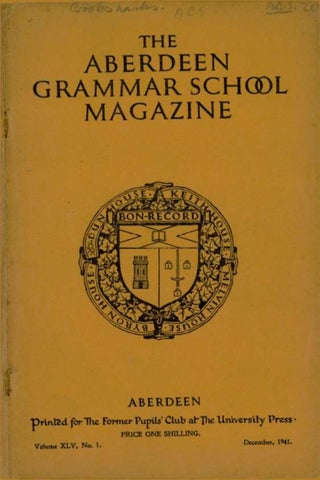
THE
ABERDEEN GRAMMAR SCHCOL MAGAZINE
ABERDEEN Pupils* Club al- The University Press print d. forlhe Fortner PRICE ONE SHILLING. Volume XLV, No. 1.
December, 1941.
EDUCATIONAL BOOKS JAMES G. BISSET CONTINUES to supply all the Class Books (New or Second-hand) suited for the requirements of the Higher Educational Institutions in the City, at the Lowest Prices. N.B.—Best Value in Students' Note Books.
JAMES G. BISSET, Classical, Medical, and
Educational
Bookseller,
85 BROA D STREET (Opposite Marischal College)
•
PHONE 753 •
GOOD HEALTH demands
--
GOOD BREAD
- -1
For the children especially is it necessary to ensure their stamina and energy with good, wholesome, nourishing bread. In Hutchison's bread you'll find all these requirements are fully met. Phone or give instructions to have it supplied daily.
-
BRANCHES THROUGHOUT THE CITY
OLD GOLD iS
Urgently Wanted -
Out-of-Date JEWELLERY WATCHES COINS CHAINS and Odds and Ends of every description realize
HIGH PRICES to-day
Full Value received at
A. & J. SMITH 191 Union Street ABERDEEN
ILI TITUs have just what vou are lockine for Something to wear that is well cut, smart and practical and not too expensive -
SUITS TRAVEL COATS MODEL COATS FROCKS DRESSES GOWNS FUR COATS
Sizes to fit all figures from 36" hip to 56' hip
A. C. LITTLE & SONS, LTD. 105
UNION STREET
•
ABERDEEN
NAVY RAINPROOF COATS in Sizes — 24" up to 42" length
Campbell's Rubber Co., Ltd. 18 BRIDGE STREET
'Phone 157
A. D. COPLAND. Phone 896.
For Better Footwear
JAMES LORIMER & SON (BOOTMAKERS), LTD.
CIVIL and MILITARY BOOTMAKERS
8 CHAPEL ST.
ABERDEEN
(Late of 262 Union Street)
Etiltd. A.U. 2844.
'Phone 724.
Go to. • •
K EN N AWAY'S of course
RESTAURANT
173
UNION STREET
Here you get the finest of food, daintily served, and at a reasonable price. The Restaurant is comfortable and commodious, and is just the place to entertain your friends. Our rooms are available for all types of functions. 'Phone 2371, and ask the Manageress for quotations
WM. KENNAWAY LTD. Quality
Bakers, Confectioners and
Caterers, Aberdeen
Telephone No. 1891.
ARCHIBALD McKELLAR Family Grocer and Wine Merchant,
454-456 Union Street, Aberdeen. . We Specialise in . • Cooked
Gammons, Finest Belfast Smoked Hams, Wiltshire Bacon.
Medicinal Wlnes—Vibrona, Hall's, Wincarnis, Phosferine.
THE VALUE OF RECOMMENDATION -
" We have been recommended to you by
I
Every day that phrase is being used by Customers on their first visit to our showrooms.
REASON-
THE
OUR STOCK is of good quality and our prices are reasonable. OUR SERVICE is of a personal nature and we study the requirements of every Customer.
SATISFACTION IS OUR AIM
ROBERTS (Abdn.) LTD• CABINETMAKERS AND UPHOLSTERERS
THE FURNISHING HOUSE OF ENTERPRISE
419 UNION STREET, ABERDEEN Telephone 2695
Established 1873
JAMES FYFE & SON PAINTERS AND GLAZIERS. .
•
•
OFFICE AND SHOWROOMS:-
11 DEE STREET, ABERDEEN. Telephone 304.
Telegrams—" Fyfe, Painters."
• It's an economy and a convenience to register with ALEXANDER . . . for your BUTCHER MEAT and BACON. You can then be certain of supplies of FISH and POULTRY —and you can place your order for all these food-stuffs either in person or at the cost of only one 'phone call. The 'phone No. is 5172
A. X W. ALIEXANIDEIL FISH, GAME AND MEAT MERCHANTS
492 UNION STREET
+
ABERDEEN
• DAIRY : ABERDEEN Tel. 1215, 7013, 7014
FARM : CULTER Tel. 6
KENNERTY FARM
DAIRY •
WILLIAM REITH Sole Proprietor : JOHN REITH •
46-4 8
ROSE STREET, ABERDEEN
CONTENTS ILLUSTRATIONS. . . . Mr. James J. Robertson . . . • . . Professor James C. Philip . F.P. Prisoners of War in Oflag Vs, Germany, July 1941 •
. . .
•
. Facing page 2 27 • In front of page 79 Facing page
Facing page
Pilot Officer Norman C. MacIver . Pilot Officer John W. McKenzie . . Lieut. Alistair C. Mackenzie . . . A/C J. S. W. Ballantyne . Leading Stoker D. L. Mackay Naval Airman Arthur M. Murray . • and Lieut. John C. Meikle . • and Lieut. Robert C. Meikle . Pilot Officer A. W. Ogston . . Flying Officer Ian A. Seggie
Sergeant-Pilot John Anderson • to • 10 Pilot Officer Ian R. Fyfe . . • II Major Sydney Duffus • II and R/O J. MacPhail Massie Flight Lieut. Harry B. Gilchrist • 18 • 18 Flying Officer James Gillan Sergt.-Pilot J. A. B. Jamieson • 19 Pilot Officer W. A. M. Halley • 19 Pilot Officer Stephen G. Esson • 58 Sergt.-Pilot Allan C. Hendry • 58
•
•
•
•
•
•
•
•
•
•
•
•
•
•
•
•
•
•
•
•
•
•
•
•
•
•
•
•
•
•
•
-
•
•
•
•
•
•
•
•
•
•
•
•
•
•
•
•
•
•
•
•
•
•
•
•
•
•
•
•
•
•
•
•
•
Page 1 „ 3 „ 5 „ 12
• • •
• . . Our New Rector A Message to Former Pupils . Pro Patri Mortui Notes About Old Boys Marriages . . . . Obituary Roll of F.P. War Service . . . Missing . . • • . Prisoner of War. Good-bye, Frank . More Prizes for the School. Such is Fame. The " Magazine " . . Respicio, or Forty Years After. By Tertiary John Pioneering in Football. By The Very Rev. Dean MacRae . . . About Russia and Germany. By W. M. Alexander . . A Round Trip( By Lieut. Alexander G. Walker . A Malayan Bull-Fight. By Lieut.-Colonel Charles A. Hendrick . Christmas Island. By Robert W. 1. Band . • . . An F.P. at Azov •
•
•
•
School Section— . . School and Random Notes . • Mr. Edward A. Smith. By E. K. B. . . Frolics at Forestry. By J. S. T. . • • • . . The Air Training Corps School Sport—A Résumé of the Term's Activities . . Rugby Notes . . . • • . House Notes . The Literary and Debating Society • . The Dramatic Society •
•
The Former Pupils' Club— The Boarding House • . Cricket Section . . Rugby Section . List of New Members
24 27
IP
•
•
•
•
•
•
35 37 38 „ 39 40 PO 48 PI 52 57 6z „ 64 „ 66 PP
•
•
.
„ 67
•
•
•
•
• •
•
•
•
PO
•
•
•
•
•
•
•
•
•
•
•
•
•
.
•
•
•
•
PP
•
•
•
•
PP
•
•
•
.
.
79 „ 8o
. . . •
„ 81 „ 8z ” 83 84
•
•
•
•
„ 71 „ 71 73 „ P. 74 „ 76
•
•
•
59 59 66 66 67 67 74 74 75 75
•
•
•
•
•
•
•
•
•
•
•
•
•
•
•
•
•
•
•
•
•
•
•
•
•
•
•
•
•
•
•
•
•
•
•
7 8
[3o,/s9 SCHOOL
WEAR
GRAMMAR BLAZER, to fit 5 Years -
- 31 /— rise 1,1--
SHORTS, Lined, to fit 5 Years 13/6 rise 6d. PULLOVER
-
-
-
-
from 13/6
BRAEMAR PULLOVER, with Badge, from 18:6
TIES SCARVES, BELTS, and BRACES IN GRAMMAR COLOURS in
BOYS' DEPARTMENT
ESSLEMONT & MACINTOSH LTD.
(RETAILERS)
UNION STREET, ABERDEEN
W. M. McPHERSON Baker and Confectioner
15 FOUNTAINHALL ROAD ANO
8
ST.
SWITHIN
STREET
ABERDEEN
Established 1843
BARGAINS
WM. CAY & SONS
are difficult to-day
(FUNERAL DIRECTORS) LIMITED
but I still have good value in typewriters, safes, desks, chairs, and other office equipment.
415 UNION STREET
It's remarkable how many Safes seem to be required. People like to protect their papers from that man Hitler.
and
209 GEORGE STREET,
ABERDEEN
You know what Mr. Churchill called him over the wireless. Dashed appropriate, I thought. But, to get back to come in and see me :
All Funeral Requisites Supplied
business,
C. H. WEBSTER
Cremations Arranged
489 Union Street
Telegrams— " Cay, Aberdeen." Telephone Non. 93 end 54.
ABERDEEN
Telephone : 8811-2
Telegrams : ' Blake Builders'
,11
LIEN IQ IL AIFIIE Joiner.
and
Building
COW ractor%
106 CROWN STREET Works-23, 25, 29 SUMMER STREET, ABERDEEN
All classes of Building Joinery
::
Enquiries courteously solicited
DRAWING
STRACHAN
INSTRUMENTS
COMMERCIAL
PAPER COLOURS
PORTRAITURE
&
PHOTOGRAPHY
BRUSHES
.
at
Telephone 851
.
r.,cty tors'
416 UNION STREET
49-51 Scboolbill
ABERDEEN
Phone 2870
BY
JAMIESON & CARRY 142 UNION ST. • ABERDEEN • PHONE 1219 Established 1733
TO OUR CUSTOMERS We regret that the present restrictions on both men and materials make it impossible for us to maintain the usual high standard of service which we have carried on for nearly a century. We can assure you that we are doing our utmost to please you and trust that you will be patient with us.
J. & A. OGILVIE 369 UNION STREET ABERDEEN Telephone No. 433
Telegrams : " Interiors"
Your Happiest Hours are spent at your own fireside, and the choice of your Fireplace deserves the utmost consideration. From the range of Modern and Period
Fireplace
Arrangements
we are showing, you will find it easy to select exactly the style you desire.
James Scott & Son (Aberdeen) Ltd. 483-485 UNION STREET ABERDEEN Phone 1881-2
..0#
E VERY MAN TO HIS CALLING In these days everyone has, or should have, a job of work to do. However humble the task, let him do it well for his own and his country's sake. The task in front of Collie's of Aberdeen is to facilitate the fulfilment of the desire to get good quality Groceries and Provisions at reasonable prices. That we have succeeded is the verdict of thousands of satisfied shoppers. May we have the pleasure and privilege of serving YOU?
atzu.Ge&c,gazil FAMILY GROCERS AND WINE MERCHANTS
269-271 UNION
STREET
4
ABERDEEN
Telephones: CENTRAL 4800 (4 lines) Branch Shops at CULTS, BALLATER, and
•
I
BRAEMAR Telephones : Cults 28; Balloter 14; Braemar 212
•
Established
Assets
1836
£27,700,000
Northern Assurance Company Limited •
•
FOR ALL CLASSES OF INSURANCE •
♦
'
LIFE ASSURANCE BRANCH The Company's tables of rates for Life Assurance include every class of Policy SPECIAL LEAFLETS ON-
The " Optional" Policy The Educational Endowment Policy Child's Deferred Assurance Policy Death Duties Policy Life Annuities
CHIEF OFFICES:
ABERDEEN . LONDON .
1 UNION TERRACE i MOORGATE, E.C. 2
Branches and Agencies throughout the World
Aberdeen Grammar School Magazine 571h year: No. 149 (New Series, Oa year, No. r4o)
•
Vol. XLV
-
DECEMBER 1941
-
No. 1
The "Grammar School Magazine" is issued under the auspices of The Former Pupils' Club, twice a year in war-time—in June and December. All communications with regard to the "Magazine" should be addressed to the Editor (the Secretary and Treasurer of the Club), THEODORE WATT, M.A., LL.D., The University Press, 6 Upper Kirkgate, Aberdeen.
_-
•
OUR NEW RECTOR. • Mr. D. M. Andrew, who was appointed Rector of the School in 1924 in succession to Mr. Douglas G. Miller, now High Master of Manchester Grammar School, is to retire shortly, in view of his reaching the age limit. Accordingly, the Aberdeen Education Committee decided to look out in good time for a successor, and it was announced in October that they had appointed Mr. JAMES J. ROBERTSON, M.A., B.D., at present Rector of the Royal High School of Edinburgh, to be the Rector of Aberdeen Grammar School. It is understood that Mr. Andrew will demit office about the end of February and that Mr. Robertson will be installed then. Mr. Robertson, who is 48 years of age, comes to the School with a fine academic record and outstanding professional qualifications and experience. He was educated at Kilmarnock Academy and at Hutchesons' Grammar School and the High School, Glasgow. He entered Glasgow University in 1913 as the First Bursar in the Open Competition, and but for his military service with the Fifteenth Division in France from 1916 to 1919 would certainly have graduated with First Class Honours in Classics, as was certified by the Professors of Latin and of Greek. He actually graduated M.A. with " War Honours " in Classics in 1919, and then underwent training as a teacher at Jordanhill College, Glasgow. In 1926 he passed the London University Intermediate Examination in Divinity, and four years later received the B.D. degree of that University. Mr. Robertson began his professional career as a Classical Assistant in Hillhead High School, Glasgow, but after a few
I
Aberdeen Grammar School Magazine •
months was appointed Classical Assistant in the Hermitage School, Helensburgh, where in 1922 he, became Principal Teacher of Classics. ,Two years later he went to the corresponding post in Bell-Baxter School, Cupar, and in 1926 he received his first headship, that of Fort William Secondary School. After five years he was appointed Rector of Falkirk High School, where he discharged his duties with distinction, exercising both tact and firmness. In 1940 the Rectorship of the Royal High School of Edinburgh became vacant through the retiral of Dr. W. King Gillies and Mr. Robertson was appointed to succeed him. When the sub-committee of the Aberdeen Education Committee which was charged with the duty of considering and reporting on the filling of the vacancy at the Grammar School began to make inquiries, they soon discovered that there was one man who stood out with special qualifications • for the post, and that was the man who had been appointed Rector of the High School of Edinburgh in February of last year. Negotiations followed, with the result that Mr. Robertson was offered and accepted the Rectorship in Aberdeen. Those who know Mr. Robertson well say that he is a man of exceptional gifts, with a strong and attractive personality. His ripe scholarship, intellectual alertness, untiring energy, uniform thoroughness, and capacity for leadership have been abundantly proved. In Falkirk he succeeded in uniting and identifying the High School with the neighbourhood, and his parents' conferences were attended with the greatest success. Mr. Robertson has the gift of going straight to the heart of a problem and disregarding everything that is irrelevant. He is a forceful, cogent speaker, and his sincerity and clear sequence of thought, bathed in the beauty of form and rich in the selection of words, have always adorned his many and varied public appearances. At Falkirk Mr. Robertson worked hard to promote Athletics and was instrumental in the securing for his school playing fields and a spacious, well-equipped pavilion. The difficult problem of religious education he solved by undertaking much of the work himself, and, as one would expect from a London Bachelor of Divinity, he is a reverent and loyal worshipper of God. The Grammar School has indeed been fortunate in getting the services of Mr. Robertson ; and in his experience lies the best warrant for believing that he will be equal to the formidable responsibilities of the Rectorship in war-time and that, in the years beyond, he will succeed in reconciling the traditions of an ancient School and the demands of a swiftly-changing world.
4
MR. JAMES J. ROBERTSON, M.A., B.D.
Aberdeen Grammar School Magazine
3
A Message to Former Pupils. We are nearing the end of the Autumn term. In one respect it has belied expectations. There have been no thrills and only occasional deviations from peace-time routine. We have had alerts, of course, but they have been too short and too infrequent for the liking of the average boy. If we enjoy a similar immunity next term, we shall be lucky. The first thing we noted when School re-opened in September was that the interior of the building had been painted. How badly this tidying-up was needed may be judged from the fact that twelve years had elapsed since the last treatment. For the time being, then, the old place looks relatively smart and would look even smarter if Fire Fighting and Rest Centre equipment were less in evidence. As the months pass, we become to an ever-increasing extent a receiving station for all sorts of things—shovels, buckets, pumps, camp beds, palliasses, stretchers, emergency food and what not. All this we accept as part of the penalty of war. More serious is the prospect that we may lose such portions of our playground as remain. If the proposals now under consideration are carried out, the front lawn will be covered with water tanks, while a First Aid Depot with a garage for motor ambulances will absorb the field which stretches from the Gymnasium to the School Garden. The resultant mixture of architectural styles is not likely to meet with general approbation. Milk is the next item of topical interest. In pre-war days very few boys beyond the stage of the Lower School were interested in milk. With the advent of rationing and priorities there is a different story to tell. Some five hundred boys now claim their daily bottle and the milk parade has assumed impressive proportions. Then we had to take note of the " Grow More Food" slogan. The scheme whereby the School Garden was turned into a vegetable plot proved an unqualified success in the abundance and quality of the crop. Feeding Centres, the Boarding House, and individual consumers were only too ready to absorb the output at prices well within current quotations. During the summer holidays two more members of the staff left on military service, Mr. Hemingway (Art) and Mr. Mackenzie (French and German). It was some compensation for their loss to have Mr. W. P. Stewart released for the time being from the Army. The progressive improvement in the School XV is perhaps not unconnected with his return. Victories, this term, over Strathallan, Glenalmond, and Gordon's indicate that there is no falling off in rugby standards. Another gap in the ranks of the Staff has been caused by the appointment of Mr. E. A. Smith as Principal Teacher of Classics in Dumfries Academy. The Scout Troops in particular will miss his directing
4
Aberdeen Grammar School Magazine
hand and the keen personal interest he has always shown in their welfare. Fire-watching is too dull a theme on which to linger. So far, it has been all watching—or sleeping—and no fire, but one never knows. The boys who volunteered for duty at the start have found that patriotism is not without its financial rewards. Three shillings per night is considered a reasonable wage. Another benefaction has come our way. On this occasion the benefactor is the late Professor Alexander Thomson, whose legacy of £ioo to found prizes in Mathematics is welcomed. Details are given elsewhere in the Magazine. The School Squadron of the A.T.C.—now officially incorporated as Squadron No. I299—has settled down to serious training and is already proving a very efficient unit. The visit of Group Captain the Duke of Hamilton, A.T.C. Commandant for Scotland, was a red-letter day for the Squadron. Mr. Lynch, C.O., and his Adjutant, Mr. Christie, attended a special course for A.T.C. officers at Scarborough during the summer vacation. War conditions have indirectly helped the School Library. Once again the grant which we receive annually from the •Aberdeen Endowments Trust will be expended mainly on books —fiction, travel, biography, and standard works of reference. The additional shelves which were recently provided are rapidly filling up. Dr. Douglas Simpson and Mr. Marcus Milne, City Librarian, recently made a valuation of the Library at the request of the Education Committee for purposes of insurance. Miss Henderson, the Librarian, is now on a full-time basis. We are in the midst of examinations just now. On 23rd December School closes for the Christmas vacation. The respite will be pleasant, however difficult it may be to capture the holiday spirit of less troubled days. It will be a muchscattered Club which will receive, along with this issue of the Magazine, the School's good wishes for Christmas and the New Year. We would like you to feel that you are not absent from our thoughts, wherever you may be and whatever the nature of your service. This is the last of a series of Messages which have appeared at regular intervals since 1926. Before the next publication of the Magazine I shall have demitted office. Meantime, I should like to say how much I have enjoyed my contacts with members of the Club, not only on formal occasions such as the Annual Dinners in Aberdeen, Edinburgh, and Glasgow, but at all other times. It is my earnest hope, as it is my confident belief, that the School will prosper abundantly under the able direction of my successor. D. M. A. 3rd December 1941.
Aberdeen Grammar School Magazine
5
Pro Patria Mortui. "1 have only done my duty as a man is bound to do."
•
*
•
John Anderson* (1921-34), Sergeant-Pilot, R.A.F., previously reported missing on 11th May 1941, while in charge of a bomber, was in October officially " reported missing, believed killed in action." Word has since been received that he was buried at Tanning in Schleswig. He was the second son of Mr. H. A. Anderson, 1 2 r Hamilton Place, Aberdeen, and was z6 years of age. On leaving the School he attended the University for a time and then became associated with the Huntly Laundry and later with Messrs. William Tawse, Ltd., contractors, Aberdeen. At the outbreak of war he volunteered for service with the R.A.F. and after being called up in the summer of 1940, rapidly gained promotion. Sydney Duffus* (1911-17), Major, Royal Artillery (T.A.), died in Aberdeen on 4th August 1941, aged 37 years. He was the youngest son of the late ALEXANDER DUFFLIS (1871-76), advocate in Aberdeen, and, like his four brothers, attended the School for a number of years. He then went on to Fettes College and to Cambridge, where he graduated B.A. in 1926. A keen sportsman, he took an active part in rugby both at Fettes and Cambridge. Later he became a fine horseman, engaging in polo and riding to hounds with the Aberdeenshire Hunt. Having decided to make law his profession, he served his apprenticeship with Messrs. Wilsone & Duffus, advocates, Aberdeen, and graduated LL.B. at Aberdeen University in 1930. After a few years with a legal firm in Glasgow, he became in 1936 a partner in the firm of Wilsone & Duffus, undertaking its Court work. In September of the same year he was admitted a member of the Society of Advocates in Aberdeen. For many years prior to the war he was a keen Territorial officer, having received a commission in the Aberdeen Brigade of the Royal Artillery in 1927. On mobilization he was in command of one of the Batteries, and became second in command of the Regiment shortly before the unit proceeded overseas to France as part of the 3 ist Division. He was present with his unit in the Maginot Line and later at the Battle of Abbeville and the retreat from the Somme. After his return from France his health broke down and he was invalided out of the Army at the beginning of this year. Ian Ross Fyfe (1926-33), Pilot Officer, R.A.F., was killed on active service in October 1941, aged 19 years. Born at Singapore, he was the son of Mr. Alexander Ross Fyfe, municipal engineer there. Having spent over six years at the School, residing for the last four of them in the Boarding House, he went by way of Millhill College to London University to study engineering. At the outbreak of war he was transferred to
6
,
Aberdeen Grammar School Magazine
Aberdeen University, where he became a member of King's College Chapel Choir and was elected President of the Choral Society. He joined the R.A.F. in July 1940, and his death occurred while he was on service in this country. Harry Bethune Gilchrist (1926-33), Flight Lieutenant, R.A.F., was killed on active service in this country in September 1941, aged 24 years. He was the second son of Mr. W. J. Gilchrist, solicitor, Aberdeen, and served as an apprentice in the office of Mr. James M. Clapperton, advocate, Aberdeen. He joined the R.A.F. before the outbreak of war, and subsequently served in France. His older brother, . ARTHUR HurcHisoii GILCHRIST* (1924-3o), is a and Lieutenant in the Gordon Highlanders, and his younger brother, WILLIAM SCOTT GILCHRIST* (1929-36), is a Sub-Lieutenant in the Royal Navy. James Gillan (1920-32), Flying Officer, R.A.F., was rereported missing in August 1940 and is presumed to have been killed in the Battle of Britain. A son of the late Mr. William Gillan, Balgranach, Milltimber, he studied for a time at Aberdeen University and joined the R.A.F. about six years ago. He served in Egypt, and was afterwards sent to Canada to act as an instructor. He returned to this country a few weeks before his death. While at the University he played full back for the ist XV and he was also a keen golfer. William Alexander Munro Halley (1929-3o and 1932-35), Pilot Officer, R.A.F.,V.R., was killed on active service on 4th May 1941, in his 19th year. A son of ALEXANDER MUNRO HALLEY* (1904-05 and 1906-12), he was educated at the Grammar School, Aberdeen ; the Cathedral School, Shanghai ; and George Watson's, Edinburgh. He joined the R.A.F.,V.R. as an aircraftman in July 1940, when he was only 174 years old, and was promoted to the rank of Pilot Officer in little more than nine months. As an airman he showed remarkable ability, but a flying accident in May of this year caused his death. He was an exceptionally strong swimmer and a keen golfer. A former classfellow of his at the " Grammar " says : " He was always generous and good-natured, and I can truthfully say that I can never once remember his being at all angry or sulky." Allan Cruickshank Hendry (1936-37), Sergeant-Pilot, R.A.F., son of GEORGE F. J. HENDRY (1889-91), M.B., Ch.B., Voe, Shetland, has been killed while on active service, aged 22 years. He entered the Edinburgh Dental College in 1937, and at the outbreak of war gave up his studies to join the R.A.F., V.R., becoming a Fighter Pilot. He saw service with the City of Glasgow and City of Edinburgh Squadrons over France, and also engaged in patrol and convoy duties. Latterly he was with the R.A.F. Ferry Command, and it was in the performance of his duty with it that he was killed in an accident.
Aberdeen Grammar School Magazine
•
a
M
7
John Alexander Barrie Jamieson (1918-35), Sergeant-Pilot, R.A.F.,V.R., was killed in action in August while operating over Germany, aged 19 years. He was the elder son of the late Mr. Ronald Barrie Jamieson, Ceylon, and of Mrs. Jamieson, Fairhill, Kirriemuir; and his grandmother was a cousin of the late Sir James M. Barrie, O.M. His father, a native of Kirriemuir, went to Ceylon as a tea and rubber planter, and there Barrie Jamieson was born. His father is said to have been the best cricketer that Kirriemuir ever had, and he taught his young son the game in Ceylon, but unfortunately died there. His widow and her two boys came home to live in Aberdeen, and as her brothers—one of whom, DAVID M. WHAMOND (1900-02), was the chief instigator of the Shanghai Clock—had been educated at the Grammar School, she was led by their affection for it to send her boys there also. After seven years Jamieson went to Merchiston, where at the age of 15 he played for the 1st X1 at cricket and the 1st XV at rugby. On leaving Merchiston he entered the service of Messrs. James A. Jeffrey & Co., C.A., Aberdeen, but at the request of his uncle, JOHN WHAMOND * (1898-99) joined the Angus Milling Co., Ltd., Kirriemuir. Jamieson had studied aircraft from the age of tz, and immediately the war broke out he joined the R.A.F. He had no difficulty in passing through the school of instruction, and although he wanted a fighter craft, he was told that he was suited for a heavy bomber, to which he accordingly went. He carried out numerous operations over enemy territory as captain of his craft, and his crews were always eager to go with him, as he evidently inspired their confidence and had no fear. On a flight over Germany his 'plane was damaged by gunfire. He told his crew to bale out and two who did so are now prisoners of war. He endeavoured to bring the damaged 'plane home to its base but crashed in Holland. He and two of his companions are buried at Upden, South Gelderland. His brother, RANALD DAVID WHAMOND JAMIESON* (1928-41), has also joined the R .A. F. Norman Crichton M acIver (1928- 3 4), Pilot Officer, R.A.F., is now officially presumed to have lost his life while operating over the Belgian coast on zznd March 1941, aged z3 years. He was the younger son of COLIN JOHN MAcIvER* (1902-03), M.A., formerly of the Grammar School staff and now head master of Kittybrewster School, Aberdeen. While at the School he excelled in Mathematics and won the McBain Gold Medal. At Aberdeen University he was awarded the Town Council Prize in Political Economy, and graduated M.A. in 1939 with First Class Honours in Economics, after a course of only three years. He was then elected to a scholarship in Economics at Balliol College, Oxford, and about the same time was awarded by Aberdeen University the Fullerton Scholarship in Political Economy of kizo, tenable for two years. When
8
Aberdeen Grammar Sebool lkagazine
war broke out, instead of going to Oxford, he volunteered for the R.A.F. and during the period before he was called up, was on the staff of Toc H at Kirkwall. Once in the R.A.F. he quickly received a commission. While at the School he was a keen Boy Scout, and became scoutmaster of the ist Troop. At the University he was prominent in many ways, and took an active part in the work of the S.R.C. He was Aberdeen Secretary of the International Students' Service, and was the first President of the University Reform Club, of which he was one of the founders. Alistair Campbell Mackenzie* (1928-36), Lieutenant, Argyll and Sutherland Highlanders, died, as the result of an accident, on zoth August 1941, aged 23 years. He was the son of the late Mr. D. W. Mackenzie, Johannesburg, South Africa, and of Mrs. Mackenzie, 6 Ashley Gardens, Aberdeen. At the School he won the F.P. Silver Medal presented to the best scholar in Spanish. He was very keen on cricket, played for the 1st XI, and was captain of cricket for Dun House in 1936. When war broke out he was studying at Aberdeen University for 'an honours degree in Economics. He took a leading part in the social side of undergraduate life and was an enthusiastic member of the O.T.C. He won many prizes for shooting in the Small Bore Rifle Club, was awarded his Shooting Blue, and was a member of the Aberdeen University team which won the Empire Trophy open to competition to all University O.T.C.s. In October 1939 he received a commission in the Argyll and Sutherland Highlanders. When Special Service Battalions (now known as Commandos) were being formed, he volunteered for service and was accepted about the end of last year. He was a member of the force which raided the Lofoten Islands early this year. In the Commando, as in everything he undertook throughout his life, he showed great alacrity and was a keen and conscientious worker. On account of his cheerful and happy disposition, he was affectionately known among his brother officers and his men as " Twinkle." He was promoted to be Lieutenant in March of this year. Dennis Lorraine Mackay* (1924-29), Leading Stoker, H.M.S. Fiji, was officially reported as missing, presumed killed, when that ship was sunk in the operations off Crete in May last. He was 24 years of age. When his family left Aberdeen in 1929, he attended a school in Edinburgh and then served his apprenticeship as an electrician. He joined the Navy in 1935 as a stoker, and served in H.M.Ss. Nelson, Curacoa, Manchester, and Fiji. While in H.M.S. Manchester on the East Indies Station, he had the opportunity of visiting quite a number of places in the East, and wherever he found a Consul of the F.P. Club he made himself known. Often he remarked how glad he was to be an Aberdonian and a former pupil of the
• Aberdeen Grammar School Magazine
9
Grammar School, as the kindness he received wherever he met an F.P. was beyond expression. In several places all F.P.s in the neighbourhood were rounded up for an evening's enjoyment. The Magazine was always one of his most treasured possessions. He reported that the Mag. had to go round the ship whenever he received it, and it was highly appreciated. His elder brother, NEIL MACKAY (1924-29), is serving with the New Zealand Forces in Egypt; and his younger brother, MERVYN SUTHERLAND MACKAY (1925-29), has been in the Navy since 1938 and is at present on a land station. James (" Hamish ") MacPhail Massie* (1918-31), and Radio Officer, Merchant Navy, only son of Mr. J. MacPhail Massie, Carden House, Aberdeen, was lost at sea as the result of enemy action in September 1941, aged 28 years. After leaving the School he served as an apprentice with the Everest Upholstery Co., Ltd., Long Eaton, Notts, and then entered his father's business of Messrs. J. & A. Massie, house furnishers, Aberdeen. He studied at Gray's School of Art, where he acquired a wonderful knowledge of design and developed the artistic feeling with which he was richly endowed. After the war broke out he qualified at the Aberdeen Wireless College, joined the Merchant Navy in September 1940, and was promoted to be znd Radio Officer in May of this year. He was a Life Member of the F.P. Club and of St. Andrew Lodge of Freemasons, No. Ito. He held office as a deacon in the fifth generation of his family's association with East and Belmont Church, Aberdeen. TWINS : " IN THEIR DEATH THEY WERE NOT DIVIDED." John Cunningham Meikle* (1931-33) and Robert Coulson Meikle* (1931-33), twin sons of Mr. A. M. Meikle, of
•
'
Monkseaton, Northumberland, and each a znd Lieutenant, Durham Light Infantry, were killed in action on 15th May 1941, during an attack in Libya, aged 24 years. While attending School they lived latterly in the Boarding House. They were articled to chartered accountants in North Shields, and were successful in passing their final examinations at the age of 21, John obtaining honours. They both obtained positions with London firms of accountants—John with Dcloitte, Plender and Griffiths ; and Robert with Thomson McLintock & Co. Before going to London they had joined the local Territorials, but when in London they found this very inconvenient, so they were transferred to the Artists Rifles, and when war broke out they were called up. They were given commissions together at Christmas 1939, were gazetted to the Durham Light Infantry in January 1940, and were sent out to Egypt to join their battalion. They saw a good deal of fighting, and their Colonel twice recommended John for the Military Cross, but unfortunately this was not awarded. Although they were in the same
1O
Aberdeen Grammar School Magazine
battalion, they were in different companies. Both, however, fell on the same day during an attack on Fort Capuzzo, when leading a bayonet charge. Robert was wounded, and it is of special interest to record that another F.P., Captain ROBERT N. LEES* (see p. 13), won the Military Cross for bringing him in under fire, but he did not survive. After the engagement John was missing, and it was learned later that he had been buried by the Germans on the following day. Kenneth David Milne (1925-32), and Lieutenant, The King's Own Cameron Highlanders, was reported killed in action in March 1941, aged 22 years. He was the only son of Mr. D. M. Milne, Kuala Lumpur, F.M.S. Arthur Meldrum Murray* (1935-37), Leading Aircraftman, Fleet Air Arm, was killed by enemy torpedo action about 17th January 1941. Twenty years of age, he was the son of Mr. A. J. Murray, warehouseman, Montrose, and on leaving the School entered the service in his native town of Messrs. Johnston & Sons, salmon merchants. At the outbreak of war he joined the Fleet Air Arm as a naval rating. Alexander William Ogston* (5922-35), Pilot Officer, R. A.F., was killed on active service in August 1941, aged 25 years. He was a son of the late ALEXANDER OGSTON (1884-85), M.A., M.B., C.M., who died in September 1940. He was good at games and played rugby for the School 1st XV during the years 1933-34-35 and later for the F.P.s. He studied at the College of Aeronautical Engineering, Chelsea, obtaining his ground engineer's licence. Next he was attached to Perth Aerodrome, where, having taken flying lessons, he obtained his " A " flying licence in August 1939. At the outbreak of war he volunteered for the Air Force but was not called up until May 1940. He received his commission in October of that year. From April of this year he was engaged on operational flights over Germany and Occupied France. He was captain of his crew and had done about twenty flights. On one occasion his plane was hit while over enemy territory and one of the engines burst into flames. The crew were ready to bale out, but he just managed to get back safely, flying most of the way at a height of 3oo feet. He was called " Ned " by all his friends and was extremely popular both at the School and with his fellow-officers. Only six weeks before his death he was married to Miss Dorothy L. Bittiner, 1 Woodburn Avenue, Aberdeen (see p. z6). Ian Alexander Seggie* (5923-34), Flying Officer, R.A.F., only son of Mr. A. S. Seggie, 413 Great Western Road, Aberdeen, was killed on active service in November 1941, aged 23 years. On leaving the School he entered his father's business of Seggie & Co., grain and coal merchants, Aberdeen. At the age of i8 he received a commission as and Lieutenant in the Royal Artillery (T.A.), and was mobilized with his unit-at the outbreak
•
•
JOHN ANDERSON
Sergeant-Pilot, R.A.F. A
IAN Ross FYFE Pilot Officer, R.A.F.
SYDNEY DUFFUS, B.A., LL.B. Major, Royal Artillery (T.A.)
•
$
JAMES MACPHAIL MASSIF. znd Radio Officer, Merchant Navy
•
•
Aberdeen Grammar School Magazine of war. He was promoted to be Lieutenant, and was transferred to the R.A.F. as a Pilot Officer in September of last year. While at the School he was associated with the 17th Troop, first as a cub, and eventually as assistant scoutmaster. He had a great love for the School and never failed, when on his various leaves, to visit it and have a talk with his former masters. The Lengthening Roll. The following is a list of the former pupils of the School whose deaths, either on active service or by enemy action, have been recorded. The Editor will be grateful for notification of any omission :— Anderson, Sergeant-Pilot John, R.A.F. Ballantyne, Aircraftman James Shearer Wood, R.A.F. Blackhall, Leading Aircraftman Leonard John, R.A.F. Brown, znd Lieutenant John, North Staffordshire Regiment. Craigmile, Pilot Officer Harry George, R.A.F. Duffus, Major Sydney, Royal Artillery (T.A.). Esson, Pilot Officer Stephen George, R.A.F. Fleming, Pilot Officer Robert David Spittal, R.A.F. Fyfe, Pilot Officer Ian Ross, R.A.F. Galloway, Lieutenant Angus Frederic, Royal Engineers. Gilchrist, Flight Lieutenant Harry Bethune, R.A.F. Gillan, Flying Officer James, R.A.F. Gordon, Major Douglas William, Gordon Highlanders. Hendry, Sergeant-Pilot Allan Cruickshank, R.A.F. Jamieson, Sergeant-Pilot John Alexander Barrie, R.A.F.,V.R. Kemp, 3rd Engineer Alexander Smith, Merchant Navy. Maclver, Pilot Officer Norman Crichton, R.A.F. Mackay, Acting Leading Stoker Dennis Lorraine, Royal Navy. Mackenzie, Lieutenant Alistair Campbell, A. & S. Highlanders. McKenzie, Pilot Officer John Woffenden, R.A.F. McPherson, James, student in engineering, Aberdeen. Massie, znd Radio Officer James MacPhail, Merchant Navy. Meikle, and Lieutenant John Cunningham, Durham L.I. Meikle, znd Lieutenant Robert Coulson, Durham L.I. Milne, znd Lieutenant Kenneth David, Cameron Highlanders. Munro, Lieutenant Robert Philp, Royal Corps of Signals. Murray, Naval Airman Arthur Meldrum, Fleet Air Arm. Ogston, Pilot Officer Alexander William, R.A.F. Ross, Leading Aircraftman James Matthew, R.A.F. Scott, Squadron Leader Alan Milne, R.A.F. Seggie, Flying Officer Ian Alexander, R.A.F. Stewart, Corporal Allan James, R.A.F. Sutherland, Engine-room Artificer Brian Alexander, R.N. Watt, Flying Officer Charles Chamberlin MacCulloch, A.A.F. Watt, Surgeon Lieutenant George Theodore Robertson, R.N. V.R. Young, Pilot Officer Donald James, R.A.F.
12
Aberdeen Grammar School Magazine
•
*. The Editor is glad at all times to receive from any quarter items of information for this section of the " Magazine."
The dates given in parentheses after names indicate the sessions of attendance at the School.
Service Decorations. Douglas Gordon Emslie Benzie* (1921-24), Flight Lieutenant, Auxiliary Air Force, No. 61z Squadron, was in July awarded the Distinguished Flying Cross. He was commissioned in the A.A.F. in 1937, and was promoted Flight Lieutenant in September 1940. He qualified as a chartered accountant in May 1939 and when the war started was in the office of Messrs. Flockhart & Grant, C.A., Aberdeen. Ronald Grant Dingwall* (1912-21), M.B., Ch.B., Surgeon Lieutenant-Commander, R.N., Principal Medical Officer, H.M.S. Gloucester, was made an Officer of the Order of the British Empire (O.B.E.) in the Birthday Honours List published on 1st July last. He graduated in medicine at Aberdeen in 1927, • and after a time joined the Medical Service of the Royal Navy, serving in the flagship, H.M.S. Kent, in Far Eastern waters. After completing a short-term commission, he left the Navy and took up practice in Kent. He was recalled for a short spell in the autumn of 1938, and was again recalled just before the outbreak of the present war. He was present in H.M.S. Gloucester at the Battle of Cape Matapan and took part in the Battle of Crete, during which his ship was lost. He was subsequently posted as missing. Derek Mario Mitchell Kellas (1924-35), Lieutenant, Royal West African Frontier Force, has been awarded the Military Cross. The third son of the late HENRY KELLAS (1881-87), he graduated B.Sc. in Forestry at Aberdeen University in 1938, and immediately thereafter was selected for an appointment in the Colonial Forest Service and posted to the Gold Coast. On the outbreak of war he was mobilized with the West African Frontier Force, and served with it in the East African Campaign, during which he was wounded. * Member of the Former Pupils' Club.
•
Aberdeen Grammar School Magazine
13
Robert Norman Lees* (1920-33), M.B., Ch.B., Captain, R.A.M.C., has also been awarded the Military Cross. [For the circumstances see p. to.] He graduated in medicine at Aberdeen in 1938, and was specializing in tuberculosis when war broke out. He received a commission in the R.A.M.C., and after serving for a time in France, was sent to the Middle East, with the rank of Captain. Duncan MacCallum* (1929-37), Sergeant, Auxiliary Air Force, No. 83 Squadron, was in November awarded the Distinguished Flying Medal. He joined the A.A.F. in April 1939 as a Wireless Operator, and since June 1940 has been a Sergeant Wireless Operator Air Gunner.
•
The Right Hon. Lord' Alness* (1884-85), P.C., LL.D., was in September appointed a member of the council formed to collaborate with the Secretary of State for the purpose of surveying problems of post-war reconstruction in Scotland. The council is selecting the subjects of inquiry and determining by whom the inquiries will be made. The members are the living ex-Secretaries for Scotland. Lord Alness's period of service was 1916-22. Avon Alexander Barnet* (1911-19) on the outbreak of war was serving in the Merchant Navy, and on arrival in this country in September 1939 was called up for service in the Royal Navy, having been a member of the Royal Naval Reserve since 1927. His first appointment was to H.M.S. Patroclus, an armed merchant cruiser. In September 1940 he was promoted to be Acting Commander, R.N.R., and appointed to the command successively of H.M.S. Manistee and H.M.S. Camito. He remained in the latter until she was lost by enemy action in May of this year. After that episode he was in hospital for a few weeks, and since then has been acting as Commodore of convoys. William Andrew Baxter* (1916-19), M.A. (Aberd.), B.A. (Cantab.), was in July appointed Rector of Linlithgow Academy. He was Classical Dux of the School in 1919, and graduated at Aberdeen University in 1923, with First Class Honours in Classics and Distinction in Greek History. He then went to Cambridge, where he was placed in Class I in both Part I and Part II of the Classical Tripos. In 1925 he was appointed a classical master at Glenalmond, and in the following year became senior assistant in the Latin Department of Aberdeen University. In 1928 he was appointed a classical master in Daniel Stewart's College, Edinburgh, and from 1935 he was Principal Teacher of Classics in the Royal High School, Edinburgh. John Lamb Bruce* (192 I -2 3), C.A., has been an accountant with a firm in Cape Town, South Africa, for about four years. He is a member of the Cape Coast Garrison Regiment.
14
Aberdeen Grammar School Magaine
Arnold Marischal Burns* (1920-25), M.A., is proprietor of Glen Cinemas, operating in the smaller centres of population in the North of Scotland. Andrew Campbell* (1902-04), M.B., Ch.B. (Edin.), D.P.H., F.R.C.S.E., who has been in practice in Johannesburg for twenty years, has recently, on medical advice, removed to Port Elizabeth, " to start all over again in a strange place," as he writes. In Johannesburg he had as a medical colleague the late Dr. ARTHUR JOHN MILNE (1884-96), who was for many years the Medical Officer of Health there. Leslie Thompson Carnegie* (1925-38) graduated B.L. at Aberdeen University in the spring of this year and was awarded a special prize for his work in the class of Conveyancing. He is apprenticed to the Town Clerk, ' Aberdeen, but is meantime serving as a private in the Royal Army Ordnance Corps. James Cobban* (1925-32), who was in the service of the Burma Shell Co., Ltd., and stationed in Bengal, has recently been " lent " to the Shell Company of Egypt, Ltd., with headquarters at Cairo. William Scott Cormack (1928-33), who was formerly in the Colonial Police, now holds a commission in the Royal Warwickshire Regiment. Nigel Smart Cowan* (1924-28), B.Sc.(Eng.), holds a regular commission in the Royal Engineers and is at present a Major. He received in June a staff appointment at the War Office. James Ian Cormack Crombie* (i9o8-zx), M.A., is now Principal Establishment Officer, Ministry of Food, his responsibilities covering all the offices and staff. He entered the Home Civil Service in 1926. John Ross Donald* (1913-24), after being engaged for eleven years in rubber planting in the F.M.S. and Johore, has come home and joined the Gordon Highlanders, being now a lance-corporal. He has become a Life Member of the F.P. Club. John Wight Duff* (1877-82), M.A., D.Litt., LL.D., F.B.A., Emeritus Professor of Classics and Ancient History, Armstrong College, Newcastle-upon-Tyne, who is one of the editors preparing The Oxford Classical Dictionary, has learned that the Clarendon Press may have to postpone its publication until after the war. War conditions are also responsible for delay in issuing a volume of interest to Byron's first school. This is a projected collection of the memorial Byron lectures delivered annually at the University College of Nottingham. Dr. Wight Duff, whose annotated selection from Byron's poetry appeared in Blackwood's English Classics in 1904, delivered one of these lectures. His interest in Byron dates from early years, and long ago he issued
•
•
a
Aberdeen Grammar School Magaine
15
a plea in Aberdeen for a memorial tablet to mark the position of the Byron house in Broad Street, which had to make way for the extension of Marischal College. David Edwards* (7903-09), M.A., I.L.B., who entered the Colonial Legal Service in 1921 and has been for some years Relieving President, District Court, Palestine, was recently appointed a Puisne Judge of the Supreme Court of Palestine. Louis Findlay* (1924-30), M.B., Ch.B., who for over two years has been a physician in the Emergency Medical Service, Bishop's Stortford, Herts, has joined a medical unit of the Red Cross War Organization. He left this country in November to serve in Abyssinia. Robert Fleming* (1891-98), C.E., of Messrs. Wood, Fleming & Co., Ltd., real estate and insurance agents, Toronto —where he is the F.P. Club Consul—is back in the Army again. In the last war he served in France with the Canadian Expeditionary Force, and in the present war was called out over a year ago. Too old for overseas service, but with four years of military engineering experience, x5 years of civil engineering and contracting work, and 15 years of business experience, he was regarded as likely to be useful. He says that to go back partly as a drill sergeant and partly as a university professor, lecturing on various subjects, was hard work, but after a year he had a group of qualified old crocks to help him out, and now he is engaged mainly in administrative work. His youngest son is an infantry officer and will be over here soon. " He will try to go up to Aberdeen and have a look at the A.G.S., of which he has heard a lot." Our Consul recently had a reminder of the School's doings when a group of Air Cadets came to the Armouries in Toronto from the old country en route for the U.S.A. " Among them I contacted a lad called Ross, and had him out with me one evening. He was looking well and gave a good account of the old School." . Frederick Alastair Forbes* (7 9z 7 -34), M.B., Ch.B., who before joining the R.A.F. Volunteer Reserve in September 1940 held a hospital appointment in Sunderland, now holds the rank of Flying Officer. The King recently ordered the publication of his name as having received " our expression of commendation for brave conduct in connexion with civil defence." Wilfred John Godden* (7922-37), M.B., Ch.B., D.P.H., is at present on the staff of the County Sanatorium, Harefield, Middlesex. Howard Alexander Gray* (1880-84), M.A., was recently entertained to lunch at the Savoy Hotel, London, by his colleagues of The Observer on his retirement from the post of assistanteditor. In acknowledging presentations, he mentioned that it was thirty years since he wrote his first leader for The Observer,
16
Aberdeen Grammar School Magazine
thirty-nine years since he went to London to the Pall Mall Gazette, and fifty-one years since he became a professional writer for the press. He estimates that in that period he has written over 1 o,ooo leading articles and reviewed 7,000 new books. Herbert C. T. Gunter* (1910-19), M.D., was in June granted the Diploma in Anzsthetics of the Royal College of Surgeons of England and the Royal College of Physicians. He is in medical practice at Billericay, Essex. William T. H. Hay (1928-38) has gained the Diploma of Loughborough Physical Training College, Leicestershire, with Honours and Special Distinction in Games. He has been appointed Physical Instructor and Games Master in Derby School, Derby. Owing to a chest injury received in high diving, he has been temporarily rejected for military service. Louis Vass Helmrich* (1918-27), who is a and Lieutenant in the Cameronians, has recently changed his name by deed poll to Louis VASS STUART, the surname being that of his stepfather, MITCHELL STUART* (188 2-8 3), formerly Head Office Manager of the North of Scotland Bank, who retired from that position in 1933, after completing almost 5 o years' service with the Bank. Ian Dunbar Innes* (1933-38), who is at present studying medicine, is the latest in the long line of F.P. Presidents of the Aberdeen University Students' Representative Council. The Vice-President this year is another F.P., Douglas Nelson MacKinnon* (1921-34), M.A., also a medical student. Frank N. Forster* (1921-25)—as previously recorded—is the President of the Students' Union ; and Gordon Frederick Hendry* (1927-39) is Editor of Gaidie, the undergraduates' newspaper. John Laird* (1 901-o 3), M. A., LL.D., F.B.A., Professor of Moral Philosophy in the University of Aberdeen, has completed his term as Gifford Lecturer in the University of Glasgow, and his second series of lectures, on " Mind and Deity," has been published as a companion volume to that containing the first series, "Theism and Cosmology." "Neither of Professor Laird's two volumes of lectures," says The Scotsman, " makes easy reading. They are works of abstract and rather abstruse philosophy. The writing is fresh, often elegant, but always compact of argument. It proceeds from a mind richly stored with, but not oppressed by, the history of philosophical and religious thought ; it presupposes, for more than superficial intelligibility, a corresponding background in the reader's mind." Harcourt Just Lawrence* (1901-04), who has been engaged in tea-planting in Assam for the last thirty years, is now back in this country and is not to return to Assam. He has consequently resigned from the post of F.P. Club Consul for Assam.
Aberdeen Grammar School Magazine
17
William Elder Levie, Jun. (1924-33) is lance-bombardier in a II.A.A. Regiment in the North of Scotland. Eric Linklater* (1913-16), M.A., Major, Royal Engineers, is the author of "The Northern Garrisons," issued in August for the War Office by the Ministry of Information. The War Office, it has been said, is not often accused of imaginative enterprise in the sphere of propaganda, but it is to be congratulated on recognizing that there is no better way of presenting the realities of war than to give a free hand to an imaginative writer like Mr. Linklater to describe in his own way the life of the Army and scenes of its operations. The author found plenty of material for his descriptive pen during his visit to the stepping-stones of the Atlantic, as he calls them—the Orkney and Shetland Islands, the Faroes, and Iceland—and he has the quick perception and turn of phrase to give many a vivid glimpse of the austerities amid which the units are living in order to defend precious bases for the Navy and the Air Force. He has achieved a difficult task well, it is agreed, and there is always a pleasure in his well-balanced writing. Major Linklater also compiled an admirable account of the defence of Calais from 22 May to 27 May last year by the 3rd Battalion the Royal Tank Regiment, and a battalion each of the 6oth Rifles, the Queen Victoria's Rifles, and the Rifle Brigade. This account is a pendant to Lord Gort's dispatches, but the incident was not described by him because the defence of Calais was not conducted under his orders. In a letter to The Times on 23rd October Colonel Walter Elliot, Director of Public Relations, stated that the account of the defence of Calais was necessarily incomplete, from the very fact that the garrison fought until each small party carrying on the struggle was separately overpowered, and that Major Linklater was compiling a more extended account, for which further information would be welcome. Our F.P. has already a place as one of the historians of the war. James Lumsden (1878-8o), M.A., D.D., has recently retired from the charge of Ratho parish, Midlothian, to which he was appointed in 1917. He has completed fifty-one years in the ministry, having been ordained minister of the parish of Grange, Banffshire, in 189o. Before going to Ratho, he was for eight years minister of the Tolbooth parish, Edinburgh. William Moir McCrae* (1899-191o), who joined the Public Works Department, Singapore, in 1919, and was latterly Acting State Engineer in Kelantan, is now Senior Executive Engineer in Kedah, Malaya. John Macdonald* (1919-22), M.A., was in November 1938 seconded from the Scottish Education Department to the Department of Health for Scotland, being latterly on its liaison
18
Aberdeen Grammar School Magazine
staff in London. He has now returned to an Assistant Secretaryship in the Scottish Education Department. John Mackenzie* (1930-32), C.A., who was formerly in the service of Messrs. Grahams Rintoul Hay Bell & Co., St. Vincent Street, Glasgow, has now joined the staff of Messrs. Stewarts & Lloyds, Ltd. Robert Charles Mackenzie* (1911-15), who in the last war held a commission in the Gordon Highlanders but served in France with the Scottish Rifles, is serving in the present war in the Royal Engineers. He has recently been promoted to be a Staff Major. Before the war broke out he was managing director of his father's firm of R. J. Mackenzie & Sons, Ltd., Hayes, Middlesex. Alexander Hendry Mackie* (x881-86), M.A., M.D., Birmingham, recently received commendation from the King for services rendered during an air raid on Birmingham. Maitland Mackie (1897-1902) is a member of a committee which has recently been appointed by the Secretary of State for Scotland to inquire into the problem of the hill and upland sheep farming industry in Scotland, and to report what steps should be taken with a view to placing this branch of the Scottish farming industry on an economic basis. Mr. Mackie, who is a well-known Aberdeenshire farmer, is a past President of the National Farmers' Union of Scotland, and a Governor of the North of Scotland College of Agriculture. Duncan A. H. McNaught* (1927-35), M.B., Ch.B., Probationary Temporary Surgeon Lieutenant, R.N.V.R., was a house surgeon in Perth Royal Infirmary in the latter part of 194o and in Aberdeen Royal Infirmary for the first half of this year. He is now Medical Officer to H.M.S. Quorn. William Alexander McRobbie* (1893-97), Valuer for the Aberdeen District of the Valuation Department of the Inland Revenue, was in June appointed President of the Aberdeen Battalion of the Boys' Brigade, in succession to the late Mr. George Bennett Mitchell. He has been associated with the B.B. movement for 35 years, and has outstanding gifts as an administrator and organizer. His father, Rev. WILLIAM McROBBIE (186o-65), M.A., was minister of the Free Church of Leslie and Premnay, Aberdeenshire, from 1-7R R to 1921, and died in 1932 in his 83rd year. George Herbert Mair (1899-1902), C.M.G., who died in 1926, was mentioned in a recent letter in The Times recalling that most of our very successful propaganda in the last war was initiated by the Foreign Office. " A single small corps of no more than a dozen persons in a single year obtained the publication of more than 7,000 items in a friendly foreign Press, while from the same source articles were distributed in Germany
a
I
_HARRY BETHUNE GILCHRIST
JAMES GILLAN
Flight Lieutenant, R.A.F.
Flying Officer, R.A.F.
JOHN ALEXANDER BARRY: J A MIESON
WILLIAM ALEXANDER MUNRO I 'ALLEY
Sergeant-Pilot, R.A.F.,V.R.
Pilot Officer, R.A.F.,V.R.
•
Aberdeen Grammar School Magazine
19
through another small corps, commanded by G. II. Mair. That was foreign propaganda under the Foreign Office ; and I submit," says the writer, " that these men and their methods deserve recalling at this time." Harry Maitland* (1931-33), who is in the service of the Mercantile Bank of India, Ltd., has been transferred from the Bangkok office to the Singapore office. An announcement of his recent marriage appears on page 25. THE MARRS OF COYNACHIE. The famous Marr family of Coynachie, Huntly—are there not seven of them members of the F.P. Club ?—is undoubtedly " doing its bit " in various parts of the Empire and elsewhere. James W. S. Marr* (1913-19), M.A., B.Sc., is a Lieutenant in the R.N.V.R. and has been serving in Iceland; Thomas Ogston Marr* (1917-20) is a Commander in the R.N.R. and a Commodore of Coastal Convoys; W. Alister L. Marr* (1919-23) holds a commission and has been posted to a regiment in India ; Donald Middleton Marr* (1919-26) is znd Lieutenant in a Punjabi Regiment and is serving in the Middle East; and Douglas S. S. Marr* (1919-32) is a Lieutenant in the Highland Light Infantry, in this country. James has received a clasp to the Polar Medal awarded to men of the Royal Research Ships Discovery II and William Scoresby. Between 1925 and 1939 these two ships made repeated journeys of thousands of miles (some lasting nearly two years), the main purpose of which was the study of the movements and feeding habits of whales. Marr has served with both ships, and many will recall that he began his Polar exploration when a Boy Scout of 18, being chosen by Shackleton for his last voyage in the Quest. He joined the staff of the Discovery in 1927, and since then has spent much of his life in the Antarctic. Angus Stewart Matheson* (1925-31), son of Rev. CHARLES MATHESON (1892-94), M.A., was for over four years an assistant in road planning to the Aberdeen County Council. He has recently been appointed Assistant Road Surveyor to the Orkney County Council. Grahame Douglas Miller (1921-24)—eldest son of Mr. Douglas G. Miller, formerly Rector of the School—was mobilized with the London Scottish at the outbreak of the present war. After being promoted Corporal, he was sent to the Royal Military College, Sandhurst, from which he passed out with the award of the Sam Browne Belt of Honour. He is now a znd Lieutenant in the Gordon Highlanders. Christian Hoyer Milne* (1881-87), M.A., D.Litt., who retired in 1935 from the position of Head Master of Daniel Stewart's College, Edinburgh, recently graduated Doctor of Philosophy (D.Phil.) at the University of Oxford. His thesis
zo
Aberdeen Grammar School Magiqine
was entitled " A Critical Edition of Bede on the Seven Catholic Epistles based on the Two Early Oxford Manuscripts." Throughout the course of his research, which has extended over five years, Dr. Milne has been a Fellow Commoner of Worcester College. William Keith Moir* (1914-19), M.A., B.Sc.(Agr.), who has been Head Master of Auldbar School, Angus, since 1931, was in June appointed Head Master of Edzell School. He is well known in Central Scotland cricket and is organist of Lowson Memorial Church, Forfar. Thomas James Trail Nicol* (193o-35), M.A., who is a and Lieutenant in H.M. Forces, was in November ordained to the ministry of the Church of Scotland on his appointment as an Army Chaplain. He is a son of the late Rev. DAVID BRUCE NrcoL (1900-02), M.C., M.A., B.D., of Govan Parish Church, Glasgow, who died in March 1930. Douglas J. C. Patterson* (1926-38) is a manager in the Navy, Army and Air Force Institutes, and is attached to the R.A.S.C. (E.F.I.) as a reservist. On leaving the School he went into business at his father's restaurant in Market Street, Aberdeen, and in the following year went to Edinburgh to get further experience in catering. On the death of his father in x940, he had to come home to take up duties as under-manager in the business. Early this year he joined the N.A.A.F.I. as a trainee manager, and after a very short time was posted as restaurant manager at a North of Scotland camp. lain H. Pattison* (1921-30), who was awarded a Colonial Veterinary Scholarship, tenable for four years, at the Royal (Dick) Veterinary College, Edinburgh, has now been granted the M.R.C.V.S. diploma, and his scholarship has been extended for another year, during which he is receiving training in veterinary pathology at Moredun Institute (near Edinburgh) before proceeding abroad. John Everard Rae* (1885-87), M.A., was in November re-appointed President of the Society of Advocates in Aberdeen. William Brian Richardson* (1919-28) is in the service of the Chartered Bank of India, Australia and China in Manila, Philippine Islands. Cecil Arthur G. Savidge* (1913-24), M.B.E., M.A., External Affairs Department, Government of India, has since May been serving in Iraq as a Major on special duty. Arthur Martin Scrimgeour* (1921-27), who is in the service of the Anglo-Thai Corporation, Ltd., at Singapore, was in May last commissioned znd Lieutenant in the Straits Settlements Volunteer Force. His elder brother, Ronald Charles Scrimgeour* (1921-24), is a Lieutenant in the R.A.S.C. but is at present a prisoner of war, having been captured at St. Valerie in June
Aberdeen Grammar School Magaine
•
e
21
1940. His younger brother, Harold Frederick Scrimgeour* (1921-29) is an Engineering Inspector in the Department of Health for Scotland. John Lyon Shaw* (1917-20), who was formerly Rector of St. Peter's Episcopal Church, Inverkeithing, is now Rector of St. Peter and St. Paul's, Enfield Lock, Middlesex. Alexander Johnston Slessor* (1918-30), M.B., Ch.B., F.R.C.S.E., was in June granted the Diploma of Fellowship of the Royal College of Surgeons of England. He graduated in medicine at Aberdeen in 1935. Archibald Harald Smith* (1929-38) passed out from the Royal Naval College, Dartmouth, in July 1941, and has been appointed a Midshipman, Royal Navy. George Smith Sommerville (1923-29), M.A., who has been minister of Greyfriars Parish Church, Aberdeen, since 1937, was in October inducted to the charge of Methlick, Aberdeenshire. William Maxwell Todd* (1920-32), assistant lecturer in Chemistry in Robert Gordon's Technical College, Aberdeen, was in July awarded the degree of Ph.D. of Oxford University. He graduated in Science at Aberdeen University in 1936, with First Class Honours in Chemistry, and from 1937 to 1939 was an advanced student at Oriel College, Oxford. Patrick J. M. Walker* (1914-20), C.A., is assistant manager of the Confederation Life Association (a Canadian company) in Mexico City, and is the F.P. Club Consul for the Republic of Mexico. He is President of the British Society of Mexico for the year 1941-42. This is a charitable society which looks after indigent Britishers in Mexico, and has under its care the whole of the relief work for British subjects in Mexico. He is also chairman of the Cowdray Hospital, a sanatorium founded and built by the late Lord and Lady Cowdray of Dunecht when they lived in Mexico. In a letter recently received he says that the British Colony is not very large in Mexico, and that practically all the young men under 50 have come across here to join the R.A.F. " Older fellows, like myself, have tried several times to get over, but have been told to stay out here, as there are plenty of men in the Old Country. However, we help in other ways, such as checking up on the activities, etc., of German agents in Mexico." Edward William Watt* (1 883-94), M.A., LL.D., cx-Lord Provost of Aberdeen, was in July appointed by the Secretary of State for Scotland to be Chairman of the Banff, Aberdeen, and Kincardine Agricultural Wages Committee. Stanley George Williamson* (1922-25), who is in the service of the Chartered Bank of India, Australia and China, is now sub-agent of the bank at Sitiawan, Sarawak, F.M.S.
zz
Aberdeen Grammar School Magazine
Alexander Lawson Wood* (1922-28), who for a number of years has been very closely associated with the Oxford Group, has recently been called up for duty with the National Fire Service. William Harkins Wyness* (1938-39) has been a Cadet in the Merchant Navy since July 1939. He is now in the service of the British Tanker Company. Archibald Young* (1885-93) retired on 31st March from the service of Messrs. George R. Alston & Co., Ltd., Port of Spain, Trinidad, after being for 43 years with them, latterly as secretary, and as director or secretary of a number of their associated companies. In April he and his wife went over to Barbados, B.W.I., intending later to go to Bermuda, but they gave up the idea when they learned that on account of the American " invasion " there, accommodation was at a premium and very costly. Barbados, he says, is truly a lovely island, and it would be difficult to do justice to the wonderful colouring of the sea in attempting to describe it. " The people have been wonderfully kind to us, and we have visited many of their homes. One couple we visited produced a parchment showing our host's family tree, starting with Robert the Bruce. They are very British and intensely loyal and patriotic. Most of the white people are descended from Royalists of the Cromwellian period." He adds that one feels very far from the war in Barbados, in contrast to what obtains in Trinidad in these days. Mr. Young expects that he will shortly have to relinquish the post of Club Consul for Trinidad.
a
ABERDEEN UNIVERSITY DEGREES AND PRIZES.
At the Summer Graduation at Aberdeen University on xoth July 1941, degrees were conferred on the following F.P.s :— Degree of Master of Arts (M.A.) :— George McKenzie Denny Grieve* (1935-37), with Second Class Honours in English (Language and Literature). Campbell Connon* (1926-38). Alan Burness Ewen* (1925-38). Degree of Bachelor of Science (B.Sc.) :— Stanley Hay Umphray Bowie (1932-37), with First Class Honours in Geology. Degree of Bachelor of Science in Agriculture (B.Sc.Agr.):— William Adams* (1935-37). Donald McLeod Grieve* (1935-38). Degree of Bachelor of Science in Engineering (B.Sc.Eng.) Roderick Ferguson Semple* (1927-38).
•,
•
Aberdeen Grammar School Magazine
23
Degree of Bachelor of Medicine and Bachelor of Surgery (M.B., Ch.B.) :— George Ewen Swinney (1918-31), M.A., with Second Class Honours. Alexander Robertson Taylor* (1927-34), M.A., with Second Class Honours. Theodore Martin Allan* (1930-36). John Brebner Barnet (191 i -25). Basil Ernest Brocks* (1927-36). Herbert Davidson Collins (1922-26). Arthur Hugh Dunnett (1927-35). Alan George Gibb* (1926-36). John Alexander Harrow* (19z 5-36). Mark Ireland Hepburn (1929-33). Francis Lumsden Farquharson Innes* (1929-36). William Hendry Peter Minto* (5924-27 and 1928-36). Robert Garden Murray* (1932-36). William Dixon Swinney (1918-31). Robert Allan Stewart Watt* (1923-36). *** In view of recent public controversy about the School curriculum and its alleged bias towards the Classics and away from Science, it is noteworthy that of the 45 men who graduated at the University in Medicine in July, exactly one-third were former pupils of the School ; and of the 36 men (out of the 45) who came from the North-Eastern area of Scotland, no less than 4z per cent. were F.P.s. In spite of the " classical tradition" of the School, more and more boys are going to the University to study Science in one form or another, and there is no doubt that the sound educational foundation laid at the School stands them in good stead when they come to specialize in their studies.
• .
In the Faculty of Science Charles M. M. Begg (1933-36) shared with another the MacGillivray Prize in Zoology. In the Faculty of Medicine Alexander R. Taylor* (1927-34), M.A., was awarded the Lyon Prize and the Murray Gold Medal and Scholarship (for the Most Distinguished Graduate in Medicine of the year 1940-41). He was also awarded the Matthews Duncan Gold Medal in Obstetrics. Francis L. F. Innes* (1929-36) was awarded the Shepherd Memorial Gold Medal (for the Principles and Practice of Surgery). In connection with the award of the Murray Gold Medal, it is worthy of mention that in nine out of the last ten years the distinction of being the Most Distinguished Graduate in Medicine has been earned by an F.P.
24
Aberdeen Grammar School Magazine
Marriages. Aitken (i927-3i).—At llolburn West Church, Aberdeen, on zoth September 1941, ALASTAIR AITKEN* ( R.A.P.C.), youngest son of Mr. William Aitken (1882-87) and Mrs. Aitken, 7 Hammerfield Avenue, to Caroline Betty, daughter of Captain Forbes S. Duncan and of Mrs. Stewart, it liammerfiefd Avenue, Aberdeen. Beattie (1921-34).—At John Knox Church, Aberdeen, on tst October 1941, ALEXANDER GORDON BEATTIE, only son of Mr. A. Gordon Beattie and the late Mrs. Beanie, 15 Westbum Drive, Aberdeen, to Margaret, younger daughter of Mr. and Mrs. James Webster, 95 Westburn Drive, Aberdeen. Beanie (1921-31).---At the West Church, Cults, on 9th July 1941, NORMAN ROBERT BEATTIE,* C.A., second son of the late William Beattie, builder and contractor, Aberdeen, and of Mrs. Beattie, Selma, Cults, to Eveline Margaret, only daughter of Mr. and Mrs. Tom Watson, Balrogie, Cults. Burns (192o-25).—At King's College Chapel, Aberdeen, on 18th October 1941, ARNOLD MARISCHAL BURNS,* M.A., second son of Mr. and Mrs. J. S. Burns, 304 Great Western Road, Aberdeen, to Winifred Neilson, niece of the Misses Wilson, 107 Leslie Terrace, Aberdeen. Donald (1926-32).—Within the Moray Aisle, Sr. Giles' Cathedral, Edinburgh, on 16th June 1941, Lieut. DAVID MITCHELL COOKE DONALD,* R.A., B.L., son of the late James J. Donald (1885-87) and Mrs. Donald, 15 Gray Street, Aberdeen, to Myra Catherine, daughter of Mr. and Mrs. Geo. Lockie, Newton St. Boswells, Roxburghshire. Dunnett (19t9-22).—At Madrid, on 19th July 1941, WILLIAM FLEMING Dunnvarr, B.A., C.A., Monte Esquinza 23, Madrid, eldest son of the Rev. H. D. F. and Mrs. Dunnett, Ellon, Aberdeenshire, to Joan Margaret Wollaston, British Embassy, Madrid, youngest daughter of Mr. and Mrs. Wollaston, Bowdon, Cheshire. Duthie (I 915-Z I ).—At Barnhill, Angus, on IT th October 1941, DouGuis WArr Durum,* M.A., B.Sc., Ph.D., Department of Agriculture, British Guiana, son of the late Mr. and Mrs. J. W. Duthie, Braemar Place, Aberdeen, to Constance, younger daughter of Mr. and Mrs. G. D. Charlton, Barnhill, Angus. Forsyth (1923-30).—At St. Barnabas Church, Epsom, on 5th July 1941, ALEXANDER FORSYTH,* D.Sc., M.P.S., only son of Mr. and Mrs. John Forsyth, 85 King's Gate, Aberdeen, to Olive Mary, only daughter of Councillor W. R. and Mrs. Page, Fairlawn, Epsom. Fox (1926-37).—At Priory Church, South Queensferry, on 4th October 1941, EDGAR ALEXANDER Fox,* son of Mrs. Fox, Blythebank, West Cults, to Doris Williamina, elder daughter of Mr. and Mrs. David Milne, 34 Ruthrie Road, Aberdeen. Gillespie (i92.2-27).—At Marske Parish Church, on Gth September 1941, JOHN WILLIAM ALBERT GILLFSPIE,* son of Mr. and Mrs. Gillespie, 21 Woodburn Avenue, Aberdeen, to Doris, eldest daughter of Mr. and Mrs. Noddings, Glencaim, Marske. Godden (19 zr-3 O.—At St. Mary•'s Church, Harefield, Middlesex, on 18th September 1941, WILFRED JOHN GODDEN,* M.B., Ch.B., D.P.H., only son of Mr. and Mrs. W. Godden, 34 Gilbert Road, Bucksburn, Aberdeenshire, to Mary Kathleen, only daughter of the late Mr. T. J. Williams and of Mrs. Williams, of Portsmouth. Hepburn (1929-33).—At Aberdeen, on i ith July 1941, MARK IRELAND HEPBURN, M.B., Ch.B., to Louisa Mackenzie Stuart, only daughter of the late Forbes Stuart and of Mrs. Stuart, ;6 Victoria Street, Aberdeen. Holdsworth (1921-32).—At St. Peter's Church, Askem, Doncaster, on i2th July 1941, Sub-Lieut. DOUGLAS HOLDSWORTH,* R.N.V.R., son of
Aberdeen Grammar School Magazine
25
Mr. and Mrs. Holdsworth, Bournemouth, to Ethel Florence, elder daughter of Mr. and Mrs. Hunter, Kinncrnie, Dunecht. Home (t92.3-2.6).—At St. Mary's Church, Oatlands, Surrey, on 30th August 1941, NORMAN SINCLAIR HORNE, znd Lieut., Suffolk Regiment, youngest son of the late Arthur Home, Homes Ltd., and Mrs. Home, 6o Gladstone Place, Aberdeen, to Gladys Irene (Annabelle) Homer, daughter of Mr. and Mrs. Frank A. Horner, Westcliffe, Essex. Macbeth (1919-24).--At St. Gabriel's, High Heaton, on 28th June 1941, NORMAN HARLEY SAVORY MACBETH, younger son of Mr. Herbert Norman Macbeth* (1882-85) and Mrs. Macbeth, 6 Learney Place, Aberdeen, to Mary Beatrice, younger daughter of Mr. and .Mrs. Alfred Cowings, Newcastle-on-Tyne. Maitland (1931-34).—At St. Andrew's Cathedral, Singapore, on 19th July 1941, HARRY MAITLAND,* elder son of the late Harry Reid Maitland (1883-85) and Mrs. Maitland, Mil!timber, Aberdeenshire, to Beatrice Patricia, elder daughter of Mr. and Mrs. John Taylor, Whitehall, Dublin. Maitland (r932-35).—At King's College Chapel, Aberdeen, on 18th August 1941, Lieut. ROBERT REID MAITLAND, M.B., Ch.B., R.A.M.C., younger son of the late Mr. Harry Reid Maitland (1883-85) and Mrs. Maitland, Mil'timber, Aberdeenshire, to Lindsay, daughter of Mr, and Mrs, James S. Merccr, Arcuttipore Tea Estate, Cachar, India. Marshall (1917-29).—At St. Stephen's Presbyterian Church, Leicester, on 21st June 1941, IAN CHALMERS MARSHALL,* Cadet R.A., younger son of John Scott Marshall, 65 Beaconsfield Place, Aberdeen, to Lilian (Lee) Leach, daughter of Mr. and Mrs. J. Leach, Ilford, Essex. Melvin (1921-32).---At Queen's Cross Church, Aberdeen, on 18th June 1941, WILLIAM GEORGE CAMPBELL MELvinr,* son of Mr. William George Melvin* (1888-96) and Mrs. Melvin, Edinburgh, to Muriel, daughter of Mr. and Mrs. J. W. Cameron, 15 Richmondhill Road, Aberdeen. Menzies (I933-36).---At Trinity Church, Aberdeen, on 18th June 1941, \Y/ILLIAM IM`DoNALD MENZIES,* only son of Mr. and Mrs. William M. Menzies, 37 Craigton Road, Aberdeen, to Audrey Jean, daughter of Mr. and Mrs. Ben Fletcher, 97 Forest Avenue, Aberdeen. Middleton (t917-26).—At St. Machar's Cathedral, Aberdeen, on 12th August 1941, EDWARD MIDDLETON, son of the late Mr. E. M. Middleton, photographer, and of Mrs. Middleton, 36 Middlefield Crescent, Aberdeen, to Catherine Gwendoline, younger daughter of the late Captain Clarence S. Howe, M.B.E., and of Mrs. Howe, 25 University Road, Aberdeen. Milne (1925-35).—At 18 Seafield Drive East, Aberdeen, on 12th August 1941, ANDREW GORDON MILNE,* M.A., Pilot Officer, R.A.F., elder son of Andrew Milne * (1903-09), M.A., and Mrs. Milne, to Georgina Lucy, twin daughter of Mr. and Mrs. Iiardie, 112 Hutchcon Street, Aberdeen. Milne (1920-26).—At St. Andrew's Church, Motherwell, on 2nd August 1941, GORDON EDWARD MILNE,* only son of the late William Milne, znd Lieut., Gordon Highlanders, and the late Mrs. Milne, 116 Mid Stockct Road, Aberdeen, to Margaret Young, younger daughter of Mr. and Mrs. John Fraser, 116 Bellshill Road, Motherwell. Milne (1918-3o).—At University Chapel, King's College, Aberdeen, 011 19th July 1941, ROYSTON JOHN MILNE,* LL.B., Royal Navy, son of Mr. Joseph Milne and of the late Mrs. Milne, 79 Desswood Place, Aberdeen, to Hannah Lewis, daughter of Mr. and Mrs. William A. Leith, Brackenhill, Murtle, Aberdeenshire. Morrison (r921-32).—At King's College Chapel, Aberdeen, on 29th July 1941, Lieut. ERIC HEIR MORRISON,* Intelligence Corps, only son of the te Alexander Morrison and of Mrs. Morrison, 26 Stanley Street, Aberdeen, to Marion Gertrude, second daughter of the late Andrew S. Melvin, head master, Turriff, and of Mrs. Melvin, 63 Leslie Road, Aberdeen.
z6
Aberdeen Grammar School Maga,"
Ogston (1922-35).—At Craigiebuckler Church, Aberdeen, on 25th June 1941, Pilot Officer ALEXANDER WILLIAM OGSTON,* Son of the late Dr. Alexander Ogston (1884-85) and Mrs. Ogston, Carden Place, to Dorothy L. Bittiner, x Woodburn Avenue, Aberdeen. Rae (1923-26 and 1929-35).—At Rubislaw Church, Aberdeen, on 8th September 1941, Captain HARRY J. RAE, Royal Signals, elder son of Dr. Harry J. Rae* (1898-1904) and Mrs. Rae, 14 Queen's Road, Aberdeen, to A.S.O. Angela Jean Basson, W.A.A.F., stepdaughter of Mr. and Mrs. T. Reginald Ransom, Downs House, Ewell, Surrey. Robertson (192o-27 and x929-33).—At Drumlea, Abernethy, on zoth September 1941, JAMES MARNE ROBERTSON, son of the late Lieut.-Colonel James Robertson, R.A.M.C., and of Mrs. Robertson, 95 Beaconsfield Place, Aberdeen, to Helen Herd, youngest daughter of Mr. and Mrs. Robert Powrie, Drumlea, Abernethy, and Newtonhill, Aberdeen. Russell (1923-35).—At Gilcomston South Church, Aberdeen, on 3rd June 1941, RAMSAY ROGER RUSSELL,* Flight Lieutenant, R.A.F., to Kathleen Mary, only daughter of Mr. and Mrs. James Peters, 132 King's Gate, Aberdeen. Sharp (1923-3o).—At King's College Chapel, Aberdeen, on 16th August 1941, NEIL CARTER SHARP, M.B., R.A.M.C., youngest son of the late Alexander Sharp (1889-91), advocate, and of Mrs. Isabella Sharp, O.B.E., 45 Gray Street, Aberdeen, to Isobel Ellen, only daughter of Mr. and Mrs. Robert Reid, Disblair, Bicldside, Aberdeenshire. Shiach (1925-3o).—At Queen's Cross Church, Aberdeen, on 9th August 1941, HENDRY SHIACH, M.A., Gunner, R.A., second son of Mr. and Mrs. A. H. Shiach, 171 Great Northern Road, Aberdeen, to Clara Macandrew Teunon, M.A., younger daughter of Mr. and Mrs. F. S. Teunon, 31 Argyll Place, Aberdeen. Smith (I921-32).—At Mitchell Chapel, St. Machar's Cathedral, Aberdeen, on t3th November 1941, Captain CHARLES EDWARD SMITH, R.C.S., son of Mr. C. E. Smith (1889-92) and Mrs. Smith, 138 Anderson Drive South, Aberdeen, to Mary, youngest daughter of Mr. Wm. Killoh, 3 Ashgrove Road, Aberdeen, and the late Mrs. Killoh, Muiryfold, Turriff. Smith (x923-29).—At Cults West Parish Church, Aberdeenshire, on 18th October 1941, ROBERT WATSON SMITH,* only son of Mr. and Mrs. R. W. Smith, Fuchsia Bank, Cults, to Margaret W., second daughter of Mr. and Mrs. D. S. Watt, Darracombc, Bieldside. Stanion (1921-26).—At St. Columba's, Walton Street, London, on 27th September 1941, Squadron Leader KENNETH DUDLEY STANION, son of the late Mr. W. K. Stanion and Mrs. MacEachran, Sunningdale, to Diana Charmian Morgan, daughter of Mrs. Morgan, Gloucester Terrace, London, and R. M. Morgan (1897-98). Stroud (i917-29).—At Mannofield Church, Aberdeen, on 28th June 1941, HORACE EDWARD STROUD, son of Mr. H. E. Stroud, Craigielea, Aberdeen, to Jean, daughter of Mrs. J. Forbes, 114 Gray Street, Aberdeen. Walker (1917-2o).—At Carden Place Church, Aberdeen, on 25th June 1941, EDWARD WALKER, elder son of the late John W. D. Walker and of Mrs. Walker, 15 Dcvanha Terrace, to Christina, eldest daughter of Mr. and Mrs. A. W. Barclay, 317 Ho!bum Street, Aberdeen. Walker (I9t9-22).—At Rubislaw Church, Aberdeen, on 1st September 1941, GEORGE DOUGLAS WALKER, eldest son of the late Major and Mrs. John W. Walker, Hillside House, Portlethen, to Mary, youngest daughter of the late Mr. and Mrs. William Smith, 18 St. John's Terrace, Aberdeen. Weir (I921-26).—At the Caledonian Hotel, Aberdeen, on 9th August 1941, CHARLES KENNETH DOUGLAS WEIR, only son of MT. Charles Weir and the late Mrs. Weir, Redcot, Cults, to Doris Bethia, youngest daughter of Mr. and Mrs. D. R. Hendry, 72 Osborne Place, Aberdeen.
Professor JAMES C. PHILIP
Aberdeen Grammar School Magazine
27
OBITUARY. A DISTINGUISHED CHEMIST.
James Charles Philip* (1886-89), O.B.E., M.A., D.Sc., LL.D., F.R.S., Professor-Emeritus of Physical Chemistry, Imperial College, London, died in a nursing home on 6th August 1941, aged 68 years. Born in 1873, the fifth and youngest son of the late Rev. JOHN PHILIP (1828-33), M.A., D.D., for many years minister of the Free Church, Fordoun, and a nephew of three other F.P.s who all became ministers of the Free Church of Scotland, Professor Philip was educated at Fordoun Public School and Aberdeen Grammar School, where he was Gold Medallist in 1889. At Aberdeen University he graduated M.A., with First Class Honours in Mathematics, and Natural Philosophy in 1893 ; B.Sc., with Special Distinction in Mathematics, Natural Philosophy, and Chemistry in 1895 ; and D.Sc. in 1906. From Aberdeen University he proceeded to Germany, to the University of Gottingen, where he obtained the degree of Ph.D. magna cum laude in 1897. He was appointed Demonstrator and Lecturer in Physical Chemistry, Royal College of Science, London, in 1900, and was Assistant Professor of Chemistry in the Imperial College from 1909 to 1913, when he became Professor of Physical Chemistry there. From 1932 until his retirement in 1938 he was Director of the Inorganic and Physical Chemistry Laboratories. For the same period he was a member of the Senate of the University of London, and was Deputy Vice-Chancellor of the University in 1937-38. For eleven years from 1913 he was Honorary Secretary of the Chemical Society, and in 1939 was elected President of the Society of Chemical Industry. After his official retirement he seemed to become busier than ever. In 1939 he was recalled to the Imperial College to act as Deputy Rector, and soon after the outbreak of the present war he was appointed chairman of the University of London Joint Recruiting Board. In July of this year he received the honorary degree of LL.D. from the University of Aberdeen, but lived for less than a month to enjoy the honour. He was the President of the F.P. Club in 1938-39, presiding with great acceptance at the annual dinner in Aberdeen on 28th January 1939, and replying for the Club at the memorable dinner of the London Centre on 9th February 1939. His favourite game was lawn tennis, in which he excelled. He was also a lover of the mountains and came back year after year to Scotland, most frequently to Braemar, where his great delight was to climb in the Cairngorms and tramp across the lesser hills. Professor Philip's publications include " Romance of Modern Chemistry," " Achievements of Chemical Science," " Physical
28
Aberdeen Grammar School Magazine
Chemistry: Its Bearings on Biology," and numerous articles and original papers on physico-chemical subjects. In The Times of t 9th August Sir Henry Tizard, Rector of the Imperial College of Science, wrote :— He was a Scotsman of the finest type ; a true son of the manse ; a man of simple faith and simple life, who gave all that he could to others, and to whom duty was more important than worldly success and honours. There must be thousands of old students, all over the world, who remember him with gratitude and affection. They came to him with their troubles ; he helped them to run their societies, played tennis with them, and sang at their concerts. His last year of service was as full and fruitful as his first ; he was active to within a few days of his death. He leaves no enmities behind him : only full hearts and happy friendships. Write him as one who loved his fellow-men.
Eric Patrick Adam* (1915-20), son of the late Dr. J. W. Adam, Aberdeen, died at Cawnpore, India, of typhoid fever on 27th July 1941, aged ;6 years. He had been for fourteen years in the foreign service of the Chartered Bank of India, Australia and China, and before going to Cawnpore was stationed successively at Shanghai and Singapore. He married in July I 936 Christina, daughter of the late Lieut. Nemchinovitch, Imperial Russian Forces, and Mrs. A. U. Nemchinovitch of Harbin. Another F.P., GEORGE A. THomsoN* (1903-06), is in the service of the Chartered Bank at Cawnpore. A REFUGEE FROM PARIS.
Clement Lee Cobban (1891-96), Major (retired), Indian Army, along with his wife, was lost at sea by enemy action on 25th September 1941. The youngest son of the late Rev. Alexander Cobban, M.A., he was born at the Free Church Manse, Rathen, Aberdeenshire, in 1879, and after graduating M.A. at Aberdeen University in 1900, received a commission in the Royal Garrison Artillery. In January 1903 he became a Lieutenant in the Indian Army and was posted to the 43rd Erinpura Regiment. While there he studied Persian and duly received his " Interpretership." He then turned his attention to a study of the Russian language and, after living in Moscow for a year, qualified in that difficult tongue, taking the first place in the examinations. On the outbreak of war in 1914 he was in Finland and received orders to attempt to become attached to Russian Army Headquarters but was unsuccessful. He returned home, bringing a Russian purchasing delegation of business men with him. On acccount of his knowledge of the language he was appointed to the General Staff of the War Office in the Russian Department, but after a time he volunteered for active service and was sent to Tenedos, where he became Staff Officer to the Chief Landing Officer on the Gallipoli peninsula. With his chief he was one of the first to land on W Beach on 2 5th April 1915 and remained ashore for three weeks. He then became
Aberdeen Grammar School Magazine
19
liaison officer between the H.Q. of Sir Ian Hamilton in Gallipoli and that of the Grand Duke Nicholas in Russia and travelled between these. He was " mentioned " in 1916 and received the Russian Order of St. Stanislaus. He returned to this country via Archangel, and then ensued another period of service in the War Office, until all Indian Army officers were ordered back to India. There he occupied an important semicivilian post, at times acting in turn as governor, magistrate, and military chief. He resigned his commission in 1920 after his old regiment was disbanded owing to heavy losses in Mesopotamia, and lived at different times in Nice, Dresden, Berlin, Finland, Paris, Casablanca, finally settling in Paris. There he was variously occupied, and amongst other things was engaged by an American tourist agency in accompanying parties over the show places of Europe, where his fluency in German and French stood him in good stead. Last year, 36 hours before the Germans entered Paris, Major Cobban and his wife fled from their flat, leaving all behind them, and made their way by train as far as Orleans, which was bombed and on fire, then by army lorries and other vehicles, but mostly on foot, to the Spanish frontier, finally reaching Lisbon after much delay, fatigue, and hardship, with one small suit case each, which was all they possessed. Major Cobban, while in Paris and Lisbon, had been offering his services repeatedly to the War Office, but without avail. In the hope that he could be of use to his country at home, he and his wife sailed from Lisbon on Lath September 1941. The vessel was torpedoed on the zjth at it p.m. and sank instantly. The explosion was violent and there was no time to get a single boat away, the only survivors being the men on watch and some passengers who had remained on deck. Major Cobban was a very competent soldier, a brilliant linguist, an excellent letter-writer, and a charming, accomplished, and interesting man. Frank Lang Collie* (1877-80), M.D.—one of the four sons of the late JAMES COLLIE ( I 8 27-3 2), advocate in Aberdeen, who attended the School—died at Bournemouth on 17th October 1941, aged' 77 years. He graduated M.B., C.M., at Aberdeen in 1886, and M.D. in 1889. He was Medical Officer to Montrose Asylum before spending ten years in medical practice and Government service in South Africa, latterly in partnership with the late Sir WILLIAM BISSET BERRY (1848-S3). Returning to this country, he was in private practice at Balham, London, from 1897 to 1917, and thereafter was on the London Pensions Board, Chelsea. In the last war he was a Major in the R.A.M.C., serving for a time on the Psychological Board. His main hobby was stamp-collecting. He was twice married, his second wife being Miss Wilhelmina Stitch, whose verses, under the title of " The Fragrant Minute," were a prominent feature of London journalism. According to The Times, " Mrs. Collie,
30
Aberdeen Grammar School Magazine
who died in 1936, bequeathed to her husband, ' who had ample funds for .his own needs,' £ioo as a cigar fund in continuation of her usual annual gift of cigars." Dr. Collie was specially mentioned in " Leaves from my Life," a book written some years ago by Sir Herbert Barker, the famous exponent of manipulative surgery. Dr. Collie stood by Sir Herbert in his efforts to get the efficacy of manipulative surgery recognized by the medical profession, and became his anesthetist. In March 1930 Dr. Collie contributed to the Magazine a long letter in which he unfolded a wonderful story of telepathic communication. " It was the clearest case of telepathic communication I have ever come across, and so far as I am concerned, the only one in a long life-time." Arthur James Croxford* (1882-83) died in London on 31st October 1941, aged 71 years. On leaving the School he took up a position with the Paddington Burgh Council, and remained in its service for fifty-two years, retiring on 31st March 1936. He was latterly one of the Senior Rate Collectors of the Burgh. Some years ago he wrote : " My association with the School, although not of long duration, is always uppermost in my mind, and I often think of the happy times I spent amongst my School chums." Alistair Shand Cumming (1901-o 5 ), D.S.C., Commander, R.N., son of JOHN ARTHUR CUMMING* (1876-82), Indian Civil Service (retired), died at Barrow-in-Furness on 21st July 1941, aged 47 years. After studying at the Royal Naval College, Dartmouth, he entered the Royal Navy as a Midshipman in January 1912, and was Acting Sub-Lieutenant, H.M.S. Colossus, from August 1914 to November 1916, being 12-in. Spotting Officer at the Battle of Jutland. Thereafter he specialized in submarine work, and' was in command of several submarines in turn. Latterly he was on the staff of Messrs. VickersArmstrongs, Ltd., as a submarine expert, and was head of that firm's A.R.P. services in Barrow. Hugh Allan Davidson (1889-92), D.S.O., Lieut.-Colonel (retired), R.A.M.C., of Dunnydcer Mains, Insch, Aberdeenshire, died in Aberdeen on uth October 1941, aged 66 years. He graduated in medicine at Aberdeen University in 190o, and in the same year entered the Royal Army Medical Corps as a Lieutenant. In the last war he rendered distinguished service in France, and was awarded the D.S.O. in 1916, a Bar to his D.S.O. in 1918, and in the same year the Croix de Guerre. He retired from the Army with the rank of Lieut.-Colonel in 192o, and took to farming at his native Dunnydeer. He was unmarried. Arthur Dymock* (188 7-9 5 ), O.B.E., M.A., Lieut.-Colonel, Army Ordnance Department, died in Aberdeen on 14th November 1941, aged 64 years. He was a son of the late
Aberdeen (rammar School Magazine
3'
Rev. John Dymock of the Free Church,.Kemnay, and after graduating in arts at Aberdeen University in 1900, received a commission in the Royal Artillery, from which he transferred later to the Royal Army Ordnance Corps. In the last war he served in France as D.A.D.O.S. of Divisions, and as A.D.O.S. of Corps. He was mentioned three times in dispatches, and was created O.B.E. in 1918. He retired in 1925, on account of ill-health contracted on active service, with the rank of Lieut.Colonel. Leslie Fyvie* (1896-19oz), son of the late Mr. Alexander C. Fyvie, Aberdeen, died at Rowlands Gill, Co. Durham, on 6th August 1941, aged 55 years. On leaving the School he served as an apprentice with the Strath Engineering Works, Aberdeen. For thirty-two years he was in the service of Messrs. Belliss & Morcom, Ltd., engineers, Birmingham, working for them frequently in Finland, Russia, Sweden, and Mexico. During the list war he was engaged in the supervision of plant installations in dockyards, power stations, mines, and Government factories, in various parts of the United Kingdom. He took a keen interest in the Boy Scout movement, in which he was a commissioner. His elder brother, WILLIAM WILSON FrvIE (1893-99), D.Sc., Lecturer in Natural Philosophy in Aberdeen University, died in 1928. Andrew Crawford Ganson* (1881-84) died at Hove, Sussex, on 18th September 1940, aged 71 years. He was an accountant by profession, having been trained by the firm of Strachan and Gray, chartered accountants, Aberdeen. He was in the service of a firm of accountants in London for ten years from 1889, and was secretary to a company in Brighton for the next eleven years. After being for a period an accountant and auditor on his own account at Hove, Brighton, he became chief accountant of the South American Stores (Gash & Chaves) Ltd., Moorgate Hall, London, in x917 and retired in 1933. He was a very keen golfer. Samuel Craik Ironside (1881-85), M.B., C.M., died at Fochabers on 4th August 1941, aged 71 years. After graduating in medicine at Aberdeen in 1891, he became assistant at Fochabers to the late Dr. Forbes, to whose practice he succeeded. He retired seven years ago. • James Davidson Mackay (1899-1903), M.B., Ch.B., died in Aberdeen on 9th November 1941, aged S4 years. He was the eldest son of the late Mr. George M. Mackay, Aberdeen, and graduated in medicine at Aberdeen University in 1908. He was for a number of years in private practice in Sheffield, and then engaged in public health work, taking the D.P:H. in 1932. He was appointed an assistant medical officer in the Department of Health, Aberdeen, in 193 z, and after a time
Aberdeen Grammar School Magazine • became Medical Officer of Health at Bridport. During the last war he served as a Lieutenant in the R.A.M.C. at Gallipoli. John Murray (O -R84-_R 5, 1889-91, and 1894-95), second son of the late Sir James Murray, M.P., Glenburnie Park, Aberdeen, died at Lifton, Devon, on 3oth September 1941, aged 6z years. For a number of years he was associated with the family firm of Messrs. William Murray & Sons, hide brokers, Aberdeen, but latterly had been living in retirement at Canford Cliffs, Dorset. Throughout the last war he served in this country and in Flanders with the Royal Artillery, having received a commission in the North Scottish Group, Royal Garrison Artillery (T.F.), in October 1914. Archibald Ramsay (1884-86), M.A., M.B., C.M., younger son of the late Mr. Andrew Ramsay, draper, Stonehaven, died at Preston on 3rd September 1941, aged 71 years. He graduated at Aberdeen in arts in 189o and in medicine in 1896. Thereafter practically the whole of his professional life was spent at Ashtonon-Ribble, Preston. In the last war he served in the R.A.M.C. in Egypt, Gallipoli, and France, reaching the rank of Captain in July 1916. William Reid Reid (1868-71), M.A., son of the late Mr. Archibald Reid, Dockington, Glenbuchat, died at a nursing home at Nutley, Sussex, on z3rd August 1941, aged 85 years. After graduating M.A. at Aberdeen University in 1875, he served a law apprenticeship in Aberdeen, and was admitted a member of the Society of Advocates in 188o. He practised in Aberdeen first as a partner of the firm of Leslie and Reid, and next as a partner of the firm of Reid and Davidson. In 1902 he ceased practice as a lawyer and left Aberdeen to become manager of the John Begg Company, distillers and blenders. He was in charge of their London office until 1910, when he became managing director of Messrs. John Begg, Ltd., at the head office in Glasgow. In 1916 he was appointed managing director in Glasgow of four subsidiary companies of the Distillers Co., Ltd., and retired in 1925. He married in 1887 the eldest daughter of HENRY FARQUHARSON BEGG (1849-5 o) of Tillyfour, Lochnagar, and Inchgarth. William Arthur Salmond (1884-94), youngest son of the late Rev. Principal STEWART D. F. SALMOND (1 8 5 o-5 3), D.D., Aberdeen, died at Bath on 28th September 1941, aged 63 years. On leaving the School he entered the service of the Bank of Scotland, Aberdeen, and then went into insurance in Glasgow. Later he took up the more congenial task of stage management, and was for several years resident manager of the Theatre Royal, Belfast. In the last war he served as a private in the Army Service Corps (M.T.), after which he returned once more to stage management, which included work at the ;a
Aberdeen Grammar School Magazine
33
King's Theatre, Hammersmith. At the time of his death he was working for the War Office at Bournemouth. William Gibson Sloan (1927-29), son of Mr. Paul Sloan, 3 Braeside Avenue, Aberdeen, died on ist July 1941, aged 29 years. After leaving the School, where he was Senior Prefect in 1928-29, he entered the employment of Messrs. Guthrie and Co., Ltd., London, with the intention of going out East on completing his apprenticeship, but owing to the subsequent depression in rubber, this did not come about. He next entered the service of Messrs. George Henderson & Co., East India merchants, London, and remained with them until the end of 1937, when he was appointed secretary to The Hinckley Knitting Co., Ltd., Hinckley. While in London he was associated with the London Scottish Rugby Football Club, and on going to Hinckley played in the local rugby team. An enthusiastic member of the Civil AitDefence Corps, he obtained his pilot's certificate, and after the outbreak of war desired to join the R.A.F. A medical examination, however, revealed that he had contracted lung trouble, and in October 1939 he entered a sanatorium, fully expecting that within a few months his health would be completely restored. Unfortunately, the hopes that were entertained for his recovery were not fulfilled and he passed away on 1st July of this year. Philip Wilson Stewart* (1899-194), M.A., M.B., Ch.B., second son of the late Rev. James S. Stewart, North U.F. Church, Aberdeen, died at his residence, View House, View Terrace, Aberdeen, on 15th July 1941, aged 52 years. He graduated at Aberdeen University in arts in 1909 and in medicine in 1914, and then practised his profession in Elgin for three years. From 1919 he was in partnership in Aberdeen with his brother, Dr. JAMES SMITH STEWART (1901-08). In the last war he held a commission in the R.A.M.C. from 1917 to 1919, serving in this country. While a student at the University he took a prominent part in both social and sporting activities, in the work of the S.R.C., and in the production of Alma Mater. Robert Stewart (1887-91), M.A., died in Aberdeen on 28th July 1941, aged 68 years. After graduating M.A. at Aberdeen in 1895 and passing through the Church of Scotland Training College, he taught successively in Aberlour Orphanage School, Kilsyth Burgh Academy, Martyrs' and Whitehills Schools, Glasgow, and for over twenty-six years in the Central School, Aberdeen. He retired eight years ago. Alan Tait (1906-13) died as the result of an accident on loth August 1941, aged 45 years. He was a son of the late Mr. T. S. Tait, Port Elphinstone, and was formerly a director of Messrs. Thomas Tait & Sons, Ltd., paper manufacturers, Inverurie.
34
Aberdeen Grammar School Magazine
Alan Montgomery Watson (1 922-34), M.B., Ch.B., youngest son of the late Rev. John Watson of Amoy, and of Mrs. Watson, 55 Carden Place, Aberdeen, died at Aberdeen on 27th August 1941, aged 24 years. He graduated in medicine at Aberdeen University in December 1939. Alexander Dinnie Williamson (1898-19oz) died at Aberdeen on 23rd July 1941, aged 56 years. He was in the service of the Aberdeen Post Office as sorter and telegraphist from 1903. Throughout the last war he served as a telegraphist in the Highland Divisional Signal Company, Royal Engineers. TWO FORMER MASTERS. Mr. John Mackenzie Forbes, M.A., who was on the staff of the School from 1913 until his retirement in 1934, died at his residence, 96 Fountainhall Road, Abeideen, on 16th September 1941. Mr. Forbes was an excellent teacher, and many of his former pupils will recall his enthusiasm for music and be grateful for the work he did as founder and conductor of the School orchestra. With his fine baritone voice he was always in demand for School concerts. There was very real regret when failing health caused him to retire some seven years ago. He is survived by Mrs. Forbes, who is a sister of Dr. GEORGE PATERSON BURR* (1894-1905). In a tribute to Mr. Forbes which appeared in the Magazine at the time of his retirement, the late Dr. George Middleton, head of the Classical Department of the School, said that Mr. Forbes had been from first to last deservedly popular with the boys, over whom he ruled with a beneficent sway. " He worked hard, wasted no time, and kept perfect order. He possessed to a remarkable degree the faculty of rousing and retaining the attention of his young pupils. . . . Mr. Forbes once devoted two years exclusively to the study of music, and was accordingly able to do yeoman service as conductor of the School orchestra. He also took an interest in the sports of the School, and generally acted as wicket keeper in the cricket match between the boys and the Masters." Mr. George Laing, who was formerly teacher of commercial subjects in the School, died at his home, 34 Richmondhill Place, Aberdeen, on 18th October 1941, aged 74 years. He will be remembered as a faithful and efficient teacher, with great enthusiasm for his work. His only son, GEORGE INNF-S LAING,* M.A., was at the School from 1911 to 192o, and is now Classical Master at Keith Grammar School.
Aberdeen Grammar School Magazine
35
Roll of F.P. War Service. Fifth Instalment. It should be noted that the Roll contains the names only of Former Pupils who are members of the F.P. Club. The Editor will welcome additional names for the Roll and particulars of commissions, promotions, decorations, " mentions," etc., etc.
The Navy, The Army, and The Air Force. ANDERSON, Edward Fothergill (1922-29), Aberdeen. R.A.F. BALL, James Harrison (1909-17), architect, Chelmsford. Lieut., R.E. BEGG, Stewart Duncan (1909-10), secretary, John I. Thornycroft & Co., Ltd., Hongkong. Sergeant-Major (Jan. 1941), Volunteer Defence Force. BELL, Patrick Hamilton (1927-32), M.B., Ch.B., Aberdeen. Flying Officer (Medical Branch), R.A.F.,V.R. BIRD, Eric Mackenzie (1934-39), bank clerk, Aberdeen. Radio/Wireless Mechanic (1941), R.A.F. BOYD, Thomas Stewart (1930-38), temporary clerk, Civil Service, Edinburgh. Ordinary Telegraphist Wireless Mechanic (Sept. 1941), Royal Navy. BRANDS, Alexander Campbell (1925-27), M.A. LL.B., solicitor, Aberdeen. and Lieut., S/L Battery, R.A. COCKLE, Alistair Mackenzie (1923-36), Civil Service student, Edinburgh. Transferred from Gordon Highlanders to R.A.F. (May 1941)—Observer. COLLIE, James Michael Vernon (1918-29), rancher, Argentina. and Lieut., Intelligence Department. DIACK, Patrick John (i 912-23), tea-planter, Nagrakata, Dooars, Bengal. and Lieut. (May 1941), Royal Corps of Signals, India. DRON, William Kennaway (1921-34), Aberdeen. and Lieut., R.A.S.C. DUFF, Stewart (1 92 4-34), M.B., Ch.B., Aberdeen. Flying Officer (May 1940), Medical Branch, R.A.F.,V.R. EMSLIE, Basil Duncan Deans (1929-35), Scottish Oils and Shell Mex, Ltd., Aberdeen. Captain (Dec. 1940), R.A. FINNIE, Andrew Scott (1925-35), M.A., Cults, Aberdeen. and I ieut., Royal Corps of Signals. FRASER, James Milner (1918-20), architect and town planner, Singapore. Captain (May 1941), Straits Settlements Volunteer Force. FULDE, Kenneth William Thomas (1926-38), local government officer, Aberdeen. Aircrafthand, Radio Operator, R.A.F.
36
Aberdeen Grammar School Magazine
GILCHRIST, Arthur Hutchison (1924-30), Aberdeen. znd Lieut., Gordon Highlanders. GRAFTON, Edward George (1909-15), Pinner, Middlesex. Staff Captain, War Office. GRANT, Douglas Wyndham Maling- (1937-41), Aberdeen. Private, Argyll and Sutherland Highlanders. GRANT, John Peter (1935-36), Hull. Captain (June 1941), R. A. HENDRICK, Charles Albert (1906-15). Lieut.-Colonel ( i 94i), Indian Army (regular commission). In command of a battalion of Hyderabad Infantry. HENDRY, John Maddison (19zo-31), shipbroker, Aberdeen. Lieut. (Oct. 1941), General List (with Movement Control). INNES, RObert Alexander (1928-31), Aberdeen. Lieut., R.A. KNOWLES, Douglas Murray (1 926-37), Aberdeen. Leading Aircraftman, R.A.F., Southern Rhodesia. LAMOND, George Thomson Fewster (1913-18), hotel proprietor, Ballater. znd Lieut. (Oct. 1940), R.A.S.C. MacGREGOR, Ian Wyness (1907-18), M.B., Ch.B., Hereford. Acting Surgeon Lieut.-Commander, R.N.V.R. McINTYRE, Ian Sinclair (1929-40), Aberdeen. Cadet Seaman (Sept. 1941), Royal Navy. McKENZIE, Archibald (1922-3 I), Calcutta. and Lieut., Gurkha Rifles. MACKIE, Ninian (1927-37), arts student, Aberdeen. and Lieutenant (Oct. 1941), Royal Corps of Signals, India. MacLEOD, John Bruce (1936-39), Peterculter. Pilot Officer, R.A.F. MACPHERSON, George John (1933-40), apprentice chartered accountant, Aberdeen. Cadet, R.A.F.,V.R. MILNER, Thomas Gordon (19 z 5-37), student in engineering, Aberdeen. and Lieut. (Dec. 1940), Madras Sappers and Miners, R.E. MOWAT, James Lawson (1915-16), M.A., Ph.D., interpreter, International Labour Office, Geneva. Temporary Captain (Feb. 1941), Intelligence Corps. MURDOCH, George Fyfe (1 91 i -16), hanker, Canada. Pilot Officer, R.A.F.,V.R. PEARSON, Harold Bean (1928-36), apprentice civil engineer, Aberdeen. Captain (Sept. 1941), R.A. REID, John Lewis (193z-37), Aberdeen. Lance-Bombardier (March 1941), R.A. RITCHIE, James Hunter (1921-27), tea planter, Calcutta. and Lieut. (March 1941), K.E.O. Gurkha Rifles. ROBERTS, David (1928-39), Aberdeen. Aircraftman (znd Class), R.A.F. ROBERTS, Victor Frederick (1926-37), apprentice cabinetmaker, Aberdeen. znd Licut., R.A.
Aberdeen Grammar School Magazine
37
SAUNDERS, George Anderson Murray (1924-28), Newtonhill, Aberdeen. 2nd Lieut., R.A. SCRIMGEOUR, Arthur Martin (1921-27), Singapore. and Lieut. (May 1941), Straits Settlements Volunteer Force. SCROGGIE, George (1925-38), Aberdeen. Sergeant, R.A.F. SHEPHERD, James Gordon (192o-29), Aberdeen. SubLieut., R.N.R. Previously znd Officer, Ellerman City Lines, Ltd. SIM, William John (1933-37), Aberdeen. Cadet, O.C.T.U., R.A.S.C., India. SMITH, Archibald Harald (1929-38), Aberdeen. Midshipman (July 1941), R.N. SMITH, Erik Malcolm (1925-38), Aberdeen. Coder, R.N. STRACHAN, Ernest (1923-24 and 1929-36), Orpington, Kent. Pilot Officer, R.A.F. THOM, Robert Jamieson (1923-29), M.A., teacher, Macduff. Pilot Officer, Special and Administrative Branch, R.A.F., V.R. URQUHART, James Frederick (1928-39), Aberdeen. SubLieut. (Oct. 1941), Fleet Air Arm. URQUHART, William Smith (5928-37), civil engineer, Aberdeen. Lieut. (Sept. 5945), R.E. WALLACE, Ian Arnott (1x8-38), 4 Alexander Drive, Edinburgh. Training as R /Mechanic, R.A.F.,V.R. WATT, Alan Crombie Robertson (5925-37), arts student, Aberdeen. and Lieut. (Oct. 5945), Royal Corps of Signals, India. WATT, Leslie (5923-3 5), M.B., Ch.B., Lieut. (Feb. 1941), R.A.M.C. WESTLAND, Alexander Douglas John (5926-36). Aircraftman (znd Class), R.A.F. WISHART, John Strath (1925-35), B.Sc.(Eng.), Aberdeen. and Lieut. (Nov. 5939), R.E. WYLIE, Charles Featherstonhaugh (i 9i 5-2o). Aircraftman (and Class) (Feh. 1941), R.A.F. WYNESS, William Harkins (1938-39), Aberdeen. Cadet (July 1939), Merchant Navy. YULE, James Smith (1925-28), B.A., chartered land agent and surveyor, Lands Branch, Northern Command, York. Lieut. (General Service). Missing. John Milne Rigg Cruickshank* (59z3-36), Sergeant-Pilot, R.A.F., was reported missing over Berlin on 26th July 5941. Before the war he was a student in mechanical engineering at the University. Lawrence Harold Gruer (5927-32), Sergeant-Pilot, RfA.F., was reported missing in August. He was studying medicine
38
Aberdeen Grammar School Magazine
at St. Thomas's Hospital, London, when the war broke out, and joined the R.A.F. in May 1940. Kenneth John Haine* (1916-37), Sergeant-Pilot, R.A.F., failed to return from operations on zoth September 1941. He was just about to enter Guy's Hospital, London, as a dental student, when war broke out. Andrew Gordon Milne* (1 92 5-35), Pilot Officer, R.A.F., was officially reported missing in September last. He is the elder son of ANDREW MILNE* (1903-09), M.A., Head of the Classical Department of the School. He graduated M.A. in 1938, and having joined the R.A.F., was rapidly promoted to be a Sergeant and received his commission in August of this year. John William Paul, Jun.* (1929-36), Sergeant-Pilot, R.A.F.—eldest son of .joHN WiLLIA.m PAUL* (1901-03), formerly banker at Ellon—has been missing since the end of September last. He joined the R.A.F. as a volunteer in July 1940. Prisoner of War. Rankine* (5925-35), B.Sc.(Eng.), and William Henry Lieutenant, Royal Engineers, son of Rev. John Rankine, M.A., Trinity Church, Aberdeen, was reported missing on 1st June last, but intimation has since been received that he is a prisoner of war. He was in Greece and evacuated from there to Crete, where he was taken prisoner.
Good-bye, Frank. F.P.s scattered far and wide will find it difficult to get it into their heads that Frank Findlay has retired from his post as Groundsman at Rubislaw Field. Another landmark gone, indeed I Frank is still strong and well ; he has simply come to the retiring age and has been succeeded by another very fine groundsman in the person of Tyson, the popular Aberdeenshire Cricket Club professional. It is about 24 years since Frank first came to Rubislaw Field to prepare a wicket for F.P.s' first big match—versus Aberdeenshire in 1917 for the benefit of the Red Cross—a most successful affair. Some time later Frank was appointed full-time Groundsman, and the fine condition of Rubislaw Field since he took over has been a great asset to both School and F.P. sport, year in and year out. Frank Findlay, however, had had an excellent sporting career before the last war. Small but exceedingly active, he was a successful " soccer " goalkeeper for the old Orion Football Club, one of the three clubs which eventually amalgamated to form the present Aberdeen Football Club. As a cricketer,
Aberdeen Grammar School Magazine
39
Frank played with distinction for many years, his chief club being Crescent, which he left in 1906 to become professional and groundsman for University at King's College. Later on he had a season as professional for Aberdeenshire. Frank was a fairly good batsman and an excellent medium-paced bowler, who gained pace from the pitch. He was also one of the earliest opponents of " swerve," and was one of the most brilliant fieldsmen in Aberdeen. The success of his sons, Tom and Frank, Jun., at cricket and rugby have been a source of great delight to Frank and also to his old friends. Good-bye, Frank, and the best of luck l C. H. W.
More Prizes for the School. A communication has recently come from the trustees of the late ALEXANDER THOMSON (1872-77), M.A. (who was Professor of Mathematics in the Scottish Churches College, Calcutta, and latterly lived in retirement in Edinburgh, where he died on 1 zth February 1941), intimating that under his wall he had left the following legacy :— " To the Corporation of Aberdeen as Education Authority for the City of Aberdeen, the sum of One hundred pounds sterling to be held by them in trust and to use the annual income thereof for the purpose of providing one or more annual prizes in Mathematics for pupils of Aberdeen Grammar School, preferably at an intermediate stage of their studies." There is already the John Mortimer McBain Gold Medal for the Best Mathematical Scholar in the higher classes of the School, and it is gratifying that there will now be one or more prizes in Mathematics for pupils at an earlier stage.
Such is Fame.
•
A copy of the magazine of the Scotch College, Melbourne, Australia, recently reached the School, addressed as follows : " The Editor, Grammar School Quarterly, Grammar School, Scotland." From the postal markings it would appear that the packet had for some reason first gone to Edinburgh and had there been stamped with " Insufficient Address," but someone of intelligence must have seen this, promptly scored it out in red ink and written "Try Aberdeen." Cela va sans dire, n'est-ce )as??
The " Magazine." In view of rising costs and the growing scarcity of paper, it has been decided that there shall be only two issues of the Magazine during the current School session. It is anticipated that the next number will be published in June 1942.
40
Aberdeen Grammar School Magazine
Respicio, or Forty Years After. Thomas Gray will always be known as the poet of " The Elegy." But he has also claims to be regarded as the uncrowned poet laureate of F.P.s of every school and time. His thoughts, as he looks at Eton from a distance in time as well as space, are just the thoughts of all of us, as we realize the gliding of the fugacious years and the changed outlook they bring. Yet his Eton Ode has never enjoyed the popularity of the " Elegy Written in a Country Churchyard." It has its memorable phrases, and especially its proverbial words—so often ascribed, failing Shakespeare, to the Proverbs of Solomon— " Where ignorance is bliss, 'tis folly to be wise." Poetic diction is doubtless the stumbling block. " Urge the flying ball " sounds somewhat anzrnic as a description of strenuous football or cricket, while I doubt if many schoolboys would know to what pastime the poet alludes when he asks— What idle progeny succeed To chase the rolling circle's speed,
fat certainly nowadays it is a lost art, and even in our Victorian days few "Grammarians " ever "ca'd a gird." But read the poem from " Ah, tell them they are men 1 " and see if the poet has not, with uncanny prescience, depicted the chaotic world and life we know to-day, over against that happy security we knew in our schooldays. LEADSIDE AND BENNACHIE PROSPECT. It was from the road where once ran the Gilcomston milllade, on my way to the retreat which curt speech now calls " The Ref.", that I used to rethink Gray's thoughts. Over the dyke, and through the wire-netting, I could see the boys at their games. Now from the shelter of Bennachie my " distant prospect " is with the glance of the mind, but the thoughts are still of that pleasing melancholy which Gray, as if playing on his own name, preferred to call leucocholy. A SECURE WORLD. a I am inclined to think that those of us who were " Grammarians " in the last decade of the nineteenth century had the best of it. We lived in a very secure world. War was so remote from us that we were pleased, with H. G. Wells, to view it merely as a fantastic possibility from another planet. The Jameson Raid and even Omdurman were just occasions for our making temporary heroes of " Doctor Jim" and " Fighting Mac." Stories of the latter came from his old comrade-in-arms, then our drill-instructor, Sergeant-Major Munro, who further rzgaled us with tales of the Afghan Wars, of " Bobs," and the March from Kandahar to Kabul. It was all very far away. For us the chief thrill even of the Bocr War was the Sunday
Aberdeen Grammar School Magtr#ne
41
evening we stood, a howling mob of patriots in Belmont Street,
thirsting for the blood of Unitarian Webster and his pro-Boer speakers, and quite aggrieved at the refusal of the City Fathers to read the Riot Act. We had hoped for an Aberdeen version of the Porteous Riots. How secure we felt, with what detachment we surveyed the human scene from China to Peru!
_ I A
THE SIGNIFICANCE OF QUEEN VICTORIA. Undoubtedly Queen Victoria was the supreme symbol of that stability of things which was ours before " the rains came." We had kept the z4th of May since ever we could remember. We saw her oust George III from the history books as the longest-reigned sovereign of Great Britain. In the year of the Diamond Jubilee, while Kipling was inditing "The Recessional," a favourite boys' paper, " Chums," came away with this breathtaking, prize-winning anagram on the royal name : " Victoria's illustrious career transcends other reigns in achievements." But then, too, she was a simple fact to us, arriving periodically on her way to Balmoral Castle at Ferryhill Junction, where we might catch a glimpse of her and even flatter ourselves, with our local bard, " She noddit to me." Her death at the opening of the new century marked the end of an epoch, though we knew it not. Our " Seventh " was just at the gates, ready to step forth into the big outer world. The Rector, with an unerring eye for the big occasion—I am sure he was thinking of Louis le Soleil and the funeral orations at his eclipse—got Professor W. P. Paterson to address the School. Maxwell Mackie, our stand-by in any musical effort, led us in " Rock of Ages," and basso profundo Andrew Clark, like Lear's thunder, rumbled his bellyful. The Professor's distinctive utterance fascinated irreverent youth. For weeks afterwards our mimics—one of them is now himself a dignified Doctor of Divinity—exercised themselves on that simple - opening sentence, " On Tuesday of last week Queen Victoria died." A SPACIOUS CURRICULUM. Looking back from the vantage-ground of " forty years on," and, of course, in the light of what is happening to-day, I see more clearly what privileges and indeed blessings were ours. I speak, be it remembered, as one who, except for short " intervals," has never " left school." If I know any world, it is the world of school. It was, above all, a spacious curriculum. We sometimes jest nowadays that " school," which should connote leisure, is anything but a place of leisure. It was just such a leisurely progress we enjoyed in the years we spent in the Middle and Upper School of " The Grammar." To-day that period of school education is called Secondary and comprises six years— many, alas! are content with five—having, as its goal, the Senior
42
Aberdeen Grammar School Magazine
Leaving Certificate. In those days we spent three years in the Middle School, four or even five in the Upper School, and from Classical V onwards our path was strewn with individual passes in various subjects and grades of the Leaving Certificate Examination. Seven years allowed a leisurely education. It was also a liberal curriculum ; but in an age of mechanized speed I am content to stress for the moment the spacious leisureliness of it all. There was room accordingly for many other activities and interests besides classroom studies. Dean Farrar's "world of school " was a reality to us. I need not enumerate those activities. To-day they are even more numerous, and other schools emulate us, especially the Other Place. So be it. We can say with Simon de Montfort at Evesham, when he saw the opposing Royalist troops deploying in soldierly fashion, " How well they come on—and it was we who taught them." EXAMINATIONS.
There was much misunderstanding about the School's attitude to examinations. Yet that attitude was perfectly sane and balanced. Examinations, even extra-mural ones, were to be taken in our stride. One outstanding memory for many of us in regard to the Leaving Certificate Examinations was our freedom to come and go at our own time. The morning session did not begin till ten o'clock, and for the time being we moved about, independent of the normal time-table. We sat the examination in the Hall in duly allocated places. The Invigilator was a clergyman, who carefully explained to us that he represented the Queen, at which we gave ironical applause. Those who sat the Honours Papers undoubtedly felt exalted, though they may have felt otherwise when the results came out. Even the University Bursary Competition, the "Bursary Comp.", as it was popularly called, the intellectual Olympic of the North, had to be taken more or less as a normal occurrence. That did not please certain earnest souls. Yet, not to speak of Second and Third Bursars, there was the occasion when the School took " the First Four." Even so the will o' the wisp of First Bursar• did not deflect us from our " golden mean." The School was never in danger of becoming a North-East Educational Factory. " By their fruits ye shall know them." " WISDOM IS JUSTIFIED OF HER CHILDREN."
But school, for all its multifarious interests and studies, did not monopolize all our energies or mould us entirely. There was our home influence, the Church with its youth activities, there was our particular social environment. I say " was," I hope I may also say " is." This is where a school like the Grammar School transcends the English or even Scottish Public School. That break with home which Thackeray has so
Aberdeen Grammar School Magazine
43
poignantly described did not occur with us. The point is worth bearing in mind when we seem faced with a transformation of the old Public Schools. Our School suffered from no unhealthy monasticism. At four o'clock we scattered, like Lars Porsena's messengers, north, south, east and west, but every road led to home. All this, joined to that wise abstinence from compulsion as to organized games, sports, attendance at Societies, left us free to develop each in his own particular way. Certainly the Rector wished each of us so to participate, to be studious, to play games strenuously, above all to cultivate character and be public-spirited, but he had the wisdom to see it must all come of our own freewill if it was to be worth while. That is why the School may boldly disclaim specialization as its product, as so many of the Public Schools like to boast. In our unity there has been myriad diversity. Indeed, barring " dukes at three a penny," a line in which the " Grammar " has never specialized, I should say our School has come wonderfully near to realizing the Utopia depicted by the Grand Inquisitor of Barataria :— Lord Chancellors were cheap as sprats, And Bishops in their shovel hats Were plentiful as tabby cats— In point of fact too many, * * * * * On every side Field Marshals gleam'd, Small beer were Lords Lieutenant deem'd, With Admirals the ocean teem'd, All round his wide dominions.
-
No wonder the Rector scrawled absent-mindedly on the blackboard—Quintus Fabius Maximus, F.P.! But, limiting my survey to my own School decade, let me suggest a few names which count to-day in our social and even national life and affairs, as illustrative of this diversity of careers. Thus, if I have an offspring who wishes to enjoy in his day and generation " Life at a Northern University," he—or she— must submit passports and credentials both at entrance and exit to a still robust, kilted figure who a boy, drove me a boy, puffing and panting, in a wildgoose paperchase through the woods of Countesswells, and left me in the end feeling very like Mr. Pickwick's " Expiring Frog ". Further, if these offspring should desire—and I hope they do desire—to revel in " King's treasuries" so fitly housed under a King's crown, they may only do so with the sanction of one who in my schooldays was a toddler in the kindergarten, and who now spends his leisure time in disinterring old castles. If Aberdeen, or indeed any community in the " twal mile roon'," wishes to produce Gilbert and Sullivan opera, or sparkling eighteenth-century comedy, with, a finish that has the professional touch, they have recourse •
44
Aberdeen Grammar School Magazine
naturally to him who, for a delicious while, transformed the School Debating Society into a glorious sing-song and "smoker," and led us all down the primrose path of dalliance, till suddenly Nemesis stood at the door, " ready to smite once, and smite no more." If I were called on to verify the story of the ubiquitous Scot at the South Pole, whom should I cite, marooned on Elephant Island with Shackleton, but one known to his cronies as " Boxer "—Scout Marr I leave to a later generation —calm and imperturbable as when he played his stylish cricket to the delight of all beholders. Like the tramps in Punch I have long ceased to " hoard my gold," but I feel the Bank of England is not likely to have a Black Friday now that its Norman Conquest is upheld by one who learned simple interest and " brokerage one-eighth per cent." from " J. D." or " Pat " Edward, and who, for diversion, has blazed his own trail in his great namesake's storyland of " Deerslayer " and " The Last of the Mohicans." If I wish to be reassured as to the likelihood of an influenza epidemic this winter I listen meekly to the pronouncement of the Chief Medical Officer of England as he stands at the microphone—he, I am sure, will not raise "Cgesar's" ghost by calling it the " Mike "—and recognize the serene voice that was wont, in stormy " Debater " days, to burke the revolutionary ideas of " Fossil " Rae by moving the previous question. Finally, recognizing with Hamlet's mother our common mortality, and knowing that one day that event must be painstakingly recorded, I ask quondam classmates to hail with me the Registrar-General for Scotland in the old gladiatorial cry, " Ave, ' Stunner,' to morituri salutamus." THE CO-RECTOR. Ours was the last Classical IV to receive its baptism of Greek from Doctor Moir. In the Middle School we had looked on him with awe, a lonely, tragic figure, at forenoon interval pacing up and down alone in front of the School. He could not enter what had been his sanctum as Rector, and he refused to consort with the masters in the Common Room. It was a delicate situation, and " H.F,M.S." was scrupulous in etiquette. He made a point of consulting Dr. Moir, who always referred to him as " Mr. Simpson." On Prize-Day he took his seat on the platform with the Lord Provost and all the big-wigs, himself resplendent in his scarlet doctorial robes. Like Marius going down to the Campus Martius to wrestle with the youth of Rome and show his mettle still, the Doctor, not content with his honorary LL.D., won the first D.Litt. to be awarded by his Alma Mater. The whole School rejoiced in his success. He was a great scholar, and, like Pendennis, his own worst enemy. He was kindly with us boys, but it must have been gall and wormwood to him to teach us the beggarly elements. He had his
Aberdeen Grammar School Magazine
45
little jokes. " No guessing—I wouldn't allow my grandmother to guess." Blindness was added to his other infirmities, and he retired. The whole School was marshalled for his funeral. 1 am rather taken aback to find he was only fifty-six when he died. To us boys he was always " Old AOKE1 MO1. ' His friend Alexander Mackie feelingly interpreted the triumph and disaster of Moir's life :— The flag droops midway in the drizzling rain Above the halls which hear his voice no more, Who pierced the net of circumstance and bore With eager foot across the open plain, Eyeing the crags afar, striving amain To scale the dazzling peaks of classic lore ; Up these he clomb and saw the farther shore How fair ; then turning, victor, he was fain With beck'ning hand and kindly voice to cheer The tender stripling through the rocky way, And many won the upward road ; but he Was thrust by dire mischance's random spear, And crept on broken wing and falteringly To where the friendly shadow waiting lay.
GAMES. Football and cricket were good fun in the Middle School. With the Upper School I ceased to be interested in them. Probably I was wrong. My point is, games were not compulsory. That left us each to develop in his own particular way. That way for me on a Saturday led to the Reference Room and the companionship of books. I never had much notion of getting my head crushed in a football scrum. The Roman testudo formation was no doubt very classical, but it always reminded me of that story of Edgar Allan Poe's, when the walls and roof closed in on the horrified hero. But if that was my claustrophobia, it was as nothing to my agoraphobia when I stood forlorn in the open and saw the wrath of Achilles swooping down on me in the person of " Bunty " Rae. Who was I to thwart this thunderbolt ? I thought it discreet on my part and helpful to him to leave his access to the goal uninterrupted by my trifling opposition. I remembered the sentence in " Barrow Allen " about Sulla resisting Pompey to no purpose. But I must confess the explanation of my policy of non-intervention and even appeasement did not find favour with those whose resolution was not sickbed o'er with the pale cast of thought. In cricket I seemed to be set like Uriah the Hittite in the very forefront of the battle. Some mighty slogger—Norrie Walker, as like as not—would smite the ball to leg, where I was expected to stop it. I did nothing of the kind. Sidestepping with considerable deftness, I let the ball flash past me and then—amid howls of execration from impassioned onlookers—I ran ignominiously to fetch the thing. This happened again and again, Norrie having spotted the weak spot of the defence, and always
46
Aberdeen Grammar School Magazine
that howl of derision. My amour-propre was hurt. " Let this. coward hand perish," I said inwardly, remembering a certain archbishop under similar fiery ordeal. So next time I raised my hand disdainfully, grabbed the wretched thing and found it sticking in my fingers. There was a yell of triumph. I was the momentary hero of the mobile vulgus. Even as a batsman I felt embarrassed. I was left-handed. That meant the whole field had to change positions. I would remonstrate, pointing out that in all probability I should not be long at the wicket and they really should not put themselves about. To have all this fuss and then be bowled first ball made one feel very much put out. I always took a vicarious interest in the School matches, and in the cricket season some of us used to enjoy cycling out to the country places where fixtures were being played. We were not indifferent to the honour of the School. When the Other Place had the temerity to challenge the School in " rugger," and a scratch team, with Tom Robertson as A. N. Other to be sure, this way and that dividing the swift mind, swept to victory with fifty-nothing, we all felt that the Flodden of the Bursary Comp. had been avenged. To-day, I understand, the mightily contending opposites are more evenly balanced. THE SPORTS. With sports I realized more than ever that I was actually living " Tom Brown's Schooldays " in my own life. We got a day and a half of holidays. In Middle School irresponsibility, and urged on by well-meaning companions, I foolishly essayed the half-mile. My name ranged me in my " heat " with such purposeful runners as " Bunty" Rae, Tom Robertson, and a youth nicknamed " Maori." One round of the field at the heels of these iron-lunged demons induced me to sit down and ruminate for a little. Then there was the Sack Race. But here there was a virtuoso who made everyone else seem limping kangaroos. " Punchie " Salmond had specialized in this mode of locomotion. He stuck his toes into the corners of his sack and then tripped off, pit-a-pat, pit-a-pat, for all the world like Puck, while the rest of us shuffled and floundered like circus sea-lions. All that was when we were very young. There were giants in those days. Who that saw it will ever forget the F.P. halfmile when Jimmy Milne, the pride of the School and of 'Varsity athletics, was run off his feet by Arthur Danson? We had been well told by Gordon Danson about his brother's prowess in classroom and field. But otherwise he was a dark horse, while Jimmy had been the School idol. Excitement was at fever pitch. Till almost the end it seemed a near-run thing, with all the Wellington emphasis. Then at the straight
Aberdeen Grammar School Magazine
47
Danson came away with the extra bit. Down he flashed, leaving Jimmy beating the air. The Water Jump figured only once in the Obstacle Race. The hole itself took some digging, and daily a crowd of cheeky small fry urged on Charlie Watt, resplendent in starched linen, to greater exertions. It was a nineteen-foot jump and Fred Fraser just made it with his knee on the bank. Louis Macleod dived and swam for it. The rest were helped out with walkingsticks and various horticultural implements. MCRA OF INVERINET. Are there still lineal descendants of Alexander McRa of Inverinet? Do they still come to the School to which their ancestor bequeathed a legacy? Alec represented the clan in our day, soft-spoken and spectacled, with lovely voice and lovely manners. He used to laugh at my quoting from Waverley :— Little wot ye wha's comin', Little wot ye wha's comin'. A' the wild Macras are comin'.
Now Alec was studiously inclined and made no claim to athletic prowess. Some of us who had felt his bear's hug thought otherwise ; we wanted him to enter for putting the stone. " I am not strong," he pleaded distressfully. " At home I am counted a weakling." But we hustled him on to the field still expostulating, and sure enough he won. But still he disclaimed all excellence of physique. He felt he was an impostor. " If you are a weakling," we asked, " what like are your strong men ?" Cousin Murdo was the reply. 1-Ie was less bashful but always polite. He rioted like a colt. He tossed us about like a Newfoundland dog with puppies. Initiated in the mysteries of rugby football, he soon became an adept. Gripping the ball in his embrace and with clenched teeth he swept down the field in berserk fury. When I saw him in this Ercles vein I was glad I had done with playing games. I understood how Johnny Cope felt when he saw the onrush of Murdo's forbears with their claymores at Prestonpans. " HIGH IS THE RANK WE NOW POSSESS, BUT HIGHER WE SHALL RISE." The School was and is short of perfection. The Swimming Pond—so alluringly foreshadowed in the School prospectus of those days—has not yet materialized. Worse—the Other Place has one. I think something must be done about it. What about that Bank of England F.P. ? Can he not float a loan ? " Float " seems the suitable word. When we take the plunge at the deep end there will be no thought of vested interests. TERTIARY JOHN. (To be concluded.)
48
Aberdeen Grammar School Magazine
Pioneering in Football. By the Very Reverend DEAN MACRAE (1883-87). When I felt moved by conscience to extend my subscription to the Magazine a year ago, my sincere compliments to the Editor linked themselves with the remark that his work was second to none of all the school magazines I had ever seen, and I added some slight reminiscences of my own days at the Grammar, in 1883-87. Now, a year later, comes the Editor's demand for more recollections of those bygone days, and I can but obey. Others have already recalled the characteristics of the teaching staff of that period, and I need not traverse the same ground. Yet I see these worthy preceptors from an angle not shared by my fellow-classmates, for I had come to the School from George Watson's, Edinburgh, and some years earlier had been for many months at school in Jersey, where French was the common tongue, and the curriculum utterly different from the rigid classical type then dominant in the Grammar methods. I had perforce to adapt myself, without compromise, to teaching that aimed solely at the standards of the Aberdeen University Bursary Competition, as if nothing else in the world were worth considering. Only slogging at the home lessons could secure approval, and a place in the class examinations. Alick Cumming and Claudie Barron might contend for first place, as they did : the rest of us were content with a place in the queue someway behind these prodigies, and my eventual level was about seventh, with " honourable mention " (I am told) for the Arthur Johnston Medal—but by that date I had transferred to St. Andrews University, where I was joined in October 1887 by David Bruce Millar, of Torphins, a classfellow at the Grammar that year. Narrow as the outlook of this severely classical study undoubtedly was, nevertheless it did call forth and regulate intense mental effort and hard work—that training I can say was invaluable, and no stiff task in later life but benefited by the habits of stern application engendered by the staff's insistence on genuine work and discipline. I can say truly that I liked all the masters, from Mr. James Moir, the Rector, to Mr. Morison, who seemed to be a sort of intermediary preceptor. Lothian was popular, Campbell was respected, Sleigh was feared, Harvey and Pope, with Brebner for French, carried us along happily enough in school. Out of school we saw little or nothing of those worthy men, for with the exception of A. V. Lothian, none of them gave a thought to School athletics or games. Anything like organized sports, football, cricket, or other such ventures only existed on sufferance, and the usual state and sordid condition of the field behind the School was sure index of this disregard. How difficult it was in those early days to get anything done for football is still vivid in my memory. Cricket was hardly more satisfactory, and the damage done to the turf
Aberdeen Grammar School Magaine
49
by our football prejudiced both games alike. In general we were left to our own devices in games, and the majority knew football only by the custom of practising drop-kicking, at all intervals, in front of the School. To raise and maintain a fifteen for rugby as then understood was (speaking candidly) beyond our capacity. In the photographs of the teams for 1886 and 1887 only fourteen appear in each, and some of these were scarcely regular players in the sparse list of the winter's matches. More than once each season we played only thirteen on our side. But other local teams and clubs were not much better. Our greatest hindrance was the loss of practically all the team at the end of each season : in 1887 I see only three of the 1886 team—A. D. Kelly, J. E. Rae, and myself, with Mr. Lothian (in 1887) seated as " Captain," though in fact he did not play rugby, being the renowned chief of the Aberdeen Association Club of that day. The local rugby clubs—Nomads, 'Shire, Hall Russell's, and one or two lesser teams—like ourselves, could only scrape together a fifteen with greatest difficulty, and as the winters of 1886 and 1887 were exceedingly hard, and snow lay long, there was really little hope of fulfilling the card of fixtures. Our field was either mud from end to end, or else frozen too dangerously for play. The more ardent spirits, therefore, developed a taste for amateur "Association," under Lothian's auspices. So we had, with A. V. L., Anthony Mitchell, Lionel Haweis, James Key, Archie Ramsay, A. M. Younie, and myself, and others like Preston, Tom Ketchen, McHardy, and odd men from Aberdeen F.C. and Orion F.C., ready for scratch 'Soccer on the old Recreation Grounds, where, on the ashes of the reclamation deposits near which now runs the road to Torry, we risked our limbs even in snow, inches deep, and did not much mind the tattooing of our knees due to falling on the brittle cinders in frosty weather. Occasionally, if no rugby was practicable, this amateur team journeyed to Stonehaven or Laurence! irk, for an " exhibition game," for our aim was to spread a knowledge of association football, then very much in its infancy in the North of Scotland. Truth to tell, rugby was hardly any better. The rules were very different then. One goal was better than any number of tries, and there were " minor" points too—touch-down behind the goal line being reckoned against the defending team. Then the melee of the forwards was called a " maul," not a scrummage, later refined to " scrimmage," and now surviving as " the scrum" of present parlance. We did not" pack" the forwards. There were two " quarter backs " behind the maul, three half backs, and a full back also. One weird convention held good—a " maul-in-goal," which meant that if a defender could tackle an invading player inside the goal line, they could and did struggle and wrestle ferociously until one or other
5o
Aberdeen Grammar School Magazine
appeared to touch-down the ball to the satisfaction of the referee and the two umpires—who indeed seldom agreed about the result of the " maul "! I remember one such tussle between Andrew Kelly and a Nomad, in the deep mud, at the eastern end of our field—it lasted over ten minutes and both players were so plastered with mud that nobody really knew which of them had gained the point. We claimed it, and insisted on kicking the try, while the Nomads protested, and withdrew in dudgeon from the field. Incidents of that order were quite common, for nobody was very conversant with the rules, and frequently the referee and both umpires were at variance. The incessant debates dragged out the game, and the common experience of the crowd (never really large) breaking in to share the dispute made strict football an impossibility. But we played for the sake of the game, and indeed never thought much about wins or losses—the system of scoring above indicated made the issue quite problematical. It didn't matter. Football " togs" were all but unknown: football boots entirely so. Any old garments and any old shoes (yes, shoes!) and a blue jersey made the outfit. We couldn't afford anything else, in those penurious days, and the wretched condition of all the football pitches in or near Aberdeen was ruinous to any uniform dress. I should say that this trouble, more than the weather, kept our team below its full complement : we could not all stand the wear and tear, and the same cause made practice games on the School field far too few to allow of building up a regular team in the season, which started late in October and closed early in March. I can't remember any meeting of a School football club, or any proper organization, but I was Hon. Treasurer in )886-87, and handed over a couple of pounds at midsummer to the Rector for next season's team. How the money came in I do not recollect : a shilling from a number of those who kicked the ball in front of the School, and perhaps a donation from Lothian and the Rector : our only outlay was for footballs. These on the granite gravel, wet or dry, did not last long, and some disappeared in the garden of the Denburn, impounded by the proprietrix. Looking over files of the Journal and the Free Press in the Library the other day, I was struck by the meagre reports common to both papers of that period. Rugby football did not interest the public, as yet. It needed a stout heart to face the weather at any time on those grim Saturday afternoons, but gradually, and mostly through the influence of the Grammar teams and their subsequent share in the University football, the game gained acceptance, though the legend, " Ladies Free " at the foot of the announcements of matches—always " Grand Football Match "—did not bring much response. I noticed on my recent visit to view the old field and to wander through the . main corridor of the School, that the record of the teams
Aberdeen Grammar School Magazine
51
displayed there does not go back beyond 1896 or so. The photos are impressive. Yet ten years earlier the pioneers of rugby football were doing a work they alone could do. I ask that they may be honoured, if not by some belated mention in these School records in the corridor, at least by a thought of appreciation now from their more fortunate successors. We had no " Games Master " ; no plans of rivalry between teams ; no trophies ; no subsidies of money for expenses ; no proper field for play or practice ; no rewards of any kind. But we made rugby possible for the School, and in a measure for the City and the University also. Some legends I have read in the Magazine referred to marvellous football kicking in front of the School by Barnett Harvey and others of my day. I saw Harvey's only attempt to put the ball over the west gable above Pope's classroom : he failed, though the legend suggested the contrary. There were many who could drop-kick remarkably well and far, but like Harvey, they never played in any team. Lionel Haweis must be recalled—a slim, loosely-built Londoner, he could twist an association ball with fiendish success among the feet of all opponents on any ground. Well can I picture him baffling forwards, backs, and goalkeepers one after the other. Nothing could stop him, once started, and the crowds on the old Recreation Ground bellowed their satisfaction and came again in increasing numbers, so soccer also grew in popularity. In 1917 I had a programme of a social and concert organized in Vancouver: among the party I saw Barnett Harvey and Lionel Haweis named for items. Were those my old schoolfellows ? Well, of all those in the team photos of 1886-87, few now survive: John Everard Rae in both groups and also myself—A. M. Macintyre (" Brae ") of the 1887 lot and possibly James Anderson (both farmers). But the others—C. G. Cowie, James and Charlie Davidson, Anthony Mitchell, Younie, Archie Ramsay, Kelly, Key, James Rose, Alastair Forsyth, Francis Irvine, G. F. Smith, Joseph Fraser (" Jupiter"), Bruce Millar, and Davie McGillivray are now, I fear, all gone beyond recall. One master, Hugh Campbell is, I hear, in retirement at Dornoch. The legend concerning him was that he had, at College, appeared in some football match, and having suffered (I have seen it a score of times, even in International matches) loss of his garments in public, was too abashed ever to play again! Of Lothian the story was that having twice broken his nose in the rugby game, he reserved himself for association only, in which he was undoubtedly a master of every art and craft. Aberdeen football clubs owe him more than they know. But if ever the historical record of modern football in Aberdeen comes so be written, place must be given and much honour attributed to the brave spirits of those early days of the 188o's, and not least to the Grammar School teams of that period.
Sa
Aberdeen Grammar School Magazine
About Russia and Germany. Since the month of June we have all been following the course of the war in Russia. Here then are a few rather miscellaneous observations which may perhaps help to fill in the picture. Russia, across which the present conflict extends, has a predominating physical characteristic, namely, its large scale. This is its chief physical difference from the countries of western Europe. Once you are east of Germany and the Carpathians, the whole landscape seems to open out as it were. The sky becomes bigger ; horizons are pushed back. Towns and villages are further apart. You look across a long series of gentle undulations ; near or far, there are always woods to be seen, natural woods of birch, pine, or spruce. Cultivated land is in between, and the village to which such land is attached is often not discernible at first glance, because it is built of wood and takes on the same tint as the rest of the landscape. Roads are for the most part unmade ; they have ample width, and the tracks of the vehicles wind along them in whatever way the going is best. This is the traditional picture of Russia ; and it is still in large part the actuality. The feeling of roominess and space pervades it all. This feeling is described in a Russian word, "prostor" ; it is a word without an exact English equivalent. As throughout most of continental Europe, the rural population dwells in villages ; it is not distributed in scattered houses as in Scotland. When a Russian speaks about living " in the country " the expression he uses is " in the village " (v derevnye). And when we read of the vast reserves of manpower which Russia possesses, it is well to remember that it is in these innumerable villages rather than the towns that these millions of men are to be found. In type these villages much resemble each other. Along the opposite sides of the wide roadway, much of which is grass, stretch the houses, of a single storey with outhouses behind. The walls are made of logs and the roofs of shingles ; windows are small and always double. Here or there a long pole sticking up at an angle indicates the well. This pole has a see-saw movement on the top of a post, with the bucket hanging from its long end and a counterweight on the other. This is the usual gear for drawing water all over eastern Europe. About the village you will see the typical wheeled vehicle of old Russia, the light four-wheeled cart with the " duga " (bow), a wooden arch over the horse's neck, joining the two shafts. From the fields outside will come a sound that is the sign of the new Russia, the hum of the tractor. The usual sort of soil provides what one would imagine to be perfect tractor country.
Aberdeen Grammar School Magazine
55
It is of the prairie type ; fine in grain, light, and going easily to mud in wet weather, and to dust in dry. Crops are rye, barley, wheat; sometimes flax or buckwheat; notably also sunflowers ; the latter are quite an important crop towards the • south, and the nibbling of sunflower seeds is one of the most prevalent habits of the country. All of which remarks are meant as broad and very general statements pointing to the view that, modern industry apart, it is rural Russia which is still the essential Russia. About the two forms of large-scale farming now in use, the collective farm and state farm (Kolchoz and Sovchoz) there is plenty of information in contemporary books. In the towns the change from old to new is much more obvious. The towns are in process of rapid transformation. This is very much the case with Moscow, which in its central parts is being entirely rebuilt. Ultimately it will be a place of big modern blocks. Similar changes, particularly the development of industry into large units of mass production, have, of course, been general in all countries in our time ; the difference is that in Russia they have been abrupt enough to strike the imagination of the people more forcibly. Coinciding, as they have done, with the post-revolutionary period, the popular inference of " post hoc ergo propter hoc " has had a full innings. Many of the current books concentrate their whole attention upon governmental action. A consideration that should be borne in mind is that alongside of the latter, with its five-years plans and so on, there has emerged in the post-revolutionary Russia a remarkable appetite for mechanical and scientific activities. This is a prominent trait in the mental make-up of the generation which is now carrying on the war. It goes some way to explain how Russia has been able to withstand an enemy so well equipped technically and scientifically as the Germans are. 'The traditional conception of Russian armies of the past was that of a dogged, rather fatalistic, mass of peasant soldiers. This is plainly not a correct view now ; instead we have to think of the mechanically-minded Russian of to-day. Had he not been there in sufficient numbers, the history of the last few months would have been very different from what it has been. The feeling of the ample space which there is about the country shows itself in other directions. It used to be seen formerly in Russian books. In pre-revolutionary times these books, or many of them, were printed in large format, that is to say with a large size of page, more or less like what we associate with magazines. But the revolution altered that, with much else, and their books are now similar in size to those printed in other countries. Roominess still characterizes Russian handwriting. Many Russians write big, that is to say in what we would call a large bold hand. This has useful results in the way of legibility. The language also has a roomy character ;
54
Aberdeen Grammar School Magaine
it provides more abundant opportunity than most for the outsider to make mistakes. Apart from grammatical complications, it has a large range of sounds. The chief reason for this is that most of the consonants have either a hard or a soft sound ; that is, they are either ordinary or palatal, the latter meaning that they are uttered with the front of the mouth. This distinction is observed by themselves with great precision and they can easily portray a foreigner on the Russian stage by simply making him mix up the hard and soft forms of the consonants, because that is what we all inevitably do. To take only one instance, perhaps the most difficult of the palatal sounds is the palatal r. The ordinary r is trilled as in Scotland ; the palatal one can be heard in words like " tsar," or in some names of towns like Tver (lately much in the news as Kalinin) or Charkov. It is as if a gently uttered i preceded the r. But I have heard an English person talking fluent and rapid Russian while ignoring not only this distinction of sounds, but also the inflections (case endings) of both nouns and adjectives ; that is to say, reducing the language to a sort of basic Russian, with results which to all appearance were quite successful for purposes of conversation. A word about some of their names. As is well known, many of the revolutionary leaders have made-up names, which date from the days when they were prisoners, in Tsarist times. " Stalin," man of steel, is made up of the (originally German) word stal, steel, with the ending -in denoting a person, like the ending -er in" Londoner." Similarly," Lenin " means the man of the Lena, the river in Siberia where Lenin was an exile. " Trotsky" means the man of Troitsk (i.e., Trinity Town), also in Siberia. With most long names, polysyllabic, both of people and places, it is often difficult to be sure of the actual pronunciation without hearing them spoken—that is, to know on what syllable the stress accent falls. Our established convention seems to be to put a French " monsieur " in front of the names of leading Russian personalities ; at least since June last. Stalin himself is invariably referred to by the Russian radio as "Comrade Stalin" (Tovarishtsh Stalin). All names are declined with case endings, including non-Russian names; thus Aberdeen, if used in Russian speech, would have to be given a genitive case Aberdeena, and a locative case Aberdeenye. Let us now look at the other side. Even to those who have known many Germans, there is something uncanny about these millions now engaged on their great invasion of Russia. They seem to represent the nearest approximation that modern man has yet made to the insect, to the ant or the locust ; that is to say in the obliteration of the individual in the mass. Modern Germany is prevailingly a land of large towns, most of them manufacturing towns ; and the Germans, like ourselves, are mostly town-dwellers.
Aberdeen Grammar School Magazine
55
One point upon which it might be interesting to get some more information is the matter of physical fitness. One has not heard that there is any observable difference in this matter between the physique of the present German soldier and that of his predecessor in the last war. Theoretically, his physique should be substantially better ; that is, if there is any virtue in bodily exercise, drill, and outdoor activity. For the present generation of young men in Germany have all passed through the forcing-bed of the Hitler-Youth, Labour-Front, and so on ; and that has meant an amount of bodily exercise for the great mass much beyond what the preceding generation passed through. The Hitler-Youth, with its incessant marchings and other exercises which have aimed professedly at developing the healthy man—the healthy Hitlerian man—has probably developed the limbs ; but at the expense of the brain. At least any contacts that I have had with young Germans of the Hitler time have strongly suggested too much enthusiasm and too little intelligence. The German was always prone to enthusiasm —Schwdrmerei is his word—preferably in a crowd ; and this is the tendency which the Leader has so notably exploited. Between the young people who have grown up under Hitler, and the middle-aged and over, there is a mental boundary line which in the years just before the war was very noticeable. The latter I have found to be subdued and detached ; in other people's presence their talk kept to safe topics, but alone with you they became quite communicative. For the German is naturally talkative, and the chance of opening out is one that he does not miss. Moreover, they are all Germans, and whatever happens, probably secretly proud, even the silent ones, that it is the Germans and no one else who have raised such a dust in the world. Of the German towns which figure in the news some general remarks may be made. In the first place, the overwhelming majority of the people live in flats ; it is a far smaller proportion than here which lives in separate houses. Structurally, most of these towns were built in large part in the last half of the nineteenth century, the period of their rapid expansion. Notable are their public gardens, which are often quite extensive parks, with handsome trees and lawns, right in the centre of the town. Dusseldorf, repeatedly in the news, is a case in point ; where a large industrial town has an amenity of this kind in its very middle. Hamburg has a large lake in its centre, with ornamental grounds about it. Cologne has one very conspicuous feature to the eye, its huge cathedral, which is a landmark visible across the flat country from a long distance off. Munich is famous for its beer cellar. To visualize this you do not need to think of some sort of drinking den. The breweries there have establishments in the town that consist of halls and rooms that are used by societies of all kinds for holding their meetings.
56
Aberdeen Grammar School Afagazine
It was in one of the lesser known of these places that, according to " Mein Kampf," Hitler's party first met, when he was given party ticket number 7. For their anniversaries, such as the occasion when the bomb went off, they seem to have moved to other and larger houses of the same type. The traditional way Germans have of listening to political speeches is to do so seated at beer tables ; the Nazis, however, with their quasireligious mentality, seem to tend to less easy-going procedure. Internally, the Nazis, who set out to turn the country into a single-party state, have in fact produced something different, namely, a police-state. That is, in their own language, a PolizeiStaat, a country governed and administered by the state police: For long the Brown Shirts (S.A. men), who made and were the party, were in control ; but during the past five years or so they have lost ground continuously, and arc now possibly of little account. The controlling force is the Black Corps (S.S. men). These are a picked body of men, all of excellent physique, who now pervade the country in black uniforms. In relation to them the conscript soldier on the eastern front is of no more account than the local policeman at any street crossing in one of the towns ; while the ordinary civilians are pretty much dumb oxen. Government seems for practical purposes to operate through the S.S. At the same time there is a continuous tendency towards centralization of government in Berlin. Every now and then one reads of a " Gau " this or that which is new. This is part of the process of abolishing the regionalism which there used to be. Gau is an old German word for province ; as in the names of some Swiss cantons, Aargau, Thurgau. It is now applied to the different portions of Germany and to some of the occupied countries. Under this arrangement the Gau is placed under the charge of a Gauleiter, the local boss who represents the central government. It is analogous to the changes made in France in the Napoleonic times, when old France was redivided into departments, each with a prefect at its head. To bring these random observations to a close, it may be added that the literature about these two countries in recent times has been enormous, and some of it has been useful. All books about Russia or Germany should be read with a detached and critical eye, although there has been good writing about both. Those about Germany in recent times have all got out of date very rapidly, because of the speed of the changes which have been going on there, and, there is no doubt, are going on at this moment ; those about Russia have too often mainly expressed the prepossessions of their authors. W. M. ALEXANDER (1887-96).
Aberdeen Grammar School Magazine
57
A Round Trip I Alexandria, Greece, Crete, Alexandria. We are privileged to print the following extract from a long letter written by Lieut. ALEXANDER G. WALKER (1906-20), Royal Army Ordnance Corps, who since 1932 has been in the service of the Northern Assurance Co. Ltd., at Alexandria, Egypt, where he has also been the F.P. Club Consul. The letter was written on 5th June 1941, and gives a vivid and moving account of his part in the evacuation last Spring of the Imperial Forces first from Greece and then from Crete. * * * * * * * in the dark as to my much very been As you appear to have movements in the last three months, I had better give you a brief resume, and, now that it's all over, 1 can mention most names. It started about 1st March in Cairo, when I turned up to work one morning and was told I was posted to Detachment 4 A.A.D. and on 24 hours' notice to move. So I rushed into town and had a hectic day getting all the things I needed, such as camp outfit, etc. Two days later we moved to a transit camp near Alexandria, and there we remained for three days. We eventually were embarked in a wretched Greek boat and spent the next day in the middle of the harbour, not sailing till the following dawn. The first day out I was landed for an Officer of the Watch—two hours on, and four off ; and the following one, Friday, 13th March, 1 was Orderly Officer, and, as you can imagine, felt most unhappy. The next day, between Crete and Greece, was very rough, and by evening we had to heave to in order to rescue a bunch of Cypriots from the forward hold, which had been flooded. We reached Pircus the next forenoon—freezing cold, with snow on the hills. We marched to a transit camp amongst fir trees. The greens and the mountains were very restful to look at after Egypt's sands. Two days later we were transferred to the Base Ammunition Depot a few miles outside Athens. The view all round was lovely. When 4 A.A.D. arrived, we found them complete, so they went forward and we remained. Then Jerry entered Greece and I knew evacuation was only a matter of time. After a few days the general retiral made new A.R.H.s necessary, and G.H.Q. decided four•officers were required, and I was, of course, one of the four. We set off in a lorry the next morning, and found ourselves about the only lot going forward, and everything else going the other way. We dropped the first officer at a station, and I got off at the next. I found a Movement Control Officer, and an R.A.S.C. one there, so joined forces with them. We lived in a tent on the platform. All the job I had was to see ammunition off-loaded
58
Aberdeen Grammar School Magazine
from railway wagons on to lorries—a thing anyone could have done. All was well until Easter Sunday, when the fun started. The stations on each side of mine were flattened, and we had periodical dive-bombing and gunning, which kept us bobbing in and out of a trench. We decided the station wasn't a suitable abode, and that night we went to a village a bit away and managed to get a room. It belonged to the head of the village. He, two...other men, three women, and six children lived in the other two rooms, while the assorted livestock occupied the ground floor. I had been attending the hospital back at base for weeping eczema, and my ointment was just finished when I left, and I'd no time to get more. So after a week I was a horrible mess. I spent several days trying to find an M.O. for more. On the Tuesday I eventually found one after a nasty journey, taking to the fields and ditches when Jerry was about. The M.O. had nothing to help and said he was to send me to hospital. So I collected my kit and reached a Casualty Clearing Station. That night we did 3o miles in over five hours in lorries, and then a similar distance in the same time by train, and reached Athens in the forenoon. On the station I met John [W. L.] Bain [(1913-12), Major, R.A.M.C. ]. We had been looking for each other in Cairo for weeks! I didn't recognize him at first, but something I said to someone made him stare at me and then remark : " By —1 Alec Walker." And I replied, " By —1 John Bain." His unit had lost everything, and he informed me that they had been told to make for the beaches—the first news I had of the evacuation. The sick and wounded were then piled into lorries and taken to hospital, where two Australian officers and I shared a room. I had handed my complete kit in at the C.C.S. on the firm promise it was all to be on the train, but was next morning informed that the lorry with the officers' kits had "gone missing." So I was down to battle-dress, an overcoat, cap, gas mask and tin helmet. At about 2.3o next morning we were wakened, packed into lorries, and run to a beach some miles west of Pirmus on the Corinth road. There we spent two days under olive trees, while every beach all round us was bombed and machine-gunned, but ours somehow was left alone. Late the second night we were taken off by the Navy. We were put into a merchant ship, packed like sardines, and were glad to find the hospital sisters with us, as when we had left them, they had been going to stay behind. I forgot to say that at the hospital I had tried to get to the Base Ammunition Depot a few miles away to get my suitcase and attaché case, but was told it had been evacuated that morning and everything destroyed. We sailed at 3 a.m., and from dawn had a horrible voyage. We were the only merchant ship, with four destroyers, and Jerry made five raids, naturally going for us every time. However, we got off with a near miss, which dinted a plate and started
STEPHEN GEORGE ESSON
ALLAN CRUICKSHANK HENDRY
Pilot Officer, R.A.F. (See hlagazine, VoL XLIV, p. 187.)
Sergrant-Pilot, R.A.F.
NORMAN CRICHTON MACIVER
Pilot Officer, R.A.F.
JOHN WOFFENDEN MCKENZIE
Pilot Officer, R.A.F.
(See Magazine, Vol. XLIV, p. 187.)
Aberdeen Grammar School Magazine
59
a leak and injured four men. It was all a hit unpleasant, as the destroyers were also crowded and could not have saved us. We reached Crete in the evening, and I was very sorry not to be going straight to Alexandria, as a number did. We landed in the dark, and, as it was obvious we wouldn't move for some time, Geoff. —, —an Aussie officer, and I, who had joined forces, boarded a destroyer to buy a bottle of whisky off them. They made us very welcome, and said the Doctor was in charge of the Mess and called him in. His face looked vaguely familiar and his accent was unmistakably Aberdeen. He turned out to be Theodore Watt's son [Surgeon Lieut. George T. Robertson Watt (1918-31)], who used to trot home beside me my last year at the School. We had a good gossip. We also got our whisky, although they were on rations. I much regret to say that I heard some time later that the ship [H.M.S. Wryneck] went down almost the next day. I believe there were very few survivors, but I couldn't find any details. The sick and wounded were finally bundled into lorries and taken to a transit camp, which turned out to be an olive grove, and as we thought we could do better than sleep under trees, we returned with the transport to the harbour. We boarded a large merchant vessel and, after walking all over her, found an officer, who told us to make ourselves comfortable on deck. We interpreted this somewhat liberally, and settled down in armchairs in the saloon. In the morning Geoff. tackled the skipper about taking us to Alexandria, but he said he couldn't, as he didn't know who we werc. So we got a lift to Canea, and found an M.O. He said there was plenty room in a convalescent hospital nearby and took us there. We spent three days there. As Geoff. was in rather a state, having had a lot of bombing, I went out by day, if necessary, and he prowled at night. The third night he came back and said we were to join the walking wounded again immediately, as there was some word of movement, which we did—only to find that about goo had gone on a cruiser the previous night. We were very sick, as we would have got with them. We had several days in that camp. We just stayed under the olive trees, except for a walk to a stream, or a jaunt into the N.A.A.F.I. at Canea. At that time Jerry was confining himself to an occasional raid on the harbour. There were then one or two Hurricanes, so he didn't get off free. Finally one day we were told we were moving, and got very hopeful. But we only moved down to a similar camp near Suda. There the wounded were sorted out and the fit sent to units, and so on. We were joined by an Aussie padre and two Salvationists, and had singing at nights. One night Geoff. disappeared and I assume he successfully mixed with a N.Z. unit which was going off. As there was no sign of our being evacuated and my face was more or less right, I left that crowd and found a lot of Ordnance
6o
Aberdeen Grammar School Magazine
people at another camp and joined them. The next day we were moved to the camp I'd been at originally. Raids were getting worse, but nothing near us. Then came the bad news that all Ordnance were to be posted to units on the island, and a day or two later we joined the B.A.D. Meanwhile a carbuncle on my arm was troubling me, and I got it dressed by an M.O., who said my arm was in a rotten septic condition and to come back next day. Next day, however, the parachutes started, and I couldn't get there. It was most unpleasant to watch them and •we thought a number of gliders was to land right on us, but luckily they went on some miles. One defence line ran through the middle of our depot, so things were difficult. Meanwhile, I had produced another carbuncle on my hand, my arm was swollen and red, and the glands hurting, so I was told I must go to hospital and was put in a lorry and sent off. I didn't like the idea, as dive-bombers were machine-gunning the roads. However, apart from one or two stops and dives to cover, we got there. As Jerry was still overhead, I crept round one or two tents, only to find them empty. Then I saw two in smoking ruins and a third with a huge bomb-hole in the middle, so realized the hospital had been attacked. I saw, myself, a huge red cross on the ground, so there could have been no mistake. Finally I found an occupied tent and got my arm dressed, and was told to lie down on one of the beds. I found the hospital had been bombed and machine-gunned in the morning and then captured by the parachutists, who had marched off some M.O.s and orderlies and most of the walking wounded. Our own troops had arrived an hour later. Meantime the occupants of the tent were far from happy, as Jerry was zooming about overhead. Darkness brought relief and we evacuated the tents and were all put in caves on the shore. They were very stony and already partly occupied by Greek civilians, so the atmosphere was none too good. The medical stores had been hit and destroyed, and the M.O.s had a terrible time dealing with all the wounded. After three days we got so crowded that something had to be done, and all who could walk were told to march off four miles for evacuation. This cheered us, but after a mile or two I found from the. officer in charge that we were merely going to 42nd Street Camp, near Suda Bay, where I'd been before. What's more, it was over 8 miles. We started at i i p.m., got there about 3 a.m., and again settled down under the olive trees with a blanket each. The days were unpleasant, as Jerry was zooming over all the time and we were often in the slit trenches. Finally, one afternoon a dozen of them concentrated on a petrol dump alongside us and I thought the bombs were all round us, but I suppose the nearest was 4o yards. A thick cloud of black smoke soon enveloped us, and under cover of this we made for a ravine in the hills and stayed there till dusk.
Aberdeen Grammar School Magazine
61
Next day at dawn we returned to the ravine, and I was standing in a stream washing my underclothes, about 9, when a soldier nearby said he'd just got orders to retire to miles! At this point heavy firing began nearby, so I hastily donned shirt, shorts, socks, and shoes, grabbed the rest, and followed a bunch up the hillside. It was very steep and incredibly rough, with rocks and all sorts of prickly plants, and my arms and legs were soon torn all over. I am still taking thorns out of my hands. But we did a considerable height in no time. Five of us reached a sheltered spot and lay down for a breather. After a while bullets started pinging round us, so we crawled till we got over a shoulder, and then took to our heels along the hillside, keeping our height. By this time, I had thrown away my wet clothes, then my tin hat, and finally my haversack, but clung to my overcoat, as I felt I'd need it at night. All day we kept going, except when 'planes were near, intending to drop down below Suda and walk back at night in the hope of evacuation by the Navy. However, we saw streams going along the road beyond Suda, so finally dropped down on them about 6 p.m. We started along the road, but when bombers came over and finally three Messerschmitt fighters almost touching the ground (when I had about three blades of grass for cover), we hid in a hush till about 8.3o and then began our road tramp again. We reached some trees where some Marines had a station and found a welcome well—the first drink that day. Then a message came to the Marines to get their stuff away immediately, as a bunch of Jerries were coming along the road, so we stood not upon the order of our going. With many other stragglers and marching troops, we tramped steadily all night until 5.3o a.m., with only brief halts at wells. My own party had dwindled to three—myself, a N.Z. private, with a more or less healed wound in his leg and a touch of dysentery, and a Tommy with a septic foot. Finally, I got a lift for the Tommy and Kiwi— I never discovered his name—and I jogged on. At 5.3o we tried to get a drink at a well, but a large staff officer with rows of ribbons and a Boy Scout hat told us to disperse in the trees and come two at a time. He spoke very pleasantly to me and I found out later that he was General Freyburg I We slept under trees for a couple of hours, but as most people were going on we continued too, keeping an eye skinned for cover should Jerry come over. At 3 p.m. we reached an R.A.S.C. dump, but found we couldn't face food, so shared a tin of Nestle's milk between us, and gee! it was good. A Marine major was there separating every one out. We found that the walking wounded had another i s miles to go, but as the road was being bombed and machine-gunned, we kept well off it and waited till dusk, when we tramped on and found the W.W. up a ravine. We were then within reach of the south coast and hoped to be taken off that night, but about midnight
6z
Aberdeen Grammar School Magazine
it was announced that we were not going, but were to march to the beach. We did several miles along a horrible road, and finally were told to disperse in the trees. So Kiwi and I slept in the ditch at the side of the road and towards dawn tried to find room under a tree, which we finally did, though the rocks were very hard. We spent that day there, coming out only if a lorry appeared with a tin of water. We drank out of an old stew tin. In the evening we began our trek to the beach in a long weary procession. It was very hard going, like a greatly magnified Skatie Shore [Stonehaven]. We reached the ships about 1 a.m. I got over the knees in water, and had to be hauled into the boat. I was delighted to find myself in an A.A. cruiser. They were very good to us, as my arm and hand were immediately bathed and dressed; we were given gorgeous beef-tea, and all the overworked officers turned out of their bunks for us. Next day there were several attacks, but nothing very close to us, though another ship was hit. We had delightful meals, the first food for three days, apart from half a tin of milk. In the afternoon our ship was ordered to go full steam ahead for port, so we left the others and got in before midnight. On shore we were given tea, chocolates, oranges, etc. I wasn't really a hospital case, but as I had no desire to go to a transit camp, especially with the clothes I had on—or rather hadn't—I kept with the walking sick and wounded and went to hospital, had a good bath, and got to bed about 4 a.m. I told the M.O. my position, how I had a home to go to, and suggested sick leave. They were very decent and I was discharged with seven days' sick leave ; since when I've had an extension of seven days, and will have to report for duty, I don't know where, in two days' time. I have spent a good time in bed, and the rest seeing friends, all of whom have been extremely kind.
A Malayan Bull-Fight. Lieut.-Colonel CHARLES A. HENDRICK (1906-15) in a recent letter sent the following account of a Malayan bull-fight which he attended :— I had a new experience the other day. I attended a bullfight. It is one of the national sports here—not the Spanish type of fight but two bulls fighting. We had some way to go, as it took place in the next town. There are fights once a week. The Sultan is a great enthusiast and always attends. We arrived for the second fight. The arena is a square, fenced off with the " stands " all round and having a gate at each end. The stands are bamboo-matting affairs. Outside you find the contestants parked—pawing and grunting. Eastern cattle don't seem to low, moo, or make
0
Aberdeen Grammar School MagaTine
63
noises like " civilized " cattle ; anyway the bulls don't. They make a coughing grunt not unlike their enemy the panther. There are three small bushes in the centre of the arena, spaced a couple of yards apart in a line. A gong sounds and the contestants are led in by three or four men lunging on to ropes slipped through the nose-ring. They are then bathed and massaged and slapped—grunting and kicking up dust all the time. Water is trickled down their backs and tails. They have something shoved down their throats—what it is I don't know—dope or stimulant ? The gong sounds again and they are brought from opposite ends to the little bushes and led head on over the centre one, when the ropes are slipped and the owners, trainers, or whatnots skidaddle to the edge of the ring. The bulls then push and twist and butt each other. They seldom damage each other. It seems to be mostly pushing, with now and again horn play, when one tries to twist the other off his feet or makes an effort to get at the neck of the other. They ease off occasionally by mutual consent. This goes on until one suddenly breaks off and bolts and is chased out by the other. The fight we saw lasted twenty-five minutes and apparently was judged a very good one, so that the vanquished bull was given another chance, but of course, once beaten, he would not face the other again and bolted as soon as he saw him. Some fights last only a few seconds before one gives in. There are generally five or six bull-fights and the last a buffalofight. The latter is run the same way but the buffaloes have a different technique. They lay their heads on the ground so as to get their great horns in play. They meet at the charge, too, with a terrific bang. The bulls on the other hand are brought up and engage practically at the standstill. The buffalo-fight is more vigorous. The couple we saw eventually got their horns and heads entwined and locked, and it looked as if the one whose neck broke first would be the loser. One was gradually brought to his knees in his efforts to save his neck. He finally managed to disengage somehow and bolted, with the other chasing him round in an awful fury. The attendants couldn't catch them and had to open the gate and let them out, because the vanquished looked like trying the fence. After the bull-fights the winner chases the vanquished around a little and then retires to his own corner, where his attendants try to catch him, either with ropes or a long pole and hook which they place in his nose-ring. There is terrific betting on the fights. The bookies take bets right up to the end of the fight. They take your money on the spot, and you can alter the odds as the fight goes on. They don't seem to keep any accounts. How they remember after the fight I can't imagine, because they take any number of bets
64
Aberdeen Grammar School Magazine
at different odds all through the fight. Yet I am told they never cheat or welsh. As the season advances the fights improve, but they are not generally very exciting. I don't think one would care to go often, but I must go again to get some snaps. The bulls are the humped eastern variety—rather small but thick, and in the ring look much bigger than they really are. Cattle here are a treat to see after the awful creatures in India. They are bred only for work, meat, or export. Malays don't use milk. We have to use tinned milk as there is none to be had fresh.
Christmas Island. I have just handed over as District Officer, Christmas Island, and am on my way to Singapore, and hence, I hope, for Australia on long leave. It was really the " other way " I wanted to go, but the recent death of my father, together with the boric& inutile question, made me give up my idea of " going home." In the East we all feel very much for those at home at this time and wish that there was more that we could do to help. There are, of course, three Christmas Islands. The least known one is in Canada, by Cape Breton Island. There is one in the Pacific Ocean, which is also British, and there is one in the Indian Ocean, which is, administratively, a part of the Straits Settlements. That is the one I have just come from. It lies about zoo miles south of Java Head, and is to be found, underlined in red, on most maps of the world. The " Encyclopedia Britannica" will tell you about the extensive phosphate deposits on the island (which have their origin in the " droppings " of innumerable birds spread over countless years), the peculiar crabs, and the delightful birds ; also of the geological formation of the island (it is of volcanic origin). I shall try and keep off anything which might be found in an encyclopedia or reference book. Those who have never lived in an outpost can never appreciate the thrill with which one awaits mail day and the arrival of the mail ship with several weeks of mail on board. In these days of war the exact time of arrival of mail ships is not known, but that adds to the thrill, and increases the speculation. I have even known of " War Fund " bets on the time of arrival. A, shall we say, bets B $5 for the War Fund (i.e., the Straits Times War Fund to provide bombers for the R.A.F.) that the mail ship will be sighted by a certain time on a certain day. Let us suppose B takes the bet, and loses. He will have to give an extra contribution of $5 to the War Fund. The bulk of the population, which is now about 1,5oo, is imported Asiatic labour, mainly Chinese, although there are a hundred or so Malays. Except for those working for Govern-
Aberdeen Grammar School Magazine
65
ment, everyone is employed by the Christmas Island Phosphate Co., Ltd., who are the lessees of the island. This company was formed by a canny Scot, Sir John Murray, who was the first to realize the value of the phosphates of lime in the island, and there has always been a strong Scottish element amongst the Europeans The present manager is Scots through and on the island. through and, of course, we have a Scots doctor. The manager has been over 3o years on the island, although he was otherwise engaged for four years in the last war. For some unaccountable reason there are no Aberdonians on the island at present, most of the Scots hailing from Clydeside. The oldest European inhabitant is a Yorkshireman, commonly known as Old Bill, whose dry Yorkshire humour and unmistakable Yorkshire accent make old chestnuts seem almost as good as new. The next oldest is a Londoner by descent, who was born in Australia, and has worked in the home country, the Argentine, and South Africa, and has been to almost any place you care to mention. This applies somewhat to most of the Scots on the island. Once a Scotsman tears himself away from the home country, he takes the world in his stride, and before ten years are out there is probably not one of the five continents which is entirely unknown to him. St. Andrew's and Burns' " Nichts" are the great social events of the year on Christmas Island. Just now festivities are at a discount, but the last Burns anniversary was suitably observed, although the usual St. Andrew's Night celebrations were given a miss. As I said some months ago when proposing the toast of the " Immortal Memory," no matter how dark the day in Scotland's history, it can do Scotsmen nothing but good to meet together for a while and think of Robert Burns. Chinese New Year's Day on the island was marked by an international football (soccer) match. As is usual in the East, it was a case of Scotland v. the World. The field was probably less than half the normal size, and rather uneven ; the teams were eight-a-side and the Scots played one man short (one of their team had doubtless mistaken the Chinese New Year for Hogmanay, and been celebrating accordingly). I remember it was drizzling hard and the English wanted to call the match off as weather conditions were too inclement, but the sons of the " weeping West " were not giving in so easily, and the game was played. But alas! Scotland's centre forward received a very nasty kick in the leg in the first half, and was almost a passenger for the rest of the game, so that Scotland's defeat, 5-3, was quite understandable! However, the moral victory lay with Scotland, as " the World " successfully evaded the challenge to a return match. ROBERT W. I. BAND (1924-26). May 194 I .
66
Aberdeen Grammar School Magazine
An F.P. at Azov. Azoff or Azov has been much in the news of late, but fighting in the Crimea and around the Sea of Azov is no new thing. The School had its representatives in the Crimean War, but it is, perhaps, not so well known that an F.P. was in command of Russian forces in the Black Sea area two hundred years ago. This was none other than our most famous soldier, Field-Marshal James Keith. The story of his wanderings after the dispersal of the Jacobite army which ended the rebellion of 1715 is told by another F.P., John Hill Burton (1819-23), in his book " The Scot Abroad." From it we learn that— For a few years James Keith led a wandering, restless life. He offered his services to Russia, where they were accepted with the readiness of a government which had had experience of the value of Scottish heads and hands. He arrived in time to witness the strange scene of intrigue, political restlessness, and barbaric extravagance which opened on the death of Peter the Great. Whatever rottenness he saw in the state of Russia cannot have been the result of disappointed expectations, for promotion came on him so rapidly as to take away his breath. At the end of a year he found himself one of the three inspector-generals of the Russian forces, having for his department " the frontier of Asia along the rivers Volga and Don, with a part of the frontiers of Poland about Smolensko." In his first year of duty he passed in review thirty-two regiments, and travelled 1,3oo leagues. In 1744 he had to give his assistance in the coercion of Poland. He served unwillingly, not deeming the duty " a very honourable one " ; and he describes with some indignation the heartless agrarian devastation accompanying the movements of the Russian troops. [The "scorched earth" policy is no new thing.] His next work was on the other side, when Russia was pressing in upon • the Turkish empire, even standing the insults of the Tartars to a certain point, then quarrelling with them, and coming off with " a material guarantee." In 1737 Azoff on the Black Sea was stormed by a large Russian force, commanded by Munnich, with Keith, and Lacy an Irishman, under him. According to the accounts we have of this affair, an aide-de-camp came to Keith, directing him to advance within musket-shot, to which he answered that he had been so for some time ; a second direction came to advance within half-musket-shot ; he did so, but at the same time sent a remonstrance to Munnich against the aimless sacrifice of life incurred. A third message came to say that Munnich expected Keith to co-operate with him in an escalade. When he went on to climb, he found a ditch twelve feet broad, with no available means for crossing, and no shelter ; and after his men had been thinned by the fire, they dropped away. Meanwhile a house had been set on fire, and the flames spread till they blew up a powder-magazine. The town was taken, much to the surprise, apparently, of the besieging general. He complimented Keith as having been by his firmness the real cause of the success ; but Keith was angry at the waste of life and general recklessness shown in the affair, and said he had merit for nothing but obeying orders.
Keith broke away from the Russian service in 1747, and was readily caught up by Frederick the Great, whose trusted FieldMarshal he was until he was killed by a cannon-shot in the great battle of Hochkirche in 1758.
ALISTAIR CAMPBELL MACKENZIE
Lieutenant, Argyll and Sutherland 11 ighlandcrs.
JAMES SHEARER WOOD BALLAN FYNE. Aircraftman (znd Class), K.A.F. (Sec Alasa•zine, Vol. XL1V, p. 186.)
DFNNI, LORRAINE MACKAY
Leading Stoker, H.M.S. Fiji
ARTHUR MELDRUM
MrRRAY
Leading Aircraftman, Fleet Air Arm
Aberdeen Grammar School Magazine
67
SCHOOL SECTION. School and Random Notes. The levity with which we assumed the frightful responsibility of editing this latest issue of the Magazine has enabled us to carry the business through without for a moment pausing to consider into whose hands the document may fall. But happy are those whose annals are vacantl Essentially, we wish to impress upon the gentle reader that apart from those mere trivialities recorded below, the history of the School during this term has so far been as barren of sensational events as the history of the World full of them. Not so much as a skull has been found adorning the upper reaches of our hallowed buildings : not even a stone has been thrown at our silent, inscrutable Byron. The School Clock, it is true, has on occasion been thirteen seconds slow (no more, mind you I) . . . but let us come to those mere trivialities. * * * There are a few changes in the staff to note. Mr. Mackenzie and Mr. Hemingway have left us for war service, and their places have been adequately filled by Miss Benson and Mr. George. One familiar figure, however, again strides along the corridor, in the shape of Mr. W. P. Stewart, to whom we give a hearty welcome back. There is another change in the staff. Mr. E. A. Smith has been appointed Principal Classical Master at Dumfries Academy (how are the mighty risen!), and has taken up his duties there. We wish Mr. Smith the best of luck in his new post. * * * On approaching the School nowadays, one is not a little surprised to see on the edge of the grounds a large notice which bears the words " Rest Centre " in bold lettering. This is not, we hope,.a sarcastic comment on the School and our noble selves. * * * In the early days of the term, as soon as the interval bell had rung, something akin to a miniature stampede used to take place in the corridor. Little boys streaked down the straight towards the Janny's Box, endangering thereby the lives of all and sundry, and even august seniors have been seen to break into a gentle trot. This was not, we may say, any new zeal to get from class to class quickly, nor was it the start of training on the part of keen athletes for next year's sports. No1 the Janny had a dozen or so bars of chocolate for sale. The ardour of prospective buyers, however, was considerably damped, when ten
68
Aberdeen Grammar School Magazine
minutes' wait in a queue brought only " no chocolate," and now with the help of Masters and Prefects, a more orderly milk line has been established in the neighbouring laboratory. * * * Incidentally, the Janny has now entered on a new venture by selling biscuits. These are most delicious, and should be a success, unless the war lasts as long as the Jovial One in a despondent mood recently predicted. However, sufficient unto the day is the weevil thereof ! * * * The School societies are again in full swing. The Literary and Debating Society has been remarkably successful to date, and the Dramatic is well under way. The A.T.C. goes from strength to strength, and fire-watching volunteers have not been lacking, although we wonder whether it was merely a coincidence that there was considerably more keenness on the part of those volunteers to undertake fire-watching duties after they had heard that they were to receive pecuniary remuneration for their pains. * * * Aberdeen was fortunate enough to receive in September a visit from the London Philharmonic Orchestra. A School party, under Mr. Falconer, was instantly formed, gaining admittance to the Music Hall at reduced rates. Those present could not fail to enjoy the programme, as it was brilliantly rendered by the Orchestra, conducted by Mr. Edric Cundell. The programme began with Mozart's Overture to " The Marriage of Figaro," followed by Dvorak's " Symphonic Variations on an Original Theme," and Schumann's Pianoforte Concerto in A Minor, with Miss Moura Lympany at the piano. After the interval came the last and most inspiring item on the programme, Beethoven's 7th Symphony, and this brought to an end such a musical evening as is rarely heard in Aberdeen. Many were those who staggered home on that moonless night " drunk with music." * * * The list of Prefects for session 1941-4z is as follows: W. Davidson (Senior Prefect), E. K. Borthwick, A. M. Durward, C. S. Forbes, W. C. M. Lawrence, K. S. H. Macgregor, G. Stephen, J. S. Taggart, G. Tough and A. C. Turnbull, to all of whom we wish a successful term of office. * * * The results of almost ferocious industry on the part of the Editorial Staff to unearth howlers of some sort or another have been altogether negligible. We now publish the one solitary and rather doubtful specimen which we succeeded in
Aberdeen Grammar School Magazine
69
finding. Apropos of that monument of English prose, that pillar of didactic literature, the " Pilgrim's Progress," somebody defined "allegory" as "a sublime story with a ridiculous meaning." * * * We notice that, in the last number of the Magazine, no fewer than three poems appeared in the School Section. This term, however, whether or not the fact is that the spirit of Byron has forsaken us, the mute, inglorious Milton of the School apparently prefer to remain mute and inglorious. * * * A few weeks ago the appearance of a somewhat bedraggled bird in the top floor of the School caused a slight stir amongst those boys who were changing classrooms at the time. When we last saw it, it was still eluding all attempts at capture, and so we do not know how the incident ended, but we have no doubt that a pincer movement on the Janny's part succeeded in driving the feathered visitor out. And, having had experience of the inside of the Grammar School, " Quoth the raven, ' Never More.' " * * * We had sincerely made up our minds to be the first Editors of the Magazine for many a year to refrain from all mention of the old and hackneyed subject of I.D.B., but lack of fresher and better material for discussion has forced us to use it once again as a space-filler. Our immediate predecessors noted the alarming fact that the trickle of interval gourmands had grown into a flood. We now note the positively disheartening fact that this flood has expanded and quickened its pace to such an extent as to be comparable to the Amazon in every respect. Lord Woolton would indeed be profoundly shocked if he were to be present at the emporium from which the victuals emanate, and, while a rival establishment prospers in the next street, the lawabiding minority at the School sighs for the palmy days of Rab (nothing like circumlocution I). * * * We are fortunate in being among the very few Editors who can speak openly and without circumlocution of the season's first rugby match with " the other place." Yes : in October the School XV confounded the critics and " experts " by defeating G*rd*ns. Though the margin of success was not great, we have high hopes of repeating the dose in the return game at Seafield. [Postscript : Vie are now able to state that the School XV has done it again, has bearded the lion in its own den, and has returned to the School with victory, six points, and a considerable amount of Seafield mud.]
7o
Aberdeen Grammar School Magazine
In spite of contrary rumours which were noted in the last issue of the Magazine, the Hall Examinations are with us again. Although we are doubtless glad that the paper shortage in the country is not so great as we are led to believe, we must say we feel that it is not right that our merchant seamen should risk their lives to bring the materials to make paper for the sole purpose of being defiled by school ink at the expense and torment of suffering schoolboys. * * * At the beginning of the session, classrooms were invaded by yet another band of " rude craftsmen," who created havoc amongst what, for a few months, had served as blackout blinds for the windows, ripping and hammering to the exasperation of the Masters and the delight of the pupils. We have now, therefore, a new set of blackout " blinkers " for the windows, but we wonder just how long they will last. By the way, our lights have now been converted into pseudoChinese lanterns, which give the School a gay, carnival effect.
*
*
*
A few of the members of the Sixth seem lately to have been contaminated by the disease of intellectualism and love of argument. This is brought out by the fact that it is now quite a common thing to hear the subtler points of " Thus Spake Zarathustra," the "Republic," and Man and Superman" being discussed in the School and out of it. Slanderous references to Richard Wagner and his music are met by equally violent verbal attacks on Cole Porter and his pseudo-music. One moment G. B. Shaw is described as an old rascal with a red face and a white beard, and the next he is said to be the best English dramatist since Shakespeare, the finest simple prose stylist since Swift, and the most penetrating thinker since Voltaire; in short, the greatest man in the world. What baffles us in this connection, however, is that as yet no court action for libel has been brought against the offenders.
*
*
*
Having now exhaustively discussed, amongst many other things, School biscuits, Prefects, howlers, the I.D.B. and the rest, we now turn to writing the last note, never an easy task. The habit of previous Editors seems to have been to take their final opportunity to apologize for their "impish tendency to try to be funny." We, of course, have no need so to apologize, for we have never even tried : and the reader must be informed that if he has laughed at all at the jottings above, then it is not our fault. Which shall be the closing cadence of this immoderately solemn ending.
Aberdeen Grammar School Magazine
71
Mr. Edward A. Smith. After just over three years as Assistant Classical Master at the Aberdeen Grammar School, Mr. Edward A. Smith has left us. Though his stay has not been long, in those three years Mr. Smith has made himself a well-known and popular figure in the various activities of the School. Mr. Smith came to us from Hamilton Academy in 1938, and commenced to instruct us in the rules of Latin and Greek grammar in his own inimitable way. He was responsible for the introduction of many " catch-phrases" into the School. Many a time and oft have schoolboys, forgetful of their work, been told that " they shouldn't ' thought,' they should ' think,' " while the number of times that the mighty have fallen in his classroom is legion. Few Masters have been as blessed, if indeed one can be blessed, with nicknames, as Mr. Smith. We can recall at least three epithets which have been popularly applied to him, a fact which, in itself, is proof of his popularity, for it is invariably the case that the master with the weirdest or most pungent nicknames is the most popular. Beyond the classroom Mr. Smith has always taken a keen part in the School's activities. His loss will, of course, be felt by the Scouts in particular. He added his contribution to the Masters' score in Empire Day cricket matches, and was always ready to help at the Field when needed. In the Masters' Debate this term he was well to the fore with a succession of witty speeches. In short, there have been few Masters so willing to help the School in any and every way, and in wishing Mr. Smith every success at Dumfries Academy, we feel that Aberdeen's loss is definitely Dumfries's gain. E. K. B. (Cl.
Frolics at Forestry. Inspired solely by patriotic fervour and with no thought for material gain, a band of four husky youths set out for the hills one bright Sunday morning early in July. Tightly wedged in the narrow confines of a motor van, amid bicycles, cases, and newspapers, we travelled the forty miles from Aberdeen to Ballater in luxurious comfort. The van unloaded us and our baggage one mile up the valley of the river Gairn, where we were to spend the next seven weeks under canvas. We pitched our two tents—which had been lent to us very kindly by the School Rambling and Mountaineering Club—and settled down to enjoy lunch. Alas! five minutes later we received our first visitor, who politely informed us that we
72
Aberdeen Grammar School Magazine
should have to move our tents farther from the river. Smiling sweetly and uttering pleasant words, we obeyed his commands. An hour later we had pitched our tents to everyone's satisfaction, and peace reigned. As we did not feel capable of cooking our own food, we had arranged for this to be done for us at a farm. Here fate was kind to us. The food was excellent in quality and in quantity, and the people at the farm were as kind and thoughtful as one could hope to find anywhere. They lent us a gramophone and records ; we were allowed to spend our evenings in a barn when the weather made our tents feeble shelters from the icy blasts ; and in every way we were treated with the 'utmost kindness. For this we express our sincere thanks. Our object in going to Ballater was to work at forestry. We started by peeling logs at " piece-work" rates, receiving for our strenuous toil the princely remuneration of twopence a log, along with a choice selection of blisters and bruises. The one advantage of this type of work is that you can choose your own working hours. Being very energetic, we worked from ten o'clock until three, with an hour off for lunch. This form of torture lasted for four weeks, at the end of which time we were politely told that, on account of a shortage of logs, our services were no longer required. That night we celebrated. After a day's respite we resumed work, this time with the Timber Control. As we were considered to be reliable and experienced foresters, we were sent to burn brushwood on the lofty summit of Knock Hill. We were paid by the number of hours we worked, so we started promptly at eight, and " knocked off " at five. The work was easy for most of the day. All we had to do was to light half-a-dozen fires each in the morning, and keep them burning throughout the day. The difficult part of the work was the extinguishing of the flames, which we did by systematically pouring water on them. Unfortunately, after four days we were transferred to a sawmill up Glen Muick. We cannot discover any connection between our transfer and the fact that at midnight the night before, during an air-raid warning, fires, visible from Ballater, were blazing at the top of Knock Hill. At the sawmill we were employed on stacking logs for the remaining fortnight of our stay. The size of the logs to be stacked varied from two to six feet. Our favourite brand was two feet long by two inches in diameter. All good stackers and slackers pray that there will be a shortage of logs, or that the saw will break down. Too seldom are their prayers answered. After an enjoyable seven weeks we returned home, feeling satisfied that, although we had not quite won the war for the Government, we had done our bit for victory. J. S. T. (CL VI.)
Aberdeen Grammar School Magazine
73
The Air Training Corps. The Air Training Corps, the constitution of which was approved by His Majesty the King in February 1941, provides facilities which enable boys between the ages of sixteen and eighteen years to prepare themselves for service in the Royal Air Force, the Fleet Air Arm, or the Royal Navy. In this way it is hoped that the field of selection for air-crew duties will be considerably enlarged and that candidates will join the Royal Air Force with a knowledge of Service subjects which will enable them to absorb instruction more rapidly. In response to the appeals that were made by Wing Commanders Spence and Fletcher, seventy-nine boys, including members of the Air Defence Cadet Corps, volunteered for service in the A.T.C. The Grammar School Squadron, No. 1299, is under the command of Flight Lieutenant John Lynch, who is assisted by Flying Officer William Christie as Adjutant, Pilot Officer James D. Stewart, and Mr. Murray Stewart as a civilian instructor. Mr. Mackenzie, who gave much valuable assistance in the teaching of morse during the summer term, has since joined His Majesty's Forces. The following F.P.s have been appointed Honorary Officers : Rev. P. D. Lawrence, M.A., Rubislaw Church, Honorary Chaplain; Dr. Maxwell G. Gibb, M.B., Ch.B., Honorary Medical Officer, and Mr. Edmond Lightfoot, L.D.S., Honorary Dental Officer. Training commenced aft& the Easter vacation. In the early stages it consisted mainly of squad-drill, physical training, morse, lectures on aircraft recognition and anti-gas. Good progress was made during the summer term and, by the end of June, many cadets had reached a high degree of proficiency in squad-drill and morse. Twenty-three cadets left the School at the end of the session. Of this number five retained their membership of the School squadron, four joined the R.A.F., and three, after interview by an R.A.F. selection board, proceeded to a six months' University course leading to a commission in the R.A.F. Others joined the University Squadron. During the summer vacation the commissioned officers attended a course of instruction at an Initial Training Wing of the R.A.F. Much valuable information was obtained concerning the training of R.A.F. recruits. In addition to the general course Flight Lieutenant J. Lynch and Flying Officer W. Christie attended an intensive course of study in navigation. Parades were resumed soon after the re-opening of the School in September. Cadet William Davidson, the Senior Prefect, was promoted to the rank of Flight-Sergeant and Cadet Alexander C. Turnbull to that of Sergeant. With the approach of winter outdoor activities were curtailed and more time was devoted to the study of navigation and morse signalling with
74
Aberdeen Grammar School Magazine
buzzer and Aldis lamp. Senior cadets attended a series of lectures, with practical work, on the Browning automatic gun, which was given by N.C.O.s of the Home Guard. Major Fiddes, Home Guard Commander, has reported that the scores recorded by the cadets at the rifle-range are adequate proof that they benefited by the instruction given in the classroom. An R.A.F. Station, to which the squadron is affiliated, has been visited twice. In one of these visits, the squadron took part in the first Church Parade of all squadrons in Aberdeen ; in the other, cadets were shown the hangars, the armoury, parachutes, bombs and the different types of planes on the station. Those who were privileged to enter the cockpit and operate the " controls " of a Hurricane fighter were thrilled by their experience. A lecture given by a serving officer, since reported missing, is worthy of mention. Pilot Officer A. G. Milne, son of Mr. Andrew Milne, Principal Classical Master, recounted his experiences while in training and during actual operations over enemy territory. The talk, which lasted about ninety minutes, was full of interest for the cadets, many of whom are looking forward eagerly to taking their places in the air-crews of the future. The most noteworthy event of the term was the visit of Group Captain the Duke of Hamilton, A.T.C. Commandant for Scotland. The Duke, who was accompanied by Lord Glentanar, Chairman of the A.T.C. Advisory Council for Scotland, and Wing Commander H. R. Spepce, inspected the squadron in the School Hall. After the inspection he paid tribute to the bearing and physique of the cadets and, in a short address, he outlined the advantages to be gained by membership of the A.T.C.
School Sport—a Résumé of the Term's Activities. The feature of the term to date has undoubtedly been the splendid form shown by the 1st XV in their various inter-school games. Prospects at the start of the season appeared none too bright, but welcome and well-deserved victories over Strathallan at home and Trinity College at Glenalmond have been followed up by two even more welcome and equally well-deserved wins over Gordon's College, first at Rubislaw by 6 points to 3, and more recently at Seafield by 6 points to nil. The success of an exceptionally enthusiastic School side is in large measure due to the capable coaching of Mr. W. P. Stewart, who has devoted himself wholeheartedly to the task of building up strong 1st and znd XVs. School " rugger " players have nowadays less time than they formerly had for practice together, but Mr. Stewart has taken advantage of every possible occasion for refereeing and coaching, quite regardless of weather conditions, and his
JOHN CUNNINGHAM NIEIKIX. znd Lieutenant, Durham Light Infantry
ROBERT COULSON MEIKLE znd Lieutenant, Durham Light Infantry
ALEXANDER WILLIAM OGSTON
IAN ALEXANDER SEGGIF.
Pilot Officer, R.A.F.
Flying Officer R.A.F.
Aberdeen Grammar School Magazine
75
inspired efforts have been attended by the happiest results. This season's School XV has hardly an outstanding player, but in clever combining and in sheer grit it has not been excelled by any Grammar team of recent - years. It was a forerunner of what was to come when, against Strathallan at Rubislaw, they found themselves eight points in arrears within ten minutes of the start of play, yet rallied to win 9-8. W. Davidson has shown himself to be an exemplary Captain. Other School " rugger " sides have fared less well than the 1st XV, yet there are no signs of falling off in standard of play or in keenness. It is difficult to find fixtures for znd and 3rd XVs under present conditions, and Colts, Juniors, and Minors also suffer from lack of variety in their matches. ands did well to draw with and Strathallan, but have since lost twice to znd Gordon's. Only the Minors can hold up their heads, like the ist XV, and claim a victory over " the old enemy." Adverse results, however, in matches between School and Gordon's College players at the same stage are not altogether surprising when one considers the disparity in the number of pupils attending the two schools. The superior physique of most of the College players in the " Year versus Division " games is apparent, and one wonders how much this is due to the possession by our rivals of a school swimming pond of their very own. When games are " off" at Rubislaw owing to weather conditions, only a relatively small number of Grammar boys find their way to the public baths at Justice Mill Lane; when Seafield is unplayable, whole classes of Gordon's College pupils spend their afternoon swimming, or learning to swim, in their own pond. There have been no cross-country runs so far this term, and swimming has been the only other recreation indulged in to any extent. On Friday, i4th November, on the invitation of the Gordon's College Head Master, School relay and diving teams took part in competitions with the College swimmers. In most of the relays the School swimmers received a substantial handicap, but every race was lost. In the diving event our few experts put up a creditable show but they, too, were well beaten. Another tournament is to take place next term. To return to " rugger" and Rubislaw, mention must be made of the assistance given to the boys and to the Interim Games Master by Messrs. Wm. Forbes, P. M. Stewart, and Wm. Christie of the School Staff, all of whom, like Mr. W. P. Stewart, have done their utmost to keep things going at the Field in these abnormal times. The thanks of the School are also extended to such former pupils as the Rev. G. S. Sommerville, J. R. W. Catto, and the brothers Neil and Hamish Meldrum for their much appreciated help with School games. •
A. J. M. E.
76
Aberdeen Grangnar School Magazine
School Rugby Notes. At the time of writing the School tst XV has played four school games, all of which have been won. So far this is a fine record, and the present team seems likely to continue to uphold the rugby prestige of the School. Other successes of the side include a 43-o win over znd University and an 8-o victory over znd Wanderers.
1st XV School Matches. 4th October 1941.—v. Strathallan School, at Rubislaw. Team :— G. Stephen ; C. S. Forbes, R. F. F. Steven, K. G. Buthlay, A. M. Durward ; D. Stuart, W. C. M. Lawrence ; K. S. H. Macgregor, I. G. K. Phillips, H. M. Knight, A. C. Turnbull, L. W. Milne, A. H. Tawse, W. Davidson, D. T. L. Marr. Strathallan were the more aggressive side in the early stages, School being slow to settle to a combined game. Within ten minutes Strathallan had established an 8 points lead, S. Baillie scoring two tries, the first of which G. Marshall converted. School rallied, and for some time did most of the attacking. They were unfortunate to be in arrears, and it caused no surprise when A. M. Durward ran well on the left wing to score a try near the corner flag. It was unconverted. Half-time score—School, 3 points ; Strathallan, 8 points. In the second half School scored another unconverted try through C. S. Forbes, their right wing ; and later W. Davidson kicked a good penalty goal to put his side one point ahead. Strathallan fought back and several times came near to scoring in the closing stages, but School defended well and a hard game ended with School worthy winners. Final score—School, 9 points ; Strathallan, 8 points. nth October.—v. Trinity College, Glenalmond, at Glenalmond. Team :—G. Stephen ; C. S. Forbes, R. F. F. Steven, K. G. Buthlay, A. M. Durward ; D. Stuart, I. M. Duguid ; K. S. H. Macgregor, I. G. K. Phillips, H. M. Knight, A. C. Turnbull, L. W. Milne, A. H. Tawse, W. Davidson (Captain), D. T. L. Marr. School made a much more promising start than against Strathallan, and with I. M. Duguid playing well at scrum half in place of the injured W. C. M. Lawrence, their three-quarter line moved smoothly and scores seemed imminent from the outset. The School forwards were getting the ball in most of the set scrums, and they looked dangerous in their loose rushes. C. S. Forbes and K. G. Buthlay scored well-taken tries in this half, G. Stephen converting Forbes's try. Half-time score—Glenalmond, nil ; School, 8 points. At the beginning of the second half School again set up pressure, but the Glenalmond defence was sound and various three-quarter moves were repulsed. The College had more of the game in this half, and reduced the leeway through a penalty goal by W. W. Clarkson and an unconverted try by Buchanan, a wing three-quarter. Only a point ahead at this stage, School rallied and C. S. Forbes scored a welcome try near the corner flag. It was not converted. Trinity College returned to the attack, and several times seemed certain to cross the School line. Their only reward, however, was a penalty goal by their captain, A. H. Campbell, a very fine outside half. The School defence prevailed, and no side came with Glenalmond still pressing. Final score—Trinity College, 9 points; School, it points. 18th October.—v. Gordon's College, at Rubislaw. Teams :—School: G. Stephen ; C. S. Forbes, R. F. F. Steven, K. G. Buthlay, A. M. Durward ; D. Stuart, W. C. M. Lawrence ; K. S. H. Macgregor, I. G. K. Phillips, H. M. Knight, A. C. Turnbull, L. W. Milne, A. H. Tawse, Wm. Davidson (Captain), D. T. L. Marr. Gordon's College: J. A. Stalker; C. A. Williamson,
Schoolboys enjoy _
coming
here
for
books and stationery (not forgetting foreign stamps ! ) Former
Pupils
continue
to
atmosphere
after
life
appreciate
the
of
in
this
friendly
bookshop
WEST END BOOKSHOP 412 UNION STREET
♦
ABERDEEN
You may be certain . . . that whatever the restriction on supplies may be (and meantime they are many) our energies will be directed towards providing as wide a variety of products as ingenuity and skill can produce
LEDINGHA M'S 470 UNION ST. 58o GEORGE ST.
: 48 UNION ST. (Tea Room) : 6o ROSEMOUNT PLACE
ABERDEEN
Despite the handicaps of the present day—
THE ABERDEEN STEAM LAUNDRY
remains, as before, • at your service
ABERDEEN 1531
BA LLATER 30
Aberdeen Grammar School Magazine
77
D. Farquharson, K. G. A. Taylor, D. C. Low ; J. Crockett, T. Cramond ; W. J. S. Still, R. Burnett, G. D. Duncan, G. M. Howie, G. Stein, G. M. Doyle, W. G. Richmond, A. Tullett (Captain). The early stages were notable for tenacious tackling and loose forward rushes, there being few combined moves by either back division. Both teams tried hard to play good rugby under conditions which made it impossible to do so. Gordon's took the lead when, after a clever inter-passing movement from a set scrum, the ball finally came to Dennis Low, right wing three-quarter, who scored a try, It was not converted, the kick from far out going wide of the posts. School's play showed no falling off after this reverse, and play was carried to the Gordon's half through determined rushes by the forwards. After a line-out near the College goal-line, there was some accurate passing and C. S. Forbes gained possession, to score a well-taken try. The kick at goal was not successful and this ended the first half scoring, which was—School, 3 points ; Gordon's College, ; points. In the second period School enjoyed long spells of territorial advantage, but could not turn to account their pressure. The College backs defended stubbornly and their forwards played hard, but School scored a surprise try just when a draw seemed inevitable. C. S. Forbes was again the scorer. School held on to their lead, and just deserved their success, if only because of the manner in which their halves and three-quarters seized their chances. Final score—School, 6 points ; Gordon's College, 5 points. zind November.—v. Gordon's College, at Seafield. Teams :—Gordon's College: J. A. Stalker ; D. C. Low, K. G. A. Taylor, D. K. Farquharson,
D. F. Law (Captain) ; G. B. Farquharson, T. Cramond ; A. Tullett, W. G. Richmond, S. Ogston, G. M. Howie, W. A. Lamb, W. J. S. Still, G. W. Stein, G. D. Duncan. School: G. Stephen ; C. S. Forbes, R. F. F. Steven, K. G. Buthlay, A. M. Durward ; D. Stuart, W. C. M. Lawrence ; J. W. Rogers, I. G. K. Phillips, K. S. H. Macgregor, H. M. Knight, L. W. Milne, A. 11 Tawse, W. Davidson (Captain), D. T. L. Marr. Gordon's College made four changes from the side defeated at Rubislaw. School had J. W. Rogers in place of A. C. Turnbull. Play ranged from end to end at the outset, and School, although playing with the incline in their favour, were hemmed into their own half for a spell. Gordon's College should have taken the lead when G. B. Farquharson failed to kick a penalty goal following a " feet up " incident. There was little to choose between the two packs, but School's backs appeared more dangerous than those of the opposition. Gordon's outside half and centres were inclined to delay their passes, and their few three-quarter moves generally broke down far from the School line. This was, of course, in large measure due to the tenacious low tackling of School's " threes" and full back. Lawrence's service from the scrum and Stephen's clever fielding and kicking were features of a pointless first half. Fifteen minutes after the resumption School went ahead through a try by D. T. L. Marr after a loose scrum near the College goal-line. G. Stephen just failed to convert from far out. School were by now almost continually on the attack, and it was no surprise when W. Davidson put his side further ahead with a well-judged penalty kick awarded for offside. School forwards were by now on the top of their game, and the backs moved with pace and precision. Gordon's were beaten by superior team-play on the part of their opponents, and on a dry day must have been more decisively defeated. Final score :—Gordon's College, nil ; School (i try, 1 penalty goal), 6 points. A. J. M. E.
78
Aberdeen Grammar School Magazine
House Notes. Byron House. At a meeting held early in the session the following House officials were appointed : House Captain, W. Davidson ; Rugby Captain, W. Davidson ; Rugby Vice-Captain, K. G. Buthlay. Before going further we must congratulate K. G. Buthlay on being awarded his ist XV Half-Colours. Unfortunately we made rather a bad start in the House rugby tournament this session by losing somewhat heavily to Dun. This was partly due to a poor turn-out of Byron senior boys. But, with every suitable boy conscribed, we had to admit another heavy defeat, this time to Melvin. Our Juniors, however, under their Captain, R. J. Aitken, have been more successful, easily overcoming all opposition. I appeal to all Byron boys to give of their best in order to make Byron once more the leading House in the School. W. DAVIDSON, House Captain.
Dun House. At a meeting of the House the following officials were elected : A. M. Durward, House Captain ; G. Stephen, Rugby Captain ; D. Stuart, Rugby Vice-Captain. Before reviewing the activities of the House, we offer our hearty congratulations to G. Stephen on gaining his Cap. The first House match of the season was played against Byron. Although Dun did not have a very successful turn-out and the team had to be. augmented by younger members, it succeeded in achieving victory, which had not been the case for many years. Our next game was against Keith, whom we defeated by i i points to 9. In this game, Dun felt the absence of IX Stuart, who was unable to play owing to injury. Unfortunately, the Juniors have not met with the same success, owing to the great scarcity of players. In order to maintain and surpass the standard thus far attained, I ask for the wholehearted support of every member of Dun House, so that there may be a surplus of players on " games " days, and not a lack. A. M. DURWARD, House Captain.
Keith House. At a meeting held early in the term the following office-bearers were elected for the session: House Captain, W. C. M. Lawrence ; Rugby Captain, R. F. F. Steven ; Rugby Vice-Captain, H. M. Knight. Before surveying the term's activities, we must congratulate H. M. Knight on being awarded his ist XV Half-Colours and S. M. Davidson on being awarded his Athletic Half-Colours. Up to the time of writing, we have played two House rugby matches, in both of which Keith has been defeated. In the first game, against Melvin, we were heavily beaten, and in the second game, against Dun, we received a narrow defeat after a keen encounter. The Junior House team, captained by R. L. Mackinnon, has played only one game, which was lost by a narrow margin. It should be the endeavour of every loyal member of Keith House to see that its activities arc fully maintained throughout the present session. The material is there, and if we all work hard and play hard, there is no reason why Keith should not be the foremost House in the School. W. C. M. LAWRENCE, House Captain.
St. Margaret's School for axis (Incorporated)
ALBYN PLACE, ABERDEEN. Head Mistress: Miss M. E. HOLLAND, M.A.Cantab. (Classical Tripos). Chairman of the SchadCannel1: Dr. E. W. WArr, Ex-Lord Provost of Aberdeen.
T. MARGARET'S SCHOOL FOR GIRLS is an IncorS porated School, registered according to the Companies (Consolidation) Act, 1908. It is administered under the management of an eleaive Council of prominent citizens, on lines similar to those of well-known Girls' Schools in other parts of Scotland. The School Stands in its own grounds in the best part of the City of Aberdeen, and in all respe&s is well equipped to secure the comfort of pupils and the efficiency of the education imparted. The aim of the School is to provide a first-class education on modern lines, to care specially for the development of charafter in the pupils, to prepare them for the interests and responsibilities of social life, and to enable those who desire it to proceed to the higher education of the Universities or to train for a career. BOARDING SCHOOL. As a special war-time arrangement, a country branch of the School has been established at Blackball Castle, Banchory. This is organized as a Boarding School, with all the advantages of residence. In this healthy atmosphere, in conditions of complete tranquillity, girls are able to follow the normal School routine and at the same time enjoy the pleasures of an unrestricted country life. Full responsibility is taken by the School if the parents wish, and holidays are arranged for. Information as to Fees, Entrance Scholarships, Couries of Study, etc., is given in the Prospeaus, which may be had on application to the HEAD MISTRESS, 7 QUEEN'S GARDENS, ABERDEEN.
Aberdeen Grammar School F.P. Club Boarding House Co. Ltd. GRAMMAR SCHOOL HOUSE: 8
QUEEN'S ROAD, ABERDEEN.
The House is conveniently situated in the west end of the town, and is equidistant from the School and the Playing Fields. The House, which can accommodate 45 Boarders, is specially designed and fitted for the purpose, having large Common Rooms, modern Dormitories, Bathrooms, Changing Rooms, etc. The Company have their own Hard Tennis Courts (3) and large Playground adjacent to the House. There are vacancies for both Seniors and Juniors. Juniors (boys up to 9 years of age) have their separate dormitories and as much separate Common Room accommodation as possible. A.R.P. shelter accommodation has been provided in the basement in accordance with M.H.S. standards. Fees, £99 per annum exclusive of School Fees. House Master Matron - -
-
- Mr. J. S. M. EDDISON, M.A. - Miss C. M. R. MAYOR.
For Application Forms and further particulars apply to the Secretary of the Company, Mr. JAMES C. DUFFUS, Advocate, 7 Golden Square, Aberdeen
F.P. Prisoners of War in Oflag VB, Germany, July 1941
• Back Row-2nd Lt. James R. Guy, R.C.S.; znd Lt. Douglas Reith, R.C.S.; and Lt, Joseph R. Carry, R.CS.; 2 nd Lt. _limes S. McPherson, Gordon Highlanders (A.G.S. Master). Front Row—Capt. David B. Morten, Gordon Highlanders ; Cant. W. IL Lawrie, Gordon Highlanders (firmer A.G.S. Master); Capt. Gordon Bisset, R.C.S.
Aberdeen Grammar School Magazine
79
Melvin House. At a House meeting at the beginning of the session the following officials were elected : House Captain, C. S. Forbes ; Rugby Captain, C. S. Forbes ; Rugby Vice-Captain, A. H. Tawse ; Swimming Captain, I. G. K. Phillips. We must take this opportunity of congratulating the following boys on receiving their 1st XV Half-Colours : A. H. Tawse, D. T. L. Marr, and C. S. Forbes. This year Melvin is fielding a very strong rugby team, including four 1st XV and four and XV players. To date, only two House matches have been played. In the first match, against Keith, Melvin won easily ; and in the second, Melvin defeated Byron by 26 points to 6. A large part of our success is due to our superiority in the forwards, as we have in the team the School hooker, I. G. K. Phillips, and two exceptionally good wingforwards in A. H. Tawse and D. T. L. Marr. Provided Melvin turns out its full team, the chances of defeating Dun House are greatly in our favour. Indeed, if the House team continues playing with the same form, it should easily place itself at the head of the league. C. S. FORBES, House Caplain.
The Literary and Debating Society. 25th September.—This evening, in place of their annual debate, the Masters introduced an innovation to the Society, in the shape of a " Brains Trust," similar to that broadcast by the B.B.C. The members of the " Brains Trust" were Mr. Eddison, Mr. Walker, Mr. Christie, and Mr. Smith, while Mr. Forbes acted as " Question Master." The questions were extremely varied in subject, ranging from serious thought, such as the necessity for the post-war division of Germany, to lighter curiosity, as in a question about alcoholic unsteadiness. On the call of the President, the Society accorded the " Brains Trust" and Mr. Forbes a very hearty vote of thanks. 2nd October.—On this date, A. M. Durward entertained the Society with a most interesting " Musical Evening." In his address, during which he played many swing records, he condemned " machine-driven " orchestras and endeavoured to bring about a greater understanding of good jazz in the Society. He was very heartily thanked by the house on the call of E. K. Borthwick. 9th October.—There was a good attendance at a debate on the subject " That it is better to have loved and lost than never to have loved at all." J. S. Taggart, for the affirmative, dealt with the literal side of the question, particularly with regard to patriotism. H. M. Knight, for the negative, stressed that since there was no complete recovery from loss, it was better that one should not incur the risk of loss. E. K. Borthwick, seconding for the affirmative, cited various historical love affairs as demonstrations of the truth of the motion. K. G. Buthlay, for the negative, debunked the idea of the " happy marriage," and caused great amusement in the house with a description of the " real thing." 'I'he after speaking was rather spasmodic, and, upon a vote being taken, the affirmative was found to have won by a large majority. 16th October.—On this occasion the Society heard a brilliant lecture by Dr. MacAndrew on the subject, " Spain—To-day and To-morrow." He stated that Spain had been prepared for a Nazi occupation, but prophesied optimistically that, should this happen, adjacent islands would be occupied by Britain and America. After a most interesting address, Dr. MacAndrew was thanked by P. Millar, in a vote which was most warmly endorsed by the house. 23rd October.—This evening there was an excellent attendance at a debate on the subject " That it pays to blow one's own trumpet." W. A. B. Forbes, for the affirmative, dealt mainly with the value of advertisement.
8o
Aberdeen Grammar School Magatine
-
P. C. Millar, for the negative, said that boasters, besides being unpopular, were always, sooner or later, shown up for what they really were. A. Westland, for the affirmative, emphasized the value of propaganda, and remarked on the use of posters. R. Hepburn stated on behalf of the negative that really good people did not need to advertise their virtues, since they were self-evident. The after speaking was good, being chiefly concerned with the relative merits of British and German propaganda. On a vote being taken, the negative won by a large majority. Both October.—There was an exceptionally large attendance at the annual inter-debate with the Central School, on the subject " That the Pursuit of Man is Happiness." Miss Thompson, for the affirmative, pointed out that whether or not Man achieved happiness, he always pursued it, and quoted historical incidents to prove her point. H. M. Knight stressed the fact that the pursuit of higher culture, the creation of great works of art, and so on, was surely better than mere lust for pleasure. A. C. Turnbull criticized Knight's speech, giving more examples of Man's eternal pursuit of happiness. Miss MacHaffie, for the negative, dealt with the subject of martyrs and explorers, who, she said, surely had more than happiness in mind when they acted as they did. The after speaking was rather restricted, in view of the size of the house, but G. Richardson of the Central School and K. G. Buthlay were outstanding. On a vote being taken, the negative won by a very narrow margin. 6th November.—On this occasion, the Society welcomed Dr. Bermann, who gave a most interesting address entitled " Germany and Czechoslovakia—Two Years of Oppression." Dr. Bermann described affairs in Czechoslovakia, both financial and political, before and after the German occupation. The contrast was a dismal one, he said, but after all the Nazis had done, the Czechs were neither their friends nor their obedient slaves. For this comprehensive lecture, Dr. Bermann was heartily thanked by the Society, on the call of W. A. B. Forbes. i 3th November.—A debate on the subject " That hard work is a blessing" was held on this date. E. K. Borthwick, for the affirmative, asserted that nothing great is achieved without a correspondinilly great effort. J. S. Taggart, for the negative, after criticizing Borthwick's speech, held that steady moderate work is better than occasional hard spasms of work. A. C. Turnbull, for the affirmative, drew attention to the ambiguity of the motion, on the ground that hard work might be a blessing for some and not for others. J. Melvin contented himself with criticism of the arguments of the affirmative and with giving examples of the bad effects of overwork. The after speaking was fairly continuous, and, on a vote being taken, the negative won by a very large majority. zoth November.—The Society gathered on this date to hear an address from Mr. Frazer Mackenzie on the subject " The Collapse of France." In a vigorous address, Mr. Mackenzie described the rise of Fascism in France, outlined the characters of the Vichy leaders, and showed the worldwide importance of the fall of France, particularly in Africa and India. The Society demonstrated its appreciation of the lecture very clearly on the call of H. M. Knight.
The Dramatic Society. At a meeting held in September, at which there was an excellent attendance, it was decided to open—if it were feasible—this year's dramatic performance to the public again, as last year's show received such a good reception from the School alone. Mr. Forbes, Mr. Walker, and Mr. Eddison kindly undertook to act as producers for the plays, " Buffalmacco's Jest," " The Poetasters of lspahan and " The Stolen Prince." The performance of these plays is expected to take place some time in the spring term, and it is hoped that the show will meet with as much success as it did last year. J. P. GRANT, .Secretary.
li)igbtanb
ear
has always been a special feature of the Boys' Department at
Prior to rationing, this has always been considered a very economic outfit. Now that coupons have to be rendered for Kilts, etc., you will find that your quota of coupons will go much further if you invest in a Kilt Outfit for your Boy.
TSop't Tartan Rift
6 coupons Tgop't 6bortt require 3 coupons represents
The question now arises, how many pairs of Shorts will a lively boy wear through in comparison with one Kilt ? THERE ARE LARGE STOCKS OF ALL • ACCESSORIES FOR KILT WEAR AT
JOHN FALCONER & CO., Ltd. UNION STREET
ABERDEEN
Famed for Quality and Service
5ave904(000/#9 • 6 et :f islifrZ
You are looking for ways and means to make your COUPONS go as far as possible. Everyone is in the same tight spot wishing to save coupons. With such a reliable CLEANING, DYEING and DRESSING SERVICE at hand, Suits, Coats, Costumes, Skirts, Blouses, Hats, Gloves can be made like new, and no coupons are necessary. All you have to do is to collect your garments together and pack them off with your instructions. We'll do the rest, and will return to you a job you will be proud of.
,/ r, ORDO~ `
Use our special Label and add to the National PaperSaving Campaign.
v‘xe
U
Cleaners Dyers
HUNTLY
LN1
LABEL
G o fc1.911•
&
~~~^ `1'~(~ `'-111 N, u~~
Fc'
FOCI. t''G
t,„ i
g c ar,
Aberdeen Depots : 434
UNION
STREET—Telephone 3971
505
GEORGE
STREET—Telephone 6385
Aberdeen Grammar School Magazine
81
The F.P. Club Boarding House. Boys who entered the House in September x941. The number of new entrants to the House has again been small. At the beginning of the session 1940-41 four boys entered, and at the beginning of the current session the following six :— Robert M. Grant, s. of Elger Grant, 88 Newlands Park, Hull. Ian G. Rogers, s. of Eric W. Rogers, Grinen Estates Ltd., May Pen, Jamaica. Ian M. Stuart, s. of Dr. J. M. Stuart, 47 Goldington Road, Bedford. John M. Luxton, s. of Charles E. Luxton, Caimess House, Lonmay. Ronald Cooper, s. of Donald Cooper, Bank House, Auchinblae. Richard H. Durham, s. of Mrs. Durham, " Willowbank," 1 loylake Road, Moreton, Wirral.
Annual Meeting of the Boarding House Company. The Thirteenth Annual General Meeting of the Aberdeen Grammar School F.P. Club Boarding House Co., Ltd., was held in the registered office of the Company, 7 Golden Square, Aberdeen, on 8th October 1941, Dr. Edward W. Watt, the Chairman of the Company, presiding. In the course of his speech, the Chairman said :— " As foreshadowed in the Directors' Report last year, the Company's position has materially altered since our last meeting. The small number of boarders at the beginning.of the year did not justify keeping the two Houses open, and to save some of the overhead costs, the Junior House was not reopened in September 1940, but the whole of the boarders were accommodated in the Senior House. " Certain of the overhead charges, of course, continued, and with no fees coming in, there was a loss for the year of about £:50 on the Junior House. That might not have mattered had we been able to fill the Senior House, but the number of boarders was less than in the previous year, the fees collected being £3,025 against L3,827 in the year before. In addition, costs rose considerably and the result of the year's working of the Senior House was a profit of only £458, compared with £1,034 in the previous year. The working results of the Houses are arrived at without taking into account general company charges and Income Tax. This latter charge was based on the previous year's figures, and the additional new item of War Damage Insurance fell to be met. These further charges were sufficient to turn a combined profit of £1O2 on the Houses into a net loss of £657, towards which we have at the credit of Profit and Loss Account only L138. We thus have to carry forward L319 at the debit of Profit and Loss Account. " During the year it was agreed to increase the fees from £90 to £99 per annum, and this increase took effect in September. While this increase will help, I am afraid that I cannot speak optimistically of the present year. The Junior House is still closed, and there has been a further slight decrease in the numbers in the Senior House. Furthermore, the Income Tax payable during the current year is based on the accounts to July 1940, when the Company had a substantial profit. Apart from that item the increase in the fees would likely have permitted the Company to avoid an actual loss, but it looks as if this year will swell the amount at the debit of Profit and Loss Account. " Conditions during the year were exceedingly difficult for those in charge of the House, and we have to thank the Housemaster and those under him for the manner in which all the difficulties have been.met. Miss Hay at the close of the year resigned her position as Matron, and the House reopened with our old friend Miss Mayor once again in charge of the Senior House." On the motion of the Chairman the report was unanimously adopted. Dr. Edward W. Watt, the retiring Director, was re-elected, and Mr. Alan McBain, C.A., was re-appointed Auditor.
g2
Aberdeen Grammar School Magazine
F.P. Cricket Section. The Cricket Section during 1941 played a large number of matches, many of them evening games, undertaken (with almost unbroken success) with scratch elevens. Taking part in the League and Cup Competitions of the Aberdeenshire Cricket Association, F.P.s won nine, lost five, and drew one League match ; while in the Cup Competition, Cults and Stoneywood were defeated before Gordonians put an end to our hopes in the Semi-Final. Naturally the best side that could be put in the field was very far from representative of Grammar F.P. cricket. At different times we had real but brief pleasure in including in the XI (usually for one match only) such former stars as J. A. Innes, J. Manley, E. A. Gauld, A. R. Taylor, Dr. J. R. S. Innes, W. T. H. Hay, W. M. Grant, J. Brockie, R. M. Eddie, and Douglas Crawford. During the season, D. Glen Robbie, D. Smith, K. Peters, W. Scorgie, and W. Lawrence, of the 19O School XI, each made an opening appearance in the ranks of the F.P.s, and while all these players showed fine promise for the future, Robbie and Smith were immediately successful in a marked degree. Two individuals put up remarkable performances during the season. The Captain, H. S. Cardno, batted in most brilliant fashion again and again, and is one of the most promising young batsmen ever produced by the Grammar School. He twice exceeded the century, and very rarely failed. G. P. Marr, who has now played for F.P.s for a good many years, bowled with outstanding success, and was very rarely mastered by opposing batsmen, while his cheery smile when catches were missed showed him a sportsman of the first order. The figures put up by Cardno and Marr speak more eloquently than words. F.P. fielding was usually pretty good, but the " missed chances " often went into large numbers ; sometimes it seemed as if the 1941 XI dropped as many catches in one afternoon as the team of twenty years ago used to miss in a whole season. Cardno, who never dropped anything, was a brilliant exception. If there is cricket in Aberdeen in 194z, F.P.s should be able to field a side of moderate strength. The greatest needs are more enthusiasm for mid-week practice, and a good Captain (preferably a non-bowler), who could take full advantage of the bowling talent available. The principal averages arc appended, compiled from League and Cup games only :— Batting. H. S. Cardno . . D. Smith . D. Glen Robbie . N. Macdonald • . E. Buthlay O. H. R. Still . J. G. Ines C. H. Webster • W. D. Cheync • . I. S. Watt .
•
• • •
•
• •
Bowling. . I. A. Watt . G. P. Marr D. A. W. Innes . D. Glen Robbie . . J. G. Tunes H. S. Cardno .
. .
. .
. .
No. of Times Innings. Not out. • 15 3 I • 5 1 • 5 z • 13 . 12 . IT • 12 • 8
• •
9 7
Total Highest Runs. Score. Average. 128+ 40.5 486 35.6 58 143 63-l- 29.2 117 212 18.4 40
2 2
127 105
3
97 74
1 I
I
72 50
24
12.7 11.6 10.7 10.5
17 f 21
8.2
61 40 21
Curers. Maidens. Runs. Wkts. 36 8 I • 12.7 61 31 • 132.2 344 23 t36 8 . 42 to 1 . 22.7 95 • •
9
Average. 4.50
5.63 5.91
9.5
22
I
117
IO
II.7
86.3
5
397
23
17.27
MEN II • II II • • II • M M II • MEIN II MI II II II • • II • • • • • MI M • II III • Ill • • • II M •ME II III • MUM Ill II MUM • •
•. % •: SIMPSONS' FOR SPORTS I• .• •% %%• . •• .• NI •
N
ii
Nil
(1
%• % % % %■ •• % • i• s ulli
s' mi.• •% % %
E
(`^'
0-t , --, Specialists in Outdoor Sports Equipment EXPERT REPAIR WORK
. •vs SiMPSCnS a om Spor • %
en i
s. .
%
•s in min• •w o in iii •: EN
ts Emporium ..
•
%• % % % %
%• EN % % •m U ••l % % • in• % ••
28
Sports Outfitters and Golf Club Makers
N N:
BRIDGE STREET, ABERDEEN
% % UN % %
Business Hours until further notice : Wednesday, I p.m. 8.30 a.m. to 6.30 p.m.
% 'Phone 1094. % ••••••••••••••••••••••••••• sum••••••••••••••••••••••••••
% % % ••
UNIFORMS FCI ARMY
THE MUCUS AIR
and
FORCE
SERVICE TUNIC and SLACKS, Ready to Wear from 9 Gns. Tailored in own Workshop In Official P. A. Cloths, I I Gns.
GREAT COATS Ready to Wear
-
-
10 Gns.
- from
Tailored in P.A. Materials— R.A.F.
-
14 Gns.
ARMY TRENCH COATS
-
-
Gns.
-
-
-
Gns.
II Gns.
-
ARMY
R.A.F. RAINCOATS
NAVY and MERCHANT SERVICE D.B.
REEFER AND SLACKS
Ready to Wear
-
-
- from
9 Gns.
Tailored in Best Quality Doeskin, 13 Gns.
GREAT COAT, Ready to Wear Tailored, 11 Gns.
REGULATION RAINCOAT ALL
PRICES
THE
-
10 Gns.
Ranking Braids Extra
INCLUDE
5', Gns.
-
PURCHASE
TAX
MAN'S SHOP
ESSLEMONT & MACINTOSH LTD.
ABERDEEN
(RETAILERS)
Aberdeen Grammar Sehool Magazine
83
The Section owed a debt of gratitude to Frank Findlay for his zeal in preparing match wickets, to the Rev. P. D. Lawrence for frequently umpiring, and to the scorers, Douglas Georgeson and Douglas Robbie. An exceedingly kindly and fraternal gift was a donation of 4s. from the Rugby Section. C. H. WEBsroa, Acting Hon. Secretary.
The Rugby Section. The season so far has been both enjoyable and successful. Two XVs have been fielded almost every Saturday, and the 1st XV have won nine of the eleven games they have played. The znd XV have fulfilled seven fixtures, three of which have been won. In the only representative match played, that between North of Scotland and United Services at Linksfield on 1st November, six of the North Players and four of the Services side were F.P.s. Dr. A. R. Taylor, D. W. C. Smith, J. C. Lightbocly (the Section's Captain), L. D. Dumo, W. J. G. Meldrum, and H. McPherson were chosen to play for North. Of the Services side, Lieut. J. R. S. Innes, Pilot Officer A. B. Hutchison, Lieut. J. Wyncss and Lieut. N. I. W. Meldrum are all former pupils of the School. The F.P. 1st XV won their first seven games in almost every case by a decisive margin, but in November injuries and illness deprived the team of many " key " players and reverses were suffered in games with Wanderers and Gordonians, both of which clubs had been beaten by F.P.s when at full strength. There were no fewer than six withdrawals from the side originally selected to meet Gordonians at Seafield, yet so well did the substitutes play that F.P.s lost by only two points. Among the F.P. rugby players who have joined the Services since the season started are : Fordyce R. Paterson, Ian S. Watt, Alexander McLean, Eric Buthlay, and James G. Innes. At the annual general meeting of the Section, Mr. Douglas P. Cochran was unanimously elected Honorary President. Results. tst XV. Sept. 9. „ zo. 27. Oct. 2. „ 4. „ x8. 25. Nov. 8. „ 15. „ 15. „ 22. „ 29. „
Y. School, at Rubislaw.
. • • v. R.A.F. (Dyce), at Rubislaw . . v. Wanderers, at Rubislaw . . . v. S17th Gordon Highlanders, at Rubislaw v. R.A.F., at Montrose . . • v. Gordonians, at Rubislaw . • v. Wanderers, at Hazlehead . . . v. Wanderers, at Rubislaw . . . v. R.A.F., at Dyce . . . . v• R.A.F. (Montrose), at Rubislaw . v. Gordonians, at Seafield . . . v. Aberdeen University, at King's .
.
.
a
and XV. Sept. 20. v. School xst XV, at Rubislaw • • PP 27. v. School ist XV, at Rubislaw Oct. 4. v. Gordon's College, at Seafield „ 25. v. znd School, at Rubislaw . • Nov. 8. v. and University, at Rubislaw • „ v. sat School, at Rubislaw . „ 29. V. Royal Artillery, at Rubislaw Dec. 6. V. znd University, at King's
.
.
.
. • • • • • • • • • • •
Won II-8 Won 34-4 Won 39-o Won 6-5 Won 15-3 Won 11-6 Won 27-3 Lost o- i 6 Won 29-5 Won I2-11 Lost 6-8 Won 18-13
• Lost 0-32 . Won 4-3 • Lost 4-17 • . Won 31-o . Lost 6-8 . . Won 21-14 . . Won 8-3 . . Drawn 3-3 A. J. M. EDWARDS, Hon. Secretary. •
•
• •
•
•
•
•
•
•
• • .
84
Aberdeen Grammar School Magaine
List of New Members of the Club. LIFE MEMBERS. Cameron, Charles William Morrison (1916-18), M.B., Ch.B., x9 Church Road, Barnes, London, S.W. 13. Coutts, Harry George (1908-13), Kurti Tea Estate, Nagrakata P.O., Dooars, N. Bengal, India. Crichton, Francis Fairhead (1916-19), c/o Messrs. Andrew Yule & Co., Ltd., Post Box No. 15o, 8 Clive Row, Calcutta, India. Davidson, Thomas William Nicol (1929-41), Dunmail, Cults. Duthie, Robert, Jun. (1914-19), 58 Cairncry Road, Aberdeen. Grant, John George Crichton (1908-15), Bhogotpore Tea Estate, Nagrakata P.O., Dooars, N. Bengal, India. Keith, James Duncan Lindsay (1925-32), B.Sc., 28 Willowdale Road, Fazakerley, Liverpool, 9. MacRae, Captain Ronald Duncan (1916-23), M.B., Ch.B., I.M.S., c/o Lloyds Bank, Lirrlited, 6 Pall Mall, London, S.W. 1. Milner, Thomas Gordon (1925-37), 76 Carden Place, Aberdeen. Russell, Major Samuel Boyd, Jun. (1919-28), West Park, Pitfodels. Sangster, George Brown Cameron (1928-37), 36 Gray Street, Aberdeen. Smith, Frederick Alastair (1922-28 and 1930-33), 1 Queen's Cross, Aberdeen. Wishart, Gordon Murray (1929-32), Hill of Petty, Fyvie. Wolkoff, John (1920-25), 37 Leggart Terrace, Bridge of Dee, Aberdeen. ORDINARY MEMBERS. Alexander, Clifford B. (1932-39), Mackenzie, James Ross (1929-41), 68 Holburn Street, Aberdeen. Schoolhouse, Port Elphinstone. Alexander, Frederick R. (1935-40), Marr, Thomas William (1934-41), 28 Annfield Terrace, Aberdeen. Schoolhouse, Port Elphinstone. Anderson, William John Ronald Melvin, Eric Mair Paterson (193140), Station Hotel, Ellon. (1930-41), 578 Holbum Street, Milne, Comyn (1929-41), 7 St. Aberdeen. Swithin Street, Aberdeen. Bell, John Russell Stewart (1928-41), Morrice, Frank (1937-41), 164 Union Coillie Bheithe, Braemar. Grove, Aberdeen. 'Booker, Robert Kilgour (1928-41), Peters, Kenneth Jamieson (1929-41), 268 Queen's Road, Aberdeen. 67 Beechgrove Terrace, Aberdeen. Cruickshank, Andrew Whyte (193441), 7 Cairnfield Place, Aberdeen. Reid, Douglas Firmie (1934-41), z8 Lilybank Place, Aberdeen. Dunlop, Charles Moir (5934-40, 91 Reid, Herbert William Moggach King's Gate, Aberdeen. Farquhar, Robert Forbes (1940-41), (1929-41), 1 Prince Arthur Street, Aberdeen. Briarle.a, lnsch. Farquharson, D.anald Frank (1929- Ross, Harry (1935-41), `67 Bums Road, Aberdeen. 41), 55 WestburnDrive, Aberdeen. Garden, James David (1935-41), 19 Ross, William Kerr, Jun. (5935-40), 7z Hammersmith Road, Aberdeen. Planefield Road, Inverness. Gilchrist, Arthur Hutchison (1924- Scorgie, James Taylor (1928-41), 20 Duthie Terrace, Aberdeen. 30), zo Forbesfield Rd., Aberdeen. Haine, Colin William (1929-41), 560 Sinclair, Ian Wayman (1938-41), Royal Bank House, Montrose. King Street, Aberdeen. Imes, Francis Lumsden Farquharson Steven, Robert Clement (1933-41), 75 Fountainhall Road, Aberdeen. (1929-36), M.B., Ch.B., Kininvie, Stewart, Clyne Robert Bruce (1931Countesswells Road, Aberdeen. 41), 36 Belvidere Crescent, AberJamieson, Ronald David Whamond deen. Kirriemuir. (1928-41), Lamb, Charles Douglas (1938-41), Walker, Norman A. (1930-41), 79 Fountainhall Road, Aberdeen. Police Station, Peterculter. Leslie, Heath Greenlaw (1932-40), Weldhen, Norman Herbert Fenwick (1934-39), Netherley, z6 Almsford 66 Cranford Road, Aberdeen. Avenue, Harrogate. McIntyre, Ian Sinclair (1929-40), 17 Primrosehill Drive, Aberdeen.
Admittedly the best place to Lunch in Aberdeen
Watt & Grant's
RESTAURANT As in all the other sections of the store, Quality is the predominating feature.
Despite the difficulties of
Rationing, every effort
has been
made to increase the
variety of
dishes by adding new and attractive unrationed menus. You will find the Restaurant an ideal place
to bring your
friends
for
Luncheon or Tea. Meals are quickly and daintily served by a courteous and efficient staff.
Watt & Grant Ltd., Union St., Aberdeen
JOHN HUTCHISON Leather Goods Manufacturer for TRUNKS SUIT CASES HANDBAGS LEATHERCRAFT DOG REQUISITES RIDING EQUIPMENT Repairs of all kinds executed on the premises
10-11 BACK WYND, ABERDEEN Telephone 1994
WE SPECIALISE IN
GALLOWSES •
W. J. MILNE, LTD. Hatters
ABERDEEN Phone 1293 Telegrams: "Gallowses"
Opposite Royal Northern Club
ESTA•L !SHED Isle HIS MAJESTY THE KING. DATED ISO IUL, 1940
APPOINTED MEAT PURVEYORS AND POULTERERS TO
J. WILLIAMSON & SON (W. B. WILLIAMSON. PROPRIETOR)
Meat Purveyors and Poulterers 1, 2, & 3 MARKET BUILDINGS, ABERDEEN 'Move 452 THE SQUARE. CULTS 'PHONE. Cum 2
BRANCHES, 35 FOUNTAINHALL ROAD 'PHONE 1724
'PHONE 38
ALSO AT CHURCH SQUARE. BALLATER.
BY
TO THE LATE
APPOINTMENT
KING GEORGE V
/
GRANITE MONUMENTS Designs and Prices on Application Monuments carefully packed and forwarded to all parts of the world Letter-Cutting done in Town and Country at Moderate Rates
JAMES TAGGART & SON Granite
Works
92 GREAT WESTERN ROAD, ABERDEEN Telephone--I658
Established over 50 years
IRONMONGERY A LARGE AND VARIED STOCK ALWAYS ON HAND SHEETMETAL
WORK
A
SPECIALITY
H. LEITH & SON 26 and 28 NETHERKIRKGATE ABERDEEN
Phone 259
There is none better than the " BEST" but Davidson's Coals are better than the "REST"
J. & A. DAVIDSON, LTD. 2 BLAIKIE'S QUAY, ABERDEEN Branch Office:—MAJESTIC
BUILDINGS, 238 UNION STREET
Telegrams—" Davidson"
Phone 2873
Various kinds of ENGLISH, SCOTCH HOUSE, STEAM COAL, ANTHRACITE, and "Ideal" Triplex Fuel at keenest prices WE SOLICIT
A
TRIAL
ORDER
Wyllies Circulating Library
Agents for Ordnance Survey Maps
WYLLIES Booksellers, Stationers 247 UNION Established 1814 Books for Young Men Books for Boys
STREET, ABERDEEN Telephone 402 Books for Lower School age Books for the Young
/X."—
THE
drink with everyone. It is most I I it delicious, especially in cold weather. Your grocer can supply you. 441
CUREeSCOFq Thomas Curt 6, Co.,
Anderson & Spence DISPENSING
CHEMISTS
PHOTOGRAPHIC DEALERS
31 FOUNTAINHALL ROAD, ABERDEEN Telephone No. 1711
BIND• FIND FAST' FAST
y TRADE MARK
Leather Goods Lettered with Initials or Inscription Maps or Plans Mounted Loose Leaf Specialists
STAY AT THE
Caledon''an Hotel ABERDEEN A.A.""
R.S.A.C.
Telephone
Telegrams
2916 (3 lines)
" Repose, Aberdeen"
Overlooking Union Gardens. Terrace Three minutes from Quiet. Station.
80 Bedrooms, all with H. and C. Running Water. ELECTRIC LIGHT.
PRIVATE SUITES.
CENTRAL HEATING. LOUNGES.
LIFT.
AMERICAN BAR.
WRITING ROOM.
40
GARAGE
R.A.C.
CARS.
Dining Room and Restaurant la carte. Grill Room open until 11.45 p.m.
from Five Guineas. • Manager, JAMES MERCER.
-
ABERDEEN TOWN COUNCIL - EDUCATION
ABERDEEN
COMMI1 I Eli.
GRAMMAR SCHOOL
(FOUNDED PREVIOUS TO I256.) Rector
-
DAVID MIDDLETON ANDREW. M.A.
GRAMMAR SCHOOL provides for Boys a complete course of THE Study, both Elementary and Secondary, Classical and Modem.
The School, which is organized in three Departments—Lower, Middle, and Upper Schools—contains, in addition to the usual classrooms, a Chemical Laboratory, Science Theatre with Physical Laboratory attached, Natural Science Laboratory, Art Room, Gymnasium, Workshop, Botanical Garden, Library, Reading Room, and Museum. Pupils in the Middle School are prepared for the Leaving Certificate of the Scottish Education Department, passes in the latter examination being recognized as exempting from further examination in the corresponding subjects of the Preliminary Examination for graduation in Arts, Science, Law, and Medicine at the Scottish Universities. The situation of the School in the West end of the City is open and healthy. The Class-rooms are large, and the Grounds for Recreation include separate Playgrounds for Juniors and Seniors, Tennis Courts, and a field for Cricket and Football. There is also a Boarding House run in conjunction with the School.
ABERDEEN HIGH SCHOOL FOR GIRLS. (ALrBY11 PLACE.) Head Mistress - Miss BEATRICE M. ROSE, M.A. (Aberd., Oxon.) THE HIGH SCHOOL provides a liberal education for Girls from 5 to x8 years of age, and aims at fitting them for home life and for professions open to women. The School buildings occupy an excellent and spacious site in the West end of the City. A Playing Field of xi acres, situated at Hazlehead and provided with a suitable pavilion, is used for organized games. The School is organized in three Departments—Infants, Primary, and Secondary. The Classes in the Infants and Primary divisions are graded in accordance with the requirements of the Scottish Code. Pupils in the Secondary Department are prepared for the Leaving Certificate of the Scottish Education Department. Pupils whose parents desire it are taught Theory and Practice of Music (Pianoforte, Violin, and Organ) in preparation for the Examinations of the Associated Board of the Royal Academy and Royal College of Music. Advanced pupils are prepared for the Licentiate of the Royal Academy. -• _
_
Information as to Fees, Scholarships, Courses of Study, etc., at the Grammar School and High School for Girls is given in the School Prospectus, which may be had free on application to the Director of Education, Education Offices, or to the Rector or Head Mistress respectively.
The Trustees and Managers of the Aberdeen Savings Bank believe that readers of this Magazine will be interested to know that the Grammar School Bank is one of the largest and most successful Penny Banks in the North-East of Scotland. During the past year the deposits have amounted to over
£1,350 This money has all been lent to the Government through the
ABERDEEN SAVINGS BANK SHOE FITTING BY X-RAY
-
JOHN A. DUNN Family Boot and Shoe Maker
46 UNION STREET ABERDEEN Phone 158
Repairs Executed
SPECIALISTS IN YOUNG-PEOPLES FOOTWEAR PRINTED AT THE ABERDEEN UNIVERSITY PRESS.