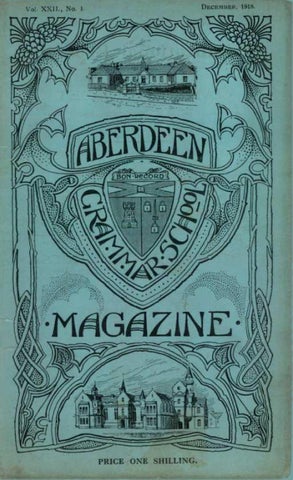
DECEMBER, 1918.
Vo! XXII., No. 1.
• MAGAZINE
PRICE ONE SHILLING.
Educational Books. JAMES G. BISSET
C
ONTINUES to supply all the Class Books (New or Second-hand) suited for the Requirements of the Higher Educational Institutions in the City, at the Lowest Prices.
\
N.B.—BEST VALUE IN STUDENTS' NOTE BOOKS.
JAMES G. BISSET, Classical, iltalcal, anb Ebucational Voollseller,
85 BROAD STREET (Opposite Marisohal College).
Sporting Outfitters. VL;33
ZIPa&81;42 28
BRIDGE ST
I i
CORNER OF BRIDGE PLACE. 'Phone 1094.
WRIST WATCHES, Fitted with Unbreakable Transparent Composition Fronts instead of Glass.
Strong.
•
Fully Luminous.
•
Reliable.
40/- 50/- 60/- 75/- 90/- 100/-
Gold WristStrap Watches
Gold Bracelet Watches
Engagement Rings. Marriage Presents.
.
Bracelet Watches.
Pearl Jewellery.
JI
-•
t
A. & J. SMITH, JEWELLERS, 'WATCHMAKERS. SILVERSMITHS,
191 UNION STREET, 23 & 25 ST. NICHOLAS STREET, ABERDEEN.
BURNETT'S CLASSES ARE THE GREAT SPECIALISING CENTRE FOR
CIVIL SERVICE, ARMY ENTRANCE, UNIVERSITY PRELIMINARY, PHARMACEUTICAL, BANKS, AND
BUSINESS TRAINING. TYPISTS SU PPLIED.—Ring up Telephonc 830. TYPING DONE.--Testimonials, Stories, Articles, and any MSS. typed
neatly, promptly, cheaply.
7 CROWN STREET, ABERDEEN. a~eeae~ee~e~ee~+tie-e~.eewee~veee-eetivvev~
-
Telegrams " Biscuits, Aberdeen."
Telephone 122.
PURVEYORS TO
BY
HIS MAJESTY.
APPOINTMENT.
The Unprecedented Demand for our
'DUX' OAT CAKES '-.1 HAS MADE AN EXTENSION OF THIS DEPARTMENT ABSOLUTELY NECESSARY. Our increased facilities will Ensure Prompt Attention to all Orders.
MITCHELL & MU1L, LTD.,
a,
ABERDEEN. 0 v*,11,4„ 1.Atoe,,,AaAtossii.4** %%sire i
Established 1832.
Telephone 523.
A. CRUICKSHANK & CO., 105 UNION STREET, bostem 65Iover.9, ant) f_.5birtmaker5. eAta All Class 'of Shetland (foods and Clan Tartans in Stock.
4
GEORGE ANDERSON, - THE"
19
IRONMONGER,
BROAD
STREET,
"Journal" and "Express" Office exactly opposite.
The recognised Store for Kerbs and Fenders--all kinds all sizes. Incandescent Lighting a Speciality. 'PHONE 2174.
ESTABLISHED 1843. •••
WILLIAM CAY & SONS, funeral tinbertallert3. 415 Union Street and 209 George Street, ABERDEEN. Motor Hearses and Cars for distant Funerals. Telegrams: " Cay, Aberdeen."
'Phones Nos. 92 and 54.
Specialities for "the Grammar School Boy." 1. Worsted Sweaters with Polo Collar, can be haul in the following shades :— Navy, Saxe, Brown, Green, 14/11, 15/6, 16/11. 2. Cashmere Jerseys with Polo Collars in all shades, to tit boys from 5 to 12 years, at 10/6, 12/6, 13:6, 14/6. 3. Navy Serge Knickers to tit boys from 5 to 10 years, at 7/6, 8/11, 10/6, 13/11. 4. In great variety—Tweed Suits to fit boys from 6 to 12 years, 3 garments, with Sports or Plain Jacket, at 43/6, 49/6, 52/6. 5. Youths' Suits in Tweed with Band and Button Knicker or long Trousers, 49/6, 52/6, 57/6, 63/6. 6. Boys' and Youths' Overcoats, newest 'tweeds and latest styles, at 30/6, 34/6, 48/6, 52/6, 63/6, 70/6. 7. Navy Serge Eton Caps at 1/9, 1/111, 2/6, and Cap Badges at 22d. each. 8. Boys' White Linen and Rubber Eton Collars at 72d., Old., 102d. each. 9. Youths' White Soft Collars, all sizes, 7.4d., 91d., 1OO1. each. 10. Youths' White Starched Collars(double), various depths, at 8,d., 9 2 d., 102d. each.
JOHN F.CC MN
\ F
F-
G N[R i
~_—..
, r-C-1;-1 , 1_ ;r: - E`Pff ROYAL ARCAD
ABERDEEN
Telephone 175o.
Established 1859. FOR
MILK and CREAM, BUTTER, EGGS, TEA CAKES, SCONES, & OATCAKES, TRY
FINDLAY'S DAIRY, 457 UNION STREET, & BRANCHES, ABERDEEN; Also, THE SQUARE, CULTS.
W. LUMSDEN & SON, 58
UNION
STREET,
Etberbeen. GROCERIES, PROVISIONS, WINES and SPIRITS, ALL OF
HIGHEST QUALITY.
- -
HAVANA CIGARS in Great Variety. Telegrams: "TRAVELLED, ABERDEEN."
'PHONE 260.
You are never disappointed at
Photo La Scala Playhouse Union Street, ABERDEEN.
1111
Continuous Performance from 2 p.m. -
Hours' Programme. . • . . Orchestral Music.
-
"Always first with the Best Pictures." Wounded Soldiers Free every afternoon except Saturdays and Holidays.
CONTENTS. PAGE. THE SCHOOL WAR MEMORIAL ..
• •
• •
• •
• •
•
• •
• •
WAR HONOURS AND REWARDS TO F.P.'s Boy SCOUT NOTES
1 • •
2 9
• •
• •
• •
PRO PATRIA MORTU1
• •
• •
• •
• •
A •
• •
••
10
THE TOLL OF THE WAR
• •
• •
• •
• •
• •
• •
••
28
NOTES ABOUT OLD Bovs
.•
••
• •
• •
• •
• •
••
34
• •
• •
RECORD OF THE. GRAMMAR SCHOOL COMPANY OF THE GORDON HIGHLANDERS
..
• •
• •
••
••
••
•.
••
46 51
TESTIMONIAL TO THE RECTOR ..
• •
..
..
..
..
•.
A HUMANIST'S OFFENSIVE
..
..
..
..
..
..
52
. ••
••
..
••
65
•
72
I
•
MEMORIES OF THE OLD GRAMMAR SCHOOL ..
SCHOOL NOTES -
••
..
.•
••
••
..
..
..
..
RANDOM RANDO M NOTES ..
••
••
..
••
..
..
..
SCHOOL CRICKET AVERAGES, 1918; SCHOOL RUGBY; THE MUSEUM THE FORMER PUPILS' CLUB
..
••
..
..
..
••
••
742
. •
77
••
78
TELEPHONE No. 1891.
ARCHIBALD McKELLAR, Family Grocer and Wine Merchant,
456 UNION STREET, g BER DEEM . -*We Specialise in Cooked Gammons, "Sinclair's" Belfast Smoked Hams, "Harris's"
Wiltshire Bacon.
Medicinal Wines—Vibrona, Hall's, Wincarnis, Glendenning's, Telephone No. 1524.
eleg
: Bruce. Cycles, Aberdeen.
Established 1884.
Motor and Cycle Works, GEORGE BRUCE & SONS, Holburn18 11O1_,BURN
STREET,
ABERDEEN. :0: Blacksmiths, Engineers, Motor and Cycle Agents. Agents for the Ariel, Ivy, Humber, Radco, Rover, Connaught, etc., Cycles and Motor Cycles.
Gas & Oil Engines Repaired. Lawn Mowers Sharpened, etc. Works-1 ALFORD LANE.
CITY GOLDSMITHS' CO. IA. HOLDSWORTH),
98 Union Street, ABERDEEN. Second-hand Diamond Jewellery a Speciality.
ENGAGEMENT RINGS. Finest Selection and most Reasonable Prices in the North of Scotland. Latest London Designs. Set 18 carat Gold and Platinum. From 60/- to £30. Other Prices from 10/6 upwards. Inspection and Comparison Invited. Ring Size Cards Free. Note.—Owing to limited window space we hold a large Reserve Stock inside which we shall be pleased to show to intending purchasers.
ial
Printing. ESTIMATES GIVEN.
THE CENTRAL PRESS (John Milne), GENERAL
PRINTER, LITHOGRAPHER, AND STATIONER,
61 BELMONT STREET, ABERDEEN. Telephone No. 809. Telephone
431.
BOWMAN & SON, Picture framers, 187 UNION STREET, AND 79 HOLBURN STREET. GET YOUR PHOTOGRAPHIC REQUIREMENTS AT
D. SOUTER ALLAN'S PHARMACY, r tiia b urn) 35 Ho!burn Street un c on Photographic Department. A Large Stock of Cameras, Plates, Films, Papers, and Accessories. Depiit for Kodaks and Kodak Supplies. Developing and Hinting executed by an Expert and delivered in 14 hours. Telephone 1624.
NORTHERN ASSURANCE COMPANY LIMITED ESTABLISHED
1836.
-
Assets exceed
£10,000,000.
CHIEF OFFICES :
ABERDEEN LONDON -
- 1 Union Terrace. - 1 Moorgate Street, E.C. 2.
All Classes of Assurance Transacted.
Fire.
Life.
Accident.
Marine.
Trustees. I HE IIURL OF RICHMOND ANI, I , oRDON, F+.(:. THE RIGHT HON. VISCOUNT MILNER, G.C.R., G.C.M.G.
Aberdeen Board of Directors. his TII0MAS BURNETT, BART. FRANCIS JAMES COCHRAN, ESQ. GARDEN ALEXANDER DUFF, ESQ.
Manager and Secretary
ALFRED MARTINF.AU, ESQ. DAVID NI. M. MILLIGAN, F. SIR DAVID STEWART, I.I.. D.
•
•
R. NI AcKAv, F. F.A.
Life Assurance Without Profits. New and Reduced Rates. The peculiar merit of a Non-Profit Policy consists in this that it provides an Immediate Assurance of much larger amount than can be obtained under the Participating Tables for the same premium, and for this class of Policy the revised rates of the "NORTHERN " are exceptionally low. ILLUSTRATION.-At Age 45 a yearly Premium of £m secures an Assurance of £336, payable at Death.
Such Policies are specially appropriate for payment of the Death Duties, for Family Provision, and for Partnership and other purposes. A copy of the new Prospectus may be obtained on application at the Company's Office, I UNION TERRACE, ABERDEEN.
Aberbeen
Orammat School tactga3ine. Vol. XXII.
DECEMBER, 1918.
No. 1.
The "Magazine " is issued under the auspices of The Eoriner All communications with
Pupils' Club, in dune and December.
regard to the "Magazine" should be addressed to the Editor, Theodore Watt, M.A., 10 Moray Place, Aberdeen, and not to the Grammar School.
The School War Memorial. The Executive of the Former Pupils' Club has for some time had under consideration the question of formally launching the scheme for a Memorial of Former Pupils of the School who have fallen in the War ; and now that peace is within sight, it has been arranged to hold a public meeting in the School Hall, on Thursday, 26th December, 1918, at 8 p.m., at which definite proposals will be submitted. The Executive has been fortunate enough to secure the Right Hon. ROBERT MUNRO, K.C., Secretary for Scotland, as the chief speaker, and it only remains for all who are interested to attend the meeting and so help to ensure the successful inauguration of the scheme. In connexion with the Memorial movement a provisional Roll of Old Boys " Pro Patria Mortui " is given on pp. 29-33.
•
The following additional subscriptions have been received towards the proposed Memorial Pavilion :GRAMMAR SCHOOL LITERARY AND DEBATING SOCIETY, per Donald . £3 3 0 .... 2 S. Stewart, President . . • • • • 0 10 6 Mr. W. J. ROBERTSON, Colpy, by Insch Mr. and Mrs. EDWARD TENNANT, 48 Brighton Place, Aberdeen (in memory of their son ebluarb la. 0..,-ooltr$ Tennant, 2 0 0 . . . 2nd Lieutenant, Gordon Highlanders) Lieutenant WILLIAM R. TENNANT, R.G.A., 21st Kohat Mountain Battery, Mesopotamia (in memory of his brother (Ebluarb 4t1. &elites Tennant, 2nd Lieutenant, Gordon Highlanders) .2 0 0 . . . . 2nd A.M. ROBERT R. TENNANT, Royal Air Force (in memory of his brother, as above) . 1 0 0 • • . Proceeds of a tournament, from School Tennis Club, per The 2 0 0 Rector . . .. . . .. • . Amount previously acknowledged. 76 7 6 . . . .. £87
1
0
2
Aberdeen Grammar School Magazine.
War Honours and Rewards to F.P.'s.
'
BAR TO THE DISTINGUISHED SERVICE ORDER. Hugh Allan Davidson, D.S.O., M.B., Major (Temporary Lieut.-Colonel), Royal Army Medical Corps, was on 26th July gazetted as having been awarded a Bar to the D.S.O. The following is a statement of the service for which this additional decoration was conferred :— " When in command of his unit he maintained the advanced dressing station in spite of heavy shelling by the enemy, only withdrawing when ordered to do so. He visited the regimental aid posts under heavy shelling, and by his example and energy many casualties were evacuated which might otherwise have been lost."
He was gazetted D.S.O. on 1st January, 1917. Commissioned to the R.A.M.C. in 1900, he was promoted Captain in 1903, and Major in 1912. Thomas Davidson* (1893-97), D.S.O., Major, Royal Field Artillery, was on 16th September gazetted as having been awarded a Bar to the D.S.O. in the following circumstances :— " The Colonel of the Brigade having been captured, this officer took command, and after succeeding in withdrawing two batteries, he came into action with one gun of his own battery in defence of an important bridge over a canal. Although within 300 yards of the bridge, and in full view of the enemy, he held on for about an hour under heavy rifle and machine-gun fire until reinforcements arrived."
He was gazetted D.S.O. on 27th October, 1917. Recently he was promoted Acting Lieut.-Colonel whilst commanding a brigade of artillery. DISTINGUISHED SERVICE ORDER. Kenneth William Mackenzie* (1893-97), M.C., M.B., Temporary Captain (Acting Lieut.-Colonel), Royal Army Medical Corps (late Captain, Indian Medical Service), was gazetted D.S.O. on 26th July.— " When in charge of the forward evacuation, he kept in touch with the retiring infantry, continually searching for and collecting the wounded. It was largely due to his great energy, skill, and foresight that so many of our casualties were so successfully evacuated."
He was awarded the Military Cross in October, 1916, and a Bar to his Cross in February, 1917, and was mentioned in Field-Marshal Haig's dispatch of 7th November, 1917. Donald Fasken Stevenson (1902-03), M.C., Lieutenant (Temporary Captain), Yeomanry and Royal Air Force, was also gazetted D.S.O. on 26th July— " For conspicuous gallantry and devotion to duty when carrying out low flying reconnaissances and contact patrols, under very heavy machine-gun, rifle, and anti-aircraft fire. In his patrols, often lasting many hours, and in bad weather conditions, he attacked enemy infantry, • Indicates Member of the Former Pupils' Club.
Aberdeen Grammar School Magazine.
3
transport and batteries from a low level, using his machine-gun and dropping bombs, frequently returning with his machine riddled with bullets, and the information he obtained was quite invaluable. His cheerful spirit, consistent dash, and fearlessness, and his magnificent work have set a splendid example to all in his squadron, and greatly encouraged them at a time when the casualties in it were extremely heavy."
He was awarded the Military Cross in September, 1917, and a Bar to his Cross almost immediately afterwards. Charles Cook Reid* (1895-1906), Captain (Temporary Major), Gordon Highlanders, was gazetted D.S.O. on 16th September, in the following terms :111
" While commanding a battalion in the outpost line, during a heavy bombardment with gas shells, although affected by the gas, remained in command, and reorganized the line under shell and machine-gun fire. During prolonged fighting, though practically without sleep, his confident bearing and disregard of danger gave encouragement to all under his command."
He has been three times officially reported wounded, and has been three times mentioned in dispatches. BAR TO THE MILITARY CROSS. Herbert Stewart Milne (1897-1901), M.C., M.D., Captain (Acting Major), Royal Army Medical Corps, was in June awarded a Bar to his Military Cross. The following is a statement of the service for which this additional decoration was conferred :— " When in charge of an advanced dressing station, in spite of continuous shelling, he dressed and superintended the evacuation of the wounded during three days' operations with great success. When a shell fell among a party of men, killing three and wounding fourteen of them, he succeeded in dressing the more severely wounded and in getting them all removed to a place of safety before the next burst of fire fell in the same spot. By his courage and resource he undoubtedly saved a further loss of life."
He was gazetted M.C. on 3rd June, 1916. Prior to the War he was on the staff of the Royal Lunatic Asylum, Aberdeen. John Douglas Fiddes* (1896-1902), M.C., M.B., Captain (Temporary Major), Royal Army Medical Corps, was awarded a Bar to his Military Cross on 26th July, on the following grounds :" In charge of an advanced field dressing station which was heavily shelled, he successfully evacuated all the wounded to a safer place. He also went up to the front when the officer in charge there was exhausted and gassed, and superintended the evacuation of all the wounded."
He was gazetted M.C. on 4th February, 1918. [See p. 4.] William Taylor Barron Joss* (1909-14), M.C., Second Lieutenant, Northumberland Fusiliers, Special Reserve, was also awarded a Bar to his Military Cross on 26th July— " For conspicuous gallantry and devotion to duty when sole remaining officer in the front line company. With a small detachment he fought until surrounded, then cut his way out to the reserve line, where he continued to inspire all ranks by his fighting spirit."
He was gazetted M.C. on 18th October, 1917.
4
Aberdeen Grammar School Magazine.
MILITARY CROSS. The following were reported in the February Magazine as having been gazetted M.C. on 4th February, and the Gazette of 5th July contained the statements of service for which the decorations were conferred :— Douglas Falconer* (1891-1900), Captain, Gordon Highlanders.— " He was in command of a convoy of limbers, and removed large quantities of trench stores under most difficult conditions and heavy fire, thus saving much valuable material from falling into the hands of the enemy."
John Douglas Fiddes* (1896-1902), M.B., Captain (Temporary Major), Royal Army Medical Corps. " For conspicuous gallantry and devotion to duty in continuing to dress the wounded under heavy shell fire at the advanced dressing station. Although the dressing station received a direct hit, he continued to work, and saved many lives by his courage and untiring energy."
James Hall McI. Gordon* (1901- ? ), Captain, Gordon Highlanders." He led his company with great daring and ability, and cleared the enemy from a village and established and held a line beyond the village. He was largely responsible for the success of the operation, and set a splendid example of coolness and courage to his men."
Patrick Magnus Spence* (1904-06), Lieutenant (Temporary Captain), Grenadier Guards, Special Reserve.— " While he was issuing orders for the advance of his company, the enemy attacked his position. He at once led his company to the attack, forced the enemy from their position, and followed them up, inflicting heavy casualties, and then established himself in the enemy's position. His quick grasp of the situation and splendid initiative were of the greatest value."
The following were reported in the February Magazine as having been gazetted M.C. on 18th February, and the Gazette of 18th July contained the statements of service for which the decorations were conferred :— John Leslie Chalmers (1901-03), Temporary Lieutenant, Royal Irish Fusiliers [killed in action on 27th March].— " He led his company with great determination, and when the advance was held up by machine-gun fire, he went forward in a tank and reconnoitred the ground. Being unable to advance, he took up a defensive position, and saved many casualties by his coolness and good leadership."
Ian McBain* (1904-14), Temporary Lieutenant (Acting Captain), Royal Garrison Artillery.— " During an enemy attack he took charge of the battery, and carried out his orders to the letter, under very heavy machine-gun fire. Later, by his coolness and courage, he greatly assisted in encouraging the men to remain at their posts under a very heavy barrage of machinegun and shell fire."
•
Aberdeen Grammar School Magazine.
5
Herbert James Jones* (1902-07) was reported in the February Magazine as having been awarded the Military Cross. This was gazetted on 26th March, and on 24th August the Gazette contained the following statement of service :— " He guided the battalion with great skill and judgment in a night 0
advance of fully a mile to its final objective over four lines of trenches under heavy fire."
George Neil Farquhar (1903-09), Second Lieutenant, Royal Field Artillery, Special Reserve, was awarded the Military Cross on the occasion of the King's Birthday, 3rd June, 1918. He is a son of JoHN Nicol. FARQUHAR (1882-83), Litt.D., Literary Secretary for the Y.M.C.A. in India. The following were gazetted M.C. on 26th July :— Gavin Leith Allardyce* (1894-1900), Second Lieutenant, Gordon Highlanders.— " For conspicuous gallantry and devotion to duty during two days of severe fighting, when he displayed the greatest courage and coolness in leading his men and inspiring them with confidence. He absolutely ignored his personal safety in order to see that his men and the position he held were made as secure as possible. Late in the operations he was wounded, but refused to leave his platoon until ordered to do so."
William Francis Cornwall. (1880-81), M.B., Temporary Captain, Royal Army Medical Corps.— " When the enemy carried out a heavy bombardment with large calibre shells and gas, he established, on his own initiative, a dressing station, and continued to deal with cases of various units for five hours, during which time the shelling was intense. To evacuate the wounded he organized stretcher parties of prisoners, no other means being at the time available."
William Walker (1896- ? ), M.B., Captain, Royal Army Medical Corps, Special Reserve.— " He proceeded to a village under heavy fire and succeeded in attending and evacuating several wounded. He only desisted when the enemy entered the village. Later, he succeeded in releasing a party of stretcher-bearers who had been cut off. Throughout the operations he has shown the utmost energy and courage."
ist
George Smith Lawrence* (1897-1907), M.B., Captain, Royal Army Medical Corps, Special Reserve, was gazetted M.C. on 27th July for distinguished service in East Africa. The following were gazetted M.C. on 16th September :— Clifford Cuthbert Chance* (1905-06), Temporary Captain' Royal Army Medical Corps.— " When a heavy barrage interrupted communications between regimental aid posts and relay posts, he reorganized his squads and led them through the barrage, cleared all the wounded and re-established the chain of evacuation. He has repeatedly led his squads through heavy fire and gas shelling, and has by his magnificent example of devotion to duty maintained the morale of tired and shaken bearers."
6
Aberdeen Grammar School Magazine.
Peter D. le Lievre (1908- 09), Temporary Second Lieutenant, Machine Gun Corps." During a retirement, when the flank of the position was exposed by the advance of the enemy on the right, and there was some confusion, this officer had a complete grasp of the situation, and took charge of the retiring infantry, showing them their new front and giving them confidence to continue their resistance. As machine-gun liaison officer with the brigade, he sent in many excellent reports, especially one which - provided the only information of the situation received at the time, and was of great assistance to the Divisional Staff."
John Falconer Mackintosh (1902-12), Captain, Gordon Highlanders.— " While his company was in battalion reserve this officer was untiring in keeping touch with the three companies in the firing line, constantly going up to reconnoitre under heavy fire. He was thus enabled to fill a gap with his company at the right moment, preventing the enemy from breaking through. Later he carried out an orderly withdrawal and reorganized on a new line. The next day he again took his company up under heavy fire, when the troops in front were withdrawing.
Alexander Meffett* (1903-08), Second Lieutenant, Royal Engineers.— " This officer, with his section of sappers, was digging supporting posts in front of a town when the enemy attacked, and he became involved in the fighting. He rendered great assistance to the infantry by loopholing walls for machine-guns, and encouraging and controlling his men in house-to-house fighting, holding up the enemy at many points."
Harry Middleton (1901-02), M.B., Captain, Royal Army Medical Corps.— " During an enemy attack, though suffering from the effects of gas, he remained at duty dressing wounded for four clays until ordered to hospital. He was frequently under shell fire, and had to change his aid post several times."
William Taylor (1900-04), M.B., Captain, Royal Army Medical Corps.— " For conspicuous gallantry and devotion to duty in his work amongst the batteries. He remained to the very last in each position, attending to the wounded officers and men, and was untiring in his efforts to assist in every way."
Harold James Milne (1904-07), Temporary Lieutenant (Acting Captain), Gordon Highlanders, was gazetted M.C. on 15th October.— " He conducted the advance of his company to a position in front with great gallantry and skill. Again moving forward, he showed complete indifference to danger while taking up dispositions in a heavily shelled wood. On several occasions, when his men were shelled out of their positions, he displayed splendid courage and resource, and by his personal example inspired all ranks under him."
Alexander Johnstone* (1904-10), M.B., Captain, Royal Army Medical Corps, was recently awarded the Military Cross." He displayed the utmost energy and coolness in collecting, dressing, and evacuating the wounded under heavy fire. Through his untiring efforts 204) cases were disposed of in a very short time,"
Aberdeen Grammar School Magazine.
7
William Lumsden (1881-83), M.B., Captain, Royal Army Medical Corps, was awarded the Military Cross some time ago for his gallantry in crawling out into No Man's Land under heavy fire and medically attending to and rescuing a wounded non-commissioned officer. Donald Fraser Proctor* (1908-12), Second Lieutenant, Gordon Highlanders, was gazetted M.C. on 7th November.-• " He led his men, together with others he collected, with the greatest dash, capturing a number of prisoners and destroying several machinegun nests. He showed a fine example of courage and able leadership, and rendered valuable service." David Bruce Nicol* (1900- 02), M.A., B.D., Temporary
Chaplain to the Forces, 4th Class, attached 1/6th Battalion Highland Light Infantry (T.F.), was gazetted M.C. on 2nd December.— " He continually accompanied the battalion to the front line, and during the operations he attended to the wounded with utter disregard of danger, under intense fire. He rendered valuable service."
Announcement has recently been made that the following have also been awarded the Military Cross :-Alexander Douglas Cruickshank (1898-1904), Second Lieutenant, Machine Gun Corps. [Posthumous award, see p. 13.] William Maurice Grant Dawson* (1905- 07), Captain, Royal Engineers. John Gordon Lindsay* (1901-04), Second Lieutenant, Indian Army Reserve of Officers, serving with the Q.V.O. Sappers and Miners in Palestine. William Philip Selbie* (1901-06), M.A., Captain, 8th East Surrey Regiment. PROMOTIONS. To be Brevet Lieut.-Colonel. Henry Frederick Lyall Grant* (1888-95), D.S.O., Major (Temporary Lieut.-Colonel), Royal Artillery, has received the reward of Brevet Lieut.-Colonel, with effect from 3rd June, 1918, for distinguished service in connexion with military operations in East Africa. He has been repeatedly mentioned in dispatches, and received the D.S.O. on 1st January, 1917. DISTINGUISHED CONDUCT MEDAL. John Alexander Nicol* (1895-99), Lance-Sergeant, Scots Guards, was recently awarded the D.C.M. Prior to enlisting he was engaged in legal practice in Aberdeen. This is what the Gazette recorded :— his " In an attack under circumstances of great difficulty he led of the platoon with the greatest dash and skill, ensuring the direction
8
Aberdeen Grammar School Magazine. objective to be gained by constantly repassing in front of his sections under very heavy machine-gun fire, and pointing it out to the men as they lay on the ground. On a subsequent occasion, though badly gassed, and wounded in two places, he continued in his place, and after fierce fighting, in which he killed several of the enemy, succeeded with his platoon in capturing his final objective and taking eight machineguns. His example and courage were beyond all praise."
MILITARY MEDAL. William H. Begg (1910-13), Private, Gordon High: landers, was gazetted in October as having been awarded the Military Medal. Previous to enlisting he was mess-room steward on the s.s. " Redhall." William Moir McCrae,* Corporal, R.E. Signals, has also been awarded the Military Medal. MENTIONED IN DISPATCHES. The following were mentioned in Lieut.-General W. R. Marshall's dispatch from Mesopotamia, dated 15th April, 1918:— Marcus Charles James Hartland-Mahon* (1885- 88), Lieut.-Colonel, Royal Field Artillery. He joined the Royal Artillery in 1897, and served throughout the South African War. Robert McPherson Barron (1882-88), D.S.O., Major (Acting Lieut.-Colonel), Indian Medical Service. He received the D.S.O. on 1st January, 1918. Robert Semple (1898-1905), M.D., Royal Army Medical Corps, was mentioned by Lieut.-General Sir J. L. van Deventer for services during the operations in East Africa from 30th May to December, 1917, described in his dispatch of 21st January, 1918. Harry J. Kinghorn* (1876-80), T.D., Lieut.-Colonel, Royal Engineers (T.F.), was mentioned on 13th August for valuable services at home. He went to the Front in command of a unit in the closing days of 1914. FOREIGN DECORATIONS. Conferred by the King of Italy. Maurice Richard Johannessen (1898-99), M.C., Lieutenant (Acting Captain), Royal Garrison Artillery, has been awarded the Italian Silver Medal for Military Valour. He received the M.C. on 1st January of this year. Herbert Haddon Bower* (1881-92), Lieutenant (Temporary Captain), Gordon Highlanders, has been appointed a Cavalier of the Order of the Crown of Italy. He was mentioned in Field-Marshal Haig's dispatch of 7th November, 1917.
•
Aberdeen Grammar School Magazine.
9
Conferred by the President of the French Republic. James Lawrence Smith (1877-79), C.B., M.V.O., M.B., Surgeon-General, Royal Navy, has been appointed an officer of the Legion of Honour. In the earlier part of the War he was in charge of the Royal Naval Hospital at Malta. Latterly he has been in charge of the Royal Naval Hospital at Larbert. Godfrey Power Geddes* (1903-11), D.S.O., Captain, Gordon Highlanders, has been awarded the Croix de Chevalier, Legion d'Honneur, and the Croix de Guerre. The following have also been awarded the Croix de Guerre :— Hugh Allan Davidson (1889-92), D.S.O., M.B., Major (Temporary Lieut.-Colonel), R.A.M.C. Ian Munro Gill (1909-14), Second Lieutenant, Gordon Highlanders. James Lawson Mowat* (1915-16), Second Lieutenant, Royal Garrison Artillery. John Grant* (1906-12), M.C., Lieutenant, Highland Light Infantry. Stuart Miller Robertson* (1893-1904), Corporal, has been awarded the Croix de Guerre, with Bar. He carried to Battalion Headquarters a very important message under heavy shell fire during the fighting on the Marne.
Boy Scout Notes. The Grammar School Troops have sustained a heavy and unlooked-for loss in the departure of Scoutmaster Douglas P. Cochran, who was one of the last to be called up from Aberdeen before the armistice. Mr. Cochran is now serving as a Clerk in the Records Office of the R.A.F. at Blandford, Dorsetshire, but it is hoped that he will soon be back again to resume his connexion with the Troops. Winter's work is now well ahead. Extra classes have been started in the Prospector's and Starman's Badges, the latter being taken by Dr. Macleod. It is hoped that it may be possible to start a gymnastic class very shortly. Troop I, in the person of Leader J. Stirrat, carried off the County Flag in the first annual competition, which took the form of a swimming test. Leader Stirrat is to be congratulated in procuring this highly gratifying result. A proposal is afoot for holding a joint Cyclist Camp as early as possible next year with the 9th Edinburgh (George Watson's College) Troop. It is suggested that the parties should meet somewhere in Perthshire and then make for the west coast, returning by Skye and the Caledonian Canal. The organization of the Grammar School district has now been approved. It is intended that each Troop and Pack should be under its own officers and have as much freedom of action as possible, subject to general lines laid down by the District Council. The 9th Troop Wolf Cub Pack continues to thrive and has been fortunate to secure the services as Assistant Cubmaster of Miss B. Mackenzie, who is already well known to Scout circles in the School, having been responsible for the catering and cooking arrangements at the Forestry Camp at Rickarton in the summer holidays. W. D. S.
10
Aberdeen Grammar School Magazine.
PRO PATRIA MORTUI. "So they gave their bodies to the commonwealth and received. each for his own memory, praise that will never die, and with it the grandest of all sepulchres, not that in which their mortal bones are laid, but a home in the minds of men, where their glory remains fresh to stir to speech or action as the occasion comes by."—THUCYDIDES, II, 43.
Bleganber taylor Bnberson* (1897-1900), Sapper, Royal Engineers, died on active service on 22nd May, aged 33 years. He was formerly a telegraphist in the Post Office, Aberdeen. 1Robert Cumming 'Webster Marclav (1895-1903), Corporal, Canadian Mounted Rifles, was killed in action on 8th August, aged 29 years. francis 1Renton liarrp * (1896-1902), A. R.I.B.A.. Captain, 5th (Reserve) East Surrey Regiment, attached 12th Battalion, was killed in action on 4th September, aged 30 years. He matriculated at London University, and studied for two years at the Architectural' Association School of Architecture, and for five years at the Royal Academy School of Architecture. During these five years, and two more, he served on the staff of Sir Aston Webb, who wrote of him : " We all loved him very much, both at home and at the office." In 1911 he travelled and studied architecture in Italy, and in 1912 he became an Associate of the Royal Institute of British Architects. In October, 1914, he joined the 5th East Surrey Regiment, and a year later obtained his commission in the 3rd Battalion. Passing with distinction through the Musketry Schools of Purfleet and Hythe, he became Battalion Musketry Officer, and his colonel testified that in a task requiring infinite tact and patience he carried out his duties most satisfactorily. In November, 1917, he joined the 12th Battalion in France, and with it served four months in Italy, returning to France in time to take part in the heavy fighting in the spring of this year. Thereafter he was promoted Captain, and with his company had hard service in the trenches throughout the summer. On 4th September he fell at Vierstraate. He was seen leading his company at the furthest point in the British attack, and there he fell wounded in the arm and the body. In the sudden counter-attack which followed, his company was driven back. An effort was made to bring the Captain in, but all in vain. The final issue lies in obscurity. It appears highly probable, however, that the wounds proved mortal on the field, and that his pain was not prolonged. 3anies Mather Veattie (1868-69), M.D., Captain, R.A.M.C., died at Southampton on 22nd July, aged 65 years. He graduated M.B. at Aberdeen in 1878, and M.D. in
Aberdeen"Grammar School Magazine.
FRANCIS RENTON BARRY.
ANDREW CRAIG.
JOHN
BI-:
DOUGLAS GORDON BONNER.
I I
12
Aberdeen Grammar School Magazine.
1889. While he was studying medicine he took part in three whaling expeditions to the Arctic. He started in medical practice in Sunderland in 1878, and continued there until the outbreak of the War, when he joined the R.A.M.C. On account of his age he was at first refused for active service abroad and was offered hospital work at home. Eventually, on personal application, he was accepted for the active service he so much longed for, and served first on board the " Oxfordshire," and then on the " Asturias." He was on the latter vessel at the evacuation of Suvla Bay, and later when she was torpedoed. Thereafter he was on the " Warilda," and shortly before his death was appointed medical officer commanding H.M.A.T. " Aberdonian." 1:Douglas Oorbon Vonner (1905-16), Lance-Corporal, Gordon Highlanders, only SOD of ALEXANDER C. BONNER* (1882-84), was killed in action in France on 27th September, aged 19 years. Before entering the Army he was a student of medicine at Aberdeen University, and when he joined up in August, 1917, he received his training with a battalion of the London Scottish. He crossed to France in May, 1918, and was at once transferred to the Gordon Highlanders. On 18th October a report was received to the effect that he had been wounded, but no confirmation of this could be secured, and on 12th November official news of his death in action on 27th September was received. He is buried in Havrincourt Military Cemetery. The chaplain of the battalion wrote of him as follows :—" He put his duty first ; he was eager to do it, active in the discharge of it, and to be relied on to do it satisfactorily and well. He feared no danger. He held, therefore, the respect and esteem of both officers and men. So he was to us as a soldier. I need not speak of his character as a young man. . . . I can at least say that he lived his life with us following out high principles. His conduct was always exemplary and fine. He had also the faculty of making and keeping friends, and we found him a true and loyal and helpful comrade."
30blt :brown* (1893-1900), Captain, Gordon Highlanders, was killed in action on 20th July, aged 34 years. When he left the School he entered his father's office, and in 1907 joined his father in partnership, under the name of Messrs. John Brown & Son, fish salesmen and steam trawlowners, Aberdeen. Later he became a director in several important local companies. He developed into a first-class man of business, and was greatly liked by all with whom he came in contact. In 1909 he went as a delegate representing the Aberdeen Chamber of Commerce to the Conference of Chambers of Commerce in Australia, and extended his tour to New Zealand, the East Indies, Japan, China, and Ceylon. He
Aberdeen Grammar School Magazine.
13
joined the 1st V.B. Gordon Highlanders as Lieutenant in 1902, and continued with the Territorials till May, 1914, when he retired with the rank of Captain. On the outbreak of war he offered his services, and after a short time became a Captain in the 2/4th Gordon Highlanders. Later he was transferred to the 2/5th battalion, and acted as its Major for over a year and a half. At the time of the great reverse in the spring of this year he was drafted to France, arriving there on the last day of March. He joined his old battalion, the 4th Gordons, as Captain, and was at once in the thick of the fighting with the 51st Division. He was killed instantaneously, on 20th July, by the bursting of a shell. John 3ames banners* (1910-13), Second Lieutenant, Gordon Highlanders, died at the Prisoners of War Camp, Mainz, Germany, on 20th November, aged 20 years. Prior to the War he was serving as an apprentice engineer in Aberdeen. He was mobilized as a member of the Grammar School Company of the Gordons, and received his commission two years ago. It was in March of this year that he was taken prisoner. 'Robert fergitson Coplanb* (1906-09), M.B., Ch.B., Lieutenant, Royal Army Medical Corps, attached Wiltshire Regiment, was killed on 21st March, aged 25 years. He graduated in medicine at Aberdeen in 1915. Enbrew Critic)* (1900-12), Private, Gordon Highlanders, was posted as missing on 17th October, 1915, and since that date no trace of him has been found. Formal intimation was made by the War Office about a year later that he was pre sumed killed on the above date, at the age of 21. After leaving the School he was for a time in the service of the Aberdeen University Press, but just before war broke out he had left that firm with the intention of studying divinity. Mobilization, however, intervened, and he was called up for service with the Grammar School Company of the Gordons, and with it went to France early in 1915. Zlieratiber Mouotas Cruickshank (1898-1904), M.C., Second Lieutenant, Machine Gun Corps, was killed in action on 23rd October, aged 30 years. He served as an apprentice with Messrs. Clyne, Mitchell & Co., engineers, Aberdeen, and thereafter engaged in electrical engineering, entering the service of the Glasgow Corporation Electricity Department in 1910. On the outbreak of war he enlisted in a yeomanry unit, went to Egypt in May, 1915, and took part in the Gallipoli campaign up to the evacuation. He subsequently took part in clearing the Sinai Desert, and in the first attack at Gaza. He then came home and received his commission, and was sent to France last May. He was slightly wounded in September, and fatally
e
14
Aberdeen Grammar School Magazine .
wounded on 23rd October. He was on board the " Ivernia " when it was torpedoed on New Year's Day, 1916, and after drifting many hours in the open sea, was, with others, picked up by an Aberdeen trawler. He did not live to hear that he had been awarded the Military Cross for conspicuous gallantry. It is sad to think that he bore the brunt of over four years of the War and fell less than three weeks before the signing 'of the armistice. frank (11)attlanb Fraser Dawson* (1904-14), Second Lieutenant, Gordon Highlanders, who was reported wounded and missing on 20th September, 1917, was subsequently officially presumed killed on that date, aged 20i years. He was one of the original members of the Grammar School Company of the Gordons, and was mobilized at the outbreak of war. He went with his battalion to Bedford, but in December, 1914, was sent to the Woolmanhill Depot at Aberdeen, where he remained till March, 1916, and was promoted Corporal. In April of that year he went to the Cadet School at Galles, and in September received his commission in the Gordons. After a period of training at Ripon, he was in May, 1917, sent to France, where he is known to have been wounded in the following September, but nothing really definite has been reported as to the circumstances of his death. Vartb (rant Cyril Muncan* (1901-09). Lieutenant, London Scottish, was killed in action in France on 21st August, aged 27 years. A correspondent writes : " Cyril, who was the younger son of the late Hon. R. G. Duncan, British Guiana, took a keen interest in the School games, and during his last session he was captain of the Rugby XV and secretary of the Cricket XI. Among his school-fellows he enjoyed a wellmerited popularity, for he was a splendid type of Grammar boy, who could be relied on to do what was right and honourable on every occasion. On leaving School he returned to British Guiana, and was engaged there for some years in sugar planting. After this experience he proceeded to the Straits Settlements, where he was working on a rubber estate when the War broke out. Impelled by patriotic motives, he left his work in the East on the completion of his agreement, came to this country, and enlisted as-a- Private in the London Scottish. He was wounded in 1917, and on recovery he applied for and received a commission in the same regiment. During a ten days' leave last July he paid a flying visit to Aberdeen with his wife. He had not long returned to the Front when he had to lay down his life in the noble cause in which so many of our brave boys have died." .[trey 3arbutt (1910-11) died at Aberdeen on 15th October, aged 23 years. Being a private in the Grammar
Or
m
Aberdeen Grammar School Magazine.
I
DAVID G. CYRIL DUNCAN.
HonAcE O. P. HEPBURN.
j A NIF,4 W. S. HERVI
.
16
Aberdeen Grammar School Magazine.
School Company of the Gordon Highlanders, like his twin brother, WILLIAM PERCIVAL GARBUTT* (1910-13), he was mobilized at the outbreak of war and went to France with his battalion. He went through the battle of Loos, 25th September, 1915, as a bomber. In January, 1916, he was discharged as medically unfit, and for some time thereafter was engaged in banking. At the time of his death he was temporary assistant at the Naval Stores Office, Aberdeen. Charles 31111C8 (Bike (1900- 03), M.M , Lieutenant, Canadian Infantry, was killed in action on 11th October, aged 30 years. He served as an apprentice with Messrs. John Cook and Son, shipowners, Aberdeen, from 1903 to 1906, and thereafter was with a firm of colonial brokers in London. From 1907 to 1910 he was in the service of the Home Bank of Canada at Toronto and Alliston, Ontario, and thereafter in the accounting department of the Merchants' Mutual Line (Canada Steamships, Ltd.), Toronto and Montreal. For some time prior to the War he was established as a fruit-grower at Grimsby, Ontario. As a private in the Headquarters Signallers, 20th Battalion, he came over to France with the Second Canadian Expeditionary Force, and in March of last year was awarded the Military Medal for mending telephone wires under fire. In April of this year he was gazetted a Lieutenant in the Canadian Army, having won his commission by service in the field. abrtan launcelot bawes (1899-1900), Lieutenant, Machine Gun Corps, was reported in October to have been killed by shell fire near Cambrai, aged 26 years. He joined the University and Public Schools Battalion as a private in September, 1914. lborace Oswalt) primate Fepburn * (1895-1903), Private, Canadian Infantry, was killed in France on 1st October, aged 31 years. In 1906 he entered the office of Messrs. Walker and Duncan, civil engineers, Aberdeen, and after completing his apprenticeship, went to Canada in 1911, where he was appointed a civil engineer on the National Transcontinental Railway, and later on the Hudson Bay Railway. Drawing and Natural History were his favourite studies, and by reason of his knowledge of insects, birds, and animals in general, the wilds of Canada appealed strongly to him. With his gun and his beloved Airedale, he was completely happy there. When war broke out, he wrote that he was corning home to do his share, but he could not conveniently be spared from his work, and he had to remain until the early spring of this year, much to his regret. He was attached to the 43rd Cameron Highlanders of Canada, and on 1st October, fell at Cambrai along with many others, in what is declared to have been one of the most brilliant operations of the War.
Aberdeen Grammar School Magazine.
17
James 11111tIbert %mitb temp (1910-12), signaller,
•
it
Driver, and Gunner, Royal Field Artillery, fell in action in France on 4th September, aged 19 years. He joined the R.F.A. (T.F.) as a bugler in February, 1914, and when war broke out was mobilized with the Forces. He was stationed at various towns both in Scotland and England, and in March, 1917, under cover of darkness, evaded the authorities and secretly landed at Havre, being then under 18 years of age. He was attached in France to the R.F.A Lancashires, and after taking part in the third battle of Ypres, served at many places both in Belgium and France. With regard to his death, his Major wrote : " Volunteers were asked to go out and bring in a German gun which was right in the front line. Signaller Hervey wished to go and we came through it all right, but two days ago we were in a forward area being shelled heavily by the enemy, and Wilbert was at the telephone. He was struck by a shell and killed instantaneously." His Commanding Officer paid this tribute to his memory: " He was always cheerful and bright. He was a splendid signaller and did not appear to know what fear was ; he did not care a bit for anybody or anything. He is a great loss to us. No one could have done more for his country." All the officers and men testified to his high character, bravery, and devotion to duty.
tbotnas %totbert Vett!) (1903-04), Cameron Highlanders, was killed in action on 24th July, aged 30 years. He came home from California in the summer of 1915 and joined the Black Watch. He was eventually sent to France, where he was twice wounded and sent to a Base Hospital. In September, 1916, he went through the Somme fighting under tremendous fire, and made a miraculous escape with a wound in his left hand, which led to the amputation of the left forefinger. This kept him in England until the summer of 1918, during the earlier part of which he was with the Lovat's Scouts at Beccles, and thence was drafted to France with the 6th Battalion of the Camerons. With them he saw some heavy fighting, and was killed near Soissons. Man flburrav ILtuttoben (1907-12), Private, Machine Gun Corps, was reported missing on 25th September, 1915, and was subsequently officially presumed to have been killed on that date. He was a member of the School Company of the 4th Gordons, and went to France with the Battalion when he was only 18i. In May, 1915, he was wounded in the arm, but after a week in hospital returned to the trenches. Shortly afterwards, volunteers were called for to join the Machine Gun Corps, and he was one of those selected. He served with the M.G.C. until 25th September, 1915, and the officer in command wrote that the last time he was seen he was running with others
18
Aberdeen Grammar School Magazine.
of his company to meet the on-coming Germans. He was of a particularly bright and cheerful disposition. His brother, ALEXANDER Gow LUMSDEN (1904-12), M.B., Captain, R.A.M.C., is serving in East Africa. alfreb Forbes ILtimsben (1887-?), D.S.O., BrigadierGeneral, was killed on 24th June, aged 41 years. He received his first appointment in the Royal Scots from the Militia in April, 1900, and was promoted Captain in 1909. He served in the South African War, receiving the Queen's medal with three clasps ; and from 1908 to 1912 was employed with the West African Frontier Force. In the present war he went out early with a battalion of the Royal Scots as major, and was in command of it for some time. He was repeatedly men tioned in dispatches, and was awarded the D.S.O. on the King's Birthday, 1917. In February of this year he was given the command of a brigade. He was killed by the bursting of a stray shell while inspecting his front line. He was beloved by his fellow-officers and idolized by his men. " To see him going into action," wrote his second in command, was an inspiration to all." 3ohn Mackintosh* (1904-10), M.A., LL.B., Captain, Seaforth Highlanders, was killed in action on 23rd July, aged 26 years. He graduated M.A. in 1913 and LL.B. in 1915 at Aberdeen University, gaining the Lyon Prize as the most distinguished graduate of the year in law. In 1913 he went to Edinburgh and became indentured to Messrs. Menzies, Bruce-Low, and Thomson, W.S., with a view to becoming a Writer to the Signet. While in Aberdeen as a student he joined the Territorial Gordons and served as a private for five years, resigning in the early part of 1914. Shortly after war broke out he joined the Seaforth Territorials in Elgin, under Colonel W. ROSE BLACK* (1882-85). He went to France in July, 1917, and served there till 20th November, 1917, when he was wounded near Cambrai. He returned to this country invalided, and was promoted Captain early in 1918. He went again to France in May last, and was killed in action near Rheims on 23rd July. His Colonel, in a letter to Captain Mackintosh's father, wrote : " We had had several days' severe fighting, in which your son had done wonders by his coolness and cheeriness under circumstances which were as bad as they could be. His company was the right front company in the attack, and advanced straight through to the objective. despite heavy losses. Your son was busy organizing the consolidation when he was killed by a shell. He was one of my very best officers and one in whom I had absolute confidence." Colonel Rose Black wrote : " The only redeeming feature of the ordeal through which we are passing is the band of fine young men with whom I have been thrown in contact, and the most
.4 berdeen
I
WILLIAM
M
RITCHIE. SELLA R.
Grammar School Magazine.
JAME, STEWART R
MORRISON.
I
)
20
Aberdeen Grammar School Magazine.
shining and fascinating of them all is John Mackintosh. In the early uphill days of the War, when officers with previous training of the right stamp were difficult to get, John came forward and gave me much real help, and as our training matured he became a tower of strength as well as a true friend. I always looked on John as one of my best officers and I knew he would distinguish himself as he did in the field." 11X11tIliam [Anton Millar (1898-99), M.A., M.D.,, Captain, Royal Army Medical Corps, died in France of pneumonia on 23rd October, aged 37 years. He graduated in arts and medicine at Aberdeen University, and after commencing in medical practice in Arbroath, settled as a doctor in Forres about eleven years ago. He received his commission in the Army in 1916, and was sent to Salonika. He was transferred to France in August last. 3obn Morrison* (1902-03) , M .A, B. D. , Lieutenant, Cameron Highlanders, was killed in action on 24th September, aged 33 years. He graduated M.A. at Aberdeen in 1907 and B.D. in 1911, and thereafter studied for a time at Marburg. On coming home he received a unanimous call from the congregation of Alvie U.F. Church, Kincraig, Inverness-shire, where he was ordained and settled as minister. Very early in the War, like many of the other young ministers in Scotland, he felt it to be his duty to leave his pastoral charge at the call for men, and he enlisted as a private in the Cameron Highlanders in February, 1915. Two months later he obtained a commission, and proved himself a capable officer. Being able to speak the Gaelic language fluently, he was selected to help in recruiting throughout Inverness-shire and the Western Islands. This post he held for about two years, and then he joined a battalion of the Cameron Highlanders in France, at the end of 1917. His death in action is deeply deplored by his congregation at Kincraig, where he gave promise of outstanding preaching ability. His first Colonel wrote : " We can truly say he was a credit to his sacred profession, to his family, to his regiment, and to the Highlands which he loved so well." James Meston Vett)* (1896-1907), Major, Royal Engineers, one of four F.P. brothers who have all served in the War, died at Archangel on 6th November, aged 27 years. On leaving the School, he attended science classes at Aberdeen University, and was afterwards trained as a chemical engineer, for this purpose being sent to Germany and Belgium. On returning to this country he entered the works of Orr's Zinc White, Ltd., Widnes, Lancashire—a company which has led the way in the use of zinc in place of lead for paints—and here he was beginning to show how well adapted he was for the development of business on sound lines when war broke out.
Aberdeen Grammar School Magazine.
21
Holding a commission as Lieutenant in the West Lancashire Field Company of the Royal Engineers (T.F.), he was mobilized in August, 1914, and almost immediately afterwards was engaged in the building of an internment camp for Germans at Shrewsbury. In June, 1915, he was promoted Captain, and . went to Gallipoli. He remained there till the evacuation, taking part in the demolition of works at Cape Hellas, and coming off in one of the last lighters. Thereafter he was engaged against the Turks on the Suez Canal and in the Sinai Desert campaign. He raised No. 9 Field Troop, R.E., at •
•
JAMES MInTON REID. Suez, and commanded it with the 6th Mounted Brigade Desert Column in operations at Moses' Well and Abu Tif. In November, 1916, he joined the Salonika Expeditionary Force, and . served in the Lower Strumna, at Doiran, and elsewhere in Macedonia until December, 1917, when he came home on furlough, having previously been promoted Major. For his services, which included the temporary command of a Greek Labour Battalion, he was mentioned in dispatches. While in the East, he had unfortunately contracted malaria, and this kept him in England until September last, when he volunteered and was accepted for service with the North Russian Expeditionary Force. He had been in Russia for only a few weeks when he died in hospital from bronchial pneumonia.
22
Aberdeen Grammar School Magazine.
A fellow-officer writes : " I cannot say how deeply I feel the loss of such a dear friend. He was always so kind and sympathetic, and got on so well with everyone he came in contact with. All the men liked and respected him, and I very well remember how pleased they and we all were when he rejoined us at Mudros, after being in Egypt with the 9th Field Troop." Another intimate friend says that his death is perhaps all the harder to bear because of his having survived almost until the armistice was signed. " I cannot tell you how I admire his pluck in going out to Russia after having had such a strenuous time in the East. It was just typical of Meston." James Stewart Voss* (1902-12), Second Lieutenant, Royal Air Force, died as the result of an aeroplane accident on 29th July, aged 22 years. At the School he took a keen interest in athletics, and won prizes every year at the Sports. He was a Boy Scout, and attended the Coronation inspection by King George at Windsor Castle, being standard-bearer of the kilted scouts on that occasion. In 1912 he became a student in agriculture at Aberdeen University, and in the following year joined the Transport Section of the R.A.M.C. Territorials. He was called up for service in August, 1914, and sailed for Egypt in January, 1915. With the 29th Division he took part in the first landing in Gallipoli, at Cape Hellas, and remained on the Peninsula until the final evacuation. After returning to Egypt, he sailed for Marseilles and was sent straight to the Somme. He was stationed between the Somme and Ypres till November, 1917, when he was sent home to get his commission in the Royal Flying Corps. For this he was trained at Hastings and Oxford, and graduated from the aerodrome at Duxford, Cambridgeshire, where he was killed accidentally in his farewell flight.
'i il[iam 1Ritcbie Sellar* (1911-16), Second Lieutenant, Royal Air Force, was killed in action on 29th August, aged 18 ,years and 10 months. After leaving the School he joined the staff of the Aberdeen Burgh Surveyor, to be trained as a civil engineer. He attested before he was 18 and was called up on his birthday. He was very keen, and need not have gone to the Front as soon as he did: he was not yet 19 when he was killed, fighting over the German lines near Bapaume. lie was fond of sport, and when training at Hastings was chosen as a member of the R.A.F. rugby team. lbarrv (Brabant Simpson* (1899-1912), Major, Machine Gun Corps, the elder son of the Rector, Dr. H. F. Morland Simpson, was killed in action in France, north of the Aisne, on 27th May, aged 23 years. In the last Magazine he was
Aberdeen Grammar School Magazine.
GEORGE
A I EX :\ NOLR SMI Ill .
DOUGLAS STEPHEN.
23
HARRY GRAHAM SIMPSON.
GEORGE HENRY STRACHAN.
24
Aberdeen Grammar School Magazine.
reported wounded and missing on that date. It appears that with his company he was occupying a front line trench, and was overwhelmed in the first rush of the great German offensive in the closing days of May. At the outbreak of war he was an apprentice engineer in the Great North of Scotland Railway workshop at Inverurie, and held the rank of 2nd Lieutenant in the Grammar School Company of the 4th Battalion Gordon Highlanders. He served with the battalion in the second battle of Ypres, at Hooge, and at High Wood. In 1916 he was attached to the Machine Gun Corps, 8th Battalion, and underwent a course of training at Grantham, where he developed such skill in revolver shooting—he could hit a pennypiece at 20 yards every time—that he was appointed instructor to the School of Revolver Practice. He invented a simple but ingenious improvement in revolver sights which rendered shooting a matter of very deadly certainty ; and also an apparatus for registering gun-sighting by day, to be used in night-fire. He was naturally full of contrivance, and general repairer to the battalion when anything went wrong, from a wrist-watch to a motor cycle. On one occasion in Flanders he was set with his platoon to pump out a water-logged communication trench, a hopeless task, as it proved, as hours of work made scarcely a couple of inches of difference. Seeing a large shell crater in the neighbourhood and noting the lie of the land, he set his men at night to dig a trench to the crater. They completed their task just before dawn and emptied the trench in a few minutes. As an officer he set great store by the experience he had gained in dealing with boys and men, both as Boy Scout and in the works at Inverurie. It was characteristic of the way in which everything had to be improvised in 1914, that when the 1/4th Gordons moved from Perth to Bedford, the railway apprentice was made railway transport officer. Several of his men have borne witness that in all circumstances he was cool and cheery, without fear and without fuss. jobn 3Duncan Smart (1911-14), Private, Scots Guards, was killed in France on 13th October, aged 20 years. Before he joined the Scots Guards in January, 1917, he was an apprentice chemist in Aberdeen. He went to France last year, and was severely wounded on 28th March, 1918. He rejoined his battalion in July, and went to France for the second time in September. On the night of 13th October, after a successful attack during the day, he was killed by the bursting of a shell while lying in a trench shelter. George Bleganber Smitb* (1888-91), D.S.O., Lieutenant-Colonel, Gordon Highlanders, was killed in action on 28th July, aged 44 years. After leaving the School he served as a law apprentice with Messrs. Murray, M'Combie & Bennett,
Aberdeen Grammar School Magazine.
25
advocates, Aberdeen, and qualified as a law agent in 1899. In the following year he started in practice on his own account in Aberdeen, and succeeded in building up a substantial business. In 1910 he was admitted a notary public, and in 1913 a member of the Society of Advocates in Aberdeen. For many years he was an enthusiastic Volunteer and Territorial. He became a Second Lieutenant in the Gordon Highlanders in 1901, and reached the rank of Major in 1913. On the outbreak of war he was mobilized with the 4th Battalion of the Gordons, and was with it in France from February to December, 1915. Thereafter for almost a year he commanded the 8th King's Own (Royal. Lancaster) Regiment, and when he left it, was presented by the officers with an inscribed silver tray " as a token of their, affection and devotion and to mark their appreciation of his leadership and gallantry." In recognition of his services he was awarded the D.S.O. on the King's Birthday, 1916. From October, 1916, to October, 1917, he was at General Headquarters, 3rd Echelon. Preferring to go up the line, he thereafter joined the 5th Gordon Highlanders, and took part in the big retreat at St. Quentin. From that time he was in command of the battalion, and was killed by a shell on 28th July, 1918, at Buzancy, where " the noble thistle of Scotland will flourish for ever among the roses of France." As it happened, another F.P., Private • NORMAN WATT DuFFus* (1904-05 and 1912) was wounded by the same shell. He described what happened as follows : " I had been lying on the brow of a hill observing for our brigade going over the top. I was by myself until they got their objective, and when I reported to Colonel G. A. Smith, he was so pleased that he came for a look himself, and had hardly lain down for a couple of minutes before the shell came. . . . The Colonel lived for about four or five minutes." Colonel Smith was twice wounded, and three times mentioned in dispatches. In addition, his Brigadier has testified that he was twice recommended for the V.C. The engagements he took part in included The Bluff, St. Eloi, Delville Wood, and Guillemont. One who knew him intimately in France writes : " There are very few left of the King's Own which he commanded, and they are widely scattered, but I know I speak for them when I say that he was the best Commanding Officer in the British Army. Nobody could have been more loved or more admired than he was, and there wasn't a man who wouldn't willingly have died for him. He was the ideal C.O. and a real leader of men. Off duty he was an elder brother to us all—always cheery and sympathetic, always ready to help, and with his heart set on the welfare of his officers and men. As a soldier he was the bravest man I have ever known or seen in four years
26
Aberdeen Grammar School Magazine.
of war, and his leadership and personality were an inspiration. Nothing ever seemed to ruffle him, and he was always the same calm, cheerful optimist, who got the very best out of everybody ; not by fear, but by love and encouragement. I count my life all the richer for having known him and called him friend, and the memory of him will always be an inspiration as long as I live." Colonel Smith was for a time a member of the Executive of the F.P. Club. 3Douglas %tepben * (1905-13), Private, Gordon Highlanders, was killed in action on 24th July, aged 18i yews. He was scarcely a month in France. He went into the trenches on 19th July and was killed by a shell five days later. Before joining the Army he was in the office of Messrs. Allan & Dey, fish salesmen, Aberdeen. He took a keen interest in the Boy Scouts, and was scoutmaster of the 12th Troop.
George lbenrp Stracban* (1909-12), Lieutenant, Gordon Highlanders, died at a Casualty Clearing Station in France, from influenza, on 24th November, aged 22 years. On leaving the School he entered the office of the Northern Assurance Company, Aberdeen, and being a member of the School Company of the Gordons, was mobilized at the outbreak of • war. He obtained his commission in the Gordons in October, 1915, and went to France a year later, taking part in the operations at Beaumont Hamel. He was thereafter invalided home, and returned to France—to the 1st Battalion of the Gordons—as recently as October of this year. Thleganber C3eorge 71tnball* (1902-08), Second Lieutenant, Gordon Highlanders, was killed in action on 8th October, aged 26 years. He served as an apprentice in the Aberdeen branch of the Clydesdale Bank, and afterwards was engaged as a tea planter in Ceylon. He joined the Seaforth Highlanders in the spring of 1917, and subsequently received a commission in the Gordons. He left Aberdeen en route for France on 19th Angust, 1918. His death was caused by a shell which struck the shelter in which he was sleeping, and killed him instant aneously. joi' Francis Trabvte (1894-95), Major, Royal Engineers (Inland Water Transport), died in hospital abroad of influenza, on 20th October, aged 33 years. From 1901 to 1906 he served on the Ocean Training Ships " Macquarie " and '• Illawarra," and thereafter for three years was with the P. and O. Company. From 1904 to 1910 he was in the Royal Naval Reserve, and in the latter year became a rubber planter in the Federated Malay States. He joined the Army shortly after the outbreak of war.
Aberdeen Grammar School Magazine.
27
aames lattson. (1903-08), Captain, Gordon Highlanders, was killed in action on 15th June, aged 26 years. He served as an apprentice with the North of Scotland and Town and County Bank at Aberdeen, and thereafter joined the London staff of the Hong-Kong and Shanghai Banking Corporation. In 1915 he enlisted in the Scots Guards, and later received a commission in the Gordons. He was a keen swimmer, and while at the School won various prizes, including the Rector's Cup.
ALEXANDER GEORGE TINDALL.
JAMBS WILSON.
Vaa liter iSrvan 'Marto bt (1897-1900), Private, Canadian Infantry, was killed in action on 2nd September, aged 34 years. In 1902 he went to Canada and was for three years on a ranch near Edmonton. The next three years he spent on the Canadian Pacific Railway. From 1908 to 1911 he was paymaster at Hosmer Mines, British Columbia, and thereafter he was in business in the United States. He had indifferent health, but as soon as he could pass the medical test he joined the 10th Infantry Battalion of the Canadians, and not long afterwards was sent to France. At the School he took a keen interest in Rugby. He was Secretary of the 2nd XV. F.P.'s for two seasons, and Secretary of the 1st XV. F.P.'s for another season. In the Magazine of June, 1914, he gave a very racy description of a fishing trip in British Columbia.
28
Aberdeen Grammar School Magazine.
The Toll of the War. In view of the proposal to institute a Memorial of Former Pupils of the School who have fallen in the War, we publish below a list of all those whose deaths have been noted, down to 10th December, 1918. The list is not to be regarded as complete even to that date, for doubtless there are a number of F. P.'s whose deaths have not been reported locally. The complete Roll of Honour cannot be compiled until the investigations necessary for the publication of the School War Record have been concluded, and even then there may possibly be some omissions. The present provisional list contains 200 names, including those of no less than 104 members of the Former Pupils' Club. Of the 200 who have fallen, 132 were commissioned officers, and 68 non-commissioned officers and men. The following table shows what ranks the commissioned officers held :— F.P. OFFICERS WHO HAVE FALLEN. NAVY— Fleet Surgeon . . . . . 1 Lieutenant-Commanders . . 2 . Sub-Lieutenant . . . . . 1 Engineer Lieutenant-Commander . 1 . ARMY AND ROYAL. AIR FORCE Brigadier-General . . . . 1 Lieutenant-Colonel . . . . 1 Majors . . . . . . 7 Captains . . . . . . 31 Lieutenants . . . . . . 37 Second Lieutenants . . 50 •
•
Total • . 132 As was to be expected, the largest number of the officers held commissions in the Gordon Highlanders, and an analysis brings out the following figures :— F.P. OFFICERS IN THE GORDONS WHO HAVE FALLEN. Lieutenant-Colonel • . . . 1 Major . . . • . . . 1 Captains . . . . . . 10 Lieutenants . . . . . . 15 Second Lieutenants . . . . 20 •
Total . . . 47 Of the 68 non-commissioned officers and men, 21 were in the Gordon s.
Aberdeen Grammar School Magazine.
29
The first F.P. to fall was Dr. THOMAS PEP14: FRASER, in Nigeria, on 5th September, 1918 ; and the most recent is Second Lieutenant GEORGE HENRY STRACHAN, Gordon Highlanders, who died in France on 24th November, 1918. The oldest F.P. in the list is Captain JAMES WALKER BEATTIE, M.D., R.A.M.C., who died aged,65 ; and the youngest is Private DOUGLAS STEPHEN, who was only 18 years and 7 months when he fell in France on 24th July, 1918. The Editor of the Magazine will feel grateful to anyone who points out any errors or omissions. Aitken,* Alexander (1909-14), 2nd Lieutenant, Gordon Highlanders, France, 15 May 1917, aged 19. Allan, James Bertram (1894-96), Private, South African Infantry, France, 15 October 1917, aged 35. Anderson, Alexander Stewart (19041909), Sergeant, Royal Engineers, Belgium, 15 August 1917, aged 24. Anderson,* Alexander Taylor (18971900), Sapper, Royal Engineers, 22 May 1918, aged 33. Anderson,* David (1908-11), LanceCorporal, Canadian Mounted Rifles, France, 26 October 1917, aged 24. Anderson, Hugh Caldwell (1897-99), Captain, Canadians, Belgium, 11 August 1917, aged 33. Anderson, Thomas (1902-08), M.A., Lance-Corporal, Gordon Highlanders, 23 Sept. 1917, aged 27. Anderson,* William (1907-10), 2nd Lieutenant, Lovat's Scouts, France, 4 June 1917, aged 24. Badenoch, John (1894-95), M.A., Private, Royal Army Medical Corps, Basra, 11 July 1917, aged 40. Barclay, Robert Cumming Webster (1895-1903), Corporal, Canadian Mounted Rifles, France, 8 August 1918, aged 29. Barry,* Francis Renton (1896-1902), Captain, East Surrey Regiment, France, 4 September 1918, aged 30. Beattie, James Walker (1868-69), M.D., Captain, R.A.M.C., Southampton, 22 July 1918, aged 65. Beim Albert (1884-87), Private, Australian Infantry, 5 Sept. 1916. Beim, John Henderson (1901-06), Highlanders, Gordon Captain, France, 23 July 1916, aged 25. Benton, Ronald MacKenzie (1902-05), 2nd Lieutenant, Indian Army, Persian Gulf, 7 June 1916, aged 21. Bisset, Hugh Matheson (1890-97), South African Horse, Durban, 24 November 1916, aged 34. Bonner,* Douglas Gordon (1905-16), Lance-Corporal, Gordon Highlanders, France, 27 Sept. 1918, aged 19.
Booth,* John Lyon (1904-10), M.A., M.C., Captain, Seaforth Highlanders, France, 18 April 1918, aged 25. Brodie,* John (1906-11), 2nd Lieutenant, Bedford Regiment, France, 14 November 1916, aged 21. Brown,* James Douglas (1907-10), Sergeant, Signal Section, Royal Engineers, France, 4 May 1918, aged 23. Brown, James Windram (1909-11), Private,Gordon Highlanders, France, 21 January 1916, aged 19. Brown,* John (1893-1900), Captain, Gordon Highlanders, France, 20 July 1918, aged 34. Brown, Norwood Alfred Edmond (1898-1905), Sergeant, Honourable Artillery Company, 3 May 1917, aged 28. Brown, Richard Gavin (1897-98), M.B., Ch.B., Lieutenant, R.A.M.C., Portsmouth Hospital, 14 February 1916, aged 33. Itrace,* William George (1901-13), Lieutenant, Royal Engineers, France, 25 April 1918, aged 22. Buchan, Charles (1906-08), M.A., 2nd Lieutenant, Lancashire Fusiliers. December 1917, aged 29. Burnett,* Ian Alistair Kendall (18941903), M.A., Captain, attached East Lancashire Regiment, France, 31 May 1917, aged 31. Cameron, George Grant (1901-11), 2nd Lieutenant, Gordon Highlanders and Royal Flying Corps, Lincoln, 16 October 1917, aged 21. Catto, Robert Kilgour Thom (18891890), Captain, Gordon Highlanders, France, 4 November 1916, aged 43. Center, William Rudolph (1883-85), M.B., C.M., Fleet-Surgeon, R.N., Malta, 28 April 1916, aged 45. Chalmers,* John James (1910-13), 2nd Lieutenant. Gordon Highlanders, Mainz, Germany, 20 Nov. 1918, aged 20. Chalmers,* John Leslie (1901-03), M.C., Captain, Royal Irish Fusiliers, France, 27 March 1918, aged 26.
* Indicates Member of the Former Pupils' Club.
30
Aberdeen Grammar School Magazine.
Chalmers, William Hamish (19011903), 2nd Lieutenant, Indian Infantry, Persia, 13 April 1916, aged 26. Chambers-Hunter' * Charles Altardyce Jopp (1911-14), 2nd Lieutenant, Gordon Highlanders, France, 1 April 1916, aged 21. Chree, George William Johnstone (1900-08), Captain, Royal Scots, France, 14 July 1916, aged 22. Combe,* Robert Grierson (1894-97), V.C., Lieutenant, Canadian Infantry, France, 3 May 1917, aged 36. Conner,* Frederic Attenborrow (1905-13), 2nd Lieutenant, Seaforth Highlanders, France, 1 July 1916. aged 21. Copland,* Robert Ferguson (1906-09), M.B., Ch.B., Captain, R.A.M.C., France, 21 March 1918, aged 25. 1 :orke, Guy Harold (1896-1901), 2nd lieutenant, Northumberland Fusiliers, France, 17 September 1916, aged 25. Craig.* Andrew (1900-12), Private. Gordon Highlanders, France, 17 October 1915, aged 21. (Iraigna)-le, Douglas (1908-10), Private,Gordon Highlanders, France, 23 April 1917, aged 23. Cramond, William (1905-07), Private, London Regiment, 30 December 1917, aged 26. Cruickshank, Alexander Douglas (1898-1904), M.C., 2nd Lieutenant, Machine Gun Corps, France, 23 October 1918, aged 30. Davidson.* Arthur Gerrard (19011907), Lieutenant, Gordon Highlanders, attached Royal Flying Corps, France, 9 September 1917, aged 27. Davidson, James Reid (1910-12), Gunner, Royal Field Artillery, France, 6 March 1917, aged 19. Dec idson,* William Adrian (1904-06). 2nd Lieutenant, Gordon Highlanders, France, 2 July 1916, aged 21. Davidson, William Alexander (19071910), Lance-Corporal, Gordon Highlanders, Bedford Hospital, 15 April 1915, aged 21. Dawson,* David Stewart (1905-06), M.A., lieutenant, Gordon Highlanders, Aberdeen, 20 October 1917, aged 27. Dawson,* Frank Maitland Fraser (1904-14), 2nd Lieutenant, Gordon Highlanders, France, 20 September 1917, aged 20. Dawson,* George (1896-1901), M.A., B.Sc., Corporal, Royal Engineers, France, 28 June 1916, aged 33. Hiatus,* Gordon Craig (1904-05), Lance-Corporal, Canadian Infantry, France, 24 December 1916, aged 22. Duncan,* David Grant Cyril (19011909), Lieutenant,London Regiment, France, 21 August 1918, aged 27.
Duncan, George Jeans (1888-98), Sergeant, Gordon Highlanders, Flanders, 29 Oct. 1914, aged 30. Robert James Armstrong (1891-1900), Captain, Gordon Highlanders, France, 23 April 1917, aged 33. Ellis,* James (1896-1904), Captain, Gordon Highlanders, France, 24 April 1917, aged 25. Ellis,* John Martin (1895-1901), Lance-Corporal, Wellington Mounted Rifles, Palestine, 14 November 1917, aged 30. Farquhar, John Dunbar (1897-1900), Private, 21 May 1918, aged 33. Ferguson,* Alexander Lundie Hunter (1904-05), Lieutenant, Gordon Highlanders, France, 23 July 1916, aged 21. Ferguson, Roderick Mackenzie (19121913), 2nd Lieutenant. Gordon Highlanders, France, 13 November 1916, aged 21. Fowile, Charles W. L. (1885-89), Major Gordon Highlanders, Festubert, 30 May 1915, aged 40. Fraser, Thomas Peppe (1886-94), M.B., Ch.B., Medical Officer, Colonial Medical Service, Nigeria, 5 September 1914, aged 34. Garbutt, Alfred (1910-11), Private, Gordon Highlanders, Aberdeen, 15 October 1918, aged 23. Garland,* James Harvey (1900-02), Lieutenant, Gordon Highlanders, France, 12 November 1915, aged 29. Giles,* Charles Inns (1900-03), M.M., Lieutenant, Canadian Infantry, France, 11 October 1918, aged 30. 6111, James Cruickshank (1884-89), Lance-Corporal, Royal Scots Fusiliers, France, 12 Oct. 1916, aged 38. (:1111es,* James Brown (1895-1904), B.L., Captain, Gordon Highlanders, France, 14 Nov. 1916, aged 30. (aeon,* Robert (1911), Lieutenant, Royal Engineers, France, 19 July 1915, aged 20. Cioldsm1d, Sydney Alexander (19021903), 2nd Lieutenant, Worcestershire Regiment, France, October 1914, aged 21. I nt • Lewis Leslie (1898-1902), Private, Gordon Highlanders, Flanders, 22 July 1915, aged 22. Gray, David Beatt (1895-98), Private, Canadian Mounted Rifles, France, reported March 1917, aged 27. 4 iray * John (1894-96), Captain, Indian Infantry, Mesopotamia, II April 1916, aged 34. Gray, William (1895-99), Private, Canadian Infantry, France, 23 April 1915, aged 32. Hall, John (1897-1901), Private, W.I.R., New Zealand Expeditionary Force, 24 November 1917, aged 32.
Dunn,*
I
Aberdeen Grammar School Magazine. Halley,* William Curr (1903-11), 2nd Lieutenant, Royal Garrison Artillery, France, 28 May 1917, aged 22. Hardie, David Whyte (1902-07), 2nd Lieutenant, Royal Flying Corps, 18 November 1917, aged 22. ilastIngs,* James Smith (1903-09), 2nd Lieut., Gordon Highlanders, Ripon, 25 June 1916, aged 25. Ilawes, Adrian Launcelot (18991900), Lieutenant, Machine Gun Corps, France, Oct. 1918, aged 26. Hay,* Alfred Chalmers (1895-1900), 2nd Lieutenant, Gordon Highlanders, France, 9 April 1917, aged 34. Henderson, Charles Stuart (1904-06), Private, Australians, 1917, aged 27. Ilenderson,* William George (19021912), 2nd Lieutenant, Gordon Highlanders, 23 April 1917, aged 20. Hepburn,* Horace Oswald Pringle (1895-1903), Private, Canadian Infantry, France, 1 Oct. 1918, aged 31. Hervey, James Wilbert Smith (19101912), Gunner, Royal Field Artillery, France, 4 September 1918, aged 19. Hunter, Robert Donald (1894-96), Highlanders. Cameron Private, France, 10 July 1916, aged 33. Hutcheson,* Gordon James (19091915), Lieutenant, Royal Air Force, France, 27 May 1918, aged 20. Inkster,* Walter (1903-08), M.A., B.Sc., 2nd Lieutenant, Gordon Highlanders, Flanders, 25 September 1915, aged 25. Irvine,* Edward White (1908-15), 2nd Lieutenant, Royal Field Artillery, France, 27 Mar. 1918, aged 20. Jamieson,* Douglas (1895-1903), 2nd Lieutenant, Royal Engineers, France, 9 July 1917, aged 30. Jamieson,* Herbert Mather (18941898), M.B., Ch.B., Lieutenant, R.A.M.C., Malta, 26 September 1915, aged 32. Johnston, Alexander Francis (18971903), M.A., 2nd Lieutenant, London Regiment, France, 10 September 1916, aged 30. Johnston,* George Mitchell (18981907), B.Sc. (Agr.), Captain, Royal Militia of Jersey, France, 3 April 1916, aged 25. Keith, Thomas Stothert (1903-04), Cameron Highlanders, France, 24 July 1918, aged 30. Kellas,* Arthur (1896-1901), M.B., Ch.B., Major, R.A.M.C., Gallipoli, 6 August 1915, aged 31. Kemp, James Ogilvie (1882-83), M.A., Captain, Royal Scots, 12 December 1917, aged 52. Kligour,* William Ewart Gladstone (1889-92 and 1896-97), Private, Royal Fusiliers, France, 6 August 1916, aged 33. King. William Braithwaite (1886-89), Private, Canadian Infantry, 13 April 1917, aged 38.
31
Knowles, John Forbes (1903-09), M.A., Private, Gordon Highlanders, Flanders, 5 May 1915, aged 24. Lamb,* Alexander (1897-1900), Engineer Officer on Hospital Ship, 30 March 1917, aged 32. Legge,* Angus Forsyth (1901-07), M.B., Ch.B., Lieutenant, Singapore Medical Company, Singapore, 16 February 1915, aged 25. Legge, Stafford Henry (1900-03), Private, Middlesex Regiment, Croydon Hospital, 1 March 1915, aged 27. Leith,* Douglas Meldrum Watson (1903-10), M.A., M.C., Lieutenant, Gordon Highlanders, France, 21 March 1918, aged 26. Leslie, Edwin Victor Downie (1905190and 1911), 2nd Lieutenant, Seaforth Highlanders, France, 9 April 1917, aged 19. Littlejohn, George Garioch (1882-84), South African Rifles, Pretoria, 5 April 1917, aged 43. Lumsden, Alan Murray (1907-12), Private, Machine Gun Corps, France, 25 Sept 1915, aged 19. • Lumsden, Alfred Forbes (1887- ? ), D.S.O., Brigadier-General, France, 24 June 1918, aged 41. Lunan, James (1901-02), 2nd Lieutenant, Gordon Highlanders, France, 20 September 1917, aged 24. Lyon,* Robert (1899-1908), M.A., LL.B., Captain, Gordon Highlanders, France, 30 July 1916, aged 24. M`Bain,* John Mortimer (1903-13), 2nd Lieutenant, Royal Field Artillery, German Field Hospital, 9 July 1916, aged 20. Macdonald, George Harper (19001905), M.A., 2nd Lieutenant, Gordon Highlanders, France, 6 September 1916, aged 29. Macdonald,* Hector Robert (19001912), Lieutenant, Seaforth Highlanders, Mesopotamia, 22 February 1917, aged 22. Macdonald, Kenneth Norman (19131914), Gunner, Royal Naval Reserve, 14 August 1917, aged 19. Machattie, Daniel N. (1885-87), Captain, Veterinary Corps, 20 December 1916, aged 37. Niel ver, Kenneth (1899-1901), M.A., Captain, Cameron Highlanders, France, 27 March 1918, aged 36. !Mackay,* Harry William Mackintosh (1910-14), Lieutenant, Gordon Highlanders and Royal Flying Corps, France, 6 March 1918, aged 20. Mackay, Thomas Arthur (1903-06), Private, Gordon Highlanders, in hospital, 21 Sept. 1917, aged 26. Mackenzie,* Hugh Fcrdyce (18881896), Corporal, Highland Light Infantry, France, 1 July 1916, aged 35. Mackenzie, Ian Russell (1884-85), D.S.O., Lieutenant, South Africans, in Cen. Africa, autumn 1917, aged 41.
32
Aberdeen Grammar School Magazine.
Mackintosh,* John (1904-10), M.A., LL.B., Captain, Seaforth Highlanders, France, 23 July 1918, aged 26. M'Lareu,* Ian Malcolm (1896-1901), Private, London Regiment, France, 7 October 1916, aged 33. :MacLennan,* lain Donald Forrest (1908-15), 2nd Lieutenant, Gordon Highlanders, France, 12 May 1917, aged 19. Macleod,* William Patrick (1904-05), M.A., Lance-Corporal, Seaforth Highlanders, Mesopotamia, 5 November 1917, aged 31. McMantles, John Charles Main (19091910), Private, Bedford Regiment, 15 September 1916, aged 20. Macpherson, John Symon (1909—I 1), Lieutenant, Gordon Highlanders, 15 March 1918, aged 20. MacRae, Alfred Reginald (1904-05), Assistant Commissioner, Indian Police, Mesopotamia, 1 July 1916, aged 28. MacRae, Victor Charles James (19081910), M.A., Sergeant, Gordon Highlanders, Flanders, 21 April 1915, aged 22. Altair,* Thomas (1886-88), Sergeant, Gordon Highlanders, France, 25 September 1915, aged 44. Millar, William Linton (1898-99), M.A., M.D., Captain, Royal Army Medical Corps, France, 23 October 1918, aged 37. Aliine,* George Smith Mitchell (19011911), M.A., Lieutenant, Gordon Highlanders, France, 14 October 1917, aged 23. Milne,* Joseph Ellis (1882-84), D.S.O., M.A., M.D., Captain, R.A.M.C., France, 22 February 1917, aged 48, Milne,* William Charles (1900-04), M.A., Lieutenant, Indian Army Reserve of Officers, attached Indian Infantry, Bagdad, 29 October 1917, aged 31. Morgan, Alexander (1897-1902), Sergeant, Royal Highlanders, Aberdeen, 8 October 1917, aged 33. Morrison,* John (1902-03), M.A., B.D., Lieutenant, Cameron Highlanders, 24 Sept. 1918, aged 33. Munro,* Gordon Dean (1908-13), Private, Gordon Highlanders, Belgium, 2 October 1915, aged 20. Murray, John Matthew (1881-84), Engineer Lieutenant Commander, " Queen Mary," Jutland, 31 May 1916, aged 43. Ogg,* Lindsay Ross (1902-04), Lieutenant, Indian Army, Persian Gulf, 22 September 1916, aged 29. Oliver, George Baxter (1909-13), 2nd Lieutenant, Royal Field Artillery, France, 17 June 1916, aged 20. Patterson,* Douglas David John (1909-15), 2nd Lieutenant, Seaforth Highlanders, France, 16 April 1917, aged 20.
Alastair Gordon (1887-89), M.A., M.B., Ch.B., M.C., Captain, Royal Army Medical Corps, France, 5 July 1917, aged 39. Potter, Harold Sydney (1903-06), Sergeant, London Regiment, France, 28 March 1917, aged 26. Rae,* James (1889-1901), M.A., M.D., Lieutenant, R.A.M.C., " Arcadian," 15 April 1917, aged 32. Hatcliff-liaylard, Cecil Charles Alexander (1898-1900), Private, Australian Infantry, Gallipoli, 19 May 1915, aged 25. Raltray,* John Archer (1903-05), Private, Gordon Highlanders, France, 13 July 1917, aged 28. Held,* James Meston (1896-1907), Major, Royal Engineers, Archangel, 6 November 1918, aged 27. Robb,* Alexander Kirkland (18801889), Major, Durham Light Infantry, France, 20 Sept. 1914, aged 42. Robertson, Alexander Walker (18921893). Captain, Gordon Highlanders, France, 1 July 1916, aged 39. Robertson,* Andrew (1908-09), 2nd Lieutenant, Gordon Highlanders, France, November 1916, aged 24. Robertson, Frederick Percival (19021906), Lieutenant, Lancashire Fusiliers, France, 3 March 1916, aged 23. Rose,* George Douglas (1902-11), M.A., 2nd Lieutenant, Gordon Highlanders, France, 20 September 1917, aged 22. Ross, Alexander (1908-11), Petty Officer, Royal Naval Division, France, 21 .January 1917, aged 20. Ross, Fnlay George Macleod (18981904), M.B., Lieutenant, R.A.M.C in South-West Africa, Klerksdorp, 4 June 1917, aged 30. Boss,* James Stewart (1902-12), 2nd Lieutenant, Royal Air Force, Duxford, Cambridgeshire, 29 July 1918, aged 22. Sangster,* William John Campbell (1903-10), M.A., 2nd Lieutenant, Gordon Highlanders, Flanders, 25 September 1915, aged 20. Scott,* Fred (1908-14), Private, Gordon Highlanders, France, 23 July 1916, aged 20. Scott, George Gordon Douglas (1907— 1909), Lieutenant, Royal Field Artillery, Edinburgh, 22 April 1918, aged 22. Scott, Thomson (1897-1900), Private, Seaforth Highlanders, France, 4 June 1916, aged 33. Selbie,* Colin Mackenzie (1902-06), B.Sc., 2nd Lieutenant, Scottish Rifles, France, 15 July 1916, aged 27. Sellar,* William Ritchie (1911-16), 2nd Lieutenant, Royal Air Force, France, 29 August 1918, aged 18. Shaw, Peter (1888-91), D.S.C., Lieutenant-Commander, Royal Naval Reserve, 21 April 1918, aged 36. Peter,
Aberdeen Grammar School Magazine. ShInnle, Herbert Forsyth Craig (1902-
1907), Sub-Lieutenant, Royal Naval Reserve, H.M.S. " Formidable," 1 January 1915, aged 22. Simpson, Cecil Barclay (1898-1902), M.A., 2nd Lieutenant, Seaforth Highlanders, France, October 1917, aged 32. Simpson, Ernest William (18981909), Private, Royal Fusiliers, France, 4 August 1916, aged 23. Simpson,* Harry Graham (18991912), Major, Machine Gun Corps, France, 27 May 1918, aged 23. Simpson,* James (1902-06), 2nd Lieutenant, Gordon Highlanders, France, 21 June 1915, aged 25. Simpson,* James Alexander (18991903), 2nd Lieutenant, Royal Flying Corps, France; 23 Oct. 1916, aged 31. Simpson, Robert Fraser (1899-1906), Lieutenant, Gordon Highlanders, France, 21 March 1918, aged 28. Skeen, Oliver St. John (1881-86), D.S.O., Major, Indian Infantry, Persian Gulf, 21 Jan. 1916, aged 41. Smart, John Duncan (1911-14), Private, Scots Guards, France, 13 October 1918, aged 20. Smith,* Andrew (1907-12), Private, London Regiment, France, October 1914, aged 20. Smith,* Campbell Lindsay (1889-91), Lieutenant, Gordon Highlanders, Flanders, 10 Nov. 1915, aged 36. Smith, Charles Theodore (1890-98), Lieutenant, Dragoon Guards, France, 22 May 1915, aged 31. Smith,* George Alexander (1888-91), D.S.O., Lieutenant-Colonel, Gordon Highlanders, France, 28 July 1918, aged 44. Smith,* William George Rae (18971904), Lieutenant, Divisional Cyclists, France, 26 January 1916, aged 26. Spark,* Archibald Charles (1913-15), 2nd Lieutenant, Gordon Highlanders,Flanders, 31 July 1917, aged 21. Spence, William Kenneth Mackay (1904-05 and 1910-12), 2nd Lieutenant, Royal Scots, France, 23 April 1917, aged 20. Stephen,* Douglas (1905-13), Private, Gordon Highlanders, France, 24 July 1918, aged 18. Stephen,* William (1896-99), M.A., Captain, Gordon Highlanders, France, 13 Nov. 1916, aged 34. Stephen,* William Ian (1906-15), 2nd Lieutenant, Indian Army, attached Lancers, Aden, 4 December 1917, aged 19. Stephenson,* Arthur Frederick Vere (1894-99), Lieutenant, Gordon Highlanders, France, 23 July 1916, aged 33. Stewart, Joseph C. (1886-87), 2nd Lieutenant, Indian Army, Persian Gulf, 7 February 1916, aged 36.
33
Straehan,* George Henry (1909-12),
2nd Lieutenant, Gordon Highlanders, France, 24 Nov. 1918, aged 22.
Stuart,* Cyril George Johnston (1904-
1909), Lieutenant, East Yorkshire Regiment, France, 17 April 1918, aged 25. Taylor, John Ogilvie (1897-99), M.A., Captain, The Buffs, France, 3 May 1917, aged 32. Tennant, Edward Martin Cookes (1909-13), 2nd Lieutenant, Gordon Highlanders, France, 16 October 1916, aged 20. Teunon, William Duguid (1909-13), Private,Gordon Highlanders, France, 23 July 1916, aged 19. Thomson, Alexander Anderson (19061913), Private, Gordon Highlanders, France, 9 April 1917, aged 21. Thomson,* James Walter Stewart (1911-14), Lieutenant, Trench Mortar Battery, France, 12 April 1918, aged 21. Tindall,* Alexander George (19021908), 2nd Lieutenant, Gordon Highlanders, France, 8 Oct. 1918, aged 26. Walker,* Alexander George (1907-10), Private,Gordon Highlanders, France, 8 August 1915, aged 20. Ward,* William Arthur Bayford Kirwan (1895-1902), Lieutenant, Royal Engineers, Gallipoli, 2 August 1915, aged 27. Wark,* Hugh Alexander (1909-12), Lieutenant, Gordon Highlanders, France, 14 March 1918, aged 23. Watson,* Douglas Christian (18921900), Captain, Royal Engineers, Athens, 16 June 1916, aged 32. Watson,* John Shakespeare (19021905), Private, Canadian Mounted Rifles, Flanders, 2 June 1916, aged 27. Watson, William Ledingham (19021912), Private, Gordon Highlanders, Flanders, 30 May 1915, aged 18. Whyte, John Francis (1894-95), Major, Royal Engineers (Inland Water Transport), 20 Oct. 1918, aged 33. Williamson, John (1911-12), 2nd Lieutenant, Machine Gun Corps, France, 25 September 1917, aged 21. Wilson,* James (1903-08), Captain, Gordon Highlanders, France, 15 June 1918, aged 26. Wisely,* Alfred Douglas (1909-14), 2nd Lieutenant, Gordon Highlanders, France, 11Sept. 1916,aged 19 Wishart,* Edward George (1902-13), Lieutenant, Gordon Highlanders, France, 21 April 1918, aged 21. Wright, Robert James Barron (18971899), M.B., Captain, R.A.M.C., Catterick, 13 May 1918, aged 35. Wright,* Walter Bryan (1897-1900), Private, Canadian Infantry, France, 2 September 1918, aged 34. Young, James Dawbarn (1890-91), Lieut.-Commander, R.N.V.R., Zeebrugge, P3 April 1918, aged 44.
34
Aberdeen Grammar School Magazine.
NOTES ABOUT OLD BOYS. The dates given in parentheses after names indicate the sessions of attendance at the School. The Rt. Hon. Robert Munro* (1884-85), K.C., Secretary for Scotland, has received hearty congratulations from all quarters on his successful piloting of the Education (Scotland) Bill through the House of Commons. The Bill received the Royal assent on 21st November last, and all connected with the Grammar School must be pleased that the name of a Former Pupil will be permanently linked with so important a measure. " Mr. Munro," says the Scottish correspondent of The Times Educational Supplement, " has succeeded to a very rare degree in winning the confidence of his countrymen. Educationists regard him not merely with respect, but also with what can be called by no more appropriate name than affection. By his insight, tact, and sympathy he has secured a position of influence and authority even on strictly educational questions, and he has excited lively hopes for the future. Only his first task has been completed ; and the fervent prayer of the teachers is that he may have continued opportunity of following up what has been so auspiciously begun." Sir John, Macdonell* (1860-61), K.C.B., LL.D., has recently been appointed chairman of the committee to investigate breaches by the enemy of the laws and customs of war as affecting British soldiers and civilians. He is one of the leading authorities on international law. Sir George Stegmann Gibb* (1860-65), who has been acting as joint chairman of the Committee on Production, has recently retired from this post owing to pressure of work as chairman of the Road Board. Alexander George Robertson Mackenzie (1893-94), who as a private in the London Scottish was severely wounded in Flanders in November, 1914, is in charge of the London office of Messrs. A. Marshall Mackenzie and Son, architects. This firm was chosen to design Australia House, the headquarters of the Australian Commonwealth in London, which was formally opened by the King in August last. Australia House occupies one of the most commanding sites in London, and both in respect of size and in respect of its purpose, it is the most important building erected in the capital of the Empire for many years. It stands at the eastern end of the island site at the junction of Aldwych with the Strand. George Herbert Mair* (1899-1902), M.A., was referred to in the report of the Select Committee on National Expenditure dealing with the Ministry of Information, issued in
. Aberdeen Grammar School Magazine.
35
August last. Early in the War he was placed in charge of a bureau managed through the Home Office out of an emergency vote drawn from the Secret Service Vote. This bureau was later absorbed by the Ministry of Information. George Cruden* (1864-66), M.A., formerly in practice as an advocate in Aberdeen and commanding officer of the 1st V.B. Gordon Highlanders, was in October gazetted acting captain in the Labour Corps while commanding a company. In calling attention to this appointment, the Aberdeen Journal of 5th November said :— " About five years ago Captain Cruden, on account of his health, was ordered by his medical adviser to retire from business and reside in a milder climate, where he might live for a further year or two at the utmost. When the War broke out he offered his services to the Gordon Highlanders, but his numerous applications were put aside on the ground that he was ' over age.' He made up his mind to enlist as a private, and after no less than 36 applications he was accepted in August, 1915, by the Army Veterinary Corps. In three months he had his sergeant's stripes. While at Aldershot he was run over by a motor, and his right leg was so seriously injured that amputation was decided upon. He protested, and undertook to massage the limb himself, as he naively stated that ' without his leg and at his age he would never get overseas ! ' In a few weeks he was returned to duty. " In December, 1916, he received his commission as a lieutenant in the Durham Light Infantry, and after commanding a Labour Company in Staffordshire and Lincolnshire, though classed for ' home service only,' went overseas to the Labour Base. Ten days later he was posted to a labour company in the forward area in Flanders. His company was engaged on Pilken Ridge building light railways in front of the guns to permit of ammunition being brought up. The lines were being constantly blown up. During the push in July and August, 1917, the company had a warm time. On one Sunday forenoon the section of the line under Captain Cruden's charge was blown up on no fewer than five occasions, and repaired before the platoon left. From Flanders, Captain Cruden was transferred to the Cambrai front in October, 1917, and during the push there his platoon was in the forward area keeping a section of the main road in repair. Going to the Arras front in January,. they suffered in the German drive which commenced on 21st March. " In April he was sent to a home camp to assist in the formation of a new labour battalion for service overseas. It is in appreciation of his work there that his colonel has recommended him for promotion. The captain, as indicated, has had his share of the dangers under fire, but humorously says that his most trying experience overseas was with the medical officers. ' I had no less than fourteen medical examinations while in the Army, including a Board of Specialists,' he says, ' and was passed fit for general service, categories A, B1, and B2, Cl and C2, my only complaint being over 50. The age limit is an Army fetish, and should be abolished.' "
Arthur William Grant (1882-85), B.A. (Cantab.), is at present on the staff of the Ministry of Pensions. Since 1899 he has been engaged in educational work in Hong-Kong, first as a master in Queen's College, and later as director of the Technical Institute. John Fairbairn Binnie (1877-78), M.A., M.B., of Kansas City, Missouri, who is ranked among the first surgeons in the United States, and whose textbook on surgery is widely used, holds at present a high position in the Army Medical Corps of the United States Forces. " John Forbes White" is the title of a charming memoir, recently published, of the Dux of the School in 1844. In May, 1902, Dr. White contributed to the Magazine an article
36
Aberdeen Grammar School Magazine.
describing the Grammar:iSchool as he had known it in the " Early Forties," and a large portion of this paper, dealing especially with Melvin, is reprinted in the memoir, which also contains references to many well-known Old Boys of the School. Another recently-published volume of some interest to the School is Dr. James Sully's My Life and Friends. The author has a good deal to say about two of the School's outstanding philosophers—Professor ALEXANDER BAI N (1835-36) and Professor GEORGE C ROOM ROBERTSON (1853-57), of both of whom portraits are given. Dr. Sully succeeded Croom Robertson in the Grote Chair of the Philosophy of Mind and Logic at University College, London. William Keith Leask* (1868-73), M.A., has edited for Messrs. Mackie & Son school texts of the second book of Spenser's Faery Queene, and Scott's Lord of the Isles. The introductions and notes show, as one reviewer puts it, " the keen edge of the editor's extensive and exact scholarship and do much to relieve for a pupil the tedium of preparation." " Boyd Cable" (1882-83) has lately been contributing to the Cornhill Magazine a series of stories entitled " Airmen o' War." These have just been published in book form by Mr. John Murray under the same title. The object of the author has been " not only to chronicle some of the wonderful work done in the air, but also to show the connexion between it and that of the armies on the ground, the assistance rendered in so many ways by the air arm, and its value in a battle and in a campaign." James Leask (1864-65), M.A., D.D., has intimated his intention of resigning from the charge of St. Stephen's Parish Church, Broughty Ferry, owing to failing health. He has been there since 1881. James Alexander Russell* (1868-70), M.A., has retired from the active charge of Causewayend U.F. Church, Aberdeen, where he has been since 1886, and has been appointed to Durris U.F. Church. James Robb Allan* (1870-71), minister of the parish of Stoneywood, Aberdeen, since 1880, has recently been appointed to the parish of Glengairn. Alfred Forbes Milne* (1895-1900), M.A., Mus.B., was in October appointed assistant secretary of the music section of the Y.M.C.A. This department is concerned with the development of musical activities in Y.M.C.A. huts and centres. Alexander James Monro (1899-1902), M.A., who was elected minister of Ancrum U.F. Church, Roxburghshire, in 1912, has resigned his charge, his health having given way after an extended period of military service. IL received a
-
t
Aberdeen Grammar School Magazine.
}
1
#
37
commission in the 4th Gordon Highlanders shortly after the outbreak of war. Alexander Hardie (1883-86) has been appointed fire superintendent at the Aberdeen head office of the Northern Assurance Company. He was formerly chief fire clerk and surveyor at Aberdeen. Henry Alexander Richards* (1901-05), advocate in Aberdeen, has entered into partnership with. Mr. A. C. Morrison under the firm name of A. C. Morrison and Richards. William Robertson Clark* (1907-11), who is in the Engineers' Department of the Great North of Scotland Railway, has passed the A.M.Inst.C.E. examination, and falls to be elected an Associate Member of the Institution when he attains the necessary age. He is scoutmaster of the 11 th Troop Boy Scouts. John Adam Lillie* (1893-1903), advocate, Edinburgh, has been working under the Ministry of National Service in the capacity of National Service Representative at Ayr. James Walter Walker (1894-96), who prior to the War was engaged in sugar planting in Demerara, received a commission in the 6th Royal Irish Fusiliers, but had to relinquish it in January of this year on account of ill-health and wounds received in action. Thereafter he obtained a position in the National Maritime Board of the Ministry of Shipping, for which he was well suited, having had ten years' sea experience before settling in Demerara. Sydney H. Smith* (1881-87), A.M.Inst.C.E., who was for eighteen years on the staff of the Kensington and Notting Hill Electric Lighting Company, Ltd., London, has recently been appointed engineer and manager of the Self -Sentering Expanded Metal Works, Ltd., Port Talbot, Glamorganshire. John James Rickard Macleod* (1884-93), M.B., D.P.H. (Cantab.), who since 1903 has been professor of physiology in the Western Reserve University, Cleveland, Ohio, has recently received a similar appointment in the University of Toronto, Canada. At the Summer Graduation of Aberdeen University degrees were conferred on the following Old Boys :— Master of Arts (M.A.)— Robert Bowman (1907-09). Shao Ying Yeh (1913-14), Shanghai. Bachelor of Medicine (M.B.) and Bachelor of Surgery (Ch.B.)— Alexander Mathieson Dugan (1898-1907). James Wallace Mann* (1908-12), M.A. George Alexander Combe* (1889-95), M.A., was seconded from the Chinese Consular Service in June, 1917,
38
Aberdeen Grammar .School Magazine.
for service with the Chinese Labour Corps, and, as captain, has been in command of a Chinese company in France. Arnold Statham Milne* (1883-90), manager of the Durban Roodepoort Gold Mining Company, Transvaal, was in June appointed manager at the mine of Witwatersrand Deep, Ltd., Johannesburg. Marcus C. J. Hartland-Mahon* (1885-88), LieutenantColonel, R.F.A., has been commanding a brigade of Indian Divisional Artillery in Mesopotamia. His brother, Richard F. H. Hartland-Mahon (1885-87), Commander, R.N., is Senior Naval Officer at the Naval Base, Brightlingsea. Maurice Joseph Williamson* (1894-1903), M.C., M.B., Captain, R.A.M.C., was in July, as a Deputy Assistant Director of Medical Services, gazetted Major. In September he was put in charge of a section in the 83rd Field Ambulance, with the same rank, and shortly afterwards was given command of the 40th Casualty Clearing Station, with the rank and pay of Lieut.-Colonel. It is understood that he is the most junior officer in command of a C.C.S. in the British Army. He was recently stationed near Sofia. Allan Cunningham Anderson* (1907-12), who came over to France as a private in the Canadian Field Ambulance, was recently accepted as a cadet in the Royal Air Force. James Alexander Watson* (1900-10) has been serving as a private in the 19th Canadian Infantry Battalion. Edward Legge (1893-99), M.A., B.L., who holds the rank of Captain in the Canadian Army, has latterly been employed at the Ministry of Information. James Stirling Giles (1901-06), who was settled in California, went to Toronto in the spring of this year and enlisted in the Royal Air Force. In the summer he was being trained near Toronto as a pilot. Patrick Moir Gray (1903-11), who was in the Scottish Horse when war broke out, shortly afterwards transferred to the Grammar School Company of the Gordon Highlanders and went with it to France in February, 1915. He was severely wounded at Loos in September of that year, and was discharged in December, 1916. Minto R. Gillanders* (1881-85), Captain, Royal Engineers, has been in command of a Sound Ranging Section in France. Norman Oliphant Macaulay Foggo (1907-10), Flight Lieutenant, Royal Air Force, of Vernon, British Columbia, was trained as a pilot at Toronto, Texas (U.S.A.), and Montrose. When at the last-named place, he flew to Aberdeen and circled over his old School, as well as over the garden of his old home at Braehead, Bridge of Don. On 8th August, after being five
Aberdeen Grammar School Magazine.
39
weeks in France, he brought down three German planes in the morning, and in the afternoon he returned to the attack and was brought down in the enemy lines. Although his machine crashed from a considerable height, he was not killed, but was found wounded and taken prisoner. William Beveridge Williamson* (1900-02), Captain, Gordon Highlanders (T.F.), relinquished his commission in July on account of ill-health caused by wounds received in action, and was granted the honorary rank of Captain.
•
t
#
James Stewart McConnachie (1897-1900) , M.C., M.B., Major, R.A.M .C., and John Moir McKenzie* (1905-08) , M.C., M.A., M.B., Captain, R.A.M.C., who were taken prisoners by the Germans in March and May respectively of this year, were released and reached this country in the beginning of November. Other F.P.'s reported prisoners of war since last Magazine are Alexander G. S. Blake* (1915-16), Lieutenant, R.A.F. ; Leslie Durno* (1905-08), Private ; John F. Ferguson* (1904-09), Captain, Durham Light Infantry—in the hands of the Turks ; Alexander B. Simpson* (1889-94), M.B., Captain, R.A.M.C. ; and John T. Sorley (1904-17), Lieutenant, R.A.F. Several F.P.'s who were prisoners of war when the armistice was signed have already arrived home, and we hope that all the others are on the way. Gavin Leith Allardyce* (1894-1900), M.C., Lieutenant, Gordon Highlanders, was reported as "missing" on 20th October, and only the faintest hope was entertained of his being alive. On 29th November, however, a very welcome message came that he was on his way home. It appears that on the morning of 20th October he went out to get into touch with troops moving up on the right of his battalion, but instead the enemy got into touch with him, wounding him in the hand and making him prisoner. He was taken in a German ambulance train a journey of four and a half days right across Belgium and Germany, through Elberfeld, Hanover, and Berlin to Marienburg, near Danzig. He was the only British officer in the train, and was treated quite well. When the armistice was signed and the revolution broke out, he was in hospital at Marienburg, and after some negotiations with the new local authorities, he was sent to a prison camp for officers at Graudenz, where he met NORMAN KEITH ROBSON (1900-13), 2nd Lieutenant, Gordon Highlanders, who was taken prisoner in the spring of this year. Being wounded, he was fortunate enough to be among the first that were released from Graudenz. He sailed from Danzig on 27th November direct for Leith, where he arrived on 1st December, little the worse of his six weeks' escapade.
40
Aberdeen Grammar School Magazine.
OBITUARY. Charles Cook* (1846-48) died at Carden House, Aberdeen, on 9th September, aged 82 years. For a time he was lessee of the Invercauld Arms Hotel, Ballater, where he also engaged in farming. Later he became tenant of the large farm of Dorsell, Alford. He was a man of marked business capacity, and was responsible for the re-establishment on modern lines of the engineering works of Messrs. Barry, Henry and Co., Ltd., Aberdeen. He acted as chairman of this company up to the time of his death, and was a director of several other important Aberdeen companies. Two of his sons attended the Grammar school: JOHN NICOL COOK (1879-80), engineer, London; and ROBERT S. COOK* (18791880), managing director of Messrs. Barry, Henry & Co., Ltd. Patrick Irvine (1846-47), solicitor and bank agent, Peterhead, died there on 4th September, aged 86 years. He was one of the rapidly-decreasing number of Old Boys who studied at the School under Dr. James Melvin. Farquharson Taylor Garden* (1850-54), advocate in Aberdeen, died at Aberdeen on 27th October, aged 79 years. On leaving the School he continued his studies at Marischal College, and in 1857 became a law apprentice with Messrs. Chalmers & Farquhar, advocates, Aberdeen. After the completion of his apprenticeship he spent two years in an Edinburgh office, and returning to Aberdeen in 1864, joined the Society of Advocates and became a partner in the firm with which he had served as an apprentice. In 1875 the name of his firm was changed to Messrs. C. & P. H. Chalmers, and in 1889 he became senior partner. He retired in the summer of the present year. It is interesting to recall that he was one of three classfellows at the School who all in time became Presidents of the Society of Advocates in Aberdeen, the other two being DAVID LITTLEJOHN* (1850- 54), LL.D., Sheriff Clerk of Aberdeen ; rand the late ALEXANDER EDMOND, Jun. (18501855), of the firm of Messrs. J. & A. Edmond, advocates. John Lindsay Reid (1859-61), M.A., sharebroker, Cape Town, died them on 12th September, aged 73 years. He graduated in arts at Aberdeen University in 1865, and was formerly in the Public Works Department, Cape Town. He was the eldest of five brothers who attended the School, the others being Major-General Sir ALEXANDER J. F. REID (18591861), K.C.B. ; CHARLES REID (1870-73), M.B., Surgeon, Army Medical Department ; ROBERT W. REID (1865-66), M.D., F.R.C.S., professor of anatomy, Aberdeen University ; and WILLIAM REID (1869-70), M.D., medical superintendent, Royal Asylum, Aberdeen [see below]—sons of Rev. William Reid, parish minister of Auchindoir.
Aberdeen Grammar School Magazine.
41
Charles Ruxton (1864-69), advocate in Aberdeen, died on 28th November, aged 65 years. After attending classes at Aberdeen University he served as a law apprentice with Messrs. Jopp & Reid, Aberdeen. In 1877 he was admitted a member of the Society of Advocates in Aberdeen, and began practice on his own account. Seven years later he was assumed as a partner in the firm of Messrs. C. & P. H. Chalmers, Aberdeen, another of the partners in which was Mr. F. T. GARDEN* (1850- 54), who died just a month before Mr. Ruxton. Both gentlemen retired from the firm in the earlier part of this year. Mr. Ruxton was the first Lecturer in Conveyancing in Aberdeen University, holding the appointment from 1892 to 1895, when he was succeeded by Mr. JAMES DUGUID (1860-63), M.A., who died last year. Mr. Ruxton in his younger days was one of the most effective pleaders at the Aberdeen Bar, but in later years he devoted himself almost entirely to chamber practice. He was an enthusiastic mountaineer, being a member of the Alpine Club. Henry Ogg Gardiner (1867-69) died at Aberdeen on 10th November, aged 65 years. He was engaged in the tea trade in Aberdeen until 1904, and thereafter as a commission agent. William Reid (1869-70), M.D., medical superintendent, Royal Asylum, Aberdeen, died there on 3rd September, aged 63 years. He graduated in medicine at Aberdeen University in 1876, and shortly thereafter joined the staff of the Aberdeen Royal Asylum, of which in 1882 he became joint superintendent and three years later sole superintendent. He was also Lecturer on Mental Diseases in the University of Aberdeen, and was widely recognized as a leading authority on his subject. Edward Albert Littlejohn (1874-75) died at Sydney, New South Wales, on 24th June, aged 55 years. After leaving the School he went to Canada, and engaged in farming there. Subsequently he joined his brother, ARTHUR WILLIAM LITTLEJOHN* (1872-75) in fruit-farming in Australia. Latterly he was engaged in business in Sydney. He was a half-brother of DAVID LITTLEJOHN* (1850-54), LL.D., Sheriff Clerk of Aberdeen. William Greig (1875-78), M.B., C.M., died at Aberdeen on 18th November, aged 56 years. He graduated in medicine at Aberdeen in 1886, and became a practitioner at Wakefield, Yorkshire. Latterly he was in practice at Portsoy. James Laing Salmond (1876-84), M.A., M.B., C.M., died in London:on 10th November, aged 51 years. After graduating inl,arts at Aberdeen in 1888 and in medicine in 1894, he was for a number of years in medical practice in Aberdeen. Subsequently he became resident physician at Giiimar Sanatorium, Teneriffe, and thereafter at Winsley Sanatorium, near Bath. Latterly he was in medical practice in Kensington.
42
Aberdeen Grammar School Magazine.
John James Cowan (1878- 80), M.B., C.M., died at Tenby on 1st July. After graduating in medicine at Edinburgh University and making a special study of mental diseases, he was for five years Assistant Superintendent of Roxburgh County Asylum. Thereafter he settled down as a general practitioner in Malvern and surrounding districts. In 1915 he founded the Malvern Royal Naval Convalescent Hospital for sick and wounded of all Admiralty ratings, which has been almost entirely maintained by voluntary contributions from all parts. Robert Johnston (1881-89), M.B., C.M., died at Great Bardfield, Braintree, Essex, on 9th December, aged 45 years. He graduated in medicine at Aberdeen in 1894, and was for a number of years in Assam. Later he was personal physician to the Maharajah of Cooch FlAlar, Bengal, India. Francis George Smith (1882-84) died at Aberdeen on 21st June, aged 51 years. He was formerly in the service of an insurance company in Edinburgh. William Thomson Jack* (1883-85), coal and lime merchant, Stonehaven, died on 7th July, in his 50th year. His brother, Harold Arbuthnott Jack (1889-90), who was in business in Belfast, died there on 29th October, aged 43 years. Walter Paterson Crombie (1883-87), M.B., C.M., L.D.S., was reported in September to have died at Durban, South Africa, at the age of 47 years. He graduated in medicine at Aberdeen University in 1895, and after qualifying as a dental surgeon, was for a time in practice in Aberdeen with his brother, JAMES M. P. CROMBIE* (1884-89), M.B., C.M., L.D.S. Ten years ago he went to South Africa, and was in practice first at Johannesburg, then at Cape Town, and latterly at Durban. He took a keen interest in sport, particularly in rowing and tennis. Before leaving Aberdeen, he was an officer in the Territorial Engineers. Alfred Sherwood Esslemont* (1883-86), C.B.E., died in London on 14th September, aged 41 years. After spending some time at Aberdeen University, he took up electrical engineering, studying in England, on the Continent, and from 1898 to 1900 in the United States. Thereafter he joined the Electric Power Companies operating over the County of Durham, and acted as general manager until 1910, when he became industrial commissioner for these companies, together with companies operating over Northumberland. Very shortly after the formation of the Ministry of Munitions, he was appointed Director of the Optical Munitions and Glassware Branch and, as such, became responsible for the supply to the Forces of all instruments aiding human vision. He also
Aberdeen Grammar School Magazine.
43
became Controller of the Potash Production Branch of the Ministry. The Board of Trade Journal recently published an account of the methods by which new sources of potash have been developed in this country and we have become independent of supplies from Germany. Potash salts form an essential ingredient in glass-making, so that the great development that has taken place in the production of British glass would not have been possible had not the parallel development in potash production also taken place. As Controller of both departments Mr. Esslemont rendered very valuable services not only in connexion with the war, but also in placing on a secure foundation a whole group of industries connected with the glass trade, of permanent value in peace time. In recognition • of his work he was last year appointed a Commander of the Order of the British Empire. Alfred Henderson* (1885-86), M.A., solicitor, New Byth, died there on 15th September, aged 53 years. He graduated in arts at Aberdeen University in 1890, and served his law apprenticeship with Messrs. Davidson & Garden, advocates, Aberdeen. Since 1895 he had practised as a law agent in his native village of New Byth, Turriff. Archibald McGillivray Clark Mutch* (1891-93), M.A., who was Dux and Gold Medallist of the School in 1893, died at Aberdeen on 7th December, aged 43 years. After graduating in Arts he was appointed mathematical master in Robert Gordon's College, Aberdeen, and in 1903 he became head mathematical master of the Royal Academical Institution, Belfast. Latterly he was again a member of the staff of Gordon's College. Robert Donald Keith*. (1892-95), M.A., M.D., late Principal of the Medical School, Singapore, died at Turriff on 2nd October, aged 41 years. He graduated in arts at Aberdeen University in 1898, and in medicine in 1902, receiving the M.D. degree two years later. During 1902-03 he acted as an assistant doctor at Fraserburgh, and thereafter studied for three years in London, Leipsig, and Tubingen. In 1906 he joined the Colonial Medical Service as physiologist and assistant pathologist in the Straits and Federated Malay States Government Medical School at Singapore, and from 1909 to 1917 he was Principal of the School, which in 1914 became known as the King Edward VII Medical School. Owing to his efforts the qualification of the School was recognized by the General Medical Council of Great Britain as being entitled to admission to the Colonial list of the Council's register. Dr. Keith was Captain and O.C. Singapore Field Ambulance (Singapore Volunteers), mobilized at the beginning of the War, and was Medical Officer to a column during the Singapore Mutiny. He was afterwards O.C. Military Hospital, Paaylin, Singapore,
44
Aberdeen Grammar School Magazine.
and O.C. 3rd Company R.A.M.C. He frequently contributed to medical journals, and recently published a book on Clinical Methods. Maurice Wilson Cranna (1899-1903) died at Sandridge, Manitoba, on 12th November, aged 30 years. After serving as an apprentice in Aberdeen he went to Canada some years ago, and became traveller for a firm in Winnipeg. Douglas James Cuthbert Davidson* (1905-13) died at Inverurie on 26th October, aged 19 years. He was a cadet in the service of the British India Company, but was ill on returning early in 1917 from his second voyage to the East, and was never able to resume duty. Ernest Robertson Horne* (1912-15) died at Liverpool on 25th November, aged 20 years. After leaving the School he qualified as a wireless operator and entered the service of the Marconi Company, by whom he came to be regarded as one of their best and most expert assistants. During the last three years he had visited many parts of the world as an operator on various well-known liners, and had numerous exciting experiences, but was fortunate enough never to be torpedoed. In his last letter home he described how on one occasion a submarine popped up right in the middle of the convoy, and torpedoed the biggest ship in it. " We had our gun trained on her, but unfortunately couldn't risk a shot on account of another ship being in the way. An oiltanker beside us fired a shot at her, but she immediately submerged, and in a few seconds the destroyers were about, dropping their depth charges, which must have stirred old Fritz up—it did us at anyrate ! We were all standing by waiting in readiness in case we might get one, but no more were caught. . . . It was rather exciting while it lasted anyhow, and the audacity of the sub. to come up in the middle of the convoy is remarkable. . . . However, I don't suppose I'll have any more such experiences, as by the look of things the end is very near." He was made a senior operator some m9nths ago, and was one of the youngest with the Company.
MARRIAGES. Nicol (1881-83).—At the Grand Hotel, Aberdeen, on 27th November, JAMES B. Mem,* architect, to Beatrice, eldest daughter of Alexander Robson, 46 Belgrave Terrace, Aberdeen. Milne (1888-94).—At Crathie Church, on 16th October, Major JOIIN MILNE,* M.C., Gordon Highlanders, to Alexandra, younger daughter of Mr. and Mrs. Michie, Bhaile-Na-Choile, Balmoral. Minter. (1889-99).—At Ferryhill Parish Church, Aberdeen, on 30th November, STEPHEN JAMES HUNTER* Lieut., R.E., son of Stephen Hunter, 37 Rubislaw Den South, to Grace Fullerton Beveridge, youngest daughter of Peter Beveridge,* manufacturer, Aberdeen,
Aberdeen Grammar School Magazine.
45
Hay (1893-95).—At Thorngrove, Maiuiofield, Aberdeen, on 30th August, JAMES HAY, solicitor, Aberdeen, Ministry of National Service, Scottish
Headquarters, Edinburgh, to Mary, younger daughter of the late Alexander Gordon, Inchmarlo and Aberdeen. Ledingham (1894-1905).—At St. Columba's Church of Scotland, Pont Street, London, on the 11th September, Major GEORGE A. LEDINGHAM,5 M.C., R.E., eldest son of the late Alexander Ledingham, advocate in Aberdeen, to Ethel Curtis Leeson, only daughter of Mr. and Mrs. Curtis Thomson, 8 Bramham Gardens, London. Donald (1895-96).-At St. John's Episcopal Church, Aberdeen, on 7th August, ABERCROMBY GORDON DONALD,* M.A., eldest son of Mr. J. Donald, Schoolhouse, Cults, to Alice Thompson, M.A., B.Sc., elder daughter of Mr. and Mrs. W. Thompson, 17 Brighton Place, Aberdeen. Aitken (1897-1903).-At St. John's, Egremont, on 4th September, I.ieut. ROBERT AITKEN,* R.G.A., son of the late Alexander Aitken and of Mrs. Aitken, 33 St. Swithin Street, Aberdeen, to Gertrude Mabel, (laughter of Mr. and Mrs. J. H. Harrison, Wallasey. limes (1897-1900).—At the Imperial Hotel, Aberdeen, on 13th July, JAMES DUFF INNES, A.C.1.S., younger son of Alex. Innes, Kinreen, Cults, to Margaret Anderson, second daughter of Mr. and Mrs. Alexander Milne, 263 Westbuni Road, Aberdeen. Stott (1897-1903).—At the Manse 1 Fonthill Road, Aberdeen, on 26th July, Lieutenant ANDREW HERBERT STOTT, R.F.A., to Georgina Barbara Stewart, only child of the late George Murdoch, and Mrs. Murdoch, Aberdeen. Harper (1898-1902).—At the Palace Hotel, Aberdeen, on 11th December, CHARLES HARPER,* Captain, K.E. (T.), B.E.F., second son of John Harper (Harpers, Ltd.). to Adelaide (Ada), only daughter of Mr. and Mrs. W. G. Whyte, Leslie Fife. Downie-Leslie (1898-1905).—At Christ Church, North Finchley, on 22nd November, Captain FRANK DOWNIE-LESLIE, 48th Pioneers (attached 1/155 Pioneers), I.A., to Veronica, youngest daughter of Mr. and Mrs. Charles Wimbush, of Finchley. Warrack (1898-1909).—At St. Andrew's Presbyterian Church, Penang, on 16th May, WILLIAM CLARK WARRACK,* PUIldUt Estate, Dindings, son of George M. Warrack, Aberdeen, to Catherine Ann, daughter of Mr. and Mrs. J. Campbell Smith, New Aberdour, Aberdeenshire. Ross-Keyt (1901-12).—At the West Kirk, Greenock, on 3rd September, Captain DUDLEY ROSS-KEYT,* T.F.R., only son of Dr. Keyt, Hong-Kong, to Dorothy, eldest daughter of Mr. and Mrs. John Cameron, Finnart House. Greenock. Wilson (1902-05).—At "Heliopolis," Anderson Drive, Aberdeen, on 19th November, ALEXANDER WILSON, Lieutenant, R.G.A., eldest son of Alexander Wilson, granite merchant, Aberdeen, to Margaret, daughter of Mr. and Mrs. Adam Ritchie. APAllan (1903-08).—At the Imperial, Hotel, Aberdeen, on 24th July, JAMES :WALLAH. M.A., B.Sc., M.R.C.V.S., Lieut., A.V.C., elder son of James M'Allan, Aberdeen Harbour Commissioners, to Rebecca Fordyce, daughter of David Shier, Deveron-side, Banff. Connon (1904-07).—At S. Margaret's Episcopal Church, Glasgow, on 22nd June, DOUGLAS DYCE CONNON, Glasgow, to Sissie, elder (laughter of the late John Kelly, Shipmaster, Aberdeen. Milne (1904-08).—At Station Hotel, Aberdeen, on the 20th September, DOUGLAS GEORGE MIL/4F, son of Mr. George Milne, 64 Polmuir Road, Aberdeen, to Margaret, third daughter of Mr. William Macdonald, 166 Crown Street, Aberdeen. Taylor (1906-11).—At Cambridge, on 29th July, Captain JOHN WILLIAM TAYLOR,* Gordon Highlanders, to Rachael E. van Hemert, youngest daughter of J. T. Lang, M.A., Fellow of Caius and Corpus Christi College, Cambridge. Gin (1907-11).—At Edinburgh, on 21st November, WILLIAM JAMES GILL, Bucksbuni, to Edith Gertrude, youngest daughter of the late A. Taylor, boot and shoe manufacturer, and Mrs. Taylor, Timperley, Cheshire.
iH
Aberdeen Grammar School Magazine.
Record of the Grammar School Company of the Gordon Highlanders. In the Magazine of October, 1914, appeared the First Instalment of the School Muster Roll, and in it were included the names of the members of the Grammar School (" D ") Company of the 4th Battalion Gordon Highlanders (T.F.) as mobilized in August, 1914. This list of the School Company is now reprinted with the addition of short notes, showing who have fallen, who have been discharged, and the position held at the date of the armistice by those who were still serving. It is hoped that in due course a complete Record of the service of all Former Pupils will be published, but meantime it seems not inappropriate to show what has become of the School's own special Company. The following statistics will doubtless be of interest :— Total number in Company . . 77 Killed or Died of Wounds, etc. . 20 Discharged . . . . . 7 Prisoners of War . . . . 5 M.C. with Bar . . . . 1 M.C. . . . . . . 7 Granted Commissions-In R.F.C. and R.A.F. . 6 In R.F.A. . . . 7 In R.G.A. . . . 4 In R.E. . . . 5 . In Infantry . . . 25 In M.G.C. . . . 2 In Tank Corps . . 1 In Indian Army . . 4 54 Cadet in training . . . . 1 Not Commissioned . . . . 19 MUSTER ROLL OF " D " COMPANY. The names of the fallen are given in Old English type, thus : %tmpson.
Peterkin,* Captain Charles Duncan (1893-1905). Lieutenant-Colonel, Administrative Commandant, Railheads 2nd Army, B.E.F.
Simpson, Sergeant James (1902-06). Second Lieutenant, 1/4th Gordon Highlanders. Died 21 June 1915, from wounds received in action in France.
Conner, Corporal Frederic Attenborrow (1905-13). Second Lieutenant, Seaforth Highlanders. 1 July 1916.
Killed in action in France,
* Indicates Member of the Former Pupils' Club.
Aberdeen Grammar School Magazine.
47
Rose,*t Corporal Alister (1900-13). Lieutenant, R.E. Signals, 14th Division, B.E.F.
Benton,* Lance-Corporal William Stephen (1904-11). Lieutenant, R.E. Signals, 188th Brigade, 63rd (R.N.) Division, B.E.F.
Gray, Lance-Corporal Alexander Ogilvie (1903-09). M.C.
Lieutenant, Royal Field Artillery (T.F.), X/51 T.M.B., France.
Gray, Lance-Corporal Andrew Paton (1903-11). Lieutenant, Royal Field Artillery (T.F.), Catterick, Yorks.
bailer. Lance-Corporal William Curr (1903-11).
Second Lieutenant, Essex and Suffolk Royal Garrison Artillery (T.F.). Died at a casualty clearing station in France, 28 May 1917.
Johnston,* Lance-Corporal John Stuart (1900-10). Sergeant, Acting C.Q.M.S.
Discharged 6 September 1918.
Either', t Private Alexander (1909-14). Second Lieutenant, 4th Gordon Highlanders. 15 May 1917, of wounds received in action.
Died in hospital in France,
Beath, Private George Christian (1901-06).
Lieutenant, " G " Machine Gun Corps Training Battalion, Rugeley, Staffs.
Bell, Private John Hamilton (1908-14). Sergeant.
Prisoner of War at Friedrichsfeld, near Wesel, Germany.
Bisset,* Private Douglas Maitland (1901-08). Lieutenant, No. 1 Squadron, Royal Air Force, B.E.F.
Bisset,* Private Victor Ogilvie (1903-12).
Lieutenant, " A " Battery, 255th Brigade, Royal Field Artillery (T.F.), B.E.F.
Zootb, Private John Lyon (1904-10). M.C. Captain, Seaforth Highlanders. Killed in action in France, 18 April 1918.
Brodie, Private Henry Ross (1906-12).
Lieutenant, Officers Command Depot, 4th Bedfordshires, Scarborough.
16robie, Private John (1906-11).
Second Lieutenant, Bedford Regiment. November 1916.
Killed in action in France, 14
113ruceit Private William George (1901-14). Lieutenant, R.E. Signals.
Killed in action in France, 25 April 1918.
CillttCr011, Private George Grant (1901-11).
Second Lieutenant, Gordon Highlanders, attached Royal Flying Corps. Died 16 October 1917, of injuries received in a flying accident at Lincoln.
Outliners, Private John James (1910-13).
Lieutenant, 1/5th Gordon Highlanders. Prisoner of War (from 21 March 1918) at Mainz, Hessen. [Died there, 20 November 1918, see p. 13.]
No. 3 Section of the Highland t Detached from the Company for duty with Divisional Signal Company under Lieut. A. M'K. Johnston.
48
Aberdeen Grammar School Magazine.
Cooper,* Private James (1908-14). Lieutenant, 4th Gordon Highlanders, attached Royal Engineers, cio A. D. Railways, 2nd Echelon (G.H.Q.), Italian Expeditionary Force.
Coutts,* Private Harry George (1908-13). M.C.
Captain, 7th Battalion Tank Corps, B.E.F.
Craig, Private Andrew (1900-12). Private.
Presumed killed in France, 17 October 1915.
Craig,* Private Gordon (1902-14). Lieutenant, 43rd Indian Cavalry, Gulistan, Baluchistan, India.
Cumming,* Private Ian (1907-14). Captain, Gordon Highlanders. Wounded and Prisoner of War (from 21 March 1918) at Stralsund, Danholm, Germany.
Daniel,*t Private Francis Rennie (1905-14). M.C. Lieutenant, Royal Field Artillery, attached Royal Air Force, No. 1 School of Aerial Gunnery, New Romney, Kent.
)aW$011, Private Frank Maitland Fraser (1904-14). Second Lieutenant, 4th Gordon Highlanders. 20 September 1917.
Presumed killed in France,
Dean, Private Charles Alfred (1908-14). Private, 4th (Reserve) Gordon Highlanders, Dreghorn Camp, Colinton.
Duffus,* Private James Logie Lyall (1912-14). Captain. Royal Air Force. Cambridge.
\Ving Gunnery Officer, Leighton, Trumpington,
Edwards,* Private Henry George (1905-14). Q.M.S., Royal Army Medical Corps Staff, 49th General Hospital, British Salonica Force.
Esslemont,* Private Ranald (1903-13). Private.
Discharged 27 February 1918.
Ferguson,* Private Arthur Hercules Peter (1905-14). Lieutenant, Somerset Light Infantry, B.E F.
Fiddes,* Private James Ogilvie (1904-14). Lieutenant, 1/88th Carnatic Infantry, St. Thomas Mount, Madras, India.
Foster, Private John Wilford (1911-14). Lieutenant, 25th Indian Cavalry, Frontier Force. to 75th Punjabis, Egyptian Expeditionary Force.
In Palestine attached
Fraser,* Private Ernest Cecil (1909-11). Lieutenant, 7th Gordon Highlanders. Wounded ; a patient in 1st Scottish General Hospital, Aberdeen. [Relinquished commission, 7 December 1918.]
Oarbutt, Private Alfred (1910-11). Private.
Discharged January 1916.
Died at Aberdeen, 15 October 1918.
Garbutt,* Private William Percival (1910-13). Cadet, 10th Officer Cadet Battalion, Gailes Camp, Ayrshire.
Gray,* Private James Bruce (1909-14). Sapper, 51st Highland Divisional Signal Company, Royal Engineers, B.E.F
Gray,*t Private Olaf Everard (1912-14). Captain, Royal Scots Fusiliers, Jhansi, India.
49
Aberdeen Grammar School Magazine. Halley,* Private Alexander Munro (1904-12). Second Lieutenant, Royal Garrison Artillery (T.F.). January 1918.
Discharged 13
Henderson, Private Arthur Gordon (1911-14). lieutenant, 3rd Battalion, Royal Scots Fusiliers, Fort Matilda, Greenock.
Henderson, Private Charles Lamond (1909-13). Lieutenant, 5th Bedfordshire Regiment.
Discharged June 1916.
Jackson, Private Walter Dalgleish (1912-14). Lieutenant, 175th (Army) Brigade, Royal Field Artillery, B.E.P.
Johnston,* Private William James (1903-14). :\1.C.
Second Lieutenant, 3rd Queen's Own Cameron Highlanders, Ireland.
Johnstone,* Private Robert Duncan (1910-14). Second Lieutenant, North Scottish Group, Royal Garrison Artillery.
Kelly,* Private Francis Charles (1905-14). Lieutenant, 4th Gordon Highlanders. tamia.
Attached 1/6th Devons, Mesopo-
Kilgour,* Private Ormonde John Lowell (1911-12). Private.
Discharged 1915.
Zumsben, Private Alan Murray (1907-12). Private.
Presumed killed in France, 25 September 1915.
McBain,* Private Ian (1904-14). M.C.
Captain, 208th Siege Battery, Royal Garrison Artillery, B.E.F.
McCrae,*t Private William Moir (1899-1910). Corporal, Headquarters, 51st Divisional Signal Company, Royal Engineers, attached 256th Brigade, Royal Field Artillery.
McGavin, Private Robert Julius (1903-14). Private.
Discharged.
Returned to Manila.
McIntosh,*t Private Hamish Ogilvie (1910-14). Sapper, R.E. Signals, Haynes Park, Bedford, awaiting commission in Cavalry, to the 3rd Brigade of which he has been attached for the past eighteen months.
Martin, Private Alexander Vincent (1910-14). Private, No. 8 Company, Mounted Transport Depot, Osterley Park, Middlesex.
Milne,* Private Alexander (1911-13). Second Lieutenant, Gordon Highlanders. Prisoner of War (from March 1918), Offizier-Gefomgenenlager, Cologne, Germany. [Now repatriated.)
Morrison, Private Charles Mitchell (1910-12). Lieutenant, Royal Field Artillery (T.F.)
llbunro, Private Gordon Dean (1908-13). Private. Wounded and taken prisoner 25 September 1915. Belgium, 2 October 1915.
Died in
Murray,* Private John Charles Edward (1904-14). I.ieutenant, Gordon Highlanders. Prisoner of War (from 22 March 1918). at Pforzheim, Baden. ' [Now repatriated.]
50
Aberdeen Grammar School Magazine.
Nicholls, Private Burwood (1903-14). Lieutenant, 7th Battalion Machine Gun Corps, Italian Expeditionary Force.
Ritchie,* Private James Garrick (1910-14). Second Lieutenant, 3rd Cameron Highlanders, attached 8th Seaforth Highlanders, B.E.F.
Saunders,* Private Charles Edward (1902-14). Captain, Royal Air Force, Netheravon, Wilts.
Scott,*t Private William Walker (1903-13). lieutenant, N.E. Area Flying Instructors' School, Royal Air Force, Redcar, Yorks.
StePbC11,t Private William Ian (1906-14). Second Lieutenant, Indian Army, attached Lancers. 4 December 1917.
Died at Aden,
Stracbati, Private George Henry (1909-12). Lieutenant, 1st Gordon Highlanders, Died at a Casualty Clearing Station in France, 24 November 1918. LSee p. 26.]
Sutherland,” Private Charles McHardy Hunter (1908-14). Second Lieutenant, 4th Gordon Highlanders, attached 27th \Ving, Royal Air Force, Waddington, Lincoln.
Taggart,* Private John Douglas (1906-14). M.C.
Lieutenant, 157th Brigade, Royal Field Artillery, B.E.F.
temiant, Private Edward Martin Cookes (1909-13). Second Lieutenant, Gordon Highlanders. 16 October 1916.
Died of wounds in France,
tCC U11011, Private William Duguid (1909-13). Private.
Killed at High Wood, 23 July 1916.
Thomson,*t Private Charles Ferguson (1912-14). Lieutenant, R.E. Signals, Army Signal School, Dunstable, Bedford.
Walker,*t Private Andrew Norman (1902-14). Sapper, R.E. Signals, attached 58th Army Brigade, Royal Garrison Artillery.
Walker,f Private Charles William (1902-12). Lieutenant, R.E. Signals (T.F.). Brigade Signal Officer, 174th Infantry Brigade Headquarters, 58th (London) Division, B.E.F.
Walker,* Private James Frederick (1902-14). Lieutenant, Gordon Highlanders. Having been wounded for the third time, a patient in 1st Scottish General Hospital, Aberdeen.
Watson, Private Harry Findlay (1903-14). Gunner, Royal Garrison Artillery, attached 17th Observation Corps, 3rd Field Survey Battalion, B.E.F.
laIllatson, Private William Ledingham (1902-12). Private.
Killed in Flanders, 30 May 1915.
Williamson,*t Private Lawrence Pierre de Loriol Hamilton (1906-14). Sapper, R.E. Signals, 227th Brigade, Saxmundham, Suffolk.
Aberdeen Grammar School Magazine.
51
Wisely, Private Alfred Douglas (1909-14). Second Lieutenant, 4th Gordon Highlanders. tember 1916.
Killed in France, 11 Sep-
Wright,* Private Maxwell Campbell (1902-14). M.C. (with bar). Lieutenant, 5th Gordon Highlanders, B.E.F.
Brown,* Acting Piper Stephenson (1910-13). Private, 11th Battalion, Machine Gun Corps, B.E.F.
Mackinnon, Bandsman Walter Grieve (1905- 08). Sapper, K.E. Signals, Haslar Barracks, Gosport.
Testimonial to the Rector. On Prize Day, 29th June, 1918, Dr. Morland Simpson completed his twenty-fifth year as Rector of the School, and shortly thereafter a movement was initiated to mark the occasion of his semi-jubilee by some special recognition of the signal services rendered by him to the School and the City. This movement has been very heartily supported, and subscriptions towards the testimonial have come from all quarters, in many cases accompanied by letters expressing cordial approval of the proposal and bearing testimony to the warm regard in which the Rector is held not only by those who were pupils under him, but also by older F.P.'s who have been impressed by his enthusiasm and devotion to the interests of the School. Although individual subscriptions were limited to One Guinea, a handsome sum has been received, and the flow of donations has not yet ceased. It was early decided that part of the money subscribed should be devoted to the procuring of a portrait of the Rector, to be hung permanently in the School Hall, for which Dr. Simpson has done so much. After careful consideration and on expert advice, the commission to paint the portrait was entrusted to Mr. John B. Souter, who is regarded as one of the most talented young artists of Aberdeen, and he has made such progress with his canvas, that it is already possible to say that a first-rate portrait is assured. The original intention was that the portrait should be presented before the close of the semi-jubilee year, but with the prospect of the early return from active service of not a few of the subscribers, it has been thought well to postpone the ceremony for a time.
52
Aberdeen Grammar School Magazine.
A Humanist's Offensive ; Or,
What I did in the Great War. (Continued from Vol. xxi, p. 176.) SUSSEX. " O who wilt o'er the Downs with me ! "
This is a lovely country, and the Downs run softly through it. " Long, lean greyhounds, with necks outstretched," Earl Romfrey likens them to, in the glowing eulogy with which he sends Nevil Beauchamp forth on his morning ride with Cecilia Halkett. But it must be that one hill differeth from another hill in glory ; for the Downs do not impress me. My name is not Norval, yet my home is nigh the Grampians, and I have climbed some of our big Bens—as J. C. Lyon tragically remembers—and looked down on a great sea of mountain peaks. Still, this is a lovely country of vales and woodlands. It is the country of Shelley and Meredith, and one day, when out doing reconnaissance work, I contrived, by an innocent trick, to visit Field Place, the home of Shelley, still one of the stately homes of England. This was the natural environment of the poet of " The Skylark." The measure of the difference between those Downs and our Grampians may well be seen in the poetry of Shelley and our own Byron respectively. So also with the peoples bred by the two countries. The one will be bucolic, unimaginative, comfortable; the other stern, enthusiastic, fervid, finding its apotheosis in Habakkuk Mucklewrath. You could not utter that name, much less place the man who bore it, in pleasant Sussex. He needs the background of our awesome Grampians, with their solid phalanx strength. Buckle was right enough in his theory about the physical features of a country being reflected in the people's character. MY ENTENTE WITH PORTUGAL. Another thing I did in the Great War was to have a try at Portuguese. There were several batteries of "our most ancient ally " at Horsham, in training for overseas like ourselves, and it seemed due to them to attempt a rapprochement. They, on their side, seemed willing to interpret the entente in a spirit of communism. One of them borrowed my knife and fork before I knew enough of their lingo to get them back ! Since the collapse of my Russian offensive my polyglot enthusiasm had slumbered, but now it awoke once more at the sight of those " A visos " stuck all over the Y.M.C.A. Hut. When I found that, with the aid of my other Romance languages, I could get the drift of the Twenty-third Psalm and various of
Aberdeen Grammar School Magazine.
53
the Parables, my delight was great. I promptly sent off for a " Hugo." The other signallers smiled tolerantly on my craze, and used to amuse themselves and me by sending Portuguese on the " buzzer." But when I turned up one morning from the Portuguese cookhouse with a mugful of hot water for shaving, they owned there was more in this lingo " stunt " than at first met the eye. You see, I believe in the Direct Method in learning a language ; and so, with nothing more than a deprecatory smile, and a cry of Agua, agua, agua, I had gone scrounging " round the cookhouse of the " Pork and Beans." I ran certain risks, of course, as when the perplexed cooks offered to pour into my mug some weird brew of macaroni or sarsaparilla—it was certainly caviare to me—and it was more by elimination than intelligibility that I obtained what I wanted. Still, the feeling of the Battery was that the Humanist had struck it " cushy." To read the language was not difficult, and there were plenty of Portuguese books, or translations from English works, such as The Pilgrim's Progress, to practise upon. Spanish almost obviated the need of any formal study of Portuguese, so far as getting the meaning was concerned. The chief difficulty lay in the pronunciation. Having found one who essayed to speak their tongue, the Portuguese paid me the compliment of talking as though I understood what they said. I remember one occasion in particular when I came back to camp with two of them who babbled of their stay in England and France, and their thoughts of the French, English, and Germans. I maintained a non-committal smile. My own remarks in Portuguese puzzled them a little, but when they did get a core of meaning you should have seen their glee. We came to camp gibbering and gesticulating like a lot of lunatics, to the huge delight of all who beheld us. I had dreaded the good-bye, having no desire to be slobbered over, even by " our most ancient ally." But I was pleased to find there was no attempt at effusiveness, and my " Boa Noite" was returned with a sobriety quite English. The Portuguese, however, did not stay long at Horsham after we came, so that my study of their language became once more an academic pastime. However, I had paid for my " Hugo," so there was nothing for it now but to work through it and get my money's worth ! Later on, at Lydd, I was to renew the entente, and be of some service at awkward moments. THE MARCH OFFENSIVE. All our dreams of summer tours and sports in Sussex were rudely shattered by the German offensive in March. Our gunners were promptly swept off to hurricane France, and we, the signallers and the residue of the batteries, sped a week later
54
Aberdeen Grammar School Magazine.
to Lydd in Kent, there to await further orders. Here we spent the next six months, like swimmers poised on the springboard, ready to take the plunge for overseas, but never receiving the word. Ostensibly we awaited gunners to complete our strength, and meanwhile we signallers were trained as gunners, and did " fatigues." LYDD. Kent is reputed the garden of England, but it was long ere I discovered its beauty. The corner where we were, down by Dungeness, was summed up by a corporal graphically and alliteratively as " sun, sand, and shingle." Certainly but for the sea, with its breath of freedom, I should have been tempted in the spirit of Greek tragedy to muse bodingly on the inward meaning of Dungeness. Inland was just one great flat expanse of country,and often I would recall sympathetically the story of the Queen of Babylon for whom the Hanging Gardens were made, that so she might have the illusion of her native Syrian hills. But here were no hanging gardens for me, nothing but the dreary stretch of the old Romney marshes. The land ha'! been quite recently under sea, and was interesting enough for the geologist. I expounded the terrace idea quite eloquently to some of my comrades, but I have no doubt the general mind was expressed in the despairing words of one of my hearers, "I wish to goodness the sea would claim it again ! " HIGH EXPLOSIVE AND ECCLESIOLOGY. Lydd inevitably suggests Lyddite. As Bayonne gave us the weapon par excellence of the infantry, so this Kentish town has given the British Artillery its own instrument of death. Lydd is the final school of the Siege Artillery, and every battery, sooner or later, must pass its shooting test here. It is a place of wail for many a cadet and subaltern. Such an one I might picture, as he sat alone at the end of the day, his hopes wrecked, grimly renaming his " Fighting Map " of the region as that of the Infernal World, and finding a certain pleasure in identifying the various canals and streams, according to his mood, as " Styx, the flood of deadly hate "—he would be thinking of the I. G 's then ; or recalling his own moaning at the bar of judgment—" Cocytus, named of lamentation loud, heard on the rueful stream." And I have known even iron-grey majors wilt under the deep damnation of their taking off. What then is the connexion between the Artillery and churches? What syllogism will establish it ? Roundheads we may be—the sergeant-major sees to that—and certainly we wish to smite the enemy hip and thigh ; but hardly with the singing of psalms. Yet do but whisper in a gunner's ear : " the tallest spire of Lydd Church," and note his appreciative
Aberdeen Grammar School Magazine.
55
smile. Gentle reader, this is the great " Ack Pip," the favourite Aiming-Point of the Lydd Siege School ; and this is why every artilleryman is also an ecclesiologist. " FINNLAND." The Finns have certainly made a corner in Kent. They possess Lydd Churchyard with the completeness of a Highland clan. " Quite fishy, I said to my companion, but really I was wondering if this would mean for me a second attack of Russian. In the churchyard, in genuine elegiac mood, I found one epitaph of note. It was " in memory of Lieut. Thomas Edgar of the Royal Navy, who departed this life Oct. 17th, 1801, aged 56 years. He came into the Navy at 10 years of age, was in that memorable engagement with Admiral Hawke, and sailed round the world in company with the unfortunate Captain Cook of the ' Resolution in his last voyage, when he was killed by the Indians at the Island of Owhie in the South Seas, the 14th Feb., 1778. . " Tom Edgar at last has sail'd out of this world, His shroud is put on, and his top-sails are furl'd : He lies snug in death's boat without any concern, And is moor'd for a full due ahead and astern : O'er the compass of Life he has merrily run, His voyage is completed, his reckoning is done."
A HUMANIST'S HEROES. " Some talk of Alexander, and some of Hercules." I will talk of Horace and Xenophon, my prime favourites in this soldier-life. It was not for nothing that Horace hit on that philosophy of his, fallentis semita vitae, the " camouflage yourself " of his day. Depend upon it, he knew what it was to face the sergeant-major every morning on parade ; he knew what it was to " dodge the column." And then that delightful account he gives in the days of peace of how he got up about nine o'clock in the morning, or read in bed ; then had a bath, strolled down town to the Castlegate and heard the quacks and fortune-tellers—what is it all but the rejoicing of one who has known reveille at 5 a.m. , summer and winter; who has heard " Hey Johnnie Cope, are you wauken yet ? " and murmured slumberously anathemas? Snug in his Sabine farm, he had made up his mind to " go no more a-roving." He dropped his shield as easily as the " Ozzies " drop their tin-hats. He must have been a terrible thorn in the flesh of the S.-M. and the Battery Quarter-Master-Sergeant. Then there is Xenophon, the gentleman-adventurer, who did not emerge into prominence, you will remember, till the retreat began. In my uplifted moments—very rare, I admit— I like to think of the day when all my officers and N.C.O.'s are killed—you will understand now why the Battery calls me
56
Aberdeen Grammar School Magazine.
" The Optimist "—and I, Xenophon-wise, shall step forward to lead the battery in its Catabasis—it will be at the double too, I warrant—for Harfleur. Reverting to another point, the difficulty of writing under physical discomfort and weariness, I find in Xenophon corroboration of my point of view. When he came " to the end of a perfect day " he could merely jot down a series of " enteuthens " and " entauthas." He never felt up to much till he had been to the canteen. Even so he laboured under a special handicap, having to write all his notes in Greek, put on accents too, µa, roes 0E01 S. FILLING SHELL-HOLES. Apart from the general round of " fatigues," of which I have written before, there was one " fatigue " for which Lydd Camp was unique—that of filling in shell-holes. This was the result of the daily shoots. It meant our wandering the better part of a day up and down No Man's Land, armed with spades, bully-beef, and biscuits. In the morning a party of, maybe, forty men• would be detailed, with a corporal or bombardier, for the job. One of the camp-trains, the " Napier " or the " Nicholson "—heroic names—would convey us to the nearest Observation Post. " Clarence," our witty bombardier, told me that he had reserved compartments and even a whole carriage in other days, but this commandeering of a whole train was really his ne plus ultra, or, in soldier parlance, the " sanguinary edge." They were but open trucks, after all ; still we enjoyed the open-air excursion like a lot of boys at a Sunday School picnic. Arrived at the O.P., we waited till the firing had ceased, and the " all clear " was given. It was interesting to study from our safe coign where the shells fell. Occasionally one came unpleasantly near, and at the ominous zzzz—ong we scurried, like so many rabbits, into the dug-out. We were unmistakably in what the newspapers call " the shellswept zone." Then an instructor-sergeant led us forth across the waste of shingle to fill in the holes pointed out by him. It was a toilsome business, and we looked in vain for " the better 'ole." We had to build up ridges, too, and generally restore the contours of No Man's Land. I felt I'd never use the expression " spade-work " lightly again. But my " great thought for the day " was to ruminate on a story the Rector used to reserve for the privileged ears of " his Seventh." It was about a man in a train who scandalized everyone by the strength of his language. There was a parson also present, and at last the man of vigorous speech turned to him half-apologetically, saying, " You know, sir, I allus calls a spade a spade." " Oh," said the parson, " I thought you'd have called it ' a bloody shovel.' " Verbum sat sapientibus.
Aberdeen Grammar School Magazine.
57
THE SONG OF THE SERGEANT-MAJOR. It is an objective genitive, to be sure, for I never heard the S.-M. sing. I have seen him smile, like Clearchus, when he led us forth to a moving-battle " stunt," and these ears have heard him positively joke on such an occasion. The song is of the ballad order, with lots of repetition, working up to a crescendo of jubilation when the choir—the massed battery—catch sight of " the old man " on the wire. It must be sung with feeling, and the authentic personal note. misterioso " If you want to find the sergeant-major, Cantabile
Con fuoco Vivace Marcell° Ben marcalo
I know where he is, I know where he is, I know where he is. If you want to find the sergeant-major, I know where he is— He's hanging on the old barbed wire, I've seen him, I've seen him, Hanging on the old barbed wire, I've seen him, Hanging on the old barbed wire."
ORA MARITIMA. "Quam bella est ora maritima ! " How many of my readers, I wonder, recall Professor Sonnenschein's charming little Latin story of the seaboard of Kent ? And here was I treading its very sands. Bathing was our great pastime all the hot summer months. We rioted in the vital waves on the glorious Saturday afternoons, losing all sense of time, and creeping home at last penitently to the cookhouse to sue for bread, cheese, and tea from our irate cooks. It was a long walk over the rolling bents and fields with their yellow gorse, but there was a spaciousness and freedom that accorded well with our mood. Sometimes in the week evenings we went with the camp-train, which ran specially for bathing parade, conveying men, cadets, and officers, all who loved a dip in the briny. Then might you see racing and chasing on the Kentish sands. In the water all were equal, and men vied with officers, and officers with men, in swift cleaving of the waves and antics aquatic. Airships sailed in the blue sky above, and we waved to them as we floated on the waters beneath. Afterwards there was the sunbath, when we lay on the sands and beheld our glistening skins grow brown beneath that burning sun, while " Robbie " and "Andy " disported themselves before us as the wild men of the woods. One must always think kindly of Lydd, if only for those splendid swims. DROWNED. much of the imagery of death is taken It may be because so from engulfing waters, but death met by the free swimmer seems to me strangely appropriate. Here are no cerements of death, no ritual of man's devising. He has shuffled off this
58
Aberdeen Grammar School Magazine.
mortal coil of dress, has taken nothing with him, and has gone down to the great waters. " All thy billows have gone over me." Naked he entered the world, naked he leaves it. From the unknown, to the unknown. " From the great deep, to the great deep he goes." Some such were my thoughts on hearing of the drowning fatality that marred our season of mirth. He was a stranger to me, belonging to another battery, and a powerful swimmer. But he had entered the water immediately after a tea-dinner ; tired, too, with a big day of filling shell-holes. There had been frolic in the water, and even when he called for help his companions did not at first take him seriously. So he was drowned. " Mac " told me the tragic tale, having been an eye-witness. He was perturbed in spirit, wrestling with this mystery of death. " His clothes were on the sand," said he, " just as he had left them. Everything seemed just the same." And again, " a lot of the people didn't know, and went on laughing and joking. It seemed all so heartless." So this soldier did not die in France. He had trained and kept fit, and had stopped no bullet. He had merely looked across the strait, merely seen the further shore. " Man excellent in device. Only from death he shall win no escape." TOURS IN KENT. During all my soldiering, both in England and Wales, on . half-holidays and at week-ends I have kept up my love of roaming the countryside. I adapted the Royal Artillery motto to Ubique quo mens et pes ducunt. These tours are a volume apart. They are my daffodils, my never-ending delight to remember in tranquillity. Let me tell briefly of the series of cycle-runs with which I wound up my English campaign, approving myself both a Kentish man and a Man of Kent. The S.-M. and I had come mutually to agree on the week-end as a period of armistice, when we should cry " Quits." He professed to understand my wish to getaway from camp for a spell. " A nice little estaminet and Pictures "—it was thus he diagnosed my desires, and merely thought me excessively cautious or fastidious in cycling thirty miles to get what I wanted. Himself he never sought to go beyond " The Sign of the Ship " at Rye. When the bombardier who was his confidant assured him I cared for none of those things, but went mooning around churches and cathedrals, old houses and castles, the S.-M. in the words of the poem, " pensively rubbed his sagacious nose " and said, " I don't think." One has to be cooped up a week in camp, subject to all its alarums, to know the joy with which one breaks out to the open road again. It was a season of glorious sunshine, and as I cycled
Aberdeen Grammar School Magazine.
59
merrily along I revelled in my dear-won freedom. Overhead the aeroplanes darted and circled, not a whit more gay than I, and as I glanced up at them I wondered what old Hengist and Horsa would have thought. I tried every road. Now I went to Rye, with its old Tower of Ypres, and St. Mary's Church with its great pendulum hanging down into the choir, vividly recalling one of Edgar Allan Poe's Tales of Imagination. Now I went to Winchelsea, with its quaint old church and the stone effigy of England's first admiral. Then it was Hastings and Battle Abbey, with their memories of " The Last of the Saxons" and the William who was a conqueror. Now I turned north to Hythe, past the old Martel towers built to meet the invasion of Napoleon. I visited Folkestone with its lovely Leas, and entered Dover under such strict scrutiny as to remind me this was still the Key of England. But I climbed to the topmost tower of the old castle, unchallenged, and stood by the Roman Pharos, the oldest building in Britain, while the sky lowered overhead and it lightened. On the sea-front I found the statue of Rolls, the first man the Channel by air-flight, and in imagination I set this cross to air-king beside his peer, the sea-king, on Plymouth Hoe. I stood on Shakespeare's Cliff, with its memories of King Lear, and partly I thought how " Britannia needs no bulwarks, No towers along the steep,"
not even Martel towers ; and partly I thought how meet it was that those who fared from over the seas to our island should greet the cliffs of Albion as pre-eminently his whose England this is far more than any throned monarch's, by right divine of genius. Above all, I went thrice on " pilgrimage" to Canterbury—A ve, mater Angliae l—and haunted the Westgate, the Cathedral and its precincts, St. Martin's Church, St. Augustine's College, and Mercers Lane, till the- moon was high in the heavens, and the great searchlights flashed and flashed again. " 0 memory, 0 past that is ! ' I AM HYPHENATED. that on a certain day the sergeantpass to came Now it major communed with himself and said, " Peradventure there be no more gunners in the land, and the nation perish. Go to, I will make me gunners of these signallers. And they shall ' detachment-rear ' ; they shall ' together-heave,' and ' together-home ' ; they shall ' with drag-ropes prepare to run up ' ; yea, verily, and they shall hump shells." And so for a season I became a gunner. " ELEMENTARY." The first branch of the New Learning was called " Elementary." The aim and object of this was to move a gun about
GO
Aberdeen Grammar School Magazine.
quite easily. To do this required quite a wonderful conglomeration of planks of various sizes, poles, handspikes, and scotches. These we solemnly brought forth from a shed, and " set them all down in a row, a row." As a preliminary step we had to find the " C. of G.", that is, the centre of gravity, of " the piece " ; and this immediately raised the question among us frivolous ones as to how many scotches, large or small, would determine the C. of G. Meanwhile the " old man " expounded the principle of the lever. When he talked of the " fulcrum " I murmured, " Archimedes ! " Usually, to be sure, I thought of him as Archimago. But, indeed, the Syracusan himself could not have been more cocksure about the capabilities of his fulcrum than was our sergeant-major. There was the same flamboyant speech, only in English this time, not in Greek. Above all, he had his little cane, his magic wand, with which he wrought wonders. GYN-DRILL. Landladies apart, I can quite understand there being some prejudices to overcome in the rigging up of a " gyn " in our bedrooms, " when the boys come home." Nevertheless I am free to confess that, as a muscle-developer, it knocks Sandow and Eustace Miles into a cocked hat. If only the War Office, now that it has done away with the left-hand salute, would have another brain-wave, and devise a portable bedroom gyn," a week-end set, for instance, what a Porthos breed of men might not the next generation behold ! At the same time I must deplore the unhappy alcoholic flavour about some of these terms of gunnery. First it was scotches, now it is "gyn !" The work certainly engenders thirst, but the most we ever had to quench it was tea at the Wesleyan Hut ! The " gyn," then, is an erection in the nature of a colossal iron tripod, beneath whose huge legs we gunners crept gingerly in and out, seeking to avoid premature graves. Trifles weighing a few hundredweights or tons were dangled from this tripod, and we grimly shifted the whole " caboodle " a few inches, when the sergeant-major waved his wand. He might deny that it moved, and I, meekly whispering - E pur si muove," would bend once more to the heave. ON THE GUN. All this, of course, was merely ancillary to the main business, which was to work a gun. Here I had to " dree my weird." As one of a gun-detachment I told off and was told off, over and over again. Also, I stood and listened in respectful silence, while my sergeant, who had the voice of a stentor, discoursed of the personnel and stores necessary for a six-inch howitzer. It:was now I heard of, and fell violently in love with, the " M`Mann Spanner." I never saw one, but merely to speak t{
Aberdeen Grammar School Magazine.
61
of it, I find, impresses a company of non-gunners. When the sergeant enumerated the stores for each number of the gunteam, I noticed that " No. 9 has no stores," and I silently registered a vow that in the day of battle that would be my number. The sergeant soon appraised my talents at their worth. Once I stood on the high platform of a 9.2 howitzer, and set wheels a-humming to the dumbfounderment of all beholders. So I was abased, and thereafter spent my time between the cartridge recess and the shell dump, standing " at ease." On occasion I have rammed " home " as No. 3, and once as No. 2 I opened the breech and pulled the lanyard with a disconcerting ambidexterity. We signallers, too, had ambitions as layers, but the sergeant-major refused to gratify them. ON THE B.C.A. STAFF. It is a mistake to suppose that a university education is of no use in the Army. Even as a gunner I was the better for it. The irony lies in the fact that it was owing to my tincture of mathematics. There are readers who will appreciate the point. Because I was reliable in addition and subtraction—else what for had I a university degree ? argued the sergeant—I was entrusted with the "Corrector" at the eighteen-pounder shoots. I added and subtracted, as the sergeant advised me, and determined the fuze, though I must admit he always liked to verify my calculations for himself. But it was my dabbling in the Higher Mathematics—my small Trig. and less Logs., if you like—that raised me to the dizzy heights of the B.C.A. staff. While the other signallers and gunners were on parade, at flag or gun-drill, I sat with the B.C.A. permanent staff in solemn conclave, impressively examining maps, and diagrams, and holding the compasses while the " fighting-map " was being designed. A few books of Logarithms, reminiscent of Dr. M'Leod and Mr. Edward, lay ostentatiously about, to chill inquisitive intruders, especially the S.-M., who was fain to pluck out the heart of our mystery. The corporal, a Lancashire schoolmaster, showed me short methods of multiplication, and we worked a lot at square root, and even sine and cosine, in determining ranges. I never dreamt that hypotenuse proposition of Book I. of Euclid could be so handy. It was the discovery of Pythagoras, wasn't it, a gentleman who till now interested me chiefly by his theory of the transmigration of souls. (I wonder where the S.-M.'s will go till the next war !) My comrades in the battery looked on me in my new role with amazement. They thought I was playing some deep game. But the guns were still undermanned, and I had to return to the shell-dump.
62
Aberdeen Grammar School Magazine.
FOCH'S RESERVES. So the fateful summer passed, and when we heard of people who doubted whether Foch had any reserves we smiled, knowing the thunderbolt that was being forged by our sergeantmajor. He, at least, never doubted the clouds would break, never doubted Britain's ultimate triumph. Through all the retreat, all the losses, he maintained his imperturbable calm. " It was all according to plan," said he, and, best of all, he believed it. No wonder Germany is angry with us at times for not knowing we are beaten. The S.-M. was typical of the bull-dog spirit of the British Army. Meanwhile he got ready "the reserves," Britain's Last Hope. "1 mak siccar," he meant. What he said was, " Jump to it, my lads." KNOTTING AND LASHING. The number of useful things I have learned in the Great War has been prodigious, and in that number I am bound to include Knotting and Lashing. Knots, hitches, and bights—what a labyrinth it all was, even with the sergeant as Ariadne to give us the clue ! I well remember my first introduction to knotting. It was in Wales, soon after I began my signalling course. The sergeant-major stood before us, a very terrible figure, tying the various knots—and all tongues, save his own. Since then I have had many instructors, and found them all interesting and suggestive. There was the little dude corporal at Catterick who did everything with such masterly inactivity. About to be energetic he would quietly remark, " That would be too like work." But it was at Lydd, of course, that I submitted to the most serious attempt of my military career to make me a man of my hands. The knots were graduated in difficulty, starting always from the thumb-knot. This, I think, without undue boasting, I may claim to be able to tie—even with my eyes shut. The others, too, I have tried with my eyes shut, not in any spirit of vainglory, but simply hoping to embarrass my fingers less. Even when I did tie a knot correctly, it was from my own lefthanded point of view, so to speak. I kept my feet fairly well through the figure of eight. (It was hardly so bad as skating it.) As a signaller I made sure of the reef-knots and the clove hitch. But when it came to the man-harness hitch, the bowline and bight, the fisherman's bend, and the sheepshank, I was executing designs worthy of a futurist painter. The magnus hitch attracted me as a classical scholar, but its sequence was more puzzling to me than that of tenses. Then there was the Armoured Quad Cable, on which our major at Bcttisfield was such " hot stuff." He was anxious we
Aberdeen Grammar School Magazine.
63
should be able to join its manifold ends, and sure enough the question was set at our final written examination. I see yet the page of eloquence in which I confessed how I should mend broken Armoured Quad. The Major's chilling comment, scrawled across my calligraphy, was: " The sole merit of this dissertation is its originality"! However, I console myself with the thought that there are others who are equally amazed as myself at these knots. Why, it even drove an officer to poetry in Punch on the theme of " A bowline and a bight." Our battery officer used to advise any of us who felt at a loss to step out and receive individual instruction. As I have said, up to the clove hitch I was cornpos mentis. Thereafter I began to flounder. So I would then retire to a quiet sector of the field with a stockbroker who likewise had tied himself in a knot, and here " Lofty," a specialist in the craft, unravelled for us the tangled web of our weaving. Now " Lofty " was a corporal and an enthusiast, and he advised me to keep a piece of string handy in my pocket and employ any spare moments finding out how many knots I could tie. Said he, " It is a splendid way of passing the time on a train journey." Soon after this I went on leave, and when I had thought over all the points in my last duel with the sergeant-major, I remembered ' Lofty's " advice. It did not take me my half-thousand of miles to find how many knots I could tie ; but I strove long and earnestly to add to the sum, when, chancing to look up— the other occupants of the compartment were civilians—I found that all had stopped reading or speaking, and were gazing at me with profound interest and compassion. I blushed, and tied no more knots. All the same, I can heartily commend the practice ..as helping to beguile the tedium of travel. Only don't let yourself be mistaken for a lunatic ! The whole subject, to my mind, ranks with conjuring, and is really worthy of stage-production. My latest instructor, indeed, would fill the role admirably of prestidigitator. He has a light, polite tone of voice, and poises himself gracefully on his toes as he holds his rope loose in his hands. Says he, " the next knot is a very easy one. You do this. Look, there is no witchcraft about it. I do this—this—this--and there! Nothing could be simpler." I wonder if I taxed the credulity of my pupils as much when I used to remark on the simplicity of the sequence of tenses. All that this instructor requires to create the illusion of the stage is to say " Gentlemen," and " Hey, presto," or " Look for yourselves—it is quite genuine," and give a bow. But a humanist is never without his riposte, and before this war ends I mean to " flummox " that sergeant by asking, " What about the Gordian Knot ? " " That's the stuff to gie 'em ! "
64
Aberdeen Grammar School Magazine.
THE GREAT SHOOT. Der Tag had come at last, and we did our first shoot as a battery. All went well. That is to say, everyone was " strafed " by the I. G.'s. Instructors of Gunnery live for that purpose. The gunners " talked " and did not " stand properly at ease " ; the officers " looked pretty" ; and—falling sky !—the S.-M., for fumbling with the megaphone, was summarily sent off the field, leaving a sulphurous track behind him. The first salvo was a trying ordeal for us novices, but, finding the drums of our ears still intact, we settled down to the game all right. After I had helped to fuze the shells I had nothing to do but totter up to the gun-tray now and then with a hundred-pound shell, and a hundred-pound look ! " Steve " and " Mac," my fellow-signallers—Scotchmen all were we— were Nos. 2 and 3 respectively on the gun, and worked like Trojans. " Lofty," as No. 4, saw that the gun was well and truly laid. During three weeks we did all manner of shoots, and at the end our detachment won the major's prizes for the best gun-drill and laying. To crown our glory our gun-team was officially photographed for the Ministry of Propaganda in connexion with the sale of War Bonds. The picture of such men, it was felt, would encourage a long-suffering public to go on backing the War. The man who fuzed the shells was not included in the photograph. Not that I shun publicity, like Marie Corelli ; but it was the actual working of the gun that was wanted. However, Scotland was worthily represented in " Mac " and " Steve." OVERSEAS. The night we finished our shoot Bulgaria offered unconditional surrender. The significance of this there was no mistaking. It was felt that it only needed a draft now from our battery to " put the kaibosh on the Kaiser"! The Scotchmen volunteered to a man, and immediately the betting was all in favour of a finish by Christmas. This was explained differently, according as you were a Scotchman or an Englishman. Be that as it might, I had to start reducing my kit. I received much help and friendly advice. All felt that a landmark was being removed when my various boxes were unearthed from their various nooks. A sale was suggested, but finally I got things superfluous—notably books—packed up and sent north. With one extra haversack I thought I could carry on for a while. The Colonel of the Brigade gave us some advice from an old campaigner. The sergeant-major escorted us to the station with a benevolent grin. After all, we were his " boys." To Southampton we went, and there embarked for France. And so, in the words of our great F.P. : " My native land—good-night ! "
Aberdeen Grammar School Magazine.
65
Memories of the Old Grammar School. By an old F.P.
(Continued from Vol. xxi, p. i8o.) In these memories I have told you about the old Grammar School and its Rector, also about some of my early experiences there—too much of the latter, I fear. Now I am to tell you of our work in it, what it was, and how we did it—confining myself to the Fourth and Fifth classroom. When I imagine myself in that old room, and in memory's eye I see it often, my wonder is that we survived its conditions. It was far too small for the numbers in it. If its cubic space, in relation to those numbers, were revealed to any modern Medical Officer, he would pronounce it a veritable death-trap. Its walls were old and dusty. Its roof was low. Its woodwork consisted of narrow seats and narrower bookboards, chipped and inscribed with initials innumerable. Its windows were small and opened only from below. They were the sole provision for ventilation except the door. It was a fine thing to be head boy of the Fifth Class, because you sat opposite the open window next to the Rector's desk. Yes, but it had its drawbacks. In warm weather the window had to be open and it gave admission to more than fresh air. The grounds of Gordon's Hospital—" Sillerton " we called it—were breeding grounds of creeping things without number, and they all knew and admired that window—flies of all sorts, bees, butterflies, " emmetines," and most of all—horresco referens—forky-tails! There were no machine-guns in those days, and the boy had to defend himself as he best could with his books and papers. Then, just when he was in the lust of the battle, an appeal would come to him from the Rector for his solution of some special difficulty ! Poor distracted head boy ! But I must leave him and go on to tell you—whether you believe me or not, it is the fact--that into that room, in the summer of 1855, were crowded—five in a faction—somewhere about 90 boys in the Fifth Class, and upwards of 50 in the Fourth. Those in the Fifth were of 13 or 14 years and upwards. According to all scientific sanitation they should have developed into poor, pithless, feckless men—that is to say those of them who survived at all. But they did not ; they came out good and able men. Search the records of Church and State, of Literature and Commerce, and you will find these boys in the foremost ranks. Ah ! I am wrong. You will not find them now. They have finished the work given them to do, and now, " they rest from their labours and their works do follow them." Aye, and what various work they did : some in the Church—ministers of the old school they are called now—but respected and revered by those to whom they ministered ; some in the service of the
66
Aberdeen Grammar School Magazine.
State at home and abroad ; three in the Indian Civil Service, of whom one took the first place there, gaining the highest marks that had ever been gained, and—but I must not forget that these are short notes, so I shall only add, to you Grammar School boys who may look at them, strive to catch that inspiration of Duty to God and man which animated these " Boys of the Old Brigade." There are specimens of them still to the fore, but very few and far between now. In looking back into that old classroom, I can never help admiring the discipline maintained in it. The days of terrorism were past. There were traditions of it. On the side of the room, opposite to the Rector's desk, a door opened into a very dark room. I was never in it. I suppose it had a window, only when you looked towards it, when the door was open, it seemed just a dark cave. It was called the Library, sometimes also Tartarus ! The tradition bore that it was the place of punishment ; that there was a wooden kind of structure there across which evildoers were placed, certain adjustments made, and thereafter, although the door was closed, sounds were heard just like those heard by pious lEneas at the gates of the Infernal Regions. Such things may have been in more drastic days, but they were gone long before our day, because they were not needed. Discipline, and strict discipline too, was maintained by a word. I saw the Rector [Geddes] use force only once. A youngster who had been playing tricks on his fellows and who sat next the wall that was farthest from the passage, when the Rector came down to see about it, crouched on the floor with the other four boys between him and danger. The way in which the Rector, in the prime of his vigorous manhood, cleared out the four boys, seized the slacker, pulled him out and nearly shook the breath out of his body was a lesson never forgotten, and never again needed. But " Order, Heaven's first law " was an honoured tradition of the School. The previous Rector, Dr. Melvin, was known to his scholars by the name of " Grim," and he was very strict, but his grimness was in word only. Sometimes these words were " winged words," if he were angry at carelessness or neglect, often expressed in " our mither tongue." For example, to a boy who, assisted (alas !) by another, was floundering through Horace's Monumentum exegi aere perennius in this fashion—" Monumentum exegi, I have eaten a monument ; aere perennius, harder than brass "—Melvin's address was: " Weel, Donald, I aye kent that you Hielandmen had strong stammacks, but I would hae thocht that moniment wud hae gaen ower ye " ! In a similar case our Rector dealt thus with the victim. It was an Ode of Anacreon where Venus dips Cupid's arrows in the reverse of love. The translator had a friend behind him with an interleaved copy in English. Translator : " Venus dipped " (sotto voce—" Fat did she dip,
Aberdeen Grammar School Magazine. -
67
min? ") Assistant, an unprincipled rogue: " Caunles." Translator : " Venus dipped the candles." (Laughter.) Geddes, with indignation : " And that is the reward, the best reward, you give your parents, sir, for all they are sacrificing for you." No laughter now, but silence and thought. Indeed the tradition of the School was a main element in the excellence of the discipline. It was " bad form " to violate its understood requirements. And it was the personality of Melvin first who created, and of Geddes next who maintained that high tradition. They both had their hearts in their work and their scholars in their hearts, and so their scholars loved and respected them. With such a bond between them mere force had no place ; or rather there was a higher force always acting to produce the best results. As an illustration of this I may give what the late Dr. Gray of Auchterless told me occurred at the presentation made to Dr. Melvin when he retired. Dr. Gray was the senior scholar, in every way; he was chosen to make the presentation, and did so. " Grim," as they called him, began to thank his boys, went on for a little, quite broke down, and wept like a child. That was the great basis of the admirable order maintained in the Grammar School—mutual knowledge, sympathy, and respect between teacher and taught. But I used to think there was another element in it, and that was the need most of us had to work hard ; we had no time for trifling. With the exception of some of the Aberdeen town's boys, most of us country boys were sent in to the School by poor, or comparatively poor, parents. They had pinched themselves to keep us there—no School Bursaries in those days—and our ambition was to get on as well as we could, to be in a position to relieve them and reward them for their sacrifice. That ruling motive kept us hard at work, and consequently out of mischief, outside of School as well as inside. But now I think I can hear some boy who is reading this say : " But what of your recreations as well as your work ? " Well, in reply to him I can best adopt the fashion of a historian of Ireland. He put at the top of a chapter : " Of the Snakes in Ireland," and the whole chapter was: " There are no Snakes in Ireland." So I can write : " We had no recreations at the old Grammar." " Impossible ! " you say. No, it is quite true ; we had no recreations such as there are now. Indeed, we could not have had them for a very simple reason. We had no money to spend on such things. Balls, clubs, uniforms, etc., were not for us. But we could and did use our legs. One summer there were three of us resolved that we would have a morning walk every fair morning except Sunday, before breakfast. We stuck to it, and I should not be surprised although we stored up as much pleasure, and profit too, along the sea-shore or by the Deeside and Donside ways, or on the
68
Aberdeen Grammar School Magazine.
hillsides that overlook sea and city, as if we had been at a cricket or football match ! Now I think I hear some youthful reader call out : " Well, well ! How you old fogies, when you were young, could have existed without games I don't know ; and, if you were for ever at work, for goodness' sake tell us what you were working at in that stuffy old classroom of yours." I hasten to obey, and first of all I shall confess that, apart from forky-tails at the windows, it was not comfortable to work in. It was far too overcrowded. Each seat was supposed to hold five boys ; but we were packed so closely together that we could hardly take notes with a pencil. " If so," you ask, " how in the world did you write your versions ? You must have copied wholesale if you cared ! " The explanation is easy—we did not write these in the classroom. We wrote them and other exercises in the Public School. As I said, this was a large room, from end to end of the building, and amply furnished with desks. Then, a large proportion of our writing was home work. " Yes, yes, I see, and what was your work? " It was Latin, Greek, English Composition, Geography—Ancient and Modern, and last, not by any means least, references from English—call it British if you like—Literature, bearing upon each and all of them, for out of his boundless store the Rector gave bounteously. The two first subjects were taught, I suppose, pretty much on the same lines as they are now ; only in regard to Greek our knowledge then was more elementary than now. Composition was a great boon to those of us who had hardly ever heard of such a thing. The Rector was very particular about it. I have in my possession yet two of the essays I wrote : in the first one every mistake scored and with notes ; in the last one, only at the end the words: " Delightful Work." And proud was I! The subject of that essay, curiously enough, was " War, its Misery and its Glory." It was in the time of the Russian War. In Geography we had as textbook that written by Professor Pillans of Edinburgh, after the model of which many geographies have been written since. But, as I have said, our Rector's mind was so filled with the results of his reading in literature generally, and his enthusiasm so contagious, that even yet I can hear his voice vibrating with emotion as he declaimed from Burns, or Scott, or Wordsworth, who was a great favourite, some parallel to what we had found in Virgil. I must stop, however, to listen again to my young reader and monitor. " You have told us of your work ; but your memory must be failing. I do not blame you, for you are a very old man. Still I think you might have remembered that there is such a thing in the world as Maths! " Yes, my friend, " Maths," by which you mean Mathematics—in my day we used the long word ; but I suppose you have not the time for
Aberdeen Grammar School Magazine.
69
that now. Well, at the old Grammar, " Maths " were to us like games, we had no " Maths " ! " What do you say ? ` We had no Maths ! ' Happy boys, happy boys," I hear some one dare to whisper who fell over the Pons Asinorum. True ; but there were " Maths " to be got, not in the old building, but away in Little Belmont Street, in the Town's School, to which we had to go for them—some of us " creeping like snail." One day we all went in that fashion, for the Rector's watch had stopped ; we had to be late at the other school at anyrate, and so " in for a penny, in for a pound." The master was an elderly man and of very short temper. We knew there would be trouble, so it was left to the town's boys to face the coming storm, as they knew best how the land lay. We at last reached the school, a scout party was sent out, and they reported that, by looking in at a certain side-window, they could see the master standing just;inside:the inner door, with his long cane over his shoulder, ready for .immediate action. What was to be done ? Who would bell the cat ? The reply came at once from a sturdy little chap, the son of an Aberdeen advocate, " I'll go first," he said, " an' try to coup him up, and you chaps jist rush in." He failed in his " coup " and got a smart cut ; but in our rush we carried him with us. Some of us did catch a cut in passing, most of us did not, and got safely to our seats. Then the master, in great wrath, began to demand what we meant, where we had been, what we had been doing. It was a clear case of Jeddart justice—" first hang, then try the man." Our little hero was to the front again. " We were at the Grammar School, sir, and we were scanning Virgil," he said calmly. " You impertinent little blackguard, I'll dust . . ." But, as with cane raised, he set out, such a howl of protest arose that he yielded to it, lowered the cane, and called out " What does this mean? " " We think," said our spokesman, "that the Rector's watch had stopped." "I'll appeal to the Town Council," spluttered the master, and amid much laughter, suppressed as far as possible, the queer incident closed. I am afraid I remember this far better than any mathematical instruction I got in the school. For that I do not blame the master so much as my own incapacity to learn. At anyrate a great change for the better soon took place. An assistant was appointed and that assistant was a young man called DAVID RENNET—a quiet, modest, somewhat shy young man, but a teacher every inch of him,'sparing no pains even with those who were slow to understand, and with a pawky humour that cheered the most despondent. He needed no cane, because we respected and loved him. No wonder he gained the high position he afterwards held as LL.D. and, best of all, " Davie," beloved by all. But I have wandered again from the old School. I sai
70
Aberdeen Grammar School Magazine.
we had to go to the Public part of it to write our versions. It was Public for little else then. Ah I yes, I am forgetting, it had its great day once a year. That was at the annual distribution of the prizes by the Town Council of Aberdeen. I saw two of these. The first was during the office of old Provost Henry. I think I see him yet, a venerable old man, with white hair, thin shaven face, great high white choker— well named, for he seemed to be choked by it—and frosty but kindly manner of speech. On the second occasion it was Provost Thomas Blaikie, quite a contrast to his predecessor, big and stout and jolly in appearance, and with a cheery word to the boy to whom he handed a prize. We looked upon the City Fathers with great reverence, for did they not walk in solemn procession, marshalled by the scarlet-clad Town Sergeants with their weapons, all the way from the old Town Hall to the Grammar School, and so in and on to the terraced platform which stood opposite the main door ? They magnified their office in those days—though chainless ! But I must not forget to tell you of another great day— or rather great afternoon that we saw in the old place. It was not long before the Bursary Competition in 1855. The Professor of Greek in King's College had been appointed Principal of that old University, and the question was eagerly discussed among us, Who will get the Chair ? All sorts of reports were flying about ; but the one that interested us most was that our Rector was a candidate, and we wondered what chance he had of getting it. We were afraid for him. There were, it was said, Englishmen in the running who were powerful in Greek ; they could speak in Greek, sing in Greek, even whistle in Greek ! Then there were men from St. Andrews, and Glasgow, and Edinburgh, and what was our Geddes to compare with these ? Besides, he had only been about two years Rector, and he was too young to be a staid, solemn Professor. So the talk went on. Those of us who knew Geddes, and especially those of us who hoped to get a bursary at the Competition, and so get to College, were very eager and anxious. At last the day came. How we got to know it I dare not tell, for a pledge hangs over me. We scanned our Master's face to see if anything could be learned there. Nothing. The forenoon's work went on as usual, and as usual it ceased and we went home. A note came to my lodgings before I left to go back to School—" Got It." Off I went, and when I reached the Schoolhill, groups were there already, discussing a momentous rumour that " Geddes is the man." I said I was sure it was true. " Man, if you're sure, we'll gie him a reception, that'll gar him wonder ! " " Go ahead, I'm sure." And they did ! Soon the old railings round the front were thick with boys like a swarm of bees from a skep ; the front
Aberdeen Grammar School Magazine.
71
space was crowded, and a long lane, formed by double lines of boys, stretched from Belmont Street to the front entrance of the School. Our hero then lived in Crown Street, and so, as he came along Belmont Street, he could be seen a good way off. Some of us, knowing what would happen outside, retired to the old classroom to welcome him there. We had no need to ask when he was to arrive. I suppose, since the old " barring out " days, the Schoolhill had never seen such a scene or heard such a noise. The sound came nearer and nearer, then in flowed the living torrent, and in stalked the new Professor, hat in hand, in the midst thereof. He reached his desk, he bowed his thanks, again and again the cheers arose, until at last, with pleading hands for peace : " Gentlemen, I thank you from my heart, but we must set to work." Again cheers after cheers and voices : " Play, play, afternoon." Answer : " Silence, I am afraid we are not in a fit state of mind for work. If you will promise to meet to-morrow 2nd set to work as if nothing had happened, hold up your hands." Dear me ; that was 63 years ago and I see it yet and hear the din. Now I must draw these rambling memories to a close. The Competition, they call it " Comp " now, was coming on. We had but one more trial version to write, and we were told that paper would be supplied to us on which to write it. The day arrived and we took our seats in the Public School. The quarto paper was distributed to everybody. The Rector, Greek Professor-nominate, asked us to write as neatly and plainly and well as we could, for he intended to have the versions bound up in a volume, to keep as a memento of his Grammar School boys. (I have season to believe that that old volume is still carefully preserved.) We were also told to put down the number we held in the Class. There was a division of opinion on this point. Those who were high up approved. Those who had been high up, but were lower down at the moment, strongly disapproved. At last it was agreed that two numbers should be put on—one by the writer as he then stood, and another by the Rector after the versions had been examined. Aye, and I know one boy, who, as at the top, proudly put after his name No. 1 ; but who, after the examination, had to put up with No. 6, owing to what the examiner called a " monstrosity " appearing in his version. I respectfully decline to tell you who that boy was 1 The day of the Competition, or rather I should say of the Competitions, came, and some took their way to King's and some to Marischal. They were not kept in suspense then as now. Within the week their doom was sealed either in the old Public School at King's, or, in,.queer fashion, by their names being shouted out, at a window of the old Town House, by an official who gave a vicious kick out behind by way of emphasis !
72
Aberdeen Grammar School Magazine.
And now, as I finish, I read in the paper the death of an old classfellow who left the Grammar Sdhool from the Fourth Class for the " Broad Street Academy " in 1854, a good man, true and trusted all his honoured life—Farquharson Garden. Yes, there are few of us now ; but, forget what we may, we will remember first the dear old School where the foundations of our lives were laid, and next the revered hands of those who laid them. Boys of the Grammar School now, may it be yours to cherish in your hearts as we have done in ours, and to retain gratefully and thankfully as we do, the memory of your School, its Rector, and Teachers, as the wellspring of your true and pure lives of love and service !
SCHOOL NOTES. The near advent of Peace opens up for the School a brighter and happier outlook both for work and sport, and it must bring a sense of freedom which ought to go far in bringing a fuller measure of success to all School work. The School has borne its full share of war work this summer, and the boys are to be congratulated on the good work done, by assisting in timbercutting and farming—both works of national importance. * * * Davidson had charge of a Charles Mr. In July and August party of boys engaged in forestry at Bonar-Bridge, where Gledfield House was very kindly put at their disposal. A few of the senior boys were working at Daviot, while others were employed at different places in the North of Scotland. All took to the work with great keenness and enthusiasm. We were given all kinds of work to do. Some were felling, some loading, some " snedding," and a fortunate few were given charge of horses. How welcome was the " gaffer's " whistle at 5 o'clock, which told us that work was over for the day ; how eagerly we threw aside axes and saws and rushed home to an enormous tea ; but still how willingly we returned next morning to the resin and the hard work ! Were we not proud on our first pay-day, when most of us for the first time handled money earned by our own labour ? The workmen we found very obliging and friendly, and it was with mutual feelings of regret that the Highlanders and the College boys, as we were called, parted. * 4 * issued for help in the was In August an urgent appeal harvest fields, and the School Board wisely granted an extra month's holiday to the Upper and Middle School, in order that the scholars might assist the farmers during September. Two
Aberdeen Grammar School Magazine.
73
camps were formed for getting into touch with the farmers, one at Turriff, and one at Echt. The former was under the able direction of Mr. C. Davidson and Mr. P. Edward, and the latter of Mr. R. Macrae and Mr. W. D, Simpson. By means of these camps places were found for about a hundred boys. Who will ever forget the happy days spent in the fields reaping, " stooking," forking, leading, and raking ? Not the least part of the day's enjoyment was when " lousing" was over. When the never-to-be-forgotten holiday came to an end, the harvesters returned to School, tanned by the sun and the openair, and strengthened by the healthy work and the splendid food the farmers supplied. * * * These are but memories now, and we are back at School once more working hard, but if the call came again it would find us more than willing to go. * * * Unfortunately we had been only a fortnight at School when we had to close for three weeks on account of the influenza epidemic. Judging by the piles of books, the Fifth Classical seem determined to overcome this serious loss of time by strenuous labour. May success attend their efforts ! * * * The Debating Society has at length started, after being long delayed by rumours of light-saving schemes and shortage of coal. Surely no one could suggest that the light used by the Debating Society is wasted ? It is to be hoped that the Upper School will attend in large numbers, and give the Society the benefit of their presence, and, still more important, the benefit of their views, to help to make the coming year a success. * * * All will join with us in congratulating R. W. Allison on the fine place he took in the Bursary Competition, and in wishing him a successful career at the University. * * * Although most of last year's Rugby team have left School, we are fortunate in still having with us their doughty captain— G. N. Gordon. Some of the Rugby Clubs are not having teams this year, and there will be difficulty in getting variety in our matches. We have had some very spirited practice games, however, where good play has been shown, which promises well for the future of the team. May the enthusiasm already shown be maintained till the arrival of the long-promised and much-needed Games Master fully rouses again the interest of the School in Sport. * * * In conclusion, let us keep before us the Rector's advice for the year—" Work hard and play hard."
74
Aberdeen Grammar School Magazine.
RANDOM NOTES. " Some are born great ; some achieve greatness ; and some have greatness thrust upon them." The perpetrator of these lucubrations must be included in the last category ; for our position is no bed of roses. 'Tis no mere formality or set form of exordium, this annual complaint about lack of matter. To seek inspiration, we consulted the spicy witticisms of our predecessors in back numbers of the Mag., and learnt that it is absolutely necessary to quote passim from the well-worn pet sayings of our esteemed classical master, you see. We must, in all fairness, make an exception to last year's angelic hero, who seemed to be endowed with so much natural humour as to be entirely independent of this fountain and source of wit. Ave, Caesar, morituri to salutant. Well, Sixth, suppose we begin with you ! The Sixth this year consists of six stalwart sons of Scotland, from East, North, and South of the country, strengthened lately by three months' hard labour in the woods and fields, but now being slowly and systematically worked to death by our midnight toils throughout the week, and feeling so limp and exhausted with five tests on Friday (soothed by the charms of Homer though we are) as to banish all hope of recovery during the week-end. Gone is our " lightning translator" ; gone are " the mirthful twain " ; and we are left to mourn their loss " in lonely grandeur and in solitary state." Along with our master " We are Seven." The theme seems to us worthy of an outburst of the muse. We offer our most humble apologies to the shades of the immortal Wordsworth, under whose " Sonnets of Liberty and Independence" we groaned and travailed in pain last session. " Lo ! one of us hath ta'en the 'flu From emulating Stalky ; And one of us hath had his mind Deranged from playing hockey. " And one went out to quell the mob, The mob it proved the greater ; And one of us in indolence Hath written `faceretur! " And one of us with soul possessed Doth wait for hard-earned money ; And one of us in deep despair Is trying to be funny."
Aberdeen Grammar School Magazine.
75
Then said I to the grim old man, " Is five and six eleven ? " " Yonder sit six stark spectres, see ! And, by the dog, myself," quod he, " And, ergo, ' We are Seven.' " What a tame place the School is to a hapless editor searching for humorous " copy " ! Is it, I ask, matter for jest that the Moderns are still among us ? That the rabble still remains unwashed ? That we have to show a good example to the small fry by occasionally appearing in Hall at 8.5 a.m., mudstained, panting, and perspiring? That the Upper School should be scared to death by a wild rumour that the " Debater " was to hold a sederunt once a month—for lectures—to the consternation of our budding Pyms and Bottomleys ? And, lastly, but by no means leastly, that we " Sevenie " agriculturalists should be kept waiting seven weeks and six days for the lawful fraction of our guerdon, earned by the sweat of our face ? These are soul-stirring times we live in, and we scarce realize the fact. Two dates especially shall live in our memory as " red-letter days." On Monday, November 11, 1918, the Rector, from inside information, told us at 8.11 a.m. that the dire conflict had at length come to a conclusion. On Thursday, November 28, 1918, at five minutes to eleven, we " Sevenie " harvesters received our hard-earned "fees" (minus camp expenses) in cheque form. Quid opus full castris? may echo the feelings of most of us. We have this comfort, at least, that, tantalized as we were by watching the Echt crew spending their earnings a fortnight earlier, we can now crow over them in the matter of deductions for camp expenses, due to our own martyr-like patience, and our camp commandant's importunate requests to Government. Our sentiments on the night before the joyous day may be expressed best in the following gem of poesy. We must offer a formal apology to the shades of Alfred, Lord Tennyson, though we feel just now he little deserves it :— You must wake and call me early, call me early, mother dear ; For to-morrow I must be at prayers for once at least this year ; For once at least this year, mother, to-morrow I'll be gay ; For I'm to get hold of my pay, mother, I'm to get hold of my pay. I sleep so sound at night, mother, that I shall never wake, So if you call me loud at seven, I'll buy you currant cake ; For I must wash and shade my hair, and crease my breeks so grey ; For I'm to get hold of my pay, mother, I'm to get hold of my pay,
76
Aberdeen Grammar School Magazine.
We must offer Mr. Kennedy, our excellent janitor, heartiest congratulations on the admirable and efficient way in which he saved our School Hall, dear with its sacred and historic associations to many, from extinction. Some small youths during the gymnastic hour had tampered with the foot-light switches, which fused and went on fire in some incomprehensible fashion. Mr. Kennedy was early on the scene, and dealt in a competent manner with the flames. No public testimonial has been presented to him, but he has this reward, at least, that he has escaped the O.B.E. We must not close these notes without some small reference to the " glass of fashion and the mould of form " of Classical V, Paderewski the Second. A contribution is urgently requested of hair-pins, ribbons, slides, and curling-pins for his use. When he intends to shear his wavy locks is a mystery to be solved in the dim, distant future. Perhaps he is waiting for Peace to be signed, but suppose hostilities were to recommence ; or perhapS' he is waiting for Wilhelm, late of Prussia, to kick the bucket ; or, in Shakespearean language, "to shuffle off this mortal coil," whether by the rope of the hangman or the bomb of the assassin—in which case he may have to wait long enough ; or perhaps he is waiting till he composes a firstclass Latin Prose, or till he gets his 1st XV cap, in both of which cases he may have to wait till the Greek Kalends. Answers to Correspondents :— Anxious One.---" What are the chief symptoms of the 'flu ? " The chief one among small boys is a total disinclination to bookwork of any sort, to be counteracted by the S-T-R-A-P. Student.—" What must I do if I don't want Greek ? " If you want to be a barber, go and be one. You will find plenty of trade in the School. Invidus.—" Does the Debater President always get the Smith Medal ? " My goodness gracious, no ! This is an oldworld theory, based on mere coincidence, to be exploded (D.V.) next year. Old Brigade.—What is a " Territorial Ballad." A ballad, I presume, that is not " Regular." It now remains for us to lay down our editorial pen with mixed feelings. Perhaps the only amusing factor is that we, above all others, have been chosen to be petty humorist and buffoon. We tremble when we think of the reprisals and recriminations of our victims. Harrow ! [Notes on Cricket, Football, etc., appear on page 77.]
101>7"- <>
O
<>
O
<>
O
<>
O
O
<01
V
V
H
H
o ATHLETICS. H H H H
H
H
o H o H 0 H 0 H 0
H H
0
H
H
o H 0
H
0
HA iil FI
Vk , P,1 H
V
You will find in our Sports Department everything you may require for outdoor and indoor sports, games, and the gymnasium, all at popelar prices : -Golf, tennis, cricket, swim-
ming, running, bowling, boxing, football, hockey, cycling, motoring, and gymnastic appliances. Call at our Sports Department, and make yourself familiar with our stock.
V H A V H 0 /1 V H
H
London Rubber Co. 1
0)1
I6 & 18 St. Nicholas Street, ABERDEEN.
o>---O ici,>---<> <><> 0<>
0
0
0
,----...., <E3
McMILLANPS, BESIDE THE BRIDGE. THE PLACE FOR
EVERYTHING IN
PRESENTATION GOODS. SPECIAL TERMS TO COMMITTEES.
McMILLAN, Ltd., UNION BRIDGE, ABERDEEN. BY
APPOINTMENT.
DINE AT
The Royal Athenaeum Restaurant
and Grill Room
(OPPOSITE TOWN HOUSE).
'4/0, THE
PREMIER
DINING
HALL
IN
THE CITY.
Patronised by the elite of the 2-own
4 County.
CHOICE SELECTION OF
OLD VINTAGE CHAMPAGNES AND OTHER WINES. HIGH-CLASS PURE HIGHLAND POT-STILL WHISKY, Tel. No. 2273. Telegrams: Athenaeum.
John Mitchell, Proprietor.
Aberdeen Grammar School Magazine.
77
School Cricket Averages, 1918.
G. N. Gordon W. K. Moir K. Thomson . J. Lawrie A. Walker . . C. Moir B. Cruickshank W. Stewart . B. Hervey . E. Sorley . R. D. Strachan
. . . . . . . . •
. W. K. Moir . R. S. B. Hervey .
BATTING. Number Highest of Times Score. Innings. Not out. 48 0 . 8 36 0 . 8 0 26 5 . 36* 1 7 . 4 20 0 . . 8 0 20 6 23 . 0 13* 2 . 7 7 3 . 7 6 0 7 • 13 0 7 . * Signifies not out. Results of matches-4 won ; 3 lost. Overs. 30 . 87 .
BOWLING. Maidens. 4 6
Runs. 57 255
Total Runs. 172 125 55 62 36 63 45 28 13 21 20
Average. 21.5 15.6 11 10.3 9 7.88 7.5 5.6 3.25 3 2.8
Wickets. Average. 3.35 17 32 8
School Rugby. •
November 9.—On this date School played 'Varsity. The School kicked off and found touch in 'Varsity " 25." They were soon driven back, however, by the superior weight of the 'Varsity forwards. Although the School played a very good defensive game, the 'Varsity scored several tries. The only try for the School was brilliantly scored by P. Walker. Baxter was the best forward. Amongst the backs Thomson and Walker played well. The game ended 17-3 for the 'Varsity. November 16.—School v. M'Bain's XV. School had the best of the game all through. Owing to the wet ground and the slipperiness of the ball the score was not so high as it ought to have been. Final scores-17-3. November 23.—On this date School played 'Varsity " A." 'Varsity " A " scored a try in the first minute of the game through Tait. After this School improved and scored several times through P. A alker. Shortly before time Cruickshank scored a magnificent try. Baxter and Stewart were the best forwards. Walker, Thomson, and Cruickshank were the best backs. Final scores-18-8 for the School.
The Museum. Presented by the late Surgeon-Major John Robb (F.P.), M.D., I.M.S. (retired) :30 objects from E. and E. Central Africa, namely : 7 tusks (two upper jaw) ; 1 tobacco roll ; 1 pair of wooden Arab slippers ; 1 fly-whisk, made of giraffe's tail ; 2 heads of maize, in pod or sheath ; 2 weaver-birds' nests ; 1 Coco de Mer double nut—the fruit and palm peculiar to the Seychelle Islands, N.E. of Madagascar ; and 1 casket made of a Coco de Mer double nut ; 1 umbrella, of paper, tarred ; 2 battle-axes ; 2 clubs, one of rhinoceros horn ; 1 small shield and 1 large shield, Zanzibar, both of rhinoceros hide ; 1 tom-tom, the drum covered with lizard's skin ; 3 quivers, one containing 5 and one 12 arrows. By Mr. R. H. Fenton : Birds' eggs, namely :— 2/3 Lesser Black-backed Gull; 1 Golden Plover; 1 Nutcracker; and the following foreign eggs: 1/6 Azure-winged Magpie (Corea) ; 2 Siberian Magpie (Altai) ; 1 White Scavenger Vulture Neophron gingianus, Eastern India (Baghousie, Tirhut), a beautifully-marked specimen ; also 1 common hen's egg, with curiously distorted shell.
78
Aberdeen Grammar School Magazine.
The Former Pupils' Club. List of New Members. LIFE MEMBERS. Captain R. M. Easton (1894-1904), I.M.S., 31 Desswood Place, Aberdeen. (1903-05), Messrs. Guthrie & Co., Singapore. A. R. Horne Norman J. J. Walker (1893-1902), 55 Carlton Place, Aberdeen. E. J. Bulloch (1881-87), " Rosslyn," Hadley Road, New Barnet, Herts. Douglas R. Thomson (1909-14), "Hazeklene," Hazelhead, Aberdeen. C. Mearns (1912-17), 385 Great Western Road, Aberdeen. W. B. Allan (1861-67), 5 Halkyn Avenue, Ullet Road, Sefton Park, Liverpool. Lieutenant J. A. Spark (1914-17), R.A.F., The Manse, Glenbuchat. Douglas J. Davidson (1891-1902), Eduragalla Estate, Horana, Ceylon. Dr. Alex. M. Geddes (1897-1903), " Glencairn," Grove Avenue, Claremont, Cape Town. Lieutenant W. S. Benton (1904-11), R.E., Lochhead House, 118 Westburn Road, Aberdeen. John S. Ogg (1904-07), Aetna Explosives Company, Equitable Buildings, 120 Broadway, New York. James Gray Kilgour (1909-16), Jeffrey House, Kinnear Road, Edinburgh. James O. Fiddes (1904-14), 42 Rubislaw Den South, Aberdeen. John L. Fiddes (1906-17), 42 Rubislaw Den South, Aberdeen. George W. Goodbrand (1895-99), 27 King's Gate, Aberdeen. James W. MacGregor (1910-18), 8 Belvidere Street, Aberdeen. ORDINARY MEMBERS. John A. Greig (1912-17), Greenhill, Sheffield. John Greig, Brae Group, Madulkelle, Ceylon. James Gordon Stewart (1905-17), 101 Hamilton Place, Aberdeen. Alexander J. Allan (1908—I'S), 54 Whitehall Road, Aberdeen. Patrick B. Robertson (1910-16), 13 Chesterford Gardens, Hampstead, London, N.W. J. Harrison Ball (1909-17), 13 Beechgrove Avenue, Aberdeen. Percy C. B. Shirreffs (1913-16), 252 Holburn Street, Aberdeen. Lieutenant Henry R. Brodie (1906-12), 18 Polmuir Road, Aberdeen. I. M. Shaw (1908-16), 24 Rubislaw Den North, Aberdeen. J. S. MacGregor Mitchell (1911-15), 16 Louisville Avenue, Aberdeen. James A. Watson (1900-10), 53 Aytoun Rd., Pollokshields, Glasgow. Lawrence Don Robertson (1915-16), 50 King's Gate, Aberdeen. D. Ian Brown (1909-17), Burnside House, Westburn Road, Aberdeen. John K. Grant (1914-16), 144 Blenheim Place, Aberdeen. Hamish Ogilvy McIntosh (1910-14), 25 Union Terrace, Aberdeen. Alan Grant (1914-17), 59 Abergeldie Road, Aberdeen. James A. Russell (1907-15), 49 Elmbank Terrace, Aberdeen. David Landsborough Thomson (191 1 — 1918), Castleton House,Chanonry, Aberdeen.
Norman S. Rose (1907-16), 16 Rubislaw Terrace, Aberdeen. William Geddes (1916-18), Gordon Square, Poi tgordon. John A. Marr (1913-18), 62 Hamilton Place, Aberdeen. James D. M'K. Daniel (1916-17), Sunart House, Murtle, Edward F. Paul (1910-18), 87 Ashley Road, Aberdeen. Charles Gillespie (1910-18), 4 BonAccord Terrace, Aberdeen. Oswald G. Prosser (1907-18), 103 Hamilton Place, Aberdeen. William C. Adams (1915-18), 262 Broomhill Road, Aberdeen. Alan Emslie (1912-18), 244 Great Western Road, Aberdeen. Edwin E. Reid (1909-18), 189 Forest Avenue, Aberdeen. K. Mackintosh Robertson (1907-18). 142 Mid Stocket Road, Aberdeen. Gilbert G. P. Gordon (1912-18), 8 Richmond Terrace, Aberdeen. Andrew Aitken (1915-18), Beech Cottage, Cults. James G. Sellar (1912-18), Bucksburn House, Bucksburn. George J. Hall (1915-18), The Manse, Banchory Robert W. Allison (1911-18), 12 Belgrave Terrace, Aberdeen. Peter Ferries (1883—85), Royden, Cults. Harry J. Smith (1913-15), 75 Beckett Road, Doncaster. Laurence L. Huss (1909-18). 24 Devanha Gardens, Aberdeen.
fine Selection? of
PURE WOOL
Scotch Tweed Suitings W. DAVIDSON & SON, Civil, Military, and Naval Tailors and Outfitters,
123 UNION STREET, Aberdeen. Established 1849.
TELEPHONE 579.
Established over a Century.
DAVIDSON BROTHERS, eabinetniaker9 nub lapbol6terero, CARPET WAREHOUSEMEN,
Removal Contractors & Complete House Furnishers,
131; UNION STREET, ABERDEEN, Works—Hadden's Mills, Rennie's Wynd.
ARGO'S STORES, 81 c? 83 GEORGE STREET.
(Den's, Ootiths', & Voys' Suits. Best Value in Town.
Remember the Boys at the Front. We send Tobaccos, Cigars, and Cigarettes DUTY FREE. 1'1111 portie,dors of
JAMES YULE & SON, 17 UNION BUILDINGS.
fi lways a Good programme at
THE
Electric Theatre 431 UNION (Lessees
-
-
STREET.
F. S. CRUICKSHANK & SONS.)
ALL the Really Great Pictures shown here FIRST
2 to 10-30. " RITZ" TEA-ROOM NOW OPEN. Woodside Electric Theatre under same Management.
Messrs. MORGAN, Vhotographic Eirtists, Miniature Vatitters, aitO Makers at littistic frames, .
393 UNION
•
STREET,
ABERDEEN.
Special
erns to eratrimar School Stitherits. i9 TELEPHONE No. 603.
10 A.M. TILL 5 P.M.
W. KENNAWAY, Ltd., BAKERS AND CONFECTIONERS, 5 & 7
HOLBURN STREET. OS%
LUNCHEON AND TEA
Rooms-
173 UNION STREET, ABERDEEN.
RELIABILITY-QUALITY
VALUE.
KEEP THIS IN MIND FOR FUTURE USE.
Engagement Rings--Signet Rings—Wedding Rings.
Wedding and Christmas Gifts. AND FOR IMMEDIATE USE GET A
-
JAMIESON LEVER WATCH Thoroughly Reliable, Good Timekeeper, and Guaranteed Solid Nickel or Steel Oxydised Cases, 37'6 each.
GEO. JAMIESON &
SON,
W. W. CARRY.
WATCHMAKERS & JEWELLERS,
125 Union Street (Opposit;adNeicholar% Faca Aberdeen.
W. J. MILNE, Ltd., 251
UNION
STREET,
ABERDEEN. (Opposite Royal Northern Club.) Telephone 1293.
Agents for Tress Hats and Barberry Coats.
M. H. SINCLAIR, SEED AND BULB MERCHANT AND FLORIST,
347 Union Street, ABERDEEN. SPECIALIST IN ALL KINDS OF FLORAL WORK.
Telephone 1121.
FOR
.
CHOICEST FLOWERS ALWAYS ON HAND.
.
.
Drawing Instruments and Materials,
piactrtti , TAYLOR r:J tLI; ' 701coI r ilat. big„, SCHOOLHILL, ABERDEEN. Telephone 2870.
J. GEDDES,
g --(-?7- 9 Cobacco 8 Cigar ASercbant.
All High-class Tobaccos, Cigars, and Cigarettes in perfect condition may be had at
cv All kinds of Smokers' Requisites.
ql
A large and varied Stock of Walking Sticks by the nest London Makers
4.6
Bole Agent for the famous Dunhill Pipes.
478
Union
Street,
Aberdeen. BO
GHT,
TYPEWRITERS H,IRUED ALL. MAKES.
REPAIRED, SOLD.
CHARLES H. WEBSTER, 446 UNION STREET, ABERDEEN. 'Phone 505.
All Fresh from Ellon Daily. The Fountainhead for Nth, 41 •‘7. r tkEW 1 y ©eaD
-
Fine Buchan Butter, Fresh Farm Eggs, Fine Home-made Cheese, Fowls, Chickens, Rabbits, Ducklings, Jams (all own make), Honey (in Supers, lib. and 2 lb.), Honey (in nice Tumblers).
MILNE, Ellon Stall, New Market; TELEPHONE
746.
JAMES FYFE & SON, PAINTERS & GLAZIERS, OFFICE & SHOWROOMS, 11 DEE ST. 'Phone 304.
Tel.: Fyfe, Painters.
Best Quality of DRUGS, etc., at Lowest Cash Price.
JAMES D. DUNCAN, M.P.S., Cbctilt9t, Pbarmaciiit,
231 UNION STREET
231
Telephone 311.
D. WYL LI E &
SON,
247 UNION STREET, ABERDEEN. Agents for Ordnance Survey Maps. Booksellers, Army and Navy Stationers. Circulating Library in connection with Mudie's, of London. Engraving, Bookbinding, and Printing of every description. Fountain Pen Emporium. Premier House in the North of Scotland for the sale of Scottish Publications. Publishers and Proprietors of " The Aberdeen Book-Lover." Telephone 402. Established 1814. Telegraphic Address : " Wyllie, Booksellers, Aberdeen."
CAST=OFF CLOTHING. Mrs. M`CALL, 50 UPPERKIRKGATE, ABERDEEN, (Established over quarter of a century)
will
wait upon Ladies and Gentlemen, and give Extreme Value for all Kinds of
OLD GOLD AND SILVER,
LEFT-OFF CLOTHING,
WORN-OUT JEWELLERY, SHEFFIELD PLATE,
TRINKETS,
FALSE TEETH,
FURS,
FURNITURE, etc., etc. BANKERS - North of Scotland and Town & County Bank, Ltd. Telephone No. 3002.
BUSINESS STRICTLY PRIVATE.
M. GERARD, JEWELLER
AND
SILVERSMITH,
411 UNION STREET (WEST).
Engagement and Wedding Rings. JEWELLERY OF EVERY DESCRIPTION: ALSO
Watches, Clocks, Silver and Electro-Plated Goods in Newest Designs, and Large Selection to choose from, Telephone 447.
I
ABERDEEN
GRAMMAR
SCHOOL.
(Founded previous to 1256.)
Rector—H. F. MORLA.ND SIMPSON, M.A. (Cantab.), LL.D., F.S.A. Soot. The School, which is one of the Secondary Public Schools of Scotland provides for Boys a complete course of study—Elementary and Secondary, Classical and Wien] The Lower School receives Boys of the Infant stage and upwards. The School contains excellent Laboratories—Chemical and Physical, Art Room, Workshop, Botanical Garden, Gymnasium, Library, and Reading Room. The situation of the School is open anti healthy, within ten minutes of the Railway Station. There is a Cricket Field, and there are separate Playgrounds for the various departments. Boarders are received by several of the Masters. Information as to Fees, Scholarships, etc., is given in the School Prospectus, which may be hail free on application to the CLERK of the Scifool. ROA R D, 22 Union Terrace, or to the RECToR
ABERDEEN HIGH SCHOOL FOR GIRLS. Head Mistress—Miss LUCY L. WARD, B.A. (Lond.) The School, which is one of the Secondary Public Schools of Scotland, is organised in Three Departments—a Junior, an Intermediate, and a Secondary—the last combining Modern and University Sections. The Art and Music Departments are under highly qualified Masters and Governesses. Pupils are received from the age of Five Years. 'The recent additions, consisting of an elegant Hall, Cookery and Laundry Rooms, and a Suite of Laboratories of the most approved description for the teaching of Physics, Chemistry, and Biology, make the School one of the best equipped in the country. A Library and Reading Room and Luncheon Rooms are provided. The School occupies a spacious site in the West End of the City, within twelve minutes of the Railway Station. The Head Mistress can arrange for the Boarding of Pupils from a distance. Information as to Fees, Scholarships, etc., is given in the School Prospectus, which may he had free on application to the CLERK of the SCHOOL BOARD, 22 Union Terrace, or to the HEAD MISTRESS.
CAST-OFF CLOTHING & OLD JEWELLERY WANTED.
MacK AY'S, seHOolat-til_la,
15
Give Highest Prices for Ladies' and Gentlemen's Cast-off CLOTHING, OLD JEWELLERY, FALSE TEETH, OLD PLATE, S:c. We will call at your residence on receipt of Post Card or Telephone 2612.
BUSINESS STBICTL Y PRI VA TE. TELEPHONES / 2612.
BANK REFERENCE.
Note A ddres$ —15 SCHOOLHILL.
2612A.
firing or send your Cast-off Clothing to MacKay's, 15 Schoolhill.
When you are in need of AN1- 111iNG in the Chemist's line Telephone 1784,
or call at
476
UNION
STREET
(Between Rose Street and Holburn Junction) when your requirements will be attended to.
WILLIAM
F. HAY
Cbeinist (From Duncan Flockhart & Co., Edinburgh),
476 UNION STREET, ABERDEEN. (Near Holburn Junction.)
FRED HARDIE, pbotograpbic Zirtist,
416 UNION ST., RBERDEEN, For every style of In- and Out-door Group, Composite Groups, and General Portraiture, etc., 851.
At
Popular
Prices.
The Aberdeen School of Shorthand, Typewriting, and Business Training (C M. LAWRENCE).
19 & Telephone 875.
21 CROWN STREET. Established 1884.
The 'louse wrtf7 t176, fircaae. Perfect Fitting Suits for Boys and Youths. OU naturally do not wish to pay more for your clothes than is necessary. At the same time you want to be correctly fitted and get a suit that will hold its shape for months to come.
Y
R. K. SMITH'S service of READY-TO-WEAR CLOTHING is so well known that we have no hesitation in asking you to call and see the big variety of styles and fittings we offer at prices that enable you to dress with economy and good taste. Our name on your suit is a dependable guarantee of quality and style—and there is no guess work about the workmanship either.
•
R. K. SMITH, Ltd., The King's Buildings, II3-II9 Union Street, ABERDEEN. Telegrams—"Clothing, Aberdeen.'
Telephone No. 677.
Brogue Shoes of Quality. Always on hand a large and wellselected stock of
Ladies' £? Misses' Brogue Shoes in Box Calf, Moor Calf, Crup, and (rain Leathers.
JOHN A. DUNN BROGUE
SPECIALIST,
26 & 175 UNION STREET, ABERDEEN, Brogue Shoes for Men & Youths. ALL SIZES ANI) FITTINGS STOCKED. QUALITY GUARANTEED. Printed at
'Inc ROtil,A1, ,LINT PREss, Aberdeen, for the All ,111.v -.• tlitAmmie
PUPILs' CIA:11 (Interim Secretary: STODANT
Aberdeen).
FORMER
M. CIINVSTAI.I., M.A., Solicitor, 21 Bridge Street,
•