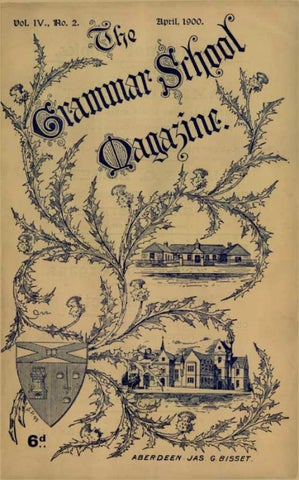
WAI. IV., Mo. 2. 61_,G1 V.. sQ
t~,ri[, 1000.
ABER DEEN • JAS. G.8/SSET.
Educational Books. JAMES G. BISSET ONTINUES to supply all the Class Books (New or Second-hand) suited for the Requirements of the Higher Educational Institutions in the City, at the Lowest Prices.
C
N.A.-BEST VALUE IN STUDENTS' NOTE BOOKS.
JAMES G. BISSET, Classical, McNutt, anti Ebitcational Moohseller,
85 BROAD STREET (Opposite Marlschal College).
pianofortes, harmoniums, and Organs. James Macbeth Has always on hand a Magnificent Assortment of
GRAND PIANOS, COTTAGE PIANOS, FRENCH and GERMAN HARMONIUMS, For Sale or Hire on the Three Years' System.
SECOND-HAND PIANOS, ORGANS, & HARMONIUMS ALWAYS IN STOCK, VERY CHEAP.
inspection requested of my Stock before settling elsewhere.
Pianoforte and Music Saloon181
UNION
STREET, ABERDEEN.
CONTENTS. Elm AATPIHN.
By Dr. MOIR
31
-
-
-
-
-
-
-
-
- 32
NOTES ABOUT OLD BOYS -
-
-
-
-
36
THE BURSARY COMPETITION
-
-
-
-
39
SCENES IN CALIFORNIA
._
-
-
-
39
THE DEATH OF RUSKIN
-
-
-
-
49
-
-
-
52
-
-
-
56
-
-
59
-
-
61
SCHOOL NOTES -
-
A SPANISH BULL FIGHT PUER NIPALENSIS
-
-
RUSSIA
-
-
.
-
..
THE EMBRYO OF THE SCHOLAR -
-
DUELLING IN GERMANY
-
-
-
-
63
THE ASSAULT-AT-ARMS
-
-
-
-
65
LADYSMITH DAY
-
-
-
- 66
FOOTBALL -
-
-
-
- 67
-
-
-
EXTRACTS FROM MINUTE-BOOK OF LITERARY CLUB AND DEBATING SOCIETY LIBRARY NOTES
-
SWIMMING CLUB
-
-
-
-
-
-
-
CYCLING CLUB -
-
-
OUR LETTER RACK
-
-
OUR POETS' CORNER
-
-
70
-
74
-
74
-
75
-
-
-
75
-
-
-
-
-
76
ANSWER TO CORRESPONDENT
-
-
-
-
78
and
SHORTI4RND
TYPEWRITING.
C. M. LAWRENCE, Ebe Elbert)ecn Zchool of %bortbant, 19 CROWN STREET. Prospectus
TEXT
on
application.
BOOKS
Of alt lkitibs, (NEW AND SECOND-HAND), AT
247 UNION STREET, D. WYLLIE & SON, ABERDEEN. 1900.
ROYAL SUNBEAMS.
-• - -
'
Reduced in Price from £18 18s. to £14 14s. With the famous Oil Bath Gear Case.
62
rit. WATT & CO.
St. Nicholas Street.
470 Union Street.
32
The Grammar School Magazine.
ENTERPRISE ! ENTERPRISE ! What cannot be done with a little of that estimable commodity? In the last number of this Magazine we were somewhat venturesome, and lo ! it hath succeeded beyond our wildest hopes. From everyone —present pupils, Old Boys, and the general public—our first issue met with a most generous response. Especially are we indebted to Sir Arthur Farquhar, one of our most famous " Old Boys," for his generous donation of £1. Sir Arthur's interest in the School and in all pertaining to it is unflagging, and should be an example to others to follow in his steps. We are glad, too, to see that the School is waking up out of its long sleep, and beginning to be a little more interested in its Clubs and Institutions, and that the Mag. is coming in for its proper share of attention. Some more of the School than usual have even wakened up enough to send in contributions, which we accept with thanks, but, like our old friend Oliver Twist, "ask for more." We must not forget in the present number to thank Mr. Pope for the beautiful design of our new cover. We had done so last time, but unfortunately, owing to a misunderstanding with our printers, it did not appear. Mr. Pope is always ready to help when he can, and his kindness and readiness deserve our heartiest thanks. In common with the rest of the Academic Institutions of Aberdeen, and indeed of the whole country, we have to deplore the loss of the revered Principal of the University. Sir William Geddes was a man in a thousand, kindly, chivalrous, with much of that old-world courtesy which is so rare nowadays, and bound up in the interests of the Institution which so long owned his capable, yet by no means harsh, government. To see his hoary head in the old Chapel at King's or in the magnificent Hall at Marischal was of itself sufficient to inspire an awe and solemnity to the ceremony which he graced by his presence. Sir William vas an orator, a scholar, a teacher, and, above all, a. man
THE LATE PRINCIPAL SIR WILLIAM GEDDES.
THE
@rammat School tilaga3inc. Vol. IV.
No. 2.
APRIL, 1900. -
EIE AATPIHN.
KaXal µ(v flow 6x0at McLEArovat, oplaras U gfc€1 µax' .1)/a4 srisr-ret, o5 %%WC AcaTin sriaTsv TE SEEI771, re, Xathlw gawKa scci7W, µeµv$Qoµae S' 4 aid. srEpt Aavpins KaXis Sip €xwv 174.) Odvoeµ' dv. NsOaryes au Aircorov, &spiv, 7 g)CE f KinCVOS Ws. d7rwsr€v oi1O 1)Xtos On'CO KCLX:11,
Kopip,
71- 01./.
srpoicrarac -y avaaWv. Kvavatryh dµµa rep! Aavpisis kaXis 3.4 BdVOLµ' dv. gKCJI, 'Os dv81ov Spocraras, ficsives sroSaiv iXaOpoIv. XaXei 64' appWs cJr ev Otp€e rveouo-tv ar,pat µd1 7ppEµaiae. 18' 617-LP CiVT1 irdvs-wv. repl Actyssjs KaXiis Sip eK49, &yd.) 0dvoeµ' JAMES MOIR-
2
32
The Grammar School Magazine.
ENTERPRISE! ENTERPRISE ! What cannot be done with a little of that estimable commodity ? In the last number of this Magazine we were somewhat venturesome, and lo ! it bath succeeded beyond our wildest hopes. From everyone —present pupils, Old Boys, and the general public—our first issue met with a most generous response. Especially are we indebted to Sir Arthur Farquhar, one of our most famous " Old Boys," for his generous donation of £1. Sir Arthur's interest in the School and in all pertaining to it is unflagging, and should be an example to others to follow in his steps. We are glad, too, to see that the School is waking up out of its long sleep, and beginning to be a little more interested in its Clubs and Institutions, and that the Mag. is coming in for its proper share of attention. Some more of the School than usual have even wakened up enough to send in contributions, which we accept with thanks, but, like our old friend Oliver Twist, "ask for more." We must not forget in the present number to thank Mr. Pope for the beautiful design of our new cover. We had done so last time, but unfortunately, owing to a misunderstanding with our printers, it did not appear. Mr. Pope is always ready to help when he can, and his kindness and readiness deserve our heartiest thanks. In common with the rest of the Academic Institutions of Aberdeen, and indeed of the whole country, we have to deplore the loss of the revered Principal of the University. Sir William Geddes was a man in a thousand, kinlly, chivalrous, with much of that old-world courtesy which is so rare nowadays, and bound up in the interests of the Institution which so long owned his capable, yet by no means harsh, government. To see his hoary head in the old Chapel at King's or in the magnificent Hall at Marischal was of itself sufficient to inspire an awe and solemnity to the ceremony which he graced by his presence. Sir William vas an orator, a scholar, a teacher, and, above all, a man
School Notes.
33
to be looked up to, and to be imitated by those who come after him. We heartily congratulate Dr. Lang on his appointment as his successor, and trust he will prove himself worthy of the great trust reposed in him. We extend a most cordial welcome to George Middleton, Esq., M.A. (Aberd.), B.A. (Cantab.), who was appointed some time ago to the post of Classical Master, and hope that his stay with us will be a long and happy one. Mr. Middleton comes to us with honours won not only from our own Alma Mater, but also from the " arenas of the south," and has won many of the highest honours for scholarship that our country has to give, including the much-coveted Fullerton. We hope and believe, that the appointment of Mr. Middleton will be the means of adding new laurels to the wreath of honour that our ancient School has won in the " days that are no more." We also hope to be able in our next number to publish an article by him, which we are sure will be of great interest. To THE PUBLIC.—We take this opportunity of informing the public that our grounds are not a public thoroughfare —a fact which they either ignore or are not aware of. The number of people who pass over our grounds, and who have no earthly right to do so, is enormous. F.P.'s, of course, and parents of present pupils are perfectly entitled to make use of the short cut, provided they keep to the paths ; but when ladies, workmen, message boys, and (worst of all) schoolboys on their way to " the other place" begin to make use of our grounds, it becomes unbearable, and the School cannot be expected to put up with it. A path has gradually been made across one of our pitches, and games have frequently to be stopped to allow a lady to pass. We hope that the public will observe that our grounds are private, and that this practice of making use of them as a public road must be put an end to. The Literary Club and Debating Society is to be congratulated on a very successful season. Some of the ordinary meetings have not been just paragons of good order, but the want of order was not marked enough to require any comment. The lectures especially were very enjoyable, and, although unfortunately we did not hear theni all, those that we did hear were of the very highest order, but would have been improved by the presence of some of the VII., some of whom ought to feel very much
34
The Grammar School Magazine.
ashamed of themselves. If it is a " waste of time," the VII. have themselves to blame, because if they came it would cease to be so. The following deserves the careful attention of the whole School, and we trust that the Rector's generous and highly commendable offer will receive the hearty response it deserves : TWO
SILVER MEDALS,
Open to all present members of the School, are offered by the RECTOR for— (A) Best List of English Novels dealing with events of British History. (B) Best List of English Poems dealing with events of British History. N.B.—A Prize is offered for any such List of considerable merit sent from a Middle School boy. CONDITIONS. The List of Novels (Poems) must be numbered, and in chronological order according to date or period, and date or approximate date to be given ; also the CORRECT TITLE, the name of the author, and an alphabetical list of authors, with numbers appended of works mentioned in the List. The whole must be written in the competitor's own handwriting, stitched, and covered by a title-sheet bearing an APPROPRIATE MOTTO, but UNSIGNED. This must be accompanied by a sealed envelope bearing the same title and motto, and containing inside the competitor's NAME and CLASS. Lists must be handed to the Janitor by 4 p.m. on Friday, 1st June. H. F. MORLAND SIMPSON. We are indebted to the Editors of Alma Mater for the portrait of the late Principal Sir William Geddes which forms our supplement. It is very far from our purpose to give anyone a free advertisement in these pages, but we would advise every fellow who likes a good magazine void of sensational, “ penny horrible" rubbish, to read The Captain. There is no boys magazine half so good.
School Notes.
35
Truly this is a woeful world ! Wherever we go we have to take up our pen to rail at something wrong. For example, we go to a football match, and what do we see? The Middle, Lower, and, alas! some of the Upper School disporting themselves on the pitch. Now, my friends, what is that rope for? (" Happy thought! " says some very small boy, " for swinging on.") For all the use it's put to, it might be there as an ornament; which it is not. Therefore, please note that " SPECTATORS ARE REQUESTED TO KEEP ON THE SOUTH SIDE OF THE ROPE." Again, there is that Reading Room (by the way, it is a Reading Room, . not a gymnasium). Talk about Dargai ! The hail of bullets there was nothing to the hail of magazines in our Reading Room. Vainly do the studious try to improve their minds at 11 a.m. It is hopeless ; their books, and even themselves, get thrown about all over the place; but here the VII. are hardly to blame. It is for the most part the VI. who misbehave themselves, and, therefore, who ought to suffer for it. It is not generally known that at the back of the picture of James Dun, LL.D., in the Hall there is the following inscription. We are indebted to the Rector both for the discovery of this and for permission to reproduce it :— [JOAN TAYLOR, M.D., EULOGIUM.] IACOBI DUN NONAGENARII GRAMMATICES VTRIVSQVE IVRIS DOCTORIS ERVDITISSIMI ORNATISSIMI SVB HOC MARMORE DORMIVNT RELIQVIA VIR ILLE EGREGIVS VIRTVTE NEMINI SECVNDVS EHEV RESPVBLICA ! VBINAM INVENIES PAREM ? .
.
.
.
.
.
.
.
.
SPIRITVM ATHERIVM PROCVL DVBII AD ASTRA VIAM EXPLORABAT •
•
•
•
•
•
•
•
CRESCIT OCCVLTO, VELVT ARBOR OVO FANA MARCELLI . . *Jac. Hay Beattie. . . . . . . • • • . MICAT INTER MANES IVLIVM SIDVS VELVT INTER STELLAS LVNA MINORES *Mont. Beattie. E jus ROBERTSON, Pinxit.
[Who was Robertson?]
Our heartiest thanks are due to Samuel Pope, Esq., Junior, for the excellent painting in water-colour which has
36
The Grammar School Magazine.
lately been added to the walls of our Hall. The subject of the picture is the house in Mid Stocket Road in which Lord Byron used sometimes to spend his holidays. The painting makes a very welcome addition to our already good collection, and should be much appreciated. " Footer" is now over for the season, and bats and " vagrant pieces of leather," as Dean Farrar has it, take its place. We sincerely hope that the cricket season will be a very successful one, though we understand that, owing to some mistake or other, we have as yet only six fixtures. J. Brebner, the captain-elect, is well fitted for the post, and should gain us fresh honours in the cricket field.
SIR WILLIAM DIIGUID GEDDES, LL.D., one of our most dis-
tinguished Old Boys, has passed away. He was not educated at our School, but he was Classical Master with us for several years, and on the death of Dr. Melvin he succeeded to the Rectorship. He held this office for about two years, when in 1855 he was appointed Professor of Greek in the University. In 1885 he• was made Principal. Of his scholarship and attainments let others speak: we simply record the loss of one whose interest in our School was great. J. C. Philip, M.A., B.Sc., Ph.D., has received the appointment of Demonstrator in Chemistry at the Royal College of Science. Lieutenant Robb, of the Durham Light Infantry, who has been serving in the Chinese Boundary Commission, has been promoted Captain. Our Mr. Ritchie's brother, who is at the front, says that he met four old Grammarians of his own class the first night he spent in Kimberley.
Notes about Old Boys.
37
We regret to have to record the death of F. F. Macalpine, whose name is on the wall of our Hall. After a distinguished career at School and at King's College he graduated in 1896. Taking up journalism as his profession, he went to Australia, and at the time of his death he was returning thither after a holiday in this country. He had a wide circle of friends. Lieutenant R. A. Duthie, R.E., who volunteered for the front, was entertained by a few of his old class-fellows to an impromptu social evening before he left for India. C. Watt and John Pope almost at a moment's notice whipped up about thirty F.P.'s—all class-fellows—and convened them in the Queen's Restaurant. Mr. C. Davidson was in the chair. A capital evening was spent in spinning yarns about old times, and songs were given by Messrs. J. Hector, Pope, Fraser, Watt, and the Chairman. During the evening a beautiful silver cigarette case, with the School arms engraved on it, was presented to Lieutenant Duthie, with best wishes for his success in South Africa. In the course of his reply Lieutenant Duthie said that he would do his best for the honour of his old School. The evening—all too short—was concluded by the singing of " God Save the Queen." Lieutenant Duthie appeared next day at School all resplendent in crimson and gold to bid good-bye to the Masters, and he received quite an ovation from the School. Good luck to him. James MacDonald, LL.D., late Rector of Kelvinside Academy, has died. He left School for King's College as First Bursar in 1845, and after graduating he was successively parish schoolmaster; English Master at Elgin Academy in 1849 ; Rector of Ayr in 1862 ; and in 1883 Rector of Kelvinside. He was a noted antiquarian, and did a great deal of research. James Moir, M.A., B.Sc., has gained the 1851 Science Scholarship. It is of the annual value of £150, and is tenable for two years. The Rev. Alex. Milne, minister of Tough, has died. He left School in 1831. He was a noted horticulturist, and possessed perhaps the finest rockery in Scotland. It contained many rare Alpine plants.
•
38
The Grammar School Magazine.
William Ironside Moir, Af.B., Ch.B., has been appointed assistant to Professor Ferrier, London. John A. Lendrum, who was Latin Dux of the School in 1884, has been appointed minister of the Free South Church, Elgin. C. H. Milne, one of the Classical Masters in George Watson's College, Edinburgh, has been appointed Rector of Arbroath Academy. The third annual reunion of the VI. Modern 1896-97 was held in the Central Hotel on Friday, 12th January, one member only being absent. The company, to the number of eight, sat down to dinner at 7.30. During dinner pleasing (and painful) reminiscences of School life were vividly recalled. The various toasts of "The Queen," " The School," &c., having been honoured amidst great enthusiasm, the company adjourned, and, under the presidency of Mr. Alfred Smith, joined in numerous choruses, which were • enthusiastically applauded. Throughout the evening Messrs. Simpson, Harper, and Robb favoured us with a greatly appreciated trio, while Messrs. Watson, Mackenzie, Rhind, Combe, and Smith contributed solos, the comic element predominating. Messrs. Watson. and Rhind shared the duties of accompanist. In the course of the evening supper was served. The toast of "The Class" having been proposed in a few well-chosen words by Mr. Henry Watson, a hearty response was• given, all joining in singing " For we are jolly good fellows." In spite of our lusty musical efforts the rousing strains of " Auld Lang Syne" were then rendered with great gusto, and an exceedingly pleasant evening was brought to a close by the singing of the National Anthem. Robert M. Milne, M.A., has lately been appointed Instructor of Mathematics at the Royal Military Academy, Woolwich. After graduating M.A. at Aberdeen University, with first-class honours in Mathematics, Mr. Milne gained an open scholarship at Cambridge, and graduated there as a high wrangler in 1897. Mr. William Watt, of the Free Press, has written "A History of Aberdeen and Banff," which has just been published in Blackwood's "County Histories" Series. It is meeting with a very favourable reception, a local author of repute remarking that "every page of it should be carefully read."
The Bursary Competition.
39
THE BURSARY COMPETITION. THE Annual Tournanient at Marischal College is over, and the school has come out of it with flying colours, though not quite foremost, but with 3rd, 4th, and 8th places—three out of the first ten, which is as much as any other school can claim. The following is the roll of honour :3. 4. 8. 13. 15. 30. 35. 40. 44. 46. 49. 55. 58. 60. 62. 66. 68. 86.
Norman Munro Alexander Andrew Moir John Brebner Robert John Gilchrist Alfred Forbes Milne David Drummond Smith James Alexander Copland William Rae George Marr Giles Alexander Macdonald Ian Malcolm M`Laren John Minto Robertson William Souter Mackie Angus Murray Alexander Murray George Dawson Andrew R. Williamson William Dawson Scott
-
_
1506. 1477. 1451. 1411. 1394. 1307. 1285. 1275. 1250. 1241. 1213. 1191. 1165. 1150. 1142. 1125. 1116. 1034.
Three of the places, the 55th, 58th, and 68th, are taken by the Classical VI., and these figures may be taken as prophetic of brilliant results next year. The following is a comparison of results in the last three Competitions :In the first 10 20,, 3040,, 50II
It
tl
60
-
708090 -
-
-
-
-
-
-
-
-
.
_
-
1900. 3 5 6 8 11 14 17 17 18
1899. 1 5 7 9 10 13 17 19 22
1898. 1 3 4 5 9 12 16 17 19
The conclusions to be drawn from these figures we must leave to the intelligence of our readers. AN ACCOUNT OF A TRIP TO THE YOSEMITE VALLEY AND MAMMOTH TREES OF CALIFORNIA. BY AN OLD PUPIL OF THE SCHOOL. BEING at San Francisco in the summer of 1871, I determined to take a trip with a companion to the far-famed Yosemite Valley and the Mammoth Trees, both justly ranked amongst the wonders of the world—the first on
40
The Grammar School Magazine.
account of its unrivalled scenery, the second on account of their exceeding in size any other known trees either in the old or new world. My companion and I having fixed on the 19th June, 1871, for our trip, collected what information we could as to the most eligible route to and fro, bearing in mind our limited time. There are three routes to the valley—one via Mariposa and the Mariposa grove of the big trees; another by Coulterville; and the third via Copperopolis and the Celaceas grove. After due consideration, we determined to go by the Mariposa Valley and return by Coulterville, thus embracing with the greatest ease one group of the giant trees. The Yosemite Valley lies nearly due east, as the crow flies about 150 miles from San Francisco (by the route 230), in the lap of the Merced group of the great Sierra Nevada range of mountains ; and the Merced river first becomes a river of any size in its bosom, and takes its rise higher up • in the mountain. The valley was first discovered by Major Savage, of the -United States Army, in 1851, when in pursuit of some predatory Indians, but only within the last few years has it become accessible, except to a few hardy pioneers. Having obtained through tickets at San Francisco, on the day appointed we crossed by steamboat to Oakland, on the opposite side of the bay, and thence proceeded to Lathrope, 80 miles on the Pacific line, whence we branched off to Modesta, twenty miles further on, where we got good accommodation in a newly-built hotel. The railway on leaving Oakland takes a south-easterly direction along the bay ; then, turning to the north-east, passes through a low coast range of wooded hills, and across a fine, rich, wheatproducing plain, now, however, completely burnt up by two successive years of drought. Near Lathrope we crossed the San Joaquin river, which in time will be utilised to irrigate the valley which bears its name. On the following morning, after a four-o'clock breakfast, we started in a lumbering coach drawn by eight horses, crammed inside and out. I, being wedged in between two big, broad-shouldered men, was nearly smothered ; whilst my companion, with a British seaman's proverbial gallantry, having given up his outer seat to a lady, was rewarded by her sweetest smiles, and the perfect confidence she displayed in resting her wearied head on his shoulder, of which service and his agreeable conversation she will ever retain a lively and grateful remembrance.
Scenes in California.
41
A heavy shower of rain during the night (unusual at this season) had cooled the air and laid the dust, so that beyond being crammed and jolted over an execrable tract we did not experience much inconvenience. All the plain lying between the low coast range and the foot of the mountains is a rich soil, and when it receives a due proportion of rain, produces heavy grain crops; but no dependence can be placed on the seasons, and experience begins to teach the farmers that a system of irrigation alone can ensure crops. This can be easily effected ; in fact, an English gentleman, who'has had great experience in India, has undertaken the operation on. a grand scale. Having lunched at the village of Hornitas, after a drive of about 50 miles, we travelled over a picturesque country to Bear Valley, where we had to mourn the loss of three out of five of our fair fellow-travellers, who on the coach waved a tender adieu. In the Bear Valley district several gold mines are being worked, and the bears, from which it derives its name, are nearly extirpated. Mariposa, which we reached at 6 p.m., is the capital of the county, and situated in a pretty valley, with a stream running along the foot of the hills. A quartz-crushing mill was erected here on a large scale by a company, but the capital having been " played out," the mill has come to a standstill. The region, however, is rich in gold, and the bases of the hills are literally honeycombed by the gold-washing huts, but only a few Chinamen now remain of the mining host. The surface has been well washed, but hydraulic power, when water is plentiful, might doubtless still be used with success. A vein of gold-bearing quartz also traverses the district. From Mariposa we wound our way upwards through a wooded country, and arrived about 9 o'clock at our night quarters, White and Hutch's—a pleasant, clean house, standing at an elevation of 3,000 feet above the level of the sea, where we found the air pure, keen, and appetising, which enabled us to do ample justice to the really excellent repast furnished. As regards the good fare, the same may be remarked of the various inns established along the route to the Yosemite Valley. The keepers are generally intelligent, well-informed, and. industrious, apparently superior in most respects to the same class in the old country. After an early breakfast the following morning, we again started by coach, our route lying entirely through a forest of magnificent pines and cedars, interspersed with ever-green oaks and flowering shrubs. The ground was
42
The Grammar School Magazine.
perfectly enamelled with wild flowers, some of them very beautiful, especially the snow plant, which resembles a double hyacinth of a deep red colour, but gives forth no fragrance. It grows at high altitudes, nourished amidst the frosts and snows of winter. We crossed the Chovilla mountain at an elevation of 7,000 feet, and then descended by an easy grade to Clark's Ranche, which we reached at 11 a.m. The ranche is situated in a narrow valley, through which runs the south fork of the Merced river, and is the largest establishment on the route. We found the quarters most comfortable and the fare abundant. Mr. Clark is one of the oldest pioneers, a fine specimen of the class, and discoverer of the Mariposa grove of the big trees. The drivers of the coaches ought also to be mentioned as a singularly fine race of men, possessed of great shrewdness and intelligence, inured to hard work, and formerly exposed to constant danger from the Indians. We found them civil, obliging, and communicative. One amused us exceedingly by his description of a Scotch naturalist, with whom he had roamed through the forests collecting butterflies and insects. Mariposa (meaning "butterfly" in Spanish) derived its name from these beautiful insects, which abound and are of brilliant hues. By the time we had reached Clark's we had become pretty well acquainted with our fellow-travellers, and found some of them very agreeable. One, a preacher of note in Sacramento, was making the trip with two lady connections. He had travelled over Europe, the Holy Land, and many parts of the globe, so that we found many subjects of mutual interest, besides being both enthusiastic admirers of fine scenery ; and, as their plans suited ours, we arranged to proceed together. So, after lunch, we all set out on horseback to the Mammoth Trees. Our guide was young, but intelligent and active, constantly on the watch to " hinch " up the girths when they got slack, to prevent a catastrophe. Our trail at first lay along the valley, partly enclosed as farm land attached to the ranche ; then we scrambled up a steep and rugged path to the height of 1,200 feet, occasionally getting glimpses of deep wooded hollows, overhung by What a glorious forest we rode through, rugged cliffs. composed of yellow, sugar, and Douglas pines, 10 to 12 feet in diameter, 300 feet in height, and without a branch for 200 feet. Such a ride alone compensated one for the trip ; but behold below us in a swampy hollow a prostrate giant in expiring gasp after having dwelt in the solitude of the forest for upwards of 2,000 years. Before the star of
Scenes in California.
43
Bethlehem had risen in the East, before great Cfesar before Old England was discovered by the ancients, " died, thou didst spread thy branches abroad." These thoughts filled my imagination, almost to the exclusion of astonishment at the gigantic proportions of the tree. By rough steps we mounted the trunk, and stood nearly 30 feet from the ground. Other great trees were near, but we had to move on some distance before arriving at the grizzly giant, nearly 100 feet in circumference, albeit fire had passed over it, and burnt away a portion of its girth. Its first branch is 150 to 180 feet from the ground and 8 feet in diameter. I rode round it, gazing in admiration and astonishment. Its top had either decayed by age or been blown off by the wind, but its height is still 400 feet and upwards. We now wandered from tree to tree, lost in amazement. The grove consists of about 600 trees, more than one over 100 feet in circumference. They are a species of cedar, named by an Englishman Wellinytonia gigantea, the botanical name being Sequoia gigantea (Sempervirens) of the genus Taxadium. The largest trees have been named by travellers, such as " The Grizzly Giant," " Fallen Monarch," " Forest Queen," " Aged Couple," " Titan's Spear," &c. To equal which the tallest pines " Hewn in Norwegian hills, to be the masts Of some great war-vessel, were but wands."
Some of us were able to ride three abreast through the hollow, charred trunk, and we saw a trunk which indicated a tree had existed 120 feet in circumference. Unfortunately most of the largest trees have been touched by fire-the ruthless work of the Indians. Several groups of Sequoia have been discovered, but this is the most numerous, although the Celacous grove lays claim to a larger tree than any I have mentioned, whose age has been computed at from 2,500 to 3,000 years, but it is impossible to arrive even at an approximation. It has been calculated that the trunk alone of one of the largest, cut into paling 8 feet long and 4 inches square, would enclose 2,200 acres of ground. It was only when the guide warned us that night would overtake us in the depths of the forest that we reluctantly quitted a scene fraught with such interest, and, re-mounting, rode towards our place of rest in the waning light, more impressed than ever with the grandeur of these forests. Such scenes tend to elevate the mind, and turn it to the great Creator of the Universe, whose hand has fashioned with equal ease and wisdom the tiny blade of grass and
44
The Grammar School Magazine.
those giant trees of the forest. By 8 o'clock we got back to the ranche, where an excellent dinner awaited us, after which we retired to enjoy such a sleep as a long day in a pure and bracing air must always ensure. YOSEMITE VALLEY.
Up betimes and got off by 7 on horseback (our stage travelling ending here), accompanied by our friends of the previous day. After crossing the south fork of the Merced, a clear and rapid stream, we wound our way along the side of a precipitous hill overlooking a deep valley, and after crossing the open glades, made a great ascent through the same character of pine forest, now and then catching glimpses of the distant mountains. At 11.30 we arrived at Peregoy Ranche, situated on the edge of a swampy plain, having gone about 14 miles. This ranche was formerly a cattle ranche, but has lately been fitted up for the accommodation of tourists wishing to get the first view of the valley from the Sentinel Dome and Glacier Point—our object also. When preparing to start for these points after the mid-day meal, portentous clouds began to gather over the mountains, and soon a peal of thunder warned us the storm was at hand. It quickly burst upon us with great violence. The rain descended in torrents, the lightning flashed, and the thunder made the earth tremble as it reverberated from peak to peak. A storm amongst the mountains is always grand, but by 4 o'clock it had subsided— " The wind died away like a sleeping child's breath, The pavilion of clouds was unfurled, And the sun, like a spirit triumphant o'er death, Smiled out on this beautiful world."
The day being now far gone, the ladies thought a ride of 14 miles before dark too much for them, so they determined to postpone their first glimpse of the valley until the following morning. My friend and I having but scant time, started with our guide, and an hour and a half's ride—first over swampy plains, then through the forest—brought us to the Sentinel Dome, 4,500 feet above the valley, which burst upon us in all its sublimity and grandeur. The clouds had rolled off after the storm, and thin vapours crept up the sides of the mountains in fleecy clouds, lingering for a while, and then disappearing before the sun's rays. Far away to the east and south-east rose snow-capped peaks of the Sierra Nevada, from 13,000 to 14,000 feet above the level of the sea. To the south, Mount Star King ; to the
Scenes in California.
45
west and north-west, densely-wooded hills, cleft in two by a tremendous gorge, through which runs the Merced. Far beneath slept in peaceful beauty the Yosemite Valley, hemmed in on every side by giant cliffs, the streams like silver threads, its tall trees dwarfed to the size of shrubs, and its orchards looking like cabbage gardens. At the upper end of the valley a lake shone like a polished mirror. Almost in front of us the South Dome, "Tis-sa-ack," goddess of the valley," raised its mighty head 5,000 feet perpendicular ; on the north side of the valley El Capitan " Ise-Tock-ah-poa-lak," " great chief of the valley," 3,300 feet, beetling over the gorge, frowned in majesty; and adjoining it the Three Brothers " Pom-pom-pa-asus," " mountains playing at leap frog," resting one upon the other, ponderous and grand, facing the Three Graces, of softer beauty. The North Dome " Po-lay-o," "shade to baby cradle basket," 3,725 feet, supported by Washington Tower, " }Linde," " watching eye," 2,200 feet, hang over the mirror lake. Magnificent waterfalls at various points poured over the even-worn cliffs in sheets of dazzling foam. We could hear distinctly the roar of the Nevada Fall as the Merced threw itself with one wild bound 700 feet into the gorge below, flashing and glistening in the rays of the setting sun. At another point the Yosemite Fall precipitates itself 1,700 feet on to a broad ledge projecting from the cliff ; again it takes a leap of 600 feet ; and finally by a third bound of 434 feet, reaches the valley, there to be lost in the waters of the Merced. Other streams, now full from the recent storm, fall from the dizzy heights in snowy sheets into the valley. The whole conjured up some fairy scene, as memory recalled many a tale of childhood, where imprisoned princesses and huge giants had their dwelling in some such impenetrable spot, and imagination found a parallelism in those Titan rocks and sylvan beauty below. From the bald head of the Sentinel Dome we descended obliquely 1,200 feet to the Glacier Point, where from an overhanging rock we looked down sheer into the valley 3,700 feet. Being nearer the South Dome, it looked still grander, and we had also a finer view of the Nevada and Vernal Falls, with the foaming cataract below. The sun had dipped behind the mountains, and the valley was beginning to be steeped in gloom, ere we turned away from the fascinating scene to wend our way through the deepening forest to our night quarters. Filled with thoughts on the sublimity and grandeur of .the scene we
46
The Grammar School Magazine.
had left, we rode on slowly and in silence, until suddenly aroused from reverie by finding ourselves on the brink of a roaring torrent, which we had passed but four hours before a limpid stream. Our guide hesitated to cross, but on the one side was the prospect of a cold and dreary bivouac ; on the other shelter, warmth, and food. So, divested of his upper garment, and examining well the girths of the horses, he boldly plunged in. We followed, and all reached the opposite bank in safety, although at one time my horse lost its footing, and visions of being hurled down by the impetuous flood rose before me—happily not realised. How thankful I felt that the ladies had not accompanied us, as they dared not have attempted to cross until the flood had subsided. It was quite dark ere we reached our cosy quarters, where a cheerful fire welcomed us, and also a good dinner, and the evening passed most agreeably in the society of our companions. Again making an early rise, we set off for the valley, whilst the others went to the points of attraction we had visited the previous evening. After a five-mile ride through the same magnificent forest, with swampy bottoms at intervals, we arrived at the edge of the deep gorge through which the Merced flows, and having tied up our horses, scrambled to a projecting point commanding a glorious view of the whole length of the valley, being at an elevation of about 3,000 feet above it. The river, full from the recent rains, was pouring its floods along—sometimes a torrent of angry foam, anon placid, tranquil, and mirrorlike. On each side rose giant walls of rock, over which fell several waterfalls of exquisite beauty. How bold and grand El Capitan looked, the guardian of the pass ; how soft and graceful the wooded heights of the Three Graces ; and how mighty the South Dome, towering above all its compeers. The valley is about eight miles long, with a width of from half a mile to a mile. It is almost a dead level, and seems to have been formed by a sudden subsidence of the earth, as characteristics attending either the glacier formation or having been cut out by water are wanting. Its elevation is 4,000 feet above the level of the sea. After contemplating for some time the exquisite view from Inspiration Point, we commenced the descent by a steep and rugged trail, and, after an hour and a half of floundering progress, reached the valley, where the trail improved as we rode along under the shade of lofty pines and spreading oaks—at one time by the edge of a tumbling river, at another by the base of stupendous cliffs. By-and-
Scenes in California.
47
bye we approached the Bridal Veil Fall, called by the Indians " Pohono," " spirit of the evil wind," and held by them in superstitious awe. Diverging slightly, we got close to it. A perfect cloud of spray enveloped us at times, but as the wind drove it aside, we had a fine view of the fall amidst the roar of waters. The fall is about 700 feet in height, and soon after taking its wild leap over the precipice it seemed to lose its solidarity and to separate into rockets, in turn to burst into clouds of spray. Passing on, we had the Three Graces and Cathedral Spires on the one side, and El Capitan and Three Brothers on the other—all upwards of 3,000 feet in height, and almost perpendicular. There are several good hotels in the valley, and it was our intention to have gone to the oldest established, " Hutching's," but our fellow-travellers persuaded us to put up at " Luiding's," the first on entering the valley, where the fare is good and apartments clean. Immediately behind the hotel the Sentinel Rock rises, needle-shaped, 3,043 feet, and, nearly opposite, the Yosemite Fall takes its huge leap. I never wearied gazing on it, and watching the eddying wind bending into waving lines the snowy veil. Having lunched and obtained fresh horses and a guide, we started for the Nevada Fall. Riding up valley for some distance, we passed Blake's and Hutchking's Hotels; a large drinking saloon recently erected, with baths, hot, cold, and Turkish, attached ; also a laundry, dry goods store, and photographic establishment. Then, following the upward course of the Merced, which takes a sharp turn to the southward, we passed near the base of the Sentinel Dome, and close under Glacier Point. Crossing the entrance of the south canon, we caught sight of the South Fort Waterfall, but did not approach it, the way being blocked by large boulders cast down from the crags above. At times the valley is literally shaken by the shock of falling cliffs rent off in winter by the swelling ice or loosened by the floods. Continuing along the course of the river, now a foaming cataract, we wound our way up a giddy path, with frequently not a foot between us and the deep abyss. Occasionally we stopped to look back on the glories which different points revealed; then crossing the shoulder of a large buttress, we came in view of the Nevada Fall, and descending crossed the torrent, and rode to a house of refreshment not long built on a rocky plateau a short distance from the fall, and close under the Cap of Liberty, a cone rising 2,000 feet above the falls and 4,000 feet above the plain. Here we fell in with Colonel — and a large party, including
48
The Grammar School Magazine.
several ladies, who were making the same tour as ourselves, and just about to start for Clouds' Rest, a peak of the Sierra Nevada, where they wished us to accompany them, but time would not permit, so we separated. Leaving our horses, and again crossing the stream by a narrow footbridge, we got near the fall, which, although not the highest, is certainly almost the finest in the valley, as the main body of the Merced descends at one bound 700 feet. The sun shining on the glittering spray produced one of the most perfect and brilliant rainbows I ever witnessed, and, being low, appeared to envelop us. Having gazed at the magnificent spectacle above and below for a short time, we returned to the house, mounted our horses, and re-crossed the bridge. Then giving our horses to the guide, with directions to meet us at a point lower down, descended by a series of ladders to the foot of the fall, which is 350 feet high, named by the Indians " Pi-wy-ack," or " cataract of diamonds," which well describes its beauty. At this point a sad accident occurred the previous week. A tourist fell from the ladder, and was killed on the spot. Clouds of spray blown across our path rendered it exceedingly slippery, so that care had to be taken, as a false step might have been fatal, the foaming torrent being beneath. Rejoining our guide, we hastened homewards, stopping at the baths and saloon, where we refreshed the inner and outward man. Next morning off at daylight to see the reflection in the lake, before its surface was dimmed by the breeze. The lake lies near the head of the valley, between the South Dome on the one side and the North Dome and Washington Tower on the other. It is a small piece of water, deeply fringed with trees. Not a ripple disturbed the surface, and each peak, ridge, tree, crag, and shade was so faithfully reflected that it was difficult to discover where substance ended and shadow began. The blending was exquisite. Shortly the sun began to gild the mountain peaks and rugged crags, whose outline in the water looked like burnished gold. A musical echo was heard here—prolonged for a few seconds, and dying away in a most melancholy cadence. A very small part of the valley is cultivated, the greater portion being covered with brushwood or large trees, pines, ever-green oaks, maple, &c. In some places it has quite a park-like appearance. There are also beautiful shrubs and flowers. The white azaleas, with their faint perfume, scented. the morning air, with many others of varied hues.
Scenes in California.
49
Breakfasting early next morning, and bidding adieu to our pleasant fellow-travellers, we started on our return journey by the Coulterville route—young Coulter, the son of the old pioneer, being our guide. Passing down the valley for about a mile, we crossed to the north side of the Merced, continuing along its banks close by the base of El Capitan, and then took a very steep trail up the mountain-. side through the woods. Having gained the ridge, I took a last fond, lingering look of the valley, and can say almost in the words of a great traveller—" I never left a place with such pleasurable regret." I. have travelled almost the world over, have seen some of the finest scenery, but have never seen so much of sublime grandeur, relieved by so much beauty, as that which I have witnessed in the Yosemite Valley. After a ride of about 16 miles, we overtook the party of General J , also homeward bound, and a short distance further on our equestrian travel ended. Here we lunched, and, having got a rattle-trap and pair of " screws," drove ourselves the greater part of the way to Coulterville. The drive was beautiful along the mountain-side, as at times we had magnificent views over the valley of the Merced and far away to the plains. At 6 we reached Coulterville, having brought the same pair of horses 30 miles, which distance they had done previously earlier in the morning. They were a curious specimen of the genus " screw," but did their work well. One had the peculiarity of going round the corners on three legs, with the fourth stuck rigidly out, which rendered some of the critical turnings a little unpleasant. We reached San Francisco on the morning of the 27th, having travelled by coach, train, and ferry ; and so ended my trip to the Big Trees and the Yosemite Valley.
THE DEATH OF RUSKIN. THE death of Ruskin fitly synchronises with the close of the century. Many years ago now, when Carlyle passed away, I remember Professor Nichol, then Professor of English. Literature at Glasgow University, estimating it in his own grandiloquent way. " With the death of Carlyle," he said, ' the throne of Victorian literature may be said to have fallen vacant. There is none quite fit to take his place. Tennyson and Browning, Matthew Arnold and Ruskin, may
50
The Grammar School Magazine.
be named as first Consuls, but the Emperor is gone." All these giants of a day, which future generations may characterise differently from us, but cannot surely estimate other than as great, are now gone. John Ruskin has, like a trumpet-note echoing among his beloved mountains, lingered longer than the rest, but now he has passed in the harsh din of war, and with him a century and a Literature closes. The first pre-eminent thing that strikes one in Ruskin is his style. Buffon's saying about the style being the man, is very true of great writers. Little writers have no style. You could not tell Jack from Jill from their correspondence unless their opinions happened to be known to you. But, as Johnson says, " He that writes much will not easily escape a manner," and it is the mark of all great writers— with, perhaps, the doubtful exception of Walter Scott, whose style was spoilt by his habit of dictation—that they have a very strong and notable style. Of this truth Ruskin is a striking illustration. Next to Carlyle, there is none so characteristic in the century. A literature-taster could hardly go wrong with a paragraph of his. The long, opulent sentences, the glowing colour, the allusions to nature and art, would make concealment impossible. " Thy speech bewrayeth thee ! " Ruskin's style belongs to the ornate and periodic class. In this he differs from the great bulk of his contemporaries. Arnold and Froude, and Newman and Morley, love simplicity—short, terse sentences, and economy in adjectives. On the whole, we must confess we prefer the quiet, " bread-and-butter" style to the pastry of ornate writers. But then, as a French essayist has said, " there is only one bad style—the tedious." Ruskin, unless when. he begins to preach too much, is never tedious, and when he was at his best—in the early days of " Modern Painters "—some of his pages were as glorious as a sunset. Take, for example, the following description of the death of Moses in. the fourth volume of his " Modern Painters " :—" It was not," I quote from the first edition, " to embitter the last hours of his life that God restored to him for a day the beloved solitudes he had lost, and breathed the peace of the perpetual hills around him, and cast the world in which he had laboured and sinned far beneath his feet in. that mist of dying blue—all sin, all wandering, soon to be forgotten for ever, the Dead Sea laid waveless beneath him, and beyond it the fair hills of Judah and the soft plains and banks of Jordan, purple in
The Death of Ruskin.
51
the evening light as with the blood of redemption, and fading in. their distant fulness into mysteries of promise and of love." Only one man in the century could have written like that—De Quincey—and while the opium-eater could only have done so once or twice in a lifetime, Ruskin did it every other page. But, distinguished as Ruskin is for his style, it would be a vast error to 'suppose that this is his only distinction. He is, besides that, a great prophet of his age; perhaps the greatest after Carlyle, Tennyson, and Browning. It would be impossible in a short paper like this to sum up all the truths he tried to teach his generation. But it may be said that one of the greatest of these was the great burden of Carlyle—" At all hazards be true." He hated falseness of any kind, falseness in art or morals. His chief objection to many of the painters who were admired last century was their lack of truth. " The root of false idealism," he says, " is the endeavour to get effects instead of facts," and he praised the Pre-Raphaelite Brotherhood for their painstaking minuteness in working up the details of their pictures. These views he has nobly developed in his " Seven Lamps of Architecture "—a book which is worthy to be read not merely by architects of buildings, but by architects of life. In that work his chapters on The Lamp of Truth " and " The Lamp of Sacrifice" are amongst the noblest things he has done. Ruskin's views on art are sometimes whimsical, and Mr. Hamerton is said to be a much more reliable judge in such questions than his more brilliant contemporary. The general tendency of his teaching, however, is wholly good, and in an age when 'shams abounded, and wealth was everywhere tending to pernicious and vulgar display, his gospel of sincerity and simplicity was infinitely wholesome. In later years Ruskin more and more applied his views to the conduct of life. He became like Carlyle, whom he lovingly looked to as his master, a prophet warring against insincerity of every kind. Some of these later books are amongst his most popular works, though we hardly think they reach the splendid enthusiasm of his earlier writings. Yet it is hard to think of anything finer than his lectures to women in his " Sesame and Lilies," with its magnificent appeal at the close of the chapter on " Queen's Gardens." Like Carlyle, he was a great believer in the power of work. He did not believe like him that " Genius was the capacity for taking infinite pains," but he would have said
52
The Grammar School Magazine.
that genius without work would accomplish nothing—that genius without. work was, in fact, no genius at all. " You may have known," he says, " clever men who were indolent, you never knew a great man who was so. During such investigations as I have been. able to give the lives of the artists whose works are in all points noblest, no fact ever looms so large upon me, no law remains so stedfast in the universality of its application, as the fact and law that they are all great workers. When I hear a young man spoken of as giving promise of high genius, the first question I ask about him is always—' Does he work?'" With all that, Ruskin did not undervalue athletics. In one of his whimsical moods he once said—" At this day the most useful things boys learn at public schools are, I believe, riding, rowing, and cricketing," but he valued these things chiefly as the discipline of the body, invaluable in training hand and eye for the after work of life. No one, I think, can read Ruskin without feeling that the Christianity of his mother penetrates every tissue and fibre of his thought. Faith was a great reality to him, and he is never so noble as when he touches the sacred writings. Yet this faith in the Unseen was something that made this life real, and it was only in. that light that it had its chief value to him. "There is only one place," he once said, where a true man can be nobly thoughtless—his death-bed." It was so with him. From all accounts death seems to have crept upon his enfeebled body as gently as sleep steals upon an infant. But it found him not unready, and as a glorious sunset was lighting up the fells of his beloved Coniston Lake, the great spirit which had so often revelled in the beauties of nature passed into that Presence, " Whose dwelling is the light of setting suns, And the round ocean, and the living air, And the blue sky, and in the mind of man."
W. MACKINTOSH MACIIAY.
A SPANISH BULL FIGHT. WHEN we speak of "bull fight" in this country we can form but a poor idea of the excitement and enthusiasm which the single word toro raises in the mind of the average Spaniard. Weeks and weeks before the bull fight comes off—and there are generally not more than two great ones a year, except in Madrid, where there are fights almost every Sunday—nothing
A Spanish Bull Fight.
53
is talked about but the bulls, their colour, size, and from what establishment they come, and the bull-fighters. The latter especially form the subject of animated comment—how they did in Bilbao, in Zaragoza, in Madrid, if they were brave or " funky." The poorer classes will pawn the very lace of their pillows, which has descended as an heirloom in their families—and even the poorest peasant has a supply of most exquisite lace—to pay for the entrada to the Plaza de Toros. He may starve for a week afterwards, but he must see the bulls. The price of admission is rather high for Spain, as the lowest charge is 3 pesetas—about half-a-crown —and this is merely for entry. To secure a fairly good seat you have to pay more than twice this sum. There is generally a double performance, one on Saturday the other on Sunday ; and at midnight of the eve of the bull fight the animals are driven from some place near the city, where they have been resting for a few days, right through the streets up to the Plaza. The streets through which they pass are all most carefully barricaded, the people standing behind in thousands to see them pass. Poor animals ! they look quiet enough, little thinking what is before them on th 3 mlrrow. The bull-fighters, with their cuadrillas, will by this time have arrived at the chief hotel of the town, and will be feasted by high and low. Strangers from the remotest country villages, gipsies in their wild and picturesque-looking tatters, with huge bronze ear-rings, Arabs from the north coast of Africa in their turbans and white bernouses will all be there, so that on the afternoon of the fight the town is blazing with vivid contrasts of colour and well nigh bursting with excitement. It is on this day that the ladies don the national costume—mantilla of purest white lace coquettishly draped from the back of her head, amongst the raven tresses of which are twined small bunches of red or yellow flowers. All the most sparkling jewels are worn, and the most exquisite fan is produced from the box where it lies from one bull fight to another. The colour of the dress is often yellow, and is draped over with a black network of "pompoms," I think ladies here call them—madrono is the Spanish name. Towards four o'clock every one is seated in the huge stone building, open to the air, with its sloping seats like those of a circus, and what an animated scene it is. Everyone, man, woman, and child, is fluttering a fan of some kind or another, as the heat is generally intense. All round is heard the popping of corks, the clinking of glasses, bursts of merry laughter, thrust and parry of joke
54
The Grammar School Magazine.
and repartee. The band plays sprightly national airs. The policemen are rushing about with drawn swords, and at the end of every few benches stands a pair of the Guardia Civil in their black uniform with red facings, something like that of the British Grenadiers, leaning gravely on their loaded rifles. Tempers are a little more fiery here than in the North, and, with very little provocation, hot words soon give rise to blows, and blows to the deadly navaja, or knife, which the lower-class Spaniard wears stuck in his faja, and then there is some work for the doctor. But the intense suspense is at last ended by the entry into their box, decked with the national ensigns, of the president with his wife, family, and particular friends. The band suddenly stops. A warning note of the bugle sounds, and there steps into the arena from behind a concealed door a most picturesque procession, such as you see on fans. It is headed by an alguacil on horseback, in doublet and trunk hose of black velvet, with a richly plumed sombrero. Behind him in lines come the heroes of the day—the matadors with their cuaolrillas—all dressed in magnificent costumes of blue, gold, green, red, black, and other coloured silks, covered with heavy gold and silver lace. Tightly wrapped round them are gorgeously coloured silken cloaks, which show off their well-developed figures to great advantage. After these come the banderilleros in similar costumes, followed immediately by the picadors. These are mounted, and it is their duty to ward off the bull with their long blunt lances. Last of all come the gorgeously-caparisoned mules, decked with innumerable little bells, tassels, and flags, harnessed to a beam to drag out the dead horses. All this procession marches over the arena till it comes below the president's box. Then the leading horse, carefully trained, kneels down to the lady president, who flings the key of the torn down to the cavalier, who gracefully catches it in his plumed hat. Vivas rend the air. The horse rises from its knees, and, with head bent low, retreats backwards, caracoling through the avenues of the gladiators, who by this time have flung their cloaks with an easy air of negligence to some friend in the audience. They take up their position round the arena. The picadors hold their lances in rest. A dead silence falls on all. The trumpet sounds. A key turns, a huge door opens, and out rushes the bull with a huge satin bouquet stuck in his side. Its long white streamers fly out behind. Irritated by this he glares around, lashes his tail, and rushes at the first horse he sees. If he be a bull of any spirit, six horses and their riders are soon
A Spanish Bull Fight.
t I
•
I
I
55
laid low, the dead and dying bodies of the poor animals strewing the whole place, their riders extricating themselves as best they can. As soon as the bull has satisfied the audience in this, the first part of the fight, the second part is commenced. This is the placing of the long darts, the banderillas, by the banderillero. One man advances alone to the centre of the arena with a pair of the banderillas. Then rising on tiptoe, with arms extended full length, he waits the charge of the bull, and just as the animal, now mad with rage at the long red cloaks which the assistants trail in front of him, is on the point of tossing him in the air he deftly takes a step to the side, at the same time planting a couple of the darts above each shoulder. The huge brute rushes past, bellowing with rage at having missed his aim. Another couple and yet another are planted in rapid succession, the man just escaping being tossed each time by the merest hairbreadth. You hold your breath instinctively, and are glad when the banderillero, having finished his task, bows low before the thunders of applause which rend the air. If he has done very well, showers of cigarettes, bundles of cigars, occasionally a satin shoe or two, and numberless hats rain down on him. The attention of the bull is at present diverted by the other capeadores, who, on the bull rushing furiously at them, nimbly leap the barricade between the arena and the people. Then begins the last act. The espada, or matador— Guerrita, say, or Mazzantini—arming himself with a slender curved sword, advances into the arena with a jaunty air, gracefully tosses off his curious hat, showing beneath the long pleat of hair, bows to the lady president, assuring her, in a pretty little speech, that it is for her honour and for that of Spain in general, that he will try to distinguish himself in slaying the bull. The poor toro, now somewhat exhausted from the loss of blood caused by the banderillas, but still roaring angrily, glares with bloodshot eyes and lolling tongue at this new tormentor advancing to meet it. I must say that one's sympathies are entirely with the bull. One is almost disappointed to see that the brave animal has not transfixed one at least of its inhuman persecutors. The espada directs his cuadrilla to dart about in front of the animal's eyes waving their scarlet capas so that it may be confused. And, then, when the animal in one last desperate rush dashes madly at the espada, who is the central figure, he with one deft stroke of the sword severs the spinal cord, and the huge beast lies dead at his feet ! Frantic yells of applause, showers of cigars, &c. Woe be to him, however,
56
The Grammar School Magazine.
if he fail to kill. Stones, bottles, bits of benches will be hurled at his head, and the Gzutrdias may have to fix bayonets and charge the mob. This happened a few years ago in San Sebastian. Generally things go off quietly. Then come the mules to drag out the dead bodies. Five more bulls are killed that afternoon, and perhaps thirty horses. Six more bulls are kept for to-morrow, when the same performance is again gone through. C. D.
11
I
PITER NIPALENSIS. I AM not aware that the species Nipalensis varies much from other species of the great genus Puer, but as I am given to understand that an account of the Puer Nipalensis might prove interesting to the Puer Aberdoniensis, I shall try to give my readers a short, and I hope not altogether profitless, view of his appearance, manners, customs, and career in general. In the early years of his existence the Nipal boy is a jolly, fat, good-humoured little rascal, much made of and spoiled by his parents and relatives, and, as a rule, he may be said to have a good time. As regards clothing, in the early stage of his life he is not much oppressed by it. In summer a string and a cowrie round the loins, with a necklace supporting a talisman, and a gay little skull-cap of cotton cloth or tinsel, suffice. In winter this very airy costume is reinforced by a little coat reaching to the ankles, well lined with fur or wadded with cotton. As the boy developes, and passes out of the rolypoly into the lanky stage, he is promoted to peg-top pyjamas, fastened with a cord and tassels round the waist, and a jacket, the materials of which vary, of course, with the season, and as head gear he wears a skull-cap or jockeycap. In the higher ranks at this stage the costume is often gaudy. The pyjamas may be of silk, or even kincob—i.e., cloth of gold ; the jacket may be of silk lined with fur or gorgeously embroidered; and the cap may be a mass of pearls or jewels. Regarding his diet I shall not say much, as naturally it varies greatly, from rice and curried pulse, with manifold preparations of garlic, radishes, and other vegetables, raw or cooked, up to luxurious dishes of venison, game, and wild boar chops. Of sweets and fruit there is no lack, as
•
s 1
Puer Nipalensis.
•
s I
57
confectioners' shops abound in every village, and fearfully and wonderfully made confections are sold at prices adapted to the wants of the poorest consumers. In educational matters, I fear the Nipalese boy would not find favour in the eyes of the Aberdeen or any other School Board. In the lower ranks of life he gets no education at all, and seems to get on very well without it. The boys of a better class are taught the "three R's" in a desultory sort of manner by their parents or the family priest, and somehow or other scrape up enough of learning to transact their business. Unless they are intended to be priests or lawyers, their acquaintance with books is very limited, as there are no printing presses or free libraries in Nipal, and the literature consists of manuscripts dealing mainly with religion, its tales and myths, or in a few cases with law and medicine. The career of a Nipalese boy is fixed for him without his taking any trouble in the matter. He is simply bound to be what his father and ancestors were before him. " Tinker, tailor, soldier, not sailor, 'pothecary, ploughboy, or even thief," his doom is fixed from the day of his birth. This is a very simple and natural arrangement, and saves children and the parents of large families a great deal of trouble. In the working classes boys begin to learn their predestined occupations from a very early age, and the result is that they generally turn out to be very goad workmen, as their " technical education " is thus well attended to. In the higher ranks, of course, education is a little more appreciated, and when I resided in Nipal there was an English tutor provided by the Prime Minister, who superintended the education of his own children and those of his numerous, relatives. One tutor, however, seemed but a small provision for such a purpose, as the families were somewhat large. I myself, I may mention, vaccinated the 104th child of one gentleman 1 The results, nevertheless, were very fair, and many of the young men had a very good acquaintance with English and French. My first introduction to Nipalese schoolboys was somewhat curious. I had been sent for early one morning to visit a patient at the Prime Minister's palace. As I rode in with my friend the Vakil we met a lad riding pickaback on a stout young fellow. " Hullo," said I, " is this my patient? He seems to have met with an accident." The Vakil smiled, but said nothing, and presently five or six more lads similarly mounted came round a corner, and all turned into the
58
The Grammar School Magazine.
• tutor's residence. It seemed these were the pupils going to school, and this was their usual mode of getting there, though the distance they had to travel was not more than two or three hundred yards. Every youngster of any wealthy family has a special slave, who thus carries him about out of doors, and even up and down stairs in their houses. This custom is not confined to the boys, however, for I have seen the great Li Jung Bahadur similarly mounted, and he once astonished me, when I was out snipe shooting with him, by mounting his human steed when be found that his pony could not get through the swamps. I cannot tell you much of the indoor life of young Nipal, nor of their games, &c. They have balls, tops, marbles, and other children's toys, but I never fathomed the mysteries of their games. At one time of the year kite-flying is a universal amusement for young and old, and everyone, from the babe in arms to the grey-headed patriarch, seems to share in the fun. I am sorry to say the Nipalese resemble Europeans in many of their bad habits, and much gambling takes place over the kite-flying. Card-playing, too, is much practised by young and old, and naturally is also attended by much gambling. One amusement that the young Nipalese have will doubtless appear very strange to young Aberdonians. At certain seasons, especially at one of their festivals, the young folk of the towns and villages sally forth into the suburbs, and, forming opposition gangs, indulge in regular bouts of stone-throwing. The battles rage for hours, and not unfrequently there is a heavy list of casualties. There are a great many religious festivals in Nipal, at which processions, illuminations, displays of fireworks, and even theatricals, form part of the ceremonies, and at all of these young Nipal, of course, takes a prominent part. The English tutors made many attempts, I believe, to introduce cricket and football among their pupils, but met with little success. The youngsters did not see the fun of fielding or getting their shins kicked, and much preferred doing their games by deputies in the shape of their slaves. However, though not fond of mere out-of-door games, the young men as they grow up take a keen interest in field sports, and those of them who have visited Calcutta and Hindustan sometimes try to introduce them—not always very successfully. One day I was sent for in hot haste to attend the son of a General, who was said to be desperately wounded. Such, indeed, I found. to be the case, for he had a most ghastly gash in the inside of the thigh from knee to
a
•
i I
Puer Nipalensis.
59
hip, which nearly proved fatal. After patching him up I inquired how this had happened, half expecting to hear of some fierce quarrel and fight. The explanation was a simple one. Some of the elder lads had been down about Calcutta, and had seen or heard of " pig-sticking," so on their return they thought they would get up a little boar hunt on their own account. An unfortunate piggy was soon procured, and let loose on one of the parade grounds, and a host of boys galloped after him in due form with boarspears. Not being accustomed to the weapons, one of the gallant hunters dropped his spear, which, of course, fell butt foremost to the ground, and my patient, who was riding close behind, caught the point of the spear between his knee and the saddle, and so ripped up his thigh, and nearly ended his days. Said patient, I may mention, is now Prime Minister of Nipal, and has been in at the death of much more dangerous things than tame pigs. Such is a brief account of the Nipalese boy, but it would not be fair to leave the subject without giving credit where credit is due. The Nipalese boy is always most courteous and deferential in bearing to his elders and superiors. He treats his parents invariably with the greatest respect, and pays every attention to his tutors and others in authority over him, and his politeness to strangers, and, in fact, to all who come in contact with him, is most marked ; so that in these points he might possibly set a good example even to the Puer Aberdoniensis.
RUSSIA. I WAS in Russia for exactly a fortnight.
It was quite enough. Unless you're very hard up for something to do, don't go to Russia, especially Cronstadt. Of course, if you're keen on zoology or anything of that kind, then by all means go; only I don't quite know in what class of animals you'd put the Russian peasant, for a filthier animal I never met. Of course, there's the Churches to examine, but I'm not very fond of strolling round a draughty Cathedral without my hat on, no matter how beautiful the windows are. I was there in the summer time, and, of course, couldn't do a thing for the terrific heat. I tried all sorts of artifices to allay it, but to no purpose. I at _last thought of whitewashing my chest and wearing no shirt, but was too frightened I'd be taken for a Nihilist, for the
60
The Grammar School Magazine.
Russian can find a sinister meaning under the slightest triviality. The Russians are altogether a curious set. They all seem mad on wearing uniforms—perhaps it's for cheapness, if the Government supplies them. No lady is allowed on the top of a 'bus or tramcar in Russia, and females are also excluded from certain places, such as side shows in Churches, which is useless and silly to my mind. Our vessel lay in the middle of Cronstadt Harbour discharging her cargo. We, therefore, had to go ashore in a boat, which came to be pretty expensive, for the boatmen are not shy about asking a big price. The space between the vessel and the wharf was about a quarter of a mile, and was crammed with timber rafts, and it sometimes took over half an hour to get ashore. You sometimes meet another boat in a narrow passage, which is awkward, because the boatmen fight it out to see who is to push back to let the other pass on. They evidently don't know what tossing means, for such disputes are always decided by word-fights. On these occasions your ignorance of Russian is probably a good thing for your morals, as the Russian is by no means stinting in his " bad words." There is a small guard-house on. your way ashore, which guards a narrow passage. After 11 p.m. the passage is shut, and you have to tip a fellow a small sum to be allowed through. Of course, the bribe can be as small as you please, as the poor man can't see what it, is in the dark. One dark night I was returning alone to the ship, and on nearing this place what was my consternation to find that I hadn't a farthing to give the man. The officer came out. In desperation I seized my pocket knife ; there was a rip, and I handed the man a shining piece. He was profuse in his thanks, but I'd have liked to hear what he said when he found it was a trouser button I'd given him. Any Russian will take a bribe. A Head of Customs will wink at twelve tins of tinned meat, if he gets one. I remember one night we were having a game of whist in the cabin, and had omitted to block up one of the ports, for no lights are allowed to be burned on any ship in the harbour after a certain hour. Suddenly we heard a trample overhead, and down the companion hopped two harbour officers. They pointed to the lamp and gurgled " fire." The chief engineer gave each a cigar, and made each of them swallow a tumbler of neat whisky. They had to be rowed ashore, lying hopelessly drunk at the bottom of their boat. We heard nothing more about the matter. I recollect one rather funny incident. A captain of another vessel one night came over to have a chat with our captain. He left
Russia.
61
his boatman in the boat to wait. Our captain took pity on him, and gave him a drink of something hot. The fellow returned to his boat, and omitted to fasten it properly. When the captain was about to leave we discovered that his boat had drifted away some 50 yards, and the boatman was fast asleep in the bottom of it. What was to be done ? Happy thought! Shy stones at him. Coal made a good substitute for stones. We threw pieces of coal at the recumbent figure for about 20 minutes, and were about to try some other expedient when I, in a rage, heaved an extra big lump, which was thrown with a surer aim. There was a yell, a splash, and a gurgle. The shot had told, and in ten minutes the captain was on board his vessel, and the boatman was still cursing me instead of blessing me for giving him a wash, which was probably his first for a fortnight. STEF. THE EMBRYO OF THE SCHOLAR. ROBERT—" Did you ring, my lady ? " LADY C.—" `Contemplation dwells.' Sir? Oh, yes ; I should like to walk. Is it damp under foot, sir ? ' And ever musing.' " —COLMAN, " John Bull."
OFTEN imagination embodies the deepest truth. Perhaps in this case it does not embody the deepest truth : at anyrate it does not falsify. The writer has, therefore, no scruples in departing from a plain telling of his story. He clothes himself in the cut-down black suit of a hard-up country parson. And, in spite of relationship, I cannot but recognise the merits of the man who estimates the contents of the brain above those of the wardrobe. This session, I came to the city direct from our country school. No sooner had I arrived than I learnt that Aberdeen had two large advanced schools, one called the Grammar School, the other bearing the name of Gordon's College ; that the students of both schools were strong in rivalry; and that the masters of the one sacrificed all things, even health, to knowledge, while the masters at the other school considered that knowledge is best when found in a healthy body. And surely knowledge requires, as most things require, a .-01./ (TT41. Of course, I was neutral, yet could not avoid observing the more forward of the bajans at the University, and made it a point that I enquired as to the seat of learning at which he who took my attention received his early education.
62
The Grammar School Magazine.
In the Debating and the Literary Societies I was astonished to find that neither the bajans from the Grammar, nor the bajans from the other school, had enough courage to show their little knowledge and extensive ignorance. Indeed, I fear some of them abused Socrates and proved to themselves quietly that they were the wisest of mortals— the bajanellae excepted, for even Socrates did not seek to confute the women of his day. One bajan, I confess, seemed to have a second-hand acquaintance with Lord Byron's works, and another, at the class supper, showed that at anyrate a couplet of Matthew Arnold's had, by some inexplicable fortune, escaped his notice and remained in his mind, serving for a guiding text. But why so display the bajan I Why need a bajan say more ! Do we not get hooted and abused enough by all who are not of us ? Proceeding, may I give some short list of differences holding between the first year's University student and the last year's school student ? Observe, first, I call them both student. If at the University one is lessening the distance between him and the scholar, he also is giving proof of his childishness, which at school was suppressed. Life at the University should not be made so hard as at school ; and further one may take a day off when one cares, whereas before being unprepared made a good difference to one's place. If any bajan think otherwise, in all earnestness I advise him to purchase a volume of Stevenson's Essays, entitled, " Virginibus Puerisque," and to take to heart the preface. " It is good to have been young in youth and, as years go on, to grow older." A proper student—and there cannot be too many such —appreciates his objective nearness to the professors, now known, some of them, throughout Europe and America. Only this session did I recognise the late Principal Geddes. It was a sufficient attraction to go to chapel on Sunday morning to see the Principal. He had the dignified stoop of the scholar, but that was little apart from the face. Henry Drummond was the gentleman to George Adam Smith : to me the late Principal was the old gentleman. And his influence over many of us is more in death than in life, for then we knew less of him, but now his portrait shines encouragement from above us, when we look up from our work after a struggle with his beloved classics. You know what grinding is. College work may not have so much of this as school : but the stakes are higher.
The Embryo of the Scholar.
63
One leaves school, goes to the University, and thence he goes into the seething world of life. Yet one should not attach too little importance to school, for there is laid the foundation of our work, and perforce of our character. In concluding, school children get more enthusiastic about wars than many matriculated students. But was it not knowledge that scattered superstition. Are not " absence and time the soft'ners of our passions 7 " Would that people knew more of the ancient world and past events. That ancient historian of the Peloponesian War could teach not a few of our frenzied modern fanatics. History repeats itself, he tells us: men think the war in which they are engaged of more importance than past wars, but, the war ended, men value most what is ancient. If this present war be important, it at anyrate cannot be so important as to be worth the neglect of all other studies. And yet the students at King's have, in spite of examinations and work, hearts as feeling as any, though some refuse to shout the shout of victory or to drink the cup of success. . . . . . . . . . If aught is amiss, in a mean spirit yet frankly, I entreat of you that you remember how the rustics of the country were of yore the preservers of England and Liberty : and the rustics of to-day resemble as nearly those of the days of old as does cheek to jowl.
DUELLING IN GERMANY. •
ON a lovely Saturday morning in May, two years ago, when
I was staying in a famous old town in North Germany, I had the good—or, some readers may think, bad—fortune to be present at a students' duel. Soon after I had arrived in the country, about a month previously, I had been introduced to one of the students' clubs in connection with the Technical High School in the town, and had so far found favour with the members that they had invited me to see a duel—an invitation which I gladly accepted, being desirous of seeing as much as possible of student life. It was arranged the previous evening that one of the students would meet me early next day and conduct me to the scene of the duel. I was not told where it was to take place, as the greatest secrecy is observed in order to prevent the police from hearing of duels and interrupting them. I reached the rendezvous soon after nine o'clock, and after waiting
64
The Grammar School Magazine.
for some time, was joined by five or six of my student friends. As we were walking to the appointed place by a somewhat circuitous route, our conversation turned upon duelling, and my companions were considerably surprised as well as amused at discovering that duelling is not practised in Great Britain. " What do you do," said one of them, " when you are insulted, when somebody gives you a slap on the ear ? " This question was rather a poser, but I assured him that such a contingency would never lead to a duel, an answer which was considered very funny. My companion, however, laughed good-naturedly, as pitying the peculiarities of a less advanced and enlightened nation than his own. In a short time we reached our destination—a picturesque inn on the outskirts of the town. A servant directed us to the first floor, where we found a door guarded by a couple of students, who, after a short parley, admitted us to a long low-roofed apartment. The brilliant sunshine streamed into the room, lighting up the grim scene. The first thing that attracted the attention was a long piece of matting, deeply dyed with the blood of previous fights, which was laid in the centre of the bare wooden floor. Small parties of students continued to arrive at intervals, so as not to raise suspicions, and when all had assembled, there could not have been less than fifty present. As a stranger, I was rapidly introduced to everybody—more gerrnanico— and was then at leisure to survey the scene in detail. At each end of the room the swords and padding of the different corps, some of whose members were to fight, were laid out, and the first pair of duellists were being equipped. Three surgeons were present, and they were making elaborate preparations for repairing damage. They laid out an array of surgical instruments, sponges, lint, &c., and then put on long oilskin overalls, and rolled up their shirt sleeves with a business-like air. These precautions proved to be very necessary, as blood was soon flying about in all directions. The duellists were carefully padded up to their cars, so as to expose only the head and face. Strong goggles protected their eyes, the neck was swathed in several yards of bandage to protect the important bloodvessels, and a thick leather pad was strapped over the heart. The sword arm was also thickly wrapped up, and a stout, apron-shaped protector, all blood-stained, which reached to the knees, was fastened under the armpits. The swords had large hilts and long, two-edged blades as sharp as a razor. The duellist in this class of duel fights with his arm held straight above his head, raining blows on his
Duelling in Germany.
65
opponent by a rapid movement of the wrist. A duel consists of fifty rounds, unless a severe wound would make its continuance dangerous. The floor was measured by the seconds, and by-and-bye the duellists stood face to face on the strip of matting, each with his heels at a chalk line, behind which, if he values the esteem of his fellows, he dare not flinch. The seconds, armed with swords, stood to the left of the principals, while the umpire was posted at one side. When the duel had been proclaimed, the combatants saluted, and on the word being given, the swords clashed together in the first gang. In a couple of seconds a slash got home, and a red streak was seen across one head. The umpire immediately shouted " Halt," and the seconds struck up the swords. The doctor examined the wound, but it was a mere scratch, and the cry of " Los!" started the play again. The fighters were soon drenched with blood which poured from their heads and shot off the rims of their goggles in little waterfalls. It also got into their eyes, and the fight had to be stopped till the doctors wiped it away. The clash of swords sent it skipping all over the room, and one big blob just missed my boot, while the faces and white shirts of the seconds were all sprinkled. This duel was fought to the bitter end, all the hits being carefully registered. It lasted fully ten minutes, and at the close, the two drenched champions were marched off to be sewn up. I retired at the same time. The students said I looked gelb, but that, of course, was a mistake. AN OLD BOY.
ASSAULT-AT-ARMS. AN Assault-at-Arms was held in the Hall on Thursday, 29th March, before a gathering of spectators that might with advantage have been larger. The staff was well represented by Mr. Simpson, Mr. C. M`Leod, Mr. P. G. Allan, Mr. and Mrs. Ward, and Miss Mackie. The exhibition was, on the whole, most successful, and showed what our old friend, Mr. Munro, can do as an Instructor ; but the absence of the Upper School from the programme was to be regretted. The items by the Aberdeen Gymnastic and Rowing Club, and the fencing bout between A. Stott, Esq. (F.P.) and Mr. Munro, were undoubtedly the events of the evening. The Middle School did their parts well, and the fencing turn between Bryan Wright and Todd showed good training with the foils. A splendid exhibition was given in the two jump-
66
The Grammar School Magazine.
ing with spring-board competitions for those below 14 and above 14. The former was won by H. G. Wilson, who cleared 6 feet 3 inches with an excellent jump, Stewart Robertson being second with a jump of 6 feet 1 inch. In the senior competition, F. R. Johnson cleared 6 feet 10 inches, thus establishing a record for the School. James Trail was second with a jump of 6 feet 9 inches. Taking the entertainment as a whole, we have but one and that is the. absence of the School colours.faultIttoisfind, not becoming for a Grammar School boy to appear on a Grammar School platform in the colours of any other school, especially just now when the School and country's colours are the same, and ought to be worn, if only to show the patriotism of the wearer.
a
LADYSMITH DAY. THE great news of the relief became known to School at the interval at eleven o'clock. Practically the the whole School crowded outside the west door to see the flag being hoisted, and when it did go up such a shout arose as could have only rarely, if ever, been heard within our grounds, while it was a sight for the gods to see some of our usually staid and dignified Masters almost dancing a war dance in their joy. When the School was dismissed a procession of some 150 or 200 fellows was immediately formed, and we marched down Union Street to Marischal College. There we found the students just starting, and, as they possessed musicians, in the shape of two pipers, we condescended to allow them to join in with us. The combined bodies first paid a visit to the Barracks, where a large number of the soldiers were drawn up, and the cheering here was simply deafening. After marching through some of the principal streets, and decorating the statues of Sir William Wallace and General Gordon with flags and newspaper placards, we returned to Marischal, and dispersed there. On the break-up of the forenoon procession the word was passed to assemble again at Marischal at four in the afternoon. At that hour a procession was formed some five or six hundred strong, consisting mainly of students and Grammar fellows. We proceeded by Union Street and Albyn Place to Hamilton Place, then by Rosemount and Mount Street to the Drill Hall. In Union Street we met
e'` 0
Ladysmith Day.
67
the Service Detachment of the 1st A.R.E.V., and these, to the number of about twenty, were immediately shouldered high, and carried for the rest of the way. One stalwart Tommy seemed to have been taken possession of by the Grammar School, as we observed two well-known members of the 1st XV. and a prominent official of the Literary and Debating Society taking turns in supporting him. The procession presented a most picturesque appearance, with the long line of " Gentlemen in Khaki" appearing above the shoulders of the crowd, and the flags which nearly every fellow carried. Dr. Moir came to his window as we passed along Hamilton Place, and his appearance was the signal for a great outburst of cheering. The procession broke up at the Drill Hall, and we returned home happy, but about half the School were quite able to give a realistic picture of a crow's voice next morning. Some fellows were heard audibly regretting that there was no possibility of Ladysmith being relieved again. If we may dare to hope that when Pretoria but perhaps that is just a little too previous as yet. C. T. C.
FOOTBALL. 1899. Dec. 9.—Scifoof, v. 2ND 'SITIRE.—We played this match at the School grounds before a large gathering of spectators, Mr. Croll acting as referee. The School lost the toss, and had to play down field. From the beginning they pressed, and were soon in the 'Shire's 25. From a " scrum " the ball was passed right along the back line, and Robertson opened the scoring for the School, but the kick was not converted. Shortly after the kick-off D. Bisset again scored for the School, T. Clark taking the kick, and converting beautifully. After this play was confined to mid-field. The Grammar were not to be denied, and, after an excellent bout of passing, D. Watson again scored for the School. Shaw took the kick, but failed to bring out the major points. The 'Shire were nettled at this reverse, and commenced to play for all they were worth. Their efforts were rewarded by Macphail scoring on their side. Westland took the kick, but failed to convert. From the kick out the Grammar pressed, and once more crossed the 'Shire's line, T. Clark again converting. Shortly after this the whistle blew for half-time, the scores standing—Grammar, 2 goals, 2 tries (16 points) ; 'Shire, 1 try (3 points). In the second half
The Grammar School Magazine.
68
end-to-end play ensued, neither side having any advantage. Once or twice the 'Shire did look as if they would score, but the School's three-quarters were far too quick for them. The game thus ended in a victory for the School by 2 goals, 2 tries (16 points) ; 2nd 'Shire, 1 try (3 points).
,
4
The Grammar three-quarters never made a better display of passing all the season than they did in this match. Brodie and Kilgour played well together, and fed the three-quarters beautifully. The forwards also packed exceedingly well, the way in which they heeled-out the ball and held their own against their heavier opponents being admirable. Shaw at goal was, as usual, in his best form. Dec. 16.—SCHOOL V. 'SHIRE WANDERERS.—This match had to be postponed owing to the inclemency of the weather. 1900.
Jan. 13.—ScHooL v. 2ND 'SHIRE.—This match took place at the Duthie Park before a fair turn-out of spectators, Mr. J. Lyon acting as referee. The 'Shire lost the toss, and kicked off towards the mound, play for the first few minutes being confined to mid-field. The 'Shire forwards were, however, too strong for the School, and gradually worked their way into the School 25. Here they secured a try, the kick being neatly converted. The School got little relief from the kick out, and the 'Shire again scored. This time the kick failed. The School now kept play within the 'Shire's 25 for a time. The 'Shire forwards again came away with a good rush, and once more crossed the School line, but the kick again failed. Shortly after this the whistle blew for half-time, the scores standing—Grammar, nil; 'Shire, 1 goal, 2 tries (11 points). From the kick-off the Grammar forwards carried the ball right to the 'Shire's goal, and it seemed as if they would easily score, but, alas I in their eagerness they kicked the ball out of play. The game this half was mostly confined to centre field. The Shire scored twice this half, but they only converted one of their tries. It was getting so dark towards the end of the game that the second time the 'Shire scored the ball could hardly be seen. The game thus ended in a victory for the 'Shire by 2 goals, 3 tries (19 points), to nil. The defeat of the School was without doubt due to their being out of training, and, although they got such a beating, the game was by no means one-sided.
!, a
Football.
69
If the forwards had lined their men at touch the result would have been different. Rae at half kept the ball too much to himself, and did not pass enough. It was rather fortunate for the School that Macrae turned up, as Giles had to go off at half-time. Jan. 20.—SCHOOL v. 2ND NOMADS.—This match came off at the School grounds before a fairly large gathering of spectators. The School won the toss, and played up field. The forwards showed up very well, and their play was far superior to that of the Nomads. About the middle of this half Maclean scored for the Nomads, but the kick was not improved on; so the School began to play harder than before. Watson, after a splendid bout of passing amongst the three-quarters, scored for the School, but the kick failed. Shortly after this half-time arrived, the scores standing—Grammar, 1 try (3 points); Nomads, 1 try (3 points). In the second half the School had by far the most of the play, keeping their opponents within their 25 the whole time. The Nomads, however, managed to keep the School from getting the lead, and the game thus ended in a draw. Jan. 27.—ScHooL V. 2ND 'SHIRE.—This match was played at the School grounds before a good number of spectators, both teams being fully represented. The School lost the toss, and had to kick-off up field. Play was confined for a while to mid-field, but the School gradually worked their way into the 'Shire 25. From a good passing bout Shaw got the ball, and kicked a magnificent goal from the touch line. Shortly after the kick-off R. Mackay scored for the 'Shire. Mackay took the kick, but failed to convert. After this the whistle blew for half-time, the scores standing—Grammar, 1 dropped goal (4 points), 'Shire, 1 try (3 points). In the second half play was mostly confined to mid-field. The Grammar once looked as if they were going to cross their opponents' line, but the ball was kicked out of play. There was no scoring this half, and the game ended in a win for the School by the narrow majority of one point. Feb. 3.—SCHOOL v. 2ND NOMADS.—As the ground was covered with snow there was a practice instead of the match. Several of the 1st Nomads turned up, and as the 2nd were short, they played for them. The practice ended in a win for the Nomads by 1 goal (5 points) to 1 try (3 points).
70
The Grammar School Magazine.
Feb. 10.—SCHOOL V. UNIVERSITY WANDERERS.—This match was put off on account of the frost. Feb. 17.—SchooL z. 2ND F.P.'s.—This match was put off on account of the inclemency of the weather. Feb. 24.—ScHooL V. 'SHIRE WANDERERS.—This match was put off on account of the 2nd City v. 2nd 'Shire match.
vl
T. B. ROBERTSON, Captain.
EXTRACTS FROM THE MINUTE-BOOK OF THE LITERARY CLUB AN I) DEBATING SOCIETY. 1899. Dec. 1.—The Society met in Room XIX.—Mr. C. Davidson in the chair. The Chairman, in a few words, introduced Mr. Alfred MacLeod, the lecturer for the evening, who gave a most enjoyable set of readings and recitations. The first piece was Macaulay's " Virginia." This piece was much appreciated, especially by the " Moderns," who, not initiated in classical legends, had not heard the story before. The next piece was "Paddy, the Piper," an Irish sketch. Poor ' Paddy's" troubles and adventures caused great amusement. Mr. MacLeod next recited part of Longfellow's " Song of Hiawatha." The last selection was a part of " Midsummer Night's Dream." • At the close Mr. MacLeod got a very hearty vote of thanks, which showed how much his selections had been appreciated. Mr. Davidson was also accorded a cordial vote of thanks. Dec. 8.—This was our " Parliamentary Night." After the reading of the minutes of last week's meeting, the " House" divided. GOVERNMENT. . W. Rae. ... ... ... Premier ... A. M. Shinnie. ... Secretary for Colonies B. Wright. ... Secretary of State for War ... J. M. Robertson. Chancellor of Exchequer ... &c., &c. Members for Constituencies.
•
•
Extracts from Minute Book of Debating Society. OPPOSITION. Leader Member for South Aberdeen ... ... ... „ Caithness ... „ North Aberdeen &c., &c.
71
G. S. Russell. T. Gray. J. M. Hector. D. E. Rae.
The leader of the Opposition led off with a scathing attack on the Government. This was met rather feebly. The Secretary for the Colonies was asked some troublesome questions about the Old-Age Pension Bill. That right hon. gentleman did not seem to grasp fully what was meant by the Old Age Pension Bill. He, however, with sundry promptings from other members of the Government, managed to wriggle out of the difficulty. The hon. member for Caithness then read a letter which he had received from Mr. Reitz. This opened the allimportant question—the War. A very hot debate followed as to the management of affairs in South Africa. A few members knew something about politics, and they did torment others in high office who—but that is a State secret. It taxed the inventive powers of these right hon. gentlemen to find evasive answers. A great many of the " Conservatives " evidently thought politics rather dry. They gradually retired until, at the end of the meeting, the " Liberals " were in the majority. Dec. 15.—The President took the chair at 7 p.m. in Room V. The business of the evening was a debate—" Is Duelling Justifiable? " T. Gray, in the unavoidible absence of D. E. Rae, read a very good paper in support of the affirmative. B. Wright then read his paper, which was also well prepared, in support of the negative. The subject was then open for debate; but it was not well discussed. The principal speakers were Messrs. Lyon, Stephen, and Russell. At the close the vote showed—Negative, 12 ; Affirmative, 10. At the close of the debate the Secretary read several cuttings from The Young Man, which he had received from an ex-member, who, by the way, to judge from the handwriting, is a lady ! These cuttings were about the management of a Debating Society. " Ex-Member" may rest assured that the Society profited greatly by the interesting and instructive hints. Dec. 22.—School broke up for Christmas Holidays on this date; consequently there was no meeting of the Society.
72
The Grammar School Magazine. 1900.
Jan. 12.—The Society met in Room XIX. at 7 p.m. Mr. Philip occupied the chair, and introduced the lecturer, Mr. Murison. The subject of the lecture was "George Borrow, the Gipsy." As Mr. Murison said, he made Borrow tell his own tale. He read passages from Borrow's works, but linked them together with accounts of the intervening time in such a way that. the audience almost believed they had heard the whole story of Borrow's life. Mr. Murison began with incidents from Borrow's boyhood and school days. Then came his life among the gipsies in England, and lastly his wanderings in Spain. The lecture was most interesting, and was thoroughly enjoyed by the audience. At the close Mr. Murison and Mr. Philip were each accorded a very cordial vote of thanks. Jan. 19.—Vice-President T. Watt took the chair at 7 p.m. in Room I. The business was the criticism of the School Magazine. There seemed to be very few faults to find with the Magazine ; it is evidently beyond reproach. The writer of these notes, however, fared very badly. He was attacked from all sides. The notes were not full enough; they were too scrappy; they were not written properly. The faults which were found were so numerous that the object of so much attention did not try to defend himself, but meekly submitted to it all, and promised to " try to do better next time." Feb. 2.—The Society met in Room I. at 7 p.m.—the President in the chair. The subject for the evening was a paper on " Magazines and Novels of To-day," by John M. Robertson. He gave an excellent paper, but a part of it was rather spoilt by the disorderly conduct of certain members. After peace had been restored by the ejection of the disorderly members, the rest of the paper was much appreciated. The speaker began by giving an excellent imitation of the kind of melodramatic story that is found in certain third or fourth-rate magazines, and then proceeded to discuss present-day magazines, from Good Words to the Wide World. He remarked that the Strand was regaining its old position as the best illustrated magazine. Novelists, from M. Zola to Rudyard Kipling and Guy Boothby, were brought under the notice of the Society, the speaker giving some excellent reasons for his dislike of the novels of the last-named. After the paper a short discussion on it followed ; and
.
Extracts from. Minute-Book of Debating Society. 73 then T. Gray proposed the debate " Should British Generals have to Rise from the Ranks? " The affirmative was supported by T. Gray, and Messrs. Shinnie, Wright, and W. Rae spoke in favour of the negative. On a vote being taken, T. Gray found only two supporters, and the division resulted in favour of the negative by 14 votes to 3. Feb. 9.—The President teak the chair at 7 p.m. Very few members were present. The temptation of a clear moonlight night and good skating had been too strong for most. The more level-headed met and discussed questions of prime importance. The "Hat" was passed round, and each member had to speak upon the subject he drew out of the " Hat." The meeting broke up about 8.30. Feb. 16.—The Society met in Room IV. The business was a lecture by Mr. Charles M`Leod, entitled " Experiments on Heat." The lecture was open to the Upper School, and was very well attended. Here the " Moderns " were in their element, and looked down with pity upon the ignorant " Classicals," who knew nothing about the use of all the strange instruments ranged round the room. Mr. M`Leod gave a very instructive lecture. He had a great many interesting experiments, which must have cost a great deal of trouble to prepare. If an attempt were made here to explain the experiments, it would be done in a very unscientific way, and would be the cause of a great deal more fault-finding at the next criticism of the Magazine. In one experiment Mr. Mleod said he would make ice. When some of the younger members heard this, they immediately thought of running home for their skates. At the close Mr. M`Leod received a very hearty vote of thanks for his lecture, and it was with great reluctance that the Classical members left that chamber of wonders. March 9.—The Society met in Room XIX.—Mr. Simpson in the chair. The Chairman, in a few words, called upon the lecturer, Mr. Charles Davidson, to deliver his lecture upon " Rome, Florence, and Venice." Mr. Davidson gave a most graphic account of his travels in Italy. He had a large number of splendid limelight views, kindly lent by Mr. Louis Wilson (F.P.) At the close of the lecture votes of thanks were accorded
74
The Grammar School Magazine.
to Mr. Davidson, Mr. Simpson, Mr. Wilson, and the Janitor, who operated at the lantern. On Tuesday afternoon Mr. Davidson gave a supplementary lecture, during which he showed a large number of views which he had not had time to show on Friday evening. Mr. Davidson's kindness and trouble were much appreciated by the audience. D. A. LIBRARY. THE alterations in the Library have now been completed. The counter has been shifted back several feet, thus giving considerably more room ; a large case has been built for the accommodation of Graphics, Illustrated London News, &c. A desk has also been supplied. One of the Indicators has been placed in position, and the new method is giving entire satisfaction. The other will be placed before long. It is much to be regretted that the Library was closed so long, but the alterations took longer than was at first expected. CATALOGUE.—The much-talked-of Catalogue is now completed, and will be on sale in a short time. One or two books not returned during the holidays have been omitted in the list, but have since been added. Members are themselves to blame for this. NEW BOOKS.—James Rae has presented Vols. I. and II. of Boys. The Literary and Debating Society (1898-1899) : —" Adventures," and "Further Adventures of Captain Kettle." W. Stephen (F.P.)—De Quincey, 2 vols. The following books have also been added : —" The Iron Pirate," " The Frozen Pirate," "In Strange Company," " Mysterious Mr. Sabin," " Sign of the Cross," " Wreck of the Grosvenor." STAFF.—T. C. Clark has taken J. Edwards' place, and J. M. Robertson has been added to the staff. No other change has taken place. WANTED—More members. The present membership is only about 53 out of 3001 J. M. H.
SWIMMING CLUB. As the date of the School Sports is now pretty near, we hope to see the number of members at the Swimming Baths
Swimming Club. greatly increased. a,
75
The general membership is not so large
-this year as last, but we trust that it will also be much
augmented. We would advise all those who intend going in for the Aquatic Sports to begin training for them at once. There are several fellows in the School who with a little practice would make splendid swimmers. There are ample funds from last year to provide splendid Swimming Sports. More cards of membership are to be printed, and School pants may now be had, which each member is expected to wear. T. B. ROBERTSON, Secretary.
CYCLING CLUB. A MEETING will be held soon after the holidays to consider the question of reviving this Club, either as a Cycling Club or in some other form. Those interested are requested to look out for the notice of the meeting and to attend the same. G. STANLEY RUSSELL, lion. Secretary.
•
OUR LETTER RACX. To the EDITOR of the ABERDEEN GRAMMAR SCHOOL MAGAZINE.
• -•
DEAR SIR, On looking over some old Magazines, of date 1894, I came across a page which, I think, should be revived in the present series. I refer to the balance-sheet of the Games Fund, which was published when Mr. H. F. Menzies was treasurer There are now about 350 boys in the Upper and Middle Schools, and thus, roughly speaking, the Games Fund would amount to about £70 annually. Surely the School have a right to know where all this money they pay goes to. Last cricket season I counted on several occasions ten games of cricket going on at the same time on our small grounds Every class seemed to get a set of cricket things for the asking, and new balls and bats whenever they liked, while it is a fact that the 1st XI. had not a ball of their own to play with at the end of the season.
76
The Grammar School Magazine.
Now this is certainly a peculiar state of matters. Everything ought to be subordinated to the consideration of the representative teams of the school, as it is by them that the standard of athletics is maintained, and they ought to have the first claim on the Games Fund. To spend the Fund in giving every class cricket things is simply useless extravagance. It would lead to an improvement in the cricket of the School if the smaller boys were made to play with those a little bigger than themselves ; besides, it was positively dangerous last year to have so many games going at one time—some of the pitches were not twenty yards away from each other. Therefore, Mr. Editor, let the detailed accounts of the Games Fund be published openly in the Magazine ; and then we may see how much is spent on the 1st XI. in comparison with the small boys of the Middle School, and also what becomes of any surplus there may be. Hoping you will insert this,—I am, &c., C. C. S. E. P.S.—I see by the School Board's report, just published, that the Games Fund for the year ending ].5th May, 1899, was £81 3s., while the expenditure, which is described as being for " Magazines, Newspapers, and Apparatus for Games," came to £35 17s. 2d. for the same period, thus being less than half the income. The total amount left unexpended from this year and the one before is £88 16s. Comment is needless. C. C. S. E. [The Games Fund is levied and expended by authority of the School Board, who publish in their Report what they consider sufficient details. Complaints, therefore, or demands for further information should be addressed to the Board.—ED.]
4
OUR POETS' CORNER. THE ABSENT-MINDED SCHOOLBOY. (With apologies to Rudyard Kipling.)
WHEN you've whacked your little genius, when you've taught him all you know, When you've seen him safe through Oxford with B.A., Will you kindly pay attention to the boy that's rather slow, Yet to you may be a credit some fine day?
-a
Our Poets' Corner.
77
He's an absent-minded schoolboy, and his weaknesses aren't few, But you have to take the fellow as you find him.; For although you aren't his pater, yet the job for you to do Is to help the boy the genius left behind him. M • Cook's son, duke's son, son of a hooded don, Son of the irate vestryman, from all you have their pay ; Each of them doing his level best for his first-born only son ; Patiently help the backward boy, I say, say, say !
•
There are boys I know by hundreds, far too proud to ask a man For the help which he is always glad to proffer. For his masters they were boys themselves, whose backs had many a tan, And they like to look at all he has to offer. He's an absent-minded josser, and his people know it all, For he's anything but swotting in his schooltime ; So the job for all his masters, if they do not want to fall, Is to help the boy the genius left behind him. Froggies job, don's job, job of a doctor bold, Job of a board school master, a job for every day : Work up, work up the genii, they're your glory when you're old, But patiently help the backward boy, I say, say, say!
r
(NorE.—The above poem appeared in the April number of The Captain, and is reproduced here by special permission of the "Old Fag."—En., A.G.S.M.)
I KNOW a young fellow called Strachan, Away to the front he has gachan. Of this I feel sure, That many a Boer Will wish he had never been bachan. STEP. (N.B.—Strachan is often pronounced " Strawn.")
$
•
The Grammar School Magazine.
78
ANSWERS TO CORRESPONDENTS.
•
Mosos.—This is not a bureau for " Love, Courtship, and Marriage." Don't be silly ! •
The Editor
is always
pleased to
consider
any
Articles
sub-
SCHOOL NOTES, NOTES ABOUT OLD BOYS, CLASS NOTES, &c., are especially welcome, but they must mitted
to him.
All contributions be of general interest. on ONE SIDE OF THE PAPER ONLY.
should be written
To TEACHERS AND SCHOLARS. Youths' School Teachers' 5thool Norfolk Suit, 5uifs, 63/ Cash. From 35/. To Mr aqtr( .
e i rd Valle.
BOYS' NORFOLK SUIT,
Cycling or Golfing Porfolk Knicker = Suit, = = = =
In Tweed or Serge, From 25;6.
Grammar Caps. Grammar Ties. Grammar Badges. Grammar Belts.
58 - Cash. To Mc«,uee—Own Make.
Trousers, - - 16/6 Knickers, - - 16/6 Fit Guaranteed.
1Robe flThaher To THE
Teachers' M.A. Robes
Aberdeen University.
From 36,/6.
jobinton
Laird
Clothiers and t
Hatters,
46 UNION STREET. ABERDEEN.
Ammunition
FISHING ' TACKLE FROM
WM. GARDEN, Gunmaker, 122'
-
- - -
UNION STREET, Aberdeen.
folN. G. G. GLEN VIIMIFF, M. A.,
I. U. M.,
Organist and Choirmaster of Skene Street Congregational Church ;
•
Author of Works on the Mandoline, &c.
1.9(ssorls
on
piarlo, Uiolirl, Mandoline,
@uifar, 13arO, ;(. FOR TERMS APPLY:-
3 Belmont Street, Aberdeen, N.B.
ANDERSON'S Photographic Studio, 26 UNION TERRACE, ABERDEEN (Opposite WALLACE STATUE).
Every kind of Photographic Work done, including Portraiture and Buildings. School and other Groups taken either direct or built up from separate photos, ENLARGEMENTS in Black and White or Colour. Old Pictures Copied, &c., &c.
NOTE THE ADDRESS- -
26 Union gerraee, Aberdeen.
have you got a Camera? HAND CAMERAS, from 2/6 to £6 6 STAND CAMERAS, from 10/6 to £1010 Ercpyth hog you
t to hum(' at
WRLKER & COMPRNY'S (Under Patronage of Her Majesty the Queen),
THE HOME OF THE CINEMATOGRAPH,
19 BRIDGE STREET.
•
JOHN C. IVPLEODI HATTER, 48
UNION
STREET,
OULD respectfully intimate to pupils of Grammar School a
W Large Stock of Cap and Glengarry Badges, as authorised; also, Football Jerseys, Belts, Bathing Pants, and Costumes. -e't. "hCecy sGreat Variety of Football, Cricket, Tennis, and Boating Jerseys, Sweaters, Knickers, Trousers, Shirts, Jackets, Belts, Cowls, Caps, and Hats.
TROPHY
AND
CLUB
CAPS
MADE
TO
ORDER.
For Summer—Straw Hats, with Club & other Fancy Bands, Guards, Puggarees, &c. NEIV STYLES FELT HATS, TWEED CAPS, tee. Ties, Scarfs, Collars, Braces, and Umbrellas. 1900.
ROSSLEIGH CYCLES exe CAN NOW BE OBTAINED WITHOUT TRoUBLE ON OUR
. tele-at-a-time System,
Standard Rossleigh £9 15s.
30s. down and 15s. Monthly.
Special Rossleigh, £12 10s.
30s. down and 20s. Monthly. Full particulars and order arms on application.
Call and see the Models—they are the best in Aberdeen.
Rossleigh Ltd
NI
A. & J. SMITH,
Government Contractors,
Opticians,
512 UNION ST. (West End).
23 & 25 St. Nicholas St., Aberdeen.
Telephone 1752.
Catalogue Free on application.
F. B. KELLY, 10 ST. NICHOLAS STREET.
Cailoring. Football & Cricket Outfits, Athletic Costumes. Evening IDress %nits. %birte, ties, (131ovez.
Smith, BOYS' AND YOUTHS' OUTFITTER.
thletie Outfits OF ALL KINDS.
101 UNION
i
STREET,
MARKET ARCADE. (