-
•
111cw
Sprit, 1894.
7110. 2.
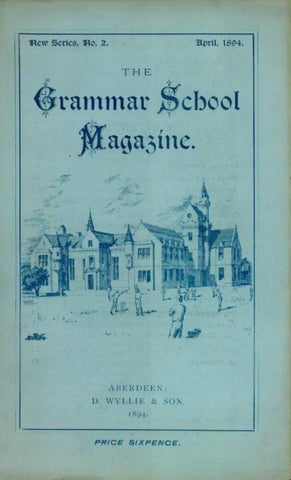
+ (ranimar y cboot ap3inc. THE
-
,
O
-
--
- -
-
,
1
[
s
-
-- • i Jra*
i / .
ABERDEEN: 1). WYLLIE & SON. 18 94.
4
CONTENTS.
Page.
•
45
•
48
.
49
•
.
51
•
•
.
52
•
•
•
53
•
.
60
•
•
64
•
.
66
ONE OR Two. ASPECTS OF GERMAN STUDENT LIFE .
.
67
A STORY FOR GIRLS .
.
.
.
.
.
.
72
.
.
.
.
.
.
.
•
74
REPORTS-GAMES FUND, DEBATING SOCIETY
•
•
.
75
FOoTBALL .
•
•
.
77
LIST OF OBJECTS GIVEN OR LENT TO THE SCHOOI. MUS t•M
81
LIST OF BOOKS PRESENTED BY TfIE ScHOOL BOARD.
.
81
.
.
82
GENERAL NOTES
.
•
NOTES ABO{'T OLD BOYS
•
•
•
•
ATHLETIC N()TES
.
NUGAE CANoRAE
.
•
•
•
THP: BURSARY COMPETITION
•
•
•
•
•
•
•
THE GRAMMAR SCHOOL F. P. Curti . A BEAR HUNT IN SYRIA .
•
THE COMING RACE (?) SWALLOW-SONG .
THE SISTERS
IN MEMORIAM
.
•
.
•
•
•
•
.
•
•
.
•
.
•
•
•
.
•
.
•
.
TIIE
Orammar SciNof Maga3ine. New Series.
APRIL, 1894.
No. 2.
GENERAL NOTES. IT is gratifying to be able to announce that the Magazine in its new form has received very general support from the School and the public, the whole issue of the January number being practically sold out in a few days. This gives strong encouragement to the staff to persevere in their efforts to produce an organ worthy of the School, and, as far as possible, representative of its various interests. It is hoped that literary contributions of a suitable character will be sent in by scholars voluntarily, so as to give increased variety and interest to the Magazine. Old pupils are also invited to give us their co-operation in widening the scope of its pages. Correspondence from such of them as have gone to other schools, or the Universities, would be specially welcome, as it is desired to make the Magazine a medium of communication between Past and Present Pupils, and a source of information concerning academic matters.
Old Boys were strongly in evidence on Graduation Day at the University of Aberdeen. The Simpson Mathematical Prize of £65, together with the Neil Arnott Prize of £35, was gained by Robert M. Milne, who alone graduated with first-class honours in mathematics. The other principal prize, the Simpson Greek, also of £65, was awarded to Alexander A. G. Wright, part of whose preliminary education had been obtained at the Grammar School. He was also first for the Black Latin Prize, but, being Simpson prizeman, was ineligible; he received the Seafield Gold Medal for Latin and the Jenkyns Prize for classical 5
40
The Grammar School Magazine.
philosophy, and graduated with first-class honours in classics. Another first-class honours man was W. W. Reid. The Hutton Prize for mental philosophy was gained by Norman Mackenzie, who graduated with first-class honours in that department, and had accordingly the Bain Gold Medal. James C. Murdoch was bracketed for the Black Latin Prize of £28, and graduated with second-class honours in classics. The Natural Science Honours Prize to the Magistrand best in natural science was obtained by Frank W. Michie. The winner of the Seafield Gold Medal for English was William G. Robertson. Thus of the twelve principal University prizes, ten have been awarded to former pupils of the Grammar School, though in one prominent case other schools have a share in the honour. A goodly record for the year. In the class lists the School is also well to the front. A proposal is under consideration to issue a complete "Registrum Scholae Aberdonensis Grammaticae." The registers of the School extend back to the seventeenth century, and are known to contain many names of great local and historical interest. To the antiquary such a register would be a mine of information, and the work would be a Krijga es del to all enrolled in the goodly throng of Past and Present. In the history of the school and of classical education in the north there is no greater name than that of Dr. Melvin. The centenary of his birth is approaching. Among his former pupils, not a few of whom still survive, a proposal has been made to celebrate the event. A dinner has been suggested, and a desire has been expressed that Professor Masson, whose picture of Melvin in "Dead Men I Have Known" ought to be familiar to all, should be asked to preside on the occasion. The extensive structural alterations in the School referred to in our last issue have been begun and are now in active progress. It is expected that they will be com-
General NoteR.
47
pleted before the close of the summer vacation. Including the changes in the hall and division of four rooms, three new classrooms will be provided. It is also reported that the cricket pavilion is to be overhauled and provided with a much-needed lavatory. It is proposed to furnish the pavilion with boards, on which the names of the cricket and football teams for each year will be inscribed. A similar record on the walls of the remodelled hall, containing distinguished honours of former pupils, would be a great ornament and an incentive to maintain a high tradition. The black framed prints now in the Reading Room used to hang in the old Schoolhill buildings. The Masters' supper took place, under the chairmanship of. the Rector, in Mann's Grand Hotel, on the 26th of January. No member of the staff of the Magazine was privileged to be present on the occasion, but from public reports it appears that the repast was excellent; that a pleasant evening was spent in conversation, which was enlivened at intervals by song and story ; and that thanks were accorded " for proposing and carrying out the arrangements of what, it was hoped, would become an annual meeting." We quote from the report :—" The Rector (who presided) gave the toast of the ' Grammar School,' and thanked his colleagues for their kindness since he came amongst them, referring in graceful terms to the assistance rendered him by Dr. Moir. Dr. Moir, in a happy speech, referred to the bright future which was being opened up for secondary education. He also gave an interesting account of the history of the School, and expressed an earnest wish for its future prosperity." The Rector gave an address, illustrated by numerous diagrams, photographs, and rubbings, on " Sticks : or Some Old Methods of Marking Time," at a joint meeting of the Former Pupils' Club and the Literary Society on the 24th
48
The Grammar School Magazine.
of January. An outline was given of the history of the calendar, the astrological origin of the days of the week, the lunar month, the golden number, and the solar cycle, and the various reforms associated with the names of Greek astronomers, Julius Cmsar, and Pope Gregory. The main subject, however, was the Runic prime staves formerly in use among the Scandinavian peasantry for ascertaining the dates of religious festivals, &c. A specimen of these staves was exhibited, and a detailed description was given of one belonging to the Earl of Southesk, the characters on which Mr. Simpson had been able, on prolonged study, to decipher. Dr, Ogilvie Will occupied the chair, and a vote of thanks was accorded to the Rector on the motion of Dr. William Finlay, secretary of the Former Pupils' Club. We have to acknowledge receipt of the Fettesian for March. NOTES ABOUT OLD BOYS. Lieutenant-Colonel George Will, R.A., who has been appointed to succeed the late Commandant of the Royal Artillery at Aberdeen, is a son of Dr. James Will, and brother to Dr. Ogilvie Will. Colonel Will entered the Grammar School in October, 1853, and left in 1856. Rev. Peter Geddes Hendry, M.A., who was Williamson Scholar in 1881, and gained several other distinctions, has been ordained minister of the Free Church of Mordington, in the Presbytery of Duns. Amongst former pupils who have recently died, mention may be made of Alexander Dingwall Fordyce, genealogist, and formerly superintendent of common schools in Wellington county, in the province of Ontario, Canada ; and the Rev. Charles F. M`Hardy, lately minister of Corgarff. Rev. Harry Smith, M.A., who took a high place in the School, and was for a time resident master at a school in the south of England, has been elected minister of the parish of Tibbermore, near Perth.
ATHLETIC NOTES. The annual assault-at-arms took place on Friday, 23rd March, in the Public Hall—that being the last " function " in the hall, which immediately afterwards passed into the hands of the contractors for the alterations. There was a large attendance of parental and other spectators, who witnessed the performances with a warm interest evinced by frequent rounds of applause. Two medals for the best performances on the vaulting-horse and parallel bars respectively were offered for competition by the Physical Training College, and two were given by the school for jumping and rope-climbing. Instructor Munro directed the execution of the programme, and Mr. John Thomson, of the Training College, officiated as judge, while music was supplied by Miss Davidson. In the vaulting horse competition about thirty competitors took part, and at its close the medal was declared to have been won by William Mackay. Dumb-bell exercise by the First Middle followed, after which there was single-stick practice by T. S. Slessor and R. Robertson. For the high jump competition there entered A. Keith, T. Slessor, J. Milne, A. Milne, J. Fraser, and E. Watt. The jump began at four feet and rose inch by inch to five feet, at which John Milne carried off the trophy. In the parallel bars competition William Mackay and John Milne took precedence, but as medals had already been awarded to them, Charles Smith was declared the winner. An exhibition of Indian club drill was given by the Fourth Form, followed by a well-performed exhibition with foils by A. and G. Gray. The rope-climbing competition brought half-a-dozen competitors, John Milne scoring first, and the medal being awarded to Allastair Keith. Bar-bell exercise by the Upper School ensued, and then came the tug of war, the Classical Sixth v. the School. The Classical pulled well together, and after a stiff contest they scored, and on crossing over a second trial of strength had a similar result. The Rector, in presenting the prizes to the successful competitors, reminded the gathering that the occasion was
50
The Grammar School Magazine.
an important one from two considerations—in the first place, because the assault took place only once a year, and, in the second place, because it was of the nature of a farewell exhibition. On Monday, he believed, an army of workmen would take possession of that hall, and it would no more be used for gymnastic purposes; he hoped, however, that those who had the duty of supervising education would not forget what an important part physical and gymnastic training was, and would provide for the school a suitable gymnasium, so that it might at least not be behind the elementary schools of the city. Mr. Simpson referred to the value of physical training, not merely as a bodily, but also as a mental and moral stimulus; and, in closing the proceedings, returned thanks to those who had favoured the gathering with their presence. Mr. Menzies, who has played in the Former Pupils' team this season, has been chosen twice to play in the International matches—against Wales at Newport (Mon.), when Scotland was defeated, and in the recent match at Edinburgh against England, in which Scotland gained a brilliant victory. The election of office-bearers for the school cricket team for the ensuing season has taken place. William Mackay was unanimously chosen Captain, and J. H. Fraser, Secretary. Hockey practices have been held during the winter on Thursday afternoons, and there was usually a good turn out of players. A match was played early in February against the West-End, and resulted in a win for the school team. The season for the Swimming Club begins after Easter, and, as we intend having the aquatic sports in June this year, it is hoped that a good number of members will make their appearance at the baths. Members of the club will be admitted any afternoon after 3 o'clock for the sum of one
51
Athletic profess
penny. The necessity of a larger number of competitors taking part in the races is very apparent, as the bulk of last year's performance fell on one or two. If our junior members would make a few strenuous efforts to master the art, and our senior members took the trouble to get up to a few neat tricks and games, we might have a far better turnout at the junior race, and might afford a more enjoyable Further particulars about the hour to the spectators. aquatic sports will be posted up in the corridor some time before the day appointed for the event. All those who have paid their subscription to the Games Fund are now considered members of the Club. Mr. Clarke kindly offers a bat for the best cricketer of this season. The mode of deciding has been referred to the Games Committee, subject to Mr. Clarke's approval.
NUGAE CANORAE. (On a bird's nest found in the axle of a cart lulled.)
" Credal Jtulaetts Apelles."
Nusquatn non uolucres parare nidos Fama est ; scilicet in rotis euntis Rhedae nidificasse : nidum at hoc est Inuenisse, quod autumant " equinum."
" Juuit medium fuyi88e per igne8." Res habuit noster nullas ; quisegenior illo ? And robbers came to rob him ; Sed spoliaturi ui subiere casam. Ecce, caminus adest I fugit ceu He got up the chimney pot, fumus in auras : And then they thought they'd nob Hinc retrouersum deripuisse putant. him. Ast illinc descendit humum de He got down on t' other side, pariete lapsus ; Discere nec poterant qua latitaret And then they could not find him ; homo. He ran fourteen miles in fifteen days, Turn ter quinque dies decies quater usque cucurrit And never looked behind him. Millia, nec praeceps respicit ille GAMIER GLTRTON. semel. There was a man and he had nought,
••••
THE BURSARY COMPETITION. The Scottish University Commissioners have recently issued new ordinances relating to Bursaries, some parts of which are of the highest importance to those who are preparing for the annual competition in October. The first clause to be noticed is the one relating to Bursaries in Arts hitherto tenable for four years, which are still to be so tenable though the holders should graduate after a three years' course, provided that during the fourth year of tenure they engage in a course of study approved by the Senatus Academicus. The importance of this clause is readily seen when the fact that the course for graduation may be considerably shortened under the new arrangements with regard to summer sessions is taken into consideration. A student, when he has graduated, may still have a year of his bursary to run, to enable him to push on his studies in some other direction, either in the Faculty of Arts or in any other Faculty in this or any other University. The second, and perhaps most important, point worthy of notice is Clause IX. :— " The subjects of the examinations for open bursaries in Arts of the first year shall be the subjects prescribed for the Preliminary Examination in Arts The examination shall be taken at the same time and upon the same papers as the Autumn Preliminary Examination, and the Senatus Academicus may, for purposes of competition, subject candidates to any further test that may be deemed necessary." This is a step towards the long wished-for lessening of strain caused by the competition being held in October. The other change chiefly to be desired is that the date of the Bursary Examination should be altered from October to June or the beginning of July. The ordinance then goes on to deal with the subjects of examination. Candidates who select in the Bursary Competition Examination Latin, Greek, or Mathematics " shall take the papers of the higher standards of those subjects." And again—" No candidate shall obtain a bursary who shall not have passed the Preliminary
The Bursary Competition.
53
Examination in Arts." Clause X. will be the means of excluding from competition a small number of candidates who have usually come forward. It provides that no student who has attended any class qualifying for graduation in any Scottish University shall be eligible for a bursary. " English, Latin, Greek, and Mathematics shall each have assigned to them double the marks assigned to any other subject," and "no candidate shall have marks assigned him in any subject in which he has not obtained at least a minimum of twenty-five per cent." • •
THE GRAMMAR SCHOOL F. P. CLUB. IN reading the records of some famous man, the reader is seldom satisfied to have learnt only the great things he had done or said, or to have caught a glimpse of his character in the years of full maturity, but must needs seek to disclose how he became what he was, what were the aspirations of his early years, and in what manner he grew to the height of his later glory. And as it is with individuals, so is it with movements : to consider these as having sprung at once into existence, fully armed, is to miss the interest attaching to their development, and to misinterpret their true meaning. Whether the Grammar School Former Pupils' Club, which has been but formed, will play its part nobly enough to claim a historian in the future is not for us to say, but still it may be permitted to chronicle at least the date of its birth, the aspirations of its infant heart, and the hopes which show to its infant mind the great possibilities in the unexplored life that lies before it. The day on which the F. P. Club became an established fact was the 11th September, 1893. The idea was by no means new : some years ago one or more attempts had been made to constitute F. P. Football and Cricket Clubs, but these achieved no visible result. And, though some such institution has been for long the desire of many in the school and without it, no further development can be traced until, on the 11th September, the warm, earnest eloquence of Mr. Morland Simpson found its
• 54
The Grammar School Magazine.
response in a meeting of some old boys, and brought the Grammar School F. P. Club into being. The organisation of the Club was still, however, incomplete. An executive, consisting of twelve members, was appointed to draw up a constitution, and to look after the welfare of the Club generally ; at the same time, a committee was elected to form-. a football club, and to make the necessary arrangements for the winter season. Though much had thus already been accomplished, much remained to be done. The Club was really in existence, but it had still to grow both in size and in usefulness, and, in view of this, it was deemed wise both by the executive and by a second general meeting to make its constitution as wide and free as possible. The object of the Club is " to promote social intercourse among the old boys, and to keep them in touch with their old school." That here there is plenty to work for no one will doubt; the aim is, as befits a new organisation, not too low. But there is no stereotype way in which all that is included in these words must be done. Whatever tends or seems, on due consideration, to tend to the physical, intellectual, and moral strengthening of its members by means of intercourse with old schoolfellows and old teachers, whatever can be done by precept, or by example, to uphold the glory of the school, and to stimulate both old and young to a greater and more unselfish interest in all that concerns the school life, whatever, in short, may serve to endow pupils, both past and present, with that esprit de corps which, properly considered, seems so little, but accomplishes so much—that the Club is permitted, and will, to the best of its ability, attempt to carry into effect. The government of the Club has been framed on the most advanced and liberal principles. The societies in connection with the Club must of necessity have all their activities in accordance with the aim and well-being of the whole. Each has its own committee of management, which rules independently of the executive, except in matters which affect the whole Club (and they are few in number), or which are brought before the members on appeal. The
The Graijimur School F. P. Club.
55
principle of local government is thus carried out fully and freely, and with every confidence that an unselfish devotion to the good name of the school will prevent the bond between the different societies from becoming weak or ineffectual. Even in this, its first year of existence, the Club has accomplished something worth working for, though by no means all that it is fitted to perform. A very enjoyable concert was held in the Free Church College on 1st December, and an interesting and instructive lecture on "Some Old Methods of Marking Time" was delivered by Mr. Morland Simpson in the Grammar School on 24th January. The football club has proved a success, and, combined with the school club, has shown itself to be a worthy combatant against the best teams in town. One might safely predict that before long many old boys who have not yet become members will, at least on special occasions, once more don the school colours and enable the committee to select a representative team which should stand unrivalled in the north of Scotland. Another, less obtrusive, but none the less useful, society, in the shape of the gymnastic club, meets on Saturday afternoons for practice in the school gymnasium. Steps have also been taken for the formation of a cricket club or team, for a tennis club, a cycling club, a photographic club, and a dramatic society. But the chief work of the executive has been, not so much the formation of societies, as the founding of the Club. Many arrangements have required this year a large amount of time, which in succeeding years will be more easily made. They have secured the support of several of the more illustrious and respected alumni of the Grammar School, and the knowledge of the movement has been gradually diffused, so that the membership already numbers over 140. At the beginning of next year a very slight effort will suffice to retain the advantage which has thus been gained, and so the Club will be enabled to strike its roots deeper and to branch out in many very desirable directions. It may be of interest to indicate the chief objects which the present members have in view.
56
The Grammar School Magazine.
In the first place, the social side of the Club is capable of great development, and much may be done in this direction by means of conversaziones, lectures, and discussions on interesting subjects, and the like. An attempt will also be made to celebrate the Founder's Day, and to gather as many as possible of the old pupils once more round the school, so that not only may the old interests be renewed and strengthened, but also new bonds be formed between the past and the present school life. Again, much might be done by the F. P. Club for the encouragement of work and sport among the school boys. Prizes in various forms might be awarded, as a practiOal demonstration of the, interest taken by the old boys in the school work. As regards sport, more vigorous action must be taken in the first place at all events. The grounds belonging to the school can no longer be regarded as sufficient for the wants of the cricket, football, and tennis players, not to speak of any privileges which may be from time to time bestowed upon the former pupils. This being so, might not the Club combine with the school authorities in a strenuous endeavour to promote grounds ample enough for both past and present players ? This would of necessity entail a considerable expenditure, but the scheme might be carried out very fully by working steadily towards this end for several years, if need be, till the necessary funds were collected. That the suggestion is worthy of consideration will not be denied by any who appreciate the great benefits, both moral and physical, which are to be gained from athletic training ; and if one consider the means at the disposal of the Club, in the form of dramatic, gymnastic, and other entertainments, the financial requirements of the scheme need not seem at all beyond the pale of earnest effort. Fitting mention might here be made of the school magazine, though it does not form a direct part of the Club. The editors of this quarterly have already done what was . in their power to make the contributions interesting to old boys, and it is their wish to make their columns a source of information concerning all occurrences affecting the former
The Grammar School F. P. Club. •
57
pupils of the Grammar School. The members of the Club ought therefore to feel it their duty to report to the editors, as regular or occasional correspondents, all news which may be of help to them in this endeavour. An appeal has already been made for subscribers, and not without some success. For four numbers, constituting one volume, the subscription is only 2s. 6d. yearly, post paid-2s. delivered in town—and it would be very gratifying if all, or nearly all, the Club members would give in this way their support to a very important feature in the work of the school, because in so doing they will not only encourage the editors and contributors in their laudable efforts, but will find an ample return in the information which they will receive of their old schoolfellows. Such, then, is the history of the Former Pupils' Club in its first few days of existence. It claims to exist for the good of the school and for the further development of the aims and aspirations which have there been impressed on its individual members, and on that ground it appeals for support to all former pupils, both old and young. If it presents a purpose worthy of noble minds, then it deserves support from that long roll of respected men who look back with affection to their schooldays at the Aberdeen Grammar School. The Club will be simply what its members make it, and many years will yet be needed to mould its features into anything resembling permanence. The one thing fixed is its desire to be helpful to its members and to the school to the best of its ability, and if its arm should be shortened and its power crippled, and if it should dwindle to an early death, the reason can be only that those who among the older of the past pupils might have lent valuable aid had withheld their countenance and support. To those who have already encouraged .us in the movement we would tender our hearty thanks, and express the hope that, bright though the prospects of the Club are, they may be rendered still more so by the addition to our number of many more respected and influential citizens, who would seek thus to acknowledge their indebtedness to their old school.
58
The Grammar School Maga.7.-ive.
MEMBERS OF THE GRAMMAR SCHOOL F. P. CLUB. Office-Bearers.
•
Hon. President—Principal Sir WM. D. GEDDES, LL.D., 1853-55 (Rector). Hon. Vice-Presidents. Prof. ALEX. BAIN, LL.D., Rev. Principal DAVID BROWN, D.D., . . . Prof. DAVID FERRIER, M.D., LLD, . . . Sir ROBERT G. C. HAMILTON, K.C.B., LL.D., Rev. JAMES W. LEGGE, M.A., ... . . Prof. DAVID MASSON, LL.1). , R. A. NEIL, LLD., Rev. Prof. S. D. F. SALMOND, D.D., . • . • Sir JAMES STIRLING, LL.D., J. C. OGILVIE WILL, M.D,
1836-37. 1811-17. 1855-58. 1850-51. 1846-51. 1832-35. 1866. 1851-53. 1847-510' 1858-59..
President, . . H. F. MORLAND SIMPSON, M.A. (Cantab.), 1893 (Rector). Tice-President, J. S. RIDDELL, M.A., M.B., 1875-78. Secretary, . . WM. FINDLAY, M.A., M.B., 475 Union Street, 1879-84. Treagurer, . . A. W. CHRISTIE, 1877-87. Members of Executive. R. J. CIIEVES, J. F. CHRISTIE, M.A., . • . G. O. GAULD, FRANCIS KELLY, M. B. , . • JOHN M`BAri, Rev. ANTHONY MITCHELL, M.A., JOHN E. RAE, M.A., HARRY P. SLEIGH, A. B. WALKER,
1885-89 H. Barron • R. O. S. Batchan . 1882-87 Thos. J. Bonner, M.A. 1879-85 Geo. H. Bower . . . • 1881-87 .1. A. Boyes, M.A. . . • 1885-89 J. E. Brebner . . . 1887-92 T. Brown . 1882-85 George Bruce, M.A. -89 R. Bruce • 1882-89 Geo. Jas. Catto . . Paul MT. Clark . . • 1883-87 H. G. L. Coats . . . 1883.88 C. G. Cowie, M.A.. 1884-86 • 1880-82 John Croll, Jun. . • 1882-91 Wm. F. Croll . . • 1879-83 John Cromar, L.D.S. 1881-83 Wm. Cromar . . J. Crombie J. MT. Crombie . . • 1884-89
1889-93. 1877-87. 1886-90. 1879-85. 1887-94. 1882-86. 1885-87. 1887-91. 1884-93.
Walter P. Crombie . . . 1883-87 W. Crombie F. Cruden George Cruden, M.A.. 1865-66 A. Cruickshank, M.A., M B. 1881-85 A. T. Cruickshank, M.A 1882-87 Robert W. Cruickshank 1881-84 Thomas D. Cumming . 1882-91 Frank Daniel 1879-92 Charles Davidson, NI.A., 1882-86 C. J. Davidson . . . 176-91 Hendry Davidson . . 1 74 Wm. S. Davidson , : : 1882-89 Wm. C. Dilling . . 1888 2, G. M. Duncan . . . . 1890 W. E. G. Duthie . . . 1884-86 W. Campbell Edwards . 1882-85 R. B. Fenton 1887-89 Adam F. Findlay, M.A. 1879-85
The Grammar Selina F. P. Club. Alex. Findlay . . . • 1882-91 John Fyfe, Jun.. . . • 1882-87 Edgar Gauld, Jun.. . • 1887-91 Wm. E. Gauld . . . • 1882-86 John L. G. Gillanders . . 1882-89 Thomas R. Gillies . . . 1863-66 John A. R. Glennie, M.B. 1881-84 1882-83 Charles Gordon . . . R. W. L. Grant . . . • 1884-91 1883-87 James Hay, M A 1882-84 R. W. L. Hay . . . J. M. Henderson, Jun. • R. A. Henderson . . • 1881-87 Wm. A. Henderson. . • 1881-90 D. Albert Hutcheson . • 1882-93 George Hutcheson . . • John Irvine, M.A. . . • 1886-88 1881-87 Edward H. Jobberns . Joseph Jobberns, M.A. • 1881-86 George Johnston . . • 1884-92 Robert Johnston, M.B. • 1881-89 1888 Alex. Gordon Keith . Andrew D. Kelly . . • 1882-88 James Kelly 1882-86 John Kelly Henry Jackson Kinghorn 1875-80 1885-92 David Kyd 1884-90 A. E. Lee ... 1884-88 George E. Levie . • • • 1888-92 Wm. Littlejohn . 1883-86 Alex. Low, M.A. • • G. M‘Bain J. M‘Bain 1881-84 James C. H. Macbeth . A. S. Macdonald . . • 1871-73 A. M. Mackay . . . • 1882-91 R. W. Mackay . . . • 1882-90 A. H. Mackie, M.A. . • 1881-85 Duncan Macmillan . . • 1889-91 A. D. M`Queen . . . . 1884-93 John Eric M‘Rite, M.A. . 1883-87 J. G. M‘Willie . . . . 1889-92
Christian H. Milne . . . John Glanville Milne . . James A. Milne . . . . Wm. A. Milne . • • . James B. Nicol . . . . R. G. Nicol, C. E A. Ogilvie James T. Ogilvie . . Thomas Ogilvie, Jun.. James C. Philip . . . Ernest Rennet, M.A. . Louis Rennet George F. Rose John Roy, M.A. . . Edward J. Savage . . James H. Scott . . . . D. Seivwright . . . . . . Andrew Sharp • A. B. Simpson . . . Edmund Sinclair . . . G. B. Sleigh A. G. Smith David A. Smith . . . . G. A. Smith Harry E. Smith . . . . John Smith Robert K. Smith . . Thos. A. Stewart, LL.D D. M. Strath J. H. Taylor W. E. Taylor . . . James R. Thomson . . C. T. D. Urquhart, M.B George T. Watson . . John Webster . . . C. Williamson . . . Innes C. Williamson . Louis Wilson Robert Wilson, jun., . A. W. Wishart, M.A., Alex. Wood, M.A., . .
59 1885-57 1881-88 1881-86 1882-87 1881-83 1872 1881-90 1884-88 1886-89 1881-88 1881-90 1881-93 1881-88 1886.90 1888 1884-89 1889-92 1881-87 1885-89 1881-88 1881-87 1887-88 1881-87 -83 1863 1881-87 1889.92 1882-90 1873-76 1882-88 1881-90 1886-91 1873-75 1885-91 1885 1884.86
Any corrections or additions to the foregoing list should he iidimated to the Secretary. NOTE.—Those who wish to become members, or who desire further information, are requested to communicate with the secretary. The subscription for the general Club is nominal—ls. annually—to cover the cost of correspondence and advertisement. The secretary will be pleased to receive the names of subscribers for the school magazine.
A BEAR HUNT IN SYRIA. CHAPTER I.—THE START. FOR two months and a half we had been living on Mount Lebanon, looking down upon the city, our home for nine months in the year, as it lay in the heat haze of a Syrian summer. Like King Francis, when he saw the lions fighting, we often thought, if we (lid not express our thought in words, " We're better here than there." Our life in Mount Lebanon had some points of advantage, some aspects of comfort, but we are always thankful when the time draws near for returning to our Syrian home and to our daily duties. On Mount Lebanon we are free from mosquitoes, or almost so ; either because the water is too scarce for their enjoyment and multiplication of life, or they have a courteous mutual arrangement with the fleas that one shall not intrude too much into the other's territory in case they might totally extirpate their common victim—man. On Lebanon the nights are comparatively cool, but (luring the day the heat of the sun is oppressive and has to be guarded against. And so it is that we are always thankful to hear overhead the noise of the wirr-a-weer, beautiful green and blue birds about the size of a thrush, and called by the Arabs wirr-a-weer from the sound of their note, and by us bee-eaters. They come in multitudes towards the end of summer, and tell us that autumn is at hand, and that the return of the rain may be looked for once more. This is the first rain, coming usually soon after the Jewish New Year's Day (Feast of Tabernacles), and it is an event that causes a good deal of observation and general remark, for, as a rule, we have no rain from the middle of April to the end of September. Any day at that time of the year the rain may come. Any day the bright north wind "that driveth away rain," and the hard east wind, with its rainless and burnished sky of brass, might be exchanged for the delicious south-west
A Bear Hunt in Syria.
61'
wind. Then people would begin to feel rheumatic intimations of a change. Clouds would begin to tumble up above the horizon and mass themselves in black battalions over Lebanon to the east and north. The south-west wind would freshen, and women would rush to their house-tops to get down the figs and raisins drying there for winter use, Then the thunder would clap and reverberate among the glens of Lebanon, and the rain would come pouring down. Such a climate enervates both body and mind, and the mere fact of my hesitating whether I should accept the courteous invitation of my two friends to join them in their search for bears on Mount Hermon, was a sure sign that I required the excitement and exercise that such an adventure involved. I had at last made up my mind to accept, and to send for particulars as to the day and hour of the start, when a note was put into my hand by a messenger from the village where my friends lived. Its contents anmounced that my companions were ready, that their guns and powder were ready, and that their bodies were in the village of Djezzin, where I was to meet them, but that their hearts were on Hermon with the bears. I was told to come on and meet them (my friends, not the bears) after three days. Next day, accordingly, I sent down to the city and ordered a horse to be brought up to me in the evening, so that I could see to his having a good feed and rest, and then he would be ready to start with me early the following morning, a Friday morning it was, for good luck. Well, as on Thursday night no horse came, I sent down to the village inn and got up a wretched hack that would enable me to set off in time to keep my engagement. I had an idea that I might exchange my mount for a better one on the way to Djezzin. On Friday morning got up with the dawn and went out to saddle and see to my horse myself, and make sure that everything was sound and durable in his saddle and girths. On his night-cloth being removed, the poor beast showed a large red sore open and bleeding on each shoulder. I could not think of taking such an animal to tug and toil up and down the rough paths and pathless places of the 6
62
The Grammar Selina Magazine.
mountain. As I was in this fix I heard behind me the clatter of a horse's hoofs, and in another minute a man rode up bringing the horse I had ordered from the town below. There isn't much choice among rotten apples. This second horse had been out the day before on the sands near the town with a merry-making company, spurred and whipped to make an Arab holiday, and having just been trotted for two hours and a half up the steep paths of Lebanon, he was not in a very fit state to carry me over the ten hours' ride that lay before me. However, it does not do to make the best the enemy of the good, to despise the best you can get because you cannot at a particular time get exactly what you desire. On this principle I sent the poor wounded brute back to its owner, and in the hope that the bad luck of Friday was now past, and that things were to turn out for the best after all, I named my horse Bon-Accord. I mounted him, and a few minutes after bidding good-bye I had turned a sharp corner which hid my'horse from view. CHAPTER II.-THE JOURNEY.
Owing to the delays and disappointments mentioned in the last chapter it was seven o'clock on Friday morning instead of five when I started. I had not gone far when I found that my horse, though a sturdy-looking fellow, had very little go in him, that he was, in fact, tired to start with. He went quietly along to the next village, an hour's distance, and drew up at a house where I had been asked to call for riding orders and to get letters for my friends in the interior. Here I intended to stay for a few minutes while I got my instructions, but on my rising to leave, my helmet was authoritatively taken from me, and I was compelled to sit down to a refreshing cup of coffee, while my horse received a liberal feed of barley at the door. Half an hour had gone, however, and without putting my steed to too much effort I kept him at a smart walk to make up for Jost time. Descended to the Jirr-il-Kadi (the Bridge of the Judge) over a small stream which runs through a wady, or valley,
A Bear Hunt in Syria.
63
the sides of which rise to the height of a thousand feet or more. After a stiff climb, came to the place where, in 1860, a large number of Christians, huddled together in the Government buildings, were barbarously murdered by their enemies, the Druzes. Of course, you know all about the Druzes. I had intended to rest here, but it was now twelve o'clock, and I rode through without stopping, and half an hour later I reached the palace of the Governor of Lebanon. It I passed also, as I saw no place for the entertainment of man and beast. There seemed, therefore, no alternative but to ride on for two hours to Muchtara, the chief town of the Druzes. I had made up my mind to this when I saw ahead what turned out to be an Arab shop, a one roomed house of stone, with an arbour in front of branches and leaves. Here I found barley for my horse and grapes for myself. I also partook of some cold tea from a bottle, and, after emptying it, handed it to the shopkeeper. No, by the way, I didn't. It was in my mind to do so, when I remembered what I had been told of people going up to Mount Hermon expecting to find water or perpetual snow to melt for themselves, and being terribly, agonisingly disappointed. I filled the bottle with drinking water, and it will be seen in a subsequent chapter how our comfort, our lives even, depended on the second thoughts which prompted me to take it with me. After a short rest in the cool of the thick-walled room, I paid for our grapes and barley and plodded on, every step now bringing me nearer to Hermon, that mountain-top, 9,000 feet high, where bears, with and without whelps, make night hideous with their roar. (To he Continued.)
THE COMING RACE (?) This is the age of the domination of the Anglo-Saxon, or rather of that blend or fusion of Anglo-Saxon, Celt, and Norseman, whose original home and nursery is Great Britain. He is to be found in every quarter of the globe ; his language has an extension far wider than his race ; it is the mother tongue of so many millions, and the second tongue of so many more, that it bids fair to be before long the universal language; his commerce, his science, his literature, and his religion, go with him, and his influence for weal or woe on the world is almost beyond imagination. There is not one of us, however, but has some idea of this. Our kindred are in all parts of the globe, taking with them their enterprise and civilisation. Other nations seek to extend their possessions and colonise, e.g., the French in Madagascar and Indo-China ; but although they assert a political supremacy in these lands, the real influences there are exerted not by them but by our people. A practical genius possesses us, and we soon fit ourselves to very varying conditions of life. With our postal and telegraph network over the globe, distance and separation are insignificant, and we are distressed because we do not know what happened yesterday in Matabeleland. But we often forget that our supremacy has not been of long duration. Our reading of classical authors tells us of other mighty nations that were supreme when our ancestors were barbarians. A little wider knowledge of history tells us of an Arabic influence that extended from Spain to Singapore, from the gates of the Hellespont to Zanzibar. Here again is found a language that crowds out weaker forms of speech, great commercial power, and a strenuous missionary faith. But the Arab pales to-day before the Englishman ; he knows that his hour is come. A people with greater freedom of life and movement within itself, with larger tDlerance for others, combined with a power of absorption and adaptation, is on the scene, and the Arabs' r6le is henceforth an inferior one.
The Coating Race (?)
65
The question suggests itself- Is such a fate in store for us also ? Is there any nation yet to awake from a long slumber as our ancestors did of old, or the Arabs under Mohammed, and extend itself more widely than we have done ? The possibility must be conceded. Two nations seem to have within themselves the promise of a great development— Russia and China ; but of these two the only one that threatens a great outburst is China. To-day there is beating on the shores of America, Australia, Malaysia, and even Africa, a great tide of Chinamen which all the dislike of the peoples invaded is insufficient to stem. He comes with that marvellous patience and power of plodding which many generations of a wonderful struggle for existence have perfected in him. He can work for a wage that makes competition in the labour market impossible for Europeans. He saves on what our poor starve, and goes home from the land he has fattened on a comparatively wealthy man—to die and be buried beside his ancestors. He is; as might be expected, much maligned, but impartial observers speak very highly of his abilities and character. He has not his equal for brain capacity, and his heart is said to be as good as his head. Here seems to be the coming race, if anywhere. With an affection for his home and the memory of his ancestors that amounts to a religion, he is yet forced by the pressure of the millions behind him out into the larger world. His presence in some countries is a burning question and a difficult problem. The opposition he there excites is a token .of his strength. There were a poetry and grandeur about the career of other nations that rose from obscurity to grandeur which are sadly missed here. Other nations could fight and rule ; they could absorb and propagate civilisation ; personality and character were to them the essence of greatness. But the Chinaman is stiff and rigid in character, prejudiced to a degree against foreign ideas and inventions, and it will be long before he can become a military power, when numbers count for little against science. His power is that of cheap
66
The Grammar School Magazine.
labour,and therein lie at once his usefulness and his meanness. But though slow to move, he moves surely. He despises the fickleness of the open and gentle Japanese, and disdains to forsake the institutions and inheritances of his mighty past for the culture of a people whose history seems but of yesterday. But gradually he gives way to these influences, and soon, when they have penetrated more into the heart of the country and leavened the life of the people, there may come a movement compared with which the invasions of the Goths or the Normans or the Arabs may seem small. It may not come near our island, but it must affect our Empire in many parts. They may wrest from our lower classes the menial offices of life, but of one thing we may be assured that until their minds are quickened out of the sleep of prejudice and routine they can be no match in the higher walks of life for the more enlightened nations of to-day.
SWALLOW-SONG. (From the German of Sturm.) FROM a far-off land, from the sea's long strand,
On the high and airy ways Thou flyest alway, without stop or stay, On thy home once more to gaze. Oh, who, tell me, on land or sea, Has it to thee made known That in thy homeland glad spring is at hand And the dreary winter flown ? Then speakest thou—" I know not how Or whence it comes to me, For a whisper of spring in mine ears doth sing, And from place on to place I flee. " In a rush of joy that no care doth alloy On the high and airy ways, For no whit do I roam, but straight to my home, Spring smiling, fly always." R. W. L. G.
ONE OR TWO ASPECTS OF GERMAN STUDENT LIFE. SOME time ago I read a paper before the Literary Society of this School on " German School and College Life," and I have been asked by the editors to reproduce here some of my remarks on that occasion. I have consented with the utmost reluctance, foreseeing only too well the adverse criticism or the contempt of those who know much more about the subject than I do. I can only ask from these forbearance ; and I will preface my remarks by saying that they are intended to be desultory, and claim neither breadth, depth, nor detailed accuracy of treatment. I shall merely sketch a few of the less serious traits of the life of a German student as they appeared to a superficial observer. The German who intends to have a University education leaves school usually between the ages of eighteen and twenty. Before proceeding to the University he may serve his year in the army. In Scotland there are four Universities, in England four, and in Ireland one, making a total of nine in the British Isles. In Germany there are twenty-one. They arc conducted on a very different system from either the Scotch or the English. I shall take, as an example, the University of Gottingen, where I was last summer. This is a small University, of about seven hundred students, and it has a staff of one hundred and thirty professors. It is rumoured that in some Universities there are more professors than students. As a general rule these professors are specialists, and lecture only on the advanced branches of the work in which they are specially interested. Our present business, however, lies not with the professors, but with the students. The German student does not necessarily go to the University with the view of getting a He has passed his Abiturienten Examme► , on degree. leaving the Gymnasium, and that is, in some respects,
68
The Grammar. School Magazine.
similar to our ordinary Scotch degree. He may go to the University with two or three different ends in view— to get a law, medical, or philosophical degree ; to specialize in one particular branch of almost any subject under the sun, or, finally, to amuse himself. Or, he may advantageously combine two or more of these methods of procedure. It is quite common to spend the first year or two in kneiping and duelling, and after that to settle down as a worker. A year so spent is called a bummel Jahr, or dawdling year. The student enjoys immunity from several grievances which vex the ordinary citizen. For instance, no policeman can touch him. If he misbehaves himself very badly the college officials, kept for the purpose, can put him in the college jail or Karcer. The door of this place has to be frequently renewed, owing to the damage caused by the knives of the occupants, who while away the weary hour by cutting their names in very large type on the wood. One of these old doors at Gottingen has been preserved, since it bears on it Bismarck's name. I believe, however, that this system of academic discipline is giving way to the ordinary civil law. The way in which the majority of students at a German University spend their time depends chiefly on the state of their pocket. When the average student enters the University he immediately joins a Korps or a Burschenschaft. The corps are considered more aristocratic than the BM.schenschaften. Burschenschaft means literally a fellowship. Each club possesses a particularly natty little cap of the club colour—red, blue, green, black, white, and so on. The wealthiest and most aristocratic corps at Gottingen is called the Saxonia. Its members have all some connection with the nobility. I select this corps because it presents, in a rather extreme and exaggerated form, a typical German student corps. The members of this corps are called Sachsens, and wear a light blue cap. They never go near a lecture, that is far beneath their dignity. The Sachsens are a small corps, and live together in a house of their own which was specially built for them. They keep their corps
One or Two Aspects of German Student Life.
69,
flag flying on all possible occasions. These students come to the University to enjoy themselves, and they have somewhat curious notions about the way to do so. The ordinary daily routine is something as follows :—They rise about nine or ten in the forenoon, and have open cabs waiting at the door in sufficient numbers to carry them all, including their dogs, for each student keeps his pet dog. It may be a toy terrier, small enough to go into the hand, but more probably it is a huge Russian wolfhound, the size, and apparently with the strength of a small pony. Two students and their dogs are considered a pretty fair load for a cab. The procession now drives off at the usual crawl of a German cab to some adjacent village, where the students enter the inn and have breakfast. Then they drive about the country a little and dine in another village. The greater part of the day is spent thus, lolling about in cabs, with the exception of a walk through the town and perhaps some open-air dancing at a dancing place near the town. In Gottingen the whole town flocks out to these dancing places every Wednesday and Sunday afternoon. The students usually secure all the cabs in the town before anyone else, and consequently civilians have to go out by train. In the evening the corps assembles in the Kneipe room. A Kneipe is a beer supper, where the only refreshment, solid or liquid, is beer. Songs and toasts are, of course, numberless, and billiards and cards are sometimes played. The German students are very fond of singing, and they have a Students' Song-Book, containing about eight hundred songs. The walls of some Kneipe ooms are covered with prints daguerrotypes, and photographs of all those who have belonged to the corps since its foundation ; or, if the corps be a very old one, ever since any record was kept. Sometimes these portraits date from before the beginning of the century. The president of the corps wears a special uniform, and carries a duelling sword in his hand. He commands silence by striking the table with the flat of this, and marks time to the choruses in the same way. The Kneipe is probably prolonged till one or two o'clock in the morning. The close of each session is celebrated by a magnificent Kiteipe,
70
The Grainln,ar School Magazine.
called a Gammen; where all the corps meet together and perform various ceremonies, all of which are pretty and some rather pathetic. A brass band is in attendance, and forms an orchestra to the singing. Students from other Universities are present, and also old students who had formerly belonged to some of the corps. Among these you might see men sixty or seventy years old, and one of the ceremonies consists in calling on the students " of the first session" up to " of the eightieth to the ninetieth sessions" to drink to the health of the University. Towards the end of the evening the proceedings assume rather the nature of an orgie. The custom of duelling prevails to an enormous extent among German students. There are two totally distinct kinds of duel—the sabre duel and the ordinary duel. The sabre duel is a very serious affair, and is only resorted to when one man considers that he has received a grievous insult from another. The combatants fight with heavy sabres, and wear no protective covering. They fight in the woods, as the police naturally keep a strict look-out to stop anything of this sort. Not unfrequently one of the parties concerned kills the other. When Bismarck was a student he cut a man's breast open in. a sabre duel. The penalty for killing a man in a sabre duel is three years' fortress. That the fortres.s discipline is not very strict may be seen from the following true story. A party of tourists was visiting a fortress, and wished to see the students' prison. The gaoler was very sorry, but he could not oblige as " the gentlemen had gone for a holiday in the country, and had taken the keys with them." The ordinary duel is not nearly so serious, and is not undertaken with any malignant intent. All the corps meet together twice a week in a bare house out of town, and there the duels are arranged between the different corps. The house consists of two rooms, one large one with an open space in the middle, a number of tables along the sides, and a little gallery at one end. In this room the duelling takes place. The other room is reserved for dressing the wounds. A good many students are seated about the tables, which are covered with bottles of all sorts and sizes. Pre-
One or• Two Aspects of German Student Life..
71
sently the two combatants appear from the other roo►n, rolled up so that all their body is protected from injury. The only assailable part is the head, and the object is to inflict as many cuts on it as possible. The eyes are protected by a kind of goggles. The duellists must not move the body or the arm, but the wrist only. Each duellist has his second, and the seconds strike up the swords when one man has a wound. When the duel is about to begin the seconds cry los, and immediately the swords are twinkling so fast that it is almost impossible to see them, and quite impossible to see when they strike. Suddenly you see a tuft of hair skip and a line of red appear on a man's head. Then the seconds strike up the swords, and the wound is sponged. The wounded man must not wince or make the least sign of pain. If he does, he is disgraced for ever. The duel continues for a quarter of an hour's fighting. This usually means a total duration of half an hour or threequarters. But if one of the combatants receives a serious wound the affair is over. Sometimes in the midst of a furious contest a sword will snap, and the broken piece fly off to the other end of the room. The above remarks furnish, in so►ne measure, a rough index of the way in which a large proportion of German studentdom spends its days. In them I have had to attempt to satisfy two classes of readers differing about as widely as readers can differ. First there is the immense majority who know absilutely nothing about German student life, and it is impossible in a jell, d'esprit like this to give any notion of the complexities in corps customs, in duelling customs, and even in the humble toast which such immemorial bodies as the corps possess. On the other hand, there is the class whom I alluded to in the preface, who will doubtless sneer at the hasty and superficial generalisations which pay so little regard to the subtle distinctions, forms, and ceremonies that lend such a characteristic interest to the corps life of a German student. In conclusion, I may remark that the student does not - confine his attention to one University, but distributes his attentions among two or three. R. W. L. G.
A STORY FOR GIRLS ! (N.B.—Bus may read it.) Scow was not a clever boy; he seldom got better than " fair " in his reports ; when he did it was only "good." But it was not that he did not do his work ; in fact, in this he was very conscientious, but he was never high in his class lists. Yet there was not a fellow in his class who had more general knowledge than Scott. At one period of his life he had a great liking for Henty's books—call it a craze, if you will. He used to sit and gloat over them until you saw his eyes gleam with delight. It was a rare picture to see him standing in some corner of the passages or some nook in the playing-field with his hands in his pockets, talking of and describing Henty's latest book to a group of smaller, eager-faced boys. To them he was a perfect god. Scott had an uncle newly married, who was in the habit of sending him a book every birthday. It was Henty's latest that he always asked for at present. " Look here, old chap," said Scott one day as he came rushing up to me with an open letter, " Uncle Sam wants to know which book I would prefer this birthday. Henty has three this year. Which shall it be ? I think ' Bonnie Prince Charlie' will be splendid." " You are a happy fellow," said I, laughing ; " my aunt never asks me what I want, but sends on some goody-goody book, on which she always asks me questions when I see her next, or some sort of pastry of her own baking which does not usually agree with me. Yes, I think `Bonnie Prince Charlie' is the book for you, lad. You '11 let me have it next ?" On his birthday, as soon as he got up, he rushed along to see what the post had brought him. Sure enough, there was a book parcel, besides something from home. Scott always liked to leave the best to the last. So he acted on this occasion. The home parcel was speedily opened up,
A Story for Girls.
73
and disclosed just such things as fond mothers imagine their boys need, and which, they think, they cannot get on without. The letter accompanying the parcel was read, and then he turned towards his uncle's parcel. A number of boys, who were hoping afterwards to win Scott's favour so far as that they would persuade him to lend them his new book, were crowding round, waiting to see the parcel opened up. " Hullo," said Scott, looking at the address, " Sam has got his wife to send on this parcel. By Jupiter—," he added as he folded out the paper, but stopped in amazement, staring at the book which he held in his hand. One youngster standing near him bawled out—" ' Alice's Love Affairs: A Story for Girls.' " At this there was a general burst of laughter. Scott flushed red and threw down the book. I saw his lips move, but I was too far off to hear anything. (A friend told me it would not do to be printed.) Scott could not bear being laughed at, so he stalked away through the fellows, who were still enjoying the joke, followed by calls of " Miss Alice," "Scottie is falling in love." When I next saw Scott he was pacing up and down in the field, " nursing his wrath to keep it warm." I thought I had better not approach him. In the course of the day a letter came from his uncle, who hoped he would enjoy his book-present, "Bonnie Prince Charlie." This Scott came and told me that night. " Sam's wife must be a dull head. *Here she has gone and sent me one of her own story books ; and such a fool I was made when all the fellows knew the name of the book." " Write and give them a doing off," suggested I. " I am not likely to make myself an ass again by writing to him," muttered he, still in a rage. But at last he cooled down and wrote to his uncle. The explanation was this. Uncle Sam had told his wife to send away two books which he had bought, one to Scott, another to some niece—I am not aware of her name. She had tied up the parcels, left them for a short time, and then when addressing them mixed up the parcels.
74
The Grammar School Maginine.
A copy of " Bonnie Prince Charlie" was nevertheless sent on to Scott. One word requires to be told about "Alice's Love Affairs." Scott was very eager to get rid of it. To all the fellows whom he knew bad sisters he offered to sell it. But no one would have anything to do with it. For nearly half a year it lay tossing about Scott's desk, and, in desperation, he hit upon a plan. He was a fellow who could not stand being made fun of, and while this book was in his hands the joke was never let drop. So give it away he must. A young ladies' school in the same town was beginning a library. This was going to be the receptacle for it. The parcel was sent addressed to the librarian of the school ; was accepted, and a notice in the young ladies' magazine was to this effect: that the young ladies of Beech Hill Academy were greatly obliged to C. M. Scott, Esq., for his gift and thanked him for it. A copy of the paper was specially sent to Scott, of which I happened to gain a glimpse. THETA.
THE SISTERS. (From the German of Heine.) ON a hill a pine stands lonely, Where the bleak, cold north winds blow ; It sleeps, and for covering only Surround it ice and snow. It dreams of a palm adorning The far-off morning land, Which, silent and lonely, mourning, Droops in the burning sand. R. W. L. G.
REPORTS, &c.
GAMES FUND, 1893-94. INCOME. School Subscriptions1st Quarter, . 2nd „ .
•
•
•
•
•
•
Herr Hein's Lecture, . . Proceeds of School Magazine, Balance from Debating Society. Less Postage, . .
. £7 18 9 . 6 b 6
•
•
•
•
•
•
•
£14 4 3 0 5 0 3 5 4
£0 6 11 . 0 0 3
•
Assault, Receipts from Sale of Tickets,
•
0 6 8 8 6 5
•
£26 7 8
-
EXPENDITURE. Playfair, Football and Inflator, F. Bryan, 4 Footballs, . . "Free Press," Printing Accomit, Secretary, for Post Cards, &c., Assault, 2 Medals, . Alex. Munro, . . . Balance in hand, . . .
•
•
•
•
•
•
•
•
•
•
•
•
•
•
•
•
£0 10 6 1 9 4 3 0 0 0 2 0 0 9 0 2 0 0 18 16 10 £26 7 8
H. F. MENZIES, Treasured•.
76
The Grammar School Magazine. DEBATING SOCIETY.
THE second half of the session of the Literary and Debating Society has just come to its termination. Altogether the session may be considered to have been a very successful one, the various debates having been carried through in a spirited and purpose-like fashion and participated in very generally by the members. The membership has numbered 44, and the average attendance has been about 30. It has been a matter of regret that the VI. Classical has not contributed so well either to the membership or attendance as might have been expected. The subject of debate on the 26th of January was, " Whether has the sword or the pen done more for Britain," the arguments for the sword being opened by E. W. Watt, and for the pen by G. L. Barrie, and the result 10 votes for the former and 11 for the latter. The President (Mr. William Murison, M.A., English master) delivered his address on February 2nd, the subject being " Fools." Mr. Murison, in the course of a very interesting paper, gave an account of the different members of this portion of the human race, with illustrations and references from various historical and other specimens. Stories were related of Indian, Persian, Russian, Greek, Roman, and last, but not least, Scottish fools. The " Old Boys" paper was read by Mr. R. W. Lyall Grant on February 9th. The text of this paper is given in preceding paps. " Whether have books or companionship the greater influence on character 1" was debated on February 16th, books being upheld by T. M. Watt, and companionship by J. Gilchrist. The vote at the close showed 18 for companionship, and 8 for books. Impromptu debates on various subjects occupied the evening of February 23rd. Mr. Maxwell H. Mackie, M.A., French master, on March 2nd, gave a descriptive account of " A trip to Paris," illustrated by a large number of lime-light views. In addition to the views of the buildings and scenes in the French capital, an interesting series relating to Swiss scenery were also exhibited. The Rector, who was present, proposed a vote of thanks to the lecturer. The topic of debate on March 9th was, "Which was the greater — Marlborough or Wellington I" the opening papers being by G. R. Watt and J. Strachan respectively, and the vote, 1b for the former and 14 for the latter.
Reports, b7.
77
" Did the benefits outweigh the evils of the French Revolution? " was discussed on March 16th, the affirmative being maintained by J. M'Bain, and the negative by W. Mackay. The vote was 7 for the former, and 17 for the latter. The session was wound up with a " Finale " on March 30th. An excellent programme of music, &c., by members of the society and others was gone through, a most enjoyable evening being spent. EDWARD W. WATT, Secretary.
FOOTBALL. 1st XV. Matches. GRAMMAR v. CLYNE MITCHELL'S ENGINEERS, January 13th. —This match was played at the School Grounds in fine football weather and proved very one-sided, as the Grammar obtained 15 tries to nil. The Engineers played with a scratch team, only eight of their men turning up. The score was 12 goals (1 penalty goal, Wingate) and three tries. Tries were secured by the following :—Milne (4), James Grant (4), Thomson (2), Butcbart (2), Walker, Rennet, and Pope one each. GRAMMAR V. HALL RUSSELL'S ENGINEERS, January 20th.— This match was played at the Grammar Groun ds and turned out to be a very evenly-contested game, only one try being scored. In the first half the Grammar had the most of the play, and forced the Engineers to touch down two or three times. From a pass Milne had a fine run down the touch-line, and on being tackled passed to Leibbrandt who just managed to get behind. The kick was a long side one and proved too much for Gauld. In the second half play was very even, and no further scoring took place. Grammar team :—G. O. Gauld ; J. Milne, J. Butchart, A. B. Walker, J. Leibbrandt; A. M. Mackay, E. Rennet; R. W. Mackay, A. W. Christie, Jas. Grant, W. Pope, J. R. Thomson, J. Souter, J. P. Wingate, B. Butchart. GRAMMAR v. 'VARSITY, January 27th.—This, one of the most important fixtures, was played on the Grammar Grounds, the field being in very bad condition. The 'Varsity kicked off against the incline, and the Grammar forwards, by brilliant play, carried 7
78
The Grammar Sehool Magazine.
the ball into the 'Varsity 25. In this half, the 'Varsity had none of the play ; but we did not score owing to the weak attack of our halves, who had plenty of opportunities given them by the forwards and quarters. In the second half the 'Varsity had slightly the better of matters, though play was very even. Thomson followed up a kick, and owing to Gauld's misjudging got on the ball and easily secured a try, which I). V. Haig converted. The Grammar pressed hard for the remaining time but failed to cross the line, and time being soon called the 'Varsity were left winners by one goal to nil. Thomson and Haydon were the best of the 'Varsity backs, who did not play up to their usual form, and Mitchell was the pick of the forwards. For our team, Gauld at goal, Rennet and A. M. Mackay at quarter, and Milne at half, all played well ; but the backbone of the team was the forwards, who cannot be praised too much. Mr. Menzies, Mackay, Pope, and Grant all played superbly. Mackay's tackling was splendid, the way he brought down Thomson being greatly relished by the large crowd of spectators. GRAMMAR v. NOMADS, February 3rd.—This fixture was played on the School Ground. After the kick-off the Grammar pressed, and play was confined to the Nomads' 25, where a series of scrimmages took place. The ball was next returned to midfield, and from a scrimmage was passed out to Milne, who had a fine run down the field and just managed to cross the line. The kick, however, failed. A short time after the kick-off R. Mackay and Milne got the ball through with a fine dribble, and Milne landed a try between the posts which was easily converted by Gauld. On the ball being again kicked off the Nomads made matters rather lively in our 25, but the half-time whistle saved us from any disaster. During the second half no scoring took place, though both teams very nearly succeeded at different times. For the Grammar team Gillanders and Rennet played an excellent game at quarter, while Milne was undoubtedly the best of the halves. GRAMMAR v. ABERDEENSHIRE, February 10th.—Played at IIolburn Ground. The 'Shire kicked off with the wind and the incline in their favour, but the Grammar half failed to return the Lill, and play was confined for a little to the school twenty-five. A series of mauls, in which the Grammar were superior, brought play to About mid-field, when the 'Shire forwards seized the ball,
Reports, dCc.
79
and a rush down the field ended in Walker scoring a try. The kick was unsuccessful. On the ball being again kicked off, the Grammar, for the most part, pressed, showing some good combined play. Several mauls, ending in a free kick by Mr. Menzies, brought the ball within a few yards of the 'Shire goal line. The 'Shire, however, prevented any scoring taking place, and after this, in spite of another free kick to the Grammar, the play was nearly equally divided, and the first half ended with the ball in mid-field. In the second half the ball was kicked off by Mr. Menzies, and a good return by Sleigh gave the 'Shire the advantage and caused the Grammar to touch down. From this time play was mostly in favour of the Grammar, and a splendid run by Leibbrandt from a pass from Walker gained a try, which the kick did not improve. The game thus ended in a draw-2 points each. For the School, the forwards and the quarters, Rennet and A. M. Mackay, all played well. GRAMMAR SCHOOL v. BLAIR LODGE, March 3rd.—On Saturday, March 3rd, at Holburn Grounds, the Grammar School played a team from Blair Lodge, which at present holds the first place among school teams of Scotland. The weather was fine, and the ground in splendid condition for play. A large number of spectators, both of general public, and of pupils of the Grammar School were present. The teams were :—Blair Lodge —Leith ; Spencer, Mitchell, M'Mullan; Cameron (captain), Morrison; Byron, Couper, Johnston, Grubbe, Gray, Turnbull, Rutherford, M'Alister, Young. Grammar—Gauld ; Butchart, Walker, Milne, Liebbrandt ; Rennet, A. Mackay ; Menzies, Pope, Grant, E. Rae, Marr, Thomson, R. W. Mackay, A. W. Christie. The play, from beginning to end, was of a most interesting description, every inch of ground being stubbornly contested. At the commencement of the first half the Grammar carried the ball down the field almost in front of the Lodge's goal. A succession of mauls followed, in each of which the Grammar showed their superiority in scrimmage work, a result due in no small degree to the exertions of Mr. Menzies. They seemed to be getting all their own way, but Cameron got hold of the ball and passed to the left half-back who started to run, but was checked before be got far. A maul followed, and one of the Blair quarters kicked the ball up the field. Walker, unfortunately, did not catch it up in time to dodge the forwards who had followed up, and were on him. Shortly after this, one of the
SO
The Grammar School Magazine.
Lodge fellows got in behind, and a very neat goal was kicked. About five minutes afterwards, Elliot Rae also got behind, but Mr. Menzies' kick was not successful. This was the only scoring for the Grammar. Shortly before half time one of the Blair halves got in behind for the second time. The kick did not, however, increase the score. In the second half Menzies made a clever pass to John Milne, our right half, who was held only after he had gained a good deal of ground. The enjoyment of the game was marred by a painful accident to one of the Blair forwards, who had his knee twisted. He was seen, by Dr. Glennie, who happened to be among the spectators, and was taken off the field. Towards the end there was a very exciting piece of play. Spencer had the ball and passed to Leith, who started off with a clear field in front of him, Gauld having slipped when just about to tackle him. He ran on, nobody seeming to mind, when suddenly Milne spontaneously darted after him and tackled him only a second too late, just when the ball was being put down. A goal was kicked by Spencer. The game resulted—Blair Lodge, 2 goals 1 try (12 points) ; Grammar, 1 try (2 points). On the whole the Grammar played well, considering the undoubtedly strong combination against them. But they are sorely in need of practice, they do not play into one another's hands. They all played well individually, but individual play is of no avail. As we have just said, they all played well, although a blunder was made now and again. Gauld, at goal, played well on the whole. Milne, at half, and Rennet, quarter, played well, Milne's part being what might be termed " short but sweet:, Mr. Menzies is, of course, exempted from criticism, for it would be presumption on our part to discuss the play of such an eminent internationalist. 3rd XV. Matches. Nov. 25.—v. Gordon's College ... Dec. 2.—v. Ferryhill ... 9.—v. West-End „ „ 16.—v. Gordon's College Jan. 20.—v. 4th XV. ... ... 27.—v. Gordon's College „ Feb. 24.—v. 4th XV. ... ... Mar. 3.—v. West-End '
Won by 27 points to 0. Won by 40 „ to 0. Won by 18 „ to 3. Won by 18 „ to 0. Won by 21 „ to 0. Won by 17 „ to 9. Won by 14 „ to 2. Won by 28 „ to 2.
SI
Reports, &e. LIST OF OBJECTS GIVEN. OR LENT TO THE SCHOOL MUSEUM. Date. 1893.
Donor.
15th Oct. 20th „ 26th „ 6th Nov. Oct.
Object.
Gift or Loan.
Gift. Wm. Minto, . . . 14 Butterflies, Walter Young, . . Specimens of Jute, . . Geo. Stephen, . . . Antique Teapot from Iona, Arthur Hein, . . . Adder, H. F. Morland Simp- f The Rune Staff Calendar son, Esq., . . . I (framed), The Grizzly Giant (framed) Do., f Facsimiles of six Historical Do., Newspapers Loan. ( Battle of Keelung, French .; Tonkin Expedition : by a Do.. ( Chinese artist,. Facsimile of Magna Chart°, Do. , ( One of Antique Smith's For; genies (?)—Montrose's sig. Do., ( nature (occurs twice in voL ). f The earliest Map of Germany . Do., I (facsimile), Gift. Robert Law, . . . Tiger's Tooth, 99
/9
l•
19
Dec. 1894.
Dr. F. Kelly (F.P.), . Crusie Lamp, . 3 Fossils (Echinus, &c.) . Do., {Specimens of manufacture Wolff & Sons, . . . of Pencils (in case) . . . It George Combe, . . Cingalese Catamaran (model) >> Feb. Wm. Minto, . . . 3 Fossils (2 Ammonites), . 24th Feb., 19th March. Ch. Lyall Grant, . . Mask (South Seas?) . . . Loan. MS. fragment of Thomas Randal Robertson, . { Carlyle Gift. 24th Jan.
55
/I
9>
LIST OF BOOKS PRESENTED BY THE SCHOOL BOARD. The following books have been generously given by the School Board for the School Reference Library :— Chambers' Encyclopaedia (10 vole). Etymological Dictionary of English Language. Latin Dictionary. Lewis and Short. Greek—English Lexicon. Liddell and Scott. Flfigel—Universal German-English (1 vol). do. English-German (2 vols). Do.,
W. W. Skeat.
82
The Gramnutr School Magazine. Egypt (2 vols). Ebers. Dictionary of Greek and Roman Geography (2 vols). Do. do. Biography and Mythology (3 vols). Do. do. Antiquities (2 vols). Physiology of Plants. Sachs. Ilios, City and Country of Trojans. Schliemann. Homes without Hands. J. G. Wood. Sounds and Inflections in Greek and Latin. King and Cookson. Spiers' French Dictionary. Vol. I. English-French; Vol. II• French-English. ' Greece. Bishop Wordsworth. Ancient Atlas. Henry Kiepert. Cassell's Book of Sports. Greek Antiquities. Rich. Badminton Library—Cricket. Do. Athletics and Football. Companion to School Classics. James Gow. Philology of the English Language. Earle. History of Greece (10 vols.). Grote. Mommsen's History of Rome (4 vols).
We have to heartily thank the School Board for this excellent gift of books—a gift of which we may be justly proud. A case of books is one of the best adornments for a room, especially when shown to be well thumbed and conned ; and the best way we can thank the School Board for this present is by using them. When the use of these books can be got at school, less reference need be made by the boys to the Public Library's books. T. M. WATT', Librarian.
3n Memoriam. WE regret to record the death of another recent pupil of the School—John Anderson. No longer ago than last year he was one of the editors of the Magazine and a vice president of the Debating Society, and was otherwise prominent in the life and work of the school. He had passed on to the University, and during the Christmas holidays he caught a chill which developed into pleurisy. While convalescent at the Infirmary he took scarlet fever, and died shortly afterwards at the City Hospital, to which he had been removed.
nuegnoNn BOOK. JAMES G. BISSET Continues to supply all the C SS BOOKS (New or Second-hand) suited for the requirements of the higher Educational Institutions in the City. at the Lowest Prices. •
N.B.—Best Value in STUDENTS' NOTE BOOKS.
JAMES G. BISSET, Classical, flbebical, aii0 £'ncationa[ kookseller,
85
BROAD STREET. (Opposite Marischal College.)
1" SUTHERLAND, Calla anb Clotbitr, 48 BELMONT STREET. An arrival of 14ew Eweebs at Prices to suit the most fastidious.
People's own Cloth made up with care , ALSO,
Lot of SMALL LENGTHS left off old stock ; WILL BE SOLD CHEAP.
_1 grand chance for Cyclists.
&
CAMPBELL
Successors to CAMPBELL, ACHNACH, & co.,
3nOiadlRubber ant Waterproof Manufacturers, 18 Bridge Street, ABERDEEN, 511011" ONE OF THE LARGEST
AND
MOST SELECT STOCKS IN
WATERPROOF, AIRPROOF, & INDIA-RUBBER GOODS. CHOICEST GARMENTS' FOR LADIES AND GENTLEMEN In Most Fashionable Styles.
Newest Patterns and Select Designs.
Sporting ant) fisbing ',Requisites in great variety. CARRIAGE APRONS, LORRY COVERS, CART Sc LOIN COVERS. DOOR AND CARRIAGE INDIA-RUBBER MATS Made to any Size and Design on the shortest notice.
India-Rubber Sheet, Insertion Valves, Packing, Washers, Hose Pipes, Belting, eco. SOLE AGENTS IN ABERDEEN AND NORTH FOIL
The Argyle Rubber Co.'s New Patent Rubber FootGrip,used for Golf, &c. Sitspection respectfully Soliciteb. Please Note the Address—
CAMPBELL
d
COMPANY,
Successors to CAMPBELL, ACHNACH, & CO.,
18 BRIDGE STREET.
SCII0OL BAGS and BOOK STRAPS, Strong and. Cheap, Made on the Premises; ALS0,
TRUNKS, PORTMANTEAUS, GLADSTONE BAGS, EMIGRANT TRUNKS, dc., dc. Magnificent Selection at Moderate Prices.
GAUL & WILSON'S et:OeBf;€nb Crum anb (Portmanteau (Meadow. 5a BON-ACCORD STREET, ABERDEEN. N.B.—Repairs promptly executed.
THE NATIONAL CYCLE AGENCY, Ltd., 3 BRIDGE STREET. %%%%%%%N %NA
- fioni £22 to £13 10s. RUDGE CYCLES, , £18 „ £14. BELSIZE CYCLES. - £14 , CYCLES, COLUMBA ENFIELD CYCLES, - - „ All Fitted with Pneumatic Tyres.
CYCLES from £30 to £3. NEW DIAMOND FRAME GUSHION-TYRED SAFETIES, FROM
£8 Ti
THE CHEAPEST PLACE IN CITY FOR HIGH-CLASS CYCLES. Call and See wir Stock before Buying.
THE NATIONAL CYCLE AGENCY, LIMITED, 3 BRIDGE STREET.
CRICKET! FOR
THIS
CRICKET!! SEASON.
ROWN, 64 GEORGE STREET, ABERDEEN, has an entirely New
B Stock of specially selected, clean-bladed, well-seasoned —ee'
BATS,
chosen out of the Maker's Stock in December, and oiled up for this summer. COME AND SEE THEM. All other CI,RIKETING and FOOTBALL Necessaries of the Best Quality.
WILLIAM BROWN, 64 GEORGE STREET, ABERDEEN.
.4
JOHN C. M`LEOD, HATTER, 46
UNION
STREET,
respectfully intimate to pupils of Grammar School a WOULD Large Stock of Cap and Olengarrr ISaboes, as
authorised; also,
football 3erseps, IBMs, ISatbing lOants, Costumes, and 'CUM Great variety of Football, Cricket, Tennis, and Boating yerseys, Sweaters, Knickers, Trousers, Shirts, jackets, Belts, Cowls, Caps, and Hats. TROPHY AND CLUB CAPS MADE TO ORDER.
or guntmer-8fraW {Fats, with and other Flanq lands, Guards, Puttarees, ;c. 'new Strles felt bats, tweet, Cape, dc. isfq.
Ties, Scarfs, Collars, Braces, and Umbrellas.
THE NEW HOWE CYCLES. view ibowe fleacbine Co., 1Ltb., Vaegow, BEG to intimate that they have Opened a Branch Establishment at
24.1 UNION STREET, Aberdeen, Where they have Stocked a Large Selection of their famed NEW HOWE CYCLES, including all the leading Tyres of 1894.
See our 1894 Patterns, our New Roller Brake, our New Detachable Crank, our New Detachable Folding Mud Guards, our New Detachable Gear Case, and our New Locking Bit. PNEUMATIC SAFETIES from £9.
CUSHIONS from £6 lOs.
See our sigh Grade liaohines at £12 and £15 ; also a Special Line of Zighost Oracle Pneumatic Safeties, slightly used, from £10. Any of our Celebrated Machines may be purchasedfront our Depot or Agents upon our Gradual Payment System. No Interest. No Fines. No Trouble. Accessories of all kinds. Catalogues on application. Aberdeen Depot
-
244 UNION STREET. R. S. MITCHELL. Manager.
PIANOFORTES, HARMONIUMS, - '
AND ORGANS.
-
games
•
acint7-1.
HAS ALWAys U'. !IASI) A MACNIFICENT
\ , sl.ItTlIENT 01,
qRAN1D piANo,s, eoTTAqE piANIQs, FRENICi I ANiD gER/A/Ti II~R/~o~liU1
,
For Sale or Hire on the Three Years System.
SECOND-HAND PIANOS, ORGANS, & HARMONIUMS ALWAYS IN STOCK, VERY CHEAP.
;Inspection requested of nn Stoch before settling elsewhere. Pianoforte and .11((sic Sidoon
181 UNION STREET, ABERDEEN. •:
19
BRIDGE STREET. %%NA\
•
•
%%%%%%
LARGEST STOCK OF
SECOND-HAND
BOOKS
In the North of Scotland. NEW BOOKS IN STOCK at 3d. off ls. Discount.
UNRIVALLED VALUE IN EXERCISE BOOKS. four iftoor6 of Establishment open for jiispection.
WALKER & COMPANY, Booksellers and Stationers, 19 BRIDGE STREET, ABERDEEN.
D. WYLLIE & SON'S NEW BOOKS. JUoT
I D TTBLIST-IET2).
1/AVID THOMSON, M.A., Professor of Natural Philosophy in the University of Aberdeen : a sketch of his Career. • By W. L. Low, M.A.. Rector of • St. Columba, Largs, and Canon of Cumbrae. With Two Photogravure Portraits. 250 copies, numbered. Cr0wn Hvo, cloth, 5s. Ntrr. 20 copies on large paper, numbered; Demy 8vo, cloth, 10s. Subscribers' names received. 1)R. KIDD OF ABERDEEN : A Picture of Religious Life in Bygone, Days. By Rev. JAMES STARE. With Portrait and Two Illustrations. Second Edition, Revised and Enlarged. Crown 8vo, cloth, 3s. M. NETT. NEW BOOK by' the Author of " ( !SU:SKETCHES... THE HUMOURS OF GLENBRUAR. By Fiio:rs MACKENZIE. Crown - . Svo, cloth, 3s. 6d. . . SKETCHES : Studies of Life in a Forfarshire Village. By FEanus MAcKENzi E. Third Edition. 32mo, Pictorial Cover, Is. : cloth, Is. 0d. THE THANAGE ((1' FERMARTYN, including the District commonly Called Formant ine : s Proprietors, with Genealogical Deductions its Parishes. NI Misters, Churches, Churchyards, Antiquities, &c. R Rev. Witity Truett. - Derry 4to, cloth, 21s. to Subscribers
247 Union St., ABERDEEN: Branch-43 BRIDGE ST. -
JOSEPH REID. TRAVELLING
SILK
FROM
BAGS,
AND
THE
F ELT
BEST
MAKERS.
HAT S,
CAsEs, NEBREL I..k s,
s C .k R FS, TIES,
HAT
-
WALKIN(;
i
I
anspection anviteD.
STICKS, 4S.7(
%.1,1WWWWWWWWV
NOTE THE ADDRESS-
389 UNION
STREET.