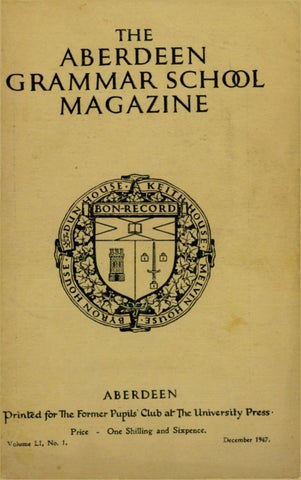
THE
ABERDEEN GRAMMAR SCHML MAGAZINE
ABERDEEN prinMcl forThe Former Pupils' Club at-The University Press • Price volume LI, No. 1.
- One Shilling and Sixpence. December 1947.
eitk.
NEW & SECOND-HAND
James G. Bisset Bookseller & Stationer 85 BROAD STREET
::
ABERDEEN
Opposite Marischal College
Educational Books — Legal — Medical Classical—Technical—Theological, etc. Students'
Notebooks and all Stationery requirements
•
PHONE 753 •
GOOD HEALTH demands
GOOD BREAD For the children especially is it necessary to ensure their stamina and energy with good, wholesome, nourishing bread. In Hutchison's bread you'll find all these requirements are fully met. Phone or give instructions to have it supplied daily.
A.11.11UTCIIISOKI LTD.
BRANCHES THROUGHOUT THE CITY
Established 1863
A. & J. SMITH (JEWELLERS) LTD.
191 UNION ST. ABERDEEN fo r GIFTS OF QUALITY
FINE JE2WELLERY ANTIQUE & MODERN SILVER & PLATE LEATHER GOODS CLOCKS & WATCHES OBJETS D'ART
We are Buyers of ANTIQUE SILVER, MODERN SILVER OLD SHEFFIELD PLATE and JEWELLERY
ILIITILIES have Just what you are looking for Something to wear that is well cut, smart and practical and not too expensive
g
; 7 c-(1c2.;• )1 eib— -VIII , c4.),-., i c'- ' .
oc
SUITS
i 'T
jo Y - /
TRAVEL COATS MODEL COATS FROCKS DRESSES GOWNS FUR COATS 1
Sizes to fit all figures from 36" hip to 56" hip
A. C. LITTLE & SONS, LTD. 105 UNION STREET
•
ABERDEEN
Es rAbusn EL) 1818 HIS MAJESTY THE KING DATED 1ST JULY 1940
APPOINTED MEAT PURVEYORS AND POULTERERS TO
J. WILLIAMSON & SON Meat Purveyors, Poulterers and Game Dealers I, 2, & 3 MARKET BUILDINGS, ABERDEEN 'PHONE 452 THE SQUARE, CULTS 'PHONE, CULTS 2
35 FOUNTAINHALL ROAD 'PHONE 1724
BRANCHES :
ALSO AT CHURCH SQUARE. BALLATER.
'PHONE 38
BY
TO THE LATE
APPOINTMENT
KING GEORGE V
GRANITE MONUMENTS Designs and Prices on Application Monuments carefully packed and forwarded to all parts of the world Letter-Cutting done in Town and Country at Moderate Rates
JAMES TAGGART & SON Granite Works 92 GREAT WESTERN ROAD, ABERDEEN Fstablished over 50 years
Telephone--•I658
For Better Footwear
JAMES LORIMER & SON (BOOTMAKERS), LTD.
CIVIL and MILITARY BOOTMAKERS
8 CHAPEI. ST.
ABERDEEN
(Late of 162 Union Street)
Estd. A.D.
1844
`Phone
72.1
WM. KENNAWAY L D. Quality Bakers, Confectioners and Caterers
ABERDEEN e When on a visit to Aberdeen—Gateway to Royal Deeside—rest and dine at our
RESTAURANT AND TEA ROOMS 173 UNION STREET Here you can have the finest service at reasonable cost.
The Restaurant is
fortable.
commodious and com-
Our rooms are available for all types of
functions—Phone 2371.
Telephone No. 1891/2.
ARCHIBALD McKELLAR Family Grocer, Wine Merchant and Tobacconist,
450-456 Union Street, Aberdeen. . Cooked
.
We Specialise in . .
Gammons, Finest Belfast Smoked Hams, Wiltshire Bacon.
Medicinal Wines—Vibrona, Hall's, Wincarnis, Phosferine.
FURNITURE SHORTAGE During the present Furniture Shortage, we are carrying a stock of good quality Second-hand and Antique Furniture at reasonable prices. Good quality Utility Furniture can be obtained on production of Units
ROBERTS (Aberdeen) LTD. House Furnishers
-
419 Union Street
ABERDEEN Upholsterers
Cabinetmakers
Carpet Warehousemen
Licensed Valuators
Telephone : 2695
Established 1873
JAMES FYFE & SON PAINTERS
AND
.
•
OFFICE
AND
.
GLAZIERS
SHOWROOMS--
11 DEE STREET, ABERDEEN Telephone 304
Telograms—"Fyfe, Painters "
WHEN FOREIGN TRAVEL BEGINS AGAIN
Remember
THE WAYFARERS II ALBYN PLACE ABERDEEN Telephone 28614 EDUCATIONAL TRAVEL A SPECIALTY (In association with the Wayfarers Travel Agency
Ltd., London and Paris)
At your Service
S
S S
S
For QUALITY
S S
FISH • GAME • MEAT
S
Whether you shop in person or by telephone your require-
S
ments in either or both of our Departments will be looked S
after with care.
Our delivery system too exists for your convenience
S
A. & W. ALEXANDER
S
S
FISH, GAME AND MEAT MERCHANTS
492
TELEPHONE: ABERDEEN 5 172
S
STREET,
S
UNION
ABERDEEN
S
S W.2=t7.2=====t7.12=======
FARM: CULTER Tel. 6
DAIRY: ABERDEEN Tel. 1213, 7013, 7014
KENNERTY DAIRY
FARM 0
WILLIAM REITH Sole Proprietor :
JOHN REITH
•
46-48 ROSE STREET, ABERDEEN
BOYS' WEAR OF
SUPERIOR MAKE TWEED
RUGBY
Shorts in Breasted
SUITS :
Utility with
and
usual
pockets.
and
Jacket
Two-piece
Non-utility.
Style
Single
are
lined.
Shorts
Colours—Lovat, Brown, Grey and Blue. Prices from 56/4 to 89/3 (12 COUPONS.)
NAVY UTILITY MILTON COATS Fit 9 to 13 years
59/- to 81/7 (12 COUPONS)
BOYS' STOCKINGS—Own Make From 3/6 to 4/6 (1 COUPON)
PYJAMAS from 8/10 to 22/4 (6 COUPONS)
DRESSING GOWNS from 52/6 to 86/3 (7 COUPONS)
ESSLEMONT & MACINTOSH (RETAILERS) LTD.
UNION STREET, ABERDEEN
p
CC
ivy
1 need good food"
—and this is where you can get it ! We always have a fresh stock of all well-known dog foods including Spratt's, Spillers, etc.
Main Stockists for :—
Pot and Pearl Barley Barley Meal Hay and Straw Coal and Firewood Poultry and Bird Food Moss Litter Manures
WILLIAM SCORGIE GRAIN AND POTATO MERCHANT
13 ROSE STREET
•
Phone 4014
ABERDEEN
Established over 100 Years
THINGS ARE
WM. CAY & SONS
STILL HOPEFUL
(FUNERAL DIRECTORS) LIMITED
Some Supplies are available of
415 UNION STREET
TYPEWRITERS
and
DESKS (wood and steel)
209 GEORGE STREET,
CHAIRS FILING CABINETS
ABERDEEN
CUPBOARDS Everything for the Office
Efficient Service Day and
Night Come and see me
All Funeral Requisites Supplied
C. H. WEBSTER
Cremations Arranged
489 Union Street
Telegrams—" Cay, Aberdeen."
ABERDEEN
TELEPHONE Nos. 92 and 54.
Telegrams : 'Blake Builders'
Telephone: 8811-2
US ID ILA Ilk IL ILIFIL,.
JI
Joiners and Building
Contractors
7 ALBYN TERRACE Works-23, 25, 29 SUMMER STREET,
All classes of Building Work
::
ABERDEEN
Enquiries courteously solicited Wyllies Circulating Library
Agents for Ordnance Survey Maps
WYLLIES Booksellers, Stationers
247 UNION STREET, ABERDEEN Telephone 402
Established 1014 ESTABLISH
THE
HABIT
OF
READING
GOOD
BOOKS
RT Our extensive selection of books covers the whole field Publications by recognised artists and leading of Art. authorities include the following subjects : Drawing, Painting, Cartoon, Poster-Work, Lettering, Pastels, Sculpture, Architecture, Modelling, Weaving, Sewing and Needlework. To those who cannot call personally we shall be glad to forward a selection of books on approval. Orders can now be accepted for—
. . STUDIO ARTIST ART AND DESIGN . DISPLAY .
CONNOISSEUR ART AND CRAFT (Quarterly) ART BULLETIN .,
(Monthly) t, .,
TAYLOR 5 ART SALON SCHOOLHILL • ABERDEEN • PHONE 2870 PHONE 1219
ESTD. 1733
GIFTS t
ha t
ALWAYS SATISFY Silverware • Gem Rings Cigarette Boxes • Fine pieces of Jewellery and Gift Presentations in solid silver
JAMIESON & CARRY GOLDSMITHS
UNION
BRIDGE
o
ABERDEEN
TO OUR CUSTOMERS We regret that the present restrictions on both men and materials make it impossible for us to maintain the usual high standard of service which we have carried on for over a century. We can assure you that we are doing our utmost to please you and trust that you will be patient with us.
J. & A. OGILVIE 369 UNION STREET ABERDEEN Telegrams : " Interiors "
Telephone No. 433
The choke of your
FIREPLACE ARRANGEMENTS may be a little restricted these days, but we have been able to maintain our stocks at a good level, and have on display a pleasing range of modern and period designs for your selection.
James Scott & Son (Aberdeen) Ltd. 483-485 UNION STREET ABERDEEN Phone 1881-2-3
BY
APPOINTMENT
GROCERS TO
H.M. THE KING
ANDREW COLLIE
AND COY. LTD.
Where the best baskets are filled
ot„,
ALSO AT CULTS,
BRAEMAR AND BALLATER
CONTENTS ILLUSTRATIONS Facing page
J. R. S. Innes, W. D. Allardice . 2 A School Cricket Group of 1887 . 6 Sir Arthur Lothian, K.C.I.E., C.S.I., . 7 . • . I.C.S. . Badge of Office for the President . 94
Facing page
• 95 Upper VI- Session 1947-48 • F.P. Club Cricket Section Strathmore • 98 . . . Union XI . 99 W. D. Allardice in Action .
• Page 1 . . . . Our Two Rugby Internationalists 2 . • ff A Message to Former Pupils from the Rector 4 If . • . . F.P. Club Memorial Schemes . . . 5 . . . . Battle of Britain Memorial . 6 • ff • • . . . A School Cricket Group of 1887 . ,> 7 . . . . . Notes about Old Boys . 26 . . . . . . . . Marriages „ 29 . . . . . . • • Obituary • . » 34 • • • . . University Notes . ,, 37 This Blessed Plot of Earth, this—Aberdeenshire. • By W. M. H. . „ 46 . India in Retrospect. By H. T. Sorley . 51 ff . • . . A Letter from Pakistan . ff 53 . . D. P. Hospitals. By W. L. Walker . „ 56 . A Prisoner-of-War Returns. By G. F. Collie 58 In Praise of British Music. By Bramwell Cook School Section— . f 1 6o . . . . . . School and Random Notes . 62 . . . . . . . . Lower School Notes . . ff 63 . . . . . . Changes in the School Staff . . 64 . . . . . . . . The Modern Babel . ff. 68 . . . . . • . . Peter Rattray . . . • ff 69 . . • . . . . Autumn . . ff. 7o . . . . . . A Historian's Nightmare . . )9 72 . . . . . . . Capital Punishment . . . If 73 . • • . . . . Festival Visit . . . 74 . . . Early Morning Farmyard. Opium . . f f 75 . . • • . . . . We Three . 76 . . . ff . . . Autumn Glory. The Storm School Games Activities— . . 77 . . . . . . Rugby . . . 79 . . . . . . Hockey 8o . . . . • . . • . House Notes . 81 . . . . . . . Literary and Debating Society . ff 82 . . . Scottish Schoolboys' Club. Swimming Club 83 • • • • • • . . Scout Notes Army Cadet Force. Rambling and Mountaineering Club. Dramatic 84 • . . . Society The Former Pupils' Club— . ff 8 Badge of Office for the President. Proposed Yorkshire Centre 86 . . . . . . . . Club Executive Notes . . f f 87 . . • . . . . . F.P. Club Consuls 89 . . • . . . The F.P. Club Boarding House . • • • lf 92 . Club the of Dinner Annual The Glasgow Centre. London Centre. Malayan. Centre. F.P. Cricket . f f 97 . . . . . . . . . Section . ff 99 . . . . . . . F.P. Rugby Section . . ff I00 . . . . . . . F.P. Tennis Section . . 3 P. IOI . . . . • . . F.P. Hockey Section . . If 102 . . . F.P. Golf Section. Rates of Subscriptions . 103 . . . . . F.P. Club Office-Bearers 1947-48 •
•
•
•
•
•
•
•
•
• •
•
•
•
•
•
•
•
•
•
•
•
•
•
•
•
•
•
•
•
•
•
ff
f1
•
•
• •
ff.
•
•
•
•
•
ESTABLISHED IN ABERDEEN
1836
Northern Assurance Company Limited Enquiries solicited for all Classes of Insurance FIRE Insure your Dwelling-house and Furniture with the Local Office LIFE Attractive rates for Endowment Assurance and all other classes of Life Assurance ACCIDENT Insurance granted against Third Party Risks of all kinds Company's Assets
-
£35,800,000
CHIEF OFFICES:
ABERDEEN . LONDON .
I UNION TERRACE 1 MOORGATE, E.C. z
Branches and Agencies throughout the World
J. R. S. INNES
W. D. ALLARDICE Photographs by courtesy of Balmain, Edinburgh.
Aberdeen Grammar School Magazine 64th year: No. 161 (New Series, 55th year, No. z$2)
Vol. LI
DECEMBER 1947
No. I
the auspices of The The " Grammar School Magazine " is issued underDecember and July. Former Pupils' Club, twice a year at present—in addressed to Communications with regard to the " Magazine" should be the Editor, ALAN C. R. WATT, M.A., c/o The University Press, 6 Upper Kirkgate, Aberdeen. member of the [NOTE : An asterisk after a name indicates that the F.P. is a F.P. Club.]
Our Two Rugby Internationalists
and The selection of two F.P.s, John R. S. Innes* (1923-35) interthe in Scotland for play to (1934-39), W. Dallas Allardice* and national rugby match against Australia on 22 November 1947, immense given have team, the of captain the choice of Dr. Innes as satisfaction to all connected with the School. time, Never before have two F.P.s been " capped " at the same respective although four other F.P.s have been selected for their Scotland for countries. GEORGE A. LEDINGHAM* (1894-1905) played played against France in 1913, RODERICK R. F. MACLENNAN* (1909-18) W. C. DOUGLAS and 1925, in France and for England against Scotland international SMITH* (1929-41), played for Scotland in three unofficial Another 1946. in Ireland and Wales Zealand, matches against New in 1934 F.P., JAMES I. MORRICE* (1920-25) was selected for Scotland injury. of but could not play on account against Dr. Innes was first " capped" in 1939, when he played times four played he War the During England, Wales, Ireland and he played 1946 in and matches international Services' in Scotland for the School twice in unofficial international games. He played for team which 1st XV in 1933-34, and was captain of the famous 1934-35 School. the by produced ever team best the as is regardcd by many vice-captain He was also vice-captain of the Cricket XI in that year, While Trophy. All-Round Club F.P. the of of athletics and winner was team, University the at Aberdeen University he played rugby for Medicine in graduated He blue. full his won captain in 1938-39, and R.A.M.C., and in 1940, served during the War as a Captain in the this year's very of captain is He Aberdeen. is now in practice in successful F.P. Rugby 1st XV. He first Dallas Allardice is an outstanding all-round sportsman. and threequarter centre played for the School ist XV in 1936-37 as a when season, following the in scrum-half a as career started his rugby ist XV, he was also vice-captain. In 1938-39 he was captain of the
2
Aberdeen Grammar School Magazine
captain of the Cricket XI, a member of the School tennis and swimming teams, and winner of the All-Round Trophy. In later years he distinguished himself as the centre-forward of Huntly Football Club. During the War he had a remarkable record of service with the Commandos in Norway, Palestine, Malta and the Western Desert. Captured in 1943, he was taken to Italy but eventually escaped, only to be recaptured by the Germans. He escaped again, however, and spent nine months wandering and hiding before he succeeded in reaching the Allied lines. He was mentioned in dispatches in January 1945. After demobilization he attended a course at the Emergency Physical Education College in Aberdeen and was awarded a diploma. In June of this year he was appointed to the staff of the physical education department of his old School. In the match on 22 November, Scotland was beaten by the " Wallabies ", the score being 16-7, but both F.P.s gave a very good account of themselves, and hopes are high that they will retain their places for the remaining four international matches this season. According to D. R. Gent, the well-known rugby correspondent of the Sunday Times, " J. R. S. Innes, the captain, played a really superb game in the centre both at defence and in attack " and the rugby correspondent of The Scotsman considered that " Allardice combined all the best qualities of J. B. Nelson and W. R. Logan at scrum-half. His service was quick and accurate and he was as hard as his native granite when he had to stop the tourists' forwards, who put in some lusty work."
A Message to Former Pupils from the Rector Several times in the last few months the question has been put to me : " How will the Grammar be affected when the Town takes you over ? " or " How are you faring now that the School is under the Town Council ? " Few F.P.s, I fancy, would fall into such a gross misjudgment of what has been happening to the Grammar School in the past year, and yet there is ground for suspecting that in less naive and obviously ridiculous forms the same mistaken idea of the relation between the city and its ancient grammar school does prevail in a good many quarters. How else explain the considerable amount of irrelevant comment and criticism which condenses into the grumbling protest —" Why can't the Town Council leave the Grammar alone ? " Now I submit that we who have pride in the School and concern for its future will not begin to think sensibly on the subject until we recognize that to leave the School alone is just the one thing we cannot in reason ask the city authorities to do. For good or ill the Grammar (like nearly all the historic schools of Scotland) has been for centuries the possession and responsibility of the town in which it is set, and it must remain so. It is too late in the day to think otherwise. So far, therefore, from charging the city authorities with usurping what is not their own, let us ask, as Professor Noble did at the Club Dinner, whether the reproach that can justly be levelled
Aberdeen Grammar School Magazine 3 the Grammar School denied they have against them is not rather that the attention and enlightened care which its history and character merit. So to conclude, is not to imply that the School should be exempt from criticism or change, still less that it abides in a perfection which makes criticism an affront and change a calamity: it is simply to suggest that Aberdeen, which in other respects has been not unmindful of its own past, should cherish with a jealous regard an institution in whose immemorial life is mirrored the very history of the city itself. Can it be claimed that, in the period since the end of the first World War, the Town has had any clear and consistent policy for the Grammar School ? If so, it is hard for an incomer to discern the pattern of it. These were the years in which secondary education was developing rapidly and its organization becoming more clearly articulated ; but, so far from the ancient School having been given a central place and a defined function within the city plan, it seems to have been left in a more than geographical sense at the periphery, to meet after a fashion the needs, or rather the requirements, of the west-end, and in an almost complete and far from splendid isolation from the primary schools of the city. By comparison then with the urgent need to think hard about the School and its function, all the pother about fees must be counted much ado about little, and it is deeply regrettable that the manner in which a decision was reached precluded the education committee from first considering the question it should have faced long ago—" What do we propose to do with the Grammar School ? " The question remains, and it is at once the right and the duty of all friends of the School to keep putting it to the responsible authorities in the hope that sheer importunity may achieve what had been better done from proper pride in an ancient inheritance. ' Some years ago I was welcomed in George Heriot's School on Founders' Day and heard its headmaster say to his boys, " We are an ancient school and proud of our history. But we are glad to remember how much older still is the Royal High School of Edinburgh, and towards it we feel the special pride and affection due to an institution which is the mother of us all." Given a comparable feeling for the Grammar School in the North-East, it should not be impossible even at this late hour to find for it a distinctive role which is neither one of mere privilege nor yet inconsistent with the enlightened trends in contemporary education. For not in its antiquity alone does the School stand by itself in this part of the land ; and, since variety not uniformity is the mark of a civilized polity, it will be a sorry and unimaginative ending if the Grammar is simply assimilated to the prevailing Northern pattern. It is not for us Grammarians to prejudge the issue by supplying answers, but I say again that we should, like a Socratic gadfly, keep stinging and plaguing those who are responsible with the long-evaded question—" What do you mean to make of the Grammar School ? " J. J. R.
Aberdeen Grammar School Magazine
4
F.P. Club Memorial Schemes War Memorial As no decision has yet been reached by Aberdeen Town Council on the extension of the 1914-18 War Memorial in the School Hall to include the names of F.P.s killed in the 1939-45 War, the Club Executive has been unable to decide the extent of its War Memorial scheme. Considerable progress has, however, been made with the compilation of the Club's Roll of Honour containing photographs of and biographical notes on all F.P.s who were killed on active service or who died through enemy action between 3 September 1939 and 15 August 1945. There are 184 names on the Roll, and a letter has been sent to next-of-kin enclosing a copy of the information published in the Magazine in each case and asking for additional information where this is available. To date i z8 replies have been received. In some cases it has not been possible to trace the next-of-kin, and in others letters sent to the last known address of the next-of-kin have been returned. The following is a list of those F.P.s whose names are on the Roll and about whose next-of-kin particulars are required. Anyone who is able to assist in this matter is requested to communicate with the Secretary of the Club, zzo Union Street, Aberdeen, as soon as possible. Remarks Last known Particulars of Dates at Next-of-Kin School 1930-33. Mrs. Baxter, 43 Rosehill Drive. " Deceased." R. G. L. Baxter. 1921-3o. Mrs. A. M. Willey, 14 Fonthill L. M. Cheer. " Not known." Terrace. 1925-37. Miss D. J. Fleming, 3 is Parkside, R.D.S. Fleming. " Not known." Cambridge. 1929-35. W. A. M. Halley. I. C. F. MacGregor. 1919-20. Mrs. John MacGregor, Fordyce, Portsoy. " Deceased." 1927-37. Mrs. McKenzie, 1 Darlaston Road, J. W. McKenzie. Wimbledon, London, S.W.19. " Gone away." 1932-35. Mrs. L. M. Maitland, 2 Viewfield R. R. Maitland. " Gone away." Crescent. 1920-31. Charles E. Brass, 4 Hayfield C. H. E. Ross. " Not known." Place. 1923-35. J. M. Ross, 35 Richmondhill J. M. Ross. " Deceased." Road. 1920-23. Mrs. V. W. L. Stanion, Lane's V. W. L. Stanion. End, Upper Boddington, " Left district." Rugby. 1901-07. A. J. Stewart. 1930-33. B.A. Sutherland. 1915-18. R. G. Weighill. J. T. Wright. 1924-25. (Addresses, unless otherwise stated, are in Aberdeen.) Name of F.P.
-
Memorial to the late Dr. Theodore Watt As announced in the last issue of the Magazine, this memorial is * to take the form of a posthumous portrait. Arrangements for the
Aberdeen Grammar School Magazine
5 painting of the portrait are in hand, and it is hoped that it may be completed by the Spring of 1948. Memorial to the late Mr. William P. Stewart No decision has yet been reached on the form which this memorial is to take, but the Executive hopes to send a circular to all members in the near future with full particulars of all three schemes.
The Battle of Britain Memorial The Battle of Britain Memorial in a chapel at the east end of Westminster Abbey was unveiled by the King on io July 1947. It has been adorned with a stained and painted window by Mr. Hugh Easton, whose design incorporates the armorial badges of the 63 fighter squadrons which operated during the battle and the flags of the nations to which the pilots and air crews belonged. The Roll of Honour rests on a lectern north of the chapel. It commemorates the 1495 airmen of the flying forces of the allied nations who gave their lives in the Battle of Britain between ro July and 31 October 1940 and it includes the names of the following three F.P.s : P/O Robert David Spittal Fleming (1925-37), 249 Squadron, Fighter Command. F/O James Gillan (1920-32), 6o, Squadron, Fighter Command. P/O John Woffenden McKenzie (1927-37), ill Squadron, Fighter Command.
The Magazine Since the death of Dr. Theodore Watt, who was Secretary and Treasurer of the F.P. Club and Editor of the Magazine, his duties have been divided between the new Secretary and Treasurer, J. Scott MacLachlan, M.A., LL.B., and the new Editor of the Magazine, Alan C. R. Watt, M.A. As some members appear to be in doubt as to whom they should address on matters connected with the Magazine, it should be explained that the duties of the Secretary and Editor in connection with the Magazine are as follows : The Editor deals with all editorial and advertising matters. News about F.P.s, articles for publication, queries and comments on the Magazine and communications regarding .advertisements should be sent to him at c/o The University Press, 6 Upper Kirkgate, Aberdeen. The Secretary arranges for the distribution of the Magazine. Reports of non-receipt and intimations of changes of address should be sent to him at 220 Union Street, Aberdeen. * * * The Editor is always delighted to receive information for inclusion in the " Notes about Old Boys ", as he wishes to make this section of the Magazine as full and as interesting as possible. News of events, appointments, promotions, transfers, etc. which are not reported in the daily press is especially welcome.
6
Aberdeen Grammar School Magazine
A School Cricket Group of 1887 From time to time old class groups and photographs of old rugby and cricket teams have been reproduced in the Magazine and in this issue we are pleased to include another—a photograph of a School Cricket group of 1887, belonging to Mr. J. Everard Rae, advocate, Aberdeen. Of the fourteen Old Boys in the photograph, in addition to Mr. A. V. Lothian, a master at the School, twelve have been identified and the Editor will be glad if anyone able to complete the list will communicate with him. So far as is known, there are five surviving members of this group. They are James Garden Gray (1882-88), M.A., L.R.C.P., L.R.C.S., who has retired from a medical practice in London ; James Hay* (1883-87), M.A., B.L., LL.D., advocate in Aberdeen; John Everard Rae* (1885-87), M.A., advocate in Aberdeen; Charles R. Smith (1881-88), formerly of Messrs. J. & J. Smith, grain merchants, Perth and Arbroath ; and David Murray Strath* (1881-87), formerly a director of Ogston & Tennant Limited, soap and candle makers, Aberdeen, and now living in retirement at Banchory. i The other members of the group were STEWART SALMOND BUYERS (1879-88), solicitor in Aberdeen, who died in 1935 ; JOHN FARQUHAR CHRISTIE (1878-87), M.A., M.B., C.M., F.R.C.P.E., for many years in medical practice in Aberdeen and a lecturer at Aberdeen University, who died in 1931 ; ANDREW DAVIDSON KELLY (1882-88), M.D., of Philadelphia, Co. Durham, who died in 1932 ; DAVID ALEXANDER MCGILLIVRAY (1882-88), M.A., who was Editor of the Nottingham Daily Express until 1910 and who died in 1934 ; DUNCAN DAVIDSON MACKINTOSH (1883-88), M.B., C.M., formerly in medical practice at Aboyne and Worthing, who died in 1946 ; JOHN MURRAY (1884-87), M.A., a teacher at Newcastleton, Roxburghshire, and then assistant minister of the Catholic Apostolic Church, Aberdeen, who died in 1904; and CHARLES WILLIAM PROFEIT (1 884-87), C. S.I., C.M.G., D.S.O., M.B., C.M., Colonel, Army Medical Service, who died in 1937. The captain of the team in 1887 was the late Dr. J. F. Christie, who had the reputation of being one of the finest and most stylish batsmen the Grammar School ever produced. He later captained the University Cricket XI and was for many years a member of the Aberdeenshire Cricket Club. He was captain of the County team from 1907 to 1909 and in each of these three seasons his team won the Scottish Counties Championship.
The Annual Grammar School Church Service On 14 September 1947 the Annual School Service was held in Rubislaw Church. The service was conducted by the School Chaplain, the Rev. P. D. LAWRENCE* (1909-16), and the lessons were read by the Rector and the Senior Prefect.
A School Cricket Group of 1887
Standing—Unidentified, S. S. Buyers, John Murray, C. W. Profeit, J. F. Christie, D. D. Mackintosh, A. D. Kelly, James Hay, J. Everard Rae, D. M. Strath. Sitting—C. R. Smith, Mr. A. V. Lothian, D. A. McGillivray. In Front—Unidentified, J. G. Gray.
SIR ARTHUR LOTHIAN, K.C.I.E., C.S.I., I.C.S.
Aberdeen Grammar School Magazine
7
** * The Editor is glad at all times to receive from any quarter items of information for this section of the " Magazine ".
The dates given in parentheses after names indicate the sessions of attendance at the School. Sir Arthur Cunningham Lothian* (1892-94 and Ft g-1904), K.C.I.E., C.S.I., I.C.S., returned to this country in April on leave pending retirement after a very distinguished career in the Indian Political Service. During the last ten years, as Resident for Rajputana (1937-42) and Resident at Hyderabad (1942-46), he has held in succession what are perhaps the two most important political charges in India. Rajputana is the largest group of States in India and Hyderabad is the premier Residency: the former is predominantly Hindu and the latter Muslim. After leaving School Sir Arthur attended Aberdeen University, where he graduated M.A., with First Class Honours, and B.Sc., with special distinction, and thereafter he went to Christ Church, Oxford. Passing into the I.C.S. in 191o, he served for some years as a magistrate in Bengal and then was transferred to the Political Department of the Government of India in 1915. Thereafter he served in Central India, Kashmir, Hyderabad, Mysore, Baroda, Rajputana, the Eastern States, and in the Secretariat of the Government of India. In addition to the ordinary duties of a Political Officer he had the unusual experience of being, for short periods, Prime Minister of Alwar and President of the Council of State both in Bharatpur and in Jaipur. When on the staff of the Secretariat, he was additional secretary (Federation) during the momentous years following the passing of the Government of India Act, 1935 and, as Special Representative of the Viceroy in federal discussions with the Indian States, he acquired an unrivalled knowledge of the States and their problems. In 1937 he was appointed Resident for Rajputana and Chef Commissioner of Ajmer-Merwara, and his period of office there, coinciding as it did with a period of unparalleled famine, of acute political unrest, and of stress and strain resulting from the War, was one of peculiar difficulty and great responsibility. His relations with the Ruling Princes of Rajputana, however, were of the most frank and friendly nature and, on his leaving Rajputana in 1942, high tribute was paid by the late Maharaja of Bikaner, who spoke of Sir Arthur's proven sympathy and friendship for the Indian States and their Rulers and his anxiety at all times to be of help to them. Sir Arthur had held appointments in the State of Hyderabad in 1924 and in 1927, but when he returned there in 1942 he went as Resident,
Aberdeen Grammar School Magazine 8 the representative of the British Crown in India's most important State. He succeeded to a long line of distinguished political officers who have held this post and His Exalted Highness the Nizam of Hyderabad, public'y referred to Sir Arthur as one of the most able of them all. A further tribute to his services was paid by His Excellency the President of Council, Sir Mirza M. Ismail, at a farewell banquet in Hyderabad given to Sir Arthur and Lady Lothian in November, 1946. " It is little short of a tragedy ", he said, " that a man with such talents and experience, such unrivalled knowledge of the States and such generous sympathy with their Rulers, their peoples and their problems should have to leave us while still in the plenitude of his powers ". In a leading article on Sir Arthur's departure the Hyderabad Bulletin said, " He has left a trail of affection and enduring respect wherever he has served . . . and in his latest capacity as the Resident here, he has earned the love and gratitude of both the high and low in an abundant measure ". After his departure from Hyderabad, Sir Arthur spent his last four months in India touring the Indian States in Rajputana and Central and Western India as the guest of their Rulers. In previous years S:r Arthur travelled extensively in the countr :es of the Near, Kddle, and Far East, as well as in the U.S.A. and much of Europe. James Smart Abernethy* (1925-26), M.A., LL.B., W.S., returned to Jesselton, North Borneo, in July 1947, after having been in this country on sick leave since November 1946. He is now Commissioner of Lands and Mines in North Borneo and has resumed his duties as F.P. Club Consul for North Borneo, Brunei and Sarawak. Mr. Abernethy, whose initiative and enthusiasm were largely responsible for the establishment of the Edinburgh Centre of the F.P. Club in 1932, first went to Borneo in 1936 when he was appointed a legal officer in the Government service. Since then he has held a variety of posts, including that of Legal Adviser, Commissioner of Lands, Acting Magistrate of the First Class, Superintendent of the Printing Office and Editor of the British North Borneo Herald, Acting Chief Justice Class IA and Food Controller. In September 1942 he was captured by the Japanese at Penungah and remained in captivity until released by the 9th Australian Division in September 1945. After seven months in this country he went back to Borneo and was appointed Additional Sessions Judge for North Borneo and Legal Adviser to the Senior Staff Officer (C.A.), North Borneo Area. Later he became Acting Chief Justice for the State of North Borneo, the State of Brunei and the Settlement of Labuan and in July 1946 he was appointed to act as Attorney-General for North Borneo. Hugh George Jeffrey Aitken* (1928-4o), M.A., who served during the War with the South-East Asia Air Forces, returned on demobilization to finish his course at St. Andrews University and graduated M.A. with First Class Honours in Philosophy and Economics in June 1947, being awarded the Tyndall Bruce Prize for Logic and a William Blair Prize and Medal for Economics. Out of i5o applicants
Aberdeen Grammar School Magazine 9 he has now been assigned one of the two Hudson's Bay Company scholarships awarded to graduates of British Universities in 1947. He is specializing in Economics at Toronto University and has already contacted the F.P. Club Consul at Montreal, Norman Mackinnon, and the Consul in Toronto, Robert Fleming. The scholarship which he has been awarded was established by the Hudson's Bay Company to celebrate the 275th year of its existence. His elder brother, Arthur Jeffrey Hood Aitken* (192.7-38), M.B., Ch.B., after serving on the North-West Frontier of India as a Captain in the R.A.M.C., was demobilized in May 1947 and is now in general practice at 9o Orsell Road, Grays, Essex. His younger brother, Robin Christopher Aitken* (1931-43), B.Sc.(Eng.), holds a commission in the Royal Engineers and is at present stationed in Berlin. Ian Alfred Anderson* (1912-24), M.B.E., B.Sc., M.B., Ch.B., lecturer in Clinical Chemistry at Aberdeen University sincest945, was in June 1947 awarded the Order of St. John for his services to wounded British prisoners-of-war in Germany during the War. A Major in the R.A.M.C., he was with the Army Medical Directorate at the War Office and did valuable work with the St. John Association and the British Red Cross. He advised them on a scheme for sending parcels of invalid food and medicine to P.O.W.'s in Germany and also acted as an unofficial adviser in nutrition to the P.O.W. department. Dr. Anderson, who was the most distinguished graduate in medicine at Aberdeen University in 1933, has specialized in nutrition and he is joint author with Professor L. S. P. Davidson, Edinburgh, of " A Text Book of Dietetics ", published in 1940. Robert John Anderson* (1931-37), M.B., Ch.B., i% now in practice with Dr. J. R. Anderson, Fortrose, and lives at Rosemarkie. During the War he served with the Royal Navy as a Surgeon Lieutenant, latterly at a hospital in Cochin, South India. He was demobilized earlier this year. Ronald James Beattie* (1927-36) has qualified as a Fellow of the Chartered Insurance Institute. He has been employed by the Liverpool and London and Globe Insurance Company, Limited, since 1936 and is at present an inspector of the Company in Aberdeen. His marriage is reported on another page. He is one of four brothers who attended the School. Eric William Beattie* (1921-28), C.A., is secretary of Turney Brothers Limited, Trent Bridge Leather Works, Nottingham ; Norman Robert Beattie* (1921-31), C.A., is Assistant Harbour Manager and Treasurer, Aberdeen ; and Colin Strachan Beattie* (x931-34 and 1935-40) is a civil engineer in the County Engineer's department, Aberdeen County Council. William Edmund Bell (1878-83), solicitor, who was one of the founder members of the Aberdeen and North of Scotland Philatelic Society, was presented by the Society in October of this year with a Certificate of Fellowship. The Society was formed in Mr. Bell's office thirty-seven years ago, and he is the last of the original members.
lo
Aberdeen Grammar School Magazine
John Gordon Michie Birss* (1926-38), M.C., M.A., has been acceptcd as a trainee under the Government Training Scheme for ex-servicemen and is working in the cost accountancy department of the King Aircraft Corporation, Renfrew. Earlier this year he attended a Ministry of Labour business training course in Aberdeen, at the same time as three other F.P.s, John Sinclair Calder* (1926-40), Robert Arthur Drysdale Lindsay* (1933-39), now with the Scottish Amicable Life Assurance Society, Aberdeen, and George Mitchell (Peter) MacPhee* (1930-41). Thomas Stewart Boyd* (1930-38), who is on the staff of the Ministry of Labour, has been appointed to the Edinburgh Exchange staff as a Grade VI officer, as a result of a recent series of Reconstruction Entrance Examinations. He has also become assistant scoutmaster of the x x 3th Edinburgh Troop and finds the training he received in the 17th Abendeen Troop and Pack most useful. • William Morrison Brown* (1932-46) is serving as a lancecorporal with the Cameron Highlanders in Ipoh, Perak, Malaya. David Cairns (I 9 x 2-16), M.A., has been nominated by the Church of Scotland Board of Nominations for the Chair of Practical Theology at Christ's College, Aberdeen. He was ordained at Bridge of Allan in 1935 and for a time during the War was a chaplain with the r5th Division in Germany. He has also been secretary of the Student Christian Movement. David Ian Calder* (1926-38), A.M.I.C.E., A.M.I.Struct.E., is now Assistant Inspector of Harbours for Scotland under the Scottish Home Department. Alexander Vernon White Cantlay* (1903-10) is at present assisting on the Kamparmalim estate, Perak, Malaya, until conditions in the Netherlands East Indies permit his return to Sumatra. He was in charge of the Glen Bervie estate at Tandjong Poera, Sumatra, until captured by the Japs in March 1942. He first went out to Malaya in 1913. James Alexander Cardno* (1929-32), M.A., has been appointed Director of Social Studies in the University of Sydney, New South Wales. He obtained " Double Firsts" in English (Language and Literature) and Mental Philosophy at Aberdeen University and at Cambridge he studied psychology and was placed in Class I of Part II of the Moral Sciences Tripos. Joseph Robert Carry* (1918-30), M.B.E., was in November 1947 elected to Aberdeen Town Council as a representative of Rosemount Ward. He is proprietor of Messrs. Jamieson & Carry, jewellers, Aberdeen. Other F.P.s who are members of Aberdeen Town Council are John Maclennan* (1914-20), A.R.I.B.A., A.M.I.Struct. E., (Ruthrieston Ward) and Ian Gowanlock McPherson* (x9r0-1 7), (Ferryhill Ward). At this year's municipal election Gilbert Frewin Hamilton (1921-30), B.Sc., M.B., Ch.B., was an unsuccessful candidate in St. Machar Ward. Douglas Paterson Cochran* (1906-15), who is manager of the Dundee branch of the Royal Exchange Assurance and who has held
Aberdeen Grammar School Magazine
11
a commission in the Air Training Corps since 1942, was in August 1947 appointed District Inspecting Officer in the Dundee area, with the rank of Squadron Leader. Before the War he was for several years the enthusiastic secretary of the London Centre of the F.P. Club and before that he was the equally enthusiastic secretary of the Rugby Section of the Club in Aberdeen. He is still able to visit Aberdeen from time to time and never fails to contact past and present members of the Rugby Section. Duncan Scott Cochran* (1914-24), M.B., Ch.B., Major, R.A.M.C., was in January 1947 posted from H.Q., B.A.O.R. to H.Q., North Midland District, Nottingham, as D.A.D.M.S. (T.A.), to be medical staff officer for the R.A.M.C. (T.A) in the counties of Nottingham, Derby, Lincoln, Warwick and the West Riding of Yorkshire. Bruce Mayor Cockie* (1930-43) is organizer of the Aberdeen branch of the Scottish National Party. George Mather Craig* (1896-99), B.Sc., has retired from the Engineering department of Allan Glen's School, Glasgow, of which he has been Head for 43 years. During his long period of service there he carried out his duties with the greatest enthusiasm and vigour, and when engineering became a Leaving Certificate subject, he had to devise a teaching method in Engineering without any model to guide him since no other school had a similar course. According to a notice of appreciation which appeared in the Allan Glen's School Magazine of June 1947, Mr. Craig was at all times respectful of the great traditions of the school, mindful of its dignity and concerned in all his work to build for continuity and growth. He regretted most bitterly the parsimony with which the needs of his subject were met in a city which lived by engineering. For 12 years he was evening class lecturer in Mechanical Engineering at Paisley Technical College and in 1930 he was appointed president of the Glasgow University Engineering Society. He had a long association with the Old Boys' Club of Allan Glen's School and maintained many contacts with his former pupils. To fill the vacancy in the Engineering department at Allan Glen's School caused by Mr. Craig's retirement and the promotion' of his second-in-command, another F.P. has been appointed. He is Alexander Albert Rae Smith* (1909-16), B.Sc., A.I.Mech.E., who has for many years been a teacher of engineering in Glasgow. Both Mr. Craig and Mr. Smith are members of the Glasgow Centre of the F.P. Club. George Edmond Crombie (1916-21), M.A., has been appointed Deputy High Commissioner for the United Kingdom in Burma and he left this country in September to take up his new post. After graduating at Aberdeen University, he joined the Home Civil Service in 1931 and was assigned to the India Office, where he worked in the Foreign and Political department, dealing mainly with our relations with Persia, Afghanistan and the Arab States on the Persian Gulf. He was permitted to join the Indian Army in 1942, and fought with the ist Battalion of the Frontier Force Regiment in the Italian campaign of 1944-45, being mentioned in dispatches. Recalled to the India
12
Aberdeen Grammar School Magazine
Office, he dealt first in the Economics and Overseas department with the shipments of food to India, and then worked for a few months as Assistant Secretary in the Burma Office before receiving his new appointment. He is at present in charge of United Kingdom interests in Burma, until the High Commissioner arrives. Hugh Mackenzie Crombie* (1911-2o), M.B., Ch.B., L.D.S., has been appointed chairman of a local committee that has been formed in Aberdeen by dental practitioners in terms of the new National Health Insurance Act. The other members of the committee include William J. Cruickshank* (1887-92), James Lindsay* (i9o5-17), L.D.S. L.D.S., and William George Thow* Peter Crombie* (1919-2o and 1922-24), M.B.E., M.A., younger brother of George E. Crombie and Hugh M. Crombie (q.v.), joined the Indian Civil Service in 1934 and was posted to Madras. After district work in Trichinopoly, Tuticorin and Malabar, he became Assistant Private Secretary, and for a time Private Secretary, to the Governor of Madras in 1941-42. In 1943 he was Under-Secretary in the Home Department, and in 1944 controlled the distribution of motor transport and the rationing of petrol and tyres. In 1945 he was in charge of food procurement and rationing in Malabar, and in 1946 was in charge of food imports into and movements in the province. Earlier this year he was appointed Deputy Secretary, Finance Department, and in June he was awarded the M.B.E. He is at present on leave, but intends to continue service under the Government of Madras. George Leslie Cruickshank* (1918-23), A.R.I.B.A., who was Controller of the Brick Industry during the War, is now assistant managing director of Crossley Building Products Limited, a company in Middlesbrough whose activities include the manufacture and distribution of bricks and a variety of other building materials. Eric George Beattie Davidson* (1940-47), who left School in July of this year, is now living at Newark, New Jersey, U.S.A. He hopes to enter Columbia University, New York, although gaining admission to a university seems to be even more difficult in America than in this country on account of the large number of G.I.s taking advantage of Government Schemes. He is at present attending an Art School in Newark. James Henderson Davidson* (1914-19) has been appointed a senior assistant in the Department of Health for Scotland in Edinburgh. Alexander Gordon Esslemont* (1908-2o), B.Com., who for some years has been secretary of the British H. J. Heinz Company, has recently been appointed to the Board. His brother, John Connon Esslemont* (1910-22), B.Com., was recently elected president of the Scottish Federation of Wholesale Confectioners Associations. Both brothers are directors of the family business of John E. Esslemont Limited, Aberdeen. William Milne Ewen* (1932-44), who graduated B.Com. at Edinburgh University in June 1947, received an appointment in
Aberdeen Grammar School Magazine
13
September with Weber Smith & Hoare Limited, a wharfage firm in London. Alexander Findlay* (1882-91), M.A., D.Sc., LL.D., who was professor of Chemistry at Aberdeen University from 1919 to 1943, and who was appointed president of the Royal Institute of Chemistry in 1943 and again in 1945, has gone to India and Pakistan as representative of the Institute. He is to discuss how the Institute, drhich has many Indian members, can best serve the profession of Chemistry in the two new dominions, and he will also deliver lectures at several universities. He hopes to attend the Indian Science Congress, and he will also visit South Africa before returning to this country. Frank Northman Forster* (1921-25), M.B., Ch.B., is now in practice at Bolton, Lancashire, with another F.P., Benjamin Theodore Saunders* (1896-1908), M.B., D.P.H. A contemporary of Dr. Forster at University, Douglas Nelson Mackinnon* (1921-34), M.A., M.B., Ch.B., is also in Bolton. Godfrey Power Geddes* (I9o5 -11), D.S.O., O.B.E., T.D., M.A., Colonel, has been appointed Honorary Colonel of the 5/6th Gordon Highlanders. He is chairman of the County of Aberdeen Territorial Army Association and was Honorary Colonel of the pre-War 5/7th Battalion of the Gordons. Thomas Wilson Gow (192o-33) is resident manager of the Lochalsh Hotel, Kyle of Lochalsh. Theodore Grant Gray* (1895-1901), C.M.G., M.B., Ch.B., who, as reported in the last issue of the Magazine, has retired from the position of Director-General of the New Zealand Mental Services and is now in practice at Wellington, has accepted the presidency of the New Zealand Branch of the British Medical Association. His presidential address, covering his declared policy of bringing psychiatry into closer relationship with the rest of medical practice, was reported to have been one of the most exhaustive expositions of its kind ever heard in New Zealand. Referring to the need for individualization in mental treatment, Dr. Gray commended the villa system adopted at Kingseat, Aberdeenshire. James Robertson Guy* (1924-36) has succeeded his father, the late Mr. Robert Guy, as agent in Aberdeen for William Murray & Company Limited, Craigmillar Breweries, Edinburgh. Alastair George Brand Halliday* (1923-32), M.C., M.A., was in July of this year appointed warden of the Royal Caledonian Schools, Bushey, Herts., in succession to Roderick Macrae*, a former master at the Grammar School, who had been principal of the Royal Caledonian Schools for 22 years. Two other F.P.s are also associated with the schools; Alfred John Williamson* (1897-1902), M.A., M.D., is school medical officer and Percival Howard Douglas* (1913-22), who is an architect in the Ministry of Works, is scoutmaster of the school troop. Mr. Halliday, who was teacher in physical training for the schools in Inverurie, Turriff and Kintore from 1939 until this year, graduated at Aberdeen University and thereafter
14
Aberdeen Grammar School Magazine
qualified as a physical training instructor at Jordanhill Training College, Glasgow. During the War he held a commission in the Royal Tank Regiment and won the M.C. He used to be a member of the Grammar School Orchestra and latterly he was conductor of the Inverurie Academy School Orchestra. James Hay (1893-95), M.B.E., advocate in Aberdeen, was in October of this year appointed, for the period ending 31 March 195o, to be a member of the North-Eastern Regional Hospital Board established under the National Health Service (Scotland) Act 1947. He was a member of Aberdeen Town Council from 1937 to 1946 and has been a leading figure in the fishing industry in the North-East for many years. William Garden Hendry (1925-29), M.B., Ch.B., son of WILLIAM HENDRY (1885-90), formerly headmaster of Walker Road School, Aberdeen, has been admitted a Fellow of the Royal College of Surgeons, London. He graduated in medicine at Aberdeen University in 1936 and was admitted a Fellow of the Royal College of Surgeons, Edinburgh, in 1945. At present he is in charge of the surgical department of Winchmore Hill Emergency Hospital. William Gordon Hendry* (1924-36), M.A., LL.B., who graduated in Law at Aberdeen University in July 1947, is now a qualified assistant with Messrs. Lyall & Wood, solicitors, Turriff. Alexander Henry Innes* (1933-45), who is a third year medical student at Aberdeen University, spent his summer vacation as a plant checker at an open-cast coal mine at Shildon, County Durham, where another F.P., George Walker Stewart* (1931-35), brother of the late Mr. William P. Stewart, is agent for Earthmovers Limited. Innes's job was to check the efficiency of the various machines at work on the site—bulldozers, tournatrailers, scrapers, etc.—and to note the number of loads per hour taken by these machines. In open-cast coal mining the seams of coal are reached by scraping, digging and blasting off the overlying soil with the aid of scrapers which, towed by bulldozers with tzo h.p. engines, will scrape up about 5 tons of soil in a 5o yard run. The soil is taken off in three parts—the top soil (to a depth of r foot), sub-soil (the next 3 feet) and the " overburden ". Each part is kept separate and can therefore be replaced in the correct order so that agriculture can take over again. The open-cast miners never go below 7o feet, as beyond that depth the underground miners take over. Innes reports that National Coal Board officials were continually rushing about the site calculating how much coal should be produced and never being satisfied with results. The agent usually had his hands full trying to appease them. George Stewart has now moved to Ormesby, near Middlesbrough, where he is engaged as agent in charge of the building of a 9 million gallon reservoir for Turriff Limited, a company connected w.th Earthmovers Limited. SOLICITOR-GENERAL FOR SCOTLAND
Douglas Harold Johnston* (1913-26), B.A.(Oxon.), LL.B.(Edin.), K.C., was in October of this year appointed Solicitor-General for
15 Aberdeen Grammar School Magazine Scotland. he had been appointed a K.C. a week earlier. A graduate of St. John's College, Oxford, he was called to the English Bar by the Honourable Society of the Inner Temple in 1931 and the following year he was called to the Scottish Bar. He had established a good all-round practice in Edinburgh and in 1945 he became an advocatedepute. During the War he served in the Royal Artillery and as an Intelligence Officer, and rose to the rank of Lieut.-Colonel. After the end of the War he was engaged in the investigation of Nazi atrocities. Leslie Graeme Johnston* (1932-45) was recently demobilized from the Navy. During his last year of service he was in H.M.S. Widemouth Bay, which took part in " Operation Snow White ", the towing of huge floating docks from the Far East to this country. When his ship was in harbour at Malta alongside two other naval vessels, he discovered that both of these had an F.P. aboard. Ronald Lee Mackinnon* (1932-45) was in the former and Alistair Anderson Laing* (1934-45) in the latter. Johnston is now to study engineering at the Regent Street Polytechnic, London. James Duncan Lindsay Keith* (1925-32), B.Sc.(Eng.), son of the late Dr. R. D. KEITH (1892-95), was one of the F.P.s whose names were included in the list of Addresses Wanted in the last issue of the Magazine. Considering himself an authority on the subject, he has since written to the Secretary advising him that he is now resident at 27 Brighton Grove, Monkseaton, Northumberland. He is in the employment of Messrs. Merz & McLellan, consulting engineers, Newcastle-on-Tyne. Previously he was on the Turbine Construction staff, British Thomson-Houston Company Limited, and in recent years he has been in Warrington, Lymm and Newcastle-on-Tyne. John Roger Lawrence* (1918-31) was in July of this year admitted a member of the Society of Accountants in Aberdeen. Philip Douglas Lawrence* (1909-16), M.A., School Chaplain and Minister of Rubislaw Church, Aberdeen, since 1940, celebrated his semi-jubilee in the ministry in October of this year. To mark the occasion he was presented by representatives of the congregational board of his church with a cheque and other gifts. Mr. Lawrence was ordained in 1922, his first charge being at the U.F. Church, New Deer. In 1928 he went to St. Margaret's Church, Dunfermline, and from 1933 until he returned to Aberdeen in 1940, he was minister of Rosehall Church, Edinburgh. His father, the late Mr. CALDER M. LAWRENCE, was a teacher at the Grammar School and his three sons were all pupils at the School. They are Philip Douglas Guthrie Lawrence (1940-41), William Calder Macphail Lawrence* (19401943), and Albert Alexander Lawrence* (1940-46). Robert Daniel Lawrence* (1900- 09), M.A., M.D., F.R.C.P., has been absorbed in the London medical world since the end of the first War. First he was biochemist at King's College Hospital and now is physician in charge of the Diabetic department, his creation, and now the largest in London. He has published numerous articles on his subject in many languages and his main book, " The Diabetic
16
Aberdeen Grammar School Magazine
Life ", has reached thirteen editions in English and been translated into several European languages. Last year he was the Banting medallist in America and the Oliver-Sharpey lecturer in the Royal College of Physicians. He has a non-medical book, " Happiness and Our Instincts ", in the press. Ian Leslie* (1927-39), B.Sc., is at present a lecturer in the department of Chemistry and Biochemistry, St. Thomas's Hospital, London, and is engaged on research on the chemical aspects of growth in animals and in tissue cultures. Alexander Lightbody* (1922-33), B. Sc.(Eng.), A.M.I.Mech.E., has been awarded a senior scholarship of £30o in aeronautics by the Trustees of Sir James Caird's Scholarships, Dundee. An account of his recent career appeared in the Magazine of July 1947. Eric R. R. Linklater* (1913-16), M.A., LL.D., had his latest book, " The Art of Adventure ", published by Macmillan at the end of October. It is a collection of lectures and essays delivered and written during the past few years and includes his Rectorial Address to the University of Aberdeen, which he delivered in October 1946. There are ten portrait sketches, among which is one of Sir James McGrigor, a pupil at the Grammar School at the end of the eighteenth century, who became Wellington's Inspector-General of Hospitals in the Peninsular Campaign. F.P.s who were present at the Club's Jubilee Dinner in January 1947 will remember that in his speech on that occasion, Mr. Linklater, in his inimitable manner, had a good deal to say about this distinguished F.P. In September of this year Mr. Linklater was elected president of the P.E.N. Scottish Centre Alfred William Clark Lobban* (1925-35), M.B., Ch.B., is now in practice at The Poplars, Gamlingay, Bedfordshire. William Alexander McConnach* (1920-26) is now detectivesuperintendent in charge of the C.I.D. in Plymouth. He was formerly chief clerk of the Plymouth City Police and was appointed chief inspector in 1944. Before that he underwent a course at the Police College, Hendon. John Duncan MacDiarmid* (1889-93), M.A., B.L., advocate in Aberdeen, resigned in October of this year from the Aberdeen Education Committee on which he had served for sixteen years. Since 1912 Mr. MacDiarmid has been engaged in many branches of public work in the city ; for seventeen years he was a member of the Aberdeen Parish Council, whose duties were taken over by the Town Council in 1929, and he served on the Town Council for ten years. Ian McIntosh* (1928-33) has received an appointment in the jute trade in Calcutta. During the War he served with the 92nd Field Regiment R.A. in Africa, Sicily, Italy, Palestine, France, Belgium and Germany. After the German collapse he returned to England for training as an Air O.P. Pilot and soon after passing out he returned to Palestine and served there with an R.A.F. squadron for six months. After demobilization in March 1947 he underwent three months training in Dundee for his present appointment.
17 Aberdeen Grammar School Magazine Murdoch McIntosh* (1928-33), B.L., elder brother of Ian McIntosh (q.v.), has been serving with the Control Commission, Germany, since last year and is at present stationed at Kiel. During the War he rose to be second-in-command of an anti-tank regiment in India. After demobilization he underwent training at the War Office before proceeding to his present appointment. Alexander Murray Mackay* (1931-42), M.B., Ch.B., has been appointed house physician at the West Middlesex County Hospital, London. A., Alexander George Robertson MacKenzie (1893-94), F.R.I. B.was of Messrs. A. Marshall MacKenzie & Son, architects, Aberdeen, Incorin June of this year unanimously elected president of the Royal poration of Architects in Scotland. Archibald McKenzie* (1922-31) has been acting as managertoofa first went the Okayti Tea Estate, Mirik, near Darjeeling. He in prisoner-of-war a being after and 1934 in Assam in garden tea 1945. in Assam to returned he War, the during Europe for three years on leave In the normal course of events, he says, he should be home political on much very depend will that but in the summer of 1949, developments in the two new dominions of India and Pakistan. M.B., Kenneth William MacKenzie* (1893-97), D.S.O., M.C., Srinagar, Hospital, Mission C.M.S. the Ch.B., has returned from now priestKashmir, of which he has been in charge since 1945, and isMacKenzie's Dr. Angus. Monifieth, Church, in-charge of Holy Trinity this varied career has been divided almost equally between India andspent been have must it of portion considerable country, except that a at in travelling to and from Bombay 1 Having graduated in medicine eight for Service Medical Indian the in served Edinburgh in 1905, he the Theological years and then returned to undergo a divinity course atordained deacon was He Church. Episcopal College of the Scottish rising in 1914 and then reverted to medicine during the 1914-18 War, awarded being and R.A.M.C. the in Lieut.-Colonel to the rank of and the both the D.S.O. and the M.C. In 1919 he was ordained priest to missionary medical a as again, India to out following year he went After Provinces. Central the Scottish Episcopal Mission at Chanda, the Church five years he returned to this country and became rector of later he of the Good Shepherd, Murrayfield, Edinburgh. Two years missionary, medical as a again served and India retraced his steps to he became this time in Quetta and in Srinagar, Kashmir. In 1932 for a went he 1934 in and Dumfries, Church, rector of St. John's ThereChanda. at Mission further five years to the Scottish Episcopal rector of St. John's after he " finally retired " from India and became embarked again for he Episcopal Church, Pittenweem, but in 1945 at the years two completed just has he above, India and, as stated Mission Hospital in Srinagar. Officer Patrick Alexander Bruce McKerron* (1904-10), C.M.G., of August in announced Singapore, of Government Administering the all of import the forthwith this year that his Government was to ban Advisory luxury goods from the United States. He remarked to the
18
Aberdeen Grammar School Magazine
Council that to anyone coming from home, the amount of luxury goods displayed in the Singapore shops, compared with what was seen in the London shops, was " simply staggering ". Alexander Hendry Mackie* (1881-86), M.A., M.D., retired in July 1947 from his medical practice in Birmingham, where he had been for 41 years. He is now living in Aberdeen with his sister, Miss JEssIE A. M. MAciciE*, whom hundreds of F.P.s will remember with respect and affection as a member of the School staff from 1892 to 1923, latterly as Junior Mistress. One of Dr. Mackie's elder brothers was Mr. MAXWELL H. MACKIE who came to the School as a master in 1881 and who from 1885 to 1924 was French Master. He died in March 1940. Maitland Mackie (1897-1902) of North Ythsie, Tarves, Aberdeenshire, was in October of this year appointed chairman of the governing body of the North of Scotland College of Agriculture. He has been a governor of the College for several years and for many more he has been a very well known figure in agricultural circles in the North-East. Ninian Mackie* (1927-37), M.A., has since the autumn of 1946 been an articled clerk with Messrs. Hunt & Hunt, solicitors, 9 Old Burlington Street, London, W.I. His apprenticeship is to last for two years. William Hamish McLaren* (1921-3o) is now in New Zealand, employed by a firm of wool brokers. After leaving School he joined the Donaldson Shipping Company as a cadet and during the War he served with the New Zealand Shipping Company as a second officer. John Smith MacRae* (1923-26), M.A., M.B., Ch.B., has returned to his practice in Bradford where he first went in 1938. During the War he served with the R.A.M.C. in North Africa and with the B.L.A: and was mentioned in dispatches in North-West Europe in 1945. John Angus Colin Marr* (1936-43) is now an overseer on a sugar estate in British Guiana. He reports that on his first day in the colony it was another F.P., Harry Reuben Wilding* (1925-37), who showed him round 1 His elder brother, Dennis Trevor Llewellyn Marr* (1930-42) has also gone abroad. In July 1947 he went out to Colombia, South America, to the branch there of his firm, Messrs. Wilson, Sons & Company Limited. "THE MARRS OF COYNACHIE" Neil George Marr* (1915-21), M.B., Ch.B., who has been division medical officer with Imperial Chemical Industries Limited in Birmingham for the last eight years, was this summer appointed lecturer in Occupational Health in the department of Social Medicine at the University of Birmingham. This is a part-time appointment. Dr. Marr is one of the seven " Marrs of Coynachie ", all of whom are F.P.s and members of the Club. It will be of interest to record the present whereabouts of the remaining six brothers : John Alexander Marr* (1913-18) lives at home, which is now at Spring Garden, Longside, and assists on a nearby farm ; James William Slessor Marr* (1913-19), M.A., B.Sc., is zoologist with the Discovery Committee under the Colonial Office and he is meantime working at the
Aberdeen Grammar School Magazine
19
Natural History Museum; Thomas Ogston Marr* (1917-2o) is chief officer in S.S. Clan Murray ; Donald Middleton Marr* (19191926) and William Alastair Lovie Marr* (1919-23) are both managers of tea estates in South India ; and Douglas Stuart Sandeman Marr* (191Q-32), M.A., LL.B., is secretary of the British Metal Window Manufacturers Association Limited, 2 Great Peter Street, London, S.W.1. William Ferrier Mayor* (1922-30), M.A., Senior Customs Officer and Harbour Master at Pahang, has been particularly busy during the past six months clearing the river mouths of sunken wrecks, a legacy from the Japanese occupation. He expects to be home on leave about May of next year. Neil Ian Wilson Meldrum* (1925-37), M.A., LL.B., was in July of this year admitted to the Aberdeen Society of Advocates. He is an assistant with Messrs. Morice and Wilson, advocates, Aberdeen. William James Gillan Meldrum* (1925-35), M.B., Ch.B., is now in practice at 457 Green Lanes, Palmers Green, London, N.I3. James Mathewson Milne* (1895-1902), M.A., Docteur es Lettres (Rennes), who has been rector of Nairn Academy since 1920, retired in November of this year. Malcolm Ross Milne* (1926-35), M.B., Ch.B., after a year's duty as Surgical Registrar at the Royal Aberdeen Hospital for Sick Children, has received a post as medical officer under the Government of Western Australia. He travelled to Australia by air and took up duty in November. Royston John Milne* (1918-30), M.A., LL.B., was assumed as a partner by Messrs. Macandrew, Wright & Murray, W.S., 9 Albyn Place, Edinburgh, on 1 October 1947, and is now practising there. William Proctor Milne* (1897-99), M.A., D.Sc., LL.D., formerly professor of Mathematics in the University of Leeds, presided at the first post-War meeting of the Buchan Club held at Old Deer in September 1947. Taking as his main theme the " Book of Deer ", he traced the origin and outlined the characteristics and historical value of the volume and related it to the life and education of to-day. Thcre was, he said, no subject in which a greater revolution had taken place in schools than in the teaching of history and he urged the inclusion of a greater measure of instruction in the history and place-names of the countryside in which boys and girls lived. There was a fascinating story at their door if they were encouraged to investigate it. Thomas Gordon Milner* (1925-37), B.Sc., has received an appointment with the Colonial Engineering Service in Nyasaland, and expected to leave this country in December. William Henry Peter Minto* (1925-27 and 1928-36), M.B., Ch.B., D.P.H., is now Assistant Medical Officer of Health for Hertfordshire. He completed his D.P.H. course in July 1947. Ronald Duncan Mitchell* (1924-31) has been awarded a first class diploma (with honours) in cutting and design at the Tailor and Cutter Academy, Gerrard Street, London, W.I. He is now on the staff of Messrs. Harrods, Knightsbridge, as ladies' cutter.
Aberdeen Grammar School Magazine James Glegg Moir* (1928-34), M.B., Ch.B., is now assistant to Dr. G. P. Middleton, M.V.O., Ballater, Surgeon-Apothecary to H.M. Household at Balmoral Castle. His marriage is reported on another page. Alexander James Morrison (2903-05), M.A., who was minister of Woodside North Church, Aberdeen, from 192.8 to 1944, and who since then has been minister of Laggan Church, Kingussie, went in October of this year with a team of eight workers to Great Yarmouth when the Scottish fisher folk were there. James Lawson Mowat* (1915-16), M.A., Ph.D., who has been with the International Labour Office since 1928, has returned to Geneva from where the I.L.O. moved its headquarters to Montreal in 1940. During the War he served on the Directorate of Military Intelligence at the War Office. His job entails a great deal of travelling —he expected to go to India in October of this year and to the United States in 1948—but he has gladly agreed to resume his duties as F.P. Club Consul for Switzerland, which post he held in pre-War years. John Norrie* (1897-1902), B.Sc., who has been in the service of H.M. Dockyard Schools since 1913, is retiring from his post as headmaster of H.M. Dockyard School, Sheerness, which he has held since 1939, Alexander Adam McIntosh Nicol* (x9I5-17), M.B., Ch.B., F.R.C.P., was in June 1947 appointed senior physician and director of the medical unit at the Royal Infirmary, Sunderland. Lawrence Ogilvie* (1907-16), M.A., B. Sc.(Abdn.), M.Sc.(Cantab.), has been appointed advisory plant pathologist to the " South Western Province " at the Provincial Centre in Bristol of the new National Agricultural Advisory Service of the Ministry of Agriculture. From 1923 to 1928 he was plant pathologist in Bermuda and subsequently, from 1928 to 1946, he was advisory mycologist to the former " Western Province " be ng stationed at Long Ashton Research Station (University of Bristol). He has published extensively on diseases of economic crops. Alfred William Raffan* (1919-31), M.B., Ch.B., D.A., was in April last appointed honorary assistant anesthetist to the Royal Aberdeen Hospital for Sick Children. He is now practising in Aberdeen as a consulting anxsthetist. Louis Arnaud Reid (1904-09), M.A., Ph.D., D.Litt., professor of Mental and Moral Philosophy at King's College, Newcastle-on-Tyne, has been appointed to the chair of Philosophy of Education in the Institute of Education at the University of London. William Brian Richardson* (1919-28) of the Chartered Bank of India, Australia and China, has been transferred from Alor Star, Kedah, to Penang. Victor Frederick Roberts* (1926-37), Major, has been appointed to command the 4th (City of Aberdeen) Battalion of the Army Cadet Force. Since demobilization he has returned to the family business of Roberts (Aberdeen) Ltd., cabinetmakers. 20
Aberdeen Grammar School Magazine
21
Kenneth William James Robertson (191i-I 2), son of WILLIAM GEORGE ROBERTSON* (1884-90), M.A., D.D., is a Group Captain in the R.A.F. Regiment and has recently been serving in Palestine. Robert Erskine Rollo (1929-39) has been accepted for a two-year course at the school attached to the Bradford Civic Theatre. After being wounded in September 1944, while serving with the znd Battalion of the K.O.S.B., he had considerable theatrical experience in Calais, Brussels, Ostend and Berlin. He produced several garrison revues, worked with the Y.M.C.A. Little Theatre in Brussels, and afterwards established a Little Theatre in Calais and the AngloAmerican Little Theatre in Berlin. George Stanley Russell* (1894-1901), M.A., D.D., minister of Deer Park United Church, Toronto, in a letter of good wishes to the Secretary of the F.P. Club on his assuming office says : Only those of us perhaps who have been out in the world for a long time are able to realize what we owe to the Grammar School and the University of Aberdeen. It may be that the continued presence of the rest of you in that beloved and inspiring city makes you less able to appreciate what she does for those whom she educates. It is a great pleasure to me to have here in Toronto a number of Aberdeen people in my congregation but, as my ministry lengthens behind me, I realize more and more what the School and the University gave me in the way of equipment. It was my good fortune to be on specially intimate terms with Dr. Moir and to spend a great deal of time with him during his blindness and infirmity, and even to spend summer holidays with him on Deeside. Men like Dr. Middleton, Dr. McLeod, Mr. Browne and Mr. Murison, who for some inexplicable reason did not become Dr. Murison, built into my life and that of a multitude of others things for which we could never be sufficiently grateful; nor do I forget that, although I knew him in his early years as Rector, when he was less well understood than he subsequently was, Dr. Morland Simpson was a very great man whose influence on my life and whose personal kindness have always held a warm place in my heart.
Referring to his days at School, Dr. Russell recalls that he was the first schoolboy editor of the Magazine in 1900 and 1901. Both at School and at University, he was a great friend of and collaborator with the late Dr. Theodore Watt, whom he describes as " the most wonderful business manager that imagination could conceive ". Dr. Russell also recalls that the heading for the " Notes about Old Boys " (see page 7) was designed for him by the late Mr. Samuel Pope in 1900. The same design has been used ever since. James Knox Russell* (1932-37), M.B., Ch.B., is training to become a specialist in Obstetrics and Gynxcology under Professor Dugald Baird in the Aberdeen Maternity Hospital. He was demobilized from the medical branch of the R.A.F. in November 1946. William Walker Scott* (1903-13), Squadron Leader R.A.F., is at present administrative officer, Base H.Q., R.A.F., Seletar, Singapore. During the 1914-18 War he had the distinction of serving successively in all three services, and in the recent War he served in Bomber and Coastal Commands in England and India. In 1945 he was attached to General Hawthorne's staff in the Netherlands East Indies and later was posted to the British Military Administration in Malaya. Robert Semple* (1922-34), M.B., Ch.B., M.R.C.P., has been appointed second assistant to the professorial medical unit in the Middlesex Hospital, London.
Aberdeen Grammar School Magazine George Taylor Simpson* (191o-zo), who, as reported in the last issue of the Magazine, has been in India since 1923 with the Bombay, Baroda and Central India Railway and the Jodhpur State Railway, latterly as general manager, retired in October. In a letter he says that he was particularly interested to read Dr. H. T. Sorley's summingup of the situation in India in the last issue of the Magazine. The statement that " the British have set out to provide an honest and uncorrupt form of government in a country with a bad reputation for intrigue and corruption ", says Mr. Simpson, is no jingoistic claptrap. Its truth is proved by the enormous increase in intrigue and corruption in recent months, and it is this depressing feature of life in the new India that has made him decide to accept premature retirement. George Scott Skakle* (1927-39), M.A., was in October elected minister of Powis Church, Aberdeen. Since 1942 he has been assistant at St. Machar's Cathedral and he was ordained in 1945 on completing his divinity course. Henry Gray Skinner* (1926-33), M.B., Ch.B., holds a regular commission in the R.A.M.C., and in the summer of this year he was D.A.D.M.S. on the staff of 16 Airborne Division. He was commissioned in November 1939 and served at home and in the Western Desert as R.M.O. of an armoured regiment. Thereafter he had a spell in a hospital in Tobruk as General Duty Medical Officer " with the accent quite definitely on the " General ". He then crossed to Italy and was successively a company commander in two field ambulances. In 1945 he was posted as second-in-command of a hospital ship, and from then until the beginning of 1947, when he assumed his present appointment, he spent a very pleasant time doing a SouthamptonMediterranean Ports " milk round ". During the War he was mentioned in dispatches while in the Middle East and was awarded the American Bronze Star in Italy. August Henry Klie Slater* (1922-35), M.A., having been successful in a Civil Service competition in May of this year, was appointed to the Public Record Office, London. After demobilization he resumed his studies at Merton College, Oxford, and he hopes soon to sit his final examinations there. As reported on another page, he is to be nominated as secretary of the re-established London Centre of the F.P. Club. Charles William Sleigh* (1874-79), C.B.E., M.A., LL.D., completed 25 years as chairman of the Aberdeen Provincial Committee for the Training of Teachers on zo October 1947 and, during this long period, he had the remarkable record of having missed only one meeting. Dr. Sleigh is also chairman of the National Committee for the Training of Teachers and at the annual meeting held in Edinburgh last June, he had some remarks to make regarding the proportion of non-graduates to graduates among the Chapter 3 entrants to the teaching profession. He said that in session 193o-31 there were 301 non-graduates and 87o graduates, whereas in 1946-47 the provisional figures were boo non-graduates and 33o graduates. He felt that the pendulum was swinging too far and that an increase in the proportion of graduates was desirable. 22
23 Aberdeen Grammar School Magazine Lawrence Gilling Smith* (19o9-15) has for many years been with Imperial Chemical Industries Limited at Billingham, and he has seen the works there grow from green fields to the biggest chemical factory in the British Empire. He has been on the design side of the civil engineering staff all the time, and says he has found plenty to interest him and keep him busy. He has taken an active part in the Newcastle and District Association of the Institution of Civil Engineers for many years and has been honoured by being elected chairman for the session 0_ - I I,) is 1947-48. His elder brother, Norman Dryden Smith ( 96 now in Vancouver, British Columbia. Alexander Wilson Souter* (1921-32), M.B., Ch.B., son of WILLIAM CLARK SOUTER*(I 893-98), M.D., who won a George Thompson scholarship when at Aberdeen University in 1938 and who has been in the U.S.A. and Canada since then, has become a Licentiate of the Medical Council of Canada and is now practising in Northern Ontario. A Scottish medical degree is not accepted in all the provinces of Canada, but this new qualification allows him to practise throughout the dominion. Patrick Magnus Spence* (1904-06), M.C., Lieut.-Colonel, is financial secretary of the Royal Insurance Company Limited and the Liverpool and London and Globe Insurance Company Limited, 24 Lombard Street, London. He served in both Wars with the Grenadier Guards and gained the M.C. and Bar in the 1914-18 War while commanding the King's Company of the 1st Battalion. In the recent War he was appointed an O.C. Troops and covered 160,000 miles at sea in the P. and 0. liner S.S. Strathmore between 1942 and 1945. Thereafter, having reached the age limit, he retired with the honorary rank of Lieut.-Colonel, Grenadier Guards. James Sinclair Stewart (1941-44), son of DONALD SINCLAIR STEWART* (1906-18), M.A., M.B., Ch.B., London, has gained the Edward Sheffield Prize for Classics at Mill Hill School. (This is the equivalent of the Classics Dux awards at the Grammar School.) He is continuing his studies at Mill Hill with scholarship entrance examinations in view. John Wallace Milne Sutherland (2920-24 and 1928-29), M.B., Ch.B., was in October of this year admitted a Fellow of the Royal College of Surgeons, Edinburgh. A son of JOHN SUTHERLAND* (1899-1904), M.A., headmaster of Sunnybank School, Aberdeen, he was house surgeon for 15 months at the Robert Jones and Agnes Hunt Orthopxdic Hospital, Oswestry, from 1936 to 1938, and thereafter he was appointed demonstrator in Anatomy at King's College, Newcastleon-Tyne. During the War he rose to the rank of Major in the R.A.M.C. and was an army surgical specialist. He is meantime resident surgical doctor at Kirkcaldy Hospital. James Ross Sinclair Third* (1916-28), M.B., Ch.B., is now in practice in Aberdeen. Charles Addington Peel Walker* (1894-1902), D.C.M., who joined the Hudson's Bay Company in 1903, has been Post Master at High Prairie, Alberta, since his discharge from the Army in November
24
Aberdeen Grammar School Magazine
1946, During the War he served for over six years at the Camrose Basic Training Centre in Alberta and at the Suffield Chemical Warfare School and Currie Barracks Infantry Training Centre. Horace Walker (1922-28), M.A., B.D., who since July 1944 has been minister of High Hilton Church, Aberdeen, was in October of this year appointed secretary-depute of the Church of Scotland Home Board. Ordained in 1935, he was for three years general secretary of the Student Christian Movement in Scotland and thereafter became senior assistant at St. Mary's Church, Dundee. From 1939 to 1944 he was at West Port Church, Hawick. William George Walker* (1908-12), M.A., who has for many years been a sub-editor on the Glasgow Evening News, has recently started a class in Kemsley House, Glasgow, in which he compresses into three weeks what a young journalist may or may not pick up in as many years. He is coming to Aberdeen next year to run a similar class in the Press and Journal office. He was a School Editor of the Magazine in 1912, the year of the " Last Seventh ", and intended to take up teaching, but a holiday job between graduation and going to Training College took him into newspaper work on the Free Press under the late Sir Henry Alexander and Dr. Edward W. Watt. He took to the work immediately and has been in journalism ever since. One of the successes of his first class for young journalists was Kenneth Jamieson Peters* (1929-41), who is now a sub-editor in the sports department of the Daily Record. William Lumsden Walker* (1925-36), M.B., Ch.B., D.P.H., son of the Rev. VANE WALKER* (1904-05), M.A., has been appointed Assistant Medical Officer of Health for the City and County of Bristol. Donald Elmslie Robertson Watt* (1931-43), after attending an O.C.T.U. course at Cosford, near Wolverhampton, received a commission in October 1947 in the administrative and special duties (personnel selection) branch of the R.A.F. He has been posted to the Air Ministry, London, where he is generally concerned with the allocation of ground personnel to trades and of air crew personnel to categories. Edward William Watt* (1883-94), M.A., LL.D., formerly Lord Provost of Aberdeen, has since 1941 been a member of the ExtraParliamentary Panel appointed by the chairman of Committees of the House of Lords and the chairman of Ways and Means in the House of Commons, acting jointly with the Secretary of State for Scotland. In July of this year he was appointed to be a commissioner at a public inquiry held in Glasgow into provisional orders promoted by Glasgow Corporation and Lanark County Council. Dr. Watt who, since the death of his brother, the late Dr. Theodore Watt, has been managing director of the Aberdeen University Press Limited, is also chairman of No. 3 District Agricultural Wages Committee, one of the commissioners of the General Board of Control for Scotland, an original member of the Scottish Central Probation Council, chairman of the Local Appeal Board in Aberdeen, and a member of the Scottish Council of Social Service.
25 Aberdeen Grammar School Magarcine Ian Allan Watt* (1931-43) has since October 1946 been on the staff of No. 380 Prisoner-of-War Camp at Fanara in the Suez Canal area. As intelligence officer at the Camp, he keeps a complete record of each prisoner-of-war and deals with the great majority of the many applications and complaints regarding living conditions, upgrading, and repatriation. He supervises the interrogation and hunting-down of suspected war criminals and at the same time, gives assistance and encouragement to all activities of the P.O.W.'s that are compatible with democracy. While many of the Germans, he says, are arrogant and obnoxious in the extreme, he has also come across several very fine characters who are really worthy of admiration and who give some reason for hopes of a better Germany in future. John Petrie Watt* (1925-36), who was demobilized in Kenya after serving with the East African Rifles, is now on the staff of Dalgety and Company Limited, Nairobi, and is at present at their station in Tanga, Tanganyika. John Park Weir* (1918-24), M.B., Ch.B., Lieut.-Colonel, R.A.M.C., is now commanding officer of the S3rd British General Hospital at Mombasa, East Africa. After the War was supposed to have ended, Colonel Weir was sent to Athens in charge of the 53rd B.G.H. and when his unit left Greece to go to Egypt he was appointed P.M.O. of the Dodecanese Islands. He then went to Palestine to open a hospital in what is known as the " Stern Gang country ". In September he left Palestine for Mombasa, where a new project has been started in connection with the redistribution of British Forces in the Middle East. Norman Herbert Fenwick Weldhen* (1934-39) has left the Navy and is now a navigating officer in the Blue Funnel Line. Maurice Joseph Williamson* (1894-1903), M.C., M.B., Ch.B., Brigadier, has now retired from the R.A.M.C., in which he has held a commission since 1909, and is living for the present in Bristol. In the 2924-18 War he rose to the rank of Lieut.-Colonel and in 1918, while serving in Salonika, he was the most junior officer in command of a C.C.S. in the British Army. From 1923 to 2929 he served in India, from 1930 to 1933 he was medical officer at the Royal Military Academy, Woolwich, in 1933 he went to the Legation and Guard at Peking and in 2937 he was appointed D.D.M.S., Gibraltar. At the end of the recent War he was O.C. of the Shaftesbury Military Hospital. Norman Willox* (1933-38), who is an assistant in the Aberdeen Public Library, is at present attending a nine months librarians' course in Leeds and thereafter he will return to Aberdeen. GOLF TOURNAMENTS
As usual F.P.s played a prominent part in many of the golf tournaments in the North-East during the summer. Some of their successes were as follows :BANC HORY : R. A. R. Black* (1930-42) was runner-up. BRAEMAR : W. N. Stewart* (1912-19), the winner, set up a new record of 65 for the course. The runners-up were R. A. R. Black and H. A. Willox* (1925-35).
26
Aberdeen Grammar School Magazine
CRUDEN BAY : A. A. Middleton (1924-34) was the winner. " JOURNAL " CUP : L. S. Bain* (x919-31) and J. S. R. Cruickshank* (1 914-2.1) played in the successful Royal Aberdeen team. The
Deeside team, which was runner-up, also included two F.P.s— Each team consisted of three players. JAFFREY CUP: J. S. R. Cruickshank beat H. A. Willox in the final. (This Cup is played for by those with lowest scores in the " Journal " Cup competition.) NORTHERN COUNTIES CUP : L. S. Bain and J. S. R. Cruickshank were members of the successful Royal Aberdeen " A " team. MASONIC GOLF TROPHY : J. W. L. Bain* (19 i 5 -2 2), J. S. R. Cruickshank and J. G. Elmslie* (1 904-13) played in the successful Aberdeen (No. I ter.) team. NORTH-EAST v. WEST : Five F.P.s played in a North-East team sponsored by Harvey G. Mackintosh* (1912-15) to play a West of Scotland team at Gleneagles in September. They were L. S. A. A. Middleton and H. A. Willox.
Bain, R. A. R. Black, H. G. Mackintosh, A. A. Middleton A. Willox.
and
.
Marriages Allan (I924-30).—At Charlotte Rooms, Edinburgh, on 30 July 1947, ALFRED
EAsToisi ALLAN* son of Mr. and Mrs. J. A. O. Allan, Aberdeen, to Mary GunnRussell, only daughter of Mr. and Mrs. C. R. Gunn-Russell, 16 Braid Avenue, Edinburgh. Armstrong (1934-41).—At Aberdeen, on 4 October 5947, ROBIN JAMES ARMSTRONG,* only son of Mr. and Mrs. P. G. Armstrong, 44 Gray Street, Aberdeen, to Betty Shepherd, only daughter of SIMPSON SHEPHERD* (1890-97) and Mrs. Shepherd, 6 Polmuir Road, Aberdeen. Aubrey-Jones (1925 and r932-36).—At St. Mary's, Farnham Royal, on 6 September 1947, ANTHONY WALLIS ATJBREY-JONES,* only son of Mr. and Mrs. R. A. Aubrey-Jones, Slough, to Jean Elizabeth Gordon Robson, only daughter of Dr. and Mrs. W. Gordon Robson, Farnham Common. Bartlet (19i9-30).—At Glasgow, on 1 August 1947, GEORGE IAN MURRAY BARTLET, elder son of the Very Rev. George Bartlet, Dean, and Mrs. Bartlet, Kincardine O'Neil, to Sylvia Zillah Schwartz, only daughter of Mr. and Mrs. I. J. Schwartz, Long Island, New York. Baxter (I926-32).—At Skene Street Congregational Church, Aberdeen, on II October 1947, JAMES BAXTER, elder son of Mr. and Mrs. James Baxter, 17 Brighton Place, Aberdeen, to Rosabelle McLeod, eldest daughter of Mr. and Mrs. William McLeod, 25 Cromwell Road, Aberdeen. Beattie (i927-36).—At High Church, Hilton, Aberdeen, on 28 June 1947, RONALD JAMES BEATTIE,* F.C.I.I., third son of the late Mr. William Beattie, builder and contractor, Aberdeen, and Mrs. Beattie, Selma, Cults, to Lucy Helen M'Intyre, S.R.N., daughter of Mr. and Mrs. Murray M'Intyre, 17 Primrosehill Drive, Aberdeen. Cameron (5928-39).—At Trinity Church, Possilpark, Glasgow, on 20 November, 1947, WILLIAM BRYCE CAMERON,* only son of the late Mr. John Cameron, architect, Aberdeen, and Mrs. Buchan, 24 Springfield Avenue, Aberdeen, to Mary Blackwood Carson, only daughter of Mr. and Mrs. Henry Carson, Tr Crowhill Street, Glasgow, N. Collins (1922-26).—At King's College Chapel, Old Aberdeen, on z September 1947, HERBERT DAVIDSON COLLINS, M.B., Ch.B., only SOD of the late Mr. Dan Collins and Mrs. Collins, 13 Albert Street, Aberdeen, to Margaret White, only daughter of Mr. and Mrs. White, Sheffield.
Aberdeen Grammar School Magazine
27
Dalgleish (i936-4i).—At the Church of Monymusk, Aberdeenshire, on 1 2 July 1947, GEORGE ROBERT WHITE DALGLEISH,* youngest son of the Rev. G. W. and Mrs. Dalgleish, Monymusk, to Dorothy Elizabeth Mahon, younger daughter of Mr. and Mrs. John L. Mahon, Port Said, Egypt. Dickson (1919-28).—At Umtali, Southern Rhodesia, on 9 June 1947, ALASTAIR OGSTON DrcKsoN,* the Standard Bank, Beira, Portuguese East Africa, younger son of the late Rev. Andrew Dickson, of Woodside and Banchory-Devenick, and Mrs. Dickson, Carlowrie, Cults, to Mans Stella Christensen, eldest daughter of the late Mr. and Mrs. C. P. Christensen, Glen Rosa, Selukwe, Southern Rhodesia. Ducat (1929-40).—At Holy Trinity Church, Paulton, on 14 June 5947, ERIC FRANCIS DucAT,* F./O., R.A.F.V.R., younger son of Mr. and Mrs. Andrew Ducat, 9 Carlton Place, Aberdeen, to Beryl May Adams, younger daughter of the late Mr. John R. Adams and Mrs. F. Adams, Hanham House, Paulton, Somerset. Durno (x9z7-33).—At St. Mary's Cathedral, Aberdeen, on 3o August 1947, CHARLES ANNANDALE WILSON DURNO,* son of Mr. and Mrs. A. E. Durno, Priory Hill, Peterculter, to Elizabeth Mary Glennie, third daughter of the late Mr. A. Glennie and Mrs. H. Glennie, 25 Broomhill Avenue, Aberdeen. Durno (1935-37).—At St. John's Episcopal Church, Aberdeen, on 23 July 1947, SYDNEY EI.MSLIE DURNO,* youngest son of Mr. and Mrs. A. E. Durno, Priory Hill, Peterculter, to Margaret Ritchie, youngest daughter of Mr. and Mrs. A. W. Ritchie, Grampian House, Bieldside. Gossip (192x-25).—At South Morningside Church, Edinburgh, on 4 August 1947, WILLIAM HENDERSON GOSSIP, M.B., Ch.B., son of the Rev. Professor A. J. Gossip, DD. D.D., LL.D., and the late Mrs. Gossip, to Isobel Gardner Waugh, only daughter of Mr. and Mrs. Alex. C. Waugh, 61 Momingside Drive, Edinburgh. Gray (I934-44).—At St. Stephen's Parish Church, Willington, on 16 July 1947, HAMISH WILLIAM GRAY, only son of Mr. and Mrs. O. E. Gray, 56 Hamilton Place, Aberdeen, to Dorothy Armstrong, youngest daughter of the late Mr. James H. Armstrong and Mrs. Armstrong, Sunnybrow, Willington, Co. Durham. Guy (19z4-36).-At St. Ann's Church, Manchester, on 2o September 1947, JAMES ROBERTSON GUY,* son of the late Mr. Robert Guy and Mrs. Ethel Guy, 203 Forest Avenue, Aberdeen, to Kathleen Patricia Lees, daughter of Mr. and Mrs. William Lees, Bramhall, Cheshire. Hutton (I927-39).—At Norbiton, Kingston-on-Thames, on 29 October 1947, Captain STEWART WILLIAM REID HUTTON, B.A.O.R., younger son of the late Dr. Hutton and Mrs. Hutton, 25o Rosemount Place, Aberdeen, to Elsie DullingLarsen, daughter of Mr. and Mrs. Dilling-Larsen, Copenhagen. Kemp (1928-39).--At Bucksburn Church of Scotland, Aberdeen, on 5 July 1947, PETER FORBES KEMP,* only son of Mr. Peter Kemp and the late Mrs. Kemp, Aberdeen, to Marjorie Strachan Johnstone, only daughter of Mr. and Mrs. George Johnstone, 57 Bankhead Avenue, Bucksburn. Lobban (I922-34).--At St. Paul's Church, Rosemount Viaduct, Aberdeen, on 3o August 1947, DOUGLAS YEATS LOBBAN,* only son of Mr. and Mrs. P. Lobban, 5 Woodend Place, Aberdeen, to Margaret Mary Ramsay, elder daughter of Mr. and Mrs. G. Ramsay, 16 Woodstock Road, Aberdeen. McIntyre (1 929-40).—At. St. Machar's Cathedral, Old Aberdeen, on 3 August 1947, IAN SINCLAIR McINTTRE,* son of Mr. and Mrs. Murray McIntyre, 17 Primrosehill Drive, Aberdeen, to Elizabeth A. McKain, daughter of Mr. and Mrs. William McKain, 22 Don Street, Old Aberdeen. M`Laren (I926-39).—At Carden Place Church, Aberdeen, on 16 August 1947, ANDREW MIDDLETON M`LAREN,* son of the late Mr. James S. M`Laren, decorator, and Mrs. M`Laren, Dunallan, Clifton Road, Aberdeen, to Constance E. I. Miller, daughter of Mr. and Mrs. Miller, Coral Villa, Donmouth Road, Aberdeen. Mayor (I923-33).----At the Church of St. Saviours, London, on 27 September 5 947, Wing-Commander LESLIE DEANE MAYOR,* A.F.C., second son of the late Mr. W. D. Mayor and Mrs. Mayor, Viewmount, Craigton Road, Aberdeen, to June Lilian Blackburn, eldest daughter of Col. and Mrs. C. H. Blackburn, Wembley Park, Middlesex.
28
Aberdeen Grammar School Magazine Meldrum (1930-0).—At King's College Chapel, Old Aberdeen, on 16 October
1 947, FREDERICK JAMES MELDRUM,* younger son of Mr. and Mrs. James Meldrum,
3oz Queen's Road, Aberdeen, to Dorothy Main, only daughter of the late Mr. James Main and Mrs. Edith Main, 14 North Anderson Drive, King's Cross, Aberdeen. Meldrum (1923-35).—At Mayfield North Church, Edinburgh, on 19 June 1947, IAN MELDRUM,* elder son of Mr. and MTS. James Meldrum, 302 Queen's Road, Aberdeen, to Moyra M`David, eldest daughter of Mr. and Mrs. J. M`David, 14 Mayfield Gardens, Edinburgh. Meston (t9or-02).—At St. Margaret's Church, Westminster, on 12 July 1947, LORD MESTON,* of Hurst Place, Cookham Dene, Berkshire, to Diana Mary Came Doll, only daughter of Captain and Mrs. O. S. Doll, 16 Upper Cheyne Row, Chelsea, S.W.3. Middleton (1919-32).—At King's College Chapel, Old Aberdeen, on 29 August 1947, LEWIS MIDDLETON,* Belmont House, Aberdeen, to Doris Pringle Murray, Shanghai, Newburgh. Millar (19 27-37)-- At Ferryhill South Church, Aberdeen, on 3 October 1947, DAVID WILLIAM MILLAR, son of Mr. David Hay Millar, and the late Mrs. Millar, 31 Balmoral Place, Aberdeen, to Honoria Mitchell Margaret Morrison, elder daughter of Mr. A. J. Morrison, architect, and Mrs. Morrison, 3o Ferryhill Place, Aberdeen. Moir (1928-34).—At King's College Chapel, Old Aberdeen, on 25 July 1947, JAMES GLEGG MoIR,* M.B., Ch.B., youngest son of the late Mr. James Moir and Mrs. Moir, 23 Argyll Place, Aberdeen, to Maureen Stewart Reid, daughter of Major and Mrs. Reid, Balbridie, Crathes. Mortimer (1924-27).—At the Evangelische Kirche, Bonn, Germany, in August 1947, ALEXANDER WYNESS MORTIMER,* son of Mr. A. I. Mortimer and the late Mrs. Mortimer, 81 Murray Terrace, Aberdeen, to Betty Woolfenden, daughter of Mr. and Mrs. Walter Woolfenden, West Derby, Liverpool. Nicol 0922-30.—At Holbum Central Parish Church, Aberdeen, on z5 June 1947, Major ALEXANDER Nicol., R.A.S.C., younger son of the late Mr. A. Nicol and Mrs. Nicol, 273 Rosemount Place, Aberdeen, to Evelyn Barbara Matthew, younger daughter of Mr. and Mrs. A. Matthew, 230 Rosemount Place, Aberdeen. Richards (1922-34).—At King's College Chapel, Old Aberdeen, on 24 September 1947, ROBERT LAWRENCE RICHARDS,* M.D., elder Son of ROBERT RICHARDS * (1899-1904), M.D., and Mrs. Richards, II Queen's Gardens, Aberdeen, to Alice Elizabeth (Betty) Rae, daughter of Mr. and Mrs. John Rae, 4506 Mariette Avenue, Montreal 28, Canada. Rusack (1926-37).—At Mayfield North Church, Edinburgh, on 25 June 1947, LOUIS SETON RUSACK,* M.B., Ch.B., only son of the late Mr. Edward James Rusack and Mrs. Rusack, 17 Rosebery Street, Aberdeen, to Fabiene Jacynth Linton, niece of Mr. and Mrs. T. Herbert Craig, Glenarch, Eskbank, Midlothian. Scott (1920-z6).—At Highheld Congregational Church, Dewsbury, on 29 March 1947, JAMES HENRY Scorr,* M.A., M.B., Ch.B., to Anne Swift, Earlsheaton. Scroggie (1925-38).—At Stoneywood Church, Aberdeen, on 2rfAugust 1947, GEORGE SCROGGIE,* only son of Mr. and Mrs. F. Scroggie, 43 Wallfield Crescent, Aberdeen, to Helen Bryce Thomson Meldrum, only daughter of the late Mr. John Meldrum, Market Terrace, Stoneywood, and Mrs. Meldrum, 4 Carnegie Street, Arbroath. Souter (1 921-32).—At First United Church, Sydney, Cape Breton Island, Canada, On 21 June 1947, ALEXANDER WILSON SOUTER,* M.B., Ch.B., only Son of Dr. W. CLARK SOUTER* (1893-98) and Mrs. Souter, Aberdeen, to Maureen Green, third daughter of the late Mr. D. W. Green and Mrs. Green, Sydney, C.B.I. Stewart (1926-31).—At St. Ninian's Church, Aberdeen, on 18 August 1947, JAMES HARVEY STEWART,* M.B., Ch.B., son of the late Dr. J. H. Stewart, Hatton, and Mrs. Stewart, 246 Rosemount Place, Aberdeen, to Annie Fettes, youngest daughter of Mr. and Mrs. William Fettes, Gordonsbum, Huntly. Tawse (I928-40).—At Christ Church, Crookham, Hants., on 24 June 1 947, MALcoLm HAROLD TAWSE,* elder son of Col. and Mrs. H. S. Tawse, 74 Beaconsfield
Aberdeen Grammar School Magazine
29
Place, Aberdeen, to Sylvia Jean Tillard, youngest daughter of the late Mr. P. H. Tillard, P.W.D., India, and Mrs. Tillard, Buckland, Church Crookham, Hants. Watson (1922-55).—At St. Paul's, Knightsbridge, London, on z6 July 1947, ALEXANDER WArsoN,* only son of Mr. and Mrs. T. Watson, Balrogie, Cults, to Pamela Mary Tenison Lloyd, only daughter of Mr. and Mrs. M. T. Lloyd, of London and Melbourne, Australia. Wilson (1919-31).—At St. Ninian's Church, Aberdeen, on 5 July 1947, ALEXANDER MILNE WILSON,* only SO/1 of Mr. Henry Wilson and the late Mrs. Wilson, 37 Belvidere Street, Aberdeen, to Millicent Ritchie Wardrop, younger daughter of Mr. and Mrs. John T. Wardrop, 6 Edgehill Terrace, Aberdeen. Wright (19to-23).—In the Memorial Chapel, St. Cuthbert's Parish Church, Edinburgh, on 7 October 1947, the Rev. NINIAN BLUNDELL WRIGHT,* M.B.E., B.D., Dalmellington, son of the late Rev. Maxwell J. Wright and Mrs. Wright, Aberdeen, to Jessie H. Ireland, daughter of Mr. John M. Ireland, Carnoustie, and the late Mrs. Ireland.
Obituary William Walker Burr (1876-82) died at the Manor House, Souter's Hill, on 9 October 1947, aged 8o years. A son of the late Dr. James Burr, Schoolhill, Aberdeen, Captain Burr was one of three brothers who attended the Grammar School. He was at sea for many years, and retired after obtaining a master's certificate. Thereafter he lived in London. Herbert Spencer Duncan (188o-83), son of the late Dr. David Duncan, Aberdeen, died at Ewhurst, Surrey, on z1 February 1947, aged 76. He was born in Madras and, after graduating M.A. at Aberdeen University in 1891, he joined the Indian Educational Service and returned to India in 1894 as Vice-Principal of the Teachers' College, Saidapet. In 1904 he became Principal of Kumbakonam College, Tanjore, in 1907 he was appointed Inspector of Schools, Madras, and in 19zo he became Principal of Presidency College, Madras. He retired in 1926 to Ewhurst. Charles Forbes (1884-86), O.B.E., M.B., Ch.B., died at Aberdeen on z7 November 1947 in his 75th year. He was one of the best-known members of the medical profession in the city and was a past president of the Aberdeen Medico-Chirurgical Society. Throughout his career he was much interested in dietetics, and during the War he was the originator of a scheme for a Family Food Advisory Association to co-operate with the Ministry of Food and the city education authorities on food problems and rationing. In the 1914-18 War he held a commission in the R.A.M.C. and was awarded the O.B.E. (Military) in 1919 for services in France. While at Aberdeen University, where he graduated in 1901, he was president of the Students' Representative Council. Arthur William Gill* (1909-13), M.R.C.V.S., died at The Mount, Towcester, Northants, on 8 November 1947, aged 51. During the 1914-18 War he held a commission in the Highland Light Infantry, was twice wounded, and was captured in 1917. Soon after his repatriation in 1919, he went to Western Australia to take up farming, but he later returned to this country and, after attending a course at the Royal (Dick) Veterinary College, Edinburgh, he obtained his
3o
Aberdeen Grammar School Magazine
M.R.C.V.S. diploma in July 1g34. He was a son of the late Mr. James M. Gill and Mrs. Gill, 141 Duthie Terrace, Aberdeen. Albert Germain Gray ( RRR and 1893-94), M.B., Ch.B., eldest son of the late JOHN CLARK GRAY (1859-6o), British Vice-Consul at Cartagena, Spain, and one of three brothers who attended the Grammar School, died on 21 January 1947 at Totana, Murcia, Spain, aged 7o. He graduated in Medicine at Aberdeen in 1901, and thereafter practised in the Spanish Colony of London. In 1910 he went to Spain, and after a short time in Huelva, he was in practice in Madrid for 14 years. He retired in 192.8 to Totana, Murcia, where, in 1933, he was granted the Freedom of the City and had a street named after him in recognition of his professional services. Andrew Paton Gray (1903-11), A.M.Inst.C.E., son of the late ANDREW PATON GRAY (1865-70) of the Ceylon Government Railways, died at Perth on z8 September 1947, aged S3. In the 1914-18 War he served with the Gordon Highlanders in France, where he was wounded, and later obtained a commission in the Royal Field Artillery. After the War, having qualified as a civil engineer, he obtained an appointment on the Malayan railways but had to return to this country on account of ill-health. In 1922 he went abroad again to a similar appointment with the Nigerian railways, but in the following year ill-health again necessitated his retirement. From then until his death he was a permanent invalid, bearing this great trial with wonderful courage. Two of his brothers were also pupils at the School—ALEXANDER OGILVIE GRAY (1903-09), M.C., who is fruit farming in Queensland, Australia, and PARTICK MoIR GRAY* (1903-1I), who has been a tea planter in Ceylon for many years. Albert Henderson (2884-85), M.A., M.D., son of the late Sir William Henderson, sometime Lord Provost of Aberdeen, died at Auckland, New Zealand, on 29 September 1947, aged 78. He was for a time chloroformist and registrar at the Royal Aberdeen Hospital for Sick Children, and then went to Te Awamutu, New Zealand, in 1908. He became School Medical Officer in the Health Department at Auckland in 1920 and retired about 15 years ago. During the 2914-18 War he served with the New Zealand Medical Corps. His eldest brother, the Rev. JAMES HENDERSON (1866-70), M.A., died in 1906, and another brother, STEPHEN HENDERSON (1869-74), M.A., A.M.Inst.C.E., who was a civil engineer in Sydney, New South Wales, died in 1944. James Henderson (1896-99), son of the late Mr. James Henderson of the Town and County Bank, Woodside, Aberdeen, died at Victoria, British Columbia, on 28 September 1947, aged 64. He went to Canada in 1910 and was for a time with a bank in Montreal. Thereafter he joined a firm of grain merchants in Vancouver, and remained with them until his death. Before the 1914-18 War he was a territorial in the Seaforth Highlanders in Canada, and came over with the regiment during the War. He was transferred to the artillery and served in several campaigns, finishing up in the Army of Occupation on the Rhine.
31 Aberdeen Grammar School Magazine Kenelm Rydel Hood* (1892-1900) died suddenly at his home, 13 Great James Street, London, W.C.i, on 14 April 1947. He was aged 6z. He left School at the age of 16 and started his shipping career with Messrs. George V. Turnbull & Company, steamship agents, Leith. In 1904 he went to London for nine years, spent mainly in the steamship department of Messrs. Hull Blyth & Company, thereafter he became shipping manager for Messrs. R. Martens & Company Limited, London, who were agents for the Russian Government, and from 1917 to 1920 he was with the Ellerman's Wilson Line Limited, Hull, managing Russian steamers controlled by the British Government. In 1922 he returned to London and, after working for two or three different firms, he started on his own account as a shipbroker just before the outbreak of war in 1939. In his younger days Mr. Hood was a keen athlete and a member of the " London Scots " athletic club. Ewen Alexander Macdonald* (1918-19), M.A., minister of Pitfure Church of Scotland, Rogart, Sutherland, died on 13 November 1947, aged 46. After graduating in Arts at Aberdeen University in 1924, he underwent a course at the Aberdeen U.F. Church College, and was ordained in 1927. He was appointed minister of the U.F. Church (later Pitfure Church of Scotland) at Rogart in 1927, and remained in that charge until his death. Duncan McMillan* (1881-87), M.Inst.C.E., third son of the late Mr. Duncan MacMillan, founder of the firm of Messrs. D. & J. R. McMillan, architects, Aberdeen, died on 9 September 1947, at the Hospital, Newbury, Berks., aged 75. In 1903 he became engineer-inchief of the Ceylon Government Railways, Colombo, and held this post for 24 years until he retired under the age limit in 1927. Thereafter he lived at Highclere, Newbury. Mr. McMillan was one of five brothers who attended the Grammar School. The Rev. DONALD MCMILLAN (1876-83), M.A., ministeremeritus of Prestonfield Parish Church, Edinburgh, died in I944 ; ALEXANDER MCMILLAN (I885-86) died in 1912 at Victoria Nyanza, British East Africa; and his two surviving brothers are JOHN Ross McMILLAN* (1876-79 and 1881-84), F.R.I.B.A., and DOUGLAS STUART MCMILLAN,* (1896-1904), F.R.I.B.A., both partners in the firm of Messrs. D. & J. R. McMillan. John McGregor Hartley Reid (1904-09), M.B., Ch.B., D.P.H., son of the late Mr. James Reid, draper, Aberdeen, died on 3o April 1947, aged S7. He served with the R.A.M.C. in France, Egypt and Palestine in the 1914-18 War, and thereafter held various resident appointments, including that of house surgeon to the late Sir Robert Jones at the Royal Southern Hospital, Liverpool. In 1925 he started a large practice in the west-end of London, and he was attached to St. John's Hospital for 15 years. Alexander Leslie Skene (1877-78), M.A., died at his home, 4z Spottiswoode Street, Edinburgh, on 14 June 1947, aged 83. He had lived there since retiring in 1929 from his charge at Harray, Orkney. He graduated M.A. at Aberdeen University in 1885 and his
Aberdeen Grammar School Magazine 3Z ministry began in 1892 at the United Free Church, Bower, Caithness. In 1918 he was appointed minister of the United Free Church at Kirkmichael, Perthshire, and in x 922 he went to Stronsay in Orkney. After six years there he was appointed to the church at Harray and he retired a year later. He was always a keen member of the 1880-84 University Arts Class and was anxious to attend its reunions. As reported on page 36 of this issue, he sent an apology for absence on account of ill-health from the reunion arranged for 3o June 1947 and he died before the function was held. Robert Alexander Harley Smith* (1927-39), died at Edinburgh on 3o July 1947, as the result of an illness contracted during his war service in the R.A.F. He was aged 25. After leaving School he trained as a wholesale stationer and, having volunteered for service in 1941, he spent the next two years in the R.A.F., being employed for most of the time as a first class radio mechanic on radio directionfinding. In 1943 he was invalided out of the service and, after some months in hospital, he joined his uncle in the family business of Harley Brothers Limited, trade lithographers, Edinburgh. Cecil George Smith-Spark (formerly Smith) (187o-75), M.A., died at Bridgwater, Somerset, on 5 November 1946, aged 89. He graduated M.A. at Aberdeen University in 1879 and became a land agent at Wembdon, Bridgwater, Somerset, a post from which he retired about 15 years ago. He was a member of the 1875-79 Arts Class at Aberdeen University, of which the only F.P. survivor is the Very Rev. JAMES HARVEY* (1 870-7S), M.A., D.D. Gerald Spark Smith-Spark* (formerly Smith) (1874-79), M.A., younger brother of Cecil George Smith-Spark, died on zo October 1946. He was admitted as a solicitor in the Temple, London, in 1889 and practised there until he retired in 1931 to Harrow, Middlesex. In later years he devoted himself to his garden and enjoyed a visit to Scotland every autumn. The other two sons of the late Mr. Henry Smith of Craigie Park, Aberdeen, HENRY ASHETON SMITH-SPARK (1870-7S), M.A., and PELHAM C. SMITH-SPARK (1876-82), died in 1934 and 1935 respectively. They both assisted their father, who was land agent at Pawlett, Bridgwater, Somerset. Henry was admitted as a solicitor in 1883 but never practised. James E. H. Watt* (1881-8z) died on 6 April 1947, aged 76. He joined the Pacific Steam Navigation Company, Liverpool, in 1889 as a purser's clerk and subsequently became assistant purser with the P. & O. Steam Navigation Company in 1895. He was made purser in 1896, senior purser in 1905, superintendent purser at Bombay in 1912, and finally commodore purser with the same company. In 1911 he was purser of the new liner Maloja which carried a large number of visitors to the Indian Durbar and during the x914-18 War he was one of those saved when the same ship was torpedoed and sunk in February 1916. He was also torpedoed on two other occasions
•
33 Aberdeen Grammar School Mageqine Therememory. and he suffered severely from exposure and loss of list. retired the on remain to had after he Aberdeen on Frederick Alexander Willett (1876-77), died at Town and the of staff the joined He 7 November 1947, aged 84. in their head employed was and 1880 in Aberdeen, Bank, County North of Scotland office, which became the St. Nicholas branch of the For many years Banks. two the of amalgamation the on Bank Limited 48 years. He to amounted service total he was senior teller and his 1928. in continued to live in Aberdeen after his retirement surviving son James Youngson (1899-1905), M.A., B.D., eldest ~ died at the India, Sialkot, Youngson, W. of the late Rev. Dr. John He graduated 6o. aged 1947, July 16 on Alford, Tullynessle, Manse, with Honours M.A. at Aberdeen University in 1907 and B.D. in 1911, he joined thereafter and History, Church and Theology in Systematic In Africa. East British Kikuyu, at Mission the Church of Scotland Tumu, Tumu at Mission 1914 he was appointed superintendent of the of St. Andrew's Church, Nyeri, and from 1917 to 19zo he was minister on being appointed Nairobi, Kenya. In 1925 he went to Canada British Columbia. Forks, Grand Church, minister of the Presbyterian but returned to 1928 in He went to St. John's Church, Kirkcaldy, First Presbythe to appointed was he when Canada three years later South Andrew's St. to terian Church, Nelson, B.C. In 5935 he went his last charge, which received he 1941 Church, Dunfermline, and in in May of this was that of Tullynessle and Forbes. He retired the eldest, School, the attended also who year. Of his three brothers 1914-18 the in early missing JOHN YOUNGSON (1896-99) was posted asfor many years been employed has (1901-04) War; ROBERT YOUNGSON YOUNGSON (1901-03) is in the Post Office, Toronto; and ERNEST resident in Edinburgh. MR. FRANCIS FINDLAY on 15 September F.P.s will have heard with deep regret of the death 1924 to 1941, from years, 17 for who Findlay Francis Mr. 1947 of all his life, sportsman keen A Field. was groundsman at Rubislaw for the War 1914-18 the " Frank " played football in the days before form to amalgamated which clubs three of old Orion Football Club, one to prior seasons many for the present Aberdeen Football Club, andCrescent year that In Club. the for 1906 he played cricket regularly University at King's he became professional and groundsman for the years. Later on, three for Australia to College and in 1908 he went for one Aberdeenshire for in 1921, he was professional and coach season. the retiring age, " Frank " After his retirement in 1941, on reachingsporting activities of both the in interest continued to take a great spectator frequent a was he past and present pupils of the School and at cricket matches at Rubislaw. his widow and family. The sympathy of all F.P.s will be extended to Aberdeen on account in known well are His two sons, Tom and Frank, of their prowess at both cricket and rugby.
34
Aberdeen Grammar School Magazine
University Notes Aberdeen University is one of the Privileged Bodies entitled to present loyal addresses to His Majesty the King and on 5 November 1947, the Chancellor, Field-Marshal the Earl Wave11, presented an address of congratulation on the coming marriage of Princess Elizabeth. At the ceremony in Buckingham Palace he was accompanied by the Principal, Sir William H. Fyfe, the Rector, Eric R. R. Linklater* (1913-16), and the Secretary of the University, Henry Jackson Butchart* (189o-99). * * * At the first Universities' international athletics match between the Scottish Universities and the English Universities at Linksfield Stadium, Aberdeen, on 12 July 1947, the Scottish Universities team was captained by Douglas William Cumming Smith* (193o-4I). He took part in putting the shot and throwing the discus and second in both events. The Scottish men's team was beaten bywas 75 points to 65, but the Scottish women's team won by 37 points to 31. As reported on page 36 of this issue, Smith qualified as a doctor in September of this year and he is now on the staff of the Out-patients' department of Aberdeen Royal Infirmary at Woolmanhill. * * * Robert Alexander Ross Black* (193o-41) was a member of the Aberdeen University golf team which took part in the Scottish Universities' team championship held at Carnoustie in October of this Although Aberdeen finished fourth, being beaten by each of the year. other Universities, Black distinguished himself when playing against the leading Edinburgh player by winning his match after being 4 down with 5 holes to play. His scores at these holes were 4, 4, 3, which included an " eagle " and two " birdies ". He won all 3, 4, these holes and took the game on the last green. In the Scottish Universities individual championship Black finished third. Other F.P. members of the Aberdeen team were Thomas Philip Gray Allison (1928-31), Adrian Michael Campbell Duffus (1932-38), and Alexander Cuthbert Turnbull* (1939-42). DEGREES AND PRIZES
At the Summer Graduation on 3 July 1947 degrees were conferred on the following :— Degree of Master of Arts (M.A.) :— Alexander Kay Robertson* (2942-44), with First Class Honours in Classics. Gordon Fraser Sleigh (1937-38), with First Class Honours in English (Language and Literature). Alexander John Youngson Brown (1923-36), with First Class Honours in Economic Science. William Adam* (1925-37). Frederick James Meldrum* (1930-41).
Aberdeen Grammar School Magazine 35 :— (B.Sc.) Degree of Bachelor of Science William James Coulson* (1936-44). Norman Donald (1941-44)Degree of Bachelor of Science in Agriculture (B.Sc. Agr.) :— David John Gordon Heggie* (1932-43). Degree of Bachelor of Science in Forestry (B.Sc. For.) :— Robert Alexander Innes* (1928-31). Degree of Bachelor of Science in Engineering (B.Sc. Eng.) :— Bowman Stiven Laird* (1928-40), with First Class Honours in Civil Engineering. Forbes Fraser Gauld* (1938-44), with Second Class Honours in Mechanical Engineering. William Harley Dey* (1942-44), in Civil Engineering. Thomas Gordon Milner* (1925-37), in Civil Engineering. Ian Bryson Taylor* (1933-40), in Civil Engineering. Robin Burness Taylor* (1938-44), in Mechanical Engineering. Charles Stewart Manson* (1933-44), in Electrical Engineering. Degree of Bachelor of Laws (LL.B.) :— William Gordon Hendry* (1924-36), M.A. Degree of Bachelor of Law (B.L.) :— John Catto* (r919-29). Diploma in Public Health (D.P.H.) :— Ronald Bruce Killloh (1927-28 and 1929-35), M.B., Ch.B. Alexander Walker McBain (1922-24), M.B., Ch.B. William Henry Peter Minto* (1925-27 and 1928-36), M.B., Ch.B. Robert Garden Murray* (1933-36), M.B., Ch.B. Edward Theodore Sherman* (I924-3o and 1933-34), M.B., Ch.B. Ch.B. Andrew Armitage Shivas* (1927-39), William Dixon Swinney (19-18-31), M.B., Ch.B. William Lumsden Walker* (1925-36), M.B., Ch.B. In the Faculty of Arts John Bryce McLeod* (1937-46) was awarded the De Gurbs Prize in Greek and Alexander Kay Robertson* (1942-44) was awarded the Seafield Gold Medal in Latin and the Simpson Prize and Robbie Gold Medal in Greek. Edward McAllan Robertson (1936-41) was awarded the Henry Prize in Moral Philosophy and George Brown Cameron Sangster* (1928-37), D.S.C., M.A., shared the Salmond Prize in Dogmatics. * * * At a Medical Graduation Ceremony on 17 September 1947 degrees were conferred on the following :— Degree of Bachelor of Medicine and Bachelor of Surgery (M.B., Ch.B.) :Ian Mitchell Cran (1941-42). David James Gill (1929-37). Alexander Fordyce Johnstone* (1930-42).
36
Aberdeen Grammar School Magazine Alexander Murray Mackay* (r931-42). Douglas William Cumming Smith* (1 930-41). Alexander Cuthbert Turnbull* (1939-42). John Hyslop Warrack* (1937-4z). Diploma in Public Health (D.P.H.) :— Robert Warrender Farquhar* (19i 9-22), B.Sc. (Agr.), M.B., Ch.B. * * *
At a Graduation Ceremony on 29 October 1947 degrees were conferred on the following :— Degree of Master of Arts (M.A.) :— Robert Clement Steven* (1933-41), with Second Class Honour s in History. Richard William Wainwright* (1929-37). REUNIONS OF UNIVERSITY ARTS CLASSES 1880-84 CLASS
The 1880-84 Arts class held a reunion in the Caledonian Hotel, Aberdeen, on 3o June 1947. Of the six men present, two were F.P.s —the Rev. James Lumsden (1879-8o), M.A., D.D. and Charles William Sleigh* (1874-79), C.B.F,., M.A., LL.D., Strichen. Another F.P., Allan Fraser Macdonald* (1879-8o), M.A., Elgin, was unable to be present, and it was intimated that the Rev. Alexander Leslie Skene (1877-78), M.A., had died since sending an apology for absence. (See page 31.) This was the fifteenth reunion of the 188o-84 Arts class and the second since the War. Of the 120 members of this class, which the late Professor Minto considered to be the best class that had ever passed out of King's College, it is thought that only thirteen members survive. Dr. C. W. Sleigh, who is now in his 85th year, has agreed to continue as class secretary and it was unanimously agreed to hold the next reunion early in September 1948. 1889-93 CLASS The 1889-93 Arts class held its first reunion since 1937 on 16 September 1947, when thirteen men, with an average age of 75 years, were present. Among these there were four F.P.s—Alfred Alexander Black* (1882-84), M.A., Robert Bruce* (1886-89), C.B., D.L., D.S.O., T.D., M.A., M.D., who now lives in retirement at Braemar, Ernest Rennet* (1879-88), M.A., B.L., C.A., senior partner of the firm of Messrs. Butchart & Rennet, advocates, Aberdeen, and George Baird Sleigh (1 8 8 5 -8 9), M.A., M.B., Ch.B. Of the original class of 116, 65 are known to have died and most of the remainder are living abroad.
Aberdeen Grammar School Magaine
37
This Blessed Plot of Earth, this—Aberdeenshire Did Smith so love this land : May love of country still Cradle the fretted heart With wold and hill ? JOHN PUDNEY.
The theme of home is never very long absent from the records of our literature, even when expressed in the maudlin banalities of " Home, sweet home," and " My ain wee hoose," usually amang the heather, as the ultimate refuge from the tribulations of sublunary existence, even when minus e.1., h. & c., and the amenities of the bathroom. It is the place where the wicked cease from troubling and the weary are at rest ; the place where warldly cares and warldly men may a' gang tapsalteerie 0 1 For most exiles the affections are centred on one spot, beloved over all. Kipling, descending from the imperialistic perch, and renouncing the lure of the Long Trail, where Life runs large, and Men bulk big, and the wildest tales are true, crystallizes the emotion with " clay of the pit where we were wrought yearns to its fellow-clay." And Swinburne, forsaking his Dionysiac ecstasies, has poignantly expressed in " A Jacobite's Exile " the nostalgia of one who could not, if he would, return to his native soil, because of his espousal of a lost cause, an impossible loyalty : On Aikenshaw the sun blinks braw, The burn rins blithe and fain ; There's nocht wi' me I wadna gie To look thereon again.*
I confess that I have never felt more than the minor thrill evoked by historical associations when, leaving behind the land of the Sassenach, I have crossed the Tweed at Berwick, or the Esk at Solway Moss, with its memories of that tragic Stuart, James V, and " a hundred pipers an' a' an' a'," an episode which commands my admiration for the simplicity and effectiveness of the tactics employed: the impression created by the massed band of barbaric skirling pipes dwarfs the feat of Joshua's trumpeters at Jericho, and demonstrates the perennial deadliness of a new weapon. The major thrill that flutters the heart comes to me when the Royal Scot (war-time equivalent) negotiates the hairpin bend at Gregness, and the familiar Girdleness light, the harbour, the river, flash into view, as they did to Coleridge's Ancient Mariner on his return from that macabre voyage: Oh dream of joy, is this indeed The lighthouse top I see ? Is this the mill ? is this the kirk ? Is this mine own countree ? * This passion for the place where one was born can be a very intense affair, transcending reason : two friends I knew were born at Methlick and Maud respectively, who differed in nothing but the aesthetic appeal of their birthplaces. Argument usually concluded with, " And Maud is su't (an emphatic abbreviation of so 'tis, I presume) a bonnier place gin Methlick." Maud is a place of the most aggressively utilitarian design and purpose while Methlick and the Braes of Gight (crowded with murder and sudden death) have some claim to rural charm.
Aberdeen Grammar School Magazine This blessed moment used to be preluded at Cove by a very ancient fish-like smell from the manure works, an odoriferous reminder of Aberdeen's most characteristic industry. The late J. M. Bulloch used to say that he never realised he was home until he had experienced the celebrated New Market " guff," which seems to have vanished under the exigencies of war. It was a complex effluvium, a pestilential congregation of vapours proceeding from the decomposition of various edible corpses, fruits at all stages of maturity and decay, fortified with the aroma of collective humanity on a wet day. Aberdeen is one of the best-known geographical names in the world for a variety of reasons which I hope to refer to later, and I shquld like to parade some facts and fancies about this kenspeckle region. A prominent M.P. for one of our county divisions once remarked that, technically speaking, Aberdeenshire was not part of the Scottish Highlands. He possibly meant to suggest what is quite true, that in its economic life and social habits Aberdeenshire is strongly differentiated from the rest of the Highlands, from such a county, for instance, as Sutherland (the Viking Southland). The city with its extensive hinterland has always been at pains to dissociate itself from the Hielans since the days of Harlaw : it suffers from a split allegiance between " the sooth " and the Hielans, for no Aberdonian ever speaks of the North. But its Highland affiliations are inescapable. Think of the 51st Highland Division and the feelings roused by its military achievements. Look at the crowd round a shop window in Union Street during a display of tartans. The query, " Is your tartan here ? " prompts an instant search by every Mac-less onlooker. Or consider how many worthy burghers on festive occasions scintillate in chromatic attire 1 Think of its aloofness from the Covenanting movement, the Episcopal preferences of its landed families, the pockets of Catholic survival in the remote districts 1 Structurally, however, the whole county, inclusive of the city, is as Highland as Drumnadrochit, Tomnahurich, or Ruighaghalldfir, for it lies to the north of the " Highland Line " or boundary fault, which runs from a point just north of Stonehaven to Helensburgh on the Clyde for over 10o miles, a prominence in the landscape which can be best appreciated as far as Stirling from the window of a train, when it appears as an undulation of peaks separating the Central Rift Valley from the intricately dissected metamorphic plateau lying to the North, one of the most ancient and geologically interesting regions in the world. I forget my authority for the statement, but along this fault or line of dislocation earth shocks of a very slight nature occur at the rate of two or three a day.* The transition from one region to another is frequently striking, and nowhere more so than on the Cairn-o'-Mount Road, which leaves the Lowlands at Clatterin Briggs (there is no bridge), and after a steep ascent of over moo feet in a mile or so, sweeps magnificently through the central axis of the county as far as Strathbogie, every mile of which is redolent of history from the days of Macbeth, and which reveals aspects of scenery attractive alike in its variation of austere hill country and wooded strath. There is here, and the traveller * See " Groundwork of Modern Geography ", Wihnore, Chap. IV. 38
39 Aberdeen Grammar School Magazine will soon be conscious of it, a more astringent air, a higher average of altitude, a different rock and soil, a sparser habitation and a sense of uncrowded space. For this rolling road that rambles through the shire was for centuries the main artery of communication between Edinburgh and the North, before the present east coast route was developed by the drainage of the coastal bogs and peat-mosses, until century. its dereliction was finally achieved in the railway era of last (5th ed. Duncan's "Itinerary of Scotland," a popular road-book Fettervia Fochabers, to Edinburgh o, 1 1 No. 1823) records Route cairn, Cuttieshillock, Kincardine o'Neil, Boat of Forbes (Bridge of Alford), Huntly. It was well punctuated with hostelries. There was an inn half-way up the Cairn-o'-Mount (ruins still standing)—no man could be expected to climb a precipice like that without intermediate refreshment—one at Bridge of Dye, one at Scolly's Cross, and in cases of absolute prostration, one at Cuttieshillock. And so on. The route is remarkable for the number of inns still surviving, reminders of its former importance. The southern approaches to this royal route were of great strategic importance in the Middle Ages. The ruins of Kincardine Castle and its adjacent burgh, now a mere clachan, and the Deer Dyke on Arnbarrow Hill memorialize former greatness, for the now fertile Howe of the Mearns must have been largely loch and marsh, providing for the sport of falconry. A sentry posted at Kincardine Castle could detect any movement on the Cairn-o'-Mount. I hope it will be possible for this fine switchback to be reconditioned as a and class road : all of it is open to cyclist and pedestrian, and all, except one or two short stretches, to the motorist. These are worth considering in schedules of reconstruction. Another critical remark which interested me was made when I was wandering over the Fir Mounth, one of the loveliest of our local hill-paths, and had climbed to the summit of Gannoch (the Gainach in Birse) to encounter a professor of mathematics in an English University, one of our distinguished local exports, engaged in a similar indulgence in solitary stravaigin'. " A remarkable County I " he said, as we turned over the implications of an observation which I should like to amplify. Aberdeenshire is one of the most remarkable agricultural regions of the British Isles. Exclusive of the city it contains close on 1l million acres, with a landward population of 143,000. The gross annual valuation is nearly £f million. In size it is only sixth among Scottish counties, but in population and valuation it much exceeds any of its larger neighbours. There are 8z parishes (the largest number of any Scottish county), and these interesting parochial units of ecclesiastical origin dating from feudal times, although their administrative functions have largely lapsed, still form the basis of all registration and computation for agricultural purposes. The average area of an Aberdeenshire parish is some 15,000 acres, whereas an Inverness-shire parish covers about 8o,ooo acres. Without being laboriously statistical, it may be said that the horse, cattle, and pig populations of the Shire considerably exceed those of any other Scottish county. Prime Aberdeenshire is a name to conjure with
Aberdeen Grammar School Magazine 40 in the meat trade, and the local strains will be found in the Argentine, the U.S.A., Canada, New Zealand, the Ukraine, and the far Siberian Steppe. The oats and neep crops also are much the largest in the country. In production of the basic food, grass (girss in Buchan), it is first by a long way. I am reminded here, quite irrelevantly, of a recent School howler, which averred that a grass-widower was a vegetarian, presumably after the fashion of Nebuchadnezzar, who took to grass after a season of riotous living: the Prodigal Son preferred cereal offals. Aberdeenshire crop production (animal and vegetable) furnishes some curious facts. For instance, in pre-War years (there is not likely to have been much change during the last eight years) the county produced about a quarter of the whole Scottish crop of carrots, while about 4o per cent. of the country's turkeys had their necks thrawn in Aberdeenshire—the bubblyjock, the bite noire of the Laird of Udny's (Widny's) feel (Jamie Fleeman), is a familiar figure on the local farms. The County superiority in ducks, geese, and hens, is simply overwhelming, which indicates that the egg production must be colossal, though we have been sair scrimpit through the restrictions of war. Much more could be observed on this theme, but I must conclude by noting that the County has over ten thousand agricultural holdings —again more than any other Scottish county—of an average size of 6i acres. Compare this with a Chinese average holding of some z-3 acres and a U.S.A. of about 15o acres. Consequently, too, live here the largest number of agricultural workers, those skilled, indefatigable, unsung heroes of rural life, whose efforts in providing the basic munitions of war have been invaluable. Even by comparison with a rich English county of similar arable area, like Essex, it appears to advantage in some lines, considerably exceeding it in oats, roots, cattle, sheep, and fowls. The Aberdeenshire coast is one of the major fishing areas of the world, though in recent years Aberdeen has been losing its place as second fishing port of Britain, owing to the rapid economic evolution of the industry through increase in the size of the operating craft, and consequent concentration in the larger English centres with their far more populous hinterlands. Changes in the size of the administrative units have accelerated the disintegration of the small fishing communities. The whole North-East coast is strewn with derelict hamlets, whose former prosperity has completely vanished, leaving behind only the primitive dwellings which once harboured considerable sporadic nuclei from Cowie near Stonehaven to Cruvie on the Banff border. A string of such casualties rises to the mind —Skateraw, Downies, Portlethen, Findon—of yalla haddock fame, Cove, Altens, Burnbanks, Collieston—renowned for those gristly morsels known as speldins and for its Lang Reel, a communal dance symbolising its heyday of prosperity—now reduced to taking in summer lodgers. Others on the same sepulchral list are Forvie, which has shared the same fate as the better-known Culbin Sands on the Moray coast, not for any catastrophic reason, but simply because of the action of natural forces ; Slains, Whinnyfold, Boddam, St. Coombs,
Aberdeen Grammar School Magazine 43 several times in various parts of the Empire, usually as a township, mountain range or peak, railway station, or other topographical feature. On the list, too, I have observed Banchory, Kincorth, Rhynie, Lumsden, Kemnay, Kintore, Keith, Buchan, Alford, Peterhead. How many houses, bungalows, shacks, streets, roads, terraces, occur in the metropolitan and provincial directories Heaven and a more patient investigator alone know. An inversion of this practice is to be found in naming the home after foreign pairts and ferlies : I have noticed amongst domestic nomenclature such names as Maymyo, a town in the Burmese jungle ; Kaietur, falls in S. America ; and Roraima, a peak in the Guiana Highlands. I suppose this practice is partly owing to the charm of the far-away, as in W. J. Turner's poem : Chimborazo, Cotopaxi, They had stolen my heart away 1
It is a fact that in spite of a discouragingly cool summer climate, admirable for grass and graminivors, but far from an optimum for the human species, Aberdeen has a strong attraction for visitors— the crowds in the holiday months even in war-time were enormous and they are increasing. (" Hamewith" on being asked why he did not return, on his retirement, to his native vale replied, I believe, " Man, it's the sun : if ye was to spit on't it wadna fizz.") This is due largely to three things : it is a natural focus of all north-eastern routes ; it has considerable internal resources in the form of cinemas, restaurants, parks, and the sea-front, not to mention its many cultural institutions ; and the surrounding scenery, both immediate and more remote, makes an appeal through its variety and accessibility. No one would claim Aberdeenshire as the most beautiful of Scottish counties, but it has features of special and even unique interest, such as the sober majesty of upper Deeside, culminating in Lochnagar and the Cairngorms ; the coloured moorlands and lacustrine scenery of Dinnet ; the central range of Bennachie ; the estuarine features of the Ythan, the sands of Forvie, with its varied and teeming sea-bird population, and the stern coast of Buchan beyond. Near the town, Hazlehead is an admirable example of social values created by municipal acquisition of contiguous private estates. By the way, this fine natural park is Hizzleheid in the native lingo, and this is probably more correct, for I have noticed the variants Heisleheid and Heasleheid on old maps (vernacular forms were always considered low by an expanding bourgeoisie). The Buchan dialect has a style and dignity of its own which cannot be claimed for the debased idiom of the town. A colleague of mine in a school in " the sooth " used to create great hilarity by the gibe addressed to me, " Fa fuppit the loonie?" Even Aberdeen speech has a notoriety. This sally never failed to evoke what a palpable hit does in the House of Commons—loud laughter. Another striking local feature is the basin of the lower Don, which tends to be overlooked owing to its appropriation by industry and the squalor imposed by free enterprise on a fine natural approach from the north. In the last 9f miles of its course from Cothal to the sea the Don falls 140 feet, giving an average fall per mile of over 14
Aberdeen Grammar School Magazine 44 feet, with a maximum in one stretch of 27 and a minimum in another of 7 feet per mile. This steep river-gradient, occurring near the mouth, has always been of great economicdmportance : including Cothal Mills and Grandholm (meal) mill, ten industrial concerns have functioned and mostly are functioning, the chief being the great paper works at Stoneywood and Mugiemoss, and the Grandholm textile factory. Though the water-power is now merely auxiliary in the larger concerns, it still operates in most impressive fashion at Kettock's Mills (grain). The whole of this district with the moorlands lying towards the sea is scenically attractive in summer. The whole of the Dee and Don valley regions have been analyzed and described in a book which is not only a local classic but a contribution to scientific literature, namely, " The Physical Geology of the Dee and Don Valleys," by the late Dr. Alexander Bremner, formerly headmaster of the Demonstration School, Aberdeen, who spent many years of his retirement in the study of field geology. I have a note from a geological correspondent at Cambridge which I quote :— " Dr. A. Bremner spent much of his spare time in the early years of this century studying the surface geology of the valleys of the Dee and Don. The movements of ice and of melt-water at the time of the Great Ice Age have left their marks all over Scotland. Dr. Bremner, who was essentially a field-geologist, became deeply engrossed in the study of glacial geology, and his work showed that the valleys of the Dee and Don contained fine examples of many glacial phenomena. In later years he extended his work to the north and south of these valleys, and became one of the foremost glaciologists in this country. This was widely recognized when he led several excursions of British and foreign scientists who were attending the British Association meeting at Aberdeen in 1934. " Many former students of geology and geography will remember excursions with him to study the boulder clay at the Bay of Nigg, and to search for specimens of distinctive rocks brought there from Norway by ice during the Great Ice Age. Another favourite short excursion was to study the curious lower course of the Don from Stoneywood to the sea. There were also excursions further afield to Burn o' Vat, Cambus o' May, and Craigendarroch. This was one of the specially interesting areas studied from his summer home near Ballater. Only a few weeks before his death he could be seen, full of energy and enthusiasm, working with his old leather map-case on the problem of an additional water supply for a local firm." One clue to the great agricultural wealth of the County (for it has no mineral wealth to speak of except the native stone, though I remember kieselguhr, superseded by synthetics now, I suppose, used to be dug from the Moor of Dinnet, where the ruined buildings are still standing) is the extraordinary number of castles and castellated mansion houses. I have made no statistical inquiry here, but I remember some years ago meeting a stranger, who mentioned that he was writing a book on Scottish Castles and had come to Aberdeenshire to study, as it was the locus classicus for that kind of thing. In Mr. Fenton Wyness's " North-East Journey" over 6o are listed,
Aberdeen Grammar School Magazine 4S with appropriate notes and sketch reconstructions. I don't suppose the list is exhaustive, but I notice that there is a specially dense concentration of these in the rich lands of central Aberdeenshire, in the Don basin in particular. Many of these are and have long been in ruins, some are still fulfilling their original purpose, while others are on the verge of dissolution or transformation: there would appear to be more attractive ways of spending money than on the maintenance of a " big hoose ". Manorial ownership of land seems to be decaying, and in consequence Aberdeenshire has more privately owned holdings than any other Scottish county (approximately onethird) : though not most in proportion to the total, in which Orkney has the lead. I shall close this illogical miscellany with a reference to a project which periodically excites local public interest—the Glenfeshie road scheme linking Braemar with Kingussie and Speyside. The same old arguments pro and con are revived, and the same old official veto pronounced, largely because, apart from the difficulties of dual county control and hostile or indifferent private interests, there is no traffic potential between those places. Why should not a bolder scheme be envisaged, and a road constructed (of which the Glenfeshie scheme would form part) linking Aberdeen with the west coast of Scotland at Kyle of Lochalsh? This is not the place to discuss details of topography and construction, but the general line would be, after Braemar and Kingussie, via Newtonmore, Laggan, Corrieyairick Pass (formidable, but in use till 1830, with an easier alternative route from Melgarve utilising the headstreams of the Spey and the Roy), skirting Fort Augustus to Glenmoriston; or alternatively, Invergarry, Tomdown, across Glen Loyne, through Glencluanie and Glenshiel, through the magnificent Kintail country, now given to the nation, on to Dornie and so to the terminus. More than two-thirds of the mileage, 18o or so, of this road is already quite good motoring road, so that only some 6o miles require to be developed on existing paths, and from the point of view of scenery and tourist traffic would certainly prove a good investment (nature worship is a product of good communications). It should be commercially successful too, for Aberdeen with its range of agricultural, fishery, forest, and cultural institutions, needs direct access to the West Coast (particularly to the north of the Glenmore valley), which in its turn would benefit equally from such a highway. When you think of such vast and quickly realized schemes as the Burma Road and the Alaska Highway, you realize what a trifling affair this is, even for a small country like Scotland. Our absurd system of tiny administrative units, with their parochial inhibitions, prevents the realization of schemes beneficial to the Highlands as a whole. A single administrative unit on the lines of the Tennessee Valley Authority of the U.S.A. seems to be the only solution for the establishment of prosperity to the Highlands as a whole. This body controls a region about as large as England and Scotland combined, containing about 4 million inhabitants; the proportions of the Scottish problem are similar, the ratio of inhabitants to area being roughly the same.
Aberdeen Grammar School Magazine 46 There is not in the whole of the Central Highlands a single direct East-West road: this one at the widest part would be scenically magnificent, and should prove economically sound. The Highlands of Scotland, particularly the West Highlands, are too often thought of as the abode of legends, superstitions, and a decayed romanticism —sure signs of material disintegration : what is needed for them is the re-discovery and application of their environmental resources, and for Aberdeen a realization that it could function much more effectively as a Highland metropolis. W. M. H. Postscript.—Those who are interested in the last paragraph will find subject-matter for reflection in The A.A. Road Book of Scotland (Cassell), Bartholomew's Road Atlas of Great Britain, The Contour Road Book of Scotland (Gall and Inglis), and the various one-inch and half-inch maps of Bartholomew and the Ordnance Survey. For Aberdeenshire in general a volume of great interest to the general reader will be the Report on the County issued by the Land Utilisation Survey of Great Britain (Geographical Publications Ltd.).
India in Retrospect In the last issue of the MAGAZINE there was published the first of two articles which Herbert T. Sorley* (1899-1909), C.S.I., C.I.E., M.A., D.Litt., wrote on his return to this country after 31years in India. This is Dr. Sorley's second article. 2. Some Memories of Thirty One Years in India I still retain a vivid memory of my first impression of India. Maybe it was natural that it should have been an impression of grinding, unrelenting poverty, gripping for their lifetime a poor, pathetic people ; for India is not a land of jewels and luxurious finery as romantics may picture it, but a vast stricken area populated by millions and millions of ineffective, weak people struggling just to live. The liner had halted outside Bombay harbour and the shore danced in a clammy heat. The propellers revolving slowly were churning up a nasty yellow mud that mingled unpleasantly with the grey-green oily waters of the roadstead. I looked over the ship's side. Below me in an open canoe rocking on the surface was a very old man wearing hardly any clothes. His nearly bald head could be seen through a tattered piece of cloth wound untidily about it. He had a fishing rod no better than a boy's and in the canoe were two smallish fish. I had read many books about India before that day and in some manner knew quite a lot about it. But here was something beyond my bookish cognizance. There below me was the real India. It gave me a jolt of reality, this vision of the wrinkled old man with his loin cloth and his two fish. Goodness, I thought, here is something I had not allowed for in the kaleidoscope of mind. This grizzled old fellow has been living like this for seventy years, catching two miserable fish so that
47 Aberdeen Grammar School Magazine thoughts he can live. What sort of home has he ? What kind of fill his head? What does he look forward to ? Is India like this ? —and I had a sinking feeling that it probably was. For 3o years afterwards this sad introit has never ceased to echo within me, as in thousands of ways the awful poverty and shiftlessness of India's millions have obtruded themselves on my consciousness. It is an immense continent inhabited by myriads, remote, unfriended, melancholy and slow, and fate continues to weave for them a destiny beyond the power of any man to alter—the destiny of India, brown and sad. During my first four years in India I solemnly kept a diary and was usually strong-minded enough to write it up daily. I can think of nothing so good as a diary for the debunking of oneself. I don't know why I ever thought that years later it would be interesting to read about the sets of tennis I had played or the disastrous effects of laying the wrong trump at a bridge party, when the blisterflies were being a bit of a nuisance. And who can that frightful snob be with the priggish and out-of-date ideas who is always shoving in his oar ? Can that really have been oneself? Surely, Gungadin, you have learnt to be a better man by this time I Looking back on these old chronicles of triviality is a sobering experience and yet, in the midst of much that is utterly banal and fatuous, I occasionally struck a gem or two. For instance, there are my first fresh impressions of the more than royal state of a provincial governor, in all the glory of his blue and gold uniform and his bevy of A.D.Cs. with plumed helmets, visiting us poor hicks in a rural backwater. Or there is the amazing entertainment provided at the wedding of a local Muslim jagirdar, a feudal noble of wealth and influence, whose hired dancing girls sang in broken English " Boys and Girls come out to Play " with the accent and rhythm of a Hindustani ghazal. Or yet again, there is the joy of the duckshoot when I waded almost over my head in a reedy lake, holding my shot-gun up at arm's length to be out of the water and placing the bag of cartridges in the forks of a babul tree, while the Mohano beaters, who swam and dived like ducks themselves, shivered in the branches and asked for cigarettes to keep them warm till the sun took the chill off the water. Then the mallard, the pintail, the spotbill, the pochard and the teal would whizz and dart overhead with a noise that now would be associated with the roar of an aeroplane engine. Here, chosen at random, is an entry from that diary, neither touched up nor sub-edited : I rode out to partal the dry and dusty dehs that lie to the west of Jagan. The riding for once was really good : so good in fact that I was reminded of the open stretches of the Tando and was able to make almost as good speed over them. The crops were chiefly juar, which had failed miserably. The dehs had the rather striking names of Rip (sometimes pronounced Rap), Dasti and Khuh Biro. A glorious canter back landed me at the camp after one o'clock. The kotar rode a horrid-looking Sindhi stallion that caused a great deal of annoyance always by whinnying and trying to come near the tiny, long-suffering little mare ridden by the supervisor and my own imperturbable Homunculus. My tents are pitched on a stretch of exceedingly sandy " pat " just south of the village. The schoolboys play a species of rounders not very far away in the evenings and in the afternoons the women from the well, where they have been making their imperfect ablutions,
48
Aberdeen Grammar School Magazine
pass close by and I can hear their high-pitched querulous voices talking of domestic politics : chiefly annas and pies, it seems to me.*
When I went to India as a member of the Indian Civil Service it was like joining a select and estimable club. I had gone to occupy an assured post, I was regarded as one of those called to a mighty task and the populace of India looked on one then with reverence and respect, and not seldom seemed to hold one in affectionate esteem. In those days the peasant riding his scraggy horse or the village bania beating with his heels a tattoo on the rump of his overladen donkey used to dismount, take his quadruped right off the road and from the dried grass verge perform a profound obeisance to the great white chief. It did not matter how young the great white chief was ; he was a sahib and a member of the aristocracy that ruled. That was enough : heaven had ordered it so. In the early years of one's service one lived for seven months out of the twelve among the villages, moving about and settling on the spot the multitudinous affairs of the countryside. For the four or five months of the hot weather one returned to headquarters, usually a small town in a completely rural area. There one spent one's time pleasantly in a coterie of one's own kind and talked mostly about horses and dogs. In the club, where one went every evening, there were tennis, bridge, chit-chat and scandal and, of course, pegs, both chota and burra, in the cool of the tropic dusk. It was a very enjoyable existence. Spending a great deal of time on a horse's back one spent also a great deal of time in the open air and became healthy, hearty and tanned. The society of a little station in those days was very fixed in its social habits, particularly in the matter of calling upon the memsahibs. The latter all had little black tin boxes marked with neat white lettering NOT AT HOME. These boxes hung by the pillar of the entrance gateway of the garden, if the memsahib was a sport ; and by the lattice-work of the verandah of the bungalow itself, if she was not. The newcomer was expected to get himself up uncomfortably in a stiff store suit with a hard white collar and a tie, preferably of the old school or college vintage. He had then to drop in this box between the hours of half past twelve and half past one in the early afternoon, or between half past four and six in the evening one visiting card engraved (not printed, ye gods I oh, dear no I) for each responsible member of the family on whom he was calling. In due course, if he did this and later met the memsahib herself at the club and was graciously introduced to her as a member of the great trade union of empire-builders, he was invited to dinner, conducted according to the canonical rules * Some of the words used may need explanation. " Partal " means the inspection of fields to see if they are cultivated or fallow, as under an irrigational settlement then prevalent in Sind, the land revenue depended on cultivation. It was one of the most important duties of a junior revenue officer to check the cultivation and the correctness of the entries in the revenue books. " Deh " is a small revenue unit, about the size of a parish.. The " Tando " is a part of the Hyderabad District in Lower Sind. The " kotar" was the servant of the village revenue officer and he used to ride cluttered up with maps for checking the identity of fields. A " pat" is flat open ground usually devoid of vegetation.
49 Aberdeen Grammar School Magcqine of English society, evening dress of proper quality and correct deportment in all details being essential. I once considered myself very clever because on one occasion "I succeeded in dropping my two visiting cards into a " Not at Homethe box without getting off my bicycle or checking my pace round curving drive of a bungalow garden. As a piece of cycling alone I thought this was a pretty slick bit of work I I remember another as occasion when I incurred the displeasure of my Collector, whoregithe of colonel as the dread much as in my senior officer was held ment is by the youngest subaltern. I had gone out riding with hima and was dressed in jodhpurs, a khaki shirt open at the neck, andthe Cawnpore Tent Club tope. Passing the Circuit House, where her wife of an important touring official from Poona had placed visiting two abstracted I position, proper its in box " Home at " Not cards from the hip pocket of my jodhpurs and inserted them in the " box. My Collector said that that was " not the way to do things perproved cards visiting the same, the All and I felt really reproved. fectly valid. I was invited to dine with the great ones two days later. India is for me an enormous pageant of memory, mostly of happy and intriguing memory. How in these scattered jottings can I hope to convey some of the insouciance and joyousness that accompanied even the most trivial and trumpery of happenings ? Two snapshots do from my album of memory may give an idea of it all to those whodays great in the India of humour and graciousness the know not that have gone. a Once while moving camp as district officer, I had to ride through that coming of my notice no given had largish town. Though I way, I found that right across the main street the denizens had slung gold a large banner with the word WELCOME blazoned in red and and, upon it. The huge letters fluttered gaily in the bright sunlight streamers horror of horrors, the school itself was aflame with bunting,ominously an tree pipal big the of shade the in and flags coloured and like expectant gathering of local bigwigs was watching and waiting school, fate. There was no help for it. Dismount I must, enter the listen for see how the boys were getting on with their lessons, and just such for prepared plays and recitations songs, the to hour solid a to ask decided I morning. that naughty rather a day as this. I felt in the Fifth Class V to do part of a recent lesson which I looked up read Reader. It was about the life of Queen Victoria. When IQueen through the lesson I noticed that there was one thing about Victoria the worthy compiler of the school-book had either forgotten name or did not know. Anyhow, he had made no mention of thevisiting when habit my be to used It of Queen Victoria's father. work. One schools to ask the boys questions bearing on their intelligent, very being not teacher, the that was objection to this system was usually unable to answer the questions any more than theisboys were, but I used to persevere with that conscientiousness that said to be the summum bonum of duty well done. On this occasion I asked a number of quite straightforward questions which drew adequate answers. Then out of the blue I
5o
Aberdeen Grammar School Magazine
shot this sneaky one : " Boys, who was the father of Queen Victoria Instead of the eager eyes and upshot arms of the bright ones ? " who knew all the answers and wanted to be given a chance to show themselves off, I was confronted with blank expressions and stiff longitudinal arms fastened to the side like any statue of Epstein's. " on, boys : I am sure you know this. The master must haveCome told you. Who was the father ? " After an uncomfortable pause a small boy with an embroidered cap on his head put his arm up diffidently. " Ah, that's better. Well, my boy, what was the father's name ? " The boy opened his mouth and said quite simply " Kundandas ". I laughed right out, so that the boys wondered and the master looked pained. The bright boy had told me the name of the master's father. After that I ordered a trayful of hard white sweets called " patasha to be brought from the bazaar for the boys. I distributed the sweets" all round and they proved more popular than bothering about Queen Victoria's father, who after all had died a long time before and far away. Another joyous incident raises its impertinent head. I imagine that the staid pure pages of the Mag. will stand the strain of It happened one evening in the hot weather at Sukkur, the grainit. town on the Indus in Upper Sind and one of the best places for taking photographs I know. It was very hot that evening in May and Sukkur can be very hot indeed. The Superintendent of Police and myself were sitting on reed chairs by the concrete tennis court gasping for breath. We were joined by the wife of the Civil Surgeon, Portuguese Indian Christian from near Bombay. She was a verya quiet and prim little lady and exceedingly proper. Her husband, despite his medical knowledge and skill, had found it impossible to rid himself of prickly heat. For two days the doctor had been unable to do himself justice with scalpel or tennis racquet because affliction, so just as a matter of kindly human interest we said " of his How's the doc.'s prickly heat to-day ? He's not here for his tennis." "No ", was the reply, and the lady picked hergame of carefully and precisely. " He's just covered with it : coveredwords from top to "—a distinct and uncomfortable pause • to down." " Too bad, too bad ", we said irreverently. " Wehere—" hope it won't be long before he can sit in a chair again." I have often felt that a very true light history of the in India could be based on the volumes of humourous verse British that have been written by English people stationed there. Every aspect every contact of white and brown in tragedy, comedy and of life, fatuity has somehow, somewhere, been pictured with vivid accuracy. Bombay has always been rich in rhymsters of this kind. these flippant recollections with two samples that I haveI will end The first is from a poem by E. A. Wodehouse, who was once a admired. professor at the Deccan College in Poona, a place not without honour world of literature. Amongst Poona's authors are F. W. Bain,in the who wrote " The Digit of the Moon " and other mock-Sanskrit skits of great merit, P. C. Wren of " Beau Geste " and H. L. Rawlinson of British Beginnings in Western India ". Wodehouse was the
Aberdeen Grammar School Magazine 5r brother of P. G., a clever man with a genius for conversation, music and light verse, and a fellow of infinite jest. In this verse he is making fun of one of the characteristics of the India that has gone, the philoprogenitiveness of the sahib's Indian domestic servant. I know not. Only this I know That—when I gaze upon the multitudinous population of my compound Incalculable, innumerable . . . And reflect that I have only six available godowns And small ones at that . . . One thought, insistent, burgeons in my consciousness And drives all others out . . . It is . . . that good old hearty word " froust ", Dear to schoolboys, (Dear also to adults), Must here, within the limits of my messuage, Have taken to itself new meanings, And new overtones of meaning, And new depths and abysses of meaning, Unguessed at before . . . Innumerable, Incalculable !
Lastly, Indian hill stations are lovely and malodourous, perched on intractable hillsides with no proper arrangement for the disposal of effluents and no care for the effects of gravitation. Simla, Ooty and the rest, they are all the same. Strung out like jewels with the beauty of hanging Chinese lanterns amid the green foliage of the Himalaya and the Nilgiris, they refuse resolutely to smell of paradise. White mist : a Blue vista. Rose bowers, Wild flowers : Cool woodland, Tilled good land. Tea planting, Birds chanting : Cocks crowing, Cows lowing : Bees humming : No plumbing.
H. T. SORLEY.
A Letter from Pakistan Glimpses of an Army Officer's Life During the critical period after 15 August 1947, when India became independent and was divided into the two new dominions of India and Pakistan, Army personnel in the Punjab had the unenviable task of keeping order and maintaining essential services in that area, amid widespread misery and desolation. In the following extracts from a letter dated 3o September 1947 an F.P., who has been an officer in the Indian Army for 18 months, tells of some of his experiences. Things have been moving at a great rate and it has been impossible to get much time off. What time I did get off I spent mainly sleeping.
Aberdeen Grammar School Magazine 5a I lost all count of days of the week and things like that and have been doing a variety of jobs. I have been an undertaker, a stationmaster, in charge of a couple of flour mills, O.C. of a hospital, a house-breaker, general looter and one or two other things. Shekhapura is no longer a flourishing town, but just a burnt-out mess. All the Sikhs and Hindus were driven out and a good lot of them were killed. The refugee problem started when the remainder decided to go to Hindustan, together with all the rest of the Sikhs and Hindus in Pakistan. Then the Moslems in Hindustan decided to come to Pakistan, so we've got them coming and going and have to prevent them getting at each other's throats. Also we have a fair time of it keeping the police from looting the refugees, or rather scaring them into handing over their gold and other valuables. . . . The way they (the police and the magistrates) have carried on here leaves a lot to be desired but, compared to the ongoings in Hindustan, the Pakistanees have a clean sheet. There has been an awful lot of atrocities and it makes you wild to see them, but I must say that my first-aid has come on apace. . . . Of course an awful lot of the wounded fled and stayed in hiding for anything up to a week before they started to venture out for food and to see what was happening, by which time their wounds were all gangrenous. They just cover them up with a dirty rag—as far as I understand, the dirtier the better. I was put in charge of clearing up the wounded, then once I'd got them more or less cleared up, I was put in charge of the guard at the hospital which, of course, meant that I and my boys acted as the hospital staff during the nights. The normal hospital staff was never there at night, so we had to rise to the occasion and did. A white face was considered as about the only thing that was honest and I was always in great demand as the patients would do what I told them and would give me their little confidences and things like that. I must say I enjoyed myself in the role of nurse. We never had enough beds or bed-clothes and consequently people were lying all over the place. . . . I used to spend my time searching the houses that weren't burned and pulling out what I could find that was suitable for use in the hospital. The looters had been in every house before I got there and we had to take what they so very kindly left. I later went on to the movement of refugees and their general welfare. At the railway station of the village where I was sent, 30,000 people had concentrated and the stationmaster and staff had fled, so I had to take over the job of stationmaster. I also took over a couple of flour mills here and proceeded to start making flour as the food situation was a bit of a problem. It's the main problem anywhere. I took a B.B.C. wala round to show him the damage and I afterwards heard that he did a broadcast from Lahore and put the public in the picture. I don't know if this was in your Sunday night programme or not. In this weekly broadcast you may hear all about our area, Shekhapura Chukarkhana, Daban Singh, Nankana Sahib and Balloki Head, which is my particular baby at the moment. I've got 400,000 Sikh refugees there.
Aberdeen Grammar School Magazine
53
D. P. Hospitals Some problems in the care of Displaced Persons In this country the medical staffing of hospitals and clinics is relatively simple. If a person applies for a medical post in such an establishment, it is very probable that he is a doctor ; and in case of doubt, reference to the Medical Register will settle the question. In Germany in the middle of 1945, when we were attempting to arrange hospital and other medical services for some z5,ooo Displaced Persons, it was by no means such an easy matter. Certain of the hospitals were requisitioned German military hospitals, taken over complete with their staffs, who, in truly feudal style, were transferred with the territory on which they worked from overseer to overseer, but these were insufficient to deal with the numbers in question and temporary hospitals and clinics had to be improvised in other buildings with such materials as were available. For these medical staff was required. Our patients were of many different nationalities, chiefly Poles, Lithuanians, Latvians, Esthonians and Hungarians, but they included a few representatives of other countries. All had been " displaced " by the Germans, either as slave workers or for military reasons, and the majority had one feeling in common—an intense hatred of the Germans. In such circumstances it was essential to have a number of D.P. doctors of suitable nationality. When we appealed for applicants for the post of medical officer in these various buildings, we were immediately inundated with requests. In some cases the choice was easy : the applicant could be proved either to be a doctor or not to be a doctor. In other cases it was not so simple. Very often the high consumption of hypnotic drugs proved that our M.O. was a drug addict. This was difficult and sad. Often such a man (or woman) was an excellent doctor but, driven from his home, deprived of all material possessions and of his life work, separated in many cases from all his relatives, of whom he knew nothing, with no interest in the present and even less in the future, he had adopted the simplest method of forgetting the catastrophe which had overtaken him—and who can blame him ? Nevertheless, for us it was not easy. The addiction made him not only a liability, as his work was quite unreliable, but in those days of acute drugshortage, an expensive liability. Further trouble arose since preferential housing (a room for himself or himself and his family) and preferential feeding made the job of camp doctor, or clinic doctor, a great prize. Very often entirely unskilled laymen were working for several weeks before they gave themselves away, and many, it must be confessed, put up a very convincing performance. Of one group of six " doctors " I investigated at one time, one was a drug-addict, one a carpenter, one a plumber, and only three were genuine members of the medical profession. In the above paragraph I have mentioned the preferential food allowance as one of the attractive features of medical posts. I feel that in this respect a few figures (although so oft-quoted in the papers
Aberdeen Grammar School Magazine 54 and so meaningless to many) may usefully be inserted, if only to give an air of learning to this essay. During the first few months after the end of the War, feeding in the D.P. camps was in the main good, since in addition to the basic ration, which was much the same as the German civilian ration, each person in the camps was given a share of a Red Cross parcel each month. (These were the parcels packed by the Red Cross for the use of our P.O.W.) These delicacies were highly prized, and on many occasions led almost to international " incidents ". When they eventually ran out, we had a series of riots, and as the end of the parcels coincided with the onset of the acute food shortage of 1945-46 in Germany, it was then that the "feeding troubles " began. It is difficult, and often misleading, to appreciate food quantities when they are expressed in terms of calories, but it does form a useful basis for comparison. The present ration in this country is said to be about z8oo calories daily, exclusive of outside meals. Towards the end of 1945 the ordinary adult Displaced Person was receiving a total of z4oo calories per day, and there was an additional scale for invalids and heavy workers. By April 5946 the ration given to the ordinary adult consumer had fallen to 185o calories daily, or very nearly onethird less than the amount of food we receive in this country at present. The extreme shortage of food made hospital administration a matter of great difficulty, as may be imagined. On my daily round I had to face cross-questioning from a gentleman, only too intelligent, who shared a side ward with one other patient. This man by some means, no doubt dishonest, had armed himself with a quite accurate spring balance and a set of food-value tables. His daily occupation was to sit in bed weighing every item of his food with care, and working out in terms of protein, carbohydrate and fat the total calorie value of all he ate. After some days of these calculations, he showed me his figures, which proved to his satisfaction (I use the word intentionally) that he was slowly starving. It was difficult to persuade him that this was not the case, and that he was rather underestimating our generosity. In point of fact, as a hospital patient, he was having about zsoo calories daily. Again, in consequence of the poor diet, we found it necessary to relax almost entirely the normal hospital rules restricting the supply of food to patients from their relatives. Not only had one to allow them to receive food, but we could not altogether discourage their attempts to cook it in the wards. They very ingeniously made stoves by laying an electric filament in a spiral groove dug out of a brick and connecting the two ends to the mains. We could only restrict the hours during which this "home-cookery" was allowed, since of necessity we had to " shed our load " of electricity. One very ingenious patient took great advantage of this. He suffered from tuberculosis and was therefore in hospital for a long time and he was allowed up for a certain time daily. A friend had brought him a still which he kept carefully hidden in his locker and he was running a thriving business by distilling over his stove a potent beverage of revolting taste, made from fermented potatoes (stolen) and other less recognizable materials, This raw spirit he sold for large sums to
55 Aberdeen Grammar School Magazine Unfordays. few for a other patients, who were only in hospital tunately for him, one patient could not wait to get home, consumed his on the spot, and became extremely and unpleasantly drunk. Also unfortunately, this intemperate client was encased in plaster of Paris from hip to toe, and therefore could not crawl away and hide his drunkenness when I paid one of my unexpected visits. No alcoholic beverage was included in the rations for the D.P. and this led to a flourishing Black Market. HOusman has said :— But men at times are sober And think by fits and starts, And if they think they fasten Their hands upon their hearts.
and there is much truth in these lines. For to these people, hopeless and helpless, often with neither the will nor the health to attempt to rebuild out of nothing the ruins of their past lives, alcohol was an attractive drug, with power at least to reduce the misery of the present. The V.z fluid, or rocket fuel, some of which was still in railway trucks in the sidings, was almost pure alcohol and made an excellent basis for many anmsthetic liquors. This fluid was placed under guard, and finally removed, but not before much had been stolen. One man, not content with taking it out of the taps of the tank wagon, had climbed up to the manhole on top and, presumably overcome by the fumes, was found drowned—drowned in absolute alcohol ! It was always considered unwise to drink anything offered at one of the parties organized in the camps, unless its source was well known. Vodka was a drink of such uncertain taste and colour, that it was always suspect ; and I have even known my native whisky have a strangely new and fiery breath which might have daunted even the staunchest clansman. In one camp there were many people of different nationalities who lived and worked together very happily but, as a general rule the camps were made up of one nationality. In the main we had all-Polish or allBaltic camps. (By "Baltics" I mean Latvians, Lithuanians and Esthonians.) A difficulty arose since many of the Poles claimed that the Baltics were not truly Displaced Persons, but had come to Germany of their own free will, rather than remain in their own countries after the Russian occupation. We discovered early and to our horror, that if we had two Poles in a three-bed room, and put a Baltic in the same room, he was in serious danger of being ejected, however ill, unless we kept close watch. This would also happen if we put a Pole in with two Baltics. It was to me, ominous and tragic that, even in the common misery in which these people found themselves, the fires of international hatred burned with unabated ferocity. W. L. WALKER (1925-36).
56
Aberdeen Grammar School Magazine
A Prisoner of War Returns George Francis Collie* (1916-26), M.B.E., B.L., advocate in Aberdeen, was seriously wounded and captured at St. Valery in June 1940 while serving as a Captain in the R.A.S.C. of the 5 ist Highland Division. For almost two years he was a patient in the Centre Maxillo-Facial in Neuilly, near Paris, and underwent a series of operations for his facial wounds, but in 1942, along with two fellow prisoners, he escaped via Lyons to Spain, Gibraltar and Britain. The thrilling story of their escape is told in " Nor Iron Bars a Cage ", by W. H. Aston, one of the trio, and a review of this book appeared in the Magazine of July 1946. In October of this year Mr. Collie, along with Aston, re-visited France and was present at a series of reunions with the staff of the hospital in Paris and some of the many French people to whose efforts the three prisoners-of-war owed their escape. It is said to be morbid curiosity that makes a criminal return to the scene of his crime. Curiosity certainly was partly responsible for my visit to Paris at the beginning of October ; criminality may be. Had I not last seen that city in April 1942 as a prisoner-of-war, furtively and fearfully slinking out of the hospital gates after 18 months' treatment for wounds collected at St. Valery in June 1940 ! Over five years had elapsed since I walked through the streets of Paris feeling that the Parisians in general and the Gestapo in particular must know my business. Many Parisians did, and it was these people who were the object of my recent visit, on which I was accompanied, as in April 1942, by my friend Walter Aston. His book, " Nor Iron Bars a Cage ", has fully described the earlier adventure ; I can now briefly add the denouement. It must be remembered that during our time in hospital we had innumerable visitors, apart from doctors and nurses, with many of whom we formed close friendships. Some of these we were bound to visit individually when we returned to Paris ; the others could only be dealt with collectively as, thanks to H.M. Treasury, our stay was limited to a mere week. We fixed appointments beforehand with our closest friends and invited both them and the others to a cocktail party at a Paris hotel. We had to refuse innumerable other invitations, but by arranging the party we hoped to please everyone, or rather, perhaps, to offend no one. I believe we did succeed in our object, as, even allowing for French flattery, everyone subsequently described the party as a considerable success. Rarely have I experienced such pleasure at the renewal of old friendships which even the lapse of five years had done nothing to diminish. It was a memorable two hours, and we were only sorry that we were unable to spend more time with each of the sixty odd guests. We could have exchanged stories with each one of them, which would have taken up most of the two hours ; as it was, there was time only for a few minutes with each person. How true to type they all were—how fortunate that we had forgotten neither names nor faces. It was as if the whole of our two years of captivity had been condensed into the two hours of that notable evening.
S7 Aberdeen Grammar School Magazine That the proceedings were concluded by the guests singing " For they are jolly good fellows " was a spontaneous gesture of affection which we much appreciated. The party represented the more unofficial part of our visit. An important official function we had to attend was a luncheon given in our honour by the Plastic and Jaw Unit which cared for us when we were prisoners-of-war—a luncheon held at a chateau some z5 miles from Paris, now used as a convalescent home by the Unit. The Union des Blesses de la Face, better known in France as the " Gueules Cassees " (colloquially the Busted Jaws), is comparable with the British Legion, except that it deals only with those suffering from facial wounds. This organization, which endowed the Plastic and Jaw Unit, was responsible for our treatment, the Medecin-Chef being Colonel Virenque, one of the most noted plastic surgeons of to-day. The luncheon and the afternoon we spent at the chateau will not soon be forgotten. We sat down at i o'clock with various officials of the organization, together with Colonel Virenque and some forty convalescent patients. It was not until 3.45 that we rose—or rather tottered to our fect—after brilliant speeches by the Secretary of the Gueules Cassees and by Colonel Virenque and, I fear, rather less brilliant speeches by Aston and myself. We might have been Royalty for all the care and thought that had been devoted to the programme of events. Most noteworthy of all, it had been arranged for Monsieur and Madame Baudron, with whom we had stayed io weeks in Lyons during our escape, to be present ; a happy thought and an even happier reunion. The extent to which we were made welcome, and the hospitality we received, were the same as that which five years earlier had made our lives as prisoners-of-war so bearable, even pleasant. And so it was with Colonel Virenque's dinner to ourselves and the doctors who were with the Plastic and Jaw Unit in 194z and with several other invitations we were able to accept during our brief visit. Perhaps in one sense it was as well that it was brief—we might otherwise have been killed by the kindness we received, and the excellent food and wine which were part of it. That does not imply ingratitude but rather that, at least physically, one's endurance under such circumstances is limited, especially when one's constitution is accustomed to the more austere conditions of this country. But our visit did serve to underline the fact that the bonds of friendship forged under the stress of the Occupation had become even stronger in days of freedom. Plus fa change. . . . And so these French people—people of our deuxieme patrie—have become a very real part of our lives. They are the true spirit of France, and it will never be possible fully to repay or forget all they have done for us. G. F. C.
58
Aberdeen Grammar School Magazine
In Praise of British Music Speaking on the source of his personal musical inspiration, Vaughan Williams once said, " If the roots of your art are firmly planted in your own soil, and that soil has anything to give you, you may still gain the whole world and not lose your own soul." It was Vaughan Williams, too, who really uncovered the true beauty of the English folk-song, and the composer, living in the country, drew from it his earlier inspiration, experimenting with old melodies until he was able in 1906 to produce the " Three Norfolk Rhapsodies ". At that time, England was still regarded on the Continent as a country where music was of a very poor standard : Paganini only came to Britain when he was in need of money, and the great virtuoso, Busoni, described British cities as " an ingeniously contrived department of Dante's Hell where travelling virtuosi gnash their teeth in blindness ". But even in these days there was a rumour on the Continent that the British were musical, but very poor at advertisement. The situation has changed radically now. The War has brought Britain to the forefront of the musical world, and our academies, our composers and our musicianship is the envy of Paris and Vienna, Rome and Moscow. This is not always admitted in " official circles ", but I had first-hand proof of the trend of events when I heard a professor at the very conservative " Conservatorio della Santa Cecilia " in Rome give a lecture on the development of orchestral music, taking many examples from the works of Vaughan Williams, Delius and William Walton. On 22 November x946 I was able to attend a concert at the Royal Albert Hall devoted entirely to British music, and found a packed house : this is fast becoming a habit and no longer do theatre managers in London regard the production of British music in their halls or on their stages as a matter of financial concern. Also, during the War, I had the honour to tour on behalf of the American Red Cross. On the occasion of a visit to Naples, the American officer in charge of the U.S.O. shows and the American Red Cross there told me of his concern that my audiences were made up mainly of British troops, despite the fact that they were in the minority in the area. By this, however, I am not so foolish as to indicate that our masses are musically conscious, or that we are now secure in the world of music. A press critic remarked during the recent series of promenade concerts that the young audience seemed to go away from the last night of the " Proms. " and not return until the next summer, and it does seem to be the case that even many enthusiastic promenade patrons tend to put the exhilarating atmosphere of these great nights before the music itself. But in Paris, in Rome and in New York musicians talk of the B.B.C.'s new venture, the Third Programme. Very recently a performance of Holst's dazzling work, " The Planets ", was broadcast throughout France, and at the 1947 festival of the International Society of Contemporary Music at Copenhagen, Britain caused minor sensa-
59 Aberdeen Grammar School Magazine ConMcConchy's tions with Frankel's String Quartet and Elisabeth certo for Clarinet. At the Edinburgh Festival this summer, the universal appeal of the music of Arnold Bax was demonstrated by the excellent performance by the French of the " Overture to a Picaresque Comedy ". Much modern French music is very " catching " ; much Soviet music very virile ; Italian music still has its emotional appeal ; modern German music, culminating in Strauss, Hindemith and Schoenberg, is monumental ; and it would not be permissible in such a survey to omit to mention Sibelius of Finland and the late Bartok of Hungary. But we in Britain have, at the present time, the rhythms of Bliss and Edmund Rubbra, the sheer beauty of Vaughan Williams, the virility of Benjamin Britten, the boldness of Walton and the persistent optimism of Tippett. There is a veritable galaxy of artists in our midst. But this is not all. Britain has always been backward in her attitude to opera and ballet and we are still in arrears in this department. But who will deny that a great start has been made ? Arthur Bliss's music to the sensational Helpman ballet, " Miracle in the Gorbals ", has brought a new technique into the dancing world, and " Peter Grimes " has won for Benjamin Britten operatic fame on both sides of the Atlantic. The achievements of the present were born in the schoolroom, and here in Britain we possess great teachers, both in schools of music and in our organ-lofts (for it is difficult to find a modern British composer who has not had lessons from an organist at one time or another). Some people find that our modern British music is very difficult and some find listening to the modernisms tiring. Naturally follow, to a listening ear has to be developed to assist us in ascertaining what is art and what mere experiment, but perhaps I may be allowed to offer one or two suggestions. I should begin with Vaughan Williams's " Theme of Tallis Variations " which is now a famous concert piece throughout the world. Here is sheer delicacy and beauty, string tone utilized to give the effect of an echo in a cathedral. I have never met a person yet who has failed to grasp the meaning of the serenity of this work. For a more imaginative mind I recommend the Bliss ballet suite from the " Miracle in the Gorbals " and a guide to this may be found in the handbook by Haskell of this intense work about Glasgow slum-life. For the lovers of the grandiose, Walton's " Belshazzar's Feast " cannot but satisfy ; for the gay there is Rubbra's " Festival Overture " ; and for the lover of soliloquy there is the work of the newcomer, Moeran. I conclude on the note of inspiration, with a quotation from our modern song-writer, Roger Quilter, who says, in contrast to Vaughan Williams, " The country inspires me, but I find that the inspiration takes effect afterwards when I get back to London and am stimulated by the busy lives of the people around me." BRAMWELL COOK (1936-39).
6o
Aberdeen Grammar School Magazine
SCHOOL SECTION School and Random Notes At the beginning of this term, a group of six boys and two masters left Aberdeen to pay a short visit to the Edinburgh Festival. On the first day, the group attended a concert of contemporary music in the Usher Hall, which included Ho1st's " Planets' Suite " and Walton's Viola Concerto. In the evening there was a wide choice of plays and concerts. On the second day, each member of the party had the choice of two entertainments from the following : " The Taming of the Shrew ", " The Sleeping Beauty " Ballet, " Les Enfants du Paradis ", a Lieder Recital, the Orpheus Choir and a Recital of Scottish Songs.
*
*
*
On behalf of the School we welcome four new men to the School staff—Mr. Robert McNay as principal teacher of Geography, Mr. Clement W. Bell in the English and History departments, Mr. Peter Cook in the Science department and Mr. Edward Thomson in the French department. All these gentlemen have already started to " cast their bread upon the waters. . . ." * * * As the years pass by, the School remains slightly the worse of wear —physically, of course—with the departure of each generation. Within the Prefecture, that sanctum sanctorum, we have observed such changes most comfortably from our sofas. To celebrate the innovation of non-fee-paying in the School, the Town Council (which is always assured of our most respectful and kindliest thoughts) presented each prefect with a red-plush sofa on the occasion of his installation. The prefects wish to inform the literate world that they are extremely sensible of the ever-increasing benevolence of that highly esteemed body, which realizes with such amazing fatherly interest exactly what the School needs. To return to the Prefecture itself—the inmates can observe, in their leisure hours, some of the most exquisite frescoes and murals of the latest Grammar School. These works are, and will remain, quite unique. The walls and the ceiling give expression both to literary geniuses with a remarkable taste for the pertinent and to those whose sole ambition is to raise their name to the highest possible heights. * * * The following are the prefects for the current session : John M. Eddison (Senior Prefect), lain Cuthbertson, Alexander I. Cheyne, Ian R. Fraser, Ronald D. Milne, Hamish M. Bruce, Eric H. Cruickshank, John Dunn, James K. Farquharson, J. Edward Fraser, Malcolm G. Lyall, William D. Michie, William M. Moncur, Patrick D. Robertson, Douglas S. Robbie and John S. Sutherland. They receive our traditional congratulations and best wishes for as successful a session as possible. * * * Within the past few weeks, French and even German have suddenly become really attractive subjects. To what can one, as a mere layman,
61 Aberdeen Grammar School Magazine of course, attribute that flushed glow of immense enthusiasm which manifests itself regularly on the faces of pupils on Monday and Thursday afternoons ? It must be the beauties of those languages. * * * (1923-35) and Mr. W. D. S. Innes J. R. Dr. of The inclusion Allardice (1934-39) in the Scottish Rugby XV has caused immense rejoicing in their old School. We wish to congratulate them both most heartily on their well-deserved honour, which gave all Grammarians great satisfaction and the prospect of a half-day. We look to some unknowns from our Colts, Juniors, and Minors to follow in this happy tradition. * * * The Orchestra is, as usual, endeavouring to produce its own particular harmony on Monday afternoons. However, their task would be facilitated if there were more players of stringed instruments, and Mr. Falconer is most anxious that all boys capable of scraping the bow in an intelligent way should join the School Orchestra. * * * On 17th November, Dr. John Stewart, late of Manchuria, paid a visit to his old School. He spoke to Classes V and VI on the grave situation in China and Manchuria, about which we, in our comparative security, are most ill-informed by our less " respectable newspapers ". Dr. Stewart was never pessimistic about the plight of the Chinese people, for from long years in their service he knew that no wars or internal strife would ever prevent China from eventually taking her place amongst the truly great nations of the world. * * * One cold morning in mid-November, the members of the august Sixth were observed sneaking furtively out of School carrying chairs. Combs were in evidence, and even a crease was reported in a certain pair of corduroys. Soon after, the Rector was seen hurrying out in the same direction. Further investigation revealed that history was being made that frosty morning—in the form of an Upper Sixth photograph for the Magazine. It has been suggested that some of Miss Rose's senior pupils, with a view to obtaining an addition for their " pin-up " gallery, were directly connected with this innovation. * * * On behalf of the whole School, we should like to offer our heartiest congratulations to Miss M. Macfarlane, Miss E. Watt and Mr. R. Wilson, who were married (severally, that is) during the summer vacation. * * * Once again the area of ground in front of the School—wot! no lawn ?—is receiving attention. It has been whispered that I950—is't possible ?—is the probable date for the complete recovery of the lawn. * * * Many of the seniors in the School—and many of the staff too— have been harbouring a secret jealousy of the Kindergarten. All
Aberdeen Grammar School Magazine realize how lucky the K.G. is to have the services of Miss Beatrice Brown—that great Grammar School personality. It is a comfort to know that her services have not been lost to the School. May " Beatty " find happiness in her new sphere of School life ! * * * The 1st XV this session has been the subject of much criticism. School matches have been lost with monotonous regularity. Why this really poor show? Dundee High School, Morgan Academy, Dollar Academy and—worst of all—Gordon's, have defeated the ist XV. Come on, School, buck up ! * * * C.S.M. Moncur, C.Q.M.S. MacIntyre, Sgt. Cheyne, Cpl. Gordon, and Cadets MacKay and Watt represented the School Company of the A.C.F. in the Cadet Guard of Honour for Field-Marshal Montgomery's visit to the Bridge of Don Barracks in late October. " Monty " is reported to have asked " Bill " how he got that shine on his boots ! * * * 0 me miserum ! The study of the ancient classics has certainly fallen among evil days in the illustrious Sixth. A curse on these science fiends who have forgotten the glories of that veritable temple of learning—Room 15. Now only two or three wind their way in that direction where once many more directed their weary legs. Maybe it is for this reason that there is, in this issue, a dearth of witticisms, which are vulgarly called " howlers ". * * * We leave you, dear readers, imploring the classical deities that— Pereant omnes qui ante nos nostra dixerunt. 6z
Lower School Notes The session to date has not been a momentous one for the Lower School. Work and play are in full swing ; numbers are approaching the four hundred mark—a record for the Department. The Transfer Examination is over, and the tests for the 7 plus and 9 plus Age Groups are imminent. Mr. Taylor has started work with his Lower School choir which is to give a lead with carol singing just before the Christmas break. The Monitors for 1947-48 received their badges of office from the Rector on 9th October after Prayers in Hall. They are— L. A. Williamson and A. S. Hunter (5A), C. S. Hodge, C. S. A. W. Levitt and A. Cuthbertson (5B), J. G. R. Howie (4B), and R. Miller (0). The appointment of Mr. Annand as Officer Commanding the School Company of the Army Cadet Force was hailed with satisfaction and the " capping" of Mr. W. D. Allardice for Scotland has also given much pleasure to the Lower School, staff and pupils alike. So far, no rugby games with Gordon's College Primary Department have been played, but these are eagerly anticipated. Trials of strength between Lower 5A and 5B have already brought to light several prospective ist XV players. A. J. M. E.
Aberdeen Grammar School Magazine
Changes in the School Staff
63
gave most Miss Norah E. Chalmers, M.A., who for two yearsJune last to in left Kindergarten, the of staff valuable service on the Stirling. Gray, Andrew Rev. the to married be * * * require no introduction to should M.A., Brown, Miss Beatrice R. interval for training, she an After Grammar boys, past or present. in the Infant department. teacher as staff the to back has been welcomed been appointed to the also has Miss Isobel M. Gauld, M.A., F.P., the Rev. Dr. an of daughter the is She Infant department. Aberdeen, and the Church, W. W. Gauld (1893-98) of Queen's Cross High School, Girls' the at Educated F.P.s. sister of two Grammar speciali7ed thereafter and 1943 in she graduated at Aberdeen University two years for Stirling at experience gained She in Infant teaching. she now which from Aberdeen, and was then appointed to a post in of the 9th running the over taken also has She comes to the School. Chalmers. Miss Pack of Wolf Cubs from her predecessor, educated at Mr. Clement W. Bell, M.A., a native of Forfar, wasgraduating at After College. Forfar Academy and Robert Gordon's and was Aberdeen with Honours in History in 1942, he joined upservice in He saw Artillery. Royal subsequently commissioned in the years. On demobfield and anti-aircraft batteries for fully four training at Aberdeen V Chapter his ilization in September 1946 he took School as a in the assistance much-needed gave and at the same time History the to appointment His temporary member of the staff. confirmed. been now has departments and English department Mr. Peter Cook, B.Sc., who has joined the Science graduated He 1932. in Academy Bellshill of dux of the School, was After a Chemistry. in Honours at Glasgow University in 1936 with Grammar John's St. in taught Cook Mr. Belfast in short spell of service During the School, Hamilton, and in Gateside School, Cambuslang. at (Explosives) I.C.I. with superintendent and chemist War he was 1945 in teaching to returned He Nobel's Ardeir Factory, Stevenston. has now come to at Coatbridge Secondary School, from which he Aberdeen. Grammar School as Mr. Robert McNay, B.Sc., comes to the educated at Wishaw was He head of the Geography department. he graduated in June High School and at Glasgow University, where During the war Botany. and 1939, with Honours in Geography in the physical work research important in engaged years he was In 1945 he was aplaboratory of the Clyde Alloy Steel Company. High School. Berwickshire in Geography of teacher pointed principal the staff as joined has M.A., Mr. Edward Riddell Thomson, Peterhead at pupil a was He side. Languages Modern assistant on the days at student his before College Academy and Robert Gordon's with First Class graduated he 1938 in where University, Aberdeen he served with Honours in French and German. From 1939 to 1946 in the Burma Major of rank the reached and fields the Army in various taught for a he Grammar the to Regiment. Before his appointment Academy. time in Fraserburgh
64
Aberdeen Grammar School Magazine
The Modern Babel I And the whole earth was of one language, and of one speech.
A man's language is his dearest possession. Alone amongst all other species of animal life, he is gifted with the distinctive and rather abused power of speech. In his more heaven-inspired moments a man may, if a victim of modern educational methods, set forth his thoughts and sayings on paper—this is widely known as " literature ". His speech and writings, which, for the lack of a better word, may be called his Language, are the result of the hard, unsympathetic wear of many centuries. As new philosophies and ideas were introduced, and as emotions were formulated, so also did new words and phrases appear—some to be scrupulously cultivated as necessities of intelligent thought, and others to be equally unscrupulously rejected as worthless and possibly vicious. Certain countries have developed more slowly than others in this respect, usually for historical and geographical reasons. In Britain, the underlying defect of the educational system, beyond the level of the elementary school—which is the country's insurance against national illiteracy—is that the selection and presentation of teaching subjects are directed by experts whose worldly ambition is concerned with the production of similar experts. One learns mathematics with little regard to its practical value in this world where we are obliged to spend our earthly days in as comfortable a way as possible. Thus, we struggle through school-life, tolerating at least one modern language with our good, honest British indifference to anything faintly "foreign ". Special circumstances combine, only too easily, to encourage a distaste for linguistic studies among us. One is that the water frontiers of Great Britain, and still more so those of the United States, separate most British and American citizens from daily experiences of linguistic contacts. Another is that formal education fails, almost completely, in supplying a compelling reason for following such studies which have apparently no connection with everyday life. Reasons given for the study of languages are often insincere, or to be more kindly, out of date. For instance, it is too easy to exaggerate the usefulness of linguistic accomplishments for foreign travel. Only relatively prosperous people can continue to travel abroad after marriage; and tourist facilities for young people of modest means rarely, if ever, take them into situations where nobody understands English. There is still less sincerity in the plea for languages as a key to the " treasure-house of world literature ". Any intelligent person with access to modern lending libraries can procure copies of Anatole France or Karl Marx in British and American translations. However, it has been repeatedly observed that there exists no such thing as a " perfect translation "—this I hold to be absolutely true. Therefore, for those purists and scholars, to whom the original presents the absolute truth of a work, it is necessary that they be allowed to delve into their grammars and lexicons at their own leisure.
65 Aberdeen Grammar School Magazine Although each of us is entitled to his various likes and dislikes for studies of this sort, the usefulness of learning languages is not merely a personal affair. Linguistic differences are a perpetual source of international misunderstanding, an inexhaustible store of inflammable material which war-mongers can use for their own evil ends. Some knowledge about the languages people speak is therefore one prerequisite of keeping world peace. Keeping the world's peace is everybody's proper business ; but keeping the world's peace is not the only reason why the study of languages concerns us all. Linguistic differences make a vast leakage of intellectual energy which might be gathered to release the potential plenty of modern science and industry for all mankind. It is the first duty of those who represent us in the councils of peace-makers, to make themselves familiar with the technicalities of the other man's language, to learn to appreciate that language's particular power and beauty, which will in turn lead to a more satisfactory understanding of those who speak it. Where perfectionist pedantry has inserted the sting of grammatical guilt into men's minds, a sense of social inferiority rubs salt into the wound. To be able to speak more than two new languages without any trace of a foreign accent or idiom is a life-work. So linguistic polish has always been a preserve of prosperous people whose formal education has been supplemented by French governesses and by frequent trips abroad. It is the cultural trade-mark of a leisured class. Go to, let us go down, and there confound their language, that they may not understand one another's speech.
Much has been talked, in ignorance, of the difficulties, of the quite insurmountable difficulties which beset one who attempts to learn the Russian language. This is a language which suffers from underdevelopment and malnutrition. Russia, which despite its undeniable greatness in the fields of science and industry, possesses a language which is, in many respects, a thousand years older than our own. For many years the Slavs remained isolated from the influence of the Mediterranean. What did reach them was by courtesy of the Greek Orthodox Church, whose existence embodied all " culture ". Since the Soviet Union embarked on rapid industrialization there have been marked changes in the vocabulary of that country—the assimilation of foreign words for technical use became the fashion. Yet Russian remains the red fossil whose hard shell of archaism is almost impossible to crack. There is no royal road to Sanskrit, Lithuanian or Russian. It is most useful, however, to be born and brought up in Russia— this enables a certain degree of fluency. Language abides its natural development. With Russian, therefore, one will have to wait patiently for many, many, many years before it relinquishes the incubus of noun-flexion and of infinite verb-forms. All this clearly signifies the existence of a very powerful social obstacle to cultural relations between the U.S.S.R. and other countries. It is most disappointing to record a lack of interest among the Soviet leaders towards language-planning. While the Kremlin curbed the power of the Orthodox Church, it made no attempt to bring itself into line with Europe, America, Africa
66
Aberdeen Grammar School Magazine
and Australasia by abolishing the Kryllic Alphabet. That there is no insurmountable obstacle to such a break with the past is shown by the example of Turkey, which has replaced Arabic with the ordinary Latin script. The task of reform would have been simplified owing to the pre-existence of illiteracy in Russia, as in Turkey. I now turn to French. French has twice at least enjoyed immense prestige abroad, first during the Crusades in the twelfth and thiventh centuries, and again in the seventeenth and eighteenth centuries. Five years before the Revolution, the Royal Academy of Berlin set three questions as a theme for a prize competition : what has made the French language universal, why does it merit this prerogative, and can we presume that it will keep it ? The winner was a witty Frenchman, by name Rivarol. Rivarol's reply to the first and second was that French owed its prestige to its intrinsic merits, that is to say, to the order and structure of sentences. Ce qui n'est pas clair, n'est pas francais.
May the writer be forgiven for repeating this useful yet oft-quoted line 1 The vogue of the French language as a diplomatic medium was partly due to the fact that it was already a highly standardized language, but far more to a succession of extrinsic circumstances— from the Treaty of Westphalia in 1648 till about 189o, whence began its decline as a diplomatic language. Though it still has " ostentationvalue " as a female embellishment in well-to-do circles and amongst the brethren of the " Bloomsbury Intellectuals ", unfamiliarity with it no longer stamps a person as an ignoramus among educated people. To many people, the two words " interlanguage" and " wordauxiliary " are terms synonymous with Esperanto. In reality Esperanto is only one of several hundred languages constructed during the past three hundred years. Language-planning began with the Scottish and English scholars in the latter half of the seventeenth century— amongst whom Dalgarno of Aberdeen is not the least famous. These languages are not designed, as many people think, to replace one's native tongue, but to be the common factor of all people the world over, so that they may communicate in the same language. Such plans deserve the highest consideration ; however, mankind being as it is, Esperanto, Ido, Basic English and their like will never hear themselves spoken in all corners of the world. Of itself, a new language cannot bring the age-long calamity of War to an end ; and it is dangerous to believe that it can do so. No language reform can abolish War, while social agencies far more powerful than mere linguistic misunderstandings furnish fresh occasion for it. What intelligent language-planning can do is to forge a new instrument, be it what it will, for human collaboration on a planetary scale, when social conditions no longer thwart the great task of planning health, leisure and plenty for all. Exiles all as we are in a foreign city, Can't we ever, my love, speak in the same language ? We cut each other's throats out of our great self-pity-Have we no aims in common ?
IAIN CUTHBERTSON (Upper VI).
Aberdeen Grammar School Magazine
67
II shattered Europe looks with anxiety every War-stricken and day to the United Nations Organization. On it she builds the hope of recovery and the preservation of a lasting and secure peace, but already she perceives cracks in the foundations and walls which are far from secure. The builders are of many tongues and in each is the trust of the nation he represents, but discord and petty jealousy cause a rift between them, rendering united work and co-operation well-nigh impossible. From out of the babel of voices of U.N.O. two tongues are dominant, Russian and American ; and it is the gulf which unhappily continues to widen and deepen between Russia and America that is now causing grave concern among the countries of Europe. America's most enlightened efforts to aid Europe's recovery are regarded by Russia with the darkest suspicion. Yet Russia is doing very little to help in the reconstruction of battered Europe. Instead she seeks her indemnities with avaricious greed, sucking the very life-blood from her helpless prey. Is this in keeping with the principles of U.N.O. ? Should Russia adhere as closely to these principles as she does to the use of the veto, with which the Security Council is slowly but surely being strangled, then Europe would undoubtedly fare better. America is at the moment in a most enviable position as regards wealth and food. While Europe faces a winter with lack of coal and with starvation lurking just around the corner, U.S.A. sits secure with overflowing coffers and bulging granaries. Europe will be unable to support herself for many years. During the War, land was allowed to go untilled and subsequently deteriorated from lack of sufficient fertilizers ; agricultural machinery was destroyed and was not replaced, and large herds of cattle and other food-producing animals were wiped out. Such losses cannot be replaced in a day, and the return to peaceful occupations after the chaotic effects of a world war can only be slow. Then, on top of all this, came the disastrous winter of last year, to be followed by an equally calamitous summer drought. As a result many countries now find themselves in a grave position. During the War years, U.N.R.R.A. supplied food to needy countries but since the winding-up of this organization no similar body has been set up. Help must be given by U.S.A. to the countries of Europe if the ravages of starvation are to he avoided. Thus the actions of Messrs. Truman, Stimson and Clayton are more vital to the ordinary citizens of every European country than the discussions from the babel that is U.N.O. Food supplies naturally take a long time to be transported across the wide lands of U.S.A. and the vast, empty stretches of the Atlantic to the hungry mouths of Europe. Yet the Americans still hold on to their supplies because the European buyers have not the all-powerful dollars with which to pay. This unnecessary delay, unless quickly remedied, will lead to starvation in the first months of 1948. Now is the time to send grain and all the necessary supplies, now, when the rigours of winter are coming upon the peoples and their hardships
Aberdeen Grammar School Magazine are increased. Do the American people realize the dreadful plight of their fellow men across the sea ? To all intents it seems as if few do. It may be that people who are living in a land of plenty cannot realize fully the conditions affecting other nations thousands of miles away. The habit of good feeding is difficult to discard just because someone far away is in want. But when whole nations, on whose existence the stability of world affairs depends, are in danger of famine, is it not time that the more fortunate should sacrifice a little ? Shall a nation of plenty stand by and watch less fortunate states struggle in the pangs of hunger merely because they lack dollars ? This is the twentieth century, not the dark ages when the survival of the fittest was the ruling maxim. In the babel of voices to-day the words wealth and power need no translation. They are predominant in every nation's vocabulary. Wealth and power are sought after, regardless of the fate of the unfortunates who are trampled underfoot in the mad race to gain these despicable prizes. Is it this race which keeps Russia and U.S.A. apart and prevents them from proffering free aid to helpless Europe ? It is not much use to repeat hopefully " U.N.O. must be made to work ". It will never work as long as the two reasons I have mentioned above exist, but will continue to be a " modern babel ". It will never work while most nations are hungry and frightened. Hungry and frightened peoples will not co-operate, even for their own good, much less for the ideals of U.N.O. The ruined nations must be put back on their feet and made to plan, work and produce once more. Then, and only then, will they be able to think about U.N.O. Would that Burns' prophecy " that man to man the world o'er shall brithers be for a' that " may come true ; and that from the babel of this world one clear voice would set us on the proper way to peace, security and prosperity. A. ADDISON (Upper VI). 68
Peter Rattray When the news of Peter Rattray's tragic death by drowning in the Spey was announced at assembly one morning soon after the summer holidays, we, his class-mates, found it hard to believe that he would never be with us again. " Pete " was one of the most popular boys in last year's Fourth and, although not excelling particularly in any sport, no one could say that this was due to any lack of honest endeavour, as he was always ready for a game of hockey or football, in which he played wholeheartedly. Peter had also that great gift of generosity—with little personal things and with his friendly company. Moreover, he was a talented pianist. Many times did he entertain us with his playing—even during examinations—on the piano in Hall. We have happy memories of Peter and we feel sure that all those who were his friends have found his loss a stunning blow. We extend our deepest sympathies to his parents, who must have suffered greatly by his untimely death. A SCHOOL-FRIEND.
•
Aberdeen Grammar School Magazine
69
Autumn The mutinous shiftings of the Autumn leaves Mutter in wild unruly disarray, The sun, discouraged, leaves the dull cool day, And an impassive mass of rain-cloud heaves Its dark impressive bulk on high and cleaves A path of darkness to the sullen height, Obliterates the sun and hides the light, Covers the sky in dreariness and leaves The Autumn night to blackness and despair— To shiftless movements of the angry wind— To storm-tossed mists of cloud that lurk behind Distracted tree-tops moving in the air. I look upon this scene and strive to find One spark of joy, one star that tingles there. These jewelled remnants, these fast-fading things Flutter and bat their dozy wings in sleep : Outside the Autumn wind in sadness sings, The trees are twisted, and the rainclouds weep. Inside this quiet haven, full of peace, The drowsy moths while dreaming hours away ; The clock's dull tick and Time's swift journey cease ; The dusty corners hoard the light of day In jealous, melancholy thoughtfulness For hours of quiet, times of ease and rest— Of brooding over Summer free from stressOf joyous lingering on the Seasons' breast. And still the moths and still the butterflies Drowse in the corners where old Silence lies. The golden hours depart, the shadows swell, The sunsets change, the joyous summer dies, The misty voice of Autumn in the dell Whispers a tale of mellow sacrifice. The wraiths of vanished pleasures wane and fade, The cadences of Autumn climb and float On the still air, and all the dewy glade Tinkles with echoes of their dying note. The days speed on, the hurrying minutes fly, The nights close in, the joyous clamours cease, And daytime hours chill at the nightbird's cry With Night's dark reign of melancholy peace : And the enquiring angels fear to see The awful choirs of Stygian harmony. DAVID M. CRAIG (Upper IV).
70
Aberdeen Grammar School Magazine
The Historian's Nightmare It was a very good fire for roasting cheese, not too many flames and quite a pile of embers. It was the last night of camp, and the Troop was making the most of it. The Q.M. ran off to the store-tent and returned with our last pound of cheese. I grabbed a slice and then we set ourselves again to recalling happy incidents in former camps, while all the time my cheese was turning a golden-brown and giving forth a delicious odour. " Well chaps ! Sorry, but it's time to turn in now. We'll keep the fire going all night, it'll save time in the morning ", said our Scoutmaster, getting to his feet. " Right sir ", said I, " I'll get up in the middle of the night and put on a log or two." I struggled into my sleeping-bag and was soon asleep, for everyone was too tired to talk. I think it must have been about two hours later when I awoke with a start. " Ah well ", I thought, " I suppose I'd better get up and put something on the fire." I rose and slipped out of the tent. There, standing by the fire, were two odd-looking characters. I was still half asleep, but I was somewhat astonished to see that it was Julius Caesar and Sir Walter Raleigh standing there. " Excuse me ", I mumbled, " I have to put some wood on the fire." " So sorry ", said Caesar, " we were just heating ourselves on the last lap of our journey home." " Oh ", said I, " you're very welcome. Have you far to go ? " " No ", replied Raleigh, " would you care to come with us and have a look round ? " " Thank you very much ", I responded, " wait till I put on my kilt." I quietly dressed and then joined my new-found friends outside, where they sat waiting for me in their jeep. " Now Wally ", cautioned Caesar, " no reckless driving. We've got a young guest with us." We bumped across the field and on to the road. Somehow or other I didn't seem to have noticed that road before, but by this time nothing could have surprised me. Despite Caesar's warning Raleigh fairly shot along the road, so I shut my eyes and held on tightly. When I opened them we were just driving through a colony of pre-fabs. which were built in a rough circle round a magnificent marble palace. We slipped in through a side gate, and Raleigh rang a bell on one of the many doors. Dick Turpin came hurrying out of the stables and came across to meet us. I was introduced to him, and then he led me up a marble staircase, about fifteen feet broad, to a bedroom. I undressed and slipped quickly into bed. In the morning I was awakened by a light knocking at my door, and I shouted to the person to come in. In tripped Nell Gwynn, bearing a tray with tea, marmalade and toast. " just a light breakfast for you, sir ", she whispered. " The Duke of Wellington will be down to see you when you've finished. He's
71 Aberdeen Grammar School Magazine the Lord Provost, you know. Hope you like the marmalade, sir. It's made with my own oranges." I seemed to have lost my appetite, but nevertheless I drank the tea and ate some toast. Then I rose and dressed. I had just finished when the Duke of Wellington knocked, and strolled into my room. " Good morning, sonny ", he said. He was such a kindly-looking gentleman that I forgot to feel annoyed at being thus addressed. " I hear you've come to see the sights. Well, Archimedes will be along to show you round the town, when he's finished his bath. I'm sorry I can't come with you myself, but we're having a municipal election next week, and I have one or two matters to attend to." Archimedes soon came along and I liked him at first sight. The feeling seemed to be mutual, so we set off along a road, which he said was called Appian Avenue. "There's our milk-girl", he said, pointing to a slim, dungareed figure riding a four-horse chariot. I looked closely and recognized Boadicea. I thought she seemed a bit too proud for such a lowly task, but my companion said she had been directed there by the Ministry of Labour. Christopher Columbus and Alexander the Great came dashing out of their respective homes and, umbrella in hand, hurried off along the street to catch the 8.4o to town. Further along the avenue Archimedes introduced me to Good Queen Bess, who must have been up very early to be hanging out her washing at such an hour. Thus we spent the whole forenoon, and I saw Sir Francis Drake, a plumber's mate, accidentally singeing with his blow-lamp the whiskers of an ancient Spanish-looking gent. By this time Archimedes thought we had better return to the Town House, as he called the Marble Palace, for Wellington didn't like one to be late for meals. We boarded a bus, driven with much difficulty by Napoleon, for he persisted in keeping one hand stuck in his jacket, and handed our fares to Bonnie Prince Charlie, the conductor. As we sat down in the dining hall, round a huge table with Wellington at its head, I perceived around me many faces I had seen in history books, and a like amount which I had not. Archimedes whispered to me that they always had a little music before lunch and I was thrilled to the marrow when Patrick Og MacCrimmon came in with his 'pipes and began to play " The Lament for the Children ". I noticed William Wallace weeping for joy and Will Shakespeare just weeping, while Colonel Cody frowned behind his beard and fingered his Colt '45. When the music was finished the Duke of Wellington called on his Town Clerk, William the Conqueror, to say a few words before we began our luncheon. The great conqueror of England rose slowly to his feet and opened his mouth to speak— " Wakey, wakey I Rise and shine I Where's the lazy blighter who was to keep the fire going ? Who's cook this morning ? Get the porridge dixie on 1 " " Oh ", I moaned, " that cheese ! " PETER L. CROMAR (Upper VI).
72
Aberdeen Grammar School Magazine
Capital Punishment The place has always been called " the hills ". It lay upon the cliffs and towards the east of the big house. It owed its hilly nature to the fact that the wind, piling up the blown sand, had left this vast area a mass of sand dunes covered with scrub and heather. People had a habit of getting lost there and, when winter covered the expanse with soft, deep snow or the rains came making boggy patches, it was a death trap. The big house had belonged to my father and, in turn, my brother—until that unfortunate " incident " took place. So on a hot, stifling August afternoon, they let me go. Let me go, indeed 1 What right had they to keep me confined for zo years like that ? But, of course, you would not understand that. I shall tell you. On such an afternoon, zo years ago, I had gone out with John, my elder brother, who was now master of the big house. John was the best friend I ever had. Oh, why did they say I killed him ? I remember they found me, out there on the dark hills, wandering about demented. John was further down the slope, his head smashed in by a boulder. I was at once apprehended and, after many weary months, was convicted of manslaughter while suffering from a mental lapse. True, I got shell-shock in the '14-'18 War, but that is long ago. Long ago, long . . . I very much wanted to find out whether I had killed him or not. For zo years that question had obsessed me, had taken hold of my mind, my thoughts, my dreams, and that slow, hectic emptiness called sleep. Out of that prison, I wandered about the hills. Taking the same route as I took with John, at last I came to the spot where the body was found. There I sat until it was dark. Suddenly, thunder burst out. A sheet of lightning showed me the whole scene engraved in black and white. A low, incessant moaning broke out from behind me and there, right behind me and ten paces away, stood John. His face was streaming with blood and in his hand was a blood-stained rock. That awful scene would have unnerved me had I not for zo years longed for something, anything, to fill that awful blank. In an instant he was gone, leaving me sick at the thoughts which were now rushing, whirling through my mind. Yes, I remembered the quarrel, the look in John's eyes when I picked up the rock, the way he smiled to me as his blood oozed from his shattered skull. John was always like that, pitying his young, brainless brother. That superior smile had always annoyed me. Oh, foul conceit 1 Oh, damnable, wicked pride ! Oh, why didn't they hang me ? The two men stood talking on the cliff edge. One, who had just finished a long story, stood up, walked to the edge and jumped over. His brother crawled down the cliff face at great personal danger, but . . . it was no use ; the suicide was complete. A spattered mass was being carried out to sea. The gulls gathered round it and the other man, who could not swim, sat down and hid his face in his
73 Aberdeen Grammar School Magazine hands for a long time. Then he rose and walked away. Darkness came down, but still the man walked on, on, on, into the darkness of the hills. The wind whistles over the hills, through the air sweeps the sand, and the crying of the gulls rises above the roar of the breakers. D. A. BRITTAIN (Upper VA).
Festival Visit Edinburgh's first International Festival was undoubtedly a great artistic success, and the few Grammarians present thoroughly enjoyed their two-day visit. Under the amiable supervision of Mr. Russell and Mr. Taylor, we all did as we pleased (almost), and everyone was allowed to map out his own programme. The entertainment offered was unique and varied, with the emphasis on Music rather than on Drama, though playgoers like myself found plenty of scope during our short visit. The Old Vic Company gave two excellent productions, romping merrily through a hilarious presentation of " The Taming of the Shrew" one night, and following it with a fine rendering of " Richard II " the next, although in the second play, especially, the absence of the added dignity of the company's principals, Sir Ralph Richardson and Sir Laurence Olivier was to be regretted. At the tiny Gateway Theatre T. S. Elliot's highly controversial poetic drama " Family Reunion " was played to packed houses, drawing mixed comments from the audience. One old gentleman who sat near me during my visit to the play lost no opportunity offered by the play's dialogue to make highly uncomplimentary remarks about it, and periodically turned to his neighbour to exclaim in a booming voice which echoed through n it ". the auditorium, " Funny sort of play this, d We spent a delightful morning watching the performances of those charming little people, the Lanchester Marionettes, fresh from their appearance at Buckingham Palace, and when we had an opportunity to see the great French film " Les Enfants du Paradis ", we realized how much Aberdeen misses the public showing of such masterpieces. Finally there was the Sadler's Wells Ballet giving their triumphant farewell to the Festival on the last night of our visit. The huge Empire Theatre was so packed on this occasion that the police had to control the masses of people standing in the gangways, and the truly stupenduous applause that greeted the end of the performance was still ringing in my ears as we boarded the Aberdeen train at 7 o'clock on the following morning. Life was not all roses at the Festival, (the beds provided for us by the Corporation of the City of Edinburgh were so hard that those of us who have not yet enjoyed military rigours found sleep almost impossible), but the whole was such an experience that I am sure we all look forward to the Festival next year. MICHAEL S. JAMIESON (Upper VA).
4
74
Aberdeen Grammar School Magazine
Early Morning Farmyard The sun rose over the elm and walnut trees to garnish the chimneys of the farmhouse in a glory of gold. As it was yet quite early, even for country folk to be abroad, the golden orb in the eastern skies was all alone. Soon, however, the click of hooves on cobbles could be heard by those who were awake. One by one, the cows came through the old, creaking, wooden gate, up the sheltered lane where the first primroses were always to be seen, up past the duck pond whose inhabitants were not yet awake, across the yard and into the cool byre. Presently the swish of milk in pails resounded in the byre and the nowawakened calves in the old stable were soon letting all and sundry know that they were hungry. After the milkers' task was finished the cows came strolling back, some stopping to quench their thirst at the pond, but soon they were all in the meadow plucking the cool, green grass until the evening milking. A lazy old cock, perched on the old, disused, wooden pigsty let everyone know that another day's work had begun. R. W. GLASHAN (Middle IIIA).
Opium Po-Ki sat in his wicker chair His hookah by his side ; He gazed upon the evening scene And watched the shadows slide. And eerie sounds filled up his ears And insects buzzed and hummed ; He gazed upon the evening scent And watched the shadows slide. The sun had gone down to his rest, The twilight lingered still, But as he puffed, the night came on— And as he puffed, the night came on, And the mad hyena screamed. The shadows moving here and there Began to twist and turn, The jungle closing in on him Went writhing, whirling round. His eyes closed slowly as he drank The sleepy opium fumes, When all at once the whirling stopped— Held by two shining moons. Two bright green points like emerald Shone in the thick night air ; Two steady, glowing burning lights That glowed but did not glare.
•
Aberdeen Grammar School Magaine The lights were moving nearer now, With a brilliant, sparkling glow ; Po-Ki sat up to look at them, Their movement near was slow.
75
The lights moved on and on and on. Till they shone in Po-Ki's face ; He did not know they were the eyes Of a hungry coiling snake. Po-Ki fell fast asleep again In the slimy monster's grasp ; He did not know in its steady grip, That the breath he drew was his last. His ribs caved in with a grinding crack, And the blood rushed out of his lips. His legs were squashed and burst and pulled— And all the while the snake lashed round In coils like a thousand whips. The moon rose over the jungle With a silver radiance ; She gazed upon the darkened scene And watched the shadows slowly glide And heard the mad hyena scream. J. H. WYLLIE (Middle IIIA).
We Three (With apologies to Mr. John Masefield.) Master of the Grammar from distant staff room, Sailing down the corridor to perfumed " chemmy lab ", With a jar full of fish bones, Frogs' legs and tadpoles, Chicken-weed, snails' shells and googly-eyed crab.
•
Great bossy prefect striding from the library Glaring into classrooms with the devil in his eye, With an armful of maths. books, History texts and French notes, Football boots, shin-guards and the Old School Tie. Noisy little new boy with his mud-caked tackets, Scooting from the Art Room, scampering down the stairs, With a pocketful of conkers, Chewing gum and dead flies, Rusty nails, bus tickets and two rotten pears. R. L. RENTON (Middle IIIA).
76
Aberdeen Grammar School MagaVne
Autumn Glory When summer sun has faded from the sky And luscious fruits have fallen from the bough, When the last sweet rose no longer we descry, Comes Nature's tinted pomp to greet us now. Resplendent in her robe of gorgeous hue, Red-golden splashes in the Autumn sun, Russet, yellow, pale and copper blue, Crowning glory of her work well done. Did artist e'er extol a scene so fair, His very soul with rapture to imbue ? Or ever talent paint with shades so rare As revel in the wealth of Autumn's hue ? But fleeting joy, for from the West apace, Comes the boisterous wind to vent its shrieking wrath On the sear and helpless leaves, in swirling race, To reach some haven of rest on welcome earth. 'Mid the swaying trees in sunny amber veiled The hidden panorama now unfolds, Till shorn of all that once such cheer exhaled They wait the garb that sombre winter moulds. L. D. CRUICKSHANK (Upper VA).
The Storm The day was dark, As dark as night. The storm broke forth With all its might, And every window with a light Was curtained tightly o'er. The thunder roared, The lightning flashed. Now downward poured The rain that dashed Against the window panes. But with the morning came the calm, The very air was sweetest balm, And all was cool, serene and bright, A change indeed from the storm last night. JoRN A. BRAND (Middle IIA).
Aberdeen Grammar School Magazine
77
School Games Activities Rugby The corning of this year's rugby season was greeted quite hopefully. There were four 1st XV full-colours, two half-colours, and three and XV colours returning to School, and these, together with a number of players of last year's most successful 3rd XV, were to provide our School side. The choice of J. S. Sutherland and A. I. Cheyne as captain and vice-captain respectively was a worthy one, and by dint of their enthusiasm they have done much to foster a good team spirit. To date the School have played five inter-School games, and one F.P. game, and of these only the game against Abbey School has been won. We began the season with a good hard game played under rather adverse conditions, but in succeeding games the team just failed to produce that all-important winning spirit. However, the game against Abbey School was won convincingly, showing that the team is now on its way to greater things. The znd XV is showing excellent form, and so far has won all its games. Physically the team is rather slight, but its fighting spirit more than compensates for this disadvantage, and should enable it to continue to register still more victories. Similarly, the 3rd XV is playing well, upholding the tradition of its predecessors. Among the younger teams, the Colts, Juniors and Minors, play has been of a particularly high standard, and all teams are striking winning form. From this it can be assumed that the future of rugby in the Grammar School is assured and we can look forward with confidence. Enthusiasm and interest in the game have recently been greatly stimulated by the " capping " for Scotland of two well-known F.P.s—Dr. J. R. S. Innes, captain of the side, and Mr. W. D. Allardice, a member of the School staff, who played as scrum-half. From the School we extend our heartiest congratulations and assure them that their future in the rugby world will be followed with the greatest interest. J. C. H.
rst XV Inter-School Matches 1947.—v. Dundee High School at Dundee. Team: J. S. Sutherland (Capt.), E. H. Cruickshank, P. G. Innes, J. M. Eddison, W. D. Michie, J. Dunn, E. C. MacLeod, G. H. Paterson, W. T. McKain, B. T. J. Morris, H. J. G. Connochie, H. J. A. Longmore, K. S. Haining, W. A. Craig, A. I. Cheyne. School kicked off on a rain-soaked, heavy ground, and the backs were soon prominent with some good movements, which unfortunately proved fruitless, due very often to the slippery condition of the ball. As was expected, the game soon developed into a hard, forwards' battle, in which the School pack, although outweighed, showed a grand spirit, and gave a good account of itself. Play was fairly even but towards the end of the first half a Dundee forward scrambled over for an unconverted try. This proved to be the only score of the game, and a period of very close, hard play ensued. The long-range kicking of our backs, particularly J. S. Sutherland, combined with the excellent backing-up of the forwards, frequently caught the Dundee defence unawares. At this period more aggressive running on the wings might have resulted in a score. School played a good solid game, and were unfortunate to be defeated by a single try. Final score—Dundee High School, 3 pts.; Grammar School, Nil. 4 October 1947.—v. Morgan Academy at Rubislaw. Team : J. S. Sutherland (Capt.), E. H. Cruickshank, P. G. Innes, J. M. Eddison, W. D. Michie, J. Dunn, I. Donald, G. H. Paterson, W. T. McKain, B. T. J. Morris, H. J. G. Connochie, H. J. A. Longmore, K. S. Haining, W. A. Craig, A. I. Cheyne. This game, played under reasonable conditions, started off with School maintaining a hard pace and dictating the play. For the first fifteen minutes they clearly had the better of the game but failed to turn this advantage into points. In Morgan's first break-away a goal was scored, and this was followed by a try—mainly due to faulty defence on the part of the School backs. Just before half-time, Morgan scored another try. 20 September
78
Aberdeen Grammar School Magazine
The spirit which had been displayed by School at the start had now gone, perhaps due to tiredness resulting from the furious pace which they had set. Soon the Academy increased its lead by a dropped goal and a try. School rallied and J. M. Eddison scored a well-taken try, which E. H. Cruickshank converted. The whole game, apart from the initial fifteen minutes, was played in a defensive rather than an aggressive spirit, and this proved futile against a side which showed plenty of dash and determination. Final-score—Grammar School, 5 pts. ; Morgan Academy, 18 pts. 18 October 1947.—v. Dollar Academy at Rubislaw. Team : J. S. Sutherland (Capt.), E. H. Cruickshank, P. G. Innes, J. Dunn, W. D. Michie, J. M. Eddison, I. Donald, G. H. Paterson, W. T. McKain, B. T. J. Morris, C. D. Mowat, H. J. A. Longmore, K. S. Haining, W. A. Craig, A. I. Cheyne. School showed a positional change from the team that had been fielded against Morgan Academy. J. M. Eddison moved up to stand-off half, while J. Dunn resumed his old position of centre-threequarter. The ground was in good condition, but the heavy drizzle which began to fall spoiled the prospects of a fastmoving game. Right from the start, it was evident that School were out to make amends for the previous week's defeat, and indeed they displayed a grand fighting spirit. Play was evenly distributed for some time, until Dollar scored a good try, which was converted. School backs were speedy, J. M. Eddison being instrumental in getting them moving in attack. In a good left-to-right movement, E. H. Cruickshank managed to cross the line, but was adjudged to have had a foot in touch. In the second-half the same spirit prevailed, but a Dollar centre managed to score a try. School fought back, and played a good open type of game. Following a scrum in the Dollar '25, I. Donald was very unfortunate with his attempt at a drop-goal, but A. I. Cheyne, playing a grand, forcing game, followed up and managed to secure a touch-down. The kick failed. School were then forced into defensive play, but could not stem the attacks made by the forcing Dollar side, which during this period scored two tries, one of which was converted. A good game, but marred by spiritless play in the last ten minutes. Tackling in the back division was weak at times, as was the backing-up of the forwards. With improvements in these respects, the School side should improve. Final score—Grammar School, 3 pts. ; Dollar Academy, 16 pts. 8 November 1947.—v. Robert Gordon's College at Seafield. Team: J. S. Sutherland (Capt.), E. H. Cruickshank, P. G. Innes, J. Dunn, W. D. Michie, J. M. Eddison, I. Donald, G. H. Paterson, W. T. McKain, B. T. J. Morris, K. S. Haining, W. A. Craig, A. I. Cheyne. Conditions for the game were quite favourable, although the ground was rather soft. For the first quarter of an hour School played well ; the backs were running hard and handling well and with more determination on the wings a score might have resulted. However, Gordon's too were playing well and by good touchkicking, confined the School to their own half. School backs were getting quite a large share of the ball, due to the work of the forwards, who were opposed by a heavier pack. The backs, however, were not allowed much freedom, and could not fight through. Then School suffered their first, rather unexpected reverse, when from the middle of the field a Gordon's centre kicked ahead and, gathering the ball on the bounce, ran on to score under the posts. The kick could not fail. More resolute tackling might have prevented the score. Resuming the game, School had the advantage of the wind and slope, but once again the team's spirit flagged and the forwards seemed unable to fend off the attacks of their strong-going opponents. From a line-out near our line, a Gordon's forward dived over for a try, and immediately after this, their right-winger scored another unconverted try. School replied and Michie ran well, outpaced the home defence and, after kicking ahead, narrowly missed the touch-down. Gordon's attacked strongly in the last ten minutes. Their stand-off made a clever breakaway and gave an inside pass to a wing-forward, who ran over for the best score of the match. School played a fair game but rather lacked that necessary fighting spirit: It is possessed by a number of the side, and once this is imparted to the others the team will benefit. Final score—Gordon's College, 14 pts. ; Grammar School, Nil.
Aberdeen Grammar School Magazine
79
at Rubislaw. Team : 15 November 1947.—v. Abbey School, FortG.Augustus, Innes, J. Dunn, W. D. Michie, J. S. Sutherland (Capt.), E. H. Cruickshank, P. W. T. McKain, G. M. M. Slater, J. M. Eddison, I. Donald, G. H. Paterson, Haining, W. A. Craig, A. I. Cheyne. H. J. A. Longmore, J. H. Littlejohn, K. S.into a slight breeze, with a strong sun School won the toss and elected to play ground, but this soon disappeared, behind. There was a slight fall of snow on the off, and the game proceeded leaving the pitch rather wet. Abbey School kicked in the loose. The School forwards at a fast pace with the visiting pack superior set scrums. In about ten minutes the were playing hard and heeling well in School were not deterred and Abbey School scored, the kick being successful. some excellent moves. The resumed strongly, only faulty handling marring could make little headway, Abbey School backs were tackling well and School particularly good play. although towards half-time there was a period ofgood forcing play, confined the On the resumption School pressed, and with Dunn cleverly cut through, visitors to their own '25. It was not surprising when and sent Cruickshank across at passed to Innes, who drew his opposite numberminutes School went ahead when few the corner for an unconverted try. Within a unconverted try. School then made Longmore rushed over the line for another with a well-taken try by P. G. full use of the strong wind and increased their lead kick. Abbey School Innes, I. Donald bringing out full points with a very fine School rallied and E. H. fought back and there were some anxious moments, but Cruickshank scored two more tries. play of the forwards and the The feature of the game was the grand forcing showed an all-round improvement and attacking play of the backs. School score—Grammar School, 17 pts. ; Abbey thoroughly deserved their win. Final School, 5 pts. beat Glasgow Academy Stop Press. At Rubislaw on 13 December 5947, School Academy scored first but The try). (i points 3 to goal) placed (one by 5 points Donald converted to give P. G. Innes equalised with a very good try, which I. points. of two lead School a
Hockey circle, and at the beginning of The fortunes of the School XI have turned full ago, when we started from scratch. years five were we where back were we season the and up to now we always have During that time we had some first-class players, new-comers. With a Crawford, of the out best the pull to talent of overlap an had our story might have been different. a West or a Townshend in this season's teamany previous match experience before had We have a young side, none of whomopposition is adult and experienced. It has plunging into a competition where all comments on their keenness, many been have there but them, for test severe a been wrong with a side of whom this much not There's defeat. faced they when even a harder-hitting type of game, can be said. If the backs and halves can cultivate improvement. big a be will there good a player in that position as In R. H. Christie, the goalkeeper, we have as per formances which have excited amazin some given has He had. ever we have have emerged as our two ro A. Cmar the admiration of opponents. E. McLeod and punch (and muscle) should fulfil added with and rivals many of face the in backs have two good players, G. M. the promise I think they show. At half-back we grand games. Forward we Mackie and A. G. W. Slater, who have played some players into their best positions. promising fit to chiefly experimenting, still are lot, keen, very fit, with a tremendous Without doubt Eric att is the best of theplayer. The other forwards are H. M. shot. He should develop into a first-class F. P. Lynch, who has taken his Bruce, captain of the side and a real enthusiast, and A. A. B. Philip. I have a brother's place at centre-forward, T. H. Wilkinson ready yet for the strain of a hard hardly is he though latter, the of opinion great league match. facilities at Mannofield. There we We are again lucky in having first-classchallenge games in which Middle IIJA sundry and matches House have and practise keen. particularly are I. M. P
a
8o
Aberdeen Grammar School Magazine House Notes Byron House
At a meeting held in the beginning of September, the following officials for the session were elected: House Captain, J. M. Eddison ; Rugby Captain, J. M. Eddison; Rugby Vice-Captain, I. Donald; Hockey Captain, H. M. Bruce ; Swimming Captain, K. S. Haining. Byron's rugby team this year is in a strong position, as five of the 1st XV's regular players are in the House. A promising start was made to the championship, Byron defeating Dun in the senior match by jit points to nil and by 3 points to nil in the junior match. These are the only House matches played to date. In the sphere of hockey, Byron is not so fortunate. Although ably led by the School Hockey Captain, H. M. Bruce, Byron was defeated 7-3 by Keith. H. M. Bruce, I. Cuthbertson, D. S. Robbie and J. M. Eddison are to be congratulated on their appointment as School prefects. During the past three or four years Byron's achievements in the sports field have definitely fallen short of the high standard we were accustomed to expect. I would, therefore, urge all boys in the House to interest themselves in the House's sports activities, and thus to help Byron regain its former supremacy. We have the material—let us use it I JOHN M. EDDISON, House Captain.
Dun House The officials for Dun House this year were elected at the beginning of the term and are : House Captain, R. D. Milne ; Rugby Captain, H. J. G. Connochie ; Rugby Vice-Captain, W. T. McKain ; Hockey Captain, E. D. Watt; Swimming Captain, M. G. Lyall. Three members of the House, P. D. Robertson, M. G. Lyall and J. K. Farquharson, were appointed prefects this year, and I congratulate them here on behalf of the House. The rugby team, although defeated by Byron, has not lacked spirit and determination, and we wish it luck in the remaining House matches. The junior rugby team was only narrowly beaten by Byron, and no doubt this reverse will merely spur the team to greater efforts in later encounters. I am very pleased to report that the hockey team was victorious against Melvin—good show I Unfortunately for the House, H. J. G. Connochie was invited on a "holiday" by His Majesty and our rugby team is certainly the weaker for his departure. We wish him luck on his " vacation ". Dun House, although singularly deficient in members, is certainly not so in spirit, and we hope to see the House in future well in the forefront with the flag flying. R. D. MILNE, House Captain.
Keith House The officials elected for this year are : House Captain, J. S. Sutherland ; Rugby Captain, A. I. Cheyne ; Rugby Vice-Captain, J. S. Sutherland ; Swimming Captain, P. G. Innes ; Hockey Captain, A. Tough. This year the House has resumed with no small hopes of achievements both in the academic and sporting worlds. Most of last year's fairly successful senior rugby fifteen are back and the Juniors seem to have welded together a surprisingly strong team which has already acquitted itself well against an undeniably powerful Melvin side. The Seniors have won the first game of this year's tournament, beating Melvin in a hard but glorious struggle. Swimming last year was not a bright feature of the House's activities, but this session we are lucky to have the School Swimming Captain, P. G. Innes, and some other prominent swimmers in the House. It is the duty of every boy to rally round and endeavour to gain for the House the leading place in swimming, which for so long has eluded us. The House hockey team has started the season very brightly by soundly defeating Byron by 7 goals to 3.
Aberdeen Grammar School Magaine
81
Four Keith boys, A. I. Cheyne, I. R. Fraser, W. D. Michie and J. S. Sutherland, have been appointed to the Prefecture. We wish them all the best of good luck for the session. All that remains to be said is that I am confident we can realize all our aims and put Keith on top once again. JOHN S. SUTHERLAND, House Captain.
Melvin House After a successful session in 1946-47, during which we won both Junior and Senior Rugby Cups, and also the Sports, we have hopes of doing the same in 1947-48. The officials for the present term were elected as follows : IIouse Captain, J. Dunn ; Rugby Captain, J. Dunn ; Rugby Vice-Captain, E. H. Cruickshank ; Swimming Captain, G. H. Paterson ; Junior Rugby Captain, J. N. Kemsley ; Junior Rugby Vice-Captain, R. H. W. Cradock. So far we have only played one House match, which was against Keith. We were unlucky to lose this by a narrow margin, but our junior team won. We have hopes for the future, and we only need the ability to combine a little better. All together, Melvin, and good luck I J. DUNN, House Captain.
The Literary and Debating Society The average attendance at meetings held so far is 76, as opposed to 35 for a similar period last year and compared with 52 and 44 for the two years preceding that. The Society was certainly in the Slough of Despond last year and it is impossible to over-estimate the assistance which Mr. Russell, the new honorary president, has given us in administering artificial respiration to the unconscious, but still existing, body of the Society. His enthusiastic vigour has fired us all, and his arrangement that the Society should meet in the Library is definitely a change for the better, as the classroom influence is absent and one more congenial to free debate exists there. The first motion to be debated was " That Life is not worth living". Andrew Milne, Vice-President of the Society, and Alan Hall, an able speaker, both very much alive, supported the affirmative, whilst Edward Fraser and William Davie supported the negative. When the chairman, fain Cuthbertson, President of the Society, opened the debate, he did so in a novel manner by quoting from Chapter 4o of the Book of Isaiah. One member declared that although he had nothing to live for, others lived for him (incredulous laughter), and another advanced the view that we should suffer pain in suicide as a penance for our sins during life. Perhaps this gruesome notion impelled the Society to defeat the motion by 25 votes to 1o. The Society's discussion of the potential Fourth Programme was disappointing, although it attracted 65 members. The opening speakers made good use of their material, but general discussion was mediocre and often irrelevant. The debate, " That Free Speech is an essential of civilized existence ", was more encouraging, and was attended by 8o members. Peter Gordon and Ronald Milne, supporting the motion, made good use of history and tradition in their argument, as well as the fundamental rights of man. David Craig, who, incidentally, regularly employs his prerogative of free speech to the Society's advantage, led for the negative with some very apt argument, whilst his seconder, James Wilkie, showed that he, too, knew something of history and politics. After-discussion was very much to the point, and the motion was carried, as might be expected, by 55 votes to 1o. A " Fool-Dress" debate, in which each speaker represents, either by dress or speech or both, some class of the community, was held in the Hall and attracted izo. The motion tabled was " That Long Trousers are a ridiculous garment for the male ". A Somnambulist, a " Teacher " and a " Spiv " supported the affirmative, whilst an Undertaker, a Militarist and a Misogynist spoke for the negative. Whilst speaking was anything but intellectual, the debate was successful in that it provided a lighter discussion than usual. In spite of the alternatives offered, namely skirts or a barrel, the Society retained its trousers by 52 votes to 42.
82
Aberdeen Grammar School Magazine
On the 7th of November a contingent of 35 from the Society (years III to VI only !) joined 45 of their counterparts of Robert Gordon's College to discuss the motion " That this country is in danger of becoming a Slave State ". D. Craig, of the School, led the affirmative, to the detriment of the Socialist party. E. Fraser, also of the School, who seconded the negative, fell foul of various members who, led by A. Hall and S. Robertson, politely told him just what they thought of his political opinions. The motion was defeated by 43 votes to 29. The four members of the teaching staff, Messrs. Cunningham, Gray, Eddison and Couper, who took leading parts in the " Masters-Boys debate, were given ample proof of their popularity by the record attendance of 125. Anyone who attended the debate with the ulterior motive of seeing a master at a disadvantage was doomed to disappointment. The motion tabled was " That the first sixteen years of life are the best ". Mr. Cunningham regarded the advantages of youth as freedom and health, whilst Mr. Gray, in a philosophical argument, disliked the suppression of youth and the inculcation of " examination fodder ". Mr. Eddison regarded life as a cycle of working to get food to be able to work to get food to be able to work, etc., whilst Mr. Couper delivered a tirade against present-day education. Both Messrs. Gray and Eddison referred to the time when Mr. Couper was their pupil, in the days when, to quote Mr. Gray, " boys were not graded like carrots". Mr. Eddison distinguished himself in that he did not mention (t) billiards, or (2) the Rendezvous Cafe. After the motion was defeated by 9o votes to 3o, the President, I. Cuthbertson, proposed a subtle vote of thanks to the speakers. The Society has only this regret, that many of its members have no views at all, or, at least, are afraid to express them. For this reason, although the Society thanks all who have spoken as principals, it thanks especially Gordon Coutts, William Lawrie, Gordon Macandrew and James Rust, of III, opening speakers in the " Fourth Programme" discussion, Harry MacPhillips, the Undertaker, and James Wilkie, of II, all of whom ably delivered maiden speeches to the Society. Thanks are due for all the assistance we have received from Mr. Hemingway in the matter of posters, and to Donald Buyers of IV, who has ably interpreted subjects for debate. We thank all members of Staff who have shown an interest in the Society, especially those who have acted as unofficial recruiting sergeants. J. EDWARD FRASER, Secretary.
Scottish Schoolboys' Club The newly installed net ball apparatus in the Gymnasium has added a new item to the repertoire of club games and has made initiation of new members less of a barbarity. The third year recruits have, however, long since proved themselves, and can be seen any Thursday treating skittles and giants of the First Fifteen with equally scant respect. It is hoped to hold a club night shortly before the end of term. The incidence of term examinations has unfortunately deprived us of the company of our favourite guest-star, " Stanley ", but we are looking forward to another visit from Jack Frame and his Centralite bodyguard. T. H. M.
Swimming Club At the Annual General Meeting of the Club the following office-bearers were elected: Captain, Patrick G. Innes; Vice-Captain, Malcolm Lyall ; Secretary, Douglas S. Robbie. In view of the I.P. epidemic it was decided to postpone the annual gala until next term. Meantime enthusiasts are finding ample opportunity for improving their skill. On Fridays Mr. Barron is available for those who wish tuition in the crawl, and Mr. Allardice gives instruction in diving. A beginners' class meets on Mondays under Mr. Wilson. Other schools have been contacted, and there are hopes that competitive meetings may be arranged in the New Year with Elgin Academy and Peterhead Academy. R: W.
Aberdeen Grammar School Magazine
83
Scout Notes 1st Troop The Troop successfully published its first Troop Magazine in June this year under the able editorship of P.L. Brown. A very successful camp, in glorious weather, was held at Falagie, Invercauld, under A.S.M. G. K. Townshend. There were only three bad days during the whole fortnight, and on one of these the senior patrol made an unsuccessful attempt to climb Lochnagar, being compelled by mist and rain to abandon the attempt. There were many varied games and the countryside proved excellent for training. Many Scout tests were passed. A very successful Whist Drive has been held—particularly successful financially. A number of Scouts have been lost to schools in the South this year, but we have welcomed seven new recruits to the Troop during the same period. The following are the promotions : Troop Leader I. Thomson, P.Ls. W. Michie, R. Walker and P. Brown to be Acting A.S.M.s ; P.L. B. Gray to be Troop Leader ; Seconds P. Leatham, W. Wood, E. Watt and S. MacPherson to be P.L.s ; Scouts D. Kilgour, S. Robertson, R. Glashan and J. Mathieson to be Seconds. The five members of the senior patrol are to be congratulated on gaining their First Class Badges and W. Brooker on gaining his Master Swimmer's Badge. The Cubs are flourishing. Thirty boys wished to join in September, but only twelve could be accepted owing to the size of the Pack. The Annual Cub Outing was held at Clinterty in June, and a large number of Cubs attended. Four Cubs came up to Scouts at a " going-up" ceremony at the beginning of September. J. B.
9th Troop For its summer camp in the last fortnight of July the Troop broke new ground by going to Tarfside. The highlight of the camp was the recapture by the A.S.M.s of four lads who, having escaped from an approved school, had made their way up Glen Esk, breaking into one or two farms on the way. Other episodes of interest included a night ascent of Mount Battock to see the sunrise and a visit to the Glen Esk Games, at which several of the Troop won prizes. During the September Week-end a small camp for the P.L.s and Seconds was held at Spital of Glen Muick. Most of the party climbed Lochnagar by the lefthand branch, being rewarded by a marvellous view from the top. There have been two promotions to P.L. :—A. Smith, who in August represented the Troop at the Jamboree, and H. McIntyre. W. Steele and J. McBain have taken their places as Seconds. H. G. A.
r7th Troop The annual summer camp is by far the most eagerly awaited event in the scouting year, and this year was no exception. By kind permission of Lord Glentanar, a site was obtained on his estate on the banks of the River Dee, and three large patrols spent a very enjoyable week there. The weather was excellent, and the Troop took full advantage of the ideal bathing spot in the river. A treasure-hunt and a hike to the Burn o' Vat were other highlights of a very successful camp. At a Parents' Meeting held in September the following were appointed to the Committee : Chairman, Mr. J. R. Sutherland ; Secretary, Mrs. Greig ; Treasurer, Mrs. MacDearmid ; Members, Mrs. Stuart and F. R. Paterson (ex officio). At the same meeting it was decided to hold a Cafe and Dance on the afternoon and evening of 29 November. This idea has been taken up enthusiastically by the parents. At the time of going to press, we are busy inventing methods of raising money for this scheme. More news of Café activities will be given in the next issue of the Magazine. At this time of year every Scout has one event in mind, the Christmas Feed. In spite of ever increasing difficulties, we feel sure that this year's Feed will be more successful than ever. Miss C. Murray and Miss J. Walker have undertaken the difficult task of reviving the Cub Pack. The results of their efforts are reflected in the growing numbers attending each week, On behalf of the Court of Honour I should like to thank
84
Aberdeen Grammar School Magazine
the Lady Cubmasters for their work, and to wish them every success. Our thanks are due also to Scout D. Wilkinson, who has been invaluable in helping them to run the Pack. Promotions are as follows : G. Macdonald to be Troop Leader ; H. J. A. Longmore to be P.L. of Owls ; W. T. McKain to be P.L. of Eagles ; I. Sheriffs to be Second of Owls. F. R. P.
Army Cadet Force The strength of the School company stands at present at 4 officers and 79 cadets. As usual, the new session has shown a considerable change of personnel, a pleasing feature of which is an intake of 37 recruits. It was with great regret that the resignations of Captain Eddison and Lieutenant Wilson were received. Both officers have rendered invaluable service to the company since its inception, and to them we sincerely say " thank you ". In their place we welcome Mr. Couper and Mr. Barron, whose knowledge and experience will undoubtedly be an asset to the unit. The company proceeded to Barry for camp this year, along with other Scottish A.C.F. units. Thanks to an excellent camp training staff, a well-chosen variety of up-to-date training demonstrations, and, above all, perfect weather, the week was an unqualified success. The unit won the inter-contingent sports during its week's stay in camp. Three cadets of the unit formed part of the S.N.E. platoon which was attached to the Guards Depot at Caterham in August, and here we have another success to record, C.S.M. Buchan being awarded the prize for the smartest cadet of the platoon during the week. The visit of the C.I.G.S., Field-Marshal Viscount Montgomery, to Aberdeen in October again saw Grammar to the fore. Six cadets of the unit formed part of the A.C.F. Guard of Honour, and one of these, C.S.M. Moncur, was chosen to be sergeant of the guard. This session's training in drill, rifle, Bren, map-reading and fieldcraft is at present well-advanced, the goal being examinations for Certificate A, Parts I and II, to be passed in May next year. The ability of C.S.M. Moncur, Sergeants Cheyne Eddison and Dunn, and Corporals Gordon and Robbie in instructing the various squads augurs well for their military life when " call-up " eventually comes along. The Q side of the unit is being very ably handled by C.Q.M.S. Maclntyre. We are again indebted to the University S.T.C. for assistance in advanced infantry training. Shooting at the miniature range at Woolmanhill is in full swing, coaching being given by P.S.I.s of 4/7 Gordons. Pipes and Drums have been revived after a temporary lapse. Ten learners in piping and nine in drumming are being put through their paces weekly by instructors from the Regimental Depot. Practices are going very well indeed and the first tune and the first beatings should soon be mastered. D. M. A.
Rambling and Mountaineering Club Although drastically reduced in numbers by the inevitable Saturday morning games, the Club ventured up Deeside one fresh autumn morning with our guide, philosopher and friend, Mr. Cunningham. We made a round trip by way of the Mains of Tulloch, the top of Morven (which was covered in a thick, soaking mist) and Ballater. After a most glorious day, we returned to Aberdeen, thoroughly tired and thoroughly happy. IAIN CUTHBERTSON, Secretary.
The Dramatic Society In the summer term last session, the Society began rehearsing " The Moon is Down" by John Steinberk. The term proved too short for a successful performance in June and it was decided that the play should be produced in December. With a good nucleus of former players, rehearsals started at the beginning of this term and performances will be held in the School Hall on the evenings of 16 and 17 December. D. S. ROBBIE, Secretary.
Aberdeen Grammar School Magaine
Ss
The Former Pupils' Club Founded x893
Badge of Office for the President The School and the Club have in recent years been very fortunate in the matter of gifts from Old Boys and others with a special interest in the School. The latest gift is a handsome badge of office in gold and enamel to be worn by the president of the Club at official Club functions. This has been presented by Mr. J. MacPhail Massie in memory of his son, znd Radio Officer JAMES (HAMISH) MACPHAIL MAssIE (1918-31), who was killed on active service in September 1941, when his ship was attacked by German U-boats when in convoy in the North Atlantic. Photographs of the badge and of the inscription on the reverse appear opposite page 95. This very welcome gift was presented by Mr. Massie to the president of the Club, Mr. Charles Davidson, at a private ceremony held on 3o October 1947, attended also by the vice-president and secretary of the Club. In the course of a short speech Mr. Massie said how much his wife and he appreciated the honour conferred on them by the Club's acceptance of this token of their affection for and remembrance of a beloved son. Few pupils loved their School and the high ideals the " Grammar " has always stood for better than Hamish, and certainly none would have been more proud to know that henceforth the F.P. Club president will be wearing at official meetings of the Club a badge of office bearing his name. Mr. Massie, in asking the president to accept the gift, expressed his wife's and his own good wishes to the officials and members of the Club and hoped that Mr. Davidson would find pleasure in wearing the badge during his term of office. The president replied and expressed the gratitude of the Club to Mr. and Mrs. Massie. The following day he wore the badge for the first time at the Club Annual Dinner, where it was much admired. Mr. Massie, who is himself an F.P. of Robert Gordon's College, is to present a similar badge of office to our sister F.P. Association.
Proiosed Yorkshire Centre It is hoped that in the very near future a new Centre of the Club will be formed in Yorkshire. This will be the sixth Centre, the others being in Edinburgh, Glasgow, London, Bengal and Assam, and Malaya. The originator of the scheme to form this new Centre (which of course has the full support of the parent Club) is Thomas Craig Young* (1910-17), C.A., of 35 Gledhow Wood Road, Leeds 8, and it is proposed that the Centre should be open to all members of the Club resident in Yorkshire. Mr. Young has communicated with the thirty F.P.s who are known to be in that area and has invited them to an informal dinner on 19 December 1947 for the purpose of discussing the formation of the proposed Centre. Any F.P. living in Yorkshire who has not received a letter from Mr. Young is requested to get in touch with him at the above address.
86
Aberdeen Grammar School Magazine
Club Executive Notes It had been hoped that by this time members would have been given full details regarding the memorials to be instituted to those those who fell in the recent War, to the late Dr. Theodore Watt, and to the late William P. Stewart. Unfortunately, the authorities have not yet finally decided on the question of continuing the 1914-18 memorial in the School Hall, although it is anticipated that a decision will be arrived at in the course of the next few weeks, and so at present no final decision can be made as to the Club's memorial scheme. Meantime the Editor of the Magazine and the Secretary of the Club are collecting the necessary information for the Roll of Honour that is to be published. It is hoped that we shall be able to circulate full particulars about these schemes at a very early date. * * * As reported elsewhere, Mr. J. MacPhail Massie has presented a very attractive badge of office in gold and enamel for the president of the Club, in memory of his son, Hamish Massie, who was lost in the recent War. This is a gesture very much appreciated by the Club. * * * The Annual Dinner was held on 31 October 1947, presided over by our old friend and Master, Mr. Charles Davidson. The presence of "C.D." in the chair brought back to many of those present happy memories of Saturday excursions to Newtonhill and elsewhere. The Dinner was well attended and voted one of the best, if not the best, of such functions held by the Club. * * * Unfortunately, the informal dance arranged for 1 z November 1947, had to be cancelled on account of lack of support, but from the numbers who have already intimated their wish to attend the Annual Ball on z6 December 1947, the success of that event is fully assured. * * * The Centres in Edinburgh and Glasgow continue to flourish. Your Executive are very hopeful that the London Centre will be reconstituted at an early date, and there are indications from members in Yorkshire that they would like a local Centre started in that area. * * * When fee-paying was abolished and other alterations made in the status of the School, it was considered by many that such institutions as the Boarding House would suffer. It is pleasing to be able to report that the numbers have been maintained, and there is every indication that this state of affairs will continue. We extend to Mr. Eddison and his excellent staff our best wishes for the continued prosperity of the Boarding House, in which the Club has always taken a keen interest. R. B. WILLIAMSON, Chairman.
Aberdeen Grammar School Magazine
87
F.P. Club Consuls AFRICA EAST AFRICA Kenya :—GRAEME GEORGE SUTHERLAND (1903-o9), Land Bank, P.O. Box toot, Nairobi, Kenya. Portuguese East Africa s—MARSHALL KEITH DUGUID (r9r9-29), c/o Duguid and Ivo, Limitada, Builders and Contractors, Beira, Portuguese East Africa. Tanganyika :—Dr. GEORGE ALEXANDER WILSON (1920-23), c/o Health Office, Dar-es-Salaam, Tanganyika Territory. EGYPT ALEXANDER GEORGE WALKER (1906-20), c/o Northern Assurance Co. Ltd., St. Mark's Buildings, P.O. Box 1695, Alexandria, Egypt. SOUTHERN RHODESIA JAMES WYNESS MACGREGOR (5910-23), P.O. Box 95, Umtali, Southern Rhodesia. UNION OF SOUTH AFRICA Cape Province :—Professor WILLIAM SOUTAR MACKIE (5895-1905), M.A., Drumoak, Greenfield Road, Kenilworth, Cape Town. Natal :—FRANK BRUCE FARQUHARSON DUGUID (19 x 9-26), 8 Lambert Road, Durban. Transvaal :—JOHN EWAN HENDERSON (1884-87), P.O. Box 4466, Johannesburg. WEST AFRICA Gold Coast :—Dr. EDGAR REUBEN GAULD (1917-23), Medical Department, Kumasi, Gold Coast. Nigeria (Northern Province) :—Captain CAMPBELL GRANT McKENZIE (191o-12), c/o The Secretary, N.P., Kaduna. Sierra Leone :—EDWARD WILLIAM MURRAY WATT (1918-3i), M.A., District Commissioner, Bonthe, Sierra Leone. AMERICA CANADA Alberta :—DOUGLAS HARPER (1888-98), M.A., B.L., 609 Tegler Building, Edmonton, Alberta. British Columbia :—WILLIAM ERNEST MILNE (1881-9o), c/o Milne, Middleton, Limited, 347 Water Street, Vancouver, B.C. Manitoba :—JOHN DUGUID CRUICKSHANK (5899-1904), Personal Loan Department, The Canadian Bank of Commerce, Winnipeg, Manitoba. Ontario :—ROBERT FLEMING (1891-98), C.E., Messrs. Wood, Fleming & Co., 700 Royal Bank Buildings, Toronto, 2, Ontario. Quebec Province :—NORMAN MACKINNON (1907-16), B.Sc. (For.), c/o National Business Publications Limited, St. Anne de Bellevue, Montreal, Quebec Province. MEXICO PATRICK J. M. WALKER (1914-20), C.A., Apartado rz Bis, Mexico, D.F. SOUTH AMERICA Brazils—JOHN BLAKE LYON (1900-04), c/o The San Paulo Gas Co. Limited, Caixa, Sio Paulo, Postal 19B, Sao Paulo, Brazil. Colombia :—ROBERT WILLIAM YOUNG (1914-21), Embotelladora Tropical, S.A., Barranquilla, Colombia. UNITED STATES Illinois :—JAMES BRUCE SMITH (1918-25), The Bruce Smith Insurance Agency, zo8 South La Salle Street, Chicago, Illinois, U.S.A.
88
Aberdeen Grammar School Magazine
WEST INDIES Tobago :—KENNETH REID (5905-04), King's Bay, Tobago, British West Indies.
AUSTRALIA WESTERN AUSTRALIA IAN THOM (x912-25), Wydga Station, Mount Magnet, Perth, Western Australia.
EUROPE NORWAY L. GEORGE STEPHEN SIMONSEN (1910-14), Ferjeveien, 5, Framnes, Sandefjord, Norway. SWITZERLAND JAMES LAWSON MOWAT (1915-16), M.A., Ph.D., c/o Bureau International du Travail, Geneva, Switzerland.
FAR EAST CHINA FRANK CHARLES BRISCOE BLACK (1954-57), c/o Hong Kong and Shanghai Bank, Shanghai. HONG KONG ANDREW NICOL (x9o3-15), Public Works Office, Public Works Department, Hong Kong. MALAYAN UNION Negri Sembilan :—GRAHAM HENDERSON (1906-12), Sua Betong Estate, Port Dickson, Negri Sembilan, Malayan Union. Pahang :—WILLIAM FERRIER MAYOR (1923-30), M.A., Senior Customs Officer, Kuantan, East Pahang, Malayan Union. Selangor :—ALEXANDER R. MURRAY (1903-13), Deputy Director, Drainage and Irrigation, Suleiman House, Kuala Lumpur, Malayan Union. NORTH BORNEO, BRUNEI and SARAWAK JAMES SMART ABERNETHY (1925-26), LL.B., W.S., Commissioner of Lands and Mines, Jesselton, North Borneo.
INDIA, PAKISTAN and CEYLON Assam and Bengal :—HERBERT BREBNER SCOTT (5905-08), M.C., Royal Insurance Co. Limited, 26 Dalhousie Square, Calcutta. Bihar :—ALEXANDER WHINCUP CARLE (5914-20), B.Sc., District Local Superintendent, O. & T. Railway, Mokanchghat, Bihar, India. Ceylon :—CHARLES JAMES STRACHAN (1917-21), Anglo-Ceylon General Estates Co., P.O. Box 13, Colombo. Hyderabad :—CECIL ARTHUR GRANT SAVIDGE (1913-24), M.B.E., M.A., I.C.S., Director-General of Revenue, Beguinpet, Hyderabad, Deccan. Madras :—IAN CUMMING (1907-54), c/o Messrs. Vernon & Co., 36 Second Line Beach, Madras.
NEW ZEALAND ANDREW ALEXANDER MARR DUCAT (1924-28 and 5929-34), c/o The New Zealand Shipping Co. Limited, C.P.O. Box 55o6, Wellington.
News from our Consuls Andrew Alexander Mart Ducat (1924-28 and 19 29-34) who is with the New Zealand Shipping Company Limited, Wellington, has been appointed Club Consul there. In a letter our Consul says that he is being kept very busy at present, thanks to Britain's export drive and New Zealand's "More Food for Britain" campaign.
Aberdeen Grammar School Magazine
89
Frank Bruce Farquharson Duguid (1919-26), whose resignation from the post of Club Consul at Beira, Portuguese East Africa, was reported in the last Magazine, has now been appointed Consul for Natal at Durban, where he succeeds DAVID STRACHAN (1893-1902). Our new Consul says that his business does not bring him into contact with commercial houses and that, therefore, he may not be able to be of much assistance in the event of an F.P. requiring an introduction to a prospective employer, but he does have the opportunity to entertain, and a Grammar boy would always be sure of a warm welcome. Mr. Strachan has promised his aid should a business introduction or reference be necessary. Marshall Keith Duguid (1919-29), Club Consul for Portuguese East Africa at Beira, reports that in June he had a call from a former classmate at School, ANDREW DUNCAN ANDERSON (1916-27), eldest son of ROBERT JOHN ANDERSON* (1895-99) of Reith & Anderson Limited, Aberdeen. He is farming on a large scale outside Salisbury, Southern Rhodesia, and doing very well in tobacco. Our Consul also reports the marriage of ALASTAIR OGsroN DICKSON* (1919-28). Details are given on another page. Edgar Reuben Gauld (1919-23), M.B., Ch.B., has been appointed Consul for the Gold Coast, where he has been for 15 years, latterly as Acting Assistant Director of Medical Services at Kumasi. Another F.P., ARTHUR HUGH DUNNETT (1927-35), M.B., Ch.B., has recently joined his department. William Miller (1894-?) has recently been appointed Club Consul for the Channel Islands, where he is living in retirement. From 1918 to 1930 he held an engineering appointment in the Gold Coast and was during that period Club Consul there. When the Germans took over the Channel Islands in June 1940, Mr. Miller had hurriedly to evacuate to the south of England but he was able to return to Jersey in September 1945. James Lawson Mowat (1915-16), M.A., Ph.D., has resumed his duties as Club Consul in Switzerland, where he was in pre-War days. He is on the staff of the International Labour Organization at Geneva. A note about him appears on another page. George Taylor Simpson (I 9i 0-20) has now returned to this country on retiring from his appointment as General Manager of the Jodhpur State Railway. He has therefore had to resign his post as Club Consul for Rajputana.
The F.P. Club Boarding House DIRECTORS EDWARD WILLIAM Wm, T.D., M.A., LL.D., Chairman. JAMES JACKSON ROBERTSON, M.A., B.D., GEORGE GORDON NICOL, D.S.O., M.Inst.C.E. F.R.S.E. ROBERT BERTRAM WILLIAMSON, D.S.O., ALEXANDER MCKENZIE JOHNSTON. LL.B. JOHN SCOTT MACLACHLAN, LL.B. ALEXANDER GEORGE NICOL SMITH, D.S.O. AUDITOR SECRETARY AND LAW AGENT ALAN MCBAIN, C.A. JAMES C. DUFFUS, LL.B. The Nineteenth Annual General Meeting of the Aberdeen Grammar School F.P. Club Boarding House Company Limited was held in the registered office of the Company, 7 Golden Square, Aberdeen, on 17 November 1947, Dr. Edward W. Watt, the Chairman of the Company, presiding. The Report of the Directors stated that the average number of boys during the year in the Senior House was 45 and in the Junior House 16. As anticipated in the last report, expenses increased over the year and a substantial portion of the deferred repairs and renewals were carried out. These factors had resulted in a sharp increase in the costs with the result that, after utilizing the reserve for the repairs and renewals set aside last year and crediting £25 7s. of tax over-provided, the Accounts only showed a profit for the year of £33 16 0 282 4 3 . . . . . Brought forward from last year . £316 o 3
90
Aberdeen Grammar School Magazine
The Directors recommended that the following allocations be made :— x. Directors' Fees • • • • . 35 0 0 . . . . . . . . 103 z 6 z. Dividend of zi per cent., less Tax . . . • 177 17 9 3. Carrying forward to next year . . £316 0
3
In view of the substantial increases which have taken place over the last two or three years in the cost of all the items in the Company's expenditure, the Directors have intimated an increase in the fees payable, this increase to take effect as from the re-opening of the House after the Christmas holidays. The Boarding House suffered a great loss during the year through the sudden death of the Under House Master, Mr. William Stewart, who had held that position for r z years. To fill the vacancy the Directors appointed Mr. James W. Coulthard as Under House Master. Miss J. M. S. Bain resigned her position as Matron of the Senior House and her place has been filled by the transfer of Miss Helen Ogilvie, the Matron of the Junior House to be Matron of the Senior House. Miss M. C. Y. Hudson has been appointed Matron of the Junior House. During the year Mr. James Patterson, one of the Club's original nominees, retired and to take his place the Club appointed Mr. R. B. Williamson. On the motion of the Chairman, the Report was unanimously adopted. Dr. E. W. Watt, the retiring Director, was re-elected, and Mr. Alan McBain, C.A., was re-appointed Auditor. LIST OF BOARDERS Owing to lack of space it was not possible in the July 1947 issue of the Magazine to publish a list of the boys resident in the Boarding House during the 1946-47 session. The following is a complete list of the boarders this session.
Entered in Session 1938-39 Peter M. Gordon, s. of Dr. D. G. Gordon, " Revoan," Ellon.
Entered in Session 1939-40 John C. K. Steele, s. of Charles S. Steele, 8z Bedford Court Mansions, London, W.C. I. Entered in Session 1940-41 . C. Alan W. Ramsay, s. of Hugh G. Ramsay, " Broom Close," Cornsland, Brentwood, Essex.
Entered in Session 1941-42 Alaister Gillies MacCrimmon, s. of A. G. MacCrimmon, Gray House, Turnberry, Ayrshire.
Entered in Session 1942 - 43 Norman S. Kirkby, s. of A. R. Kirkby, Bansjora P.O., Manbhum District, Bihar, India. Entered in Session 1943-44 W. Lyall Anderson, s. of Mrs. D. Anderson, Milton, Bieldside. Kenneth W. Bowie, s. of Mrs. Bowie, Buchan Hotel, Ellon. David Brittain, s. of Dr. J. Simpson, Gordon House, Cuminestown. Richard Cradock, s. of Mrs. Cradock, 525 Desswood Place, Aberdeen. John Holloway, s. of Mrs. Holloway, Betchworth Avenue, Reading. Neil Johnston, s. of Mrs. Johnston, 164 Cromwell Road, London, S.W.S. Michael Keith, s. of John Keith (1905-08), Mains of Tarty, Ellon. Alexander Maclntyre, s. of Mrs. Maclntyre, " Cruachan," Tomintoul. David Orton, s. of Mrs. Orton, Monecht House, Echt. Alexander Skinner, s. of Lieut.-Commander A. Skinner, R.N.R., Marine Dept., Lagos, Nigeria.
Aberdeen Grammar School Magaine
91
Ian Smith, s. of John Smith, New Pitsligo. Alexander Watt, s. of Captain F. R. Watt (1905-16), c/o Crathes Castle, Banchory.
Entered in Session 1944-45 Neil W. Gollan, s. of Donald Gollan, Connaught Hospital, Freetown, Sierra Leone. John S. Milligan and Anthony Milligan, ss. of Mrs. Milligan, Stracathro Hospital, by Brechin. Iain M. B. Mackay, s. of Dr. J. B. Mackay, 25 Sprowston Road, Forest Gate, London, E.7. Eric C. M. McLeod, s. of Dr. John McLeod, Glencorse, Fraserburgh. David Jack, s. of F. W. Jack, St. John's Wood, Inverugie. John Chalmers, s. of Mrs. Chalmers, 8 Kingsland Place, Aberdeen. John L. Wishart, s. of Rev. Wm. P. Wishart, St. Laurence Manse, Forres. James C. Stewart, s. of Mrs. L. Lodge, 22 Walton Av., Linthorpe, Middlesbrough. Michael Thomson, s. of Mrs. G. M. Thomson, Cromlet Hill, Old Meldrum. Ian G. McPherson, s. of Dr. H. G. McPherson, Graywalls, Stonehaven. John D. Benzie, s. of John D. Bennie, D'Abernon Close, Esher, Surrey. Ian S. Smith, s. of Geo. F. Smith, 14 Auldcastle Road, Inverness. Erroll G. Anderson, s. of Mrs. D. Anderson, Milton, Bieldside. Kenneth Leishman and Douglas Leishman, ss. of Mr. R. L. Leishman, 26 Harlaw Road, Aberdeen.
Entered in Session 1945-46 J. Michael Chalmers and Ian Fyfe Chalmers, ss. of J. Chalmers, Rcmbau, Negri Sembilan, Malaya. Donald S. Cook and James T. F. Cook, ss. of William F. Cook (1911-13), Woodend, Dehiowita, Ceylon. William Jack, s. of F. W. Jack, St. John's Wood, Inverugie. Roger Sampson, s. of Eric Sampson, West Rise, Hessle, Hull. Quentin Skinner, s. of Lieut.-Commander A. Skinner, R.N.R., Marine Department, Lagos, Nigeria.
Entered in Session 1946-47 David M. F. Bright, s. of Wing Commander E. B. Bright (5922-32), A.F.C., M.B., Ch.B., c/o National Provincial Bank, Ruthin, Wales. Anthony A. Chalmers and John C. Chalmers, ss. of Alan Chalmers (1915-t9), c/o Hongkong and Shanghai Bank, Singapore. 1 x-x 7), William Gordon Glennie, s. of William Robert Daniel Glennie R.N. Mine Depot, Milford Haven, Pembrokeshire. Lessel J. C. Rennie, s. of John C. Rennie, Wester Fintry, Kintore. Douglas F. Ross, s. of Simon Douglas Ross (1914-19), Dept. of Agriculture, Nigeria. John L. Stephen, s. of James Stephen, East Mathers, St. Cyrus. Michael B. Tosh, s. of Alfred McLaren Tosh (1929-30, Inchture, Perthshire. Euan A. L. Wilson, s. of Dr. George Alexander Wilson (1920-23), Medical Dept., Dar-es-Salaam, Tanganyika Territory.
Entered in September 1947 Robert Garden Bain, s. of R. G. Bain, Ivybank, Kirkwall, Orkney. James Milne Thomson Cheyne, s. of Mrs. M. I. Cheyne, 31 Leggart Terrace, Aberdeen. Alasdair Arthur Dunnett, s. of Dr. Arthur Hugh Dunnett (1927-35), Medical Dept., Kumasi, Gold Coast. Maitland Mackie, s. of Maitland Mackie (1926-28), Westertown, Rothienorman. William McCulloch Rae, s. of William Brewster Rae (1920-24), Lepetkatta T.E. Barbaruah P.O., Dubrugarh, Assam. Alistair Duncan Mackay Rainnie, s. of Mrs. J. E. Kirby, 71 Beechgrove Terrace, Aberdeen. Colin Edward Gilchrist Riach, s. of Francis E. Riach, Sandakan, B.N. Borneo.
92
Aberdeen Grammar School Magazine
The Annual Dinner of the Club The Annual Dinner of the F.P. Club was held in the Caledonian Hotel, Aberdeen, on Friday, 31 October 1947. Since the function had already been arranged for a date before the end of October, a Ministry of Food licence was granted for the occasion and zit members and 56 guests were present. The President of the Club, Mr. Charles Davidson, was in the chair and he was wearing the gold and enamel badge of office that had been presented to the Club on the previous day. (See page 85.) He was accompanied at the top table by the Rector of the School, Mr. J. J. Robertson, Professor P. S. Noble, Aberdeen University, Mr. D. E. Collier, Head Master of Robert Gordon's College, Chief Constable James McConnach, President of Robert Gordon's College Former Pupils' Association, Mr. Robert Henry, representing the Aberdeen Centre of George Heriot's School Former Pupils' Club, Mr. W. Mathieson, representing the Aberdeen Centre of the Watsonian Club, Dr. Edward W. Watt, Mr. Charles Williamson and the Vice-President of the Club, Mr. R. B. Williamson. " THE SCHOOL AND THE CLUB " After dinner the principal toast of the evening—" The School and the Club " —was proposed by Professor Peter S. Noble of the Chair of Humanity at Aberdeen University. He recalled that he was not altogether a stranger to the School, since he had become a member of the Education Committee in 1939 and had been appointed convener of the Secondary Schools Committee, which made him chairman of the Grammar School. He had naturally expected that the School, the oldest educational institution in the city, about 300 years older than King's College, the School above all other schools, would be held in the highest esteem and affection by the City Fathers, but this had not been the case. Generally it was regarded with what he could only describe as a kind of apathy and in some cases with not very well disguised hostility. Instead of being the pampered child, the darling as it were, the School had been regarded by some people rather in the light of an unwanted step-child. When he had first visited the School, the noble prospect of the buildings in their magnificent green surroundings had filled him with admiration, but when he had entered the portals he was sadly disappointed. There was the noble fagade outside but inside he had found the buildings drab, dingy, even dirty. Accompanied by the Rector he had gone on a tour of inspection of the School, and as he passed from room to room and along the corridors, he remarked upon the drabness and general lack of recent paint. The then Rector, Mr. D. M. Andrew, had explained that this had been in hand, but that then there was the War. In one of the rooms in the upper floors he had found a name cut out in ire woodwork and underneath it the date—s896. Then he had realized what War the Rector had been talking about. (Laughter.) " But the picture", went on Professor Noble, " was not one of unrelieved gloom. On our way round we passed through the Museum where so many of your own number have sent tokens of your appreciation of your old School—birds' eggs from Africa, antiquities from Papua and the Far East and so on—and then we passed through to the room set aside for a library. It was an undiluted joy. The Grammar School has one of the finest libraries I have ever seen in any school. I found a magnificent collection of the ancient classics, but that was not all. I also found a very excellent and choice selection of books on a great variety of modem subjects, particularly history. I was delighted to see such a number of boys from time to time come into the library and remain there to study. " A school is not a collection of buildings and playing-fields. It is a community of living beings, inspired and welded together by common tradition, common loyalty and common aim. It consists of a staff of teachers and taught. In the Grammar School you have always been particularly fortunate in having distinguished Rectors, of whom there is a long line stretching far back almost into the first millennium, and of whom the present Rector is no unworthy successor. The staff has always been most carefully selected, both for its scholarship, its teaching abilities and its all-round qualifications of personality and character. There the School has been most fortunate. " The boys of the School, I found, were a true cross-section of the community.
Aberdeen Grammar School Magazine
93
You have always had some of very great academic ability, quite a large number of more moderate talent, and a number whose prowess lies rather in the field than in the study. That is as it ought to be. " One of the changes now taking place is one which I cannot altogether welcome. I would not like to see the Grammar School a seminary for carefully-selected students chosen by intelligence tests for their skill to surmount educational and examinational obstacles. True education such as the Grammar School has always promoted is something much broader and much deeper than that—manly independence and self-reliance, public-spiritedness and patriotism. All these have been most nobly exemplified in the annals of the Grammar School. The education one gets there is a very liberal education. I have no hesitation in saying that the Grammar School, as I knew it, was the most liberal school in the North of Scotland and maybe in Scotland. " There was a fine spirit of co-operation and friendliness between staff and pupils. Some outsiders regarded this as slackness. Various people, usually mothers who had examinations in view, came to me from time to time and said ' Don't you think this should be done and that should be done ? ' and I always replied ' No, I want the School to be a place of free growth and not a forcing house, a place where the students will be welded together naturally and easily, where they will study of their own volition those subjects in which they are interested and for which they are, therefore, most fitted'. I strongly object to interference in any way and turning the School into a Prussianized barracks, or indeed a prison camp. The Grammar School has never been that. " Proof of it is seen in the subsequent careers of so many of its pupils, both at the Universities and in the wider fields of life in general. The number of leaders of thought in every walk and sphere of life who have come from the Grammar School is almost legion. Aberdeen owes a deep debt of gratitude to its ancient Grammar School for the intelligent products it has turned forth for the city's service." Professor Noble emphasized one feature which had struck him forcibly—the number of Grammarians who, inspired by nothing but the loftiest patriotism, had gone forth during the last War into extreme danger, many of them, alas, never to return. " Greater love hath no man." It was true of the Grammar School— Duke et decorum est pro patria mori. " What is to be the future of this great and ancient institution ? That is veiled from us. It has played a great part in the life of the city and of the North-East and confident in the remotest corners of the Empire for many a year now, and it is ourthe pupils hope and expectation that it will continue to do so in the future. May ancient who come forth from its gates in the years that are before us carry on the tradition of their predecessors. Let them, like the runners in the race, pass on the torch from generation to generation." Replying on behalf of the School, the Rector, Mr. J. J. Robertson, thanked Professor Noble for his " words of discriminating praise". Seldom in the long have history of the School, he said, could anyone outside its immediate circle had so generous a sense of its merit and so zealously pursued its interests at a time when such advocacy was by no means an infallible passport to popularity. The School had begun a new stage in its history with still increasing numbers, far he saw with an accession of excellent young staff, and in very good heart. Soequipment. no sign of any desire to treat the School less generously in staffing andadvantage of " I suggest to you", Mr. Robertson proceeded, " that the initial and in its the Grammar School lay in its antiquity, in its ' aristocratic' situation, Whatever never being brought under the painful necessity of establishing its place. be the shortcomings of the aristocrat or of the man of established position, he is seldom foolish enough to impoverish civilized life by cutting out all those graces • and tolerances that give it its distinctive qualities. " The School has been able to take itself for granted. In general its pupils have not felt the harsher pressure of circumstances and, therefore, we have been to the freed from the worst temptation to sacrifice all gracious and human things that mere exigencies of examination success. We should be profoundly thankful such is our inheritance, and be determined that the future will, in this respect, be of a piece with the past." Mr. Robertson went on to pay a tribute to the teaching staff of the School. " You should acknowledge ", he said, " your debt to the teaching staff, particularly during these past two generations. They have given scholarship and teaching
94
Aberdeen Grammar School Magazine
skill to the School, but also something even more precious than these. They have created there an atmosphere at once robust and kindly within which every boy can feel that he has a place and a welcome. I think that to have done this is a great service on their part. Long, long before that blessed phrase, ' youth welfare' was first uttered, and very long before the thing itself became the fetish and spoiled darling of our educational scheme, they were practising quietly and with great common sense all that is sane and good in the service of youth. " I am going to shock you ", Mr. Robertson continued, " by asserting that as we meet on an occasion such as this, we are really recalling and celebrating something even bigger than membership of our incomparable School. We are recalling the irreplaceable days of our youth, and I am going to put it to you that just as it is a greater thing to be a human being than to be even a Britisher, so it is a greater and more fundamental thing to be young than to be even a Grammarian. I am not suggesting for a moment that one school is as good as another (Laughter) for, apart from your reactions, I am sure that the representatives of other schools would at once repudiate that suggestion inwardly if not outwardly. I am suggesting that instinctively on an occasion such as this we find a sort of nostalgic satisfaction in recalling a period of life of which we can say with equal truth that it has gone beyond recall and that it is strongly and vividly abiding with us still. " I think that we are singularly fortunate to-night in that the door of sentiment and memory has been opened for us by one whose Latin scholarship is matched by a Roman magnanimity, one who is saying now in words only what he has long said in service of the School." Replying on behalf of the Club, Mr. Charles Davidson recalled that he had been present at its birth. He referred to the establishment of the Magazine and paid a tribute to the late Dr. Theodore Watt. The Magazine, he thought, was perhaps the best school magazine in the kingdom, and the present Editor was following closely in his father's footsteps. The athletic record of F.P.s, especially in Rugby, was outstandingly challenging, with success, the great schools of the South. The Pavilion at Rubislaw was a fine memorial to the prowess of those who had given their lives for their country. To him, however, the beautiful panels in the School Hall awoke a poignant personal note. So many had been his own pupils, whom he loved dearly. Gifts, said Mr. Davidson, continued to shower on the School—prizes, trophies, even libraries. The latest gift was the gift of Mr. J. MacPhail Massie—a gold and enamel badge for the president of the Club—and he (Mr. Davidson) was proud to have the distinction of being the first to wear it. " OUR GUESTS " The toast of " Our Guests " was proposed by Dr. Robert Richards, who began by paying this tribute to the chairman—" He is the last of that band of fine teachers and great personalities who held sway in the Grammar School at the close of last century and I welcome the chance to pay tribute to him. " To our many guests I would say first of all that this is the most important and happiest gathering of F.P.s in the whole year, and that when we bid our guests come to share this function, we do so because we have no better or surer way of showing our regard and esteem for them than by asking them to join in our happiness." Dr. Richards had a special welcome for the representatives of the former pupils of Gordon's College, Heriot's and Watson's. " These three schools, like our own ", he said, " are names which are household words in Scotland and from them pupils have gone to the furthest outposts of our Empire to enhance the reputation already made there by so many who have gone before and been in every sense of the term empire-builders. " This I think they and we have been able to do because all these institutions have taken no narrow view of the meaning of education and have emphasized the intrinsic value of the individual personality, mental, physical and spiritual, and have insisted that each pupil should be taught to stand on his own feet and be master of his soul. " All these schools owe their success because they acted as if inspired by these words from the Vulgate which adorn the walls of our own great Hall and which I remember from my first year at School, from the time my Latin was advanced
Badge of Office for F.P. Club President
By courtesy of Aberdeen JOIMIAiS, Ltd
At the F.P. Club Annual Dinner held on 31 October 1947, Mr. Charles Davidson wore the new President's badge of office for the first time. Left to Right:—Mr. J. J. Robertson (Rector), Mr. Charles Davidson, Professor P. S. Noble, Chief Constable J. McConnach.
,
f,,,,,ISH1MAt1 t PH4,
4
'
(191a -41)
2t" Rhato UFFMCER, MERCHANT NAVY. i • ; -* CfS7. 41 BATTLE q
161" 3Fproot9` I 94i. 71-
t.
'-
x :
Upper VI-Session 1947-48
-- -- -
,
-
-
.
-
.
I .1
A Standing—D. E. Cruickshank, 1. R. Fraser, A. Addison, P. M. Gordon, W. D. Michie, W. R. Buchan, E. C. MacLeod, W. H. B. Forbes, R. D. Milne, A. N. 0. Maclntyre, P. L. Cromar. Sitting—P. D. Robertson, D. S. Robbie, J. M. Eddison, Mr. J. J. Robertson (Rector), I. Cuthbertson, A. I. Cheyne, H. M. Bruce. Absent—G. Petrie.
Aberdeen Grammar School Magazine
95 domum, in vanum enough to enable me to translate them—Nisi dominus aedificaverit laboraverunt qui aedificant. was, even in my life" Gordon's College, of course, is nearer home, and time of bitterness. something contained schools the between rivalry time, when the exist side by side, compleThat has, I think I can safely say, passed arid now we the field of sport, mentary institutions, friendly rivals in the academic world and of the other. One characteristics individual the honouring and each acknowledging it has been least, at so far that, is that and College, Gordon's thing only we envy of a domination the by untrammelled way, its of tenor even the allowed to pursue bureaucracy." ill-disposed and narrow-minded who said there was The toast was acknowledged by Treasurer A. T. Morrison, the immediate past in School Grammar to the happened had what still hope that Grammarians present all pained have must it although phase, passing was merely a board school. to have to admit that they were reduced to the level of a newout that the rule which " I would try ", he said, " to raise your hopes by pointing yet be repealed. I am even can Aberdeen of Council Town the by has been made School to Grammar the restore to try to hopeless be would it that quite satisfied well did so it which in way in the work former on its carry to and place its former and to School the entering those upon fees impose to right its restored unless we entering arc who those over control greater School the for responsible give those its portals." (Cheers.) " THE CHAIRMAN chairman, Mr. R. B. Williamson, Vice-President, the of health the Proposing roll of the F.P. Club, one would find many pages the through went one said that if Davidsons, but they had in their chairman Charles of pages even of Davidsons, Mr. Davidson held the unique distinction C.D.". " only and one the and president at the School, a member of the F.P. Club master a School, the at pupil of being a president. and also its as he rose A hearty chorus of " For he's a jolly good fellow " greeted " C.D." to reply. School and said that Mr. Davidson recalled his teaching days at the Grammar in Spain, followed by year a and afternoon, ever was it where Devon, in two years outlook and bred his broadened and enlightened had holidays, Continental many the pabulum formed often so that grinding general the against rebelled that a spirit elsewhere. and Aberdeen in for youth school days education That spirit, he feared, still persisted too often. In hisfattening the turkey for for sacrificed often too was word the of sense true in the made for the was provision No Comp.". Bursary " market—the Christmas the majority The curriculum. School in the social the or spiritual, the emotional, too often schoolmaster The pairts. o' lad the for neglected cases, many in were, cases, and that this forgot that intellectual development began much later in certain of 17, i8 and 19. age the at tests educational by assessed be not could development side had for the Classical the that contempt Olympian almost the recalled still One 1 now were things different How Modern. be decreed a " Is it too much to demand that for every teacher there should devoted to Sabbatical year of entire leisure with full salary—as in America—a year foreign travel ? " asked Mr. Davidson. In that "What a profound change in the mental outlook wouldbefollow. cultivated on a could Sabbatical year knowledge of the drama, music and artteaching when the teacher Continental visit with lasting effect on the quality of duties. normal his to returned is the teacher aloof from " One delightful change must be noted. No longerdeveloped, helped by such has chumminess of feeling a cases many In taught. the activities as the Boy Scouts and the Boys' Brigade." in other days they Dealing with good manners, Mr. Davidson recalled that never sacrithemselves had teachers the of Many upon. insisted been never had But there themselves. graces no had they because Graces the of altar the on ficed and Charity. Hope possess—Faith, all might we graces that Christian three were That was what The greatest of these was Charity—love of one's fellow-creatures. always be so. would it hoped he and pleasant so life through journey one's made and the Mr. Davidson concluded by proposing the toast of " Bon-Accord" proceedings ended with " Auld Lang Syne" and the National Anthem.
96
Aberdeen Grammar School Magazine THE COMPANY
The following members of the Club were present at the Dinner. (The list has been arranged in order of seniority, based on the date of entry to the School.) 1882. Charles Davidson (1882-86). 1883. E. W. Watt (1883-94), C. Williamson (1883-85). 1887. W. M. Alexander (1887-96). 1891. J. G. Kyd (1891-98). 1893. J. T. Garvie (1893-95), N. J. J. Walker (1893-1902). 1895. R. J. Anderson (1895-99). 1897. J. C. Arthur (1897-1900). 1899. Dr. R. Richards (1899-1904). 1902. A. E. Bruce (1902-15), J. F. Mackintosh (1902-12), G. A. Mitchell (1902-13), E. B. Reid (5902-53), W. G. Walker (1902-08). 1903. R. Esslemont (1903-13), Colonel G. P. Geddes (1903-10. 5904. C. G. Kennaway (1904-16), J. C. Taylor (1904-06). 1905. J. P. Kennaway (1905-17), J. Leith (1905-17), J. Lindsay (1905-17). 1906. H. J. Edwards (1906-17), J. L. Fiddes (1906-16), J. P. Jeffrey (1906-18), J. Patterson (1906-12), H. J. Stewart (1906-12), R. B. Williamson (1906-18). 5907. J. L. Riddell (1907-16). 1908. A. J. M. Edwards (1908-21), E. J. Galloway (1908-18), G. N. Gordon (1908-19). 1909. J. G. Kilgour (1909-16), D. R. Thomson (1909-14). 1910. A. Gray (595o-22), L. R. Harper (191o-17), T. K. Macdonald (1910-19), I. G. McPherson (1910-17), P. R. Wood (1910-2o). 1911. W. G. Thow (1911-22). 1912. P. J. Diack (1912-23), R. J. Maitland (1912-18), Dr. K. R. T. Matthew (1912-24), E. M. Munro (1912-23), J. G. Sellar (1912-18), N. B. Sellar (1912-21), W. N. Stewart (1912-19). 1913. W. G. R. Bodie (1913-22), J. B. Esslemont (1913-24), Dr. M. G. Gibb (1953-22), J. H. Henderson (1913-21). 1914. W. C. Bryce (1914-ax), W. M. Davidson (5954-28), L. Durnin W. G. Hutcheon (1914-23), D. L. Lamb (1914-20), J. Maclennan (19x4-17), (1914-20), M. C. Ross (1914-21). 1915. Dr. J. W. L. Bain (1915-22), R. D. Bain (1915-23), F. B. Cartwright (1915-24), R. L. Milne (1915-26). 1916. M. Cramb (1916-29). 1917. D. S. Brown (1917-24), J. H. Gray (1917-29), G. A. C. Walker (1917-23). 1918. D. W. Garvie (1918-3o), I. G. Shinnie (1918-28), I. L. Smith (1918-30), F. F. Stott (1918-30), E. W. M. Watt (1918-3x). 1919. Dr. N. S. Clark (1919-29), L. Middleton (1919-32), Rev. J. S. Stephen (1919-29), R. P. Wishart (1919-31). 1920. D. F. Middleton (192o-25), A. J. Peters (1920-3o), H. G. Stephen (1920-30). 1921. C. G. Brown (1921-24), E. H. Manthei Stott (1921-24). 5922. J. S. MacLachlan (1922-32), J. S. G. Munro (1922-28), G. Q. Murray (1922-27), Dr. R. L. Richards (1922-34). 1923. Dr. J. R. S. Innes (1923-35), R. R. Russell (1923-35), A. G. Williamson (1923-26 and 1928-29). 5924. W. Malcolm (1924-26), Dr. A. G. B. Young (1924-26). 1925. W. Adam (1925-37), J. R. Buchanan (1925-36), R. F. Buthlay C. R. Cruickshank (1925-39), I. S. Flett (1925-37), N. I. W. (1925-38), Meldrum (1925-37), A. C. R. Watt (1925-37). 1926. E. C. Mackie (1926-32), J. W. G. Petrie (1926-39). 1927. D. K. MacTaggart (1927-39), N. R. Wishart (1927-40). 5928. R. G. Jones (1928-38). 1929. T. W. N. Davidson (1929-41), B. D. D. Emslie (19 29-35), D. G. Patterson (1929-36). 1935. W. L. Clark (1935 -47), A. C. Mutch (1935-41). 1936. B. W. H. Cook (1936-39). 1937. H. J. G. Connochie (1937-47)• 1938. A. R. Clark (1938-42). Honorary Members. W. W. Dickie, J. A. Mackie.
modern and friendly bookshop is the place to see all the new books.
This
Our Stationery Department has the finest selection of notebooks, writing papers and fountain pens. Book tokens sold and exchanged.
*
WEST END BOOKSHOP 412 UNION STREET
•
ABERDEEN
CALEDONIAN INSURANCE
COMPANY
Incorporated by Act of Parliament
The Oldest Scottish Insurance Office A
World-wide Insurance Organisation Controlled from Scotland
Equipped
to undertake
all
types
of
Insurance Business
JOHN
R. POPE
•
General
Manager
Head Office: 13 St. Andrew Square, Edinburgh,2
5
UNION
TERRACE,
ABERDEEN
Aberdeen Grammar School Magazine
97
Glasgow Centre Following the Annual General Meeting of the Centre, which was held on 1o October 5947 and was well attended, the office-bearers and committee of the Centre are as follows : President, D. M. Wright ; Vice-President, James Stirrat ; Hon. Secretary and Treasurer, Henry G. Edwards ; Committee : C. S. Buyers, B. D. D. Emslie, George S. Grant, H. M. Morgan and D. C. Sangster. It was intimated that a Progressive Bridge Evening, open to ladies, was to be held at the end of November, and that the Annual Dinner of the Centre had been arranged for 3o January 5948. F.P.s coming to the Glasgow area are invited to get into touch with the Hon. Secretary of the Glasgow Centre, Mr. H. G. Edwards, 43 Marlborough Avenue, W.S. (Telephone : Western 5556), or 193 St. Vincent Street, C.2. (Telephone : Central 5452).
London Centre Several of the members of the pre-War committee of the London Centre are now no longer in that area, but the remaining members are to meet in the near future to make arrangements for the re-establishment and future activities of the Centre. At this meeting A. H. K. SLATER (1922-35), M.A., will be proposed as honorary secretary of the Centre in place of D. P. COCHRAN (1906-I ), who is now resident in Dundee. Mr. Slater's address is z Newton Grove, London, W.4.
Malayan Centre -
The introduction of petrol rationing in Malaya has placed another obstacle in the way of the Secretary's efforts to reorganize the Malayan Centre. He himself is stationed 25o miles from the nearest F.P., and the difficulties of arranging any function for the far-flung members of the Centre can well be imagined. So far the Secretary has concentrated on holding the Centre together by issuing news-letters, but he hopes shortly to arrange a meeting of the F.P.s in Singapore and Kuala Lumpur in order that they may discuss future plans. Since the last report A. V. W. CANTLAY (1903-so), who is on the Kamparmalim Estate, Perak, has joined the Centre, making the total membership 26.
F.P. Cricket Section About a year ago, the F.P. Cricket Section was successful in obtaining admission to the Strathmore Cricket Union, thereby bringing the Section into line with two other Aberdeen clubs, Gordonians and Mannofield. The reasons for taking this step were, firstly, to improve the Club's own standard of play by participating in a better class of cricket ; secondly, to improve the standard of cricket in Aberdeen by having three clubs instead of two in the Union ; and lastly, to encourage players to join the Section. Having completed one season in the Union and having finished fifth in the League, we feel that we were justified in taking this step. We managed to beat one or two clubs who are better placed in the League table than we are, and had a very creditable draw with Strathmore, the champions. Our one regret has been our apparent inability to encourage new members to join the Section. For a number of years now there has been a great tendency for schoolboy cricketers to forsake their old School and join other clubs. Prior to this season we had to accept this state of affairs for the simple reason that we could not offer similar conditions in our own club. We were, at that time, in the Aberdeenshire League, and had, of course, to play many of our games on poor wickets and under poor conditions. Now, however, circumstances have changed and we can provide facilities just as good as are obtainable in other clubs. We feel sure that the present members of the 1st and and School XI's will appreciate this. Grammar School
Aberdeen Grammar School Magazine
98
boys and staff are our only source of supply, and it is obvious that without replacements the best cricket XI cannot go on indefinitely. Should a former pupil of the School become good enough to be picked for the County side, surely it is appropriate that the honour should be divided between the player himself and the Cricket Section of his F.P. Club. In the event of a player not being able to maintain a regular place in the Strathmore XI, it should be specially borne in mind that those playing in the Aberdeenshire Grade XI are still deriving the benefit of the facilities at Rubislaw, as half their matches are played on the home ground. We therefore cordially invite all former and present pupils to rally round this Section of the Club when the 1948 season comes along, for we feel certain that with their help a very high standard of play could be attained in Aberdeenshire cricket. This season the following caps were awarded :— Strathmore XI.—J. A. Innes, L. E. Tyson and G. P. Marr. Grade XI.—J. W. Cradock and A. A. C. Edmond. J. A. Innes just failed to complete his r,ooo runs last season, his total being 957 runs, a truly creditable performance. Besides heading the Section's batting averages, he headed the batting averages for Highland League, and for this feat he received a cup presented by the League. We take this opportunity of thanking Mr. L. E. Tyson for providing the Section with one of the best cricketing wickets in the Union, Messrs. Park and Westlands who turned up faithfully to umpire the games, and Mrs. and Miss Tyson for assisting in the serving of teas. Averages for 2947 Strathmore Union. Batting. . J. A. Innes N. H. MacDonald . D. Stuart .
.
Bowling. L. E. Tyson G. P. Marr
• .
.
.
Grade XI. Batting.
No. of Innings. 6 9 9
Times not out. I I 3
No. of runs. 239 257 114
Highest Score. 86 80* 38*
Average.
Overs. 194
Runs. 525 537
Wickets. 40 42
Average.
207'5
Maidens. 39 46
No. of Innings.
Times not out.
No. of runs.
Average.
1
190
Highest Score. 106* Wickets. 41
Average. 9.02
J. W. Cradock
.
I0
Bowling. A. A. C. Edmond
.
Overs. 144
Runs. Maidens. 370 30 * Not out.
47'8 32 19 I VI
I2'3
21•I
Strathmore Cricket Union—First Division P. W. L. D. Pts. o 7 29 . 18 II . . . . Strathmore . . 16 9 4 3 21 . . Gordonians . 5 6 20 . . 18 7 Meigle . .• .' .• . 18 7 6 5 19 • Montrose . . 17 7 6 4 18 . . A.G.S. F.P.s . . . 17 6 6 5 17 . . Mannofield XI . . • 16 4 5 7 15 . Perthshire XI . . . . 18 4 8 6 14 . Forthill XI . . . . 17 6 i0 1 13 Arbroath United . . . 17 0 II 6 6 . . . Brechin . A. H. INNES, Hon. Secretary.
F.P. Club Cricket Section Strathmore Union XI- Season 1947
Standing.—L. E. Tyson, N. H. MacDonald, A. A t. LAimond, G. P.T_Marr, D. Stuart, H. C. Reid, I. M. Park (Umpire). Sitting.—T. M. Allan, H. S. Cardno, J. S. Manley (Captain), Miss Innes (Scorer), R. E. Wetherley, J. Lindsay. Insets.—J. A. Innes, C. H. Webster (Hon. Treasurer), A H. Innes (Hon. Secretary).
W. D. Allardice in Action
By Courtesy of " Bon-Aceord4".
A remarkable photograph taken during the rugby match between F.P.'s and Gordonians at Seafield on i November 5947. W. D. Allardice, scrum half, is seen in mid-air about to pass the ball hack to the stand-off half after a scrum.
Aberdeen Grammar School Magazine
99
F.P. Rugby Section It is a very pleasant task indeed to record the doings of the Rugby Section for the first half of the present season. The membership is large enough to ensure of three full teams playing every Saturday, there is tremendous enthusiasm amongst the players of all sides, the attendances on training nights are very good indeed, and last, but by no means least, all three sides continue to have successful results. At the start of the season, the general opinion was that F.P.s would have a very strong 1st XV and this has proved the case. Despite the fact that the back division has suffered greatly from injuries—the same team has never been fielded on two successive Saturdays—only one defeat has so far been suffered, against Edinburgh Academicals. The season commenced with a convincing win over Heriot's F.P.s at Goldenacre, a historic victory from the F.P. point of view, and the most notable of the other matches were the Gordonian game, when F.P.s, playing really fine rugby, recorded their most resounding victory for many years over the Seafield club, and the victory over Watsonians who had previously maintained an unbeaten record this season. It was, however, unfortunate that, on account of the InterCity match in Glasgow, they were without five of their regular players. The pack on the whole has played well and, apart from an off-day against Edinburgh Academicals, has generally obtained a good supply of the ball. Behind the scrum, the scoring power is very great indeed, but too many scores are still being lost by bad passing and handling at the critical moment. The 2nd XV has also a good record to date, despite the calls of the 1st XV, and after an uncertain start when the side was badly depleted by injuries, the team has settled down well and at the time of writing has won its last eight matches. The 3rd XV has also triumphed over a bad start and has been winning regularly. The F.P. Rugby Club, after many long years in the wilderness, is now considered by all competent observers to be a " senior " club and to be capable of providing fitting opposition for all the well-known clubs in the South. The management of the Section has struggled for many years to achieve this object and, now that it has been achieved, it is sincerely hoped that all the good work of the past will not be undone. All boys leaving School and all F.P.s on demobilization are assured of a hearty welcome, and so long as the Section gets the continued support of the School, all will be well. This has been a historic season in another respect, in that for the first time ever two F.P.s have been chosen to play for Scotland. The honour conferred on J. R. S. Iimes and W. D. Allardice is referred to on another page, but the fact that Scotland was captained against the Australians by our own captain, Dr. Innes, has brought particular pleasure to all. I should like to close with an appeal. Attendances at home matches this season have been very good but, considering the high standard of football being played, they should be better. There are many attractive games still to be played at Rubislaw this season (e.g. against Glasgow High School F.P.s, Galashiels and Hutcheson's Grammar School F.P.s) and I would urge all F.P.s in Aberdeen to lend their support as frequently as possible. As explained above, the composition of the 1st XV has of necessity varied considerably, but the team has usually been selected from the following list of players :— Full Backs—E. Buthlay (1928-40), C. R. Cruickshank (1925-39), Vice-Captain. Three-quarters--E. Hunter (School Staff), J. R. S. Innes (1923-35), Captain, R. F. Buthlay (1925-38), D. W. C. Smith (1930-41), F. R. Paterson (1927-40), J. A. McGregor (1935-44). Stand-off Half—D. R. Macgregor (r925-38). Scrum Half—W. D. Allardice (1934-39)W. L. Connon (1930-40), J. S. G. Munro (1922-28), R. J. Bain (1929-41), Forwards—W K. W. Hunter (1928-41), D. N. Georgeson (1929-39), J. C. Hunter (School Staff), L. Middleton (1959-32), J. H. Warrack (1937-42), I. M. Duguid (1938-43)• The following members of the Section have been selected for representative matches this season :— North v. Midlands at Perth, on 27 September 1947. D. W. C. Smith, J. R. S. Innes, R. F. Buthlay, F. R. Paterson, D. R. Macgregor, W. D. Allardice, L. Middleton, J. S. G. Munro and J. H. Warrack.
Aberdeen Grammar School Magazine
loo
North of Scotland v. Australia at Aberdeen, on 8 October 1947. D. W. C. Smith, R. F. Buthlay, D. R. Macgregor and W. D. Allardice. Both Innes and Paterson were also selected but were unable to play. Scotland v. Australia at Murrayfield, on 22 November 1 947. J. R. S. Innes (Captain) and W. D. Allardice. Scotland v. The Rest at Murrayfield, on zo December 1947. J. R. S. Innes and W. D. Allardice.
1st XV znd XV 3rd XV
P.
. 15 •
II
.
9
Records to Date D. W. L. 13 9 6
1
1
2
-
3
—
Pts. for Pts. against 7o 330 85 193 116 54
xst XV Results . . Sept. 17. v. 3oth Training Battalion at Rubislaw >2 20. V. George Heriot's School F.P.s at Goldenacre . „ 22. v. Colonel Usher's XV at Craiglockhart . . . . „ 27. v. Aberdeen Wanderers at Rubislaw . . Oct. 4. v. Allan Glen's School F.P.s at Rubislaw . . . „ it. v. Dundee High School F.P.s at Dundee . . „ 18. v. Edinburgh Academicals at Rubislaw „ 25. v. Hutcheson's Grammar School F.P.s at Auldhouse . . . . Nov. x. v. Gordonians at Seafield . . . „ 8. v. Perthshire Academicals at Rubislaw . . „ 15. v. St. Andrew's University at Rubislaw . . „ zz. v. Boroughmuir F.P.s at Edinburgh . . . . „ 29. v. Aberdeenshire at Rubislaw . . . . . Dec. 6. v. Watsonians at Rubislaw . „ 13. v. Aberdeen University at King's College .
.
5 t- 3 Won.
.
15- 5
3- 3 Drawn. . . 29- o Won. 3o- 6 „ . 56- 3 • 7- 8 Lost. . z6- o Won. . 35- 3 ,, . 14- 9 ,, 6- 5 ,, . 13- 6 „ .
21-11
,,
.
13- o i /- 8
„ 1.9
2nd XV Results v. George Heriot's School F.P.s znd XV at Goldenacre . . . . . v. School 1st XV at Rubislaw . . . • . v. H.M.S. Condor at Arbroath . . . . v. Gordonians 2nd XV at Rubislaw . . . v. Gordon's College 1st XV at Rubislaw . . . . . . v. School XV at Rubislaw v. Moray at Elgin . . . • • • . v. Perthshire Academicals znd XV at Perth . . • . v. St. Andrew's University 2nd XV at Rubislaw . . . v. Aberdeen Wanderers znd XV at Rubislaw . „ 29. v. Aberdeen University znd XV at King's College
Sept. zo. • z7. Oct. 4. ,, ti. „ 18. 25. Nov. /. ,, 8. „ 15. „
22.
3-31 Lost. 24-18 Won. 6-10 Lost. x6- 3 Won. 16- 6 „ 3z- 3 „ 41- 3 ,, 19- 3 6- o 2,
15- 0
„
15- 8
,,
3rd XV Results Sept. 27. Oct. 4. t 1. 18. „
25.
Nov. x. „ 8. „ 15. „ 29.
. . . • o-t I Lost. v. Wanderers 2nd XV at Rubislaw . 3-It . . . v. School znd XV at Rubislaw . . . • 19- 7 Won. v. Aberdeenshire znd XV at Hazlehead . 32- o . v. Wanderers znd XV at Hazlehead . • • 22- 0 „ . v. Central School 1st XV at Rubislaw . . . 15- 0 v. Gordon's College znd XV at Seafield . . 1_6 9 . v. Gordonians 3rd XV at Seafield . 6- 3 v. Aberdeen University 3rd XV at King's College 3-x3 Lost. v. Aberdeen University 3rd XV at Hazlehead . • N. I. W. MELDRUM, Hon Secretary.
F.P. Tennis Section It is proposed to revive the F.P. Tennis Section in 1948, and a meeting of F.P.s who are interested will be held following the Club Annual General Meeting in March 1948. Further particulars will be given in the notice calling the Annual Meeting.
PARENTAL PRIDE . . . When youngsters look neat the pride of the parent knows no bounds . . . That's why more and more mothers are now shopping at
I
/Vcriconegfd
BOYS' DEPARTMENT READY IN TWEEDS Boys'
Two-Piece
Suits,
fitting 5 to 14 years. Priced from 41/5
Donegal Tweeds for the little chap, from 5 to 8 years. Priced from 52/11
Be Sure and Visit Our New TRAVEL
GOODS DEPT.
On the Ground Floor.
J. FALCONER & CO., LTD., UNION ST., ABERDEEN
The only Cleaning and Dyeing Service in the NORTH ABERDEEN BRANCHES-
434 UNION STREET, ABERDEEN Telephone—Aberdeen 3971
505 GEORGE STREET, ABERDEEN Telephone—Aberdeen 6385
DUNDEE BRANCH-
28 WHITEHALL CRESCENT, DUNDEE Telephone—Dundee 3650
THE GORDON CLEANING CO. LTD. Cleaners and Dyers
HUNTLY
Aberdeen Grammar School Magazine
101
F.P. Hockey Section The Section began the season with evening training and two successful trial for games. These trials showed that there was going to be some keen competition year's places in the xst XI. All the new members, most of whom played for last one School team, were very enthusiastic and anxious to prove their worth. With are sorry to have or two exceptions, all last year's members are back with us but wesuccess, and thank lost Harry Reid, who has gone to Glasgow. We wish him all both him and O. L. P. Fraser, who is unable to continue playing, for the services which they have rendered to the Section. standard The abundance of members whose play is of a more or less equaleach week has often made team selections rather difficult. It has also meant thathave become teams two however, the now, By changes. team some been have there The last line more or less settled, and play and team-work have steadily improved. Wishart is as of defence in the xst XI is a mixture of experience and youth. R. P. anticipation fearless and determined as ever in goal. He kicks well, shows excellent experienced and has a sound understanding with his backs. On his right, he has play, and A. J. Peters, whose confident tackling, clean hitting, sound positional as an ability to turn defence into attack by a sudden upfield dart, mark him outthough ideal captain. His colleague, R. F. Blackburn, is a left back with a strong play a rather robust tackle ; he should improve once he learns to steady up his little. The half-back line of A. J. G. Notholt, A. W. A. Main, and R. E. Wetherly has proved very satisfactory—their stopping is sound, but on heavy ground they must hit harder and open up play with swinging passes. Of the 1st XI forwards, only A. H. limes and D. W. Johnston have appeared at in the same positions in every game—Irmes at centre forward and Johnston support of by lack down let sometimes are and fast both are They right. outside switched during their speedy attacks. W. Malcolm, after a spell at inside left, wasJohnston. to inside right, where he looks like striking up a happy partnership with ball What he lacks in speed is compensated by his ability to flick and part with the School to advantage. With the return from the Army of I. A. Middleton, former two play left-winger, G. G. Mathieson has been moved to inside left. If these opposing together as they did when at School, they should prove a danger to defences. The side was unfortunate to lose the services of A. K. Robertson, the Rector's son. Before going to the Army " Sandy " was first choice for the inside right position. We send him our best wishes for his success. The znd XI, though not so strong in attack, has a defence which compares W. J. quite favourably with that of the 1st XI. Goal-keeper G. L. Palit, and backs Coulson (vice-captain) and A. D. Henderson are keen players who willaimprove forceful with coaching and experience. T. I. Morrison, who captains the side, is P. G. right-half, who is always up in attack. Though small in stature, centre-half E. mark Mitchell is treated with respect by opposing centre forwards but he must them more closely. These two players and left-half Laurie are in their first season with F.P.s. and The forward line is not settled yet, except for right winger C. G. Masson, by the centre forward R. Lynch. The other positions in the attack have been filled L. Symon following players—F. F. Gauld, C. Gillan, T. M. Knox, G. S. Murray, cultivate firstand H. J. Wallace. Once the forwards learn to play as a team and time shooting, they can depend on the defence to serve them well. R. F. Blackburn, A. J. G. Notholt and G. G. Mathieson were selected to play in the Local Trial on 22 November 1947, and D. W. Johnston and A. H. limes were chosen as reserves. We offer them our heartiest congratulations. The Section takes this opportunity of thanking Mr. Tyson for providing us with one of the finest hockey pitches in the North of Scotland. Up to date the 1st XI has played 8 matches, won 6, drawn x and lost 1. The defeat was at the hands of our rivals, Gordonians, but this was due to a misunderstanding between the two clubs. The and XI has played 7 games, won 3 and lost 4.
Aberdeen Grammar School Magazine
102
Results :— IST XI. 2ND XI. Sept. z7. v. Depot Gordons at Sept. 27. v. Grammar School at . . I2-I Rubislaw Rubislaw . . 4-I Oct. 4. v. Ruthrieston F.P.s at Oct. 4. v. Depot Gordons at Rubislaw Links . . . • • I-2 3- 3 11. v. Brechin at Brechin . 5-2 „ 18. v. Gordon's College at 18. v. Ruthrieston F.P.s at Seafield . . . 3-0 Rubislaw 5-2 , 25. • • v. Grammar School at „ 25. v. Ruthrieston F.P.s at Links . . . 6-1 Links . 2-0 Nov. 1. v. Grammar F.P.s at . • Nov. 1. v. Grammar F.P.s " A" Rubislaw . . 0-2 at Rubislaw . . 2-0 „ 8. v. Aberdeen at Rubis„ 8. v. Gordonians at Sealaw . . . 1-2 „ 15. v. Gordonians at Seafield 2-5 . • • „ 15. v. Richmond at Rubisfield . . 2-9 . law . . . 3-2 A. H. INNES, Hon. Secretary.
F.P. Golf Section During the summer the F.P. Golf Section held six successful outings, at all of which there was a good attendance of members. The meetings were held at Aboyne (twice), Ballater, Cruden Bay and Deeside (twice). As announced in the last report a trophy was presented to the Section by Mr. Andrew Walker, on behalf of his son, Major W. H. P. Walker (1926-39), and it has been decided that this " Walker Cup" will be presented annually to the member who returns the lowest score over three rounds during the season. The winner for 1947 was Dr. M. G. Gibb. " Consolation" prizes are also being awarded. The next outing of the Section has been arranged for Friday, 2 January 1948, at Balgownie. F.P.s who are interested and who have not yet joined the Section should communicate with the Hon. Secretary, G. A. C. Walker, of George Lauder (Aberdeen) Limited, Clyde Street, Aberdeen. (Telephone 25317.) The Section has at present a playing membership of 63 and the following officebearers have been appointed: Captain—J. Lennox Riddell ; Vice-Captain—Dr. M. G. Gibb ; Committee—Dr. L. S. Bain, W. L. Connon, H. G. Stephen and H. J. Stewart ; Hon. Secretary and Treasurer—G. A. C. Walker. G. A. C. WALKER, Hon. Secretary.
Rates of Subscriptions for Club Membership Life Membership . . . . . . £7 0 0 Or by consecutive annual instalments . 7 7 0 Ordinary Membership For those of 21 years of age and upwards at commencement of Club year (1 January) o 7 6 For those under zt years of age at commencement of Club year (1 January) . . 0 3 6 (For those under 21 a single payment of £I is. will secure membership for FIVE YEARS.) NOTES.--q. Former Pupils who were Ordinary Members of the Club on 31 December 1946 will pay a subscription for 1947 at the old rate of 5s. and the above rate will take effect as from 1 January 1948. z. Former Pupils joining the Club (or rejoining after a lapse of membership) after i March 1947 will pay a subscription at the new rate. 3. Members paying for Life Membership by five annual instalments, commenced before I March 1947, will be liable only for a total subscription thereby of L5 5s. 4. Junior members who before I March 1947 made a payment of LI is. for seven years will not be affected by the increased subscription rates until the expiry of seven years from date of payment.
■ M• •••••••IIIIII•11•••• 010•1113111111•11•••
a II • III MEM WM •
E a e
a
E
■ ■ ::
N e
s N
4.,
• o n • m
N E e s s e
■ ■ U o n •• N E n E o n s
~■ SIMPSONS' FOR SPORTS ! s s N o s •
N E U m m o N o n E N s e E N • • Na o n • U N ■ n e o s o • N U
w o •
Specialists in Outdoor Sports Equipment
Expert Tennis and Badminton Repairs and Restringing
• • • U N • • N s n o • s
a s N U
a w o •
impsons'
UN
SPORTS EMPORIUM
n e a
28 BRIDGE ST. ABERDEEN
(Corner of Bath Street) SPORTS OUTFITTERS & GOLF CLUB MAKERS
N ■ N U
'Phone 1094
s U • e
N o N o n • e s N • io n • o n e N E
U s • s N
•
O
■ •
•
N U
e s e •
o n s a U N o n s
U m •
N U
E
•
•
s N ■ ■ o n U
E
JOHN !SIMPSON & SON 'S. & T.) LTD.
%in ••••••••• • II • • Olin e 011.• •
N U
N E •
II • • ■ •
U •
•
e • • ■ MEM ■ 10 • Ill V • is • Ill II ■ II II • ■ III SI • M .
MEN'S RAINCOATS A raincoat is a useful standby in these days of shortages and you will usually find THE MAN'S SHOP has a good selection GABERDINES in useful shades Utility from 75/-
General
„
I40/-
HEAVY DOUBLE TEXTURE WATERPROOFS from 98/8 to I60/-
LIGHT WEIGHT WATERPROOFS from 75/6 (9 coupons)
•
ESSLEMONT & MACINTOSH (RETAILERS)
LTD.
TAILORS AND OUTFITTERS
UNION
STREET
ABERDEEN
Aberdeen Grammar School Magazine
103
F.P. Club Office-Bearers 1947-48 Honorary President : JAMES J. ROBERTSON, M.A., B.D., F.R.S.E. (Rector since 1942). Honorary Vice-Presidents : The Right Hon. Lord Alness, Sir William Wilson J ameson, K.C.B., M.A., M.D., LL.D., P.C., G.B.E., M.A., LL.D. (1892-1902). (1884-85). President, 1928-29. The Hon. Lord Mackay (AlexDavid Middleton Andrew, M.A. ander Mortice Mackay), M.A., Rector, 1924-42. LL.D. (1882-91). President, 1931-32. Sir Andrew Gourlay Clow, K.C.S.I., C.I.E., M.A. (1896- The Right Hon. Lord Meston 98). (19O1-02). Sir Patrick Ashley Cooper, B.A., Douglas Gordon Miller, M.A. LL.B. (1896-1901). Rector, 1911-24. President, 1937-38. Lt.-Col. Alexander G. Nicol Colonel Archer Irvine-Fortescue, Smith, D.S.O. (1880-88). D.S.O., M.B., Ch.B., A.M.S. President, 1926-27. (1892-97). Sir John Mackay Thomson, C.B., President, 1939-46. M.A. John Malcolm Fyfe (1882-87). Rector, 5920-21. President, 1925-26. George Watson (1873-77). Sir Robert William Lyall Grant, President, 1934-35. M.A., LL.B. (1884-91). Lt.-Col. Edward William Watt, Sir Hubert Douglas Henderson, T.D., M.A., LL.D. (1883-94). President, 1936-37. M.A., LL.D. (1901-04). President : CHARLES DAVIDSON, M.A. (1882-86).
Vice-President and Chairman of Executive : ROBERT BERTRAM WILLIAMSON, D.S.O., T.D., M.A., LL.B. (1906-18).
Secretary and Treasurer : JOHN SCOTT MACLACHLAN, M.A., LL.B. (1922-32),
zzo Union Street, Aberdeen. Editor of Magazine : ALAN CROMBIE ROBERTSON WATT, M.A. (19z 5 -3 7),
cio University Press, Aberdeen. Secretaries of Centres : Bengal and Assam Centre—H. B. SCOTT, M.C. ( I9o5-o 8), 26 Dalhousie Square, Calcutta. [The Centre comprises all members of the Club resident in Bengal and Assam.]
104
Aberdeen Grammar School Magazine
Edinburgh Centre—J. HAROLD ROBB (1925-29), 31 St. Andrew Square, Edinburgh, a.
[The Centre comprises, without additional subscription, all members of the Club resident in Scotland south of the Tay and east of a line drawn from Perth to Stirling, and from Stirling to Carlisle.] Glasgow Centre—H. G. EDWARDS (1 905-I 4), 43 Marlborough
Avenue, Glasgow, W. 1. [The Centre comprises, without additional subscription, all members of the Club resident in the south-western counties of Scotland—west of a line drawn from Stirling to Carlisle.] London Centre—A. H. K. SLATER, M.A. (19z z-35), z Newton
Grove, London, W.4. (See page 97.) [The Centre comprises, without additional subscription, all members of the Club resident in London, and within a radius of 5o miles.] Malayan Centre—W. FERRIER MAYOR, M. A. (1923-3o), Senior
Customs Officer, Kuantan, East Pahang. Secretaries of Sections : Cricket Section—A. H. INNES (1933-45), 74 Burns Road, Aberdeen. Golf Section—G. A. C. WALKER (1 917-23), 39 Rubislaw Park
Crescent, Aberdeen. Hockey Section—A. H. INNES (1933-45), 74 Burns Road, Aberdeen. Rugby Section—N. I. W. MELDRUM, M.A., LL.B. (192 5'37),
io Carden Place, Aberdeen. Executive Committee :
The Vice-President, Secretary and Treasurer, and Editor of Magazine, ex ojiciis. A. R. ABERCROMBY (1903-13).
B.Com. (1908-2I). Dr. M. G. GIBB (I9 I 3-2.2). J. P. JEFFREY, T.D., B.Sc., C.A. (1906-18). J. A. McGREGoR (1935-44).
NEIL I. W. MELDRUM, M.A., LL.B. (1925-37). JAMES S. G. MUNRO, B.L. (1922-28). J. LENNOX RIDDELL (1907-16). MITCHELL C. ROSS (1914-2I). G. A. C. WALKER (1917-23). R. P. WISHART (1919-31).
IAN G. MCPHERSON (1910-17). R. J. MAITLAND, O.B.E.( I 9 I 2- I 8).
One Representative from each of the Sections.
R. D. BAIN (1915-23). C. R. CRUICKSHANK (1925-39). A. J. M. EDWARDS, M.A.,
Hon. Auditors :
Messrs. BOWER and SMITH, C.A.
Admittedly the best place to Lunch in Aberdeen
Watt & Grant's
RESTAURANT As in all the other sections of the store, Quality is the predominating Despite the difficulties of
feature.
Rationing, every effort made to
supplement
has been the
variety
of the Menu by adding new and attractive unrationed dishes. You will find the Restaurant an ideal place
to bring your
friends
for
Luncheon or Tea. Meals are quickly and daintily served by a courteous and efficient staff.
Watt & Grant Ltd., Union St., Aberdeen
TELEGRAMS 1 " GALLOWSES " ABERDEEN
W • J •
TELEPHONE: ABERDEEN 1293
MILNE Men's
249-251
UNION
LIMITED
Outfitters
STREET
•
ABERDEEN
(OPPOSITE ROYAL NORTHERN CLUB)
IRONMONGERY
STRACHAN
A Large and Varied Stock
COMMERCIAL
always on hand
PORTRAITURE SHEETMETAL WORK .
. A SPECIALITY .
.
PHOTOGRAPHY
•
H. LEITH & SON
Telephone 851
LIMITED
♦
26-28 NETHERKIRKGATE ABERDEEN Phone 259
416 UNION STREET ABERDEEN
BROW N BR [AD *
W. M. McPHERSON BAKER IS FOUNTAINHALL ROAD
ABERDEEN
Jackson's Bindery 18 Back Wynd Aberdeen
0 NI
O Z w Z O 1 a
LLI J ILI
I-
ESTABLISHED 1855
BOOKBINDING OF EVERY DESCRIPTION
BIND FIND FAST' FAST V TRADE MARK
Leather Goods Lettered with Initials or Inscription Maps or Plans Mounted Loose Leaf Specialists
•
"Bon-Record" A toast to set memories a-jingle and
unobtrusive and all male service which
reminiscences a-flowing with "do you
does nothing to hinder the flow of
and " saw old so and
talk—an occasion demanding the new
remembers " so's "
tripping off tongues in spate.
Gentlemen's Lounge in the " Caley ".
A time for all good men to come to
More
the aid of the party and an occasion
shape of Dinners, Cocktail Parties and
An
Receptions are taken care of in the
definitely labelled " Men Only ".
formal
get-togethers
in
the
occasion calling for deep, solid, easy
new extensions known respectively as
chairs and glasses at the ready with an
the Burns Room and the Square Room.
THE CALEDONIAN HOTEL R.S.A.C.
** A.A **
UNION TERRACE TELEPHONE
29 I 6
R.A.C.
ABERDEEN
CORPORATION
OF
ABERDEEN-EDUCATION COMMITTEE.
ABERDEEN Rector
-
GRAMMAR
SCHOOL
(FOUNDED BEFORE I256.) JAMES J. ROBERTSON, M.A., B.D., F.R.S.E.
HE GRAMMAR SCHOOL provides a complete course of Primary Tand Secondary Education for Boys.
The School is organised as follows :—Nursery Class (4-5), Kindergarten (5-7), Lower School (7-54, Middle School (tz-t5), Upper School (15-18). The School, which occupies an extensive site in the West End of the City, has, in addition to ample classroom accommodation, an Assembly Hall with Stage, a spacious Library and Reading Room, five well-equipped Laboratories, three Art Rooms, two Music Rooms, three Workshops, two Gymnasia, a Dining Hall, a Museum, and a Botanical Garden. While the School has a Classical tradition, it offers considerable variety of courses, the subjects of the Secondary Department being (in addition to Religous Education, Music, Physical Exercises and Games), English, History, Geography, Latin, Greek, French, German, Spanish, Mathematics, Physics, Chemistry, Biology, Art and Crafts, Technical Subjects, and Commercial Subjects. Boys are prepared for the Universities, the Civil Service, the Professions, Commerce and Industry. The Examinations normally taken are the Senior Leaving Certificate of the Scottish Education Department and the Bursaries Competitions of the Scottish Universities. The School has spacious Playing Fields at Rubislaw, the games played being Rugby Football, Cricket, Hockey, and Tennis. There are two Boarding Houses run in conjunction with the Grammar School.
ABERDEEN HIGH SCHOOL FOR GIRLS. (ALBYN PLA C E,) Head Mistress - Miss B. M. ROSE, M.A. (Oxon.). HIGH SCHOOL provides a complete course of education for T HE girls between the ages of 5 and 18 years. It is organised in three
Departments—Infants, Primary and Secondary. There is, in addition, a Nursery Class. The girls in the Secondary Department are prepared for the Leaving Certificate of the Scottish Education Department and the Bursary Competition and the Preliminary Examination of the University : and those pupils who take Music, for the Examinations of the Associated Board. The subjects studied comprise Scripture, Physical Training, Class Singing, English, History, Geography, Mathematics, Physics, Chemistry, Biology, Latin, Greek, German, French, Music, Art and Craft, Needlework, Cookery and Laundry. There is considerable variety possible in the choice of subjects and courses. At least one afternoon a week and Saturday mornings are set aside for organised games at the School Playing Field of eleven acres situated at Hazlehead. Information as to Scholarships, Courses of Study, etc., at the Grammar School and the High School for Girls is given in the School Prospectuses, which may be had free on application to the Director of Education, Education Offices, Municipal Buildings, Castle Street, or to the Rector or Head Mistress respectively.
ABERDEEN
SAVINGS
BANK
TOTAL FUNDS NEARLY
£ 3 5 ,000,000 DEPOSITS ACCEPTED OVER A PERIOD OF YEARS UP TO A TOTAL OF £2,500 AND, IN ADDITION, GOVERNMENT STOCK AND BONDS MAY BE PURCHASED THROUGH THE BANK.
MONEY
INTEREST 2i
REPAYABLE
PER CENT.
ON DEMAND.
PER ANNUM.
SHOE FITTING BY X-RAY
JOHN A. DUNN Family Boot and Shoe Maker
46 UNION STREET ABERDEEN Phone 158
Repairs Executed
SPECIALISTS IN YOUNG-PEOPLES FOOTWEAR )'R!NTFII AT THE Al I- 1.1, 1 EN I. NI\ F 1-, 1 . I h1. SE.