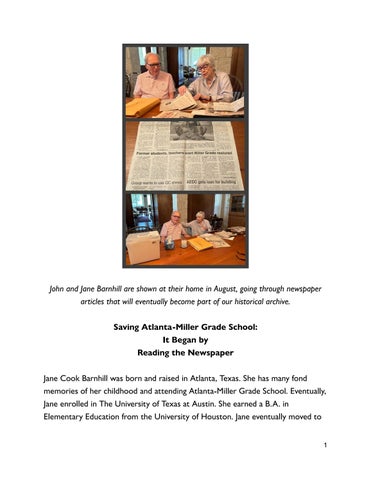
John and Jane Barnhill are shown at their home in August, going through newspaper articles that will eventually become part of our historical archive. Saving Atlanta-Miller Grade School: It Began by Reading the Newspaper Jane Cook Barnhill was born and raised in Atlanta, Texas. She has many fond memories of her childhood and attending Atlanta-Miller Grade School. Eventually, Jane enrolled in The University of Texas at Austin. She earned a B.A. in Elementary Education from the University of Houston. Jane eventually moved to 1
Brenham with her husband John to live at the couple’s farm. They have three children, John W. Barnhill, Ted Barnhill and Betsy Barnhill Newman. When Jane visits Atlanta today, she stays at the 1935 “Cook Residence,” the family home which Jane restored. Those fortunate to have visited the Cook Residence in Atlanta today know it is a beautiful property. For many years, Jane's mother paid for her to have a subscription to the Citizens Journal. In January 2001, Judy Williams, Staff Writer for the Citizens Journal wrote an article, “NETMHMR gets bid on Miller Grade.” What was going on with that beloved old school building? Jane investigated. Initially, the Northeast Texas Mental Health and Mental Retardation Center (NETMHMR) was interested in purchasing the property. The old school building would be demolished to make way for a new and larger facility. “The old Miller Grade School property will be the future home of Northeast Texas Mental Health and Retardation Center if all goes according to plan.” Some area residents, including Jane, began to question this plan. Many wanted to see the historic school saved and restored. Jane sought the help of Daniel Carey at the National Trust for Historic Preservation. At one initial community meeting in 2001, “they explored options on the feasibility of rehabilitating the old school …. National Trust donated $3,100 for professional architectural services to evaluate the building and draw up plans. The plans were distributed to contractors for estimates on the cost of rehabilitating.” Locally, a bid of $300,000 was given (valued at approximately $543,000 today). Another rehabilitation bid from Fort Worth was presented for $486,000 (or approximately $889,000 today). But in the end, “At the NETMHMR board of 2
trustees meeting held Tuesday, June 19, the board voted to go back to the original plans to have the building demolished.” Atlanta Independent School District officials revealed in the newspaper, “The estimated cost of demolition of the old Miller Grade School is approximately $18,900. By selling the property for $10,000, the board will only have to spend $8,900 on the demolition, and the property will be back on the tax rolls producing income for the school district.” It seemed like a “done deal,” but the local Atlanta historic preservation community urged review. Jane wrote a letter to the editor, “Support urged for new clinic.” In her impassioned letter, she urged Atlanta citizens to support the idea of the Northeast Texas Mental Health and Mental Retardation Center (NETMHMR) purchasing the property and restoring the school building for use as an outpatient clinic. A public meeting was called on April 12. We wanted to quote Jane’s letter at length because it is the most powerful argument we can imagine for saving historic Atlanta-Miller Grade School. “Many of us who grew up in Atlanta during the 30’s, 40’s, 50’s and even into the 70’s remember the building fondly. We remember the teachers who taught us in that building. Our Principal, Helen Manning, teachers Lessie Powell, Beulah Kirkland, Lousie McGee, Oneita Scott, Ouida Garrison, Ethel Stamps, Anabel Stamps, Myrtle Howdeshell and Katy Carroll walked those halls with pride. They gave their students a sense of belonging. They nurtured courtesy and respect by their example. Those named were on the faculty in 1946. Many were still teaching there in 1956 along with Annie Lou Shine, Lenora Morriss, Gladys Glass, Mrs. Teague, Lanelle Pritchard, Rheva Norris and Mattie McConnell. 3
Miller Grade School represents the life-work of many teachers. The respect we have for the building is one tangible way we show respect for them.” Further Jane observed, “The historic fabric left in Atlanta is important. People across America are not demolishing structures without strong consideration of options that could include using old buildings in new ways.” As we know, today our community allies would like to see the historic building outfitted with the latest technology as it transitions to become a modern community center. Jane predicted this early in 2001. “Our school buildings can be renovated to meet state-of-the-art technology and codes. ‘Newer’ is not better.” Teachers from the year 1959 are shown above, in a photograph from our Facebook page @atlantagradeschoolfriends. In the May 23, 2001 issue of the Citizens’ Journal, a notice was posted, “Public meeting slated for MHMR center.” It was reported that the center “has been working with an architect hired by the National Trust for Historic Preservation for about a month. The process has resulted in a floor plan for the clinic along with details for the necessary improvement to be done to the facility.” In fact, Daniel Carey of the National Trust ultimately revealed that the cost of rehabilitating the historic school would be less than tearing it down and building a new one. The community dialogue continued during 2001. By October 21, 2001, Atlanta Independent School District, which had been using the historic building for storage, noted in the newspaper that it would hold a sale of “surplus furniture and equipment stored in the old Miller Grade to the public.” Jane recalls that stacks of books had been stored in the 1st grade room under a now-leaking roof and much of the other stored items had been damaged. Even the front end of an 4
old school bus had been stored in the building! Clearly the beloved school was one step closer to being demolished. Jane was concerned. Discussions with Northeast Texas Mental Health and Mental Retardation Center (NETMHMR) continued. But the organization decided against the idea of making use of the historic school. They opted to tear the school down. That is when Jane and John Barnhill stepped in to purchase the property for the fairly modest sum of $10,000. Then the work began. Volunteers were largely recruited by Leigh Walker Stanley and husband Danny Stanley. They began to clear out and clean up the decaying property. It took twenty years to accomplish this feat and to stabilize the property. Damaged floors and the roof were replaced. A tract of land next door was also recently acquired, with a view to it becoming a new off-street parking lot for the new historic site and future community center. Lynne Spivey shared with us regarding the early days of saving Atlanta-Miller Grade School, "Jane and her team have done a remarkable, loving job on the school project. When I was running the Atlanta City Development Office - now called the Atlanta Economic Development & City Development Corporation - my board consented to be the applicant for an initial Texas Historical Commission grant to stabilize the building as further planning developed. Mr. Jimmy Pope, who had done several revitalization projects for us in the downtown Atlanta retail area, worked on removing failing portions of the school to prevent further destruction as plans evolved." Community-wide teamwork has made all the difference in saving Atlanta-Miller Grade School. Atlanta-Miller Grade School was removed from the “most endangered” historic site list in 2023. A top-notch architectural firm, Architexas was recently hired, and plans have been drawn up to restore the property in a way that is both 5
historically accurate and useful in a modern context for community gatherings of all kinds. Stay tuned as our project develops! This article appeared in the August 16, 2025 issue of the Atlanta Grade School Friends Newsletter: https://mailchi.mp/atlantagradeschoolfriends/august-2025-newsletter
6