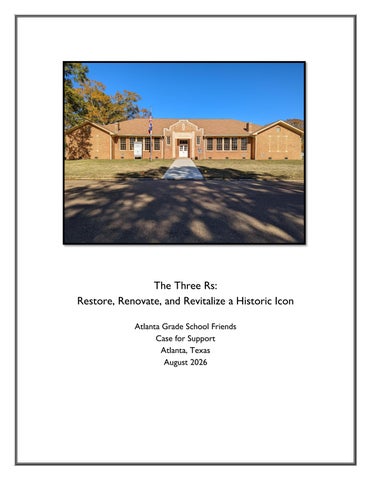
The Three Rs: Restore, Renovate, and Revitalize a Historic Icon Atlanta Grade School Friends Case for Support Atlanta, Texas August 2026
Table of Contents Pages 3 to 4 The Three R’s: Restore, Renovate and Revitalize a Historic Icon Pages 5 to 9 Mission and History Page 10 to 11 Atlanta Grade School Friends Board of Directors Pages 12 to 14 The New Deal and the “Atlanta Grade School” of 1936 Page 15 Architexas Chosen to Restore Atlanta-Miller Grade School Pages 16 to 17 Historic Preservation and Economic Impact Page 18 Naming Opportunities Pages 19 and 20 Construction Budget and Timeline Pages 21 to 23 Long Range Plan Pages 24 to 26 Contact Information, Bank Information and Find Us Online 2
The Three Rs: Restore, Renovate, and Revitalize a Historic Icon In 1936, Atlanta-Miller Grade School was constructed during the Works Progress Administration (WPA) to serve a small East Texas community. After 40 years of service as a center for education, the old brick building at the heart of Atlanta, Texas and its historic district found new roles as a multi-purpose and storage facility. But time and the elements eventually took their toll. Two decades ago, the City of Atlanta condemned the building because of the unsafe condition of its floors and supporting walls. This icon of the area’s rich history had served generations of students, and members of our community worried that an important part of Atlanta’s cultural legacy might be lost forever. In 2001, a group of dedicated citizens banded together to save the historic school building and bring it back to life. Atlanta Grade School Friends, a nonprofit organization, was established officially in 2003. The volunteers were determined not to allow the school and its rich history to fade away. Fond memories of the school and the commitment to preserving it have resulted in a new mission and purpose for the iconic building. Atlanta Grade School Friends already raised funds to stabilize the school building. The volunteers enlisted the endorsement of well-known and respected Texas leaders, they have held fundraising and visibilitybuilding community events, they have encouraged media coverage about the work underway, they have sent out mailings requesting financial support and more. The passion and commitment of a small group of generous citizens has spared the historic school building from the wrecking ball and salvaged an important part of the history of Atlanta, Texas! Today, the school’s front exterior has been restored to its original color and appearance, and a Texas Historical Commission Medallion was awarded in 2006. Atlanta-Miller Grade School was removed from the Preservation Texas most endangered list of Texas historic structures in 2023. Documentation is now being prepared to secure a National Register of Historic Places designation. The building’s structural revival is underway and its importance as a treasured icon of Atlanta’s cultural heritage is now assured. The efforts of Atlanta Grade School Friends have been highly successful thus far, generating funding, enthusiasm, and broad-based support for the full preservation of the school and the memories it holds. The organization is now embarking on a new phase of fundraising to complete the restoration and to introduce new programs and activities. The auditorium could be used for stage productions, musical performances, reunions, conferences, receptions, seminars, and other community events. Former classrooms in the building 3
could offer space for workforce development classes, artistic expression and art appreciation programs, wildlife education and appreciation programs, health and fitness programs, and more. Atlanta-Miller Grade School will become “The Meeting Place” for the community and the region to use and enjoy. Like the Three Rs of education – ‘reading, ‘riting, and ‘rithmetic - Atlanta Grade School Friends has undertaken the following fundamental phases of work. The Three Rs 1. Phase I: Restore (2002 through 2022 and complete) 2. Phase II: Renovate (2023 through 2026 underway) 3. Phase III: Revitalize (2026 through 2036) Former classmates of Atlanta-Miller Grade School have moved on with their lives, and they now reside in locations ranging from East Texas to cities across Texas and America. Wherever they live and whatever they do, however, they are bound together by the memories of attending a small brick school on Miller Street in Atlanta, Texas. You will find many of them on the Facebook page of Atlanta Grade School Friends. Grade school is the foundation of education. The best K-12 education seeks to help students enter and graduate from high school with the skills and knowledge necessary to succeed in college, career, and in life. Atlanta-Miller Grade School lies at the heart of Atlanta, and it embodies the education, history, and traditions of generations. Hence, our campaign is not only about bricks and mortar, but also about the lives and stories of the people of Atlanta. The mission of Atlanta Grade School Friends is to ensure this historic school building will always remain a place to mentor and nurture, and to preserve the heritage of Atlanta. Won’t you join us? With your generous partnership and support, we will be able to continue our quest to bring the old school building back to life and open its doors and classrooms to new opportunities for future generations. Thank you!
4
Mission and History The mission of Atlanta Grade School Friends is to restore the historic Atlanta-Miller Grade School located at 106 ½ W. Miller Street in Atlanta, Texas. From 1936 to 1974 the school provided a safe and welcoming environment for Atlanta's children and their teachers. In addition to renovation of the building and the continued maintenance thereof, Atlanta Grade School Friends oversees the development and management of educational programs and related activities for all ages that enhance the building's usefulness. Atlanta-Miller Grade School and the property on which it sits comprise approximately two acres of land, within the same block as the offices of the City of Atlanta, Texas and the Atlanta Police Department. Original Funding, Construction, and History Prior to 2001 Atlanta-Miller Grade School is a unique school designed, built and opened for classes during the Works Progress Administration (WPA) in 1936. Few schools from this era remain today. It took 120 days to complete the construction of the school. This was accomplished by the Hardy Brothers of Texarkana. The building was designed by Edwin R. Smith of Paris, Texas in association with Lee Warren, a local architect. Smith notably worked on the 1917 Romanesque Style Lamar County Courthouse, located in Paris, Texas. He served as a local architect, overseeing the design of Sanguinet & Staats, a prominent Fort Worth firm. The school originally contained six classrooms, restrooms, a teacher’s lounge, auditorium, and administrative office space/library. Atlanta Independent School District used federal funds and bond funding to complete the school. In 1935, the school district applied for federal funding through the Public Works Administration (PWA), a New Deal program created in 1933. PWA’s purpose was to complete public works using skilled labor for architects and construction firms. Atlanta received approximately $11,864 in federal grant funds and $14,500 in state bonds for a total construction project of $26,364. Construction lasted from March 1936 to June 1936. The school opened in time for the fall semester of 1936. 5
Atlanta-Miller Grade School was in use until the mid-1970s. Between 1975 and 1980, it transitioned to become the Atlanta Multi-Purpose Center and was put to beneficial use until 1990. From 1990 to 2000 - or ten years - the school was used for community storage. During this time, the building fell into decline as it received no maintenance. Water damage and neglect threatened the school’s survival. Many Atlanta-Miller Grade School former students and supporters banded together to save the now historic school. We call this Phase I of our long-range plan. The property was purchased, and both physical maintenance and clean-up by volunteers and financial contributions helped stabilize the school (and the land on which it sits). This was accomplished by the nonprofit organization Atlanta Grade School Friends, which received its IRS designation in 2003. Volunteer work to save Atlanta-Miller Grade School began as early as 2001, however. In 2006, Atlanta-Miller Grade School received a historical marker from the Texas Historical Commission. The marker was installed next to the front entrance of the school. We are now working to secure an official designation from the National Historic Landmarks Program of the National Parks Service. Jane Cook Barnhill and a Momentous Year: 2001 Jane Cook Barnhill was born and raised in Atlanta, Texas. She has many fond memories of her childhood and attending Atlanta-Miller Grade School. For many years, Jane's mother paid for her to have a subscription to the Citizens Journal. In January 2001, Judy Williams, Staff Writer for the Citizens Journal wrote an article, “NETMHMR gets bid on Miller Grade.” Jane wondered what was going on with that beloved old school building. Initially, the Northeast Texas Mental Health and Mental Retardation Center (NETMHMR) was interested in purchasing the property. The old school building would be demolished to make way for a new and larger facility. “The old Miller Grade School property will be the future home of Northeast Texas Mental Health and Retardation Center if all goes according to plan.” Some area residents, including Jane, began to question this plan. Many wanted to see the historic school saved and restored. Jane sought the help of Daniel Carey at the National Trust for Historic Preservation. At one initial community meeting in 2001, “they explored options on the feasibility of rehabilitating the old school …. National Trust donated $3,100 for professional architectural services to evaluate the building and draw up plans. The plans were distributed to contractors for estimates on the cost of rehabilitating.” Locally, a bid of $300,000 was given (valued at approximately $543,000 today). Another rehabilitation bid from Fort Worth was presented for $486,000 (or approximately $889,000 today). But in the end, “At the NETMHMR board of trustees meeting held Tuesday, June 19, the board voted to go back to the original plans to have the building demolished.” Atlanta Independent School District officials revealed in the newspaper, “The estimated cost of demolition of the old Miller Grade School is approximately $18,900. By selling the property for $10,000, the board will only have to spend $8,900 on the demolition, and the property will be back on the tax rolls producing income for the school district.”
6
It seemed like a “done deal,” but the local Atlanta historic preservation community urged review. Jane wrote a letter to the editor, “Support urged for new clinic.” In her impassioned letter, she urged Atlanta citizens to support the idea of the Northeast Texas Mental Health and Mental Retardation Center (NETMHMR) purchasing the property and restoring the school building for use as an outpatient clinic. A public meeting was called on April 12. We quote Jane’s letter at length because it is the most powerful argument we can imagine for saving historic Atlanta-Miller Grade School. “Many of us who grew up in Atlanta during the 30’s, 40’s, 50’s and even into the 70’s remember the building fondly. We remember the teachers who taught us in that building. Our Principal, Helen Manning, teachers Lessie Powell, Beulah Kirkland, Lousie McGee, Oneita Scott, Ouida Garrison, Ethel Stamps, Anabel Stamps, Myrtle Howdeshell and Katy Carroll walked those halls with pride. They gave their students a sense of belonging. They nurtured courtesy and respect by their example. Those named were on the faculty in 1946. Many were still teaching there in 1956 along with Annie Lou Shine, Lenora Morriss, Gladys Glass, Mrs. Teague, Lanelle Pritchard, Rheva Norris and Mattie McConnell. Miller Grade School represents the life-work of many teachers. The respect we have for the building is one tangible way we show respect for them.” Further Jane observed, “The historic fabric left in Atlanta is important. People across America are not demolishing structures without strong consideration of options that could include using old buildings in new ways.” As we know, today our community allies would like to see the historic building outfitted with the latest technology as it transitions to become a modern community center. Jane predicted this early in 2001. “Our school buildings can be renovated to meet state-of-the-art technology and codes. ‘Newer’ is not better.” In the May 23, 2001 issue of the Citizens’ Journal, a notice was posted, “Public meeting slated for MHMR center.” It was reported that the center “has been working with an architect hired by the National Trust for Historic Preservation for about a month. The process has resulted in a floor plan for the clinic along with details for the necessary improvement to be done to the facility.” In fact, Daniel Carey of the National Trust ultimately revealed that the cost of rehabilitating the historic school would be less than tearing it down and building a new one. The community dialogue continued during 2001. By October 21, 2001, Atlanta Independent School District, which had been using the historic building for storage, noted in the newspaper that it would hold a sale of “surplus furniture and equipment stored in the old Miller Grade to the public.” Jane recalls that stacks of books had been stored in the 1st grade room under a now-leaking roof and much of the other stored items had been damaged. Even the front end of an old school bus had been stored in the building! Clearly the beloved school was one step closer to being demolished. Jane was concerned. Discussions with Northeast Texas Mental Health and Mental Retardation Center (NETMHMR) continued. But the organization decided against the idea of making use of the historic school. They opted to tear the school down. That is when Jane and John Barnhill stepped in to purchase the property for the modest sum of $10,000. 7
Then the work began. Volunteers were largely recruited by Leigh Walker Stanley and husband Danny Stanley. They began to clear out and clean up the decaying property. It took twenty years to accomplish this feat and to stabilize the property. Damaged floors and the roof were replaced. A tract of land next door was also recently acquired, with a view to it becoming a new off-street parking lot for the new historic site and future community center. Lynne Spivey shared with us regarding the early days of saving Atlanta-Miller Grade School, "Jane and her team have done a remarkable, loving job on the school project. When I was running the Atlanta City Development Office - now called the Atlanta Economic Development & City Development Corporation - my board consented to be the applicant for an initial Texas Historical Commission grant to stabilize the building as further planning developed. Mr. Jimmy Pope, who had done several revitalization projects for us in the downtown Atlanta retail area, worked on removing failing portions of the school to prevent further destruction as plans evolved." Community-wide teamwork has made all the difference in saving Atlanta-Miller Grade School. Atlanta-Miller Grade School was removed from the “most endangered” Texas historic site list in 2023, and the volunteers of Atlanta Grade School Friends received a well-deserved Honor Award from Preservation Texas that same year.
8
A New Era of Community Service Atlanta Grade School Friends stands on the threshold of the second phase of its long-range plan: the full restoration of the school and its conversion into a community center. Our fundraising goal includes professional architectural design and restoration of Atlanta-Miller Grade School, a historical presentation about the school and the community, equipment and furnishings, technologies to make the school as advanced as possible in the digital age, and the creation of office space for future partners and the facility’s future staff. The Board of Directors has approved a Sustainability Plan demonstrating how Atlanta Grade School Friends will generate income that will allow it to operate smoothly and successfully once it is open to the public. A new booking service attached to our WordPress website will allow for easy access, and a new staff member is planned. If you would like a copy of the Sustainability Plan, kindly email: atlantagradeschoolfriends@gmail.com.
9
Board of Directors President Jane Cook Barnhill Vice President Kevin Stingley Treasurer Danny Stanley Secretary Cyndy Vaughan Chamblee
10
Board of Directors: Lee Ellen Arnold Benjamin Tammie Duncan Blackburn Camille Smith Dawn Gary Endsley Margaret Miller Fitts James G. Joslin Judy Waldon Lanier Donna Rice Phil Rice Leigh Walker Stanley Jerri Mason Steger
Jane Cook Barnhill in the Auditorium. Photograph by Carolyn M. Appleton.
11
The New Deal and the “Atlanta Grade School” of 1936 James W. Steely, Architectural Historian “Dramatic changes rolled over Texas and the nation like a title wave in the early 1930s,” I wrote in 1986 for a special 1936 Texas Centennial commemorative issue of Texas Architect magazine, “brought on by a hurricane of economic disaster called the Great Depression.” The building industry suffered as much as any economic sector when funding for most public and almost all private construction evaporated. By 1933, overall national unemployment exceeded 30 per cent, and an estimated 85 per cent of professional architects and engineers had no commissions or paychecks. In response, a new U.S. President, Franklin D. Roosevelt (FDR), took the oath of office in March 1933. This immediately prodded Congress into chartering numerous agencies committed to economic reform and the distribution of billions of dollars in relief programs. The new agencies did nothing less than alter the daily lives of American citizens. The resulting federal sponsorship of architecture through public works projects literally changed the American landscape over the next decade. During that decade, 1933 through 1943, FDR’s unemployment relief and national - infrastructure programs made his “New Deal” a household name, framed in time and success by the equally familiar “alphabet” agencies of the CCC and the WPA. The CCC (Civilian Conservation Corps) kicked off the New Deal in spring 1933 by enrolling an initial 250,000 single young men and 25,000 destitute war veterans and assigning them to 200-man remote camps throughout the nation for outdoor work in forests, parks, and the Dust Bowl of the Great Plains. Quickly following the CCC, the PWA (Public Works Administration), FERA (Federal Emergency Relief Administration), then the CWA (Civil Works Administration) and NYA (National Youth Administration) provided short-term jobs for a full range of Americans, men and women, young and old, students and professionals, until the Great Depression ended with the onset of World War II. Established in 1935, the WPA Works Progress Administration) hired heads-of households - men and women to work near their homes on projects ranging from building construction to sewing centers, from installing water and wastewater systems to writing travel guides to all the states, territories, and most large cities. By the WPA’s conclusion in 1943, more than 8.5 million workers had been employed on $11 billion in projects, helping at the end to build Army posts and Navy bases for the war effort across the nation. The Texas Centennial year of 1936 became a platform for New Deal public-works projects across the state, ranging from roadside parks by the NYA to the Dallas State Fairgrounds through the combined resources of the PWA, the WPA, and state relief funds. While the PWA awarded comprehensive contracts to construction companies who then employed skilled and unskilled workers, the WPA funded only the local labor for relatively small projects - most under $25,000 - on land and with building materials provided by the 12
local public-agency sponsor. In addition to the unusual Texas Centennial projects, these New Deal programs particularly focused on projects for government and education, constructing many courthouses in Texas from the Panhandle to the Rio Grande Valley, and a multitude of school buildings across the state from the TransPecos to … Atlanta, Texas in 1936. “Atlanta Grade School,” later Miller Grade School and now Atlanta-Miller Grade School, is a fine surviving example of the New Deal’s mission to update and improve the nation’s public facilities while employing workers who needed a bridge across the frustrating Great Depression. The one-story symmetrical building, facing south onto W. Miller Street with a central entrance flanked by tall windows and classroom bays, is in many ways a typical early 20th century American schoolhouse. This 1936 brick building, however, is uniquely embellished with a distinctive double-door entrance framed by Art Deco-style stone “columns” with “capitals” flanking the inscription “Atlanta Grade School, 1936.” A geometric sun symbol probably intended to indicate the light of knowledge - hovers over the inscription within a stepped-parapet gable. The architect’s name has not emerged in recent research, but a 1930s contractor - Hardy Brothers of Texarkana - is associated with the building, implying that 1) a contractor prepared the foundation or other partial construction, or 2) the Hardy Brothers employed a draftsman who served as the architect, or 3) this is a PWA project built fully by the contractor rather than by WPA labor working under supervision of the school district. As preservation and adaptive-use efforts continue to bring the Atlanta-Miller Grade School into the 21st century for its second useful life, more research will uncover the names of Atlantans who built the building as a lasting gift to the community. Combined with the thousands of schoolchildren and teachers who walked its halls and sat in its classrooms, then the volunteers who have saved the building, those names will reflect the history of Atlanta itself, for most of the 20th century and now more than two decades into the following century.
13
About the Author James Wright Steely is a 6th-generation Texan from Paris, Texas. He grew up working on his family’s Lamar County Echo newspaper, leading to a B.S. degree in photojournalism, along with a second-major in history, from East Texas State University. Completing an M.S. from the University of Texas at Austin led to several mentorships among esteemed Texas preservationists and a 20-year career at the Texas Historical Commission. Steely then became a corporate consultant for 16 years, and since 2016 an independent consulting historian and architectural historian based in Denver. He is the author and co-author of books on Texas history and architecture, and many reports on National Park Service history. Steely’s award-winning Parks for Texas: Enduring Landscapes of the New Deal is available from the University of Texas Press. His co-authored and award-winning two-volume Buildings of Texas is available from the University of Virginia Press.
14
Architexas Chosen to Restore Atlanta-Miller Grade School
Atlanta Grade School Friends is delighted that Architexas has been chosen to plan for and professionally restore Atlanta-Miller Grade School. Architexas has been at the forefront of historic preservation in Texas for decades. This alliance will give our nonprofit organization’s work even greater credibility with philanthropists and partners who look for quality, especially when considering funding decisions. Once complete, our restored WPA-era school will become one of the leading historic landmarks of Texas. From the Architexas website: “Our passionate belief is that architecture should not be driven by stylistic preferences or passing trends. Architexas provides a broad range of services encompassing architecture, planning and historic preservation. With every project, we follow a process that begins with researching and understanding the context – the physical, historical, and programmatic conditions – within which we will be working. Each project is seen as an opportunity to create a carefully crafted response to a unique set of circumstances and client aspirations. Our passionate belief is that architecture should not be driven by stylistic preferences or passing trends. Our experience is that attention to detail and pragmatic solutions can yield inspiring results and timeless design. We understand the thoughtful reuse of our existing building stock is the very basis of sustainable design. Through conservation, technological innovation and contextually appropriate new construction, we strive to enrich the built environment for all. Although our projects are realized with a profound respect for the past and a rational understanding of present needs, they ultimately look to the future by serving the individuals and communities that will experience them for generations to come.” Key liaison for Atlanta Grade School Friends is Alexis McKinney, AIA LEED APB+C and managing partner of Architexas.
15
Historic Preservation and Economic Impact In 1999, the Texas Historical Commission (THC) commissioned a study by The University of Texas at Austin and Rutgers University to quantify the economic contributions of historic preservation to Texas. The study was updated in 2015: Economic Impact of Historic Preservation in Texas: Technical Analysis | Center for Urban Policy Research - CUPR “Historic preservation is a major industry in Texas. The numbers tell the story: in 2013 preservation activities in Texas generated more than $4.6 billion of state gross domestic product (GDP) in Texas and supported more than 79,000 Texas jobs. This produced significant net tax revenue for both state and local governments in Texas, equaling over $290 million annually. When viewed in cost-benefit terms, historic preservation is one of the best investments available today, for both developers and the public. Restored courthouses and other landmarks save materials and embodied energy from the landfill, while enhancing a sense of place and community pride. Preservation programs and initiatives are an important driving force for the Texas economy, as has now been documented over several decades." Texas traditionally ranks high in terms of states that are "best for business." The Texas Economic Development Corporation notes this is in part owed to, "the warm welcome we give CEOs who are looking for a better place to do business .... Our economic development community is proactive in providing these CEOs with the support they need, and CEOs often tell us how important that support has been in making the decision to come here.” 16
The THC research report observes that businesses move to Texas for numerous reasons. The state’s quality of life is increasingly one of them. "Historic preservation offers attractive and economical spaces for business, stable and interesting historic neighborhoods, lively Main Streets and revitalized downtowns. In turn, these tax-paying properties enhance our quality of life and directly improve the economic well-being of all Texans." In summer 2022, Atlanta Grade School Friends joined the Atlanta Area Chamber of Commerce. It is our hope that through the restoration of the historic Atlanta-Miller Grade School, more heritage tourism will be attracted to Atlanta, Texas and residents and visitors alike will be able to enjoy quality educational programming of all kinds in the restored school building. This will also attract businesses to Atlanta and to East Texas. In 2023, we conducted an online community survey to request input regarding the kinds of future programming we should host in the restored school. The results suggest a wide range of interests, and 100% of respondents agreed a new community and educational center should be a top priority for the City of Atlanta, Texas. 88.41% | Arts, music, literacy and other cultural programming 71.01% | Family events 65.22% | Conservation education and outdoor-themed programming 60.87% | Chamber of Commerce, City and County gatherings 60.87% | Volunteer trainings for service organizations 55.07% | Health-oriented programming 55.07% | Conferences by local, regional and statewide organizations 53.62% | Workforce development training 53.62% | Venue for emergency operations and urgent needs 43.48% | Corporate trainings sessions and meetings Since 2023, we have continued to engage our community in dialogues about future uses of a restored and modern community center. Entities like the Greater Atlanta Chamber of Commerce and divisions of the City of Atlanta, Texas have given an enthusiastic “thumbs up.” In fact, the Chamber would like us to consider the idea of their organization moving into the restored building, and the Atlanta Public Library – desperately in need of space – would also like to partner. See our YouTube channel @atlantagradeschoolfriends for recordings of some of these discussions. Years of demanding work by devoted volunteers have resulted in saving Atlanta-Miller Grade School from collapse. Atlanta Grade School Friends calls this now-complete era, "Phase I." We stand on the threshold of an exciting new era, the full restoration of Atlanta-Miller Grade School, or "Phase II" of our long-range plan. Many community leaders have endorsed our work (see ISSUU @agsf2023). We look forward to creating a community center and historic site worthy of Atlanta, Texas, the entire region of East Texas, and the State of Texas! Since our original posting, Texas Forest Trail Region has shared the economic impact statistics for East Texas specifically. Follow the link to read the eye-opening findings! 17
Naming Opportunities Our initial concept is to name rooms in the restored Atlanta-Miller Grade School after the teachers who gave their lives and talents to teaching there for many years. Atlanta-Miller Grade School is beloved still today by the alumni of this small-town grade school in East Texas, and the teachers played a central role in forming the minds, characters and memories of those students. Donors to The Three Rs: Restore, Renovate, and Revitalize a Historic Icon will be recognized together on a large central donor plaque listing all contributors to the restoration and the creation of a modern community center for the City of Atlanta, Cass County, East Texas and the State of Texas. Those who do not wish to remain anonymous will also be recognized on a digital presentation on our YouTube channel. Finally, we will also recognize donors in our monthly newsletter. If there are other ways in which we can recognize your contribution, please do not hesitate to ask. Due to the extraordinary commitment by Jane Cook Barnhill and her family to saving and restoring AtlantaMiller Grade School, the modern, new community center and historic site will be named The Jane Cook Barnhill Center at Atlanta-Miller Grade School. Should we receive donations that exceed our fundraising goal, those will be invested in an endowed fund that will generate annual income for ongoing maintenance and operation of the new Center well into the future.
18
Construction Budget and Timeline Project Cost: $5,724,332 State Historic Tax Credits: $1,287,974 (anticipated refund)
Total Project Cost: $4,436,358 Initial Gift to Launch the Campaign: $1,000,000 Remaining to Raise: $3,436,358 We are working with Architexas and Premier Commercial Group. The budget is being reviewed and modified as the project moves forward, and hence, the above figure may (and probably will) change to some degree. Should you need information, kindly contact Board Treasurer Danny Stanley. Our nonprofit is well known for managing budgets carefully and for being cost-conscious. We will apply for Historic Preservation Tax Credits with the help of Architexas, and hence, our overall costs will be reduced. As noted by Architexas: “It will be 25% of QRE - Qualified Rehabilitation Expenditures. This generally means all costs associated with the historic. The parking lot will not be a part of the eligible costs for instance. The QRE is determined during a CPA audit at the end of construction, so a fixed number is not official until construction completion.” Principal of Architexas Alexis McKinney can be contacted for any additional questions you may have. Included in our costs: ▪ ▪
General costs (chain link fencing, final cleaning, masonry restoration and more) Selective demotion 19
▪ ▪ ▪ ▪ ▪ ▪ ▪ ▪ ▪ ▪
Masonry and stone Metals Wood and plastics Thermal and moisture Doors and windows Finishes Specialties Mechanical Electrical Contingency funds (15%)
There will also be budget items added to the above for technology and furnishings. We have not yet formally budgeted for these items but will be doing so soon! We are also going to apply for a grant to assist in the creation of professional signage about the school’s history, which will be installed in the interior of AtlantaMiller Grade School. Humanities Texas has been encouraging about our work and potential for receiving a supportive grant. Finally, we are in talks with The Portal to Texas History at the University of North Texas to create an archive of historic school yearbooks online. Timeline, Budget Management and State Tax Credits • • •
Capital Campaign: Fall 2025 through Fall 2026 Grand Opening: 2027 Smithsonian Exhibition in Collaboration with Atlanta Historical Museum: January 2027
Because were received a generous initial $1 million donation from the Barnhill Family covering our basic administration and some initial construction costs, we are moving forward with basic infrastructure improvements that support the full restoration. These include work on the flooring and the restoration of our large banks of windows. As funding toward the full budget is provided, we will advance the restoration as deemed appropriate. The entire process should last approximately 10 months. Board approval is sought and secured before projects proceed. Thank you for your interest, and again, we will keep everyone posted should changes be made. This case statement can be accessed digitally on our website. See Confidential Case for Support – Atlanta Grade School Friends (password: Three Rs).
20
Atlanta Grade School Friends Long Range Plan Atlanta Grade School Friends has outlined the following phases of development. Phase I: Restore (2002 through 2022 and complete) • Nonprofit articles of incorporation filed with the Texas Secretary of State (2002) • IRS nonprofit status filed and approved (2003) • Acquisition of Atlanta-Miller Grade School and the property on which it sits • Clean-up (complete) • Stabilization including a new roof, floor repair, property improvements (complete) • Requesting and obtaining a Texas Historical Commission marker (2006) • Ongoing fundraising to help fund the above (complete). Phase II: Renovate (2023 through 2026) • Restoration design and budgeting with the help of Architexas (done; includes contingency plan) • Research into identifying financial support partners is ongoing and fundraising will continue through 2026. A generous initial grant of $1,000,000 has been received and will create an exciting matching opportunity for future contributors (in the works) • Architexas worked with us to apply for National Register of Historic Places status, and we are pleased that on May 29, 2026, we were approved. We are now listed as a national historic site worthy of preservation (done) • Acquisition of adjacent property, sale and removal of the house on it, and clearing. An additional buffer tract has also been purchased. This area will ultimately be designated for off-street parking (complete). • Installation of fire prevention sprinkler system prior to restoration, with financial help from The Summerlee Foundation and Walmart (complete) • Organizational infrastructure ➢ New website, replacing 20-year-old version (done) ➢ MailChimp email system for regular monthly communication (done) ➢ Installation of online donation platform and constituent management system (complete and updated routinely) 21
➢ Creation of “hard copy” mailing list that is now merged with our master database and secured in the cloud, for annual holiday postcard mailings and potentially more USPS mailings (done) ➢ GuideStar gold seal for transparency (complete and updated annually) ➢ GreatNonprofits profile for public reviews (complete) and ISSUU document with more formal written letters of endorsement (complete) ➢ Creation of a YouTube channel and videos to engage our community and those beyond East Texas (complete and ongoing) ➢ Federal and State of Texas records updated with new physical and mailing addresses, including location of Texas Historical Commission marker (done) ➢ Google Maps coordination on physical address and new street view (complete) ➢ New bylaws replace the twenty-year-old version, approved by the Board (complete) ➢ Development of closer relationships with the Texas Historical Commission, Preservation Texas, East Texas Forest Trail Region and Cass County Historical Commission (in progress) ➢ Community survey via SurveyMonkey about future uses of the restored school (complete 2023), and ongoing dialogues with potential local partners (continuing, see YouTube) ➢ Installation of digital reader on ISSUU for ease of access online by donors and partners (complete) ➢ Honor Award received from Preservation Texas in 2023, and removal from the “most endangered” historic sites list after 20 years (done) ➢ Historical signage for the building’s interior is being discussed and a vendor identified, so that all future visitors to our National Register building can learn about its history onsite (in progress)
• •
• •
Creation of case for support document in anticipation of launching a major gift campaign (done: this document) Creation and Board of Directors approved Sustainability Plan regarding infrastructure improvements and future funding mechanisms (done – if you would like to receive a copy, email us: atlantagradeschoolfriends@gmail.com) Research into online “booking” platforms to accommodate our future needs, identifying one that can easily be attached to our website on WordPress (in progress) Planning for a public phase of the campaign when majority of the funding has been received (forthcoming) 22
Phase III: Revitalize (2027 through 2036) • • • •
• • •
First employee hired by Atlanta Grade School Friends and onsite office established Donor recognition and historic signage installed onsite Planning for celebration of the conclusion of the major gift campaign and grand opening Creation of archive for online reference regarding historic Atlanta-Miller Grade School commences and continues through 2036 (ongoing - we are in touch with the Atlanta Public Library and The Portal to Texas History) First project partnership with the City of Atlanta: Smithsonian exhibition “Museum on Main Street”: January-February 2027 First “classes” and events occur in the renovated Atlanta-Miller Grade School by 2027 Planning for the 100th anniversary of Atlanta-Miller Grade School begins and continues through 2036.
23
Contact Information Danny Stanley, Treasurer and Project Manager Atlanta, Texas 903-824-4471 Contact Board Treasurer Danny Stanley – Atlanta Grade School Friends Carolyn M. Appleton, Fundraising Liaison, Webmaster and Newsletter Production Manager Austin, Texas 737-300-7605 atlantagradeschoolfriends@gmail.com and carolyn@carolynmappleton.com Mailing Address P.O. Box 851 Atlanta, Texas 75551 Physical Location (tours by appointment) 106 1/2 W. Miller Street Atlanta, Texas 75551
24
Bank Information Atlanta Grade School Friends has an investment account at Transitions Wealth Management, an affiliate of Wells Fargo, managed by a trusted professional advisor, Susan Crosby (susan.crosby@wfafinet.com). Wells Fargo can arrange for electronic transfers and donations of non-cash items. Board Treasurer Danny Stanley can assist you in reaching out to Susan. Donations to the capital campaign are being tracked internally via our donor database, and by David Jentho of Ratliff & Jentho, CPAs who has served as our accounting expert for more than twenty years. We have an excellent reputation with the IRS and should you have questions, you may also reach out to David directly at 281-422-2206 (djentho@rjcpas.com). Daily banking is with Red River Credit Union. They can also accept general donations.
25
From YouTube
Email atlantagradeschoolfriends@gmail.com Website atlantagradeschoolfriends.org GuideStar & EIN guidestar.org/profile/46-0492043 Tax returns, organizational overview, letters of recommendation, photographs GreatNonprofits greatnonprofits.org/org/atlanta-grade-school-friends Reviews by members of the community Facebook @atlantagradeschoolfriends YouTube | Telling Our Story Visually @atlantagradeschoolfriends ISSUU @agsf2023 This case statement was written by Carolyn M. Appleton.
26