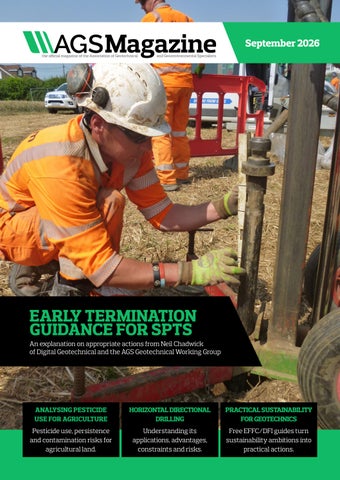
September 2026
EARLY TERMINATION GUIDANCE FOR SPTS
An explanation on appropriate actions from Neil Chadwick of Digital Geotechnical and the AGS Geotechnical Working Group
ANALYSING PESTICIDE USE FOR AGRICULTURE
HORIZONTAL DIRECTIONAL DRILLING
PRACTICAL SUSTAINABILITY FOR GEOTECHNICS
Pesticide use, persistence and contamination risks for agricultural land.
Understanding its applications, advantages, constraints and risks.
Free EFFC/DFI guides turn sustainability ambitions into practical actions.
Chair’s Foreword Welcome to the September 2026 edition of AGS Magazine. As the summer draws to a close and we look ahead to the final quarter of the year, our industry continues to demonstrate its ability to adapt, collaborate and respond to the evolving challenges facing the built environment.
engineering. We also highlight recent and upcoming AGS events, webinar replays, and opportunities for early careers professionals to get involved, including the latest AGS Early Careers Poster Competition.
As ever, I encourage you to take the time to read the articles, share them with colleagues, Across the geotechnical and and consider how the guidance geoenvironmental sectors, the and ideas presented here importance of robust guidance, may support your own work. shared learning and practical Your contributions, whether innovation remains clear. through technical articles, Whether addressing emerging event participation, committee contaminants, improving involvement or feedback, are investigation and monitoring central to the strength and practices, supporting safer relevance of the AGS. working environments, or We are always on the lookout helping clients understand for additional, informative good practice, the work of the content for the magazine, so AGS continues to play a vital if you have an opinion piece, a role in raising standards across case study, a technical article the industry. or a wider issue that you This issue brings together think the geotechnical and a wide range of insight, geoenvironmental public would guidance and updates that find beneficial, please do get in reflect the breadth of our touch. sector. Articles explore topics We would be interested in your including pesticide use on feedback on the magazine agricultural land and human and our future plans. Please health risk assessment, contact ags@ags.org.uk if you horizontal directional drilling, have any comments. good gas monitoring, SPT reporting, health and safety, sustainability, standards, Alex Lee and the role of storytelling in AGS Chair inspiring the future of ground
2
Magazine
ABOUT THE AGS The Association of Geotechnical and Geoenvironmental Specialists (AGS) is a not-for-profit trade association established to improve the profile and quality of geotechnical and geoenvironmental engineering. The membership comprises UK organisations and individuals having a common interest in the business of ground investigation, geotechnics, geoenvironmental engineering, engineering geology, geochemistry, hydrogeology, and other related disciplines. EDITORIAL BOARD Alex Lee, AGS Chair Caroline Kratz, Forum Court Associates (FCA) Katie Kennedy, FCA Julian Lovell, Equipe Group Calum Spires, Equipe Group Adam Latimer, Ian Farmer Associates Dimitris Xirouchakis, Structural Soils Caroline Martin, Haskoning Christos Botsialas, TRC Companies Alison Nicholson, Buro Happold EDITORIAL STORY To submit an article for inclusion in the AGS Magazine, please contact the AGS on 020 8658 8212 or ags@ags.org.uk. Please note that articles should act as opinion pieces and not directly advertise a company. The AGS is under no obligation to feature articles or events received. CONTACT US Association of Geotechnical & Geoenvironmental Specialists Forum Court, The Alexander Centre, 15-17 Preston Street, Faversham, Kent, ME13 8NZ ags@ags.org.uk 020 8658 8212 Association of Geotechnical & Geoenvironmental Specialists www.ags.org.uk
Inside this month’s issue
FEATURE PAGE 22
COVER STORY PAGE 32
Overview of pesticide use on agricultural land, and human health risk assessment
Practical guidance on SPT termination, extension and consistent reporting.
An exploration of pesticide use on UK agricultural land, its regulatory history, environmental persistence and the challenges of assessing human health risks, particularly from persistent and historically concentrated contaminants.
AGS ANNUAL CONFERENCE: SAVE THE DATE PAGE 10 Previewing the AGS Annual Conference 2027, registration and sponsorship opportunities.
HORIZONTAL DIRECTIONAL DRILLING PAGE 28
MORE INSIDE PAGE 4
News in Short: Incl. Publication Updates
PAGE 21
Understanding horizontal directional drilling, its applications, advantages, constraints and risks.
AGS Sustainability Charter Upcoming webinar details
AGS GUIDE TO GOOD GAS MONITORING PAGE 42
PAGE 46
Guidance for effective, compliant and site-specific ground gas monitoring.
Stanrdards Update July 2026
September 2026
3
News and Events
The Changing Landscape of Land Contamination is a full-day, CPD event which is taking place on Thursday 15th October at the Thinktank Birmingham Science Museum. As the land contamination sector continues to evolve in response to advances in research, regulatory developments and growing sustainability expectations, this timely conference will bring together leading practitioners and thought leaders to explore the latest challenges, innovations and best practice shaping the industry. Chaired by AGS Chair Elect Geraint Williams, (Associate Technical Director at HKA), this event has been developed in collaboration with key industry organisations including SiLC, SoBRA and CL:AIRE. The programme will feature 13 specialists and a wide range of technical and regulatory presentations covering topics such as advances in methane sampling in groundwater, the increasing role of sustainability in land management, and the latest updates to BS 10175.
4
Magazine
A highlight of the day will be the interactive panel discussion, Land Contamination: Meeting Technical, Societal and Legal Expectations, chaired by Professor Paul Nathanail. Bringing together experts from across the sector, the session will explore emerging issues, future challenges and the evolving expectations placed on contaminated land professionals, offering delegates valuable insights from a range of perspectives. Designed for professionals at every stage of their career, from early-career practitioners to experienced specialists, the conference provides an excellent opportunity to enhance technical knowledge, gain valuable CPD and connect with colleagues from across the contaminated land community. The event is proudly sponsored by Groundsure, ALS, Husker, Eijkelkamp Fraste UK, Normec i2 Analytical and GeoEnviro Solutions.
EVENT PROGRAMME Session 1: Chaired by Geraint Williams, Associate Technical Director at HKA and AGS Chair Elect Opening Address Geraint Williams, Associate Technical Director at HKA and AGS Chair Elect BS10175:2026: A Professional Approach to the Investigation of Potentially Contaminated Sites Professor Paul Nathanail, Director at Land Quality Management A Legal Perspective of Landfill Dr Anna Willetts, Partner at Gunnercooke and Sam Riggs, Barrister at 25 Bedford Row Session 2: Chaired by Stephanie Cox, Director of E3P and Member of the Executive Committee for SoBRA - Early Careers Updating the DoE Industry Profiles Dr Rob Sweeney, Technical Director at CL:AIRE The Benefits of Measuring Dissolved Methane for Interpreting Ground Gas Results Pagen Spooner, Geoenvironmental Consultant at EPG Session 3: Chaired by Dr Rob Sweeney, Technical Director at CL:AIRE PANEL DISCUSSION: Land Contamination: Meeting Technical, Societal and Legal Expectations Chaired by Professor Paul Nathanail (Director at Land Quality Management). Panellists: Pagen Spooner (Geoenvironmental Consultant at EPG), Anna Willetts (Partner at Gunnercooke), Christopher Swainston (Independent Contaminated Land Consultancy and Training), Barry Mitcheson (Associate Director at WSP) and Dr Paul McMahon, (Associate Technical Director at RSK Geosciences). Developing and Applying Sustainable Management Practices Dr Paul McMahon, Associate Technical Director at RSK Geosciences
Session 4: Chaired by Claire Dickinson, Director at Geo-Environmental Matters and SILC Developments in the Remediation of PFAS in Soils and Waters Dr. Cecilia L. MacLeod, Managing Director and Co-Founder at Anthera Remediation Technologies Why Do We Need to Reconsider Our Approach to Asbestos in Air Monitoring During Remediation? Steve Forster, Director at Remedia Group Closing Address Geraint Williams, Associate Technical Director at HKA and AGS Chair Elect
TICKETS AND REGISTRATION Tickets for AGS member companies are available at the reduced rate of £150 (ex VAT), while nonmembers can attend for £230 (ex VAT). A limited number of discounted places are available for regulators, including the Environment Agency, NHBC and local authorities, priced at £59 (ex VAT). Student tickets are also available for £20 (ex VAT). For full details and to register, please click HERE.
MEET OUR SPEAKERS AND SESSION CHAIRS Geraint Williams AGS Chair Elect and Associate Technical Director at HKA Geraint Williams is Associate Technical Director within the Environment and Climate Change Division at HKA. He is Chair of the Business Practice Working Group and Chair Elect of the AGS. Geraint also serves on EH/4, British Standards Technical Committee on Soil Quality and acts as AGS’s representative on the National Brownfield Forum.
September 2026
5
Professor Paul Nathanail Director at Land Quality Management
Counties. She is recognized for her specialist knowledge in waste management and recommended in Legal 500.
Paul is now in his fourth decade of being involved in risk based land contamination management. He has combined consultancy, advisory and academic teaching and research and is known for providing robust and independent insights into contentious land contamination challenges in the UK.
Stephanie Cox Director of E3P and Member of the Executive Committee for SoBRA - Early Careers
He is the lead author of key guidance on topics including the S4UL generic assessment criteria, bioavailability, asbestos and PFAS. He led the drafting of BS ISO 18504:2017 and was part of the group that updated BS10175:2026. Dr Anna Willetts Partner at Gunnercooke Anna is an environmental criminal lawyer, specialising in defence work in the waste and recycling industry. She is dualqualified, having completed a PhD in geochemistry and worked as an environmental consultant before qualifying as a lawyer. Anna represents waste and recycling businesses and directors who are prosecuted by the regulators (Environment Agency and local authorities) for environmental and waste offences. Samantha Riggs Barrister at 25 Bedford Row Samantha is a regulatory barrister specialising in defending companies and individuals in environmental, financial and regulatory matters and providing compliance advice. She has particular expertise in waste management and is fellow of Chartered Institution of Wastes Management (FCIWM) and is co-chair of the Central Committee for London Southern
6
Magazine
Stephanie Cox is a Director at E3P, a multidisciplinary environmental consultancy with offices in Manchester and Birmingham. She is an experienced practitioner in contaminated land and environmental risk, known for delivering proportionate, technically robust solutions aligned with industry guidance. Stephanie is a member of the Executive Committee of the Society of Brownfield Risk Assessment (SoBRA), where she leads the Early Careers portfolio, supporting professional development, engagement and knowledge-sharing across the brownfield sector. Dr Rob Sweeney Technical Director at CL:AIRE Rob is a chartered scientist through the Royal Society of Chemistry and a Professional Member of the Chartered Institute of Editing and Proofreading. Rob has over 25 years’ experience in land and water contamination with CL:AIRE, and previous environmental experience drawn from two research positions in waste management and water treatment. Rob manages CL:AIRE’s advisory group – the Technology and Research Group and is responsible for quality control in all CL:AIRE’s publications Pagen Spooner Geo-Environmental Consultant at EPG Pagen is a Geoenvironmental Consultant with three years’
experience, specialising in Ground Gas Risk Assessments and bespoke monitoring across sites including landfills, coal mined areas and contaminated land. She undertakes extensive fieldwork, data interpretation and develops robust conceptual site models with a proactive approach to improving monitoring practices. She is a fellow of the Geological Society, a member of SoBRA as well as an active member of the SoBRA Early Careers subgroup. Christopher Swainston Independent Contaminated Land Consultancy and Training Chris has been in the industry for over 30 years including works at Buncefield, the Dome, Westbury, Sizewell C, Sandridge and been cursed by Shakespeare for digging up his back garden…. He has written and presented on many topics for BSI, AGS, CIRIA , SoBRA, GSL and others, and is a qualified CL:AIRE QP.
Barry Mitcheson Associate Director at WSP Barry is an environment consultant with over 25 years’ experience in contaminated land consultancy. He has project managed and provided technical support for all aspects of land quality assessment for a wide range of sites. He is a SiLC and ASOBRA for Human health and Vapour. He has been actively involved in a range of industry initiatives and publications including on VOCs, Waste assessment, Soil Gas, Asbestos, Site conceptual model and the recent industry profiles. Paul McMahon Associate Technical Director at RSK Geosciences Paul is an Associate Technical Director within RSK Geosciences, designing and delivering
September 2026
7
internal geotechnical training, establishing apprenticeship pathways, mentoring colleagues and providing consultancy support on complex projects. Paul’s career, 25-years in industry and 25-years at university, covers civil and geotechnical engineering with some contaminated land experience. As an Approved ICE (Institution of Civil Engineers) Mentor, Paul is Head of Profession for Civil Engineering across the entire RSK Group. Claire Dickinson Director at Geo-Environmental Matters and SiLC Bringing over 35 years of experience in UK land development, Claire is a contaminated land specialist with a background in geotechnical engineering, specialising in ground risk management advice. Over the last 19 year she has chaired over 10 CIRIA project steering groups for their contaminated land programme. She coauthored the recent update of CIRIA’s popular Environmental Good Practice Guide and is part of the research team producing an online resource for the CIRIA’s Soil Community of Practice. Dr. Cecilia L. MacLeod Managing Director and Co-Founder at Anthera Remediation Technologies
years’ experience, assessing and remediating sites affected by contamination. Cecilia has worked on PFAS related issues at Buncefield Oil Terminal and Guernsey Airport. Dr Macleod recently founded Anthera Remediation Technologies Ltd to commercialise an photocatalytic oxidation process for the mineralisation of PFAS. Steve Forster Director at Remedia Group Steve has approaching 40 years’ experience in the investigation, assessment and management of asbestos in buildings and on land. He authored CAR-SOIL (CL:AIRE, 2016), industry guidance interpreting the Control of Asbestos Regulations 2012 as applied to contaminated land, in conjunction with the HSE. He coauthored Assessment and Control of Asbestos in Soil Part 1: Protection of personnel working on ground investigations and Part 2: Protection of personnel working in geotechnical and geoenvironmental laboratories (AGS, 2021) He developed and delivers (CL:AIRE) industryfocussed training for professionals working within the brownfield land sector, with well over 2000 candidates having received training since 2016.
Dr. MacLeod an environmental geochemist with over 40
SPONSORS
8
Magazine
DEVELOPED WITH
AG S E A R LY CA R E E R S 7 2 0 2 N IO IT T E P M O C R E T S O P CT HOW CA N W E AT T R AN OF T H E N E XT G E N E R ATTIO E H T O IN S L A N IO S S E F O PR G EOSC IE NC E IN DU S T RY ? The geotechnical and geoenvironmental industry plays a vital role in delivering sustainable infrastructure, managing environmental risks, and shaping the built environment. However, attracting the next generation of professionals remains one of our biggest challenges. This year, we’re inviting Early Career Professionals to share their ideas on how we can inspire more people to pursue a career in geoscience. Your poster can explore: Why geoscience can provide an exciting and rewarding career Common misconceptions about the industry and how they can be challenged Ways to improve awareness of geotechnical and geoenvironmental careers among students, graduates and career changers The role of mentoring, outreach, social media, work experience and education in attracting new talent Practical tips for showcasing the diverse opportunities available within the profession Posters should be creative, informative and thought-provoking, helping to inspire the next generation of geo-professionals. For full details and entry information scan the QR code.
The winner will receive a £100 Amazon Vouche r, free entry to the AGS Annual Conf erence on 22nd April 2027 in Lond on and have an interview regarding their winning entry published in AGS Magazine which reaches over 7,8 00 industry professionals six times a year. Ten runners up will win free entry into the Annual Conference , and all posters submitted will be displa yed at the Annual Conference.
To enter, email your A3 poster alongside your full name and company to ags@ags.org.uk before Friday 26th February.
September 2026
9
News and Events Lee (HKA), the programme will showcase the latest industry developments, research and best practice, while providing valuable opportunities to connect with colleagues, clients and sector leaders. The day will conclude with an extended drinks reception in the Great Hall, offering further opportunities to continue conversations and strengthen professional connections. Sponsors for the 2027 conference to date include Soil Engineering, Groundsure, Brimstone UXO, SoilCloud, Equipe, Normec i2 Anayltical, In Situ Site Investigation, Geosense, BAM, ALS, Eijkelkamp Fraste UK and Huesker. The Association of Geotechnical and Geoenvironmental Specialists is delighted to announce that its flagship Annual Conference will return to the prestigious One Great George Street in Westminster, London, on Thursday 22 April 2027. Centred around the theme of resilience, the event will bring together industry leaders, technical specialists and emerging professionals to explore how the geotechnical and geoenvironmental sector can respond to an evolving range of environmental, technical and societal challenges. The Annual Conference will welcome 240 professionals from across the industry for a day of technical insight, discussion, collaboration and networking. Chaired by AGS Chair, Alex
10
Magazine
REGISTRATION The Annual Conference has sold out for the past three consecutive years, so booking early is strongly recommended. AGS Member companies and Honorary Members are entitled to a limited number of complimentary tickets. To register for your free place, download a registration form and return it to ags@ags.org.uk. A limited number of student places are available at the reduced rate of £10 per ticket. To book a student place, please email the AGS. Additional tickets are priced at £140 for AGS members, and £215 for non-members. Please note that all tickets are offered on a first come, first served basis. For further details on the programme, speakers and registration please click HERE.
EARLY CAREERS POSTER COMPETITION The AGS Early Careers Poster Competition is back for a four year, this time with the theme of, “how do we inspire more people to pursue a career in geoscience?” The winner will receive a £100 Amazon voucher, free entry to the 2027 Annual Conference, plus have their poster printed in AGS Magazine which reaches over 7,800 industry professionals 6 times a year. Ten runners up will win free entry into the Annual Conference, and all other entrants will receive entry into the Annual Conference at a reduced rate of £10 (plus VAT)*. All posters submitted will be displayed at the Annual Conference. For full details and T&Cs please click here.
SPONSOR THE ANNUAL CONFERENCE Sponsoring the AGS Annual Conference offers a valuable opportunity to raise your profile within the UK's geotechnical and geoenvironmental community, connecting your organisation with industry leaders, technical specialists and key decision-makers. Feedback from the 2026 conference was exceptionally positive with a few statistics including: Î
100% of delegates rated the conference as
Î Î Î
excellent or good 99% rated presentations as excellent or good 96% were satisfied with the networking opportunities 100% would recommend the conference
With 50% of packages already sold out, we anticipate that sponsorship packages will sell out in advance of the event, so early booking is strongly recommended. Our available sponsorship packages are as follows. For full package benefits, click HERE.
CANAPE SPONSOR* (AGS Member Rate: £2,035 / Non-Member Rate: £2,855) Company logo on the drinks / canape menu Company logo on the canape flags Full page advert in AGS Magazine (worth £424)** which has over 7,810 subscribers Î Entry for three delegates into the Annual Conference Î An exhibition table which may be used to present company initiatives, research, software and promotional materials in a high-profile networking environment. This area has space for two standard pull-up banners (850mm x 2000mm). *one package available **terms and conditions apply Î Î Î
September 2026
11
Î Full page advert in AGS Magazine (worth CATERING SPONSOR* (AGS Member £424) which has over 7,810 subscribers Rate: £2035 / Non-Member Rate: £2,855) Company logo featured across all food menus in the Great Hall during the Annual Conference. Î Full page advert in AGS Magazine (worth £424)** which has over 7,810 subscribers Î Entry for three delegates into the Annual Conference Î An exhibition table which may be used to present company initiatives, research, software and promotional materials in a high-profile networking environment. This area has space for two standard pull-up banners (850mm x 2000mm). *one package available **terms and conditions apply
GOLD SPONSOR (AGS Member Rate: £1,650 / Non-Member Rate: £2,200)
EMERALD SPONSOR (AGS Member Rate: £1,815/ Non-Member Rate: £2,530)
Î
Î
An exhibition table which may be used to present company initiatives, research, software and promotional materials in a high-profile networking environment. This area has space for two standard pull-up banners (850mm x 2000mm).
Î
Entry for three delegates into the Annual Conference
Î
Î
Î Î
An exhibition table which may be used to present company initiatives, research, software and promotional materials in a high-profile networking environment. This area has space for two standard pull-up banners (850mm x 2000mm). Entry for two delegates into the Annual Conference 1/4-page advert in AGS magazine (worth £170) which has over 7,810 subscribers
PROMOTIONAL SPONSOR (AGS Member Rate: £880 Non-Member Rate: £1,100)
Î Î
Entry for one delegate into the Annual Conference Company directory in AGS magazine (worth £50) which has over 7,810 subscribers Company logo on the conference lectern
All rates exclude VAT. If you’d like to confirm your support, please contact Caroline Kratz on ags@ags.org.uk. Packages are offered on a first come, first served basis.
AGS Publication Updates The top three downloaded AGS publications in last month: 1. AGS Guide to Ground Investigation Reports 2. AGS Client Guide for Ground Investigation Activities – Trial Pitting 3. Bitesize Guide – Introduction to BRE Digest SD1 Recent AGS publications available on the AGS website: •
The Building Safety Act 2022 – A snapshot of what you need to know
•
AGS Client Guide to Good Gas Monitoring
•
LPA 39 – The Risks for a Professional When Operating Without Insurance
•
LPA 58 – Risks Associated with the Preparation of As-built Drawings
To download the publications for free; click here.
12
Magazine
News and Events
SiLC (Specialist in Land Condition) is delighted to announce that the Webinar, Exploring the pros and cons of confrontation, collaboration and cooperation between Practitioner, Regulator and Public, will take place on 4th November (11-am -1pm) at a cost of £45 inc VAT and £35 inc VAT for registered SiLCs This panel discussion, chaired by Lucy Bethell, follows on from the highly commended panel discussion of Local Authority Regulators at the 2026 SiLC Annual Forum. There will be representative Regulators from different
GROUND FORUM
parts of the United Kingdom that will discuss common challenges they face, how they work together and also times when they can't, including the drivers behind why it is not always possible or effective. This is an opportunity for those across the land condition sector to better understand the role of Regulators across the United Kingdom and to support the common goal of getting it right first time. To book please visit - Upcoming Webinars | Specialist in Land Condition Register Ltd (SiLC)
Pictured: mentee of the year 2025 Haripriya Moothedath Satheesh with Ebenezer Adenmosun at the 2025 FPS Awards in London
UNDERGRADUATE MENTORING PROGRAMME
Get a better understanding of roles in the industry, start your own network of professional contacts, access to projects and sites, two CPD workshops on CV and interview skills, and two-week work experience. This programme is also available to recent graduates who are looking for employment in the sector, those studying Masters courses and undertaking Postgraduate research.
APPLY NOW FOR THE 2026/2027 ACADEMIC YEAR.
Find the online application form at https://forms.office.com/e/ cuN4CWAECg or use the QR Code. The closing date for applications is 31st Oct 2026
Opportunity to be connected with a mentor working within the ground engineering and geotechnical sector.
September 2026
13
News and Events these should be attached to rigs. Both bolts and clips are currently acceptable, although clarification is required on whether the bar is considered a guard and should therefore be fixed. A separate shell and auger / CP rig hook failure incident was also discussed, with members agreeing that appropriate fixing, shackles or safety hooks would help eliminate the issue.
BDA Health & Safety Sub-Committee – Précis of June 2026 Meeting The BDA Health & Safety Sub-Committee met on 4 June 2026, chaired by Paul Breslin, to discuss a range of key health, safety and operational matters affecting the drilling industry
Î
Rotary Drilling - A jammed core liner incident was reviewed and shared with members, following an injury caused during removal of a jammed core liner from a vertical position. The committee noted that operatives should not be working under a suspended load. The importance of appropriate guarding and preventative measures was also discussed. Link to alert can be found here: Safety-Alert_SeriousHand-Injury-During-Removal-of-JammedCore-Liner.pdf
Î
Transport and Towing – Clarification sought from DVSA in relation to cable percussion rig towing requirements. The committee noted that CP rigs are generally viewed as plant rather than trailers for O Licence purposes, although further clarification is required. It was also noted that construction use regulations should be followed, and that if the driver is also the driller, this would fall outside EU tachograph rules, while still needing to comply with UK driving hours. The Safety Guidance will also emphasise that rigs are not to be loaded.
Topics covered included the ongoing review of the BDA Safety Guidance, cable percussion and rotary drilling activities, transport requirements, occupational health, audit processes, liaison with AGS, industry accident statistics, and preparations for the BDA Conference 2026.
Key Highlights: Î
BDA Safety Guidance Review - The committee continued its detailed review of the BDA Safety Guidance, with anticipated first draft by September 2026. The next stages include a review of sections relating to Machinery and Equipment, Transport and Towing, Operational Safety Requirements, Site Specific requirements, Environmental Considerations and PPE.
Î
Cable Percussion Drilling - The committee discussed whip restraint bars and how
14
Magazine
Î
Occupational Health – Mental Health blog written by Paul Breslin on ‘Diabetes, Mental Health and the Future of Our Industry’ which is available on the BDA website. Diabetes, Mental Health and the Future of the Drilling Industry - British Drilling Association
Î
BDA Audit – Audit update reported one failure due to guarding issues. It was also noted that many clients are currently out of audit.
Î
AGS Update - Further work is required to align statistics between the BDA and AGS, with a communication to be sent to members to support dual representation of statistics in 2027.
Î
lifting and handling, with 129 incidents recorded, as well as slips, trips and falls. Fingers, hands and backs were identified as the main areas affected. Î
Vice Chair Appointment - The committee discussed the potential appointment of a Vice Chair to help cover holidays and other commitments, and to maintain consistency across the committee. Members were asked to consider the role and register their interest with Paul Breslin or Joel Stevens.
Î
BDA Conference 2026 - The committee discussed the BDA Conference 2026, which will take place on 21st October at ICE London. Paul Breslin indicated that he would like to hold a panel discussion on recurrent incidents, involving a Health & Safety SubCommittee member, an AGS member and a client or contractor. Committee members were asked to consider taking part.
BDA Accident Statistics - The committee reviewed the current draft accident statistics report. A total of 55 out of 60 members had returned data, giving a 92% return rate, which was noted as a significant improvement. Areas of concern include
GEOTECHNICAL INSURANCE
Specialist industries need specialist insurance. Practical advice and tailored cover for businesses across the geotechnical sector.
ADVICE-LED COVER, BUILT AROUND YOUR RISKS Champion Insurance provides specialist, advice-led insurance for the geotechnical sector. CORE COVERS Professional Indemnity
Plant, Machinery and Equipment
Contract Works
Environmental Liability
Employers' and Public Liability
Employee Benefits
WHO WE SUPPORT Equipment manufacturers Equipment suppliers, hirers and sellers Contractors, drillers and geotechnical engineers Laboratories and testing facilities Technology service providers Landowners and developers
FREE, INDEPENDENT INSURANCE REVIEW Review your existing cover and ongoing requirements with our specialist team. Commercial@championinsure.co.uk
03330 430 430
Champion Insurance Group Limited is authorised and regulated by the Financial Conduct Authority (FRN 520977). Registered in England and Wales No. 07180321
September 2026 15 championinsure.co.uk
News and Events Three Voices, One Industry: How Storytelling Can Help Secure the Future of Ground Engineering Article contributed by Dipalee Jukes, Era Shah and Malika Kapasi (Co-hosts of the Chai & Chat Engineering Podcast) Engineering has the power to shape lives, communities and futures. Every day, geotechnical and geoenvironmental professionals contribute to safer homes, resilient infrastructure, sustainable development and thriving communities. Yet despite the critical role engineering plays in society, many young people still struggle to see themselves within the profession. For those from underrepresented backgrounds, the challenge can be even greater. If people cannot see themselves reflected in an industry, it can be difficult to imagine that they belong there. At a time when the engineering and construction sectors continue to face skills shortages, an ageing workforce and increasing technical complexity, this is a challenge that affects all of us. The future success of ground engineering depends not only on technical excellence, but on our ability to attract, retain and develop the widest possible talent pool. Representation, visibility and belonging are
16
Magazine
therefore not simply Equality, Diversity and Inclusion issues. They are industry issues.
Three voices. One shared purpose. Chai & Chat Engineering was created from a shared belief that engineering should be visible, relatable and accessible to everyone. The podcast is hosted by three engineers whose careers span geotechnical engineering, infrastructure delivery and major programme leadership. Although they work in different parts of the industry, they share a common experience: each has spent significant parts of their career as one of very few people who looked like them in the room. Dipalee Jukes Dipalee Jukes is a geologist, ground engineer and entrepreneur, and cofounder and CEO of Ground & Water, a geotechnical and geoenvironmental engineering consultancy
established in 2009. With more than two decades of experience in the industry, she is a passionate advocate for inclusive leadership, developing people alongside projects and creating businesses that deliver both technical excellence and social impact. Alongside her work in ground engineering, she is involved in mentoring, school governance and wider industry initiatives focused on gender equality and representation. Era Shah Era Shah is a Chartered Civil Engineer and programme management professional working across the infrastructure and built environment sector. Her experience spans complex infrastructure delivery, transformation programmes and strategic programme management. Beyond her professional role, she actively supports future generations through mentoring, STEM outreach and trustee work, championing both technical excellence and social responsibility. Malika Kapasi Malika Kapasi brings over two decades of experience in major infrastructure and transport programmes. As a planning director and commission lead, she works at the intersection of project delivery, governance and strategic leadership. Through Chai & Chat Engineering, she is passionate about sharing the often unwritten lessons of leadership and demonstrating that diverse voices belong at the highest levels of engineering decision-making. Together, the three co-hosts represent different technical disciplines, sectors and career paths. What unites them is a shared desire to help create an industry where future generations see engineering as a place where they belong.
From a chance meeting to a global platform The origins of Chai & Chat Engineering can be traced back to London Build Expo in 2021. The three co-hosts met for the first time at the event and quickly discovered common experiences despite working in different parts of the industry. Conversations about careers, visibility, leadership and identity revealed striking similarities in their personal and professional journeys. Each had experienced periods where they felt like outliers in engineering spaces. Each had questioned whether they truly belonged. And each recognised how powerful visible role models could have been earlier in their careers. From that conversation emerged a simple idea. What if there was a platform where honest discussions about engineering, leadership and lived experience could take place? What if the stories often missing from industry narratives could be brought to the forefront? That idea became Chai & Chat Engineering, which launched in October 2022. Today, the podcast reaches listeners in more than 37 countries and has become a growing platform for conversations about engineering careers, leadership, resilience, inclusion and the future of the profession.
Why conversation matters The podcast takes its inspiration from the cultural tradition of sharing stories over a cup of chai. At its heart is a simple belief: conversation has power. Engineering is often presented through a technical lens. We discuss specifications, standards, designs, risk assessments, site investigations and project delivery. These are fundamental aspects of our profession. Yet engineering is just as much about people as it is about projects - creativity, teamwork, communication and the ability to turn ideas into
September 2026
17
impact. And, behind every project is a human story.
broad range of voices and experiences.
For many young people, engineering remains an unknown career. They may have heard the term "engineer", but have little understanding of what engineers actually do, how they entered the profession or what opportunities exist within it.
The role of representation in tackling skills shortages
This is particularly true for specialist disciplines such as engineering geology, geotechnical engineering and geoenvironmental consultancy. Stories bridge that gap. When people hear authentic accounts of career journeys, setbacks, successes and lessons learned, engineering becomes more human and more accessible. It becomes easier to imagine a place for themselves within it.
The support of the Institution of Civil Engineers In 2026, the Institution of Civil Engineers recognised the impact of Chai & Chat Engineering through an article titled Three Voices, One Industry, A Shared Goal: Help Others See Themselves in Engineering. The article explored the podcast's mission to widen participation and help individuals from underrepresented backgrounds see engineering as a profession where they belong. The ICE highlighted the podcast's focus on open and honest dialogue, describing how the three hosts had created a platform that challenges perceptions of who belongs within engineering and the built environment. It recognised the importance of creating welcoming spaces where conversations about careers, leadership and lived experience can take place openly. The support received from the ICE has been significant. It demonstrates that attracting future engineering talent is not solely about promoting technical careers. It is also about building connections, raising visibility and showcasing a 18
Magazine
Ground engineering faces many challenges. Climate change adaptation, sustainable development, renewable energy infrastructure, brownfield regeneration and increasingly complex geotechnical risks all require highly skilled professionals. At the same time, the wider engineering sector continues to experience challenges around recruitment and retention. The profession, therefore, needs to appeal to a broader audience than ever before. Research consistently demonstrates that diverse teams bring benefits including stronger decision making, increased innovation and improved organisational performance. Diverse teams also better reflect the communities that engineering ultimately serves. The challenge is not simply encouraging more people to enter the profession. It is ensuring that once they arrive, they feel they belong. Many of the guests featured on Chai & Chat Engineering have spoken candidly about imposter syndrome, confidence, leadership and career progression. These conversations reinforce an important truth: creating inclusive cultures is not solely about policies and programmes. It is about people. People who feel valued are more likely to stay. People who feel visible are more likely to progress. People who feel they belong are more likely to thrive.
Changing perceptions of who belongs The podcast has welcomed guests from across engineering, infrastructure and the built environment, including former ICE President Professor Anusha Shah. Guests have included engineers, academics, project leaders,
entrepreneurs and changemakers, each bringing unique perspectives and experiences. Many discussions focus on topics rarely addressed in traditional technical forums. How does someone build confidence early in their career? What does leadership really look like? How do people navigate challenges, setbacks and self-doubt? What support mechanisms make the most difference? These discussions matter because they reveal the human side of engineering. Conversations also often go beyond professional milestones to explore the personal influences that have shaped their journeys, from their upbringing to their cultural backgrounds. All in all, this helps to challenge outdated assumptions about who an engineer, leader or technical expert should look like.
What can AGS members do? The good news is that meaningful change does not always require large budgets or complex programmes. Often, it starts with simple actions. AGS members can: Î Î Î Î Î Î
Î
Share their career journeys more openly. Support mentoring and sponsorship opportunities. Engage with schools, colleges and universities. Increase the visibility of diverse role models within their organisations. Encourage early career professionals to speak, publish and present. Create environments where people feel comfortable bringing their authentic selves to work. Listen to the experiences of others and seek to understand different perspectives.
Looking to the future The future of ground engineering will undoubtedly be shaped by emerging technologies, changing regulations, sustainability challenges and new technical solutions. But it will also be shaped by people. By the students who have yet to discover geology. By the graduates who are just starting their careers. By the future leaders who may currently be questioning whether they belong. As an industry, geotechnical and geoenvironmental specialists spend much of their time thinking about foundations. Perhaps one of the most important foundations we can build is a profession where every talented individual can see a place for themselves. Because when more people can see themselves in engineering, the profession becomes stronger, more innovative and better equipped to tackle the challenges ahead. And sometimes, that journey begins with something as simple as a conversation over a cup of chai.
How to get involved The hosts welcome connections with geotechnical and geoenvironmental professionals who are passionate about inspiring future talent, sharing their stories and helping create a more representative profession for the next generation. For AGS members interested in listening, all episodes of Chai & Chat Engineering are available on Spotify and Amazon Music. Listen to the podcast: Î
Chai & Chat Engineering | Podcast on Spotify
Î
Chai & Chat Engineering on Amazon Music
Most importantly, everyone can play a role in helping people feel that they belong.
September 2026
19
AGS ONLINE
NEWS, R E P L AY S & UPCOMING EVENTS
REPLAY NOW AVAILABLE On Thursday 16th July 2026, the AGS hosted the latest session in its Early Careers Webinar Series, focusing on two important technical topics: the use of X-ray fluorescence (XRF) in contaminated land investigations and the principles of pavement design. The webinar was chaired by Harry McAllister (Principal Geotechnical Consultant at TRC Companies), and featured presentations from Mike Smith (Chair of BSI Committee EH/4 Soil Quality); James Nicholas (Senior Land Quality Consultant at Arup); and Tom Green (Technical Manager (UK) – Pavements at SOCOTEC UK). Mike Smith opened with an introduction to the use of XRF analysis in contaminated land investigations. His presentation explained how handheld XRF equipment can provide accurate and reliable information on the presence and concentration of elements in soils and soil-like materials. He also discussed the forthcoming BS 10177 guidance, which will support the use of handheld XRF equipment in investigations carried out in accordance with BS 10175:2026. James Nicholas then presented a case study on the use of handheld XRF to assess arsenic
20
Magazine
contamination in soils. The case study demonstrated how in situ XRF testing can help identify contaminant spatial variability quickly, with real-time results supporting informed decision-making. His presentation also highlighted key technical considerations, including data reliability and comparison with laboratory testing. Tom Green concluded the webinar with an overview of essential pavement design principles and the importance of thorough investigation in both new construction and the assessment of existing infrastructure. His presentation explored the key factors that contribute to successful pavement design, including traffic patterns, material properties, environmental factors, drainage provisions and the need for a clear understanding of the ground conditions beneath the pavement structure. The replay is now available to view. Access is free of charge for AGS members and £50 + VAT for non-members. To watch the recording, please click here.
Join the AGS for a 90-minute online workshop exploring the AGS Sustainability Charter and how smaller organisations within the AGS membership can embed sustainable practices within their operations. The workshop will provide guidance specifically focused on developing relevant sustainability targets for smaller organisations, concluding with the company signing up to the AGS Sustainability Charter. Taking place on Microsoft Teams on Wednesday 23rd September 2026 at 11am, the session will be led by Sustainability Working Group Chair, Alison Nicholson (Geoenvironmental Team Lead, Associate Director at Buro Happold), Natalie Cropp (Director (Sustainability) at Tony Gee) and Sam Setchell (Principal Engineering Geologist at Jackson Geo Services) and will consider the crucial role that the geotechnical and geoenvironmental industries play in shaping a sustainable future, and how members can put sustainability principles into practice. Recognising the diverse nature of AGS membership, this workshop will highlight the importance of setting sustainability targets that are ambitious, practical and tailored to the unique capabilities and challenges faced by different organisations. It will also explore how the Charter supports existing sustainability commitments and legal obligations, while encouraging members to take actionable steps towards advancing the UN Sustainable Development Goals across environmental, social and economic dimensions. This session will be specifically focused on smaller companies and sign-up as an organisation rather than a geotechnical/geoenvironmental team within a larger company.
Attendees are encouraged to bring any relevant information available to support the workshop activities, such as carbon-related metrics, team or company goals, and sustainability case studies. The session will include an introductory presentation, after which participants will move into one of three tailored breakout groups of similar organisations based on attendees (e.g. contractors, designers/consultants, and laboratories). Each group will discuss appropriate sustainability targets for their organisation and will be provided support to complete the AGS Sustainability Charter sign up form. After the workshop, attendees will then have a two-week period to review and refine their targets before confirming their commitment. After signing up as an organisation, you will receive a badge, ‘AGS Sustainability Charter Signatory’ to display on your website and social media. This workshop is free of charge. Places are limited and will be offered on a first come, first served basis. Registration will close on 16th September 2026. If you are from a smaller organisation (up to 50 specialists) and would like to register for the workshop, please email ags@ags.org.uk with your name and the breakout group you consider most relevant to your organisation e.g. contractor, designer/consultant, or laboratory.
September 2026
21
Overview of pesticide use on agricultural land, and human health risk assessment Article contributed by Andrew Tranter (Senior Principal Geoenvironmental Consultant, Stantec UK)
P
esticide is a generic term for a substance used for preventing and controlling insects or other organisms harmful to cultivated plants or animals1. Within agriculture they can be split into three broad categories: herbicides, fungicides and insecticides. They can exist in many forms, such as solid granules, powders or liquids, and consist of one or more active substances co-formulated with other materials. Today there are approximately 1,300 approved pesticides within the UK1. The majority of pesticides used on arable farmland are fungicides (such as tebuconazole) and herbicides (such as glyphosate)2.
22
Magazine
Regulatory Regime Pesticides have been around for a long time, for instance during the mid-18th Century inorganic substances such as arsenic and copper sulphate were used to prevent fungal diseases in wheat. However, traditional methods of pest control such as crop rotation and tillage were prevalent until the development and commercialisation of synthetic insecticides (organochlorines and organophosphates) from the 1930s to 1950s3. The environmental impacts of these substances were not known by the general public, but a notable decline of wildlife during the 1960s, and the publication of the infamous book ‘Silent Springs’ by Rachel Carson4, brought the potential detrimental impact of pesticides (namely Dichlorodiphenyltrichloroethane, commonly known as DDT) into the public eye and
instigated the establishment of the Countryside Act 1981. This act was not specifically related to pesticides, but prohibited methods of killing wild animals e.g. poisoning. As the human and environmental risks became more apparent, further legalisation was passed. The ‘Control food, animal feed and animal origin to protect of Pesticides Regulations’ (1986)5 introduced human health and environment. a registration system for pesticides as well as In 2025, the UK government introduced the requiring appropriate labelling and training on Pesticide National Action Plan7, which aims their application. In the UK, pesticides such as to reduce pesticide use by at least 10% by DDT were withdrawn from registration in 1984 2030. The action plan proposes by the Health and Safety to do this by encouraging Executive, followed by the Greater awareness uptake of integrated pest ‘drins’ ( Dieldrin, Aldrin, and of the environmental management, setting Endrin) during the 1990s and and health risks and targets for the reduction of therefore were no longer the use of pesticides, and increased regulatory authorised for use in the UK. strengthening compliance. oversight have The Stockholm Convention increasingly prevented was adopted by the Human health risk 6 UK in 2001 (enacted in or limited the use of assessment. 2004), which sought to pesticides that are Greater awareness of protect human health known to pose an the environmental and and the environment environmental risk, health risks and increased from persistent organic although there is still regulatory oversight have pollutants (POPs), which are increasingly prevented resistant to environmental some way to go. or limited the use of degradation, by reducing or pesticides that are known eliminating harmful use of POPs. to pose an environmental risk, although there This included aldrin, chlordane, DDT, dieldrin, is still some way to go. For instance, there heptachlor, mirex, toxaphene and PFAS (perare currently over 30 pesticide products in and polyfluoroalkyl substances). the UK that contain PFAS, which are known Further regulation was introduced in to be persistent in the environment, and 20081 (Pesticide Maximum Residual Levels increasingly are being recognised as a risk to Regulations, England and Wales) which health, land and aquatic ecology. was enacted to ensure compliance with the
“
European Union pesticide residual limits on
Pesticides that are spread over wide tracts
September 2026
23
Table 1 Pesticide half-lives Pesticide Group Organochlorines Organophosphates Carbamates Pyrethroids Triazines & triazoles Neonicotinoids Glyphosate
Topsoil half life (aerobic & photolysis)10 2 to 15 years 1 to 3 months 10 days to 2 months 1 to 4 months 2 months to 4 months 2 months to 5 months (longer in dry conditions) Up to 1 week
does not contain any generic assessment of agricultural land represent a diffuse source criteria. of contamination, and following breakdown in the environment, or removal by surface An increased risk and therefore focus of run-off / leaching, the risk to human health any human health risk assessment should reduces. Organic pesticides naturally be on pesticides which can remain in the break down in the environment through environment, such as POPs (including PFAS), volatilisation, photodegradation, and microbial and where their usage could have been degradation, with the latter concentrated through intensive most prominent. The breakuse, cleaning of equipment, The longevity down process depends on a and disposal, or where of pesticide in variety of factors such as the they can be trapped in the environment is chemical composition of the anaerobic conditions (e.g. pesticide and soil type. The measured by its halfsediments and burial of longevity of pesticide in the wastes). Examples include life (the time it takes environment is measured sheep dips, greenhouses, to reduce by half) and by its half-life (the time orchards, former slurry may be taken into it takes to reduce by half) pits and vehicle wash consideration as part of a down areas. These features and may be taken into consideration as part of a risk assessment. can often be identified on risk assessment. Examples of historical maps, however pesticide half-lives in agricultural without knowledge from the soils are presented in Table 1, above. previous landowners it can be very difficult to However, in oxygen-depleted or waterlogged determine exactly which pesticides have been environments, the half-life can be significantly used. It may therefore be prudent to screen extended. against a range of POPs and other historical
“
The Pesticides Properties Database (PPDB) is a useful source of information developed by the Agriculture & Environment Research Unit (AERU)9 at the University of Hertfordshire. The database contains information on pesticide approvals, physio-chemical properties, environmental fate, human health and ecotoxicological data. However, the database
24
Magazine
pesticides that could have been used within a particular agricultural setting. Table 2 on the next page sets out a list of widely used pesticides in agriculture (not exhaustive) and their uses. To quantify risk where pesticides are encountered, generic human health assessment criteria (Suitable for Use Levels
Table 2 Widely used pesticides and their uses Type Organochlorines such as DDT, the ‘drins’ heptachlor, chlordane, endosulfan, dicofol and lindane. Organophosphates such as Chlorpyrifos, Malathion, Diazinon, Parathion Pyrethroids
Use Used as insecticides since the 1940s – banned/ withdrawn from use in the UK. Classified as POPs under the Stockholm Convention Used as insecticides since the 1940s – banned/ withdrawn from use, except for Malathion. Insecticides used since the 1950s – not banned, but used as a last resort. 2,4-Dichlorophenoxyacetic acid Herbicide – used since the 1940s, still approved for use within the UK. Triazine pesticides such as atrazine, Herbicide used since the 1950s. Atrazine was simazine, and propazine withdrawn from use in 2004. Glyphosate Herbicide used since the 1970s – still commonly used today. Classified as a possible carcinogen with reproductive/developmental effects on human health. Tebuconazole Fungicide used since the 1970s – still commonly used today. Classified as moderately persistent with highly hazardous properties* Note: Pesticides highlighted in bold are classified as POPs by the Stokholm Convention. * Agriculture & Environment Research Unit (S4ULs)), has been published in the UK by within the UK, which really intensified from Land Quality Management and the Chartered the 1940s onwards along with agricultural Institute of Environmental Health for nine practices. The risk to human health and the 8 pesticides . These are, environment was overlooked or poorly understood until Aldrin, Dieldrin, Atrazine, For regulatory decades later when α-Endosulfan, β-Endosulfan, legislation and registration α-Hexachlorocyclohexane, decision-making, were enacted, and some β-Hexachlorocyclohexane particularly where of the harmful pesticides and Lindane threshold values are such as DDT were banned. (y-Hexachlorocyclohexane). comparable to the MDL Legislation and research Assessment criteria and consequences on toxicology and for other pesticides can be found on the US significant, transparency environmental fate still struggle to keep up with Environmental Protection in these parameters is chemical use in agriculture, Agency website, but should essential. and there remain numerous be used with caution given pesticides in use that the differences in the UK and US will potentially lead to an ongoing legacy of approaches to risk assessment. contamination, such as the continued use of Conclusions PFAS. However, awareness of these issues is increasing, and efforts are being made to limit There has been a long history of pesticide use pesticide use.
“
September 2026
25
In relation to the risks to human health, the greatest risks are from the more persistent pesticides that can remain in the environment for long periods of time, and where their use was concentrated. These should be the focus of any risk assessment. Only a limited number of generic assessment criteria for human health risk assessment have been derived to date for pesticides. The UK contaminated land industry would certainly benefit from the publication of some additional criteria as well as specific guidance on the assessment of pesticides if someone would be prepared to take on the challenge.
4. Carson, R, 2002, ‘Silent Spring, Penguin Classics. 5. Control of pesticide Regulations (1986), (https://www.legislation.gov.uk/ uksi/1986/1510/made). 6. Secretariat of the Stockholm Convention, 2026, ‘Stockholm Convention on Persistent Organic Pollutants (POPs)’, (https://chm. pops.int/TheConvention/Overview/ tabid/3351/Default.aspx) 7. Gov UK, 2025,’ UK Pesticides National Action Plan’ ( https://www.gov.uk/ government/publications/uk-pesticidesnational-action-plan-2025)
References
8. LQM/CIEH, 2015, 'Suitable 4 Use Levels’.
1. Health and Safety Executive, 2026, ‘Pesticides’, (www.hse.gov.uk/pesticides/).
9. University of Hertfordshire, 2026, ‘Pesticides Database’ ,https://sitem.herts. ac.uk/aeru/bpdb
2. Fera, December 2024, Pesticide Usage Survey Report (https://pusstats.fera. co.uk/published-reports). 3. Pollenzie, May 2022, ‘The History of Pesticide Use in the UK: A Pollenize Perspective’, (https://www.pollenize. org.uk/the-buzz-blog/the-history-ofpesticide-use-in-the-uk-a-pollenizeperspective).
26
Magazine
10. Dhakal, G., Thapa Magar, S., & Fujino, T. (2025). Pesticide Degradation by Soil Bacteria: Mechanisms, Bioremediation Strategies, and Implications for Sustainable Agriculture. Environments, 12(12), 492. https://doi.org/10.3390/ environments12120492
The Geological Society:
Your professional home for geoscience Join more than 12,000 geoscientists shaping the future of our profession As a Fellow of the Geological Society you will benefit from: Professional recognition as an FGS, with pathways to CGeol and CSci designations Access to world-leading journals, publications and geoscience knowledge Conferences, Specialist Groups and a professional community CPD, career development and MyGSL resources Exclusive member discounts and benefits
Join us today. Sign up with no joining fee. Use code ‘AGSMAG’ to save up to £49. Visit www.geolsoc.org.uk/membership The Geological Society of London, Burlington House, Piccadilly, London, UK, W1J 0BG The Geological Society of London is a registered charity, no. 210161 September 2026
27
Figure 1: Example of pipe sting out prior to pullback
Horizontal Directional Drilling Article contributed by Angus Wilson (Geotechnical Manager, AMS No-Dig)
H
orizontal directional drilling (HDD) is a form of trenchless crossing that is used to install utilities (e.g. power cable ducts and pipelines) beneath roads, railways, rivers and other sensitive land uses with minimal disruption compared with other forms of construction. It is an established technique with successful installations internationally as well as in the UK.
How does it work? 1. Launching and receiving sites are established at the exit/connection points of the HDD installation. 2. A pilot bore (typically 150mm dia) is drilled on a parabolic arc from one side to the other. The technique is fully steerable in the horizontal and vertical planes. For increased lengths, straight lengths can be incorporated within the overall drill profile. Depending on ground conditions,
28
Magazine
installation technique and site access, lengths of several km are possible. 3. After the pilot drill has punched out at the exit pit, a back reamer is attached and pulled back through the drill shot to enlarge the bore. Various drilling fluids may be used including water, polymers and bentonite. 4. Progressively larger reamers are utilised until the final bore size is achieved. Final bore diameters generally range from 6” (152mm) to 26” (660mm) but can be up to 48” (1219mm). 5. Once the bore is at the required diameter the final duct(s) / pipe is pulled through the bore before being cleaned and temporarily capped at both ends. The duct(s) / pipe is then ready to be connected to the rest of the network, which is typically at a nominal depth (<1.2m).
Typical Parameters The bend radius is a function of tooling used and pipe being installed. On small scale rigs in soft ground a radius as tight as 75m can be achieved whereas large diameter bores or
Above: A pilot bore.
Above: A back reamer is sent back through the borehole.
Above: The final duct is pulled through. rock tooling requires bend radii in excess of 400m. Plastic pipes require bend radii of 25 times outside diameter typically. In contrast thin walled steel pipes require a radius of 1000 times outside diameter. The length of a drill shot can vary significantly but is typically 60 – 250m. Longer drills (several hundred metres) are possible and typically required for landfall projects where offshore cables join onshore networks. Drill lengths of 1 to 3 km are now becoming more commonplace. The drill can bend in the vertical AND horizontal planes. If undertaking a compound bend (vertical and horizontal at the same time) then individual bend radii should be reduced so that the overall bend remains within tolerance.
Drilling fluid Throughout the drilling process, drilling fluid or ‘mud’ is continuously pumped into the bore via the drill head / reamer primarily to stabilise the bore and transport cuttings back to the entry pit. The mud recipe and pump rate is critical to ensure a successful HDD:
Î
Too viscous means higher pressure required to move the cuttings, thereby increasing the risk of heave
Î
Too fluid and the bore may be unstable and subsequently manifest as excessive settlement.
Î
A mud mixture is site specific and tailored to the ground and groundwater conditions anticipated.
Key advantages of HDD It is trenchless! Closing a motorway or railway to install a utility is often not a feasible option. Traverses below canals, rivers and subsea installations are also possible with this technology. HDDs create very little disturbance at the surface. The entry pit is typically of the order of a few metres in length and width and a nominal 1m depth. The exit pit is usually similar unless there are significant elevation differences. The limited excavations have a notably less environmental impact than an equivalent trenching option. Trenching often creates a soft line in the
September 2026
29
Figure 2: Example of surface frac out and subsequent containment increased settlement at the surface. The usual method of mitigating this issue is to install a casing through such ground conditions, akin to cable percussion drilling. Boulders can also be problematic by causing the drill to deflect from the intended trajectory. It can sometimes be feasible to partially withdraw and then steer around the boulder. However, usual practice is to try again nominally offset from the issue – similar to cable percussion drilling! ground due to inadequate compaction during the backfill process, akin to trial pitting during a GI. This leads to ongoing settlement and possibly abrupt changes in surface level that could pose risks to users (e.g. drivers). In contrast, the settlement profile that may develop post HDD construction is generally much more gradual, if any movement is experienced at all, due to the ground being much less disturbed. Settlement of <5mm is common.
The second limitation is associated with site practicalities. Only small diameter ducts can be transported to site on a reel. All other ducts and pipes require welding on site to create the pipe string. The length of the pipe string is equal to the length of the drill and therefore can be hundreds of metres long. There needs to be space on site to laydown the completed pipe string prior to pull back. Due to the flexibility of the pipe it can snake past obstacles while strung out as illustrated in Figure 1.
All HDD works are undertaken by personnel at the surface. This has clear safety benefits by eliminating the need for deep shafts or excavations that would be required for other trenchless techniques such as microtunneling
Steering – How accurate is it?
Key constraints of HDD HDDs should not be considered a silver bullet and have two principal limitations: coarse ground conditions and space to string out the pipe / ducts. The drilling process is versatile and can successfully drill through a variety of ground conditions including soft ground and rock. However, coarse ground conditions (coarse gravel and cobbles) can be particularly challenging. Bores in such ground conditions can be unstable, which causes further overbreak and potentially manifesting as
30
Magazine
There are three ways of steering an HDD: Î
Walkover locating using a radio sonde
Î
Magnetic wireline
Î
Gyro
The walkover as the name suggests involves a person with a hand held device receiving a signal that is transmitted from the drill head. This locates the drill head and allows steering adjustments to be made. Due to the walkover nature of the technique it is limited to simple low risk crossings. The wireline system involves laying a surface tracking grid that emits an artificial magnetic field that the drill head uses to provide a precise location. A grid is often required on both sides of the crossing with the middle part effectively being ‘blind’ as the drill passes from one grid to
the other. The best form of steering is the Gyro, which has an accuracy of 0.01°. From previous experience on long drills (>200m) this can be considered to be centimetre accurate at worst. However, the high accuracy attracts a similar price tag and is therefore reserved for the long or complex drills.
What can go wrong? A principal risk on all HDD projects is the frac out of fluids during drilling, which is intrinsically linked to surface heave. Frac out is ultimately due to the downhole pressure exceeding the confining pressure which results in fluid travelling upwards and eventually out at the surface. In the event of a frac out it should be contained (example below) and then cleared away. Excess pressure can be caused by: 1. Collapse of the bore behind the drill head stopping the drilling fluid flushing the bore 2. Cuttings remain in the bore due to insufficient fluid rate 3. Incorrect drilling fluid recipe 4. Heavily fractured or fissured ground conditions providing preferential pathways Calculations can be undertaken with commercially available software to assess the
risk of frac out. The risk is highest during pilot drilling due to the smaller annulus between the bore and drill pipe. The results should be considered guidance only and just because it suggests frac out will occur it doesn’t mean it will, and vice versa. There is often a risk close to the exit pit where drill pressures remain relatively high and cover thickness is minimal. HDDs also have the potential to cause ground movement, which may manifest as settlement at the road surface or beneath existing buried utilities. Relatively simplistic formulae are used to estimate the long term settlement trough. The size of the trough is a function of ground conditions and depth of cover. Cohesive soils produce wider troughs but a smaller maximum settlement (smax) when compared to noncohesive soils. Similarly, installing the drill at greater depth reduces smax but widens the trough.
Early Contractor Involvement Engaging early with a specialist contractor is highly recommended. The contractor can advise on the suitability of an HDD versus other techniques. This will likely include conceptual design to estimate length and depth of any drill. Consequently, they should also provide input into any ground investigation scope.
September 2026
31
Guidance on SPTs terminated early, extended tests and reporting of seating blows Article contributed by Neil Chadwick (Director at Digital Geotechnical Ltd)
T
his guidance note on standard penetration test (SPT) procedure and reporting covers some issues that have recently arisen. Issues specifically covered include: Î
Î
Procedure for tests terminated early, including a possible conflict between BS EN ISO 22476-3 and guidance from the British Drilling Association (BDA). Reporting for tests terminated early, on logs and in AGS data.
32
Magazine
Î
Extending SPTs to 100 blows in soft rock and other materials.
Î
Reporting of seating blows, on logs and in AGS data including discussion of BS EN ISO 22476-3 requirements.
Procedure for tests terminated early due to bouncing or similar For the purposes of this guidance 'terminated early' refers to a test that has been stopped before any of the normal criteria for completion have been achieved, i.e. 300mm penetration or 50 blows for the main drive. The BDA document Guidance For The Operation Of Cable Percussion Rigs And Equipment (Issue 2.7, 2024) includes the following:
“Where double hit or bouncing occurs or there is no penetration for 25 blows the test should be aborted and the total penetration reported, and test ‘refusal’ noted.”
interpreting a design line. Therefore, there is no merit in risking equipment damage merely to satisfy a very strict interpretation of the standard.
This guidance can be perceived as being in conflict with the requirements of the test standard (BS EN ISO 22476-3 :2005+A1:2011 current at time of writing) which is silent on provision for early termination prior to 50 blows for the main test drive.
Requiring a contractor to redrill a borehole, despite that contractor following BDA guidance, would not be a common-sense approach.
Reporting for tests terminated early
It is recommended that a common-sense Where a test has been terminated early in approach is adopted when double hit or accordance with the above, this fact should be bouncing or similar occurs. If, based on clearly indicated on borehole logs and/or test understanding of the prevailing ground reports. conditions and observations during the test, BS EN ISO 22476-3 reporting requirements there is good reason to believe that continuing include: the test will not lead to further penetration "all unusual events or observations during the and/or there is a risk of operation (e.g. low blow count, equipment damage, then it is In situations such penetration without blows, considered reasonable and temporary obstructions, as this, the SPT correct to terminate the test malfunction of the early. Reporting of this is N value that may be equipment);" covered in the next section. interpreted based on AGS does not offer any The Investigation Supervisor actual penetration for specific recommendation should be informed at the a particular number on the format or wording earliest opportunity and the of blows will rarely be of such observations other matter discussed, including than it should be clear and useful for design. agreement on action to be concise. This should be taken should the same situation provided in addition to the arise again. usual reporting of blow count and penetration In making this recommendation it has information. been recognised that the most important For digital data supplied in the AGS data information obtained in such cases is the format*, it is recommended that the ISPT_REM observation of bouncing (or similar), i.e. field is used for reporting additional comments something resistant to penetration has been or observations. encountered in the ground. This may be indicative of an obstruction that the design will However, data producers must ensure that this need to consider, or that constructors need to information is also shown on the logs produced be aware of. from their data management software. If the log report forms do not show ISPT_REM data In situations such as this, the SPT N value then there may be merit in duplicating this that may be interpreted based on actual data in a field that will be seen on the logs, penetration for a particular number of blows e.g. DREM_REM. Duplication is far from ideal will rarely be useful for design. Such data but this is better than having this important points would normally be disregarded when
“
September 2026
33
information omitted from the logs.
Extending SPTs to 100 blows BS EN ISO 22476-3 states: “If a total of 50 blows for the test drive is reached, the test may be finished (N = 50); in soft rocks it can be increased to 100 blows (N = 100).” Normal practice in the UK is to finish the test at 50 blows in all cases, unless extending to 100 blows has been specified, or there is a specific prior agreement to continue. Specifiers should only consider extending to 100 blows when this will clearly and justifiably benefit the design. As suggested by the standard, one such case is weak rocks. Another example, witnessed by the author on several projects, is extending to 100 blows in Thanet Sand, a very dense over-consolidated silty sand. Here the SPT results were used alongside other more precise (but expensive) tests to help identify design critical changes in clay/silt content with depth. Blow counts > 50 may be encountered in very stiff clays. However, SPT are not normally extended in such conditions because extrapolation of the N value to account for early termination is usually found to be sufficient. Such extrapolation should only be undertaken by the designer, who will need to be mindful of its limitations.
increment, not two as per past (and current) UK practice.
Reporting of seating blows
“N=16 (4,5/4,3,4,5)” or “N=16 (4,5,4,3,4,5)”
BS EN ISO 22476-3 requires the incremental blow counts for the main drive to be individually reported. Either two or four increments may be used. Traditionally, in the UK we have reported four x 75mm increments, in accordance with the original BS 1377 Part 9.
Despite BS EN ISO 22476-3 having been published for many years now, it appears that the specific requirement for reporting seating blows has not been commonly adopted. However, it also appears that few have noticed. It is also fair to say that it is a relatively minor issue in the grand scheme of things.
For the seating blows BS EN ISO 22476-3 requires 150mm penetration or maximum of 25 blows. However, it also requires the seating blow count/penetration to be reported as one
34
Magazine
Therefore, a BS EN ISO 22476-3 compliant result reported on a log may look like this, using five increments: “N=16 (9/4,3,4,5)” whereas a traditional UK log may report the same in this format, using six increments:
It is considered that forcing a change in SPT reporting format across the industry is likely to lead to disruption and confusion,
3, 4, 5 and 6 as required, The with increments 1 and 2 reserved for seating. If the recommendation is BS EN ISO 22476-3 five that both the five and increment system is used six increment methods then seating should all be in are acceptable, but one increment 1 with increment The recommendation is of these should always 2 unused (blank/null that both the five and six entries preferred to make it be applied consistently increment methods are clear), i.e. the total seating acceptable, but one of these within a given report. blows in ISPT_INC1 and the should always be applied total seating penetration consistently within a given report. (normally 150mm) in ISPT_PEN1. Main blows It is recommended that “/” is used as the then start at increment 3 as normal. separator between seating and main blows, * In accordance with Association of with “,” separating the main blows, as shown Geotechnical & Geoenvironmental Specialists above. This should provide a helpful visual publication Electronic Transfer of Geotechnical cue for UK users used to interpreting the first and Geoenvironmental Data, AGS4, Edition 4.1.1 increment(s) as seating. – March 2022 , or earlier editions thereof. In AGS format data, by rule the main blows/ penetrations are reported in increments with no obvious benefit. Furthermore, it is possible that a future revision or clarification of the standard may permit reporting in six increments.
“
September 2026
35
Collaboration for the future: practical sustainability guides for our sector Article contributed by Luke Deamer (Group Sustainability Director, Keller)
S
ustainability is a great catch-all term, covering everything from carbon reduction and water use through to wellbeing and inclusion. But this breadth also presents a challenge. How can an engineer, or a procurement lead, or a yard technician improve sustainability? What does sustainability even mean for our day-to-day work? Recognising this challenge, the European Federation of Foundation Contractors (EFFC) and Deep Foundations Institute (DFI) have been collaborating to produce a series of free sustainability guides specifically for the geotechnical sector. The EFFC represents
36
Magazine
foundation and geotechnical contractors across Europe, while DFI represents geotechnical specialists mostly in North America, as well as Europe and India. The working group is co-chaired by Luke Deamer (Keller and EFFC) and Kimberly Martin (Keller and DFI). Each free guide uses four questions to help geotechnical employees improve sustainability: 1. What is the area of sustainability? What does it mean to geospecialists? 2. Why does it matter? What drivers, or value, is behind these initiatives? 3. How can geotechnical companies and individual employees improve that area of sustainability? 4. Measure – What metrics can we use, at a company and project level, to measure their
progress and set targets? Importantly, the approach underpinning the guides aligns directly with the AGS Sustainability Charter. Both take an initiativefocused approach, using the United Nations Sustainable Development Goals (SDGs) as a common language to prioritise sustainability topics. More generally, the EFFC/DFI guides are not written as standards or minimum requirements. Instead, they are practical support documents that share good practice and help organisations identify actions that are appropriate for their own circumstances.
What areas of sustainability are covered? So far, the EFFC and DFI have published four sustainability guides, each focused on a specific sustainability topic that is material to geospecialists. Carbon reduction The first guide focuses on carbon reduction, addressing SDG 13 (Climate Action) and SDG 7 (Affordable and Clean Energy). Led by Luke Deamer, who is also an honorary member of the AGS sustainability working group, this guide focuses on carbon savings throughout site investigation, design, operations and office / maintenance yard work. Given the focus on carbon saving in our sector, this guide acts as a signpost to understand concepts, legal requirements, standards and of course practical carbon saving improvements. Later additions include case studies that bring these improvements to life. Circular economy The second guide focuses on the circular economy, supporting SDG 12 (Responsible Consumption and Production). The circular economy looks to encourage the use of secondary materials, extend product lifetimes and reduce waste at the end of life. Led by Alice
Berry (formerly at Arup and EFFC), this looks to go beyond the typical focus on waste and recycling, instead broadening the approach to include improving resource efficiency and building for reuse. Much like the carbon reduction guide, case studies and a focus on facilitating foundation reuse reflect the research of EFFC and DFI members around the world. In terms of geoenvironmental work, there is considerable crossover with remediation specialists as we look to minimise waste disposal, maximise material reuse and reduce environmental impacts associated with contaminated land management. Climate adaptation and resilience The third guide addresses climate adaptation and resilience, supporting SDGs 11 (Sustainable Cities and Communities) and 13 (Climate Action). Unlike carbon reduction, which focuses on mitigating climate change, adaptation focuses on preparing for the consequences of a changing climate. Led by Marla Gillow, originally a member of the AGS sustainability working group, this took two very different forms. The first of these focuses on how geotechnical designs and specifications should adapt as climate-related hazards change. The second focuses on how geospecialist contractors will be impacted by climate change directly and, therefore, how we need to adapt our operations. Water use The most recent guide focuses on water use, supporting SDG 6 (Clean Water and Sanitation). Water is a critical but often overlooked aspect of sustainability, with many of the initiatives taken from water-scarce regions. Construction activities can consume significant quantities of water while also affecting groundwater, surface water and wider catchment systems. Led by Alice Liddell (Sizewell C and EFFC), the water guide looks at minimising water use, groundwater interactions and avoiding
September 2026
37
water contamination throughout geotechnical projects. The guide explores practical opportunities to reduce water consumption, improve management practices and consider water risks during design and construction. Looking Ahead The sustainability journey does not stop here. Three more guides are currently in drafting stage. These upcoming EFFC/DFI guides are being developed to cover the following: Nature
commitments for geospecialists, focusing on improving diversity and the benefits of an equitable approach for everyone in a company. Supporting SDGs 5 (Gender Equality) and 10 (Reduced Inequalities), this guide focuses broadly on gender equality, but also includes other protected characteristics such as disability, race and religion. These upcoming guides reinforce themes already reflected within the AGS Sustainability Charter, promoting a broader understanding of sustainability that extends beyond environmental impacts to include people, communities and inclusion.
Led by Cerys Orriss (Aarsleff and EFFC), the nature guide focuses on how contractors and designers can influence nature and biodiversity on their projects. Why do these guides matter Currently nearing review to AGS members? Currently nearing stage, the guide focuses Sustainability is on core concepts and review stage, the increasingly becoming a requirements around nature, guide focuses on business necessity, part of supporting SDG 15 (Life on core concepts and our licence to operate. The Land). Particularly given requirements around EFFC/DFI guides explain the biodiversity net gain that there are multiple nature, supporting SDG requirements on UK projects, drivers for AGS members to the guide has benefited 15 (Life on Land). improve sustainability. from AGS input on minimising impacts on soil and groundwater Legislation ecosystem services. Across the UK, Europe and internationally,
“
Wellbeing Led by Catherine Chauder (Keller and DFI), this guide focuses on wellbeing initiatives for site and office teams. Built from a collection of case studies from around the world, it covers the breadth of wellbeing, from mental and physical health through to financial and social wellbeing, supporting SDG 3 (Good Health and Well-Being). Given the challenges of site and field work, the guide has a particular focus on initiatives that reach field operators. Gender equality and reduced inequalities Led by Bradley Falcus (Central Alliance and AGS member), this guide will be the first to formally include AGS as a collaborator with the EFFC and DFI. This guide focuses on inclusion
38
Magazine
there are many legal requirements that impact geospecialists. This spans a broad range of standards, from corporate sustainability reporting, climate disclosures and carbon management, through to environmental performance requirements or engine air quality standards. Even where legislation does not apply directly to smaller organisations, client requirements frequently pass expectations down through procurement processes and contractual obligations. The guides help make sense of these requirements, highlighting the key points for our sector. Client demand Client demand provides a financial incentive
for geospecialists to improve sustainability. Whether it’s recognised directly as a weighted percentage of a tender or just a minimum standard to bid on a project / join a framework, public and private sector clients are pushing sustainability in tender documents. Employee attraction and retention Sustainability is also increasingly important to employees. As our sector struggles to attract the next generation of employees, sustainability is an increasingly important factor in attracting and retaining talent. Beyond recruitment and retention benefits, there is a compelling ethical argument. Our sector helps shape the built environment for future generations. We are a carbon- and resource-intensive sector, putting a small, highly-skilled workforce in challenging physical and mental environments. This means we have a responsibility, and a real opportunity, to make a genuine difference for our own workforce, our local communities and the planet overall. Efficiency Anything that saves fuel, materials or time ultimately also saves cost. When we think of improvements, often we jump straight to the latest innovations in low carbon technologies, like electric equipment or ultra-low carbon cements. But there are many cheaper, often simpler, improvements we can make first. Many of the guides therefore provide hierarchies or improvement cycles to help prioritise these efficiency savings first, before adopting more innovative technologies. Banks, investors and insurers Financial institutions are increasingly assessing sustainability performance when making investment, lending and insurance decisions. Environmental, Social and Governance (ESG) performance is becoming an important indicator of long-term business resilience. Whether it is sourcing green funds for a project, minimising climate risk
for insurers or preferential loans based on sustainability performance, these drivers translate sustainability performance into financial savings. For AGS members seeking investment, growth or major project opportunities, sustainability performance is therefore becoming an increasingly relevant commercial consideration.
How can we all make a difference? One of the greatest strengths of the EFFC/DFI guides is their practical structure. Rather than discussing sustainability at a purely strategic level, the guides break actions down by business function, helping individuals understand how sustainability relates directly to their role. These improvements are not just limited to engineers either, with advice from HR and procurement leads, through to health & safety and even IT teams. Everything is focused on making sustainability practical and actionable. Every ‘how’ section begins with quick wins for companies looking to make a start on this area of sustainability. They also end with ‘future looking initiatives’ for those companies that are looking to innovate in these areas of sustainability. The guides frequently demonstrate that improvements require collaboration across functions. For example, reducing carbon may require design optimisation, procurement engagement and operational changes simultaneously. Similarly, improving circularity can involve designers, remediation specialists, contractors and waste managers, all working together.
Measuring our progress One of the key focus areas shared by both the AGS Sustainability Charter and the EFFC/DFI sustainability guides is that we need to be able to measure our progress on sustainability.
September 2026
39
The guides therefore include metrics and in the geo-environmental sector. Whilst indicators that can be used to monitor foundation emissions are always an order of progress. Grounded in legislation requirements, magnitude greater than those from ground standard specifications investigations, both tools are and geotechnical-specific useful for standardising Grounded datapoints, these provide and simplifying carbon in legislation a way to track progress calculations. requirements, standard against the initiatives in Conclusions specifications and the guides. Given how we operate as a sector, these geotechnical-specific Ultimately, the EFFC/ metrics are broken down into datapoints, these provide DFI guides aim to make those for a project level, as a way to track progress sustainability practical, well as those at a company against the initiatives in actionable and relevant to level. everyone working in our the guides. EFFC/DFI carbon calculator sector. Perhaps the most visible The EFFC/DFI sustainability example of standardised measurement guides provide AGS members with a practical, within the sector is the EFFC/DFI Carbon accessible and free resource to support Calculator. Developed collaboratively by that journey. Whether the goal is reducing the EFFC and DFI over a decade ago, the carbon, improving resource efficiency, calculator enables geotechnical companies adapting to climate change or managing to compare the footprint of geotechnical water responsibly, the guides help translate works to using a certified, consistent sustainability ambitions into tangible actions. methodology. This consistency in calculation By combining practical guidance and case between geotechnical companies improves studies with measurable outcomes, they transparency and helps clients compare offer a valuable framework for geospecialists, alternative solutions on a common basis. It also particularly if we’re looking to align with the enables benchmarking activities, establishing AGS Sustainability Charter. estimated carbon footprints of different A big thank you goes to all the volunteers that geotechnical solutions. have helped write these guides. Particularly, The calculator is currently being digitised in we must give a shout out to the AGS members collaboration with Carbone 4. In the meantime that have contributed, including Alison though, it has been recognised by the EU as Nicholson, Bradley Falcus, Marla Gillow and the only sector-specific carbon calculator Chris Swainston. If you would like to be in EFRAGs recommendations for small and involved in the upcoming guides, particularly medium enterprises. It has also therefore been on wellbeing or gender equality and reduced written into specifications across Europe, from inequalities, please contact Luke Deamer or France to the Netherlands, as a standardised Kimberly Martin. way to calculate and compare carbon You can download the guides for free from emissions. here: EFFC Sustainability Guidance Archives The EFFC/DFI Carbon Calculator has There are plenty of webinars summarising the contributed to a number of calculation guides to date. You can view these for free on initiatives, including the AGS's own efforts the EFFC or DFI’s website here: EFFC Webinars to promote simplified carbon calculations
“
40
Magazine
September 2026
41
AGS Guide to...
GOOD GAS MONITORING
G
as risk assessment is a complex process under current UK guidance and standards, and should only be specified and undertaken by competent persons with an understanding and appreciation of that complexity in relation to identified, specified and quantifiable potential risks. Each site will be unique in terms of gas and vapour generation, material (source) types, transmission and accessibility in respect of its current and proposed use/ development. Likewise, the solutions available to mitigate identified risks will vary and must be competently, logically and scientifically assessed, demonstrated and undertaken to ensure compliance with UK regulatory requirements from the conceptual stage onwards.
Background Gasses are usually split into different groups by practitioners, depending mainly on their characteristics and potential to cause harm. Bulk gasses, for example, are generally described as those anticipated to be present in percentage level concentrations
42
Magazine
in a gas volume (%v/v). Examples include methane and carbon dioxide, which can only generally cause harm at significantly elevated concentrations generally through the mechanisms of asphyxiation, explosion and/ or toxicity. Trace gases are those generally anticipated to be present only at parts per million (PPM) concentrations, but for which the critical concentrations when they could potentially cause harm is also significantly lower. Examples include carbon monoxide, cyanide and hydrogen sulphide, mainly through acute toxicity and/or asphyxiation. Volatile and semi-volatile organic contaminants (VOC’s/SVOC’s), sometimes slightly misleadingly and collectively referred to as vapours, are essentially sub-categories of trace gasses by the above definitions. However, being so potentially variable in type, effect and concentration, they are subject to their own specific requirements, regulation, standards, assessment and mitigation protocols. Therefore, along with Radon, which also has the added somewhat unique risk of potential radiation exposure, such materials are considered special cases and therefore
require highly specific resolution in a UK regulatory context. Typical examples including vinyl chloride and benzene and are usually organic in nature.
development as soon as the need is identified.
Monitoring and/or sampling of gasses, vapours, source materials (soil and/or wastes) for assessment and risk determination, The keys to appropriate, accurate and justifiable depends primarily on the type of materials being assessed, their anticipated volumes and gas risk assessments are the Conceptual concentrations and how critical their accurate Site Model (CSM) and the Ground Gas Model determination is in relation to the risk they (GGM). The former is the determination and present. Such determination and assessment of potential assessment should only be exposure pathways between Monitoring specified, undertaken, and/ sources and receptors i.e. is and/or sampling or approved by competent undertaken to determine of gasses, vapours, persons and will vary what could possibly source materials depending on all the above be present at elevated (soil and/or wastes) criteria, the site development concentrations and how/ and will likely also be subject if it could reach something for assessment and to the agreement of the that could be harmed. The risk determination, appropriate regulatory bodies latter gas model is more depends primarily on under planning. It must contextual but must also be the type of materials therefore be demonstrably, undertaken on a site-specific being assessed... scientifically, logically and basis to evaluate, assess justifiably site, context and and determine the identified development specific. potential gas and vapour linkages derived from the initial CSM. As previously this must be undertaken and reported in relation to UK Standards, Guidance and Reporting local geology, groundwater levels, context and Various standards and guidance, sometimes changes over time, chemical characteristics arguably contradictory depending on exact and the potential for generation, movement circumstance and application, are available and/or exposure. Compliant UK assessment to advise on the monitoring, sampling and must include a critical, scientific and justified analysis of different types and anticipated evaluation and assessment of both models in concentrations in different circumstances. context of the site and the proposed activity Such documents should be directly referenced and development. in any investigation specification to ensure that the appropriate standards/guidance are Awareness the ones being applied, referenced and relied upon in each case. Failure to appreciate, appropriately assess and comply with UK regulatory requirements early Likewise, compliance should always be in a project and/or during the design phase referenced, appropriate, agreed and justified can lead to significant extra costs, delays and and must also be scientifically, logically refusals, at what are often key regulatory and reasonably expressed, validated in all compliance milestones during the project. It reporting, verification and within any other is therefore vital that appropriate timescales, communications with regulators. This is costings and competent persons/advisors required to report, justify and maintain a be identified and adopted into the project/
“
September 2026
43
logical chain of evidence and ensure duty of care regulatory compliance. A competent person must be able to scientifically quantify, identify and justify the proposed investigation, data acquisition methodology and assessment in context over the lifetime of the project.
costs and/or fees, for which allowance should be made in all preliminary project timescales and budgets.
UK regulatory approval timescales for gas/ vapour and radon related measures are highly variable between regulators and across the UK. Be aware that this may be Competent Persons of the order of several months to a year in extreme or especially complex cases. Try to From the forgoing it will be apparent that the gain regulatory buy-in, acknowledgement competency of the personnel involved in a and agreement of any proposed assessment project where risk may be present is critical methodology as soon as possible to the success of the project. Always to avoid potential delays The AGS and others, including further into the project cycle. ensure that professional bodies such as
“
ICE, have produced guides in the competent Always ensure that the relation to the determination, person/advisor competent person/ retention and evaluation of advisor can fully justify and can fully justify competent persons to which validate their proposals, and validate their reference can be made. In protocols, recommendations, proposals, protocols, the specific cases of gasses, methodology and reporting vapours and/or Radon, recommendations, in a logical and scientific chosen advisors may not be methodology and manner with reference to competent in all aspects of appropriate (and current) reporting in a logical the work relating to potential and scientific manner standards and guidance. This hazards at a particular will usually be required by with reference to site. Each specific type of Planning, EA and/or other risk has variable and often appropriate (and regulators as part of the QA/ highly specific exposure current) standards QC, reporting, verification and considerations, regulations, validation processes. and guidance. guidance and modelling Case studies are available assumptions. For particularly from the AGS website and other professional complex sites, several specialist advisors may sources such as ICE which have demonstrated be required. time and again that non-compliance with regulatory requirements can lead to stoppage, Conclusions reversal or at least significant delays to a When selecting competent advisors, clients project, with obvious consequences in relation should be aware that initial tenders and to costs, sustainability and completion expressions of interest, proposals and/ timescales. or specifications are unlikely to “ensure” Client guide produced by Christopher regulatory compliance without further Swainston (Independent Contaminated detailed discussion, appropriate consideration Land Consultancy and Training). The AGS and modification appropriate to stakeholder Client Guide to Good Gas Monitoring can be comments and feedback. Such modifications usually require the provision of additional time, downloaded from the AGS website here.
44
Magazine
Geotechnical training, whenever, wherever. Save time. Cut costs. Train better. Tailored geotechnical courses delivered on your schedule. Designed to keep your team sharp while minimizing downtime and expenses. Regular open courses delivered from our dedicated training facility, or bespoke courses delivered at your site or offices. Whenever, wherever - Equipe can fulfill your training needs. Health and Safety Courses
Delivered in partnership with RPA Safety Services
IOSH Safe Supervision of Geotechnical Sites (3 Days) Learn in detail how to keep yourself and your on-site operatives safe in the field the geotechnical industry’s SSSTS equivalent IOSH Avoiding Danger from Underground Services In accordance with the requirements and guidance set out within HSG47 Safe Working on Geotechnical Sites The ultimate one-day introduction to safety on geotechnical projects Other Health and Safety Courses
Delivered in partnership with EB Safety Solutions
MARGI - Managing & working with Asbestos Risk in Ground Investigation A comprehensive guidance to deal with asbestos in a ground engineering environment, including full adherence to CAR 2012
See our full course listings and book your training today. www.equipegroup.com
Geotechnical Courses Prof. David Norbury’s Soil Description Workshop Providing a detailed approach to soil description practices and techniques Prof. David Norbury’s Rock Description Workshop Providing a detailed approach to rock description practices and techniques Prof. David Norbury’s Chalk Description Workshop Providing a detailed approach to chalk description practices and techniques Understanding & Scheduling Geotechnical Laboratory Tests Detailed overview of processes involved in efficiently scheduling Geotechnical Laboratory Testing Mastering the AGS Data Format Get to grips with common and complex data issues Online and In-Classroom Geotechnical Courses
Delivered in partnership with Plough Geotechnical
Foundation Design - Part 1 (Basic) Shallow foundation overview for geotechnical practitioners and engineers Foundation Design - Part 2 (Further) Complex & deep pile foundations for geotechnical practitioners and engineers Earthworks Design and Construction A general overview of materials sourcing / selection for design & construction Slope Stability Design Comprehensive overview for geotechnical practitioners and engineers
September 2026
45
Standards Update
July 2026
RECENTLY PUBLISH STANDARD
SUBJECT / TEST
SU
BS EN ISO 13196:2026
Soil quality – Screening soils for selected elements by energy dispersive X-ray fluorescence spectrometry using a handheld or portable instrument
BS
BS ISO 20951:2026
Soil quality — Guidance on methods for measuring greenhouse gases (CO2, N2O, CH4) and
BS
ammonia (NH3) fluxes between soils and the atmosphere BS EN ISO 23611-1:2026
Soil quality - Sampling of soil invertebrates - Part 1: Hand-sorting and extraction of earthworms
Pu
BS EN ISO 23611-6:2026
Soil quality - Sampling of soil invertebrates - Part 6: Guidance for the design of sampling programmes with soil invertebrates
Pu
(a) This table is derived from the work programmes of BSI Technical Committees EH/4-Soil quality and B/526/7-Ground investig
SELECTED EUROPEAN & INTERNATIONAL “GE CEN prEN 18674-6 ISO DIS 18674-6
Geotechnical investigation and testing -Geotechnical monitoring by field Instrumentation — Part 6: Measurement of settlement: Hydraulic settlement systems
Ne
CEN FprEN,
Geotechnical investigation and testing – Geotechnical monitoring by field instrumentation – Part Ne
ISO FDIS 18674-7
7: Measurement of strains: Strain gauges
SELECTED INTERNATIONAL & EUROPEAN STANDA BS 8576 (revision)
Guidance on investigations for ground gas – Permanent gases and Volatile Organic Compounds (VOCs)
BS
ISO DIS 11074 (4th Editon)
Soil quality – Vocabulary
BS
CEN prEN 12457-1 CEN prEN 12457-2 CEN prEN 12457-3 CEN prEN 12457-4
Granular waste materials, sludges, soil, soil-like materials and sediments – Leaching – Compliance test for leaching – Parts to 4
BS BS BS BS
CEN prEN/ISO DIS 16703
Environmental soil matrices – Determination of hydrocarbon content in the range C10 to C40 by gas chromatography.
Ne
ISO FDIS 18400-105
Soil quality – Sampling – Part 105: Packaging, transport, storage and preservation of samples
BS
ISO FDIS 18400-206
Soil quality – Sampling – Part 206: Collection, handling and storage of soil under aerobic conditions for the assessment of microbiological processes, biomass and diversity in the laboratory
BS
ISO DIS 19204
Soil quality – Procedure for site-specific ecological risk assessment of soil contamination (TRIAD BS approach)
ISO CD TS 21251.2 CEN prEN 21251.2
Soil quality – Methods to estimate biogeochemical stability or residence time of organic carbon in soils
Ne
ISO DIS 25177
Soil quality – Field soil description (3rd ed)
Co
ISO CD 25521
Soil Quality—Determination of inorganic arsenic species in soils and soil-like materials
Ne
ISO DIS 25652 CEN prEN 25652
Sediment, soil, sludge and waste – Analysis of PFAS by HPLC and mass spectrometry
Ne
46
Magazine
HED STANDARDS (a)
UPERSEDED/WILL SUPERSEDE
STATUS
PUB DATE
S EN ISO 13196:2013
Published
June 2026
S ISO 20951:2019
Published
April 2026
ublished July 2026
Published
July 2026
ublished July 2026
Published
July 2026
gation and ground testing. Copies of draft standards (e.g. CD, DIS) are usually available for review and comment via AGS.
EOTECHNICAL” STANDARDS – In preparation
ew standard
Comment period ends 4 June 2026
2027
ew standard
Comment period ended 9 October 2025
2026
ARDS ON SOIL & SITE ASSESSMENT - In preparation
S 8576:2013
Project to revise approved May 2025
2027
S EN ISO 11074:2025
Comment period ends 23 August 2026 Comment at: BS EN ISO 11074 ISO 11074 Soil quality. Vocabulary
2027
S EN 12475-1:2002 S EN 12475-2:2002 S EN 12475-3:2002 S EN 12475-4:2002
Comment period ends 5 September 2026
2027
ew standard
Comment period ended 31 October 2024
2025/6
S ISO 18400-105:2017
Publication halted March 2026 - 2nd DIS planned
2027
S ISO 18400-206:2018
Comment period ended 2 November 2025
2026
S EN ISO 19204:2022
Comment period ended 1 April 2026
2027
ew standard
Comment period ended 13 March 2026
2027
omment period ends 23 August 2026
Comment period ends 23 August 2026
2027/8
ew standard
Comment period ended 10 June 2025
2027
ew standard
Comment period ended 24 December 2025
2026/7
September 2026
47
Training Courses Specialist Geotechnical Courses Equipe Training's specialist geotechnical training courses are delivered both in person at our dedicated training facility just outside of Banbury, Oxfordshire, and also online via Zoom! Available upcoming dates are provided below: Î 9th September 2026 - Foundation Design - Part 1 (Basic) (ONLINE) Î 10th September 2026 - Earthworks Design & Construction (ONLINE) Î 17th September 2026 - Mastering the AGS Data Format (ONLINE) Î 8th October 2026 - Professor David Norbury’s Chalk Description Workshop Î 4th November 2026 - Professor David Norbury’s Soil Description Workshop Î 5th November 2026 - Professor David Norbury’s Rock Description Workshop Î 26th November 2026 - Foundation Design - Part 2 (Further) Î 3rd December 2026 - Slope Stability Design Places on these courses can be booked online here, or via contacting Equipe on +44 (0)1295 670990 or info@equipegroup.com
Specialist Geotechnical Heath and Safety Courses Equipe Training and their health and safety training partners RPA Safety Services and EB Safety Solutions are delighted to announce their collection of specialist health and safety courses for the geotechnical market have resumed being delivered in person, as well as being delivered online where required. These courses are approved and certified by the Institution of Occupational Safety and Health (IOSH) and meet the requirements of UK Health and Safety regulations for working on geotechnical and land drilling sites. Upcoming dates include: Î 16th September 2026 - Managing & working with Asbestos Risk in Ground Investigation Î 6th October 2026 - Safe Loads and Lashings Î 13th - 15th October 2026 - IOSH Safe Supervision of Geotechnical Sites Î 16th October 2026 - IOSH Avoiding Danger from Underground Services Places on these courses can be booked online here, or via contacting Equipe on +44 (0)1295 670990 or info@equipegroup.com
48
Magazine
How to become a Member of the AGS AGS Members all share a commitment to quality in the geotechnical and geoenvironmental industry. This has become widely recognised by clients, governmental bodies and other associations that touch issues to do with the ground. We welcome both companies and individuals who want to be recognised for their quality of practice to join our growing membership of over 180 Members. We shape our industry, continually improve practice and collaborate on issues that affect us all; from clients, all the way through to the people who use the land and the buildings we help develop. To become a Member of the AGS, please visit http://www.ags.org.uk/about/become-a-member and submit your application online. Please note that all membership applications are reviewed by the Membership Committee 6 weeks in advance of each quarterly Executive meeting. The deadline for the next round of completed applications is 6th October 2026.
AGS Legal Helpline As an AGS member, you have access to a free specialist legal helpline provided by AGS member Beale & Co, an internationally recognised construction and insurance law firm. Whether you need summary legal advice, a second opinion, or a quick clarification on an issue, their lawyers are on hand to help. Each AGS member can receive 30 minutes of free, specialist guidance, giving you early direction and helping you stay on top of issues before they escalate. Areas of Advice Include: Î Î Î
Appointments and collateral warranties Non-payment or payment disputes Issues arising on ongoing projects
Î Î Î
Health & safety matters Regulatory matters Commercial or contractual queries
Important Information Î Î Î Î Î
The helpline does not include document reviews. If you require documents to be reviewed, your firm will need to formally instruct Beale & Co. This service is available exclusively to AGS members. Members are entitled to one helpline call per issue. If you require assistance with document reviews or advice in writing, then this will be outside of the helpline. Beale & Co are happy to provide an estimate if such work is required. Any issues which may lead to a claim against you should be discussed with your brokers first. LEGAL HELPLINE
(Please quote Beale & Co ‘AGS Helpline’) Tel: +44 (0) 20 7469 0400 www.beale-law.com
September 2026
49
Advertising and Rates An online advertising campaign within the AGS Magazine will help to build and increase industry awareness of your company’s profile, initiatives and offerings. The AGS can help build a package to suit your needs and budget; whether it’s a series of adverts across multiple issues, a combination of event sponsorship and advertising, or a single advertorial. How to Advertise in the AGS Magazine The AGS Magazine is a free email publication that looks at a range of topical issues, insights and concerns, whilst publishing new guidance notes, working group activities and information on upcoming industry seminars. With 6 issues each year, our subscribers include industry professionals such as practitioners, chartered specialists, senior decision makers and managing directors To receive a media pack or to discuss advertising rates, please contact Caroline Kratz on 0208 658 8212 or email ags@ags.org.uk
Advertising Requirements
Advert Sizes and Rates
All adverts should be sent in a PDF, PNG, JPEG, TIFF, PSD (Photoshop) or EPS (Illustrator) format.
FULL PAGE W: 210mm H: 297mm RATE: £424 HALF PAGE W: 210mm H: 145mm RATE: £265 QUARTER PAGE
COMPANY NAME ADDRESS CONTACT NUMBER EMAIL
W: 105mm H: 145mm RATE: £170
LOGO
DIRECTORY Company name, address, contact number, email and one logo.
RATE: £50
50
All advertising artwork must be supplied in 114 dpi resolution.
Magazine
Artwork must be delivered to the AGS using the agreed artwork specification size listed left. Artwork should be emailed to ags@ags.org. uk no later than 10 days prior to publication.
Directory GEOENVIRO Unit 4A, Haggwood Stone Quarry, Woodhead Rd, Honley, Holmfirth HD9 6PW
ADVERTISE HERE FOR JUST £50
+44 (0)1484 986010 info@geoenvirosolutions.com
Member Reporting Service for Industry Issues If you have any queries regarding AGS Data Format, there is a discussion forum on the AGS Data Format website, where queries can be posted and answered by the Data Format team. If a Member has any issues with regard to Safety, Contaminated Land, Geotechnical, Instrumentation & Monitoring or Laboratories which you think the industry should be aware of please email ags@ags.org.uk, we will then forward your email to the relevant AGS Working Group.
Disclaimer All articles in the AGS Magazine are the opinions of the authors and are not intended to be a complete or comprehensive statement of the law, nor do they constitute legal or specialist advice. They are intended only to highlight current issues from date of publication that may be of interest. Neither the writer(s), nor the AGS, assumes any responsibility for any loss that may arise from accessing, or reliance on the material and all liability is disclaimed accordingly. Professional advice should be taken before applying the content of the articles to particular circumstances.
September 2026
51