November 2026
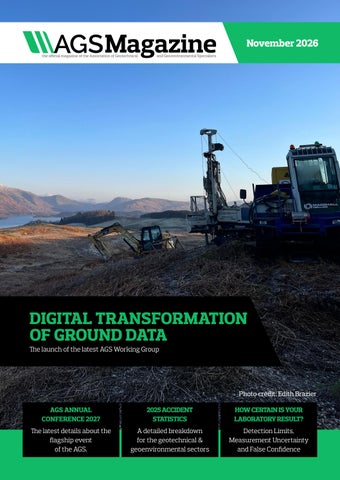
DIGITAL TRANSFORMATION OF GROUND DATA
The launch of the latest AGS Working Group
Photo credit: Edith Brazier AGS ANNUAL CONFERENCE 2027
2025 ACCIDENT STATISTICS
HOW CERTAIN IS YOUR LABORATORY RESULT?
The latest details about the flagship event of the AGS,
A detailed breakdown for the geotechnical & geoenvironmental sectors
Detection Limits, Measurement Uncertainty and False Confidence
Chair’s Foreword Welcome to the November 2026 edition of AGS Magazine. As the year draws towards a close, this issue provides an opportunity to reflect on the evidence, expertise and collaboration that continue to shape safer and more informed practice across the geotechnical and geoenvironmental sectors. Safety is a particularly strong theme. Our review of the 2025 industry accident statistics offers valuable insight into current trends, while an article on a fatality during the transportation of drilling equipment highlights the critical importance of securing loads correctly. Together, these contributions underline the need to learn from evidence and experience, maintain robust procedures and keep safe working practices at the forefront of every project. This edition also examines issues with significant technical and commercial implications. We consider professional indemnity insurance and asbestos cover for geotechnical and geoenvironmental consulting engineers, and explore how detection limits and measurement uncertainty can create false confidence in contaminated land decisions. We also introduce the Digital Transformation of Ground Data as an AGS Working Group,
2
Magazine
an important development that will support greater collaboration and help the industry realise the value of more consistent, accessible and connected ground data. There are also several opportunities to engage with and contribute to the AGS. The AGS Development Fund is open for applications, offering support for projects that can provide a benefit to the wider industry. Looking ahead, we share details of the webinar From Data Silos to Shared Insight, the AGS Annual Conference 2027 and the Early Careers Poster Competition. As ever, I encourage you to read and share the articles in this issue, consider how their lessons may inform your own work, and take advantage of the opportunities to participate in AGS activities. Your knowledge, involvement and feedback remain central to our shared aim of raising standards and supporting a safer, more effective and forward-looking industry. We would be interested in your feedback on the magazine and our future plans. Please contact ags@ags.org.uk if you have any comments.
Alex Lee AGS Chair
ABOUT THE AGS The Association of Geotechnical and Geoenvironmental Specialists (AGS) is a not-for-profit trade association established to improve the profile and quality of geotechnical and geoenvironmental engineering. The membership comprises UK organisations and individuals having a common interest in the business of ground investigation, geotechnics, geoenvironmental engineering, engineering geology, geochemistry, hydrogeology, and other related disciplines. EDITORIAL BOARD Alex Lee, AGS Chair Caroline Kratz, Forum Court Associates (FCA) Katie Kennedy, FCA Julian Lovell, Equipe Group Calum Spires, Equipe Group Adam Latimer, Ian Farmer Associates Dimitris Xirouchakis, Structural Soils Caroline Martin, Haskoning Christos Botsialas, TRC Companies Alison Nicholson, Buro Happold EDITORIAL STORY To submit an article for inclusion in the AGS Magazine, please contact the AGS on 020 8658 8212 or ags@ags.org.uk. Please note that articles should act as opinion pieces and not directly advertise a company. The AGS is under no obligation to feature articles or events received. CONTACT US Association of Geotechnical & Geoenvironmental Specialists Forum Court, The Alexander Centre, 15-17 Preston Street, Faversham, Kent, ME13 8NZ ags@ags.org.uk 020 8658 8212 Association of Geotechnical & Geoenvironmental Specialists www.ags.org.uk
Inside this month’s issue
FEATURE PAGE 20
COVER STORY PAGE 30 Transforming ground data through better access, standards and collaboration.
Geotechnical & Geoenvironmental Industry Accident Statistics 2025 The 2025 AGS accident data highlights key safety trends across geotechnical and geoenvironmental work, identifying recurring risks, company-size differences, near-miss reporting patterns and priorities for improving industry health and safety.
AGS CONFERENCE 2027 PAGE 4 Previewing AGS Annual Conference 2027, registration, sponsorship and networking opportunities.
INSIDE: GROUNSURE PAGE 18 The AGS Magazine conducts a Q & A with Groundsure's Head of Insights - Magdalena Wyrwas.
HOW CERTAIN IS YOUR LABORATORY RESULT? PAGE 32 Understanding detection limits and uncertainty prevents false confidence in results.
MORE INSIDE PAGE 4
News in Short: Incl. Transportation fatality
PAGE 10
AGS Development Fund Open for applications
PAGE 16
Data Silos to Shared Insight Upcoming webinar details
November 2026
3
News and Events and geoenvironmental sector can respond to an evolving range of environmental, technical and societal challenges. The Annual Conference will welcome 240 professionals from across the industry for a day of technical insight, discussion, collaboration and networking. Chaired by AGS Chair, Alex Lee (HKA), the programme will showcase the latest industry developments, research and best practice, while providing valuable opportunities to connect with colleagues, clients and sector leaders. The day will conclude with an extended drinks reception in the Great Hall, offering further opportunities to continue conversations and strengthen professional connections.
We’re delighted to announce that the AGS Annual Conference will return to the prestigious One Great George Street in Westminster, London on Thursday 22 April 2027. Centred around the theme of resilience, the event will bring together industry leaders, technical specialists and emerging professionals to explore how the geotechnical
4
Magazine
Confirmed sponsors for the 2027 include Soil Engineering, Groundsure, Brimstone UXO, ALS, SoilCloud, Equipe, Normec i2 Analytical, In Situ Site Investigation, Geosense, BAM, HUESKER, Eijkelkamp Fraste UK, Van Walt, Landmark Information Group, Envirolab and Element.
REGISTRATION The Annual Conference has sold out for the past three consecutive years, so booking early is
strongly recommended. AGS Member companies and Honorary Members are entitled to a limited number of complimentary tickets. To register for your free place, download a registration form and return it to ags@ags.org.uk. A limited number of student places are available at the reduced rate of £10 per ticket. To book a student place, please email the AGS. Additional tickets are priced at £140 for AGS members, and £215 for non-members. Please note that all tickets are offered on a first come, first served basis. For further details on the programme, speakers and registration please click HERE.
EARLY CAREERS POSTER COMPETITION The AGS Early Careers Poster Competition is back for a four year, this time with the theme of, “how do we inspire more people to pursue a career in geoscience?” The winner will receive a £100 Amazon voucher, free entry to the 2027 Annual Conference, plus
have their poster printed in AGS Magazine which reaches over 7,800 industry professionals 6 times a year. Ten runners up will win free entry into the Annual Conference, and all other entrants will receive entry into the Annual Conference at a reduced rate of £10 (plus VAT)*. All posters submitted will be displayed at the Annual Conference. For full details and T&Cs please click here.
SPONSOR THE ANNUAL CONFERENCE Sponsoring the AGS Annual Conference offers a valuable opportunity to raise your profile within the UK's geotechnical and geoenvironmental community, connecting your organisation with industry leaders, technical specialists and key decision-makers. Feedback from the 2026 conference was exceptionally positive with a few statistics including: Î
100% of delegates rated the conference as excellent or good
November 2026
5
Î Î Î
99% rated presentations as excellent or good 96% were satisfied with the networking opportunities 100% would recommend the conference
With 50% of packages already sold out, we anticipate that sponsorship packages will sell out in advance of the event, so early booking is strongly recommended. Our available sponsorship packages are as follows. For full package benefits, click HERE.
area has space for two standard pull-up banners (850mm x 2000mm). Î
Entry for three delegates into the Annual Conference
Î
Full page advert in AGS Magazine (worth £424) which has over 7,810 subscribers
GOLD SPONSOR (AGS Member Rate: £1,073 / Non-Member Rate: £1,430) Î
CANAPE SPONSOR* (AGS Member Rate: £1,323 / Non-Member Rate: £1,856) Î Î Î Î Î
Company logo on the drinks / canape menu Company logo on the canape flags Full page advert in AGS Magazine (worth £424)** which has over 7,810 subscribers Entry for three delegates into the Annual Conference An exhibition table which may be used to present company initiatives, research, software and promotional materials in a high-profile networking environment. This area has space for two standard pull-up banners (850mm x 2000mm).
*one package available **terms and conditions apply
Î
PROMOTIONAL SPONSOR (AGS Member Rate: £880 Non-Member Rate: £1,100) Î Î Î
EMERALD SPONSOR (AGS Member Rate: £1,180 / Non-Member Rate: £1,645) Î
Î
An exhibition table which may be used to present company initiatives, research, software and promotional materials in a high-profile networking environment. This
An exhibition table which may be used to present company initiatives, research, software and promotional materials in a high-profile networking environment. This area has space for two standard pull-up banners (850mm x 2000mm). Entry for two delegates into the Annual Conference 1/4-page advert in AGS magazine (worth £170) which has over 7,810 subscribers
Entry for one delegate into the Annual Conference Company directory in AGS magazine (worth £50) which has over 7,810 subscribers Company logo on the conference lectern
All rates exclude VAT. If you’d like to confirm your support, please contact Caroline Kratz on ags@ags.org.uk. Packages are offered on a first come, first served basis.
SPONSORS
6
Magazine
AG S E A R LY CA R E E R S 7 2 0 2 N IO IT T E P M O C R E T S O P CT HOW CA N W E AT T R AN OF T H E N E XT G E N E R ATTIO E H T O IN S L A N IO S S E F O PR G EOSC IE NC E IN DU S T RY ? The geotechnical and geoenvironmental industry plays a vital role in delivering sustainable infrastructure, managing environmental risks, and shaping the built environment. However, attracting the next generation of professionals remains one of our biggest challenges. This year, we’re inviting Early Career Professionals to share their ideas on how we can inspire more people to pursue a career in geoscience. Your poster can explore: Why geoscience can provide an exciting and rewarding career Common misconceptions about the industry and how they can be challenged Ways to improve awareness of geotechnical and geoenvironmental careers among students, graduates and career changers The role of mentoring, outreach, social media, work experience and education in attracting new talent Practical tips for showcasing the diverse opportunities available within the profession Posters should be creative, informative and thought-provoking, helping to inspire the next generation of geo-professionals. For full details and entry information scan the QR code.
The winner will receive a £100 Amazon Vouche r, free entry to the AGS Annual Conf erence on 22nd April 2027 in Lond on and have an interview regarding their winning entry published in AGS Magazine which reaches over 7,8 00 industry professionals six times a year. Ten runners up will win free entry into the Annual Conference , and all posters submitted will be displa yed at the Annual Conference.
To enter, email your A3 poster alongside your full name and company to ags@ags.org.uk before Friday 26th February.
November 2026
7
News and Events
The Changing Landscape of Land Contamination conference was held on 15th October 2026 at Thinktank Birmingham Science Museum. The sellout event welcomed 170 delegates for a fullday programme examining the technical, legal and regulatory developments shaping the land contamination sector. Across four sessions, speakers explored how updated standards, emerging contaminants, improved monitoring and changing legal expectations are influencing professional practice. The programme also included a panel discussion titled Land Contamination: Meeting Technical, Societal and Legal Expectations.
Session 1 Chaired by Geraint Williams (Associate Technical Director at HKA and AGS Chair Elect), Session 1 began with Professor Paul Nathanail (Director at Land Quality Management), who discussed BS 10175:2026 and its role in supporting a professional approach to the investigation of potentially contaminated sites. He outlined the importance of robust information throughout site characterisation, risk assessment and remediation verification, particularly in supporting the safe redevelopment of postindustrial brownfield land. Dr Anna Willetts (Partner at Gunnercooke) and Samantha Riggs (Barrister at 25 Bedford Row) followed with a legal perspective on landfill,
8
Magazine
considering the regulatory and liability issues that influence decision-making in practice.
Session 2 Following a refreshment break, Session 2 was chaired by Stephanie Cox (Director at E3P and member of the SoBRA Executive Committee – Early Careers). Dr Rob Sweeney (Technical Director at CL:AIRE) presented an update on work to modernise 15 Department of the Environment industry profiles created more than 30 years ago. The revised profiles address contaminant groups including per- and polyfluoroalkyl substances (PFAS) and persistent organic pollutants (POPs), with information presented through an interactive matrix and supporting profile pages. Pagen Spooner (Geo-Environmental Consultant at EPG) then explored the benefits of measuring dissolved methane when interpreting groundgas results. Drawing on recent research, Environment Agency guidance and case studies, Pagen considered uncertainties in current field and laboratory sampling methods and explained how dissolved methane probes can provide clearer evidence for risk assessment and design decisions.
Session 3 After lunch and networking opportunities, Session 3 was chaired by Dr Rob Sweeney. Dr
Paul McMahon (Associate Technical Director at RSK Geosciences), presented a case study on RSK Geosciences’ approach to developing and applying Sustainable Management Practices. He explained how the company’s digital tool helps project teams identify, track and showcase better practice while supporting more sustainable outcomes for land development and management. The presentation also highlighted the importance of integrating climate risk and resilience into geo-environmental assessments. The session concluded with a panel discussion chaired by Professor Paul Nathanail featuring Pagen Spooner, Dr Anna Willetts, Christopher Swainston, Barry Mitcheson and Dr Paul McMahon. The panellists answered audience questions on the technical, societal and legal expectations affecting the land contamination sector.
Session 4 The final session was chaired by Claire Dickinson
(Director at Geo-Environmental Matters and SiLC PTP member). Dr Cecilia MacLeod (Managing Director and Co-Founder at Anthera Remediation Technologies) opened with a presentation on developments in the remediation of PFAS in soils and waters. The final presentation came from Steve Forster (Director at Remedia Group), who asked whether current approaches to asbestos air monitoring during remediation provide sufficient assurance for nearby homes, schools, workplaces and public spaces. It was a highly successful event that provided valuable opportunities for professionals across the sector to share technical knowledge, discuss developing regulation and explore practical responses to emerging challenges in land contamination. The AGS extends its thanks to all speakers and sponsors, including Groundsure, ALS, HUESKER, Eijkelkamp Fraste UK, Normec i2 Analytical and GeoEnviro Solutions.
November 2026
9
News and Events Differentiating overlapping sources of perand polyfluoroalkyl substances (PFAS) is a challenge, yet without clear source attribution land contamination risk assessments may be flawed. This webinar is designed for land contamination professionals who want to extract more value from ground investigation data. You’ll learn how forensic assessment techniques can be applied to standard ground investigation datasets and routine laboratory analyses to confidently distinguish between PFAS sources.
Date: 28th January 2027 11.00am - 1.00pm Duration: 2hr Specialist in Land Condition (SiLC) is excited to announce that their webinar on Demystifying PFAS source differentiation, will take place on Thursday 28th January 2027 (11am-1pm) at a cost of £45 inc VAT and £35 inc VAT for registered SiLCs.
AGS Development Fund – Open for applications The AGS Development Fund remains open for applications supporting projects and initiatives that provide clear benefits to AGS members and contribute positively to the wider geotechnical and geoenvironmental industry. Applications are welcomed from those with ideas that can help advance knowledge, improve practice, support guidance development or encourage innovation across
10
Magazine
Through practical, real-world examples, you will see how to leverage multiple complementary lines of evidence to differentiate PFAS sources, including class- and carbon-number composition, diagnostic ratios, precursorproduct relationships, and more. The session will highlight how these approaches can be used together to build robust, defensible interpretations.
Book here: Demystifying PFAS source differentiation | Specialist in Land Condition Register Ltd (SiLC) the sector. Anyone considering submitting a proposal is encouraged to review the application information and ensure their submission clearly sets out the purpose of the project, the anticipated benefits, and how the work will support the AGS community and the wider industry. Each application is considered by the AGS Development Fund Group. The next deadline for applications is 8th January 2027. To apply for the development fund, please complete the form here – https://forms.office. com/e/C5BCfBTHjs.
Drilling Equipment Transportation Fatality Highlights the Importance of Safe Load Securing The AGS would like to draw members’ attention to a recent British Drilling Association Safety Alert, which highlights the importance of safe loading, load securing and driver competence when transporting drilling equipment. The alert follows a fatal road incident in which a drilling machine fell from a trailer and struck an oncoming vehicle. The machine had been secured with only one ratchet strap, despite additional equipment being available, and the strap was later found to be worn and in poor condition. Investigators identified serious failings,
ORGANISED BY
including inadequate load securing, damaged restraint equipment, and the vehicle and trailer being overloaded. The court concluded that the incident was preventable. When transporting drilling machines or associated equipment, drivers and employers must ensure loads are safe, secure and suitable for the vehicle and trailer being used. This includes checking weight limits, anchor points, load distribution, restraint methods and the condition of straps or chains before leaving site. Employers also have a duty to provide appropriate training, instruction, supervision and procedures so that those involved in transporting equipment are competent to do so safely. The alert is a stark reminder that load security is a safety-critical activity, not a routine task. Reviewing transport procedures, inspecting securing equipment and confirming driver competence can help prevent serious incidents and save lives.
ACCREDITED BY
SAFE LOADS AND LASHINGS PRACTICAL TRAINING FOR SAFE TRANSPORTATION OF DRILLING MACHINERY, GOODS AND EQUIPMENT
BOOK YOUR PLACE
PLACES ONLY BESPOKE PRICING OR WHEN DELIVERED £150 + VAT PER PERSON
AT YOUR PREMISES
REGISTER ONLINE NOW @ WWW.EQUIPEGROUP.COM November 2026
11
News and Events Professional Indemnity Insurance: Asbestos Cover for Geotechnical and Geoenvironmental Consulting Engineers Article contributed by Paul Livesey (Griffiths & Armour) Professional indemnity insurance (PII) principally provides cover for liabilities arising from the negligent provision of professional advice or services. This article is intended as a discussion piece for professional consultants. Contractors responsible for the physical handling and/or removal of asbestos containing soils or materials, should consult their insurance brokers for advice.
12
Magazine
For geoenvironmental and/or geotechnical consulting engineers, the presence of asbestos in soils or made ground is a risk consideration, especially in relation to the development of brownfield sites. It is therefore important for professional consultants to understand the extent of cover, if any, provided for asbestosrelated claims under their PII policies. The extent of cover provided for asbestosrelated claims can vary considerably, and it is important for consultants to understand that no two PII policies are the same. Some policies may exclude cover for all asbestos related claims, and those policies that do provide cover will typically be subject to specific asbestos-related restrictions, limitations and/or exclusions, such as: Î
aggregate, costs inclusive, limits of indemnity;
Î
cover limited to claims arising directly from negligence;
Î
cover restricted to work undertaken in the UK, Isle of Man, Channel Islands and
Republic of Ireland; and bodily injury, illness and death exclusion.
Î
Consultants should also check for specific exclusions relating to Environmental Audits and Asbestos Inspections, and whether such exclusions might apply to ground investigations. It is worth noting that PII policies typically treat asbestos related claims separately from pollution and/or contamination claims, and the two areas of risk and cover should not be confused. Understanding insurance policies and insurance terminology can be difficult and confusing, and consultants should therefore seek advice from their insurance brokers. It might also be helpful for consultants to specifically ask if and to what extent their PII policy might respond to claims arising under specific scenarios, such as the following. 1. An omission to test for asbestos in soils or made ground. 2. A ground investigation failing to identify the presence or extent of asbestos in the ground. 3. A remediation scheme designed by professionals fails to clear or make safe contaminated areas.
4. A ground investigation, designed and directed by a professional consultant, disturbing asbestos materials. It is of course important for consultants to secure the most suitable cover for their risk exposures, and where possible to transfer the risk to insurers. However, consultants should also consider risk management measures, including the use of formal terms of engagement, having a clearly defined scope of works, maintaining accurate written records, and the use of disclaimers, limitations and qualifications in reports. If you have any questions about the contents of this article, please contact the author, Paul Livesey at Griffiths & Armour (plivesey@ griffithsandarmour.com). Whilst care has been taken in the production of this article and the information contained within it has been obtained from sources that Griffiths & Armour believes to be reliable, Griffiths & Armour does not warrant, represent or guarantee the accuracy, adequacy, completeness or fitness for any purpose of the article or any part of it and can accept no liability for any loss incurred in any way whatsoever by any person who may rely on it. In any case any recipient shall be entirely responsible for the use to which it puts this article.
AGS Publication Updates The top three downloaded AGS publications in last month: 1. AGS Client Guide for Ground Investigation Activities – Trial Pitting 2. Safety Guidance – Classification of Potentially Contaminated Sites for Intrusive Investigation Activities 3. AGS Guide to Ground Investigation Reports Recent AGS publications available on the AGS website: •
AGS Guidance for preparing data management plans in accordance with BS8574
•
Safety Guidance – First Aid Provisions
•
Guidance on SPTs terminated early, extended tests and reporting of seating blows
To download the publications for free; click here.
November 2026
13
14
Magazine
The Geological Society
Access a global geoscience community Connect with a professional network of geoscientists, shaping the future of our profession worldwide
Command recognition with ‘FGS’
Access world-class resources
Ignite your career & make an impact
View all benefits and join www.geolsoc.org.uk/join Use code ‘AGSMAG’ to pay £0 joining fee and save £49 The Geological Society of London, Burlington House, Piccadilly, London, UK, W1J 0BG November 2026 The Geological Society of London is a registered charity, no. 210161
15
AGS ONLINE
From Data Silos to Shared Insight: The AGS Digital Transformation of Ground Data Working Group is a two-hour CPD webinar taking place on Tuesday 15th December at 11am. The AGS Digital Transformation of Ground Data Working Group is working towards a future in which ground data is seamlessly connected, transparently shared and intelligently interpreted throughout the infrastructure lifecycle. This webinar will introduce the group’s vision and provide an update on its work to raise awareness, build industry consensus and support practical change across data sharing, standards, governance, interoperability, skills and industry capability. The session, Chaired by Vicky Corcoran (Associate Engineering Geologist at AtkinsRéalis and Digital Transformation of Ground Data Working Group Leader), will explore current policy and industry developments affecting the discovery, access and reuse of ground data. This will include an update on activities relating to the Ground Data for Growth Bill, which proposes wider sharing of ground investigation information, and the group’s response to the government Call for Evidence, The marginal cost restriction on public sector data re-use. Speakers for this 16
Magazine
NEWS, R E P L AY S & UPCOMING EVENTS
webinar are Steve Thorpe and Judith Nathanail. The Call for Evidence considered whether public bodies should have greater flexibility to charge above marginal cost for the reuse of public sector data, with important implications for access to foundational geological, geospatial and infrastructure datasets. The webinar will also cover our collaboration with the British Geological Survey, a potential amendment to the UK Specification for Ground Investigation, and other activities. Delegates will gain a clearer understanding of the changing ground-data landscape and the practical role they can play within it. The webinar will help attendees consider how ground data is shared and reused in their day-to-day work, identify opportunities to improve data quality and interoperability, and contribute to stronger data governance and more consistent information management across projects and organisations. They will also learn why data sharing is likely to become increasingly important in future as we adopt the second generation Eurocodes and increasingly embed AI into our workflows. This virtual event will benefit geotechnical and geoenvironmental professionals, engineering geologists, ground-investigation practitioners,
info@insitusi.com +44 (0)845 862 0558
IN SITU TESTING SPECIALISTS CONE PENETRATION TESTING (CPT) Seismic, Shear Vane, Video Cone, Gamma Cone, Magnetometer, MOSTAP Sampling
PRESSUREMETER TESTING Self Boring Pressuremeters (SBPs), High Pressure Dilatometers (HPDs), Ménard Pressuremeter tests, Cone Pressuremeter, Goodman Jack Borehole Probe
ENVIRONMENTAL Membrane Interface Probe (MIP), Hydraulic Profiling Tool (HPT), WASTAP, Optical Image Profiler (OIP)
MARINE RAIL RESTRICTED ACCESS TAILINGS STORAGE FACILITIES PETROGRAPHY ANALYSIS SAMPLE AND CORE LOGGING UK & WORLDWIDE
www.insitusi.com infrastructure owners and operators, designers, contractors, data managers, informationmanagement specialists, policy professionals and anyone who creates, manages or uses ground data. Attendees will gain insight into the developments likely to influence future industry practice and how they can support a more connected, collaborative and data-driven approach to infrastructure delivery. Thank you to SoilCloud, the headline sponsor of the webinar.
Tickets AGS member companies may attend this event for free. Non-member tickets are priced at £50 (ex VAT). To register for this event, please click HERE.
Sponsorship The AGS has associate sponsorship packages available for companies who wish to support this virtual event. Prices start from just £150 (plus VAT) for AGS Members. For details click HERE. The deadline for sponsorship is 13th November.
SPONSORS
November 2026
17
IGN S I D E ROU N D S U R E Where are your offices based? Brighton, East Sussex and in Cornwall. We also have a number of home-workers across the UK.
How many people does the company employ? 116 people.
Getting to know Groundsure with Head of Insights Magdalena Wyrwas What company do you work for and what areas do they specialise in? Groundsure is a leading UK environmental and climate data authority. We have 25 years' experience giving land and property professionals expert information on risks, including land contamination, flooding and ground stability, as well as forward guidance on potential climate risks to advise their clients in the transaction process. We champion a customerfirst ethos, by putting our customers at the heart of everything we do.
18
Magazine
How long have you worked at the company, and what inspired you to join? I returned to work at Groundsure in 2022.What drew me back (and I believe that this is true for other colleagues who have returned), is the workplace culture, and the way that direct customer feedback drives the development and enrichment of our product offering. It's rare to work somewhere that listens that closely to its customers, and I feel genuinely passionate about being part of the team that takes it forward.
What does a typical day look like for you? In addition to managing the Insights Sales team day-today, I remain closely involved
in direct conversations with the sector, capturing their needs and priorities and feeding them straight into the R&D and product development processes.
What project are you most proud to have been a part of? I'm very proud to have supported our product launch in July 2025: Groundsure Explorer - an environmental data workspace that brings together 170+ years of mapping history and 130+ datasets. Explorer swaps the traditional static PDF reports, for interactive, real-time data and maps, enabling a faster and more collaborative way of working for organisations and teams. Additionally, I’m involved in the customer product feedback sessions that we run for this product. These sessions provide a valuable opportunity to refine our products and tools and deliver greater efficiencies to users.
How important is sustainability within the company? As a company focused on environmental issues, we’re aligned to the B Corp mission
Magda Wyrwas and Stephen Lees at Geotechnica 2026.
of using business as a force for good. Having B Corp certification, has helped us to shape our sustainability strategy and our conversations with customers and our teams within the business. We achieved B Corp certification in September 2023, which enabled us to build and strengthen areas and also identify those areas where more work is required. We’re in the process of recertifying under the new V2.0 scheme which is helping us build out our stakeholder collaboration - including customers and staff collaboration, as we develop our approach to Net Zero and our inclusion practices.
How does your company support graduates and early career professionals who are entering the industry? Our investment in people and our teams is always a key priority. We work with staff to develop their skills and
support our employees to reach their career goals. We have been challenged, particularly in the Cornwall area, (as it has areas of deprivation), in how we consider supporting young people and the local communities. In Cornwall, we offer internships to graduates from local universities, helping them to take their first steps into their careers. We’re particularly proud to be sponsoring one of the first Geoscience Graduate Apprentices in partnership with Keele University. This has been a positive experience for both the apprentice and the wider team.
clear objectives for where you want to be. We found one of the most impactful ways to make Groundsure a comfortable place to work is to encourage staff to share their experiences - company wide. We’ve now completed two consecutive annual, anonymous Equality, Diversity and Inclusion surveys with all Groundsure staff. This helps us to understand who we are, and we use the results to support the development of the targets for the following year.
Why do you feel the work of the AGS is important to the industry?
The AGS has underpinned the geotechnical and geoenvironmental industry What steps can companies for decades, providing make to improve the accessible, practical advice gender imbalance and and guidance for practitioners diversity within their and clients alike. It’s helped organisations? to raise industry standards and ensures that progress A good starting point is to continues and evolves understand your current in alignment with the workforce diversity and set requirements. November 2026
19
Geotechnical & Geoenvironmental Industry Accident Statistics 2025 Article contributed by Rachael Parry TechIOSH CMgr MCMI (Operations Support Manager, Geotechnical Engineering)
T
he increased level of data sharing for the 2025 reporting year has provided a more comprehensive and representative picture of safety performance across the geotechnical and geoenvironmental sectors. Greater participation and a more diverse dataset have strengthened the value of what we have received, enabling more meaningful trend analysis and industrywide learning. This continued commitment to transparency supports informed decisionmaking, helps identify emerging risks and areas for improvement, and encourages greater collaboration between organisations. As reporting levels continue to grow, the industry is better positioned to move beyond
20
Magazine
compliance and foster a proactive, learningfocused safety culture where collective responsibility and workforce wellbeing remain at the heart of operational excellence.
2025 AGS Industry Accident Data The health, safety and operational performance data submitted for the 2025 reporting period captures detailed information on RIDDOR-reportable incidents, non-RIDDOR injuries, near misses, vehicle-related incidents and mental health-related absences. The data also breaks down incidents by accident type, injury severity and body part affected, enabling comparisons between organisations of different sizes and operational profiles. This information forms the basis for identifying industry trends, benchmarking performance, understanding key sources of risk and supporting targeted initiatives aimed at improving health, safety and wellbeing across
and AFR have fluctuated over the 5-year reporting period, indicating varying levels of AGS Accident Incident Rate (AIR) safety performance across the industry. AIR and Accident Frequency Rate (AFR) peaked in 2025 at 175.87, suggesting a higher Summary rate of RIDDOR-reportable injuries relative to workforce size, while AFR reached a peak Accident Incident Rate (AIR) and Accident in 2022 at 28.55, reflecting an increase in Frequency Rate (AFR) are key health and accidents relative to hours worked. Despite safety performance indicators used to these annual variations, the 5-year average measure and compare AIR of 96.06 and AFR of 18.78 safety performance across provide a longer-term Accident Incident organisations of different measure of industry safety Rate (AIR) and sizes. AIR measures the performance, helping to number of RIDDORAccident Frequency Rate identify overall trends and reportable injuries relative (AFR) are key health place annual results into a to workforce size, while AFR and safety performance broader context. measures the frequency of indicators used to accidents in relation to the measure and compare The following section total hours worked. examines how the AIR safety performance To ensure consistency with and AFR vary according previous years and maintain across organisations of to contractor size over alignment with established different sizes. the past 5-year reporting industry reporting practices, period. By comparing the same following two accident performance across different workforce bands, and incident rate metrics have been applied it is possible to identify trends, highlight areas when calculating the 2025 figures: of elevated risk, and better understand the Accident Incident Rate (AIR) – (number factors influencing safety outcomes across the of RIDDOR reportable accidents / average industry. The analysis provides valuable insight workforce headcount) x 100,000. into how organisational scale may affect Accident Frequency Rate (AFR) – (total accident and incident reporting, while helping number of harm accidents / total number of to inform targeted improvement initiatives and hours worked) x 1,000,000. future safety strategies. The graphs above show that the average AIR the geotechnical and geoenvironmental sector.
“
November 2026
21
AGS AIR Summary
not fully reflect the true level of industry performance.
The Accident Incident Rate In contrast, large contractors (AIR) highlights a clear As a result, the (101-1,000 employees) relationship between absence of reported displayed the most contractor size and incidents is not consistent performance reported incident rates. No across the 5-year period. necessarily indicative incidents were reported Their rates ranged from of superior safety by small contractors (1–10 67.20 to 153.26, resulting employees) during the performance and may in a 5-year average of reporting period, however, not provide a reliable 97.52, almost identical the relatively limited sample basis for wider industry to the overall industry size within this group average of 96.06. This comparisons. means the results should consistency suggests that be interpreted with caution. As larger organisations may a result, the absence of reported incidents is benefit from more mature health and safety not necessarily indicative of superior safety management systems and a broader employee performance and may not provide a reliable base that stabilises annual reporting rates. basis for wider industry comparisons. Very large contractors (1,000+ employees) Medium-sized contractors (11-100 employees) recorded the lowest overall rates, with a recorded the highest rates by a considerable 5-year average of 39.21, less than half the margin. Their 5-year average of 247.51 is more industry average. Although some year-tothan 2.5x the overall industry average of 96.06, year variation was evident, particularly in 2022 driven by exceptionally high values in 2023 (70.91) and 2024 (54.77), their reported rates (486.62) and 2025 (582.59). However, the zero remained comparatively low throughout the values recorded in 2022 and 2024 have reduced period. Similarly to the large contractor size the overall average, and it should be recognised outcome mentioned above, this trend may that, until a larger and more complete dataset reflect the influence of well-established safety is available, the calculated average may cultures, dedicated H&S resources, and greater
“
22
Magazine
investment in risk management processes.
AGS AFR Summary Analysis of the Accident Frequency Rate (AFR) data shows a clear trend of higher accident rates among medium-sized contractors, whilst the other organisational groups report lower rates. The overall industry 5-year average AFR was 18.78.
considerably. The variability in rates across the years is likely influenced by the small workforce size, where a single accident can have a significant affect on the overall rate. Despite these fluctuations, the 5-year average remained below the industry benchmark.
Large contractors (101-1,000 employees) demonstrated consistently strong safety performance, recording a 5-year average AFR of 9.34, around half the industry average. Medium-sized contractors (11-100 employees) Annual rates remained stable between 6.23 recorded the highest accident and 12.88, indicating effective frequency rates throughout safety management Analysis of the the reporting period, with systems and a wellAccident Frequency a 5-year average of 39.96, established approach to more than double the Rate (AFR) data risk control. industry average. Rates shows a clear trend of Similarly, very large remained consistently higher accident rates contractors (1,000+ high, ranging from 36.27 among medium-sized employees) achieved a to 44.78, suggesting that low 5-year average AFR contractors... this contractor group of 10.19. While 2022 saw faces persistent challenges a temporary increase to in managing workplace safety. Unlike other 27.31, accident rates fell sharply in subsequent groups, there were no significant reductions years, with values of 4.32, 4.56 and 4.85 or exceptional years, indicating a sustained recorded between 2023 and 2025. These pattern of elevated risk. figures represent some of the lowest accident Small contractors (1-10 employees) recorded frequency rates across all contractor groups the second-highest 5-year average AFR at and again highlight the benefits of mature 15.64, although annual performance fluctuated health and safety systems, dedicated
“
November 2026
23
resources, and strong organisational safety cultures. Overall, the data suggests that accident frequency rates generally decrease as contractor size increases, with the exception of medium-sized contractors who continue to experience the highest levels of workplace accidents, whereas large and very large organisations consistently outperform the industry average. The findings from both the AIR and AFR analysis highlight the value of robust health and safety management systems and suggest that medium-sized organisations, particularly those experiencing growth, may benefit from additional resources, support and targeted interventions to maintain strong safety performance and reduce accident rates.
same activities responsible for the highest number of minor injuries. Slips, trips and falls on the same level accounted for more than half of all RIDDOR-reportable incidents, while lifting and handling activities contributed a further 15%. Together, these categories represented Injury Trends and Key almost 70% of all serious Analysis of the Findings injuries reported. This RIDDOR-reportable suggests that the industry's Across the survey, RIDDORdata shows that serious most significant injuries reportable incidents injuries are largely are not typically the result were reported much less of rare or catastrophic driven by the same frequently than minor activities responsible for events but instead arise injuries, indicating that from routine activities the majority of injuries the highest number of carried out daily across a continue to arise from minor injuries. wide range of projects and routine workplace activities, workplaces. This reinforces everyday behaviours and the importance of learning low-level hazards rather than from lower-level incidents and near misses, as major safety failures. Whilst this reflects a addressing their underlying causes can help relatively low incidence of serious injuries prevent more serious accidents and reduce the across the industry, it also demonstrates the likelihood of future RIDDOR-reportable events. importance of identifying and addressing A similar pattern was observed within the lower-level hazards and recurring workplace non-RIDDOR reportable data. Slips, trips and risks. Proactive management of these issues falls on the same level accounted for more than can help prevent escalation into more serious one-third of all reported injuries, with lifting events, reducing the likelihood of future and handling incidents contributing a further RIDDOR-reportable incidents and supporting quarter. Injuries caused by flying objects also continued improvements in overall safety featured prominently, representing over 20% performance. of all cases. Collectively, these three categories Analysis of the RIDDOR-reportable data shows accounted for more than 80% of all nonthat serious injuries are largely driven by the RIDDOR injuries reported.
“
24
Magazine
Traditionally high-consequence incident types, such as falls from height, vehicle-related incidents, electrical contact and structural collapse events, were reported relatively infrequently in both RIDDOR and non-RIDDOR data. This suggests that existing controls for higher-risk activities are generally effective, while the greatest opportunity for further injury reduction lies in strengthening the management of routine workplace hazards. The prevalence of slips, trips and falls highlights the ongoing challenges presented by everyday site conditions, including uneven ground, poor housekeeping, adverse weather and muddy working environments. Despite being largely
preventable, these incidents remain the single largest contributor to injury statistics across the sector. Likewise, the high number of lifting and handling injuries reinforces the physical nature of much of the work undertaken by AGS members and demonstrates the continued need for effective manual handling practices, task planning and the use of suitable lifting aids where practicable. Injuries resulting from flying objects remain a notable concern and may be associated with activities such as excavation works, drilling operations, plant use and the operation of hand tools. Continued emphasis on exclusion zones, equipment maintenance, safe systems of work and
November 2026
25
appropriate personal protective equipment is therefore essential.
construction industry, reveals both similarities and notable differences in the industry injury profile. In both datasets, slips, trips and falls on the same level remain the leading cause of injury, accounting for 36% of all AGS Member injuries compared with 25% across the industry as a whole. Similarly, lifting and handling incidents represent a significant proportion of injuries, accounting for 25% of AGS Member incidents compared with 17% nationally.
Analysis of injury locations further supports the findings from injuries reported by type. Injuries to the hands and fingers accounted for 38% of all reported injuries as seen in the graph above, making them by far the most affected parts of the body. This reflects the hands-on nature of the work undertaken across the industry and highlights the importance of maintaining high standards A particularly notable of manual handling, A particularly difference is the proportion equipment operation and of injuries caused by flying hand protection. Injuries notable difference is affecting the lower limbs, the proportion of injuries objects, which account including the legs, ankles caused by flying objects, for 19% of all AGS Member injuries, compared with and feet, accounted for a which account for 19% of 12% nationally for incidents further 23% of reported all AGS Member injuries, involving moving, flying cases and are likely linked to or falling objects. This the high prevalence of slip, compared with 12% likely reflects the practical trip and fall incidents. Head nationally for incidents and site-based nature of and back injuries together involving moving, AGS Members' work as represented approximately flying or falling objects. previously mentioned. 15% of all injuries, reinforcing This likely reflects the Conversely, falls from the importance of continued focus on site awareness, practical and site-based height account for just 1% workplace organisation nature of AGS Members' of AGS Member injuries, significantly lower than the and ergonomic working work as previously 20% reported across wider practices. mentioned. industry, suggesting that Overall, the findings either exposure to work at demonstrate that the greatest opportunity for reducing injury rates across the height is comparatively limited or that controls in this area are proving effective. industry lies in preventing low-consequence
“
but high-frequency incidents. By maintaining a strong focus on behavioural safety, risk awareness, workplace housekeeping, manual handling and routine task management, organisations can continue to reduce injury rates and further strengthen health and safety performance across the sector.
The Construction Industry A comparison of the AGS Accident data with wider HSE non-fatal injury statistics for the
26
Magazine
Vehicle-Related Risk Remains Significant Numerous organisations reported both ownfault and non-fault vehicle accidents during the reporting period. Given the significant amount of driving undertaken by AGS members to support site investigations, utility surveys, environmental monitoring, and the transport of laboratory samples (to name a few), vehicle safety continues to represent one of the industry's highest exposure risks.
Driving remains one of the most frequent Mental Health Impacts Are Low occupational activities across the sector, and in Number but Potentially High in the continued occurrence of vehicle-related Consequence incidents within the survey results highlights Most organisations reported zero lost working the importance of maintaining strong driver days attributable to mental safety initiatives, effective health-related absences, For employees journey planning and suggesting that such cases ongoing risk awareness. who do not require either remain relatively Opportunities also exist to a vehicle for their role, infrequent across the further reduce exposure to greater use of public survey population, or road-related risks through transport or other that under-reporting or additional driver training classification differences sustainable travel and by promoting alternative travel methods where options may help reduce may exist, with some absences potentially being appropriate. For employees both driving-related recorded under other who do not require a vehicle risks and overall time sickness categories rather for their role, greater use spent on the road. than specifically as mental of public transport or other health-related absences. It sustainable travel options may could also mean that current help reduce both driving-related risks and mental health support measures may be overall time spent on the road. proving effective, helping employees manage issues before they result in time away from Near Miss Reporting Appears Healthy work. Several organisations reported notably A small number of companies reported high high numbers of near-miss incidents, with levels of lost time, with some recording losses individual returns including 513, 300, 205 and equivalent to as much as 6% of their total 131 reports, alongside many other companies hours worked for the reporting period. While recording substantial reporting figures. such cases remain relatively uncommon, the While these numbers may initially appear data demonstrates that when mental healthconcerning, they are generally indicative of related absences do occur, they can have a positive and proactive health and safety a considerable impact on both workforce culture. Strong near-miss reporting creates availability and organisational productivity. valuable opportunities to identify hazards, These findings highlight the importance of investigate underlying causes and implement continued investment in employee wellbeing corrective actions before injuries or more initiatives, mental health support and early serious incidents occur. The volume of nearintervention measures to help reduce the miss reporting observed within parts of the duration and severity of cases. Furthermore, industry may therefore reflect a maturing the increasing number of participating reporting culture, where employees are employees and total hours worked represented increasingly engaged in recognising and within the survey enhances the value of the reporting unsafe conditions and behaviours. benchmarking exercise, providing a broader Continued encouragement of open reporting data set and strengthening confidence in the and shared learning will be key to further trends and conclusions identified across the improving health and safety performance industry. across the sector.
“
November 2026
27
AGS and BDA Collaboration
performance.
Continued engagement from AGS members The AGS and BDA have continued to collaborate remains vital, and we strongly encourage the on accident statistics, with the ultimate aim of submission of complete, accurate and up-toidentifying common trends across the industry date statistics to support annual review and that can be explored and analysed further. As analysis. This year, responses were received the accident statistics submitted to the AGS from 35% of AGS members, representing a include data from both BDA and non-BDA 13% increase compared with the previous organisations, this provides an opportunity year. While this is a positive step forward, to identify trends specifically amongst BDA further participation is essential to ensure members and compare these with those the data set is sufficiently reported by non-BDA comprehensive to provide a organisations, highlighting Continued robust overview of health any notable similarities or and safety performance engagement from differences. across the industry. We AGS members remains Several non-BDA remain optimistic that vital... organisations reported response rates will continue substantially higher injury to improve, helping to drive totals than the wider survey greater engagement and deliver increasingly average, with as many as 354 minor injuries meaningful insights into industry health and and 18 RIDDOR-reportable incidents, while safety trends. other companies reported minor injuries in the 40’s. Although these figures indicate Conclusion that some of the highest injury rates were The 2025 AGS health and safety data present recorded by non-BDA members, the data a detailed snapshot of safety performance does not reveal any clear trend associated across the geotechnical and geoenvironmental with BDA membership. A number of BDA industry, with increased participation further organisations demonstrated healthy levels improving the quality and representativeness of near-miss reporting alongside relatively of the dataset. The findings show that most low injury numbers, which may be indicative injuries continue to arise from routine of a proactive reporting culture and effective workplace activities, particularly slips, trips incident prevention measures. However, and falls, manual handling tasks, and hand several of the highest near-miss reporting injuries, highlighting where the greatest figures were also recorded by non-BDA opportunities for improvement remain. While organisations, suggesting that positive larger organisations generally reported lower reporting behaviours are present across both accident rates, the data suggests that mediumgroups. sized companies may benefit from additional Looking ahead to 2026-2027, the AGS intends support as they grow. Encouragingly, strong to strengthen its collaboration with the BDA levels of near-miss reporting indicate a to facilitate the sharing of additional health positive safety culture across much of the and safety statistics from organisations that industry. Continued collaboration, transparent hold membership with both associations. This reporting and proactive risk management will initiative is expected to improve the quality be essential in driving further improvements and reliability of data returns, providing a in health, safety and wellbeing throughout the more representative picture of overall industry sector.
“
28
Magazine
November 2026
29
Digital Transformation of Ground Data Connecting Data. Building Capability. Unlocking Value. Article contributed by Andrea Gillarduzzi (Arcadis) and Alison Greenall (AtkinsRéalis)
G
round engineering is becoming increasingly digital. Data are generated, collected, exchanged and analysed in greater volumes than ever before. However, much of their potential value remains unrealised, with information often fragmented across projects, organisations, digital platforms and incompatible formats. Recognising the opportunity to improve how ground information is generated, managed, shared and applied, the Association of Geotechnical and Geoenvironmental Specialists has established Digital Transformation of Ground Data (DTGD) as a new Working Group. Originally launched in 2025 as an independent volunteer-led initiative, DTGD now formally brings together representatives from industry, academia, software providers and client organisations under the AGS umbrella. The Working Group aims to become the collective voice for the digital transformation of ground engineering, providing a forum to share knowledge, coordinate industry input, develop best practice and improve the way ground data are created, managed, exchanged and used. Its
30
Magazine
ultimate goal is to deliver better outcomes for infrastructure, society and the environment.
Key Objectives Improving Access to and Reuse of Ground Data Ground data is often collected at significant cost, yet many valuable datasets remain inaccessible or underutilised once projects are completed. The Working Group will promote practical approaches to improve the discoverability, accessibility and responsible reuse of ground information across the industry. This includes supporting initiatives that help organisations identify where historical and emerging datasets exist, encouraging the sharing of legacy ground investigation information, and exploring opportunities to improve access through national repositories and other digital platforms. Improving access to existing information can reduce duplication, support better-informed decisions and unlock value from data that have already been collected. Creating a Digital Golden Thread Across the Asset Lifecycle The value of ground data increases when information remains connected throughout its lifecycle. Data generated during planning and investigation should continue to inform interpretation, design, construction, operation
and future development. The Working Group promotes the concept of a digital "golden thread" of information, providing traceability and continuity across project stages that have traditionally been disconnected. Better integration of information can improve understanding, reduce risk and enable asset owners to derive greater longterm value from their data. Achieving this vision will require collaboration between industry stakeholders, software vendors and asset owners to improve interoperability and support seamless data exchange. Improving Data Management and Interoperability Consistent standards and effective information management are fundamental to digital transformation. The Working Group will support initiatives that improve how ground data is specified, managed, exchanged and validated, including the wider adoption of recognised standards such as AGS’s data format and the implementation of digital workflows. Greater interoperability between organisations and software platforms will enable more efficient data exchange throughout the project lifecycle, reducing information loss and rework. The focus is on improving the quality, consistency and usability of data to achieve better project outcomes and maximise return on investment. Building the Future Geo-Digital Workforce Technology alone will not deliver digital transformation. Success depends on people having the skills, confidence and ambition to implement and sustain change, and on the wider industry embracing new ways of working. A key objective of the Working Group is to help develop the future geo-digital workforce by strengthening capabilities in the management, analysis, interpretation and sharing of ground
data. This includes addressing skills gaps, supporting professional development and creating clear learning pathways to improve digital maturity across the sector. By investing in people alongside technology, organisations can strengthen capability, encourage innovation and realise the full benefits of digital transformation. Influencing Policy, Data Stewardship and Ownership Many of the challenges associated with digital ground data extend beyond technology. Issues such as ownership, stewardship, confidentiality, commercial sensitivity, liability and long-term governance must also be addressed. The Working Group provides a forum to discuss these topics, share diverse industry perspectives and help shape future policy, guidance and best practice. By promoting responsible data stewardship and greater clarity around ownership and governance, the Group aims to support a more trusted, connected and sustainable future for ground engineering. The Group will also engage with government bodies, infrastructure owners and other stakeholders to encourage alignment of objectives and collaboration across the wider sector. Get Involved The Working Group welcomes active contributors from across the ground engineering community who are interested in helping shape the future of digital ground engineering. To find out more or get involved, visit the AGS website. Leadership: Chair: Vicky Corcoran Deputy Chair(s): Andrea Gillarduzzi & TBC Web https://www.ags.org.uk/group/digitaltransformation-of-ground-data/
November 2026
31
How Certain Is Your Laboratory Result? Detection Limits, Measurement Uncertainty and False Confidence in Contaminated Land Decisions Article contributed by Ken Scally (Calibre Scientific, Shannon Free Zone, Co. Clare, Ireland & Department of Earth and Environmental Sciences, Mount Royal University, Calgary, Alberta, Canada) and Paul Nathanail (Land Quality Management)
D
eciding whether to remediate or to stop remediating land contamination is routinely made on the basis of laboratory results that appear precise and accurate: concentrations below an assessment criterion may be treated as acceptable and above it as unacceptable. Yet that apparent granularity can conceal important limitations. This becomes particularly important when the criterion is very close to the lowest concentration the laboratory can detect. A result reported as <0.01 mg/kg does not
32
Magazine
indicate the absence of a substance. Equally, a result of 10.2 mg/kg does not mean that the true concentration is known exactly to three significant figures. Every reported concentration has limitations arising from detection capability, method performance and measurement uncertainty. Before the sample reaches the laboratory, uncertainty is introduced by site heterogeneity, sampling, handling and sub-sampling - topics for another day. An analytical result is therefore not simply a number. It is an estimate produced by a measurement process that represents a number with a specified degree of confidence. The key question for the risk assessor is not only “What result did the laboratory report?” but “What does this result actually allow me to conclude?”
What does “not detected” actually mean? A result reported as <0.01 mg/kg does not establish that the analyte concentration is zero. Indeed no chemical analysis can report that a substance is completely absent - leaving aside the philosophical reality that “zero” is not a number. “Not detected” means that the analyte cannot be reported quantitatively above a defined analytical threshold, which may be described as a detection limit, quantification limit or reporting limit depending on the method and laboratory. These terms are related, but are not interchangeable.
that environmental monitoring equipment, personnel and laboratory activities meet defined quality and performance standards. It requires laboratories to demonstrate a method’s suitability for the analyte(s), relevant matrix and intended application (Environment Agency, 2021, 2023).
Detection or (reliable) quantification
The limit of quantification (LOQ) represents the lower concentration at which a result can be quantified with acceptable performance for its intended purpose. Below the LOD, the method cannot reliably distinguish the presence of an analyte from analytical background. Between the LOD and LOQ, there may be evidence that the analyte is present, but quantitative confidence is Laboratory analysis reduced. Above the LOQ, depends on the the concentration of the analyte can be quantified equipment responding within the established to the presence of a performance of the method substance - the higher (Analytical Methods the concentration of that Committee, 1987; Cantwell, substance the stronger 2025).
Laboratory analysis depends on the equipment responding to the presence of a substance - the higher the concentration of that substance the stronger the response. At low concentrations, an analytical response becomes progressively more difficult to distinguish the response. Environmental laboratory from variation caused by certificates of analysis may instrument noise, blanks, use a further term: the extraction, matrix interference reporting limit. This may equal or be higher and other components of the measurement than the LOQ. A laboratory may use a reporting process (Analytical Methods Committee, 1987; limit above instrumental detection capability Cantwell, 2025). The limit of detection (LOD) is because it reflects the concentration at which therefore better understood as a measure of the complete method can routinely provide detection capability under defined analytical reliable results. For example, an LOD of 0.001 conditions rather than simply “the lowest mg/kg, an LOQ of 0.003 mg/kg and a routine concentration the instrument can resolve”. reporting limit of 0.01 mg/kg are perfectly Instrumental sensitivity is only one part compatible. of a method. Performance must also A problem arises when <0.01 mg/kg is treated reflect extraction, clean-up, identification, as zero. The true concentration could be 0.002, quantification and reflects the effects of the 0.005 or 0.009 mg/kg. The laboratory has environmental matrix. not resolved the concentration below that The Environment Agency’s Monitoring threshold. Treating low-level observations as Certification Scheme (MCERTS ) provides a though nothing has been measured can also recognised framework for demonstrating
“
November 2026
33
Figure 1. Analytical thresholds and how they relate to an assessment criterion. distort subsequent interpretation (Analytical Methods Committee, 2001, 2020).
The assessment criterion must be considered before analysis
Some risk assessors prefer a reporting limit of no more than 10% of the assessment criterion albeit this is not always possible for all analytes in all media.
A detected concentration is still not
Suppose the relevant soil assessment criterion exact is 0.005 mg/kg but the selected laboratory method has a reporting limit of 0.01 mg/kg. Once a numerical concentration is reported, A result of <0.01 mg/ measurement uncertainty Relative kg cannot demonstrate becomes important. A result compliance with the such as 11.3 mg/kg should not uncertainty often 0.005 mg/kg criterion becomes more important be interpreted as though the because the actual true concentration is exactly toward the lower end concentration could still 11.3 mg/kg. Uncertainty can of a method because exceed the criterion: arise from homogenisation blanks, background the method has failed and sub-sampling, weighing, to demonstrate that the extraction and recovery, variation, recovery and concentration is below calibration, reference materials, instrumental noise the criterion. instrument repeatability, become larger in relation matrix effects, blank correction, The analytical method to the amount of analyte analyst variation and data should therefore be present. processing (JCGM, 2008; Ellison selected in relation to and Williams, 2012). the concentration at which
“
the environmental decision must be made. The useful question is not simply “Can the laboratory analyse PFOA or benzene?” It is “Can the laboratory measure this substance reliably at a concentration sufficiently low to support the decision I need to make?” Ideally, that question is answered before samples are collected (Environment Agency, 2021, 2023).
34
Magazine
Relative uncertainty often becomes more important toward the lower end of a method because blanks, background variation, recovery and instrumental noise become larger in relation to the amount of analyte present. Detection capability asks whether the analyte can be distinguished from background; measurement uncertainty asks how much
Sources of Uncertainty in Laboratory Analysis Homogenisation
Recovery
The process of mixing a sample until its contents are uniform; evenly distributed; the same throughout The process of taking a small amount of material out of the sample container to use for analysis The mass of the material to be analysed, including whether it has been naturally or artificially desiccated Using a solvent or heat to remove the analyte from the rest of the matrix How much of a substance is extracted from the matrix
Calibration
Checking the accuracy of an instrument against a known benchmark
Reference materials
Materials similar to the matrix or extract being analysed whose contents are known Producing closely matching results when measuring the same substance multiple times under identical conditions. The influence of other components in the sample on the measured response of the target analyte Allowing for the measured concentrations in what should be a sample known to contain none of the substance The effects of different people carrying out the analysis
Sub-sampling Weighing Extraction
Instrument repeatability Matrix effects Blank correction Analyst variation Data processing
The conversion of equipment generated data into the values reported in the certificates of analysis
Table 1. Some sources of uncertainty in laboratory analysis confidence can be placed in the quantitative result. They are different concepts, but they increasingly interact at low concentrations.
What happens close to an assessment criterion? Measurement uncertainty is not a mathematical adjustment factor to be applied according to the preferred outcome. Where a formal statement of conformity is required, the way uncertainty is incorporated should be defined by an appropriate decision rule (ISO/ IEC, 2017; ILAC, 2019). Consider an assessment criterion of 10 mg/ kg and results of 9.5 ±2.0 mg/kg and 10.5 ±2.0 mg/kg. The measured values fall either side
of the criterion, but both uncertainty intervals overlap it. It is not scientifically defensible simply to subtract uncertainty from the higher result and call it a pass, or add uncertainty to the lower result and call it a failure. It is also not defensible to treat the assessment criterion as either an integer or as an “exact” number.
Decision rules and guard bands Conformity, or compliance, means that a measured result meets the specified requirement or acceptance criterion when the applicable decision rule and measurement uncertainty are taken into account. In this case it means the concentration being below the assessment criterion.
November 2026
35
Figure 2. Example analytical results with measurement uncertainty relative to a 10 mg/kg assessment criterion.
ISO/IEC 17025 defines a decision rule as how measurement uncertainty is accounted for when stating conformity. Where a laboratory reports “complies”, “does not comply” or “pass/fail”, it must document the rule and consider decision risk unless the rule is inherent in the specification (ISO/IEC, 2017; ILAC, 2019). In contaminated-land work, the laboratory often reports the concentration while the consultant interprets it within a riskassessment framework. The laboratory conformity decision and the environmental risk decision are therefore not the same thing. However, the underlying question remains: how will uncertainty be treated when the measured concentration is close to the decision threshold?
36
Magazine
A guard band moves the acceptance boundary away from the specification limit so uncertainty is considered. It can reduce false acceptance but increase false rejection. No rule is universally correct; the approach depends on legislation, regulatory guidance, decision consequences and assessment purpose (ILAC, 2019; JCGM, 2012). It also needs to reflect the nature of the assessment criterion. Most generic assessment criteria including the Suitable for Use Levels (Nathanail et al 2015) are concentrations which if not exceeded represent minimal or no appreciable risk to human health. Some are based on such overcautious dose-response relationships that concentrations exceeding them require careful consideration.
Why can reporting limits vary between samples? Different reporting limits within one laboratory report do not necessarily indicate inconsistency. Environmental samples can be analytically difficult. High concentrations of petroleum hydrocarbons or other matrix components may require dilution or additional clean-up to separate them from other confounding substances. A ten-fold dilution to ensure the analytical equipment can safely receive the sample can result in a ten-fold increase in the effective reporting limit. Other causes include limited sample mass, high moisture content, matrix suppression or enhancement, coeluting compounds, poor recovery or elevated blank contamination.
materially affect trend analysis, contaminantload calculations, background estimates and statistical comparisons.
Laboratory uncertainty is not the whole uncertainty A laboratory may report 50 ±5 mg/kg with excellent precision, but that does not establish that 50 mg/kg represents a heterogeneous site. Laboratory uncertainty normally concerns the defined procedure and test portion under laboratory control; it does not automatically include borehole location, sample number or depth, soil heterogeneity, field sampling, storage, transport or representativeness (Environment Agency, 2021). In contaminated land, sampling uncertainty, sub-sampling uncertainty and analytical uncertainty are distinct but related. In a heterogeneous site, sampling uncertainty may be much larger than laboratory uncertainty. There is little value debating whether analytical uncertainty is 8% rather than 10% if the sampling programme cannot establish natural variation in the material being assessed.
Practitioners should therefore look beyond the concentration column. Qualifiers, dilution factors, accreditation status, dry-weight corrections, laboratory In contaminated comments and reporting land, sampling limits may materially affect interpretation (Environment uncertainty, subAgency, 2023).
Precision is not the same as accuracy: repeated results can agree closely yet all be biased - deviate from the correct or accurate sampling uncertainty value. Method validation and analytical “Non-detect” is not a therefore considers uncertainty are distinct synonym for “zero” precision, bias and recovery but related. rather than repeatability Results below reporting limits alone (Cantwell, 2025; are censored (cut-off) data, not Environment Agency, 2023). Similarly, measured zeros. Replacing <0.1 µg/L with zero, reporting extra decimal places does not create with 0.1 µg/L, or with half the reporting limit extra confidence; 12.347 ±2.1 mg/kg does not for further statistical calculations creates three support interpretation to three decimal places. different artificial datasets. The appropriate treatment depends on the purpose of the When the method cannot reach the assessment, the proportion of censored data decision concentration and the statistical method used (Analytical Methods Committee, 2001, 2020). This may be If an assessment criterion is 0.001 µg/L but the unimportant for simple screening, but it can best achievable reporting limit is 0.005 µg/L,
“
November 2026
37
Food for thought - Questions to ask of an analytical result What could the laboratory detect? At what concentration can it quantify reliably? What uncertainty is associated with the reported value? Is the overall sampling and measurement process capable of supporting the environmental decision? Table 2. Food for thought: key questions for interpreting an analytical result a result of <0.005 µg/L cannot demonstrate compliance. The correct conclusion is that the method cannot determine whether the concentration is above or below the criterion. Options may include a more sensitive method, a different laboratory, additional clean-up, reduced dilution, increased sample mass or volume where appropriate, confirmatory analysis, alternative lines of evidence or explicit acknowledgement of the limitation in the risk assessment. This issue is increasingly relevant for PFAS, pharmaceuticals, pesticides and other emerging contaminants, where assessment criteria can be exceptionally low. A larger analytical suite is not automatically better than a smaller one; the essential question is whether the method is fit for the environmental decision being made (Cantwell, 2025).
A better way to design contaminatedland analysis Rather than beginning with a laboratory’s standard analytical package, begin with the decision: 1. Identify the contaminant of concern. 2. Identify the relevant assessment criterion. 3. Confirm that the laboratory can achieve an appropriate reporting limit relative to that criterion.
38
Magazine
4. Understand method performance, including precision, bias, recovery, accreditation scope and measurement uncertainty. 5. Consider whether matrix effects or dilution could increase reporting limits. 6. Decide in advance how borderline results will be interpreted and whether a decision rule is required. 7. Confirm that the sampling strategy can produce material representative of the population or area being assessed. Practitioners should also ask whether the method is accredited for the relevant matrix and analyte; whether results are dry-weight or as-received; how results between detection and quantification limits are handled; how dilution affects reporting limits; and whether reported uncertainty includes sampling. Usually it will not unless sampling has been included in the measurement procedure and uncertainty evaluation.
The key concept: uncertainty is information Measurement uncertainty is sometimes viewed as weakening a result. In reality, it describes the result more fully. It helps the practitioner judge whether apparent differences between samples are significant, whether trends exceed analytical variability, how confidently a result can be compared with
a decision threshold and whether confirmation may be justified. Detection and reporting limits provide the same type of information: they define what the analytical method can and cannot establish.
Conclusion Analytical chemistry does not produce perfect numbers. It produces measurement results with limitations. Four questions should accompany every important contaminatedland result, as shown in Table 2. A result of <0.01 mg/kg does not mean zero. A result of 10.2 mg/kg does not mean the concentration is known exactly to 0.1 mg/kg. An uncertainty of ±2 mg/kg cannot simply be added or subtracted according to which conclusion is preferred. As assessment criteria become lower and analytical decisions become more demanding, particularly for emerging contaminants, understanding detection limits, reporting limits and measurement uncertainty will become more important, not less. The most useful question when reviewing a laboratory certificate may therefore be not “What number did the laboratory report?” but “How certain am I that this analytical result is capable of supporting the decision I am about to make?”
References Analytical Methods Committee (1987) ‘Recommendations for the definition, estimation and use of the detection limit’, Analyst, 112, pp. 199–204. doi:10.1039/AN9871200199.
near zero concentration: recording and reporting results that fall close to or below the detection limit’, Analyst, 126(2), pp. 256–259. doi:10.1039/B009590G. Analytical Methods Committee (2020) ‘The edge of reason: reporting and inference near the detection limit’, Analytical Methods, 12, pp. 401–403. doi:10.1039/ C9AY90188D. Cantwell, H. (ed.) (2025) The Fitness for Purpose of Analytical Methods: A Laboratory Guide to Method Validation and Related Topics. 3rd edn. Eurachem. Ellison, S.L.R. and Williams, A. (eds.) (2012) Eurachem/ CITAC Guide: Quantifying Uncertainty in Analytical Measurement. 3rd edn. Eurachem. ISBN 978-0-94892630-3. Environment Agency (2021) Using MCERTS for the Chemical Testing of Soil. Bristol: Environment Agency. Environment Agency (2023) MCERTS: Performance Standard for Laboratories Undertaking Chemical Testing of Soil. LIT 6625. Bristol: Environment Agency. ILAC (2019) ILAC-G8:09/2019: Guidelines on Decision Rules and Statements of Conformity. International Laboratory Accreditation Cooperation. ISO/IEC (2017) ISO/IEC 17025:2017: General Requirements for the Competence of Testing and Calibration Laboratories. Geneva: International Organization for Standardization. JCGM (2008) Evaluation of Measurement Data – Guide to the Expression of Uncertainty in Measurement. JCGM 100:2008. Joint Committee for Guides in Metrology. JCGM (2012) Evaluation of Measurement Data – The Role of Measurement Uncertainty in Conformity Assessment. JCGM 106:2012. Joint Committee for Guides in Metrology. Nathanail, C.P., McCaffrey, C., Gillett, A.G., Ogden, R.C. and Nathanail, J.F. (2015) The LQM/CIEH S4ULs for Human Health Risk Assessment. Nottingham: Land Quality Press. ISBN 978-0-9931084-0-2. Thompson, M. and Ellison, S.L.R. (2013) ‘Towards an uncertainty paradigm of detection capability’, Analytical Methods, 5, pp. 5857–5861. doi:10.1039/C3AY41209A.
Analytical Methods Committee (2001) ‘Measurement of
Correction 6PPD-Quinone (6PPD-Q): From Tyres to Streams – Ecotoxicology and Regulation in the United States, United Kingdom and European Union’, published in the March 2026 edition of the AGS Magazine, contained a number of errors and omissions. A corrected version of the article, including the complete and updated reference list, is available on the AGS website.
November 2026
39
Training Courses Specialist Geotechnical Courses Equipe Training's specialist geotechnical training courses are delivered both in person at our dedicated training facility just outside of Banbury, Oxfordshire, and also online via Zoom! Available upcoming dates are provided below: Î 25th November 2026 - Foundation Design - Part 1 (Basic) Î 26th November 2026 - Foundation Design - Part 2 (Further) Î 1st December 2026 - Mastering the AGS Data Format Î 2nd December 2026 - Earthworks Design & Construction Î 3rd December 2026 - Slope Stability Design Î 6th January 2027 - Professor David Norbury’s Soil Description Workshop Î 7th January 2027 - Professor David Norbury’s Rock Description Workshop Î 18th March 2027 - Professor David Norbury’s Chalk Description Workshop Places on these courses can be booked online here, or via contacting Equipe on +44 (0)1295 670990 or info@equipegroup.com
Specialist Geotechnical Health and Safety Courses Equipe Training and their health and safety training partners RPA Safety Services and EB Safety Solutions are delighted to announce their collection of specialist health and safety courses for the geotechnical market have resumed being delivered in person, as well as being delivered online where required. These courses are approved and certified by the Institution of Occupational Safety and Health (IOSH) and meet the requirements of UK Health and Safety regulations for working on geotechnical and land drilling sites. Upcoming dates include: Î 3rd November 2026 - Safe Loads and Lashings Î 12th November 2026 - IOSH Avoiding Danger from Underground Services Î 17th - 19th November 2026 - IOSH Safe Supervision of Geotechnical Sites Î 25th November 2026 - Managing & working with Asbestos Risk in Ground Investigation Places on these courses can be booked online here, or via contacting Equipe on +44 (0)1295 670990 or info@equipegroup.com
40
Magazine
How to become a Member of the AGS AGS Members all share a commitment to quality in the geotechnical and geoenvironmental industry. This has become widely recognised by clients, governmental bodies and other associations that touch issues to do with the ground. We welcome both companies and individuals who want to be recognised for their quality of practice to join our growing membership of over 180 Members. We shape our industry, continually improve practice and collaborate on issues that affect us all; from clients, all the way through to the people who use the land and the buildings we help develop. To become a Member of the AGS, please visit http://www.ags.org.uk/about/become-a-member and submit your application online. Please note that all membership applications are reviewed by the Membership Committee 6 weeks in advance of each quarterly Executive meeting. The deadline for the next round of completed applications is 14th January 2027.
AGS Legal Helpline As an AGS member, you have access to a free specialist legal helpline provided by AGS member Beale & Co, an internationally recognised construction and insurance law firm. Whether you need summary legal advice, a second opinion, or a quick clarification on an issue, their lawyers are on hand to help. Each AGS member can receive 30 minutes of free, specialist guidance, giving you early direction and helping you stay on top of issues before they escalate. Areas of Advice Include: Î Î Î
Appointments and collateral warranties Non-payment or payment disputes Issues arising on ongoing projects
Î Î Î
Health & safety matters Regulatory matters Commercial or contractual queries
Important Information Î Î Î Î Î
The helpline does not include document reviews. If you require documents to be reviewed, your firm will need to formally instruct Beale & Co. This service is available exclusively to AGS members. Members are entitled to one helpline call per issue. If you require assistance with document reviews or advice in writing, then this will be outside of the helpline. Beale & Co are happy to provide an estimate if such work is required. Any issues which may lead to a claim against you should be discussed with your brokers first. LEGAL HELPLINE
(Please quote Beale & Co ‘AGS Helpline’) Tel: +44 (0) 20 7469 0400 www.beale-law.com
November 2026
41
Advertising and Rates An online advertising campaign within the AGS Magazine will help to build and increase industry awareness of your company’s profile, initiatives and offerings. The AGS can help build a package to suit your needs and budget; whether it’s a series of adverts across multiple issues, a combination of event sponsorship and advertising, or a single advertorial. How to Advertise in the AGS Magazine The AGS Magazine is a free email publication that looks at a range of topical issues, insights and concerns, whilst publishing new guidance notes, working group activities and information on upcoming industry seminars. With 6 issues each year, our subscribers include industry professionals such as practitioners, chartered specialists, senior decision makers and managing directors To receive a media pack or to discuss advertising rates, please contact Caroline Kratz on 0208 658 8212 or email ags@ags.org.uk
Advertising Requirements
Advert Sizes and Rates
All adverts should be sent in a PDF, PNG, JPEG, TIFF, PSD (Photoshop) or EPS (Illustrator) format.
FULL PAGE W: 210mm H: 297mm RATE: £424 HALF PAGE W: 210mm H: 145mm RATE: £265 QUARTER PAGE
COMPANY NAME ADDRESS CONTACT NUMBER EMAIL
W: 105mm H: 145mm RATE: £170
LOGO
DIRECTORY Company name, address, contact number, email and one logo.
RATE: £50
42
All advertising artwork must be supplied in 114 dpi resolution.
Magazine
Artwork must be delivered to the AGS using the agreed artwork specification size listed on the left. Artwork should be emailed to ags@ags.org. uk no later than 10 days prior to publication.
Directory
ADVERTISE HERE FOR JUST £50
Member Reporting Service for Industry Issues If you have any queries regarding AGS Data Format, there is a discussion forum on the AGS Data Format website, where queries can be posted and answered by the Data Format team. If a Member has any issues with regard to Safety, Contaminated Land, Geotechnical, Instrumentation & Monitoring or Laboratories which you think the industry should be aware of please email ags@ags.org.uk, we will then forward your email to the relevant AGS Working Group.
Disclaimer All articles in the AGS Magazine are the opinions of the authors and are not intended to be a complete or comprehensive statement of the law, nor do they constitute legal or specialist advice. They are intended only to highlight current issues from date of publication that may be of interest. Neither the writer(s), nor the AGS, assumes any responsibility for any loss that may arise from accessing, or reliance on the material and all liability is disclaimed accordingly. Professional advice should be taken before applying the content of the articles to particular circumstances.
November 2026
43