Annual Report 2025
Things Easier Makes
AGES is a Swedish industrial group with production and sourcing units in Sweden, Poland and China. Thanks to the collective expertise and collaboration within the Group, we create great customer value at all stages. From development to series production and aftermarket.
Things Easier Makes
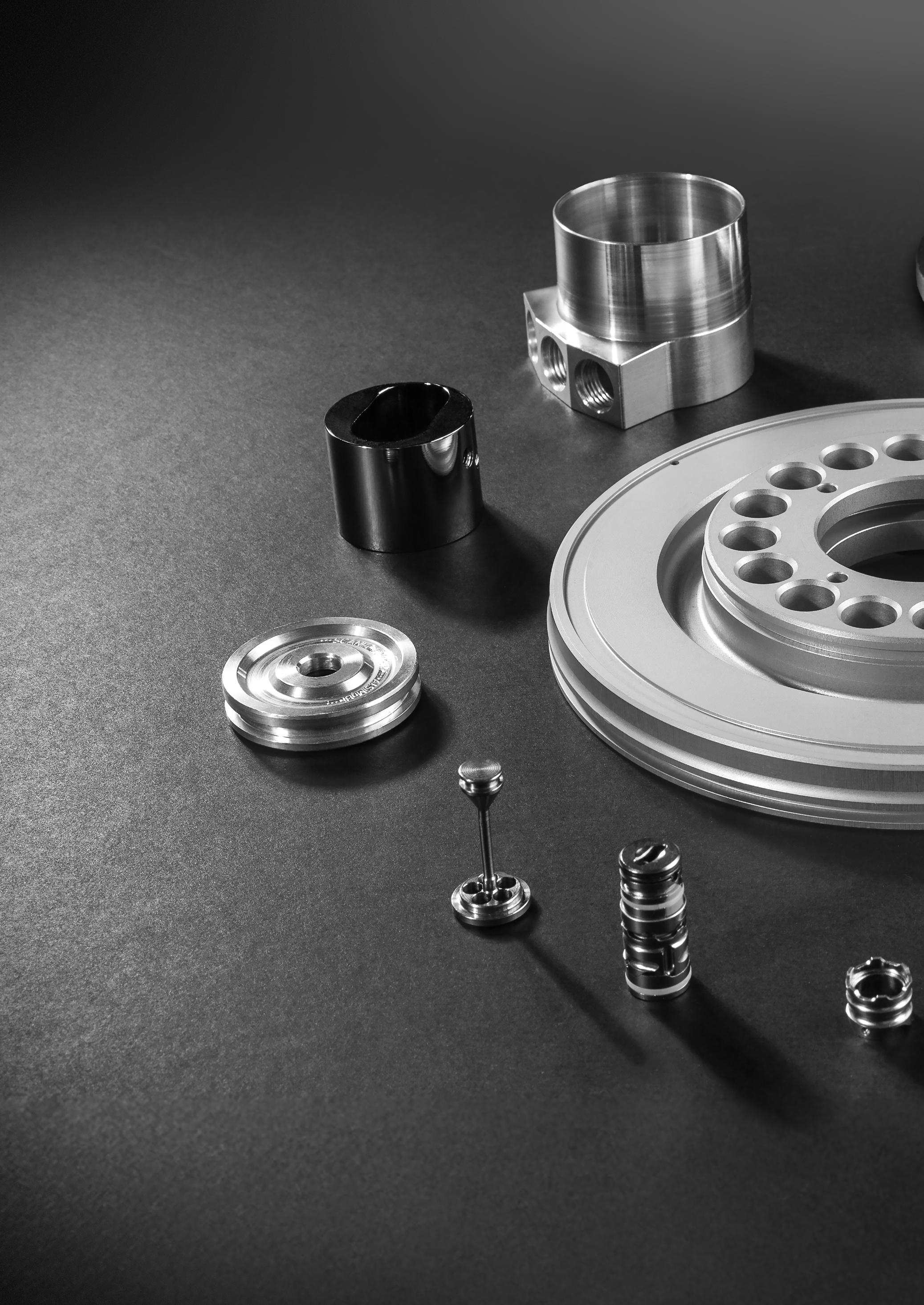
AGES specialises in two areas.
Precision Components
Contract manufacturing of large-series components and assemblies meeting high quality requirements, as well as sourcing from an international subcontractor network.
Engineering Solutions
Design, development and manufacture of components, moulding tools, control fixtures, prototypes, small series and automation solutions, as well as aftermarket through spare parts sales of tool components.
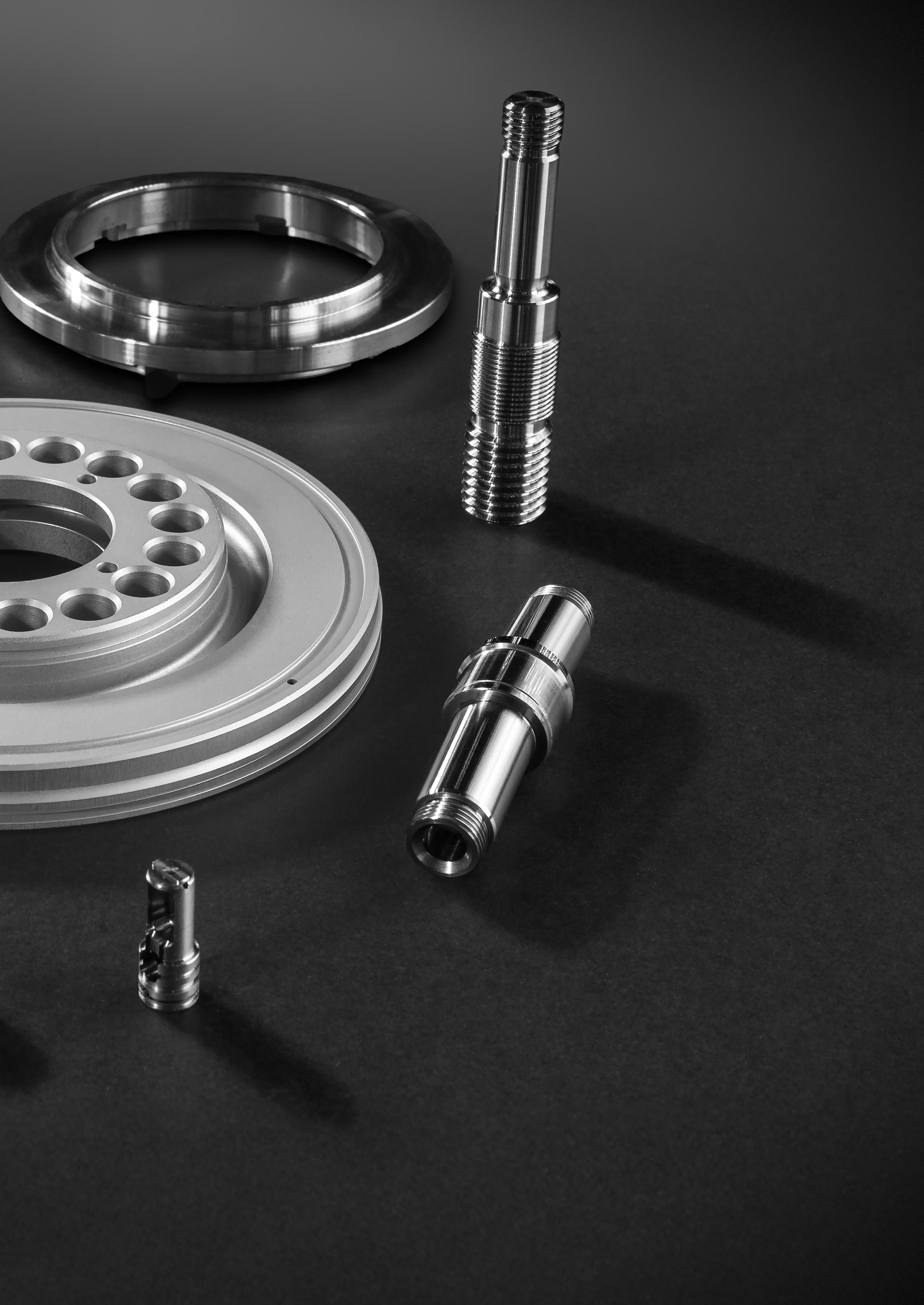
Things Easier Makes

AGES takes overall responsibility, both now and in the future. As a one-stop-shop with all services in the same Group, we make it easy for our customers – while at the same time protecting the right of future generations to a good living environment through our active sustainability work.


Leading industrial partner at the cutting edge

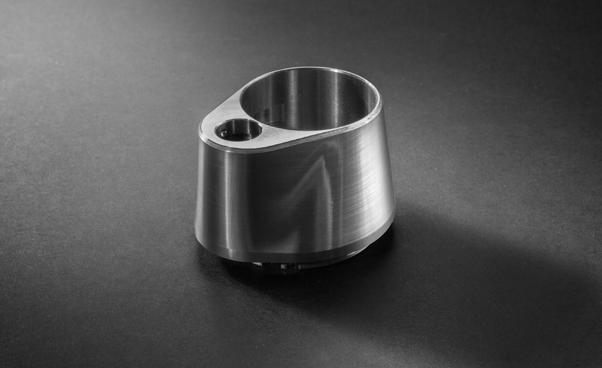

2025 in brief
∣ AGES divests all its operations in Unnaryd
In April, the die-casting operations of AGES Casting Unnaryd were sold to Lazarus Industriförvaltning AB. The sale forms part of AGES’s strategy to increase its focus on its core areas within component manufacturing, primarily machining
∣ Establishing a hub for sourcing and trading in Europe
In the spring, AGES Poland was established as a new subsidiary with the aim of expanding the product range through sourcing and trading. The focus is on increasing the flexibility of the company’s offering and facilitating new business opportunities in areas where AGES currently lacks its own capacity.
∣ Strategic investments in China
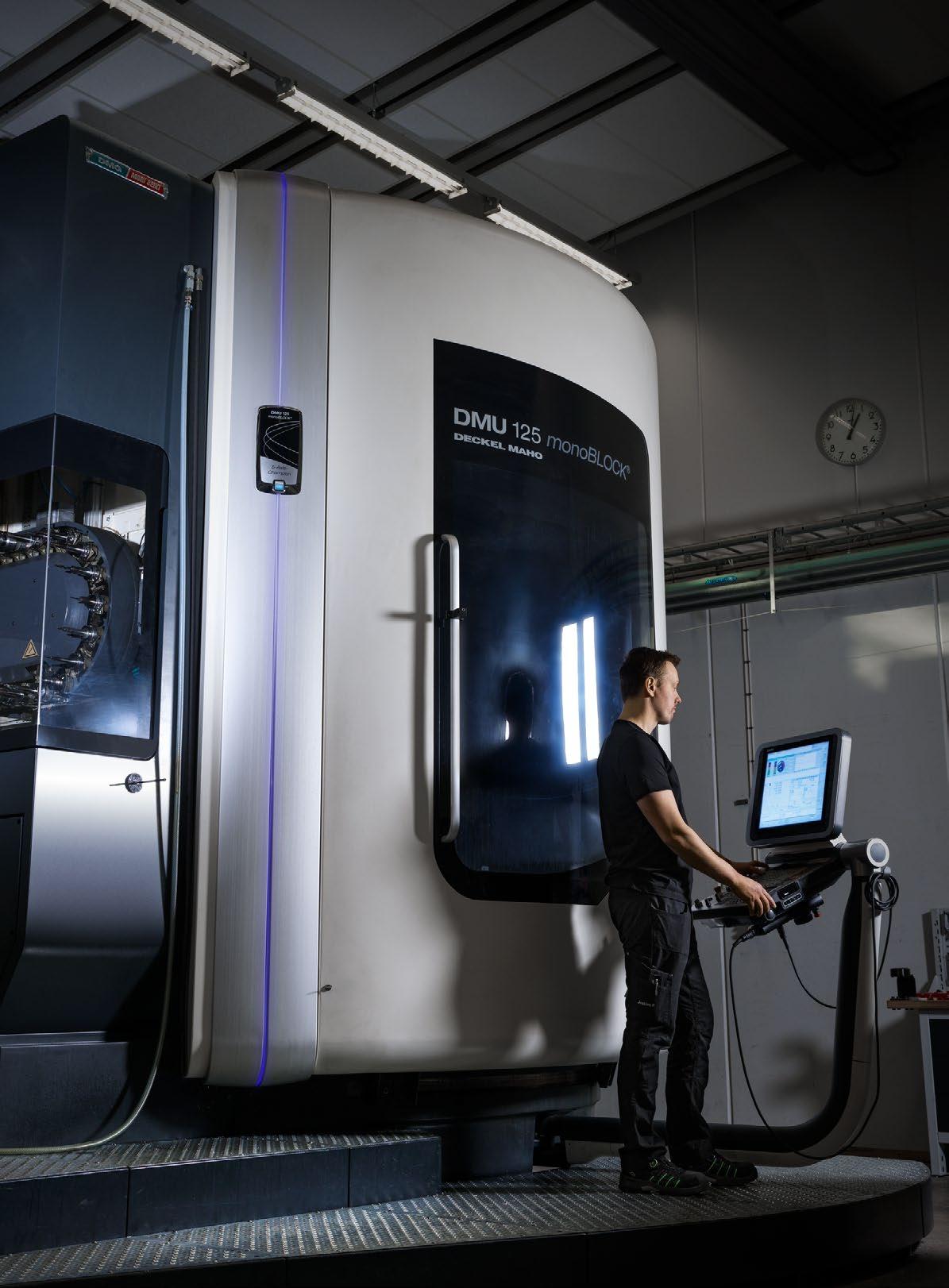
Investment in AGES China has continued throughout the year. The production facility in Ningbo has been expanded and new machinery installed, whilst the overall product range has been further developed in collaboration with the Swedish units. The facility has also been fitted with solar panels.
∣ New business within Precision Components
In an uncertain business environment, the focus within the Precision Components business area has been on strengthening core operations and broadening the customer base. Targeted initiatives in selected sectors have generated new business, including in the energy and infrastructure sectors.
∣ Consolidation within Engineering Solutions
Engineering Solutions has continued to develop in line with our strategy, including through increased internationalisation and a clearer integrated offering within the Group. During the year, we also began merging our two mould-making companies with a view to streamlining our organisation and production.
∣ Our climate targets will be validated in accordance with the SBTi
Sustainability is part of our day-to-day work and is an ongoing focus. As part of this, we have submitted our targets for validation to the Science Based Targets initiative (SBTi) to ensure that our climate targets are validated in line with the latest climate research.
∣ Changes to the Executive Management
During the summer, the board decided to make a change to the CEO position, following which our CFO, Johan Bladh, was appointed as acting CEO. CEO In February 2026, Vibeke Gyllenram took up her post as the CEO
AGES CHINA
AGES POLAND
AGES SWEDEN
2025 in brief
NET SALES
SEK 880 MILLION (931)
OPERATING PROFIT 1) SEK 37 MILLION (62)
PROFIT BEFORE TAX 1) SEK 29 MILLION (53)
EARNINGS PER SHARE 1) SEK 2.93 (5.59)
NET SALES
SEK 227 MILLION (253)
OPERATING PROFIT
SEK 14 MILLION (30)
PROFIT BEFORE TAX
SEK 12 MILLION (28)
EARNINGS PER SHARE
SEK 1.41 (3.44) 1)
NET SALES
SEK 181 MILLION (176)
OPERATING PROFIT
SEK -1 MILLION (6)
PROFIT BEFORE TAX
SEK -3 MILLION (3)
EARNINGS PER SHARE
-0.29 SEK (0.43)
NET SALES
SEK 243 MILLION (240)
OPERATING PROFIT
SEK 16 MILLION (16)
PROFIT BEFORE TAX SEK 14 MILLION (14) EARNINGS PER SHARE SEK 1.34 (1.76)
SALES SEK 229 MILLION (262) OPERATING PROFIT SEK -8 MILLION (10) PROFIT BEFORE TAX SEK -6 MILLION (8) EARNINGS PER SHARE -0.42 SEK (0.48)
CEO comment
A stronger AGES with a focus on growth
The results for the year largely reflect the consolidation and streamlining we have carried out, and work on the next phase of the company’s development has begun.
I took up the post of CEO in February 2026 and, during my first few months, have focused on analysing the business and our future strategic opportunities. I look forward to being part of AGES and, together with the team and the market, continuing to build and develop an AGES that’s fit for the future.
2025 in brief
At AGES, we can look back on an eventful 2025, during which we implemented several key changes aimed at strengthening the company’s competitiveness and growth prospects. Strategically, we are working to broaden our customer offering in order to reach more customers and new markets. A broader customer offering that can be applied to more customer segments paves the way for continued sustainable and profitable development with a focus on growth.
A first and important step in this strategic plan was taken when, in the spring, we divested all the companies that formed part of the group AGES Casting Unnaryd. The units specialised in the manufacture and further processing of die-cast aluminium components, primarily for the automotive industry. The sale will enable us to focus more clearly on our core businesses, with a particular emphasis on machining. Following the divestment, the Group has achieved a stronger financial position and improved margins, enabling us to grow profitably both organically and through acquisitions. In addition, we have achieved a more balanced portfolio across other customer segments, reducing our exposure to the cyclical nature of the automotive industry.
Looking at the market as a whole, it has been characterised by external political factors and uncertain trading conditions for much of the year. These factors affect global material flows, but here we have once again demonstrated our flexibility and ability to adapt quickly. We have weathered the turbulence without our customers

being affected. In terms of sales, we have seen organic growth in the Group’s larger units over the course of the year.
The divestment of our larger foundry operations, which was part of our strategic focus, means that we now see opportunities to gain market share in new customer segments. Specific initiatives have been targeted at customers operating in the defence, energy and medical device sectors. We are pleased to see that our customer offering, in which we create added value every step of the way – from design to prototyping, series production and after-sales service – is both attractive and competitive. It is also encouraging that AGES’s expanded portfolio, built up through previous acquisitions of prototyping expertise, has been proven to be a strategic advantage in working with the new customer structure. New contracts have been signed in both the energy and defence sectors, two markets which we believe offer good long-term growth prospects.
AGES specialises in components with a high degree of technical complexity and stringent production requirements. By diversifying the specialisations of our factories, we strive to be able to handle components in both large and small production runs. In order to capitalise on synergies and optimise capacity within the Group, we have carried out an integration project between two of our companies in the machining sector during the year, thereby achieving improved production utilisation at both sites. This is not only to cope with increases in volume, but also to prepare for our future staffing requirements, where
we aim to share technical expertise across the units. We have a strong team at AGES and we want to capitalise on our synergies. This work will continue throughout 2026 and forms a natural part of our improvement efforts.
During the year, we have also expanded our international presence and set up an AGES office in Poland. This is also part of our efforts to optimise our production structure. In Poland, we now have an extensive network of subcontractors that can source components that are better suited to external production, whilst we take overall responsibility for logistics and quality on behalf of the customer. We have long been established in China, and now that we have expanded our presence to Poland, we have continued to develop a global sourcing and trading platform as a strong complement to the Group’s existing production operations.
Verified sustainability
Sustainability is, of course, an integral part of our day-to-day work and our business strategies. Over the course of the year, we have implemented a sustainability management system and pursued several internal projects to improve our resource efficiency and reduce our energy consumption and carbon footprint. We have also been working to validate our climate targets pursuant to the Science Based Targets initiative (SBTi). The aim is to enable us to compete effectively in a demanding market where sustainability is a key factor when both we and our customers assess their supplier base.
Bright prospects
With positive signals from the market, improved profitability and a clear focus on growth, we are looking forward to the next phase in AGES’s development. We will continue to pursue our strategic focus on growth in newer segments, led by defence, energy and medical devices, amongst others. These segments are well suited to our high-tech precision work and pave the way for even closer and more intensive collaboration with our customers.
We will continue to leverage our scale and the synergies within our production units to optimise capacity utilisation, whilst developing our global sourcing. We are in a stronger financial position and intend to leverage this to pursue a long-term acquisition strategy, alongside organic growth.
Together with all our incredible AGES colleagues, we are continuing our efforts to build long-term profitable growth, both organically and through acquisitions. And now that 2025 is behind us, also on behalf of my predecessors, I would like to thank all our skilled and dedicated staff for their hard work throughout the year!
Halmstad, April 2026
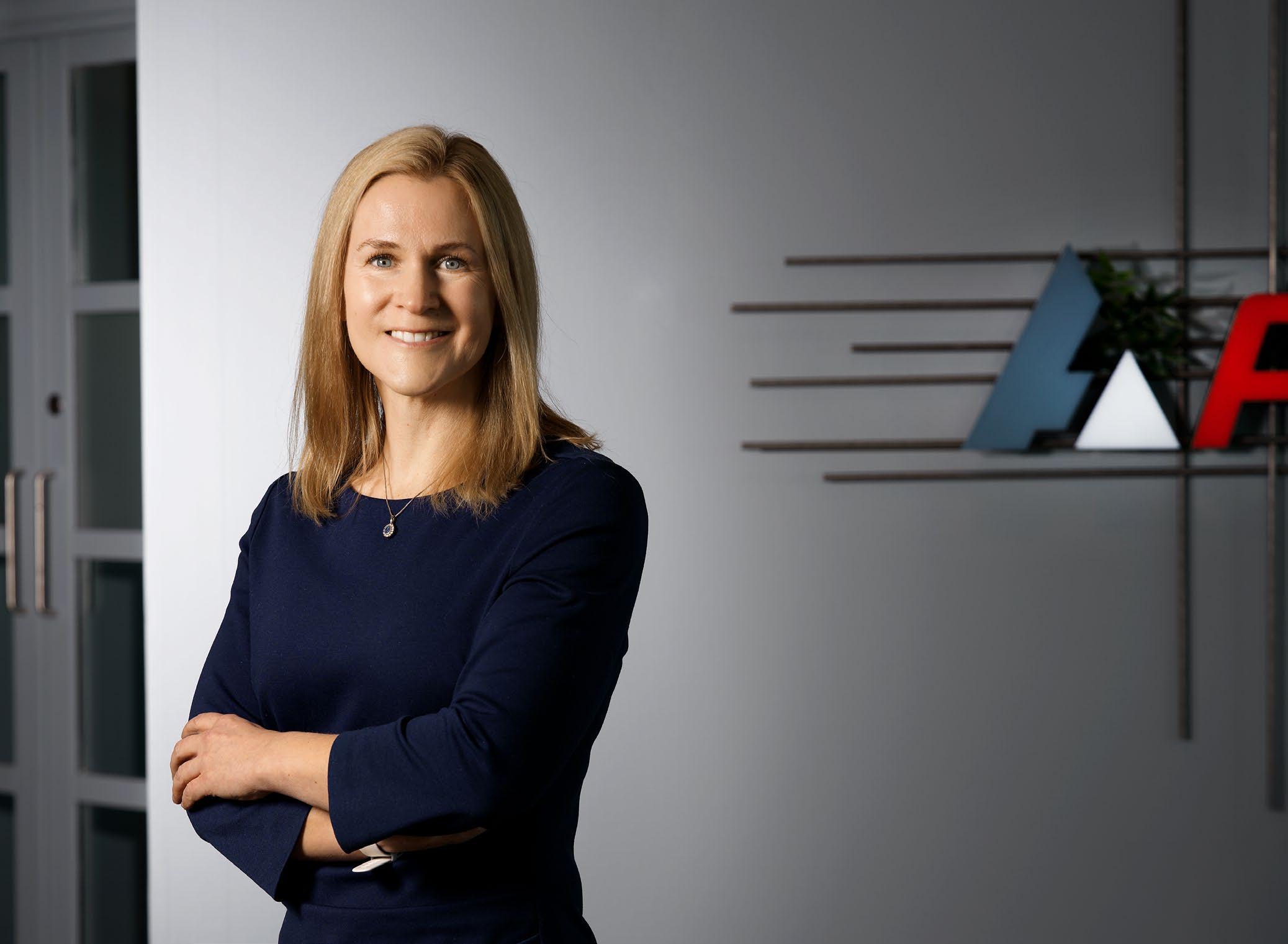
Vibeke Gyllenram CEO
The AGES share
About the share
∣ AGES’s Class B shares are listed on Nasdaq Stockholm First North Premier Growth Market.
∣ The share capital amounts to SEK 36.2 million, divided into 1,822,200 Class A shares and 5,411,348 Class B shares. The quota value is SEK 5.
∣ Each Class A share carries 10 votes and each Class B share carries one vote. The total number of votes was 23,633,348.
∣ All shares have equal rights to dividends.
Share price performance
AGES shares are listed on Nasdaq Stockholm First North Premier Growth Market. The highest closing price of the year was recorded on 3 January at SEK 67.80, and the lowest on 27 May at SEK 52.00. As at 31 December 2025, AGES’s market capitalisation was SEK 391 million, based on the closing price and total number of shares.
Owner category
Shareholders
At the end of 2025, AGES had 1,209 shareholders. 1,169 of these were natural persons, 17 of whom are resident abroad. The remaining 40 owners are legal entities such as financial institutions, foundations and interest groups. The ten largest shareholders together controlled more than 95.6% of the votes and 85.7% of the capital.
Dividend policy
The Board of Directors proposes to the Annual General Meeting that a dividend of SEK 1.00 (1.50) per share be paid for the 2025 financial year.
It is the aim of the Board of Directors that dividends should mirror financial performance over an extended period and correspond to at least 30% of profit after tax.
Market maker and Certified Advisor
ABG Sundal Collier acts as market maker for AGES on Nasdaq Stockholm First North Premier Growth Market. Their function is to promote good liquidity in the share and ensure a small spread between the bid and ask price in trading on the stock market. Eminova Fondkommission AB acts as Certified Advisor for AGES.
Share capital, new issues, etc. since 2013
1,209 Shareholders 1.00 % Proposed dividend 2.93 Earnings per share from
OUR VISION
Through sustained profitability and innovation, we should be the most popular and sustainable contract manufacturer and industrial partner.
OUR MISSION
AGES Industri shall continuously develop to be a leading and profitable industrial partner in sustainable and innovative manufacturing for future generations
OUR BUSINESS CONCEPT
AGES Industri’s business concept is to support, develop and invest in leading companies with deep technological knowhow. Focus on customer-specific components and sustainable production processes as well as value-creating services.
Strategic goals that create value
Business goals
AGES wants to further develop its business concept in a way that creates the conditions for lasting growth and profitability. AGES should be the market leader in its niche, in a historically stable market, and be regarded by its customers, suppliers and employees as their most skilled, long-term cooperation partner. This can be achieved among other things through good customer relationships characterised by a businesslike approach and close collaboration. AGES should build on its strong market position in the Swedish market to actively seek to broaden its customer base. AGES should also be able to follow its customers outside the primary home market in order to expand the business.
Financial goals
AGES should create growth combined with profitability. AGES is aiming to achieve sales growth of at least 10% per year and should achieve an EBITA margin in excess of 8% over an economic cycle. It is the aim of the Board of Directors that dividends should mirror financial performance over an extended period and correspond to at least 30% of profit after tax. However, the annual dividend payout ratio must be viewed in relation to investment needs.
Sustainability goals
AGES’ sustainability work is governed by the overarching goal to always keep improving the business in terms of the environment, working conditions and ethics. Our ambition is to reduce risks while simultaneously cutting costs and meeting the expectations of our stakeholders.
Strategic direction
AGES should achieve established goals and market requirements through a strategic direction based on the following:
• Actively work to develop new customer areas.
• Continue to develop and grow AGES’ strong position in machining and welding of precision components.
• Nurture and develop long-term business relationships with customers who require large-series production of cost-efficient precision components with high technological requirements, top quality and a high degree of accuracy in deliveries.
• Create efficient and profitable, highly competitive production by means of a high level of technology in production processes, a large proportion of automation, committed employees and continuous improvements.
• Through proactive and long-term work and active participation in the supply chain, AGES should be the industry leader both locally and globally in respect of mapping of CO₂ emissions.
Why we Makes Things Easier
AGES creates customer value throughout the value chain by taking a holistic approach to responsibility. With cutting-edge technical expertise, in-house production and close collaboration within the Group, we optimise every stage – from design, tooling and prototyping to series production, after-sales and spare parts. As a systems provider, we simplify complex processes and ensure high quality, efficiency and sustainable solutions over time.
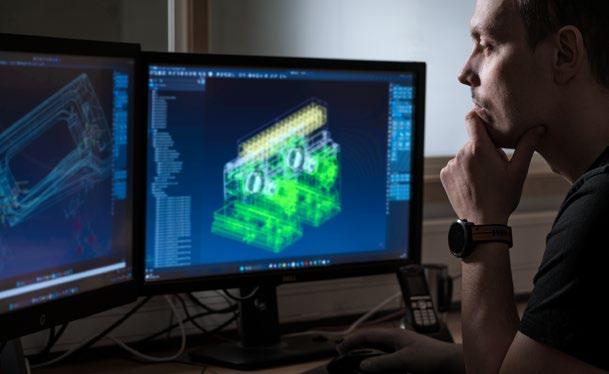
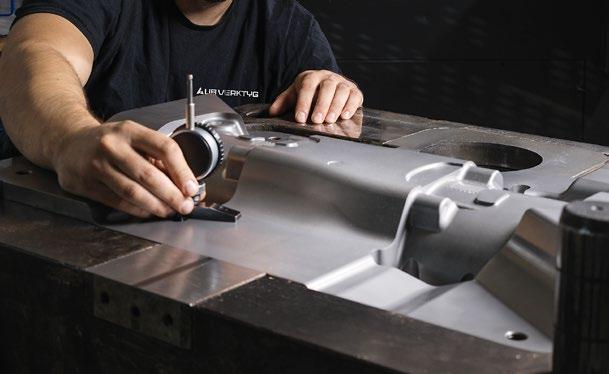
Customer value chain

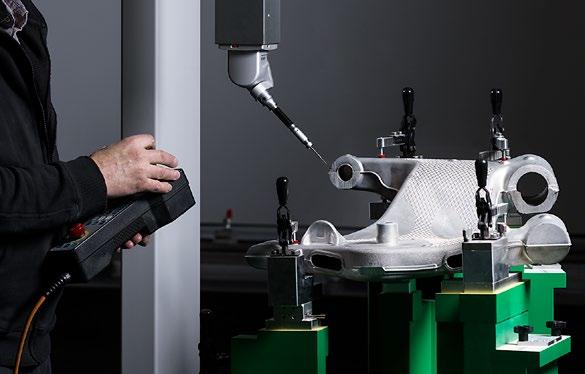
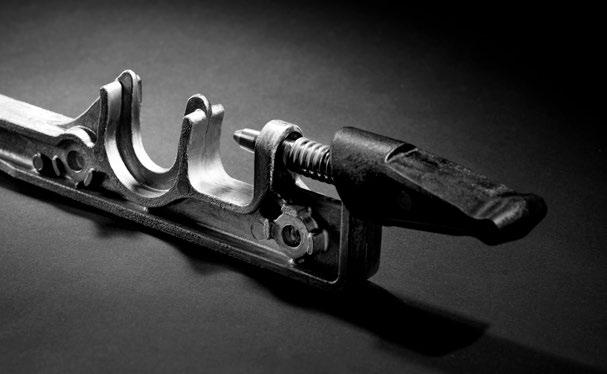
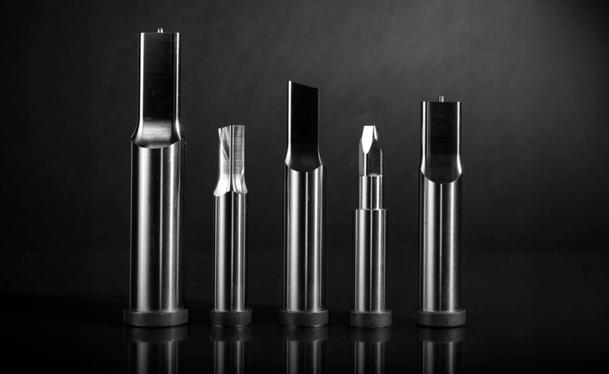
Prototypes
Series production
Spare parts, after-sales
Precision Components
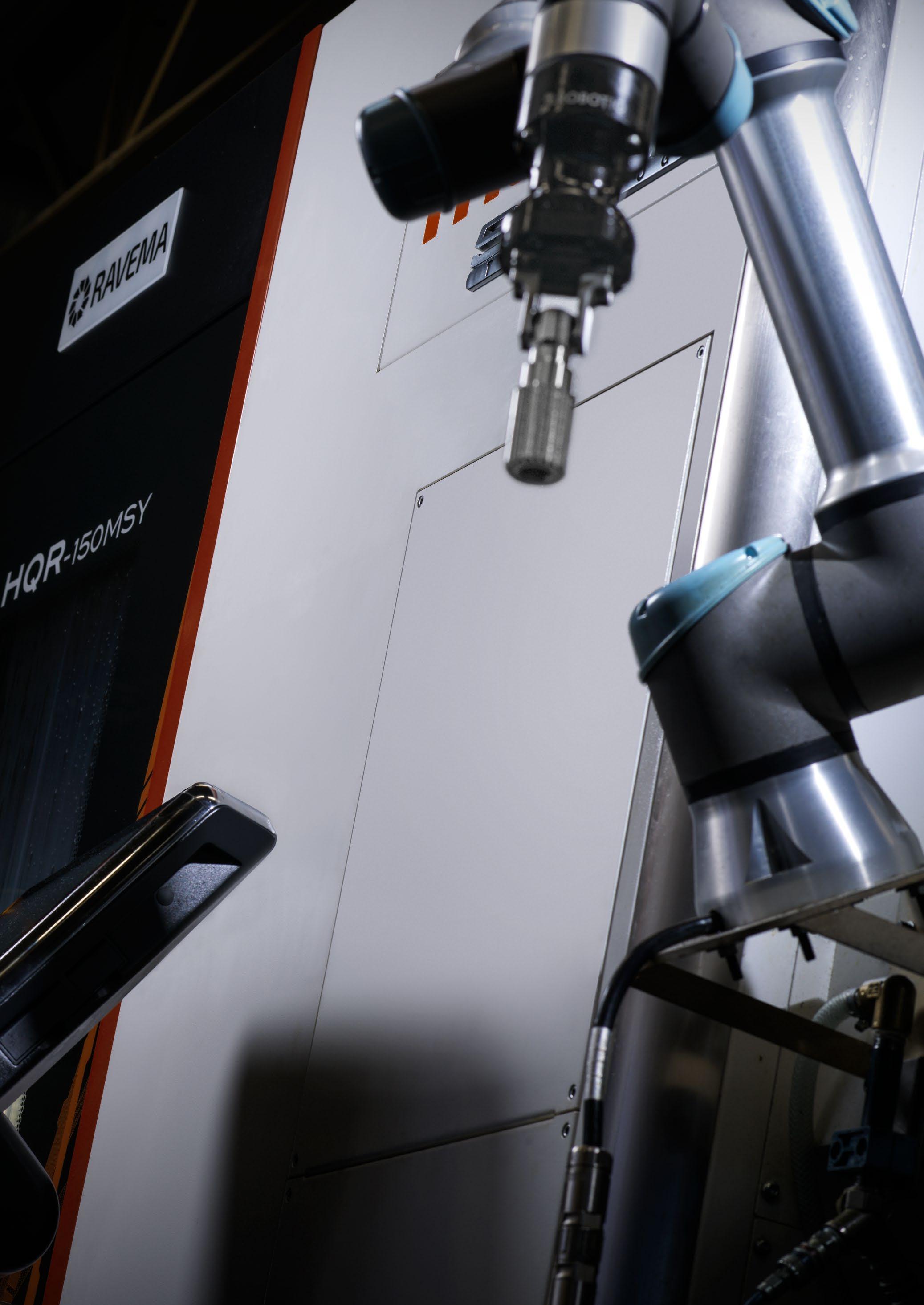
The business area comprises four production units in Sweden and one in China, as well as a sourcing and trading unit in Poland. The business specialises in the contract manufacturing of machined and die-cast components in medium to large production runs, meeting stringent precision requirements. We also offer international trading in a broad spectrum of quality products from an expanding network of subsuppliers.
Precision Components
“A broader customer base and an expanded international presence mean we are well equipped for the future”
Anders Linder
Business Area Manager
Reflections and insights
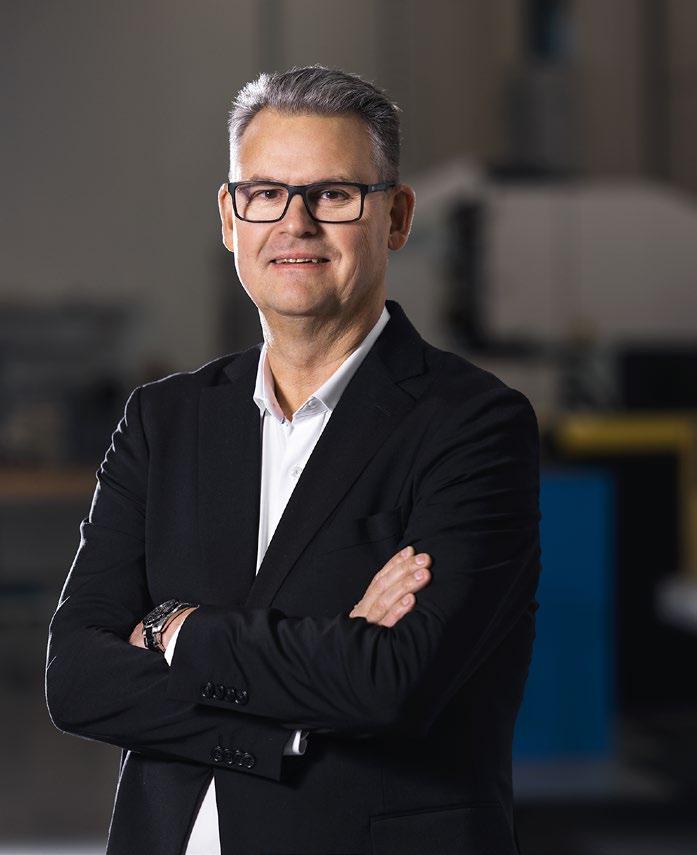
Anders Linder is responsible for the Precision Components business area. Here, he summarises his impressions of the challenges and successes that have characterised the organisation over the past year. Finally, he also takes a brief look towards the future.
The year has been characterised by both transformation and growth for the Precision Components business area. In an operating environment characterised by economic fluctuations and shifting demand, the focus has been on strengthening our core business, broadening our customer base and creating a stable foundation for long-term growth and profitability.
External environment, market and strategic choices
The business area comprises machining and die-casting. The machining operations business has grown strongly over the past year, with a clear influx of new business from both existing customers and new, expanding sectors. The trend has been particularly positive in the energy and infrastructure sectors, where demand for precision components has continued to grow.
In the die-casting sector, demand has been more subdued. Here, the focus has been on capacity adjustment and efficiency improvements to ensure profitability. In the first quarter of 2025, AGES Casting Unnaryd was sold to Lazarus Industriförvaltning AB. The deal freed up resources and paved the way for a sharper focus on AGES’s core operations within Precision Components, with particular emphasis on machining.
A broader customer base and new business
Targeted initiatives in selected sectors have resulted in new client contracts, including in the energy and infrastructure sectors. At the same time, several existing customer segments have shown varying rates of growth.
Following a somewhat sluggish start to the year, customers in the construction and agricultural sectors have gradually recovered, resulting in an increase in order intake. In the industrial and automotive sectors, the market has returned to more normal levels, whilst demand from the materials handling segment has shown some signs of slowing down. Overall, the broader customer base has helped to ensure greater stability and reduced sensitivity to economic cycles.
Internationalisation and global capacity
In 2025, several important steps were taken to enhance the business area’s appeal on the international stage. The establishment of AGES Poland as a new subsidiary is intended to broaden the customer offering through increased sourcing and trading.
Our presence in Central Europe complements the Group’s own production and facilitates more flexible and cost-effective solutions that enhance the value we deliver to our customers. At the same time, investment continues in Ningbo, China, where an expansion of the production area and the installation of several new machines have boosted capacity, particularly in the area of turned components. AGES China continues to focus on driving growth in both exports and the domestic Chinese market.
Efficiency improvements and Vision 2026
Vision AGES 2026 brings together the business area’s initiatives for efficiency improvements and growth. Closer co-operation between AGES Hörle and AGES Värnamo aims to create more
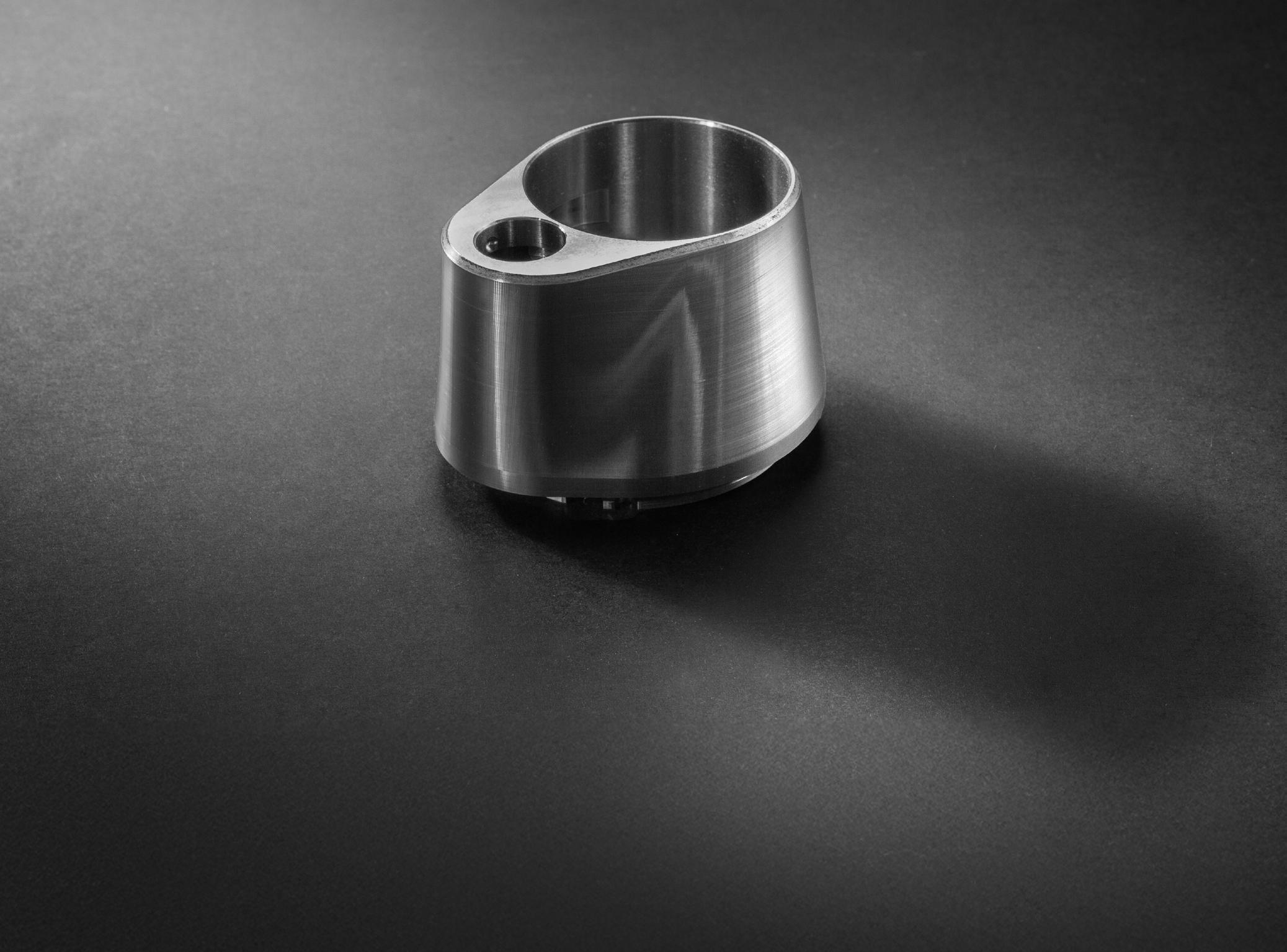
efficient production flows and improve resource utilisation.
Changes to the production setup, the relocation of machinery and targeted investments are creating the conditions for increased capacity, a stronger skills base and improved delivery capabilities.
At the same time, work is underway to co-ordinate sales and marketing within the business area, with the aim of reducing the number of points of contact for the customer and creating an offering that adds more value.
A bright future lies ahead
The outlook for 2026 is positive for Precision Components. The order book remains stable across several divisions, and a number of new projects are in their early stages. Thanks to its broader customer base and increased international presence, the business area is well equipped to cope with future market changes.
We are also monitoring developments in the defence industry, where opportunities have been identified in low-volume production with strict quality standards.

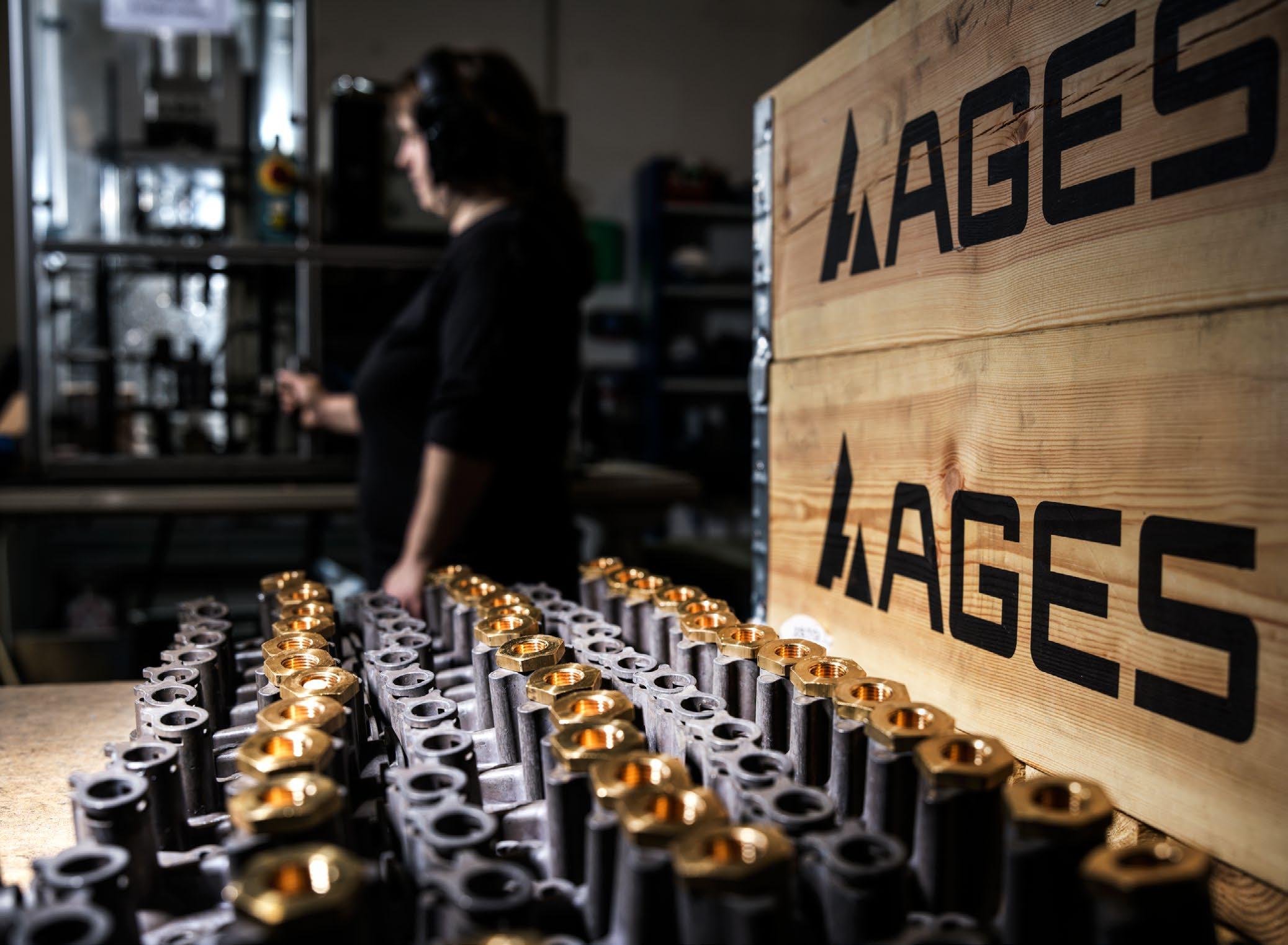
Precision Components
AGES Falkenberg
In Falkenberg, we offer high-volume machining services. Our production capacity and technical expertise ensure stable and cost-effective processes, making us a strategic partner for customers with strict quality requirements in a number of industries.
Net sales, SEK million: 50 Average number of employees: 26
AGES Kulltorp
AGES Kulltorp is a complete system supplier of refined die-cast aluminium products. As a strategic partner to our customers, we take total responsibility for the entire production chain, from automated die casting to machining and final assembly in small to medium-sized series.
Net sales, SEK million: 103
Average number of employees: 36
AGES China
Our production unit in Ningbo in China was established in 2007 and specialises in machining, forging, steel castings and sourcing. The operation offers a high level of technology, which ensures the correct quality and efficiency for our quality-conscious customers.
Netsales, SEK million: 64
Average number of employees: 34
AGES Hörle
AGES Hörle covers most advanced metalworking requirements. At this unit we manufacture customised components in small to large series with rapid turnaround through machining, pipe finishing, welding and forging. We are able to do this thanks to flexible plant and a high level of technology.
Net sales, SEK million: 377 Average number of employees: 83
AGES Värnamo
AGES Värnamo offers complete solutions in advanced machining through turning, grinding and assembly in medium to large series. As a strategic partner with large capacity and a high degree of automation, we contribute to a cost-effective end product for our customers.
Net sales, SEK million: 274 Average number of employees: 83
AGES Poland
Our newly established company in Poland specialises in sourcing and trading through a network of qualified European suppliers. Our presence in both China and Europe – and a broader sourcing offering – makes us an attractive alternative for more customers.
Netsales, SEK million: 9
Average number of employees: 1
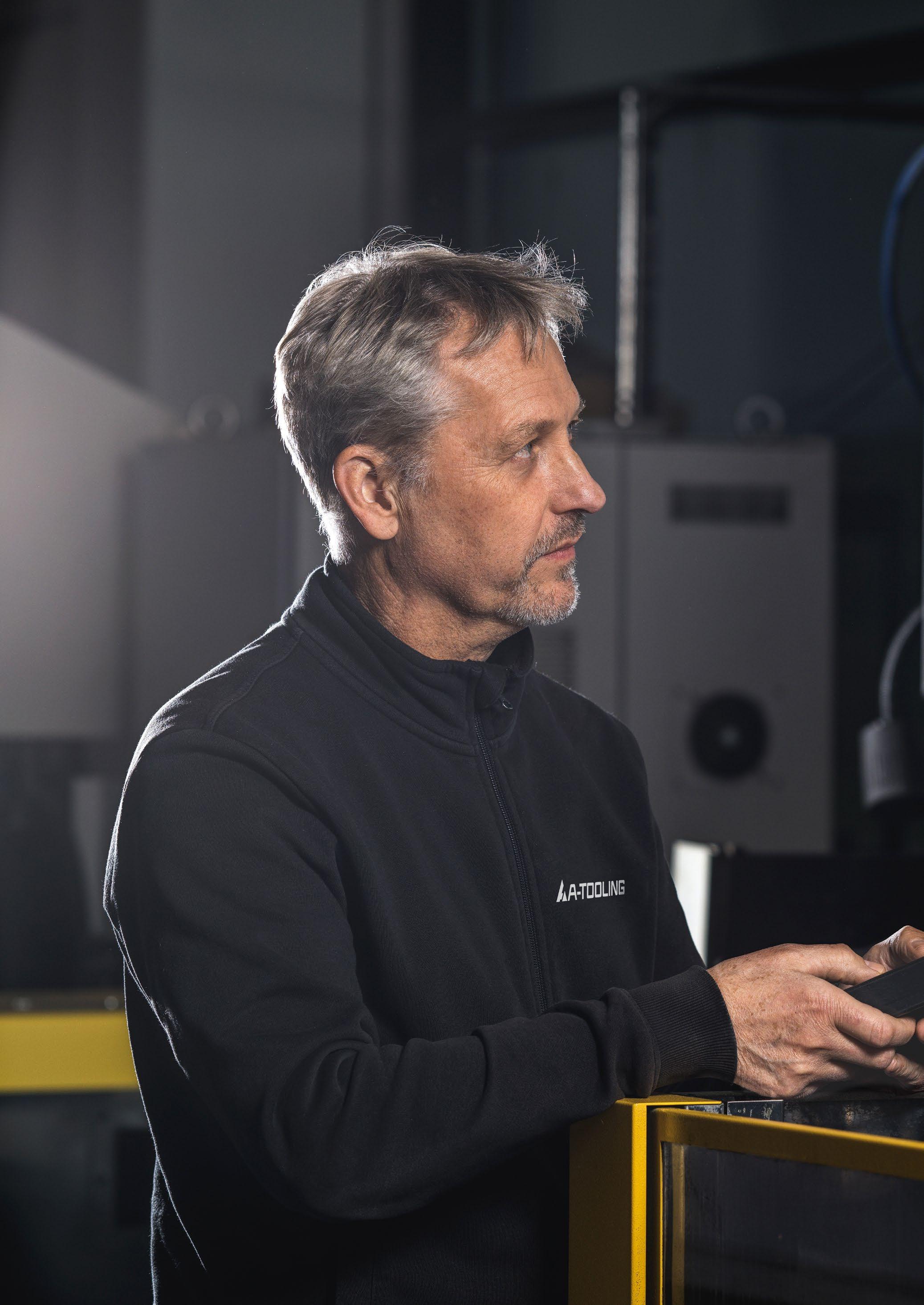
Engineering Solutions
The business area consists of three units offering a high level of expertise in the design and manufacture of moulding tools, control fixtures, prototypes and small series as well as automation solutions. In addition, we sell tooling components and spare parts for the aftermarket – all of a quality that both meets strict requirements and provides cost-efficiency throughout the process.
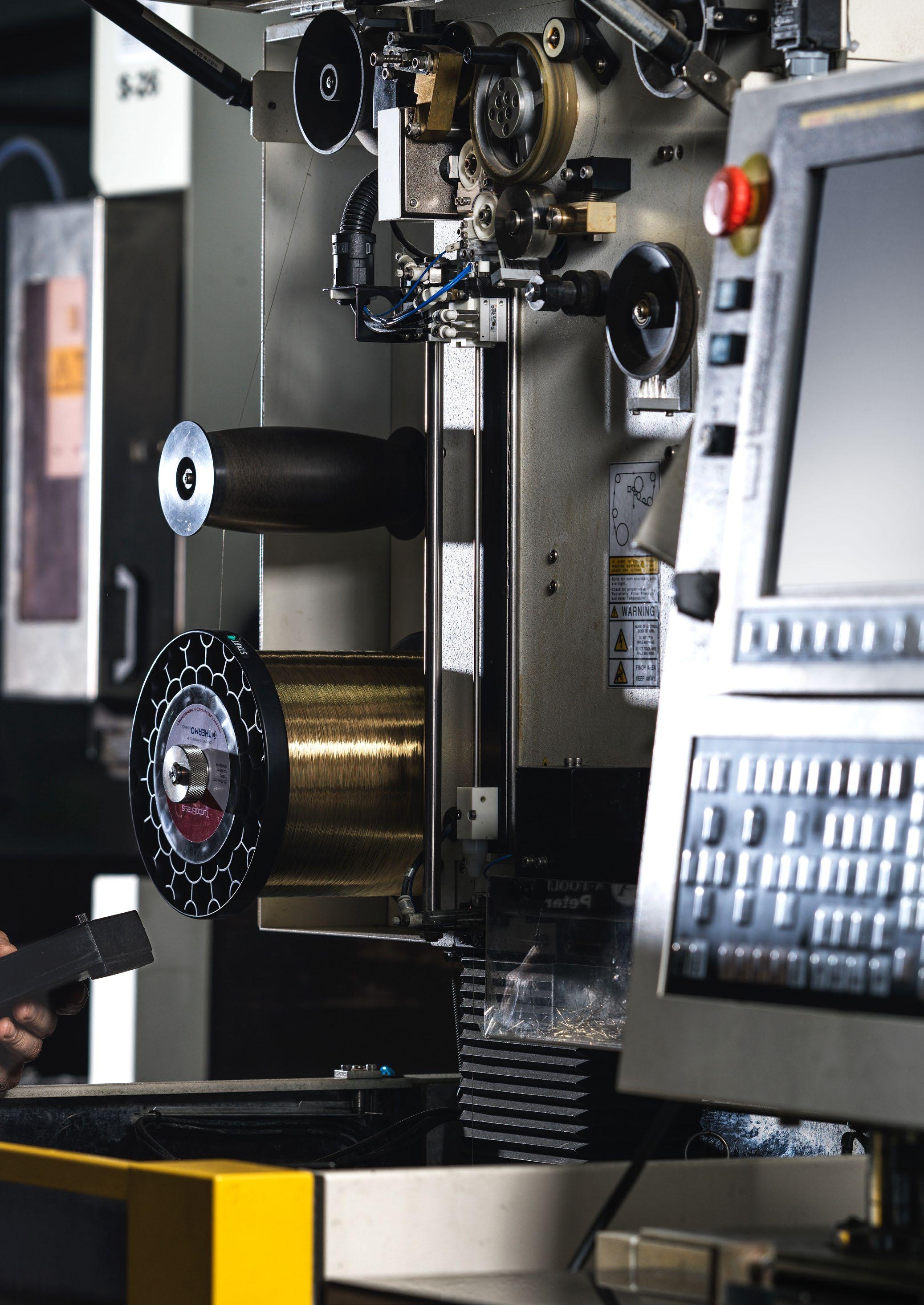
Engineering Solutions
“The customer offering has been expanded through additional sales channels and greater collective expertise”
Anders Nyberg Business Area Manager
Reflections and insights
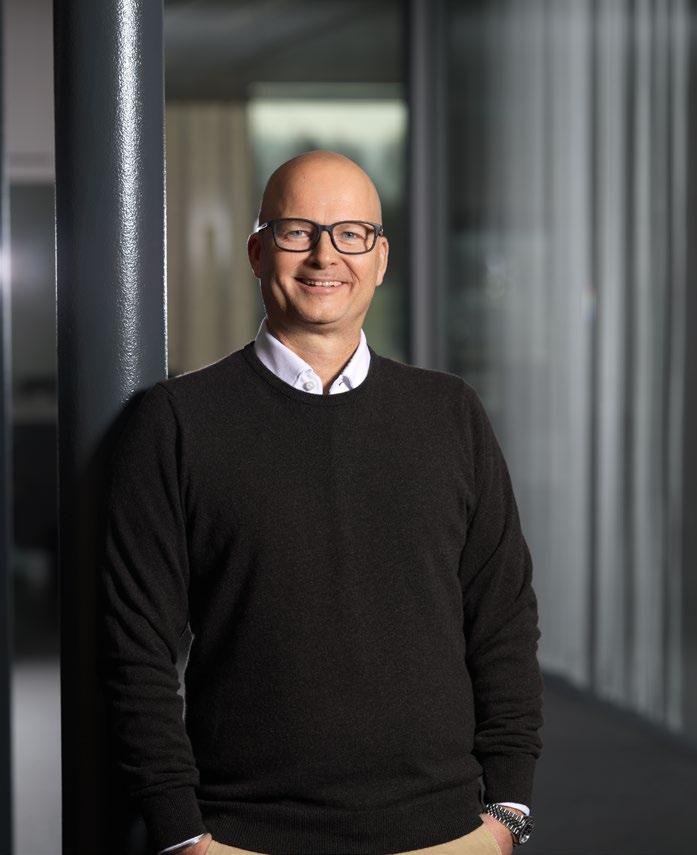
Anders Nyberg is in charge of the Engineering Solutions business area. Here, he summarises his impressions of the key events and decisions that have shaped operations over the past year. In addition, he offers us a little glimpse into the future.
Engineering Solutions was established in 2023/2024 through the merger of several complementary companies specialising in tool manufacturing, component supply and fixture manufacturing. In 2025, the business continued to develop with a focus on integration, efficiency and growth, in line with AGES’s overall strategy.
Efforts to create a more co-ordinated organisation have yielded clear results. By pooling investments, machinery and expertise, efficiency has improved, lead times have been reduced and delivery capacity has been bolstered. At the same time, our customer offering has been expanded through additional sales channels and greater collective technical expertise, which has enhanced the business area’s competitiveness and customer value.
Growth and stronger customer relationships
In 2025, the companies within Engineering Solutions have performed strongly. This growth has been driven by several strategically important deals with major industrial customers, which confirms the market’s confidence in our ability to deliver technically advanced, reliable and cost-effective solutions.
At the same time, our offering has been strengthened through new exclusive agency agreements and partnerships with significant potential for technological development. This has enhanced our appeal and created better conditions for longterm customer relationships and business deals that add value.
Internationalisation and global capacity
One of the business area’s key milestones during the year was its
international expansion and the establishment of operations in Asia. Through a partnership with AGES’s office in Ningbo, China, we have strengthened our global presence and improved our ability to cater for our customers’ requirements in respect of flexibility, cost-effectiveness and delivery reliability.
In an uncertain and globalised business landscape, the combination of a local presence and global capabilities is a clear competitive advantage. This strengthens our position in discussions with international clients and on projects with strict delivery requirements.
Efficiency improvements, automation and new customer segments
Over the course of the year, we have continued to develop our production structure, with a focus on improving efficiency and increasing the level of automation. By combining technical solutions, standardisation and improved processes, productivity has been boosted and competitiveness enhanced.
At the same time, we have gained new customers and customer segments, which demonstrates our ability to take on greater responsibility in more complex and technically demanding projects.
Combined capacity and long-term synergies
In order to strengthen the technical platform and create long-term synergies, UB-Verktyg has been integrated into Östlings Verktyg. Through this integration, we have been able to consolidate our production resources whilst streamlining and

optimising our processes. By concentrating advanced machinery capacity in shared production environments, we create better conditions for collaboration, efficiency and delivery accuracy.
These measures are expected to generate significant synergies over time and contribute to a robust and scalable structure for Engineering Solutions as a whole.
External environment and resilience of the business area
The uncertain economic and global situation has undoubtedly affected large parts of the industry. This has also increased customers’ needs both for cost-effective and flexible solutions, as well as for suppliers who can take on greater overall responsibility.
Against this background, it is clear that the business area has been strengthened by the decisions made in 2025. Through co-ordination, internationalisation and a clearer, more comprehensive offering, we have laid a solid foundation for the continued development of Engineering Solutions – even in an uncertain global environment.
Outlook
Looking ahead to 2026, we see several clear trends that will
continue to affect us. Globalisation, growing demands for shorter lead times and high delivery reliability require flexibility, efficiency and technical expertise.
Our strategy going forwards is to continue maximising synergies within the business area, strengthen our global structure and develop as a full-service supplier capable of supporting customers throughout the process – from development and prototyping to series production, support and spare parts.
Vision and strategic direction
Engineering Solutions has a clear ambition to grow and take greater responsibility for its customers’ needs. Our long-term objective is to be a partner that simplifies our customers’ dayto-day lives through co-ordinated, efficient and technologically advanced solutions.
We play a central role in AGES’s strategy and in our efforts to deliver on the promise of “Makes Things Easier”. Through a strong, comprehensive offering, extensive technical expertise and an efficient organisation, we lay the foundations for long-term and sustainable success.
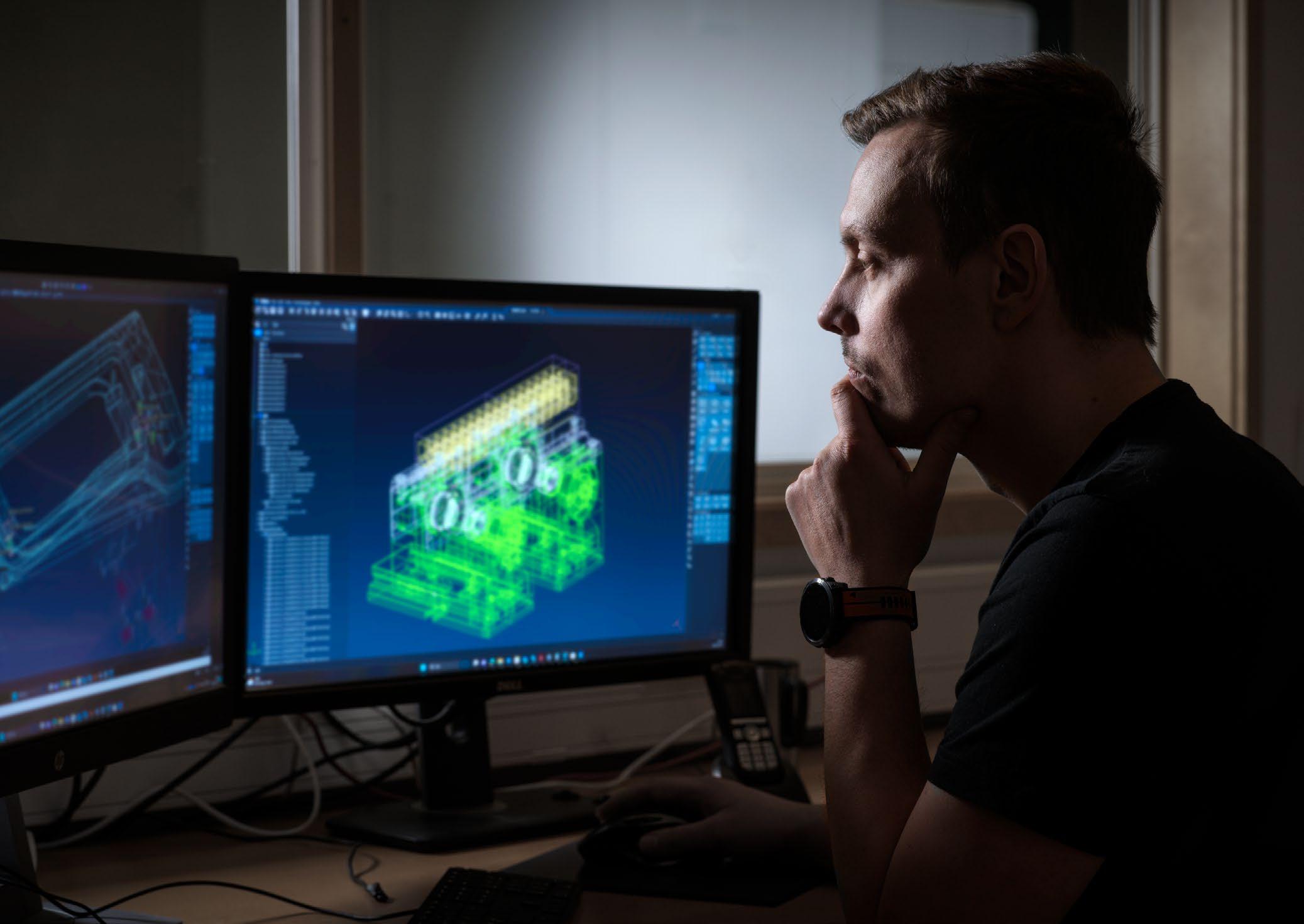

Engineering Solutions
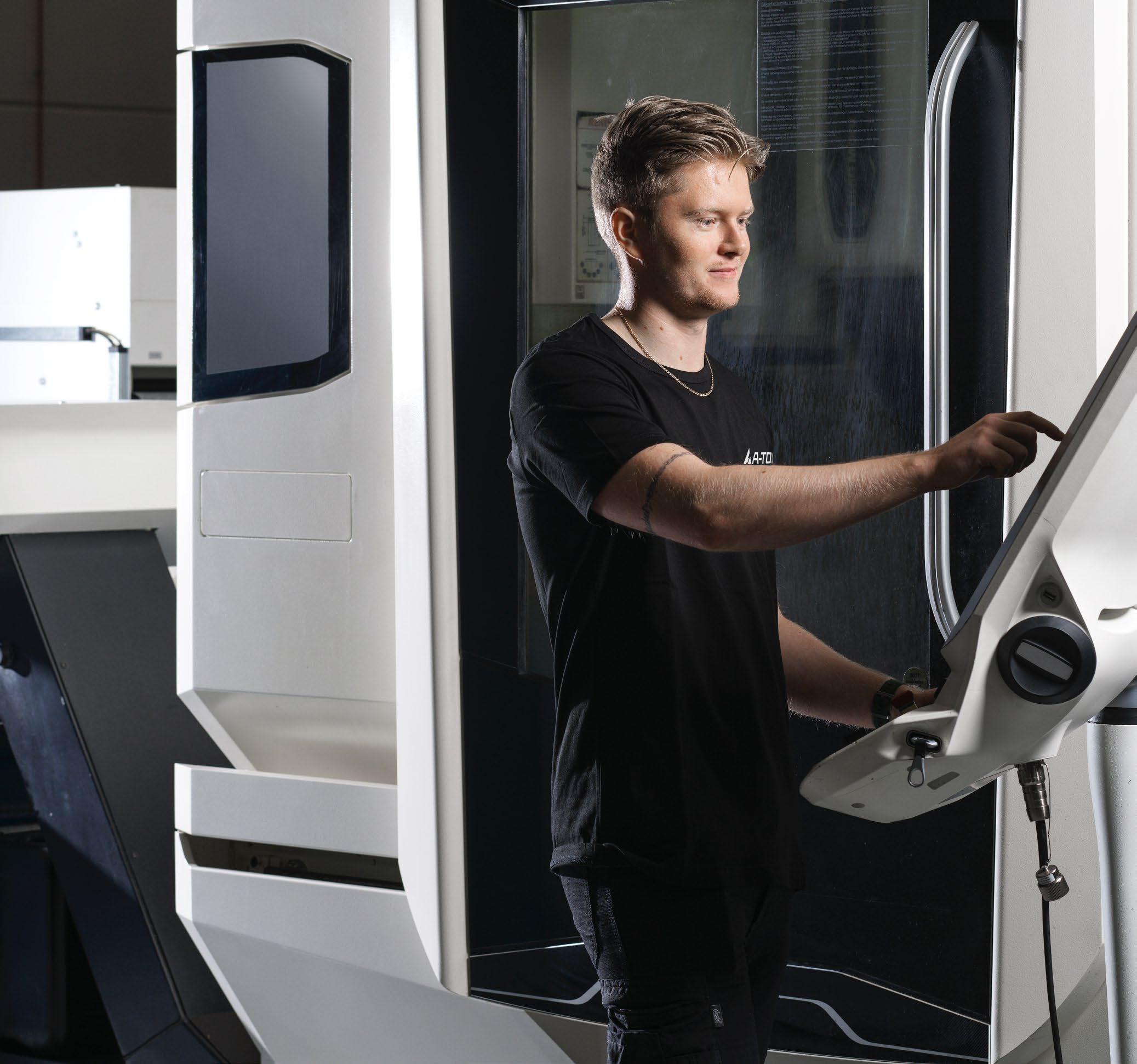
A-Tooling
A-Tooling supplies tool components of the highest quality to toolmakers and companies with operations involving sheet metal processing, injection moulding, die casting and automation. Our complete solution also includes spare parts for the aftermarket – all intended to make things easier for our customers.
Net sales, SEK million: 37
Average number of employees: 11
Östlings Verktyg
Östlings Verktyg is a leading player in tool manufacturing and offers everything from test tools, prototypes and low-volume production to moulding tools for full-scale production. All developed in close collaboration with customers and by combining modern technology with traditional craftsmanship.
Net sales, SEK million: 37
Average number of employees: 25
APM August Pettersson
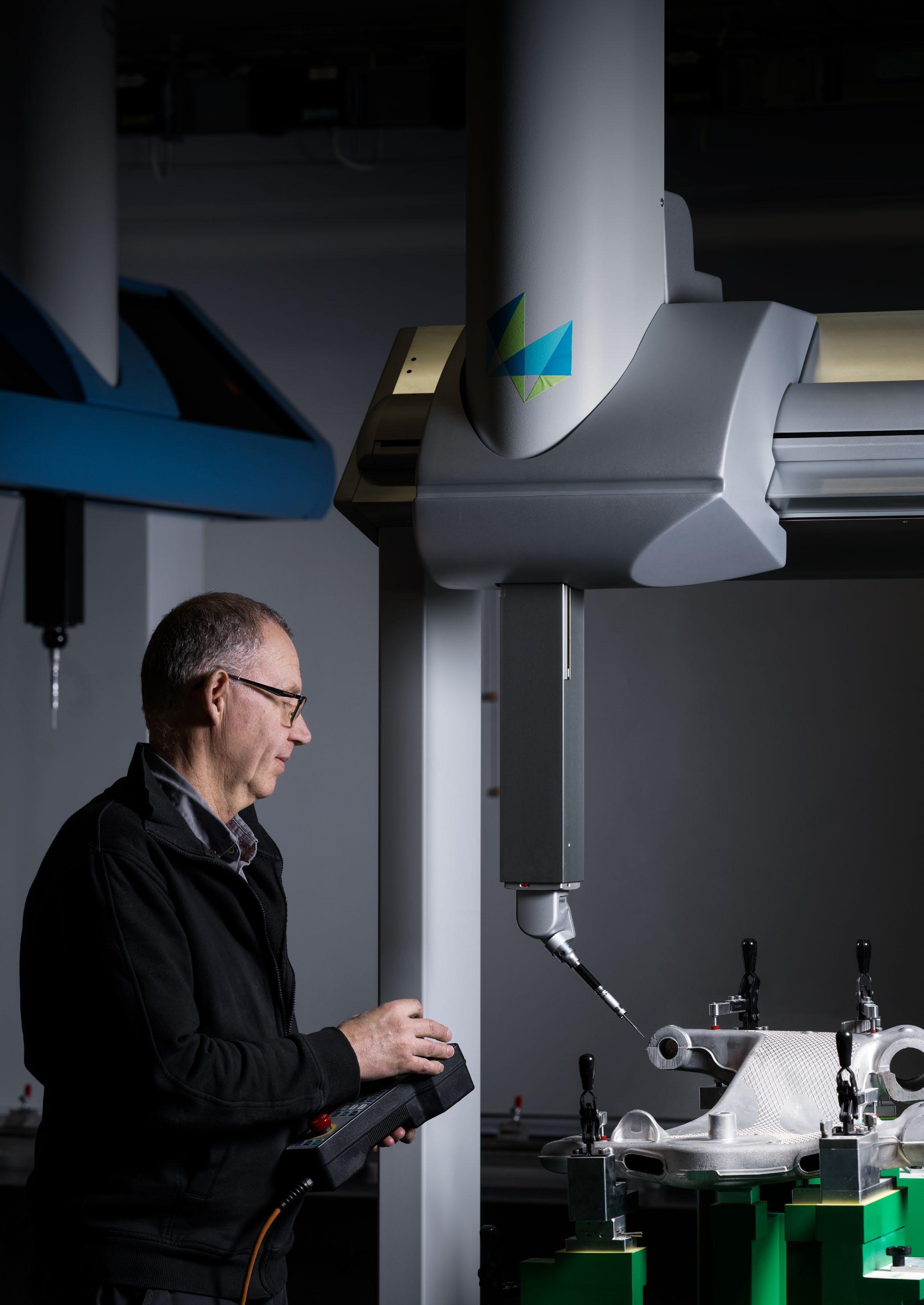
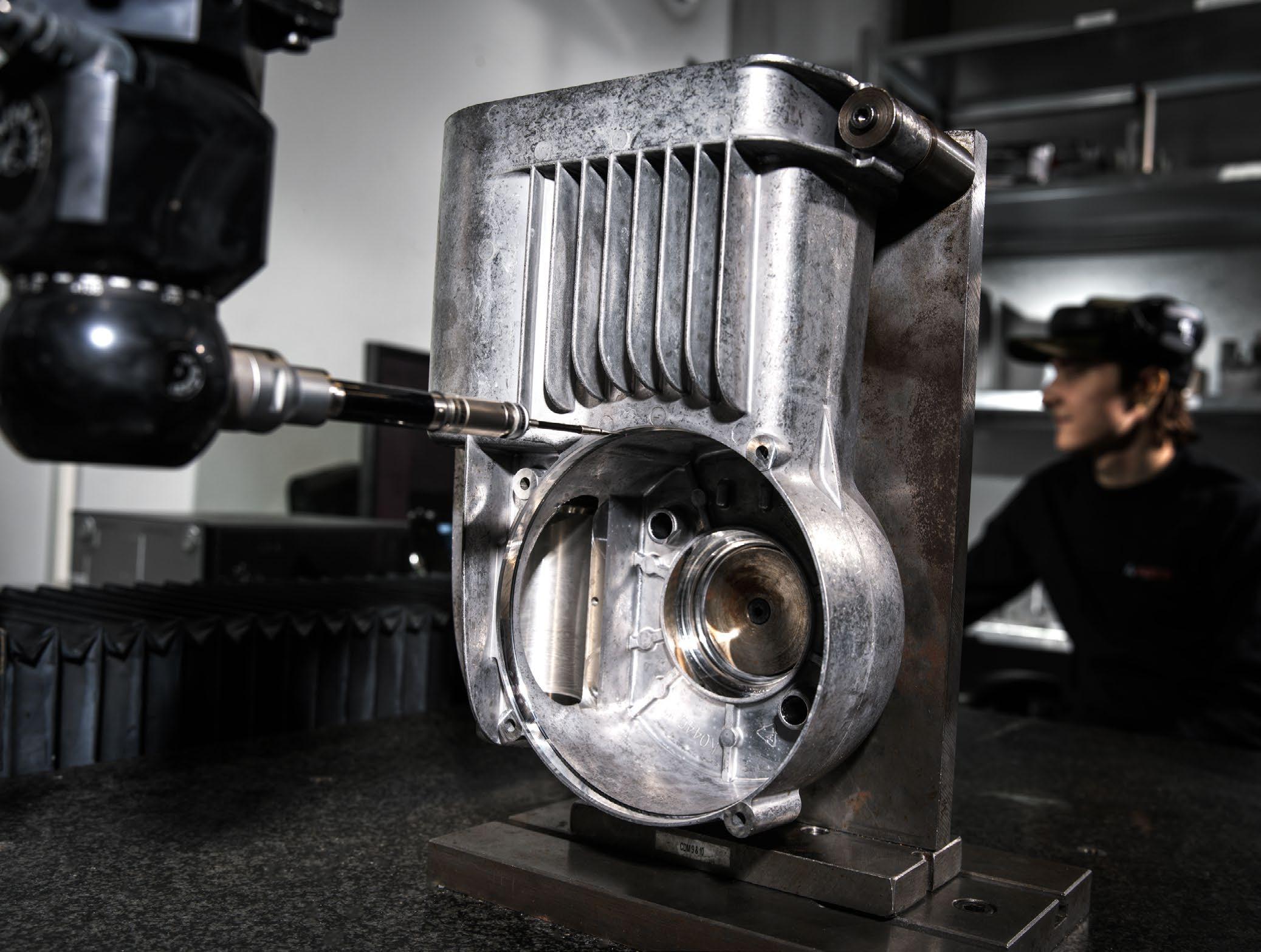
APM August Pettersson is a complete and well-established supplier of advanced control fixtures and CMM measurements. In addition, we offer 5-axis CNC milling and prototyping in materials such as plastic, honeycomb, aluminium and steel – all for a global customer market.
Net sales, SEK million: 20
Average number of employees: 13
Sourcing & trading
Strategic investments in Poland and China are strengthening our global supply chain
In 2025, we took significant steps to strengthen AGES’s global supply capabilities through the establishment of a new sourcing and trading operation in Poland and continued investment in China. These initiatives broaden AGES’s customer offering and lay the groundwork for increased growth, flexibility and competitiveness.
As demands for speed, sustainability and global reach increase, we are strengthening AGES’s position by developing a global sourcing and trading platform to complement the Group’s existing production operations.
With a local presence in both Central Europe and Asia, we can respond to our customers’ needs quickly and effectively, whilst the Group builds a robust supply chain – from supplier to end customer. These initiatives form part of a strategy in which sourcing and trading work in tandem with our own production to deliver greater customer value, high delivery reliability and competitive solutions.
A hub for sourcing and trading in Europe
In spring 2025, AGES Poland was established as a new subsidiary within the Group, with the aim of broadening AGES’s customer offering through increased sourcing and trading, for both existing and new customers. With a presence in Central Europe, we are better able to deliver flexible and cost-effective solutions that meet market demands.
AGES Poland works with a network of qualified suppliers in
several countries, which complements the Group’s own production. The focus is on facilitating business in areas where AGES currently lacks its own capacity, whilst expanding sales through a wider range of processes and technologies.
Technologies that expand our business
The new platform is based on a structured and quality-assured network of suppliers with a wide range of skills and specialisms. The range of services includes CNC machining, tube and wire bending, welded and assembled products, forging, grey and ductile iron castings, tools for plastics, rubber and aluminium, and assembly.
These initiatives also create synergies by way of increased flexibility and access to alternative procurement and production solutions.
A strong and aspirational team
AGES Sourcing & Trading is led by a dedicated and experienced
“Sourcing and trading are a key part of AGES’s growth strategy and a way of expanding the business in an increasingly global supply landscape”
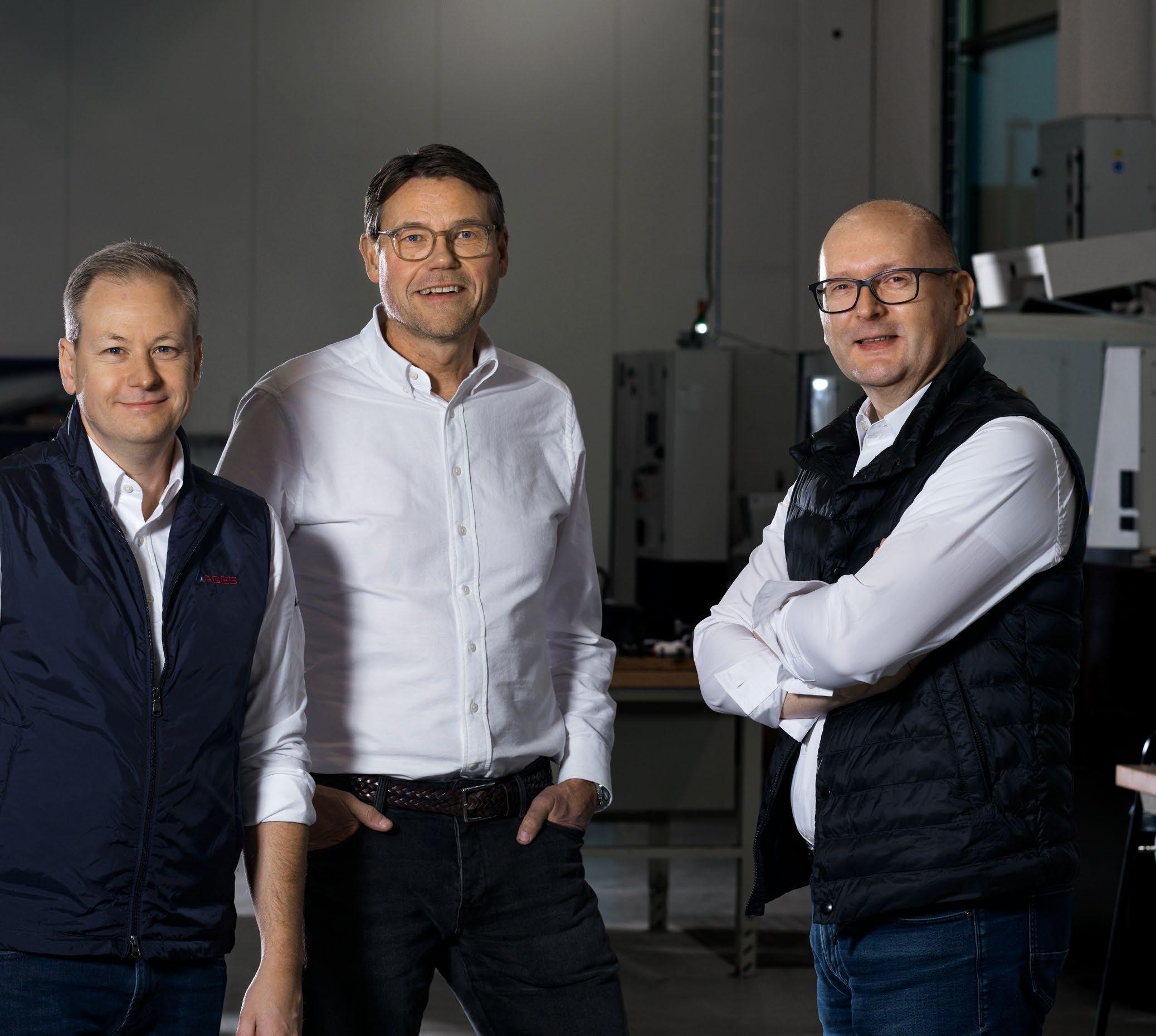
team with extensive industrial expertise and a deep understanding of global supply chains. The team works closely with both customers and the Group’s other units to ensure a co-ordinated approach in which business development, procurement, quality and logistics work together.
The result is a stronger offering that broadens the Group’s reach and range, making it easier for our customers to obtain the right component at the right time and at the right cost.
Investments in China are boosting delivery capacity
Alongside its expansion into Poland, AGES is continuing to invest in its operations in Ningbo, China. Here, the production area has been expanded and new machinery installed to meet growing demand for turned components. At the same time, the comprehensive range of tooling components, prototypes and fixtures is being further developed in close collaboration with the Swedish units.
These investments strengthen AGES’s role as a local partner
with a global reach and contribute to a more robust and integrated supply chain.
A platform for continued growth
The strategic initiatives in Poland and China represent important steps in AGES’s long-term development. By building an integrated, global platform that co-ordinates sourcing, quality assurance, technical support and logistics, we are strengthening AGES’s competitiveness, expanding our operations and laying the foundations for sustainable growth together with our customers and partners worldwide.
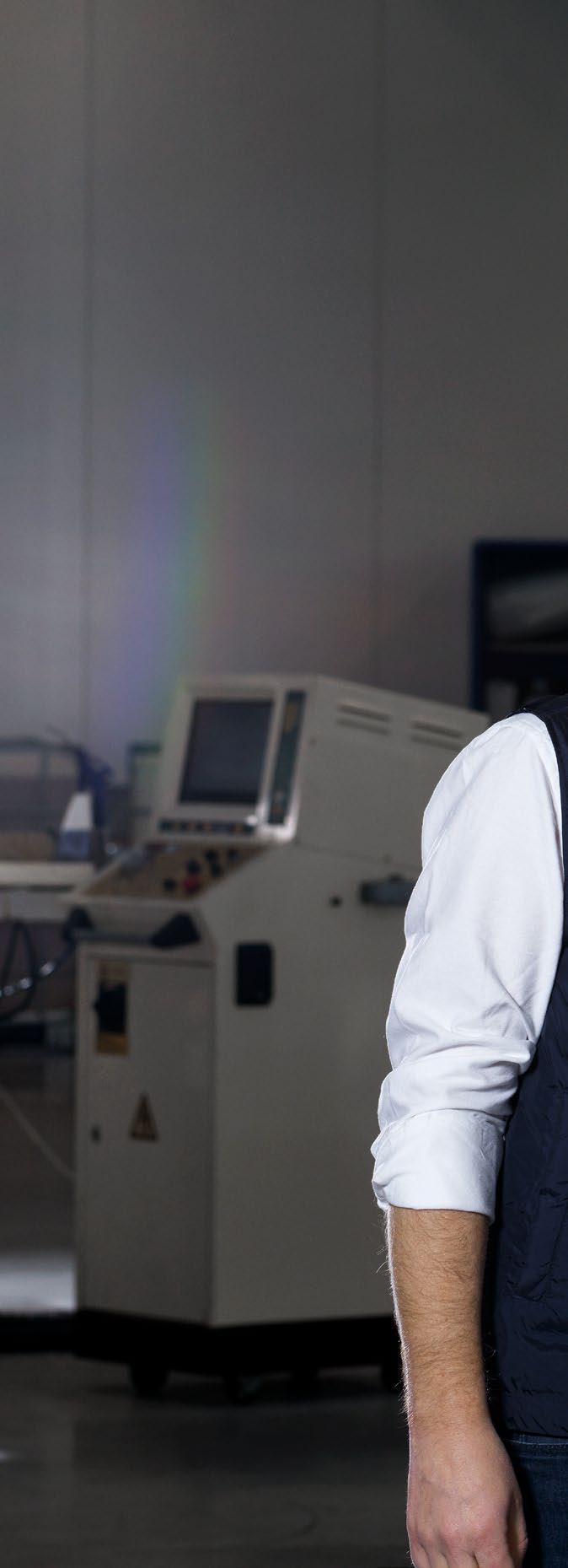
AGES Sourcing and Trading is led by an experienced team comprising (from left) Sebastian Bergman, Peter Karlsson and Tomasz Oparowski.
Corporate culture
A corporate culture that makes it easy to do the right thing
At AGES, we strive to create a workplace where every individual can thrive, develop and contribute to our shared success. Regular employee surveys, a dynamic set of core values and a focus on skills development are some of the cornerstones of our social sustainability strategy and our efforts to become an even more attractive and valued employer.
Our employees are at the heart of AGES’s value creation. In addition to our focus on leadership, we are also placing particular emphasis on strengthening a number of key competencies that unite all our group companies. Through continuous professional development, we not only create a sustainable and efficient work environment – we also foster a sense of security, quality and long-term competitiveness that prepares us for the future. Together, we make a difference and create opportunities!
An inclusive and supportive work environment
AGES works actively to boost staff engagement and promote a healthy work–life balance. This helps to make the Group an attractive employer and strengthens our ability to recruit and retain talent. An inclusive and supportive work environment is particularly important at a time of changing market and regulatory conditions, where the climate and energy transition is placing new demands on operations and the organisation.

A culture built on diversity and job satisfaction
AGES works to promote equality and opportunities for all. A workforce that is built on a diversity of experiences and perspectives is essential for innovation and our ability to cater for the needs of a global and diverse customer base. As a growing group, development is a natural part of our dayto-day work. It is therefore important that all staff feel welcome and valued for their skills, and are given the opportunity to contribute to improvements and to build a long-term career at AGES. A focus on community, job satisfaction and clear values are key pillars of our corporate culture.
Values that provide direction
AGES is a values-driven organisation where our shared values
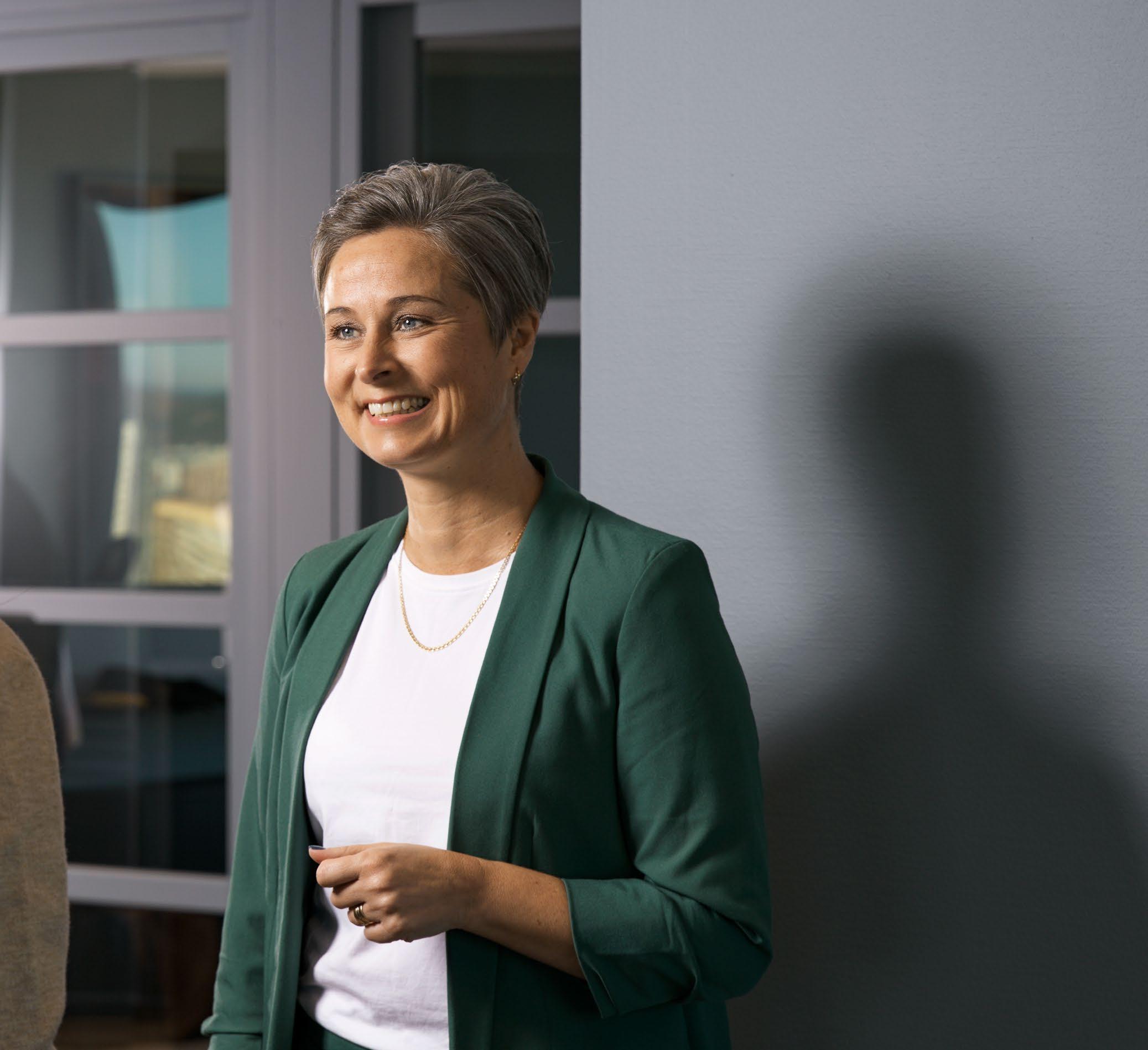
Anna Gärdenskog, CHRO
serve as a guiding principle in our day-to-day work. They guide our decisions, actions and relationships – both internally and externally. By following our shared values, it’s easy for us all to do the right thing.
We are customer-focused and build strong relationships with a clear business focus and the ambition to exceed expectations. At the same time, we are curious and learn from one another so that we can grow together. We act responsibly, with a focus on sustainability and long-term value-creation for people, the environment and our business. Through quality, efficiency and care, we strive to create value at every stage.
Social sustainability initiatives
As part of our social sustainability strategy, our aim is to provide
a safe, secure and healthy workplace. This involves introducing and monitoring a digital health and safety management system (IA system) with HR information that is updated on an ongoing basis. This system is being rolled out gradually throughout the Group, with the aim of having all units connected by 2026 at the latest.
Leadership development is a priority, and all managers undergo training through the AGES Academy. The plan for the Swedish sites is to achieve ISO 45001 certification by 2028 at the latest. Meanwhile, we are assessing current and future skills requirements to ensure long-term employability and continued positive development.

Sustainability
Greater transparency in our sustainability report
In early 2025, we set out a new strategy and new targets for AGES’s sustainability work. Over the course of the year, we have streamlined our work and introduced a sustainability management system – fully in line with our ambition to run a responsible, transparent and long-term industrial business.
Structure for sustainability reporting
Our reporting largely follows the structure used in the ESRS standards, in which sustainability information is divided into four main areas.
Sustainability throughout the value chain
Sustainability is, and should be, an integral part of our day-today operations as well as our business strategies. Sustainability efforts are also largely integrated into AGES’s value chain – from the procurement of raw materials to production and delivery. This work is carried out systematically, with a focus on reducing our environmental impact, strengthening our social responsibility and ensuring high standards of business ethics.
Our climate targets will be validated in accordance with the SBTi
The dual materiality analysis forms the basis of our updated sustainability strategy. New objectives and priority areas have been identified during the year to further develop our work.
As part of the development of our sustainability work, we joined the Science Based Targets initiative (SBTi) during the year to ensure that our climate targets are validated in line with the latest climate research.

Reporting inspired by the ESRS
Greater transparency in our reporting is how we build trust in our sustainability work. By openly reporting on our progress, challenges and priorities, we foster an understanding of how we are working towards our climate and sustainability goals and how these decisions impact the value chain.
To enhance transparency, our report is based on the European Sustainability Reporting Standards (ESRS). This framework enables us to report on key areas such as the environment and social responsibility in a comparable and consistent manner. This also means that our reports reflect the demands for transparent information made by customers, owners, employees and other stakeholders.
Read AGES’s full sustainability report at ages.se
Sustainability
Concrete measures to improve sustainability in our operations
In 2025, we continued to translate our sustainability aspirations into concrete actions to reduce our environmental impact through investments in energy-efficient technology, an increased share of renewable energy, and improved working practices in our day-to-day operations. Together, these initiatives help to reduce our environmental impact, improve cost-effectiveness and ensure a more robust and sustainable business.
Energy efficiency in production
At AGES Kulltorp, two new heat pump systems have been installed to optimise heating in the production facilities, ware house and offices. By utilising waste heat from the casting machines and replacing heat generated by electricity, the need for purchased heating energy has been significantly reduced. The investment has led to an overall reduction in heating energy of
around 75 percent, which helps to lower Scope 1 and 2 emissions and to improve energy efficiency in day-to-day operations.
In addition to the direct climate benefits, the investment improves the facility’s energy resilience by reducing its reliance on external energy sources and ensuring more stable energy costs. With an estimated payback period of around three years,
the investment is a clear example of how sustainability initiatives can be combined with sound business practice and long-term value creation.
Renewable energy in our Chinese operations
During the year, AGES’s unit in China completed the installation of solar panels. This initiative means that some of the unit’s energy consumption is now covered by renewable energy sources, helping to reduce the environmental impact of its own operations.
In addition, these measures strengthen our global energy strategy by increasing our self-sufficiency and reducing our exposure to energy-related risks. The investment in China is an important step towards achieving our ambition of taking a consistent approach to sustainability issues across the Group as a whole, whilst capitalising on local conditions and opportunities.
Improved resource efficiency through internal projects
Alongside our technical investments, we have pursued several internal improvement projects during the year, with a focus on resource efficiency and reducing our environmental impact. One example is the Projektskär project at AGES Värnamo, where adjusted delivery dates and optimised transport arrangements have reduced the amount of air in deliveries.
The result is more efficient logistics flows, lower transport costs and a reduced environmental impact.
At the same facility, the operating time of cutting tools has also been reviewed, which has extended the tools’ service life and facilitated more resource-efficient production cycles. In addition, the reuse of cutting oil has been made more efficient, with a reduction from around 4–4.5 cubic metres to 2–2.5 cubic metres. Overall, these measures help to reduce resource consumption, lower costs and improve the sustainability of production.
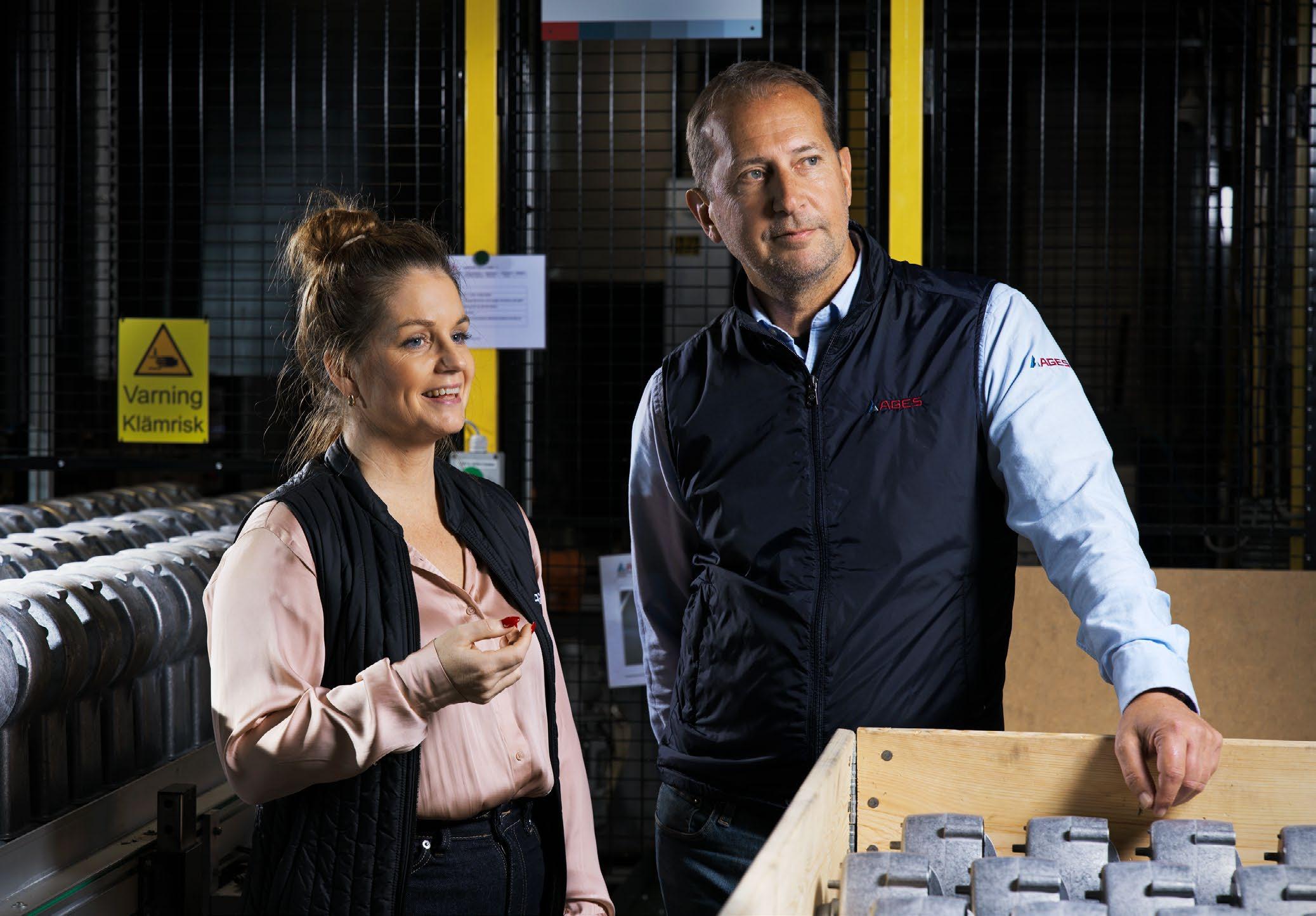
Jenny Johansson, CSO, and Jörgen Virtanen, Managing Director at AGES Kulltorp
Energy efficiency improvements at AGES Kulltorp
Water-to-water heat pump solution
For heating in production, warehouses and offices
Air-to-water heat pump solution
For heating the assembly and maintenance workshop
heating energy %
3 Payback period approx. years
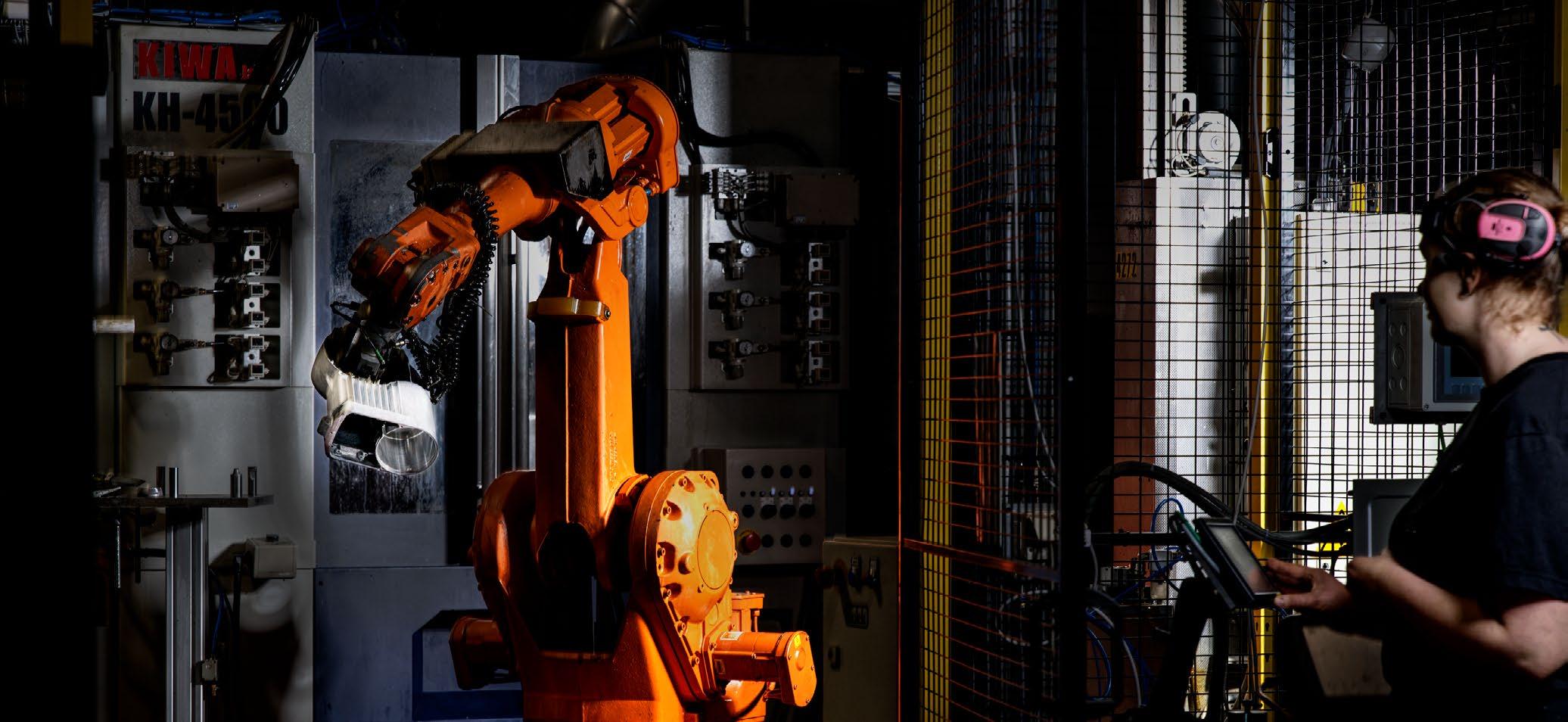
Project manager at AGES Värnamo
The recycling of cutting oil has been made more efficient.


Directors’ Report
The Board of Directors and CEO of AGES Industri AB (publ), corporate identity number 556234-6204, domiciled in Halmstad, Sweden, hereby submit their Annual Report and consolidated financial statements for the financial year 2025.
On 1 April 2025, AGES divested all companies linked to its die-casting operations in Unnaryd. As a result, the consolidated financial statements are reported both as continuing operations (excluding Unnaryd) and as total operations (including Unnaryd). Unless otherwise stated, the figures relate to continuing operations. Some comparative figures have been adjusted to reflect the disposal.
Operations
AGES’s operations primarily comprise die casting, machining, welding, assembly and tooling. The focus in production is on components and integrated systems that meet stringent quality standards. In addition, trading services are provided through an international network of subcontractors. Our customers operate in sectors such as materials handling, vehicles, construction machinery, energy and defence. Efficient production processes, an entrepreneurial spirit and cutting edge technological expertise create the conditions necessary to deliver the best solutions on the market while also ensuring cost-efficiency in production. The Group comprises eight production units with operations in Sweden, China and a purchasing office in Poland.
AGES’s Class B shares are listed on Nasdaq Stockholm First North Premier Growth Market under the symbol AGES B and the company’s Certified Advisor is Eminova Fondkommission AB.
Net
sales and profit
Net sales totalled SEK 880 million (931), a decrease of approximately 5% compared with the previous year. Profit after tax from continuing operations amounted to SEK 21 million (43).
Share data and key ratios
Earnings per share for continuing operations amounted to SEK 2.93 (5.99). Equity per share amounted to SEK 42.73 (42.51). The total number of outstanding shares was 7,233,548. The equity/ assets ratio was 46% (36).
Employees
The number of full-time employees in the Group as at 31 December 2025 was 335 (535). The average number of employees was 324 (522). For more information about employees, see Note 4.
The Group’s performance over the year
During the first quarter, work continued on building a Group that is profitable and sustainable in the long term. An important milestone was reached when we completed the sale of our die-casting company AGES Casting Unnaryd and the companies associated with that business. The sale freed up financial resources, giving us greater flexibility to pursue profitable growth both organically and through acquisitions. In the spring,
tariff restrictions were introduced in the US, which meant that for much of 2025 we faced a market strongly influenced by political factors and uncertain trading conditions. Looking at the full year, however, the trend has shifted from a weak first half to a gradual stabilisation during the autumn, which provides a more positive starting point for the future. In December 2024, plans for a potential merger with Ekets Group were announced. The changing external environment during the spring affected the conditions for a merger, and the parties jointly decided to halt the process.
Our strategic efforts to broaden and develop our customer base are ongoing. Efforts are being directed towards new sectors where we believe our product offering should be attractive. During the year, we have secured new business in the energy sector. Furthermore, discussions are ongoing with customers operating in the defence sector. As the year draws to a close, we are engaged in regular discussions with new clients in this sector and are confident that we will be able to sign contracts in 2026.
In order to improve resource allocation and production efficiency, and to safeguard long-term skills supply within the Group, we have pursued two major integration projects during the year. Two of our tool moulding companies, UB Verktyg and Östlings Verktyg, have merged to form a single entity. Furthermore, we have implemented major machine integrations between AGES Hörle and AGES Värnamo, ensuring greater efficiency in both machine utilisation and the deployment of skills. As part of the project, we have set up an office in Poland, where, through an extensive network of subcontractors, we can source components that are better suited to production by subcontractors, whilst taking full responsibility for logistics and quality on behalf of the customer.
Over the course of the year, clarity has been provided as to which EU directives will apply under the Corporate Sustainability Reporting Directive (CSRD) and certain deadlines have been extended. Nevertheless, we have continued our strategic work and are proceeding in accordance with the plan we established from the outset. As part of our long-term efforts, we have decided to join the Science Based Targets initiative (SBTi). Through the SBTi, we will set science-based targets to reduce our emissions and, in the long term, achieve net-zero in line with climate science.
Future development
AGES’s vision is to ensure sustained profitability and innovation in order to be the most popular and sustainable contract manufacturer and industrial partner. Our employees, who are AGES’s most
important asset, work in line with our core values: customer focus, meaningfulness, timeliness and quality. In this way, we create competitive and sustainable production processes and services that add value. We are constantly adapting to changing market conditions while focusing on developing our core areas and continuing to strengthen our financial position to create long-term growth and profitability.
Events after the reporting period
Vibeke Gyllenram has taken up her post as the new CEO.
Investments
The Group’s net investments in non-current assets amounted to SEK 43 million (80), of which SEK 1 million (0) comprised investment in property and SEK 42 million (47) in machinery and equipment. The remaining SEK 0 million (33) comprised business combinations.
Cash flow and liquidity
Cash flow from operating activities amounted to SEK 84 million (99) with the change primarily attributable to the lower operating profit. The Group’s interest-bearing liabilities amounted to SEK 180 million (249) and cash and cash equivalents amounted to SEK 7 million (14). The Group’s cash and cash equivalents, including committed but undrawn credit lines, stood at SEK 114 million (101) at the balance sheet date.
Risks and uncertainties
The Group’s principal risks and uncertainties included business risks associated with customers and suppliers and other external factors such as price risks involving input goods. In addition, there are financial risks as a result of changes in exchange rates and interest rates. See Note 33 for a description of the Group’s principal financial and business risks.
Currency and interest rates
AGES has some sales and purchasing in foreign currencies and is primarily exposed to exchange rate fluctuations in EUR, CNY and USD against SEK. A description of the Group’s financial risks can be found in Note 33.
Sustainability
AGES’ Sustainability Report is prepared separately from the Directors’ Report and is available on the company’s website, www.ages.se.
Environment and quality management systems
The Group carries out notifiable activities pursuant to the Swedish Environmental Code in one Swedish subsidiary and activities requiring authorisation in seven Swedish subsidiaries. The Parent Company does not have any notifiable activities. The majority of the production units are certified according to the environmental management system ISO 14001. AGES’ production units are all certified according to the ISO 9001 quality management system and a number of units are also certified according to the automotive industry standard IATF 16949 and VDA.
Research and development
The Group does not itself carry out any product research and development activities.
The share and shareholders
AGES’s Class B shares are listed on Nasdaq Stockholm First North Premier Growth Market. The company’s Class A shares are not listed. The share capital amounts to SEK 36.2 million. The quota value is SEK 5. The total number of shares as at the balance sheet date stood at 7,233,548, distributed between 1,822,200 class A shares and 5,411,348 class B shares. One Class A share carries 10 votes per share and one Class B share carries one vote.
All shares have equal rights to the company’s assets and dividends. At the end of 2025, AGES had 1,209 (1,367) shareholders. The company currently has two shareholders who each own and control more than 10% of the voting rights of all the shares in the company. Anna Benjamin controls 27.4% of the shares and 57.2% of the voting rights through her own holding and through related parties. Pomona-gruppen AB holds 28.5% of the shares and 29.3% of the votes.
At the end of the financial year, there were no ongoing incentive programmes.
Work of the Board of Directors
AGES’s Board of Directors currently consists of six ordinary members. The Board members elected by the meeting of shareholders include representatives of AGES’s major shareholders as well as persons independent of the major shareholders. The CEO and other executives in the Group participate in the meetings of the Board of Directors for presentations or in an administrative capacity. The Board of Directors held nine meetings during the financial year. The agenda for each ordinary meeting includes regular reporting items and decisions, as well as information on the business, in accordance with the Board of Directors’ rules of procedure. The Board of Directors also decides on issues of an overarching nature, such as the Group’s strategy, structural and organisational matters. as well as major investments. One of the company’s auditors participates in at least one Board meeting per year. The auditor’s observations arising from the audit of
the company’s accounts, procedures and internal controls are presented at this meeting.
Nomination Committee
At the 2025 Annual General Meeting, a Nomination Committee was appointed consisting of Anna Benjamin as Chair, Jonas Abrahamson as a member. The task of the Nomination Committee ahead of the 2026 Annual General Meeting is to propose the Chair of the Board of Directors and other Board members, auditors, a chair for the AGM, and remuneration to the Board of Directors, committees and auditors. Prior to the 2026 Annual General Meeting, the Nomination Committee has so far held one ordinary meeting and also conducted numerous discussions between the Nomination Committee’s members. The Articles of Association do not contain any separate regulations on the appointment and removal of Board members.
Corporate governance
AGES’s corporate governance is based on Swedish legislation and the listing agreement with Nasdaq Stockholm. Directives issued by authorities and stakeholders in Swedish industry and in the financial markets are also applied in various matters. Governance, management and control is shared between the shareholders at the Annual General Meeting, the Board of Directors and the CEO in accordance with the Swedish Companies Act and the Company’s Articles of Association and rules of procedure. It is recommended that companies listed on Nasdaq Stockholm First North Premier Growth Market adhere to the Swedish Corporate Governance Code (“the Code”). AGES’s Corporate Governance Report is prepared separately from the Directors’ Report and can be found on pages 84–86.
Authorisation for new issue
AGES’s Board of Directors proposes that the Annual General Meeting renew the Board’s authorisation to decide on a new issue of Class B shares corresponding to a maximum of one tenth of the company’s issued shares. Such a mandate would enable the Board to make a decision on a new issue in the period until the next Annual General Meeting. The terms and conditions of the issue, including the issue price, must be based on a valuation on market terms, with the issue price at any given time set as close to the market value as possible, less the discount which may be necessary to generate interest in subscription.
Guidelines for remuneration to and terms of employment for senior management
Guidelines regarding remuneration to senior executives can be found in Note 4.
No changes are proposed ahead of the 2026 Annual General Meeting.
Proposed appropriation of profits
Amount at the disposal of the Annual General Meeting:
Board’s opinion on the proposed dividend
The Board of Directors and the CEO propose that these funds be appropriated as follows:
Cash dividend to shareholders of SEK 1.00 per share
(7,233,548 shares)
The Board of Directors proposes that a dividend be paid for the financial year 2025 corresponding to SEK 1.00 per share, totalling SEK 7.2 million based on the number of outstanding shares at the end of the year. Following the proposed dividend, the equity/assets ratio is satisfactory in view of the fact that the company’s and Group’s business remains profitable. It is estimated that liquidity in the company and Group can be maintained at an equally satisfactory level. It is the Board’s view that the proposed dividend does not prevent the Parent Company or other companies in the Group from fulfilling their short-term or long-term obligations, nor from completing required investments. The proposed dividend can therefore be justified with regard to what is recommended in the Swedish Companies Act, Chapter 17, Section 3, paragraphs 2–3 (prudence principle).

Consolidated income statement
Consolidated statement of comprehensive income
Statement of financial position
Statement of changes in equity
Statement of cash flows
Notes Group
(All amounts are presented in SEK thousand, unless otherwise stated.)
Note 1 General information
The company AGES Industri AB (publ), corporate identity number 556234-6204, carries on business activities as a limited company and its registered office is in Halmstad municipality in Sweden. The address of the head office is PO Box 815, SE-301 18 Halmstad. All amounts are presented in SEK thousand, unless otherwise stated.
The Parent Company in the largest group of which the company is a subsidiary and for which consolidated financial statements are prepared is VIEM Invest AB, corporate identity number 556239-3099, with its registered office in Jönköping, Sweden.
Note 2 Accounting policies
Accounting policies
The consolidated financial statements have been prepared in accordance with IFRS® accounting standards as adopted by the European Union (EU). The consolidated financial statements have also been prepared in accordance with IAS 1 Presentation of Financial Statements and the Swedish Annual Accounts Act. Furthermore, RFR 1 ‘Supplementary Accounting Rules for Groups’, issued by the Council for Sustainability and Financial Reporting, has been applied.
Changes to accounting policies
The applied accounting policies and measurement bases are unchanged compared with the previous year, with the exception of new or revised standards, interpretations and improvements effective for periods beginning on or after 1 January 2025. These updates have not had any material impact on the consolidated accounts.
With effect from 1 January 2026, amendments were introduced to IFRS 9 Financial Instruments and IFRS 7 Financial Instruments: Disclosures. These amendments to the standards are not expected to have any material impact on the company.
From 1 January 2027, IFRS 18 Presentation and Disclosure in Financial Statements will come into force. The standard introduces a uniform structure for the income statement, in which income and expenses are to be presented in five categories: operating, investing, financing, income tax and discontinued operations. This means that the presentation of the income statement will change. The ‘Operating’ category will include items that cannot be classified under any of the other categories. This may mean that the operating profit reported differs from that of previous years. The company will complete its analysis of the impact of IFRS 18 in 2026, but the adoption of IFRS 18 is expected to affect primarily the presentation and disclosure requirements in the financial statements.
Basis of consolidation
The consolidated accounts have been prepared in accordance with the Group’s accounting policies and include the financial statements of the Parent Company and all Group companies.
Subsidiaries
The consolidated accounts include the Parent Company, AGES Industri AB, and the companies in which the Parent Company had a direct or indirect controlling interest on the balance sheet date.
Business combinations
IFRS 3 is applied to business combinations, which among other things means that acquisition-related transaction costs are accounted for as expenses.
Assets and liabilities held for sale and discontinued operations
IFRS 5 applies to the sale and discontinuation of operations. This means that divested subsidiaries are included in the consolidated accounts up to and including the date of disposal, which is when the AGES Group loses control over the subsidiary.
Revenue from contracts with customers
The Group’s revenue comprises component manufacturing and includes custom product manufacturing primarily for the automotive and engineering industries. The Group has multiple framework agreements in place but a contract with a customer, as defined in IFRS 15, exists only when the customer has placed and approved an order. It is at this point that the customer’s and the Group’s enforceable rights and obligations are confirmed. However, under the terms of some framework agreements the Group must hold a specified amount of inventory and customers are committed to purchasing a minimum amount. Generally, each distinct good in an order is considered to constitute a separate performance obligation. The transaction price consists entirely of a fixed amount. Revenue is recognised when control of the products has been transferred from AGES to the customer. Control of a performance obligation is mainly transferred at a point in time. Revenue comprises the amount of consideration that the Group expects to receive in exchange for the transferred goods or services. For the Group this means that revenue is recognised at a point
in time, specifically when delivery of the product has been completed. This coincides with the point in time when the risks and rewards related to the product are transferred to the customer, which also corresponds to the customer receiving the legal title to the product.
Pensions
Pensions and other benefits after employment are classified as either defined contribution or defined benefit plans. Under a defined contribution plan, the company’s obligations are limited to paying fixed contributions to a separate legal entity (insurance company) and the company has no further obligations. A defined benefit plan is a pension plan that stipulates an amount for the pension benefit that an employee receives after retirement. This is normally based on such factors as age, length of employment and salary. The Group primarily has defined contribution pension plans. The majority of the Group’s salaried employees on permanent contracts in Sweden are covered by the so-called ITP-plan, which is financed through pension insurance with Alecta or SPP. According to a statement from the Swedish Corporate Reporting Board, this is a defined benefit plan. The Group has not had access to the kind of information required to make it possible to recognise this plan as a defined benefit plan. The ITP pension plan was therefore recognised as a defined contribution plan in accordance with IAS 19. In addition, the Group has pension obligations in respect of both blue-collar workers and salaried employees which are defined contribution plans and secured through premium payments to insurance companies.
Income tax and deferred tax
Income taxes comprise current tax and changes in deferred tax. Income taxes are recognised in profit for the year except when the underlying transactions are recognised in other comprehensive income, in which case the associated tax effect is recognised in other comprehensive income. Current tax is tax that will be paid or received in respect of the current year, with application of the tax rates that have been enacted or substantively enacted at the balance sheet date. Current tax also includes adjustments for current tax of prior periods. Deferred tax is calculated in accordance with the balance sheet method and is based on temporary differences between the carrying amount and the tax bases of assets and liabilities. Measurement of tax assets and tax liabilities is based on nominal amounts and calculated using tax rules and tax rates that have been substantively enacted. Temporary differences primarily comprise untaxed reserves in Swedish companies. Deferred tax liabilities are normally recognised for all taxable temporary differences while deferred tax assets are recognised to the extent that it is probable that the amounts will be utilised against future taxable profits.
Sources of uncertainty in estimates and critical assessments
Deferred tax assets are recognised following an assessment to ensure that it is probable that sufficient taxable profits will be generated in future years to allow the tax loss carry-forwards to be utilised. The assessment is based on an evaluation of business plans. In addition, account is taken of the potential for offsetting tax assets and tax liabilities, as well as the fact that the majority of the Group’s companies operate in Sweden with an indefinite useful life.
The fair value of future taxable profits may differ from that indicated by business plans, earnings potential or changes in tax regulations. This may have an impact on the AGES Group’s financial position and profit for the period. For further calculations and information, please refer to Note 14 ‘Tax on profit for the year’ and Note 25 ‘Deferred tax liability’.
Non-current assets
Intangible assets
Goodwill is accounted for as an intangible asset with an indefinite useful life and is tested for impairment annually and whenever there is an indication of impairment. The recoverable amount of a cash generating unit is determined on the basis of calculation of its value in use. The calculations are based on the Group’s annual forecasting process, in which future cash flows for the existing business activities are forecast for the current year and the subsequent four-year period. Cash flows beyond the five-year period are extrapolated. The Group uses the current weighted cost of capital to discount estimated future cash flows. Discounted flows are compared with the carrying amount.
Sources of uncertainty in estimates and critical assessments
When testing goodwill for impairment, estimates are made to determine the recoverable amount of cash-generating units. The recoverable amount is based on management’s estimate of future cash flows and is sensitive to changes in assumptions and external factors. Although the company’s management considers the estimated future cash flows and other assumptions to be reasonable, there are uncertainties that may affect the valuations. For further details and information, please refer to Note 15 on intangible fixed assets. Property, plant and equipment
Depreciation is included in costs under the respective functions. Depreciation is
systematically allocated over the expected useful life of the assets as stated below:
Buildings ............................................. 25–50 years
Land improvements ............................... 20 years
Machinery and equipment ............... 5–10 years
Land is not subject to depreciation because it is determined to have an indefinite useful life. Property, plant and equipment that comprise parts with different useful lives are accounted for as separate components of property, plant and equipment.
Right of use
AGES’s asset classes are machinery, vehicles, forklift trucks, fixtures and fittings, and premises. The standard contains two exemptions from recognition in the statement of financial position which are applied by AGES: short-term leases (lease term of 12 months or less) and leases for which the underlying asset is of low value (USD 5,000). These lease payments are recognised as operating expenses in the income statement and are therefore not included in the right-of-use asset or lease liability.
The discount rate is in the first instance the interest rate implicit in the lease, if this can be readily determined under the lease. For other leases, the discount rate is the incremental borrowing rate. The incremental borrowing rate is the interest margin based on the lessee’s (Group subsidiary) credit rating and a reference rate (IBOR) for the specific currency and lease term.
Inventories
Inventories are measured at the lower of cost and net realisable value and using the first in, first out method (FIFO). This means that inventories are recognised at the lower of cost using the FIFO method and net realisable value. For finished and semi-finished goods manufactured by the company, cost comprises direct manufacturing costs and a reasonable mark-up for indirect costs based on normal capacity.
Sources of uncertainty in estimates and critical assessments
The calculation of the net sales value is based on an estimate of a future selling price, which is influenced by several factors, such as market demand and price trends.
Cash and cash equivalents
Cash and cash equivalents comprise cash in hand and at bank.
Financial assets and liabilities
Financial instruments are any type of contract that gives rise to a financial asset in one entity and a financial liability or equity instrument in another entity. Financial instruments are classified at initial recognition, for instance on the basis of the purpose for which the instrument was acquired and managed. This classification determines measurement of the instruments.
Recognition and derecognition
Gains or losses resulting from derecognition from the statement of financial position or modification are recognised through profit to the extent that hedge accounting is not applied.
Classification and measurement of financial assets
Debt instruments: classification of financial assets comprising debt instruments is based on the Group’s business model for management of the asset and the nature of the asset’s contractual cash flows. The instruments are classified to
– Amortised cost
– Fair value through the income statement, or
– Fair value through other comprehensive income
Financial assets classified as at amortised cost are measured at fair value plus transaction costs on initial recognition. After initial recognition, assets are measured at amortised cost less provisions for expected credit losses. Assets classified as at amortised cost are held within a business model whose objective it is to hold assets to collect contractual cash flows that are solely payments of principal and interest on the principal amount outstanding.
The Group’s financial assets are classified as at amortised cost, trade receivables and cash and cash equivalents, as well as fair value through the income statement, which comprise the Group’s financial investments.
Impairment of financial assets
The Group’s impairment model is based on expected credit losses and takes into account forward-looking information. A credit loss provision is established when there is exposure to credit risk, usually upon initial recognition of an asset or receivable. According to the simplified approach, a credit loss provision is recognised for the expected remaining life of the
receivable or asset. The simplified approach is applied to trade receivables and contract assets and is based on historical credit losses combined with forward-looking information.
Classification and measurement of financial liabilities
Financial liabilities, with the exception of derivatives, are classified as at amortised cost. Financial liabilities recognised at amortised cost are initially measured at fair value including transaction costs. After initial recognition they are measured at amortised cost using the effective interest rate method.
The Group’s financial liabilities (trade payables and borrowings) are classified as at amortised cost.
Provisions
Provisions are recognised in the balance sheet when the company has a legal or constructive obligation as a result of past events and it is probable that an outflow of resources will be required to settle the obligation and the amount can be reliably estimated. The amounts are measured regularly and are based on both historical information and reasonable assessments of the future. The Group’s provisions mainly concern pension and warranty obligations.
Cash flow
Cash flow is reported by applying the indirect method.
Segments
Segments are reported in accordance with IFRS 8 Operating Segments in a manner consistent with the internal reporting submitted to the chief executive decision-maker, which in AGES’s case is the company’s CEO. The CEO makes strategic decisions and is responsible for allocating resources to the operating segments and assessing their financial performance.
Note 3 Lines of business and geographical areas
The business activities of the subsidiaries have similar economic characteristics and they are also similar in respect of the nature of their products and production processes.
The customer categories are the same for the companies and they supply the same market, primarily the Swedish market. Because management does not use the financial results of the individual operations as a basis for decisions on allocation of resources, the Group’s business actives form a single segment.
The Group’s business activities focus on component manufacturing and comprise 100% custom manufacturing and no own products. The Group has three (four) customers which each generate revenue accounting for more than 10% of the Group’s total revenue.
from these customers amounted to SEK 120 million (237), SEK
million (208), and SEK (99) million respectively.
(216),
for the Group
Sales by geographical market comprise all revenue from external customers divided between the geographical areas where customers are based.
Carrying amount of assets and investments divided between the geographical areas where assets are located. Of the net investments in 2025, SEK 1 million (0) relates to property, and SEK 42 million (46) to machinery and equipment.
Notes Group
(All amounts are presented in SEK thousand, unless otherwise stated.)
Note 4 Employees and personnel costs
in
1) A provision for severance pay has been recognised as an expense in 2025.
2) Of the Group’s pension costs, SEK 3,009,000 (2,721,000) relates to the Group’s Board and CEO. The Group’s outstanding pension obligations to these amount to SEK 0 thousand (0)
3) Cost of pension obligations through Alecta (recognised as a defined contribution plan) for the year amounted to SEK 3,398,000 (5,825,000). Alecta’s surplus can be distributed to the policyholders and/or the insured. At the end of 2025, Alecta’s surplus in the form of the collective funding ratio was 167% (163).
4) Pension costs do not include payroll tax.
5) One of the Group’s Swedish subsidiaries has pension obligations classified as a defined benefit pension plan. Information about this has not been provided because the liability, totalling SEK 43,000 (45,000), is not significant.
Breakdown of wages, salaries and other remuneration
The Chair and members of the Board receive remuneration in accordance with the decision of the Annual General Meeting. The Annual General Meeting resolved that remuneration to the Board of Directors should total SEK 1,465,000 (1,465,000). Of this amount, SEK 475,000 (475,000) comprised remuneration to the Chair of the Board. The Annual General Meeting further resolved that remuneration for work in the Remuneration Committee and Audit Committee must not exceed SEK 100,000, to be awarded by the Board of Directors on an as-needed basis. All remuneration was paid out in 2025.
Remuneration of Board members carried as an expense is shown in the table.
Board fees and committee fees
1,465,000 1,465,000
Senior executives
For 2025, senior executives are defined as the Group management, comprising the CEO, CFO, CHRO and Business Area Managers. The CHRO left the Group management in June 2025. The CEO stepped down in August 2025. Following this, the CFO will serve also as acting CEO.
The Remuneration Committee of the Board of Directors prepares proposals regarding the remuneration and other terms of employment to the CEO and other senior executives in accordance with the principles adopted by the Annual General Meeting. For both the CEO and other senior executives, variable remuneration is based partly on the Group’s re-
sults and partly on personal targets. The variable remuneration amounts to a maximum of six months’ salary. In the event of termination by the company, a notice period of no more than six months applies. In addition, severance pay equivalent to a maximum of twelve months’ salary may be paid to the CEO and a maximum of six months’ salary to other senior executives, subject to reconciliation. If an employee resigns, the notice period is six months. No severance pay is payable in the event of resignation by the employee. The retirement age is set at 65. Pension terms shall be contribution-based and may amount to a maximum of 35% of the pensionable salary. Other benefits include a company car and health insurance.
The Board of Directors’ decision on guidelines for remuneration of senior executives
The guidelines apply to the CEO of the AGES Group, members of the Group management and the managing directors of AGES’s subsidiaries who report directly to the Group CEO. The guidelines do not include remuneration decided by the Annual General Meeting, such as fees for Board members or share-based incentive schemes.
The guidelines will govern the decisions on remuneration taken by the Board of Directors’ Remuneration Committee in respect of senior executives reporting directly to the Group CEO, and by the Board of Directors as a whole in respect of the CEO.
Guidelines underpin AGES’s business strategy
AGES’s business concept is to offer large-series production of advanced precision components to leading players in selected customer segments. Driven production processes, an entrepreneurial spirit and cutting edge technological expertise create the conditions necessary to deliver the best solutions on the market while also ensuring cost-efficiency in production. To achieve this, AGES has adopted a strategy focusing on growth-promoting priorities and efficiency-enhancing measures. Additionally, the strategy includes a large focus on employees. Successful implementation of AGES’s business strategy and safeguarding of AGES’s long-term interests, including sustainability, depend on AGES being able to recruit and retain qualified employees with the required skills. In order to achieve this, AGES must be able to offer competitive compensation. The guidelines will make it possible for senior executives to be offered competitive total compensation.
Forms of compensation
AGES shall offer compensation on market terms that is based on factors such as roles and responsibilities, skills, experience and performance. Remuneration may consist of fixed salary, short-term variable compensation, pension benefits, insurance and other benefits. In addition, the Annual General Meeting may – irrespective of these guidelines – decide on share-based and share price-related compensation.
Fixed salary
Fixed salary constitutes compensation for a committed and highly professional work contribution which ultimately seeks to create added value for AGES’s customers, shareholders and employees. Fixed salary must be attractive in relation to the market rate and shall be based on the employee’s skills, experience and performance. Salary shall be evaluated on an annual basis. Senior executives are not paid a fee for directorships in the AGES Group’s subsidiaries.
Variable remuneration
In addition to fixed salary, variable remuneration may be payable. The variable remuneration must be linked to measurable criteria that must be designed to promote the business strategy and long-term interests of the company, including its sustainability. The criteria shall be set annually by the Remuneration Committee and the Board of Directors. Variable remuneration shall be based on attainment of financial results targets in AGES and, where relevant, subsidiaries, and personal goals for the financial year. The measurement period is one year and compensation may not exceed six monthly salaries.
Pension benefits and other benefits
AGES applies a retirement age of 65 for all senior executives. Pensions shall be defined contribution pensions unless the executive has a defined benefit pension under mandatory collective agreement regulations. Variable compensation is not qualifying income for pension purposes. Pension premiums for a premium-based pension must not exceed 35% of pensionable salary. Other benefits must be limited in scope and may include, e.g. health insurance, company car and travel benefit.
With regard to terms and conditions of employment governed by rules other than Swedish regulations, both pension benefits and other benefits shall be adjusted as required to comply with mandatory regulations or local practice, while ensuring that the overall objective of these guidelines is met.
In the case of termination of employment of a senior executive by the company, a period of notice of not more than six months shall apply. Fixed salary during the notice period. In the case of termination of employment by the company, the CEO will be entitled to severance pay corresponding to not more than twelve months’ salary. The amount of severance pay is adjusted for income from other sources. In the case of termination of employment of other senior executives by the company, the executive will be entitled to severance pay corresponding to six months’ salary. The amount of severance pay is adjusted for income from other sources.
In the case of notice of termination given by the senior executive, no severance pay is payable.
Salary and terms and conditions of employment for employees
In the preparation of the Board of Directors’ proposals for these compensation guidelines, the salaries and terms and conditions of employment for AGES’s employees have been taken into consideration. Information about total remuneration of employees, remuneration components and increase and rate of increase in remuneration over time was one of the factors considered by the Remuneration Committee and the Board of Directors in the evaluation of whether the guidelines and the limitations resulting from the guidelines are reasonable.
Decision-making process to establish, review and implement guidelines
The Board of Directors has appointed a Remuneration Committee. The Committee’s duties include preparing the Board of Directors’ decision on proposed guidelines for remuneration of senior executives and other terms and conditions of employment for this group. The Board of Directors must prepare proposals for new guidelines at least every four years and present the proposals for ratification by the Annual General Meeting.
The guidelines shall remain in force until new guidelines are adopted by the Annual General Meeting. The Remuneration Committee shall also monitor and evaluate current schemes and schemes completed in the reporting year for variable remuneration of the Group management, application of guidelines for remuneration of senior executives and current remuneration structures and remuneration levels in AGES. To the extent that these matters relate to them, the CEO and other members of the Group management shall not attend meetings of the Board where remuneration-related issues are discussed and decided.
Deviation from the guidelines
The Board may decide to temporarily deviate from the guidelines either wholly or partly on a case by case basis if there are compelling reasons for doing so and deviation is considered necessary to safeguard the AGES Group’s long-term interests and sustainability, or in order to safeguard the Group’s financial strength. As stated above, the Remuneration Committee’s duties include preparing the Board’s decisions in remuneration matters, which includes decisions on deviation from the guidelines.
Description of significant changes to guidelines and how the views of shareholders have been taken into consideration
The proposed guidelines to be presented to the 2026 Annual General Meeting do not include any significant changes compared with the company’s existing remuneration guidelines. The company has not consulted the shareholders.
Notes Group
Note 5 Expenses by nature
Note 10 Other operating income
Note 6 Personnel costs
Note 11 Other operating expenses
Note 7 Depreciation/amortisation
Note 12 Financial income
Note 13 Financial expenses
Note 8 Other external expenses
Note 14 Tax on profit for the year
Note 9 Fees and other remuneration to
Note 15 Intangible assets
Goodwill
Accumulated
Goodwill is allocated to a group of cash-generating units, which corresponds to the Group as a whole. The Group’s operations constitute a single operating segment, which also corresponds to the lowest level within the company at which goodwill is monitored as part of internal governance. Goodwill is tested for impairment at least annually or whenever there is an indication of impairment.
The recoverable amount is determined on the basis of calculations of value in use. Estimates of value in use are based on a discounted cash flow model. The estimate contains a significant source of uncertainty because the estimates and assumptions that are used in the discounted cash flow model are combined with uncertainty about future events and market conditions, and the actual outcome can deviate significantly. Estimates and assumptions have, however, been reviewed by management and are consistent with internal forecasts and future prospects for the business.
The discounted cash flow model includes projections of future cash flows from the business, including estimates of revenue, production costs and required capital employed. Multiple assumptions are made, the most significant of which are the rate of growth in revenue, operating margin and the discount rate.
Projections of future operating cash flows are based on the following: – budgets and strategic plans for a three-year period corresponding to management’s estimates, adopted by the Board, of future revenue and operating costs using results of prior periods, general market conditions. industry developments and forecasts and other available information. Assumed growth is 3.0% for the forecast period and subsequent sustained growth of 2.0%.
Impairment testing in the financial year used a discount rate (WACC) of 9.3% (9.3) before tax.1)
This year’s impairment test has not identified any need for an impairment loss. A number of sensitivity analyses have been carried out. No reasonable changes to key assumptions in these analyses indicate any need for impairment.
1) The discount rate comprises the risk-adjusted required return, which in addition to risk-free interest includes a risk premium based on the average market premium on the Swedish stock market with an additional premium based on the size of the company and the company’s cost of borrowed capital and which has also been adjusted for debt/equity ratio based on market data.
Notes Group
(All
Note 16 Property, plant and equipment
Plant and machinery
Note 17 Inventories
Cost of inventories carried as an expense is included in the line item Cost of goods sold and amounts to SEK 407,040,000 (421,310,000).
Note 18 Trade receivables and other receivables
1) For information on maturity structure and age distribution, see Note 19 and Note 33.
19 Financial assets and liabilities Breakdown by category
Notes Group
(All amounts are presented in SEK thousand, unless otherwise stated.)
Note 19 Cont.
distribution
The fair value of financial receivables is estimated to be substantially the same as the carrying amount.
Breakdown by currency
Note 20 Earnings per share
Earnings per share before and after dilution from continuing operations 2025
Note 24 Other provisions
Earnings per share before and after dilution from discontinued operations 2025
Note 25 Deferred tax liability
Temporary differences
Earnings per share before and after dilution, total operations 2025
At the 2021 Annual General Meeting, the Annual General Meeting passed a resolution on a warrants programme for senior executives. During the month of June 2024, 112,000 warrants were redeemed. As of the balance sheet date, there are no remaining, outstanding warrants programmes.
For number of shares, see Note 21.
In the calculation of number of shares after dilution, the average number of shares is adjusted for the effects of dilutive potential ordinary shares, which in the reporting periods concerned comprise rights to acquire shares in AGES Industri AB within the framework of the long-term incentive programme.
Note 21 Share capital
Share capital distribution 31 Dec 2025 31 Dec 2024
Temporary differences arise when there is a difference between the carrying amounts and the tax bases of assets and liabilities. Temporary differences relating to the following items have resulted in deferred tax liabilities and deferred tax assets. Loss carry-forwards have not been recognised in the balance sheet. The total tax loss carry-forwards for the Group’s companies amount to SEK 4,293,000.
SEK
One Class A share carries 10 votes per share and one Class B share carries one vote. The total number of votes was 23, 633,348. The dividend proposed to the 2026 Annual General Meeting amounted to SEK 1.00 (1.50) per share.
Note 22 Reserves
Note 23 Bank overdraft facilities
Note 26 Trade payables and other liabilities
Note 27 Pledged assets
Notes Group
(All amounts are presented in SEK thousand, unless otherwise stated.)
Note 28 Right-of-use assets
Note 29 Cash flow
Note 30 Acquisition of subsidiary
In January 2024, all the shares in A-Tooling AB were acquired. The total value of acquired assets and liabilities, consideration and impact on the Group’s cash and cash equivalents is set out below.
The consideration for A-Tooling AB consisted of the following components
Note 31 Discontinued operations
On 1 April 2025, AGES Casting Unnaryd and its associated subsidiaries were sold to Lazarus Industriförvaltning AB. The sale forms part of AGES’s strategic decision to focus on core activities within Precision Components, with a particular emphasis on machining.
The results from the discontinued operations for the last financial year are presented below:
Transaction costs relating to acquired entities amounted to SEK 0 (274,000) and were accounted for as administrative expenses through profit for the year.
If the entities acquired in 2024 had been part of the Group for the full year 2024, external net sales from these units would have amounted to around SEK 34 million and profit for the period would have amounted to around SEK 3.4 million.
The acquisition of A-Tooling AB entails a premium value corresponding to SEK 21 million, which is attributable to goodwill. Synergy effects are expected to be achieved primarily between the four companies in the Engineering Solutions business area, but also in other companies within the AGES Group where we see potential added value for existing customer structures.
Consideration – cash flow
Cash flow for acquisition of subsidiaries, less cash and cash equivalents acquired
and cash equivalents
outflow of cash and cash equivalents - investing activities
attributable to ordinary operations in the discontinued operations:
for the year from discontinued
Notes Group
(All amounts are presented in SEK thousand, unless otherwise stated.)
Note 32 Change in liabilities
1)
Note 33 Risks
Financial risks
The Group is exposed to financial risks through its business activities. Financial risk refers to the changes in the Group’s cash flow that are due to changes in exchange rates and interest rates, together with liquidity, financing and credit risks. The Group’s financial risk management policy is determined by the Board of Directors and forms the framework for risk management. The aim is to minimise the cost of raising capital and financial risk in a cost-effective way. The Parent Company plays a central role in management of financial activities, which means that the Group can benefit from economies of scale and have a better overview of financial risks.
Currency risks
The Group’s business activities are exposed to currency risks mainly in the following three areas:
∣ Transaction risk
∣ Risk relating to translation of the income statements of subsidiaries
∣ Risk relating to translation of the balance sheets of subsidiaries
The transaction risk arises due to the commercial payment flows that take place in a currency other than the local currency of each subsidiary. The Group’s policy is not to hedge commercial flows. Because of the changes made to the Group’s structure and their impact on currency flows, this policy may be revised. The flows are monitored continuously in order to minimise transaction risks.
The proportion of invoicing in foreign currency in 2025 was 6% (8). Of the Group’s manufacturing, 94% (96) was based in Sweden. The majority of the Group’s products are sold in the countries in which they are manufactured. The main exceptions are deliveries from the Swedish production units to foreign end-customers. It is in this latter case that transaction risk arises, as well as in connection with purchases of material.
A simplified summary of the Group’s revenue and cost structure in 2025, broken down by currency, is shown in the table below.
on the Group’s results due to increased borrowing costs. Financing primarily comprises bank borrowings.
Average interest (interest expense in relation to average interest-bearing liabilities) was 4.6% (7.4). The Group’s interest-bearing liabilities as at the balance sheet date amounted to SEK 180 million (249), of which SEK 180 million were variable interest liabilities. The net impact of a one (1) percentage point rise in interest rates is around SEK -1.80 million (-2.49) on an annual basis.
Hedging instruments and hedge accounting
To manage interest risk described above, the Group has historically periodically used interest rate swaps. The Group had no active hedges as at 31 December 2025.
Liquidity and financing risks
Liquidity and financing risks refer to the risk of not being able to meet payment obligations as a result of insufficient liquidity or difficulty raising external loans. The Group is actively looking to ensure a high level of financing preparedness and effective raising of capital by always having access to confirmed credit. The majority of the Group’s borrowing comprises bank borrowings. Financing agreements have a contract term exceeding 12 months. Key ratios that are a condition of agreements with the bank are monitored continuously to avoid the risk of cancelled credits. The Parent Company offers credit within the Group on market terms and usually at variable interest rates. Liquidity preparedness (cash and cash equivalents, including credit granted but not used, in relation to net sales) at the balance sheet date stood at 13% (7). See Note 19 for a summary of financial assets and liabilities.
Credit risks
Credit risk is the risk that a counterparty in a financial transaction will not be able to meet its obligations. The Group’s credit risk mainly involves trade receivables. The risk of credit losses is managed through established procedures for credit control and claims management. The Group’s customers primarily comprise large and well-established, solvent companies, which has meant that credit losses have historically been low. The maximum credit risk in respect of the Group’s trade receivables corresponded to the carrying amount of SEK 83 million (122). Trade receivables are recognised net of expected credit losses based on the Group’s assessment of expected credit losses. The loss allowance was SEK 198,000 (SEK 341,000), of which SEK 198,000 (341,000) was attributable to trade receivables more than 60 days past due.
The Group is primarily exposed to changes in EUR, CNY and USD, which showed negative net flows in 2025. In addition, subsidiaries have both receivables and liabilities primarily in EUR and CNY. An average change of 5% in all currencies against the Swedish krona would have an impact on profit before tax of approx. SEK -2.7 million for the corresponding flow. In the event of a change of 5% in either EUR or CNY against the Swedish krona, the impact on profit before tax over a period of one year would be around SEK -1.1 million and SEK -1.0 million respectively.
Risk relating to translation of the income statements and balance sheets of subsidiaries
Because the foreign subsidiaries’ net sales, results and value of net assets are low, translation of the subsidiaries’ income statements and balance sheets does not represent a significant risk.
Interest risks
Interest risk refers to the risk that changes in interest rates will have a negative impact
Change in loss allowance for expected credit losses 31 Dec 2025 31 Dec 2024
Divestment of operations 341
Incurred and recovered credit losses-198 -341
Business risks
Business risks are associated both with customers, suppliers and other external factors and with the Group’s own business activities. AGES works in close proximity to its customers and is therefore able to build long-term relationships with them. AGES’s six largest customers together accounted for 55% (59) of net sales. On a Group level, AGES is dependent on access to a number of input goods, such as aluminium and steel, at competitive prices. Raw material prices are dependent on world market prices and exchange rates, as well as production capacity. However, price fluctuations have a limited effect on the Group’s results, as many customer agreements contain raw material clauses. Management of price risks forms part of the daily work and requires ongoing cost rationalisation and productivity improvements. Within the Group’s product area there is always a risk that products may need to be recalled due to faults. To avoid such risks, the Group’s companies use quality control systems. The Group has satisfactory protection in place through insurance policies in respect of traditional insurance risks such as fire, theft, liability, stoppages, etc.
Note 34 Alternative performance measures
In addition to information about our results reported according to IFRS, we provide information based on the underlying results of operations. We believe that our measures of the underlying results of operations provide key supplementary information for management, investors and other stakeholders. These underlying performance measures should not be viewed in isolation from, or as a substitute for, the corresponding IFRS measures, but should be used in conjunction with the most directly comparable IFRS measures in the reported results. This application is consistent with prior periods.
The following underlying performance measures are used:
Return on equity
Return on capital employed
Return on total capital
Interest coverage ratio
Proportion of risk-bearing capital Equity/assets ratio
Cash flow from operating activities per share
For definitions of key performance indicators, see page 89.
Note 35 Capital management
The Group’s aim is to achieve a good return on equity with limited financial risk while reporting strong and stable growth. In order to achieve this, a stable cash flow and a strong balance sheet are required, with an equity/assets ratio of more than 30%. At the end of 2025, the equity/assets ratio was 46% (36). The Group’s financing is dependent on the Group achieving certain financial key ratios agreed with the Group’s main bank. The key ratios in question are the Group’s proportion of risk capital and net debt in relation to operating profit before depreciation/amortisation. The proportion of risk capital should not be less than 30% and interest-bearing net debt in relation to operating profit before depreciation/amortisation should not exceed 2.50. Under the terms of the bank loan, which has a carrying amount of SEK 163 million, the Group is obliged to meet the financial covenants at the end of each full-year and interim period. The results for the reporting period meant that the relevant key ratios were within the agreed limits.
It is the aim of the Board of Directors that dividends should mirror financial performance over an extended period and correspond to at least 30% of profit after tax. However, the annual dividend payout ratio must be viewed in relation to investment needs.
Note 36 Related party transactions
The Group’s related parties consist of senior executives, Board members and companies in which Board members or the senior executives of subsidiaries have a controlling interest. Other than the remuneration referred to in Note 4, Board members and senior executives have not received dividends. The shareholdings of Board members and senior executives as at the balance sheet date are shown on pages 90–91.
VIEM Invest AB, controlled by Anna Benjamin, and Pomona-gruppen AB, in which Board member Fredrik Rapp has a controlling interest, are major shareholders in AGES. Transactions took place between AGES’s subsidiaries and companies in which AGES’s Board members or senior executives of subsidiaries have a controlling interest. These transactions formed part of the companies’ normal activities and took place at market price.
In 2025, AGES subsidiaries purchased goods and services worth SEK 0.7 million (0.0) from XANO Industri AB and its subsidiaries. In addition, AGES Industri sold goods and services worth SEK 0.4 million (1.9) to XANO Industri AB and its subsidiaries. XANO Industri AB is controlled by Anna Benjamin and Pomona-gruppen AB.
In 2025, sales from AGES subsidiaries to Pomona-gruppen AB and its subsidiaries amounted to SEK 4.1 million (0.0). Pomona-gruppen is controlled by Fredrik Rapp. As at the balance sheet date, the amounts of receivables from and liabilities to related parties were not significant.
Note 37 Events after the reporting period
On 23 February 2026, Vibeke Gyllenram took up her post as CEO.
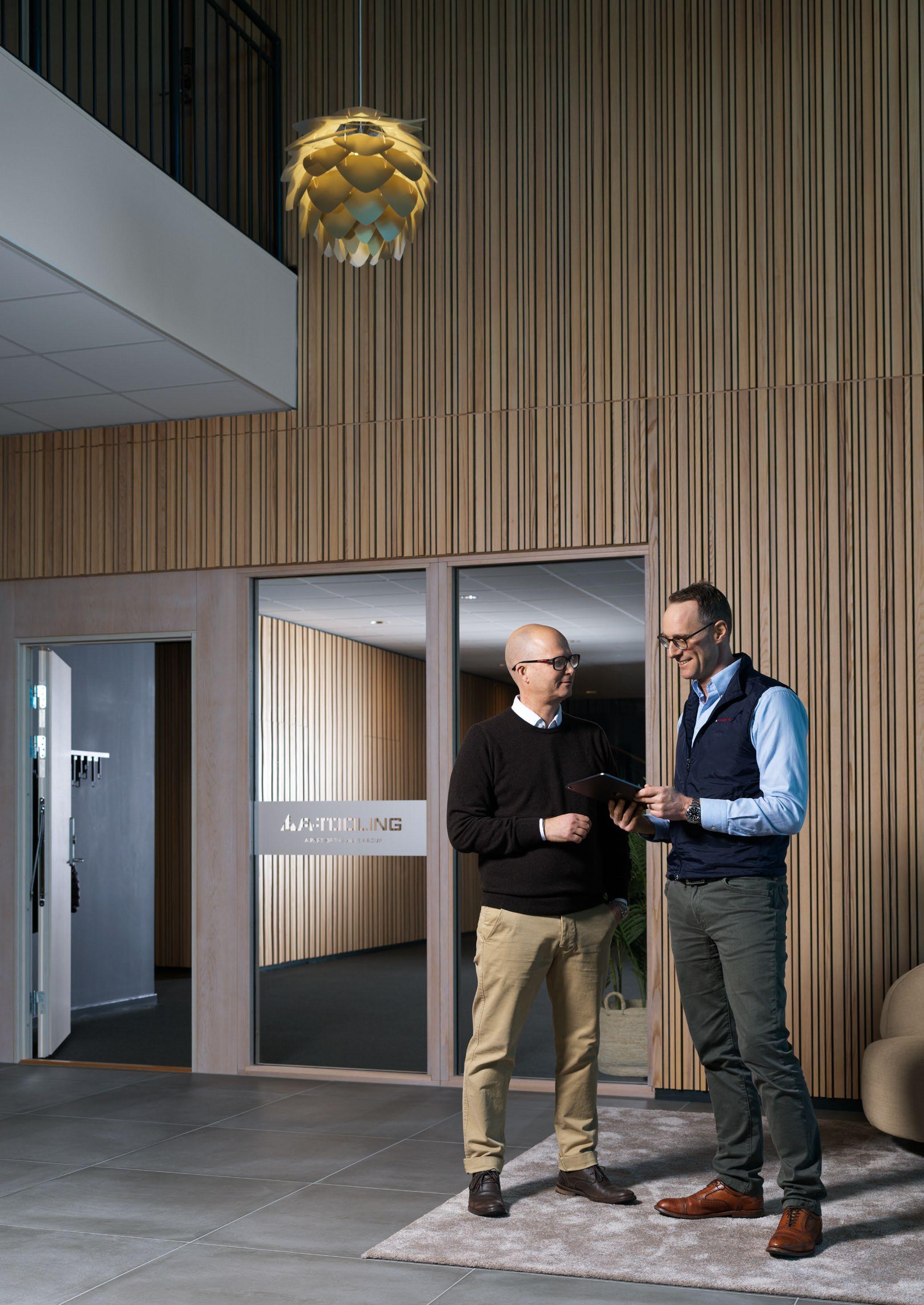
Income statement
Balance sheet
Statement of changes in equity
Statement of cash flows
Notes Parent Company
(All amounts are presented in SEK thousand, unless otherwise stated.)
Note 1 General information
The company AGES Industri AB (publ), corporate identity number 556234-6204, carries on business activities as a limited company and its registered office is in Halmstad municipality in Sweden. The address of the head office is PO Box 815, SE-301 18 Halmstad. All amounts are presented in SEK thousand, unless otherwise stated.
Note 2 Accounting policies
The annual accounts have been prepared in accordance with the Swedish Annual Accounts Act and recommendations and interpretations by the Swedish Corporate Reporting Board.
General information
The Parent Company applies the same accounting policies as the Group, except in the cases shown below. The Parent Company’s financial statements have been prepared according to Recommendation RFR 2 Financial Reporting for Legal Entities of the Swedish Corporate Reporting Board. Any deviations that occur between the Parent Company’s and the Group’s policies are caused by limitations in the scope to apply IFRS Accounting Standards to the Parent Company as a result of the Swedish Annual Accounts Act and, in some cases, for tax reasons. For information on the impact of new standards issued by IASB on the Parent Company’s accounting policies, see Note 2 Group Accounting policies.
Receivables and liabilities
Exchange rate differences in operating receivables and liabilities are recognised in operating profit, while exchange differences attributable to financial receivables and liabilities are recognised in net financial income/expense.
Leases
In accordance with Recommendation RFR 2 Financial Reporting for Legal Entities of the Swedish Corporate Reporting Board, the Parent Company applies the exemption under IFRS 16 with effect from 1 January 2019. This means that the Parent Company recognises lease payments as operating expenses through the income statement on a straight-line basis over the lease term for all leases.
Related party transactions
Of the Parent Company’s net sales, 100% (100) comprised invoicing of subsidiaries. There are significant financial receivables and liabilities between the Parent Company and subsidiaries which accrue interest at the market rate.
In addition to what is set out in Note 3, Board members and senior executives have not received share dividends in accordance with decision taken by the AGM.
As the owner, the Parent Company has a related party relationship with its subsidiaries, see Note 13. VIEM Invest AB, controlled by Anna Benjamin, and Pomonagruppen AB, in which Board member Fredrik Rapp has a controlling interest, are major shareholders in AGES. No dividends were paid and no transactions took place between these shareholders and AGES.
Participations in Group companies
Participations are measured according to the cost method. Dividends from subsidiaries are recognised as income. The items are tested for impairment annually and the participations measured at the highest consolidated value, i.e. the subsidiary’s adjusted equity plus consolidated premium values.
Cash flow
Cash flow is recognised by applying the indirect method. This means that the net profit is adjusted for transactions that have not resulted in cash inflows or outflows during the period and for any income and costs related to the cash flows of investing or financing activities.
Financial assets and liabilities
Because of the relationship between accounting and taxation, the rules regarding financial instruments in IFRS 9 are not applied in the Parent Company as a legal entity. The Parent Company instead applies the cost method in accordance with the Swedish Annual Accounts Act. The Parent Company therefore measures non-current financial assets at cost and current financial assets at the lower of cost and net realisable value, with application of expected credit loss impairment under IFRS 9 for assets accounted for as debt instruments. For other financial assets, impairment is based on market value.
Revenues
The Parent Company offers its subsidiaries services relating to business development, organisation, finance, etc. Revenue from services is recognised in the period in which the service is carried out. Intra-group sales take place at market price.
Group contributions
Group contributions are recognised in accordance with the alternative rule of recommendation RFR 2, according to which Group contributions paid and received are recognised as appropriations through the income statement.
Taxes
Recognised income taxes include tax payable for the current year and changes to deferred tax. Measurement of tax assets and tax liabilities is based on nominal amounts and calculated using tax rules and tax rates that have been enacted. Deferred tax is calculated on the basis of temporary differences which arise between the carrying amount and the tax bases of assets and liabilities.
Deferred tax liabilities are normally recognised for all taxable temporary differences while deferred tax assets are recognised to the extent that it is probable that the amounts will be utilised.
Because of the relationship between accounting and taxation, the Parent Company recognises the deferred tax liability relating to untaxed reserves as part of untaxed reserves.
Bank overdraft facilities, Group foreign currency accounts
Subsidiaries’ claims on and debts to internal lines of credit are recognised as liabilities and receivables in respect of Group companies. The Group’s total receivable/liability in respect of the bank is recognised as a receivable or liability in the Parent Company. Interest at the market rate is applied to the subsidiaries’ claims and debts.
Note 3 Employees and personnel costs
1) During the 2025 financial year, a provision has been made for severance pay and social security contributions.
2) Of the Parent Company’s pension costs, SEK 845,000 (844,000) relate to the Group’s Board and CEO
3) Pension costs do not include payroll tax. Breakdown of wages, salaries and other remuneration
Remuneration to Board members and senior executives
Decisions and completed proposals for guidelines relating to remuneration of Board members and senior executives, see Note 4 Group.
Note 4 Personnel costs
Personnel costs by function
Note 5 Fees and other remuneration to auditors
Note 9 Financial expenses
Note 10 Appropriations
Audit engagement refers to the review of the annual accounts, interim financial reporting, the administration by the Board of Directors and CEO and the corporate governance report.
Note 6 Operating leases
Future minimum lease payments under non-cancellable operating leases at the end of the reporting period are due as follows:
Parent Company’s operating leases primarily relate to leases for premises and vehicle leases.
Operating lease costs in the Parent Company in the financial year amounted to SEK 901,000 (SEK 993,000)
More than one year but less than five years
Note
7
Participations in Group companies
Note 11 Tax on profit for the year
Note 12 Equipment, tools, fixtures and fittings
Note 8 Financial income
Notes Parent Company
(All amounts are presented in SEK thousand, unless otherwise stated.)
Note 13 Participations in Group companies
-
Parent Company’s shareholdings
AGES Kulltorp AB 556436-1441 Gnosjö, Sweden
AGES Östra Fastighet i Unnaryd AB 556345-3637 Hylte, Sweden
ÅGES Industrier i Unnaryd AB 556345-9618 Hylte, Sweden
Hörle Automatic Gruppen AB 556117-5141 Värnamo, Sweden
Verktyg AB 556312-9930 Värnamo,
AGES Shared Services AB 559231-1848 Halmstad, Sweden
APM August Pettersson AB 556366 -1775
Subsidiaries’ shareholdings
Company
AGES Värnamo AB 556497-2056 Värnamo, Sweden
AGES Falkenberg AB 556125-7147 Falkenberg, Sweden
AGES Hörle AB 556208-0936 Värnamo, Sweden
Hörle Automatic Fastighets AB 556266-5090 Värnamo, Sweden
Hörle Automatic (Ningbo) Co Ltd 330200400033754 Ningbo, China
Hörle Metal Products (Ningbo) Co Ltd 330200400072380 Ningbo, China
AGES Poland Sp. z o.o. 0001152108 Mielec, Poland
Of the Group’s subsidiaries, 10 are industrial companies. The other companies have limited operations of type sales company, holding company, property company, administrative services company or dormant company.
Note 14 Other receivables
Note 15 Share capital
One Class A share carries 10 votes per share and one Class B share carries one vote. The total number of votes was 23,633,348. The proposed dividend is SEK 1.00 (1.50) per share.
Note 16 Untaxed reserves
Untaxed reserves
Of untaxed reserves, SEK 9,366,000, 20.6% (SEK
Note 17 Liabilities
1) All Swedish subsidiaries have internal bank overdraft facilities linked to AGES Industri AB’s Group account system. The unused portion is recognised as a net amount. The Parent Company’s cash and cash equivalents, including committed but not used external credit lines, totalled
Note 18 Trade payables and other liabilities
Note 19 Pledged assets
Note 20 Cash flow
Interest
Interest paid amounted to SEK 4,218,000 (8,651,000) and interest received amounted to SEK 961,000 (3,859,000).
Note 21 Change in liabilities
Note 22 Proposed appropriation of profits
Amount at the disposal of the Annual General Meeting: SEK
Share premium reserve 262,461,056
Note 23 Events after the reporting period
On 23 February 2026, Vibeke Gyllenram took up her post as CEO.
The Board of Directors and the CEO propose that these funds be appropriated as follows: SEK
The undersigned certify that the consolidated financial statements and annual accounts have been prepared in accordance with international financial reporting standards IFRS, as adopted by the EU, and generally accepted accounting principles, and that they give a true and fair view of the position and performance of the Group and Company, and that the Directors’ Report for the Group and Company gives a fair review of the development and performance of the business and the position of the Group and Company together with a description of the principal risks and uncertainties facing the companies that form part of the Group.
The annual accounts and consolidated financial statements for AGES Industri AB (publ) for the financial year 2025 have been authorised for issue by the Board of Directors.
The contents of the annual report were finalised on 2 April 2026. The annual report was signed by all members on 2 April 2026.
Anders Berggren Fredrik Rapp Anna Benjamin CHAIR OF THE BOARD BOARD MEMBER BOARD MEMBER
Lennart Persson
Petra Öberg Gustafsson Lars Jonsson BOARD MEMBER
BOARD MEMBER BOARD MEMBER
Vibeke Gyllenram CEO
Our Auditor’s Report was submitted on 2 April 2026. Ernst & Young AB
Carolina Timén
AUTHORISED PUBLIC ACCOUNTANT
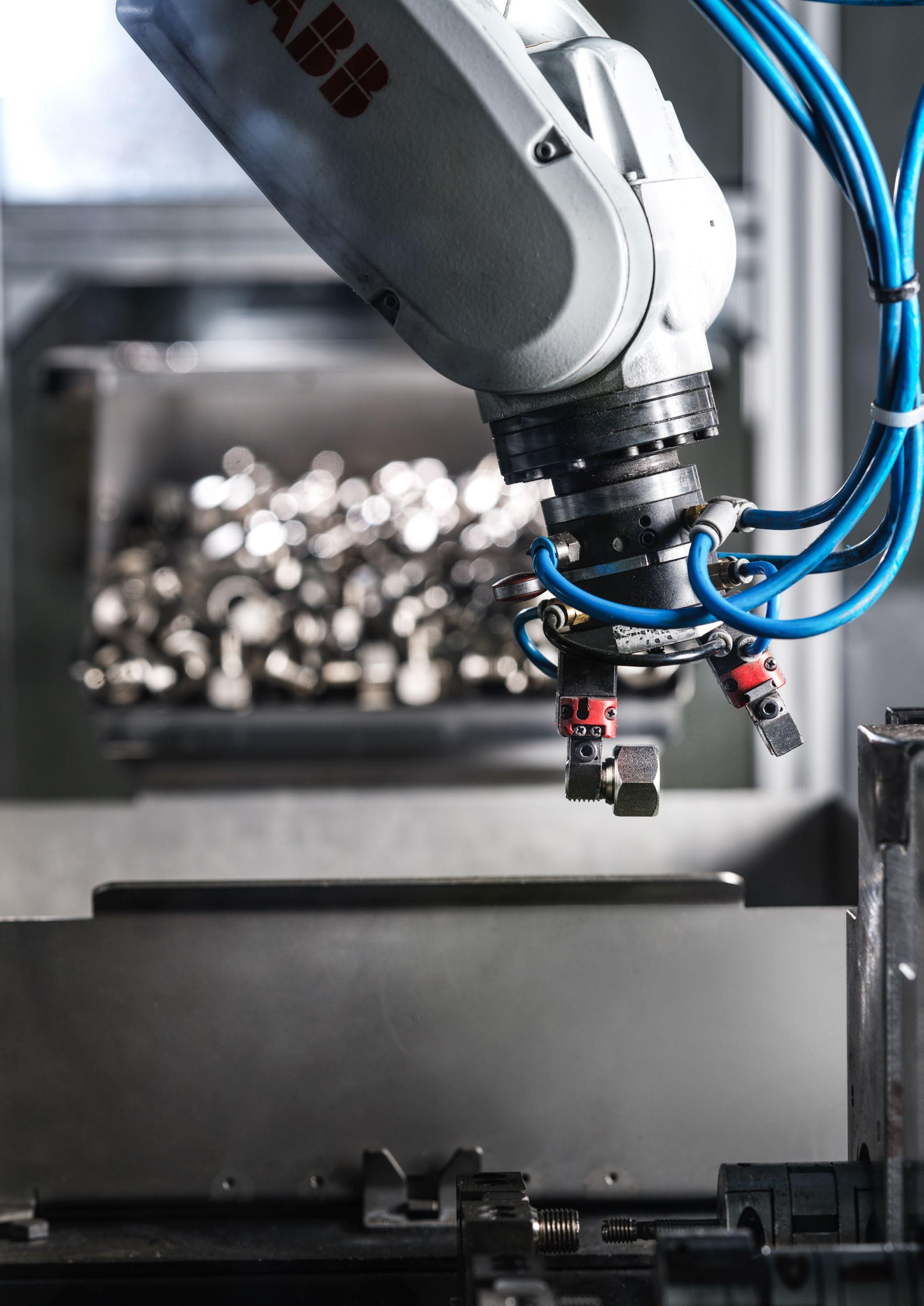
Auditor’s Report
To the Annual General Meeting of AGES Industri AB (publ) AB, corporate identity number 556234-6204
Report on the annual accounts and consolidated accounts
Opinions
We have audited the annual accounts and consolidated accounts of AGES Industri AB (publ) for the financial year 2025. The Company’s annual accounts and consolidated accounts are included on pages 44–80 of this document.
In our opinion, the annual accounts have been prepared in accordance with the Swedish Annual Accounts Act and present fairly, in all material respects, the financial position of the Parent Company as at 31 December 2025, and its financial performance and cash flows for the year then ended in accordance with the Swedish Annual Accounts Act. The consolidated accounts have been prepared in accordance with the Swedish Annual Accounts Act and present fairly, in all material respects, the financial position of the Group as at 31 December 2025, and its financial performance and cash flows for the year then ended in accordance with IFRS Accounting Standards, as adopted by the EU, and the Swedish Annual Accounts Act. The Directors’ Report is consistent with the other parts of the annual accounts and consolidated accounts.
We therefore recommend that the Annual General Meeting adopt the income statement and balance sheet for the Parent Company and the Group.
Basis for opinions
We conducted our audit in accordance with International Standards on Auditing (ISA) and generally accepted auditing standards in Sweden. Our responsibilities under these standards are further described in the section Auditor’s responsibilities. We are independent of the Parent Company and the Group in accordance with professional ethics for accountants in Sweden and have otherwise fulfilled our ethical responsibilities in accordance with these requirements.
We believe that the audit evidence we have obtained is sufficient and appropriate to provide a basis for our opinions.
Information other than the annual accounts and consolidated accounts
This document also contains information other than the annual accounts and the consolidated accounts and is found on pages 1–43. The Board of Directors and the CEO are responsible for this other information.
Our opinion on the annual accounts and consolidated accounts does not cover this other information and we do not express any form of assurance conclusion regarding this other information.
In connection with our audit of the annual accounts and consolidated accounts, our responsibility is to read the information identified above and consider whether the information is materially inconsistent with the annual accounts and consolidated accounts. In this procedure we also take into account our knowledge otherwise obtained in the audit and assess whether the information otherwise appears to contain material misstatements.
If, based on the work carried out with respect to this information, we conclude that there is a material misstatement in this other information, we are required to report that fact. We have nothing to report in this regard.
Responsibilities of the Board of Directors and the CEO
The Board of Directors and CEO are responsible for the preparation and fair presentation of the annual accounts and consolidated accounts in
accordance with the Swedish Annual Accounts Act and, in respect of the consolidated accounts, in accordance with IFRS Accounting Standards, as adopted by the EU. The Board of Directors and CEO are also responsible for such internal control as they determine is necessary to enable the preparation of annual accounts and consolidated accounts that are free from material misstatement, whether due to fraud or error.
In the preparation of the annual accounts and consolidated accounts, the Board of Directors and CEO are responsible for assessment of the company’s ability to continue as a going concern. They disclose, where appropriate, information on conditions that may affect the ability to continue as a going concern and to use the going concern basis of accounting. However, the going concern basis of accounting is not applied if the Board of Directors and the CEO intend to liquidate the company, cease operations or do not have a realistic alternative to either of these actions.
Auditor’s responsibilities
Our objectives are to obtain reasonable assurance about whether the annual accounts and consolidated accounts as a whole are free from material misstatement, whether due to fraud or error, and to issue an Auditors’ Report that includes our opinions. Reasonable assurance is a high level of assurance, but is not a guarantee that an audit conducted in accordance with International Standards on Auditing (ISAs) and generally accepted auditing standards in Sweden will always detect a material misstatement when it exists. Misstatements can arise from fraud or error and are considered material if, individually or in aggregate, they could reasonably be expected to influence the economic decisions of users taken on the basis of these financial statements and consolidated accounts.
As part of an audit according to ISA, we exercise professional judgement and maintain professional scepticism throughout the audit. We also:
∣ identify and assess the risks of material misstatement in the financial statements and consolidated accounts, whether due to fraud or error, design and perform audit procedures responsive to those risks, and obtain audit evidence that is sufficient and appropriate to provide a basis for our opinions. The risk of not detecting a material misstatement resulting from fraud is higher than for a material misstatement resulting from error, because fraud may involve collusion, forgery, intentional omissions, misrepresentations or the override of internal control procedures.
∣ obtain an understanding of the company’s internal control relevant to our audit in order to design audit procedures that are appropriate in the circumstances, but not for the purpose of expressing an opinion on the effectiveness of the company’s internal control.
∣ evaluate the appropriateness of accounting policies used and the reasonableness of accounting estimates and related disclosures made by the Board of Directors and the CEO.
∣ form a conclusion on the appropriateness of the Board of Directors’ and the CEO’s use of the going concern basis of financial statements. We also draw a conclusion, based on the audit evidence obtained, as
to whether any material uncertainty exists related to events or conditions that may cast significant doubt on the company’s ability to continue as a going concern. If we conclude that a material uncertainty exists, we are required to draw attention in our auditor’s report to the related disclosures in the annual accounts or, if such disclosures are inadequate, to modify our opinion about the financial statements and consolidated accounts. Our conclusions are based on the audit evidence obtained up to the date of our auditor’s report. However, future events or conditions may cause a company to cease to continue as a going concern.
∣ evaluate the overall presentation, structure and content of the annual accounts and consolidated accounts, including the disclosures, and whether the annual accounts and consolidated accounts represent the underlying transactions and events in a manner that achieves fair presentation.
∣ plan and conduct the Group audit to obtain sufficient and appropriate audit evidence regarding the financial information of companies or business units within the Group as a basis for making an opinion regarding the consolidated accounts. We are responsible for the direction, supervision and review of the audit work performed for purposes of the Group audit. We remain solely responsible for our opinions.
We must inform the Board of Directors of, among other things, the planned scope, direction and timing of the audit. We must also inform of significant audit findings during our audit, including any significant deficiencies in internal control that we identified.
Report on other legal and regulatory requirements
Opinions
In addition to our audit of the annual accounts and consolidated accounts, we have audited the administration of the Board of Directors and the CEO of AGES Industri AB (publ) for the financial year 2025 and the proposed appropriation of the company’s profit or loss.
We recommend to the general meeting of shareholders that the profit be appropriated as proposed in the Directors’ Report and that the members of the Board of Directors and the CEO be discharged from liability for the financial year.
Basis for opinions
We conducted our audit in accordance with generally accepted auditing standards in Sweden. Our responsibilities in accordance with these are described further in the section Auditor’s responsibilities. We are independent of the Parent Company and the Group in accordance with professional ethics for accountants in Sweden and have otherwise fulfilled our ethical responsibilities in accordance with these requirements.
We believe that the audit evidence we have obtained is sufficient and appropriate to provide a basis for our opinions.
Responsibilities of the Board of Directors and the CEO
The Board of Directors is responsible for the proposed appropriation of the company’s profit. Dividend proposals include an assessment of whether the dividend is justifiable considering the demands that the nature, scope and risks of the company’s and Group’s operations place on the amount of equity in the Parent Company and the Group, and on
the consolidation requirements, liquidity and financial position in general of the Parent Company and the Group.
The Board is responsible for the organisation of the company and the management of its affairs. Among other things, this includes continuously assessing the financial position of the company and the Group and ensuring that the company’s organisation is designed such that controls of accounting records, asset management and the company’s financial circumstances in general are performed in a satisfactory manner. The CEO shall manage the ongoing administration according to the Board of Directors’ guidelines and instructions and among other matters take the necessary measures to fulfil the company’s accounting according to law and handle the management of assets in a reassuring manner.
Auditor’s responsibilities
Our objective for the audit of the administration, and thereby our opinion on discharge from liability, is to obtain audit evidence to enable us to determine with reasonable assurance whether any member of the Board or the CEO has, in any material respect:
∣ taken any action or been guilty of any negligence that may result in a claim for compensation being brought against the company, or
∣ in any other way acted in contravention of the Swedish Companies Act, the Swedish Annual Accounts Act or the Articles of Association.
Our objective for the audit of the proposed appropriation of the company’s profit, and thereby our opinion on this matter, is to determine with reasonable assurance whether the proposal is consistent with the Swedish Companies Act.
Reasonable assurance is a high level of assurance, but is not a guarantee that an audit conducted in accordance with generally accepted auditing standards in Sweden will always detect actions or omissions which may result in a claim for compensation being brought against the company, or that the proposed appropriation of the company’s profit is inconsistent with the Swedish Companies Act.
As part of an audit in accordance with generally accepted auditing standards in Sweden, we exercise professional judgement and maintain professional scepticism throughout the audit. The examination of the administration and the proposed appropriation of the company’s profit or loss is based primarily on the audit of the accounts. Any additional audit procedures performed are based on our professional judgement with risk and materiality as the starting point. This means that we focus the examination on such actions, areas and circumstances that are material for the operations and where deviations and violations would be of particular importance for the company’s situation. We examine and test decisions taken, supporting information for decisions, actions taken and other circumstances that are relevant to our opinion concerning discharge from liability. As a basis for our opinion on the Board of Directors’ proposed appropriation of the company’s profit, we have examined the Board of Directors’ reasoned statement and a selection of supporting evidence for this in order to be able to assess whether the proposal is in accordance with the Companies Act.
Jönköping, 2 April 2026
Ernst & Young AB
Carolina Timén
AUTHORISED
PUBLIC ACCOUNTANT
Corporate Governance Report 2025
AGES Industri AB (publ) Class B shares have been listed on Nasdaq Stockholm First North Premier Growth Market since 16 May 2014. The company’s Class A shares are not listed.
Corporate governance in Swedish listed companies is regulated by a combination of written rules and practices. Legislation mainly consists of the Swedish Companies Act and the Swedish Annual Accounts Act, as well as the rules that apply in the regulated market on which the company’s shares are listed for trading. In addition, all listed Swedish companies are covered by the Swedish Code for Corporate Governance (“the Code”) since 2008. Guidelines concerning the Code can be found on the website of the Swedish Corporate Governance Board (www. bolagsstyrning.se). The Code complements legislation by setting stricter requirements in certain areas, but simultaneously makes it possible for companies to deviate from these in certain circumstances if this is believed to lead to better corporate governance, provided that an explanation is given about the deviation.
Corporate governance AGES Industri AB
The purpose of AGES Industri’s corporate governance is to create a clear division of roles and responsibilities between the owners, board, board committees and senior management and create long-term value for shareholders and other stakeholders.
Corporate governance in AGES Industri is primarily based on application of the Swedish Companies Act, Nasdaq Stockholm First North Premier Growth Market’s regulations, the Code and internal guidelines and rules.
Share capital and shareholders
The share capital at the end of 2025 stood at SEK 36.2 million, distributed between a total of 7,233,548 shares on the balance sheet date, of which 1,822,200 were Class A shares and 5,411,348 were Class B shares. One Class A share carries 10 votes per share and one Class B share carries one vote. All shares have equal rights to the company’s assets and dividends. At the end of 2025, AGES had 1,209 shareholders. The ten largest shareholders held 85.7% of the capital and 95.6% of the votes. As at the balance sheet date, two shareholders each controlled more than 10% of both the equity and votes in the company. Anna Benjamin
SHAREHOLDERS
GENERAL MEETING OF SHAREHOLDERS
AUDITOR
BOARD OF DIRECTORS
CEO
NOMINATION COMMITTEE
AUDIT COMMITTEE
REMUNERATION COMMITTEE
and her companies control 27.4% of the shares and 57.2% of the votes. Pomona-gruppen AB holds 28.5% of the shares and 29.3% of the votes.
General meeting of shareholders
The general meeting of shareholders is the forum at which shareholders exercise their influence over the company and it is the company’s highest decision-making body, being superior to the company’s Board of Directors and CEO. In accordance with the Articles of Association, a general meeting of shareholders must be called through a notice in the official gazette Post- och Inrikes Tidningar and on the company’s website. An announcement of the notice must be published in the Dagens Industri newspaper.
Annual General Meeting
The Annual General Meeting convenes once a year, among other things, to adopt the annual financial statements and consolidated financial statements, discharge the Board of Directors and CEO from liability and pass a resolution on appropriation of profits for the financial year just ended. The Annual General Meeting also elects the Board of Directors and, if required, the auditor. All shareholders who are directly registered in the share register and who have registered their attendance in time can attend the meeting and use their voting rights. Shareholders who are unable to attend in person may be represented by a proxy.
Annual General Meeting 2025
AGES Industri AB’s Annual General Meeting was held on 6 May 2025 and was attended by 24 shareholders, whose combined holdings corresponded to 91% of the votes and 62% of the outstanding shares. AGES’s Board of Directors and management, together with the auditors and representatives of the Nomination Committee, were present at the meeting. The following key decisions were taken:
∣ Adoption of the income statements and balance sheets for 2024, allocation of profits and discharge from liability for the Board of Directors and CEO.
∣ Anders Berggren was elected Chair of the Board.
∣ Anna Benjamin, Fredrik Rapp, Petra Öberg Gustafsson, Lennart Persson and Lars Jonsson were re-elected as members of the Board of Directors.
∣ Election of auditor Ernst & Young AB, with Carolina Timén as the Auditor in Charge.
∣ Anna Benjamin and Jonas Abrahamsson were appointed to the Nomination Committee. Anna Benjamin was appointed Chair.
∣ Guidelines for remuneration of senior executives.
∣ Resolution to approve the Board’s proposal for guidelines for remuneration terms and other terms and conditions of employment for senior executives.
∣ Resolution on dividend
∣ Resolution on authorisation for new issue.
Annual General Meeting 2026
AGES Industri AB’s Annual General Meeting will take place on 5 May 2026 at 15:00 at the Mangold restaurant, Halmstad University, Kristian IV:s väg 3, SE-302 50 Halmstad, Sweden. Further information is available on page 93 of the 2025 Annual Report and at www.ages.se.
Nomination Committee
The Nomination Committee is the general meeting’s body responsible for preparing recommendations for appointments for ratification by the general meeting and its purpose is to establish a sound basis for the general meeting’s consideration of these matters.
At the 2025 Annual General Meeting, a Nomination Committee was appointed consisting of Anna Benjamin as Chair and Jonas Abrahamsson. The task of the Nomination Committee ahead of the 2026 Annual General Meeting is to propose the Chair of the Board of Directors and other Board members, auditors, a chair for the AGM, and remuneration to the Board of Directors, committees and auditors. In its proposal for the Board, the Nomination Committee must propose Board members who are the most suitably qualified candidates for the company, based on an overall assessment of relevant skills and experience, while also taking into consideration the need for diversity and breadth on the Board, as well as gender balance.
Board of Directors
Composition of the Board of Directors
According to AGES Industri’s Articles of Association, the Board of Directors must be composed of at least three and not more than eight members.
The Annual General Meeting in 2025 decided that the company should have six Board members. The Board of Directors has consisted of Anders Berggren (Chair), Fredrik Rapp, Anna Benjamin, Petra Öberg Gustafsson, Lennart Persson and Lars Jonsson.
Fredrik Rapp and Anna Benjamin are not considered to be independent in relation to major shareholders. Lennart Persson is not considered to be independent in relation to major shareholders as Lennart is CEO of XANO Industri AB, where Fredrik Rapp and Anna Benjamin are major shareholders. Other Board members are judged to be independent in relation to major shareholders and to the company and its senior management.
Role of the Board of Directors
The Board of Directors is responsible for the organisation of the Company and management of the company’s operations. The Board of
Directors also issues guidelines and instructions to the CEO. The Board of Directors must also ensure satisfactory control of the organisation of the company with regard to reporting, management of funds and financial position. The Board of Directors follows rules of procedure that are revised annually and adopted at the first scheduled board meeting following election.
Chair of the Board
The Chair of the Board is responsible for ensuring that the Board’s work is well organised, performed efficiently and that the Board fulfils its duties. The Chair of the Board is elected by the general meeting.
Evaluation of the work of the Board of Directors and the CEO
The Chair of the Board is responsible for the evaluation of the work of the Board of Directors, including assessments of the performances of individual Board members. This is carried out an annual basis through a structured process. The evaluation findings are presented to the Nomination Committee and form the basis for the Nomination Committee’s proposals for Board members and fees for the Board.
Work of the Board of Directors in 2025
The Board held nine (9) meetings during the financial year. The agenda for each ordinary meeting includes regular reporting items and decisions, as well as information on the business, in accordance with the Board of Directors’ rules of procedure. The Board of Directors also decides on issues of an overarching nature, such as the Group’s strategy, structural and organisational matters. as well as major investments. One of the company’s auditors participates in at least one Board meeting per year. The auditor’s observations arising from the audit of the company’s accounts, procedures and internal controls are presented at this meeting.
Audit Committee and Remuneration Committee
The Board of Directors has two committees, the Audit Committee and Remuneration Committee.
Composition of the Board of Directors and the committees as at 31 December 2025
1) See paragraph above regarding the composition of the Board of Directors.
Audit Committee
The Audit Committee must prepare the work of the Board of Directors by performing quality assurance of the company’s financial reporting, regularly meeting the company’s auditor to inform themselves of the company’s direction and scope as well as discussing the coordination of the external and internal audit and the view of the company’s risks, establishing guidelines for services other than auditing that can be provided by the company’s auditor, evaluating the audit work and informing the company’s Nomination Committee of the outcome of the evaluation, as well as assisting the Nomination Committee in preparing its proposals for auditors and fees for the audit work. In 2025, the AGES Audit Committee consisted of Anna Benjamin and AGES CFO Johan Bladh.
Remuneration Committee
The Remuneration Committee must prepare recommendations relating to remuneration and other employment terms and conditions for the company’s senior management. AGES Industri AB’s Remuneration Committee is composed of Chair of the Board Anders Berggren and Board members Fredrik Rapp and Anna Benjamin.
CEO
The Board appoints a CEO to manage the ongoing administration of the company. As at 31 December, Johan Bladh was acting CEO. Vibeke Gyllenram will take up her post as CEO and Group CEO of AGES on 23 February 2026.
Group management
During the year, the Group management consisted of Acting CEO/CFO Johan Bladh and Business Area Manager Anders Linder.
Guidelines for remuneration of the CEO and senior executives
The Annual General Meeting on 6 May 2025 adopted the Board’s proposal for guidelines for remuneration to the CEO and senior executives. The key principles for remuneration and other terms and conditions of employment of the CEO and other senior executives are that AGES must offer its senior executives remuneration on market terms. The guidelines cover basic salary, variable remuneration, pension benefits and other benefits and severance pay.
No significant changes are proposed ahead of the 2026 Annual General Meeting regarding the principles for remuneration to and other terms and conditions of employment of the CEO and senior executives. For a full description of the proposed guidelines, see Note 4, page 58.
Corporate governance and sustainability
A Corporate Governance Report has been prepared by AGES Industri AB for the financial year 2025. The Corporate Governance Report is available on the company’s website. The Corporate Governance Report for 2025 was subject to examination by the auditor in accordance with the attached auditor’s statement.
A Sustainability Report was prepared by AGES Industri AB. The sustainability report is available on the company’s website, www.ages.se.
Auditor
The auditor shall audit the company’s Annual Report and accounts and the administration of the company by the Board of Directors and CEO. According to the Articles of Association, the Annual General Meeting
shall appoint a registered public accounting firm or 1-2 auditors, at least one of whom must be an authorised public accountant. Remuneration to auditors will be paid against an approved invoice.
Deviations from the Code
Based on the composition of the Group and the size of the Group, AGES Industri AB decided not prepare a remuneration report for 2025 and instead refers to Note 4, which provides detailed and itemised reporting of remuneration.
Internal controls related to financial reporting
In accordance with the Swedish Companies Act and the Code, the Board of Directors is responsible for internal controls, which are aimed at protecting the company’s assets and thereby the shareholders’ investments.
Financial reporting
All AGES Industri units report their financial results every month. These reports are consolidated and form the basis for monthly reports, quarterly reports and operational follow-up. This operational follow-up is carried out in accordance with an established structure where invoicing, liquidity, capital management and other key ratios for the Group are collated and form the basis for analysis and measures by management and controllers.
Control environment
The basis for internal control related to financial reporting consists of an overarching control environment. The main task of the Audit Committee is to monitor accounting and reporting processes and to ensure the quality of these reports and processes. Responsibility for maintaining an effective control environment and the ongoing work concerning risk management and internal controls related to financial reporting rests with the CEO. Managers at various levels within AGES Industri have this responsibility within their respective areas. Responsibilities and powers are defined in the CEO’s instructions, instructions concerning authorisation rights, manuals and other policies, procedures and codes. The Board of Directors establishes the Group’s key policies concerning communication, financing and risk management. The Group management establishes other policies and instructions, and responsible corporate functions issue guidelines and monitor application of the regulations. The Group’s accounting and reporting regulations are set out in a finance manual which is available to all finance personnel. Together with laws and other external regulations, the organisational structure and internal regulations constitute the control environment.
Risk assessment and control activities
There is a risk that material misstatement could occur in the financial statements in connection with accounting and measurement of assets, liabilities, income and expenses or deviations from information requirements. Each year, AGES’s finance function carries out a risk assessment of the Group’s balance sheet and income statement items based on qualitative and quantitative risks.
Standard control activities include account reconciliation and supporting controls. The purpose of all control activities is to prevent, detect and correct any errors or deviations in financial reporting. The most significant risks related to financial reporting identified as a result of the Group’s internal control activities are managed through control structures that in all material respects are based on deviation reporting from established goals or standards.
Monitoring activities
The Group applies IFRS, which are defined in AGES’s audit manual. The manual covers accounting and measurement regulations that must be followed by all companies within the Group, together with reporting instructions. Financial information is reported on a monthly basis by all legal entities.
Each Board member receives a monthly report containing consolidated
income statements and balance sheets for the Group.
The Group’s financial position is discussed at each meeting of the Board of Directors. The finance division and management perform a detailed analysis of financial reporting on a monthly basis.
It is the opinion of the Board of Directors that the company is in compliance with the Swedish Code of Corporate Governance.
Halmstad, 2 April 2026
Anders Berggren
Fredrik Rapp Anna Benjamin CHAIR OF THE BOARD BOARD MEMBER BOARD MEMBER
Lennart Persson
Petra Öberg Gustafsson
Lars Jonsson BOARD MEMBER BOARD MEMBER BOARD MEMBER
Vibeke Gyllenram CEO
Auditor’s Statement on the Corporate Governance Report
To the Annual General Meeting of AGES Industri AB (publ) AB, corporate identity number 556234-6204
Engagement and responsibilities
The Board of Directors is responsible for the Corporate Governance Report for 2025 on pages 84–86 and for ensuring that it is prepared in accordance with the Swedish Annual Accounts Act.
The scope of the audit
Our examination has been conducted in accordance with FAR’s standard RevU 16 Auditor’s examination of the Corporate Governance Report. This means that our examination of the Corporate Governance Report is different and substantially less in scope than an audit conducted in accordance with International Standards on Auditing and generally accepted auditing standards in Sweden. We believe that the examination has provided us with sufficient basis for our opinions.
Opinions
A Corporate Governance Report has been prepared. The disclosures in accordance with chapter 6, § 6, paragraph 2, points 2–6 of the Annual Accounts Act and chapter 7, § 31, paragraph 2 of the same act are consistent with the consolidated financial statements of the annual accounts and are in accordance with the Annual Accounts Act.
Jönköping, 2 April 2026
Ernst & Young AB
Carolina Timén
AUTHORISED PUBLIC ACCOUNTANT
Definitions
Proportion of risk-bearing capital
Equity plus provisions for tax in relation to total assets.
Return on equity
Profit for the year in relation to average equity.
Return on capital employed
Profit after financial income/expense after reversal of financial expenses in relation to average capital employed.
Return on total capital
Profit after financial income/expense after reversal of financial expenses in relation to average total assets.
Gross margin
Gross profit in relation to net sales.
Dividend yield
Proposed dividend in relation to the share price on the balance sheet date.
Equity per share
Equity in relation to the number of outstanding shares on the balance sheet date.
Cash flow from operating activities per share
Cash flow from operating activities in relation to the average number of outstanding shares.
Earnings per share
Profit for the year in relation to the average number of outstanding shares.
Earnings/loss per share after dilution
Profit for the year in relation to the average number of outstanding shares, plus the average number of shares that will be added on conversion of outstanding warrants.
Interest coverage ratio
Profit after financial income/expense after reversal of financial expenses in relation to financial expenses.
Operating margin
Operating profit in relation to net sales.
Equity/assets ratio
Equity in relation to total assets.
Capital employed
Total assets less non interest-bearing liabilities.
Total capital
Total equity and liabilities (total assets).
Profit margin
Pre-tax profit in relation to net sales.
Financial Calendar
Report publication dates and date of the Annual General Meeting
5 May 2026 Interim Report January–March 2026
5 May 2026 Annual General Meeting 2026
9 July 2026 Interim Report January–June 2026
22 October 2026 Interim Report January–September 2026
10 February 2027 Year-end Report, January–December 2026
6 May 2027 Interim Report January–March 2027
6 May 2027 Annual General Meeting 2027
Board of Directors
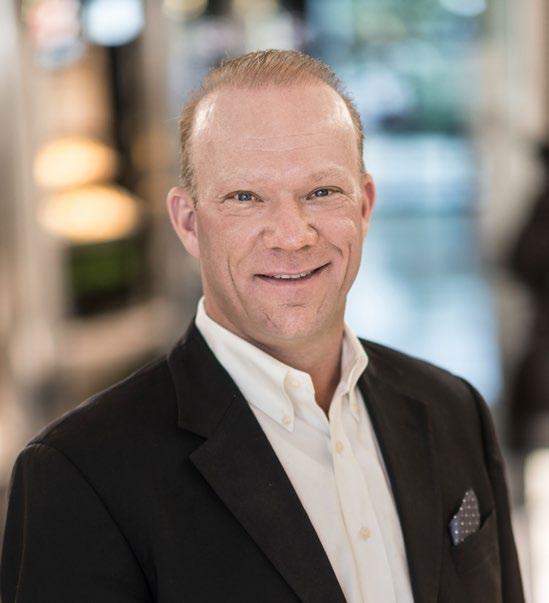
Anders Berggren (born 1971)
Chair, elected 2020.
Education: MSc in Engineering (Industrial Economics), Linköping University 1995, Harvard Business School Executive Program 2007.
Professional experience: CEO of BlackStad Inc., Partner at Wind Point Partners, Operating Partner at Kinderhook Industries, Business Unit Manager at Marmon Holdings Inc., and a number of senior management roles at Husqvarna AB.
Other appointments: Chair of the Board of BlackStad Inc and Fastems Oy AB, Board Member of Dacke Industri AB, and Senior Advisor at Nordstjernan.
Shareholding in AGES: 130,000 Class B shares (with related parties)
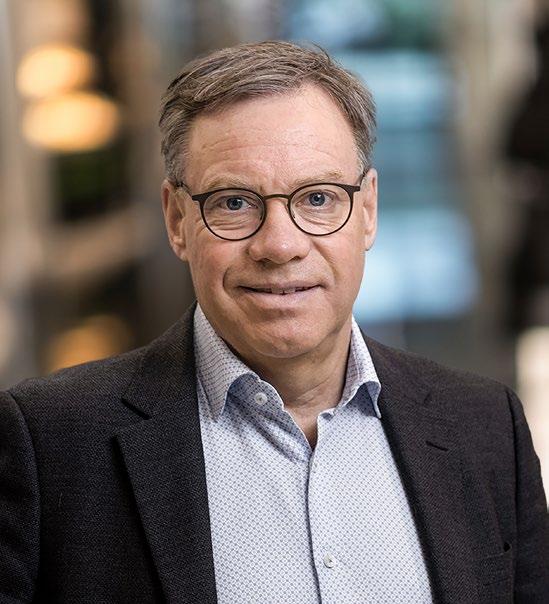
Lennart Persson (born 1968)
Board member, elected 2023.
Education: BSc in Engineering
Professional experience: CEO of XANO Industri AB, CIO of Eldon Vasa, business development ITAB, CEO of ITAB Kaluste and ITAB Plast.
Other appointments: Chair of the Board of Directors of Pelly Group AB
Shareholding in AGES: 2,000 Class B shares.
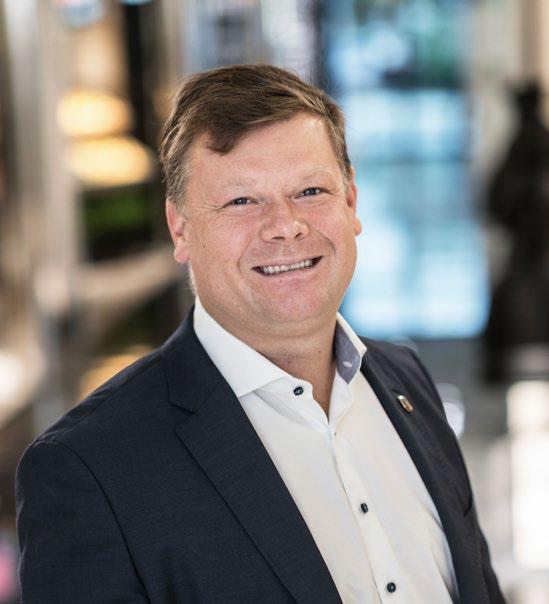
Fredrik Rapp (born 1972)
Board member, elected 2013.
Education: MSc in Business and Economics.
Professional experience: CEO of Pomona-gruppen, Investment manager Pomona-gruppen, CEO of Talk Telecom.
Other appointments: Chair of the Board of XANO Industri AB (publ), Argynnis Group AB, Estinvest AB, Serica Consulting AB and Svenska Handbollsförbundet, among others. Board member of ITAB Shop Concept AB (publ), Corem Property Group AB (publ), Pomona-gruppen AB, AB Segulah and others.
Shareholding in AGES: 540,000 Class A shares and 1,523,545 Class B shares.
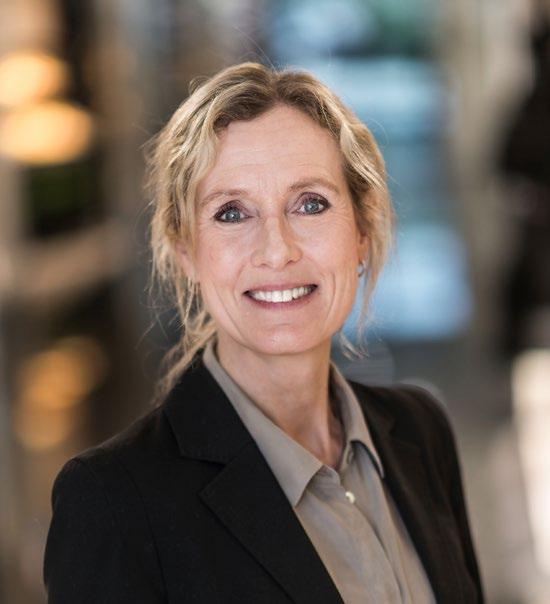
Petra Öberg Gustafsson (born 1970)
Board member, elected 2021.
Education: International marketing.
Professional experience: Various senior management positions at SKF in sales and product management, CEO of TengTools AB, CEO of Fristads AB, CEO of Emma Safety Footwear, and Head of Lyngsoe Rainwear.
Other appointments: - Shareholding in AGES: 6 ,120.
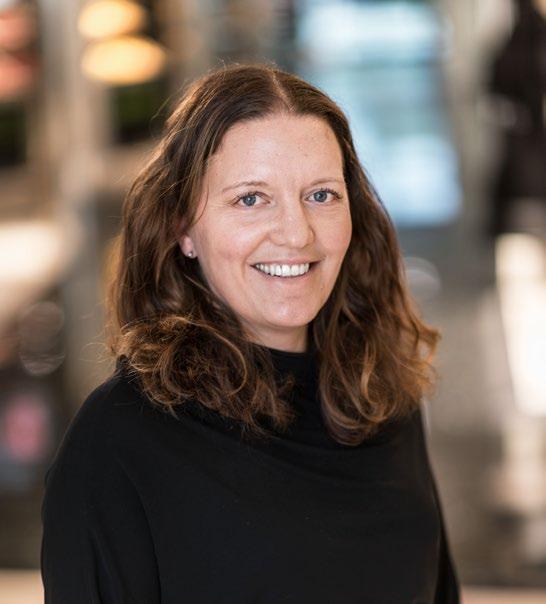
Anna Benjamin (born 1976)
Board member, elected 2015.
Education: MSc in Economics, Jönköping International Business School.
Professional experience: Business development ICA Sverige AB, Manager PricewaterhouseCoopers, Controller Nobina.
Other appointments: Board member of XANO Industri AB (publ), Hand in Hand Sweden, Pontix AB and others.
Shareholding in AGES: 1,282,200 Class A shares and 700,200 Class B shares.
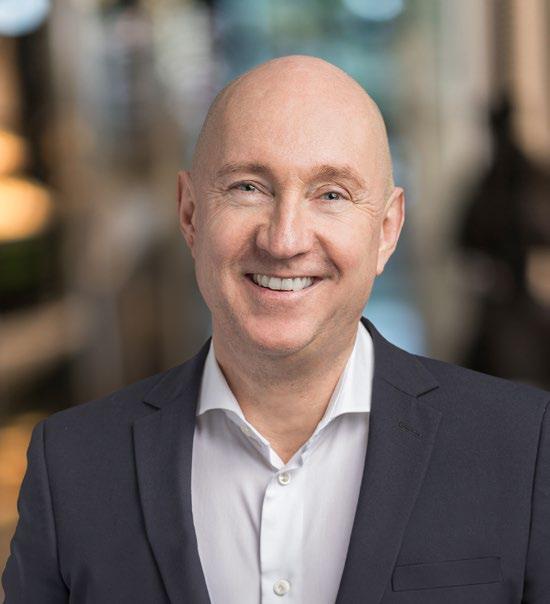
Lars Jonsson (born 1965)
Board member, elected 2023.
Education: Law and Human Resources. University West and various international leadership programmes.
Professional experience: Chief Operating Officer of ViaCon Group AB (publ), Senior Vice President of Inwido AB (publ), Executive VP/COO of Specma Group, CEO of Crane AB
Other appointments: -
Shareholding in AGES: 1,000 Class B shares.
Group management
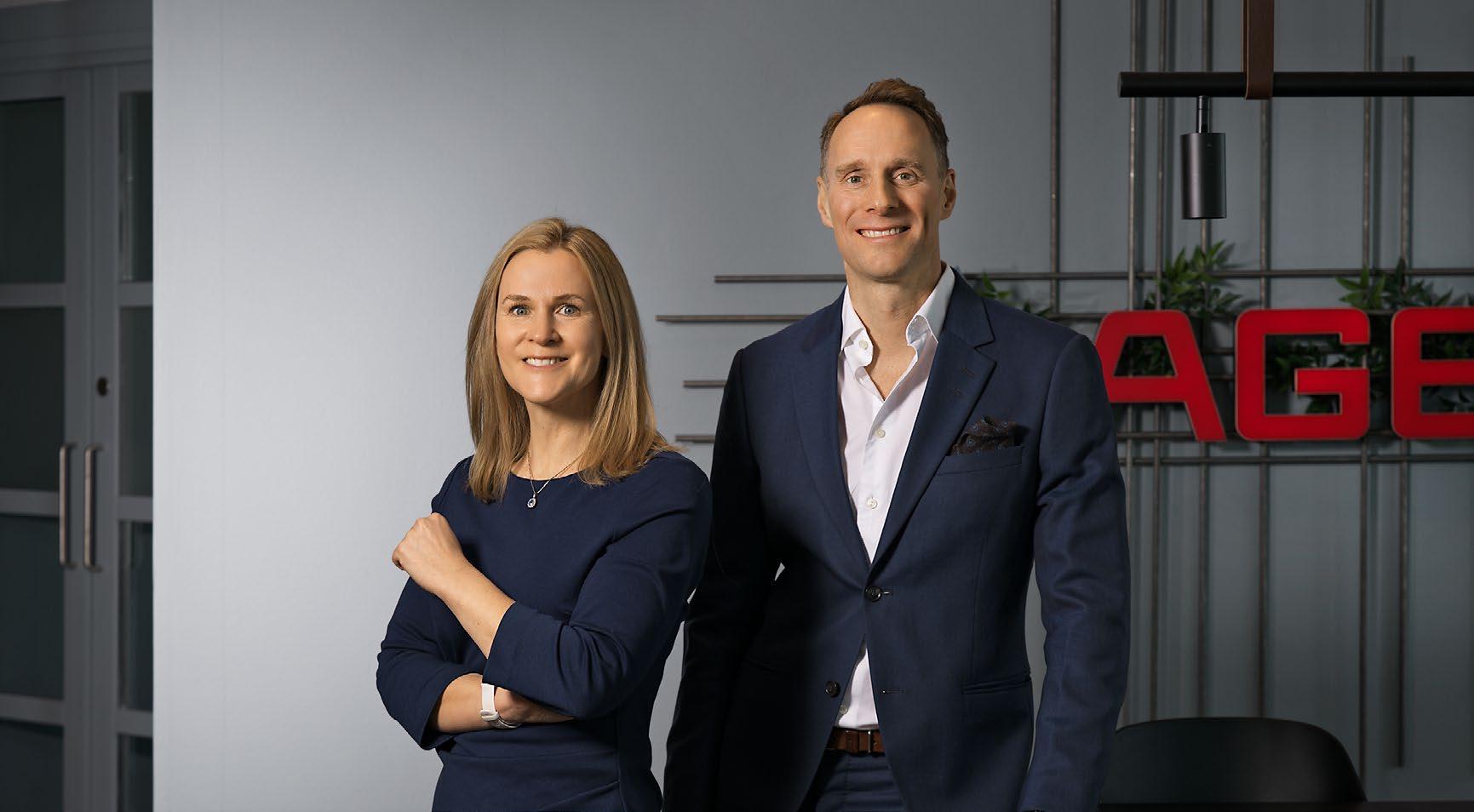
Vibeke Gyllenram (born 1977)
CEO, employed since 2026.
Education: Master’s degree in Economics.
Professional experience: VP Stormwater Solutions at ViaCon Group; senior positions at ABB Process Automation and Robotics, both in Sweden and globally.
Other appointments: Board member of XANO Industri AB (publ).
Shareholding in AGES: 6,392 Class B shares.
CFO since 2013.
Education: MSc in Business and Economics.
Professional experience: Business area controller Getinge Infection Control, Group controller Getinge AB, auditing KPMG.
Shareholding in AGES: 17,660 Class B shares.
Johan Bladh (born 1978)
Carolina Timén (born 1981)
Auditor Authorised Public Accountant, elected 2022. Ernst & Young Jönköping.
Makes Things Easier
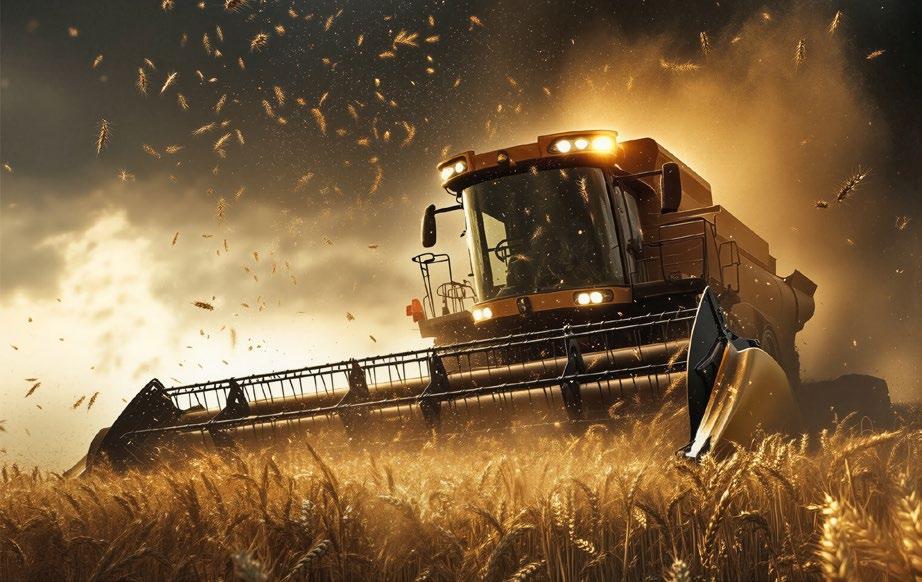
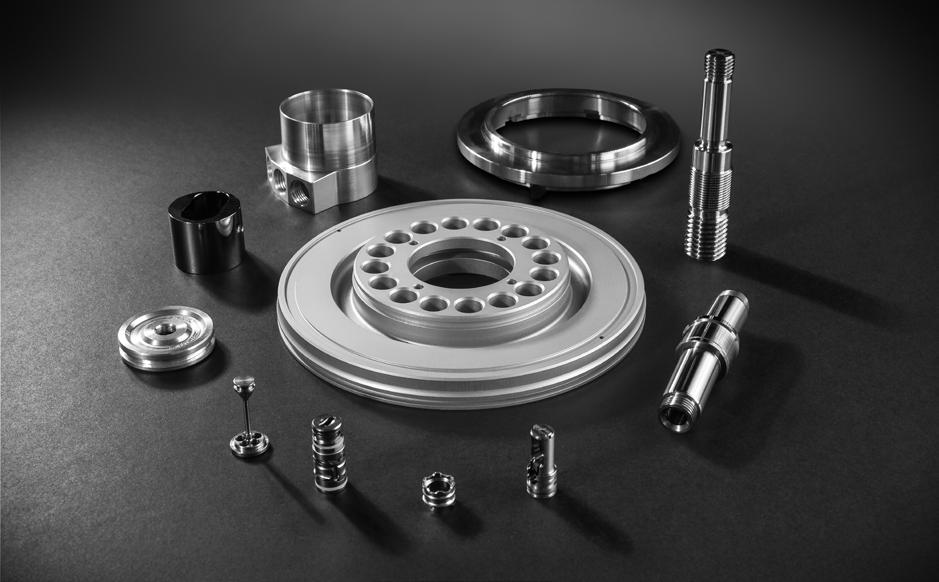
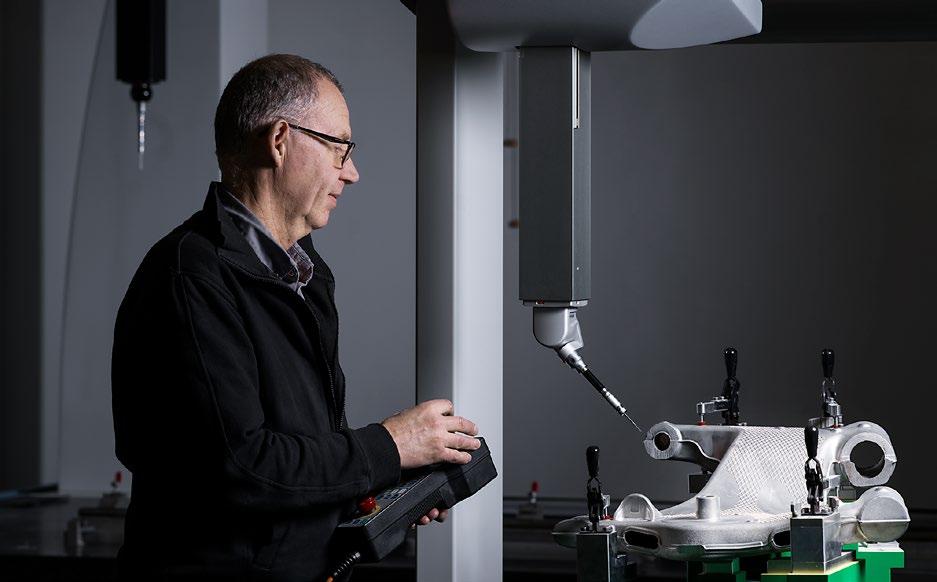
Annual General Meeting
Notice is hereby given that the Annual General Meeting of AGES Industri AB (publ) will be held on Tuesday, 5 May 2026 at 15:00 CET in the Mangold restaurant, Halmstad University, Kristian IV:s väg 3, SE-302 50 Halmstad, Sweden.
Notice Shareholders wishing to attend the Annual General Meeting must (i) be entered in the register of shareholders maintained by Euroclear Sweden AB as at 24 April 2026 and (ii) must notify the company of their intention to participate in the Annual General Meeting not later than 16:00 CET on 28 April 2026 either by post to AGES Industri AB, PO Box 815, SE-301 18 Halmstad, by phone on +46 (0)706 048 382, or by email to arsstamma@ages.se. A registration form can be obtained from www.ages.se
To be entitled to participate in the Annual General Meeting, shareholders who have registered their shares in the name of a nominee must, in addition to confirming their attendance at the AGM, re-register their shares in their own name so that the shareholder is entered in the shareholder register as at 24 April 2026. Such registration may be temporary (so-called voting rights registration) and should be requested from the nominee in accordance with the nominee’s procedures and giving advance notice as determined by the nominee. Voting rights registration completed not later than 28 April 2026 will be taken into consideration in the preparation of the shareholder register.
Dividend The Board of Directors proposes to the Annual General Meeting that a cash dividend of SEK 1.00 per share be paid. The record date for the dividend will be
7 May 2026. Provided that the Annual General Meeting ratifies the proposal, the dividend will be distributed by Euroclear on 12 May 2026.
Nomination Committee At the 2025 Annual General Meeting, a Nomination Committee was appointed consisting of Anna Benjamin as Chair and Jonas Abrahamsson. The task of the Nomination Committee ahead of the 2026 Annual General Meeting is to propose the Chair of the Board of Directors and other Board members, auditors, a chair for the AGM, and remuneration to the Board of Directors, committees and auditors.
Business The Annual General Meeting shall conduct such business as according to the Swedish Companies Act and the Articles of Association should be conducted at Annual General Meetings, including presentation of the Annual Report and Auditor’s Report, resolutions on adoption of the income statement and balance sheet, discharge from liability for Board members and the CEO, and election of Board members and auditors.
Other agenda items will be stated in the notice of the Annual General Meeting, published in the official Swedish gazette Post och Inrikes Tidningar and on the company’s website not later than four weeks before the meeting.

“ AGES Industri shall continuously develop to be a leading and profitable industrial partner in sustainable and innovative manufacturing for future generations.”
AGES Falkenberg AB Kabelvägen 10
SE-311 50 Falkenberg
Phone +46 (0)346 71 50 00
AGES Hörle AB
Box 436
SE-331 24 Värnamo
Street address: Hörle 3
Phone +46 (0)370 33 37 00
AGES Kulltorp AB Gnosjövägen 10
SE-335 96 Kulltorp
Phone +46 (0)370 836 60
AGES Värnamo AB
Box 308
SE-331 23 Värnamo
Street address: Silkesvägen 11
Phone +46 (0)370 69 23 30
A-Tooling AB Bredastensvägen 18
SE-331 44 Värnamo
Phone +46 (0)370 37 41 90
APM August Pettersson AB Vitarörsvägen 5 SE-331 53 Värnamo
Phone +46 (0)370 69 26 30
Östlings Verktygs AB Marieströmsvägen 47
SE-335 32 Gnosjö
Phone +46 (0)370 33 31 60
AGES China
Hörle Automatic (Ningbo) Co.Ltd No.108 JinChuan Road
Nordic Industrial Park Zhenhai, Ningbo 315221 P.R. China
AGES Industri AB (publ), Box 815, SE-301 18 Halmstad
Street address: Kristian IV:s väg 3, Fl. 19, SE-302 50 Halmstad
agesindustri @ ages.se www.ages.se
Corporate ID number 556234-6204
AGES Poland Sp. z o.o. Zacisze 42 39-300 Mielec Poland
AGES Shared Services AB Hörle 3 SE-331 92 Värnamo
Tel. +46 (0)370 65 07 00