#FixOurSchools
We have been campaigning for decent school infrastructure since 2008. An important focus of our school infrastructure campaign was to ensure that government publishes a law that sets minimum requirements for school infrastructure. In 2013, we won a historic victory in our school infrastructure campaign, when Basic Education Minister Angie Motshekga published the Regulations relating to Minimum Norms and Standards for Public School Infrastructure
For the first time, South Africa now had a law that set out what basic infrastructure a school must have,
with deadlines by when government must deliver such infrastructure to schools.
However, there were unacceptable loopholes in the Norms and Standards for Public School Infrastructure that would allow the Department of Basic Education (DBE) and provincial education departments to indefinitely delay fixing schools. The focus of our infrastructure campaign then shifted towards closing these loopholes through the #FixTheNorms court case
In 2018, a full ten years after we started campaigning for better school infrastructure, the Bhisho High Court found entirely in our favour in the #FixTheNorms case and instructed the DBE to amend the Norms and Standards for Public School Infrastructure where necessary.
Our infrastructure campaign now focuses on the implementation of the law, and ensuring that government meets the deadlines set out in it.
Since 2013, when we got Minister Motshekga to sign the Norms and Standards for Public School Infrastructure into law, thousands of schools have received water, electricity and decent toilets, and hundreds of schools made of inappropriate materials, such as mud and asbestos, have been replaced. But government is very far behind in meeting its own targets.
The progress is too slow!
The DBE and the provincial education departments could have been much closer to fulfilling their legal, political and moral duty, but they have not shown the political will to ensure that our schools are fixed with the urgency that is needed.
Every year, the DBE publishes a report with information on the state of infrastructure in all schools in South Africa - the National Education Infrastructure Management System (NEIMS) report.
According to the 2021 NEIMS report:
90 schools do not have electricity
2,130 schools have plain pit latrines as the only form of toilets
5,836 schools Have an unreliable water supply
3,343 schools have an unreliable electricity supply
70% of schools do not have libraries
80% of schools do not have laboratories
School infrastructure campaign
Limpopo
#FixOurSchools
fell into a pit toilet and drowned at Mahlodumela Primary School in Limpopo. Michael’s family fought painfully, for many years, to get justice.
In 2015, his mother, father and siblingsrepresented by SECTION27 lawyerstook the DBE, the Limpopo Department of Education (LDOE) and his school to court, for failing Michael while he was under their care and supervision. Equal Education - represented by the Equal Education Law Centre (EELC) - joined the court case as amicus curiae (a friend of the court), to support the Komape family’s claim. Our submission to the Polokwane High Court was to explain the history of our campaign for the adoption of the Norms and Standards for Public School Infrastructure - to show the knowledge that government had,
or should have had, of the crisis of unsafe school infrastructure in the province.
In 2017, Equal Education conducted school visits in Ga-Mashashane in Limpopo, and found that many more school toilets were dangerous and unusable.
The findings from the 18 schools that we audited, which are in our report Dikolo tša go hloka seriti include that:
11 schools had plain pit latrines as their only form of sanitation 4 schools had no access to water at all.
In 2019, the Supreme Court of Appeal (SCA) overturned the decision of the Polokwane High Court, which refused to award financial compensation to the Komape family for their emotional shock and grief.
Despite Limpopo Education MEC Polly Boshielo promising that plain pit latrines would be eradicated in the 2020 financial year, there were still 219 schools with plain pit toilets as their only form of sanitation, according to the DBE’s own data (the 2021 National Education Infrastructure Management System).
to the Polokwane High Court to make submissions for the second part of the Komape court case, to get government to fix the toilets in all the schools in Limpopo.
The court ruled, on 17 September 2021, that the plan of the Minister of Basic Education (DBE) and the Limpopo Department of Education (LDoE), to take 14 years to get rid of pit toilets in Limpopo schools, is unconstitutional and fails to meet the requirements of the structural order that was granted by the court in 2018.
The judgment ordered that the new plan includes:
In 2021, as part of our school infrastructure campaign, we returned
A list of all the schools with plain pit toilets in Limpopo (including schools with only plain pit toilets, schools with plain pit toilets as well as other forms of sanitation, and schools with unused plain pit toilets (that are not yet demolished); A new deadline (and detailed justification for this deadline) for getting rid of plain pit toilets in all Limpopo schools; and A detailed budget for the implementation of this plan (including steps taken to secure more money).
School infrastructure campaign Gauteng
#FixOurSchools
In 2013 Equal Education Gauteng members embarked on a sanitation campaign. This came after Equalisers in Tembisa, a township outside Johannesburg, conducted a survey of 11 schools to identify the biggest challenge they were facing. The survey showed that the state of school toilets was very poor. They found that poor sanitation was a major issue across all schools.
The Gauteng Education MEC responded to our advocacy by:
spending R15 million on upgrading the toilets at schools in Tembisa spending R150 million on school toilets throughout the province prioritising the of the 50 worstoff schools.
The work done included painting, fixing pipes, fixing ceilings, repairing windows, installing burglar bars, and replacing basins, doors, locks on doors, taps, toilet seats, and urinals. However another major issue that became apparent from our visits is that poor or complete lack of maintenance contributes to the prevalence of poor sanitation conditions in schools.
#NoSpaceForUs
74% of the classes that we inspected had over 40 learners.
82% of the classroom buildings that we inspected had too few desks and chairs for learners
65% of the teachers that we interviewed were overworked.
Equal Education Gauteng members have also fought for the Gauteng Education Department to rebuild schools that are made from asbestos. We are now taking on a campaign to address the severe overcrowding in Gauteng schools.
“We have schools that are not conducive to learning. We have schools that are not safe. We need more funding to maintain our classes.
In 2018, we released our new report on the state of Gauteng school toiletsBreaking the Cycle - which shows that the toilets in the 38 schools that we visited were repaired or renovated in response to our advocacy in the previous years.
Our sanitation is ver y bad, we need toilets, we need classrooms. There is no electricity in our schools. We need more money to be able to maintain our schools and to make our schools functional […].
Our schools need to be built properly so that ever yone can have the chance to access all the opportunities.
For our research on overcrowding, in 2019 and 2020 we visited schools in Etwatwa. We inspected classrooms and interviewed learners, teachers, principals and administrative staff. Overcrowding affects the physical environment of classrooms and schools. Teachers told us they struggle to move around the classroom, and that infrastructure and furniture deteriorate quickly
Overcrowding affects behaviour by making it impossible for teachers to give learners the attention they need, and also has negative psychological effectswith teachers unable to cope with their workload, and learners feeling neglected and detached from school work.
In November 2021, we launched our campaign aimed at putting an end to overcrowding in Gauteng schools. Our campaign aims to provide insight into what overcrowding is in a South African context, whether Gauteng schools are overcrowded, and what the causes and effects of overcrowding are. Our research has resulted in a written report, entitled No Space For Us: Understanding Overcrowding in Gauteng’s Schools, in which recommendations to lessen current overcrowding and prevent future overcrowding are made.
Scholar transport campaign
#LongWalkToSchool
Equal Education, supported by the Equal Education Law Centre have been working since 2014 to get learners in KwaZulu-Natal access to safe, reliable governmentsubsidised scholar transport. The #LongWalkToSchool campaign has its roots in the experiences of learners attending schools in Nquthu in northern KwaZulu-Natal, who told us about how they must walk very long distances to school. Learners must cross rivers and hills, in severe heat or rain.
Learners who walk long distances to school are also vulnerable to theft and sexual assault.
Our campaign for scholar transportwhich has included many protest actions and a legal challenge in the Pietermaritzburg High Court - has succeeded in getting these vital victories:
In 2015, buses were provided by
to transport learners at three schools in Nquthu;
In 2017, the
a public commitment to work with National Treasury to explore the introduction of a conditional grant to fund scholar transport;
In 2018, buses and taxis were provided by
to transport learners at 12 Nquthu schools;
In 2020, the of Education released a draft scholar transport policy, for members of the public to give feedback on it. Equal Education (EE) and the Equal Education Law Centre (EELC) sent a detailed submission on the draft policy to the department, pointing out serious
In 2021, EE and the EELC succeeded in getting a copy of the final KZN Transport Policy after once again taking to the streets to protest.
School infrastructure campaign
Eastern Cape #FixOurSchools
The Eastern Cape has been at the centre of our school infrastructure campaign, as the province with the worst infrastructure backlogs.
A very important development in our campaign in the Eastern Cape was in 2016, when we visited 60 schools across seven districts in the province, to investigate government’s compliance with the Norms and Standards for Public School Infrastructure. Our findings were published in our Planning to Fail report, and showed how severe the infrastructure crisis is. In 2018, we visited seven of those 60 schools and found that there had been infrastructure upgrades at six out of the seven schools. The upgrades included new toilets, new classrooms, and being provided with electricity and piped water
The question of why the learners and the teachers at the 60 schools had to suffer with such poor infrastructure, and why the government takes so long to fix schools throughout the province, led us to investigate the role that implementing agents play in poor service delivery Implementing agents build schools on behalf of education departments. Implementing agents can be State-owned enterprises or non-profit organisations. Getting education departments to blacklist implementing agents and building contractors who do not do their jobs properly and waste government money, is one of the goals of our infrastructure campaign.
“We have schools that are not conducive to learning. We have schools that are not safe. We need more funding to maintain our classes.
Our sanitation is ver y bad, we need toilets, we need classrooms. There is no electricity in our schools. We need more money to be able to maintain our schools and to make our schools functional […].
The construction of an entirely new school was also finally finished.
Our schools need to be built properly so that ever yone can have the chance to access all the opportunities.
The victories of our school infrastructure campaign in the Eastern Cape are not limited to new infrastructure for individual schools. Our victories also impact the entire systeman example of this is that the DBE has developed guidelines for the appointment of implementing agents. These guidelines help with ensuring that the right people, who can do the job and complete it on time, are building our schools.
School safety campaign Western Cape
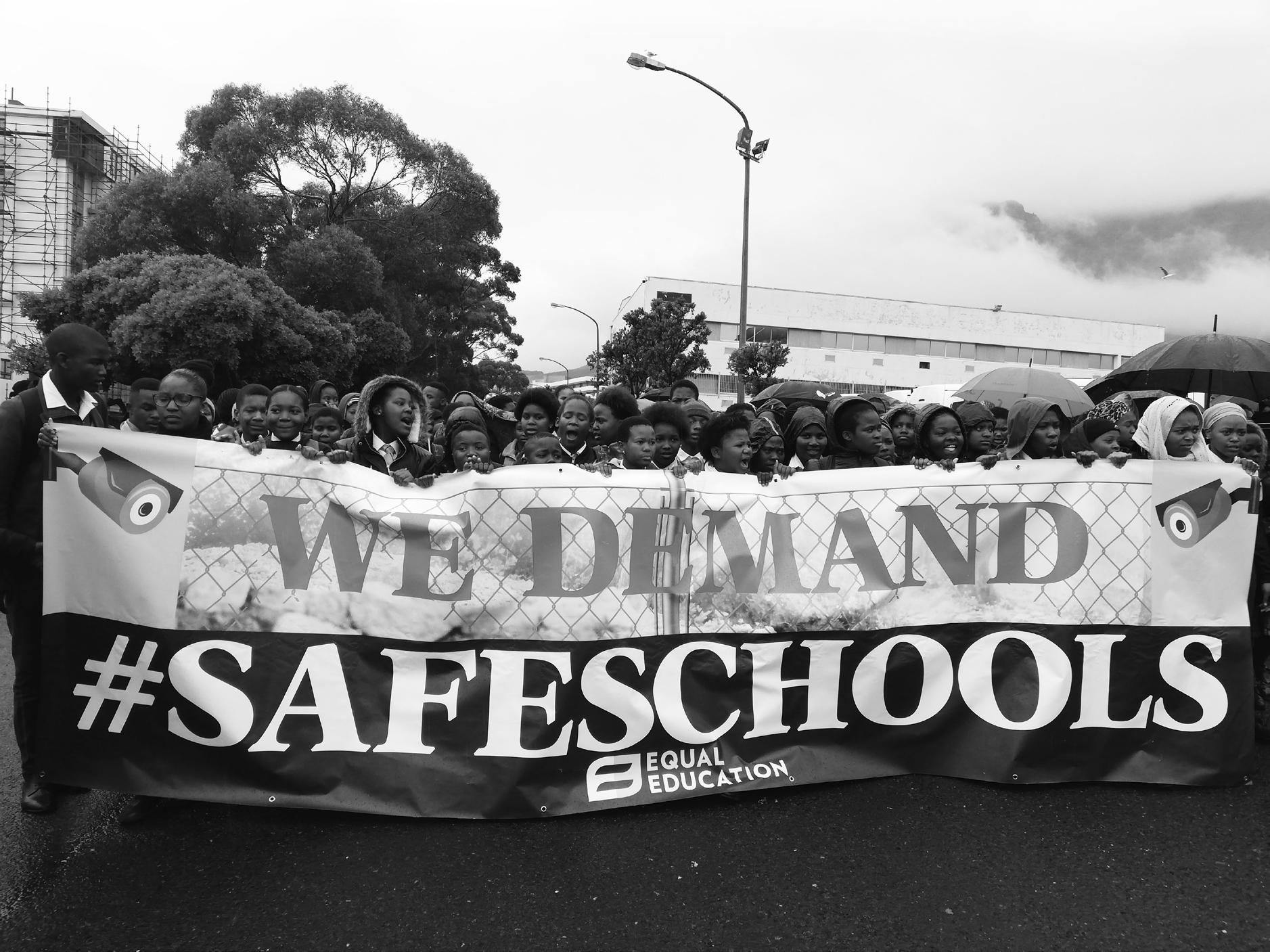
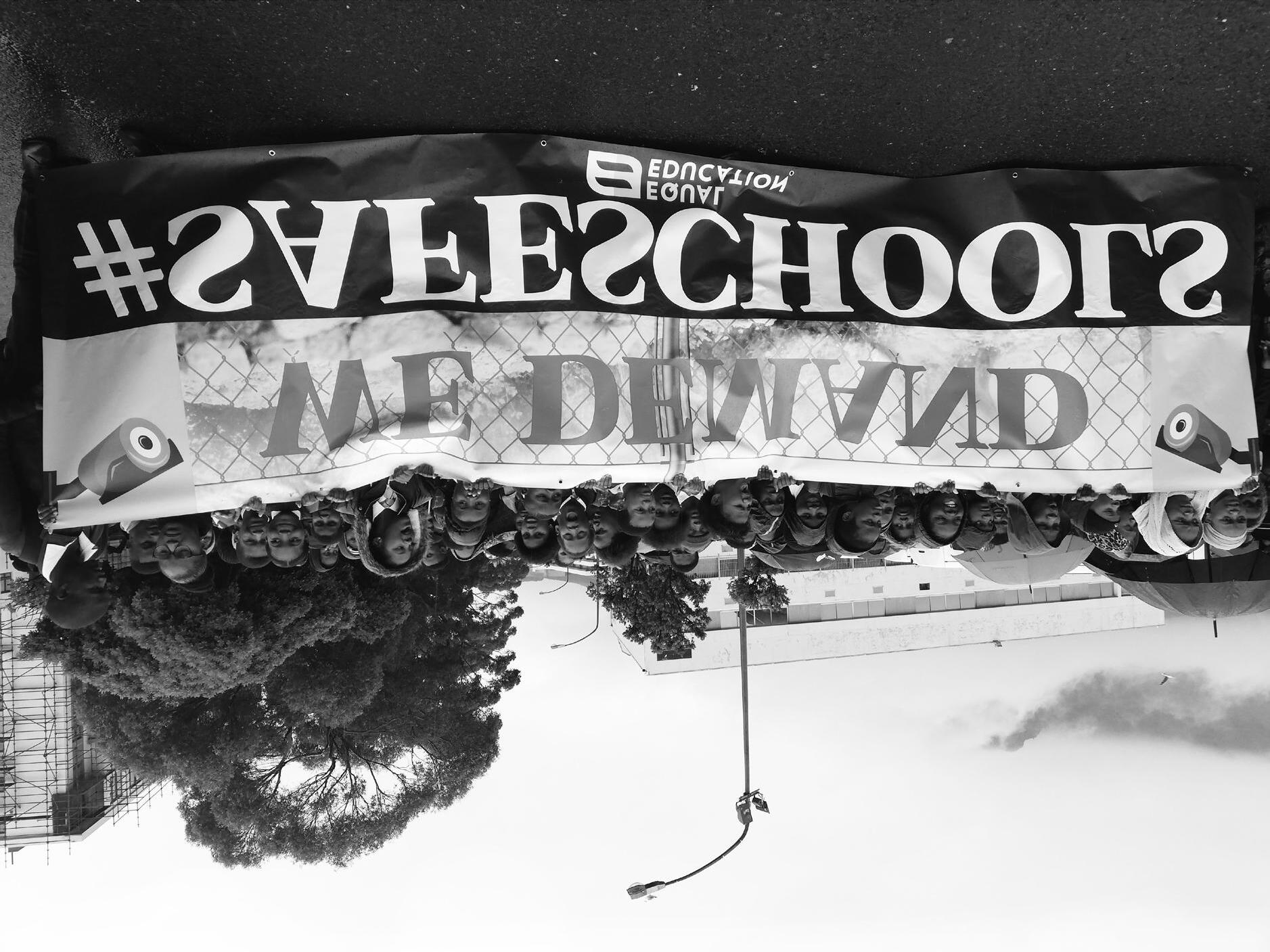
#SafeSchools
In 2015, Equal Education launched a social audit in schools in the Western Cape to investigate the safety of learners while at school and, when on their way to school.
Working with partner organisations, we audited 244 schools serving 217,388 learners. The audit process involved interviewing school administrators, recording our physical observations of infrastructure at schools, and learners completing questionnaires about their schooling experience.
These findings were captured in our social audit report titled, Of Loose Papers and Vague Allegations and informed the demands made by members in the Western Cape as part of EE’s safe schools campaign.
Some of the audit’s key findings were:
47% of schools that we audited have a full-time security guard. At 85% of schools that we audited there was corporal punishment.
98% of schools that we audited had fences.
42% of schools that we audited had holes in their fences.
16% of schools that we audited had learners reporting incidences of sexual violence.
We gave a copy of our report to President Cyril Ramaphosa, during a visit of his to Khayelitsha at the start of 2018. In September 2018, the Presidency announced school safety as one of its top priorities, and in October 2018 the DBE held a Safety Summit to strategise on how to reduce school violence
Our #SafeSchools campaign also contributed to the Western Cape Education Department identifying school safety as a key priority.
Our determined and persistent advocacy about the importance of funding, and support for school-based committees and provision of infrastructure such as fencing in order to create safe schools, has placed this issue firmly on the agenda of the Western Cape Provincial Legislature’s Standing Committee.
Our work has directly informed the questions that members of the provincial legislature put forward to the Western Cape Education Department. Those questions include the budget allocated to safety and security, and the importance of safety training for teachers at schools.
#SchoolMealsNow
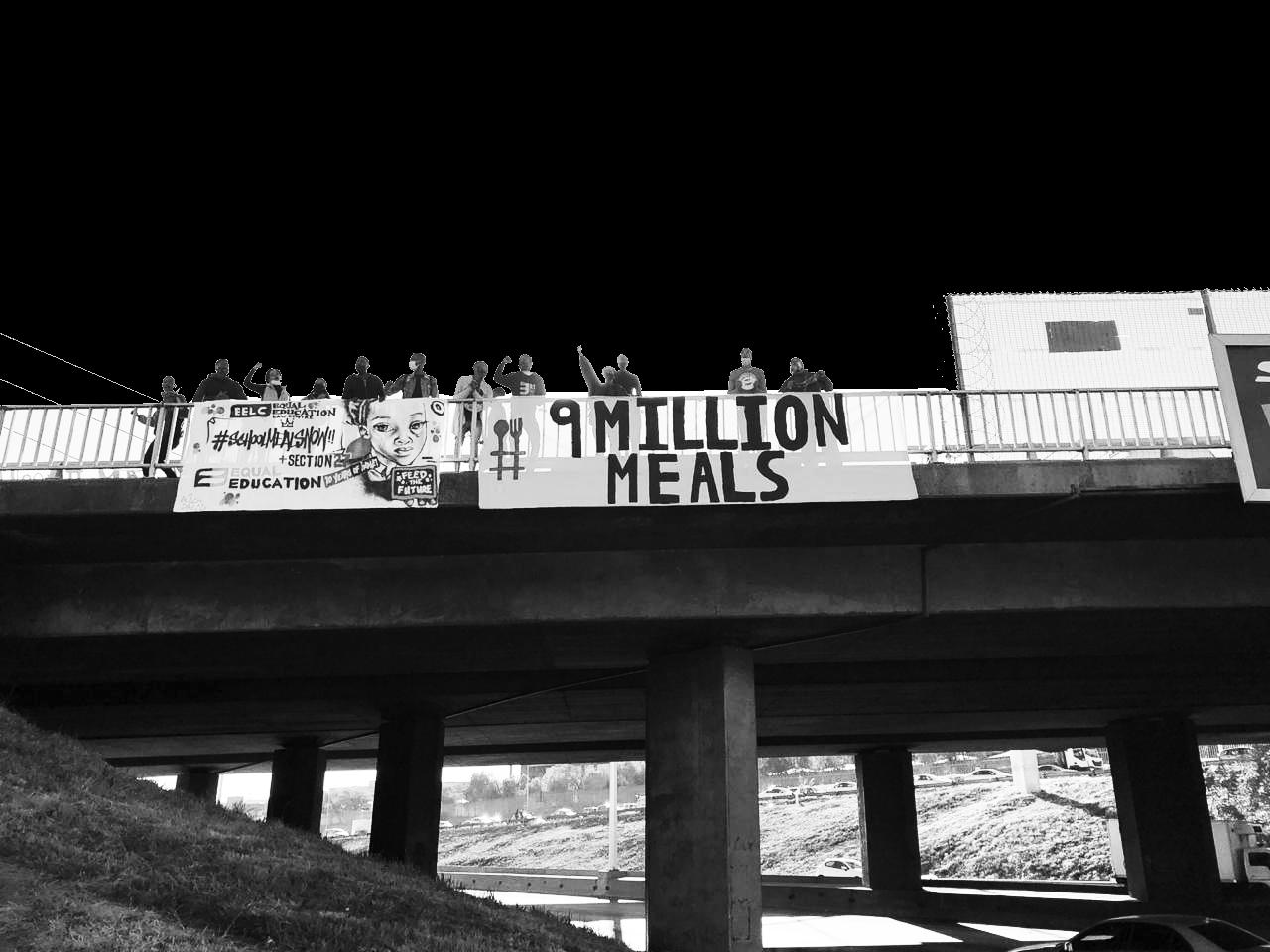
#9MillionMeals
In March 2020 the National School Nutrition Programme (NSNP) was suspended as schools shut down due to COVID-19 The NSNP is fundamental in supporting the ability of children to learn both at school and at home, and is crucial to the right to basic education.
In June 2020, Equal Education and the school governing bodies of two Limpopo schools, represented by SECTION27 and the Equal Education Law Centre (EELC), launched an urgent court application against the DBE and eight provincial education departments. We challenged the failure of the national and provincial education departments to roll out the NSNP to all learners.
On 17 July 2020, Acting Deputy
Judge President of the North Gauteng High Court, Judge Sulet Potterill ordered the DBE to roll out the NSNP to all eligible children without delay –regardless of whether learners were in their classrooms or learning from home
Equal Education, the EELC and SECTION27 have since undertaken the crucial work of public education on the judgment and have been monitoring its implementation on the ground.
The suspension of school feeding has made our daily lives that much more challenging. We need the school feeding programme to start again so that the school-going children in our household can eat and we can buy food that we can all eat.
– Caregiver, KwaZulu-Natal
[It] does not make sense because the majority of us were dependent on the school feeding scheme. All deser ving learners should be given food.