AFROPAC & GIZ: Finding a Shared Voice | Research Report 2021
This is a final report of a research assignment carried out for AFROPAC, SADCOPAC, and GIZ between March 2020 and December of 2021.
Its aim was to analyse SADCOPAC’s history as a network of Public Accounts Committees (PACs) in Southern Africa, with a special focus on its resolution-making mechanism. To that end, this report comparatively analyses all available resolutions made at annual conferences since 2004 as well as all available country-specific implementation reports about these resolutions since 2011, alongside other primary and secondary sources from SADCOPAC and development partners.
Taking SADCOPAC’s experience as a case study of PAC network cooperation, the report then draws lessons for such organisations and their resolution-making in the region. Focusing on the demand for future PAC network cooperation and key lessons for AFROPAC as a continental PAC network, the report draws on discussions at a Webinar with stakeholders held in June 2021, on a follow-up survey among Webinar participants, as well as on semi-structured interviews with PAC MPs, clerks, and AFROPAC functionaries to develop recommendations.
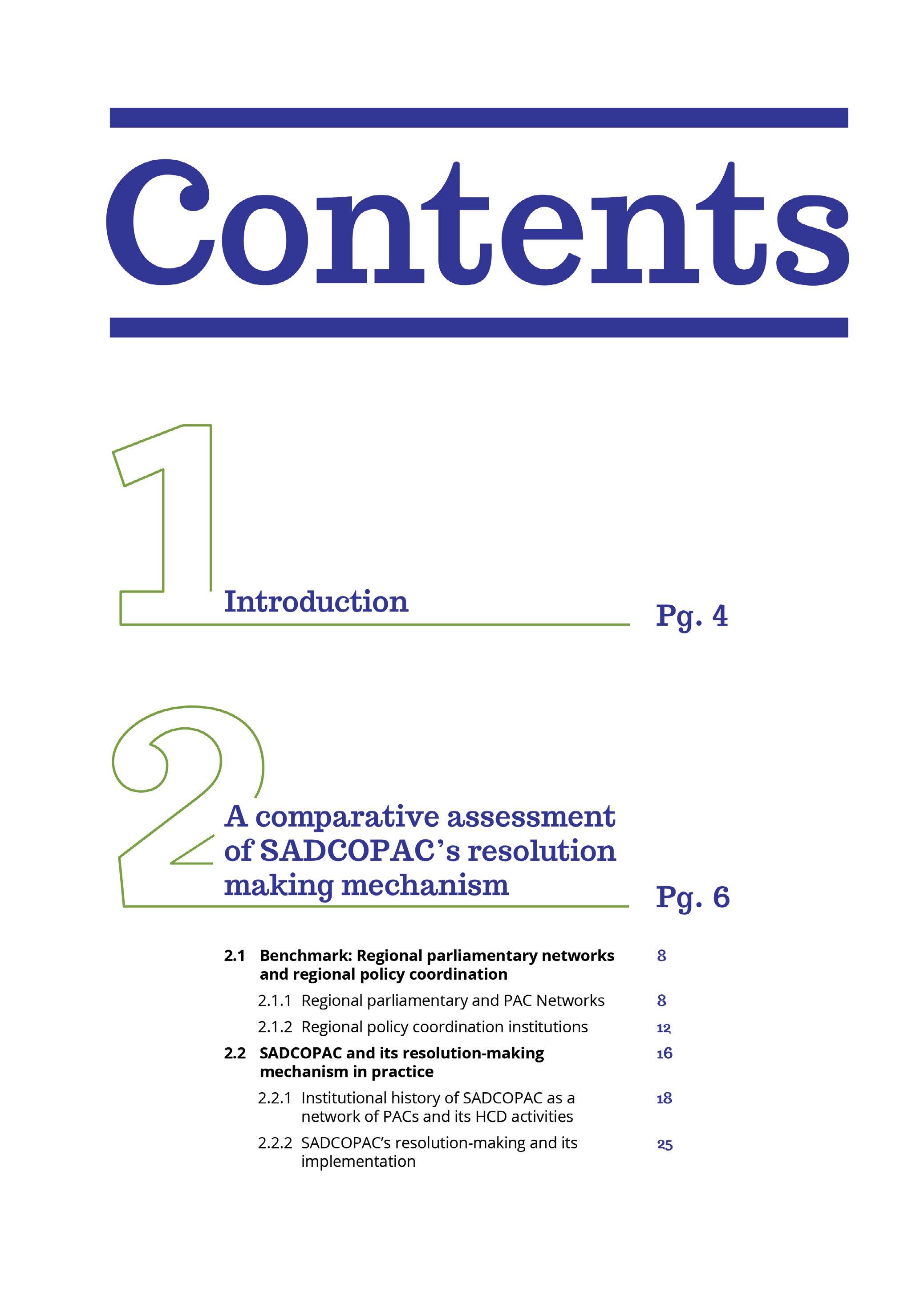
Against this background, the remainder of this report presents the results of the assignment in two main steps. The following Section 2 assesses SADCOPAC’s resolution-making mechanism based on the desk analysis of primary and secondary documents against a comparative benchmark drawn from the academic literature on regional organisations as well as expert interviews. Section 3 then assesses the demand for future regional PAC network cooperation and discusses recommendations based on the Webinar, the conducted survey, and follow-up interviews with stakeholders, focusing especially on SADCOPAC and AFROPAC as well as the areas of HCD and regional interinstitutional cooperation.
To assess the case of SADCOPAC first demands clarity about the kind of institution it is and its goals. As set out in the Constitution (last amended in 2016) which forms its legal basis, SADCOPAC is a regional organisation (Art. 7) with a dual mandate conferred on it by the member states who signed this document: (1) it acts as a network which supports and links PACs who perform similar roles in their respective domestic contexts (Preamble & Articles 4, 5 and 8) and (2) it coordinates policy among member states on matter relating to parliamentary budget supervision (Art. 14, 15, 16). SADCOPAC has no formal power over either member states or their PACs to pursue these goals (Art. 3).
The Southern African Development Community Organisation of Public Accounts Committees (SADCOPAC) is a regional organisation of parliamentary bodies which has two main goals: ( 1 ) enabling peer-learning among PACs in the region and (2) coordinating member state policy on parliamentary public financial management (PFM) supervision.
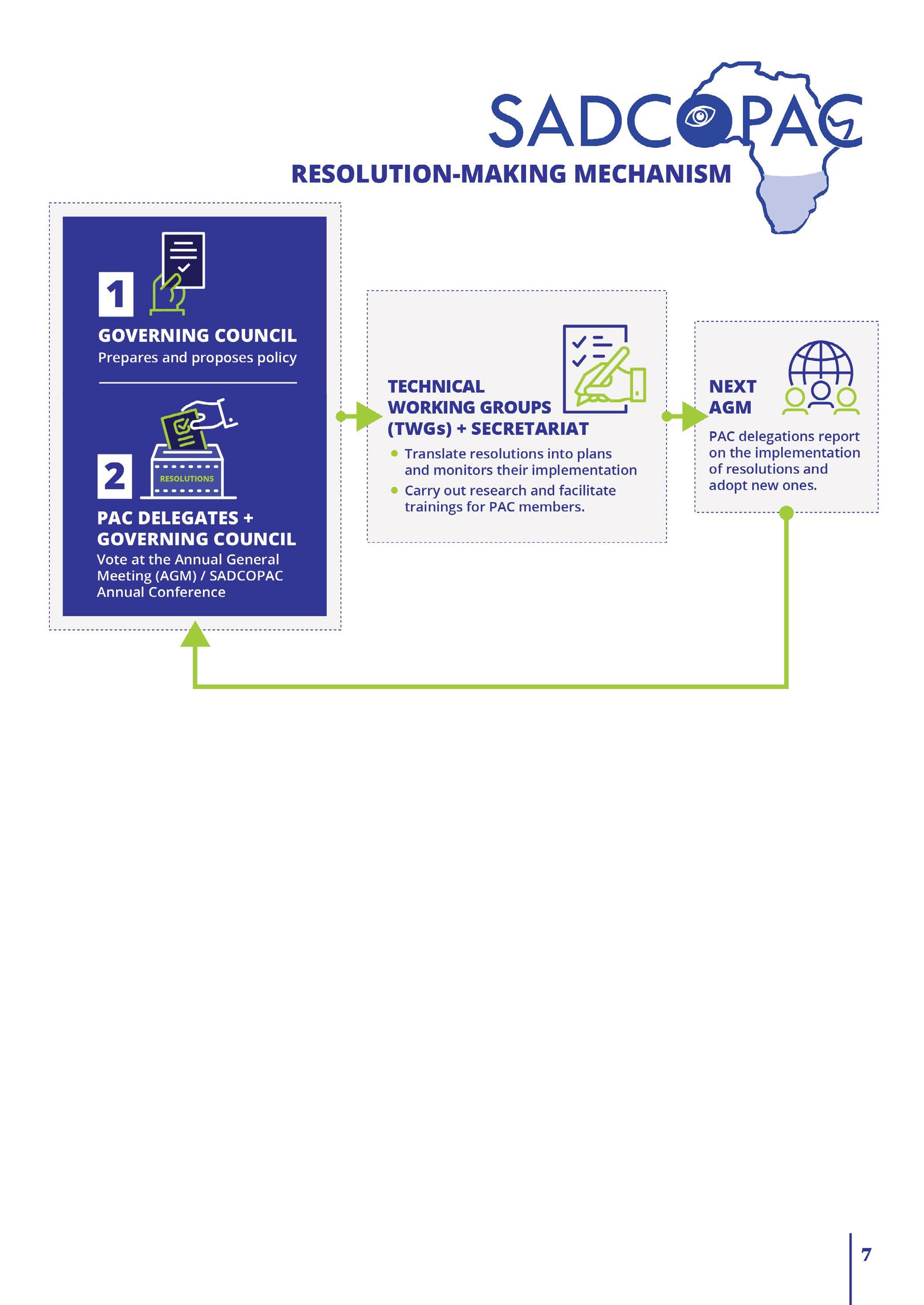
The main procedure through which SADCOPAC is to operate according to the Constitution is its resolution making mechanism (Art. 14-16). It has two main steps: first, the Governing Council prepares and proposes policy (that is, collective resolutions) for the Annual General Meeting (AGM) as the “supreme decision and policy making body” (SADCOPAC Constitution, p.8), organised by the permanent Secretariat. Second, two PAC delegates per member state without financial arrears as well as each member of the Governing Council then vote on these proposals at the AGM (held at the annual SADCOPAC Conference) under simple majority voting with a majority quorum of member states needed.1
Upon acceptance, Technical Working Groups (TWGs) who support the Governing Council throughout the process are expected to translate resolutions into concrete work plans and monitor their implementation alongside the Secretariat (as well as carrying out research and facilitating trainings for PAC members). At the next AGM, member state PAC delegations are then expected to report on the implementation of resolutions and adopt new ones.
Realistically assessing the effectiveness of SADCOPAC’s resolution-making mechanism requires a comparative perspective. That is, to not mistake (lack of) success with (lack of) effort, its experience should be judged against the standard of comparable regional institutions trying to achieve similar goals.
Accordingly, this section first develops a benchmark for the two primary goals of SADCOPAC as a regional institution: acting as an effective regional network
for parliamentary PAC bodies and successfully coordinating policy through the making and implementing of resolutions. Specifically, I use academic literature on regional cooperation and insights from expert interviews on comparable institutions to contextualise SADCOPAC and its resolution-making mechanism and develop reasonable expectations about its effectiveness and limitations.
Thereupon, I present and analyse the experience of SADCOPAC’s resolution-making, drawing on primary and secondary documents about collective resolutions since 2004 and their implementation by member states since 2012. Comparing this practice of resolution-making against the benchmark developed before, I then draw lessons and identify success factors at the level of SADCOPAC as an institution, its collective resolutions, and member states’ implementation and reporting.
Like in the case of SADCOPAC, countries and public institutions within them often network at the regional level to benefit from knowledge generated elsewhere, to pool resources for common challenges and to advance shared political interests. Accordingly, SADCOPAC’s efforts as an institution where PACs cooperate across Southern Africa to strengthen parliamentary PFM supervision by networking PAC bodies and coordinating policy among member states can be contextualised against the experiences of comparable institutions in other places and on other topics.
Parliamentary bodies network at the regional level in various other contexts outside Southern Africa so that their members can support each other in their shared domestic tasks of providing parliamentary accountability to executive actors.
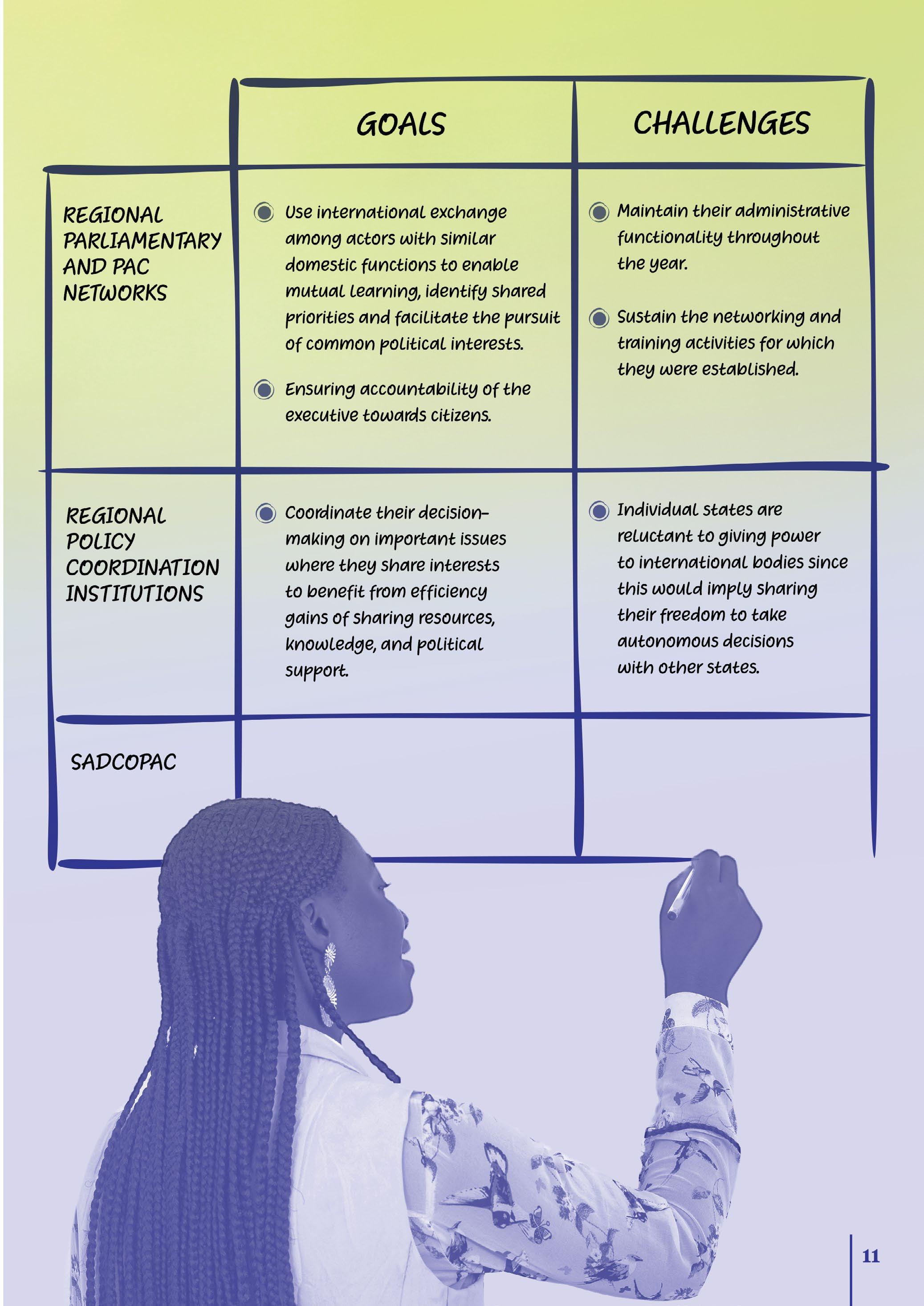
The key motivation for each of these is to use international exchange among actors with similar domestic functions to enable mutual learning, identify shared priorities and facilitate the pursuit of common political interests as the key parliamentary bodies tasked with ensuring accountability of the executive towards citizens.
In the case of public financial management (PFM), public accounts committees (PACs) or equivalent bodies cooperate in such networks both within and outside of Sub-Saharan Africa.2 Within the continent, the earliest such example is the Association of Public Accounts Committees (APAC) within South Africa where PACs at the sub-national level cooperate since 1997 to support each other in their mandates of providing parliamentary budget accountability.
Modelled on Canada’s and Australia’s sub-national PAC associations which exist since the 1980s, South African regional PACs meet annually since 2003. After SADCOPAC was founded in 2003 to link PACs within the SADC region, similar organisations were established in Eastern Africa in 2004 (EAAPAC), in Western Africa in 2009 (WAAPAC) and at the continental level in 2013 (AFROPAC). Beyond Africa, a similar association also exists for PACs across Central-, Southern and South-East Asia since 2011 (ARAPAC) and in the Pacific Island states since 2013 as well as for Commonwealth states in three world regions (CAPAC). Partly in response to their capacity-building success in African regions, Nordic European countries also established a network of parliamentary PACs in 2012.3
However, many of these organisations struggle to maintain their administrative functionality throughout the year and to sustain the networking and training activities for which they were established.
A prime reason is that both secretarial budgets and operations often rely on external funding to take place: especially in developing country contexts, PACs themselves operate on very limited budgets already for their priority tasks in their domestic parliaments and cannot enforce membership contributions owed to regional networks from their states when budgetary allocations from the executive are not forthcoming.
Where secretariats are not sufficiently and sustainably financed and organisational resources are short, regional PAC institutions are less effective in networking their members to enable mutual learning. For example, APAC has seen reduced networking activity and no official conference since 2014.4 Both EAAPAC and WAAPAC are not currently active given that Executive Committees do not meet regularly, annual conferences did not take place since 2014 and several member states are considered as “dormant”.5
Financial difficulties also haunt AFROPAC, where many member states are in arrears on their contributions owed annually according to the membership rules. This complicates both the maintenance of secretarial operations and even agreed substantive activities such as a review of the organisation’s constitution, which would not have been possible for AFROPAC without financial support from GIZ as a development partner.6 Such problems are not exclusive to the African context either: ARAPAC’s annual conference has not taken place since 2015, when the World Bank and the Commonwealth Parliamentary Association (CPA) last hosted the event.7
This cooperation already points to a second group of regional networking institutions which are relevant in comparison to SADCOPAC: parliamentary networks which include MPs and Clerks from the broader legislature (beyond PACs) and which aim to network parliaments to help them mutually improve their domestic accountability functions towards the executive. There is a long-standing tradition of such parliamentary exchange networks, with the CPA as the main institution within the English-speaking world established in 1911 and the Inter-Parliamentary Union (IPU) as an organisation established in 1889 originally among mainly European Parliaments and boasting near global membership today. Both institutions are based on a similar structure as SADCOPAC in that parliamentary member bodies contribute financially to common organisational resources, which are used for administrative purposes including regular plenary assemblies where delegates from member states adopt reports and resolutions as well as for trainings to empower both MPs and clerks.8
As longer-standing institutions with a broader and relatively richer membership with strong interest in their functioning, these parliamentary networks face less challenges in terms of financial sustainability and continued operation in practice.
In contrast to the PAC networks with predominantly developing country membership discussed before, both CPA and IPU are more comprehensively funded by membership fees including from richer states and deep multi-year financial support from development partners (for example, the latter make up 20% of the IPU’s 2019 budget). Accordingly, they have larger administrative staff including at regional sub-branches in Sub-Saharan Africa (hosted in Tanzania for the CPA and in Kenya and Zambia for the IPU on technology activities) and more regular networking and training events for their members.9 For example, CAPAC organised a series of regional workshop for member state PACs in 2019-2020 which were funded by a UK-government sponsored programme and delivered by the UK branch of the CPA.10
From the perspective of younger organisations like SADCOPAC, these thriving institutions thus show the promise of networking and empowering parliamentarians with similar functions from different states when funding is sustainable and administrative and collective training capacities have been built up.
Additionally, however, parliamentary organisations like CPA and IPU also adopt resolutions together in regular plenary sessions. As the following section discusses, these and other international organisations with similar mechanisms can thus serve as a benchmark also regarding the second main mandate of SADCOPAC, the coordination of policy among its member bodies on issues of shared interest.
Regional policy coordination institutions
Turning to SADCOPAC’s second main organisational mandate, its experience can equally be assessed meaningfully only by comparing it against that of other regional institutions which seek to coordinate policy among their member states on certain issues.
Generally, research in the field of international relations long showed that states often seek to coordinate their decision-making on important issues where they share interests to benefit from efficiency gains of sharing resources, knowledge, and political support. However, such efforts at policy coordination usually face important challenges: after all, formal decision-making power largely rests with individual states where domestic political systems determine who gets to take decisions.
States need to agree giving power to international bodies in the first place but are usually very reluctant to do so since this would imply sharing their freedom to take autonomous decisions with other states. Hence, regional organisations rely on different combinations of informal and formal mechanisms to either incentivise coordinated policy or outright take decisions together.
How regional organisations can try to coordinate policy is reflected in their institutional design. Most fundamentally, researchers differentiate between organisations with more or with less international authority, that is, the accepted right to take decisions which are collectively binding for member states. To have more authority, a regional organisation needs to be able to take decisions with a degree of autonomy from member states; and be equipped with (legal) mechanisms to make those collective decisions binding for member states. 11 Organisations with greater autonomy from member states and more legally binding decision-making have greater authority, while those institutions with less authority have to rely either on
more voluntary agreement to coordinated decisions or on more voluntary agreement to implement collectively taken decisions.
Unless all decisions taken at the regional level are equally wanted by those holding power in member states, a regional organisation’s level of authority thus matters crucially for how effective it can be in coordinating the policy decisions of their members even against the wishes of some powerful groups at the domestic level.
In some cases, international authority has grown significantly over time. The European Union (EU) for example has become the most authoritative regional organisation in the world. It makes policy decisions on behalf of members in several key areas and member states take binding decisions collectively in regional bodies like the EU Council on several additional important issues. In the African context, the African Union (AU) is the most authoritative international organisation. Even if its scope and level of power is much lower than the EU’s, it can legally enforce policy on member states in certain areas, most notably when it comes to ending violent conflict and human rights violations by international military intervention. But in most areas, the AU relies on voluntary agreement among member states who gather in their intergovernmental fora to negotiate collective decisions, and it lacks legal mechanisms to ensure states follow through on commitments they gave at the international level.
In practice, in most regional organisations and on most issues, domestic states retain significant influence over either whether to take collective decisions rather than decide for themselves or whether to follow them once they are taken.12
Instead of being able to legally force member states to comply with collective decisions, such institutions rely on making collective resolutions at the international level and hope that members will both try and be politically able to achieve their implementation at the domestic level. For example,
even the most developed mechanism of regional policy coordination in the AU (the African Peer Review Mechanism (APRM)), rests entirely on voluntary commitments on economic, social, and governance policy made at the regional level and is plagued to this day by very low implementation of collective choices by states, especially in policy areas that are more sensitive to those currently holding power.13
Similar problems haunt voluntary policy coordination mechanisms at the international level also in developed contexts, like the EU’s European Semester or the Organisation for Economic Cooperation and Development (OECD)’s going for growth framework and its other peer-review mechanisms.14
Regional parliamentary networks like CPA or the IPU, as well as more specifically PFM-focused networks like SADCOPAC or AFROPAC equally rely on collective resolutions at the international level and hope that their member bodies (parliaments or PACs) can successfully lobby for their implementation at home by member states (that is, the executive government without
which parliament, let alone parliamentary committees, cannot take binding policy decisions in the form of accepted laws). Partly because public financial management (PFM) is a highly sensitive political issue which touches upon financial sources of state power and the control of autocracy and corruption through democratic governance, policy coordination in this field can rarely draw on formal international authority.15 Instead, the peer pressure that comes from collectively discussing domestic issues and reporting on the (non-) implementation of collectively agreed policy are the main tools through which such institutions try to achieve domestic change in combination with the political attention regional activity is expected to generate domestically through the media and civil society.
Against this background, regional parliamentary networks can hardly expect to achieve domestic change fully in line with the resolutions agreed at international conferences, let alone among all their members. However, systematic data on these resolutions’ effectiveness in terms of implementation is rarely even collected or published. This contrasts with policy coordination mechanisms within organisations like the African Union, the EU, or the OECD, where annual progress and implementation reports are a key instrument of trying to exert peer pressure and building political support for domestic change.
Partly because public financial management (PFM) is a highly sensitive political issue.
Nonetheless, both the CPA and the IPU at least try to regularly track their impact among member states, in contrast to younger and less well-resourced PAC networks including in Africa. To that end, these organisations compile annual reports focused on identifying the impact of their activities and resolutions among the membership.16 Aside from the technical support and training activities, these reports highlight positive cases where the organisation (a) led to domestic policy change in the form of new legislation, (b) contributed to setting the policy agenda including among other international organisations, and (c) where activities contributed to domestic media attention including on social media.
The peer pressure that comes from collectively discussing domestic issues and reporting on the (non-) implementation of collectively agreed policy are the main tools through which such institutions try to achieve domestic change in combination with the political attention regional activity is expected to generate domestically through the media and civil society.
Since SADCOPAC is a regional network of parliamentary bodies trying to achieve its objectives through networking and peer-learning as well as through common resolutions adopted by members, its experience can be judged against that of comparable institutions discussed above.
To enable such a comparison, this section first discusses its historical trajectory as a network of PACs in the region, before analysing its resolution-making mechanism and implementation in practice. For each main objective, I then assess SADCOPAC relative to other regional parliamentary networks and policy coordinating organisations.
Unless noted otherwise, these discussions are based on all SADCOPAC resolutions made at annual conferences between 2004 and 2017 as well as all available country implementation reports on conferences since 2011.
In total, this dataset contains information on 339 responses by member states towards individual SADCOPAC resolutions from six annual conferences since 2011, reported on between 2013 and 2016 as well as again in 2019.17
Institutional
History of
SADCOPAC as a Network of PACs and its HCD Activities
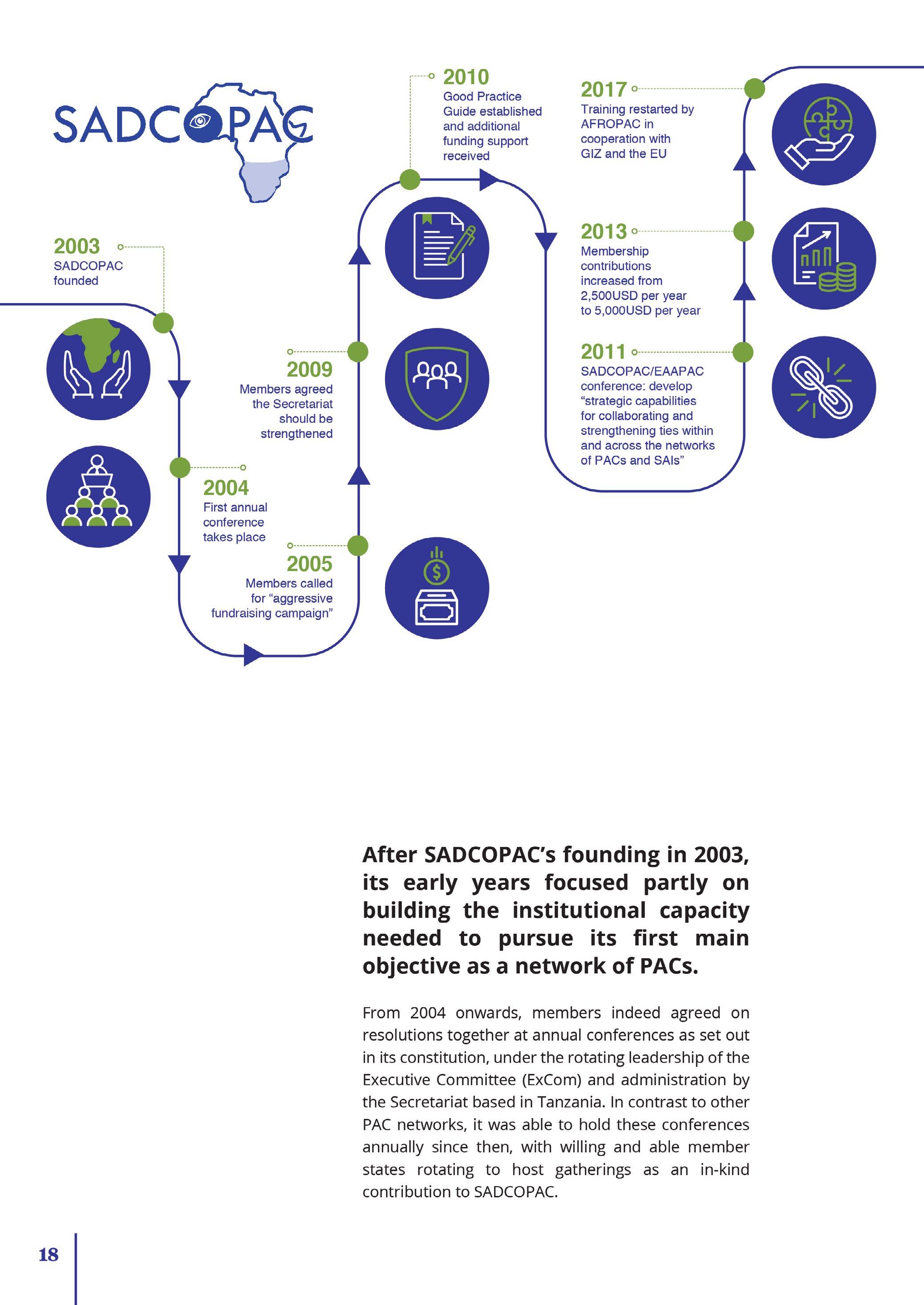
After SADCOPAC’s founding in 2003, its early years focused partly on building the institutional capacity needed to pursue its first main objective as a network of PACs.
From 2004 onwards, members indeed agreed on resolutions together at annual conferences as set out in its constitution, under the rotating leadership of the Executive Committee (ExCom) and administration by the Secretariat based in Tanzania. In contrast to other PAC networks, it was able to hold these conferences annually since then, with willing and able member states rotating to host gatherings as an in-kind contribution to SADCOPAC.
While member PACs reserve the right to attend or not, these conferences are referred to positively by PACs and valued for the peer-learning platform they provide.18 Except for the Democratic Republic of Congo and Madagascar who have not joined to this day, SADCOPAC has thus served as a regular and continuous network for PAC members to discuss their experiences, learn from each other and offer mutual support in advancing their financial oversight work domestically.
Until 2012, the organisation regularly pledged to strengthen its institutional basis to better serve member PACs as a network. For example, in 2005 members called for an “aggressive fundraising campaign” by the ExCom to enable “continuous training of PACs members and clerks” and a review of “modus operandi of SADCOPAC
including dues and membership”. Similarly, in 2009 members agreed that the Secretariat should be strengthened, partly to enable more systematic follow-up on resolutions and ensure institutional memory. An office administrator was hired in response, effectively doubling the permanent secretarial staff.19 Members also demanded that SADCOPAC should offer regular trainings and capacity development for its member PACs from 2006 onwards and called for extending these activities also towards PAC clerks and researchers in 2011.
SADCOPAC activities were directed also towards networking members with external organisations and other regions within Africa, culminating most centrally in an unprecedentedly linked network of African PACs. Starting in 2009, members resolved to deepen relations with AFROSAI and AFROSAI-E, the two main continental bodies networking supreme audit institutions. Further, the organisation maintains friendly working relationships with several other PFM stakeholder organisations in the region. In 2011, the joint SADCOPAC/EAAPAC conference elaborated that the organisations should develop “strategic capabilities for collaborating and strengthening ties within and across the networks of PACs and SAIs”. This was followed in 2012 by a call from SADCOPAC members to “initiate earnest discussions towards the realization or establishment of AFROPAC in the next 18 months” together with the other two regional PAC networks WAAPAC and EAAPAC. Making good on that resolution, in 2013 AFROPAC was founded as a continental network of PACs at an inaugural conference in Tanzania.21
Funding for these growing demands at SADCOPAC comes primarily from member state contributions (originally 2500USD per year, which was raised to 5000USD from 2013 on), in line with the Constitution.
These funds are additionally boosted also by various Auditor Generals’ Offices among the membership and between 2010 and 2014 by the World Bank Institute and GIZ as external development partners. Several other organisations also provided financial support for individual trainings or workshops.
Nonetheless, a lack of sustainable funding has been a central recurring problem in fulfilling SADCOPAC’s tasks, given that cash-strapped member states are often in arrears on their contributions and external support has been intermittent rather than continuous throughout its existence.22
Despite these fundamental operational challenges, SADCOPAC was able to carry out several important activities to enable mutual learning and build capacity among its member states in line with its aspirations. As an early and far-reaching success of internal capacity-building through peer learning, the organization developed a good practice guide for its member PACs in 2009 in response to a conference resolution from 2008 which was based on a survey of nine member states carried out by SADCOPAC. It contained a collection of best practices and principles for effective financial oversight through PACs ranging from the mandate, funding, and legal framework to its internal structure and organization as well as oversight practices and procedures.23
Importantly, this guide was then effectively used as a minimum standard for PAC operations among SADCOPAC, with members reporting systematically since 2011 on their progress in implementing domestic legal and practical changes in line with this standard. SADCOPAC considers that there were significant improvements to frameworks and operations across the membership in response to this regional standard-setting exercise.24 This impression was shared also by a World Bank Institute Report from 2013 which identified cases where PACs improved considerably and partly in response to the best practices developed within SADCOPAC. 25
According to the implementation reports up to 2019, PAC members from the Seychelles, Namibia, Lesotho, Tanzania, Malawi and Zimbabwe made significant progress towards implementing resolutions referring to these best practices in the following years. While some reported remaining gaps which could not be plugged yet for various political reasons, several other member states including most notably South Africa reported that these minimum standards were largely in place already. But even there, progress was observable: in 2018, parliament passed the Public Audit Amendment Act which had been lobbied for by PACs and which made recommendations from the Auditor General legally binding for the government.
As such, the good practice guide developed by SADCOPAC on behalf of its members presents an encouraging example for its function as a peer-learning network: a diverse membership identified agreed best practices for PACs and lagging states made significant progress in reducing existing differences, learning from more advanced peers, and raising the overall conditions to enable effective public financial oversight through parliament in the region.
In fact, this standard-setting exercise and the need to follow up and gather information about practices from member states also contributed importantly to the development of SADCOPAC’s resolution-making mechanism as a whole, by leading to increasingly systematic reporting from member states about their implementation. The current reporting system in itself presents a significant institutional achievement which even much betterfinanced other parliamentary and PAC networks cannot match.
Annual reporting from member states about the implementation of resolutions had already been demanded at the SADCOPAC Conferences in 2006 and again in 2009, with a reporting timeframe specified in 2007. However, it took the Good Practice Guide as a guiding document and additional financial support from external development partners for this process to take off: at the 2010 conference, members demanded that SADCOPAC develop a monitoring and evaluation tool to track implementation of the guide. In response, the Secretariat began to gather
implementation reports from member states starting in 2011 and introduced a standardized reporting document for its resolutions which members should use in 2013. This form was further specified to include a section on limitations during implementation in 2015.
While this process was driven by the Good Practice Guide, it then extended in practice to all resolutions made at the annual conferences, giving birth to a comprehensive reporting mechanism otherwise known only from richer and older organizations like the OECD, the EU, or the African Union. This represented a significant step forward for the institution: for one, it enables to generate greater peer pressure for domestic reforms in line with agreed practices because member states have to be more transparent about their implementation and report to their peers, incentivizing them to invest more energy into achieving resolution targets. Conversely, the gathered information is also instrumental for SADCOPAC, because it allows to better grasp the needs and realities of member PACs at home. Over time, this knowledge enables an institution like SADCOPAC to more precisely formulate and realistically tailor resolutions to their membership’s contexts and allows to identify obstacles to strengthening PFM systems which it might help address and overcome in future resolutions and activities.
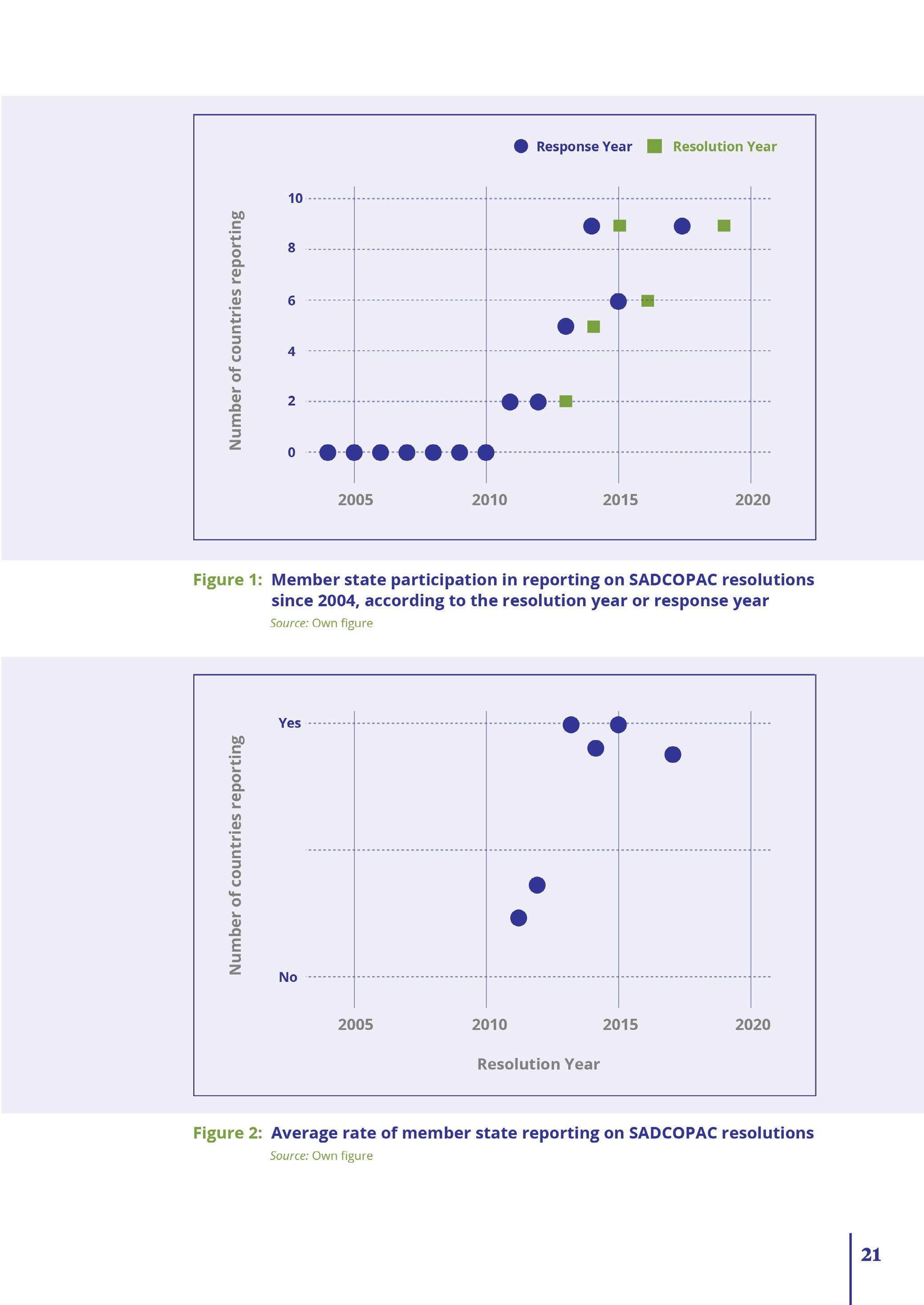
Despite these achievements, the reporting framework is not without remaining limitations. Most importantly, not all member states participate in reporting implementation progress and not all report each year, even though responses increased after SADCOPAC called on all members to participate in this process in 2012 (see Figure 1). Further, even when they report, not all members address each resolution in their responses, which makes obtaining a comprehensive picture of the state of and obstacles to PFM reform challenging.
The low overall response rate is no doubt in important parts due to very limited resources among member PACs and their staff in the region who often struggle already financing their primary duty meetings as parliamentary committees and lack funds to enable additional work on behalf of a PAC network.26 But SADCOPAC could also strengthen the process without plugging these funding gaps. For example, available implementation reports suggest that progress was reported on more consistently after SADCOPAC standardised its reporting document: in 2013, the average level of reporting jumped markedly from less than half of the resolutions to almost all after that (see Figure 2). Countries thus responded much less selectively to last year’s resolutions once the respective form listed and provided response boxes for all resolutions.
Going further in this regard, the standardized implementation reports do not currently differentiate between the existing status quo in the country and new activities towards that resolution. Changing this might incentivize even states with stronger PFM systems towards greater activity rather than simply responding to resolutions by stating what has been in place for a long time, as is often the case now.
Further, SADCOPAC does not to date systematically track and present or publish the implementation of their resolutions. Of course, this very assessment and the sharing of its internal reports is an important and admirably transparent first step in this direction. However, integrating this practice of aggregating and presenting implementation information more fully in its day-to-day processes might additionally strengthen the organization: within the more encompassing and better funded coordination mechanisms of the OECD, the EU and the AU, publishing implementation reports annually is a key component trying to generate the peer pressure through which change becomes more likely. After all, no member country PAC wants to stand out publicly for not following up on common resolutions without good reason. A further benefit is that public information about implementation successes and shortcomings can be taken up by the media, civil society organisations and other political allies of PACs in their efforts to lobby and pressure governments into sensitive PFM reforms who these are often reluctant to allow and have the power to block without sufficient spotlight. 27 Irrespective of these rooms for improvement, however, SADCOPAC’s reporting framework presents an important instrument to generate the peer pressure it needs to enact change domestically and the institution is much better equipped to do so than under the previous status quo.
After initially strengthening especially its own institutional capacities, SADCOPAC also contributed significantly to enhancing the capacity of member PACs in line with resolution demands. Most notably, the organisation realised workshops and trainings in cooperation with GIZ and the World Bank Institute. These capacity development events targeted MPs in 2010, 2012 (twice) and 2013 as well as PAC clerks in 2011, 2012 and 2013.28 However, after this external support ended in 2014, SADCOPAC was no longer in a position to offer regular trainings. This problem lasted until 2017 when AFROPAC stepped in, again in cooperation with GIZ (as well as the EU) as a development partner now on the continental level: this support enabled organising a PAC clerk workshop as well as a set of three training conferences for PAC MPs and clerks from all three main PAC networks in Africa until 2019.29
SADCOPAC does not to date systematically track and present or publish the implementation of their resolutions [...] within the more encompassing and better funded coordination mechanisms of the OECD, the EU and the AU, publishing implementation reports annually is a key component trying to generate the peer pressure through which change becomes more likely. After all, no member country PAC wants to stand out publicly for not following up on common resolutions without good reason.
The second main organisational mandate of SADCOPAC concerns the reform of member states’ PFM systems to strengthen parliamentary budget supervision. The organisation thus jointly agrees on resolutions with reform priorities and members report back to the Secretariat about their implementation the next year. To assess SADCOPAC’s efforts at coordinating members’ policy regarding parliamentary PFM supervision, this section systematically analyses all available resolutions made since 2004 as well as all available implementation reports since 2011.30 After presenting the database constructed on this basis, I compare the effectiveness of SADCOPAC’s resolutionmaking against the benchmark of comparable regional policy-coordinating institutions.
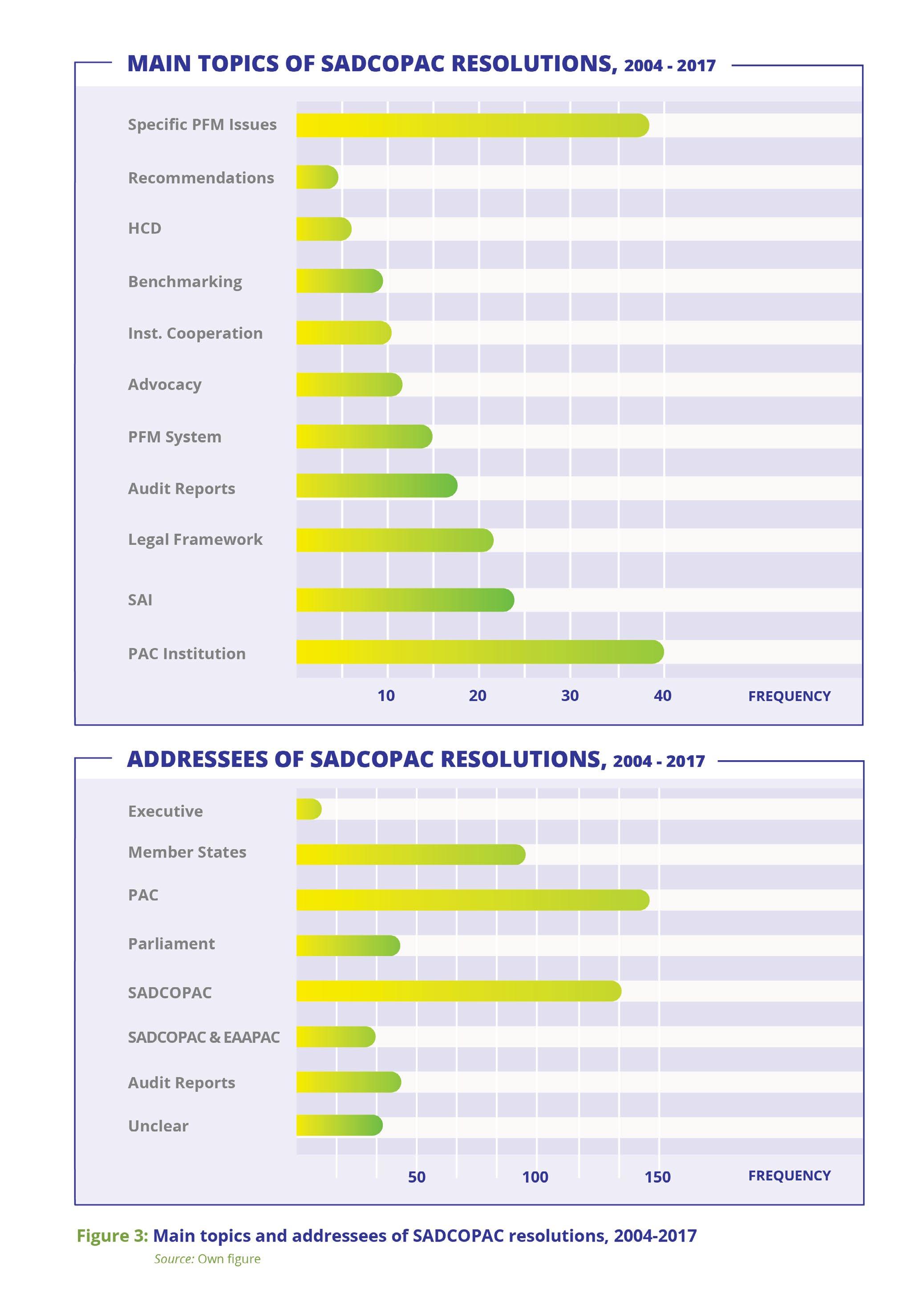
In a first step, I inductively categorised all resolutions made in the name of SADCOPAC according to the topics of each resolution as well as according to their addressees. As the upper panel of Figure 3 summarises, collective resolutions covered a wide range of topics.
Most
often, SADCOPAC members agreed on plans to either strengthen the PAC as an institution or on addressing a collection of specific smaller PFM issues (like public procurement, state-owned enterprises, or performance budgeting).
In between, SADCOPAC resolutions concerned especially often the SAI and the legal framework, followed by audit reports, different elements of the PFM system and its interactions. Less often, resolutions also concerned reform advocacy and institutional cooperation, as well as benchmarking, HCD activities and PAC recommendations.
These resolutions were directed towards a variety of actors. As the lower panel of Figure 3 summarises, the vast majority of commitments were aimed at either member PACs, SADCOPAC as an organisation, or member states more broadly.
With some distance, a small share of resolutions also target parliament or the SAI, SADCOPAC and EAAPAC together (in the years where they held their conferences together), the executive government or they remain unclear in their wording about who is supposed to carry out the resolved actions.
In a second step, I inductively coded all implementation reports available from 11 member states since 2011 in terms of the resolution they addressed, whether countries responded to it, the year of the report, as well as the extent to which they were implemented.
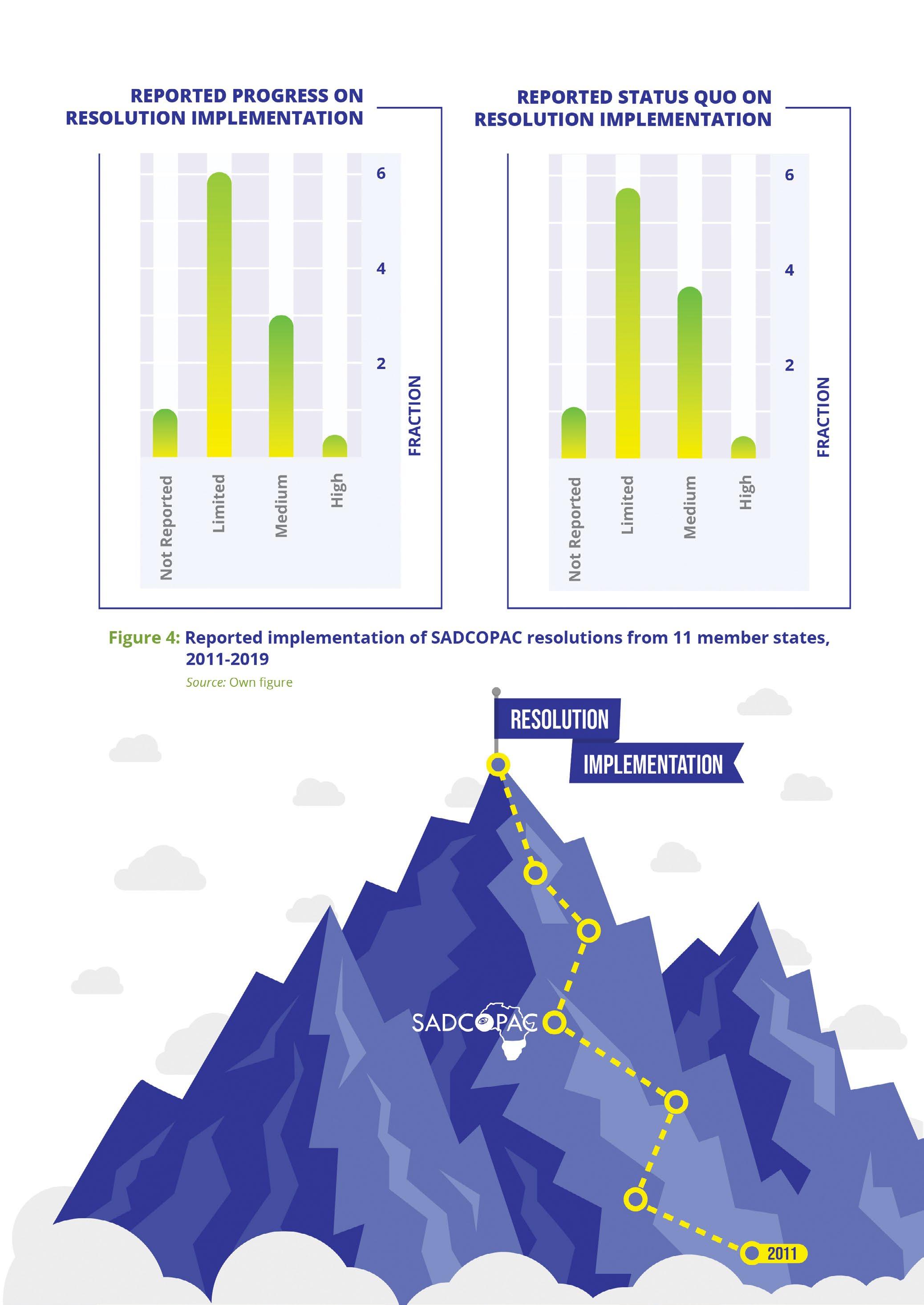
I distinguished between two dimensions of implementation: the reported status quo on this resolution as well as the reported progress achieved towards that resolution. For each, I inductively categorised members’ responses on a scale ranging from 0 (no report) via 1 (limited status quo/progress) and 2 (medium) up to 3 (high status quo/progress).
Figure 4 summarises the distribution of member state responses to SADCOPAC resolutions since 2011. As the upper panel suggests, most countries report at least some pre-existing implementation, while more than 30 percent of responses record a medium status quo on the respective resolution, with less than 10 percent of responses indicating a high pre-existing status quo. In 10 percent of the cases, members did not report on a resolution. Similarly, the lower panel of Figure 4 indicates that the majority of responses contains information about at least some progress towards implementing the respective resolution, while more than a quarter of responses point to medium levels of progress. High progress is rare at under 10 percent of responses, slightly less than cases where member states did not report on progress towards that specific resolution in their responses.
As such, this data indicates that SADCOPAC members reported sustained limited-to-medium progress in implementing the resolutions it made since 2011. Compared to the baseline of other regional organisations seeking to coordinate member states’ policy, this level of implementation appears fully within the range of expectations for an organisation without any formal power over its member states. Overall, SADCOPAC has contributed to important progress over the years in strengthening its member states’ parliamentary PFM oversight.
What does the level of implementation depend on?
While more systematic answers to this question would require detailed case studies to track how SADCOPAC resolutions contribute within domestic political processes, the existing data on resolution implementation can point towards some important first insights about factors which shape the effectiveness of the resolution-making mechanism.
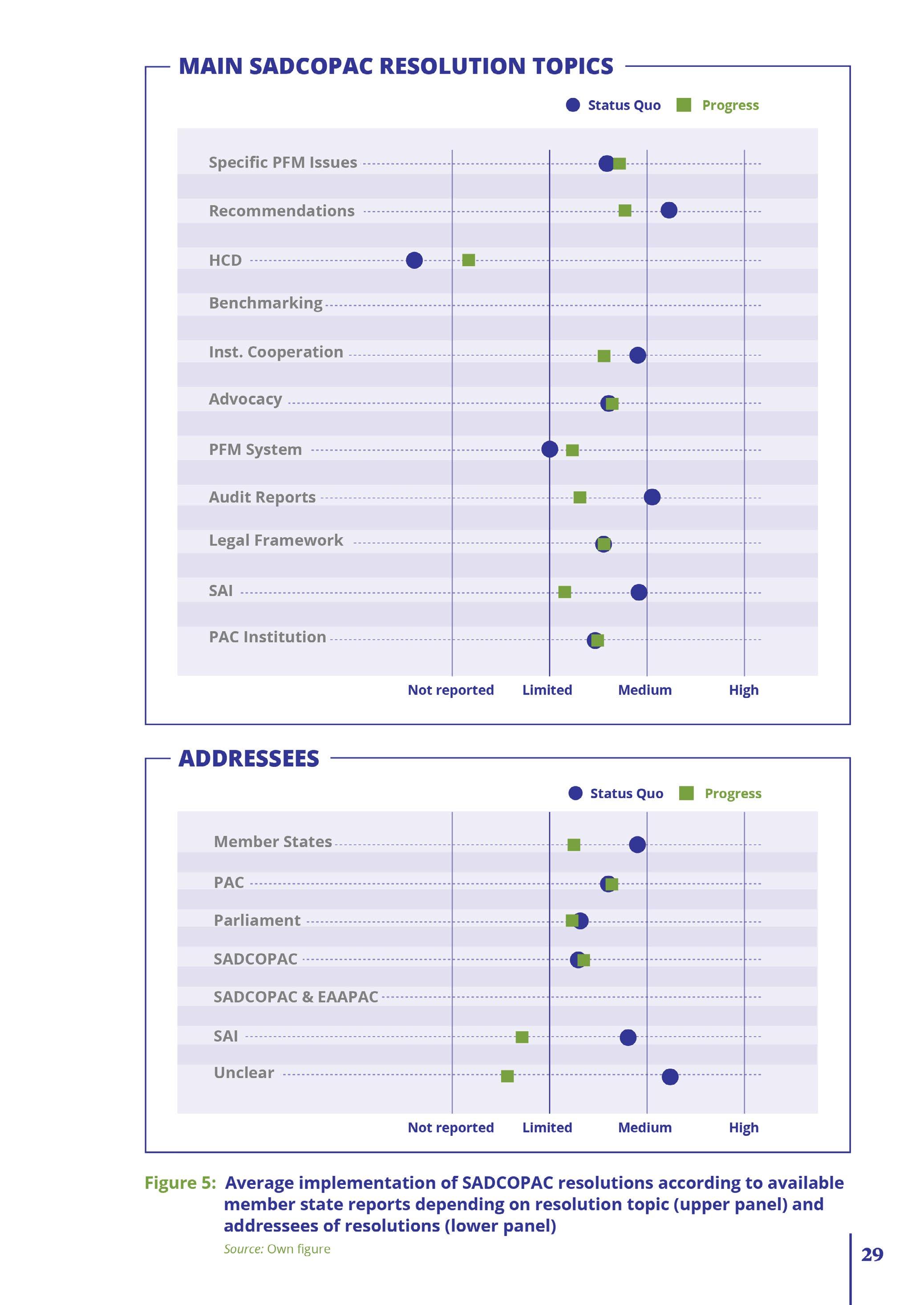
On the one hand, implementation rates differ markedly by both topic and addressee. As the upper panel of Figure 5 visualises, on most topics countries report at least a limited status quo of implementation and at least some further progress towards further implementation. However, this is not the case for resolutions which concern HCD: there, members report a very low status quo and they do not on average make at least limited progress towards strengthening human capacity. There also seems to be somewhat lower progress on implementation when resolutions relate to the audit reports produced for PACs to scrutinise, to the SAI, or to the PFM system more generally. Yet, here member states reported a greatest already existing level of parliamentary budget accountability: the average reported status quo is highest on audit reports and the SAI as well as on cooperation among PFM institutions, alongside PAC recommendations.
The implementation of resolutions also differs depending on the addressee of resolutions. As the lower panel of Figure 5 indicates, by far the lowest level of implementation progress is reported when resolutions target the SAI or are unclear in who should carry out the demanded changes. In contrast, members reported at least limited progress on resolutions which addressed either member states or parliament, and the highest advances where resolutions dealt with the PAC itself.
These patterns suggest that the effectiveness of SADCOPAC’s resolution-making depends on how much its member bodies can even implement resolutions in political practice. Greater progress is likelier where resolutions focus more directly on the PAC rather than other PFM actors like the SAI who SADCOPAC’s member bodies cannot influence as directly without government approval. Further, HCD activities require funding beyond PAC’s current budget and are thus harder to be implemented since they would again require the consent of governments with scarce and politically sensitive financial resources.
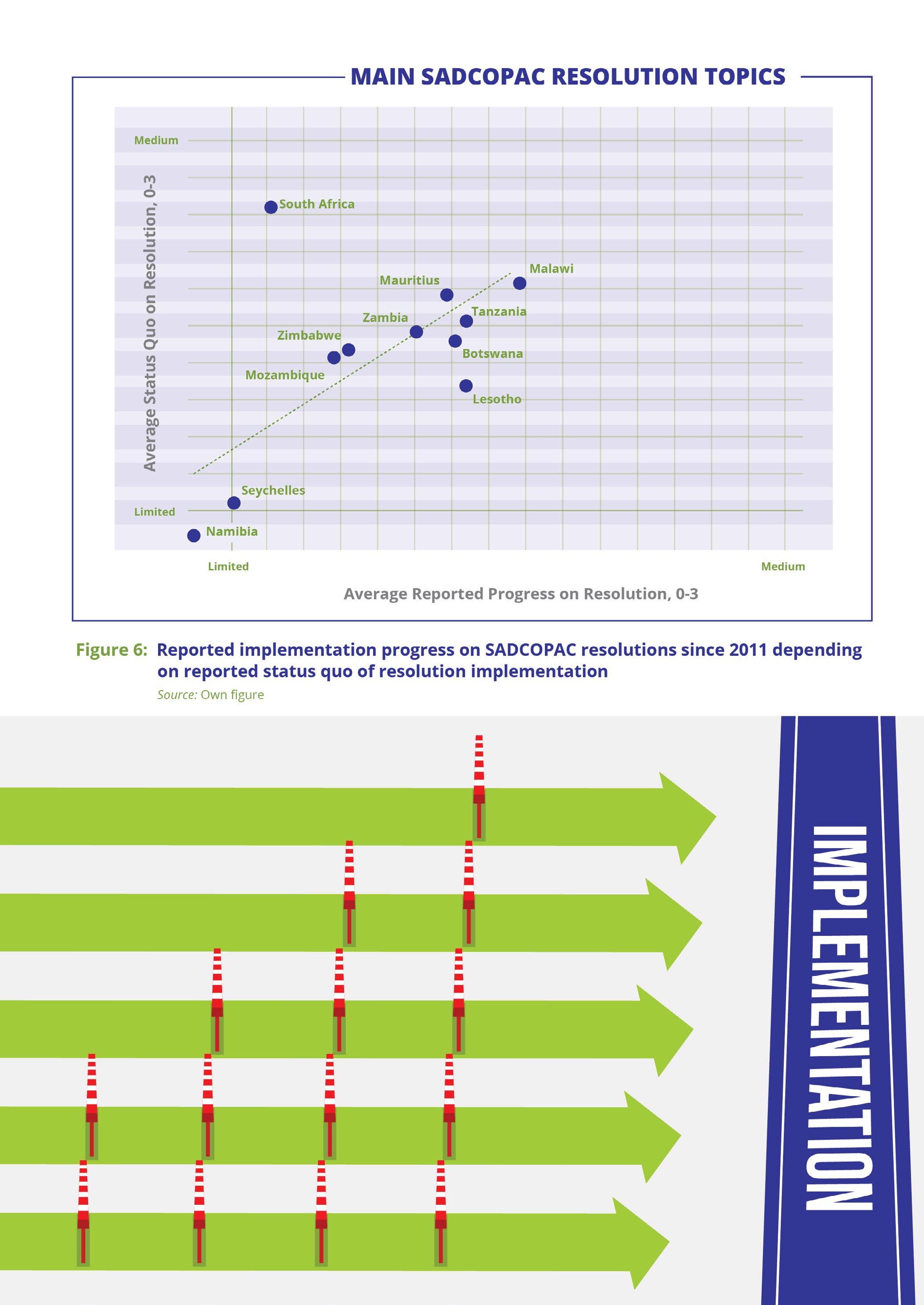
Finally, the available evidence from reports also suggest that progress on implementation differs depending on the existing status quo of PFM systems. As Figure 6 summarises visually, there appears to be a positive relationship between the existing status quo on a resolution and further progress towards its implementation. Countries with stronger existing institutions on resolutions like Mauritius or Malawi also report greater progress towards further strengthening these commitments. In contrast, countries like Namibia or the Seychelles who report the lowest status quo on implementing collective resolutions also report the least progress in strengthening these. To avoid growing bifurcation within the membership over time, it would be valuable to study in more detail how such countries can better be supported in closing existing gaps to their peers.
But important exceptions to this pattern exist: for example, Lesotho stands out in Figure 6 for achieving greater progress on implementing resolutions than its relatively low status quo on these commitments would suggest. In contrast, South Africa stands out for having by far the highest reported level of implementation on SADCOPAC resolutions - but reports comparatively less progress beyond that. This may of course point to less need for further improvements to meet collective standards: After all, according to the latest available PEFA assessment which ranks countries’ PFM systems on 31 indicators, South Africa boasts the top mark “A” on the indicator “legislative scrutiny of the annual budget law”. Similarly, a PAC member from South Africa indicated that SADCOPAC resolutions had not been very helpful for making PFM reform progress in the country.31 Nonetheless, these results might also indicate that progress is harder in those areas where even a country like South Africa has more room for improvement: according to the PEFA assessment, this includes for example the timeliness of audit report examination by parliament and the government’s follow-up on audits and PAC recommendations.32
From the perspective of SADCOPAC’s efforts at coordinating policy among its member states, these results overall may thus nonetheless indicate a largely positive story of converging towards a higher status quo: almost all reporting countries with less advanced PFM systems than South Africa report slow but incremental progress in implementing collective resolutions since 2011.
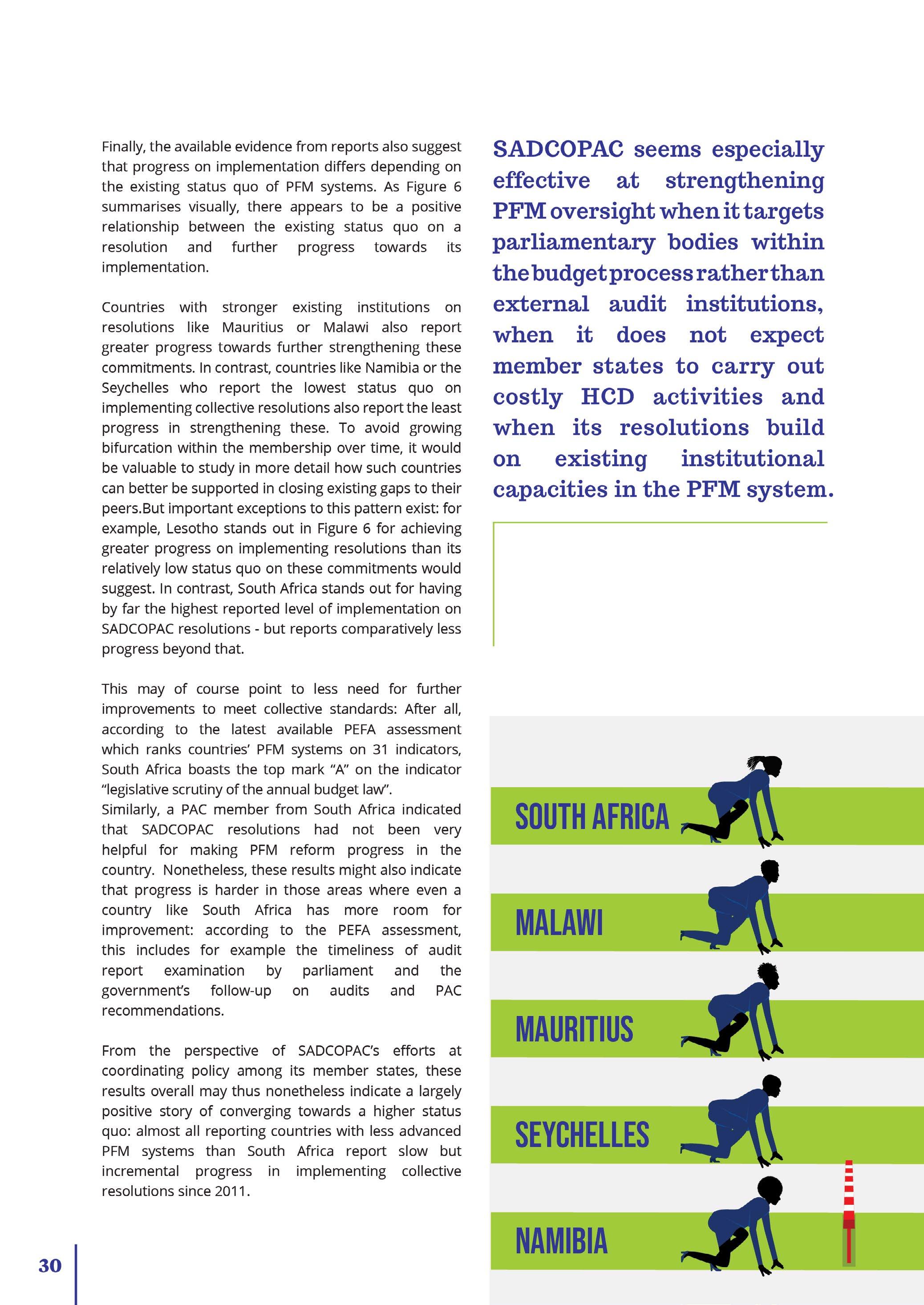
SADCOPAC seems especially effective at strengthening PFM oversight when it targets parliamentary bodies within the budget process rather than external audit institutions, when it does not expect member states to carry out costly HCD activities and when its resolutions build on existing institutional capacities in the PFM system.
Lessons and demands for regional PAC network cooperation among AFROPAC members
The case of SADCOPAC can serve as a positive case of how regional PAC networks can successfully contribute to networking and mutual learning between states as well as to strengthening parliamentary budget supervision among their membership.
In this spirit, the remainder of this report builds on the insights from studying SADCOPAC’s resolution-making mechanism to develop lessons and assess the demand for future regional PAC network cooperation among AFROPAC members.
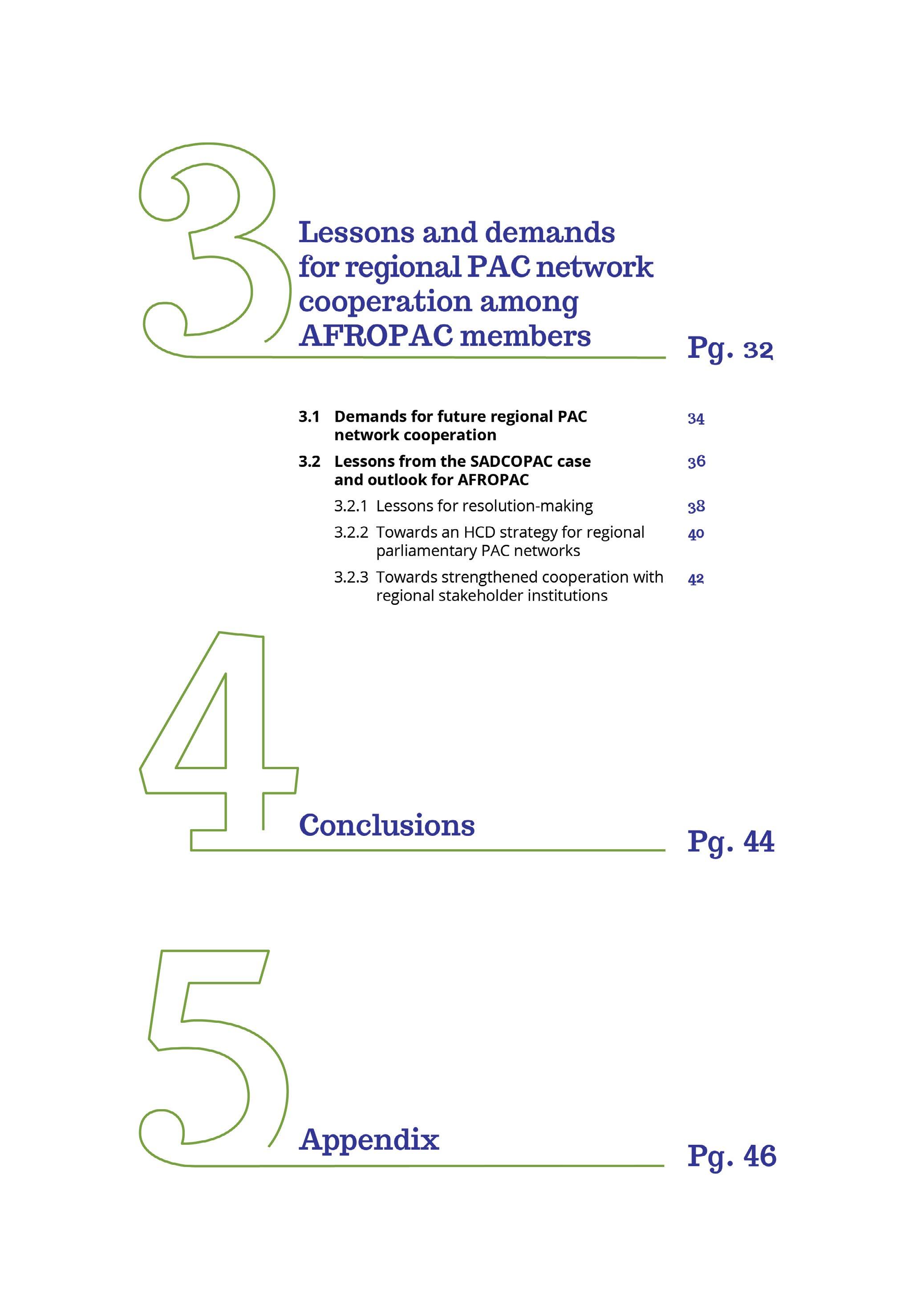
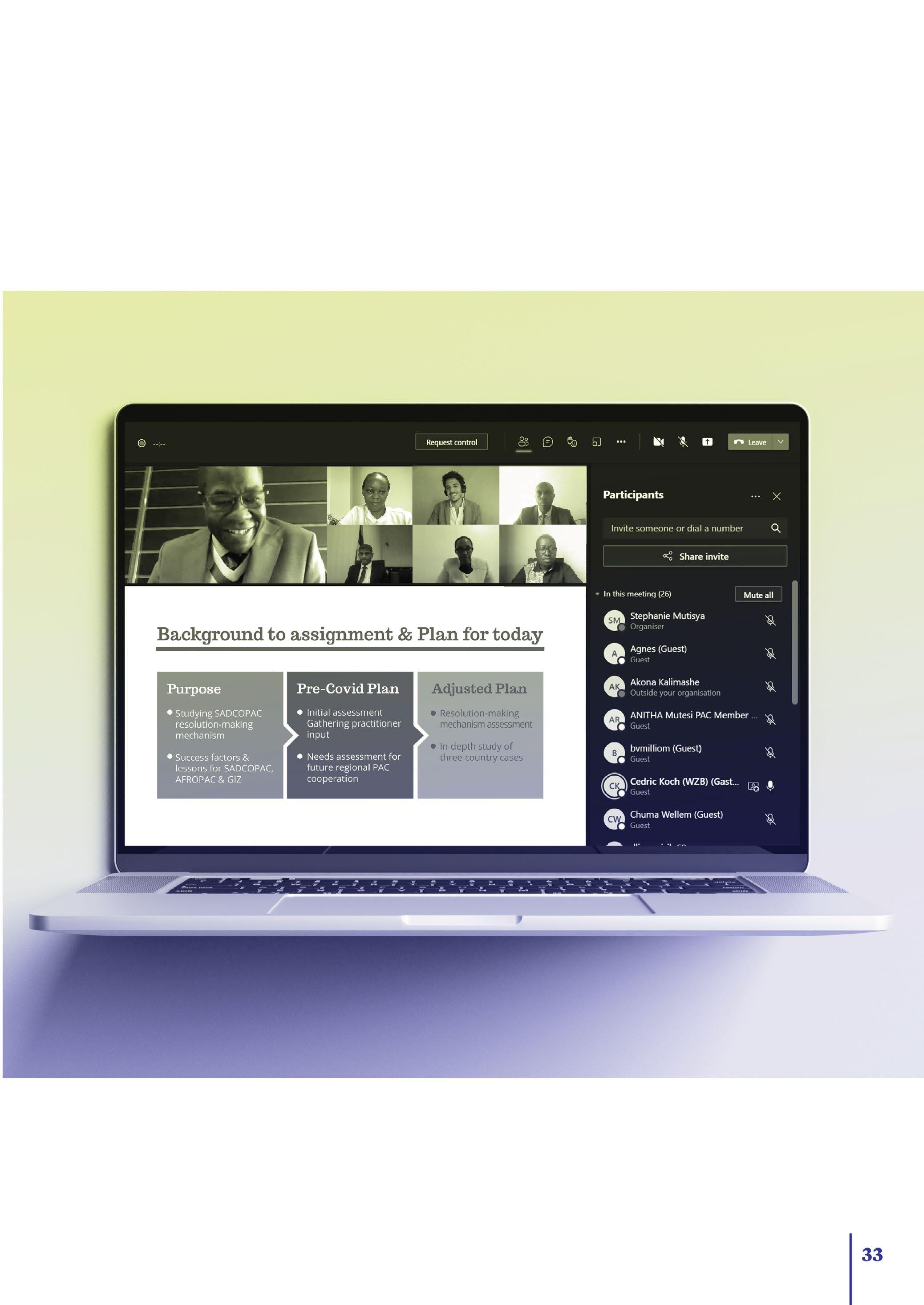
To that end, the following sections draw on a Webinar held digitally among AFROPAC members in June 2021 to present findings from the SADCOPAC case and discuss future avenues for cooperation on the continent, on a follow-up survey conducted among Webinar participants, on a series of semi-structured interviews with stakeholders at AFROPAC and in the WAAPAC and EAAPAC region, as well as on additional secondary sources where appropriate. I first discuss demands for regional PAC network cooperation among the AFROPAC membership, before turning to lessons for such cooperation efforts from the case of SADCOPAC.
Webinar held among AFROPAC members in June 2021 to present findings from the SADCOPAC case and discuss future avenues for cooperation on the continent.
The rationale for regional PAC network cooperation remains as strong as ever in the Sub-Saharan region. Despite many advances since SADCOPAC was founded as the first organisation of its kind on the continent, member bodies remain in a challenging position within their countries’ PFM systems and require continuous support in their efforts to provide parliamentary PFM accountability. According to the respective latest PEFA assessments, no country in Sub-Saharan Africa already has the top mark “A” on all indicator dimensions which assess parliamentary PFM supervision. To the contrary, there remains significant room for strengthening. On parliamentary scrutiny of the budget, 76 percent of assessed countries are rated “C” or lower: sixteen states received a “D” on their latest assessment, and another sixteen received a “C”. On parliamentary scrutiny of external audit reports, there is even further room for improvement: 85 percent of assessed states received a mark of C or below. Only Botswana received an “A” in this category, while 29 states are rated “D” and another 6 rated “C”.33
Demands for future regional PAC network cooperation
The rationale for regional PAC network cooperation remains as strong as ever in the Sub-Saharan region.
Despite many advances since SADCOPAC was founded as the first organisation of its kind on the continent, member bodies remain in a challenging position within their countries’ PFM systems and require continuous support in their efforts to provide parliamentary PFM accountability.
According to the respective latest PEFA assessments, no country in Sub-Saharan Africa already has the top mark “A” on all indicator dimensions which assess parliamentary PFM supervision. To the contrary, there remains significant room for strengthening. On parliamentary scrutiny of the budget, 76 percent of assessed countries are rated “C” or lower: sixteen states received a “D” on their latest assessment, and another sixteen received a “C”.
Against this background of high need to further strengthen parliamentary budget supervision, AFROPAC was born in 2013 from the efforts among members of SADCOPAC, EAAPAC, and WAAPAC who themselves initiated and finalised discussions about networking between PACs at the continental level. According to participants at the Webinar held in June of 2021, this demand appears to persist. For one, participation was very high with delegations from 12 countries including members of EAAPAC (Burundi, Kenya, Rwanda) and WAAPAC (Liberia, Secretariat). Further, participants who participated in the discussion or filled out the follow-up survey indicated great interest in further networking among PACs in the region. Members emphasised especially the value of learning from peers and their challenges and institutional solutions in other contexts. While the demands directed towards regional PAC networks differ across member states, two areas stand
On parliamentary scrutiny of external audit reports, there is even further room for improvement: 85 percent of assessed states received a mark of C or below. Only Botswana received an “A” in this category, while 29 states are rated “D” and another 6 rated “C”.33
Against this background of high need to further strengthen parliamentary budget supervision, AFROPAC was born in 2013 from the efforts among members of SADCOPAC, EAAPAC, and WAAPAC who themselves initiated and finalised discussions about networking between PACs at the continental level. According to participants at the Webinar held in June of 2021, this demand appears to persist. For one, participation was very high with delegations from 12 countries including members of EAAPAC
(Burundi, Kenya, Rwanda) and WAAPAC (Liberia, Secretariat). Further, participants who participated in the discussion or filled out the follow-up survey indicated great interest in further networking among PACs in the region. Members emphasised especially the value of learning from peers and their challenges and institutional solutions in other contexts. While the demands directed towards regional PAC networks differ across member states, two areas stand out as particularly urgent according to Webinar participants.
First and foremost, the most pressing challenge indicated by PACs was a lack of follow up on PAC recommendations. Similarly, a lack of political will from the government was cited as the most widely mentioned obstacle to strengthening budget supervision, including beyond the membership of SADCOPAC.34 However, this challenge is tough to address for regional PAC networks alone. Parliamentary member bodies themselves do not have legal powers to force governments into changing PFM systems such that PAC recommendations would have to be followed up upon by the executive in a specified timeframe. And research on international coordination of public finances including in other regions suggests that the highly political character of government spending complicates effective cooperation: executives are less likely to agree to binding changes which would reduce their power over the public purse vis-à-vis other actors, except under great domestic political pressure.
Accordingly, helping PACs to increase pressure on governments might constitute a promising avenue to support the membership in this endeavour. Compared to other regional networks and policy coordination organisations, there is substantial room to improve the relationship of PAC networks with political allies of parliamentary budget supervision like the classical and social media as well as civil society organisations who operate in member countries like the International Budget Partnership, the African Centre for Parliamentary Affairs (ACEPA) and the Tax Justice Network. To date, these are treated mainly as potential partners among organisations like AFROPAC.35
In addition, greater efforts could be invested into putting the issue of binding government follow-up to PAC recommendations on the agenda of other international institutions which can exert pressure on executives in the region to enact legal changes. Especially well-placed in this regard are regional parliaments such as SADC’s parliamentary forum, the EAC’s Legislative Assembly and the Pan-African Parliament, as well as related PFM stakeholder bodies like AFROSAI and development partners like GIZ or the World Bank. Additionally, directly engaging heads of states and finance ministers within regional organisations like SADC, the EAC or the AU but also through an international organisation like the Collaborative Africa Budget Reform Initiative (CABRI) about the need for such
reforms and their potential design could add to the prospects of governments committing to change.
Second, PAC members indicated strengthening the PAC in the PFM system and developing human capacity among its representatives and staff as another key priority to improve parliamentary budget supervision. Encouragingly, they consistently report that such strengthening of PACs’ resources and capacities are among the most politically feasible areas to improve PFM oversight.
Here, regional PAC networks are much better placed to play a more effective direct role in supporting its members. As long as funding for institutional strengthening and HCD activities is available, member bodies can freely decide to participate without government approval. And research on international coordination suggests that such technical areas of policy reform are significantly more likely to be accepted by member states: some domestic actors gain from such initiatives (i.e. PACs) but no currently powerful actor (i.e. the executive) directly loses political influence or resources from HCD.
Hence, regional PAC networks can more easily effectively serve its members in this area. Centralising HCD resources for MPs and clerks within PACs at the regional level brings efficiency gains compared to national training programmes and can benefit from the long-term institutional memory and cross-national experience of their international reach. Here too, PAC networks could benefit from existing and deepened relationships with other stakeholders at the regional level: cooperating with a regional PAC network on HCD activities is attractive for both development partners and civil society organisations active in this field because a greater number of beneficiaries can be reached with the same resources compared to national activities. Additionally, further cooperation opportunities in this area exist with other parliamentary networks such as the CPA or the IPU: both organisations are mandated to support parliamentary actors and have long organised onboardings as well as more specific technical trainings for both MPs and clerks including from PACs with similar tasks which might be brought to the continent at comparatively little additional cost.
Lessons from the SADCOPAC case and outlook for AFROPAC
1. 2.
3.
The positive case of SADCOPAC and its resolutionmaking mechanism holds lessons for organisations like AFROPAC who seek to build on these experiences to meet the demand for regional PAC network cooperation. Drawing on the results in section 2 as well as the sources presented at the start of this section, I discuss especially three areas where AFROPAC can benefit from lessons of the SADCOPAC case and its comparative assessment: when it comes to making collective resolutions, as regards a strategy to meet HCD demands, and in deepening cooperation with other stakeholder organisations at the regional level.
Lessons for resolution-making
Like SADCOPAC, AFROPAC members make collective resolutions together at conferences which take place every two years at the continental level since 2016. As the positive experience in Southern Africa showed, such collective commitments can be helpful in advancing PAC networks’ aims.
However, to be more than mere declarations without practical consequences, resolutions must be sufficiently specific including by clarifying which addressees are supposed to carry out concrete activities relating to the resolution. So that peer pressure can operate and incentivise members to strengthen domestic PFM oversight, reporting on resolution implementation must be comprehensive and regular among the membership and as standardised as SADCOPAC’s became over time. Transparency and publishing of implementation results would incentivise reporting and domestic reform efforts. Reporting frameworks could also be further strengthened beyond that for example by distinguishing explicitly between the existing status quo on a resolution and further activities towards implementation progress.
This requires on the one hand sufficient and sustainable resources at the regional PAC network Executive Committee which organises members’ conferences and at the Secretariat which tracks implementation. For example, failure to organise ExCom meetings due to lack of funds prevented EAAPAC from holding its conference in 2016, thereby undermining the key networking function which binds member bodies to regional PAC organisations and enables peer learning.36 Since members are engaged in regional PAC organisations mainly through these collective meetings and otherwise occupied in their day-to-day work, the Secretariat has a challenging but key role of organising and trying to enforce the timely collection of implementation reports from members. The SADCOPAC case showed that one additional full-time support staff can already make a vast difference in how effective a Secretariat can operate to sustain network activity and ensure institutional memory including through managing reporting.
Both organisational bodies and their resources are also key to implement resolutions directed at the PAC network itself: for example, in 2018 members demanded for AFROPAC to undertake a review of its constitution to enable a more sustainable legal footing. However important members found this activity, given very limited resources beyond the existing operations of the organisation, implementing it would have been impossible without GIZ which spontaneously stepped in to finance the hiring of a consultant with specialised legal knowledge to undertake the review. 37 As such, a lack of institutional funds beyond the bare operational minimum would have undermined the seeming effectiveness of AFROPAC’s resolution-making mechanism, reducing incentives for member states to do their part.
But an effective resolution-making mechanism also requires resources among member PACs which cannot simply be taken for granted. These bodies often lack funds to conduct additional activities on top of their parliamentary duties such as reporting on resolution implementation. For example, members indicate that the mere hosting of meetings for PAC MPs to perform their tasks is already financially challenging relative to the amount of audit reports they should scrutinise – so funds often do not suffice to host another meeting in which resolution implementation could be tracked and reported.38
To ensure that members have the financial possibility to participate in the mechanism, these resources may otherwise have to come from the regional level, for example in-kind by hosting national reporting meetings ahead of conferences. Such solutions may also improve the position of the AFROPAC secretariat which today is in the delicate position of constantly having to remind members to please report.39 On a positive note, the more member states benefit from PAC network including through regular trainings and technical support, the more they are likely to be willing to also report on implementation.
There may thus be potential for crossfertilisation among AFROPAC activities: for example, an annual/biannual training could be combined with the binding requirement for participating member state PACs to previously submit implementation reports on AFROPAC resolutions.
How effective resolution-making by regional PAC networks is depends not only on financial sustainability at both the organisation and member bodies. As the SADCOPAC case showed, the level of implementation also depends on the topic of resolutions and their addressees such that organisations like AFROPAC should focus their energies on areas where member bodies indeed can enact domestic political change or accept necessarily slow and partial implementation where resolutions are further removed from the PAC itself. Similarly, implementation among SADCOPAC seems to depend as much as on member states’ efforts as on their existing status quo of PFM oversight, such that additional implementation support for least advanced members might be needed.
Drawing on lessons from other regional organisations with comparable goals, the effectiveness of resolution-making might also be increased by regularly publishing implementation reports or their analyses to increase peer pressure including on the more advanced member states. Finally, as regional PAC networks proliferate due to the success they reaped in the past, a greater degree of coordination may be needed. To avoid duplication, AFROPAC should coordinate its efforts in both resolution-making and training with those of regional networks like SADCOPAC who remain active.40
Towards an HCD strategy for regional parliamentary PAC networks
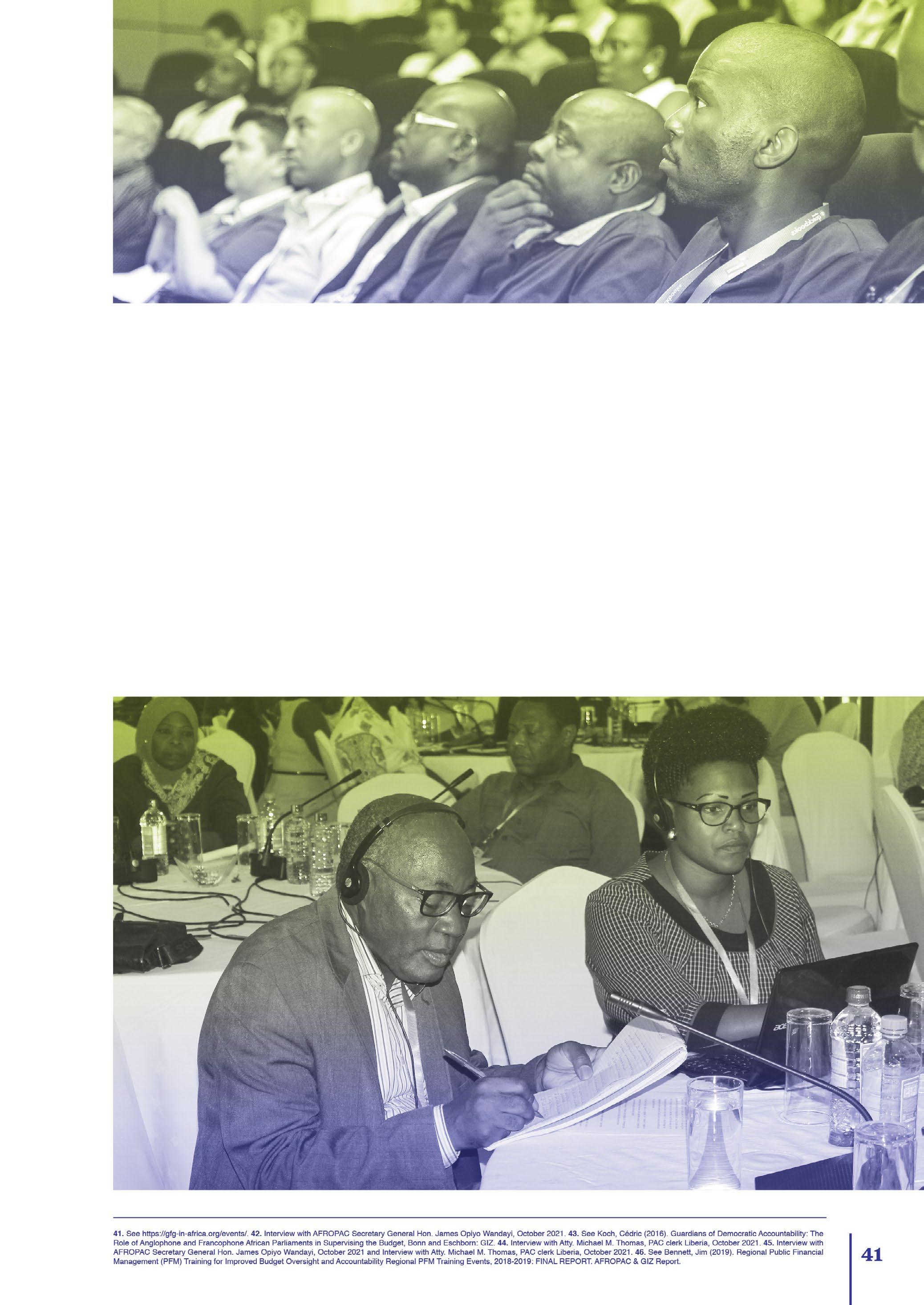
In the case of SADCOPAC, human capacity development stood out as the area with by far the least successful implementation among reporting members. At the same time, there was persistent demand from members for HCD activities to strengthen both PACs as an institution and MPs and clerks who staff these bodies. However, this demand could not be met by SADCOPAC once development partner support ended in 2014, until AFROPAC stepped in to provide a series of trainings and workshops since 2017, again with financial support from partners like GIZ.41
In principle, AFROPAC is uniquely well placed to develop centralised HCD capabilities for member states due to its continental reach and the efficiency gains which come from organising and conducting trainings together.
While continuing to provide HCD services to members is a key priority in AFROPAC’s current strategic plan, the main bottleneck on which their realisation depends remains the availability of sustainable financing. 42 To decrease dependence on individual donors, enforcing member state contributions from those states who are in arrears and building up financial buffers by fundraising including among other stakeholder institutions at the international level may be a necessary way forward for organisations like AFROPAC. But such fundraising drives of course presuppose sustainable internal resources to operate the Secretariat and ExCom Meetings. The funding structure of older organisations like the IPU or the CPA and their experiences in securing financial sustainability may be valuable inspiration in this regard.
Conducting HCD at the continental rather than regional level brings both benefits and challenges, including on languages and institutional context. For example, member states like Liberia are otherwise both officially part of WAAPAC where French language predominates among the membership and permanently invited to EAAPAC where English is most prevalent. Beyond mere working relations, these language differences often come with distinct historically grown institutional contexts of parliamentary budget oversight. 43 States like Liberia may thus particularly benefit from formal participation in an institution like AFROPAC where many other English-language countries are members.44 More generally, interested member states who are otherwise within substantially less
active regional networks outside of SADCOPAC may benefit from the activities and conferences of AFROPAC.45
But operating on the continental level also means that activities usually have to be planned and executed in at least English, French, Portuguese, and Arabic to reach all members equally. This requires additional resources and adaptation to different institutional contexts, which can be challenging as the experience of AFROPAC’s 2018-2019 trainings for PACs and clerks showed.46 In similar vein, participation in the 2021 English-language Webinar and follow-up survey organised by AFROPAC was much less forthcoming from French-speaking WAAPAC states and Portuguese-speaking SADCOPAC states.
Towards strengthened cooperation with regional stakeholder institutions
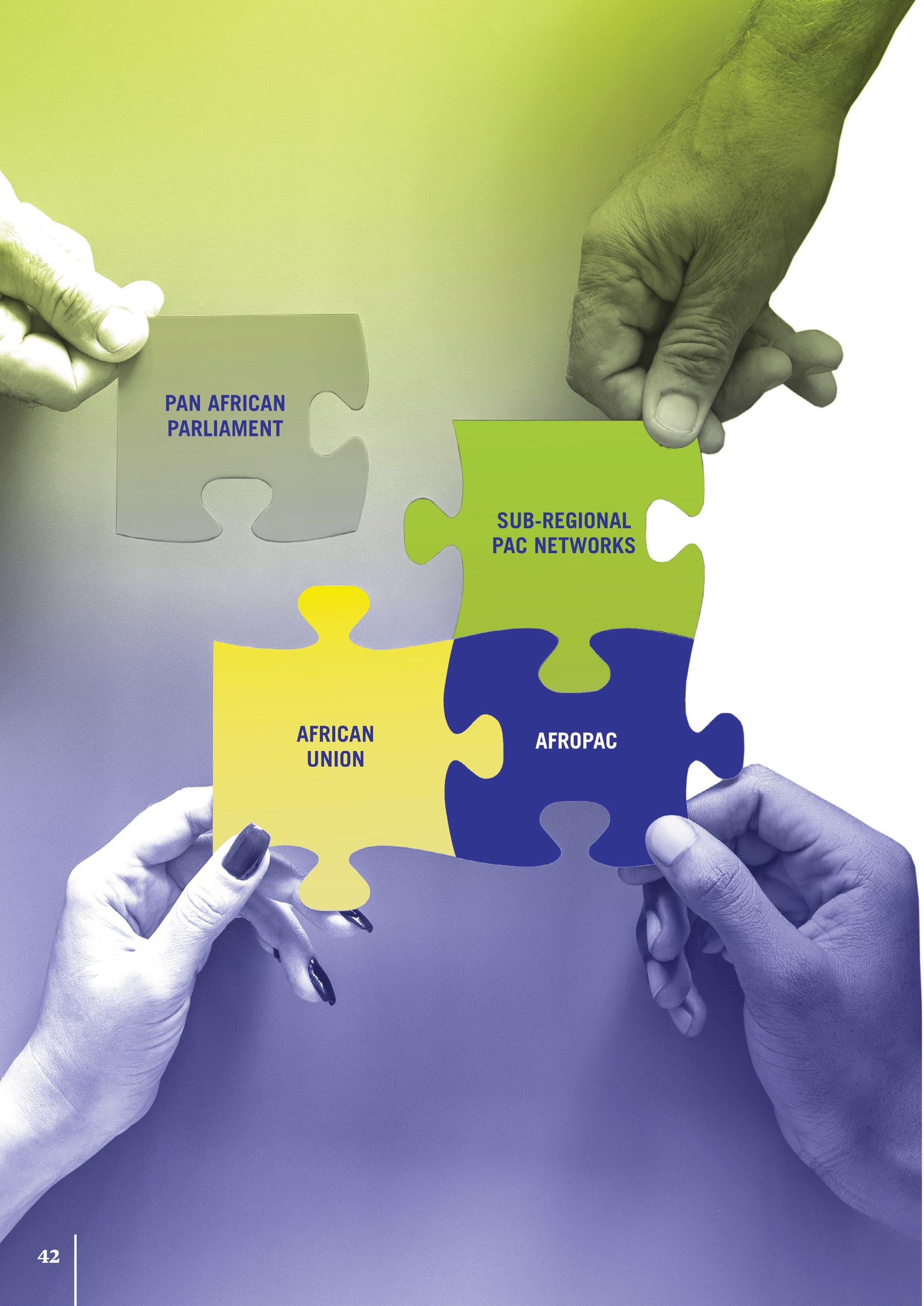
Regional PAC networks can effectively serve member states also by generating concrete gains from cooperation with other international stakeholders. AFROPAC already has positive experience in this regard: its 2018 Kampala Declaration on combatting illicit financial flows was taken up by the Pan-African Parliament in a 2019 declaration.47
This contributed significantly to political momentum within the wider continental debate including spawning an AU Commission report, all of which helped member PACs to make political progress at home on the topic. 48 To achieve such successes, AFROPAC has strong existing relationships with other institutions. These include a close partnership with AFROSAI, MoUs with the African accountant organisation PAFA and tax administrator body ATAF. There are also plans to strengthen cooperation for example with the IPU and regional parliaments like the PAP.49
Interactions with these and other politically influential stakeholders discussed in this report could be further deepened and made even more directly productive for member bodies.
This would entail not only regularly and closely exchanging information about separate activities, but also cooperating on organising and carrying out activities.
From AFROPAC’s side, coordination activities with other institutions should be strategically focused towards better addressing key bottlenecks to strengthened parliamentary budget supervision: increasing political pressure on governments to agree to binding follow-up to PAC recommendations as well as increasing institutional funding to provide regular HCD activities for both MPs and clerks.
Making use of its growing recognition and influence as a voice on public financial management in the region, AFROPAC can effectively partner with other stakeholders to serve its members even better in strengthening parliamentary budget supervision.
Conclusions
The case of SADCOPAC thus serves as a positive case study of increasingly successful PAC network cooperation in Sub-Saharan Africa. It holds lessons not only for SADCOPAC and development partners seeking to strengthen parliamentary PFM supervision, but also for AFROPAC as a continental network of PACs which aims to strengthen its own resolution-making mechanism and capacity to act as a unified voice on parliamentary budget oversight in the region.
Going forward, this report highlights at least two key remaining challenges: First, the continued professionalisation and financial sustainability of regional PAC networks to enable peer-learning among member states is central and should be supported externally by development partners.
Second, renewed efforts of organisations like AFROPAC and international stakeholder organisations as well as PAC member bodies themselves should continue to raise pressures on governments to reform PFM systems towards greater parliamentary accountability.
By working together effectively at the regional level, these actors can further contribute to ensuring that PFM indeed serves citizens’ sustainable development needs through effective PAC oversight.
Appendix
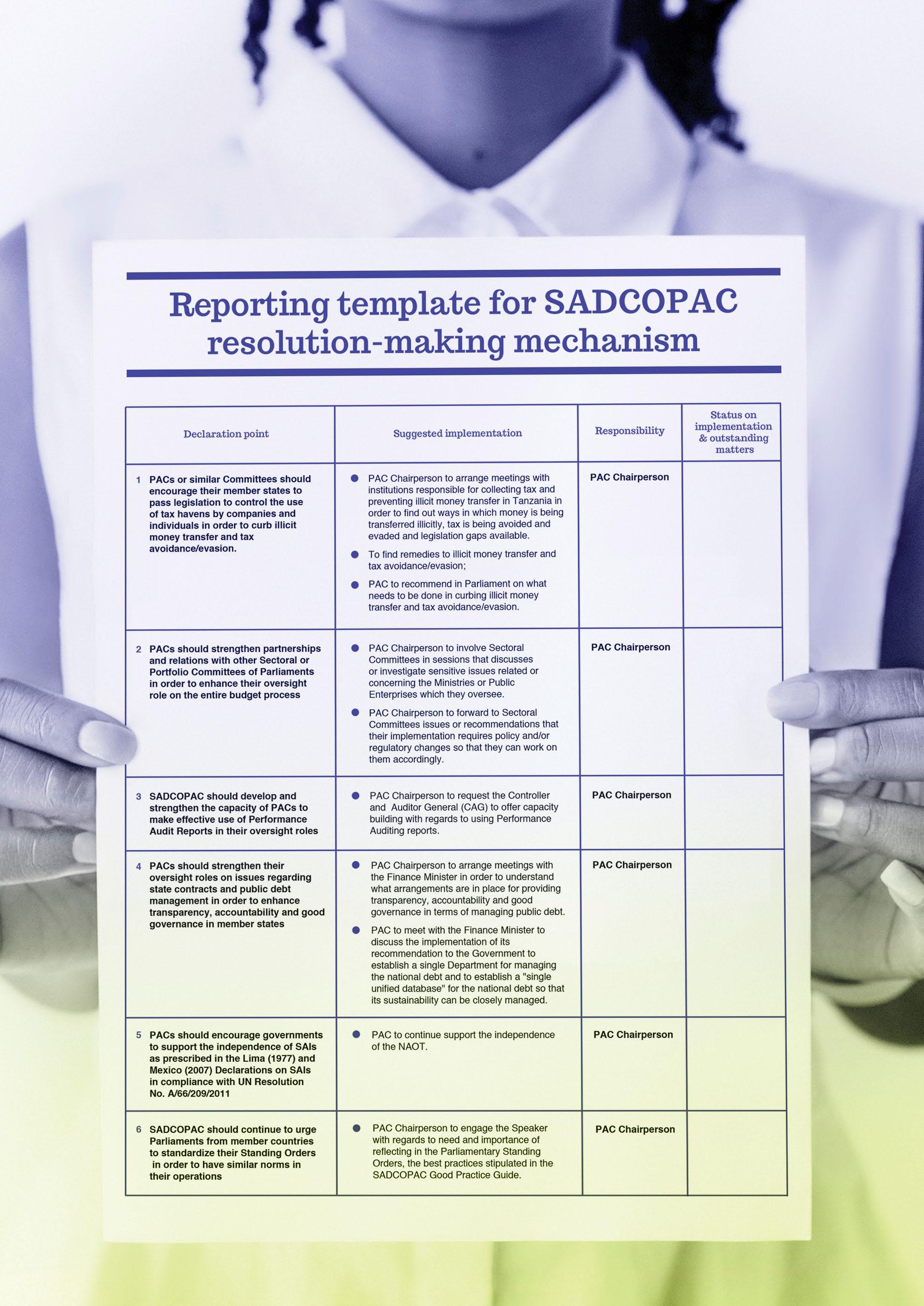
From 2013 onwards, SADCOPAC resolution implementation reports from member state bodies were supposed to be provided in standardized form prepared by the Secretariat and circulated to members. These standardized report templates consisted of simple word documents with a table to be filled by members.
While templates differed marginally between years from that point onwards, below is a representative example from an implementation report for the 2013 SADCOPAC resolutions, where member states reported their progress on in 2014. See the main text for suggestions on further specifying this reporting framework.