Renewable energy
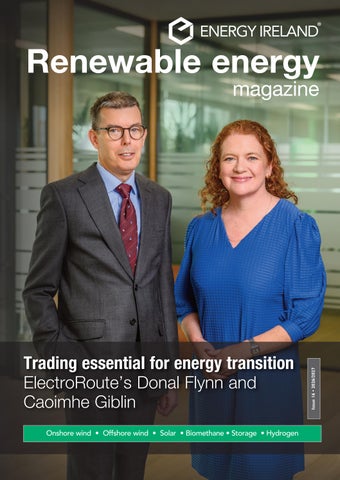
Trading essential for energy transition ElectroRoute’s Donal Flynn and Caoimhe Giblin Onshore wind • Offshore wind • Solar • Biomethane • Storage • Hydrogen
Issue 16 • 2026/2027
magazine
our Date for y
Renewable Energy Summit 2027 Tuesday 9 February Croke Park, Dublin The major annual conference for the Irish renewable energy sector Sponsorship opportunities are available for the 2027 Energy Ireland Renewable Energy Summit – contact Owen McQuade on +353 (0)1 661 3755 or
owen.mcquade@energyireland.ie for further information.
diary
Dangerous deception… renewable energy magazine
Welcome to the 16th issue of Energy Ireland’s Renewable Energy Magazine. 2026 has been marked by a world in chaos which has had profound consequences for global energy systems. Russia’s continued imperialism in Ukraine as well as the United States and Israel’s illegal war in Iran shows the volatility and unreliable nature of relying on fossil fuels. With Iran’s retaliatory closure of the Strait of Hormuz, around 20 per cent of the world’s oil supply was at risk of being cut off from global markets. Before the war, around 21.6 million barrels of oil and petroleum products passed through the Strait every day; in the second quarter of 2026, that had fallen to just 4.9 million barrels per day. LNG flows through the Strait similarly collapsed from 10.5 billion cubic feet per day to 0.8 billion. The knock-on effect has been felt across global energy markets. In Ireland, energy prices were 15.3 per cent higher in September 2026 than a year earlier, while overall inflation stood at 3.9 per cent. Recent disruption has also affected shipping through the Red Sea and Bab el-Mandeb, further exposing the vulnerability of Middle East fossil fuel exports. It also exposes as nonsense the idea that reliance on fossil fuels is the key to energy security. Dependence on imported fossil fuels leaves consumers exposed to wars, geopolitical disputes, and vulnerable international shipping routes over which they have no control. Why is it then, that the people directly responsible for this disaster are also pretending that continued reliance on fossil fuels is the path back towards energy security and affordability? During his visit to Ireland in September 2026, Donald Trump had some typically idiotic advice, calling on the Irish Government to “open up the North Sea”, the body of water which forms the east coast of the island of Great Britain. We cannot allow idiocracy to drive policy, and encouragingly the key players in Ireland’s energy sector can see this. In this magazine, we hear from experts about both the challenges and solutions to hydrogen, solar, biomethane, offshore, and onshore wind, as well as a case for small modular reactors. We also hear from both of our country’s energy ministers, with both encouragingly committed to continuing the energy transition. Our cover story with ElectroRoute co-CEOs Donal Flynn and Catherine Giblin focuses on the potential of trading in Ireland’s energy transition, as well as the long-term future of storage technology. There are promising signs with onshore wind and solar development, and even incremental progress on pump storage. In 2025, onshore wind accounted for 32 per cent of Ireland’s electricity supply, while solar PV generation increased by 50 per cent to 1.65TWh. But we need to go much further and much faster. We cannot just accept that we will not meet our 2030 offshore wind targets; we have to make every effort to at least close the gap. The conversation around hydrogen development also needs new impetus. The promise of the publication of the National Hydrogen Strategy feels like a distant memory. Ireland still gets almost 80 per cent of its total energy from fossil fuels, underlining the scale of the transition ahead. The energy transition is under threat from misinformation, but we must hold firm and stay the course. The future of our planet, affordability for all our people, and ending reliance on the good will of Washington, Moscow, and Tel Aviv for our energy security depends on it.
Joshua Murray
1
Contents RENEWABLE ENERGY MAGAZINE
04
12
24
30
52
68
88
108
Contents
08 04
Minister for Climate, Energy and the Environment Darragh O’Brien TD discusses Ireland’s energy transition
08
Cover story: ElectroRoute CEOs Donal Flynn and Catherine Giblin
12
Minister for the Economy Caoimhe Archibald MLA on the North’s energy revolution
18
Meeting Ireland’s biomethane targets
24
Professor Brian Ó Gallochóir: ‘Ireland’s energy transition past and future’
30
Catherine Vilquin, President of the European Council of Spatial Planners, discusses accelerating the European transition to net zero
52
UK government’s Lucy Yu on how AI can enhance the electricity grid
62
Euroheat’s Luca Neumann highlights the potential of decarbonised district heating cooling to support the EU’s climate targets
68
Paula Rey Garcia of the European Commission’s Directorate-General for Energy discusses and the challenges around electrification, affordability, flexibility, and investment
80
Reflections: 30 Years of Energy Ireland
82
Department of Transport Assistant Secretary Eamonn Kelly
88
Q&A: Scottish Government offshore wind director Michelle Quinn
36
Interview: BnM’s Brendan Kelly
92
40
Financial Times Energy Editor Malcolm Moore outlines how geopolitics is shaping our energy future
MaREI’s Duncan Matthews on renewing hydrogen momentum
97
Renewable Energy Magazine directory
SC-DMAP implementation underway
108
Back page: Paul Deane examines the case for small modular reactors
46
Editorial Owen McQuade Joshua Murray Ciaran Brennan Gareth Hamill Fiona McCarthy
Design Gareth Duffy Jamie Hogan Advertising/Commercial Sam Tobin sam.tobin@energyireland.ie
Publishers Energy Ireland www.energyireland.ie info@energyireland.ie energyireland
Office: Clifton House Lower Fitzwilliam Street Dublin 2, D02 XT91 Tel: 01 661 3755
renewable energy magazine
Accelerating Ireland’s energy transition Ireland must accelerate the delivery of renewable generation, grid infrastructure, and energy efficiency measures to reduce exposure to volatile fossil fuel markets, according to Minister for Climate, Energy and the Environment Darragh O’Brien TD. Minister O’Brien says that recent geopolitical events such as the Russian invasion of Ukraine and the US-Israel bombing of Iran have demonstrated the risks associated with Ireland’s continued dependence on imported fossil fuels, arguing that the energy transition had become both an environmental and economic imperative. While acknowledging the immediate pressure on households and businesses from energy costs, O’Brien says that energy efficiency and renewable generation are measures capable of providing longer-term resilience against future shocks. The Government has introduced a €750 million package of supports for productive sectors and vulnerable households, while significant resources are also being directed towards residential energy efficiency.
4
Approximately 240,000 homes have now been retrofitted, with the Government targeting around 70,000 further retrofits in 2026. O’Brien highlights the introduction of the retrofitting passport, intended to allow households to undertake measures incrementally rather than waiting until they can complete a full deep retrofit. “Deep retrofit is very good and is where we want to get to, but any measures that can be taken to reduce energy consumption, to reduce emissions for households, and reduce bills for households and families is what we want to do,” he says. More than 50,000 applications for retrofit support were received during the first four
renewable energy magazine
“I have been very straight and direct with people; that is not going to be the case.” Minister Darragh O’Brien TD on the 2030 offshore targets
months of the year, according to O’Brien, representing a doubling of applications. He says that the response demonstrates public demand for measures which reduce both energy consumption and costs, while also contributing to emissions reductions. The Government will invest more than €650 million in home retrofit supports during the year, while O’Brien says that further work is being undertaken with the Sustainable Energy Authority of Ireland (SEAI) to expand support for businesses. Around 5,000 businesses were retrofitted during the previous year, he says, generating savings while reducing their exposure to future energy price shocks. O’Brien links the need for greater energy security to the succession of economic and geopolitical disruptions experienced over the past decade, including Brexit, the Russian invasion of Ukraine, the cost-of-living crisis, changes in US trade policy, and the US-Israel bombing of Iran. “Any measures that we can take here to provide protections for people is really, really important,” he says.
Renewable expansion Ireland’s renewable generation capacity has expanded substantially over the past decade, with O’Brien highlighting the addition of approximately 5GW of new renewable capacity. The State now has around 8GW of renewable generation capacity, while renewables have in recent months met almost half of electricity demand. Wind remains the dominant renewable technology, although the Minister emphasises the increasing contribution of solar and the need to continue expanding both onshore and offshore generation. “We now, as a country, have 8GW of renewables in renewable capacity in our system,” he says. “We need to accelerate that.”
The Government’s renewable electricity support scheme has attracted significant interest, with the most recent auction delivering a generation mix of approximately 70 per cent solar and 30 per cent wind. Offshore wind represents a particularly significant opportunity, but O’Brien acknowledges that Ireland’s original ambition to have major offshore projects electrified by 2030 will not be achieved. “I have been very straight and direct with people; that is not going to be the case,” he says. The immediate objective is now to secure planning consents and move projects into construction, with O’Brien expressing hope that two significant planning decisions could be secured during the year. He also stresses the importance of creating a longer-term pipeline of offshore wind development, providing greater certainty for industry and developers. Work is underway on the national maritime area plan, which will identify additional sites that can subsequently be brought forward through auctions. O’Brien points to Ireland’s first offshore auction as evidence of continued investor interest, asserting that the process attracted four bidders and produced a competitive price despite challenging economic conditions. “It shows that even with the challenges that we have had with regard to offshore wind, particularly in the current economic climate, Ireland is seen as a 4
5
Building European connections Ireland’s energy transition will also require stronger connections beyond the island, particularly as renewable generation increases.
renewable energy magazine
The Celtic Interconnector, linking Ireland with France, is expected to be operational in 2028. O’Brien describes it as a significant piece of infrastructure and Ireland’s first direct electricity interconnection with continental Europe. He also confirms that he has signed a memorandum of understanding with Spain to assess the possibility of further interconnection. The Minister asserts that such connections would strengthen Ireland’s energy resilience while creating opportunities to export electricity as domestic renewable generation expands.
very desirable place to develop offshore wind,” he says.
Planning and grid capacity Accelerating renewable deployment will require changes to the infrastructure and planning systems supporting it. O’Brien warns that delays would carry economic, environmental, and strategic costs. He argues that slow delivery would leave Ireland exposed to international fossil fuel markets while potentially directing investment towards countries capable of delivering clean energy infrastructure more quickly. The Minister points to the Planning and Development Act 2024 as an important component of the new planning environment, with applications for new projects to be assessed under the legislation. Additional resources provided to An Coimisiún Pleanála and local authorities are also beginning to improve consenting times, according to O’Brien.
6
He says that the Government is seeking further acceleration through the passage of critical infrastructure legislation, which he describes as important in prioritising energy and other infrastructure projects. Central to that infrastructure programme is the expansion and reinforcement of the electricity grid. O’Brien highlights the PR6 programme and says the delivery of 520 capital projects will be essential to increasing grid capacity and resilience. Among these projects, he identifies the North-South Interconnector as particularly important. “This one piece of infrastructure will do so much for affordability, so much for resilience, so much to enable us to accelerate the integration of renewables into our grid,” he says. O’Brien says there would be no further reviews of the North-South Interconnector’s undergrounding arrangements, following previous reviews, and that the project would proceed on the basis of its existing consents.
“If we look at what has happened over the course of the last just few months, in particular, we can see how quickly international events hit us very, very hard here because of our overdependence on imported fossil [fuels],” he says. On how the State’s ongoing presidency can be best utilised, Minister O’Brien identifies the European grids package as one of the significant files expected to progress during the presidency, alongside measures aimed at accelerating industrial and clean-energy development. Concluding, O’Brien reaffirms the Government’s commitment to scaling up renewable deployment, strengthening the electricity grid, and reducing Ireland’s reliance on imported fossil fuels. He says that the transition will deliver two major benefits: reducing emissions while strengthening the economic position of the State. “There are two major wins within that: one from an environmental perspective, but two critically from an economic perspective.”
Delivering renewable energy solutions through solid biomass including for energy use, once existing board mill and other solid wood uses have been satisfied.
Bioenergy is a dependable, proven, and widely deployed renewable energy technology. Bioenergy (biomass, biogas, and biofuels) is the leading source of renewable energy in the European Union, accounting for nearly 60 per cent of total renewable energy. When combined with carbon capture and storage (BECCS) technologies, bioenergy achieves negative emissions, writes Seán Finan, CEO of IrBEA. Ireland currently has the lowest deployment of renewable heat in Europe at under 8 per cent, the EU average sits at 24.8 per cent renewable heat, mainly due to solid biomass contributing 20.64 per cent. The scale of the heat decarbonisation challenge is enormous. It is increasingly certain that forestry will be a provider of construction materials in an emerging bioeconomy. The use of forest by-products and residues to produce quality indigenous biomass fuels will play a significant role in displacing imported fossil fuels. The Wood Fuel Quality Assurance (WFQA) scheme, managed by IrBEA is a key enabler of the solid biomass supply chain in Ireland. Promotion of the WFQA has been supported to date through grant aid provided by the Department of Agriculture, Food and the Marine (DAFM). In Ireland, there are nearly 140 fully certified suppliers of wood fuels including firewood, woodchip, pellets,
and wood briquettes. WFQA certification satisfies the requirements for biomass under the Support Scheme for Renewable Heat (SSRH) and the Air Pollution Act 1987 (Solid Fuel) Regulations 2022. In 2024, IrBEA became a national supporting body for the Sustainable Resources Verification Scheme GmbH (SURE), a European certification body which provides sustainability certification services to WFQA members in compliance with the Renewable Energy Directive. Forest-based biomass is complementary to sustainable forest management where the objective is to produce high quality timber for use in the construction sector as low embodied carbon building materials. Production of sawlog-sized material involves practices such as thinning and the production of smaller size logs that have a number of markets,
An Energy Supply Contract (ESCO) is preferred by many heat users as it takes responsibility for fuelling, operating, and maintaining the biomass heating system with the heat user paying for the units of heat delivered. For heat users, the Support Scheme for Renewable Heat (SSRH) is a 15-year SEAI administered operational support for biomass heating systems. There are several hundred biomass heating systems operating successfully across Ireland. Biomass fuels can readily meet the challenges of domestic, commercial, and industrial energy demand. Large demand and higher temperature heat users such as the food processing and the pharmaceutical sector will be difficult to decarbonise without the widespread use of solid biomass. In 2024, the Irish Bioenergy Association launched a solid biomass capacity statement which demonstrates the capacity of the solid biomass sector to deliver decarbonised heating solutions using solid biomass. Biomass systems support indigenous jobs, energy security, and local supply chains through the provision of quality, sustainably certified, and renewable fuels. The Irish Bioenergy Association works on behalf of members to develop the sector. The Wood Fuel Quality Assurance (WFQA) Scheme is a key enabler of solid biomass as a reliable source of renewable energy.
Seán Finan CEO, Irish Bioenergy Association E: seanfinan@irbea.org W: www.irbea.org W: www.wfqa.org
cover story
Trading essential for energy transition Energy Ireland’s Joshua Murray meets with the co-CEOs of ElectroRoute, Caoimhe Giblin and Donal Flynn, in their Dublin headquarters. The CEOs discuss the role of trading in the energy transition, the need for increased battery storage, and their company’s journey from a small startup to a significant international organisation in the 15 years since its foundation. 8
cover story
Fifteen years since its foundation, ElectroRoute has grown from a small Irish energy trading start-up into an international business managing more than 4GW of renewable and flexible energy assets. However, for co-CEOs Caoimhe Giblin and Donal Flynn, the company’s origins remain closely tied to a relatively simple proposition: “When the founders were setting up the company, they were looking at how the energy transition was going to result in a demand for more innovative trading solutions. At the time, the only options were the utilities, so they decided to provide that type of functionality to the market,” Giblin says. Founded at the height of the financial crisis, ElectroRoute initially focused on establishing the market infrastructure required to trade electricity independently. Its early activity centred on the interconnectors between Ireland and Britain, including the then recently commissioned East-West Interconnector. “There was a lot of renewable power being wasted on the island of Ireland, so the team started by exporting that extra surplus of renewable power when it was cheap in Ireland and selling it into the Great Britain system.” The company’s original proposition was therefore closely connected to the challenge that remains at the heart of the energy transition: renewable generation is increasingly abundant, but
its output is variable and must be managed differently from conventional generation. Flynn, who joined ElectroRoute in 2021 after group CFO roles with ESB and Glen Dimplex, says the founders recognised that renewables required a much greater level of market granularity. “A historic base-load fossil plant will run at a certain level pretty much all the time, whereas solar or batteries or wind are much more variable. They go up and down. For renewables, it is necessary to forecast with a 15-minute granularity right from day one, and then manage variations on a 24/7 basis,” he says. This understanding has become central to ElectroRoute’s business. In 2026, the company trades across wind, solar, hydro, batteries, combined heat and power, and other flexible assets in Ireland and Britain.
From Ireland to Japan A significant milestone came in 2016, when Mitsubishi Corporation acquired a majority stake in ElectroRoute, subsequently moving to full ownership in 2022. The CEOs explain that Mitsubishi saw an opportunity to take ElectroRoute’s expertise into Japan, where the energy market was undergoing its own process of deregulation and renewable investment.
“Japan is behind Europe in terms of deregulation of the energy market. ElectroRoute had been through that deregulation journey, that journey of renewables coming onto the system, and how you thrive in that environment,” Flynn explains. He adds: “Part of our mandate in ElectroRoute was to build the platform we had in Europe over in Japan.” The result has been a substantial Japanese business, with its operation now holding around 2GW of assets under management and approximately 50 people. Giblin states that the Japanese expansion demonstrates the importance of combining local knowledge with expertise developed in another market. “It would have been very hard as an Irish company to do that without the local support of Mitsubishi,” she says. “It was a unique mix of Mitsubishi and their strong name and connections and understanding of the Japanese market, combined with our experience and knowledge from having built a company like that in Europe.” Flynn says the partnership worked because neither side attempted to replicate the other’s capabilities. “The culture and the language are very different, and I do not think it would be possible for an Irish business to go in there on its own. I think you need a trusted local partner, and we could not
4 9
cover story have had a better one than Mitsubishi Corporation.”
current output, weather conditions, and plant availability.
There was also a two-way transfer of expertise, with Japanese staff coming to Ireland for training and ElectroRoute personnel relocating to Tokyo.
“What our traders are doing is taking that information and deciding when to sell that power into the market, effectively in real time. It is very much about taking all the real-time information and making those trading decisions,” Giblin says.
“The recognition that Mitsubishi Corporation brought certain unique things, ElectroRoute brought certain unique things. I think both parties recognised the value the other was bringing,” Flynn says.
The case for trading While ElectroRoute has expanded geographically, its core objective remains the optimisation of renewable and flexible assets. For wind and solar, the challenge is that generators cannot determine when the wind blows or when the sun shines. The trading operation therefore needs to constantly assess market conditions and generation forecasts to determine how and when electricity should be sold. “We have a team of energy traders who work 24/7 here in Dublin who are in front of the screens all day, all night, and all year,” Giblin explains. The company receives regular information from individual generating assets, allowing traders to assess
10
The same principle becomes particularly important with batteries. “The success of a battery depends on charging it when prices are low, and discharging, selling the power back into the grid when prices are high,” she adds. The trading desk therefore has to assess a range of variables including renewable generation and electricity demand, as well as gas generation and prices, in deciding when a battery should charge or discharge.
“We can see whether a weather system is hitting a plant that we look after in the southwest of the island before it hits the northeast. All of those things combine to give us relevance and a reason for having a role in the energy system,” Flynn says.
Batteries The company’s focus is increasingly shifting towards flexibility, particularly battery storage. Giblin describes wind and solar as the company’s “bread and butter”, but says the next stage of the energy transition depends on finding ways to use renewable electricity when it is available and retain it for when it is needed. “The other big growth area in terms of investment for the Irish system is around how to either store that energy or use that energy smartly,” she says.
Flynn says ElectroRoute’s scale provides an additional advantage: “It is much more difficult to predict what is coming out of a single turbine versus hundreds of turbines and solar plants. We have a really helpful portfolio effect.”
“That encompasses batteries, flexible generation, and flexible demand. Whether it is flexible storage like batteries, flexible generation like peaker plants, or flexible demand, flexibility is key and it is really critical to getting towards net zero.”
The company’s scale also allows it to operate a 24-hour trading desk and benefit from information across multiple assets and geographical areas.
ElectroRoute is already developing new commercial structures around batteries in Great Britain, including arrangements that provide developers with greater revenue certainty.
In Ireland, Giblin sees significant potential once regulatory uncertainty is resolved. “We are keen to offer products to the market that provide revenue certainty to those batteries and we are in discussions with a number of battery developers about that at the moment.”
Collaborative leadership The company’s expansion has coincided with an unusual leadership structure. Giblin and Flynn became coCEOs in 2024, following the decision by founder and original CEO Ronan Doherty to step back. Both independently suggested a co-CEO structure to the shareholder. Flynn says the model also fitted with Mitsubishi’s consensus-based approach. “It allowed them to keep both of us. The Japanese model is very much based on consensus, so it echoed quite nicely with them and gave a lot of continuity.” The arrangement is underpinned by a long professional relationship between the two CEOs. “We have known each other a long time, and we trust each other,” says Flynn. “I feel we certainly get through a greater quantum of work because there are two of us. I think there is an underestimated value in being able to bounce an idea off Caoimhe and ensure a collaborative approach in our decision-making.” Day-to-day responsibilities are divided with Giblin overseeing client trading activities, proprietary trading and IT while Flynn takes responsibility for finance, risk, HR, and support functions. However, the most important decisions remain shared.
Ambitions With the business in Japan now established as a profitable, independently operating business, ElectroRoute’s strategic focus has returned firmly to Europe. The company has around 1.5GW under management in Great Britain and is
Flynn says the immediate priorities are to maintain the company’s position in onshore wind and solar, expand its battery activities, and continue growing geographically. “We see batteries growing more and we envisage growth in Britain. Beyond that, we are looking at other markets in continental Europe.” Technology will be central to that expansion. ElectroRoute has invested heavily in its data and analytics capabilities through its Quantum Core function, bringing together data scientists, data engineers, and market specialists. Underpinning this is ElectroRoute’s graduate programme, the ElectroRoute Academy, which ensures that at least three newly qualified professionals enter the company every year.
As the share of intermittent renewable generation grows, so too does the need for sophisticated trading, flexibility, storage, and data. For ElectroRoute, the next 15 years will be about taking that original proposition beyond Ireland. “We have already shown we can build a market position in Britain and Japan, so we are definitely aiming for geographic expansion,” Giblin says.
cover story
Giblin also emphasises the importance of long-duration energy storage: “To provide full flexibility to the system for renewables, we need long-duration energy storage because that is a key part of the system.”
looking at further continental European markets.
At the same time, the company expects its role in Ireland’s energy system to continue evolving. Giblin points to the State’s data centre sector as one example, arguing that large electricity users could increasingly become integrated parts of a more flexible energy system. “Data centres will become more like energy centres, combining on-site renewable generation with battery and storage capability, as well as flexible demand,” she says.
“We have invested significantly in our data and analytics capability over the last few years. We have a team of data scientists, data engineers, and market and industry experts who work together on developing trading strategy, optimising models, and machine learning models,” Giblin says.
About: Caoimhe Giblin Caoimhe Giblin is co-CEO of ElectroRoute. A chartered accountant, she began her career with KPMG before moving into the renewables sector with Airtricity/SSE Renewables where she spent a decade in finance and corporate finance roles. She joined ElectroRoute around 2012 to establish its client services business, which now trades approximately 4GW of assets across multiple technologies, including wind, solar, hydro, and batteries. Originally from Rush, County Dublin, she now lives in Meath with her husband, two children, and a variety of pets. She is an avid reader and enthusiastic, adventurous traveller.
About: Donal Flynn Donal Flynn is co-CEO of ElectroRoute and has over two decades’ experience in the energy and renewables sector. A qualified accountant, he trained with Arthur Andersen before holding senior roles with General Electric, SSE Renewables, ESB, and Glen Dimplex. Flynn joined ElectroRoute in 2021 and became co-CEO shortly afterwards. Outside of work, he is a keen cyclist and an avid Connacht Rugby supporter, and lives with his wife and two daughters.
11
renewable energy magazine
The North’s ‘energy revolution’ The North’s Economy Minister Caoimhe Archibald MLA outlines the progress being made in the region’s “energy revolution”, the work underway to achieve its renewable targets, and the importance of collaboration with its neighbours. Caoimhe Archibald MLA says that, in the last year, “the need to end our reliance on imported fossil fuels has become even more clear” due to the US-Israeli attacks on Iran and Russia’s continued invasion of Ukraine. The Minister highlights the potential of a more self-sufficient green economy, noting that the low carbon and renewable energy sector generated approximately £1.6 billion in turnover in 2024, according to figures from the Office for National Statistics (ONS). To realise this potential, Archibald says her focus is “to accelerate progress on laying the foundations for lasting price stability, sustainable investment, and an economy powered by reliable and affordable clean energy”.
Energy progress The Executive’s Energy Strategy was published in December 2021 and set targets of 80 per cent renewable electricity consumption, a 25 per cent reduction in energy consumption from buildings and industry, and an annual green economy turnover of £2 billion by 2030.
12 12
renewable energy magazine
“Affordability is the critical consideration, people must see and feel the benefits of change and have confidence that this energy revolution will be fair, will be properly supported, and focused on lower and more stable energy costs for the long term.” Caoimhe Archibald MLA, Minister for the Economy
The mid-term review of the strategy found that there was only one per cent progress toward the energy savings target, however, Archibald states this is not an accurate figure: “We are now at 15 per cent of the strategy’s target, lower than what is actually being achieved due to the lag nature of reporting against policy interventions.” Archibald adds: “We have a clear line of sight on how to achieve the energy savings target to 2030 even if it will inevitably take several years into the 2030s for it to be fully reported.” There has been more measurable progress on the renewable electricity target. The proportion of electricity generated from renewable sources in the year to June 2026 was 50 per cent of gross final electricity consumption, compared to 44 per cent in the previous period and matching the highest level previously recorded. Archibald says previous decreases in renewable generation were mainly due to “maximising imports of cheaper imports from Britain, set against falling electricity demand”. The Minister adds this is unlike the Republic where “the challenge is different in the need to meet rising demand driven by data centre growth”. To continue its progress on renewable usage, in May 2026, the North became the first region between Ireland and the UK to consult on detailed geothermal regulation.
Reaching 2030 targets Despite the record levels of renewable electricity generation, more work is needed to reach the strategy’s target by 2030. Archibald says: “Continued growth in renewable electricity generation is essential in meeting our targets and
opening up investment and green growth opportunities across Ireland.” To this end, the Department for the Economy (DfE) is developing a new support scheme, the Renewable Electricity Price Guarantee (REPG), to incentivise an increase in renewable electricity generation by reducing exposure to wholesale price volatility. The REPG is modelled on the Republic’s Renewable Energy Support Scheme (RESS) and Britain’s Contract for Difference (CfD). It will hold auctions to offer renewable energy projects a 15-year, inflation-linked contract, with a fixed-price benchmark supply of electricity using a reference of the SEM day-ahead price. The draft bill to deliver this scheme is currently with the Executive for agreement, and Archibald says: “Once in law, it will be used over the next 25 years to deliver lower electricity costs to households than they are paying today.” As contained within the design plan for the rollout of smart electricity meters, published in April 2026, the Minister has asked NIE Networks to deliver first meter installations in 2028 and complete the rollout by 2030. Archibald says that “smart metering will play an important part in tackling fuel poverty”, adding: “I would like to prioritise delivery to lower-income households as they have the potential to benefit relatively the most.” Additionally, the Minister notes that “an important part of our journey towards decarbonisation lies in how we heat our homes”, adding: “People deserve the security of a warm, comfortable home without being exposed to sudden rises in oil and natural gas prices.”
4 13
renewable energy magazine
To support homeowners as they move to low-carbon heating options, DfE is developing a new domestic energy efficiency and low carbon heat programme. A public consultation on this was due to be launched in summer 2026, although this has not yet occurred. The Minister says the responses will “inform my final decisions on the measures the scheme will support, the financial support available, and the quality assurance measures that will be needed”.
Energy collaboration DfE has previously identified electricity and energy collaboration between the North and its neighbours as critical in lowering prices, increasing stability, and maximising renewable energy. In August 2026, DfE published an electricity interconnection policy statement setting out the guiding principles that underpin its approach to east-west electricity interconnection. Archibald welcomes further collaboration and says: “Increased interconnection will enable us to export surplus renewable power when it is windy and import lower cost electricity when we need it.” The Minister also reiterates her support for the North-South Interconnector, saying: “It is critical to reducing electricity costs for consumers across the island and at a time of global uncertainty, strengthening our all-island
14
infrastructure is essential to delivering a secure, resilient, and affordable energy system.” The planned 140km overhead highvoltage electricity link connecting the power grids of the Republic and the North was first proposed in 2006 and was granted planning permission in 2020. However, it is not expected to be completed by its target of the end of 2031. Construction on the estimated €350 million (£300 million) project has begun in the North. Archibald also says she is a “strong supporter” of the Single Electricity Market (SEM), which allows power generators and energy suppliers to buy and sell electricity on an all-island basis. The Minister adds: “It is important that affordability remains at the centre of how the SEM evolves and I welcome the work that the SEM committee is doing on its strategic direction going forward.” As part of the Labour government’s reset in relations with the EU, the potential recoupling of the day-ahead EU internal electricity market and the British electricity wholesale market has gained prominence. Archibald welcomes this idea, saying: “I hope that these negotiations lead to agreement in this area, as the prize in terms of cost reduction for electricity consumers on this island is a material one.”
Before the UK left the EU, both the SEM and the electrical market of Britain were part of this shared system, but since 2021 the SEM has run its dayahead market separately, so there is no direct electricity link between the SEM and mainland Europe. Concluding, the Minister highlights the importance of the North’s “energy revolution” in delivering tangible benefits to consumers, saying: “Affordability is the critical consideration, people must see and feel the benefits of change and have confidence that this energy revolution will be fair, will be properly supported, and focused on lower and more stable energy costs for the long term. “I am committed to accelerating progress in the North, laying the foundations for lasting price stability, sustainable investment, and an economy that is powered by reliable, clean, affordable energy. That is the prize and I believe that it is within our reach.” Caoimhe Archibald MLA has been the North’s Economy Minister since February 2025. She has been a Sinn Féin member of the Northern Ireland Assembly since 2016, representing East Derry.
renewable energy magazine
New Flexibility Needs Assessment supports a renewable-led electricity system Flexibility will not remove the need to invest in the electricity grid, but it can help the system make better use of existing and future infrastructure.
A new European requirement CRU’s Flexibility Needs Assessment is part of a new EU-wide approach to understanding how electricity systems will need to adapt in the years ahead. Across the EU, member states are now required to assess the level of flexibility their electricity systems are likely to need over the next decade.
John Melvin, Director Security of Supply and Wholesale Markets at the Commission for Regulation of Utilities (CRU), discusses Ireland’s first national Flexibility Needs Assessment (FNA). The CRU has published Ireland’s first national FNA which analyses how much flexibility the electricity system is likely to need in 2028 and 2030, and identifies the market, regulatory, and operational issues that could make it harder to deliver this level of flexibility. Ireland’s transition to renewable electricity depends on more wind and solar generation, supported by a flexible grid that can respond to where and when electricity is produced and needed.
16
The assessment uses a common methodology developed and approved by the Agency for the Cooperation of Energy Regulators (ACER). This allows Ireland’s findings to be compared with those from other European states, while reflecting the particular needs of the Irish electricity system. The CRU led the assessment in collaboration with EirGrid and ESB Networks, which provided the technical analysis. The CRU also worked closely with the Utility Regulator in Northern Ireland, given the all-island electricity system and the Single Electricity Market.
Why flexibility matters
What the FNA analyses
Grid flexibility is becoming increasingly important as Ireland uses more renewable electricity. It allows the electricity system to adapt quickly when supply or demand changes; in particular when wind and solar generation varies with the weather and time of day.
The FNA establishes where, when, and how much flexibility Ireland’s electricity system is likely to need in the years ahead. It looks at:
For electricity customers, flexibility is important because it can help Ireland make better use of renewable electricity, ease pressure on the grid, and support a secure, efficient electricity system.
•
network needs, including local congestion and voltage management challenges;
•
how much flexibility may be needed, and when;
•
existing and potential sources of flexibility;
•
market, regulatory, and operational barriers that could slow down the use of flexibility resources; and
•
the role flexibility can play in supporting Ireland’s 2027 indicative national objective for non-fossil flexibility.
Key findings The FNA shows that flexibility is needed: to manage surplus renewable generation across the electricity system and transmission network; and
•
at distribution level it is needed to address local capacity constraints.
Flexibility can help the grid work more efficiently, but it will not remove the need for investment in the network. Flexibility needs may be met through explicit flexibility products and more efficient market arrangements which strengthen signals and enable flexible resources to respond to system needs. Flexibility needs can be met by a wide range of sources including demand-side resources, energy storage, flexible generation, distributed energy resources capable of adjusting generation or consumption, including shifting consumption. Not all needs must be met, it is unlikely to be economic to meet all identified needs, and some residual renewable dispatch down is expected to remain. Market, regulatory, and operational barriers to flexibility still exist, although good progress is already being made to enable and support flexibility. The methodology is not perfect, the assessment also identified challenges in applying the ACER methodology using existing modelling frameworks and in aligning European methodology requirements with Single Electricity Market-specific operational arrangements and processes. These issues will be considered further to support potential improvements in future iterations of the FNA.
Supporting renewable energy integration One of the most significant findings from the assessment is the growing importance of flexibility in supporting renewable energy integration. As renewable generation increases, flexibility will be needed to manage
renewable energy magazine
•
“As renewable generation increases, flexibility will be needed to manage periods when output exceeds demand and when network constraints limit the transport of electricity to where it is needed.” periods when output exceeds demand and when network constraints limit the transport of electricity to where it is needed. The FNA shows that dispatch down is driven by surplus renewable generation, operational constraints, and network congestion. It also shows that some renewable electricity may still need to be reduced at times, where this is the most efficient way to run the electricity system. The FNA supports Ireland’s work to decarbonise the electricity system while maintaining security of supply and value for customers. By identifying needs early, Ireland can better understand where market arrangements, operational measures, network development, and targeted flexibility products may be required.
Next steps The Flexibility Needs Assessment will inform future decisions on policy, regulation, markets, and how flexibility services are developed. One of the next steps will be setting Ireland’s indicative national objective for non-fossil flexibility in 2027. The CRU will continue to work with EirGrid, ESB Networks,
and the Department of Climate, Energy and the Environment to build the evidence needed to support that work. This assessment is also the start of an ongoing process. It will be updated at least every two years, with the next assessment expected to begin in 2027. Future updates are expected to look further ahead and reflect improvements in modelling, data, and understanding of Ireland’s changing electricity system. The CRU will also host an industry workshop in October 2026, where stakeholders, including market participants, will be given an overview of the FNA process, methodology, and key findings, and will have an opportunity to ask questions on the recently published FNA report. The workshop will also help raise wider awareness of the role flexibility can play in the energy system. As Ireland continues to use more renewable energy, flexibility will be central to making the electricity system work well for homes, businesses, and communities.
W: www.cru.ie
17
renewable energy magazine
Biomethane target ‘could cut farm inequality’ Reaching Ireland’s 2030 target of producing 5.7TWh of biomethane could increase incomes among lower-income cattle farms and reduce inequality across the agricultural sector, according to new ESRI research. Fuelling Change: The distributional and climate impacts of farmers supplying biomethane feedstocks in Ireland, by Anita Vollmer, Miguel Tovar Reaños, and Muireann Lynch, finds that using agricultural land to produce biomethane feedstocks could support a “just energy transition”, but would involve a trade-off between reducing inequality, maximising emissions reductions, and keeping abatement costs down. The study focuses on Ireland’s target of producing 5.7TWh of biomethane annually by 2030. It uses data from the Teagasc National Farm Survey and a microsimulation model to assess which farms would switch to biomethane feedstock production under four different scenarios. The four scenarios are as follows:
18
•
farm efficiency;
•
farm profitability;
•
emissions reduction; and
•
a partial-conversion scenario in which farms retain livestock while converting part of their land to biomethane silage.
Income distribution The most significant distributional finding concerns lower-income cattle farms. Under the profit scenario, around 3,058 farms would switch completely to biomethane silage production. Almost all of these would be cattle farms, with an average family farm income of just €5,431
compared with €34,202 across the overall farming population. For these farms, switching would increase average cattle farm income by 8.7 per cent. Overall farm income would increase by 2.6 per cent, while inequality, measured using the Gini coefficient, would fall by 3.4 per cent.
The farms most likely to switch under the profit scenario are relatively extensive, lowintensity farms. Removing livestock production from these farms could therefore result in livestock production becoming more concentrated among higher-intensity farms. The ESRI authors describe this as a concern because “the most environmentally sustainable and extensive farms would be those transitioning away from livestock farming, leading to a consolidation of livestock farming into high-intensity farms”.
Emissions reduction For the alternative climate scenario, the model selects farms with the highest greenhouse gas emissions per hectare. Around 4,058 farms would need to switch completely to biomethane silage, with an average stocking rate of 2.5 livestock units per hectare. This produces the greatest emissions reduction of the scenarios examined: approximately 2.1 MtCO2eq, compared with 1.7 MtCO2eq under the efficiency scenario and 1.6 MtCO2eq under the profit scenario. The partial conversion scenario produces approximately 1.4 MtCO2eq of abatement. The report models that climate-focused farms experience significant income reductions, with average dairy-farm income falling by 7 per cent and cattlefarm income by 4.3 per cent. Overall inequality increases by 2 per cent.
Under the three full-conversion scenarios, between 5.8 per cent and 7.7 per cent of cattle and dairy farms would need to convert completely to biomethane silage production. However, these scenarios would require between approximately 17 million and 18 million m3 of slurry from farms not participating in biomethane production.
renewable energy magazine
The authors therefore identify a potential distributional benefit from directing biomethane production towards lower income farms. However, they caution that the very low incomes of these farms raise questions about whether they would actually have the resources or motivation to make the transition.
Can the 5.7TWh target be achieved?
The partial conversion scenario avoids the need for imported slurry, but would involve 71.8 per cent of farms and would produce only 4.35TWh. In this context, the ESRI concludes that under its assumptions “it may not be possible to reach the Government target of 5.7TWh biomethane from on-farm feedstocks alone”.
A high-cost form of abatement All four scenarios have a marginal abatement cost above the ESRI’s assumed 2030 carbon shadow price of €408/tCO2eq. The climate scenario performs best on this measure, at €472/tCO2eq when biomethane replaces fossil gas for heat and €415/tCO2eq when used in transport. The other scenarios generally range between €500 and €600/tCO2eq for heat. The report contextualises that these results are sensitive to the price achieved for biomethane. A substantially higher biomethane price could reduce the marginal abatement cost to between €300/tCO2eq and €400/tCO2eq in some circumstances. The paper concludes that agricultural biomethane can contribute to a just energy transition, but that policymakers face competing objectives of reducing farmincome inequality, maximising emissions reductions, and minimising the cost of abatement. Importantly, the farm data available for the analysis dates from 2017 and the model lacks sufficient spatial information to determine whether the required slurry would be available close enough to proposed biomethane plants.
The study consequently identifies a tension between the social and environmental objectives of biomethane policy. The authors conclude that “there is likely a trade-off between reducing inequality and other benefits”.
19
Offaly is leading in Ireland’s net zero ambition, protecting communities and responding to the biodiversity crisis, according to Andrew Murray, Director of Services, Offaly County Council. Andrew Murray
as a renewables leader will be retained well into the next decade,” says Andrew Murray.
Credit: Currents newsletter by Green Energy Collective, based on Eirgrid and SEMO data.
renewable energy magazine
Offaly leading the way in renewables and biodiversity
While not all energy sources operate simultaneously or at full capacity, Offaly’s 2GW renewables ‘pipeline’, combined with a similar ‘pipeline’ of conventional generation, storage, hydrogen projects, CO2 battery technology, and synchronous condensers should be considered against Ireland’s peak electricity demand of approximately 6GW.
Plan-led and strategic vision
Offaly was the number one producer of renewable electricity nationally in January, March, May, June, and August 2026.
Offaly is a national leader in renewable electricity generation. Having had a long tradition of peat-fired power generation and a strong electricity grid network, the county has transformed from having a zero renewables base only 12 years ago. According to Currents newsletter by Green Energy Collective, the county was Ireland’s number one producer of renewable electricity in January, March, May, June, and August 2026. This position is driven by nine operational wind farms, with a combined capacity of approximately 520MW and the 120MW Edenderry biomass plant, while grid-
20
scale solar deployment gathers pace. It is envisaged that growth in renewables will continue. Four additional wind farms are currently before An Coimisiún Pleanála, with five more projects at preplanning stage. Together these could deliver over 1GW of electricity. Approximately 23 solar projects are proposed, permitted, or under construction, representing around 1.1GW of capacity. “Having regard to the likely lead time for offshore wind and Offaly’s renewables pipeline, it is predicted that this position
Offaly’s renewable energy success has been strategic, plan-led, and grounded in a sense of a ‘reasonable balance’. The 2009-2014 Wind Energy Strategy identified two strategic areas for wind energy development at a time when focus was on the western seaboard. The county’s first wind farm at Mountlucas was energised in 2014. Since 2024, over 300MW of wind generation has been installed. The wind energy target in the current County Development Plan 2021-2027 was exceeded by approximately 15 per cent, some 18 months before its expiry and the solar target is expected to be comfortably exceeded. “To date, our plan-led approach, endorsed through three successive County Development Plans, has proven successful. An Coimisiún Pleanála’s decisions have aligned with the provisions of our plan,” Murray states.
Delivering on national targets Offaly’s wind energy pipeline represents approximately 11 per cent of Ireland’s 9GW onshore wind target and approximately 40 per cent of the target for the Eastern and Midlands Region set under the National Planning Framework, first revision 2025. For solar energy, the figures are approximately 14 per cent of the national 8GW target and 30 per cent of the regional target.
renewable energy magazine
However, a significant national challenge remains. According to Murray: “To achieve carbon neutrality by 2050, substantial additional renewable energy will be required. However, there is no clear national figure in GW against which to plan to 2050 and allocate reasonable targets to counties.” Offaly believes that the forthcoming Regional Renewable Energy Strategies (RRES) should be developed within a clearly defined national trajectory to 2050. “It is imperative that these targets will recognise the substantial contribution already made by certain counties,” Murray says. Achieving this will require collaboration between the Regional Assemblies and equitable allocations reflecting both capacity and environmental considerations. “Offaly’s stance on this is consistent with the county’s strategic objectives of balancing the net zero ambition with securing economic and social dividends for Offaly’s citizens, together with proactively managing the biodiversity crisis,” says Eoghan Ryan.
At Offaly County Council’s request during the planning process, Bord na Móna developed a 10km amenity trail network at its Mount Lucas Wind Farm, which has since grown to include a Learning Hub, sensory space, and weekly parkrun.
economy while driving, and benefiting from, the energy transition,” Martin says. Offaly also incorporated the concept of Green Energy Parks into the County Development Plan in 2021.
Orla Martin, Head of Enterprise with the council says it is vital to build on this success.
These initiatives are delivering results. The Rhode Green Energy Park, owned by the North Offaly Development Fund, has helped attract interest in a significant adjacent Eco Energy Park proposed by BnM, with Amazon Web Services identified as a potential anchor investor.
“At the heart of Offaly’s strategy is a determination to convert its energy advantage into lasting social and economic benefits, creating employment opportunities and attracting investment,” she says.
“While, of course, the planning system has to ultimately decide on developments, the fact that multinationals such as AWS have expressed an interest in the county is very promising,” says Ryan.
Supporting this goal, the Council commissioned studies on eco-industrial parks, renewable energy and hydrogen integration, large energy and data-centre opportunities.
Similarly, partnerships involving Google, Lumcloon Energy, South Korea’s Hanwha Energy and KEPCO delivering battery and CO2 storage and supercapacitor technologies highlight Offaly’s growing appeal as a clean-energy hub and a destination for investment where renewable energy is a key consideration.
Securing the economic dividend
“These reports send a clear message to potential investors that Offaly is committed to future-proofing its
“While we recognise that many of these developments do not create significant additional jobs, we are mindful of the Government’s position that the ICT sector, AI, and data centres are a vital part of Ireland’s industrial base. For many large developments, grid security and access to local clean energy are key considerations and we want to play a major role in that,” adds Ryan. The Council stresses that opportunities extend beyond data centres. Nextgeneration manufacturing, logistics, food processing and other energy-intensive industries could also benefit from Offaly’s combination of available land, clean energy, strong grid infrastructure, water resources, and a skilled workforce. Crucially, the Council’s proactive STEM programme engages over 3,000 students and 250 teachers annually, equipping the next generation with the skills required for future careers.
4
21
renewable energy magazine
Offaly’s current ‘pipeline’ of renewable and other energy developments, its Wind Energy Development Areas and its Peatland and Nature Corridors.
Host communities and legacy projects Murray acknowledges that while citizens support both climate action and economic development, communities must feel that they are benefiting from the transition. “Communities in Offaly are ‘hosting’ a significant number of large energy projects. We must not forget that. Our communities need to be protected and developed. Many experienced substantial job losses when peat-fired electricity generation ended in 2020, some seven to 10 years earlier than expected.” The county has already demonstrated an appetite for innovation. Working with EnergyCloud Ireland, AWS, ESB, and EirGrid, excess renewable electricity is converted into free hot water for social housing residents within the Tullamore Decarbonisation Zone, helping to tackle energy poverty. In another significant initiative, the council commissioned a study by consultants BDO to develop a model whereby community benefit funding from Renewable Electricity Support Scheme (RESS) projects can be ‘pooled’ and administered through an independent,
22
community-led company. The objective is to support large-scale and ‘legacy’ projects while still retaining the smaller grant schemes typically associated with these schemes. According to Murray the council’s executive recognised some years ago that there could be up to 25 RESS-supported projects in Offaly over the next 20 years “and we felt compelled to ensure that ‘legacy’ projects are delivered for communities”.
A ‘reasonable balance’ Since its first Wind Energy Strategy in 2009, Offaly’s approach has been guided by the objective of achieving a ‘reasonable balance’ between renewables and environmental protection, as set out in objective CAEO 03 of the County Development Plan. This concept was drawn from the Government’s 2006 Wind Energy Guidelines and has remained central to three successive County Development Plans. This fundamental principle has become increasingly important as Offaly seeks to balance its renewable energy success with biodiversity, heritage, landscape, tourism, and community objectives. In 2021, the council introduced, and in 2026 strengthened, provisions relating to
two Peatland and Nature corridors, located within areas otherwise open to wind energy development. Murray states: “These corridor areas are significant and necessary in the wider context of the county’s substantial renewable energy pipeline and the sustainable and balanced future growth of the county.” The Corridors are intended to provide a strategic counterbalance to renewable energy development while supporting biodiversity restoration, recreation, active travel, and tourism objectives. “We really need to do this while remaining firmly focused on delivering the country’s Climate Action Plan. We believe our record shows that we can. Offaly has many objectives beyond renewable energy, and it all comes back to achieving a ‘reasonable balance’. We must remember that on the same day Dáil Éireann declared a climate emergency, a biodiversity crisis was also declared,” states Murray. Ryan views these corridors as particularly relevant in the context of the EU Biodiversity Strategy and the Nature Restoration Regulation. “The Peatland and Nature Corridors recognise the biodiversity significance of post-
renewable energy magazine
Lough Boora Discovery Park, County Offaly is an example of a regenerative cutaway bog which has become an attractive landscape asset, delivering nature restoration, recreation, and climate benefits.
industrial cutaway bogs for biodiversity in an evolving mosaic of habitats that are tailor-made for these Regulations,” he says. The corridors are also expected to enhance visitor experiences linked to ‘peatway’ routes, the Midlands Cycling Destination Offaly routes, walking networks, BnM, and Fáilte Ireland’s Strategic Trails and various tourism initiatives across the county. These corridors will be an exemplar in balancing renewable energy success with landscape protection and restoration, biodiversity, amenity and community development, working in tandem with Offaly’s ~2GW renewables pipeline and its approach to achieve a reasonable balance, in place since 2009.
RED III and renewables acceleration Looking ahead, Offaly believes its substantial renewable energy contribution must be recognised when decisions are being made on renewable acceleration areas under RED III. “In truth, with a ~2GW renewables ‘pipeline’, we are already an exemplar,” says Murray.
He adds: “However, there must be a strong sense of balance in how RED III allocations are allocated to the county under the Regional Renewable Energy Strategy (RRES) for the EMRA region. On its current trajectory, Offaly is likely to account for approximately 40 per cent of the entire NPF/EMRA target for wind energy to 2030. Increasing this through the RRES would be a retrograde step away from Offaly’s approach since 2009; would be inequitable; would be contrary to the principles of the Just Transition; and would compromise the achievement of other council objectives.” The Council asserts that its record demonstrates strong support for renewable energy, delivered through a carefully managed and balanced planning framework. Murray concludes: “I am satisfied that our approach remains consistent with the Climate Action and Low Carbon Development Act. Offaly exceeded the
County Development Plan 2021-2027 target of 466MW in early 2026 and is also expected to exceed its solar energy target. I am confident that our next county development plan can continue this positive and balanced approach in response to the climate crisis, while also having due regard to the needs of our communities, the landscape, nature conservation, and biodiversity.” Offaly’s experience demonstrates that ambitious climate action, economic development, community benefit and environmental stewardship are not mutually exclusive. The county’s challenge is to maintain that balance while continuing to make an exceptional contribution to Ireland’s renewable energy future.
W: www.offalycoco.ie
23
renewable energy magazine
Ireland’s energy transition: Past and future Brian Ó Gallachóir, associate vice president of sustainability and director of the Sustainability Institute at University College Cork, reflects on Ireland’s energy transition over the past 30 years and looks ahead to the next 30. Demonstrating the implications of geopolitical events on oil prices, Ó Gallachóir outlines that the 1973 Yom Kippur War, the 1979 Iranian Revolution, and 2026 US and Israeli attacks on Iran led to spikes. “If you have a high dependence on oil, your economy and your society is exposed to the vulnerability of not knowing what is next, but you can anticipate that there will be at least periods of very high oil prices,” says Ó Gallachóir. He asserts that the Strait of Hormuz disruption has been labelled the largest energy security event in history by the International Energy Agency. This is due to the quantity of oil
24
trapped in the strait which is estimated to be up to 20 million barrels per day. Ó Gallachóir says this “dwarfs the oil supply restrictions that we faced in the 1970s”. However, he says the context is very different. In the west, mechanisms such as strategic oil reserves are in place today which were not during the 1970s. Ó Gallachóir says this has enabled the west to “cushion the blow”. “But many countries in the east are facing much more significant impacts of the current oil supply disruption than we are,” he adds. Ó Gallachóir says there are regular discussions on the economic impact of net zero strategies, but that there are less
discussions on the economic impacts of climate change. Climate change incurred estimated economic losses in the EU of €822 billion between 1980 and 2024. Of these losses, around 25 per cent (€208 billion) occurred between 2021 and 2024. Ó Gallachóir outlines that fossil fuels accounted for 83 per cent of Ireland’s energy mix in 2025 while renewable energy accounted for 17 per cent. He says: “When you see our energy supply mix as it currently stands against the context of energy price changes and the economic losses from climate change, there is an element of apparent madness in that.”
Energy transition accelerating However, Ó Gallachóir indicates that this is changing and reflects on energy supply trends by fuel over the last 30 years. During the Celtic Tiger, energy supply grew, while the economic recession led to a reduction in energy supply. Between 2015 and 2025, total energy supply has not grown significantly but the share of renewable energy has increased. Ó Gallachóir asserts that the energy transition “is very clearly underway” and has “really accelerated in the last 10 years”. He adds that fossil fuel usage has reduced by 29 per cent from its peak in 2008.
renewable energy magazine
“When you see our energy supply mix as it currently stands against the context of energy price changes and the economic losses from climate change, there is an element of apparent madness in that.”
The energy expert explains that energy demand has also changed significantly over this period. Since 1995, demand for both electricity and transport energy has doubled while heat usage has reduced. Ó Gallachóir says the Celtic Tiger period saw significant growth in transport, while reductions were observed “all over” during the recession. He says the International Energy Agency has labelled the current period as “the age of electricity”.
Reducing emissions The Sustainability Institute director says an increased policy focus on reducing greenhouse gas (GHG) emissions across the economy has driven many recent changes. This is demonstrated by the Climate Change Act 2021 which set a target to reduce emissions by 51 per cent by 2030 relative to 2018 levels. It also established the five-yearly carbon budgets. Ó Gallachóir notes that the first carbon budget period is over, stating that finalised data will not be available until March 2027. He shared recent EPA estimates of GHG emissions for the carbon budget period 2021-2025 that were 294 MtCO2eq, which suggests the State has met its first carbon
4
25
renewable energy magazine budget. However, Ó Gallachóir states that this challenges the common perception that the State is set to exceed the first carbon budget. Continuing, he says that between 2018 and 2025, there has been a 15 per cent reduction in emissions. Ó Gallachóir says: “While we met the first carbon budget, our emissions reduction should be higher, it should be at about 23 per cent in order for Ireland to be on that trajectory for a 51 per cent reduction.” He notes that this reduction has been achieved as the economy has increased by 36 per cent and the population has grown by 12 per cent. While he states that this is not enough to meet the 2030 targets, he says the 15 per cent reduction and meeting the first carbon budget are “very significant” achievements and evidence that the transition is underway. Between 2005 when emissions peaked and 2025, overall GHG emissions have reduced by 28 per cent. Electricity emissions reduced by 58 per cent, which Ó Gallachóir describes as a “real breakthrough”. He says “there is a lot of system inertia” within transport which achieved an 11 per cent reduction. Additionally, heating achieved a 30 per cent reduction, while there was a 1 per cent reduction in agriculture. Although there has been progress, Ó Gallachóir asserts that there is “such a long journey to go”, adding that fossil fuels continue to dominate the State’s energy mix. He says that achieving the 2050 target depends on the actions of politicians, society, and the energy industry. “There is a huge amount of moving parts required to do that. But when you consider the costs that we are facing associated with our vulnerability of fossil fuels and the growing costs associated with dealing with climate change, it is a very significant prize. “A whole-of-society effort is required to achieve this, but the benefits are hugely significant.”
26
renewable energy magazine
Helping Irish SMEs become more sustainable Launching the €250 million Impact Lending Fund and NovaUCD PTSB Energy Futures Accelerator Programme were (L-R): Liam Cronin, Director of Innovation, UCD; Leontia Fannin, PTSB Chief Sustainability and Corporate Affairs Officer; and Patrick Farrell, PTSB Chief Retail Banking Officer.
Cathal Lydon, Business Banking Manager at PTSB, outlines how SMEs in Ireland increasingly see sustainability not just as a responsibility, but as a commercial opportunity. According to PTSB’s Reflecting Business 2026 research, over seven-in10 Irish businesses are targeting sustainability opportunities for commercial growth, a significant increase on 2025 (72 per cent v 28 per cent). The research shows a parallel surge in businesses planning energy efficiency upgrades and other sustainability initiatives as SMEs respond to recent global energy price shocks (62 per cent v 33 per cent in 2025). PTSB has responded to these market changes and increased SME demand for sustainability-related finance by launching a €250 million Impact Lending Fund in July 2026. The fund provides finance for business customers investing in projects that deliver positive environmental or social benefits to society. The Impact Lending Fund is available to support businesses across a range of
environmental and social sectors including: •
sustainable energy;
•
sustainable agriculture;
•
healthcare; and
•
female entrepreneurship.
SMEs which meet the criteria for the fund can make an application, subject to normal credit terms and conditions. The fund will lend to a wide range of environmental or social projects including investments in renewable energy, energy efficiency measures, sustainable agriculture, and sustainable transport.
Renewable energy financing PTSB is committed to playing an active role in Ireland’s transition to a lowercarbon economy. This transition will require continued investment in
About: Cathal Lydon
renewable generation and the infrastructure supporting it. The bank is providing tailored project finance solutions to developers and investors across Ireland’s renewable energy sector. Recent projects supported by PTSB include: •
Voltclub: A 12MW solar farm development in County Cork.
•
Killaskillen Solar Farm (Grange Solar): A 15MW solar farm in County Meath under a Corporate Power Purchase Agreement with Breedon Cement.
•
Doro Renewables: Acquisition of a 15MW six-turbine wind farm in County Wexford.
PTSB NovaUCD new partnership To support the next wave of Irish startups as they maximise sustainability growth opportunities, PTSB has partnered with NovaUCD to deliver a new Energy Futures Accelerator Programme. The programme will open for applications in Q4 2026 and will provide financial advisory and mentoring support to early-stage Irish companies operating in climate technology and renewable energy, helping them to grow and scale.
For further information, contact: E: cathal.lydon@ptsb.ie
Cathal Lydon is a Business Banking Manager at PTSB. Through the delivery of its Sustainability Strategy, PTSB is committed to supporting SMEs and businesses to grow sustainably, while providing finance to projects that deliver positive environmental and social outcomes in communities across Ireland. 27
National Retrofitting Conference 2026 Tuesday 24 November · The Johnstown Estate, Co. Meath Sponsored by
In partnership with
The National Retrofitting Conference, now in its sixth year, will convene key players involved in the Government’s ambitious area-based, one-stop-shop approach to retrofitting. The objective of the conference is to discuss progress to date and to share any learning from the implementation of the programme. It is also relevant to those organisations that may be interested in getting involved.
Speakers include: Ciaran Byrne, Director of National Retrofit Sustainable Energy Authority of Ireland
Catherine Lonergan Director of Customer and Commercial Bord Gáis Energy
Brian Carroll Assistant Secretary Department of Climate, Energy and the Environment
Susan Vickers Head of Environmental Sustainability Clúid Housing
Eamonn Brownlee Head of National Retrofit Programmes SSE Airtricity
Dara Stewart Head of Delivery Sustainable Energy Authority of Ireland
Paul Grennan Team Lead Tuath Building Services Lenny Antonelli Project Manager Irish Green Building Council Deirdre Duffy CEO Friends of the Earth
Exhibition opportunities available! There are a limited number of opportunities for interested organisations to partner with the conference as an exhibitor. This is an excellent way for organisations to raise their profile with a key audience of senior decision-makers and stakeholders from across Ireland. For more information on packages available at the event contact us on 01 661 3755 or email rebecca.sterritt@energyireland.ie
Register now: Online
By email
By telephone
www.retrofitconference.ie
info@energyireland.ie
+353 (0) 1 661 3755
Our multidisciplinary team of environmental scientists, ecologists, and engineers bring extensive experience in assessing renewable energy developments in line with regulatory and environmental requirements. We provide expert advice and endto-end support, from initial technical assessments and feasibility studies through to AA/E&P/EIA/SEA management and the wider planning process.
Biodiversity Site assessment
Climate Feasibility Studies
GIS Appropriate Assessment
Planning Support EIA Management
info@rec.ie www.rec.ie 0469030102 Trim Co. Meath Oranmore Co. Galway
renewable energy magazine
Accelerating the European transition to net zero Catherine Vilquin, president of the European Council of Spatial Planners – Conseil européen des urbanistes (ECTP-CEU) – outlines that all EU member states and partner states are experiencing increasing pressure on soil, with about 1.26 million hectares of land converted to urban use between 2000 and 2018. Vilquin explains that the role of spatial planners has expanded in recent years. She defines its purpose as: “Working for the common good of all living forms while ensuring climate and social justice, and delivering positive environmental impact.” She traces how the aim of spatial planning has evolved, stating that it was formerly about reducing the negative environmental impact of projects and that it is now about delivering a positive environmental impact when delivering projects.
30
Vilquin says spatial planning is taking a regenerative design approach, adding: “This is going above sustainability. It is aimed at delivering positive environmental impacts, not just breaking even.” Spatial planners are also focusing on reducing land take and land consumption with a goal of no net land take by 2050. Vilquin states that this is a “very short period of time”. She also explains that production in cities must transition from linear to circular.
“Nature has a cultural value for citizens. Studies also show that access to nature is crucial for citizens’ mental health.” Vilquin outlines that the 3/30/300 rule can enable this access to nature. The rule stipulates that each citizen be able to see three trees from their home, that each neighbourhood have 30 per cent tree canopy coverage, and that each citizen’s home be within 300 metres of a green space. She outlines the multiple responsibilities spatial planners have including regeneration of nature, recycling of materials, and redevelopment of brownfield sites amongst others. Additionally, spatial planners are responsible for enabling co-living, coownership, and co-decision-making. “If projects we are assigned do not fit these criteria, we should not do it and we should not promote it. In such cases, we should work to convince the private developer or public bodies that they need to alter their approach,” says Vilquin. Vilquin indicates that environmental policymaking should extend beyond the boundaries of urban areas, for example to the scale of a catchment area. She presents a map of the Vesdre Valley in east Belgium which was flooded in 2021. Over 15 per cent of the residential building stock in the area was affected. Vilquin presents the strategic plan being devised for the area’s reconstruction. It was determined that management of agricultural land and forests would have to be approached differently to protect the area against future flood risk. The spatial planner states that she views cities as living organisms. She says cities’ soils, water, and greenery must be healthy to ensure citizens live in positive environments. Vilquin adds that failing to ensure cities remain healthy leads to destruction similar to what was seen in Vesdre Valley in 2021.
Providing examples of best practice in ensuring healthy cities, she identifies Reims in France as a model for rainwater absorption. The city has been desealing land to maximise the volume of water infiltrating the ground for collection and reuse.
renewable energy magazine
Along with considering the environmental implications of projects, she says it is important to consider how nature interfaces with society. She says: “We focus too much on creating nature spaces in cities because it delivers ecosystemic benefits, we also need to provide nature spaces with the aim of benefitting nature itself.
She points to Liège in Belgium as an example of a city managing greenery effectively. Liège has identified the tree coverage per neighbourhood and areas where the most heat island effect is observed. It has developed a strategic plan identifying how trees should be replanted.
No net land take Outlining the negative impact of land take and its resulting soil sealing, Vilquin says it leads to a loss of biodiversity and fragmentation of habitats and can affect agriculture and forestry. It also leads to the consumption of a nonrenewable resource in soil and exacerbates vulnerabilities of territories such as increased heat island effects and floods. Additionally, urban sprawl results in increased demand for transport, and thus energy. “It is very clear that it is important to stop urban sprawl and land consumption,” says Vilquin. She explains that this means cities must be made more compact and dense. The spatial planner indicates that no net land take strategies will need to be developed in each EU member states and that they will differ between regions due to differences between economies, demographics, and characteristics of the physical territory. Vilquin says planners must begin rejecting applications that move in contrary to the 2050 goal. She says: “This is how we stop urban sprawl and readjust urbanisation. It will take time to convince politicians, citizens, and private owners of the benefits.” Concluding, she says: “We must work together and make a strategic plan for the coming 25 years. This is the challenge we are now facing and that every country in Europe should address because 2050 is tomorrow.”
31
The next wave of Ireland’s energy transition renewable energy magazine
fully operational since 2025 and can generate enough clean electricity to power around 375,000 homes while offsetting 400,000 tonnes of carbon emissions annually. ESB also holds a 50 per cent stake in the 1.1 GW Inch Cape wind farm under construction off the Scottish coast. Developed in partnership with Red Rock Renewables, this is one of the UK’s largest offshore projects and reached financial close in early 2025, securing £3.5 billion in financing. Having been involved since the early stages of development, ESB has gained significant experience across the offshore project lifecycle, from development and financing through to construction and operations.
Wind turbines at Neart na Gaoithe, ESB and EDF Renewables’ wind farm off the Scottish coast.
By 2050, Ireland is expected to need over 2.5 times the electricity it uses today. As we work towards decarbonising our economy and growing our energy security, clean homegrown electricity will be required not only to keep the lights on, but to power transport, heating, and industry. Meeting this demand means rapidly upscaling renewable energy, including unlocking the long-promised potential of offshore wind.
this technology at home as part of its commitment to reach net zero carbon emissions by 2040.
The winds around Ireland’s coast are among the strongest and most consistent in Europe. The first national Climate Action Plan in 2019 set the course for the delivery of large-scale offshore generation, and development is now entering a critical phase.
Building foundations across the water
Competitive auctions have procured around 4 GW of capacity off the island’s coasts (one-fifth of the Government’s 20 GW by 2040 target), and planning and consenting continue at pace for the first phase of Irish Sea projects. ESB is at the forefront of this next wave in Ireland’s energy transition. Building on offshore experience gained in Great Britain, it has ambitious plans to deliver
32
ESB’s offshore wind journey began in 2018 with the acquisition of a stake in the Galloper wind farm off the southeast coast of England, as the project entered commercial operations. The investment provided ESB with its first direct exposure to the sector and laid the foundation for a growing renewable portfolio. In 2019, ESB acquired a 50 per cent stake in the Neart na Gaoithe offshore windfarm from EDF Renewables shortly before construction commenced. Located off the coast of Fife in Scotland, the 450 MW project has been
“This experience in the UK has been invaluable in strengthening ESB’s expertise and credentials in a highly specialised and competitive sector,” explains Rosemary Kennnedy, Investment Manager at ESB’s Generation Trading business. “Building and growing our offshore wind portfolio has enhanced investor confidence in ESB, strengthening our supply chain relationships and positioning us strongly to apply these learnings as we help develop Ireland’s offshore industry.”
Riding a new wave in Ireland’s south-east Building on its offshore experience in Great Britain, ESB has been applying valuable lessons in Ireland. In 2019 the company partnered with Parkwind on the Oriel Offshore Wind Farm off the coast of Louth, which is expected to become Ireland’s first commercial-scale offshore wind farm since Arklow Bank phase one was commissioned in 2004. A further milestone was achieved in late 2025 when ESB and its joint venture partner Ørsted secured development rights for the Tonn Nua site off Ireland’s south-east coast through the State’s second offshore wind auction under the Offshore Renewable Electricity Support Scheme (ORESS).
Tonn Nua is the first project to progress under Ireland’s new plan-led system. Located off the Waterford coast within the South Coast Designated Maritime Area Plan (DMAP), it will be capable of delivering around 900 MW of renewable energy, enough to power almost one million homes and save up to 1.8 million tonnes of carbon emissions annually. The project will connect to the national grid through offshore cables and onshore substations, with EirGrid responsible for delivering the offshore and onshore transmission infrastructure.
renewable energy magazine
“We are at an early stage of the project and our immediate focus is on developing a thorough understanding of the site,” says Moira Walsh, Project Director for Tonn Nua. “Surveys will provide information needed to inform engineering design and turbine layout, as well as important environmental data on birds, marine life, and seabed habitats to inform our impact assessments. Throughout this work and beyond, we will continue to engage openly with coastal communities, fisheries, and other sea users as the project develops.” Subject to factors such as planning consent, grid connection, and delivery of enabling infrastructure, the project is targeting operation by 2034.
Partnering with local communities Collaboration with coastal communities is vital along this journey, and ESB’s experience in the UK has shown how offshore development can benefit local areas. Neart na Gaoithe, for example, has contributed around £200 million to the economy through local supply chains, and its operations and maintenance base has provided 50 high quality jobs for ongoing management. In Ireland’s south-east, Tonn Nua will support the development of a regional offshore wind industry, creating opportunities for ports, local businesses, supply chain companies, and skills development. The project is also expected to provide a community benefit fund of about €120 million over 20 years to support local initiatives.
Navigating challenges As with any infrastructure project of this scale, challenges can arise around planning and consenting, connecting the wind farm to the wider electricity grid, or port infrastructure – with investment needed to ensure Ireland’s ports can handle turbine components,
Members of ESB board and executive team at Neart na Gaoithe in 2024.
heavy lifting operations, storage, assembly, and ongoing operational work. Offshore projects can also feel the force of geopolitical headwinds in the form of rising inflation or supply chain crunches. “Managing cost uncertainty over a lengthy development and construction period is one of the biggest challenges for any offshore wind project around the world,” says Kennedy. While the ORESS framework largely fixes revenues, delivery costs can be affected by factors like inflation, supply chain pressures, financing costs, and delays. “Our success is determined by our ability to manage those risks while maintaining affordability.”
Full speed ahead Despite these challenges, this next wave in Ireland’s energy transition is set to be truly transformative. “Ireland is fortunate to have this exceptional wind resource just off our shores,” concludes Walsh. “It is an exciting moment for everyone working in the sector. By working together across industry, government, and communities, we can turn that potential into a lasting source of clean, secure energy, and long-term value for generations to come.”
W: www.esb.ie
33
renewable energy magazine
Solar progressing The rollout of solar energy continues through 2026, with 3GW of installed capacity from rooftop solar to utility scale solar farms. Despite the progress, reaching the 2030 Climate Action Plan target of 8GW remains a tall order. In August 2026, the Department of Climate, Energy and the Environment announced that Installed capacity for solar energy from rooftop solar to utilityscale solar farms passes 3GW throughout the State. On the same day, the Department confirmed that peak output from utilityscale solar farms reached a new record of 1.3GW, meeting over one-third of national electricity demand on the grid at that time. The Department states that solar “is now a key pillar of our electricity supply, and continues to grow at pace”.
34
one-third of the State’s total dispatchable electricity generation at that time.
development of solar energy from households, communities, and largescale developments.
In addition, it has been confirmed that over 200,000 homes across the State have installed solar panels, while over 120,000 homes have received solar PV grants since the PV support scheme began.
Minister O’Brien says: “The successful solar growth in Ireland has been underpinned by clear government policy and targeted support schemes and measures. Through initiatives such as the Solar PV grant, and our various renewable electricity support schemes, solar deployment is supported at every scale. We are committed to funding the solar PV grant for the lifetime of this government, up until 2030.
SEAI states that it received over 31,000 applications for Solar PV in 2026, by the halfway point of the year in July 2026. This is a 76 per cent increase on the same period in 2025.
Minister for Climate, Energy and the Environment, Darragh O’Brien TD stated that the rollout of solar energy “continues to accelerate at pace”.
Furthermore, free solar panels have been provided to 2,000 schools across Ireland. Where excess energy is produced, it can be sold into the grid under microgeneration.
In August 2026, Ireland set a new record for peak output from utility-scale solar farms on the national grid. On the week commencing 24 August 2026, generation from utility-scale solar farms on the grid surpassed 1.3GW, supplying
Government schemes such as the Renewable Electricity Support Scheme (RESS), the Small-Scale Renewable Electricity Support Scheme (SRESS), and the Microgeneration Support Scheme (MSS), incentivise the
“Looking at renewable electricity as a whole, we now have over 8GW of generation capacity connected to the network. To put that into perspective, we have added approximately 5GW of new renewable electricity generation capacity in just 10 years. That includes a doubling of our wind energy capacity, along with establishing a strong solar energy supply. Just over 10 years ago there were 2MW of solar in Ireland. Now, there are over 3,000MW.”
Sustainability must be embedded in infrastructure development The challenge
renewable energy magazine
As the investment in energy infrastructure grows, so too does the demand for materials such as steel, aluminium, copper and concrete. These materials are crucial for substations and renewable energy projects, providing the durability and reliability to support modern energy systems. However, the demand on natural resources and often the energy intensity of production can significantly contribute to a projects overall carbon footprint.
Embedding sustainability in delivery
In 2026, Ireland reached a major milestone by achieving 8GW of onshore renewable electricity generation, and over the last 10 years Ireland has doubled the wind energy capacity. We are witnessing the clean energy transition in real time, as investment, innovation and collaboration come together to shape how we generate energy and deliver lasting benefits for communities, economies and the environment. At H&MV Engineering, we are proud to part of this green transition. Sustainability is not just an ambition for us, it is a core value that informs every decision we make. Operating at the heart of the energy sector, we are uniquely positioned to contribute to a more sustainable world by delivering the infrastructure needed to facilitate the transition to renewable energy.
Renewable energy H&MV Engineering deliver specialised high-voltage electrical engineering and infrastructure and is playing a critical role in enabling Ireland’s renewable energy future. By designing and delivering the infrastructure that underpins wind, solar, battery storage and interconnection projects. H&MV Engineering is helping to create an energy system that is resilient, scalable, and fit for purpose. We are committed to an integrated approach, ensuring that the transition to a lowcarbon system is supported by equally low-carbon business practices.
As we deliver positive impacts to communities, it is important to mitigate negative impact to the environment. H&MV Engineering is seizing the opportunity to rethink how infrastructure is designed and built, by delivering our projects through innovative thinking, sustainable and lean design principles, reduced carbon materials, and fostering genuine collaboration with our value chain partners to create sustainable outcomes through a collective and aligned approach.
Sustainable design and operations As the industry continues to develop, we embrace the emergence of low-carbon materials, alternative fuels, electrification of equipment, lean operations, and other opportunities for continuous improvement. We endeavour to eliminate waste at the source and are integrating sustainable design principles across all aspects of our operations to reduce our environmental impact and promote longterm sustainability and resilience. We empower our colleagues, value chain, clients, and our business partners to make positive sustainable changes, wherever they act.
W: www.hmvengineering.com
35
renewable energy magazine
Building on success Brendan Kelly, Head of Commercial at BnM, talks to Owen McQuade about the growing importance of electrification to the Irish economy, BnM’s 1GW of operational renewable energy projects, and its plans to develop a further 6.5GW of generation to support this need. 36
The challenges facing the electricity sector, including planning and grid connections, are well documented. However, focusing on the significant progress the sector has made over the past three decades, Brendan Kelly says: “When you look across other sectors of the Irish economy, such as transport, agriculture, and heating, electricity is very much leading the way. “There are certainly challenges for the sector, such as accommodating and efficiently connecting new generation and demand, but the reality is that the electricity sector has halved its emissions over the last decade, while electricity demand has doubled over the last two decades. That is a phenomenal achievement when compared to other sectors of the economy.” Kelly acknowledges that the sector has had some challenges recently in terms of the pace of connection of new renewable projects but expects activity to pick up pace. He highlights recent planning changes, including the shortening of the judicial review process and the enactment of Block C of the Planning and Development Act 2024. “This will significantly help infrastructure development in Ireland. In the past six months, we have received three very significant decisions for our own projects, some of which have been in the system for two years and are now being cleared. We are now seeing progress on the planning front.” Turning to the grid, Kelly says that it will take EirGrid and ESB Networks several
years to deliver the capital investment planned under PR6 (Price Review 6). “That is understandable, as it will take some time to ramp up to the scale of delivery, which is north of €18 billion over the five-year period. We will likely not see the full fruits of that investment into the 2030s, but there is now momentum building towards the level of infrastructure delivery required.” “From a BnM perspective, certainty on grid development is really important when we think about delivering our renewable pipeline. This is the overriding factor in terms of how fast we can deliver that. “Where we can, BnM can support the delivery of energy infrastructure and supporting infrastructure, such as grid connections, on our landbank. Our 80,000 hectare landbank, much of which is interconnected in nature, and ultimately owned by the State, can provide huge benefits in terms of the delivery of infrastructure. We also open up our landbank to public good activities such as new cycling networks, walkways, and other amenities. A great example of this is our Mountlucas wind farm, which attracts thousands of visitors and school groups each year. “Together with ESB, we have also just opened a new, multi-million euro visitor centre with a sensory garden at Oweninny Wind Farm in north Mayo.” BnM’s approach is to use its landbank strategically, combining renewable energy and enabling infrastructure with peatland restoration, biodiversity
renewable energy magazine
“The electricity sector has halved its emissions over the last six years, while electricity demand has doubled over the last two decades.” enhancement, and community amenities. Kelly says this allows the company to support both the decarbonisation of Ireland’s energy system and the longterm restoration of former industrial lands. “Earlier this year, we reviewed our overall land bank and increased our pipeline by 1GW to a total of 7.5GW. That 7.5GW includes 1GW in operation and an additional prospective 6.5GW that could ultimately be delivered in time, if and when the grid is delivered to meet it. “The projects span a range of technologies, including wind, solar, additional thermal generation, and battery storage” Kelly says. Storage will also play a role in supporting the future energy system. BnM has recently submitted a planning application for what would be its first long-duration energy storage (LDES) battery, at its Derrinlough Wind Farm site in County Offaly. “That is an eight-hour 75MW battery storage project. We now have about two years of operational experience with a three-hour battery at Cloncreen, and we see the growing need for batteries with a longer duration to support the rollout of renewables in Ireland.”
Energy Park BnM has been at the forefront of the Energy Park concept for some time, which sensibly involves co-locating a combination of generation technologies, including wind, solar and battery storage, with large industrial demand.
4
37
renewable energy magazine At its M6 Energy Park in County Offaly, BnM secured planning permission this summer for the 710MW Derrygreenagh Power project and associated 400kV grid infrastructure. The project comprises a 570MW combined cycle gas turbine (CCGT) and a 140MW open cycle gas turbine (OCGT). Having secured planning consent, BnM hopes to move the project into its next phase of development. “The overall project is being built in response to this very clear need: to connect a mix of renewable and firm power technologies to meet grid demands at any time of day or year. This is about helping to maintain security of electricity supply in the first instance, but it will also help Ireland transition to a low-carbon economy in line with Climate Action Plan objectives.” BnM’s wider Energy Park model is designed to unlock the value of its landbank and energy infrastructure by creating strategically located sites that can support future industrial development in the Midlands.
38
Deploying renewables at scale “The evolution of technology has also had a significant impact on the energy system. The cost reductions in energy technologies over the past 20 years have been phenomenal, with the cost of solar panels and batteries falling dramatically to the point where they are now being deployed at scale,” Kelly says.
This is reflected in the Government’s next energy white paper, due to be published in 2027 which will focus on electricity, as opposed to the whole energy system. BnM is already playing a significant role in powering the electricity sector and continues to add to its 1GW portfolio with a number of projects under development and construction.
It is now common for many homes to have solar panels and batteries. An electric vehicle in Ireland is currently four-six times cheaper to run than an internal combustion engine vehicle. “It is not a question of if we will see the end of the internal combustion engine, but when we will see it.”
One notable example is the third phase of Oweninny Wind Farm, which will comprise 18 turbines with a projected output of approximately 100MW, adding to what is already Ireland’s largest onshore wind farm. Kelly again highlights how technological development has shaped the project.
These trends are increasing the importance of the electricity industry and form part of a wider move towards the electrification of transport and heating. Coupled with growing electricity demand from ICT and other sectors, this has increased reliance on the electricity sector to power a modern economy.
The neighbouring Bellacorick Wind Farm, Ireland’s first commercial wind farm, was decommissioned earlier this year following the removal of its 21 turbines. BnM estimates that just one of the 18 turbines planned for Oweninny Phase 3 could generate as much energy as all 21 of the Bellacorick turbines combined.
Although the new turbines are structurally similar to the original turbines, their tip height has increased from 80 metres to 200 metres. When completed, the Oweninny complex will produce one billion units of electricity each year, equivalent to around 3 per cent of Ireland’s overall electricity demand and 11 per cent of residential demand.
The substation will be completed in 2027, with the turbines coming online in 2028. BnM has a further 1,000MW in the planning system, consisting mostly of wind farm developments. “We have really ramped up our development activities in the past 12 to 18 months and we are hoping that the grid development will match the pace at which these projects come out of the planning system. The biggest project is the 350MW Ballydermot wind farm in Kildare and Offaly, which will go into planning in October 2026,” Kelly says. BnM deploys a strategic partnership and joint venture approach to its projects where appropriate. One of its key joint ventures is with SSE Renewables, targeting up to 800MW of new onshore wind projects. Solar projects are being developed in partnership with ESB through a codevelopment agreement to deliver largescale solar projects across Offaly and Kildare, utilising BnM’s strategic land bank.
Future Looking to the future, Kelly sees the Government’s forthcoming white paper as pivotal to the trajectory of the electricity system. He will be closely involved in the consultation process, engaging with government in his role as Chair of the Electricity Association of Ireland. The Energy White Paper in 2008 effectively signalled the end of coal and peat as generation sources in the Irish
energy mix. Kelly believes the next government white paper will be equally important in shaping Ireland’s energy future. “It is really important for the industry to engage now with the white paper consultation process and to highlight not only all the different challenges, hurdles and bottlenecks, but also the technologies and policies that need to be put in place to get us to 2050. “From a BnM perspective, we need to deliver our wind, solar, and battery projects over the coming years. We know these technologies well and the challenge now will be to deliver them.
renewable energy magazine
As part of the project, BnM sought to de-risk the grid connection by building and energising the substation before constructing the turbines. This was intended to avoid a situation faced by some developers in the past, where turbines were completed but could then wait up to two years for a grid connection.
“It is not a question of if we will see the end of the internal combustion engine, but when we will see it.” “The electricity sector has reduced its emissions from 12 million tonnes of CO2 to six million tonnes over the last six years. We now need to focus on how we get that down to two million tonnes. “The questions we then need to ask are how do we get that down from two million tonnes to zero, what is the cost of doing that and is the technology available for it? “Also would it be better to invest that money in reducing the emissions of other sectors? That is a question we need to ask ourselves in the debate over the next 12 months,” he concludes.
Profile: Brendan Kelly, Head of Commercial, BnM Brendan Kelly holds a degree in electrical engineering from UCD. He joined EirGrid in 2010, working across operations and planning, before moving to Smart Wires Inc., where he worked with Utilities across EMEA and subsequently in North America. Returning to Ireland in 2021, he joined BnM as commercial manager, working on renewable energy projects. In 2025, he joined the Executive Team as Head of Commercial, overseeing planning, development, investment, technology, and regulation. Outside of work, his young family keeps him busy alongside his keen interest in sport - being a veteran marathon and half marathon runner and a former GAA county player with his native Westmeath.
39
renewable energy magazine
How geopolitics is shaping our energy future The global energy sector is facing a period of greater geopolitical uncertainty, rising costs, and political volatility, with policymakers struggling to balance longterm energy investment with the short-termism driving political decision-making, according to Malcolm Moore, Energy Editor of the Financial Times. Malcolm Moore identifies three key features of the global energy sector. He says that politics “moves faster than the energy sector”, citizens and consumers want costs to reduce, and that things are going to get worse before they get better. His central argument is that political change is increasingly outpacing the ability of the energy system to respond. The sector operates on “investment horizons measured in decades”, while governments can “change direction within a single electoral cycle”. Moore points to the US Government’s reversal of the Inflation Reduction Act, changes in the UK’s approach to Chinese investment in nuclear power, and continuing uncertainty around the Jackdaw and Rosebank projects.
40
He says that the challenge is that companies have “made investment decisions and allocated capital only for the politics to turn against them”. This volatility is occurring alongside a succession of major disruptions to the energy system. Moore points to the post-Paris Agreement push for decarbonisation, the gas crisis following Russia’s invasion of Ukraine, the return of inflation and higher interest rates, US trade wars and anti-renewable rhetoric, and the war in Iran. “It has been a golden decade for energy traders, but it is rather less comfortable for those attempting to plan projects that have to generate returns over 30 years or more,” he says.
“The answer is not for the energy sector to speed up, but for politics to slow down.”
At the same time, governments are increasingly emphasising energy security, resilience, diversification, and national sovereignty. However, Moore argues that the energy system remains deeply globalised, not only through international oil and gas markets but through supply chains for magnets, solar panels, batteries, electric vehicles, and transformers. “The energy sector is still living in the past, relying on globalisation while politicians are increasingly seeking to dismantle that system.”
Cost On cost, Moore outlines how governments have demonstrated twice, following the crises triggered by Ukraine and Iran, that their instinct is to intervene when energy prices rise sharply. “Business and consumers cannot bear any further economic pain, is the political instinct, resulting in subsidies and price caps rather than a longer-term focus on resilience.” The difficulty is that falling technology costs “do not necessarily mean a cheaper energy system”. Moore says costs are increasingly shifting towards the grid, planning, cybersecurity, physical security, resilience, and financing. He identifies three separate costs. The first is the transition cost, because the existing system must continue operating while new infrastructure is built. The second is the resilience cost, reflecting the spare capacity and redundancy needed to withstand shocks. The third is a political cost resulting from efforts to avoid dependence on cheaper suppliers, particularly China. These pressures are likely to make the transition “more difficult before conditions improve”. “The existing system has to remain reliable while its replacement is constructed, while electricity demand is simultaneously increasing because of AI, cooling, electric vehicles, and industry. “We are trying to reduce dependence on established suppliers before there are alternatives, while investment in fossil fuels is being discouraged despite continued dependence on them. The old system is becoming less investable, and the new system is not ready.” Moore therefore expects the energy transition to involve higher prices, more volatility, and higher financing costs, alongside project delays and political uncertainty.
renewable energy magazine
Malcolm Moore, Energy Editor, Financial Times
The Chinese model China provides an example of what this approach can look like. Moore, who spent eight years living in Shanghai and Beijing, says China places “geopolitics and security at the heart of its planning”, reducing its dependence on imported energy, building strategic reserves, and developing domestic capacity across the energy value chain. “We cannot copy the Chinese model, but we can learn some lessons. Among those lessons is whole-system thinking because energy investment is considered alongside national security and defence.” Moore also advocates for greater long-term planning, saying developers need confidence that projects will not be fundamentally altered from one electoral cycle to the next. “Nuclear power is one potential area for longer-term agreement in Europe, given the need for firm power and reduced dependence on Chinese supply chains. Meanwhile, the security debate could improve the economic case for biofuels, hydrogen, and e-fuels.” The FT editor argues that policymakers need to adopt a more realistic approach to the transition, with “fewer grand promises” and “more realism about the compromises” involved. Concluding, Moore says: “The answer is not for the energy sector to speed up, but for politics to slow down. We need a system that is secure, shockproof, and resilient to changing geopolitics while remaining affordable to the public.” Malcolm Moore is the Energy Editor of the Financial Times. Previously, he was Head of FT Edit, a foreign correspondent in Italy and China, and an editor on the UK and technology desks.
He argues that governments need to take a “more strategic approach to energy security”, identifying which parts of the system require protection and ensuring that capacity and supply chains are available when needed.
41
renewable energy magazine
At the official launch of College Group’s connection to the gas network (L-R) John Paul Gilroy, Commercial Director, College Group; Minister for Foreign Affairs and Trade, Helen McEntee TD; and David Kelly, Chief Executive Officer, Gas Networks Ireland.
From potential to progress: Ireland’s biomethane story in 2026 Ireland’s biomethane potential is well documented. A 2017 European Commission study identified Ireland as having the highest potential for biomethane production per capita in the EU1. Ireland has the world class biomethaneready 14,758km gas network, agricultural resources, organic feedstocks, and technical capability to develop a significant indigenous renewable gas industry. Despite these market advantages, Ireland remains significantly behind its European neighbours in terms of biomethane production but 2026 has seen real progress and Gas Networks Ireland continues to advocate for the nascent indigenous industry. This has been a year of tangible progress for biomethane, from connections to the gas network and innovative industrial applications, to major infrastructure investment that will enable producers located far from the
existing gas network to inject their renewable gas into it.
Mitchelstown CGI: Creating a new route for biomethane In October 2026, Gas Networks Ireland’s €32 million Central Grid Injection (CGI) facility in Mitchelstown, County Cork, was officially opened by Taoiseach Micheál Martin TD. The facility is designed to provide a new route to market for biomethane producers that are too far from the existing gas network to connect directly by pipeline. Rather than requiring every producer to build its own pipeline connection,
biomethane can be transported by trailer to Mitchelstown and injected into the national network from a central point, which is the CGI. With capacity to inject up to 700GWh of biomethane annually, Mitchelstown could accommodate the equivalent of approximately 12 per cent of the Government’s 2030 target of 5.7TWh of indigenous biomethane production and could deliver estimated emissions savings of around 130,000 tonnes of CO2 each year when fully operational. Speaking at the official opening of Gas Networks Ireland’s CGI facility in Mitchelstown, the Taoiseach said: “The opening of the Mitchelstown Central Grid Injection facility is an important milestone in Ireland’s renewable energy journey and in the development of our indigenous biomethane industry. “Ireland has set an ambitious target for biomethane production by 2030, and delivering the infrastructure to connect this renewable gas to our national network is a vital element in helping to achieve that goal.
1. European Commission (2017), Optimal use of biogas from waste streams: An assessment of the potential of biogas from digestion in the EU beyond 2020. 42
renewable energy magazine
Taoiseach Micheál Martin TD opens Gas Networks Ireland’s new €32 million biomethane CGI facility In Mitchelstown, pictured with Gas Networks Ireland’s CEO David Kelly.
“This investment also has the potential to create new economic opportunities in the agricultural sector, providing farmers and rural businesses with opportunities to diversify their income while contributing to our climate and energy security objectives.”
The Bia Energy connection: A first for Ireland August 2026 brought two landmark moments for Ireland’s biomethane industry. The first of these was when Gas Networks Ireland connected Bia Energy’s €90 million renewable biomethane facility at Huntstown, County Dublin, directly to the national gas network. Officially launched by Minister for Agriculture, Food and the Marine Martin Heydon TD, this marked the first time a biomethane production plant was directly connected to Ireland’s national gas network. The facility can produce up to 120GWh of biomethane annually at full capacity. Minister Heydon said: “The connection of Bia Energy’s anaerobic digestion facility at Huntstown represents a significant step forward in the development of Ireland's renewable gas sector. It demonstrates how agricultural and organic waste can be converted into a valuable renewable energy source, reducing emissions and enhancing energy security.
“The project also delivers benefits for agriculture through the production of digestate, which can be used as an alternative to chemical fertilisers, supporting more sustainable farming practices and a circular economy. Last month, the Government started issuing €19 million in funding to projects such as Bia Energy’s Huntstown facility that were successful under the 2024 Biomethane Capital Grant Scheme.” The facility demonstrates the circular benefits of anaerobic digestion. The biomethane production process also produces a digestate by-product which can be used as an alternative to chemical fertilisers. Bia Energy estimates that its Dublin facility alone will help replace approximately 3,000 tonnes of chemical fertiliser each year.
College Group: Circular economy in action Later in August 2026, Gas Networks Ireland connected College Group’s €30 million biomethane facility in Nobber, County Meath, to the national gas network.
circularity of biomethane in practice. The company is using some of the renewable gas to power its own operations and BioCNG vehicles, while also injecting biomethane into the national network. Minister McEntee described the project as a great example of the circular economy in action: “This facility is a great example of the circular economy in action, taking food and agri-food byproducts and transforming them into a valuable source of renewable energy. It is also an important investment in the local economy, supporting jobs and demonstrating that the transition to a lower-carbon economy can deliver real opportunities for communities across Ireland. “Projects such as this also have an important role to play in strengthening Ireland’s energy security. Producing more of our own renewable energy here in Ireland from resources generated within our own economy, means greater resilience and less reliance on imported energy.”
W: www.gasnetworks.ie/biomethane
Officially launched by Minister for Foreign Affairs and Trade Helen McEntee TD, the facility has the capacity to produce up to 75GWh of biomethane annually, transforming food and agrifood by-products into renewable gas. What makes College Group particularly interesting is how it demonstrates the
43
conference report
Energy Ireland Renewable Energy Summit 2026 Paul Lennon, ESB; Phil Hemmingway, CRU; Paula Rey Garcia, European Commission; Timmy Dooley TD, Department of Climate, Energy and the Environment; Conference Chair, Úna Nic Giolla Choille; and Brendan Kelly, BnM.
The 22nd Energy Ireland Renewable Energy Summit took place on 5 February 2026 at Croke Park, Dublin. Over 200 delegates attended the Summit which was sponsored by ESB, Gas Networks Ireland, BnM, EirGrid, and Bord Gáis Energy. Delegates in attendance heard from a top line-up of speakers, both visiting and local, from organisations including the Department of Climate, Energy and the Environment; European Commission; IEA; CRU; The Scottish Government; UCC; and E3G. We would like to take this opportunity to thank the 2026 conference sponsors, all speakers, exhibitors, and delegates who joined us at Croke Park, Dublin and made the conference a huge success.
44
Minister of State Timmy Dooley TD addresses delegates.
Delegate asking the Minister a question.
Kimberley Harris, Gas Networks Ireland and Anne Walsh, FuturEnergy Ireland.
Panel discussion with Philip Newsome, Department of Climate, Energy and the Environment; Muireann Lynch, Economic and Social Research Institute; Eoin Kennedy, EirGrid; Clive Bowers, ESB; and Therese Murphy, Cornwall Insight Ireland.
Paula Rey Garcia, European Commission addresses delegates.
Grant Quick Recovery Cylinders: Enabling low-carbon heating renewable energy magazine
The cylinders form part of Grant’s integrated heating offering which includes the award-winning Aerona R290 air source heat pump, Uflex underfloor heating, and Aerona Smart Controller. Together, these technologies can be designed and specified for a complete heating system, with each component matched to the requirements of the individual property. The Aerona R290 heat pump uses natural refrigerant R290, with a GWP of just 3, while intelligent controls support weather compensation and effective system management. Supporting this integrated approach is Grant’s free design and specification service. The company’s technical specialists carry out detailed room-byroom heat-loss calculations and specify the heat pump, hot water cylinder, heat emitters, and controls as part of a coordinated system.
L-R: Stephen Grant, founder, and Niall Fay, CEO, Grant.
Decarbonising Ireland’s buildings will require not only greater deployment of heat pumps, but a whole-system approach to heating, where technologies are correctly designed, sized, and specified to work together efficiently.
Scaling renewable and low-carbon heating will depend on effective system design and correctly matched components. By combining innovative heating technologies with professional design, specification, and technical expertise, Grant is helping support the transition towards more efficient, low carbon home heating in Ireland. Think Heating. Think Grant.
Grant’s new Quick Recovery Hot Water Cylinder range addresses an important part of this challenge by supporting efficient domestic hot water production in low-temperature heat pump systems. Heat pumps generally achieve their best performance at lower flow temperatures. However, conventional cylinders developed for higher-temperature systems may not provide the heattransfer capability required. This can result in slower recovery and reduced overall system efficiency. Grant has developed its Quick Recovery Cylinders specifically for lowtemperature heat pump systems. Each unit incorporates a large, high-surfacearea heat exchange coil constructed from DN25 stainless-steel tubing. By transferring energy efficiently from the heat pump to the stored water, the
design supports rapid recovery while helping the system maintain efficient operating conditions. Advanced insulation reduces standing heat loss, while the duplex stainlesssteel inner shell provides durability. Capacities from 150 to 300 litres allow storage to be matched to different property and demand profiles.
For more information on the Grant QR hot water cylinders and Grant’s innovative heating solutions, visit: W: www.grant.ie Facebook: @GrantIRL Instagram: @Grant_IRL LinkedIn: @GrantEngineeringULC YouTube: @GrantEngineeringIE
The Grant QR cylinder range is designed and manufactured in Ireland at the company’s headquarters in Birr, County Offaly, following an €8 million investment in the development of the range and expanded manufacturing facilities. This latest investment builds on Grant’s longstanding commitment to research, innovation, and manufacturing in Ireland and the continued development of innovative heating technologies.
45
renewable energy magazine
Implementing the SC-DMAP A maritime area consent (MAC) and a maritime usage licence (MUL) have been awarded to the company overseeing offshore renewable energy development at one of the four maritime area sites identified by the South Coast Designated Maritime Area Plan (SC-DMAP), a report shows.
46
The SC-DMAP is part of the proposed National Designated Maritime Area Plan which envisages the designation of renewable energy sites around Ireland’s coast. It is to contribute to the State’s target of 20GW offshore renewable energy generation by 2040. EirGrid is responsible for building the new transmissions grid infrastructure need to bring power generated by offshore windfarms to the national grid. It was awarded an MUL for Tonn Nua in July 2025, and marine surveys were completed in 2025 including geophysical and environmental surveys of proposed cable routes. The organisation plans to conduct geophysical, geotechnical, and environmental surveys in 2026. It will also work to identify optimal landfalls, onshore cable corridors, and grid infrastructure sub-zones. The report says EirGrid is progressing offshore transmission infrastructure required to connect up to 900MW at Tonn Nua and to enable future connections for area B, Lí Ban during the 2030s. In January 2026, a draft connection options report for Lí Ban was issued to DCEE. The report says “further engagements are planned to finalise this approach”, adding that EirGrid “will continue optioneering works for Lí Ban in 2026”. Studies of potential connection options for areas C and D, called Manannán and Danu, have commenced. A report on this was scheduled for mid-2026
renewable energy magazine
Implementing the SC-DMAP for ORE: Oversight and Progress Report, published by the Department of Climate, Energy and the Environment (DCEE) in March 2026, says Helvick Head Offshore Wind DAC, which is developing area A, Tonn Nua, was granted an MAC by the Maritime Area Regulatory Authority (MARA) in March 2026. MARA also awarded it with an MUL in May 2026.
but has not been published as of October 2026. The progress report asserts that the SC-DMAP contributed to the construction of the multi-modal berth Cork Offshore Renewable Energy (CORE) 1 at the Port of Cork. CORE 1 aims to enable the port to act as a deployment hub for offshore renewable energy. Rosslare Europort and Waterford Port have received MACs for proposed developments and have submitted planning applications to An Coimisiún Pleanála. The report asserts that both ports are “well-positioned” to support phase one offshore wind projects and subsequent SC-DMAP developments. Construction of the Rosslare offshore renewable energy hub is to begin in early-2027, with delivery aimed for early-2029. It is to be a base for the construction, operation, and maintenance of offshore wind farms in the Irish and Celtic seas. Waterford Port is seeking to build an offshore renewable energy-capable terminal in Kilkenny. The review process for the regional spatial and economic strategies (RSESs) for the southern region, due to commence in 2026, is to incorporate a new regional strategy for marine and coastal matters. DCEE is to engage with coastal planning authorities regarding the RSES review process and development of city and county development plans. This is to pertain to terrestrial planning policies, objectives, and actions to support the SC-DMAP’s implementation including provision of sustainable onshore infrastructure to enable offshore renewable energy development in SC-DMAP areas. The report says Cork County Council has established a dedicated offshore renewable energy unity to coordinate actions in line with the State’s offshore renewable energy goals for 2030.
4
47
renewable energy magazine
SC-DMAP areas A-D
Source: DCEE
High-level vessel activity review A high-level vessel activity review conducted by Anatec Limited within the maritime areas found that they “largely avoid the highest vessel densities”. However, it states that each maritime area is adjacent to “a high-density route with a minor proportion of these cells overlapping the maritime areas”. The review says a “notable amount of traffic” transits between areas A and B, heading between Cork and the traffic separation scheme off Tuskar Rock. While the review finds “the bulk of vessels avoid either area”, it says the required minimum width of 3.5 nautical miles (nm) between developments in both areas may require further consideration.
48
Next steps As part of the SC-DMAP’s next steps, regional level surveys (RLSs) are being developed to inform the appropriate scale and location of proposed offshore renewable energy developments in areas B, C, and D. The Marine Ecosystems and Ornithology (MEO) Work Group is to decide on the scope of the RLSs which much meet the monitoring requirements of a strategic environmental assessment (SEA). Monitoring requirements of the SEA to track significant environmental effects of the SCDMAP’s implementation are being developed. RLSs are to be published following approval by the SC-DMAP Implementation Programme Body (IPB).
The review says there is a high-density northsouth route east of area B and west of area C. Due to this, the current minimum width of 3.5nm between both areas requires further consideration, the review asserts. It says “more sea space is likely to be required”.
The report also states that work is ongoing to develop the ecosystems services mapping which is to identify environmental, economic, and social indicators to monitor progress of the plan.
The review also asserts that a future offshore windfarm project level navigation risk assessment should examine whether proposed infrastructure locations in each site allow sufficient sea room for small vessels to avoid structures.
During a June 2026 Dáil Éireann debate, Minister for Climate, Energy and the Environment Darragh O’Brien TD indicated that he expects Tonn Nua “to be energised in 2033”. He continued: “We are making preparations to bring the remaining three south coast DMAP sites to auction over the coming period.”
Ireland has demonstrated how quickly solar can grow. Solar Ireland is now looking beyond capacity to the combinations that can turn that progress into lasting value for homes, farms, businesses, communities, and the wider energy system. Solar now operates at every scale, from solar farms supplying the national system to rooftops generating power close to where it is used. That progress deserves recognition. But capacity is only one measure of what solar can contribute. The next chapter is about what becomes possible when we add the plus.
local energy. Ireland needs each of them working together. Large solar projects can deliver significant volumes of clean electricity, while distributed systems allow households, farms, and businesses to participate directly. Storage, flexible demand, and smart technologies can help both deliver more.
Solar+ is Solar Ireland’s vision for that next chapter. It starts with solar generation, then connects it with the technologies, places, and people that can turn clean electricity into wider value.
The plus also represents collaboration. No single technology, organisation, or part of society can deliver the energy transition alone. Progress depends on industry, government, communities, and
renewable energy magazine
Beyond 3GW: Ireland’s Solar+ opportunity consumers working towards shared outcomes. The better those connections work, the more value solar can create for Ireland. Solar+ will shape Solar Ireland’s work throughout 2027 and provide the theme for our annual conference on 13 May 2027. It is an invitation to look beyond panels and capacity and focus on outcomes: cleaner power used more effectively, greater energy security, stronger businesses, skilled careers, and more people able to participate in the transition. Ireland has demonstrated how quickly solar can grow. The opportunity now is to make that growth work harder, reach further, and deliver more. Solar is only the beginning. Now we add the +.
W: www.solarireland.ie
Solar+ storage means electricity generated during the day can be stored and used when it is needed. Solar+ homes connects on-site generation with electrified heating, EV charging, and smarter household energy use. Solar+ business gives organisations the opportunity to take greater control of their energy costs and strengthen resilience. Solar+ farms and communities can open new opportunities for participation, resilience, and regional investment. Solar+ skills puts the people and expertise needed to deliver growth safely and well at the heart of the transition. This is not about choosing between rooftop and utility-scale solar, or between national infrastructure and
49
renewable energy magazine
Why fleet electrification could transform Ireland’s EV transition Commercial fleets produce a disproportionate share of transport emissions, but their high mileage also makes them prime candidates for electrification, writes David Cashman, Consulting Partner at EY.
The prize is lower operating costs and faster decarbonisation, provided Ireland can align incentives, charging infrastructure, and grid capacity. Ireland’s progress towards its transport decarbonisation targets could be significantly accelerated through greater adoption of electric vehicles (EVs) by commercial fleets. While fleets represent a relatively small share of vehicles on Irish roads, they account for a disproportionate share of kilometres travelled and transport emissions. Commercial vans and heavy-duty vehicles (HDVs) make up just 14 per cent of vehicle stock yet generate more than half of road transport emissions. The emissions opportunity is significant, but according to the EY-Eurelectric report, Fleet forward: powering the transition to electric mobility, the 50
economic opportunity may be even greater.
Why fleet electrification matters now Fleet electrification is approaching an inflection point across Europe. The Fleet Forward report finds that economics, rather than environmental ambition alone, will determine the pace of adoption. Based on expected uptake rates, electrification of Europe’s fleet vehicles could generate up to €246 billion in operating-cost savings by 2030. For fleet operators, the economics are becoming increasingly attractive. Electric vehicles can significantly reduce energy, servicing, and maintenance costs, particularly for high-mileage
fleets where operating expenditure accounts for a substantial share of total ownership costs. Against a backdrop of fuel price volatility, the business case for electrification continues to strengthen. The environmental benefits are equally compelling. The report estimates that full fleet electrification could avoid up to one billion tonnes of CO2 emissions by 2030, equivalent to approximately 5 per cent of projected EU and UK emissions over the same period. The benefits extend beyond fleet owners. Electrified fleets can provide flexible electricity demand to support grid stability and renewable integration, while creating growth opportunities for charge point operators, leasing companies, energy providers, and investors.
Turning ambition into action
Despite these benefits, progress has been slower among commercial fleets. Key barriers include higher upfront costs, uncertainty around residual values, grid connection delays, and the availability of charging infrastructure.
The Fleet Forward report argues that many of the solutions to large-scale electrification are already well understood. The challenge is no longer identifying solutions, but deploying them at scale. For Ireland, this means combining targeted incentives, supportive regulation, charging infrastructure investment, and innovative financing models to create a compelling business case for fleet operators.
Experience across Europe demonstrates that policy certainty matters. In the Netherlands, a combination of zero-emission zones and fiscal measures helped electric vans reach 44 per cent of new light commercial vehicle sales. Belgium has accelerated company car electrification through favourable tax treatment, while reforms in France strengthened the economic incentive to switch. The UK has similarly demonstrated how predictable benefitin-kind policies can accelerate company car adoption. The common lesson is that fleet electrification accelerates when businesses can see a clear and predictable economic pathway. However, the report also identifies persistent barriers, including fragmented incentives, high upfront costs, and higher public charging costs relative to private charging. Grid reinforcement and charging infrastructure deployment remain challenges across many markets, including Ireland. Like many European countries, Ireland faces a chicken and egg challenge. Fleet operators are reluctant to invest without visible and reliable charging infrastructure, while infrastructure providers require stronger demand signals before committing capital. This makes smart charging, flexible connections, and demand-side flexibility increasingly important enablers of fleet electrification.
Reducing upfront cost barriers remains a priority. While operating costs are increasingly favourable, higher acquisition costs continue to deter many businesses, particularly SMEs. Measures that narrow the upfront cost gap between electric and diesel vehicles can accelerate fleet replacement decisions and improve investment confidence. The report also highlights the need for charging hubs along major transport corridors, integrated energy and fleetmanagement platforms, demand flexibility services, and more flexible approaches to grid connections. Emerging commercial models such as ‘charging as a service’ and ‘fleet as a service’ can help businesses electrify without significant upfront capital investment. Ireland’s EV Infrastructure Strategy supports many of these priorities, including depot and enroute charging for commercial fleets, high-power charging along key transport corridors, and the rollout of smart, interoperable charging infrastructure.
renewable energy magazine
Time to clear the path for EV adoption
accelerating delivery and providing certainty for fleet operators. At a European level, the European Commission’s proposed Regulation on Clean Corporate Vehicles could further strengthen investment confidence by introducing binding national targets for zero- and low-emission cars and vans newly registered by large companies from 2030.
Summary Ultimately, the success of fleet electrification will depend on whether every participant in the ecosystem can see clear value. For fleet operators, that means lower operating costs and improved returns. For charging providers, investors, and energy companies, it means predictable demand and the confidence to invest in new infrastructure and services. For Ireland, the opportunity is not simply to replace diesel vehicles with electric alternatives. It is to build an integrated transport and energy system in which vehicles, charging infrastructure, and electricity networks work together. If policy certainty, infrastructure delivery, and innovative financing can be aligned, fleet electrification could become one of the most important and most commercially compelling routes to reducing transport emissions.
W: www.ey.com/en_ie
The National Road Network EV Charging Plan 2024-2030 complements this by providing a roadmap for charging deployment and recognising the role of public investment in
51
renewable energy magazine
How AI can transform the UK’s electricity grid Lucy Yu, the UK Government’s AI Champion for Clean Energy, says that artificial intelligence (AI) could provide the transformative capability required to operate the energy system more efficiently and reliably, but that new governance is required in order to safeguard and allow AI use to be optimised. Lucy Yu was appointed to lead an independent review of the opportunities and barriers associated with the use of AI in the UK’s electricity grid. Over seven months, her team engaged with more than 200 people across network companies, industry, technology, academia, research, and consumerfacing organisations. The resulting review contains 34 recommendations. The case for applying AI begins with the changing nature of the electricity system itself. Yu points to the UK’s move away from fossil fuel generation and towards weather-dependent renewables. “In 1990, coal provided about 80 per cent of Britain’s electricity, but just under two years ago, on 30 September 2024, the UK closed its last coal-fired power plant, and that ended 142 years of coal-generated electricity. A big chunk of that coal-generated electricity has been replaced by wind and solar power.” At the same time, changes are taking place on the demand side. Households and businesses are increasingly adopting technologies which alter how they interact with the electricity network.
52
“The rules that govern how we plan and operate the grid today, were put in place for a world that we no longer live in.”
“We need to be able to run a large number of scenarios or simulations cost-effectively, simultaneously, and certainly extremely quickly,” Yu says. “If they take too long to compute, then by the time we have the results, we cannot use them to inform real-time operational decisions.”
For the system operator, this makes visibility and forecasting increasingly important. Yu says that operating the grid involves combining “dozens of different tasks and models and forecasts, including continuously updated assessments of supply and demand”.
One potential solution is the use of surrogate models, which can replicate the behaviour of more complex models while requiring substantially less computational power. Advances in GPUs also provide the capacity to run large numbers of scenarios much faster.
“We need the best possible observability of the entire system. We need to know what assets exist and where, and what their states are. We cannot make a good forecast with an incomplete picture of the system.”
Yu points to research demonstrating that the bestperforming GPU tested could provide a speed-up of almost 375 times on a network with 118 nodes, while a model representing 1,354 buses of the European transmission network recorded a speedup of more than 70 times.
The second requirement is stronger forecasting of power generation, including generation which varies according to the weather. However, the transition itself creates a challenge for the models used to forecast the system. “Historical real-world data can help us to train and build better forecasting models, but when we move into a new regime, by its very nature, that means we naturally have less historical data available for that purpose, so we have a challenge to work on improving these forecasts over time.” She argues that this is an area where AI can make a practical contribution. “High-quality forecasts are important, but we do not just forecast supply and demand; we also need to understand different potential failure modes in the system and how likely they are, so that we can make dynamic assessments about the security of the system.” Yu says that, in practical terms, this means being able to answer a question: “If something does go wrong, will the grid stay stable?”
Scenario planning The increasing complexity of the electricity system means that there are more possible scenarios to consider. This creates a computational challenge, particularly when decisions have to be made quickly.
renewable energy magazine
“Behind-the-meter technologies are becoming more significant, and they change import and export behaviours from households and businesses with the main grid, but they are often not visible to the system operator, and although their adoption is still early overall, the trend is upwards.”
She argues that the combination of these technologies could create a significant new capability for grid operators. “We can start to think about combining different things like these smaller surrogate models and more efficient GPUs with better AI-driven forecasts themselves. Collectively, this becomes a powerful new capability for the system operator to run a renewables-heavy grid efficiently and reliably.” Yu also sees scope for improving the way energy sector models themselves are developed and assessed, and she argues that there needs to be a better understanding of which models perform best for particular applications. “We need to be able to understand and compare the performance of different models against relevant metrics and if we can find a way to do that, then we can also exploit that to rapidly improve the quality of the whole discipline overall.” Yu highlights ImageNet and the Critical Assessment of Protein Structure Prediction (CASP) as examples where shared datasets and testing frameworks helped drive rapid advances. “High-quality verified and structured data sets for training, for shared testing, and clear performance benchmarks are all things that we can also do for 4 energy systems-related forecasting, with the 53
renewable energy magazine
ultimate aim of rapidly driving model improvements,” she says. AI could also increasingly affect consumers directly. Low-carbon technologies such as electric vehicles, heat pumps, and batteries can be optimised alongside time-of-use tariffs, allowing consumption to shift towards cheaper or greener periods. As consumers become more accustomed to AI in other areas of their lives, Yu expects “greater willingness to engage with it in energy or to sign up to products and services which use AI”.
Unintended consequences However, although AI optimisation can act rapidly and at scale, poorly designed incentives or signals could produce unintended consequences. “The key point here is that if you give an optimiser any signal to optimise against, it has the possibility to aggressively exploit that, and some forms of AI could turbocharge that,” Yu says. Her recommendations therefore include ensuring that AI optimisers receive effective signals about grid congestion on operational timescales, potentially through mechanisms such as regional flexibility markets, locational wholesale pricing, and dynamic network pricing. The longer-term question is whether AI could contribute to an autonomous grid. Yu is careful to distinguish autonomy from automation. “Automation is already fairly widely used in the grid to perform actions on timeframes that are not possible for humans to deliver,” she says. However, an autonomous system is different as it has “delegated authority to both pursue objectives and take actions within a range of operating conditions without needing ongoing human direction”.
54
That distinction has implications for governance, testing, safety, accountability, and liability. “All of this needs to begin with a shared language and definitions for how we understand these systems and their risks,” Yu says. “The rules that govern how we plan and operate the grid today, were put in place for a world that we no longer live in,” she adds. The grid now has decades of asset failure data, increasing quantities of real-time information, more sophisticated forecasting and optimisation techniques, faster simulation capabilities, and the ability to rapidly control network assets. “None of these things existed when the rules were set decades ago. They exist today, but we are still using legacy rules that prevent us from exploiting all the benefits they could bring.” Yu argues that this could allow the system to move from deterministic approaches, based on predefined worst-case scenarios, towards probabilistic and risk-based management. “We are already doing this in small pockets of the grid,” she says, pointing to dynamic line rating as one example. “On windier days, overhead lines are cooled more, and so the safe limit of the line can be higher. This is useful because we can transmit more wind instead of curtailing it.” Scaling that approach across the electricity system, however, is considerably more challenging. Yu concludes: “Every process that feeds into the planning and operation of the grid has a system transformation problem. It needs high levels of observability and interoperability of data between physical and institutional boundaries.”
renewable energy magazine
North falling short of renewables targets Renewable electricity generated in the North was equivalent to 50 per cent of gross final electricity consumption in the 12 months to June 2026, up from 44 per cent a year earlier. However, reaching the statutory target of at least 80 per cent by 2030 will require significant development across almost every part of the energy system. The Climate Change Act (Northern Ireland) 2022 requires the Department for the Economy (DfE) to ensure that at least 80 per cent of electricity consumption in the North comes from renewable sources by 2030, replacing the 70 per cent target established in the 2021 Energy Strategy: Path to Net Zero Energy. The Act also places the region on a statutory pathway towards net zero greenhouse gas emissions by 2050. The Energy Strategy remains the central policy framework for the energy transition, with annual action plans setting out measures to deliver its objectives. More recently, DfE has moved towards implementation, including developing a Renewable Electricity Support Scheme, planning for smart meters and grid flexibility, and developing support for low-carbon heat.
56
Northern Ireland Statistics and Research Agency (NISRA) figures show that renewable generation was equivalent to 50 per cent of gross final electricity consumption in the year to June 2026, leaving a substantial gap to the statutory 2030 target.
Onshore wind Onshore wind remains the backbone of the North’s renewable electricity system. In the 12 months to June 2026, wind accounted for 74 per cent of all renewable generation, with renewable generation reaching 4,431GWh. Wind has generated more electricity than all other renewable technologies combined throughout the period covered by the current NISRA series. The North closed its Renewables Obligation to new onshore wind projects in 2016. Since then, developers have operated without a dedicated renewable electricity support mechanism. DfE’s Renewable Electricity Price Guarantee (REPG) is intended to change this, with the final scheme design published in September 2025. The Renewable Electricity Generation Bill subsequently provided the legislative framework for competitive renewable electricity auctions. The Department’s Energy Strategy Action Plan 2026 identifies delivery of the support scheme as a central part of the route towards the 2030 target. Renewable NI has argued that the combination of the support scheme and improvements to grid infrastructure will be critical to unlocking the existing development pipeline. Grid access is already a significant challenge. The Utility Regulator has highlighted the level of dispatch-down experienced by renewable generators because electricity cannot always be transmitted where it is required. It is reviewing the way firm access is allocated, while reforms to connection costs came into effect in May 2026, increasing the socialisation of electricity distribution reinforcement costs.
renewable energy magazine
The Department’s 2025 Action Plan described this as a shift towards delivery of the 2030 targets, while the 2026 policy programme continues to focus on translating the legislative ambition into projects and infrastructure.
Offshore wind Offshore wind represents perhaps the biggest opportunity for diversification, but it is also the technology furthest from commercial deployment. The North currently has no operational offshore wind farms. DfE’s Offshore Renewable Energy Action Plan is intended to enable offshore energy deployment in the North’s marine area from 2030, with work focused on identifying appropriate locations, environmental considerations, leasing arrangements, and the supporting infrastructure. The Department has also been developing the policy framework for offshore renewable energy installations, including issues such as decommissioning, safety zones, and navigational rights. The development of Belfast Harbour is an important part of the wider opportunity. Developers have committed significant investment towards establishing Belfast as an offshore wind hub, while the harbour is developing additional deep-water infrastructure. The UK’s Clean Energy Industries Sector Plan has identified the North’s offshore wind opportunity alongside its ports, fabrication capacity, and potential role in supporting wider UK and island-of-Ireland offshore deployment. Offshore wind is unlikely to make a substantial contribution to Northern Ireland’s 2030 electricity mix, meaning onshore deployment will continue to carry much of the burden in the intervening years and any significant advance towards the overall 2030 targets remains unlikely.
Biomethane Biomethane is moving into a more advanced phase of policy development. The first injection of biomethane into the North’s gas network took place at Dungannon in November 2023. Since then, DfE has undertaken work to determine the costs of local production and the policy mechanisms required to establish a viable industry. A call for evidence was undertaken in 2024, with the resulting report helping to shape current policy development. 4 57
Installed capacity of sites generating electricity from renewable sources (mw), wind, solar PV, and all sites, 2008 to 2024
renewable energy magazine
England
Wales
Scotland
Northern Ireland
UK
Wind
Solar PV
All
Wind
Solar PV
All
Wind
Solar PV
All
Wind
Solar PV
All
Wind
Solar PV
All
2008
1,091
1
2,616
375
0
602
1,745
0
3,350
214
0
228
3,446
23
6,837
2009
1,449
1
3,057
533
0
781
2,121
0
3,798
299
0
322
4,422
27
8,004
2010
1,867
65
3,702
538
3
794
2,676
2
4,369
341
1
368
5,421
95
9,256
2011
2,520
844
6,135
579
60
895
3,087
47
4,867
409
2
436
6,596
1,000
12,381
2012
3,970
1,469
8,250
644
109
1,007
3,954
91
5,811
460
6
500
9,030
1,753
15,649
2013
5,149
2,522
11,322
769
149
1,175
4,776
127
6,687
581
27
645
11,282
2,937
19,961
2014
5,895
4,770
14,766
1,182
374
1,824
5,264
167
7,309
696
62
807
13,074
5,528
24,920
2015
6,612
8,427
19,774
1,370
696
2,379
5,590
240
7,767
731
105
911
14,306
9,601
30,966
2016
7,184
10,352
22,696
1,567
962
2,866
6,487
292
8,798
886
134
1,115
16,126
11,914
35,651
2017
9,075
10,927
25,353
1,753
1,055
3,194
7,569
323
9,982
1,187
252
1,557
19,585
12,760
40,293
2018
9,931
11,085
27,787
1,858
1,073
3,349
8,472
347
10,952
1,340
322
1,801
21,606
13,059
44,129
2019
11,328
11,494
29,749
1,997
1,093
3,537
9,183
394
11,767
1,349
334
1,850
23,887
13,345
46,971
2020
11,845
11,622
30,508
2,003
1,123
3,590
9,253
420
11,873
1,355
336
1,862
24,458
13,552
47,894
2021
12,671
11,858
31,658
2,010
1,213
3,691
9,635
452
12,300
1,430
340
1,945
25,748
13,915
49,656
2022
14,121
12,531
33,879
2,022
1,258
3,745
11,115
505
13,829
1,430
351
1,957
28,688
14,800
53,570
2023
14,130
13,793
35,201
2,025
1,378
3,868
12,553
613
15,353
1,447
364
1,988
30,156
16,198
56,464
2024
14,224
15,633
37,195
2,028
1,533
4,027
14,358
722
17,333
1,471
371
2,018
32,082
18,280
60,596
Source: DfE
The gas network operators have identified considerable potential. A 2024 request for information received responses from 84 prospective producers representing around 3.6TWh of potential annual production. The most advanced projects were assessed as having plausible deployment of approximately 1.6TWh per year by 2030, compared with the Executive’s target of 1.5TWh of annual network injection. There has also been regulatory progress. The Utility Regulator approved modifications to gas conveyance licences in March 2026 to facilitate renewable gas connections, with the changes taking effect in May 2026. DfE is now working on support mechanisms, connection costs, and certification standards. At the September 2026 Northern Ireland Energy Forum, Economy Minister Caoimhe Archibald MLA said a biomethane policy consultation was expected the following month, jointly developed with DAERA.
Green hydrogen DfE published its hydrogen policy consultation in 2025, covering production, storage, transport, and use. A response was published in May 2026, providing the basis for further
58
policy development. The Department sees low-carbon hydrogen as potentially important for industry, power, energy security, and system flexibility. Encouragingly, Energia has operated a 1MW electrolyser at Long Mountain in County Antrim, co-located with wind turbines, while NI Water has been developing a hydrogen and oxygen demonstrator with £5 million of DfE capital funding. B9 Energy is also developing a proposed 20MW Power-to-X pilot, intended to use curtailed renewable electricity to produce green hydrogen and methanol while demonstrating flexible operation alongside the electricity grid, demonstrating the potential of hydrogen of absorbing surplus renewable generation. A further demonstration at Ballylumford, County Down, has received UK Government funding to develop a 20MW membrane-free electrolyser using curtailed wind power, with hydrogen storage in local underground salt caverns.
Heat networks and district heating Heat is perhaps the least developed part of the North’s energy transition. The latest DfE/NISRA household survey
shows that 63 per cent of households used oil as their primary heating source in 2025/26, while 34 per cent used gas. Heat networks therefore have considerable potential, particularly where they can utilise waste heat, geothermal resources, or renewable electricity. However, the sector remains small. DfE’s latest consultation identifies 97 notified heat networks in the North, comprising 90 communal systems and just seven district heating networks. Around 3,000 consumers are currently served. The immediate priority is regulatory rather than construction. DfE launched a consultation in August 2026 on a locally led regulatory framework, including a proposed role for the Utility Regulator and an authorisation regime for operators. Existing UK-wide metering and billing regulations are expected to be revoked in 2027. The Executive is also developing a broader framework for low-carbon heat. At the Northern Ireland Energy Forum, Minister Archibald said the Department would consult on a new energy-efficiency and low-carbon heat support scheme for homes, alongside work on heat networks and geothermal energy.
renewable energy magazine
(L-R) Mary Farrelly, James Carson, Ian McClelland, Andrew Devlin.
Preparing the foundations for a low-carbon power system Decarbonising the all-island electricity networks requires more than connecting new renewable generation. New system services and market arrangements need to be introduced to maintain a secure and reliable electricity system as the generation mix evolves. The Utility Regulator plays an important role alongside the Commission for Regulation of Utilities, SONI, and EirGrid in delivering key initiatives supporting the transition to a lower-carbon electricity system, including the procurement of Low Carbon Inertia Services (LCIS) and the delivery of the Strategic Markets Programme (SMP). LCIS projects enable the deployment of synchronous condensers at strategic locations across the all-island power system. As conventional thermal generators are increasingly displaced by renewable generation, the system loses important sources of inertia and reactive power support. Synchronous condensers help provide these essential services, maintaining system stability and enabling the power system to operate securely with higher levels of renewable generation. These projects are also helping to shape how
essential system services are procured in a power system increasingly powered by renewable generation. By establishing competitive arrangements for the delivery of LCIS, these projects aim to ensure that consumers receive long-term value while enabling the system operators to access the capabilities needed to maintain system security. Alongside this work, the SMP is delivering reforms to the systems and market arrangements that underpin the all-island electricity market.
Interconnector, the planned electricity link between the island of Ireland and France. Increased interconnection can strengthen security of supply, broaden access to electricity markets and facilitate the integration of renewable generation across Europe. By enabling the necessary market and systems changes, the SMP will help ensure the all-island market is ready to realise the benefits of this important infrastructure. Together, the procurement of LCIS and delivery of the SMP demonstrate the importance of regulatory and industry collaboration in addressing some of the most complex challenges facing the power system. Through its contribution to these initiatives, the Utility Regulator is helping to ensure that the all-island electricity market and networks are equipped to accommodate higher levels of renewable generation, maintain security of supply, and deliver long-term benefits for consumers.
To find out more about the Utility Regulator, visit: W: www.uregni.gov.uk
The programme will modernise these arrangements to ensure they can accommodate a changing energy landscape characterised by higher levels of renewable generation, increased electrification and greater interconnection with neighbouring markets. One of the key developments supported by the SMP is the Celtic
59
conference report
Northern Ireland Energy Forum 2026 Joshua Murray, Energy Ireland; Emma Morris, SONI; Niall Martindale, Kinecx Energy; Caomihe Archibald MLA, Minister for the Economy; Ciarán McManus, NIE Networks; and Sam McCloskey, Simply Blue Energy.
The Northern Ireland Energy Forum 2026, sponsored by NIE Networks, Kinecx Energy, SONI, TLT Solicitors, William Orbinson KC and Transmission Investment, took place on 9 September at Titanic Belfast. The conference brought together 300 key stakeholders for a day of discussion and networking. Northern Ireland’s biggest energy event hosted a variety of expert domestic and international speakers who comprehensively explored the most important aspects of energy policy and the latest developments across the sector in the North.
Kieran Donnelly, Morrow Communications, asks the panel a question.
Lucy Yu, UK Department for Energy Security and Net Zero and Centre for Net Zero, addressing delegates.
Christine Lennon and Richard Paul, GES Group with Brian Slean, iPower.
Caoimhe O’Hare, Melanie Thrush, Rachel O’Kane, and Pete Gray, ARUP with Catherine Higgins, NI Water.
Jonathan Martindale, Phoenix Energy and Roisin McLaughlin, Utility Regulator.
Natasha Irvine and Erin Galway at the SONI exhibition stand.
Delegates in attendance heard from both visiting and local speakers from organisations including the Financial Times; Department for Energy Security and Net Zero; Centre for Net Zero; Utility Regulator; Centre for Advanced Sustainable Energy; and the Commission for Regulation of Utilities.
Minister for the Economy, Caoimhe Archibald MLA, addressing delegates.
60
Northern Ireland’s renewable opportunity renewable energy magazine
Through policy briefings, specialist working groups, direct political, and regulatory engagement, RenewableNI members gain insight into the decisions shaping the market, along with opportunities to influence them. They can share evidence, identify barriers early, and help develop solutions that benefit both the sector and consumers. Our network brings operators, new entrants, and supply-chain businesses together to deliver projects. Our links with Wind Energy Ireland and RenewableUK broaden that reach across the island of Ireland and Great Britain.
(L-R): RenewableNI Chair Steph Dunlop; Minister for the Economy Caoimhe Archibald MLA; and Mark Richardson, RenewableNI Director.
Northern Ireland is entering a decisive phase in its renewable electricity journey. There is a shared ambition for a cleaner, more secure, and more affordable energy system, supported by onshore wind, solar, storage, and offshore wind. The prize extends beyond renewable generation; delivering energy resilience and benefits for communities and consumers. At RenewableNI, we believe progress depends on sustained collaboration between industry, government, regulators, and communities. As Northern Ireland’s renewable electricity trade association, we bring together developers, generators, investors, advisers, and supply chain businesses, giving the sector a clear, credible voice.
constraints, consenting timelines, and routes to market all require locally grounded solutions, and for organisations entering or expanding here, understanding that landscape is essential. There are positive signs. The progression of legislation to enable a long-term renewable electricity support framework is improving the investment outlook. The priority now is delivery, and that requires clear decisions, investable timelines, and coordinated action across institutions.
No single organisation can resolve every challenge facing the energy transition, but an informed, coordinated industry can accelerate solutions. RenewableNI is the trusted forum where members collaborate on shared priorities, engage constructively with decision-makers, and communicate the economic, environmental, and social value of renewable electricity. At the heart of this collective effort is our annual Smart Energy conference. The 2027 event will take place on Thursday 18 February 2027 at the Europa Hotel in Belfast and will bring together key players and decision-makers from across the industry. Whether already active here or considering the market, membership offers insight, relationships, and a clearer view of the opportunities and risks. In both cases, members become part of the organisation working to turn renewable ambition into lasting delivery.
If your organisation wants to help shape Northern Ireland’s energy future, I invite you to join us. E: Membership@RenewableNI.com W: www.RenewableNI.com
Northern Ireland offers significant opportunity, but it is also a distinct market. It sits within the all-island Single Electricity Market while retaining its own political, legislative, planning, and regulatory arrangements. Grid
61
renewable energy magazine
Decarbonising Europe’s heating Luca Neumann, policy manager at Euroheat and Power, highlights the potential of decarbonised district heating and cooling (DHC) to support the EU’s climate targets and improve energy efficiency and flexibility. Luca Neumann says that the need to decarbonise DHC has grown significantly in light of recent geopolitical events restricting access to fossil fuels, saying: “The current Middle East situation puts it very much in focus that heat decarbonisation is not just a matter of decarbonising, but also of resilience, energy security, and energy independence.” DHC is a centralised energy system that produces thermal energy in one location and distributes it through underground pipes to multiple buildings for heating and cooling. Neumann says: “What is unique about district heating is that it can integrate a lot of different types of energy sources and technologies.” He explains that this can include “waste heat from different sectors, we also have the possibility to integrate renewable electricity through power-to-heat solutions and direct renewable energy sources such as geothermal, solar thermal, and bioenergy”. DHC currently represents around 13 per cent of the EU’s heat market, serving up to 80 million citizens connected through approximately 17,000 DHC networks.
62
renewable energy magazine
“This is an objective that is within reach. Of course, it does not come without any effort obviously, but this is something that we also address to policymakers. The potential is there, we can address it and it is possible.” Luca Neumann, Euroheat and Power Noting that “two-thirds of all fossil gas consumed in the EU is used to generate heat and cold in buildings and is imported as well”, Neumann says the decarbonisation of DHC could have a significant impact on the EU’s climate targets.
DHC market Euroheat and Power, the international association for DHC, published its DHC Market Outlook 2026 in June 2026, which highlights the sector’s strong progress in recent years. Neumann says the report’s main finding was “increased defossilisation and diversification, through increasing integration of low-carbon energy and waste heat”. In 2024, renewable and waste heat sources accounted for 46.2 per cent of DHC supply, surpassing fossil fuels (45.9 per cent) for the first time. There was strong growth in the use of all low-carbon energy sources in DHC, with large heat pump and electric boiler usage growing by 6.2 per cent and 26 per cent respectively, while the use of waste heat grew by 5 per cent. However, there is still much to be done to improve decarbonisation in the sector. Heating and cooling in the EU lag in decarbonisation compared to electricity, as 26.7 per cent of energy used for heating and cooling is renewable compared to electricity where 48 per cent is renewable. Neumann says that reducing this disparity is a core priority of his organisation: “What we are trying to do at the EU level is bridge the heating and cooling decarbonisation gap.” This is an area of weakness in Ireland as only 7.9 per cent of energy used for heating and cooling comes from renewable sources, the lowest of all EU member states, and the only state with a rate below 10 per cent.
Europe’s energy future Highlighting the potential of decarbonised DHC, Neumann cites a University of Aalborg study which projects Europe’s possible energy system in 2050, where DHC’s share of the EU heat market is 55 per cent. Referring to this projection, Neumann says: “I think the first very important lesson is that we really have what it takes to go carbon neutral in our heating system.”
4 63
renewable energy magazine
Neumann says the key finding is that between 646 and 900 terawatt hours per year (TWh/y) of renewable and waste heat can be cost-efficiently used in district heating, covering a large share (54-73 per cent) of the supply by 2050. In the projection, the DHC sector will be largely electrified and heat pumps will be the biggest source, accounting for 39 per cent. Waste heat also plays a large role, constituting up to 34 per cent of the energy supply, while geothermal becomes the prime source of renewable energy, comprising 8 per cent of the total. Neumann says that the projection also shows the potential for DHC in Ireland which has “the third largest potential for data centre waste heat” at 19TWh/y, and that Dublin’s geothermal potential can meet 75 per cent of the city’s heat demand. Describing how the sector is projected to look in Ireland, Neumann says: “It could be largely electrified but with heat pumps playing a bigger role, about 40 to 60 per cent. Also waste heat could be up to 30 per cent so there is a big potential for that.” To achieve this projection, the study states €1.16 trillion investment is needed to modernise and deploy DHC by 2050. This is in addition to €2 trillion for building renovations, €30 billion of which would be needed in Ireland. Highlighting upcoming policy developments such as the EU’s Cooling and Heating Action Plan alongside the revision of the Renewable Energy Directive and the Energy Efficiency Directive, Neumann says DHC “is a sector in transition”. The strategy will not introduce additional legislation, rather it will support legislation implementation and provide guidance to the sector. Explaining the strategy, Neumann says: “It will look at the different resources that could be tapped into by DHC but will also make the link to the Electrification Action Plan to see how DHC can work as an integrated energy system from an overall perspective.” Ultimately, Neumann highlights that for the sector to reach the University of Aalborg’s projection by 2050 it needs EU annual growth of between 6 and 7 per cent. Noting that there was a 6 per cent annual growth in large markets such as Germany and France between 2019 and 2023 he says: “This is an objective that is within reach. Of course, it does not come without any effort obviously, but this is something that we also address to policymakers. The potential is there, we can address it and it is possible.”
64
Building Ireland’s heat future through district heating renewable energy magazine
For Ireland, the technology offers the potential to support lower-emission heating, make use of locally available renewable and waste heat, reduce reliance on individual fossil-fuel boilers, and support the delivery of new homes and infrastructure.
IrDEA’s mission Our vision is to support the development of a secure, sustainable, and affordable heat system for Ireland. The Irish District Energy Association (IrDEA) is a membership-based organisation. We represent the interests of the district heating and cooling industry in Ireland.
Heatworks Tallaght. Credit: Codema.
CEO Irish District Energy Association, Pauline O’Reilly
Ireland’s heat system is changing and district heating can play a central role in delivering a more secure, sustainable, and efficient energy future.
District heating provides heat to multiple homes, businesses, and public buildings from a central energy source through insulated underground networks. With less than 1 per cent of Ireland’s heat demand currently supplied by district heating, there is significant potential for growth. Analysis highlighted by SEAI suggests that more than half of Ireland’s buildings could potentially be served by district heating networks.
protections, regulation, and greater certainty for investment.
From ambition to delivery
Unlocking Ireland’s waste and renewable heat
Ireland has set an ambition to increase district heating from less than 1 per cent of heat demand today to approximately 10 per cent by 2030. The Heat (Networks and Miscellaneous Provisions) Bill 2024 provides an important framework for this expansion, including consumer
But legislation alone will not build heat networks. Grant supports are also on the way. The SEAI is currently working on a grant scheme which will be live in 2027. Delivering this ambition will also require planning certainty, investment, project development, and construction turning projects from plans into operating networks that benefit communities.
It is fair to say we are a broad church. Our members include everyone from local authorities and academic institutions to installers, product suppliers, and technical specialists. Many are leading actors in the district heating sector in Ireland, and internationally. IrDEA works with industry, State agencies and investors to accelerate the rollout of district heating across Ireland. As the sector develops, our focus is on supporting the industry to turn Ireland’s district heating ambition into projects on the ground. District heating can help Ireland make better use of local energy resources, support communities and build a more sustainable heat system for the future.
Membership and media enquiries: info@districtenergy.ie
W: www.districtenergy.ie
District heating is not a new technology. Around 80 million people across Europe already benefit from district heating, demonstrating its established role in modern energy systems.
65
renewable energy magazine
Engineering tomorrow’s energy infrastructure: Coffey’s growth journey Ireland has no shortage of renewable energy ambition. From offshore wind and grid reinforcement to renewable gas and battery storage, significant targets and investment plans are driving the development of new energy infrastructure, writes John Gibbons, Energy Director at Coffey. The challenge is turning that ambition into operational assets. For companies working across the energy sector, delivering projects is rarely just about the technology itself. Success depends on integrating civil engineering, mechanical systems, electrical infrastructure, and utility networks into assets that can be built, commissioned, and operated safely.
often while designs continue to evolve and construction progresses. For developers and delivery partners, maintaining programme certainty depends on managing those connections effectively.
systems must support safe and reliable plant operation. Underground services have to be planned around structures and equipment, while utility infrastructure must connect the facility to existing networks and accommodate its operational requirements.
From ambition to delivery
Coffey, an engineering and infrastructure contractor operating across Ireland and the UK, is seeing this challenge firsthand through its involvement in renewable gas, grid infrastructure, and wider energy projects. Delivering modern energy infrastructure increasingly requires these requirements to be considered together from the outset, rather than addressed as separate workstreams later in the project.
Biomethane provides a clear example of the infrastructure challenge. Ireland’s National Biomethane Strategy targets 5.7TWh of indigenous biomethane production by 2030.
These challenges are not unique to biomethane. Battery energy storage, renewable electricity generation, and grid infrastructure create their own combinations of civil, electrical, mechanical, and utility requirements. As projects increase in scale and complexity, the ability to identify and manage these dependencies early becomes an important factor in buildability, programme certainty, and commissioning.
As Ireland accelerates the deployment of low-carbon infrastructure, managing these interfaces becomes increasingly important. Renewable energy projects must interact with existing electricity, gas, water, and transport networks,
66
While anaerobic digestion technology sits at the heart of biomethane production, delivering facilities at scale requires considerably more than process equipment. Civil infrastructure, mechanical and electrical installation, storage facilities, and utility connections must all be integrated within a coherent delivery programme. The engineering challenge frequently emerges where those elements meet. Process equipment must be coordinated with foundations and structures. Mechanical and electrical
Little Island: integrating infrastructure and process Stream BioEnergy’s biomethane facility at Little Island, Cork, illustrates how these different requirements come together on a major energy project.
Infrastructure as an enabler of transition Ireland’s renewable energy targets inevitably focus attention on generation capacity, energy output and new technologies. Delivering those ambitions, however, also requires sustained attention to the less visible infrastructure that allows energy assets to function.
Being delivered through an EPC partnership between Coffey and Kanadevia Inova, the project is expected to become Ireland’s largest food and garden waste biomethane facility when operational. It combines process technology, civil engineering, mechanical installation, and utility infrastructure within a single delivery programme. When operational in 2027, the plant will process 90,000 tonnes of domestic and commercial food and garden waste annually and deliver more than 80GWh of renewable biomethane each year to Ireland’s national gas network. It is also expected to reduce greenhouse gas emissions by 40,000 tCO2e annually while producing sustainable biofertilisers through the recycling of nutrients from food waste. The figures demonstrate the scale of the facility, but from a delivery perspective its complexity is equally significant. Alongside substantial civil and building works, Coffey’s scope extends to key mechanical installation packages, including balance-of-plant equipment, CHP systems, biogas storage infrastructure, and associated process equipment required for the facility’s operation. That breadth of scope creates dependencies across the project. Foundations and structures have to reflect equipment requirements; underground services have to be coordinated with construction and installation activities; and mechanical, electrical, and process systems ultimately have to operate as parts of the same facility. The lesson is that individual packages cannot be designed or delivered entirely in isolation. Decisions made within one discipline can influence construction sequencing, access,
installation methodology, and commissioning elsewhere in the programme.
Designing for construction This is why constructability needs to be considered while energy infrastructure is being designed, rather than after design decisions have been fixed. On a complex project such as Little Island, civil, mechanical, electrical, process, and utility requirements develop in parallel. Equipment specifications can influence foundations and supporting structures, while the location of underground services can affect subsequent construction and installation activities. Changes in one area therefore have the potential to create consequences elsewhere. Managing that complexity requires close coordination between project partners, designers, utility providers, and specialist subcontractors as design and construction progress. The objective is not simply greater collaboration for its own sake. Earlier consideration of construction methodology, sequencing, temporary works, access, and installation requirements can identify potential conflicts before they reach site. It can also help align engineering, procurement, and construction decisions with commissioning requirements and the overall programme.
renewable energy magazine
Coffey delivering Stream BioEnergy’s Biomethane Plant in Little Island, County Cork.
That includes foundations and structures, access and drainage, underground utilities, electrical and mechanical infrastructure, and the connections into existing energy and utility networks. None are the defining technology of the energy transition, but shortcomings in any of them can affect whether projects are delivered safely, efficiently, and on programme. The implications will become more significant as Ireland attempts to deliver a larger pipeline of energy infrastructure simultaneously. Developers and their delivery partners will need to consider not only whether individual technologies perform as intended, but whether projects can be constructed, connected, commissioned, and maintained efficiently within existing infrastructure constraints. Little Island provides one practical example of that challenge: process technology, civil engineering, mechanical installation, and network infrastructure ultimately have to become one operational asset. As Ireland moves from renewable energy ambition towards delivery at scale, the ability to manage these connections will become increasingly important. The pace of the transition will depend not only on the technologies Ireland chooses, but on its ability to engineer and construct the infrastructure that allows those technologies to operate.
For further information on Coffey’s work in energy infrastructure, contact John Gibbons, Energy Director, Coffey: T: +353 86 828 4062 E: jgibbons@coffeygroup.com
The same principle applies across the energy sector. A battery storage facility, grid connection, or renewable generation project may use very different technology from a biomethane plant, but each ultimately depends on physical infrastructure being designed and constructed around the requirements of the energy asset.
67
renewable energy magazine
The next phase of Europe’s clean energy transition Paula Rey Garcia of the European Commission’s DirectorateGeneral for Energy discusses the progress of the EU’s clean energy transition and the challenges around electrification, affordability, flexibility, and investment. Outlining the progress made over the last decade, Paula Rey Garcia says there have been “some good developments” which are particularly important in relation to renewable deployment, with the most significant progress taking place in the electricity sector. Rey Garcia says that the scale of progress demonstrates that “the clean energy transition is underway”. However, she adds that this progress has also created new challenges around integrating renewable energy into electricity systems. “For the first time, we have electricity generated by wind and solar overcoming fossil fuels in 2024,” says Rey Garcia. 68
She highlights the record levels of renewable capacity deployment and the increasing share of renewables in the EU power mix. However, she says there are challenges associated with integrating these renewable sources into electricity systems. “We see the issue of negative price hours,” she says. “We see the elements on lack of flexibility in several systems that hamper that integration.” Rey Garcia says these issues limit the benefits that renewable energy can provide to consumers. The European Commission official says that while there has also been progress on investment, further work is needed to ensure public support is used
efficiently and encourages private investment. “Public support on its own will not be sufficient to drive the transition as much as it would be needed,” she says.
2030 target
renewable energy magazine
Rey Garcia says that progress towards the EU’s 2030 renewable energy target is continuing, but there is still significant work to be done to reach the 42.5 per cent objective.
“At this moment of the transition, we really need to tap on all the possible solutions.”
She says this demonstrates that there are still barriers preventing the transition from progressing at the required pace. Rey Garcia argues that one of the key challenges is replicating the progress achieved in electricity across other sectors.
“In 2024, the Commission put forward, the Clean Industrial Deal, which really tries to bring all these elements much more closely together,” she says.
“We should see how to replicate what we see in the power sector into other sectors,” she says.
Rey Garcia says affordability and security of supply are also central to this approach, particularly in the current geopolitical context.
She identifies transport and heating and cooling as particular areas requiring greater progress, adding that this challenge applies to Ireland as well as the EU as a whole. Rey Garcia says legislation is already in place to address some of the barriers, including measures around permitting, renewable energy communities, and support schemes. However, she says that more needs to be done, particularly around boosting demand in key sectors and ensuring that energy remains affordable.
She identifies electrification as one of the fundamental challenges facing the EU. Rey Garcia says that limited electrification in some sectors is acting as a barrier to integrating renewable energy more quickly, while the overall level of electrification has “somehow stagnated over the last couple of years”. She says addressing this will require significant focus during 2026 and the years ahead.
Clean Industrial Deal
Affordability
Rey Garcia says the European Commission’s approach to the energy transition has developed alongside the changing priorities of its current mandate.
Rey Garcia says affordability is closely linked to the success of the clean energy transition.
She explains that the previous Commission mandate involved a significant push towards decarbonisation through the European Green Deal and the Fit for 55 package. Under the current mandate, which began in late-2024, Rey Garcia says there is a greater focus on bringing competitiveness and decarbonisation together.
The Commission has introduced an action plan for affordable energy which contains measures from “quite a number of different angles”. One area of focus is the composition of electricity bills. Rey Garcia says some costs included on electricity bills are not directly related to energy, highlighting taxes, levies, and charges. “This has to do with taxes, with levies, and charges that go into the energy bill and maybe should not be there,” she says.
Rey Garcia argues that these costs may need to be reallocated to other priorities. She says consumers should not see a high energy bill and assume that all of the cost is directly related to the transition. The Commission is also examining the role of long-term contracts in providing greater certainty for the sector. Rey Garcia points to contracts for difference and power purchase agreements as mechanisms which can provide stability, protect against price volatility, and attract investment. She says Ireland already has “quite some good experience” in this area.
Flexibility and storage Rey Garcia says the integration of renewable energy requires more than simply increasing renewable generation. She highlights the importance of renewable hydrogen and low-carbon energy for hard-to-abate sectors, alongside greater electrification and flexibility. “Flexibility, non-fossil flexibility,” she says, is particularly important, alongside storage and demand response. Rey Garcia argues that periods of negative electricity prices can provide an investment signal rather than simply representing a problem. “With flexibility, benefit from those times where energy is cheaper, because indeed the wind is blowing or there is a lot of sun,” she says. She says these elements need to be brought together to attract investment
4 69
renewable energy magazine
and gradually reduce the need for public support for renewable energy.
Electrification and heating
Grids
Looking ahead, Rey Garcia says the European Commission will place a particular focus on electrification and heating and cooling.
Rey Garcia highlights the European Commission’s grids package, adopted in December 2025, as an important initiative addressing these challenges. The package examines infrastructure, flexibility, and the investment required in electricity grids, while also considering the barriers which can be addressed at European level. Rey Garcia identifies planning as “a fundamental issue” in the delivery of energy projects. She also highlights interconnection and cross-border infrastructure, alongside measures to better protect critical cross-border energy infrastructure. The package also examines storage, renewable energy, and the deployment of recharging points. Rey Garcia says grids and storage are currently acting as bottlenecks in a number of member states. She says better planning and investment, including through the Connecting Europe Facility, will be required to address these issues and move the energy transition forward.
70
An action plan on electrification is expected to examine the barriers preventing greater electrification across transport, buildings, and industry. Rey Garcia says the Commission is looking at how to increase demand for electricity while ensuring that supply and demand remain balanced. She says this will require greater use of flexibility and storage to ensure electrification does not negatively affect energy prices. Heating and cooling will also be addressed through a closely related strategy. Rey Garcia says there is significant potential to increase the use of clean heat, including heat pumps and electric boilers, while district heating and cooling could also have a role where appropriate. However, she says there are barriers which must be addressed, including the price relationship between electricity and fossil fuels.
“This is really something that influences a lot the attractiveness of some of these solutions,” she says. Rey Garcia explains that while clean technologies can have lower operational costs, their upfront costs can represent a significant barrier. The Commission will also examine specific technologies, including geothermal energy, while considering the wider range of solutions available. “At this moment of the transition, we really need to tap on all the possible solutions,” Rey Garcia says. She adds that the focus will be on identifying and tackling the horizontal barriers preventing those solutions from being deployed. Looking beyond the immediate measures, Rey Garcia says the Commission will also begin considering the framework required for climate and energy policy beyond 2030. However, she emphasises that there is still significant work to be done within the existing 2030 framework, particularly in increasing electrification, improving flexibility, and ensuring that the benefits of renewable energy can reach consumers.
Flexible capacity for a more resilient grid suit the application, while the HV side can accommodate voltage ratings from 11 kV up to 34.5 kV.
renewable energy magazine
This adaptability allows the unit to support a broad range of medium- and low-voltage network configurations, widening the number of sites at which it can be deployed. The integrated containerised format also reduces the amount of equipment that must be assembled separately on site. Alongside mobility, the project places a strong emphasis on data. Advanced condition monitoring captures electrical, thermal, and mechanical operating information, including load, harmonics, power quality, cooling-system status, and winding temperatures. This operating data can be compared with calculated thermal models and used by Kyte Powertech and R&S Group R&D to further optimise transformer performance, cooling, and material use.
Ireland’s energy transition is not only a generation challenge. It is also a resilience and infrastructure challenge. As more renewable generation connects to the system and electricity demand grows, network operators need greater flexibility to maintain supply during planned works, equipment replacement, and unexpected outages. Kyte Powertech has developed a new mobile transformer solution to provide temporary or emergency capacity in precisely these situations. Designed and manufactured within R&S Group, the unit combines transformer technology, switching equipment, cooling, protection, monitoring, and connection systems within a single transportable container. The result is a deployment-ready solution that can be mobilised where additional transformer capacity is needed, helping utilities and energy operators maintain continuity of supply
72
while permanent infrastructure is unavailable, being upgraded or under repair. Its potential applications extend across the energy system. The mobile transformer can support planned substation maintenance and refurbishment, emergency response following network disruption, temporary grid reinforcement, and renewable energy projects. It can also provide interim capacity for industrial sites and critical infrastructure while permanent assets are being manufactured or replaced. The design includes built-in flexibility, with the transformer engineered to operate at agreed voltage levels across different network requirements throughout Europe. Transformer power and LV voltages can be configured to
The unit also uses Bio 300X insulating fluid, supporting the project’s focus on thermal performance and more efficient material use. For an electricity system undergoing rapid change, resilience depends not only on building permanent new infrastructure, but also on having flexible assets available when the network needs them. Kyte Powertech’s mobile transformer brings together mobility, adaptable configuration, and advanced monitoring in a practical solution designed to support continuity of supply across grid, renewable energy, and critical infrastructure applications.
W: www.kytepowertech.com
TRANSFORMER EXPERTISE FOR A CHANGING ENERGY NETWORK Kyte Powertech provides oil-filled distribution transformer solutions backed by extensive engineering, manufacturing and testing expertise at our facility in Cavan, Ireland. Our solutions support utility networks, renewable energy, battery energy storage systems, data centres, transport, water, and other critical infrastructure, as well as industrial applications. From established designs to bespoke engineering and mobile solutions, we work to meet specific project and network requirements. Our approach is underpinned by independently certified quality, health and safety, environmental and energy management systems, together with independently verified greenhouse gas reporting.
Talk to our team about your requirements info@kytepowertech.com | +353 49 433 1588 www.kytepowertech.com
renewable energy magazine
Renewable generation and storage in numbers Average daily electricity supply source by month 2025 Gigawatt hours Month
Total Supply
%
Net Imports
Storage
Generation Non-Renewable
Generation Renewable
Net Import
Storage
Generation Non-Renewable
Generation Renewable
January
107.2
11.4
1.1
51.4
43.2
10.7
1.1
48
40.3
February
108
12.8
1
33.8
60.4
11.9
1
31.3
55.9
March
101.2
18.3
0.9
41.1
40.8
18.1
0.9
40.6
40.3
April
94.3
15.7
1
43.2
34.4
16.7
1.1
45.8
36.5
May
89.7
20.1
1.3
38.6
29.7
22.4
1.5
43
33.1
June
90.6
21.1
1.1
32.7
35.6
23.3
1.2
36.1
39.3
July
90.5
14.1
1.1
44.7
30.6
15.6
1.2
49.4
33.8
August
90
17.5
1.1
38.6
32.8
19.4
1.2
42.8
36.5
September
93.8
18.2
1.2
33.2
41.1
19.4
1.3
35.4
43.9
October
99.6
16.2
1.1
37.5
44.8
16.3
1.1
37.7
45
November
107.2
17.8
1.2
43.3
44.9
16.6
1.1
40.4
41.9
December
108.1
17.9
1.2
40
48.9
16.6
1.1
37
45.2
Source: CSO
Electricity storage •
In 2025 electricity storage output contributed a small share of electricity supply, at 1%
•
However, during the peak demand period of 5pm to 6pm electricity storage output, from pumped hydro and battery discharge combined, provided 4% of electricity supply on average, and as much as 13% on 19 December 2025 Source: CSO
74
renewable energy magazine
Total hourly solar electricity generation for January, May, June, and December 2025 Gigawatt hours (GWh) Time period
January
May
June
December
0:00
0
0
0
0
1:00
0
0
0
0
Solar
2:00
0
0
0
0
Electricity from solar generation was
3:00
0
0
0
0
1,101GWh in 2025, which made up 4%
4:00
0
0.1
0.3
0
of generated electricity
5:00
0
1.4
1.6
0
6:00
0
4.7
4.4
0
7:00
0
9.9
8.2
0
8:00
0.1
14.2
10.6
0.1
9:00
1.5
16.7
12.7
1
10:00
3.8
17.4
13.5
2.6
11:00
5.6
17.5
14.2
3.8
12:00
6.2
17.5
14.3
4.3
13:00
5.6
17
14.4
3.8
14:00
4.1
16.9
13.4
2.5
15:00
2
15.9
12.3
0.8
16:00
0.4
13.1
10.7
0
17:00
0
8.5
7.7
0
18:00
0
3.6
4.3
0
19:00
0
1
1.7
0
20:00
0
0.1
0.3
0
21:00
0
0
0
0
22:00
0
0
0
0
23:00
0
0
0
0
Solar electricity generation is higher on average in summer than in winter, but on a daily basis there can be large differences, for example, on
12 June 2025, 1,397MWh of solar electricity was generated : •
less than one-fifth of the 7,809MWh generated just under one week later on 18
June 2025
75
renewable energy magazine
RESS 6 timetable The upcoming RESS 6 auction will be the first RESS auction to implement the non-price criteria requirements stipulated under Article 26 of the EU’s Net Zero Industry Act (NZIA). This will necessitate the introduction of a range of new pre-qualification criteria and non-price award criteria. As such, significant changes to the auction design are required to comply with the NZIA and associated Implementing Acts. The table below sets out dates for the main milestones for the sixth onshore Renewable Electricity Support Scheme Competition (RESS 6). Process
Event
Date and time
Info
Publish provisional RESS6 auction timetable
15 June 2026
Info
Final T&Cs and timetable published
16 July 2026
Info
QualiΔcation information pack publication date
17 July 2026
QualiΔcation
QualiΔcation application opening date
30 July 2026, 10am
QualiΔcation
QualiΔcation application closing date
27 August 2026
QualiΔcation
Bid bond posting date
28 August 2026
QualiΔcation
Provisional qualiΔcation decision date
25 September 2026
QualiΔcation
Application for review closing date
6 October 2026, 5pm
QualiΔcation
Final application withdrawal date
6 October 2026, 5pm
QualiΔcation
Application for review decision date
13 October 2026
QualiΔcation
QualiΔcation decisions submission date
15 October 2026
QualiΔcation
Notice of dissatisfaction by participants date
15 October 2026
QualiΔcation
Final qualiΔcation decisions date
28 October 2026
Auction
Auction information pack publication date
29 October 2026
Auction
Resilience declaration submission opening date
30 October 2026, 10am
Auction
Resilience declaration submission closing date
3 November 2026, 5pm
Auction
Financial questionnaire submission opening date
4 November 2026, 10am
Auction
Financial questionnaire submission closing date
5 November 2026, 10am
Auction
Auction submission opening date
5 November 2026, 12pm
Auction
Auction submission closing date
12 November 2026, 12pm
Auction
Auction completion date
13 November 2026
Auction
Provisional auction results date
25 November 2026
Auction
Notice of dissatisfaction by participants date
27 November 2026
Post auction
Final auction results date
09 December 2026
Post auction
Notice of award date
11 January 2027
Post auction
Return of implementation agreement and performance bonds by successful applicants
22 February 2027
Source: EirGrid
76
Terra Marique sitting on purpose-built mattress bed at Aghada Powerstation Jetty.
renewable energy magazine
Delivering the critical infrastructure powering Ireland’s energy future Ireland’s energy transition is creating a new generation of infrastructure projects, bringing with it increasingly complex logistics requirements. From renewable generation and grid infrastructure to power generation and mission-critical facilities, the safe and reliable movement of critical equipment is an important part of delivering Ireland’s future energy network. Quality Freight continues to expand its presence within the energy and power generation sectors, providing specialist project logistics solutions for complex, high-value, and abnormal cargo. A significant recent milestone was our involvement in the Celtic Interconnector Project, where offices across the Fracht Group collaborated to manage the logistics chain for four 227-tonne Siemens transformers destined for the new converter station at Aghada, County Cork. The project began in Germany, where the transformers were collected and transported to the Port of Rotterdam. From there, the Fracht Group coordinated onward shipping and project logistics, providing visibility and control throughout the journey including the oversight of the new RW18 permit process for exceptional abnormal loads in Ireland.
Working closely across the group, we delivered an integrated solution encompassing multimodal transport, port handling, marine operations, route engineering and final installation planning. Upon arrival in Ireland, Quality Freight (Fracht Ireland) managed the marine landing, abnormal load transport, civil works coordination, and final positioning of the transformers at site. The project required extensive engineering and stakeholder coordination, including route surveys, permitting, utility protection and overbridging, marine and tidal planning, and management of specialist contractors. All four transformers were successfully delivered and installed, demonstrating the value of involving logistics specialists early in complex infrastructure projects. Our capabilities extend across energy and renewables, infrastructure and construction, industrial projects, missioncritical facilities and data centre logistics. Our teams combine multimodal transport, route planning, specialist handling and project management to provide coordinated solutions from point
First of four 270-tonne transformers discharges from vessel onto jetty at Aghada Powerstation.
of manufacture through to final site delivery and installation. As part of the Fracht Group, Quality Freight combines its 36 years of experience in Ireland with now the Groups global project logistics network across Europe, Asia, the Americas and the Middle East. As investment in Ireland’s electricity network, renewable generation and supporting infrastructure continues, Quality Freight is committed to providing the engineering, planning and logistics expertise required to move the critical components behind that transition safely, efficiently and reliably from origin to final installation.
Quality Freight ltd Renewable Logistics Unit 2, The Distillery Building, Distillery Road, Dublin 3, D03 DH32 Tel: +353 1 8366233 Email: sryan@qualityfreight.com Web: www.qualityfreight.com Web: www.frachtgroup.com/en Web: www.renewable-logistics.com
Two 270-tonne transformers on stool and beams, unlashed in preparation for uplifting by SPMT. 77
Navigating a volatile global energy system renewable energy magazine
The review, developed with Ember and in collaboration with Kearney and KPMG, provides the first complete view of 2025’s global energy landscape. It charts rising demand, a historic milestone for low carbon electricity, and sharply diverging regional transition pathways, amid elevated geopolitical risk.
Grid constraints impact renewable electricity generation growth Ireland’s renewable electricity supply grew by 6.8 per cent in 2025; however, a tenth of all renewable generation was dispatched down due to grid capacity constraints and system operational limits. Renewables now meet 40.9 per cent of Ireland’s electricity demand, up from 39.6 per cent in 2024.
James Delahunt, Head of Energy and Natural Resources, KPMG.
James Delahunt, Head of Energy and Natural Resources at KPMG, highlights the implications of the Energy Institute’s 75th Statistical Review of World Energy for Ireland, alongside insights from the Sustainable Energy Authority of Ireland’s (SEAI) National Energy Balance.
78
In 2025, Ireland added approximately 150 MW of additional onshore wind and 800 MW of solar PV capacity, with total installed capacity now exceeding 7 GW across both generation sources. Offshore wind remains well off track of its planned position in Ireland’s decarbonisation and energy security agenda. Five of the original six phase one Offshore Renewable Electricity Support Scheme (ORESS) projects entered planning in 2025, but the sixth, Sceirde Rocks, was withdrawn by its developer. Recent policy development such as the Government’s Critical Infrastructure Bill, which allows fast-track statutory delivery for strategically important projects, aims to address key obstacles. This infrastructure delivery will ultimately determine whether Ireland can convert its decarbonisation and system security ambitions into reality.
Balancing economic growth and infrastructure constraints
Continued improvements in energy efficiency and the electrification of heat and transport reduced reliance on fossil fuels and improved overall system efficiency. GHG emissions reduced by 3.7 per cent, reflecting continued progress towards an increasingly more efficient and lower carbon national energy system. However, progress remains insufficient to place Ireland on a pathway consistent with its 2030 climate targets. Provisional estimates indicate that the electricity sector has exceeded its sectoral emission ceiling in the 20212025 carbon budget by 1.1 per cent. The transport sector is also estimated to have exceeded its sectoral ceiling by 8 per cent, reflecting growing demand for aviation fuel and petrol, alongside an inadequate rate of EV deployment. Ireland’s 2025 data show meaningful gains in efficiency and emissions, but also the limits of progress without timely delivery of infrastructure. To keep affordability, security, and decarbonisation in balance, Ireland must accelerate no-regrets investments – includes renewables, storage, grid capacity, and interconnection – while streamlining delivery and maximising the utilisation of existing assets.
Significant challenges lie ahead Despite the gains made in 2025, Ireland continues to grapple with critical challenges, including security of supply concerns, rising infrastructure costs, and delays to major grid projects.
The cost of standing still is mounting: Temporary Emergency Generation and the retained Moneypoint plant have together cost consumers over €1.5 billion since 2021, highlighting the cost of maintaining system adequacy while longer term infrastructure is delivered. Meanwhile, further delays have been announced to the North-South Interconnector and the Celtic Interconnector, both of which are central to improving supply security, enabling future offshore wind deployment, and lowering electricity costs. In December 2025, the CRU’s PR6 Final Determination approved up to €18.9 billion of investment in electricity networks between 2026 and 2030, with the baseline investment package representing an 80 per cent increase versus PR5 outturn expenditure. As the largest grid investment programme in the State’s history, PR6 reflects the scale of infrastructure required to support electrification, renewable integration, and economic growth in Ireland.
Fossil fuels dependency persists Fossil fuels continue to dominate Ireland’s energy mix, accounting for 79.2 per cent of total energy supply in 2025, down only slightly from 81.4 per cent in 2024, with oil alone making up 47 per cent of the overall mix.
renewable energy magazine
Ireland’s energy system continues to make progress on efficiency and emissions reductions, while running up against the limits of its own infrastructure. Total national energy use declined by 2.2 per cent in 2025 and energy-related emissions reduced by 3.7 per cent despite strong GNI* growth of 3.8 per cent and population growth of 1.5 per cent over the same period.
“With focused execution, Ireland can translate its renewable resource potential into enduring advantages in security, competitiveness, and decarbonisation.” Ireland imports all of its oil and more than 82 per cent of its natural gas, making it one of the most energy import dependent countries in Europe. Ireland’s fossil fuel import dependency ranks as the fourth highest in the EU and sits substantially above the EU average of 57.3 per cent.
A call to action Ireland’s route to a more affordable, secure, and sustainable energy system must reflect the realities of our geography, economy, and islanded energy system, along with acknowledging the trade-offs of competing policies. The pathway to success is one which leverages our abundant renewable resources, maximises utilisation of existing assets, strengthens interconnection, and improves the efficiency and cost-effectiveness with which energy projects are delivered. Ireland’s future depends on delivery. With focused execution, Ireland can translate its renewable resource potential into enduring advantages in security, competitiveness, and decarbonisation.
For more insights: www.kpmg.ie
79
renewable energy magazine
30 years of Energy Ireland Owen McQuade looks back on 30 years of the Energy Ireland conference, which has become one of the most important events in the Irish energy sector. June 2026 marked the 30th annual Energy Ireland conference. The inaugural conference was held in 1997, featuring 100 speakers and delegates in the Burlington Hotel, and it has grown to become the biggest energy conference in the country, with 400 senior leaders from across the sector gathering in Croke Park every year.
80
From the start, we set out to bring the senior decision-makers together every June to reflect on the year past, the ongoing challenges, and to look to the future of the Irish energy sector.
seen a series of disruptive events such as the 2008 financial crash, the Covid-19 pandemic, the Russian invasion of Ukraine, the growing climate crisis, and now the war in Iran.
The sector and the conference have always been shaped by the external environment. In the 30 years, we have
As is fit for an event at Croke Park, Energy Ireland is and has always been an all-Ireland conference, starting the year before the Good Friday Agreement. One all-island development worth highlighting is the success of the SEM (Single Electricity Market).
Through the years...
Support through the years Looking back over the 30 years, the Energy Ireland team and I would like to acknowledge those who have supported the conference. We have enjoyed working with those who have chaired the conference including Owen Lewis, David Taylor, Úna Nic Giolla Choille, Neil Walker, and Tanya Harrington. We have always appreciated our sponsors and I thank ESB’s Padraig McManus who took the first advert in the Energy Ireland Yearbook and sponsored the conference from the beginning. SEAI has been a great partner and has helped shift a bias in the sector from the supply side of energy to often focus on the demand side. I also thank Arthur Cox’s Patrick McGovern who sponsored lunch on day one of the conference, which has been continued by Alex McLean and now Niamh McGovern. Bord Gáis Éireann, now Bord Gáis Energy, and Gas Networks Ireland have supported the conference from the early days. From 2007, Gerry Walsh, who had then recently retired as Bord Gáis Éireann CEO, chaired the conference for several years.
We thank the industry leaders whose insights shape our conferences, including ESB’s Peter O’Shea who is usually the first person I talk to when developing the programme. Other notable thought leaders include Pádraig Fleming, for his insights on gas and Dave Kirwan who gave a standout presentation in 2021 when he looked back on 25 years of Energy Ireland. We have always had a minister open the conference and we never take that for granted. Indeed, at the 2026 event we had two ministers: Minister for Climate, Energy and the Environment (DCEE) Darragh O’Brien TD and Minister for the Economy Caoimhe Archibald MLA. I thank DCEE for its support and would like to acknowledge Assistant Secretary Matt Collins who worked with us at the start of the Covid-19 pandemic to deliver an online seminar on offshore wind energy. When reviewing 30 years of Energy Ireland, I was struck by the evolving role of women in the energy sector. In the first programme in 1997, there were four female speakers and a similar number of female delegates. In 2026, 16 women participated in the conference as speakers, chairs, or in panel discussions. The increasing number of women speaking at our conferences reflects the changing landscape of the energy sector. However, there is still some way to go despite the progress made.
If I had to thank everyone who has made Energy Ireland a success, we would run out of pages in the magazine, so I thank everyone who has participated; whether you have been a speaker, sponsor, or delegate, over the last three decades.
renewable energy magazine
Over the years, Energy Ireland has run nine focused events of the SEM, and we have always covered it in the conference programme. One figure comes to mind; in the change from the SEM to the I-SEM (Integrated Single Electricity Market) in 2019, capacity payments reduced from €550 million to €360 million. That is a huge saving for the citizens of this small island.
This sector makes significant strides that are not always recognised. For example, we run the National Retrofitting Conference in partnership with SEAI each autumn. At the 2025 conference, we berated ourselves over the lack of progress towards the target of 500,000 retrofits by 2030. This was despite the delivery of over 240,000 energy retrofits to this point. This is a great achievement, particularly when compared with other jurisdictions. While we still have much to achieve in terms of decarbonisation, security of supply, and affordability, we should acknowledge the progress the sector has made over the last 30 years, and I hope that the Energy Ireland conference has played a role is helping us achieve that progress. Owen McQuade is Managing Editor of Renewable Energy Magazine and has been organising the Energy Ireland conference since its foundation in 1997.
81
renewable energy magazine
Ports are facilitating Ireland’s offshore energy future Assistant Secretary for Maritime Transport at the Department of Transport, Eamonn Kelly, outlines how Ireland’s ports are critical enablers of the State’s offshore renewable energy ambitions. Contextualising that approximately 90 per cent of all trade entering and leaving Ireland passes through the State’s ports, Kelly argues that the infrastructure underpinning Ireland’s maritime economy will also be central in delivering the State’s energy transition. While ports have traditionally been viewed as gateways for imports and exports, Kelly stresses that they are increasingly being recognised as strategic national assets capable of supporting wider policy objectives. “While the primary function of our ports is to facilitate maritime transport, they can do an awful lot more than that. They are not just gateways to the world of trade; they can enable other activities.” That broader role is becoming particularly important as Ireland seeks to develop offshore renewable energy at scale.
82 82
renewable energy magazine
“The Government has recognised that we need a multi-port strategy. No one port is going to solve the problem in terms of building offshore renewable energy.” Eamonn Kelly, Assistant Secretary for Maritime Transport, Department of Transport Kelly says the development of offshore wind cannot happen without the necessary port infrastructure. “Ports are probably first up. We need ports to be in existence and able to facilitate offshore renewable energy before we can actually build the offshore renewable energy projects.”
Offshore opportunity Kelly states that offshore wind development is a natural extension of Ireland’s geographical advantages. “We are an island nation. We do not have significant fuel resources and we are very heavily dependent on importing fuel from abroad,” he says. Pointing to Ireland’s extensive maritime area and strong wind resources, he adds: “We have a lot of sea, we have a lot of wind. It is a logical choice that we should be looking to leverage these sustainable natural resources for the benefit of our country.” Under the Climate Action Plan, the Government is targeting 5GW of installed offshore wind capacity by 2030, rising to 20GW by 2040 and 37GW by 2050. While acknowledging the scale of the challenge, Kelly says that significant progress already underway. “There are five planning applications for offshore wind farms currently before An Coimisiún Pleanála which will equate to about 3.8GW of renewable generation capacity,” he says.
4
83
renewable energy magazine
‘No single-port solution’ Central to government policy is the recognition that no single port can deliver Ireland’s offshore wind ambitions. “The Government has recognised that we need a multi-port strategy. No one port is going to solve the problem in terms of building offshore renewable energy,” Kelly states. Kelly adds that the build-out of offshore wind infrastructure is likely to drive investment in Irish ports for decades. “We will probably need offshore renewable energy infrastructure being built in Irish ports for the next 25 to 30 years,” he says. However, he cautions that significant upgrades are required before many ports can support offshore wind activity. “Because the offshore wind turbines elements are so heavy, the ports we have are not physically strong enough to facilitate their assembly. The quays needs to be strengthened to take the weight of the giant wind turbine elements, and the berths need to be deepened to allow the massive ORE construction vessels to operate,” he adds.
Funding and delivery On investment and coordination, Kelly outlines that Ireland’s inclusion in the EU’s TransEuropean Transport Network (TEN-T) has enabled ports to secure European funding, including support through the Connecting Europe Facility. Highlighting the experience of the Port of Cork, Kelly says European support has provided confidence to investors and demonstrated the viability of major infrastructure projects. On the challenges facing ports and offshore wind developers, he says: “Offshore wind farms need ports, but ports need a pipeline of offshore wind farms to give financial certainty to investors in ports. For ports to build and grow, they need certainty that offshore wind projects are coming.” That interdependence, he says, has reinforced the need for collaboration across government. “It really is an all-of-government challenge. We are all working together towards an all-ofgovernment solution.” In this regard, the Department of Transport contributes Ireland’s multidepartmental Offshore Wind Delivery Taskforce through its dedicated offshore renewable energy workstream, working with commercial ports, European institutions, and other government departments to ensure infrastructure is ready to support future development.
Progress The Port of Cork has emerged as Ireland’s most advanced offshore renewable energy port, with major infrastructure works nearing completion. “It is the first offshore wind deployment port in the State,” Kelly says. Rosslare Europort, the Port of Waterford, and Shannon Foynes Port are also advancing plans to support the sector, while Belfast Harbour remains an important potential partner. Concluding, Kelly argues that facilitating Ireland’s offshore wind ambitions will depend on sustained cooperation between the government, ports, investors, and developers. “While we have great vision, this is not something that one individual actor, one department, or one minister can deal with,” he says. However, he adds: “We have concrete results already with the near completion of Port of Cork’s ORE facility at Ringaskiddy. We will continue to work to ensure that Ireland is ready and able to secure its energy future.”
84
Delivering the infrastructure behind Ireland’s energy transition
Three recent commissions illustrate the breadth of that work, and the scale of what is needed to progress Ireland’s renewable energy, grid, and heat infrastructure from proposal to consent. In Galway, Entrust provided planning, environmental, and technical consultancy for the Galway City East Energy Centre and Heat Network, a low-carbon scheme designed to decarbonise heating for public, commercial, and community buildings across eastern Galway city. The project includes a new energy centre, integrating air source heat pumps, electric boilers, and rooftop solar PV, with an underground district heat network along Doughiska Road, delivering major heat infrastructure within an urban environment which demanded careful coordination across heritage, ecology, visual amenity, and a phased construction strategy, while making use of a disused brownfield site.
At Blackhall in County Meath, Entrust acted as lead planning, environmental and technical consultant and project manager for two planning applications: a 205.2-hectare solar farm and a strategic infrastructure development application for a 220kV loop-in substation and battery energy storage system. The project required extensive ecological surveys, including habitat mitigation for seven red-listed bird species, alongside archaeological investigation and proactive engagement with statutory consultees. Despite 35 objections and 11 thirdparty appeals, Entrust’s technical evidence and stakeholder engagement secured approval for both applications, including a successful first party conditional appeal which challenged to preserve 16.5MW of generating capacity within a designated flood zone area.
renewable energy magazine
Since 2008, Galway-based Entrust Services has supported developers and state bodies through the planning and environmental process for some of Ireland’s most complex renewable energy and grid infrastructure projects.
On Great Island, County Wexford, Entrust was the planning and environmental consultancy for three battery energy storage and grid connectivity projects. Proximity to strategic infrastructure and the coastline meant coordinating specialist assessments across ecology, archaeology, flood risk, and landscape, while securing agreement from EirGrid, Iarnród Éireann, and ESB Networks for an underground grid connection crossing existing high-voltage cables, a gas pipeline, and a strategic watermain. Collectively, these projects reflect the same core capability: integrating planning expertise, environmental assessment, technical expertise, and multidisciplinary coordination to deliver strategic energy infrastructure, while protecting the local communities, heritage, and ecological landscape around them.
T: +353 (0)91342511 E: contact@entrust-services.com
85
renewable energy magazine
National Hydrogen Strategy progress lags Progress on the National Hydrogen Strategy is lagging due to high energy prices, resource reprioritisation during Ireland’s EU Council Presidency, and the small size of the hydrogen unit within DCEE, Rory Monaghan, lecturer of energy systems engineering in mechanical engineering at the University of Galway, tells Ciaran Brennan. Assessing progress under the strategy, published by DCEE in July 2023, Monaghan says: “We all would have liked to see the project be a bit faster. There have been factors beyond the control of the Department that have slowed things down a bit.” He says high energy prices arising from Russia’s invasion of Ukraine in 2022 and the US-Israel bombing of Iran since March 2026 have negatively impacted delivery. Monaghan says the State’s ongoing Presidency of the EU Council has taken significant resources and has led to a reprioritisation of objectives. Furthermore, he says the unit within DCEE dealing with hydrogen is “filled with extremely capable people”, but that it is “very small”.
86
The University of Galway lecturer asserts that it is an effective strategy as it prioritises green hydrogen to hard-toabate sectors. Monaghan continues: “It has got an eye to the future in looking to hydrogen as a long-term energy store for Ireland for balancing a renewables and electricity system. It has also got an eye further to the future for energy exports for Ireland.
set rules for what is defined as renewable or low-carbon hydrogen in the internal market. The Sustainable Energy Authority of Ireland (SEAI) is also developing a pathway for decarbonising the electricity system after 2030. In line with this, DCEE tells Energy Ireland that SEAI’s Decarbonised Electricity System Study is to be published in Q4 2026. The study will also provide the evidence base to define what technologies, including long-duration energy storage, are needed for a reliable and decarbonised energy system by 2050. Monaghan identifies the establishment of the National Hydrogen Programme Taskforce in October 2025 as the most significant progress made under the strategy to date. The taskforce is to oversee delivery of the strategy.
“But it is now about the execution of it, and we are starting to see that execution happen.”
He states that the delivery of the Early Hydrogen Innovation Fund is the next key step. This is an action under the strategy to provide co-funding supports for demonstration projects across the hydrogen value chain. In June 2026, Minister for Climate, Energy and the Environment Darragh O’Brien TD said DCEE is working to deliver the fund by 2027. Monaghan says that it is set to be launched “in the coming months”.
Under the strategy, EirGrid published data sets on likely locations, volumes, and the load profile of surplus renewables on the electricity grid in March 2025. The State is also adhering to the EU Delegated Regulations which
“It is a signal of the Government’s intent for funding projects on the ground,” says Monaghan. “This is going to be absolutely key in translating the fantastic ambition and fantastic prioritisation that is in the strategy into action.”
renewable energy magazine
Developing offshore wind in Scotland Michelle Quinn, director of offshore wind at the Scottish Government, talks to Ciaran Brennan about how Scotland has been successful in delivering offshore wind, its aims for the future, and what could work in Ireland. Ciaran Brennan (CB): How does the Scottish Government approach offshore wind development? Michelle Quinn (MQ): We are taking a very targeted approach to offshore wind. Two years ago, our First Minister announced that we would allocate £500 million towards the development of offshore wind infrastructure and supply chain. Since then, we have invested around £150 million in a range of interventions from ports to supply chain opportunities. We have allocated £12 million for skills over the next three years, and we have improved the clarity and speed of our planning approach. We have given much greater transparency to planning and the guidance around planning so that we get good planning applications that we can get through the system quickly. The £150 million that we have already invested has been a catalyst for further investment including £70 million from the UK
88
Government institutions and £670 million from the private sector, bringing it up to a total of about £900 million. We believe that this investment will support in the region of 5,000 jobs. For us, that is just very much the beginning.
CB: What opportunities are you aiming to exploit in the short term? MQ: We are hoping now to continue to build on the early successes of the programme so that it becomes self-sustaining. We are particularly interested in the economic opportunities that will create, potentially, up to 49,000 jobs and we are keen to map out what that means for our supply chain companies including securing the long-term sustainability of those companies. It is key for us to look at other markets so that Scotland can build on its strengths but also encourage suppliers from other countries to work in the Scottish market and help to support our ambition of about 40GW of offshore wind deployed in Scottish waters as set out in our offshore wind policy ambition statement. That is a massive ambition for us. We are trying to put all our enabling infrastructure in place to be able to develop our ambition. Not only does that mean investment in supply chain and ports infrastructure, we are also looking at the regulatory changes that we need to be able to support that.
CB: What challenges have you encountered? MQ: The key challenge we have at the moment is global market conditions and increasing interest rates. The cost of capital also poses a real challenge. Neither of these policy areas are devolved to the Scottish Government so unfortunately we do not have control of those levers. However, we are working hard to influence others. Transmission charging is a system which was developed many decades ago, before we had renewable sources in mind. We are looking for quite radical changes to that system to reflect the location of renewable sources.
renewable energy magazine
“The thing that has been absolutely essential for us has been commitment to improving the planning system, the flow through the planning system, and the transparency around that.”
CB: What are some of the lessons that can be learned from Scotland’s success? MQ: The thing that has been absolutely essential for us has been commitment to improving the planning system, the flow through the planning system, and the transparency around that. The commitment to a £500 million spend over five years to support the sector at a time when it is struggling financially was also crucial. It really indicates the commitment that the Scottish Government is prepared to make and gives a clear partnership signal to the sector. The other thing is that need to create infrastructure just slightly ahead of need because if you wait until such time as you have the demand, it is almost too late to start thinking about building ports and infrastructure development at that stage. Similarly with supply chain. There is something about taking that initial leap of faith and then staying the course. That can be difficult to do when you have an annual budgetary cycle in government, but it is important not just to signal it, but actually to live those words.
Profile: Michelle Quinn Michelle Quinn was appointed director of offshore wind at the Scottish Government in April 2023. She covered the post of director general net zero on an interim basis from August 2024 to January 2025. Quinn previously held the roles of principal private secretary to the First Minister of Scotland and interim chief executive at Transport Scotland.
89
renewable energy magazine
Turlough Hill, County Wicklow, has been Ireland’s only pump storage facility since it became operational in 1974.
Pumped storage back in focus Ireland’s long-awaited expansion of pumped hydro storage is moving closer to the planning stage, with the proposed Silvermines Hydro project in County Tipperary progressing through its European Project of Common Interest (PCI) consenting process. The project aims repurpose the former Silvermines mining site to provide up to 296MW of generation capacity and just under 2.2GWh of daily electricity storage. The existing mine pit would form the lower reservoir, with a new upper reservoir constructed higher on Silvermines Mountain.
90
generation and shifting electricity to periods when it is most needed.
If successful, the project would allow electricity to be used to pump water uphill when renewable generation exceeds demand, with the stored water subsequently released through turbines to generate electricity when required.
Silvermines has held PCI status under the EU’s Trans-European Networks for Energy regulations since the fourth PCI list and was due to remain on the forthcoming list. The designation provides access to EU funding and is intended to facilitate the development of strategically important energy infrastructure. In 2023, Silvermines received €4.3 million from the Connecting Europe Facility for environmental and design studies.
In February 2026, Minister for Climate, Energy and the Environment Darragh O’Brien TD said long-duration storage projects such as pumped hydro could play a “critical role” in providing flexibility and security of supply, while facilitating the integration of renewable
The project is now in the pre-application phase of the PCI permit-granting process. An Coimisiún Pleanála, acting as Ireland’s national competent authority for PCI projects, deemed it sufficiently mature to enter the preapplication phase in February 2025.
The developer has said geological surveys, habitat assessments, water studies, environmental reviews, and engineering design are ongoing. If successful, Silvermines would be only the second pumped storage facility in the State. ESB’s Turlough Hill station in County Wicklow, operational since 1974, has 292MW of generation capacity and approximately 1.6GWh of storage. According to figures released by EirGrid 13.2 per cent of wind generation and 11.2 per cent of total renewable generation was dispatched down in the first half of 2026, representing electricity that could not be accommodated on the system at the time. EirGrid’s 2026-2035 capacity assessment identifies pumped storage alongside batteries and other technologies as part of Ireland’s future storage mix. Silvermines would add substantial long-duration capacity to a system increasingly reliant on variable renewable generation, although construction remains subject to the completion of the statutory consenting process.
Irish Renewable Gas Conference 2026 Thursday 10 December 2026 Croke Park, Dublin In partnership with
The Irish energy sector is undergoing a transition to a low carbon future. Although much of the focus to date has been on electricity, there is now a need to move the focus towards the transition of Ireland’s natural gas network to low and zero carbon gas sources. By gradually replacing natural gas with renewable biomethane, the goal is to deliver a net-zero carbon gas network by 2045 and to reduce emissions across a number of key sectors, including those that are traditionally difficult to decarbonise, like transport, agriculture, industry, and power generation. There are an emerging number of elements to the decarbonisation of the natural gas infrastructure including biomethane and green hydrogen. The production of biomethane also offers the opportunity to address emissions from the agriculture sector. Climate Action Plan 2023 has a target of 5.7TWh of biomethane by 2030 and this will require over 150 anaerobic digestion plants. Ireland also has the opportunity to generate green hydrogen from renewable electricity to further decarbonise its gas network and also offers Ireland an export opportunity. Energy Ireland, in partnership with Gas Networks Ireland, will hold this annual conference on the future of renewable gas in Ireland, involving key stakeholders across the energy sector. The objective of the conference is to give delegates a genuine in-depth understanding of the developments in the gas sector and to investigate potential options for decarbonising Ireland’s natural gas infrastructure. Discounted rate for members of IrBEA, Renewable Gas Forum Ireland and Liquid Gas Ireland
Speakers include… David Kelly Chief Executive Officer Gas Networks Ireland Karen Kavanagh Director of Networks and Economic Regulation Commission for Regulation of Utilities
Alan Farrell Senior Director of Government Affairs and Policy Liquid Gas Ireland Ian Marshall Head of Business Development and Policy Centre for Advanced Sustainable Energy (CASE), Queen’s University Belfast
Padraig Fleming Biomethane Programme Manager Gas Networks Ireland
Morgan Burke Chief Operating Officer Stream BioEnergy
Claire-Lise Speisser Green Gases European Public Affairs Senior Manager, GRDF, France
Charles Kane Chief Executive Officer Greengate Biogas
Lucy Field Principal AFRY
Stephen Robb Renewables Editor Irish Farmers Journal
Sponsorship and exhibition opportunities available… Join Ireland’s leading organisations in partnering with the Irish Renewable Gas Conference 2026. There are a small number of high-profile sponsorship and exhibition packages available. For further information on how your organisation can benefit contact us directly on +353 (0)1 661 3755 or email rebecca.sterritt@energyireland.ie
To register Online: renewablegasconference.ie
By email: registration@energyireland.ie
By phone: +353 (0)1 661 3755
renewable energy magazine
Reframing hydrogen’s role Duncan Matthews of MaREI argues that while enthusiasm for further green hydrogen development has cooled, failing to plan for its potential role could create costly inefficiencies in the energy transition. Duncan Matthews asserts that “hydrogen was the cool kid on the block for a brief period”, but that momentum has been lost. This loss of momentum, he explains, was a key motivation behind his research at University College Cork, where he has explored how we model hydrogen and its potential role in deep decarbonisation scenarios. Despite this change in sentiment, Matthews emphasises that the underlying case for hydrogen has not disappeared. “Current research points to an important role for hydrogen,” he states, particularly “in the hard-to-abate sectors in deep decarbonisation scenarios”. These sectors, where electrification alone is insufficient, remain central to achieving climate targets aligned with
92
limiting warming to 1.5 degrees Celsius or 2 degrees Celsius. Matthews stresses that hydrogen’s relevance in these contexts is consistently identified in global modelling.
followed by a peak of inflated expectations. When these expectations are not met, they fall into a trough of disillusionment before eventually stabilising.”
He also highlights that hydrogen is already a significant emissions source. “Hydrogen today accounts for about 2 per cent of our current emissions globally,” he says.
Contextualising that this has taken place on three occasions, the 1970s, early 2000s, and 2022, Matthews warns of the consequences of this pattern.
“While this may seem small, that is roughly equivalent to the emissions of the aviation industry.”
The ‘boy who cried wolf’ effect Hydrogen development has undergone a ‘heap cycle’ model, whereby there is a technology trigger. “Technologies begin with a technology trigger,
“We have had repeated false alarms that have not materialised, and this can be described as the boy who cried wolf effect. As a result, we are going to lose confidence, we are going to lose faith, we are going to lose interest. This is understandable, but it may lead to under-preparation. “We are still faced with 2 per cent of emissions in the hard-to-abate sectors. The question is not whether hydrogen
has been overhyped, but what happens if the wolf shows up.”
Testing the risk To explore this, Matthews developed a set of scenarios using energy system modelling at UCC, drawing on projections from the Intergovernmental Panel on Climate Change. The first scenario assumes proactive planning. “We have perfect foresight and, on that basis, we design a system that optimally meets those needs,” he explains. The second is a reactive approach: “We focus all our efforts on electricity, we kind of forget about hydrogen, and then we tack it on at the end.” The third scenario reflects growing scepticism. “If we have grown sceptical of you as a technology, you need to do it on your own,” he says, describing a system where hydrogen is prevented from integrating with the power sector.
Higher costs The results highlight the risks of delayed or restrictive planning. In the reactive scenario, Matthews finds that costs are “about 10 to 14 per cent more expensive”, depending on demand levels. This reflects inefficiencies created when hydrogen infrastructure is added after electricity systems are already fixed.
renewable energy magazine
“The question is not whether hydrogen has been overhyped, but what happens if the wolf shows up.”
The isolated scenario produces a much sharper increase. “Very strikingly, refusing to allow electrolysis to couple into the power sector yielded a 33 to 41 per cent more expensive system,” he says. He explains that this is driven by duplication of infrastructure. “You have got capacity duplication there, particularly in areas such as battery storage, which could otherwise be shared across the system.”
Sector coupling A significant theme in Matthews’ analysis is the importance of integration between hydrogen and electricity systems. “If we can manage our concerns around upstream emissions and cost impacts, sector coupling can yield a lot of system efficiencies,” he says. This involves allowing electrolysis to interact with the power system. However, Matthews acknowledges that concerns about affordability and emissions are valid. He suggests that the challenge is to address these concerns without blocking integration entirely. Matthews says that there must be a renewed emphasis on hydrogen development, in spite of current cost challenges and the loss of momentum. “Negating to proactively plan for it will yield a more expensive system if a significant role does emerge,” he concludes.
93
conference report
30th anniversary Energy Ireland Conference David Kelly, Gas Networks Ireland; Maria Ryan, SSE Renewables; Kevin O’Sullivan, The Irish Times; Denis O’Sullivan, Bord Gáis Energy and Centrica Power; Geraldine Heavey, ESB; and John Reilly, BnM.
Energy Ireland 2026 took place on 17-18 June at Croke Park, Dublin. Over 330 delegates attended the two-day event which was opened with addresses from both Minister Darragh O’Brien TD and the North’s Minister Caoimhe Archibald MLA. Energy Ireland 2026 brought together all the key stakeholders in the Irish energy sector to discuss and debate the key drivers of the energy transition and energy security. The conference looked at the implementation of policy, and regulation to underpin Ireland’s energy transition and the delivery of the pipeline of projects to make the transition a reality. Delegates in attendance heard from over 40 speakers, both visiting and local, from organisations including the Commission for Regulation of Utilities; MARA; University of Erfurt; ENTSO-E; Department of Climate, Energy and the Environment; and University College Cork.
Minister Darragh O’Brien TD addressing delegates.
Energy Ireland 2026 delegates.
Denis O’Sullivan; David Kelly; and Marie Sheehan, Gas Networks Ireland. 94
Marielle Grigsby-Rocca, Frontier Economics and Dani Winters, Consumer Council.
Jude Webber, Financial Times, in discussion with Dave Kirwan, Bord Gáis Energy.
Delegate visiting the Future Biogas stand.
Andreas Goldthau, University of Erfurt and Brian Ó Gallachóir, UCC speaking to delegates.
Greg Irwin, Utility Regulator Northern Ireland; Jonathan Hodgkin, CRU; and Paul McGowan, Utility Regulator Northern Ireland.
Úna Nic Giolla Choille, Stephen Nolan and Benedicta Durcan, BnM.
Harry Molloy, EP Dublin Energy; Jonathan Akpah, Gas Networks Ireland; and Cormac Daly, Captured Carbon.
Karen Kennedy, Dublin City Council and Éamon Ó Cuív, McCann Fitzgerald LLP.
Rena Kuwahata, Agora Energiewende.
Delegates visit OHK Energy exhibition stand.
Jennifer Whelan and Dearbhla Stapleton, SEAI.
conference report
Minister Caoimhe Archibald MLA addresses delegates.
95
Environment Ireland Yearbook 2027 The guide to the Irish environment for your organisation
Secure your copy today! • Environmental policy; • Climate change; • Sustainability; • Circular economy; • Water; • Air quality; • Biodiversity; • Planning; • Agriculture; • Who’s who in environment; • Environment Ireland directory.
Web: www.environmentireland.ie Tel: +353 (0)1 661 3755 Email: info@environmentireland.ie
renewable energy magazine
Renewable energy companies and organisations The following is an A-Z list of renewable energy players including industry associations, indigenous energy companies, wind developers, and other organisations. Government departments and agencies Action Renewables Dublin Office Innovation Campus, Old Finglas Road D11 Glasnevin Dublin T: +353 (0)4890 727760 W: www.actionrenewables.ie E: info@actionrenewables.ie Belfast Office Boucher Business Studios Glenmachan Place, Belfast, BT12 6QH T: +44 (0)28 9072 7760 W: www.actionrenewables.co.uk E: info@actionrenewables.co.uk Chief Executive Officer: Terry Waugh BnM Main Street Newbridge Co Kildare, W12 XR59 T: +353 45 439 000 W: www.bnm.ie Head of Renewable Energy: John Reilly
COFORD Wood Energy c/o Department of Agriculture, Food and the Marine Johnston Castle Estate Wexford, Y35 PN52 T: +353 53 917 0322 W: www.coford.ie E: fsd@agriculture.gov.ie Chair: Áine Ní Dhubháin
Department of Climate, Energy and the Environment (DCEE) Tom Johnson House Haddington Road Dublin 4, D04 K7X4 T: 01 678 2000 W: www.gov.ie/dcee E: customer.service@dcee.gov.ie Minister: Darragh O’Brien TD
Coillte 8 Dublin Road Newtownmountkennedy Co Wicklow, A63 DN25 T: 0818 367 378 W: www.coillte.ie E: info@coillte.ie CEO: Imelda Hurley
Secretary General: Oonagh Buckley Assistant Secretary, Energy – Demand, Energy Affordability and Competitiveness: Brian Carroll Assistant Secretary, Energy - Security of Supply and Generation: Matt Collins Assistant Secretary, Environment – Climate Action and Environment: Barry Quinlan Assistant Secretary, Energy – Grid and Strategy: Paul Bolger Assistant Secretary, EU, International and Marine Affairs: Philip Nugent Assistant Secretary, Corporate Affairs and Strategic Development: Lisa Keyes Assistant Secretary, Circular Economy and Resource Efficiency: Martina Hennessy
Commission for Regulation of Utilities (CRU) The Exchange, Belgard Square North Tallaght, Dublin 24 T: 01 400 0800 W: www.cru.ie E: info@cru.ie Commissioner: Fergal Mulligan (Chair) Commissioner: Tanya Harrington Commissioner: Jim Gannon
97
Department for the Economy (Northern Ireland) Adelaide House 39/49 Adelaide Street Belfast, BT2 8FD T: +44 (0)28 9052 9900 W: www.economy-ni.gov.uk E: dfemail@economy-ni.gov.uk
renewable energy magazine
Minister: Caoimhe Archibald MLA Permanent Secretary: Ian Snowden Head of Energy: Richard Rodgers Director of Energy Operations: Sarah Brady Director of Energy Strategy and Corporate Services: Anne-Marie McConn Director of Heat, Buildings and Climate Change: Ryan White Director of Business, Gas, Minerals and Renewable Electricity: Jimmy Graham Acting Director of Energy Operations: Catriona Harkin Energy Saving Trust (Northern Ireland) River House 48 High Street Belfast, BT1 2BE T: 028 9744 2475 W: www.energysavingtrust.org.uk Chief Executive: Mike Thorton Invest Northern Ireland Bedford Square Bedford Street Belfast, BT2 7ES T: 0800 181 4422 W: www.investni.com Chief Executive: Kieran Donoghue Marine Institute Rinville, Oranmore Co Galway, H91 R673 T: 091 387 200 W: www.marine.ie E: institute.mail@marine.ie CEO: Rick Officer Sustainable Energy Authority of Ireland (SEAI) 3 Park Place, Hatch Street Dublin 2, D02 FX65 T: 01 808 2100 W: www.seai.ie E: info@seai.ie CEO: William Walsh Director of Research and Policy Insight: Margie McCarthy Director of Corporate Services: Marion O’Brien Director of Business, Public and Transport sectors: Declan Meally Director of National Retrofit: Ciaran Byrne 98
Regional offices Cork 89/90 South Mall Cork, T12 RPP0 Dundalk Building 1 Finnabair Industrial Estate Dundalk County Louth, A91 W8Y7 Sligo Finsklin Business Park Finisklin Sligo, F91 VK3V Tailte Éireann Smithfield Hall Smithfield Dublin 7, D07 AEF4 T: 01 802 5300 W: www.tailte.ie E: info@tailte.ie CEO: Liam O’Sullivan Teagasc Oak Park, Carlow, R93 XE12 T: 059 917 0200 W: www.teagasc.ie E: info@teagasc.ie Director: Frank O’Mara
Utility Regulator Millennium House Great Victoria Street Belfast, BT2 7AQ T: +44 (0) 28 9031 1575 W: www.uregni.gov.uk Chief Executive: John French
Representative bodies Electricity Association of Ireland 6 Merrion Square North, Dublin D02 FF95 T: +353 (1) 524 1046 W: www.eaireland.com E: info@eaireland.com Chief Executive: Dara Lynott Energy Institute 61 New Cavendish Street London, W1G 7AR T: +44 (0)20 7467 7100 W: www.energyinst.org E: info@energyinst.org Chief Executive: Fawaz K Bitar Republic of Ireland branch Chair: Owen McQuade Secretary: Liam P Ó Cléirigh E: ireland@energyinst.org Northern Ireland branch Chair: Sam McCloskey Secretary: Aine Murray E: northernireland@energyinst.org
Ibec 84/86 Lower Baggot Street Dublin 2 D02 H720 T: +353 (0)1 605 1500 W: www.ibec.ie E: info@ibec.ie CEO: Danny McCoy
Engineers Ireland 22 Clyde Road, Ballsbridge Dublin, D04 R3N2 T: 01 665 1300 W: www.engineersireland.ie E: administration@engineersireland.ie Director General: Áine Myler
Irish Bioenergy Association (IrBEA) DCU Alpha Business Unit 104 Old Finglas Road, Glasnevin Dublin 11, D11 KXN4 T: 086 125 6709 E: contact@irbea.org CEO: Seán Finan
Fuels for Ireland PO Box 13678 Rathmines, Dublin 6 T: +353 (0) 1 662 9814 W: www.fuelsforireland.ie E: info@fuelsforireland.ie Chief Executive: Kevin McPartlan
Irish District Energy Association (IrDEA) 151 The Island Chapelizod Dublin 20, D20 CX27 W: www.districtenergy.ie E: info@districtenergy.ie CEO: Pauline O’Reilly
Geothermal Association of Ireland Secretariat c/o Terra GeoServ Ltd Unit 26 The Village Mill Enterprise Park Rathenew, Co Wicklow, A67 W252 W: www.geothermalassociation.ie E: info@geothermalassociation.ie Chair: Rory Dunphy
Marine Renewables Industry Association c/o Leixfort, Corrig Avenue Dún Laoghaire, Co Dublin W: www.mria.ie E: chairman@mria.ie Chair: Peter D Coyle Secretary: Raymond Alcorn
renewable energy magazine
Energy Storage Ireland Sycamore House, Unit 5B Millennium Park Naas, Co Kildare, W91 D627 T: 087 294 5958 W: www.energystorageireland.com E: info@energystorageireland.com Director General: Bobby Smith
Meitheal na Gaoithe (Irish Wind Farmers’ Association) Kilkenny Research and Innovation Centre Burrells Hall St Kieran’s College, Kilkenny T: 056 779 0856 W: www.mnag.ie E: info@mnag.ie Chair: Grattan Healy RenewableNI Arthur House, 41 Arthur Street Belfast, BT1 4GB T: +44 (0)28 9044 6240 W: www.renewableni.com E: web@renewableni.com Director: Mark Richardson Contact: Judith Rance Solar Ireland (Solar Energy Developers Ireland CLG) 20 Harcourt Street Dublin 2, DO2 H364 T: 01 902 0620 W: www.solarireland.ie E: info@solarireland.ie CEO: Ronan Power Wind Energy Ireland Sycamore House, Millennium Park Osberstown, Naas, Co Kildare W91 D627 T: 045 899 341 W: www.windenergyireland.com E: office@windenergyireland.com CEO: Noel Cunniffe
99
Local energy agencies Bryson Energy Stockmans House 39-43 Bedford Street Belfast, BT2 7EE T: 0800 1422 865 W: www.brysongroup.org E: advice@brysonenergy.org Director: Nigel Brady
renewable energy magazine
CODEMA Floor 2, The Grainstore at The Digital Hub Roe Lane, The Liberties Dublin, D08 KC81 T: 01 707 9818 W: www.codema.ie E: codema@codema.ie CEO: Donna Gartland Cork City Energy Agency City Hall Anglesea Street Cork, T12 T997 T: +353 (0)21 492 4000 W: www.corkcity.ie Cork County Council County Hall Carrigrohane Road Cork, T12 R2NC T: 021 427 6891 W: www.corkcoco.ie Galway County Council Áras an Chontae Prospect Hill Galway, H91 H6KX T: 091 566954 W: www.galway.ie Kerry County Council Áras an Chontae, Rathass Tralee, Co Kerry, V92 H7VT T: 066 718 3500 W: www.kerrycoco.ie E: info@kerrycoco.ie
100
Mayo County Council Second Floor Áras an Chontae, The Mall, Castlebar Co Mayo, F23 WF90 T: (094) 906 4000 W: www.mayo.ie E: environment@mayococo.ie Meath County Council Buvinda House, Dublin Road Navan, County Meath, C15 Y291 T: 046 909 7000 W: www.meath.ie E: customerservice@meathcoco.ie Midlands Energy Agency Laois County Council Áras an Chontae, JFL Avenue Portlaoise, R32 EHP9 T: 057 86 64000 E: corpaffairs@laoiscoco.ie Energy Officer: Suzanne Dempsey Offaly County Council Áras an Chontae, Charleville Road Tullamore Co Offaly, R35 F893 T: (057) 934 6800 CEO: Eoghan Ryan Contact: Andrew Murray South East Energy Agency Unit F06, Kilkenny Research and Innovation Centre Burrell Hall, St Kieran’s College Kilkenny, R95 TP64 T: +353 (0)56 779 0856 W: www.southeastenergy.ie E: contact@southeastenergy.ie Director: Paddy Phelan Tipperary Energy Agency Limited 93 Silver Street Nenagh, Co Tipperary E45 AD65 T: 052 744 3090 W: www.tippenergy.ie E: info@tippenergy.ie Chief Executive Officer: Lisa Vaughan
Waterford City and County Council City Hall, The Mall Waterford, X91 PK15 T: 0818 10 20 20 W: www.waterfordcouncil.ie E: contact@waterfordcouncil.ie
Renewable energy companies Balcas Energy 75 Killadeas Road, Laragh Ballinamallard Enniskillen, BT94 2ES T: +44 (0)28 6641 1001 W: www.balcasenergy.com E: energy@balcas.com CEO: Brian Murphy BnM Main Street, Newbridge Co Kildare, W12 XR59 T: +353 (0)45 439 000 W: www.bnm.ie Head of Renewable Energy: John Reilly Bord Gáis Energy 1 Warrington Place Dublin 2 T: +353 (0)1 233 5000 W: www.bordgaisenergy.ie E: info@bordgais.ie Managing Director: Dave Kirwan Calor Longmile Road, Dublin 12 T: 01 1850 812 450 NI: +44 (0)28 9045 5588 W: www.calorgas.ie Chief Executive: Sytze Nijman
Causeway Energies Dublin office Dogpatch Labs CHQ Building Customs House Quay Dublin 1, D01 Y6H7 Belfast office The Innovation Centre Queen’s Road Belfast, BT3 9DT W: www.causewaygt.com E: contact@causewaygt.com Managing Director: Simon Todd
DP Energy Ireland Ltd Mill House, Buttevant Co Cork, P51 TN35 T:+353 (0)2 223 955 W: www.dpenergy.com E: info@dpenergy.com Co-Founder and Director: Simon De Pietro/Maureen De Pietro ElectroRoute 2 Cumberland Place Third Floor, Fenian Street Dublin 2, D02 H0V5 T: +353 (0)1 687 5700 W: www.electroroute.com E: info@electroroute.com Co-CEO: Donal Flynn and Caoimhe Giblin EirGrid The Oval 160 Shelbourne Road Ballsbridge Dublin 4, D04 FW28 T:+353 (0)1 677 1700 W: www.eirgridgroup.com E: info@eirgrid.com Chief Executive: Cathal Marley Energia – Renewables The Generali Building Blanchardstown Retail Park Dublin 15 D15 YT2H T: +353 (0)1 869 2000 W: www.energia.ie E: Contact@energiagroup.com Managing Director: Peter Baillie
ESB Networks Leopardstown Road, Leopardstown Dublin 18, D18 XN80 T: 01800 372 757 W: www.esbnetworks.ie Managing Director: Nicholas Tarrant Flogas Ireland Limited Building 2, 3rd/4th Floor Dublin Airport Central Dublin Airport Swords K67 E2H3 T: +353 (0)41 983 1041 W: www.flogas.ie E: info@flogas.ie Managing Director: John Rooney Flogas Northern Ireland Airport Road West Belfast Harbour Estate Belfast, BT3 9ED T: +44 (0)28 9073 2611 W: www.flogasni.com E: info@flogasni.com Managing Director: John Rooney Gas Networks Ireland Gasworks Road, Cork T12 RX96 T: +353 (0)21 453 4000 W: www.gasnetworks.ie E: networksinfo@gasnetworks.ie CEO: David Kelly GE Grid Solutions T: +353 (0)1 402 1100 W: www.gegridsolutions.com E: GridSolutions.Ireland@ge.com Sales Leader: Séamus Ó Caoimh Greenlink Interconnector Limited Unit 3, 4075 Kingswood Road Citywest Business Campus Saggart, Co Dublin D24 KF85 W: www.greenlink.ie E: info@greenlink.ie Contact: Patrick Hanrahan Hitachi Energy Ireland Limited Block B, Liffey Valley Office Campus Dublin, 22, D22 X0Y3 T: +353 (0)1 574 7981 E: contact-us@hitachienergy.com Country Managing Director UK and Ireland: Laura Fleming
Indaver Ireland The Highline, 1st Floor Bakers Point, Pottery Road Dún Laoghaire, Co Dublin, A96 KW29 T: +353 (0)1 697 2900 W: www.indaver.ie E: info@indaver.ie Director: Seamus Flynn Irving Oil Whitegate Midleton, Co Cork T: +353 (0)21 462 2200 E: webinquiries@irvingoil.com President and CEO: Jeff Matthews
renewable energy magazine
Clearpower Building 2, 3rd and 4th Floor The Green Dublin Airport. Swords Co. Dublin, K67 E2H3 T: +353 (0)1 462 5000 E: info@clearpower.ie Operations Manager: Eric Bolton
ESB 27 Fitzwilliam Street Lower Dublin, D02 KT92 T: +353 (0)1 676 5831 W: www.esb.ie E: info@esb.ie Chief Executive: Paddy Hayes
KRA Renewables Head office E11a Network Enterprise Park Kilcoole Co Wicklow Dublin Office Suite 54 20 Harcourt Street Dublin 2 T: +353 (0)1 524 0555 W: www.krarenewables.ie E: ciara@kra.ie Contact: Ciara Ledwidge Nordex Energy Ireland Ltd Oola Enterprise Centre Oola, Co Limerick, E34 F859 T: +353 (0)1 897 0260 W: www.nordex-online.com E: salesireland@nordex-online.com Managing Director UK and Ireland: Jason Welch NTR plc 1st Floor, The Hive Carmanhall Road Sandyford Business Park Dublin, D18 Y2C9 T: +353 (0)1 206 3700 W: www.ntrplc.com E: info@ntrplc.com Chief Executive: Rosheen McGuckian RWE Renewables Ireland Limited Unit 5, Desart House Lower New Street Kilkenny, R95 H488 W: ie.rwe.com E: ireland@rwe.com Contact: Clíona O’Sullivan Simply Blue Group HQ Ground Floor, Centre Park House Centre Park Road Blackrock Cork City, T12 RK0N W: www.simplybluegroup.com E: info@simplybluegroup.com CEO: Hugh Kelly
101
Siemens Limited Innovation House DCU Alpha Old Finglas Road, Dublin 11 T: +353 216 2000 W: www.siemens.ie CEO GB and Ireland: Brian Holliday
renewable energy magazine
Statkraft Ireland Ltd Building 3400 Cork Airport Business Park Cork, T12 AE76 T: +353 21 242 7786 E: InfoIreland@statkraft.com Managing Director: Kevin O’Donovan Tullamore office Axis Business Park Clara Road Tullamore, Offaly SSE Renewables Red Oak South South County Business Park Leopardstown Dublin, D18 W688 T: +353 (0)1 655 6400 W: www.sserenewables.com Managing Director: Stephen Wheeler Veolia Suite 18, Plaza 256 Blanchardstown Corporate Park 2 Blanchardstown Dublin 15, D15 H210 T: +353 (0)1 870 1280 W: www.veolia.ie VPI Energy Shannonbridge Power Station Shannonbridge, Co Offaly T: +353 (0)207 973 4200 W: www.vpi.energy E: PFerry@vpi.energy Contact: Paul Ferry
Service providers ABCO Divers 282 Moira Road Lisburn, BT28 2TU T: +44 (0)28 9202 7770 W: www.abcodivers.co.uk E: operations@abcodivers.co.uk Aecom 4th Floor, One Burlington Plaza Burlington Road Dublin, D04 RH96 W: www.aecom.com Country Leader: John O’Regan
102
Anesco Ireland 88 Harcourt Street Dublin2, D02 DK18 T: +353 (0)87 2666 947 E: info-ie@anesco.ie Arup Consulting Engineers One Albert Quay Cork, T12 X8N6 T: +353 (0)21 422 3200 W: www.arup.com E: cork@arup.com CADFEM Ireland 18 Windsor Place Dublin 2, D02 PW74 T: +353 (0)16 522 730 W: www.cadfem.net E: info@cadfem.ie Managing Director: Derek Sweeney Coffey Construction Moanbaun, Athenry Co Galway, H65 Y078 T: +353 (0)91 844 356 W: www.coffeygroup.com E: info@coffeygroup.com Contact: John Gibbons
Cornwall Insight Ireland Huckletree D2, The Academy 42 Pearse Street Dublin 2, D02 YX88 T: +353 (0)1 657 3420 W: www.cornwall-insight.com E: enquiries@cornwall-insight.ie Entrust Ltd Unit 1, First Floor, Oranmore Business Park Oranmore, County Galway, H91 P7X8 T: +353 (0)91 342 511 W: www.entrust-services.com E: contact@entrust-services.com Managing Director: Kieran Tarpey FuturEnergy Ireland 27/28 Herbert Place Dublin 2, D02 DC97 T: +353 (0)1 669 8565 W: www.futurenergyireland.ie E: info@futurenergyireland.ie CEO: Peter Lynch Grant Engineering Ireland Crinkle, Birr Co Offaly, R42 D788 T: +353 (0)57 9120089 W: www.grant.ie E: info@grant.ie Managing Director: Stephen Grant
H&MV Engineering Hamilton House, Block 2 Plassey Business Park Castletroy, Limerick, V94 YHD6 T: +353 (0)61 357 496 W: www.hmvengineering.com E: info@hmveng.ie CEO: PJ Flanagan
IGSL Ltd Unit F, M7 Business Park Naas, Co Kildare T: +353 (0)45 846 176 W: www.igsl.ie E: info@igsl.ie Irish Drilling Ltd Old Galway Road Loughrea, Co Galway T: +353 (0)91 841 274 W: www.irishdrilling.ie E: info@irishdrilling.ie Itron Management Services Ireland Block 1000, Unit 1105 City Gate Cork, Ireland T: +353 (0)21 441 0000 W: www.itron.com Jacobs Engineering Termini Building, 2nd Floor 3 Arkle Road Sandyford Dublin, D18 C9C5 T: +353 (0)1 269 5666 W: www.jacobs.com Contact: Fiachra Ó Cléirigh Jones Engineering 83 Pembroke Road Dublin 4, D04 HN50 T: +353 (0)1 474 9800 W: www.joneseng.com/contact/ireland Contact: Pat Murphy Kingspan 180 Gilford Road, Portadown Co Armagh, BT63 5LF T: +44 (0)28 3836 4400 W: www.kingspan.com E: contact@kingspan.com
Medite Smartply Redmondstown, Clonmel Co Tipperary, E91 V584 T: +353 (0)1 322 424 900 W: www.mdfosb.com E: david.murray@mdfosb.com Contact: David Murray Mott MacDonald Ireland Ltd South Block, Rockfield Dundrum, Dublin D16 R6V0 T: +353 (0)1 291 6700 W: www.mottmac.com/ireland E: dublin@mottmac.com Occupli Euro Business Park Cork T45 DK25 T: +353 (0)818 315 415 W: www.occupli.com E: info@occupli.com Contact: Martin Clancy P&O Maritime Services Parkmore Business Park West Galway T: +353 (0)91 773 980 W: www.pomaritime.com E: poml.europe@pomaritime.com Quality Freight Unit 2 The Distillery Building Distillery Road Dublin, D03 DH32 W: www.qualityfreight.com E: sryan@qualityfreight.com Commercial Manager: Shaun Ryan Reverve Energy 101 George’s Street Upper Dún Laoghaire, Co Dublin T: +353 (0)1 440 3865 W: www.reverve.ie E: energyservices@reverve.ie Contact: Philip Doyle
Shannon Foynes Port Company Harbour Office Foynes, Co Limerick V94R232 T:+353 (0)69 73 100 W: www.sfpc.ie E: info@sfpic.ie CEO: Pat Keating SKE Solar T: +353 (0)87 247 7203 W: www.ske-solar.com E: akash.bais@ske-solar.ie Contact: Akash Bais
renewable energy magazine
Hydro Survey Unit C, West Cork Business and Technology Park Clonakilty, Co. Cork P85 RV08 T: +353 (0)21 483 1184 W: www.hydrosurvey.com E: info@hydrosurvey.ie
Kyte Powertech Dublin Road Cavan, H12 KV20 T: +353 (0)49 433 1588 W: www.kytepowertech.com CEO: Stephanie Leonard Business Development: Martin Reilly
SLR Consulting Ireland 7 Dundrum Business Park Windy Arbour, Dublin D14 N2Y7 T: +353 (0)1 296 4667 W: www.slrconsulting.com SmartBay Ireland Rinville Oranmore Co Galway, H91 R673 T: +353 (0)9 138 7200 W: www.smartbay.ie E: info@smartbay.ie Solmatix Ltd Unit 10 Nutts Corner Business Park East Dundrod Road, Crumlin Co Antrim, BT29 4SR T: +44 (0)28 9082 4000 W: www.solmatix.com E: info@solamatix.com Managing Director: Neville Bell SSL International Marine Ltd Main Street, Foynes, Co Limerick T: +353 (0)69 65 710 W: www.sslmarine.ie E: services@sslmarine.ie Contact: Helen Fitzgerald Subsea Marine Limited 15 Belfry Gardens, Dundalk Co Louth, A91 V5Y6 T: +353 (0)87 254 7362 W: www.subseamarine.ie E: info@subseamarine.ie
Rowan Engineering Consultants Unit 14, Scurlockstown Business Park Trim, Co Meath, C15 H008 T: +353 46 903 0102 E: info@rec.ie Managing Director: Tom Rowan
103
Mason Hayes & Curran South Bank House Barrow Street, Dublin 4 D04 TR29 T: 01 614 5000 W: www.mhc.ie E: dublin@mhc.ie Of Counsel: Liam Brazil
renewable energy magazine
Matheson 70 Sir John Rogerson’s Quay, Dublin 2 T: 01 232 2000 W: www.matheson.com E: garret.farrelly@matheson.com Partner: Garret Farrelly
TechWorks Marine Pottery Enterprise Zone Pottery Road, Dún Laoghaire Co Dublin, A96 K571 T: +353 (0)1 236 5990 W: www.techworks.ie Chief Executive: Charlotte O’Kelly
Byrne Wallace Shields 88 Harcourt Street Dublin 2, D02 DK18 T: 01 691 5000 W: www.byrnewallaceshields.com E: mcooney@byrnewallaceshields.com Partner: Martin Cooney
Tetra Tech West Pier Business Campus Dún Laoghaire, Co Dublin A96 N6T7 T: +353 (0)1 488 2900 Contact: Olivier Gaillot
Beauchamps Solicitors Riverside Two Sir John Rogerson’s Quay Dublin 2, D02 KV60 T: 01 418 0600 W: www.beauchamps.ie E: info@beauchamps.ie Partner: Ainsley Heffernan
Wolf Systems Construction Ltd 16 Great Queen Street London, WC2B 5AH T: +44 (0) 73 8529 3849 W: www.wolfsystem.at/en/productlines/concrete-tanks/ E: pavel.matveyev@wolfconstruction.uk Contact: Pavel Matveyev
Legal advisors A&L Goodbody LLP 25 North Wall Quay Dublin 1 D01 H104 T: 01 649 2000 W: www.algoodbody.com E: rmoore@algoodbody.com Partner: Ross Moore Addleshaw Goddard LLP Fitzwilliam 28 Dublin 2 Ireland D02 KF20 T: 01 202 6400 W: www.addleshawgoddard.com E: G.blake@aglaw.com Partner: Gavin Blake
104
Elva Carbery Pembroke House 28-32 Upper Pembroke Street Dublin 2, D02 EK84 T: +353 86 839 9224 W: www.elvacarbery.ie E: elva@elvacarbery.ie Eversheds Sutherland LLP One Earlsfort Centre, Earlsfort Terrace Dublin 2, D02 X668 T: 01 554 6100 W: www.eversheds-sutherland.com E: seanscally@evershedssutherland.com Partner: Séan Scally Fieldfisher Ireland LLP 45 Mespil Road Dublin 4, D04 W2F1 T: 01 828 0600 W: www.fieldfisher.ie E: info.ireland@fieldfisher.com Maples Group 4th Floor, Block D Iveagh Court Harcourt Road Dublin 2 D02 VH94 T: 01 619 2000 W: www.maples.com
McCann Fitzgerald LLP Riverside One Sir John Rogerson’s Quay Dublin, D02 X576 T: 01 829 0000 W: www.mccannfitzgerald.ie E: valerie.lawlor@mccannfitzgerald.com Partner: Valerie Lawlor Philip Lee Solicitors Connaught House One Burlington Road Dublin 4, D04 C5Y6 T: 01 237 3700 W: www.philiplee.ie E: info@philiplee.ie Partner: Philip Lee Pinsent Masons LLP 1 Windmill Lane, Dublin 2 D02 F206 T: 01 553 8600 W: www.pinsentmasons.com E: richard.murphy@pinsentmasons.com Partner: Richard Murphy Tughans The Ewart, 3 Bedford Square Belfast, BT2 7EP T: 028 9055 3300 W: www.tughans.com E: maria.oloan@tughans.com Partner: Maria O’Loan William Fry Solicitors 2 Grand Canal Square Dublin Docklands Dublin 2, D02 A342 T: 01 639 5000 W: www.williamfry.com E: liam.mccabe@williamfry.com Chairperson: Liam McCabe
Goodbody Corporate Finance 9-12 Dawson Street Dublin 2, D02 YX99 T: 01 667 0400 W: www.goodbody.ie E: finbarr.j.griffin@goodbody.ie Contact: Finbarr Griffin
Financial and economic advisors
Howden Group 48 Ringsend Road Dublin 4 D04 EK2K T: +353 (0)1 461 1570 W: www.howdengroup.com E: colm.mcgrath@howdeninsurance.ie Executive Director, Head of Surety Ireland: Colm McGrath
Accenture 1 Grand Canal Square Dublin 2, D02 P820 T: 01 646 2000 W: www.accenture.com Contact: Aoife Aherne AIB Group 10 Molesworth Street Dublin 2 T: 01 772 4003 W: www.aib.ie E: business.treasury@aib.ie Director: Eoghan O’Neill Bank of Ireland Baggot Plaza 27-33 Upper Baggot Street Dublin, D04 VX58 T: +353 (0)1 661 5933 W: www.bankofireland.com Barclays One Molesworth Street Dublin 2, D02 RF29 T: 01 618 2600 W: www.barclays.ie BNP Paribas Termini, 3 Arkle Road Sandyford, Dublin 18, D18 C9C5 T: 01 612 5000 W: www.bnpparibas.ie E: dublin.queries@bnpparibas.com Davy Corporate Finance Ltd Davy House, 49 Dawson Street Dublin 2, D02 PY05 T: +353 (0)1 679 7788 W: www.davy.ie E: dublin@davy.ie EY Two Wilton Park Wilton Place Dublin 2, D02 YE35 T: 01 475 0555 W: www.ey.com/en_ie Contact: Sean Casey
renewable energy magazine
William Orbinson QC The Bar Library 91 Chichester Street Belfast, BT1 3JQ T: +44 78 6024 5324 W: www.williamorbinson.co.uk E: william.orbinson@barlibrary.com
KPMG 1 Stokes Place St Stephen’s Green Dublin 2, D02 DE03 T: +353 1 410 1000 W: www.kpmg.com E: james.delahunt@kpmg.com Partner, Corporate Finance, Head of Energy and Natural Resources: James Delahunt PTSB 56-59 St Stephen’s Green Dublin 2, D02 H489 T: 087 166 4800 W: www.ptsb.ie E: cathal.lydon@ptsb.ie Contact: Cathal Lydon PwC One Spencer Dock North Wall Quay, Dublin 1 T: 01 792 6000 W: www.pwc.ie Partner: Ronan Macnioclais Belfast Merchant Square 20-22 Wellington Place Belfast, BT1 6GE T: +44 (0)28 9024 5454 W: www.pwc.co.uk Ulydien DAC First Floor, Riverside Two 43-49 Sir John Rogerson’s Quay Dublin 2, D02 KV60 T: 0818 210 260 W: www.ulydien.ie
Bedford House, 16 Bedford Street Belfast, BT2 7DT T: +44 (0)28 9044 3500 105
Renewable energy research institutions The following is an A-Z list of institutions involved in renewable energy research. Centre for Advanced Sustainable Energy (CASE)
renewable energy magazine
Queen’s University Belfast, Ulster University, and AFBI The Centre for Advanced Sustainable Energy (CASE) is an industry-led sustainable energy research centre. CASE is a partnership between Queen’s University Belfast, Ulster University, and the Agri-Food and Biosciences Institute. Research interests: • • •
bioenergy; energy systems; and marine renewable energy.
Contact details: Centre for Advanced Sustainable Energy Queen’s University Belfast David Kerr Building, Stranmillis Road Belfast, BT9 5AG W: www.case-research.net E: d.rooney@qub.ac.uk Director: David Rooney
Centre for Renewables and Energy Dundalk Institute of Technology (CREDIT) The Centre for Renewables and Energy at Dundalk Institute of Technology was founded in 2002 with the primary aim of assisting with Ireland’s transition to a renewable energybased economy. CREDIT’s programme of research focuses on two key thematic areas: land-based energy systems and offshore energy systems. A selection of some CREDIT projects include: •
•
• • •
multi-criteria site characterisation and site selection for floating offshore wind farms off the Irish coast; design and optimisation of floating offshore wind turbine arrays for Irish coastal conditions; Bio-SNG Production via Dual Fluidised Bed Gasification: A modelling approach; the design and development of a novel wave powered sensor buoy; Power-to-Gas variable renewable electricity energy storage in Ireland; design and development a multifunctional floating offshore measurement platform that allows for an integrated sensor suite of inputs.
Centre for Marine and Renewable Energy Ireland (MaREI)
•
University College Cork
Contact details: Centre for Renewables and Energy Dundalk Institute of Technology Dublin Road Dundalk Co Louth, A91 K584 T: +353 (0)42 937 0474 W: www.credit.ie E: admin@credit.ie Centre Director: Fergal O’Rourke
MaREI is the SFI Research Centre for Energy, Climate and Marine research and innovation co-ordinated by the Environmental Research Institute (ERI) at University College Cork. The centre comprises over 220 researchers focusing on defined global challenges such as the energy transition, climate action, and the blue economy.
advanced fuels in the circular economy; materials and structural testing; energy policy and modelling; and energy management.
Contact details: Marine and Renewable Energy Ireland (MaREI) Beaufort Building Environmental Research Institute University College Cork Haulbowline Road Ringaskiddy, Co Cork T: 021 486 4300 W: www.marei.ie E: marei@ucc.ie Centre Directors: Brian Ó Gallachóir and Jerry Murphy
106
University College Dublin UCD Energy Institute plays an integral part in the energy transition, endorsing a net zero carbon energy system, promoting modernised integrated energy systems while empowering the citizen through education, innovation and digitalisation. Research interests: • • •
energy systems; energy management; and energy in society.
Contact details: Energy Institute UCD O’Brien Centre for Science University College Dublin Belfield, Dublin 4 T: +353 1 716 2625 W: www.energyinstitute.ucd.ie E: energy@ucd.ie Contact: Andrew Keane
Energy, Power and Intelligent Control (EPIC) Queen’s University Belfast Research within EPIC is focused on problems related to distributed sources of energy and their integration into power networks, control and intelligent systems. The EPIC research facility is equiped with various forms of renewable energy generation including wind turbines, solar photovoltaics and biodiesel generators. It has expertise in monitoring large wind farms and simulating their effects and integration with the electricity grid. Research interests:
Research interests: • • • •
Energy Institute
COFORD COFORD is part of the Department of Agriculture, Food and the Marine’s research division. Established in 1993, it is responsible for the development of national forest research and development policy and priorities. Research interests: •
•
•
wood energy, harvesting and processing forest biomass for energy production in Ireland; climate change – impact adaption and mitigation – responding to a changing climate; and expansion of the forest resource – sustainable increase in productive area.
Contact details: COFORD Forest Sector Development Department of Agriculture, Food and the Marine Johnstown Castle Wexford T: +353 (0) 53 917 0322 W: www.coford.ie E: fsd@agriculture.gov.ie
• • • •
power systems and smart grid; renewable energy; intelligent systems; and virtual reality and robotics.
Contact details: Energy, Power and Intelligent Control School of Electronics, Electrical Engineering and Computer Science Ashby Building Stranmillis Road Belfast, BT9 5AH T: +44 (0)28 9097 4669 E: dr-epic@qub.ac.uk Director: Mehrdad Dianati
Energy Research Centre University of Galway The Energy Research Centre focuses on research, education and outreach in the fields of energy and environment. Established in 2007, it is part of the Ryan Institute (for environment, marine and energy research). The centre is divided into four thematic research groups: bioenergy research; renewable resources; energy efficient technologies; energy and society. Research interests:
Energy Efficient Technologies Group • energy efficient wastewater treatment; • power conversion technologies; • energy and buildings; • energy storage; • efficient materials technology; and • solar capture.
Environment and Renewable Energy Centre (EREC) Agri-Food and Biosciences Institute (AFBI) The Environment and Renewable Energy Centre (EREC) based at AFBI Hillsborough assists the agri-food industry to maximise the potential of renewable energy and support technology transfer activities. Research interests: •
Renewable Resources Group • the use of high-resolution bathymetric data obtained from the INSS and INFORMAR programmes as an input into massively parallelised hydrodynamic modelling code to infer those locations in the offshore zone which would be optimum for tidal energy.
• •
Contact details: Energy Research Centre Ryan Institute, University of Galway University Road, Galway T: 091 495 061 W: www.universityofgalway.ie E: energy@universityofgalway.ie
•
Energy Research Group
• • •
evaluation of short rotation coppice (SRC) willow production with bioremediation of dirty water; storage and utilisation of biomass crops; the carbon footprint of agricultural enterprises; combustion and emission characteristics of varying biomass sources; demonstration of other renewable energy technologies; demonstration of energy saving design and technology; and anaerobic digestion of animal manure.
Contact details: Environment and Renewable Energy Centre (EREC) Agri-Food and Biosciences Institute (AFBI) Large Park, Hillsborough Co Down, BT26 6DR T: +44 (0)28 9268 2484 W: www.afbini.gov.uk E: renewable.energy@afbini.gov.uk
Trinity College Dublin The Energy Research Group focuses on the development of next-generation renewable energy technologies, while also examining topics such as energy recovery and behavioural change to address sustainability. Two prominent initiatives exist under this research theme: Trinity Haus, an innovation centre focusing on energy in buildings and sustainability in the built environment; and the Solar Energy Applications Group (SEAG), leading research group working in solar energy.
Sustainability Institute
Research interests include:
Research interests:
• • • •
• • • •
hydro; solar; wind; and wave.
University College Cork The Sustainability Institute, a UCC Futures Institute and formerly the Environmental Research Institute (ERI) at University College Cork was established in 2000 as a flagship University Institute to bring together researchers to address complex global sustainability challenges using a transdisciplinary approach.
wind energy; bioenergy and biofuels; energy policy and modelling; climate change (GHG flux modelling and
•
climate change adaption); and marine renewable energy.
Contact details: Ellen Hutchins Building 6 Lee Road, Sunday’s Well Cork, T23 XE10 T: +353 (0)21 490 3000 W: www.ucc.ie/en/sustainability-institute/research/ E: eri@ucc.ie
Marine Institute, Galway Under the 1991 Marine Institute Act, the Institute has the general functions “to undertake, to co-ordinate, to promote and to assist in marine research and development and to provide such services related to marine research and development, that in the opinion of the Institute will promote economic development and create employment and protect the environment”. The Institute coordinates the development of national marine research and innovation in close cooperation with government departments and agencies, including the Marine Research Funders’ Forum.
renewable energy magazine
Bioenergy Research Group • microbial fermentations and digestion of organic feedstocks; • biocatalytic fuel cells; and • combustion chemistry.
Contact details: Energy Research Group Department of Civil, Structural and Environmental Engineering Museum Building, Trinity College Dublin Dublin 2 T: 01 896 1457 W: www.tcd.ie/civileng/research/energy/ E: civeng@tcd.ie
Research interests: • • •
marine technology; climate change; and marine biotechnology.
Contact details: Marine Institute Rinville, Oranmore, Co Galway, H91 R673 T: 091 387 200 W: www.marine.ie E: institute.mail@marine.ie
Teagasc Teagasc – the Agriculture and Food Development Authority, provides integrated research and advisory and training services to the agricultural and food sectors as well as rural communities. It is funded by the State, research programmes and other revenue streams. In the area of energy research, Teagasc aims to promote the development and expansion of renewables production from agricultural sources. Research interests: • • • • •
energy crops; liquid biofuels; biomass combustion; carbon sequestration; and anaerobic digestion.
Contact details: Teagasc Oakpark, Carlow, R93 XE12 T: 059 917 0200 W: www.teagasc.ie Teagasc Director: Frank O’Mara
107
4
back page platform
The case for nuclear Earlier this year, I was invited to speak to the BritishIrish Parliamentary Assembly on the possible role of nuclear power generation in long-term energy security in Ireland. It is a relevant and recurring question and one that elicits a range of responses, from excitement to anger, but at its core, it is about uncertainty.
2. the technology will need to develop a track record of reliable operation across multiple units for multiple years so utilities can have confidence in operating it;
For context, Ireland’s power system is one of the most natural gas-dependent power systems in northwest Europe, and gas prices in Europe are the primary driver of high electricity bills in Ireland and a core challenge for affordability, climate pollution, and energy security.
3. the cost of the technology would need to be competitive from a systems perspective with renewable energy/storage so investors can make a profit from it; and
All options that could accelerate Ireland’s shift away from natural gas should be explored and uncertainties understood. Small modular reactors are one such potential option that may become available in the next number of decades. Both China and Russia have explored this technology, but more recently the Canadian Government has started to build one project in Ontario, with a plan to connect it to the grid by the end of 2030.
People should form their own views on these timelines and likelihoods. In my view, countries like Ireland should watch and follow developments in nuclear technology over the coming decades but should not wait for it.
The viability of small modular reactors becoming an option for Ireland is likely contingent on the following events happening, noting that many of these criteria are similar for hydrogen and other competing technologies to deliver firm power:
The possibility of a technology that may become available 10 or 20 years in the future should not become a distraction from the urgent work required over the next two to seven years. Because using the technologies here and available now, we still need to reduce Ireland’s dependence on natural gas and replace it with commercially available renewable energy sources while building infrastructure to modernise our power grid, giving it the flexibility and resilience that is required.
1. the technology will need to become commercially available so utilities can consider it for investment;
If we cannot build wind farms and power lines in this decade, then the likelihood of building nuclear power plants in the next is unlikely.
It is not possible to know what the future of this technology will mean for Ireland, but it is possible to understand what would need to happen for it to be an option for us.
108
4. the development of nuclear power in Ireland would need social and political support so we can build it, live near it, and we must also develop a competent authority to manage it.
By Paul Deane
d 2n 2 ING S O CL
7 02 2 FEB
Yearbook 2027 The essential sourcebook for the Irish energy sector
Advertising opportunities for 2027 Next year is the 28th edition of the Energy Ireland Yearbook. The Energy Ireland Yearbook is a high quality reference source for users interested or involved in Irish energy from inside or outside Ireland – this includes policymakers, regulators, energy sector company executives, facilities managers, large energy users, and professional firms servicing Ireland’s rapidly developing energy markets.
The Energy Ireland Yearbook is the only detailed guide to Irish energy Content includes: • Energy policy north and south • Renewable and sustainable energy • Overview of electricity market networks • Gas sector including biogas
• Sustainable energy in industry and transport • Digital energy • Unique who’s who in Irish energy • Transport and fuels
Front endpaper 2025.qxp_single
02/06/2025 12:37 Page 1
Benefits of advertising: 4
Direct contact with key decision-makers within the energy sector
4
Distributed directly to delegates at energy conferences north and south throughout the year
4
Excellent opportunity to profile/showcase your organisation’s goods/services to a key audience throughout the energy sector
4
Gain recognition as a thought leader
Tel: +353 (0)1 661 3755 Email: sarah-jane.stevenson@energyireland.ie
www.energyireland.ie