...informing Northern Ireland’s decision-makers
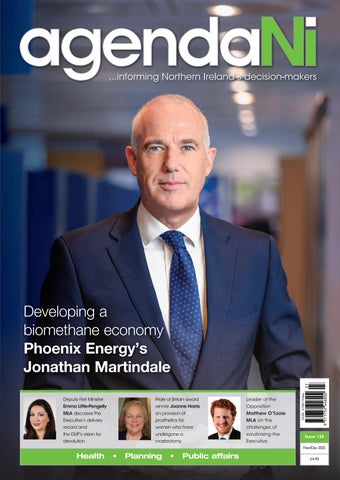
Developing a biomethane economy Phoenix Energy’s Jonathan Martindale Deputy First Minister
Pride of Britain award
Leader of the
Emma Little-Pengelly
winner Joanne Harris
Opposition
MLA discusses the
on provision of
Matthew O’Toole
Executive’s delivery
prosthetics for
MLA on the
record and
women who have
challenges of
the DUP’s vision for
undergone a
scrutinising the
devolution
mastectomy
Executive.
issue126 8 Issue Nov/Dec Aug/Sep2025 11
HealthTax • • Planning • Public affairs Carbon Special Reports: Health • ICT
£4.95 €4.95 / £2.95
agendaNi Digital Government C O N FE R E N C E Sponsored by
Titanic Belfast • W ednesday 3 D ecem ber This popular, interactive conference is a must-attend event. It provides a valuable opportunity to bring together key stakeholders to gain insight into the government’s objectives for digital transformation and hear directly from those responsible for driving this forward.
Paul Grocott Deputy Secretary for Economic Policy Group Department for the Economy Helen McCarthy Chief Scientific and Technology Adviser, The Executive Office Paul Rice Chief Digital Information Officer Department of Health
Mike Skelton Deputy Director Government Digital Service
•
D esigning public services forthe digitalage;
•
A collaborative approach to transform ing public service
David Crozier Director AICC
•
AIto drive innovation in the delivery ofpublic services;
•
Building cyber resilientorganisations;
•
Transform ing the delivery ofhousing;
•
Citizen engagem ent– m aking governm entaccessible;
•
Intelligentdata m anagem ent;
•
Em erging technologies;
•
H ealth and socialcare:Engaging patients and staffwith
Sherelle Fairweather Digital Strategy Lead Manchester City Council Peter Grimley Assistant Director of ICT & Digital Change Clanmil Housing
Eilidh McLaughlin Deputy Director, Digital Ethics, Inclusion and Assurance Scottish Government Laura O’Neill Digital Transformation Manager Belfast Harbour
Caroline McLaughlin Cybersecurity Manager Business Services Organisation, Health & Social Care Trust
Conor O’Donnell Deputy Digital Director Department of Agriculture, Environment and Rural Affairs
Mark O’Flaherty Managing Director for Data and AI BT
delivery;
digitaltechnologies; •
Im proving the user experience;
•
Sm arter governm ent,driven by digital;
•
D igitalinclusion:Technology to em powercitizens;
•
Best practice case studies in digitaldelivery from outside N orthern Ireland.
Sponsorship and exhibition opportunities There are a number of opportunities to become involved as an exhibitor or sponsor. For further information contact Jillian Wallace on 028 9261 9933 or email jillian.wallace@agendaNi.com.
Register Now
T: 028 9261 9933 W: www.digitalgovernmentbelfast.com E: registration@agendaNi.com
agendaNi Issue 126 Nov/Dec 2025 Digital
Events
Publications
Editorial
Accountability in ambition…
Owen McQuade, Managing Editor owen.mcquade@agendani.com
The Northern Ireland Audit Office’s report on the Executive’s Energy Strategy to 2030 delivers a blunt verdict: ambition without delivery achieves little. Despite £107 million invested in energy alone, key targets have barely been touched, with improvements in energy efficiency, renewable generation, and the low-carbon economy falling far short of expectations.
Joshua Murray, Deputy Editor joshua.murray@agendani.com
Across the Executive, this pattern is becoming familiar. The Executive has set out bold commitments from tackling waiting lists and workforce shortages in health, to revitalising public services and growing the economy. However, delivery consistently lags behind ambition. The health system, in particular, remains under sustained pressure despite reform plans and additional investment. Patients and staff alike continue to bear the cost of slow progress, and public confidence will only return when the Executive can demonstrate tangible outcomes and improved service delivery. In this context, issue 126 of agendaNi outlines potential solutions to these shortfalls. Our cover story, featuring Phoenix Energy’s Jonathan Martindale, examines the development of a biomethane economy, while our round table discussion, hosted by eir evo, explores using AI to optimise patient waiting lists. Our exclusive interview with deputy First Minister Emma Little-Pengelly MLA assesses the Executive’s delivery record, while giving our readers insight into the priorities of our political leaders.
Ciaran Brennan ciaran.brennan@agendani.com Circulation and Marketing Lynda Millar lynda.millar@agendani.com Events Jillian Wallace jillian.wallace@agendani.com Advertising Gail Kinkead gail.kinkead@agendani.com Design Gareth Duffy, Head of Design gareth.duffy@agendani.com Jamie Hogan jamie.hogan@agendani.com Subscriptions Sharon Morrison Email: subscriptions@agendani.com Online: www.agendani.com/subscribe agendaNi
In our health report, sponsored by the British Heart Foundation, we interview Health Minister Mike Nesbitt MLA on ‘resetting the health system’, while in our annual planning report, we hear from Infrastructure Minister Liz Kimmins MLA on the Executive’s planning priorities.
bmf Business Services 19a Maghaberry Road Maghaberry, Co Antrim, BT67 0JE Tel: +44 (0) 28 9261 9933
We also feature an interview with Leader of the Opposition Matthew O’Toole MLA, where he details the challenges of holding the Executive to account.
Web: www.agendani.com
This edition of agendaNi is our final publication before Christmas, and highlights both the cost of inaction and the opportunities for deliveryfocused political leadership and innovative policy. I wish all our readers well ahead of the holiday period, and thank you all for your support throughout 2025.
Joshua Murray Deputy Editor
www.agendaNi.com
Printed by: GPS Colour Graphics
FSC® is an acronym for the Forest Stewardship Council®, which is an independent, non-governmental, not-for-profit organization that was established to promote the responsible management of the world’s forests. The FSC® system provides an assurance that products such as wood and paper have been harvested in a socially and environmentally responsible manner. The FSC’s Chain of Custody certification provides a way in which the material can be tracked from the certified initial source through the manufacturing process to the end user and other controlled sources.
Digital
Events
Publications
contents 04 08
39
04
Matters arising
08
Issues
39
12
08
Interview with deputy First Minister Emma Little-Pengelly MLA
12
Cover story: Phoenix Gas Director of Business Development Jonathan Martindale
24
Round table discussion: Optimising patient waiting lists with AI
36
Analysis: Energy strategy progress ‘lagging considerably’
Health report 40
Sponsored by
Sponsored by
Interview: Minister Mike Nesbitt MLA discusses his vision for resetting Northern Ireland’s health system
48
Department of Health deputy Chief Digital Information Officer Tom Simpson on digitalising healthcare
56
Fran Thompson, Chief Information Officer of the Republic’s Health Service Executive (HSE), discusses delivering a digitally integrated health system
24
60 59
64
40
48
68
88
Planning report 60
Infrastructure Minister Liz Kimmins MLA discusses her priorities for the
59
planning sector 64
Aura Istrate, Assistant Professor in Urban Planning at University College Dublin, on integrated planning of climate neutral cities
68
University of Oslo professor of law Catherine Banet on planning for integrated grid development
76
Public affairs 76
People: Pride of Britain award winner Joanne Harris
78
Interview: Leader of the Opposition Matthew O’Toole MLA
82
Reports from the party conferences of the DUP, UUP, and SDLP
88
Back page: Sinn Féin MP Chris Hazzard on his opposition to the proposed ‘Britcard’
76
matters arising
E N V I RO N M E N T
Peatland Strategy to 2040 published A framework for the conservation and restoration of peatland habitats is outlined in the Northern Ireland Peatland Strategy to 2040.
by 2050. The strategy recommends that policies be established for management, and conservation and restoration activities.
The strategy, published by DAERA in September 2025 in support of the UK Peatland Strategy, states that there is an “urgent need to rapidly undertake landscape-scale peatland restoration to protect our environment and reduce carbon emissions”.
It sets a goal to establish funding and suitable mechanisms to “deliver large-scale restoration, build capacity, conduct applied research, and communicate effectively with stakeholders”. To ensure the strategy’s delivery, it asserts that capacity building and appropriate research be supported.
It sets three goals and five key objectives for peatlands, some of which overlap. The strategy sets an aim to ensure peatlands are conserved, restored, or appropriately managed by 2040. This aligns with Climate Change Committee recommendations to reduce greenhouse gas emissions from peatland that is under restoration or sustainable management
Peatlands should also be recognised “for their unique biodiversity and ecosystem provision and improved access to peatland sites is facilitated”, the strategy stipulates. It also asserts that structures should be implemented to fund, facilitate, monitor, and review the strategy’s delivery.
ENERGY
Final REPG scheme design published The final scheme design (FSD) of the Renewable Electricity Price Guarantee (REPG), published in September 2025, aims to encourage investment in local renewable electricity projects and protect consumers from global price shocks. It is designed to “incentivise an increase in renewable electricity generation and position Northern Ireland as a competitive and attractive destination for investment”. Published by the Department for the Economy (DfE), it is pinned as a “critical step” in achieving the Climate Change Act’s target of 80 per cent renewable electricity consumption by 2030. DfE will consult on the REPG terms and conditions later in 2025. The first auction is anticipated in early 2027.
4
agenda matters
The FSD includes an overview of the proposed legal and governance framework to enable the implementation stage, the core mechanism for the funding scheme, and an outline of the eligibility criteria and contract allocation process. It also explores the feasibility of a mandatory approach of introducing discounted energy bills for households near REPG-supported projects. Upon the FSD’s publication Minister for the Economy Caoimhe Archibald MLA said: “The publication of the REPG final scheme design will boost renewable generation and deliver lower electricity costs to households than they are paying today.”
matters arising
E D U C AT I O N
Givan ‘legally entitled’ to reject integration of schools Education Minister Paul Givan MLA was “legally entitled” to reject the integration of two north Down schools, the High Court in Belfast ruled in October 2025. The integration of Bangor Academy and Rathmore Primary School was rejected by Minister Givan as he reasoned there was insufficient evidence that the requisite number of Catholic pupils would attend. Early in 2025, Department of Education officials recommended the schools’ integration and it received the support of the vast majority of parents from both schools. Lawyers representing pupils alleged that Givan breached Article 64 of the Education Reform (Northern Ireland) Order 1989, which stipulates that the development of integrate education must be encouraged and facilitated.
Justice McAlinden rejected that the Minister breached a legislative obligation and ruled that he had clearly outlined that insufficient numbers of Catholic pupils would attend. “There is absolutely no evidence to suggest that such a demand (for integrated education) exists within the local Catholic community,” said McAlinden. Givan, who subsequently survived a no confidence motion over his visit to Israel in November 2025, told the Assembly: “Criticism of my decisions were widespread both by members of the Assembly and further afield. Many of these criticisms were clearly made in ignorance of the underlying statutory provisions.” Givan said the ruling sets “a significant precedent for future integrated education proposals and reaffirms the importance of legal and evidential rigour in shaping Northern Ireland’s educational landscape”.
D I G I TA L G OV E R N M E N T
Delays to public sector IT projects Delays to major public sector IT projects are incurring significant costs due to repeated extensions of contracts for legacy systems, a report has said. Major IT projects in Northern Ireland, published by the Northern Ireland Audit Office (NIAO) in July 2025, analyses 29 projects being delivered between April 2022 and March 2025 at a total cost of £5.2 billion. Of the 29 projects, 24 aim to replace existing business critical legacy systems “operating well beyond their intended life”, the NIAO says. NIAO recommends the development of a strategy to build the capacity and capability to successfully deliver
major IT projects. It also recommends that public sector bodies “undertake urgent cross-sector planning to identify legacy systems in order to prioritise investment decision and maintain or replace systems well in advance of the current contract expiring”. Dorinnia Carville, comptroller and auditor general, says: “Extending contracts on legacy systems risks a gap growing between the system’s functionality and the needs of citizens, businesses, and communities. It represents very poor value for money and a missed opportunity to have more modern and efficient systems in place earlier.”
agenda matters
5
matters arising
P U B L I C A F FA I R S
Language commissioners appointed
Irish Language Commissioner Pól Deeds.
Appointments have been made for the roles of director of the Office of Identify and Cultural Expression (OICE), and commissioners for the Irish language and the Ulster Scots and the Ulster British tradition. Katy Radford was appointed director of OICE, Pól Deeds was appointed Irish Language Commissioner, and Lee Reynolds was appointed Commissioner for the Ulster Scots and Ulster British tradition. They began their five-year term on 13 November 2025. Radford previously served as an Equality Commissioner for Northern Ireland, vice-chair of the Arts Council of Northern Ireland, and member of the Commission for Flags, Identity, Culture, and Tradition.
Deeds previously held the role of Chief Executive of Irish language organisation An Droichead and was subsequently appointed deputy Chief Executive of Foras na Gaeilge. Reynolds is a former DUP councillor who has also previously served as Chief Executive for the Community Convention and Development Company, and policy adviser for the DUP. sHe also worked for the Ulster Scots Heritage Council. The establishment of the posts were agreed as part of the New Decade New Approach deal in 2020, which led to the restoration of the Executive after a three-year collapse. Members of the OICE board were also appointed including Brian Dougherty, Ellen Finaly, Stephen Moore, Callie Persic, and Jacqueline Witherow. They will begin their five-year term on 3 December 2025.
E D U C AT I O N
The state of the schools’ estate Many schools are in a state of disrepair, and pose a health and safety risk, which impedes on educational outcomes, a new report has found.
Department and the Education Authority (EA) review oversight mechanisms and implement appropriate governance structures.
An inquiry titled Managing the Schools’ Estate, published by the Public Accounts Committee (PAC) in May 2025, finds that the bill for outstanding repairs and maintenance of the schools’ estate could be up to £800 million. The PAC outlines 11 recommendations to address key issues.
Additionally, it recommends the Department and EA develop plans to ensure current SEN provision is fit for purpose ahead of a target capital investment plan to expand SEN provision across the estate.
It recommends that the Department of Education develop an estate management strategy by early 2026 along with an associated annual delivery plan. The committee also recommends that the 6
agenda matters
Chair of the PAC, Daniel McCrossan MLA, says: “The Department’s current approach to estate management is unsustainable, ineffective, and economically wasteful. There must be a new, collaborative working relationship between the Department, the EA, and schools.”
matters arising
ENERGY
Bob Hanna remembered as ‘energy stalwart’ agendaNi regrets the loss of Bob Hanna, a stalwart of the energy sector who passed away suddenly on 28 October 2025. Hanna graduated in electrical engineering from Queen’s University Belfast in the mid-1970s and joined the National Board of Science in Dublin, where he worked on a wide range of energy initiatives including Ireland’s membership of the International Energy Agency. Hanna then moved back north, joining NIE International where he developed its business across the British Isles and further afield in the Caribbean, Africa, and the far east.
a number of Irish energy ministers between 2004 and 2018. Hanna thrived in this role with a wide range of activities from organising conferences as part of Ireland’s presidency of the Council of the European Union in 2013 to an early study of the offshore wind energy potential for the island. He chaired many sessions at agendaNi’s Northern Ireland Energy Forum and the main energy event for the island, Energy Ireland. Hanna is survived by his wife Suzanne, daughters Ruth and Rachel, son-in-law Jamie, and grandson Koa.
After a stint in Ballylumford power station as commercial manger, he spent 14 years as Chief Technical Advisor to
WAT E R
Lough Neagh bathing spot fails to reach minimum standard Rea’s Wood on the Antrim shore of Lough Neagh is the only bathing water out of 33 identified sites that has failed to meet the minimum standard for bathing water quality for 2025. An advice against bathing notice was imposed at the site in July 2025, and was subsequently lifted in November 2025. Of the remaining sites, three met the ‘sufficient’ standard, five were deemed ‘good’, and 24 were deemed ‘excellent’. When announcing the results, Minister of Agriculture, Environment and Rural Affairs Andrew Muir MLA said he was “disappointed but sadly not surprised” regarding the classification of Rea’s Wood.
Minister Muir welcomed improved classifications for Brompton, Cushendall, and Ballyholme. He indicated that improvements in the first two sites “may be due to the increase in data available”. The Minister added that Ballyholme has been classified as good “for the first time since this system was introduced in 2015”. Muir also announced that a bathing water review will be launched imminently, adding: “I want to seek the views of all stakeholders in how we further improve the advice my department can give around water quality issues.”
agenda matters
7
issues agenda
Emma Little-Pengelly MLA: ‘There is so much more that we can be’ In February 2024, Emma Little-Pengelly MLA became the first unionist deputy First Minister. After 18 months in office, she meets Joshua Murray in her Stormont office to discuss the Executive’s delivery record, the state of unionism, and what drives her in politics. Emma Little-Pengelly MLA has had a convoluted path to power. In and out of politics for the last 10 years, she lost her Assembly seat in 2017, before losing her seat in the Housing of Commons in 2019. A brief stint as a special adviser and a return to her legal career followed. Little-Pengelly was then co-opted into the Lagan Valley Assembly seat won by Jeffrey Donaldson in 2022. The formation of the Executive was equally complex, with a deal negotiated by Donaldson forming the basis of the
8
agenda issues
DUP’s return to office, just shortly before the former leader’s shock resignation over allegations of historical sexual abuse, which Donaldson is contesting in court. The DUP itself, she concedes, has been through “an incredibly challenging time” following Donaldson’s resignation. But she is quick to praise the party’s new leader. “Gavin Robinson came in in those difficult circumstances and has done a fantastic job.
“He has given that very strong and confident leadership and really working with colleagues right across. People out there want to see unionists working better together.”
Delivery Twenty months after its reformation, the Executive faces mounting evidence of structural weakness. A 2024 report by the Northern Ireland Affairs Committee concluded that years of ministerial
issues agenda
absence had “delayed the introduction of new legislation and undermined the effective scrutiny of decision-making”. In sectors such as health and education, the pace of improvement remains slow, with approximately 26.3 per cent of the population on a waiting list for treatment. Refusing to be drawn on the Executive’s inadequate delivery record, the deputy First Minister insists that she and her co-leader, Michelle O’Neill MLA, spearhead policy: “We have made clear, for example, that tackling health waiting lists is not just an issue for the Department of Health. They are the lead, but that is an issue that impacts right across government.” Little-Pengelly insists that the Executive is determined to show visible delivery. “I think we have successfully done that in the Programme for Government, setting out our nine key priorities, and I think covering all of the key areas in terms of health, in terms of education, in relation to growing the economy,” she asserts. For Little-Pengelly, one of the key instruments of that coordination is a newly-established ‘delivery unit’, which she says works “to identify learning internationally, to support departments in their initiatives, and to troubleshoot at times if that is required and requested”. It is one of the structural responses designed to address the Executive’s historic lack of progress, with only seven pieces of legislation having reached the statute books since the election three-and-a-half years ago. She points to the Executive Office’s lead policy responsibilities, most notably the End Violence Against Women and Girls strategic framework for
2024-2031, which she says “was about policy development through a really good collaborative design process; probably the best co-production, co-design policy process that I have seen across the system, and I would argue, across the UK and Ireland”. The strategy, she adds, is “an organic one”, evolving with evidence and engagement. “There is already money on the ground. It is not just a strategic framework, but delivery plans.” Little-Pengelly is keen to convey herself as a bridge between the DUP’s traditional conservatism and pragmatism. She presents herself as a technocrat who will enthuse decision-makers in the region, referring to data strategy as much as she does to civic renewal. “We have established the Office of the Chief Scientific and Technology Officer. That is all about gathering data, looking at the digital revolution, and seeing how we can use that in a better way not just in the practical things we do across departments, but in terms of policy development and looking at interventions.” This kind of “data-driven, delivery-focused” thinking, she argues, is central to the Executive’s fresh mandate. “Tackling poverty is a challenge for all departments. Ending violence against women and girls is a challenge for all departments and growing the economy is a challenge for all departments.”
Energy and climate When the conversation turns to energy, however, the deputy First Minister’s tone hardens. The Northern Ireland Audit Office’s finding that energy efficiency has improved by only 1 per cent since the
agenda issues
4 9
issues agenda
Northern Ireland Energy Strategy was launched prompts concern. “On the face of it, that does not indicate value for money. It has been over £100 million of investment for one per cent of an achievement. “We want to see energy security. I would like to see energy prices reducing for consumers, but also for business,” she says. “We in the DUP very much support having a mixed portfolio because shifting entirely away from traditional sources of energy has the risk of increasing energy costs significantly and also challenging energy security.” On climate change itself, unlike some of her party colleagues, the deputy First Minister is a believer, but careful to avoid being perceived as being too liberal. “Of course, climate change is real. There is an impact, of course, on the actions that we do. People recognise that we are custodians of the environment.” However, Little-Pengelly insists that decarbonisation targets must be “balanced and realistic” and calls for the decarbonisation targets under the Climate Change (Northern Ireland) Act 2022 to be revised. “We can go faster and deeper than anywhere else on the globe, but what it
10
agenda issues
will do is be punitive to our farmers, punitive to our businesses, and it will increase energy bills for citizens. People do want to play their part. We need to do it in a much more realistic way which is affordable and balanced.”
Economy On her economic vision for Northern Ireland, she says that the region “is a fantastic place to work and to live” but that she “also believe[s] that there is so much more that we can be”. “I do strongly believe that Northern Ireland can be one of the best small, open, agile economies in the world, but I also acknowledge that that will not happen by accident.” Her optimism about Northern Ireland’s economic potential is tempered by realism about global challenges. “It has been quite a challenging international investment climate; there are a number of global conflicts, uncertainty around the tariff regime and the global investment market has been quite sluggish. “The DUP has been very supportive of lowering corporation tax, and I think for a very good reason. We believe it is a real game changer to attract companies to Northern Ireland and to encourage those companies to grow.”
She recalls that the policy once united Peter Robinson and Martin McGuinness. “We really pursued that policy, got a great deal of consensus at the time,” she says. “The [UK] Treasury view was that the cost of that should be borne by Northern Ireland in terms of the gap between what the mainland GB tax was and what Northern Ireland’s would be. The argument made by Peter Robinson and Martin McGuinness was that as we increase the tax base because of the incentivisation of this policy, that needs to be recognised by Treasury. That never got resolved. “Corporation tax is still very firmly on the table because we need a big economic game-changer, and it is one of the policies that I believe really could bring that about.”
Unionism and devolution As demonstrated by the “Stormont or Starmer” rhetoric at the DUP’s conference in September 2025, the party is attempting to use pro-devolutionism to directly distinguish itself from the TUV. “Decisions that impact people in Northern Ireland should be made closest to them,” she says. “For me, sitting here as deputy First Minister, my primary interest is championing Northern Ireland.”
issues agenda
Her argument is direct: “When you go back to a non-devolutionist position, you are pushing this back to UK Government, where those issues are not necessarily their primary concern.” Little-Pengelly uses the prospect of Starmer’s direct rule as the biggest reason for the DUP’s journey to being explicitly pro-devolution. Repeating the language from the party conference, she says that “it is Stormont or Starmer”, before rhetorically asking: “Do you want those decisions taken by Keir Starmer, or by politicians here who have Northern Ireland as the key priority?” On the Good Friday Agreement itself, she characterises the DUP’s complex journey from opposition to part-time supporters as a “political reality”. Asked whether the DUP of 2025 supports the agreement, the deputy First Minister is coy. “It was voted on by people in Northern Ireland and the Republic of Ireland. It is the context in which we operate.” However, Little-Pengelly stresses that the DUP’s opposition in 1998 “was not because we opposed peace but because we did not believe it was right that you would have a political party come into the Executive without decommissioning, or that you would have all of those prisoner releases”. She prefers to describe the current settlement as “the Belfast-Good Friday Agreement as amended by, and improved by, the St Andrews process”. Asked whether the current UK Government is “a friend to unionism”, Little-Pengelly replies, in contradiction with her ‘Stormont or Starmer’ dichotomy, with measured diplomacy. “This Labour government has been very upfront about being pro-union, pro the United Kingdom,” she says, quickly adding: “We would want the UK Government to work more closely with us to tackle big issues. She continues: “They need to get a grip on the economy, on immigration, the Windsor Framework, and the continuing bureaucracy for businesses in Northern Ireland. “The UK Government promised unfettered internal UK trade, but that is not what we are seeing,” she says.
“When you speak to businesses, they are saying there is a lot of unnecessary bureaucracy and paperwork. Despite the fact that Great Britain and Northern Ireland are entirely within the same regulatory regime as the EU, there are still all these checks.” Continuing to weave the web between the DUP’s unionism and technocratic civil servants, Little-Pengelly’s critique of the Windsor Framework is couched in the language of market integrity rather than sovereignty. “Northern Ireland does more trade with Great Britain than it does with the European Union, the Republic of Ireland, and the rest of the world put together, so we need to protect the integrity of the UK internal market.” Unionism declared an enemy in the unlikely form of former Fine Gael leader and Taoiseach Leo Varadkar, however, the deputy First Minister praises the current head of government in the Republic. “I think with Micheál Martin, he understands the stranded approach much better,” she says, adding: “It makes sense to have positive and constructive relationships when we can, but we will also call out where there is overreach. “I have engaged, I think, very constructively with Micheál Martin as Taoiseach. I have always made clear that the Belfast Good Friday Agreement sets down, in its stranded approach, the parameters of engagement. “There are certain issues in which we engage with the Irish Government, but there are other issues which are entirely matters internal to Northern Ireland or the UK.”
Politics and worldview For all her precision and political armour, Little-Pengelly speaks warmly when the interview turns to the people who shaped her career. “Whenever I came into politics, I worked initially for Dr Paisley, and then for Peter Robinson. “I really cut my political teeth under Peter Robinson. He was a huge inspiration; very dedicated, passionate about what he believed in, passionate about standing up for Northern Ireland.
“He recognised that compromise was required, but compromise done in a way that did not fundamentally impact your core values. He was meticulous, very careful about detail because he recognised the importance of that in getting the nuts and bolts right. He was very good tactically and strategically as a political leader.” Beyond unionism, her admiration lies with 1940s-era UK leaders. “When you look at Winston Churchill’s leadership through very difficult times, it is always easy to look back and think he did the right thing because we know the outcome, but at the time, he did not know. Those were incredibly courageous decisions.” She also praises the post-war Labour government. “When you look at the creation of the NHS, the biggest period of social house building, these were policies probably perceived as fairly left at that time, and yet completely lifechanging.” Perhaps tellingly, she cannot name a current world leader she admires. “It is very challenging in the current political climate,” she says after a pause. “There is a lot of global instability. I admire anybody who steps forward in politics at a difficult time.” Obfuscation, when utilised properly, can be an enormous strength in politics and it is a skill that the deputy First Minister seems to have mastered. Keen to avoid alienating anyone, whether unionists to the right of the DUP, liberals, the UK Government, the Irish Government or civil servants, she has positioned herself as one of the few unionists with the political capital and credibility to work alongside Sinn Féin in a devolved executive. The Executive’s delivery record is poor by any standard, however, the deputy First Minister has shown that she is a political survivor: navigating internal party turbulence, realigning her standing after being co-opted rather than elected, and sustaining her role in a party where many have faltered. In a system where delivery is patchy and patience thin, Little-Pengelly’s decision to operate quietly, steadily, and without collapse may turn out to be the most politically shrewd move of all.
agenda issues
11
cover story
Developing a biomethane economy Jonathan Martindale, Director of Business Development at Phoenix Energy, talks to Owen McQuade about the opportunity to develop a biomethane economy in Northern Ireland and its role in an integrated and decarbonised future energy system.
12
cover story
cover story
“Climate change is a global challenge but, it will be addressed by regional solutions, including the gas network.” Jonathan Martindale is at the forefront of the thrust to develop a biomethane economy in Northern Ireland. He is optimistic about the prospects of achieving that on the back of an industry conference the previous week that acknowledged significant progress over the last four to five years. There is now a wider recognition of the need for an integrated energy system that incorporates all Northern Ireland’s regional assets. “Climate change is a global challenge but, it will be addressed by regional solutions, including the gas network,” he says.
homes that have gas outside their front door, but who use oil for heating, to the gas network. If those 200,000 homes were converted to natural gas that would save 408,000 tonnes of CO2 per annum, which is 24 per cent of all carbon emissions from the residential sector in Northern Ireland. “With the fiscal constraints at Stormont, that represents the best value for removing carbon,” he observes. This was recognised in the Executive’s Climate Action Plan, published in June 2025, that has the move from oil to gas as part of Northern Ireland’s path to net zero.
Martindale believes that there is now a recognition amongst policymakers that if we can get the right supporting policy, Northern Ireland’s energy sector can make relatively good progress in its decarbonisation journey. Although, with the new uncertain global policy landscape there has been some retrenchment on climate action, he says that the wider benefits of decarbonisation are now much better understood: “These benefits include system security and resilience, sustainability and social responsibility, and those wider economic and social benefits of decarbonisation are now better understood,” he adds.
However, the vast majority of the industry’s work streams are focused on the future network and the target of net zero by 2050. “The key enabler is the gas network; the ‘hero’ asset that provides natural gas to 550,000 homes in Northern Ireland.” One statistic that Martindale says that has not been highlighted over the last 29 years the network has been in operation is its reliability at 99.98 per cent. With energy system resilience being increasingly valued, that equates to an unplanned interruption every 140 years.
From a gas industry perspective, the focus in recent years has been on future network solutions, such as biomethane and hydrogen. Increasingly, in the near term, the focus is now on connecting the 200,000
Phoenix Energy’s “laser focus” is on biomethane as a future gas for its network. “We believe that there is not the bandwidth locally at both industry and policy
Emerging solutions
cover story
4 13
cover story
looking for certainty as to what sector biomethane will be used, but we would argue that we should start building the biomethane economy and thereafter the market will determine where it is used,” he says.
levels to move forward on numerous fronts. Biomethane offers a significant near-term opportunity”, he says.
commitments in the development of biomethane injection facilities since the Bill has passed,” he explains.
The development of the biomethane industry requires three key building blocks. In 2022, the CASE centre at Queen’s University Belfast quantified the potential biomethane in Northern Ireland and determined that there was the potential to displace 100 per cent of the natural gas in the distribution system. The follow-up to this study was Phoenix Energy’s 2024 request for information that was issued to the industry to identify potential biomethane investors. There were 86 potential plants identified that had access to feedstock and the wherewithal to develop anaerobic digestion (AD) plants that produce biomethane from farm waste. This equates to 3.5 TWh, which is around 60 per cent of the amount identified in the CASE report.
Martindale observes that the policy backdrop in the Republic is similar to that in Northern Ireland; a high amount of agricultural waste and nutrification issues. He sees a similar policy clarity having the same impact in Northern Ireland. In Great Britain, the policy focus up until now has been on hydrogen development. “Although the focus on hydrogen will continue, it will not give them the near-term opportunities available from biomethane. This was reflected in NESO’s [National Energy System Operator] scenarios report in June 2025 that recognised the progress to date but highlighted the need to accelerate biomethane production that would be required to provide a clean, affordable, and secure energy system.”
“Our focus is now working with these potential operators to get a route to market with biomethane injected into the gas network locally. We are also buoyed by the huge opportunities emerging in the Republic of Ireland and more recently in Great Britain. In the Republic, the Renewable Heat Obligation was passed in June 2025 and will go live in early 2026. That one piece of policy clarity has unlocked huge investment into the sector. Nephin Energy, Cycle0, and Greengate Biogas are all making substantial
14
cover story
Future policy Martindale says that one of the biggest challenges is the desire to have a policy landscape detailed out to 2050 that is accurate and robust. “That is simply impossible with so many variables and uncertainty two or three decades into the future. Biomethane is seen as a high added value product that could be used by many sectors to decarbonise: transport, the power sector, or the gas network companies. Policymakers are
Although the sector still looks for policy clarity, Martindale says: “The policy signals in 2025 have been very encouraging.” The Department for the Economy’s 2025 Action Plan (action 6) states that the department is supportive of a sustainable biomethane economy. That statement was supported by three workstreams: a support mechanism; a certification scheme; and policy direction on the cost allocation of production sites. From an industry perspective, these are three key policy actions. To build on this Martindale sees the period to the next Programme for Government (PfG) post April 2027 as a period for building consensus between the key stakeholders in the agriculture, power, and large energy user sectors on what needs to done. In support of this, there are three workstreams to build evidence to inform policy for developing a biomethane economy in Northern Ireland.
Network constraints The first of these workstreams is on networks constraints; something that has not been an issue for the gas industry over the last 30 years, as the network has been built to meet peak demand (a one in 20 year peak demand winter). “But we are now looking to inject high volumes of biomethane in areas that are typically rural with fewer large energy users and then move that gas to areas where the demand centres are, predominantly in the east,” observes Martindale. A project funded under the Utility Regulator’s Energy Strategy Fund has identified areas of constraint in the network. The project, due to be published in late 2025, shows that the areas of constraint are in the west as gas is transported to the east of the region. The project determined that the constraints can be managed using proven technology that has been used in other countries. Reverse compression takes gas from a medium pressure of 4 bar and compresses it into the high pressure transmission network where it can be transported across Northern Ireland.
cover story
“Our focus is now working with these potential operators to get a route to market with biomethane injected into the gas network locally.” The cost of doing this does not place unreasonable costs onto the gas consumer base.
Multi-sectoral benefits and challenges Biomethane is primarily seen as a zero carbon alternative for natural gas. There are also broader benefits such as managing the important attribute of managing nutrient waste. There is also the benefit of self-sufficiency of not having to import natural gas, which enhances energy security. Future work will look at these wider social and economic benefits of developing a biomethane economy in Northern Ireland. Martindale highlights an example of the cross-cutting nature of developing a biomethane economy and the importance of developing environmental regulations that recognise the value of well-managed AD facilities: “If one of the many farm-based AD plants, wished to produce biomethane and remove significant excess nutrients from the surrounding countryside, of which there are many, the path is not clear. “Although it is widely recognised that AD plants contribute significantly to local air and water improvements by removing and processing excess nutrients, current regulations around the environmental assessment of phosphorus reduction and ammonia pollution make securing permission very difficult, and that needs to change.”
Voluntary supplier obligation Martindale recognises that although policy and any underpinning legislation will take time: “A support mechanism is vital. No other biomethane economy in Europe has been delivered without a support mechanism.” However, this will probably not happen in the next 18 months until there is a new Executive.
In the meantime, Phoenix Energy is working with gas suppliers which are a key intermediary between large energy users who are keen to access green energy molecules to meet their sustainability objectives, and those with ambitions to produce biomethane in Northern Ireland. “This is essentially a voluntary renewable heat commitment from local gas suppliers that would allow them to offer green gas molecules as part of their product offering. In the short term we are confident there is the demand from the large energy user sector that will take up that green product.”
Integrated and decarbonised energy system Stepping back and looking to the future, Martindale sees biomethane as an opportunity to deliver an integrated and decarbonised energy system and to solve wider challenges such as nutrient waste management. The impact of energy integration was highlighted in a report by KPMG in October 2025 that sought to address the lack of understanding locally that both the gas and electricity networks would play complementary roles in the future energy system. The report entitled The Energy Consensus has five broad principles to decarbonise the energy sector: a diverse energy mix will be required in the future; renewable electricity will be a primary driver; there is a responsibility to utilise existing regional infrastructure; renewable gas may be more economic for hard-to-electrify end users; and an integrated decarbonised energy system is now possible with the development of biomethane at scale. Martindale is optimistic that the goal of a fully integrated decarbonised energy system is possible, provided there is a clear political will and that policy development “recognises the considerable regional value that the development of sectors such as the biomethane economy can provide across economic, environmental, agricultural, and social outcomes”.
cover story
15
issues agenda
AI and the future of work L-R: Tom Gray, chair of the study; Ian Greer, vice-chancellor of Queen’s University; Economy Minister Caoimhe Archibald MLA; Patricia O’Hagan, deputy chair of Matrix; and Robert Hill, chair of Matrix.
AI could contribute between £0.2 billion and £3.7 billion in incremental GVA by 2030 relative to 2023, a report has said. AI and the Future of Work in Northern Ireland, published by Matrix in September 2025, outlines the impact cases of low, midpoint, and high level adoptions of AI to 2030 compared to 2023. Cautious adoption patterns and limited economic diffusion would contribute £0.2 billion. Meaningful but measured AI integration would contribute £1.2 billion. Accelerated implementation would contribute £3.7 billion.
16
2. AI stampede: Adoption is rapid but the skills gap grows. 3. Crafted catching up: Adoption is gradual and relevant capabilities are built. 4. Slow-lane spiral: Adoption is gradual and the skills gap grows.
Challenges
AI and the Future of Work states that the impact on the economy will depend on both the pace of its adoption, and the skilling response. Variances in both of these factors lead to four potential scenarios:
The report identifies eight challenges to AI adoption. It states that existing support mechanisms focus on builders and implementers of AI tools rather than users. “This points to the need for order-ofmagnitude expansion in both reach and resources,” the report says.
1. Titanic leap: Adoption is rapid and relevant capabilities are built.
Matrix asserts that funding shortfalls will impede adoption while talent shortages
agenda issues
may emerge due to rapid transformation of industry requirements. The report states that “compliance culture” in leadership teams “are slowing adoption rates”. Matrix adds that “a conservative business culture and risk aversion” could lead to organisations retreating from AI adoption if it presents challenges or fails to deliver immediate results. Trust is identified as a challenge, requiring “proactive governance frameworks”. However, the report notes that “size and collaborative culture position [Northern Ireland] well to pioneer ethical AI development”. To ensure worker participation, the report states that stakeholders must place importance on consultation and job-quality safeguards. Matrix also asserts that the region’s position “at the interface between UK and
issues agenda
growth. A target is set to support 50-plus AIDEs to reach market within 12 months. The report recommends the creation of new support programmes and upscaling of existing ones to enable businesses to integrate AI. A target is set to establish goals for AI adoption rates. Additionally, a sectorspecific AI adoption pathway should be launched within three months, with all priority sectors covered within 12 months. Matrix also sets a target for public SME AI playbooks to be launched within six months. An AI workforce impact observatory should be established to detect early signals of workforce disruption and trigger rapid response interventions. DfE is the suggested owner and the observatory should be established and operational within 12 months. Matrix states that a dual market AI compliance support service should be established to support business operating across UK-EU markets to navigate dual regulatory obligations. Targets are set to support 200 business within the first year, and achieve an 80 per cent reduction in average compliance consultation costs. The service should be designed within four months, a pilot launched within eight months, and become fully operational within 12 months.
EU regulations creates significant uncertainty about which AI act will apply”.
Recommendations The report outlines a total of 10 recommendations for effective AI adoption. Various organisations are given responsibility for these actions including the Executive Office and the departments for the Economy, Education, and Finance. The report asserts that scaled AI confidence and capability programme for public and private sector leaders should be launched. A target is set for between 2,000 and 3,000 businesses to participate in the programme in year one. Matrix suggests that full rollout of the programme be achieved within six months. The report recommends delivery of a public and workforce engagement campaign, including establishment of a citizen’s assembly. A target of “70 per cent public awareness of AI opportunities and safeguards within two years” is set. The report suggests that the citizen assembly be established within three months, indicating that its first recommendations should be made within six months. An ‘independent AI champion’ should also be established by the Executive Office within two months. It would be hosted by an independent body “with industry connections and credibility”. Targeted support for AI-drive enterprises (AIDEs), should also be created to enable their
Matrix recommends creating a “flexible, industryrecognised AI skills certification accessible to all workers and businesses”. Targets are set for 5,000 workers to be certified in year one, growing to 15,000 by year three. The report recommends development of a curriculum within three months, and launch of pilot programmes within six months. Creation of a skilling and reskilling programme for displaced and vulnerable workers is also recommended. Programme design should be completed within six months and the programme delivered within 12 months. Matrix also recommends successful pilots in education be expanded to provide system-wide access and support. Targets are set to scale from current pilot institutions to 50 per cent coverage within 12 months, and full coverage within 18 months. An expansion plan should be designed within three months and rolled out over 18 months, with the Department of Education to publish a report within six months. Upon publication of the report, Economy Minister Caoimhe Archibald MLA said: “AI is helping local businesses to turn the dial on their productivity; by improving efficiency, delivering better automation, and speeding up analytics. AI development is supporting the creation of new highly skilled, good jobs. It has been grasped by the energy sector, to ensure we stay ahead of the green transition. And, with my strong focus on regional balance, businesses right across the North are being supported to put in place the skills and supports needed to adapt and adopt to AI advancements.”
agenda issues
17
A year of connection, growth, and community with Fibrus
Fibrus’ completion of Project Stratum was celebrated with visits from Economy Minister Caoimhe Archibald MLA and Agriculture, Environment and Rural Affairs Minister Andrew Muir MLA, who saw firsthand how improved connectivity is transforming lives in rural communities.
Colin Hutchinson, Managing Director and Chief Financial Officer at Fibrus Group, reflects on another successful year for the company, infrastructure projects, and supporting local communities. In 2025, Fibrus has strengthened Northern Ireland’s position as one of the UK’s most connected regions, while fuelling economic growth, completing key infrastructure projects, and supporting local communities. Our mission since Fibrus was founded has been the same: to bring full fibre broadband to homes and businesses in rural, hard-to-reach places, whilst placing the local communities we serve at the heart of what we do. As we look back on the past year, I am incredibly proud to say that Fibrus has continued to deliver on this promise, transforming connectivity across Northern Ireland and making a real difference to rural communities.
Project Stratum In the summer of 2025, we proudly celebrated the completion of Project Stratum, awarded to Fibrus in November 2020. The successful delivery of this £200 million landmark initiative, a once-in-a-generation infrastructure project and the largest telecoms project ever undertaken in Northern Ireland, marks a defining achievement for the company and the region. Completed on time and within budget, Project Stratum has delivered lightning-fast full fibre broadband to over 81,000 premises across Northern Ireland. Northern Ireland now boasts an impressive 95 per cent connectivity rate, which is 9 per cent higher than the UK
average. This is a really crucial statistic and it is a game changer for homes and businesses that finally have the digital infrastructure needed to thrive. It is also a major step toward closing the digital divide, and we are proud to have played a key role in making it happen.
Our lasting impact With Project Stratum complete and major milestones achieved, it was time to reflect on our progress and our impact. In May 2025, we commissioned Grant Thornton to produce an economic impact report to give us the real picture of the difference Fibrus is making in Northern Ireland. The report revealed that since 2020, Fibrus has injected £431 million into the Northern Ireland economy. That figure carries real meaning; it represents real jobs, real investment, and real change for our communities. We have created hundreds of roles, strengthened our supply chain, and through our rapid network expansion, connected over 410,000 homes and businesses as of May 2025. Project Stratum alone delivers £50.6 million in potential annual productivity gains, and we are immensely proud of that impact.
Empowering communities At Fibrus, success is bigger than just connectivity; it is about community. That is why social impact remains a key focus, with over £411,000 donated to local charities and grassroots organisations across Northern Ireland by May 2025. Through the Fibrus Community Fund, we have invested over £235,000 in Northern Ireland, funding projects to address digital poverty in rural areas, benefitting over 130 community organisations to date. Through our Play it Forward Fund and sponsorship of Antrim GAA and Coleraine FC, we are helping communities across Northern Ireland come together through sport. Sport unites, inspires, and creates opportunities, and we are proud to be part of that journey. To date, the Play it Forward fund has invested £60,000, supporting 63 grassroots clubs, with an additional £30,000 set to be allocated this quarter.
Clubs who received funding over the last year, include Causeway Giants Wheelchair Basketball Club from Coleraine, Newry Rugby Club, Elite Taekwon-Do NI, based in Bangor and St Brigid’s Camogie club in Armagh. St Brigid’s used its funding received to run a 10-week programme encouraging more local children to get involved in the sport. Kerry Toner, Chairperson at St Brigid’s camogie club in Armagh says: “The funding allowed us to reach out to a wider set of children and to provide an overall training top so that all of the children felt included and there was no pressure on the parents. “We hope that all of the children remain within the club and continue to enjoy playing camogie with their friends for years to come.”
Financial strength that powers our next chapter Now in our fifth year of operations, our year-end financial results showed rapid customer growth, with our annual revenue rocketing by 67 per cent yearon-year to £29.5 million and customer numbers increasing by 45 per cent to 113,000, across our Northern Ireland and Cumbrian footprint (end of March 2025). We reached the major milestone of becoming EBITDA positive in March 2025, ahead of schedule. With year-onyear EBITDA growth of £13 million, our results show that our business model is
strong, sustainable, and backed by our customers. This milestone is a clear signal of the strength and resilience of Fibrus as we continue to grow.
Strength in the road ahead With Project Stratum complete, we are looking ahead with renewed focus and ambition. Our mission remains as vital as ever; to champion rural communities and ensure they reach their full potential as engines of growth for Northern Ireland. From connecting our first customer over five years ago to where we are today, our vision has never wavered. We are now proudly serving almost 130,000 customers and have reached over 440,000 premises across Northern Ireland and Cumbria. In 2025, we have celebrated major milestones, from extending our network to hundreds of thousands of homes and businesses to driving significant social and economic impact. As we reflect on our achievements, we know this is just the beginning. We remain committed to building stronger connections, supporting local communities, and pushing the boundaries of what is possible, ensuring rural Northern Ireland is equipped to thrive now and for generations to come. W: www.fibrus.com
Examining the new legacy framework Two years after the UK Government’s Northern Ireland Troubles (Legacy and Reconciliation) Act 2023 provoked widespread criticism from unionists, nationalists, and the Irish Government, London and Dublin have jointly unveiled a new Joint Framework on the Legacy of the Troubles. The Framework represents the most significant shift in post-conflict policy since the Stormont House Agreement in 2014 and is designed to restore compliance with human-rights law and rebuild confidence among victims’ families. The 2023 Act, championed by then-UK Prime Minister Rishi Sunak MP, sought to “draw a line under the past” by establishing the Independent Commission for Reconciliation and Information Recovery (ICRIR) and offering conditional immunity to those who cooperated with it. However, victims’ groups, political parties across Northern Ireland, and the Irish Government denounced the immunity scheme as an “amnesty in all
20
agenda issues
but name”. In early 2025, the Belfast High Court ruled several provisions incompatible with the European Convention on Human Rights (ECHR), striking at the Act’s legal and moral foundations.
exchange for testimony. The policy reverses one of the most contentious features of the 2023 Act and re-aligns the UK’s approach with the ECHR’s requirement for effective investigations capable of leading to prosecution.
The Joint Framework, agreed in September 2025 between the UK and Irish governments, accepts that verdict. “The Legacy and Reconciliation Act 2023 is not fit for purpose,” the document states. The new plan aims to correct those flaws without discarding all prior work.
Another pillar of the 2023 legislation, the prohibition on new civil actions and inquests will also be lifted. Families will once again have the option of pursuing justice through the courts, a demand long voiced by victims’ advocates and human-rights organisations.
At the heart of the Framework lies the abolition of the immunity scheme. Under the new arrangements, individuals accused of ‘Troubles’-related offences can no longer obtain immunity in
Legacy Commission The ICRIR will be reconstituted and renamed as the Legacy Commission, designed to mark a fresh start both symbolically and structurally. Where the
Credit: NIO
issues agenda
issues agenda
ICRIR model was heavily centralised under a single Commissioner for Investigations, the new body will have two co-directors, one from within Northern Ireland’s policing background and one from outside, addressing concerns about conflicts of interest. A newly created Oversight Board, including international expertise, will supervise the Commission’s work, while a statutory Victims and Survivors Advisory Group will provide formal representation for those most affected by ‘the Troubles’. The Commission’s mandate will include criminal investigations capable of leading to prosecutions when evidential thresholds are met, and fact-finding inquiries when they are not. The Framework explicitly rejects the notion of “assumed criminality” while reaffirming that justice must remain possible. The Commission will also host a judge-led inquisitorial mechanism, modelled on the UK’s Inquiries Act 2005, to replace the defunct inquest system where appropriate. This mechanism will allow public hearings, next-of-kin participation, and legal representation, all of which were features largely absent from the 2023 Act.
Disclosure The Framework also reforms the disclosure regime, which had drawn sharp criticism for allowing ministers to withhold information on vague “sensitivity” grounds. Under the new plan: •
information will no longer be deemed sensitive solely because of its source organisation;
•
the Secretary of State’s power to guide the Commission on disclosure will be removed; and
•
decisions to withhold information must follow a statutory public-interest test and be open to judicial review.
These changes bring the process closer to the standards of openness seen in major UK inquiries, addressing longstanding frustrations from families who felt excluded from the truth-recovery process.
Inquests and oversight On inquests, the Framework outlines that nine existing inquests will resume, while a further 24 will undergo independent assessment by the Solicitor General to determine whether they should proceed through the coronial system or be referred to the new commission. The process is designed to ensure proportionality and avoid the protracted delays that characterised previous mechanisms. An independent oversight board and scheduled performance reviews will monitor the Legacy Commission’s use of police powers, supplemented by existing UK policeconduct bodies; an explicit attempt to shore up credibility after years of mistrust between institutions and victims.
Cross-border cooperation Politically, arguably the most significant reform is that the UK Government has ceded its unilateralism and established a formal role for the Irish Government. A dedicated unit within An Garda Síochána will coordinate cross-border investigations and serve as a single point of contact for families. The Irish Government also commits to legislating for “the fullest possible cooperation” with the Legacy Commission and to relaunching, on a pilot basis, the Independent Commission on Information Retrieval (ICIR), a confidential, non-prosecutorial mechanism allowing families to seek information about the deaths of loved ones. The ICIR is to operate for three years, one preparatory, two pilot, before a joint review determines whether it should continue. Funding for the initiative will be shared, with the Irish Government contributing €25 million over three years to support victims’ participation and representation.
Reception Sinn Féin has cautiously welcomed the reforms. However, First Minister Michelle O’Neill MLA has said it is “hard to pass judgement” until the party sees the legislation “in black and white”. Sinn Féin president Mary Lou McDonald TD says that the “British state and its agencies have sought to pull a veil over collusion”, insisting: “There cannot be hiding places given to anyone.” DUP leader Gavin Robinson MP says that the new proposals require “serious examination” and criticised the lack of prior consultation with victims and veterans. He also accused the Irish Government of failing for 25 years to provide answers to victims’ families and warned that for many, the proposals may be “too little, too late”. Internationally, in a joint statement, US Ambassador to the United Kingdom, Warren Stephens and Ambassador to Ireland, Edward Walsh, said they hope the measures will “continue to promote healing and reconciliation” in Northern Ireland. Secretary of State Hilary Benn MP says: “I believe that this framework, underpinned by new co-operation from both our governments, represents the best way forward to finally make progress on the unfinished business of the Good Friday Agreement.” Tánaiste and Irish Minister for Foreign Affairs Simon Harris TD says that the Framework is an “opportunity to end the cycle of trauma and pain for another generation”. He adds: “I believe, in my heart of hearts, that this is our best, and last, opportunity.”
agenda issues
21
Belfast City Airport’s Master Plan 2040 play our part,” explains Matthew Hall, Chief Executive Officer at Belfast City Airport. “The rising demand for air travel means that Northern Ireland’s airports will need to handle around 21 million passengers a year by 2040, with seven million of those forecast to travel through Belfast City Airport. “We need to deliver this growth in a responsible way that supports the PfG while contributing to improved connectivity, regional balance, economic growth, and job creation.” To achieve this, in September 2025, Belfast City Airport unveiled its draft Master Plan 2040, a vision for the future that outlines how it can meet growing demand, create a world-class infrastructure asset, and drive long-term prosperity across Northern Ireland.
Prosperity “Realising our vision for the future could have significant benefits,” says Hall.
Matthew Hall, Chief Executive Officer at Belfast City Airport, speaks to agendaNi about its draft Master Plan 2040, outlining how the airport plans to strengthen Northern Ireland’s air network, support sustainable growth, and boost the regional economy. The Northern Ireland Programme for Government 2024-2027 (PfG) emphasises connectivity as a key driver of economic growth. People, planet, and prosperity are the cornerstones of the PfG, which underpin Northern Ireland’s strategy for a competitive and sustainable economy.
Within this, improving air transport accessibility is acknowledged as a critical factor for driving productivity, a key enabler of economic growth, social inclusion, and innovation. “The PfG has set us on an exciting course to realise the ambition and growth potential that Northern Ireland has, and, at Belfast City Airport, we stand ready to
“This includes a £1.7 billion contribution to the Northern Ireland economy, supporting 23,000+ jobs across the region, and unlocking a potential £200 million private investment aimed at improving the airport’s infrastructure and route connectivity. “In turn, this will attract investment, support exports, and make Northern Ireland even more appealing to startups, scale-ups, and multinationals, not to mention strengthening its attractiveness as a place to live, visit, and work.” The potential £200 million private investment includes an extension of the existing terminal; new aircraft stands, aprons, and taxiway; surface access improvements; and the opportunity for complementary onsite development, such as a new hotel and EV charging forecourt.
“Importantly, this growth can be achieved within our existing noise controls and without a runway extension, through the use of cleaner, quieter, new generation aircraft,” Hall states. The investment in Belfast City Airport’s future would also generate significant employment opportunities, doubling the airport’s workforce and contributing to increased wage-related spending across the local economy. Hall continues: “When we talk about prosperity, we want to create lasting value; not just for the airport, but for Northern Ireland as a whole.”
People These benefits extend far beyond the business sector. By enhancing connectivity and supporting communities, the draft Master Plan lays the foundation for long-term prosperity. “Our draft Master Plan creates pathways to jobs and training, especially for young people and the long-term unemployed. We plan to create a new employment academy with the aspiration of delivering up to 15 per cent of new jobs through apprenticeships,” adds Hall. “These opportunities will be supported by partnerships with local schools, colleges, and universities to create a clear pipeline of talent, especially for those who might not have previously seen a career in aviation as an option.” Belfast City Airport has strong links with the local community through initiatives such as its community fund, which has donated nearly £750,000 to grassroots projects, with plans to increase this to £1 million within the next three years. The draft Master Plan aims to build on this foundation, bringing real benefits to people living in the community. “We are proud to be part of a sector that connects Northern Ireland to the world,” Hall says. “But we know that our responsibility begins at home. We want to help our community reach their potential, whether that’s through education, employment, or enterprise.”
Planet Of course, growth must go hand-in-hand with sustainability; something the airport says is central to its long-term vision.
A CGI image of how Belfast City Airport could look in 2040.
“Sustainability is not an afterthought; it is built into our decision-making process,” Hall explains.
government, industry, and the wider public will help shape the final version, expected to be published in 2026.
“We have already made significant progress in decarbonising our operations, introducing HVO as a replacement fuel for all airside vehicles, reducing Scope 1 and Scope 2 greenhouse gas emissions, and achieving Level 3 Carbon Accreditation from ACI Europe, the first airport in Northern Ireland to do so.
Hall emphasises that collaboration will be essential to delivering the airport’s ambitions, bringing together stakeholders from across sectors to ensure growth benefits everyone.
“To ensure we continue to grow responsibly, our draft Master Plan focuses on sustainable transport to and from the airport. We are working with Translink to deliver improved bus facilities and we will also cap parking levels to encourage greater use of public transport. “Excitingly, it presents an opportunity to partner with Translink to explore the prospect of a new rail halt directly connecting Belfast City Airport, which could see us becoming the first airport on the island of Ireland to have a direct rail connection.”
“People, planet, and prosperity are not just words,” Hall concludes. “They are the principles that will guide how we grow responsibly, sustainably, innovatively, and with a clear sense of purpose.”
The full draft Master Plan document can be viewed at: W: www.belfastcityairport.com/Vision/home
Looking ahead The airport’s growth strategy is designed not only to accommodate more passengers but to do so in a way that supports regional balance, ensuring that prosperity reaches all of Northern Ireland. Consultation on the draft Master Plan has now closed, but feedback received from
88
round table discussion
Optimising patient waiting lists with AI eir evo hosted experts from the health and tech sectors for a round table discussion on optimising patient waiting lists with AI. How can digital tools and AI best support the Encompass programme and help staff and patients get the most value from it? Ursula Mason General practice does not interface with Encompass in the same way as the rest of the system, and this is a challenge. Patients rely heavily on GPs because we hold the entirety of their record, from cradle to grave. The interface between Encompass and the GP IT system must be made more robust. We must have interoperability between both systems to enable seamless communication for patients. The My Care app works for digitally literate people, but those who are not, often ask their GP for some of the information the app provides. Digital
Round table discussion hosted by
24
tools and AI can be used to address this, but it is about trying to fit the right tool to the right patient.
still in the stabilisation process where we assess progress, consider what works, and identify areas for improvement.
Iggy O’Doherty
Trevor Geraghty
Encompass has transformed the health service IT infrastructure. AI can help the service take a quantum leap forward. System-wide data in the healthcare system must be exploited, not just by separate entities, but from primary and secondary care. Digital tools and AI alone will not help; we must develop skills and capability while fostering collaboration between the public and private sector. There has been significant uptake in the My Care app, and it is a good start, but there is much more that can be done. Currently, the use of AI is being rolled out piecemeal. We need a health AI strategy to establish governance and ethical approach, drive consistency of use and prioritise key areas where we can drive maximum value.
There is a lot being done in Northern Ireland which is to be celebrated. The My Care app has changed people’s lives and understanding. This creates an opportunity to get the population more engaged with a constrained health service. Digital tools that are successful need to be built on. It is an iterative process, and it is essential that we continuously assess the journeys. If we are testing technology, we can and should do so quickly.
Jon Sims An AI strategy is crucial but there is no ‘one-size-fits-all’ for AI deployment as not all deployments will be scalable, but AI will be beneficial and must be serviceled as the patient must be at the heart of these conversations, and each approach must also link with the organisational and regional strategy. We must recognise we only are 15 months into the Encompass journey for Belfast and going live is the starting point, not the finishing line. It is
Ursula Brennan Trevor has mentioned the positive around population engagement through My Care. In my opinion, the digital innovation has been brilliant for some but not all. Many do not have the requisite skills to use devices or understand the information. The speed of change is now so rapid. We need to understand how patients, clinicians, and staff catch up and keep up. Constructing and developing Encompass and Epic to create something that best suits all our needs is going to take time.
Ursula Mason It is critical we support people who struggle with digital communication, so
they are not left behind or discriminated against. We must recognise that we have the highest level of health inequality across these islands. One-in-three people live in the highest quintile of deprivation here. They may not be digitally enabled and may not have a level of health literacy that allows them to get the most from this type of communication. Whatever we do regarding patient care, we must have both digital and non-digital solutions that do not exacerbate the health inequalities that already exist.
Round table participants Ursula Brennan Ursula Brennan is a General Practitioner Partner in South Belfast. Current leadership roles: Chair Eastern Local Medical Committee, Director of the South Belfast GP Federation and member of Northern Ireland General Practice Committee and Negotiation team. She is a member of the GP UK Committee.
Steven Grimason Services are extremely good once you get into them. Encompass is helping to transform the sector but the blocker that remains is how we access the services. We must be more inclusive. It is easier for people to interact with services such as Amazon than it is for people to book a GP appointment. We need to assess how we can make it easier for people to access our health services.
Trevor Geraghty Trevor Geraghty brings a combination of skills to this debate. He combines the voice of the patient and current experience in his work with CISCO Contact Centre Technology in Healthcare in Scotland, Northern Ireland, and the Republic of Ireland. Geraghty has over 25 years of experience in customer service technology, automation, digital transformation, and operational management.
Steven Grimason
GPs just do not have the capacity to offer that speed of an ‘Amazon’ style service. This is only partly because GPs are performing functions that could be digitalised. When we look at developing digital innovation strategies we must remember what we still do not have in place. Northern Ireland still does not have E-prescribing which makes us an outlier in UK and Ireland. This is a digital innovation that would release time tomorrow.
Steven Grimason is an experienced business development director with over 25 years’ experience in the ICT industry throughout the UK and Ireland. Throughout his career, he has worked with organisations throughout the public sector with a specific focus on healthcare, looking for ways to help drive innovation and services that provide long term cost savings while enhancing the patient experience.
Ursula Mason Ursula Mason is a GP partner in Carryduff Surgery, a large suburban practice south of Belfast. She is Chair of RCGPNI, having taken up this position in November 2022. Her additional roles include Vice Chair of the Eastern Federation Support Unit, and she is a past Chair of South Belfast GP Federation. Her clinical interests include women’s health and prescribing and she is a member of the Northern Ireland Prescribing Guidance Editorial Board and a former clinical lead for gynaecology in the General Practice Elective Care Service. Mason has previously held roles as Programme Director and Associate Director of GP Training at NIMDTA.
Should HSCNI give patients more choice in how they communicate to secure digital channels? Iggy O’Doherty The challenge is building a hybrid model. I do not believe it is a digital-only solution that we need to deploy across the health service. We need to consider good governance, ethics, quality, confidentiality, and data protection. Every patient is different; some are proficient with technology through portals and apps, SMS, text, and emails. However, some are not and we also need to me mindful of demographic changes regarding age, spoken language, and ability. The key is flexibility; we must ensure that services are accessible to all, using digital options for those who need them, but ensuring that people’s needs are met across all mediums.
Iggy O’Doherty A senior digital leader who has driven digital transformation and innovation initiatives across many Executive departments, as former Director of Digital Shared Services and Head of ICT Profession for the Civil Service. O’Doherty drove the implementation of the Health and Care Number Service, the foundation for Electronic Care Records and cornerstone for Encompass. He was awarded two BelTel Awards in 2022 in recognition of his leadership and collaboration in delivering innovative and rapid digital solutions including secure identity services during the Covid-19 pandemic.
Jon Sims Jon Sims is the Co-Director for digital services in the Belfast Health and Social Care Trust with over 20 years of experience in Healthcare IT, supporting service delivery and transformation, particularly through the Covid-19 pandemic and the implementation of the Epic EHR. He has championed a cultural shift, transforming IT from a back-office function, to a digital enabler of health improvement.
Jon Sims We need to strike the balance between patient choice and security within these patient channels considering data management provisions and GDPR protections. It is about having a comprehensive range of options for patients, and the more comprehensive the spread, the more supported people will be.
round table discussion
Ursula Brennan
4 25
access. If we are going to create more digital channels, we need to account for all of the needs that have been mentioned such as safety, data protection, and security. Apart from selfreferral services, if you are on a hospital waiting list, another human has referred you. If you are a GP or another medical professional who delivers care for patients, you are someone whose capacity is finite. Change needs to meet people where they are and we need to create equitable solutions. We must be careful to not inadvertently reduce access by having too many channels.
round table discussion
“Northern Ireland needs an AI strategy for health, and it is crucial we invest in data analysis.” Iggy O’Doherty
Could an AI-driven contact centre improve access to care and reduce pressure on staff by offering 24/7 support? Steven Grimason
Ultimately, it is a balancing act between increasing accessibility and doing it securely. Anything we put in place has to be scalable and supportive to the population. There can be choice, but we have to ensure it is balanced and secure, taking some of the factors that Iggy has mentioned into account.
Trevor Geraghty You have to meet people where they are, and inclusion is the most important factor. With AI and technology, we are at a point where we have options to create real change for the very first time. So we should roll out these new innovations while retaining traditional models in order to ensure accessibility for all. There are going to be cohorts of the population who require additional support, and we must ensure that services account for this. Overall, the answer to the question is yes, as long as they are secure and accessibility for all is maintained.
Steven Grimason It is about having models which are fit for the future. Studies show that nearly every person under the age of 25 is tech literate, so that is what the services of the future must account for. One-in-10 people do not read letters, so we cannot just continue to send letters when this is not the best means of meeting people’s needs. Over 80 per cent of people use WhatsApp; these are just the facts. The key to having services for the future is having flexibility in how we communicate and provide services.
Ursula Mason Choice is important, because we have a society where there is not equity of
AI could completely transform how patients and staff interact with health services. A 24/7 AI-driven contact centre would mean staff could instantly access HR or payroll without waiting for office hours, while patients could manage appointments and access services more easily. For example, if someone cannot attend an appointment, they could reschedule or cancel through WhatsApp or another smart platform, and that slot would automatically return to the system for someone else, reducing waste and delays. AI could also remove barriers for those who do not speak English by translating text or voice interactions. Patients could see available times, confirm appointments, and even receive GPS directions or maps to hospital
Ursula Brennan
26
It is absolutely essential that any and all of the digital aspirations being discussed here bring people along. We must be mindful of how we engage with all sectors. We should increase choice for patients as long as the health sector has the capacity to manage the outworkings of that, which are governance and safety. Self-care is important for all of us; we are living in a cash-starved environment where our waits are long, but enhancing self-care and preventative medicine can reduce reliance on accessing health care services in the first place.
“We must have both digital and non-digital solutions that do not exacerbate the health inequalities that already exist.” Ursula Mason
departments. This creates a seamless, interactive experience that is secure, multilingual, and always available. This vision does not remove human connection, it enhances it. Patients could choose to speak to a person at any stage. My ‘utopia’ is a health service where AI supports both staff and patients, improves communication, and eliminates inefficiencies like unanswered calls, lost letters, or long waits. With the right governance and security, there is no reason we cannot embrace AI to make healthcare more responsive, connected, and compassionate.
Ursula Brennan
Jon Sims AI is not about replacing human interaction, but removing repetitive, lowvalue tasks like appointment booking or FAQ responses. Using natural language processing, AI could guide patients to the most appropriate pathway, whether that is a clinician, administrator, or automated response. This benefits both patients and staff, especially as healthcare increasingly operates around the clock. With systems like Epic EHR, staff often face access issues out of hours; AI could help resolve these instantly. By automating routine processes, we can free skilled professionals to focus on meaningful tasks and improve patient care efficiency.
Iggy O’Doherty AI, by its nature, can provide 24/7 support. It could triage patients based on symptoms, directing them to the right service or person. Beyond typical contact centre functions, AI can rapidly answer complex queries by linking multiple datasets, for example, providing transport options, appointment details, or care pathways. This integration across health and public data systems would enhance accessibility and
“There is huge potential to reduce missed appointments through smarter communication.” Trevor Geraghty responsiveness, giving patients immediate, accurate information while reducing administrative burdens on staff. Essentially, AI offers faster, more connected, and more comprehensive support than traditional contact centre models.
Trevor Geraghty AI can significantly improve access and relieve pressure on staff. Two approaches exist: fully automated AI agents that handle entire interactions, and AI assistants that support human operators. Both can reduce queues and improve responsiveness. Crucially, AI can also monitor staff wellbeing, identifying stress patterns before burnout occurs. As AI handles simpler queries, humans will face more complex cases, so supporting them with intelligent systems is essential. Properly deployed, AI ensures patients and staff receive timely, effective support, improving service quality while protecting workforce wellbeing.
Ursula Mason AI offers great potential for processdriven tasks like appointment management, reducing missed appointments, and increasing flexibility. It can simplify navigation for patients, improving accessibility for those who struggle with complex systems. However, I am cautious about AI in clinical triage or decision-making. Current evidence on bias, accuracy, reliability, and hallucinations within products is not yet robust enough for full clinical deployment. As clinicians, we must ensure AI tools meet the same evidence and safety standards as medicines or procedures. With strong governance and
evidence, AI can enhance care safely, but for now, it is best focused on administrative and logistical support.
How can smarter communication and digital engagement help reduce missed or cancelled appointments? Trevor Geraghty There is huge potential to reduce missed appointments through smarter communication. Traditional letters often fail for people with unstable addresses or busy lives, so using digital reminders and education can make a major difference. AI could ensure patients know when appointments are, what preparation is required, and what to do in advance. For example, someone waiting years for surgery might not realise they must meet certain health criteria first. Consistent digital engagement could guide and motivate them to be ready when called, preventing wasted appointments and ensuring that limited clinical time is used effectively.
Ursula Mason Improving communication makes the patient journey more efficient and rewarding for both patients and staff. Missed appointments waste scarce capacity and frustrate clinicians. Smarter systems could give patients real-time updates on where they are on waiting lists and allow them to cancel or confirm 4 easily. Better engagement also helps identify those who no longer need 27 appointments, freeing space for others.
round table discussion
AI could greatly improve communication and reduce inefficiencies. Clinicians waste significant time answering queries about waiting lists and referrals due to limited visibility of real-time information. An AI system could give patients accurate updates, empowering them to make informed choices about their care. It could also support staff productivity by providing 24/7 assistance for issues like IT or payroll, particularly outside normal hours. With appropriate governance, confidentiality, and safety frameworks, AI could enhance both patient journeys and clinicians’ working conditions, ensuring timely information, reduced frustration, and better use of valuable clinical time.
Iggy O’Doherty
“AI could greatly improve communication and reduce inefficiencies.” Ursula Brennan
Automated reminders via mediums such as text, email, or apps are essential, not optional. Two-way communication builds trust, allowing patients to confirm or cancel appointments quickly. Personalised messages, delivered in a patient’s preferred language or format, improve attendance. AI could also help tailor appointment times, for example, offering later slots to those travelling long distances. Regional, connected systems across primary and secondary care would ensure consistency and reduce duplication. By giving patients easier access to booking, confirmation, and their own health information, we make care more flexible, inclusive, and efficient for everyone.
Steven Grimason
round table discussion
Regionally linked communication tools could prevent letters being missed and ensure that every slot is used. Fundamentally, it is about maximising the capacity we already have and supporting people to stay connected to their care pathway.
Ursula Brennan Missed appointments often happen because of poor communication, not lack of willingness. Simple digital tools, like automated text reminders, could dramatically reduce ‘did not attend’ rates, but many practices lack funding to implement them. These systems need to be consistent and equitable across the NHS, not just in larger, better-resourced facilities. If supported properly, reminders and two-way digital communication could save significant time and improve patient outcomes. Investment in basic, universal digital engagement would pay
dividends in reducing waste and ensuring all patients, regardless of location, receive timely, effective reminders.
Jon Sims This is not a scheduling problem, it is a communication problem. Missed appointments happen when patients do not receive or cannot respond to reminders. AI could use predictive modelling and data to identify patients likely to miss appointments and trigger flexible rescheduling. Communication must be two-way, allowing patients to confirm, change, or cancel easily. However, not everyone is digitally active, so multiple communication options are vital. By improving digital engagement, using reminders, and reallocating freed slots dynamically, we can make far better use of existing capacity without overburdening the system or excluding non-digital users.
AI could clean up waiting lists and improve engagement. Many people remain on lists unnecessarily because no one checks if they still need care. Smart messaging through platforms like WhatsApp could easily ask: ‘Do you still need your knee consultation?’ A quick reply could remove outdated cases, giving a more accurate view of demand. This approach also allows flexible, private communication, especially for mental health patients who might find phone calls difficult. Fundamentally, healthcare should be as intuitive to access as online services, flexible, compassionate, and built around people’s real lives.
Ursula Brennan Managing ‘did not attend’ (DNA) cases could also be streamlined. Currently, letters are sent back to referrers, creating extra admin work. If DNA communication were handled directly through the referral hub or AI system, patients could be automatically notified and re-engaged sooner. This would save time, reduce delays, and ensure referrers remain informed without adding manual workload. Smarter automation would allow the system to handle these routine follow-ups quickly and consistently, freeing clinical teams to focus on patient care rather than administrative tasks.
Jon Sims
28
“We need to focus human effort where it adds value, not on chasing missed appointments that technology could easily manage.” Jon Sims
Preventing DNAs is ideal, but when they do happen, automating the response and removing repetitive manual tasks keeps the system efficient. We need to focus human effort where it adds value, not on chasing missed appointments that technology could easily manage. Smarter communication reduces both missed opportunities and wasted effort.
Ursula Mason
Jon Sims
We should focus on enabling attendance, not just reducing DNAs. If referral systems capture patients’ needs like mobility, transport, or language barriers, AI could automatically coordinate supports, such as transport booking or translation, when appointments are scheduled. Over time, this builds a patient profile that ensures consistent, accessible communication across services. Meeting patients where they are, rather than expecting them to adapt to the system, would make attendance easier, fairer, and more efficient for everyone.
Maintaining people’s health is critical, but people do not engage with the health service unless they are unwell. There is an absence of preventative measures. We have the opportunity to move from a reactive to a proactive health service. We must use digital solutions that address the need for people to present to the health service in the first place.
Ursula Brennan Accurx has revolutionised the way I work. It is an SMS tool that allows me to easily share vital information with patients including referrals and booking links. I could not live without it now. Our patient population absolutely love it.
Iggy O’Doherty I think we should expand telemedicine and virtual care services. It has been widely adopted here and allows people to consult with GPs remotely. That reduces travelling time and increases access to care. There is also GPIP, the General Practitioner Intelligence Platform. It combines data from all GP practices and can be utilised to provide a regional view.
GPs have an unlimited amount of agreed currency, it is called trust. Most people trust their GP. We can use this trust, enabled by technology, to educate people on what health problems they should look out for. Telemedicine can be used to enhance the patient-initiated follow-up. We must also assess the entire journey of an appointment for a patient. This includes simple things such as where they must go, and where they can park. Trusts are constantly receiving calls for simple queries like this and it constrains resources. Technology can resolve this.
Steven Grimason It is great to have GPs and the health service together because it is a single health service, it is a single journey. However, citizens’ view is that it is a little broken and disjointed at times. I believe AI enables us to combine datasets in the way in which Ursula [Mason] spoke about. There are ways in which we can safeguard this so only the people who should see it can see it. The technology
Ursula Mason That is a choice GPs make based on a practice’s capacity, the services they deliver, and the population they serve. My practice is in an area with very low social deprivation, high health literacy, and digitally enabled patients who are content to book online and receive digital messages from us. I have colleagues in different areas that could not do that. It would not suit their population. With the level of inequalities in Northern Ireland, there may be an argument to be made for using AI to support the concept of using proportionate universalism in respect of access to care. Two people may have the same condition but one’s comorbidities and deprivation level may be worse. Both go on the waiting list at the same time, but in waiting the same time, the more disadvantaged person’s health may have deteriorated perhaps to the point of exclusion from the intervention while the other can stay well and avail of the service they need. The data which informs us on who we should be prioritising is there. If we could do that it would be a game-changer.
round table discussion
What digital solution can best help GPs and community services work more efficiently while improving the patient experience?
Trevor Geraghty
is there and using it will save money, not cost money. We could transform the service, save money, and make the patient experience much better. There is a difference from GP-to-GP in the amount of technology they use and I think each should offer the same services.
Ursula Mason Robust data coding is essential to improving the health and wellbeing of our population, while reducing health inequalities. For the last 20 years, GPs have amassed a really rich dataset. This must now be connected with the data being collected through Encompass. However, both must be aligned and that is a significant challenge. To move from a sickness service to a health service, we must consider prevention. If we use appropriate data to take a whole system population health view, it would allow the development of interventions that would have the greatest impact on the health of our population.
“With the right governance and security, there is no reason we cannot embrace AI to make healthcare more responsive, connected, and compassionate.” Steven Grimason
29
Northern Ireland braces for funding strain As British Chancellor of the Exchequer Rachel Reeves MP prepares to deliver her Budget on 26 November 2025, Northern Ireland’s political and economic circles are bracing for a tight fiscal settlement from Westminster that sets the tone for another year of constrained public finances.
For Reeves, the challenge is trying to account for lower-than-expected growth since Labour’s election victory in July 2024, which has thrown her pre-election vision of “modern supply-side economics”, where spending can grow based on growth, into the long grass. For Northern Ireland, the challenge is local and acute. The region’s dependence on Treasury transfers means that every decision taken in Whitehall reverberates through Stormont’s accounts, determining how far public services can stretch in 2026 and beyond. The Chancellor is set to introduce revenue-raising measures, meaning she has to walk a tightrope between keeping to her self-imposed fiscal rules while keeping an election promise to not raise taxes on “working people”. Reeves has tied herself to two fiscal anchors: ensuring that debt falls as a share of GDP and ending borrowing for day-to-day spending within this parliament. The Financial Times reports that Treasury officials have accepted that, under current forecasts, those rules leave a hole of between £20 billion and £50 billion in the public finances. The choices to keep within Reeves’s fiscal rules are between
30
agenda issues
Credit: Kirsty O’Connor
issues agenda
issues agenda
higher taxes, slower spending growth, or optimistic assumptions on productivity. Economists expect the Chancellor to pursue the least politically toxic route: allowing frozen income tax and national insurance thresholds to do the heavy lifting. The policy, introduced by her predecessors, quietly drags more workers into higher tax bands as wages rise, delivering billions in extra revenue without an explicit rate increase. For Northern Ireland, where median earnings are roughly 12 per cent below the UK average, the impact will be uneven. Many households will remain below the higher-rate threshold, but many public sector staff a large share of the regional workforce would fall into this tax bracket.
Risk of real-terms squeeze The more consequential issue for Northern Ireland lies in spending. With little fiscal headroom, Reeves is expected to limit realterms growth in departmental budgets. The Office for Budget Responsibility (OBR) has already warned that the existing spending plans imply “material” cuts once inflation and demographic pressures are accounted for. Because the Northern Ireland Executive receives about 90 per cent of its funding through the Treasury’s block grant, slower growth in Whitehall allocations translates directly into smaller Barnett consequentials. The result could be another year in which the Executive faces choices between pay settlements, service delivery, and capital projects. A recent review by economist Gerald Holtham estimated that Northern Ireland’s relative spending need, adjusted for demography, deprivation, and geography, is about 128 per cent of the English average. However, the Northern Ireland Fiscal Council has warned that the current baseline falls short of that level, leaving structural under-funding even before inflation and wage pressures are considered. Markets and think tanks are watching for signs that Reeves might combine fiscal tightening with structural reform. Possible measures include aligning capital gains tax more closely with income tax rates, narrowing pension tax reliefs, and reshaping stamp duty. Such steps
would be framed as improving “fairness” and efficiency rather than pure revenue-raising, but collectively they could contribute several billion pounds to Treasury coffers. Northern Ireland’s economy, with its older demographic and lower property values, would experience these reforms differently from Britain. Pension relief changes would weigh more heavily on the region’s retirees, while property-related reforms might deliver smaller cash impacts but proportionally larger shifts for first-time buyers.
Productivity Underpinning Northern Ireland’s fiscal vulnerability is its chronic productivity gap. Output per worker remains around 20 per cent below the UK average, according to the ONS. Employment growth has been modest, and the tax base correspondingly weak. These dynamics limit the region’s capacity to raise revenue and make it especially sensitive to Westminster’s fiscal choices. The Executive’s limited fiscal autonomy exacerbates the challenge. Unlike Scotland, Northern Ireland has no power to vary income tax rates or thresholds and this is not on the Executive’s agenda. Proposals for modest local revenue-raising, through regional rates or specific levies, remain politically contentious and economically narrow.
Commentary Speaking to agendaNi, deputy First Minister Emma Little-Pengelly says: “I have said very clearly to the Chancellor that… she needs a budget that supports economic growth, and she needs a budget that supports business. We have not seen that from her so far. “She has another budget event coming up at the end of November, and we are urging her very strongly to seize the opportunity of that budget to provide a plan for economic growth across the UK.” Speaking in the Assembly, Finance Minister John O’Dowd MLA said that he had “listened carefully” to Reeves’s speech on 4 November, which suggested that taxes were to go up in the Budget. He added: “The question that has not been answered thus far is who is that tax burden going to fall on.”
agenda issues
31
Powering Northern Ireland’s energy transition The onset of winter, and with it shorter days and colder temperatures, brings into sharp focus our reliance on a strong and secure electricity system, writes Alan Campbell, Chief Executive of the System Operator for Northern Ireland (SONI). As a key part of that system, we at SONI are responsible for ensuring electricity is transferred safely and securely from where it is generated to where it is needed. We collaborate with key stakeholders to ensure uninterrupted supply on a second-by-second basis, 365 days a year. Northern Ireland’s power system was among the first in the world to operate with 75 per cent renewable energy at any one moment in time. That achievement was not accidental but was built on detailed collaboration across the whole energy system and demonstrates what can be accomplished when industry, government, and regulatory partners work together with shared purpose.
A complex system Northern Ireland’s transmission system is far more complex than many realize. Every second of every day, our control room teams are balancing supply and demand across the grid, managing the flow of electricity from multiple generation sources, conventional power
stations, wind farms, solar installations, and ensuring that voltage and frequency remain within precise parameters so everyone across Northern Ireland has access to electricity when they need it. This real-time choreography requires constant monitoring, rapid decisionmaking, and coordination with sector partners. The integration of renewable energy adds layers of complexity to this already demanding task. Unlike conventional generation, renewable sources are variable by nature; the wind does not always blow, the sun does not always shine. Our operational teams must regularly forecast renewable generation output, manage system inertia, and ensure sufficient reserve capacity to maintain stability. Through initiatives like our Low Carbon Inertia Services procurement and the implementation of advanced operational tools, we are developing new capabilities to manage a power system that will increasingly be supplied by renewable sources while maintaining the same high standards of security and reliability that consumers expect.
Planning ahead While our operational responsibilities keep the lights on today, our planning role is equally critical for ensuring Northern Ireland’s energy security tomorrow. The scale of transformation ahead is unprecedented. We are targeting 80 per cent of electricity from renewable sources by 2030, just five years away, and net zero emissions across the sector by 2050. To put this in perspective, electricity demand in Northern Ireland is anticipated to potentially double or even triple by 2050, driven by population growth, economic expansion, and crucially, the electrification of transport and heating. This is not simply a matter of adding more renewable generation to the existing grid. The transmission system itself must be fundamentally transformed to accommodate this new reality. Through our Transmission Development Plan, we have identified essential infrastructure upgrades, projects like the North-South Interconnector, the Mid Antrim Upgrade, and Connect West, that will strengthen the network, improve reliability, and enable the integration of significantly more renewable energy.
These are not optional enhancements; they are critical enablers of Northern Ireland’s decarbonisation ambitions.
Connections and growing demand One of our most pressing challenges is managing the unprecedented number of connection requests from renewable energy developers. Increasing numbers of businesses and developers want to connect new sources of renewable technology to the grid, wind farms, solar installations, battery storage facilities, and emerging technologies. Each connection must be carefully assessed, planned, and implemented to ensure it does not compromise system stability while being delivered in a strategic, coordinated, and cost-effective manner. Simultaneously, we are seeing growing connection demands from consumers and businesses seeking to electrify their operations. The transition to electric vehicles alone will significantly increase electricity demand, while businesses across Northern Ireland are increasingly seeking clarity on how they can align with net zero commitments. This dual pressure, more generation wanting to connect and more demand wanting to be served, requires sophisticated forecasting, strategic planning, and a fundamental shift in how we approach grid development. We have recognised the urgent need for change in our processes. We are developing an action plan for change that outlines proposals to significantly reduce grid development timescales and move toward a plan-led approach. Rather than being reactive, we are working with the Utility Regulator and sector partners to implement a more strategic, forward-looking methodology that will deliver more efficient outcomes for consumers and industry alike.
A whole system approach Meeting Northern Ireland’s renewable energy ambitions cannot be achieved by focusing solely on electricity in isolation. Our future work requires continued close collaboration with industry partners including the Utility Regulator, NIE Networks and Mutual Energy, to ensure alignment of investments across both electricity and gas systems. This whole system approach is essential for developing integrated solutions that optimize outcomes across the entire energy landscape. Through our work on
Tomorrow’s Energy Scenarios, we are mapping potential pathways for Northern Ireland’s clean energy transition from 2030 to 2050, examining what different scenarios mean for the transmission system and providing key insights to support longer-term planning. This work, alongside our Shaping Our Electricity Future roadmap, provides a comprehensive framework for the transformation ahead, covering not just networks but also operations, markets, and the essential engagement needed to carry society with us on this journey. The role of data and expertise underpinning all our work is robust, data-driven evidence. As Northern Ireland’s electricity Transmission System Operator, we occupy a unique position within the energy sector. Our knowledge, experience, and technical expertise position us to be a trusted adviser to government, industry, and regulatory partners. We are committed to enhancing our data offer, ensuring the information and evidence we provide is not only reliable and robust but also accessible to all stakeholders who need it to make informed decisions. This advisory role extends to supporting the development of key enabling policies in areas such as system flexibility, strategic spatial planning for the transmission system, smart systems, interconnection, and emerging technologies like hydrogen. By providing evidence-based guidance and, where appropriate, challenging the status quo, we aim to support decision-makers in developing the policies that will enable Northern Ireland’s energy transition.
Collaboration is key Achieving this transition cannot be done in isolation. Our Strategy 2025-2031, developed following extensive engagement with employees, partners across government and industry, and broader society, makes clear that collaboration and partnership working are fundamental to success. We must build deep, constructive, and transparent working relationships with all sector partners, understanding their goals and working collectively toward shared ambitions. We are committed to delivering a cleaner, more secure and affordable energy future for consumers in Northern Ireland. Our new strategy places consumers and local communities at the heart of what we do. We have published an enhanced Public Engagement Model and Landowner Charter, and we are pioneering engagement initiatives that enable local communities to co-develop our plans for the grid. The journey to net zero is complex, challenging, and urgent. But, with the right collaboration, investment, and shared commitment across the whole energy system, coupled with a whole society effort, it is a journey we can make successfully, keeping the lights on today while building the cleaner, affordable and more secure energy system of tomorrow. W: www.soni.ltd.uk
Date for your diary!
Northern Ireland Housing Conference 2026 Wednesday 25 March The Europa Hotel, Belfast
Digital
Events
Publications
agendaNi ’s annual Northern Ireland Housing Conference, which has become well established as a major annual event for all those with an interest or role in housing in Northern Ireland, is taking place next March. As with previous years, it will have a genuine, in-depth understanding of the key issues via a high-level panel of local and visiting speakers. The conference is an important date in the diary of housing professionals across the region that brings together key stakeholders to look at how we can fulfil the need for safe, affordable housing both now and in the future.
Sponsorship and exhibition opportunities There are a limited number of opportunities to become involved with this conference as a sponsor or exhibitor. This is an excellent way for organisations to showcase their expertise and raise their profile with a key audience of senior decision-makers. This interactive conference provides an excellent opportunity for making contacts and networking. For further information on how your organisation can benefit contact Lynda Millar on 028 9261 9933 or Lynda.Millar@agendaNi.com.
More information available soon! Online www.northernirelandhousing.com
Telephone +44 (0)28 9261 9933
Email registration@agendaNi.com
issues agenda
troller Comp by the neral Report ditor Ge and Au
ed Publish
Report by the Comptroller and Auditor General Published
Energy Strategy progress ‘lagging considerably’ A report has asserted that there are fundamental weaknesses in planning, governance, and reporting within the Department for the Economy’s (DfE) implementation of Path to Net Zero Energy, the Executive’s 2022-2030 energy strategy. The report, published in October 2025 by the Northern Ireland Audit Office, asserts that, despite widespread consultation and public expenditure totalling £107 million since 2020, limited progress has been made in delivering against the Strategy’s core objectives: improving energy efficiency, increasing renewable generation, and growing the low carbon economy.
annual energy strategy action plans (ESAPs) and progress reports to demonstrate measurable change. However, the Audit Office finds that the relationship between the strategy’s targets and its annual actions has been “inconsistently cited and lacking precision”.
The Strategy, published in December 2021, set out Northern Ireland’s pathway to achieving net zero carbon and affordable energy by 2050. It outlined three key targets for 2030:
The Audit Office identifies “significant flaws” in the design of the ESAPs, citing unclear outcomes, missing actions, and a lack of measurable deliverables. Across four published action plans from 2022 to 2025, only 74 actions were identified, many of which were not timebound or linked to specific targets.
•
a 25 per cent reduction in energy use from buildings and industry (8,000 GWh of energy savings);
•
at least 80 per cent of electricity consumption from renewables; and
•
a doubling of the low carbon and renewable energy economy to £2 billion in turnover.
Underpinning these ambitions, the Department committed to publishing
36
agenda issues
Limited progress
In practice, this has meant that actions could be quietly dropped or repeated without transparent reporting. For example, a non-domestic energy efficiency scheme initially scheduled for launch in 2022 was omitted from the following year’s plan and reappeared only in 2024. The report also finds no evidence that incomplete actions were
systematically carried forward, limiting accountability and clarity of delivery. While the Department told auditors that the annual action plans served as a “shop window” for key initiatives rather than a full work programme, the Audit Office concludes that such an approach undermines the Strategy’s credibility. Without SMART (Specific, Measurable, Achievable, Relevant, Time-bound) objectives, it argues, performance measurement is not possible.
Governance and oversight Governance arrangements were found to be complex and evolving. Since 2020, oversight of the Energy Strategy has transitioned through several boards and working groups, from the Energy Strategy Project Board to the Energy Strategy Programme Board (ESPB) and, more recently, the Energy Strategy Oversight Group (ESOG). Each was intended to monitor delivery and challenge performance, however, the report says that “despite the complex
issues agenda
governance, there is no published assessment of whether actions have been met”. The Department’s Energy Group, which employs 134 staff and costs £8.2 million annually, is responsible for strategy implementation. However, the Audit Office says that there are no interim milestones or defined timelines to measure the pace of progress, meaning that the Department cannot determine whether progress is sufficient to achieve its 2030 goals.
Data gaps and delayed reporting The Audit Office further criticises the Department’s monitoring of progress, asserting that meaningful reporting against key targets did not begin until September 2024, nearly three years into the Strategy’s term. Until then, DfE reported only against broad “vision pillars” of net zero carbon and affordable energy rather than the Strategy’s three quantified targets. When performance data was finally published in early 2025, it revealed significant shortfalls. There was one 1 per cent progress toward the 8,000 GWh energy savings target, a 35 per cent gap toward the renewable electricity target, and low carbon economy turnover of £1.58 billion, still below the £2 billion ambition. These findings align with figures reported by agendaNi in March 2025, which highlighted that renewable generation had actually fallen for two consecutive years, with 44.5 per cent of electricity consumption derived from renewables between October 2023 and September 2024, down from 47.4 per cent the previous year. Similarly, energy-related greenhouse gas emissions had fallen by only 34 per cent from 1990 levels, leaving a further 33 per cent reduction required by 2030.
Public consultation and feasibility concerns The Audit Office also questions the Department’s reliance on repeated public consultations, warning of “consultation fatigue” and limited strategic coordination. It finds that many actions were delayed or re-scoped because feasibility assessments had not been completed prior to their inclusion in the Action Plans. In one instance, the establishment of a ‘one-stop shop’ for consumer advice on energy efficiency was listed as a 2022 action, but following successive consultations, was deferred indefinitely. The report says that senior officials in individual departments sometimes discontinued previously agreed actions without oversight or approval from the ESOG, undermining accountability.
Limited value for money With £107 million spent since 2020, including £85 million on specific energy-related projects such as the Green Innovation Challenge Fund and GeoEnergy NI, the Audit Office concludes that, given the absence of measurable progress, it is “not possible to confirm that expenditure represents good value for money”.
The report emphasises that while DfE has consulted widely and involved numerous stakeholders, “significant flaws in implementation” have prevented the Strategy from demonstrating tangible impact.
Committee on Climate Change The Audit Office also highlights a governance gap regarding the Committee on Climate Change (CCC). Although DAERA coordinates Northern Ireland’s response to CCC advice, the ESOG, the body overseeing the Energy Strategy, has not formally considered or documented decisions relating to energy-related CCC recommendations. This, the report warns, risks “important recommendations not being given adequate consideration”.
Recommendations and next steps To address these shortcomings, the Audit Office makes five key recommendations to the Department: 1. undertake a strategic assessment to ensure all planned actions contribute directly to the three Energy Strategy targets, with measurable outcomes and timelines; 2. conduct robust feasibility testing and streamline consultations before publishing annual action plans; 3. review governance and performance reporting to focus on milestones and delivery pace; 4. ensure ESOG reviews all CCC energy-related advice and incorporates accepted recommendations; and 5. publish the five-year strategic update review, due in 2025, including implications of the Climate Change Act (NI) 2022.
Response The Department has acknowledged the findings and committed to enhanced reporting in 2025, coinciding with the scheduled five-year review of the Strategy. That review will provide a critical opportunity to reset priorities, align actions with outcomes, and ensure that Northern Ireland’s energy transition keeps pace with statutory climate targets. In response to the report, Economy Minister Caoimhe Archibald MLA acknowledged the shortcomings and pledged to implement the Audit Office’s five recommendations, including a strategic review and improved performance monitoring: “We have statutory targets to meet, and we are making good progress, but we will be reviewing all of that and publishing that report before the end of the year.” Speaking to agendaNi, deputy First Minister Emma-Little Pengelly MLA said that there are “concerns about what those findings have been because, as I understand it, the cost thus far has been over £100 million”. “It is over £100 million of investment for 1 per cent of an achievement. That does not, on the face of it, indicate value for money.”
agenda issues
37
Northern Ireland’shearthealth ata tipping point
Health and care services report
Sponsored by
health and care services report
Resetting the health system Health Minister Mike Nesbitt MLA talks to Joshua Murray about transformation, health inequalities, and the challenges of delivering reform in an era of tight budgets. Seventeen months into his tenure as Minister of Health, Mike Nesbitt MLA is in reflective but determined form. Sitting down after a morning of departmental briefings, he talks about his central mission: transforming or as he prefers to describe it, “resetting” Northern Ireland’s health and social care system. “The overarching priority is transformation, or as we are calling it now, reset,” he says. “Over recent years, the proportion of the Executive budget going to health has risen from 46 per cent to over 50 per cent. That is not a sustainable direction of travel.” Nesbitt outlines that the healthcare model in Northern Ireland must shift away from firefighting in acute hospitals and towards what he calls a “neighbourhood model” of care that prioritises prevention and early intervention. 40
“At the moment, the big emphasis in public discourse is on queues in emergency departments and ambulances waiting outside. I want to shift left into prevention where possible and early intervention when people begin to get sick. “If you took a blank map of Northern Ireland and there was no health service, everyone would agree we need one. The real debate is whether it is about keeping healthy people healthy or curing the sick, and the answer has to be both.”
Health inequalities The Minister’s focus on prevention is closely tied to what he describes as one of the “most shocking” aspects of his departmental brief: persistent health inequalities. “Two babies could be born today in Belfast a mile apart, one in an
area of deep deprivation, the other in an affluent area like Malone Road. The difference in their healthy life expectancy is 14 years,” he says. “We are a quarter of the way into the 21st century, a first-world country, yet we have never really taken a bite out of that gap. If anything, it tends to get a little worse year-on-year.” Nesbitt notes that only 20 per cent of health outcomes are determined by healthcare interventions, with the remainder driven by social and economic conditions, environment, and personal behaviours. “It is 40 per cent socioeconomic, 10 per cent environment, and 30 per cent behaviour, for example, smoking, alcohol, substance use. So, we need the whole Executive to tackle this. The same Executive collaboration is required on education underachievement and economic inactivity.”
“One of the biggest toxic legacies of what we euphemistically call ‘the Troubles’ is poor mental health at individual, family, and community levels.” Mike Nesbitt, Health Minister
Mental health Nesbitt outlines his credentials for shaping mental health policy, describing a longstanding commitment to the issue. “I am the MLA who put mental health on the agenda back in about 2012,” he recalls, referencing his previous work as Victims Commissioner. “One of the biggest toxic legacies of what we euphemistically call ‘the Troubles’ is poor mental health at individual, family, and community levels. The areas that suffered most then are the areas that have the worst mental health today.” The Minister and his department have faced criticism over what has been characterised as the “abandonment of 80 per cent of the priorities” contained within the 10-year mental health strategy. Nesbitt disputes the suggestion that this represents a lack of commitment, instead describing it as a pragmatic response to an unprecedented financial position. “I understand the frustration, but we are operating under extreme budgetary pressure,” he says. “Our financial situation is unprecedented. We cannot deliver the £1.2 billion investment required over the 10-year period. That is the reality.” He stresses that this does not signal a retreat from the strategy’s ambitions. “Even if we cannot fund every programme immediately, we can ensure mental health remains at the centre of decision-making across the Executive,” he insists.
health and care services report
The Health Minister says he has already begun discussions with colleagues in the Executive to build cross-departmental accountability for health outcomes. “If I can show we are making a difference on my 20 per cent, I will be going back to the Executive and asking them to divvy up on their 40 and 10. Equally, it is not just them helping me; I can help them too. Healthier children do better at school, and tackling poor physical and mental health helps reduce economic inactivity.”
The Minister adds that he remains committed to maintaining the strategic direction established under his predecessor, Robin Swann MP. “Robin did important work in bringing forward the strategy and appointing a Mental Health Champion,” he says. “The challenge now is ensuring that, even within limited resources, we continue to make progress on improving access, outcomes, and public awareness around mental health.”
Learning from Covid-19 Asked to reflect on the pandemic, the Minister prefers to focus on the positives. “The big learning out of Covid was that health and social care is not particularly built for speed,” he admits. “Covid made us faster, more flexible, more responsive. It made us think more imaginatively about how to work, and I want to see that continue.” Nesbitt believes that Covid-era adaptability must now fuel the long-term transformation agenda. “We cannot continue to demand more and more of the Executive budget. If you spend only on waiting lists, they will go down while the money lasts and straight back up when it runs out. The reset piece is about changing that cycle.”
Funding and the ‘shift left’ Despite repeatedly describing the current model as unsustainable, Nesbitt rejects the idea that health is overfunded. “It is underfunded in terms of how we deliver health and social care at the moment. If we keep doing what we are doing, we will continue letting people wait until they become very sick, which is more expensive and less effective.” His goal is to redirect resources towards primary care and prevention. “If you turn that tide and get in early, you release funding back into community pharmacy, primary care, and the neighbourhood model.” 4
41
Implementing Bengoa
health and care services report
Nesbitt insists that the recommendations from Rafael Bengoa’s landmark 2016 report are being implemented, even if the pace frustrates some. “People say Bengoa is sitting on a shelf, but we are seeing real transformation with mega clinics on Saturdays, day procedure centres, and elective care hubs. We are creating a network of hospitals that function as centres of excellence.” Explaining why implementation is a matter of urgency, the Minister says: “I do not expect to be in post beyond May 2027, the Permanent Secretary is also interim. That means you have two people at the top of the Department who are in a rush to reset how health and social care are delivered.”
Misinformation Nesbitt turns to what he calls one of the “eternal challenges” of modern public health: misinformation. “Everybody can go online, everyone can misinform. The lie is halfway around the world before the truth has its shoes on,” he says. “Countering that gets harder every year because the ability to disinform keeps getting easier.” Vaccination is one practical example. “Uptake is dropping, and that worries me,” he says. “There are issues around accessibility, but also vaccine hesitancy post-Covid. We may never fully meet demand for healthcare, so we must also look at demand and encouraging people to protect their own health for their own benefit.”
Principles
Digitalisation
On nurses’ pay, he is candid. “People are never paid enough. The 3.6 per cent awarded this year is not really a rise once inflation is factored in.”
Turning to digital transformation, Nesbitt identifies significant progress in the Encompass programme, a new electronic patient record system. “We are actually ahead of the game,” he says. “It is now rolled out across all the geographic trusts. If you move hospitals, you are no longer travelling with a file of papers; the receiving team can access your records immediately. That is huge for personal care.” Beyond convenience, he sees vast public health potential. “Our ability to analyse data will let us identify problems specific to regions; urban or rural, north-west or south-east; and respond appropriately. That is where I see the real promise.”
42
On the question of whether care homes should operate for profit, Nesbitt says: “As a matter of principle, no. It should be within the health and social care system,” he says, though he concedes that removing existing private providers “is not something that will happen in my mandate”.
He outlines plans for a more proactive approach in 2026: “Next year, I intend to give all healthcare workers an upfront pay lift on 1 April as a sign of good faith, then adjust once the independent pay recommendations come out.” However, he stresses that retention is about more than wages. “Career progression is a big issue. Many nurses start as a band five and finish their careers as a band five. We need to work with the Royal College to change that.”
He dismisses anti-vaccine conspiracy theories such as those promoted by US Health Secretary Robert F Kennedy Jr and US President Donald Trump: “I fundamentally disagree with that kind of thinking,” he says. “We need to stay rooted in evidence.”
Urgency and optimism As the interview concludes, Nesbitt’s tone is pragmatic but hopeful. “We cannot keep doing what we have always done and expect a different result,” he reflects. “The health service has to change direction toward prevention, early intervention, and collaboration.” With less than two years before the next election, he acknowledges the clock is ticking but insists the Department is moving with purpose. “I want to make the Health Minister’s job more attractive for whoever comes next. That means leaving behind a system that is more sustainable, more community-focused, and more joinedup.”
PCC launches ‘People to Partners’ report
L-R: Ronan Glynn, Health Sector Lead, EY Ireland; Meadhbha Monaghan, PCC Chief Executive; Jennifer Welsh, BHSCT Chief Executive; Ruth Sutherland, PCC Chair; and Matthew Taylor, NHS Confederation Chief Executive pictured at the Launch of People to Partners at NICON Conference October 2025.
The Patient and Client Council (PCC) and the Northern Ireland Confederation for Health and Social Care (NICON) have launched a new report, People to Partners: Developing a Unique Approach for Northern Ireland. The report is the outcome of a round table hosted at Hillsborough Castle in September 2025, where senior health and care leaders, thought leaders, representatives from local government, the community and voluntary sector, and leaders from wider Northern Ireland government departments came together to explore the potential collaborative advantage of a new relationship with the public in delivering public sector goals. Participants strongly endorsed the ‘People to Partners’ approach, recognising it as a key opportunity to reshape services by embedding citizens as active partners in decision-making, design and delivery. Meadhbha Monaghan, PCC Chief Executive says: “At PCC, we believe shaping health and social care services that are high quality, sustainable and meet the needs of the public, requires a shift in the relationship between the public and services to one of partnership.
“Our health and social care, and all public services, should be designed, delivered and assured in partnership with the public, embracing people as the assets they are. Communities hold significant knowledge and experience about their needs and what works. People are experts by experience in their own health and care. “By fostering a partnership model that actively engages citizens, health and social care organisations can leverage the collective knowledge, skills, and resources of the communities they serve to deliver better outcomes. This is particularly urgent if we are to tackle persistent health inequalities, meet growing demands and support people to stay well by taking an active role in their health.
health and care services report
“We welcome the recommendation to develop a government-wide framework for a People to Partner approach. Key elements include collaborating closely with communities, deep understanding of people’s perspectives and expectations, and developing versatile responses tailored to individual needs. Next steps require socialisation of this idea and further engagement to identify the best way forward.” The PCC and NICON are committed to working with stakeholders, policymakers and communities to advance the People to Partners agenda. The report will serve as a resource for leaders across Northern Ireland to drive meaningful change and strengthen partnership between the public and health and social care services. The PCC has also published What the Public Think, a key findings report from a Northern Ireland-wide survey on people’s experiences, beliefs and understanding of health and social care, as well as the challenges of ‘winter pressures’. Notably, 45 per cent of respondents felt actively involved in their care. These insights provide an important regional baseline to inform initiatives such as the Big Discussion: Whole System Flow and the Minister for Health’s HSC Reset Plan reinforcing the need for a partnership-based approach to service design and delivery. Both reports are available from www.pcc-ni.net
Peter Hutchinson, PCC Senior Policy, Influence and Impact Manager Patient and Client Council 5th floor, 1222 Linenhall Street, Belfast, BT2 8BS T: 028 9536 0790 E: peter.hutchinson@pcc-ni.net
“Within health and social care, the PCC has been making the case for a more strategic approach to public participation, through which healthcare, and wider public services, ‘does with’ (and not ‘to’) the public to collectively tackle the challenges we face. 43
health and care services report
Northern Ireland’shearthealth ata tipping point
Heart health at a tipping point Fearghal McKinney, head of British Heart Foundation Northern Ireland.
The start of the 2020s has marked a worrying reversal in heart health progress across the UK. In Northern Ireland, the situation is particularly stark. As Fearghal McKinney, Head of BHF Northern Ireland, explains, we are at a tipping point. Obesity remains a persistent challenge, with 28 per cent of Northern Ireland’s adult population, around 410,000 people, classified as obese. Cardiac waiting lists have surged, with 3,002 people awaiting surgery or treatment at the end of 2024, nearly 30 per cent higher than in 2019.
44
funded research, medical advances, and declining smoking rates. But now, that progress is at risk.
Local impact and strategic response
In 2023, 4,227 people died from heart and circulatory diseases in Northern Ireland, the highest number since 2012. Of these, 1,133 deaths occurred before the age of 75, including 500 workingage adults, averaging 10 premature deaths per week.
Northern Ireland’s cardiovascular health crisis is not just a statistical concern, it is a deeply human one. The rise in heart disease, diabetes, and obesity is placing unprecedented pressure on the health system. Cardiac waiting lists have grown significantly, and the number of premature deaths is climbing.
These trends follow decades of progress, during which annual deaths from heart attacks and strokes fell by half since the 1960s, thanks to BHF-
These trends are mirrored across the UK, where the British Heart Foundation (BHF) has identified a need for a bold, coordinated response. The charity’s
new strategy is designed to address this crisis head-on, combining cuttingedge science with policy advocacy and public engagement. Fearghal McKinney, Head of BHF Northern Ireland, stresses the urgency: “We are entering an era of immense scientific opportunity that can turn this tide. By driving a research revolution, we can reverse this worrying trend and save and improve more lives than ever before.” The BHF’s strategy is built around three core priorities: •
Reimagine prevention: Using data science, artificial intelligence, and behavioural science to identify and
Northern Ireland’shearthealth ata tipping point
support those at risk earlier. Accelerate research translation: Increasing investment in cardiovascular research and ensuring discoveries in UK universities are rapidly trialled and adopted across health services.
•
Transform care and support: Helping health systems innovate in how they care for people with heart conditions, enabling them to live longer, healthier lives.
health and care services report
•
Locally, the BHF is urging the Executive, funders, and supporters to collaborate in BHF’s Charis Antoniades and his team have developed an artificial intelligence (AI) tool that can predict people’s risk making this vision a reality. of having a heart attack up to 10 years before it happens. The charity continues to campaign for meaningful action on obesity, health inequalities, and system-wide reform.
Policy and prevention
Driving a research revolution The British Heart Foundation’s strategy is rooted in the belief that science and innovation hold the key to reversing the cardiovascular crisis. Over the past decades, researchdriven innovation has transformed heart care, from lifesaving medications to advanced surgical techniques. But the pace of change is accelerating, and the BHF is determined to harness this momentum. The charity is investing heavily in artificial intelligence (AI), genomics, data science, and advanced therapies. These technologies are already reshaping how heart disease is detected, treated, and even prevented. AI tools are being developed to predict heart attack risk years in advance, allowing for earlier intervention. Genomic research is unlocking new insights into inherited heart conditions and paving the way for personalised treatments. Data science is enabling researchers to analyse health records from millions of people, identifying patterns and risk factors that were previously invisible. This research revolution is not confined to laboratories. The BHF is working to ensure that discoveries made in UK universities are rapidly translated into clinical practice, trialled, approved, and rolled out across health services in all four nations. McKinney highlights the local relevance: “We are urging the Executive, funders, and supporters to work together to make this vision a reality. We are at a tipping point, but we are also entering an era of immense scientific opportunity.
While scientific innovation is essential, it must be matched by bold policy action and public health leadership. The British Heart Foundation is calling on the governments across the UK, including the Northern Ireland Executive, to take coordinated steps to address the root causes of cardiovascular disease. This includes: •
tackling obesity through improved food policy, physical activity promotion, and community support;
•
reducing smoking rates, especially in deprived areas where cardiovascular risk is highest;
•
improving access to care, including reducing waiting times for cardiac treatment and surgery; and
•
addressing health inequalities, which continue to widen and 4 disproportionately affect vulnerable populations.
Since 2020, there has been:
•
A 12 per cent rise in heart failure diagnoses, reaching a record high of
21,701. •
A 14 per cent increase in atrial fibrillation cases, now at 47,101.
•
A 10 per cent rise in adult diabetes diagnoses, a major cardiovascular risk factor, now affecting 114,673 people.
45
health and care services report
Northern Ireland’shearthealth ata tipping point
Marianna Fontana is just one of the brilliant minds in cardiovascular research supported by BHF.
In Northern Ireland, the BHF is campaigning for the Executive to act decisively in the best interests of the peoples heart health. This means investing in prevention, supporting innovation, and ensuring that heart patients receive timely, high-quality care. The charity also advocates for better use of behavioural science to help people manage their health, and for digital tools that empower individuals to monitor and improve their heart health over time. McKinney says: “The reasons for the decline in heart health are complex and varied. But we know what works and we must act now to prevent further loss and suffering.”
Vision for 2035 The British Heart Foundation’s longterm vision is ambitious but achievable, with the right investment, collaboration, and scientific momentum. By 2035, the BHF aims to: •
prevent 125,000 heart attacks and strokes across the UK;
•
reduce early deaths from cardiovascular disease by 25 per cent; and
•
cut the number of years lost to heart-related ill health by 25 per cent.
These goals reflect the scale of the challenge, but also the potential impact of research-driven innovation. 46
Cardiovascular disease remains one of the most preventable causes of premature death and disability. Yet, it continues to receive disproportionately low levels of research funding compared to its societal burden. To address this, the BHF is committed to funding around £100 million in new research awards every year, making it the largest independent funder of cardiovascular research in Northern Ireland. The charity is also working to attract additional investment from government, industry, and philanthropic partners. Bryan Williams, BHF’s Chief Scientific and Medical Officer, describes the current moment as “a golden era of discovery”. Advances in AI, genomics, and regenerative medicine are opening doors to treatments and cures that were unimaginable just a few years ago. But to realise this potential, the BHF stresses the need for collaboration, with all four UK governments, the NHS, universities, and the life sciences sector. Together, these partners can unlock the breakthroughs that millions of patients are still waiting for.
Turning the tide on heart disease The British Heart Foundation’s strategy is more than a roadmap, it is a rallying cry. The rise in cardiovascular disease across Northern Ireland and the UK is
alarming, but it is not irreversible. With bold investment, scientific innovation, and coordinated action, the tide can be turned. McKinney says: “By driving a research revolution, we can reverse this worrying trend and save and improve more lives than ever before. The BHF’s new strategy will be key to this, as we aim to save many more families the heartbreak of losing loved ones far too soon.” The BHF’s commitment to funding world-class research, advocating for policy change, and supporting patients is unwavering. But success will depend on collaboration between governments, funders, researchers, clinicians, and communities. As the UK enters a new era of scientific possibility, the opportunity to transform heart health has never been greater. The challenge is urgent, but the tools are within reach. Together, we can prevent thousands of premature deaths, reduce suffering, and build a healthier future for generations to come.
For more information about the BHF strategy visit: www.bhf.org.uk You can contact the BHF NI team here: ni@bhf.org.uk
Northern Ireland’shearthealth ata tipping point
Mary McFarland’s story Mary McFarland, 44, lives in Antrim with her husband and three boys, aged 6, 10 and 12. Mary, a medicinal chemist working in drug discovery, was fit and healthy when she had a heart attack at work in October 2024.
health and care services report
Mary’s heart attack had followed from a SCAD (spontaneous coronary artery dissection), a serious condition where a tear appears in the wall of a coronary artery, which supplies blood to your heart. Mary says: “Before my heart attack I was working full time and was fairly active with three young boys and I had also recently taken up rowing with my local club. “It was a Friday morning and I was in work as part of an interview panel. I had walked up and down the stairs a few times and said to a colleague I felt so out of breath. I put it down to not having quite recovered from a vomiting bug I had had the previous Sunday. “I did the first interview and was feeling good, then the second interviewee came in. 10 minutes in, I felt a crushing pain in my chest and it spread down my arm. I thought it will go in a minute or two. When I was interviewing I was trying to take notes and I could not even hold the pen, my arms were so weak. Then the sweating started, I had to get up, so I got up and left the room and I collapsed just outside the door. Thankfully a colleague had followed me out and saw me collapse and came to my aid. I felt like I was struggling to breathe. “I had been a first aider in work for 15 years and my immediate thought was, ‘I am having a heart attack’. My colleague phoned the emergency services and got the defib ready. The pain in my chest started to settle a bit and I was able to start talking but my arms and legs were still full of pins and needles and I was short of breath.” The ambulance arrived and did an ECG on Mary. Mary was shocked to be told by the paramedics that she was ok and was having a panic attack. They said for her own peace of mind she could go and get a blood test. A colleague of Mary’s then took her to the hospital where an ECG was performed. Once the doctor saw Mary’s troponin levels were elevated, he admitted her. She says: “With my age and no medical history of heart issues, the doctor was very surprised with the high troponin levels in my body which suggested a heart attack. I am very aware of the symptoms of a heart attack but I never thought in my early 40s and having a healthy diet, that it could happen to me.” Mary’s chest pains continued when she was at The Mater Hospital from the Friday night through the weekend and on Sunday, she was transferred to the Royal Victoria Hospital Belfast. Mary says: “The cardiologist came to see me and she was going to arrange an angiogram so would need to call the team in. However she said as I looked well and did not look like her typical heart patient she would ask the senior consultant if it was really necessary to bring the team in. Thankfully the consultant agreed it needed to be done that day. “Until this point, I was not convinced I had had a heart attack. On the Friday the cardiologist had told me the heart can sometimes have episodes and that my troponin levels had indicated that my heart was under stress. I thought ‘maybe I am doing too much’. I have three kids, a full-time job, and the kids go to football and rugby. I leave the house early for work in Belfast to beat the traffic so my days are long. Doctor Murphy in the Royal was amazing and very clear. He told me that there was too much evidence to suggest anything other than a heart attack.” The angiogram confirmed Mary had a tear in her left anterior descending (LAD) artery. Mary says: “They started me on different medications and I was due to be discharged on Tuesday as they said a SCAD should heal on its own.” However on the Monday night, Mary woke up with “the same horrible pain in my chest” and the cardiology team took her for another angiogram. The cardiology team led by Dr Murphy discovered a blood clot on her heart which had blocked the artery and Mary had to have a balloon angioplasty procedure to widen the artery and save her life. Since starting cardiac rehabilitation in January 2025, Mary has begun to slowly build up strength and fitness again. When Mary started the cardiac rehab, she realised there were still a lot of misconceptions around who can be affected by a heart attack as she says: “Some of the people there with me could not believe I had had a heart attack and thought I must be training for something.” Mary has now made great progress on her recovery journey and is back to work full-time, taking her boys to their sports and rowing again. She says: “I am quite a positive person, I know it would be very easy to be afraid and not trust your body anymore, but I know that I am doing everything I can to build up my strength and reduce stress. “A lot of time people say when a lady has a heart attack she has symptoms that are not typical. Mine were textbook typical but they were still ignored. The main thing is to trust your own body and if you think there is something not right, go with what you believe and get checked out.”
47
health and care services report
Northern Ireland’shearthealth ata tipping point
Digitalising healthcare Advances in digital innovation are helping transform health and social care in Northern Ireland, and according to deputy CDIO at the Department of Health, Tom Simpson, the benefits are not confined to clinical outcomes and greater efficiencies. The Department of Health’s flagship Encompass programme is being rolled out across the region and Simpson believes the advantages it offers for patients is front and centre in terms of measuring its success. He says: “Digital transformation is about much, much more than technology, it is about people, it is about processes. In terms of healthcare, fundamentally, it is about patients and how we deliver their care, and how we make services safer, more efficient, and more accessible for patients and staff.” While Northern Ireland has a full integrated health and social care system, Simpson points out that the sector provides for a broad base of activities in a complex interdependent environment. Explaining the thinking behind Encompass, Simpson says its key function is to support the transformation of the delivery of services for a population of nearly two million, and a health and care staff of around 80,000. “The landscape provides some very specific challenges that have also been an impetus for change. This includes a vast number of digital systems that do not integrate or do not allow data to flow how we would like. Many of these are on a burning platform as they near end-of-life and a need then to have a sustainable future-proof solution that does not risk availability and reliability problems.
48
Northern Ireland’shearthealth ata tipping point
“A major issue faced is in the duplication of work that has happened and the risk of missed communication. Clearly that is something that has massive consequences in terms of risk of patient safety but also in terms of efficiency in a system that is resource and finance constrained. Patients routinely did not have access to their own data so that is a missed opportunity in terms of engagement, helping them to engage better with their care which can lead to improved outcomes. In this case, transformation through improved digital care is crucial.
health and care services report
“We are deploying a lifelong electronic care record. We have partnered with Epic platform which has three million users worldwide. It provides us with a comprehensive platform that allows us to provide standardised care across the region irrespective of geography.” One of the key benefits of Encompass, he says, is in terms of helping clinicians and thus improving clinical outcomes for patients as well as well as resulting in greater efficiencies and savings across the system. “Primary care is not fully integrated, but GPs do have access to the system and have some limited functionality for referrals and orders. So through this platform we can improve clinical outcomes supported by accurate timely coordinated care; we can introduce patient access to data and, over the lifetime of the programme, we will see around £30 million worth of cashable benefits and a further half billion of non-cash releasing benefits. “The reality is that data in the health and social care system in Northern Ireland has, up until now, been fragmented, siloed, and difficult to use effectively and Encompass provides us with a single comprehensive record which could create a real-time connected and standardised source of truth across the whole system. “We are moving from a system in which decisions were being made using incomplete information to one where clinicians, managers, and policymakers have the right information at the right time, enabling better clinical decisions, allowing proactive and preventative care, and reducing duplication and inefficiency.” A key element in the Encompass programme is the patient portal to the system My Care. This, Simpson explains, “enables patients to be active participants in their care, they can view their records, they can get test results, they can communicate with clinicians”.
“The focus is now on embedding these changes into the fabric of our health care system.” Not only does this create efficiencies across the system, it gives patients greater ownership of their own health, he says. “It is not just about conveniences, this is about empowerment. When people have access to their own data they have better understanding of their health, they can track their progress, and they can make informed decisions,” he adds. “The encompass programme is now adopted and in use across all five provider trusts in Northern Ireland, delivering a single digital care record for every citizen who receives health and social care in hospitals or trust settings. This marks a major milestone: for the first time, all of the Northern Irish provider trusts are now using the same digital health and care record system. “I cannot emphasise enough how reliant this programme is on people. We have invested heavily in dedicated staff, but probably more important than that is the training that has gone across the whole system. “The greatest gain in optimisation comes from investing in the people who are actually using the platform, ensuring they get the best from it. And we have got people working across every trust, every profession, and every level of the health system ensuring that this is not just an IT deployment, but a true shift in how we provide care in Northern Ireland. “As we move past implementation and into optimisation and transformation, the focus is now on embedding these changes into the fabric of our health care system, ensuring that the transformative benefits of encompass are realised, sustained, and built upon for years to come.”
49
health and care services report
Praxis Care sets out strategy to 2030 L-R: Amanda Grey, Director of Care and Development for Republic of Ireland and Great Britain; David Walsh, Director of Finance and Corporate Services; Sara Mooney, Director of HR and Corporate Services; Carol Breen, Chief Executive Officer; Greer Wilson, Director of Care and Development for Northern Ireland and Isle of Man; and Emer Hopkins, Director of Quality and Governance.
Praxis Care, one of Northern Ireland’s leading social care employers, has launched its strategy to 2030. It is a transformative roadmap to expand services, empower staff, and raise standards in response to unprecedented demand for disability and mental health support. With more than 800 staff in Northern Ireland alone, Praxis Care is scaling its impact to meet the needs of thousands of people across the region. A critical moment Northern Ireland faces a pressing social care challenge. Nearly one in four people now live with a disability, a rise of 129,000 over the past decade. Autism prevalence among school-aged children has more than quadrupled since the 2000s, with nearly 6 per cent now identified as autistic. Nearly one in five lives with ill mental health, giving Northern Ireland the highest prevalence of mental illness in the UK, 25 per cent above the national average.
50
challenge while aligning with Northern Ireland’s health and social care reforms and government commissioning priorities.
Transformation Praxis Care’s strategy to 2030 is anchored in a clear vision: a society where every person supported can live independently, with dignity, purpose, and meaningful community connections.
This surge in demand is straining services, from residential placements and day programmes to community-based supports. Without decisive action, waiting lists will grow, staff will be overstretched, and outcomes for vulnerable people could decline.
“Our mission is simple,” says Carol Breen, Chief Executive of Praxis Care. “We provide personalised, compassionate support that empowers people to live fulfilling and meaningful lives. This strategy is our blueprint for delivering that mission at scale; expanding services, raising standards, and creating a sustainable model of care for the decade ahead.”
Praxis Care is responding at scale. With decades of experience supporting adults and children with mental ill health, autism, learning disabilities, and dementia, it is uniquely positioned to meet this
Praxis Care’s core values of integrity, respect, ambition, care, and innovation guide every decision, ensuring growth and expansion remain person-centred.
Impact you can see Strategic priorities
Empowering people People lie at the centre of Praxis Care’s strategy. Services will be co-produced with individuals and families, tailored to meet their unique needs. Workforce investment is central: enhanced learning and development, career pathways, and staff wellbeing programmes will equip staff to deliver the high-quality care Northern Ireland urgently needs.
800+ skilled staff in Northern Ireland delivering high-quality, person-centred care 83 services operating across Northern Ireland £70 million annual turnover, underpinning sustainable, high-quality provision New state-of-the-art supported living services already opened, with further developments planned across the region
health and care services report
Northern Ireland’s rising demand for care services requires bold, targeted action. Praxis Care’s strategy to 2030 is built around three strategic priorities; each designed to tackle these challenges head-on: empowering people, elevating standards, and enhancing efficiency. Together, they provide a clear roadmap for delivering high-quality, personcentred care, strengthening the workforce, and ensuring sustainable, long-term impact across the region.
1,200+ people supported across disability, mental health, autism, and dementia
Behind every number is a real story: Darren, who lives with schizophrenia, now lives independently with support from Praxis Care. Through personalised care, he regained confidence and connection, and was even reunited with his son after 10 years apart. Darren says: “Praxis made me understand that there are people out there who do care and they understand what you are going through. I never had that for the first eight years of illness.” Watch Darren’s full story:
Elevating standards Quality and accountability are nonnegotiable. Praxis Care is embedding a culture of continuous improvement, strengthening governance, and modernising care environments. Success will be measured not just by outputs, but by meaningful improvements in independence, wellbeing, and inclusion.
Enhancing efficiency Sustainability underpins the strategy. Digital transformation, data-driven decision-making, and research-informed practice will enable services to be more responsive and efficient. Financial prudence ensures long-term resilience, while innovations in care delivery will influence sector-wide improvement.
Turning vision into reality Praxis Care is already putting the strategy into action. Earlier this year, it opened a state-of-the-art supported living service in Ballymena, inaugurated by Health Minister, Mike Nesbitt MLA; councillor Bréanainn Lyness, deputy Mayor of Mid and East Antrim Borough Council; and numerous local councillors. The facility exemplifies the strategy in practice: personalised, communitybased, and built around individual needs.
Further developments planned in 2026 will expand access to residential, supported living, and community-based services, aligned with government commissioning priorities and evidence of rising need. Driving this delivery is Praxis Care’s new senior leadership team, featuring strong female representation. Their expertise, experience, and collaborative leadership signal a fresh chapter in the organisation’s growth and reflect the strategy’s values of innovation and inclusion.
Collaboration Praxis Care recognises that no single organisation can meet these challenges alone. Success requires partnership with government, health and social care trusts, housing bodies, and the voluntary sector.
Towards 2030 Northern Ireland’s social care landscape is at a tipping point. Rising need demands decisive, transformative action. Praxis Care’s strategy to 2030 offers a clear, values-driven roadmap: scaling services, uplifting standards, and embedding efficiency and innovation. With a committed workforce, an empowered leadership team, and a plan rooted in evidence and impact, Praxis Care is ready to lead the way; ensuring that by 2030, people across Northern Ireland can live empowered, independent, and fulfilling lives. Explore the strategy: www.praxiscare.org/strategy-to-2030
W: www.praxiscare.org E: communications@praxiscare.org.uk
Breen says: “The challenges are significant, but so is the opportunity. With the right investment and collaboration, we can support a social care system that delivers dignity, independence, and opportunity for every individual.”
51
health and care services report
Northern Ireland’shearthealth ata tipping point
Health inequalities 2025 While Northern Ireland has largely returned to pre-pandemic health levels, the Department of Health’s latest analysis reveals that significant inequalities persist across a range of health outcomes. The Health Inequalities Annual Report 2025, produced as part of the Health and Social Care Inequalities Monitoring System (HSCIMS), highlights that although some indicators have improved, the overall picture remains one of deep and enduring disparity between the most and least deprived communities.
significantly higher in deprived areas, and the overall gap has shown no notable change.
Deprivation gaps in life expectancy have shown little movement since the 2017-19 period. Male life expectancy at birth in 2021-23 stood 7.3 years lower in the most deprived areas compared to the least deprived, while the gap for females was 5.2 years. Both male and female life expectancy declined during the pandemic years but have since returned broadly to preCovid levels.
Large inequality gaps persist across all measures of premature mortality. Deaths that are considered treatable through timely healthcare interventions have fallen across all deprivation levels, but preventable mortality, defined as deaths that might be avoided through public-health action or behaviour change, has worsened regionally. Preventable mortality in the most deprived areas is now around three times that of the least deprived.
The inequality gap for disability-free life expectancy (DFLE) narrowed slightly for both sexes due to improvements in the most deprived areas. However, the gap for healthy life expectancy (HLE) remained wide at 13.6 years for males and 14.0 years for females. This means that those living in the most deprived fifth of areas can expect to spend more than a decade longer in poor health than those in the least deprived fifth. While there were modest improvements in self-reported general health across all areas, other indicators point to the ongoing burden of long-term conditions. The prevalence of limiting long-term illness remains 52
Premature mortality and major diseases
The rate of respiratory deaths among those under 75 in the most deprived areas remains one of the most striking disparities, at nearly three-and-a-half times that of the least deprived. While deaths from cancer and circulatory diseases have declined over time, the inequality gaps have shown little change. On major diseases, the report finds that hospital admissions for circulatory and respiratory illnesses decreased in all areas over the past five years, reflecting both service disruption during the pandemic and longerterm health trends. Prescription rates for
Northern Ireland’shearthealth ata tipping point
Male life expectancy was highest in Lisburn and Castlereagh (80.9 years), and female life expectancy was highest in Ards and North Down and Mid Ulster (83.4 years).
Mental health
Inequality within trust and LGD areas mirrors the regional pattern. Drug misuse mortality was the largest inequality gap in three of the five Health and Social Care trusts. In the Belfast and Western trusts, mortality rates in the most deprived areas were more than twice the Trust average. Similarly, in Mid and East Antrim, drug-related deaths in the most deprived areas were almost three times the LGD average.
The report underscores continuing inequalities in mental health outcomes. Prescription rates for mood and anxiety disorders have increased in all areas between 2019 and 2023, with the rate in the most deprived areas around two-thirds higher than in the least deprived. Suicide remains a critical challenge. In 2021-23, the mortality rate in the most deprived areas was almost three times that recorded in the least deprived, and the gap has widened. Alongside these findings, new indicators from the Health Survey Northern Ireland shed light on selfreported wellbeing. High levels of anxiety and loneliness were both more prevalent in deprived communities, reinforcing the connection between deprivation and poor mental health outcomes.
Alcohol, smoking, and drugs Alcohol- and drug-related harms continue to represent some of Northern Ireland’s most severe health inequalities. Drug misuse deaths show the largest deprivation gap of all monitored indicators, with mortality in the most deprived areas nearly six times that of the least deprived. This gap has widened further since the previous reporting period.
Alcohol-related admissions and mortality also feature prominently among the largest local gaps. In several districts, including Derry City and Strabane and Lisburn and Castlereagh, rates in the most deprived areas were more than double the area average.
Analysis The Department of Health’s report outlines longstanding health inequalities within the broader context of the Making Life Better public-health framework, highlighting the social and economic factors that shape health outcomes. The analysis outlines that while overall health indicators show gradual improvement, progress in narrowing the inequality gaps has been limited.
Alcohol-specific mortality and alcohol-related admissions remain over twice as high in the most deprived areas as in the least deprived, while smoking in pregnancy and teenage births continue to record some of the widest inequalities. In 2023, the rate of smoking in pregnancy in the most deprived areas was more than six times the rate in the least deprived, despite reductions across all groups.
Many of the challenges, such as drug misuse, mental health challenges, and early years deprivation, align closely with wider socioeconomic disparities. The report stresses that addressing these will require cross-government collaboration and long-term investment beyond the health sector, encompassing housing, education, employment, and community development.
Early years and obesity
Speaking to agendaNi, Health Minister Mike Nesbitt MLA said that the latest stats on health inequalities “would suggest we have at least stemmed the tide”.
Progress has been recorded in some early-years indicators, including continued declines in teenage birth rates and smoking during pregnancy. However, substantial inequality persists. Childhood obesity remains a major concern: in 2023/24, the proportion of year eight pupils classified as obese in the most deprived areas was more than double that in the least deprived.
Sub-regional variations At sub-regional level, life expectancy and health outcomes vary markedly across trusts and local government districts (LGDs). The Belfast LGD recorded the lowest male and female life expectancies (76.5 and 80.6 years respectively).
health and care services report
antihypertensive and statin medications have risen across all areas, with higher usage in deprived communities. Cancer incidence has decreased marginally, though inequality remains constant.
He adds: “It is a question of trying to reverse it, and it is an old Executive challenge because our research would suggest only 20 per cent health interventions deal with it. It is 40 per cent socioeconomic, 10 per cent environment, and the final 30 per cent would be behaviours such as smoking, alcohol, and substance use. “We need the whole Executive to tackle that in the same way we need the Executive to tackle the other two big, sticky, long-lasting problems of educational underachievement and economic inactivity.”
53
health and care services report
Northern Ireland’shearthealth ata tipping point
Protect Life 2 Action Plan published In October 2025, the Department of Health (DoH) and the Public Health Agency (PHA) published the Protect Life 2 Action Plan 2025-2027, setting out Northern Ireland’s renewed framework for suicide prevention and self-harm reduction. The plan builds on the original Protect Life 2 Strategy (2019-2024), retaining its key objectives while introducing a revised baseline and target. The suicide rate for 2021-2023 is recorded at 13.3 deaths per 100,000 (age standardised), with a new target aiming to reduce this to 12.0 deaths per 100,000 by 2027. While the strategy recognises that “every suicide is preventable,” it states that realistic, measurable progress must be achieved through coordinated policy delivery.
Whole-of-government approach The plan’s first theme, ‘whole of government and society approach’, seeks to strengthen coordination across government departments and agencies. The Department of Health, Department for Communities, Department of Education, Department 54
for Infrastructure, and others are tasked with aligning activity through the Regional Protect Life Implementation Group (RPLIG). Actions include: •
facilitating networks for people bereaved by suicide to inform service delivery;
•
promoting adherence to PHA quality standards for suicide prevention services; and
•
linking suicide and self-harm prevention to broader government strategies on health, education, and social policy.
The plan emphasises that suicide prevention requires a crossdepartmental and societal response, addressing underlying determinants such as poverty, social isolation, and unemployment.
Awareness and prevention Theme two focuses on strengthening awareness and prevention. The PHA will lead the development of public information campaigns aligned with the Mental Health Strategy 2021-2031, and implement local, place-based initiatives to promote help-seeking behaviour. Capacity-building through training and education programmes will be expanded across sectors, while collaboration with the Samaritans and the Safeguarding Board for Northern Ireland will promote responsible media reporting and safe online communication. Efforts to restrict access to means of suicide include work with stakeholders to improve safety at high-risk locations and engagement with professional groups to promote safer prescribing practices in healthcare settings.
Northern Ireland’shearthealth ata tipping point
Under theme three, ‘supporting compassionate responses to suicide’, the plan outlines measures to improve early intervention and post-crisis support. Key actions include: •
provision of 24/7 crisis helpline and de-escalation services;
•
embedding safety planning across all sectors; and
•
strengthening postvention support for families and communities affected by suicide.
The plan notes that up to half of those bereaved through suicide experience moderate to chronic trauma in the following years, underscoring the importance of early and consistent support. A regional community response protocol will be maintained to coordinate multi-agency support following suspected suicides. The Department of Health and Health and Social Care trusts will also prioritise reducing suicide incidence among people in contact with mental health services.
Addressing self-harm Theme four, ‘supporting compassionate responses to self-harm’, commits to improving community-based responses and early intervention for individuals who self-harm, particularly those with repeated incidents. Evidence from the Northern Ireland Registry of Self-Harm identifies self-harm as one of the strongest predictors of suicide, reinforcing the need for tailored support pathways and continuity of care between emergency and community services.
Research and evidence The fifth theme, ‘research, evidence and planning’, focuses on data, surveillance, and evaluation. The Department of Health and NISRA will conduct ongoing monitoring to identify trends and emerging methods of suicide, informing preventive measures. Research priorities will include data linkage between health and social care systems, longitudinal analysis of suicide trends, and continued participation in the National Confidential Inquiry on Suicide and Homicide (NCISH). Findings are to be used to refine interventions and strengthen patient safety across mental health settings.
Delivery and governance Implementation is to be coordinated through the Regional Protect Life Implementation Group, with the PHA acting as lead delivery coordinator. Each theme identifies lead agencies responsible for delivery, including the Department of Health, PHA, NISRA, and the Strategic Planning and Performance Group (SPPG). Progress will be measured through regular reporting and evaluation, with an emphasis on evidence-based outcomes and cross-departmental accountability.
Mental health context Northern Ireland continues to experience the highest prevalence of mental ill-health across the UK, with rates estimated to be 25 per cent higher than in England. Regional and social inequalities remain significant. Adults living in the most deprived areas are twice as likely to experience poor mental health compared to those in the least deprived areas. Factors contributing to this disparity include post-conflict trauma, socioeconomic deprivation, housing
and employment instability, and intergenerational disadvantage. Research by the Commission for Victims and Survivors estimates that over 200,000 people in Northern Ireland live with conflict-related mental health conditions.
health and care services report
Compassionate responses to crisis
Suicide rates remain disproportionately high among men aged between 25 and 54 and in deprived urban areas such as north and west Belfast, Derry, and parts of the north coast. These trends underline the need for targeted interventions addressing both social and clinical risk. The plan highlights the need for sustainable funding to support voluntary, community, and statutory partners delivering suicide prevention services. Priorities for investment include crisis support, local awareness initiatives, data infrastructure, and research. The Department of Health states that continued progress will depend on “coordinated action across all sectors and sustained commitment to addressing inequality and disadvantage”. Health Minister Mike Nesbitt MLA says: “I believe every suicide is preventable, right up to the point of completion, and each of us must take every step possible to ensure anyone experiencing a crisis can access the urgent support they require. I welcome the publishing of these plans today, which include over 80 measures aimed at saving lives, providing early intervention and offering support to those who need it. “Suicide affects all sectors of society, and requires a whole of government approach. It was therefore essential that we had support from right across the Executive. I also want to acknowledge the contributions from bereaved families during this review, whose advocacy and support has turned personal tragedy into a benefit for others.”
55
health and care services report
Northern Ireland’shearthealth ata tipping point
Building Ireland’s digital health future Fran Thompson, Chief Information Officer of the Republic’s Health Service Executive (HSE), outlines the scale, complexity, and critical importance of delivering a digitally integrated health system. Thompson outlines the HSE’s vision for delivering a “digital-first health system”. He explains that progress must be driven by six core pillars: governance, workforce, clinical and business transformation, cybersecurity, digital foundations, and data. “These six pillars are not just technology projects; they are fundamental shifts in how we deliver healthcare. If we get these right, we can deliver better care, improve access, and strengthen patient outcomes across the country,” Thompson says.
1. Empowered patient “At the centre of the healthcare today for you is the institution or the organisation that you are being treated in,” Thompson says, underscoring the fragmented nature of current records. He highlights the ambition to shift this dynamic: “We need to put the patient at the centre.” Thompson spoke passionately about the Shared Care Record, a view that brings together GP, hospital, and clinic data. “When you go to your GP, they have access to the shared care record; know what happened to your hospital, and vice versa. The shared care record is available to the citizen.” This will allow patients to have a unified view of their records and clinicians to access a comprehensive picture of care.
56
Northern Ireland’shearthealth ata tipping point
2. Digitised workforce and workplace “Our people do not have the tools they need today,” Thompson explains, highlighting the challenge of modernising digital tools at scale. He describes the HSE’s strategy to invest heavily in frontline staff: “70 per cent of those resources are going to the frontline for some of these programmes.” He emphasises the need for clinicians and support staff to have access to “really good productivity tools,” essential for both delivering and accepting digital change. “Digitisation is as much about enabling staff as about deploying systems.”
health and care services report
3. Digitally enabled and connected care Thompson describes the Electronic Healthcare Record (EHR) as the system of record for clinicians and the Shared Care Record as an “aggregated view”. “Our Shared Care Record is bringing together all of the data from the multiple systems into one view for clinicians.” He acknowledges the scale of the challenge: “We have about 2,700 odd individual solutions and systems.” True integration requires workflows that move data “very, very speedily from hospitals to community care and diagnostics in real time, or as close to real time as there is”.
4. Digital health ecosystem Thompson stresses the importance of innovation and building an ecosystem beyond large vendors. “They are brilliant at lots of stuff. They are not always great at innovation at the edges,” he says. That is why the HSE is working to “support Irish companies to deliver a really good ecosystem and to allow and support innovation”. This approach, he explains, is about adapting solutions that exist elsewhere and integrating them locally: “We need to utilise the solutions we have to innovate at the edges.”
5. Secure foundations Cybersecurity and reliable infrastructure form the backbone of the transformation. “We know the cost of that is eye-watering,” Thompson admits, referring to the extensive financial commitment required for Wi-Fi and other critical infrastructure. On cybersecurity, he says: “Every day is a cyber challenge for us, given the size and scale and what goes on.” According to Thompson, resilience, staff training, and a “security-first culture” are essential to underpin digital health efforts.
6. Data-driven services “Data made a difference during Covid,” Thompson says, explaining how improved analytics underpinned vaccination and patient tracking. The HSE has since appointed a chief data and analytics officer to build on this momentum. Giving a practical example, Thompson says: “When we were launching an app on 25 February 2025, we discovered maternity clinics could name their services however they wanted, so we had to standardise that data.” In this context, he believes that standardisation is vital: “We need to bring that across all of our outpatients. Clean, consistent data will feed real-time analytics, dashboards, and decisionmaking tools.”
A digitally literate workforce Thompson concludes with a firm reminder of the path forward: “You cannot do everything in one hour, it is a multi-year programme.” He emphasises pragmatism and sequencing starting with shared records, maternity and lab systems, single HR and finance platforms, virtual wards, and more. “This is the biggest change programme the organisation will ever have, enabled by technology. Making sure patients’ voices are heard and understood. If we have a digitally literate, skilled workforce, we can harness the data and have one single EHR for the totality of the country.”
57
Environment Ireland Yearbook 2026 The guide to the Irish environment for your organisation
Secure your copy today! • Environmental policy; • Climate change; • Sustainability and ESG; • Circular economy; • Water; • Air quality; • Biodiversity; • Planning; • Agriculture; • Who’s who in environment; and • Environment Ireland directory.
Web: www.environmentireland.ie Tel: +353 (0)1 661 3755 Email: info@environmentireland.ie
Planning report
planning report
Minister Liz Kimmins MLA:
‘An agile and responsive planning system’ Ten years ago, on 1 April 2015, we witnessed the most significant transformation in our system of governance in over four decades, writes Minister for Infrastructure Liz Kimmins MLA. The transfer of the majority of planning functions from central government to our newly formed 11 councils marked a fundamental reform of the planning system. It promised a system that was faster, fairer, and more responsive; one that could drive economic development, protect our environment, and reflect the democratic will of local communities. Ten years later, it is time to reflect on how far we have come, lessons learned, and opportunities that lie ahead. Implementing a reformed planning system and transferring decisionmaking to locally elected
60
representatives was never going to be seamless. Change of this magnitude takes time. Planning issues are complex and resource-intensive and, rightly so, operates within the realm of public interest and scrutiny. As well as being transformative, the past decade has created new challenges but with every challenge comes an opportunity to learn, to adapt, and to improve.
Resources Since taking up the infrastructure portfolio I have had a clear focus on strengthening the planning system by
building additional capacity and unlocking the potential of our people resources. The Planning Improvement Agenda has been a key catalyst in strengthening this principle and I want to acknowledge the great collaborative work to date between councils, stakeholders, and my department. It has and will continue to deliver more open, transparent, accountable processes. As we look to the future, there is a real opportunity to reshape and continue to strengthen our planning system, building on its resilience and unlocking its full potential. Yes, performance has been stretched. Planning applications have often exceeded their statutory target. However, the system processes an average of 11,500 applications per year, and recent statistics show that the average processing time for major planning applications is now at its lowest since 2015. Work is well underway to bring new resources into the planning system
including a partnership with local councils to bring in new trainee planners.
planning report
Financial sustainability has also come into sharper focus. Planning fees have not kept pace with the cost-of-service delivery, and planning authorities are feeling the strain. This is a clear signal that review and change is needed to ensure our planning authorities are properly resourced to deliver the outcomes our communities deserve. We have seen variation in decisionmaking across councils, with some planning committees frequently overturning professional recommendations. While this reflects the democratic nature of local planning, it also underscores the need for greater consistency and shared understanding. My department has aligned with the Northern Ireland Local Government Association to work with elected members to enable better decisionmaking processes.
Local development plans I am also cognisant of the challenges relating to the delivery of local development plans (LDPs) across the North. LDPs are vital tools for shaping our places at a local level; encouragingly, nine of the 11 councils have published draft plan strategies, and the remaining two are working towards publication. I am also aware that a number of councils are already underway with the next stage local plan policy documents, marking a significant step forward in shaping future growth and my department continues to work closely with all councils. Delays in statutory consultation process especially in complex planning applications is always a challenge. This also highlights the importance of preapplication engagement and collaboration to ensure timely, informed responses. I was pleased by a recent report which revealed that 77 per cent of the consultation responses that fall under the scope of the legislation were returned on-time in 2024/25 marking the best performance since monitoring began. In the past year, my department has successfully secured £3 million in transformation funding to appoint independent inspectors to support delivery of independent examinations for the Local Development Plan
programme and public local inquiries for regionally significant applications. This will support efforts to ease the delays and pressures facing the Planning Appeals Commission. We will continue to embrace the opportunities to modernise, to collaborate, and to build a planning system that is agile, responsive, and fit for the future.
Digital We are now moving to another level of digital transformation. My department introduced new legislation in August 2025 that empowers developers to engage more meaningfully with communities using dedicated online platforms and in-person consultations. This dual approach will modernise how we communicate and ensure that public voices are heard clearly and consistently. We are excited about the potential AI brings to our planning system, whether it is improving data analysis, streamlining processes, or enhancing public engagement. We are also making strides toward streamlined decision-making. By making pre-determination hearings discretionary, councils will be able to
focus their resources where they are needed most. Planning is also being positioned as one of the key enablers of infrastructure and sustainability. Whether it is delivering net zero, supporting affordable housing, or upgrading wastewater infrastructure, planning will be central to achieving our wider societal ambitions. And perhaps most importantly, we are seeing a cultural shift. There is growing recognition of the need for a customerfocused, collaborative approach; one that brings together councils, departments, consultees, and communities in a spirit of partnership with a shared sense of responsibility. I remain firmly committed to ensuring that the planning system operates efficiently, effectively, and with purpose. My vision for the planning system is one where our decision-makers are empowered, supported, and equipped to deliver the strategic roles they have trained for, ultimately leading to better policies, better decisions, and better outcomes for our communities. The future of planning is not something that happens to us, it is something we shape together.
61
Planning and flood risk planning report
DfI Rivers and FRAs use detailed flood modelling, while planning authorities use strategic flood maps which are considered “less site specific and accurate”. This can lead to an application being initially rejected by a planning authority, but later approved following inspection by DFI Rivers or an FRA. Elements of existing flood maps may also be out of date. If a challenge to DfI’s flood mapping is accepted, the Department will not update existing flood mapping “in piecemeal fashion”. The entire flood model must be updated before flood mapping can be updated. As a result, there may be applications considered within flood risk areas that have been subject to an accepted flood challenge.
Planning Applications and Flood Risk, published in February 2025, outlines that 61 out of 5,848 approved residential applications throughout Northern Ireland in 2023/2024 are within an area of fluvial and/or tidal flood risk. Decisions on residential planning applications and flooding risk are assessed under the Strategic Planning Policy Statement (SPPS) and Planning Policy Statement 15: Planning and Flood Risk (PPS15). Reasons applications within flood risk areas were approved include: •
•
•
62
it is an ‘exception’ under SPPS and PPS15, such as the replacement of an existing building; it was balanced against other factors, such as restoration of a historic listed building; part of the site is in a flood risk area but the dwelling itself is not; and
•
a request for an FRA or drainage assessment was not made at outline planning stage when the applications was approved, later requests to revisit this cannot be granted.
Additionally, divergence between flood modelling methods used by the Department for Infrastructure’s (DfI) Rivers Directorate and FRAs, and planning authorities can result in the approval of applications within flood risk areas. DfI tells agendaNi: “DfI welcomes the briefing paper and that it found no significant concerns with the current approach to planning consultations and flood risk in the North of Ireland.”
The report states that implementation of FRAs and mitigation measures appear to be the developer’s responsibility, and asks who ensures these are carried out effectively. When queried on this, DfI says that DfI Rivers “expect” flood risk information to be included in planning decision notices. “However, this is ultimately a planning authority consideration,” it adds. The report also asks if the requirements of the Reservoirs Act (Northern Ireland) 2015, which has not fully commenced, affect applications. DfI states the act will “provide a proportionate regulatory framework for the maintenance and management of controlled reservoirs”. On insurance, the report outlines a scenario where planning is granted following detailed flood mapping, but is deemed a flood risk by an insurer using strategic mapping. When queried on this, DfI says: “DfI Rivers Directorate’s flood maps, and the process of updating these, align with industry best practice and are comparable to those in other jurisdictions. “While insurers may use our data, they may also rely on independent sources, which can potentially lead to differing risk assessments, however this is a commercial consideration for the insurers in terms of how they operate their business.”
The climes, they are a changin’ The ES must describe proposed mitigation measures and assess their effectiveness. Those requirements apply to the construction, operational, and decommissioning phases.
planning report
In that context, Finch confirmed that, (at least) for projects with climate change implications such as oil production, the ES is legally inadequate if it does not assess the likely significant indirect ‘downstream’ effects of its greenhouse gas emissions. While the Supreme Court was clear that those effects had to be capable of assessment, that negligible effects need not be assessed, and that for an effect to be likely there had to be sufficient evidence to support a reasoned conclusion that it was likely, what is equally clear is that, where the requirement for assessment applies, assessment must be robust. Over the last year, caselaw has clarified the Finch message, but its essence remains clear.
‘Tempora mutantur, nos et mutamur in illis’ goes the Latin proverb (Ovid, or Emperor Lothar Ist, take your pick). Times change, and we change with the times, writes William Orbinson KC. As we await the Court of Appeal’s findings on the A5, let us not forget the implications of the Supreme Court’s decision in Finch, what has happened since, and see where it leaves us now, leaving aside what the Climate Change Act means for the A5, and more widely. In recent years, the courts have embraced the importance of assessing climate change implications, for example, No Gas Caverns, Verein KlimaSeniorinnen Schweiz, ICJ Advisory Opinion, A5, Finch, but is that really that surprising in Environmental Impact Assessment (EIA) terms?
Compliance with the EIA Regulations is a pre-requisite for the lawful grant of planning permission for EIA development. Regardless of what precisely Finch means for developers, the regulations require assessment in the environmental statement (ES) of all the likely significant effects of all forms of EIA development, including the direct effects, indirect effects, positive and negative effects, and cumulative effects. They specifically require a description of likely significant effects on climate, including from greenhouse gas emissions, and vulnerability of the development to climate change.
So, the key Finch takeaway is that if promoting EIA development the prudent course is to ensure the ES assesses the project’s indirect carbon effects, and that that assessment is robust, technically and, above all, legally. Does it assess all carbon inputs such as materials, fuel, travel, haulage, power etc? Carbon generated during the operational phase, direct and indirect emissions and costs? Cumulative impacts with other carbon-impacting projects? Transboundary impacts, remembering that climate change is a global issue? Decommissioning or restoration carbon impacts? Dodging those tricky questions may save a few quid in the short term, but would be catastrophic in the longer term. And not just for the environment. William Orbinson KC Legal Associate of the Royal Town Planning Institute Affiliate of the Irish Planning Institute
T: 07860 245324 E: william.orbinson@barlibrary.com W: www.williamorbinson.co.uk
63
planning report
Integrated planning of climate neutral cities Aura Istrate, Assistant Professor in Urban Planning and
participative city governance and integrated urban planning”.
Sustainable Urbanism at University College Dublin, tells agendaNi how the C-NEWTRAL doctoral network is looking at new approaches to integrated planning of climate neutral cities through citizen engagement and city governance decision-making. C-NEWTRAL doctoral network stands for smart CompreheNsive [sic] training to mainstrEam neW approaches for climaTe-neutRal cities through citizen engAgement and decision-making support for innovative governance and integrated pLanning. The network is rising to the challenge of creating climate neutral cities, Istrate says: “To become climate neutral by 2030, cities require enhanced capacity and ongoing support to implement climate neutral solutions and assess how this may impact different sections of society.
64
A pan-European project Six universities, the University of Bologna, University of Girona, Heidelberg University, University of Helsinki and Queen’s University Belfast, with University College Dublin (UCD) as the coordinating institution act as host institutions.
“Our approach encompasses integrating pillars of urban nature, urban mobility, build-form, energy, and circularity.”
Between them, there are 12 individual doctoral projects under the umbrella of climate neutral cities.
“The aim of the project is to provide highly skilled, highly trained interdisciplinary researchers and professionals for this task of achieving climate neutral cities.”
Throughout each project, researchers undergo a secondment while completing a PhD, Istrate says: “We invited several associated partners to provide network wide training on either citizen engagement tools or decision-making support for city governance.
The European Commission has designated 100+12 climate neutral and smart cities by 2030, under the so-called Cities Mission. Istrate explains that “CNEWTRAL aims to align with the EU’s City Mission enablers, particularly with
“We have a high number of partners from industry, NGOs or local authorities across Europe to provide a secondment to our researchers. For three months, our researchers should work with
planning report
“We are excited to be bringing forward a new perspective on climate neutral cities, we will keep moving forward with our contribution and further pushing the boundaries of knowledge.” Aura Istrate, University College Dublin associated partners on a common project sitting under the climate neutral city vision”. The basis of the methodology is formed by participative methods alongside governance and planning tools while digital technologies and AI are briefly touched on. Istrate gives an overview of preliminary results expected from the project: “Falling under the citizen engagement pillar, one of the projects led by the University of Helsinki will first produce a comprehensive literature review of citizen science tools to integrate naturebased solutions for urban regeneration, that will further inform the research design and methodology of the respective PhD project. “Furthermore, our colleagues from the University of Bologna will deliver a matrix of building energy solutions organised based on performance levels. Likewise, one project at Queen’s University Belfast will research effective pathways for usercentred implementation of energy efficient policy in neighbourhoods. Another PhD project at Heidelberg University will look into mobility justice.” She continues: “We also must deliver results under the city governance decision making pillar, and these include a digital water policy, to reveal and create a methodology for the negative externalities that are brought in when using AI for green and digital water transformation, to be delivered by the University of Girona”. “In UCD, we must provide comparative theoretical as well as empirical understanding of coupling active mobility
with blue-green infrastructure. There will also be a framework for effective decision support systems for renewable energy communities, alongside a framework for digital tools optimisation for urban water management to be delivered by partner universities in CNEWTRAL.”
Increasing participatory planning Within the 12 individual projects, Istrate exemplifies project DC6, concerning data-driven participatory planning to integrate nature-based solutions in cities. The assistant professor contextualises: “The gap is that research on data-driven methodologies for stakeholder involvement in integrating nature-based solutions in urban planning remains limited. “DC6 project therefore aims to address this current lack of data driven tools, in order to allow stakeholders and citizens to evaluate, visualise or understand the impacts of different urban initiatives on nature and biodiversity.” The overarching research question is: how can digital tools facilitate integrating nature-based solutions through participatory urban planning? With such a broad question, Istrate explains: “We broke this overarching research question into several subquestions such as: What are the difficulties in adopting nature-based solutions in urban planning? How do we integrate and assess the performance of nature-based solutions in cities? How do we increase public interest? What kind of digital platforms or tools would serve to
involve a large number of stakeholders in this aim?” Augmented reality is one of the solutions considered. This would involve, for example, a phone or tablet showing potential plans through its screen in real time, portraying an estimation of what the future might look like. “We are considering how to get citizens to use the tools developed, how to make it a more interesting experience for them because it is difficult otherwise to engage citizens in participatory planning processes, unless these tools are more interactive, or more playful,” says Istrate. While this PhD project is primarily carried out under Istrate’s supervision at UCD in the context of Dublin, as the project evolves, it is hoped to incorporate more European cities into it, such as the city of Heidelberg. Other topics are also being explored, as Istrate asks: “How do integrated active mobility and blue-green infrastructure reinforce each other? Is blue-green infrastructure encouraging more users to cycle to work or school? Is this only psychological or does it have an impact in terms of physical health as well? These are some of the questions we are going to address under DC7 at UCD.” Concluding, Istrate says: “We are excited to be bringing forward a new perspective on climate-neutral cities, we will keep moving forward with our contribution and further pushing the boundaries of knowledge. We hope to present some of our specific results in the years ahead.”
65
planning report
IN NORTHERN IRELAND These statistics have been comprised using figures from the Department for Infrastructure (DfI) and the Northern Ireland Statistics and Research Agency (NISRA).
9,716 planning applications received in 2024/25: • 3% decrease from the previous year; and •
9,554 local, 161 major, and one regionally significant application.
9,284 planning applications decided in 2024/25:
Average processing time for major applications brought to a decision or withdrawal during 2024/25 of 39.6 weeks across all councils: • lowest annual processing time since the transfer of planning powers; • represents a decrease of 6.9 weeks compared with the previous year; and •
5 of the 11 councils met the 30-week target in 2024/25
• decrease of 5% from the previous year: and • decisions issued on 9,112 local and
172 major applications.
Across councils 70.7% of enforcement cases were concluded within 39
weeks during 2024/25, meeting the 70% Average processing time for local applications brought to a decision or withdrawal during 2024/25 was 19.0 weeks across all councils:
target:
• exceeds the 15-week target
•
• decrease of 1.8 weeks from the previous year; and •
3 of the 11 councils met the 15-week target in 2024/25.
66
• decrease from the rate recorded in 2023/24 (
76.4%);
6 of the 11 councils met the 70% target in 2024/25; and
•
7 councils met the target in the previous year.
The Northern Ireland Climate Change Act: Unintended consequences? carbon budgets, the CCANI seems, with the benefit of hindsight, almost bound to cause difficulties for projects that may result in significant carbon emissions, even where such projects are seen as critical infrastructure.
At the time of writing, the Court of Appeal has yet to hear the appeal brought by the Department for Infrastructure against the High Court’s judgment in the Alternative A5 Alliance case. The challenge is the third time that the A5 upgrade project has been taken to court. The attempt to get the A5 project over the line on this occasion failed largely due to a failure to properly consider the climate impacts of the project; a legislative trap arguably of the Executive’s own making. The last time that a decision to approve the A5 was brought down was in the wake of the seismic decision in the Buick challenge against Arc21’s proposed energy from waste project in north Belfast. Buick established that devolved departments could not make major planning (or other) decisions when no Minister was in post. The finger of blame at that time could be pointed squarely at the collapsed Executive, and requirements relating to ministerial
decision-making stemming from the Northern Ireland Act 1998. The main cause of the A5’s latest downfall was the more recent Climate Change Act (Northern Ireland) 2022 (CCANI), specifically the duty for departments to exercise their functions in “a manner that is consistent with” achieving carbon reduction targets. The Court of Appeal will further consider the nature and scope of that duty and its decision, however it falls, will be invaluable in understanding the CCANI’s relevance to infrastructure decisions.
planning report
TLT Solicitors Partner for Planning, Environment and Future Energy, Andrew Ryan, examines the link between the Climate Change (Northern Ireland) Act 2022 and the recent High Court’s Alternative A5 Alliance case.
On the flip side, the implications for projects such as major renewable energy development where the benefit is positive remain equally obscure at this point. Whatever the Court of Appeal concludes, expect more litigation on the CCANI over coming years as other projects with significant carbon emissions or reductions grapple with impacts on carbon targets. This, inevitably, is a major headache for the Department for Infrastructure, and one that could not have been in the mind of the legislators when the CCANI was drafted. The road to planning hell is paved with good intentions. The implications of the CCANI are just one of many factors in major infrastructure projects that require expert legal advice right from the outset. Alongside our home-grown infrastructure expertise here in TLT’s Belfast office, significantly reinforced by recent partner appointments in construction, banking, and corporate, TLT’s new 32-strong Infrastructure, Planning and Parliamentary Team brings unrivalled expertise in nationally significant infrastructure projects across the UK. We are here to help get the detail right and minimise the risk of legal challenges that have delayed so many projects over the last decade or more.
Andrew Ryan, Partner, Planning, Environment and Future Energy T: +44(0)333 006 0967 E: andrew.ryan@tlt.com
This raises the question of whether the full implications of the CCANI, laudable though they are in dealing with the climate emergency, were fully thought out when the legislation was agreed. The implications of the 1998 Northern Ireland Act that arose in Buick were almost impossible to have predicted. However, in imposing a duty to consider the 2050 net zero target and associated
67
planning report
Planning for integrated grid development Catherine Banet, professor of law at the University of Oslo, head of the Department for Energy and Resources Law, and academic codirector at the Centre on Regulation in Europe (CERRE), discusses the importance of integrated planning to scale up the European offshore wind sector. Under the Offshore Renewable Energy Strategy and REPowerEU, the European Union targets at least 300GW of offshore wind energy capacity by 2050. In April 2023, North Sea countries announced a similar target for their sea basin alone. Ambitions are high and rising. Banet identifies four areas for targeted EU action to scale up offshore wind: planning, permitting, cross-border projects, and promotion of mutual and local benefits. Banet stresses the importance of integrated planning across the subsectors of maritime, climate, energy, and transport. “The different 68
responsible planning authorities also need to cooperate. And we have the overall steering instrument of the governance of the energy union with national energy and climate plans,” she explains. Alongside planning, speeding up permitting is crucial. While integration between permitting for production and grid is limited, examples exist. Banet emphasises the need to simplify and accelerate permitting for cross-border projects, including hybrid grid solutions. This, she says, is “key in enabling a cost-effective and environmentally sound development of offshore wind resources in Europe”.
Mutual and local benefits Banet underscores promoting mutual and local benefits. This includes fostering coexistence among interests and sectors, and ensuring local benefits through non-pricing criteria in offshore wind auctions. She notes that these principles are embedded in revised EU legislation, including the Renewable Energy Directive, state aid guidelines, and the Net Zero Industry Act.
Grid development Banet argues that “we will need a change of speed in grid development”. To date, only 7 per cent of the EU’s 2050 offshore generation targets are linked to the grid. Bridging this gap requires increasing generation and grid development simultaneously. She explains that achieving targets requires a shift from national radial connections toward multipurpose solutions, hybrid projects combining production and interconnectors, as well as energy hubs or energy islands. Irish territory, part of two ENTSO-E priority corridors, illustrates potential for moving from radial connections to a more interconnected offshore energy system. Banet notes that hybrid offshore wind projects are better enabled by offshore bidding zones rather than the home market approach. This approach, she says, better reflects physical flows, reduces grid congestion, and improves price formation. Domestic market design will remain relevant for setting different rules across countries, requiring legal clarification through regulatory alignment or bilateral agreements. She adds that while a single regulator per sea basin is unlikely, high-level cooperation among regulators and offshore transmission system operators (TSOs) is expected. Cost and benefit remuneration models covering power sales, congestion, ancillary services,
planning report
“We cannot overemphasise the importance of collaboration when it comes to developing power systems in and guarantees of origin, must be assessed alongside market design rules. Introducing offshore building zones will require supplementary tools, such as support schemes, contracts for difference, revenue compensation mechanisms, or investment mechanisms proposed by the EU. Banet stresses that while regulatory frameworks are still evolving, development should not be delayed: issues like anticipatory investments, grid connection regimes, and cost/benefit allocation models need clarification, but pathways exist for short-term project progress.
Cooperation The International Energy Agency emphasizes that energy projects should account for economic, security, and environmental drivers. Banet says cooperation among European member states is key. “We cannot overemphasise the importance of collaboration when it comes to developing power systems in Europe,” she states. She points to lessons from disruptions caused by the Russian invasion of Ukraine, noting that integrated cooperation has prevented blackouts in Europe. Banet also anticipates further developments and innovations that will accelerate offshore energy rollout. She stresses the need for a future-proof market design to ensure a sustainable offshore wind industry. “We need a common regulatory approach for market design offshore that will open for connecting new projects, new productions such as hydrogen and new consumption. With that, hopefully we have a future proof market design for a power system that includes offshore wind,” she concludes.
69
planning report
Building trust: Belmont at five As restrictions eased and the demand for Belmont’s expertise spread, the decision was taken to move into a Belfast city centre office and start growing the team. “Obviously, the strength of the business comes down to the quality of our clients and we are very fortunate in terms of the organisations who put their trust in us. Of course, with that trust comes expectation.”
A specialist focus In the last five years, Belmont has helped deliver planning approval for development projects worth over £1 billion. It remains the only strategic communications firm in Northern Ireland that is set up specifically to support the built environment sector.
Daniel McLaughlin, managing director of stakeholder engagement and public affairs firm Belmont, discusses supporting clients operating in the built environment across the UK and Ireland. Belmont operates at the intersection of business, politics, local communities and the media. It helps clients communicate and build relationships, mostly in relation to development proposals or policy and legislative matters. This year marked its fifth birthday. No mean feat given it was launched in the early weeks of the first Covid-19 lockdown in April 2020; the most uncertain of times.
70
“Launching what is effectively a people and relationships business when we could not meet anyone in person was not ideal,” McLaughlin says. “But in many ways we were lucky. We had no big overheads to worry about and we quickly established a very good, reliable group of clients who stayed busy throughout the uncertainty.” That first year in business was managed from a phone and laptop in a homeoffice.
“That niche is very important to us,” McLaughlin explains. “When we meet clients and potential clients they can see very quickly that we understand the planning and development process and the role relationship management plays in it. “They also see quickly, or at least I hope they do, that if Belmont is involved in a project or campaign, we are there to bring solutions. Sometimes that involves challenging our own clients. But it is always to help them reach their goals.” Since 2020 the company has advised clients that would be the envy of many of the large, international firms in the UK and Ireland, spanning several sectors within the built environment. “We have a strong reputation in the energy sector which we are very proud of,” says McLaughlin. “It is an industry we know well and we have worked with local and international clients on projects that will bring huge levels of investment to the north.”
planning report
CGI of the proposed Merrow Hotel and Spa in Portstewart.
Having advised on over a gigawatt of projects, Belmont has supported many of the most recent planning applications for wind farms, solar farms and major grid-scale battery energy storage facilities in Northern Ireland. “Complex infrastructure proposals require a specialist approach to stakeholder engagement, and that is what we offer,” adds McLaughlin.
Building for the future McLaughlin also points to Belmont’s roles in other sectors including tourism, commercial office development, student accommodation, manufacturing and advertising. “Supporting the Merrow Hotel and Spa in Portstewart was special,” McLaughlin says. “The Donnelly and Gilholm families deserve a world of credit for sticking with the project when many others would have walked away. They are a pleasure to work with and now that planning approval is in place I cannot wait to see the hotel up and running. My only complaint is I wish it could be 20 miles further along the coast but that is just me being biased as a Ballycastle man.” In Belfast, Belmont provided stakeholder engagement support during the community consultation and planning phase of Kainos’ recently launched ‘One Bankmore’ on Dublin Road. “Working with Kainos on its global headquarters is something we are exceptionally proud of. With Belfast City Council having granted planning approval for the scheme within five months of submission in 2024, it is terrific to see it has now been officially
launched. It is a landmark development for Belfast.” Next to One Bankmore work has begun on new purpose-built student accommodation by Queen’s University; another Belmont project. Beyond Belfast, in recent years Belmont supported various planning applications for the regional roll out of the Pulse Smart Hub network, which will combine advertising, telecoms and life-saving technology in key locations across the north.
Growth and leadership Demand for Belmont’s services has grown in Scotland and Ireland, too. A focus for McLaughlin is growing the firm’s team further while evolving its offering. The appointment of Jonny Gallagher earlier this year from the National Energy System Operator (NESO) in London, where he led the 2,000-person organisation’s external affairs function, was a statement hire. Gallagher brings extensive experience in political engagement, and strategic communications. “Bringing Jonny on board has been fantastic,” says McLaughlin. “His experience and expertise are very hard to come by and are incredibly valuable. He combines an understanding of the challenging issues our clients face with real public affairs insight. For me, his appointment reflects Belmont’s commitment to offering senior, reliable, strategic counsel.” Meanwhile, Belmont is actively hiring as the team continues to expand.
Looking ahead With the company now in its sixth year, McLaughlin predicts a busy 2026 for Belmont and its clients. “I would challenge anyone to spend an hour with any of our clients and not leave energised. They are brilliant.” says McLaughlin. “If given the right platform they will continue to deliver investment and opportunities across the north.” At an Northern Ireland Executive level, McLaughlin highlights the need for progress on key issues like legislation for the Renewable Electricity Price Guarantee and updated planning policy for renewable energy projects, which is understood to be imminent. He also flags the need for investment in wastewater infrastructure to allow the delivery of more homes; and emphasises how an improved planning system will boost economic development. As Belmont’s clients have come to expect, McLaughlin is looking ahead. “The 2027 elections will have a huge bearing on how key issues are handled over the next 18 months. Most political decisions from this point on will be taken with polling day in mind. “It puts an added emphasis on how and when companies should communicate, whether that is in relation to a project or a policy issue; and it is our role to get that right.”
Daniel McLaughlin Managing Director, Belmont T: 02890 726 059 E: daniel@belmont.online W: www.belmont.online
71
planning report
Supporting planners to protect the environment Martin Hutchings, principal adviser for performance and improvement at the UK Planning Advisory Service (PAS), discusses the role of local authority planners in achieving better environmental outcomes. Hutchings begins by saying: “Local planning authorities on their own are not going to be able to deliver the environmental outcomes that the UK and the world needs.” He identifies the creation of local plans as key to facilitating this and says their implementation is a key priority of the UK Government. However, less than half of local authorities in the UK have an up-to-date local plan. The adviser indicates that this can give developers leverage to “argue out” conditions in a development’s plan, which may impede 72
environmental outcomes. He states that the PAS is “really keen to support local authorities to get their local plans in place” to address this.
Legal change Planners face new legal constraints such as the mandatory implementation of nutrient neutrality mitigation schemes in specific areas in England. This requirement was introduced to the English planning system following the ‘Dutch nitrogen case’.
In January 2025, the Hague District Court ruled that the Dutch Government was offtrack for 2025 and 2030 nitrogen reduction targets and was failing to reduce nitrogen emissions in line with the EU Habitats Directive. The Dutch Government was ordered to meet its statutory target of reducing nitrogen below harmful thresholds in 50 per cent of the country’s most vulnerable habitats by 2030 or face a €10 million penalty.
He explains that the Government aims to deliver 1.5 million homes during its tenure. This presents a question for planners: “How do you deliver all of that development while protecting the environment?”
Biodiversity net gain The Environment Act 2021 stipulates that developments must achieve a 10 per cent biodiversity net gain (BNG). Hutchings states that this is ideally achieved on-site. Where this is not possible, developers can purchase biodiversity units from habitat banks. Failing this, developers can avail of biodiversity credits provided by the Government. The adviser explains that this ensures that the net gain target does not prevent delivery of developments. However, he asserts that it presents challenges to local planning authorities and developers.
He continues: “Biodiversity net gain must be secured for 30 years; that is a legal agreement. It is a big change for planning. Legal agreements do not typically last that long. What sort of control does the local planning authority have over whether that is delivered?”
planning report
Hutchings explains that awaiting the implementation of mandatory nutrient neutrality mitigation schemes is impeding the delivery of homes, adding: “We are still not there yet in some places to deliver those schemes.”
“Local planning authorities paly the main role in the approval process for setting up habitat banks. There is little regulation of the biodiversity bank market and local planning authorities are finding themselves acting a bit like a market regulator,” says Hutchings.
Another significant change for planning is that developers do not need to submit full details of how they plan to achieve the net gain target prior to approval of their application; albeit the development cannot proceed until a BNG plan detailing how they will deliver the gain is approved. “Planners like to have everything sorted before the decision is made, but with BNG there is a lot of information they must be comfortable not knowing and work with developers to ensure a robust biodiversity gain plan is in place before development can start,” says the adviser.
Connection Hutchings explains that the PAS acts as a connection between local and central government. This positions the organisation to understand the objectives and challenges of each.
4
“Our job is to try and help local authority planners take a balanced approach to making decisions that deliver on the environment while delivering the Government’s housing agenda.” 73
planning report “Local authorities do not like being told what to do by central government,” says Hutchings. “We understand what national government wants to achieve through the planning system, and we find a way to work with local government to deliver that on terms that balance their local priorities with those of the Government.” He explained that PAS assists local planning authority planners that must make balanced decisions that take account of the diverging needs and views of multiple stakeholders. This is achieved through training and support, self-serve toolkits, webinars, and the creation of templates that can standardise and simplify complicated documents like legal agreements. The adviser also cites the organisation’s role in plugging the skills and experience gaps created by significant budget cuts over the past decade and the retirement of a significant number of planners, taking with them years of experience and knowledge. He says: “We are trying to build the funnel back up again starting with graduates and middle managers; giving them leadership skills to start plugging some of those gaps.”
74
Planning reforms Hutching says numerous planning reforms are inbound, adding that they are aimed at expediting the current system. He continues: “There is a real danger that that push for speed is at the expense of environmental issues. Our job is to try and help local authority planners take a balanced approach to making decisions that deliver on the environment while delivering the Government’s housing agenda.” The adviser also outlines how changes in England’s political climate may present further challenges to a planning system that delivers positive environmental outcomes. “We are starting to see shifts in how some local councils approach climate issues; including decisions to step back from previously declared climate emergencies,” says Hutchings. “PAS does involve itself with politics, but there are changing views at the local level that can influence how effectively planning supports environmental goals.”
Planning as a power for positive change planning report
Planning is a powerful force for positive change, and a key tool for delivering government ambitions. But to deliver on this potential, local planning authorities, statutory consultees, and the Planning Appeals Commission must be properly resourced. On 27 October 2025, RTPI NI welcomed 70 delegates to our conference on ‘Building Better Communities’ in Cookstown, arranged as part of our Politicians in Planning Network (PiPN). Councillor Billy Webb, President of the Northern Ireland Local Government Association, spoke about the vital role councillors play in shaping our communities through the planning system.
Minister for Infrastructure Liz Kimmins MLA, Mark Hand, RTPI Director of Northern Ireland, and Emma Aldridge, RTPI Northern Ireland 2025 Executive Committee Chair.
The reality of climate change, the ongoing housing crisis, and pollution affecting some of Northern Ireland’s rivers and loughs are just three reasons why the role of planners and planning authorities is more important than ever. The Royal Town Planning Institute (RTPI) is the only body that can award Chartered status to planners. Chartership is the gold standard for the planning profession, recognised by employers, clients, and the public as a mark of expertise and professionalism. We have over 27,000 members in nearly 80 countries around the world, with over 700 members in Northern Ireland. We have been shaping planning policy and raising professional standards for over 100 years. Our mission is to advance the science and art of planning, working for the long-term common good and wellbeing of current and future generations.
Our policy, practice, and research work in Northern Ireland demonstrates that many of the issues which stifle the development of high-quality buildings and places can be unlocked through the role of planners and the planning system. Via local plan zonings, we can ensure that new development is well-connected and sustainably located, reducing the need for car-based travel and improving access to amenities and green open spaces.
“Planning decisions are among the most visible and challenging responsibilities of local government, balancing economic growth, environmental protection, and community needs within a complex governance framework.” Councillor Webb highlights the need for ongoing training and partnership to ensure councillors are well-equipped to navigate the technical aspects of planning, working hand-in-hand with officers to make fair, informed decisions.
Find out more about PiPN using the QR code.
Mark Hand, RTPI Director of Northern Ireland E: mark.hand@rtpi.org.uk
Via high quality design and local plan policies, we can ensure that new homes are low carbon, reducing both their environmental impact and the cost of living for future occupiers. Via Section 76 agreements, we can ensure that development is accompanied by essential infrastructure improvements. 75
people agenda
L-R: Anne Thompson, director; Janice Greer, director; Hope Graham, director; Joanne Harris, founder; and Sally Chapman, director of KKNI.
Pride of Britain winner Joanne Harris: ‘I could not believe the impact that we had’ In October 2025, Joanne Harris won UTV’s Pride Of Britain Fundraiser of the Year for the work she does with Knitted Knockers Northern Ireland (KKNI). The charity provides free hand-knitted breast prosthetics to women who have undergone a mastectomy. She talks to Ciaran Brennan about KKNI’s story so far, the “surreal” awards ceremony, and her ambitions for the future. In 2016, Joanne Harris’s friend, Linda Ferguson, had undergone a mastectomy but was struggling with her heavy and cumbersome prosthetic. To help her, Harris researched ‘lightweight alternatives’ and discovered Knitted Knockers, a US-based charity founded in 2011. Harris contacted the organisation to buy a prosthetic and connected with the charity’s founder Barbara Demorest. She encouraged Joanne to knit her own prosthetic and consider setting up a Knitted Knockers branch in Northern
76
people agenda
Ireland. Once Harris saw Ferguson’s reaction to the knitted prosthetic, she decided to act on Demorest’s encouragement. “It was the first time that she felt normal from her operation,” explains Harris. “I thought: ‘Other people need to have this’. “We put a paragraph in the Portadown Times looking for knitters; just a small paragraph. I reserved a room for 16 people and about 170 turned up on the night.”
Harris, along with over 70 knitters, began work in August 2016 and had delivered 100 prosthetics by December 2016. The branch delivered 2,000 during 2017, its first full year in operation. KKNI now delivers around 5,000 prosthetics a year and has a partnership with Gordon’s Chemist which helps deliver them. KKNI also produces cushions, drain bags, and a swimming prosthetic.
people agenda
Pride of Britain When asked about her reflections on winning the Pride of Britain, Harris says: “Whenever I looked at the other 17 regional winners… that blew me away the morning we arrived. “They showed everyone’s story and I just thought there is a room full of amazing projects and really brave, courageous people. To win at that level was really overwhelming, very, very surreal.” During the event, Harris also met with UK Prime Minister Keir Starmer MP. She took this chance to raise concern of Northern Ireland’s waiting times and the prospect of another diagnostic team being created to relieve pressure on the sector. Harris indicates her determination to follow through with the Prime Minister on this. On being the first person from Northern Ireland to win the award she says: “To be able to bring it home to Northern Ireland was amazing. The whole experience was like another world.” She says the “most overwhelming” part was reading the comments of people on social media after the event which she said was “extremely emotional”. “I ended up sitting crying because I could not believe the impact that we had,” she says.
Lobbying and emotional support Lobbying is a critical part of KKNI’s operations and Harris recounts one of the charity’s success stories. In 2019, the Department of Health (DoH) assessed the possible closure of the Craigavon and Belfast City Hospital breast cancer assessment centres. KKNI mobilised people to fill out a public consultation on the matter and connected with MLAs who ran clinics to help people complete them. Harris and her team compiled the responses and created a lobbying document which they presented to then-Attorney General John Larkin.
“To be able to bring it home to Northern Ireland was amazing. The whole experience was like another world.” Joanne Harris, founder, KKNI Harris explains: “If they had closed down Craigavon, then the whole Southern Trust would not have had a local clinic like the rest of the trusts in Northern Ireland. If they closed down the city, we would have been the only city in the UK that did not have a breast clinic attached to their cancer centre. “That was a violation of human rights as well. We were successful; they kept them open. We had 120,000 signatures backing the lobby document.” The most impactful element of KKNI is the emotional support it offers people. Harris states that this is what sets the branch apart and pins it as the reason for her success at the Pride of Britain awards. She explains that breast cancer patients are “constantly running to the hospital”, but when they finish their treatment, “all of a sudden there is nothing”. “When they are given the all clear, the family totally relax and go back to their normal lives pre-cancer. At that time, the women can feel extremely isolated and that is where we come in.”
Friends Clubhouse which was set up in 2017. It is a “social and creative space” for women with breast cancer. Harris explains why she decided to set up the clubhouse: “Linda was getting support from another cancer group, but she found she did not feel comfortable talking about her breast cancer in those groups because they were mixed groups with men and women and different cancers.” KKNI is not without its challenges and fundraising is chief amongst them, Harris indicates. “We are all volunteers so there is no paid staff. If we had sponsorship it would be great to get a project manager that would deal with advertising etc,” she says. “If we were able to get some kind of sponsorship; if a local business could help us out that would be amazing.” Scan the QR code below to sponsor KKNI or make a donation
Expanding activities The branch has expanded beyond the prosthetics to offer classes, wellness days, book clubs, and the Breast
people agenda
77
public affairs agenda
Leading the opposition Matthew O’Toole MLA, a former Downing Street communications advisor and south Belfast SDLP MLA, has been the Assembly’s first official Leader of the Opposition, on and off, since July 2022. O’Toole speaks to agendaNi about his scrutiny role, the Executive’s delivery record, and if the SDLP can ever return to the Executive. Opposition is still a relatively new concept in the Assembly. Under the original Good Friday Agreement and subsequent amendments, nearly all MLAs found themselves in the Executive, with minor parties such as the Women’s Coalition, the Green Party, the PUP, TUV, and People Before Profit assigned to the so-called ‘naughty corner’ of the Assembly chamber. The reform came through the Assembly and Executive Reform (Assembly Opposition) Act (Northern Ireland) 2016, which established provisions allowing for a creation of an Official Opposition, with certain rights and entitlements associated with the role. Assembly standing orders subsequently made provision for the creation of a Leader of the Opposition and deputy Leader of the Opposition, to be nominated by the largest and second-largest parties which are entitled to membership of the Official Opposition.
78
public affairs agenda
public affairs agenda
After the 2016 election, the Ulster Unionist Party and the SDLP declined to nominate ministers to the Executive, and instead formed the Assembly’s first Official Opposition. However, neither party opted to nominate individuals to the roles of Leader and deputy Leader, and the Executive remained inactive for three years following the 2017 election. Following then-Infrastructure Minister Nichola Mallon losing her seat in the Assembly election, and with the party having lost its entitlement to an Executive portfolio, the SDLP formed the Official Opposition in July 2022 and nominated Matthew O’Toole MLA as the first Leader of the Opposition in the post-Good Friday Agreement Assembly, and the first politician to hold the title in the Stormont chamber since Nationalist Party leader Eddie McAteer in 1968. In his office in Stormont, O’Toole outlines his vision for “constructive opposition”. “It is not simply about tearing or knocking things down, but it is about being constructive and building something. To that end, we are not simply knocking down every idea or every proposal that is coming from the Executive, but asking ‘why are you not doing anything?’” Despite this sentiment, O’Toole describes the Executive’s delivery record as “pathetic, inert, and comatose”. He adds: “I have never met a person in real life, whether they are unionist, nationalist, neither, left, right, young, or old, who believes the Executive is delivering. “We are not just up here to be cheerleaders or polite dissenters, we are, in the words of US Civil Rights leader John Lewis, making good trouble on numerous fronts.”
Reforming Stormont Asked about the potential shortfalls of opposition due to the lack of a cross-community element, O’Toole asserts that “if other parties had wanted to join the opposition, we would be more than willing to work with them”. “We are not doing [this] from a nationalist perspective. Though there are certain things where our critique will be consistent with our view of the constitution. For example, when we critique Sinn Féin, we will have a particular emphasis on more
cross-border cooperation, and that will be a critique we will make to Sinn Féin ministers as well as other ministers. But I do not think it inherently inhibits an opposition.” Nevertheless, O’Toole says he is open to reforms which would ensure a cross-community mandate for an official opposition. “I would certainly be happy to look at and consider any reform that would create a more serious, beefed-up opposition. I think complete rigidity over how it is structured would be a challenge. While I can see why that model has an instinctive attraction, it would be quite rigid.” On reforming the Assembly broadly, O’Toole criticises the Alliance Party for having “argued for reform and have since did nothing to deliver on it”. Asked about what his vision for reform would be, O’Toole says: “Reform of Stormont… can mean a whole range of things such as fundamentally changing how designation and power sharing works through to creating more obligations for departments to work together, reform of petitions of concern, all those things. Nothing is happening on that. “The only thing that is happening is a committee inquiry which only exists because we forced the pace on it. That is in the AERC, the Assembly and Executive Reform Committee. Nothing other than that is happening.”
Achievements and future O’Toole states that his greatest achievement in opposition has been “clearly establishing the role of opposition as a meaningful and significant part of our system”. He adds: “This is by far the longest period of opposition Northern Ireland has had since the provision for an official opposition came into force [in 2016]. It is established in the minds of the public what it is.” For the SDLP, opposition has breathed new life into its Assembly team, free to scrutinise and publish alternative proposals on significant policy matters. Whether this will propel the party back into the Executive come the 2027 election, however, remains unclear.
public affairs agenda
79
public affairs agenda
Catherine Connolly elected President of Ireland The election of Catherine Connolly as the 10th President of Ireland has proved divisive in Northern Ireland, with Sinn Féin basking in the victory of the candidate it backed, while unionists have claimed that the election shows the Republic is a “cold house” for unionists. Catherine Connolly, the left-wing former Galway West TD, won the presidency with a larger mandate by number of votes than any political candidate or party in the history of the State. She won 914,143 votes, representing 63 per cent of the total, the largest popular vote margin since the presidency was established in 1938. This achievement is attributable to a number of factors, the first being Connolly’s political capabilities. Her track record of opposition to the Irish Government on issues including Palestine and housing, strong debate performances, and refusal to resile from controversial standpoints established her as the frontrunner. These factors, along with use of social media by her campaign which was backed by Sinn Féin, the Social Democrats, Labour, People Before Profit, and the Green Party, transformed her into runaway winner.
80
public affairs agenda
public affairs agenda
Connolly labels herself a “voice for peace” and has made commitments to advocate for the people with disabilities, people’s right to housing, and the Irish language. During an August 2025 visit to Belfast, Connolly said she would use her voice “in every way possible” to work towards a united Ireland, adding: “I have always felt that we have cut off a limb of our body in having Northern Ireland cut off from us.” She said she was “very conscious” that a united Ireland would require majority support to become a reality, asserting: “It is a building of trust, and it is a building of a vision for a united Ireland where we value everybody. “Of course I would like to see it in my term as president, but whether that will happen will be a political decision.”
Spoilt votes Turnout in this election was up slightly from the 2018 vote, when Michael D Higgins won a landslide victory as a popular incumbent. Dissatisfaction with the narrow field of candidates this time around prompted a ‘spoil the vote’ campaign. A record 213,738 (around 13 per cent) were spoiled; up massively from the 18,438 in 2018. Most votes were spoiled with messages of antiimmigrant sentiment or endorsements for conservative commentator and Iona Institute barrister Maria Steen who failed to gain the 20 Oireachtas nominations necessary to get on the ballot.
The campaign Having moved early in August 2025, securing the nominations of Social Democrats and Labour TDs, Connolly got ahead of requiring Sinn Féin’s support to make it onto the ballot and left the party to consider its options. However, party president Mary Lou McDonald TD’s announcement in late-September 2025 that Sinn Féin would be supporting Connolly was, as she famously said, a “game-changer”. With the backing of the largest political organisation on the island of Ireland, Connolly had the momentum and team on the ground to mount a challenge to both Fine Gael and Fianna Fáil, and appeal to a coalition of socialists, liberals, and Irish republicans. For Fine Gael and Fianna Fáil, the election of Connolly is also the culmination of disaster classes in running an election by the two government parties. For Fianna Fáil, Jim Gavin was a calamity from the beginning. A presidential campaign can be a place where political newcomers can thrive, with Mary McAleese being the most famous example in modern times. However, Gavin’s maladroit mannerisms and insipid debate performances put him on unsteady footing. The ground went from under him when it emerged that he had not paid back €3,300 owed to a former tenant; which he has now paid back. This culminated in the ludicrous situation where he dropped out of the race but remained on the ballot. Fianna Fáil Leader Micheál Martin is now left to pick through the bones of a damaging campaign and may face the fight for his life as party leader. For Fine Gael, it was barely any better. There was enthusiasm at the beginning of the campaign when former European Commissioner Mairead McGuinness was unveiled as the party’s candidate. However, McGuinness quickly and unexpectedly dropped out, reportedly for health reasons, and former Minister of Social Protection Heather Humphreys took her place. Humphreys was a capable candidate who could have had a fascinating case to make as an Ulster protestant. Humphreys’ family associations with the Orange Order became a point of contention on social media, with her grandfather having been a signatory of the Ulster Covenant, and her husband having been a member of the order. Ultimately unable to inspire voters in the campaign and, amid flailing poll numbers, Humphreys turned to negative campaigning against her left-wing opponent, focusing on Connolly’s trip to Syria in 2018 and accusing her of “insulting our allies” in Britain, the US, and the EU.
North-south relations Connolly’s impact on north-south relations remains to be seen. A passionate advocate for Irish unity and for the Irish language, her first trip to Northern Ireland since the election was to Oireachtas na Samhna, the annual festival of Irish including competitions, lectures and book launches which was held in Belfast for the first time since 1997. Having been backed by Sinn Féin, Connolly’s election was welcomed by the party, while the DUP’s Jim Shannon MP was less enthusiastic, asserting that Connolly’s victory proves that the Republic of Ireland is a “cold house” for unionists. TUV leader Jim Allister MP claimed that the presidential campaign “descended into open sectarianism, particularly after Sinn Féin entered the fray in support of the ultimate winner”, owing to the defeat of Humphreys. Connolly’s term began on 11 November, and her inauguration was attended by First Minister Michelle O’Neill (who the President appeared to erroneously call ‘Michelle Smith’ during the ceremony), while the DUP refused to attend. While Connolly’s election has divided opinion in this state, her ability to garner unlikely support, including from figures on the right such as Michael Collins TD and managing to be elected as the Dáil’s Leas Ceann Comhairle in 2020 shows that she has significant political skills as a personality and strategist, skills which could prove decisive in improving her relationship with Ulster unionism.
public affairs agenda
81
public affairs agenda
Party conference season Three of the five largest parties recently held their annual conferences. The DUP outlined its case for ‘making Northern Ireland work’, the UUP set out a vision of ‘hope through prosperity’, and the SDLP demonstrated a more hardened pro-unity stance. Joshua Murray was in attendance for agendaNi and offers his reflections.
DUP: ‘Making NI work’ Nearly two years into its term jointly leading the Executive, and more than three years since being defenestrated to second place in the Assembly, the DUP gathered around 150 delegates at La Mon in September 2025, where the theme of the day was ‘making NI work’. There remains an awkward elephant in the room for the DUP, with the shadow of former leader Jeffrey Donaldson looming large. With Donaldson’s trial over historical sex offences (which he denies) having yet to commence after multiple delays, the party is unable to say much publicly on the matter. The DUP’s pro-devolution position is made awkward by the fact Donaldson was arguably the single biggest factor in its return in February 2024. The good will towards Donaldson’s successor as DUP leader, Gavin Robinson MP, remains strong and sincere among the DUP faithful. Nicknamed by party chair and grandee Maurice Morrow as ‘our new big fella’ in October 2024, Robinson is an undoubtedly impressive speaker who has performed admirably in keeping his east Belfast seat in the House of Commons on three occasions since he unseated Alliance leader Naomi Long MLA in the 2015 UK election. In leadership, Robinson is also clearly taking limited steps to reform the party’s image, with the influence of septuagenarians Sammy Wilson MP and Gregory Campbell MP greatly diminished. Speeches by socially conservative millennials Carla Lockhart MP and Jonathan Buckley MLA received the most enthusiastic reception from delegates. In his leader’s speech, Robinson made an explicit case for devolution, arguing that it is the best means of keeping Northern Ireland within the UK. Robinson’s enthusiasm for devolution was not matched by his party members, with a muted reception for deputy First Minister Emma Little-Pengelly MLA. The DUP leader attempted to weave a web of being pro-devolution while being hardline on issues such as the Irish language, with a moderate culture war against nationalism clearly part of the DUP’s strategy to appeal to voters. However, having witnessed Robinson smile in a teddy-bear like manner before he took to the stage, what was clear is that this is not a man who is good at being a Paisley-like hardman, in spite of his party’s recent disagreements with Sinn Féin. Therefore, the main takeaways from this party conference is that the DUP is attempting to half-modernise, promoting new faces while continuing its social conservatism. Robinson faces no threat to his leadership, but it remains to be seen if this 39-year old, smiley-faced, east Belfast man can recover the DUP’s fortunes, whether through a move to the right or a move to the centre.
82
public agendaaffairs issues agenda
public affairs agenda
SDLP: ‘Build something new’ The party which effectively designed the Good Friday Agreement has a new task: presenting itself as the bridge to a united Ireland for swing voters who Sinn Féin cannot reach. This is a tall ask for the SDLP, but one which party leadership is clearly staking its electoral prospects on. Gathering the party’s members at the Crowne Plaza Hotel for the third year in a row in October 2025, this was an unusually high-energy SDLP conference, with Claire Hanna MP’s leader’s speech and a panel discussion on Irish reunification featuring leading Irish politicians capturing the imagination of most in attendance. In her leader’s speech, Hanna notably shifted the SDLP’s gear on unity, calling on the Irish Government to establish a unification department and accusing it of “denying responsibility for planning for constitutional change”. “We are not just a peace project to be managed and soothed. Many across this island are looking to Dublin for leadership that they have yet to provide,” Hanna said. In a lively panel discussion chaired by former agendaNi editor Michael McKernan, Fianna Fáil TD Shane Moynihan, Fine Gael TD Emer Currie, Labour leader Ivana Bacik TD, and Social Democrats TD Sinéad Gibney, all offered their perspectives on unity, with a general consensus that it should happen, but that now is not the right time. Challenging the Fianna Fáil position that reconciliation in the North should be a precondition for a border poll, McKernan accused Taoiseach Micheál Martin TD of “want[ing] to give unionists a veto” while praising the Shared Island Initiative as “brilliant stuff”. The panel discussion was a clear demonstration as to why the SDLP (if it can survive as an electoral force) has a key role to play in the unification debate, with the discussion showcasing a considerable knowledge gap among the Dáil’s parties on the North, which they were forced to confront.
UUP: ‘Hope through prosperity’ Once the dominant party of unionism, UUP conferences are noticeably quieter than those from years past of this island’s oldest party. Returning to the Crowne Plaza in October 2025, there was a distinct lack of energy amongst those gathered, almost as if the party faithful were simply going through the motions amid wider questions surrounding the party’s leadership and direction. Lethargy appears to extend to party leader Mike Nesbitt MLA, who took the reins of the party for a second time in September 2024. He was the only declared candidate. His leadership is an open question after he told the BBC he “had a decision to make” on whether to retire in 2026. On numerous occasions throughout the conference, he cut a lone figure at the back of room, occasionally peering at the stage or engaging in muted applause, as if impatient for the exit. Reception to his speech was noticeably tepid, with applause largely reserved for annual attacks on republicanism and a lukewarm argument against Irish unity. Describing the latter as “voting for relegation”, Nesbitt highlighted the potential ramifications of unity regarding Dáil representation: “Unionists could hold the balance of power. Why would a proud Irish person want me, Gavin Robinson, or Jim Allister picking their next Taoiseach?” As unionism continues to fracture, the UUP finds itself squeezed between Alliance; with its liberalism attracting middle-class voters; and Robinson urging all shades of unionism to coalesce around his party.
public affairs agenda
83
Credit: Gage Skidmore.
public affairs agenda
TRADE UNION DESK Workers’ rights are good populism One of the most cynical assumptions in current politics is that the way to the heart of the working class is by appealing to the ascribed and presumed beliefs of people who do not exist. Also that political entrepreneurs who pander to these supposed prejudices are projections of the masses rather than themselves, writes ICTU’s John O’Farrell.
84
The rise in support in Britain for Reform UK is often and erroneously attributed to ‘the working class’. Naturally, this image of former commodities trader Nigel Farage MP as the workers’ champion is based on a really dumb stereotype of working class people being (1) white and (2) racist.
stratifications. Secondly, surveys of voting trends show that Reform is attracting mostly former Tory voters, with despairing Labour voters from 2024 defecting in greater numbers to the Liberal Democrats and the Greens. Someone should tell Starmer’s strategists.
women. What is also striking is age. Over one-third of voters over 50 or over 65 are keen on reform. Fewer than 8 per cent of under 25s like them, thus Farage’s announcement of cutting the minimum wage for the young while keeping pledges on pensions, stamp duty, and inheritance tax.
In fact, ethnic minorities are overrepresented in the C2 and D social
Noticeably, Reform attracts 35 per cent of male respondents but only 24 per cent of
Another striking thing about Reform, the ‘workers’ party’, is how hostile they are to
public affairs agenda
public affairs agenda
“Populism requires a certain popularity, and being on the wrong side of overwhelming public opinion is no place for any aspiring authoritarian, or even a benign ruler.” trade unions and to workers’ rights. By now, the Labour government will have completed all of the stages of its Employment Rights legislation. It should have reached Royal Assent by January 2026, when the Economy Minister Caoimhe Archibald MLA will introduce her ‘Good Jobs’ Employment Bill to the Assembly. Like the Westminster legislation, the Northern Ireland bill will include workers’ rights already in law or newly minted in the GB Bill, which are very popular with the public. ‘Newspaper of record’ The Times has reflected Rupert Murdoch’s prejudices and has been overwhelmingly negative, but this does not reflect the findings of a YouGov survey it commissioned late last year. “The Bill will heavily restrict the use of zero hours contracts, with employees having the right to a guaranteed number of hours if they wish. This is in tune with the public, with a YouGov survey for The Times in September finding 68 per cent in favour of banning at least some types of zero hours contracts, against only one in nine (11 per cent) who are opposed to any restrictions on them. “Two thirds of Britons (65 per cent) also wish to see people’s right to work flexible hours expanded, so should be pleased to see the government is legislating for flexible working to be the default, with an employer having to prove that it is unreasonable for them to be able to reject it. “Likewise, just over six-in-10 Britons (62 per cent) are supportive of proposals to extend the legal right to sick pay, and to give employees protections against unfair dismissal as soon as they start a job, rather than after two years of employment as is currently the case. In both cases,
less than one in five Britons (between 17 and 19 per cent) are opposed to the plans.” Opinium polling for the TUC showed overwhelming levels of support for better working rights affecting day one protections against unfair dismissal and for sick pay; a ban on ‘fire-and-rehire’ and on zero-hours contracts; and greater support for “giving trade unions a right to access workplaces to tell workers about the benefits of joining a union”. Naturally, all of Reform’s MPs have opposed these rights. The Tories have pledged to ‘tear up the Employment Rights Act’ should they ever get back into office. During the anti-European campaigning ahead of Brexit, a common slogan on the right was ‘British Jobs for British Workers’. Those exact same people who got their wish now want those ‘Brexit freedoms’ to deny ‘British rights for British workers’ despite their popularity among voters, especially those of working age. Populism requires a certain popularity, and being on the wrong side of overwhelming public opinion is no place for any aspiring authoritarian, or even a benign ruler, not least before attaining power. A recent definition of conservatism is that there are differing groups for whom the law protects but does not bind, or for whom the law binds but does not protect. Most people want to live under a rule of law which protects their rights at home, on the streets and at work. Legislating for such a popular impulse ought not to be that difficult.
public affairs agenda
85
public affairs agenda
Political Platform Colin McGrath MLA The SDLP’s Colin McGrath MLA has been in elected politics for 20 years. The South Down representative speaks to agendaNi about his priorities for his constituency, his political background, and the challenges of balancing politics with family life. What inspired you to get into politics?
me, and for those young people who were at Patrician, and their parents, there was already a bond of trust.
Having been working as a youth worker in the Patrician Youth Centre in my hometown of Downpatrick, I saw first hand how people were having to deal with the impact of government, or lack of, in their day-to-day lives.
On occasion, people would bring issues to me about things that were or were not happening in the town, always closing with: ‘Somebody should do something about that.’
Patrician at that time was undoubtedly the epicentre of Downpatrick, with generations of families having sent children through the doors. Being an integral part of that team meant everybody in the town knew
86
public affairs agenda
I thought that maybe I could do something about it. At that time, for people like me, the SDLP really was the party to be a part of. The Good Friday Agreement had been delivered, and people like
public affairs agenda
Eddie McGrady and Margaret Ritchie were incredibly active in the local area. I joined up and, after a time, an opportunity came to run as a candidate in the local government elections in 2005. I ran, and managed to get elected and have been in politics ever since then.
What are your proudest achievements in politics? Having been elected to the Northern Ireland Assembly since 2016, the institutions have been collapsed more often than they have been up and running. However, there was a period of something resembling stability during the 2020-2022 period, coinciding with the Covid-19 pandemic. At that time, I was concerned with the statistics surrounding out of hospital cardiac arrests, and the level of people who had died from them. Hundreds were taking place each year and dozens were needlessly dying. I held the view that if we were to introduce mandatory CPR training and AED awareness onto the school curriculum then this could see a generation of lifesavers trained in these essential skills. I broached this with the then-Minister of Education, who felt that the curriculum was untouchable. Therefore, I pursued the matter through a private members bill. When the new minister came into post she could see the merit of the bill and worked with me to see the change to the curriculum introduced. The result is that, right across Northern Ireland now, at some stage in a young person’s school career, they will learn these essential lifesaving skills. I take great pride in that.
Who do you most admire in politics or public life? I am very privileged in that I get to meet so many people working quietly away in their communities on a daily basis. This is usually in a voluntary capacity, but not exclusively. These highly skilled people are working away to fix their own corner of the world and do so not out of a desire for acclaim or admiration, but simply because it is the right thing to do. There are thousands of these people across the North, whose names may never be known but still they carry on and help make this a better society for everyone. Politically, I am lucky in that I get on well with all my party colleagues but also people from different political parties as well. Very often politics here is seen as very divided, but this does not consider the conversations that are taking place every day, whether loud or quiet, between people of different political backgrounds. That will not necessarily get the headlines but it will deliver positive outcomes. As someone who sits on the Health Committee at Stormont I am able to work with everyone across the political spectrum.
What drew you to the SDLP? I would say that we all seek authenticity. I think the public seek authenticity from their elected representatives, and will not be long telling you if they think you are trying to feed them a line. The SDLP, to me, was the home of authentic representatives. When I joined the party, the likes of Hume, Mallon, and McGrady were political giants. To be able to learn from those titans was a genuine privilege. Not just them, but the likes of Margaret Ritchie, John Doris, Peter Craig, and Eamonn O’Neill were so demonstrably authentic in how they approached local politics, and the commitment you give to the electorate in seeking their vote. If you say you are going to do something, then you do it. As the party that was solidly committed to delivering peace and reconciliation, the SDLP was and is the party to best deliver that.
What are your key priorities for South Down? South Down has undergone changes in recent years with the reshaping of our electoral boundaries and that is something we have to be conscious of. Downpatrick was and is my home, but it has been let down badly over the last years. I am unashamed when I say that the revitalisation and renewal of Downpatrick remains my number one priority. People in the town feel let down, and this has developed into a mistrust for politics in general. We have to give people reason to trust politics again. Not to feed them a line, but deliver on the pledges we each made at election time. Aside from that, as the sole SDLP MLA for South Down, I have been spending a lot of time getting to know people from our most southernly point in Warrenpoint, right out as far as Poyntzpass. Right across the piece we are seeing our small settlement areas feel that they are being forgotten by government, both local and national. So I am doing my best to represent them where I can. Finally, in places such as Warrenpoint and Newcastle it is essential that we maximise our potential for tourism. I am concerned to see how other areas are growing and I would worry about this happening at the expense of these towns in South Down. So the priority here for me is working with my colleagues on the council to ensure that we do not allow this to happen.
What are your interests outside of work? I enjoy travelling. My brother has lived in Spain for some years now, so I do enjoy the occasions where I can call over there to pay him a visit. Family is incredibly important to me, so managing that balance alongside the responsibilities that come with a job that is not a traditional 9-5 role is something that needs to be considered.
public affairs agenda
87
public affairs agenda
The digital ID proposal is misguided, unacceptable, and clearly absurd Sinn Féin adamantly opposes Keir Starmer MP’s proposal to introduce a mandatory digital ID which would fundamentally undermine the rights of Irish citizens in the North, writes Chris Hazzard MP.
Credit: Sinn Féin
Historically, attempts by various British governments from the 1950s onwards to reintroduce a mandatory ID card have failed. Ahead of the 2024 Westminster election and again upon entering government in July 2024, the British Labour Party had explicitly ruled out such a policy before performing a volte-face in September 2025.
Irish citizens Most egregiously, the Starmer administration failed to engage with the Irish Government or locally elected ministers at Stormont in advance of announcing the proposal. As an Irish citizen living in the North of Ireland, the prospect of being required to hold a British national identity card to, in the words of Secretary of State Lisa Nandy MP, “prove your right to be here” is an anathema to me, my party, and thousands of people living here. The parity of esteem principle underpins the Good Friday Agreement. Fundamentally, the mandatory enforcement of such a scheme would subvert that. To echo the words of Uachtarán Shinn Féin, Mary Lou McDonald TD, any such proposal which would inhibit the rights of Irish citizens in the North is misguided, unacceptable, and clearly absurd.
Ineffectual Ostensibly, the digital ID proposal has been presented by the British Government as a panacea to “combat illegal working”. In reality, it misinterprets the pull factors driving Britain’s inward migration, as well as the modus operandi of the shadow or informal economy. Firstly, the informal economy is relatively small in comparison to European counterparts and is less of a pull factor for migrants than existing social networks. Secondly, those working in the informal economy are already ignoring employment legislation and are likely to continue to do so regardless of this proposed initiative. Meanwhile, the scheme would subject millions of citizens, alongside legal migrants, to mandatory checks aimed at deterring a tiny minority of informal economy workers. As such, the alleged rationale renders the scheme grossly disproportionate, ineffective, and economically inefficient. Furthermore, such a system would duplicate the existing regime of mandatory digital ID (eVisa) already in operation for four million legal migrants. Similarly, within the formal (legal and regulated) economy, the proposed digital ID would duplicate the function of national insurance numbers.
Data protection Additionally, the British state apparatus has a frankly unimpressive history of failing to secure personal data against
88
public affairs agenda
cyberattacks or prevent major data breaches. This is the same administration that, in 2022, inadvertently shared the personal information of 19,000 people, including those working for British military intelligence, seeking to escape Afghanistan with the newly established Taliban government. In total, 14 major data breaches are known to have taken place across the British public service since 2020. These, among other instances, do not inspire confidence in Britain’s ability to store and protect a figurative ‘Aladdin’s cave’ of high-value information, which could be vulnerable to various threat actors and poses a major risk to the individuals it concerns.
Political reality Given the electoral headwinds facing the Labour Party, this proposal must instead be interpreted as an attempt to challenge Reform by mimicking its rhetoric on illegal working, and an accommodation of far-right discourse. Labour must return to its roots and instead set its policy sights on the dynamics enabling Farage to exploit migration for political gain, not least the widening gap between rich and poor, and recognise the rights of Irish citizens in the North as determined by the Good Friday Agreement. Chris Hazzard is the Sinn Féin MP for South Down
Digital
Events
Publications
agendaNi is Northern Ireland’s leading business and public policy magazine which reaches over 10,000 decision-makers and influencers in government, business, and the voluntary and community sector.
FEATURE YOUR ORGANISATION GET IN TOUCH CONTACT: Gail Kinkead E: gail.kinkead@agendani.com T: 028 9261 9933 M: 07825 164 852
UPCOMING REPORTS IN THE JANUARY 2026 ISSUE Justice
...informing Northern Ireland’s decision-makers
Economy Minister
Department of the
DUP MLA
Caoimhe Archibald
Taoiseach
Phillip Brett
Assistant Secretary
...info orm ming Northern Ire eland’s decision n-makers
Émer Deane on
state of
economic priorities
the Shared Island
unionism in
Initative
2025
issue125 8 Issue
Issue 124
Aug/Sep Oct 2025 11 £4.95 €4.95 / £2.95
£4.95
Economy Minister
Claire Sugden MLA
Education Minister
Conor Murphy MLA
on being an
Paul Givan MLA
outlines his plans to
independent in the
discusses his plans for
grow seven priority
Assembly and her
renewal and reform in
economic sectors
Executive experience
deliverying a fresh direction for education
May 2025
Infrasttructure and transporrt • Housing • Lo ocal government
£4.95
...informing Northern Ireland’s decision-makers
Delivering what matters NI Water’s Tzvetelina Bogoina
Annual economy report Issue 123
June 2025
Energy • Education • Public affairs
...informing Northern Ireland’s decision-makers
Communicating economic growth eir evo’s Clair Gheel
Special local governm me ent issue: 10 yearss of reform
discusses the
Executive’s
EconomyTax • • Skills for the future • Health Public affairs Carbon Special Reports: • ICT
Digital government
A safe fe and d rellia iable bl netwo t ork k NIE Network N ks s’ Damie en Mon na aghan
The trrusted vvo oice Cons sumer Council Council’s C s Noyo ona Chu undur
Unlocking the advanced manufacturing opportunity AMIC’s Sam Turner MLA discusses the
...info orm ming Northern Ire eland’s decision n-makers
•
issue120 8 Issue
Communities
Chief Executive of the
Infrastructure Minister
Minister Gordon
Housing Executive
John O’Dowd MLA
Lyons MLA on a
Grainia Long on building
discusses the delivery
commitment to
for a climate-resilient
of a connected
increase housing
future
economy
supply
September Aug/Sep 11 2024
Economy Education • Public affairs Carbon Tax •• Special Reports: Health • ICT
www.agendani.com
£4.95 €4.95 / £2.95
issue118 8 Issue April/May Aug/Sep2024 11
Housing Infrastructure transportHealth • public Carbon• Tax • Specialand Reports: • affairs ICT
£2.95 €4.95 / £2.95