CELEBRATING THE EFFORTS OF AUSTRALIA’S SPORTS TURF MANAGEMENT PROFESSIONALS
ISSN 1442-2697
www.astma.com.au
VOLUME 27.6 NOV-DEC 2025
Hallmark fortnight
Australian Open, PGA tournament reviews
Stockholm syndrome
Craig Koch’s Scandi sojourn
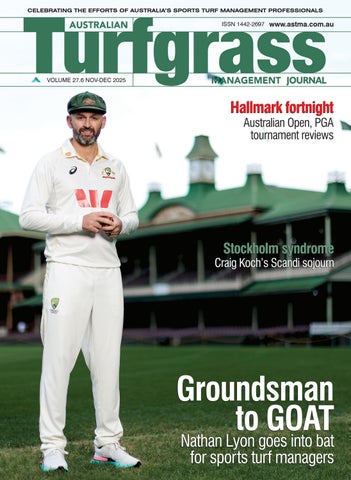
Groundsman to GOAT Nathan Lyon goes into bat Nathan Lyon goes into bat for sports turf managers
The Australian Sports Turf Managers Association is indebted to the support of the following premium partner companies
PREMIUM PARTNERS PREMIUM PARTNERS ASTMA PREMIUM PARTNERS PREMIUM PARTNERS The Australian Sports Turf Managers Association is indebted to the support of the following premium partner companies PREMIUM PARTNERS The Sports Turf Association The Australian Australian SportsPLATINUM Turf Managers Managers Association is is indebted indebted to to the the The Australian Sports Turf Managers Association is indebted to the support of the following premium partner companies PREMIUM PARTNERS support of the following premium partner companies support Sports of the following premium partner companies The Australian Turf Managers Association is indebted to the support of the following premium partner companies The Australian Sports Turf Managers Association PREMIUM is indebted to PLATINUM the PARTNERS support of the following premiumPREMIUM partner companies PARTNERS PLATINUM PREMIUM PARTNERS PLATINUM The Australian Sports Turf Managers Association is indebted to the JOURNAL
Published by the Australian Sports Turf Managers Association (ASTMA) Editorial Brett Robinson (Editor) Office: (03) 9548 8600 Mobile: 0434 144 779 Email: brett@astma.com.au Nick Creely (Reporter) E: nick@astma.com.au
Advertising Pam Irvine Office: (03) 9548 8600 Mobile: 0402 069 489 Email: pam@astma.com.au Art Direction & Design Jo Corne
PLATINUM
Printed By Southern Impact Pty Ltd
Suite 1, Monash Corporate Centre 752 Blackburn Road, Clayton, VIC 3168 P: (03) 9548 8600 E: admin@astma.com.au W: www.astma.com.au ABN 96 053 205 888
GOLD
ASTMA Board Ben Tilley (Headland GC, president), Troy Jordan (MOPT, treasurer), Peter Lonergan (Coolangatta & Tweed Heads GC), Damian Hough (Adelaide Oval), Mark Findlay (Werribee Park GC) and Dennis Grounds (Royal Canberra GC)
SILVER
Membership Allison Jenkins E: admin@astma.com.au
SILVER SILVER SILVER BRONZE BRONZE BRONZE BRONZE BRONZE
Finance Manager Frank Joseph E: frank@astma.com.au Events and Education Simone Staples E: simone@astma.com.au Pam Irvine E: pam@astma.com.au RTO/Training Albert Sherry (National Training Mgr) E: albert@astma.com.au M: 0437 064 726
BRONZE
AGCSATech Bruce Macphee (Senior Agronomist) E: bruce@astma.com.au Tim Fankhauser (Agronomist) E: tim@astma.com.au Amy Dingle (Agronomist) E: amy@astma.com.au www.facebook.com/TheASTMA www.linkedin.com www.instagram.com/the_astma @TheASTMA
GOLD PLATINUM PLATINUM GOLD PLATINUM GOLD GOLD GOLD GOLD SILVER SILVER GOLD GOLD SILVER SILVER SILVER
Chief Executive Officer Mark Unwin Mobile: 0438 320 919 E: mark@astma.com.au
Chris McCulloch (SA Training Mgr) E: chris@astma.com.au M: 0488 338 805
PLATINUM
The Australian Sports TurfofManagers Association indebted to the support the following premiumispartner companies The Australian Sports Turf Managers Association is indebted to the support of the following premium partner companies support of the following premium partner companies
BRONZE BRONZE BRONZE
The Australian Sports Turf Managers Association encourages all members to support these companies who support your association The The Australian Australian Sports Sports Turf Turf Managers Managers Association Association encourages encourages all all members members to to support support The Australian Sports Turf Managers Association encourages all members to support The Australian Sports Turf Managers Association encourages all members to support these companies who support your association these companies companies who who support support your your association association these these companies who support your association The Australian Sports Turf Managers Association encourages all members to support these companies who support your association
The Australian Sports Turf Managers Association encourages all members to suppor
The Australian Sports Turf Managers Association encourages all members to support The ASTMA believes that material sourced and produced for Australian these companies who support your association Turfgrass Management is these accurate, but gives no warranty in relation companies who support your Theassociation Australian Sports Turf Managers Association encourages all members to support thereto, and disclaims liability for all claims against the ASTMA, its subsidiary companies, its employees, agents or any other person these companies who support your association which may arise from any person acting on the materials contained within. No portion, in whole or part, may be reproduced without the written permission of the ASTMA The Australian Sports TurfAssociation Managers Association The Australian Sports Turf Managers encouragesencourages all membersalltomembers support to support these who companies support your NOVEMBER-DECEMBER association 2025 1 these companies supportwho your association Copyright © 2025
PHOTOS: DRIVER AVENUE GROUP/PHIL HILLYARD
CONTENTS
20 COVER STORY
PHOTO: GOLF AUSTRALIA
20
Australian Test cricket legend Nathan Lyon, affectionately known as ‘Garry’ or ‘the GOAT’, is a passionate advocate for the sports turf industry, having come through the ranks as a teenage apprentice at Canberra’s Manuka Oval before becoming the country’s greatest ever off-spin bowler. With Australia in the middle of an intense Men’s Ashes series against England, where Lyon overtook Glenn McGrath to become Australia’s second highest Test wicket-taker and sixth highest in history, he spoke to ATM reporter Nick Creely about his journey from pitch curator to Test legend and how the many lessons he learnt during his apprenticeship helped to shape his life.
8
Cover: Australian Test cricketer Nathan Lyon. Photo: Driver Avenue Group.
26 ALSO IN THIS EDITION… Foreword Thinking – Mark Unwin Best on ground Around the Trade Association Reports/News Obituaries 2
FEATURES 4 6 58 66 72
Aus Open’s ‘Royal’ renaissance The Royal way RQ’s fitting PGA finale Keeping it in the family Among the forests and meadows
AUSTRALIAN TURFGRASS MANAGEMENT 27.6
8 16 26 32 36
36
PHOTO: PGA OF AUSTRALIA
LYON’S JOURNEY FROM GROUNDSMAN TO GOAT
Ends of eras
I 46 COLUMNS
JOHN FORREST KATE TORGERSEN BEN GIBSON
46 50 54
54 Contributors to Australian Turfgrass Management Journal Volume 27.6 (November-December 2025): Australian Golf Media/Golf Australia/PGA of Australia; Shane Baker (GCSAWA); Michael Clavin (Royal Melbourne GC); Cricket Australia; John Forrest (Forrest and Forrest Horticultural Consultancy Services); Richard Forsyth (Royal Melbourne GC); Getty Images; Ben Gibson (The Toolbox Team); Green Adelaide; Mat Isbester (Royal Melbourne GC); Richard James (Kooyonga GC); Craig Koch (Ingarö GC, Sweden); Adam Lamb (VGCSA); Peter Lovitt (Driver Avenue Group); Nathan Lyon; Isaac McDonald (WACA/Optus Stadium); Adam Mills (Royal Queensland GC); Mark Parker (NSW GC); Scott Reid (TSTMA); Chris Sheath (Trinity College, SA); Simon Snedden (ACTSTMA); Kate Torgersen (Torgersen Gilbey); Mark Unwin (ASTMA); Tim Warren (TMSA/Glenelg GC).
n journalistic parlance, the period around Christmas and New Year is known as the “silly season”, when major institutions wind down and close, news is slow and the reporting often frivolous. The 11-day stretch between 18 and 28 December was anything but for the Australian sports turf industry. It began with the surprise resignation of one of this country’s leading golf course superintendents. It was then headlined, sadly, a few days later by the news of the passing of Australia’s greatest turfgrass mind. It then concluded with the castigation of one of Australia’s top wicket curators via the media. First came the news that Richard Forsyth, after 16 years as just the fifth links superintendent in Royal Melbourne Golf Club’s history, had tendered his resignation as Director of Courses. The announcement, made official on 18 December in a letter to members by Club Captain Ben Hasker, came just weeks after Forsyth had led an 86-strong tournament crew that successfully presented the Composite Course for the 2025 Crown Australian Open, the club’s first men’s Open in 34 years. Admittedly, it had been a tough period for Forsyth – as you will read in this edition’s coverage of the tournament – highlighted by the significant herbicide damage sustained to the fescue surrounds earlier in the year. As Forsyth confides it was one of the most challenging things he’s had to negotiate in a superintendent career spanning nearly four decades, notwithstanding some of the unnecessary external commentary that was also forthcoming. But they got to the line and delivered a course that again created high drama down the stretch and helped to further enhance the reputation of the tournament. Then, three days later, on 21 December, news came through that the great Peter E. McMaugh AM had died after a period of illness, having turned 90 just a few months earlier. At the family’s request, Peter was farewelled at a private funeral service, with plans now in motion for an industrywide event to fully celebrate and honour Peter’s indelible contribution to the industry over more than six decades. I deliberately won’t write much about Peter’s legacy now – that will be saved for our next edition which will carry a substantial tribute currently being compiled with the grateful assistance of Peter’s many friends, colleagues and contemporaries – suffice to say that his loss is monumental. We will never see another mind like Peter’s. Then came the Boxing Day Test at the MCG, the fourth in the 2025/2026 Ashes Series, and the fallout after it concluded inside just two days. To watch head curator Matt Page standing in front of the media circus outside the ground on what should have been Day 3 was a hard watch. To his enduring credit Page answered everything honestly, owned the miscalculation and vowed to learn from it. Turf management is not an exact science as we all know and things can and do conspire, but to then hear the commentary from media, past players and pundits, who all of a sudden became experts in grass height and Test pitch preparation, was just perverse. As they always do, Page’s colleagues and the turf community were quick to rally around him and his team and shake their collective heads at the ensuing pile on. I’m not one to generally peruse social media, but in this instance it made for pathetic reading. I’m glad Page, as he noted in the press conference, doesn’t engage on social media or read the newspapers. One article, however, that was somewhat refreshing among the mire, came via Samuel Bernard, who writes for popular sports opinion website ‘The Roar’. Under the headline ‘We only talk to curators when we want someone to blame. It’s time we flipped that on its head’, Bernard commented: “We ignore ground curators for 360 days of the year, and then, the moment a pitch becomes controversial, we shove a microphone in their face and ask them to explain themselves. Not to explain the craft. Not to explain their intent with the pitch. Not to explain the dozens of wonderful pitches they have previously delivered. But explain the mistake.” To that point, and of course not surprisingly, there was scant mention of the excellent surface Page and his team produced just eight days later for the pulsating Melbourne Stars – Melbourne Renegades BBL derby which went down to the penultimate ball. Bernard’s article is a great read if you havent seen it and he goes on to suggest: “I think it’s time we keep them (the curators) there, in the spotlight that is, as a valuable source of information that is glaringly missing from the cricketing broadcast. Because pitch preparation isn’t some minor background detail. It is one of the most influential forces in cricket… Yet the people responsible for that surface are treated like stagehands, invisible until the set collapses.” Enjoy the read…
Brett Robinson, Editor NOVEMBER-DECEMBER JULY-AUGUST 2025
3
FOREWORD THINKING WITH MARK UNWIN, CEO
A profession built on skill, judgement and dedication
A
s we consign 2025 to the history books and look toward 2026 quickly coming into view, it is timely to reflect on what has been a challenging yet ultimately rewarding year for the sports turf industry across Australia. There is no doubt that 2025 tested our industry. Workforce attraction and retention has remained a significant challenge for many of our members, with competition for skilled staff continuing to place pressure on all operations. At the same time, the highly variable and often extreme weather conditions experienced across the country – from cyclones and prolonged rainfall events to heat stress and dry conditions – have required adaptability, resilience and technical expertise at all levels. Despite these challenges, what continues to impress me most is the professionalism, commitment and pride demonstrated by our members. Across community grounds, elite sporting venues, racetracks, golf courses and public open spaces, sports turf managers have once again delivered outstanding playing surfaces under demanding conditions. The standard of work being produced reflects not only technical capability, but also a deep sense of responsibility to athletes, clubs, councils and communities. It is a strong reminder that sports turf management is a profession built on skill, judgement and dedication. For the Australian Sports Turf Managers Association (ASTMA), this year has also marked a period of positive growth and strengthening capability. We welcomed two new staff members to the national team – agronomist Amy Dingle and journalist Nick Creely – who have enhanced our capacity to support members, deliver projects, expand services and tell our story. Our activities as a Registered Training Organisation (#46011) have continued to grow, with increased
4
enrolments, strong industry engagement and ongoing improvements to training quality and delivery. We have also embarked on a multiyear Hort Innovation-funded research project and continued the extensive support and assistance effort of the AGCSATech agronomy team. We expanded our operational support to state associations, reinforcing collaboration across the country and ensuring consistent, efficient administration and member services. Looking ahead to the coming year, there are encouraging opportunities on the horizon. Workforce development will remain a key priority and we are actively exploring pathways to attract new entrants into the industry. One such initiative is the introduction of the Certificate II in Sports Turf Management, designed to provide an accessible entry point for school leavers, career changers and those new to the sector. Initiatives like this will be critical in building the future workforce our industry needs.
2026 CONFERENCE KEYNOTES We also have a close eye on developing the program for the 2026 Australian Sports Turf Management Conference & Trade Exhibition to be held in Melbourne next June. Shortly before Christmas, the ASTMA, in partnership with Golf Management Australia (GMA), was delighted to confirm the first two keynote speakers who will be joining us for the opening day’s Plenary session – legendary Australian netballer Liz Ellis and former AFL player and leading sports administrator Gary Pert. In her prime, Liz Ellis was one of Australia’s highest-profile elite athletes and a former national captain. She played an incredible 15 continuous seasons with the Diamonds and won three World Championship gold medals, two Commonwealth Games gold medals and four national premierships with the Sydney Swifts. Post playing career, Liz has used her success in television, ranging from netball commentary, hosting Olympic and Commonwealth Games broadcasts to more recently hosting The Project and Gladiators. As a much-respected voice in Australian sports media, Ellis is a thoughtful advocate
AUSTRALIAN TURFGRASS MANAGEMENT 27.6
for women’s sport and thought-provoking commentator on wider sporting and social landscape issues. Her Plenary session will cover life, teamwork and leadership, with a focus on planning to achieve success. Gary Pert is a highly successful businessman who previously enjoyed a distinguished 14-year career in the AFL between 1982 and 1995 in which he played 233 games – 163 for Fitzroy and 70 for Collingwood. He won Fitzroy’s Best and Fairest in 1989, was named All-Australian in 1985 and is a member of Fitzroy’s Team of the Century. Gary was previously the CEO of both the Melbourne and Collingwood football clubs. At Collingwood, he financially doubled the club in size and steered it to three grand finals, including the 2010 premiership under his leadership. Outside of elite sport, Gary was previously managing director of Channel Nine Melbourne and enjoyed a 12-year career with Austereo Melbourne, including five years as general manager and five years as the national sales director. His talk will focus on the values of excellence, leadership, discipline and community as well as the importance of goalsetting and feedback. The ASTMA and GMA look forward to welcoming both Liz and Gary to the Melbourne conference. Further speaker announcements will be made in the New Year, with a draft education program to be released midJanuary. Early Bird conference registration will be available from 1 February. As we close out the year, I would like to sincerely thank our members for your ongoing support, engagement and professionalism. Thank you also to the ASTMA staff for their hard work and commitment throughout the year, and to the Board for their leadership and strategic guidance. On behalf of the ASTMA I hope you had a great Christmas and wish you all a happy and successful 2026 to come.
Making Good Turf Great From Tee To Green New improved & innovative formulation PRIMO MAXX® II delivers improved playability by increasing turf density PRIMO MAXX® II enhances turf health and playing surface consistency Golf course quality is the No 1 factor in attracting golfers to a club More rounds = Increased Club revenue
PRIMO MAXX® II Turf growth regulator is a completely new formulation designed to meet the ever increasing regulatory hurdles and secure the long term future of this key management tool for
For more information visit syngentaturf.com.au or speak with your local Syngenta Territory Sales Manager
turf managers. Users should continue to apply the rates they have always used and can be confident of achieving the same great results while applying less active ingredient. Refer to product label for full application and safety directions. Syngenta Australia Pty Ltd, Level 1, 2 Lyonpark Road, Macquarie Park NSW 2113. ABN 33 002 933 717. ®Registered trademark of Syngenta Group Company. ™Trademark of a Syngenta Group Company. All products written in uppercase are registered trademarks of a Syngenta Group Company. © 2025 Syngenta. AD 25-316.
SOCIALS
Best
on ground ATM showcases some of the best social media posts and images from across the sports turf industry in recent times...
KEVIN DAVIS (CSTM) “With Christmas fast approaching, what better way to celebrate the occasion than mowing a Christmas tree pattern into the ground!” (A second entry in ATM in as many editions for U-TAS Stadium in Launceston. Using a Tiny Mobile Robot GPS linemarking machine, head curator Kevin Davis and his crew marked up the outline of the Christmas tree using ‘Green Out’ paint from Supaturf, before double cutting the pattern in with a Toro 5010-H. All up the tree took roughly 90 minutes to appear.)
RYAN VAN DER VEEN “The new ‘Super Hybrid’ bunker on the 1st fairway at Glenelg Golf Club. One of our last creative design/build efforts as we near completion of the 18 holes.” (In early December the Adelaide club officially re-opened its full complement of 18 holes following a four-year course redevelopment. The final phase of the Course Enhancement Plan focused on holes 1, 6 and 7 and included some novel bunker work.) 6
AUSTRALIAN TURFGRASS MANAGEMENT 27.6
RILEY JUDD “Good couple days out scarifying and shaving down the surrounds. Featuring the ghetto roof on the Toro.” (The crew at Lynwood Country Club in western Sydney, led by newly-appointed superintendent Riley Judd, hard at work during their recent renos, complete with improvised sun protection.)
DOMINIC YATES “A good reminder to staff and members not to take shelter under a tree in a storm! Luckily everyone escaped unharmed.” (In late November, Oatlands Golf Club in Sydney was hit by an intensive storm cell that brought down a number of trees, with one large limb crushing two golf carts parked next to a tee.)
TURF MANAGEMENT SA “Out and about today catching up with TMSA member Simon Sczesny, Turf Manager at Coopers Stadium, ahead of tonight’s big CommBank Matildas vs New Zealand clash!” (Caleb Hearn, from Adelaide Oval Turf Solutions, mows the pristine Coopers Stadium turf in Adelaide ahead of the early December Trans-Tasman friendly which the Matildas won 2-0.) NOVEMBER-DECEMBER 2025
7
2025 OPEN
Australian Open’s ‘Royal’
PHOTOS: BRETT ROBINSON AND GOLF AUSTRALIA
renaissance
The Royal Melbourne tournament crew, which numbered nearly 90 for the week, celebrate with 2025 Crown Australian Open winner Rasmus Neergaard-Petersen
8
AUSTRALIAN TURFGRASS MANAGEMENT 27.6
The famed 18 East green complex, which doubles as the 18th on Royal Melbourne’s iconic Composite Course, witnessed another dramatic slice of tournament history last December when Dane Rasmus Neergaard-Petersen (pictured inset opposite) made a miraculous up-and-down on the 72nd hole to win the 2025 Crown Australian Open from Cameron Smith
After a 34-year hiatus, the men’s Australian Open returned triumphantly to Royal Melbourne Golf Club in the first week of December. Featuring talismanic 2025 Masters champion Rory McIlroy, the crowds flocked to the Melbourne Sandbelt in numbers not seen since Tiger Woods’ played in the 2009 Australian Masters. ATM editor Brett Robinson talks to Director of Courses Richard Forsyth about a challenging lead-in, those much-talked about fescue surrounds and the privilege of hosting the national Open after such a long absence.
“W
hen all this is done, I’m going to give you a big hug!” It was a flippant comment to tournament director Trevor Herden after what had been a challenging 24 hours leading up to the first round of the 2025 Crown Australian Open, but Royal Melbourne Golf Club Director of Courses Richard Forsyth saw his moment and made sure he followed through. Shortly after the 86-strong tournament crew had completed their final round preparations, Herden came down to the links maintenance facility, as is customary, to thank them for their efforts. Addressing them, you could sense the emotion and occasion of the week – the national Open returning to Royal Melbourne’s famed Composite Course after a 34-year absence – was still palpable for Herden. There was probably also a touch of
personal gratitude to be in the position he was that week given that just three years earlier he nearly lost his life after suffering a cardiac arrest while officiating an amateur event at Sorrento Golf Club. As Herden struggled a little to get his words out, Forsyth stepped in and said “C’mon, it’s time for that hug”, with the ensuing embrace causing much mirth among the crew. Herden is well known for possessing a crushing handshake and Forsyth can attest the bear hug was no different. To give that moment some context, you needed to rewind almost 95 hours to the morning of the Pro-Am. Tournaments can elicit a rollercoaster of emotions and after stepping out of a 10am Wednesday meeting with Herden, Heath McLeod (PGA of Australia) and their DP World Tour counterparts José Maria Zamora and Liz Mallett, Forsyth could’ve been forgiven for wanting to get off.
Less than 24 hours to tournament tee off, with 2025 Masters champion Rory McIlroy headlining one of the strongest Open fields in years, Forsyth had accepted the outcome of the meeting with officials and wouldn’t be able to cut or roll greens the following morning. Despite going into bat vociferously, the weather forecast for Thursday – gusty northerly winds upwards of 60kph – ultimately scuppered Forsyth’s case for the prosecution. Ever the professional, at 4am Thursday he delivered the news to a bemused crew… “Yesterday, due to the weather conditions that were forecast for today, we had a tournament meeting where some ‘robust discussions’ were had with officials about what should happen today. It was quite a process, but this is the statement that the DP World Tour has released to the players... ‘Due to the strong winds forecast for Round 1, Golf Australia, the Challenger PGA NOVEMBER-DECEMBER 2025 9
2025 OPEN
Above left: The fairway on Composite 6 gets cut ahead of the opening round Above: One of four seasonal staff at Royal Melbourne this summer, the Open was Ashleigh Larkin’s second major tournament of 2025, having been a part of the Royal Portrush crew for the 153rd Open Championship Left: Links crew members James Traill (left) and Ryan Veitch (right) ‘not cutting’ the Composite 7 green after Tour officials made the call not to cut or roll greens ahead of the opening round due to strong forecast winds later in the day
Tour of Australasia and the DP World Tour have decided that greens preparation will be modified to allow the best opportunity to complete Round 1 of the Australian Open on Thursday. We understand these are exceptional circumstances and intend to return to our planned greens preparation on Friday.’ “So, what that means for us today is that we aren’t mowing or rolling greens, so you can imagine how those conversations went. The primary goal is that play continues today without being postponed or held up – that’s what we are trying to achieve, but the result of that will be greens that we are not used to seeing here at Royal Melbourne.” When Forsyth officially started the Open countdown with his crew 180 days earlier, never would he have imagined speaking those words ahead of the first round. Tour officials have always had a tendency to err on the side of caution when on the Melbourne Sandbelt, but to not be cutting or rolling greens on day one, after a full double shotgun Pro-Am field had been across them the day before, was certainly new. As Forsyth, who has prepared courses for the likes of two Presidents Cups, a World Cup and a World Matchplay, states matter-of-factly “I don’t recall that scenario very often.” 10
GREAT DANE, GREAT FORTNIGHT Despite the unconventional start, come Sunday all that earlier tension had faded into the background as Royal Melbourne basked in a triumphant return to the Open stage. In a fitting climax, on the 72nd hole Denmark’s Rasmus Neergaard-Petersen managed a miraculous up-and-down to deny hometown favourite Cameron Smith, much to the collective groan of a parochial 33,000-strong final round crowd. With the Sunday pin tucked into its usual back right location on Royal Melbourne’s 18 East green, Neergaard-Petersen pushed his approach shot into an area of heathland right of the green affectionately known as ‘Dunk Island’, named after Australian Billy Dunk who got up-and-down from that location to win the 1975 Chrysler Classic over David Graham. Neergaard-Petersen emulated Dunk’s heroics, chopping it out to 20-feet before curling home a magnificent left-to-right putt, celebrating with a roar as it dropped. Smith, comfortably on the green in two by contrast, left his lag putt five feet short and then missed the par putt which would have forced a playoff. The Dane’s gutsy win put an exclamation mark on what was a hallmark fortnight for tournament golf in Australia. Combined with the 2025 BMW Australian PGA Championship
AUSTRALIAN TURFGRASS MANAGEMENT 27.6
held at Royal Queensland the week before (see report p26-35), the Open helped to generate extraordinary broadcast audiences and streaming records, while on the ground spectators voted with their feet. In scenes reminiscent of Tiger Woods’ 2009 visit to Kingston Heath for the Australian Masters, huge galleries flocked to Royal Melbourne to follow tournament drawcard McIlroy, who gave the organisers some early palpitations after flirting dangerously with the cut line on Friday. In total, the four tournament days attracted 104,000 fans and just under 113,000 for the week, eclipsing the 95,000/107,000 figures from 2009. At the start of the week, 2009 and 2010 Australian Open winners Adam Scott and Geoff Ogilvy had spoken glowingly of the Composite Course and its importance in Australia’s golfing landscape and what it meant to have the tournament back there. “I think winning the Aussie Open at Royal Melbourne has one of those asterisks next to it where it’s just that little bit more meaningful,” 2013 Masters champion Scott noted. “It’s nothing against anywhere else, but just the fact we haven’t played a national Open here since 1991 is going to make this week a really special one.”
Added 2006 US Open winner Ogilvy, who as a kid used to jump the fence to watch his golfing idols play Royal Melbourne: “This is one of the best tournament courses in the world and as soon as you put a golf tournament on here, everyone wants to come. It’s probably our best asset in Australia for a tournament. It shows you the magnetism that this place has with Rory coming. So it’s feeling like it’s back to where it was when I was growing up… it was a really important tournament then and it feels like it’s an important tournament this year.” From a course perspective, the gravity of the week certainly wasn’t lost on Forsyth and his senior team comprising superintendents Paul Thomas (West Course), Nic Staff (East Course) and Geraldine O’Callaghan (Sandringham Links) and respective assistants Michael Clavin, Mat Isbester and Lachlan Hay. Although having held multiple major tournaments, it was the club’s first Australian Open since 1991 and its 17th overall. It was also the first men’s professional strokeplay tournament on the original Composite Course since the 2013 World Cup of Golf, with 4 East in play instead of 16 East which had been used for the 2011 and 2019 Presidents Cups. “Having the Open back here after 34 years and to manage the preparation of the original Composite Course was a privilege,” states Forsyth. “You could certainly sense it was a big week. They (the tournament organisers) are trying to build the event back up again, so you definitely felt the importance that the course played in that and the responsibility of doing our job well in order to have it at its best for the week. I think the team can definitely tick that off and we showcased the Composite Course as best we could despite some of the challenges with the weather.
Charles Sutherland on the heavy-duty electric Salsco unit rolling the green on Composite 3 after the opening round
“I love doing tournaments – it brings the best out in you. You’re under pressure and everything is magnified. Everyone lifts a notch and rises to the occasion. You still get that knot in the stomach when things aren’t in the position you ideally want them to be leading in, but that’s a good thing because it shows you care and you want it to be the best it can be. “First and foremost you want the members to be proud of their course and I think the amount of feedback we got demonstrated they were and that overall the Open further enhanced the reputation of the course. “We saw that the strategy you need to play Royal Melbourne is still relevant in the modern game which was a nice thing to tick off also. The course isn’t long, they were hardly using driver, but for the most part the players were still flummoxed by it. The drama of the final group on the 18th hole reinforced it, with Neergaard-Petersen missing the green to the
Quali-Pro Nutmeg
right and Smith playing safely but seeing his ball bounce and feed away from the hole, giving him a longer putt than he might have at another course.”
AN UNUSUAL SEASON Not being able to carry out their planned greens preparations ahead of the opening round in a way mirrored what had been an unusual and challenging tournament lead-in. If Forsyth was hoping for a smooth run, he didn’t get it. Herbicide damage to the fescue surrounds created significant headaches (more on that below), while some changeable weather patterns threw plans on their head. A dry spell coming out of winter that persisted well into spring saw the course dry out considerably and water storage levels drop. Just 14mm of rain was recorded for September compared to the long-term average of 62mm. Come the end of October, just as
®
®
The safe choice for Mullumbimby Couch, Nutgrass and broadleaf weed control on all turf surfaces, including greens!
To learn more visit
ADAMA.COM
NOVEMBER-DECEMBER 2025 11
2025 OPEN
Director of Courses Richard Forsyth stimps Composite 1 green after rolling ahead of the final round
the club championships were concluding, the weather pivoted a full 180 degrees. By the end of November 144mm of rain had fallen, nearly two-and-a-half times the monthly average (64mm) across 20 rain days (twice the usual mean). A further 13.5mm on the Monday and Tuesday of tournament week topped things up, meaning the hoses and moisture probes never saw the light of day, something Forsyth can’t ever recall happening in any tournament he’s been involved with. Temperatures were also very cool. Melbourne had just two days over 30 degrees during all of October and November, while the first day of summer, just three days before the Open teed off, was Melbourne’s coldest in 30 years, reaching a maximum of just 15. The crew also got a rude shock on Sunday morning going about their preparations, with the mercury dropping to 9oC. “It was an unusual season,” reflects Forsyth. “It was so dry to start with and it felt like we had February conditions in October. Then after all the rain in November and the cool weather, it felt like we had August conditions in December!
“It was an odd spring for the couchgrass. It didn’t really fire at all before the tournament. Normally you have to be patient until Melbourne Cup Day and then the couch gets going, but it didn’t because the temperatures just weren’t there. There was more of that stalky, coming-out-of-dormancy type growth, so they weren’t as tight as we’d hoped and winter divots were slower to recover. “They felt more like mid-October surfaces than first week of December surfaces. But given how cold it was they were okay. I think they are getting better each summer as the Wintergreen overplanting, which we did in 2020 and 2021, develops within the Legend and other common couch.” Where the cool and wet weather was felt most, however, was the greens. Royal Melbourne prides itself on firm and fast putting surfaces, but with excess turf growth and moisture in the profile, it was challenging to dry them down sufficiently to achieve their trademark fire and bounce. “All that rain was great for growth but no good for the firmness,” explains Forsyth. “If the rain had stopped three days before it
did I think the greens would have been just about perfect. But with the rain only stopping Tuesday morning, the timeframe to get them to firm up wasn’t there. Then there’s also the compromise you have to make with the Tour who don’t want things too out of control and we saw that with the opening round not being able to cut or roll. “We did a double cut on Wednesday morning and we were still getting two catchers of grass off some of the greens. So there was plenty of growth and density in the turf leading in. After those two warm and windy days – Wednesday and Thursday – the dry down began and with some additional cutting and rolling in the afternoons to catch up, the greens were pretty good by Sunday. “I think we were 24 hours behind what would have been the perfect scenario. I think the greens would’ve been right where we wanted them on Monday. On Sunday, the drier greens were getting that forward bounce, but those which still had some moisture in them remained a little receptive. After about 1pm they started to release as we would expect them to, so it was that sort of fine a line.”
FESCUE FIGHT Superintendents know all about fine lines and pushing their surfaces to be at their best, particularly for a tournament. Across a career that has spanned more than four decades and multiple world-class events, Forsyth has ridden that line more than most and on a few occasions has had to deal with some adversity. At his first Australian Open in November 1997, just a few years into his time as superintendent at Metropolitan Golf Club, Forsyth recalls how he got a “bit excited” and presented Sunday greens for the Wednesday Pro-Am. While they were certainly impressive, a 41-degree day combined with heavy foot traffic saw the bentgrass wilt under the stress which left behind some visible scarring. This time around, however, it wasn’t the greens causing Forsyth to lose sleep. In what would prove a real race against time, it was the condition of the fescue approaches and surrounds that had everyone on tenterhooks after they suffered significant damage following a herbicide application in January. Royal Melbourne’s fescue surfaces have been a labour of love for Forsyth. They were installed early in his tenure back in the summer of 2009/2010 as part of major works to both the West and East courses in the leadup to the 2011 Presidents Cup. The fescue replaced the old couchgrass/Poa surrounds and provided a buffer between the fairways and Suttons Mix greens, with more readily available chemical options to help keep both Poa and couch out Kim Kennedy, who shifted from Kingston Heath to Royal Melbourne earlier in 2025, cuts the fescue surround on Composite 9
12
AUSTRALIAN TURFGRASS MANAGEMENT 27.6
of the fescue and thus the greens. From a playability perspective, the fescue could also be managed in a way that would mimic the bounce and firmness of the greens. As part of a regular program to keep the surrounds clean, in January Forsyth scheduled an application involving a combination of three herbicides. The strategy was to do three applications over three months to weaken the Poa and other undesirable grasses such as summergrass. Three to four weeks after the first application visible lines started appearing and a sick feeling in Forsyth’s stomach set in. “I’ve had a few challenging moments in turf, but that was certainly up there,” reflects Forsyth on the surrounds damage. “I still can’t put my finger on it. The products individually had all been applied to the fescue previously with no real adverse effects. I assume it was a combination of the three and a bit of an application issue in that we used a shrouded pedestrian boom sprayer. For whatever reason we got a dripline on the skirt of the shroud which gave us these prominent lines. “It was also probably the time of year. It seemed that the worst affected areas were those that were drier. There must have been a combination of factors – moisture, heat, herbicide combination and application – that caused the issue.” What was worse, however, was that it wouldn’t be a quick fix. Given the residual nature of one of the herbicides used, getting any form of recovery was going to be slow. Attempts to overseed were impacted by the preemergent still active in the soil, with areas that received a heavier dose or overlap of herbicide taking much longer to recover. As Forsyth attests, they tried everything they could. Re-turfing was one option discussed, however, it was a last resort. Having spent 15 years getting the fescue to where he wanted it, the last thing Forsyth wanted was to go back to square one and have immature and inconsistent turf that would take years to get back to the desired playability levels. So they persevered, regularly seeding, plugging and replacing small sections where the worst damage was. That also included fertiliser applications and while the fescue responded favourably given its previously lean nutrition regime, it also stimulated the Poa, further adding to the conundrum.
Max Keogh, Annabelle Southall, Dan Fulcher and Steven Tapolczay in sync cutting the Composite 11 fairway
the Open in an episode of the ‘Talk Birdie to Me’ podcast. Having played Royal Melbourne the previous week, Allen proclaimed… “It will be a small miracle if Royal Melbourne gets up for the November Australian Open, in my view. When I was asking them, they were all super confident so I believe them, obviously with their knowledge of the grass and Royal Melbourne and the fescue surrounds which is the thing that’s in question here. They were certain it would be right, but as someone who has played a lot of golf it would be a miracle for the fringes to be at a hundred per cent. Anyway, good luck. Richard Forsyth is the man in charge and Richard, if you can get it up, then you are a genius, an absolute genius...” Besides the fact that the tournament was in December, those comments didn’t age very well. Come September Forsyth started to see the recovery he was hoping for and aside from a bit of scarring and a few visible lines, the fescue surfaces had no adverse impact on how the course played for the Open. Admittedly it was a race to the line and although not quite
Links senior greenkeeper Brandon Matalone boards the base of the fairway bunker on Composite 10
MIRACLES DO HAPPEN Compounding the whole issue was the external commentary that filtered throughout the industry about their predicament. That escalated in early July when former pro golfer turned pundit Mark Allen voiced his doubts over whether the surrounds would be ready for Cody Learmonth rolls the fescue approach on Composite 11 as the fairway units cut Composite 9 in the background
NOVEMBER-DECEMBER 2025 13
2025 OPEN how he would have envisioned them, Forsyth still rated them a 7/10. While Allen’s comments drew the ire of many within the superintendent community, Forsyth has been in the game long enough to know to take a more philosophical approach. “Yes, there was a lot of commentary around it and some people have an avenue through which they can make such comments,” states Forsyth, referring to the podcast. “I didn’t see anything wrong with what was said – it was a fact that they weren’t good at that time. Mark has his own style and he was just commenting on what he saw. While I had no issue with what he said, I was certainly determined to prove him wrong and that miracles can happen. “Things happen in turf and you can’t hide from them. For me the pressure was more an internal thing – how it impacted the members but also how it affected our staff who were interacting with the members daily and hearing it first-hand. My job is to manage the golf course and provide the best conditions for the members and in regards to the surrounds we weren’t able to provide that for them. That was the hardest thing for me – being upfront with the members and admitting that the one job you have is not being met and knowing you can’t fix it straight away.”
HIGH PRAISE Despite the various hurdles that presented along the way, it was a very grateful Forsyth who addressed his team late on Sunday as celebrations were in full swing in the Open’s aftermath. Bringing together a crew, which was similar in size to the one for the 2019 Presidents Cup, took a serious team effort and Forsyth was quick to praise the efforts of his links staff and the many volunteers. The Sunday morning bear hug with Herden aside, there was one other moment which, while small in the grand scheme of
Cooper Topham cuts the tee on Composite 15
things, encapsulated the Open week perfectly for Forsyth and gave him fresh perspective as to the status that Royal Melbourne holds and the exacting standards they aim to deliver. At one staff meeting during the week, Forsyth had voiced his frustration about the state of some of the mowers which hadn’t been cleaned properly. Without prompting, after the meeting was over a volunteer approached Forsyth and owned up that it was his mistake. Appreciating his honesty, Forsyth kept talking and quizzed the volunteer further on how he was finding the week and overall tournament experience. Paraphrasing the analogy he used, the volunteer told Forsyth that back at his club he felt like he was a chef in a pub restaurant, whereas working at Royal Melbourne that week he felt like a chef at a three-star Michelin restaurant. “I thought that was a great analogy,” ruminates Forsyth. “I love hearing that sort of stuff – the recognition that there’s a
different level of expectation here because of the standards we have built. It can be an eyeopener for some, but hopefully everyone learnt something while here and were able to take that back to their clubs. “It’s an amazing scenario how our industry works when it comes to the volunteers. I’m forever in awe of the way that without even needing to promote it we had all these people put their hands up to help. Some were assisted by their clubs, while others did it completely off their own bat, coming halfway across the world and paying their own airfare and accommodation – that’s commitment. They turn up with their best attitude and it brings everyone up and about. They become one team and you can see the genuine connections that are made. “I guess that’s what I’m most proud of – how the staff and volunteers tackled the leadup and then the week of the tournament. The overwhelming feeling was one of achievement given the size of the event and how it went off overall. We were just a small cog in that wheel, but it felt very satisfying to have contributed to that and see the reputation of the tournament enhanced. Considering some of the challenges we had, I’m very proud of what the group achieved and how individuals come to the fore in a pressure situation.” Editor’s Note: In a surprise postscript to the Open, just before Christmas Richard Forsyth informed the club that he would be stepping down as Director of Courses. In a letter to members on 18 December, Royal Melbourne Club Captain Ben Hasker wrote: “After 16 years of loyal service to the Club culminating in the recent and highly successful Australian Open, Richard has engaged in discussions with Council about his and the Club’s future. As a result of those discussions, Richard has advised Council of his decision to step down from his role. Council supports Richard’s decision, has accepted his resignation and thanks him enormously for his dedication, leadership and significant contributions to the Club during his tenure. “Council will now focus on commencing the search for a new Director of Courses and ensuring a smooth transition of knowledge and systems in relation to the management of the golf courses. Richard will continue in his role until 30 June 2026, or until a new Director of Courses is appointed, to ensure a comprehensive handover can be conducted... “On behalf of the Council and members, we thank Richard for his significant service to The Royal Melbourne Golf Club and wish him the very best for the opportunities that lie ahead.” Links seasonal greenkeeper Euan Edmond searches for his mowing line on Composite 12 green
14
AUSTRALIAN TURFGRASS MANAGEMENT 27.6
2025 OPEN Royal Melbourne’s par five 4 West, which played as Composite 14 for the 2025 Australian Open. Inset: A fleet of Hydrojects are used to aerate the Suttons Mix browntop bentgrass greens monthly
The Royal
way
Royal Melbourne’s distinctiveness and grandeur were on full display during December’s 2025 Crown Australian Open. ATM looks at some of the club’s unique course management practices, tools of the trade and how the tournament crew was structured for the week. LIFTING AND LAYING Royal Melbourne takes a very different approach to the way it manages the organic matter content in its famed greens, employing a process which harks back to the days of the venerable Claude Crockford who was links superintendent between 1937 and 1975. Current day Director of Courses Richard Forsyth arrived at the club in mid-2009 and almost immediately set about major works to both the West and East courses, refurbishing the greens profiles and reseeding them with the club’s proprietary Suttons Mix browntop bentgrass, along with converting the approaches and surrounds to fescue. In the years since those works, in order to manage organic matter accumulation in the greens and surrounds, Forsyth has instituted a regular program of lifting and re-laying these areas, doing roughly four each year. The process involves sod cutting the turf off and setting it aside and then manually removing the existing thatch and organic matter layer to a specified depth to avoid the risk of compromising green contours. The 16
surface is then lightly cultivated before the existing turf is put back down. After the initial works in 2009, the crew has carried out the process across all the Composite Course holes one further time and are currently working through the greens on the club’s outer paddocks (West Course holes 13-16 and East Course holes 5-15). As part of the club’s impending irrigation upgrade (read more below), the crew will take the opportunity to do nine East Course greens and surrounds. The last lot of lifting and laying happened on the Composite Course holes three years ago, with Forsyth noting it can take that amount of time for the greens to get their trademark firmness back. “When you first do it it’s great for firmness, but we have found over the years that the ball interacts with the turf differently,” explains Forsyth. “It takes at least 2-3 years for the greens to get their ‘mojo’ back and to redevelop a robust root system that reinforces the structure of the profile. “Even though a freshly done green feels firmer under foot and Cleggs harder than an
AUSTRALIAN TURFGRASS MANAGEMENT 27.6
older one, the way the ball reacts on them is vastly different. With the newer greens there’s more of a deadening effect when the ball lands. The organic matter in the older ones acts springy and when dry is strong enough for the ball to release and bounce forward which is what we are trying to achieve.”
REMEMBER THE HYDROJECT? Complementing the lift and lay process, Royal Melbourne also has a very specific way it manages the Suttons Mix. Normal renovation practices, such as coring or solid-tining, are too disruptive, with Forsyth relying on an older piece of equipment to manage the surfaces. The Toro Company first unveiled the Hydroject (pictured inset above) back in 1989 and at that time it was the only cultivation tool on the market to deeply aerate compacted soils using high velocity water jets without impacting the surface. When Forsyth arrived at Royal Melbourne there was one unit. Fast forward 16 years and there are now 12! “The main reason we use the Hydrojects is because of our grass type and the native sand
WORDS AND PHOTOS: BRETT ROBINSON/ROYAL MELBOURNE GC
push up greens which don’t have drainage,” explains Forsyth. “We do very little in the way of regular cultivation or aeration because we don’t want to open the surface up and encourage Poa to take hold. “The Hydrojects are used as a tool to provide aeration with minimal disruption and have the added advantage of injecting water deep into the profile when it’s dry. We use them on a regular basis, at least monthly, and have found they work really well for us and encourages deeper root growth of the Suttons. “Having multiple units means if we have a morning where we can close one course for four hours, we can put nine of them out there. It takes a couple of hours per green, but by the time you get the first nine done and the course opens, you’re on the back nine and out of the way. Given you have a hose connected, it’s very inefficient doing it among golfers.” Toro no longer manufactures the Hydroject – production ceased in the late 2000s – meaning Forsyth has had to scour the globe for not only working units but spare parts as well. He has sourced them from New York
Pictured clockwise from top left: Royal Melbourne has two heavy-duty Salsco rollers for greens and surrounds; members of the Open bunker crew on the move; Paul Thomas briefs the greens mowing team; The Grange Golf Club volunteer Casey Clarke cuts the fairway on Composite 10; and long-handled shears are used to trim bunkers
and Georgia (USA), Scotland, Singapore and Mexico. In some cases, the transportation cost has been greater than the unit itself! Charged with the task of keeping the units operational is workshop manager Mark Stravato. That job is becoming increasingly challenging, especially considering spare parts are rare and their own stocks are dwindling. An expert fabricator, Stravato has started experimenting with alternatives, such as using pressure washer pumps that could be used to replace the actual pumps if needed.
(OTHER) TOOLS OF THE TRADE As well as the Hydrojects, Royal Melbourne also has a few other unique tools and equipment to assist maintaining and preparing the surfaces. On the more rudimentary side, long-handled shears (pictured above) are used to help maintain a more natural looking edge on the bunkers. “Our bunkers are historical artistic features of the courses and they need to be preserved,” explains Forsyth. “Using hand shears enables some grass to be retained on the vertical lip NOVEMBER-DECEMBER 2025 17
2025 OPEN
LINKS LEADERS
Emma Lewis, cutting the tee on Composite 5, was one of two volunteers from Settlers Run G&CC
and doesn’t overly smooth out the edges. Over time they’ve gotten more irregularity back in them rather than getting smoother and rounder which would happen with regular trimming.” Embracing newer technology, over the past 12 months the club has welcomed two heavy-duty Salsco HP3E rollers which are used on greens and surrounds depending on the weather. For the Open they were used on the greens, with the lighter Tru-Turf rollers taking care of the approaches. The Salsco rollers are wider (1.85m rolling swathe), much heavier and all three rollers have a drive system which means they can better handle the steep slopes of Royal Melbourne’s surrounds. The club has also recently brought on board a VGR Top Changer which is essentially a heavy-duty Hydroject that aerates with high pressure water and also has the ability to inject sand into the profile. With a focus on reducing water holding and encouraging deeper rooting ahead of the Open, the Top Changer was used on selected green surrounds and low-lying areas that tend to retain moisture.
While Forsyth is very much the face of the Royal Melbourne operation, it was his senior links staff who navigated the significant daily logistics of running an 86-strong tournament crew for last December’s Open. Long-serving West Course superintendent Paul Thomas was in charge of the large greens mowing contingent which comprised six groups that cut three greens each (double cut – up and back on the same pass, in two directions, at 2.2mm) in addition to those cutting the putters and on cleanup laps. Each greens crew also had an assistant, moving turning boards and spotting lines. East Course superintendent Nic Staff played a critical role in the tournament lead-up, overseeing the significant infrastructure build and contractor management which had its moments due to a very wet November (144mm). West Course assistant Michael Clavin oversaw the fairway mowing team (cutting at 8mm) which comprised four groups of three mowers each (with spotters if needed), with two other units doing lap cuts. His East Course counterpart Mat Isbester was in charge of the tees and surrounds groups. The fescue surrounds and approaches were cut at 6mm all with walk-behinds – an up-and-back cut on the approach and a single cut around the backs and sides. Up to three staff were assigned to mow the Santa Ana tees. Sandringham Links superintendent Gerri O’Callaghan was in charge of small team that prepared the tournament’s dedicated practice facilities which were housed across there. Her assistant, Lachlan Hay, was over the other side managing the large bunker crew which boarded bases and broomed faces. And on course set up duties were James Gorniak (front nine) and Brad Milne (back nine).
FROM FAR AND WIDE Thirty-eight volunteers would end up joining the Royal Melbourne crew of 48 for Open week. The tournament crew had quite the
Jacob Proctor travelled all the way from Greenbrier G&CC in Kentucky, USA to volunteer at the Open
18
AUSTRALIAN TURFGRASS MANAGEMENT 27.6
international flavour about it, with staff coming from as far afield as Ireland, Scotland, the US and New Zealand. Royal Melbourne currently has four seasonal staff, among them Ashleigh Larkin who earlier in the year was part of the crew at Royal Portrush for the 153rd Open Championship. While at the club she is living with O’Callaghan and for the tournament was part of the fescue mowing team. Off his own bat, Jacob Proctor made the trip from Greenbrier G&CC (Kentucky, USA) to volunteer, while fellow countryman Jacob Warpinski is another seasonal. Warpinski, who was primarily on a Salsco roller for the Open, previously worked under Kyle Hegland at Sand Hills, Nebraska who volunteered at the 2019 Presidents Cup. Kiwis Jimmy Walker and Trevor Jones (Jack’s Point) and Mitch Northin (Te Arai Links) journeyed across, while fellow volunteer Harvey Jones hailed from St Andrews in Scotland and joined countryman and seasonal greenkeeper Euan Edmond. Interstaters also made up a strong component of the volunteer cohort. Brenton Liaropoulos and Kaden Thorne came down from Sunshine Coast’s Headland Golf Club, while former GCSAQ Graduate of the Year and FTMI graduate Dan Fulcher (Maroochy River GC, Qld) made the trip ahead of taking up an internship on The Ohio Program. Royal Sydney (2) and Manly (3) flew the flag for the Sydney clubs, while Craig Geeve, fresh off collecting the Employee of the Year Award at the NSW Golf Industry Awards, took time away from his duties as superintendent at Duntryleague Golf Club in regional NSW. Part of the LIV Golf Adelaide crew since 2023, Casey Clark come across from The Grange and was part of the fairway mowing team. Also cutting fairways was Royal Queensland Golf Club greenkeeper Glenn O’Sullivan who notched up a mammoth tournament fortnight. As soon as he had finished walk-mowing his final green at the 2025 BMW Australian PGA Championship the Sunday before, he jumped straight on a plane and arrived at Royal Melbourne in time for that afternoon’s volunteer induction. Victorian clubs also turned out in force, with no less than 16 establishments represented including Barwon Heads GC, Heathcote GC, Heidelberg GC, Kooringal GC, Metropolitan GC, Peninsula Grammar School, Port Fairy GC, Riversdale GC, Settlers Run G&CC, Sorrento GC, Spring Valley GC, The Dunes, Victoria GC, Werribee Park GC, Woodlands GC and Yarra Yarra GC. The tournament crew was fed, watered and kept caffeinated every day thanks to the likes of Toro, Envu, Syngenta, K&B Adams, Oasis Turf and Greenway Turf Solutions, with Toro providing additional equipment assistance, support and uniforms.
FEMALES TO THE FORE With the likes of O’Callaghan and Larkin on the links crew, there was a healthy female sports turf manager presence for the Open. Complementing them was Kim Kennedy, who switched across to Royal Melbourne earlier in the year from Kingston Heath, bringing with her a heap of tournament experience including multiple Australian Opens and the 2019 President Cup where she was a volunteer. Also joining the crew in recent times was 2024 ACTSTMA Graduate of the Year Annabelle Southall who was previously at Royal Canberra. They were joined by Settlers Run volunteer Emma Lewis, while keeping the whole crew running efficiently across the week was links administration officer Karyn Kremer.
WORKSHOP WARRIORS Stravato and his workshop team pulled off a mammoth task preparing what is a one of the biggest golf course equipment fleets in Australia for the Open. After workshop assistant Phil Gamble had to have time off because of shoulder surgery, links greenkeeper Hayden Moulton was seconded across to the workshop and played a major role in setting up the fleet for the tournament. In addition to grinding all reels and fitting bedknives to 32 walk-behind mowers
Richard Forsyth (second from left) with links crew members (from left) Brad Milne, James Gorniak and US seasonal Jacob Warpinski
(used across greens, tees and surrounds/ approaches) and 15 fairway mowers, the workshop team also switched over headlights to LED on some of the older units, checked all hydraulic hoses, repaired transport trailers and catchers and converted some of the Tru-Turf rollers to lithium battery power.
TAPPING IN With a 17th Australian Open under the club’s belt, that will be it tournament-wise for the next
few years as it embarks on a huge irrigation project. After three years of planning, on 1 April the first stage of a two-year $14 million irrigation system upgrade will get underway which includes tapping into South East Water’s new Dingley Recycled Water Scheme. Royal Melbourne is one of a number of Sandbelt clubs and sports ovals to benefit from the scheme which will supply recycled water to around 40 sites. Given the issues the club has had historically with water, the project will effectively droughtproof the two courses, while the new Toro irrigation system has been designed to handle the club’s unique irrigation set up and requirements. The all-poly system will comprise two separate mainlines – one for greens and one for fairways. The new fairway mainline will be fed by water from the Dingley scheme which will be delivered straight into a new 3ML tank. A dedicated pump system will then push that water out at 170L/s, effectively enabling the club to apply 10mm of irrigation in an eighthour window across all 36 fairways. Greens irrigation will also be on a separate system and use treated stormwater from the club’s existing harvesting and storage infrastructure. The back nine East and West holes will be tackled in the project’s first year, with the Composite Course holes in the second year.
NOVEMBER-DECEMBER 2025 19
CRICKET
20
AUSTRALIAN TURFGRASS MANAGEMENT 27.6
From humble beginnings as an apprentice groundsman at Canberra’s Manuka Oval (right) to the heights of being one of the best off-spin bowlers cricket has seen, Nathan Lyon has never forgotten his roots and the life lessons it has taught him
D From groundsman to
GOAT
Australian Test cricket legend Nathan Lyon is a passionate advocate for the sports turf industry having come through the ranks as a teenage greatest ever off-spin bowler. Ahead of an intense Men’s Ashes series against England, he told ATM reporter Nick Creely how his journey from pitch curator to Test legend has shaped his life.
PHOTOS THIS PAGE: DRIVER AVENUE GROUP/NATHAN LYON
apprentice at Canberra’s Manuka Oval before becoming the country’s
espite holding the title as Australia’s greatest off-spin bowler and one of the most iconic and revered figures in Test cricket history, a key piece of advice and wisdom still fizzes through the ears of Nathan Lyon to this day. The advice came from the 38-year-old’s father Steven who told him to “never forget where you come from”, regardless of where life takes you or whatever challenges come your way. For everything he has achieved in the famous Baggy Green, this poignant sentiment couldn’t be more appropriate when describing the former pitch curator. Since making a stunning Test debut in 2011 against Sri Lanka in Galle and taking a wicket with his first delivery, that of legendary batsman Kumar Sangakarra with a classic off break delivery that caught the edge to slip, Lyon hasn’t looked back. He has now played 141 Tests for Australia and taken 567 Test wickets, placing him second only to the late Shane Warne as the country’s greatest wicket taker in the format. During this summer’s Men’s Ashes series against England, Lyon overtook the great fast bowler Glenn McGrath’s 563 Test wickets in what was another astonishing milestone in a glittering career for the man affectionately known as ‘The GOAT’ or ‘Garry’ by teammates and legions of fans. But it was his rapid rise seemingly out of obscurity, away from the conventional cricket pathways, that descended him to greatness. The passion for hard work and never being written off has endeared him to fans for a decade-and-a-half. That potential was clearly seen early in his Test career when former champion batsman Michael Hussey anointed Lyon as his successor as the team’s ‘Songmaster’, a position he proudly held before handing it on himself to wicketkeeper Alex Carey last year. NOVEMBER-DECEMBER 2025 21
PHOTO: DRIVER AVENUE GROUP/NATHAN LYON
CRICKET
DREAM BUILT FROM HARD WORK
I’ve become. My Dad has always reminded me of that and it’s one of the key messages of my life,” Lyon told Australian Turfgrass Management Journal just two days before the start of the 2025/26 Ashes series opener at Optus Stadium in Perth. “I’m extremely grateful for the opportunities I’ve been given early on in life, at Manuka Oval and Adelaide Oval. As a young man I learnt so much as a greenkeeper and curator. I’m really fond and have a lot of great memories of my time on the tools as people would say and it put me in a pretty good position in life.” Greenkeeping and cricket pitch curating wasn’t always part of the career plans for a young Lyon who was playing for the ACT Comets at the time in 2006 after finishing high school and actively pursuing his desire to play cricket at the highest level after making the move from Young to Canberra as a teenager. “I totally fell into the curating side of things to be honest,” said Lyon. “The coach at the time of the Comets was a bloke named Andrew Dawson, I had just moved across to Canberra and I was actually unemployed for
two days when I got there. He came to me on a Friday afternoon and basically asked me if I wanted to take on an apprenticeship at Manuka Oval. “I called my Dad – he’s always my sounding board – and he said ‘You’re an idiot, you’re unemployed, take it on’. I started on the Monday and fell in love with it by that afternoon. I was very, very lucky the way things panned out and thoroughly enjoyed my time working both at Manuka and Adelaide Oval.”
TAKING HIS CHANCES
PHOTO: PHIL HILLYARD
Lyon was plucked out of the depths of Adelaide Oval in 2010 by then South Australian Twenty20 coach Darren Berry while working as a full-time groundsman and curator, who saw his potential as an off-spinner and thought he had both the skill and mettle to play Big Bash. Within a year he was catapulted into Australia’s Test match squad and the rest, as they say, is history. It came merely a matter of months after making the move across from Canberra where he had just finished a four-year greenkeeping apprenticeship at Manuka Oval and was preparing for a long career as a curator. By no means did the proud and humble country-born lad, raised in Young, New South Wales – a small town 133 kilometres northwest of Canberra famous for its production of cherries – have any idea of the whirlwind journey ahead of him, which has seen him travel the globe and bamboozle batsmen with his masterful craft of off-spin bowling. “It’s definitely something that isn’t lost on me, where I’ve come from, how lucky
22
AUSTRALIAN TURFGRASS MANAGEMENT 27.6
While playing for the ACT Comets, Lyon took on an apprenticeship at Manuka Oval where he completed his apprenticeship under the tutelage of head curators Marcus Pamplin and Brad van Dam
The move to South Australia in 2010 to work at the famous Adelaide Oval under ASTMA Board member and turf guru Damian Hough just a year before his Test debut is the stuff of legend, almost too good to be true. It was an interstate shift that forever changed his life in an unexpected way. He was at the tailend of his Certificate III in Horticulture (Turf) at the Canberra Institute of Technology but still harboured the ambition to make it as a professional cricketer. “I remember I got a call in the third year of my apprenticeship at Manuka. South Australia told me they needed an off-break bowler and asked me to come down, which I told them I couldn’t come down unless you gave me a state playing contract,” he said. “They couldn’t give me one at the time and I told them I needed to finish my trade apprenticeship at Manuka Oval, but the stars pretty much aligned. Eight months later the head curator Les Burdett retired, they needed a qualified curator and someone that bowls offbreaks, so I count myself completely lucky. “It probably wasn’t a big decision when I think about it, it was actually pretty easy to make the move. I jumped at the opportunity, flew down and met Damian and started work the following Monday. It was a pretty quick transition and I wouldn’t change anything.” During this summer’s Men’s Ashes series against England, Lyon overtook Glenn McGrath’s 563 Test wickets, placing him behind only the late Shane Warne as the country’s greatest Test wicket-taker
“ PHOTO: CRICKET AUSTRALIA/GETTY IMAGES
Lyon said both experiences working as a pitch curator were memorable for a variety of reasons and gave him a greater understanding of the characteristics behind a cricket pitch – lessons invaluable today as a leading international player. “I had two bosses at Manuka Oval – Marcus Pamplin, who is now out at Bellerive Oval in Hobart doing great things and Brad van Dam who had come from the SCG. Both of those guys had two completely different ways to prepare a cricket wicket so I felt like I learnt a lot from them,” he said. “Then going down to work with Damian and Justin Groves in Adelaide at the time, and the rest of the staff at Adelaide Oval, I was able to learn so much about the different opportunities in preparing a wicket. There’s no right way and there’s so many different ways to do it. That was a blessing in disguise to realise you can change your approach to different things, much like as a cricketer.” Lyon said Hough was a major influence on his career and life at the time and isn’t even slightly surprised by his meteoric rise in the world of cricket curators where his services and that of Adelaide Oval Turf Solutions is so greatly desired globally. Hough has been busy working on various projects such as delivering and preparing drop-in wickets at the Major League Cricket Twenty20 tournament in the USA, as well as his ongoing head curator roles at Adelaide Oval and now at GMHBA Stadium in Victorian regional city Geelong after recently taking on the key role. “I speak to him a fair bit even now, which is nice to keep that relationship going because you never know, I might need a job in a few years’ time,” Lyon joked. “I’m not surprised at
all (by his rise). He probably won’t want me to say this but he’s the best boss I’ve ever had. He’s extremely talented in the way he goes about his stuff and I’m grateful to have learnt so much from him.”
GOING INTO BAT FOR INDUSTRY Even to this day and after playing on hundreds of wickets and stadiums across the world, the hard work, blood, sweat and tears that curators, greenkeepers and groundstaff put themselves through to ensure cricket can actually be played is something Lyon will always advocate for. He is as passionate today as he was 20 years ago as a fresh-faced teenager plying his trade at Manuka Oval about the sports turf industry and its importance in the sporting landscape.
The way I look at curating is that it’s an actual art form in so many ways. I wouldn’t hesitate going back to it, I might have to start up ‘Garry’s Gardens’ when I retire, who knows.
“
THE ART OF THE CRAFT
– NATHAN LYON
While he understands and knows better than most that criticism is all part and parcel of elite sport – with the turf industry no stranger to that – Lyon is one of its fiercest defenders. His passionate defence of pitch curators couldn’t be more apt during the current Ashes series. The opening match in Perth saw the quickest Ashes Test in 137 years with the game ending within two days and in 847 balls, drawing criticism of the pitch and its preparation. However, the ICC ultimately ruled the surface ‘very good’ – the highest possible rating – while Cricket Australia praised the work done to create a world-class pitch, vindicating the work done by the grounds crew and curator Isaac McDonald (see more on the 1st Test in John Forrest’s column, page 46). “It’s not lost on me the work that gets done behind the scenes from the groundstaff and
NOVEMBER-DECEMBER 2025 23
CRICKET
PHOTOS: PHIL HILLYARD
Lyon is a passionate advocate for curators and groundstaff and the work they do to facilitate the game of cricket. Left, he is pictured talking to SCG assistant curator Cameron Billett and fellow groundstaff ahead of a recent Sheffield Shield match. Below, Lyon bowls during the 2025 Pink Test against India at the SGC
curator,” Lyon said. “I’ve gone into bat for a lot of curators around the world. I understand the making of a cricket wicket – it’s all about timing, the right moisture levels, the grass heights, the coverage of grass, it’s not easy. “I was actually quite nervous at the start of my greenkeeping career, because curators were always the easy out if you fail or an excuse as a cricketer. I have heard some comments in and around the changeroom over my time playing cricket but I tend to go into bat for most curators. “I’m someone who sat on both sides of the fence, it’s not lost on me. Without curators our game doesn’t get to go ahead, we don’t get to play the game we love so much. The impact curators have is pretty big but that’s the reality you have being at the highest level, the criticism will come and it can be an easy out, so it’s something I’ve always tried to stay levelheaded with during my playing career.”
of more than 200 delegates at the 2025 Turf Management SA Turf Seminar in August where he detailed his journey from groundsman, to Australian cricketer, Songmaster and Test match legend. He spoke with wisdom, humour and a deep understanding of what made the turf industry tick. Lyon – who recalls attending the annual ASTMA conference early on during his career – urged anyone looking to take on an apprenticeship in the sports turf industry to not hesitate.
“I think it’s an incredible job,” Lyon said. “You get to go outside, whether it’s to work on ovals, lawn bowls, golf courses, wherever that may be and it’s incredible to do that. The way I look at curating is that it’s an actual art form in so many ways. I wouldn’t hesitate going back to it. I might have to start up ‘Garry’s Gardens’ when I retire, who knows!” Having played Test cricket across the world, what ground and pitch stands out above the rest for the master spinner? “Adelaide Oval, without doubt it’s my favourite,” Lyon said. “I’ve got a connection there obviously but in my opinion it’s by far the best ground in the world. “A perfect wicket probably depends on where you are in the world and what you want it to do. For me it’s all about a contest between bat and ball. As a player, and as a cricket lover, you just want that even contest. “Whether it’s taking wickets or making runs, I think it’s really important to do that, but when the ball spins on the sub-continent there’s so many eyes on the game. It depends on where you are. It’s pretty cool to think you can play the game of cricket in different areas of the world and have different results.” Editor’s note: Nathan Lyon would play a critical role in the third Test at Adelaide Oval where Australia retained the Ashes. In an unfortunate postscript, a bad hamstring tear while fielding on day five saw Lyon sidelined for the rest of the series. He underwent surgery on 23 December. ATM thanks Nathan Lyon and his manager Peter Lovitt (Driver Avenue Group) for their assistance in helping to facilitate this article and wishes Nathan all the best for his rehabilitation.
Despite an action-packed calendar, Lyon’s passion for the industry was on display when he was the keynote speaker in front Lyon (pictured third from left) was guest speaker at Turf Management SA’s annual seminar in August where he detailed his journey from groundsman to one of Australia’s all-time great cricketers
24
AUSTRALIAN TURFGRASS MANAGEMENT 27.6
PHOTO: TURF MANAGEMENT SA
‘AN INCREDIBLE JOB’
AT JACOBSEN WE UNDERSTAND
THE ELECTRIC FUTURE IS NOW. Rooted in a rich culture and legacy, Jacobsen stands as a leader in the electrification space, dedicated to enhancing your turf’s integrity, reducing your operational costs, and fostering a greener tomorrow, today. Powered by ELiTE Samsung SDI Technology, Jacobsen’s lineup is second to none. With cutting-edge lithium mowing solutions for all your golf, sport, and commercial needs, the time to lead the charge is now!
SLF1 ELITE
ECLIPSE 2 ELITE
ECLIPSE 360 ELITE
HR3 ELITE
THE INDUSTRY EXCLUSIVE LITHIUM RIDE-ON FAIRWAY MOWER
ELITE PRECISION FOR ELITE PLAY
THE ELITE GREEN’S CHOICE
THE FUTURE OF ROTARY MOWING
TO LEARN MORE
about Jacobsen’s electrification initiative, scan this code.
LITHIUM BENEFITS ARE UNIQUE
Rooted in a rich culture and legacy, Jacobsen stands as a leader in the electrification space.
© 2025 Textron Specialized Vehicles
VIRTUALLY SILENT; 60% NOISE REDUCTION TO BYSTANDERS
LOW NOISE LEVELS ELIMINATE NEED FOR HEARING PROTECTION
45% VIBRATION REDUCTION COMPARED TO AN IC ENGINE
OVER 95% REDUCTION IN GREENHOUSE GAS (GHG) EMMISSIONS OVER ESTIMATED LIFESPAN
2025 PGA Royal Queensland’s conditioning (pictured is the 3rd green) couldn’t be faltered again as it hosted its fifth consecutive BMW Australian PGA Championship last November. Inset right: The Royal Queensland tournament crew, led by superintendent Adam Mills, celebrate with 2025 winner David Puig
RQ’s fitting PGA
finale
Over the past five years, course superintendent Adam Mills has come to expect the unexpected when preparing his course to host the BMW Australian PGA Championship. It proved the case again last November as Royal Queensland entertained its final Challenger PGA Tour of Australasia tournament ahead of likely major course works to accommodate the 2032 Olympic Games.
26
AUSTRALIAN TURFGRASS MANAGEMENT 27.6
PHOTO: PGA OF AUSTRALIA
played as a 72-hole strokeplay event that the tournament had been truncated. While thankfully not to that extent, last November’s instalment at RQ – its seventh PGA in total and last ahead of expected course works in readiness to host the Olympic Games golf events in 2032 – would see the trend continue. Thanks to a period of extremely unstable weather across southeast Queensland that week, a very different challenge was posed for course superintendent Adam Mills and his 39-strong tournament crew to navigate.
‘DON’T HIT THE COURSE!’ Mills is by no means a religious man – except when it comes to rugby league – but on the Monday afternoon, three days out from the first round, he found himself calling for some divine intervention. Around 3pm, an angry-looking storm cell developed over the Gold Coast and Brisbane and dialled things up to, well, 14. Hailstones, some as big as 14 centimetres in diameter, would cause significant damage between the Gold Coast and Sunshine Coast
and as Mills watched the system track up from the south on the radar he could only hope any hail would miss the course. Mercifully it did, but the rain and wind wouldn’t. In an intense 35-minute burst, 28mm of rain would fall which left RQ’s surfaces sodden and bunkers a mess, while wind gusts over 90kph caused damage to many trees, tournament signage around the tees and some spectator infrastructure. Thankfully there was no damage to any greens or surrounds. “I was looking at the radar in the office going ‘Don’t hit the course, don’t hit the course, DON’T HIT THE COURSE!’,” recalls Mills. “The weather is always a challenge and this year was different again. That Monday storm was surprising. The rain was super heavy and it was very windy. The devastation it left behind was a lot worse than expected. I couldn’t believe it when I went out on course after it passed – it was the most damaging storm we’ve had in all the tournaments. “The crew did a wonderful job to bend and move and flex, putting their heads down and doing what needed to be done. They were NOVEMBER-DECEMBER 2025 27
WORDS AND PHOTOS: BRETT ROBINSON
E
ver since the Australian PGA Championship found a permanent home in Queensland back in 2000, it has been pretty much a given that an extreme weather event (or events) will play a significant role in how each tournament pans out. Former RACV Royal Pines superintendent Lincoln Coombes, who hosted seven between 2013 and 2019, no doubt still has recurring nightmares about pumping out bunkers at 4am ahead of Round 1, while few will forget the 2010 tournament at Hyatt Coolum which had to be completed on the Monday after the final round was suspended due to more than two inches of rain falling. Royal Queensland Golf Club (RQ), host of the past five PGA tournaments since its shift to Brisbane from the Gold Coast in 2021, has also had its fair share of weather woes, none more prominent than 2024. After 250mm battered the course over a 12-day period, including during the first and second rounds, the event was reduced to 54 holes. It was the first time in 60 years of the PGA being
2025 PGA
An intense storm on the Monday of tournament week caused damage to trees and tournament infrastructure. The wet and wild start meant the crew spent a few mornings squeegeeing some of the front nine fairways to remove excess water
able to clean up everything inside the ropes that night and the following day we had extra help from our tree contractors and the crew constructing the new short course which we were really grateful for.” Having cleaned up after Monday’s event, a further storm hit the course on Tuesday evening dumping 15mm. Then, just for good measure, ahead of the crew turning up for their 3:30am meeting before the opening round, another 10mm fell, wetting the course up again. As Mills quipped when he addressed the crew, it was “Groundhog Day”. Knowing that rain was coming, Mills had made the call, as he had done the previous day, to cut the front nine fairways and the 10th and 18th fairways that evening, knowing they would be too wet in the morning. Indeed, the quartet assigned to mow the front nine fairways for the PGA, led by RQ crew member Nathaniel Cuzner, instead spent their Wednesday and Thursday mornings
squeegeeing excess water off a number of the holes that run adjacent to the Brisbane River. The fun wasn’t over though in what would prove to be a wild opening day. After two holein-ones – one in the morning to Kiwi Kazuma Kobori on the 17th and one in the afternoon to Daniel Gale on the 11th (winning himself a $300,000 BMW in the process) – at 3pm another huge downpour lashed the course. Popping up out of nowhere, a storm cell dumped another 5mm in 15 minutes on an already saturated course, bringing with it huge wind gusts and small hail. It forced the immediate suspension of play, leaving some groups needing to complete as many as 10 holes of their opening round early Friday morning. Frustratingly for Mills and the crew, although having the course clear Thursday evening, lightning activity nearby meant they couldn’t get out of the compound until dusk. When they did they were able to do a triplex cut on greens and divot fairways.
RQ crew members Lincoln Morgan (foreground) and Patrick Ellis cut the apron (6mm) on the par four 12th
28
AUSTRALIAN TURFGRASS MANAGEMENT 27.6
Due to the backlog of play and the conditions, on Friday morning the crew were only able to walk-mow (3mm) and roll the 328 couch greens and prep bunkers. Fairways, tees and aprons were left uncut at the request of tournament officials. Two hole-changing teams were then dispatched to change holes and set the pins for the second round. Round 2 play would end up being suspended as well, but this time due to poor light at 6:35pm Friday, with the cut eventually made early Saturday morning and Round 3 teeing off at 7:30am. Despite that the crew was able to get a full cut and prep of the course completed, with the remainder of the weekend disruption-free as the weather entered a welcome stable pattern. Although the early-week weather conditions impacted preparations, the Royal Queensland crew still had the course presented superbly for what was the DP World Tour’s opening event of its new season. Despite going on to miss the cut, threetime PGA champion Cameron Smith had praised the condition of RQ’s greens ahead of the opening round, saying that they were “the firmest and fastest” he had seen them. Those sentiments were backed up by data that Greenway Turf Solutions agronomist Paul Spencer had collected all week with the new USGA GS3 ball, with the greens posting “record” levels across all parameters compared to previous tournaments. “I was really pleased with where we had the course at and I think condition-wise it was right up there with past tournaments,” says Mills. “Early on we were trying to build consistency with the green speeds, but by the opening round they were in a good spot (above 11) and got better by the weekend (12 feet). We lost a little bit of firmness with those rain events, but they rolled really well and the data we were getting with respect to trueness and firmness was very reassuring. “After a such a wet summer last year, we went into winter pretty well and came out of it in a good spot. We did our usual renovations in September – using the Maredo high-speed
coring heads on the greens and verticutting, and scarifying all tees and select areas of fairways. With the greens, we just wanted to target the surface. Our numbers were pretty low already and we took them a little lower to build ourselves up for the tournament. “In typical fashion they didn’t do what I was hoping they would which has become a bit of a tradition over recent years. They just sat there and it meant we had to work them a bit harder to get them going. We had a few mite issues and a really dry 10-12 week spell through August-September and into October which meant salt levels in our irrigation water built up. So the greens came on a bit later than hoped but we got them there. “I think the fairways and tees were the best they have ever been for a tournament. That was probably down to the timing of our applications coupled with rainfall at the right time. Our bunkers also handled the weather a lot better. We’ve done a lot of work on the poorer performing bunkers over the past two years – modifying drainage and sourcing a coarser sand – so we were only having to bail out small puddles rather than pumping large amounts like we did last year.”
A BIG ACHIEVEMENT Given it was the last of their five PGAs, Mills says there wasn’t any sentimentality around last November’s event, more an immense amount of pride knowing they had done their bit hosting one of Australia’s main tournaments for an extended run. While he won’t miss the long hours and makeshift bedroom he sets up in his office every tournament week, the one thing he will miss is bringing a crew together to deliver something special. “It is a big achievement to roll out a golf course for a major tournament and do it well,
RQ’s Glenn O’Sullivan cuts the 15th green (3mm)
and I feel like we have done that every time,” states Mills. “It’s a tough week – you do fall in a heap at the end of it. But it’s a form of pressure that you want – you want to be able to rise to that challenge. That’s why my team and the volunteers are here – to do one job, do it well and get a result. “I’ve learnt so much over the years. My approach has been pretty similar for most of the tournaments, but I now have a much better understanding of the things we can do across the golf course chasing day-to-day quality. For instance, I like the greens healthy so I can work them hard both before and during the tournament to produce a surface that is super consistent.” Mills muses that some of the proudest things he’s done since being involved with the PGA is creating the roll out of the staff and volunteers each year and preparing a team to not only present the course at championship
standard, but to also handle the unexpected things like extreme weather events. “That’s what I’ll miss most – meeting good young people,” adds Mills. “I’ve always had apprentices as part of the tournament team and it’s a tribute to their supers who are producing good young people. You can see their mentality as soon as they get here. Whether it’s blowing bunkers or picking up sticks, that mentality of putting the head down and getting it done, while they may not know it yet, will hold them in good stead later on. “Being in the trenches together really galvanises those relationships and I feel like that’s a major contributor to our volunteers coming back year after year and newcomers wanting to join the crew. I want to make sure that I know all the volunteers’ names when they get here, that I’m touching base with them during the week and making sure they’re enjoying themselves.”
NOVEMBER-DECEMBER 2025 29
2025 PGA
Nixon Inskip (left), one of two PGA volunteers from Lynwood Country Club in Sydney, stimps the 4th green after RQ crew member Luke Bonner (above) rolls
OLYMPIC ASPIRATIONS The time for reflection, however, has been short as Mills and his team now eye something much larger on the horizon. Although he admits it will be good to have a rest from the tournament rigours, Mills is well aware of the likely work they have ahead of them as the club builds up to what will arguably be the biggest event in its proud history. As the chosen host of the men’s and women’s Olympic golf events when Brisbane hosts the Games in 2032, Royal Queensland plans to undertake a major overhaul of their facilities across the next few years. The first component of that got underway in late September, with Queensland Government approval to begin works on a new OCM-designed short course, riverfront pavilion, 4500m2 Himalayas-style putting green and water storage, as well as upgrades to the existing Championship course. The short course is being constructed on land on the
eastern side of the Gateway Bridge that once housed six holes of the previous RQ layout. The club lost those when the Gateway Bridge was duplicated in the mid-2000s, with the Championship course redeveloped by Michael Clayton and re-opened in 2007. Upon receiving approval, the club wasted little time in breaking ground on that 35-hectare parcel of land. After completing their setup works, Atlas Golf Services began bulk earthworks and by the tournament had completed those on six holes, with two green sites constructed and rootzone sand imported. Irrigation works were also progressing well. The new greens sites will be fumigated, with the first to be stolonised mid-January. The aim is to have all turfing done by July and the first few holes opened by the end of 2026. The short course will boast USGA-spec TifEagle greens, line-planted Tahoma 31 couchgrass fairways, tees and roughs and a new liner in the bunkers. The turf varieties
were chosen following trials on the club’s reconstructed 19th hole which began back in 2023. TifEagle was installed on that green, while the fairway was stolonised half/half with Tahoma 31 and IronCutter. They have been closely monitored, with GTS’s Spencer providing an independent assessment to help inform the club’s final decision. “Both IronCutter and Tahoma 31 performed well in our conditions,” explains Mills. “But after considering all of the parameters – low thatch accumulation, renovation and divot recovery, density, colour, seed head production, drought tolerance and salt tolerance – it was clear that Tahoma 31 was the right choice for RQ. “TifEagle is pretty tried and tested now and is the right choice for the greens. I like it because of its ability not to change through our seasonal variations. While our 328 is great, it can be susceptible to those changes and it’s all about having a grass that can provide us greater consistency.” The short course construction and turfing will act as a precursor to the major works that will hopefully happen on the Championship course. An OCM masterplan has been developed for that and ideally, in Mills’ opinion, will include re-grassing the entire course with the new varieties, as well as the installation of bunker liners and a new irrigation system. While there will be minor design modifications, including lengthening of some holes, the routing will largely remain as per the 2007 redesign. As with any long-term plan at a members’ club, any changes to the Championship course will be worked through with members before any on-course works take place. “This place has so much potential,” says Mills of the impending masterplan works. “Yes we are holding the Olympic golf events which is huge for the club, but with better infrastructure and improved turf surfaces it will be elite. With the proposed works to the Championship course and the new short course offering, the club will really be able to hold its head high as being among one of the best golfing facilities in the world.” RQ assistant superintendent Michael Todd does some Sand Pro circle work in the huge waste bunker that extends tee to green on the par three 17th
30
AUSTRALIAN TURFGRASS MANAGEMENT 27.6
Keeping it in
the family There was very much a family feel among the Royal Queensland crew as they went about their preparations for the
F
2025 BMW Australian PGA Championship.
amily connections ran deep within the hard-working tournament crew at the 2025 BMW Australian PGA Championship held in late November at Royal Queensland Golf Club (RQ), with a couple of father-son combinations and even a newly-engaged couple on a holiday of a lifetime working together to get the course in top condition. Long-time RQ assistant superintendent Michael Todd and qualified greenkeeper son Jarod (pictured top of opposite page) notched up their fifth consecutive PGA since 32
the tournament’s arrival in Brisbane in 2021 and enjoyed more quality time together at one of Australia’s most iconic sporting events. Michael, who has been with the club for 27 years and is a seasoned pro of the turf industry, says it is always enjoyable to work with his son who has now taken over his former role as the club’s irrigation technician. “It’s really good to have that working relationship,” says Michael. “Jarod’s taken over that role from me, I’ve obviously moved on now to being assistant under Adam (Mills, superintendent) and it’s been a good stepping
AUSTRALIAN TURFGRASS MANAGEMENT 27.6
WORDS AND PHOTOS: NICK CREELY AND BRETT ROBINSON
2025 PGA
stone for that. For us two it’s good to have that working relationship. I have two other sons as well, but to work with Jarod and teach him is great. He does things differently to what I do at times and he is able to also teach me things, so we enjoy it and bounce off each other. “It’s a job where you think there’s a thousand things to do but in realist terms it’s a job where it’s more of a wash, rinse and repeat kind of scenario, but you have to do it well.” Jarod says he was always learning a lot about how to prepare for tournaments with each passing year and stressed remaining consistent in preparation of the surfaces was important. In terms of irrigation, he said the weather played a significant role in dictating the quality of the greens. “There’s probably a lot more pressure on us not to stuff up in the tournaments, but it’s really enjoyable,” he says. “All the rain we had (in the lead-up) probably meant there wasn’t a lot of watering to do and when they pull out the grandstands and stuff like that it pulls out some of the pipes so there’s a lot of clean up afterwards. It’s not as fun when it rains, but at least it decreases the pressure I guess.”
LIKE FATHER, LIKE SON RQ foreman Tim Peters and his 14-year-old son Dallas (pictured above) were another
Opposite (and inset): Royal Queensland Golf Club foreman Tim Peters and 14-year-old son Dallas worked alongside each other for the week of the 2025 BMW Australian PGA Championship. Dallas was part of the back nine bunker crew
father-son pairing enjoying plenty of bonding time prepping the course during the PGA, with the Year 8 Brisbane Adventist College student looking to one day follow his dad’s footsteps into the industry. With the blessing of his school and the club, Dallas lined up alongside the tournament crew and wasn’t fazed one bit by the 3:30am starts or doing the hard yards out on the course. Indeed, he wasn’t given any special favours and was chucked in as part of the back nine bunker crew, working alongside RQ crew member Ashton Downes. “I was keen since April to do it and dad talked to a couple of people at the club and it was confirmed in September,” says sportsmad Dallas, who as well as enjoying golf also plays soccer, rugby, touch and does jiu-jitsu. “I’ve done some work experience on the golf course with dad before and come in on the weekends sometimes too. I really enjoy it and it’s something I’d like to get into one day. “Working in the bunkers was kind of tiring, but I still liked it. I was working with Ashton so we got them done pretty fast. I find it easy now
“It was great having him here,” adds father of four Tim, who brought the family to Brisbane from New Zealand a decade ago. “Everyone really took him under their wing and I think it was good for the crew having him around. He’s really keen about the industry and hopefully one day he may look at doing an apprenticeship. He’s willing to learn and as part of the tournament week he did a bit of backlapping with me and even learnt to walkmow our nursery green. “He was really good. I didn’t have any issues getting him out of bed for the early morning starts. Normally the kids muck around a little bit when it’s a school day, but he had 10 minutes to get up and ready before we hit the road each day.”
A HOLIDAY TO REMEMBER
RQ assistant superintendent Michael Todd (left) with son Jarod who is the club’s irrigation tech
because I know all the ways you have to rake them. It was a great week hanging out with dad, meeting all the people, getting to know the volunteers and talking to the PGA officials and members.”
UK tournament volunteers Lottie Fosten and Isaac Peate, on a holiday in Australia and both qualified greenkeepers at golf courses in England, enjoyed their time working Down Under at the PGA Championship. The couple, who got engaged in Sydney at the picturesque Balmoral Beach just two weeks before the tournament and had been travelling along the NSW coast, are passionate about all things golf, being outdoors but more importantly sharing that journey together.
NOVEMBER-DECEMBER 2025 33
2025 PGA
UK greenkeepers Isaac Peate (cutting fairways) and Lottie Fosten (raking bunkers) volunteered at the PGA while on holiday. They got engaged two weeks earlier in Sydney
Fosten, who was the only female working on the RQ tournament crew for this year’s PGA, is an assistant greenkeeper at the famous Wentworth Club, one of the UK’s leading courses and perennial host of the DP World Tour’s BMW Championship. Peate works as an assistant greenkeeper at Cottesmore Golf and Country Club in West Sussex, an hour south of Wentworth. The pair met in school, but a shared love of the outdoors and nature brought them together in the industry. “We met before we got into golf,” explains Peate, who was part of the back nine fairway mowing team for the PGA. “I’ve always played golf and we met in school and then when we left school we were both looking for jobs. I asked if I could get a job greenkeeping at a golf club and I’ve been at Cottesmore since.” Peate would ultimately get Fosten into the industry by landing her a job at Cottesmore before she took up a position on the crew at Wentworth as a trainee greenkeeper in May 2024. “For me, I’ve grown up on a farm and always been really outdoorsy,” says Fosten, who was part of the front nine bunker crew for the PGA. “I went into gardening straight out of school and then Isaac and his boss were quite keen to get me involved in their team and
that’s when I got into greenkeeping. It’s not too different and dissimilar to gardening and we both now really enjoy it.” Fosten hoped that her presence at the tournament would inspire more females to consider the turf industry as a career option: “As one of the few women in greenkeeping, I am keen to advocate for the growing number of women in the turf industry. I aim to connect with and learn from other like-minded individuals in order to discover new and exciting opportunities. “It was an amazing week at Royal Queensland and we have to give massive thanks to Adam and his incredibly hardworking team for allowing us to play a role in such a world-class event and making us feel so welcome! It was an experience that we won’t forget.”
MAKING IT THEIR OWN The UK duo were part of what superintendent Adam Mills describes as one of the more international-looking crews he has had at the Eagle Farm course across their five tournament tenure. Also flying the overseas flag was Robin Morgan who came across from New Zealand’s Te Arai Links and was part of the front nine bunker team alongside Fosten.
All up, Mills’s tournament crew numbered just under 40 for the week, with a number of volunteers also coming from interstate. Jamie Robertson (Secret Harbour) and Harrison Allardyce (Busselton GC) made the long trek across from the west and teamed up with RQ crew member Glenn O’Sullivan cutting the back nine greens for the week. Newly-appointed Lynwood Country Club superintendent Riley Judd and crew member Nixon Inskip journeyed up from Sydney alongside Elanora’s Kallum Grant. After enduring severe floods at the start of the year, Club Taree’s Ben Alliston also enjoyed the change of pace and environment, although on a few occasions he had to swap his fairway unit for a squeegee to clear surface water on some of RQ’s riverside fairways. Locally, Mills was again ably supported by a number of Queensland clubs and companies. Toro rep Ben Marshall and Pacific Golf Club’s Chris Redshaw backed up for their fifth consecutive PGAs, while recently appointed Oxley Golf Club superintendent Luke Nowlan experienced his first ever professional tournament. Syngenta’s Brisbanebased rep Nick Paterson also assisted, stimping greens and doing final clean up after greens had been cut and rolled. “I think it was the most global tournament crew we’ve had for the PGA,” says Mills. “That was again the highlight of the week for me. The volunteers were great. They were on board immediately and it’s just really good to know that when you put them out there, whether it’s picking up sticks or pushing up bunkers, they’ll just get it done and they make it their own. “I appreciate anyone who can give up their time to help us out and I just hope they enjoyed the experience. The team really galvanised over the first few days with all the weather we had and there was a real sense of purpose when they went out to do a real good job. And they did.” Stalwart volunteer Chris Redshaw (Pacific GC) backed up for his fifth consecutive PGA tournament at RQ
34
AUSTRALIAN TURFGRASS MANAGEMENT 27.6
EXPAT S
Among the forests and
meadows
A trip to Sweden to work as a six-month seasonal greenkeeper has turned into a 17-year turf
management odyssey for Australian Craig Koch (pictured). Now the course manager of Ingarö Golf Club, he looks back on his journey from the suburbs of Melbourne to the Stockholm archipelago.
I
kind of knew from a young age that I wanted to try my hand at greenkeeping. Our house, in the Melbourne suburb of Essendon, had a pretty big backyard and I was continuously doing things out there which, looking back now, must have driven my parents crazy. I made a six-hole short course, a cut-in cricket wicket and a mini tennis court during my early teens, so I guess it was a natural progression to channel that into something more ‘official’. 36
In 1999, the AFL started up a sports traineeship program – AFL SportsReady – for budding young AFL players to help them get into the workforce. I was by no means a ‘budding young footballer’, but they opened the program up for all youngsters looking at getting into a trade. At the age of 18 I joined the program and started working at Riverside Golf Club in Ascot Vale, right on the Maribyrnong River, under the guidance of superintendent David Plant and what was
AUSTRALIAN TURFGRASS MANAGEMENT 27.6
then the North Melbourne Institute of TAFE (now Melbourne Polytech). As well as classbased studies, NMIT also ran the maintenance of some smaller nine-hole courses which they used for hands-on practical training for apprentices. My one-year traineeship turned into an apprenticeship and after spending two years at Riverside I spent my last year at Albert Park Golf Course. Riverside was a very fun ninehole course with a popular driving range and
Ingarö Golf Club is located 25 minutes southeast of Stockholm in Sweden and comprises two 18-hole courses. Pictured left is the Meadow course which was originally constructed in 1962 and fully reconstructed between 2010 and 2012. The Forest course, above, is a tough par 70 layout that boasts tight fairways and undulating greens
PHOTOS: CRAIG KOCH/INGARÖ GOLF CLUB
REFRESHING CHANGE
10 tennis courts. Albert Park was a different experience, especially with the challenges faced when the Melbourne F1 Grand Prix came to town. With the course adjacent to the track, it would be closed for an eight-week period before race week, with grandstands and food stalls going up across the course. The clean-up afterwards was always big and there was often lots of damage to the course from all the spectators and temporary buildings. At the end of my apprenticeship, I moved to Altona Lakes Golf Course which NMIT had just taken over the maintenance of. Again under the guidance David Plant, who has been one of the major influences in my greenkeeping career, we began to do many projects to help lift the condition of the course. It was a cool little layout and became pretty popular in my time there and still is. I spent five years at Altona Lakes but always had a burning desire to travel. That became a reality in 2008 when some seasonal jobs were posted on the AGCSA (now ASTMA) website and I applied. I had the option of Canada or Sweden on a six-month seasonal contract. I went with the latter and that sixmonth contract is now into its 17th year!
Why did I pick Sweden? To this day I am still not completely sure. I just wanted to try something very different and, yes, I got that in spades! It is totally different to Australia. It all happened so quick and four weeks after applying and telling the folks, I was on a plane to capital city Stockholm not knowing anyone or anything about golf in Sweden. It was a nervous excitement, but a challenge I was more than ready for. I arrived in Stockholm on 7 April 2008 and was driven to a quite remote area 30 minutes south of Stockholm to Riksten Golf Club where I had been assigned. They supplied a house for all the seasonal staff and upon arrival I was greeted by four guys all from Estonia! It was an interesting start and with the course not open for the season yet, I woke up the next morning to find 5cm of snow had fallen overnight. Riksten was a really nice 18-hole course. Only the course manager was fully employed, with the rest of the crew made up of seasonal staff, of which I was one of eight. Most of the seasonals were from European countries and being the only Aussie I was a bit of novelty, not only for them but the members as well. I lost count of how many times I heard the famous Crocodile Dundee one-liner “That’s not a knife! This is a knife!”. The older members loved it and even 17 years later I still get it every now and then. Sweden is a nice place to live. The summer months are exceptional, so adapting to Sweden was pretty easy. I embraced my time there and took in the new environment and lifestyle, worked hard and just had fun. It was so refreshing. Six months flew by, the course was in great condition and I enjoyed it so much that when the club said they could offer me a
work permit to come back again for the 2009 and 2010 season I said an emphatic ‘Yes!’. I completed the 2009 season, then at the start of 2010 I was offered a 1st assistant position at Ingarö Golf Club which would become my new Northern Hemisphere home.
FROM THE MEADOW… Stockholm is spread across an archipelago of 14 islands, with Ingarö one of those and a popular summer destination for the locals. Ingarö GC is a 36-hole complex 25 minutes southeast of the capital and comprises a parkland-style course – ‘Meadow’ – and a woodland course – ‘Forest’. When I arrived they had a masterplan in place to fully reconstruct the Meadow course starting that July and reopening in June 2012. The Meadow course first opened in 1962 and had some changes made up to 2010 but had never undergone a full reconstruction. Such a project was going to be a major change for the golf club and a very much needed one in order for it to survive. The Meadow course (see main photo) is down in a valley and features small greens (just 7000m2 in total). The course is a par 70 at 5370m and is more popular with the older members and average golfers as it is more forgiving compared to the Forest course. Being part of the reconstruction was fun but gruelling. The days were long and we battled through some harsh weather conditions. Installing greenside irrigation in the snow was a memorable experience I look back on now, but at the time I did wonder what the hell was an Aussie doing here in these conditions! I loved the experience of rebuilding a course and learnt many valuable lessons during it, especially working with project manager/course manager Stuart Cooper. NOVEMBER-DECEMBER 2025 37
EXPAT S During the 2015/2016 season, however, we had some tough times with the fescue greens. They were getting a lot of wear and tear from all the play and combined with some wet winters with little to no snow, Poa started to encroach. It was a tough battle with fresh Poa coming into fescue greens and we decided to inter-seed them with creeping bentgrass. It took a few seasons before we really started to see the results, but now we have good mix in the greens and they handle the high number of rounds.
…TO THE FOREST
Between 2014 and 2021 all greens and surrounds on the Forest course (pictured is the 18th green) were reconstructed, with the existing bentgrass/Poa surface lifted and re-laid
During the Swedish winter season of 2011/12, I took the opportunity to head to Queenstown, New Zealand and worked with Simon Forshaw at Jack’s Point for five months (November-March) to gain some more knowledge and experience. Jack’s Point was a site to behold. The location was amazing, nestled between The Remarkables mountain range and Lake Wakatipu. It’s easy to see why it’s on so many bucket lists. Simon and then assistant Earl Warmington (now at Newcastle GC) presented the course magnificently each day and it was a pleasure to work there. Queenstown was amazing and had so much to offer. I met some great people and made lifelong friends while working there and came away with so much knowledge. I look back on it as one of the best times of my life. March 2012 came around fast and I was back at Ingarö to help set up the new-look Meadow course for its re-opening. We received great reviews – the members were very happy with their new course (designed by architect Peter Chamberlain) and we had stayed under budget. All things went pretty much to plan considering the size of the project.
The greens were seeded with fescue and cut at 6mm which was a little controversial given that fescue hasn’t done too well in Stockholm. Having small greens and a lot of play, that was always going to be a challenge going forward. The tees mix was fescue, ryegrass and Kentucky bluegrass cut at 10mm, with the fairways a mix of Kentucky blue and fescue cut at 11mm. At the start of the 2013 season, Stuart took up a new project in Vietnam and I took over the reigns as Ingarö course manager. It was daunting to all of a sudden be the main guy at a 36-hole course, plus we had just signed a deal to host a Ladies European Tour Access Series event (the LET’s developmental Tour) in the summer of 2013 and 2014. While not a major tournament, there was still a lot of pressure getting the course prepped and working alongside the tournament director. There were some long hours and a lot of work in the weeks leading up to it, but it was a fun experience. Across both years the tournament was an overwhelming success and helped to get Ingarö back on the golfing map in Stockholm.
Ingarö’s Forest course is a picturesque short par 70 (5200m) layout but has tight fairways with forest and rock on either side of most holes and very undulating greens. It is an extremely tough course for the average golfer and you need to pack a bag full of balls. In 2014 we put a plan together to rebuild greens and surrounds each autumn over the next six years to see if we could entice more golfers to play the course. At that time the Meadow course was recording 35,000 rounds a season with the Forest course just half that number, with 16,000 a good season. We carried out the work in-house with the help of my staff and an experienced shaper who we hired. Our budget was quite low so no architect was involved, but we sold off some land plots around the course to fund the improvements. Between myself, the shaper and some input from the club manager, we redesigned the greens and green surrounds. The Forest course was originally built in 1992 with bentgrass greens and at the time of the new works were a very good mix of bentgrass and Poa. With the Poa being 20 or so years old, it made for a very good putting surface. It didn’t produce much seedhead and had adapted nicely to the environment. With that in mind, we made the decision to reuse the turf, sod-cutting it off and placing it to the side. We then dug down to the subsurface, reshaped the base, placed new drainage and irrigation before importing a new rootzone profile. This took around 10-14 days for each green and we then laid the existing sod. You lose some turf during this process and with some of the greens being bigger we had a nursery green that provided us with the extra turf required. This process went really well and each year we were able to open the greens the following June. We finished the last of the Forest greens in 2021 and also rebuilt tees and blasted away a lot of rock to widen fairways and help with some blind shots that were out there. This has Sweden’s golfing season is short – normally from Easter through until the end of October – so the pressure is on for Koch and his predominantly seasonal crew to have the courses looking and playing their best. Pictured is the 7th on the Forest course
38
AUSTRALIAN TURFGRASS MANAGEMENT 27.6
been a massive success. Not only have we got more golfers playing the Forest course, it has now become our No.1 course and between the two of them they now evenly share a total of 65,000 rounds per season. Typically, our season will open around Easter and close at the end of October, making it a 6-7-month season. Between December and March the Meadow course has a 5km crosscountry ski course routed across it if there is enough snow, which is also very popular. The club is doing extremely well, like many after COVID, and we are totally full from a membership perspective. We have around 3500 members, with adult membership costing A$1500 a year and green fee rounds A$100. Last year the club appointed former Swedish professional golfer and three-time European Tour winner Pierre Fulke to continue our course improvements with a view to making us one of the premier clubs in Sweden. This past October we constructed a new green and green surrounds, as well as a 1700m2 putting green outside the clubhouse. The putting green we will seed in late May next year and open in August. We undertake most of our construction works in late autumn and early spring. This has it challenges as it is usually quite wet and there’s not much sunlight (in December for instance we only have six hours of daylight), so we work a lot in the dark with the use of machinery lights.
UNIQUE CHALLENGES Working in Sweden certainly has its challenges which I have had to adapt do. As far as staffing is concerned, we have around 20 course staff in peak season, 16 of which are seasonal and work on a six- to nine-month contract. We take care of all the cleaning and maintenance in and around the clubhouse, the kiosks and look
Construction work is generally carried out in late autumn or early spring. Pictured is a new green constructed this past October (autumn) which will be seeded next May (summer)
after the driving range, collecting balls and maintenance. A quarter of our team is made up of women, who along with all my staff do an exceptional job on the golf course. We provide housing on the golf course for all the seasonal staff that require it. The majority of our seasonal staff do not live in Sweden, so therefore we need to supply accommodation as it is pretty much impossible to get a rental property in this area and, if you do, the cost is extremely high. Local seasonal workers are very hard to find in this area. Employing staff from all over of the world has its challenges with miscommunication on occasion as English is often not their first language. Luckily my 1st assistant Nikolai, who has been by my side since the start, can communicate in different languages which is a huge help for me and the club. Water, or rather the lack of it, is another challenge we face. It might seem strange in a country like Sweden with its snowfall and abundance of lakes to have limited water to irrigate a golf course. But springs are usually dry and we need plenty of water at the start of the season to get new grass up and growing.
We have our own water source from lakes on the course and a lake nearby that fill up over the winter from the snow melt. But we are limited to just 60,000m3 of water (60ML) in total for both courses which we put out through a Rain Bird watering system. Every 10 years we need to reapply for permission to take water from the nearby lake and it can only drop to a certain level for environmental reasons. Stockholm doesn’t get overly hot in summer – 30 degrees is a very hot day, with most days around 25 degrees – but the daylight hours are from 3am until 11pm so the growth rates are extremely high. It also means golfers are out on course from 4am and not finishing until 11pm which makes it pretty hard to irrigate the course without wetting golfers! We have a big fleet of machinery, mainly Toro and some John Deere tractors and we have two Ventrac machines that are vital for us in the winter. Stockholm winters are very tough, as it snows and melts very frequently. Winter temperatures can range from 5oC to -20oC. It is preferable for the snow to fall and stay most of the winter rather than melting and forming ice. The greens survive better if the ground is frozen and have good snow coverage over them. However, the winters are becoming more of a struggle in the current climate and you are checking the weather forecast 10 times a day to see if snow is coming to put down a spray to protect them from disease or, if there is snow already on the course, checking to see if it’s going to melt. Snow melt is our biggest concern. In this instance, we need to get out and take the snow off the greens so we don’t get a build-up of ice which can have major consequences to the greens. Ice is our biggest winter killer. If we get ice kill on the greens, it can take many months of the next season to get the greens
NOVEMBER-DECEMBER 2025 39
EXPAT S
Both courses (pictured is Meadow 10) cater for a total of 65,000 rounds of golf across a 28-week season, with playing hours during the summer months running from 4am to 11pm due to the long daylight hours
back to top condition, which means major loss of revenue for the club. That is where the Ventrac is so important. Having 36 holes, sometimes you get only a day or two to get all the snow off the greens before the weather changes and you can’t remove it. The Ventrac has a blower attachment which enables us to clear all greens in two days (see photo below). Snow mold is the main disease we get on our greens, with dollar spot starting to become a bigger concern on fairways. Anthracnose is a pretty common disease with some others also around, but snow mold is the most common. Being part of the EU, Sweden has very strict regulations on spraying chemicals. We have limited choices and are also limited by the number of times we can spray. Each course only gets around four fungicide sprays a year, with three of those being in autumn and the start of winter. The restrictions on chemical use will only keep tightening, with the expectation that all will be faded out entirely. We still provide very good playing surfaces even with these tough restrictions on chemicals. We use a lot of organic fertilisers, like TX10 on greens, and we go out with foliar sprays every 7-10 days depending on the weather during the growing season. ‘Sustainability’ is the buzzword and has been
for many years here, so we are always trying to find ways for our golf courses to become more sustainable, whether that’s by using different products and introducing new grass species or upgrading irrigation and rebuilding courses. Despite being a relatively small country (a population of around 10.6 million) and greenkeeping not high on the national profession list, Sweden does provide some very good quality golf courses for the climate, with the greenkeepers extremely knowledgeable. Like me, there are a few other course managers from overseas, mainly the UK, and everyone is always willing to help. We are pretty tight knit greenkeeping community over here so you can always lean on a fellow course manager down the road for help or advice. The greenkeeper associations also offer their own consultants to come around and help with anything you may need.
NORTHERN EXPOSURE Is greenkeeping in Sweden much different to Australia? I would have to say it does have some marked differences, but at the end of the day grass is grass. Due to the climate, our golf season is short and very intense. The golfers want great surfaces straight out of winter and we usually open the courses when the grass
has barely started to grow. We don’t cover greens during the winter, but we cover the greens early spring when the snow is gone to help get the grass growing and repairing from winter stress. We also need to do all the cultural practices during this short season (only around 28 weeks a year to play), so golfers are even more displeased when you start punching holes in greens. Closing the course for the season was a weird one to deal with when I first got here and not seeing golfers for five months out on the course. In saying that, our work does not stop during the winter and you must stay on your toes the whole time, because winter can kill the course and sometimes there is nothing you can do about it. You must do your due diligence to limit the chances of that happening. Sweden is a good place to live and the Swedish system is very well designed for families. Having a family myself with two young daughters, it is excellent. The tax rate is high but you receive many things. Daycare, for instance, is very low and costs around A$30 a week per child. At primary and secondary school all meals are provided and free. University is free and health care and dental is free until the age of 20, which is amazing. The summers are great but sadly very short, whereas the winters are the opposite and very long. That’s why it is good to be into a winter sport to enjoy the best of what Sweden has to offer. Swedish people are nice and are pretty quiet and keep to themselves. Stockholm is a beautiful city and is really worth a visit if anyone is over this way. I guess if I had any advice for young greenkeepers starting out on their journey, it would be pretty simple – travel, travel, travel! This profession can give you so many great opportunities all around the world and I never would have thought all those years ago that I would end up carving a career in Scandinavia. And the life experiences in addition to the work ones have been just as invaluable. If you happen to find yourself reading this far into the article and are over this side of the world, do not hesitate to reach out as I am more than happy to show you around the golf course and grab a beer. If you are thinking of coming over to the Nordic countries and looking for work, I am more than happy to assist those looking to try greenkeeping that’s done a little differently to Down Under. Editor’s Note: You connect with Craig Koch through LinkedIn or contact him by email craig.koch@outlook.com.
Ingarö’s two Ventrac units have a very unique mode of employment during the winter months. A snow blowing attachment is used to clear greens of melting snow to help prevent ice forming and the damage it can inflict
40
AUSTRALIAN TURFGRASS MANAGEMENT 27.6
Preparing for the Future
KEY BENEFITS OF TREATED WATER • Improve plant health • Improve root development • Control of fungi, bacteria and parasites • Increase nutrient and water uptake • Improve soil aeration
TESTING TRAILER The key average results of our water testing trailer are showing the following outcomes across all testing: • 93% Reduction of E coli and Faecal coliforms
• Reduce surface tension for greater penetration
• 10% reduction of Bicarbonates
• Ability to withstand environmental stresses and seasonal change
• 13% reduction in Total Alkalinity • 4% reduction in pH
• Reduce costs related to chemical applications
• 1081% increase in Dissolved Oxygen levels
• Reduce costs related to water consumption • Decrease environmental impact • Restore good bacteria within soil • Remove scale and biofilm from irrigation lines
PYMBLE GOLF CLUB TRIAL Trial work has been undertaken on a spare green at Pymble GC in Sydney, studying both changes in root length together with plant parasitic nematode numbers. With just one weekly heavy hand watering we have been able to double root length compared to the control and reduced nematode numbers by 5%, in a 6-week timeframe.
NANOBUBBLE TECHNOLOGY The science of nanobubble oxygen has been around for many years, however the applications of the technology were previously limited due to engineering challenges in creating a nanobubble with a constant size and density. After years of research and development the team at Nano Bubble Technologies (NBT) have developed a market leading nanobubble generator, specifically designed for turf applications.
A Nano Bubble Technologies Division P: 0416 225 730 E: ryanfury@nanobubble.com.au Unit 29/28 Barcoo Street, Roseville, NSW 2069
• Free on-site appraisal
www.nbtsportsturfsolutions.com.au
• Advancing Nano Bubble technologies
• Unlock your turf’s true potential • Sustainable and environmentally friendly
ADVERTISEMENT
Toro Turf Tour
PHOTOS: BRETT ROBINSON
LOCATION: NEW SOUTH WALES GOLF CLUB, NSW COURSE SUPERINTENDENT: MARK PARKER
Mark Parker is one of the most respected superintendents in Australia and has been in charge at the magnificent New South Wales Golf Club in Sydney since mid-2018
P
erched dramatically on the La Perouse headland overlooking Sydney’s famed Botany Bay, New South Wales Golf Club (NSW GC) occupies one of the most extraordinary parcels of golfing land anywhere in the world. Framed by sandstone cliffs, relentless coastal winds and uninterrupted views of the Pacific, NSW GC is a course that demands excellence – not only in design and golfer experience but most importantly in the way it is presented and maintained every day. Consistently ranked among the top 100 golf courses in the world, NSW GC has become a bucket-list destination for elite golfers, international visitors and purists alike. Its reputation has been built over nearly a century, with today’s membership expecting nothing short of world-class playing conditions. 42
At the heart of delivering that standard is one of the industry’s most experienced golf course superintendents – Mark Parker – whose journey to one of the most prestigious roles in Australian golf was decades in the making. He began his career in 1986 at another of Sydney’s elite establishments – Concord Golf Club – initially working on their bowling greens after completing an apprenticeship in Wollongong. Within months, he moved into an assistant superintendent role and just a year later, at 21 years of age, found himself promoted to superintendent. During a remarkable 30 years in charge at Concord, Parker oversaw major milestones including a Ross Watson course rebuild in 1995 and Tom Doak redesign in 2017-18, the latter his swansong before taking up the coveted role at NSW GC in mid-2018. It was a hugely difficult and emotional decision
AUSTRALIAN TURFGRASS MANAGEMENT 27.6
for Parker to leave a club which had become like family over three decades, but the allure of NSW GC was too great and realistically the only club he would consider moving to. Ironically, Parker had applied for the role 27 years earlier, losing out to another legendary superintendent in Gary Dempsey who would hold the position for nearly three decades. “It’s just this property,” reflects Parker, now eight years into his tenure at NSW GC. “It’s top 100 in the world and it’s absolutely stunning. I don’t know what more to say – it is just an unbelievable piece of land. You have to pinch yourself sometimes.” Parker has wasted little time in stamping his unique management style on the course and most recently played a significant role in what was arguably one of the largest redevelopments NSW GC has ever undertaken. Between September 2024 and
February 2025, the club closed its doors to members and guests to undertake a major greens and bunker restoration project. Led by UK-based design firm Mackenzie & Ebert, the project focused on expanding green sizes and marrying the greens complexes more naturally into the surrounding landscape. The greens were completed with a new 777 bentgrass surface and variable depth profile designed to improve drainage, firmness and playability. Green surrounds and the club’s famous revetted bunkers were also rebuilt, while several fairway shapes were altered and sandy waste areas increased. Those changes – including the increase in green size from one hectare to 1.5ha – have brought with them a need for increased maintenance capacity and precision. Crucially, the club’s board fully supported the increased maintenance requirements that came with the new surfaces, bunkers and sandy wastes. “NSW is a golfer’s club,” explains Parker. “They love their course, and being in the world’s top 100 they know that’s our identity. They understand that maintaining that standard takes investment.”
AN ENDURING PARTNERSHIP There are few golf courses anywhere in the world that rely so heavily on their natural environment as NSW GC. However, the coastal exposure that makes it so visually
NSW GC has four Reelmaster® 5510 fairway units which get a heavy workout on the course’s undulating terrain
spectacular also makes it one of the most challenging courses in the country to maintain. Wind variability, sandy soils, limited shelter and constant weather pressure mean that consistency can only be achieved through meticulous planning, disciplined agronomy and highly reliable equipment and infrastructure. That is where Toro comes in, assisting Parker’s stewardship of the unique course and ensuring it continues to meet and exceed expectations. Today, Parker leads a team of 20 fulltime equivalent staff, including 16 full-time employees, casual staff and international seasonal workers. Alongside him is assistant
superintendent Steve Kazurinsky, whose recent recognition at the 2025 NSW Golf Industry Awards reflects the strength of the operation. Kazurinksy and Parker go a long way back, having worked together at Concord in similar capacities. Kazurinksy then spent time as superintendent at Cabramatta Golf Club before rejoining his former boss at NSW GC a few years ago. As both will tell you, delivering a world-class experience seven days a week is the prime goal at NSW GC and they have a modern fleet of Toro equipment to get everything prepared ahead of golfers each day. Greens are walk-mowed during the
Spraying plant protection products is anything but straightforward at NSW GC, with steep slopes and constant wind making application challenging. Parker relies on a fleet of Multi Pro® sprayers to ensure application accuracy, including two of the larger 5800 units (pictured) and two smaller 1750s
NOVEMBER-DECEMBER 2025
43
ADVERTISEMENT ADVERTISEMENT
NSW GC’s ‘Red Shed’
The Greensmaster® eTriFlex™ 3370 has two key advantages – it carries no hydraulic fluid and utilises all-electric components for traction, steering lift and cutting. Parker uses it to cut greens on the weekends
week and triplex cut on the weekends and depending on seasonal requirements the couch surfaces (greens surrounds, tees and fairways) will be cut anywhere from one or two times a week (in winter) to four times during the peak growing season. NSW GC has had a long-standing relationship with Toro, one that pre-dates Parker’s arrival, and has only strengthened since. Working closely with Toro, the club ensures its fleet aligns with its broader strategy of regularly refreshing machinery, maintaining reliability and peak performance across the course. “It gives us confidence,” says Parker. “We’ve got a modern fleet, excellent backup and the peace of mind that comes with Toro’s excellent service.”
EFFICIENCY WITHOUT COMPROMISE One of the most impactful additions to the NSW GC fleet in recent times has been the Greensmaster® eTriFlex™ 3370, an all-electric riding greens mower powered by Toro’s HyperCell™ lithium-ion battery system. Complementing the club’s fleet of seven Greensmaster® Flex™ 1021 walk-behind greens mowers, the eTriFlex™ 3370 has two key advantages – it carries no hydraulic fluid and utilises all-electric components for traction, steering lift and cutting, with noticeable noise reductions and operational cost savings in addition to its exceptional cutting performance. “We purchased the eTriFlex™ for its labour-saving ability,” explains Parker, a life member of the NSWGCSA. “On weekends, instead of having five people in cutting greens with walk-behinds, we can have one operator cutting all of them. More importantly, though, it means we have gotten rid of hydraulics and eliminated the risk of leaks on the greens. That’s huge.” 44
Parker also highlights the cutting quality and versatility of the eTriFlex™ 3370. “The new brooms on the front have the ability to spin both ways. Once a week we are able to use them to flick the leaf up which helps us to manage grain. It’s a great addition.” Labour-saving and cut quality were also key considerations in the club’s decision to purchase two of the larger Greensmaster® 1026 fixed-head walk-behind mowers. The big daddy of the Greensmaster® walk-behind range, the 1026 has a cutting width of 26 inches. The 1026 boasts innovative operator controls, with its telescoping loop handle adjustable in seconds to suit any operator’s personal size for comfort and reduced fatigue. The tees at NSWGC are almost exclusively walk-mown, a necessity driven by steep dropoffs, their rectangular design and, in the case of the famous par three 6th, limited access. The championship tee on the 6th (pictured below) is located on a rocky headland behind
7 x Greensmaster® Flex™ 1021 5 x Greensmaster® TriFlex™ (diesel) 2 x Greensmaster® 1026 (tees) Greensmaster® eTriFlex™ 3370 4 x Reelmaster® 5510-D 2 x Multi Pro® 5800 2 x Multi Pro® 1750 2 x ProCore® 648 2 x Workman® MDX Lithium utilities Workman® utility Toro Sand Pro® 3040 Pro Force® debris blower Irrigation: Lynx® controller, VP satellites and FLEX800™ Series sprinklers the 5th green and is only accessible via a narrow pedestrian bridge which the 1026 navigates with ease. The 1026s have become indispensable with their wider cutting swathe, meaning two operators can cut all tees in just three-and-a-half hours. Also joining the NSW GC fleet recently have been two of Toro’s highly popular Workman® MDX Lithium utilities. The latest addition to Toro’s decades-long industry-leading utility range that has set the standard for toughness and reliability, the lithium-powered MDX comes with the same payload capacity, trailer towing capacity and comfortable ride that turf managers have come to know from the petrol and diesel-powered MDXs. The HyperCell™ battery system delivers exceptional continuous runtime with the added benefit of reducing noise. “We chose the MDX Lithiums for a number of reasons,” explains Parker. “The bigger 750 kilogram capacity means we can carry more weight and tools and equipment. But just as important, they’re electric and quiet. When you are working around the clubhouse or in high traffic areas among golfers, you’re not creating noise. The staff love using them too and although we’ve only had them a short time, we’ll definitely be looking to increase their number over time.”
PRECISION AND ACCURACY
The wider 26-inch cutting swathe of the Greensmaster® 1026 means two operators can walkmow the NSW GC tees in just three-and-a-half hours
AUSTRALIAN TURFGRASS MANAGEMENT 27.6
Due to NSW GC’s unique climate, running irrigation cycles and spraying plant protection products is anything but straightforward, with steep slopes and constant wind just two factors that Parker has to consider. For his spraying requirements, Parker relies on a fleet of four Multi Pro® units – two of the larger 5800s and two smaller 1750s – for efficiency and consistency of application. Multi Pro® sprayers use an advanced spray system design, combined with cutting-
Irrigation on an exposed headland presents unique challenges. Toro’s FLEX800™ Series sprinklers allow Parker to adjust the throw trajectory to keep water under the wind
edge sprayer controls and productive vehicle features to create the most advanced, efficient and accurate sprayers on the market. Consistently delivering desired spray rates in even the most demanding environments, every aspect of the Multi Pro® system has been engineered to deliver unsurpassed spray accuracy, aggressive agitation and faster response time. “The 5800s are great on our steep slopes and fairways, like the 5th,” Parker says. “The consistency of output with variable speed is extremely handy. The smaller 1750 units add flexibility and they do a bit of everything, whether its fairways, boom spraying tees or, on very rare occasions, greens (we mainly use the hand reels here). If we are doing a wall-towall application, for instance when we spray for mites, we’ll send out all four spray units so we can stay ahead of the golfers.” Irrigation on an exposed headland presents unique challenges too. Wind alone dictates tighter sprinkler spacing – 15 metres instead of the usual 20m – and during the recent reconstruction Parker reduced the number of sprinklers around greens for improved playability and aesthetics, increasing pipe sizes back to the mainline to cater for greater volume. Toro’s FLEX800™ Series sprinklers are central to NSW GC’s irrigation application strategy. With the industry’s largest selection of high performance nozzles and TruJectory adjustment, the FLEX800™ Series allows superintendents to put water precisely
where they need it for maximum distribution uniformity. “The ability to adjust the sprinkler’s throw trajectory is critical here,” says Parker. “On windy days, which we get a lot of, we can lower the angle to keep water under the wind, then raise it when conditions allow. That adaptability has been invaluable.”
MAKING A DIFFERENCE Other essential Toro equipment keeping NSW GC in top condition are a fleet of four Reelmaster® 5510-D fairway units and five TriFlex™ diesel triplex mowers, the latter providing Parker with great versatility. They are used to cut green surrounds and tees – Parker will send them out to do the larger tee grounds if time is of the essence, with the 1026s doing the rest – and also for grooming. However, ask Parker what the most valuable piece of Toro equipment is in the ‘Taj Mahal’ – the affectionate nickname of the club’s maintenance facility coined by predecessor Dempsey – and he is emphatic. “All our Toro equipment has the same value, but I have to say our two ProCore® 648s have provided the biggest difference in terms of our greens quality,” states Parker.
“Every two weeks without fail they are out on the greens. We go out with a 5mm solid tine during winter and during the growing season an 8mm solid. By the time you cut behind that, the next day you can’t see the holes. “It’s that instant injection of oxygen into the profile which is so great. I credit Nathan Bennett at Royal Adelaide for getting me onto that program, along with dusting, and we haven’t pulled a plug in years. Our wetting agent and fungicide usage has reduced and the greens just look so much healthier. It has made a huge difference here.” Asked what impresses him most about Toro, Parker is equally emphatic and doesn’t hesitate. “They’ve never compromised on quality,” he says. “The backup and service are industry-leading, the range is unmatched and it’s the people as well.” From mowing and spraying to aeration and irrigation, Parker values having integrated solutions from a single trusted supplier. “I also really like where Toro is heading with their technology,” he adds. “Bringing everything together – data, equipment, irrigation – into one platform is the future and Toro is leading that space.”
Delivering a world-class experience seven days a week is the prime goal at NSW GC, with the crew using a modern fleet of Toro equipment to get the course prepared ahead of golfers each day
NOVEMBER-DECEMBER 2025
45
PHOTOS: JOHN FORREST AND ISAAC MCDONALD
JOHN FORREST
On a
fast track
ATM columnist John Forrest looks back on the frenetic opening Test of the 2025/2026 Ashes Series at Perth’s Optus Stadium and head curator
T
Isaac McDonald’s preparations.
he 2025/2026 Ashes Series between Australia and England was always going to be highly anticipated, but few could have predicted the events that unfolded in the highly dramatic opener at Perth’s Optus Stadium in November. Australia quickly went 1-0 up after crushing the tourists by eight wickets late on day two. The entire match lasted just 847 deliveries, making it the quickest completed Ashes Test in 137 years since the days of four-ball overs. It also created a slice of local history. It was the first time that Optus Stadium, which opened in January 2018, had hosted an Ashes Test and in doing so became the eighth Australian venue to hold an Ashes match 46
since the inaugural encounter between the two nations in 1877. It had been slated to host the fifth and final Test of the 2021/2022 Ashes, however, due to COVID and WA’s quarantine restrictions at the time, Cricket Australia was forced to move the match to Hobart. It was also the first time in 43 years that an Ashes Series had started in Perth. Traditionally the Gabba in Brisbane has always hosted the first Test. That particular Test, in 1982 at the WACA ground, made the headlines for different reasons when Australian swing bowler Terry Alderman famously dislocated his right shoulder after chasing and tackling a pitch invader. The resulting injury sidelined him for 14 months.
AUSTRALIAN TURFGRASS MANAGEMENT 27.6
Perth has been almost fortress-like for Australia when it comes to the Ashes. Prior to November’s Test, the WACA had hosted all 14 previous encounters. It debuted as an international Test venue in the 1970 series and quickly developed a reputation for being hard and fast and a nightmare for touring sides. Indeed, Australia notched up 10 wins at the WACA between 1970 and 2017 (its last Ashes series), with three matches drawn (1970, 1982 and 1984). England’s only victory on Perth soil came in 1978. Traditionally, the WACA ground has been renowned for its pace and bounce, with its propensity to crack significantly adding variability to ball movement and bounce. The primary factor in generating hardness and bounce is the percentage of clay in the wicket, which in the case of the WACA is consistently around 80 per cent. High percentages indicate that the clay platelets are large, so when they crack it does so in large blocks. Those characteristics have been carried across to the drop-in pitches which are now used at Optus Stadium which have been constructed with the same wicket soil. November’s Test was certainly entertaining, with a crowd of 101,514 packing into Optus Stadium across the two days. After winning the toss, England elected to bat and were bowled out for 172 inside 33 overs, a target which on
Opposite: The WACA crew - from left head curator Isaac McDonald, Alex Somas, Gerry Hays, Harry Andrews, Isaac Sandilands and Vincent Poller - look after both the WACA ground and Optus Stadium drop-in wickets
the face of it didn’t seem mildly challenging. However, Australia could only manage 132 in 45 overs, with England starting their second innings early on Day 2. Seemingly cruising at 59/1 at lunch, the tourists capitulated, losing 9/99 to be all out for 164, leaving the home side a chase of 205. After Australia’s first innings, many were expecting it to be a challenging total to knock off, however, in an innings which has now gone down in Ashes folklore, Travis Head, bumped up the order to replace an injured Usman Khawaja, blasted one of the best Ashes 100s in living memory. His 123 off 83 balls, in partnership with a Marnus Labuschagne half century, steered Australia to a famous win. Given the Test only lasted two days, there were always going to be assumptions made about the quality of the wicket. However, a week later the International Cricket Council (ICC) handed down its verdict, rating the pitch as ‘very good’. The ICC has a four-tier rating system, with ‘very good’ the highest possible ranking awarded to pitches that exhibit “good carry, limited seam movement and consistent bounce early in the match, allowing for a balanced contest between batters and bowlers”. Such a rating vindicated the hard work of Optus Stadium wicket curator Isaac McDonald and Optus Stadium arena operations manager Brendan Large and their teams, whose processes and expertise were lauded by Cricket Australia chief of cricket James Allsopp. “The match referee’s ‘very good’ rating justifies our belief Perth Stadium produced a pitch that provided a fair balance between bat and ball,” Allsopp said shortly after the rating had been released. “The dominance of some brilliant pace bowling from both sides and the frenetic nature of the contest meant the match lasted only two days. This was disappointing for fans holding tickets for days three and four, but we saw some incredible moments which captivated huge viewing audiences.”
Transporting the Optus Stadium drop-in wickets ahead of the 19 October Australia-India Women’s ODI clash
daily from Camden to central Sydney and completed his apprenticeship under head curator Daryl Davidson. Working in a multisport environment gave him broad exposure to producing a range of surfaces, with early responsibility for 4th Grade wicket preparation. After qualifying in early 2018, McDonald broadened his experience with a stint in the Northern Territory, working as part of a small team responsible for four grounds. However, homesickness saw him return to Sydney where he joined Green Options as an all-rounder looking after 5th Grade wickets. In early 2020, an opportunity arose to join the WACA team as they prepared to host five matches of the ICC Women’s T20 World Cup. He was in WA for three months when COVID hit and the borders closed, meaning he couldn’t return east. Fortuitously, that July he was offered a full-time role by Green Options (now Green by Nature) at the WACA working
under the then head curator where he gained invaluable experience maintaining both the WACA and Optus wickets. Then, at just 25 years of age, McDonald was thrust into the limelight by being appointed head curator. It isn’t lost on McDonald that he was young to be in such a position, but has grown into the role thanks to the support of the Green by Nature team, in particular key staff Graham Doig, Matt Sommerville, Dane Thatcher and company director Tony Herman. Green by Nature’s partnership with WA Cricket has also been of great assistance, working with the likes of high performance manager Kade Harvey who has provided regular feedback on the pitches. McDonald currently leads a young and enthusiastic crew of five which includes Gerry Hays, Alex Somas, Harry Andrews, Isaac Sandilands and Vincent Poller. Nathan Saville, Green by Nature’s WA state manager, works
A RAPID RISE Responsible for preparation of both the wickets at Optus Stadium and the WACA ground, McDonald’s career progression was been quite rapid. Born in Sydney and passionate about sport as a kid, McDonald entered the turf industry straight from school after his mother spotted an apprenticeship opportunity at Sydney University. He began work almost immediately, commuting Harry Andrews and Alex Somas levelling the Optus Stadium centre ahead of the drop-ins being installed
NOVEMBER-DECEMBER 2025
47
JOHN FORREST
Despite the game finishing inside just two days, the Optus Stadium Ashes Test wicket received the highest rating – ‘very good’ – from the ICC
closely with them to provide support and assistance. Despite his rapid ascent, McDonald is always quick to emphasise the importance of teamwork, crediting his committed crew for their role in helping produce excellent surfaces across both domestic and international competitions at the two venues.
BUSY SCHEDULE November’s Test was just one of a number of matches, albeit a highly important one, in a very busy first half of the cricket season across both venues. The season began back in August when WA squad training kicked off, with the first lot of matches happening in late September with two Women’s National Cricket League (WNCL) 50-over fixtures in three days. That quickly transitioned into a heavy October-November period featuring Sheffield Shield, One Day Cup and Women’s Big Bash League fixtures at the WACA as well as two international fixtures at Optus Stadium – a 19 October Women’s ODI between Australia and India and the Ashes Test a month later. As an example of how busy McDonald and his team were, while the Ashes Test was going on, they were also preparing the WACA to host a WBBL match scheduled for the evening of Day Two of the Test! The start of November also saw Optus host a Metallica concert. The season peaks through December and January when the WACA continues to host WBBL and WNCL fixtures, while Optus hosts men’s BBL matches including the potential for finals. Following the Big Bash window, the focus returns to Sheffield Shield and One Day Cup matches in February, before the season concludes in March with a final run of WNCL fixtures. The WACA will also host a Women’s Day/Night test between Australia and India from 6-9 March, the first Test match held at the ground since its recent redevelopment.
season. Using the wicket transporter housed at the stadium, two wicket moves were undertaken. Four drop-ins were removed from the pad outside the stadium and installed ahead of the 19 October women’s ODI. After the Metallica concert on 1 November, Wicket 4 was removed and the area excavated down to 300mm. A sand base was installed and levelled before Wickets 4 and 5 were then installed, with Wicket 3 being the designated Test strip in the five-deck table. Before moving each wicket, a small amount of moisture is added to prevent the clay from cracking due to transporter movement. It is quite the process and requires time and precision, with McDonald and his team also having to factor in their preparations across at the WACA at the same time. Ahead of the Test, McDonald felt they had presented a well-prepared wicket. Preparations ramped up after the Metallica concert and included the following schedule: l 1-3 Nov: Deep watering completed to wet the wicket throughout the profile evenly; l 3 Nov: Liquid fertiliser (nitrogen, potassium, iron and manganese) applied; l 8 Nov: Non-Test wickets received a liquid fertiliser, low nitrogen, iron, manganese, zinc plus beneficial bacteria, amino acids, kelps, fulvic and humic acids; l 15 Nov: Start rolling Test wicket, Union Jack pattern; l 17-18 Nov: North-South rolling (mediumweight roller); l 18-20 Nov: North-South rolling (heavy roller); and
ASHES PREP For the international fixtures at Optus Stadium, preparations began shortly after the stadium’s AFL commitments had concluded for the 48
AUSTRALIAN TURFGRASS MANAGEMENT 27.6
Height of cut on the Test wicket was reduced over a two-week period from 12mm to 8mm. As mentioned earlier, the montmorillonite soils used for both the WACA and Optus wickets have a clay content of around 80 per cent. They are described as ‘plastic’ in that they will shrink and dry and then pull together to produce large cracks. The aim is to maintain moisture levels of about 32-33 per cent as a base and just before the Test to target 30-32 per cent in the top 2cm. Get the moisture right and there will be natural bounce in a wicket with a high clay content, providing a good contest between bat and ball. While it’s important having sufficient moisture through the top 150mm, it’s maintaining moisture in the top 2cm, especially with Perth’s well-known fluctuations in temperature, humidity, wind and evaporation rates, that can be the most challenging. Having a high clay content means low water infiltration and percolation rates. Prior preparation is essential, with one eye on the weather and another on the data. To ensure that moisture levels are where they need to be, McDonald takes regular samples to monitor bulk density and moisture content. Then it comes down to the experience and judgement of the curatorial team. Three days out from the Test, when water application to the wicket ceased, Perth’s evaporation rate was 10.8mm whereas the next day it was 5.6mm, a 5.2mm difference. The two Test days saw reasonably consistent evaporation rates of 7.8mm and 7.2mm respectively. While it may not have gone five days, the Perth Test provided a very exciting encounter played on an excellent wicket. Kudos must go to McDonald and his crew who demonstrated that while one team can excel in their preparation and delivery, if others do not then the outcome may not be what is expected…
l
Looking after both the WACA and Optus wickets is a considerable task, with Isaac McDonald stressing the importance of it being a team effort
ENVIRONMENT
F
or decades, golf courses have been viewed primarily as recreational spaces while some even view them as a waste of space. However, across Australia and New Zealand, a quiet transformation is underway. The R&A, in partnership with Australian environmental management consultancy Torgersen Gilbey, recently launched the first Golf Course 2030 (GC2030) project for the region with a determination to change that perception. The initiative highlights a compelling truth – that when managed thoughtfully, golf courses are vital green infrastructure and essential hubs for urban biodiversity, providing ecological benefits rarely achievable in dense environments. The project focuses on the four pillars of GC2030, demonstrating how strategic golf course management can enhance biodiversity, improve climate resilience, promote sustainable resource use and encourage environmentally-responsible agronomy. As Dr. Brett Morris, Agronomist – Asia Pacific for The R&A, notes, this review will “highlight and promote these works which directly align with The R&A’s GC2030 initiative – ensuring that golf courses are thriving in the future”. The project aims to bring together leading environmental projects and practical 50
PHOTO: BRETT ROBINSON
In late October, The R&A announced the launch of the first Golf Course 2030 project in Australia and New Zealand, with a focus on demonstrating the positive role golf courses can play in nature conservation and ecological restoration
Telling our
story Kate Torgersen writes about the recently announced R&A biodiversity project as well as the exciting release undertaken at Adelaide’s Glenelg Golf Club. course management to collate examples of best practice in biodiversity stewardship from golf courses across Australia and New Zealand. The project will highlight how golf facilities, when managed responsibly and proactively, can provide thriving habitats in the urban environment for native wildlife, protect ecosystems and contribute to wider environmental goals.
AUSTRALIAN TURFGRASS MANAGEMENT 27.6
As part of the project, participating golf courses will contribute case studies and on-the-ground evidence showing how course management practices are enhancing biodiversity and supporting local nature conservation efforts. The findings will be compiled into a comprehensive resource to inspire and guide sustainable course management in Australia, New Zealand and globally. Submissions already received demonstrate that many clubs are undertaking a range of projects, proving that effective golf course management and environmental care go hand-in-hand. Course managers and superintendents are implementing a diversity of approaches, tailored to their unique local contexts – be it soil type, rainfall or community expectations. Practical actions being implemented across the region include: l Habitat restoration: Restoring creeks and wetlands for water filtration, establishing extensive heathland and coastal dune vegetation and protecting remnant ecological communities. l Wildlife support: Creating wildlife habitats, such as pollinator zones, nesting boxes and native grasslands as well as collaborating with wildlife rescue groups for on-course releases.
Climate/water resilience: Improving water resilience through stormwater capture, aquifer recharge and efficient irrigation. l Sustainable agronomy: Trialling resilient turf varieties, reducing chemical inputs and converting maintained turf areas into naturalised zones. l Resource management: Using renewable energy, recycled materials and processing green waste on-site. These measures not only reduce environmental impact but also enhance course character, improve member experience and help facilities prepare for future climate challenges. The future of these green spaces relies increasingly on collaboration. A growing number of golf clubs are proactively partnering with external experts – universities, conservation groups and environmental organisations – to ensure success. These crucial partnerships support: l Scientific monitoring: Baseline studies of flora and fauna and long-term biodiversity. l Restoration: Restoring ecosystems and reintroducing native species. l Community involvement: Creating cultural and ecological education programs and stewardship initiatives that involve club members and the wider community.
PHOTO: KAY WILSON
l
The R&A project aims to highlight how golf facilities can provide thriving habitats in the urban environment for native wildlife and protect ecosystems
Partnerships with traditional owners and indigenous-led organisations are also growing. Many clubs are incorporating native food plantings, integrating cultural burning practices, sourcing plants from indigenousowned nurseries and acknowledging indigenous histories through interpretive signage and storytelling. These collaborations
reflect a broader recognition of golf courses as important ecological and cultural spaces within urban and regional environments. The final report will highlight practical, real-world examples of ecological stewardship, showcasing how golf courses provide continuous habitat corridors, involve their communities, secure breeding areas and long-term protection of native vegetation. This comprehensive resource will be used to guide sustainable course management for other facilities, influence future planning and inform global GC2030 efforts. It will also help identify areas where further support or research could accelerate environmental programs. Golf course managers across Australia and New Zealand are strongly encouraged to contribute to the project, with their submissions helping to highlight the region’s important biodiversity and sustainability practices. To date, the project has received a number of strong case studies in the areas of vegetation management, habitat creation and ecological enhancement. We are now seeking further submissions highlighting work undertaken in the areas of resource management, climate/water resilience and sustainable agronomy. To contribute your club’s story, visit www.torgersengilbey.com.au/ gc2030-aunz-submission.
NOVEMBER-DECEMBER 2025 51
PHOTOS THIS PAGE: GREEN ADELAIDE
ENVIRONMENT
TESTING THE WATERS One such good news story to recently come out of Adelaide involves the important role that Glenelg Golf Club, winner of the ASTMA’s 2022 Claude Crockford Sustainability and Environment Award, sponsored by Syngenta, is playing in the preservation of native fauna. Olive perchlets (Ambassis agassizii), a native fish, are making a comeback in South Australia after more than four decades of absence, thanks to a collaborative conservation effort between Green Adelaide, Nature Glenelg Trust and the golf club. Once common in local waterways, this native species hasn’t been sighted in the state since the 1980s. Now, olive perchlets sourced from a newly established population in Mildura, Victoria has enabled an introduction to a protected wetland at Glenelg Golf Club, marking a significant milestone in freshwater fish conservation in the state. 52
Green Adelaide presiding member Professor Chris Daniels says the return of the species to SA is a hopeful sign for the future of native fish conservation in Adelaide’s novel urban wetlands. “This is a tremendous achievement,” says Professor Daniels. “We’re welcoming a fish not seen in South Australia in 40 years to the wetlands of Glenelg Golf Club. “This site offers a safe and controlled environment for the olive perchlets to ‘test the waters’. Once their successful establishment has been confirmed, we hope to rewild this species to other refuge locations before supporting their return to more of their natural range in SA. Careful consideration has gone into the conservation of this species and how the use of novel urban wetlands can play a key role in the recovery of this and other threatened freshwater fish species.” The initiative is part of broader efforts to restore biodiversity by translocating other
AUSTRALIAN TURFGRASS MANAGEMENT 27.6
Representatives from Green Adelaide, Nature Glenelg Trust and Glenelg Golf Club, including superintendent Tim Warren (second from left) and Monina Gilbey (fourth from right) at the recent release of the olive perchlets (pictured below) into one of the course’s protected wetlands (above)
native fish species into key urban waterways and wetlands, guided by the Action Plan for South Australian Freshwater Fishes as well as regional species conservation plans. Nature Glenelg Trust senior aquatic ecologist Dr Sylvia Zukowski says the comeback of the olive perchlets reflects years of planning and collaboration with local landscape boards, indigenous groups, landholders, Victorian Fisheries Authority, the SA Department of Primary Industries and Regions and the Big Little Four Group (fish conservation project working group). “Our comprehensive global assessment paper of the extinction risk of Australia’s native freshwater fish shows alarming results, with 37 per cent of the total assessed species being threatened using International Union for Conservation of Nature (IUCN) criteria,” says Dr Zukowski. “The return of olive perchlets to SA is an important milestone for reversing this trend and for freshwater fish conservation. By implementing these freshwater fish recovery actions, we’re helping to reverse past trends of decline and reinstate unique biodiversity to our wetlands and waterways.” Glenelg Golf Club course superintendent Tim Warren, winner of the 2025 ASTMA Excellence in Golf Course Management Award, sponsored by Envu, says the club is proud to play a part in the initiative. “Golf courses can offer unique opportunities in conservation,” says Warren. “We take our role in sustainability seriously and we’re thrilled to provide a home for these little native fish. Our members are usually trying to stay out of the water, but we’re happy to welcome the olive perchlets in!” The fish released at Glenelg will be closely monitored by Nature Glenelg Trust. The project was made possible thanks to Green Adelaide, Nature Glenelg Trust, Glenelg Golf Club, Victorian Fisheries Authority (VFA), Snobs Creek Conservation Hatchery, North West Aquaculture and Department of Primary Industries and Regions.
Proven long lasting weed control BARRICADE® Herbicide sets the standard for season long control with ease of application along with minimal PPE and low environmental impact.
Trusted weed control for summer or winter weeds for up to 6 months Unscheduled herbicide Easy to apply, minimal PPE and re-entry once dry on leaf No phytotoxicity to established grasses as per the label Stays where it is placed, no off-target movement and high soil stability Up to 7 days to wash in afterwards on turf, high UV stability Non staining, low odour formulation
Earn turf rewards points
Can also be used on garden beds for up to 6 months weed control
with every purchase For more information visit syngentaturf.com.au or speak with your local Syngenta Territory Sales Manager
Always read the label before use. Syngenta Australia Pty Ltd, Level 1, 2 Lyonpark Road, Macquarie Park NSW 2113. ABN 33 002 933 717. ®Registered trademark of Syngenta Group Company. All products written in uppercase are registered trademarks of a Syngenta Group Company. © 2025 Syngenta. AD 25-429.
L EADERSHIP
Trinity a class act for
Sheath
ATM columnist Ben Gibson profiles Trinity College grounds manager Chris Sheath who has spent his whole turf management career at the South
A
Australian private school.
ustralian private schools are renowned for offering worldclass education for students from preschool to Year 12, with many boasting elite grounds and facilities to match. Trinity College in South Australia is one such school, encompassing six separate sites about 35 kilometres northeast of the Adelaide CBD, on the doorstep of Gawler. Based at the college’s main campus in Evanston South is 34-year-old Chris Sheath who has spent his entire 18-year turf management career at the school. After starting out as an enthusiastic apprentice and working his way up the ranks, Chris is now grounds manager and part of a large team that keeps Trinity’s turf surfaces and landscaped areas at their best. Across that time he has seen significant change in the way the college manages its facilities and has become a key driver in ensuring standards continue to remain high moving forward. Local turf managers got the chance to check out the Trinity team’s handiwork last March when Turf Management South Australia (TMSA) members stopped by as part of the Regional Site Tour. Many were in agreement that the work that Chris and the team are achieving there is impressive, especially considering the variety of tasks and multiple sites they oversee. As you will read in this edition’s leadership profile, Chris is extremely passionate about what he does and is also an active member of the TMSA committee. As he notes, his career has been quite a ride to date, but one he is grateful for and one that has plenty of chapters left to be written… How did you end up in turf? Did you choose turf or did it choose you? It all started when I was 16, back in 2006. I’d always loved working in the garden at home, so I decided to head to TAFE and study a Certificate in Horticulture. 54
CHRIS SHEATH – CAREER All at Trinity College 2024-present: Grounds manager (position was created instead of the Leading hand) 2017-2024: Leading hand 2009-2017: Greenkeeper/curator 2007-2009: Apprentice greenkeeper About halfway through the course, Trinity reached out to TAFE looking for students interested in an apprenticeship. I put my hand up straight away. After a quick interview with Ian Dale, who was Facilities Director at the time, I started working part-time at Trinity as an apprentice greenkeeper while finishing my horticulture course. Honestly, it was a bit of luck – being in the right place at the right time – but it turned out to be the start of something big. I’ve never left, and for good reason. Watching the college evolve and grow over the years has been incredible. Every new project that we undertake brings fresh challenges and being part of that growth – both in the team and in the facilities – has been a fantastic journey. And it’s still going! Eighteen years at the one organisation, going from apprentice to manager is quite an achievement. What have you learnt across your various roles? Yes, my whole turf management career has unfolded at Trinity, but each role taught me something that shaped where I am now. As an apprentice, I learned the foundations of turf and got exposed to everything from irrigation to minor renovations. As a greenkeeper and curator, I started to understand the bigger picture – seasonal planning, how the facilities operated and what high-quality surfaces required. Becoming the Leading Hand in 2017 pushed me into the leadership space. I had
AUSTRALIAN TURFGRASS MANAGEMENT 27.6
to learn how to guide people, plan work and communicate effectively – which didn’t always come naturally at first. Over those years, I worked closely with management on large projects and began shaping the standards we were aiming for. By the time the Grounds Manager position was created, I’d already grown into the role. The transition felt natural. I understood the college, the environments and the expectations. What is at the top of your priority list as a leader? Right now, my biggest priority is giving people purpose. I’ve probably floated through a few different approaches over the years, but I’ve learned that when people understand why they’re doing something, they take ownership and grow. I like to let the team learn hands-on after some guidance. Efficiency is always part
Above: Trinity College’s main oval at its Evanston South campus near Gawler, SA, home to grounds manager Chris Sheath who has been there his entire 18-year career. Right: With strong support from the college, the Trinity Facilities team has been able to undertake a wide range of projects to lift the standard of the grounds
of the day, but growth is just as important. Lately, I’ve been working on slowly pushing the team to take on things they wouldn’t normally do. It’s about building confidence and showing them what they’re capable of. When that happens, everyone wins. What size team do you have at Trinity? When I look back at where I started and where I am now, it’s been quite a ride. Today, the Trinity Facilities team spans six schools with 30 staff. We manage 17 hectares of sports turf, 2ha of amenity turf, more than 85ha of area from landscapes to carparks to road verges, onsite residences, plus a 250ha bush block and equestrian centre. It’s a big job!
Half of our crew focuses on building maintenance, managed by our Building Manager Tony Holding. The other half is grounds. Under the leadership of our Director of Facilities, Mark Dorian, we’ve built a grounds team that includes greenkeepers, an irrigation technician, a mechanic, an arborist, horticulturalists, a farm manager and apprentices. It’s a mix of skills that makes everything possible. It wasn’t always like this. When I first came on board, there were just five of us looking after 10 fields. Budgets were tight and turf care was basic – maybe one or two fertiliser applications a year and no real renovations beyond scalping. Fast forward to now and the NOVEMBER-DECEMBER 2025 55
L EADERSHIP
Trinity staff, together with Glenelg Turf Ace, undertaking renovations and topmaking of the college’s South oval this past September
difference is night and day. We’re foliar feeding our main field every fortnight, renovating most fields annually (sometimes more) and maintaining 15 fields (including one synthetic) at a standard that’s always improving.
leadership isn’t about having all the answers or doing everything yourself. It’s about trust, patience and giving people the space to learn and succeed. When I do that, the team not only grows but thrives. And honestly, so do I.
What does great leadership mean to you? For me, great leadership is about balance. It’s knowing when to step in and support, when to coach and when to simply stand alongside your team and grow together. It’s not about being perfect or having all the answers – it’s about creating an environment where people feel supported, challenged and trusted. When you get that balance right, the whole team moves forward together.
Who has influenced your career and how? Honestly, there have been so many people who’ve shaped my journey. Pretty much everyone I’ve worked with has had an impact in some way. Ian Dale gave me my first opportunity when he hired me as an apprentice. Mark Dorian continues to guide me through the challenges of leadership today, even tweaking my role to fit the work I do. And then there’s the team and the people I’ve worked alongside for years and even suppliers who’ve shared their industry knowledge generously for many years. Greg Masters stands out. Through my apprenticeship and into the early days of management, Greg had this thoughtful, deliberate way of approaching things. We learned a lot together – sometimes the hard
What has leading a team taught you about yourself? One of the biggest lessons I’ve learned is that if I want the team to grow, I have to let go. That’s not always easy for me – I still catch myself stepping in when I should stand back and let the team figure things out. It’s a work in progress, but I’ve realised that
way. Like the time we tried to melt out a PVC fitting with fire. Greg said “No more”, but I thought he said, “More” and I poured more primer on the fire. Let’s just say that ended with some singed eyebrows and a good laugh. Greg and I bounce things off each other constantly through large landscaping projects to troubleshooting irrigation. And then there’s my wife, Kayla. She’s been my rock for the last 14 years. Especially in recent years, when I faced some health issues and had to take time off work, she always goes above and beyond to support and look after me and the kids. Honestly, I’d be in a very different place without her support. What is the biggest mistake you have made and what did you learn from it? One that always comes to mind happened early in my career. I was programming our Maxicom irrigation system and I accidentally mixed up the AM and PM settings. The end result… sprinklers came on at 10am right before a cricket game instead of 10pm, the wicket
A recent project completed by the Trinity team included landscaping the college’s new theatre in 10 days – full irrigation, 3000 plants, 450m² of mulch and 300 tonnes of sand
56
AUSTRALIAN TURFGRASS MANAGEMENT 27.6
flooded and the game was a washout.I’ve had other mishaps too, like applying too much nutrition or trying a tank mix that burned the turf and getting machines bogged, but honestly I’m glad those mistakes happened. They taught me to slow down, double-check and never assume. Every blunder has been a lesson and those lessons have made me better at what I do. What do you feel your biggest career achievement is and why? I’m proud to have been part of getting the college facilities to where they are today. When I started, budgets were tight and we were dealing with black layer, struggling turf and large bare patches. Our irrigation system was aging and six of our fields had subsurface irrigation (four still do) that was and still is a challenge. Fast forward to now and it’s a different story. With strong support from the college, we’ve been able to lift the standard of our grounds and turf to a level I’m genuinely proud of. There have been a few standout projects along the way that really built my knowledge. One was designing irrigation, preparing the base and laying 3800m² of turf from scratch in just three weeks for the new hockey field opening. More recently, we completed the landscaping for the new theatre in just 10 days – full irrigation, 3000 plants, 450m² of mulch and 300 tonnes of sand! Those projects and many more have pushed me and the team to our limits, but they showed what’s possible when everyone pulls together.
the action is clear – keep building training programs, keep supporting apprentices and keep creating opportunities for growth. That’s how we secure the future of turf. How do you juggle the pressures of work, kids, family life and looking after yourself? It’s definitely tricky – especially over the last couple of years with health challenges and having kids. I’ve learned that I can’t work the long hours I used to and, honestly, that’s been a good thing. These days, I make a deliberate effort to get home on time and spend that
Leadership isn’t about having all the answers or doing
“
“
Chris Sheath with wife Kayla and kids Jamison and Ellie. Jamison (right) helping dad with the sprinklers
everything yourself. It’s about trust, patience and giving
people the space to learn and succeed. What do you feel are some of the biggest challenges facing the turf industry? Right now, one of the biggest challenges is people – finding them, training them and keeping them. We need more qualified staff and we need to take apprentices and new starters through the ranks. That means not just hiring but investing in proper training programs that build real skills and confidence. The good news is the industry is working hard on this. There are initiatives to create clearer career pathways, more structured apprenticeships and better upskilling opportunities for those already in the field. But it’s not just about technical training – it’s about mentoring, sharing knowledge and giving people the chance to grow into leadership roles. Retention is another piece of the puzzle. If we can show people that turf isn’t just a job but a career with progression, stability and pride, we’ll keep them in the industry. For me,
– CHRIS SHEATH
time with my kids or doing something I enjoy. Don’t get me wrong, I love a big day on the turf, but it’s not always easy getting off on time, especially during peak times, but I’ve realised it has to be intentional. If you don’t make time for family and yourself, work will take it all. It’s about setting boundaries and remembering what really matters. What is a job outside the turf industry that you have had and what did you learn from it? Before turf, the only other job I really had was working as a kitchen hand. It was fast-paced and intense – hundreds of plates going out every night – and everything had to be precise and on time. That taught me a lot about working under pressure, paying attention to detail and being part of a team where timing is everything. I’ve also done the occasional job for myself and I really enjoy taking ownership and seeing it through.
What do you do for fun? For me, fun usually means getting outdoors and being active. I love riding bikes – whether it’s downhill or cross-country – and just enjoying the freedom that comes with it, although I haven’t been able to do that recently with a back injury, but I’m nearly ready to get back on! When I’m not on the bike, I’m spending time with my family, which is always a priority. Every now and then, I’ll jump on the computer for a game or two and I also enjoy tinkering in the shed, working on the car and fixing things around the property. It’s a good balance between being active, spending time with the people I care about and doing something hands-on. What is something no one in the turf industry would know about you? I have three pet emus and a peacock! They’re a big part of life at home and definitely keep things interesting! It’s a bit different from having a dog or a cat, but Kayla and I are both allergic to fur, so feathers was the best alternative. Finally, any advice for younger staff in the turf industry looking for their next opportunity or building their careers? My advice is simple – just get into it and ask questions. If you don’t know something, find out. If you think you know something, get a second opinion. Early on I did a lot of research after hours finding answers to things I didn’t know or priming questions to fire at someone who did. The best way to learn is by being curious and hands-on. Don’t be afraid to make mistakes, because that’s where the real lessons come from. And take every opportunity you can – whether it’s training, shadowing someone with more experience, or getting involved in a project that pushes you out of your comfort zone. That’s how you grow. NOVEMBER-DECEMBER 2025 57
AROUND THE TRADE
TORO AUSTRALIA CELEBRATES 50-YEAR ‘DOWN UNDER’ MILESTONE
A
STMA Platinum Partner Toro Australia notched up a major milestone this past September, celebrating a 50-year partnership with the Australian golf and sports turf industries. From its early days in irrigation to today’s advanced turf machinery and precision technologies, the company’s journey has been guided by one principle – delivering excellence in customer experience, always. The company’s Down Under journey began in September 1975 when Toro Australia first distributed irrigation products through state-based distributors, many of whom were also contractors. Among them, Price Davidson & Associates in Victoria installed Toro systems on nearly 90 per cent of the state’s golf courses, laying a foundation built on technical expertise, trust and attentive customer service. On the equipment side, products were distributed for many years through Scott Bonnar (Rover) until the late 1990s when Toro took direct management of the business, uniting irrigation and turf equipment under one roof. This move allowed Toro to become a complete partner for turf management in Australia – from water efficiency to surface preparation and ongoing course maintenance. Innovation has always been central to Toro’s approach. Over the decades, product launches – from precision irrigation systems to battery-powered and hybrid turf equipment and advanced turf maintenance technologies – have helped professionals manage resources efficiently while maintaining consistently 58
high-quality playing surfaces. These solutions were developed from years of listening to turf managers, superintendents and contractors and adapting to the unique challenges of the Australian environment. In 1976, Huntingdale Golf Club on the Melbourne Sandbelt became one of Toro’s earliest customers, installing its first Toro irrigation system. Long-serving course superintendent Michael Freeman reflects on the long-standing collaboration: “Toro has been instrumental in helping us maintain consistent, high-quality playing surfaces,” says Freeman. “Their irrigation systems, mowers and turf management tools have given us the precision and control we need to meet expectations and host multiple tournaments.” Since then, Huntingdale has updated its irrigation system three times over the decades, keeping fairways pristine while saving time and resources – a testament to Toro’s approach of combining innovation with excellent customer experience.
An early model Toro Greensmaster walk-behind mower
AUSTRALIAN TURFGRASS MANAGEMENT 27.6
Across different courses, the impact of Toro’s support is equally evident. The Royal Melbourne Golf Club, which recently hosted the 2025 Crown Australian Open, has partnered with Toro for more than 40 years, a relationship that has grown alongside the club’s three championship courses. Director of Courses Richard Forsyth explains how this long-standing collaboration continues to support the club today. “We rely on Toro equipment and irrigation products daily to manage our three courses,” says Forsyth. “Innovative technology, technical support and critical parts help keep our fleet of equipment and irrigation systems reliable and assist in producing the premium playing surfaces expected from members and guests.” Looking ahead, Forsyth sees Toro playing a key role in helping the club navigate the evolving challenges of turf management, from rising expectations for flawless playing surfaces and reduced tolerance for seasonal maintenance, to labour shortages and increasing costs. “Development of alternative powered equipment, autonomous control, efficient irrigation hardware and sensing equipment are all important initiatives to help superintendents navigate clubs through these challenges,” says Forsyth. “Irrigation customer support is highly important having access to expert troubleshooting and support is important in managing challenges in the future.” Beyond products and equipment, Toro has long played a pivotal role in nurturing the Australian turf industry. Through sustained
Opposite: Toro recently notched up 50 years serving the Australian golf and sports turf industries. Pictured is the Toro team at its Braeside office in Melbourne
POACURE CROSSES THE TASMAN ASTMA Bronze Partner Colin Campbell Chemicals has announced the full registration and availability of PoaCure for Kiwi turf managers. Poa has been a growing issue with resistance worldwide and New Zealand has not escaped. “We are excited to be able to bring not just a brand new active ingredient (methiozolin) but a totally new mode of action for Poa control in cool- and warm-season grasses,” says Campbell Chemicals marketing manager Nadeem Zreikat. “New Zealand turf managers now have a strong tool to use in their fight against Poa.”
Above, old Toro advertisements that appeared in various Australian turf industry publications, including the Greensmaster 3 (1970s) and SandPro14 (1980s). Below, Huntingdale Golf Club has relied on Toro for both irrigation and course maintenance equipment for decades
PHOTO: HUNTINGDALE GC
investment in education, awards and professional development, the company has helped shape the careers of emerging turf managers while recognising the achievements of established professionals. Mark Unwin, chief executive of the Australian Sports Turf Managers Association (ASTMA), notes that this support reflects Toro’s commitment to lifting industry standards. “By recognising achievements through the ASTMA Excellence in Sportsfields & Grounds Management Award and advocating for the next generation of turf managers through their long-term commitment to our two Graduate of the Year awards (golf and sportsfields), Toro is helping to raise standards and build a stronger, more skilled industry into the future.” As Toro Australia celebrates its 50th anniversary, Senior Director Laurence Bingham says that the milestone is not just a moment for reflection, but a launchpad into the future. He thanks past and present employees for shaping the company’s culture and customers for their ongoing trust. “We are excited to continue to grow the right way with great people, to deliver excellence in customer experience always,” says Bingham, underscoring Toro Australia’s enduring focus on supporting the turf industry. What has defined Toro’s journey isn’t just its irrigation, machinery or technology, but the people and partnerships behind them – the shared belief that great turf starts with great support. That philosophy has shaped generations of turf managers, strengthened the industry and inspired continuous innovation. As the company marks 50 years in Australia, its mission remains as strong as ever – to listen, to evolve, to solve and to deliver excellence in customer experience – always. For more information on Toro Australia’s range of maintenance equipment and irrigation products, visit www.toro.com.au.
PoaCure is available exclusively through PGG Wrightson Turf in New Zealand. “We are very pleased to support PoaCure and to be the exclusive supplier of this new chemistry,” says Brian Griffiths, PGG Wrightson Turf national sales and marketing manager. “We look forward to bringing this new innovation into the New Zealand turf industry.” Campbell Chemicals was over in New Zealand in September talking to turf managers about PoaCure and educating them on the best way to utilise it. Zreikat says the company is excited with what the product can offer and is proud to be partnering with PGG Wrightson Turf who will not only be able to service PoaCure with Kiwi turf managers but also conduct local trials for best practice. For further information on PoaCure, contact your local PGG Wrightson Turf representative (New Zealand information is available through www.poacure.com.au).
LIVING TURF UNVEILS TRIACTIV ASTMA Silver Partner Living Turf has launched Triactiv, a new turf curative solution combining stress relief, soil conditioning and moisture management in a single product. Heat, drought, salinity and soil imbalances can quickly compromise turf health, leading to wilt, discolouration and even irreversible damage. Triactiv has been developed as a comprehensive solution to combat these stressors and restore turf vitality. Triactiv combines advanced soil surfactant technology with a rich carbon source, amino acids and biostimulants to address both soil and plant stress mechanisms. Powered by TriCure, a proven soil wetting agent trusted for over two decades, Triactiv ensures uniform water penetration and retention even under severe localised dry spot pressure. Independent university trials confirm Triactiv’s ability to improve turf quality, reduce NOVEMBER - DECEMBER 2025
59
AROUND THE TRADE
The new Jacobsen HR3 ELiTE rotary mower pairs its electrically driven transaxle with electric motors for its cutting system, eliminating emissions and reducing noise
dry spot development and deliver superior moisture retention compared to untreated controls (see graph below). Triactiv delivers a range of practical benefits for turf managers, including: l Increased plant energy and resilience, with amino acids and stress metabolites providing an immediate energy boost when turf is under pressure; l Better soil health and structure, with organic acids and carbon components helping to release bound nutrients and stimulate microbial activity; and l Improved water movement and retention through the profile, helping to prevent hydrophobic conditions and localised dry spot. Triactiv is available now exclusively through Living Turf’s distribution network. For more information, visit the product page at www.livingturf.com.au/Triactiv.
JACOBSEN LAUNCHES NEW HR3 ELITE ROTARY MOWER ASTMA Silver Partner Jacobsen has unveiled its new HR3 ELiTE rotary mower (pictured above). The HR3 ELiTE leverages Jacobsen’s proven electric drivetrain, powered by Samsung SDI lithium battery technology, to deliver Jacobsen’s celebrated quality of cut with zero emissions, less noise and significantly reduced operating costs. The HR3 ELiTE pairs its electrically driven transaxle with electric motors for its cutting system, eliminating emissions and reducing noise. The HR3 ELiTE’s low-noise floor enables operation near golfers and residential areas without causing disturbances, so operators can get the day’s work done whenever the schedule demands it. The HR3 ELiTE’s low noise level also makes for a safer operating environment for the mower’s user, and high-spec suspension
seating and intuitive controls further enhance the operator experience. The mower’s tiltsensor technology enhances safety when operating on slopes. For cutting along thoroughfares, the HR3 ELiTE is road-safe, with LED lighting and mirrors. The HR3 ELiTE’s Samsung SDI lithium battery system utilises the same proven, zero-maintenance technology in use in tens of thousands of Jacobsen mowers, Cushman utility vehicles and E-Z-GO golf cars worldwide. The battery system provides more than 40 kilowatt-hours of energy for all-day runtime and is backed by a five-year battery warranty. An onboard charger simplifies recharging and is designed for overnight use, so the mower can be fully charged and ready for the next day’s work without drawing power during peak energy hours. With a cutting width of 1.52 meters (4.98 feet) and adjustable cutting height, the HR3 ELiTE delivers Jacobsen’s renowned quality of cut. A high-strength steel frame with solid bumper rails protects the mower from the rigors of everyday use and onboard diagnostics allow operators to easily monitor the mower’s performance in real time. The HR3 ELiTE is available now from Jacobsen authorised distributors and dealers. For more information about the HR3 ELiTE and Jacobsen’s complete line of turf equipment, visit jacobsen.com or follow Jacobsen on Instagram, X and Facebook.
STAMPEDE BUFFALO TO HIT MARKET MID/LATE 2026
ASTMA Bronze Partner Lawn Solutions Australia (LSA) has announced that foundation stock of Stampede Hybrid Buffalo is now being planted by selected grower members around the country, with a tightly managed rollout set to make the variety available to the market in 2026. Stampede is a next generation turfgrass that’s the result of years of rigorous research, trials and development both in Australia and internationally. One of the standout features of Stampede is its hybrid vigour, delivering fast establishment and an aggressive lateral growth habit, without the excessive thatch buildup seen in older varieties. According to the LSA breeding program team, Stampede provides a new benchmark for buffalograss and represents the next step in what turf professionals can expect from their grass, especially when looking for reliability, aesthetics and sustainability.
Triactiv is a new turf curative solution from Living Turf combining stress relief, soil conditioning and moisture management in a single product
60
AUSTRALIAN TURFGRASS MANAGEMENT 27.6
In late 2025, foundation stock of Stampede Hybrid Buffalo began being planted by select LSA members nationwide, marking the start of the foundation release phase. This has been a carefully structured and tightly monitored rollout process designed to ensure quality and consistency from the very beginning. Unlike general commercial releases, ‘foundation release’ is reserved for highly controlled propagation, ensuring that all material planted meets strict certification standards and originates from verified clean stock. LSA’s national network of turf farms has fully embraced this process, with growers in Queensland, NSW, Victoria, SA and WA all working to establish their initial plantings for supply by mid to late 2026. For more information on Stampede Hybrid Buffalo, visit https://lawnsolutionsaustralia. com.au.
GREENS REGISTRATION FOR QUALI-PRO NUTMEG ASTMA Bronze Partner Adama has gone one step further with herbicide Quali-Pro Nutmeg which is now registered for use on all greens turf species. “The use of herbicides on greens is historically risky”, says Adama’s Matt Holmes, Portfolio & Innovation Manger – Non Crop. “Bentazone, the active ingredient in Quali-Pro Nutmeg, is considered a very safe option for all turf species and situations. “Until Quali-Pro Nutmeg was released, bentazone was only present in products also containing other active ingredients and often these contributed to phytotoxicity.
INDUSTRY APPOINTMENTS AND ANNOUNCEMENTS GTS ANNOUNCE NEW TRIO across Australia and internationally,
ASTMA Bronze Partner Greenway Turf Solutions (GTS) recently made three new appointments to its technical team, reinforcing its commitment to delivering exceptional service and expertise nationwide. Dale Hehir (pictured above left) has joined as a Technical Field Agent in Victoria, Dan Cooper (middle) has been appointed as a Technical Field Agent for central and northern Victoria, while Steve Lalor (right) takes on a similar role in North Queensland. “The addition of Steve, Dan and Dale reflects GTS’s dedication to supporting turf managers with practical knowledge and tailored solutions,” says GTS National Sales and Operations Manager Dan Cook. Cooper joins GTS after eight years as course superintendent at Bendigo Golf Club where he implemented innovative turf-care practices. Providing tailored solutions and technical support across central and northern Victoria, Cooper can be contacted on 0429 674 658 or email danc@ greenwayturfsolutions.com. Hehir brings experience from golf and sports turf management, including five years at Yering Meadows Golf Club and 10 years at Marvel Stadium. He recently completed a Diploma of Horticulture – Turf and can be contacted on 0413 943 450 or email daleh@greenwayturfsolutions.com. Joining GTS on 24 November, Lalor brings extensive turf management experience
most recently as course superintendent at Townsville Golf Club. “I’m excited to share my experience and collaborate with turf professionals to achieve the best results,” says Lalor, who can be contacted on 0473 153 970 or email stevel@ greenwayturfsolutions.com. In other company news, from 5 January 2026 GTS will launch a dedicated team and warehouse in Tasmania, ensuring improved product availability, faster delivery and enhanced local support. Cook says this milestone reflects GTS’s commitment to strengthening its national footprint and meeting the evolving needs of Tasmania’s turf industry. Further details will be made available in early 2026.
RODGERS TO JOIN GREENSPACE 4D WA TEAM Greenspace 4D (GS4D) is set to welcome Kaine Rogers (pictured) as a turf consultant TO its Western Australia team. GS4D is owned by Greenshed P/L, which also boasts industry brands including ASTMA Silver Partner Living Turf, MatchPlay, Turf Forensics, Precision Turf and Lawn Shed. Rodgers is currently a sports turf management lecturer at Southern Metropolitan TAFE in Perth, with a strong academic background (B.Ag Turf Management) and industry experience in elite stadiums, First-Class cricket and private school turf. Rodgers joins GS4D’s Perth-based operation which is headed by John Forrest and also includes Brittney Goldsworthy and Matt Lane. “Having educated many tradies in the WA turf scene already, Kaine is well placed
As a stand-alone bentazone product, turf safety is assured, while providing control of troublesome broadleaf weeds and sedges that sometimes occur on greens. “Another plus is that bentazone is a different mode of action group to other broadleaf and sedge herbicides (MOA Group 6, as opposed to 4 or 2), which is great for resistance management. And being a Schedule 5 chemical, it is safer for end users and applicators. “If you manage a variety of different grasses, you can use Quali-Pro Nutmeg with confidence on every managed turf species – whether it be green couch, Queensland blue couch, buffalo, kikuyu, rye, fescue or bent. It really is the versatile broadleaf and sedge herbicide.” For more information on Quali-Pro Nutmeg herbicide, visit www.adama.com.
to establish himself, and GS4D, as a valuable resource – for turf managers looking to solve problems, design new surfaces, improve agronomy systems and processes, or just test their thinking on critical turf issues,” says Forrest. With an eye to the future and under Forrest’s mentorship, Goldsworthy has emerged as a clear 2IC and will work shoulder to shoulder with Rodgers as he embeds himself into the Perth business and those of its clients. Rodgers will honour his existing commitments as an educator and continue his part-time teaching with TAFE, before transitioning into a full-time role with GS4D by mid-2026.
NEW ROLE FOR PAGET Craig Paget (pictured) has been appointed to the newly created role of National Business Development Manager – Consumer Professional Solutions (CPS) for ASTMA Silver Partner Nuturf’s parent entity Australian Agribusiness. In his new role Paget will focus on driving growth opportunities, championing major national accounts, driving cross-business projects and responding to emerging market needs across the CPS division of the business, including Nuturf and Equipment Solutions, Globe Pest, Specialty Ag and Amgrow. “It has been the honour of my career to date to lead the Nuturf sales team and fortunately I will still remain active within a business and industry that I am passionate about,” Paget posted on LinkedIn in early December. “At the same time, however, I am genuinely excited about the opportunity of working across different markets and driving the growth of the business moving forward.” NOVEMBER - DECEMBER 2025
61
AROUND THE TRADE
NEW PURE DISTINCTION COATED SEED OPTION
Pure Distinction creeping bentgrass, available through ASTMA Bronze Partner PGG Wrightson Turf, now comes in a Ready Fast seed and starter fertiliser coated option. Ready Fast is a proprietary water-absorbent coating designed to enhance establishment and survivability. It guards the seedling against environmental pressures and provides special nutrients and water absorption capabilities during the critical germination and establishment phases. Applying key nutrients directly around the seed creates a micro-environment for success. The targeted application leads to fewer inputs, less runoff of chemicals, while improved soil health leads to enhanced root development and more efficient plant uptake of nutrients resulting in healthier turf. The water-absorbent coating (pictured in the graphic above) allows for seed to hold and retain a greater amount of water, providing quicker germination. It also features a timereleased nitrogen source that is infused right
around the seed, making nitrogen available for plant uptake at the exact right time. Pure Distinction is the latest advanced bentgrass from Pure-Seed Testing and boasts a rich heritage that includes legendary Penncross and the groundbreaking Penn A’s and G’s. Uniquely bright green coloured, Pure Distinction takes the attributes of these bents to the next level. It’s the ultimate bentgrass for smooth and true putting greens. Pure Distinction also has strong resistance to diseases and outstanding resistance to heat, cold and wear. Pure Distinction is a very different grass and should not be managed as per other bentgrasses. Summarising this, it means less fertiliser and less water than the old bents that many superintendents are accustomed to, with overall management easier. The end result is a very high quality playing surface that thrives on low mowing and culminates in a top quality surface with no extraordinary practices. Fertiliser formulations and rates may need to be adjusted according to soil test results and turfgrass performance. After the turfgrass has grown in, fertiliser applications should be kept light and infrequent. The first mowing should be done when there is uniform turf coverage with a height from 6mm and not more than 12mm. Recommended sowing rate is 1-1.5kg/100m2 (100-150kg/ ha) for new plantings, with overseeding rates 500-750g/100m2 (50-75kg/ha). For more information on the new Pure Distinction coated seed option, visit www.pggwrightsonturf.com.
INDUSTRY APPOINTMENTS AND ANNOUNCEMENTS JACKSON JOINS RAINBOW are appropriate for Australian and New Zealand turf managers that assist in the efficient management of their turf surfaces, ranging from golf course management or turf production and everything in between,” says Jackson. “I am really excited about the opportunity to bring a range of new quality formulations to the Australian professional turf and horticultural markets.” Jackson can be contacted on 0439 997 639 or paul_jackson@rainbowagro.com. Paul Jackson (pictured above) has been appointed by Rainbow Agro as General Manager Non-Crop Solutions. Jackson makes the move after nine years with ASTMA Platinum Partner Syngenta as Turf and Landscape ANZ Business Manager. Based in China, Rainbow Agro is a major global manufacturer of agricultural plant protection products. The company has just celebrated its 25-year anniversary, with the first registrations in Australia going back to 2008. “While Rainbow Agro is well known for its expertise in agriculture, my role is to develop formulations and pack sizes that 62
SOLES JOINS TOOLBOX TEAM The Toolbox Team has appointed Mat Soles (pictured) to provide additional on-the-ground support for clients across New South Wales. Based in Sydney, Soles joins The Toolbox Team with a strong background across elite golf, sports turf, local government and large scale open space operations. His experience gives him a practical understanding of the day-to-day challenges faced by turf managers and maintenance teams, operational leaders
AUSTRALIAN TURFGRASS MANAGEMENT 27.6
PROFORCE CURATOL 120 SC OFFERS NEW MOA FOR ASW Indigo Specialty Products has launched ProForce Curatol 120 SC, a new specialist turf insecticide containing 120g/L spinosad, for the control of Argentine stem weevil (ASW) adults and larvae. Registered for use on bentgrass golf greens, fairways, sports fields and lawns, ProForce Curatol 120 SC brings a new mode of action to Australian turf management programs, offering a valuable rotational tool in insect control strategies. Key features of ProForce Curatol 120 SC insecticide include: l Targeted activity against ASW larvae and adults. Quick knockdown within three days, insects stop feeding shortly after exposure; l Excellent rotational option in ASW control programs; l Low odour, easy-to-use suspension concentrate (SC) formulation; l Non-scheduled chemistry with low toxicity to mammals, birds, fish and crustacea; l Low environmental impact – derived via fermentation of a naturally occurring microorganism; l Compatible with IPM programs, with minimal effect on beneficial insects when used as directed; and l Rainfast once dry (typically within two hours) and exhibits translaminar activity.
working in regulated environments and other challenges faced within the golf and sports turf sector. “Mat really is the final piece in the puzzle for The Toolbox Team,” says company chief executive Ben Gibson. “We are thrilled. He brings a high level of industry credibility, operational experience and a strong people-first approach. His background across elite venues, education and training and government operations means he understands the realities our clients face. Mat stood out for his calm leadership style, practical mindset and ability to help teams embed systems that actually work in the field.” Soles will work closely with Toolbox Team clients to support the implementation of WHS and environmental compliance systems, drawing on his experience leading teams, managing complex operational assets and driving practical improvements in safety culture and performance. Soles can be contacted on 0409 155 666 or email mat@ thetoolboxteam.com.au.
The new Buffalo Turbine Cyclone eKB is ideal for residential and commercial locations where the benefits of re-chargeable electric and quieter equipment are preferred
“Argentine stem weevil continues to be one of the most challenging turf pests for golf superintendents and sports turf managers,” says Indigo general manager Peter Kirby. “ProForce Curatol 120 SC provides a fast and reliable solution with strong activity on both larvae and adults, whilst maintaining an excellent environmental and safety profile.” Available in a 5L pack size, for more information on ProForce Curatol 120 SC visit www.indigospecialty.com.au or contact Indigo Specialty Products on 0491 201 694.
NEW CYCLONE EKB BLOWS THEM AWAY Buffalo Turbine has introduced the groundbreaking Cyclone eKB, the world’s first zero emissions electric-powered turbine debris
blower which is now available in Australia through ADE Turf Equipment. The new Buffalo Turbine Cyclone eKB (pictured above) expands available power options. It’s ideal for residential and commercial locations where the benefits of re-chargeable electric and quieter equipment are preferred. It complements Buffalo Turbine’s existing line-up, which includes PTO, hydraulic and various gasoline and diesel engine powered models. The Cyclone eKB’s turbine force air performance is similar to other Buffalo Turbine models. Combined with the wireless remote 360-degree nozzle rotation, it efficiently saves contractors and property managers valuable time and labour. The Cyclone eKB is built on a rugged, heavy-duty frame for long-lasting durability.
Flexibility in tight areas is possible with its integrated three position retractable hitch. Two positions accommodate different tow vehicle configurations. The third position collapses entirely for space savings on a trailer or in storage. Buffalo Turbine debris blowers are known throughout the industry for their quality construction and performance since 1945. The Cyclone eKB is made in the USA and backed with the same 10-year limited warranty. For more information on the Buffalo Turbine Cyclone eKB, call Jack Coram at ADE Turf Equipment on (03) 9772 6444, 0448 777 001 or email jack@adeturf.com.au.
QUARTERBACK INSECTICIDE HITS AUSTRALIAN MARKET Victoria-based Turf Culture has announced that Quarterback insecticide is now available in 1L and 5L packs. Quarterback insecticide contains 200g/L chlorantraniliprole as a suspension concentrate and is registered for use (APVMA Approval No.89878) on turf and lawns for the control of African black beetle, Argentine
NOVEMBER - DECEMBER 2025
63
AROUND THE TRADE stem weevil, Argentinian scarab, billbugs and caterpillars, including black cutworm, lawn armyworm and sod webworm. Quarterback is exempt from Poison Scheduling (not scheduled), is not classified as hazardous under GHS criteria and has no re-entry period requirements. Highly regarded globally for its efficacy, chlorantraniliprole is known for exceptional caterpillar control with a single application and giving seasonal-long control of beetle, scarab and weevil. For more information on Quarterback Insecticide, visit www.turfculture.com.au.
HONE YOUR TURF CRAFT WITH MULTIKRAFT BIOLOGICALS After spending the past two years focusing R&D efforts on the unique demands of the Australian turf industry, majority Australianowned business Multikraft has unveiled two new flagship products shaped by industry feedback, field trials and performance benchmarking. Built on more than 25 years of European research and supported by a decade of Australian manufacturing, Multikraft has developed technologies that align with the evolving expectations of modern turf management.
Among these is SuPr Turf, based on the company’s patented nitrogen technology, engineered to deliver stable, predictable performance while reducing the environmental footprint associated with traditional fertiliser programs. SuPr Turf combines ~17 per cent controlled-release nitrogen with iron, organic acids, carbon and targeted microbial inputs. For turf managers this means longer colour, improved nitrogen efficiency and reduced volatility compared to standard urea. The formulation supports consistent growth without the sharp peaks or declines that challenge nutrient programs.
INDUSTRY APPOINTMENTS AND ANNOUNCEMENTS COUNTRY CLUB EXPANDS can be contacted on 0410 780 430 or email rcarter@countryclub.com.au. QUEENSLAND TEAM Country Club International (CCI) has added Richie Carter and Mathew Coles (pictured below) to its Queensland team. These appointments strengthen CCI’s commitment to providing industry-leading sales, service and technical support across the state. Coles and Carter will work collaboratively to service the full CCI product and solutions portfolio, including golf course essentials, driving range automation, high-safety netting systems and wash-bay water treatment technologies. Carter will take primary responsibility for clients south of the Brisbane River through to northern New South Wales. With a strong background in solutions and service, Carter will deliver responsive field service, product support and solution integration for CCI customers across this high-growth region. He
Coles will service facilities north of the Brisbane River across Queensland, providing tailored sales support, technical assistance and onsite customer engagement. Known for his practical industry knowledge and customer-focused approach, Coles will ensure clubs and venues in the northern region receive dedicated and timely support. He can be contacted on 0477 850 110 or email mcoles@countryclub.com.au. “These appointments significantly expand our ability to deliver hands-on service and industry-leading expertise across Queensland,” says CCI founder Mike Baker. “With Mathew and Richie covering both sides of the Brisbane River and extending south into NSW, our customers will benefit from faster response times, deeper technical support and enhanced access to our range.”
GREENTURF STAFF UPDATE ASTMA trade partner Greenturf has announced a number of leadership updates following its 2023 acquisition of Lawn & Turf. Greenturf is a Melbourne-based natural sports turf specialist delivering turf construction, laser grading, drainage and irrigation, cricket wicket builds and surface renovations across metropolitan and regional Victoria. The staff changes include: 64
AUSTRALIAN TURFGRASS MANAGEMENT 27.6
The second product, Turf NRG, is designed to support soil function and plant resilience over the long term. Its concentrated blend of beneficial organisms and bio-available nutrients strengthens root systems, enhances nutrient uptake and helps build soil structure, key factors in surface durability and recovery. An independent 12-month validation program recently confirmed the impact of a full Multikraft approach. The venue – Great Barrier Reef Arena in Mackay – achieved the International Cricket Council’s highest possible surface rating, underscoring how a balanced program of stable nitrogen and soil-focused inputs can support world-class turf outcomes. “Biologicals are now a key part of modern agriculture, but the market is full of products that promise more than they deliver. Multikraft is different,” says general manager Trent Durrington. “Our multi-strain microbial system is scientifically validated, consistently repeatable and proven over decades. This isn’t just another biological – it’s in a class of its own.” For more information on Multikraft’s turf solutions, email info@multikraft.com.au. More information on SuPr Turf can be found at multikraft.com.au/supr-turf/ and Turf NRG at multikraft.com.au/turf-nrg/.
Matthew Dowlan has moved into the role of Business Development Manager, leading client engagement, tender strategy and partnerships across councils, schools and sporting organisations. l Scott West will concentrate on the construction stream, overseeing endto-end delivery of sports field builds, drainage, irrigation and associated civil works. l Ryan McNamara, newly appointed from Eastern Golf, now heads Sports Turf Operations, covering golf course and sportsground maintenance programs, renovations and seasonal works. l Dean Holden continues as General Manager, guiding business performance, safety and quality systems. “We’re pleased to confirm these leadership refinements that strengthen Greenturf’s delivery across construction, renovations and ongoing maintenance,” says Dowlan. “The leadership changes align our structure to project lifecycles – keeping construction, operations and client services tightly coordinated for consistent, highstandard outcomes.” For more information on Greenturf’s range of services and how their team can assist, visit www.greenturf.com.au or email sales@greenturf.com.au. l
AGCSATech
Independent, Analytical, Diagnostic and Consultancy Services
l EXPERT AGRONOMIC ADVICE l GOLF COURSE, SPORTSFIELD AND
AGCSATech
RACETRACK ASSESSMENTS
Independent, Analytical, Diagnostic and Consultancy Services
l DESIGN AND CONSTRUCTION SPECIFICATIONS l PROJECT MANAGEMENT l SOIL, PLANT AND WATER ANALYSIS l DISEASE AND NEMATODE DIAGNOSIS l COST EFFECTIVE NUTRITION AND
MAINTENANCE PROGRAMS l WATER MANAGEMENT PLANS l DRONE DIAGNOSTIC SERVICES AND
AERIAL IMAGERY The Australian turf industry’s leading provider of independent agronomic services. CONTACT THE AGCSATECH TEAM (03) 9548 8600 Senior agronomist - Bruce Macphee bruce@astma.com.au 0409 183 710
Agronomist - Tim Fankhauser tim@astma.com.au 0422 418 038
www.astma.com.au/agcsatech
Agronomist - Amy Dingle amy@astma.com.au 0498 852 063
AS SOCIATION REPORTS/NEWS
PHOTOS: DANIEL NEUCOM PHOTOGRAPHY
QUEENSLAND ASSOCIATIONS TO MERGE AS GCSAQ HONOURS AWARD WINNERS
GCSAQ Superintendent Achievement Award winner Luke Helm (second from right) with Meadowbrook crew members (from left) Lewis Deyes, Noah Hansen, Daniel Mathieson and Lance Woodham
M
embers of both the Golf Course Superintendents Association of Queensland (GCSAQ) and the Sports Turf Association of Queensland (STAQ) voted overwhelmingly in favour of merging at meetings last November. The GCSAQ held a Special General Meeting on 21 November at the Caxton Hotel, following the STAQ members also voting in favour of a merger the week before. The landmark decision now enables the formation of the newly named Queensland Sports Turf Managers Association (QSTMA), marking a new chapter for sports turf management in Queensland. The formation of QSTMA will provide an enhanced platform to support professionals across all sporting and recreational turf facilities, promoting best practice, professional development and advocacy for the industry. Representatives of both committees have started working through the transition planning for the new association
and will provide members with progress updates as they come to hand. “On behalf of the GCSAQ, I extend my sincere thanks to our members for their continued support and commitment to the growth of the profession,” says Keith Johnson, president of the GCSAQ. “I would also like to acknowledge the dedication and hard work of the GCSAQ committee members, who have navigated this complex change with vision and professionalism. “We also wish to thank the Australian Sports Turf Managers Association (ASTMA) for their guidance and support throughout the merger process, which has been invaluable in helping us achieve this outcome. We look forward with enthusiasm to the opportunities ahead as part of the QSTMA, working collaboratively to strengthen the future of sports turf management in Queensland.” STAQ president Dominic Pelusi believes the merger is beneficial for the sports turf industry in Queensland to move forward
into the future. “It (the merger) represents a significant step forward for Queensland’s sports turf industry,” Pelusi says. “Both associations share the same values, and the merger will be a great chance to create a stronger unified voice to represent our industry. “I also believe that the merger will increase efficiency and better utilise resources for our members and sponsors through hosting combined educational and trade days. I would also like to thank and acknowledge my committee for their dedication, passionate and hard-work throughout this merger process.”
HELM, MORRISON HEADLINE GCSAQ AWARD WINNERS Meadowbrook Golf Club’s Luke Helm was the toast of the Queensland superintendent community after collecting the GCSAQ Superintendent Achievement Award at the Queensland Golf Industry Awards in midOctober. Helm, who has been superintendent at Meadowbrook since 2018, beat home a quality field of finalists that included Peter Culross (Nudgee GC), John Halter (City GC), Matthew Hartup (Pacific Harbour G&CC), Mick Kelly (Toowoomba GC), Stephen Milgate (Beerwah GC), Stuart Moore (Southport GC) and Brett Thomson (Carbrook GC) to claim the award sponsored by Water Wise Consulting. Posting on LinkedIn following the awards, Helm noted: “What a ride it has been all the way from a 15-year-old apprentice in western Sydney, fast forward 25 years to this today. I’m extremely grateful to all the amazing people who have had a part of my career along the way; without you this achievement doesn’t happen. Thank you to Meadowbrook Golf Club for putting your trust in me to lead the club into the future, I knew I wouldn’t let you down.” Helm will now go into the running for the ASTMA Excellence in Golf Course Management Award, sponsored by Envu, which will be announced at the 2026 Australian Sports Turf Management Conference in Melbourne next June. The highlight of the night, however, came when a former superintendent and GCSAQ committee member was acknowledged for his years of service with the Superintendent Recognition Award, sponsored by Greenway Turf Solutions. Seven years ago David Morrison decided to head down a different track quite literally after more than 30 years working on golf courses. Stepping into the racecourse manager role at Clifford Park, home of the Toowoomba Turf Club, Morrison transferred his turf management expertise Former long-serving course superintendent and GCSAQ committee member Dave Morrison was acknowledged for his years of service with the association’s Superintendent Recognition Award
66
AUSTRALIAN TURFGRASS MANAGEMENT 27.6
ON THE MOVE…
Left: GCSAQ Assistant Superintendent Recognition Award recipient Ray Lawrence (Nudgee GC); Right: GCSAQ Apprentice of the Year winner Nathan Baker (Byron Bay GC)
across to the racing industry and has since gone on to be Racing Queensland’s regional manager for thoroughbred tracks. “I’m absolutely shocked,” a clearly humbled and emotional Morrison said when accepting his award in front of the 400-strong audience at the awards dinner. “I can remember at high school trying to get through Grade 10 and going to the student counsellor who asked me what I was going to do with my life. I was no good at school and I got a job at Oxley Golf Club straight out of school as a groundsman… now I can’t believe I am here tonight getting this award. “I have been so lucky to be involved in the golf industry. I’ve met so many great people and loved looking after golf courses. While I haven’t been in the golf industry for the past seven years, I still love coming to this event, catching up with my old mates and seeing how they all are. I’m just speechless. Thank you so much for this – I’m blown away.” Elsewhere on the night, Nudgee Golf Club assistant superintendent Ray Lawrence
collected the Assistant Superintendent Recognition Award, while Byron Bay Golf Club’s Nathan Baker won the GCSAQ Apprentice of the Year, sponsored by Toro, and will now represent the association at next year’s national award. For the second consecutive year, ASTMA Bronze Partner Greenway Turf Solutions won the Golf Supplier of the Year Award which added to the recent gong they received at the inaugural Golf Australia National Awards for Excellence in a similar category. It was also a big night for Sanctuary Cove Golf and Country Club, which won four awards including Most Outstanding Queensland Club, Facility or Place to Play (Metropolitan). Home to superintendent Cameron Smith, who will prepare the Palms Course for the 2026 Australian Women’s PGA Championship, Sanctuary Cove also picked up the PGA Legends Tournament of the Year Award after hosting last December’s Sanctuary Cove G&CC Legends Pro-Am hosted by Adam Scott and Peter Senior on the Pines course.
GTS’s Paul Spencer (right) receiving the Golf Supplier of the Year Award from Golf Industry Central’s Mike Orloff
DANIEL BREADMORE: From City of Fremantle, WA to assistant superintendent Meadow Springs G&CC, WA. JACOB BURRIDGE AND GRAEME DAVIDSON: After moving back to Adelaide for family reasons during COVID, former Victoria Golf Club assistant superintendent Burridge has rejoined superintendent Steven Newell at the Melbourne Sandbelt course. Burridge was formerly assistant between 2018 and 2021 before moving back to SA, but is now back at Victoria having replaced Graeme Davidson who departed to start up his own gardening/landscaping business. ED COLE, ROB GREEN, CALEB JOHNSON AND LEWIS WILLIAMS: The quartet have been appointed as assistants under recently appointed course superintendent Marlon Johnston at The Australian GC in Sydney. The latter three are all internal promotions, while Cole has joined the club after spending time on The Ohio Program at Muirfield Village, home of the PGA Tour’s Memorial Tournament. NIC DOUGLAS: With the impending closure of Cranbourne Golf Club in early 2026 after it was sold to make way for a new residential development, VGCSA treasurer Douglas departed the club on 1 December to take up the superintendent role at The Sandhurst Club, Vic. ANDY DRYSDALE: From foreman Mt Lawley GC, WA to assistant superintendent Royal Fremantle GC, WA. RILEY JUDD: Appointed superintendent Lynwood CC, NSW. MICK MCCOMBE and NIK SMITH: McCombe, a dual ASTMA Award winner – Excellence (2016) and Crockford (2025) – has shifted into the new created role of Manager – Course and Infrastructure at Maleny Golf Club in the Sunshine Coast hinterland. Former assistant Smith, who spent stints as superintendent at Gove and Proserpine golf clubs, has returned to take on the Maleny superintendent role. GRAHAM SCOTT: From assistant superintendent to superintendent Royal Fremantle GC, WA. GREG SWAFFORD: The highly experienced Kiwi superintendent has transitioned into the general manager role at the famed Titirangi GC, having previously held the dual superintendent/GM role there. MATT VARLEY: From Optus Stadium to asst. superintendent Mosman Park GC, WA. KASEY WILLIAMS: From Busselton GC, WA to superintendent Harvey GC, WA. CRAIG YOUNG: From assistant superintendent The Cut, WA to superintendent Margaret River GC, WA. NOVEMBER-DECEMBER 2025 67
AS SOCIATION REPORTS/NEWS
PYMBLE’S STONE TAKES OUT NSWGCSA SUPERINTENDENT OF THE YEAR AWARD
68
PHOTOS: BRETT COSTELLO/GOLF NSW MEDIA
N
SWGCSA members joined with the wider NSW golf industry in late October to honour their top talent at the NSW Golf Industry Awards. At a gala dinner held at the Shangri-La Hotel in Sydney, the NSWGCSA handed out four awards as more than 350 from across the state converged to acknowledge the industry’s leading performers. Taking out the top honour – Superintendent of the Year, sponsored by Australian Turf Projects – was Pymble Golf Club superintendent and former NSWGCSA Board member David Stone. Stone was bestowed the award for the mountain of work he has overseen in recent years and in doing so beat a quality field of finalists that included Mark Parker (New South Wales GC), Sam Neylon (Strathfield GC) and Shaun Probert (ex-Ryde Parramatta GC who is now at St George’s Basin). He will now go into the running for the ASTMA Excellence in Golf Course Management Award, sponsored by Envu, at next year’s National Turf Industry Awards to be held in Melbourne. Stone arrived at Pymble in March 2020 after a successful 10-year tenure at Bayview Golf Club. Having just come off a greens reconstruction project there, more of that was in the pipeline at Pymble which was looking to embark on major works to improve its offering to members in the very competitive northern Sydney market. Over the next four years, during one of the most challenging periods the industry has faced due to COVID, Stone guided the club through the biggest course project in its history which saw all greens, tees and bunkers reconstructed. Finished in time for the club’s centenary in 2024, the works have not only set up Pymble for a prosperous future they have also seen it jump back into the Top 100 course rankings for the first time in a decade. Elsewhere on the night, New South Wales Golf Club assistant superintendent Steve Kazurinksy collected the NSWGCSA Assistant Superintendent of the Year Award, sponsored by Waterwise Consulting. Kazurinsky has played a key role since joining NSW GC in 2023 after his former Concord Golf Club boss Mark Parker took over the La Perouse course in 2018. The course superintendent at Cabramatta Golf Club prior to reuniting with Parker, Kazurinsky played a significant role in the club’s recent greens and bunker restoration project which was carried out last spring and summer under the auspices of UK design firm Mackenzie and Ebert. He was responsible for one of the more unique and striking features of the project – the almost 300-metre long sandstone wall that separates the practice fairway from the adjacent 18th fairway. Rather than using an
From top down: Superintendent of the Year David Stone (Pymble GC); NSWGCSA Assistant Superintendent of the Year Steve Kazurinksy (NSW GC); NSWGCSA Environment Award winner Greg Stynes (Nelson Bay GC); and Outstanding Achievement Award recipient Rob Sain (Monash CC)
external stonemason, the wall was constructed totally in-house, with Kazurinsky coming up with the tools to build the wall and leading the works. Using locally quarried sandstone, Kazurinsky sourced a special saw that could be put on a rail to cut it on an angle and create a bevelled edge for the top row of stone. The other two NSWGCSA awards saw Nelson Bay Golf Club superintendent Greg Stynes bestowed the Environment Award, sponsored by Syngenta, while Monash Country Club superintendent Rob Sain collected the Outstanding Achievement Award, sponsored by Living Turf. “Well done to all of our 2025 nominees, who all deserve to be recognised for their contribution and dedication,” says NSWGCSA president and Cromer Golf Club superintendent Leon Hennessy. “These awards are a great recognition of the passion,
AUSTRALIAN TURFGRASS MANAGEMENT 27.6
dedication and professionalism that each of our winners brings to their roles. Their work inspires others and continues to raise the standard of course management and environmental stewardship across NSW.” Also honoured on the night was Duntryleague Golf Club superintendent Craig Geeve who received the Golf Management Australia (NSW Division) Employee of the Year Award, sponsored by MiClub. Posting on LinkedIn, a very surprised Geeve, who was a volunteer at Royal Melbourne for the recent 2025 Crown Australian Open, was humbled to have received the award… “I’m truly flattered that I was able to represent Duntryleague Golf Club and my turf maintenance crew at the NSW Golf Industry Awards. I was truly shocked when I was nominated. The nomination represents the clubs desire to improve in all areas, especially the golfing experience. Our GM Michelle Carroll and the Board have been unwavering in their support to improve the course. I appreciate all they have done and for the trust they have shown our team. “It is also a testament to the turf maintenance team and the commitment and desire to always challenge what is possible and the level that can be achieved. Everyone contributes and goes above and beyond to improve every day. My name might be on the award, but there are a lot of other people that have played a huge part in Duntryleague improving over the past two years.” Long-serving Roseville Golf Club superintendent and NSWGCSA life member Mark O’Sullivan also had cause to celebrate on the evening. Roseville claimed the big award of the night – Metropolitan Club of the Year – for its innovation, sustainability and strong community culture. O’Sullivan has been at the club ever since he joined as an assistant under former superintendent Tony Brown in 1980 and has been superintendent since 1984, a remarkable 41 years. The club’s landmark year included a $1.5 million clubhouse upgrade, sustained membership growth and a commitment to inclusivity, with 42 per cent of members now female.
NSW LIFE MEMBERSHIP FOR BRADBERY AND WARWICK In late November, NSWGCSA members gathered at Lakeside Golf Club for the annual Elite Sand & Soil Rube Walkerden Day and NSWGCSA AGM. In front of more than 130 members and guests, the NSWGCSA was delighted to announce at the AGM that Michael Bradbery and David Warwick had been bestowed life membership of the NSWGCSA. They become the 19th and 20th life members of the association and join an illustrious list
that includes the likes of Walkerden, Vince Church, Peter McMaugh, John Odell, Martyn Black, Bill Hopkinson, Geoff Hatton, Gary Beehag and current long-standing superintendents Mark Parker (NSW GC) and Mark O’Sullivan (Roseville GC). Bradbery spent 20 years as superintendent at Manly Golf Club, during which time he was bestowed the ASTMA’s Excellence in Golf Course Management Award in 2013. After departing the club, he worked as a consultant before joining ASTMA Platinum Partner Syngenta in 2017 where he is now Technical Services Manager, Turf & Landscape ANZ. Like Bradbery, Warwick is also a past ASTMA Award winner and can lay claim to collecting three of the association’s highest honours. Across a near 25-year career as superintendent at Avondale Golf Club, Warwick won the Claude Crockford, Excellence and Distinguished Service awards, the latter coming in 2021. Since departing Avondale, in recent years Warwick has played a leading role in the construction, grow-in and maintenance of a small privately-owned golf course – Oakgate – in the Hunter Valley.
Roseville Golf Club (superintendent Mark O’Sullivan, second from left) won NSW Metropolitan Club of the Year
During the Rube Walkerden Day, the NSWGCSA also handed out annual Service Awards to the following superintendents: l 20 years: Scott Harris, Daniel Metcalf and Chad Gilmour. l 10 years: Cameron Dunn and Robert Green. l 5 years: Bradley Foster and Aaron Taylor.
A full field of 120 golfers also teed up for the golf event, with host superintendent Dean Hopper and his team presenting the course in excellent condition. Dave Sutherland (The Ridge GC) collected the Rube Walkerden Trophy for best superintendent stableford score on a countback from Lee Sutherland (St Michael’s GC) and David Aplitt (Stonecutters).
VGCSA
F
or most Victorians, summer felt just around the corner throughout October, but as we often experience in Victoria we slipped back into wintry conditions throughout most of November and even into December. Decent rainfall was recorded to close out October and November, with most areas recording well above 100mm which is certainly well above our average. And just for good measure, the first day of summer was the coldest in four decades – just 15 degrees! It was a pleasure to attend the Victorian Golf Industry Awards night in late October at Southern Golf Club. Leigh Yanner (The National GC) was presented with the 2025 VGCSA Superintendent Recognition Award and spoke superbly about his passion for the job and the pride he takes in presenting such a remarkable facility. Zac Amer (Port Fairy GC) was also recognised with the 2025 VGCSA Apprentice of the Year Award. Both delivered excellent speeches and represented our industry with the utmost professionalism and enthusiasm. It was also great to see Graeme Grant inducted into the Victorian Golf Industry Hall of Fame, a deserving recognition of his career. Graeme elevated the standards of turf management throughout the 1980s/90s, particularly through his restoration work at Kingston Heath and his efforts and leadership in Poa annua management. He was also celebrated for his many golf course design contributions over the years.
Honoured at the Victorian Golf Industry Awards were Graeme Grant (left), Leigh Yanner (top) and Zac Amer (above)
Looking ahead, the VGCSA committee has secured a fantastic program for the 2026 meeting calendar, which will again include various specialised workshops. This includes the much-anticipated joint meeting with the NSWGCSA at Corowa Golf Club, which has attracted strong interest from both superintendents and sponsors. The confirmed meeting dates and venues are: l 3 March: Education meeting, Metropolitan GC. l 28 April: 99th VGCSA Annual General Meeting, 13th Beach.
2 June: Course staff education meeting, Keysborough GC. l 3-5 August: VGCSA/NSWGCSA Country Conference, Corowa GC. l 8 September: Education meeting, Huntingdale GC. A huge thank you to the clubs that have generously agreed to host our events in 2026 and to the sponsors who continue to support these initiatives and our association. l
ADAM LAMB PRESIDENT, VGCSA NOVEMBER-DECEMBER 2025 69
AS SOCIATION REPORTS/NEWS
TMSA
T
he 2025 South Australian Golf Industry Awards were held on 1 November, highlighting the outstanding talent and dedication within our profession in the golf management sector. A warm congratulations to the following TMSA Award recipients: l Excellence in Turf Management (sponsored by John Deere/Metropolitan Machinery): Sam Smith, Willunga GC; l Golf Graduate of the Year (sponsored by Nuturf): Oliver Davis, Royal Adelaide GC. As superintendent for 11 of his 28 years, Sam has led significant improvements with limited resources at Willunga. Under his guidance, the course’s reputation has soared and has become home to the Challenger PGA Tour of Australasia’s Webex Players Series South Australia tournament since 2023. During this time he also oversaw a complete irrigation system renewal, enhancing efficiency and sustainability, while restoring natural creek lines, planting native vegetation and improving biodiversity, all helping to elevate the course’s quality and appeal for members and visiting golfers alike. In winning the award, Sam beat home fellow finalists Ben Hallam (Tea Tree Gully GC), Aaron Kelly (The Vines GC) and Simon Prosser (Aston Hills GC). Oliver, after winning the ASTMA Graduate of the Year Award at the Sydney national conference in June, was officially awarded the TMSA Graduate of the Year Award on the night. Oliver’s acceptance speech again showed that he continues to represent Royal Adelaide in a professional manner and has a true passion for the industry. Recognising and supporting emerging talent is a key part of the TMSA’s remit with the Graduate of the Year Award continuing to shine a spotlight on the bright future of golf course turf management in South Australia. Oliver’s success in winning both the state and national award is a testament to his dedication, talent and the strength of the development and
TMSA Award winners Sam Smith (Willunga GC, left) and Oliver Davis (Royal Adelaide GC, right)
mentorship programs offered by clubs and industry professionals across the state. Oliver headed a strong field of quality graduates coming through in South Australia at present, with fellow finalists including Jared Charlton (The Grange GC), Mathew Jordan (Flagstaff Hill GC), Adam Keen (Mount Compass GC), Nathan Morrell (Mt Osmond GC), Timothy Stewart (The Grange GC) and Jackson Tarte (Thaxted Park GC). TMSA extends its appreciation to Corey Clark (John Deere), Chad Norsworthy (Metropolitan Machinery) and Luke Partridge (Nuturf) for their generous sponsorship of the association’s awards. A sincere thank you also goes to Jeff Zadow (Innovision Consulting) for once again undertaking the judging process for the Excellence in Turf Management Award. The TMSA thanks all clubs and individuals who supported both awards through their nominations and looks forward to their support again when award nominations are called for in 2026. With 2026 now upon us, the committee recently met to map out our upcoming event calendar and review our 2026/27 sponsorship
packages. We look forward to sharing more details early in 2026, but for now we can share the following tentative dates: l TMSA Golf Day: Monday 11 May. l TMSA Turf Seminar: Tuesday 18 August. Our annual Christmas Drinks were held on 11 December at the Malt Shovel Taphouse in the city, bringing members and sponsors together for a relaxed evening of conversation and reflection from the year gone. It was a fantastic way to wrap up the year and acknowledge the hard work and achievements of our industry. As we head into the festive season, I would like to take this opportunity to wish all our members, sponsors and industry colleagues a Merry Christmas and a Happy New Year. I hope that the summer ahead is not too stressful and our members can enjoy some time off at some point through the busy season ahead. Thank you for your continued support and we look forward to an exciting 2026.
course superintendent Justin Haslam and assistant Ben Hedges spoke to the group and showed delegates all the works that have been undertaken over the past two years, including an inspection of the new Oakleigh bentgrass
greens. Yowani is one of the first courses in Australia to fully convert their greens to the new variety. The course is starting to take shape nicely and we can’t wait to see the end result in early 2026. – Simon Snedden
TIM WARREN PRESIDENT, TMSA
ACTSTMA
T
he ACTSTMA held a walk ‘n’ talk day at Yowani Country Club in mid-November, with close to 50 members viewing the current course redevelopment being overseen by Contour Golf Design Group. Long-serving 70
AUSTRALIAN TURFGRASS MANAGEMENT 27.6
KOOYONGA GOLF CLUB SET TO HOST LIV GOLF ADELAIDE IN 2027
T
he Grange Golf Club’s tenure as LIV Golf Adelaide host venue is set to end next February after the breakaway league confirmed in October that Kooyonga Golf Club will host its flagship event come 2027. The Grange has been home of the highly successful tournament since its inception in 2023, with the 2026 event (1215 February) closing the curtain on a unique chapter in the club’s history, one which has seen the tournament deliver more than $200 million in economic impact to South Australia during that time. The Kooyonga announcement comes after LIV and the South Australian Government inked a deal earlier in 2025 to extend Adelaide’s exclusive hosting of the tournament until 2031. At the time it was also revealed that the public access North Adelaide Golf Links was to be redeveloped by Greg Norman, with the tournament to move there upon completion. “The current contract extension announced on the final day of LIV Golf Adelaide earlier this year (2025) sees Adelaide as the exclusive
home to LIV Golf in Australia until 2031, with Kooyonga Golf Club now playing a vital part in this exciting partnership,” the announcement read. “LIV Golf will continue to work with all stakeholders on the logistics of hosting the world-class competition and world-renowned entertainment acts at this new venue, with final course plans to be unveiled at a later date.” The LIV announcement came just a few months after Kooyonga was confirmed to host the Women’s Australian Open again in 2026 (it lasted hosted in 2018) as the tournament returns to a standalone event. The news that LIV was also coming made for a pretty excited staff room when Kooyonga superintendent Richard James broke the news to his crew ahead of the announcement. “The opportunity to do an event of LIV’s stature and present your course for a field of that quality doesn’t come around very often,” says James. “The last men’s pro event here was the Jacob’s Creek Open back in the 2000s, so to be able to showcase the club and golf course to a worldwide audience is a huge opportunity. The crew was really excited
when we told them the news and it will be an invaluable opportunity for them to grow and experience an event of this magnitude.” Kooyonga will present a much different look for LIV Golf Adelaide which has had the luxury of being housed at the 36-hole Grange site since 2023. Kooyonga, by contrast, is a 19-hole course on a much smaller site, with LIV organisers in discussions with the local council about accessing other grounds and facilities near the course to help facilitate the event. While there has been some commentary around how a LIV tournament would fit, James has little concern. “You look at Grange and they obviously have a much bigger property and everyone has got that build and template in mind, but at the end of the day we are a different property and LIV will build it to suit us and maximise what we have,” says James. “So, yes it will look different. But we are a unique golf course and I’m sure they’ll maximise our strengths and do the best job they can to continue what is a fantastic event.” – Brett Robinson
case of using whatever she could find to hold wicket covers down during a particularly wild afternoon in Wynyard, one of many blustery days we experienced this past spring. In golf, the highly-anticipated 7 Mile Beach course (superintendent Anthony Toogood) opened all 18 holes in December and has already had a plethora of favourable reports. The Launceston Golf Club has just completed works on a new Toro irrigation system installation (pictured above middle). The club has also rebuilt and added extra tees to the course to enhance and replace some small and uneven surfaces. The irrigation install included 21 kilometres of communication cable, 23km of pipe, 900 Toro sprinkler
heads and four pumps producing 60 litres per second, meaning superintendent Mack Blazely can operate 30 heads at any time. The twin ovals at Kingston hosted the first ever Marsh One-Day Cup match at the venue between Tasmania and South Australia in November. After bowling the visitors out for 196, local hero Beau Webster guided the hosts home with a very good 78. The pitch and ground was expertly prepared by Brad Marsh and his crew. Pictured (above right) is Kingborough Council apprentice Calvin Kean’s photo taken while rolling the pitch.
TSTMA
T
he Tasmanian sports turf industry has been through one of the toughest springs in recent memory. The changeover from winter to summer sports while squeezing in renovations has left many curators pulling their hair out. The cold, wet and windy conditions have made preparing top quality turf wickets and getting sufficient grass growth and recovery very difficult. Turf managers across the state have done a remarkable job to get matches going ahead. Waratah-Wynward Council curator Latisha Smith, our incumbent TSTMA sportsfields Graduate of the Year recipient, certainly had a battle on her hands with the elements as the photo (above left) shows. It was very much a
SCOTT REID COMMITTEE, TSTMA NOVEMBER-DECEMBER 2025 71
OBITUARIES
GREG SMITH (1960-2025) Former Pambula Merimbula Golf Club course superintendent, Rain Bird area manager and TAFE teacher Greg Smith died on 17 October after a courageous battle with brain cancer. Smith, who was just 65, was farewelled by family and friends at a memorial service on 5 November in Terrigal, NSW. Smith holds a unique place in the history of the ASTMA/AGCSA as the inaugural recipient of what was then the AGCSA Fellowship Award. Back in 1990, when Smith was superintendent at Pambula Merimbula Golf Club, the then Board of the AGCSA instituted what would be its very first industry award. Originally sponsored by John Deere, the Fellowship Award was aimed at elevating the status and recognition of superintendents and acknowledging their hard work that largely went unheralded. Thirty-six years on, the award is still handed out annually and is now known as the ASTMA Excellence in Golf Course Management Award, sponsored by Envu. Starting out as an apprentice in Penrith, Smith had arrived at Pambula Merimbula three years earlier in 1987 having previously been the assistant at Sydney’s Roseville Golf Club. At the time an 18-hole layout, Pambula Merimbula was looking to increase to 27 holes and charged Smith with designing and constructing the new nine. It would be that body of work which would form the basis of Smith’s application for the Fellowship Award. His was one of 16 submissions that the judging panel vetted before coming up with a shortlist of three finalists. Following face-to-face interviews in Sydney they anointed Smith as the award’s inaugural recipient. In his judging notes, then Australian Golf Union chief Colin Phillips would comment that Smith “had interviewed impressively and that his achievements at Pambula, for a fairly young man, were outstanding.” He also noted with approval “the concern shown by the winner with matters relating to conservation, and how that concern had been reflected in the design of Pambula’s new holes.” Smith’s award was conferred upon him at a gala dinner on the eve of the 1990 Australian Open at The Australian Golf Club which featured the likes of Greg Norman and Nick Faldo. In the March 1991 edition of former industry publication TurfCraft International, editor Ted Drinkwater recalled the night in an article summarising Smith’s achievements. A handy golfer, Smith was also a former winner of the ASTMA Golf Championship at Lake Karrinyup Country Club, WA in 1988. Following an influential 13-year tenure at Pambula Merimbula, Smith would go on to join Rain Bird for over a decade before starting his own consultancy. In later years he became a welcome addition to the teaching team at TAFE NSW’s Kurri Kurri campus. Over a period 72
The article which appeared in the March 1991 edition of TurfCraft International which highlighted Greg Smith’s inaugural AGCSA Fellowship Award which was bestowed on the eve of the 1990 Australian Open in Sydney
of 12 years he imparted his knowledge onto the next generation and also played a critical role in modernising and developing teaching guides for the irrigation units and qualifications. Tributes flowed from across the industry following Smith’s passing, including the following from current day Pambula Merimbula superintendent Pat Wilson… “The greenkeeping industry has lost one of its true gentlemen and many of us have lost a mentor, a mate and an inspiration,” Wilson wrote. “‘Smithy’ was one of those rare blokes who left a lasting impression on everyone. “I was incredibly fortunate to be the last apprentice greenkeeper that Greg employed during his time as superintendent at PMGC. From day one, it was clear that Greg wasn’t just a great boss but a legend of the industry. He had this unique ability to mentor and guide you while also being someone you could laugh with, talk to and learn from every single day. The leadership style he passed on is still one I carry with me today and use in my role leading the current crew at PMGC. “Smithy was instrumental in shaping PMGC into what it is today. His vision and dedication brought to life the new 9-hole expansion, transforming the course into a 27-hole facility. His impact didn’t stop at one course or one crew. He trained and mentored so many great greenkeepers, many of whom have gone on to do amazing things in the industry. Even after he left PMGC we stayed in touch, our long chats about life, turf, footy and family… but somehow, we’d always circle back to his time at the club. “Smithy, thank you. For the opportunity, the lessons, the laughs and the example you set. You helped shape my path and I know I’m just one of many who can say that. We love you mate. You’ll be missed, but never forgotten.”
AUSTRALIAN TURFGRASS MANAGEMENT 27.6
RICK PULLMAN A week before Smith’s passing, ASTMA Bronze Partner Advanced Seed lost one of its own with the death of former national sales manager Rick Pullman (pictured). The Melbourne-based 40-year turf industry veteran, who had just turned 72, died on 11 October after a long battle with pancreatic cancer. Pullman’s initial years in the industry were spent with Brunnings before he joined Turf and Irrigation. Starting as a local sales representative, Pullman moved into managing sales at a national level before ultimately becoming manager of the business. Following his time at Turf and Irrigation he went across to help Brian Hinman at Campbellfield-based Advanced Seed in a sales role, rising to be national sales manager which he excelled at up until his retirement in March 2020. Together with Hinman and Advanced Seed chief executive Mick Ahern, the trio worked together for more than 35 years. “Rick was a very kind and compassionate person who loved his job and loved people,” says current Advanced Seed national sales manager Matt Scott. “He was always happy and never talked badly about anyone. He was a true gentleman who will be sadly missed.” Pullman had a deep passion for both football and cricket. He was a diehard Melbourne Football Club supporter and played an instrumental role at the McKinnon Cricket Club in Melbourne’s southeast. After his playing days there as a junior and senior, he spent 20 years as an administrator, with the club bestowing him life membership.