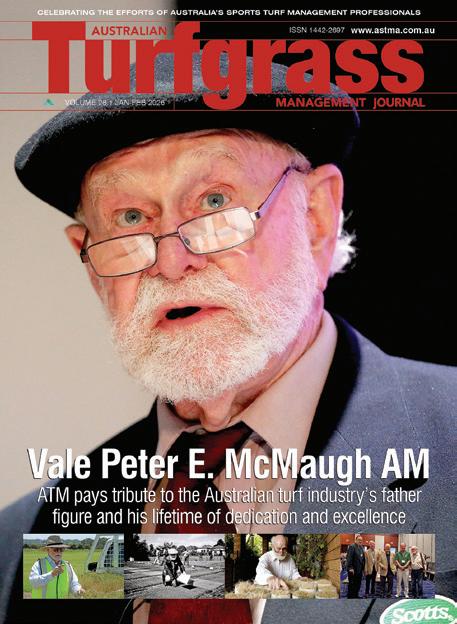
Australian Turfgrass Management Journal - Volume 28.2
Sublime Sanctuary Palms course presents as WPGA tees off
Sublime Sanctuary Palms course presents as WPGA tees off
Purrfect surface
Purrfect surface
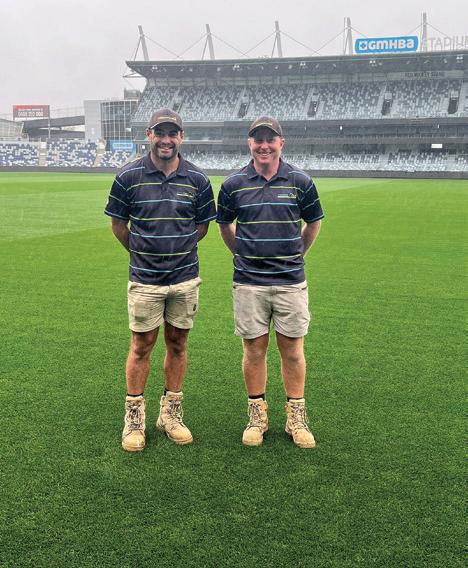
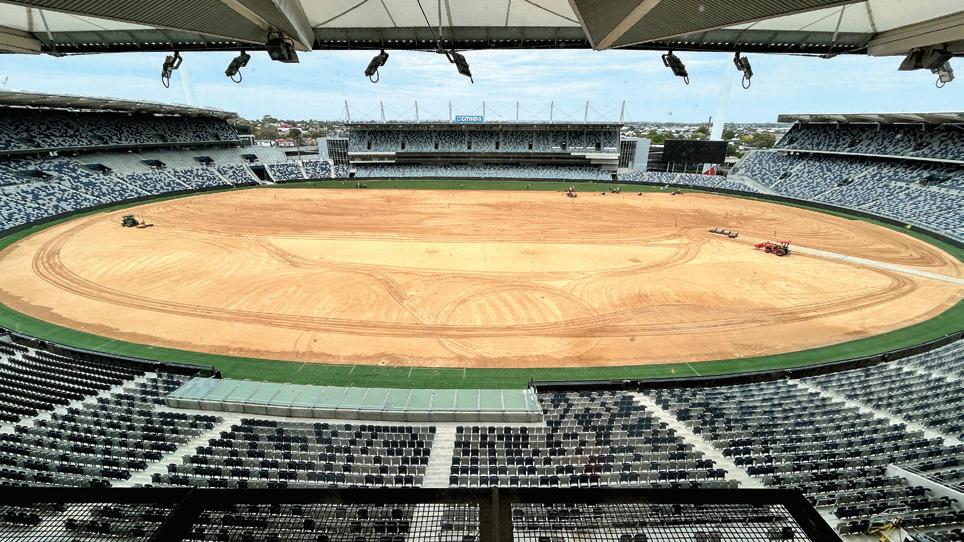
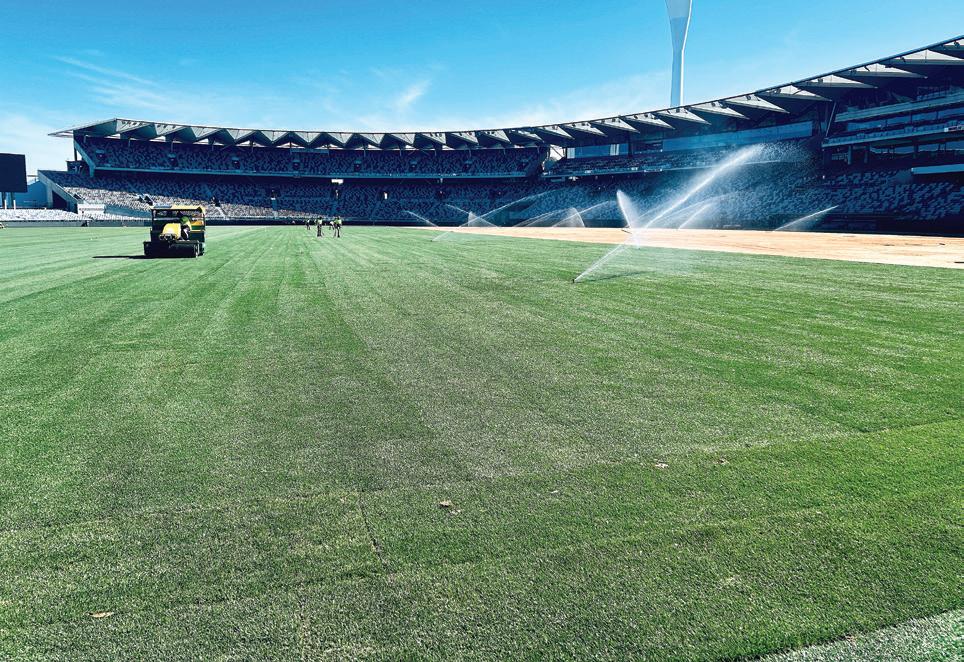
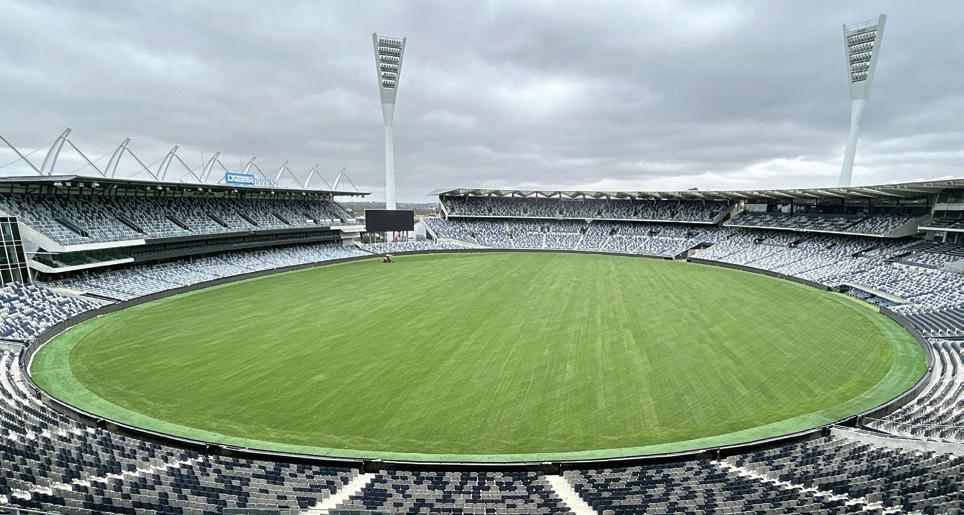
Geelong’s new home turf
Geelong’s new home turf
Women in Turf Program
Women in Turf Program
Female greenkeepers to the fore at Aus Open, Classic tournaments
Female greenkeepers to the fore at Aus Open, Classic tournaments
Kooyonga’s tournament test
Kooyonga’s tournament test
Women’s Australian Open returns to Adelaide
Women’s Australian Open returns to Adelaide
AT JACOBSEN WE UNDERSTAND
THE ELECTRIC FUTURE IS NOW.
Rooted in a rich culture and legacy, Jacobsen stands as a leader in the electrification space, dedicated to enhancing your turf’s integrity, reducing your operational costs, and fostering a greener tomorrow, today. Powered by ELiTE Samsung SDI Technology, Jacobsen’s lineup is second to none. With cutting-edge lithium
mowing solutions for all your golf, sport, and commercial needs, the time to lead the charge is now!
TO LEARN MORE about Jacobsen’s electrification initiative, scan this code.
Rooted in a rich culture and legacy, Jacobsen stands as a leader in the electrification space.
THE INDUSTRY EXCLUSIVE LITHIUM RIDE-ON FAIRWAY MOWER
ELITE PRECISION FOR ELITE PLAY
THE ELITE GREEN’S CHOICE
THE FUTURE OF ROTARY MOWING
SLF1 ELITE
ECLIPSE 360 ELITE
HR3 ELITE
ECLIPSE 2 ELITE
JOURNAL
Published by the Australian Sports Turf Managers Association (ASTMA)
Editorial
Brett Robinson (Editor) Office: (03) 9548 8600
Mobile: 0434 144 779
Email: brett@astma.com.au
Nick Creely (Reporter) E: nick@astma.com.au
Advertising
Pam Irvine Office: (03) 9548 8600
Mobile: 0402 069 489
Email: pam@astma.com.au
Art Direction & Design
Jo Corne
Printed By
Southern Impact Pty Ltd
Suite 1, Monash Corporate Centre
752 Blackburn Road, Clayton, VIC 3168
W: www.astma.com.au
ABN 96 053 205 888
ASTMA Board
PREMIUM PARTNERS
P: (03) 9548 8600 E: admin@astma.com.au
Chief Executive Officer
Mark Unwin
Mobile: 0438 320 919
E: mark@astma.com.au
Membership
Allison Jenkins
E: admin@astma.com.au
Finance Manager
Frank Joseph E: frank@astma.com.au
Events and Education
Simone Staples
E: simone@astma.com.au
Pam Irvine
E: pam@astma.com.au
RTO/Training
Albert Sherry (National Training Mgr)
E: albert@astma.com.au
M: 0437 064 726
Chris McCulloch (SA Training Mgr)
E: chris@astma.com.au
M: 0488 338 805
AGCSATech
Bruce Macphee (Senior Agronomist)
E: bruce@astma.com.au
Tim Fankhauser (Agronomist)
E: tim@astma.com.au
Amy Dingle (Agronomist)
E: amy@astma.com.au
Ben Tilley (Headland GC, president), Troy Jordan (MOPT, treasurer), Peter Lonergan (Coolangatta & Tweed Heads GC), Damian Hough (Adelaide Oval), Mark Findlay (Werribee Park GC) and Dennis Grounds (Royal Canberra GC)
ASTMA PREMIUM PARTNERS
PREMIUM PARTNERS
PREMIUM PARTNERS
PARTNERS
PARTNERS
The Australian Sports Turf Managers Association is indebted to the support of the following premium partner companies
PARTNERS
PREMIUM PARTNERS
The Australian Sports Turf Managers Association is indebted to the support of the following premium partner companies
The Australian Sports Turf Managers Association is indebted to the support of the following premium partner companies
The Australian Sports Turf Managers Association is indebted to the support of the following premium partner companies
The Australian Sports Turf Managers Association is indebted to the support of the following premium partner companies
The Australian Sports Turf Managers Association is indebted to the support of the following premium partner companies
The Australian Sports Turf Managers Association is indebted to the support of the following premium partner companies
PLATINUM GOLD
PREMIUM PARTNERS
The Australian Sports Turf Managers Association is indebted to the support of the following premium partner companies
The Australian Sports Turf Managers Association is indebted to the support of the following premium partner companies
The Australian Sports Turf Managers Association encourages all members to support these companies who support your association
The Australian Sports Turf Managers Association encourages all members to support these companies who support your association
The Australian Sports Turf Managers Association encourages all members to support these companies who support your association
The Australian Sports Turf Managers Association encourages all members to support these companies who support your association
The Australian Sports Turf Managers Association encourages all members to support these companies who support your association
The Australian Sports Turf Managers Association encourages all members to support these companies who support your association
The Australian Sports Turf Managers Association encourages all members to support these companies who support your association
The Australian Sports Turf Managers Association encourages all members to support these companies who support your association
The Australian Sports Turf Managers Association encourages all members to support these companies who support your association
The Australian Sports Turf Managers Association encourages all members to support these companies who support your association
The Australian Sports Turf Managers Association encourages all members to support these companies who support your association
LEAD STORY
KOOYONGA’S OPEN TEST 8
It’s an exciting time to be on the course maintenance crew at Adelaide’s Kooyonga Golf Club at the moment. In March they hosted the welcome return of the Women’s Australian Open after an eight year hiatus and next March will entertain the multiple award-winning LIV Golf Adelaide tournament as it switches across from The Grange. While the two events are worlds apart in terms of infrastructure and logistics, the 2026 Open was nonetheless an important precursor for course superintendent Richard James and his crew to assess how their programs and preparation plans measured up ahead of their big date come 2027.
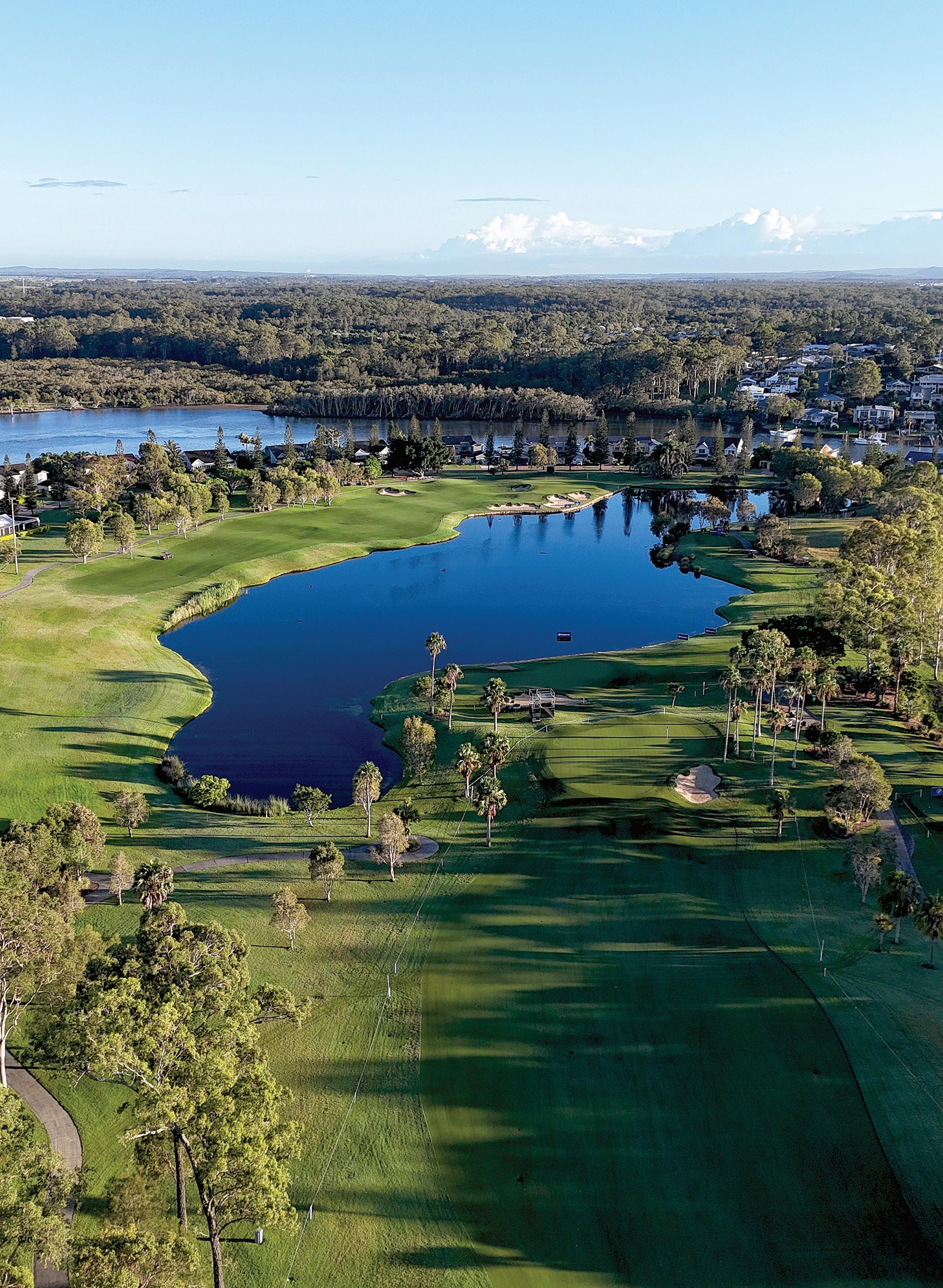
Cover: Sanctuary Cove Golf & Country Club, Palms Course, which hosted the 2026 Australian WPGA Championship. Photo: Cameron Smith.
Big moves, big announcements
The first half of 2026 has certainly been an eventful one and that’s without even considering the impact that the current geopolitical landscape is having on the industry in relation to the price of fuel and resources. There have been several big (and intriguing) announcements across the industry relating to our major golf tournaments and their futures, not to mention some significant superintendent appointments which have also had the industry talking.
First came Royal Melbourne Golf Club’s announcement of its appointment of John Mann as the new Director of Courses. Mann, who had worked at the club between 2006 and 2014 before going on to superintendent roles at Woodlands, Commonwealth and Metropolitan (that’s some CV), is set to start as Royal Melbourne’s seventh ‘links custodian’ this July. That was followed just a matter of weeks later by the news that the man he is replacing at Royal Melbourne – VGCSA life member and Victorian Golf Hall of Famer Richard Forsyth – was replacing him at Metropolitan, in what is effectively a job swap between the two clubs. A huge get for Metropolitan, which is also on the hunt for a new general manager, it sees Forsyth returning to a club where he spent 15 influential years as superintendent between 1994 and 2009.
On the tournament front, the big news came with Golf Australia’s decision to partner with the South Australian Government and lock in six Australian Opens (three men’s and three women’s) at the soon-to-be redeveloped North Adelaide Golf Course between 2028 and 2034. By securing a long-term host venue for the national championships, Golf Australia CEO James Sutherland says it gives the national body the “certainty needed to plan and build the event to its full potential”, with the men’s Open the first to be staged there in 2028.
Contributors to Australian Turfgrass Management Journal
Volume 28.2 (March-April 2026): Luke Armstrong (City of Greater Dandenong); Australian Golf Media/PGA of Australia; Shane Baker (GCSAWA); Sam Davis (Queenstown GC, NZ); Jimmy Downes (Humpty Doo GC); Sam Edwards (Geelong Grammar); Richard Forsyth (Royal Melbourne GC); John Forrest (Forrest & Forrest Horticultural Consultancy Services); Ben Gibson (The Toolbox Team); Jamie Guppy (Kardinia Park Stadium Trust); Leon Hennessy (NSWGCSA); Courtney Holloway (Golf WA); Richard James (Kooyonga GC); John Deere/Envu 2026 Women in Turf Program cohort; Liam Kirkman (Kardinia Park Stadium Trust); Adam Lamb (VGCSA); Jackson Lanning (The Lakes GC) and the FTMI Class of 2025/2026; John Mann (Metropolitan GC); Chris McCulloch (ASTMA RTO); Matt McIntosh (Environmental Golf Services); James Newell (Magenta Shores G&CC); Scott Reid (TSTMA); Albert Sherry (ASTMA RTO); Cameron Smith (Sanctuary Cove G&CC); Simon Snedden (ACTSTMA); Kate Torgersen (Environmental Golf Solutions); Mark Unwin (ASTMA); Tim Warren (TMSA).
It is a particularly bold move, especially given the course hasn’t been constructed yet and comes off the back of a hugely successful Open held last December at one of our greatest and most respected tournament venues in Royal Melbourne’s Composite Course. The pressure will be well and truly on those charged with bringing the $45 million redevelopment to life over the next two years, with Sutherland indicating as much during the announcement… “The Australian Open has always been about the best players competing on the best courses. That expectation does not change. We have confidence in Greg Norman as a designer, Jim Norfolk and the course-building team. As they have in the past, they will no doubt deliver a world-class golf course befitting the Australian Open and our national championships.”
Adding to the intrigue, the announcement occurred around the same time that Saudi Arabia’s Public Investment Fund, the financial backer of LIV Golf, flagged it would be cutting funding from the end of the 2026 season, thus casting doubts about the league’s future viability and, by association, its flagship event, LIV Golf Adelaide. That tournament is due to head to Kooyonga Golf Club next March and then North Adelaide from 2028 to 2031.
The Australian Open announcement was also preceded by the news that the BMW Australian PGA Championship is on the move from Brisbane to Sydney. Having successfully been staged on the Sunshine Coast, Gold Coast and, most recently, in Brisbane for the past 25 years, the 2026 PGA heads south to The Lakes Golf Club which boasts a strong tournament pedigree, including three Australian Opens since 2012. Queensland’s loss is Sydney’s gain and it gives The Lakes crew, led by superintendent Anthony Mills, another chance to showcase their unique layout which has undergone further works in recent years.
And in a final announcement that will come out just after this edition heads to the printers, Golf Australia was to confirm that the layout for this year’s men’s Australian Open at Kingston Heath Golf Club will be that which will be used for the Presidents Cup in 2028. The new and untried layout, which has been devised by the club in conjunction with the PGA TOUR, will see club holes 4, 5 and 6 (in that order) play as the closing three holes. More on that in the next edition...
On the topic of tournaments, this edition looks back on what was a huge month for women’s golf (and female greenkeepers for that matter) around the country in late February and March. The four-leg Ladies European Tour swing of tournaments – the Women’s NSW Open, Australian Women’s Classic, Women’s Australian Open and Australian WPGA Championship – helped to breathe new life into the women’s game in Australia, especially with Hannah Green’s popular back-to-back wins in the latter two events. All four host clubs – Wollongong, Magenta Shores, Kooyonga and Sanctuary Cove – delivered exceptional surfaces for their respective events, with all superintendents and their crews widely praised by tournament officials for their efforts.
Enjoy the read…
Brett Robinson, Editor
PHOTO: BRETT ROBINSON
Education focus as ASTMA launches scholarship, Cert II course
In late March, the Australian Sports Turf Managers Association announced the launch of the Peter McMaugh AM Scholarship, an initiative that I and the Board of the association are tremendously proud of. The scholarship honours the extraordinary legacy of Peter E. McMaugh AM, widely regarded as Australia’s foremost turfgrass authority.
As many across the industry would know, Peter established a distinguished career spanning decades and made an unparalleled contribution to the Australian turfgrass industry through research, education, writing and leadership. His expertise and influence have shaped the management of turf across a wide range of sectors, including golf courses, cricket grounds, bowling greens, racecourses, sports fields and turf production. As a highly respected keynote speaker at regional, national and international conferences, and a prolific contributor to industry publications such as this one, Peter’s knowledge of turfgrass science and its history was unrivalled here in Australia.
The Peter McMaugh AM Scholarship is designed to support the next generation of sports turf professionals through higher education and professional development, where two scholarships will be awarded annually, providing recipients with full tuition to cover the cost associated with completing the Diploma of Sports Turf Management.
Applications can be made through the ASTMA website (www.astma.com.au) – go to the ‘Education’ tab – with judging and assessment undertaken to identify candidates who demonstrate both professional commitment and leadership potential. Winners of the inaugural scholarship will be announced at this year’s National Turf Industry Awards to be held during the Melbourne conference.
Speaking of the Australian Sports Turf Management Conference (22-25 June), the full program has now been released and registrations are open for both delegates and trade show visitors. Over the past few months, we have been highlighting several of our headline speakers, social events and the trade show, which have been positively received.
With thanks to Platinum Partner Toro, the ASTMA Golf Championship this year will be held at Woodlands Golf Club (host course manager Sam Langford). The hidden gem of the Melbourne Sandbelt appears to have been a popular choice, with the championship fully subscribed in record time by mid-April. We look forward to taking our premier golf event to Woodlands and thank Sam, his crew and the clubhouse staff in advance for their hospitality.
As I noted in the last edition, this year’s event, hosted in conjunction with Golf Management Australia (GMA), has been curated to ensure relevance across all sectors of the industry through golf and sportsfields, racecourses, schools and local government.
We have also just closed nominations for the National Turf Industry Awards. These awards remain one of the most important ways we recognise excellence across our profession and celebrate the outstanding work being
delivered at clubs and facilities. The awards program provides a platform to showcase that excellence, celebrate innovation and acknowledge the individuals and teams who are raising the bar for our industry. Thank you to those who nominated this year and we look forward to announcing the winners in June.
ENTRY-LEVEL PATHWAY
Lastly, a very exciting announcement that will be unveiled in more detail at the conference in June. The ASTMA has been working through the development of the Certificate II in Sports Turf Management (AHC21019) and we are pleased to be officially launching the program in June. This additional qualification represents an important step in strengthening entry-level pathways into the sports turf industry and supporting the development of a skilled and sustainable workforce.
Designed for school-based students, individuals seeking to begin a career in sports turf management or those currently employed seeking some formal qualification and training, the Certificate II course provides a practical, hands-on introduction to the essential skills and knowledge required across the industry.
The course covers key areas such as turf establishment and maintenance, safe operation of machinery, workplace health and safety and environmental best practice. It has been developed to align with industry needs, ensuring graduates are job-ready and can contribute effectively from day one.
The introduction of this qualification reflects the ASTMA’s ongoing commitment to workforce development and industry growth. By creating accessible training opportunities at an entry level, the ASTMA aims to attract new participants into the industry while supporting members and facilities in building capable, qualified and confident teams.
Able to be undertaken as a preapprenticeship, the Certificate II will ensure school-aged students will benefit from highquality instruction and real-world exposure and provide clear progression pathways into higher-level qualifications, including transitioning into an apprenticeship (Certificate III), further enhancing workforce availability and developing long-term career opportunities.
The ASTMA encourages employers, schools and prospective students to engage with this new training opportunity and be part of the next generation of sports turf professionals. Further information regarding enrolments, course structure and delivery locations will be made available at the conference and via the ASTMA website.
This launch marks an exciting milestone and further supports our strategy of delivering education, training and professional development across the industry.
on groundBest
ATM showcases some of the best social media posts and images from across the sports turf industry in recent times...
KRISTIAN ROBINSON
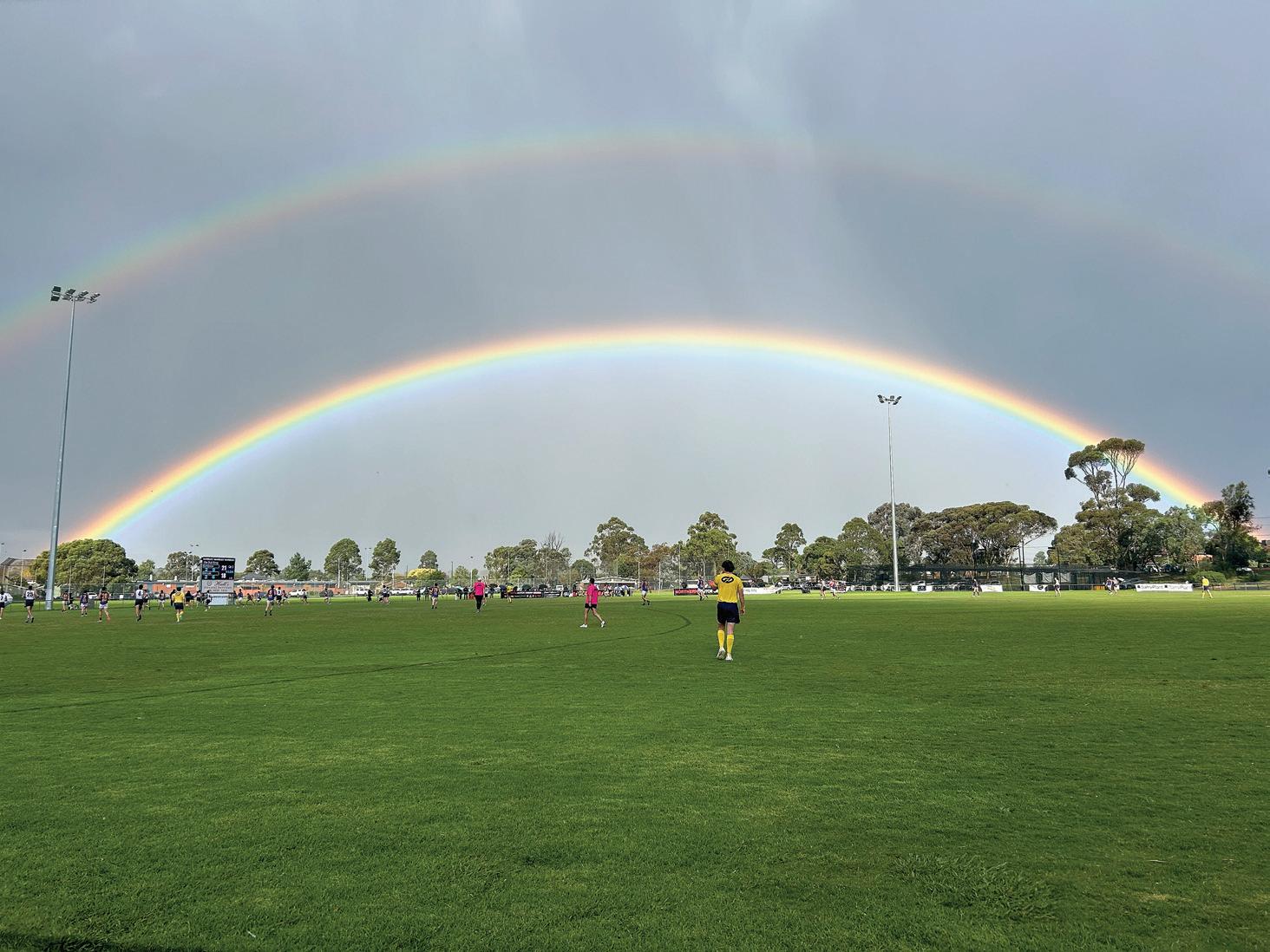
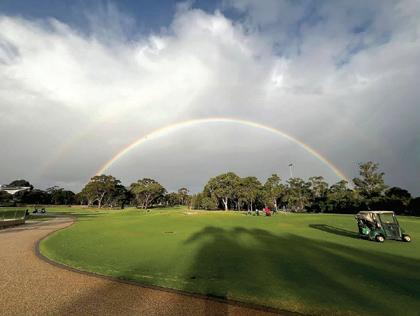
“Local footy back for 2026... Go Yulers!” (Early April saw the opening round for most local football leagues across Melbourne, including the Northern Football and Netball League. Pictured is Banyule City Council ground Yulong Reserve, home of the Bundoora Bulls, who took on local rivals Banyule Bears in the Seniors 1st Division. The home side scored a one-point victory in wet and windy conditions, with a spectacular double rainbow brightening up proceedings midway through the third term. Pictured inset, the crew at Southern GC also captured a similar image the same weekend!)
BRADFORD PORTER
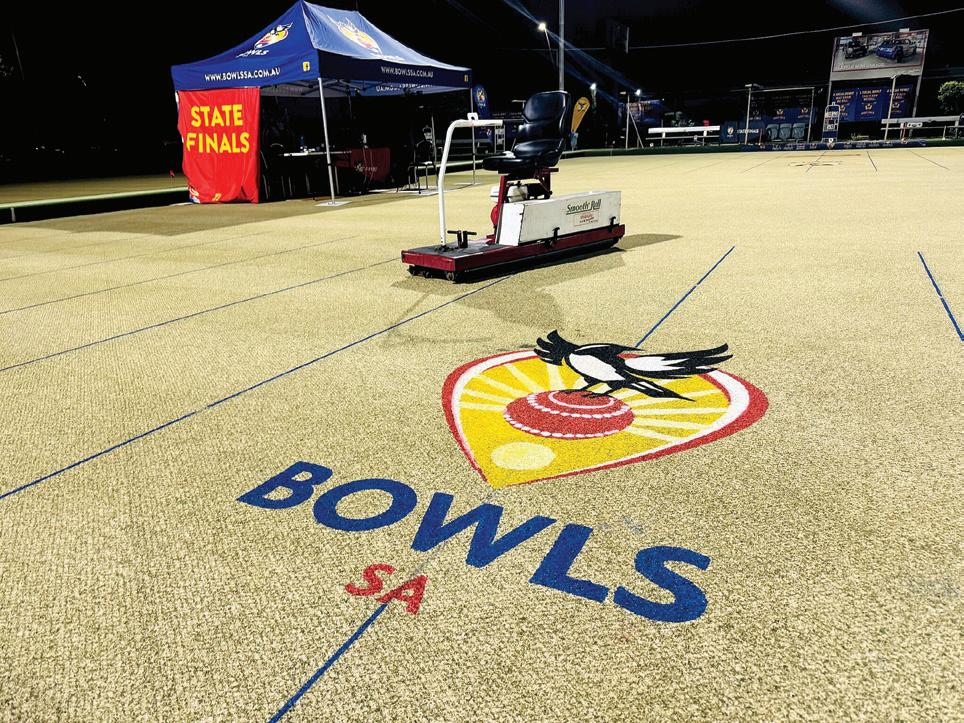
“Huge preparation for the State Championship finals which were held at Club Holdfast Bowls Club. The greens played smooth and consistent, even during the night sessions. Also, our painted logos came up extremely well and popped on the live stream.” (Holdfast Bay in Adelaide hosted Bowls SA’s State Finals Week from 13-17 April, with experienced greenkeeper Bradford Porter, from Teamsters Turf Consulting, having the rinks running true.)
GEOFF ELLIS
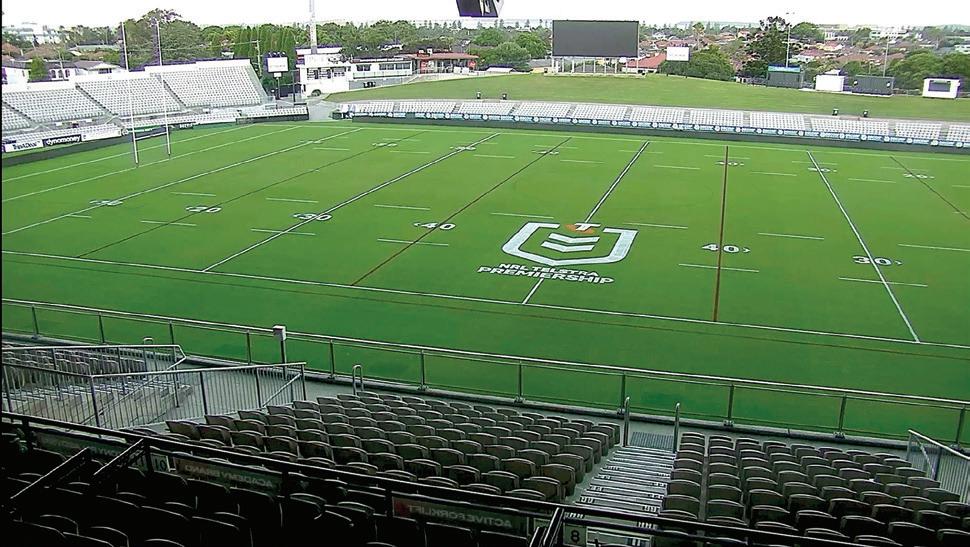
“The last event for the season on Bermuda. Time to create a nice bed for our Rye.” (Jubilee Stadium turf manager Geoff Ellis and his team prep Kogarah Oval, home ground of the NRL’s St. George Illawarra Dragons, for the annual winter oversow.)
DAVID THOMSON
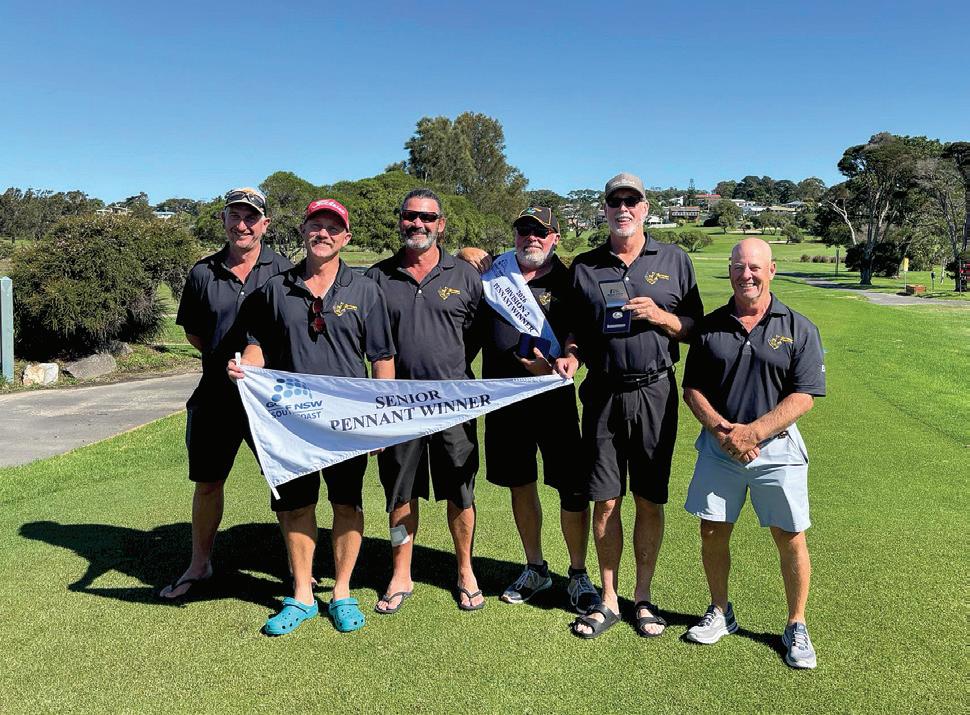
“Div 2 Pennant winners!” (Former ASTMA Board member and long-serving Bermagui Country Club superintendent David Thomson, second from right below, celebrates with teammates after securing the Golf NSW South Coast Division 2 Pennant title in late March.)
ANTHONY TOOGOOD
TSTMA
“Congratulations to Burnie Golf Club super Greg Duff, who hands the keys in after 32 years at the helm. Job well done Duffy!” (A local Tassie legend signs off in late February.)
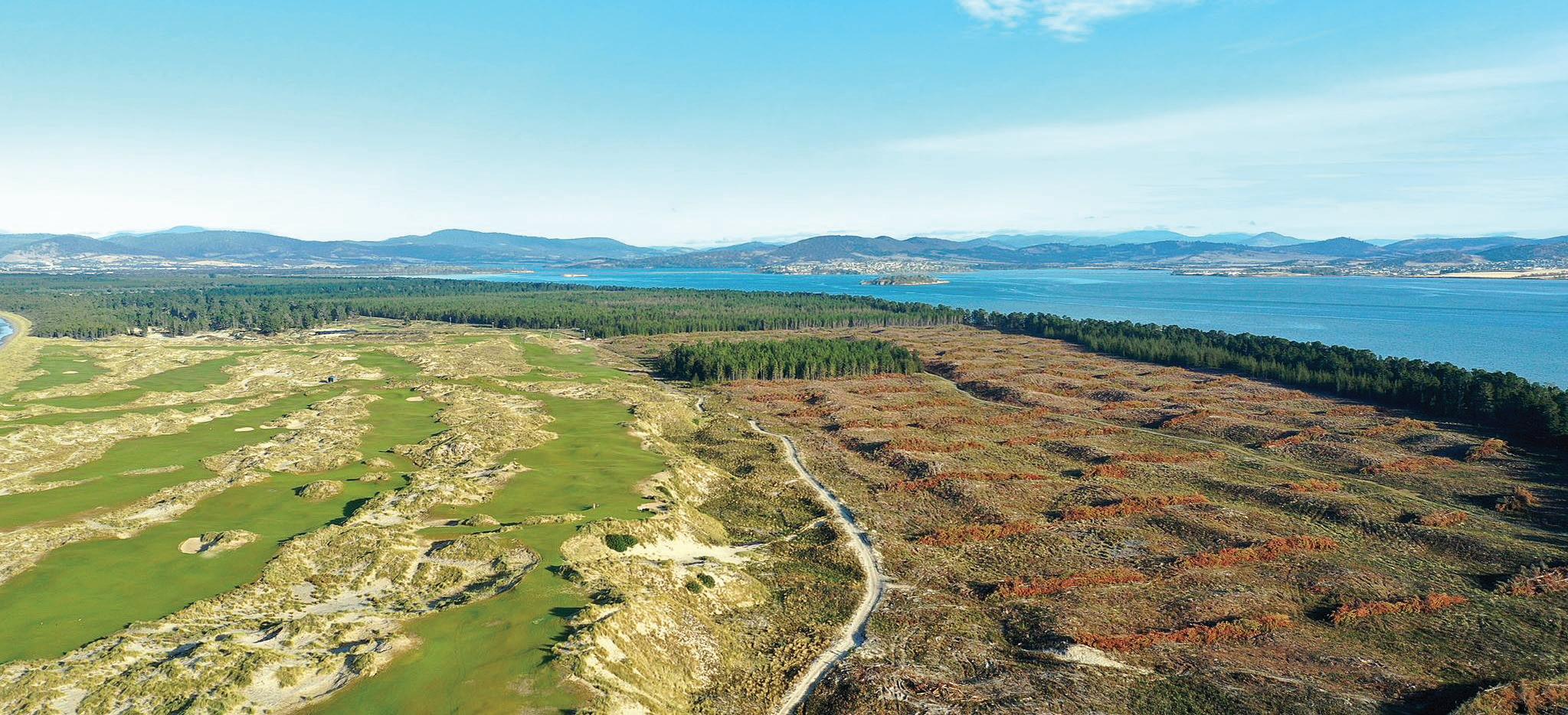
“North Course slowly being cleared. Nice calm morning for a hit!” (Another teasing post from 7 Mile Beach superintendent Anthony Toogood as clearing begins on the site of what will be a second links course on the outskirts of Hobart. Since its opening last December, 7 Mile Beach has won many admirers and was recently announced as host venue for the 2026 Tasmanian Amateur Championship.)
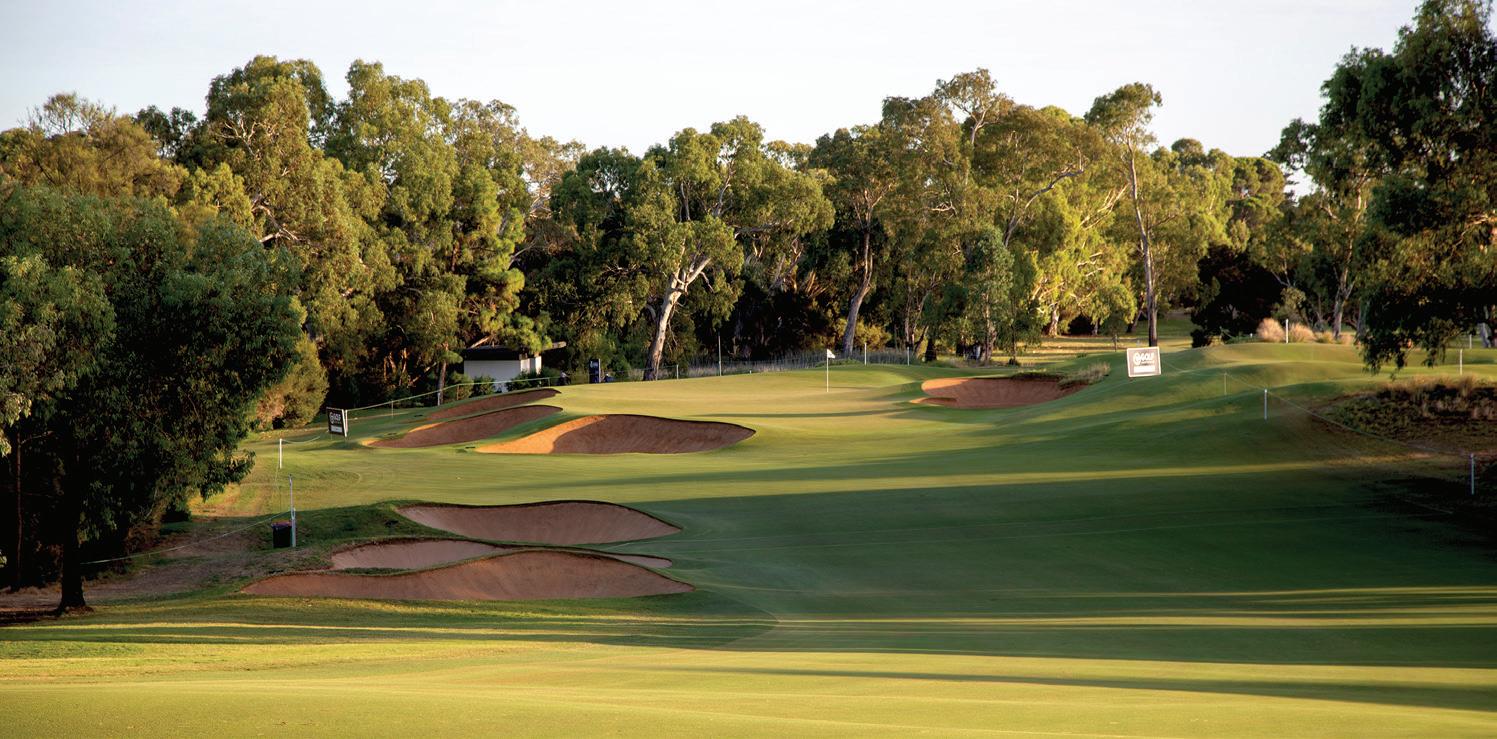
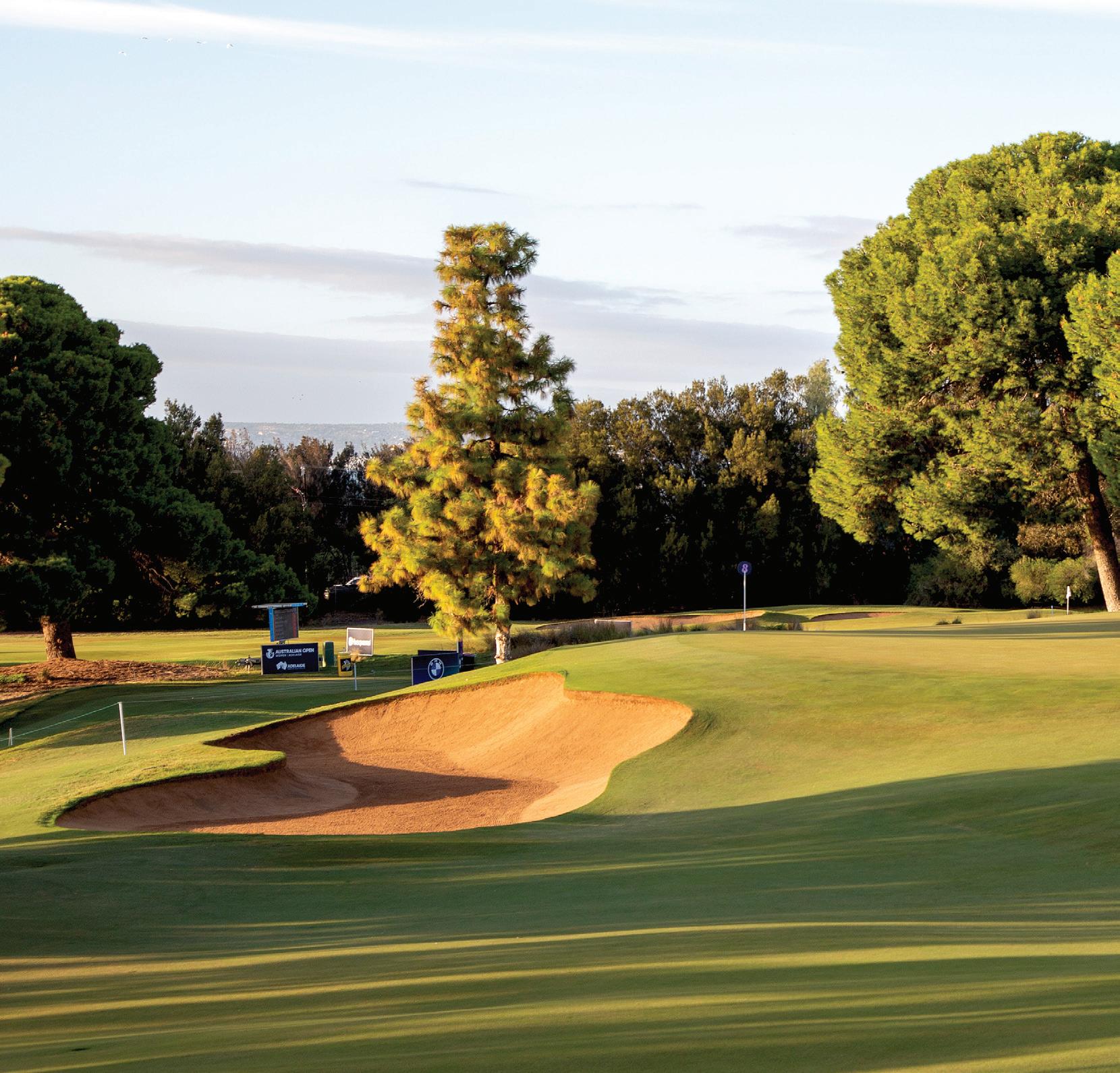
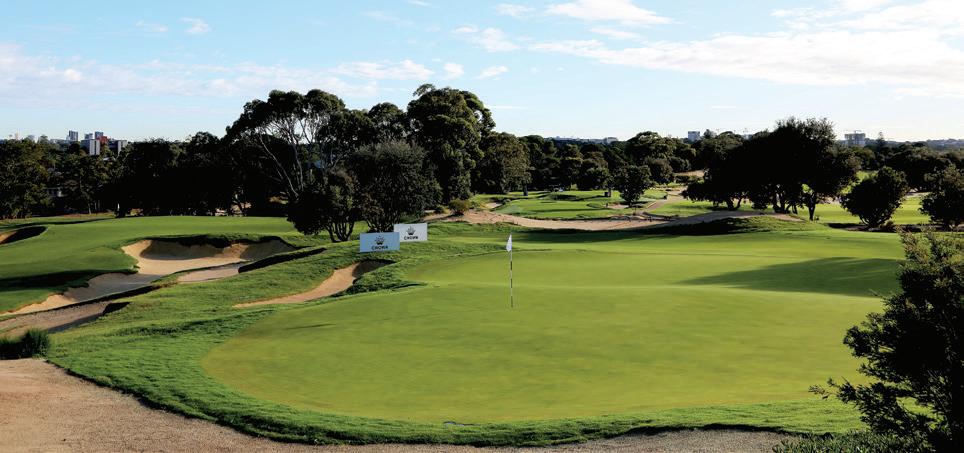
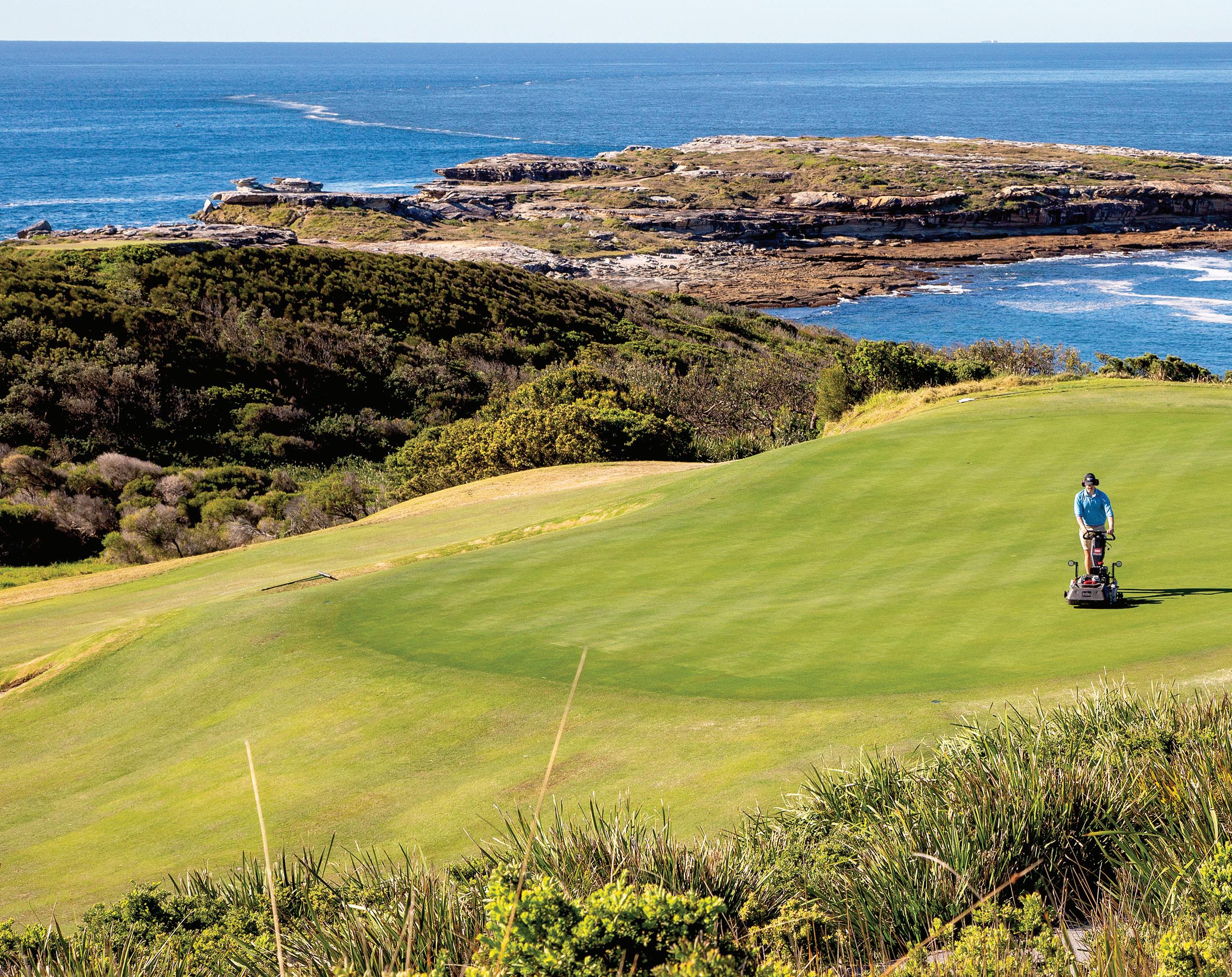
Adelaide’s Kooyonga Golf Club – pictured is the approach into the 8th green – made a welcome return to the tournament stage when it hosted the 2026 Women’s Australian Open in March
Kooyonga’s
tournament test
It’s an exciting time to be on the course maintenance crew at Adelaide’s Kooyonga Golf Club at the moment, with the club well and truly returning to the tournament spotlight. It began in mid-March with the $1.7 million WPGA/ Ladies European Tour co-sanctioned Women’s Australian Open, won by Hannah Green, while next March it is set to host LIV Golf Adelaide after the event’s successful four-year tenure at The Grange Golf Club.
While the Open and LIV Golf Adelaide are worlds apart in terms of infrastructure and logistics, March’s Open was nonetheless a significant test for Kooyonga course superintendent Richard James and his team. Kooyonga last hosted a major Tour event – the
Women’s Australian Open – in 2018 and since then there had been a full turnover in staff, with the exception of James. That made this year’s Open an even more important occasion for the team, as they swung into tournament mode as a group for the first time and assessed how their programs to present the course fared. In essence, it was a dry run for LIV 2027.
“It was great having the tournament back in Adelaide,” says James, who has been Kooyonga superintendent since the latter half of 2017. “It’s always great to be able to present your course to that level for those sorts of events. The club is very proud of its history hosting Australian Opens so we were very keen to have the opportunity again after missing out in 2021 due to the pandemic.
“No one on the current staff except me was here in 2018, so there was plenty of excitement among the team when the Open was announced and then also with LIV on top of that. It was a great opportunity to do something different and for the crew to learn something new. Open week provided a bit of a window into what goes on from a tournament perspective which will hold us in good stead for the other big show next year.”
NEW APPROACH
After Golf Australia’s experiment of hosting the men’s and women’s Opens as a combined event for a three-year period post-COVID, last July it announced that the women’s Open was returning as a standalone event. Like it
Kooyonga Golf Club hosted the return of the Women’s Australian Open as a standalone event in mid-March in what was the crew’s first major tournament as a group. With LIV Golf Adelaide on the horizon in 2027, as ATM editor Brett Robinson writes, the Open proved an important precursor for course superintendent Richard James.
had been between 2016 and 2020 with great success, Adelaide was confirmed as host city for the next three tournaments, with Kooyonga slated to hold the first.
In those intervening years, Kooyonga had progressed with a couple of green rebuilds (10, 13, 15 and 17), while a new practice and short game facility was constructed and opened in time for the club’s centenary in 2023. Another green rebuild was on cards when the Open was announced, but with LIV also confirmed the club decided to postpone that along with some other smaller course works. That enabled the crew to focus on managing the course through winter and then concentrate their efforts on course renovations across three scheduled days in October.
In a major change from previous years, instead of coring greens James opted to use a DryJect unit which injected around 23 tonnes of kiln-dried sand into the varying-aged greens profiles. James had been interested in the technology for some time which led to a visit to Lake Karrinyup in Perth, one of Kooyonga’s reciprocal clubs, where he quizzed superintendent Fraser Brown as to the process and its benefits.
Confident the technology would aid in the management of Kooyonga’s greens (the oldest of which is 25 years), last August James undertook a couple of trials on one of the club’s practice greens. The first proved unsuccessful, with issues around the consistency of injecting their usual dusting
sand. Despite assurances that the new injector technology could handle normal sand, James opted to source a local company that could kiln-dry their dusting sand, with the resultant second trial performing as initially hoped. Although more expensive to go down that route, using kiln-dried sand meant that James was assured that the amount being injected was consistent across all greens.
With the trial successful, James contracted the services of Waterford Valley superintendent Tom Smith to DryJect all greens during the October renovation window. The minimal invasiveness of the process meant that James’ crew were back cutting and rolling greens almost immediately, with the members seeing first-hand the benefit of the new method.
“For us, with the water we use and our climate, creating those sand channels annually is critical to keep water moving through the profile,” explains James. “There’s also the added benefit of not having the mechanical damage from coring, the long recovery process and the extra nutrition involved in getting the greens back.
“Your greens are as good as you’ve got them through that September-October period and then you disturb them by coring and it takes a good couple of months to get them back to where you want them. So that was a big selling point and it proved to be the case.
“Our greens have different aged profiles but one of the great things with the injection was how well they accepted the sand. We solid-tined the greens a week before thinking that would be enough, but we found they were still too firm after doing the first few greens. So we solid-tined directly in front of the DryJect to help soften the profile a little and that certainly helped with the sand injection.
“It was a bit of a process to see how each profile would accept the sand but we wanted to make sure we got the depth and quantity of sand into the profile that we wanted to achieve.
The aim was for between 75mm-100mm deep with a good shot of sand – approximately 2.3kg/m2 of sand which worked out to be about 23 tonnes in total. We tracked how much we used across each green and the consistency was good across all of them.
“We injected a good amount of sand, the recovery was very quick and we were able to maintain our same fertiliser regime and keep growth nice and even. And the performance of the greens from a moisture management point of view was certainly something I was very happy with. I felt the dry down was a lot more even and consistent and they re-wet really well when we needed them to.”
With the DryJect proving a success, James says they will look at using it more going forward, with the club committing to buying a unit. It will be used in conjunction with their usual practices (solid tining and dusting) as well as their Air2g2 unit. James hasn’t ruled out coring in the future, but expects that may only be required once every 5-6 years depending on the health and properties of the profiles.
WET THEN DRY
Along with greens renovations, the Kooyonga crew scarified, verti-mowed (-3mm) and then circle cut their Santa Ana fairways. James admits they scarified a little lighter than normal (20mm depth instead of their usual 25-27mm) and if he had his time again says he would have been a bit more aggressive along with giving the fairways a heavier topdress.
Towards the back end of summer, some fairway areas became a little puffy which caused the mowing units to bite in and scalp. During the tournament those areas had to be cut in different directions, while lighter mowing units were used around the bunkers.
With renovations complete, the lead-up to Christmas was all about getting full coverage and health in the turf in order to get through summer. Aside from some extra sod repair, the crew effectively followed their usual programs and then navigated the course through another typically hot and dry Adelaide summer.
After experiencing a wet November, it effectively didn’t rain in Adelaide until the end of February. After more than 70 days without precipitation, the weekend before the Open a very timely and steady 21mm fell across a day-and-a-half, giving Kooyonga’s Dominant X-Treme blend greens a welcome flush after a long season being irrigated with bore water.
“The lead-in was pretty good,” reflects James. “Summer was summer – warm and hot – but we had a decent back end of last year with that November rain which put us in a good position. We had a pretty ordinary summer the year before and some of the greens weren’t very happy towards the back end of that due to the quality of our bore water. So we made sure we monitored them a bit
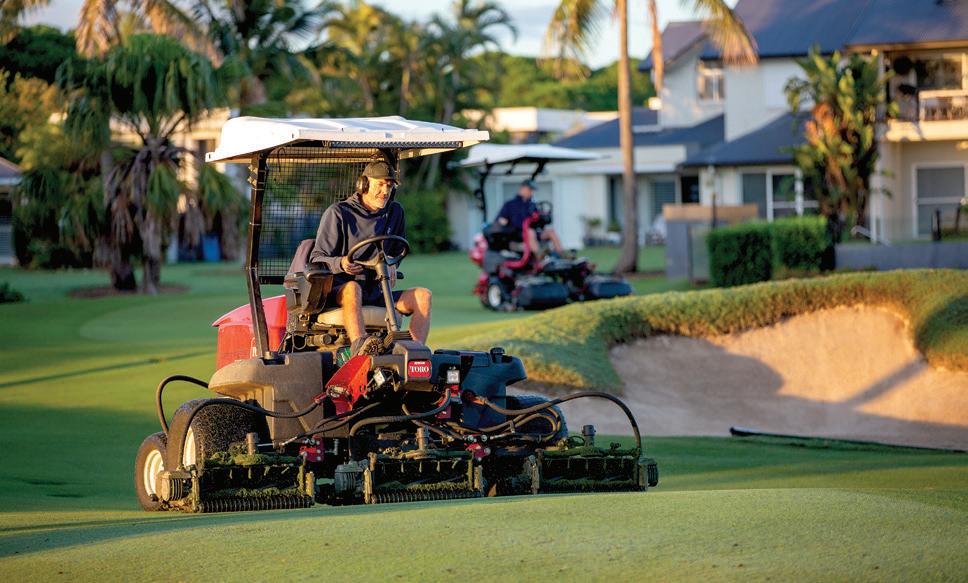
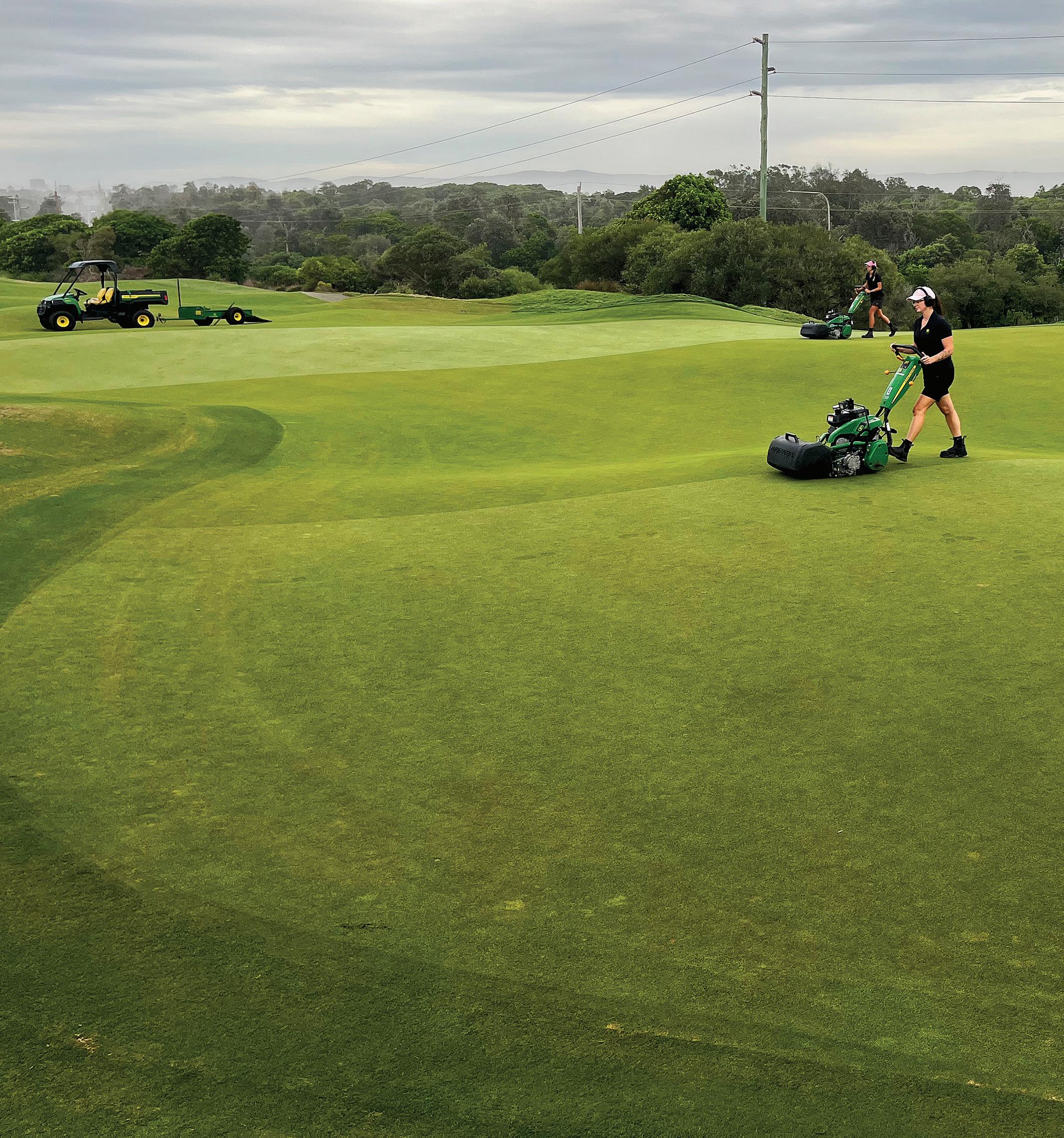
Pictured top: Settlers Run volunteer Emma Lewis (left) and Kooyonga groundsman Jasper Darley cut the par 3 15th green after the Wednesday Pro-Am
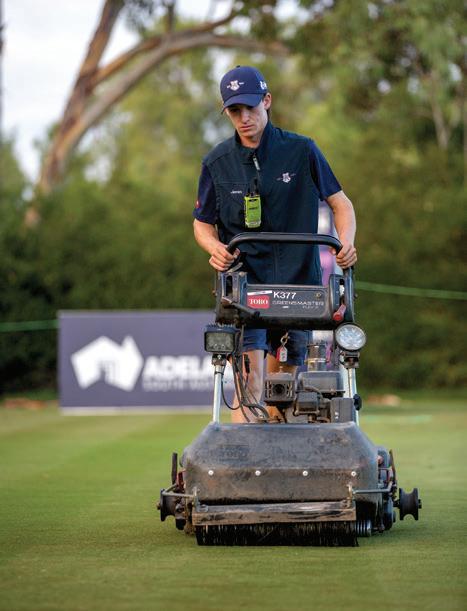
Above: Kooyonga’s school-based trainee James Murphy cuts the par 3 7th tee
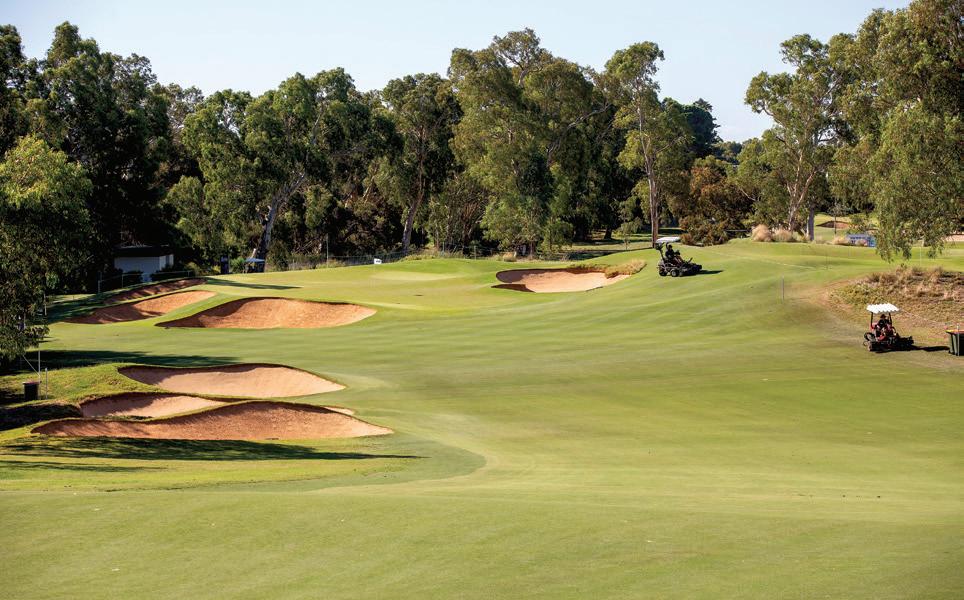
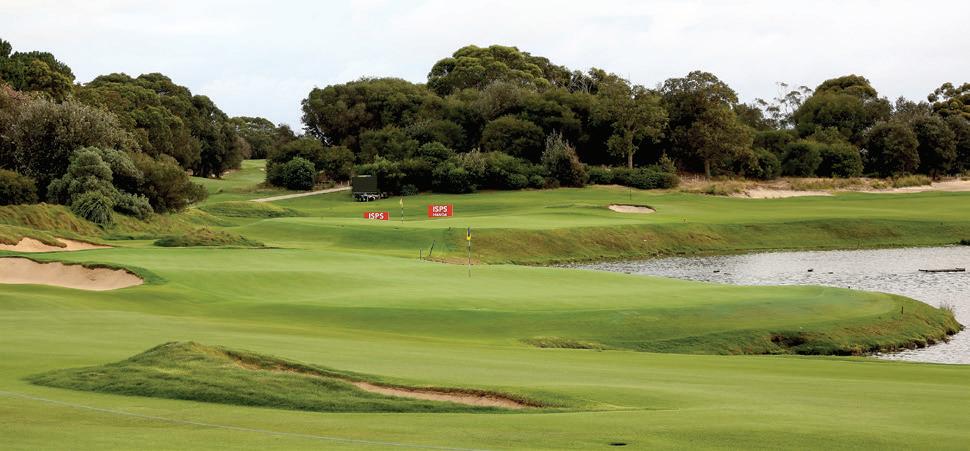
Below: Kooyonga’s sweeping 4th hole on Open eve
more intensively this summer and were more proactive with treatments where required which meant we went into the Open with the greens in good health.
“We put in a proposal to the committee to institute some ‘Maintenance Mondays’ which proved really beneficial. It meant we were able to close the course until lunchtime which gave us the extra time to do spray applications and other practices such as grooming and dusting.
“For most part though we just worked our plan and nailing our timings which we did. With the fairways, we did a controlled release application a couple of weeks out on traffic areas and where we knew we would be under pressure, as well as a few additional foliar applications for colour and presentation.
“We used a lot more wetting agent than normal this year through our dosing system – we probably used double the amount in January and February – and that aided uniformity in the fairways.
“The timing of that 21mm of rain was certainly advantageous for the greens. It gave them a good flush and they were certainly better for it and it took away that one bit of extra stress you don’t need heading into a tournament. There was some concern things
TRUSTING THE PROCESS
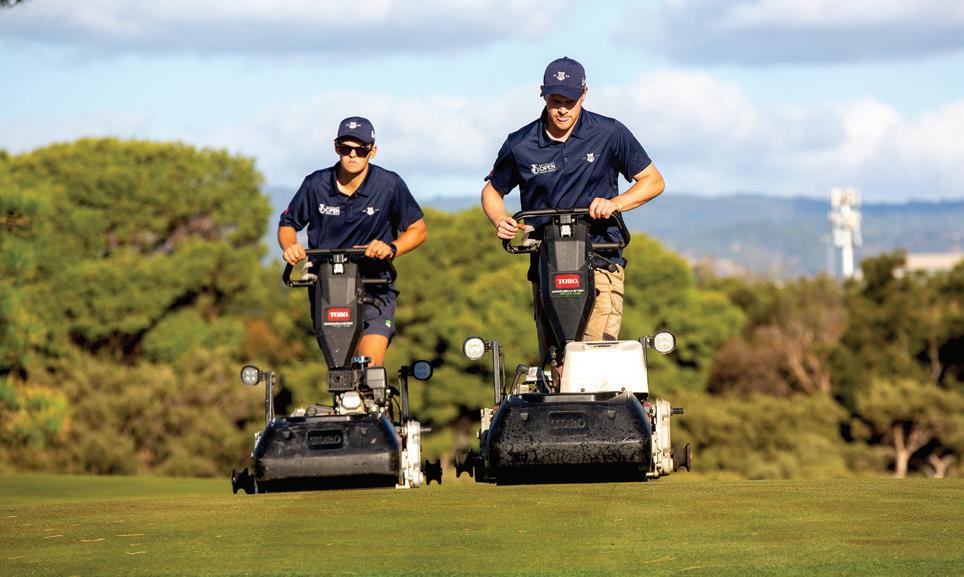
Preparations for the Open started ramping up about a fortnight out from the first round with cutting regimes increased to daily. Greens were double-cut with Toro walk-behind mowers (up and back on the same pass), with extra cutting required if speeds dictated.
At 2.6mm for most of that period, after the opening round cutting heights on the greens mowers were raised to 2.8mm in consultation
to continue. Even with this adjustment, greens were only single cut for the final day to keep speed where tournament officials desired, with James instituting a ‘shadow cut’ method as he was determined to present a uniform surface without stripes.
After rolling greens on the Monday, the rollers stayed idle for the remainder of the tournament, with green speeds around the high-11s being easily managed across the
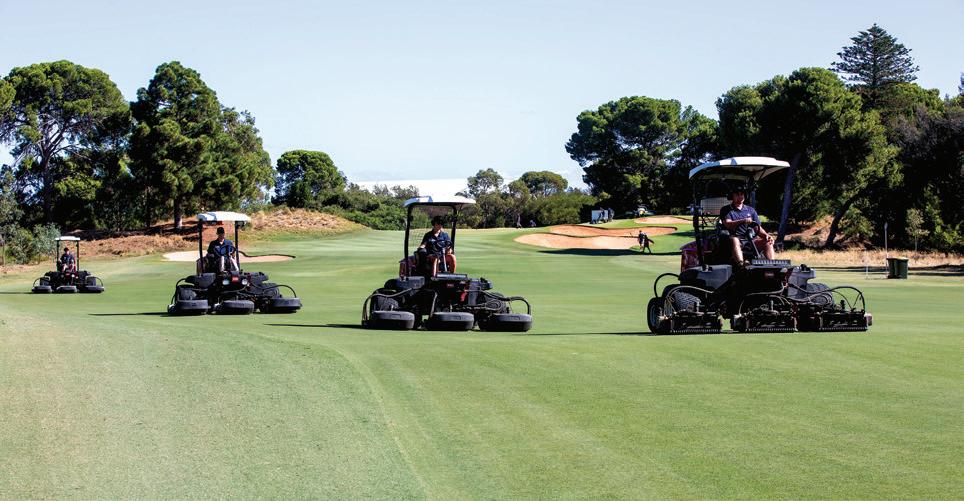
Kooyonga qualified greenkeeper Joel Tilbrook leads the fairway crew down the par five 1st
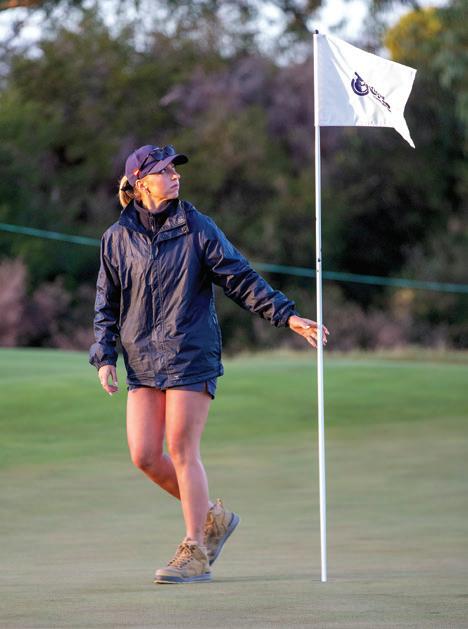
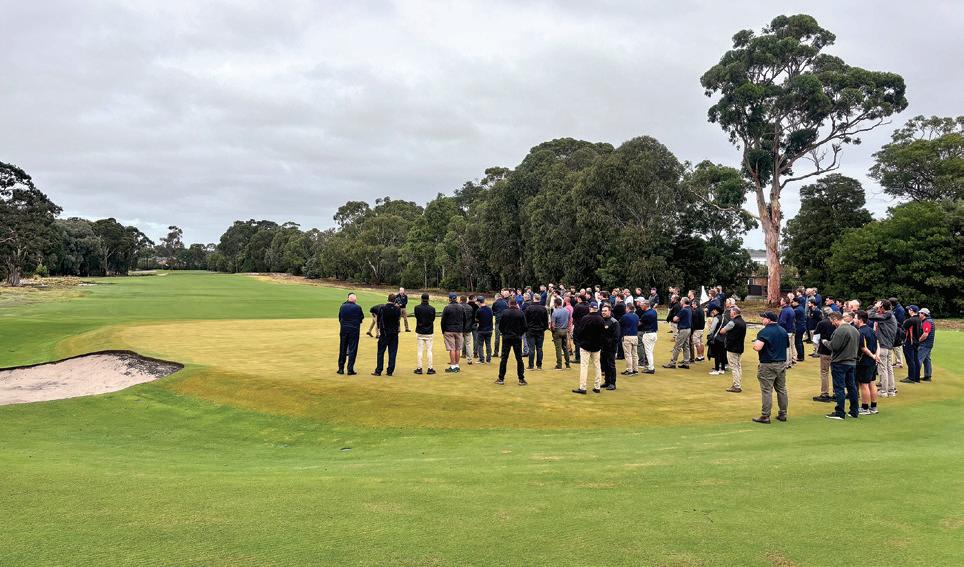
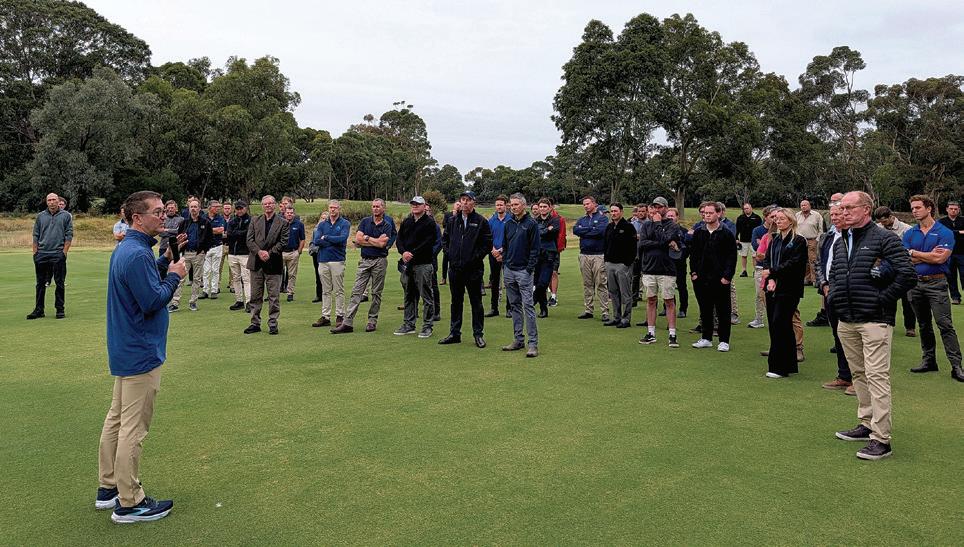
Like they did at Magenta Shores for the Australian Women’s Classic (see pages 24-31), female greenkeepers also took a leading role during the Women’s Australian Open at Kooyonga Golf Club. A group of six journeyed over from Victorian golf clubs to assist superintendent Richard James and his crew deliver the highly praised surfaces across tournament week.
After it was announced that Kooyonga was hosting the Open, Geraldine O’Callaghan, who is part of the Royal Melbourne crew as Sandringham Links superintendent, contacted James to see if she could bring a group of female greenkeepers over to volunteer.
Arriving the weekend before the tournament and joining the Kooyonga team for their first trial run on the Monday of tournament week were Kim Kennedy and Annabelle Southall (Royal Melbourne GC), Ella Arter (Kingston Heath GC), Kate Rainsbury (Sorrento GC), Olivia Cowan (Kooringal GC) and Emma Lewis (Settlers Run G&CC).
For Kennedy, Southall and Lewis it was their second national Open of the season after they were part of the tournament crew at Royal Melbourne for the Men’s Australian Open in December. O’Callaghan was supposed to be joining them for the full week, however, due to work commitments wasn’t able to and instead headed over for the final two rounds.
“They were fantastic,” says James. “Most had done tournaments before and came straight in and jumped into every job we gave them. It was great to have them around and it’s great that we could give them the opportunity to come and work alongside our team for the week and experience a major event. All the volunteers were great and we tried to rotate jobs as much as we could so they got to experience most things out on the course.”
The Victorian contingent were part of a 15-strong group of volunteers who assisted across Open week. James received great support from local Adelaide clubs, with two staff each coming over from Mt Osmond (Jack Haberfield and Mitch Angel) and Royal Adelaide (Mason O’Callaghan and Brandon Zacker), with Patrick Drescher making the short trip from Glenelg Golf Club.
From further afield, Lachlan Wright came up from South Lakes Golf Club, as did two staff from the soon-to-be opened The Cliffs on Kangaroo Island. Following in the footsteps of crewmate Brent Zimmermann who was part of the LIV Golf Adelaide tournament at The Grange, Rylan Egel and Aston Virgo got a taste of tournament preparation across the week. Former Kooyonga apprentice Sam Rose, who is now with Glenelg Turf Ace, also returned to help out for the week.
- Brett Robinson
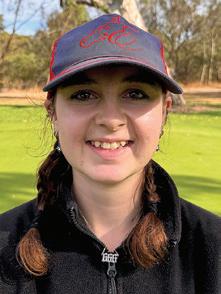
Six Victorian female greenkeepers – pictured clockwise from top left are Emma Lewis (Settlers Run G&CC), Kate Rainsbury (Sorrento GC), Annabelle Southall (Royal Melbourne GC) and Ella Arter (Kingston Heath GC) –made the journey to Kooyonga Golf Club to volunteer at the Women’s Australian Open in March
PHOTOS: BRETT ROBINSON
“significant” overnight cycles applied to the greens to buffer surface firmness.
After striping the fairways in 2018, James opted to present a more natural look for the Open’s return, with the Reelmaster units cutting one direction (green to tee) at 7mm daily in the morning prior to play. The Santa Ana approaches (6mm) were striped and cut in both the morning and afternoon, with the Santa Ana greens surrounds (back and sides) also at 6mm but only cut in the morning. The bentgrass collars and tees (striped) were also 6mm. Prior to the tournament James had the tees and approaches at 5.5mm to get more refinement before raising the heights back up.
The lead-in and tournament week proved a big learning curve for all of James’ crew and provided plenty of key learnings ahead of LIV in 2027. Assistant superintendent Matt Gates, who was promoted up the chain last year following the departure of longserving assistant Adam Fry to Glenelg Golf Club, played a key role in running the crew, collecting data and overseeing quality control.
Qualified greenkeeper Joel Tilbrook led the fairway crew, with James Tucker taking a leading role with the greens. Leading hands Maxwell Clark and Nathan Carlier were responsible for course set-up each morning, while Kooyonga’s reigning club champion, trainee greenkeeper Lachlan Oakes, assisted with greens prep and data collection. Groundsman Jonny Peers, who had volunteered the previous month at LIV Golf Adelaide, was in charge of tees.
In addition to the 15 volunteers who joined the crew for the tournament (read more opposite), James was also grateful for the support of Simon Jones and Toro who loaned a suite of equipment. Arriving at the Kooyonga sheds were four additional fairway mowers, a couple of hybrid triplexes (surrounds), some extra walk-behinds (greens) as well as utility vehicles, including an eight-seater Toro Vista.
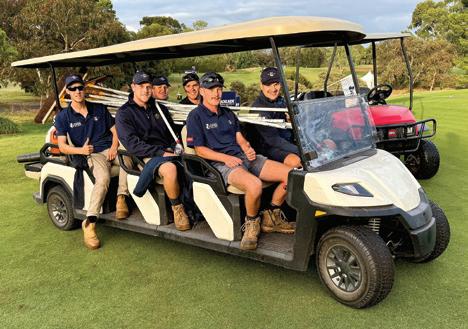
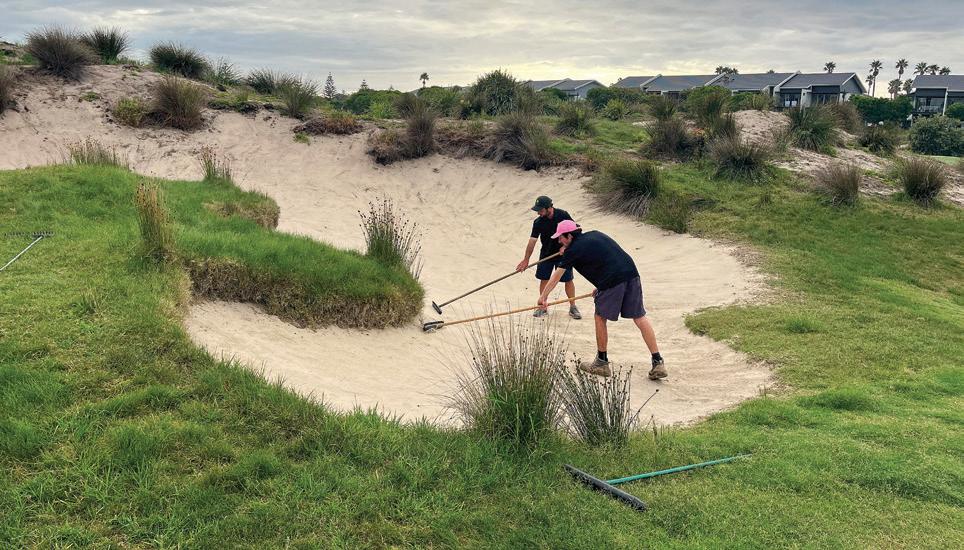
Dubbed the ‘Party Bus’, the Vista was commandeered by the bunker crew which was led during the week by Lachlan McLaren. The Kooyonga senior greenkeeper earned himself the nickname “the Bunker King” for the week and was ably assisted by trainee greenkeeper Jai Harte-Kelly who James anointed “the Bunker Prince”. Bunkers were raked daily with faces broomed.
Also supporting the Kooyonga crew were WaterPro (Clint Adams) and Greenway Turf Solutions (Andrew Manthrope) who provided catering across the week. Golf Australia and PGA of Australia tournament partner Husqvarna also had a strong presence during the Open, with a number of their robotic mowers undertaking various mowing duties across the facility.
Three weeks out from the tournament Husqvarna staff set up a CEORA unit which cut the practice range every night at 10mm, with two smaller units deployed on areas of the primary roughs and carries (20mm) and an additional AWD unit taking care of sections of 50mm rough on the 17th and 18th holes.
“It was an interesting exercise,” says James on their use. “The larger unit worked really well out on the practice range. We had it there for a few weeks and you could see an improvement in presentation. The range was neat and tidy every day and I could definitely see a place for them. Even the ones in the 20mm carries, while initially skeptical, I could see them working in those areas as well.”
The level of presentation achieved across the week impressed many in the field, with Aussie pro Hannah Green praising the condition of the Kooyonga surfaces. Continuing her rich vein of form in 2026, Green claimed a one-shot win to become the first Australian to win the Patricia Bridges Bowl since Karrie Webb in 2014.
“One of the crew was speaking to Hannah and her caddy on the Monday and she made
the comment that the conditions were what you’d get on a Thursday at most other events,” recounts James. “That was nice to hear and gave a good indication that our preparation was pretty good and the greens were at that sort of level at the start of the week.
“You have in your mind how you want the timing of things to go and sometimes you think maybe you should do more, but you have to trust the process. From a program point of view (fertility, PGRs), mowing frequency and the presentation levels we reached, we hit our marks well and the turf responded nicely. Our schedule worked well which was pleasing given that I’m someone who loves to plan.
“The Open was a really good learning experience and a good forerunner to next year. Obviously with LIV being announced in the lead-up to the Open, there was a lot of interest among the crew, but we didn’t talk too much about it because we wanted to focus on the Open. I think the level of presentation we achieved was pretty good and I was happy with the way it presented across the weekend, but you are always assessing what you do and what you can do better for next time.”
Open volunteers Jack Haberfield (Mt Osmond GC) and Mason O’Callaghan (Royal Adelaide GC) cut the 8th
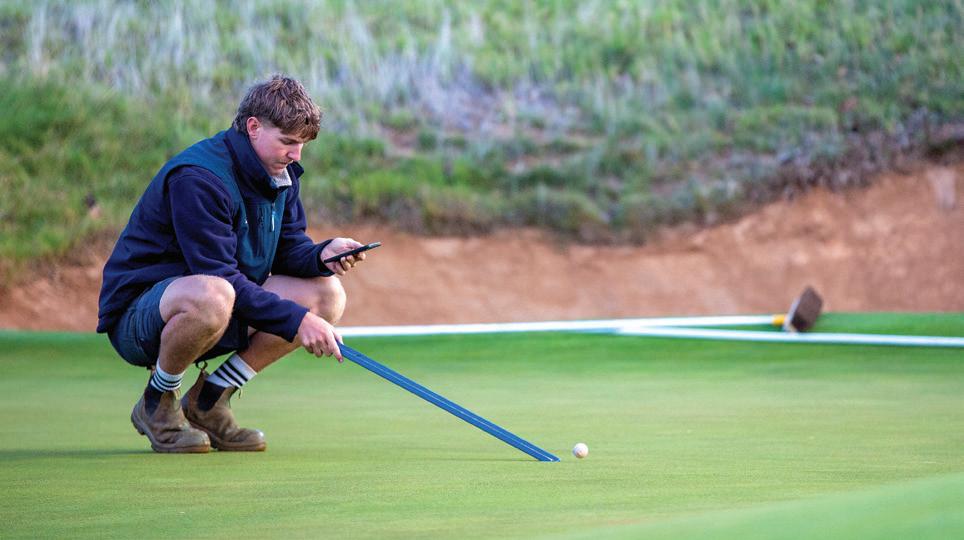
Reigning Kooyonga club champion and trainee greenkeeper Lachlan Oakes collects data with the USGA’s GS3 ball
LIV FOCUS
With the Open now well and truly behind them, the focus for the Kooyonga crew turns to LIV Golf Adelaide which will be held from 18-21 March 2027. While the future of LIV Golf has been thrown into doubt following Saudia Arabia’s Public Investment Fund announcing in May that it will wind back its financial support at the end of the current season, as this edition was going to print Kooyonga was still very much planning for things to go ahead as normal.
From a course perspective, James says there will be a few areas he and the crew will be attending to, including sodding of the greens collars to remedy couch encroachment and some tee levelling. On the back of a visit last spring to Merion in the USA and seeing the quality of their approaches and greens surrounds, James is also keen to continue their own work refining those areas.
While not privy to the full build plan yet, the location of one important component has been confirmed. Kooyonga’s par 3 15th is set to
be transformed into LIV’s new-look ‘Watering Hole’, which has become very much an iconic part of the tournament. Kooyonga’s 15th plays anywhere from 160m-205m, but the tee is likely to be moved forward so that the hole plays 150m. That will help to accommodate the major spectator infrastructure which will likely marry in with the adjacent 18th tee.
“We haven’t had a professional men’s tournament here since the 2007 Jacobs Creek Open so it’s going to be great to have that calibre of golf here again,” says James. “The club wants these sorts of events and to be considered for that is a wonderful opportunity.
“Obviously it will be a very different tournament – bigger build, bigger crowds and the logistics will be a lot more challenging. We know we don’t have the space of The Grange so, yes, the tournament will look different, but we’ll accept the challenge and work with them to build the best event they can and one that fits in with our property.”
NORTH ADELAIDE CONFIRMED AS LONG-TERM AUSTRALIAN OPEN TOURNAMENT HOST
The brand-new Greg Norman-designed North Adelaide Golf Course, currently in the infancy stages of a $45 million upgrade, has been secured as a long-term host of the Australian Opens from 2028 to 2034. Golf Australia made the bombshell announcement in early May, partnering with the South Australian Government to secure the soon-to-be redeveloped course as a longterm host of the national championships. From 2028 to 2034, three men’s Australian Opens and three women’s Australian Opens will be played at the venue.
The new South Course at the North Adelaide site next to Adelaide Oval will feature a brand new world-class 18-hole Championship course, driving range, practice facilities and clubhouse. While doubts still linger about the future of LIV Golf beyond 2026, North Adelaide is still slated to host LIV Golf Adelaide in 2028.
The first men’s Australian Open at North Adelaide will also be staged in 2028, marking the first time the Stonehaven Cup has been contested in South Australia since 1998. It comes after a highly successful staging of the men’s championship at Royal Melbourne
last December, with this year’s edition to be played at Kingston Heath where back-to-back Masters champion Rory Mcllroy is confirmed for a second straight year.
Golf Australia CEO James Sutherland said the opportunity was about building on the heritage of the Australian Opens and providing a clear platform for future growth.
“The Australian Open is one of the great championships in world golf, but in recent years we have not always had the certainty needed to plan and build the event to its full potential,” Sutherland said.
“Our aspiration is clear. We want our Australian Opens to be recognised among the world’s top golf tournaments, both for men and women. Not dissimilar to other major tournaments, that ultimately requires greater certainty around venues, dates, partners, players and the fan experience.
“The 2025 men’s Australian Open proved what the event means to golf fans. More than 113,000 people packed Royal Melbourne just to experience the golf. We also ran the most successful women’s Australian Open in the event’s history at Kooyonga. Now is the time to capitalise on that.”
The announcement of North Adelaide as a regular host of the men’s Australian Open will break tradition, with the men’s tournament only being held outside Victoria or NSW twice in the last 50 years – Royal Adelaide in 1998 and at The Grand in Queensland in 2001.
Touching on the North Adelaide redevelopment, which began on Monday April 27, Sutherland was confident with what will be delivered.
“The Australian Open has always been about the best players competing on the best courses. That expectation does not change,” he said. “We have confidence in Greg Norman as a designer, Jim Norfolk and the course-building team. As they have in the past, they will no doubt deliver a world-class golf course befitting the Australian Open and our national championships.
“Golf Australia will have a role to play as the project unfolds, being consulted and having input to ensure the course, practice facilities, player amenities and tournament infrastructure meet the expectations of the Tours, players, broadcasters and fans.”
- Nick Creely
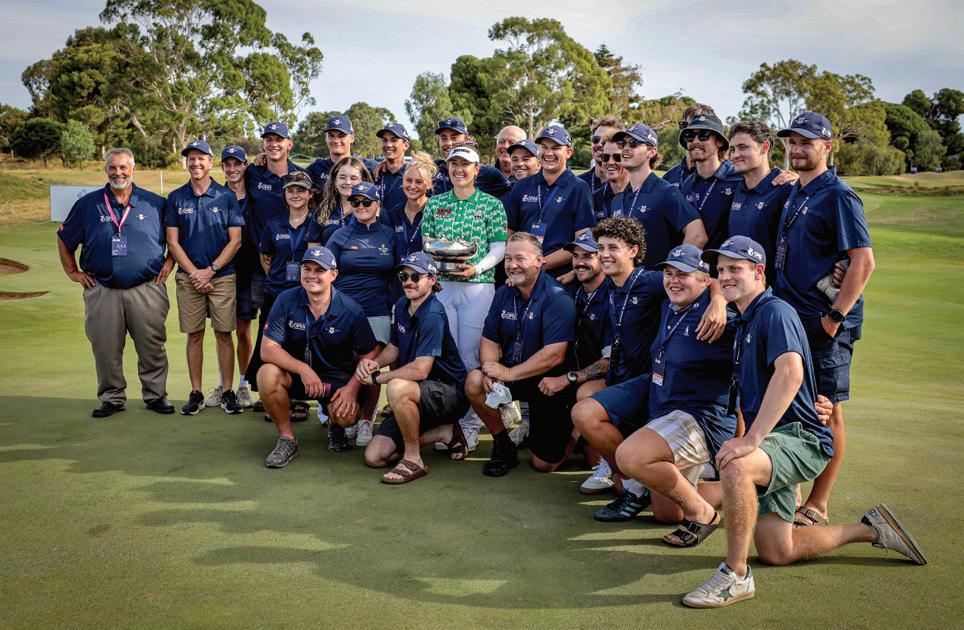
The Kooyonga tournament crew (superintendent Richard James far left) celebrate with Open winner Hannah Green
PHOTO: AUSTRALIAN GOLF MEDIA
The bunker crew ‘Party Bus’ led by Lachlan McLaren
Picture-perfect
Palms
After the forced cancellation of the 2025 tournament due to a tropical cyclone, Cameron Smith and his team at Sanctuary Cove finally got their chance to prepare the Palms course for the Australian WPGA Championship this past March. ATM editor Brett Robinson looks back on their preparations as well as a whirlwind first two years in charge for Smith following his move north from Sydney.
The sense of relief was palpable. Despite threatening skies overhead, at 6.15am on Thursday 18 March, the first tee shot of the 2026 Australian WPGA Championship was struck on the Palms course at Sanctuary Cove Golf & Country Club on the Gold Coast. And it wasn’t just the tournament organisers, players and caddies who were feeling that way – it was very much being felt down in the maintenance facility as well.
A little over a year earlier, Cameron Smith (CSTM), 10 months into his tenure as new Sanctuary Cove superintendent, was all primed to lead his team into the first of their
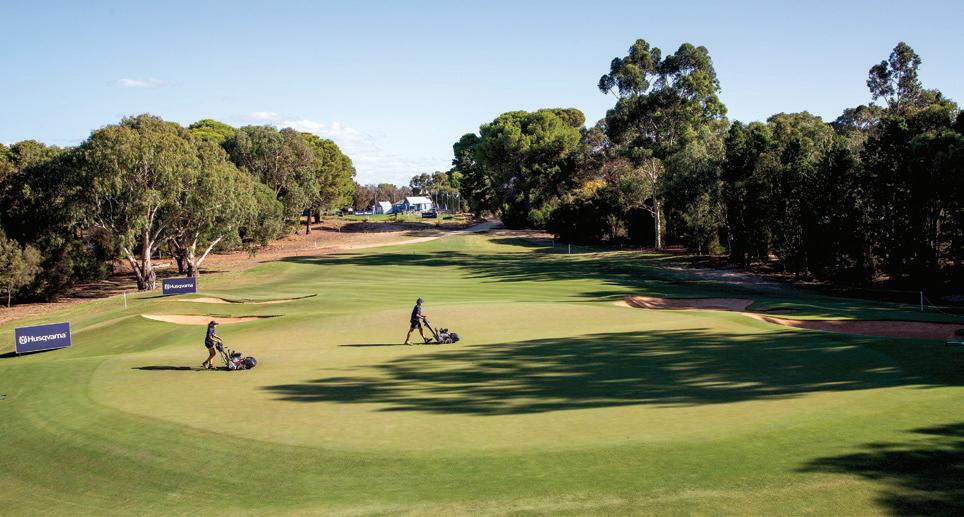
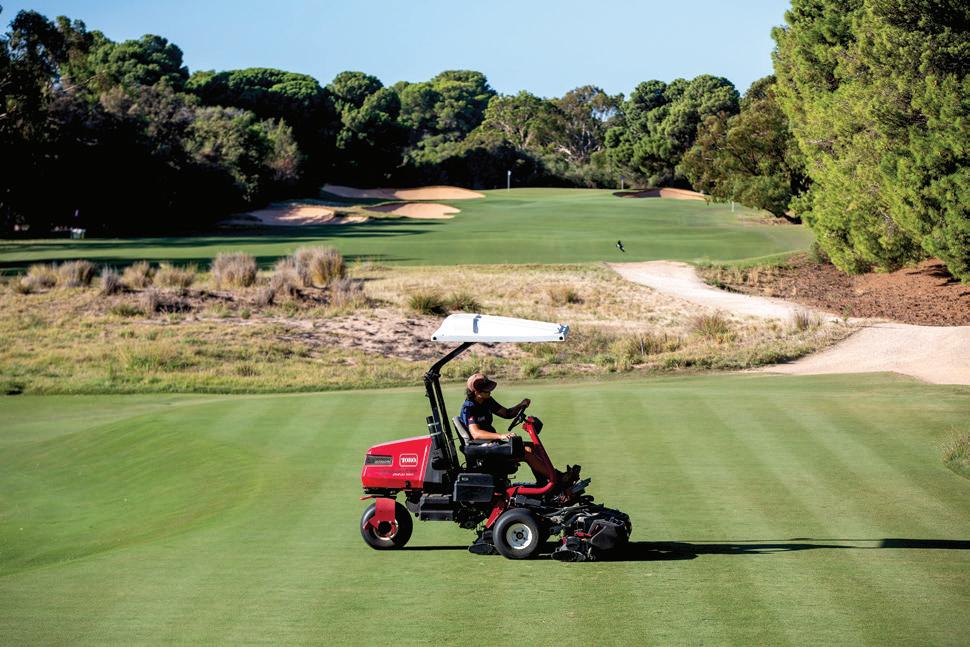
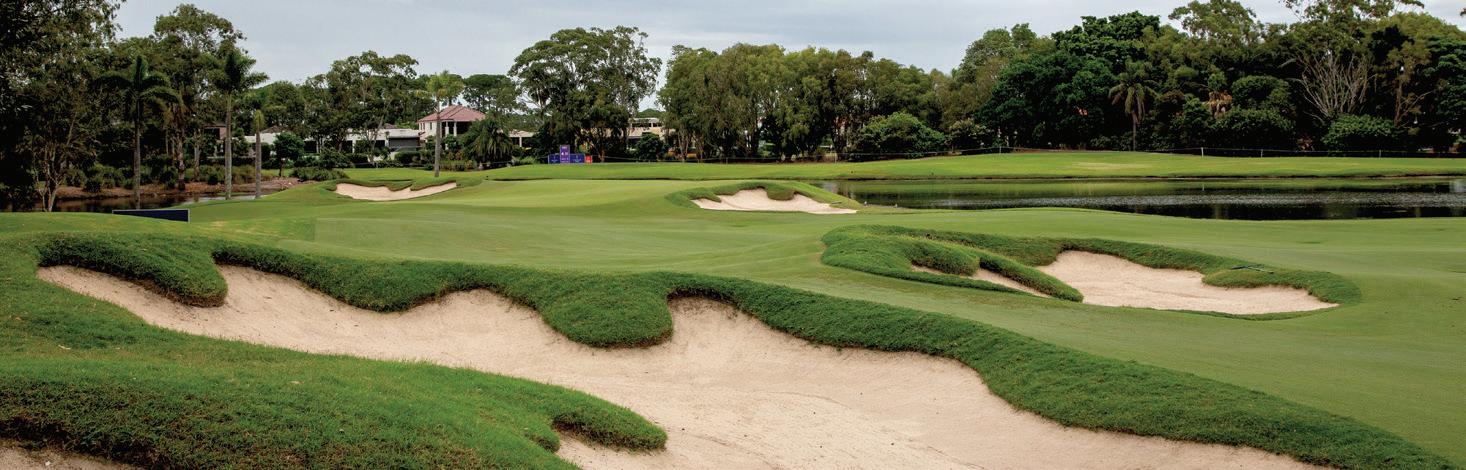
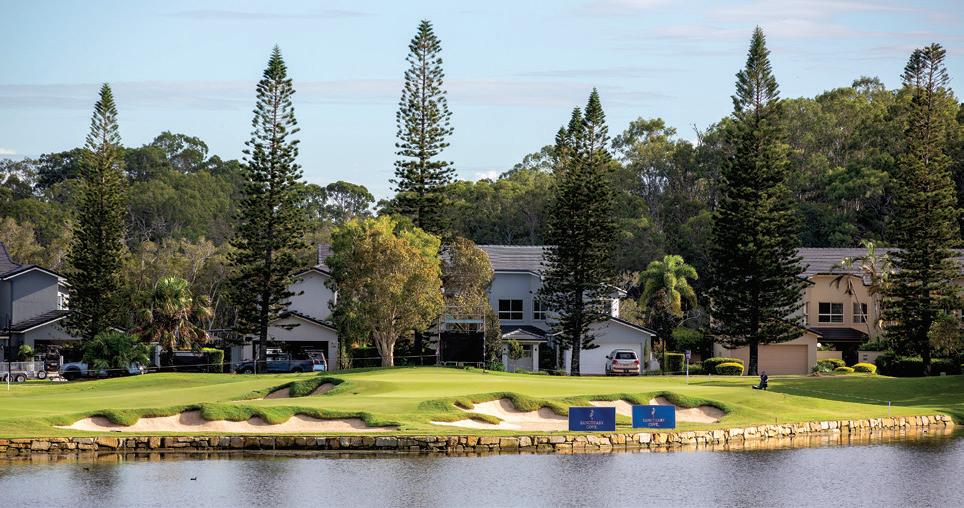
Tournament 17 on Sanctuary Cove’s Palms course on the morning of the second round of the 2026 Australian WPGA Championship in March. Pictured below left are the bunker complexes on tournament 3. All bunkers on the Palms course were reconstructed during 2024
three contracted WPGA Championship events. The 2025 event was set to be a reboot after the tournament’s inaugural hosting in 2022 at Royal Queensland and then subsequent hiatus for two years due to calendar and scheduling challenges.
With the WPGA Tour of Australasia partnering with Golf Australia, Mulpha Events, Experience Gold Coast and Tourism Queensland to give the championship a home for a three-year period, as well as its co-sanctioned status with the Ladies European Tour (LET), all was in readiness to launch the event to a global audience. Then came Alfred.
On what should have been the opening day of the tournament, Smith and his crew were instead battening down the hatches as Tropical Cyclone Alfred slammed into southeast Queensland. While the forecast had been ominous for a few weeks, Smith’s team had the Palms humming and managed to get through two practice rounds on the Monday and Tuesday. But with the cyclone tracking slowly down the coast and predicted to make landfall between the Gold Coast and Brisbane (which it did), tournament organisers had little choice but to cancel the tournament.
From tournament prep that Tuesday, Smith’s crew spent all day Wednesday cyclone-proofing the course – removing everything that wasn’t bolted down, getting equipment ready for the inevitable clean up, packing the shed up and jamming machinery against the large roller doors so they wouldn’t blow in. By Thursday the 36-hole Sanctuary Cove complex was a ghost town. The crew eventually got back in the following Tuesday to begin the long and arduous clean up,
PHOTOS: BRETT ROBINSON
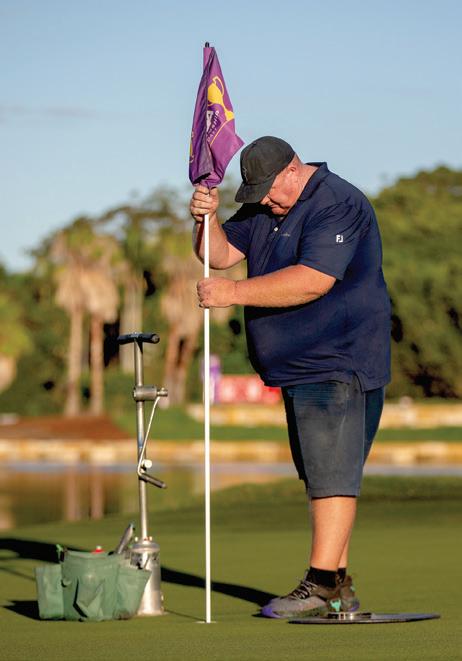
Pictured top: Sanctuary Cove superintendent Cameron Smith (left) discusses preparations with GTS’s Dan Cook (formerly superintendent of The Australian GC) who joined the crew for the WPGA tournament
Above: Palms course assistant superintendent Andrew Lothian sets the pin on tournament 6
reopening the Palms course by Saturday and the Pines course the following Wednesday.
Twelve months on and despite a 4mm dousing that made the going uncomfortable for the first groups out, the 2026 WPGA ultimately got underway away successfully and four days later crowned the best possible champion in hotshot Hannah Green. The West Australian’s four-shot win capped off a hallmark stretch of professional women’s golf across the country which encompassed a four-leg LET swing which breathed new life into the women’s game in Australia.
Green’s win also put an exclamation point on a remarkable run of form, backing up her Women’s Australian Open title the previous week at Kooyonga Golf Club and her earlier HSBC Women’s World Championship victory in Singapore. For Smith, who in the immediate aftermath of Green’s win posted a great photo on social media showing him and his two kids, Fraser and Elroy, with Green, it was a fantastic way to finish and tick off what had been a busy but ultimately successful 12 months.
“It was quite a surreal feeling to get through the Pro-Am on the Wednesday and then get to Round 1,” laughs Smith, who arrived at Sanctuary Cove in April 2024 after nearly seven years at Bonnie Doon Golf Club in Sydney. “We did the dummy run last year before it was called off a day out, so it was good to have it back and finally held without any issues.
“It was disappointing that last year’s tournament didn’t go ahead, but we really didn’t get much time to think about it or feel sad. We had a day to go hard and get the course prepped for the cyclone and then when we came back the following week we had to go hard again to get both courses back open. Within two weeks all the tournament work was just a distant memory.
“Having been through that lead-in last year, we kind of knew what we had to do from a staff and turf point of view and we pretty much replicated that this year. We noted a few pros and cons from last year in terms of timings of our applications and the standard we needed
to be at by Christmas and January. There were a few little bumps along the road, but we figured those out and will be better for it again next year.
“I was pretty happy with how the course presented and how our programs went. We had a lot of rain in the lead-up, so the firmness of the greens was taken out of our hands, but the course looked clean and the quad-cut on the greens gave us good consistency. The sun eventually came out too and showed the course off properly which was nice.”
A LOT OF WORK
You’d think with a good 12 months to prepare for the tournament’s eventual return it would be all smooth sailing, but as Smith has come to appreciate in his two years at Sanctuary Cove that is never the case. Not long after they had the courses back open after Alfred, Smith and his team effectively entered a nine-month period of course works on the Palms course which only wrapped up a matter of weeks before the WPGA.
This was on top of an already hectic 2024 which saw the club undertake a major bunker rejuvenation project across the Palms course. Smith arrived not long after it had begun and saw the project through to its conclusion that November. All bunkers were reconstructed (overall numbers were reduced but square meterage increased) with new drainage, Duracrumb liner and Wintergreen couchgrass surrounds replacing the old Plateau couch.
The most recent works were even more involved and focused on the realignment of two holes due to the sale of adjacent land. The 10th hole, which played as tournament 18 for the WPGA (see more on the routing, page 22), and the adjacent par three 3rd (tournament 11) underwent major modification, with a series of lake systems built and extensive drainage infrastructure put in the ground. The 10th was turned from a par five into a short par four (although for the tournament it still played as a par five off the old tees), while the 3rd effectively saw the tees shifted across and a new lake built in front of the green.
After reopening the 3rd hole in September, the crew’s focus then shifted to renovating the Palms course at the back end of October. However, the decision was also made at that point to construct a massive new tee complex, complete with rock retaining wall, on the par three 16th (tournament 6) which would open in mid-January at the same time as the newlook 10th. Although meant for the par three, LET officials decided to instead use the new tee to extend the length of tournament 7 (club 17) and turn it into a par five. Post tournament the new tee reverted back to being used by members and guests for the 16th.
Stuart Godlee cuts the fairway on tournament 8
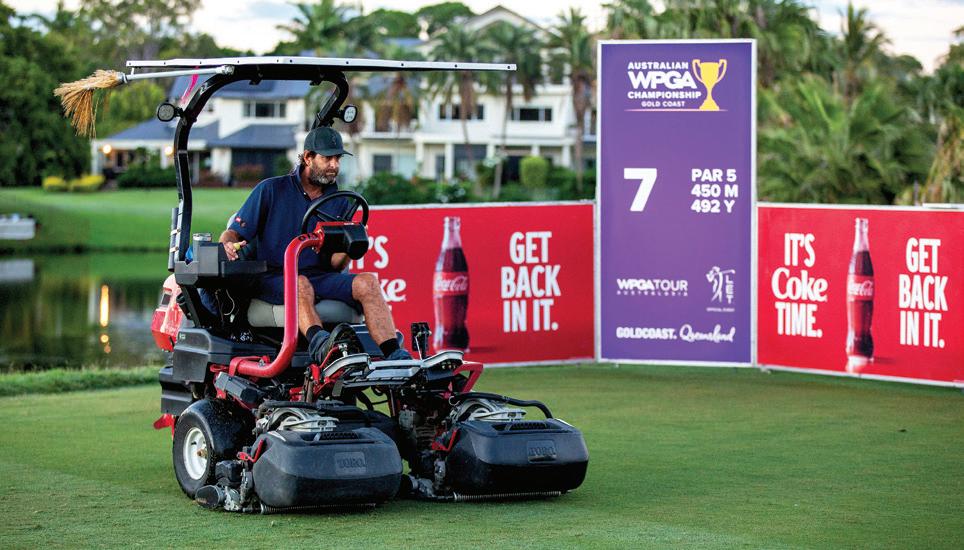
Stuart Turner cuts tournament 7 tee ahead of the second round. The new tee complex was constructed in the months leading up to the tournament to be used for the club’s par three 16th, which played as tournament 6 for the WPGA. Instead, the LET utilised it to extend tournament 7 (club 17) to a par five
As if that wasn’t enough, the crew also installed another 800 lineal metres of Hydrowick drainage line at the same time. The club, under previous superintendent Paul McLean, had started the process of installing the Hydrowick system, with Smith finishing off its installation across all green surrounds on the Pines. Three holes were then completed on the Palms with the club budgeting a further $60K to do more this year. Although initially knowing little about the product, Smith has become a big proponent for its ability to pull water away from the surface which is especially important considering the torrential rain events that can lash the Gold Coast at times.
“It was a testing time that’s for sure,” reflects Smith on all the recent course works. “That tee project was a massive job in between trying to tear the place apart during renovations. And at the same time we were also building a 2500m2 TifEagle nursery! So since last June and up to the tournament it really didn’t stop.
“Then we had renovations on the Pines in January which is a huge process, so it was really only about five weeks out from the tournament that we really began to ramp things up. But we pride ourselves on having the
course at a good standard all the time, so that when we needed to we could dial things up quickly and have it tournament-ready.”
LAYING THE FOUNDATION
Tournament preparations on the Palms effectively started during their October renovation period. Taking some learnings from the previous year’s greens renovations, his first since arriving at the club, Smith switched out
the larger 5/8” tines for 1/2” tines instead, but to impact the same amount of surface area upped the number of tines on the ProCore.
Prior to coring the crew used Maredo scarifiers at -18mm in two different directions. After coring, the greens were Ventrac-broomed and then shaved down to 2mm.
Once they were given a first hit of sand, they were then verticut again at -6mm twice, amendments applied, topdressed and then
Julian Sinardi rolls the green on tournament 11
AUSTRALIAN PGA HEADING TO THE LAKES AFTER 25-YEAR QUEENSLAND STINT
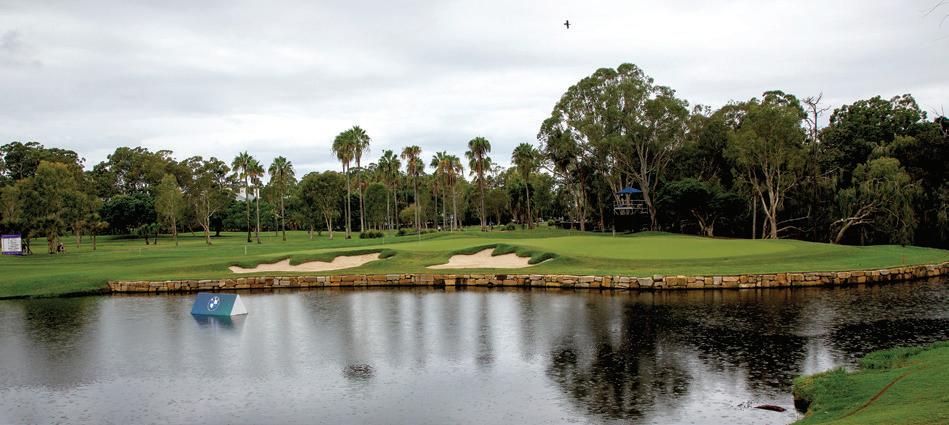
The BMW Australian PGA Championship is moving from Brisbane to Sydney, with the PGA of Australia announcing in midApril that The Lakes Golf Club (pictured right and below) will host the 2026 instalment this November. It will be the first time that the PGA has been held in Sydney since 1998, bringing to an end a successful tenure in Queensland where it has been based since 2000.
To be held from 26-29 November – a week before the Men’s Australian Open at Kingston Heath in Melbourne – it will be the third occasion that The Lakes has hosted the PGA. It’s first came back in 1950 when Norman Von Nida saluted, while its most recent was in 1987 when Australian Roger Mackay claimed the Joe Kirkwood Trophy by a single shot.
For Lakes superintendent Anthony Mills, he is set to join a rare club to have hosted both the Australian Open and PGA tournaments, having presided over preparations for the 2012 and 2018 Opens, as well as co-hosting the 2023 Open alongside The Australian Golf Club.
“We’re very excited,” says Mills, currently in his 14th year as The Lakes superintendent. “It’s going to be great for the crew, especially after the 2023 Open which was a little unusual given we only had the first two rounds of the tournament. It will be nice for the crew to go through the full tournament experience from build-up to finish this time. It’ll be my first PGA as a superintendent, so it’s very exciting to be able to say I’ve hosted both of Australia’s ‘major’ tournaments.”
The announcement came after months of negotiations with the club and the NSW Government following the end of Royal Queensland’s run of five tournaments last November. Royal Queensland is about to embark on a major course redevelopment as it prepares to host the men’s and women’s golf events at the 2032 Brisbane Olympic Games. Prior to being held at Royal Queensland, the PGA resided at RACV Royal Pines on the Gold Coast for seven years and before that at Hyatt Coolum/Palmer Coolum on the Sunshine Coast for 10.
For Mills and his crew, which includes assistants Michael Ervin and Jackson Nicholls, the work now begins as they ready the course for November. Standard winter works in the roughs and sandy waste areas will be accelerated, as will tree work and pruning to accommodate the large galleries expected. Mills says there will be extensive plantings undertaken in the sandy waste areas and rebuilding of mounds where wind has eroded them.
Normally scheduled for the end of October, Mills will now bring forward his course renovations to September and scale them back a little to ensure full recovery come the Open. He will likely solid tine their A4 bentgrass greens initially before using ninja tines to 40mm to pull out some thatch.
Since co-hosting the 2023 Open, The Lakes has undertaken a number of projects as part of ongoing OCM Golf masterplan works. Following the construction of championship tees on the 2nd and 8th holes in the immediate lead-up to the 2023 tournament, the greens and bunker complexes on holes 4, 5, 6 and 12 were fully reconstructed.
The biggest project the crew have been tackling, however, has been replacing the fescue bunker surrounds with zoysia. All front nine bunkers (and the 12th, in conjunction with the green reconstruction works) have now been completed, with The Lakes crew laying
7000m2 of zoysia sod. Works on the back nine bunkers – starting with holes 10, 15, 16 and 18 – will kick off in the first week of January 2027.
“Sydney’s climate and weed management were the main reasons for the change,” explains Mills of the switch from fescue to zoysia. “The fescue looks great from July to Christmas, but outside of those times it can be very challenging to maintain. You get to the end of summer and the fescue starts to melt out and you then have to spray all the weeds out and reseed them. They’ll look great at this year’s tournament and everyone will question why we are removing it, but the zoysia is a much more sustainable grass for us going forward.
“The zoysia has been fantastic and is much less labour-intensive than the fescue. With the greens we rebuilt in December 2024, we did the zoysia conversion at the same time and we have only had to trim them twice in the 15 months since, whereas with the fescue we are out trimming every month. We need to work on making the zoysia look a bit more naturalised, but that will happen over time as the turf matures.”
The BMW Australian PGA Championship has elevated in stature over the past decade, becoming a truly global sporting event thanks to the Challenger PGA Tour of Australasia’s Strategic Alliance with the DP World Tour. This November’s tournament will, for the fifth consecutive year, launch the DP World Tour’s Race to Dubai and will attract another top quality international field as it did last year at Royal Queensland.
“We are delighted to partner with the NSW Government in bringing the BMW Australian PGA Championship back to Sydney,” says PGA of Australia CEO Gavin Kirkman. “The city is synonymous with world-class sporting events and we are thrilled that we are able to return to The Lakes Golf Club. The venue has a rich history in hosting Challenger PGA Tour of Australasia events, so we know we are in for a warm welcome in November.”
– Brett Robinson
PHOTOS: BRETT ROBINSON
Verti-drained before being given a first mow at 2.5mm. Smith says they stayed low probably a bit too quick and admits that ego may have got the better of him, something he would change and go a little higher next time.
One area which Smith has struggled with since arriving back in Queensland has been sourcing a good quality local sand, with the majority of it going to the construction industry. Smith ended up sourcing a sand from Sydney-based Elite Sand and Soil and while transportation came at a substantial cost, at least he could be assured of a quality product and one that didn’t contain rock or shell.
“I’m enjoying being back on couch greens – they are my groove,” quips Smith. “I did my apprenticeship at Royal Pines on 328 and got my first taste of TifEagle while overseas in Florida and then Mexico, so I feel at home on them. You quickly knew how hard you could work them and where your limits were.
“The good thing about going back to bentgrass greens at Bonnie Doon was that I guess I now have that bentgrass mentality a little bit with the TifEagle. TifEagle isn’t the full ‘bash-the-hell-out-of-it’ type couch. You have to be protective of it but also quite aggressive with it at times.
“The Palms greens have such a high organic matter content. They are 17-yearsold now and we have to renovate hard and keep renovating hard. Since coming here we have been testing and we have been getting some really good results, but you can’t take the foot off the pedal. TifEagle can be a bit fidgety sometimes – it doesn’t like too much aggressiveness, but there comes a point where you do have to go really hard.”
PULLING THE TRIGGER
While nowhere near the challenges of 12 months ago, the weather nonetheless did play its part in Smith’s preparations for the 2026 WPGA. After a good start to the year, the fortnight prior to the tournament brought an untimely 115mm which created some havoc with mowing regimes.
Having had the Wintergreen fairways at 8mm and surrounds at 6mm, the wet weather meant Smith couldn’t get mowers on the course for a five-day period. With the heat and humidity and resultant grass growth, Smith was forced to lift heights to 10mm and 8mm respectively the Wednesday of lead-in week to ensure there wouldn’t be any scalping.
Despite the untimely rain, the Palms presented picture perfect for the week, with Smith’s crew dialling in to ensure the end
product that beamed to a global audience was world-class. Fairways were cut by a crew of six on Reelmaster 5010-Hs, while the greens, tees and surrounds were cut with a mix of electric and hybrid triplexes. Greens (3mm) were mainly quad cut (up and back in the same pass – what Smith calls a “freaky cut” – in two directions), but were just double cut (up and back on the same pass) on the Friday morning. After having the rollers idle at the start of the week, they were back out in force after the opening round.
Smith’s usual crew of 32, which includes experienced assistants Andrew Lothian (Palms) and Trevor Ridge (Pines) and four seasonal staff, were fully responsible for tournament preparations. A single volunteer came across from nearby Hope Island, while Smith also had good friend and former Elanora and The Australian superintendent Dan Cook riding shotgun for the week. Cook, who is now national commercial manager for Greenway Turf Solutions, and Smith go back more than 15 years and he played a small yet important role during the WPGA.
“It was great having Dan here,” says Smith, who volunteered at the 2023 Australian Open when Cook was in charge of The
Australian. “Between us we have a lot of tournament experience and he’s good to have around. I was on the back nine and Dan was running the front nine, being that back end sweeper and making sure all the details were getting picked up. He also helped us with some data collection with the USGA GS3 ball. It was great having someone of his experience and foresight to be ahead of things and just great to chat and have a laugh with him.”
In addition to their tournament prep, the crew also had the not-too-small matter of maintaining their other championship layout. As soon as they had completed their duties on the Palms each morning, they headed across to the Pines to prep it for member comps which continued to be held across the tournament. Thursday was arguably the crew’s biggest day as they did a full cut on the much larger Pines layout immediately after prepping the Palms, effectively replicating the same regimes across both courses.
“One of the things we said when we agreed to have the tournament was that we weren’t going to let it impact the members,” explains Smith. “We are lucky that we have the facilities here to be able to do that. We have multiple practice greens and a double-ended
The WPGA capped off a hallmark stretch of professional women’s golf across the country which encompassed a four-leg Ladies European Tour (LET) swing. Pictured is tournament 15
Spencer Lockhart cuts the surrounds on tournament 8
driving range, so up one end you had the WPGA players practicing and down the other end you had the members. It was pretty cool.”
SETTING THE STANDARD
And therein lies the challenge that Sanctuary Cove presents on a daily basis for Smith. It is definitely a unique beast, sprawling across 170 hectares of which 163 hectares is mown. Smith’s team takes care of the two championship courses and practice facilities, while a team from Landscape Solutions, who share the same compound, manage the body corporate and vast landscape areas within the broader gated community.
After his time in Sydney, Smith jokes that he was supposed to be going north for a bit of reprieve. That couldn’t be further from the truth, but he has fully embraced the challenge that comes with managing one of Australia’s most recognised and celebrated resort facilities.
“It’s a huge property and you do get pulled in so many different directions in one day,” says Smith. “It’s certainly different to Sydney –the sheer size and amount of golf took some getting used to and it’s not so much managing the turf but rather trying to get the turf taken care of in between everything. Then you chuck an extra 1000mm of rain a year on top, being on heavy profiles not sand and the thousands
PALMS’ UNIQUE SET UP
Sanctuary Cove’s Palms course provided one of the more unique course set ups for a major Australasian Tour event, men’s or women’s, this past season. In what was its first major outing as a tournament venue, the Palms course had more than a few quirks about its routing.
Being a Queensland resort course first and foremost where golf carts rule, the Palms isn’t the most walker-friendly of layouts. Indeed, to get from the green on tournament 8 (club 18) to the tee on tournament 9 (club 1), players had to walk more than half a kilometre (the path from the 8th green actually comes out nearer to the 9th green than it does the tee!) Likewise, the par three 16th, which played as tournament 6, required the players to tee off, walk to the green, putt out and then walk the 140-or-so metres back to the tee in order to tee off up the 7th (club 17).
With Sanctuary Cove being a gated community, within which the main clubhouse resides, the tournament was based out of the publicly accessible Country Club clubhouse which used to be where the Palms course started and finished from. That meant the WPGA routing was played across the original Palms layout which again necessitated some creative logistics.
of residents and noise issues. But on the flip side, I’m not managing bentgrass greens in Sydney in summer anymore and I certainly don’t miss the winters down there.
“My role has definitely changed to what it was when I first started here. With so much construction going on – and more to come over the next few years – I’m certainly not out in the field as much anymore. That’s where we are making sure we are getting the
right guys into the right positions and setting the standard. We’ve had some really good recruitment in recent times, with some good young lads coming on board who have been given some responsibility roles.
“From my time in Sydney I learnt that you have to have high standards, otherwise you get left behind pretty quick. I like to think we have a high standard here now and we’re bringing everyone along for the ride.”
Instead of teeing off on holes 1 and 10 as would normally happen during the opening two rounds, the organisers had to start the back nine groups on tournament 9 (Club 1), which is adjacent to the main Sanctuary Cove clubhouse and the double-ended driving range. To ensure the front and back nine groups wouldn’t overlap, the first group off the 9th teed off 10 minutes ahead of the group starting on the 1st.
Playing as a par 71 for the tournament, the rating on each nine was also unique – 37 out and 34 in, with a 481-metre difference between front and back nine lengths (3294m compared to 2813m). The front nine included three of the course’s four par fives which came within a six-hole stretch (holes 4, 7 and 9). Similarly, three of the club’s five par threes
were situated within six holes on the back nine (holes 11, 13 – pictured above – and 16).
“The Palms did set up a little differently to a normal tournament,” says superintendent Cameron Smith, who hosted three Webex Players Series Tour events during his previous role at Bonnie Doon in Sydney.
“Because Queensland is primarily cart golf, the Palms is not very walker-friendly and that was something we didn’t fully realise until we had the tournament. So there were a few challenges regarding movement around the course and having that 10 hole/8 hole split and an earlier tee time. But I think overall it worked well. The Palms sets up really well for a women’s tournament and the players were certainly very happy with how it played and presented.” – Brett Robinson
Nic Jasper cuts the green on tournament 8. The Palms’ TifEagle greens were mown at 3mm for the tournament
Classic conditioning
The Australian Women’s Classic kick-started a showcase of women’s professional golf around the country during March. Across this and the following article, ATM looks back on the tournament at Magenta Shores and the John Deere/Envu Women in Turf Program which saw six female greenkeepers join the crew for the week.
Soaking up the tournament spotlight, the Magenta Shores Golf and Country Club crew handled the pressure of hosting one of Australia’s elite women’s tournaments in the first week of March with class, precision and genuine camaraderie. In what would kick off a massive month for women’s golf, the NSW Central Coast-based course hosted the Australian Women’s Classic for the first time following the tournament’s
move south after six successful years at Bonville Golf Resort and 2025 event staged at Coffs Harbour Golf Club.
It wasn’t the first time Magenta Shores had played host to a major tournament, having also welcomed an elite field for the 2024 NSW Women’s Open. The course, nestled between the Pacific Ocean and picturesque Tuggerah Lake, is designed by Ross Watson and ranks inside Australia’s top 40 in the 2026 Golf Australia Magazine rankings. It certainly
lived up to its hype as one of Australia’s top links layouts as it entertained the first of three consecutive co-sanctioned Ladies European Tour (LET) and WPGA Tour of Australasia events across a three-week period.
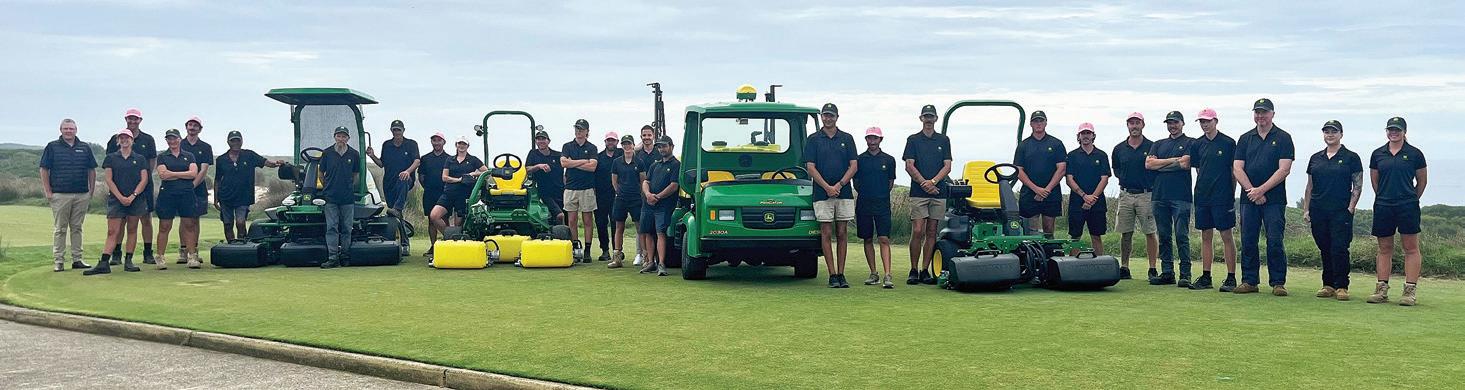
A crew of 20, including six up and coming female greenkeepers from across the country as part of the John Deere Women in Turf Program, presented in conjunction with Envu, were led superbly by seasoned superintendent James Newell (pictured right). They pulled
some long hours across tournament week, with a strong collective team vision ensuring the course was in readiness for the four days of play. Newell praised his tournament crew for setting a strong standard with their meticulous nature and dedication throughout tournament week and the lead-up.
“We set a standard and just made sure we were consistent with everything we did,” says Newell. “I had key focus words each day and they just gradually got stronger and stronger.
The crew knew their jobs inside and out and I suppose they dictated the standards a bit as well. Some of them have that tournament experience but they always get excited for it.
“For us to showcase our course on television across the final two days of the tournament was neat and we’re proud of what we do. We wanted to put our best foot forward as a crew and as always they stepped up and took on extra responsibility, working extra hours if needed.”
While dealing with an often-erratic lead-in to the tournament, particularly from a weather perspective, Newell described preparation for the Classic as quite smooth-sailing.
“It was quite hot and humid leading in and while that didn’t throw us out it was just another element of working in Australia during the summer,” says Newell. “It was dry in periods – we would get a three-week dry period and then get 10 days of stormy rain before it blew out.
“Night time temperatures were quite warm, so it meant a fair bit of growth, in particular on our bentgrass greens. We had a few machinery breakdowns along the way
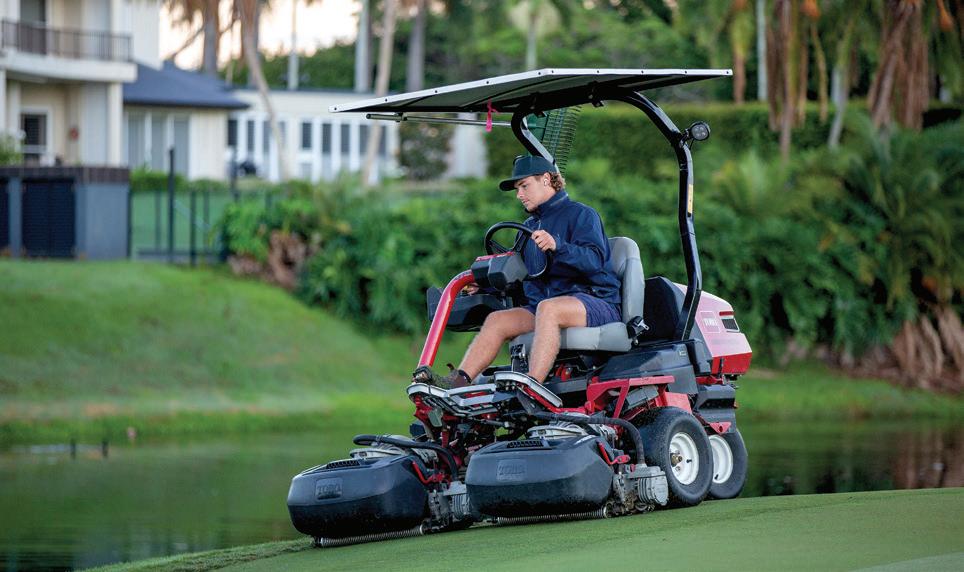
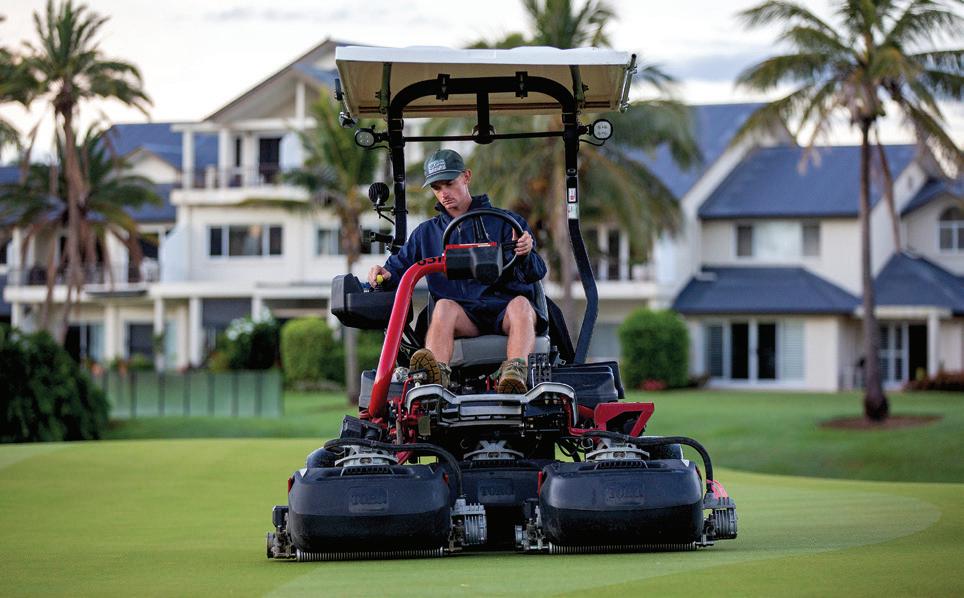
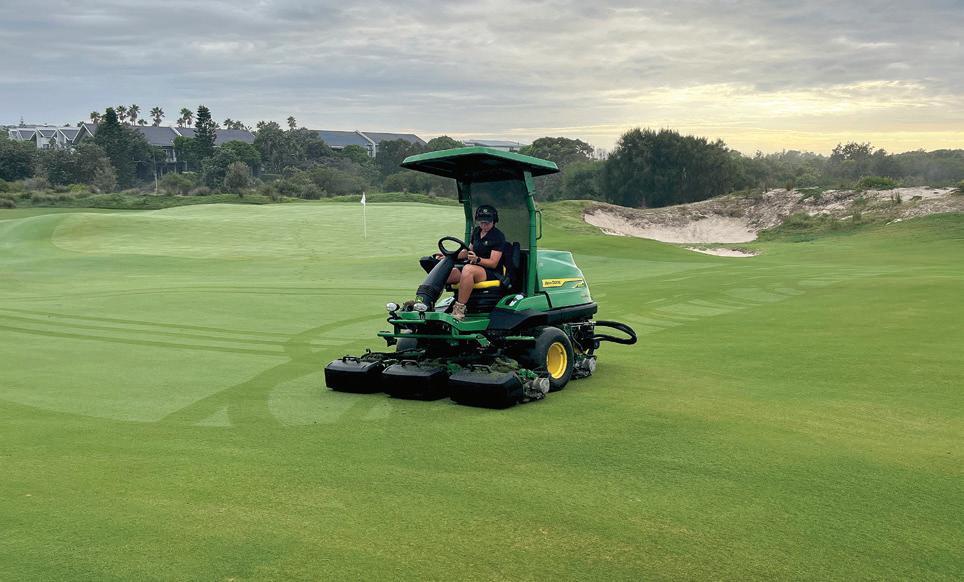
Main image: Working alongside the Magenta Shores crew for the Australian Women’s Classic were six female greenkeepers who were selected as part of John Deere’s Women in Turf Program, held in partnership with Envu. Pictured are Leah Heyward (left) and Holly Kenyon cutting greens
Below: Magenta Shores superintendent James Newell
PHOTO: JOHN DEERE
TOURNAMENTS
as well, but we evolved and changed a few things to adapt to that. We lost two mechanics at a similar time as well, but we were fortunate enough with our local John Deere RDO providing a mechanic to get on top of everything.”
Those minor alterations, however, didn’t deter the team from their vision. Newell says the focus was always on timing to ensure the course popped by opening round.
“I suppose we like to pride ourselves on our playing surfaces and the quality of
those regardless of whether we are hosting a tournament or not,” explains Newell. “Not a lot changed in our intent, but it was probably more about attention to detail. There was more frequency of mowing and just getting our pesticide programs and timings right for everything.
“For tournament week in particular we made a few changes, but it was all about making sure we got our timings right with our mowing, especially our fairways which are quite large. We wanted it to be one of the best
venues for the players to come, so we made sure we did a few dummy trial runs to ensure we got the timings right, but generally the leadup was smooth.”
Newell says the forward thinking ahead of the tournament and what, if any, changes needed to be made across the course came almost half a year ago when it was clear they were hosting the event. Previous tournament experience at the venue formed a critical component of their build-up and planning.
“Myself and assistant Hayden (Gilmore) did a fair bit of work to make sure our machinery in particular was in a good position in the lead-in,” says Newell. “It would have been at least six months of thinking and planning. We hosted the 2024 Women’s NSW Open, so we certainly took a lot of learnings from that as a turf team.
“We were in regular contact with course architect Ross Watson and the LET as well throughout the whole process. There were a couple of things we wanted to do in terms of course changes to strengthen holes 9 and 18 in particular, so just before Christmas we rebuilt two tees to make sure they would be ready for day one and we got there.
“We don’t have a heavy pesticide program or anything like that, so it was just business as usual and once again staying consistent in everything we did. We did change a few things with our moisture management, just things that didn’t quite work last year.”
The course and conditions that Newell and his team presented certainly provided a tough test for what was a strong international field. Czech professional Sara Kouskova took advantage of some easier scoring conditions early in the opening round to shoot a course record 8-under 64, however, it would be local NSW rising star Kelsey Bennett who would ultimately triumph come Sunday.
Fittingly holding the Classic trophy aloft on International Women’s Day, Bennett claimed the most significant win of her young career, navigating a final round which was highlighted by an incredible rainstorm as the leaders made
The tournament crew of 20 pulled some long hours across tournament week, with a strong collective team vision ensuring the course was in readiness
the turn. Despite having to duck for cover, Bennett produced a classy display to record one of just three Sunday rounds under par for a 13-under total to win by four shots.
FEMALES FOR THE FORE
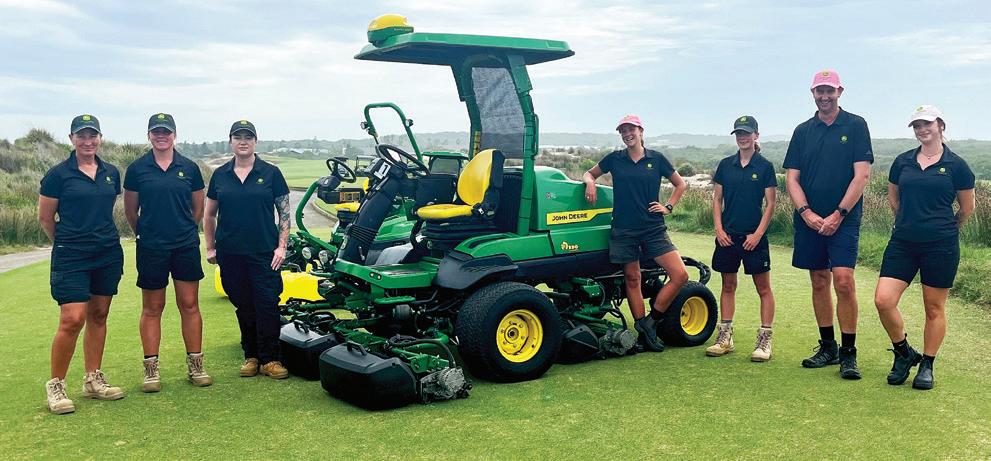
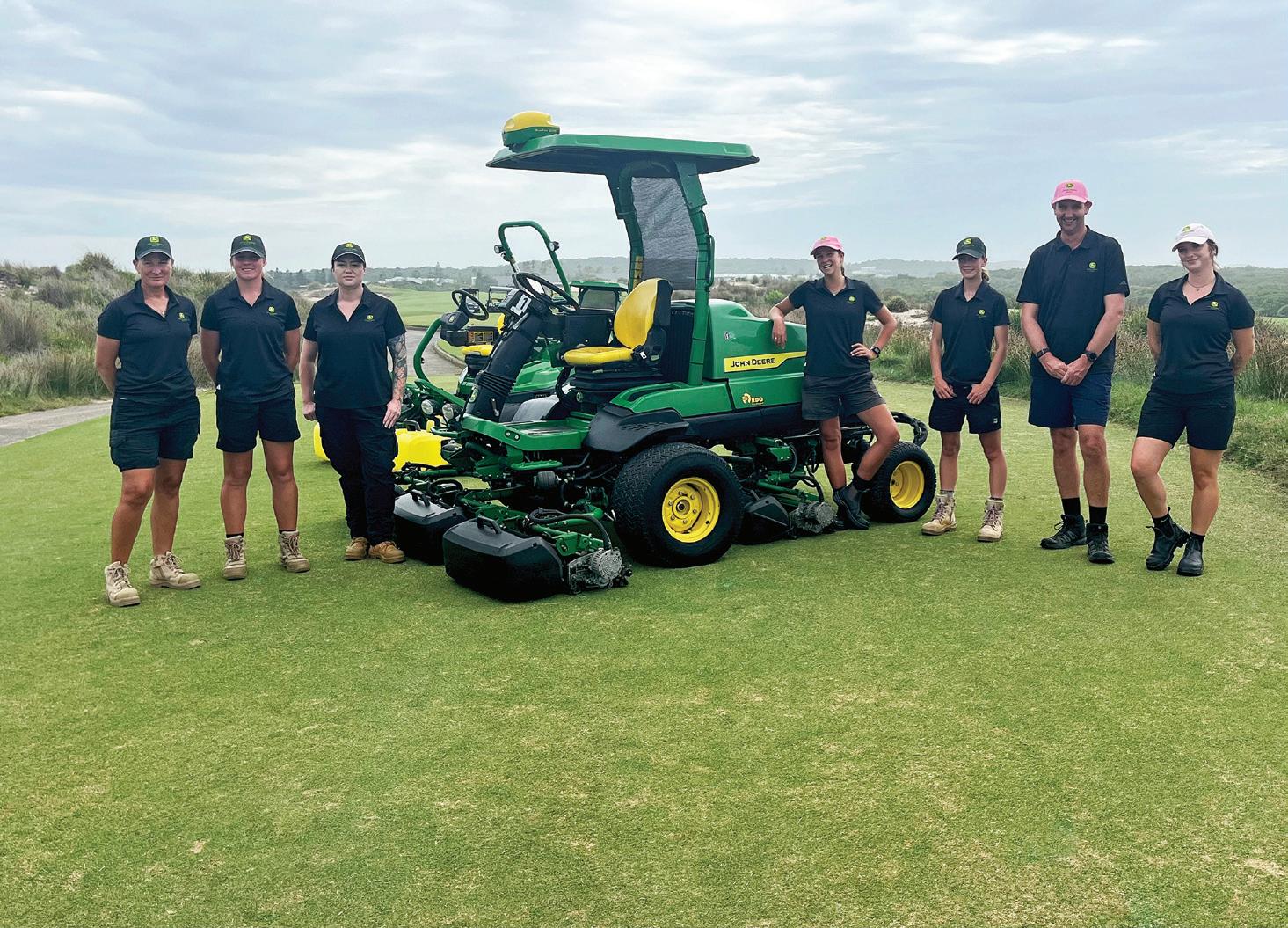
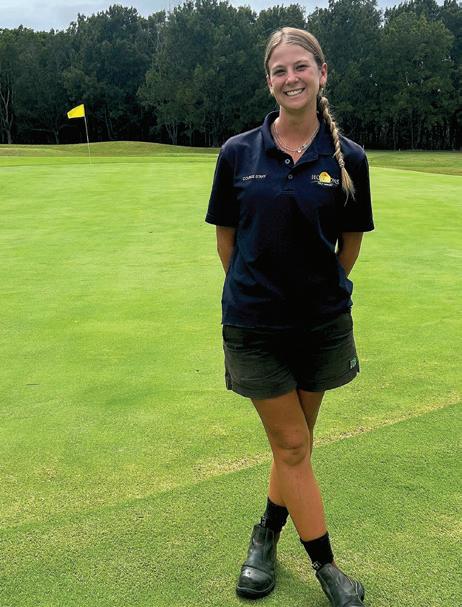
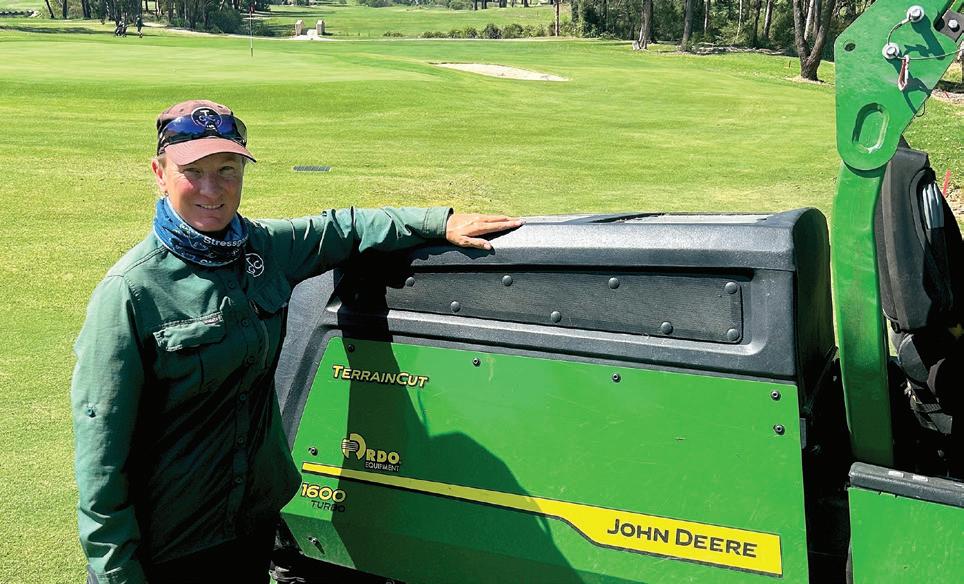
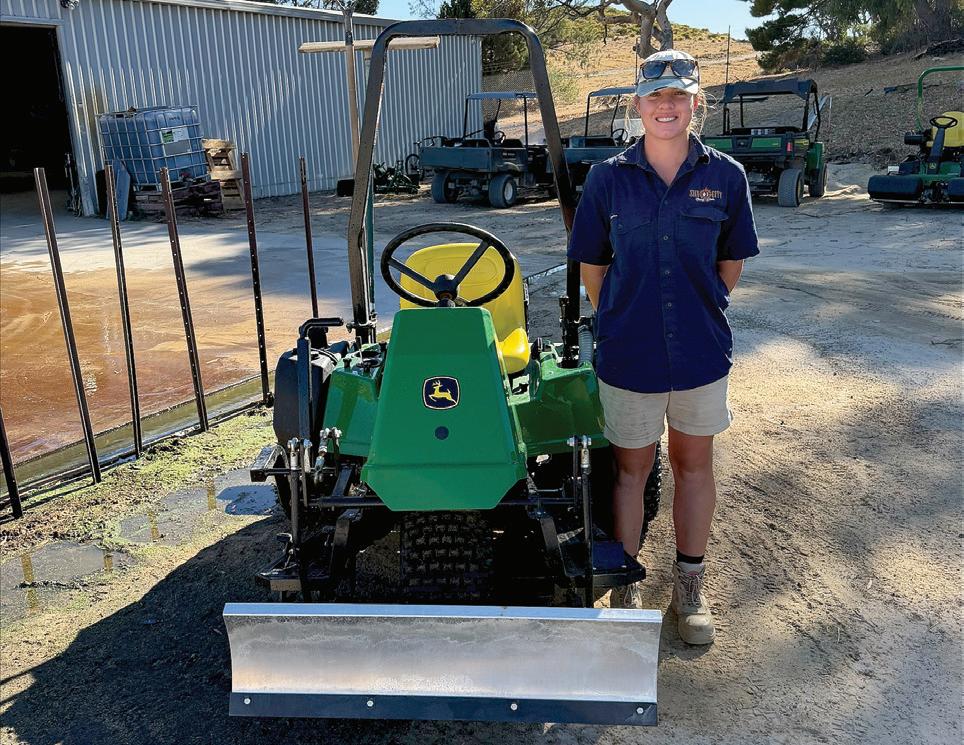
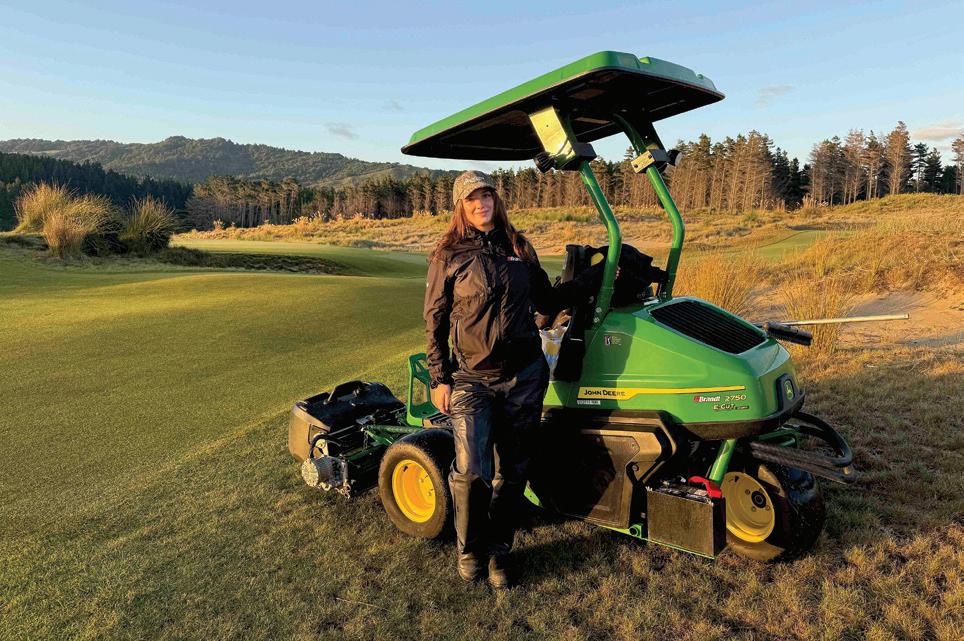
Working alongside Newell’s 14-strong crew in the lead-up to and during the tournament were six talented female greenkeepers who had been selected as part of John Deere’s Women in Turf Program, held in partnership with Envu. Relishing the opportunity to help prepare the course for a major Tour event, they worked closely with James and his team, gaining practical skills and valuable industry exposure to help propel their careers forward.
The Women in Turf Program is designed to encourage more women to consider careers in professional golf course management and turf maintenance. The mentorship program includes work placement opportunities (like the Classic tournament), 1:1 mentoring and ongoing career support training. Reflective of its growing reach and popularity, this year’s participants came from all corners of the country, as well as one from New Zealand’s Te Arai Links.
Joining Newell’s team for the week were Leah Heyward (Horizons Golf Resort, NSW), Carrol Davey (Toronto GC, NSW), Pania Chadderton (City of Kwinana, WA), Jorgina Kean (Sun City CC, WA), Sienna Lee (Rich River GC, NSW) and Holly Kenyon (Te Arai Links, NZ). With the Classic a co-sanctioned LET-WPGA event, it provided a tremendous opportunity to learn on the tools during a major international championship which was televised globally across the final two rounds.
Newell says the club was proud to play its part in supporting more pathways and opportunities for women to join the sports turf
industry. He says that all six women – who arrived at the course the Sunday before the tournament – provided a bundle of energy throughout the week and were eager to learn and absorb all the knowledge they could.
“It was a really good mix and they all fitted in seamlessly,” says Newell. “When they arrived on day one, the first little job for them was the bunkers. For us, it set the standard a bit, with Hayden doing the training with them. We’ve got a lot of bunkers out there, about 130 and some big ones too, so it was a lot of work.
“They brought a ball of energy to the whole week as well. What was most pleasing was how quickly they got up to speed –they were all very competent and quickly understood the layout of the golf course and the machinery which meant we gained a lot of confidence in them quickly. Pania had never worked on a golf course before so it was an
exciting experience for her. She now knows exactly what she’s doing and she’ll continue to learn going forward in her career.
“From my perspective it was really great having them here for the week. We’re an all-inclusive club in a way – we don’t have women’s or men’s competitions, they’re all mixed – and that works really well for us. Having a really strong partnership with John Deere helps too. Magenta and John Deere really marry up well and having the Australian Women’s Classic event for the first time, it all lined up perfectly.”
Newell says he received positive feedback across the week which was another pleasing aspect from his perspective. “On the Monday, one of the LET course set-up crew came up to me and said ‘James, it’s good to see so many women out here working’. That was the first thing they noticed which was great.”
Newell praised his tournament crew for setting a strong standard with their meticulous nature and dedication throughout tournament week and the lead-up
With Magenta Shores superintendent James Newell (second from right) are (from left) Carrol Davey, Jorgina Kean, Pania Chadderton, Leah Heyward, Sienna Lee and Holly Kenyon. All six were selected to be part of the John Deere/Envu Women in Turf Program for the Australian Women’s Classic
experience Classic
Already providing a launching pad for females looking to advance in the turf industry since its launch, the John Deere Women in Turf Program, presented in conjunction with Envu, is aiming to have a long-term impact by bringing together women from across sports turf, horticulture and greenkeeping backgrounds and placing them in a world-class competition environment.
With the turf industry continuing to face challenges attracting new talent, initiatives like this build awareness and showcase the opportunities available. Hosting the program at a flagship professional women’s golf tournament, that attracts some of the best players from around the globe and is broadcast internationally, aligns perfectly with the program’s goal of increasing exposure for women in turf not only across Australia but around the world.
As the previous article mentioned, six female greenkeepers from across Australia, and for the first time New Zealand, joined superintendent James Newell and the Magenta Shores crew for the Australian Women’s Classic held in early March. With the help of John Deere and Envu, ATM profiles this year’s successful program participants…
ATM profiles the six up-and-coming female greenkeepers who got the opportunity to volunteer at Magenta Shores for the Australian Women’s Classic tournament in March
PANIA CHADDERTON
City of Kwinana, WA
When Chadderton received confirmation that she had been selected for the Women in Turf Program, her first reaction was one of overwhelming surprise. Because she hadn’t followed a traditional pathway into turf, she thought she might not be in the running, however, she was really surprised and grateful
to be selected and make the journey from one side of the country to the other to participate.
Currently working as a Parks Technical Officer with the City of Kwinana in Perth, Chadderton began her career in horticulture before stepping into a more technical role focused on specifications and contract management. Her partner had recently changed careers and started as a greenkeeper and she could see how much he loved working outdoors. At the same time, Chadderton wasn’t happy in her job and with COVID putting a lot of things into perspective she decided to give horticulture a go.
After completing a Certificate III in Horticulture and later a Diploma, Chadderton joined the City of Kwinana’s horticulture team. Not long after, she successfully applied for the Parks Technical Officer role, which includes preparing tender specifications for irrigation, landscaping and specialised turf management contracts.
While feeling confident in most areas, Chadderton admits that turf management was not her strongest suit. But after attending a Sports Turf Association of WA seminar in 2025, it prompted her to enrol in the Certificate III in Sports Turf Management course. “Turf is so different,” says Chadderton. “There are so
PHOTOS: NICK CREELY AND JOHN DEERE
many variables, management practices and performance standards for playing surfaces. I’ve still got a long way to go, but I’m learning a lot.”
While her current role is largely officebased, Chadderton maintains regular contact with operational crews and remains closely connected to on-ground delivery. She was encouraged to apply for the Women in Turf Program after hearing about her partner’s positive experience volunteering at elite tournaments and enjoyed seeing first-hand the level of course preparation required for championship golf.
“It was exciting to see what goes into preparing elite playing surfaces and to understand the cultural practices behind it,” says Chadderton. “I’m still early in building my turf knowledge, so I was a little bit nervous, but it was so great to get some hands-on experience. It was also a great opportunity to connect with other women in the industry. There are so many pathways into turf and it was great to hear about everyone’s journeys.”
While she acknowledges the turf industry can be male-dominated, her experiences to date have been positive. “The guys I work with have been supportive from day one. I’ve never been made to feel like I couldn’t do something because I’m a woman. I feel incredibly fortunate to be part of such a welcoming team. I’m grateful for the opportunity to be part of the program and look forward to seeing more women step into the industry.”
CARROL DAVEY
Toronto GC, NSW
Based just 45 minutes up the road from Magenta Shores at Toronto Golf Club, Davey had always been drawn to working outdoors, even if she did not initially know where that would lead her. After finishing school in 1994, she attended her Year 12 formal at Riverside Oaks Golf Resort near Cattai. Standing on the balcony and looking out over the course, she knew straight away that working on a golf course was what she wanted to do.
The following year she secured an apprenticeship at Riverside Oaks, where she credits the team around her for setting strong foundations. “The boys really looked after me,” reflects Davey. “The team was fantastic and they coached me through my apprenticeship. That support made a big difference.”
After completing her apprenticeship, Davey’s career took a different path when she married a dairy farmer. While she stepped away from greenkeeping, the broad and practical skills she had developed in turf management continued to serve her well working on the farm. A move then to the Snowy Mountains saw her spend several years working on a blueberry farm, again applying her horticultural experience in a different
setting. Davey then returned to greenkeeping when she joined the crew at Pambula Merimbula Golf Club on the NSW South Coast, before venturing north to join Toronto Golf Club nearly 17 months ago.
“No matter where you go, the golf industry attracts the same kind of people. There’s a shared mindset and pride in what we do,” says Davey. “I get a lot of joy from giving other people joy. Preparing a course so that golfers can have a great day out, that’s what makes it worthwhile.”
Davey says she relished being involved in the Women in Turf program and rubbing shoulders with other like-minded people. It gave her the chance to forge new contacts within the industry as well as experience course presentation and preparation on a scale she hadn’t seen before.
“Magenta Shores is a beautiful course and it was great to be a part of something of that size,” says Davey. “It was a great learning opportunity.”
LEAH HEYWARD Horizons Golf Resort, NSW
A qualified greenkeeper, Heyward discovered a career in turf almost by accident, but after completing work experience at Horizons Golf Resort in Port Stephens during high school she quickly realised it was exactly where she wanted to be.
“I didn’t really know what I wanted to do when I was at school, but I knew I wanted to work outdoors,” says Heyward. “I did a week of work experience at Horizons and honestly didn’t even realise there were people behind the scenes maintaining a golf course. After that week it just felt like it was made for me.”
Heyward finished school in 2022 and contacted the club shortly afterwards, beginning her apprenticeship three months later. She completed her qualification last November and now works across all aspects of course maintenance, with a strong focus on greens presentation and daily course set up. Her role includes mowing playing
Program participants Pania Chadderton (top left), Leah Heyward (top right) and Carrol Davey (above)
surfaces, moving markers, raking bunkers and maintaining fairways, surrounds and tees, as well as managing irrigation and applying fertilisers and chemicals.
“There are a lot of hours, sweat and dedication that goes into it, and then you see people come out and enjoy their day. That part is humbling and satisfying,” says Heyward.
Working outdoors is one of the biggest drawcards of the job for Heyward, although maintaining cool-season turf through hot summer conditions can present challenges.
“In summer it can be stressful,” explains Heyward. “You’re asking the grass to survive in conditions it’s not designed for, especially when it’s 40 degrees and you’ve got 200 golfers out. We lost a pump for four days during summer once and that was stressful.
“But being outdoors takes a lot of that pressure away. It’s very much a lifestyle job. Starting early and finishing early means I still have the afternoon to get to the beach or enjoy being outdoors. It’s the best job in the world for me.”
Heyward says the opportunity to participate in the Women in Turf Program was an exciting chance to experience preparation for an international competition and connect with other women in the industry.
“I actually remember seeing the expression of interest form and scrolling past it, but my former boss sent it to me again a few weeks before applications closed and told me to apply. When I found out I was successful, I screamed, cried and laughed all in about five seconds!”
Jorgina Kean is a second-year apprentice based at Sun City Country Club in Perth
As well as gaining hands on championship-level experience at Magenta Shores, which shares the same course designer as Horizons (Ross Watson teamed with Graham Marsh to produce Horizons), the program also enabled Heyward to meet other female greenkeepers, something she hadn’t experienced in her career to that point.
“I haven’t really come across other women working in turf, so it was really cool to meet like-minded females who have the same passion for it.”
JORGINA KEAN
Sun City Country Club, WA
The program’s second participant this year from over in the west, second year apprentice Kean is building her career at Perth’s Sun City Country Club, where early starts and hands on learning are all part of the job.
Kean didn’t initially set out to become a greenkeeper. While working as a casual at another club in Perth – Hillview Golf Course –she assisted with cart and driving range duties, enjoying the opportunity to work outdoors. As part of that she would undertake some small course maintenance tasks in her spare time. Such initiative soon led to a conversation with the superintendent about whether she had considered doing an apprenticeship, something she didn’t realise at the time was an option.
After beginning her apprenticeship at Hillview, Kean stepped away for a period to travel before returning to the industry. When an opportunity arose at Sun City she applied and secured a second-year apprenticeship role. “It all just fell into place,” says Kean.
Kean was thrilled to be selected for the Women in Turf Program this year, particularly after missing out on attending last year due to personal reasons. While disappointed she couldn’t make last year’s program, which was held at Cobram Barooga Golf Club during the Webex Players Series Murray River tournament, Kean more than made up for lost time this year.
“I was pretty devastated that I couldn’t go last year, so when I found out I was successful this time, it was awesome,” says Kean. “Magenta looked amazing. I was so excited to see how James and his crew set the course up for a tournament and to meet all the other girls, learn new things and bring some ideas back to Sun City.”
Reflective of its growing reach and popularity, this year’s Women in Turf Program included Kiwi representative Holly Kenyon who made the trip across from Te Arai Links
HOLLY KENYON
Te Arai Links, NZ
As a second-year apprentice greenkeeper at the stunning Te Arai Links in New Zealand, Kenyon is proud to see more women joining her team and has been quick to encourage others to consider a career in the turf industry.
For four years, Kenyon has worked across all aspects of course presentation and maintenance at the coastal links gem about an hour north of Auckland, including mowing fairways, tees, surrounds and greens, as well as weed control and herbicide application.
Kenyon, who is now in the process of formalising her experience to gain a qualification in sports turf management, says her pride in seeing more women in the industry has been shaped by her own experience in the role.
“When I first started here there was only one other woman in our department for a long time, and she later transferred to the North Course,” explains Kenyon. “That left me as the only female on our South Course team for about eight months, but since then I’ve encouraged two of my friends to join. So we now have five women across the workplace which has been awesome to see.”
Kenyon’s pathway into turf began after a major change in direction. Following high school, she worked in face-to-face sales roles until the COVID outbreak triggered a redundancy, causing her to return home and move into an office-based customer service role. She yearned for something different, however, and after spying a Facebook advertisement for a greenkeeping position at Te Arai Links she decided to try her luck.
“The North Course was still being hydroseeded when I applied,” recalls Kenyon. “I gave it a go and I’ve loved it ever since.”
Kenyon says she was thrilled to be selected for the Australian Women’s Classic tournament, meeting the other girls and learning new things along the way. Gaining such exposure to championship-level course preparation proved extremely timely for
Kenyon given that Te Arai Links is set to host the prestigious Asia Pacific Amateur Championship, its first major international tournament, this coming October.
SIENNA LEE
Rich River GC, NSW
A move to the regional Murray River town of Echuca on the Victorian/New South Wales border set Lee on an unexpected career path in greenkeeping. Originally from Croydon in the eastern suburbs of Melbourne, Lee began looking for local work when her parents relocated to the region, putting her hat in the ring when an apprenticeship at Rich River Golf Club in Moama became available.
“It popped up and I thought, why not? Let’s give it a crack. It sounded amazing,” says Lee. “It’s a job I would not have thought about doing, but I love it. It’s such a relaxed kind of role and you learn so much about things you would never have thought to learn about.”
Now in her second year, Lee is building experience across day-to-day course maintenance and set up under the guidance of experienced superintendent Jarrod
Castle, preparing the club’s playing surfaces for members and local competitions. The apprenticeship pathway, which allows her to gain a formal qualification alongside practical hands-on experience, has been a significant drawcard.
“I’ve always loved being outside, but what really sold me was being able to get a recognised qualification while learning on the job,” says Lee. “It feels like I’m building something long-term.”
Lee says she was thrilled to receive the email confirming she had been selected to participate in this year’s Women in Turf Program, joining the other participants for a rare opportunity to support tournament preparation at a championship level.
“We do comps here at Rich River but they’re smaller local ones, so to be able to help prepare for a massive tournament like the Classic was absolutely amazing. The first thing I did when I got selected was to call my mum! I was so pumped. I didn’t actually think I’d get through. It was great to work somewhere else, experience a new course environment and see how things are done differently.”
Sienna Lee is a second-year apprentice at Rich River Golf Club in Moama, NSW
new deck Cats’ purrfect
ATM reporter Nick Creely talks to GMHBA Stadium turf manager Liam Kirkman and Kardinia Park Stadium Trust about the recent resurfacing of the Geelong Cats’ home ground.
In a matter of five weeks post-Christmas, Australia’s leading regional sporting venue, GMHBA Stadium in Geelong, completed a full ground resurfacing project in time for the start of the 2026 AFL Premiership season.
For venue operator Kardinia Park Stadium Trust (KPST), which oversees the stadium, Geelong Sports Museum, Barwon Regional Cricket Centre, the Geelong Cricket Club rooms and Sports House, it was a complex project with many moving parts. Involving GMHBA Stadium turf management partner Adelaide Oval Turf Solutions (AOTS), SportEng, Case Meallin and HG Sports Turf, all parties worked together to complete the project in time for Geelong’s opening round AFL fixture against Fremantle on 14 March.
As part of the project, the stadium’s two drop-in cricket wickets were removed immediately after the conclusion of the BBL|15 match between the Melbourne Renegades and Hobart Hurricanes on 21 December.
Works officially began on 1 January to remove the existing turf, 100mm of organic material and existing profile and backfill the sand in readiness for more than 17,500m2 of ready-to-play HG’s HERO hybrid grass to be laid from 28 January. Installation of new pier footings for the drop-in wickets, new soccer goal post footings and new conduits for AFL and cricket communication were also worked on as part of the highly logistical process.
GMHBA Stadium turf manager Liam Kirkman, who has been in the role since April 2019, initially contracted through Pitchcraft,
GMHBA Stadium turf manager Liam Kirkman (left) and apprentice Jaymee Guy PHOTO: NICK CREELY
Under the auspices of Adelaide Oval Turf Solutions (AOTS), Geelong’s GMHBA Stadium was fully resurfaced in January ahead of the 2026 AFL Premiership season
Green Options and now AOTS after they took over the venue’s turf management in October 2025, says it was a project years in the making (2018 was the last time the arena had been resurfaced) but one of high success.
Managed in Adelaide by AOTS operations manager Jonathon Trenorden with oversight by head curator Damian Hough, who guided Kirkman and his apprentice Jaymee Guy on the ground, the AOTS team at GMHBA Stadium is also responsible for the two dropin wickets as well as several parcels of land outside the venue where they manage the landscaping and irrigation works.
ALL SYSTEMS GO
Kirkman explained the complex nature of the project with the team working to a 26-day deadline to get the stadium’s base works ready for the new turf – a hybrid grass featuring a small percentage of synthetic fibres through the natural ryegrass.
The team initially removed 40mm of organic matter in the first pass over the oval and then did a second pass removing another 40mm of sand, totalling 80mm. Once this was completed, any localised areas of the playing surface with organic matter was trimmed out and clean sand brought back in and spread. Amendments were then added and tillered into the profile to a depth of 140mm and finally laser levelled to the desired level, ready for HG to install their HERO product.
“Once the pitches were out after the BBL, the irrigation sprinklers were dropped,” explains Kirkman. “On 3 January it all kind of started and we had approximately until 27
The AOTS team removed the existing surface and trimmed out any localised areas of organic matter accumulation before importing and spreading clean rootzone sand
January to hand over to HG Sports Turf, so we basically worked every single day to get the base works done.
“Once we removed the 80mm and we were happy with it and removed any small pockets of thatch, we then started to backfill the sand. In between this there were also civil works, like new soccer goals getting surveyed in, new comms for our cricket – we’re futureproofing for three wickets – and new comms for AFL goal line technology. All this was happening at the same time as the new sand was being brought in.
“There was a lot of stuff going on at the same time and I’m sure our ops manager JT (Trenorden) probably had a few sleepless nights there for a while, because it was quite a process. I’ve done a bit of this work previously and you understand everything does take time, but it slowly starts moulding into what you’re aiming for. Until the turf is down there’s always something to do.”
It took just under a week from 28 January for the new turf to be laid, with the Geelong players and coaching staff first training on the new surface on 16 February, giving the turf a chance to establish itself. With strong stakeholder feedback and a successful opening round of the AFL season, Kirkman says it was rewarding to see the hard work from everyone involved in the project and the end result of that on the national stage.
“I love the stadium and you feel part of the furniture,” reflects Kirkman, who oversaw the stadium’s preparations when it hosted six first round matches during the 2022 ICC T20 World Cup. “It’s important for Geelong to have a venue like this, use it as much as we can and bring the community into it as much as we can. We love being part of that and seeing your work in bright lights is cool. It’s great to get good feedback from staff and see you every day out here. It’s rewarding.”
NEW ERA
While the venue switches into AFL mode for the winter, cricket is seen as an important part of the stadium’s long-term future. After three successful BBL matches hosted by the Melbourne Renegades last summer and significant improvements with the two drop-in
Above, middle: Kardinia Park Stadium Trust oversees a large precinct which includes GMHBA Stadium, Geelong Sports Museum, the Barwon Regional Cricket Centre, the Geelong Cricket Club rooms and Sports House
Left: Around 17,500m2 of HG Sports Turf’s readyto-play HERO hybrid turf was laid across a week to complete the resurfacing works
PHOTO: NEARMAP
Santa Ana couchgrass wickets, KPST is eyeing off more cricket played at the venue after positive feedback from Cricket Australia.
With Kirkman, and expert guidance from Hough and his AOTS team, the potential for a third wicket to be built for the stadium to utilise is being explored. KPST Senior Manager, Facilities & Grounds Jamie Guppy confirmed talks were ongoing about how GHMBA Stadium can get more content next summer.
“KPST wants the stadium to be a multipurpose venue and cricket plays a big part in that,” says Guppy. “We’d love to get more Renegades content here, more cricket out here and the boys on the ground have done a great job with their wicket preparation which definitely got noticed by Cricket Australia. We’d have to do a few modifications to get a third wicket in, but we’re investigating it and it is feasible from our point of view.”
The drop-ins are housed outside the stadium in a dedicated nursery and will be installed again after the AFLW season later this year. Kirkman says working as part of AOTS has been crucial in improved results, citing a focus on data and science, and believed an additional wicket would be beneficial.
“I’d love to think so. If our push for more cricket comes through you’d like to think it would include more wickets,” he says. “In the past we felt like we had really good wickets and if you look back to 2024-25, we thought we had really good pitches but the BBL scores probably didn’t reflect that.
“This year, things felt different as it became a bit more data driven, a bit more science about it. In the past we haven’t had the knowledge about how that information can be used and that’s been a really big thing with Damo and JT. Their guidance around getting moisture data, firmness data and actually how
that will translate into our games, I think that’s probably something we’ve looked at more.
“We’ve spent more time rolling the pitches, spending more time doing it at different times during the day and even at night to maximise our compaction. It made a big difference in the scores I think. It felt different this year in terms of how we prepared the pitch.”
GMHBA’s opening match of the BBL|15 competition certainly bore witness to that, with the Renegades and opponents Brisbane Heat scoring a combined 410 runs on a chilly mid-December evening, the venue’s highest ever BBL score. Sent into bat by the Heat, the home side scored 5/212 with Kiwi international Tim Seifert becoming just the second Renegades player to score a BBL century as he bludgeoned 102 not out off 56 balls. The Heat scored 8/198 in reply to fall short of the required total by 14 runs.
GMHBA’s first AFL Premiership match of 2026 was held on 14 March, with the home side scoring a come-from-behind 110-100
win over Fremantle. The stadium will host a total of 10 premiership games this year in addition to regular VFL fixtures, with an AFL/ VFL doubleheader played on Friday 17 April when the Western Bulldogs travelled down the Princes Freeway. It will also feature prominently later in the year when the 2026 AFLW season kicks off, having hosted six Cats home games in 2025.
With GMHBA Stadium recognised once again as the Best Regional Stadium in the 2025 Austadium Awards, as voted by fans, Guppy says KPST has eyes on getting even better in the future with the new turf hopefully laying the foundation for years to come.
“As a venue a lot of work goes in and patrons come in and appreciate it which is terrific,” says Guppy. “There’s a lot of hours of work done by a lot of people on the ground and the back of house. To get recognition is humbling, to be the best regional venue in Australia is fantastic and now we want to have the best turf in Australia.”
The Cats had their first training run on the new surface on 16 February and first home game on 14 March
uncomfortable Getting comfortable with being
Now into its 11th year, ATM looks back on the most recent iteration of the Jacobsen-sponsored Future Turf Managers’ Initiative which continues to equip the next generation of sports turf managers with the skills they need to succeed in senior roles.
The Australian Sports Turf Managers Association (ASTMA), in conjunction with Silver Partner Jacobsen, wrapped up the 20252026 Future Turf Managers’ Initiative when 24 sports turf managers from across Australia and New Zealand converged on Melbourne in late March for the program’s final component.
Having undertaken online modules over a five-month period, the two-and-a-half day gathering in Melbourne brought together the delegates and four mentors – Simon Blagg (superintendent, Eastlake GC, NSW), Sam Davis (superintendent, Queenstown GC, NZ), Matthew Oliver (grounds manager, Suncorp Stadium, Qld) and Shaun Page (superintendent, Southern GC, Vic) – for a series of intensive education sessions.
Across both days, the cohort heard from some of Australia’s leading voices in business, leadership, wellbeing, culture, decision-making and behavioural change and given valuable tools and tips to take back to their respective workplaces, as well as connect and collaborate with fellow sports turf managers across different sectors.
Among the presenters this year were Carmen Sederino (presentation skills), Mark Carter (team culture), Ben Gibson (risk management), Dr Juliette Tobias-Webb (managing difficult conversations), Peter
Schumacher (budgeting) and Mark Unwin (personality profiling). Former Olympic Gold medallist swimmer Brooke Hanson OAM also returned to kick off proceedings on the opening night with a talk on her remarkable journey both in the pool and outside of it.
Joining the panel of presenters for the first time this year was experienced HR manager Mel Bowes who has worked for major companies in both Australia and the UK and recently started up her own Melbourne-based boutique HR consultancy ‘Buddie People’.
Bowes drew on her more than 20 years of experience in the HR field to talk about navigating the modern job market, discussing with delegates everything from preparing CVs and cover letters, addressing key job advertisement criteria, preparing for job interviews and correct interviewing technique.
Although no stranger to presenting at conferences and association days, Suncorp’s Oliver also made his FTMI speaking debut this year. A mentor for the past three years, Oliver spoke specifically on project management and his experiences managing one of the country’s busiest multipurpose stadiums.
“Another fantastic year being involved as a mentor in the FTMI,” Oliver posted on LinkedIn following the program’s conclusion. “I had the opportunity to present on project management, something we live and breathe in high-performance environments. Making the right call under pressure, balancing competing priorities and delivering outcomes when the margin for error is small.
“The quality of this FTMI group was seriously impressive… What stood out most wasn’t just the technical knowledge, but the mindset. Curious, driven and willing to challenge themselves – exactly what our industry needs. Programs like FTMI are critical for the future of sports turf. Investing in people, sharing experiences and building networks across regions ensures we keep raising the standard.
“A big thank you to the ASTMA, Peter Schumacher and all involved in delivering the program. I look forward to watching this group progress over the coming years.”
Schumacher, Regional Sales Manager (Aus/NZ) for Textron Specialized Vehicles (Jacobsen), was equally impressed with this year’s cohort and their range of expertise.
“After another year of the Jacobsen FTMI I stand and marvel at the calibre and dedication
FTMI CLASS OF 2025-2026
Jack Besley (Southern GC, Vic)
Alex Blakey (Brisbane GC, Qld)
Kane Campbell (MRC, Vic)
Luke Carroll (Burleigh GC, Qld)
Bryan Dick (Royal Wellington GC, NZ)
Matt Gates (Kooyonga GC, SA)
Todd Heinrich (Adelaide Oval SMA, SA)
Mike Holliday (The Hills, NZ)
Steve Jahour (Chequers GC, WA)
Jackson Lanning (The Lakes GC, NSW)
Ray Lawrence (Nudgee GC, Qld)
Jordan Lucy (Peninsula-Kingswood, Vic)
of the talent coming through the Australian and New Zealand turf industries. The FTMI is, and has been for many graduates, a launching pad to take the next step in their career journey.
“Having been along for the ride again during the 2025/26 program, I can say proudly that our industry’s future is indeed bright. As a business, Jacobsen stands for not only innovative products and customer support, but for developing and supporting turf managers long-term in their journey through the industry.”
Gibson, CEO and founder of The Toolbox Team, was also present for his third FTMI, this time discussing risk management. Gibson, who also facilitates a leadership column in each edition of Australian Turfgrass Management Journal, says the FTMI is a great program which continues to invest in the future of the industry.
“I tell my wife that it’s an important work trip, but not a minute of it actually feels like work,” quips Gibson, author of the book ‘People First’. “The opportunity to contribute to the FTMI every year in Melbourne is a privilege and genuinely fills my bucket.
Harry Marshall (Cricket ACT, ACT)
Solly Marshall (Kingston Heath GC, Vic)
Brad Milne (Royal Melbourne GC, Vic)
Anita Mitchell (Te Arai Links, NZ)
Cory Salmond (Indooroopilly GC, Qld)
Brett Stuesser (Strathallan GC, Vic)
Joshua Wall (OOS Gov-Gen, ACT)
Jack Wilkie (Barwon Heads GC, Vic)
Brandon Williams (Royal Canberra, ACT)
Shane Wilson (MCC, Vic)
Matt Wolfe (HG Sports Turf, WA)
Sofia Zavalia (Remuera GC, NZ)
“This year’s cohort was no different –inspiring, professional, innovative and forward thinking. My contribution of managing risk and reward (personal, career and professional) was to help everyone establish their own framework and tolerance for risk and align these closely with their goals. It’s always great to cross over with the ASTMA crew, the mentors and Jacobsen who continue to invest in the future of the industry.”
Following the FTMI, ATM canvassed this year’s cohort (listed in the panel above) to get their feedback and some of the key takeaway messages that resonated and what they’ll be working on as their careers progress…
JOSH WALL
Government House, ACT
Participating in the FTMI was an overwhelmingly positive experience and delivered practical management tools which I will utilise throughout my career. The presenters were engaging, delivering their material in a way that was easy to comprehend and thought-provoking in a highly interactive
Opposite: Kooyonga assistant Matt Gates (centre), with Jack Wilkie (left) and Ray Lawrence (right), role play during Carmen Sederino’s FTMI session on presentation skills and public speaking
and encouraging environment. The mentors were extremely generous with their time, not only just their knowledge and experience, but also their vulnerability and their ability to make us participants feel invested in and valued.
I felt challenged by the program in a positive way. A particular highlight was the behavioural and sociological sciences involved in managing staff to deliver functional outcomes tailored to specific needs of individuals. It was an honour to meet and progress with the future leaders of our industry and I look forward to working with them throughout my career.
KANE CAMPBELL
Melbourne Racing Club, Vic
Completing the FTMI was an incredibly rewarding experience and a meaningful step in my professional development as a sports turf manager. The program strikes an excellent balance between structured online learning, regular mentor check-ins and the opportunity
to connect with peers across a range of turf management disciplines.
The standout element for me was the time spent together in person. The days away created a valuable environment to step out of the day-to-day, build genuine connections and have open, insightful conversations with others navigating similar roles in different settings. Those moments of shared learning and collaboration were incredibly powerful and have built a network that will continue well beyond the program.
The mentorship component – our group was led by Matthew Oliver – added real depth, providing practical guidance and perspective that helped bring the learning to life. Combined with the flexibility of the online modules, the program felt both accessible and highly relevant. FTMI has significantly contributed to my professional growth in strengthening my confidence, broadening my perspective and equipping me with tools and connections that I will continue to draw on throughout my career.
MICHAEL HOLLIDAY
The Hills GC, NZ
From start to finish, the online and face-toface components of the FTMI are incredibly well orchestrated. The variety and depth of knowledge that is packed into every session sets you up for an engaging and fun experience. You are reminded to be open and vulnerable during the face-to-face segment of the program to assist with taking you out of your comfort zone, a necessary skill to master for any turf manager.
The information and knowledge exchanged between delegates and lecturers throughout the program is invaluable for anyone looking to take that next step in their career. For me, the FTMI has been the catalyst for me to persevere, continue to learn and grow to achieve my goals.
It must be said, the FTMI doesn’t just stop when you leave it either. The lecturers give you the tools to study and build upon what you’ve learnt over the past few months, an aspect of the course I’ll keep reminding myself of.
RAY LAWRENCE
Nudgee GC, Qld
All presentations were excellent, starting with Australian Olympic swimmer Brooke Hanson OAM. To hear about her resilience, courage and determination to be the best while representing her country was inspiring. The story of her personal life and the challenges she faced during this public time was also remarkable. Mark Unwin’s presentation on personality profiling taught me so much and certainly made me aware of personality types and how people learn.
HR expert Mel Bowes (above), presenting at her first FTMI, assists the MCC’s Shane Wilson with his CV during her session on navigating the modern job market. Above right, returning presenters Ben Gibson and Carmen Sederino conducted sessions on risk management and presentation skills respectively
A long-time FTMI collaborator, Mark Carter returned to speak on the importance of team culture
The presentation that had the greatest impact on me was from Dr Juliette Tobias-Webb on how to have difficult conversations. Having the skills to be a great leader is more than just the technical knowledge of sports turf care and maintenance and learning how to get the best from others and work in a leadership role was inspiring.
BRYAN DICK
Royal Wellington GC
One of the key learnings I took away from the FTMI was the importance of leadership and communication within the turf industry. The programme reinforced that being a strong turf manager isn’t just about producing high-quality playing surfaces, but also about leading people, building team culture and communicating effectively with staff.
A session that really resonated with me was Mark Unwin’s talk on social styles. It highlighted how important it is to understand the different personalities within your team and how, by recognising these styles, you can communicate more effectively and ultimately get the best out of each individual. I found this especially valuable as it’s something I can apply immediately in my day-to-day work.
I also enjoyed Mark Carter’s session on team culture, particularly the idea of creating small wins within the team to build momentum and drive performance. That concept stood out as a practical way to strengthen team morale and engagement.
As a result of the programme, I’ve made a commitment to continue developing not just technically but as a leader – focusing on understanding my team better and creating a positive, high-performing environment.
MATT WOLFE
HG Sports Turf, WA
The FTMI is a great program and something I’ll look back on fondly. It gives you the tools to further develop within the turf industry and connections you can call upon whenever you need. I thoroughly enjoyed all the talks and took something different from each of them.
STEVEN JAHOUR
Chequers GC, WA
For someone who has come into the industry and learned ‘on the job’, the FTMI was very beneficial. The topics discussed and the depth we could delve was also very helpful. The online component was good, but for me the best aspect was when we all gathered in Melbourne. Meeting everyone face-to-face and networking was a definite highlight.
There were so many things to take in and that were thought-provoking. My key takeaways were communication is vital, values
“Participating in this year’s FTMI was a privilege.” –Strathallan Golf Club superintendent Brett Stuesser
“The
help lead culture (what do we stand for) and the importance of networking. I cannot express how glad I am to have been selected and now completed the FTMI course and experience.
CORY SALMOND
Indooroopilly GC, Qld
The FTMI was truly an inspirational experience for me. As someone who joined this industry just five years ago, I found the programme eye-opening. It really pushed me to reflect on my own career journey and ask some tough but necessary questions – where do I want to go in this profession and what steps should I take to reach those goals? One of the many highlights was networking with so many passionate and like-minded professionals.
Embrace every opportunity, especially the uncomfortable ones, because that’s where real growth happens. The quote that stuck with me throughout the FTMI was “Get comfortable with being uncomfortable.”
JACKSON LANNING
The Lakes GC, NSW
The variety of presenters and subjects covered during the FTMI provided valuable insight into the responsibilities and skills required to progress into senior leadership roles. Sessions such as Matt Oliver’s discussion on project management and Ben Gibson’s discussion on risk versus reward were particularly impactful, providing perspectives that can be applied in day-to-day decision-making. Understanding how to assess risks while identifying opportunities is critical for making informed leadership decisions. Additionally, the emphasis on structured project management highlighted the value of clear planning, communication and accountability in achieving successful outcomes.
Equally beneficial was the opportunity to engage with the other delegates and mentors. Listening to and discussing a range of experiences and challenges provided broader perspectives and reinforced the importance of collaboration among industry peers. Overall, the FTMI strengthened my understanding of leadership expectations.
BRAD MILNE
Royal Melbourne GC, Vic
The key concept that I came away with was the idea of culture. Being able to celebrate the small things for individuals, like birthdays or the passing of apprenticeships, but also bigger accomplishments for the team like a big coring week or hosting a tournament. Providing a positive culture where members feel included, appreciated and confident to be able to learn and contribute to the overall success for the group is so important. This I feel promotes more enthusiastic workers that take greater pride in producing better results.
JACK BESLEY
Southern GC, Vic
The FTMI is exactly what any aspiring turf managers need to do if they are looking to progress their career. I found the whole
FTMI really pushed me to reflect on my own career journey and ask some tough but necessary questions.” – Cory Salmond, Indooroopilly GC
FROM GRADUATE TO MENTOR, FTMI PROVES A PIVOTAL PROGRAM FOR DAVIS
The most recent iteration of the FTMI was the last for Kiwi mentor Sam Davis who has come full circle across more than eight years’ involvement with the program. Davis was among one of the program’s early intakes, graduating with the Class of 2018 when he was foreman at The Hills Golf Club.
Like the more than 75 per cent who have successfully completed the FTMI, within a year Davis was elevated to a more senior role, becoming assistant superintendent, before eventually securing his first superintendent posting at Queenstown Golf Club in 2023. Shortly before that, he was asked to come back to the FTMI as a mentor, a role he has been proud to hold for the past four years.
Davis says that his involvement in the program has been hugely rewarding, both in terms of improving his own skills as a
participant and then helping impart his knowledge and experiences as a mentor.
“Having been on both sides of the fence as a candidate and a mentor, the FTMI has been an outstanding experience for my professional development and helped take my career to the next level,” reflects Davis. “When I undertook the program in 2018 I was a foreman but still very green when it came to the management of people and budgeting. After I completed the FTMI, I believed my career accelerated very quickly because I had the tools and knowledge to utilise with my team on a day-to-day basis.
“In 2023 I took up the superintendent role at Queenstown and felt very comfortable in making that move. The tools that I had learned during the FTMI classes made that transition from assistant to superintendent very smooth.
“When I was given the opportunity to be an FTMI mentor, I leapt at the opportunity to help nurture our future turf leaders and to give
back to the industry. Every year as a mentor, the content continues to improve and is refined to what I believe is world-class quality.
“The engagement from the candidates is the thing that really stands out to me. It shows they are passionate about their careers and are motivated to further their professional and personal development.”
Fittingly, Davis’s last year as an FTMI mentor coincided with the presence of NZGCSA president Jason Perkins who made the journey across for the Melbourne gathering for the first time. The FTMI has been running in New Zealand since 2015 and it was in 2017, a year after the ASTMA started its program, that the two have been combined.
Perkins, superintendent at Omanu Golf Club in Mt Maunganui, and Davis go back years and it was Perkins who gave Davis his first taste of the industry. At the time a champion representative golfer for the Bay of Plenty, Davis took on a summer seasonal role at Omanu across two years under Perkins before joining nearby Tauranga Golf Club where he completed his apprenticeship.
Perkins says that Davis has been a tremendous asset for the Kiwi contingent who are involved in the FTMI each year and was impressed with the Melbourne gathering.
“It’s an excellent program that encouraged the delegates to think on their feet and interact with the speakers,” says Perkins. “The speakers were of a very high calibre and each one challenged the delegates in their methods and got them thinking about their careers and the leadership path in front of them.
“‘Great speakers are not born, they’re trained’, ‘Get comfortable being uncomfortable’ and ‘Pressure is a privilege’ were just some of the themes presented which created an atmosphere that the delegates fully embraced. The interaction between the speakers, the mentors and the delegates was impressive and just gives more kudos to the FTMI program.”
Among Davis’s FTMI mentor group this year were Kiwi delegates (clockwise from top left) Sophia Zavalia (Remuera GC), Bryan Dick (Royal Wellington GC), Brad Milne (Royal Melbourne GC) and Anita Mitchell (Te Arai)
After graduating from the FTMI in 2018, for the past four years Kiwi superintendent Sam Davis (left) has been a mentor. Right, he is pictured with his 2025-2026 cohort group
program extremely beneficial because it has given me the tools to better understand people/staff as well as seeing some things from a board/politics point of view.
The topic of having difficult conversations was my biggest takeaway. In this day and age it is so easy to say something and for it to come off the wrong way. From that session I came away with a better understanding of how to navigate and have those conversations that most people dread.
SOLLY MARSHALL
Kingston Heath GC, Vic
The three biggest things I took out of the program was about the interviewing process and CV building, different social styles of managing different people and having/working around difficult conversations.
The ‘how to manage an interview process’ and bullet-proofing your CV was one of the major things – making sure your CV is clear cut and outlines everything you have achieved in your career and sells you to a potential future employer. Also being able to answer interview questions to the best of your ability while showcasing yourself.
The topic of social styles was probably the most interesting and the session I got the most out of. As a manager of a large crew you have a whole lot of different personalities, opinions and views and everyone learns and
BRANDON WILLIAMS
Royal Canberra GC, ACT
Being part of the FTMI gave me some really valuable takeaways, particularly around communication and how you present yourself as a leader. The session on presenting really stood out, giving me tools to speak clearly, confidently and with purpose. I left wanting to put those skills into practice and be more willing to step up and present in front of others. Throughout the FTMI initiative, we were given a career planning template, which I found extremely useful. I’ve always known what my long-term goal is within the industry, but I had never properly sat down and mapped out how I was going to get there. The group was extremely engaging both during the online sessions but even more so during the face-to-face component. Being able to hear different perspectives and how others have implemented tools in the past was a great advantage of the initiative.
BRETT STUESSER
Strathallan GC, Vic
Participating in this year’s FTMI was a privilege. The program’s impact was twofold, focusing first on essential career development, from refining my resume to public speaking and networking. A message from the mentors was the importance of “getting comfortable with being uncomfortable”. It is easy to decline opportunities or shy away from difficult tasks, but I’ve learned that saying ‘yes’ to these challenges is fundamental to growth and learning.
Equally impactful was the focus on leadership and staff management. FTMI opened my eyes to team motivation and the diverse learning styles. A highlight was exploring the four social styles – driver, analytical, amiable and expressive. By identifying these styles, I can now adapt my communication to better support my team and maximise our potential.
Eastlake Golf Club superintendent Simon Blagg, a past FTMI graduate, returned again as one of four mentors
ATM reporter Nick Creely talks with recent FTMI graduate Jackson Lanning about his move into sports turf management after years working in the hospitality industry.
calling Lanning discovers his
Jackson Lanning’s pathway into the sports turf management industry was by no means conventional.
Describing himself as “late to the party”, the decision to make the bold move to walk through the gates of Killara Golf Club and ask for a job after a decade working in Sydney’s hospitality industry proved life-changing.
Originally from Adelaide, Lanning – who recently graduated from the ASTMA and Jacobsen-led Future Turf Managers’ Initiative (FTMI) – knew he had finally found his calling working on golf courses.
“I’d worked in pubs and bars all over Sydney, but I got to 27-years-old and I was sitting there on a couple of days off and thinking, ‘What am I doing? I’m not happy, I’m missing birthdays, family events, friends’,” reflects Lanning.
“It’s a really isolated industry at the best of times, so I eventually left it and had absolutely
nothing lined up. My mum was a member at Killara and she suggested giving Ryan Fury (then Killara superintendent) a call and see if you can rake bunkers. Ryan graciously let me in and I ended up doing that for a few weeks. I really threw myself into it and they were just starting the full course reconstruction back then, so I put my hand up for some overtime to help with that process.”
His time at Killara developed a passion for golf course construction alongside the usual day-to-day role of being a greenkeeper.
“I loved it, although my turf story is backwards a bit,” explains Lanning. “I was around for the reconstruction, which some don’t ever do their entire career. So I did that first and then went on and did an apprenticeship.
“The first 18 months were genuinely unbelievable. I got put on all the machinery, got to build a course from the ground up, from tee to green. It’s still one of my fondest
memories. Construction is one thing I love about the industry.”
Lanning certainly made an impression during his time at Killara, an 18-hole private club in Sydney’s picturesque North Shore. After completing his apprenticeship he was honoured to receive the NSWGCSA Vince Church Graduate of the Year Award and went on to represent the association in the national final at the Adelaide conference in 2023.
After working his way up to the assistant superintendent role at Killara, after seven years at the club it was time for a change in direction. He would eventually land a job at The Lakes Golf Club, one of the most famous and distinguished courses in the country.
Located just a stone’s throw away from Sydney airport, The Lakes has long been a major tournament venue. It has hosted eight Australian Opens, the most recent as co-host in 2023, and just weeks after this year’s FTMI had concluded it was announced that it will be hosting the 2026 BMW Australian PGA Championship as the tournament moves south from Queensland. Lanning will play a key role as part of superintendent Anthony Mills’ team for the tournament, having previously been a volunteer during the 2023 tournament.
Taking on the 3IC role at The Lakes in September 2024 – where he joined fellow FTMI graduates and dual assistants Michael Ervin (Class of 2022) and Jackson Nicholls (Class of 2024) – Lanning describes the timing
PHOTO: BRETT ROBINSON
Lanning was one of 24 graduates from the 2025-2026 Future Turf Managers’ Initiative
as “perfect” to make the move to the 16th ranked Australian golf course according to Golf Australia Magazine’s 2026 rankings.
“Everything sort of fell into place and I’ve loved every minute since joining here,” says Lanning. “We’ve done two pretty intensive construction phases and there’s more to come which is going to be great. When I think of The Lakes, it’s just synonymous with major Australian tournaments. It’s one of those courses in Sydney where there are certain holes that are so identifiable in Australian golf.
“It’s unique. There’s nowhere else in Sydney with the sheer scale and grandeur. The property size is enormous which is a challenge in itself as greenkeepers, but the pedigree we have, it’s just a wonderful blend of a links-style front-nine combined with a challenging backnine. It’s a true test in any conditions and it’s an honest 18-hole golf course.”
Despite making the move to one of Australia’s most high-profile courses, Lanning believes despite a few “learning curves” it’s been relatively smooth-sailing so far.
“The fundamentals are the same, it’s horses for courses, but each place is different in little ways,” he says. “Drainage and irrigation at Killara was probably my forte and I came here and the moisture challenges we have, mostly being on sand, has been a learning curve for me.”
Lanning is hopeful of one day landing a superintendent position and is looking
to undertake the Diploma of Sports Turf Management in the near future, something which inspired him to successfully complete the recent 2025/26 FTMI program run in partnership between the ASTMA and Silver Partner Jacobsen.
After completing the online modules in late 2025, Lanning spent two-and-half-days in Melbourne recently alongside his fellow colleagues for the live component of the program, hearing from a range of Australia’s leading voices in business, leadership, wellbeing, culture, decision-making and behavioural change, while also picking the brains of the program’s mentors. He was full of praise for what the program provided and for the scope of knowledge he walked away with.
“It’d always piqued my interest doing the FTMI program,” states Lanning. “I was planning on doing this intake as soon as I could and once I was in a position to where I felt like I was level with my peers it was something I wanted to apply for. This year was the perfect time to take it on.”
Lanning loved the collaborative nature of the FTMI program and for the ability for so many different voices from Australia and New Zealand to come together and learn.
“There’s uniqueness in everyone’s individual challenges within their own teams, whether it’s staff issues, course management, the weather – it’s the similarities we all face as turf managers. It’s nice to see we all face the same challenges in the industry regardless of where we are, whether it’s golf courses, sports fields, cricket wickets, bowling greens, councils. The similarities day-to-day, no one’s immune to it regardless of the teams we manage.
“The program itself has opened my eyes to how much I love the industry and am committed to it.”
Lanning hopes that further education, both study off the course and at The Lakes, will be beneficial in landing a job down the line as a course superintendent.
“I feel like the natural progression for me will be to become a superintendent. To be a superintendent at a community club for instance, something close to my heart, would be awesome,” he says.
“The relationships you build at a community club, such as at Killara, was such an important part of my life and it’s something I’d love to go back to eventually. I’ve got plenty more experience to gain, more time before I step into a role like that, but the possibilities the FTMI has opened up has kicked me into gear.”
– JACKSON LANNING, 3IC, THE LAKES “ “
The FTMI program has opened my eyes to how much I love the industry and am committed to it.
Opposite: Jackson
The Lakes was recently announced as host club for the 2026 BMW Australian PGA Championship
Lanning made the move to The Lakes Golf Club in September 2024, taking on the 3IC role, and will play a major part in the club’s preparations for this November’s Aus PGA
expectations Greater
ASTMA reporter Nick Creely catches up with recently appointed City of Greater Dandenong Active Parks Coordinator Luke Armstrong to look at their expansive turf maintenance operations.
Adedicated and passionate City of Greater Dandenong Turf Maintenance team, whether in rain, hail or shine, continue to go above and beyond in delivering pristine playing surfaces and landscapes for one of the country’s most diverse communities.
A team of 23, including Active Parks Coordinator Luke Armstrong, lead the delivery and ongoing management of recreation assets within Dandenong’s council parks and reserves, overseeing maintenance programs across natural turf sporting fields, skate parks, playgrounds, synthetic surfaces and athletics tracks.
Following a recent restructure, the team now operates across two dedicated streams – Sportsground Maintenance and Reserve Response crews. It’s a complex weekly operation led by Armstrong but one that ensures the City of Greater Dandenong, roughly 30 kilometres southeast of
Melbourne’s CBD, remains one of the most popular sporting hubs in Australia.
Across Greater Dandenong, Armstrong and his crew manage 65 playing fields spanning more than 75 hectares of natural turf. It’s a logistical and organised system which requires a well-structured and cohesive team. Armstrong is no stranger to working within
LUKE ARMSTRONG – CAREER
2025-present: City of Greater Dandenong (active parks coordinator).
2020-2022: STA Victoria committee member.
2017-2025: Kingston City Council (sportsground coordinator, St Kilda AFLW project coordinator, acting manager open space, acting team leader public spaces, team leader sportsgrounds and reserves).
2003-2017: Maroondah City Council (turf manager/horticulturalist then sportsfield coordinator/irrigation technician).
council turf teams having come into the new role in September 2025 after nine years in a similar position at Kingston City Council.
“The majority of our sportsfields are mown internally,” explains Armstrong. “Most grounds are mown twice weekly at 15mm during the peak growing season to ensure consistent presentation and optimal playability. We’ve recently strengthened our fleet with two new Pegasus mowers featuring in-cabin height control, further enhancing surface consistency and standards for our community clubs.
“Throughout spring and summer, our team of 11 curators prepares 16 turf wicket tables each week across multiple venues, supporting Premier, Sub-District and local cricket competitions. During this period, the team also undertakes seasonal renovations of our warmseason kikuyu and Santa Ana couchgrass surfaces. By generally avoiding oversowing, we minimise post-emergent chemical use and promote strong, sustainable turf health.
“After transitioning to an internal service delivery model, all aeration, scarifying and coring programs are now completed in-house. This approach has reduced contractor costs while providing greater flexibility and responsiveness in scheduling works.
“In autumn and winter, the team conducts weekly inspections across all grounds, focusing on topdressing high-wear areas, rotating and resting high-wear areas and completing essential maintenance tasks. This proactive approach ensures our playing fields remain safe, resilient and match-ready throughout the year, while reducing the volume of reactive requests received from clubs.”
INCREASING CHALLENGES
Having worked in the council system for more than two decades, Armstrong describes
managing community sports grounds across multiple sites as a “unique and evolving set of challenges”. The rapid growth and success of AFLW in particular in recent years has driven a significant increase in participation, with usage at some local clubs nearly doubling.
While a fantastic outcome for community sport, health and wellbeing, higher usage results in increased wear and pressure on the playing surfaces that Armstrong and his team manage. The ongoing challenge is striking the right balance between maximising participation opportunities and protecting the long-term sustainability and health of the turf. Armstrong says that careful scheduling, proactive maintenance and strategic rest periods are essential to ensure all sports can continue to access safe, high-quality playing surfaces now and into the future.
PHOTOS: LUKE ARMSTRONG/NICK CREELY
Across the City of Greater Dandenong in Melbourne’s southeastern suburbs, Luke Armstrong and his crew manage 65 playing fields spanning more than 75 hectares of natural turf
Members of the City of Greater Dandenong Turf Maintenance team which is overseen by Luke Armstrong (pictured inset, right, with sportsground team leader David Cope). A total of 23 staff lead the delivery and ongoing management of recreation assets within the council’s parks and reserves department
Innovation
Like all sports turf managers across Australia who handle a variety of different surfaces year round, switching between summer and winter codes and the limited timing make for some long and testing hours.
“Another ongoing challenge for the team is the increasingly narrow transition window between football and cricket seasons,” says Armstrong. “While the AFL and Cricket Australia have reached a new agreement outlining season dates and facility access, there was no consultation with sports turf managers. As a result, the timeframe allocated for ground handover and preparation is often unrealistic.
“With limited opportunity to complete critical renovation and recovery works between seasons, maintenance teams are being placed under significant pressure. This compressed schedule not only impacts the condition and presentation of community sports fields, but also has potential implications for player safety.
“Ensuring adequate transition periods is essential to protect surface quality, support sustainable turf management and provide safe, high-performing facilities for all users.”
IMPROVEMENTS AT THE FOREFRONT
It’s been an incredibly productive past six months for Armstrong’s team, who alongside their weekly routines and maintenance works have delivered a full surface renewal at Police Paddocks Reserve (Frank Holohan Soccer Complex), the home of NPL club Dandenong City SC following their 2025 grand final appearance.
“Our staff have embraced the new structure and are confidently trialling improved ways of working,” says Armstrong. “The result is a surface both the club and council are proud of, now regarded as one of the premier playing fields in the competition.
“Another significant achievement has been delivering a complete renovation program across all 65 sportsgrounds, with every oval cored, Verti-drained and scarified throughout spring and summer. For several sites, this marked the first time they have received the full suite of turf renovations.”
Innovation and embracing modern technology is another area in which Armstrong and his team continue to deliver on, maximising efficiency along the way and learning new methods.
“We’ve also introduced cylinder mowing on selected premier fields, lifting both the visual presentation and overall turf quality,’ explains Armstrong. “In addition, a comprehensive irrigation audit has recently been completed, improving water efficiency and rectifying sprinkler issues.
“In the coming months, all sites will transition to the Rain Bird IQ4 system, providing remote access and advanced programming capabilities, a gamechanger that will significantly enhance operational efficiency and responsiveness in the field.
“The team is fortunate to work within an organisation that actively embraces innovation and modern technology. Recently, SISGrass, a synthetic hybrid reinforced turf system, has been installed across several high-wear goal areas, significantly increasing playing capacity
and embracing modern technology is one area where Armstrong and his team continue to deliver on. The council recently invested in a robotic line-marking machine (pictured top), slashing the time it takes to mark out grounds. SISGrass, a synthetic hybrid reinforced turf system, has also been installed across several high-wear goal areas (pictured above). Below is Shepley Oval, the City’s premier cricket and football ground
and enabling faster surface recovery compared to 100 per cent natural turf.”
Council has also recently invested in a robotic line-marking machine, with staff now completing all initial field markings for clubs with exceptional accuracy and compliance. The unit has been trialled across multiple grounds to test various templates and marking scenarios, delivering very positive early results.
Armstrong notes that the marking out a turf cricket wicket traditionally takes around 45 minutes to measure, string line and complete. By comparison, the robotic unit can capture the required GPS coordinates and mark a full wicket in under five minutes.
Similarly, a compliant cricket boundary line positioned precisely 3.5 meters from the fence for a recent Country Week final at Noble Park Reserve was completed in under 15 minutes, a task that would typically require two staff and take close to an hour.
“The team will line mark all fields ahead of the winter season, reducing contractor payments by $30K, with the machine projected to pay for itself in under two years,” explains Armstrong. “The transition of all irrigation controllers to a centrally controlled system is another example of leveraging technology to drive operational efficiencies, save time and reduce water usage and associated costs.”
AN EYE ON DATA… AND THE WEATHER
Data collection is also a major focus for the team this year with an online works management system to be implemented.
“Moving to a digital platform will strengthen collaboration, improve communication across internal departments and enhance safety and OHS compliance through better reporting and
record keeping,” Armstrong says. “Over the next year, my key goal is to ensure the team is confident and proficient in using these new technologies and innovations. Embedding these systems into our day-to-day operations will drive greater efficiency, ensure decision making is data driven and ultimately lift the standard and sustainability of our surfaces.”
Melbourne’s often-unpredictable weather patterns provide Armstrong with his share of curveballs along the way as well. With above average rainfall across spring and summer months in the last 3-4 years, growth rates have dictated how they’re managing resources.
“The weather influences virtually every decision we make as turf managers,” says Armstrong. “From irrigation scheduling and mowing frequency to renovations, fertiliser applications and surface preparation, our programs are constantly adjusted in response to rainfall, temperature and humidity.
“Extended dry periods mean we need to carefully manage irrigation to maintain safe, resilient playing surfaces while balancing stakeholder expectations, water restrictions, budget and sustainability targets. Conversely, prolonged rainfall can quickly limit machinery access, delay renovations, increase disease pressure and impact fixture scheduling if the seasonal changeover period is delayed.”
Armstrong’s team of 11 curators prepare 16 turf wicket tables each week across multiple venues, supporting Premier, Sub-District and local cricket competitions
Knowing your
nitrogen
Managing bentgrass greens through the heat of summer is a challenge for most turf managers, especially when temperatures exceed those for sustained root and shoot growth.
Greens construction is not always undertaken simultaneously and the microenvironment changes as organic matter accumulates and the soil profile is subjected to varying degrees of compaction. Twelve months between green construction events can make a considerable difference when it comes to their ongoing management.
Over 18 holes, the microenvironment around each green can be considerably different. The impact of prevailing winds, shade and the degree of compaction varies considerably. Design also plays a massive role as it influences how traffic is moved on and off the green.
There is always debate about how much nitrogen (N) to apply to greens in the heat of summer, as pushing growth when the plant is struggling to survive can be detrimental to its health. In more recent years, nitrogen totals applied per hectare annually have been reduced. In most cases, play on greens has increased significantly, therefore growth and recovery are still integral.
Dr James Beard (2002) outlined that over-application of nitrogen can have various impacts on bentgrass health. Excessive leaf
growth stimulates shoot growth to the point where root growth is impaired. High levels of nitrogen can cause more issues than nitrogen deficiency. A succulent, puffy bentgrass can impact the playability of the turf, affecting ball roll and green speed.
Creeping bentgrass (Agrostis stolonifera) has a very specific and often tricky response to nitrogen during hot summer conditions. It is important to understand the balance during the summer, especially with increasing temperatures.
Nitrogen is the nutrient required in the greatest amount by turf plants. Research has shown that low nitrogen levels can also affect the plant’s uptake of other nutrients, as
evidenced by a kikuyu trial that was conducted here at Kings Park in Perth. Although kikuyu is obviously a warm-season grass, it still showed several interesting results (see Table 1 below, pers. comm. J. Lane, March 2022)
Two samples were taken during the growing season in Western Australia, the first in February, when nitrogen levels were low, as were five other nutrients. Nitrogen was applied and all nutrient levels in the leaf rose to acceptable levels. Chloride moved into the high zone and this may have been influenced by the water supply. The main macro nutrients – nitrogen, phosphorus, potassium, calcium and magnesium – all came within the sufficiency range in the March readings.
TABLE 1. TISSUE ANALYSIS COMPARISON – PRE/POST N APPLICATION
ATM columnist John Forrest discusses how much nitrogen should be applied to greens in the heat of summer.
Opposite: Creeping bentgrass has a very specific and often tricky response to nitrogen during hot conditions. It is important to understand the balance during the summer, especially with increasing temperatures
N APPLICATION
So during heat stress, what approach should be followed on cool-season bentgrass greens? There is ample information on the negative impact of high nitrogen levels on bentgrass greens in hot weather. Significant trial work has been completed to help clarify this process.
As golf’s popularity has increased, particularly in Australia since COVID, the number of golfers is believed to exceed four million, making it the most popular participation sport in Australia. An offshoot of this is that numbers in the summer months have risen significantly as well, putting more pressure on bentgrass greens.
Managing wear on bentgrass greens in summer, when heat stress increases, can lead to leaf senescence. Loss of leaves equates to less photosynthesis, reducing chlorophyll and reducing the plant’s ability to create its own food. Therefore, some nitrogen is required for growth and recovery. It is very difficult to determine the exact amount required in hot weather, but an amount that is too low may be as hazardous as an amount that is too high.
Wear on bentgrass greens in summer, when heat stress increases, can lead to leaf senescence
Jespersen (2016) examined nitrogen levels in bentgrass under heat stress, yielding interesting results. One finding was that bi-weekly nitrogen applications increased levels of stress-protective proteins. It was also found to play a role in suppressing heat-induced leaf senescence in creeping
bentgrass. The rates used by Jespersen were approximately equivalent to 18kg N/ha/month, applied at 4.5kg N/week as a foliar.
Another research project (Wang et al., 2014) reported that heat stress can affect the synthesis of normal proteins, which in turn results in a dramatic increase in the levels of proteins known as Heat Shock Proteins (HSPs). These HSPs are believed to increase the plant’s thermal stability, helping it resist deformation (alteration of structure) at a certain temperature. It was also found that plants “fertilised with N had greater fresh and dry weight”.
N application rates were 0kg N/ha, 2.5kg N/ha (low), 7.5kg N/ha (medium) and 12.5kg N/ha (high), applied every two weeks on days 0, 14, 28 and 42. A growth chamber was used with a daytime temperature of 38°C and a nighttime temperature of 28oC for a period of 50 days. Medium nitrogen treatments showed a positive response at five weeks and higher turf quality at 50 days.
Beard (2002) suggested reducing N application in summer on bentgrass greens, indicating 12.5kg/month as a low rate. Karl Danneberger, a professor at Ohio State University, identified approximately 0.1lb N/1000ft2 per week as a light application, which is approximately 4.84kg N/ha.
DISCUSSION
Nitrogen rates have been declining annually on bentgrass greens for some time. It was not uncommon to apply 300-400kg N/ha/ yr in the past. Now, in some cases, we are talking about around 100kg N/ha/yr. If it were only that simple to target a monthly amount. We all know that is not a sound approach, as conditions continually change.
While it is important not to overapply nitrogen to bentgrass during a hot summer, we still need to be mindful of its role in turf growth and recovery, as well as the plant’s access to other nutrients. Completed work shows that it is very important in helping the plant cope with heat stress.
While reviewing research, over-application is detrimental to plant health, but so is deficiency when a plant is stressed; recovery is important. Spoon-feeding appears to be the best approach we have, with superintendents applying as little as 6kg of N/ha/month. Biology one week and nutrients the next, or split depending on the result and the microenvironment.
If possible, compare rates. On a chipping green, replicate the treatments so there
are at least three replicates to remove any environmental variances. They don’t have to be big – simply mark out strips which are always easy to manage and compare products. It’s a great job for a young team member to undertake and learn on the job.
REFERENCES
Beard, J.B. (2002). Turf Management for Golf Courses. Chelsea, MI. Ann Arbor Press
A GREAT MAN WHO ALWAYS KEPT YOU ON YOUR TOES…
It was with great sadness that we recently farewelled Peter McMaugh AM, one of the turf industry’s true icons (ATM Volume 28.1 – January-February 2026, p8-25). His depth of knowledge was outstanding and he inspired and encouraged those within his beloved industry.
I would like to share a small story of one of the wonderful encounters I had with Peter. I loved his matter-of-fact assessment.
In July 2006, the Australian Turfgrass Conference was held in Brisbane. It was a lifechanging event for me when I was asked to present the findings of a trial I had conducted in Western Australia monitoring six turf sites for an irrigation season. This involved travelling once per month to each site and taking samples to analyse the tissue, soil and water quality of the irrigation that collected in lysimeters.
It was very nerve-wracking to present to my peers, but I thought I might have a bit of a reprieve as an American presenter was scheduled to speak at the same time, just next to where my presentation was to be delivered in the big amphitheatre. Unfortunately for me, recycled water was a very hot industry topic at the time and many were interested.
The room was packed with many having to stand. It took about 10 minutes for my voice to settle without the quaver. Thankfully, the more I proceeded through the talk, the better I felt and it seemed to fly by.
One of the trial sites was at Manjimup Golf Course, a regional course approximately 300 kilometres south of Perth. The superintendent I worked with there was the well-known Adam Davey. One of the problems he had, in particular with the 1st green, was that there were some very hard patches. If the ball landed on one of these patches, it would bounce high and go through the back of the green. If it hit a soft area, it would stop quickly.
We tested the soil and water and found that the sodium levels were very high.
Jespersen, D. (2016). Metabolic and molecular factors associated with heat-induced leaf senescence in Agrostis (ssp.). Rutgers University Graduate School - New Brunswick Ph.D.
Wang, K., Zhang, X., Goatley, M., Ervin, E. (2014). Heat Shock Proteins in Relation to Heat Stress Tolerance of Creeping Bentgrass at Different N Levels. PLoS One 9/7: e102914. Doi: 101371/journal.pone.0102914.
Calcium was low and the irrigation water was supplying the sodium. The soil profile had a reasonable number of fines and the sodium turned it into a slurry when saturated, causing it to lose its structure. When it dried, it was like concrete. More calcium, less sodium and I was feeling pretty good about myself.
When I finished the talk, I was making my way out of the room when Peter came up to me and said but one word –“Basidiomycetes”. The blood drained from my face as I knew what fairy ring could do to a soil profile, especially with a few fines in it –make it hydrophobic and very hard.
In a fluster, before I flew back to WA from Brisbane, I rang Keith Bodman, my director at TAFE, who was a plant pathologist. “Book me the ute, I am going to Manjimup the day after I get into Perth and can you make yourself available to check the green soil for basidiomycetes,” I hurriedly demanded. After nearly seven hours of driving and collecting samples, I could not see any signs of fairy ring. But how embarrassing it would be if it were there!
So we plated out and after a good week or more, we still had no signs. I could not wait to ring Peter which I did. He answered and I enthusiastically told him the results. All he basically had to say was, “Good. Just checking”. It was a timely lesson in making sure you cover all bases and not get ahead of yourself. A great man, RIP Peter.
- John Forrest
Loss of leaves equates to less photosynthesis, reducing chlorophyll and reducing the plant’s ability to create food
land Law of the
Nature laws are changing. Kate Torgersen and Matt McIntosh from Environmental Golf Solutions discuss what this means for Australian golf course management and superintendents.
At first glance, biodiversity law and golf can feel like very separate worlds. One sits in policy, regulation and environmental reform. The other lives in dayto-day course operations, turf, trees, water, presentation, member expectations and longterm planning. But that gap is starting to close.
Across Europe, nature restoration has moved firmly into the policy mainstream.
The European Union’s Nature Restoration Regulation, which entered into force in August 2024, sets legally-binding restoration targets across degraded ecosystems and signals a stronger expectation that land managers will need to think more deliberately about biodiversity outcomes.
While Australia is not following exactly the same path, recent federal environment law reforms passed in late 2025 point towards stronger environmental standards, clearer expectations around restoration and increased accountability in how landscapes are managed. Some of these provisions are already operating, with additional reforms expected to continue throughout 2026.
For golf clubs, this does not mean a specific ‘golf biodiversity law’ is coming (yet). But it does mean biodiversity is shifting from a ‘nice-to-have’ sustainability theme to something increasingly connected to land management credibility, planning risk and long-term resilience.
The European Union’s Nature Restoration Regulation aims to place restoration measures on at least 20 per cent of EU land and sea areas by 2030, with longer-term targets extending toward 2050.
Golf courses are not singled out in the legislation, however, golf sits within the broader land-use conversation the regulation is influencing – how landscapes are managed, how ecological value is retained or restored and how water, habitat and climate resilience are considered together.
Across Europe, industry commentary is already linking biodiversity decline with the long-term condition of the landscapes golf depends on, such as functioning soils, reliable water systems, pollinators and stable vegetation structure. That thinking is just as relevant in Australia.
DIFFERENT REFORMS, SIMILAR MESSAGES
Australia’s environmental law reforms are not a copy of Europe’s restoration regulation. However, they reflect a similar shift toward stronger environmental protection frameworks and clearer expectations around restoration outcomes. The Commonwealth Government has indicated the reforms are intended to improve environmental protection, strengthen project assessment and increase transparency and accountability in decision-making.
Some components of the framework have already commenced, including early steps toward new National Environmental Standards and stronger scrutiny around some clearing activities.
Alongside this, Australia’s Nature Repair Market is beginning to take shape. Administered by the Clean Energy Regulator, the scheme allows biodiversity restoration projects to be registered and verified, with certificates issued recognising environmental outcomes. The first project was registered in August 2025, marking the transition from policy concept to implementation.
For golf courses, this doesn't automatically create a commercial opportunity. However, it does signal something important – biodiversity is increasingly being treated as something measurable, manageable and reportable within land management systems.
Over time, this is likely to influence how projects are assessed, how vegetation clearing is considered and how courses demonstrate environmental performance during planning processes. At the same time, there is growing recognition across the Australian golf sector that the environmental contribution of courses also needs to be communicated more clearly beyond the club boundary, helping members, neighbours and the broader community better understand the role these landscapes play.
WHAT DOES THIS MEAN FOR GOLF COURSES?
For most clubs, the immediate implication is not regulatory complexity, rather it is strategic clarity. Golf courses manage large landscapes that are often more ecologically significant than many people realise. Many already include remnant vegetation, wetlands, creeks,
stormwater runoff and drainage, habitat corridors, rough and out-of-play areas and buffer planting zones. These areas already contribute environmental value, or could do so with relatively modest planning support.
At the same time, clubs are responding to increasing pressures around water availability, extreme weather, maintenance inputs, planning expectations and community visibility of environmental performance. Biodiversity is no longer only about doing the right thing environmentally, it is increasingly connected to operational resilience and future readiness.
The practical questions for clubs are becoming more important. These are not abstract questions, they’re part of modern course management, and include:
l What ecological value already exists?
l Which areas should be protected or strengthened?
l Where are the risks around clearing or vegetation decline?
l How do vegetation and habitat planning sit alongside playability and presentation?
l What should be documented now so better decisions can be made later?
As environmental expectations continue shifting through policy reform, restoration targets and growing public awareness, golf has an opportunity to demonstrate how managed landscapes can support both play and nature
One clear lesson from current policy shifts is this – waiting until expectations tighten further is not a strategy. Clubs that understand their landholding early, not just their playing surfaces, but their vegetation structure, habitat areas and restoration opportunities will be better positioned over time.
That does not mean every course needs a complex biodiversity strategy immediately. However, it does suggest value in establishing a baseline, such as a biodiversity or habitat audit, a vegetation assessment, improved understanding of wetlands and drainage, better species and planting records and clearer mapping of opportunity areas across the course. A stronger baseline supports better decisions today while preparing clubs for future expectations that will continually evolve.
AN OPPORTUNITY TO LEAD
This is not simply a compliance story. Golf courses occupy large green footprints across urban, peri-urban and regional landscapes. When managed thoughtfully, they can contribute meaningfully to habitat connectivity, species refuge, water-sensitive landscapes, urban cooling and community understanding of biodiversity. These outcomes do not happen automatically, but they are achievable.
As expectations continue shifting through policy reform, restoration targets and growing public awareness, golf has an opportunity to demonstrate how managed landscapes can support both play and nature.
One platform that Australian golf clubs can utilise to tell their story is Golf Fore Nature. This new public-facing Australian initiative focuses on strengthening how the industry communicates the biodiversity and landscape value already present across golf courses. Many clubs have great stories to tell beyond their membership alone! Being able to clearly explain the environmental role golf courses play is becoming increasingly important alongside the work happening on the ground. Golf Fore Nature is intended to help support that conversation across clubs, members and the wider community. More information can be found at www.golf-fore-nature.com.au.
So, where do clubs start? For clubs wondering what this means in practice, the first step is about understanding your site –knowing what you have, knowing what matters and knowing where the opportunities sit.
Whether expectations shift through regulation, planning approvals, environmental markets or member expectations, those courses that understand their landscape best will always have more options.
PHOTO: BRETT ROBINSON
‘The Doo’ Downes digging
Every greenkeeper’s journey is different. Humpty Doo Golf Club’s Jimmy Downes can certainly attest to that.
Humpty Doo. Arguably the best named township in Australia, this small settlement about 40 kilometres southeast of Darwin has something of a cult status in the Northern Territory.
The great country music singer Slim Dusty sang about it in his 1990 song ‘The Humpty Doo Waltz’, the Humpty Doo Hotel is one of those must-visit country pubs you see on bumper stickers all over the country and, just to top off the quirkiness, the township is home to a 13-metre high, seven-tonne ‘Big Boxing Crocodile’ (what other sort of croc would there be!) inspired by the boxing kangaroo from Australia’s America’s Cup triumph in 1983.
On the outskirts of the township resides the more conventional Humpty Doo & Rural Area Golf Club, which for the past four years has been home to head greenkeeper Jimmy Downes. Originally from Brisbane, 41-yearold Jimmy has immersed himself and his young family into the Humpty Doo community, looking after the small nine-hole golf course which is bouncing back after some uncertain times a few years ago.
Jimmy’s journey in turf management is by no means conventional but extremely
fascinating nonetheless. It has taken him to some far flung places – including Humpty Doo – and although spending some time out of the industry, his love for it would inexorably draw him back into it and provide the next chapter in his progression as a greenkeeper. His journey is also a testament to putting yourself out of your comfort zone and enjoying the ride…
JIMMY DOWNES - CAREER
2022-2026: Humpty Doo & Rural Area Golf Club (head greenkeeper).
2020-2022: Sea Swift, Darwin (leading hand Rio Tinto Alcan off site receiving).
2015-2020: Sea Swift, Darwin (return freight and fuel distribution coordinator).
2014-2015: Sea Swift, Darwin (general hand).
2008-2014: ESS GEBIE, Groote Eylandt Island (greenkeeper – Alyangula GC).
2006-2008: ESS GEBIE, Groote Eylandt Island (horticulturist).
2003-2006: Spotless Services, Groote Eylandt Island (parks and gardens supervisor).
2002-2003: Spotless Services, Groote Eylandt Island (parks and gardens groundsman).
How did you end up in turf? Did you choose turf or did it choose you? It was a bit of a ‘left-field’ journey, starting in bayside Brisbane. I actually left school early and at the end of Year 10 had found my way into horticulture. I spent the next two years at TAFE almost full time studying and left with a Certificate II in Landscaping, Certificate III in Parks & Gardens, Certificate III in Nursery Operations and a Certificate IV and Diploma in Horticulture.
While studying, I volunteered at my local bowling club (Redlands Sporting Club) where I got my first taste of fine turf, but finding work wasn’t easy initially. I was either too qualified or didn’t have enough work experience.
Eventually, an opportunity opened up in a very different setting working on a nine-hole golf course on Groote Eylandt, an island in the Gulf of Carpentaria. I just took the bull by the horns at age 17, leaving home, changing states and everyone I knew. Looking back, it feels like turf chose me through that one big adventure that turned into a lifelong career.
Tell us about your journey in turf management and how you ended up to be course superintendent at Humpty Doo? My path certainly wasn’t via a traditional
PHOTOS: JIMMY DOWNES
metropolitan apprenticeship! After 12 years working on Groote Eylandt and truly learning the ropes, I actually took a break from the industry for eight years, working in logistics for a shipping company. From starting at the bottom again sweeping out shipping containers, I rose up the ranks and ended up coordinating the NT fleet’s diesel requirements and all the transshipment of diesel supplies across the Top End and Gulf communities. Almost as far as you can get from turf!
However, the pull of sports turf was strong and I eventually found myself missing the game and the work. When the role at Humpty Doo came up, I had just become a member of the club (maybe three months). I was trying to get back into golf and I had just finished a Sunday comp round when I overheard a couple of members saying that the head greenkeeper had quit and how hard it was going to find someone.
My wife Nikki had concerns about my health and the stress I was under at the time (apparently I was yelling at people in my sleep – it was that bad!). So getting back into greenkeeping was the right fit at exactly the right time. The Humpty Doo course is a unique nine-holer with a lot of character and being back at a small club with a great membership felt like coming home and very similar to my previous course on Groote Eylandt.
What is at the top of your priority list as a superintendent? At a place like Humpty Doo, where we deal with unique tropical conditions, playability is paramount. But when the course is built by volunteers and with whatever materials/machinery they could at the time, it makes it very interesting to manage at times. My top priority is very much dependent on the season. During the ‘dry season’ it’s irrigation and peak golfing time. In the ‘wet season’ it’s trying to keep greens alive and mowing like crazy.
Soil chemistry and weed control are difficult to manage precisely with so much rainfall. This year’s wet season has been one of the biggest and we are already over 2500mm of rain with more to come. We do our best with what we can to provide the best possible surfaces for our members, regardless of the challenging Darwin climate.
What size team do you have at Humpty Doo? We operate with a small paid crew including myself, greenkeeper assistant and one casual. We have a couple of volunteers who help with odd jobs and project work.
What does great leadership mean to you?
Firm but fair. Great leadership is about being approachable and leading from the front. Especially in smaller teams, you need to show that you’re willing to do the hard yards alongside your staff.
At just 19, I was a supervisor with the contracting company I was working for and also a union delegate for 60 employees including grounds staff, cleaners, administration, catering and retail. I certainly learned a lot about problem-solving employee issues at that time. I’m a big believer in sharing knowledge and giving people the opportunity to grow, just as I was given such an opportunity early in my career.
Who has influenced your career and how? I’ve been influenced by the various mentors
I’ve worked under during my time, especially on Groote Eylandt when I was younger. My first manager, Guy Wallace, who had come from Royal Pines, had a great motto – ‘neat and tidy’. I still try to drum that into my staff today. Dan Hart, who had come from Tiwi Waters, really helped me to think outside the box, something that has come in very handy here at Humpty Doo. They both taught me that greenkeeping isn’t just about mowing grass. It’s about problem-solving and adapting to the environment you’re given.
What is the biggest mistake you have made and what did you learn from it? Early on, you learn quickly that Mother Nature is the boss. I think every greenkeeper has had a moment where they misjudged a chemical application or an irrigation cycle.
Opposite: Humpty Doo & Rural Area Golf Club is a small nine-hole course outside of the township, about 40km southeast of Darwin. Pictured is the 9th
Head greenkeeper Jimmy Downes and wife Nikki, with son Logan, on their wedding day at Humpty Doo Golf Club. They tied the knot on the club’s 14th tee in June 2024, cementing their special relationship with the club
Downes’ first greenkeeping role came at Alyangula GC on Groote Eylandt Island in the Gulf of Carpentaria
One of my best was the 7th green on Groote Eylandt, letting one of the younger guys fill the backpack sprayers. We were both spot spraying the green for tropical buffalo grass with what I thought was DSMA. Turned out it was everyone’s favourite non-selective herbicide… Roundup!
It was a great lesson for the young employee about nozzle control as my half of the green had neat round dead spots, while his half looked like a Jackson Pollock painting of dead grass! The funniest thing was that half the town drove past that green every day and you know what small towns are like… everyone knows who did it! The lesson is always the same – respect the environment and never stop observing the turf. It tells you what it needs if you’re looking closely enough.
What do you feel your biggest career achievement is and why? Taking on the role here at Humpty Doo and managing the club’s vision for growth. The club almost closed after COVID-19 and was on a downward spiral with a declining membership. Building the club’s reputation from being known as a goat track to something the membership can be proud to call themselves a member of, that is what I’m most proud of to date.
What is a job outside of turf that you have had and what did you learn from it? As previously mentioned, I spent almost a decade
away from the industry working in logistics. It taught me the perspective that while we are passionate about our greens, the world keeps turning and just how many people it takes to get that fertiliser order delivered to your maintenance facility! It also gave me a renewed appreciation for the satisfaction of seeing all your hard work at the end of the week on the course.
What do you feel are some of the biggest challenges facing the turf industry at the moment and what sort of action do you feel is needed? Finding and retaining staff with the right attitude, especially in regional and rural areas, is a massive challenge. We need to do more to show younger people that this isn’t just a job, it’s a career that can take you all over the world or, as in my case, to some pretty incredible remote parts of Australia. We need better visibility for the industry at the school-leaver level.
What do you do for fun? Being a dad with a four-year-old (Logan), I find myself spending more time with my family. If I’m not on the golf course, you’ll likely find me gardening or fixing something around the house. I’m also currently on a four-week road trip, going up and down the east coast, which hasn’t quite gone to plan, but road trips very rarely do. It is also a great way to switch off from work and see more of the country.
What is something no one in the turf industry would know about you? People might see the ‘head greenkeeper’ title and assume a very traditional path, but I think most would be surprised by just how ‘wild’ and nonlinear my early career adventures in the remote NT were.
I was also influenced to get back into the turf industry after watching YouTube videos (thanks Ben @lawntips). Oh how times had changed... The hardest thing about being away from the industry for that length of time was seeing the range of liquid fertilisers and chemicals that were on the market. It was mind-blowing. I dead-set thought people were talking another language about the dark arts of greenkeeping and I found that I had a lot of reading to catch up on.
Nikki and I also got married on the 14th tee at Humpty Doo in June 2024. It was a special way to celebrate our connection to the club and the life we’ve built here in the Northern Territory. In true greenkeeper fashion, I tried to outsmart the climate by picking a date that is, on average, the coolest day of the year. Of course, those plans went right out the window and it ended up being a balmy 34°C in the middle of the dry season!
Finally, any advice for younger staff in the turf industry looking for their next opportunity or building their careers? Take it from me, don’t be afraid to take the ‘left-field’ opportunities if they are presented to you. You don’t have to stay in the city to have a great career. Moving to a regional or remote club can give you a level of responsibility in a community and gain a variety of skills that you might not get anywhere else. You’ll also meet some awesome people along the way. If an adventure presents itself, take it!
It has been a wet start to 2026 with 2.5m of rain already causing surface flooding of the Humpty Doo course at times. Downes operates with a small paid crew and relies on volunteers to help out with odd jobs and project work
The NT lifestyle is great for the Downes family, although road trips to some local spots – like Yellow Waters Billabong (pictured left) – does require extra vigilance thanks to the local wildlife
ASTMA CERTIFICATION PROGRAM
The ASTMA Certification Program aims to formally recognise the skills of its members and the critical role they play in the sports and recreation industry. We congratulate the following members who have achieved certification and can proudly use the ‘Certified Sports Turf Manager’ designation after their name...
Tim Allen The National Golf, Belgium
Dean Bailey Rosanna GC, Vic
Shane Baker Mosman Park GC, WA
Brett Balloch Anglesea GC, Vic
Ed Barraclough Cardinia Beaconhills GC, Vic
Brenden Benad (Manly GC, NSW)
Nathan Bennett The Royal Adelaide GC, SA
John Berthon St Georges Basin CC, NSW
Justin Bertovic Burwood Council, NSW
Shane Bisseker Tablelands Council, Qld
Leon Blacker (Northbridge GC, NSW)
Robert Bloom Fernland, Qld
Andrew Boyle GTS, Vic
Justin Bradbury Camden GC, NSW
Nathan Bradbury Nuturf, NSW
Harry Brennan Dubbo City Council, NSW
Brendan Brown The Sands, Torquay Vic
Fraser Brown Lake Karrinyup CC, WA
Hamish Buckingham Metropolitan GC, Vic
Chris Burgess Yarrawonga Mulwala GC, Vic
Greg Burgess K&B Adams, Vic
Jason Bushell Rowes Bay GC, Qld
Aaron Cachia Toronto CC, NSW
Malcolm Caddies Kai Tak, Hong Kong
Brad Carey Riversdale GC, Vic
Patrick Casey Royal Perth GC, WA
David Cassidy The Cut, WA
Brian Cattell Wagga Wagga CC, NSW
Peter Cawsey Eastwood GC, Vic
Paul Chalmers Tamworth JC, NSW
Brenton Clarke Settler’s Run G&CC, Vic
Jeremy Collier Mars Stadium, Vic
Dan Cook GTS, NSW
Lincoln Coombes K&B Adams, Qld
Phillip Cooper GTS, NSW
Dion Cope Redland Bay GC, Qld
Mick Cornish Cazaly’s Stadium, Qld
Shaun Cross Toro Australia, NSW
George Crowe Sutherland Shire, NSW
Joshua Cunningham All Outside, NSW
Rowan Daymond The Grange GC, SA
Luke Diserens Northbridge GC, NSW
Nicholas Douglas Sandhurst Club, Vic
John Downes Regional Turf and Hort, Qld
Mark Doyle Hume City Council, Vic
Cameron Dunn Woolooware GC, NSW
Peter Dunn Federal GC, ACT
Tim Fankhauser ASTMA, Vic
Chris Fiadino Pymble GC, NSW
Peter Fitzgerald Belmont G&BC, NSW
Aaron Fluke Castle Hill CC, NSW
Matthew Foenander Keysborough GC, Vic
Jason Foster Hervey Bay GC, Qld
Jason Foulis HG Turf, Vic
Adam Fry Glenelg GC, SA
Jake Gibbs Elanora GC, NSW
Charlie Giffard Pacific GC, Qld
Cameron Hall City of Glen Eira, Vic
Gareth Hammond Terrey Hills GC, NSW
Brendan Hansard Kew CC, NSW
Dean Hardman Ventrac Australia, Qld
Nick Harris Wentworth Club, UK
Marcus Hartup Brisbane GC, Qld
Mitch Hayes Living Turf, Qld
Martyn Hedley Landscape Solutions, Qld
Matthew Heeps Evergreen Turf, Vic
Luke Helm Meadowbrook GC, Qld
Tony Hemming Element Sports Turf
Mark Hooker Royal Auckland & Grange GC
Tim Hoskinson NQ Turf Specialists, Qld
Ian Howell Bonnie Doon GC, NSW
Rhys Hunichen Atlas Golf Services Vic
Nick Jeffrey St Joseph’s College, Qld
Mark Jennings Racing Victoria, Vic
Steven Johnson Al Mouj Golf, Oman
Daimon Jones Living Turf, SA
Nick Kinley Wembley GC, WA
Lance Knox Busselton GC, WA
Steve Lalor GTS, Qld
Nick Launer Keysborough GC, Vic
Ben Lavender Newington College, NSW
Jason Lavender Beenleigh RSL & GC, Qld
Matt Legge Brookwater G&CC, Qld
Dean Lenertz K&B Adams, NSW
Dean Lewis Thurgoona CC, NSW
Josh Leyland Box Hill GC, Vic
Nathan Lindsay Marrickville GSCC, NSW
Peter Lonergan CTHGC, NSW
Andrew Lothian Sanctuary Cove, Qld
Ben Lucas Tocumwal GC, NSW
Toby Lumsden STRI Australia
Bruce Macphee ASTMA, Vic
Stephen Mallyon Never Stop Water, NSW
Garry McClymont Twin Waters GC, Qld
Nick McClymont Twin Waters GC, Qld
Mick McCombe Maleny GC, Qld
Christopher McIvor Helensvale GC, Qld
Paul McLean Maroochy River GC, Qld
Peter McNamara Ashgrove GC, Qld
Brett Merrell Merrell Golf Consultancy
Daniel Metcalfe Beverley Park GC, NSW
Kieran Meurant North Sydney Oval, NSW
Jack Micans GTS, NSW
Ben Mills BASF, NSW
Craig Molloy Barwon Heads GC, Vic
Colin Morrison AIMU P/L, Vic
Damien Murrell Merewether GC, NSW
James Newell Magenta Shores G&CC, NSW
Kelvin Nicholson Global Turf
Luke Nowlan Oxley GC, Qld
Matthew Oliver Suncorp Stadium, Qld
Shaun Page Southern GC, Vic
Luke Partridge Atlas Golf Services, SA
Mick Pascoe Trump Int’l Malaysia
Ben Payne Peninsula-Kingswood CGC, Vic
Michael Pearce RACV Torquay GC, Vic
Stephen Pellatt Blackwood GC, SA
Jeff Powell Ballarat GC, Vic
Keegan Powell The Sands Torquay, Vic
Luke Primus Deakin University, Vic
Shaun Pritchard PEGS, Vic
Shaun Probert St. George’s Basin, NSW
Greg Puckeridge Turf & Landscape, Qld
Peter Rasmussen STRI, Hong Kong
Scott Reid TasTAFE
Lachlan Ridgewell Blacktown ISP, NSW
Marcus Saddington Greenlife Group, Vic
Brett Saggus BRG Legend Hill, Vietnam
Wesley Saunders Dreamland GC, Azerbaijan
Robert Savedra Wesley College, Vic
Cameron Smith Sanctuary Cove G&CC, Qld
Gary Smith Wodonga TAFE, NSW
Jacob Smith The Coast GC, NSW
Thomas Smith Waterford Valley, Vic
Mathew Soles NSW DPHI
Liam Somers Whaleback GC, WA
Clinton Southorn Troon International
John Spraggs Royal Wellington GC, NZ
Daniel Stack Windaroo Lakes GC, Qld
James Stewart Green Acres GC, Vic
David Sutherland The Ridge GC, NSW
Lee Sutherland St Michael’s GC, NSW
Shay Tasker Carnarvon GC, NSW
Aaron Taylor Cronulla GC, NSW
Heath Taylor Blacktown ISP, NSW
Shaun Taylor Warragul CC, Vic
Luke Telford North Ryde GC, NSW
James Thomas Bayview GC, NSW
David Thomson Bermagui CC, NSW
Colin Thorsborne Parkwood Village, Qld
Ben Tilley Headland GC, Qld
Dallas Voss Grass Up, Vic
Michael Vozzo Fertool, Vic
Bobby Wallace Barwon Heads GC
Earl Warmington Newcastle GC, NSW
Tim Warren Glenelg GC, SA
Trent Webber Ballina G&SC, NSW
Matthew West Kew GC, Vic
Scott West Cheltenham GC, Vic
Hayden Westwood The Grange GC, NSW
Dayne Whalan City of Melville, WA
Shannon White Baileys Fertilisers, WA
Joshua Willard Oaks Cypress Lakes, NSW
Issac Wojewodka Camden GC, NSW
Simon Wood Sth Metropolitan TAFE, WA
Paul Wright City of Canning, WA
Tim Wright K&B Adams, Vic
Rob Young Liverpool GC, NSW
actBalancing
ATM reporter Nick Creely catches up with the ASTMA’s first full Diploma of Sports Turf Management graduate
Sam Edwards and also wraps up some of the ASTMA training division’s other recent activities.
The Australian Sports Turf Managers Association’s flexible online delivery of the Diploma of Sports Turf Management qualification (AHC51024) is making it easier for emerging sports turf managers like Sam Edwards (pictured top, opposite page) to forge forward in their career while balancing work and life commitments. Edwards, who is currently working as the Turf Team Leader at the prestigious Geelong Grammar School in Victoria, recently became the first student to complete the full Diploma course offered by the ASTMA after commencing online delivery back in February 2024.
The 31-year-old, originally from regional South Australian town Naracoorte but now living in Geelong with his wife and two-yearold daughter, says he thoroughly enjoyed the course after transitioning into sports turf management as a mature-age apprentice from a previous career in banking.
“I really enjoyed the course overall,” says Edwards. “Every unit subject provided valuable growth and relevant knowledge that I could apply directly to my work. It helped strengthen both my practical skills and my understanding of the business and compliance behind turf management.
“One of the major highlights was hearing from guest speakers, particularly Adelaide Oval head curator Damian Hough. Adelaide Oval has always been a place I admired and somewhere I dreamed of working at the beginning of my career, and I’ve also been a SACA member for over 16 years. Hearing first hand insights from someone managing such an iconic venue was incredibly motivating and reinforced my passion for the industry.”
Edwards says the ability to complete the course online gave him the flexibility to juggle a range of commitments outside work and at home.
“There’s no way I would have been able to complete the course if it wasn’t delivered online,” states Edwards. “Being based in regional Geelong, I wouldn’t have had the capacity to regularly travel into the city while working full-time. The online format allowed me to continue working and developing professionally, while also being present at home with my young family.
“It gave me the flexibility to attend sessions and complete coursework around my work schedule and, importantly, still be home with my two-year-old daughter. I’m extremely grateful for the format that the ASTMA has provided, as it makes further
education accessible for people like me who are balancing work, family and career development.”
A REWARDING PROFESSION
Edwards’ passion for turf management came through a strong upbringing around sport where he still plays Australian rules football today. After doing a stadium tour of famous Spanish soccer club Real Madrid while on holiday, he saw the behind-the-scenes work of the turf staff and wanted to explore it as a career.
From there an apprenticeship at GMHBA Stadium in Geelong came about after some initial experience with Pitchcraft, where he worked closely with Richard Winter. He then landed the lead role at Geelong Grammar where he now manages a team of three staff across 16 hectares of natural turf playing surfaces as well as synthetic fields and extensive surrounding rough areas and gardens.
“My role involves overseeing day-to-day maintenance, planning seasonal programs, preparing surfaces for competition, managing irrigation and ensuring all facilities are presented to a high standard,” says Edwards. “I’m coming into my fifth year at the school, which has gone extremely quickly.
“The Geelong Grammar and APS sporting calendar is very busy, with preparation and maintenance required for cricket, soccer, rugby, football, touch rugby, hockey and athletics throughout the year. We also host the NRL’s Melbourne Storm for their two-week pre-season camp annually, which is a great
opportunity to prepare elite-level training surfaces and be involved in supporting professional sport environments.”
Edwards says the most enjoyable part of his role is seeing the work he and his team do each week come to life.
“Preparing cricket wickets and AFL surfaces is what I enjoy most about the role. Starting each week with a clear end goal and seeing the final product come together is incredibly rewarding. There’s a real sense of pride in producing high-quality playing surfaces and knowing they’ll be used for important matches and athlete development.
“I also feel privileged to prepare surfaces for talented young athletes coming through
the school system. It was particularly special watching players like (Australian U19 World Cup captain) Ollie Peake score hundreds on wickets that I had prepared. Being able to contribute to those moments is one of the most satisfying parts of the job.”
Edwards says that completing the Diploma through the ASTMA has “strengthened” his understanding of the industry as he eyes the next phase of his development.
“It gave me the tools to be more proactive in identifying risks, implementing safe work practices and ensuring a safe environment for both staff and facility users,” says Edwards. “I also gained enormous growth in the areas of people management and the financial and business side of turf management. Learning about planning, budgeting and managing teams provided valuable insight into the broader responsibilities that come with leadership roles. These areas have helped me develop professionally and better contribute to the overall management and long-term planning of the facilities I work on.
“Completing the Diploma obviously opens up further career opportunities and strengthens my knowledge and confidence as a turf professional.”
The Diploma – delivered 100 per cent online by the ASTMA and comprising 14 units of competency – provides a pathway for graduates and those progressing to management roles across Australia who presently have limited access to the qualification.
The ASTMA offers rolling enrolments meaning students can commence at any time and be placed in the next unit delivered. For more information, please contact ASTMA National Training Manager Albert Sherry on 0473 064 726 or email albert@astma.com.au.
Opposite: Geelong Grammar is one of the region’s leading schools, with Turf Team Leader Sam Edwards and his small team overseeing 16 hectares of natural turf playing surfaces
The Geelong Grammar and APS sports calendar is very busy, with preparation and maintenance required for cricket, soccer, rugby, football, touch rugby, hockey and athletics
Edwards became the first student to complete the full Diploma of Sports Turf Management course offered by the ASTMA after commencing in February 2024
ADELAIDE OVAL HOSTS CERT III BLOCK RELEASE
In the same week that South Australia successfully defended its Sheffield Shield title with victory over Victoria, first year Certificate III in Sports Turf Management students descended on Adelaide Oval in late March/ early April to complete the practical skills assessment component of their studies. This occurred in between the venue hosting the Round 3 Port Adelaide v West Coast AFL match and the Good Friday clash between Adelaide and Fremantle.
“Adelaide Oval is the perfect venue for assessment in this unit as it offers world class facilities,” says ASTMA’s National Training Manager Albert Sherry. “As well as a main arena, there is also the No.2 oval with turf wickets, turf practice facilities as well as lawn and artificial tennis courts, covering off nicely on curriculum requirements.
“It has been an incredible lead in to the season for the Adelaide Oval ground staff, with a six-day turn around between the last game of cricket, the pitch swap, an Ed Sheeran concert and the replacement of 4000m2 of turf ahead of the first AFL game. But the ground truly looks fantastic which is a testament to the planning and work by the dedicated team to maintain the venue at world-class level.
“Chris (McCulloch, SA Training Manager) and I would like to thank Damian Hough, Pete Foreman and the amazing team at Adelaide Oval for the time and work they put in to not only accommodate us, but to make the week such a success.”
Foreman, winner of the ASTMA Excellence in Sportsfields and Grounds Management Award, sponsored by Toro, at the 2025 conference in Sydney, kicked off the assessment block by providing students with a tour of the impressive Adelaide Oval facility. Students were then split into smaller groups supervised by the oval’s grounds staff, rotating through a variety of tasks to complement the training and assessment requirements. This enabled Sherry and McCulloch to concentrate on making sure students were fine-tuning their skills and meeting the industry benchmark standards requirements.
Among the practical tasks students completed included:
l Surface assessment;
l Checking all tools and equipment prior to use;
l Determining and implementing controls for potential hazards;
l Divotting the field following the PowerEagles game and following training;
l Installation of training posts;
l Mowing the main arena turf highlighting the stripe pattern;
l Undertaking Clegg Hammer testing for surface and soil density and compaction and recording results;
l Undertaking soil moisture testing;
l Checking conformity of all angles and marking the playing surface ahead of training;
l Collecting and disposal of waste in an environmentally responsible manner in keeping with policies and procedures of the venue; and
l Cleaning and storing tools and equipment under direction of AO Staff.
Across the oval’s other turf areas, students got the opportunity to assist with renovations on the outfield of oval No.2 using a Pro Core and applying fertiliser. They also assisted with the maintenance of the irrigation system, including replacement of old sprinklers heads.
Adelaide Oval’s extensive practice wicket facilities were also used during the assessments, with students involved in many facets of preparing them, including rolling, marking, syringing, surface assessment and renovation. Students were also able to assist in setting up the facility’s lawn tennis courts which included removing the nets, mowing, string-lining and line marking the courts and plugging worn turf on the baselines.
ASTMA HOSTS AQF3 CHEMICAL SKILLSET TRAINING
The week prior to the Cert III assessments, the ASTMA’s training division also successfully delivered a two-day course at Royal Adelaide Golf Club where attendees completed the AQF3 chemical application skillset. The course included the nationally recognised units ‘Transport and store chemicals’ (AHCCHM304) and ‘Prepare and apply chemicals to control pests, weeds and diseases’ (AHCCHM307). Completing the training (pictured top, opposite page) were Declan Bayly, Peter Bell and Gary Reynolds (all Mt Osmond GC), Kuno Bergout and Samuel Simmonds (both Thomas More College), Simon Rich (West Lakes GC) and Bradley Strapps (The Grange GC).
The AQF3 accreditation plays an important role in maintaining high standards while promoting sustainable and safe management of sports turf surfaces. The training provided participants with the tools to support safe chemical handling, responsible decisionmaking and effective application practices.
Noah Bowman, from Morphettville Racecourse, takes Clegg Hammer readings on Adelaide Oval, while his Mount Osmond counterpart Jack Haberfield marks the tennis courts
Adelaide Oval turf manager Pete Foreman addresses Certificate III students during the recent block release PHOTOS
The training combined both theoretical and practical components, ensuring participants developed an understanding of compliance requirements and also the confidence to apply best practice in real-world situations. A strong emphasis was placed on safety, environmental responsibility and legislative obligations surrounding chemical use.
A key focus of the course was safe and informed chemical selection. Attendees were guided through the importance of accurate pest and disease identification, allowing for targeted and effective treatment strategies. This was supported by developing competency in interpreting product labels and Safety Data Sheets (SDS), ensuring all applications meet legal and safety requirements.
The program also explored the principles of IPM, encouraging participants to adopt a sustainable approach to turf management. Rather than relying solely on chemical control, students were introduced to strategies that incorporate cultural, biological and mechanical practices to minimise pest pressure and improve overall turf health.
The course placed particular emphasis on correct application rates, water volumes and spray calibration. Understanding these elements is critical not only for achieving effective results, but also for minimising waste, reducing environmental impact and ensuring operator safety. Practical sessions allowed students to apply these concepts in a safe environment, reinforcing learning outcomes and building confidence in calibration techniques.
For more information on the range of courses offered through the ASTMA’s training division, visit the ASTMA website www.astma.com.au and head to the Education tab then scroll down to ‘Registered Training Organisation’
MCMAUGH SCHOLARSHIP TO FULLY FUND TWO DIPLOMA STUDENTS ANNUALLY
The Australian Sports Turf Managers Association (ASTMA) has launched the Peter McMaugh AM Scholarship, a new initiative designed to support the next generation of sports turf professionals.
The scholarship honours the extraordinary legacy of Peter E. McMaugh AM (pictured), widely regarded as Australia’s foremost authority on turfgrass science and management, who sadly passed away just before Christmas. Throughout a distinguished career spanning more than six decades, McMaugh made an unparalleled contribution to the Australian turfgrass industry through research, education, consultancy, writing and leadership.
The scholarship was announced during a special memorial dinner organised in honour of McMaugh in Sydney in March. More than 50 gathered at Castle Hill Country Club to celebrate McMaugh’s career and legacy, with tributes on the night delivered by Jenny Zadro, Gary Beehag, John Neylan, John Odell (on behalf of David Warwick), Martyn Black and Frank Dempsey (on behalf of Graham Ross).
McMaugh’s expertise and influence critically shaped the management of turf across a wide range of sectors, including golf courses, cricket grounds, bowling greens, racecourses, sports fields and turf production. As a highly respected keynote speaker at regional, national and international conferences, and a prolific contributor to industry publications, McMaugh’s knowledge of turfgrass science and its history has been widely recognised as unrivalled in Australia.
His incredible contributions to the industry were fully explored across three articles in the previous edition of Australian Turfgrass Management Journal (ATM Volume 28.1, pages 8-25).
The establishment of the Peter McMaugh AM Scholarship ensures that his legacy continues by investing in the education and development of emerging leaders within the sports turf profession. The scholarship aims to strengthen the capability and professionalism of Australia’s sports turf workforce by supporting two individuals each year to undertake the Diploma of Sports Turf Management (AHC51024), a nationally recognised qualification that prepares turf managers for senior technical and leadership roles within the industry.
The scholarship will cover all fees for the course, valued at $15,000 each, delivered through the ASTMA’s Registered Training Organisation or a nominated training provider over 12-24 months. Recipients of the Peter McMaugh AM Scholarship will act as ambassadors for both the program and ASTMA while undertaking their studies. Scholars will also provide progress updates
during the course and a final reflection on the impact of the program on their professional development.
ASTMA CEO Mark Unwin says the scholarship represents a meaningful way to recognise McMaugh’s lasting contribution to the industry while supporting the development of future industry leaders.
“Peter McMaugh’s contribution to the Australian turfgrass industry was extraordinary,” states Unwin. “Through this scholarship we are not only recognising his legacy, but also ensuring that his passion for education, research and professional excellence continues to influence the next generation of turf managers.
“Through this initiative, ASTMA will support career progression within the sports turf industry, encourage greater participation in higher-level qualifications, identify and develop emerging leaders in the profession and strengthen workforce capability across golf, sports fields, racecourses and open space management.”
Scholarship applicants are encouraged to visit https://www.astma.com.au/education/ peter-mcmaugh-scholarship/ for further details and eligibility criteria. To be eligible you must:
l Hold a Certificate III in Sports Turf Management (or equivalent);
l Have minimum two years’ industry experience post-qualification;
l Be currently employed in the turf industry;
l Demonstrate commitment to ongoing professional development;
l Be an Australian resident or working within Australia; and
l Be an ASTMA member.
The successful recipients will be announced annually at the National Turf Industry Awards Dinner, with the inaugural winners to be recognised at this year’s Australian Sports Turf Management Conference in Melbourne this June.
SWISS AI-POWERED SPRAY INNOVATION HEADS DOWN UNDER
Ecorobotix, pioneer of ultra-high precision (UHP) crop spraying, is expanding into professional turf management with the release of the ALBA UHP Sprayer which has recently arrived in Australia. In partnership with Bundaberg-based Farm Concepts, a provider of precision agriculture and autonomous equipment, ALBA will be presented at the upcoming Australian Sports Turf Management Conference Trade Exhibition in Melbourne this June (Stand 18).
Building on more than a decade of proven plant-by-plant technology in agriculture, Ecorobotix now brings its expertise to golf courses, sports fields, turf farms and municipal green spaces. ALBA leverages the company’s signature Plant-by-Plant AI philosophy – treat only what’s needed, exactly where it’s needed.
Powered by advanced artificial intelligence and high-resolution cameras, ALBA identifies and sprays individual weeds or unwanted grasses with a 3x3cm (1.2x1.2”) footprint, effectively “spraying the size of a golf ball”. With a 2.25 metre (7.2 foot) working width and double spray bar, the machine operates day or night towed by a tractor, detecting targets in real time and applying treatments only where necessary.
Designed initially for golf courses, ALBA delivers precision across warm- and coolseason turf varieties commonly found in
Australia, including couch, zoysia, bentgrass and ryegrass. It enables targeted control of problematic species such as wintergrass (Poa annua), summergrass (digitaria), paspalum, crows foot, white clover, plantain and nutgrass, all while preserving healthy turf.
For superintendents and grounds managers, ALBA represents a new era in weed management. By significantly reducing chemical use and minimising manual spotspraying, it lowers input costs and reduces environmental impact. It also enables the
INDUSTRY APPOINTMENTS AND ANNOUNCEMENTS
ENVU’S TRIPLE THREAT
ASTMA Silver Partner Envu has made three major appointments to its team across Australia in recent months. In mid-April it announced the appointment of Dave Ross (pictured) as the company’s new Head of Commercial Operations – ANZ, effective from 1 April 2026, based in Melbourne.
Ross has built an extensive career across the industry in Australia, having held marketing and operational roles at Bayer Animal Health, Bayer Environmental Science and Envu. His expertise spans commercial strategy, market development and customer engagement, complemented by a global perspective gained through senior international roles.
Over the course of his career, Ross has held both global and regional marketing leadership positions within Envu, where he played a pivotal role in shaping strategic initiatives and cultivating strong relationships across the business and the wider industry. His wide network positions him well to lead the ANZ team with confidence and credibility from day one. Ross’s familiarity with the Envu portfolio, combined with his industry
knowledge and global insights, makes him ideally suited to guide the team through its next phase of growth and development.
“I am thrilled to be taking on this role at such a pivotal time for Envu ANZ,” says Ross. “I look forward to working with our team and partners to grow our businesses together.”
Ross will report to Nadim Mohr, Chief Commercial Operations Officer – APAC, and can be contacted on +61 427 158 085 or email dave.ross@envu.com.
Ross’s appointment came a week after the company also announced that it had appointed Phil Logan (pictured) as National Key Account Manager, IVM (industrial vegetation management). Based in Melbourne and starting his new role on 7 April, Logan brings over 20 years of experience across turf, ornamental and vegetation management.
A first-class graduate in turfgrass science who began his career as a greenkeeper at leading venues including St Andrews Links and Wentworth, Logan later moved into research with the UK’s Sports Turf Research Institute, focusing on the development and evaluation of new chemistry.
The AI-powered ALBA UHP Sprayer identifies and sprays individual weeds or unwanted grasses, representing a new era in weed management
precise use of non-selective herbicides without compromising turf quality.
Following the global success of Ecorobotix’s ARA UHP Sprayer, proven on farms in more than 30 countries with up to 95 per cent reduction in herbicide use, the company now brings the same ultra-high precision approach to turf and the Australian turf industry.
For more information on the ALBA UHP sprayer, visit https://farmconcepts.com.au or call 1300 132 762 (1300 1 FARMC).
Logan has since held both technical and commercial roles with leading industry organisations, developing a broad skillset across product development, market delivery and customer engagement. Most recently, he managed key accounts across the UK and Europe for Envu, leading the launch of both turf and vegetation management solutions, while developing strategic distributor partnerships.
“I’m looking forward to building strong partnerships across the infrastructure and vegetation management sectors in Australia,” says Logan. “There is a clear opportunity to deliver more effective, sustainable and practical solutions that support long-term performance on the ground.”
Craig Burleigh, Envu’s National Sales Manager ANZ, was delighted to welcome Logan on board: “His combination of deep technical expertise and strong commercial experience will be invaluable as we continue to strengthen our partnerships across the infrastructure and vegetation management sectors in Australia, supporting more effective and sustainable approaches to weed control.”
Logan can be contacted +61 402 777 664 or email at philip.logan@envu.com.
The start of 2026 saw ASTMA Bronze Partner BASF launch its new Argold herbicide, unlocking a powerful new tool for Australian turf management professionals who strive for the highest standards.
Argold is a highly effective wintergrass (Poa annua) management solution developed for high performing turf environments. By combining preemergent and early post-emergent activity, Argold herbicide gives turf managers the versatility to stay ahead of seasonal weed pressure, without compromising playability or surface quality.
Argold (pictured) is a Group 30 herbicide and introduces a powerful new active ingredient – cinmethylin (750g/L) – to the turf industry offering reliable and long-term control.
Argold herbicide offers a much-anticipated breakthrough for turf managers seeking superior surface quality and playability. With low application rates (350-500mm/ha) and strong host turf safety (when label and technical directions are followed), Argold herbicide fits seamlessly into flexible, modern turf management programs tackling one of the toughest weeds, Poa annua
Cinmethylin functions by inhibiting fatty acid thioesterase, an enzyme critical to fatty acid biosynthesis in plants. This disruption impairs the formation of essential lipids, leading to cell membrane damage and ultimately plant death. The uptake of cinmethylin is mainly through the roots of germinating weeds where it disrupts development of weed growing points, roots and shoots.
And to complete a busy few months of recruitment at Envu, earlier in March the company confirmed that Heath Crawford (pictured) had assumed the role of Territory Business Development Manager –Turf & Ornamental (Queensland), based in Brisbane.
Originally from Melbourne, Crawford brings over 25 years’ experience across local government, sports turf, open space management and contract delivery. His background includes senior leadership roles in both council and private sector environments, with extensive experience supporting golf courses, sports facilities and large-scale maintenance contracts.
With strong operational expertise and a deep understanding of the challenges faced by councils, contractors and urf managers, Crawford will be working closely with Envu’s agency partners and customers across Queensland to strengthen relationships and support continued growth.
Reporting to Craig Burleigh, Crawford started his role with Envu on 16 March and can be contacted on 0408 590 920 or email heath.crawford@envu.com.
BASF notes that optimum weed control is achieved when Argold herbicide is applied evenly to the turf surface for 3-4 repeated applications and irrigated in post application with 2-5mm irrigation, placing Argold herbicide at the roots of the target weed. Repeated applications at lower rates will enable the host grass to grow in at a similar or equivalent rate to the weed removal, ensuring the quality and usability of the turf surface is maintained. Argold herbicide is best suited for programs targeting preemergent or newly establishing weeds. For optimum control, applications should commence from autumn (or when new weed germinations are frequently noticed).
Elsewhere, BASF has also had label updates approved for its Xzemplar fungicide and Pylex herbicide products. Xzemplar (a.i. 300g/L fluxapyroxad – MOA Group 7) is now registered for the preventative and curative control of seven additional turf
HARPER FAREWELLS AUS AGRIBUSINESS
After 15 years, Liam Harper (pictured) finished up with Australian Agribusiness at the start of April. Since joining in 2010, Harper has seen the business go through several evolutions – from Ecofertiliser, to the Amgrow Group and finally Australian Agribusiness as it stands today.
In a post on LinkedIn, Harper said he was deliberately stepping away for a change of pace and to focus on family, along with establishing Corymbia Solutions, a new platform for him to explore ideas, collaborations and opportunities that have been quietly taking shape in the background in recent times.
Harper, a former course superintendent at Sydney’s Cammeray Golf Club, held a range of roles throughout his time with Australian Agribusiness. He was an agronomy services officer with Ecofertiliser, before spending eight years with Amgrow where he held the roles of product manager, group marketing manager and business development manager. He then went on to be National Marketing Manager, Consumer & Professional Solutions for
diseases, strengthening its position as a leading SDHI fungicide. Already recognised for its industry-leading speed of control and dependable performance at low use rates, Xzemplar is now registered for anthracnose, curvularia spp., fusarium patch, magnaporthiopsis spp., rust, spring dead spot and Wongia spp.
The Pylex label has also been updated, with its previous restraint limiting use to golf courses only now removed. This means Pylex (a.i. 336g/L topramezone, MOA Group 27), which provides post-emergence control of warm-season grasses and broadleaf weeds in cool-season turf, can now be applied across a variety of professional turf surfaces, giving turf managers more flexibility in their programs. For more information about Argold herbicide or the recent updates to the Xzemplar and Pylex labels, visit https:// turf-solutions.basf.com.au/ or reach out to your local BASF sales representative on 1800 558 399.
ADAMA’S STRATEGIC REFOCUS
ASTMA Bronze Partner Adama informed customers in late March of a number of structural changes brought about by a shift in the company’s strategic focus.
Following a review of its Non-Crop portfolio, Adama announced that it will be concentrating its efforts on the segments
Australian Agribusiness and National Business Leads with Nuturf for nearly three years. His most recent post was as Director of Customer Engagement and Innovation for Australian Agribusiness.
“What’s interesting is that it hasn’t felt like 15 years with a single company,” Harper posted on LinkedIn. “Since joining in 2010, I’ve been part of the business through several evolutions. Along the way, the business – and the people within it – created an environment that offered me something increasingly rare –the freedom to try new things, make mistakes and learn through exposure to new roles, challenges and ways of thinking.
“The opportunities I’ve had are too many to list. Some were missed, many were seized and all contributed meaningfully to my development and, I hope, to the business and people I leave behind. Working across technical, marketing, innovation and commercial leadership has been both demanding and rewarding, and I’m proud of what was achieved and of the strong team I leave behind to take things forward. Thank you for the trust shown by Australian Agribusiness, our owners CK Life Sciences, and countless colleagues and friends.”
where it has the greatest capability and impact. As part of this shift, Adama is streamlining parts of its business and transitioning away from some areas where its position is less competitive, resulting in a number of staff changes.
The Non-Crop team will continue to operate under the leadership of Cameron Stuart (General Manager – Non-Crop) and Ben Davis (Commercial Manager – NonCrop), supported by Ellen Van Rensburg in Customer Service and the wider Supply Chain, Portfolio and Innovation and Finance teams. As part of the transition, however, Matt Holmes, Chris Hill and John Campbell will be departing the company.
“Their professionalism, contribution and commitment have played a significant role in shaping our Non-Crop business, and we are deeply grateful for their efforts,” says Steven Scott, Adama’s CEO Pacific CU, on the departing staff members.
“If there are any questions about these changes or what they mean for your business, please reach out to myself or Cameron. We are here to ensure you continue receiving the highest level of support from Adama.”
TREFINTI LABEL EXTENSION
ASTMA Gold Partner Syngenta has confirmed that TREFINTI turf nematicide has received a label extension to include a spot rate. Developed exclusively for nematode management, TREFINTI uses an effective active ingredient (450g/L cyclobutrifluram) with strong activity and low use rates as an unscheduled product. With an extensive list of plant parasitic nematodes managed, TREFINTI offers flexibility and rotation ability in an integrated nematode management program.
Cyclobutrifluram is classified as an N3 mode of action nematicide. TREFINTI exhibits contact activity to both ectoparasitic and endoparasitic nematodes and once in the plant, moves acropetally (upwardly mobile). TREFINTI provides excellent flexibility in nematode management with its UV profile, meaning it can be applied during the day and watered in later in the evening.
The label extension enables turf managers to apply TREFINTI at the higher rate of 1100mL/ha as a curative spot treatment where severe nematode damage is apparent or where nematode numbers are such that severe damage is expected. The label recommends making repeat applications at 14 days if required with up to four applications. When using the concentrate spot spraying rate, ensure no more than 25 per cent of each hectare of managed turf is treated per year. For more information on Trefinti and to download the new label, visit www. syngentaturf.com.au/product/nematicide/ trefinti or contact your local Syngenta Territory Manager.
SCARLET TRIO LABEL UPDATE
Indigo Speciality Products’ ProForce Scarlet Trio Advanced Insecticide is now registered for caterpillars including cutworm (Agrotis spp.) and lawn armyworm (Spodoptera spp.) ProForce Scarlet Trio Advanced Insecticide contains 116 g/L clothianidin, 83 g/L clofentezine and 13g/L abamectin.
INDUSTRY APPOINTMENTS AND ANNOUNCEMENTS
JAMES JOINS INDIGO
Brisbane-based Indigo Specialty Products has appointed Caine James (pictured) as its new Market Manager – Turf Production. With over 30 years of experience in the turf industry, James brings a wealth of expertise in turf management, turf production and product development. His extensive career includes 16 years in sales, product development and turf certification with leading Australian companies, where he developed an in-depth understanding of turfgrass cultivation and production practices and the specific demands of turf professionals in both maintenance and high-performance environments.
James’ formal qualifications in turf management and project management, combined with his hands-on experience
across a range of turf surfaces – including golf courses, cricket wickets and sports grounds – position him uniquely to drive innovation and quality in turf production. James can be contacted on 0461 423 116 or email cainej@indigospecialty.com.
COOPER JOINS TURF AUSTRALIA
Turf Australia has appointed Michael Cooper as its new Association Manager. Cooper, whose appointment was announced in early April, brings extensive experience in governance, compliance, quality and risk and stakeholder engagement across both publicinterest and commercial environments.
He has led and supported organisationwide improvements in areas such as policy development, audit and assurance, ISOaligned quality and information security systems, contract and procurement governance and practical training and
Scarlet Trio Advanced Insecticide is also registered for the broad-spectrum control of billbug, African black beetle, Argentinian scarab, Argentine stem weevil, couch fly, couch mite, ground pearl and mole cricket, in all recreational turf management situation.
SPIIO MAKES SENSE
SPIIO soil sensors (pictured below) from ASTMA Gold Partner Syngenta are helping to transform turf management through advanced technology, delivering real-time underground insights directly to turf managers’ mobile devices. The compact sensor unit (180mm x 47mm x 48mm) can monitor four key parameters – soil temperature (-20°C to 70°C), moisture content, salinity levels and light penetration – and has a reliable 3-5 year battery life.
The system’s cloud-based dashboard combines soil data with hyperlocal weather information within a 5.2km² radius, including temperature, wind speed, humidity, precipitation and pest risk factors. Users can set custom thresholds for different parameters, enabling proactive maintenance strategies. This data-driven approach supports informed decision-making across various applications, from irrigation optimisation to traffic management and treatment timing. For more information on SPIIO, talk to your local Territory Sales Manager or visit www. syngentaturf.com.au.
communication programs that lift standards without creating red tape.
Cooper has also worked in operationally demanding settings where safety, performance and reputation matter, managing sensitive matters, strengthening procedures and building clear reporting and accountability.
Turf Australia Chair Alex White says that Cooper will work closely with growers, state associations and industry partners to strengthen member value, support innovation and resilience, and help advance the turf industry’s priorities nationally.
“Michael is looking forward to listening to members, delivering clear value for money and helping Turf Australia lead with a strong, united voice across Australia,” says White. “We invite growers and the broader turf industry to join us in welcoming Michael warmly.”
FORREST’S CAREER SHAPING WESTERN AUSTRALIAN
TURF INDUSTRY CELEBRATED
Western Australia’s turf industry has been fortunate to have many outstanding innovators, leaders and turf managers across its various sectors. From time to time, however, someone emerges whose contribution and influence place them firmly among a very select group. John Forrest has forged an indelible career in WA as an educator, industry representative and commercial consultant, but more than that, he has been a trusted colleague, mentor and friend to many in the industry.
After more than five decades in the industry, initially in his native New Zealand and for the past 40 years in Perth, Forrest officially signed off on 7 April, departing his most recent role as an agronomist and turf consultant with ASTMA Silver Partner Living Turf. His near fiveyear stint with Living Turf is but a small chapter of a broader career in turf management, one that has been defined by expertise, service and genuine investment in the people around him.
Forrest arrived in Australia from New Zealand back in the mid-1980s after beginning his career as an apprentice at Timaru Golf Club in the mid-1970s. In many ways Forrest was destined for a career in golf as both his grandfather (Geordie) and father (Barry) were heavily involved in the sport. As well as their involvement with Timaru Golf Club, his grandfather was a well-known professional, while his father would become a life member of the New Zealand Golf Council.
After landing in Perth, Forrest continued his turf studies under the tutelage of WA icons Lin Hambleton and Jim Clements at Bentley TAFE. It was in the mid-1990s that Forrest was approached to move into a teaching role at Challenger TAFE in Murdoch, now known as South Metropolitan TAFE. Forrest would go on to spend 24 years there, most notably as lead lecturer in turf management.
Danny Hambleton, son of Lin and Living Turf’s WA State Manager, recalls his first meeting with Forrest: “He was dressed in leathers and arrived at our house on a motorbike that seemed twice his size! He spent most of the day with my dad surrounded by mountains of teaching notes, files and books that dad had written or accumulated during his years at TAFE. When he left, I asked dad what that bloke had been doing. ‘That’s the new lecturer at TAFE,’ he said. ‘I’m helping him get set up. He’s going to be brilliant.’”
During his time at TAFE, Forrest’s influence became profound. His role wasn’t limited just to the classroom and he became an active industry representative across numerous committees and boards, helping shape both the direction and future of the turf industry across a wide range of areas. Above all his
achievements, however, Forrest’s greatest legacy lies in the countless people whom he has trained, mentored and supported throughout their careers in turf management, with his genuine interest in people and their development always front of mind.
Adds Forrest’s long-time TAFE colleague Jeff Austen: “I always trusted John’s advice as it was always in the best interest of preserving, maintaining or creating an exceptional sports turf surface. This was based on feedback, budget and very much needed education when required. John always had environmental sustainability as part of his mantra too.”
After nearly a quarter of a century at TAFE, in 2019 Forrest began a new chapter as a selfemployed turf consultant before joining the Living Turf team in the latter half of 2021 as a lead consultant. Hambleton says that Forrest’s influence extended well beyond client work.
“Much like his time in education, John has played a major role in developing our younger team members at Living Turf, particularly in all aspects of turf agronomy,” explains Hambleton. “Commercially, John has never been content with simply making recommendations. He has always been driven to make a real difference and deliver better outcomes for clients.”
Forrest’s contribution across all sectors of the WA industry has been widely recognised, including being a life member of the GCSAWA and an honorary member of the Sports Turf Association of WA.
Outside the classroom Forrest has also served as a long-standing course director
at Hartfield Country Club in Perth’s eastern suburbs. A life member, Forrest has given countless hours service to the club and is looking forward to spending more time there in the years ahead with wife Jen and their many friends. Indeed, Forrest is quick to praise the unstinting support that he has received from Jen over the years and says she has been “the one person who has made all this possible.”
“On a personal level, John is as trusted and respected within the industry as anyone I have encountered in my time in it,” sums up Hambleton. “That, perhaps more than anything, is a remarkable achievement.”
Pictured from top down – John Forrest speaking on water management efficiency and budgeting during the ASTMA’s Autumn Workshop Series in 2019; Forrest with wife Jen after receiving GCSAWA life membership in 2019; and installing a lysimeter at McGillivray Oval
ROYAL MELBOURNE APPOINTS JOHN MANN AS NEW DIRECTOR OF COURSES
Royal Melbourne Golf Club confirmed on 9 April that John Mann (pictured) had been appointed as the incoming Director of Courses, replacing Richard Forsyth who tendered his resignation just before Christmas. Royal Melbourne Captain Ben Hasker made the official announcement in a letter to members, with Mann set to start at the club in July.
“Following a thorough recruitment process, I am pleased to announce that John Mann has been appointed as our Director of Courses,” Hasker wrote in the letter. “We are confident that John is an outstanding appointment, bringing 26 years of experience in turf management, including 12 years as a course superintendent on the Melbourne Sandbelt at Metropolitan, Commonwealth and Woodlands golf clubs.
“Importantly, John also has a strong connection to Royal Melbourne, having worked at the club from 2006 to 2014 in roles including course foreman of both the East and West Courses and assistant course superintendent of the East Course. He has also recently completed a Bachelor of Agriculture Science and Technology at La Trobe University.
“We look forward to welcoming John to the club in mid-July, at which time a comprehensive handover will take place with Richard Forsyth.”
Mann’s move to Royal Melbourne mirrors that of the man he is replacing. Forsyth joined Royal Melbourne in 2009 after spending the previous 15 years as Metropolitan superintendent. Mann is set to join one of the most exclusive clubs in the Australian sports turf management industry, becoming just the seventh Royal Melbourne links custodian, following in the footsteps of J. Horsfall (19021905), Mick Morcom (1905-1935), Claude
Crockford (1935-1975), Peter Williams (19751989), Jim Porter (1989-2009) and Forsyth (2009-2026).
“It hasn’t really sunk in yet, but it is an absolute honour and privilege to be appointed as the seventh custodian of the courses at Royal Melbourne,” Mann told the ASTMA’s enewsletter The Cut the week of the appointment being made public. “After spending nine years at Royal Melbourne earlier in my career, I developed a passion and a deep appreciation for the club, its traditions, values and the courses.
“It’s very exciting to return to the club as the Director of Courses. I have an incredible amount of respect for Richard and, after working under him at the club previously, it’s personally very humbling to be following in his footsteps and having the opportunity to play a part in the history of this iconic club.”
The appointment is very much a full circle moment for the now 42-year-old. Originally from the UK where he completed his apprenticeship at Overstone Park Resort in Northamptonshire, Mann moved to Australia in the early 2000s. After initially working at Hill Top Golf & Country Club in Tatura, Vic, he applied for a job as a summer casual at Royal Melbourne under Jim Porter in the summer of 2005/2006. When Forsyth took over at Royal Melbourne in 2009, he elevated Mann to the role of East Course foreman during which time he was part of the course set up crew for the 2011 Presidents Cup.
Shortly after that tournament, Mann was appointed East Course assistant, a role he would hold until late 2014 before being successful in gaining his first course superintendent posting at Woodlands Golf Club in 2015. He would spend more than three-and-a-half years there before heading across to Commonwealth where he would serve a similar-length tenure.
In May 2022 he then journeyed up the road to Metropolitan and over the past four years has played a major role in improving course conditions and overseeing the club’s greens replacement program. At the start of March, Mann hosted the first VGCSA meeting of 2026 during which he took attendees on a course tour showcasing that work.
Hasker says that Mann’s appointment represents an important step for Royal Melbourne as it continues to build on the strong foundations established over many years, while also looking ahead to the future of the courses. Mann will join the club in the midst of one of its biggest ever projects, a $14 million overhaul of irrigation infrastructure. The first stage of that project officially kicked of in early April and along with a new irrigation system being installed across both East and West Courses over a two-year period, will also see the club tap into South East Water’s new Dingley Recycled Water Scheme.
Royal Melbourne is one of a number of Sandbelt golf clubs and sporting facilities set to benefit from the new scheme which will supply recycled water to around 40 sites in the Bayside, Kingston and Monash Local Government Areas. Given the issues the club has had historically with water, the project will effectively droughtproof the two courses, while a new Toro irrigation system has been specially designed to not only cater for the different water sources but to handle the club’s unique irrigation requirements.
In preparing to hand the reins over to Mann, Forsyth was delighted to see his former
After nearly four years as Metropolitan Golf Club superintendent, John Mann will finish up in July to take on the Director of Courses role at Royal Melbourne
Mann’s first superintendent posting was at Woodlands Golf Club between 2015 and 2018. He is pictured here conducting a tour during a 2017 VGCSA meeting
LETTER TO THE EDITOR ON YOUR MARKS…
Dear Editor,
I received the latest copy of Australian Turfgrass Management Journal (Volume 28.1 – January-February 2026) and the article that really made me stand up and take notice was the one titled ‘Corella Curse’ (p5657). This is an issue we have had to deal with here at the Patterson River Golf Club for some time as these nasty, pesky and destructive birds have ripped apart turf on our greens and fairways as well as stripping trees making it another issue to deal with particularly at this time of year.
In my experience, I let off one cap with the starting pistol and the birds take off in a panic and flock around in the sky. They’ll try to move to a different spot, but I’ll chase them letting off more shots until they are driven off the property. It usually takes around 15 minutes and around 6-8 caps from the starting pistol. It’s very effective and far more portable. The only downside is to let members know if they are close by to block their ears as the pistol is very loud.
charge selected to take his place at Australia’s most iconic golfing establishment.
“My warmest congratulations to John on his appointment to the Director of Courses position at Royal Melbourne,” says Forsyth. “His experience, knowledge and turf management philosophies align strongly with Royal Melbourne which will make for a smooth transition in July.
“It is an exciting opportunity for John. His dedication, passion, investment in further education and experiences at other Sandbelt clubs put him in the best position to succeed. I look forward to observing the courses at Royal Melbourne continue to develop, retaining their iconic character in Australian golf under John’s guidance. I offer him my full support and look forward to our regular and enthusiastic turf discussions continuing in the future.”
Mann’s impending departure from Metropolitan sets up an intriguing race to see who will assume one of the more coveted roles in the industry. It will be one of two senior positions that the club is looking to fill in the coming months as Metropolitan General Manager Jon Gahan also told the club in the same week that he will be departing. Gahan is set to leave in late June to take on the position of inaugural General Manager of The Capital Golf Club which late last year was bought by billionaire Lindsay Fox from Crown Resorts and will shortly be undergoing redevelopment.
Australian Turfgrass Management Journal congratulates Mann, a 15-year member of the ASTMA, on his accomplishments at Metropolitan and wishes him all the best as he prepares for his return to Royal Melbourne.
These birds flock in every year right on Christmas week – you can set your watch by them – and the destruction begins with them ripping flags to shreds, digging or pecking around the holes in the greens or ripping up turf on greens and fairways. Thousands of them come in to do their destruction and it gets incredibly frustrating for me and my staff particularly if we have finished our course set up in the mornings and the corellas cause the damage afterwards, as we must go back and fix it.
Fortunately, I may have a couple of different solutions that are non-lethal that may help other superintendents in limiting the destruction these birds can cause.
I know that several superintendents may use gas guns to scare the corellas, but these are heavy and a bit of a pain to move around which can mean they stay in the same spot for a period of time. This means the birds can be scared off to another area causing more damage before the gas gun can be moved. I have experienced this scenario and have come up with a different and more portable solution by buying myself an athletic starting pistol. This creates the same noisy ‘bang’ sound the corellas dislike and is far more portable.
The other solution I have been trailing is using a green laser pointer. I read in the article that birds of prey were sometimes used to fly over the corella roosting sites to scare them off. I’m tipping this could be an expensive exercise and an unreliable way to go about this depending on getting the handlers of the birds of prey regularly.
I have successfully been using a green laser at dusk to scare them away from our property so they move off and roost elsewhere. When dusk falls, I find where they are roosting (which isn’t very hard due to the racket they make) and point the laser into the tree canopy. They take off real fast. I simply follow the Corellas with the laser as they fly away to escape it, and they eventually fly off the property. Again this takes around 15 minutes.
The benefit of using the laser is I can be hundreds of meters away from the birds in the tree as the pointer has a 2.5km reach which means I can almost be in the same place chasing them away. I bought a laser pointer for $18 on Amazon, so it’s very cost effective.
These methods have worked well so far and I don’t have nearly the amount of trouble or damage I used too. The laser will also work for wood ducks and other birds that rest on our greens surrounds and produce droppings that leave a terrible mess.
David Johnson Superintendent,
Patterson River GC, Vic
Mann (right) previously spent 14 years at Royal Melbourne, during which time he was part of the 2011 Presidents Cup (pictured left is now The Dunes superintendent Simon Muller)
TMSA
Coming to the end of the summer season we returned to Adelaide Oval for the ‘Pitch Switch’ event – the changeover of the centre wicket blocks in readiness for the AFL season. This event, held in March, once again was popular with over 50 attendees present to get a first-hand view of the process the Adelaide Oval team undertake as the season transitions.
It was a busy few weeks for Damian Hough’s crew as HG Sports Turf also replaced about 4000m2 of Hero hybrid turf at the northern end of the oval following an Ed Sheeran concert. The process took around five days to remove the damaged surface, prepare the area and then have the ground ready for a doubleheader weekend during Round 2 of the AFL Premiership season.
South Australia played host two standout tournaments a month apart in February and March, with The Grange and Kooyonga golf clubs again showcasing exceptional course presentation. The Grange, led by superintendent Rowan Daymond, delivered its final LIV Golf Adelaide event with superb firm and fast conditions, drawing record crowds and strong praise before hosting duties move to Kooyonga in 2027.
Following the LIV event, Kooyonga then hosted the Women’s Australian Open, where superintendent Richard James and his team presented the course in outstanding condition consistent with the high standard the club has
ACTSTMA
Yowani Country Club officially reopened on 15 April after its full course reconstruction project. Yowani is the first course in Australia to seed 18 greens with Oakley creeping bentgrass and has been acknowledged as an A-List certified golf course.
The course also features a new clubhouse and range facility, while continuing to run with a traditional ‘Canberra blend’ of cool season grasses on their playing surfaces supported by a new irrigation system. The ACTSTMA congratulates long-serving course superintendent Justin Haslam and the whole agronomy team on a fantastic outcome for the club.
The ACTSTMA also gave a final farewell to life member Wade Turner who recently clocked off for the final time in his career. Wade has been an icon of not only the Canberra bowling green scene but the sports turf industry in general. A genius turf manager, Wade was always there to offer others help and guidance to anyone who asked. We wish Wade our best for what lies ahead in retirement.
set when hosting past national events (see tournament wrap earlier in this edition - Ed)
Looking ahead we have our 4th Industry Golf Day at The Pat Golf Club on Monday 11 May. Thank you to all the teams who have registered and sponsors who are once again supporting this much-anticipated event. Planning is also well underway for our annual Turf Seminar to be held at Adelaide Oval on Tuesday 18 August. The speaker lineup is currently being finalised, with several exciting presentations already confirmed. The seminar will cover a broad range of topics tailored to engage and inform attendees from all sectors of the turf industry.
In late March we held our ACTSTMA Graduate of the Year Award interviews for both golf and sports turf. We had three very strong candidates – Ethan Birks (Young GC), Brody Schofield (Gold Creek CC) and Toby Henderson (Parliament House). All three should be very proud of their efforts, as should their respective employers.
After long deliberation, we were pleased to announce Brody, who completed his apprenticeship at Harden Country Club and is now employed at Gold Creek, as the overall and golf stream ACTSTMA Graduate of the Year. Toby won the sports turf stream and together with Brody will now represent the association in the national finals of the Graduate of the Year Awards, sponsored by Toro, to be held at the Melbourne conference. We know they will represent the region very well. A big thanks to Scott Fogg and Living Turf for their continued support and sponsorship of these awards.
TMSA extends its sincere thanks to all participants, sponsors and hosts for helping make our events a success.
TIM WARREN PRESIDENT, TMSA
TMSA held its Pitch Switch event (pictured above) at Adelaide Oval in March. The Pat GC (pictured right) will host the TMSA’s 4th Industry Golf Day in May
ACTSTMA Graduate of the Year winner Brody Schofield with Living Turf’s Scott Fogg. Pictured top right are fellow finalists Ethan Birks (left) and Toby Henderson (sports turf graduate winner)
GCSAWA
The GCSAWA was proud to honour its leading practitioners from across the past 12 months at the Western Australian Golf Industry Awards held at Optus Stadium in late March. Joining forces with Golf WA, PGA WA and GMA WA for the evening, it was a wonderful celebration and recognition of the efforts of individuals and facilities that excelled in 2025, with the association handing out three awards.
Mount Lawley Golf Club’s Rod Tatt was crowned the GCSAWA Superintendent of the Year, sponsored by AFGRI Equipment, beating out a class field of candidates to be bestowed the honour. His fellow finalists included Steve Abbott (Araluen Estate), Oliver Bell (Dunsborough Lakes GC), Brad Hebble (Nedlands GC), Callum Hitching (Karratha CC) and Roger Innes (Kalgoorlie GC).
Rod has led the Mount Lawley course team for the past seven years, including two WA Opens and a full course restoration. Under his leadership the club built 21 new greens, reconstructed or built 86 bunkers, added new irrigation to all greens and bunker complexes and multiple new pathways, all while preparing the course for the 2025 WA Open. Under Rod, the club’s environmental work, native areas and water saving technology led them to winning the coveted ASTMA Claude Crockford Environmental Award, sponsored by Syngenta at the 2024 National Turf Industry Awards held during the Adelaide conference.
Rod’s award was the beginning of an historic night for Mount Lawley, which also won the GCSAWA Environmental Award, sponsored by Containers for Change, for continuing to be a leader in environmental
stewardship. In the past year the club has focused on the regeneration of dwindling tree species, re-homed native fauna and flora from the Perth Airport runway extension and planted almond trees to encourage black cockatoos to the course. Additionally, the club planted close to 2000 plants spread across all holes and clubhouse areas, while its Nano Bubble Technologies treatment unit continues to realise water and chemical savings.
Mount Lawley was also crowned Metropolitan Golf Course of the Year, sponsored by ADH Club Car, beating out The Vines and Wanneroo, as well as the Most Outstanding Club, Facility or Place to Play (Metropolitan), sponsored by Golf Car World E-Z-Go to cap off an extraordinary night.
Busselton Golf Club’s Harrison Allardyce was bestowed the GCSAWA Apprentice of the Year, sponsored by AFGRI Equipment, beating home Jordon Luyton (Mount Lawley GC) and Jack Tucker (Capel GC). Harrison has learnt all facets of the trade at Busselton under the expert guidance of superintendent Lance Knox while also being heavily involved in the construction of new tees and greens over the last four years. Harrison was recently awarded the Lecturers Choice Award at his TAFE graduation and volunteered his time at the 2024 and 2025 Australian PGA Championships at Royal Queensland.
Kalgoorlie Golf Club, perennial host of the WA PGA Championship, was crowned the Regional Golf Course of the Year, sponsored by ADH Club Car, beating out a strong field of golf clubs. It also won the Most Outstanding Club, Facility or Place to Play (Regional) in a proud night for the club.
The evening capped off a big week for the association as we also held our Trade Challenge Golf Day on the eve of the awards. The recently reopened Links Kennedy Bay played host to the day and while conditions were windy the course was in superb condition thanks to superintendent Mark Bilsborough and his team.
SHANE BAKER PRESIDENT, GCSAWA
ON THE MOVE…
PETER FRASER: After a short period out of the industry following a 12-year stint as superintendent at Hervey Bay GC, Fraser has returned as the new superintendent at Maryborough Golf Club, Qld.
RICHARD FRY: From assistant superintendent with Green by Nature (Lane Cove GC, NSW) to assistant superintendent Northbridge GC, NSW.
TOM JENKIN: The long-serving Polytech Stadium turf manager departed the picturesque Gosford-based waterfront venue in late March after nearly a decade in charge.
LUKE PARTRIDGE: After just over three years as SA State Manager and International Export Manager with ASTMA Bronze Partner Nuturf, Patridge has joined Atlas Golf Services as a golf course construction manager. Atlas is overseeing the construction of the new Greg Normandesigned North Adelaide Golf Course, which is scheduled to host its first LIV Golf Adelaide event from 2028.
GCSAWA Superintendent of the Year Rod Tatt (Mount Lawley GC) with Jack Latchford from award sponsor AFGRI Equipment. Above right, Latchford with GCSAWA Apprentice of the Year Harrison Allardyce. Right, Mount Lawley was also bestowed the GCSAWA’s Environmental Award
PHOTOS: COURTNEY HOLLOWAY (GOLF WA)
TSTMA
The Tasmanian sports turf industry is continuing to rise and shine. This year’s 1st Year apprentice intake is the biggest ever with over 20 new students enrolling into the Certificate III in Sports Turf Management course. With new golf course construction underway and a few more not far off turning over soil, as well as the new stadium in Hobart, this growth is expected to continue to grow in the immediate future. The Mac Point stadium has begun with some pre-construction testing of the roof completed in March.
Another newcomer to the local industry, Landfall Turf, is in the process of starting up at Dilston, about 10 kilometres north of Launceston, and will hopefully commence turf sales by September. The 10-hectare facility will service the local sportsfield, golf course as well as premium domestic and commercial turf markets.
Down south, Royal Hobart Golf Club is upgrading its practice fairway to improve overall playability, presentation and consistency for members. Club superintendent Tom North says “the project will deliver a higher quality surface that better reflects the standards of the course and provides a more reliable training area year-round”. All
NSWGCSA
The NSWGCSA has started 2026 on a strong note with some great member engagement across our events. The annual ‘Mates Meet Up’ in February brought together retired and long-standing members of the industry for a great afternoon to catch up with friends. Events like this remind us how important it is for everyone to support one another and we’re committed to keeping this as an annual event.
Michael Hedger, superintendent at Pennant Hills Golf Club, hosted our first ‘Walk & Talk’ of the year in March, with the next one scheduled for May at Avondale Golf Club. Also in March, NSWGCSA Director Pat Wilson hosted a South Coast Education Day at Catalina Club, while the NSWGCSA, STA NSW and Colin Campbell Chemicals combined for an educational event at The Lakes Golf Club with world-renowned turfgrass expert Dr John Kaminski who presented findings from his BF1 trial work while on sabbatical in Australia. Coming up we have the Annual John Deere | Hutcheon & Pearce Ambrose Day which will be held at Wentworth Falls Country Club on Monday 4 May. We have also confirmed the Elite Sand & Soil Rube Walkerden Day will be held on Tuesday 8 December at NSW Golf Club. We sincerely thank all our trade partners for their support.
works have been completed in-house by the course maintenance team, demonstrating their capability and commitment to continual improvement, as well as providing course staff and their apprentices valuable hands on construction experience.
The TSTMA has also finalised details of its annual conference to be held at Country Club Tasmania on 20-21 May. The championship golf course is in the final stages of a multimillion dollar rebuild which will give northern
Tasmania another world-class course for people to play. Delegates at the conference will be treated to a course tour by designer and constructor Robyn Gibson, as well as a host of other top level speakers and sponsors. It will be a fantastic day and a half. Details can be found at https://tstma.com.au/news-events/
SCOTT REID COMMITTEE, TSTMA
The biggest event we have coming in 2026 is the inaugural VGCSA-NSWGCSA Country Conference, which is being held at Yarrawonga Mulwala Golf Resort in August. We have a fantastic international and local line up of speakers all appearing in person, along with an Ambrose golf event and trade partner exhibitions. This is going to be an exciting event for both associations and one which we hope will be well supported by our members.
In early April, the NSWGCSA was delighted to confirm the recipient of the coveted Vince Church Graduate of the Year Award. Jag Clarke from Coffs Harbour Golf Club beat home an excellent field of fellow finalists that included Cameron Wenham and Zara Shanks (both New South Wales GC) and Patrick Tucker (Manly GC).
Award judging was conducted at The Lakes Golf Club in Sydney, with each finalist interviewed by a panel which comprised of host superintendent Anthony Mills, NSWGCSA Director James Newell (superintendent, Magenta Shores) and NSWGCSA life member Mark Schroder Wenham, Shanks and Tucker completed their studies at Ryde TAFE, while Clarke attended Kurri Kurri TAFE. In announcing Clarke as their winner, the NSWGCSA quoted his teacher Duncan Begley who noted
Clarke’s exceptional qualities and skills during his time at Kurri Kurri
“[Jag’s] knowledge of the many factors that go into the making of a high quality turf manager was evident from the very start,” wrote Begley. “Over the course of the three years of the formal component of his training, he progressed at a level well above others in his class. He quite clearly demonstrated the skills and knowledge of a qualified tradesperson by the end of his time with us, able to converse and offer well thought out ideas and opinions around turf management principles and techniques.
“Jag would be a very highly regarded member at any turf facility in the country, I have no doubt about that. He displayed all of the qualities of being a dependable, trustworthy and respectful person, traits that will take him a long way in life.”
As we move into 2026, our priorities remain focused on growing membership, strengthening advocacy, deepening partnerships, supporting workforce development, investigating ways to support relevant turf research and deliver greater value to our members.
LEON HENNESSY PRESIDENT, NSWGCSA
Royal Hobart Golf Club’s upgraded practice fairway has been completed in-house by course staff
VGCSA
We’re proud to report that the VGCSA is charging into 2026 with a powerhouse program of meetings and a stellar lineup of international speakers and, yes, I’m especially pleased to confirm... not a single Zoom webinar in sight!
Our calendar roared to life in early March at Metropolitan Golf Club, where 118 attendees gathered for a standout opening event sponsored by ADE Turf Equipment and Rain Bird Australia. The day delivered real energy and real connection, headlined by in-person presentations from John Kaminski and Ben McGraw. John, who was on sabbatical in Australia from Penn State University, discussed his trial work on BF1 fairway patch, while Ben spoke about turfgrass insect pest management and the understanding of ERI fungi through Australian golf course research.
Adding further depth to the day, host superintendent John Mann led an insightful tour of the recently completed back-nine development, an excellent follow-up to our previous visit in 2024 exploring the front-nine works. As part of that, John also discussed the club’s approach to maintenance philosophies and greens management.
Looking ahead, this year we are proud to be hosting a combined state event with the NSWGCSA at Yarrawonga in early August. This is a landmark event for us and will feature an outstanding lineup of local and international speakers covering a wide range of topics that golf course superintendents/managers will gain real value from. Just as importantly, it will provide a fantastic networking opportunity with both local colleagues and our cross-border counterparts.
To date we are delighted to confirm international guest speakers Bob Farren (CGCS Director of Golf Course Maintenance & Ground Management, Pinehurst Resort & Country Club), Dr Scott McElroy (Crop, Soil & Environmental Sciences, Auburn University) and Dr Micah Woods (Asian Turfgrass Center/ PACE Turf – University of Tennessee). They will be joined by local experts Gary W. Beehag, Ben Gibson, John Neylan, Dr Henk Smith and Matt Stevens
Following our recent AGM in late April (more on that in the next edition) our remaining meetings for 2026 include:
l 2 June: Course Staff Education Meeting, Keysborough GC; l 3-5 August: VGCSA/NSWGCSA Country Conference, Yarrawonga Mulwala GC; l 8 September: Education Meeting, Huntingdale GC.
This year will again include specialised workshops, developed to meet the evolving needs of today’s turf teams. These practical, hands-on sessions have been open to all
staffing levels and cover a broad range of technical and strategic skills. A huge thank you to the clubs that have generously agreed to host our events in 2026 and to the sponsors who continue to support these initiatives.
The VGCSA recently announced the winning applicant for the 2026 VGCSA Brandt Australia John Deere Scholarship. Strathallan Golf Club apprentice Ella Gallagher will join with VGCSA Apprentice of the Year William Savickas (Barwon Heads GC) and head to Tara Iti Golf Club and Te Arai Golf Links in New Zealand for a week-long residency in May.
Finally, I would like to acknowledge one of our VGCSA Life Members and a Victorian
Golf Industry Hall of Famer, Richard Forsyth, as his tenure as Director of Courses at The Royal Melbourne Golf Club comes to an end. It would be fair to say that an unmatched number of superintendents have worked under Richard’s guidance and he deserves immense credit for having an impact on the turf industry that rivals anyone worldwide. No doubt there will be many more articles and stories to come over the next six months celebrating Richard and his remarkably high achieving journey. All the best Richard and thank you.
ADAM LAMB PRESIDENT, VGCSA
Above, Ella Gallagher and William Savickas; Top and above right, Metropolitan Golf Club hosted the first VGCSA meeting of 2026 in March, with US turf experts Dr John Kaminski (middle) and Dr Ben McGraw (above) presenting
EVA RICCI (1960-2026)
Australian Turfgrass Management Journal acknowledges with great sadness the passing of Western Australian turf industry advocate Eva Ricci (pictured right) who passed away in mid-March after a long and courageous battle with cancer. She was 65.
Ricci played a key role with both the Sports Turf Association (WA) and Turf Growers Association WA over nearly two decades, initially as WA Turf Industry Development Officer before taking on the role of Executive Officer. In more recent years, she continued her service to the turf production sector as Executive Officer for Turf Australia from 2023 to 2025.
Ricci first became involved in the industry in an admin capacity with Perth-based turf producer Betta Turf in 2002. She filled the position for 18 months before working in an electoral office for a short time. When the administrator who took the minutes for the Turf Growers Association resigned, Ricci stepped in to fill the gap, eventually taking on a more formal role with the association as Industry Development Officer two days a week.
Famously, one of her first jobs was to attend a Water Forum in Perth (‘Securing WA’s Water Future’) run by the Water Corporation where she left a lasting impression. Recalling the meeting in the Winter 2025 edition of Turf Australia’s TurfConnect publication, Ricci reflected: “Only one day in and it was blatantly obvious that this forum was primarily attended by Water Corporation representatives with minimal representation from industry. To everyone’s surprise, I stood up and asked all Water Corp employees to stand – it was an overwhelming majority. The point was made that there was no way that there could be a democracy with the house so stacked.”
That experience sparked a determination in Ricci to ensure that horticulture had a voice and she set her sights on securing the industry’s water resources. As a result of that work, the Sports Turf Association (STA WA) also approached her for assistance one day a week, cementing her key role within the WA turf industry.
Posting on the STA WA Facebook page at the time of Ricci’s passing, industry stalwart and friend Tony Guy paid tribute to a muchloved figure and personality who was a key advocate for the industry both in WA and nationally.
“It is with deep personal sadness that I share with you the news that Eva Ricci passed away this morning… Eva and her family have been part of our turf growing community for many years in Perth. Her boys were regular workers at the local turf farm during their teen years before she stepped in to help administration of the Turf Growers Association Western Australia.
“She became involved with our Sports Turf Association (WA) during the 2007 Turf Seminar and I have worked closely with Eva since 2009 in almost all aspects of running and building events and communication with the STA (WA).
“In 2011 we were very proud to co-sponsor Eva as an Industry Development Officer for the WA Turf Industry and since then we have not looked back as she passionately advocated our green fields as Executive Office for Turf WA to all and sundry throughout not only Western Australia but the whole nation. Our WA state politicians and department heads knew her name well. For a short few years before illness took over, Eva proudly and professionally performed the duties as Executive Officer for Turf Australia.
“Eva has and will be the maternal heart of our WA Turf family and is sorely missed and deeply loved. God bless you Eva.”
Ricci’s contribution to the development and progression of the WA turf, horticulture and broader greenspace industries was immense. She approached every role with energy, professionalism and genuine care for the people she worked alongside. Over the past year, she showed remarkable courage in her battle with cancer. Throughout this difficult time, she faced her illness with strength and dignity, always showing deep concern for the wellbeing of those around her.
“Eva was one of a kind,” adds Jenny Zadro, executive officer of Turf NSW and the Sports Turf Association of NSW. “She radiated love and compassion, a beautiful and caring soul. She was passionate and genuine to the core. When Eva spoke to you, she would connect deeply and always focus on how she could help.
“Her contribution to the turf and sports turf industry was immense and like everything she did, she gave it her all. Our hearts go out to Ivan and the family on the loss of beautiful Eva. She was not just a colleague but a true friend and will be missed terribly but never forgotten.”
RAYMOND DUKES (1933-2026)
The NSW golf and course superintendent community farewelled Ray Dukes in March, a founding member of Sydney’s Leonay Golf Club and one of the early pioneers of the NSW superintendent association. Leonay’s No.1 member, Dukes (92) dedicated a lifetime to the club and played an extraordinary role in shaping the club that resides across the Nepean River from Penrith, west of Sydney.
From 1964 to 1994, Dukes served as Leonay’s course superintendent, caring for and developing the course for three decades. Among the many apprentices that would come through under him during that time was Trevor Ridge who would go on to become Sawtell Golf Cub superintendent and is now currently assistant at Sanctuary Cove on the Gold Coast. During his time as superintendent, Dukes also stepped in on multiple occasions as Acting Secretary Manager, always willing to serve the club whenever needed.
Dukes was an extremely accomplished golfer and his achievements as a player were nothing short of remarkable. His name dominates the clubhouse honour boards, having claimed an incredible 43 club championship titles, 17 Leonay Open titles and named Nepean District Player of the Year on eight occasions. Across NSW, Dukes also recorded more than 100 ‘open event’ victories.
“More than the statistics, Ray will be remembered for his dedication, his love of the club and the enormous contribution he made to Leonay Golf Club and the wider golfing community,” the club posted on Facebook at the time of his passing. “Ray’s legacy will forever remain part of Leonay Golf Club.” Dukes was farewelled on 19 March 2026 at a service held in Emu Plains.
Ray Dukes was course superintendent at Leonay Golf Club between 1964 and 1994
Eva Ricci was a passionate advocate of the turf industry both in WA and nationally