
Harnessing the Potential of Existing Asset Information Sets
Building owners & facility managers rely on accurate information for planning and to keep equipment and system assets operating effectively. This information is accumulated throughout the asset’s lifecycle. The rise of digital engineering and digital building management technology has led to an increase in the amount of information created and in the number of systems. How do you manage these potentially disparate information sets and harness the information to better achieve facility objectives?
Digital Building Data Systems
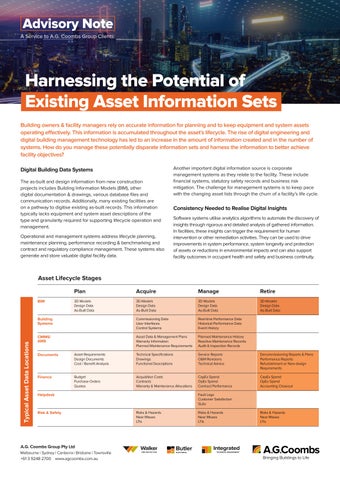
The as-built and design information from new construction projects includes Building Information Models (BIM), other digital documentation & drawings, various database files and communication records. Additionally, many existing facilities are on a pathway to digitise existing as-built records. This information typically lacks equipment and system asset descriptions of the type and granularity required for supporting lifecycle operation and management.
Operational and management systems address lifecycle planning, maintenance planning, performance recording & benchmarking and contract and regulatory compliance management. These systems also generate and store valuable digital facility data.
Another important digital information source is corporate management systems as they relate to the facility. These include financial systems, statutory safety records and business risk mitigation. The challenge for management systems is to keep pace with the changing asset lists through the churn of a facility’s life cycle.
Consistency Needed to Realise Digital Insights
Software systems utilise analytics algorithms to automate the discovery of insights through rigorous and detailed analysis of gathered information. In facilities, these insights can trigger the requirement for human intervention or other remediation activities. They can be used to drive improvements in system performance, system longevity and protection of assets or reductions in environmental impacts and can also support facility outcomes in occupant health and safety and business continuity.
The degree of accuracy and usefulness of the insights gained is proportional to the ability to align the information sets available for the facility. Importantly the asset description must be defined to the right level of detail to support operational and maintenance activities. Alignment is achieved through consistent references to data or metadata enabling the analytics software to access and correctly use the information. With the full spectrum of information available, useful scenarios can be defined in the analytics software.
+ Short term: Comparison of maintenance activity impact on realtime performance and occupant comfort to analyse and make improvements to maintenance programs.
+ Long term: Analysis of reactive breakdown records against planned maintenance, real-time performance and the lifecycle plan to ensure operational tweaks are identified to ensure the longevity of asset life and maximise performance.
Application of analytics without consideration of the quality and consistency of the baseline information can lead to false triggers due to bad information. These false triggers can increase the effort of the operations team to rule them out, instead of the technology providing time efficiencies.
Consistency Supporting Operations
Beyond analytics, other benefits from accurate and accessible facility information include:
+ Ready and quick access to all information needed to run the facility and keep asset register and asset information updated by all stakeholders.
+ Access to ‘whole-of-life’ view of asset performance for operational and capital planning.
+ Foundation for successful deployment of information technology including system integrations.
Harnessing Data Sets; Levels of Service, Asset Criticality, Planning
Specific functional outcomes from digital asset management using analytics can include:
1. Definition of a range of service levels matched back to the organisation’s specific needs – not ‘one size fits all’.
2. Definition of asset criticality that together with condition monitoring supports prioritisation of tasks undertaken.
3. Data driven lifecycle modelling that provides for planning budgets, maintaining facility uptime by avoiding unplanned downtime due to failure and maximising the performance of the asset.
4. Data directed maintenance planning that provides a sound approach to maximise the useful life of assets, reducing downtime and optimising maintenance expenditure.
An accurate and complete asset register and up to date asset information is required to effectively deliver these outcomes.
Technology Roadmap and Digital Transformation
Leading companies are applying digital transformation roadmaps to introduce this technology to optimise facility performance and drive better outcomes for the organisation. This technology can include analytics platforms, artificial intelligence-based platforms or digital twins. When new technology is deployed without ensuring a clear and consistent baseline for facilities information it creates not only additional work and cost during the deployment process but may also compromise the ultimate usefulness of the technology.
For further support and advice on Asset Information Management, please contact:
Bart Taylor
General Manager, A.G. Coombs Advisory +61 2 9248 7400 btaylor@agcoombs.com.au