A
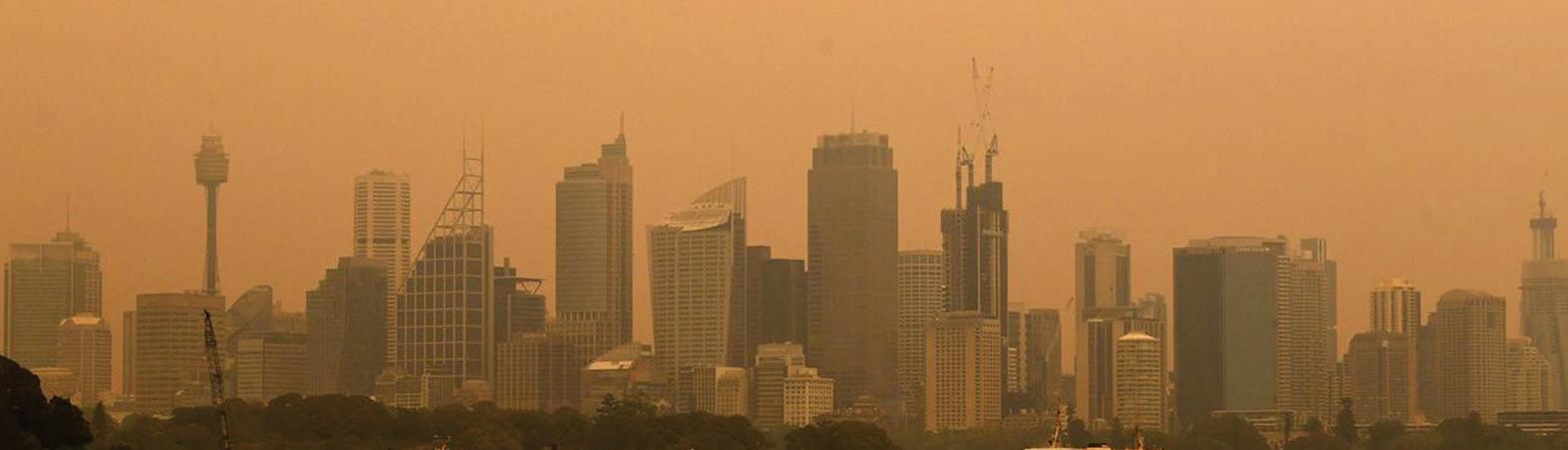
In December 2019 bushfire smoke was so thick across towns and cities in eastern Australia that air quality exceeded “hazardous” levels on numerous occasions with the smoke permeating buildings, affecting indoor air quality and occupant health, and setting off fire detection systems forcing building evacuations.
Although the summer of 2019/20 was unprecedented in the severity of the bushfire season, it is unlikely to be a one-off and scientists warn that with rising temperatures this is likely to become somewhat of a new normal. With that in mind, it is prudent to take steps to assess how our buildings can be adapted to cope better with poor air quality levels in future, and provide a safe and comfortable environment for occupants when outdoor conditions deteriorate.
Air quality levels across Australian cities are measured by the mass of particles smaller than 2.5 micrometers per cubic metre of air, known as the PM2.5 Air Quality Index, measured in µg/m3.
Typically PM2.5 levels in in Australian cities are some of cleanest in the world, averaging under 8 µg/m3, however during the 2019 bushfire season levels in Sydney were frequently in excess of the 200 µg/m3 threshold considered hazardous to human health – with spikes of up to 1000 µg/m3 being recorded – posing a significant and immediate threat. Exposure to smoke containing PM2.5 particulates can cause a range of health impacts including aggravated asthma, cardiovascular disease, lung cancer and escalation of diabetes.
Building owners and facility managers should monitor air quality levels, particularly during the bushfire season or when there are known fires. State and Territory government agencies measure and report the daily AQI readings, and these are updated hourly during bushfire events. They can be found at the following links:
+ www.dpie.nsw.gov.au/air-quality/current-air-quality
+ www.epa.vic.gov.au/EPAAirWatch
+ www.health.act.gov.au/about-our-health-system/population-health/ environmental-monitoring/monitoring-and-regulating-air
+ apps.des.qld.gov.au/air-quality/
For improved accuracy and response times, building owners could consider adding an air quality sensor connected to the Building Management and Control System (BMCS), capable of measuring particles in the sub 2.5 micron diameter range (PM2.5). This would enable accurate readings of the localised air quality to be taken as well as initiate any automatic responses which have been put in place such as disabling night purge and economy cycles or running on minimum outside air levels. PM2.5 readings above 100 µg/m3 should trigger these responses.
Many commercial HVAC systems will be equipped with night purge and/or economy cycle modes which are designed to reduce energy consumption by using greater quantities of outside air rather than recirculated air when ambient conditions are suitable. However, in the event of poor air quality during a bushfire event, disabling these functions via the BMCS could help maintain reasonable air quality levels inside the building.
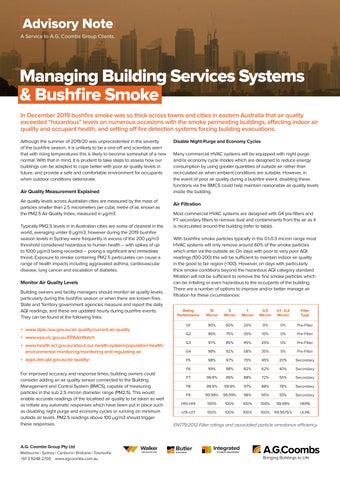
Most commercial HVAC systems are designed with G4 pre-filters and F7 secondary filters to remove dust and contaminants from the air as it is recirculated around the building (refer to table).
With bushfire smoke particles typically in the 0.1-0.3 micron range most HVAC systems will only remove around 60% of the smoke particles which enter via the outside air. On days with poor to very poor AQI readings (100-200) this will be sufficient to maintain indoor air quality in the good to fair region (<100). However, on days with particularly thick smoke conditions beyond the hazardous AQI category standard filtration will not be sufficient to remove the fine smoke particles which can be irritating or even hazardous to the occupants of the building. There are a number of options to improve and/or better manage air filtration for these circumstances:
G190%60%20%0%0%Pre-Filter
G296%75%30%10%0%Pre-Filter
G397%85%45%25%0%Pre-Filter
G498%92%58%35%5%Pre-Filter
F598%97%70%45%20%Secondary
F699%98%82%62%40%Secondary
F799.9%99%88%72%55%Secondary
F899.9%99.9%97%88%78%Secondary
F999.99%99.99%98%95%93%Secondary
H10-H14100%100%100%100%99.99%HEPA
U15-U17100%100%100%100%99.9975%ULPA
EN779:2012 Filter ratings and associated particle arrestance efficiency.
HEPA Filters: Upgrading filtration on outside air intakes to HEPA rated filters is an option to prevent the ingress of smoke and other pollutants into the building, however this will typically require upgraded fans in order to overcome the additional pressure drop of the HEPA filters.
Electrostatic Precipitators: An alternative to HEPA filtration is the use of electrostatic precipitators - these devices operate by using an electrostatic charge to remove smoke and dust particles from the air. These units were commonly used when smoking indoors was permitted in commercial buildings.
A double pass electrostatic filter can typically achieve up to 99.9% particle arrestance in the 0.01 to 10 micron range, comparable to HEPA filtration but with far less impedance to airflow, or the need for regular replacement of filter media. For buildings with sufficient space these could be a viable retrofit solution on outside air intakes to protect from smoke ingress or other pollutants.
Upgrading standard filters: Where upgrading to HEPA or electrostatic filtration is not viable, an alternative may be to upgrade the existing filter media to the highest category which can be accommodated. AHU fan performance will be selected based on the assumed static pressure drop when the filters are “dirty”, but clean filters will have a lower pressure drop, often less than half of the design level. Upgrading the filters from an F7 rating to an F9 may still be possible within the original pressure drop of the dirty F7 filters, but the upgraded filters will need to be replaced far more regularly and will increase the energy consumption of the fans compared to the original design.
Replacing pre-filters and secondary filters with a single set of upgraded filters may also be a way to achieve a higher arrestance efficiency within the same spatial and airflow constraints of the original design. Again, this will likely result in reduced filter life and must be monitored appropriately.
A compromise may be to consider changing out the filters on a seasonal basis around the bushfire season – say October to March, and then reverting to the standard filters for the remainder of the year. This would help to improve indoor air quality during the at-risk months, without penalising energy efficiency at other times.
It is possible for extremely high levels of air pollution to set off indoor smoke detection systems triggering false alarm events, which did occur during December 2019. Preventing smoke ingress through filtration and a well-sealed façade is the best form of defence. Facilities with aspirating smoke detector systems (e.g. VESDA®) may benefit from adding a sampling point on the incoming outside air duct. This can be used as a reference to subtract from the internal readings and determine whether a rise in the background level is due to outdoor air pollution, or from a fire event inside the protected area.
Aside from the hazardous PM2.5 particulates, bushfire smoke is often accompanied by larger particulate matter from dust and ash which can cause further problems with building services due to blockages and contamination. We would advise following the same procedures outlined in A.G. Coombs April 2018 Advisory Note – Managing Resilient Buildings – Preparing for Dust Storms, in particular the checks on air and water systems including cooling towers following a bushfire event to identify and remove any contamination present.
There often is little that can be done during a bushfire smoke event if there is not a procedural plan in place prior to it occurring. All buildings should have a bushfire smoke procedure in place as part of a broader disaster recovery / extreme weather plan, especially critical facilities such as Hospitals and Data Centres.
For more information on preparing buildings for resilience against bushfire smoke, or preparing a Disaster Recovery / Extreme Weather Plan, please contact:
Andrew Bagnall – A.G. Coombs Advisory P: +61 3 9248 7426
E: abagnall@agcoombs.com.au